
DEU office: FDS GmbH, Neuer Höltigbaum 36, 22143 Hamburg, Deutschland
ITA office: Milano
FRA office: Saint Vigor d'Ymonville
POL office: GdańskGBR office: IpswichAUS office: TruganinaUSA office: Fontana
THIS INSTRUCTION BOOKLET CONTAINS IMPORTANT SAFETY INFORMATION. PLEASE READ AND KEEP FOR FUTURE REFERENCE.
SP37878
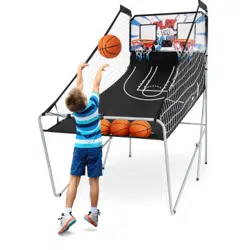
Basketball Arcade Game
Basketball-Arcade-Spiel
Jeu de Basketball Arcade
Máquina de Tiro de Baloncesto
Macchina da Tiro a Canestro
Automat do gry w koszykówkę
02 03
Before You Start
Please read all instructions carefully.
Retain instructions for future reference.
Separate and count all parts and hardware.
Read through each step carefully and follow the proper order.
We recommend that, where possible, all items are assembled near to the area in
which they will be placed in use, to avoid moving the product unnecessarily once
assembled.
Always place the product on a flat, steady and stable surface.
Keep all small parts and packaging materials for this product away from babies
and children as they potentially pose a serious choking hazard.
EN
DE
Bitte lesen Sie alle Anweisungen sorgfältig durch.
Bewahren Sie die Anweisungen zum zukünftigen Verwendung auf.
Überprüfen Sie, ob alle Teile und Zubehörteile vorhanden sind.
Lesen Sie jeden Schritt sorgfältig durch und befolgen Sie die richtige Reihenfolge.
Wir empfehlen, alle Teile möglichst in der Nähe des Aufstellungsortes zu
montieren, um unnötige Bewegungen nach der Montage zu vermeiden.
Stellen Sie den Artikel immer auf eine ebene, feste und stabile Fläche.
Halten Sie alle kleinen Teile und Verpackungsmaterialien fern von Babys und
Kindern, ansonsten besteht Erstickungsgefahr.
Vor dem Beginnen
FR
Veuillez lire attentivement toutes les instructions.
Conservez les instructions pour vous y référer ultérieurement.
Vérifiez toutes les pièces et les accessoires.
Lisez attentivement chaque étape et suivez l’ordre correct.
Nous recommandons que, dans la mesure du possible, tous les produits soient
assemblés à proximité de la zone où ils seront utilisés, afin d’éviter tout
déplacement inutile du produit une fois assemblé.
Placez toujours le produit sur une surface plane et stable.
Conservez toutes les petites pièces de ce produit et les matériaux d’emballage
hors de portée des bébés et des enfants, car ils pourraient présenter un risque
d’étouffement.
Lea atentamente todas las instrucciones.
Conserve las instrucciones para futuras consultas.
Separe y cuente todas las piezas y los accesorios.
Lea detenidamente cada paso y siga el orden correcto.
Recomendamos que, siempre que sea posible, todos los elementos se monten
cerca de la zona en la que se van a utilizar, para evitar mover el producto
innecesariamente una vez montado.
Coloque siempre el producto sobre una superficie plana, estable y firme.
Mantenga todas las piezas pequeñas y los materiales de embalaje de este
producto lejos de los bebés y los niños, ya que pueden representar un grave
riesgo de asfixia.
ES
Avant de Commencer
Antes de Empezar
02 03
Before You Start
Please read all instructions carefully.
Retain instructions for future reference.
Separate and count all parts and hardware.
Read through each step carefully and follow the proper order.
We recommend that, where possible, all items are assembled near to the area in
which they will be placed in use, to avoid moving the product unnecessarily once
assembled.
Always place the product on a flat, steady and stable surface.
Keep all small parts and packaging materials for this product away from babies
and children as they potentially pose a serious choking hazard.
EN
DE
Bitte lesen Sie alle Anweisungen sorgfältig durch.
Bewahren Sie die Anweisungen zum zukünftigen Verwendung auf.
Überprüfen Sie, ob alle Teile und Zubehörteile vorhanden sind.
Lesen Sie jeden Schritt sorgfältig durch und befolgen Sie die richtige Reihenfolge.
Wir empfehlen, alle Teile möglichst in der Nähe des Aufstellungsortes zu
montieren, um unnötige Bewegungen nach der Montage zu vermeiden.
Stellen Sie den Artikel immer auf eine ebene, feste und stabile Fläche.
Halten Sie alle kleinen Teile und Verpackungsmaterialien fern von Babys und
Kindern, ansonsten besteht Erstickungsgefahr.
Vor dem Beginnen
FR
Veuillez lire attentivement toutes les instructions.
Conservez les instructions pour vous y référer ultérieurement.
Vérifiez toutes les pièces et les accessoires.
Lisez attentivement chaque étape et suivez l’ordre correct.
Nous recommandons que, dans la mesure du possible, tous les produits soient
assemblés à proximité de la zone où ils seront utilisés, afin d’éviter tout
déplacement inutile du produit une fois assemblé.
Placez toujours le produit sur une surface plane et stable.
Conservez toutes les petites pièces de ce produit et les matériaux d’emballage
hors de portée des bébés et des enfants, car ils pourraient présenter un risque
d’étouffement.
Lea atentamente todas las instrucciones.
Conserve las instrucciones para futuras consultas.
Separe y cuente todas las piezas y los accesorios.
Lea detenidamente cada paso y siga el orden correcto.
Recomendamos que, siempre que sea posible, todos los elementos se monten
cerca de la zona en la que se van a utilizar, para evitar mover el producto
innecesariamente una vez montado.
Coloque siempre el producto sobre una superficie plana, estable y firme.
Mantenga todas las piezas pequeñas y los materiales de embalaje de este
producto lejos de los bebés y los niños, ya que pueden representar un grave
riesgo de asfixia.
ES
Avant de Commencer
Antes de Empezar

04 05
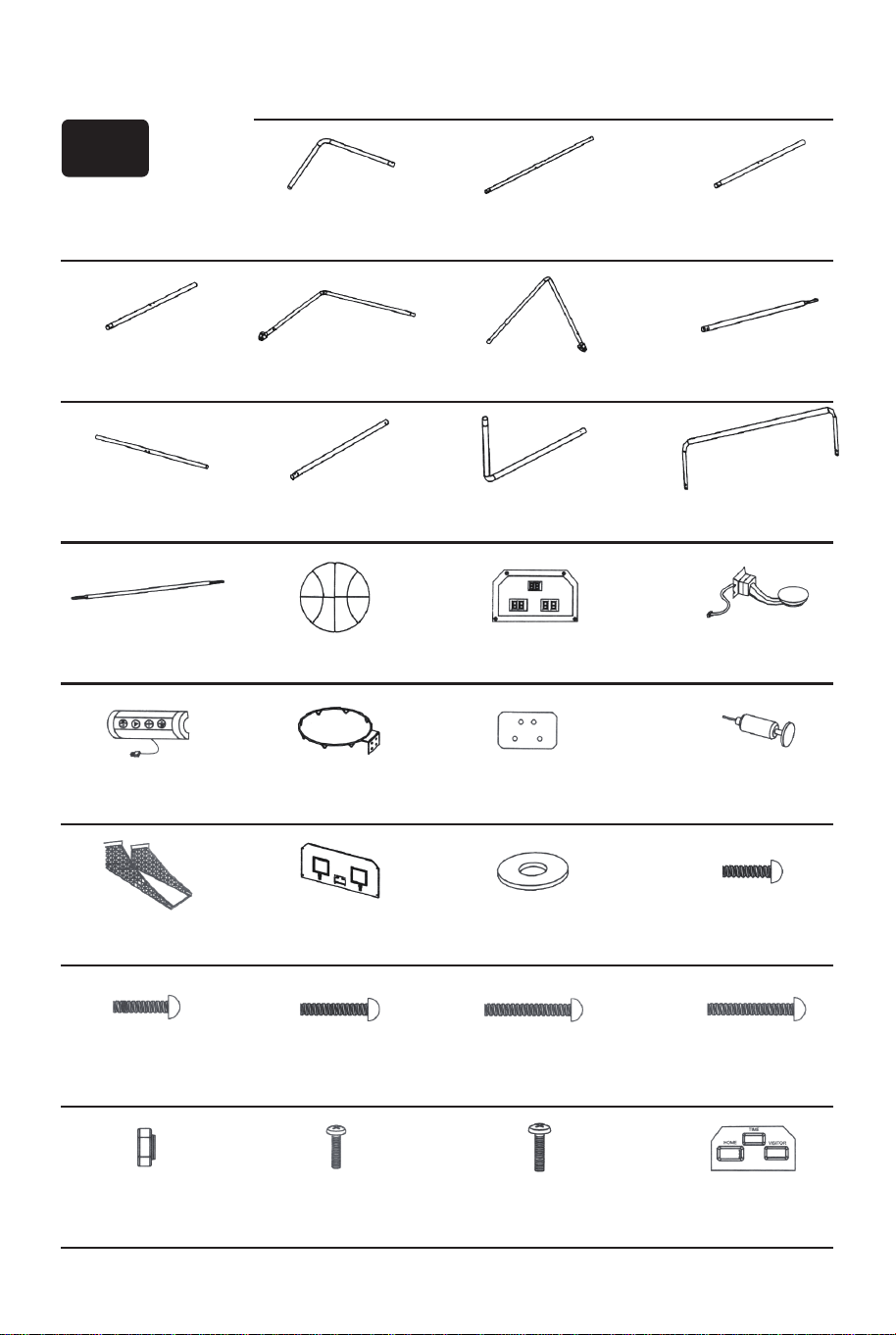
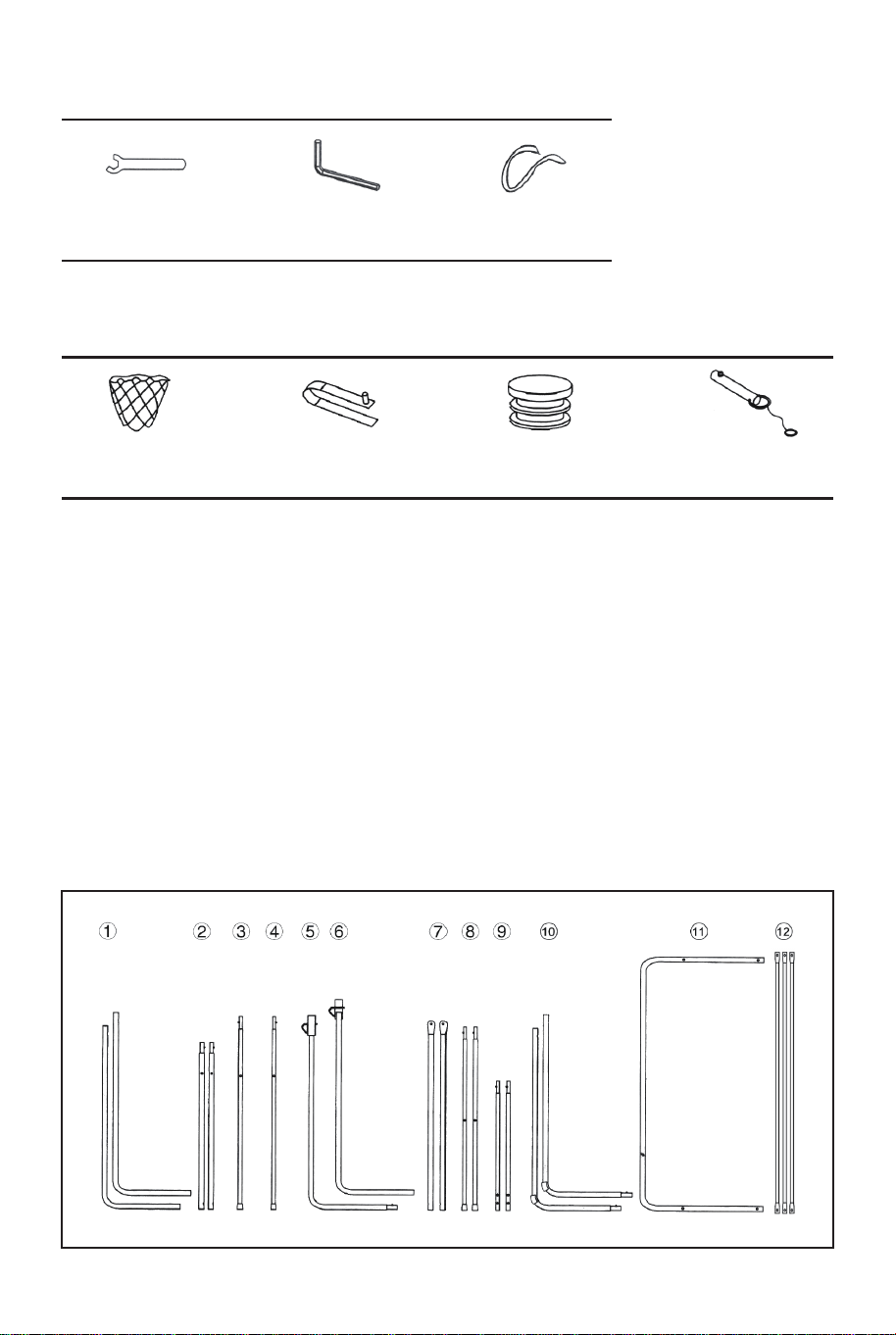
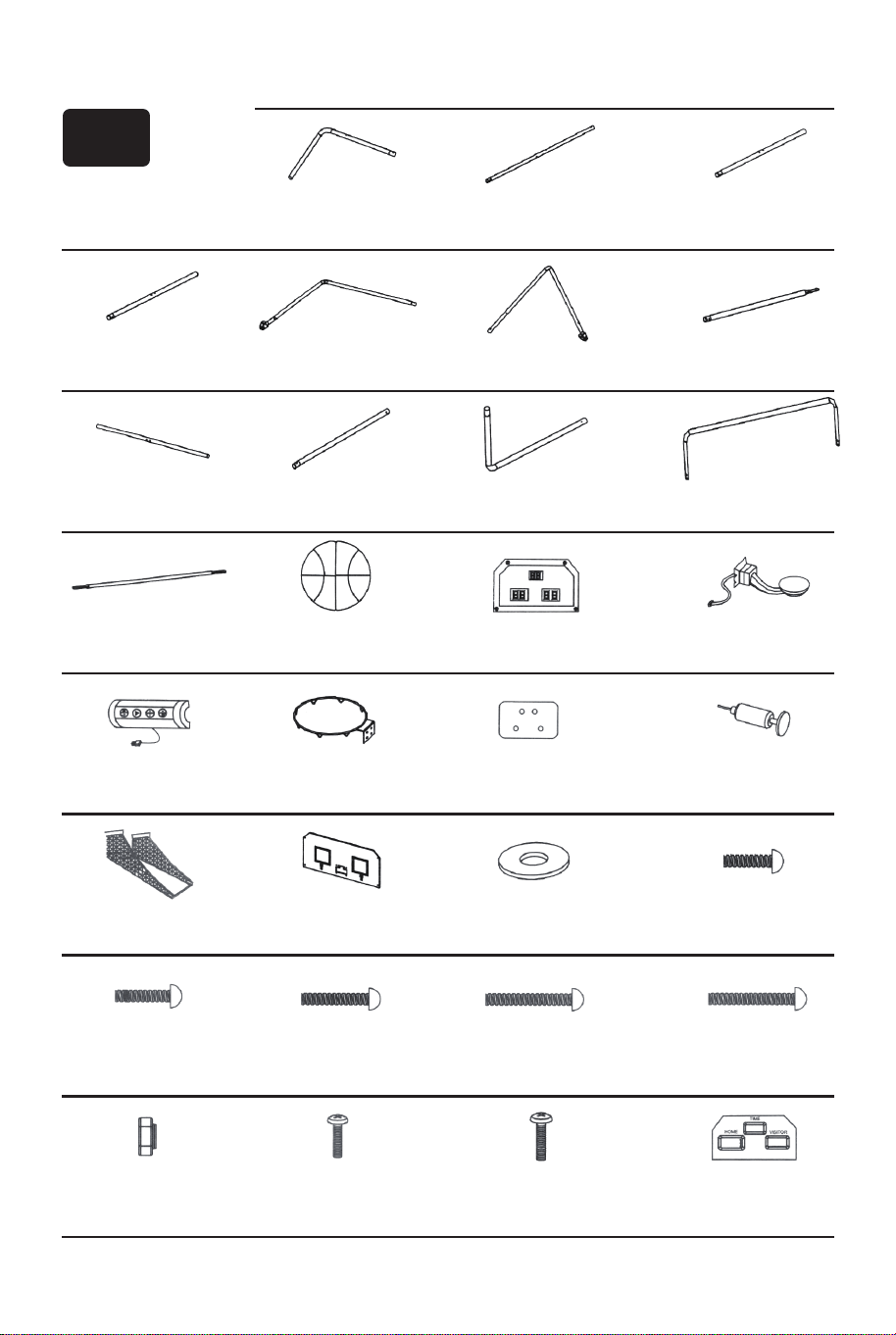
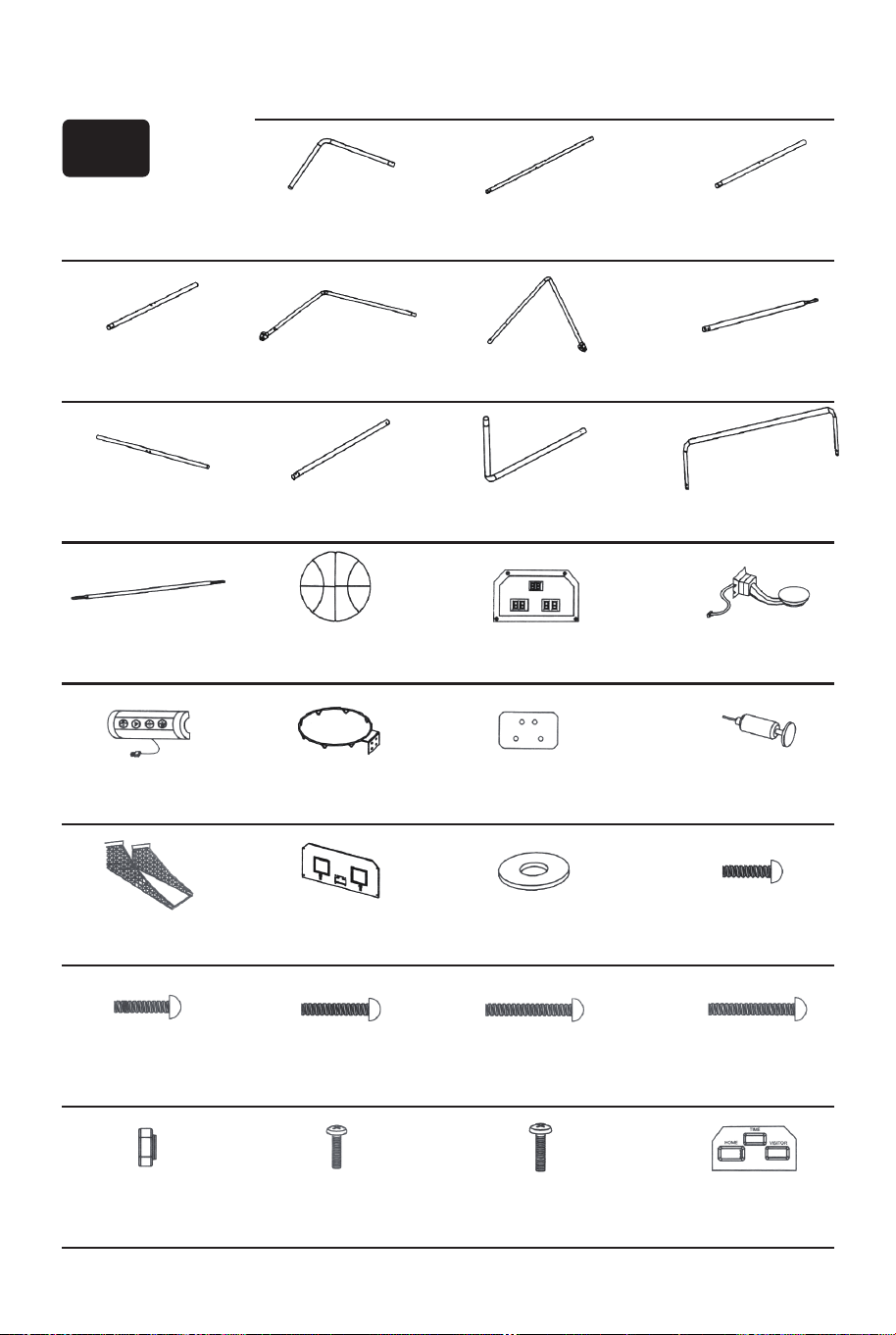
Tube-1 Tube-2
Ø22x580x440mm
Tube-5
Ø22x755x580mm
Tube-6
Ø22x755x580mm
Tube-10
Ø22x650x385mm
Tube-11
Ø22x1067x520mm
Ø22x685mm Ø22x890mm
Tube-3
Ø22x830mm
Tube-7
Ø22x890mm
Tube-4
Ø22x835mm
Tube-8
Ø12.7x1090mm
Tube-12
Ø22x595mm
Tube-9
Basketball 7" /17cm Dia.
Electronic
Rim
Rim Support
Plate
M6 Washer M6x20mm Bolt
Scorer
Switch Sensor
Inflation Pump
with Needle
Control Box
with Wire
Ball Return Net
M6x29mm Bolt
Backboard
M6x42mm Bolt M6x50mm Bolt
4x28mm Bolt
Electronic Scorer
Face Plate
M6x35mm Bolt
M6 Nut
3.5x10mm Bolt
1 x2 2 x2 3 x1
4 x1
5 x1 6 x1 7 x2
8 x2
9 x2 10 x2 11 x1
12 x3
13 x4
14 x1
15 x2
16 x1
21 x1 22 x46 23 x16
24 x6
25 x4 26 x4 27 x2
28 x32
29 x4 30 x2 31 x1
17 x2
18 x2 19 x1
20 x1
EN
Si prega di leggere attentamente tutte le istruzioni.
Conservare le istruzioni per riferimento futuro.
Separare e contare tutte le parti e gli accessori.
Leggere attentamente ogni passo e seguire l'ordine corretto.
Si consiglia, ove possibile, di assemblare tutti gli articoli vicino alla zona in cui
verranno posti in uso, per evitare di spostare inutilmente il prodotto una volta
assemblato.
Posizionare sempre il prodotto su una superficie piana, stabile.
Tenere tutte le piccole parti e i materiali di imballaggio di questo prodotto lontano
dalla portata di neonati e bambini, in quanto possono costituire un serio pericolo
di soffocamento.
Zapoznaj się z instrukcją.
Zachowaj instrukcję do wglądu.
Posortuj części i upewnij się, że zestaw jest kompletny.
Zapoznaj się ze sposobem montażu i postępuj zgodnie z instrukcją.
Zalecamy, aby montaż odbywał się możliwie najbliżej miejsca docelowego
położenia produktu, aby uniknąć niepotrzebnego przesuwania.
Upewnij się, że produkt znajdzie się na płaskiej i stabilnej po wierzchni.
Upewnij się, że materiały wykorzystane podczas pakowania produktu.
oraz jego elementy znajdują się poza zasięgiem dzieci.
IT
PL
Prima di Iniziare
Zanim Zaczniesz
04 05
Tube-1 Tube-2
Ø22x580x440mm
Tube-5
Ø22x755x580mm
Tube-6
Ø22x755x580mm
Tube-10
Ø22x650x385mm
Tube-11
Ø22x1067x520mm
Ø22x685mm Ø22x890mm
Tube-3
Ø22x830mm
Tube-7
Ø22x890mm
Tube-4
Ø22x835mm
Tube-8
Ø12.7x1090mm
Tube-12
Ø22x595mm
Tube-9
Basketball 7" /17cm Dia.
Electronic
Rim
Rim Support
Plate
M6 Washer M6x20mm Bolt
Scorer
Switch Sensor
Inflation Pump
with Needle
Control Box
with Wire
Ball Return Net
M6x29mm Bolt
Backboard
M6x42mm Bolt M6x50mm Bolt
4x28mm Bolt
Electronic Scorer
Face Plate
M6x35mm Bolt
M6 Nut
3.5x10mm Bolt
1 x2 2 x2 3 x1
4 x1
5 x1 6 x1 7 x2
8 x2
9 x2 10 x2 11 x1
12 x3
13 x4
14 x1
15 x2
16 x1
21 x1 22 x46 23 x16
24 x6
25 x4 26 x4 27 x2
28 x32
29 x4 30 x2 31 x1
17 x2
18 x2 19 x1
20 x1
EN
Si prega di leggere attentamente tutte le istruzioni.
Conservare le istruzioni per riferimento futuro.
Separare e contare tutte le parti e gli accessori.
Leggere attentamente ogni passo e seguire l'ordine corretto.
Si consiglia, ove possibile, di assemblare tutti gli articoli vicino alla zona in cui
verranno posti in uso, per evitare di spostare inutilmente il prodotto una volta
assemblato.
Posizionare sempre il prodotto su una superficie piana, stabile.
Tenere tutte le piccole parti e i materiali di imballaggio di questo prodotto lontano
dalla portata di neonati e bambini, in quanto possono costituire un serio pericolo
di soffocamento.
Zapoznaj się z instrukcją.
Zachowaj instrukcję do wglądu.
Posortuj części i upewnij się, że zestaw jest kompletny.
Zapoznaj się ze sposobem montażu i postępuj zgodnie z instrukcją.
Zalecamy, aby montaż odbywał się możliwie najbliżej miejsca docelowego
położenia produktu, aby uniknąć niepotrzebnego przesuwania.
Upewnij się, że produkt znajdzie się na płaskiej i stabilnej po wierzchni.
Upewnij się, że materiały wykorzystane podczas pakowania produktu.
oraz jego elementy znajdują się poza zasięgiem dzieci.
IT
PL
Prima di Iniziare
Zanim Zaczniesz
06 07
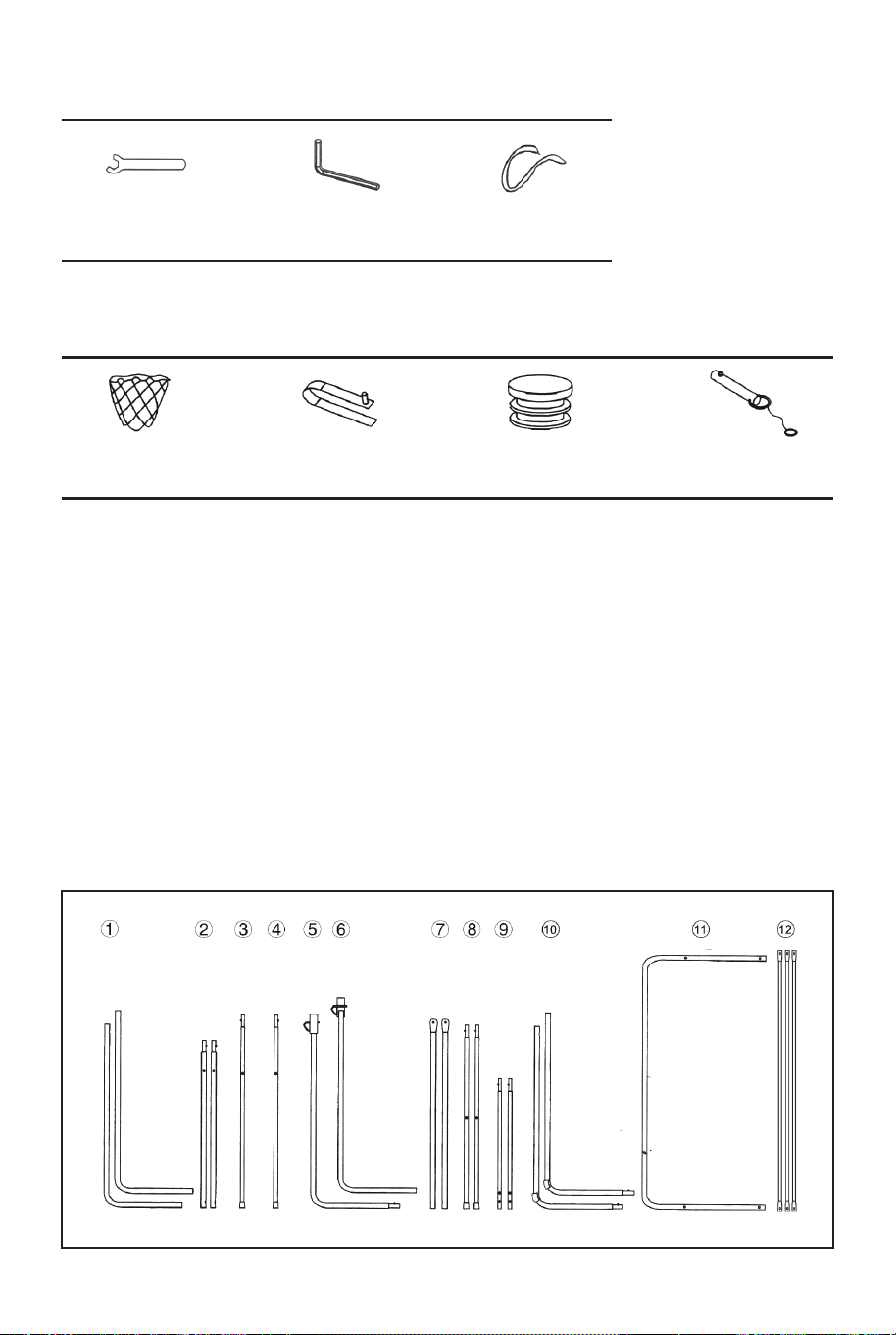
ASSEMBLY INSTRUCTIONS:
FIG.1 &2
Wrench
32 x1
Allen Key
33 x1
Self-Stick Strap
34 x2
Net
P1 x2
Spring Lock
P2 x9
Plastic Pole
Insert
P3 x2
Lock Pin
P4 x2
PRE-INSTALLED PARTS
BEFORE ASSEMBLY-Please inspect and layout
all your poles and parts
1. Find a clean, level place to begin the assembly of your Basketball Game. We
recommend that two adults work together to assemble this basketball game.
2. Remove all the parts from the box and verify that you have all of the listed parts as
shown on the Parts list page. Carefully cut or tear the four corners of the box so that
the bottom of the box can be used as your work surface.
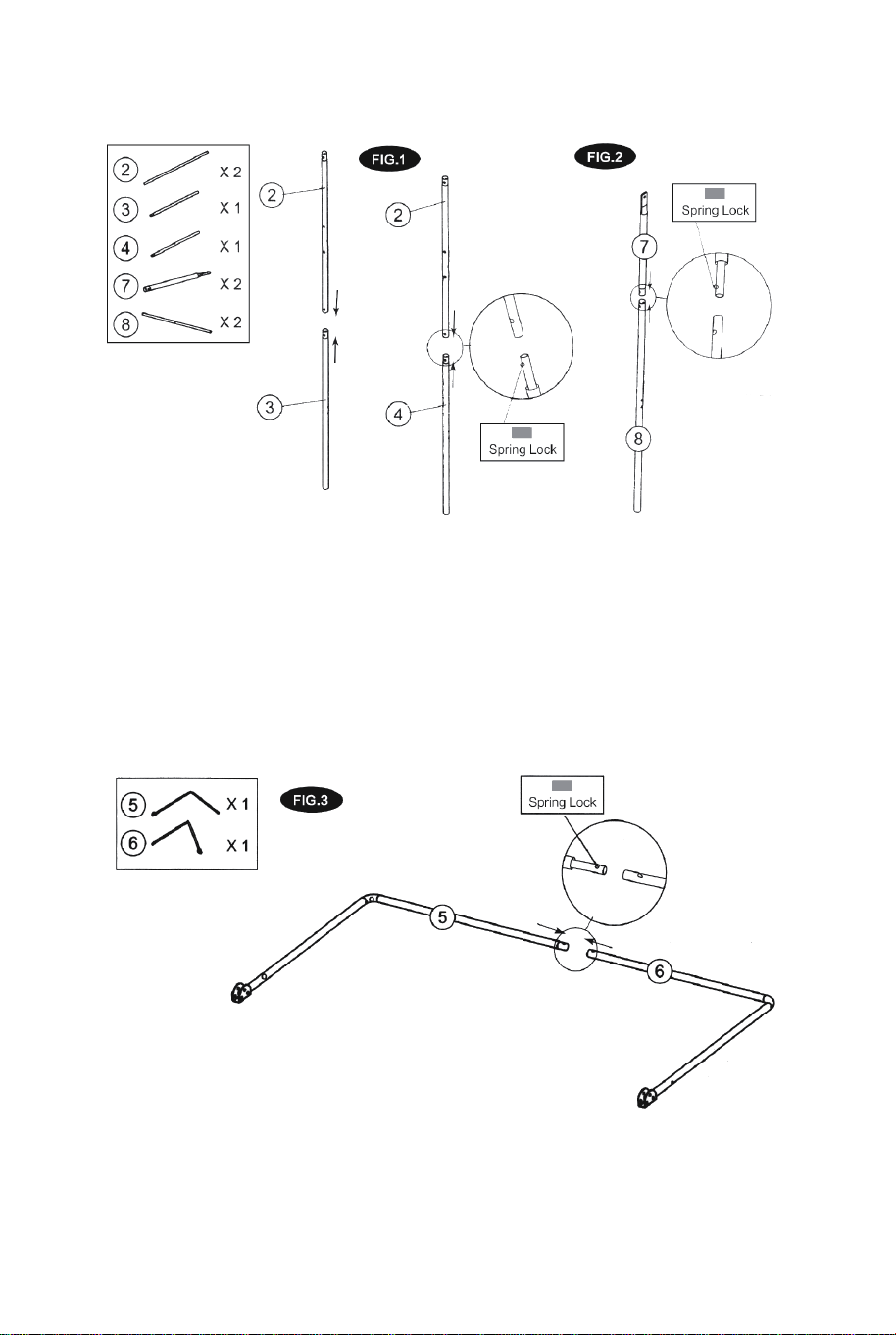
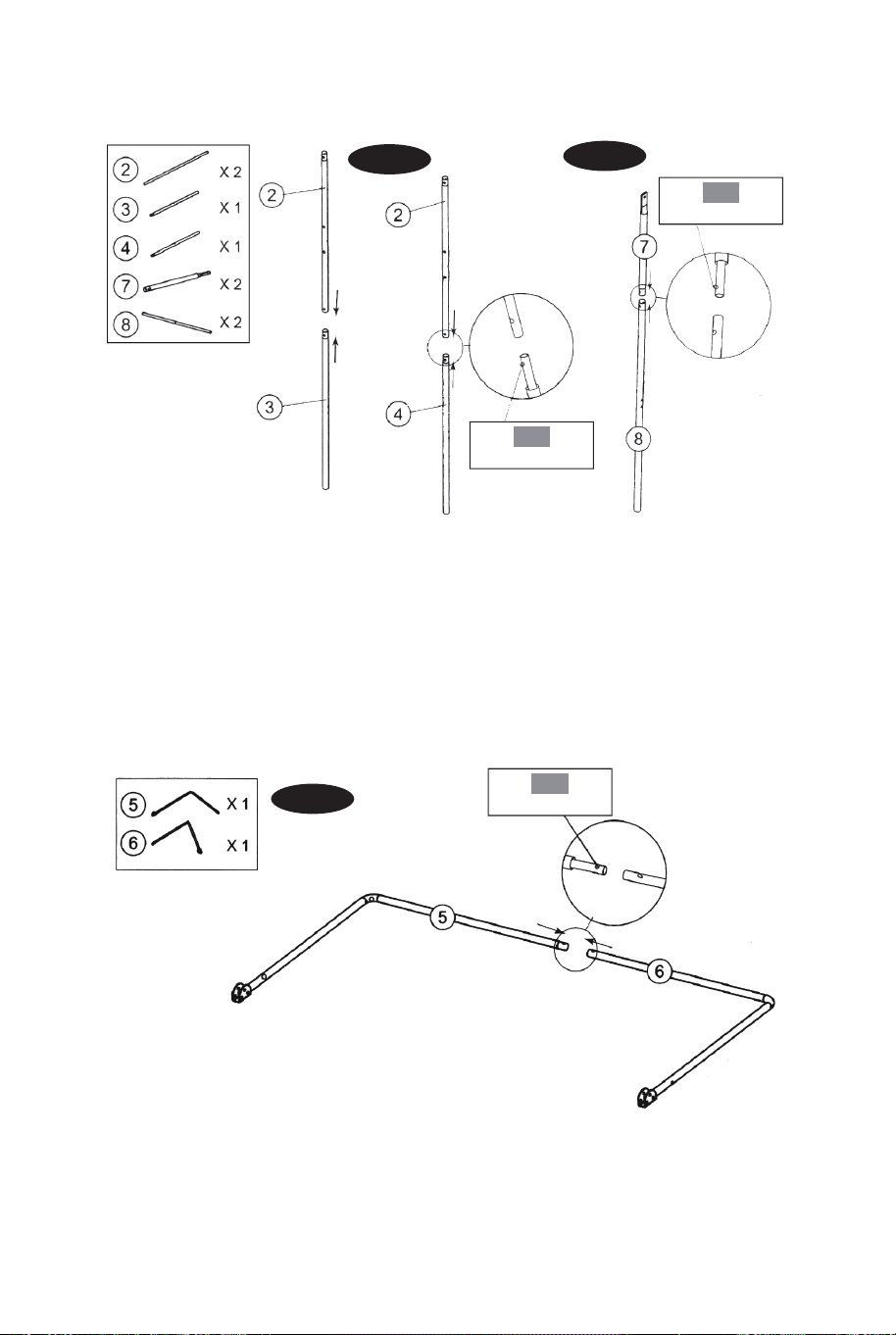
3. Attach the Tubes -2 (#2) to the Tube - 3 and Tube - 4 (#3 & #4) using spring lock
(pre-installed) as shown in FIG.1.
4. Attach the Tubes - 7 (#7) to the Tubes - 8 (#8) using spring lock (pre-installed) as
shown in FIG.2
FIG.3
5. Attach the Tube- 5 and Tube - 6 (#5 & #6) together using spring lock (pre-installed)
as shown in FIG.3.
P2
P2
P2
06 07
ASSEMBLY INSTRUCTIONS:
FIG.1 &2
Wrench
32 x1
Allen Key
33 x1
Self-Stick Strap
34 x2
Net
P1 x2
Spring Lock
P2 x9
Plastic Pole
Insert
P3 x2
Lock Pin
P4 x2
PRE-INSTALLED PARTS
BEFORE ASSEMBLY-Please inspect and layout
all your poles and parts
1. Find a clean, level place to begin the assembly of your Basketball Game. We
recommend that two adults work together to assemble this basketball game.
2. Remove all the parts from the box and verify that you have all of the listed parts as
shown on the Parts list page. Carefully cut or tear the four corners of the box so that
the bottom of the box can be used as your work surface.
3. Attach the Tubes -2 (#2) to the Tube - 3 and Tube - 4 (#3 & #4) using spring lock
(pre-installed) as shown in FIG.1.
4. Attach the Tubes - 7 (#7) to the Tubes - 8 (#8) using spring lock (pre-installed) as
shown in FIG.2
FIG.3
5. Attach the Tube- 5 and Tube - 6 (#5 & #6) together using spring lock (pre-installed)
as shown in FIG.3.
P2
P2
P2
08 09
FIG.4
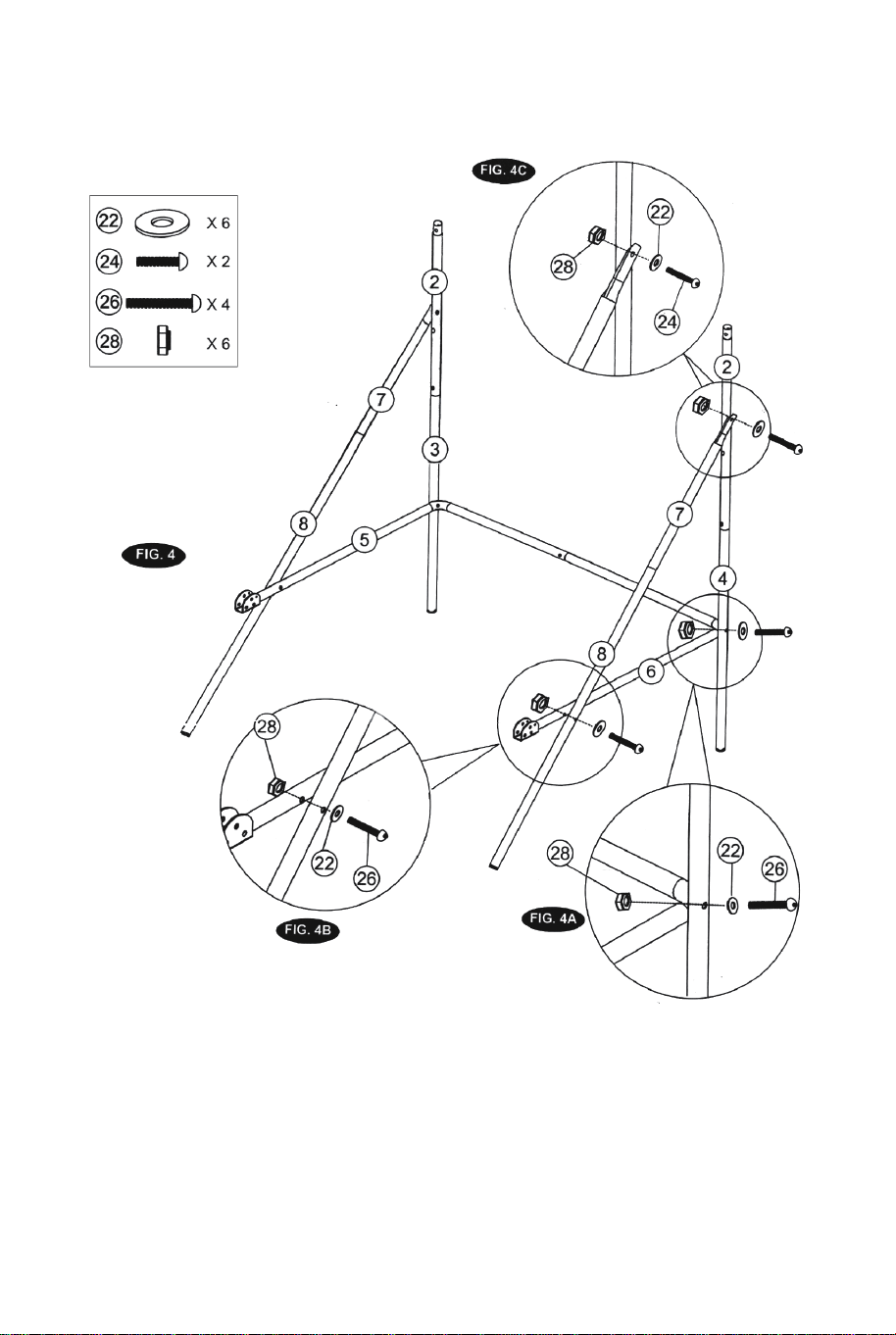
6. Attach the Tube - 5 and Tube - 6 (#5 & #6) to Tube - 3 and Tube - 4 (#3 & #4) using
Bolts (#26), Washers (#22) and Nuts (#28), and then attach the Tube - 5 and Tube- 6
(#5 & #6) to the Tubes - 8 (#8) using Bolts (#26), Washers (#22) and Nuts (#28) as
shown in FIG.4, 4A and 4B.
7. Attach the Tubes- 7 and Tubes - 8 (#7 & #8) to the Tubes - 2 (#2) using Bolt (#24),
Washers (#22) and Nut (#28) as shown in FIG.4C, repeat this step for other side.
Note: Make sure the spring lock is facing down.
FIG.5
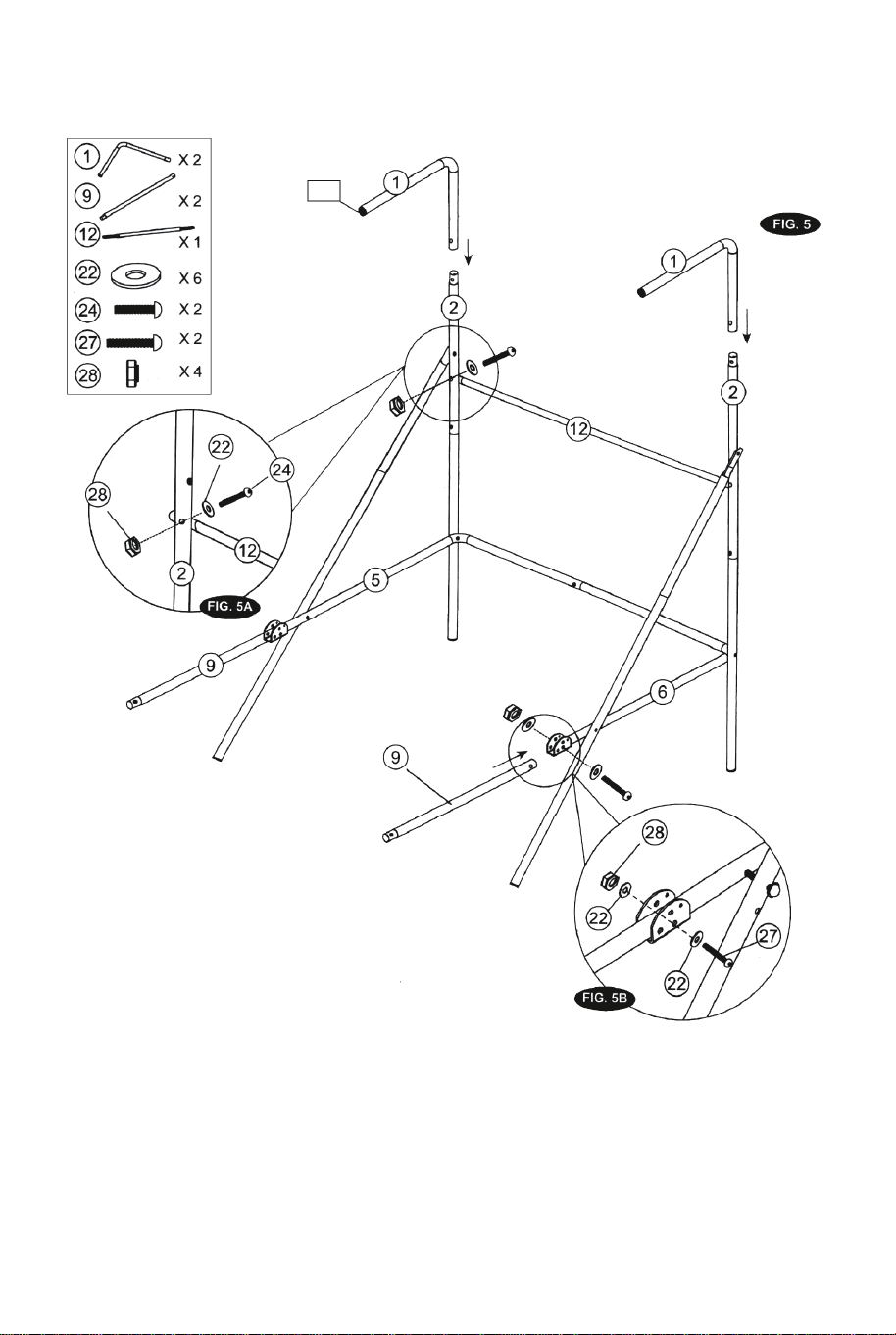
8. Attach the Tube- 12 (#12) to the Tubes - 2 (#2) using Bolts (#24), Washers (#22) and
Nuts (#28) as shown in FIG.5A. And then insert the Tubes- 1 (#1) to the Tubes - 2
(#2) as shown in FIG.5.
9. Attach the Tubes - 9 (#9) to Tube- 5 and Tube - 6 (#5 & #6) using Bolts (#27 ),
Washers (#22) and Nuts (#28) as shown in FIG.5 and 5B.
P3
08 09
FIG.4
6. Attach the Tube - 5 and Tube - 6 (#5 & #6) to Tube - 3 and Tube - 4 (#3 & #4) using
Bolts (#26), Washers (#22) and Nuts (#28), and then attach the Tube - 5 and Tube- 6
(#5 & #6) to the Tubes - 8 (#8) using Bolts (#26), Washers (#22) and Nuts (#28) as
shown in FIG.4, 4A and 4B.
7. Attach the Tubes- 7 and Tubes - 8 (#7 & #8) to the Tubes - 2 (#2) using Bolt (#24),
Washers (#22) and Nut (#28) as shown in FIG.4C, repeat this step for other side.
Note: Make sure the spring lock is facing down.
FIG.5
8. Attach the Tube- 12 (#12) to the Tubes - 2 (#2) using Bolts (#24), Washers (#22) and
Nuts (#28) as shown in FIG.5A. And then insert the Tubes- 1 (#1) to the Tubes - 2
(#2) as shown in FIG.5.
9. Attach the Tubes - 9 (#9) to Tube- 5 and Tube - 6 (#5 & #6) using Bolts (#27 ),
Washers (#22) and Nuts (#28) as shown in FIG.5 and 5B.
P3

10 11
FIG.6
10. Attach the Tubes - 10 (#10) to the Tubes - 9 (#9) using spring lock (pre-installed), and
then attach the Tube- 11 (#11) to the Tubes - 10 (#10) using spring lock (pre-installed)
as shown in FIG 6.
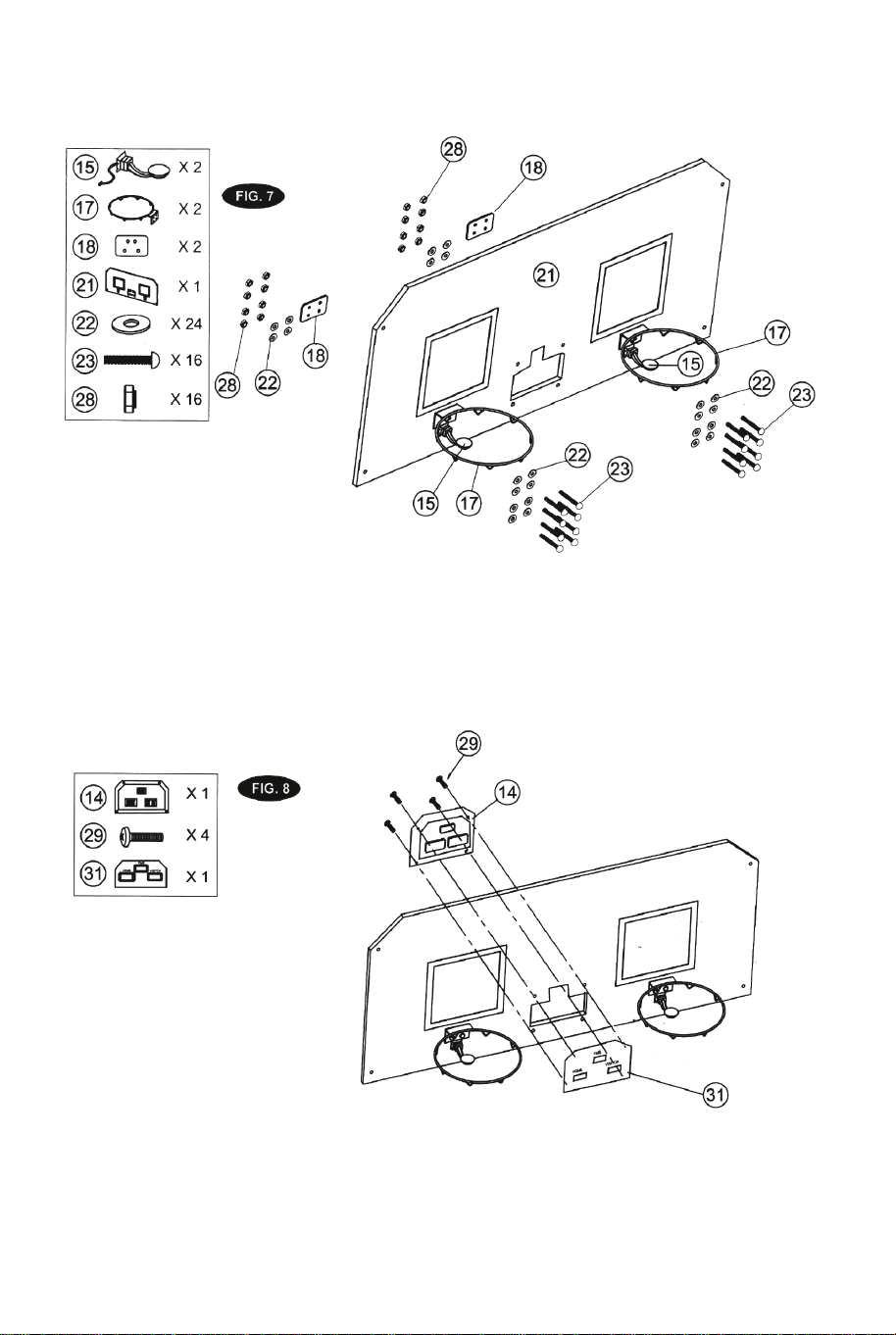
FIG.7
11. Attach the Rim (#17) and Rim Support Plates (#18) to the Backboard (#21) using the
Bolts (#23), washers (#22) and Nuts (#28). And then attach the Switch Sensors (#15)
to the Backboard (#21) using the Bolts (#23), washers (#22) and Nuts (#28). Make
sure that you use washers on both sides of the backboard as shown in FIG.7.
FIG.8
12. Attach the Electronic Scorer Face Plate (#31) to the front of Backboard and connect
with the Electronic Scorer (#14) using Bolts (#29) as shown in FIG. 8.
P2
P2
10 11
FIG.6
10. Attach the Tubes - 10 (#10) to the Tubes - 9 (#9) using spring lock (pre-installed), and
then attach the Tube- 11 (#11) to the Tubes - 10 (#10) using spring lock (pre-installed)
as shown in FIG 6.
FIG.7
11. Attach the Rim (#17) and Rim Support Plates (#18) to the Backboard (#21) using the
Bolts (#23), washers (#22) and Nuts (#28). And then attach the Switch Sensors (#15)
to the Backboard (#21) using the Bolts (#23), washers (#22) and Nuts (#28). Make
sure that you use washers on both sides of the backboard as shown in FIG.7.
FIG.8
12. Attach the Electronic Scorer Face Plate (#31) to the front of Backboard and connect
with the Electronic Scorer (#14) using Bolts (#29) as shown in FIG. 8.
P2
P2
12 13
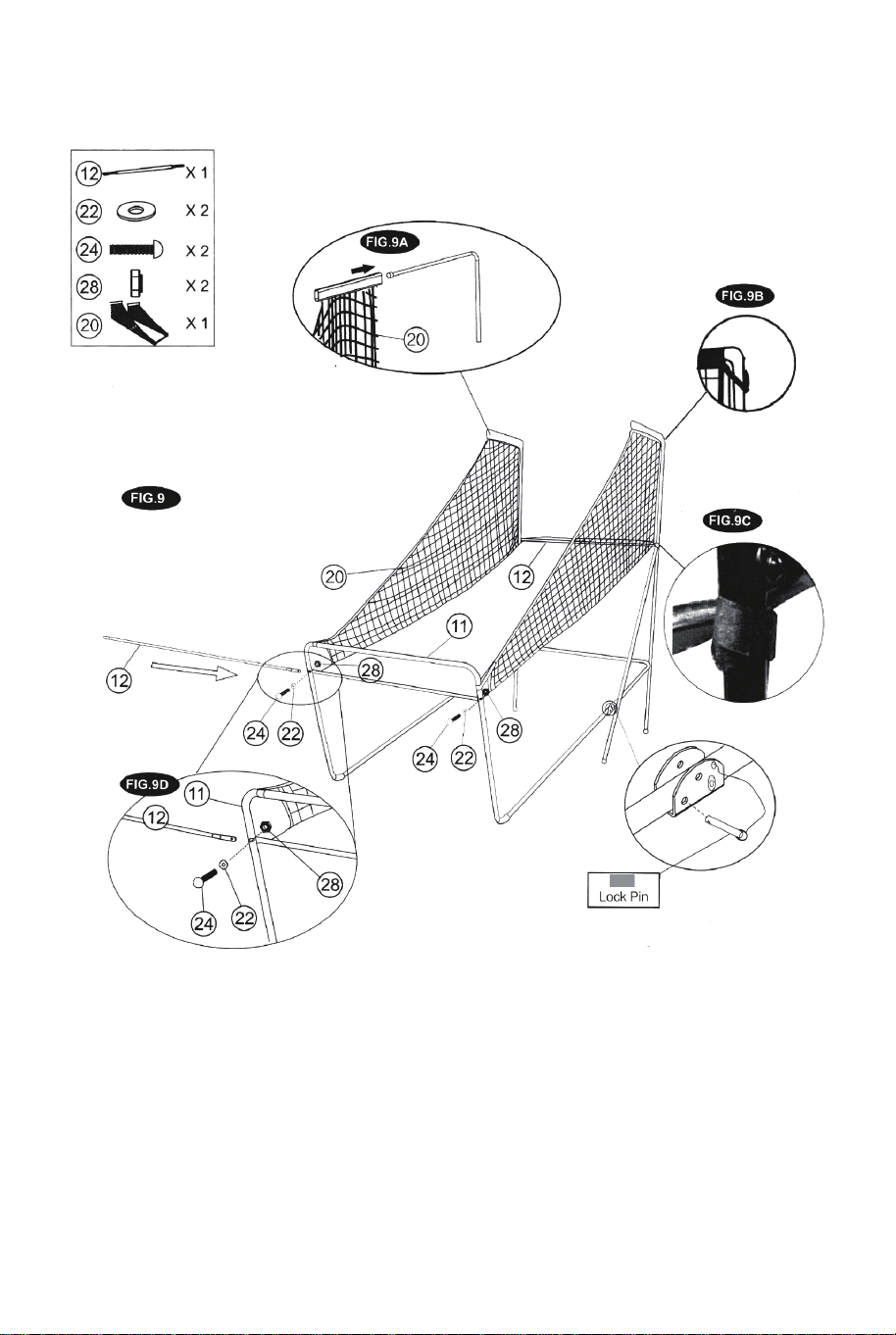
FIG.9
13. Slide elastic straps and sleeve of Ball Return Net (#20) onto Tubes - 1 (#1) as shown
in FIG. 9A& 9B & 9C.
14. Slide the Tube - 12 (#12) through the sleeve on the front of the Ball Return Net (#20),
attach at the left side first using Bolts (#24), Washers (#22) and Nuts (#28) as shown
in FIG. 9D. Follow the same procedure on the right side.
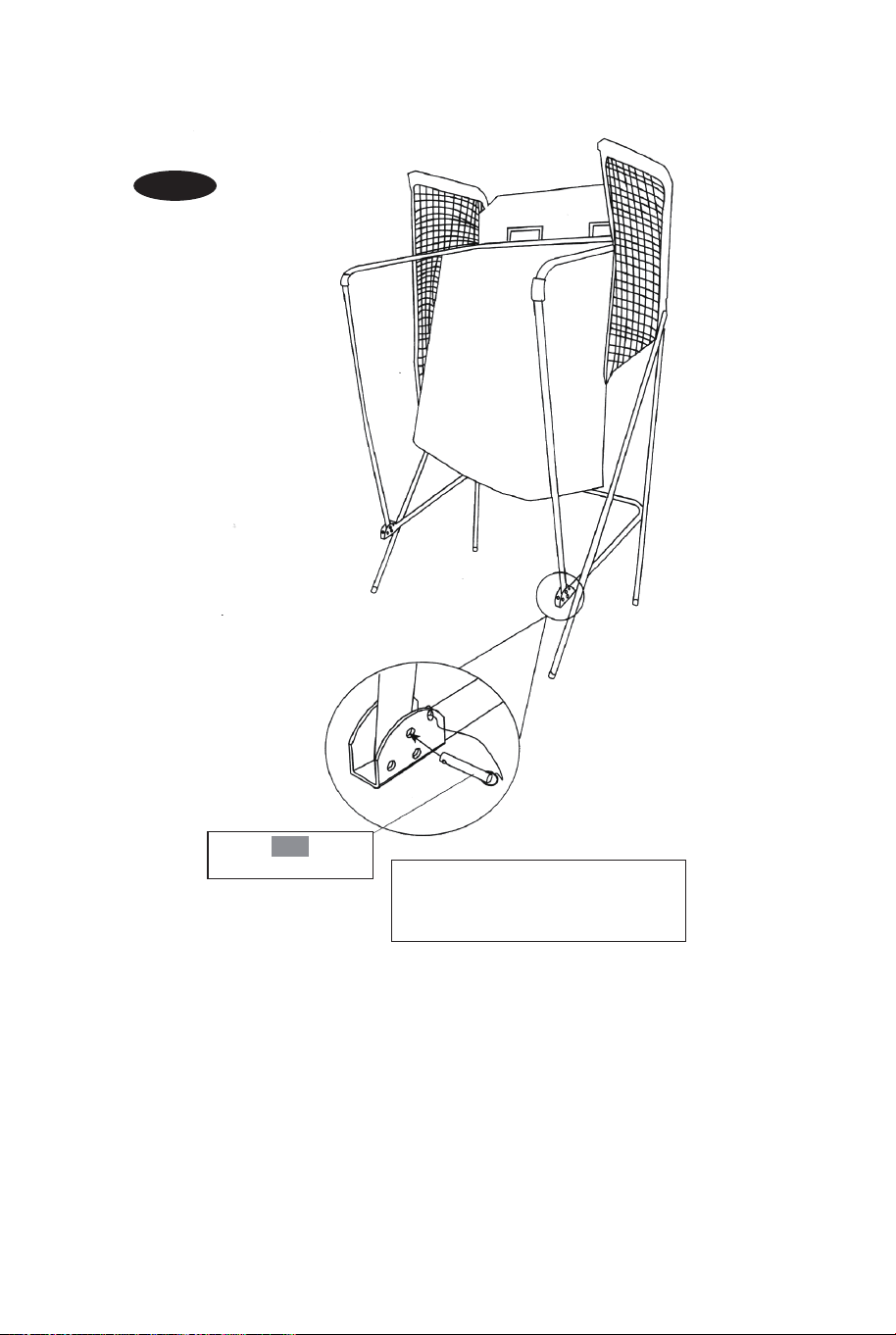
16. Connect the Lock Pin (#P4) to the Tube - 5 and Tube- 6 (#5 & #6) and insert it to the
Tube - 5 and Tube - 6 (#5 & #6) as shown in FIG.10C.
P4
FIG.10
15. With the help of another adult, attach the Backboard (#21) to Top Tubes 1 (#1) with
Bolts (#25), Washers (#22), and Nuts (#28) as shown in FIG.10A. Slide Tube 12 (#12)
through the sleeve at the back of the Ball Return Net (#20), as shown in FIG.10B. At
each bottom hole of the backboard, attach the left side first with Bolts (#25), Washers
(#22), Nuts (#28) as shown in FIG.10C. Follow the same procedure for the right side.
P4
P1
FIG.10B

12 13
FIG.9
13. Slide elastic straps and sleeve of Ball Return Net (#20) onto Tubes - 1 (#1) as shown
in FIG. 9A& 9B & 9C.
14. Slide the Tube - 12 (#12) through the sleeve on the front of the Ball Return Net (#20),
attach at the left side first using Bolts (#24), Washers (#22) and Nuts (#28) as shown
in FIG. 9D. Follow the same procedure on the right side.
16. Connect the Lock Pin (#P4) to the Tube - 5 and Tube- 6 (#5 & #6) and insert it to the
Tube - 5 and Tube - 6 (#5 & #6) as shown in FIG.10C.
P4
FIG.10
15. With the help of another adult, attach the Backboard (#21) to Top Tubes 1 (#1) with
Bolts (#25), Washers (#22), and Nuts (#28) as shown in FIG.10A. Slide Tube 12 (#12)
through the sleeve at the back of the Ball Return Net (#20), as shown in FIG.10B. At
each bottom hole of the backboard, attach the left side first with Bolts (#25), Washers
(#22), Nuts (#28) as shown in FIG.10C. Follow the same procedure for the right side.
P4
P1
FIG.10B
14 15
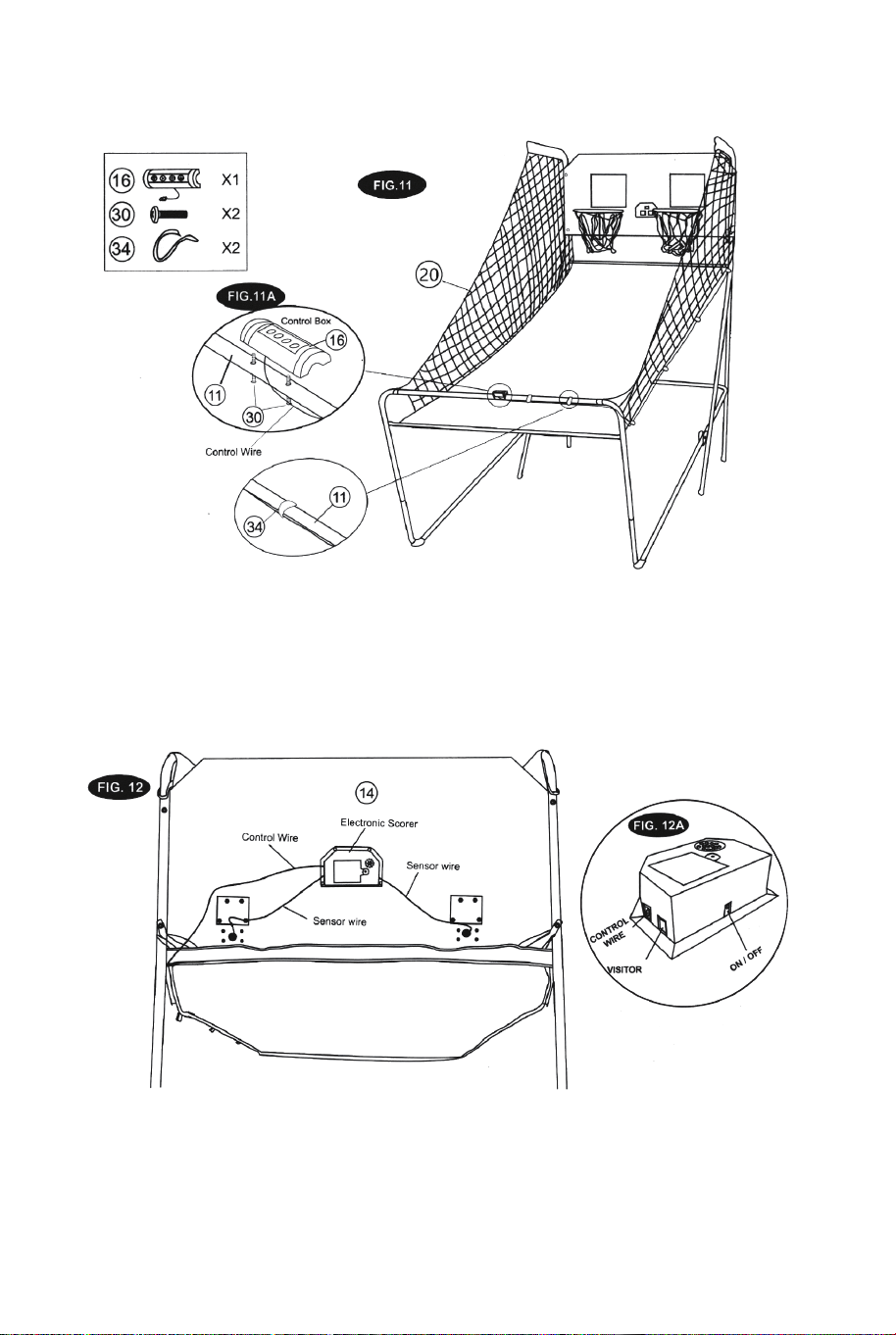
FIG.11
17. Attach the Control Box (#16) to middle of the Tube - 11 (#11) using two Bolts (#30) as
shown in FIG.11A.
18. Run the rest of the Control Wire through the loops on the Ball Return Net (#20). Place
the Control Wire on the Tube - 11 (#11) using the Self-Stick Straps (#34) as shown in
FIG.11.
FIG.12
19. Connect the Sensor Wire from Switch Sensor (#15) to the Electronic Scorer (#14) as
shown in FIG. 12. Connect the Control Wire to the Electronic Scorer (#14) as shown
in FIG.12 and 12A.
FIG.13
20. Fold the Basketball Arcade Machine when not in use and insert the Lock Pin (#P4) as
shown in FIG.13.
Note: The lock pin (#P4) needs to be removed from its original position when the
machine is being used before insertion to the new position when folded.
#P4
P4

14 15
FIG.11
17. Attach the Control Box (#16) to middle of the Tube - 11 (#11) using two Bolts (#30) as
shown in FIG.11A.
18. Run the rest of the Control Wire through the loops on the Ball Return Net (#20). Place
the Control Wire on the Tube - 11 (#11) using the Self-Stick Straps (#34) as shown in
FIG.11.
FIG.12
19. Connect the Sensor Wire from Switch Sensor (#15) to the Electronic Scorer (#14) as
shown in FIG. 12. Connect the Control Wire to the Electronic Scorer (#14) as shown
in FIG.12 and 12A.
FIG.13
20. Fold the Basketball Arcade Machine when not in use and insert the Lock Pin (#P4) as
shown in FIG.13.
Note: The lock pin (#P4) needs to be removed from its original position when the
machine is being used before insertion to the new position when folded.
#P4
P4

16 17
ELECTRONIC SCORER OPERATION
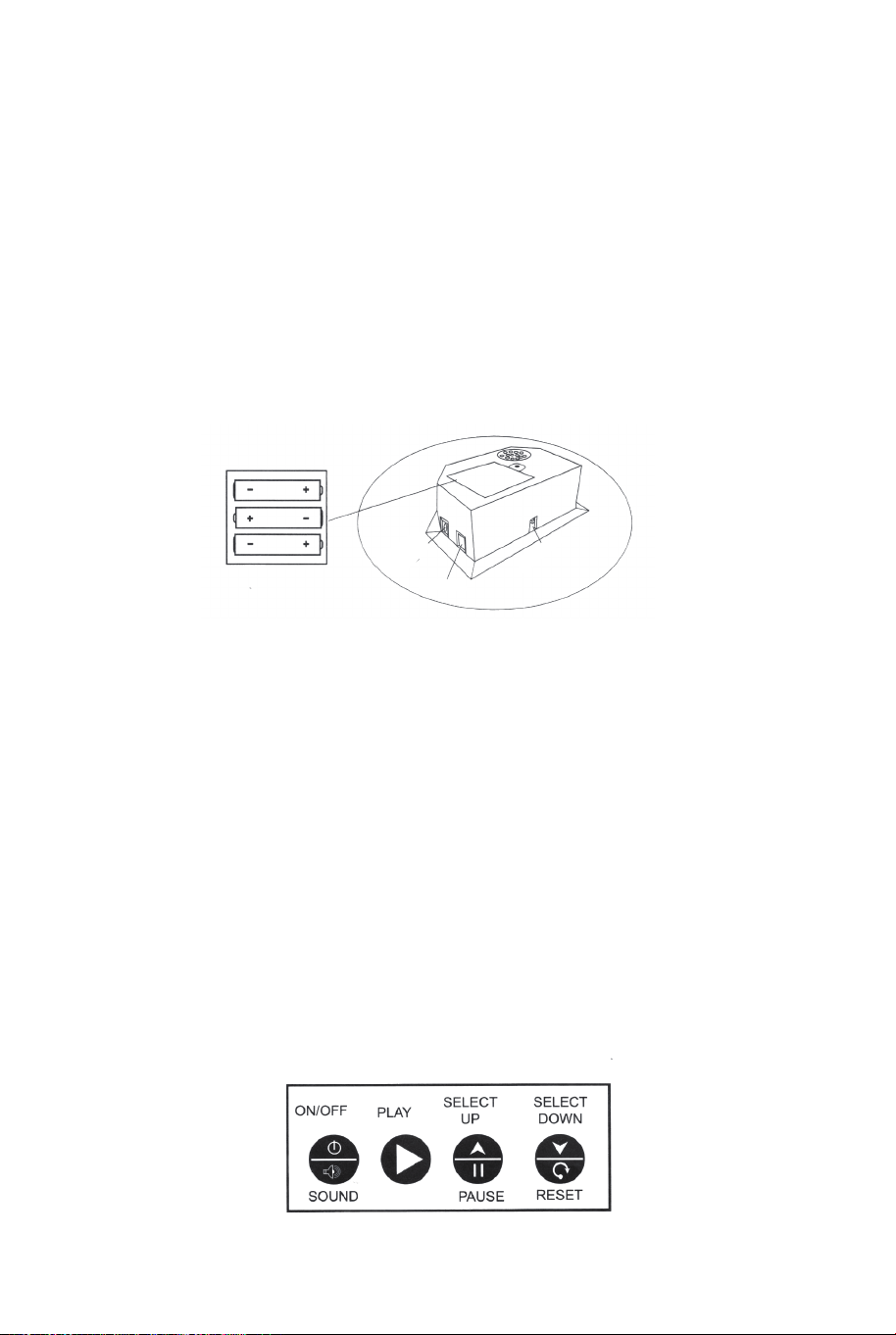
Battery Box: Unscrew bolt using a screwdriver and open the battery box. Insert 3 "AA"
batteries (not included) in the order of polarity as shown on the inside cover. Then
close the cover using a screwdriver. Turn the power ON using the ON/OFF switch.
Press "ON/OFF" to activate the scorer.
Scoreboard "HOME" shows "01" (pre- set game 1).
Press "SELECT UP and DOWN" to select a game.
Press "PLAY" to enter selected game mode.
Press "SOUND" to switch sound ON/OFF while playing.
Press "PAUSE" to pause or start time counting.
Press and hold the button "ON/OFF" 3 seconds to turn off scorer.
Press and hold the button "RESET" 3 seconds to reset the games.
Note: If no shot is made or no button is pressed in 15 mins, scorer will be turned off
automatically.
a. Batteries must be installed according to the correct polarization (+ and -) requires.
b. Please clean the battery contacts and also those of the devices prior to battery
installation.
c. If the game will not be used for a long period of time, we recommend that the
batteries should be removed.
Install Batteries
1. Beat the Time Clock
Press "PLAY" to enter game 1.
Press "UP/Down" to select single/multiple players (P1/P2/P3/P4).
Press "PLAY" after the number of player is selected.
Press "UP/Down" to select playing time, 30/45/60 seconds.
Press "PLAY" to begin the game.
Scoreboard "HOME" shows Player 1, 3; Scoreboard "VISITOR" shows Player 2, 4.
All shots worth 2 points until last 10 seconds, each score counts 3 points.
Countdown 5 seconds to next player's turn when one player finishes game.
Player with more points scored wins (LED will flash on player with higher score).
Press "PLAY" to restart this game.
2.3 Point Beat the Time Clock
Press "PLAY" to enter game 2.
Press "UP/Down" to select single/multiple players (P1/P2/P3/P4).
Press "PLAY" after the number of player is selected.
Press "UP/Down" to select playing time, 30/45/60 seconds.
Press "PLAY" to begin the game.
Scoreboard "HOME" shows Player 1, 3; Scoreboard "VISITOR" shows Player 2, 4.
All shots made count 3 points.
Countdown 5 seconds to next player's turn when one player finishes game.
Player with more points scored wins (LED will flash on player with higher score).
Press "PLAY" to restart this game.
3. Battle Back
Press "PLAY" to enter game 3.
Press "UP/Down" to select multiple players (P2/P4).
Press "PLAY" to begin the game.
Shot made in "HOME" frame, +2 points scored display on "HOME" board and -2 points
for "VISITOR".
Shot made in "VISITOR" frame, +2 points scored display on "VISITOR" board and -2
points for "HOME".
Once a player scores 10 points who wins and game is finished.
Press "PLAY" to restart this game.
4. Horse
a. Press "PLAY" to enter game 4.
b. Press "UP/Down" to select multiple players (P2/P3/P4).
c. Press "PLAY" after the number of player is selected.
d. Player has to make a shot in 2 seconds.
CHOOSE FROM 8 DIFFERENT GAME OPTIONS
Reminding:
CONTROL BOX OPERATION

16 17
ELECTRONIC SCORER OPERATION
Battery Box: Unscrew bolt using a screwdriver and open the battery box. Insert 3 "AA"
batteries (not included) in the order of polarity as shown on the inside cover. Then
close the cover using a screwdriver. Turn the power ON using the ON/OFF switch.
Press "ON/OFF" to activate the scorer.
Scoreboard "HOME" shows "01" (pre- set game 1).
Press "SELECT UP and DOWN" to select a game.
Press "PLAY" to enter selected game mode.
Press "SOUND" to switch sound ON/OFF while playing.
Press "PAUSE" to pause or start time counting.
Press and hold the button "ON/OFF" 3 seconds to turn off scorer.
Press and hold the button "RESET" 3 seconds to reset the games.
Note: If no shot is made or no button is pressed in 15 mins, scorer will be turned off
automatically.
a. Batteries must be installed according to the correct polarization (+ and -) requires.
b. Please clean the battery contacts and also those of the devices prior to battery
installation.
c. If the game will not be used for a long period of time, we recommend that the
batteries should be removed.
Install Batteries
1. Beat the Time Clock
Press "PLAY" to enter game 1.
Press "UP/Down" to select single/multiple players (P1/P2/P3/P4).
Press "PLAY" after the number of player is selected.
Press "UP/Down" to select playing time, 30/45/60 seconds.
Press "PLAY" to begin the game.
Scoreboard "HOME" shows Player 1, 3; Scoreboard "VISITOR" shows Player 2, 4.
All shots worth 2 points until last 10 seconds, each score counts 3 points.
Countdown 5 seconds to next player's turn when one player finishes game.
Player with more points scored wins (LED will flash on player with higher score).
Press "PLAY" to restart this game.
2.3 Point Beat the Time Clock
Press "PLAY" to enter game 2.
Press "UP/Down" to select single/multiple players (P1/P2/P3/P4).
Press "PLAY" after the number of player is selected.
Press "UP/Down" to select playing time, 30/45/60 seconds.
Press "PLAY" to begin the game.
Scoreboard "HOME" shows Player 1, 3; Scoreboard "VISITOR" shows Player 2, 4.
All shots made count 3 points.
Countdown 5 seconds to next player's turn when one player finishes game.
Player with more points scored wins (LED will flash on player with higher score).
Press "PLAY" to restart this game.
3. Battle Back
Press "PLAY" to enter game 3.
Press "UP/Down" to select multiple players (P2/P4).
Press "PLAY" to begin the game.
Shot made in "HOME" frame, +2 points scored display on "HOME" board and -2 points
for "VISITOR".
Shot made in "VISITOR" frame, +2 points scored display on "VISITOR" board and -2
points for "HOME".
Once a player scores 10 points who wins and game is finished.
Press "PLAY" to restart this game.
4. Horse
a. Press "PLAY" to enter game 4.
b. Press "UP/Down" to select multiple players (P2/P3/P4).
c. Press "PLAY" after the number of player is selected.
d. Player has to make a shot in 2 seconds.
CHOOSE FROM 8 DIFFERENT GAME OPTIONS
Reminding:
CONTROL BOX OPERATION

18 19
e. First player is allowed to shoot at any hoop (Home or VISITOR). If first player scores in
2 seconds, no letter is given.
Game continues for next player. Scoreboard will display "next player (P2P3/P4)" and
LED will flash twice in a second.
After flash, next player has to duplicate the shot in the same hoop selected by first
player.
f. If player can't score in 2 seconds, player receives the first letter "H" which will display
on scoreaboard. Game remains for the same player untill the player scores. If player
keeps missing, player receives "O" followed by "R", "S", "E".
The letter "E" is given, the player is out.
g. The first player to spell "horse" loses. Players stay in repeat step d.e.f. till game is
finished.
h. The last player to spell "horse" wins.
i. Press "PLAY" to restart this game.
5. Check Point
Press "PLAY" to enter game 5.
Press "UP/Down" to select single/multiple players (P1/P2/P3/P4).
Press "PLAY" to begin the game.
"HOME" displays "player", "VISITOR" displays "24" points, pre-set 40 seconds playing
time.
Points scored will display on scoreboard "HOME".
Before time is out, once 24/52/68/86 points is scored, playing time increases 10/20/10/20
seconds respectively.
Countdown 5 seconds to next player's turn when one player finishes game.
Player with more points scored wins (LED will flash on player with higher score).
Game is finished when a player scores 98 points.
Press "PLAY" to restart this game.
6. Around the World
Use tape to mark the shooting lines.
Press "PLAY" to enter game 6.
Press "UP/Down" to select single/multiple players (P1/P2/P3/P4).
Press "PLAY" after the number of player is selected.
Scoreboard "HOME" displays Player 1/2/3/4, "VISITOR" displays scored points.
Once score comes to 10 points or time comes to 99 seconds countdown 5 seconds to next
player's turn when one player finishes game.
Flayer who finishes the game first wins (LED will flash on winner).
Press "PLAY" to restart this game.
CHOOSE FROM 8 DIFFERENT GAME OPTIONS
CAUTION !
7. Left and Right Shoot
Press “PLAY" to enter game 7.
Press "UP/Down" to select single/multiple players (P1/P2/P3/P4).
Press "PLAY" after the number of player is selected.
Press "UP/Down" to select playing time, 30/45/60 seconds.
Press “PLAY" to begin the game.
Scoreboard "HOME" displays Player, "VISITOR" displays points.
Make a shot in "HOME" frame when LED is flasing on "HOME", 2 points scored display
on "HOME".
Make a shot in "VISITOR" frame when LED is flasing on "VISITOR", 2 points scored
display on "VISITOR".
Countdown 5 seconds to next player's turn when one player finishes game.
Player with more points scored wins (LED will fash on player with higher score).
Press “PLAY" to restart this game.
8. One to One
Press "PLAY" to enter game 8.
Press "UP/Down" to select single/multiple players (P1/P2/P3/P4).
Press "PLAY" after the number of player is selected.
Press "UP/Down" to select playing time, 30/45/60 seconds.
Press "PLAY" to begin the game.
Scoreboard "HOME" shows Player 1, 3; Scoreboard "VISITOR" shows Player 2, 4.
All shots worth 2 points until last 10 seconds, each score counts 3 points.
Countdown 5 seconds to next player's turn when one player finishes game.
Player with more points scored wins (LED will flash on player with higher score).
Press "PLAY" to restart this game.
Changes or modifications not expressly approved by the party responsible for
compliance could void the user's authority to operate the equipment.
Operation is subject to the following two conditions :
(1) This device may not cause harmful interference.
(2) This device must accept any interference received, including interference
that may cause undesired operation.

18 19
e. First player is allowed to shoot at any hoop (Home or VISITOR). If first player scores in
2 seconds, no letter is given.
Game continues for next player. Scoreboard will display "next player (P2P3/P4)" and
LED will flash twice in a second.
After flash, next player has to duplicate the shot in the same hoop selected by first
player.
f. If player can't score in 2 seconds, player receives the first letter "H" which will display
on scoreaboard. Game remains for the same player untill the player scores. If player
keeps missing, player receives "O" followed by "R", "S", "E".
The letter "E" is given, the player is out.
g. The first player to spell "horse" loses. Players stay in repeat step d.e.f. till game is
finished.
h. The last player to spell "horse" wins.
i. Press "PLAY" to restart this game.
5. Check Point
Press "PLAY" to enter game 5.
Press "UP/Down" to select single/multiple players (P1/P2/P3/P4).
Press "PLAY" to begin the game.
"HOME" displays "player", "VISITOR" displays "24" points, pre-set 40 seconds playing
time.
Points scored will display on scoreboard "HOME".
Before time is out, once 24/52/68/86 points is scored, playing time increases 10/20/10/20
seconds respectively.
Countdown 5 seconds to next player's turn when one player finishes game.
Player with more points scored wins (LED will flash on player with higher score).
Game is finished when a player scores 98 points.
Press "PLAY" to restart this game.
6. Around the World
Use tape to mark the shooting lines.
Press "PLAY" to enter game 6.
Press "UP/Down" to select single/multiple players (P1/P2/P3/P4).
Press "PLAY" after the number of player is selected.
Scoreboard "HOME" displays Player 1/2/3/4, "VISITOR" displays scored points.
Once score comes to 10 points or time comes to 99 seconds countdown 5 seconds to next
player's turn when one player finishes game.
Flayer who finishes the game first wins (LED will flash on winner).
Press "PLAY" to restart this game.
CHOOSE FROM 8 DIFFERENT GAME OPTIONS
CAUTION !
7. Left and Right Shoot
Press “PLAY" to enter game 7.
Press "UP/Down" to select single/multiple players (P1/P2/P3/P4).
Press "PLAY" after the number of player is selected.
Press "UP/Down" to select playing time, 30/45/60 seconds.
Press “PLAY" to begin the game.
Scoreboard "HOME" displays Player, "VISITOR" displays points.
Make a shot in "HOME" frame when LED is flasing on "HOME", 2 points scored display
on "HOME".
Make a shot in "VISITOR" frame when LED is flasing on "VISITOR", 2 points scored
display on "VISITOR".
Countdown 5 seconds to next player's turn when one player finishes game.
Player with more points scored wins (LED will fash on player with higher score).
Press “PLAY" to restart this game.
8. One to One
Press "PLAY" to enter game 8.
Press "UP/Down" to select single/multiple players (P1/P2/P3/P4).
Press "PLAY" after the number of player is selected.
Press "UP/Down" to select playing time, 30/45/60 seconds.
Press "PLAY" to begin the game.
Scoreboard "HOME" shows Player 1, 3; Scoreboard "VISITOR" shows Player 2, 4.
All shots worth 2 points until last 10 seconds, each score counts 3 points.
Countdown 5 seconds to next player's turn when one player finishes game.
Player with more points scored wins (LED will flash on player with higher score).
Press "PLAY" to restart this game.
Changes or modifications not expressly approved by the party responsible for
compliance could void the user's authority to operate the equipment.
Operation is subject to the following two conditions :
(1) This device may not cause harmful interference.
(2) This device must accept any interference received, including interference
that may cause undesired operation.
Rohr-1 Rohr-2
Ø22x580x440mm
Rohr-5
Ø22x755x580mm
Rohr-6
Ø22x755x580mm
Rohr-10
Ø22x650x385mm
Rohr-11
Ø22x1067x520mm
Ø22x685mm Ø22x890mm
Rohr-3
Ø22x830mm
Rohr-7
Ø22x890mm
Rohr-4
Ø22x835mm
Rohr-8
Ø12,7x1090mm
Rohr-12
Ø22x595mm
Rohr-9
Basketball 17 cm Durchm.
Elektronischer Torschütze
Korb Korbstützplatte
M6 Unterlegscheibe M6x20mm Bolzen
Schaltsensor
Inflationspumpe mit NadelSteuerkasten mit Draht
Ballrücklaufnetz
M6x29mm Bolzen
Rückwand
M6x42mm Bolzen M6x50mm Bolzen
4x28mm Bolzen
Elektronische
Trefferanzeige
M6x35mm Bolzen
M6 Mutter
3,5x10mm Bolzen
1 x2 2 x2 3 x1
4 x1
5 x1 6 x1 7 x2
8 x2
9 x2 10 x2 11 x1
12 x3
13 x4
14 x1
15 x2
16 x1
21 x1 22 x46 23 x16
24 x6
25 x4 26 x4 27 x2
28 x32
29 x4 30 x2 31 x1
17 x2
18 x2 19 x1
20 x1
DE
MONTAGEANLEITUNGEN:
Schlüssel
32 x1
Inbusschlüssel
33 x1
Selbstklebender Riemen
34 x2
Netz
P1 x2
Federverschluss
P2 x9
Stangeneinsatz aus
Kunststoff
P3 x2
Sicherungsstift
P4 x2
VORINSTALLIERTE TEILE
VOR DER MONTAGE - Bitte prüfen und ordnen Sie
alle Ihre Stangen und Teile
1. Finden Sie einen sauberen, ebenen Platz, um mit der Montage Ihres
Basketballspiels zu beginnen. Wir empfehlen, dass zwei Erwachsene
zusammenarbeiten, um dieses Basketballspiel zusammenzubauen.
2. Nehmen Sie alle Teile aus dem Karton und vergewissern Sie sich, dass Sie alle
aufgelisteten Teile haben, wie auf der Seite mit der Teileliste gezeigt. Schneiden
oder reißen Sie die vier Ecken der Schachtel vorsichtig ab, sodass der Boden der
Schachtel als Arbeitsfläche verwendet werden kann.
20 21

Rohr-1 Rohr-2
Ø22x580x440mm
Rohr-5
Ø22x755x580mm
Rohr-6
Ø22x755x580mm
Rohr-10
Ø22x650x385mm
Rohr-11
Ø22x1067x520mm
Ø22x685mm Ø22x890mm
Rohr-3
Ø22x830mm
Rohr-7
Ø22x890mm
Rohr-4
Ø22x835mm
Rohr-8
Ø12,7x1090mm
Rohr-12
Ø22x595mm
Rohr-9
Basketball 17 cm Durchm.
Elektronischer Torschütze
Korb Korbstützplatte
M6 Unterlegscheibe M6x20mm Bolzen
Schaltsensor
Inflationspumpe mit NadelSteuerkasten mit Draht
Ballrücklaufnetz
M6x29mm Bolzen
Rückwand
M6x42mm Bolzen M6x50mm Bolzen
4x28mm Bolzen
Elektronische
Trefferanzeige
M6x35mm Bolzen
M6 Mutter
3,5x10mm Bolzen
1 x2 2 x2 3 x1
4 x1
5 x1 6 x1 7 x2
8 x2
9 x2 10 x2 11 x1
12 x3
13 x4
14 x1
15 x2
16 x1
21 x1 22 x46 23 x16
24 x6
25 x4 26 x4 27 x2
28 x32
29 x4 30 x2 31 x1
17 x2
18 x2 19 x1
20 x1
DE
MONTAGEANLEITUNGEN:
Schlüssel
32 x1
Inbusschlüssel
33 x1
Selbstklebender Riemen
34 x2
Netz
P1 x2
Federverschluss
P2 x9
Stangeneinsatz aus
Kunststoff
P3 x2
Sicherungsstift
P4 x2
VORINSTALLIERTE TEILE
VOR DER MONTAGE - Bitte prüfen und ordnen Sie
alle Ihre Stangen und Teile
1. Finden Sie einen sauberen, ebenen Platz, um mit der Montage Ihres
Basketballspiels zu beginnen. Wir empfehlen, dass zwei Erwachsene
zusammenarbeiten, um dieses Basketballspiel zusammenzubauen.
2. Nehmen Sie alle Teile aus dem Karton und vergewissern Sie sich, dass Sie alle
aufgelisteten Teile haben, wie auf der Seite mit der Teileliste gezeigt. Schneiden
oder reißen Sie die vier Ecken der Schachtel vorsichtig ab, sodass der Boden der
Schachtel als Arbeitsfläche verwendet werden kann.
20 21

ABB.1 &2
3. Befestigen Sie die Rohre -2 (Nr. 2) an Rohr - 3 und Rohr - 4 (Nr. 3 und Nr. 4) mit
Federverriegelung (vorinstalliert), wie in ABB. 1 gezeigt.
4. Befestigen Sie die Rohre – 7 (Nr. 7) an den Rohren – 8 (Nr. 8) mit Federverschluss
(vorinstalliert), wie in ABB. 2 gezeigt
ABB. 3
5. Befestigen Sie Rohr–5 und Rohr–6 (Nr. 5 und Nr. 6) mit Federverschluss
(vorinstalliert) wie in ABB. 3 gezeigt.
ABB.4
6. Befestigen Sie Rohr – 5 und Rohr – 6 (Nr. 5 und Nr. 6) an Rohr – 3 und Rohr – 4 (Nr.
3 und Nr. 4) mit Schrauben (Nr. 26), Unterlegscheiben (Nr. 22) und Muttern (Nr. 28). )
und befestigen Sie dann die Rohre – 5 und Rohre – 6 (#5 und #6) an den Rohren – 8
(#8) mit Schrauben (#26), Unterlegscheiben (#22) und Muttern (#28), wie gezeigt in
Fig. 4, 4A und 4B.
7. Befestigen Sie die Rohre 7 und 8 (#7 und 8) an den Rohren 2 (#2) mit Bolzen (#24),
Unterlegscheiben (#22) und Mutter (#28), wie in ABB. 4C, wiederholen Sie diesen
Schritt für die andere Seite.
Hinweis: Stellen Sie sicher, dass die Federverriegelung nach unten zeigt.
ABB.1
ABB.2
ABB.3
ABB. 4
ABB. 4C
ABB. 4B
ABB. 4A
Federverschluss
A2
Federverschluss
A2
Federverschluss
A2
22 23

ABB.1 &2
3. Befestigen Sie die Rohre -2 (Nr. 2) an Rohr - 3 und Rohr - 4 (Nr. 3 und Nr. 4) mit
Federverriegelung (vorinstalliert), wie in ABB. 1 gezeigt.
4. Befestigen Sie die Rohre – 7 (Nr. 7) an den Rohren – 8 (Nr. 8) mit Federverschluss
(vorinstalliert), wie in ABB. 2 gezeigt
ABB. 3
5. Befestigen Sie Rohr–5 und Rohr–6 (Nr. 5 und Nr. 6) mit Federverschluss
(vorinstalliert) wie in ABB. 3 gezeigt.
ABB.4
6. Befestigen Sie Rohr – 5 und Rohr – 6 (Nr. 5 und Nr. 6) an Rohr – 3 und Rohr – 4 (Nr.
3 und Nr. 4) mit Schrauben (Nr. 26), Unterlegscheiben (Nr. 22) und Muttern (Nr. 28). )
und befestigen Sie dann die Rohre – 5 und Rohre – 6 (#5 und #6) an den Rohren – 8
(#8) mit Schrauben (#26), Unterlegscheiben (#22) und Muttern (#28), wie gezeigt in
Fig. 4, 4A und 4B.
7. Befestigen Sie die Rohre 7 und 8 (#7 und 8) an den Rohren 2 (#2) mit Bolzen (#24),
Unterlegscheiben (#22) und Mutter (#28), wie in ABB. 4C, wiederholen Sie diesen
Schritt für die andere Seite.
Hinweis: Stellen Sie sicher, dass die Federverriegelung nach unten zeigt.
ABB.1
ABB.2
ABB.3
ABB. 4
ABB. 4C
ABB. 4B
ABB. 4A
Federverschluss
A2
Federverschluss
A2
Federverschluss
A2
22 23
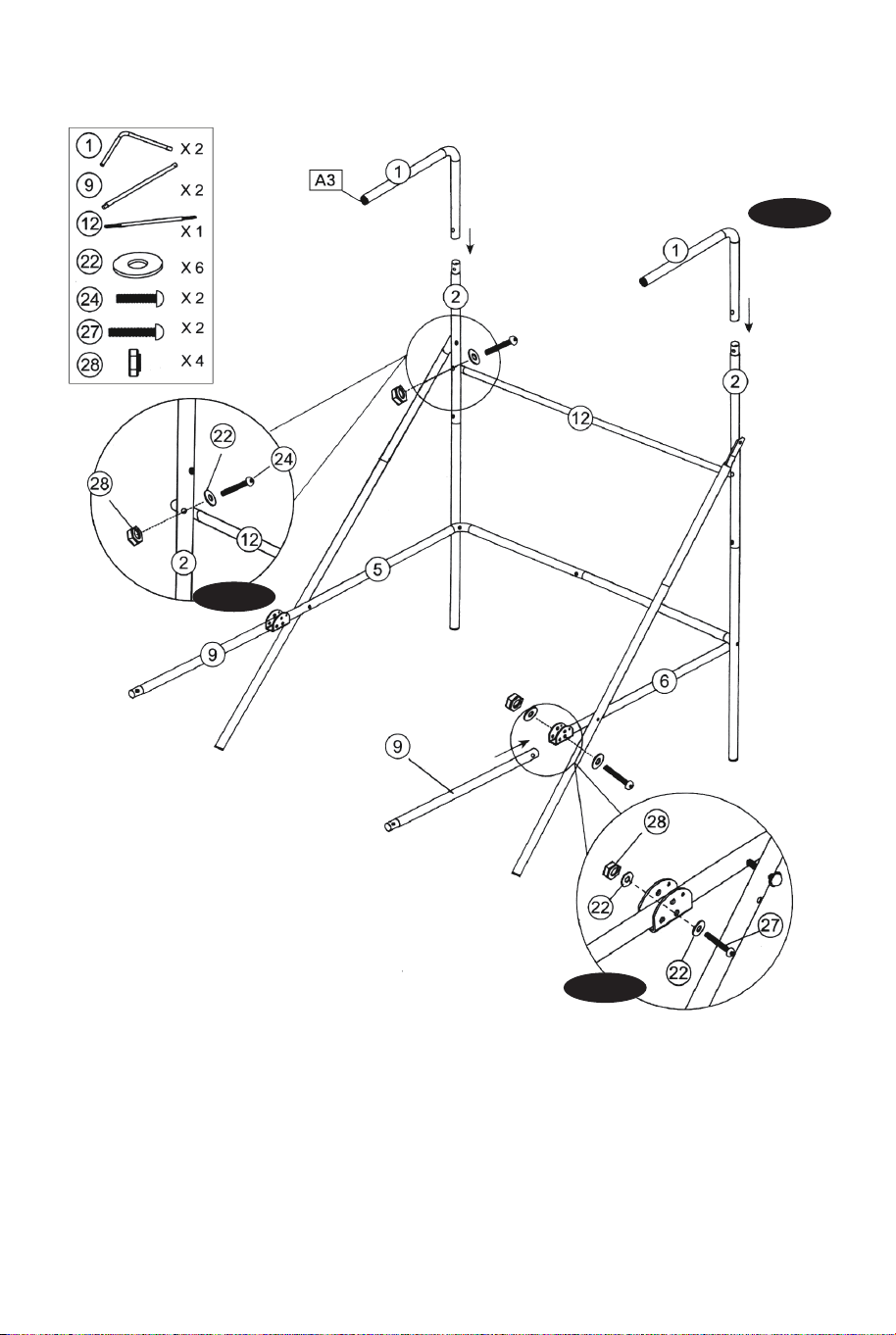
ABB. 5
8. Befestigen Sie das Rohr 12 (Nr. 12) an den Rohren 2 (Nr. 2) mit Schrauben (Nr. 24),
Unterlegscheiben (Nr. 22) und Muttern (Nr. 28), wie in ABB. 5A gezeigt. Stecken Sie
dann die Röhren 1 (Nr. 1) in die Röhren 2 (Nr. 2), wie in ABB. 5 gezeigt.
9. Befestigen Sie die Rohre – 9 (Nr. 9) an Rohr – 5 und Rohr – 6 (Nr. 5 und Nr. 6) mit
Schrauben (Nr. 27), Unterlegscheiben (Nr. 22) und Muttern (Nr. 28), wie in ABB. 5 und
5B gezeigt.
ABB.6
10. Befestigen Sie die Rohre – 10 (Nr. 10) an den Rohren – 9 (Nr. 9) mit Federverschluss
(vorinstalliert), und befestigen Sie dann das Rohr – 11 (Nr. 11) an den Rohren – 10
(Nr. 10). Federverriegelung (vorinstalliert) wie in FIG 6 gezeigt.
ABB. 5A
ABB. 5B
ABB. 5
ABB.6
Federverschluss
A2
Federverschluss
A2
Kurz
Lang
24 25

ABB. 5
8. Befestigen Sie das Rohr 12 (Nr. 12) an den Rohren 2 (Nr. 2) mit Schrauben (Nr. 24),
Unterlegscheiben (Nr. 22) und Muttern (Nr. 28), wie in ABB. 5A gezeigt. Stecken Sie
dann die Röhren 1 (Nr. 1) in die Röhren 2 (Nr. 2), wie in ABB. 5 gezeigt.
9. Befestigen Sie die Rohre – 9 (Nr. 9) an Rohr – 5 und Rohr – 6 (Nr. 5 und Nr. 6) mit
Schrauben (Nr. 27), Unterlegscheiben (Nr. 22) und Muttern (Nr. 28), wie in ABB. 5 und
5B gezeigt.
ABB.6
10. Befestigen Sie die Rohre – 10 (Nr. 10) an den Rohren – 9 (Nr. 9) mit Federverschluss
(vorinstalliert), und befestigen Sie dann das Rohr – 11 (Nr. 11) an den Rohren – 10
(Nr. 10). Federverriegelung (vorinstalliert) wie in FIG 6 gezeigt.
ABB. 5A
ABB. 5B
ABB. 5
ABB.6
Federverschluss
A2
Federverschluss
A2
Kurz
Lang
24 25

ABB.7
11. Befestigen Sie die Felge (Nr. 17) und die Felgenstützplatten (Nr. 18) an der Rückwand
(Nr. 21) mit den Schrauben (Nr. 23), Unterlegscheiben (Nr. 22) und Muttern (Nr. 28).
Befestigen Sie dann die Schaltsensoren (Nr. 15) an der Rückwand (Nr. 21) mit den
Schrauben (Nr. 23), Unterlegscheiben (Nr. 22) und Muttern (Nr. 28). Stellen Sie
sicher, dass Sie Unterlegscheiben auf beiden Seiten der Rückwand verwenden, wie
in ABB. 7 gezeigt.
ABB.8
12. Befestigen Sie die Frontplatte des elektronischen Punktezählers (Nr. 31) an der
Vorderseite der Rückwand und verbinden Sie sie mit dem elektronischen
Punktezähler (Nr. 14) mit den Schrauben (Nr. 29), wie in ABB. 8.
ABB.7
ABB.8
ABB.9
13. Schieben Sie die Gummibänder und die Hülle des Ballrückführnetzes (Nr. 20) auf die
Rohre – 1 (Nr. 1), wie in ABB. 9A & 9B & 9C.
14. Schieben Sie das Rohr – 12 (Nr. 12) durch die Hülse auf der Vorderseite des
Ballrücklaufnetzes (Nr. 20), befestigen Sie es zuerst auf der linken Seite mit den
Schrauben (Nr. 24), den Unterlegscheiben (Nr. 22) und den Muttern (Nr. 28). ) wie in
ABB. 9D. Gehen Sie auf der rechten Seite genauso vor.
ABB.9A
ABB.9B
ABB.9C
ABB.9D
ABB.9
26 27
Sicherungsstift
P4
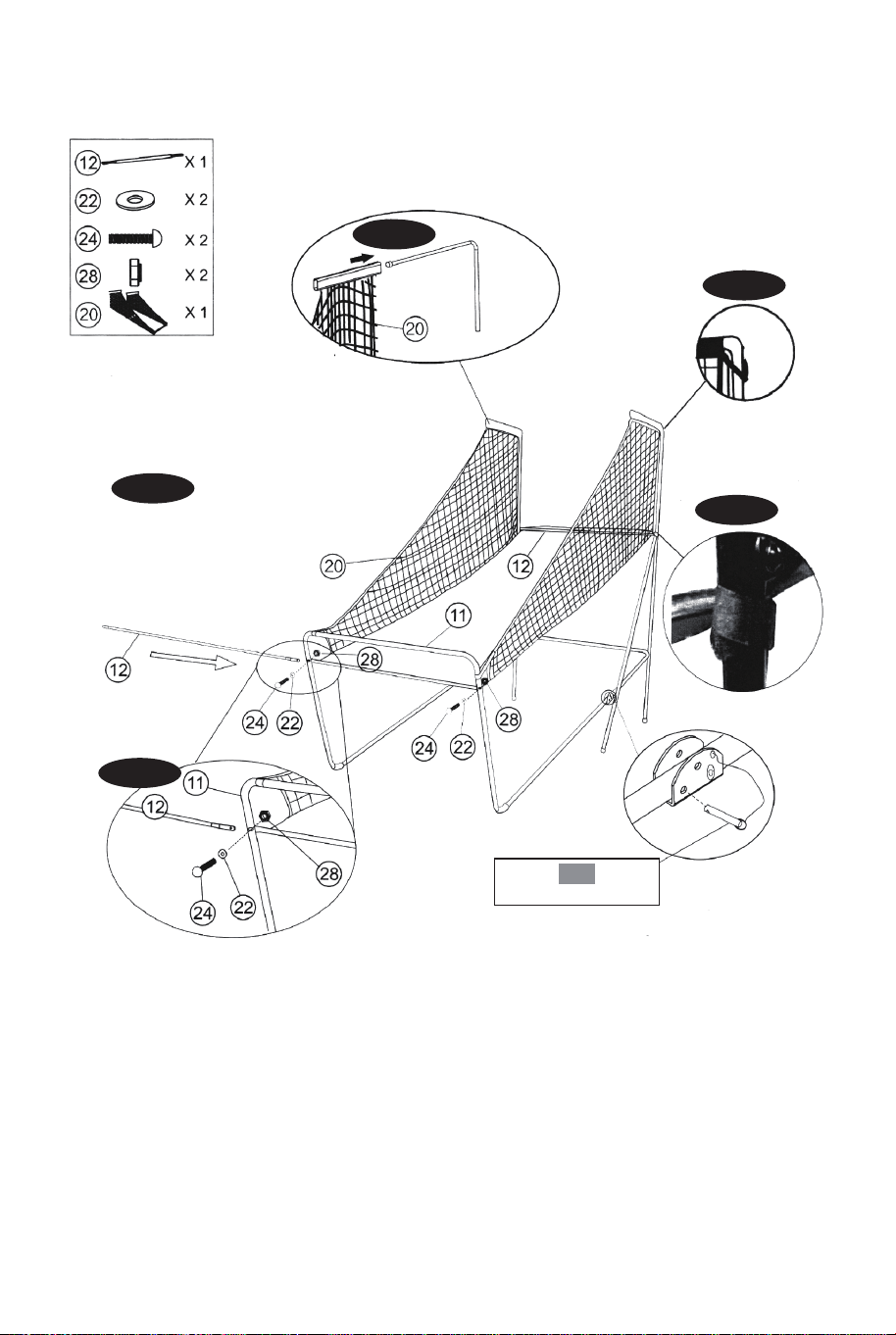
ABB.7
11. Befestigen Sie die Felge (Nr. 17) und die Felgenstützplatten (Nr. 18) an der Rückwand
(Nr. 21) mit den Schrauben (Nr. 23), Unterlegscheiben (Nr. 22) und Muttern (Nr. 28).
Befestigen Sie dann die Schaltsensoren (Nr. 15) an der Rückwand (Nr. 21) mit den
Schrauben (Nr. 23), Unterlegscheiben (Nr. 22) und Muttern (Nr. 28). Stellen Sie
sicher, dass Sie Unterlegscheiben auf beiden Seiten der Rückwand verwenden, wie
in ABB. 7 gezeigt.
ABB.8
12. Befestigen Sie die Frontplatte des elektronischen Punktezählers (Nr. 31) an der
Vorderseite der Rückwand und verbinden Sie sie mit dem elektronischen
Punktezähler (Nr. 14) mit den Schrauben (Nr. 29), wie in ABB. 8.
ABB.7
ABB.8
ABB.9
13. Schieben Sie die Gummibänder und die Hülle des Ballrückführnetzes (Nr. 20) auf die
Rohre – 1 (Nr. 1), wie in ABB. 9A & 9B & 9C.
14. Schieben Sie das Rohr – 12 (Nr. 12) durch die Hülse auf der Vorderseite des
Ballrücklaufnetzes (Nr. 20), befestigen Sie es zuerst auf der linken Seite mit den
Schrauben (Nr. 24), den Unterlegscheiben (Nr. 22) und den Muttern (Nr. 28). ) wie in
ABB. 9D. Gehen Sie auf der rechten Seite genauso vor.
ABB.9A
ABB.9B
ABB.9C
ABB.9D
ABB.9
26 27
Sicherungsstift
P4
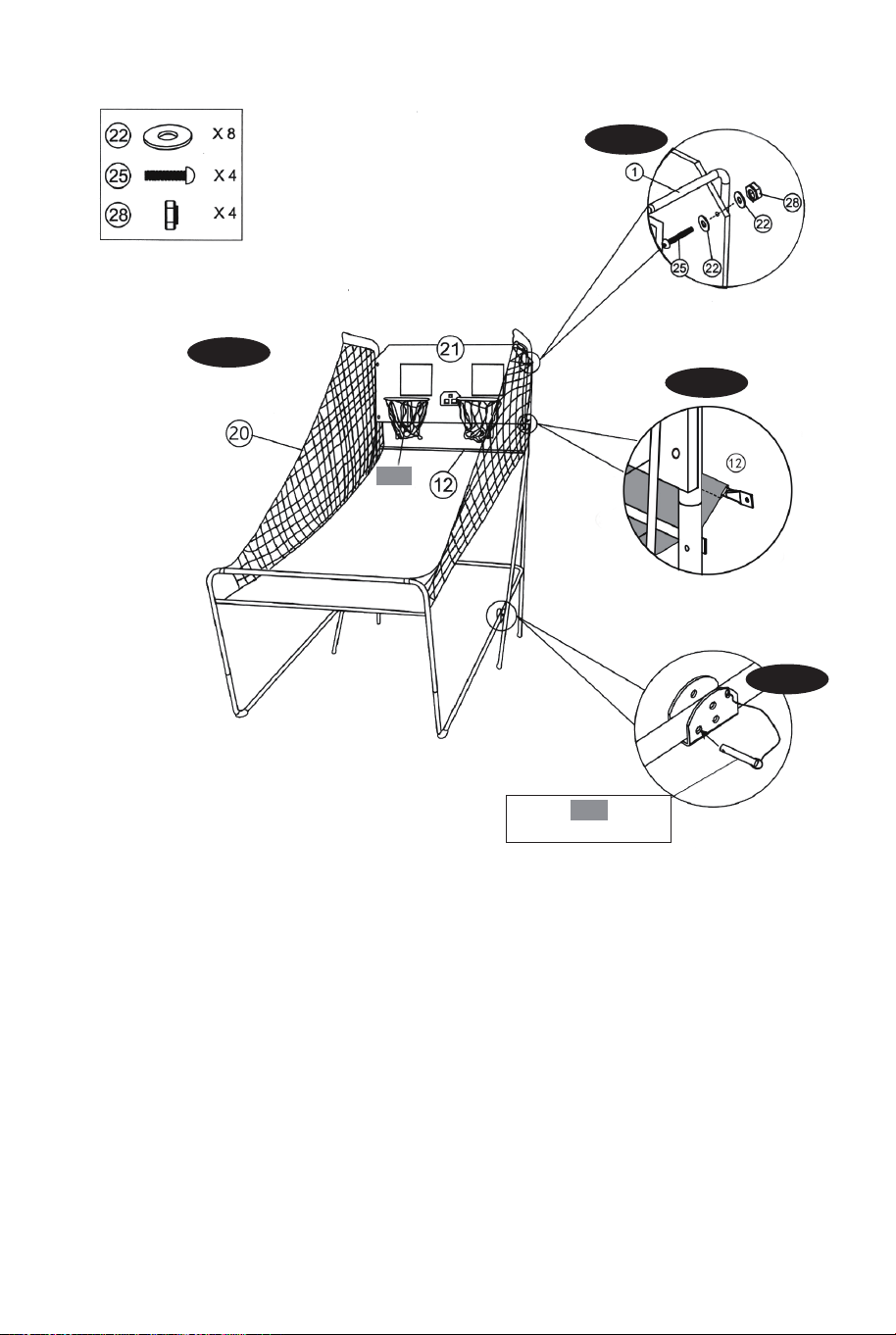
ABB.11
16. Verbinden Sie den Verschlussstift (#P4) mit dem Rohr – 5 und dem Rohr – 6 (#5 &
#6) und stecken Sie ihn in das Rohr – 5 und das Rohr – 6 (#5 & #6), wie in ABB. 10C.
17. Befestigen Sie den Steuerkasten (Nr. 16) mit zwei Schrauben (Nr. 30) an der Mitte
des Rohrs – 11 (Nr. 11), wie in ABB. 11A gezeigt.
18. Führen Sie den Rest des Steuerdrahts durch die Schlaufen am Ballrücklaufnetz (Nr.
20). Bringen Sie den Steuerdraht mit den selbstklebenden Bändern (Nr. 34) an der
Röhre – 11 (Nr. 11) an, wie in ABB. 11 gezeigt.
ABB.12
19. Verbinden Sie das Sensorkabel vom Schaltersensor (Nr. 15) mit dem elektronischen
Punktezähler (Nr. 14), wie in ABB. 12. Schließen Sie das Steuerkabel an den
elektronischen Punktezähler (Nr. 14) an, wie in ABB. 12 und 12A gezeigt.
ABB.11
ABB.12
ABB.11A
ABB.12A
Steuerkasten
Steuerdraht
Steuerdraht
Steuerdraht
Elektrischer Torschütze
Sensorkabel
Sensorkabel
Besucher
EIN/AUS
28 29
FIG.10
Befestigen Sie mit Hilfe eines anderen Erwachsenen das Rückenbrett (Nr. 21) an den
oberen Rohren 1 (Nr. 1) mit Schrauben (Nr. 25), Unterlegscheiben (Nr. 22) und Muttern
(Nr. 28), wie in ABB. 10A gezeigt. Schieben Sie Rohr 12 (Nr. 12) durch die Hülse auf der
Rückseite des Ballrücklaufnetzes (Nr. 20), wie in ABB. 10B gezeigt. Befestigen Sie an
jedem unteren Loch der Rückwand zuerst die linke Seite mit Schrauben (Nr. 25), Unter-
legscheiben (Nr. 22) und Muttern (Nr. 28), wie in ABB. 10C gezeigt. Gehen Sie für die
rechte Seite genauso vor.
P4
P1
15.
ABB.10A
ABB.10B
ABB.10C
ABB.10
Verschlussstift
P4
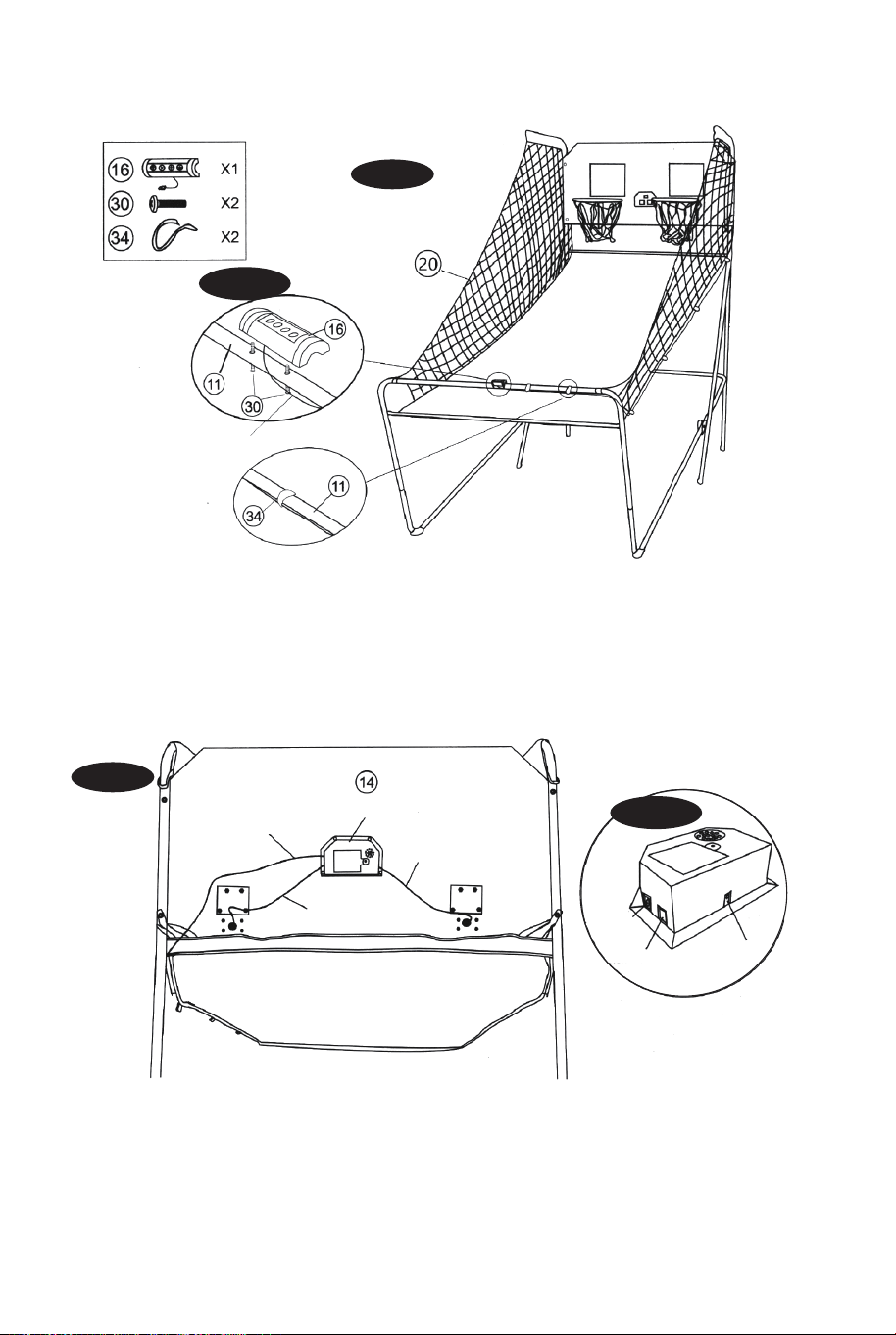
ABB.11
16. Verbinden Sie den Verschlussstift (#P4) mit dem Rohr – 5 und dem Rohr – 6 (#5 &
#6) und stecken Sie ihn in das Rohr – 5 und das Rohr – 6 (#5 & #6), wie in ABB. 10C.
17. Befestigen Sie den Steuerkasten (Nr. 16) mit zwei Schrauben (Nr. 30) an der Mitte
des Rohrs – 11 (Nr. 11), wie in ABB. 11A gezeigt.
18. Führen Sie den Rest des Steuerdrahts durch die Schlaufen am Ballrücklaufnetz (Nr.
20). Bringen Sie den Steuerdraht mit den selbstklebenden Bändern (Nr. 34) an der
Röhre – 11 (Nr. 11) an, wie in ABB. 11 gezeigt.
ABB.12
19. Verbinden Sie das Sensorkabel vom Schaltersensor (Nr. 15) mit dem elektronischen
Punktezähler (Nr. 14), wie in ABB. 12. Schließen Sie das Steuerkabel an den
elektronischen Punktezähler (Nr. 14) an, wie in ABB. 12 und 12A gezeigt.
ABB.11
ABB.12
ABB.11A
ABB.12A
Steuerkasten
Steuerdraht
Steuerdraht
Steuerdraht
Elektrischer Torschütze
Sensorkabel
Sensorkabel
Besucher
EIN/AUS
28 29
FIG.10
Befestigen Sie mit Hilfe eines anderen Erwachsenen das Rückenbrett (Nr. 21) an den
oberen Rohren 1 (Nr. 1) mit Schrauben (Nr. 25), Unterlegscheiben (Nr. 22) und Muttern
(Nr. 28), wie in ABB. 10A gezeigt. Schieben Sie Rohr 12 (Nr. 12) durch die Hülse auf der
Rückseite des Ballrücklaufnetzes (Nr. 20), wie in ABB. 10B gezeigt. Befestigen Sie an
jedem unteren Loch der Rückwand zuerst die linke Seite mit Schrauben (Nr. 25), Unter-
legscheiben (Nr. 22) und Muttern (Nr. 28), wie in ABB. 10C gezeigt. Gehen Sie für die
rechte Seite genauso vor.
P4
P1
15.
ABB.10A
ABB.10B
ABB.10C
ABB.10
Verschlussstift
P4
FUNKTION DES ELEKTRONISCHEN ANZEIGERS
Batteriekasten: Schraube mit Schraubendreher lösen und Batteriekasten öffnen. Legen
Sie 3 „AA“-Batterien (nicht im Lieferumfang enthalten) in der Reihenfolge der Polarität
ein, wie auf der Innenseite des Umschlags gezeigt. Schließen Sie dann die Abdeckung
mit einem Schraubendreher. Schalten Sie das Gerät mit dem EIN/AUS-Schalter ein.
Drücken Sie "ON/OFF", um den Scorer zu aktivieren.
Anzeigetafel „HOME“ zeigt „01“ (voreingestelltes Spiel 1).
Drücken Sie „SELECT UP and DOWN“, um ein Spiel auszuwählen.
Drücken Sie „PLAY“, um den ausgewählten Spielmodus aufzurufen.
Drücken Sie „SOUND“, um den Ton während des Spielens ein- oder auszuschalten.
Drücken Sie „PAUSE“, um die Zeitzählung anzuhalten oder zu starten.
Halten Sie die Taste „ON/OFF“ 3 Sekunden lang gedrückt, um den Scorer
auszuschalten.
Halten Sie die Taste "RESET" 3 Sekunden lang gedrückt, um die Spiele zurückzusetzen.
Hinweis: Wenn innerhalb von 15 Minuten kein Schuss abgegeben oder keine Taste
gedrückt wird, wird der Scorer automatisch ausgeschaltet.
ABB.13
20. Klappen Sie den Basketball-Arcade-Automaten zusammen, wenn er nicht verwendet
wird, und setzen Sie den Verriegelungsstift (#P4) ein, wie in ABB. 13 gezeigt.
Hinweis: Der Verriegelungsstift (#P4) muss aus seiner ursprünglichen Position
entfernt werden, wenn die Maschine verwendet wird, bevor er im
zusammengeklappten Zustand in die neue Position eingesetzt wird.
1) Benötigt 3 „AA“-Batterien (nicht im Lieferumfang enthalten).
2) Alte und neue Batterien nicht mischen.
3) Mischen Sie keine Alkali-, Standard- (Kohlenstoff-Zink) oder wiederaufladbare
(Nickel-Cadmium) Batterien.
Batterien installieren
a. Batterien müssen entsprechend der korrekten Polarisierung (+ und -) installiert werden.
b. Bitte reinigen Sie die Batteriekontakte und auch die der Geräte vor dem Batterieeinbau.
c. Wenn das Spiel längere Zeit nicht benutzt wird, empfehlen wir, die Batterien zu
entfernen.
Erinnerung:
WARNUNG
BEDIENUNG DES STEUERKASTEN
ABB.13
Sicherungsstift
P4
WICHTIG!
Achten Sie darauf, den Sicherungsstift (#P4)
zu verwenden, wenn er zusammengeklappt ist.
Steuerdraht
EIN/AUS
Besucher
BEDIENFELD
30 31
FUNKTION DES ELEKTRONISCHEN ANZEIGERS
Batteriekasten: Schraube mit Schraubendreher lösen und Batteriekasten öffnen. Legen
Sie 3 „AA“-Batterien (nicht im Lieferumfang enthalten) in der Reihenfolge der Polarität
ein, wie auf der Innenseite des Umschlags gezeigt. Schließen Sie dann die Abdeckung
mit einem Schraubendreher. Schalten Sie das Gerät mit dem EIN/AUS-Schalter ein.
Drücken Sie "ON/OFF", um den Scorer zu aktivieren.
Anzeigetafel „HOME“ zeigt „01“ (voreingestelltes Spiel 1).
Drücken Sie „SELECT UP and DOWN“, um ein Spiel auszuwählen.
Drücken Sie „PLAY“, um den ausgewählten Spielmodus aufzurufen.
Drücken Sie „SOUND“, um den Ton während des Spielens ein- oder auszuschalten.
Drücken Sie „PAUSE“, um die Zeitzählung anzuhalten oder zu starten.
Halten Sie die Taste „ON/OFF“ 3 Sekunden lang gedrückt, um den Scorer
auszuschalten.
Halten Sie die Taste "RESET" 3 Sekunden lang gedrückt, um die Spiele zurückzusetzen.
Hinweis: Wenn innerhalb von 15 Minuten kein Schuss abgegeben oder keine Taste
gedrückt wird, wird der Scorer automatisch ausgeschaltet.
ABB.13
20. Klappen Sie den Basketball-Arcade-Automaten zusammen, wenn er nicht verwendet
wird, und setzen Sie den Verriegelungsstift (#P4) ein, wie in ABB. 13 gezeigt.
Hinweis: Der Verriegelungsstift (#P4) muss aus seiner ursprünglichen Position
entfernt werden, wenn die Maschine verwendet wird, bevor er im
zusammengeklappten Zustand in die neue Position eingesetzt wird.
1) Benötigt 3 „AA“-Batterien (nicht im Lieferumfang enthalten).
2) Alte und neue Batterien nicht mischen.
3) Mischen Sie keine Alkali-, Standard- (Kohlenstoff-Zink) oder wiederaufladbare
(Nickel-Cadmium) Batterien.
Batterien installieren
a. Batterien müssen entsprechend der korrekten Polarisierung (+ und -) installiert werden.
b. Bitte reinigen Sie die Batteriekontakte und auch die der Geräte vor dem Batterieeinbau.
c. Wenn das Spiel längere Zeit nicht benutzt wird, empfehlen wir, die Batterien zu
entfernen.
Erinnerung:
WARNUNG
BEDIENUNG DES STEUERKASTEN
ABB.13
Sicherungsstift
P4
WICHTIG!
Achten Sie darauf, den Sicherungsstift (#P4)
zu verwenden, wenn er zusammengeklappt ist.
Steuerdraht
EIN/AUS
Besucher
BEDIENFELD
30 31

1. Schlagen Sie die Stechuhr
Drücken Sie „SPIELEN“, um Spiel 1 zu starten.
Drücken Sie „UP/Down“, um einzelne/mehrere Spieler auszuwählen (P1/P2/P3/P4).
Drücken Sie „PLAY“, nachdem die Nummer des Spielers ausgewählt wurde.
Drücken Sie "UP/Down", um die Spielzeit auszuwählen, 30/45/60 Sekunden.
Drücken Sie „SPIELEN“, um das Spiel zu beginnen.
Anzeigetafel „HOME“ zeigt Spieler 1, 3; Anzeigetafel "VISITOR" zeigt Spieler 2, 4. Alle
Schüsse sind bis zu den letzten 10 Sekunden 2 Punkte wert, jedes Ergebnis zählt 3
Punkte. Countdown von 5 Sekunden bis zum Zug des nächsten Spielers, wenn ein
Spieler das Spiel beendet. Spieler mit mehr erzielten Punkten gewinnt (LED blinkt bei
Spieler mit höherer Punktzahl). Drücken Sie „PLAY“, um dieses Spiel neu zu starten.
2.3 Punktschlag gegen die Zeituhr
Drücken Sie „PLAY“, um Spiel 2 zu starten.
Drücken Sie „UP/Down“, um einzelne/mehrere Spieler auszuwählen (P1/P2/P3/P4).
Drücken Sie „PLAY“, nachdem die Nummer des Spielers ausgewählt wurde.
Drücken Sie "UP/Down", um die Spielzeit auszuwählen, 30/45/60 Sekunden.
Drücken Sie „PLAY“, um das Spiel zu beginnen.
Anzeigetafel „HOME“ zeigt Spieler 1, 3; Anzeigetafel „VISITOR“ zeigt Spieler 2, 4. Alle
Schüsse zählen 3 Punkte.
Countdown von 5 Sekunden bis zum Zug des nächsten Spielers, wenn ein Spieler das
Spiel beendet.
Spieler mit mehr erzielten Punkten gewinnt (LED blinkt bei Spieler mit höherer
Punktzahl).
Drücken Sie "PLAY", um dieses Spiel neu zu starten.
3. Kämpfen Sie zurück
Drücken Sie „PLAY“, um Spiel 3 zu betreten.
Drücken Sie „UP/Down“, um mehrere Spieler (P2/P4) auszuwählen.
Drücken Sie „PLAY“, um das Spiel zu beginnen.
Aufnahme im "HOME"-Rahmen, Anzeige der erzielten +2 Punkte auf der "HOME"-Tafel
und -2 Punkte für "VISITOR".
Aufnahme im „VISITOR“-Rahmen, +2 erzielte Punkte werden auf der „VISITOR“-Tafel
angezeigt und -2 Punkte für „HOME“.
Sobald ein Spieler 10 Punkte erzielt, gewinnt er und das Spiel ist beendet.
Drücken Sie "PLAY", um dieses Spiel neu zu starten.
4. Pferd
a. Drücken Sie "PLAY", um Spiel 4 zu betreten.
b. Drücken Sie „UP/Down“, um mehrere Spieler auszuwählen (P2/P3/P4).
c. Drücken Sie „PLAY“, nachdem die Nummer des Spielers ausgewählt wurde.
d. Der Spieler muss in 2 Sekunden einen Schuss machen.
e. Der erste Spieler darf auf jeden Korb schießen (Home oder VISITOR). Wenn der erste
Spieler in 2 Sekunden punktet, wird kein Buchstabe gegeben.
Das Spiel wird für den nächsten Spieler fortgesetzt. Das Scoreboard zeigt „nächster Spieler
(P2P3/P4)“ an und die LED blinkt zweimal pro Sekunde.
Nach dem Flash muss der nächste Spieler den Schuss in demselben Reifen duplizieren,
den der erste Spieler ausgewählt hat.
f. Wenn der Spieler in 2 Sekunden kein Tor erzielen kann, erhält der Spieler den ersten
Buchstaben „H“, der auf der Anzeigetafel angezeigt wird. Das Spiel bleibt für denselben
Spieler, bis der Spieler punktet. Wenn der Spieler weiterhin fehlt, erhält der Spieler ein „O“,
gefolgt von „R“, „S“, „E“.
Der Buchstabe „E“ ist gegeben, der Spieler ist raus.
g. Der erste Spieler, der „Pferd“ buchstabiert, verliert. Die Spieler bleiben im
Wiederholungsschritt d.e.f. bis das Spiel fertig ist.
h. Der letzte Spieler, der „Pferd“ buchstabiert, gewinnt.
i. Drücken Sie "PLAY", um dieses Spiel neu zu starten.
5. Kontrollpunkt
Drücken Sie „PLAY“, um Spiel 5 zu betreten.
Drücken Sie „UP/Down“, um einzelne/mehrere Spieler auszuwählen (P1/P2/P3/P4).
Drücken Sie „PLAY“, um das Spiel zu beginnen.
„HOME“ zeigt „Spieler“ an, „VISITOR“ zeigt „24“ Punkte an, voreingestellte 40 Sekunden
Spielzeit.
Die erzielten Punkte werden auf der Anzeigetafel „HOME“ angezeigt.
Vor Ablauf der Zeit, sobald 24/52/68/86 Punkte erzielt wurden, erhöht sich die Spielzeit
jeweils um 10/20/10/20 Sekunden.
Countdown von 5 Sekunden bis zum Zug des nächsten Spielers, wenn ein Spieler das
Spiel beendet.
Spieler mit mehr erzielten Punkten gewinnt (LED blinkt bei Spieler mit höherer
Punktzahl).
Das Spiel ist beendet, wenn ein Spieler 98 Punkte erzielt.
Drücken Sie "PLAY", um dieses Spiel neu zu starten.
6. Auf der ganzen Welt
Verwenden Sie Klebeband, um die Schießlinien zu markieren.
Drücken Sie „PLAY“, um Spiel 6 aufzurufen.
Drücken Sie „UP/Down“, um einzelne/mehrere Spieler auszuwählen (P1/P2/P3/P4).
Drücken Sie „PLAY“, nachdem die Nummer des Spielers ausgewählt wurde.
Anzeigetafel „HOME“ zeigt Spieler 1/2/3/4 an, „VISITOR“ zeigt erzielte Punkte an.
WÄHLE AUS 8 VERSCHIEDENEN SPIELOPTIONEN
WÄHLE AUS 8 VERSCHIEDENEN SPIELOPTIONEN
32 33

1. Schlagen Sie die Stechuhr
Drücken Sie „SPIELEN“, um Spiel 1 zu starten.
Drücken Sie „UP/Down“, um einzelne/mehrere Spieler auszuwählen (P1/P2/P3/P4).
Drücken Sie „PLAY“, nachdem die Nummer des Spielers ausgewählt wurde.
Drücken Sie "UP/Down", um die Spielzeit auszuwählen, 30/45/60 Sekunden.
Drücken Sie „SPIELEN“, um das Spiel zu beginnen.
Anzeigetafel „HOME“ zeigt Spieler 1, 3; Anzeigetafel "VISITOR" zeigt Spieler 2, 4. Alle
Schüsse sind bis zu den letzten 10 Sekunden 2 Punkte wert, jedes Ergebnis zählt 3
Punkte. Countdown von 5 Sekunden bis zum Zug des nächsten Spielers, wenn ein
Spieler das Spiel beendet. Spieler mit mehr erzielten Punkten gewinnt (LED blinkt bei
Spieler mit höherer Punktzahl). Drücken Sie „PLAY“, um dieses Spiel neu zu starten.
2.3 Punktschlag gegen die Zeituhr
Drücken Sie „PLAY“, um Spiel 2 zu starten.
Drücken Sie „UP/Down“, um einzelne/mehrere Spieler auszuwählen (P1/P2/P3/P4).
Drücken Sie „PLAY“, nachdem die Nummer des Spielers ausgewählt wurde.
Drücken Sie "UP/Down", um die Spielzeit auszuwählen, 30/45/60 Sekunden.
Drücken Sie „PLAY“, um das Spiel zu beginnen.
Anzeigetafel „HOME“ zeigt Spieler 1, 3; Anzeigetafel „VISITOR“ zeigt Spieler 2, 4. Alle
Schüsse zählen 3 Punkte.
Countdown von 5 Sekunden bis zum Zug des nächsten Spielers, wenn ein Spieler das
Spiel beendet.
Spieler mit mehr erzielten Punkten gewinnt (LED blinkt bei Spieler mit höherer
Punktzahl).
Drücken Sie "PLAY", um dieses Spiel neu zu starten.
3. Kämpfen Sie zurück
Drücken Sie „PLAY“, um Spiel 3 zu betreten.
Drücken Sie „UP/Down“, um mehrere Spieler (P2/P4) auszuwählen.
Drücken Sie „PLAY“, um das Spiel zu beginnen.
Aufnahme im "HOME"-Rahmen, Anzeige der erzielten +2 Punkte auf der "HOME"-Tafel
und -2 Punkte für "VISITOR".
Aufnahme im „VISITOR“-Rahmen, +2 erzielte Punkte werden auf der „VISITOR“-Tafel
angezeigt und -2 Punkte für „HOME“.
Sobald ein Spieler 10 Punkte erzielt, gewinnt er und das Spiel ist beendet.
Drücken Sie "PLAY", um dieses Spiel neu zu starten.
4. Pferd
a. Drücken Sie "PLAY", um Spiel 4 zu betreten.
b. Drücken Sie „UP/Down“, um mehrere Spieler auszuwählen (P2/P3/P4).
c. Drücken Sie „PLAY“, nachdem die Nummer des Spielers ausgewählt wurde.
d. Der Spieler muss in 2 Sekunden einen Schuss machen.
e. Der erste Spieler darf auf jeden Korb schießen (Home oder VISITOR). Wenn der erste
Spieler in 2 Sekunden punktet, wird kein Buchstabe gegeben.
Das Spiel wird für den nächsten Spieler fortgesetzt. Das Scoreboard zeigt „nächster Spieler
(P2P3/P4)“ an und die LED blinkt zweimal pro Sekunde.
Nach dem Flash muss der nächste Spieler den Schuss in demselben Reifen duplizieren,
den der erste Spieler ausgewählt hat.
f. Wenn der Spieler in 2 Sekunden kein Tor erzielen kann, erhält der Spieler den ersten
Buchstaben „H“, der auf der Anzeigetafel angezeigt wird. Das Spiel bleibt für denselben
Spieler, bis der Spieler punktet. Wenn der Spieler weiterhin fehlt, erhält der Spieler ein „O“,
gefolgt von „R“, „S“, „E“.
Der Buchstabe „E“ ist gegeben, der Spieler ist raus.
g. Der erste Spieler, der „Pferd“ buchstabiert, verliert. Die Spieler bleiben im
Wiederholungsschritt d.e.f. bis das Spiel fertig ist.
h. Der letzte Spieler, der „Pferd“ buchstabiert, gewinnt.
i. Drücken Sie "PLAY", um dieses Spiel neu zu starten.
5. Kontrollpunkt
Drücken Sie „PLAY“, um Spiel 5 zu betreten.
Drücken Sie „UP/Down“, um einzelne/mehrere Spieler auszuwählen (P1/P2/P3/P4).
Drücken Sie „PLAY“, um das Spiel zu beginnen.
„HOME“ zeigt „Spieler“ an, „VISITOR“ zeigt „24“ Punkte an, voreingestellte 40 Sekunden
Spielzeit.
Die erzielten Punkte werden auf der Anzeigetafel „HOME“ angezeigt.
Vor Ablauf der Zeit, sobald 24/52/68/86 Punkte erzielt wurden, erhöht sich die Spielzeit
jeweils um 10/20/10/20 Sekunden.
Countdown von 5 Sekunden bis zum Zug des nächsten Spielers, wenn ein Spieler das
Spiel beendet.
Spieler mit mehr erzielten Punkten gewinnt (LED blinkt bei Spieler mit höherer
Punktzahl).
Das Spiel ist beendet, wenn ein Spieler 98 Punkte erzielt.
Drücken Sie "PLAY", um dieses Spiel neu zu starten.
6. Auf der ganzen Welt
Verwenden Sie Klebeband, um die Schießlinien zu markieren.
Drücken Sie „PLAY“, um Spiel 6 aufzurufen.
Drücken Sie „UP/Down“, um einzelne/mehrere Spieler auszuwählen (P1/P2/P3/P4).
Drücken Sie „PLAY“, nachdem die Nummer des Spielers ausgewählt wurde.
Anzeigetafel „HOME“ zeigt Spieler 1/2/3/4 an, „VISITOR“ zeigt erzielte Punkte an.
WÄHLE AUS 8 VERSCHIEDENEN SPIELOPTIONEN
WÄHLE AUS 8 VERSCHIEDENEN SPIELOPTIONEN
32 33

Sobald die Punktzahl 10 Punkte erreicht oder die Zeit 99 Sekunden erreicht, zählt der
Countdown 5 Sekunden bis zum nächsten Spieler an der Reihe, wenn ein Spieler das
Spiel beendet.
Flayer, der das Spiel zuerst beendet, gewinnt (LED blinkt beim Gewinner).
Drücken Sie "PLAY", um dieses Spiel neu zu starten.
VORSICHT !
7. Links und rechts schießen
Drücken Sie „PLAY“, um Spiel 7 aufzurufen.
Drücken Sie „UP/Down“, um einzelne/mehrere Spieler auszuwählen (P1/P2/P3/P4).
Drücken Sie „PLAY“, nachdem die Nummer des Spielers ausgewählt wurde.
Drücken Sie "UP/Down", um die Spielzeit auszuwählen, 30/45/60 Sekunden.
Drücken Sie „PLAY“, um das Spiel zu beginnen.
Anzeigetafel "HOME" zeigt Spieler an, "VISITOR" zeigt Punkte an.
Machen Sie eine Aufnahme im "HOME"-Rahmen, wenn die LED auf "HOME" blinkt, 2 erzielte
Punkte werden auf "HOME" angezeigt.
Machen Sie eine Aufnahme im "VISITOR"-Rahmen, wenn die LED auf "VISITOR" blinkt, 2
erzielte Punkte werden auf "VISITOR" angezeigt.
Countdown von 5 Sekunden bis zum Zug des nächsten Spielers, wenn ein Spieler das Spiel
beendet.
Spieler mit mehr erzielten Punkten gewinnt (LED blinkt bei Spieler mit höherer Punktzahl).
Drücken Sie „PLAY“, um dieses Spiel neu zu starten.
8. Eins zu Eins
Drücken Sie „PLAY“, um Spiel 8 zu starten.
Drücken Sie „UP/Down“, um einzelne/mehrere Spieler auszuwählen (P1/P2/P3/P4).
Drücken Sie „PLAY“, nachdem die Nummer des Spielers ausgewählt wurde.
Drücken Sie "UP/Down", um die Spielzeit auszuwählen, 30/45/60 Sekunden.
Drücken Sie „PLAY“, um das Spiel zu beginnen.
Anzeigetafel „HOME“ zeigt Spieler 1, 3; Anzeigetafel "VISITOR" zeigt Spieler 2, 4. Alle Schüsse
sind bis zu den letzten 10 Sekunden 2 Punkte wert, jedes Ergebnis zählt 3 Punkte.
Countdown von 5 Sekunden bis zum Zug des nächsten Spielers, wenn ein Spieler das Spiel
beendet.
Spieler mit mehr erzielten Punkten gewinnt (LED blinkt bei Spieler mit höherer Punktzahl).
Drücken Sie "PLAY", um dieses Spiel neu zu starten.
Änderungen oder Modifikationen, die nicht ausdrücklich von der für die
Konformität verantwortlichen Partei genehmigt wurden, können die Berechtigung
des Benutzers zum Betrieb des Geräts aufheben.
Der Betrieb unterliegt den folgenden zwei Bedingungen:
(1) Dieses Gerät darf keine schädlichen Störungen verursachen.
(2) Dieses Gerät muss alle empfangenen Störungen akzeptieren, einschließlich
Störungen, die einen unerwünschten Betrieb verursachen können.
Tube-1 Tube-2
Ø22x580x440mm
Tube-5
Ø22x755x580mm
Tube-6
Ø22x755x580mm
Tube-10
Ø22x650x385mm
Tube-11
Ø22x1067x520mm
Ø22x685mm Ø22x890mm
Tube-3
Ø22x830mm
Tube-7
Ø22x890mm
Tube-4
Ø22x835mm
Tube-8
Ø12,7x1090mm
Tube-12
Ø22x595mm
Tube-9
Basketball de 17 cm
de diamètre
Scoreur électronique
Jante
Plaque de
support de jante
Rondelle M6 Boulon M6x20mm
Capteur de commutateur
Pompe de gonflage
avec aiguille
Boîtier de commande avec fil
Filet de retour
de balle
Boulon M6x29mm
Panneau arrière
Boulon M6x42mm Boulon M6x50mm
Boulon 4x28mm
Plaque frontale de
scoreur électronique
Boulon M6x35mm
Écrou M6
Boulon 3,5x10mm
1 x2 2 x2 3 x1
4 x1
5 x1 6 x1 7 x2
8 x2
9 x2 10 x2 11 x1
12 x3
13 x4
14 x1
15 x2
16 x1
21 x1 22 x46 23 x16
24 x6
25 x4 26 x4 27 x2
28 x32
29 x4 30 x2 31 x1
17 x2
18 x2 19 x1
20 x1
FR
34 35
Sobald die Punktzahl 10 Punkte erreicht oder die Zeit 99 Sekunden erreicht, zählt der
Countdown 5 Sekunden bis zum nächsten Spieler an der Reihe, wenn ein Spieler das
Spiel beendet.
Flayer, der das Spiel zuerst beendet, gewinnt (LED blinkt beim Gewinner).
Drücken Sie "PLAY", um dieses Spiel neu zu starten.
VORSICHT !
7. Links und rechts schießen
Drücken Sie „PLAY“, um Spiel 7 aufzurufen.
Drücken Sie „UP/Down“, um einzelne/mehrere Spieler auszuwählen (P1/P2/P3/P4).
Drücken Sie „PLAY“, nachdem die Nummer des Spielers ausgewählt wurde.
Drücken Sie "UP/Down", um die Spielzeit auszuwählen, 30/45/60 Sekunden.
Drücken Sie „PLAY“, um das Spiel zu beginnen.
Anzeigetafel "HOME" zeigt Spieler an, "VISITOR" zeigt Punkte an.
Machen Sie eine Aufnahme im "HOME"-Rahmen, wenn die LED auf "HOME" blinkt, 2 erzielte
Punkte werden auf "HOME" angezeigt.
Machen Sie eine Aufnahme im "VISITOR"-Rahmen, wenn die LED auf "VISITOR" blinkt, 2
erzielte Punkte werden auf "VISITOR" angezeigt.
Countdown von 5 Sekunden bis zum Zug des nächsten Spielers, wenn ein Spieler das Spiel
beendet.
Spieler mit mehr erzielten Punkten gewinnt (LED blinkt bei Spieler mit höherer Punktzahl).
Drücken Sie „PLAY“, um dieses Spiel neu zu starten.
8. Eins zu Eins
Drücken Sie „PLAY“, um Spiel 8 zu starten.
Drücken Sie „UP/Down“, um einzelne/mehrere Spieler auszuwählen (P1/P2/P3/P4).
Drücken Sie „PLAY“, nachdem die Nummer des Spielers ausgewählt wurde.
Drücken Sie "UP/Down", um die Spielzeit auszuwählen, 30/45/60 Sekunden.
Drücken Sie „PLAY“, um das Spiel zu beginnen.
Anzeigetafel „HOME“ zeigt Spieler 1, 3; Anzeigetafel "VISITOR" zeigt Spieler 2, 4. Alle Schüsse
sind bis zu den letzten 10 Sekunden 2 Punkte wert, jedes Ergebnis zählt 3 Punkte.
Countdown von 5 Sekunden bis zum Zug des nächsten Spielers, wenn ein Spieler das Spiel
beendet.
Spieler mit mehr erzielten Punkten gewinnt (LED blinkt bei Spieler mit höherer Punktzahl).
Drücken Sie "PLAY", um dieses Spiel neu zu starten.
Änderungen oder Modifikationen, die nicht ausdrücklich von der für die
Konformität verantwortlichen Partei genehmigt wurden, können die Berechtigung
des Benutzers zum Betrieb des Geräts aufheben.
Der Betrieb unterliegt den folgenden zwei Bedingungen:
(1) Dieses Gerät darf keine schädlichen Störungen verursachen.
(2) Dieses Gerät muss alle empfangenen Störungen akzeptieren, einschließlich
Störungen, die einen unerwünschten Betrieb verursachen können.
Tube-1 Tube-2
Ø22x580x440mm
Tube-5
Ø22x755x580mm
Tube-6
Ø22x755x580mm
Tube-10
Ø22x650x385mm
Tube-11
Ø22x1067x520mm
Ø22x685mm Ø22x890mm
Tube-3
Ø22x830mm
Tube-7
Ø22x890mm
Tube-4
Ø22x835mm
Tube-8
Ø12,7x1090mm
Tube-12
Ø22x595mm
Tube-9
Basketball de 17 cm
de diamètre
Scoreur électronique
Jante
Plaque de
support de jante
Rondelle M6 Boulon M6x20mm
Capteur de commutateur
Pompe de gonflage
avec aiguille
Boîtier de commande avec fil
Filet de retour
de balle
Boulon M6x29mm
Panneau arrière
Boulon M6x42mm Boulon M6x50mm
Boulon 4x28mm
Plaque frontale de
scoreur électronique
Boulon M6x35mm
Écrou M6
Boulon 3,5x10mm
1 x2 2 x2 3 x1
4 x1
5 x1 6 x1 7 x2
8 x2
9 x2 10 x2 11 x1
12 x3
13 x4
14 x1
15 x2
16 x1
21 x1 22 x46 23 x16
24 x6
25 x4 26 x4 27 x2
28 x32
29 x4 30 x2 31 x1
17 x2
18 x2 19 x1
20 x1
FR
34 35
INSTRUCTIONS DE MONTAGE:
Clé
32 x1
Clé Allen
33 x1
Sangle auto-adhésive
34 x2
Filet
P1 x2
Verrou à ressort
P2 x9
Insertion de poteau
en plastique
P3 x2
Goupille de
verrouillage
P4 x2
PIÈCES PRÉINSTALLÉES
AVANT L'ASSEMBLAGE - Veuillez inspecter et
mettre en page tous vos poteaux et pièces
1. Trouvez un endroit propre et de niveau pour commencer l'assemblage de votre jeu
de basket. Nous recommandons que deux adultes travaillent ensemble pour
assembler ce jeu de basket-ball.
2. Retirez toutes les pièces de la boîte et vérifiez que vous disposez de toutes les
pièces répertoriées, comme indiqué sur la page Liste des pièces. Coupez ou
déchirez soigneusement les quatre coins de la boîte afin que le bas de la boîte
puisse être utilisé comme surface de travail.
FIG.1 & 2
3. Fixez les tubes-2 (#2) au tube-3 et au tube-4 (#3 et #4) à l'aide d'un verrou à ressort
(préinstallé) comme illustré à la FIG.1.
4. Fixez les tubes-7 (#7) aux tubes-8 (#8) à l'aide d'un verrou à ressort (préinstallé)
comme illustré à la FIG.2
FIG.3
5. Fixez le tube-5 et le tube-6 (#5 et #6) ensemble à l'aide d'un verrou à ressort
(préinstallé) comme illustré à la FIG.3.
FIG.1
FIG.2
FIG.3
Verrou à ressort
P2
Verrou à ressort
P2
Verrou à ressort
P2
36 37
INSTRUCTIONS DE MONTAGE:
Clé
32 x1
Clé Allen
33 x1
Sangle auto-adhésive
34 x2
Filet
P1 x2
Verrou à ressort
P2 x9
Insertion de poteau
en plastique
P3 x2
Goupille de
verrouillage
P4 x2
PIÈCES PRÉINSTALLÉES
AVANT L'ASSEMBLAGE - Veuillez inspecter et
mettre en page tous vos poteaux et pièces
1. Trouvez un endroit propre et de niveau pour commencer l'assemblage de votre jeu
de basket. Nous recommandons que deux adultes travaillent ensemble pour
assembler ce jeu de basket-ball.
2. Retirez toutes les pièces de la boîte et vérifiez que vous disposez de toutes les
pièces répertoriées, comme indiqué sur la page Liste des pièces. Coupez ou
déchirez soigneusement les quatre coins de la boîte afin que le bas de la boîte
puisse être utilisé comme surface de travail.
FIG.1 & 2
3. Fixez les tubes-2 (#2) au tube-3 et au tube-4 (#3 et #4) à l'aide d'un verrou à ressort
(préinstallé) comme illustré à la FIG.1.
4. Fixez les tubes-7 (#7) aux tubes-8 (#8) à l'aide d'un verrou à ressort (préinstallé)
comme illustré à la FIG.2
FIG.3
5. Fixez le tube-5 et le tube-6 (#5 et #6) ensemble à l'aide d'un verrou à ressort
(préinstallé) comme illustré à la FIG.3.
FIG.1
FIG.2
FIG.3
Verrou à ressort
P2
Verrou à ressort
P2
Verrou à ressort
P2
36 37

FIG.4
6. Fixez le tube-5 et le tube-6 (#5 et #6) au tube-3 et au tube-4 (#3 et #4) à l'aide des
boulons (#26), des rondelles (#22) et des écrous (#28 ), puis fixez le tube-5 et le
tube-6 (#5 et #6) aux tubes-8 (#8) à l'aide des boulons (#26), des rondelles (#22) et
des écrous (#28) comme indiqué dans FIG.4, 4A et 4B.
7. Fixez les tubes-7 et les tubes-8 (#7 et #8) aux tubes-2 (#2) à l'aide d'un boulon (#24),
des rondelles (#22) et de l'écrou (#28) comme illustré à la FIG.4C, répétez cette
étape pour l'autre côté.
Remarque : Assurez-vous que le verrou à ressort est orienté vers le bas.
FIG. 4
FIG. 4C
FIG. 4B
FIG. 4A
FIG.5
8. Fixez le tube-12 (#12) aux tubes-2 (#2) à l'aide des boulons (#24), des rondelles
(#22) et des écrous (#28) comme illustré à la FIG.5A. Ensuite, insérez les tubes-1
(#1) dans les tubes-2 (#2) comme illustré à la FIG.5.
9. Fixez les tubes-9 (#9) au tube-5 et au tube-6 (#5 et #6) à l'aide des boulons (#27),
des rondelles (#22) et des écrous (#28) comme illustré à la FIG.5 et 5B.
FIG. 5A
FIG. 5B
FIG. 5
38 39
P3

FIG.4
6. Fixez le tube-5 et le tube-6 (#5 et #6) au tube-3 et au tube-4 (#3 et #4) à l'aide des
boulons (#26), des rondelles (#22) et des écrous (#28 ), puis fixez le tube-5 et le
tube-6 (#5 et #6) aux tubes-8 (#8) à l'aide des boulons (#26), des rondelles (#22) et
des écrous (#28) comme indiqué dans FIG.4, 4A et 4B.
7. Fixez les tubes-7 et les tubes-8 (#7 et #8) aux tubes-2 (#2) à l'aide d'un boulon (#24),
des rondelles (#22) et de l'écrou (#28) comme illustré à la FIG.4C, répétez cette
étape pour l'autre côté.
Remarque : Assurez-vous que le verrou à ressort est orienté vers le bas.
FIG. 4
FIG. 4C
FIG. 4B
FIG. 4A
FIG.5
8. Fixez le tube-12 (#12) aux tubes-2 (#2) à l'aide des boulons (#24), des rondelles
(#22) et des écrous (#28) comme illustré à la FIG.5A. Ensuite, insérez les tubes-1
(#1) dans les tubes-2 (#2) comme illustré à la FIG.5.
9. Fixez les tubes-9 (#9) au tube-5 et au tube-6 (#5 et #6) à l'aide des boulons (#27),
des rondelles (#22) et des écrous (#28) comme illustré à la FIG.5 et 5B.
FIG. 5A
FIG. 5B
FIG. 5
38 39
P3
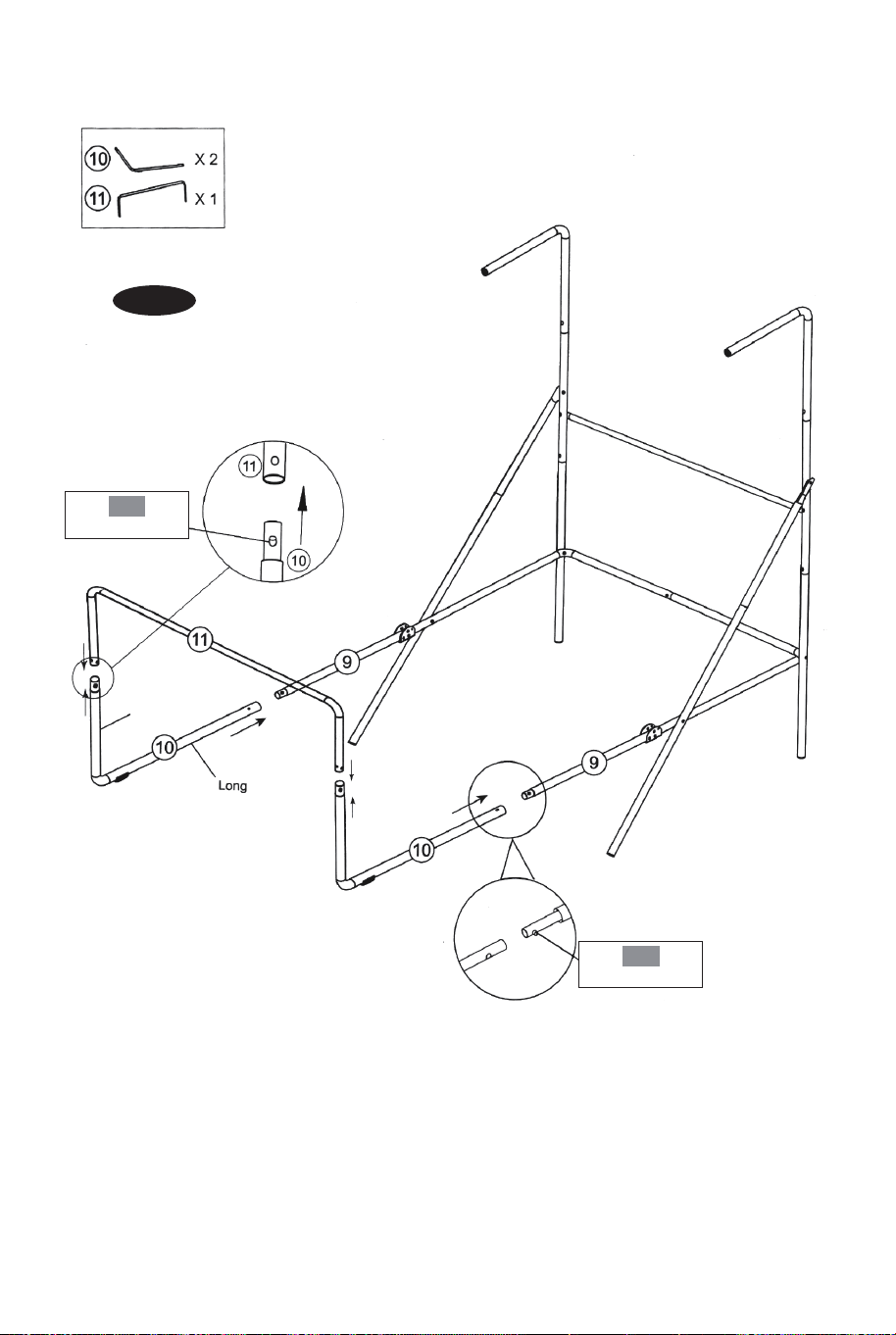
FIG.6
10. Fixez les tubes-10 (#10) aux tubes-9 (#9) à l'aide du verrou à ressort (préinstallé),
puis fixez le tube-11 (#11) aux tubes-10 (#10) à l'aide d'un verrou à ressort
(préinstallé) comme illustré à la FIG.6.
FIG.6
Verrou à ressort
P2
Verrou à ressort
P2
court
FIG.7
11. Fixez la jante (#17) et les plaques de support de jante (#18) au panneau arrière (#21)
à l'aide des boulons (#23), des rondelles (#22) et des écrous (#28). Ensuite, fixez les
capteurs de commutateur (# 15) au panneau arrière (#21) à l'aide des boulons (#23),
des rondelles (#22) et des écrous (#28). Assurez-vous d'utiliser des rondelles des
deux côtés du panneau comme illustré à la FIG.7.
FIG.8
12. Fixez la plaque frontale du scoreur électronique (#31) à l'avant du panneau arrière et
connectez-la au scoreur électronique (#14) à l'aide des boulons (#29) comme illustré
à la FIG.8.
FIG.7
FIG.8
40 41
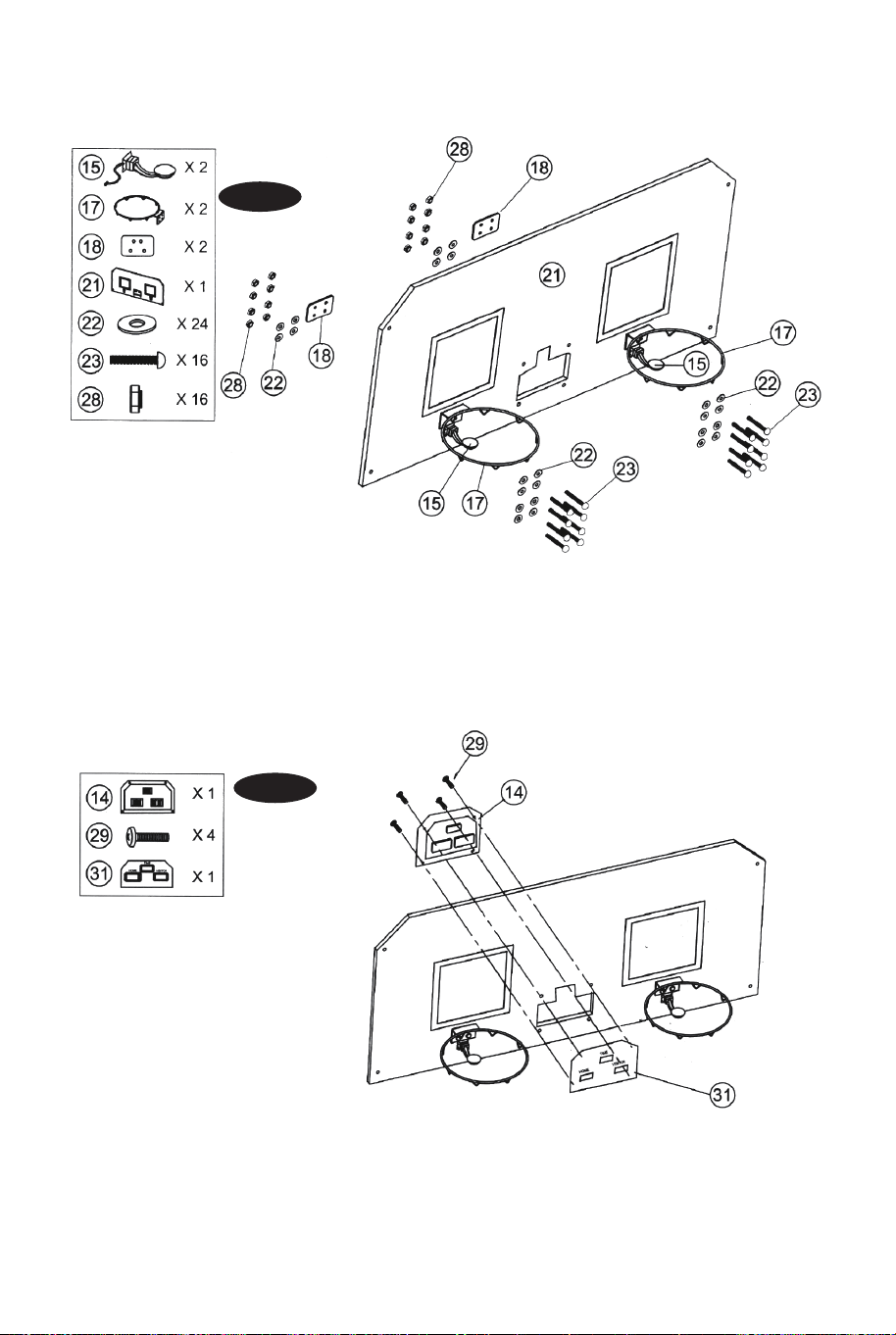
FIG.6
10. Fixez les tubes-10 (#10) aux tubes-9 (#9) à l'aide du verrou à ressort (préinstallé),
puis fixez le tube-11 (#11) aux tubes-10 (#10) à l'aide d'un verrou à ressort
(préinstallé) comme illustré à la FIG.6.
FIG.6
Verrou à ressort
P2
Verrou à ressort
P2
court
FIG.7
11. Fixez la jante (#17) et les plaques de support de jante (#18) au panneau arrière (#21)
à l'aide des boulons (#23), des rondelles (#22) et des écrous (#28). Ensuite, fixez les
capteurs de commutateur (# 15) au panneau arrière (#21) à l'aide des boulons (#23),
des rondelles (#22) et des écrous (#28). Assurez-vous d'utiliser des rondelles des
deux côtés du panneau comme illustré à la FIG.7.
FIG.8
12. Fixez la plaque frontale du scoreur électronique (#31) à l'avant du panneau arrière et
connectez-la au scoreur électronique (#14) à l'aide des boulons (#29) comme illustré
à la FIG.8.
FIG.7
FIG.8
40 41

FIG.9
13. Faites glisser les sangles élastiques et le manchon du filet de retour de balle (#20) sur
les tubes-1 (#1) comme indiqué sur les FIG.9A, 9B et 9C.
14. Faites glisser le tube-12 (#12) à travers le manchon à l'avant du filet de retour de balle
(#20), fixez-le d'abord sur le côté gauche à l'aide des boulons (#24), des rondelles
(#22) et des écrous (#28 ) comme illustré à la FIG.9D. Suivez la même procédure sur
le côté droit.
FIG.9A
FIG.9B
FIG.9C
FIG.9D
FIG.9
Goupille de verrouillage
P4
16. Connectez la goupille de verrouillage (#P4) au tube-5 et au tube-6 (#5 et #6) et
insérez-la dans le tube-5 et le tube-6 (#5 et #6) comme illustré à la FIG.10C.
42 43
FIG.10
15. Avec l'aide d'un autre adulte, fixez le panneau arrière (#21) aux tubes supérieurs 1
(#1) avec des boulons (#25), des rondelles (#22) et des écrous (#28) comme illustré à
la FIG.10A. Faites glisser le tube 12 (#12) à travers le manchon à l'arrière du filet de
retour de balle (#20), comme illustré à la FIG.10B. À chaque trou inférieur du
panneau arrière, fixez d'abord le côté gauche avec des boulons (#25), des rondelles
(#22), des écrous (#28) comme illustré à la FIG.10C. Suivez la même procédure pour
le côté droit.
P1
FIG.10B
Goupille de verrouillage
P4
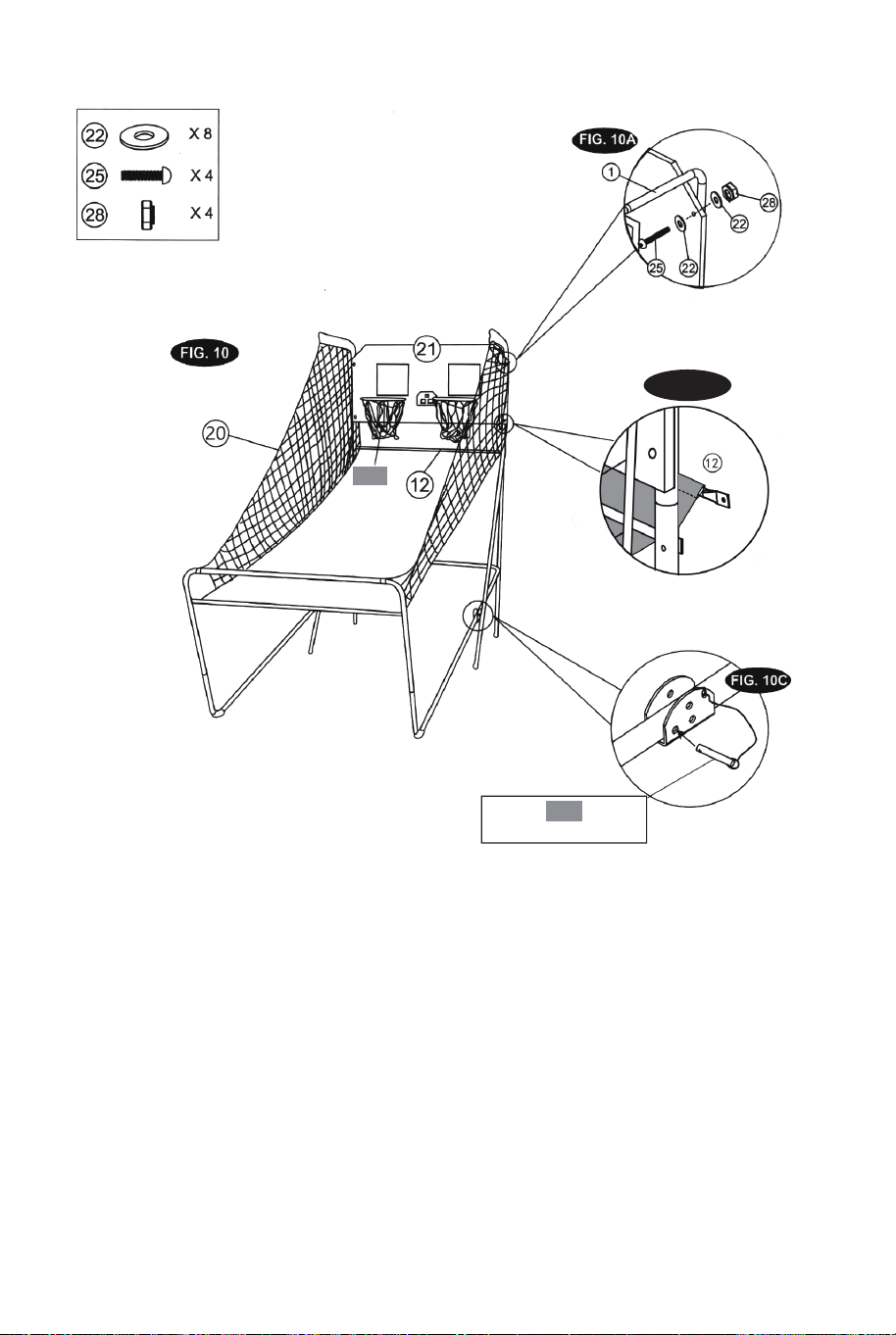
FIG.9
13. Faites glisser les sangles élastiques et le manchon du filet de retour de balle (#20) sur
les tubes-1 (#1) comme indiqué sur les FIG.9A, 9B et 9C.
14. Faites glisser le tube-12 (#12) à travers le manchon à l'avant du filet de retour de balle
(#20), fixez-le d'abord sur le côté gauche à l'aide des boulons (#24), des rondelles
(#22) et des écrous (#28 ) comme illustré à la FIG.9D. Suivez la même procédure sur
le côté droit.
FIG.9A
FIG.9B
FIG.9C
FIG.9D
FIG.9
Goupille de verrouillage
P4
16. Connectez la goupille de verrouillage (#P4) au tube-5 et au tube-6 (#5 et #6) et
insérez-la dans le tube-5 et le tube-6 (#5 et #6) comme illustré à la FIG.10C.
42 43
FIG.10
15. Avec l'aide d'un autre adulte, fixez le panneau arrière (#21) aux tubes supérieurs 1
(#1) avec des boulons (#25), des rondelles (#22) et des écrous (#28) comme illustré à
la FIG.10A. Faites glisser le tube 12 (#12) à travers le manchon à l'arrière du filet de
retour de balle (#20), comme illustré à la FIG.10B. À chaque trou inférieur du
panneau arrière, fixez d'abord le côté gauche avec des boulons (#25), des rondelles
(#22), des écrous (#28) comme illustré à la FIG.10C. Suivez la même procédure pour
le côté droit.
P1
FIG.10B
Goupille de verrouillage
P4

FIG.11
17. Fixez le boîtier de commande (#16) au milieu du tube 11 (#11) à l'aide de deux
boulons (#30) comme illustré à la FIG.11A.
18. Faites passer le reste du fil de commande à travers les boucles du filet de retour de
balle (#20). Placez le fil de commande sur le tube-11 (#11) à l'aide des sangles
auto-adhésives (#34) comme illustré à la FIG.11.
FIG.12
19. Connectez le fil de capteur du capteur de commutateur (#15) au scoreur électronique
(#14) comme illustré à la FIG.12. Connectez le fil de commande au scoreur
électronique (#14) comme indiqué sur les FIG.12 et 12A.
FIG.11
FIG.12
FIG.11A
FIG.12A
Boîtier de commande
Fil de commande
Fil de commande
FIL DE
COMMANDE
Scoreur électronique
Fil de capteur
Fil de capteur
VISITEUR
MARCHE
/ARRÊT
FIG.13
20. Pliez le jeu de basketball arcade lorsqu'il n'est pas utilisé et insérez la goupille de
verrouillage (#P4) comme illustré à la FIG.13.
Remarque : La goupille de verrouillage (#P4) doit être retirée de sa position d'origine
lorsque la machine est utilisée avant de l'insérer dans la nouvelle position une fois
pliée.
FIG.13
Goupille de verrouillage
P4
IMPORTANT!
Assurez-vous d'utiliser la goupille de
verrouillage (#P4) une fois pliée.
44 45
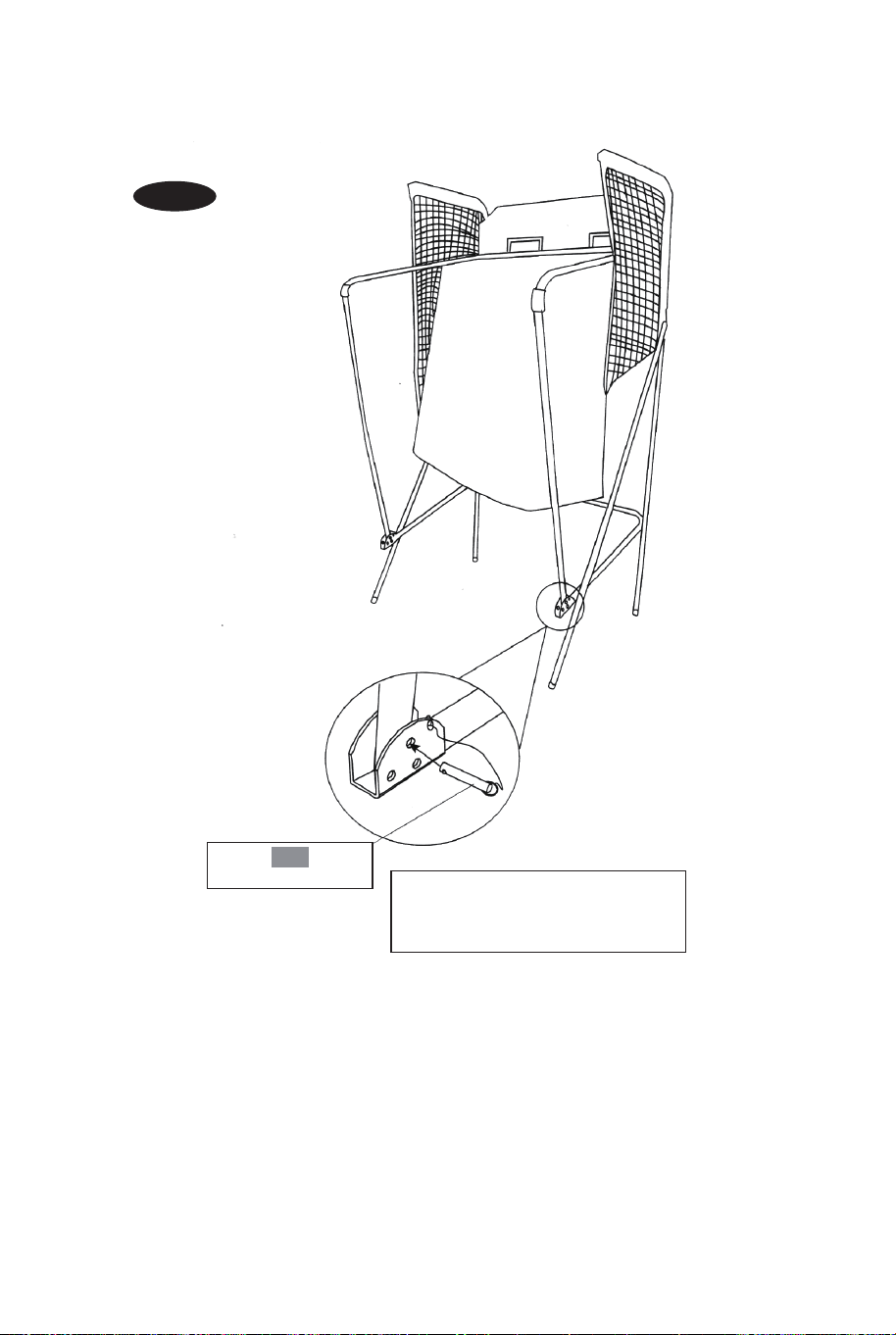
FIG.11
17. Fixez le boîtier de commande (#16) au milieu du tube 11 (#11) à l'aide de deux
boulons (#30) comme illustré à la FIG.11A.
18. Faites passer le reste du fil de commande à travers les boucles du filet de retour de
balle (#20). Placez le fil de commande sur le tube-11 (#11) à l'aide des sangles
auto-adhésives (#34) comme illustré à la FIG.11.
FIG.12
19. Connectez le fil de capteur du capteur de commutateur (#15) au scoreur électronique
(#14) comme illustré à la FIG.12. Connectez le fil de commande au scoreur
électronique (#14) comme indiqué sur les FIG.12 et 12A.
FIG.11
FIG.12
FIG.11A
FIG.12A
Boîtier de commande
Fil de commande
Fil de commande
FIL DE
COMMANDE
Scoreur électronique
Fil de capteur
Fil de capteur
VISITEUR
MARCHE
/ARRÊT
FIG.13
20. Pliez le jeu de basketball arcade lorsqu'il n'est pas utilisé et insérez la goupille de
verrouillage (#P4) comme illustré à la FIG.13.
Remarque : La goupille de verrouillage (#P4) doit être retirée de sa position d'origine
lorsque la machine est utilisée avant de l'insérer dans la nouvelle position une fois
pliée.
FIG.13
Goupille de verrouillage
P4
IMPORTANT!
Assurez-vous d'utiliser la goupille de
verrouillage (#P4) une fois pliée.
44 45

FONCTIONNEMENT DU SCORE ÉLECTRONIQUE
Boîtier à piles : dévissez le boulon à l'aide d'un tournevis et ouvrez le boîtier à piles.
Insérez 3 piles "AA" (non incluses) dans l'ordre de polarité indiqué à l'intérieur du
couvercle. Fermez ensuite le couvercle à l'aide d'un tournevis. Allumez l'alimentation
à l'aide de l'interrupteur MARCHE/ARRÊT.
Appuyez sur "ON/OFF" pour activer le scoreur.
Le tableau de bord "HOME" affiche "01" (jeu prédéfini 1).
Appuyez sur "SELECT UP and DOWN" pour sélectionner un jeu.
Appuyez sur "PL AY" pour entrer dans le mode de jeu sélectionné.
Appuyez sur "SOUND" pour activer/désactiver le son pendant la lecture.
Appuyez sur "PAUSE" pour mettre en pause ou démarrer le comptage du temps.
Appuyez et maintenez enfoncé le bouton "ON/OFF" pendant 3 secondes pour éteindre le
marqueur.
Appuyez et maintenez le bouton "RESET" 3 secondes pour réinitialiser les jeux.
Remarque : Si aucun tir n'est effectué ou si aucun bouton n'est enfoncé dans les 15
minutes, le marqueur s'éteint automatiquement.
1) Nécessite 3 piles "AA" (non incluses).
2) Ne mélangez pas les anciennes et les nouvelles piles.
3) Ne mélangez pas des piles alcalines, standard (carbone zinc) ou rechargeables
(nickel-cadmium).
Installer les piles
a. Les piles doivent être installées selon la bonne polarisation (+ et -) requise.
b. Veuillez nettoyer les contacts de la batterie ainsi que ceux des appareils avant
l'installation de la batterie.
c. Si le jeu n'est pas utilisé pendant une longue période, nous vous recommandons de
retirer les piles.
Rappel :
AVERTISSEMENT :
FONCTIONNEMENT DU BOÎTIER DE COMMANDE
fil de
commande
MARCHE/ARRÊT
visiteur
1. Course contre la montre
Appuyez sur "PLAY" pour entrer dans le jeu 1.
Appuyez sur « UP/Down » pour sélectionner un/plusieurs lecteurs (P1/P2/P3/P4).
Appuyez sur "PLAY" après avoir sélectionné le nombre de joueurs.
Appuyez sur "UP/Down" pour sélectionner le temps de lecture, 30/45/60 secondes.
Appuyez sur "PLAY" pour commencer le jeu.
Le tableau de bord "HOME" affiche les joueurs 1, 3 ; Le tableau de bord "VISITOR" montre les
joueurs 2, 4.
Tous les coups valent 2 points jusqu'aux 10 dernières secondes, chaque score compte 3
points.
Compte à rebours de 5 secondes jusqu'au tour du joueur suivant lorsqu'un joueur termine la
partie.
Le joueur avec plus de points marqués gagne (la LED clignotera sur le joueur avec le score le
plus élevé).
Appuyez sur "PLAY" pour redémarrer ce jeu.
2.3 Point Battre l'horloge
Appuyez sur "PL AY" pour entrer dans le jeu 2.
Appuyez sur « UP/Down » pour sélectionner un/plusieurs lecteurs (P1/P2/P3/P4).
Appuyez sur "PLAY" après avoir sélectionné le nombre de joueurs.
Appuyez sur "UP/Down" pour sélectionner le temps de lecture, 30/45/60 secondes.
Appuyez sur "PL AY" pour commencer le jeu.
Le tableau de bord "HOME" affiche les joueurs 1, 3 ; Le tableau de bord "VISITOR" montre les
joueurs 2, 4.
Tous les coups effectués comptent 3 points.
Compte à rebours de 5 secondes jusqu'au tour du joueur suivant lorsqu'un joueur termine la
partie.
Le joueur avec plus de points marqués gagne (la LED clignotera sur le joueur avec le score le
plus élevé).
Appuyez sur "PLAY" pour redémarrer ce jeu.
3. Contre-attaque
Appuyez sur "PLAY" pour entrer dans le jeu 3.
Appuyez sur « UP/Down » pour sélectionner plusieurs lecteurs (P2/P4).
Appuyez sur "PL AY" pour commencer le jeu.
Prise de vue réalisée dans le cadre "HOME", +2 points marqués affichés sur le tableau
"HOME" et -2 points pour "VISITEUR".
Prise de vue réalisée dans le cadre "VISITEUR", +2 points marqués affichés sur le tableau
"VISITEUR" et -2 points pour "MAISON".
Une fois qu'un joueur marque 10 points, qui gagne et le jeu est terminé.
Appuyez sur "PLAY" pour redémarrer ce jeu.
CHOISISSEZ PARMI 8 OPTIONS DE JEU DIFFÉRENTES
46 47
PANNEAU DE COMMANDE

FONCTIONNEMENT DU SCORE ÉLECTRONIQUE
Boîtier à piles : dévissez le boulon à l'aide d'un tournevis et ouvrez le boîtier à piles.
Insérez 3 piles "AA" (non incluses) dans l'ordre de polarité indiqué à l'intérieur du
couvercle. Fermez ensuite le couvercle à l'aide d'un tournevis. Allumez l'alimentation
à l'aide de l'interrupteur MARCHE/ARRÊT.
Appuyez sur "ON/OFF" pour activer le scoreur.
Le tableau de bord "HOME" affiche "01" (jeu prédéfini 1).
Appuyez sur "SELECT UP and DOWN" pour sélectionner un jeu.
Appuyez sur "PL AY" pour entrer dans le mode de jeu sélectionné.
Appuyez sur "SOUND" pour activer/désactiver le son pendant la lecture.
Appuyez sur "PAUSE" pour mettre en pause ou démarrer le comptage du temps.
Appuyez et maintenez enfoncé le bouton "ON/OFF" pendant 3 secondes pour éteindre le
marqueur.
Appuyez et maintenez le bouton "RESET" 3 secondes pour réinitialiser les jeux.
Remarque : Si aucun tir n'est effectué ou si aucun bouton n'est enfoncé dans les 15
minutes, le marqueur s'éteint automatiquement.
1) Nécessite 3 piles "AA" (non incluses).
2) Ne mélangez pas les anciennes et les nouvelles piles.
3) Ne mélangez pas des piles alcalines, standard (carbone zinc) ou rechargeables
(nickel-cadmium).
Installer les piles
a. Les piles doivent être installées selon la bonne polarisation (+ et -) requise.
b. Veuillez nettoyer les contacts de la batterie ainsi que ceux des appareils avant
l'installation de la batterie.
c. Si le jeu n'est pas utilisé pendant une longue période, nous vous recommandons de
retirer les piles.
Rappel :
AVERTISSEMENT :
FONCTIONNEMENT DU BOÎTIER DE COMMANDE
fil de
commande
MARCHE/ARRÊT
visiteur
1. Course contre la montre
Appuyez sur "PLAY" pour entrer dans le jeu 1.
Appuyez sur « UP/Down » pour sélectionner un/plusieurs lecteurs (P1/P2/P3/P4).
Appuyez sur "PLAY" après avoir sélectionné le nombre de joueurs.
Appuyez sur "UP/Down" pour sélectionner le temps de lecture, 30/45/60 secondes.
Appuyez sur "PLAY" pour commencer le jeu.
Le tableau de bord "HOME" affiche les joueurs 1, 3 ; Le tableau de bord "VISITOR" montre les
joueurs 2, 4.
Tous les coups valent 2 points jusqu'aux 10 dernières secondes, chaque score compte 3
points.
Compte à rebours de 5 secondes jusqu'au tour du joueur suivant lorsqu'un joueur termine la
partie.
Le joueur avec plus de points marqués gagne (la LED clignotera sur le joueur avec le score le
plus élevé).
Appuyez sur "PLAY" pour redémarrer ce jeu.
2.3 Point Battre l'horloge
Appuyez sur "PL AY" pour entrer dans le jeu 2.
Appuyez sur « UP/Down » pour sélectionner un/plusieurs lecteurs (P1/P2/P3/P4).
Appuyez sur "PLAY" après avoir sélectionné le nombre de joueurs.
Appuyez sur "UP/Down" pour sélectionner le temps de lecture, 30/45/60 secondes.
Appuyez sur "PL AY" pour commencer le jeu.
Le tableau de bord "HOME" affiche les joueurs 1, 3 ; Le tableau de bord "VISITOR" montre les
joueurs 2, 4.
Tous les coups effectués comptent 3 points.
Compte à rebours de 5 secondes jusqu'au tour du joueur suivant lorsqu'un joueur termine la
partie.
Le joueur avec plus de points marqués gagne (la LED clignotera sur le joueur avec le score le
plus élevé).
Appuyez sur "PLAY" pour redémarrer ce jeu.
3. Contre-attaque
Appuyez sur "PLAY" pour entrer dans le jeu 3.
Appuyez sur « UP/Down » pour sélectionner plusieurs lecteurs (P2/P4).
Appuyez sur "PL AY" pour commencer le jeu.
Prise de vue réalisée dans le cadre "HOME", +2 points marqués affichés sur le tableau
"HOME" et -2 points pour "VISITEUR".
Prise de vue réalisée dans le cadre "VISITEUR", +2 points marqués affichés sur le tableau
"VISITEUR" et -2 points pour "MAISON".
Une fois qu'un joueur marque 10 points, qui gagne et le jeu est terminé.
Appuyez sur "PLAY" pour redémarrer ce jeu.
CHOISISSEZ PARMI 8 OPTIONS DE JEU DIFFÉRENTES
46 47
PANNEAU DE COMMANDE

4. Cheval
a. Appuyez sur "PL AY" pour entrer dans la partie 4.
b. Appuyez sur "UP/Down" pour sélectionner plusieurs joueurs (P2/P3/P4).
C. Appuyez sur "PLAY" après avoir sélectionné le nombre de joueurs.
d. Le joueur doit effectuer un tir en 2 secondes.
e. Le premier joueur peut tirer dans n'importe quel cerceau (domicile ou visiteur). Si le premier
joueur marque en 2 secondes, aucune lettre n'est donnée. Le jeu continue pour le joueur
suivant. Le tableau d'affichage indiquera "joueur suivant (P2/P3/P4)" et la LED clignotera
deux fois en une seconde. Après le flash, le joueur suivant doit reproduire le tir dans le
même cerceau que celui choisi par le premier joueur.
f. Si le joueur ne peut pas marquer dans les 2 secondes, il reçoit la première lettre "H" qui
s'affiche sur le tableau des scores. Le jeu reste pour le même joueur jusqu'à ce que le
joueur marque. Si le joueur ne marque pas, il reçoit la lettre "O" suivie de "R", "S", "E". Si la
lettre "E" est donnée, le joueur est éliminé.
g. Le premier joueur à épeler "cheval" perd. Les joueurs continuent à répéter les étapes d.e.f.
jusqu'à la fin du jeu.
h. Le dernier joueur à épeler "cheval" gagne.
i. Appuyez sur "PLAY" pour recommencer ce jeu.
5. Point de contrôle
Appuyez sur "PLAY" pour entrer dans le jeu 5.
Appuyez sur "UP/Down" pour sélectionner un ou plusieurs joueurs (P1/P2/P3/P4).
Appuyez sur "PLAY" pour commencer le jeu.
"HOME" affiche "joueur", "VISITOR" affiche "24" points, temps de jeu préétabli de 40
secondes.
Les points marqués s'affichent sur le tableau d'affichage "HOME".
Avant que le temps ne soit écoulé, lorsque 24/52/68/86 points sont marqués, le temps de jeu
augmente de 10/20/10/20 secondes respectivement.
Compte à rebours de 5 secondes avant le tour du joueur suivant lorsqu'un joueur termine le
jeu.
Le joueur ayant marqué le plus de points gagne (la LED clignote sur le joueur ayant le plus de
points).
Le jeu est terminé lorsqu'un joueur obtient 98 points.
Appuyez sur "PLAY" pour redémarrer ce jeu.
6. Autour du monde
Utilisez du ruban adhésif pour marquer les lignes de tir.
Appuyez sur "PLAY" pour entrer dans le jeu 6.
Appuyez sur "UP/Down" pour sélectionner un/plusieurs joueurs (P1/P2/P3/P4).
Appuyez sur "PLAY" après avoir sélectionné le nombre de joueurs.
Le tableau d'affichage "HOME" affiche les joueurs 1/2/3/4, "VISITOR" affiche les points
marqués.
CHOISISSEZ PARMI 8 OPTIONS DE JEU DIFFÉRENTES
Une fois que le score atteint 10 points ou que le temps atteint 99 secondes, un compte à
rebours de 5 secondes avant le tour du joueur suivant lorsqu'un joueur termine la partie.
Le joueur qui termine la partie en premier gagne (le LED clignote sur le gagnant).
Appuyez sur "PLAY" pour relancer le jeu.
ATTENTION !
7. Tir à gauche et à droite
Appuyez sur "PLAY" pour entrer dans le jeu 7.
Appuyez sur « UP/Down » pour sélectionner un/plusieurs lecteurs (P1/P2/P3/P4).
Appuyez sur "PLAY" après avoir sélectionné le nombre de joueurs.
Appuyez sur "UP/Down" pour sélectionner le temps de lecture, 30/45/60 secondes.
Appuyez sur "PLAY" pour commencer le jeu.
Le tableau de bord "HOME" affiche le joueur, "VISITOR" affiche les points.
Faites un tir dans le cadre "HOME" lorsque LED clignote sur "HOME", 2 points marqués
s'affichent sur "HOME".
Faites une prise de vue dans le cadre "VISITOR" lorsque la LED clignote sur "VISITOR", 2
points marqués s'affichent sur "VISITOR".
Compte à rebours de 5 secondes jusqu'au tour du joueur suivant lorsqu'un joueur termine la
partie. Le joueur avec plus de points marqués gagne (la LED clignotera sur le joueur avec le
score le plus élevé).
Appuyez sur "PLAY" pour redémarrer ce jeu.
8. Un à un
Appuyez sur "PL AY" pour accéder au jeu 8.
Appuyez sur "UP/Down" pour sélectionner un/plusieurs lecteurs (P 1/P2/P3/P4).
Appuyez sur "PLAY" après avoir sélectionné le nombre de joueurs.
Appuyez sur "UP/Down" pour sélectionner le temps de lecture, 30/45/60 secondes.
Appuyez sur "PLAY" pour commencer le jeu.
Le tableau de bord "HOME" affiche les joueurs 1, 3 ; Le tableau de bord "VISITEUR" indique
Joueur2, 4. Tous les coups valent 2 points jusqu'aux 10 dernières secondes, chaque score
compte 3 points. Compte à rebours de 5 secondes jusqu'au tour du joueur suivant lorsqu'un
joueur termine la partie. Le joueur avec plus de points marqués gagne (la LED clignotera sur le
joueur avec le score le plus élevé).
Appuyez sur "PLAY" pour redémarrer ce jeu.
Les changements ou modifications non expressément approuvés par la partie
responsable de la conformité pourraient annuler l'autorité de l'utilisateur à faire
fonctionner l'équipement.
Le fonctionnement est soumis aux deux conditions suivantes :
(1) Cet appareil ne doit pas causer d'interférences nuisibles.
(2) Cet appareil doit accepter toute interférence reçue, y compris les
interférences susceptibles de provoquer un fonctionnement indésirable.
48 49

4. Cheval
a. Appuyez sur "PL AY" pour entrer dans la partie 4.
b. Appuyez sur "UP/Down" pour sélectionner plusieurs joueurs (P2/P3/P4).
C. Appuyez sur "PLAY" après avoir sélectionné le nombre de joueurs.
d. Le joueur doit effectuer un tir en 2 secondes.
e. Le premier joueur peut tirer dans n'importe quel cerceau (domicile ou visiteur). Si le premier
joueur marque en 2 secondes, aucune lettre n'est donnée. Le jeu continue pour le joueur
suivant. Le tableau d'affichage indiquera "joueur suivant (P2/P3/P4)" et la LED clignotera
deux fois en une seconde. Après le flash, le joueur suivant doit reproduire le tir dans le
même cerceau que celui choisi par le premier joueur.
f. Si le joueur ne peut pas marquer dans les 2 secondes, il reçoit la première lettre "H" qui
s'affiche sur le tableau des scores. Le jeu reste pour le même joueur jusqu'à ce que le
joueur marque. Si le joueur ne marque pas, il reçoit la lettre "O" suivie de "R", "S", "E". Si la
lettre "E" est donnée, le joueur est éliminé.
g. Le premier joueur à épeler "cheval" perd. Les joueurs continuent à répéter les étapes d.e.f.
jusqu'à la fin du jeu.
h. Le dernier joueur à épeler "cheval" gagne.
i. Appuyez sur "PLAY" pour recommencer ce jeu.
5. Point de contrôle
Appuyez sur "PLAY" pour entrer dans le jeu 5.
Appuyez sur "UP/Down" pour sélectionner un ou plusieurs joueurs (P1/P2/P3/P4).
Appuyez sur "PLAY" pour commencer le jeu.
"HOME" affiche "joueur", "VISITOR" affiche "24" points, temps de jeu préétabli de 40
secondes.
Les points marqués s'affichent sur le tableau d'affichage "HOME".
Avant que le temps ne soit écoulé, lorsque 24/52/68/86 points sont marqués, le temps de jeu
augmente de 10/20/10/20 secondes respectivement.
Compte à rebours de 5 secondes avant le tour du joueur suivant lorsqu'un joueur termine le
jeu.
Le joueur ayant marqué le plus de points gagne (la LED clignote sur le joueur ayant le plus de
points).
Le jeu est terminé lorsqu'un joueur obtient 98 points.
Appuyez sur "PLAY" pour redémarrer ce jeu.
6. Autour du monde
Utilisez du ruban adhésif pour marquer les lignes de tir.
Appuyez sur "PLAY" pour entrer dans le jeu 6.
Appuyez sur "UP/Down" pour sélectionner un/plusieurs joueurs (P1/P2/P3/P4).
Appuyez sur "PLAY" après avoir sélectionné le nombre de joueurs.
Le tableau d'affichage "HOME" affiche les joueurs 1/2/3/4, "VISITOR" affiche les points
marqués.
CHOISISSEZ PARMI 8 OPTIONS DE JEU DIFFÉRENTES
Une fois que le score atteint 10 points ou que le temps atteint 99 secondes, un compte à
rebours de 5 secondes avant le tour du joueur suivant lorsqu'un joueur termine la partie.
Le joueur qui termine la partie en premier gagne (le LED clignote sur le gagnant).
Appuyez sur "PLAY" pour relancer le jeu.
ATTENTION !
7. Tir à gauche et à droite
Appuyez sur "PLAY" pour entrer dans le jeu 7.
Appuyez sur « UP/Down » pour sélectionner un/plusieurs lecteurs (P1/P2/P3/P4).
Appuyez sur "PLAY" après avoir sélectionné le nombre de joueurs.
Appuyez sur "UP/Down" pour sélectionner le temps de lecture, 30/45/60 secondes.
Appuyez sur "PLAY" pour commencer le jeu.
Le tableau de bord "HOME" affiche le joueur, "VISITOR" affiche les points.
Faites un tir dans le cadre "HOME" lorsque LED clignote sur "HOME", 2 points marqués
s'affichent sur "HOME".
Faites une prise de vue dans le cadre "VISITOR" lorsque la LED clignote sur "VISITOR", 2
points marqués s'affichent sur "VISITOR".
Compte à rebours de 5 secondes jusqu'au tour du joueur suivant lorsqu'un joueur termine la
partie. Le joueur avec plus de points marqués gagne (la LED clignotera sur le joueur avec le
score le plus élevé).
Appuyez sur "PLAY" pour redémarrer ce jeu.
8. Un à un
Appuyez sur "PL AY" pour accéder au jeu 8.
Appuyez sur "UP/Down" pour sélectionner un/plusieurs lecteurs (P 1/P2/P3/P4).
Appuyez sur "PLAY" après avoir sélectionné le nombre de joueurs.
Appuyez sur "UP/Down" pour sélectionner le temps de lecture, 30/45/60 secondes.
Appuyez sur "PLAY" pour commencer le jeu.
Le tableau de bord "HOME" affiche les joueurs 1, 3 ; Le tableau de bord "VISITEUR" indique
Joueur2, 4. Tous les coups valent 2 points jusqu'aux 10 dernières secondes, chaque score
compte 3 points. Compte à rebours de 5 secondes jusqu'au tour du joueur suivant lorsqu'un
joueur termine la partie. Le joueur avec plus de points marqués gagne (la LED clignotera sur le
joueur avec le score le plus élevé).
Appuyez sur "PLAY" pour redémarrer ce jeu.
Les changements ou modifications non expressément approuvés par la partie
responsable de la conformité pourraient annuler l'autorité de l'utilisateur à faire
fonctionner l'équipement.
Le fonctionnement est soumis aux deux conditions suivantes :
(1) Cet appareil ne doit pas causer d'interférences nuisibles.
(2) Cet appareil doit accepter toute interférence reçue, y compris les
interférences susceptibles de provoquer un fonctionnement indésirable.
48 49
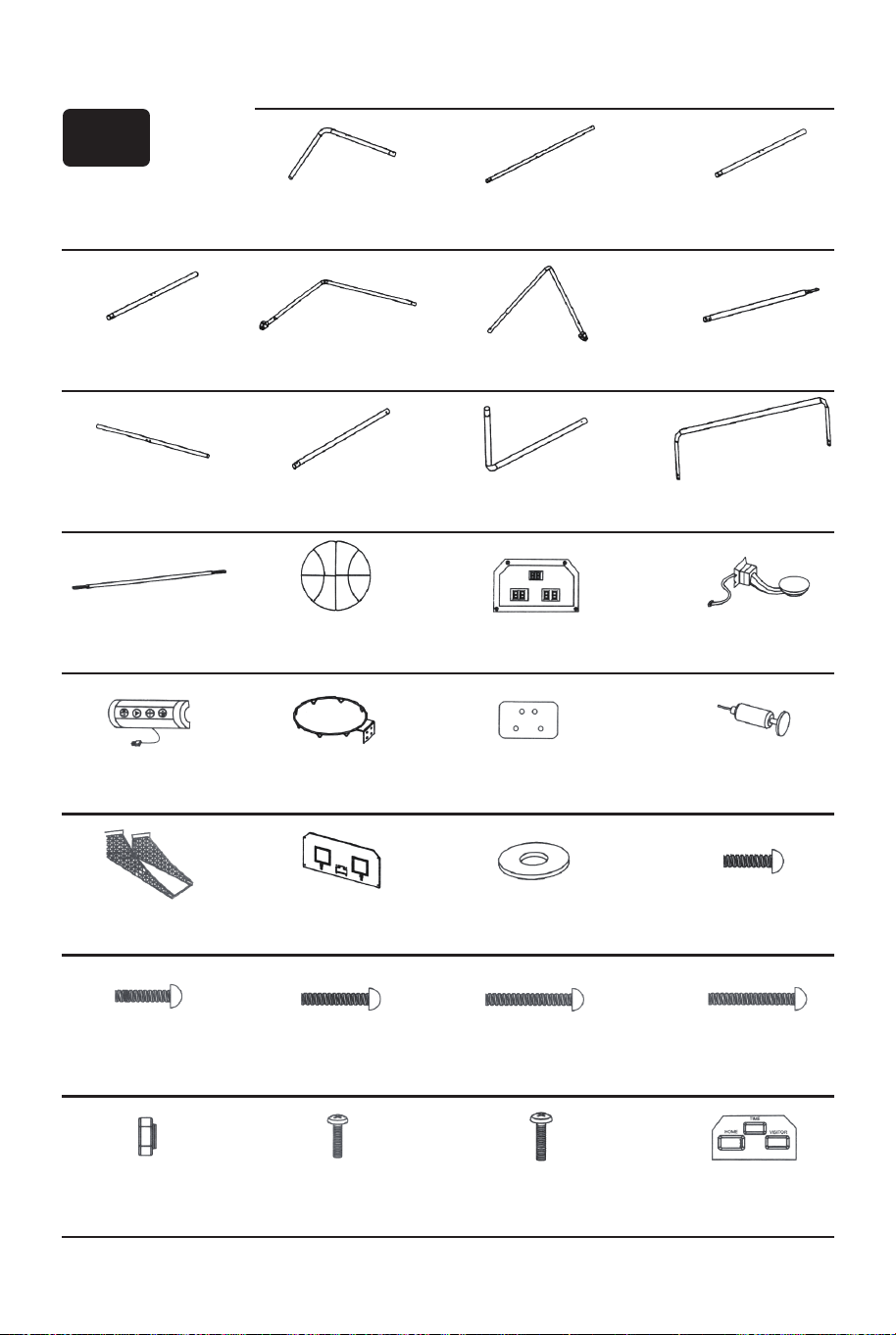
Tubo-1 Tubo-2
Ø22x580x440mm
Tubo-5
Ø22x755x580mm
Tubo-6
Ø22x755x580mm
Tubo-10
Ø22x650x385mm
Tubo-11
Ø22x1067x520mm
Ø22x685mm Ø22x890mm
Tubo-3
Ø22x830mm
Tubo-7
Ø22x890mm
Tubo-4
Ø22x835mm
Tubo-8
Ø12,7x1090mm
Tubo-12
Ø22x595mm
Tubo-9
Baloncesto de 17 cm
de diámetro
Marcador electrónico
Aro Placa de soporte de aro
Arandela M6 Perno M6x20mm
Sensor de interruptor
Bomba de inflado con agujaCaja de control con cable
Red de retorno de baloncesto
Perno M6x29mm
Tablero trasero
Perno M6x42mm Perno M6x50mm
Perno 4x28mm
Placa frontal del
marcador electrónico
Perno M6x35mm
Tuerca M6
Perno 3,5x10mm
1 x2 2 x2 3 x1
4 x1
5 x1 6 x1 7 x2
8 x2
9 x2 10 x2 11 x1
12 x3
13 x4
14 x1
15 x2
16 x1
21 x1 22 x46 23 x16
24 x6
25 x4 26 x4 27 x2
28 x32
29 x4 30 x2 31 x1
17 x2
18 x2 19 x1
20 x1
ES
INSTRUCCIONES DE MONTAJE:
Llave
32 x1
Llave Allen
33 x1
Correa autoadhesiva
34 x2
Red
P1 x2
Bloqueo de muelle
P2 x9
Inserto de poste
de plástico
P3 x2
Pasador de bloqueo
P4 x2
PIEZAS PREINSTALADAS
ANTES DEL MONTAJE - Por favor, inspeccione y
distribuya todos los postes y las piezas.
1. Encuentre un lugar limpio y nivelado para comenzar el montaje del producto.
Recomendamos que dos adultos trabajen juntos para montar este producto.
2. Saque todas las piezas de la caja y verifique que tiene todas las piezas enumeradas
en la página de la lista de piezas. Corte o rasgue con cuidado las cuatro esquinas
de la caja para que el fondo de la misma pueda ser utilizado como su superficie de
trabajo
50 51
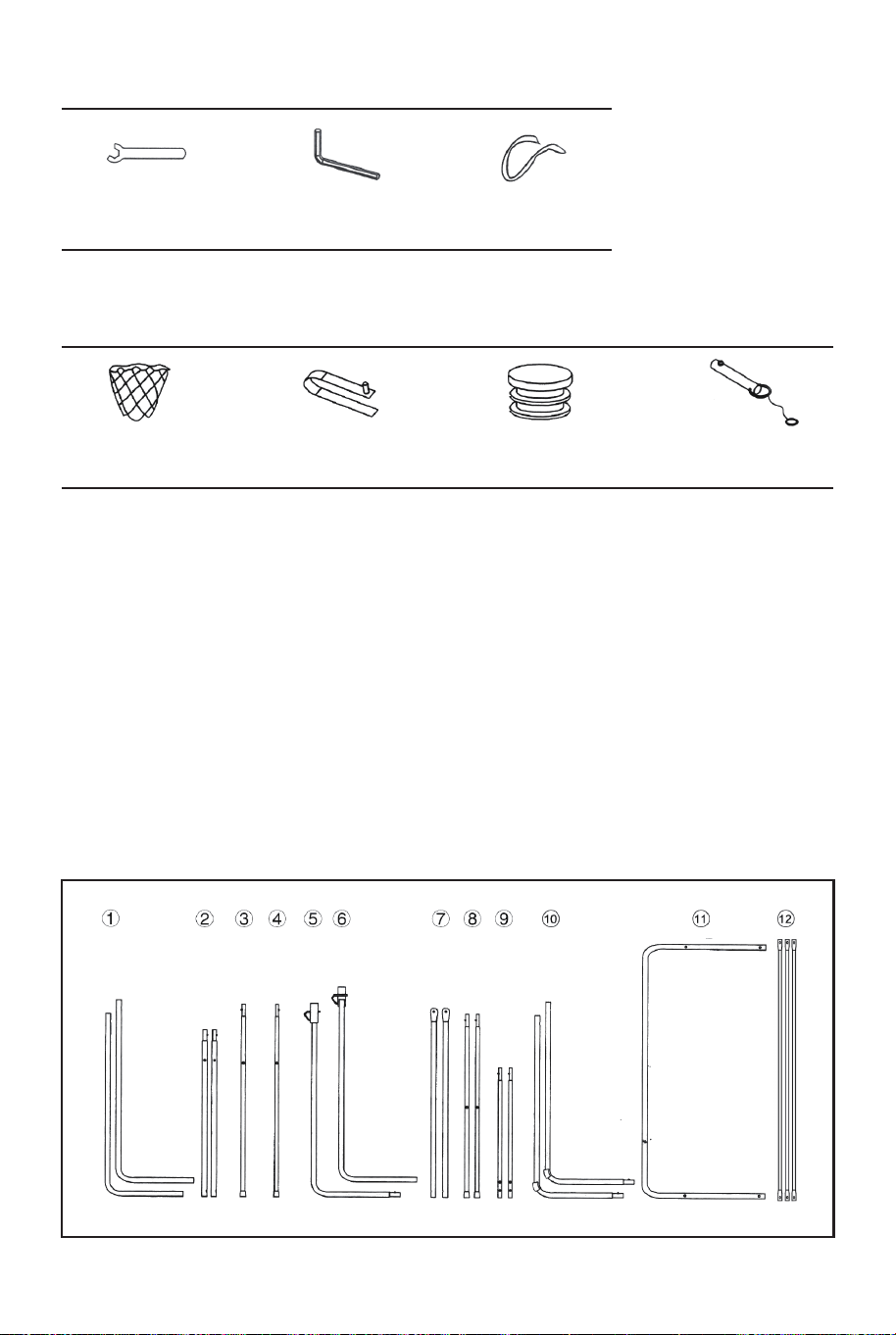
Tubo-1 Tubo-2
Ø22x580x440mm
Tubo-5
Ø22x755x580mm
Tubo-6
Ø22x755x580mm
Tubo-10
Ø22x650x385mm
Tubo-11
Ø22x1067x520mm
Ø22x685mm Ø22x890mm
Tubo-3
Ø22x830mm
Tubo-7
Ø22x890mm
Tubo-4
Ø22x835mm
Tubo-8
Ø12,7x1090mm
Tubo-12
Ø22x595mm
Tubo-9
Baloncesto de 17 cm
de diámetro
Marcador electrónico
Aro Placa de soporte de aro
Arandela M6 Perno M6x20mm
Sensor de interruptor
Bomba de inflado con agujaCaja de control con cable
Red de retorno de baloncesto
Perno M6x29mm
Tablero trasero
Perno M6x42mm Perno M6x50mm
Perno 4x28mm
Placa frontal del
marcador electrónico
Perno M6x35mm
Tuerca M6
Perno 3,5x10mm
1 x2 2 x2 3 x1
4 x1
5 x1 6 x1 7 x2
8 x2
9 x2 10 x2 11 x1
12 x3
13 x4
14 x1
15 x2
16 x1
21 x1 22 x46 23 x16
24 x6
25 x4 26 x4 27 x2
28 x32
29 x4 30 x2 31 x1
17 x2
18 x2 19 x1
20 x1
ES
INSTRUCCIONES DE MONTAJE:
Llave
32 x1
Llave Allen
33 x1
Correa autoadhesiva
34 x2
Red
P1 x2
Bloqueo de muelle
P2 x9
Inserto de poste
de plástico
P3 x2
Pasador de bloqueo
P4 x2
PIEZAS PREINSTALADAS
ANTES DEL MONTAJE - Por favor, inspeccione y
distribuya todos los postes y las piezas.
1. Encuentre un lugar limpio y nivelado para comenzar el montaje del producto.
Recomendamos que dos adultos trabajen juntos para montar este producto.
2. Saque todas las piezas de la caja y verifique que tiene todas las piezas enumeradas
en la página de la lista de piezas. Corte o rasgue con cuidado las cuatro esquinas
de la caja para que el fondo de la misma pueda ser utilizado como su superficie de
trabajo
50 51
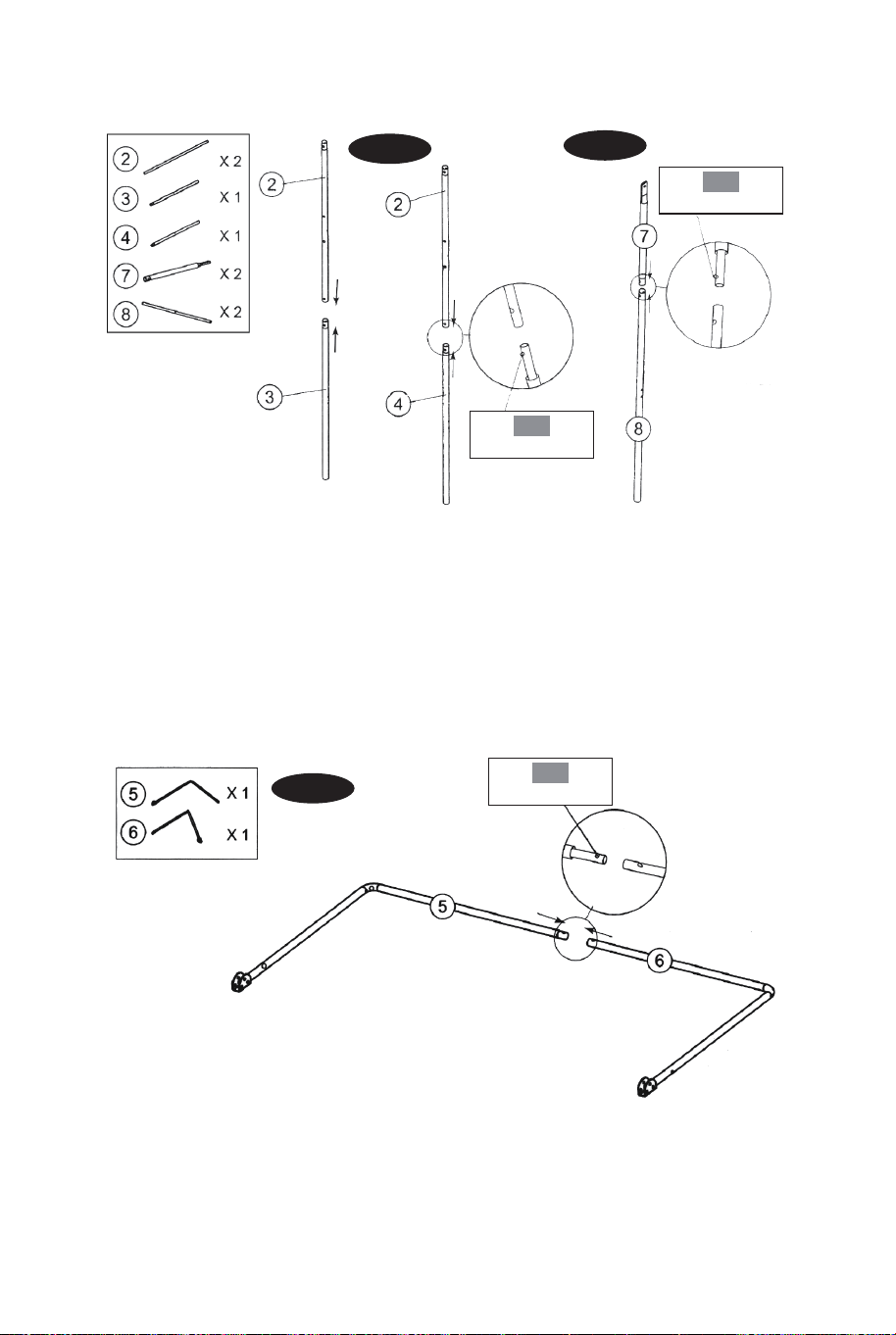
FIG.1 & 2
3. Fije los tubos-2 (#2) al tubo-3 y al tubo-4 (#3 y #4) utilizando el bloqueo de resorte
(preinstalado) como se muestra en la FIG.1.
4. Fije los tubos-7 (#7) a los tubos-8 (#8) utilizando el bloqueo de resorte (preinstalado)
como se muestra en la FIG.2
FIG.3
5. Fije el tubo-5 y el tubo-6 (#5 y #6) juntos utilizando el bloqueo de resorte
(preinstalado) como se muestra en la FIG.3.
FIG.4
6. Fije el tubo-5 y el tubo-6 (#5 y #6) al tubo-3 y al tubo-4 (#3 y #4) utilizando los pernos
(#26), las arandelas (#22) y las tuercas (#28), y luego fije el tubo-5 y el tubo-6 (#5 y
#6) a los tubos-8 (#8) utilizando los pernos (#26), las arandelas (#22) y las tuercas
(#28) como se muestra en la FIG.4, 4A y 4B.
7. Fije los tubos-7 y los tubos-8 (#7 y #8) a los tubos-2 (#2) utilizando el perno (#24), la
arandela (#22) y la tuerca (#28) como se muestra en la FIG.4C, repita este paso para
el otro lado.
Nota: Asegúrese de que el bloqueo del resorte esté orientado hacia abajo.
FIG.1
FIG.2
FIG.3
FIG. 4
FIG. 4C
FIG. 4B
FIG. 4A
Bloqueo de muelle
P2
Bloqueo de muelle
P2
Bloqueo de muelle
P2
52 53
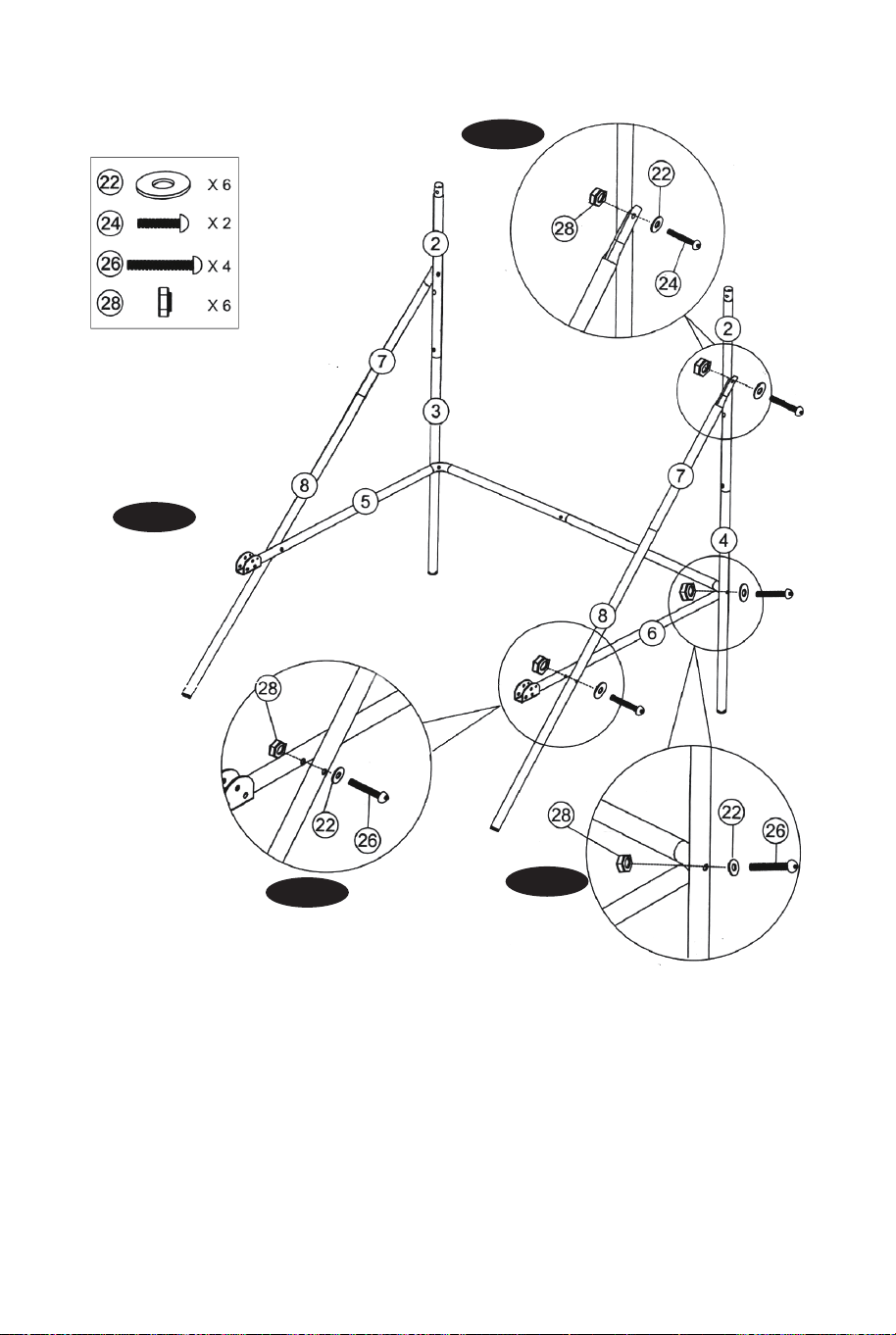
FIG.1 & 2
3. Fije los tubos-2 (#2) al tubo-3 y al tubo-4 (#3 y #4) utilizando el bloqueo de resorte
(preinstalado) como se muestra en la FIG.1.
4. Fije los tubos-7 (#7) a los tubos-8 (#8) utilizando el bloqueo de resorte (preinstalado)
como se muestra en la FIG.2
FIG.3
5. Fije el tubo-5 y el tubo-6 (#5 y #6) juntos utilizando el bloqueo de resorte
(preinstalado) como se muestra en la FIG.3.
FIG.4
6. Fije el tubo-5 y el tubo-6 (#5 y #6) al tubo-3 y al tubo-4 (#3 y #4) utilizando los pernos
(#26), las arandelas (#22) y las tuercas (#28), y luego fije el tubo-5 y el tubo-6 (#5 y
#6) a los tubos-8 (#8) utilizando los pernos (#26), las arandelas (#22) y las tuercas
(#28) como se muestra en la FIG.4, 4A y 4B.
7. Fije los tubos-7 y los tubos-8 (#7 y #8) a los tubos-2 (#2) utilizando el perno (#24), la
arandela (#22) y la tuerca (#28) como se muestra en la FIG.4C, repita este paso para
el otro lado.
Nota: Asegúrese de que el bloqueo del resorte esté orientado hacia abajo.
FIG.1
FIG.2
FIG.3
FIG. 4
FIG. 4C
FIG. 4B
FIG. 4A
Bloqueo de muelle
P2
Bloqueo de muelle
P2
Bloqueo de muelle
P2
52 53
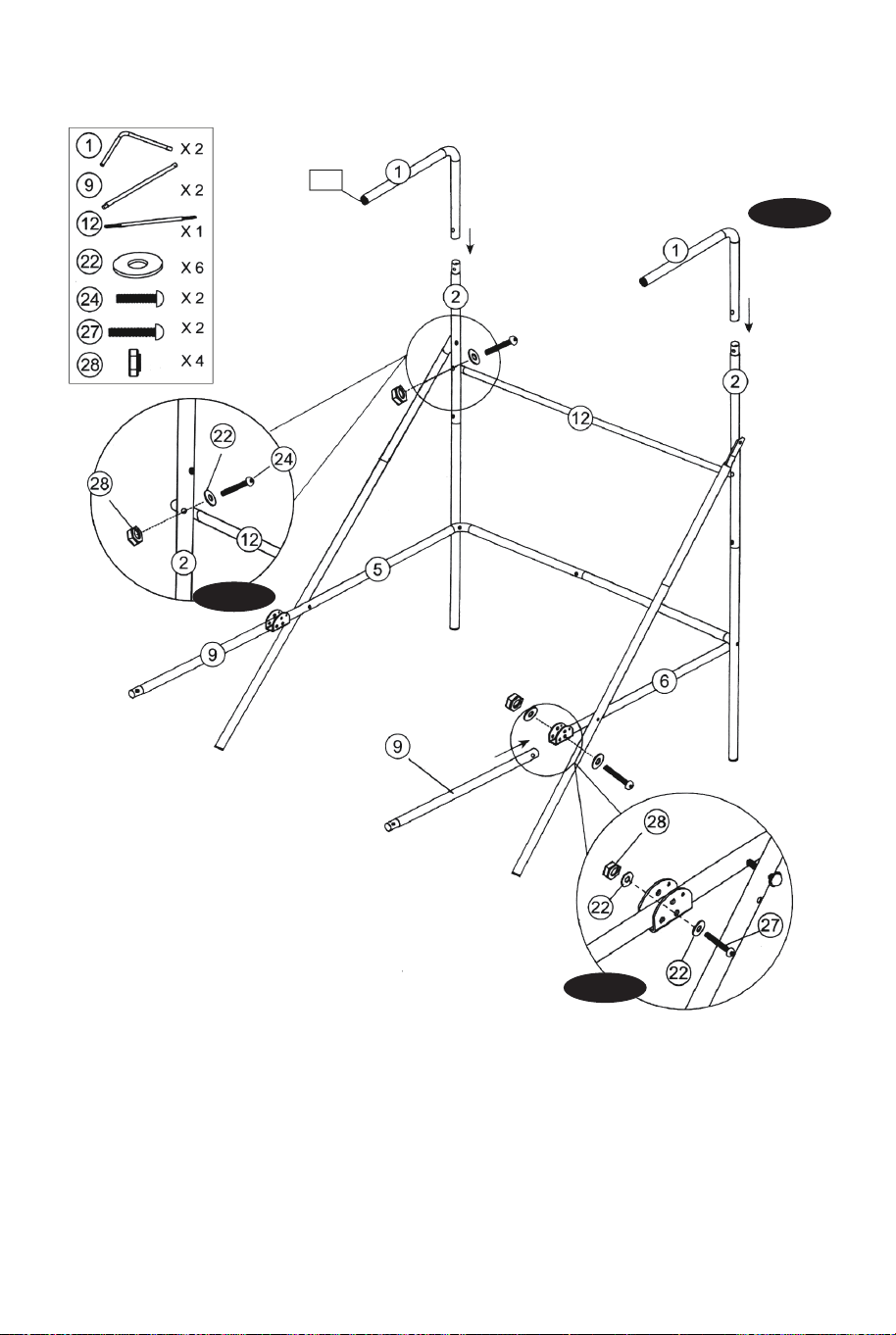
FIG.5
8. Fije el tubo-12 (#12) a los tubos-2 (#2) utilizando los pernos (#24), las arandelas
(#22) y las tuercas (#28) como se muestra en la FIG.5A. Y luego inserte los tubos-1
(#1) en los tubos-2 (#2) como se muestra en la FIG.5.
9. Fije los tubos-9 (#9) al tubo-5 y al tubo-6 (#5 y #6) utilizando los pernos (#27), las
arandelas (#22) y las tuercas (#28) como se muestra en la FIG.5 y 5B.
FIG.6
10. Fije los tubos-10 (#10) a los tubos-9 (#9) usando el bloqueo de resorte (preinstalado),
y luego fije el tubo-11 (#11) a los tubos-10 (#10) usando el bloqueo de resorte
(preinstalado) como se muestra en la FIG.6.
FIG. 5A
FIG. 5B
FIG. 5
FIG.6
Bloqueo de muelle
P2
Bloqueo de muelle
P2
P3
Corto
Largo
54 55
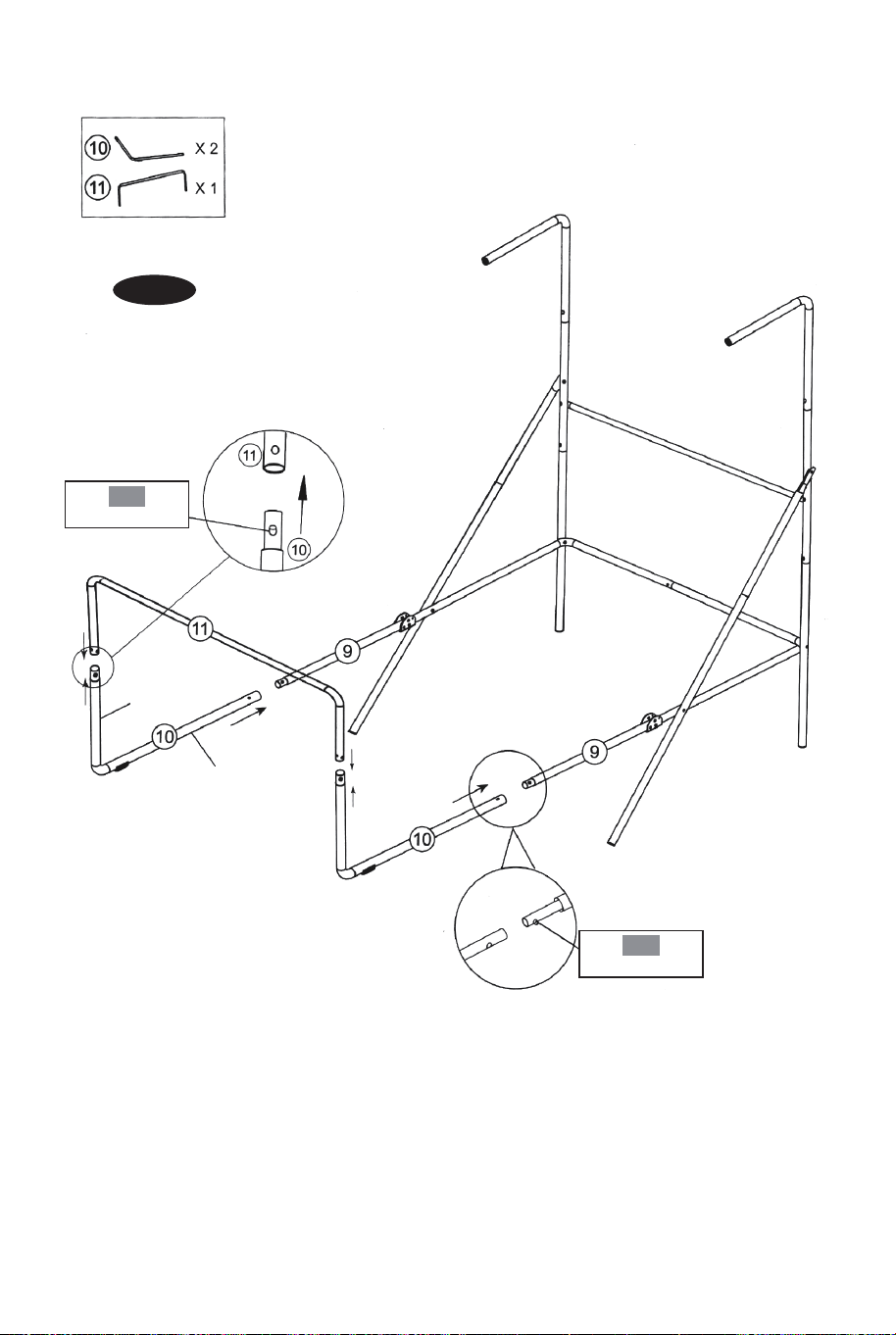
FIG.5
8. Fije el tubo-12 (#12) a los tubos-2 (#2) utilizando los pernos (#24), las arandelas
(#22) y las tuercas (#28) como se muestra en la FIG.5A. Y luego inserte los tubos-1
(#1) en los tubos-2 (#2) como se muestra en la FIG.5.
9. Fije los tubos-9 (#9) al tubo-5 y al tubo-6 (#5 y #6) utilizando los pernos (#27), las
arandelas (#22) y las tuercas (#28) como se muestra en la FIG.5 y 5B.
FIG.6
10. Fije los tubos-10 (#10) a los tubos-9 (#9) usando el bloqueo de resorte (preinstalado),
y luego fije el tubo-11 (#11) a los tubos-10 (#10) usando el bloqueo de resorte
(preinstalado) como se muestra en la FIG.6.
FIG. 5A
FIG. 5B
FIG. 5
FIG.6
Bloqueo de muelle
P2
Bloqueo de muelle
P2
P3
Corto
Largo
54 55
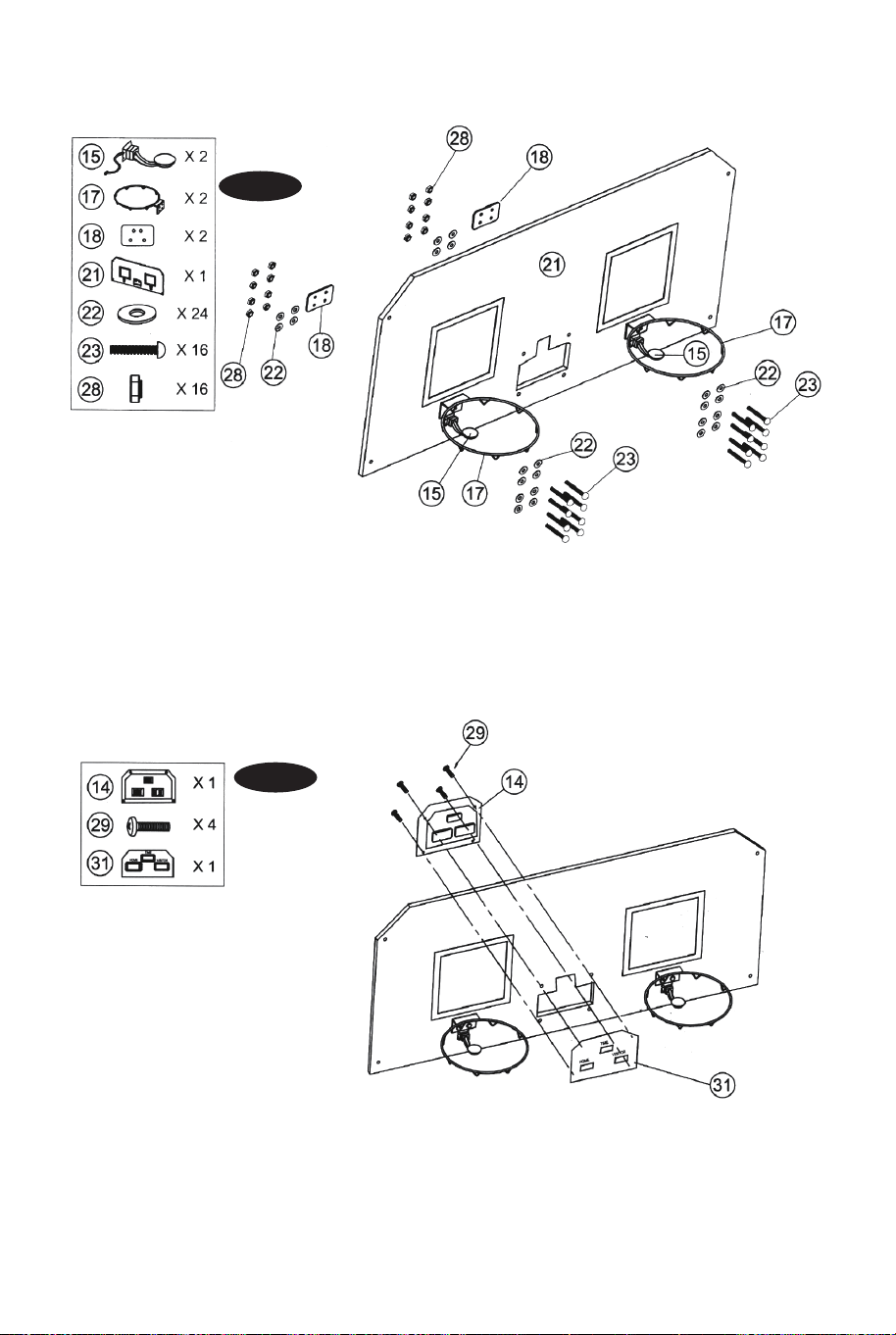
FIG.7
11. Fije los aros (#17) y las placas de soporte de aro (#18) al tablero trasero (#21)
utilizando los pernos (#23), las arandelas (#22) y las tuercas (#28). A continuación,
fije los sensores de interruptor (#15) al tablero trasero (#21) utilizando los pernos
(#23), las arandelas (#22) y las tuercas (#28). Asegúrese de utilizar las arandelas en
ambos lados del tablero como se muestra en la FIG.7.
FIG.8
12. Fije la placa frontal del marcador electrónico (#31) a la parte frontal del tablero trasero
y conecte con el marcador electrónico (#14) usando los pernos (#29) como se
muestra en la FIG.8.
FIG.7
FIG.8
FIG.9
13. Deslice las correas elásticas y la manga de la red de retorno de baloncesto (#20) en
los tubos-1 (#1) como se muestra en la FIG.9A, 9B y 9C.
14. Deslice el tubo-12 (#12) a través de la manga en la parte delantera de la red de
retorno de baloncesto (#20), fije en el lado izquierdo primero usando los pernos
(#24), las arandelas (#22) y las tuercas (#28) como se muestra en la FIG.9D. Siga el
mismo procedimiento en el lado derecho.
FIG.9A
FIG.9B
FIG.9C
FIG.9D
FIG.9
56 57
Pasador de bloqueo
P4
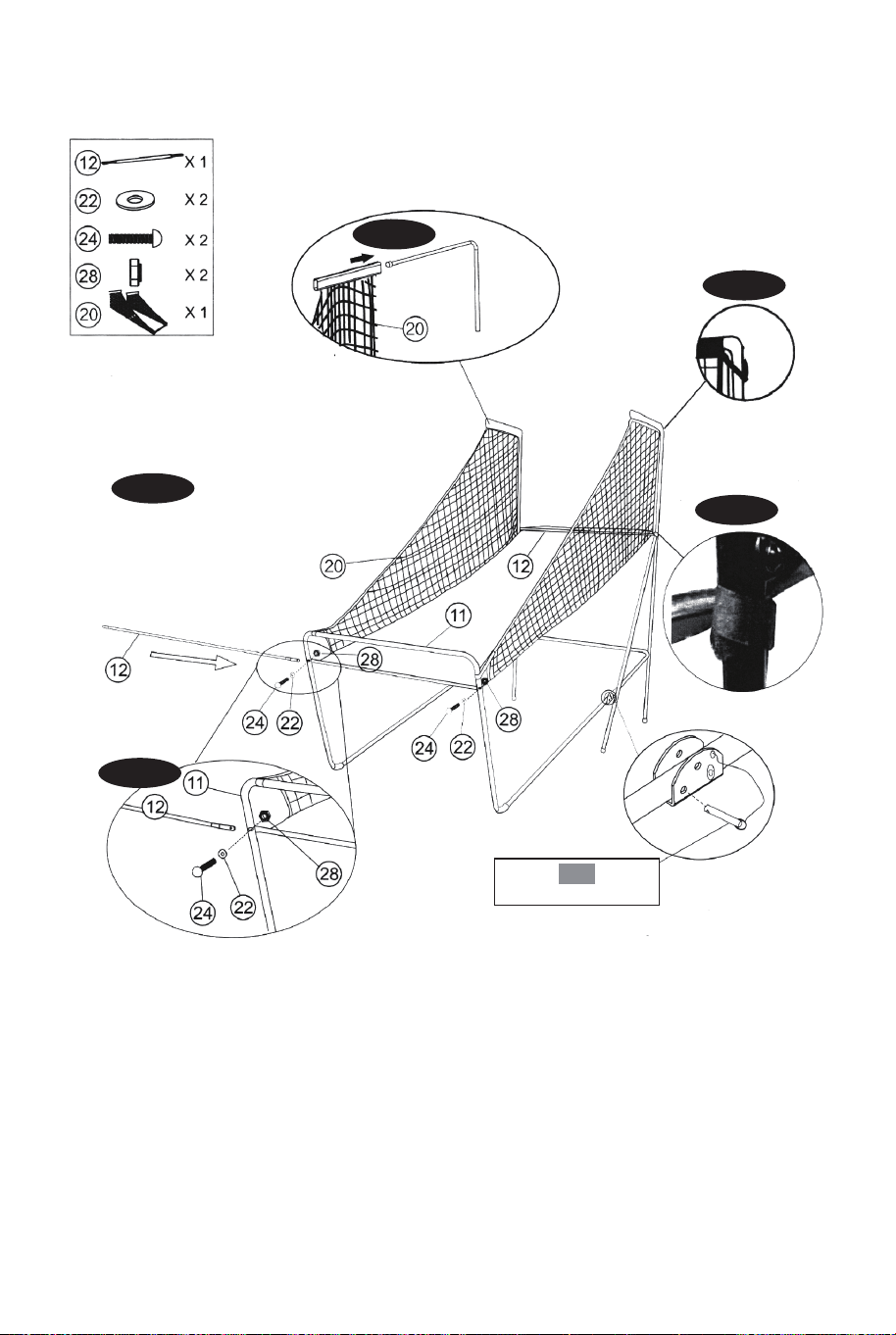
FIG.7
11. Fije los aros (#17) y las placas de soporte de aro (#18) al tablero trasero (#21)
utilizando los pernos (#23), las arandelas (#22) y las tuercas (#28). A continuación,
fije los sensores de interruptor (#15) al tablero trasero (#21) utilizando los pernos
(#23), las arandelas (#22) y las tuercas (#28). Asegúrese de utilizar las arandelas en
ambos lados del tablero como se muestra en la FIG.7.
FIG.8
12. Fije la placa frontal del marcador electrónico (#31) a la parte frontal del tablero trasero
y conecte con el marcador electrónico (#14) usando los pernos (#29) como se
muestra en la FIG.8.
FIG.7
FIG.8
FIG.9
13. Deslice las correas elásticas y la manga de la red de retorno de baloncesto (#20) en
los tubos-1 (#1) como se muestra en la FIG.9A, 9B y 9C.
14. Deslice el tubo-12 (#12) a través de la manga en la parte delantera de la red de
retorno de baloncesto (#20), fije en el lado izquierdo primero usando los pernos
(#24), las arandelas (#22) y las tuercas (#28) como se muestra en la FIG.9D. Siga el
mismo procedimiento en el lado derecho.
FIG.9A
FIG.9B
FIG.9C
FIG.9D
FIG.9
56 57
Pasador de bloqueo
P4
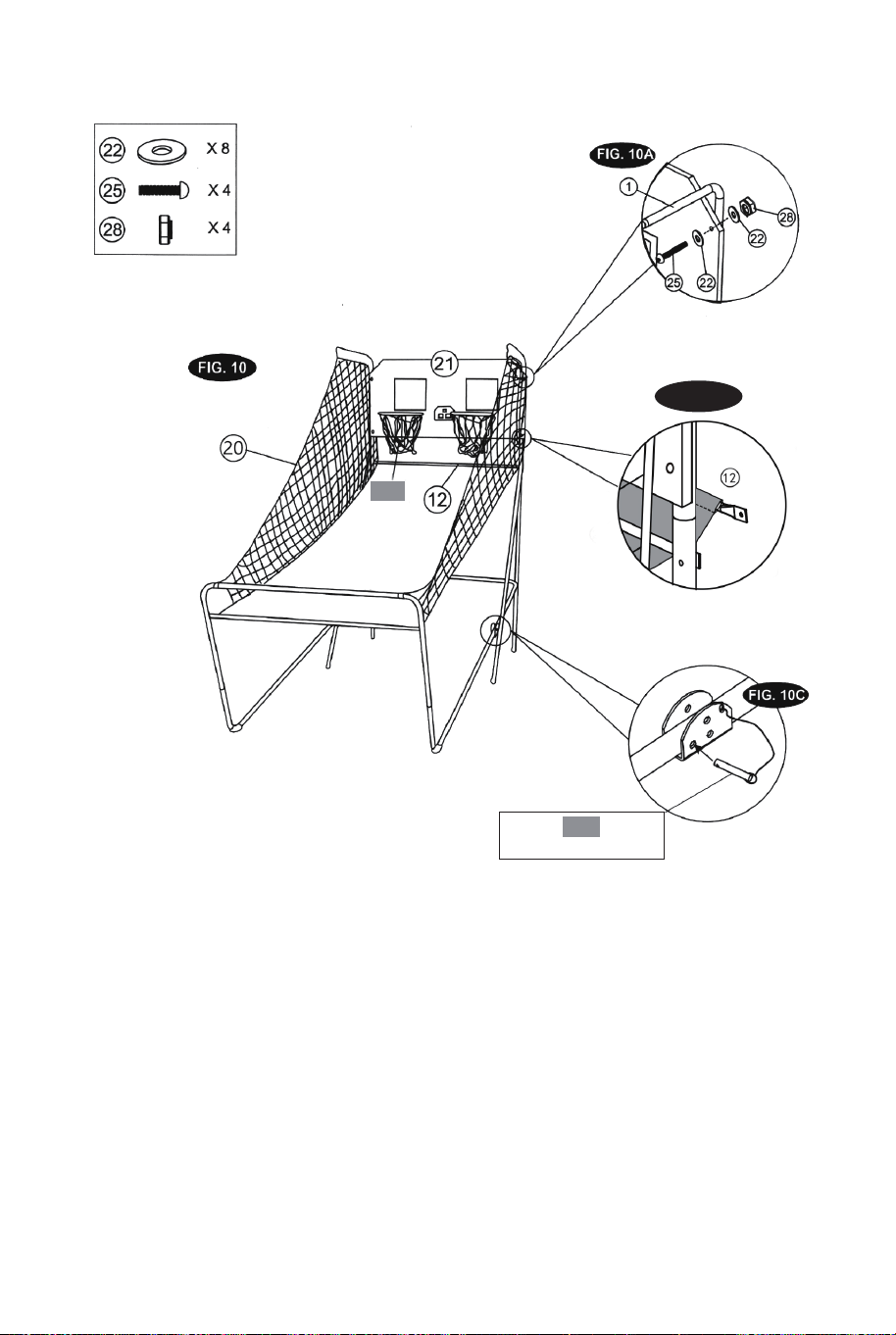
FIG.11
16. Conecte el pasador de bloqueo (#P4) al tubo-5 y al tubo-6 (#5 y #6) e insértelo en el
tubo-5 y en el tubo-6 (#5 y #6) como se muestra en la FIG.10C.
17. Fije la caja de control (#16) al centro del tubo-11 (#11) utilizando dos pernos (#30)
como se muestra en la FIG.11A.
18. Pase el resto del cable de control a través de los bucles de la red de retorno de
baloncesto (#20). Coloque el cable de control en el tubo-11 (#11) utilizando las
correas autoadhesivas (#34) como se muestra en la FIG.11.
FIG.12
19. Conecte el cable de sensor del sensor de interruptor (#15) al marcador electrónico
(#14) como se muestra en la FIG.12. Conecte el cable de control al marcador
electrónico (#14) como se muestra en la FIG.12 y 12A.
FIG.11
FIG.12
FIG.11A
FIG.12A
Caja de control
Cable de control
Cable de control
CABLE DE
CONTROL
Marcador electrónico
Cable de sensor
Cable de sensor
VISITANTE
ENCENDIDO
/APAGADO
58 59
FIG.10
15.
P1
Con la ayuda de otro adulto, fije el tablero trasero (#21) a los tubos superiores-1 (#1)
usando los pernos (#25), las arandelas (#22), las tuercas (#28) como se muestra en la
FIG.10A. Deslice el tubo 12 (#12) a través del manguito en la parte posterior de la red
de retorno de baloncesto (#20), como se muestra en la FIG.10B. En cada uno de los
agujeros inferiores del tablero, fije primero el lado izquierdo con los tornillos (#25), las
arandelas (#22), las tuercas (#28) como se muestra en la FIG.10C. Siga el mismo
procedimiento para el lado derecho.
FIG.10B
Pasador de bloqueo
P4
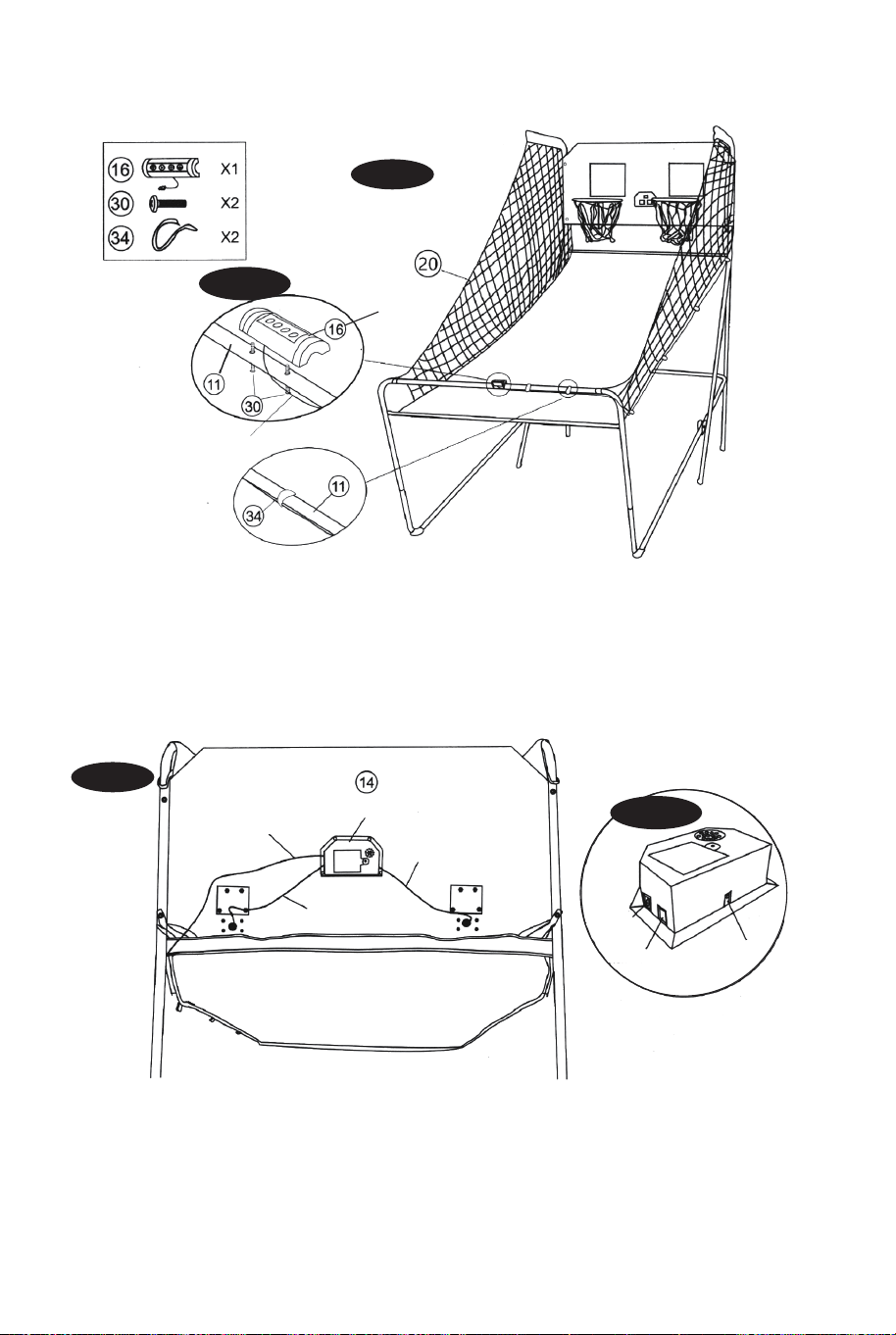
FIG.11
16. Conecte el pasador de bloqueo (#P4) al tubo-5 y al tubo-6 (#5 y #6) e insértelo en el
tubo-5 y en el tubo-6 (#5 y #6) como se muestra en la FIG.10C.
17. Fije la caja de control (#16) al centro del tubo-11 (#11) utilizando dos pernos (#30)
como se muestra en la FIG.11A.
18. Pase el resto del cable de control a través de los bucles de la red de retorno de
baloncesto (#20). Coloque el cable de control en el tubo-11 (#11) utilizando las
correas autoadhesivas (#34) como se muestra en la FIG.11.
FIG.12
19. Conecte el cable de sensor del sensor de interruptor (#15) al marcador electrónico
(#14) como se muestra en la FIG.12. Conecte el cable de control al marcador
electrónico (#14) como se muestra en la FIG.12 y 12A.
FIG.11
FIG.12
FIG.11A
FIG.12A
Caja de control
Cable de control
Cable de control
CABLE DE
CONTROL
Marcador electrónico
Cable de sensor
Cable de sensor
VISITANTE
ENCENDIDO
/APAGADO
58 59
FIG.10
15.
P1
Con la ayuda de otro adulto, fije el tablero trasero (#21) a los tubos superiores-1 (#1)
usando los pernos (#25), las arandelas (#22), las tuercas (#28) como se muestra en la
FIG.10A. Deslice el tubo 12 (#12) a través del manguito en la parte posterior de la red
de retorno de baloncesto (#20), como se muestra en la FIG.10B. En cada uno de los
agujeros inferiores del tablero, fije primero el lado izquierdo con los tornillos (#25), las
arandelas (#22), las tuercas (#28) como se muestra en la FIG.10C. Siga el mismo
procedimiento para el lado derecho.
FIG.10B
Pasador de bloqueo
P4
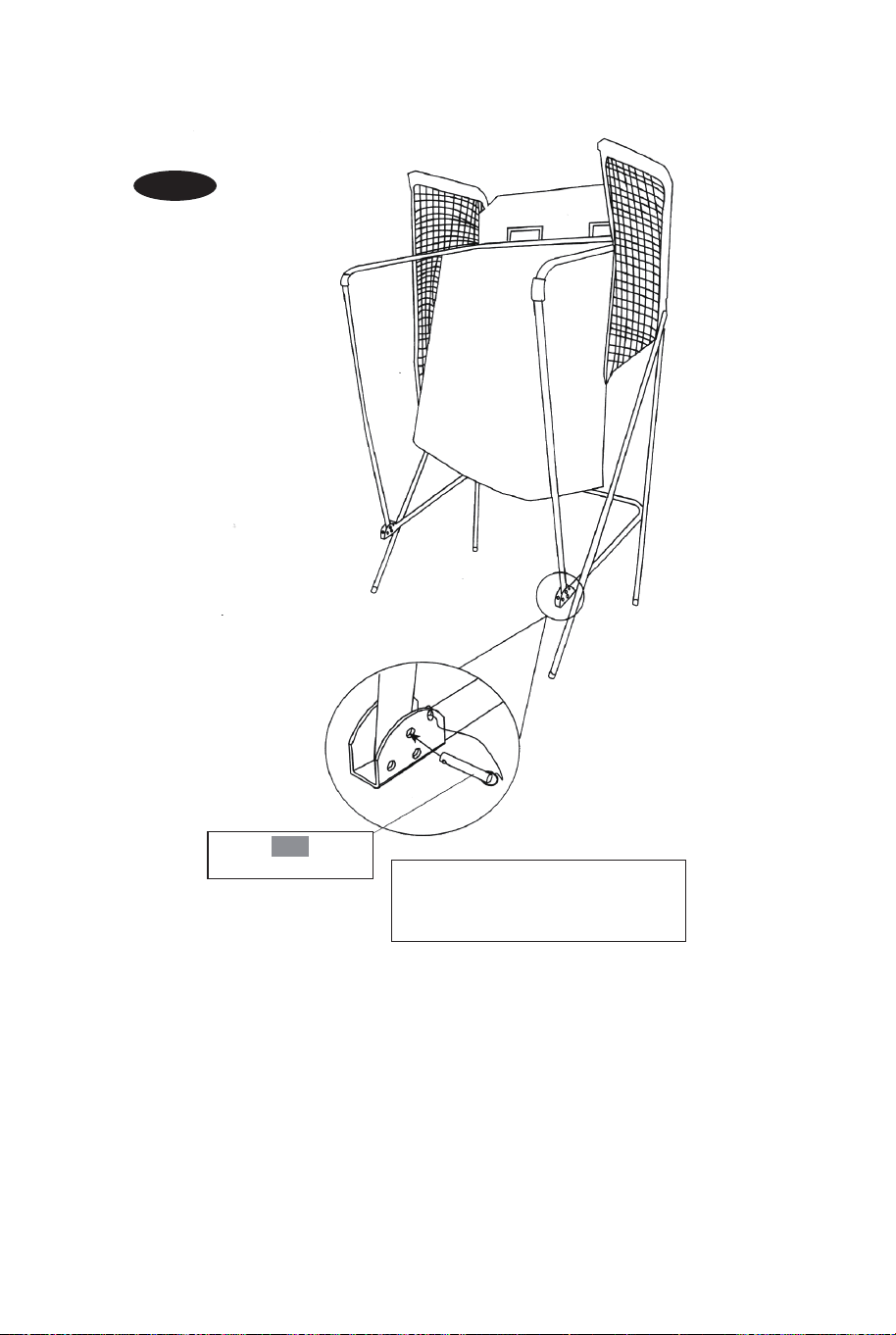
OPERACIÓN DEL MARCADOR ELECTRÓNICO
Caja de Pilas: Desenrosque el perno con un destornillador y abra la caja de pilas.
Inserte 3 pilas "AA" (no incluidas) en el orden de polaridad indicado en la tapa interior. A
continuación, cierre la tapa con un destornillador. Encienda el producto con el interruptor
ON/OFF (ENCENDIDO/APAGADO).
Presione "ON/OFF" ("ENCENDIDO/APAGADO") para activar el marcador.
El marcador "HOME" ("LOCAL") muestra "01" (juego preestablecido 1).
Presione "SELECT UP y DOWN" ("ARRIBA y ABAJO") para seleccionar un juego.
Presione "PLAY" ("JUGAR") para entrar en el modo de juego seleccionado.
Presione "SOUND" ("SONIDO") para activar/desactivar el sonido durante el juego.
Presione "PAUSE" ("PAUSA") para pausar o iniciar el conteo de tiempo.
Mantenga presionado el botón "ON/OFF" 3 segundos para apagar el marcador.
Mantenga presionado el botón "RESET" ("REINICIAR") 3 segundos para reiniciar los
juegos.
Nota: Si no se realiza ningún tiro o no se presiona ningún botón en 15 minutos, el
marcador se apagará automáticamente.
FIG.13
20. Pliegue la máquina de tiro de baloncesto cuando no esté en uso e inserte el pasador
de bloqueo (#P4) como se muestra en la FIG.13.
Nota: El pasador de bloqueo (#P4) debe retirarse de su posición original cuando la
máquina está siendo utilizada antes de insertarlo en la nueva posición cuando se
pliega.
1) Requiere 3 pilas "AA" (no incluidas).
2) No mezcle pilas viejas y nuevas.
3) No mezcle pilas alcalinas, estándar (carbono-zinc) o recambiables (níquel-cadmio).
Instalar Pilas
a. Las pilas deben ser instaladas según la polaridad correcta (+ y -) requerida.
b. Por favor, limpie los contactos de las pilas y también los de los dispositivos antes de la
instalación de las pilas.
c. Si el producto no se va a utilizar durante un largo periodo de tiempo, recomendamos
que se quiten las pilas.
Recordatorio:
ADVERTENCIA
OPERACIÓN DE LA CAJA DE CONTROL
FIG.13
Pasador de bloqueo
P4
¡IMPORTANTE!
Asegúrese de utilizar el pasador de
bloqueo (#P4) cuando se pliegue.
CABLE DE
CONTROL
ENCENDIDO
/APAGADO
VISITANTE
PANEL DE CONTROL
60 61
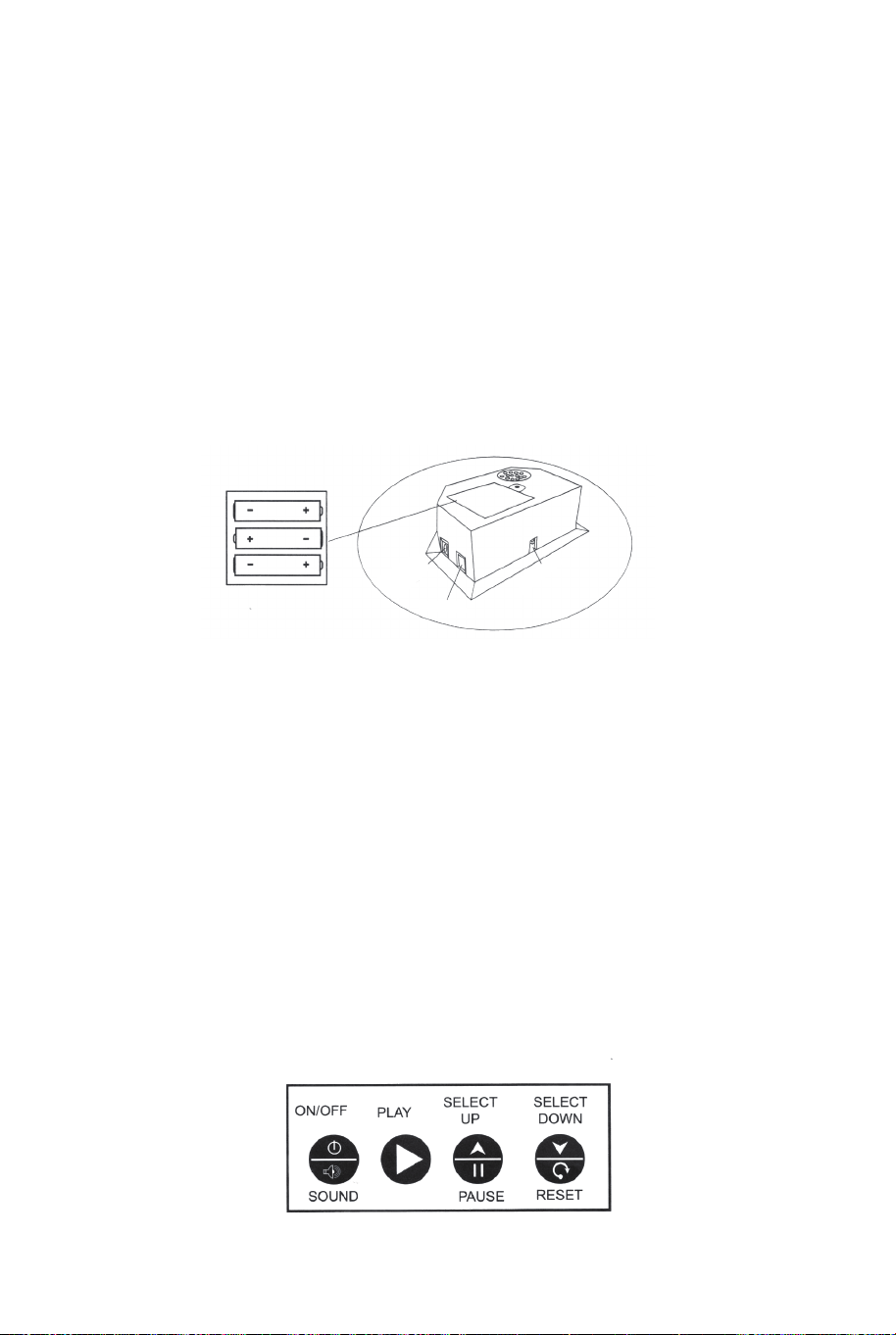
OPERACIÓN DEL MARCADOR ELECTRÓNICO
Caja de Pilas: Desenrosque el perno con un destornillador y abra la caja de pilas.
Inserte 3 pilas "AA" (no incluidas) en el orden de polaridad indicado en la tapa interior. A
continuación, cierre la tapa con un destornillador. Encienda el producto con el interruptor
ON/OFF (ENCENDIDO/APAGADO).
Presione "ON/OFF" ("ENCENDIDO/APAGADO") para activar el marcador.
El marcador "HOME" ("LOCAL") muestra "01" (juego preestablecido 1).
Presione "SELECT UP y DOWN" ("ARRIBA y ABAJO") para seleccionar un juego.
Presione "PLAY" ("JUGAR") para entrar en el modo de juego seleccionado.
Presione "SOUND" ("SONIDO") para activar/desactivar el sonido durante el juego.
Presione "PAUSE" ("PAUSA") para pausar o iniciar el conteo de tiempo.
Mantenga presionado el botón "ON/OFF" 3 segundos para apagar el marcador.
Mantenga presionado el botón "RESET" ("REINICIAR") 3 segundos para reiniciar los
juegos.
Nota: Si no se realiza ningún tiro o no se presiona ningún botón en 15 minutos, el
marcador se apagará automáticamente.
FIG.13
20. Pliegue la máquina de tiro de baloncesto cuando no esté en uso e inserte el pasador
de bloqueo (#P4) como se muestra en la FIG.13.
Nota: El pasador de bloqueo (#P4) debe retirarse de su posición original cuando la
máquina está siendo utilizada antes de insertarlo en la nueva posición cuando se
pliega.
1) Requiere 3 pilas "AA" (no incluidas).
2) No mezcle pilas viejas y nuevas.
3) No mezcle pilas alcalinas, estándar (carbono-zinc) o recambiables (níquel-cadmio).
Instalar Pilas
a. Las pilas deben ser instaladas según la polaridad correcta (+ y -) requerida.
b. Por favor, limpie los contactos de las pilas y también los de los dispositivos antes de la
instalación de las pilas.
c. Si el producto no se va a utilizar durante un largo periodo de tiempo, recomendamos
que se quiten las pilas.
Recordatorio:
ADVERTENCIA
OPERACIÓN DE LA CAJA DE CONTROL
FIG.13
Pasador de bloqueo
P4
¡IMPORTANTE!
Asegúrese de utilizar el pasador de
bloqueo (#P4) cuando se pliegue.
CABLE DE
CONTROL
ENCENDIDO
/APAGADO
VISITANTE
PANEL DE CONTROL
60 61

1. Beat the Time Clock (Vencer al Reloj)
Presione "PLAY" para entrar en el juego 1.
Presione "UP/DOWN" para seleccionar uno o varios jugadores (P1/P2/P3/P4).
Presione "PLAY" después de seleccionar el número de jugadores.
Presione "UP/DOWN" para seleccionar el tiempo de juego, 30/45/60 segundos.
Presione "PLAY" para comenzar el juego.
El marcador "HOME" ("LOCAL") muestra al jugador 1, 3; el marcador "VISITOR"
("VISITANTE") muestra al jugador 2, 4.
Todos los tiros valen 2 puntos hasta los últimos 10 segundos, cada puntuación cuenta 3
puntos.
Cuenta atrás de 5 segundos para el turno del siguiente jugador cuando un jugador termina el
juego.
El jugador con más puntos anotados gana (el LED parpadeará en el jugador con mayor
puntuación).
Presione "PLAY" para reiniciar el juego.
2. 3-Point Beat the Time Clock (3 Puntos Vencer al Reloj)
Presione "PLAY" para entrar en el juego 2.
Presione "UP/DOWN" para seleccionar uno o varios jugadores (P1/P2/P3/P4).
Presione "PLAY" después de seleccionar el número de jugadores.
Presione "UP/DOWN" para seleccionar el tiempo de juego, 30/45/60 segundos.
Presione "PLAY" para comenzar el juego.
El marcador "HOME" muestra al jugador 1, 3; el marcador "VISITOR" ("VISITANTE")
muestra al jugador 2, 4.
Todos los tiros realizados cuentan 3 puntos.
Cuenta atrás de 5 segundos para el turno del siguiente jugador cuando un jugador
termina el juego.
El jugador con más puntos anotados gana (el LED parpadeará en el jugador con mayor
puntuación).
Presione "PLAY" para reiniciar el juego.
3. Battle Back (Contraatacar)
Presione "PLAY" para entrar en el juego 3.
Presione "UP/DOWN" para seleccionar varios jugadores (P2/P4).
Presione "PLAY" para comenzar el juego.
Si el tiro se realiza en el marco de "HOME", se mostrarán +2 puntos en el tablero de
"HOME" y -2 puntos en el de "VISITOR".
Si el tiro se realiza en el marco de "VISITOR", se mostrarán +2 puntos en el tablero de
"VISITOR" y -2 puntos en el de "HOME".
Una vez que un jugador anota 10 puntos que gana y el juego está terminado.
Presione "PLAY" para reiniciar el juego.
4. Horse (Caballo)
a. Presione "PLAY" para entrar en el juego 4.
b. Presione "UP/DOWN" para seleccionar varios jugadores (P2/P3/P4).
c. Presione "PLAY" después de seleccionar el número de jugador.
d. El jugador tiene que hacer un tiro en 2 segundos.
e. El primer jugador puede tirar a cualquier aro (Home o VISITOR). Si el primer jugador
anota en 2 segundos, no se da ninguna letra.
El juego continúa para el siguiente jugador. El marcador mostrará "next player (P2/P3/P4)"
("siguiente jugador (P2/P3/P4)") y el LED parpadeará dos veces en un segundo.
Después del parpadeo, el siguiente jugador tiene que duplicar el tiro en el mismo aro
seleccionado por el primer jugador.
f. Si el jugador no puede anotar en 2 segundos, el jugador recibe la primera letra "H" que
se mostrará en el tablero de puntuación. El juego se mantiene para el mismo jugador hasta
que éste anote. Si el jugador sigue fallando, el jugador recibe "O" seguida de "R", "S", "E".
Si se da la letra "E", el jugador está fuera.
g. El primer jugador que deletrea "HORSE" pierde. Los jugadores siguen repitiendo los
pasos d.e.f. hasta terminar el juego.
h. El último jugador en deletrear "HORSE" gana.
i. Presione "PLAY" para reiniciar el juego.
5. Check Point (Comprobar el Punto)
Presione "PLAY" para entrar en el juego 5.
Presione "UP/DOWN" para seleccionar uno o varios jugadores (P1/P2/P3/P4).
Presione "PLAY" para comenzar el juego.
El marcador "HOME" muestra "jugador", el "VISITOR" muestra "24" puntos, tiempo de
juego preestablecido de 40 segundos.
Los puntos anotados se mostrarán en el marcador "HOME".
Antes de que termine el tiempo, una vez que se anoten 24/52/68/86 puntos, el tiempo de
juego aumenta 10/20/10/20 segundos respectivamente.
Cuenta atrás de 5 segundos para el turno del siguiente jugador cuando un jugador
termina la partida.
El jugador con más puntos anotados gana (el LED parpadeará en el jugador con mayor
puntuación).
El juego termina cuando un jugador consigue 98 puntos.
Presione "PLAY" para reiniciar el juego.
6. Around the World (Alrededor del Mundo)
Utilice cinta adhesiva para marcar las líneas de tiro.
Presione "PLAY" para entrar en el juego 6.
Presione "UP/DOWN" para seleccionar uno o varios jugadores (P1/P2/P3/P4).
Presione "PLAY" después de seleccionar el número de jugador.
El marcador "HOME" muestra los jugadores 1/2/3/4, el "VISITOR" muestra los puntos
conseguidos.
Una vez que la puntuación llega a 10 puntos o el tiempo llega a 99 segundos, cuenta
atrás 5 segundos para el turno del siguiente jugador cuando un jugador termina la partida.
El jugador que termine el juego primero gana (el LED parpadeará en el ganador).
Presione "PLAY" para reiniciar el juego.
ELEGIR ENTRE 8 OPCIONES DE JUEGO DIFERENTES
62 63

1. Beat the Time Clock (Vencer al Reloj)
Presione "PLAY" para entrar en el juego 1.
Presione "UP/DOWN" para seleccionar uno o varios jugadores (P1/P2/P3/P4).
Presione "PLAY" después de seleccionar el número de jugadores.
Presione "UP/DOWN" para seleccionar el tiempo de juego, 30/45/60 segundos.
Presione "PLAY" para comenzar el juego.
El marcador "HOME" ("LOCAL") muestra al jugador 1, 3; el marcador "VISITOR"
("VISITANTE") muestra al jugador 2, 4.
Todos los tiros valen 2 puntos hasta los últimos 10 segundos, cada puntuación cuenta 3
puntos.
Cuenta atrás de 5 segundos para el turno del siguiente jugador cuando un jugador termina el
juego.
El jugador con más puntos anotados gana (el LED parpadeará en el jugador con mayor
puntuación).
Presione "PLAY" para reiniciar el juego.
2. 3-Point Beat the Time Clock (3 Puntos Vencer al Reloj)
Presione "PLAY" para entrar en el juego 2.
Presione "UP/DOWN" para seleccionar uno o varios jugadores (P1/P2/P3/P4).
Presione "PLAY" después de seleccionar el número de jugadores.
Presione "UP/DOWN" para seleccionar el tiempo de juego, 30/45/60 segundos.
Presione "PLAY" para comenzar el juego.
El marcador "HOME" muestra al jugador 1, 3; el marcador "VISITOR" ("VISITANTE")
muestra al jugador 2, 4.
Todos los tiros realizados cuentan 3 puntos.
Cuenta atrás de 5 segundos para el turno del siguiente jugador cuando un jugador
termina el juego.
El jugador con más puntos anotados gana (el LED parpadeará en el jugador con mayor
puntuación).
Presione "PLAY" para reiniciar el juego.
3. Battle Back (Contraatacar)
Presione "PLAY" para entrar en el juego 3.
Presione "UP/DOWN" para seleccionar varios jugadores (P2/P4).
Presione "PLAY" para comenzar el juego.
Si el tiro se realiza en el marco de "HOME", se mostrarán +2 puntos en el tablero de
"HOME" y -2 puntos en el de "VISITOR".
Si el tiro se realiza en el marco de "VISITOR", se mostrarán +2 puntos en el tablero de
"VISITOR" y -2 puntos en el de "HOME".
Una vez que un jugador anota 10 puntos que gana y el juego está terminado.
Presione "PLAY" para reiniciar el juego.
4. Horse (Caballo)
a. Presione "PLAY" para entrar en el juego 4.
b. Presione "UP/DOWN" para seleccionar varios jugadores (P2/P3/P4).
c. Presione "PLAY" después de seleccionar el número de jugador.
d. El jugador tiene que hacer un tiro en 2 segundos.
e. El primer jugador puede tirar a cualquier aro (Home o VISITOR). Si el primer jugador
anota en 2 segundos, no se da ninguna letra.
El juego continúa para el siguiente jugador. El marcador mostrará "next player (P2/P3/P4)"
("siguiente jugador (P2/P3/P4)") y el LED parpadeará dos veces en un segundo.
Después del parpadeo, el siguiente jugador tiene que duplicar el tiro en el mismo aro
seleccionado por el primer jugador.
f. Si el jugador no puede anotar en 2 segundos, el jugador recibe la primera letra "H" que
se mostrará en el tablero de puntuación. El juego se mantiene para el mismo jugador hasta
que éste anote. Si el jugador sigue fallando, el jugador recibe "O" seguida de "R", "S", "E".
Si se da la letra "E", el jugador está fuera.
g. El primer jugador que deletrea "HORSE" pierde. Los jugadores siguen repitiendo los
pasos d.e.f. hasta terminar el juego.
h. El último jugador en deletrear "HORSE" gana.
i. Presione "PLAY" para reiniciar el juego.
5. Check Point (Comprobar el Punto)
Presione "PLAY" para entrar en el juego 5.
Presione "UP/DOWN" para seleccionar uno o varios jugadores (P1/P2/P3/P4).
Presione "PLAY" para comenzar el juego.
El marcador "HOME" muestra "jugador", el "VISITOR" muestra "24" puntos, tiempo de
juego preestablecido de 40 segundos.
Los puntos anotados se mostrarán en el marcador "HOME".
Antes de que termine el tiempo, una vez que se anoten 24/52/68/86 puntos, el tiempo de
juego aumenta 10/20/10/20 segundos respectivamente.
Cuenta atrás de 5 segundos para el turno del siguiente jugador cuando un jugador
termina la partida.
El jugador con más puntos anotados gana (el LED parpadeará en el jugador con mayor
puntuación).
El juego termina cuando un jugador consigue 98 puntos.
Presione "PLAY" para reiniciar el juego.
6. Around the World (Alrededor del Mundo)
Utilice cinta adhesiva para marcar las líneas de tiro.
Presione "PLAY" para entrar en el juego 6.
Presione "UP/DOWN" para seleccionar uno o varios jugadores (P1/P2/P3/P4).
Presione "PLAY" después de seleccionar el número de jugador.
El marcador "HOME" muestra los jugadores 1/2/3/4, el "VISITOR" muestra los puntos
conseguidos.
Una vez que la puntuación llega a 10 puntos o el tiempo llega a 99 segundos, cuenta
atrás 5 segundos para el turno del siguiente jugador cuando un jugador termina la partida.
El jugador que termine el juego primero gana (el LED parpadeará en el ganador).
Presione "PLAY" para reiniciar el juego.
ELEGIR ENTRE 8 OPCIONES DE JUEGO DIFERENTES
62 63
¡ATENCIÓN!
7. Left and Right Shoot (Tiro a la Izquierda y a la Derecha)
Presione "PLAY" para entrar en el juego 7.
Presione "UP/DOWN" para seleccionar uno o varios jugadores (P1/P2/P3/P4).
Presione "PLAY" después de seleccionar el número de jugador.
Presione "UP/DOWN" para seleccionar el tiempo de juego, 30/45/60 segundos.
Presione "PLAY" para comenzar el juego.
El marcador "HOME" muestra el jugador, el "VISITOR" muestra los puntos.
Realice un tiro en el marco "HOME" cuando el LED esté parpadeando en "HOME", se
mostrarán 2 puntos anotados en "HOME".
Realice un tiro en el marco "VISITOR" cuando el LED esté parpadeando en "VISITOR", se
mostrarán 2 puntos anotados en "VISITOR".
Cuenta atrás de 5 segundos para el turno del siguiente jugador cuando un jugador termina el
juego.
El jugador con más puntos anotados gana (el LED parpadeará en el jugador con mayor
puntuación).
Presione "PLAY" para reiniciar el juego.
8. One to One (Uno a Uno)
Presione "PLAY" para entrar en el juego 8.
Presione "UP/DOWN" para seleccionar uno o varios jugadores (P1/P2/P3/P4).
Presione "PLAY" después de seleccionar el número de jugadores.
Presione "UP/DOWN" para seleccionar el tiempo de juego, 30/45/60 segundos.
Presione "PLAY" para comenzar el juego.
El marcador "HOME" muestra al jugador 1, 3; el marcador "VISITOR" muestra al jugador 2, 4.
Todos los tiros valen 2 puntos hasta los últimos 10 segundos, cada puntuación cuenta 3 puntos.
Cuenta atrás de 5 segundos para el turno del siguiente jugador cuando un jugador termina el
juego.
El jugador con más puntos anotados gana (el LED parpadeará en el jugador con mayor
puntuación).
Presione "PLAY" para reiniciar el juego.
Los cambios o modificaciones que no hayan sido expresamente aprobados por
la parte responsable del cumplimiento podrían anular la autoridad del usuario
para operar el equipo.
La operación está sujeta a las dos condiciones siguientes:
(1) Este dispositivo no debe causar interferencias perjudiciales.
(2) Este dispositivo debe aceptar cualquier interferencia recibida, incluidas las
interferencias que puedan causar un funcionamiento no deseado.
Tubo-1 Tubo-2
Ø22x580x440mm
Tubo-5
Ø22x755x580mm
Tubo-6
Ø22x755x580mm
Tubo-10
Ø22x650x385mm
Tubo-11
Ø22x1067x520mm
Ø22x685mm Ø22x890mm
Tubo-3
Ø22x830mm
Tubo-7
Ø22x890mm
Tubo-4
Ø22x835mm
Tubo-8
Ø12,7x1090mm
Tubo-12
Ø22x595mm
Tubo-9
Pallacanestro 17 cm
di diametro
Tabellone Elettronico
Cerchio
Piastra di supporto
di cerchio
Rondella M6 Bullone M6x20mm
Sensore di interruttore
Pompa di gonfiaggio
con l'ago
Scatola di controllo con cavo
Rete di Pallacanestro
di Ritorno
Bullone M6x29mm
Cruscotto posteriore
Bullone M6x42mm Bullone M6x50mm
Bullone 4x28mm
Mascherina marcatore
elettronica
Bullone M6x35mm
Dado M6
Bullone 3,5x10mm
1 x2 2 x2 3 x1
4 x1
5 x1 6 x1 7 x2
8 x2
9 x2 10 x2 11 x1
12 x3
13 x4
14 x1
15 x2
16 x1
21 x1 22 x46 23 x16
24 x6
25 x4 26 x4 27 x2
28 x32
29 x4 30 x2 31 x1
17 x2
18 x2 19 x1
20 x1
IT
64 65
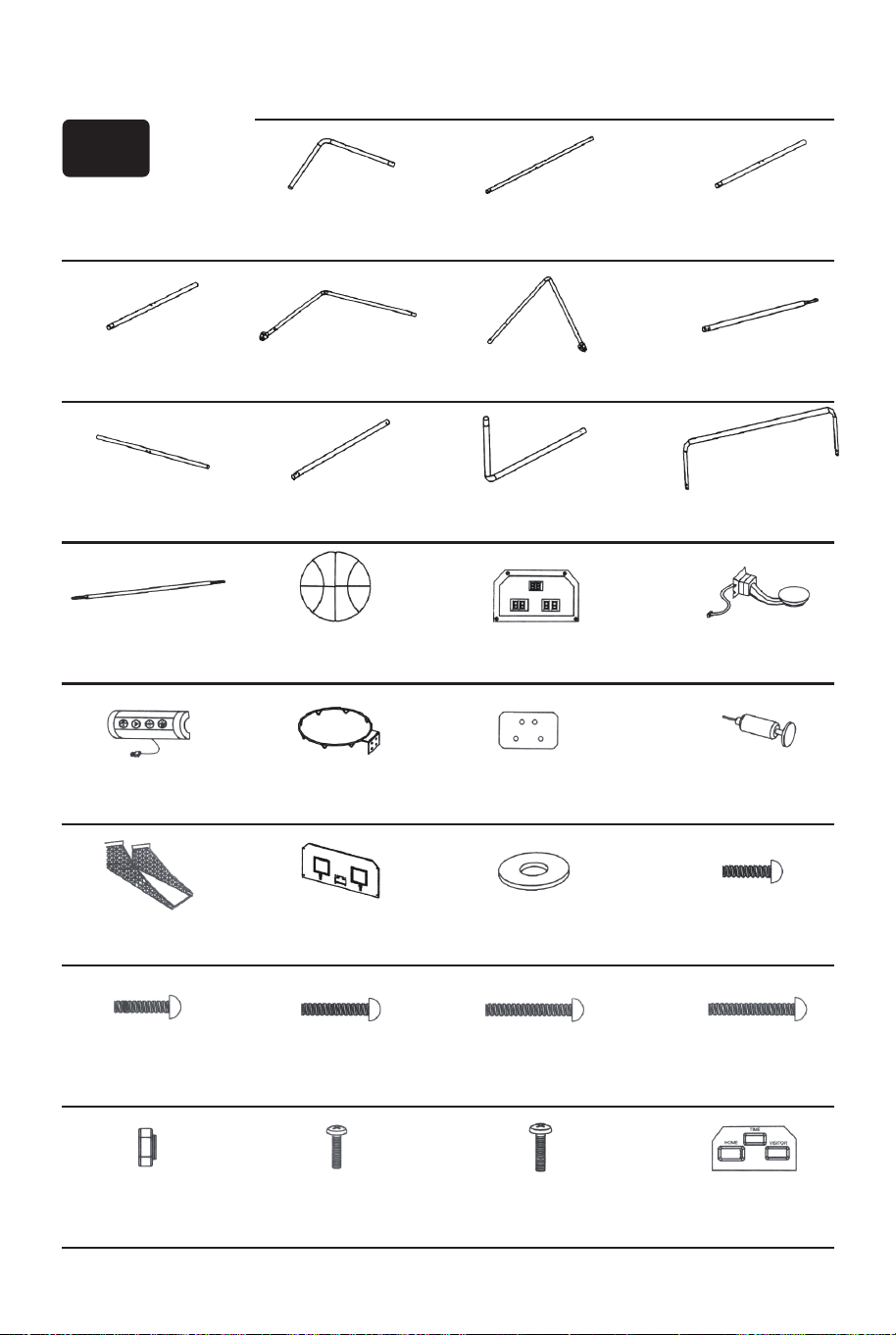
¡ATENCIÓN!
7. Left and Right Shoot (Tiro a la Izquierda y a la Derecha)
Presione "PLAY" para entrar en el juego 7.
Presione "UP/DOWN" para seleccionar uno o varios jugadores (P1/P2/P3/P4).
Presione "PLAY" después de seleccionar el número de jugador.
Presione "UP/DOWN" para seleccionar el tiempo de juego, 30/45/60 segundos.
Presione "PLAY" para comenzar el juego.
El marcador "HOME" muestra el jugador, el "VISITOR" muestra los puntos.
Realice un tiro en el marco "HOME" cuando el LED esté parpadeando en "HOME", se
mostrarán 2 puntos anotados en "HOME".
Realice un tiro en el marco "VISITOR" cuando el LED esté parpadeando en "VISITOR", se
mostrarán 2 puntos anotados en "VISITOR".
Cuenta atrás de 5 segundos para el turno del siguiente jugador cuando un jugador termina el
juego.
El jugador con más puntos anotados gana (el LED parpadeará en el jugador con mayor
puntuación).
Presione "PLAY" para reiniciar el juego.
8. One to One (Uno a Uno)
Presione "PLAY" para entrar en el juego 8.
Presione "UP/DOWN" para seleccionar uno o varios jugadores (P1/P2/P3/P4).
Presione "PLAY" después de seleccionar el número de jugadores.
Presione "UP/DOWN" para seleccionar el tiempo de juego, 30/45/60 segundos.
Presione "PLAY" para comenzar el juego.
El marcador "HOME" muestra al jugador 1, 3; el marcador "VISITOR" muestra al jugador 2, 4.
Todos los tiros valen 2 puntos hasta los últimos 10 segundos, cada puntuación cuenta 3 puntos.
Cuenta atrás de 5 segundos para el turno del siguiente jugador cuando un jugador termina el
juego.
El jugador con más puntos anotados gana (el LED parpadeará en el jugador con mayor
puntuación).
Presione "PLAY" para reiniciar el juego.
Los cambios o modificaciones que no hayan sido expresamente aprobados por
la parte responsable del cumplimiento podrían anular la autoridad del usuario
para operar el equipo.
La operación está sujeta a las dos condiciones siguientes:
(1) Este dispositivo no debe causar interferencias perjudiciales.
(2) Este dispositivo debe aceptar cualquier interferencia recibida, incluidas las
interferencias que puedan causar un funcionamiento no deseado.
Tubo-1 Tubo-2
Ø22x580x440mm
Tubo-5
Ø22x755x580mm
Tubo-6
Ø22x755x580mm
Tubo-10
Ø22x650x385mm
Tubo-11
Ø22x1067x520mm
Ø22x685mm Ø22x890mm
Tubo-3
Ø22x830mm
Tubo-7
Ø22x890mm
Tubo-4
Ø22x835mm
Tubo-8
Ø12,7x1090mm
Tubo-12
Ø22x595mm
Tubo-9
Pallacanestro 17 cm
di diametro
Tabellone Elettronico
Cerchio
Piastra di supporto
di cerchio
Rondella M6 Bullone M6x20mm
Sensore di interruttore
Pompa di gonfiaggio
con l'ago
Scatola di controllo con cavo
Rete di Pallacanestro
di Ritorno
Bullone M6x29mm
Cruscotto posteriore
Bullone M6x42mm Bullone M6x50mm
Bullone 4x28mm
Mascherina marcatore
elettronica
Bullone M6x35mm
Dado M6
Bullone 3,5x10mm
1 x2 2 x2 3 x1
4 x1
5 x1 6 x1 7 x2
8 x2
9 x2 10 x2 11 x1
12 x3
13 x4
14 x1
15 x2
16 x1
21 x1 22 x46 23 x16
24 x6
25 x4 26 x4 27 x2
28 x32
29 x4 30 x2 31 x1
17 x2
18 x2 19 x1
20 x1
IT
64 65
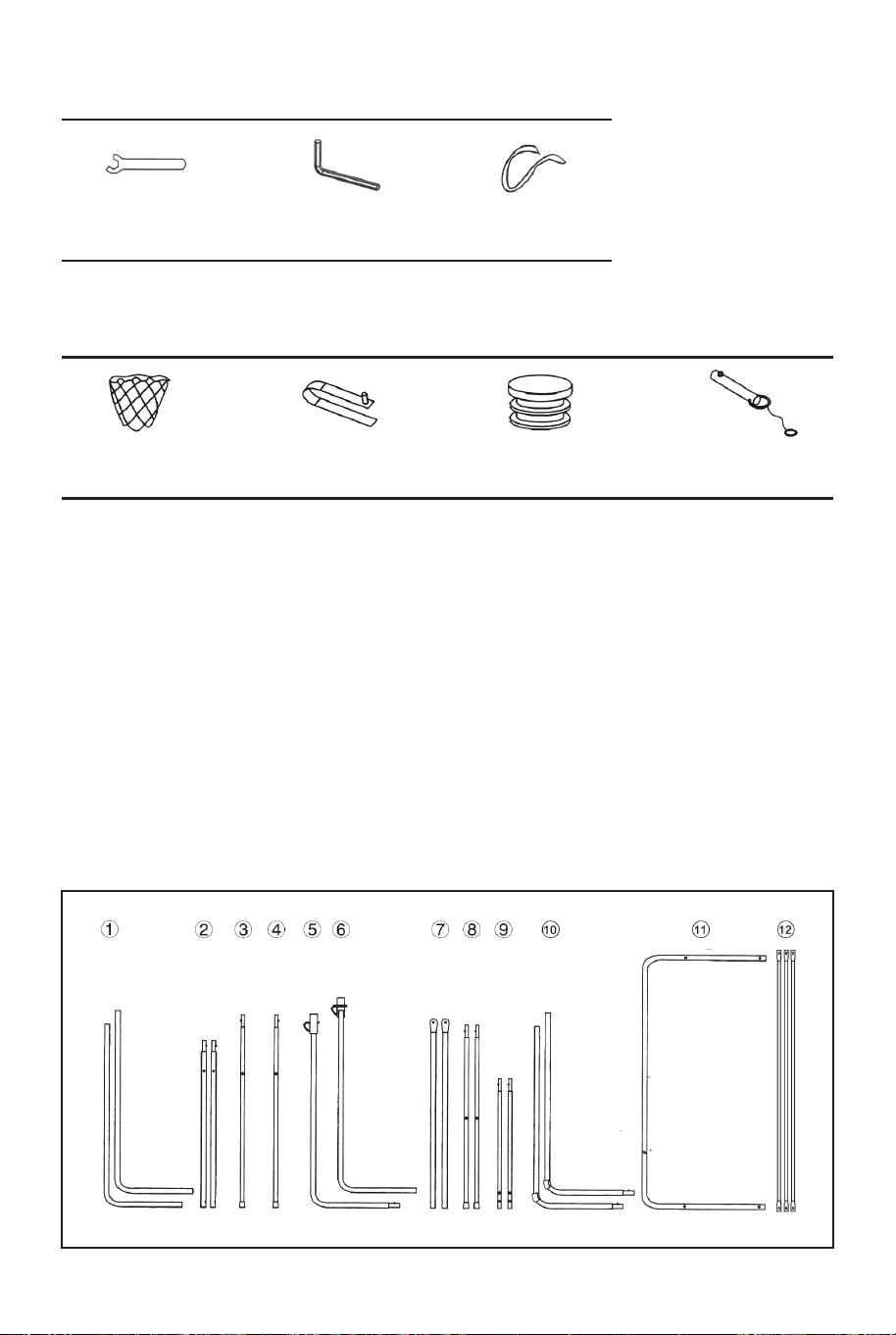
ISTRUZIONI DI MONTAGGIO:
Chiave
32 x1
Chiave a brugola
33 x1
Cinturino autoadesivo
34 x2
Rete
P1 x2
Blocco a molla
P2 x9
Inserto palo in plastica
P3 x2
Perno di blocco
P4 x2
PARTI PREINSTALLATE
PRIMA DEL MONTAGGIO - Si prega di ispezionare e
distribuire tutti i pali e le parti.
1. Trovare un posto pulito e pianeggiante per iniziare ad assemblare il prodotto.
Raccomandiamo che due adulti lavorino insieme per assemblare questo prodotto.
2. Rimuovere tutte le parti dalla casella e verificare di avere tutte le parti elencate nella
pagina dell'elenco delle parti. Tagliare o strappare con cura i quattro angoli della
scatola in modo che il fondo della scatola possa essere utilizzato come superficie di
lavoro
FIG.1 & 2
3. Collegare i tubi-2 (#2) al tubo-3 e al tubo-4 (#3 e #4) usando il blocco a molla
(preinstallato) come mostrato in FIG.1.
4. Collegare i tubi-7 (#7) ai tubi-8 (#8) usando il blocco a molla (preinstallato) come
mostrato in FIG.2
FIG.3
5. Collegare il tubo-5 e il tubo-6 (#5 e #6) insieme usando il blocco a molla
(preinstallato) come mostrato in FIG.3.
FIG.1
FIG.2
FIG.3
Blocco a molla
P2
Blocco a molla
P2
Blocco a molla
P2
66 67
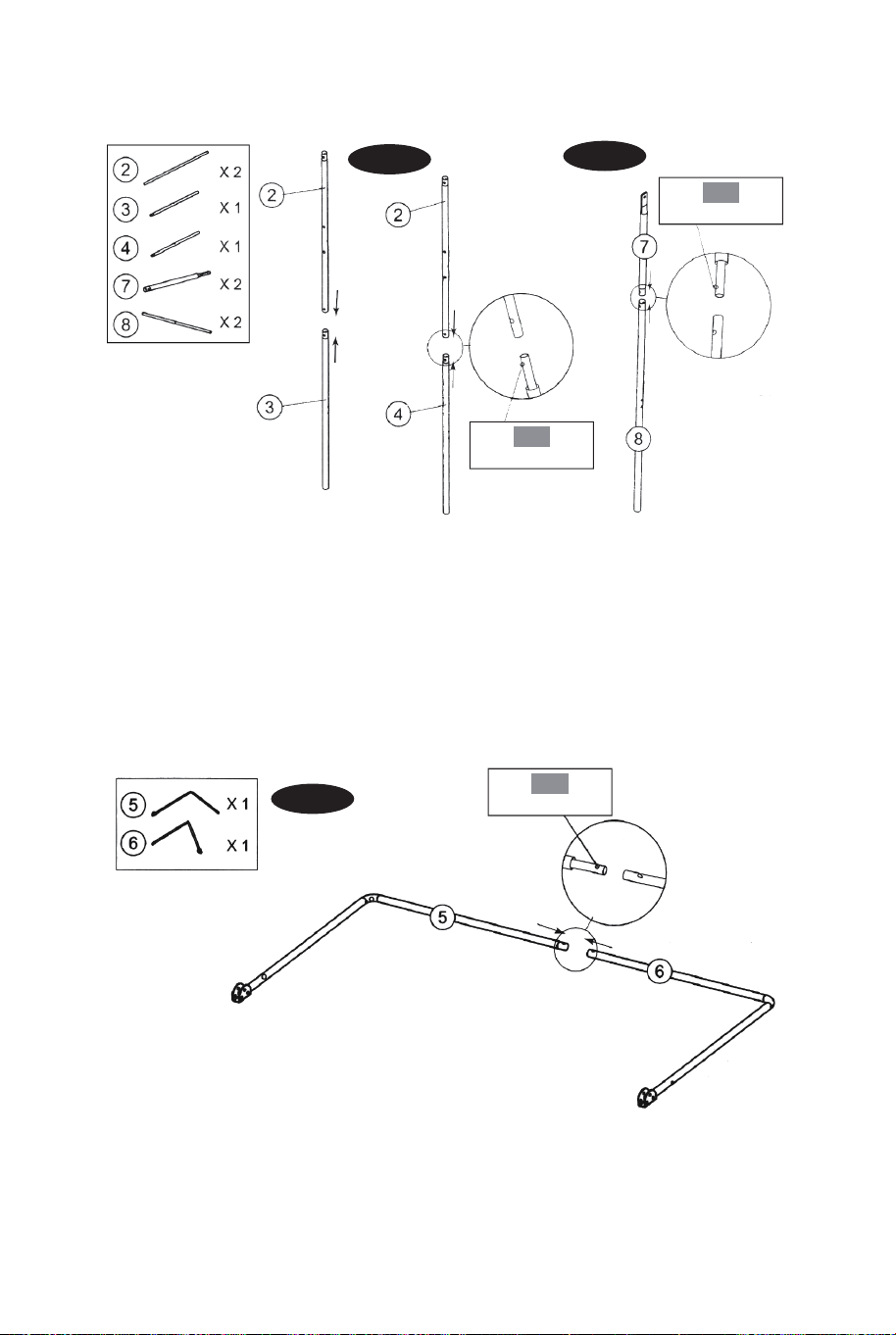
ISTRUZIONI DI MONTAGGIO:
Chiave
32 x1
Chiave a brugola
33 x1
Cinturino autoadesivo
34 x2
Rete
P1 x2
Blocco a molla
P2 x9
Inserto palo in plastica
P3 x2
Perno di blocco
P4 x2
PARTI PREINSTALLATE
PRIMA DEL MONTAGGIO - Si prega di ispezionare e
distribuire tutti i pali e le parti.
1. Trovare un posto pulito e pianeggiante per iniziare ad assemblare il prodotto.
Raccomandiamo che due adulti lavorino insieme per assemblare questo prodotto.
2. Rimuovere tutte le parti dalla casella e verificare di avere tutte le parti elencate nella
pagina dell'elenco delle parti. Tagliare o strappare con cura i quattro angoli della
scatola in modo che il fondo della scatola possa essere utilizzato come superficie di
lavoro
FIG.1 & 2
3. Collegare i tubi-2 (#2) al tubo-3 e al tubo-4 (#3 e #4) usando il blocco a molla
(preinstallato) come mostrato in FIG.1.
4. Collegare i tubi-7 (#7) ai tubi-8 (#8) usando il blocco a molla (preinstallato) come
mostrato in FIG.2
FIG.3
5. Collegare il tubo-5 e il tubo-6 (#5 e #6) insieme usando il blocco a molla
(preinstallato) come mostrato in FIG.3.
FIG.1
FIG.2
FIG.3
Blocco a molla
P2
Blocco a molla
P2
Blocco a molla
P2
66 67
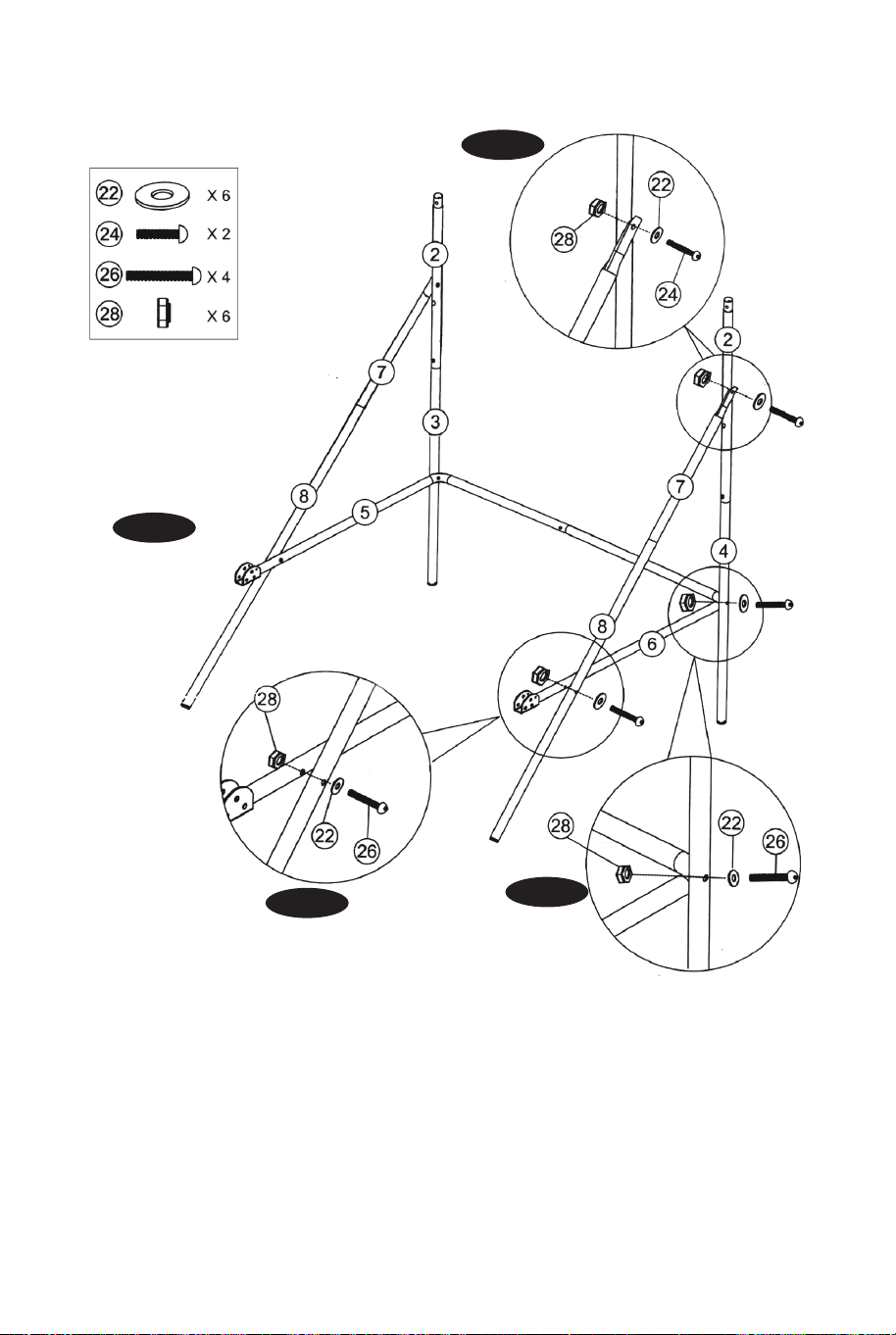
FIG.4
6. Collegare il tubo-5 e il tubo-6 (#5 e #6) al tubo-3 e al tubo-4 (#3 e #4) usando bulloni
(#26), rondelle (#22) e dadi (#28), quindi collegare il tubo-5 e il tubo-6 (#5 e #6) ai
tubi-8 (#8) usando bulloni (#26), rondelle (#22) e dadi (#28) come mostrato in FIG.4,
4A e 4B.
7. Collegare i tubi-7 e i tubi-8 (#7 e #8) ai tubi-2 (#2) usando il bullone (#24), la rondella
(#22) e il dado (#28) come mostrato in FIG.4C, ripetere questo passaggio per l'altro
lato.
Nota: assicurarsi che il blocco a molla sia rivolto verso il basso.
FIG. 4
FIG. 4C
FIG. 4B
FIG. 4A
FIG.5
8. Collegare il tubo-12 (#12) ai tubi-2 (#2) usando i bulloni (#24), le rondelle (#22) e i
dadi (#28) come mostrato in FIG.5A. E poi inserire i tubi-1 (#1) nei tubi-2 (#2) come
mostrato in FIG.5.
9. Collegare i tubi-9 (#9) al tubo-5 e al tubo-6 (#5 e #6) usando bulloni (#27), rondelle
(#22) e dadi (#28) come mostrato in FIG.5 e 5B.
FIG. 5A
FIG. 5B
FIG. 5
68 69
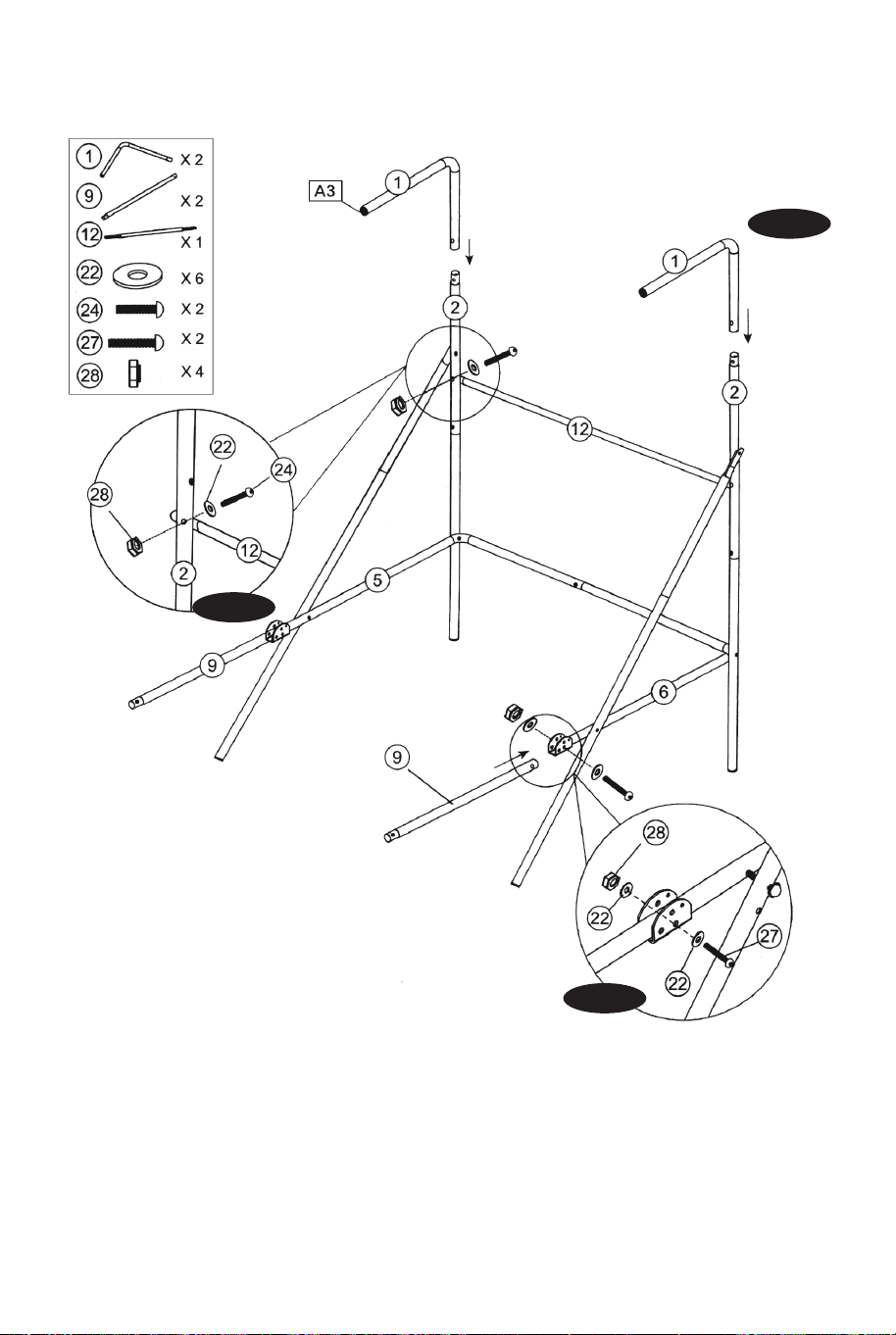
FIG.4
6. Collegare il tubo-5 e il tubo-6 (#5 e #6) al tubo-3 e al tubo-4 (#3 e #4) usando bulloni
(#26), rondelle (#22) e dadi (#28), quindi collegare il tubo-5 e il tubo-6 (#5 e #6) ai
tubi-8 (#8) usando bulloni (#26), rondelle (#22) e dadi (#28) come mostrato in FIG.4,
4A e 4B.
7. Collegare i tubi-7 e i tubi-8 (#7 e #8) ai tubi-2 (#2) usando il bullone (#24), la rondella
(#22) e il dado (#28) come mostrato in FIG.4C, ripetere questo passaggio per l'altro
lato.
Nota: assicurarsi che il blocco a molla sia rivolto verso il basso.
FIG. 4
FIG. 4C
FIG. 4B
FIG. 4A
FIG.5
8. Collegare il tubo-12 (#12) ai tubi-2 (#2) usando i bulloni (#24), le rondelle (#22) e i
dadi (#28) come mostrato in FIG.5A. E poi inserire i tubi-1 (#1) nei tubi-2 (#2) come
mostrato in FIG.5.
9. Collegare i tubi-9 (#9) al tubo-5 e al tubo-6 (#5 e #6) usando bulloni (#27), rondelle
(#22) e dadi (#28) come mostrato in FIG.5 e 5B.
FIG. 5A
FIG. 5B
FIG. 5
68 69
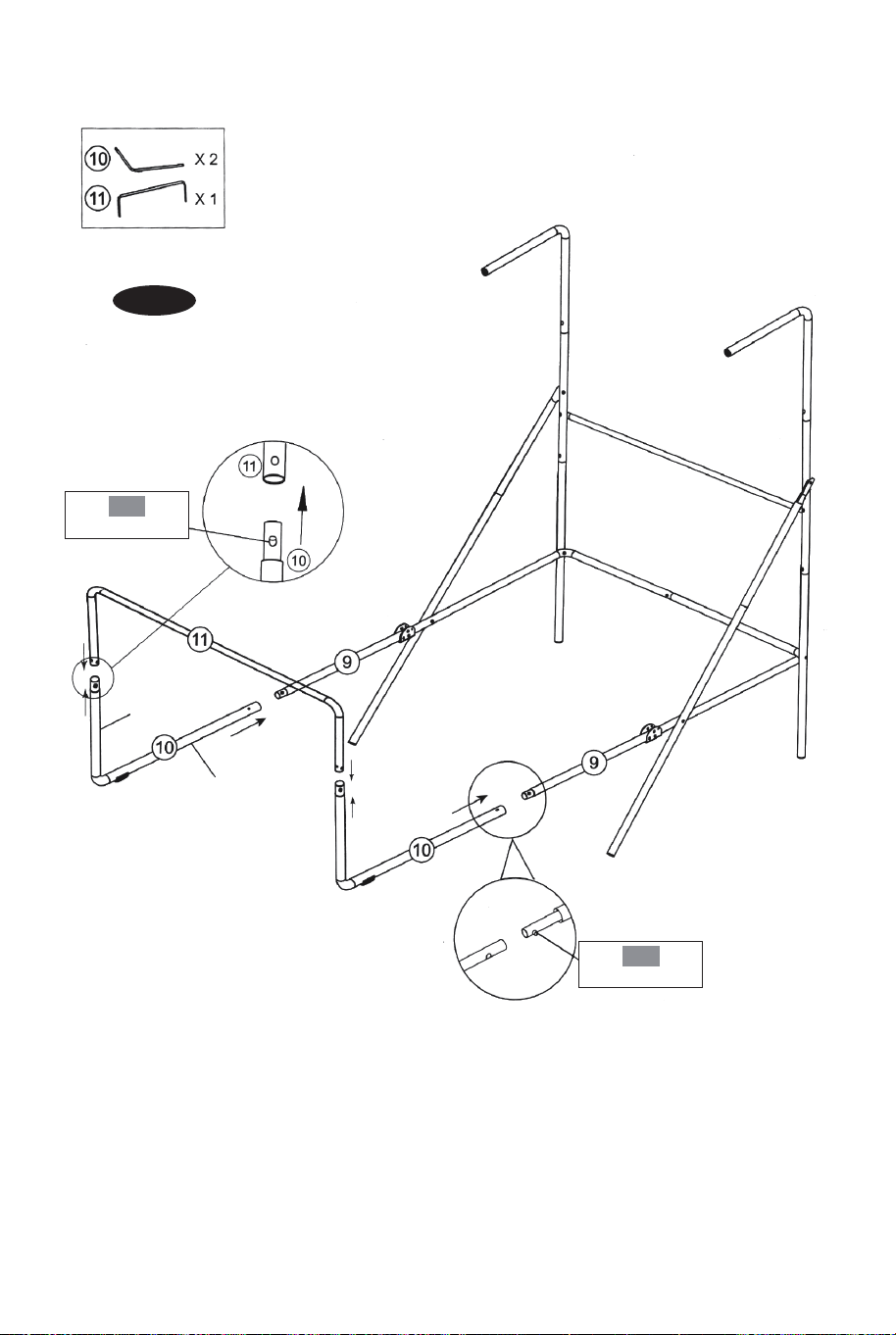
FIG.6
10. Collegare i tubi-10 (#10) ai tubi-9 (#9) usando il blocco a molla (preinstallato), quindi
collegare il tubo-11 (#11) ai tubi-10 (#10) usando il blocco a molla (preinstallato) come
mostrato in FIG.6.
FIG.6
Blocco a molla
P2
Blocco a molla
P2
Corto
Lungo
FIG.7
11. Attaccare gli anelli (#17) e le piastre di supporto dell'anello (#18) alla scheda
posteriore (#21) usando i bulloni (#23), le rondelle (#22) e i dadi (#28). Quindi,
collegare i sensori dell'interruttore (# 15) al cruscotto posteriore (# 21) usando i bulloni
(# 23), le rondelle (# 22) e i dadi (# 28). Assicurati di utilizzare le rondelle su entrambi
i lati della tavola come mostrato in FIG.7.
FIG.8
12. Fissare la mascherina del marcatore elettronico (#31) alla parte anteriore del
cruscotto posteriore e collegarla al marcatore elettronico (#14) utilizzando i bulloni
(#29) come mostrato in FIG.8.
FIG.7
FIG.8
70 71
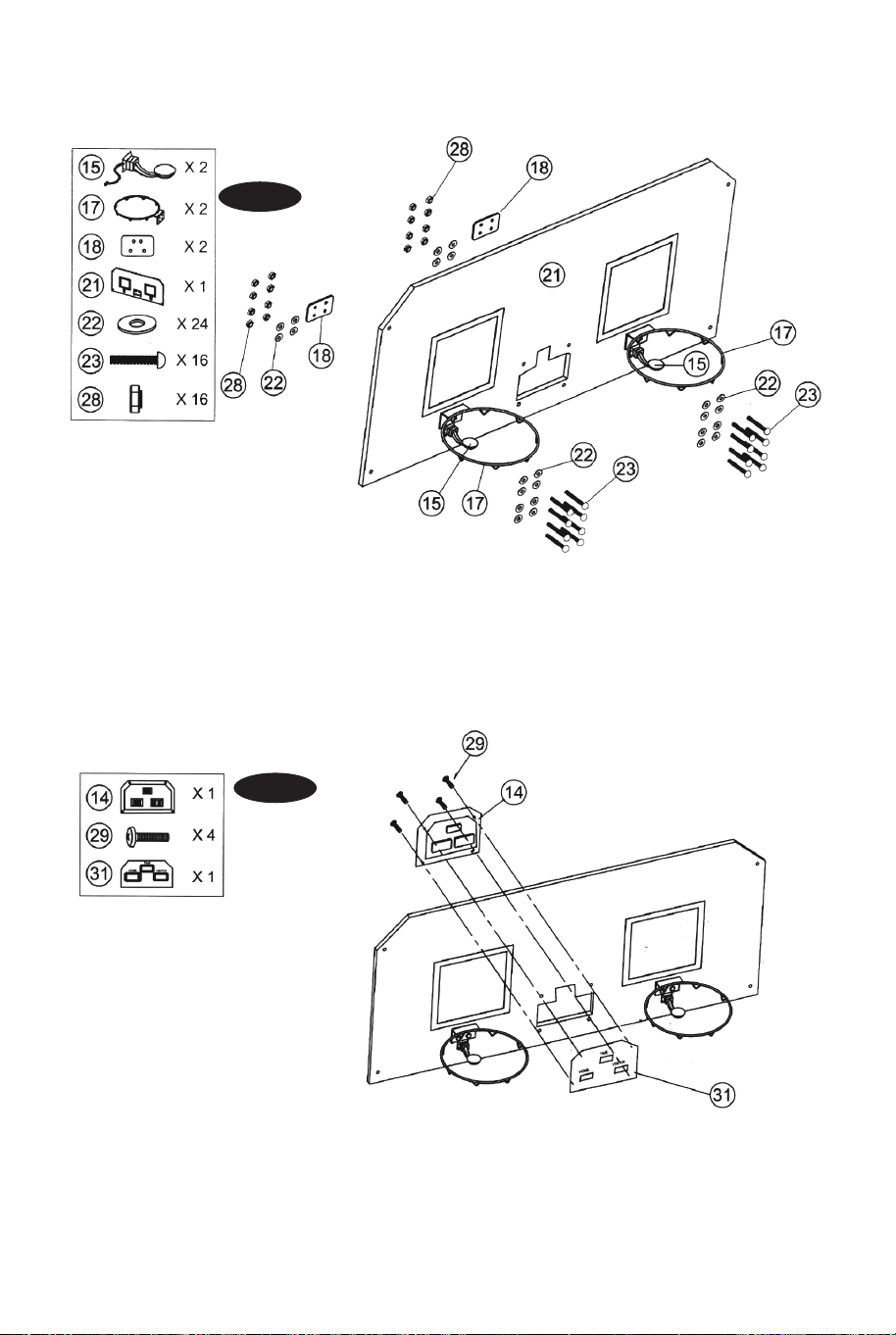
FIG.6
10. Collegare i tubi-10 (#10) ai tubi-9 (#9) usando il blocco a molla (preinstallato), quindi
collegare il tubo-11 (#11) ai tubi-10 (#10) usando il blocco a molla (preinstallato) come
mostrato in FIG.6.
FIG.6
Blocco a molla
P2
Blocco a molla
P2
Corto
Lungo
FIG.7
11. Attaccare gli anelli (#17) e le piastre di supporto dell'anello (#18) alla scheda
posteriore (#21) usando i bulloni (#23), le rondelle (#22) e i dadi (#28). Quindi,
collegare i sensori dell'interruttore (# 15) al cruscotto posteriore (# 21) usando i bulloni
(# 23), le rondelle (# 22) e i dadi (# 28). Assicurati di utilizzare le rondelle su entrambi
i lati della tavola come mostrato in FIG.7.
FIG.8
12. Fissare la mascherina del marcatore elettronico (#31) alla parte anteriore del
cruscotto posteriore e collegarla al marcatore elettronico (#14) utilizzando i bulloni
(#29) come mostrato in FIG.8.
FIG.7
FIG.8
70 71
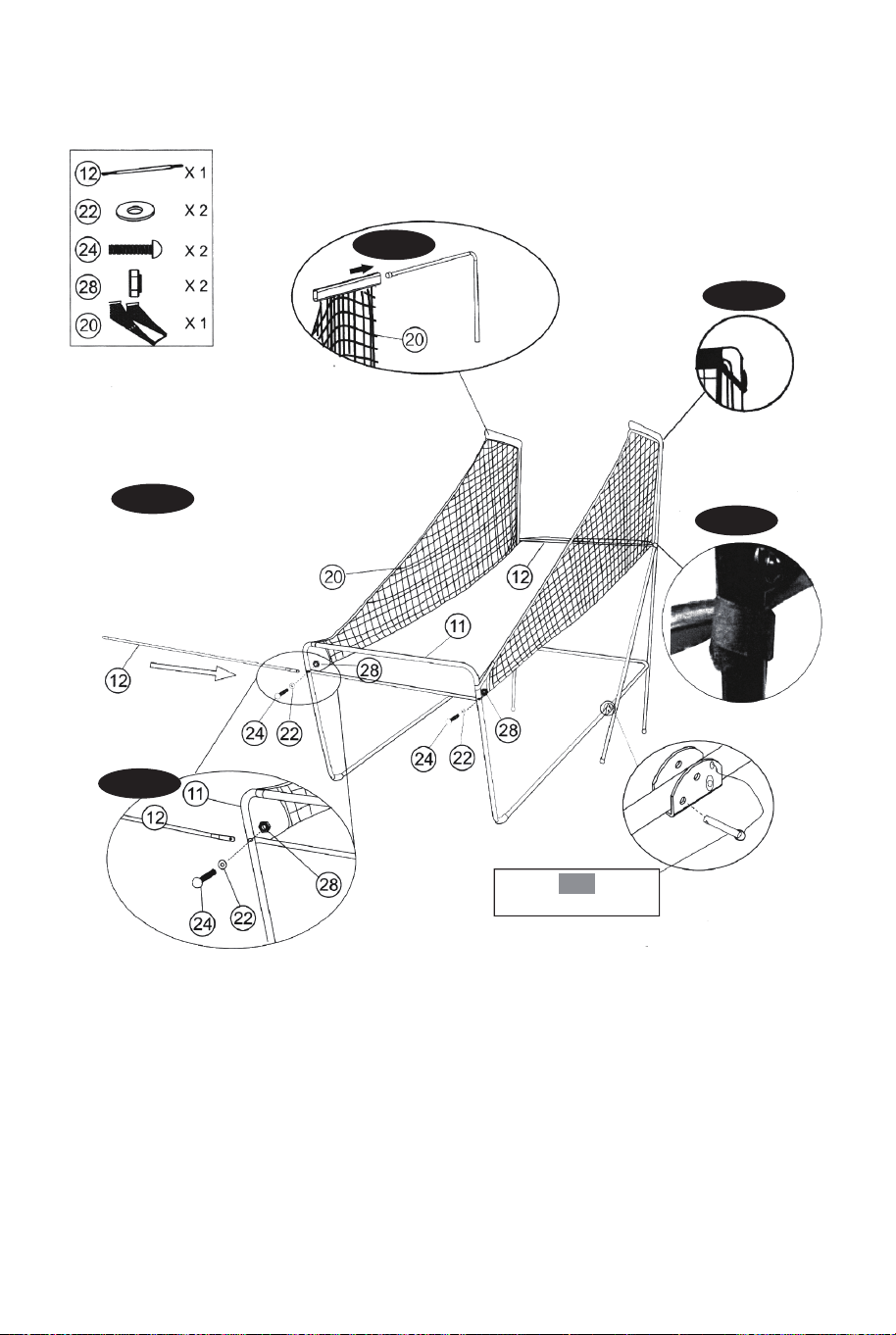
FIG.9
13. Far scorrere le cinghie elastiche e la manica della rete di ritorno da basket (#20) nei
tubi-1 (#1) come mostrato in FIG.9A, 9B e 9C.
14. Far scorrere il tubo-12 (#12) attraverso la manica nella parte anteriore della rete di
ritorno del pallone da basket (#20), fissare prima sul lato sinistro usando i bulloni
(#24), le rondelle (#22) e i dadi (#28) come mostrato in FIG.9D. Seguire la stessa
procedura sul lato destro.
FIG.9A
FIG.9B
FIG.9C
FIG.9D
FIG.9
Perno di blocco
P4
16. Collegare il perno di bloccaggio (#P4) al tubo-5 e al tubo-6 (#5 e #6) e inserirlo nel
tubo-5 e nel tubo-6 (#5 e #6) come mostrato in FIG.10C.
72 73
FIG.10
15.
P1
Con l'aiuto di un altro adulto, attaccare il Pannello Posteriore (#21) ai Tubi Superiori 1
(#1) con Bulloni (#25), Rondelle (#22) e Dadi (#28) come mostrato in FIG.10A. Fare
scivolare Tubo 12 (#12) attraverso la manica sul retro del Canestro di Ritorno della Palla
(#20), come mostrato in FIG.10B. Ad ogni foro inferiore del pannello posteriore, attaccare
prima il lato sinistro con Bulloni (#25), Rondelle (#22), Dadi (#28) come mostrato in
FIG.10C. Seguire la stessa procedura per il lato destro.
FIG.10B
Perno di Bloccaggio
P4
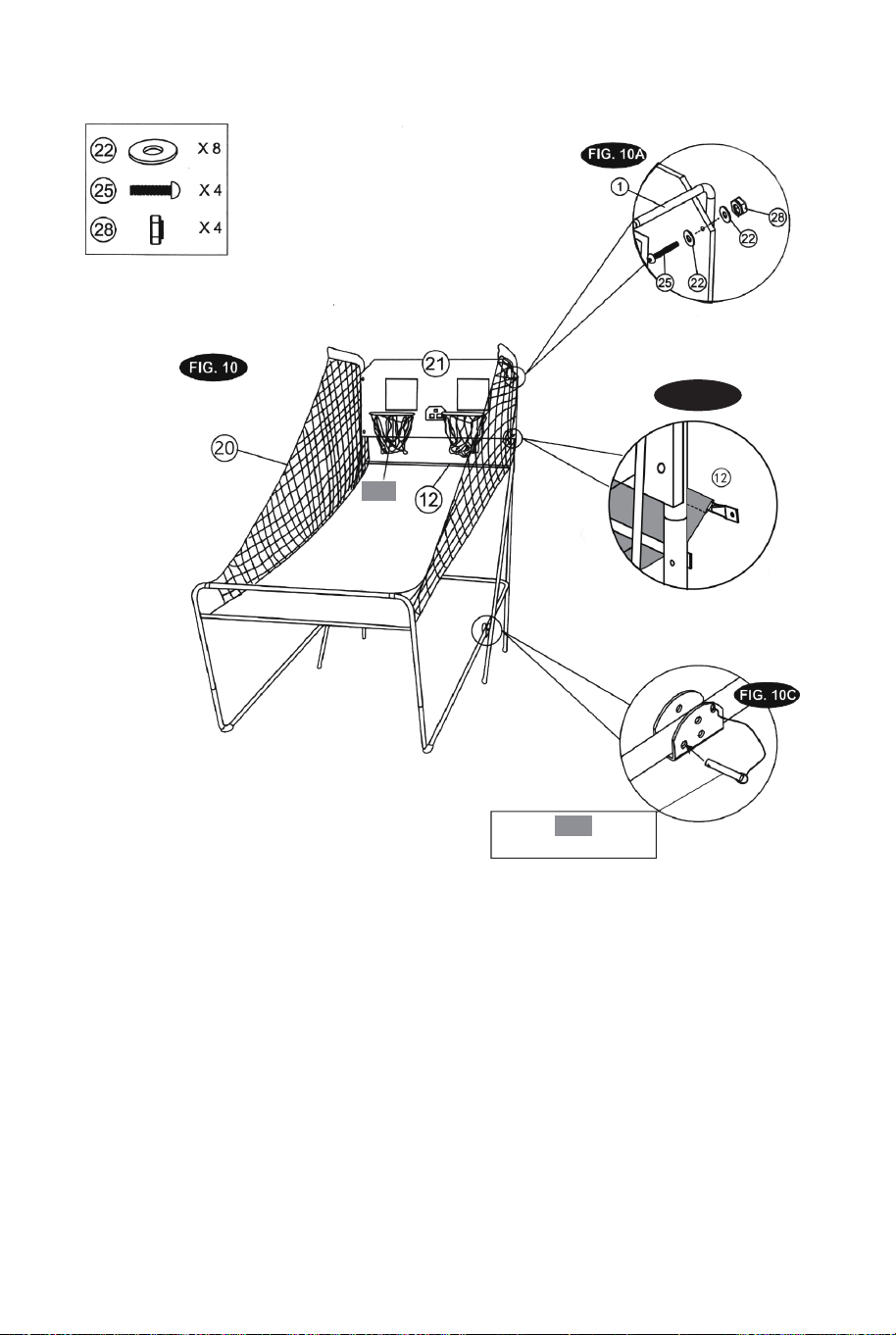
FIG.9
13. Far scorrere le cinghie elastiche e la manica della rete di ritorno da basket (#20) nei
tubi-1 (#1) come mostrato in FIG.9A, 9B e 9C.
14. Far scorrere il tubo-12 (#12) attraverso la manica nella parte anteriore della rete di
ritorno del pallone da basket (#20), fissare prima sul lato sinistro usando i bulloni
(#24), le rondelle (#22) e i dadi (#28) come mostrato in FIG.9D. Seguire la stessa
procedura sul lato destro.
FIG.9A
FIG.9B
FIG.9C
FIG.9D
FIG.9
Perno di blocco
P4
16. Collegare il perno di bloccaggio (#P4) al tubo-5 e al tubo-6 (#5 e #6) e inserirlo nel
tubo-5 e nel tubo-6 (#5 e #6) come mostrato in FIG.10C.
72 73
FIG.10
15.
P1
Con l'aiuto di un altro adulto, attaccare il Pannello Posteriore (#21) ai Tubi Superiori 1
(#1) con Bulloni (#25), Rondelle (#22) e Dadi (#28) come mostrato in FIG.10A. Fare
scivolare Tubo 12 (#12) attraverso la manica sul retro del Canestro di Ritorno della Palla
(#20), come mostrato in FIG.10B. Ad ogni foro inferiore del pannello posteriore, attaccare
prima il lato sinistro con Bulloni (#25), Rondelle (#22), Dadi (#28) come mostrato in
FIG.10C. Seguire la stessa procedura per il lato destro.
FIG.10B
Perno di Bloccaggio
P4
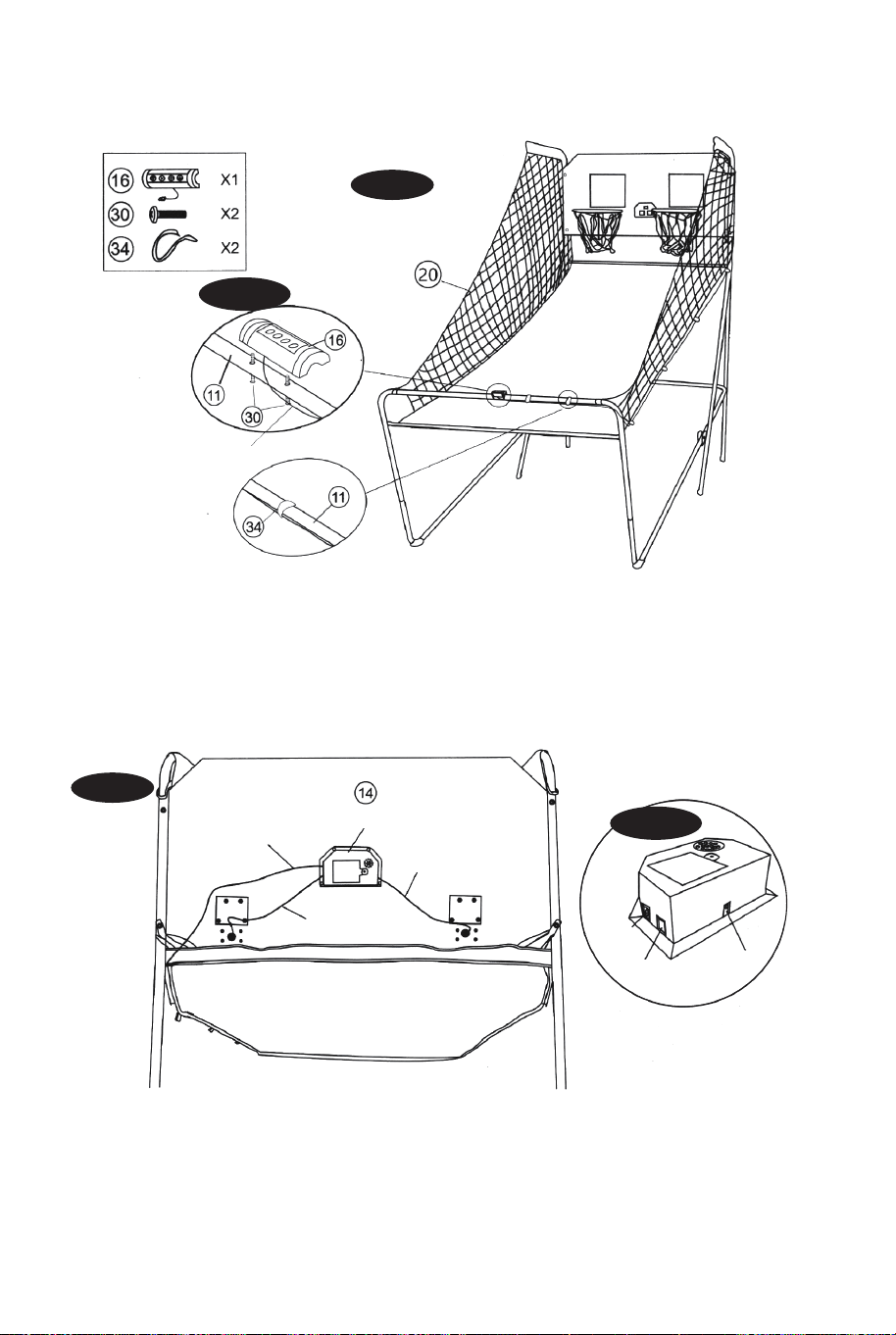
FIG.11
17. Collegare la scatola di controllo (#16) al centro del tubo-11 (#11) usando due bulloni
(#30) come mostrato in FIG.11A.
18. Passare il resto del cavo di controllo attraverso i loop della rete di ritorno del basket
(#20). Posizionare il cavo di controllo nel tubo-11 (#11) utilizzando le cinghie
autoadesive (#34) come mostrato in FIG.11.
FIG.12
19. Collegare il cavo del sensore dal sensore dell'interruttore (#15) al marcatore
elettronico (#14) come mostrato in FIG.12. Collegare il cavo di controllo al dialer
elettronico (#14) come mostrato in FIG.12 e 12A.
FIG.11
FIG.12
FIG.11A
FIG.12A
Scatola di controllo
Cavo di controllo
Cavo di controllo
CAVO DI
CONTROLLO
Tabellone elettronico
Cavo di sensore
Cavo sensore
VISITATORE
ACCESO
/SPENTO
FIG.13
20. Piegare la macchina da tiro da basket quando non è in uso e inserire il perno di
bloccaggio (#P4) come mostrato in FIG.13.
Nota: il perno di bloccaggio (#P4) deve essere rimosso dalla sua posizione originale
quando la macchina viene utilizzata prima di essere inserito nella nuova posizione
una volta piegato.
FIG.13
Perno di blocco
P4
IMPORTANTE!
Assicurati di utilizzare il perno di
bloccaggio (#P4) quando si piega.
74 75
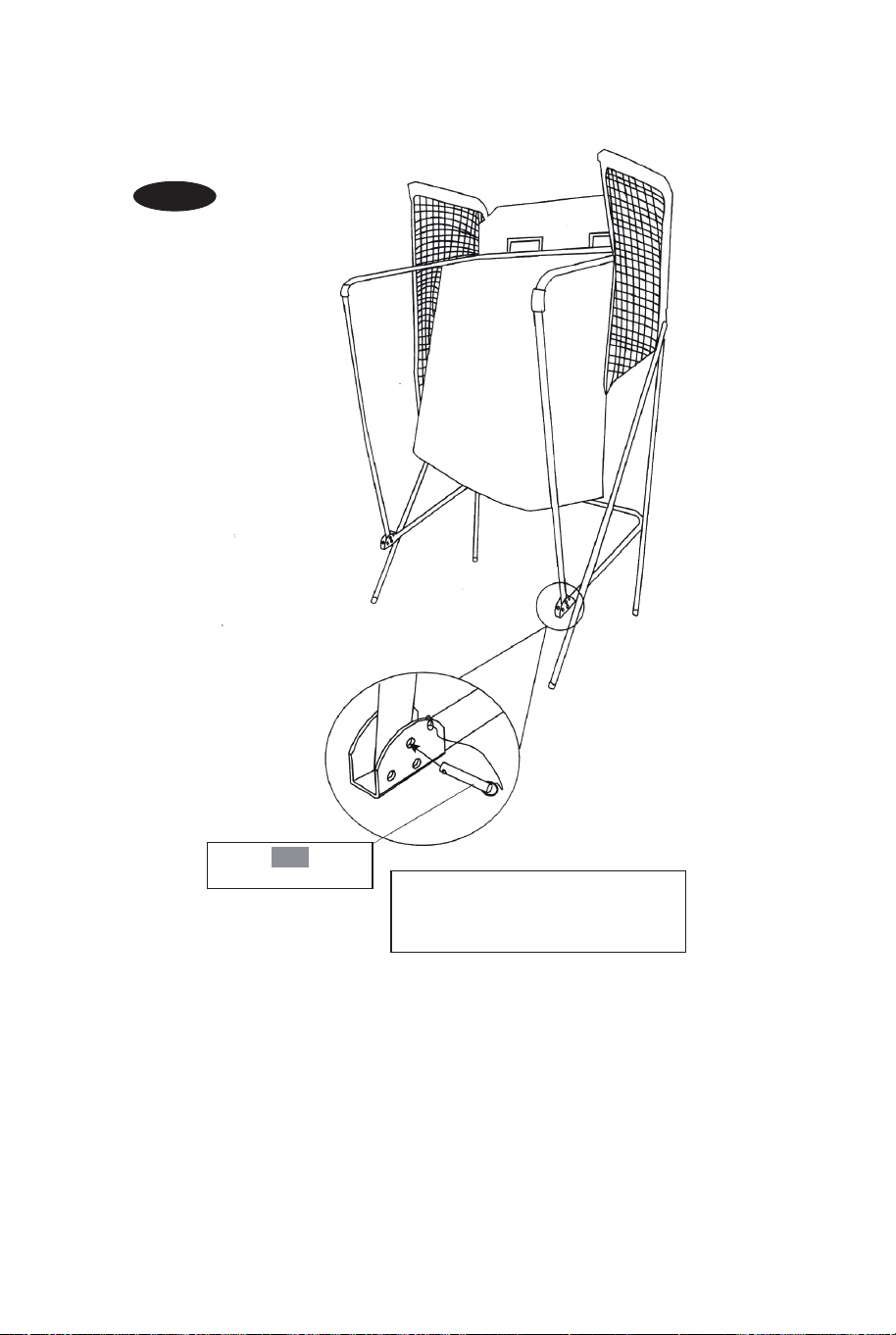
FIG.11
17. Collegare la scatola di controllo (#16) al centro del tubo-11 (#11) usando due bulloni
(#30) come mostrato in FIG.11A.
18. Passare il resto del cavo di controllo attraverso i loop della rete di ritorno del basket
(#20). Posizionare il cavo di controllo nel tubo-11 (#11) utilizzando le cinghie
autoadesive (#34) come mostrato in FIG.11.
FIG.12
19. Collegare il cavo del sensore dal sensore dell'interruttore (#15) al marcatore
elettronico (#14) come mostrato in FIG.12. Collegare il cavo di controllo al dialer
elettronico (#14) come mostrato in FIG.12 e 12A.
FIG.11
FIG.12
FIG.11A
FIG.12A
Scatola di controllo
Cavo di controllo
Cavo di controllo
CAVO DI
CONTROLLO
Tabellone elettronico
Cavo di sensore
Cavo sensore
VISITATORE
ACCESO
/SPENTO
FIG.13
20. Piegare la macchina da tiro da basket quando non è in uso e inserire il perno di
bloccaggio (#P4) come mostrato in FIG.13.
Nota: il perno di bloccaggio (#P4) deve essere rimosso dalla sua posizione originale
quando la macchina viene utilizzata prima di essere inserito nella nuova posizione
una volta piegato.
FIG.13
Perno di blocco
P4
IMPORTANTE!
Assicurati di utilizzare il perno di
bloccaggio (#P4) quando si piega.
74 75
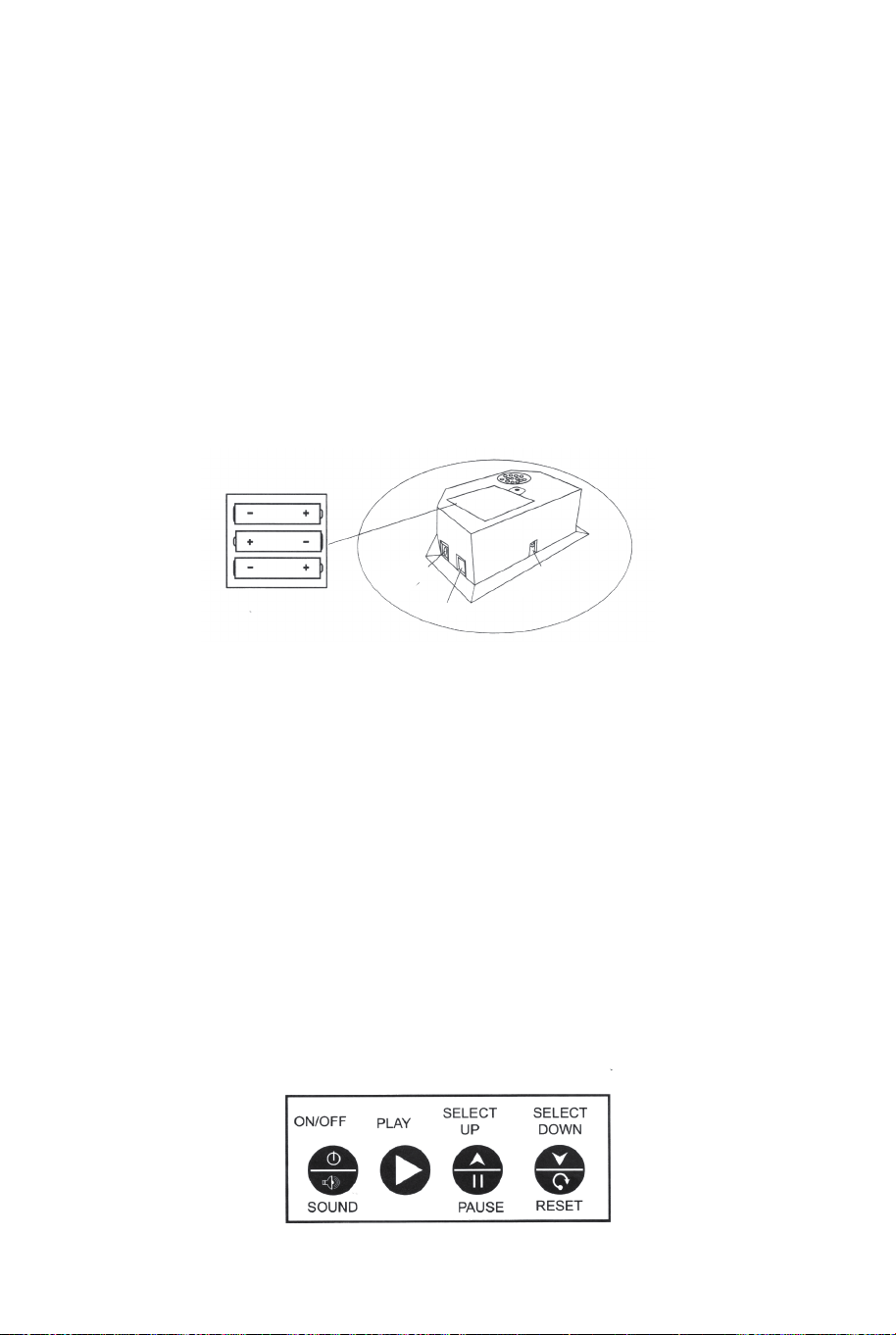
FUNZIONAMENTO DEL QUADRO DI VALUTAZIONE ELETTRONICO
Vano di Scatola: svitare il bullone con un cacciavite e aprire la scatola della batteria.
Inserire 3 batterie "AA" (non incluse) nell'ordine di polarità indicato sul coperchio
interno. Quindi, chiudere il coperchio con un cacciavite. Accendere il prodotto con
l'interruttore ON/OFF.
Premere "ON/OFF" per attivare il dialer.
Il marcatore "HOME" ("LOCAL") visualizza "01" (gioco preimpostato 1).
Premere "SELEZIONA SU e GIÙ" per selezionare un gioco.
Premere "PLAY" per accedere alla modalità di gioco selezionata.
Premere "SOUND" per attivare / disattivare il suono durante il gioco.
Premere "PAUSA" per mettere in pausa o avviare il conteggio del tempo.
Tenere premuto il pulsante "ON / OFF" per 3 secondi per spegnere il tabellone.
Tenere premuto il pulsante "RESET" per 3 secondi per riavviare i giochi.
Nota: se non viene effettuato alcun colpo o non viene premuto alcun pulsante entro 15
minuti, il marcatore si spegne automaticamente.
1) Richiede 3 batterie "AA" (non incluse).
2) Non mescolare batterie vecchie e nuove.
3) Non miscelare batterie alcaline, standard (carbonio-zinco) o sostituibili
(nichel-cadmio).
Installare le Batterie
a. Le batterie devono essere installate in base alla corretta polarità (+ e -) richiesta.
b. Si prega di pulire i contatti delle batterie e anche quelli dei dispositivi prima di
installare le batterie.
c. Se il prodotto non deve essere utilizzato per un lungo periodo di tempo, si consiglia di
rimuovere le batterie.
Suggerimento:
AVVERTIMENTO
FUNZIONAMENTO DELLA SCATOLA DI CONTROLLO
CAVO DI
CONTROLLO
ACCESO/SPENTO
VISITATORE
1. Beat the Time Clock
Premi "PLAY" per accedere al gioco 1.
Premere "SU/GIÙ" per selezionare uno o più giocatori (P1/P2/P3/P4).
Premi "PLAY" dopo aver selezionato il numero di giocatori.
Premere "SU / GIÙ" per selezionare il tempo di riproduzione, 30/45/60 secondi.
Premi "PLAY" per avviare il gioco.
Il marcatore "HOME" mostra il giocatore 1, 3; il marcatore "VISITATORE" mostra il giocatore
2, 4.
Tutti i tiri valgono 2 punti fino agli ultimi 10 secondi, ogni punteggio conta 3 punti.
Conto alla rovescia di 5 secondi per il turno del giocatore successivo quando un giocatore
termina il gioco.
Il giocatore con il maggior numero di punti segnati vince (il LED lampeggerà sul giocatore con
il punteggio più alto).
Premi "PLAY" per riavviare il gioco.
2. 3-Point Beat the Time Clock
Premi "PLAY" per accedere al gioco 2.
Premere "SU/GIÙ" per selezionare uno o più giocatori (P1/P2/P3/P4).
Premi "PLAY" dopo aver selezionato il numero di giocatori.
Premere "SU / GIÙ" per selezionare il tempo di riproduzione, 30/45/60 secondi.
Premi "PLAY" per avviare il gioco.
Il marcatore "HOME" mostra il giocatore 1, 3; il marcatore "VISITATORE" mostra il giocatore
2, 4.
Tutti i tiri fatti contano 3 punti.
Conto alla rovescia di 5 secondi per il turno del giocatore successivo quando un giocatore
termina il gioco.
Il giocatore con il maggior numero di punti segnati vince (il LED lampeggerà sul giocatore con
il punteggio più alto).
Premi "PLAY" per riavviare il gioco.
3. Battle Back
Premi "PLAY" per accedere al gioco 3.
Premere "SU/GIÙ" per selezionare più giocatori (P2/P4).
Premi "PLAY" per avviare il gioco.
Se lo scatto viene effettuato nel fotogramma "HOME", verranno visualizzati +2 punti sulla
scheda "HOME" e -2 punti sulla scheda "VISITOR".
Se lo scatto viene effettuato nel fotogramma "VISITOR", verranno visualizzati +2 punti sulla
scheda "VISITOR" e -2 punti sulla scheda "HOME".
Una volta che un giocatore segna 10 punti, vince e il gioco è finito.
Premi "PLAY" per riavviare il gioco.
SCEGLI TRA 8 DIVERSE OPZIONI DI GIOCO
PANNELLO DI CONTROLLO
76 77

FUNZIONAMENTO DEL QUADRO DI VALUTAZIONE ELETTRONICO
Vano di Scatola: svitare il bullone con un cacciavite e aprire la scatola della batteria.
Inserire 3 batterie "AA" (non incluse) nell'ordine di polarità indicato sul coperchio
interno. Quindi, chiudere il coperchio con un cacciavite. Accendere il prodotto con
l'interruttore ON/OFF.
Premere "ON/OFF" per attivare il dialer.
Il marcatore "HOME" ("LOCAL") visualizza "01" (gioco preimpostato 1).
Premere "SELEZIONA SU e GIÙ" per selezionare un gioco.
Premere "PLAY" per accedere alla modalità di gioco selezionata.
Premere "SOUND" per attivare / disattivare il suono durante il gioco.
Premere "PAUSA" per mettere in pausa o avviare il conteggio del tempo.
Tenere premuto il pulsante "ON / OFF" per 3 secondi per spegnere il tabellone.
Tenere premuto il pulsante "RESET" per 3 secondi per riavviare i giochi.
Nota: se non viene effettuato alcun colpo o non viene premuto alcun pulsante entro 15
minuti, il marcatore si spegne automaticamente.
1) Richiede 3 batterie "AA" (non incluse).
2) Non mescolare batterie vecchie e nuove.
3) Non miscelare batterie alcaline, standard (carbonio-zinco) o sostituibili
(nichel-cadmio).
Installare le Batterie
a. Le batterie devono essere installate in base alla corretta polarità (+ e -) richiesta.
b. Si prega di pulire i contatti delle batterie e anche quelli dei dispositivi prima di
installare le batterie.
c. Se il prodotto non deve essere utilizzato per un lungo periodo di tempo, si consiglia di
rimuovere le batterie.
Suggerimento:
AVVERTIMENTO
FUNZIONAMENTO DELLA SCATOLA DI CONTROLLO
CAVO DI
CONTROLLO
ACCESO/SPENTO
VISITATORE
1. Beat the Time Clock
Premi "PLAY" per accedere al gioco 1.
Premere "SU/GIÙ" per selezionare uno o più giocatori (P1/P2/P3/P4).
Premi "PLAY" dopo aver selezionato il numero di giocatori.
Premere "SU / GIÙ" per selezionare il tempo di riproduzione, 30/45/60 secondi.
Premi "PLAY" per avviare il gioco.
Il marcatore "HOME" mostra il giocatore 1, 3; il marcatore "VISITATORE" mostra il giocatore
2, 4.
Tutti i tiri valgono 2 punti fino agli ultimi 10 secondi, ogni punteggio conta 3 punti.
Conto alla rovescia di 5 secondi per il turno del giocatore successivo quando un giocatore
termina il gioco.
Il giocatore con il maggior numero di punti segnati vince (il LED lampeggerà sul giocatore con
il punteggio più alto).
Premi "PLAY" per riavviare il gioco.
2. 3-Point Beat the Time Clock
Premi "PLAY" per accedere al gioco 2.
Premere "SU/GIÙ" per selezionare uno o più giocatori (P1/P2/P3/P4).
Premi "PLAY" dopo aver selezionato il numero di giocatori.
Premere "SU / GIÙ" per selezionare il tempo di riproduzione, 30/45/60 secondi.
Premi "PLAY" per avviare il gioco.
Il marcatore "HOME" mostra il giocatore 1, 3; il marcatore "VISITATORE" mostra il giocatore
2, 4.
Tutti i tiri fatti contano 3 punti.
Conto alla rovescia di 5 secondi per il turno del giocatore successivo quando un giocatore
termina il gioco.
Il giocatore con il maggior numero di punti segnati vince (il LED lampeggerà sul giocatore con
il punteggio più alto).
Premi "PLAY" per riavviare il gioco.
3. Battle Back
Premi "PLAY" per accedere al gioco 3.
Premere "SU/GIÙ" per selezionare più giocatori (P2/P4).
Premi "PLAY" per avviare il gioco.
Se lo scatto viene effettuato nel fotogramma "HOME", verranno visualizzati +2 punti sulla
scheda "HOME" e -2 punti sulla scheda "VISITOR".
Se lo scatto viene effettuato nel fotogramma "VISITOR", verranno visualizzati +2 punti sulla
scheda "VISITOR" e -2 punti sulla scheda "HOME".
Una volta che un giocatore segna 10 punti, vince e il gioco è finito.
Premi "PLAY" per riavviare il gioco.
SCEGLI TRA 8 DIVERSE OPZIONI DI GIOCO
PANNELLO DI CONTROLLO
76 77

4. Horse
a. Premi "PLAY" per accedere al gioco 4.
b. Premere "SU/GIÙ" per selezionare più giocatori (P2/P3/P4).
C. Premere "PLAY" dopo aver selezionato il numero del giocatore.
d. Il giocatore deve fare un tiro in 2 secondi.
e. Il primo giocatore può lanciare a qualsiasi cerchio (Home o VISITOR). Se il primo
giocatore segna in 2 secondi, non viene data alcuna lettera.
Il gioco continua per il giocatore successivo. Il tabellone visualizzerà "prossimo giocatore
(P2 / P3 / P4)" e il LED lampeggerà due volte in un secondo.
Dopo il battito di ciglia, il giocatore successivo deve raddoppiare il tiro sullo stesso cerchio
selezionato dal primo giocatore.
f. Se il giocatore non riesce a segnare in 2 secondi, il giocatore riceve la prima lettera "H"
che verrà visualizzata sul tabellone. Il gioco viene mantenuto per lo stesso giocatore fino a
quando non segna. Se il giocatore continua a fallire, riceve "O" seguito da "R", "S", "E".
Se viene data la lettera "E", il giocatore è fuori.
g. Il primo giocatore a scrivere "CAVALLO" perde. I giocatori continuano a ripetere i
passaggi d.e.f. fino alla fine del gioco.
h. L'ultimo giocatore a scrivere "CAVALLO" vince.
i. Premi "PLAY" per riavviare il gioco.
5. Check Point
Premi "PLAY" per accedere al gioco 5.
Premere "SU/GIÙ" per selezionare uno o più giocatori (P1/P2/P3/P4).
Premi "PLAY" per avviare il gioco.
Il marcatore "HOME" mostra "player", il "VISITOR" mostra "24" punti, tempo di riproduzione
preimpostato di 40 secondi.
I punti segnati verranno visualizzati sul marcatore "HOME".
Prima che il tempo sia scaduto, una volta segnati 24/52/68/86 punti, il tempo di gioco
aumenta rispettivamente di 10/20/10/20 secondi.
Conto alla rovescia di 5 secondi per il turno del giocatore successivo quando un giocatore
termina il gioco.
Il giocatore con il maggior numero di punti segnati vince (il LED lampeggerà sul giocatore con
il punteggio più alto).
Il gioco termina quando un giocatore ottiene 98 punti.
Premi "PLAY" per riavviare il gioco.
6. Around the World
Utilizzare nastro adesivo per contrassegnare le linee di cottura.
Premi "PLAY" per accedere al gioco 6.
Premere "SU/GIÙ" per selezionare uno o più giocatori (P1/P2/P3/P4).
Premi "PLAY" dopo aver selezionato il numero del giocatore.
Il tabellone "HOME" mostra i giocatori 1/2/3/4, il "VISITOR" mostra i punti segnati.
Una volta che il punteggio raggiunge i 10 punti o il tempo raggiunge i 99 secondi, conta 5
secondi per il turno del giocatore successivo quando un giocatore termina la partita.
Il giocatore che finisce il gioco per primo vince (il LED lampeggerà sul vincitore).
Premi "PLAY" per riavviare il gioco.
ATTENZIONE!
7. Left and Right Shoot
Premi "PLAY" per accedere al gioco 7.
Premere "SU/GIÙ" per selezionare uno o più giocatori (P1/P2/P3/P4).
Premi "PLAY" dopo aver selezionato il numero del giocatore.
Premere "SU / GIÙ" per selezionare il tempo di riproduzione, 30/45/60 secondi.
Premi "PLAY" per avviare il gioco.
Il marcatore "HOME" mostra il giocatore, il "VISITOR" mostra i punti.
Fai uno scatto nel fotogramma "HOME" quando il LED lampeggia in "HOME", verranno
visualizzati 2 punti segnati in "HOME".
Scatta uno scatto nella cornice "VISITOR" quando il LED lampeggia in "VISITOR", verranno
visualizzati 2 punti segnati in "VISITOR".
Conto alla rovescia di 5 secondi per il turno del giocatore successivo quando un giocatore
termina il gioco.
Il giocatore con il maggior numero di punti segnati vince (il LED lampeggerà sul giocatore con
il punteggio più alto).
Premi "PLAY" per riavviare il gioco.
8. One to One
Premi "PLAY" per accedere al gioco 8.
Premere "SU/GIÙ" per selezionare uno o più giocatori (P1/P2/P3/P4).
Premi "PLAY" dopo aver selezionato il numero di giocatori.
Premere "SU / GIÙ" per selezionare il tempo di riproduzione, 30/45/60 secondi.
Premi "PLAY" per avviare il gioco.
Il marcatore "HOME" mostra il giocatore 1, 3; il marcatore "VISITATORE" mostra il giocatore 2, 4.
Tutti i tiri valgono 2 punti fino agli ultimi 10 secondi, ogni punteggio conta 3 punti.
Conto alla rovescia di 5 secondi per il turno del giocatore successivo quando un giocatore
termina il gioco.
Il giocatore con il maggior numero di punti segnati vince (il LED lampeggerà sul giocatore con il
punteggio più alto).
Premi "PLAY" per riavviare il gioco.
Cambiamenti o modifiche che non sono stati espressamente approvati dalla
parte responsabile della conformità possono invalidare l'autorità dell'utente di
utilizzare l'apparecchiatura.
L'operazione è soggetta alle seguenti due condizioni:
(1) Questo dispositivo non deve causare interferenze dannose.
(2) Questo dispositivo deve accettare qualsiasi interferenza ricevuta, comprese
le interferenze che possono causare operazioni indesiderate.
78 79
4. Horse
a. Premi "PLAY" per accedere al gioco 4.
b. Premere "SU/GIÙ" per selezionare più giocatori (P2/P3/P4).
C. Premere "PLAY" dopo aver selezionato il numero del giocatore.
d. Il giocatore deve fare un tiro in 2 secondi.
e. Il primo giocatore può lanciare a qualsiasi cerchio (Home o VISITOR). Se il primo
giocatore segna in 2 secondi, non viene data alcuna lettera.
Il gioco continua per il giocatore successivo. Il tabellone visualizzerà "prossimo giocatore
(P2 / P3 / P4)" e il LED lampeggerà due volte in un secondo.
Dopo il battito di ciglia, il giocatore successivo deve raddoppiare il tiro sullo stesso cerchio
selezionato dal primo giocatore.
f. Se il giocatore non riesce a segnare in 2 secondi, il giocatore riceve la prima lettera "H"
che verrà visualizzata sul tabellone. Il gioco viene mantenuto per lo stesso giocatore fino a
quando non segna. Se il giocatore continua a fallire, riceve "O" seguito da "R", "S", "E".
Se viene data la lettera "E", il giocatore è fuori.
g. Il primo giocatore a scrivere "CAVALLO" perde. I giocatori continuano a ripetere i
passaggi d.e.f. fino alla fine del gioco.
h. L'ultimo giocatore a scrivere "CAVALLO" vince.
i. Premi "PLAY" per riavviare il gioco.
5. Check Point
Premi "PLAY" per accedere al gioco 5.
Premere "SU/GIÙ" per selezionare uno o più giocatori (P1/P2/P3/P4).
Premi "PLAY" per avviare il gioco.
Il marcatore "HOME" mostra "player", il "VISITOR" mostra "24" punti, tempo di riproduzione
preimpostato di 40 secondi.
I punti segnati verranno visualizzati sul marcatore "HOME".
Prima che il tempo sia scaduto, una volta segnati 24/52/68/86 punti, il tempo di gioco
aumenta rispettivamente di 10/20/10/20 secondi.
Conto alla rovescia di 5 secondi per il turno del giocatore successivo quando un giocatore
termina il gioco.
Il giocatore con il maggior numero di punti segnati vince (il LED lampeggerà sul giocatore con
il punteggio più alto).
Il gioco termina quando un giocatore ottiene 98 punti.
Premi "PLAY" per riavviare il gioco.
6. Around the World
Utilizzare nastro adesivo per contrassegnare le linee di cottura.
Premi "PLAY" per accedere al gioco 6.
Premere "SU/GIÙ" per selezionare uno o più giocatori (P1/P2/P3/P4).
Premi "PLAY" dopo aver selezionato il numero del giocatore.
Il tabellone "HOME" mostra i giocatori 1/2/3/4, il "VISITOR" mostra i punti segnati.
Una volta che il punteggio raggiunge i 10 punti o il tempo raggiunge i 99 secondi, conta 5
secondi per il turno del giocatore successivo quando un giocatore termina la partita.
Il giocatore che finisce il gioco per primo vince (il LED lampeggerà sul vincitore).
Premi "PLAY" per riavviare il gioco.
ATTENZIONE!
7. Left and Right Shoot
Premi "PLAY" per accedere al gioco 7.
Premere "SU/GIÙ" per selezionare uno o più giocatori (P1/P2/P3/P4).
Premi "PLAY" dopo aver selezionato il numero del giocatore.
Premere "SU / GIÙ" per selezionare il tempo di riproduzione, 30/45/60 secondi.
Premi "PLAY" per avviare il gioco.
Il marcatore "HOME" mostra il giocatore, il "VISITOR" mostra i punti.
Fai uno scatto nel fotogramma "HOME" quando il LED lampeggia in "HOME", verranno
visualizzati 2 punti segnati in "HOME".
Scatta uno scatto nella cornice "VISITOR" quando il LED lampeggia in "VISITOR", verranno
visualizzati 2 punti segnati in "VISITOR".
Conto alla rovescia di 5 secondi per il turno del giocatore successivo quando un giocatore
termina il gioco.
Il giocatore con il maggior numero di punti segnati vince (il LED lampeggerà sul giocatore con
il punteggio più alto).
Premi "PLAY" per riavviare il gioco.
8. One to One
Premi "PLAY" per accedere al gioco 8.
Premere "SU/GIÙ" per selezionare uno o più giocatori (P1/P2/P3/P4).
Premi "PLAY" dopo aver selezionato il numero di giocatori.
Premere "SU / GIÙ" per selezionare il tempo di riproduzione, 30/45/60 secondi.
Premi "PLAY" per avviare il gioco.
Il marcatore "HOME" mostra il giocatore 1, 3; il marcatore "VISITATORE" mostra il giocatore 2, 4.
Tutti i tiri valgono 2 punti fino agli ultimi 10 secondi, ogni punteggio conta 3 punti.
Conto alla rovescia di 5 secondi per il turno del giocatore successivo quando un giocatore
termina il gioco.
Il giocatore con il maggior numero di punti segnati vince (il LED lampeggerà sul giocatore con il
punteggio più alto).
Premi "PLAY" per riavviare il gioco.
Cambiamenti o modifiche che non sono stati espressamente approvati dalla
parte responsabile della conformità possono invalidare l'autorità dell'utente di
utilizzare l'apparecchiatura.
L'operazione è soggetta alle seguenti due condizioni:
(1) Questo dispositivo non deve causare interferenze dannose.
(2) Questo dispositivo deve accettare qualsiasi interferenza ricevuta, comprese
le interferenze che possono causare operazioni indesiderate.
78 79
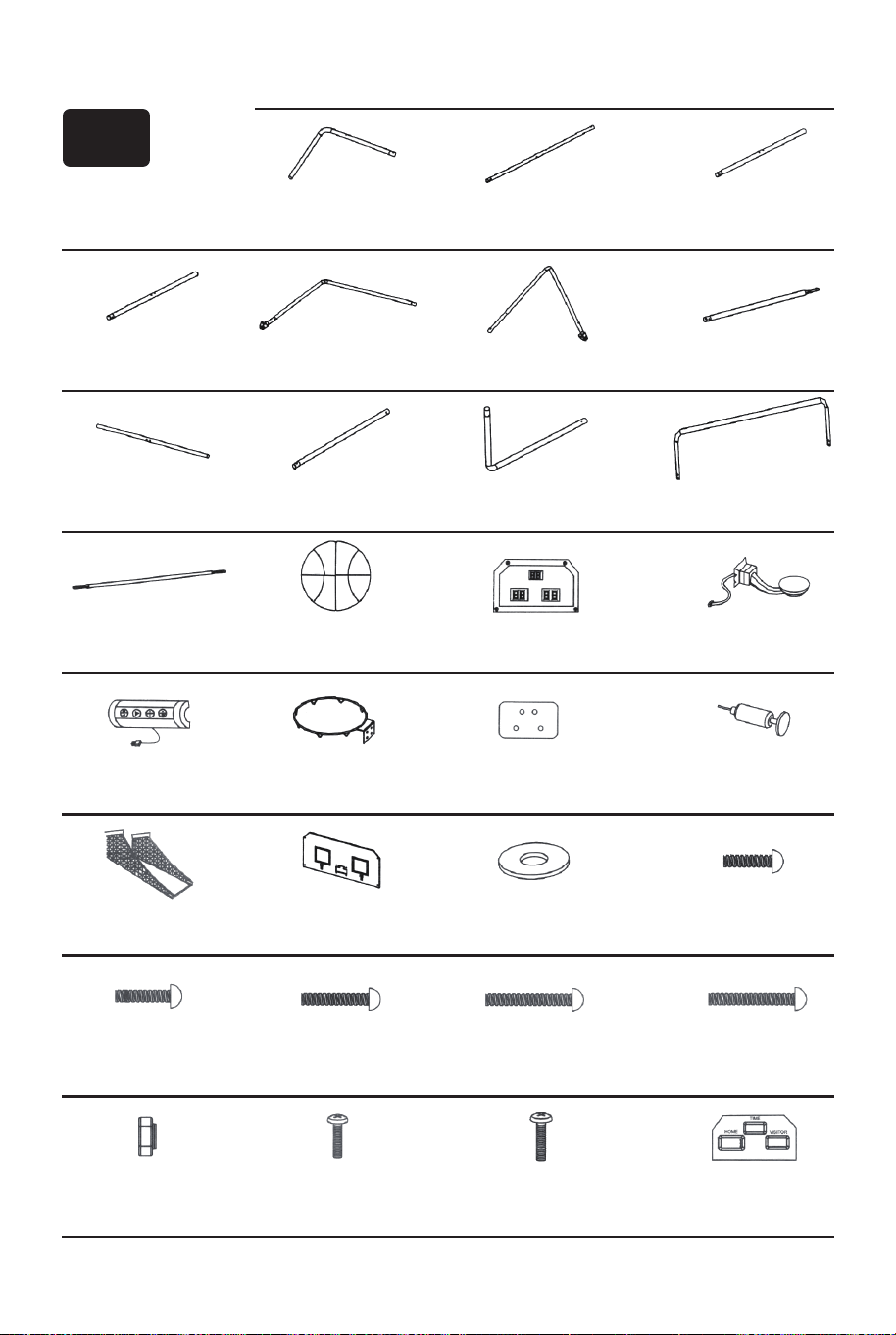
Rurka-1 Rurka-2
Ø22x580x440mm
Rurka-5
Ø22x755x580mm
Rurka-6
Ø22x755x580mm
Rurka-10
Ø22x650x385mm
Rurka-11
Ø22x1067x520mm
Ø22x685mm Ø22x890mm
Rurka-3
Ø22x830mm
Rurka-7
Ø22x890mm
Rurka-4
Ø22x835mm
Rurka-8
Ø12,7x1090mm
Rurka-12
Ø22x595mm
Rurka-9
Piłka (średnica 17 cm) Elektroniczny licznik trafień
Obręcz Płyta nośna obręczy
Podkładka M6 Śruba M6x20 mm
Czujnik przełącznika
Pompka z igłąSkrzynka kontrolna
z przewodem
Siatka
Śruba M6x29mm
Tablica
Śruba M6x42mm Śruba M6x50mm
Śruba 4x28mm
Płyta elektronicznego
licznika
Śruba M6x35mm
Nakrętka M6
Śruba 3,5x10mm
1 x2 2 x2 3 x1
4 x1
5 x1 6 x1 7 x2
8 x2
9 x2 10 x2 11 x1
12 x3
13 x4
14 x1
15 x2
16 x1
21 x1 22 x46 23 x16
24 x6
25 x4 26 x4 27 x2
28 x32
29 x4 30 x2 31 x1
17 x2
18 x2 19 x1
20 x1
PL
INSTRUKCJA MONTAŻU:
Klucz
32 x1
Klucz imbusowy
33 x1
Pasek samoprzylepny
34 x2
Siatka obręczy
P1 x2
Zatrzask sprężynowy
P2 x9
Plastikowa
zaślepka słupka
P3 x2
Zawleczka blokująca
P4 x2
CZĘŚCI WSTĘPNIE ZAMOCOWANE
PRZED MONTAŻEM - Wyjmij z opakowania i sprawdź
wszystkie części.
1. Zmontuj produkt na płaskim, równym i czystym podłożu. Zalecamy, aby montaż
został przeprowadzony przez dwie osoby dorosłe.
2. Wyjmij wszystkie części z opakowania. Następnie zapoznaj się z listą części w
niniejszej instrukcji, aby sprawdzić czy w zestawie znajdują się wszystkie części.
Możesz rozłożyć kartonowe opakowanie na płasko, aby posłużyło ci jako
powierzchnia robocza.
80 81
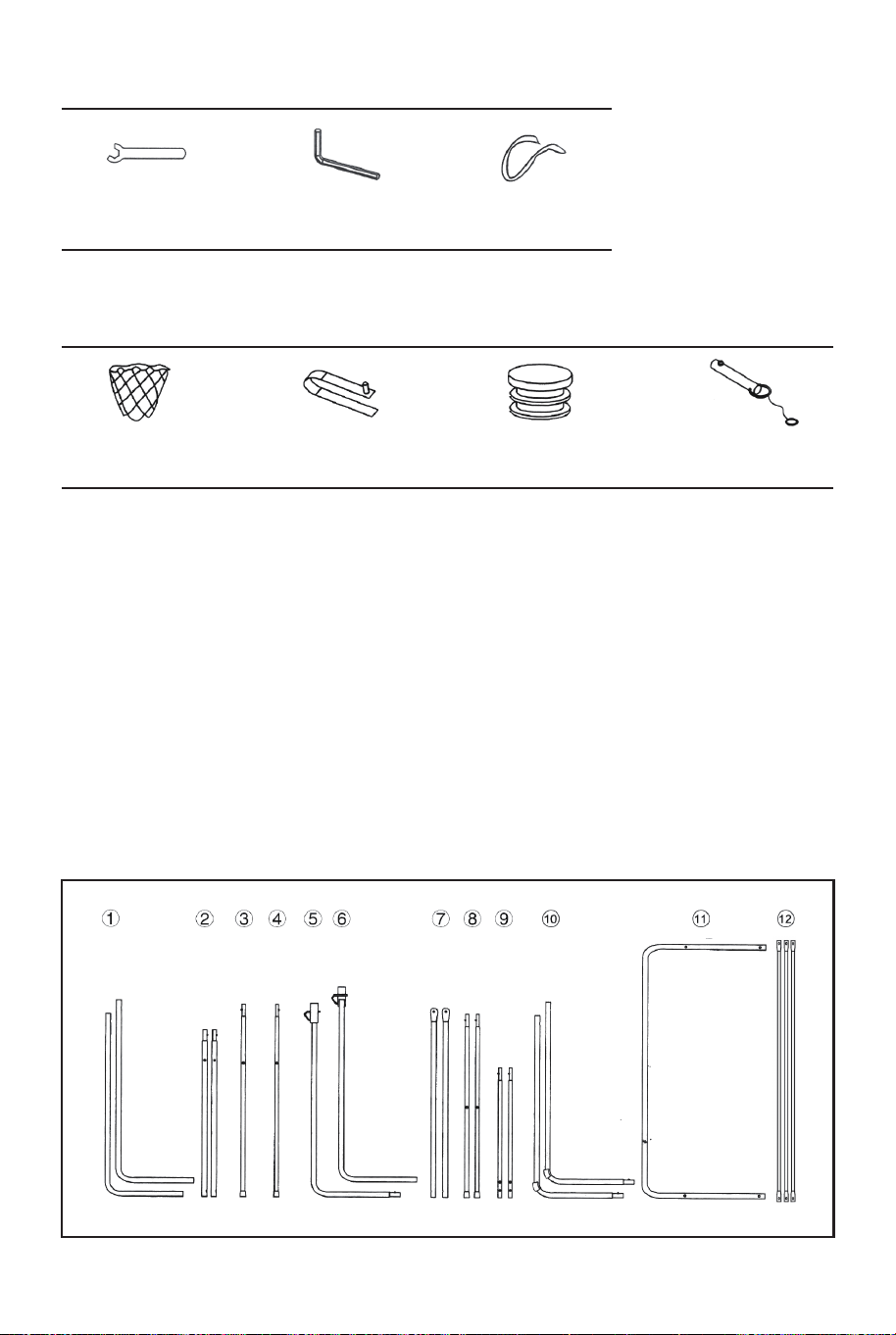
Rurka-1 Rurka-2
Ø22x580x440mm
Rurka-5
Ø22x755x580mm
Rurka-6
Ø22x755x580mm
Rurka-10
Ø22x650x385mm
Rurka-11
Ø22x1067x520mm
Ø22x685mm Ø22x890mm
Rurka-3
Ø22x830mm
Rurka-7
Ø22x890mm
Rurka-4
Ø22x835mm
Rurka-8
Ø12,7x1090mm
Rurka-12
Ø22x595mm
Rurka-9
Piłka (średnica 17 cm) Elektroniczny licznik trafień
Obręcz Płyta nośna obręczy
Podkładka M6 Śruba M6x20 mm
Czujnik przełącznika
Pompka z igłąSkrzynka kontrolna
z przewodem
Siatka
Śruba M6x29mm
Tablica
Śruba M6x42mm Śruba M6x50mm
Śruba 4x28mm
Płyta elektronicznego
licznika
Śruba M6x35mm
Nakrętka M6
Śruba 3,5x10mm
1 x2 2 x2 3 x1
4 x1
5 x1 6 x1 7 x2
8 x2
9 x2 10 x2 11 x1
12 x3
13 x4
14 x1
15 x2
16 x1
21 x1 22 x46 23 x16
24 x6
25 x4 26 x4 27 x2
28 x32
29 x4 30 x2 31 x1
17 x2
18 x2 19 x1
20 x1
PL
INSTRUKCJA MONTAŻU:
Klucz
32 x1
Klucz imbusowy
33 x1
Pasek samoprzylepny
34 x2
Siatka obręczy
P1 x2
Zatrzask sprężynowy
P2 x9
Plastikowa
zaślepka słupka
P3 x2
Zawleczka blokująca
P4 x2
CZĘŚCI WSTĘPNIE ZAMOCOWANE
PRZED MONTAŻEM - Wyjmij z opakowania i sprawdź
wszystkie części.
1. Zmontuj produkt na płaskim, równym i czystym podłożu. Zalecamy, aby montaż
został przeprowadzony przez dwie osoby dorosłe.
2. Wyjmij wszystkie części z opakowania. Następnie zapoznaj się z listą części w
niniejszej instrukcji, aby sprawdzić czy w zestawie znajdują się wszystkie części.
Możesz rozłożyć kartonowe opakowanie na płasko, aby posłużyło ci jako
powierzchnia robocza.
80 81
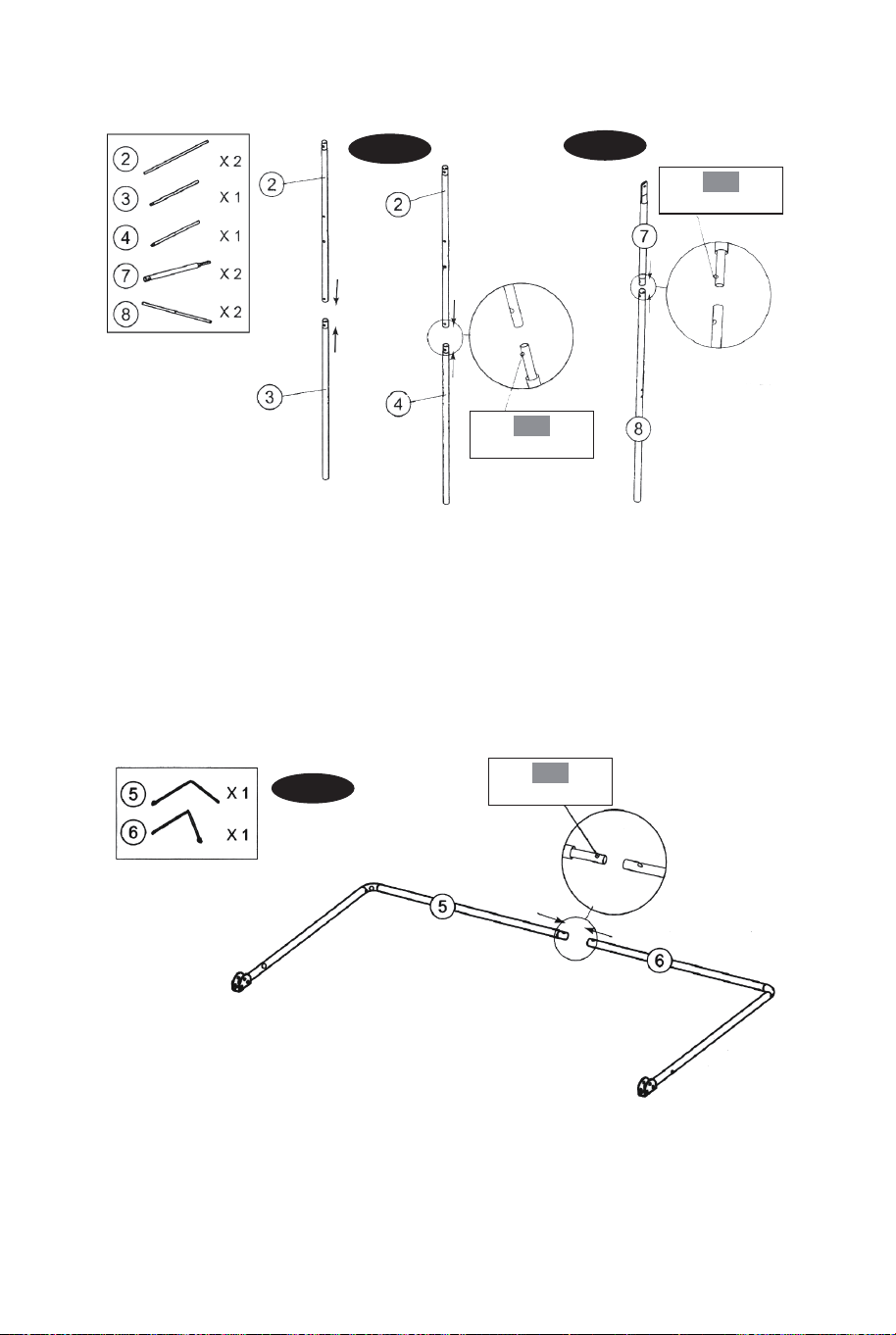
RYS.1 i 2
3. Przymocuj dwie rurki (2) do rurek (3) i (4) za pomocą zatrzasków sprężynowych
(wstępnie zamocowanych), tak jak pokazano na rysunku 1.
4. Przymocuj rurki (7) do rurek (8) za pomocą zatrzasków sprężynowych (wstępnie
zamocowanych), tak jak pokazano na rysunku 2.
RYS. 3
5. Przymocuj rurkę (5) do rurki (6) za pomocą zatrzasku sprężynowego (wstępnie
zamocowanego), tak jak pokazano na rysunku 3.
RYS. 4
6. Przymocuj rurki (5 i 6) do rurek (3 i 4) za pomocą śrub (26), podkładek (22) i nakrętek
(28). Następnie przymocuj rurki (5 i 6) do rurek (8) za pomocą śrub (26), podkładek
(22) i nakrętek (28), tak jak pokazano na rysunkach 4, 4A i 4B.
7. Przymocuj rurki (7 i 8) do rurek (2) za pomocą śrub (24), podkładek (22) i nakrętek
(28), tak jak pokazano na rysunku 4C.
UWAGA: Zatrzask sprężynowy powinien być skierowany w dół.
RYS.1
RYS.2
RYS.3
RYS. 4
RYS. 4C
RYS. 4B
RYS. 4A
Zatrzask sprężynowy
P2
Zatrzask sprężynowy
P2
Zatrzask sprężynowy
P2
82 83
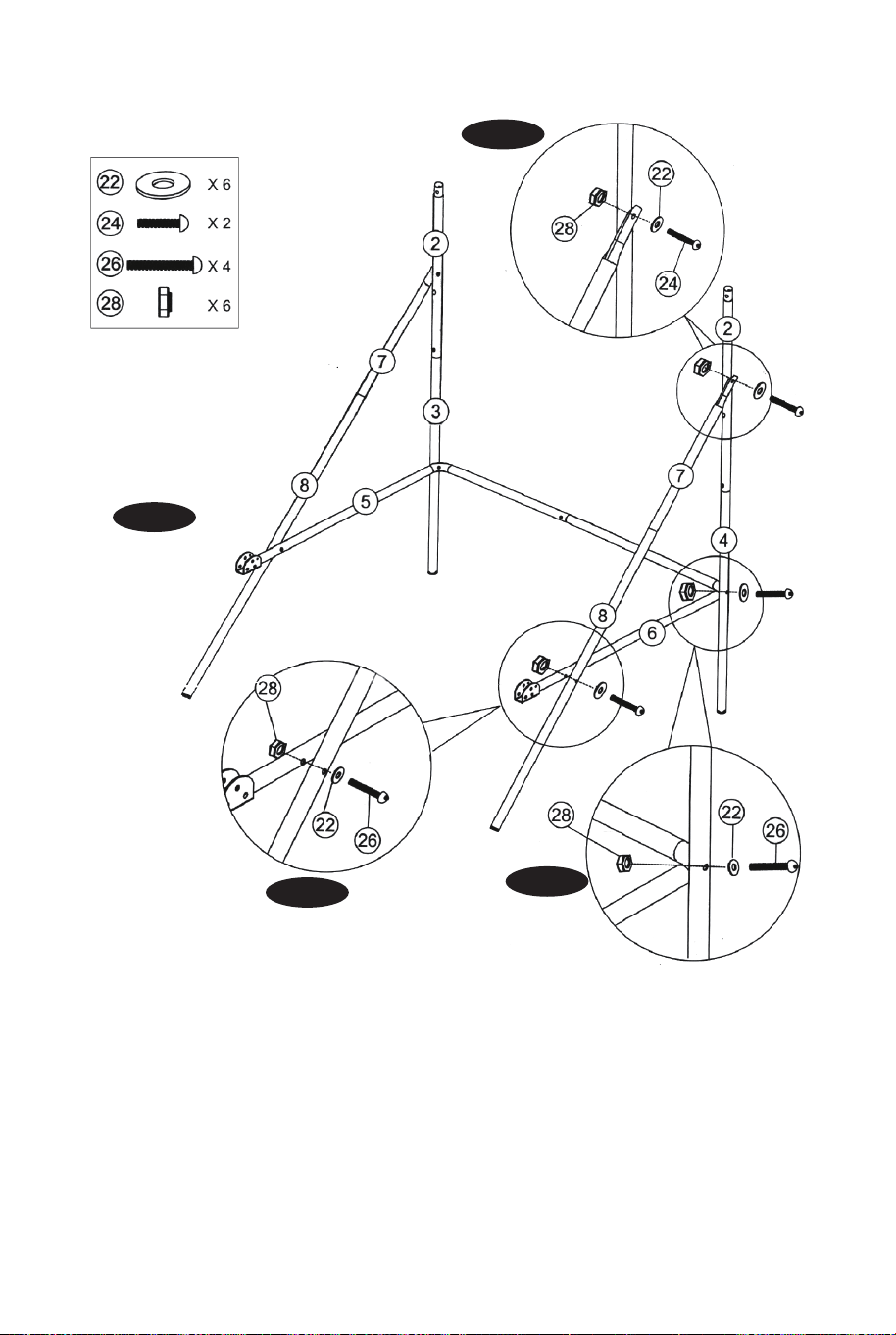
RYS.1 i 2
3. Przymocuj dwie rurki (2) do rurek (3) i (4) za pomocą zatrzasków sprężynowych
(wstępnie zamocowanych), tak jak pokazano na rysunku 1.
4. Przymocuj rurki (7) do rurek (8) za pomocą zatrzasków sprężynowych (wstępnie
zamocowanych), tak jak pokazano na rysunku 2.
RYS. 3
5. Przymocuj rurkę (5) do rurki (6) za pomocą zatrzasku sprężynowego (wstępnie
zamocowanego), tak jak pokazano na rysunku 3.
RYS. 4
6. Przymocuj rurki (5 i 6) do rurek (3 i 4) za pomocą śrub (26), podkładek (22) i nakrętek
(28). Następnie przymocuj rurki (5 i 6) do rurek (8) za pomocą śrub (26), podkładek
(22) i nakrętek (28), tak jak pokazano na rysunkach 4, 4A i 4B.
7. Przymocuj rurki (7 i 8) do rurek (2) za pomocą śrub (24), podkładek (22) i nakrętek
(28), tak jak pokazano na rysunku 4C.
UWAGA: Zatrzask sprężynowy powinien być skierowany w dół.
RYS.1
RYS.2
RYS.3
RYS. 4
RYS. 4C
RYS. 4B
RYS. 4A
Zatrzask sprężynowy
P2
Zatrzask sprężynowy
P2
Zatrzask sprężynowy
P2
82 83
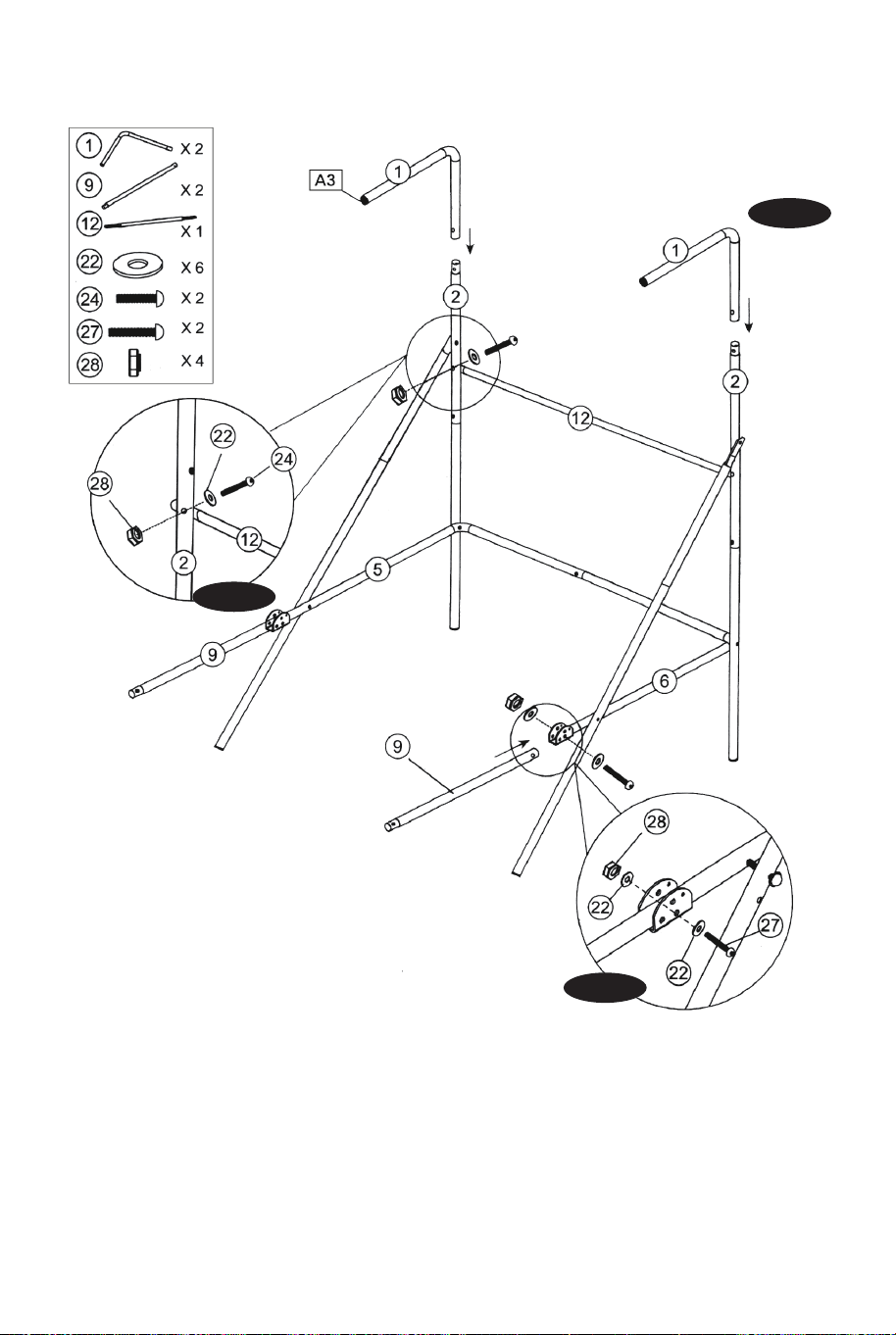
RYS. 5
8. Przymocuj rurkę (12) do rurek (2) za pomocą śrub (24), podkładek (22) i nakrętek
(28), tak jak pokazano na rysunku 5A. Następnie przymocuj rurki (1) do rurek (2), tak
jak pokazano na rysunku 5.
9. Przymocuj rurki (9) do rurek (5 i 6) za pomocą śrub (27), podkładek (22) i nakrętek
(28), tak jak pokazano na rysunku 5 i 5B.
RYS.6
10.Przymocuj rurki (10) do rurek (9) za pomocą zatrzasków sprężynowych (wstępnie
zamocowanych). Następnie przymocuj rurkę (11) do rurek (10) za pomocą
zatrzasków sprężynowych (wstępnie zamocowanych), tak jak pokazano na rysunku 6.
RYS. 5A
RYS. 5B
RYS. 5
RYS.6
Zatrzask sprężynowy
P2
Zatrzask sprężynowy
P2
Krótszy koniec
Dłuższy koniec
84 85
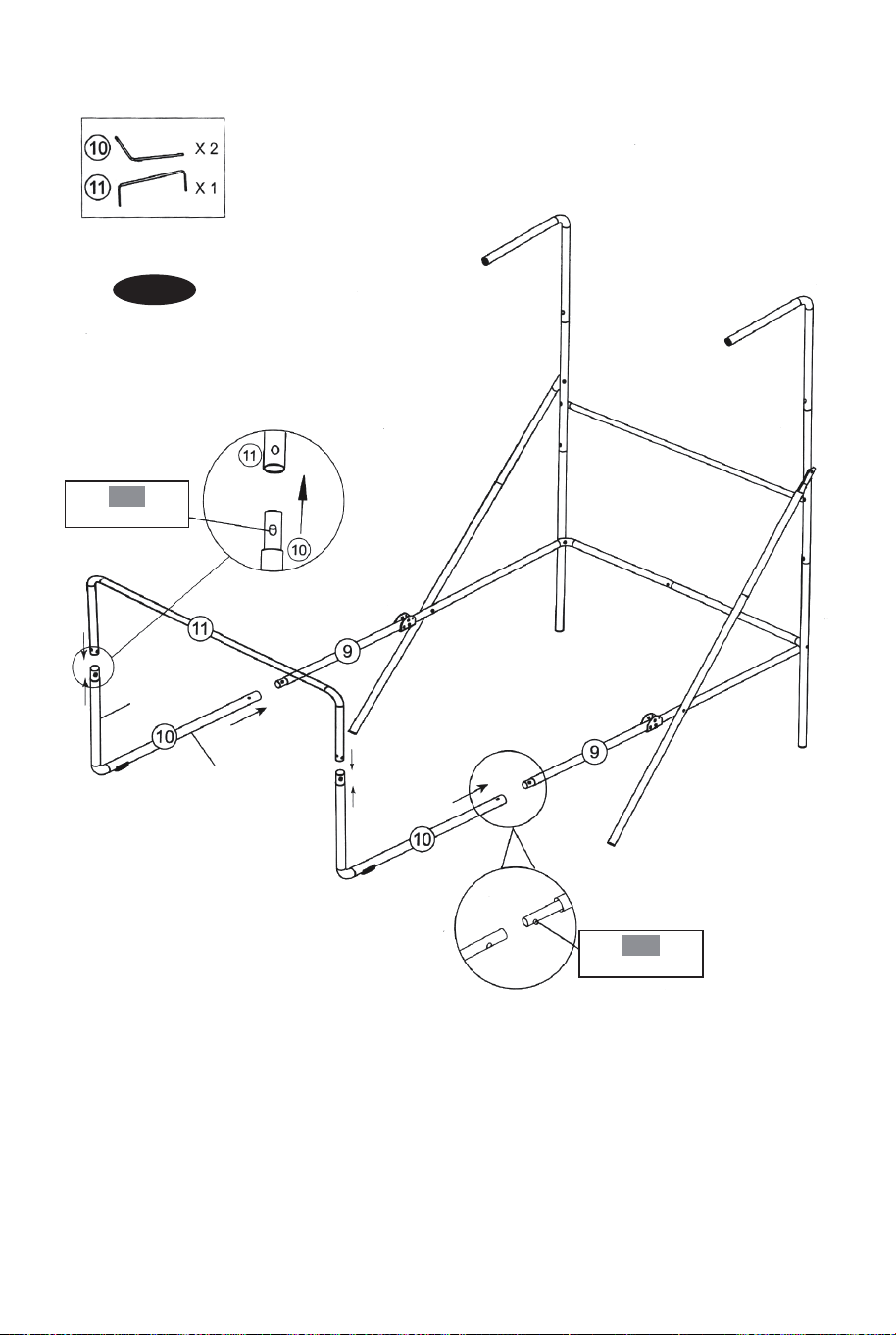
RYS. 5
8. Przymocuj rurkę (12) do rurek (2) za pomocą śrub (24), podkładek (22) i nakrętek
(28), tak jak pokazano na rysunku 5A. Następnie przymocuj rurki (1) do rurek (2), tak
jak pokazano na rysunku 5.
9. Przymocuj rurki (9) do rurek (5 i 6) za pomocą śrub (27), podkładek (22) i nakrętek
(28), tak jak pokazano na rysunku 5 i 5B.
RYS.6
10.Przymocuj rurki (10) do rurek (9) za pomocą zatrzasków sprężynowych (wstępnie
zamocowanych). Następnie przymocuj rurkę (11) do rurek (10) za pomocą
zatrzasków sprężynowych (wstępnie zamocowanych), tak jak pokazano na rysunku 6.
RYS. 5A
RYS. 5B
RYS. 5
RYS.6
Zatrzask sprężynowy
P2
Zatrzask sprężynowy
P2
Krótszy koniec
Dłuższy koniec
84 85
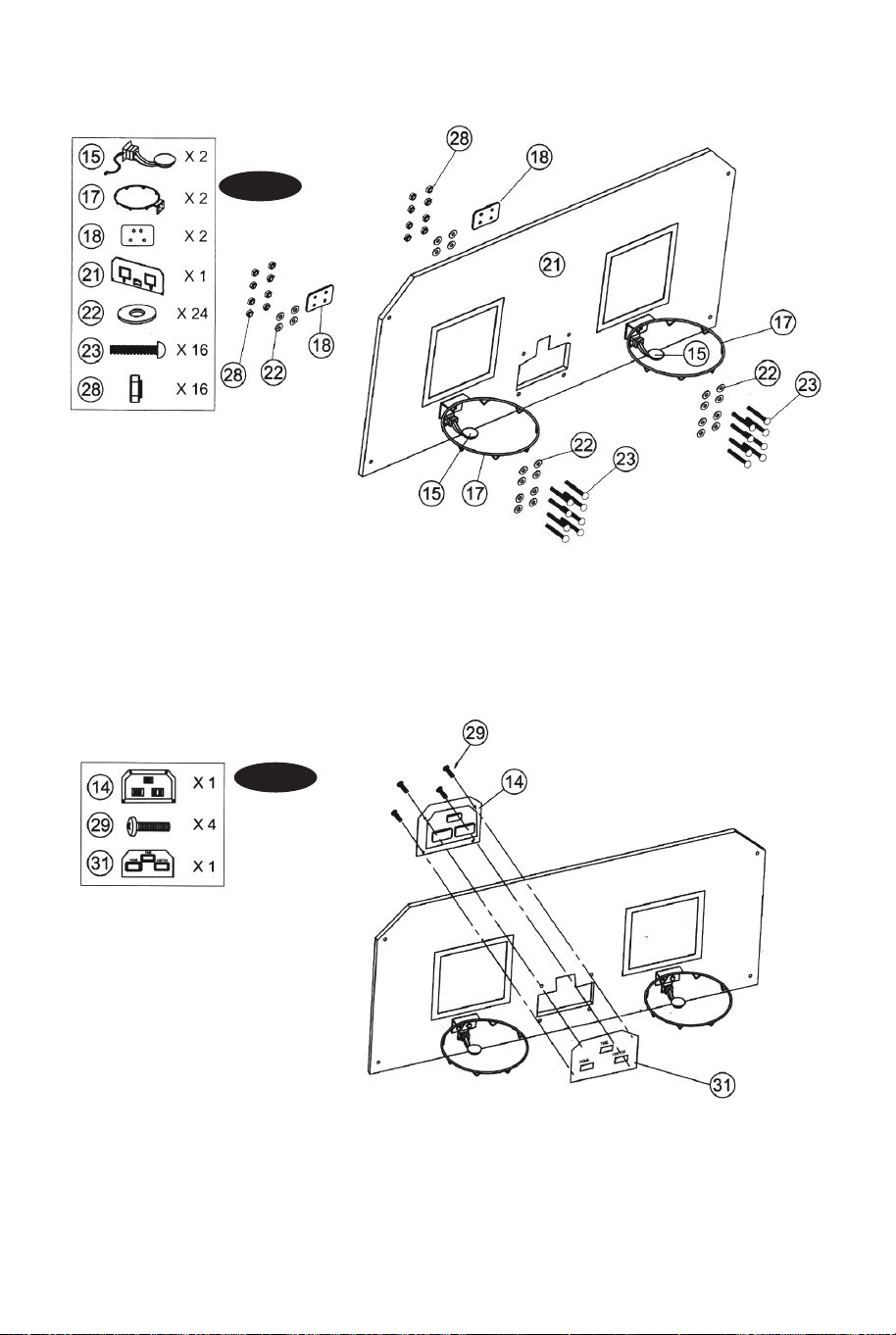
RYS.7
11. Przymocuj obręcze (17) i płyty nośne (18) do tablicy (21) za pomocą śrub (23),
podkładek (22) i nakrętek (28). Przymocuj czujniki przełączników (15) do tablicy (21)
za pomocą śrub (23), podkładek (22) i nakrętek (28).
UWAGA: Zamocuj podkładki po obu stronach tablicy, tak jak pokazano na rysunku 7.
RYS.8
12. Zamocuj płytę licznika (31) w przedniej części tablicy (21) i podłącz ją do licznika
trafień (14) za pomocą śrub (29), tak jak pokazano na rysunku 8.
RYS.7
RYS.8
RYS.9
13. Nasuń materiałowe rękawy z paskami mocującymi siatki (20) na rurki (1), tak jak
pokazano na rysunkach 9A, 9B i 9C.
14. Przełóż rurkę (12) przez materiałowy rękaw w przedniej części siatki (20). Najpierw
zabezpiecz lewą stronę za pomocą śrub (24), podkładek (22) i nakrętek (28), tak jak
pokazano na rys. 9D. Powtórz z prawej strony.
RYS.9A
RYS.9B
RYS.9C
RYS.9D
RYS.9
86 87
Zawleczka blokująca
P4
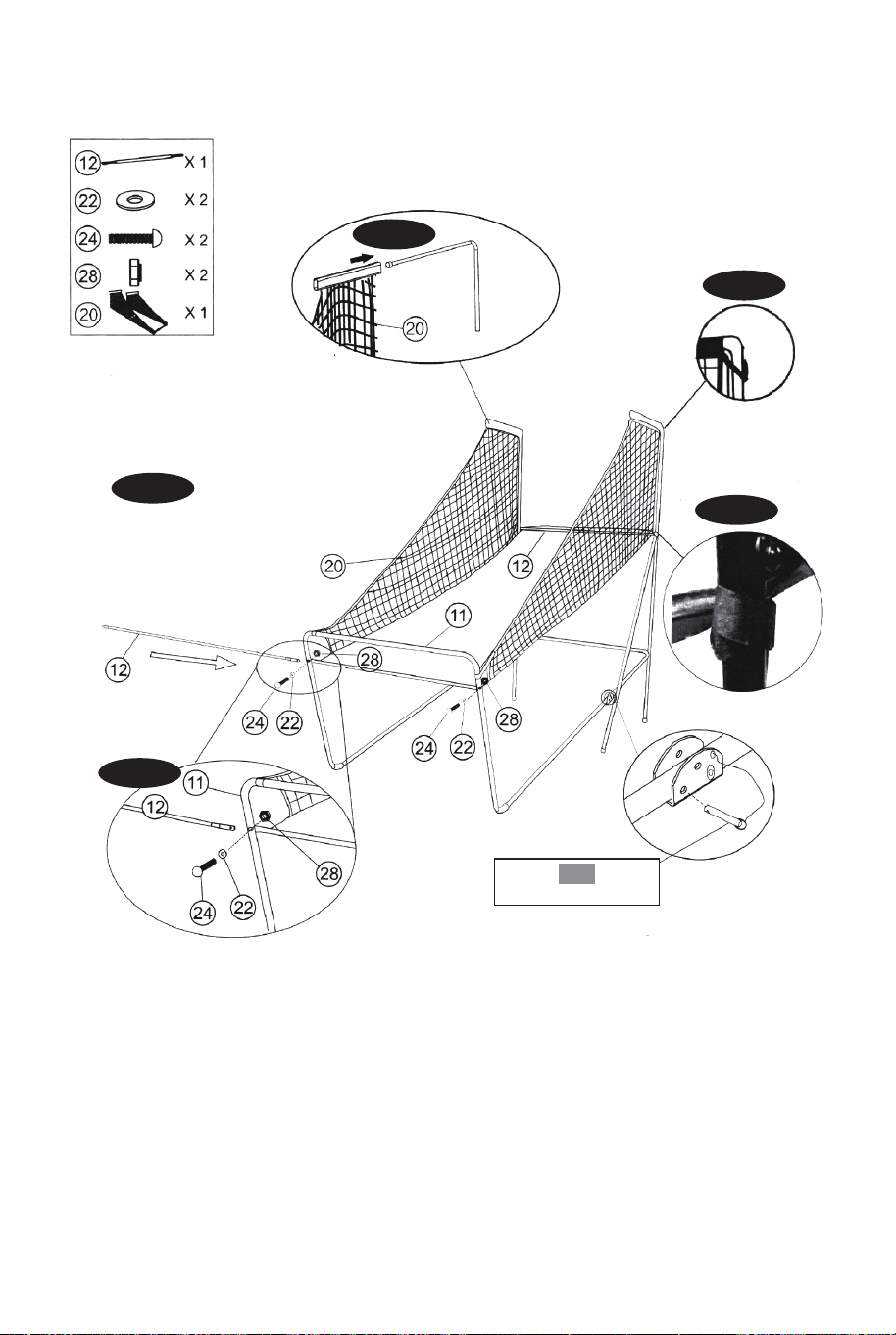
RYS.7
11. Przymocuj obręcze (17) i płyty nośne (18) do tablicy (21) za pomocą śrub (23),
podkładek (22) i nakrętek (28). Przymocuj czujniki przełączników (15) do tablicy (21)
za pomocą śrub (23), podkładek (22) i nakrętek (28).
UWAGA: Zamocuj podkładki po obu stronach tablicy, tak jak pokazano na rysunku 7.
RYS.8
12. Zamocuj płytę licznika (31) w przedniej części tablicy (21) i podłącz ją do licznika
trafień (14) za pomocą śrub (29), tak jak pokazano na rysunku 8.
RYS.7
RYS.8
RYS.9
13. Nasuń materiałowe rękawy z paskami mocującymi siatki (20) na rurki (1), tak jak
pokazano na rysunkach 9A, 9B i 9C.
14. Przełóż rurkę (12) przez materiałowy rękaw w przedniej części siatki (20). Najpierw
zabezpiecz lewą stronę za pomocą śrub (24), podkładek (22) i nakrętek (28), tak jak
pokazano na rys. 9D. Powtórz z prawej strony.
RYS.9A
RYS.9B
RYS.9C
RYS.9D
RYS.9
86 87
Zawleczka blokująca
P4
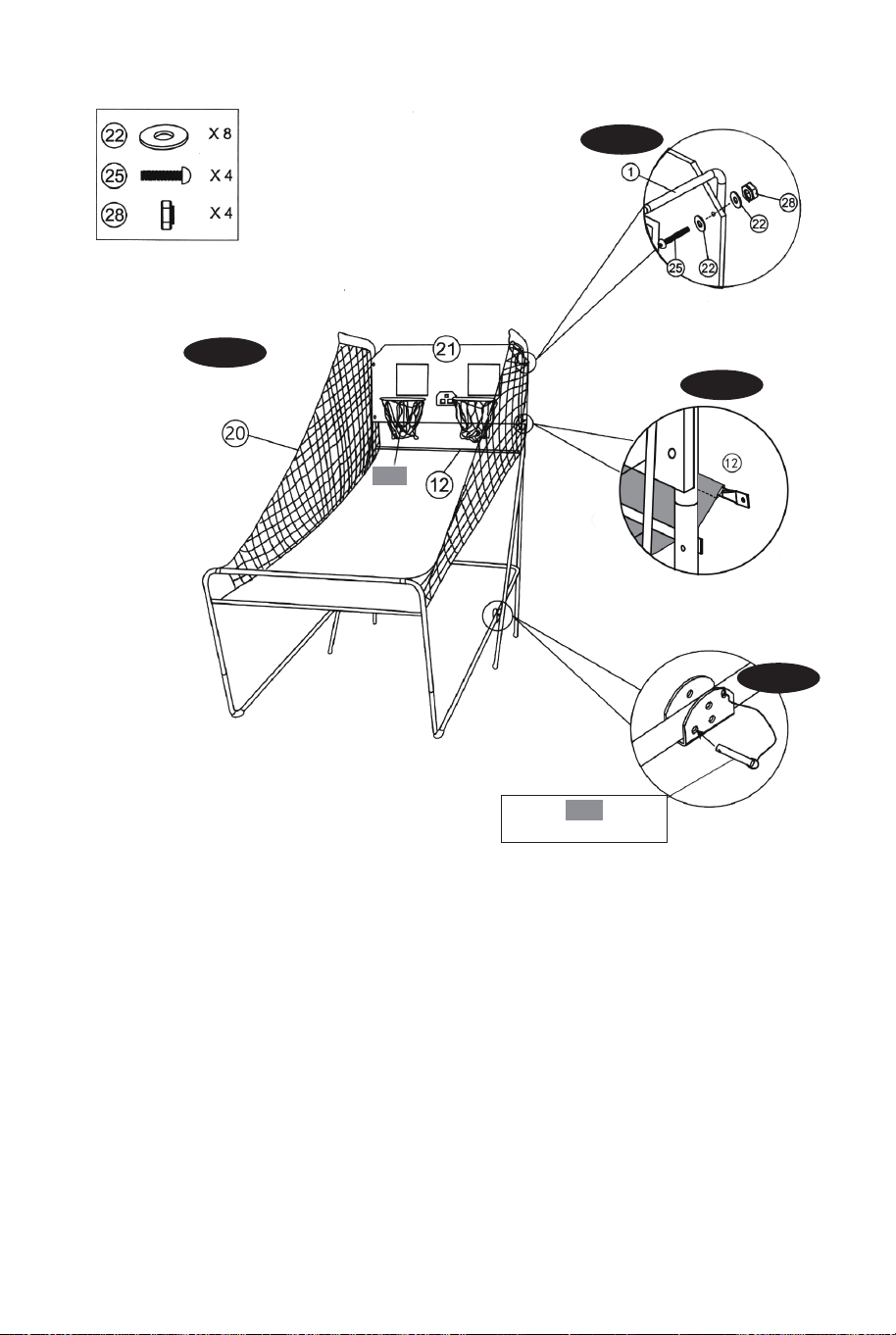
RYS.11
16. Włóż zawleczki blokujące (P4) do otworów w rurkach (5 i 6), tak jak pokazano na
rysunku 10C.
17. Przymocuj skrzynkę kontrolną (16) w środkowej części rurki (11) za pomocą dwóch
śrub (30), tak jak pokazano na rys. 11A.
18. Przeprowadź przewód skrzynki kontrolnej przez oczka siatki (20). Przymocuj przewód
do rurki (11) za pomocą pasków samoprzylepnych (34), tak jak pokazano na rysunku
11.
RYS.12
19. Podłącz przewód czujnika przełącznika (15) do licznika trafień (14), tak jak pokazano
na rysunku 12. Następnie podłącz przewód skrzynki kontrolnej do licznika trafień (14),
tak jak pokazano na rysunkach 12 i 12A.
RYS.11
RYS.12
RYS.11A
RYS.12A
Skrzynka kontrolna
Przewód skrzynki kontrolnej
Przewód skrzynki kontrolnej
PRZEWÓD
SKRZYNKI
KONTROLNEJ
Elektroniczny licznik trafień
Przewód czujnika
Przewód czujnika
WEJŚCIE
CZUJNIKA
ON/OFF
(WŁ./WYŁ.)
88 89
FIG.10
15.
P1
Z pomocą innej osoby dorosłej przymocuj tablicę (21) do rurek (1) za pomocą śrub
(25), podkładek (22) i nakrętek (28), tak jak pokazano na rysunku 10A. Wsuń rurkę
(12) w rękaw płótna z tyłu siatki (20), jak pokazano na rysunku 10B. Za pomocą śrub
(25), podkładek (22) i nakrętek (28) przymocuj najpierw lewą stronę, korzystając z
otworów montażowych z dołu tablicy., tak jak pokazano na rys.10C. Powtórz dla
prawej strony.
RYS.10
RYS.10A
RYS.10B
RYS.10C
Zawleczka blokująca
P4
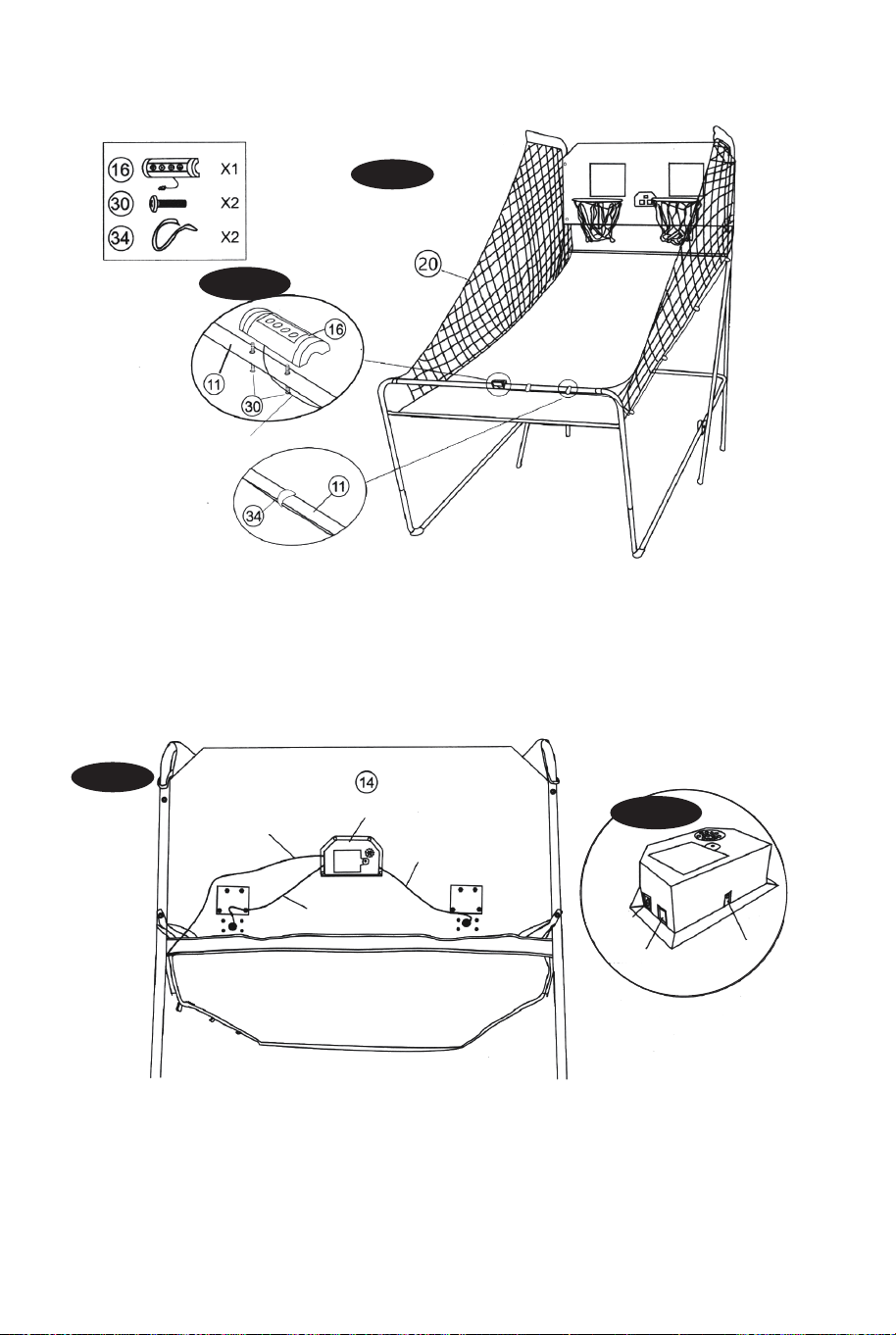
RYS.11
16. Włóż zawleczki blokujące (P4) do otworów w rurkach (5 i 6), tak jak pokazano na
rysunku 10C.
17. Przymocuj skrzynkę kontrolną (16) w środkowej części rurki (11) za pomocą dwóch
śrub (30), tak jak pokazano na rys. 11A.
18. Przeprowadź przewód skrzynki kontrolnej przez oczka siatki (20). Przymocuj przewód
do rurki (11) za pomocą pasków samoprzylepnych (34), tak jak pokazano na rysunku
11.
RYS.12
19. Podłącz przewód czujnika przełącznika (15) do licznika trafień (14), tak jak pokazano
na rysunku 12. Następnie podłącz przewód skrzynki kontrolnej do licznika trafień (14),
tak jak pokazano na rysunkach 12 i 12A.
RYS.11
RYS.12
RYS.11A
RYS.12A
Skrzynka kontrolna
Przewód skrzynki kontrolnej
Przewód skrzynki kontrolnej
PRZEWÓD
SKRZYNKI
KONTROLNEJ
Elektroniczny licznik trafień
Przewód czujnika
Przewód czujnika
WEJŚCIE
CZUJNIKA
ON/OFF
(WŁ./WYŁ.)
88 89
FIG.10
15.
P1
Z pomocą innej osoby dorosłej przymocuj tablicę (21) do rurek (1) za pomocą śrub
(25), podkładek (22) i nakrętek (28), tak jak pokazano na rysunku 10A. Wsuń rurkę
(12) w rękaw płótna z tyłu siatki (20), jak pokazano na rysunku 10B. Za pomocą śrub
(25), podkładek (22) i nakrętek (28) przymocuj najpierw lewą stronę, korzystając z
otworów montażowych z dołu tablicy., tak jak pokazano na rys.10C. Powtórz dla
prawej strony.
RYS.10
RYS.10A
RYS.10B
RYS.10C
Zawleczka blokująca
P4
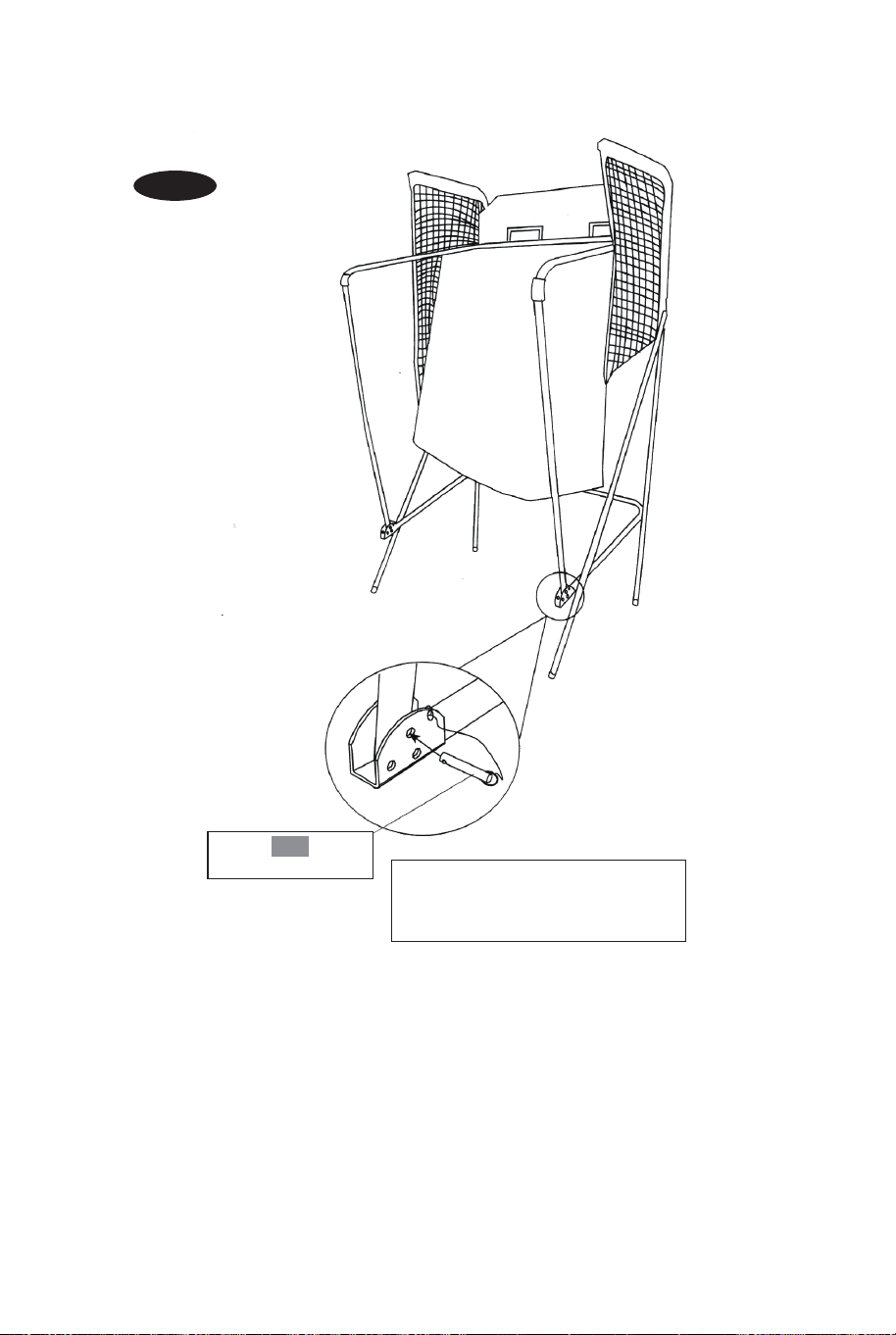
UŻYTKOWANIE LICZNIKA TRAFIEŃ
Otwórz pokrywę komory baterii, odkręcając śrubę za pomocą śrubokrętu. Włóż 3 baterie
AA (brak w zestawie) z zachowaniem prawidłowej polaryzacji. Zamknij pokrywę komory
baterii i dokręć śrubę.
Włącz produkt za pomocą włącznika ON/OFF.
Naciśnij przycisk „ON/OFF”, aby włączyć licznik trafień.
Na tablicy „HOME” wyświetli się „01” (gra 1).
Naciśnij przycisk „SELECT UP” lub przycisk „SELECT DOWN”, aby wybrać grę.
Naciśnij „PLAY”, aby zatwierdzić wybór gry.
Naciśnij przycisk „SOUND”, aby włączyć lub wyłączyć dźwięk podczas gry.
Naciśnij przycisk „PAUSE”, aby rozpocząć lub zatrzymać odliczanie.
Naciśnij i przytrzymaj przez 3 sekundy przycisk „ON/OFF”, aby wyłączyć licznik trafień.
Naciśnij i przytrzymaj przez 3 sekundy przycisk „RESET”, aby zresetować grę.
Uwaga: Jeśli w ciągu 15 minut nie wykonasz żadnego rzutu do kosza i nie naciśniesz
żadnego przycisku, licznik trafień wyłączy się automatycznie.
RYS.13
20. Złóż produkt, gdy nie jest używany i włóż zawleczki blokujące (P4), tak jak pokazano
na rysunku 13.
Uwaga: Wyjmij zawleczki blokujące (P4) przed przystąpieniem do składania lub
rozkładania produktu.
1) Produkt wymaga użycia 3 baterii AA (brak w zestawie).
2) Nie mieszaj baterii starych i nowych.
3) Nie mieszaj różnych typów baterii (baterie alkaliczne, standardowe i wielokrotnego
użytku).
Instalacja baterii:
A. Baterie muszą zostać włożone z zachowaniem prawidłowej polaryzacji.
B. Przed włożeniem baterii wyczyścić styki baterii i styki komory baterii.
C. Wyjmij baterie jeśli produkt nie jest używany przez dłuższy czas.
Ostrzeżenia:
OSTRZEŻENIA:
SKRZYNKA KONTROLNA:
RYS.13
Zawleczka blokująca
P4
UWAGA!
Pamiętaj, aby po złożeniu zabezpieczyć
produkt przy użyciu zawleczek
blokujących (P4).
PRZEWÓD
SKRZYNKI
KONTROLNEJ
ON/OFF
(WŁ./WYŁ.)
WEJŚCIE CZUJNIKA
PANEL STEROWANIA
90 91
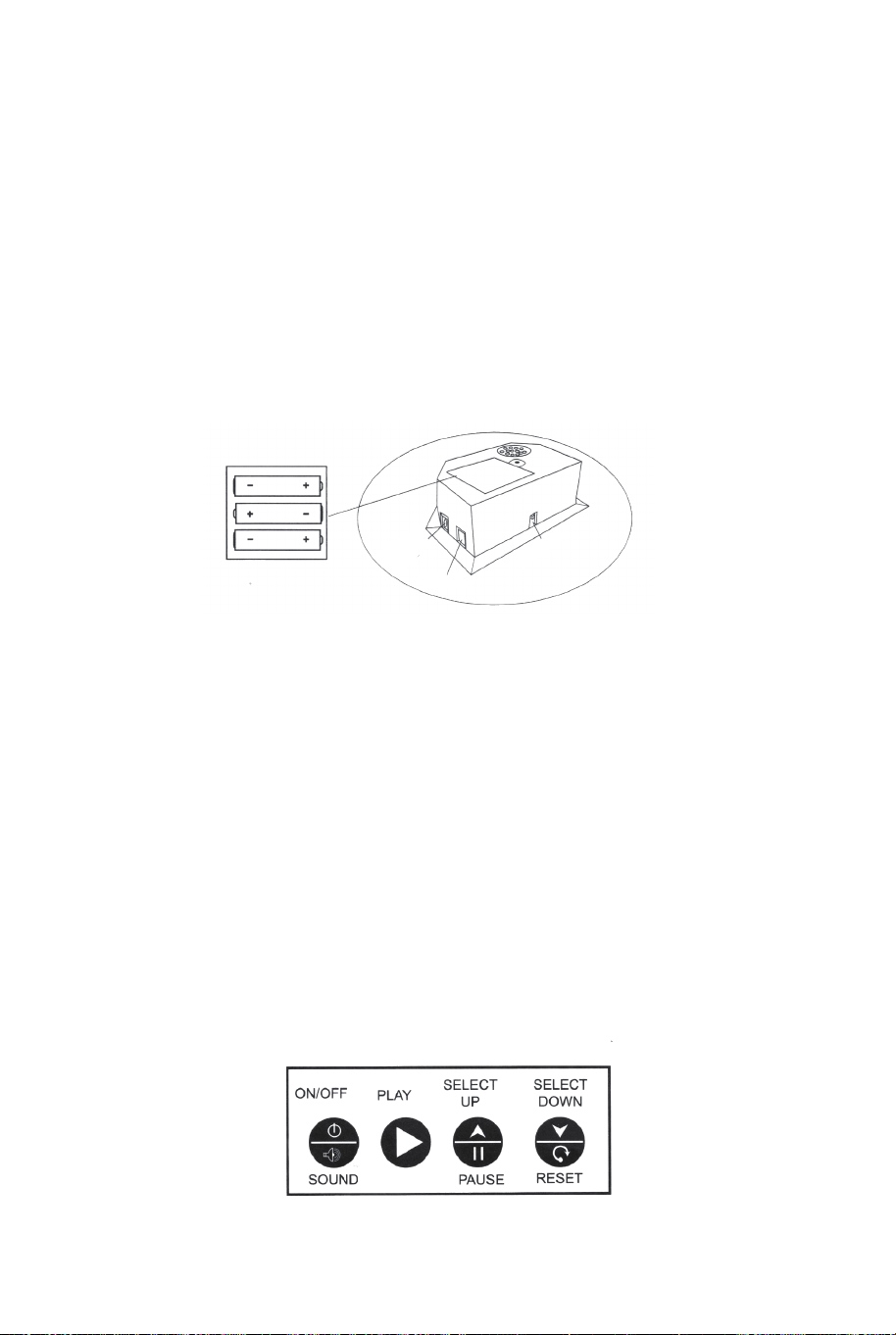
UŻYTKOWANIE LICZNIKA TRAFIEŃ
Otwórz pokrywę komory baterii, odkręcając śrubę za pomocą śrubokrętu. Włóż 3 baterie
AA (brak w zestawie) z zachowaniem prawidłowej polaryzacji. Zamknij pokrywę komory
baterii i dokręć śrubę.
Włącz produkt za pomocą włącznika ON/OFF.
Naciśnij przycisk „ON/OFF”, aby włączyć licznik trafień.
Na tablicy „HOME” wyświetli się „01” (gra 1).
Naciśnij przycisk „SELECT UP” lub przycisk „SELECT DOWN”, aby wybrać grę.
Naciśnij „PLAY”, aby zatwierdzić wybór gry.
Naciśnij przycisk „SOUND”, aby włączyć lub wyłączyć dźwięk podczas gry.
Naciśnij przycisk „PAUSE”, aby rozpocząć lub zatrzymać odliczanie.
Naciśnij i przytrzymaj przez 3 sekundy przycisk „ON/OFF”, aby wyłączyć licznik trafień.
Naciśnij i przytrzymaj przez 3 sekundy przycisk „RESET”, aby zresetować grę.
Uwaga: Jeśli w ciągu 15 minut nie wykonasz żadnego rzutu do kosza i nie naciśniesz
żadnego przycisku, licznik trafień wyłączy się automatycznie.
RYS.13
20. Złóż produkt, gdy nie jest używany i włóż zawleczki blokujące (P4), tak jak pokazano
na rysunku 13.
Uwaga: Wyjmij zawleczki blokujące (P4) przed przystąpieniem do składania lub
rozkładania produktu.
1) Produkt wymaga użycia 3 baterii AA (brak w zestawie).
2) Nie mieszaj baterii starych i nowych.
3) Nie mieszaj różnych typów baterii (baterie alkaliczne, standardowe i wielokrotnego
użytku).
Instalacja baterii:
A. Baterie muszą zostać włożone z zachowaniem prawidłowej polaryzacji.
B. Przed włożeniem baterii wyczyścić styki baterii i styki komory baterii.
C. Wyjmij baterie jeśli produkt nie jest używany przez dłuższy czas.
Ostrzeżenia:
OSTRZEŻENIA:
SKRZYNKA KONTROLNA:
RYS.13
Zawleczka blokująca
P4
UWAGA!
Pamiętaj, aby po złożeniu zabezpieczyć
produkt przy użyciu zawleczek
blokujących (P4).
PRZEWÓD
SKRZYNKI
KONTROLNEJ
ON/OFF
(WŁ./WYŁ.)
WEJŚCIE CZUJNIKA
PANEL STEROWANIA
90 91

1. Gra 1: Walka z czasem.
Naciśnij przycisk „PLAY”, aby rozpocząć grę 1.
Naciśnij przycisk „UP” lub „DOWN”, aby wybrać liczbę graczy (P1/P2/P3/P4).
Po wybraniu liczby graczy naciśnij przycisk „PLAY”.
Naciśnij przycisk „UP” lub „DOWN”, aby wybrać czas gry (30/45/60 sekund).
Naciśnij przycisk „PLAY”, aby rozpocząć grę.
Na tablicy „HOME” wyświetlą się punkty graczy 1 i 3, a na tablicy „VISITOR” punkty graczy 2 i
4.
Za każde trafienie do kosza gracz otrzymuje 2 punkty. W ostatnich 10 sekundach gry gracz
otrzymuje 3 punkty za każde trafienie do kosza.
Po zakończeniu tury jednego gracza rozpoczyna się 5-sekundowe odliczanie, po którym
następuje tura następnego gracza.
Wygrywa gracz, który zdobędzie więcej punktów (dioda LED wskazuje gracza z większą
ilością punktów).
Naciśnij przycisk „PLAY”, aby zrestartować grę.
2. Gra 2: Walka z czasem za 3 punkty.
Naciśnij przycisk „PLAY”, aby rozpocząć grę 2.
Naciśnij przycisk „UP” lub „DOWN”, aby wybrać liczbę graczy (P1/P2/P3/P4).
Po wybraniu liczby graczy naciśnij przycisk „PLAY”.
Naciśnij przycisk „UP” lub „DOWN”, aby wybrać czas gry (30/45/60 sekund).
Naciśnij przycisk „PLAY”, aby rozpocząć grę.
Na tablicy „HOME” wyświetlą się punkty graczy 1 i 3, a na tablicy „VISITOR” punkty
graczy 2 i 4.
Za każde trafienie do kosza gracz otrzymuje 3 punkty.
Po zakończeniu tury jednego gracza rozpoczyna się 5-sekundowe odliczanie, po którym
następuje tura następnego gracza.
Wygrywa gracz, który zdobędzie więcej punktów (dioda LED wskazuje gracza z większą
ilością punktów).
Naciśnij przycisk „PLAY”, aby zrestartować grę.
3. Gra 3: Pojedynek.
Naciśnij przycisk „PLAY”, aby rozpocząć grę 3.
Naciśnij przycisk „UP” lub „DOWN”, aby wybrać liczbę graczy (P2/P4).
Po wybraniu liczby graczy naciśnij przycisk „PLAY”.
Za każde trafienie do kosza drużyna „HOME” otrzymuje 2 punkty, a przeciwna drużyna
„VISITOR” traci 2 punkty.
Za każde trafienie do kosza drużyna „VISITOR” otrzymuje 2 punkty, a przeciwna drużyna
„HOME” traci 2 punkty.
Wygrywa drużyna, która zdobędzie 10 punktów.
Naciśnij przycisk „PLAY”, aby zrestartować grę.
4. Gra 4: HORSE.
A. Naciśnij przycisk „PLAY”, aby rozpocząć grę 4.
B. Naciśnij przycisk „UP” lub „DOWN”, aby wybrać liczbę graczy (P2/P3/P4).
C. Po wybraniu liczby graczy naciśnij przycisk „PLAY”.
D. Gracz musi trafić do kosza w ciągu 2 sekund.
E. Pierwszy gracz może trafić do dowolnego kosza (kosz drużyny „HOME” lub kosz drużyny
„VISITOR”). Jeśli gracz trafi do kosza w ciągu 2 sekund, nie wyświetla się żadna litera.
Następuje tura następnego gracza. Na tablicy wyświetla się P2, P3 lub P4, a dioda LED
miga dwukrotnie.
Gdy dioda przestanie migać, następny gracz musi trafić do tego samego kosza, do którego
trafił poprzedni gracz.
F. Jeśli gracz nie trafi do kosza w ciągu 2 sekund, na tablicy wyświetli się litera H. Tura
danego gracza trwa, dopóki nie trafi on do kosza. Jeśli gracz nie trafi do kosza podczas
kolejnych rzutów, wyświetlą się kolejno litery O, R, S i E. Litera E oznacza koniec gry dla
danego gracza.
G. Przegrywa gracz, który jako pierwszy zdobędzie wszystkie litery słowa HORSE. Gracze
powtarzają kroki d, e oraz f, aż do zakończenia gry.
H. Wygrywa gracz, który jako ostatni zdobędzie litery słowa HORSE.
I. Naciśnij przycisk „PLAY”, aby zrestartować grę.
5. Gra 5: Mnóstwo punktów.
Naciśnij przycisk „PLAY”, aby rozpocząć grę 5.
Naciśnij przycisk „UP” lub „DOWN”, aby wybrać liczbę graczy (P1/P2/P3/P4).
Po wybraniu liczby graczy naciśnij przycisk „PLAY”.
Na tablicy „HOME” wyświetla się numer gracza, a na tablicy „VISITOR” wyświetla się
czas gry, który wynosi 40 sekund.
Zdobyte punkty wyświetlają się na tablicy „HOME”.
Przed upływem czasu gry i po zdobyciu 24/52/68/86 punktów czas gry wydłuża się
kolejno o 10/20/10/20 sekund.
Po zakończeniu tury jednego gracza rozpoczyna się 5-sekundowe odliczanie, po którym
następuje tura następnego gracza.
Wygrywa gracz, który zdobędzie więcej punktów (dioda LED wskazuje gracza z większą
ilością punktów).
Gra kończy się, gdy jeden z graczy zdobędzie 98 punktów.
Naciśnij przycisk „PLAY”, aby zrestartować grę.
6. Gra 6: Wyścig.
Użyj taśmy do zaznaczenia linii rzutów.
Naciśnij przycisk „PLAY”, aby rozpocząć grę 6.
Naciśnij przycisk „UP” lub „DOWN”, aby wybrać liczbę graczy (P1/P2/P3/P4).
Po wybraniu liczby graczy naciśnij przycisk „PLAY”.
Na tablicy „HOME” wyświetla się numer gracza (1/2/3/4), a na tablicy „VISITOR” wyświetla
się ilość zdobytych punktów.
Gdy gracz zdobędzie 10 punktów lub upłynie 99 sekund, rozpocznie się 5-sekundowe
odliczanie, po którym nastąpi tura następnego gracza.
Wygrywa gracz, który zdobędzie więcej punktów w krótszym czasie (dioda LED wskazuje
wygranego gracza).
Naciśnij przycisk „PLAY”, aby zrestartować grę.
WYBÓR 1 Z 8 GIER
92 93

1. Gra 1: Walka z czasem.
Naciśnij przycisk „PLAY”, aby rozpocząć grę 1.
Naciśnij przycisk „UP” lub „DOWN”, aby wybrać liczbę graczy (P1/P2/P3/P4).
Po wybraniu liczby graczy naciśnij przycisk „PLAY”.
Naciśnij przycisk „UP” lub „DOWN”, aby wybrać czas gry (30/45/60 sekund).
Naciśnij przycisk „PLAY”, aby rozpocząć grę.
Na tablicy „HOME” wyświetlą się punkty graczy 1 i 3, a na tablicy „VISITOR” punkty graczy 2 i
4.
Za każde trafienie do kosza gracz otrzymuje 2 punkty. W ostatnich 10 sekundach gry gracz
otrzymuje 3 punkty za każde trafienie do kosza.
Po zakończeniu tury jednego gracza rozpoczyna się 5-sekundowe odliczanie, po którym
następuje tura następnego gracza.
Wygrywa gracz, który zdobędzie więcej punktów (dioda LED wskazuje gracza z większą
ilością punktów).
Naciśnij przycisk „PLAY”, aby zrestartować grę.
2. Gra 2: Walka z czasem za 3 punkty.
Naciśnij przycisk „PLAY”, aby rozpocząć grę 2.
Naciśnij przycisk „UP” lub „DOWN”, aby wybrać liczbę graczy (P1/P2/P3/P4).
Po wybraniu liczby graczy naciśnij przycisk „PLAY”.
Naciśnij przycisk „UP” lub „DOWN”, aby wybrać czas gry (30/45/60 sekund).
Naciśnij przycisk „PLAY”, aby rozpocząć grę.
Na tablicy „HOME” wyświetlą się punkty graczy 1 i 3, a na tablicy „VISITOR” punkty
graczy 2 i 4.
Za każde trafienie do kosza gracz otrzymuje 3 punkty.
Po zakończeniu tury jednego gracza rozpoczyna się 5-sekundowe odliczanie, po którym
następuje tura następnego gracza.
Wygrywa gracz, który zdobędzie więcej punktów (dioda LED wskazuje gracza z większą
ilością punktów).
Naciśnij przycisk „PLAY”, aby zrestartować grę.
3. Gra 3: Pojedynek.
Naciśnij przycisk „PLAY”, aby rozpocząć grę 3.
Naciśnij przycisk „UP” lub „DOWN”, aby wybrać liczbę graczy (P2/P4).
Po wybraniu liczby graczy naciśnij przycisk „PLAY”.
Za każde trafienie do kosza drużyna „HOME” otrzymuje 2 punkty, a przeciwna drużyna
„VISITOR” traci 2 punkty.
Za każde trafienie do kosza drużyna „VISITOR” otrzymuje 2 punkty, a przeciwna drużyna
„HOME” traci 2 punkty.
Wygrywa drużyna, która zdobędzie 10 punktów.
Naciśnij przycisk „PLAY”, aby zrestartować grę.
4. Gra 4: HORSE.
A. Naciśnij przycisk „PLAY”, aby rozpocząć grę 4.
B. Naciśnij przycisk „UP” lub „DOWN”, aby wybrać liczbę graczy (P2/P3/P4).
C. Po wybraniu liczby graczy naciśnij przycisk „PLAY”.
D. Gracz musi trafić do kosza w ciągu 2 sekund.
E. Pierwszy gracz może trafić do dowolnego kosza (kosz drużyny „HOME” lub kosz drużyny
„VISITOR”). Jeśli gracz trafi do kosza w ciągu 2 sekund, nie wyświetla się żadna litera.
Następuje tura następnego gracza. Na tablicy wyświetla się P2, P3 lub P4, a dioda LED
miga dwukrotnie.
Gdy dioda przestanie migać, następny gracz musi trafić do tego samego kosza, do którego
trafił poprzedni gracz.
F. Jeśli gracz nie trafi do kosza w ciągu 2 sekund, na tablicy wyświetli się litera H. Tura
danego gracza trwa, dopóki nie trafi on do kosza. Jeśli gracz nie trafi do kosza podczas
kolejnych rzutów, wyświetlą się kolejno litery O, R, S i E. Litera E oznacza koniec gry dla
danego gracza.
G. Przegrywa gracz, który jako pierwszy zdobędzie wszystkie litery słowa HORSE. Gracze
powtarzają kroki d, e oraz f, aż do zakończenia gry.
H. Wygrywa gracz, który jako ostatni zdobędzie litery słowa HORSE.
I. Naciśnij przycisk „PLAY”, aby zrestartować grę.
5. Gra 5: Mnóstwo punktów.
Naciśnij przycisk „PLAY”, aby rozpocząć grę 5.
Naciśnij przycisk „UP” lub „DOWN”, aby wybrać liczbę graczy (P1/P2/P3/P4).
Po wybraniu liczby graczy naciśnij przycisk „PLAY”.
Na tablicy „HOME” wyświetla się numer gracza, a na tablicy „VISITOR” wyświetla się
czas gry, który wynosi 40 sekund.
Zdobyte punkty wyświetlają się na tablicy „HOME”.
Przed upływem czasu gry i po zdobyciu 24/52/68/86 punktów czas gry wydłuża się
kolejno o 10/20/10/20 sekund.
Po zakończeniu tury jednego gracza rozpoczyna się 5-sekundowe odliczanie, po którym
następuje tura następnego gracza.
Wygrywa gracz, który zdobędzie więcej punktów (dioda LED wskazuje gracza z większą
ilością punktów).
Gra kończy się, gdy jeden z graczy zdobędzie 98 punktów.
Naciśnij przycisk „PLAY”, aby zrestartować grę.
6. Gra 6: Wyścig.
Użyj taśmy do zaznaczenia linii rzutów.
Naciśnij przycisk „PLAY”, aby rozpocząć grę 6.
Naciśnij przycisk „UP” lub „DOWN”, aby wybrać liczbę graczy (P1/P2/P3/P4).
Po wybraniu liczby graczy naciśnij przycisk „PLAY”.
Na tablicy „HOME” wyświetla się numer gracza (1/2/3/4), a na tablicy „VISITOR” wyświetla
się ilość zdobytych punktów.
Gdy gracz zdobędzie 10 punktów lub upłynie 99 sekund, rozpocznie się 5-sekundowe
odliczanie, po którym nastąpi tura następnego gracza.
Wygrywa gracz, który zdobędzie więcej punktów w krótszym czasie (dioda LED wskazuje
wygranego gracza).
Naciśnij przycisk „PLAY”, aby zrestartować grę.
WYBÓR 1 Z 8 GIER
92 93

UWAGA
7. Gra 7: Rzut z prawej lub lewej strony.
Naciśnij przycisk „PLAY”, aby rozpocząć grę 7.
Naciśnij przycisk „UP” lub „DOWN”, aby wybrać liczbę graczy (P1/P2/P3/P4).
Po wybraniu liczby graczy naciśnij przycisk „PLAY”.
Naciśnij przycisk „UP” lub „DOWN”, aby wybrać czas gry (30/45/60 sekund).
Naciśnij przycisk „PLAY”, aby rozpocząć grę.
Na tablicy „HOME” wyświetla się numer gracza, a na tablicy „VISITOR” punkty.
Rzuć piłką do obręczy „HOME”, jeśli miga dioda LED drużyny „HOME”. Na tablicy „HOME”
wyświetlą się 2 punkty.
Rzuć piłką do obręczy „VISITOR”, jeśli miga dioda LED drużyny „VISITOR”. Na tablicy
„VISITOR” wyświetlą się 2 punkty.
Po zakończeniu tury jednego gracza rozpoczyna się 5-sekundowe odliczanie, po którym
następuje tura następnego gracza.
Wygrywa gracz, który zdobędzie więcej punktów (dioda LED wskazuje wygranego gracza).
Naciśnij przycisk „PLAY”, aby zrestartować grę.
8. Gra 8: Jeden na jednego.
Naciśnij przycisk „PLAY”, aby rozpocząć grę 8.
Naciśnij przycisk „UP” lub „DOWN”, aby wybrać liczbę graczy (P1/P2/P3/P4).
Po wybraniu liczby graczy naciśnij przycisk „PLAY”.
Naciśnij przycisk „UP” lub „DOWN”, aby wybrać czas gry (30/45/60 sekund).
Naciśnij przycisk „PLAY”, aby rozpocząć grę.
Na tablicy „HOME” wyświetlą się punkty graczy 1 i 3, a na tablicy „VISITOR” punkty graczy 2 i 4.
Za każde trafienie do kosza gracz otrzymuje 2 punkty. W ostatnich 10 sekundach gry gracz
otrzymuje 3 punkty za każde trafienie do kosza.
Po zakończeniu tury jednego gracza rozpoczyna się 5-sekundowe odliczanie, po którym
następuje tura następnego gracza.
Wygrywa gracz, który zdobędzie więcej punktów (dioda LED wskazuje gracza z większą ilością
punktów).
Naciśnij przycisk „PLAY”, aby zrestartować grę.
Zmiany lub modyfikacje, które nie zostały zatwierdzone przez producenta, mogą
unieważnić prawo użytkownika do obsługi produktu.
Użytkowanie produktu podlega następującym warunkom:
(1) Produkt nie może powodować szkodliwych zakłóceń.
(2) Produkt musi akceptować wszelkie odbierane zakłócenia, w tym zakłócenia,
które mogą powodować niepożądane działanie.
94 95
In case a return is required, the item must be returned in original box. Without this
your return will not be accepted.
DO NOT discard the box / original packaging.
Take a photo of the box markings.
Take a photo of the damaged part (if applicable).
Send us an email with the images requested.
A photo of the markings (text) on the side of the box is required in case a part is
needed for replacement. This helps our staff identify your product number to
ensure you receive the correct parts.
A photo of the damage is always required to file a claim and get your replacement
or refund processed quickly. Please make sure you have the box even if it is
damaged.
Email us directly from marketplace where your item was purchased with the
attached images and a description of your claim.
Falls eine Rücksendung erforderlich ist, muss der Artikel in der
Originalverpackung zurückgeschickt werden. Andernfalls wird Ihre Rücksendung
nicht angenommen.
Werfen Sie den Karton / die Originalverpackung NICHT weg.
Machen Sie ein Foto von der Beschriftung des Kartons.
Machen Sie ein Foto des beschädigten Teils (falls zutreffend).
Schicken Sie uns eine E-Mail mit dem gewünschten Foto.
Für den Fall, dass ein Ersatzteil benötigt wird, benötigen wir ein Foto der
Beschriftung (Text) auf der Seite des Kartons. So können unsere Mitarbeiter Ihre
Artikelnummer identifizieren und sicherstellen, dass Sie die richtigen Teile
erhalten.
Ein Foto des beschädigten Teils ist immer erforderlich, um eine Reklamation
einzureichen und eine schnelle Bearbeitung Ihres Ersatzteils oder Ihrer
Rückerstattung zu gewährleisten. Bitte stellen Sie sicher, dass Sie den Karton
haben, auch wenn er beschädigt ist.
Schicken Sie uns eine E-Mail direkt vom Marktplatz, auf dem Sie den Artikel
gekauft haben, mit den angehängten Fotos und einer Beschreibung Ihrer
Reklamation.
EN
DE
Return / Damage Claim Instructions
Rücksendung / Beschädigung Anweisungen
UWAGA
7. Gra 7: Rzut z prawej lub lewej strony.
Naciśnij przycisk „PLAY”, aby rozpocząć grę 7.
Naciśnij przycisk „UP” lub „DOWN”, aby wybrać liczbę graczy (P1/P2/P3/P4).
Po wybraniu liczby graczy naciśnij przycisk „PLAY”.
Naciśnij przycisk „UP” lub „DOWN”, aby wybrać czas gry (30/45/60 sekund).
Naciśnij przycisk „PLAY”, aby rozpocząć grę.
Na tablicy „HOME” wyświetla się numer gracza, a na tablicy „VISITOR” punkty.
Rzuć piłką do obręczy „HOME”, jeśli miga dioda LED drużyny „HOME”. Na tablicy „HOME”
wyświetlą się 2 punkty.
Rzuć piłką do obręczy „VISITOR”, jeśli miga dioda LED drużyny „VISITOR”. Na tablicy
„VISITOR” wyświetlą się 2 punkty.
Po zakończeniu tury jednego gracza rozpoczyna się 5-sekundowe odliczanie, po którym
następuje tura następnego gracza.
Wygrywa gracz, który zdobędzie więcej punktów (dioda LED wskazuje wygranego gracza).
Naciśnij przycisk „PLAY”, aby zrestartować grę.
8. Gra 8: Jeden na jednego.
Naciśnij przycisk „PLAY”, aby rozpocząć grę 8.
Naciśnij przycisk „UP” lub „DOWN”, aby wybrać liczbę graczy (P1/P2/P3/P4).
Po wybraniu liczby graczy naciśnij przycisk „PLAY”.
Naciśnij przycisk „UP” lub „DOWN”, aby wybrać czas gry (30/45/60 sekund).
Naciśnij przycisk „PLAY”, aby rozpocząć grę.
Na tablicy „HOME” wyświetlą się punkty graczy 1 i 3, a na tablicy „VISITOR” punkty graczy 2 i 4.
Za każde trafienie do kosza gracz otrzymuje 2 punkty. W ostatnich 10 sekundach gry gracz
otrzymuje 3 punkty za każde trafienie do kosza.
Po zakończeniu tury jednego gracza rozpoczyna się 5-sekundowe odliczanie, po którym
następuje tura następnego gracza.
Wygrywa gracz, który zdobędzie więcej punktów (dioda LED wskazuje gracza z większą ilością
punktów).
Naciśnij przycisk „PLAY”, aby zrestartować grę.
Zmiany lub modyfikacje, które nie zostały zatwierdzone przez producenta, mogą
unieważnić prawo użytkownika do obsługi produktu.
Użytkowanie produktu podlega następującym warunkom:
(1) Produkt nie może powodować szkodliwych zakłóceń.
(2) Produkt musi akceptować wszelkie odbierane zakłócenia, w tym zakłócenia,
które mogą powodować niepożądane działanie.
94 95
In case a return is required, the item must be returned in original box. Without this
your return will not be accepted.
DO NOT discard the box / original packaging.
Take a photo of the box markings.
Take a photo of the damaged part (if applicable).
Send us an email with the images requested.
A photo of the markings (text) on the side of the box is required in case a part is
needed for replacement. This helps our staff identify your product number to
ensure you receive the correct parts.
A photo of the damage is always required to file a claim and get your replacement
or refund processed quickly. Please make sure you have the box even if it is
damaged.
Email us directly from marketplace where your item was purchased with the
attached images and a description of your claim.
Falls eine Rücksendung erforderlich ist, muss der Artikel in der
Originalverpackung zurückgeschickt werden. Andernfalls wird Ihre Rücksendung
nicht angenommen.
Werfen Sie den Karton / die Originalverpackung NICHT weg.
Machen Sie ein Foto von der Beschriftung des Kartons.
Machen Sie ein Foto des beschädigten Teils (falls zutreffend).
Schicken Sie uns eine E-Mail mit dem gewünschten Foto.
Für den Fall, dass ein Ersatzteil benötigt wird, benötigen wir ein Foto der
Beschriftung (Text) auf der Seite des Kartons. So können unsere Mitarbeiter Ihre
Artikelnummer identifizieren und sicherstellen, dass Sie die richtigen Teile
erhalten.
Ein Foto des beschädigten Teils ist immer erforderlich, um eine Reklamation
einzureichen und eine schnelle Bearbeitung Ihres Ersatzteils oder Ihrer
Rückerstattung zu gewährleisten. Bitte stellen Sie sicher, dass Sie den Karton
haben, auch wenn er beschädigt ist.
Schicken Sie uns eine E-Mail direkt vom Marktplatz, auf dem Sie den Artikel
gekauft haben, mit den angehängten Fotos und einer Beschreibung Ihrer
Reklamation.
EN
DE
Return / Damage Claim Instructions
Rücksendung / Beschädigung Anweisungen
96 97
Instructions De Retour / Réclamation De Dommages
Dans le cas où un retour est requis, l'article doit être retourné dans sa boîte
d'origine. Sans cela, votre retour ne sera pas accepté.
NE PAS jeter la boîte/l'emballage d'origine.
Prenez une photo des marquages de la boîte.
Prenez une photo des dommages (le cas échéant).
Envoyez-nous un e-mail avec les images demandées.
Une photo des marquages (texte) sur le côté de la boîte est requise au cas où une
pièce serait nécessaire pour le remplacement. Cela aide notre personnel à
identifier votre numéro de produit pour s'assurer que vous recevez les bonnes
pièces.
Une photo des dommages est toujours requise pour déposer une réclamation et
obtenir rapidement votre remplacement ou votre remboursement. Assurez-vous
d'avoir la boîte même si elle est endommagée.
Envoyez-nous un e-mail directement depuis le marché où votre article a été
acheté avec les images ci-jointes et une description de votre réclamation.
Instrucciones de Devolución / Reclamación de Daños
En caso de que se requiera una devolución, el artículo debe ser devuelto en la
caja original. Sin esto su devolución no será aceptada.
NO deseche la caja/embalaje original.
Tome una foto de las marcas de la caja.
Tome una foto de los daños (si procede).
Envíenos un correo electrónico con las imágenes solicitadas.
Se requiere una foto de las marcas (texto) en el lado de la caja en caso de que se
necesite una pieza para reemplazarla. Esto ayuda a nuestro personal a identificar
su número de producto para asegurarse de que recibe las piezas correctas.
Una foto de los daños es siempre necesaria para presentar una reclamación y
conseguir que su reemplazo o reembolso sea procesado rápidamente. Por favor,
asegúrese de tener la caja aunque esté dañada.
Envíenos un correo electrónico directamente desde el mercado donde se compró
su artículo con las imágenes adjuntas y una descripción de su reclamación.
FR
ES
Nel caso in cui sia richiesto un reso, l'articolo deve essere restituito nella scatola
originale. Senza la scatola originale il tuo reso non sarà accettato.
NON scartare la scatola / confezione originale.
Fare una foto dei contrassegni sulla scatola.
Fare una foto di Danno (se è applicabile).
Inviarci una mail con le immagini richieste.
È necessaria una foto dei contrassegni (testo) sul lato della scatola nel caso in
cui la parte debba essere sostituita. Questo aiuta il nostro staff a identificare il
numero del tuo prodotto per assicurarti di ricevere le parti corrette.
Una foto del danno è sempre necessaria per presentare un reclamo e ottenere
rapidamente la sostituzione o il rimborso. Assicurati di avere la scatola anche se
è danneggiata.
Inviarci un’e-mail direttamente dal mercato in cui è stato acquistato il tuo articolo
con le immagini allegate e una descrizione del tuo reclamo.
Jeśli chcesz zwrócić produkt, musi znajdować się on w oryginalnym opakowaniu.
Towar zwrócony w nieoryginalnym opakowaniu nie zostanie przyjęty.
Nie wyrzucaj oryginalnego opakowania.
Zrób zdjęcie oznaczeń na opakowaniu.
Zrób zdjęcie uszkodzonej części (jeśli dotyczy).
Skontaktuj się z nami.
Jeśli jakakolwiek część wymaga wymiany, zrób zdjęcie oznaczeń kodu produktu,
który znajduje się na opakowaniu. Pozwoli nam to zidentyfikować produkt i
dostarczyć ci właściwą część.
Jeśli chcesz złożyć reklamację, zrób zdjęcie uszkodzonej części. Pozwoli nam to
zatwierdzić reklamację i zlecić zwrot środków na twoje konto. Do złożenia
reklamacji potrzebne będzie oryginalne opakowanie.
Skontaktuj się z nami telefonicznie, mailowo lub poprzez formularz kontaktowy.
Załącz zdjęcia produktu i opis roszczenia.
IT
PL
Istruzioni Per La Restituzione / Reclamo Per Danni
Zwroty i reklamacje
96 97
Instructions De Retour / Réclamation De Dommages
Dans le cas où un retour est requis, l'article doit être retourné dans sa boîte
d'origine. Sans cela, votre retour ne sera pas accepté.
NE PAS jeter la boîte/l'emballage d'origine.
Prenez une photo des marquages de la boîte.
Prenez une photo des dommages (le cas échéant).
Envoyez-nous un e-mail avec les images demandées.
Une photo des marquages (texte) sur le côté de la boîte est requise au cas où une
pièce serait nécessaire pour le remplacement. Cela aide notre personnel à
identifier votre numéro de produit pour s'assurer que vous recevez les bonnes
pièces.
Une photo des dommages est toujours requise pour déposer une réclamation et
obtenir rapidement votre remplacement ou votre remboursement. Assurez-vous
d'avoir la boîte même si elle est endommagée.
Envoyez-nous un e-mail directement depuis le marché où votre article a été
acheté avec les images ci-jointes et une description de votre réclamation.
Instrucciones de Devolución / Reclamación de Daños
En caso de que se requiera una devolución, el artículo debe ser devuelto en la
caja original. Sin esto su devolución no será aceptada.
NO deseche la caja/embalaje original.
Tome una foto de las marcas de la caja.
Tome una foto de los daños (si procede).
Envíenos un correo electrónico con las imágenes solicitadas.
Se requiere una foto de las marcas (texto) en el lado de la caja en caso de que se
necesite una pieza para reemplazarla. Esto ayuda a nuestro personal a identificar
su número de producto para asegurarse de que recibe las piezas correctas.
Una foto de los daños es siempre necesaria para presentar una reclamación y
conseguir que su reemplazo o reembolso sea procesado rápidamente. Por favor,
asegúrese de tener la caja aunque esté dañada.
Envíenos un correo electrónico directamente desde el mercado donde se compró
su artículo con las imágenes adjuntas y una descripción de su reclamación.
FR
ES
Nel caso in cui sia richiesto un reso, l'articolo deve essere restituito nella scatola
originale. Senza la scatola originale il tuo reso non sarà accettato.
NON scartare la scatola / confezione originale.
Fare una foto dei contrassegni sulla scatola.
Fare una foto di Danno (se è applicabile).
Inviarci una mail con le immagini richieste.
È necessaria una foto dei contrassegni (testo) sul lato della scatola nel caso in
cui la parte debba essere sostituita. Questo aiuta il nostro staff a identificare il
numero del tuo prodotto per assicurarti di ricevere le parti corrette.
Una foto del danno è sempre necessaria per presentare un reclamo e ottenere
rapidamente la sostituzione o il rimborso. Assicurati di avere la scatola anche se
è danneggiata.
Inviarci un’e-mail direttamente dal mercato in cui è stato acquistato il tuo articolo
con le immagini allegate e una descrizione del tuo reclamo.
Jeśli chcesz zwrócić produkt, musi znajdować się on w oryginalnym opakowaniu.
Towar zwrócony w nieoryginalnym opakowaniu nie zostanie przyjęty.
Nie wyrzucaj oryginalnego opakowania.
Zrób zdjęcie oznaczeń na opakowaniu.
Zrób zdjęcie uszkodzonej części (jeśli dotyczy).
Skontaktuj się z nami.
Jeśli jakakolwiek część wymaga wymiany, zrób zdjęcie oznaczeń kodu produktu,
który znajduje się na opakowaniu. Pozwoli nam to zidentyfikować produkt i
dostarczyć ci właściwą część.
Jeśli chcesz złożyć reklamację, zrób zdjęcie uszkodzonej części. Pozwoli nam to
zatwierdzić reklamację i zlecić zwrot środków na twoje konto. Do złożenia
reklamacji potrzebne będzie oryginalne opakowanie.
Skontaktuj się z nami telefonicznie, mailowo lub poprzez formularz kontaktowy.
Załącz zdjęcia produktu i opis roszczenia.
IT
PL
Istruzioni Per La Restituzione / Reclamo Per Danni
Zwroty i reklamacje

DEU office: FDS GmbH, Neuer Höltigbaum 36, 22143 Hamburg, Deutschland
ITA office: Milano
FRA office: Saint Vigor d'Ymonville
POL office: GdańskGBR office: IpswichAUS office: TruganinaUSA office: Fontana
THIS INSTRUCTION BOOKLET CONTAINS IMPORTANT SAFETY INFORMATION. PLEASE READ AND KEEP FOR FUTURE REFERENCE.
SP37878
Basketball Arcade Game
Basketball-Arcade-Spiel
Jeu de Basketball Arcade
Máquina de Tiro de Baloncesto
Macchina da Tiro a Canestro
Automat do gry w koszykówkę