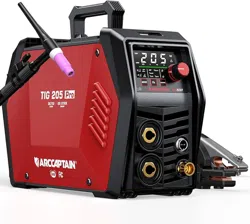
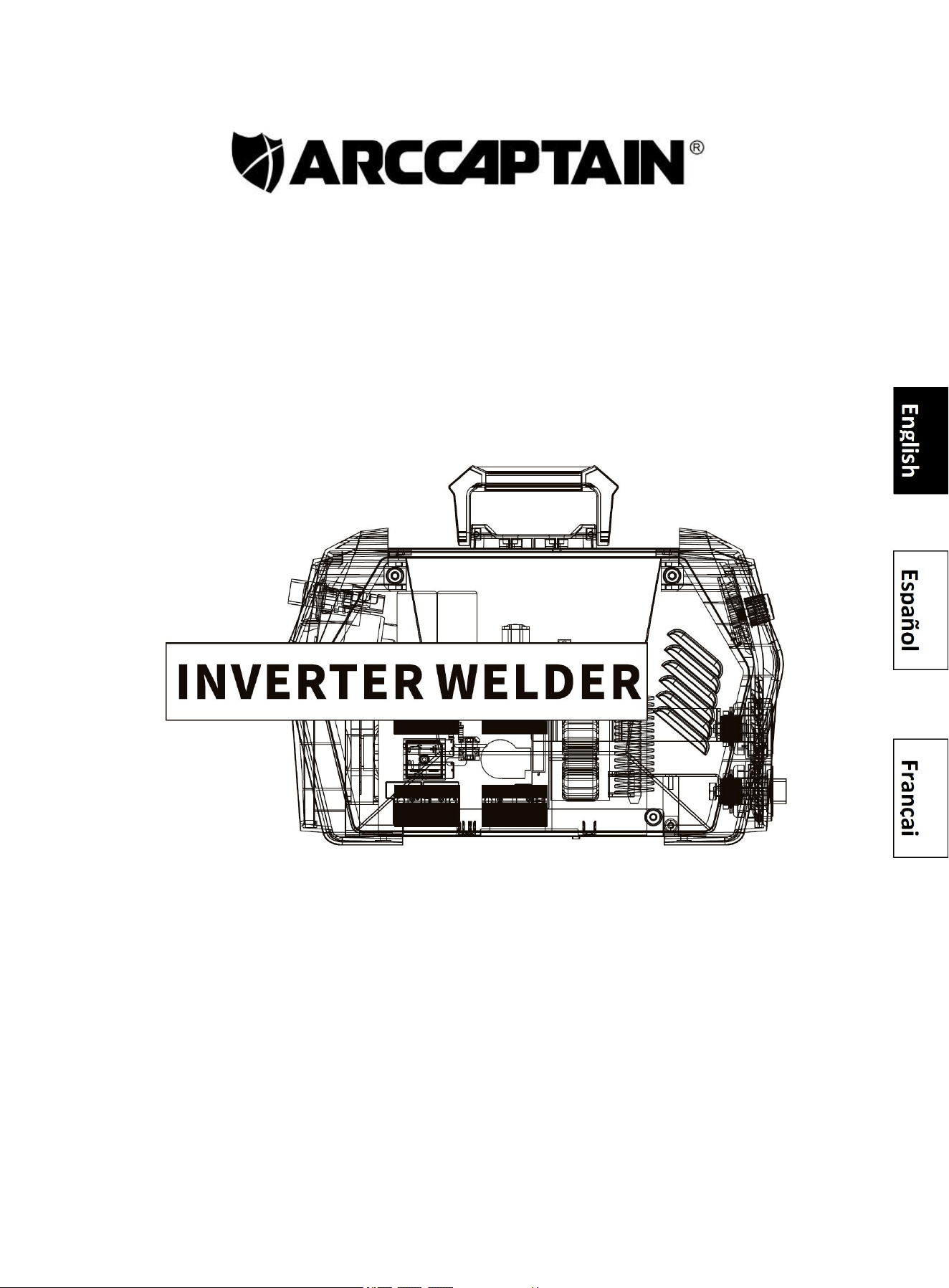
Inverter Welding Machine
TIG205 Pro
User Manual
www.arccaptain.com

Dear Valued Customer,
Thank you for going with ARCCAPTAIN! We're all about making welders superior for you.
ARCCAPTAIN was built by high quality components, every single unit machine was passed
multiple industry leading laboratory tests to provide a great welding experience and
performance.
Two-year warranty service is provide to yours! When unpacking, make sure that the
product is intact and undamaged. DO NOT return directly before contact our customer
service.
Six ways to connect us and join in ARCCAPTAIN Community:
Email: [email protected]
Online: www.arccaptain.com/pages/contact-us
Facebook: arccaptainwelder
Instagram: arccaptain_welder
Youtube: arccaptain-weld
Whatsapp: +19892449456
This manual is designed to help you get the most out of your ARCCAPTAIN products.
Please save this manual and take time to read the safety warnings and precautions,
assembly, operating, inspection, maintenance. They will help you protect yourself against
potential hazards on the worksite. Failure to do so can result in serious injury!
www.arccaptain.com
Save for future reference:
Product
:
Date Purchased:
Serial Number:
Product Feedback:

User Manual
1. SAFETY ----------------------------------------------------------------------------------------------------------------------1
1.1 General Safety -----------------------------------------------------------------------------------------------------1
1.2 Electrical Safety --------------------------------------------------------------------------------------------------- 1
1.3 Fire Safety ---------------------------------------------------------------------------------------------------------- 2
1.4 Fumes and Gases Safety ----------------------------------------------------------------------------------------2
1.5 Arc Rays and Noice Safety --------------------------------------------------------------------------------------2
1.6 Gas Shielded Welding – Cylinder Safety --------------------------------------------------------------------3
1.7 Additional Safety Information ---------------------------------------------------------------------------------3
2. PRODUCT DESCRIPTION ----------------------------------------------------------------------------------------------- 3
2.1 Product Overview ------------------------------------------------------------------------------------------------ 3
2.2 Packge --------------------------------------------------------------------------------------------------------------- 4
2.3 Technical Parameters --------------------------------------------------------------------------------------------4
2.4 Nameplate: ---------------------------------------------------------------------------------------------------------6
3. FUNCTION ----------------------------------------------------------------------------------------------------------------- 6
3.1 Panel of TIG205Pro ---------------------------------------------------------------------------------------------- 6
3.2 Panel functions of TIG205Pro ---------------------------------------------------------------------------------8
4. INSTALLATION AND CONNECTION -------------------------------------------------------------------------------- 10
4.1 Installation requirements ------------------------------------------------------------------------------------ 10
4.2 TIG Welder Cable Connection ------------------------------------------------------------------------------- 11
4.3 TIG Welder Operation ----------------------------------------------------------------------------------------- 13
4.4 TIG Welding Mode ----------------------------------------------------------------------------------------------15
4.5 Installation for MMA function -------------------------------------------------------------------------------15
4.6 MMA Welding Mode ------------------------------------------------------------------------------------------ 17
4.7 Input Power Connection --------------------------------------------------------------------------------------18
5. Strap Installation -------------------------------------------------------------------------------------------------------18
6. WELDING PARAMETERS TABLE ------------------------------------------------------------------------------------20
6.1 Parameters for TIG electrode --------------------------------------------------------------------------------20
6.2 Parameters for TIG welding on stainless steel sheet -------------------------------------------------- 20
6.3 Parameters for TIG welding ---------------------------------------------------------------------------------- 20
6.4 Cold TIG Parameters Table ----------------------------------------------------------------------------------- 22
6.5 MMA Welding Parameters Table --------------------------------------------------------------------------- 23
7. BASIC KNOWLEDGE OF TIG WELDING --------------------------------------------------------------------------- 23
7.1 TIG Overview and Characteristics -------------------------------------------------------------------------- 23
7.2 TIG Characteristics ----------------------------------------------------------------------------------------------24

7.3 TIG Welding Gun ------------------------------------------------------------------------------------------------ 24
7.4 TIG Process ------------------------------------------------------------------------------------------------------- 25
7.5 Welding Parameters ------------------------------------------------------------------------------------------- 27
7.6 General Requirements of TIG --------------------------------------------------------------------------------28
8. BASIC KNOWLEDGE OF MMA -------------------------------------------------------------------------------------- 28
8.1 Welding Process Of MMA ------------------------------------------------------------------------------------ 28
8.2 Tools For MMA -------------------------------------------------------------------------------------------------- 29
8.3 Basic Operation Of MMA ------------------------------------------------------------------------------------- 29
9. TROUBLESHOOTING -------------------------------------------------------------------------------------------------- 32
9.1 Error code and welding processing problems ---------------------------------------------------------- 32
10. MAINTENANCE ------------------------------------------------------------------------------------------------------- 34
1
1.SAFETY
! WARINING READ ALL SAFETY WARNINGS BEFORE WORKING!
Failure to follow the warnings and instructions may result in electric shock, fire and/or serious injury.
Save all warnings and instructions for future reference!
If you encounter any issues during installation or operation, refer to the relevant sections in this manual
for inspection. If you're still unsure or unable to resolve the problem, please contact ARCCAPTAIN
professional support.
1.1 General Safety
Do NOT use the welder if the switch does not turn it on and off.
Disconnect the plug from the power source before making any adjustments, changing accessories,
or storing the welder.
Ensure the switch is off before connecting to power or moving the welder to prevent accidental
starting.
Always maintain and use safety guards, covers, and devices properly.
Keep hands, hair, clothing, and tools away from moving parts like V-belts, gears, and fans.
Follow these instructions and consider working conditions when using the welder and accessories.
This manual may not cover every possible situation. It's important for the operator to use common
sense and caution while using this product.
1.2 Electrical Safety
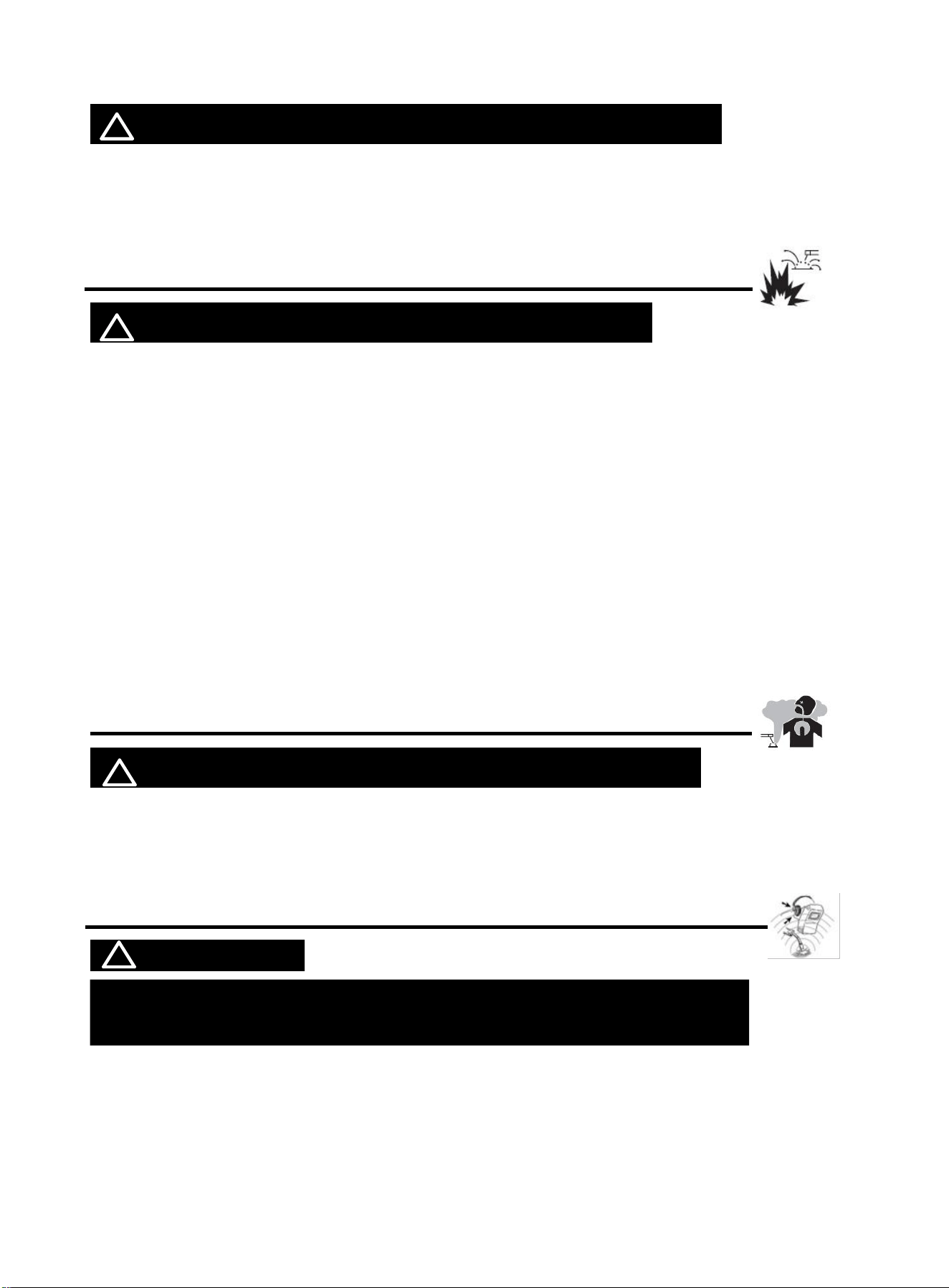
! WARINING BEWARE OF ELECTRIC SHOCK!
DO NOT weld in a damp area or come in contact with a moist or wet surface.
DO NOT modify any wiring, ground connections, switches, or fuses in this welding equipment.
DO NOT come into physical contact with any part of the welding current circuit, including the
workpiece, ground clamp, electrode or welding wire, and metal parts on the electrode holder or MIG
gun.
DO NOT connect the ground clamp to electrical conduit, and DO NOT weld on electrical conduit.
NEVER leave the Welder unattended while energized. Turn off the power if you have to leave.
DO NOT attempt to plug the welder into the power source if the ground prong on INPUT POWER
CABLE plug is bent over, broken off, or missing.
DO NOT alter INPUT POWER CABLE or plug in any way.
People with pacemakers should consult their physicians before use. Magnetic field can make
cardiac pacemaker a bit wonky.
2
! WARINING REPLACING COMPONENTS CAN BE DANGEROUS!
Only experts should replace machine parts. Avoid dropping foreign objects into the machine during
component replacement. Ensure correct wire connections after replacing PCBs to prevent property
damage.
1.3 Fire Safety
! WARINING BEWARE OF FIRE HAZARD!
Place the machine on non-combustible surfaces to prevent fires.
Ensure no flammable materials are near the working area to reduce fire risk.
Avoid installing the machine near water sources to prevent water damage.
Always weld/cut materials in a dry environment with humidity below 90% and maintain a working
temperature between -10°C and 40°C.
When welding/cutting outdoors, ensure shelter from sunlight and rain, keeping the machine dry at
all times.
Do not operate the machine in dusty or chemically corrosive environments.
Remove or secure all combustible materials within a 35 feet (10 meters) radius of the work area.
Use fire-resistant material to cover or seal open doorways, windows, cracks, and other openings.
Improper use can lead to fire or explosion. Avoid flammable materials near the working area, keep a
fire extinguisher nearby with trained personnel, refrain from cutting closed containers, and do not
use the machine for pipe thawing.
1.4 Fumes and Gases Safety
! WARINING SMOKE CAN BE HARMFUL TO YOUR HEALTH!
Keep your head away from the smoke while cutting to avoid breathing in harmful gases.
Ensure the working area is well-ventilated with exhaust or ventilation equipment during cutting.
Only work in a confined area if it's well-ventilated, or wear an air-supplied respirator.
1.5 Arc Rays and Noice Safety
! WARINING
Arc radiation can harm eyes and skin; excessive noise can damage hearing.
Use certified welding eye protection with at least a number 10 shade lens rating.
Wear leather leggings and fire-resistant shoes or boots; avoid clothing that can catch sparks or
molten metal. Do not touch hot workpiece with bare hands.
EXCESSIVE NOISE DOES GREAT HARM TO HEARING!
ARC RADIATION MAY HURT YOUR EYES AND BURN YOUR SKIN!

3
Keep clothing free of flammable substances and wear dry, insulating gloves and protective clothing.
Wear an approved head covering and use appropriate welding attire.
When welding overhead or in confined spaces, use flame-resistant ear plugs or ear muffs.
Wear ear covers or other hearing protectors when cutting.
1.6 Gas Shielded Welding – Cylinder Safety
! WARINING CYLINDERS CAN EXPLODE WHEN DAMAGED!
Never weld on a pressurized or closed cylinder.
Avoid letting the electrode holder, electrode, welding torch, or welding wire touch the cylinder.
Keep cylinders away from all electrical circuits, including welding circuits.
Always keep the protective cap on the valve except when the cylinder is in use.
Use only the correct gas shielding equipment designed for your specific type of welding, and
maintain it properly.
Protect gas cylinders from heat, physical damage, slag, flames, sparks, and arcs.
Always follow proper procedures when moving cylinders.
Do not install the machine in an environment with explosive gas to avoid an explosion.
1.7 Additional Safety Information
Use only the supplied power cord for this welder or an identical replacement cord. Do not install a
thinner or longer cord on this Welder.
Maintain labels and nameplates on the Welder. These carry important information.
Ensure the ground clamp is securely connected to the workpiece during welding.
Pressing the gun switch when welding or cutting.
When disposing of the cutting machine, please note the following:
Burning electrolytic capacitors on the main circuit or PCB board may cause explosions. Burning
plastic components such as the front panel may produce toxic gases. Dispose of it as industrial
waste.
2.PRODUCT DESCRIPTION
2.1 Product Overview
TIG welder is of constant current external characteristic. Welding current will not be changed per arc
length but being kept at a very stable level. It adopts PWM technology and high-power switching
element IGBT (discrete) to rectify AC120V/AC240V (50Hz/60Hz) voltage to DC340V, after inverting
it to 42KHz, there is a voltage step-down and rectification again, stable welder current is obtained by
output current feedback and adjustment.
MCU digital control achieves intelligent synergy
4
Latest IGBT Inverter Technology
TIG205Pro is DC-TIG、MMA and Cold-TIG Multi-Process welding machine
MMA/Stick welding features: hot start, arc force and anti-stick
TIG welding features: 2T/4T Operation, current regulation, post-flow adjustable, down-slope
Fan-On-Demand power source cooling system operates only when needed, reducing noise, energy
use and the amount of contaminants pulled through the machine
Compact and portable with light weight
Safety protection: over current/overheating protection circuit
Unique Design & LED Display Panel, read data more clear, concise distribution and convenient
operation. Warning indicator for normal working and abnormal working
Remote control function available: support foot pedal & analog torch (purchase additional if need)
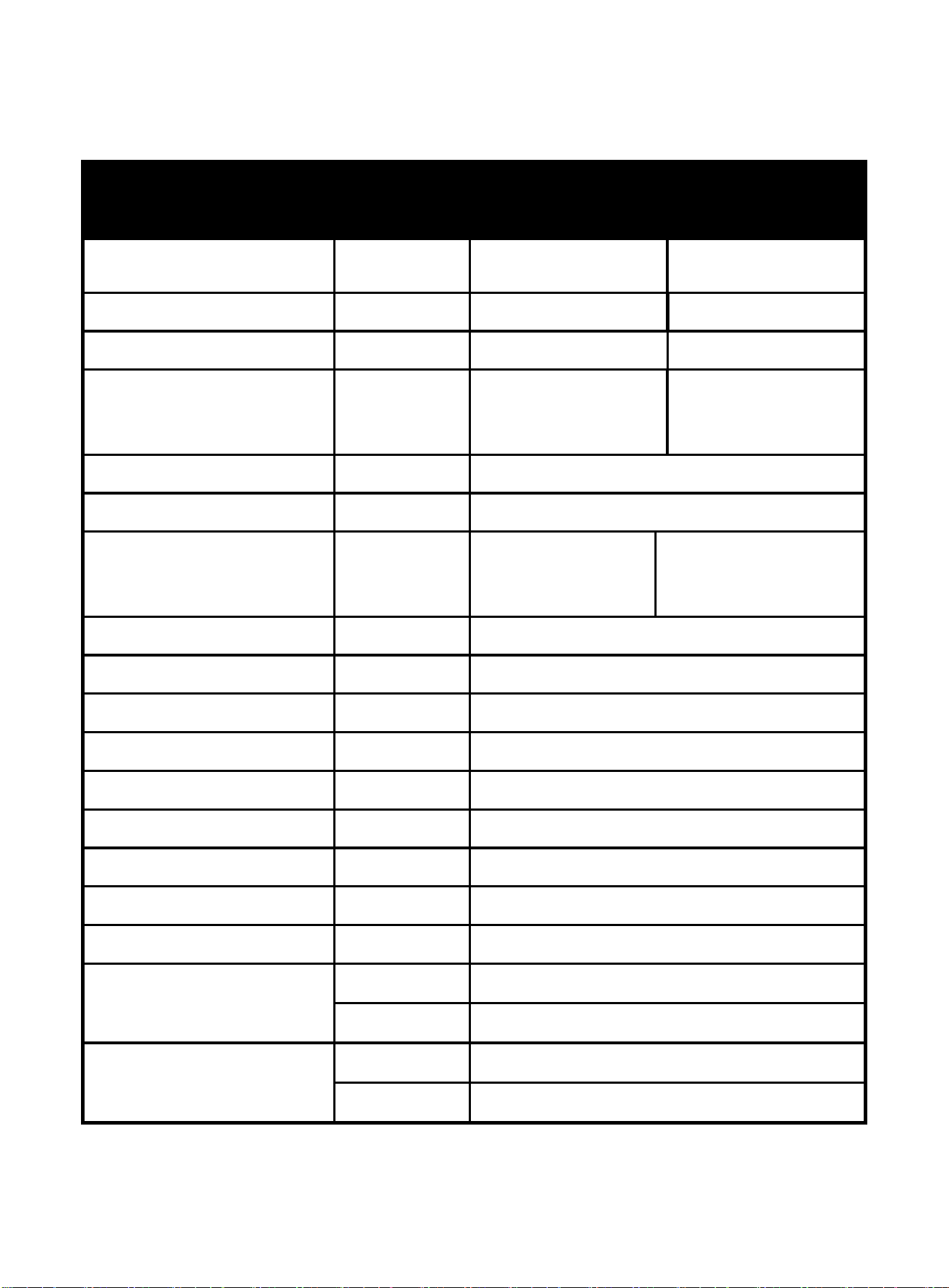
2.2 Packge
Name
Specification
Quantity (pcs)
TIG welder
TIG205 Pro
1
TIG torch & accessories
WP-17 (13ft/4m)
1
Electrode Holder
10ft/ 3m
1
Earth clamp
10ft/ 3m
1
Gas hose
Gas hose with gas connector
1
Adapter
240V to 120V
1
Strap
/
1
Tungsten electrode
φ1/16", 6"(1.6mm, 150mm)
1
Operator’s manual
For TIG205 Pro
1
2.3 Technical Parameters
5
TECHNICAL PARAMETERS
Units
Model
TIG 205 Pro
Rated Input Power
V
Single Phase AC240V
Single Phase
AC120V ±15%
Rated Input Capacity
kVA
7.8
5.1
Rated Input Current
A
33
43
Rated Output Current/Voltage
A/V
TIG:205A/18.2V
MMA:205A/28.2V
240V
TIG:145A/15.8V
MMA:145A/25.8V
120V
Rated Duty Circle
-
60%
No-load voltage
V
DC 65
Output Current Range
A
240V
TIG: 10-205
MMA: 10-205
120V
TIG: 10-145
MMA: 10-145
Post-flow Time
s
0--15
Down slope
s
0--15
Tweld
ms
1-999
Ttakt
s
0.1-10
Arc Ignition Type
-
HF
Enclosure Protection Class
-
IP21S
Insulation Grade
-
H
Power Factor
-
0.73
Efficiency
-
80%
Dimensions L*W*H
Inch
15.2*6.1*9.6
mm
386*154*243
Net weight
Lb
10.63
KG
4.82
6
2.4 Nameplate:
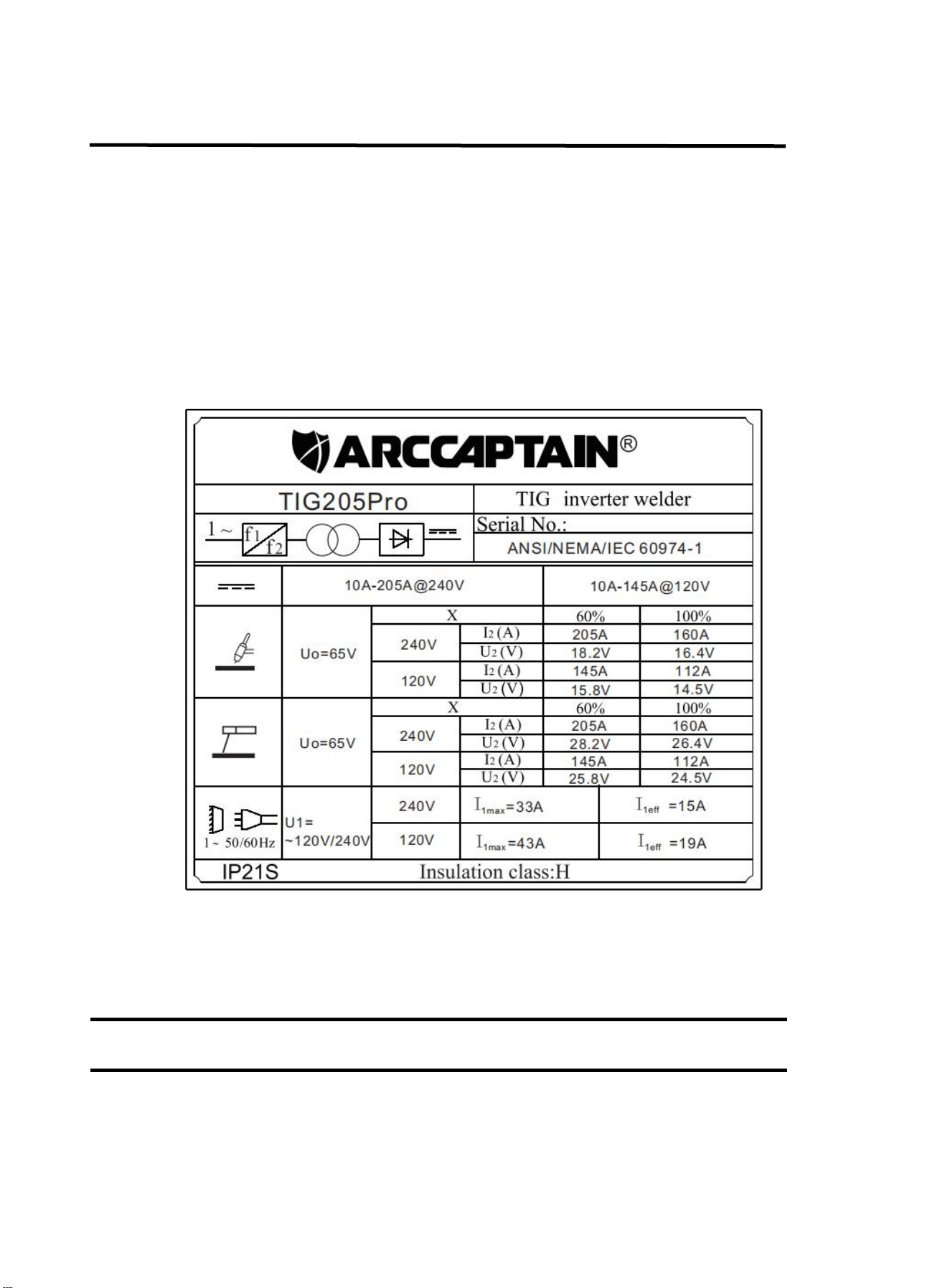
On the machine, there is a plate that includes all the operating specifications for your new unit. The serial
number of the product is also found on this plate.
The duty cycle rating of a welder defines how long the operator can weld and how long the welder must
rest and be cooled. Duty cycle is expressed as a percentage of 10 minutes and represents the maximum
welding time allowed. The balance of the 10-minute cycle is required for cooling.
For example, a welder has a duty cycle rating of 60% at the rated output of 205A. This means with that
machine: you can weld at 205A output for six (6) minutes out of 10 with the remaining four (4) minutes
required for cooling. The duty cycle of your new welder can be found on the data plate affixed to the
machine. It looks like the diagram below.
Figure 1
3.FUNCTION
3.1Panel of TIG205Pro
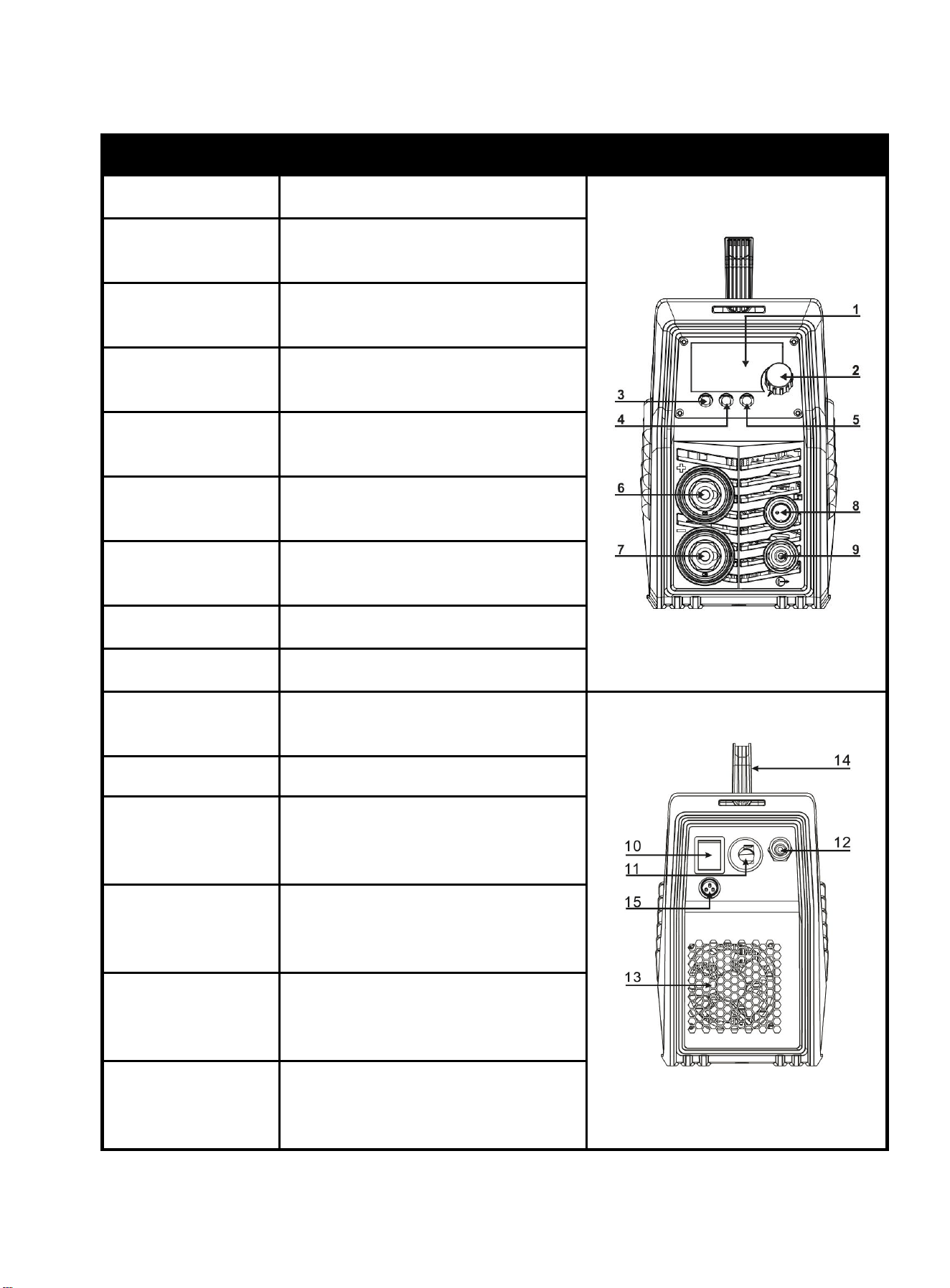
7
Part name
Function
Picture
1.Digital screen
To display the welding information
Figure 2 Front panel controls
2.Parameter
adjustment knob
Rotate the knob to adjust the
parameters
3.Mode button
For MMA/DC-TIG 2T/DC-TIG
4T/Cold-TIG welding mode conversion.
4.Fn button
For Current/Tweld/Ttakt/Down slope/
Post Gas conversion.
5.Remote mode
button
For Panel/Remote/Foot pedal
conversion.
6.Output“+” terminal
To connect the Electrode
Holder/Ground Clamp
7.Output “-” terminal
To connect the Welding torch/Ground
Clamp/Electrode Holder
8.Gun Switch
To connect the Gun Switch
9.Gas out
For conveying shielding gas
10.Power switch
To control the ON/OFF of the input
power of the machine
Figure 3 Back panel controls
11.Power wire
For power supply input
12.Gas in
Used to connect shielding gas
13.Cooling fan
For heat dissipation through forced air
cooling
14.Handle
For translation and storage
15.Helmet interface
For connecting cold welding helmet
8
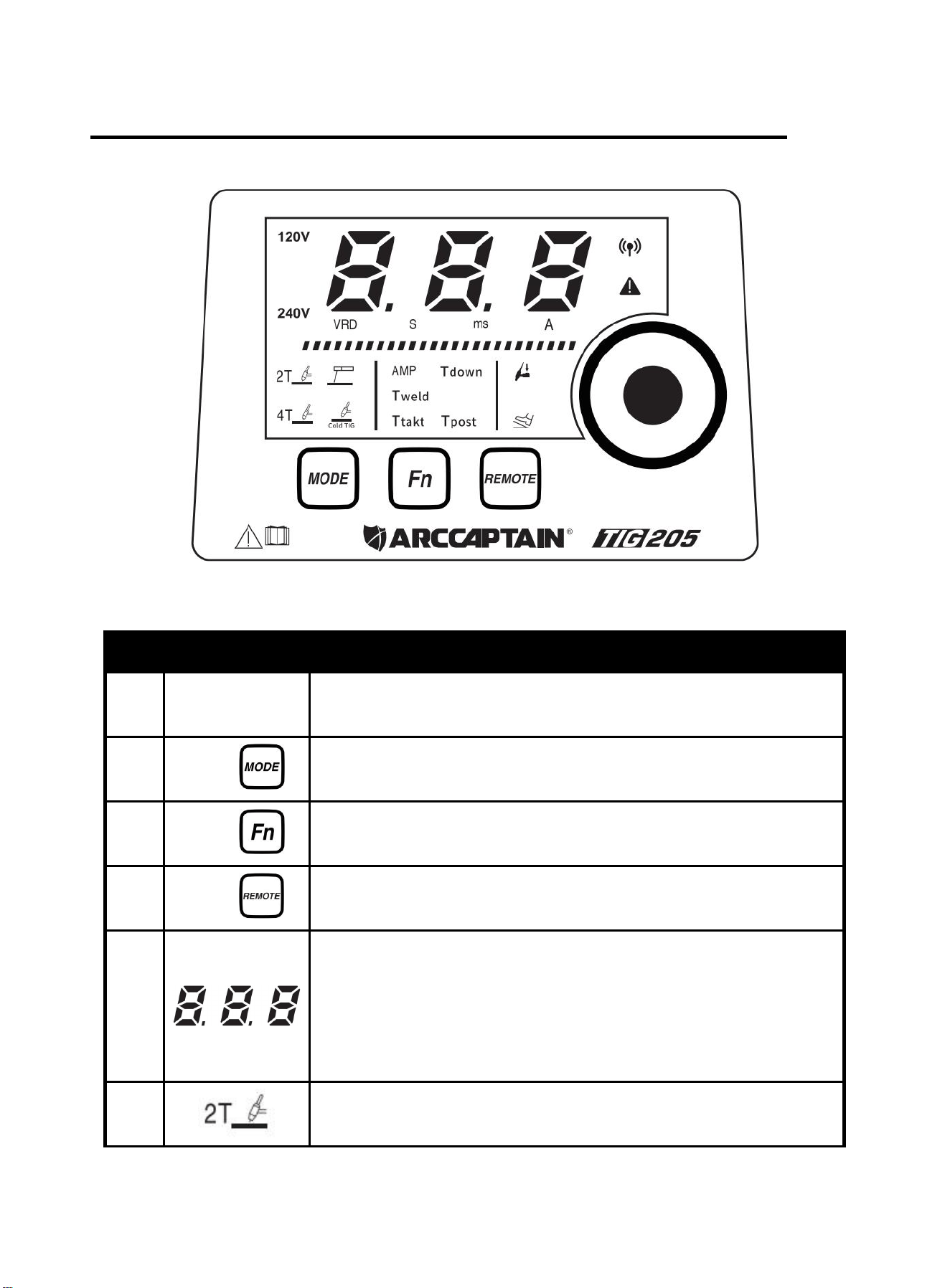
3.2 Panel functions of TIG205Pro
Figure 4
No.
Part name
Function
1
Parameter
adjustment knob
Rotate the knob to adjust the parameters.
2
Button “ ”
For MMA/2T/4T/Cold-TIG welding mode conversion.
3
Button “ ”
For Current/Tweld/Ttakt/Down slope/ Post Gas conversion.
4
Button “ ”
For Panel/Remote/Foot pedal conversion.
5
1.Displays the value of the current parameter.
2.If there is no operation after 3 seconds,it will automatically display
the value of the setting welding current.
3.When the product is not working correctly, an error code is
displayed.
6
If the indicator is on, it indicates the DC-TIG 2T Welding mode is
selected.
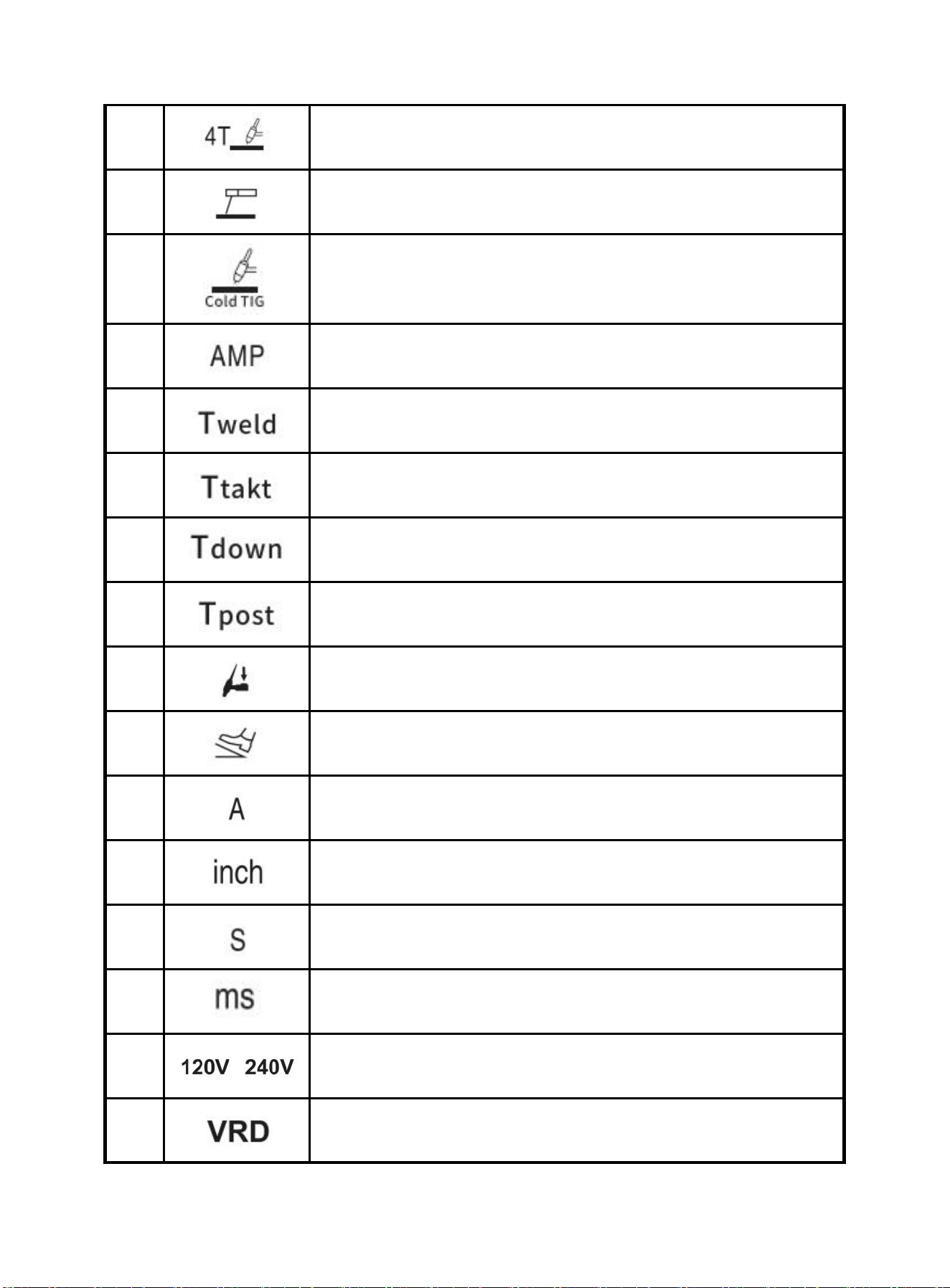
9
7
If the indicator is on, it indicates the DC-TIG 4T Welding mode is
selected.
8
If the indicator is on, it indicates the MMA Welding mode is selected.
9
If the indicator is on, it indicates the Cold-TIG Welding mode is
selected.
10
This indicates the value of output current.
11
Adjust cold welding time.
12
Adjust cold welding interval.
13
This indicates the time taken from the peak current to the arc striking
current.
14
This indicates the shielding gas post-flow time.
15
If the indicator is on, it indicates the Remote is selected(if it is panel
knob control, the indicator light is not on).
16
If the indicator is on, it indicates the Foot pedal is selected(if it is panel
knob control, the indicator light is not on).
17
Unit of current.
18
Unit of workpiece thickness.
19
Unit of Ttakt/Tdown/Tpost.
20
Unit of Tweld.
21
The input voltage is AC120V/240V.
22
The VRD function is on when it is blinking.
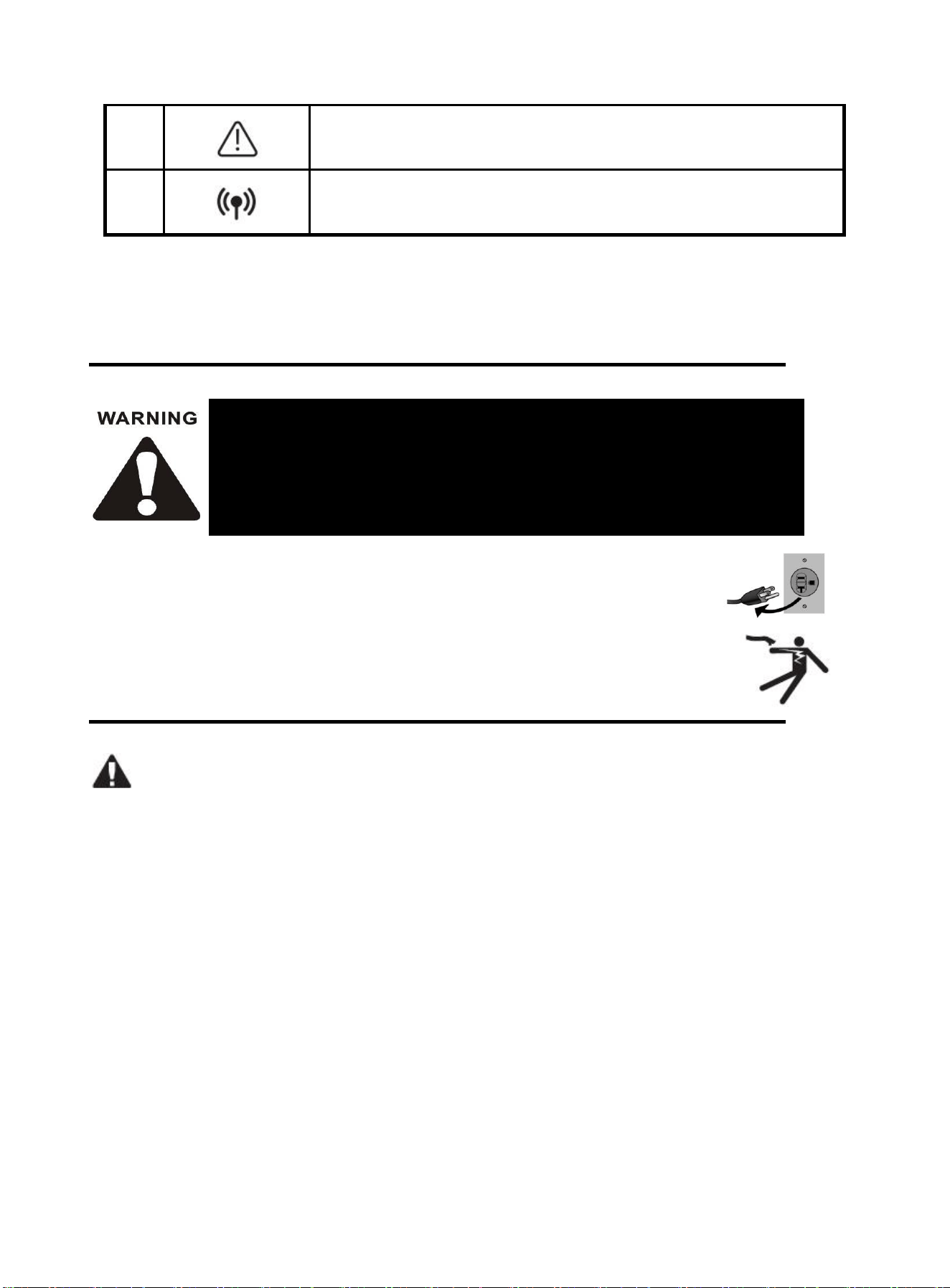
10
The following operation requires sufficient professional knowledge on electric
aspect and comprehensive safety knowledge. Operators should be holders of
valid qualification certificates which can prove their skills and knowledge. Make
sure the input cable of the machine is disconnected from the electricity utility
before uncovering the welding machine.
*For more detailed information about the connection and operational guidelines for the ARCCAPTAIN
APP, please visit www.arccaptain.com and explore the resources available there.
4.INSTALLATION AND CONNECTION
Note:
Turn off the power supply switch before any electric connection operation.
The housing protection grade of this machine is IP21S, so do not use it in rain.
Place the Welder on a level surface that can bear its weight near the work area.
4.1 Installation requirements
Environment requirements
Please pay attention to the following when choosing installation site:
Please avoid environment which contains too much dusts or metal powder.
Avoid installation in area which is with corrosive or explosive gases.
Ambient temperature should be within - 10℃ ~ + 40℃;Please reinforce radiation or lessen
power machine operation when temperature is over 40℃.
Installation should be carried out in dry environment with humidity less than 90%.
Avoid welding in the open air with strong wind; please install windscreen if necessary, or else
welding performances may be affected.
Please consult and confirm in advance if there is any special installation requirement.
If the Welding power is paced on tilt plane, pay attention to avoid it topple over.
The Welding power is forbidden to use thaw pipe.
23
The machine is on alarm state when it is blinking.
24*
The machine is connected to wireless.
11
Installation space requirements
Distance between welder and wall should be more than 20cm(7.87"); distance between two abreast
welders should be more than 30cm(11.82"). You may refer to the below suggested reserved installation
space to confirm the installation position.
Department
Front
Left Side
Right Side
Back
Reserved Space
≥20cm/7.87"
≥20cm/7.87"
≥20cm/7.87"
≥20cm/7.87"
4.2 TIG Welder Cable Connection
Description
Picture
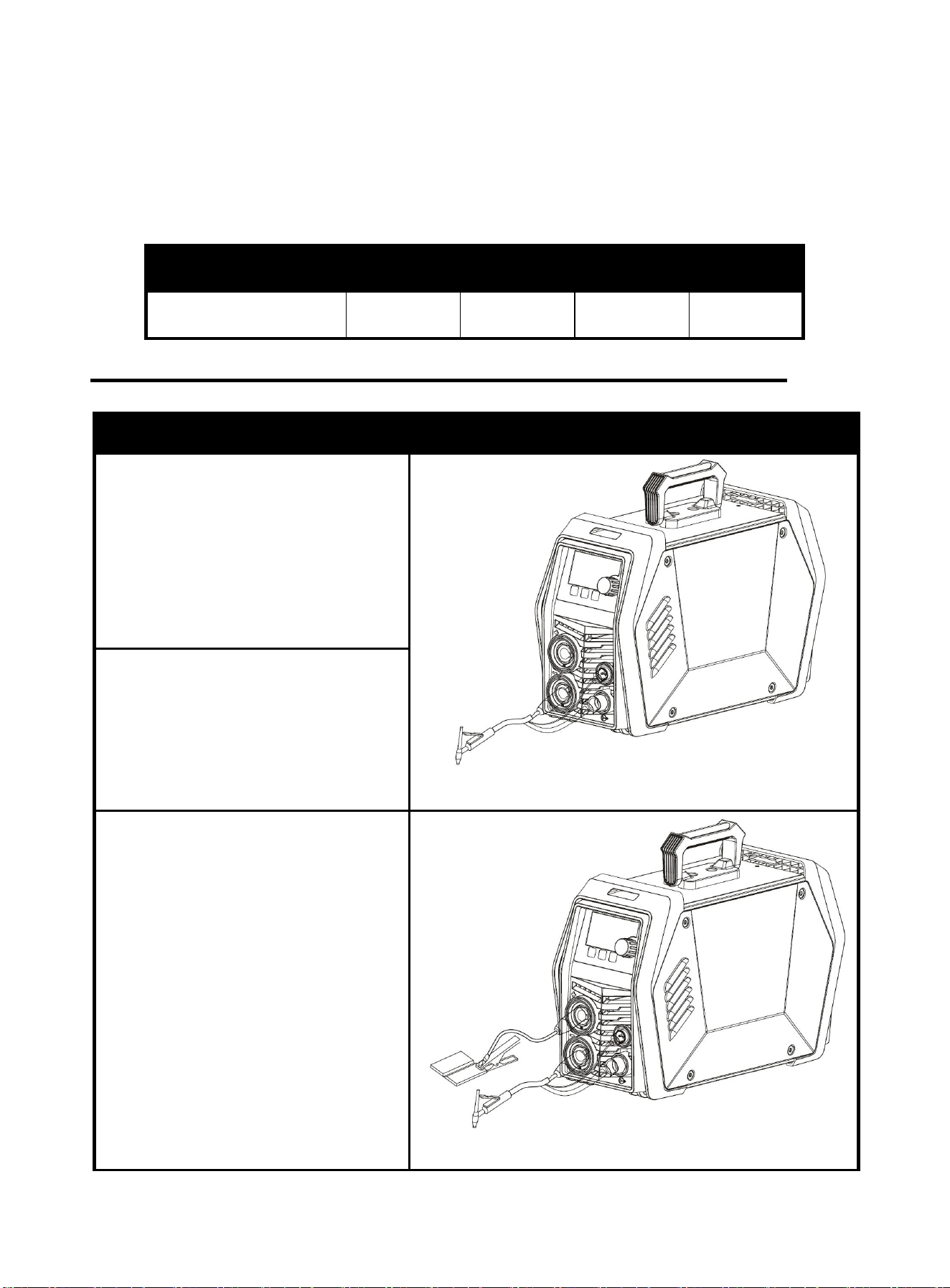
1.Please connect TIG torch correctly
according to Figure 5. Connect the gas
& electric connector of the TIG torch to
the corresponding connector on the
machine panel, and tighten it clockwise.
NOTE: Make sure the link is partially
tightened.
Figure 5
2.Connect the aviation plug on the TIG
torch to the corresponding socket on the
machine panel. (Figure 5.)
NOTE: Make sure the link is partially
tightened.
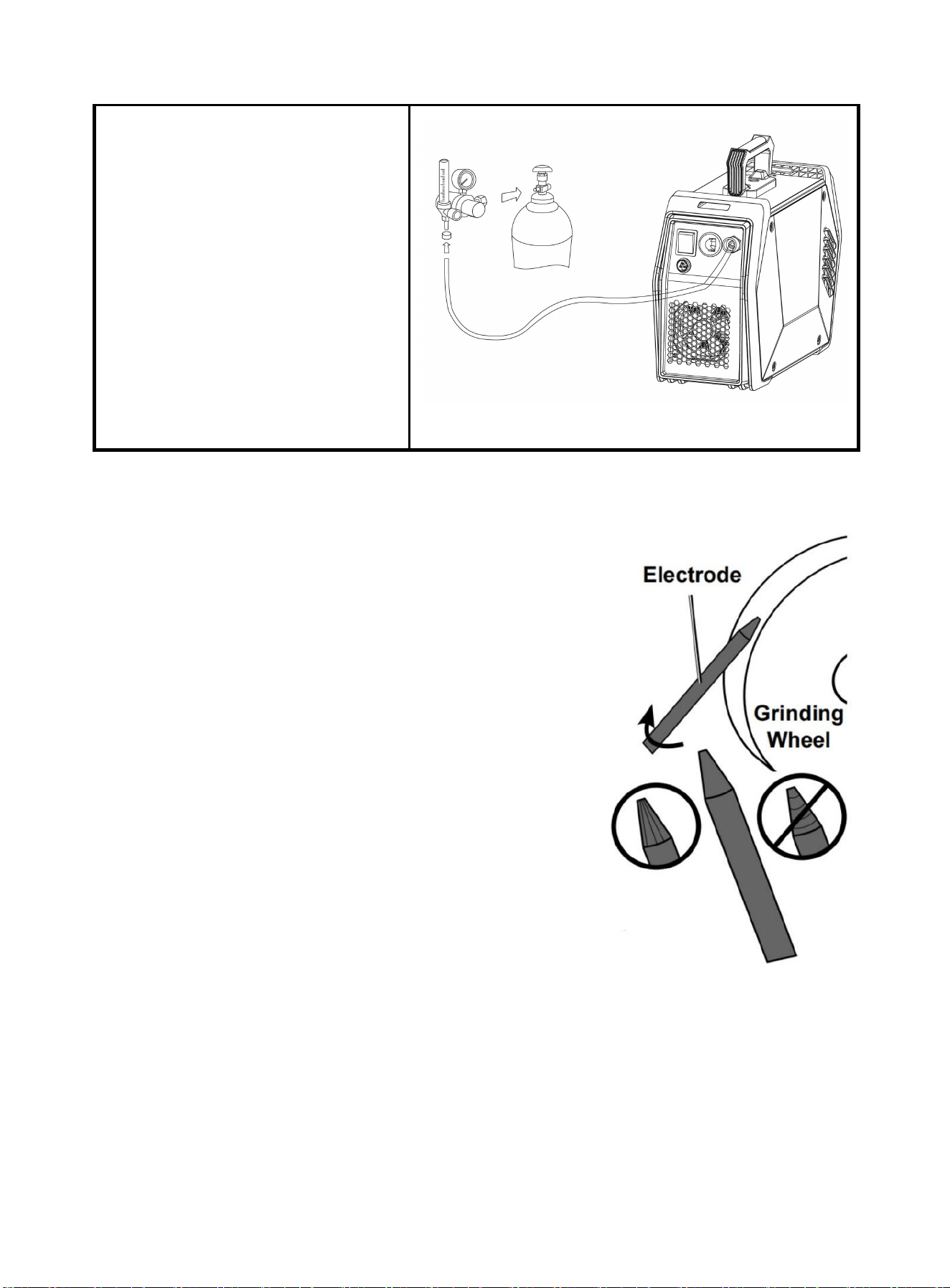
3.Insert the quick plug on the earth
cable into the “+” quick socket on the
machine panel, and tighten it clockwise.
Clamp the workpiece with the earth
clamp at the other end of the earth
cable. (Figure 6.)
NOTE: Make sure the link is partially
tightened.
Figure 6 Installation of Earth cable
12
More information:
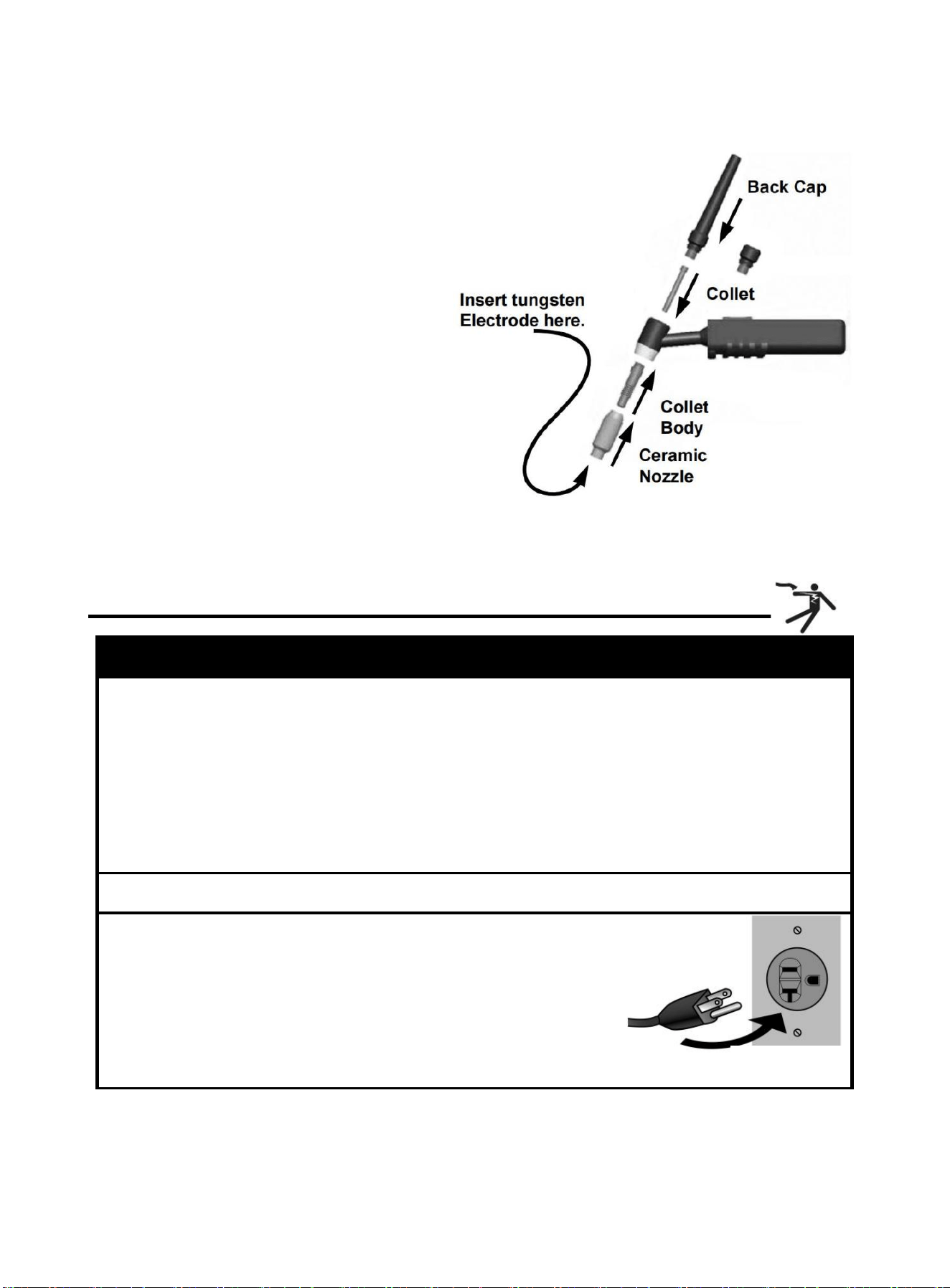
Sharpen tungsten Electrode
To avoid Electrode contamination, dedicate a fine grit grinding
wheel exclusively to Electrode grinding.
1.Shut off the welder and wait until Electrode and Torch have cooled
enough to handle.
2.Remove Back Cap to release Collet’s grip on Electrode.
3.Pull Electrode out from front of Torch. (Pulling it from rear will
damage Collet and create burrs on Electrode).
4.If Electrode has dulled or been otherwise contaminated, use
pliers or a suitable tool to grip the Electrode above the
contaminated section and snap off the end of the Electrode.
5.Lightly press Electrode tip against the surface of the grinding
wheel at an angle. Rotate Electrode tip until a blunt point is
formed.
NOTE: Grinding direction must be parallel to length of
Electrode.
6.The conical portion of the ideal tip will be 2-1/2 times as long as
the Electrode diameter.
7.Re-insert Electrode into Collet with tip protruding 1/8"-1/4" beyond the Ceramic Nozzle, then re-tighten
the Back Cap to secure the Electrode in place.
4.Gas connection: connect argon tube
with welder back panel’s brass
mouthpiece tightly. Air supply passage
should include argon decompressed
flowmeter, gas hose; Be sure to secure
the hose connections to avoid poor
solder joint protection due to gas
leakage or air intrusion. (Figure 7)
NOTE: Make sure the link is partially
tightened.
Figure 7 Gas connection
Figure 8
13
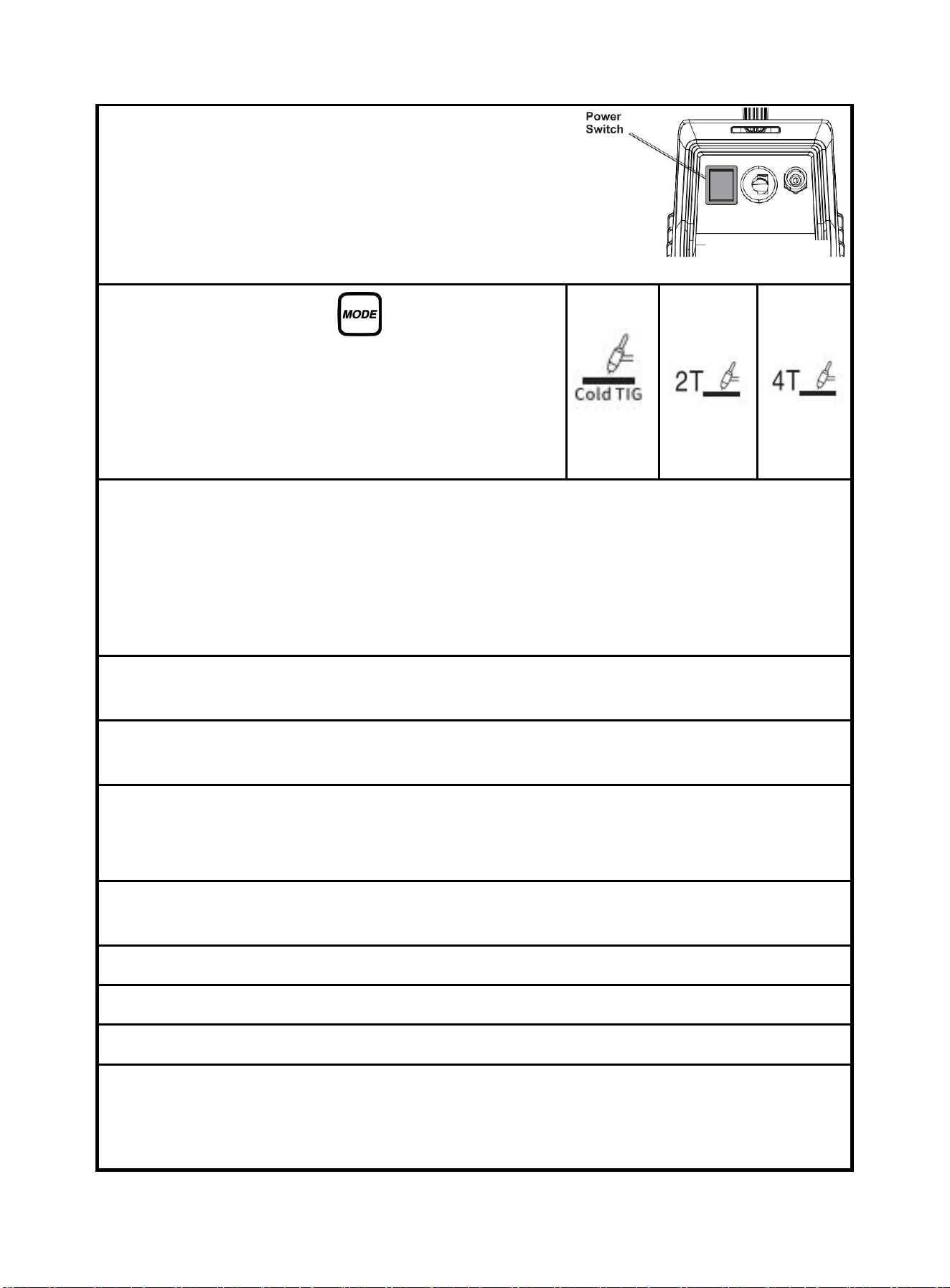
Assemble tig torch
1. Consult Settings Chart, on top of Welder, to
determine proper Tungsten Electrode size
to be used with thickness of material to be
welded.
2. Match Collet and Collet Body sizes to
Tungsten Electrode size.
3. Thread Collet Body into the front of the
Torch.
4. Make sure Ceramic Nozzle size is
appropriate for application.
5. Thread Ceramic Nozzle onto Collet Body.
6. Insert Collet into back of Torch and into
Collet Body.
7. Insert Tungsten Electrode into Collet on front
of Torch.
8. Lock Electrode in place with Back Cap. Electrode should protrude 1/8" to
1/4" beyond the Ceramic Nozzle.
4.3 TIG Welder Operation
Operation step
1.Open gas cylinder’s valve all the way.
NOTE: TO PREVENT DEATH FROM ASPHYXIATION:
Do not open gas without proper ventilation. Fix gas leaks immediately. Shielding gas can
displace air and cause rapid loss of consciousness and death. Shielding gas without carbon
dioxide can be even more hazardous because asphyxiation can start without feeling
shortness of breath.
2.Set Flow Gauge to SCFH VALUE.
3.connect power cord.
NOTE: Turn the Power Switch off before connecting Power
Cord. Plug the Power Cord into a properly grounded and rated
receptacle that matches the plug. The circuit must be equipped
with delayed action-type circuit breaker or fuses.
Figure 10
Figure 9
14
4.Turn the Power Switch ON.
NOTE: Set TIG Torch down on nonconductive,
nonflammable surface away from any grounded objects.
The Operation interface will light up and the Cooling fan will
rotate.
5.Press the Weld Mode button , for TIG welding mode
changeover.
NOTE: For Cold Welding Mode, please connect the cold
welding helmet to the Helmet interface on the back of the
machine.If you need to buy cold welding helmet, go to
http://www.arccaptain.com
6.Hold TIG Torch in one hand and the TIG Rod (sold separately) in other hand. Both hands need to
wear protective gloves.
WARNING! TO PREVENT SERIOUS INJURY: Metalwork bench must be grounded when TIG
welding.
NOTE: Maintain a constant distance between the Tungsten Electrode and the workpiece: between 1
and 1.5 times the diameter of the Electrode.
7.The initial settings may need to be adjusted after stopping and carefully inspecting the weld.
Please refer to 6. WELDING PARAMETERS TABLE, Proper welding takes experience.
8.When welding puddle is hot enough, tilt Torch backward about 10-15 degrees from vertical and
move it back slightly. Add TIG Rod material as needed to the front end of the weld puddle.
9.Alternate between pushing the torch/weld puddle and adding the TIG Rod material.
NOTE: Remove the TIG Rod each time the Electrode is advanced, but do not remove it from the gas
shield. This prevents oxidation from contaminating the weld.
10.When finished welding, pull Torch away from work piece until welding arc is broken, then return
the gas coverage until weld solidifies.
11.Close valve on TIG Torch and turn Right Knob to OFF to turn off power.
12.Set TIG Torch down on nonconductive, nonflammable surface away from any grounded object.
13.Turn the Power Switch OFF.
14.To prevent accidents, after use:
Allow Welder to cool down.
Unplug Welder’s power cord from outlet.
Figure 11
15
Remove Ground Clamp from workpiece or table.
Disconnect TIG Torch and Ground Cables.
Close gas cylinder’s valve securely, remove regulator and replace cap.
Disconnect Gas
If Electrode has dulled or been otherwise contaminated, use pliers or a suitable tool to grip the
Electrode above the contaminated section and snap off the end of the Electrode.
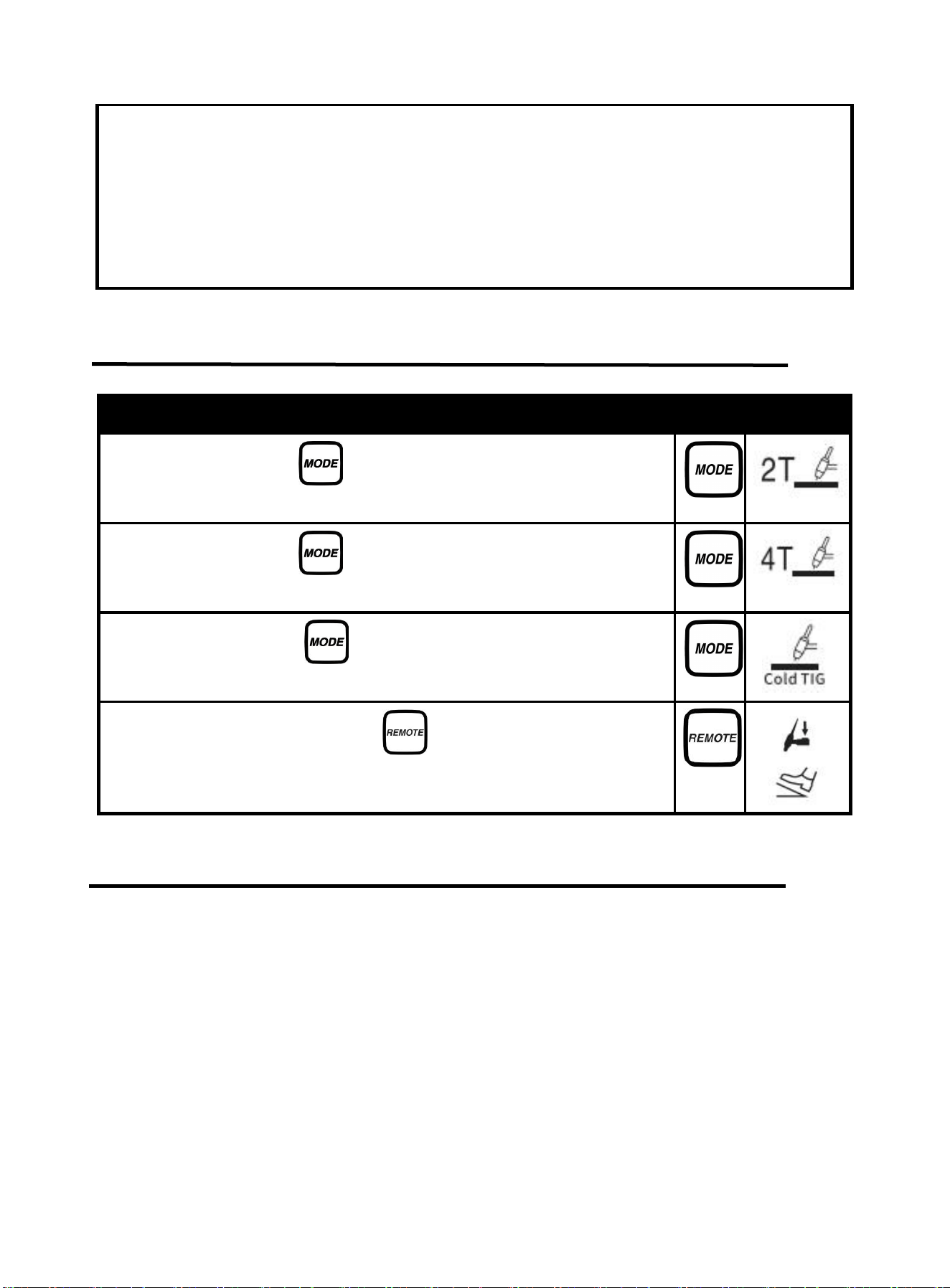
4.4 TIG Welding Mode
4.5 Installation for MMA function
Please install the machine strictly according to the following steps.(see page 17)
Describe
Part
Select
Press the Mode button , for DC-TIG 2T welding mode changeover.
rotate the knob to adjust the current. Adjustment range is 10-205 amps.
Press the Mode button , for DC-TIG 4T welding mode changeover.
rotate the knob to adjust the current. Adjustment range is 10-205 amps.
Press the Mode button , for Cold TIG welding mode changeover.
rotate the knob to adjust the current. Adjustment range is 10-205 amps.
Press the Remote mode button , for Panel/Remote torch/Foot
pedal conversion.
16
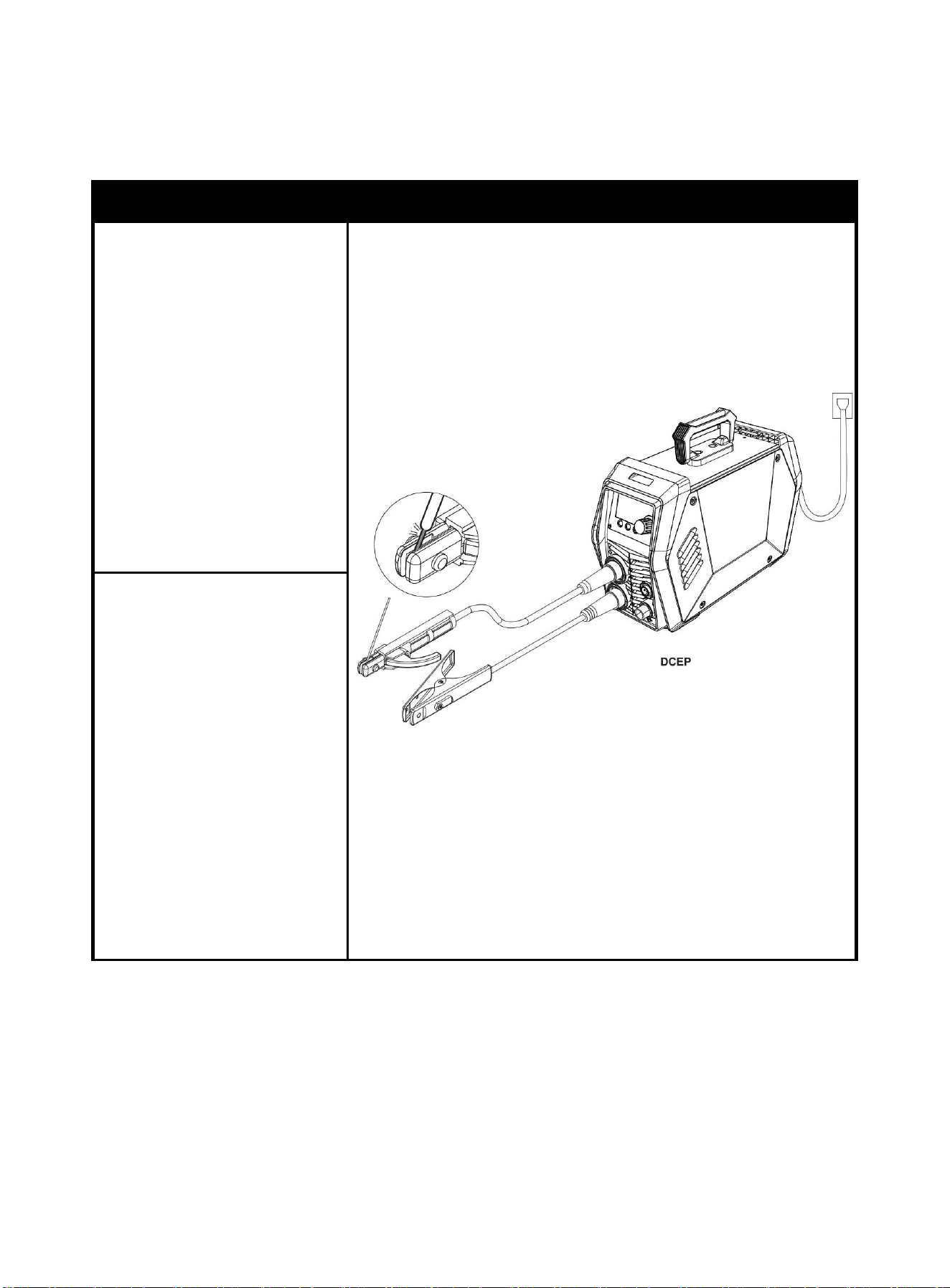
Description
Picture
1. Insert the cable plug with
electrode holder into the “+”
socket on the front panel of the
welding machine, and tighten it
clockwise.
NOTICE:
The holder connector
MUST be tightly
connected to the ocket to
avoid power short circuit.Set
Electrode Holder down on
nonconductive,nonflammable
surface away from any
grounded objects.
Figure 12 DCEP Schematic Diagram of MMA Welding
2. Insert the cable plug with
ground clamp into the“-”
socket on the front panel of the
welding machine, and tighten it
clockwise.
NOTICE:
The ground clamp
connector MUST be
tightly connected to the
socket to avoid
power short circuit.Ensure
the ground
clamp is connected on clean,
bare metal.
(not rusty or painted)
17
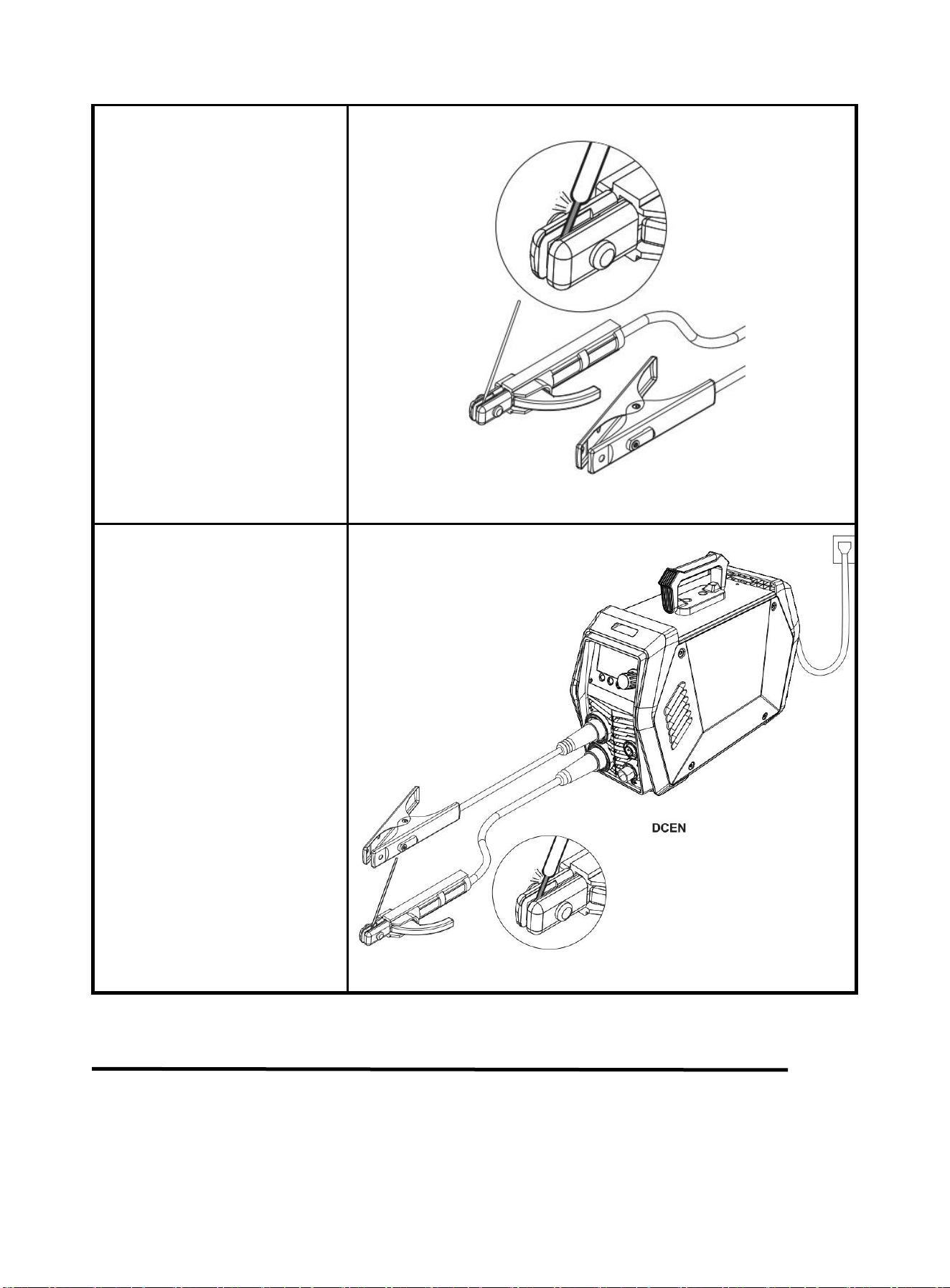
3. Place the bare metal end of
the Stick
Electrode inside the jaws of the
Electrode
Holder.
NOTICE:
Ensure that the clip is on the
conductive side of the
electrode. Ensure that it is
securely clamped.
Figure 13
4. When you use Alkaline rods
(E7018), need to DCEP, that is
connect the holder and ground
clamp as mentioned above in
above 1. and 2.
5. If you use Acidic
rods(E6013), need to
DCEN, that is connect the
holder to “-”and
ground clamp to “+” .
NOTICE:
Incorrect connecting can
affect welding results.
Figure 14 DCEN Schematic Diagram of MMA Welding
4.6 MMA Welding Mode
18
4.7 Input Power Connection
! WARINING BEWARE OF ELECTRIC SHOCK!
The TIG205 Pro operates with a 120V or 240V power supply.
Turn the Power Switch to the OFF position, then plug the Welder into a properly grounded 240V
receptacle that matches the plug. Use the included 120V power adaptor if plugging the Welder into
a 120V receptacle.
Plug the Power Cord into a properly grounded. Set Electrode Holder down on nonconductive,
nonflammable surface away from any grounded objects. And then turn the Power Switch ON.
NOTE:
For optimal performance, connect the TIG205 Pro to a 50A branch circuit. If connected to a
circuit with lower capacity, expect reduced welding current and duty cycle.The circuit must be
equipped over 50A with delayed action-type circuit breaker or fuse.
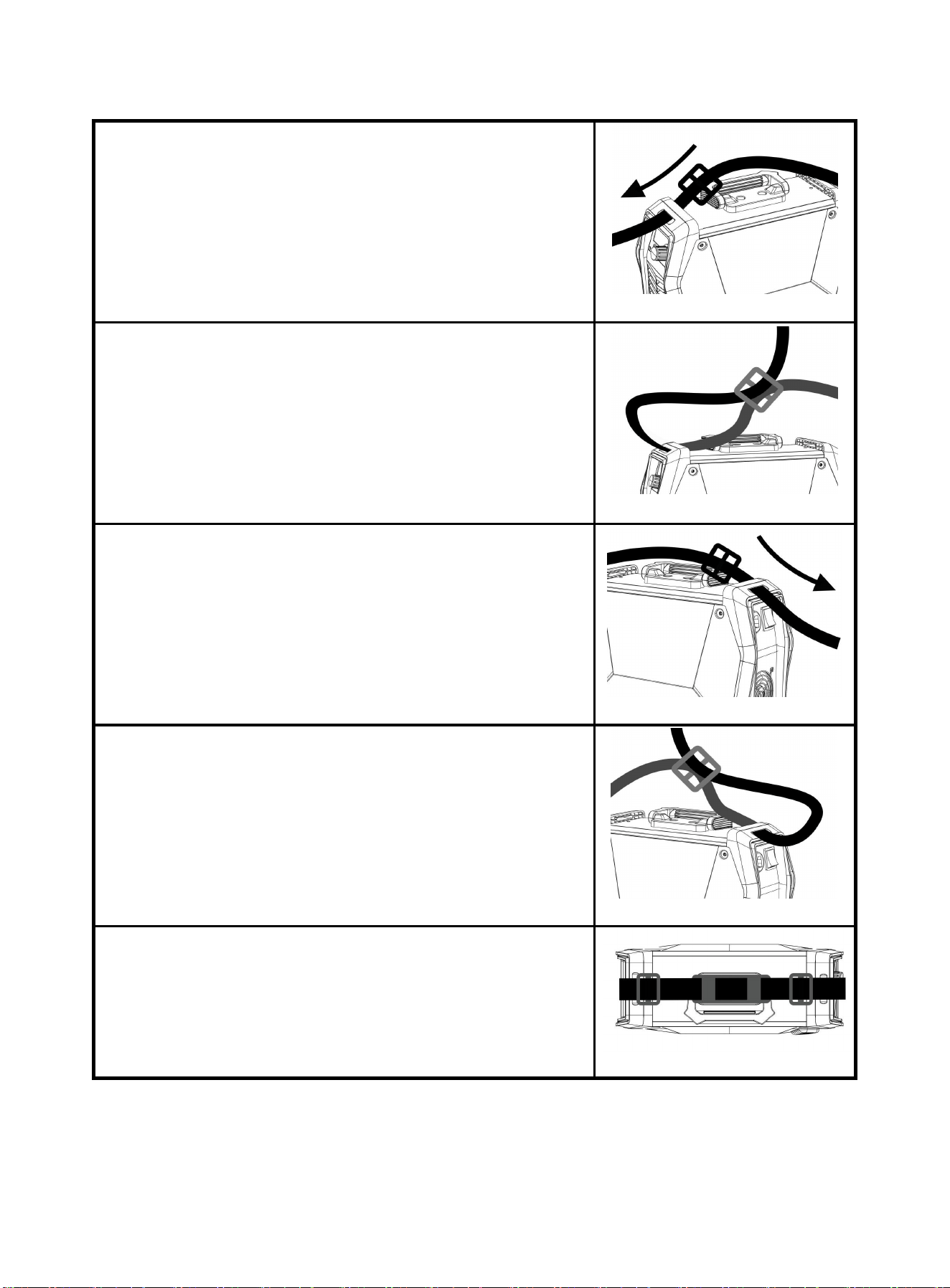
5. Strap Installation
Describe
Part
Select
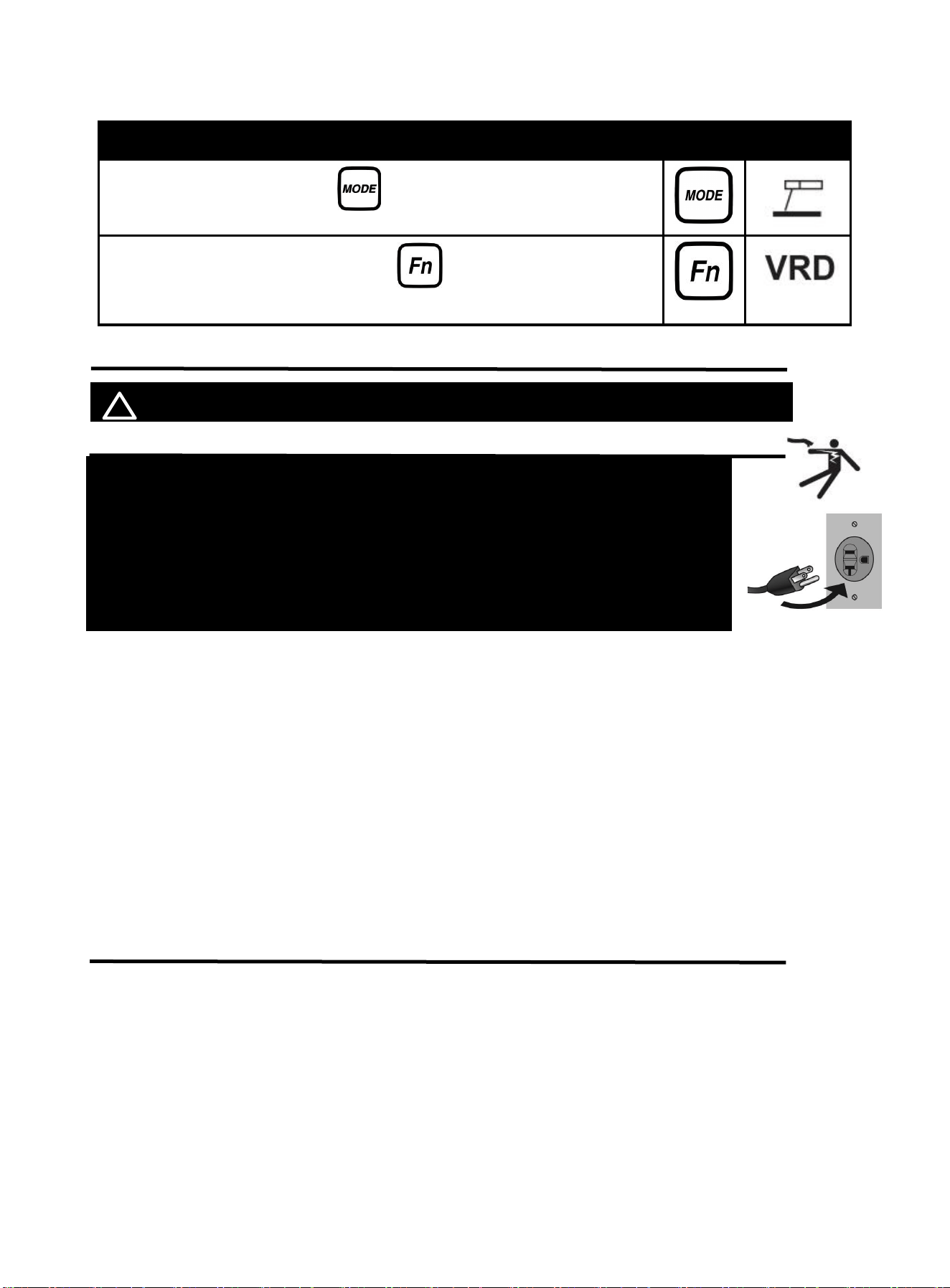
Press the Weld Mode button , for MMA welding mode changeover.
In MMA mode, press and hold the for 5 seconds to turn VRD
on/off. by default VRD is not available.
NOTICE: The following steps require applying power to the Welder
with the cover open.
To prevent serious injury from fire or electric shock:
1. DO NOT touch anything, especially not the ground clamp, with the
gun or welding wire or an arc will be ignited.
2. DO NOT touch internal Welder Components while it is plugged in.
19
Step 1: Thread the strap through the strap hole in front of the
welder.
Figure 15
Step 2: Thread the strap through the nylon buckle as shown in the
diagram.
Figure 16
Step 3: Thread the strap through the strap hole in back of the
welder.
Figure 17
Step 4: Thread the strap through the nylon buckle as shown in the
diagram.
Figure 18
Step 5: The strap installation is complete.
Figure 19
20
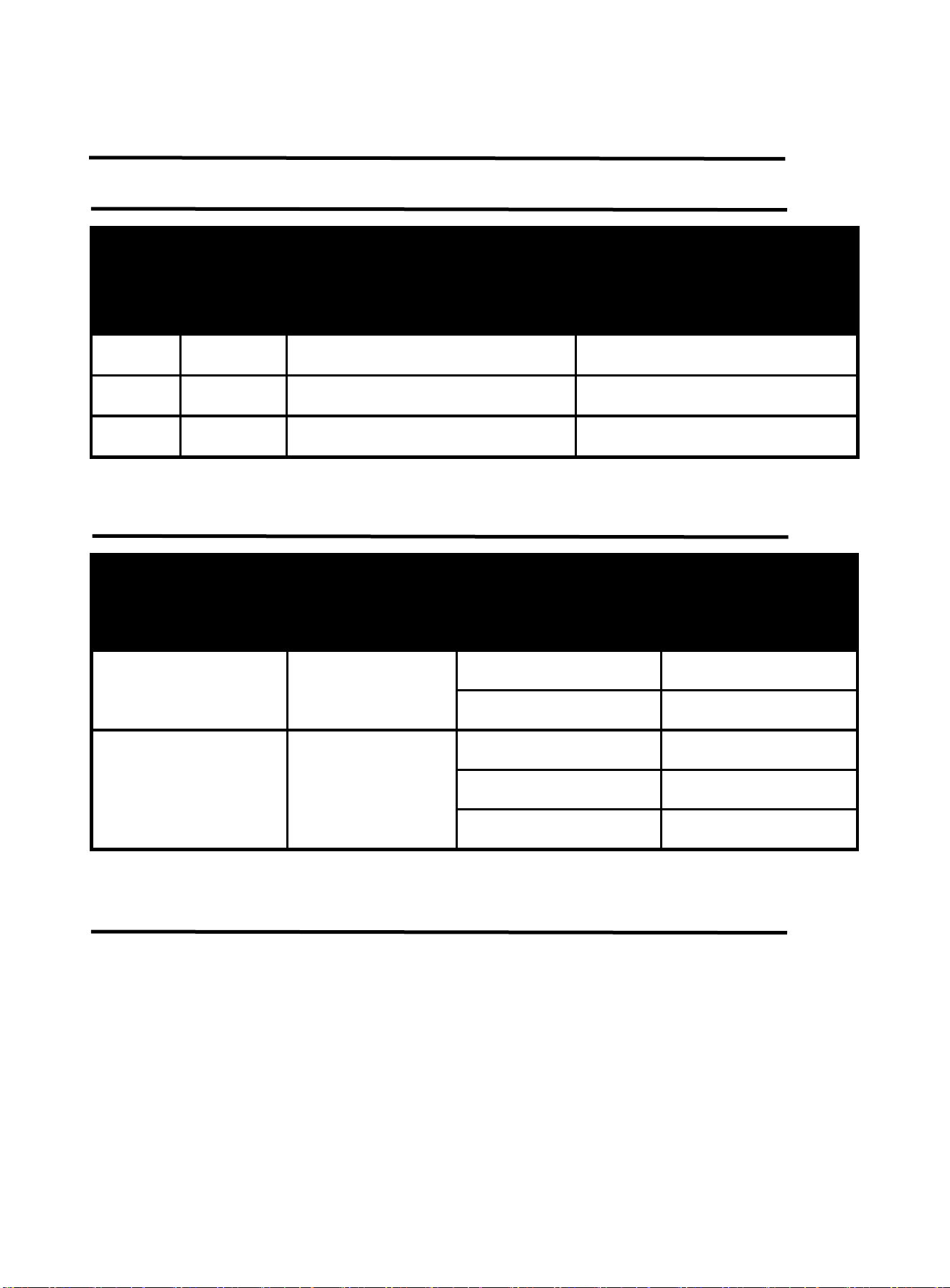
6. WELDING PARAMETERS TABLE
6.1 Parameters for TIG electrode
Electrode diameter
Amperage range on DCEN
Straight polarity
Amperage range on DCEP
Straight polarity
mm
inch
1
.040"
15-80
/
1.6
1/16"
70-150
10-20
2.4
3/32"
150-205
15-30
6.2 Parameters for TIG welding on stainless steel sheet
Electrode diameter
mm
(inch)
Plate thickness
mm
(inch)
Welding current(A)
Gas flow(L/min)
1~2mm
(0.040"-5/64")
1~3mm
(0.040"- 0.12")
50
5
50~80
6
2~4mm
(5/64"-5/32")
3~6mm
(0.12"-0.24")
80~120
7
121~160
8
161~205
9
6.3 Parameters for TIG welding

21
Plate
thickness
mm (inch)
Weldi
ng
layer
s
Electrode
diameter mm
(inch)
Wire diameter
mm (inch)
Welding
current
(A)
Gas flow (L/min)
Nozzle
diameter
mm (inch)
Square
groove
Single V
groove
with
root
face
Double
V
groove
with
root
face
0.5(0.020")
1
1.5(0.059")
1 (0.040")
30~50
8~10
6~8
14~16
10(0.393")
1 (0.040")
1
2(0.079")
1.0~2.0
(0.040"-0.079")
40~60
8~10
6~8
14~16
10(0.393")
1.5(0.060")
1
2(0.079")
1.0~2.0
(0.040"-0.079")
60~80
10~12
8`10
14~16
10~12
(0.393"-0.472
)
2(0.079")
1
2.0~3.0
(0.079"-0.118"
)
1.0~2.0
(0.040"-0.079")
80~110
12~14
10~12
16~20
12~14
(0.472"-0.551
")
2.5(0.098")
1
2.0~3.0
(0.079"-0.118"
)
2 (0.079")
110~120
12~14
10~12
16~20
12~14
(0.472"-0.551
")
3(0.118")
1~2
3(0.12")
2.0~3.0
(0.079"-0.118")
120~140
12~14
10~12
16~20
14~18
(0.551"-0.708
")
4(0.157")
2
3.0~4.0
(0.12"~5/32")
2.0~3.0
(0.079"-0.118")
130~150
14~16
12~14
20~25
18~20
(0.708"-0.787
")
5(0.197")
2~3
4.0(5/32")
3(0.118")
130~150
14~16
12~14
20~25
18~20
(0.708"-0.787
")
6(0.236")
2~3
4.0(5/32")
3.0~4.0
(0.118"-5/32")
140~180
14~16
12~14
25~28
18~20
(0.708"-0.787
")
7(0.257")
2~3
4.0(5/32")
3.0~4.0
(0.118"-5/32")
140~180
14~16
12~14
25~28
20~22
(0.787"-0.866
")
22
8(0.315")
3~4
4.0(5/32")
3.0~4.0
(0.118"-5/32")
140~180
14~16
12~14
25~28
20~22
(0.787"-0.866
")
10(0.394")
4~6
4.0(5/32")
3.0~4.0
(0.118"-5/32")
160~205
14~16
12~14
25~28
20~22
(0.787"-0.866
")
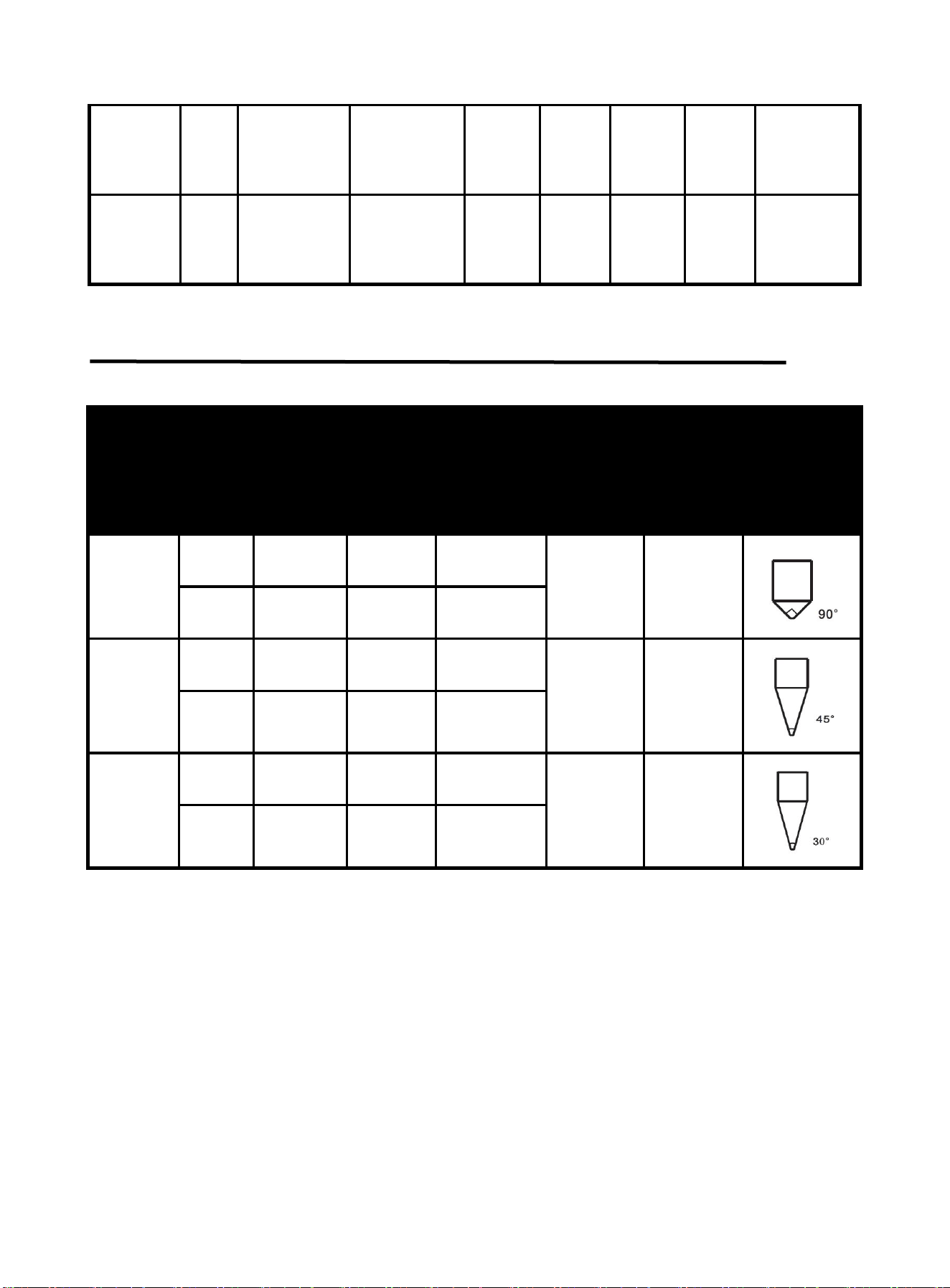
6.4 Cold TIG Parameters Table
Notes:
The above table is for reference only, and the user can make adjustment according to the actual
application. The increase of the welding current and welding time will intensify the deformation of
the workpiece and deepen the color of the back surface; but the decrease of welding current and
welding time will weaken the joint strength.
Short arc welding should be used as far as possible, and the arc length is generally less than 1mm.
The welding interval depends on the user's welding speed and proficiency. It is recommended to
choose 0.5-0.8s.
Joint
type
Plate
thickn
ess
Welding
current
Welding
time
Recommen
ded
parameter
Gas Flow
Tungsten
needle
size
Tungsten
needle tip
shape
Butt joint
0.5mm
80~205A
2~20ms
160A、4ms
2L/min
2.4mm
1.0mm
60~205A
4~20ms
160A、8ms
Overlap
joint
0.5mm
120~205A
4~10ms
160A、8ms
2L/min
1.6mm
2.4mm
1.0mm
80~205A
5~20ms
205A、5ms
Angle joint
0.5mm
100~180A
2~10ms
120A、8ms
1L/min
1.6mm
1.0mm
120~205A
5~20ms
200A、10ms

23
If the arc diverges or the arc sound becomes louder during the welding process, the tungsten
needle should be polished before welding.
6.5 MMA Welding Parameters Table
Following table is suitable for mild steel welding. For other materials, consult related materials and
welding process for reference.
Note: This table is suitable for mild steel welding. For other materials, consult related materials and
welding process for reference.
7. BASIC KNOWLEDGE OF TIG WELDING
7.1 TIG Overview and Characteristics
TIG is a gas shielded arc welding that uses argon as the protective gas. TIG welding process is as
shown in the figure. It uses the argon gas flow ejected from the nozzle of the welding gun to form a tightly
closed protector in the arc area to isolate the metal molten pool from the air, so as to prevent air intrusion.
Besides, it uses the heat generated by the arc to melt the filler wire and base metal, and the liquid metal
molten pool will form weld after cooling.
Electrode
Diameter
mm(inch)
Plate thickness
mm
(inch)
Recommended
Welding Current(A)
Recommended
welding voltage(V)
1.6mm
1/16"
1~2.5mm
0.04"~0.11"
30~65
21.2~22.8
2mm
2/25"
2.3~4mm
0.9"~0.16"
49~94
21.6~23.6
2.4mm
3/32"
3.5~4.5mm
0.14"~0.18"
78~123
22~24
3.2mm
1/8"
4.8~8.3mm
0.19"~0.33"
99~177
22.8~26
4.0mm
5/32"
8.6~10mm
0.34"~0.39"
178~205
25.6~27.2

24
Figure 20 TIG diagram
Argon is an inert-gas and does not react chemically with metal, so it will not burn the alloy elements
in the metal being welded and can fully protect the metal molten pool from oxidation. Moreover, argon is
insoluble in liquid metal at high temperature, so it is not easy to cause gas pores in the weld. Therefore,
argon can provide effective and reliable protection effect, thus obtaining higher welding quality.
7.2 TIG Characteristics
Compared with other stud arc welding methods, TIG enjoys the following characteristics:
Argon has excellent protection performance, and there is no need to prepare corresponding flux
during welding. It is basically a simple process of metal melting and crystallization, which can obtain
relatively pure and high-quality welds.
Because the arc is compressed and cooled by the argon gas flow, the heat of arc is concentrated, and
the temperature of the argon arc is very high. Therefore, the heat-affected zone is very narrow,
the welding deformation and stress are small, and the crack tendency is small. It is especially suitable
for welding of thin plates.
TIG is open arc welding, which is convenient to operate and observe, making it easy to realize the
mechanization and automation of the welding process. In addition, welding in various
spatial positions can be performed under certain conditions.
TIG supports a wide range of weldable materials, including almost all metal materials, especially
suitable for welding chemically active metals and alloys.
It is generally used for welding aluminum, titanium, copper and their low alloy steels, stainless steels
and heat resistant steels, etc.
Because of these outstanding characteristics of TIG, with the increasing product structure of non-ferrous
metals, high alloy steels and rare metals, and unattainable welding quality requirements by the common
gas welding or arc welding methods, TIG welding is more and more widely used.
7.3 TIG Welding Gun
The TIG welding gun is used to clamp the electrode, conduct electricity and transport argon gas flow,
which are controlled by the start and stop buttons on the holder. The welding gun comprises three types,
the maximum welding current for small type is 100A, and for large type is 400-600A, all adopting water
cooling. The welding gun body is pressed by nylon, featuring with light weight, small volume, good
insulation and heat resistance.
Molten pool
Filler wire
Nozzle
Tungsten
Gas
Weld
25
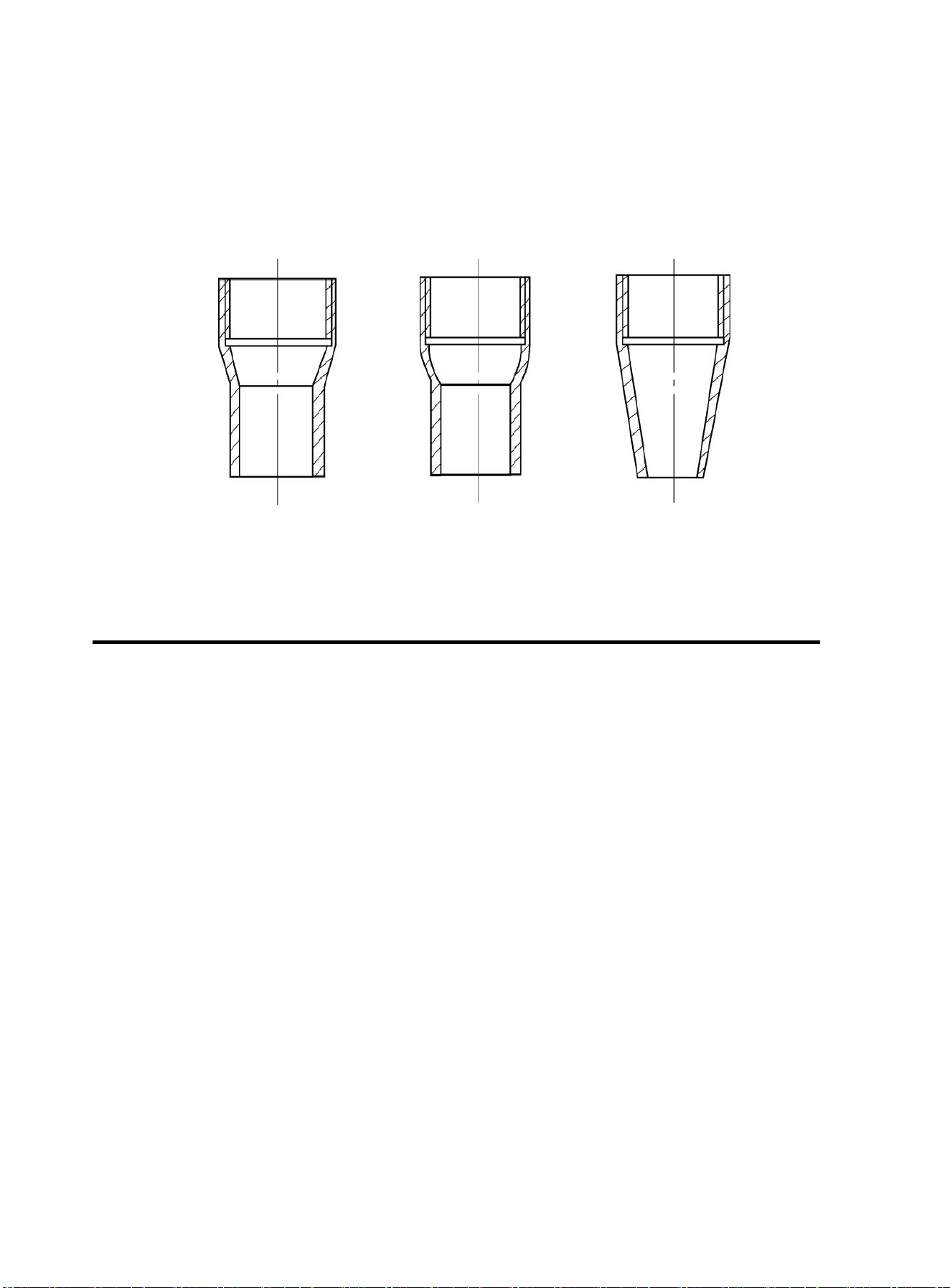
The welding gun nozzle serves as an important component that determines the gas shield
protection performance, and the common nozzle shapes are as shown in the figure. The cylindrical
nozzle with conical or spherical tail has the best protection effect, as the argon gas flow rate is uniform,
which makes it easy to maintain laminar flow. The conical nozzle has poorer protection effect because of
the rapid argon airflow speed, but it is easy to operate and has good visibility of molten pool, and is often
used in welding.
Figure 21 Welding gun nozzle diagram
7.4 TIG Process
Cleaning before welding
Before carrying out TIG, the joint of the welded material and the welding wire must be cleaned to
remove the oxide film and oil stains on the metal surface to ensure the quality of the weld. The cleaning
methods include mechanical cleaning, chemical cleaning and chemical mechanical cleaning.
Mechanical cleaning: This method is simple and effective. It is suitable for cleaning weldments
with large size and long welding cycle. Usually use a stainless steel wire brush and other tools
with a small diameter for polishing, or use a spatula to remove the surface oxide film to expose
the metal luster of the welding part, and then use an organic solvent to remove oil stains to
clean the vicinity of the weldment joints.
Chemical cleaning: This method is often used for cleaning filler wire and small weldments.
Compared with the mechanical cleaning method, this method has the characteristics of high
cleaning efficiency, stable and uniform quality, and long retention time. The chemical solution
and process used in the chemical cleaning should be determined according to the material to
be welded and welding requirements
Chemical mechanical cleaning: First use chemical cleaning, and then use mechanical cleaning
at the welding parts before welding. This combined cleaning method is suitable for weldments
with higher quality requirements.
Gas protection effect
Argon is an ideal protective gas, with a boiling point of -186℃, between the boiling points of oxygen
(a) Cylinder mixed with
conical shape
(b) Cylinder mixed with
spherical shape
(c) Cone

26
and helium. It is a by-product of fractional distillation of liquid air in an oxygen plant to produce oxygen. In
China, bottled argon is used for welding, and its filling pressure is 15MPa at room temperature. The
cylinder is painted gray and marked with the word "Argon". The chemical composition requirements of
pure argon are: Ar ≥ 99.99%; He ≤ 0.01%; O2 ≤ 0.0015%; H2 ≤ 0.0005%; total carbon content ≤ 0.001%;
moisture ≤ 30mg/m3.
It is beneficial to protect welding arc and reduce the consumption of protective gas during flat
position welding. Argon is a chemically inactive gas and does not chemically react with metals even at
high temperatures, so there is no oxidation and burning of alloying elements and a series of problems
caused by it. Argon is also insoluble in liquid metal, so it does not cause gas pores. Argon is a
monatomic gas that exists in atomic state and has no molecular decomposition or atomic endothermic
phenomena at high temperatures. Argon has small specific heat capacity and heat conduction capacity,
that is, small heat absorption and less heat transfer. Therefore, the heat in the arc is not easy to lose,
making the welding arc combustion stable and the heat concentrated, which are conducive to welding.
The disadvantage of argon is its high ionization potential. When the arc space is filled with argon, it
is difficult to ignite the arc, but the arc is very stable once ignited.
In the process of welding, the protection effect of argon is affected by many technological factors.
Therefore, it is necessary to pay attention to the effective protection of argon during TIG welding to
prevent interference and damage to the protection effect of argon; otherwise, it is difficult to obtain
required welding quality.
The welding technology factors affecting the argon protection effect include gas flow rate, nozzle shape
and diameter, distance between nozzle and weldment, welding speed, welding joint form, etc., which
should be considered comprehensively and selected correctly.
The quality of the argon protection effect is often evaluated by the welding spot test method by
measuring the range of effective argon protection zone. For example, use AC manual tungsten electrode
TIG to conduct spot welding on the aluminum plate, and the welding process conditions remain the
same during welding; after striking arc, hold the welding gun for 5-10s before turning off the power. At
this time, a melting point will be left on the aluminum plate. The "cathode crushing" around the welding
spot will remove the oxide film on the surface of the aluminum plate, and a grayish-white area with
metallic luster will appear. This part where the oxide film is removed is the effective argon protection
zone, as shown in the figure. The larger the diameter of the effective protection zone, the better the
protection effect.

27
Figure 22 Argon protection effect diagram
In addition, the argon protection effect can be evaluated by directly observing the color of the weld
face. Taking welding on stainless steels as an example, if the weld metal surface is silvery white or
golden yellow, it means that the protection effect is good; if the color is grey or black, it means that the
protection effect is bad.
7.5 Welding Parameters
The gas protection effect, welding process stability and weld quality of TIG are directly related to
welding parameters. Therefore, reasonable selection of welding parameters is an important guarantee
for obtaining high-quality welded joints.
The welding parameters for TIG include: current type and polarity, tungsten electrode diameter, welding
current, argon flow, welding speed and process factors, etc.
Current type and polarity: The current type and polarity of TIG should be selected according to the
material to be welded and the operation method.
Tungsten electrode diameter: It is mainly selected according to the thickness of the weldment. In
addition, when the thickness of the material to be welded is equal, the allowable current of the
tungsten electrode is different due to the different types and polarities of the current used, so the
diameter of the tungsten electrode used is also different. If the diameter of the tungsten electrode is
not selected properly, it will cause unstable arc, severe burnout and tungsten inclusion in the weld.
Welding current: After the diameter of the tungsten electrode is selected, select the applicable welding
current. Too large or too small welding current will cause poor weld formation or welding defects.
Argon flow: It is mainly selected according to the tungsten electrode diameter and the nozzle diameter.
For nozzles with a certain aperture, the selected argon flow rate should be appropriate.
If the flow rate is too large, the gas flow rate will increase, and it will be difficult to maintain a stable
laminar flow, which is not good for the protection of the welding zone. Besides, it will take away a lot
of heat from the arc zone, which will affect the stable combustion of the arc. However, if the flow rate
is too small, it is easy to be interfered by the outside air flow, so as to reduce the argon protection
Effective protection zone
Melting zone
Oxidation zone
(a) Good protection effect
(b) Bad protection effect

28
effect. Usually the flow of argon is in the range of 3-20L/min.
Welding speed: Under certain conditions of tungsten electrode diameter, welding current and argon
gas flow, too fast welding speed will cause the shielding gas flow to deviate from the tungsten
electrode and the molten pool, thereby affecting the argon protection effect. Moreover, the welding
speed significantly affects the shape of the weld. Therefore, an appropriate welding speed should
be selected.
Process factors: Mainly include the shape and diameter of the nozzle, the distance from the nozzle to
the weldment, the length of the tungsten electrode, the diameter of the filler wire, etc. These
process factors do not change much, but they have different degrees of influence on the welding
process and argon protection effect. Therefore, they should be selected according to specific
welding requirements.
Generally, the nozzle diameter can be selected within 5-20 mm; the distance from the nozzle to the
weldment shall not exceed 15 mm; the length of tungsten electrode out of the nozzle shall be 3-4
mm; and the diameter of filler wire shall be selected according to the thickness of weldment.
7.6 General Requirements of TIG
Control requirements of gas: It is required that the gas is supplied first and exhausted last. Argon is an
inert-gas which is easy to be broken down. First fill argon between the workpiece and the electrode
needle, which is conducive to arc starting; after welding, keeping on supplying argon can prevent
the workpiece from oxidation due to rapid cooling and ensure good welding effect.
Current manual switch control requirements: When the manual switch is pressed, the current is
delayed compared to the gas. After the manual switch is turned off (after the welding is completed),
and the gas supply current is cut off first according to the requirements.
High-voltage generation and control requirements: TIG adopts the high-voltage arc starting mode,
which requires to have high voltage when arcing, and no high voltage after arcing.
Interference protection requirements: High frequency is accompanied by high voltage of arcing in TIG,
which causes serious interference to the whole circuit and requires the circuit to have good
anti-interference ability.
8. BASIC KNOWLEDGE OF MMA
Manual metal arc welding, MMA for short, is an arc welding mode by manually operating electrode.
Equipment for MMA is simple, convenient and flexible to operate, and with high adaptability. MMA is
applied to various metal materials with thickness more than 0.08inch and various structures, in particular
to weldment with complex structure and shape, short weld joint or bending shape, as well as weld joints
in various spatial locations.
8.1 Welding Process Of MMA
Connect the two output terminals of the welder to the weldment and electrode holder respectively,
29
and then clamp the electrode by the electrode holder. When welding, arc is ignited between the
electrode and the weldment, and the end of the electrode and part of the weldment are fused to form a
weld crater under the high-temperature arc. The weld crater is quickly cooled and condensed to form
weld joint which can firmly connect two separate pieces of weldement as a whole. The coating of the
electrode is fused to produce slag to cover the weld crater. The cooled slag can form slag crust to protect
the weld joint. The slag crust is removed at last, and the joint welding is finished.
8.2 Tools For MMA
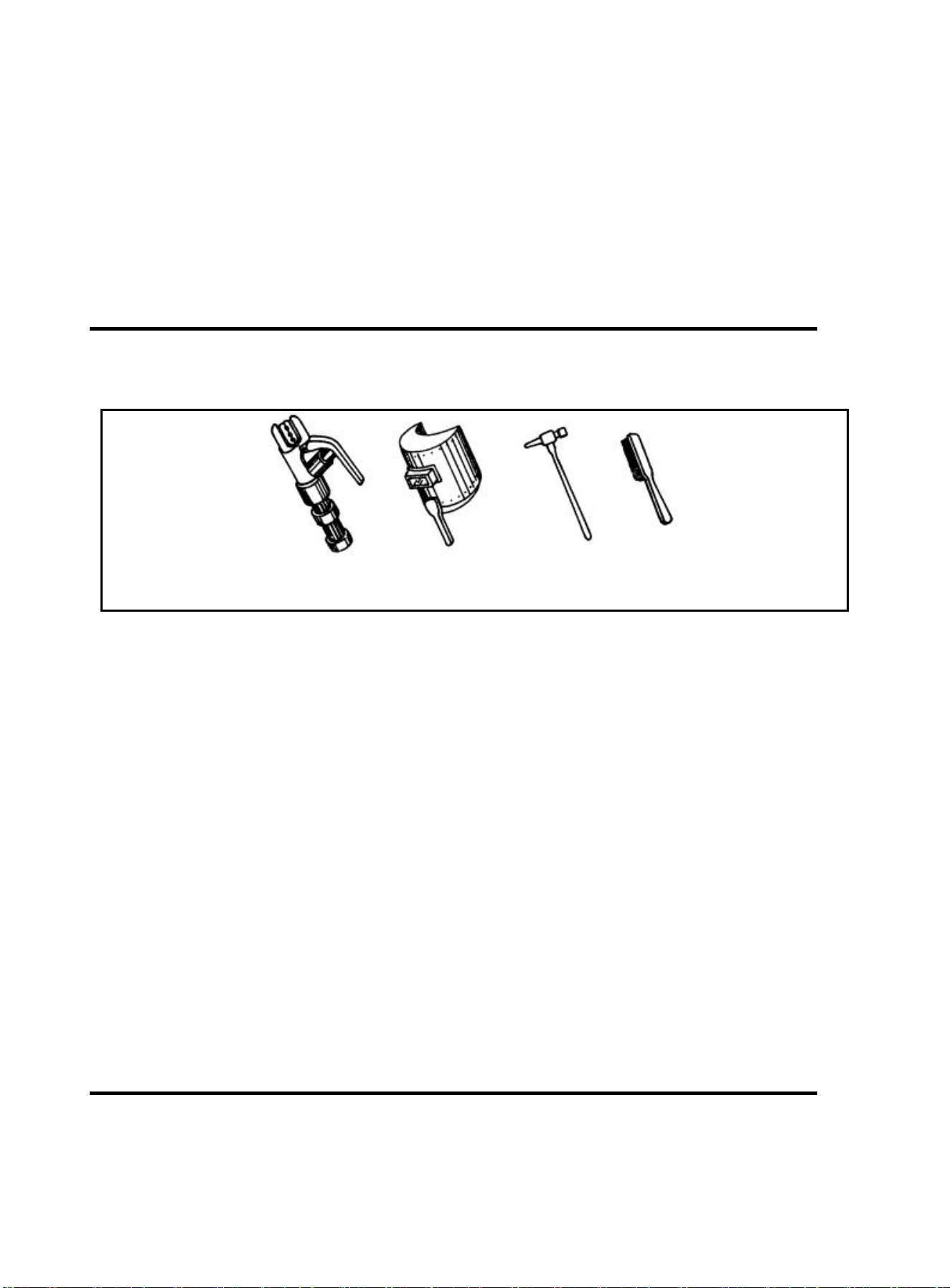
Common tools for MMA include electrode holder, welding mask, slag hammer, wire brush (see
Figure 23), welding cable and labor protection supplies.
a) electrode holder b) welding mask c) slag hammer d) wire brush
Figure 23 Tools for MMA
Electrode holder: a tool for clamping electrode and conducting current, mainly including 300A type
and 500A type.
Welding mask: a shielding tool for protecting eyes and face from injuring due to arc and spatter,
including handholding type and helmet type. Colored chemical glass is installed on the viewing
window of the mask to filter ultraviolet ray and infrared ray. Arc burning condition and weld crater
condition can be observed from the viewing window during arc burning. Thus, welding can be
carried out by operators conveniently.
Slag hammer (peen hammer): for the use of removing slag crust on the surface of weld joint.
Wire brush: for the use of removing dirt and rust at the joints of the weldment before welding, as well
as cleaning the surface of weld joint and the spatter after welding.
Welding cable: generally cables formed from many fine copper wires. Both YHH type arc welding
rubber sleeve cable and THHR type arc welding rubber sleeve extra-flexible cable can be used.
Electrode holder and welding machine are connected via a cable, and this cable is named as
welding cable (live wire). Welding machine and workpiece are connected via another cable (earth
wire). The electrode holder is covered with insulating material performing insulation and heat
insulating.
8.3 Basic Operation Of MMA
Welding joint cleaning
Rust and greasy dirt at the joint should be removed completely before welding in order to implement arc
30
igniting and arc stabilizing conveniently as well as ensure the quality of weld joint. Wire brush can be
used for condition with low requirement on dust removal; grinding wheel can be used for condition with
high requirement on dust removal.
Posture in operating
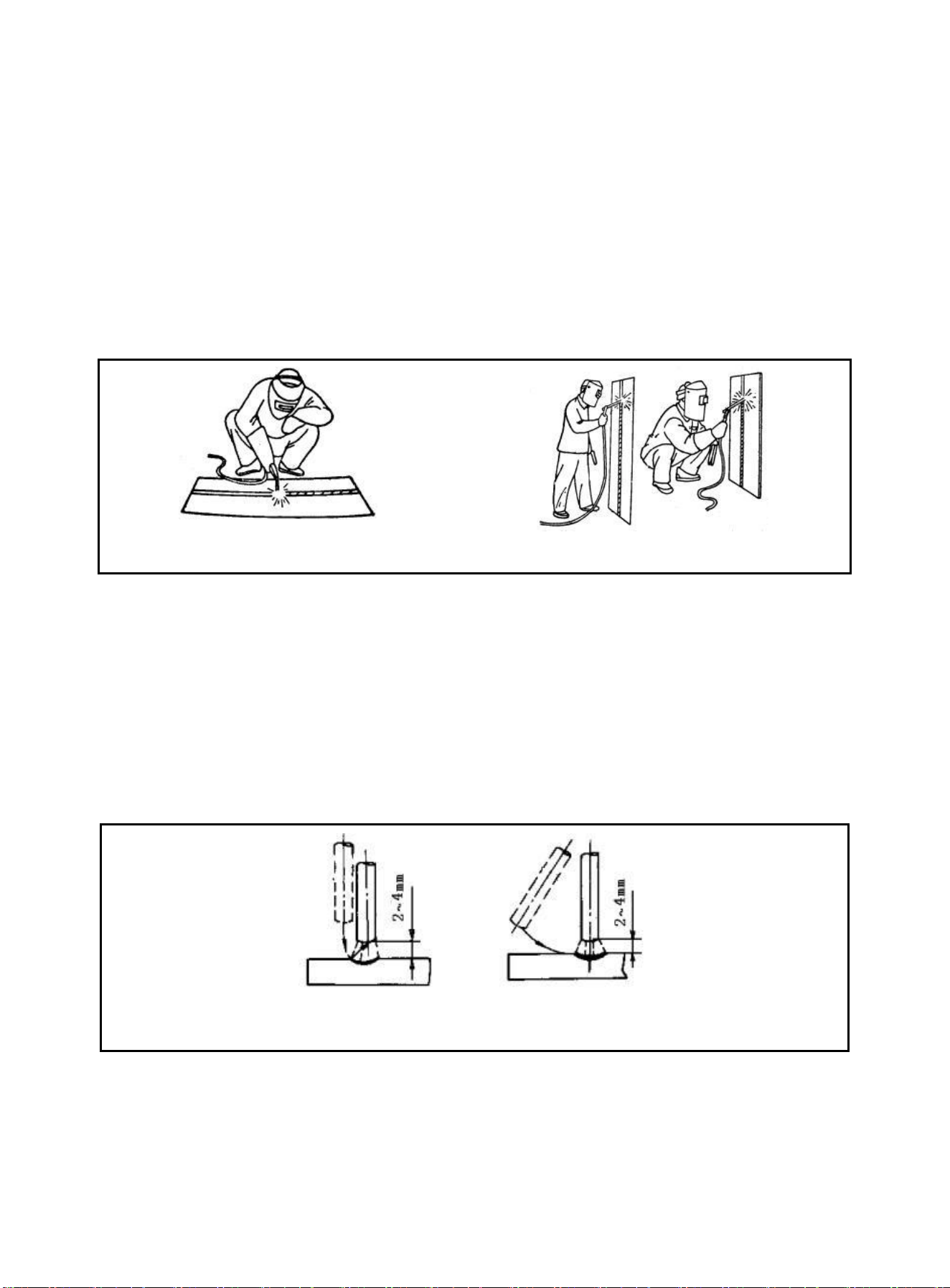
Take flat welding of butt joint and T-shaped joint from left to right as an example. (See Figure 24) The
operator should stand at the right side of the working direction of weld joint with mask in the left hand and
electrode holder in the right hand. The left elbow of the operator should be put on his left knee to prevent
his upper body from following downwards, and his arm should be separated from the costal part so as to
stretch out freely.
`
a) flat welding
b) vertical welding
Figure 24 Posture in welding
Arc Igniting
Arc igniting is the process for producing stable arc between electrode and weldment in order to heat
them to implement welding. Common arc ignition mode includes scraping mode and striking mode. (See
Figure 25) During welding, touch the surface of the weldment with the end of the electrode by scraping
or light striking to form short circuit, and then quickly lift the electrode 0.08-0.16inch away to ignite arc. If
arc ignition fails, it is probably because there is coating at the end of the electrode, which affects the
electric conduction. In this case, the operator can strongly knock the electrode to remove the insulation
material until the metal surface of the core wire can be seen.
a)striking mode b) scraping mode
Figure 25 Arc ignition modes
Tack weld
For fixing the relative positions of the two pieces of weldment and welding conveniently, 1.2-1.6inch
short weld joints are welded every certain distance in order to fix the relative positions of the weldment
during welding assembly. This process is named as tack weld.
31
Electrode manipulation
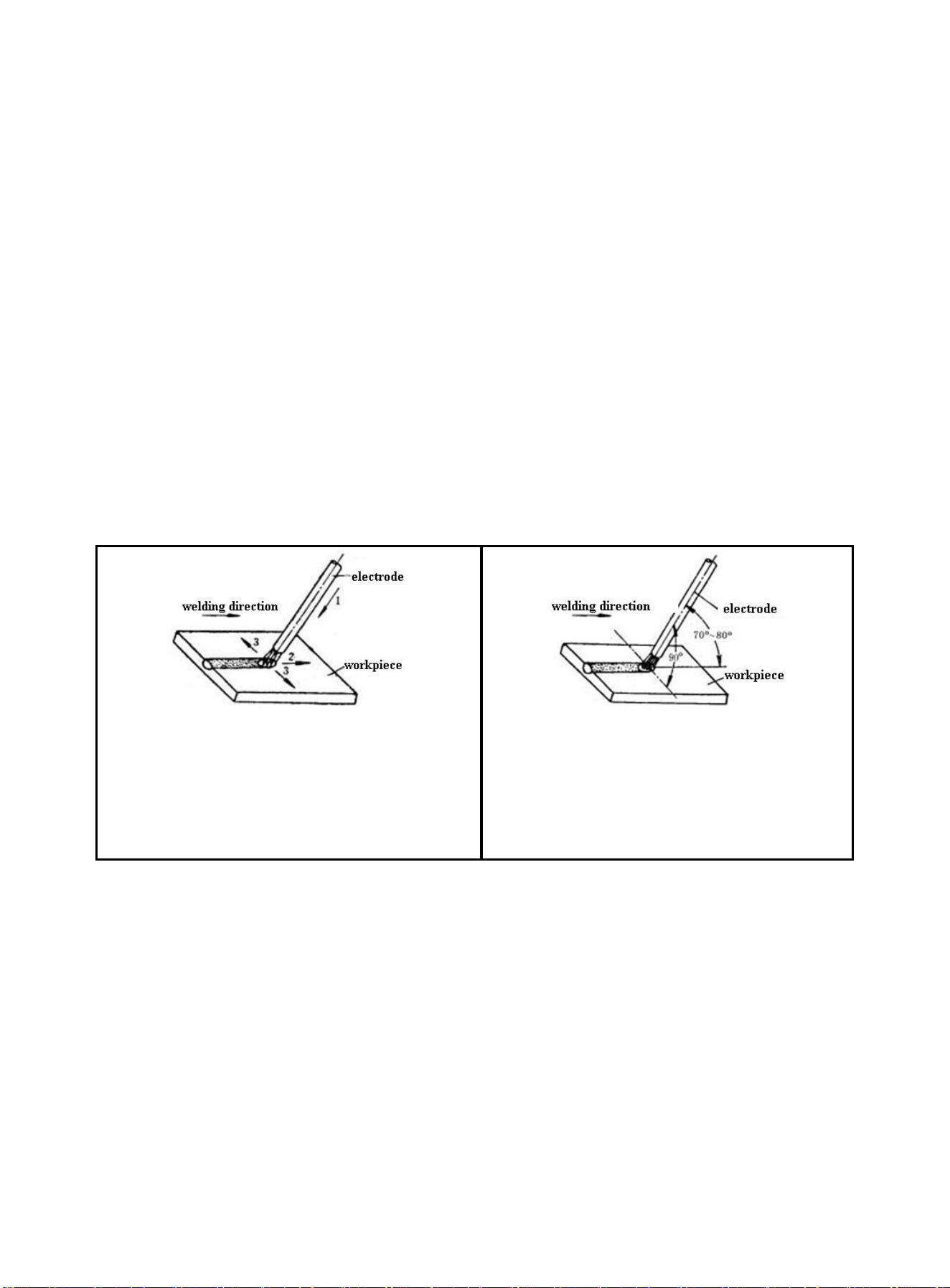
The electrode manipulation actually is a resultant movement in which the electrode simultaneously
moves in three basic directions: the electrode gradually moves along the welding direction; the electrode
gradually moves toward the weld crater; and the electrode transversely swings. (See Figure 26)
Electrode should be correctly manipulated in three movement directions after arc is ignited. In butt
welding and flat welding, the most important is to control the following three aspects: welding angle, arc
length and welding speed.
Welding angle: the electrode should be inclined in 70~80º forwards. (See Figure 27)
Arc length: the proper arc length is equal to the diameter of electrode in general.
Welding speed: proper welding speed should make the crater width of the weld bead about twice the
diameter of the electrode, and the surface of the weld bead should be flat with fine ripples. If the
welding speed is too high, and the weld bead is narrow and high, the ripples are rough, and the
fusion is not well implemented. If the welding speed is too low, the crater width is excessive, and the
workpiece is easy to be burned through. Besides, current should be proper, electrode should be
aligned, arc should be low, and welding speed should not be too high and should be kept uniform
during the whole welding process.
1-downwards feed
2-move toward welding direction
3-transversely swing
Figure 26 Three basic movement directions of
electrode
Figure 27 Angles of electrode in flat welding
Arc extinguishing
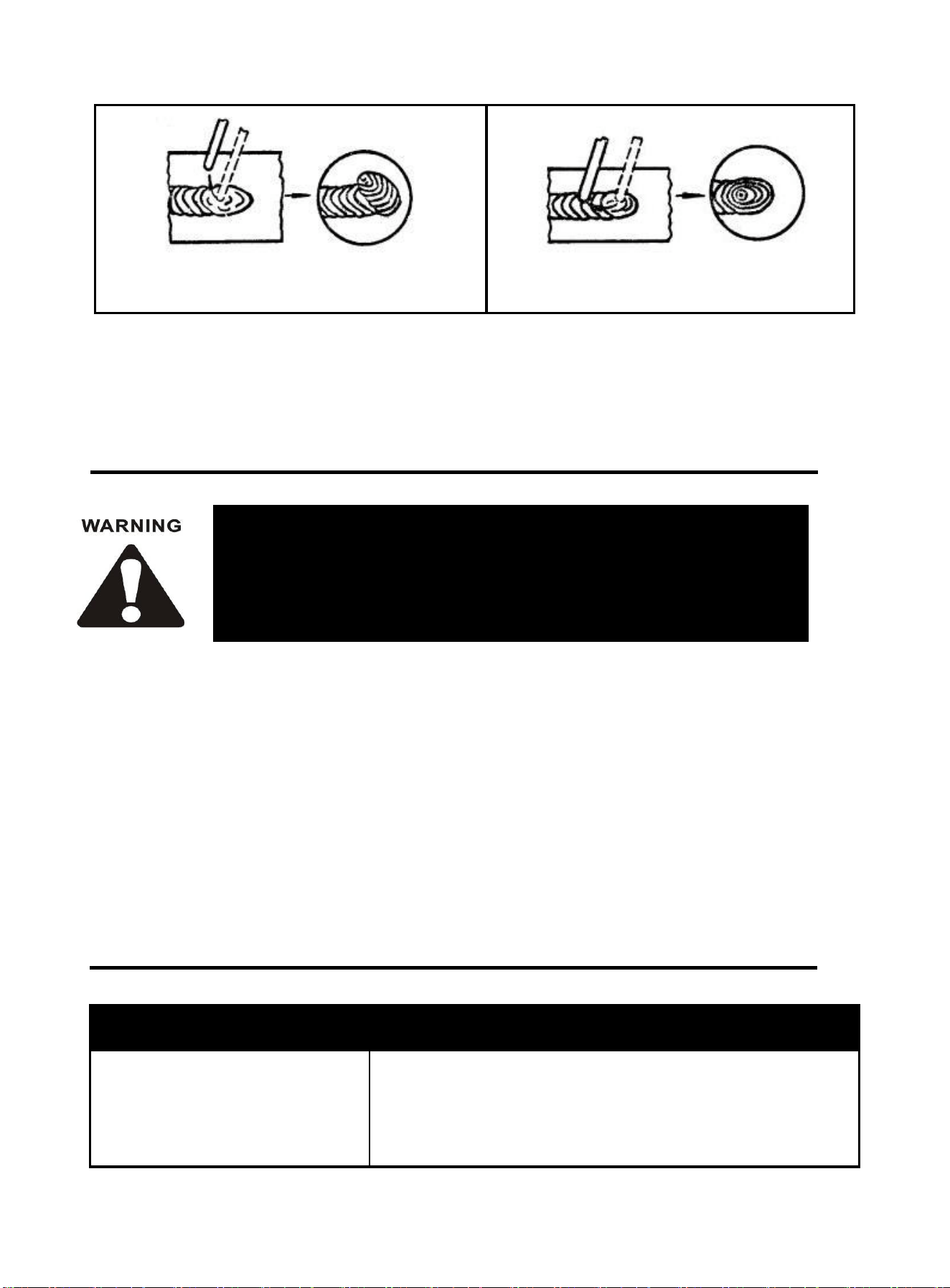
Arc extinguishing is unavoidable during welding. Poor arc extinguishing may bring shallow weld crater
and poor density and strength of weld metal by which cracks, air holes, slag inclusion and shortage the
like are easy to be produced. Gradually pull the end of the electrode to the groove and raise the arc
when extinguishing arc, in order to narrow the weld crater and reduce the metal and heat. Thus, defects
such as cracks and air holes can be avoided. Pile up the weld metal of the crater to make the weld crater
sufficiently transferred when extinguishing arc. Then, remove the excessive part after welding. The
operation modes of arc extinguishing are shown in the figure below.
32
The following operation requires sufficient professional knowledge on electric
aspect and comprehensive safety knowledge. Operators should be holders of
valid qualification certificates which can prove their skills and knowledge. Make
sure the input cable of the machine is disconnected from the electricity utility
before uncovering the welding machine.
a) arc extinguishing at the outside of weld bead
b) arc extinguishing on the weld bead
Figure 28 Arc extinguishing modes
Weldment cleaning
Clean welding slag and spatter with wire brush, etc after welding.
9. TROUBLESHOOTING
Please do the following inspection before maintenance:
Please check if welder input voltage is within 240V/120V±15%.
Please make sure the correct and tight connection of input cable.
Please make sure the correct and tight connection of welding cable.
Please make sure gas circulation is normal; please use pure argon gas and adjust gas flow per
actual welding demands.
Please make sure all PCB terminals are correctly and tightly connected.
9.1 Error code and welding processing problems
Malfunction phenomena
Solutions
Power supply indicator doesn’t light
Fan doesn’t work and there is no
current output
1.Please make sure power switch is on.
2.Please make sure there is electricity input.

33
Fan is working; abnormity indicator
lights, but with no welding output;
1.Might be over-current protection; please turn off the machine;
restart the machine when abnormity indicator stop lighting, and
welder will go back to normal operation;
2.Might be over-heat protection; waif for 5-7 minutes and
machine will go back to normal operation automatically;
Black welding spot
1.Please make sure argon outlet from welding torch nozzle is
normal.
2.Argon flow is too small; generally argon flow should be
5L/min;
3.Please check whether air circulation is in good sealing
condition and please check gas purity;
4.Please make sure there is no strong airflow in the welding
site.
Poor protection for welding bead in
the end of welding processing.
1. Don’t move the welding torch immediately after welding is
finished, so that to retain the shielding gas’s protection for high
temperature welding bead.
2. Prolong post-flow time.
Hard to achieve successful arc
ignition; frequent current
interruption.
1.Change a new tungsten;
2.Remove tungsten oxidation layer.
3.Prolong post-flow time;
4.Adjust tungsten electrode discharge distance(around0.8mm)
Unstable welding current
1.Please make sure power network is normal.
2.Connect different power input cables if there are other
equipments of strong interferences.
No HF discharge when pull the
torch trigger
1.Check whether the mode is set correctly;
2.Check the control wire of the welding torch for poor contact。
Display indicates E10
Restart machine.
Display indicates E60
it is unnecessary to restart the machine. Keep the built-in fan
working to lower the temperature inside the machine. Welding
34
The following operation requires sufficient professional knowledge on electric
aspect and comprehensive safety knowledge. Operators should be holders of valid
qualification certificates which can prove their skills and knowledge. Make sure the
input cable of the machine is disconnected from the electricity utility before
uncovering the welding machine.
can be continued after the inner temperature falls into the
standard range and the “E60” code is disappeared.
10. MAINTENANCE
Check periodically whether inner circuit connection is in good condition, connector is fastened (esp.
plugs or components). Tighten the loose connection. If there is oxidization, remove it with
sandpaper and then reconnect.
Keep hands, hair and tools away from the charged parts such as the fan to avoid personal injury or
machine damage when the machine is energized.
Clean the dust periodically with dry and clean compressed air. If welding environment with heavy
smoke and pollution, the machine should be cleaned daily. The pressure of compressed air should
be at a proper level in order to avoid the small parts inside the machine being damaged.
Avoid water and vapor infiltrating the machine. If there is, dry it and use tramegger to check the
insulation of the equipment (including that between the connections and that between the
connection and the enclosure). Only when there are no abnormal phenomena anymore, can the
machine be used.
Check periodically whether the insulation cover of all cables is in good condition. If there is any
dilapidation, rewrap it or replace it.
Put the machine into the original packing in dry location if it is not to be used for a long time.
Save for future reference:
Product
:
Date Purchased:
Serial Number:
Product Feedback: