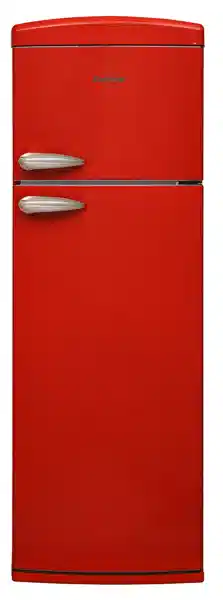
FRIGORIFICO
MANUAL DEL USUARIO
Modelo N.º: E-CF2PG148RR
Para garantizar el uso correcto de este aparato y su seguridad, lea
íntegramente el manual del usuario antes de utilizarlo.
CONTE
Nombres
Adverten
Instruccio
Instruccio
Embalaje
Mantenim
Descong
Descone
Recomen
Solución
Consejos...........................................................................................8
Datos técnicos.....................................................................
Información para institutos de pruebas ...............................
Preocupaciones ambientales...........................................................11
Gracias
nosotro
s
Por favo
frigorífic
Debe se
segurida
Si surge
un cent
contacto
ENIDOS
s de las partes ....
ncias de segurida
ones de instalaci
ones de funciona
e y traslado ........
miento ................
elación ..............
xión del aparato
ndaciones para e
de problemas ...
por comprar nues
s.
or, lea atentament
co. Siga las instruc
eguir las instruccio
ad del manual.
e algún problema,
tro de servicio p
o con el centro de
..........................
ad .......................
ón ......................
amiento ..............
..........................
..........................
..........................
..........................
el usuario ...........
..........................
stros productos y
te el manual del u
cciones y guárdel
ones de funcionam
, no intente soluci
posventa que no
e servicio autorizad
...........................
...........................
...........................
...........................
...........................
...........................
...........................
...........................
...........................
...........................
por depositar su
usuario antes de u
as para su consu
miento y las adve
ionarlo por sí mis
o esté autorizado
do local.
.............. 1
.............. 2
.............. 4
.............. 4
.............. 5
.............. 5
.............. 6
.............. 6
.............. 6
.............. 7
confianza en
utilizar este
lta futura.
rtencias de
smo ni recurra a
o. Póngase en
NNOMBRES
El frigorífico que h
completamente co
funcionamiento no
Cuando use el frig
bandejas, la huev
Si existe algún da
Ajuste el control d
lo que ahorrará co
No abra continuam
Mantenga la comb
tal como se ha dis
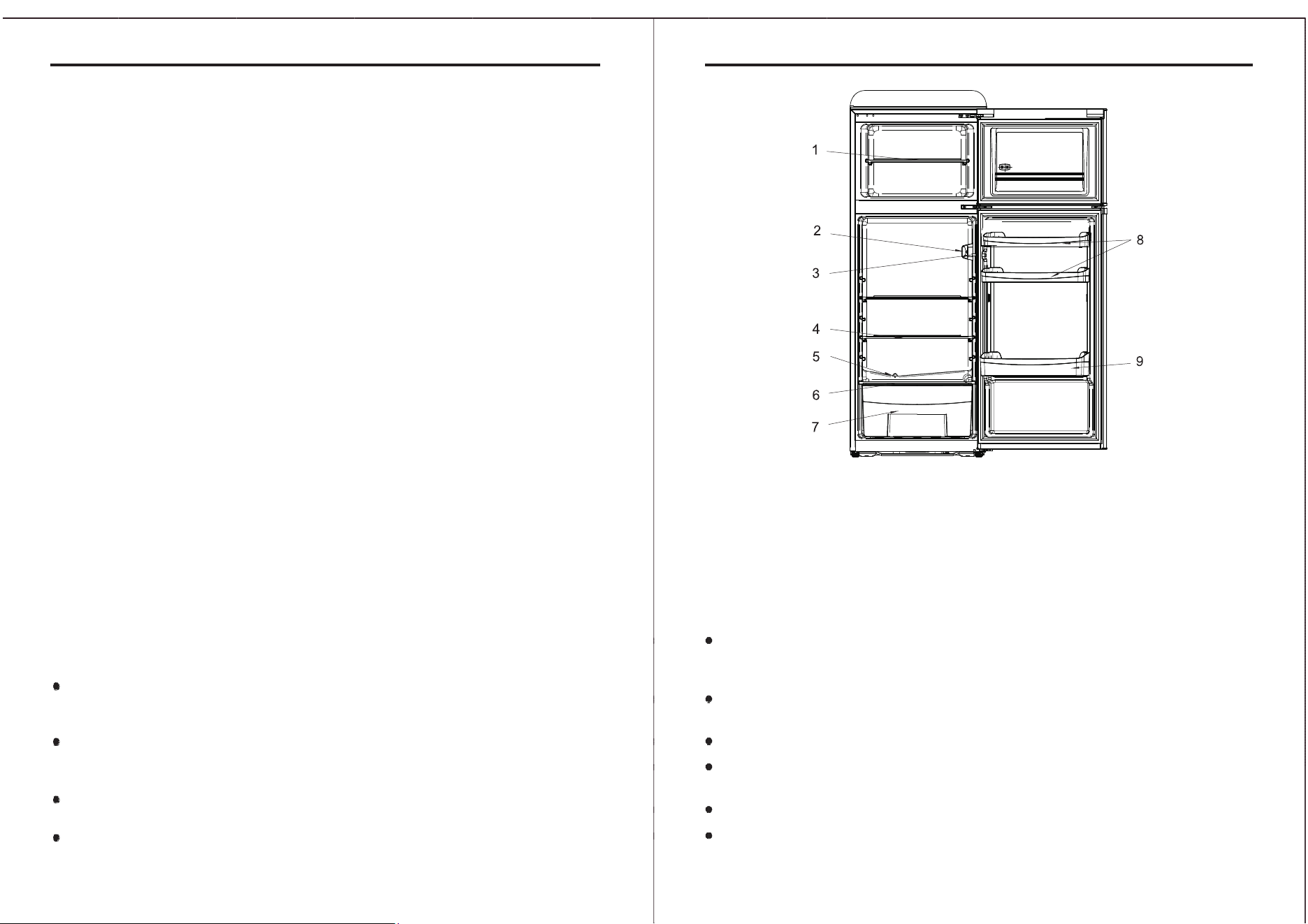
1. Estante del
2. Lámpara y m
temperatura
3. Interruptor d
4. Estante de v
5. Tapón del tu
DE LAS PA
ha comprado puede
on el manual. Sin em
o cambiarán.
¡No te
gorífico por primera
vera y el tapón del tu
año, no estire ni emp
de temperatura al m
onsumo de energía
mente la puerta del
binación de cajones
señado.
congelador
mando de control de
de la lámpara
vidrio
ubo de drenaje
ARTES
e haberse mejorado
mbargo, las funcion
enga ningún reparo
vez, retire las cinta
ubo de drenaje.
puje los cajones ni
máximo posible (tem
del frigorífico y dine
frigorífico cuando e
s, bandejas y estant
1
6. Tapa de vi
7. Cajón de v
8. Bandeja de
9. Bandeja de
o y, por este motivo,
nes y los modos de
en utilizarlo!
as adhesivas de los
las bandejas violen
mperatura más baja)
ero.
esté en funcionamie
tes del frigorífico, ya
idrio del cajón de verd
verduras
e botellas medianas
e botellas grandes
no coincidir
cajones, las
tamente.
,
ento normal.
a que es
duras
1 1
1 1
ADVERTENCIAS DE SEGURIDAD
Por su seguridad personal, le rogamos que siga los puntos siguientes:
1. Los circuitos del frigorífico deben aislarse. La sección transversal del cable debe ser
mayor de 0,75 mm2. El enchufe debe conectarse en una toma de corriente con toma de
tierra, ya que si se usa un adaptador podría sobrecalentarse.
2. La tensión y la frecuencia de este producto deben ser de 220-240V; 50Hz. Si el cable está
dañado, póngase en contacto con el centro de mantenimiento o la tienda minorista local.
3. Para desconectar debe estirar del enchufe y extraerlo de la toma, no debe hacerlo del
cable.
4. No debe dañar el circuito de refrigerante.
5. Este aparato no está pensado para ser utilizado por personas (incluidos niños) con
facultades físicas, sensoriales o mentales reducidas, o con falta de experiencia y
conocimientos, a menos que sea bajo supervisión o siguiendo indicaciones sobre el uso
del aparato por parte de una persona responsable de su seguridad.
6. Deberá asegurarse de que los niños no jueguen con el aparato..
7. Mantenga sin obstrucciones las aberturas de ventilación del aparato o de la estructura
en la que esté integrado.
8. Antes de deshacerse del frigorífico o congelador antiguo:
- Quite las puertas.
- Deje los estantes en su lugar, para que los niños no puedan entrar fácilmente en su interior.
9. No almacene sustancias explosivas como aerosoles con propelentes inflamables en este
electrodoméstico. Este aparato ha sido diseñado para ser utilizado en hogares y para usos
similares, como
- cocinas de áreas de trabajadores en tiendas, oficinas y otros entornos de trabajo;
- casas rurales; clientes de hoteles, moteles y otros tipos de entornos residenciales;
- alojamientos tipo "Bed and breakfast" (alojamiento y desayuno);
- catering y aplicaciones similares no destinadas a la venta al por menor.
10. No utilice aparatos eléctricos dentro de los compartimentos de almacenamiento de
alimentos del electrodoméstico, a menos que sean del tipo recomendado por el fabricante.
11. Este aparato puede ser utilizado por niños de 8 años o más o por personas con facultades
físicas, sensoriales o mentales reducidas, o con falta de experiencia y conocimientos,
siempre que sea bajo supervisión o siguiendo indicaciones sobre su uso
de forma segura y que comprendan los peligros relacionados. Los niños no deben jugar con el
aparato. La limpieza y el mantenimiento del usuario solo pueden ser realizados por niños bajo
supervisión.
Los niños de entre 3 y 8 años pueden poner productos en este aparato y extraerlos.
Para evitar la contaminación de los alimentos, deben seguirse las instrucciones siguientes:
- Si la puerta se abre por tiempo excesivo puede producirse un aumento importante de la
temperatura en los compartimentos del aparato.
- Limpie regularmente las superficies que puedan entrar en contacto con alimentos y
sistemas de drenaje accesibles.
- Limpie los depósitos de agua si no se han usado en un plazo de 48 h; lave el sistema de
agua conectado a un suministro de agua, si no se ha extraído agua durante 5 días.
- La carne y el pescado crudos deben conservarse dentro del frigorífico, en recipientes
adecuados, de modo que no estén en contacto con otros alimentos ni goteen sobre
ellos.
- Los compartimentos para alimentos congelados de dos estrellas son apropiados para
conservar alimentos precongelados, conservar o hacer helado y fabricar cubitos de
hielo.
- Los compartimentos de una, dos y tres estrellas no son apropiados para congelar
alimentos frescos.
- Si el frigorífico se deja vacío durante periodos prolongados, debe apagarse,
descongelarse, limpiarse, secarse y la puerta debe dejarse abierta para evitar que se
forme moho dentro de él.
ATENCIóN: Cuando ubique el aparato asegúrese de que el cable de
alimentación no quede atrapado ni dañado.
ATENCIóN: No coloque bases de tomas múltiples portátiles ni fuentes
de alimentación portátiles en la parte trasera del aparato.
AVISO:
1. Si sale gas de su contenedor, no debe conectar ni desconectar el enchufe, ya que
podrían producirse chispas y provocar un incendio.
2. No debe salpicar agua en la parte posterior del aparato, ya que podría causar un mal
funcionamiento o provocar electrocución.
3. No almacene materiales inflamables como éter, benceno, gas licuado de petróleo y
adhesivos, etc. en el frigorífico.
5.Es mejor no colocar ningún objeto magnét
ico, pesado o lleno de agua sobre el aparato.
Los componentes eléctricos pueden no funcionar correctamente si entra agua en su
interior. No deben almacenarse objetos costosos o sensibles a la temperatura y, por
ejemplo, suero, bacterina, etc.
6. El refrigerante de este aparato es R600a, que es inflamable. Por ello, debe asegurarse de no
dañar el sistema de refrigeración durante el transporte e instalación.
7. ELIMINACIóN: No elimine este aparato con los
residuos municipales sin clasificar. Es necesario
recoger estos residuos por separado para su
tratamiento especial.
2
12. Este aparato de refrigeración no está diseñado para ser utilizado como aparato empotrado.
4. No coloque bebidas embotelladas en el congelador para evitar que se rompan.
INSTRUCCIONES DE INSTALACIóN
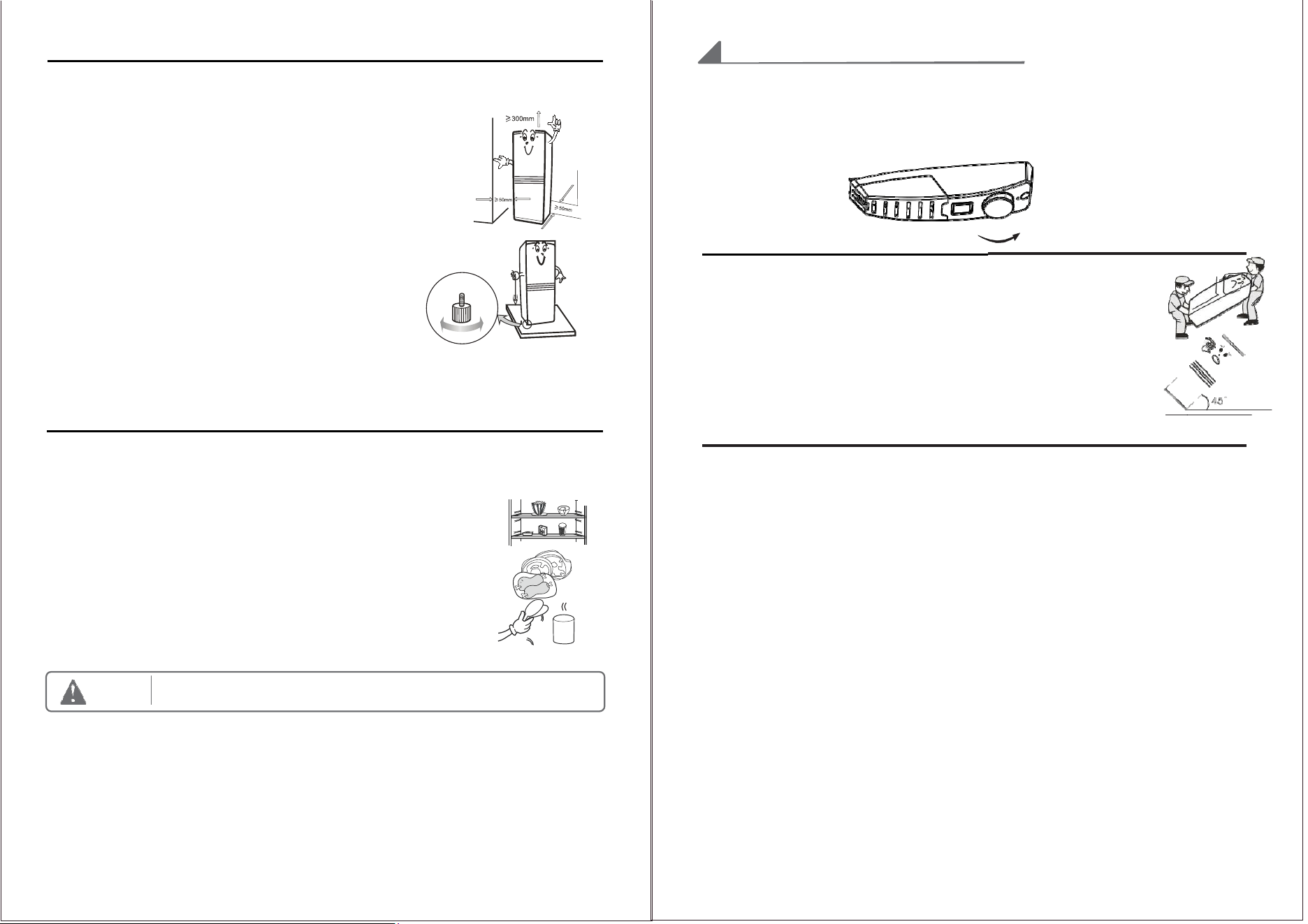
1. El frigorífico debe ubicarse sobre una superficie completamente plana. Deben dejarse 5~10
cm a cada lado del aparato hasta la pared y 30 cm entre la parte superior y el techo.
2. Escoja un lugar no expuesto a la luz solar directa, temperatura
elevada o humedad, ya que ésta puede producir manchas.
3. El panel inferior debe extraerse antes de la instalación.
4. El aparato puede ajustarse regulando las dos patas delanteras,
si está inestable. Girando en sentido horario se levanta el
5. El emplazamiento debe ser firme y plano. Si el
emplazamiento no es seguro, pueden producirse ruidos y
(a) El ruido puede aumentar si el suelo no es firme.
(b) Si es necesario colocar el aparato sobre una moqueta,
coloque una chapa debajo del mismo para solucionar la
6. Asegúrese de que las patas ajustables queden firmes sobre el suelo,
y coloque el aparato ligeramente inclinado hacia atrás para que las puertas queden firmemente
INSTRUCCIONES DE FUNCIONAMIENTO
COLOCACIóN DE LOS ALIMENTOS
1. Debe haber siempre un pequeño espacio entre los artículos en el interior, para
permitir la circulación del aire.
2. Los alimentos deben guardarse en paquetes precintados para evitar
que se resequen y los olores.
3. Los alimentos calientes deben dejarse enfriar antes de
introducirlos en el aparato. De lo contrario, la temperatura
interior y el consumo eléctrico aumentarán.
INSTRUCCIONES DE USO
La temperatura del frigorífico puede controlarse manualmente por medio del mando. Sin embargo,
el número que se indica en el mando no señala directamente la temperatura. Por el contrario, cuanto
más alto es el número, más baja será la temperatura interior. 0 indica apagado. En condiciones
normales, ponga el botón en el nivel 4, si desea una temperatura interior más baja, ponga el nivel 4-7;
de lo contrario, de 4-1, cuando desee una más alta.
EMBALAJE Y TRASLADO
1. Desembalaje, nuevo embalaje y transporte
Memorice la posición de cada accesorio del aparato cuando
desembale, embale de nuevo el producto y revíselo con cuidado
antes del transporte.
2. No levante ni tire de la puerta o el tirador de la misma durante el transporte.
3. Cuando se traslade, el aparato no puede inclinarse más de 45º
(respecto a la posición vertical). Deben evitarse las vibraciones
fuertes y los golpes.
MANTENIMIENTO
El aparato debe mantenerse y limpiarse con frecuencia. Por su seguridad,
desconecte el enchufe de la toma antes de la limpieza.
1. Mantenimiento del interior
Limpie el interior del aparato con agua limpia o un producto limpiador neutro. Aclárelo
con agua limpia y séquelo con un paño seco.
2. Mantenimiento de la junta de la puerta
Si la junta de la puerta se mancha con aceite, salsas, etc., debe limpiarse con
cuidado, ya que puede dañarse fácilmente.
3. Mantenimiento del exterior
Limpie el polvo con un paño seco, limpie más a fondo con un producto limpiador neutro, si
es necesario.
4. Reducir la frecuencia de apertura de la puerta puede
reducir eficazmente el consumo eléctrico.
Aviso
No debe usarse ningún equipo eléctrico en el interior del aparato.
4 5
4. El aparato está equipado con una lámpara de atornillado o una luz interior LED de
larga duración.(La lámpara de atornillado puede ser reemplazada por profesionales,
el LED de larga duración no es reemplazable).
No utilice ningún otro equipo o método para acelerar el
proceso de descongelación. Podría destruir el sistema de
DESCONGELACIóN
La acumulación de hielo influirá en la capacidad de enfriamiento del aparato y aumentará el consumo
de energía. Por lo tanto, será necesario descongelar cuando el grosor de hielo alcance los 5 mm.
El proceso de descongelación manual es el siguiente: Extraiga todos los alimentos del
compartimento; extraiga los cajones y estantes; desenchufe el cable de alimentación;
Aviso
Quite la junta de la puerta antes de la eliminación. El aparato eliminado
debe ser manipulado por personal profesional, ya que puede ser
perjudicial para el medio ambiente.
abra las puertas y espere a que el aparato se descongele; absorba el agua con un paño seco.
DESCONEXIóN DEL APARATO
Después de un fallo eléctrico, incluso en verano, el frigorífico puede almacenar los
alimentos normalmente durante varias horas.
1. Interrupción durante un fallo de alimentación
Después de un fallo de alimentación, no deben introducirse más alimentos en el
aparato y tiene que reducirse la frecuencia de apertura de la puerta. Si sabe con
antelación que el fallo de alimentación va a producirse, fabrique cubitos de hielo y
póngalos en la parte superior del frigorífico, dentro de un recipiente.
2. Interrupción durante las vacaciones
Antes de unas vacaciones cortas, extraiga del frigorífico los alimentos que se estropeen
fácilmente. Después de la confirmación, cierre la puerta firmemente. Antes de unas
vacaciones largas, extraiga todos los alimentos y corte la alimentación. Después de la
descongelación, limpie el interior del aparato, séquelo y deje la puerta abierta.
3. Parada prolongada
Si el frigorífico no va a utilizarse durante un periodo prolongado, desconecte el
enchufe de la toma y limpie el aparato. La puerta debe mantenerse abierta para
evitar el olor desagradable causado por las sobras de alimentos.
En una situación normal, no debe pararse el aparato si afecta a
SOLUCIóN DE PROBLEMAS
1. El frigorífico no funciona
Quizá no esté conectado a la alimentación (enchufe, corte de alimentación o fusible); la
tensión es demasiado baja.
2. El frigorífico no funciona eficientemente, según lo esperado
Puede deberse a exceso de hielo o una temperatura ajustada demasiado alta o por la apertura
frecuente de la puerta.
3. Hace un ruido inusual
Puede deberse a un desequilibrio o pérdida de soporte al ubicar el aparato o por la
resonancia entre el aparato y otros objetos del entorno.
4. El compresor sigue funcionando durante un periodo prolongado
La temperatura ambiente puede ser demasiado alta. Las puertas quizá se abren
demasiado frecuentemente o incluso se dejan abiertas. Si el mando de control de
temperatura está ajustado en 4-7 puede aumentar el tiempo de funcionamiento del
compresor.
5. Se percibe un olor desagradable.
Los alimentos con fuertes olores deben envasarse herméticamente antes de introducirse
en el aparato. Compruebe si hay algún producto estropeado o si el interior no se ha
limpiado desde hace mucho tiempo.
6. Gotea agua por la parte inferior del frigorífico
El tubo de drenaje está atascado. Use una herramienta adecuada para solucionarlo.
7. Se acumula demasiado hielo en la parte trasera del aparato
Atención
su vida útil.
Después de desenchufar la alimentación, deje pasar 5
minutos, como mínimo, antes de volver a conectarla.
Este problema puede estar causado por la introducción de alimentos húmedos o calientes en el
aparato. O bien por la humedad ambiental intensa.
Los casos siguientes no son funcionamientos anómalos
RECOMENDACIONES PARA EL USUARIO
1. No salpique agua en el frigorífico, ya que produciría oxidación y funcionamiento anómalo.
Los componentes electrónicos como el botón de encendido/apagado deben secarse con
un paño.
2. Los productos limpiadores como los polvos de jabón, polvos limpiadores abrasivos, limpiadores
alcalinos, paños químicos, diluyente, alcohol, derivado ácido del petróleo y agua caliente no
deben usarse para limpiar el frigorífico, ya que podrían dañar la tapa pintada y los plásticos.
3. Las manchas pueden dañar los componentes interiores de plástico, por lo que deben limpiarse
lo antes posible.
4. Después del mantenimiento, deben comprobarse los puntos siguientes:
(1) ¿Hay algún daño o pérdida del cable eléctrico?
(2) ¿Puede conectarse el enchufe con facilidad y seguridad en la toma?
(3) ¿Se calienta el enchufe de forma inusual?
1. La humedad puede formar condensación en el exterior del aparato durante la
estación húmeda, por lo que debe secarse.
2. El flujo de refrigerante por el serpentín puede causar ruidos.
3. Es normal que los laterales del frigorífico se calienten como resultado del
funcionamiento de la tubería de refrigeración.
4. El marco del aparato se calienta durante el trabajo debido a la tubería de
descongelación del interior.
Verifique primero los puntos anteriores.
Si el cable de alimentación está dañado, debe ser reemplazado por el fabricante,
su agente de servicio o personas con cualificación similar, para evitar un peligro.
6 7

8 9
CONSEJOS
CONSEJOS PARA AHORRAR ENERGÍA
1. Congelador: La configuración interna del aparato es la que asegura el uso más eficiente
de la energía.
2. Frigorífico: el uso más eficiente de la energía se garantiza en la configuración con los
cajones en la parte inferior del aparato y los estantes distribuidos uniformemente. La
posición de los compartimentos de las puertas no afecta el consumo de energía.
3. No abra la puerta con frecuencia ni la deje abierta más tiempo del necesario.
4. Congelador: cuanto más fría sea la temperatura, mayor será el consumo de energía.
5. Nevera: No configure una temperatura demasiado alta para ahorrar energía a menos
que sea requerido por las características de la comida.
6. Si la temperatura ambiente es alta y el control de temperatura está ajustado a baja
temperatura y el aparato está completamente cargado, el compresor puede funcionar
continuamente, causando escarcha o formación de hielo en el evaporador. En este caso,
ajuste el control de temperatura hacia una temperatura más alta para permitir la
descongelación automática y ahorrar energía de esta manera.
7. Asegure una buena ventilación. No cubra las rejillas de ventilación ni los orificios.
CONSEJOS PARA CONGELAR
1. Active la función Super Freeze al menos 24 horas antes de colocar los alimentos dentro
del compartimento del congelador.
2. Antes de congelar envuelva y selle los alimentos frescos en: papel de aluminio, película
plástica o bolsas, recipientes herméticos con tapa.
3. Para una congelación y descongelación más eficiente, divida los alimentos en porciones
pequeñas.
4. Se recomienda poner etiquetas y fechas en todos sus alimentos congelados. Esto ayudará
a identificar los alimentos y a saber cuándo deben usarse antes de que se deterioren.
5. La comida debe estar fresca cuando se congele para preservar su buena calidad.
Especialmente las frutas y verduras deben congelarse después de la cosecha para
conservar todos sus nutrientes.
6. No congele botellas o latas con líquidos, en particular bebidas que contengan dióxido
de carbono, ya que pueden explotar durante la congelación.
7. No coloque alimentos calientes en el compartimento del congelador. Déjelo enfriar a
temperatura ambiente antes de colocarlo dentro del compartimento.
8. Para evitar el aumento de temperatura de los alimentos ya congelados, no coloque
alimentos frescos no congelados directamente al lado. Coloque los alimentos a
temperatura ambiente en la parte del compartimento del congelador donde no hay
alimentos congelados.
9. No coma cubitos de hielo, helados de agua o polos de hielo inmediatamente después
de sacarlos del congelador. Riesgo de congelación.
10. No vuelva a congelar alimentos descongelados. Si la comida se ha descongelado,
cocínela, enfríela y luego congélela.
CONSEJOS PARA EL ALMACENAMIENTO DE ALIMENTOS CONGELADOS
Un ajuste de temperatura más alto dentro del aparato puede reducir la vida útil.
Todo el compartimento del congelador es adecuado para el almacenamiento de productos
alimenticios congelados.
Deje suficiente espacio alrededor de la comida para permitir que el aire circule libremente.
Para un almacenamiento adecuado, consulte la etiqueta del empaque de alimentos para
ver la vida útil de los alimentos.
Es importante envolver los alimentos de tal forma que se evite la entrada de agua,
humedad o condensación.
CON CONSEJOS DE COMPRAS
Después de hacer la compra:
• Asegúrese de que el embalaje no esté dañado: los alimentos podrían deteriorarse.
Si el paquete está hinchado o mojado, es posible que no se haya almacenado en
las condiciones óptimas y que la descongelación ya haya comenzado.
• Para limitar el proceso de descongelación, compre productos congelados al final
de sus compras y transpórtelos en una bolsa térmica aislada.
• Coloque los alimentos congelados inmediatamente en el congelador después de
regresar de la tienda.
• Si la comida se ha descongelado aunque sea parcialmente, no la vuelva a congelar.
Consúmelo lo antes posible.
• Respete la fecha de caducidad y la información de almacenamiento en el paquete.
Tipo de alimento
Periodo de validez
(meses)
Pan3
Frutas (excepto cítricos)
6 - 12
Verduras
Sobras sin carne
Comida diaria:
Manteca
Queso blando (p. Ej., Mozzarella)
Queso duro (por ejemplo, parmesano, cheddar)
Mariscos:
Pescado graso (por ejemplo, salmón, caballa)
Pescado magro (por ejemplo, bacalao, platija)
Camarones
Almejas y mejillones sin cáscara
Pescado cocinado
Carne:
Aves de corral
Carne de vaca
Cerdo
Cordero
Embutido
jamón
Sobras de carne
8 - 10
1 - 2
6 - 9
3 - 4
6
2 - 3
4 - 6
12
3 - 4
1 - 2
9 - 12
6 - 12
4 - 6
6 - 9
1 - 2
1 - 2
2 - 3
VIDA ÚTIL DEL COMPARTIMENTO DEL CONGELADOR

CONSEJOS PARA LA REFRIGERACIÓN DE
ALIMENTOS FRESCOS
Un buen ajuste de temperatura que asegura la conservación de los alimentos
frescos es una temperatura menor o igual a + 4 ° C.
Un ajuste de temperatura más alto dentro del aparato puede reducir la vida
útil de los alimentos.
• Cubra la comida con envoltorios para preservar su frescura y aroma.
• Utilice siempre recipientes cerrados para líquidos y alimentos, para evitar
sabores u olores en el compartimento.
• Para evitar la contaminación cruzada entre alimentos cocidos y crudos,
cubra los alimentos cocidos y sepárelos del crudo.
• Se recomienda descongelar los alimentos dentro del frigorífico.
• No introduzca alimentos calientes dentro del aparato.
Asegúrese de que se haya enfriado a temperatura ambiente antes de insertarlo.
• Para evitar el desperdicio de alimentos, la nueva reserva de alimentos
siempre debe colocarse detrás de la anterior.
CONSEJOS PARA LA REFRIGERACIÓN DE ALIMENTOS
Carne (todos los tipos): envuélvala en un embalaje adecuado y colóquela en
el estante de vidrio encima del cajón de verduras. Almacene la carne durante
1 o 2 días como máximo.
• Frutas y verduras: limpiar a fondo (eliminar la suciedad) y colocar en un
cajón especial (cajón de verduras).
• Es aconsejable no guardar frutas exóticas como plátanos, mangos, papayas,
etc. en el frigorífico.
• Las verduras como tomates, papas, cebollas y ajo no deben guardarse en
el refrigerador.
• Mantequilla y queso: colóquelos en un recipiente hermético o envuélvalos
en papel de aluminio o una bolsa de polietileno para excluir la mayor cantidad
de aire posible.
• Botellas: ciérrelas con una tapa y colóquelas en el estante para botellas de
la puerta o (si está disponible) en el estante para botellas.
• Consulte siempre la fecha de caducidad de los productos para saber cuánto
tiempo conservarlos.
DATOS TÉCNICOS
La información técnica se encuentra en la placa de características en el lado
interno del aparato y en la etiqueta energética.
El código QR en la etiqueta energética suministrada con el aparato proporciona
un enlace web a la información relacionada con el rendimiento del aparato en la
base de datos EU EPREL. Conserve la etiqueta energética como referencia
junto con el manual del usuario y todos los demás documentos proporcionados
con este aparato.
También es posible encontrar la misma información en EPREL utilizando el
enlace https://eprel.ec.europa.eu y el nombre del modelo y el número de
producto que encontrará en la placa de características del aparato.
Consulte el enlace www.theenergylabel.eu para obtener información
detallada sobre la etiqueta energética.
INFORMACIÓN PARA INSTITUTOS DE PRUEBAS
Instalación y preparación del aparato para cualquier EcoDesign
La verificación debe cumplir con la norma EN 62552. Los requisitos de
ventilación, las dimensiones del hueco y los espacios traseros mínimos
deben ser los establecidos en este Manual del usuario en el Capítulo 3.
Comuníquese con el fabricante para cualquier otra información adicional,
incluidos los planos de carga.
PREOCUPACIONES AMBIENTALES
Recicle los materiales con el símbolo Coloque el embalaje en los
contenedores correspondientes para reciclarlo. Ayude a proteger el medio
ambiente y la salud humana reciclando los desechos de aparatos eléctricos
y electrónicos. No deseche los aparatos marcados con el símbolo con la
basura doméstica.
10
11

DATOS TÉCNICOS Y PARÁMETROS
Clase de clima
SN/N/ST
Tipo de protección contra
electrocución
I
Capacidad (l)
Congelador
45
Frigorífico
170
Voltaje (V)
220-240
Frecuencia (Hz)
50
Corriente (A)
0,57
Ruido(Clase)
Refrigerante
R600a/38g
Temperatura
interior (ºC)
Congelador
≤-18
Frigorífico
0~8
Dimensiones (mm)
Anchura
552
Profundidad
621
Altura
1482
C
LISTA DE CONTENIDOS DEL EMBALAJE
Piezas
Modelo
E-CF2PG148RR
Cajón de verduras 1 unidad
Estante del congelador
1 unidad
Estante de vidrio
2 unidades
Bandeja de botellas
medianas
2 unidades
Bandeja de botellas
grandes
1 unidad
Tapa de vidrio del cajón
de verduras
1 unidad
Manual del usuario
1 copias
Nota: Los productos están sujetos a mejoras periódicas y cambios en
las piezas, sin previo aviso.
Tapón del tubo de drenaje
1 unidad
12
13
Número

REFRIGERATOR
INSTRUCTION MANUAL
Model No.:
E-CF2PG148RR
To ensure proper use of this appliance and your safety, please read
the instruction manual completely before operating this appliance.
NAMES OF THE PARTS
The refrigerator you purchased may be improved, which maybe not completely
consistent with the manual, However the functions and operating methods will not
change. Please feel free to use!
If you use the refrigerator for the first time, remove the adhesive tapes of the drawers,
balconies, egg tray, and the drain tube plug.
Do not pull or push the drawers and balconies fiercely during use in case of damage.
Adjusted the temperature control as higher as you could accept, which w
energy consumption of the refrigerator and your money;
ill save the
Don’t open the refrigerator door continually if it is in the normal working situation.
Keep the combination of drawers, baskets and shelves of the refrigerator is consistent
with its original standard.
1
Names of the parts .......................................................................
Safety warnings ...........................................................................
Installation instructions ................................................................
Operation instructions..................................................................
Packing and moving.....................................................................
Maintenance................................................................................
Defrost........................................................................................
Disconnecting the appliance.........................................................
User notifications.........................................................................
Troubleshooting tips.....................................................................
Hints and tips..............................................................................
Technical data.............................................................................
Information for test institutes.........................................................
.
Environmental concerns...............................................................
Specifications and parameters......................................................
Packing list..................................................................................
1
2
4
4
5
5
6
6
7
7
8
11
11
11
12
13
Thank for purchasing our products and thank you for placing your confidence
in us.
Please read this manual carefully before using. Follow instructions and keep
it for future reference.
Please follow the operating instructions and safety notices in the manual.
If any trouble arise, do not fix it yourself or hand it to the after sales service
center which has not been authorized. Please contact the local authorized
service center.
CONTENTS
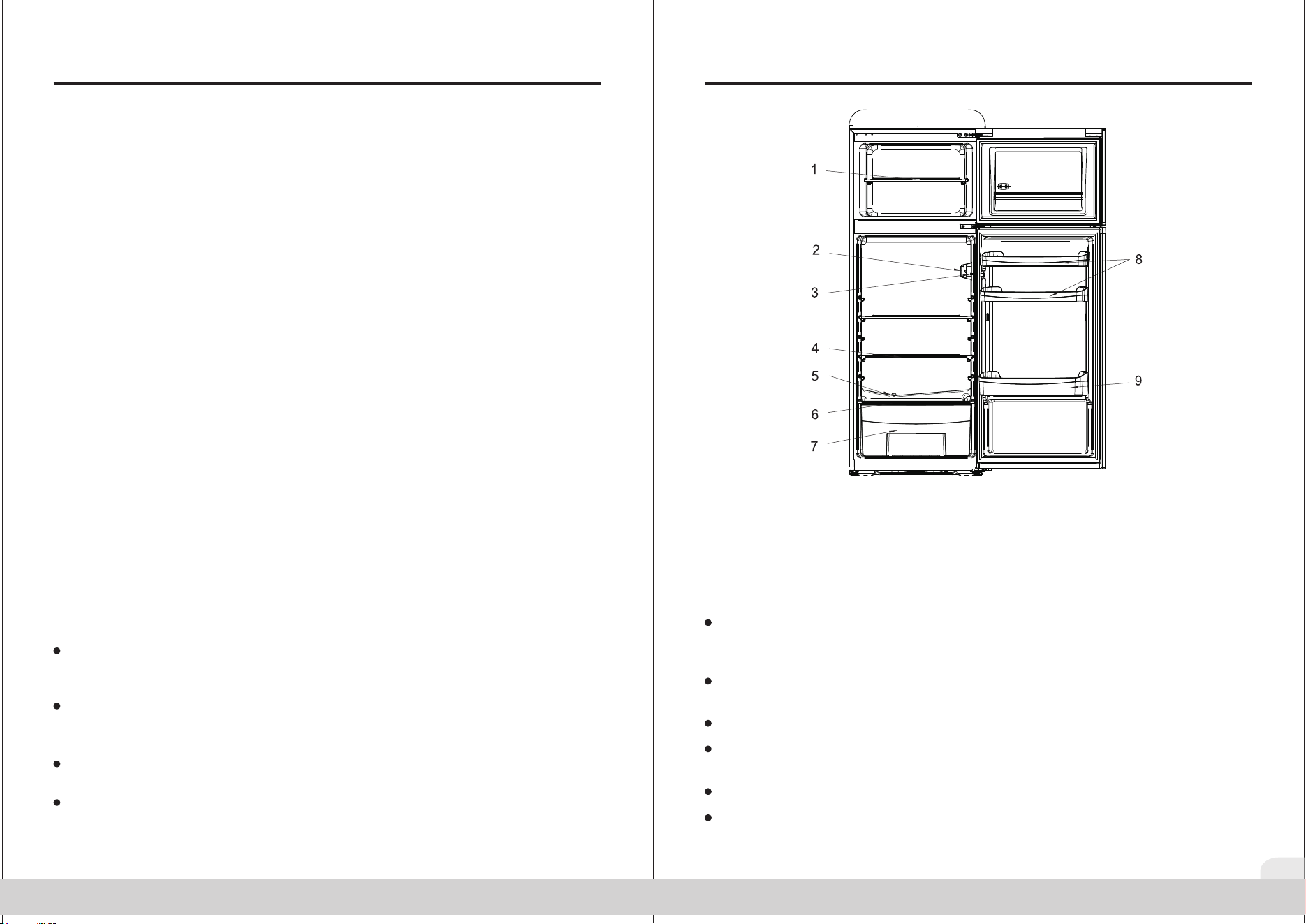
7.Vegetable crisper
8.Middle bottle guard
9.Big bottle guard
1.Freezer shelf
2.Lamp and temperature control knob
3.Lamp switch
4.Glass shelf
5.Drain tube plug
6.Crisper glass cover
23
SAFETY WARNINGS
For ensure your personal safety, please follow the points below:
Do stop the power only by pulling the power plug out of the socket directly but not by
the wire.
Do not damage the refrigerant circuit.
This appliance is not intended for use by persons(including children) with reduced
physical, sensory or mental capabilities, or lack of experience and knowledge,unless
they have been given supervision or instruction concerning use of the appliance by a
person responsible for their safety.
Children should be supervised to ensure that they do not play with the appliance.
Keep ventilation opening, in the appliance enclosure or in the built in structure,clear
of obstruction.
The circuitry for refrigerator must be isolated. The area of cross section of wire must
2
be larger than 0.75mm. The power plug should have its own socket, the socket must
be ground as adapter may cause the socket to overheat.
Do not store explosive substances such as aerosol cans with a flammable propellant in
this appliance.This appliance is intended to be used in household and similar applications
such as
-staff kitchen areas in shops, offices and other working environments;
-farm houses and by clients in hotels, motels and other residential type environments;
-bed and breakfast type environments;
-catering and similar non-retail applications.
Before you throw away your old refrigerator or freezer.
- Take off the doors;
- Leave the shelves in place so that children may not easily climb inside.
Do not use electrical appliance inside the food storage compartments of the appliance,
unless they are of the type recommended by the manufacture.
The voltage and frequency of this product should be 220-240V;50Hz. Contact with the
local maintenance station or retailer if the wire is damaged.
This appliance can be used by children aged from 8 years and above and persons with
reduced physical, sensory or mental capabilities or lack of experience and knowledge
if they have been given supervision or instruction concerning use of the appliance in a
safe way and understand the hazards involved. Children shall not play with the appliance.
Cleaning and user maintenance shall not be made by children without supervision.
1.
2.
3.
4.
5.
6.
7.
8.
9.
10.
11.
Children aged from 3 to 8 years are allowed to load and unload refrigerating
appliances.
To avoid contamination of food, please respect the following instructions:
-Opening the door for long periods can cause a significant increase of the
temperature in the compartments of the appliance.
-Clean regularly surfaces that can come in contact with food and accessible
drainage systems.
-Clean water tanks if they have not been used for 48 h; flush the water system
connected to a water supply if water has not been drawn for 5 days.
-Store raw meat and fish in suitable containers in the refrigerator, so that it is
not in contact with or drip onto other food.
-Two-star frozen-food compartments are suitable for storing pre-frozen food,
storing or making icecream and making ice cubes.
-One-, two- and three-star compartments are not suitable for the freezing of
fresh food.
-If the refrigerating appliance is left empty for long periods, switch off,
defrost, clean, dry, and leave the door open to prevent mould developing
within the appliance.
WARNING:When positioning the appliance, ensure the supply cord is
not trapped or damaged.
WARNING: Do not locate multiple portable socket-outlets or portable
power supplies at the rear of the appliance.
NOTICE:
When gas leaks from its container, don't pull the plug, out or in, for it may
arouse sparks and fire calamities.
1.
Don't splash water on the rear of the appliance, for it may cause malfunction
or electric shock.
2.
3.
Don't stor inflammabe materials such as ether, benzene, LP gas and glue
etc in the refrighterator.
Don't place bottled beverage in the freezer, so as to prevent breaking.
4.
It is better not place object on the top of appliance which is magnetic, heavy, or be
filled with water. Electronic components may not work steadily if water gets inside.
5.
The refrigerant of this product is R600a,which is inflammable. So,make sure not to
damage the cooling system during the transportation and installation.
DISPOSAL:Do not dispose this product asunsorted
municipal waste.Collection of such wasteseparately
for special treatment is necessary.
6.
7.
Do not store object which is costly or impressible to temperature and , e.g. serum,
bacterin and so on.
12.
This refrigerating appliance is not intended to be used as a built-in appliance.

54
INSTRUCTION FOR USAGE
Unpack , repack and carry
Please memorize the position of each accessory of the appliance
when unpack it, repack the product and check it carefully before
transportation.
Do not lift or pull the door or the door handle during transportation.
When moving, the appliance can not be sloped over 45 degrees
(the angle to the vertical direction). Please avoid strong vibration
and hit.
PACKING AND MOVING
1.
2.
3.
The appliance should be maintained and cleaned frequently. For your safety,do
please pull the plug out of the socket before the cleaning.
Interior maintenance
Clean the interior of the appliance with clean water or neutral abluent.Scour it with
clean water and wipe it with a piece of dry cloth.
Maintenance of door gasket
It is easy to damage if the door gaskets are polluted by the stain like oil, sauce and
etc., so it is better to clean them carefully.
Outer maintenance
Wipe the dusty with a piece of dry cloth ,clean it with neutral abluentif necessary.
MAINTENANCE
1.
2.
3.
The appliance is equipped with a screwing lamp or a long life LED interior light.
(Screwing lamp can be replaced by professionals.Long life LED is non-replaceable).
4.
Do not use any electronic equipment inside the appliance.
Warning
The refrigerator should be located in a completely flat surface , Leave 5~10 cm
between each side of the appliance and the wall, and leave 30 cm between the top
of the appliance and the ceiling.
Choose a location which is not exposed to sunlight ,
high temperature or humid , as humidity maycause stain.
Pulled out the bottom panel before installation.
The appliance can be adjusted by rolling its two legs in
front the bottom when it is unstable. Rolling in clockwise
can rise up the machine.
The location should be firm and flat. An un-securely
position may cause noise and libration:
(a)The noise may be increased if the floor is not firm.
(b) Put a sheet under the appliance for solving the heat
emission if you need to locate it onto a carpet.
Make sure the adjustable legs are clung to the floor,
and set the appliance slope backward slightly for keeping the doors closed tightly.
PLACEMENT OF FOOD
INSTALLATION INSTRUCTIONS
OPERATION INSTRUCTIONS
1.
2.
3.
4.
5.
6.
There should always be some space between items inside for air circulation.
Food should be to avoid becoming
dry or with odour.
kept in sealed package
Hot food should be cooled down before placing into the
appliance. Otherwise, interior temperature and electronic
consumption will increase.
Reduce the frequency of door opening can efficiently low
down the electronic consumption.
1.
2.
3.
4.
The temperature of refrigerator can be controlled manually by the knob. However,
the number shown on the knob does not directly represent the temperature. Instead,
the larger the number is, the lower the interior temperature will be. 0 stands for off. Turn
the knob to state 4 when it is normal used, turn it to the state during 4-7 if a lower interior
temperature is required; contrarily, to the state during 4-1, when a higher one is needed.
76
Heavy frost occurs on the rear of the appliance
Putting humid or hot food into the appliance may cause this problem. Or it may be
caused by the heavy environment moisture.
Disgusting odour happens
Food with strong odour should be packed tightly before being put inside the appliance.
Please check whether there is any deteriorated item or whether the liners are left dirty
for a long time.
Water leaks from the bottom of the refrigerator
The drain tube is jammed. Please use a proper tool to solve it.
5.
6.
7.
The compressor keeps working for a long period
The environment temperature may be too high. The doors may be opened frequently
or even they are left open. The temperature control knob setting in (4-7) state may
increase the working time of compressor.
4.
TROUBLESHOOTING TIPS
The refrigerator work
It may not be connected to the power supply(plug, power cut or fuse); Voltage is too
low.
does not
The refrigerator does not work efficiently as expected
It may be caused by heavy frost, or by warm temperature setting,or by frequently door
operating.
It makes unusual noise
It may be caused by an imbalance or loose ground locating the appliance, or by
resonation between the appliance and other ambient objects.
1.
2.
3.
Please get rid of the gasket of the door before the disposal.
The disposed apparatus should be handled by professional
staff, as it may be harmful to the environment.
Warning
Please check the points below after maintenance:
(1) Is there any damage or loss of the electronic wire ?
(2) Can the plug be put in the socket reliably and smoothly?
(3) Is the plug heating unconventionally?
4.
USER NOTIFICATIONS
Do not splash water on the refrigerator, as it will cause oxidation and malfunction.
Electronic component such as on/off button should be wiped dryly.
Cleansers such as soap powder, abrasive cleaning powder, alkali cleansers, chemical
cloth, thinner, alcohol, acid petroleum productand hot water should not be used to
clean the refrigerator as they may damage the painted cover and plastics.
Smear can damage the interior plastic component, so wipe it as soon as possible.
1.
2.
3.
Do not use any other equipment or method to push the
defrost process. It may destroy the cooling system.
DEFROST
The heavy frost will influence the refrigerating of the appliance and increase the
energy consumption. Thus, defrosting is needed as the frost is as thick as 5 mm.
Processes of the manual defrost are listed as following: take all the food out of the
compartment; uninstall the drawers and shelves; unplug the electronic power cord;
open the doors and wait for the thaw; wipe up the water with dry cloth.
DISCONNECTING THE APPLIANCE
In a general condition, do not stop the appliance in case of affecting
its life. After unplugging the power, please leave at least 5 minutes
before resumption.
Attention
Discontinuation during power failure
After power failure, do not put additional food in the appliance and reduce the frequency
of door opening.Make several ices in a container if know the power failure beforehand,
and put it in the top of the fridge.
Discontinuation during vacation
Please fetch out the easy-rot food and the food in fridge before shot vacation. After
confirmation, close the door firmly.If have a long vacation, please fetch out all the food
and cut off the power. After defrosting, clean up the liner of the appliance and wipeit dry,
and leave the door open.
Stop using
If the refrigerator may be stopped using for a long time, please unplug the outlet and
clean up the appliance. The door should be kept open in order to prevent unpleasant
smell caused by food leavings.
1.
2.
3.
After power failure, even in summer, the refrigerator can store food normally in several
hours.
The follow cases are not malfunction
Moisture may form dew on the outside of the product during the
humid season, just
get it wiped.
The frame of the appliance will be warm during working by the defrost pipeline inside it.
Please check the points above first.
If the supply cord is damaged, it must be replaced by the manufacturer,
its service agent or similarly qualified persons in order to avoid a hazard.
The flow of refrigerant through the pipeline coil can cause a bicker.
It is normal that the sides of product get warm as a result of the cooling pipeline working.
1.
2.
4.
3.
98
HINTS AND TIPS
HINTS FOR ENERGY SAVING
Freezer: The internal configuration of the appliance is the one that ensures the
most efficient use of energy.
1.
2.
3.
4.
5.
6.
7.
Fridge: Most efficient use of energy is ensured in the configuration with the
drawers in the bottom part of the appliance and shelves evenly distributed.
Position of the door bins does not affect energy consumption.
Do not open the door frequently or leave it open longer than necessary.
Freezer: The colder the temperature setting, the higher the energy consumption.
Fridge: Do not set too high temperature to save energy unless it is required by the
characteristics of the food.
If the ambient temperature is high and the temperature control is set to low
temperature and the appliance is fully loaded, the compressor may run
continuously, causing frost or ice formation on the evaporator. In this case, set
the temperature control toward higher temperature to allow automatic defrosting
and to save energy this way.
Ensure a good ventilation. Do not cover the ventilation grilles or holes.
HINTS FOR FREEZING
Activate Super Freeze function at least 24 hours before placing the food inside
the freezer compartment.
Before freezing wrap and seal fresh food in: aluminium foil, plastic film or
bags, airtight containers with lid.
For more efficient freezing and thawing divide food into small portions.
It is recommended to put labels and dates on all your frozen food. This will
help to identify foods and to know when they should be used before their
deterioration.
The food should be fresh when being frozen to preserve good quality.
Especially fruits and vegetables should be frozen after the harvest to preserve
all of their nutrients.
Do not freeze bottles or cans with liquids, in particular drinks containing
carbon dioxide -they may explode during freezing.
Do not put hot food in the freezer compartment. Cool it down at room
temperature before placing it inside the compartment.
To avoid increase in temperature of already frozen food, do not place fresh
unfrozen food directly next to it. Place food at room temperature in the part of
the freezer compartment where there is no frozen food.
Do not eat ice cubes, water ices or ice lollies immediately after taking them
out of the freezer. Risk of frostbites.
Do not re-freeze defrosted food. If the food has defrosted, cook it, cool it
down and then freeze it.
1.
2.
3.
4.
5.
6.
7.
8.
9.
10.
HINTS FOR STORAGE OF FROZEN FOOD
• Higher temperature setting inside the appliance may lead to shorter shelf life.
• The whole freezer compartment is suitable for storage of frozen food products.
• Leave enough space around the food to allow air to circulate freely.
• For adequate storage refer to food packaging label to see the shelf life of food.
• It is important to wrap the food in such a way that prevents water, humidity or
condensation from getting inside.
SHOPPING TIPS
After grocery shopping:
• Ensure that the packaging is not damaged - the food could be deteriorated. If the
package is swollen or wet, it might have not been stored in the optimal conditions
and defrosting may have already started.
• To limit the defrosting process buy frozen goods at the end of your grocery
shopping and transport them in a thermal and insulated cool bag.
• Place the frozen foods immediately in the freezer after coming back from the
shop.
• If food has defrosted even partially, do not refreeze it. Consume it as soon as
possible.
• Respect the expiry date and the storage information on the package.
SHELF LIFE FOR FREEZER COMPARTMENT
Type of foodShelf life (months)
Bread3
Fruits (except citrus)
6 - 12
Vegetables
Leftovers without meat
Dairy food:
Butter
Soft cheese (e.g. mozzarella)
Hard cheese (e.g. parmesan, cheddar)
Sea food:
Fatty fish (e.g. salmon, mackerel)
Lean fish (e.g. cod, flounder)
Shrimps
Shucked clams and mussels
Cooked fish
Meat:
Poultry
Beef
Pork
Lamb
Sausage
Ham
Leftovers with meat
8 - 10
1 - 2
6 - 9
3 - 4
6
2 - 3
4 - 6
12
3 - 4
1 - 2
9 - 12
6 - 12
4 - 6
6 - 9
1 - 2
1 - 2
2 - 3
11
10
HINTS FOR FRESH FOOD REFRIGERATION
Good temperature setting that ensures preservation of fresh food is a
temperature less than or equal to +4°C.
Higher temperature setting inside the appliance may lead to shorter shelf
life of food.
• Cover the food with packaging to preserve its freshness and aroma.
• Always use closed containers for liquids and for food, to avoid flavours or
odours in the compartment.
• To avoid the cross-contamination between cooked and raw food, cover
the cooked food and separate it from the raw one.
• It is recommended to defrost the food inside the fridge.
• Do not insert hot food inside the appliance.
Make sure it has cooled down at room temperature before inserting it.
• To prevent food waste the new stock of food should always be placed
behind the old one.
HINTS FOR FOOD REFRIGERATION
Meat (all types): wrap in a suitable packaging and place it on the glass
shelf above the vegetable drawer. Store meat for at most 1-2 days.
• Fruit and vegetables: clean thoroughly (eliminate the soil) and place in a
special drawer(vegetable drawer).
• It is advisable not to keep the exotic fruits like bananas, mangos,
papayas etc. in the refrigerator.
• Vegetables like tomatoes, potatoes, onions, and garlic should not be
kept in the refrigerator.
• Butter and cheese: place in an airtight container or wrap in an aluminium
foil or a polythene bag to exclude as much air as possible.
• Bottles: close them with a cap and place them on the door bottle shelf, or
(if available) on the bottle rack.
• Always refer to the expiry date of the products to know how long to keep
them.
TECHNICAL DATA
The technical information is situated in the rating plate on the internal side
of the appliance and on the energy label.
The QR code on the energy label supplied with the appliance provides a
web link to the information related to the performance of the appliance
in the EU EPREL database. Keep the energy label for reference together
with the user manual and all other documents provided with this
appliance.
It is also possible to find the same information in EPREL using the link
https://eprel.ec.europa.eu and the model name and product number that
you find on the rating plate of the appliance.
See the link www.theenergylabel.eu for detailed information about the
energy label.
INFORMATION FOR TEST INSTITUTES
Installation and preparation of the appliance for any EcoDesign
verification shall be compliant with EN 62552. Ventilation requirements,
recess dimensions and minimum rear clearances shall be as stated in this
User Manual at Chapter 3. Please contact the manufacturer for any other
further information, including loading plans.
ENVIRONMENTAL CONCERNS
Recycle materials with the symbol . Put the packaging in relevant
containers to recycle it. Help protect the environment and human health
by recycling waste of electrical and electronic appliances. Do not dispose
of appliances marked with the symbol with the household waste.
Return the product to your local recycling facility or contact your municipal
office.
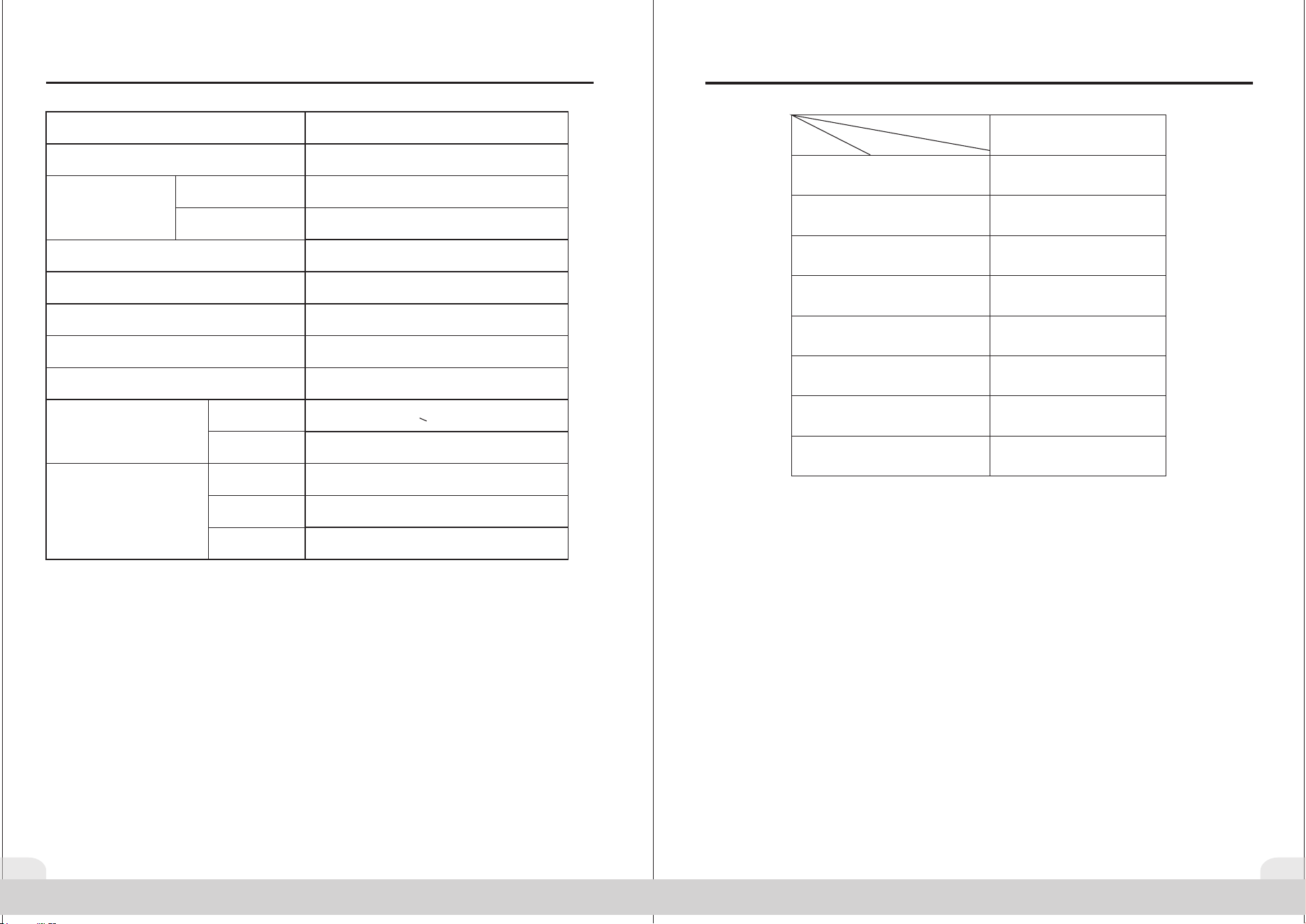
SPECIFICATIONS AND PARAMETERS
Climate class
Electric shock protection type
Capacity (L)
Freezer
Refrigerator
Voltage (V)
Frequency (Hz)
Current (A)
Voice (Class)
SN/N/ST
I
220-240
50
0.57
C
170
45
Refrigerant
R600a/38g
Freezer
Interior
temperature ( C)
Dimension (mm)
Width
Depth
Height
Refrigerator
o
0~8
552
621
1482
<
-18
12
PACKING LIST
13
Note: Products are subject to improve from time to time, any
changes in parts without further notice.
Vegetable crisper
Glass shelf
Drain tube plug
E-CF2PG148RR
1pcs
2pcs
1pcs
1pcs
Freezer shelf
Owner's manual
1pcs
1copy
2pcs
1pcs
Middle bottle guard
Big bottle guard
Crisper glass cover
Model
NumberParts

CERTIFICADO DE GARANTÍA
Imprescindible la presentación de la factura de compra acompañada del presente certificado de garantía.
Riesgos cubiertos.
Este aparato está garantizado contra cualquier defecto de funcionamiento, siempre que se destine a uso doméstico,
procediéndose a su reparación dentro del plazo de garantía y sólo por la red de SAT autorizados.
Nuestros electrodomésticos Corberó cuentan con la garantía legal del fabricante que cubre cualquier avería o defecto durante36
meses, desde su fecha factura de 1 de enero del 2022. En caso de que fuera necesario, nosotros nos ocupamos de cualquier posible
incidencia siempre que se deba a un componente defectuoso o fallo de fabricación.
Excepciones de garantía.
• Que la fecha del certificado no coincida con la fecha de venta de la factura original.
• Averías producidas por golpe, por caída o cualquier otra causa de fuerza mayor.
• Si el apa
rato ha sido manipulado por personal no autorizado.
• Las averías producidas o derivadas como consecuencia de un uso inadecuado, por defectos de instalación,
por introducir modificaciones en el aparato que alteren su funcionamiento.
• Puestas en marcha, mantenimiento, limpiezas, componentes sujetos a desgaste, lámparas, piezas estéticas,
oxidaciones, plásticos, gomas, carcasas y cristales.
“ESTAS EXCEPCIONES ANULAN LA GARANTÍA, SIENDO LA REPARACIÓN CON CARGO AL CLIENTE”
Periodo amparado en aparatos según ley de garantias en la venta de bienes de consumo Ley vigente es “RD 7/2021”
Horario de atención Lunes a Viernes de 9h00 a 19h00. Teléfono de contacto_ 911 08 08 08 Mail de contacto_ [email protected] web_ www.corbero.es
Dirección de Servicio técnico oficial_Vidal i Ribes 8-10 08950 Esplugues de Llobregat Barcelona
Sevicio Técnico Oficial: 911 08 08 08
Los hornos microondas (a excepción de los integrables) y los hornos sobremesa en el caso de cualquier incidencia de
funcionamiento, deben de llevarse al servicio técnico más próximo por parte del cliente. No se recojen ni reparan en el
domicilio.
•
Garantía termos eléctricos. Garantía de 3 años incluyendo los costes de desplazamiento y mano de obra que
correspondan de la reparación del producto, teniendo que tener un mantenimiento una vez cada 12 meses.
Especialmente si Ud. ha instalado un aparato a gas, tenga presente como titular de la instalación, la obligatoriedad de
realizar una revisión completa de los equipos, (según Real Decreto 238 / 2013, del 5 Abril. RITE. IT3, M. Lo termos
eléctricos y calderas que incluyen depósitos acumuladores de agua caliente, para que se aplique la prestación de la
Garantía, es obligatorio que el ánodo de magnesio esté operativo y que realice la función de protección
adecuadamente. Para ello es recomendable que el ánodo se revise bianualmente por el Servicio Oficial y sea renovado
cuando fuera necesario. Periodicidad que deberá ser anual en aquellas zonas con aguas críticas (contenido de CaCO3
superiores a 200mg/L, es decir a partir de 20ºfH de dureza). Depósitos sin el correcto estado del ánodo de protección, no
tienen la cobertura de la garantía. Independientemente del tipo de depósito o producto, todas las válvulas de
sobrepresión de calefacción o a.c.s., deberán ser canalizadas para evitar daños en Ia vivienda por descargas de agua. La
garantía del producto no asume los daños causados por Ia no canalización del agua derramada por esta válvula.
•

CERTIFICATE OF GUARANTEE
The presentation of the purchase invoice accompanied by this guarantee certificate is essential.
Covered Risks.
This appliance is guaranteed against any malfunction, provided that it is intended for domestic use, proceeding to its repair within
the warranty period and only by the authorized SAT network.
Our Corberó appliances have the manufacturer's legal warranty that covers any breakdown or defect for 36 months, from the
invoice date of January 1, 2022. If necessary, we take care of any possible incident whenever it is due to a defective component or
manufacturing fault. Warranty Exceptions
Warranty Exceptions
•
That the date of the certificate does not coincide with the date of sale of the original invoice.
•
Faults produced by blow, by fall or any other cause of force majeure.
•
If the device has been manipulated by unauthorized personnel.
•
Faults produced or derived as a consequence of improper use, installation defects, or modifications to the device that
alter its operation.
•
Start-up, maintenance, cleaning, components subject to wear, lamps, aesthetic parts,
oxidation, plastics, rubbers, housings and crystals.
“THESE EXCEPTIONS VOID THE WARRANTY, THE REPAIR BEING CHARGED TO THE CUSTOMER”
Period covered in devices according to the law of guarantees in the sale of consumer goods Current law is “RD 7/2021”
Hours of operation Monday to Friday from9h00 a 19h00. Telephone contact_ 911 08 08 08 Contact email_ [email protected] web_ www.corbero.es
Official Technical Service Address_Vidal i Ribes 8-10 08950 Esplugues de Llobregat Barcelona
Official Technical Service: 911 08 08 08
Microwave ovens (with the exception of built-in ones) and tabletop ovens in the event of any incident of
operation, they must be taken to the nearest technical service by the customer. They are not collected or repaired at
home.
•
Electric thermos guarantee. 3-year warranty including travel and labor costs that correspond to the repair of the
product, having to have maintenance once every 12 months. Especially if you have installed a gas appliance, keep in
mind as the owner of the installation, the obligation to carry out a complete review of the equipment, (according to
Royal Decree 238 / 2013, of April 5. RITE. IT3, M. Lo thermos electrical and boilers that include hot water storage tanks,
for the benefit of the Guarantee to apply, it is mandatory that the magnesium anode is operational and that it performs
the protection function adequately.For this, it is recommended that the anode be checked biannually by the Official
Service and is renewed when necessary Periodicity that must be annual in those areas with critical waters (CaCO3
content greater than 200mg/L, that is, from 20ºfH of hardness) Deposits without the correct state of the protection
anode are not covered by the warranty Regardless of the type of tank or product, all heating or DHW overpressure
valves must be channeled to avoid damage and n the house due to water discharges. The product warranty does not
cover damages caused by not channeling the water spilled by this valve.
•