1. SAFETY
9 Ensure that the spreader is in sound condition and good working order before use.
9 Ensure that the operator is fully trained and competent to operate the prime mover before attaching and using the spreader.
9 Ensure that all chemical safety instructions are adhered to when handling products for use in the spreader.
9 A full range of personal safety equipment is available from your Sealey dealer.
9 Always distribute the load evenly.
9 Ensure all non essential personnel keep a safe distance when the spreader is in use.
9 Replace or repair damaged parts. Use only recommended parts. Unauthorised parts may be dangerous and will invalidate the warranty.
9 Keep hands and feet away from moving parts.
8 DO NOT overload the spreader - see Specification.
8 DO NOT leave unattended, especially when loaded, unless the wheels are chocked or the spreader is otherwise secured.
8 DO NOT allow others to ride on the spreader.
8 DO NOT allow untrained personnel to use the spreader.
8 DO NOT use the spreader for purposes other than for which it is designed.
8 DO NOT operate the spreader when you are tired or under the influence of alcohol, drugs or intoxicating medicines.
8 When loaded,DO NOT operate the spreader over edges, rough surfaces etc. where the spreader is at risk of overturning.
WARNING! Failure to comply with these instructions may result in damage to spreader or other property and/or personal injury.
2. INTRODUCTION
Manufactured with a strong tubular steel frame and polypropylene dispensing hopper. Pin hitch design attaches to ride-on lawnmowers, can be
converted to ball hitch using Model No. TB36*. Fitted with pneumatic tyres and adjustable feed system. Designed to spread in a continuous line
providing a more accurate application. Suitable for a variety of horticultural agents including grit, seed, salt, fertilizer and weedkiller.
* Some modification may be required.S
3. SPECIFICATION
Model No: ................................................................... SPD80T
Capacity (Volume): ..............................................................80L
Capacity (Weight): .............................................................80kg
Dimensions (W x D x H): ......................... 1350 x 910 x 550mm
Spread: ........................................................................1070mm
4. CONTENTS
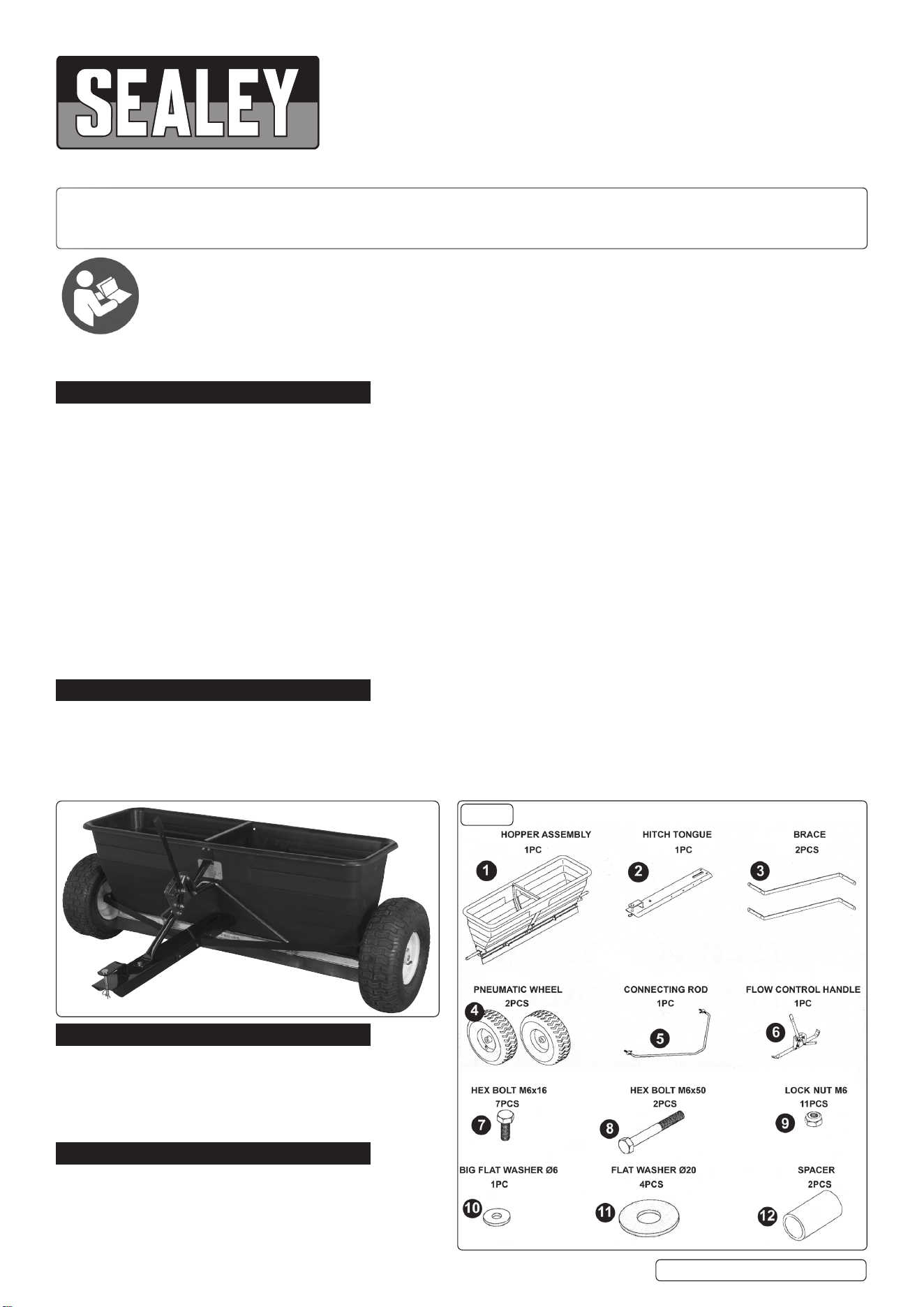
4.1. Check contents against fig.1.
4.2. If anything is missing or damaged contact your local Sealey
stockist.
80KG TOW BEHIND DROP SPREADER
MODEL NO: SPD80T
Thank you for purchasing a Sealey product. Manufactured to a high standard, this product will, if used according to these instructions,
and properly maintained, give you years of trouble free performance.
IMPORTANT: PLEASE READ THESE INSTRUCTIONS CAREFULLY. NOTE THE SAFE OPERATIONAL REQUIREMENTS, WARNINGS & CAUTIONS. USE
THE PRODUCT CORRECTLY AND WITH CARE FOR THE PURPOSE FOR WHICH IT IS INTENDED. FAILURE TO DO SO MAY CAUSE DAMAGE AND/OR
PERSONAL INJURY AND WILL INVALIDATE THE WARRANTY. KEEP THESE INSTRUCTIONS SAFE FOR FUTURE USE.
Refer to
instruction
manual
SPD80T Issue 2 (ALL) 25/05/23
Original Language Version
© Jack Sealey Limited
fig.
1
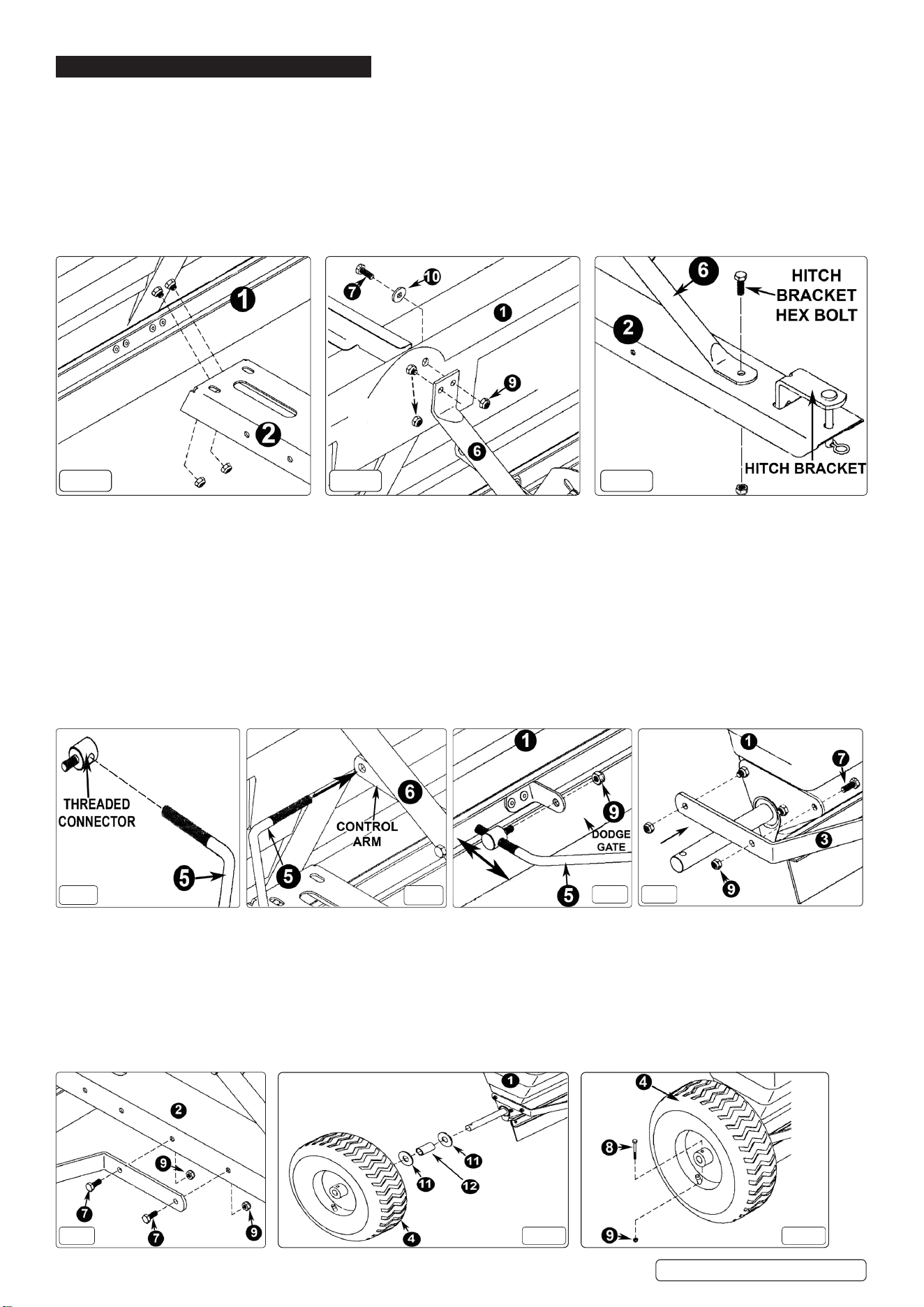
5. ASSEMBLY
5.1. Refering to fig.2, remove the two lock nuts at the front base of the hopper (1).
5.2. Align the two holes at the end of the hitch tongue (2) with the protruding bolts at the front base of the hopper (1) and attach the hitch tongue
(2) using the two lock nuts previously removed in 5.1.
5.3. Remove the top lock nut from the front of the hopper (1) as shown in fig.3.
5.4. Align the top left hand hole of the flow control handle (6) with the protruding bolt and loosely reattach the lock nut previously removed
in 5.4.
5.5. Attach the right hand hole of the flow control valve (6) to the hopper (1) using hex bolt M6x16 (7), big flat washer Ø6 (10) and lock nut M6
(9). Do not fully tighten the nuts and bolts at this stage.
5.6. Remove the hex bolt and nut securing the hitch bracket to the hitch tongue (2). Align the loose end of the flow control handle over the
hole and attach to the hitch tongue (2) using the hitch bracket hex bolt and lock nut as shown in fig. 4.
5.7. Adjust the position of the flow control handle until it is aligned with the hitch tongue and the hopper, then fully tighten all the nuts and bolts
used to secure the flow control handle.
5.8. Noting its position on the connecting rod (5), remove one of the threaded connectors, as shown in g.5.
5.9. Feed the connecting rod (5) through the hole in the control arm on the ow control handle (6) as shown in g.6, until the connecting rod is
central in the control arm.
5.10. Reattach the threaded connector removed in 5.9. back into its original position on the connecting rod (5) .
5.11. Attach the threaded connectors to the dodge gate brackets on the hopper (1) using lock nut M6 (9) as shown in g.7.
Do not over tighten the nuts to allow movement of the ow control handle mechanism and dodge gate. The position and range of
movement of the dodge gate can be altered by equally adjusting the threaded connectors up or down the threaded portions on the
connecting rod (5).
5.12. Remove the lock nut from the bottom bracket of the hopper as shown in g.8.
5.13. Attach a brace (3) to the bottom bracket of the hopper (1) using the lock nut removed in 5.13 and hex bolt M6x16 (7) and lock nut M6
(9) as shown in g.8. Do not fully tighten the nuts and bolts at this stage.
5.14. Attach the other end of the brace to the hitch tongue using hex bolt M6x16 (7) and lock nut M6 (9) as shown in g.9. Do not fully
tighten the nuts and bolts at this stage.
5.15. Repeat the procedure for the opposite side, again not fully tightening the nuts and bolts.
5.16. Adjust the position of the hitch tongue so that it is perpendicular to the hopper and fully tighten all the relevant nuts and bolts.
5.17. Place a flat washer Ø20 (11) onto the axle tube followed by a spacer (12) and then another flat washer Ø20 (11), as shown in fig.10.
5.18. Attach the pneumatic wheel (4) with the valve facing outwards. Align the hole in the wheel hub with the hole in the axle and secure using
hex bolt M6x50 (8) and lock nut M6 (9), as shown in fig.11. Repeat the procedure for the opposite side.
5.19. Tighten all fixings.
5.20. The spreader is now fully assembled and ready for use.
fig.
2
fig.
3
fig.
4
fig.
5
fig.
6
fig.
7
fig.
8
fig.
9
fig.
10
fig.
11
SPD80T Issue 2 (ALL) 25/05/23
Original Language Version
© Jack Sealey Limited

Sealey Group, Kempson Way, Suffolk Business Park, Bury St Edmunds, Suffolk. IP32 7AR
01284 757500 sales@sealey.co.uk www.sealey.co.uk
ENVIRONMENT PROTECTION
Recycle unwanted materials instead of disposing of them as waste. All tools, accessories and packaging should be sorted,
taken to a recycling centre and disposed of in a manner which is compatible with the environment. When the product
becomes completely unserviceable and requires disposal, drain any fluids (if applicable) into approved containers and
dispose of the product and fluids according to local regulations.
Note: It is our policy to continually improve products and as such we reserve the right to alter data, specifications and component parts without prior
notice.
Important: No Liability is accepted for incorrect use of this product.
Warranty: Guarantee is 12 months from purchase date, proof of which is required for any claim.
REGISTER YOUR
PURCHASE HERE
6. OPERATION
WARNING! Read the Safety Instructions in Section 1 before operating the spreader.
6.1. Secure the spreader onto the prime mover using the towing pin on the hitch tongue. Secure the towing pin with the R-pin provided.
NOTE: The spreader can be converted to use a ball hitch by fitting a Sealey Ø50mm Towing Hitch (Model No. TB36), available from your Sealey
stockist.
6.2. Load the product into the hopper, ensuring that it is evenly distributed and the maximum capacity of the spreader is not exceeded. When
handling hazardous products it is important to first read the safety data sheet and take necessary safety precautions. A full range of
personal safety equipment is available from your Sealey dealer.
6.3. The towing speed will affect the rate of flow from the spreader. It is advisable to operate the spreader at lower speeds for a more effective
flow of the product.
6.4. The adjustable feed system is controlled by movement of the handle on the hitch tongue. Operate the spreader at the desired speed and
adjust the handle either forwards or backwards until a satisfactory rate of flow is achieved. A locking device is provided on the gauge to
allow the optimum flow required to be maintained.
6.5. Clean the spreader thoroughly after use, paying particular attention to the area around the adjustable flow control system and the agitator
blade.
7. MAINTENANCE
7.1. GENERAL
9 After each use clean material out of hopper.
9 Rinse/dry inside and outside of spreader after each use.
9 Before operating make sure that the tyres are inated to the correct pressure.
9 Periodically check all fastenings are tight.
9 Annually clean and lightly lubricate parts.
9 Touch up all scratched or worn painted metal surfaces.
8 To avoid damaging the spreader never exceed the rated load capacity of 80kg.
7.2. STORAGE
9 Before storing ensure that the spreader is clean and dry.
9 Store indoors or in a protected area during severe weather and in the winter months.
8 Never allow material to stay in the hopper for extended periods of time.
SPD80T Issue 2 (ALL) 25/05/23
Original Language Version
© Jack Sealey Limited