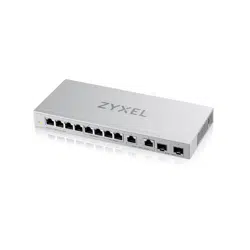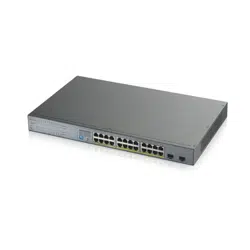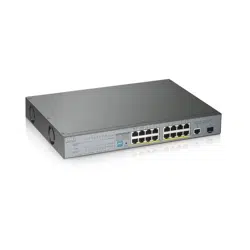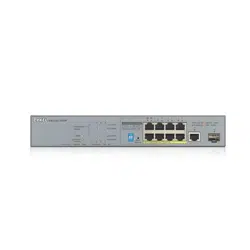

XMG-100 Series User’s Guide
2
IMPORTANT!
READ CAREFULLY BEFORE USE.
KEEP THIS GUIDE FOR FUTURE REFERENCE.
Screenshots and graphics in this book may differ slightly from your product due to differences in your
product firmware or your computer operating system. Every effort has been made to ensure that the
information in this manual is accurate.
•More Information
Go to support.zyxel.com to find other information on the Switch
.

Document Conventions
XMG-100 Series User’s Guide
3
Document Conventions
Warnings and Notes
These are how warnings and notes are shown in this guide.
Warnings tell you about things that could harm you or your device.
Note: Notes tell you other important information (for example, other things you may need to
configure or helpful tips) or recommendations.
Syntax Conventions
• All models may be referred to as the “Switch” in this guide.
• Product labels are all in bold font.
Icons Used in Figures
Figures in this user guide may use the following generic icons. The Switch icon is not an exact
representation of your device.
Switch Generic Router Wireless Router / Access Point
Generic Switch Smart TV Desktop
Laptop IP Camera Printer
Server

Contents Overview
XMG-100 Series User’s Guide
4
Contents Overview
User’s Guide ........................................................................................................................................6
Getting to Know Your Switch ................................................................................................................ 7
Hardware Installation and Connection ............................................................................................. 12
Hardware Panels .................................................................................................................................. 16
Troubleshooting .................................................................................................................................... 22

Table of Contents
XMG-100 Series User’s Guide
5
Table of Contents
Part I: User’s Guide............................................................................................6
Chapter 1
Getting to Know Your Switch ..............................................................................................................7
1.1 Introduction ....................................................................................................................................... 7
1.2 Features ............................................................................................................................................. 8
1.2.1 Multi-Gigabit ............................................................................................................................ 8
1.2.2 PoE ............................................................................................................................................ 9
1.3 Example Applications ...................................................................................................................... 9
1.3.1 PoE Example Application ..................................................................................................... 10
1.3.2 Backbone Example Application ......................................................................................... 10
1.3.3 Bridging or Fiber Optic Uplink Example Application ......................................................... 10
Chapter 2
Hardware Installation and Connection ...........................................................................................12
2.1 Installation Scenarios ...................................................................................................................... 12
2.2 Safety Precautions .......................................................................................................................... 12
2.3 Freestanding Installation Procedure ............................................................................................ 13
2.4 Wall Mounting ................................................................................................................................. 13
2.4.1 Installation Requirements ..................................................................................................... 14
Chapter 3
Hardware Panels................................................................................................................................16
3.1 Front Panel Connections ............................................................................................................... 16
3.1.1 Multi-gigabit Ethernet Ports .................................................................................................. 17
3.1.2 SFP+ Slot .................................................................................................................................. 17
3.2 Rear Panel ....................................................................................................................................... 19
3.2.1 Power Connection ................................................................................................................ 20
3.3 LEDs .................................................................................................................................................. 20
Chapter 4
Troubleshooting..................................................................................................................................22
4.1 Power, Hardware Connections, and LEDs ................................................................................... 22
4.2 Improper Network Cabling and Topology .................................................................................. 23
Appendix A Customer Support ....................................................................................................... 24
Appendix B Legal Information......................................................................................................... 29
Index...................................................................................................................................................34

6
PART I
User’s Guide
XMG-100 Series User’s Guide
7
CHAPTER 1
Getting to Know Your Switch
1.1 Introduction
The Switch refers to all the following models unless a particular model is specified.
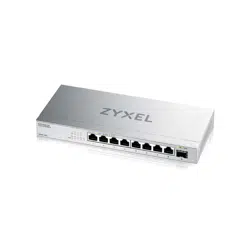
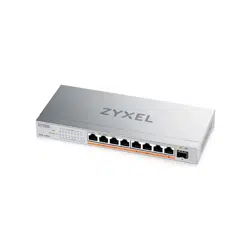
• XMG-105HP
• XMG-108
• XMG-108HP
The Switch is a 100 Mbps / 1/2.5/10 Gbps multi-port switch that can be used to build high-performance
switched workgroup networks. The Switch is a store-and-forward device that offers low latency for high-
speed networking. The Switch is designed for workgroups, departments or backbone computing
environments for small businesses.
All models are referred to as the “Switch” in this guide.
The following table describes the hardware features of the Switch by model.
The PoE ports can supply power to the connected PoE powered devices (PDs).
The SFP+ slot is for uplink connections. Use SFP+ transceivers in these slots for 1 Gbps or 10 Gbps
connections to backbone Ethernet switches.
The Switch has built-in loop detection. All connected port’s LED will fast blink green/yellow when it
detects that packets sent out on that port loop back to the Switch.
The Switch has built-in IEEE 802.1p CoS (Class of Service) feature that services queues based on priority
only. As traffic comes into the Switch, traffic on the highest priority queue is transmitted first. When that
queue empties, traffic on the next highest-priority queue is transmitted until it empties, and then traffic is
transmitted on the next queue and so on. If higher priority queues never empty, then traffic on lower
priority queues never gets sent.
Table 1 Hardware Feature Comparison
PORT/SWITCH DETAILS XMG-105HP XMG-108 XMG-108HP
100M/1G/2.5G Base-T Ethernet ports 1 8 0
100M/1G/2.5G Base-T IEEE 802.3bt PoE ports 4 0 8
1G/10G SFP+ port 1 1 1
Desktop Device Yes Yes Yes
Wall-mountable Yes Yes Yes
Power Adapter Yes Yes Yes
Power Cord Yes Yes Yes
Chapter 1 Getting to Know Your Switch
XMG-100 Series User’s Guide
8
1.2 Features
The following are the essential features of the Switch.
• Conforms to IEEE 802.3u, 802.3ab, 802.3bz, 802.3z, 802.3ae, and 802.3x standards.
• Auto-negotiating 100 Mbps / 1 Gbps / 2.5 Gbps multi-gigabit Ethernet RJ-45 ports.
• Auto-sensing crossover for all 100 Mbps / 1 Gbps / 2.5 Gbps multi-gigabit Ethernet RJ-45 ports.
• Supports N-Way protocol for speed (100 Mbps / 1 Gbps / 2.5 Gbps) and duplex mode (Full) auto-
detection.
• Supports store-and-forward switching.
• Supports automatic address learning.
• Supports IEEE 802.3af, IEEE 802.3at, and IEEE 802.3bt PoE standards.
• Full wire speed forwarding rate.
• Supports 802.1p CoS.
• Embedded 4K MAC address table providing 4000 MAC addresses entries.
1.2.1 Multi-Gigabit
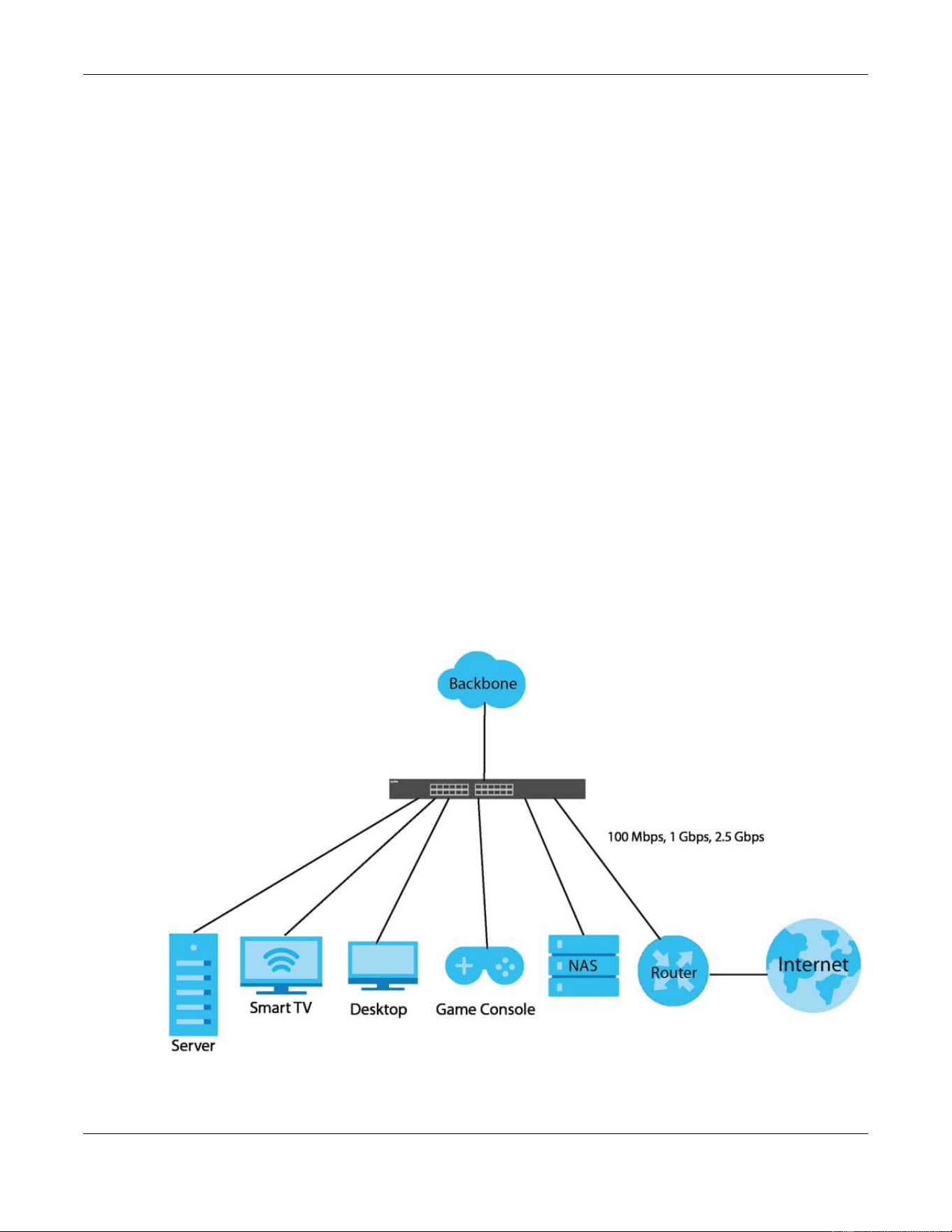
An 2.5 multi-gigabit port supports speeds of 2.5G if the connected device supports 2.5G and a Cat 5e
(up to 100 m) is used. The speed drops to 1G if these criteria are not met; it drops to 100M if a Cat 5
cable is used (up to 100 m).
Multi-Gigabit ports are also backward compatible with 100 Mbps and 1 Gigabit ports.
Figure 1 Multi-Gigabit Application
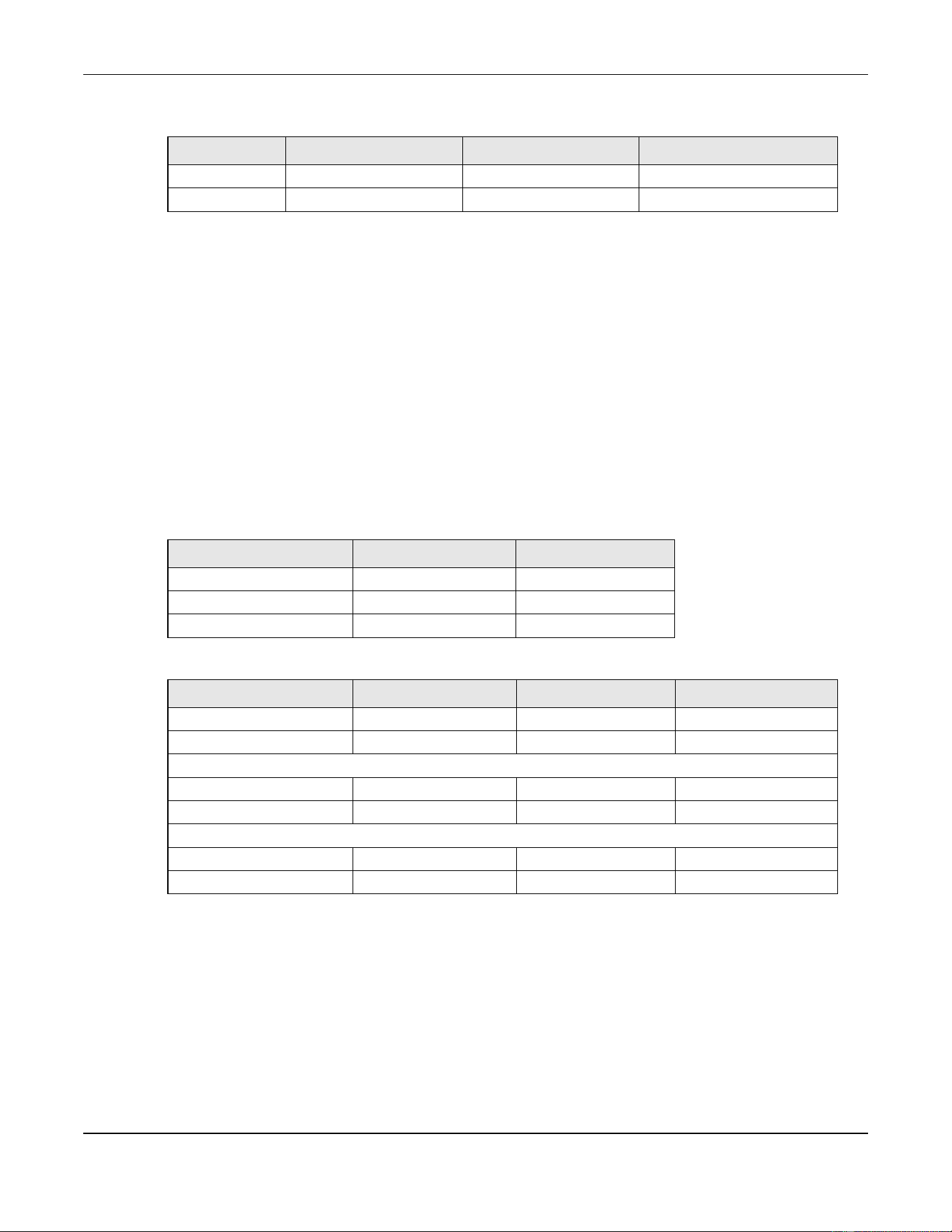
See the following table for the cables required and distance limitation to attain the corresponding
speed.
Chapter 1 Getting to Know Your Switch
XMG-100 Series User’s Guide
9
1.2.2 PoE
The Switch is a Power Sourcing Equipment (PSE) because it provides a source of power through its
Ethernet ports. Each device that receives power through an Ethernet port is a Powered Device (PD).
The Switch can adjust the power supplied to each PD according to the PoE standard the PD supports.
PoE standards are:
• IEEE 802.3af Power over Ethernet (PoE)
• IEEE 802.3at Power over Ethernet (PoE) +
• IEEE 802.3bt Power over Ethernet (PoE) ++
The following table describes the PoE features of the Switch by model.
1.3 Example Applications
This section shows a few examples of using the Switch in various network environments. Note that the
Switch in the figure is just an example Switch and not your actual Switch.
Table 2 Cable Types
CABLE TRANSMISSION SPEED MAXIMUM DISTANCE BANDWIDTH CAPACITY
Category 5 100M 100 m 100 MHz
Category 5e 1G / 2.5G 100 m 100 MHz
Table 3 XMG-100 Series Models and PoE Features
PoE FEATURES XMG-105HP XMG-108HP
IEEE 802.3bt PoE++ Ports 1 – 4 Ports 1 – 8
Power Management Mode Consumption (default) Consumption (default)
PoE Power Budget 70W 100W
Table 4 PoE Standards
PoE FEATURES PoE PoE+ PoE++
IEEE Standard IEEE 802.3af IEEE 802.3at IEEE 802.3bt
PoE Type Type 1 Type 2 Type 3
Switch Port Power
Maximum Power Per Port 15.4 W 30 W 60 W
Port Voltage Range 44 – 57 V 50 – 57 V 50 – 57 V
Cables
Twisted Pairs Used 2-pair 2-pair 4-pair
Supported Cables Cat3/24 AWG or better Cat5/24 AWG or better Cat5/24 AWG or better
Chapter 1 Getting to Know Your Switch
XMG-100 Series User’s Guide
10
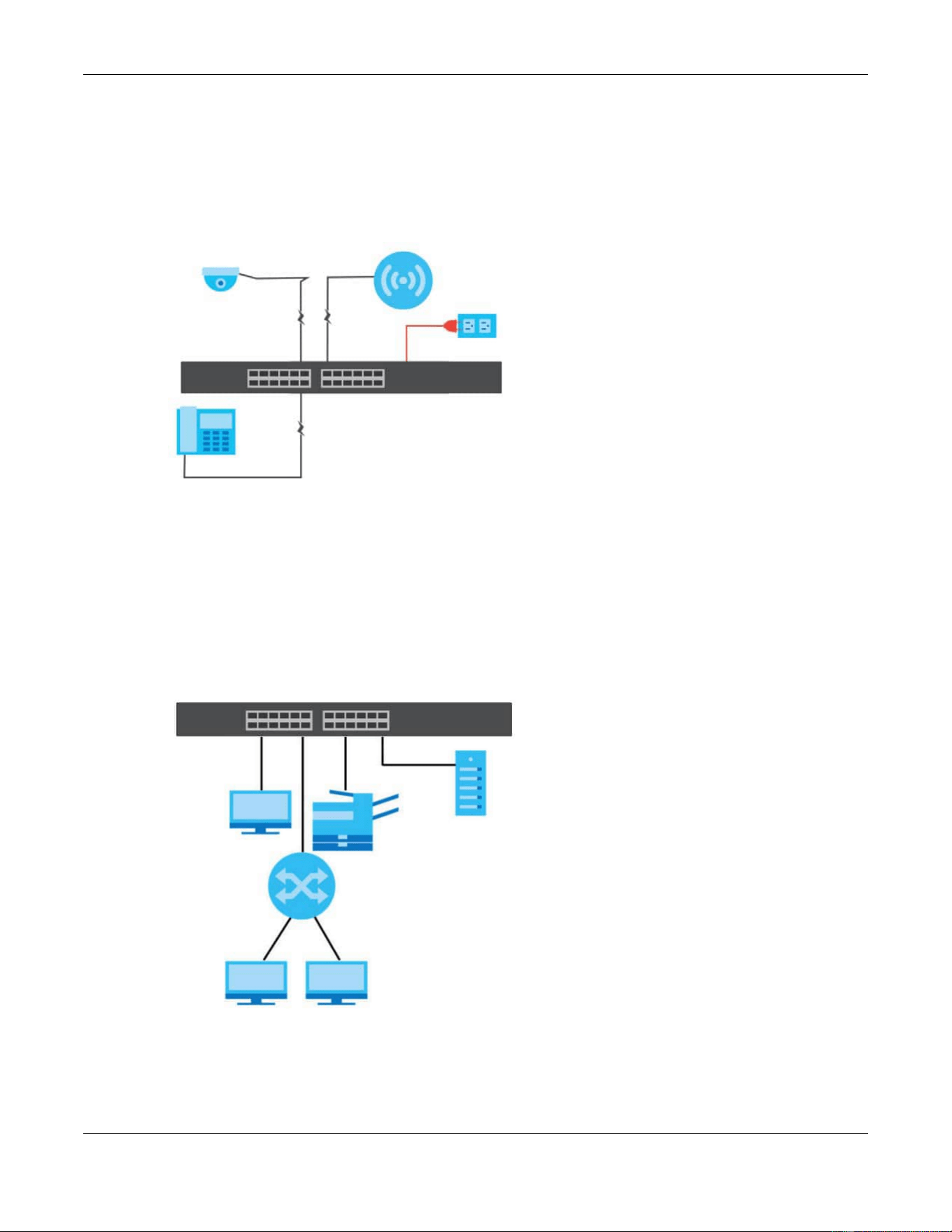
1.3.1 PoE Example Application
The following example figure shows a Switch supplying PoE (Power over Ethernet) to Powered Devices
(PDs) such as an IP camera, a wireless router, an IP telephone and a general outdoor router that are not
within reach of a power outlet.
Figure 2 Powered Device Example
1.3.2 Backbone Example Application
The Switch is an ideal solution for small networks where rapid growth can be expected in the near future.
The Switch can be used standalone for a group of heavy traffic users. You can connect computers and
servers directly to the Switch’s port or connect other switches to the Switch.
In this example, all computers can share high-speed applications on the server. To expand the network,
simply add more networking devices such as switches, routers, computers, print servers, and so on.
Figure 3 Backbone Application
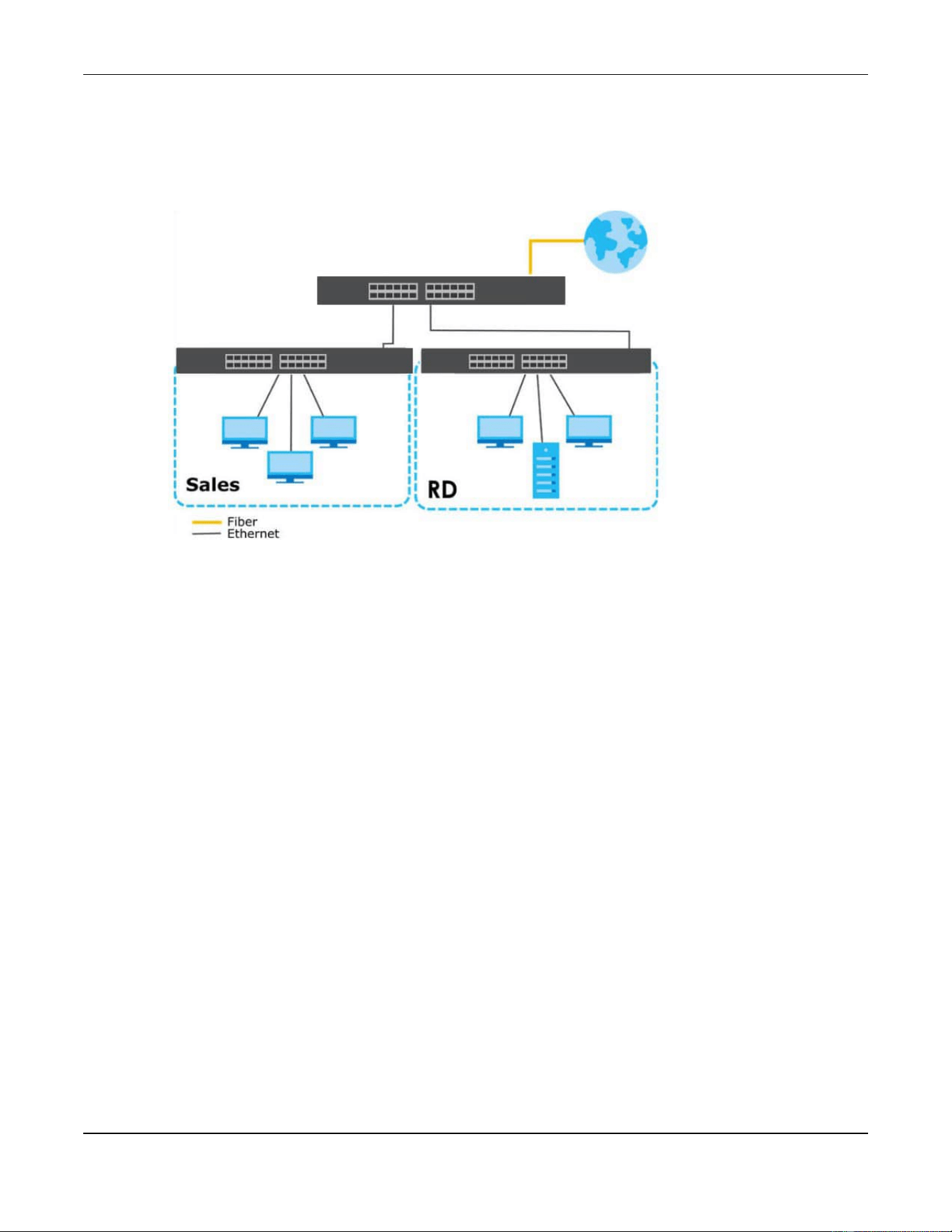
1.3.3 Bridging or Fiber Optic Uplink Example Application
In this example, the Switch connects different company departments (RD and Sales) to the corporate
backbone. It can alleviate bandwidth contention and eliminate server and network bottlenecks. All
Chapter 1 Getting to Know Your Switch
XMG-100 Series User’s Guide
11
users that need high bandwidth can connect to high-speed department servers through the Switch.
You can provide a super-fast uplink connection by using a multi-gigabit Ethernet or SFP+ port on the
Switch.
Figure 4 Bridging Example Application

XMG-100 Series User’s Guide
12
CHAPTER 2
Hardware Installation and
Connection
2.1 Installation Scenarios
This chapter shows you how to install and connect the Switch.
See Table 1 on page 7 for a comparison of hardware features for each model.
The Switch can be:
• Placed on a desktop.
• Wall-mounted on a wall.
See the following table for a comparison of the hardware installation methods of each Switch:
Table 5 Mounting Methods
2.2 Safety Precautions
Please observe the following before using the Switch:
• It is recommended to ask an authorized technician to attach the Switch on a desk or to the wall. Use
the proper screws to prevent damage to the Switch. See the Installation Requirements sections in this
chapter to know the types of screws and screw drivers for each mounting method.
• Make sure there is at least 2 cm of clearance on the top and bottom of the Switch, and at least 5 cm
of clearance on all four sides of the Switch. This allows air circulation for cooling.
• Do NOT block the ventilation holes nor store cables or power cords on the Switch. Allow clearance for
the ventilation holes to prevent your Switch from overheating. This is especially crucial when your
Switch does not have fans. Overheating could affect the performance of your Switch, or even
damage it.
• The surface of the Switch could be hot when it is functioning. Do NOT put your hands on it. You may
get burned. This could happen especially when you are using a fanless Switch.
• The Switches with fans are not suitable for use in locations where children are likely to be present.
To start using the Switch, simply connect the power adapter to turn it on.
MODEL FEATURE XMG-105HP XMG-108 XMG-108HP
Desktop Device Yes Yes Yes
Wall-mountable Yes Yes Yes
Chapter 2 Hardware Installation and Connection
XMG-100 Series User’s Guide
13
2.3 Freestanding Installation Procedure
1 Make sure the Switch is clean and dry.
2 Remove the adhesive backing from the rubber feet.
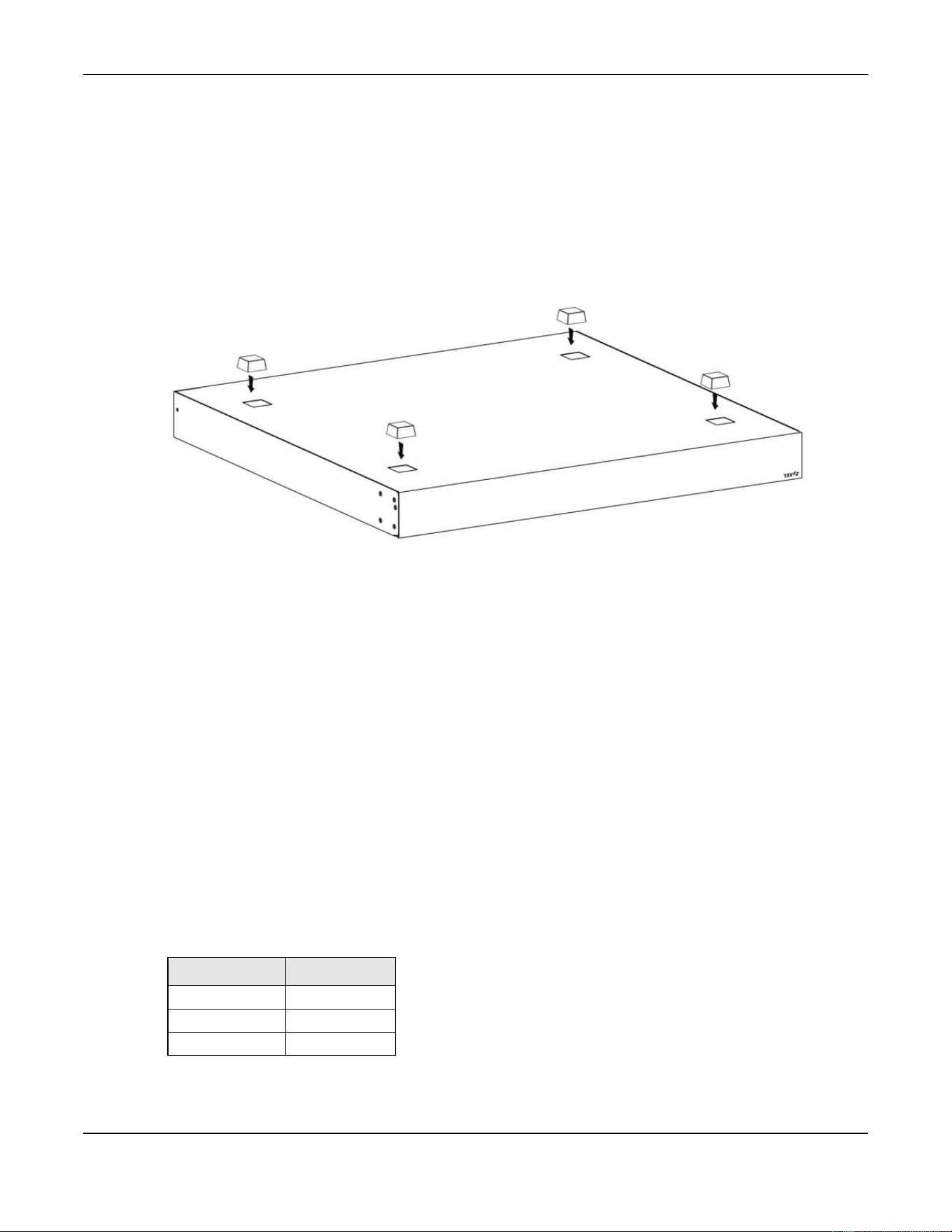
3 Attach the rubber feet to each corner on the bottom of the Switch. These rubber feet help protect the
Switch from shock or vibration and ensure space between devices when stacking.
Figure 5 Attaching Rubber Feet
4 Set the Switch on a smooth, level surface strong enough to support the weight of the Switch and the
connected cables. Make sure there is a power outlet nearby.
Cautions:
• Avoid stacking fanless Switches to prevent overheating.
• Ensure enough clearance around the Switch to allow air circulation for cooling.
• Do NOT remove the rubber feet as it provides space for air circulation.
2.4 Wall Mounting
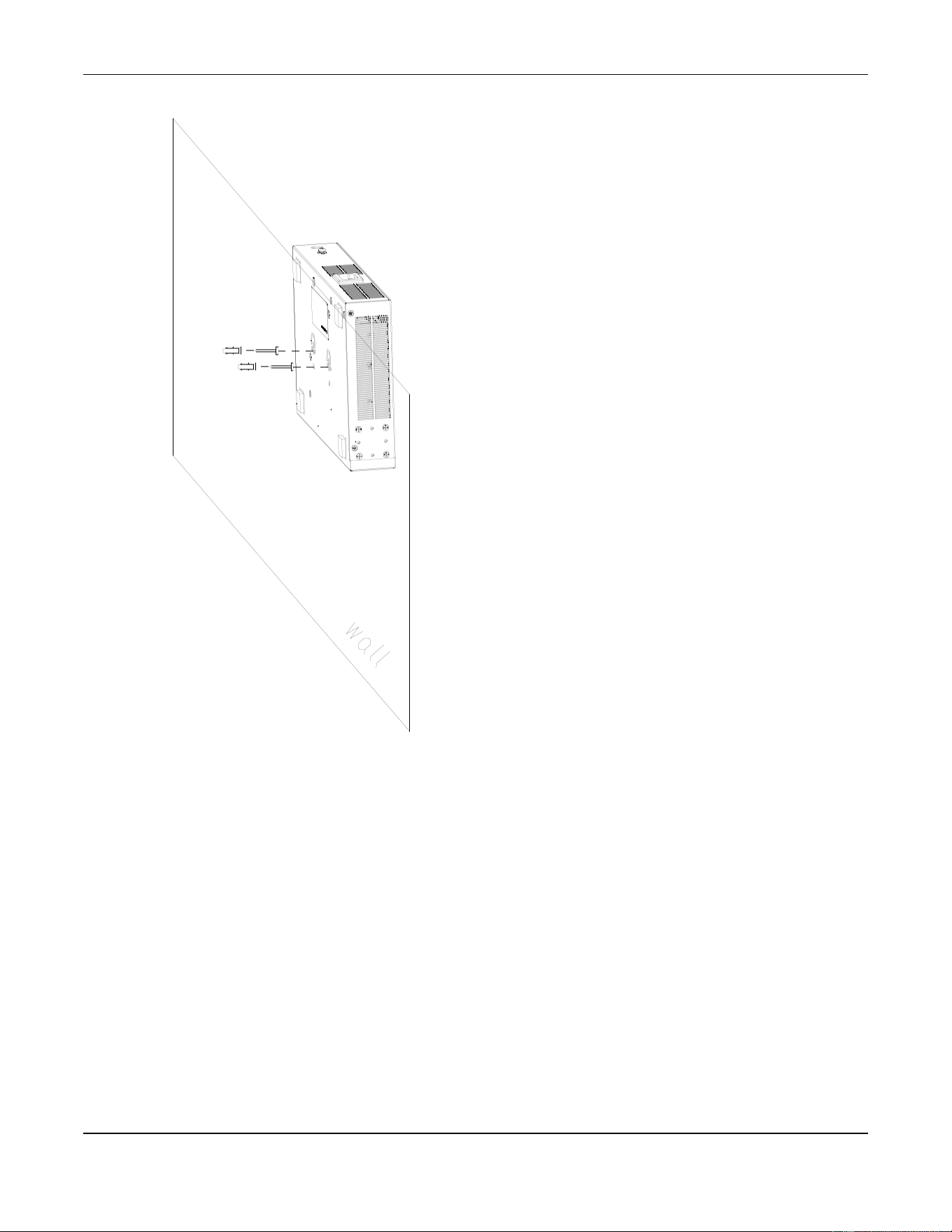
The Switch can be mounted on a wall (see Table 5 on page 12). You may need screw anchors if
mounting on a concrete or brick wall.
Do the following to mount your Switch on a wall.
See Table 6 on page 13 for how far apart to place the screws.
Table 6 Distance between the centers of the holes for wall mounting
MODEL DISTANCE
XMG-105HP 114 mm
XMG-108 188 mm
XMG-108HP 188 mm
Chapter 2 Hardware Installation and Connection
XMG-100 Series User’s Guide
14
2.4.1 Installation Requirements
• Distance above the floor: At least 1.8 m (5.9 feet)
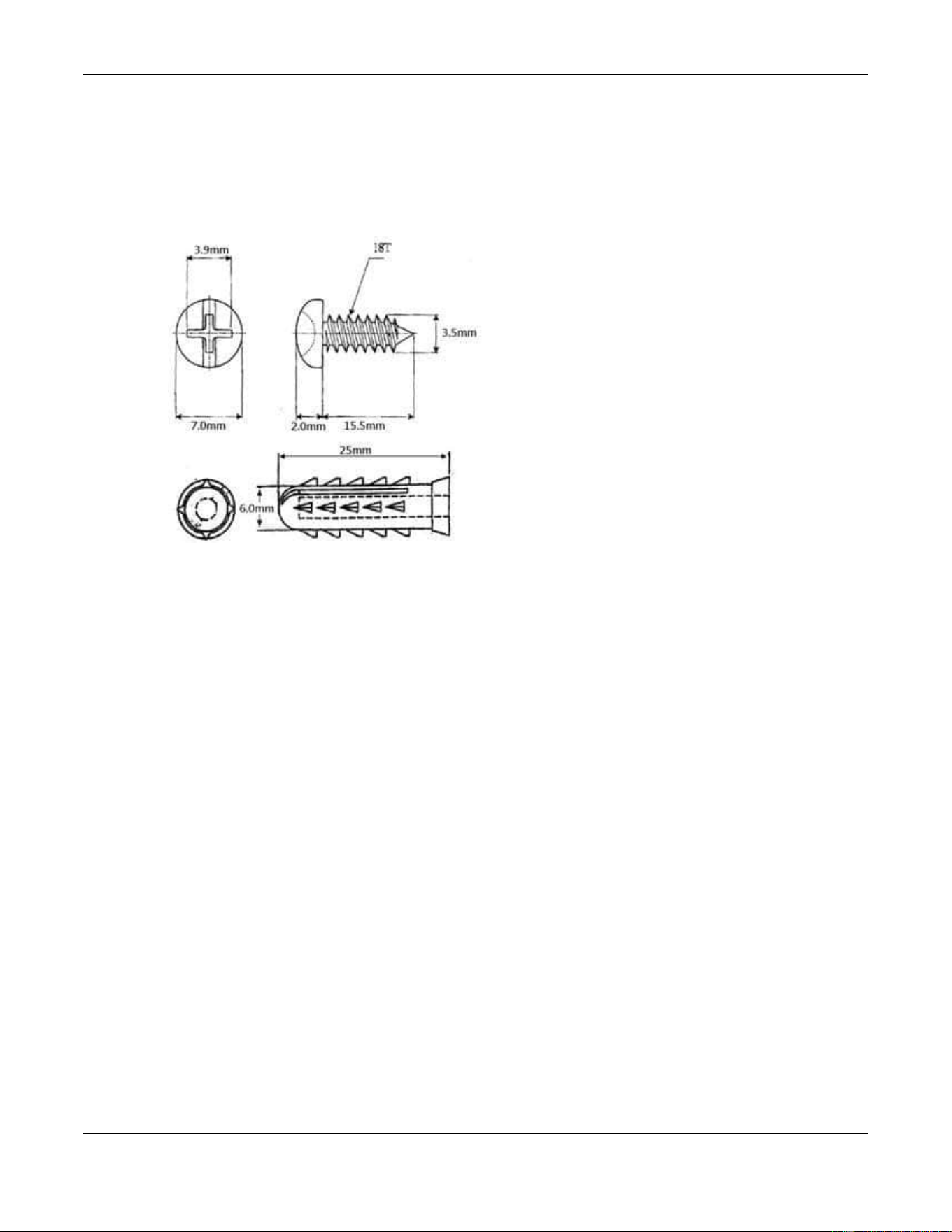
• Two M4 screws and a #2 Philips screwdriver
• Two screw anchors (optional)
Figure 6 Screw Specifications for Wall Mounting
1 Select a position free of obstructions on a wall strong enough to hold the weight of the Switch.
2 Mark two holes on the wall at the appropriate distance apart for the screws.
WARNING! Be careful to avoid damaging pipes or cables located inside
the wall when drilling holes for the screws.
3 If using screw anchors, drill two holes for the screw anchors into the wall. Push the anchors into the full
depth of the holes, then insert the screws into the anchors. Do NOT insert the screws all the way in –
leave a small gap of about 0.5 cm.
If not using screw anchors, use a screwdriver to insert the screws into the wall. Do NOT insert the screws
all the way in – leave a gap of about 0.5 cm.
4 Make sure the screws are fastened well enough to hold the weight of the Switch with the connection
cables.
5 Align the holes on the back of the Switch with the screws on the wall. Hang the Switch on the screws.
Note: Make sure there is enough clearance between the wall and the Switch to allow
ventilation.
Chapter 2 Hardware Installation and Connection
XMG-100 Series User’s Guide
15
WARNING! The Switch should be wall-mounted horizontally, and make sure
the front panel is facing down. The Switch's side panels with ventilation slots
should not be facing up or down as this position is less safe.
Chapter 3 Hardware Panels
XMG-100 Series User’s Guide
16
CHAPTER 3
Hardware Panels
This chapter describes the front panel and rear panel of the Switch and shows you how to make the
hardware connections.
3.1 Front Panel Connections
You can use either crossover or straight-through cables for all the ports.
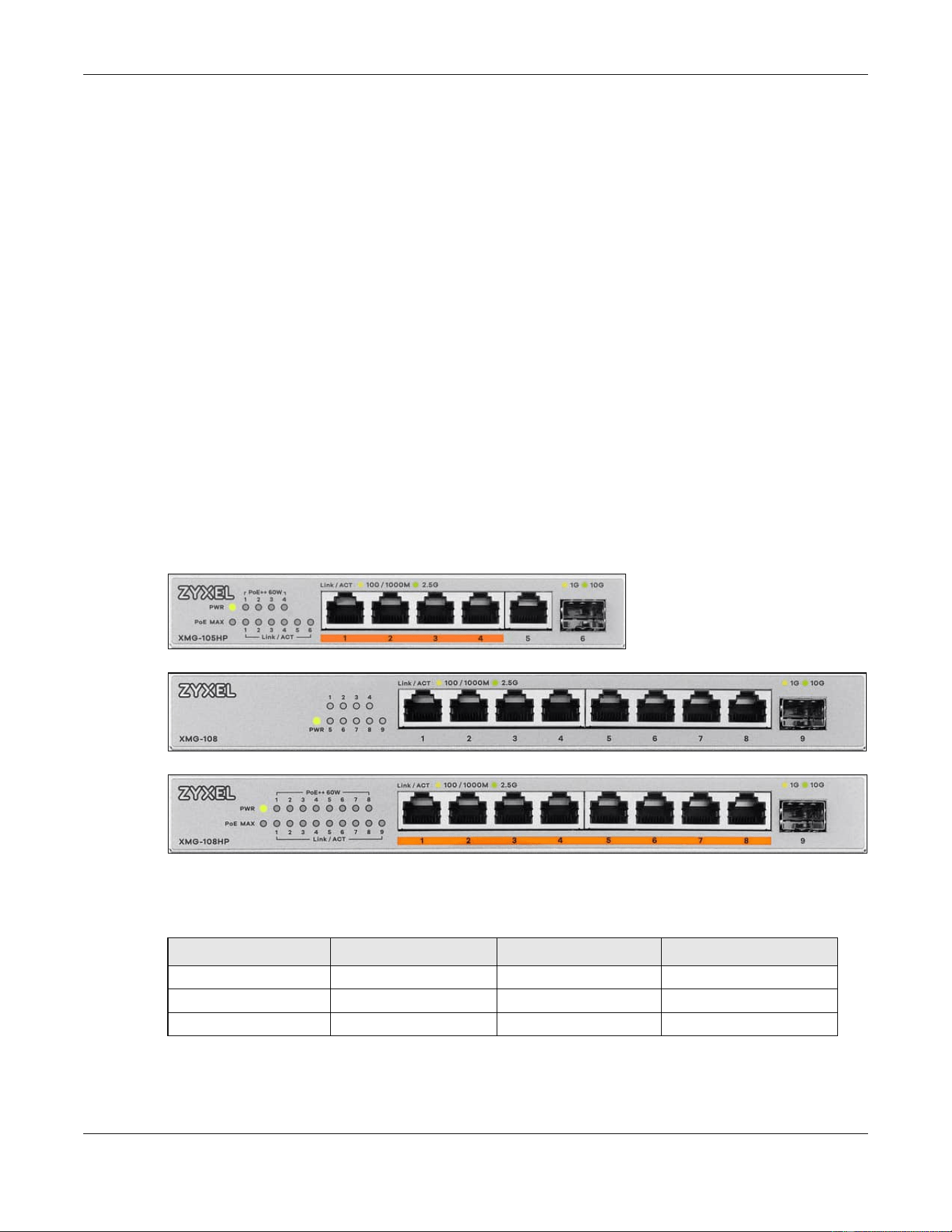
Refer to Section Table 1 on page 7 for more information on hardware differences between models.
The following figures show the front panels of the Switch.
Figure 7 XMG-105HP
Figure 8 XMG-108
Figure 9 XMG-108HP
You can use unshielded twisted pair (UTP) or shielded twisted-pair (STP) Ethernet cables for RJ-45 ports.
The following table describes the types of network cable used for the different connection speeds.
Table 7 Network Cable Types
TRANSMISSION SPEED NETWORK CABLE TYPE MAXIMUM DISTANCE BANDWIDTH CAPACITY
100 Mbps Category 5 UTP/STP 100 m 100 MHz
1 Gbps Category 5e, 6 UTP/STP 100 m 100 MHz
2.5 Gbps Category 5e, 6 UTP/STP 100 m 100 MHz

Chapter 3 Hardware Panels
XMG-100 Series User’s Guide
17
3.1.1 Multi-gigabit Ethernet Ports
The Switch has 2.5G Base-T auto-negotiating, auto-crossover Ethernet ports. In 100 Mbps / 1/2.5 Gbps
multi-gigabit, the speed can be 100 Mbps, 1 Gbps or 2.5 Gbps and full duplex mode.
The 100 Base-TX / 1G Base-T / 2.5G Base-T RJ-45 ports are auto-negotiating and auto-crossover.
An auto-negotiating port can detect and adjust to the optimum Ethernet speed (100 Mbps / 1 Gbps /
2.5 Gbps) and duplex mode (full duplex) of the connected device.
An auto-crossover (auto-MDI/MDI-X) port automatically works with a straight-through or crossover
Ethernet cable.
When auto-negotiation is turned on, an Ethernet port negotiates with the peer automatically to
determine the connection speed and duplex mode. If the peer Ethernet port does not support auto-
negotiation or turns off this feature, the Switch determines the connection speed by detecting the signal
on the cable. When the Switch’s auto-negotiation is turned off, an Ethernet port uses the pre-configured
speed and duplex mode when making a connection, then requiring you to make sure that the settings
of the peer Ethernet port are the same in order to connect.
3.1.1.1 Auto-crossover
All ports support auto-crossover, that is auto-MDIX ports (Media Dependent Interface Crossover), so you
may use either a straight-through Ethernet cable or crossover Ethernet cable for all multi-gigabit port
connections. Auto-crossover ports automatically sense whether they need to function as crossover or
straight ports, so crossover cables can connect both computers and switches or hubs.
3.1.2 SFP+ Slot
Refer to Section 1.1 on page 7 for more information on hardware differences between models.
This is a slot for SFP (Small Form-Factor Pluggable) module, such as an SFP transceiver. A transceiver is a
single unit that houses a transmitter and a receiver. Use a transceiver to connect a fiber optic cable to
the Switch. The Switch does not come with a transceiver. You must use a transceiver that complies with
the Small Form-factor Pluggable (SFP) Transceiver MultiSource Agreement (MSA). See the SFF
committee’s INF-8074i specification Rev 1.0 for details.
You can change transceiver while the Switch is operating. You can use a different transceiver to
connect to Ethernet switches with different types of fiber optic or even copper cable connectors.
• Type: SFP+ connection interface
• Connection speed: 1/10 Gbps
WARNING! To avoid possible eye injury, do not look into an operating
fiber optic module’s connectors.
HANDLING! A transceiver is static sensitive. To prevent damage from
electrostatic discharge (ESD), it is recommended you attach an ESD
preventive wrist strap to your wrist and to a bare metal surface when
you install or remove a transceiver.
STORAGE! All modules are dust sensitive. When not in use, always keep
the dust plug on. Avoid getting dust and other contaminant into the
Chapter 3 Hardware Panels
XMG-100 Series User’s Guide
18
optical bores, as the optics do not work correctly when obstructed with
dust.
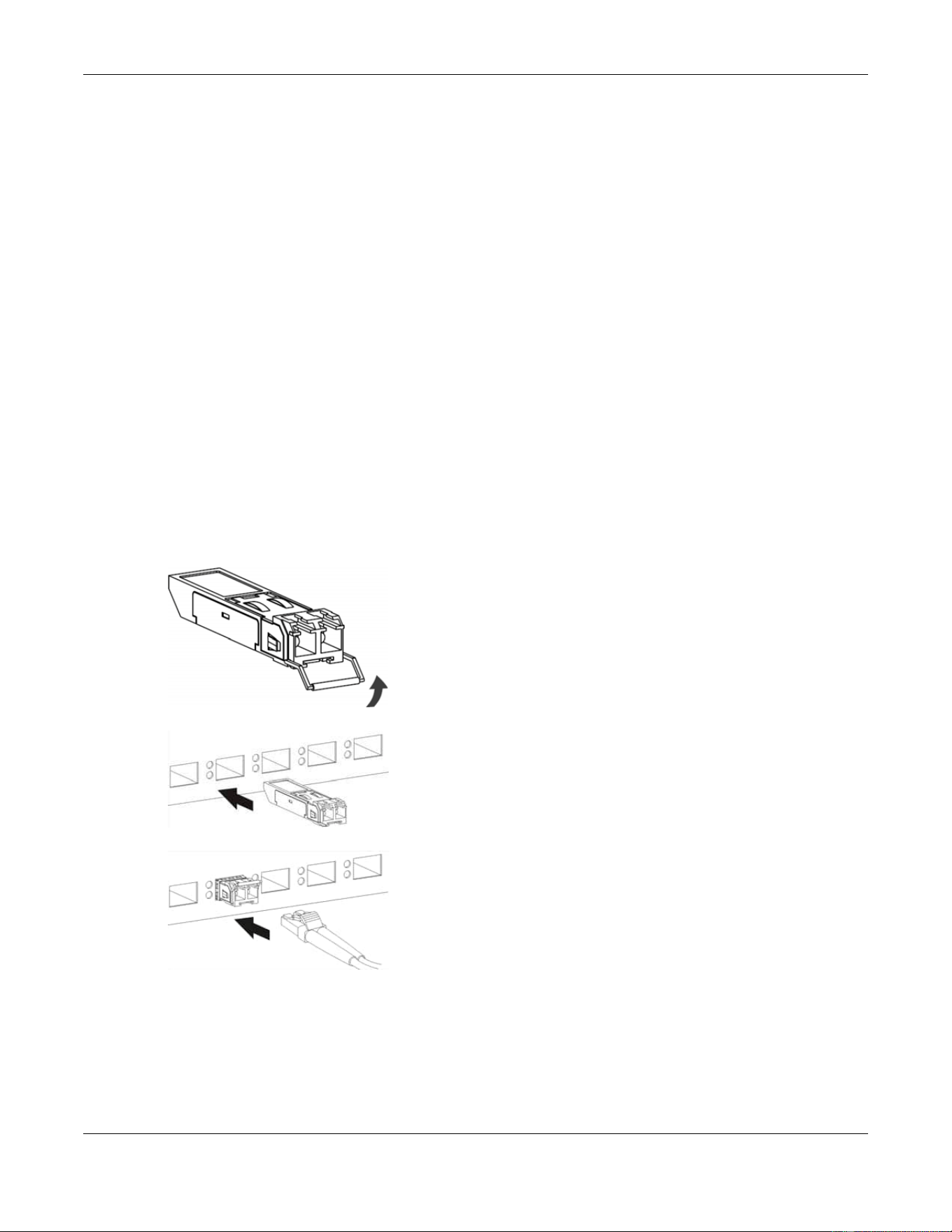
3.1.2.1 Transceiver Installation
Use the following steps to install a transceiver.
1 Attach an ESD preventive wrist strap to your wrist and to a bare metal surface.
2 Align the transceiver in front of the slot opening.
3 Make sure the latch is in the lock position (latch styles vary), then insert the transceiver into the slot with
the exposed section of PCB board facing down.
4 Press the transceiver firmly until it clicks into place.
5 The Switch automatically detects the installed transceiver. Check the LEDs to verify that it is functioning
properly.
6 Remove the dust plugs from the transceiver and cables (dust plug styles vary).
7 Identify the signal transmission direction of the fiber optic cables and the transceiver. Insert the fiber
optic cable into the transceiver.
Figure 10 Latch in the Lock Position
Figure 11 Transceiver Installation Example
Figure 12 Connecting the Fiber Cables
3.1.2.2 Transceiver Removal
Use the following steps to remove an SFP transceiver.
1 Attach an ESD preventive wrist strap to your wrist and to a bare metal surface on the chassis.
2 Remove the fiber optic cables from the transceiver.

XMG-100 Series User’s Guide
19
3 Pull out the latch and down to unlock the transceiver (latch styles vary).
Note: Make sure the transceiver’s latch is pushed all the way down, so the transceiver can be
pulled out successfully.
4 Pull the latch, or use your thumb and index finger to grasp the tabs on both sides of the transceiver, and
carefully slide it out of the slot.
Note: Do NOT pull the transceiver out by force. You could damage it. If the transceiver will not
slide out, grasp the tabs on both sides of the transceiver with a slight up or down motion
and carefully slide it out of the slot. If unsuccessful, contact Zyxel Support to prevent
damage to your Switch and transceiver.
5 Insert the dust plug into the ports on the transceiver and the cables.
Figure 13 Removing the Fiber Optic Cables
Figure 14 Opening the Transceiver’s Latch Example
Figure 15 Transceiver Removal Example
3.2 Rear Panel
The following figures show the rear panels of the Switch. The power receptacle is located on the rear
panel of the Switch. Refer to the power supply requirements on the panel.
Figure 16 XMG-105HP
Figure 17 XMG-108

Chapter 3 Hardware Panels
XMG-100 Series User’s Guide
20
Figure 18 XMG-108HP
3.2.1 Power Connection
Note: Make sure you are using the correct power source as shown on the panel.
Connect the supplied power adapter to the power receptacle on the rear panel. Then use the included
power cord to connect the power adapter to an appropriate power source.
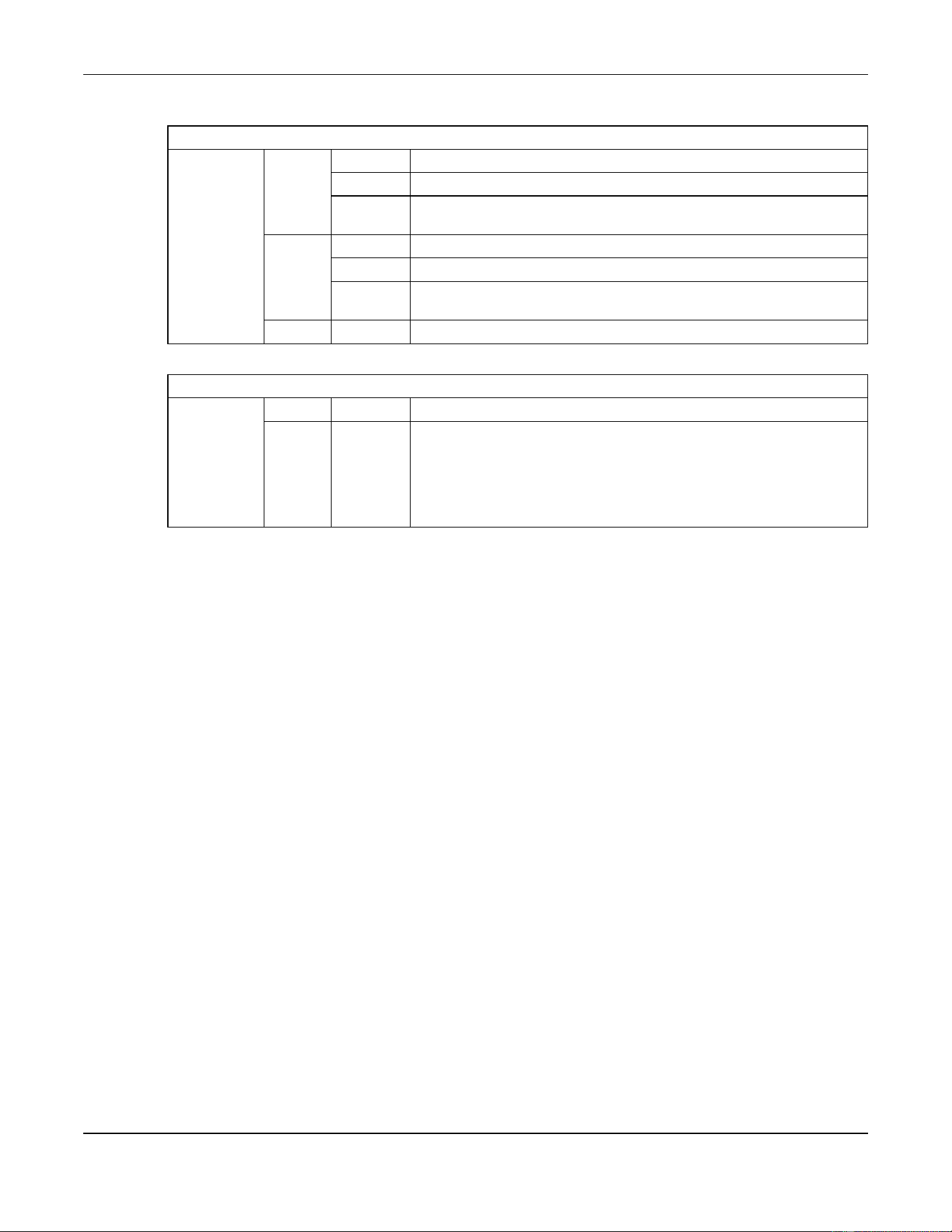
3.3 LEDs
The LED Indicators give real-time information about the status of the Switch. After you connect the
power to the Switch, view the LEDs to ensure proper functioning of the Switch and as an aid in
troubleshooting. The following table provides descriptions of the LEDs.
The following table describes the LEDs.
Table 8 LED Descriptions
LED COLOR STATUS DESCRIPTION
PWR Green On The Switch is receiving power from the power module in the power slot.
Blinking The Switch is rebooting.
Off The Switch is not receiving power from the power module in the power slot
or the Switch is malfunctioning.
PoE MAX Yellow On The Switch’s remaining power budget is equal to / less than 10 watt.
Off The Switch’s remaining power budget is above 10 watt.
LED COLOR STATUS DESCRIPTION
100M/1G/2.5G Base-T Ports
Link / ACT
1 – 5
(XMG-105HP)
1 – 8
(XMG-108 /
XMG-108HP)
Green On The link to a 2.5G Ethernet network is up.
Blinking The Switch is transmitting/receiving to/from a 2.5G Ethernet network.
Fast
Blinking
The Switch detects loop activity on the 2.5G Ethernet network.
Yellow On The link to a 100/1000 Mbps Ethernet network is up.
Blinking The Switch is transmitting/receiving to/from a 100/1000 Mbps Ethernet
network.
Fast
Blinking
The Switch detects loop activity on the 100/1000 Mbps Ethernet network.
Off The link to an Ethernet network is down, or the uplink port is shut down.
Chapter 3 Hardware Panels
XMG-100 Series User’s Guide
21
1G/10G SFP+ Slots
Link / ACT
6
(XMG-105HP)
9
(XMG-108 /
XMG-108HP)
Green On The port has a successful 10G connection.
Blinking The port is transmitting or receiving data at 10G.
Fast
Blinking
The Switch detects loop activity on the 10G connection.
Yellow On The port has a successful 1G connection.
Blinking The port is transmitting or receiving data at 1G.
Fast
Blinking
The Switch detects loop activity on the 1G connection.
Off This link is disconnected, or the uplink port is shut down.
PoE Ports
PoE++ 60W
1 – 4
(XMG-105HP)
1 – 8
(XMG-108HP)
Green On The Switch is providing PoE power.
Off There is no PoE power supplied.

XMG-100 Series User’s Guide
22
CHAPTER 4
Troubleshooting
This chapter offers some suggestions to solve problems you might encounter. The potential problems are
divided into the following categories.
• Power, Hardware Connections, and LEDs
• Improper Network Cabling and Topology
4.1 Power, Hardware Connections, and LEDs
The Switch does not turn on. None of the LEDs turn on.
1 Make sure you are using the power adapter or cord included with the Switch.
2 Make sure the power adapter or cord is connected to the Switch and plugged in to an appropriate
power source. Make sure the power source is turned on.
3 Disconnect and re-connect the power adapter or cord to the Switch.
4 If the problem continues, contact the vendor.
One of the LEDs does not behave as expected.
1 Make sure you understand the normal behavior of the LED. See Section 3.3 on page 20.
2 Check the hardware connections. See Section 3.1 on page 16.
3 Inspect your cables for damage. Contact the vendor to replace any damaged cables.
4 Disconnect and re-connect the power adapter or cord to the Switch.
5 If the problem continues, contact the vendor.
The Link / ACT LED does not light up when a device is connected.
• Verify that the attached device(s) is turned on and properly connected to your Switch.

Chapter 4 Troubleshooting
XMG-100 Series User’s Guide
23
• Make sure the network adapters are working on the attached devices.
• Verify that proper network cable type is used and its length does not exceed 100 meters. For more
information on network cable types, see Table 2 on page 9.
The PoE++ 60W LED is off and/or power is not being supplied to my PoE-enabled device.
• Make sure to connect a PoE-enabled device to your Switch.
• Check your Switch’s PoE MAX LED. If it lights steady yellow, then the Switch’s remaining power budget
is equal to / less than 10 watt.
• Check to see that the power adapter is securely connected to the Switch and an appropriate power
source. Make sure the power source is on and functioning properly.
• Check that the Ethernet cables are connected properly and that you are using the correct type of
Ethernet cable. Contact your local distributor if the problem persists.
4.2 Improper Network Cabling and Topology
Improper network cabling or topology setup is a common cause of poor network performance or even
network failure.
Figure 19 Troubleshooting Improper Network Cabling and Topology
PROBLEM CORRECTIVE ACTION
Faulty cables Using faulty network cables may affect data rates and have an impact on your network
performance. Replace with new standard network cables.
Non-standard
network cables
Non-standard cables may increase the number of network collisions and cause other network
problems that affect your network performance. Refer to Table 2 on page 9 for more
information on network cable types.
Cabling Length If you use longer cables than are needed, transmission quality may be affected.
The network cables should not be longer than the limit of 100 meters.
Too many hubs
between the
computers in the
network
Too many hubs (or repeaters) between the connected computers in the network may increase
the number of network collision or other network problems. Remove unnecessary hubs from the
network.
A loop in the
data path
A data path loop forms when there is more than one path or route between two networked
computers. This results in broadcast storms that will severely affect your network performance.
Make sure there are no loops in your network topology.

XMG-100 Series User’s Guide
24
APPENDIX A
Customer Support
In the event of problems that cannot be solved by using this manual, you should contact your vendor. If
you cannot contact your vendor, then contact a Zyxel office for the region in which you bought the
device.
For Zyxel Communications offices, see https://service-provider.zyxel.com/global/en/contact-us for the
latest information.
For Zyxel Networks offices, see https://www.zyxel.com/index.shtml for the latest information.
Please have the following information ready when you contact an office.
Required Information
• Product model and serial number.
• Warranty Information.
• Date that you received your device.
• Brief description of the problem and the steps you took to solve it.
Corporate Headquarters (Worldwide)
Taiwan
• Zyxel Communications (Taiwan) Co., Ltd.
• https://www.zyxel.com
Asia
China
• Zyxel Communications Corporation–China Office
• https://www.zyxel.com/cn/sc
India
• Zyxel Communications Corporation–India Office
• https://www.zyxel.com/in/en-in
Kazakhstan
•Zyxel Kazakhstan
• https://www.zyxel.com/ru/ru

Appendix A Customer Support
XMG-100 Series User’s Guide
25
Korea
• Zyxel Korea Co., Ltd.
• http://www.zyxel.kr/
Malaysia
• Zyxel Communications Corp.
• https://www.zyxel.com/global/en
Philippines
• Zyxel Communications Corp.
• https://www.zyxel.com/global/en
Singapore
• Zyxel Communications Corp.
• https://www.zyxel.com/global/en
Taiwan
• Zyxel Communications (Taiwan) Co., Ltd.
• https://www.zyxel.com/tw/zh
Thailand
• Zyxel Thailand Co., Ltd.
• https://www.zyxel.com/th/th
Vietnam
• Zyxel Communications Corporation–Vietnam Office
• https://www.zyxel.com/vn/vi
Europe
Belarus
• Zyxel Communications Corp.
• https://www.zyxel.com/ru/ru
Belgium (Netherlands)
• Zyxel Benelux
• https://www.zyxel.com/nl/nl
• https://www.zyxel.com/fr/fr
Bulgaria
• Zyxel Bulgaria

Appendix A Customer Support
XMG-100 Series User’s Guide
26
• https://www.zyxel.com/bg/bg
Czech Republic
• Zyxel Communications Czech s.r.o.
• https://www.zyxel.com/cz/cs
Denmark
• Zyxel Communications A/S
• https://www.zyxel.com/dk/da
Finland
• Zyxel Communications
• https://www.zyxel.com/fi/fi
France
•Zyxel France
• https://www.zyxel.com/fr/fr
Germany
•Zyxel Deutschland GmbH.
• https://www.zyxel.com/de/de
Hungary
• Zyxel Hungary & SEE
• https://www.zyxel.com/hu/hu
Italy
• Zyxel Communications Italy S.r.l.
• https://www.zyxel.com/it/it
Norway
• Zyxel Communications A/S
• https://www.zyxel.com/no/no
Poland
• Zyxel Communications Poland
• https://www.zyxel.com/pl/pl
Romania
• Zyxel Romania
• https://www.zyxel.com/ro/ro

Appendix A Customer Support
XMG-100 Series User’s Guide
27
Russian Federation
• Zyxel Communications Corp.
• https://www.zyxel.com/ru/ru
Slovakia
•Zyxel Slovakia
• https://www.zyxel.com/sk/sk
Spain
• Zyxel Iberia
• https://www.zyxel.com/es/es
Sweden
• Zyxel Communications A/S
• https://www.zyxel.com/se/sv
Switzerland
•Studerus AG
• https://www.zyxel.com/ch/de-ch
• https://www.zyxel.com/fr/fr
Turkey
• Zyxel Turkey A.S.
• https://www.zyxel.com/tr/tr
UK
• Zyxel Communications UK Ltd.
• https://www.zyxel.com/uk/en-gb
Ukraine
•Zyxel Ukraine
• https://www.zyxel.com/ua/uk-ua
South America
Argentina
• Zyxel Communications Corp.
• https://www.zyxel.com/co/es-co
Brazil
• Zyxel Communications Brasil Ltda.

Appendix A Customer Support
XMG-100 Series User’s Guide
28
• https://www.zyxel.com/br/pt
Colombia
• Zyxel Communications Corp.
• https://www.zyxel.com/co/es-co
Ecuador
• Zyxel Communications Corp.
• https://www.zyxel.com/co/es-co
South America
• Zyxel Communications Corp.
• https://www.zyxel.com/co/es-co
Middle East
Israel
• Zyxel Communications Corp.
• https://il.zyxel.com
North America
USA
• Zyxel Communications, Inc. – North America Headquarters
• https://www.zyxel.com/us/en-us

XMG-100 Series User’s Guide
29
APPENDIX B
Legal Information
Copyright
Copyright © 2023 Zyxel and/or its affiliates. All rights reserved.
The contents of this publication may not be reproduced in any part or as a whole, transcribed, stored in a retrieval system, translated into any
language, or transmitted in any form or by any means, electronic, mechanical, magnetic, optical, chemical, photocopying, manual, or
otherwise, without the prior written permission of Zyxel Communications Corporation.
Published by Zyxel and/or its affiliates. All rights reserved.
Disclaimer
Zyxel does not assume any liability arising out of the application or use of any products, or software described herein. Neither does it convey any
license under its patent rights nor the patent rights of others. Zyxel further reserves the right to make changes in any products described herein
without notice. This publication is subject to change without notice.
Regulatory Notice and Statement (Class B)
Model List: XMG-105HP, XMG-108, XMG-108HP
United States of America
The following information applies if you use the product within USA area.
US Importer: Zyxel Communications, Inc, 1130 North Miller Street Anaheim, CA92806-2001, https://www.zyxel.com/us/en/
Federal Communications Commission (FCC) EMC Statement
• This device complies with Part 15 of FCC rules. Operation is subject to the following two conditions:
(1) This device may not cause harmful interference.
(2) This device must accept any interference received, including interference that may cause undesired operations.
• Changes or modifications not expressly approved by the party responsible for compliance could void the user’s authority to operate the
equipment.
• This product has been tested and complies with the specifications for a Class B digital device, pursuant to Part 15 of the FCC Rules. These
limits are designed to provide reasonable protection against harmful interference in a residential installation. This equipment generates, uses,
and can radiate radio frequency energy and, if not installed and used according to the instructions, may cause harmful interference to
radio communications. However, there is no guarantee that interference will not occur in a particular installation.
• If this equipment does cause harmful interference to radio or television reception, which is found by turning the equipment off and on, the
user is encouraged to try to correct the interference by one or more of the following measures:
• Reorient or relocate the receiving antenna
• Increase the separation between the equipment or devices
• Connect the equipment to an outlet other than the receiver’s
• Consult a dealer or an experienced radio/TV technician for assistance.
Canada
The following information applies if you use the product within Canada area.
Innovation, Science and Economic Development Canada ICES statement
CAN ICES-3 (B)/NMB-3(B)
European Union and United Kingdom

Appendix B Legal Information
XMG-100 Series User’s Guide
30
The following information applies if you use the product within the European Union and United Kingdom.
List of National Codes
Safety Warnings
• To avoid possible eye injury, do NOT look into an operating fiber-optic module’s connector.
• Do NOT use this product near water, for example, in a wet basement or near a swimming pool.
• Do NOT expose your device to dampness, dust or corrosive liquids.
• Do NOT store things on the device.
• Do NOT obstruct the device ventilation slots as insufficient airflow may harm your device. For example, do not place the device in an
enclosed space such as a box or on a very soft surface such as a bed or sofa.
• Do NOT install or service this device during a thunderstorm. There is a remote risk of electric shock from lightning.
• Connect ONLY suitable accessories to the device.
• Do NOT open the device or unit. Opening or removing covers can expose you to dangerous high voltage points or other risks. Only qualified
service personnel should service or disassemble this device. Please contact your vendor for further information.
• Make sure to connect the cables to the correct ports.
• Place connecting cables carefully so that no one will step on them or stumble over them.
• Always disconnect all cables from this device before servicing or disassembling.
• Do NOT remove the plug and connect it to a power outlet by itself; always attach the plug to the power adaptor first before connecting it to
a power outlet.
• Do NOT allow anything to rest on the power adaptor or cord and do NOT place the product where anyone can walk on the power adaptor
or cord.
• Please use the provided or designated connection cables/power cables/adaptors. Connect it to the right supply voltage (for example, 120V
AC in North America or 230V AC in Europe). If the power adaptor or cord is damaged, it might cause electrocution. Remove it from the
device and the power source, repairing the power adapter or cord is prohibited. Contact your local vendor to order a new one.
• Do NOT use the device outside, and make sure all the connections are indoors. There is a remote risk of electric shock from lightning.
• CAUTION: RISK OF EXPLOSION IF BATTERY IS REPLACED BY AN INCORRECT TYPE, DISPOSE OF USED BATTERIES ACCORDING TO THE INSTRUCTION.
Dispose them at the applicable collection point for the recycling of electrical and electronic device. For detailed information about
recycling of this product, please contact your local city office, your household waste disposal service or the store where you purchased the
product.
• Use ONLY power wires of the appropriate wire gauge for your device. Connect it to a power supply of the correct voltage.
• Fuse Warning! Replace a fuse only with a fuse of the same type and rating.
• The PoE (Power over Ethernet) devices that supply or receive power and their connected Ethernet cables must all be completely indoors.
• The following warning statements apply, where the disconnect device is not incorporated in the device or where the plug on the power
supply cord is intended to serve as the disconnect device,
– For PERMANENTLY CONNECTED DEVICES, a readily accessible disconnect device shall be incorporated external to the device;
– For PLUGGABLE DEVICES, the socket-outlet shall be installed near the device and shall be easily accessible.
• If your device has an earthing screw (frame ground), connect the screw to a ground terminal using an appropriate AWG ground wire. Do this
before you make other connections.
• If your device has no earthing screw, but has a 3-prong power plug, make sure to connect the plug to a 3-hole earthed socket.
• When connecting or disconnecting power to hot-pluggable power supplies, if offered with your system, observe the following guidelines:
– Install the power supply before connecting the power cable to the power supply.
– Unplug the power cable before removing the power supply.
– If the system has multiple sources of power, disconnect power from the system by unplugging all power cables from the power supply.
• Do not put the device in a place that is humid, dusty or has extreme temperatures as these conditions may harm your device.
• Please refer to the device back label, datasheet, box specifications or catalog information for the power rating of the device and operating
temperature.
• CLASS 1 LASER PRODUCT (for products with mini-GBIC slots or laser products, such as fiber-optic transceiver and GPON products).
COUNTRY ISO 3166 2 LETTER CODE COUNTRY ISO 3166 2 LETTER CODE
Austria AT Liechtenstein LI
Belgium BE Lithuania LT
Bulgaria BG Luxembourg LU
Croatia HR Malta MT
Cyprus CY Netherlands NL
Czech Republic CR Norway NO
Denmark DK Poland PL
Estonia EE Portugal PT
Finland FI Romania RO
France FR Serbia RS
Germany DE Slovakia SK
Greece GR Slovenia SI
Hungary HU Spain ES
Iceland IS Sweden SE
Ireland IE Switzerland CH
Italy IT Turkey TR
Latvia LV United Kingdom GB

Appendix B Legal Information
XMG-100 Series User’s Guide
31
• PRODUCT COMPLIES WITH 21 CFR 1040.10 AND 1040.11. (for products with mini-GBIC slots or laser products, such as fiber-optic transceiver and
GPON products)
• APPAREIL À LASER DE CLASS 1 (for products with mini-GBIC slots or laser products, such as fiber-optic transceiver and GPON products).
• PRODUIT CONFORME SELON 21 CFR 1040.10 ET 1040.11. (for products with mini-GBIC slots or laser products, such as fiber-optic transceiver and
GPON products)
Important Safety Instructions
1 Warning! Energy Hazard. Remove all metal jewelry, watches, and so on from your hands and wrists
before serving this device.
2 Caution! The RJ-45 jacks are not used for telephone line connection.
3 Hazardous Moving Parts. Keep body parts away from fan blades.
4 Hot Surface. Do not touch.
1 Avertissement: Risque de choc électrique. Retirer tout bijoux en métal et votre montre de vos mains et
poignets avant de manipuler cet appareil.
2 Attention: Les câbles RJ-45 ne doivent pas être utilisés pour les connections téléphoniques.
3 Mobilité des pièces détachées. S'assurer que les pièces détachées ne sont pas en contact avec
les pales du ventilateur.
4 Surface brûlante. Ne pas toucher.
Environment Statement
ErP (Energy-related Products)
All Zyxel products put on the EU and United Kingdom markets are in compliance with the requirement of the European Parliament and the
Council published Directive 2009/125/EC and UK regulation establishing a framework for the setting of ecodesign requirements for energy-
related products (recast), so called as “ErP Directive (Energy-related Products directive) as well as ecodesign requirement laid down in
applicable implementing measures, power consumption has satisfied regulation requirements which are:
• Network standby power consumption < 8W and/or
• Off mode power consumption < 0.5W and/or
• Standby mode power consumption < 0.5W.
Disposal and Recycling Information
The symbol below means that according to local regulations your product and/or its battery shall be disposed of separately from domestic
waste. If this product is end of life, take it to a recycling station designated by local authorities. At the time of disposal, the separate collection of
your product and/or its battery will help save natural resources and ensure that the environment is sustainable development.
Die folgende Symbol bedeutet, dass Ihr Produkt und/oder seine Batterie gemäß den örtlichen Bestimmungen getrennt vom Hausmüll entsorgt
werden muss. Wenden Sie sich an eine Recyclingstation, wenn dieses Produkt das Ende seiner Lebensdauer erreicht hat. Zum Zeitpunkt der
Entsorgung wird die getrennte Sammlung von Produkt und/oder seiner Batterie dazu beitragen, natürliche Ressourcen zu sparen und die Umwelt
und die menschliche Gesundheit zu schützen.
El símbolo de abajo indica que según las regulaciones locales, su producto y/o su batería deberán depositarse como basura separada de la
doméstica. Cuando este producto alcance el final de su vida útil, llévelo a un punto limpio. Cuando llegue el momento de desechar el
producto, la recogida por separado éste y/o su batería ayudará a salvar los recursos naturales y a proteger la salud humana y
medioambiental.
Le symbole ci-dessous signifie que selon les réglementations locales votre produit et/ou sa batterie doivent être éliminés séparément des ordures
ménagères. Lorsque ce produit atteint sa fin de vie, amenez-le à un centre de recyclage. Au moment de la mise au rebut, la collecte séparée
de votre produit et/ou de sa batterie aidera à économiser les ressources naturelles et protéger l'environnement et la santé humaine.
Il simbolo sotto significa che secondo i regolamenti locali il vostro prodotto e/o batteria deve essere smaltito separatamente dai rifiuti domestici.
Quando questo prodotto raggiunge la fine della vita di servizio portarlo a una stazione di riciclaggio. Al momento dello smaltimento, la raccolta
separata del vostro prodotto e/o della sua batteria aiuta a risparmiare risorse naturali e a proteggere l'ambiente e la salute umana.
Symbolen innebär att enligt lokal lagstiftning ska produkten och/eller dess batteri kastas separat från hushållsavfallet. När den här produkten når
slutet av sin livslängd ska du ta den till en återvinningsstation. Vid tiden för kasseringen bidrar du till en bättre miljö och mänsklig hälsa genom att
göra dig av med den på ett återvinningsställe.

Appendix B Legal Information
XMG-100 Series User’s Guide
32
台灣
安全警告 – 為了您的安全,請先閱讀以下警告及指示 :
• 請勿將此產品接近水、火焰或放置在高溫的環境。
• 避免設備接觸
– 任何液體 - 切勿讓設備接觸水、雨水、高濕度、污水腐蝕性的液體或其他水份。
– 灰塵及污物 - 切勿接觸灰塵、污物、沙土、食物或其他不合適的材料。
• 雷雨天氣時,不要安裝或維修此設備。有遭受電擊的風險。
• 切勿重摔或撞擊設備,並勿使用不正確的電源變壓器。
• 若接上不正確的電源變壓器會有爆炸的風險。
• 請勿隨意更換產品內的電池。
• 如果更換不正確之電池型式,會有爆炸的風險,請依製造商說明書處理使用過之電池。
• 請將廢電池丟棄在適當的電器或電子設備回收處。
• 請勿將設備解體。
• 請勿阻礙設備的散熱孔,空氣對流不足將會造成設備損害。
• 請使用隨貨提供或指定的連接線 / 電源線 / 電源變壓器,將其連接到合適的供應電壓 ( 如 : 台灣供應電壓 110 伏特 ) 。
• 假若電源變壓器或電源變壓器的纜線損壞,請從插座拔除,若您還繼續插電使用,會有觸電死亡的風險。
• 請勿試圖修理電源變壓器或電源變壓器的纜線,若有毀損,請直接聯絡您購買的店家,購買⼀個新的電源變壓器。
• 請勿將此設備安裝於室外,此設備僅適合放置於室內。
• 請勿隨⼀般垃圾丟棄。
• 請參閱產品背貼上的設備額定功率。
• 請參考產品型錄或是彩盒上的作業溫度。
• 設備必須接地,接地導線不允許被破壞或沒有適當安裝接地導線,如果不確定接地方式是否符合要求可聯繫相應的電氣檢驗機構檢驗。
• 如果您提供的系統中有提供熱插拔電源,連接或斷開電源請遵循以下指導原則 :
– 先連接電源線至設備連,再連接電源。
– 先斷開電源再拔除連接至設備的電源線。
– 如果系統有多個電源,需拔除所有連接至電源的電源線再關閉設備電源。
• 產品沒有斷電裝置或者採用電源線的插頭視為斷電裝置的⼀部分,以下警語將適用 :
– 對永久連接之設備, 在設備外部須安裝可觸及之斷電裝置;
– 對插接式之設備, 插座必須接近安裝之地點而且是易於觸及的。
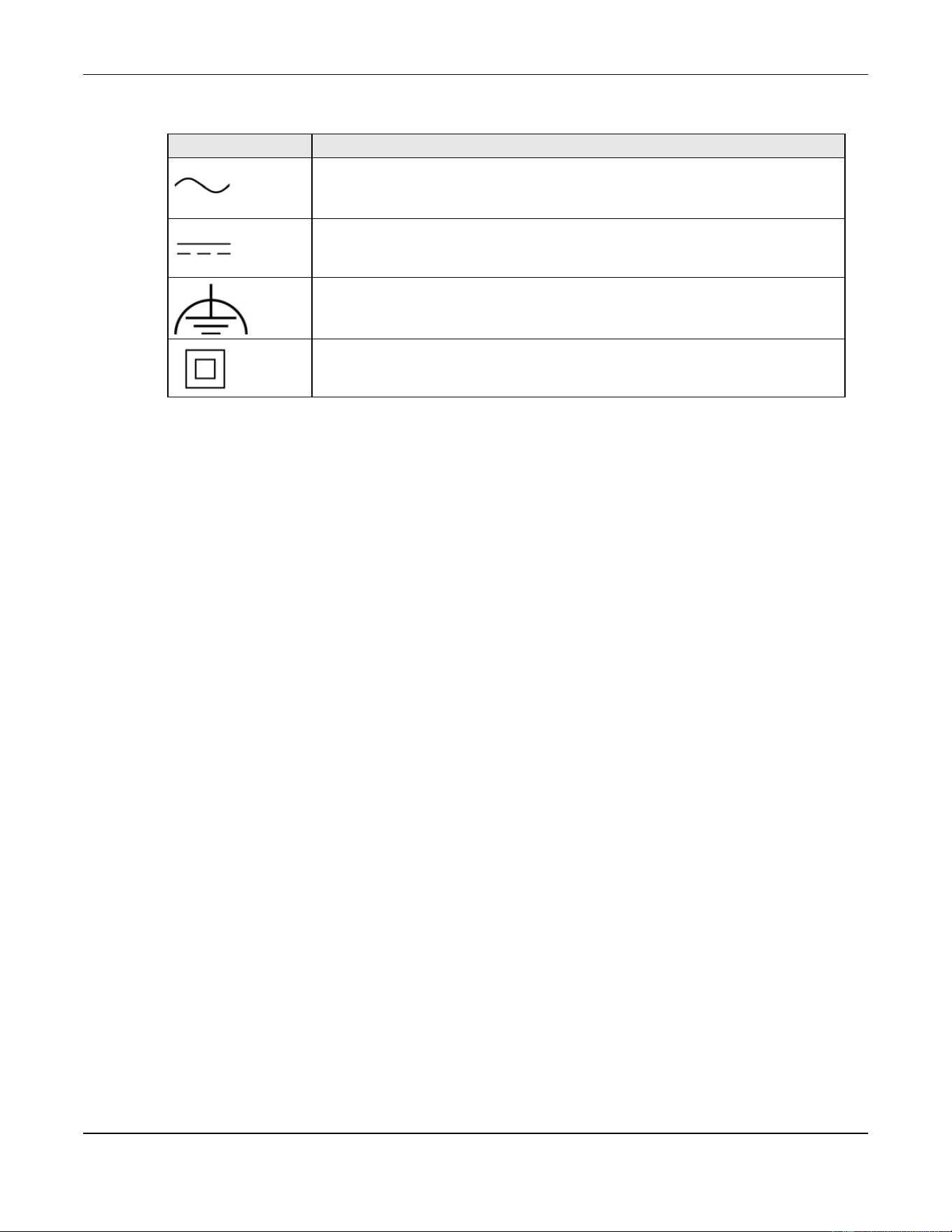
About the Symbols
Various symbols are used in this product to ensure correct usage, to prevent danger to the user and others, and to prevent property damage.
The meaning of these symbols are described below. It is important that you read these descriptions thoroughly and fully understand the
contents.
Appendix B Legal Information
XMG-100 Series User’s Guide
33
Explanation of the Symbols
Viewing Certifications
Go to http://www.zyxel.com to view this product’s documentation and certifications.
Zyxel Limited Warranty
Zyxel warrants to the original end user (purchaser) that this product is free from any defects in material or workmanship for a specific period (the
Warranty Period) from the date of purchase. The Warranty Period varies by region. Check with your vendor and/or the authorized Zyxel local
distributor for details about the Warranty Period of this product. During the warranty period, and upon proof of purchase, should the product
have indications of failure due to faulty workmanship and/or materials, Zyxel will, at its discretion, repair or replace the defective products or
components without charge for either parts or labor, and to whatever extent it shall deem necessary to restore the product or components to
proper operating condition. Any replacement will consist of a new or re-manufactured functionally equivalent product of equal or higher value,
and will be solely at the discretion of Zyxel. This warranty shall not apply if the product has been modified, misused, tampered with, damaged by
an act of God, or subjected to abnormal working conditions.
Note
Repair or replacement, as provided under this warranty, is the exclusive remedy of the purchaser. This warranty is in lieu of all other warranties,
express or implied, including any implied warranty of merchantability or fitness for a particular use or purpose. Zyxel shall in no event be held
liable for indirect or consequential damages of any kind to the purchaser.
To obtain the services of this warranty, contact your vendor. You may also refer to the warranty policy for the region in which you bought the
device at https://www.zyxel.com/global/en/support/warranty-information.
Registration
Register your product online at www.zyxel.com to receive email notices of firmware upgrades and related information.
Trademarks
The trademarks mentioned in this publication are used for identification purposes only and may be properties of their respective owners.
SYMBOL EXPLANATION
Alternating current (AC):
AC is an electric current in which the flow of electric charge periodically reverses direction.
Direct current (DC):
DC if the unidirectional flow or movement of electric charge carriers.
Earth; ground:
A wiring terminal intended for connection of a Protective Earthing Conductor.
Class II equipment:
The method of protection against electric shock in the case of class II equipment is either double insulation
or reinforced insulation.

Index
XMG-100 Series User’s Guide
34
Index
Numbers
1/2.5/10 Gbps 7
100 Mbps 7
A
address learning 8
air circulation
for cooling 12
applications
backbone 10
bridging 10
fiber uplink 10
PoE 10
authorized technician
install the Switch 12
auto-MDIX port 17
auto-negotiating 8
auto-sensing crossover 8
B
bandwidth capacity 9
C
cable
PoE 9
supported 9
cable type
Ethernet 9
Cabling Length 23
Category 5 9
Category 5e 9
certifications
viewing 33
Class of Service (CoS) 7
clearance
Switch installation 12
contact information 24
copyright 29
CoS 8
CoS (Class of Service) 7
crossover Ethernet cable 17
customer support 24
D
Data path loop 23
disclaimer 29
distance
maximum 9
distance between holes
wall mount 13
distance limitation 8
dual personality interface 19
duplex mode 8
dust plug 18
E
electrostatic discharge (ESD) 17
Environment Statement 29, 31
Ethernet port 7
auto-crossover 17
auto-negotiating 17
F
Faulty cables 23
FCC interference statement 29

Index
XMG-100 Series User’s Guide
35
feature comparison 7, 9
features
Switch 8
fiber cable
connecting 18
removal 19
forwarding rate
wire speed 8
freestanding installation
precautions 13
front panel 16
H
hardware installation 12
hardware overview 16
I
IEEE 802.1p CoS
built-in 7
IEEE 802.3ab standard 8
IEEE 802.3ae standard 8
IEEE 802.3af 9
IEEE 802.3at 9
IEEE 802.3bt 7, 9
IEEE 802.3bz standard 8
IEEE 802.3u standard 8
IEEE 802.3x standard 8
IEEE 802.3z standard 8
IEEE standard 9
Innovation, Science and Economic Development
Canada ICES statement 29
installation
air circulation 12
desktop 13
transceiver 18
wall mounting 13
installation requirements
rack-mounting 14
installation scenarios 12
L
LED
description 20
Link / ACT 20
PoE MAX 20
PoE++ 60W 21
PWR 20
Link / ACT
LED 20
loop detection
built-in 7
M
MAC address entry 8
MAC address table 8
management method 10
MDIX (Media Dependent Interface Crossover) 17
Mounting Methods 12
multi-gigabit Ethernet 8
multi-gigabit port 17
N
network applications 9
network cable
crossover 16
straight-through 16
Network Cable Types 16
Non-standard network cables 23
N-Way protocol
for speed 8
O
overheating
prevention 12

Index
XMG-100 Series User’s Guide
36
P
PD (Powered Device) 9
PoE 10, 23, 30
PoE MAX
LED 20
PoE port 7
PoE standard 9
support 8
PoE standards table 9
PoE type 9
PoE++ 9
PoE++ 60W
LED 21
port
voltage range 9
power
port 9
power adapter 7, 12
power budget
PoE 9
power connections 20
power connector 20
power management mode 9
power per port
maximum 9
Power Sourcing Equipment (PSE) 9
Powered Device (PD) 7, 9
product registration 33
PSE (Power Sourcing Equipment) 9
PWR
LED 20
R
rear panel 19
registration
product 33
Regulatory Notice and Statement 29
rubber feet
attach 13
S
safety precautions
using the Switch 13
safety warnings 30
screw anchors
using 14
SFP/SFP+ slot 17
SFP+ slot 7
SFP+ transceiver 7
Small Form-factor Pluggable (SFP) 17
speed
transmission 9
store-and-forward switching 8
straight-through Ethernet cable 17
Switch
fanless-type usage precaution 12
fan-type usage precaution 12
Switch models 7
T
trademarks 33
transceiver
connection speed 17
installation 18
removal 18
transceiver MultiSource Agreement (MSA) 17
transceivers 17
transmission speed 9
Troubleshooting
Improper Network Cabling and Topology 23
twisted pairs
used 9
U
uplink connection 7
super-fast 11