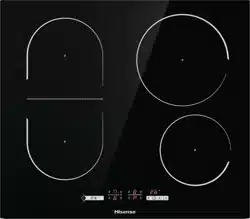
Induction hob
HI6442BSCE

Warning notices: Before using this product, please read this manual carefully
and keep it for future reference. The design and specifications are subject
to change without prior notice for product improvement.
Consult with your dealer or manufacturer for details.
The diagram above is just for reference. Please take the appearance of the
actual product as the standard.
We thank you for your trust and the purchase of our appliance.
This detailed instruction manual is supplied to make the use of this product
easier. The instructions should allow you to learn about your new appliance as
quickly as possible.
Make sure you have received an undamaged appliance. If you do find
transport damage, please contact the seller from which you purchased the
appliance, or the regional warehouse from which it was supplied. The
telephone number can be found on the invoice or on the delivery note.
Instructions for use are also available at our website:
www.gorenje.com / < http://www.gorenje.com />
.
INFORMATION!
Information, advice, tip, or recommendation
WARNING!
Warning – general danger
2

CONTENTS
1. SAFETY INSTRUCTIONS ............................................................. 4
2. SAFETY WARNINGS .................................................................. 5
2.1.
Installation ......................................................................... 5
2.2.
Operation and maintenance .................................................... 6
3. PRODUCT OVERVIEW .............................................................. 10
3.1.
Top View ......................................................................... 10
3.2.
Control panel .................................................................... 10
4. OPERATION INSTRUCTIONS ..................................................... 11
4.1.
Touch Controls.................................................................. 11
4.2.
Choosing ......................................................................... 11
4.3.
Pan Dimension.................................................................. 13
4.4.
How to Use ...................................................................... 13
5. QUICK START GUIDE ............................................................... 20
6. PRODUCT INSTALLATION ......................................................... 22
7. CLEANING AND MAINTENANCE ................................................. 29
8. TROUBLESHOOTING ............................................................... 30
9. DISPOSAL AND RECYCLING ..................................................... 33
3
1. SAFETY INSTRUCTIONS
The following safety instructions are intended to prevent unforeseen hazards or
damage caused by unsafe or incorrect operation of the appliance. Please check
the packaging and the appliance on arrival to ensure that everything is intact to
ensure safe operation. If you find any damage, please contact the dealer or seller.
Please note that modifications or changes to the appliance are not permitted for
safety reasons. Improper use can lead to hazards and the loss of warranty claims
.
Explanation of Symbols
Danger
This symbol indicates that there are dangers to the life and health of persons
due to extremely flammable gas.
Warning of electrical voltage
This symbol indicates that there is a danger to life and health of persons due to
voltage.
Warning
The signal word indicates a hazard with a medium level of risk which, if not
avoided, may result in death or serious injury.
Caution
The signal word indicates a hazard with a low degree of risk which, if not avoided,
may result in minor or moderate injury.
Attention
The signal word indicates important information (e.g. damage to
property), but not
danger.
Observe instructions
This symbol indicates that a service technician should only operate and maintain
this appliance in accordance with the operating instructions.
Read these operating instructions carefully and attentively before using/starting up
the appliance and keep them in the immediate vicinity of the installation site or the
appliance for later use!
Intended use
4

2. SAFETY WARNINGS
Your safety is important to us. Please read this information before using your
cooktop.
2.1. Installation
Electrical Shock Hazard
•
Disconnect the appliance from the mains before carrying out any work or
maintenance on it.
•
Connection to a properly earthed mains supply is essential and mandatory.
•
Changes to the domestic installation may only be carried out by a qualified
electrician.
•
Failure to observe this instruction may result in electric shock or death.
Cut Hazard
•
Take care - panel edges are sharp.
•
Failure to use caution could result in injury or cuts.
Important Safety Instructions
•
Read these instructions carefully before installing or using the appliance.
•
Do not place flammable materials or products on the appliance at any time.
•
Please pass this information on to the person responsible for installing the
appliance, as this could reduce your installation costs.
•
To avoid a hazard, this appliance must be installed in accordance with these
installation instructions.
•
This appliance must only be properly installed and earthed by a suitably
qualified person.
•
This appliance must be connected to a circuit that has a disconnect switch to
ensure complete isolation from the mains supply.
•
Failure to install the appliance correctly may invalidate any warranty or
liability claims.
•
This appliance can be used by children aged from 8 years and above and
persons with reduced physical, sensory or mental capabilities or lack of
experience and knowledge if they have been given supervision or instruction
concerning use of the appliance in a safe way and understand the hazards
involved.
•
Children shall not play with the appliance. Cleaning and maintenance by the
user must not be carried out by children without supervision.
•
If the power cord is damaged, it must be replaced by the manufacturer, its
service agent or a similarly qualified person in order to avoid a hazard.
5

•
WARNING! If the surface is cracked, switch off the appliance to avoid the
possibility of electric shock on hob surfaces made of glass ceramic or similar
material that protect live parts
•
Metal objects such as knives, forks, spoons and lids should not be placed on
the cooktop as they can become hot
•
A steam cleaner must not be used.
•
Do not use a steam cleaner to clean your cooktop.
•
The appliance must not be operated with an external timer or a separate
remote control system.
•
WARNING! Fire hazard: do not place any objects on the cooking surfaces.
•
The cooking process must be supervised. A short-term cooking process must
be constantly monitored.
•
WARNING! Unattended cooking on a hob with fat or oil can be dangerous
and lead to a fire. NEVER attempt to extinguish a fire with water, but switch
off the appliance and cover the flame with a lid or fire blanket, for example.
2.2. Operation and maintenance
Electrical Shock Hazard
•
Do not cook on a broken or cracked cooking surface. If the cooktop is broken
or cracked, turn off the appliance immediately at the power switch and
contact a qualified technician.
•
Switch the cooktop off at the wall switch before cleaning or maintenance.
•
Failure to follow this instruction may result in electric shock or death.
Health Hazard
•
This appliance complies with electromagnetic safety standards.
•
However, persons with pacemakers or other electrical implants (e.g. insulin
pumps) must consult their doctor or the manufacturer of the implant before
using this appliance to ensure that their implants are not affected by the
electromagnetic field.
•
Failure to comply with this instruction may result in death.
Hot Surface Hazard
•
During use, accessible parts of this appliance may become so hot that they
can cause burns.
•
Do not allow your body, clothing or anything other than suitable cookware to
come into contact with the induction glass until the surface has cooled down.
•
Keep children away.
•
The handles of pots can be hot to the touch. Make sure that the handles of
the pots do not protrude over other cooking zones that are switched on. Keep
the handles out of the reach of children.
6

•
Failure to observe this instruction can lead to burns and scalds.
Cut Hazard
•
The razor-sharp blade of a cooktop scraper is exposed when the safety cover
is retracted. Use with extreme care and always store safely and out of reach of
children.
•
Failure to use caution could result in injury or cuts.
Important safety instructions
•
Never leave the appliance unattended when in use. Boil-over causes smoking
and greasy spillovers that may ignite.
•
Never use your appliance as a work or storage surface.
•
Never leave any objects or utensils on the appliance.
•
Do not place or leave any objects that can be magnetized (e.g. credit cards,
memory cards) or electronic devices (e.g. computers, MP3 players) near the
appliance, as they may be affected by its electromagnetic field.
•
Never use your appliance for warming or heating the room.
•
After use, always turn of the cooking zones and the cooktop as described in
this manual (i.e. by using the touch controls). Do not rely on the pan detection
feature to turn of the cooking zones when you remove the pans.
•
Do not allow children to play with the appliance or sit, stand, or climb on it.
•
Do not store items of interest to children in cabinets above the appliance.
Children climbing on the cooktop could be seriously injured.
•
Do not leave children alone or unattended in the area where the appliance is
in use.
•
Children or persons with a disability which limits their ability to use the
appliance should have a responsible and competent person to instruct them in
its use. The instructor should be satisfied that they can use the appliance
without danger to themselves or their surroundings.
•
Do not repair or replace any part of the appliance unless specifically
recommended in the manual. All other servicing should be done by a qualified
technician.
•
Do not place or drop heavy objects on your cooktop.
•
Do not stand on your cooktop.
•
Do not use pans with jagged edges or drag pans across the Induction glass
surface as this can scratch the glass.
•
Do not use scourers or any other harsh abrasive cleaning agents to clean your
cooktop, as these can scratch the Induction glass.
7

•
This appliance is intended to be used in household and similar applications
such as: staff kitchen areas in shops, offices and other working environments;
farm houses; by clients in hotels, motels and other residential type
environments; bed and breakfast type environments.
•
WARNING: The appliance and its accessible parts become hot during use.
•
Care should be taken to avoid touching heating elements.
•
Children less than 8 years of age shall be kept away unless continuously
supervised.
•
After use, switch of the hob element by its control and do not rely on the pan
detector.
Congratulations on the purchase of your new Induction Hob.
We recommend that you spend some time to read this Instruction / Installation
Manual in order to fully understand how to install correctly and operate it.
For installation, please read the installation section.
Read all the safety instructions carefully before use and keep this Instruction /
Installation Manual for future reference.
8

SPECIFICATIONS
Cooking Hob
HI6442BSCE
Cooking
Zones
4 Zones
Supply
Voltage
220-240V~ 380-415V 3N~ 50Hz or 60Hz
Installed Electric Power
7400W
Product Size
D×W×H(mm)
590X520X53
Building-in Dimensions A×B (mm)
560X480
Weight and Dimensions are approximate. Because we continually strive to improve our products we may
change specifications and designs without prior notice.
9
3. PRODUCT OVERVIEW
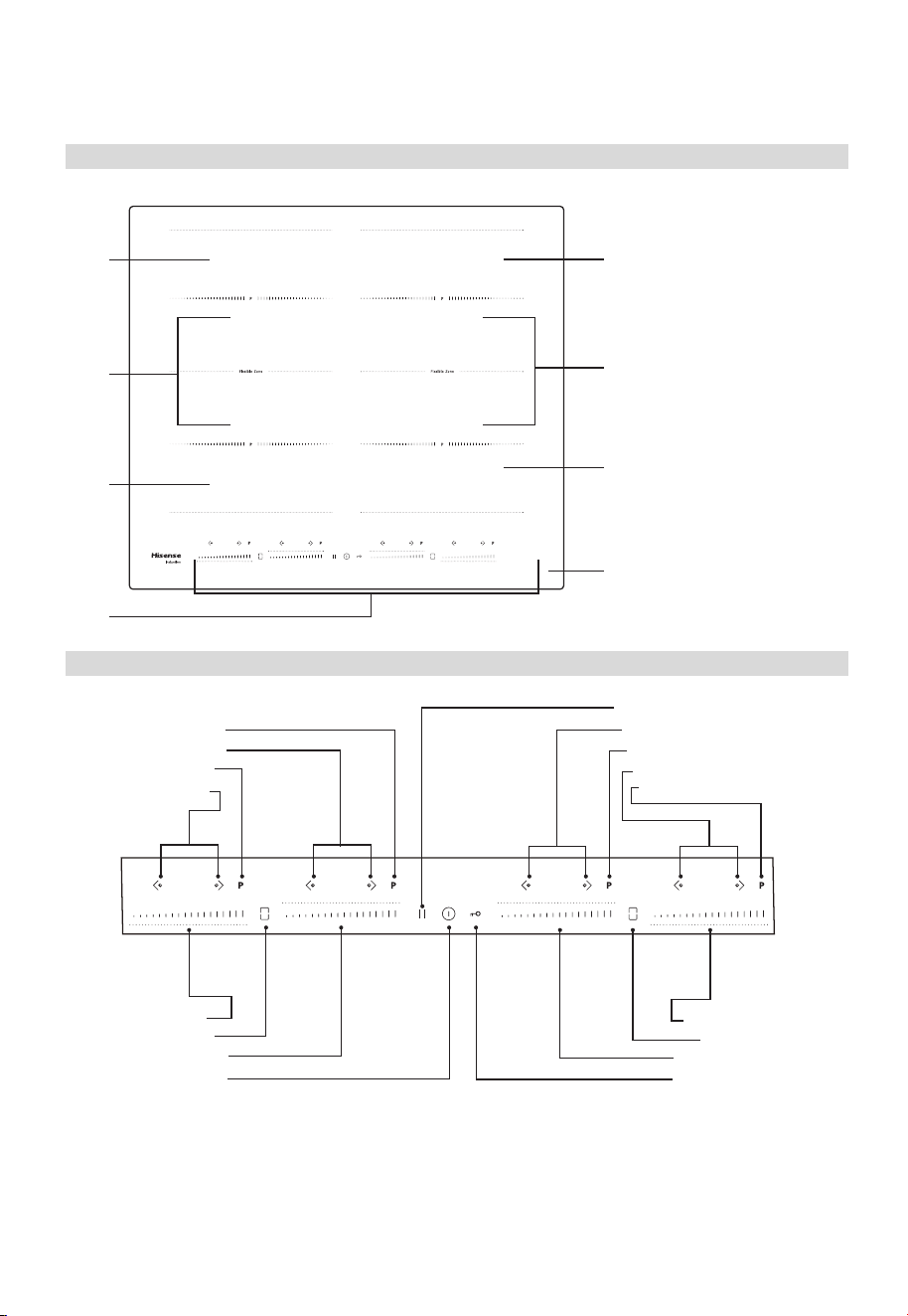
3.1. Top View
3.2. Control panel
1. Zone: 2200 / 3300 W (P)
2. Zone: 2200 / 3300 W (P)
3. Zone: 2200 / 3300 W (P)
4. Zone: 2200 / 3300 W (P)
5. Zone: 3300 / 3700 W (P)
6. Control panel
7. Glass plate
NOTE
All images in this manual are for explanatory purposes only. Any discrepancy between the real
object and the illustration in the drawing is subject to the real object.
Timer control
Timer control
Timer control
Timer control
Power Boost
Power Boost
Power Boost
Power Boost
Pause
AreaFlex
AreaFlex
On / Off
Key lock
Slider touch control
Slider touch control
Slider touch control
Slider touch control
10
2
3
4
1
6
5
5
7
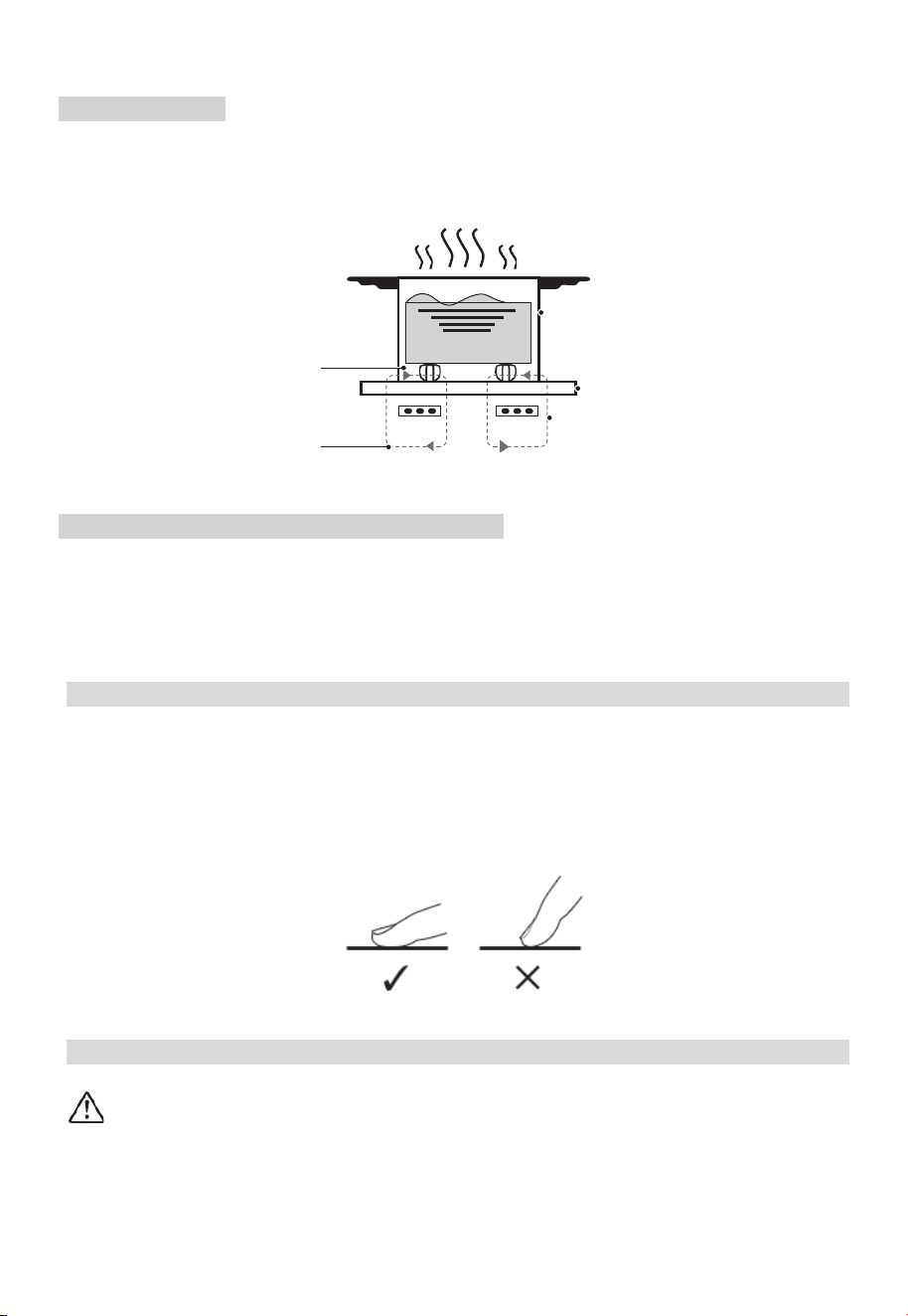
Working Theory
Induction cooking is a safe, advanced, eicient, and economical cooking technology. It works by
electromagnetic vibrations generating heat directly in the pan, rather than indirectly through heating
the
glass surface. The glass becomes hot only because the pan eventually warms it up.
Before Using Your New Induction Hob
•
Read this guide, taking special note of the ‘Safety Warnings’ section.
•
Remove any protective film that may still be on your Induction hob.
4. OPERATION INSTRUCTIONS
4.1. Touch Controls
•
The controls respond to touch, so you don’t need to apply any pressure.
•
Use the ball of your finger, not its tip.
•
Each time a touch is registered, a beep sounds.
•
Make sure that the operating elements are always clean and dry and that no object (e.g. a
utensil or cloth) is placed on them. Even a thin film of water can make it difficult to operate
the controls.
4.2. Choosing
•
Only use cookware with a base suitable for induction cooking.
•
Look for the induction symbol on the packaging or on the bottom of the pan.
•
You can check whether your cookware is suitable by carrying out a magnet test.
Iron pot
magnetic circuit
Induced currents
ceramic glass plate
induction coil
11
•
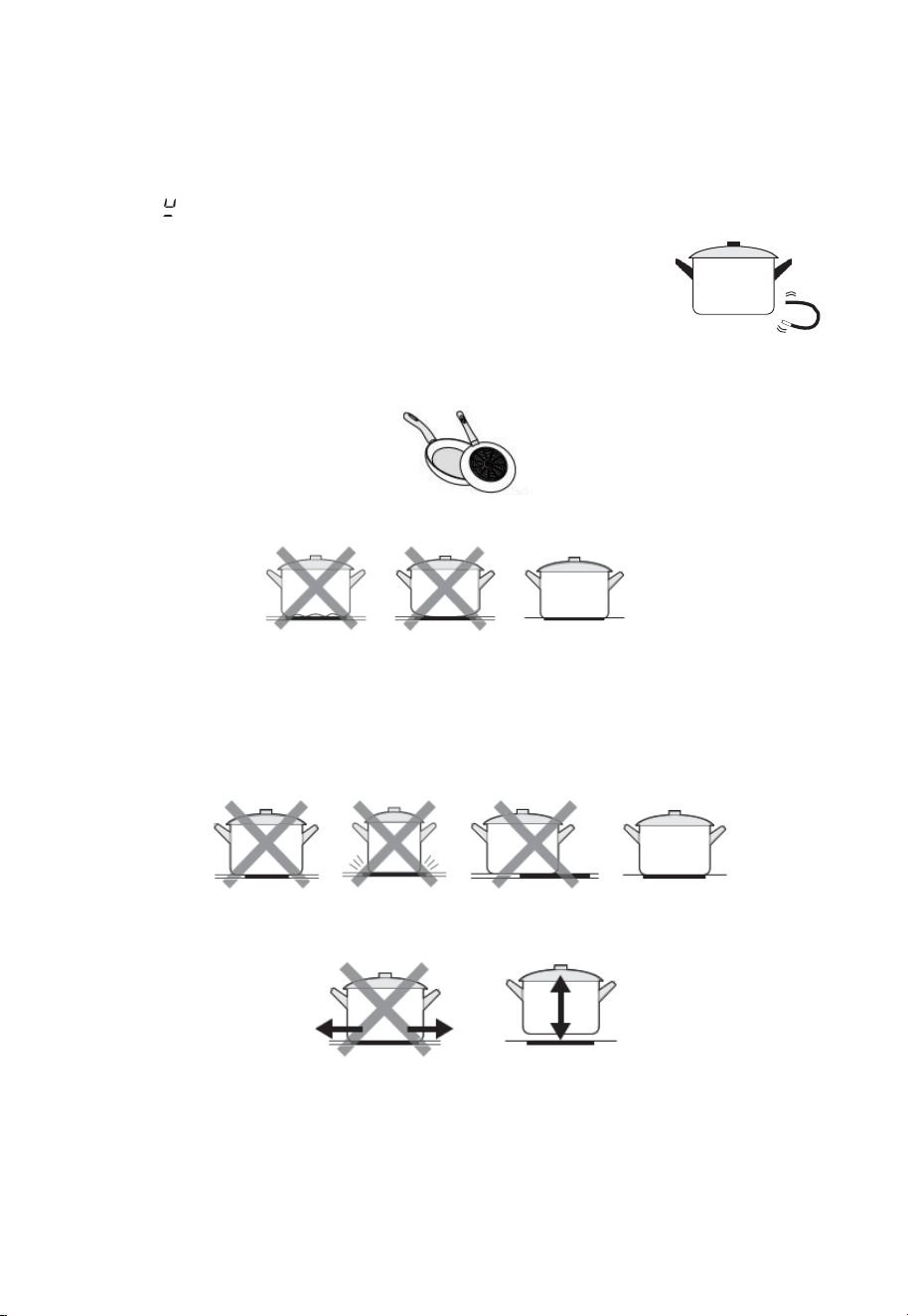
Move a magnet towards the base of the pan. If it is attracted, the pan is suitable for
induction.
•
If you do not have a magnet:
1. Put some water in the pan you want to check.
2. If does not flash in the display and the water is heating, the pan is suitable.
•
Cookware made from the following materials is not suitable: pure
stainless steel, aluminium or copper without a magnetic base, glass,
wood, porcelain, ceramic, and earthenware.
•
Cookware bases with aluminium content.
•
These reduce the ferromagnetic range, which means that less
energy is transferred to the cookware, resulting in this cookware not
being recognised sufficiently or not at all and therefore not being
heated sufficiently.
•
Do not use cookware with jagged edges or a curved base.
•
Make sure that the base of your pan is smooth, lies flat against the glass and is the same
size as the cooking zone. Use pans whose diameter is the same size as the graphic of the
selected zone. If you use a pan that is slightly larger, the energy will be used to the
maximum. If you use a smaller pan, the power may be lower than expected. Pots with a
diameter of less than 140 mm may not be recognised by the hob. Always place your pot in
the centre of the cooking zone.
•
Always lift pans of the Induction hob – do not slide, or they may scratch the glass.
12
4.3. Pan Dimension
The cooking zones are automatically adjusted to the diameter of the pan up to a certain limit.
However, the base of the pan must have a minimum diameter corresponding to the cooking zone.
To achieve the best efficiency of your hob, please place the pan in the middle of the cooking zone
.
Cooking
zone
The base diameter of induction cookware
Minimum (mm)
Maximum (mm)
1,2,3,4
100
220
flex induction
210
220x380
4.4. How to Use
Start Cooking
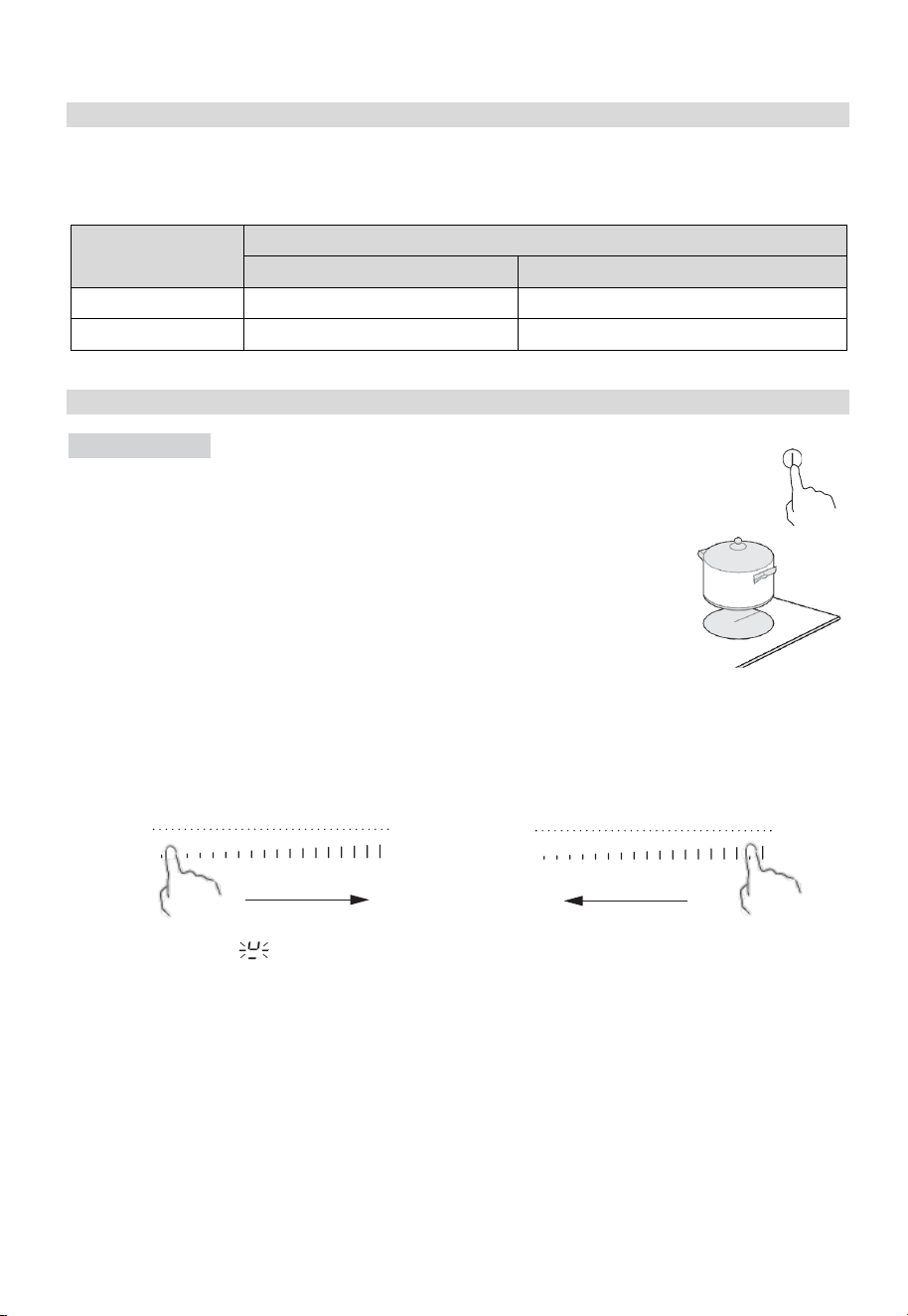
•
Touch the ON/OFF button. After switching on, a signal tone sounds and “ - " is
displayed on the control elements for selecting the heating zones , which means
that the induction hob is in standby mode.
•
Place a suitable pan on the cooking zone that you wish to use.
-
Make sure the bottom of the pan and the surface of the cooking
zone are clean and dry.
2. Each hob has its own independent slider, boost, timing operation button,
which can independently operate the power level/timing function.
3. Adjust heat setting by touching the slider control.
-
If you don’t choose a heat setting within 20 seconds, the Induction hob will automatically
switch of. You will need to start again at step 1.
-
You can modify the heat setting at any time during cooking.
If the display flashes alternately with the heat setting
This means that:
•
you have not placed a pan on the correct cooking zone or,
•
the pan you’re using is not suitable for induction cooking or,
•
the pan is too small or not properly centered on the cooking zone.
Heating only takes place if there is a suitable pan on the cooking zone.
The display switches off automatically after 1 minute if there is no suitable cookware on the
cooking zone.
Power up
Power down
13
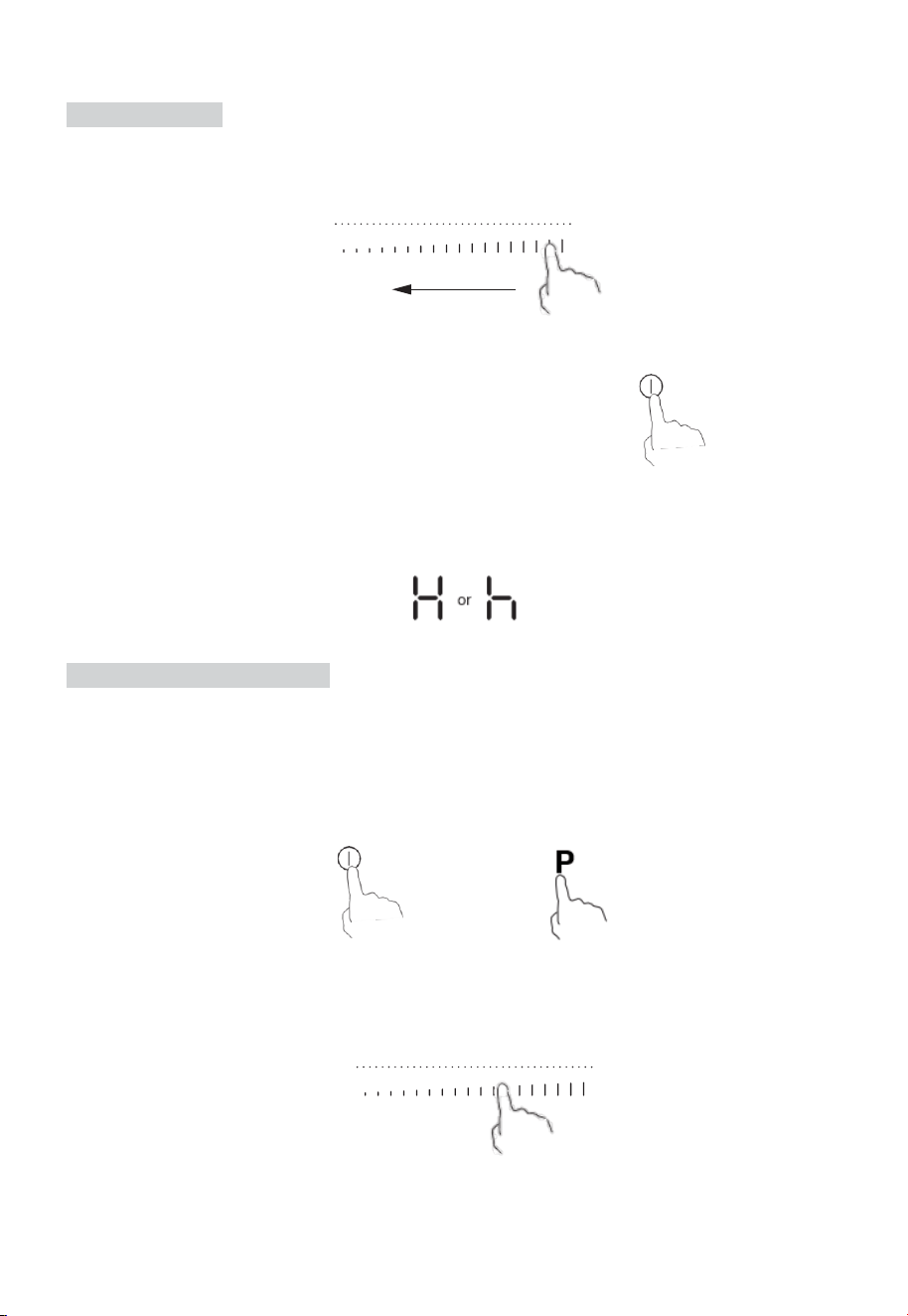
Finish Cooking
•
Move the slider of the corresponding burner all the way to the left, make sure that the display
shows “0”, after 3s the hob is switched off and the display shows “-”.
•
Turn the whole cooktop
of
by touching the ON/OFF control.
•
Beware of hot surfaces
H/h indicates which cooking zone is hot to the touch. It disappears when the surface has
cooled down to a safe temperature. It can also be used as an energy saving function, if you
want to heat more pans, use the hotplate while it is still hot.
Using the Boost Function
Activate the boost function
•
Touch the ON/OFF button. After switching on, a signal tone sounds and “ - " is displayed on
the control elements for selecting the heating zones , which means that the induction hob is
in standby mode.
•
By touching the boost control “P”, the zone display shows “Marquee” and the power reaches
maximum level.
Cancel the Boost function
• while the boost mode is running, touching any level on the slider will stop the boost mode and
the selected level will be shown in the display area
.
Power down
14
•
After the boost operating time has reached 10 minutes, boost mode is automatically
terminated and the level before entering boost mode is reached again. If the level before
entering boost mode is 0, it is set to level 9 for operation.
NOTE
•
The function can work in all cooking zones
•
The cooking zone returns to its original setting after 10 minutes.
•
The flex cooking zone returns to its original setting after 5 minutes.
•
If the boost function of the 1st cooking zone is activated, start the 2nd cooking zone and
the 1st cooking zone vice versa.
•
If the original heat setting is 0, it will return to 9 after the boost function has ended.
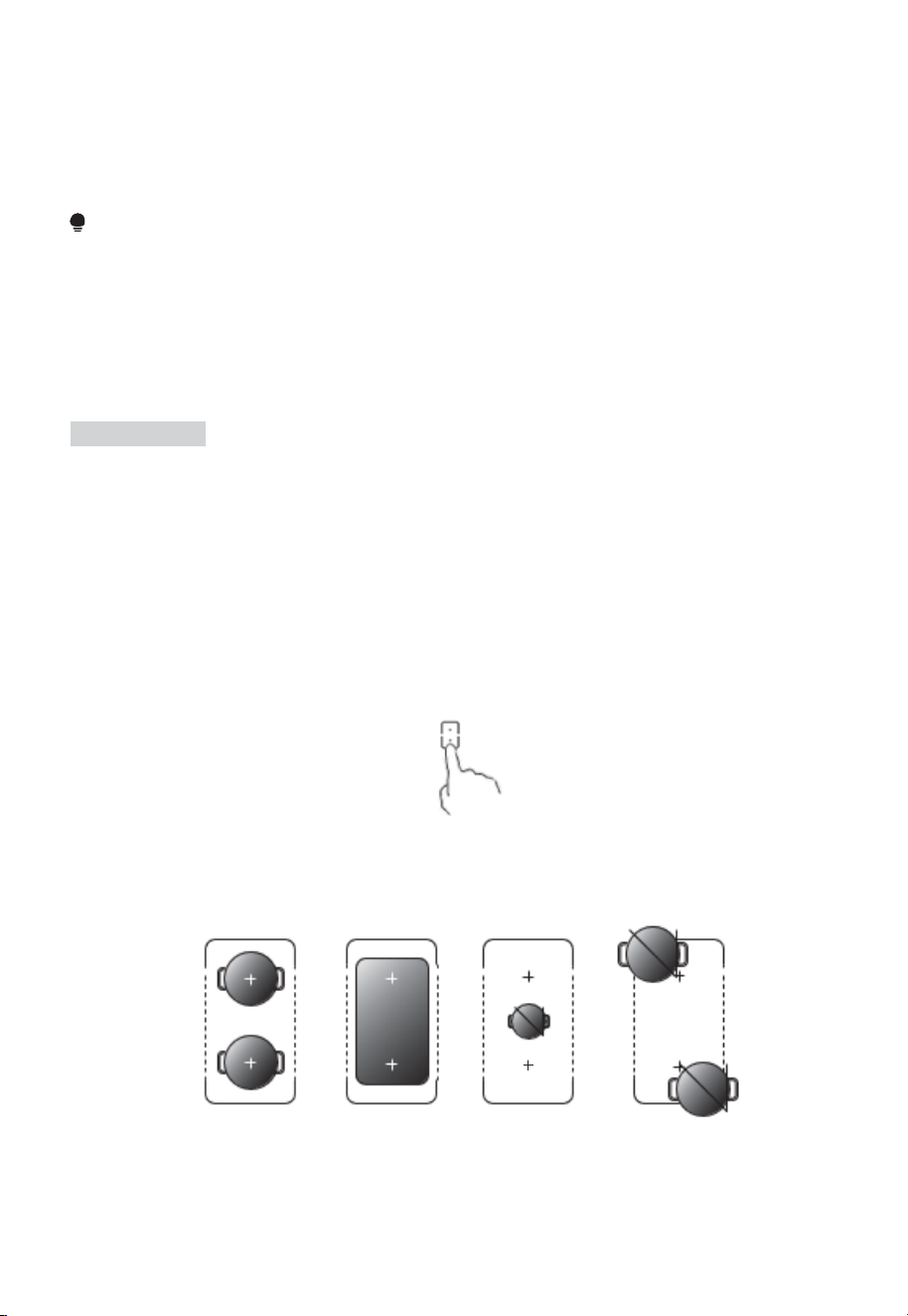
Flexible Area
•
This area can be used as a single zone or as two different zones, depending on the needs
of cooking at any given time.
•
The flexible zone consists of two independent inductors that can be controlled separately.
When used as a single zone, the part not covered by the cookware is automatically
switched off after 8 seconds.
•
To ensure correct detection of the pan and even heat distribution, the cookware should be
positioned correctly:
-
At the front or back of the flexible zone if the cookware is smaller than 21 cm.
-
Everywhere with larger cookware.
-
To activate the flexible area as a single large zone, simply press the corresponding
button.
Examples of good pot placement and bad pot placement.
15
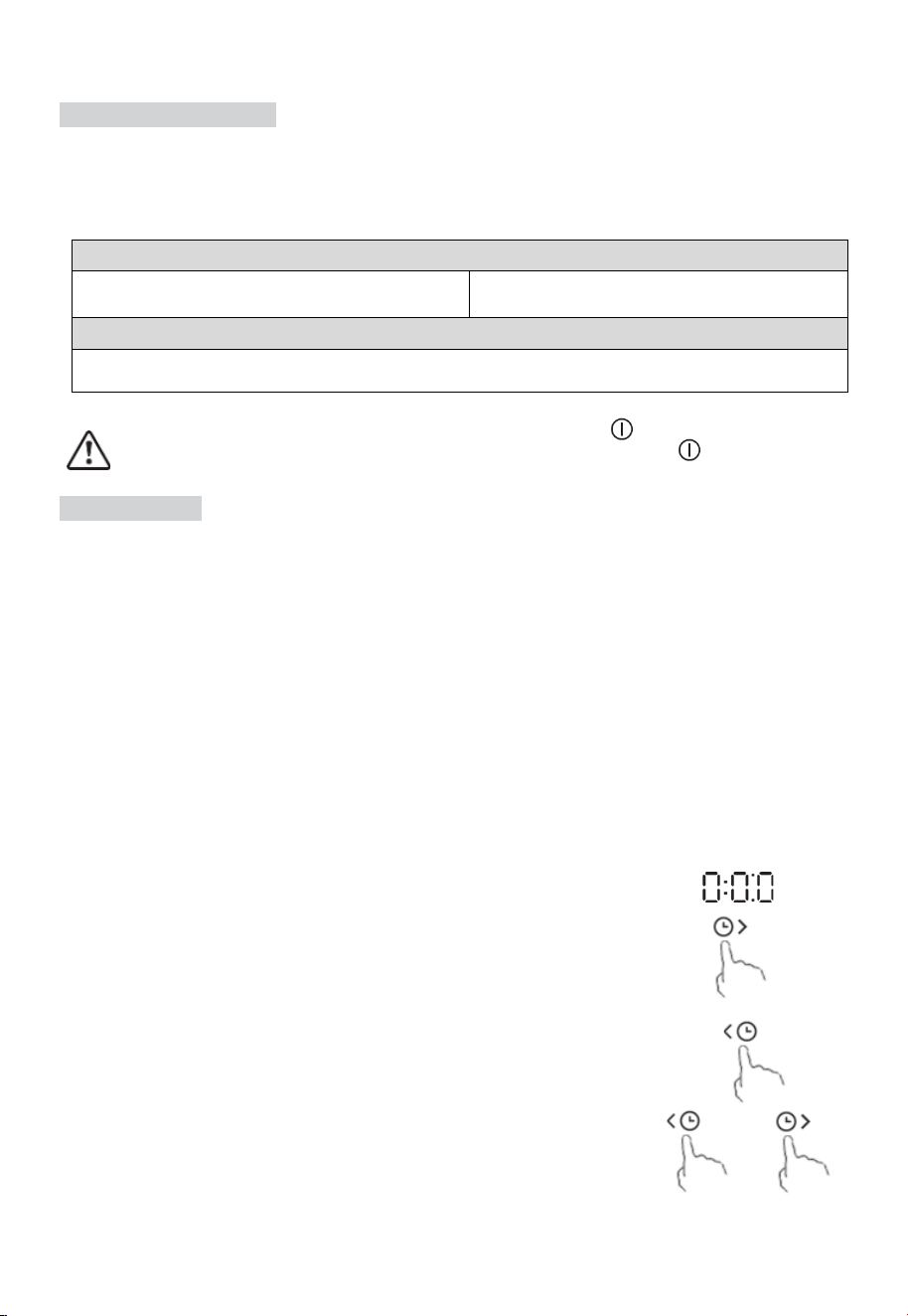
Locking the Controls
•
You can lock the controls to prevent unintentional use (e.g. if children accidentally switch
on the cooking zones).
•
When the controls are locked, all controls except the ON/OFF button are deactivated.
To lock the controls
Touch the lock control
The digital will show “Lo”
To unlock the controls
Touch and hold the lock control for a while.
When the cooktop is in lock mode, all controls except ON/OFF are deactivated. You can
always switch off the induction hob in an emergency using the ON/OFF control, but you
must first unlock the hob the next time you operate it
.
Timer Control
•
Each heating zone has independent buttons for increasing and decreasing the time.
•
A short press of the button increases or decreases the time by 1 minute, a long press
increases or decreases it by 10 minutes.
•
In Flex mode, the time control buttons of the Flex hobs can control the time of the Flex
zone.
•
In flex zone mode, if the time setting is present, with turn off the flex zone function, the time
will remain just on the front cooking zone.
•
When you switch to flex mode, the time setting is switched off by default.
•
The maximum time that can be set is 8:00.
•
The maximum setting time of the current cooking zone is the standard time of the cooking
zone. For more information, see Standard working times.
•
Click on the slider to display the current level and move the slider to adjust the level.
1. If the time is set to 0, the level indicator mode is exited at a set time
without any operation for 3s
.
2. The button for increasing the time is effective for long and short
presses
3. The button for decreasing the time is effective for long and short
presses.
4. Press the plus or minus button simultaneously for 1s to cancel the
time measurement.
16
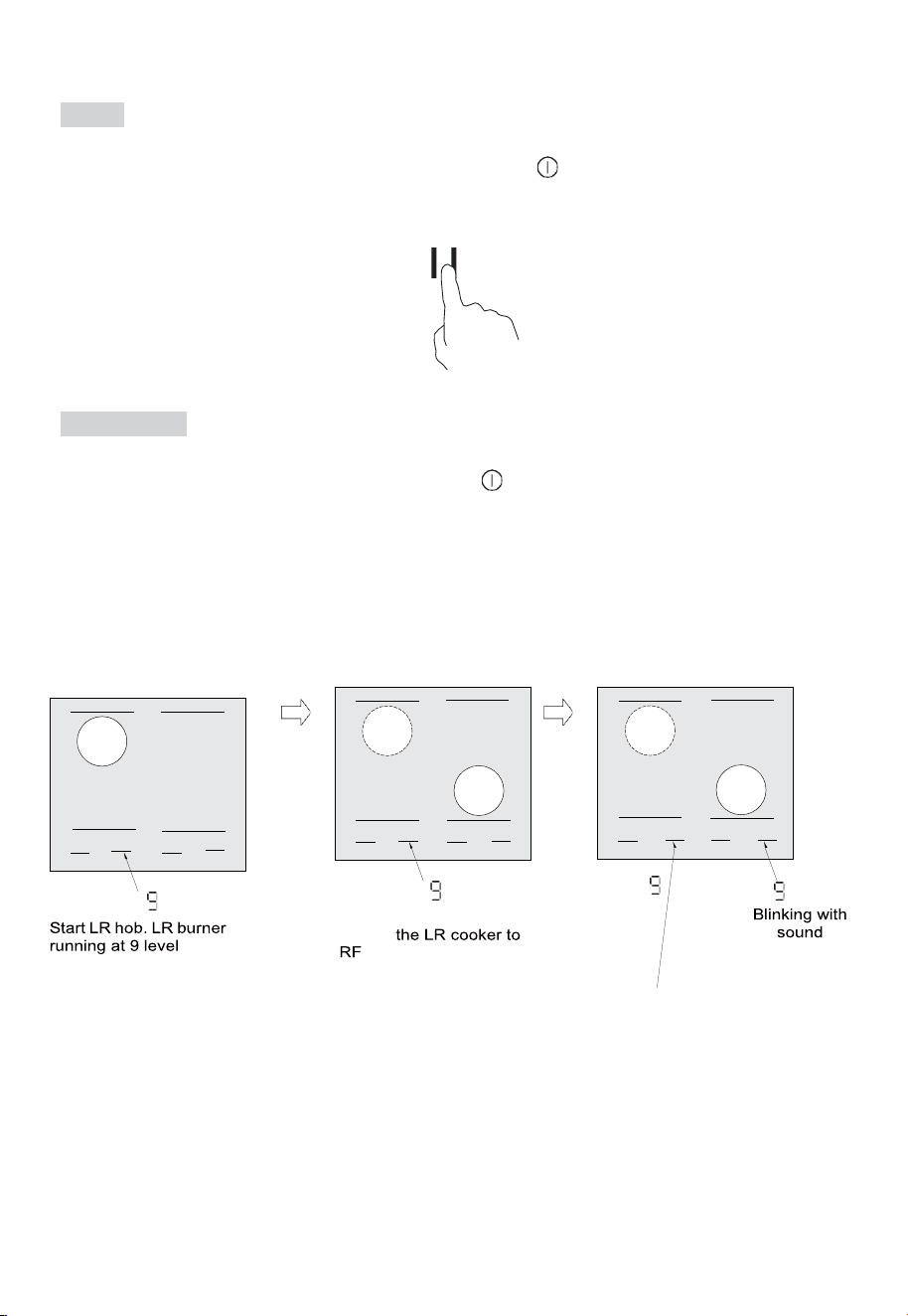
Pause
1. When the cooking zones are in operation, touch the “
II
” button, all displays show “ ‘ ' ” and
heating at level 2. At this moment, only the “
II
” and “ " controls can be operated.
2. Touch “ II ” again, the displays will show the original setting and the cooking zones will
continue to heating up.
Pan transfer
The pan transfer function is deactivated by default and can be switched on or off as follows
When switched off, press and hold the opening button “ “ to start the hob. Then within 10 seconds
press the time reduction function button of the LF cooking zone for 3s;
1. If "On" is shown on the LF digital display, this means that the pot transfer function is activated.
2. If the LF digital display shows "Off", this means that the pan transfer function is deactivated.
3. If the cooking zone is in boost mode, the pan transfer function is not activated by default.
4. Once the transfer has been confirmed, the time and power level are transferred
.
When the power is stable.
transfer
RF display shows the power
from LR cooking zone (9)
17
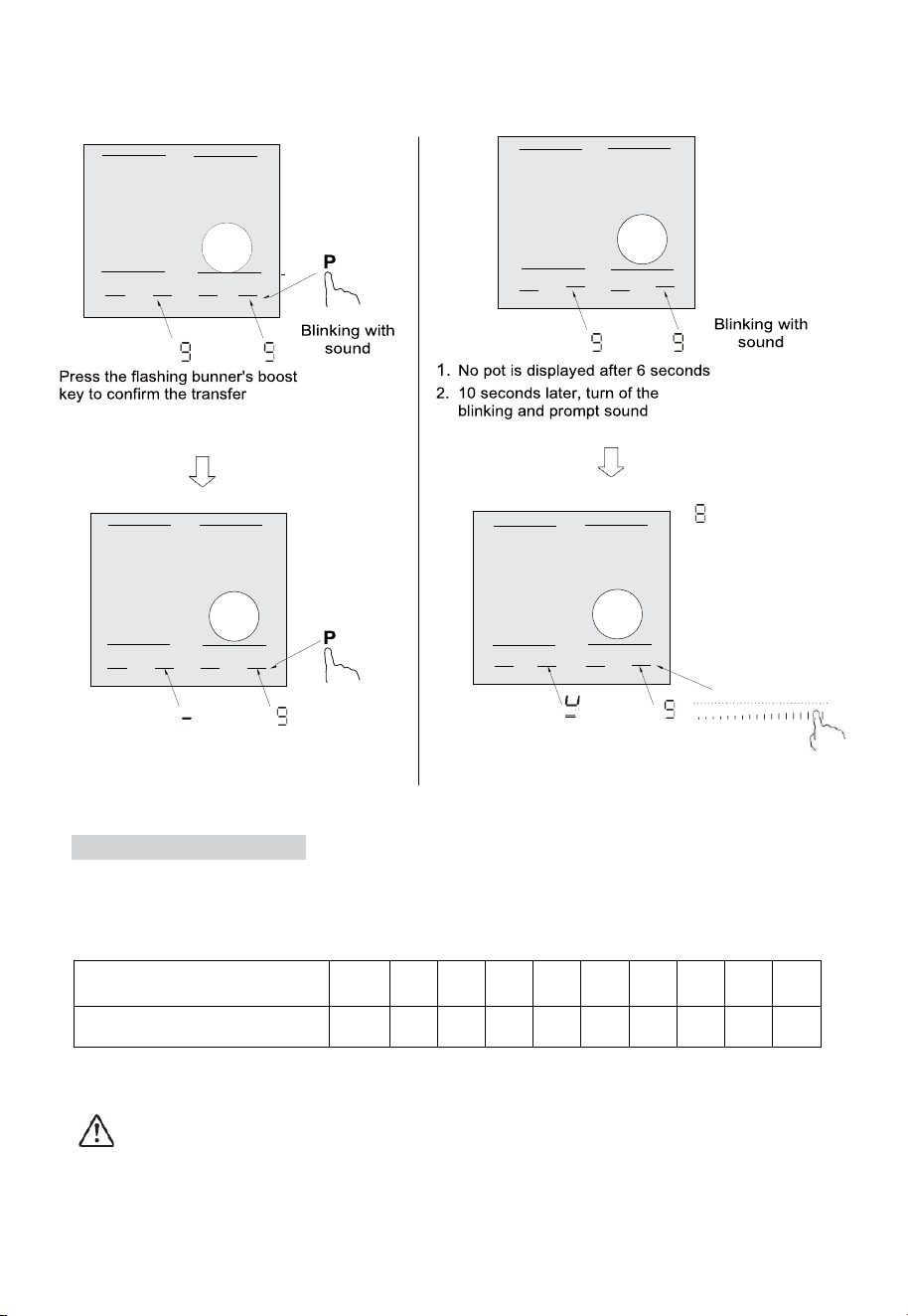
Confirmation Disconfirmation
Default Working Times
The automatic switch-off is a safety protection function for your induction hob. It switches off
automatically if you forget to switch off the hob. The standard operating times for the various
power levels are listed in the following table:
Power level
pause
1
2
3
4
5
6
7
8
9
Default working timer (hour)
8
8
8
6
6
4
4
2
2
1.5
When the pot
is
removed, the induction hob can stop heating immediately and the hob automatically
switch
of
after 1 minutes.
People with a pacemaker should consult their doctor before using this device
.
RF bunner is heated at LR
bunner level
Operate the RF slide. cancel the
transfer and heat in the set
18
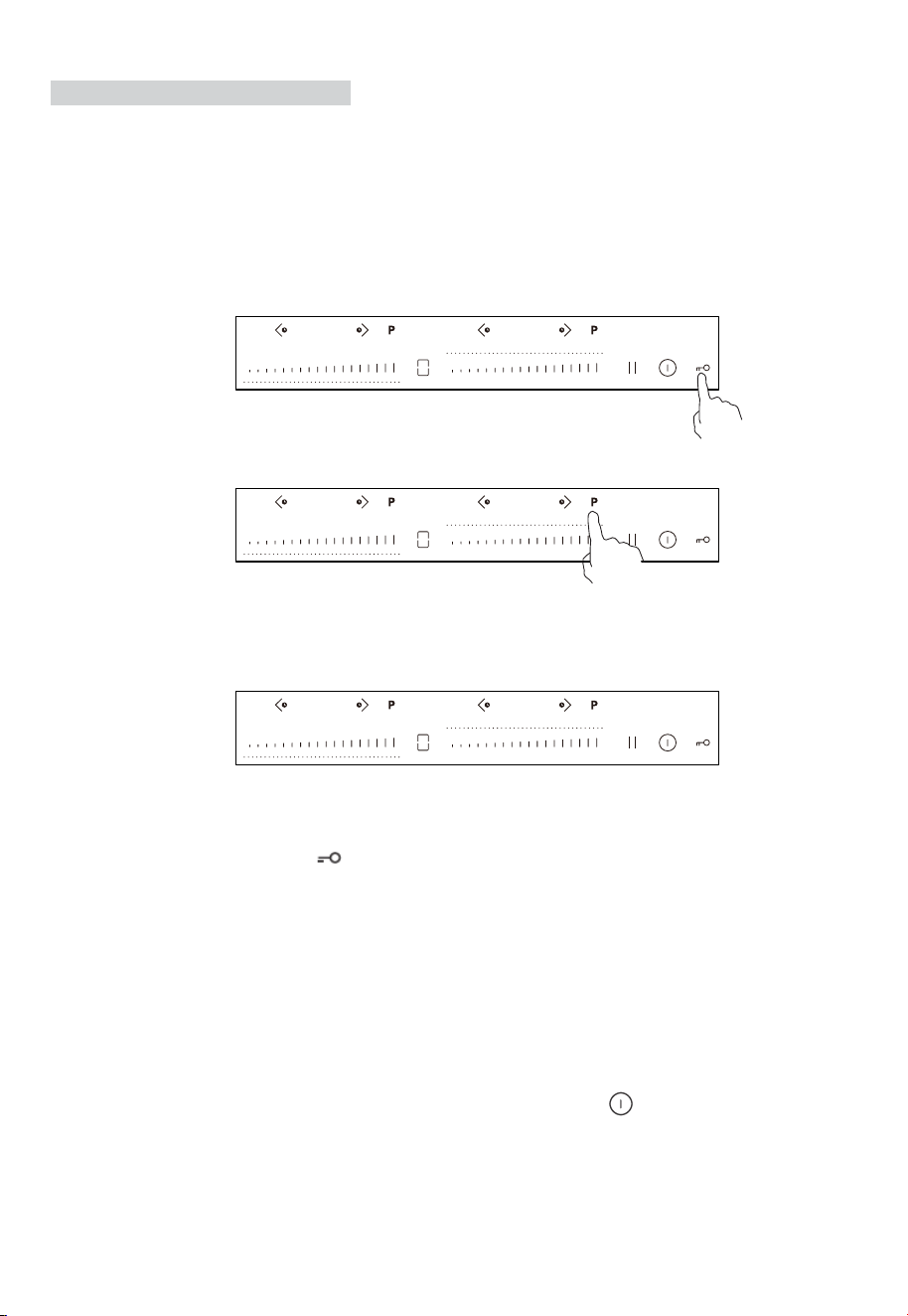
Power Management Function
It is possible to set a maximum power consumption for the induction hob and choose between different
power ranges.
Induction hobs are able to limit themselves automatically to operate at lower power to avoid the risk of
overloading
To enter Power Management Function
1. Switch off the appliance with pressing “power” key. Pressing “Child Lock” key for 3 seconds into
child lock state.
2. Pressing “Boost” key of left rear hob for 3 seconds.
After you enter Step 2, a short buzzer sound will be heard.
3sec (+ buzzer sound)
3. After buzzer sound, power-management function is successfully entered and the number “74” (for 7,4
kW) is displayed.
To switch to another level
1. Short press the “child lock” key . There are 6 power levels, from “7,4” to “2,5”. The LR indicator will
show one of them:
•
“74” : the maximum power is 7,4 kW.
•
“60” : the maximum power is 6,0 kW
•
“45” : the maximum power is 4,5 kW
•
“35” : the maximum power is 3,5 kW
•
“30” : the maximum power is 3,0 kW
•
“25” : the maximum power is 2,5 kW
Confirmation and exit Power Management Function
After the desired power setting mode is selected, please press power key to exit and save.
19
74

5. QUICK START GUIDE
Be careful when deep-frying, as oil and fat heat up very quickly, especially when using
PowerBoost. At extremely high temperatures, oil and fat will ignite spontaneously, posing a
serious fire hazard.
Cooking Tips
•
When the food is boiling, reduce the temperature.
•
Using a lid shortens the cooking time and saves energy as it retains the heat.
•
Reduce the amount of liquid or fat to shorten the cooking time.
•
Start cooking at a high level and reduce the level when the food is cooked through.
Simmering, Cooking rice
•
Simmering takes place below the boiling point, at around 85˚C, when bubbles occasionally
rise to the surface of the cooking liquid. It is the key to delicious soups and delicate stews
because it allows the flavours to develop without overcooking the food. You should also
cook egg-based sauces and sauces thickened with flour below the boiling point.
•
For some cooking methods, such as cooking rice using the absorption method, it may be
necessary to set a higher setting than the lowest setting to ensure that the food is cooked
properly in the recommended time.
Searing Steak
To cook juicy flavorsome steaks:
1. Leave the meat to stand at room temperature for about 20 minutes before cooking.
2. Heat a heavy frying pan.
3. Brush both sides of the steak with oil. Drizzle a small amount of oil into the hot pan and
then place the meat in the hot pan.
4. Turn the steak only once during cooking. The exact cooking time depends on the thickness
of the steak and how well done you want it. The time can vary between 2 and 8 minutes per
side. Press on the steak to check how cooked through it is – the firmer it feels, the better
cooked through it is.
5. Allow the steak to rest on a warm plate for a few minutes before serving so that it can relax
and become tender.
For Stir-frying
1. Choose an induction-compatible flat wok or a large frying pan.
2. Have all the ingredients and utensils ready. Stir-frying should be quick. If you are preparing
large quantities, cook the food in several smaller batches.
3. Preheat the pan briefly and add two tablespoons of oil.
4. Cook the meat first, set aside and keep warm.
5. Stir-fry the vegetables. When hot but still crisp, turn the heat down to low, return the meat
to the pan and add the sauce.
6. Stir the ingredients gently so that they are heated through.
7. Serve immediately.
20
Detection of Small Articles
If a pan of unsuitable size or a non-magnetic pan (e.g. aluminium) or another small item (e.g. knife, fork,
key) is left on the cooktop, the hob automatically switches to standby after 1 minute. The fan continues
to work for another 1 minute.
Heat Settings
The settings below are only guidelines. The exact setting will depend on several factors, including your
cookware and the amount you are cooking. Experiment with the induction hob to find the settings that
suit you best
.
Heat setting
Suitability
1
- 2
•
delicate heating of small quantities of food
•
melting chocolate, butter and foods that burn quickly
•
gentle simmering
•
slow heating
3 - 4
•
reheating
•
rapid simmering
•
cooking rice
5 - 6
•
pancakes
7 - 8
•
sautéing
•
cooking pasta
9/P
•
frying
•
sauté
•
bring soup to the boil
•
boiling water
21
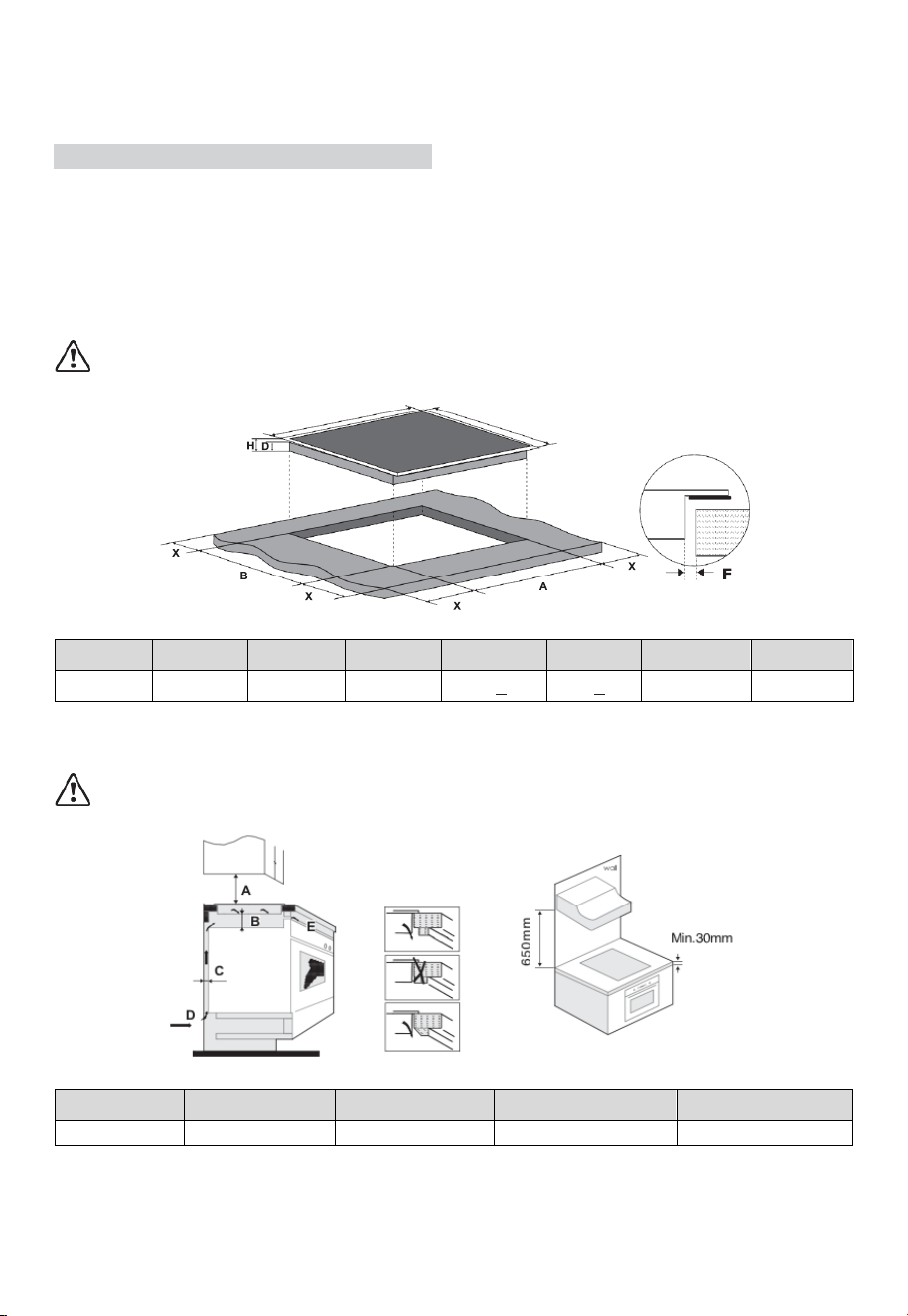
6. PRODUCT INSTALLATION
Selection of Installation Equipment
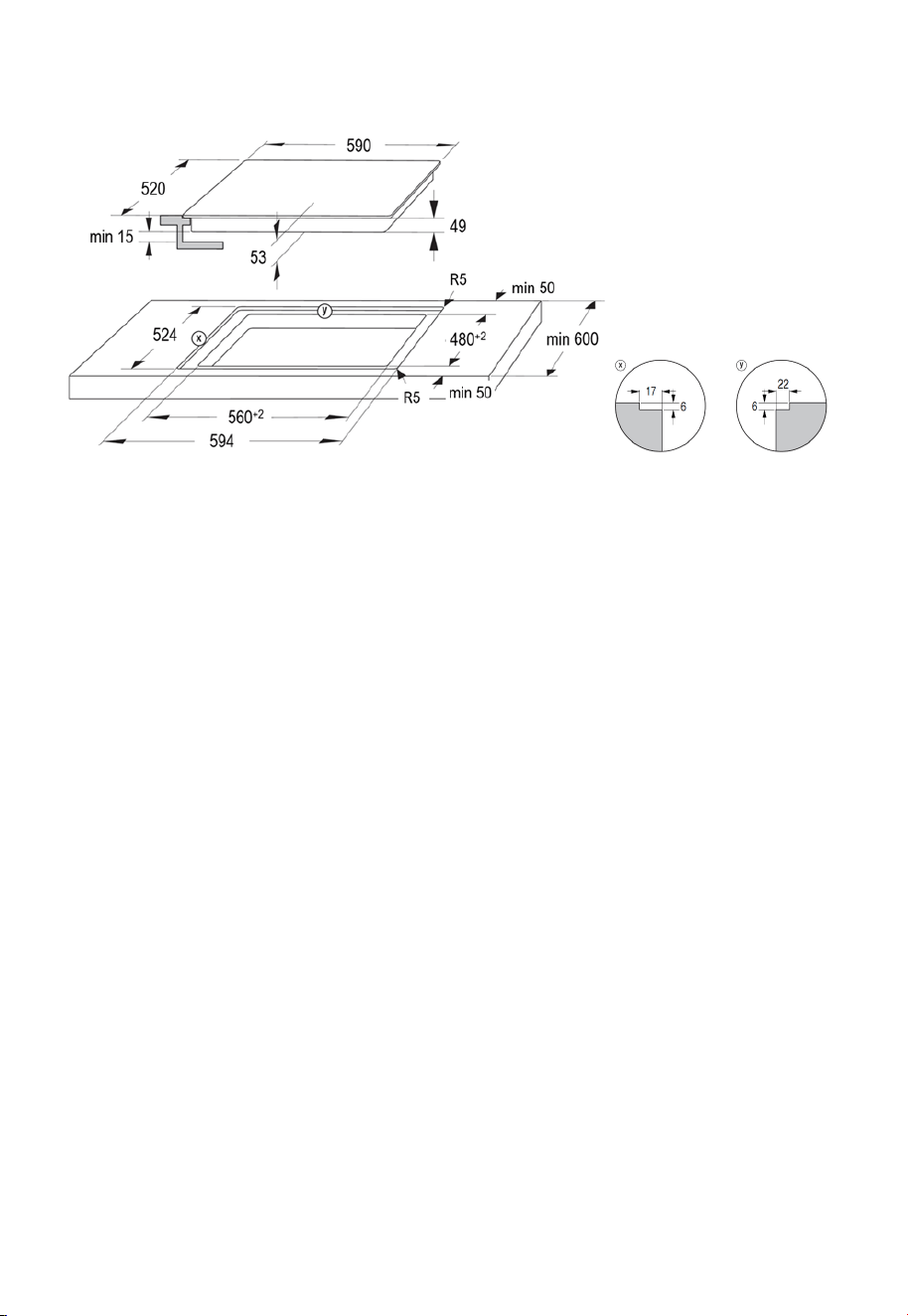
Cut out the work surface according to the dimensions shown in the drawing.
A minimum clearance of 5 cm must be maintained around the hole for installation and use. Ensure
that the thickness of the work surface is at least 30 mm. Choose a heat-resistant and insulated
material for the work surface (wood and similar fibrous or hygroscopic materials must not be used
as work surface material unless they are impregnated) to avoid electric shock and major
deformation due to heat radiation from the heating plate. As shown below:
Note
: The safety distance between the sides of the hob and the inner surfaces of the worktop
should be at least 3mm.
L(mm)
W(mm)
H(mm)
D(mm)
A(mm)
B(mm)
X(mm)
F(mm)
590
520
53
49
560+1
480+1
50 min
3 min
Under all circumstances, make sure that the induction hob is well ventilated and that the air inlets and
outlets are not blocked. Make sure that the induction hob is in good working order. As shown below
Note: The safety distance between the hob and the cupboard above the hob should be at least
650 mm.
A(mm)
B(mm)
C(mm)
D
E
650 min
15 min
20 min
Air intake
Air exit 2mm
WARNING: Ensuring Adequate Ventilation
L
W
SEAL
Min. 3 mm
22
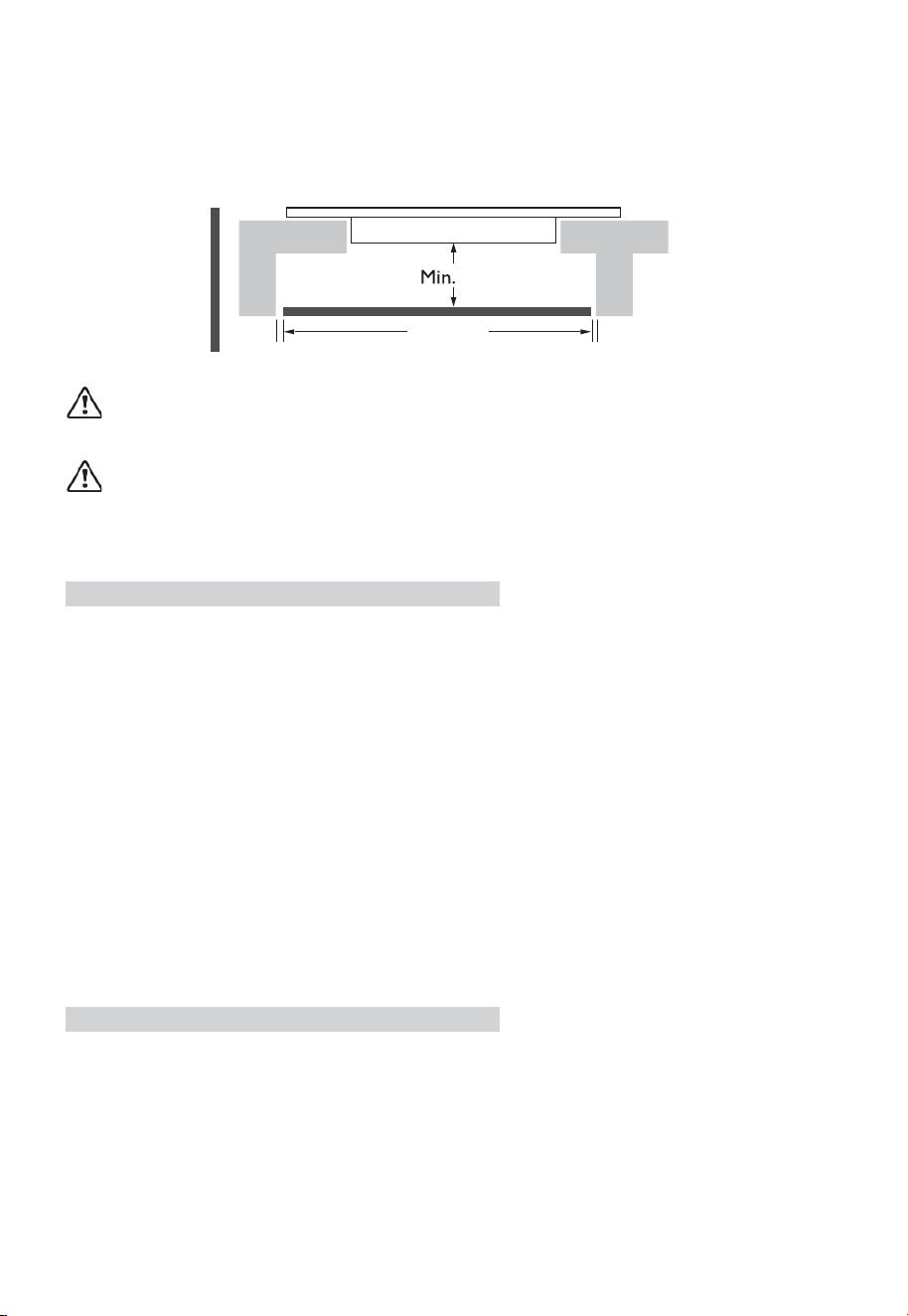
Ensure that the induction hob is well ventilated and that the air inlet and outlet are not blocked. To
avoid accidental contact with the overheated bottom of the hob or an unforeseeable electric shock
during work, it is necessary to install a wooden insert fixed with screws at a minimum distance of 15
mm from the bottom of the hob. Observe the following requirements.
There are ventilation holes around outside of the hob. You need to ensure these holes are not
blocked by the worktop when you put the hob into position
.
•
Make sure that the adhesive that bonds the plastic or wood material to the furniture
cannot withstand a temperature of less than 150°C to prevent the cladding from coming
loose.
•
The back panel, the adjacent and surrounding surfaces must therefore be able to
withstand a temperature of 90°C.
Before Installing the Hob, Make Sure That
•
The work surface is rectangular and flat, and no structural elements interfere with the
space required.
•
The worktop is made of a heat-resistant and insulated material.
•
If the hob is installed above an oven, the oven has a built-in cooling fan.
•
The installation must comply with all clearance requirements and applicable standards and
regulations.
•
A suitable disconnect switch, which allows complete disconnection from the electrical
supply, is integrated into the fixed wiring and is fitted and positioned to comply with local
wiring rules and regulations.
•
The disconnect switch shall be of an approved type and shall have a contact separation of
3 mm air gap in all poles (or in all active [phase] conductors if local wiring regulations
permit this deviation from the requirements).
•
The disconnect switch must be easily accessible to the customer when the hob is installed.
•
If in doubt, consult local building authorities and regulations for installation.
•
You use heat-resistant and easy-to-clean surfaces (e.g. ceramic tiles) for the wall surfaces
around the hob.
After Installing the Hob, Make Sure That
•
The power supply cable is not accessible through cupboard doors or drawers.
•
There is a sufficient flow of fresh air from outside the cupboard to the base of the hob.
•
If the hob is installed above a drawer or cupboard space, a heat protection barrier is fitted
under the base of the hob.
•
The isolating switch is easily accessible to the customer.
Max. 5mm
Max. 5mm
23
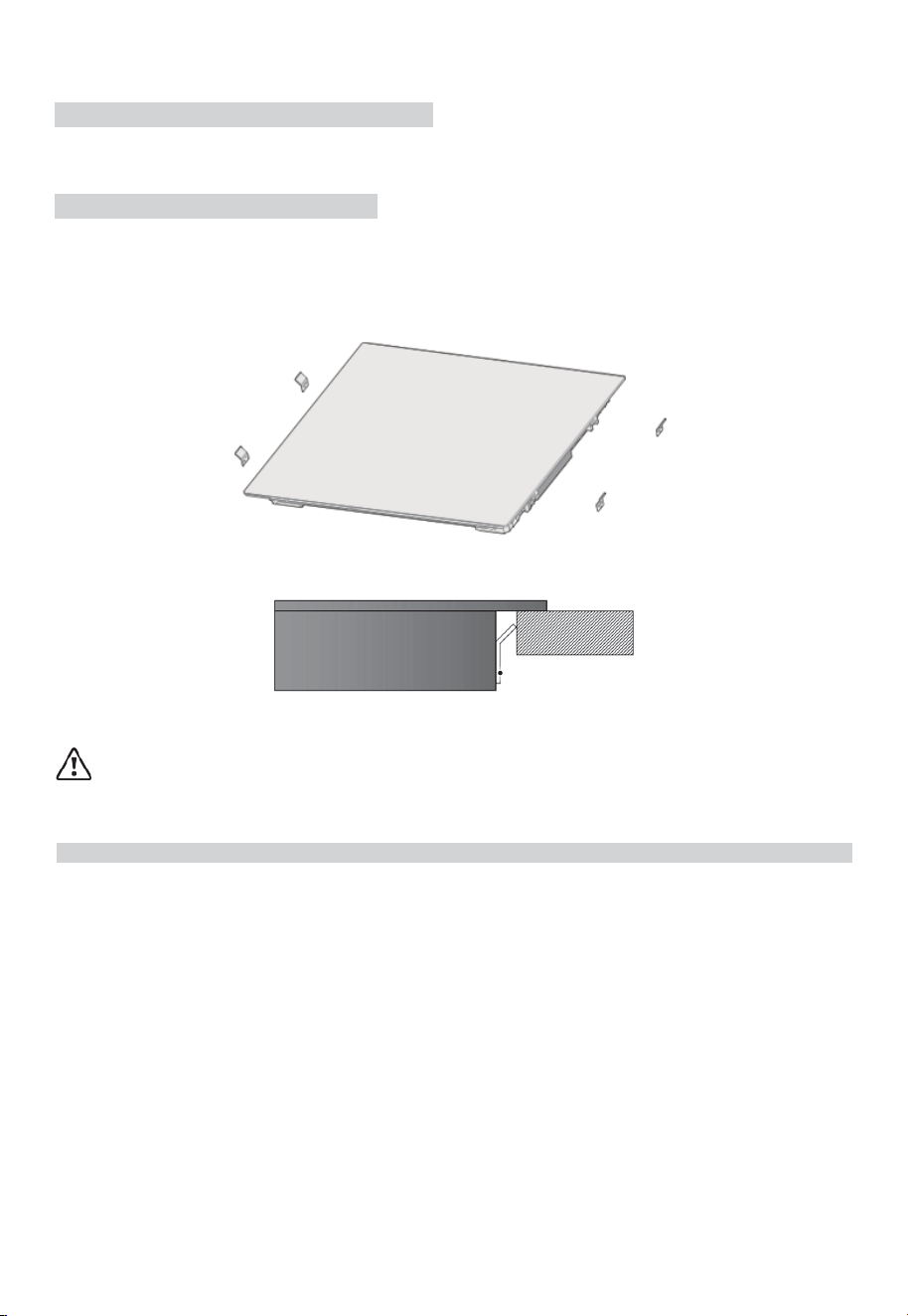
Before Locating the Fixing Brackets
The appliance should be placed on a stable, smooth surface (use the packaging). Do not apply
force to the controls protruding from the hob
.
Adjusting the Bracket Positio
Secure the hob to the worktop by attaching 4 brackets to the underside of the hob before
installation (see illustration).
Adjust the position of the brackets to different worktop thicknesses.
Under no circumstances should the brackets touch the inner surfaces of the worktop after
installation (see illustration).
CAUTIONS
1. The induction hob must be installed by qualified personnel or technicians. We have
specialists who are at your disposal. Please never repair the appliance by yourself.
2. Do not install the hob directly above a dishwasher, refrigerator, freezer, washing machine
or tumble dryer, as the moisture can damage the hob's electronics.
3. The induction hob must be installed in such a way as to ensure better heat radiation in
order to increase its reliability.
4. The wall and the induced heating zone above the table surface must be heat-resistant.
5. To avoid damage, the sandwich layer and the adhesive must be heat-resistant.
6. A steam cleaner must not be used.
bracket
24
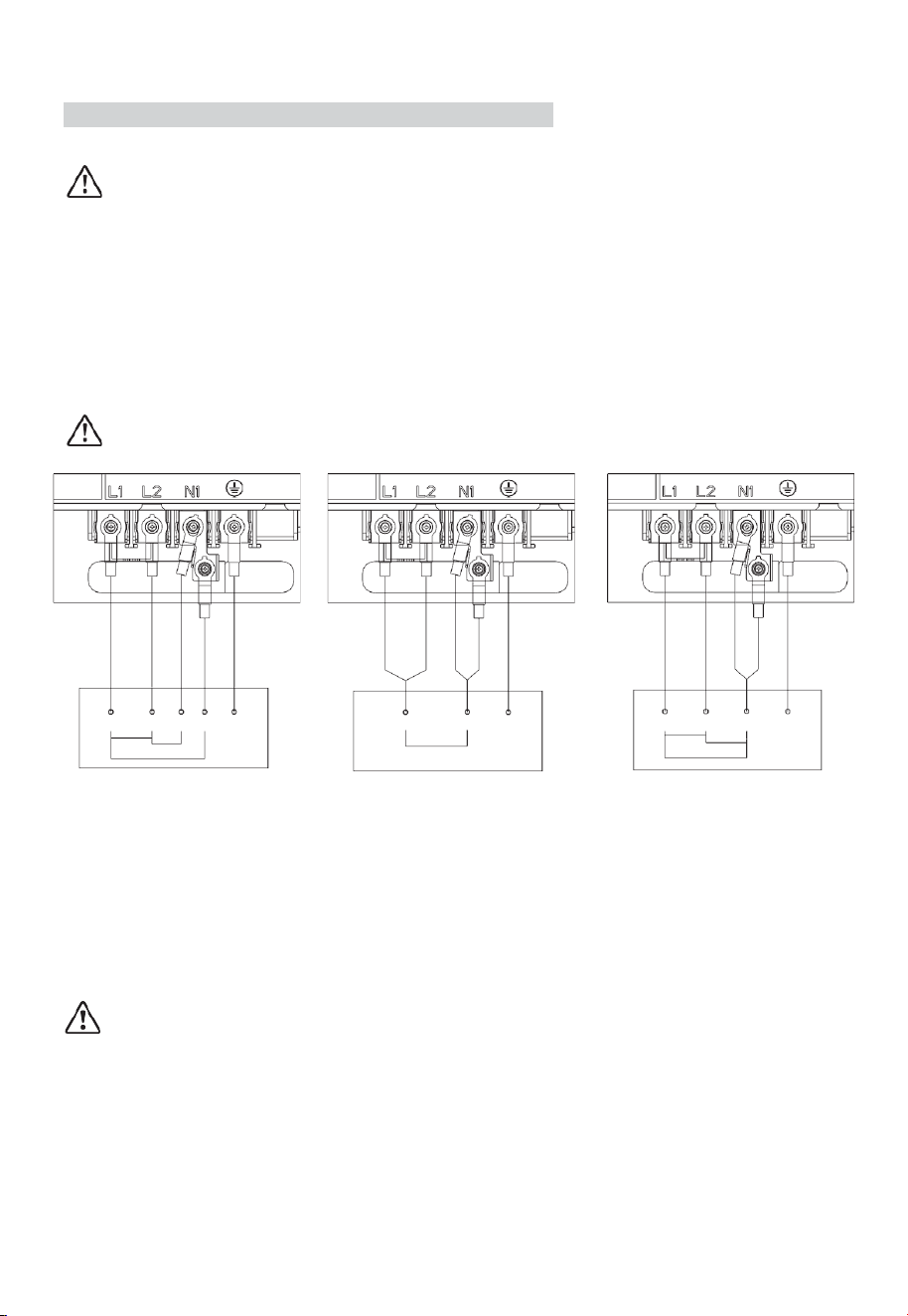
Connecting the Hob to the Mains Power Supply
This hob may be connected to the mains power supply only by a suitably qualified person.
Before connecting the hob to the mains supply, check that:
1. The domestic installation is suitable for the power consumed by the hob.
2. The voltage corresponds to the value specified on the rating plate.
3. The cable sections for the power supply are suitable for the load specified on the
rating plate.
Do not use adapters, reducers or branches to connect the hob to the mains supply, as they may
cause overheating and pose a fire hazard.
The power supply cable must not touch any hot parts and must be routed so that its
temperature does not exceed 75˚C at any point.
Check with a qualified electrician whether the domestic installation is suitable without
modifications. Modifications may only be carried out by a qualified electrician.
•
If the cable is damaged or to be replaced, the operation must be carried out the by after-
sale agent with dedicated tools to avoid any accidents.
•
If the appliance is being connected directly to the mains an omnipolar circuit-breaker must
be installed with a minimum opening of 3mm between contacts.
•
The installer must ensure that the correct electrical connection has been made and that it is
compliant with safety regulations.
•
The cable must not be bent or compressed.
•
The cable must be checked regularly and replaced by authorised technicians.
The bottom surface and the power cord of the hob are not accessible after installation.
Black
Brown
Grey
Blue
Yellow/Green
380-415V~
220-240V~
220-240V~
L
N GND
Yellow/Gree
n
220-240V~
Black
Brown
Grey
Blue
L1 L2
N GND
Black
Brown
Grey
Blue
Yellow/Green
380-415V~
220-240V~
220-240V~
25
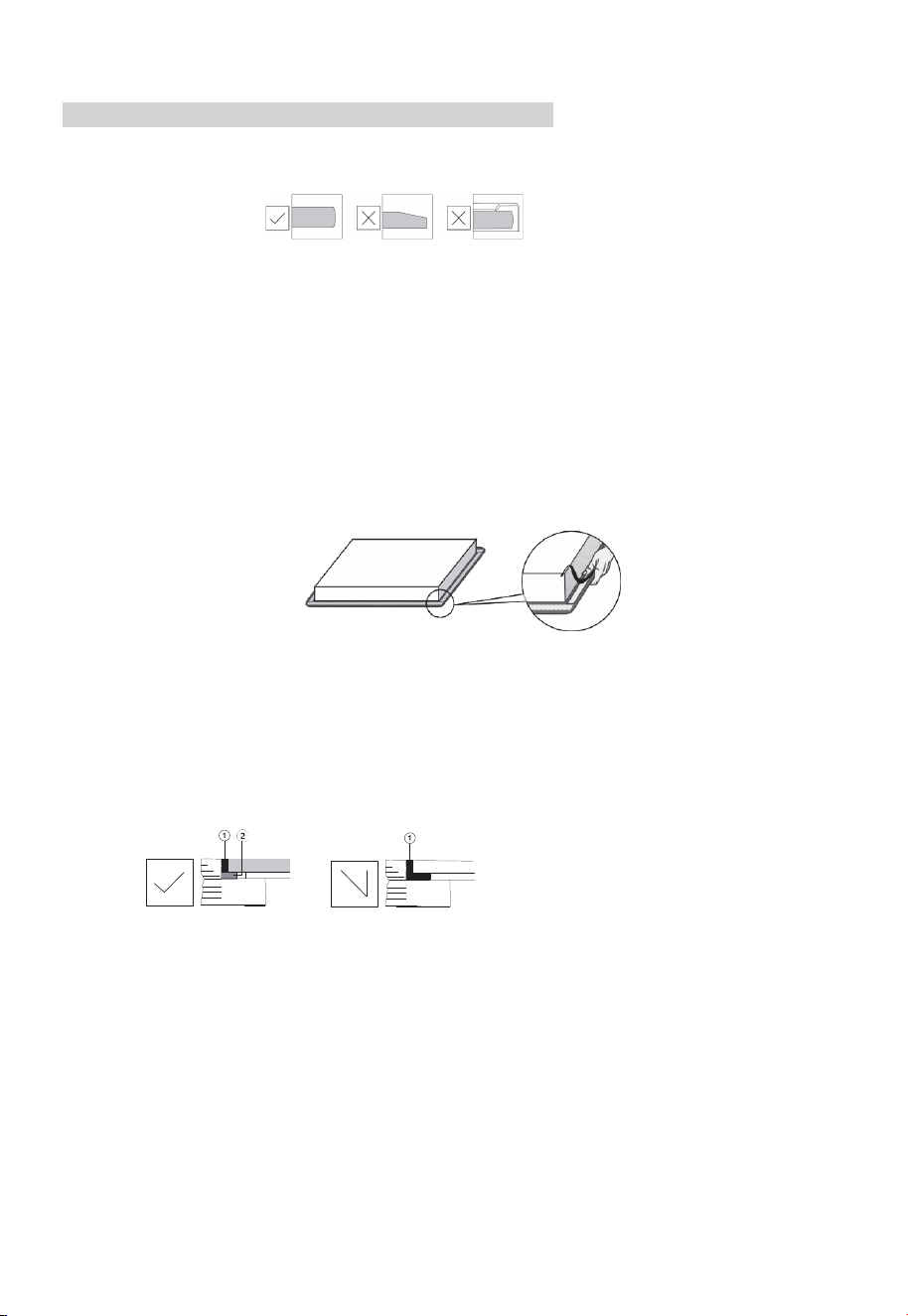
Flush-mount Installation Into The Worktop
Appliances without faceted edges or decorative frames, are suitable for flush mounting.
Installing the appliance
The appliance may only be installed into a temperature- and water-resistant countertop, such as a
countertop made of (natural) stone (marble, granite), or solid wood (the edges along the cut-out
have to be sealed). When installing into a countertop made of ceramics, wood, or glass, a wooden sub-
frame should be used. The frame is not supplied with the appliance. The appliance may only be
installed into a countertop made of other materials after you have consulted the countertop
manufacturer and obtained his express approval. Internal dimension of the basic unit should be at least
equal to the internal cutout for the appliance. This will allow simple removal of the appliance from the
countertop.
Attach sealing tape along the perimeter of the bottom of the glass panel.
First, feed the power cord through the cutout. Place the appliance over the center of the cutout.
Connect the appliance to the power mains (see instructions for connecting the appliance). Before
sealing the appliance, test its operation. Seal the slot between the appliance and the countertop
using
a silicone sealant. The silicone sealant used to seal the appliance has to be temperature-
resistant (to
at least 160 °C). Smooth out the silicone sealant using a suitable tool. Observe the
instructions for use
of the selected silicone sealant. Do not switch on the appliance until the silicone
sealant has dried completely.
WARNING!
Pay particular attention to built-in dimensions with (natural) stone countertops. When choosing the
silicone sealant, observe the countertop material and consult the countertop manufacturer. Use of
inappropriate.
Removing the built-in appliance
Disconnect the appliance from the power mains. Use a suitable tool to remove the silicone gasket from
the perimeter. Remove the appliance by pushing it upwards from the bottom side.
1. Silicone sealant
2.
Sealing tape
26
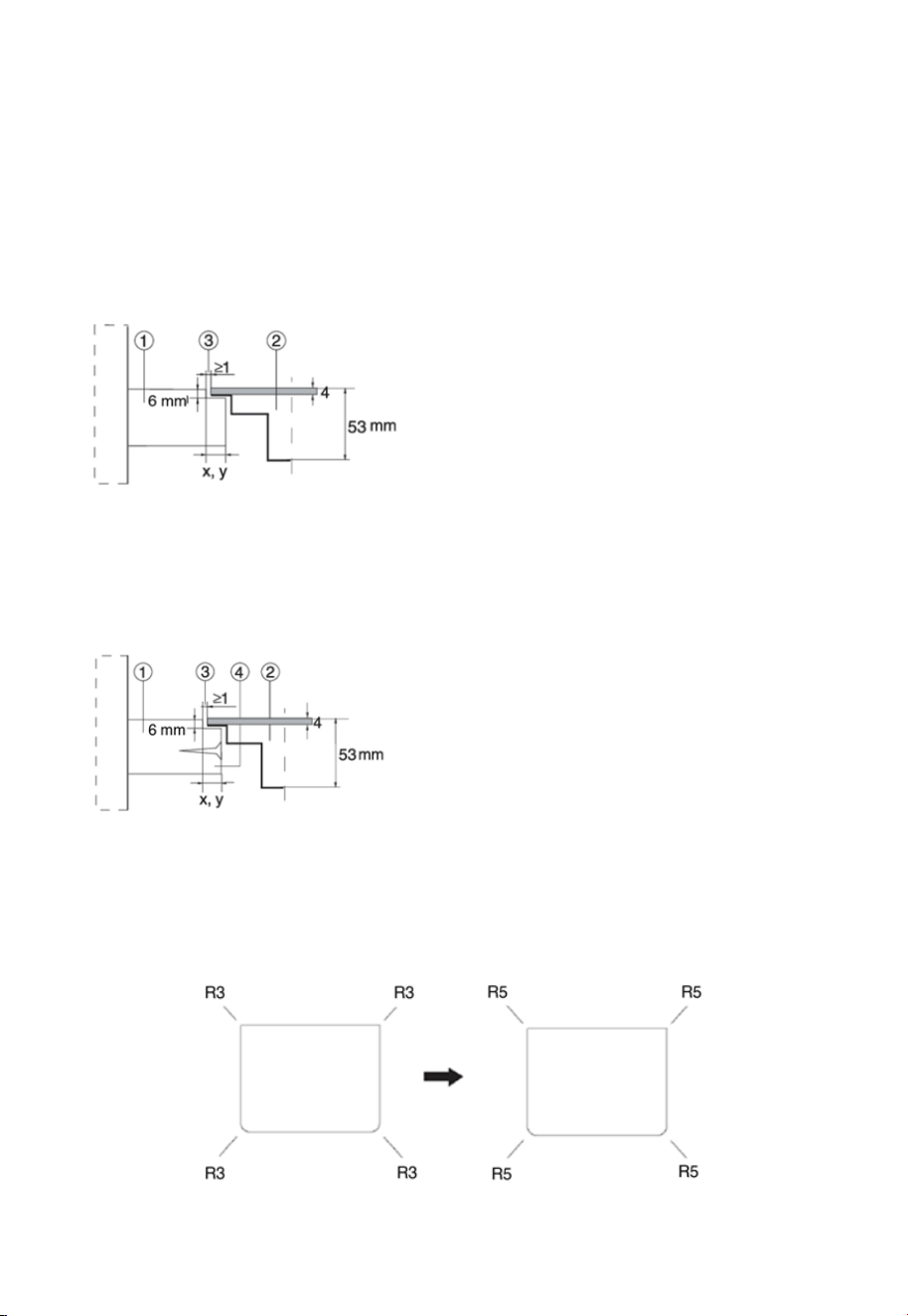
WARNING!
Do not attempt to remove the appliance from the upper side of countertop.
WARNING!
The service department shall only be responsible for repair and servicing of the cooking hob. Consult
your specialized kitchen equipment dealer regarding the re-installation (of the flush-mount)
Stone countertop
Given the margin of error (tolerance) for the glass ceramic plate of the appliance, and the cutout in the
countertop, the slot is adjustable (min.2 mm).
Ceramic, wooden, or glass countertop
Given the margin of error (tolerance) for the glass ceramic plate of the appliance, and the cut-out in the
countertop, the slot is adjustable (min. 2 mm). Install the wooden frame 5,5 mm below the upper edge
of the countertop (see figure).
Observe the radii of glass edges (R3) when making the cut-out.
GLASS
CUT-
OUT
1. Countertop
2. Appliance
3. Slot
1. Countertop
2. Appliance
3. Slot
4. Wooden frame, thickness 16 mm
27
60cm
WARNING!
If the oven is installed under a flush-mounted cooking hob, then the worktop thickness should be at
least 40 mm.
28

7. CLEANING AND MAINTENANCE
What?
How?
Important!
Everyday soiling on
glass (fingerprints,
marks, stains left by
food or non-sugary
spillovers on the
glass).
1. Switch the power to the cooktop of.
2. Apply a cooktop cleaner while the
glass
is still warm (but not hot!)
3. Rinse and wipe dry with a clean cloth or
paper towel.
4. Switch the power to the cooktop back
on.
•
When the power to the cooktop is
switched of, there will be no ‘hot
surface’ indication but the cooking
zone
may still be hot! Take extreme
care.
•
Heavy-duty scourers, some nylon
scourers and harsh/abrasive
cleaning agents may scratch the
glass. Always
read the label to check
if your cleaner or
scourer is suitable.
•
Never leave cleaning residue on the
cooktop: the glass may become
stained.
Boilovers, melts, and
hot sugary spills on
the glass.
Remove these immediately with a fish
slice, palette knife or razor blade scraper
suitable for Ceramic glass cooktops, but
beware of hot cooking zone surfaces:
1.
Switch the power to the cooktop
of
at
the wall.
2. Hold the blade or utensil at a 30° angle
and scrape the soiling or spill to a cool
area of the cooktop.
3.
Clean the soiling or spill up with a dish
cloth or paper towel.
4.
Follow steps 2 to 4 for ‘Everyday
soiling on glass’ above.
•
Remove stains left by melts and
sugary food or spillovers as soon as
possible. If left to cool on the glass,
they may be
diicult
to remove or
even permanently damage the glass
surface.
•
Cut hazard: when the safety cover is
retracted, the blade in a scraper is
razor-sharp. Use with extreme care
and always store safely and out of
reach of children.
Spillovers on the
touch controls.
1. Switch the power to the cooktop of.
2.
Soak up the spill.
3. Wipe the touch control area with a
clean damp sponge or cloth.
4. Wipe the area completely dry. with a
paper towel.
5. Switch the power to the cooktop back
on.
•
The cooktop may beep and turn itself
of, and the touch controls may not
function while there is liquid on them.
Make sure you wipe the touch control
area dry before turning the cooktop
back on.
29
8. TROUBLESHOOTING
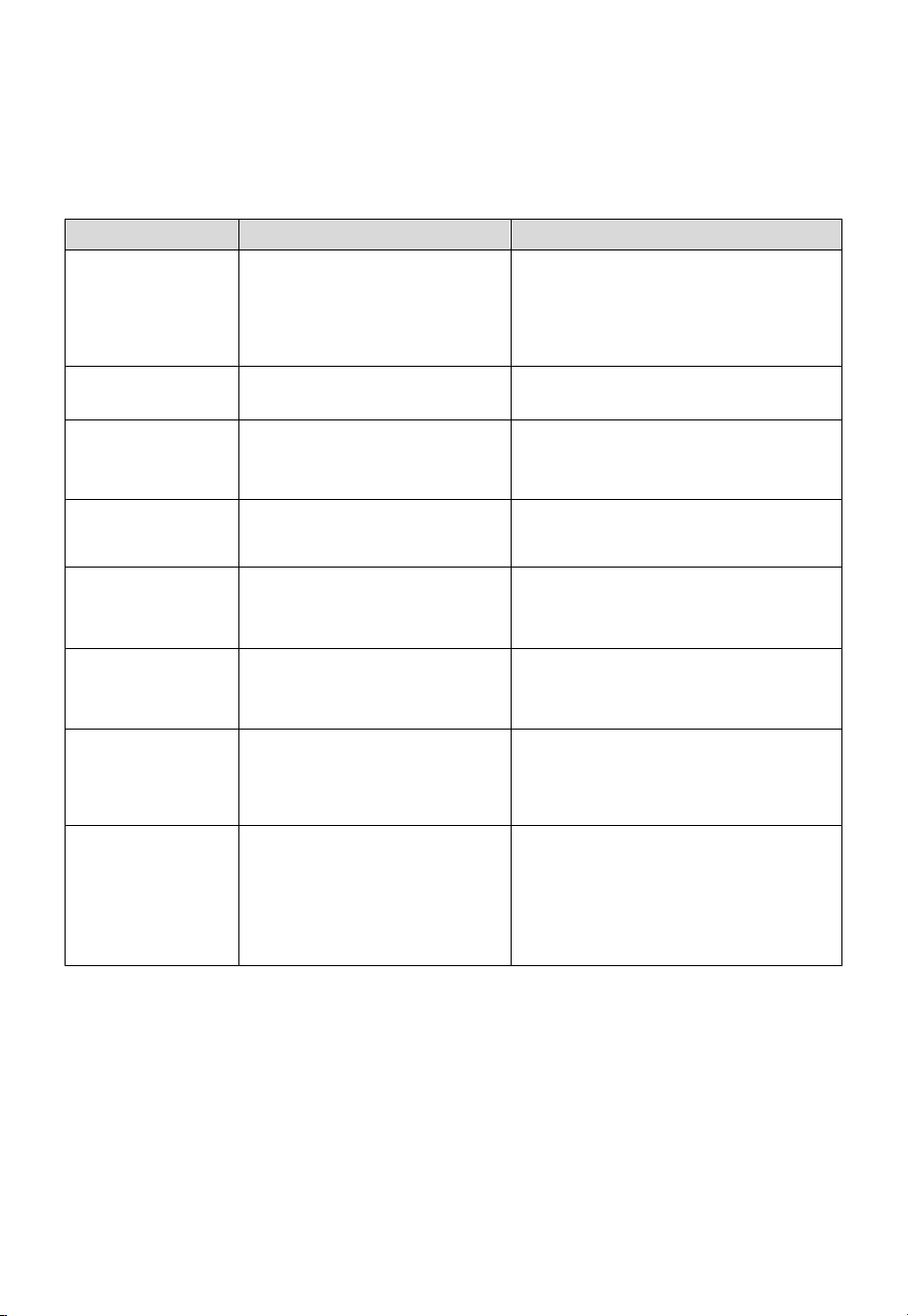
The operation of your appliance can lead to faults and malfunctions. The following tables contain
possible causes and instructions for rectifying an error message or fault. It is recommended that you
read the following tables carefully to save time and money that a call to customer service can cost.
Problem
Possible causes
What to do
The hob cannot be
switched on.
No power.
Make sure that the ceramic hob is connected to
the mains and switched on.
Check if there is a power cut in your house or
area. If you have checked everything and the
problem persists, call a qualified technician
The touch controls do
not respond.
The controls are locked.
Unlock the controls. Refer to the "Using the
Cooktop" section for instructions
The touch controls are
difficult to operate.
There may be a light film of water
on the controls or you may be
touching the controls with your
fingertip.
Make sure the area around the controls is
dry and touch the controls with the pad of
your finger.
The glass is scratched.
Coarse-edged cookware. Unsuitable,
abrasive scouring or cleaning agents
are being used.
Use cookware with flat and smooth bases. See
"Choosing the right cookware".
See "Cleaning and maintenance".
Some pans make
crackling or clicking
noises.
This may be caused by the
construction of your cookware
(layers of different metals that
vibrate differently).
This noise is normal for cookware and does not
indicate a fault.
The induction hob
makes a low humming
noise when it is
operated at a high level.
This is due to the technology of
induction cooking
This is normal, but the noise should become
quieter or disappear completely if you reduce
the heat setting
Blowing noises from the
induction hob.
A cooling fan built into your induction
hob has switched on to protect the
electronics from overheating. It may
continue to run even if you have
switched off the induction hob
This is normal and does not require any
action. Do not switch the induction hob off at
the wall while the fan is running.
Pans do not get hot and
do not appear in the
display
The induction hob cannot recognise
the pan because it is not suitable
for induction cooking.
The induction hob cannot detect
the pan because it is too small for
the cooking zone or is not correctly
centred on the cooking zone.
Use cookware suitable for induction cooking.
See section "Choosing the right cookware".
Place the pan in the middle and make sure that
its base corresponds to the size of the cooking
zone
30
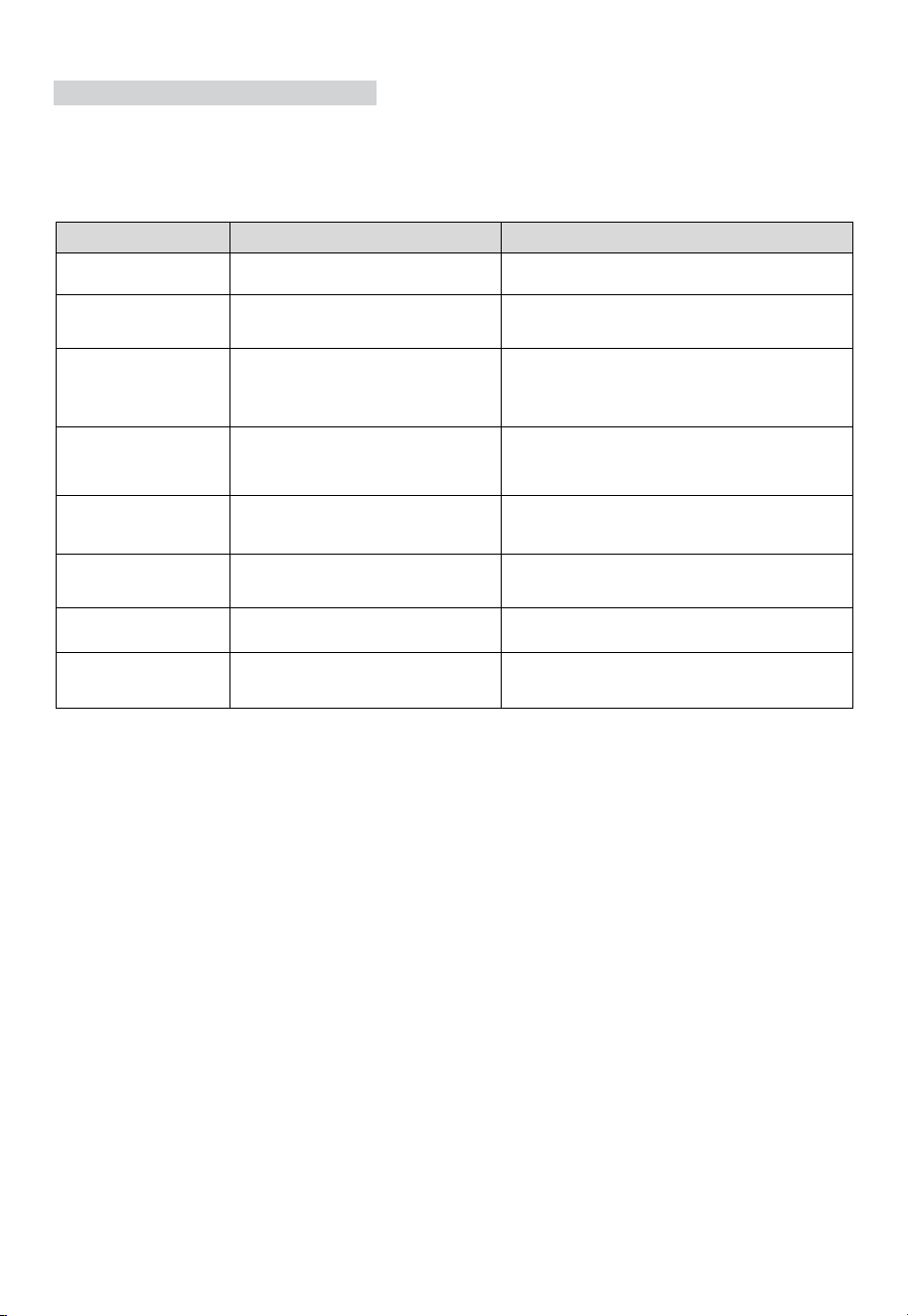
Failure Display and Inspection
The induction hob is equipped with a self-diagnostic function. This test allows the technician to check
the function of various components without removing the hob or taking it off the Kitchen Worktop
.
(1)
Troubleshooting
Problem
Possible causes
What to do!
E1, E2, E7
Failure of the temperature sensor
•
Please contact the supplier.
E3, E4
Failure of the temperature sensor of
the IGBT
•
Please contact the supplier.
EU
The connection between the display
board and the main board has failed
or the communication of the touch IC
has failed
•
Please contact the supplier.
EL / EH
Abnormal supply voltage.
•
Please check whether power supply is normal.
•
Switch on the appliance if the power supply is
OK.
C1
The temperature sensor of the glass
ceramic plate is too high
•
Please restart the appliance after the induction
hob has cooled down
C2
The temperature sensor of the IGBT
is too high
•
Please restart the appliance after the induction
hob has cooled down
F5
Abnormality of the fan.
•
Please contact the supplier.
EF
Two or more buttons are triggered
over a long period of time.
•
Cleaning the operation area
31
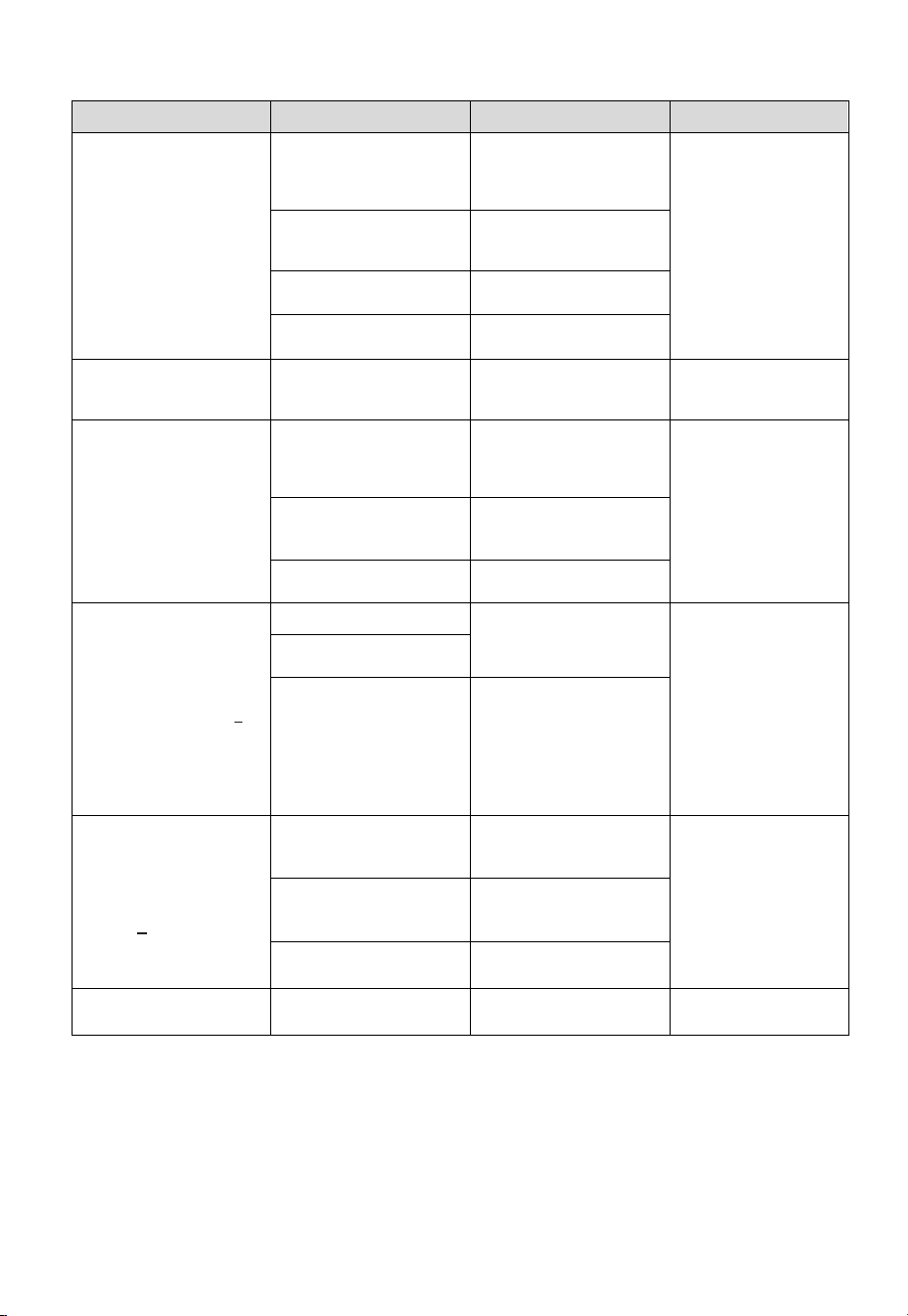
(2)
Specific Failure & Solution
Failure
Problem
Solution
A
Solution B
The LED does not light up
when the device is
plugged in
No power supply.
Check that the plug is
firmly seated in the socket
and that the socket is
working
The additional board and
the display board are
defective
Check the connection.
The additional power
board is damaged.
Replace the additional
circuit board
The display board is
damaged.
Replace the display board.
Some buttons do not work
or the LED display is not
normal
The display board is
damaged.
Replace the display board.
The cooking mode
indicator lights up, but the
heating process does not
start
High temperature of the
hob.
The ambient temp. may be
too high. The air inlet or
ventilation may be blocked
Something is wrong with
the fan.
Check whether the fan runs
properly, if not, replace the
fan.
The power board is
damaged.
Replace the power board.
The heating process is
suddenly interrupted
during operation and
“u”
flashes on the display
.
The pan type is wrong.
Use the correct pot (see
instructions for use)
Pan detection circuit is
damaged, replace the
motherboard.
The pot diameter is too
small.
The hob has overheated;
The appliance has
overheated. Wait until the
temperature returns to
normal.
Press the “ON/OFF”
button to restart the
appliance
Heating zones on the
same side (e.g. the first
and second zones) would
display “
u
”.
The power supply board
and the display board are
not connected
Check the connection.
The display board of the
communication part is
damaged
Replace the display board.
The Main board is
damaged.
Replace the power board.
The fan motor makes
unusual noises
The fan motor is
damaged.
Replace the fan.
The above points are the assessment and verification of common faults.
Please do not dismantle the appliance yourself to avoid danger and damage to the induction hob.
32
9. DISPOSAL
AND RECYCLING
Important instructions for environment
C
ompliance with the WEEE Directive and disposal of waste equipment:
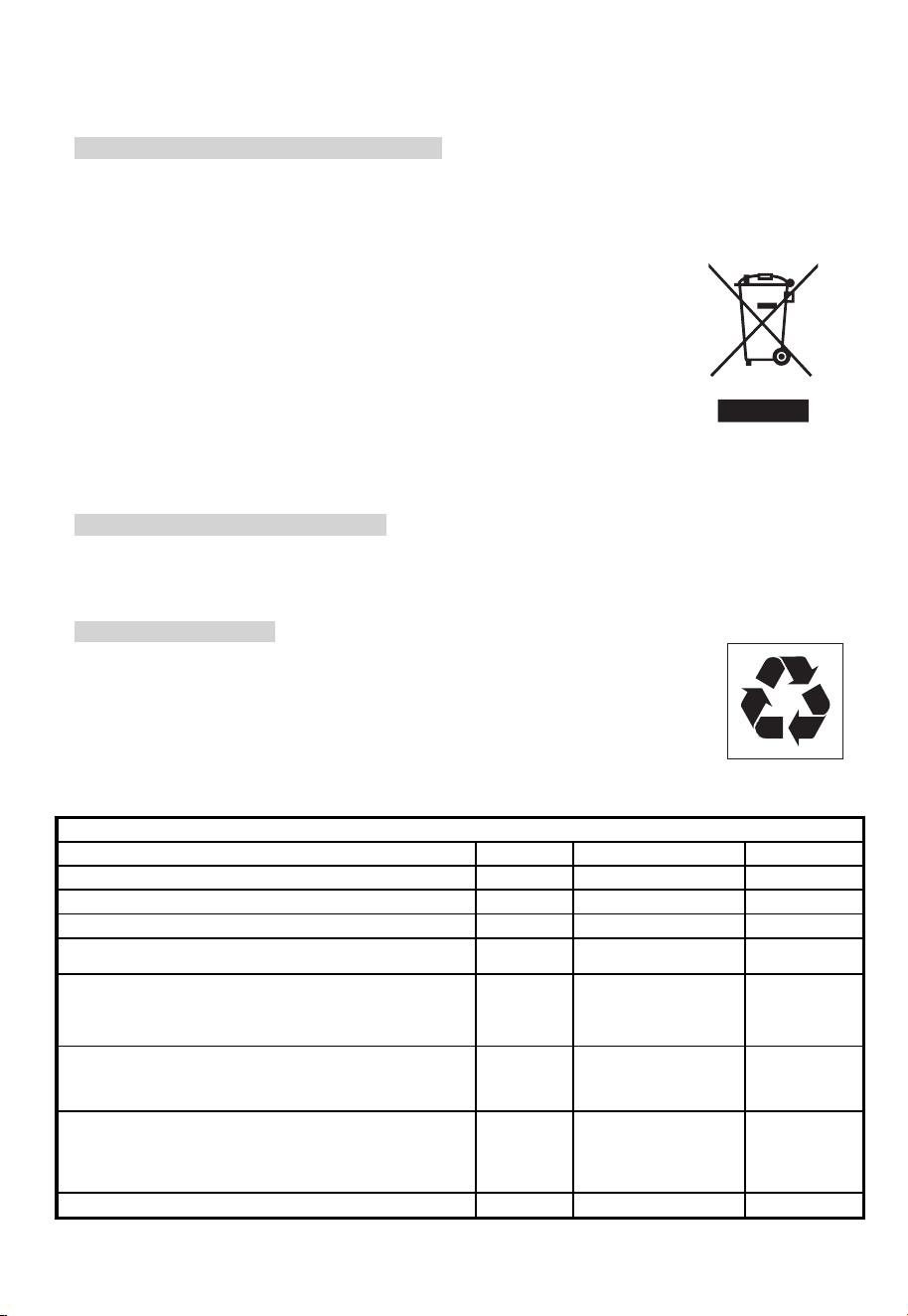
This product complies with the EU WEEE Directive (2012/19/EU). This product bears a
classification symbol for waste electrical and electronic equipment (WEEE).
This symbol indicates that this product must not be disposed of with other
household waste at the end of its useful life. The used appliance must be
taken to an official collection point for the recycling of electrical and electronic
equipment. To find these collection points, please contact your local
authorities or the retailer where you purchased the product.
Every household plays an important role in the recovery and recycling of old
appliances.
Proper disposal of old appliances helps to prevent possible negative consequences for the
environment and human health.
Com
pliance with RoHS Directive
Th
e product you have purchased complies with the EU RoHS Directive (2011/65/EU). It does not
contain any harmful and prohibited materials listed in the directive.
P
ackage information
Th
e packaging materials of the product are made of recyclable materials in
accordance with our national environmental regulations. Do not dispose of the
packaging material together with household waste or other waste. Take them to the
collection points for packaging materials designated by the local authorities.
33
Table. 5a Regulation (EU) No 66/2014
Symbol Value Unit
Model identification
HI6442BSCE
Type of hob
Built-in hob
Number of cooking zones and/or areas
4 zones
Heating technology (induction cooking zones and cooking areas,
radiant cooking
zones, solid plates)
Induction cooking zones
For circular cooking zones or area: diameter of useful surface area per
electric heated cooking zone, rounded to the nearest 5 mm
Ø
zone 1:18.5
zone 2:18.5
zone 2:18.5
zone 2:18.5
N/A
cm
L
W
Energy consumption per cooking zone or area calculated per kg
EC
electric cooking
zone 1:175.4
zone 2:179.0
zone 2:179.2
zone 2:186.0
Wh/kg
Energy consumption for the hob calculated per kg
EC
electric hob
179.9
Wh/kg
Information for domestic electric hobs
For non-circular cooking zones or areas: length and width of useful
surface area per electric heated cooking zone or area, rounded to the
nearest 5 mm
cm