

About this document
This manual is intended for administ r a tors and users of the AXIS P72 14
Video Encoder, and is applicable to firmware 5.40 and later. It includes
instructions for using and managing the product on your netwo rk.
Previous experience of networking will be of use when using this
product. Some knowledge of UNIX or Linux-based systems may also be
beneficial, for developing shell scripts and applications. Later version of
this document will be posted to the Axiswebsite,asrequired.Seealso
the product’s online help, available via the web-based interface.
Liability
Every care has been taken in the preparation of this manual. Please
inform your local Axis office of any inaccuracies or omissions. Axis
Communications AB cannot be held responsible for any technical or
typographical errors and reserves the right to make changes to the
product and manuals w ithout prior notice. Axis Communications AB
makes no w arranty of any kind with regard to the material contained
within this document, including , but not limited to, the implied
warranties of merch antability and fitnes s for a partic u lar purpose. Axis
Communications AB shall not be liable nor responsible for incidental or
consequential damages in connection with the furnishing, performance
or use of this mat erial. Th is product is only to be used for its intended
purpose.
Intellectual Property R ights
Axis AB has intellectual property rights relating to technology embodied
in the product described in this document. In particular, and without
limitation, these intellectual property rights may inclu de one or more
of the patents listed at h ttp://www.axis.com/patent.htm and one or
more additional patents or pending pat e nt applications in the US and
other countries.
This product contains licensed third-party software. See the menu item
“About” in the product’s user interface for more information.
This product contains source code copyright Apple Computer,
Inc.,underthetermsofApplePublicSourceLicense2.0(see
http://www.opensource.ap ple.com/apsl). The source code is available
from http://develo per .apple.com/darwin/p rojects/bonjour/
Equipment Modifications
This equipment must be installed and used in strict accordance with the
instructions given in the user documentation. This equipment contains
no user-serviceable co mponents. Unauthorized equipment changes o r
modifications will invalidate a ll applicable regulatory certifi cations
and approvals.
Trademark Acknowledgments
Apple, Boa, Bonjour, Ethernet, Interne t Explorer, Linux, Microsoft,
Mozilla, Real, SMPTE, QuickTime, UNIX, Win dows, Windows Vis ta and
WWW are registered trademarks of the respe ctive holders. Java and
all Java-based trademarks and logos are trademarks or registered
trademarks of Oracle and/or its affilia tes. UPnP
TM
is a cer tific
ation
mark of the UPnP
TM
Implementers Corporation.
Support
Should you require any technical assistance
,pleasecontactyourAxis
reseller. If your questions cannot be answered immediately, your
reseller will forward your queries through the appropriate channels to
ensure a rapid response. If you are connec
tedtotheInternet,youcan:
• download user documentation and software updates
• find answers to resolved problems in the FAQ database. Search
by product, category, or phrase
• report problems to Axis support staff by logging in to your private
support area
• chat with Axis support staff (se lected countries only)
• visit Axis Support at www.axis.com/techsup/

AXIS P7214 Video Encoder
Table of Contents
HardwareOverview .......................................... 4
Connectors .................................................... 4
LEDIndicators .................................................. 5
AccessingtheProduct ....................................... 6
AccessfromaBrowser ........................................... 6
AccessfromtheInternet .......................................... 7
SettheRootPassword ........................................... 7
TheLiveViewPage .............................................. 8
MediaStreams ............................................. 11
HowtoStreamH.264 ............................................ 11
MJPEG ........................................................ 11
AXISMediaControl(AMC) ........................................ 11
AlternativeMethodsofAccessingtheVideoStream .................... 12
AccessingAudioStreams ......................................... 13
SettingUptheProduct ...................................... 14
BasicSetup .................................................... 14
VideoandAudio ............................................ 15
VideoStream ................................................... 15
Quadstream ................................................... 16
Stream Profiles ................................................. 16
CameraSettings ................................................ 17
PrivacyMask ................................................... 17
Overlay ........................................................ 17
AudioSettings .................................................. 18
AudioClips .................................................... 20
Live View Config ............................................ 21
PTZ(PanTiltZoom) ......................................... 24
PresetPositions ................................................. 24
Advanced ...................................................... 24
ControlQueue .................................................. 25
Detectors .................................................. 26
CameraTampering .............................................. 26
MotionDetection ............................................... 26
AudioDetection ................................................ 28
Events .................................................... 29
SettingUpanActionRule ........................................ 30
Recipients ..................................................... 30
Schedules ...................................................... 31
Recurrences .................................................... 31
Recordings ................................................. 32
RecordingList .................................................. 32
ContinuousRecording ............................................ 32
SystemOptions ............................................. 34
Security ....................................................... 34
Date&Time .................................................... 35
Network ....................................................... 36
Storage ....................................................... 40
Ports&Devices ................................................. 41
Maintenance ................................................... 42
Support ....................................................... 43
Advanced ...................................................... 44
ResettoFactoryDefaultSettings ................................... 44
Troubleshooting ............................................ 45
CheckingtheFirmware ........................................... 45
UpgradingtheFirmware .......................................... 45
EmergencyRecoveryProcedure .................................... 45
Symptoms,PossibleCausesandRemedialActions ..................... 46
Technical Specifications ...................................... 50
PerformanceConsiderations ....................................... 51
3
AXIS P7214 Video Encoder
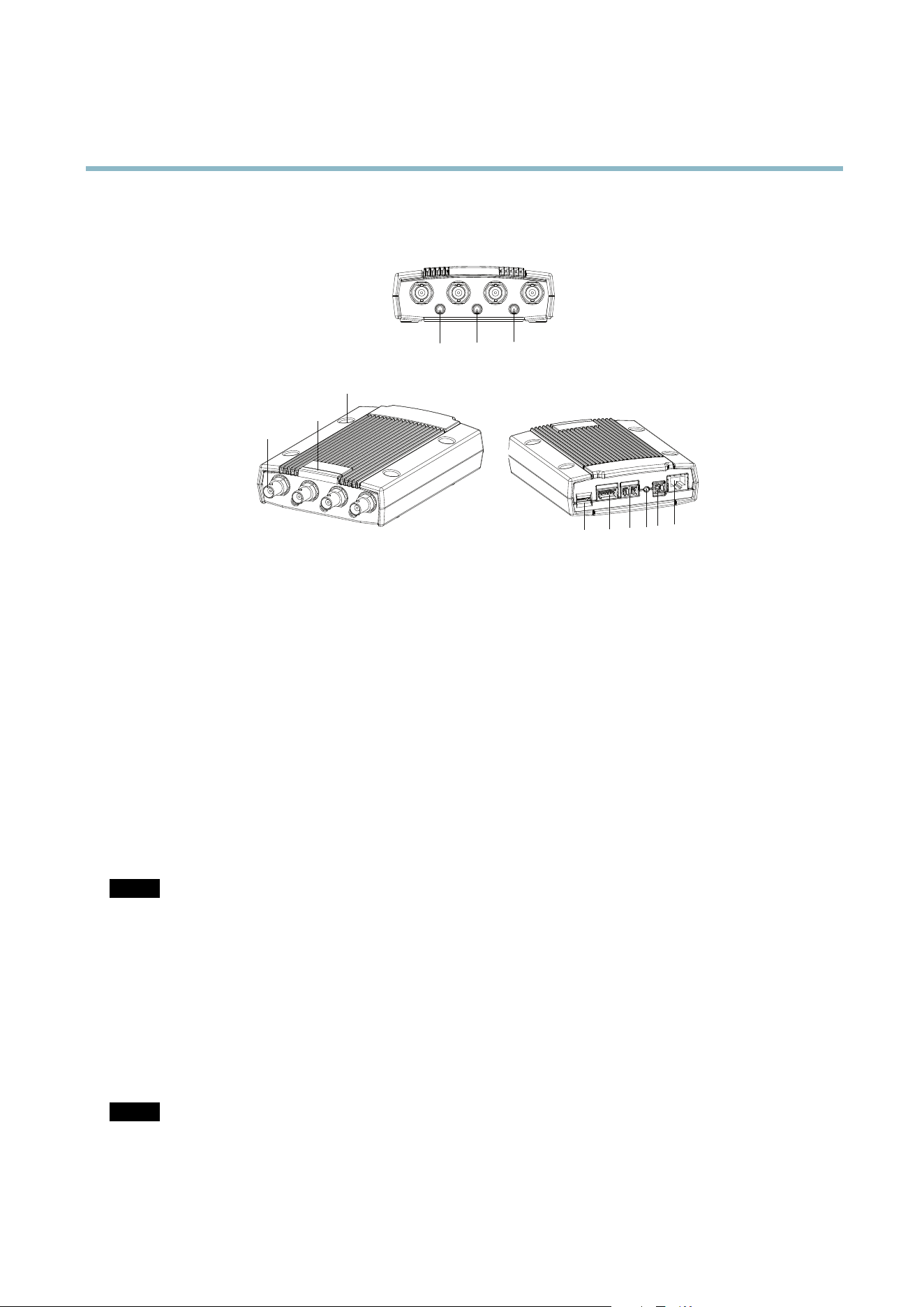
Hardware Overview
Hardware Overview
2
3
4
1
IN 1 IN 2 OUT 1
1
2
3
4
5
6
7
8
9
10
11
12
1.
Audio input 1
2.
Audio input 2
3.
Audio output 1
4.
Video input connectors
5.
LED indicators for po wer, status, network
6.
Mounting holes
7.
SD card slot (microS D)
8.
I/O connector
9.
RS-485/RS-422 connector
10.
Control button
11.
Power connector
12.
Network connector (PoE)
Connectors
For technical specifications, see
page 50
.
Network connector - RJ-45 Ethernet connector. Supports P ower over Ethernet (PoE).
NOTICE
Due to local reg u lations or the environmental a nd electrical conditions in which the product is to be use d, a shielded
network cable (STP) may be appropriate or required. Any netw ork cab les that are routed in ou tdoor environments or similar
shall be shielded (STP) and intended for their specific use. Make sure that the network switch is properly grounded. See
for regulatory requirements.
Audio in (pink) - 3.5 mm input for a mono microphone, or a line-in mono signal (left channel is used from a stereo signal).
Audio out (green) - 3.5 mm output for audio (line level) that can be connected to a public address (PA) system or an active s peaker
with a built-in amplifier. A stereo connector must be used for audio out.
SD card slot - A standard or high-capacity SD card (not included) can be used for local recording with removable storage.
N
OTICE
To prevent corruption of recordings, the SD card should be unmounted before removal. To unmount, go to Setup > System
Options > Storage > SD Card and click Unmount.
4

AXIS P7214 Video Encoder
Hardware Overview
Control button - The control button is used for:
• ConnectingtoanAXISVideoHostingSystemservice.See
page 37
. To connect, press and hold the button for about
1 second until the Sta tus LED flashes green.
• ConnectingtoAXISInternetDynamicDNSService. See
page 37
. To connect, press and hold the button for
about 3 seconds.
• Resetting the product to factory default settings. See
page 44
.
Power connector - 2-pin terminal block for p ower input.
I/O terminal connector - Use in applicat ions for e.g . motion dete c tion, event triggering, time lapse recording and alarm notifications.
In addition to an auxiliary power and a GND pin, the I/O terminal connector pro vides the interface to:
• Digital output – For connecting external devices such as relays and LEDs. Connected devices c a n be activa ted by
the VAPIX® Application Programm ing Interface, output b uttons on the Live View page or by an Action Rule. The
output will show as active (shown under System Options > Ports & Devices) if the alarm device is activated.
• Digital input – A n alarm inp ut for connecting de vices that can toggle between an open and closed circuit, for
example: PIRs, door/window contacts, glass break detectors, etc. When a signal is received the state changes and
the input becom es a ctive (shown under System Options > Ports & Devices).
RS-485/RS-422 connector - Two 2- pin terminal blocks for RS-485/RS-422 serial interface used to control a uxiliary equipment,
e.g. PTZ devices.
LED Indicators
LED
Color
Indication
Green
Steady for connection to a 100 MBit/s network. Flashes for network activity.
Amber
Steady for connection to a 10 M Bit/s netwo rk. Flashes fo r network a ctivity.
Network
Unlit No network connection.
Green Steady g reen for normal operation.
Amber
Steady during startup and when restoring settings.
Status
Red
Slow flash for failed upgrade.
Green
Normal operation.
Power
Amber
Flashes green/amber during firmware upgrade.
Note
• The Status LED can be configured to be unlit d uring normal operation. To configure, go to Setup > System Options >
Ports & Devices > LED. See the online help for m ore information.
• The Status LED can be configured to flash fo r identifying the unit. Go to Setup > System Options > Maintenance .
5

AXIS P7214 Video Encoder
Accessing the Product
Accessing the Product
To install the Axis product, refer to the Installation G uide supplied with the product.
The product can be used with most operating systems and browsers. The recommended browsers are Interne t Explore r with Windows ,
Safari w ith Macintosh and Firefox with other operating systems. See
Technical Specifications, on page 50
.Toviewstreamingvideoin
Internet Exp lore r, allow install ation of AXIS Media Control (AMC) when prompted.
Note
• QuickTime
TM
is also supported for viewing H.264 streams and for audio.
• If your computer restricts the use of additional software components, the product can b e configured to use a Java
applet for v iewing Motion JPEG.
Access from a Browser
1. Start a browser (Internet Explorer, Firefox, Safari).
2. Enter the IP address or host name of the Axis product in the browser’s Location/Address field. To access the product from a
Macintosh computer (Mac OS X), click on the Bonjour tab and select the product from the drop-down list.
If you do not know the IP address, use A XIS IP Utility to locate the product on the netw ork. For more informa tion on how to
discover and assign an IP address, refer to the Installation Guide.
3. Enter your user name and password. If this is the first time the product is accessed , the root passw ord must first be
configured; for instructions see
Set the Root Password, on page 7
.
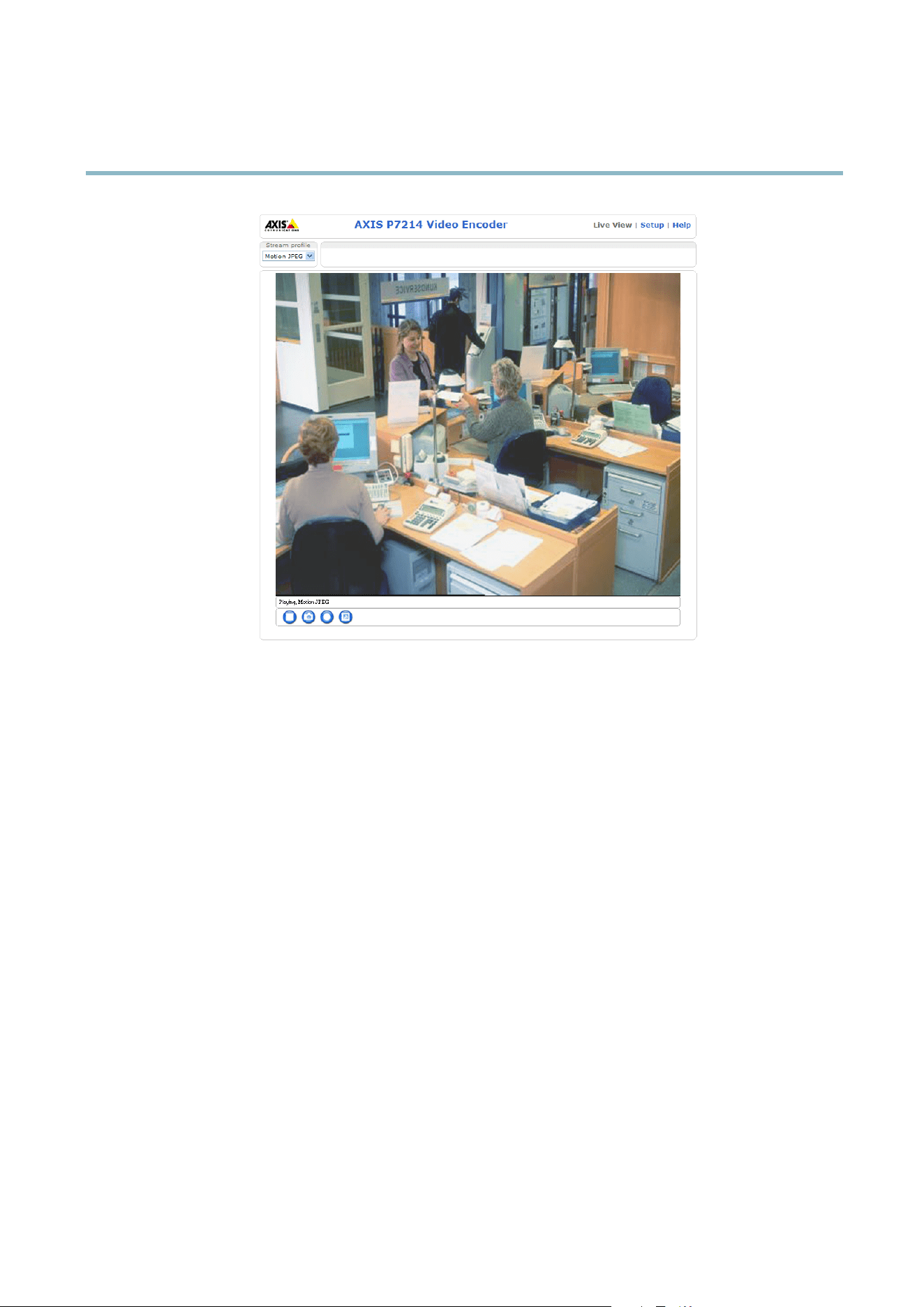
4. The product’s Live View page appears in your browser.
Note
The controls a nd layout of the Live View page may have been customized to meet specific installation require ments and
user preferences. Consequently, some of the examples and functions featured here m a y differ from those displayed in
your own Live View page.
6
AXIS P7214 Video Encoder
Accessing the Product
Access from the I nternet
Once connected, the Axis product is accessible o n your local network (LAN). To access the product from the Inter n et you must
configure your netw ork router to allow incoming data traffic to the product. To do this, enable the NAT-traversal feature , which
will attempt to automatically configure the route r to allow access to the product. This is e nable d f rom Setup > System Options >
Network > TCP/IP Advanced.
For m o re information, please see
NAT traversal (port mapping) for IPv4, on page 38
. See also AXIS Internet Dynamic DNS Service at
www.axiscam.net For Technical notes on this and other topics, v isit the Axis Support w eb at ww w.axis.com/techsup
Set the Root Pa ssword
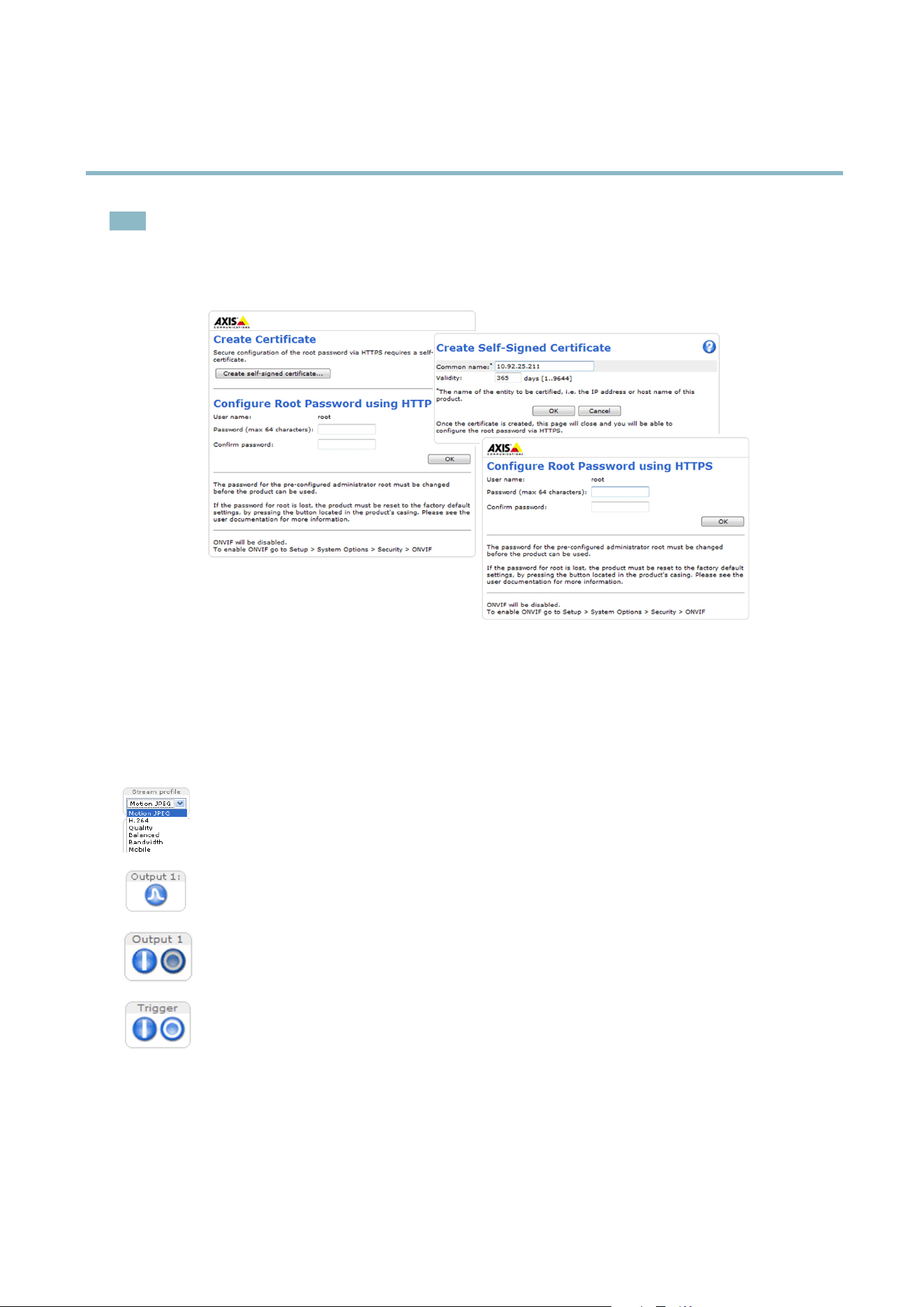
To gain access to the Axis product, you must set the password for the default administrator user root. This is done in the Configure
Root Password dialog, which appears when the pro
duct is accessed for the first time .
To prevent network eavesdropping
, the root password can be set via an encrypted HTTPS connection, which requires an H TTPS
certificate. HTTPS (Hypertext Transfer Protocol over SSL) is a protocol used to encrypt traffic between web browsers and servers. The
HTTPS certificate ensures encrypted exchange of information.
To set the password via a standard HTTP connection, enter it directly in the firs t dialog.
To set the password via an encrypted HTTPS connection, follow these steps:
1. Click Create self-signed certificate.
2. Provide the requested information and click OK.Thecertificate is created and the password can now be set securely. All
trafficto
and from the prod uct is encrypted from this point on.
3. Ente
rapasswordandthenre-entertoconfirm the spelling. Click OK. The password has now been configured.
7
AXIS P7214 Video Encoder
Accessing the Product
Note
• The default administrator user name root is permanent and cannot be deleted.
• If the passw ord for root is lost, the product must be reset to the factory default settings. See
Reset to Factory Default
Settings, on page 44
.
TheLiveViewPage
The controls and layout of the Live View page may have been customized to meet specific installation requirements and user
preferences. Consequently, some of the examples and functions featured here may differ from those displayed in your own Live View
page. The following provides an overview of each available control.
Controls on the Live View Page
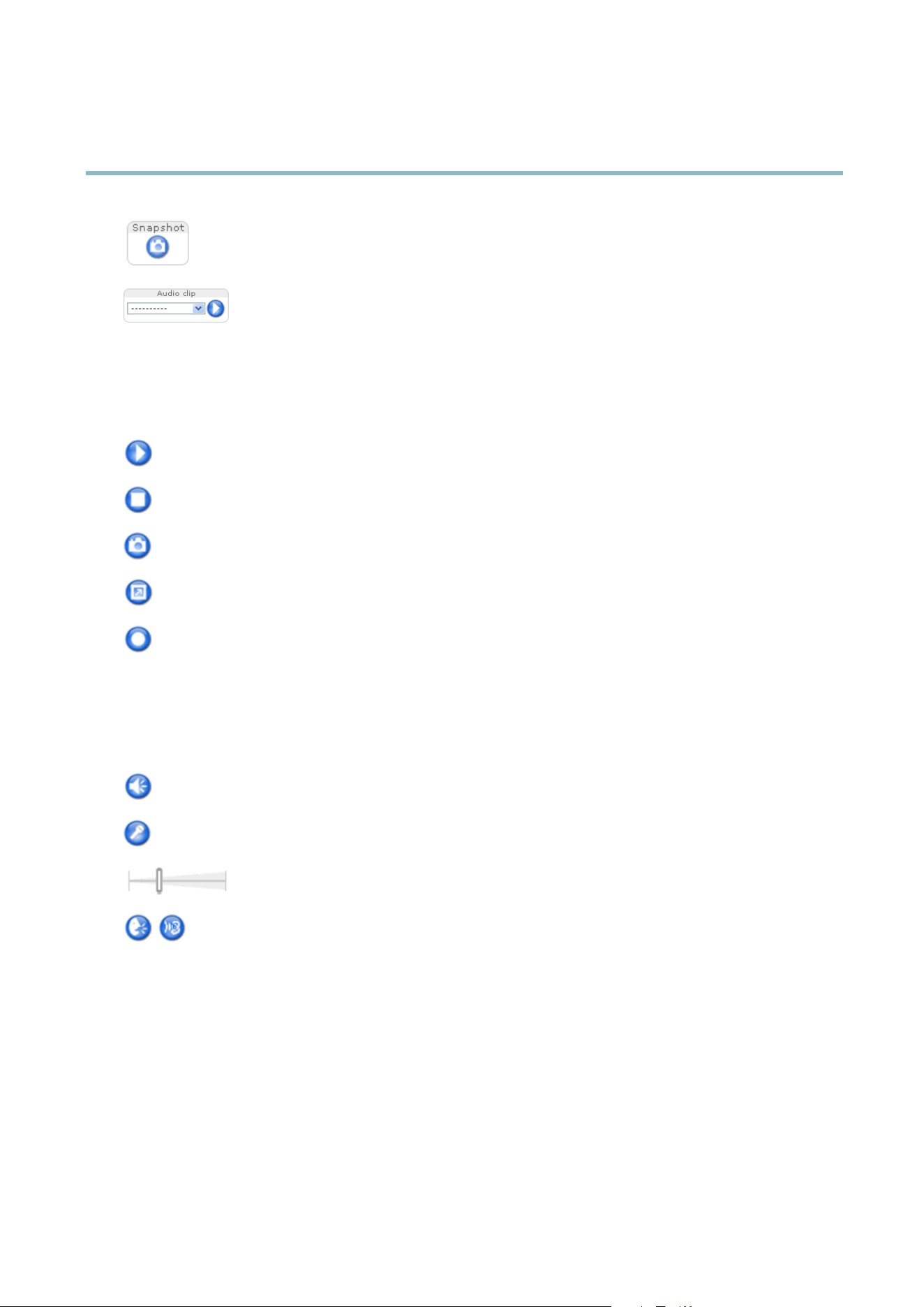
The Stream Profile drop-down list allows yo u to select a customized or pre-pro grammed stream profile. Stream
profiles are configured under Video & Audio > Stream Profiles.See
Stream Profiles, on page 16
.
Click Pulse to activate the output for a defined period of tim e , such as switching on a n ex ternal light for 20 seconds.
Click the Active/Inactive buttons to m anu
ally start and stop a connected device — e.g. switch an external light
on and off.
The Manual Trigger button is used to trigger an action rule from the Live View page, see .
8
AXIS P7214 Video Encoder
Accessing the Product
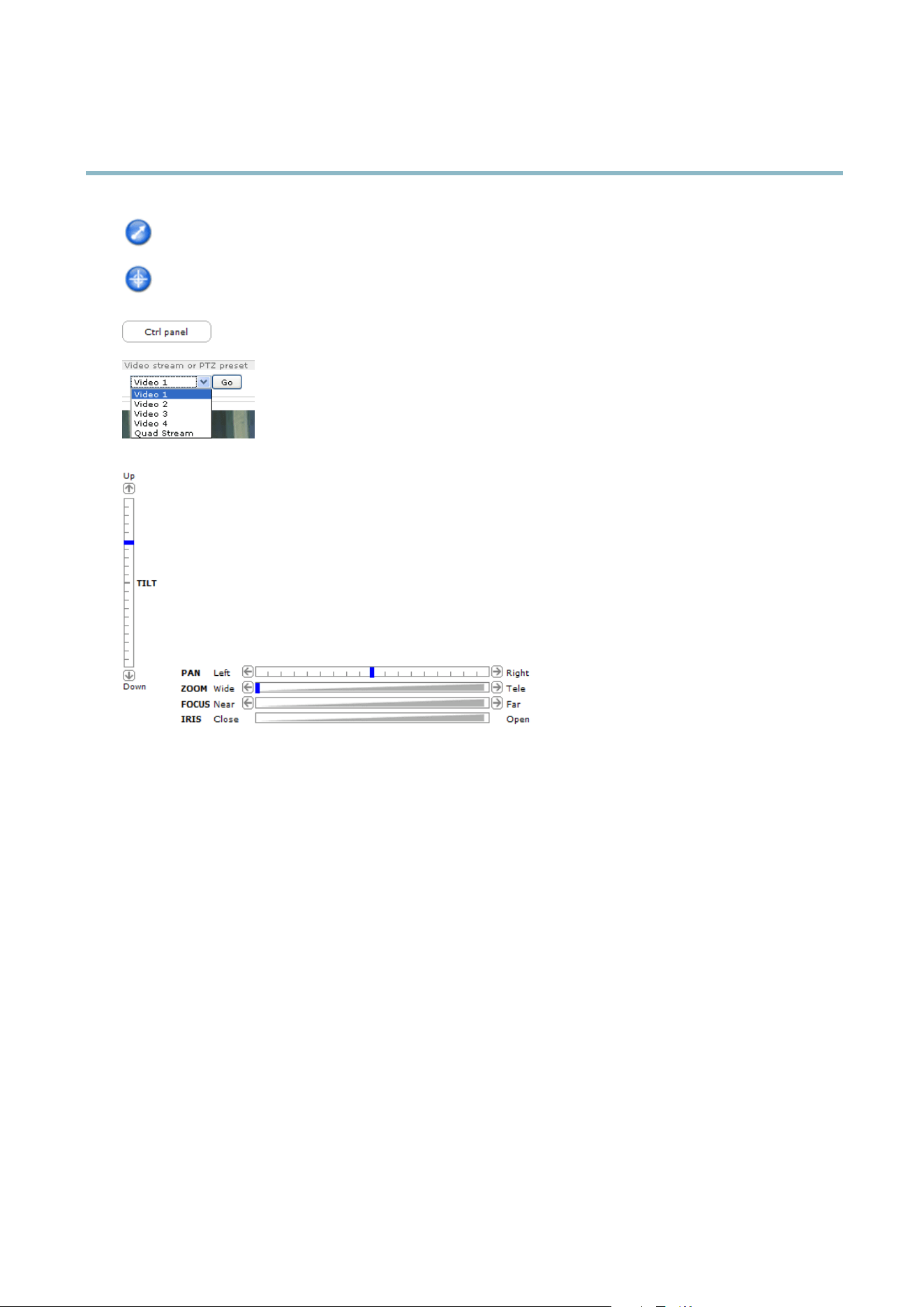
Click Snapshot to save a snapshot of the video image. Right-click the video image to sa ve it in JPEG format on your
computer. This button is primarily intended for use when the AXIS M e dia Control viewer toolbar is not available.
Enable this button from Live View Config > Action Buttons.
The Audio clip drop-down list allows you to play an audio c lip from the L ive View page. Select the aud io
clip and click the Play button.
AXIS Med ia Control viewer toolbar
The AXIS Med ia Control viewer toolb ar is available in Internet Explore r only. See
AXIS Media Control (AMC), on page 11
for more
information. The toolbar displays the following buttons:
The Play button connects to the Axis product and starts playing a media stream.
The Stop button stops the media stream.
The Snapshot button takes a snapshot of the video image. The locationwheretheimageissavedcanbespecified
in the AMC Control Panel.
Click the View Full S creen button and the video image will fill the entire screen. Press ESC (Escape) on the computer
keyboard to cancel full screen view.
The Record button is used to record the current video stream . The location where the recording is saved can be specified
in the AMC Control Panel.
AMC Audio Controls
AMC audio buttons control the speakers and micro phone connected to the client computer. The buttons are only visible when
audio is enabled.
Speaker button — Click to turn the speakers on or off.
Microphone button – Click to mute or unmute the microphone. In
Simplex - speaker only mode
,theMicrophone and Talk
buttons must both be a ctive to send audio to the Axis product. Click either button to s top audio transmission.
Use the slider to control the volume of the speakers and the microphone.
Half-duplex mode
The Talk /Listen button is used to switch betw
een sending and receiving audio. The button can be configured
from the Audio tab in the AMC Control panel:
• Push-To-Talk mode: Click and hold the button to talk/send. Release the button to listen.
• Toggle mode: Click once to switch betwee
n talking and listening.
Simplex – speaker only mode
To send audio, the Talk and Microphone buttons must both be active. Click e ither button to stop audio
transmission.
PTZ Controls
TheLiveViewpagealsod
isplays Pan/Tilt/Zoom (PTZ) controls. The a dministrator can enable/disable controls for specified users under
System Options > Security > Users.
With the PTZ Control Queue enabled the time each user is in control of the PTZ settings is limited. Click the buttons to request or
release control of the PTZ controls . The PTZ Control Queue is set up under PTZ > Control Queue.
9
AXIS P7214 Video Encoder
Accessing the Product
Click the Emulate joystick mode button and click in the image to move the camera view in the direction of the
mouse pointer.
Click the Center mode button and click in the image to center the ca mera view on that position. The center mode
button could also be used to zoom in on a specific area. Click in the i m age and drag to draw a re cta n gle s urroundi n g
theareatobemagnified. To zoom out, rotate the mouse wheel.
Click the Ctrl panel button to open the PTZ control panel which provides additional PTZ controls.
User-defined buttons can also appear in the Control panel. See
Controls, on page 25
.
Select the video channel or a PTZ preset position to steer the camera view to the saved position. See
Preset Positions, on page 24
.
Pan and Tilt bars – Use the arrow s to pan and tilt the camera view, or click on a position on the bar to steer the
camera view to that position.
Zoom bar – Use the a rro ws to zoom in and o ut, or click on a position on the bar to zoom to that position.
Focus bar – Use the arro ws to focus the camera, or click on a position o n the bar to set the focus position. Using the
focus bar will d isable the product’s autofocus. To re-enable, use the PTZ control panel which is opened by clicking
the Ctrl panel button (see above).
Iris bar – Click on a position on the iris bar to change the de gre e to which the iris is opened. This will dis ab le the
product’s auto iris. To re-enable, us e the PTZ control pa ne l which is ope ned b y clicking the Ctrl panel button (see above).
The PTZ controls can be disabled under PTZ > Advanced > Controls,see
Controls, on page 25
.
10

AXIS P7214 Video Encoder
Media Streams
Media Streams
The Axis product provides several audio and video stream formats. Your requirements and the properties of your network will
determine the type you use.
The Live View page in the product provides access to H .264 and Motion JPEG video streams, audio streamsandtothelistofavailable
stream profiles. Other applications and clients can access video and audio streams directly, without going via the Live View page.
How to Stream H.264
The video com pression standard H.264 makes good use of bandwidth, and can p rovide high quality video streams at less than 1 Mbit/s.
Deciding which combination of protocols and method s to use depend s on your viewing requirements, and on the properties of
your network. The available options in AXIS Media Control are:
Unicast RTP
This unicast method (RTP over UDP) is used
for live unicast video , especially when it is
important to always have an up-to-date video
stream, even if some images are dropped.
RTP over RTSP
This unicast method (RTP tunneled over RTSP)
is useful as it is relatively simple to configure
firewallstoallowRTSPtraffic.
RTP over RTSP over H TTP
This unicast method can be used to traverse
firewalls. Firewalls are commonly configured to
allow the H TTP protocol, thus allowing RTP to
be tunneled.
Unicasting is used for video-on-demand
transmission so that there is no video traffic
on the network until a client connects and
requests the stream.
Note that there are a maximum of 20
simultaneous unicast connections.
Multicast RTP
This method (RTP over UDP) should be used for live multicast video. The video stream is always
up-to-date, even if some images are d ropped.
Multicasting provides the m os t efficient usage of bandwidth when there are large numbers of
clients viewing simultaneously. A multicast cannot however, pass a network router unless the
router is configured to allow this. It is not possible to mul ticast over the Internet, for example.
Note a lso that all multicast viewers count as one unicast viewer in the maximum total of 20
simultaneous connections.
AXIS Media Control negotiates with the Axis product to determine the transpo rt protocol to use. The order of priority, listed in the
AMC Control Panel, can be changed and the options disabled, to s uit specific requirements.
Note
H.264 is licensed technology. The Axis product includes one H.264 viewing client license. Installing add itional unlicensed
copies of the client is prohibited. To
purchase additional licenses, contac t your Axis re se lle r.
MJPEG
This format uses standard JPEG still images for the video stream. These images are then displayedandupdatedataratesufficient
to create a stream that shows constantly updated motion.
The Motion JPEG stream uses considerable amounts o f b andw idth, but provides excellent image qualityandaccesstoeveryimage
contained in the stream. The recommended method of accessing Motion JPEG live video from the Axis product is to use the AXIS
Media Control in Internet Explorer in W ind ow s.
AXIS Media Control (AMC)
AXIS Media C ontrol (AMC) in Internet Explorer in W indow s is the recom m ended method of accessing live video from the Axis product.
11
AXIS P7214 Video Encoder
Media Streams
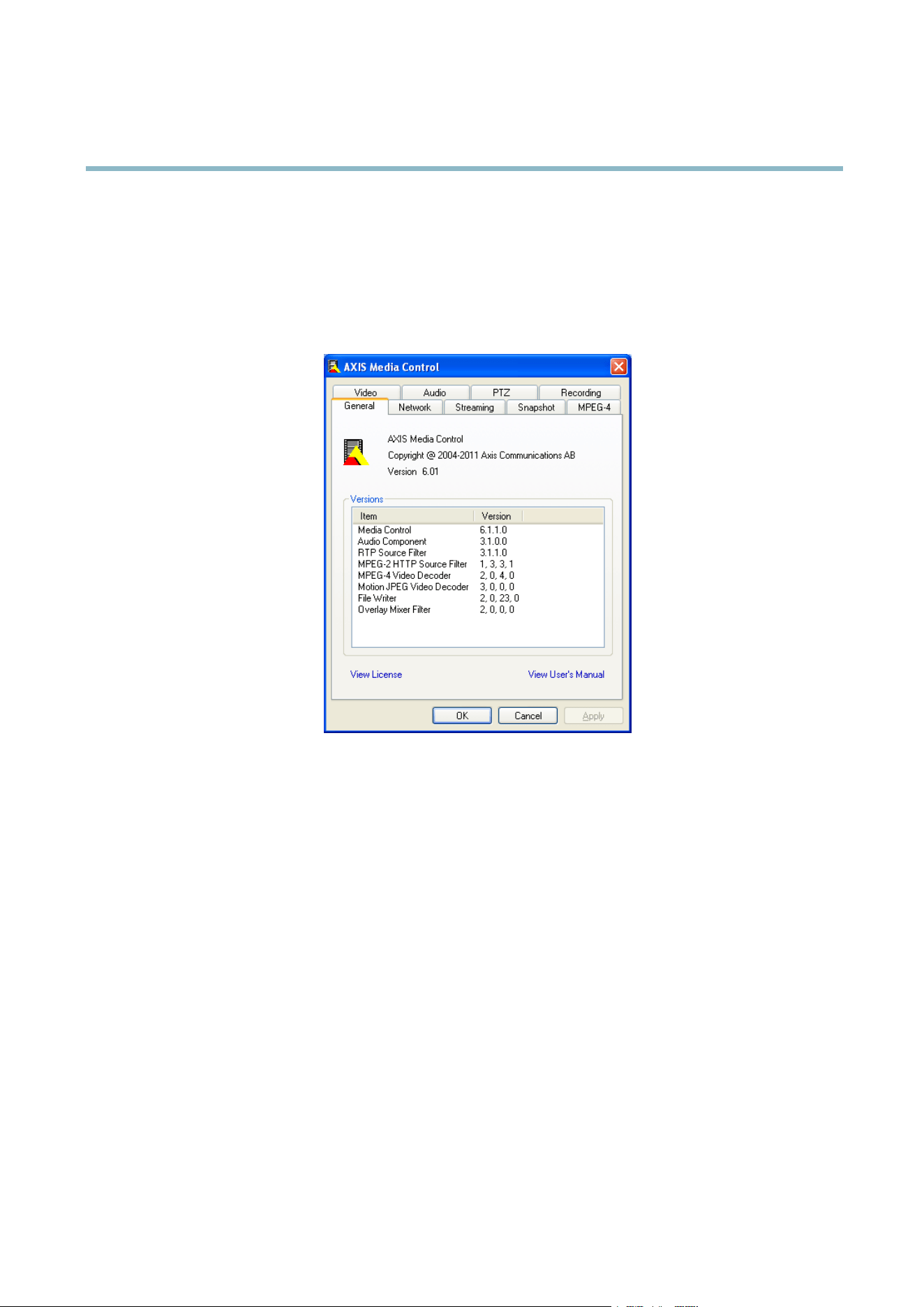
TheAMCControlPanelcanbeusedtoconfigure various video and audio settings. Please see the AXIS Media Control User’s
Manual for more information.
The A MC C o ntrol Panel is automatically instal led on first us e, after which it can be configured. Open the AMC Control Panel from:
• Windows Control Panel (from the S tart menu)
• Alternatively, right-click the video im age in Internet Explorer and click Settings.
Alternative Methods of Accessing the Video Stream
You can also access vide o and images from the Axis product in the following ways:
• Motion JPEG server push (if supported by the client, Firefox, for example). This option maintains an op en HTTP co nnection
to the b row s er and sends data as a nd when requi red , for as long as required .
• Still JPEG images in a browser.Enterthepathhttp://<ip>/axis-cgi/jpg/image.cgi
• Windows Media Player. This requires AXIS M edia Control and the H.264 decoder to be installed. The following paths
can be used:
- Unicast via RTP: axrtpu://<ip>/axis-media/media.amp
- Unicast via RTSP: axrtsp://<ip>/axis-media/media.amp
- Unicast via RTSP, tunneled via HTTP: axrtsphttp://<ip>/axis-media/media.amp
-Multicast:axrtpm://<ip>/axis-media/media.amp
• QuickTime
TM
. The following paths can be used:
- rtsp://<ip>/axis-media/media.amp
- rtsp://<ip>/axis-media/media.3gp
12

AXIS P7214 Video Encoder
Media Streams
Note
• <ip>= IP addess
• The Axis pro duct supports QuickTime 6 .5.1 and later.
• QuickTime adds latency to the video stream.
• It may be possible to use other players to view the H.264 stream using the paths above, although Axis does not guarantee
this.
Accessing Audio Streams
The L ive View page provide s access to audio through AXIS Media Control; in addition audio can be acce s sed in the following ways:
• VAPIX® Application Programming Interface (API) For more information, visit www.axis.com/developer
• Windows Media Player supports simplex audio. The follo wing paths can be used:
- Unicast via RTP: axrtpu://<ip>/axis-media/media.amp
- Unicast via RTSP: axrtsp://<ip>/axis-media/media.amp
- Unicast via RTSP, tunneled via HTTP: axrtsphttp://<ip>/axis-media/media.amp
-Multicast:axrtpm://<ip>/axis-media/media.amp
• QuickTime
TM
supports G.711 and AAC audio encoding. The following paths can be used:
- rtsp://<ip>/axis-media/media.amp
- rtsp://<ip>/axis-media/media.3gp
•TheJava applet supports simplex audio with G.711 encoding.
13

AXIS P7214 Video Encoder
Setting Up the Product
Setting Up the P roduct
The A xis product can be configured by u se rs with adm inistrator or operator rights. To open the product’s Setup pages, click Setup in
the top right-hand corner of the Live View page.
• Administrators have unrestricted access to all settings.
• Operators have access to all settings except System Options
See also the online help
.
Basic Setup
Basic Setup provides shortcuts to the settings thatshouldbemadebeforeusingtheAxisproduct:
1. Users. See
page 34
.
2. TCP/IP. See
page 36
.
3. Date & Time. See
page 35
.
4. Video Stream. See
page 15
.
5. Audio Settings. See
page 18
.
The Basic Setup menu can be disab led from System Options > Security > Users.
14
AXIS P7214 Video Encoder
Video and Audio
Video and Audio
The video and audio settings ca n be use d to optimize video and audio quality. You can configure the following:
• Video stream settings. See
page 15
.
•Streamprofile s. See
page 16
.
• Camera settings. See
page 17
.
• Overlay image. See
page 17
.
• Audio settings. See
page 18
.
• Audio clips. See
page 20
.
Video Stream
You can de fine the following video strea m settings from Video & Audio > Video Stream:
•Image.See
page 15
.
• H.264. See
page 16
.
•MJPEG.See
page 16
.
Note
Video stream can be configured for each channel including quad stream.
Image
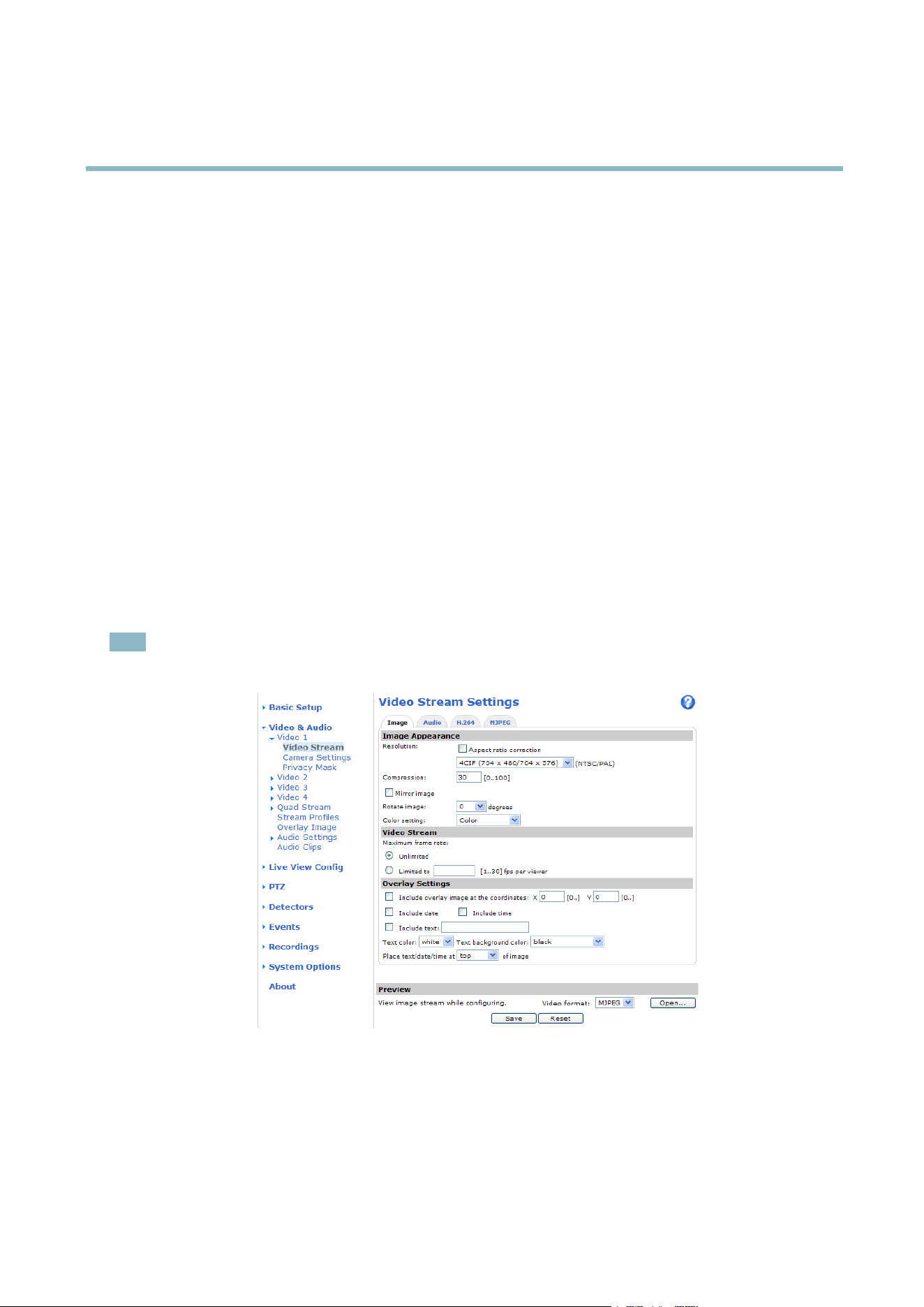
The default image s ettings can be configured und er Video & Audio > Video Stream.SelecttheImage tab.
The following settings are available:
• Resolution. Select the default resolution.
15

AXIS P7214 Video Encoder
Video and Audio
• Compression. The compression level affects the image quality, bandwidth and file size of saved images; the lower the
compression, the higher the image quality with hig her bandwidth requirements and larger file sizes.
• Rotate image. If required, the image can be rotated.
• Maximum frame rate. To avoid bandw idth p roblems, the frame rate allo we d t o e ach v ie we r ca n be lim ited .
• Overlay settings.See
Overlay, on page 17
.
Click Save to apply the new settings.
H.264
H.264, also known as MPEG-4 Part 10/AVC, is a video compression standard that provides high q uality video streams at low bit rates.
An H.264 video stream consists of different types of frames such as I-frames and P-frames. An I-frame is a comple te image wh e re as
P-frames only contain the differences from previous fram e s.
The GOV length is the number o f frames between two consecutive I-frames. Increasing the GOV length may save considerably on
bandwidth requirements in some cases, but may also have an adverse affe ct on image q uality.
ThebitratecanbesetasVariable Bit Rate (VBR) or Constant Bit Rate (CBR). VBR adjusts the bit rate according to the image
complexity, using up more bandw idth for incre ased activity in the ima ge , and less for lowe r ima ge activity. C B R allow s you to set a
fixed Target bit rate that consumes a predictable amount of bandwidth. As the bit rate would usually need to increase for increased
image activity, but in this case cannot, frame rate and image qualityareaffectednegatively.Topartly compensate for this, it is
possible to prioritize e ither frame rate or imag e q uality. Not setting a priority me ans that fram e r ate and image quality are eq ually
affected. You must save your settings before they can tak e effec t .
The current bit rate can be set to appear as text overlay. To do this, select the Include text check box option under Overlay
Settings and enter the modifier #b in the field.
MJPEG
Sometimes the image size is large due to low light or complex scenery. Adjusting the maximum frame s ize helps to c ontrol the
bandwidth and storage used by the Motion JPEG video stream in these situations.
Setting the frame size to the Default setting
provides consistently good image quality at the expense of increased band width and storage usage in low light. Limiting the frame
size optimizes bandwidth and storage usage, but may give poor image quality. To prevent increased bandwidth and storage usage,
the ma ximum f ram e size should be set to an optimal value.
Quad stream
A Quad vie w displays images fr om all four channels on a single scree n ; where the image s from each came ra take up a quar ter of
the display area. It is possible to de fine settings f or the video stream in quad view.
Stream Profiles
Astreamprofile is a s
et of pre-configured stream settings including resolution, compression, frame rate and overlay settings.
Stream profiles can b e use d:
• When setting up recording using action rules, see
Events, on page 29
.
• When setting up a continuous recording, see
Continuous Recording, on page 32
.
• In the Live View page — select the stream profi le from the Stream profi le drop-down list.
Four pre-programmed stream pro files are ava ilab le for quick set up. Each pre-programmed pro file has a d escriptive na m e, indicating
its purpose. If required, the pre-programmed stream profi les can b e mo difi ed and ne w customi z ed stre am profiles can be created.
To create a new profile or modify an existing profile, g o to Setup > Video & A udio > Stream Profiles.
To select a default s t re am profile for the Live View page, go to Setup > Live View Config.
16

AXIS P7214 Video Encoder
Video and Audio
Camera Settings
The Video & Audio > Camera Settings page provides access to ad vanced image settings for the Axis product.
Image Appearance
The image Brightness can be adjusted in the range 0–100, where a higher value produces a brighter image.
The Contrast changes the re lati ve difference between light and dark. It can be a djusted using the slidebar.
Video input
• Enter a descriptive name for your video source in the Video source name field.
• The values in the Offset Adjustments fields affect the horizontal and vertical synchroniz ation for the image. This can be used
to eliminate any black border surrounding the image. High values, both ne gative and positive c a n put the image out of sync.
• De-interlacing - is used to improve video stream image quality from analog d evice s. Select a n y o f the f ollowing options
from the De-interlacing drop-down list. Select None if de-interlacing is not necessary; Blending for improved image quality
that is not as processor intensive; Adaptive Interpolation performs de-interlacing of the video stream by applying different
filters on the image. This may give a better result than Motion Adaptive Interpolation in rare cases; Motion Adaptive
Interpolation perfor m s de-interla cin g of the video stream by applying different filters depending on the m otion in different
parts of the image. This will in most cases re sult in the best image quality.
• Antialiasing w ill minimize distortion known as a liasing, which happens when a high-resolution im age is represented at
alowerresolution.
• For each video input 75 Ohm video termination can be enabled/disabled via the product's web page at Video & Audio >
Video Input > Video termination. These terminations are enabled on factory default. In cases w here the p roduct is to be
connected in parallel with other equipment, for optimum vide o quality, it is recom m ende d that ter m ination be e nabled for
only the last device in the video sig nal chain.
Image Settings
Noise reduction - Set to On to enable noise reduction. Noise reduction may increase the amount of motion blur.
Privacy Mask
A privacy mask is an area of solid color that prohibits users from viewing parts of the monitored area. Privacy masks cannot be
bypassed via the VAPIX® Application Pro gramming Inte rfa ce (API).
The Privacy Mask List (Video & Audio > Privacy Mask) shows all the masks that are currently configured in the Axis product and
indicates if they are enabled.
You can add a new mask, r
e-size the mask with the mouse, choose a color for the mask, and give the mask a name.
For more information, see the online help
Important
Adding many privacy masks may affect the product’s performance.
Note
Privacy mask is not available for the qua d s tream . However, privacy masks configured on each channel will be displayed
in th
equad.
Overlay
Overlays are used to provide extra information, for example for forensic video analysis or during product installation an d
configuration. Overlays are su pe rimposed over the video stream.
17

AXIS P7214 Video Encoder
Video and Audio
An overlay tex t can display the current date and time, or a text string. When using a text string, mod ifiers can be used to display
information s uch as the current bit rate or the current frame rate. For information about available modifiers, see
File Naming &
Date/Time Formats
in the online help .
To enable overlays :
1. Go to Video & Audio > Video Stream and select the Image tab.
2. To include an o verlay image, select Include overlay image at the coordinates. The overlay image must first be uploaded to
the A xis product, see
Overlay Image
.
3. To include date and time, select Include date and Include time.
4. To include a text string, select Include text and enter the tex t in the field. Modifiers can be use d, see
File Nami ng &
Date/Time Formats
in the online help .
5. Select the text color, the text background color and the position of the overlay.
6. Click Save.
Tomodifythedateandtimeformat,gotoSystem Options > Date & Time.See
Date & Time, on page 35
.
Note
Overlay is not possible for quad stream.
Overlay Image
An overlay image is a static image superimposed over the video stream. The image, for example com pany logo, is used to provide
extra information or to mask a part of the image.
To use an overlay image, the image must first be uploaded to the Axis prod uct:
1. Go to Video & Audio > Overlay Image.
2. Click Browse andbrowsetothefile .
3. Click Upload.
4. Select the image to use from the Use overlay image list.
5. Click Save.
To display the overlay image:
1. Go to Video & Audio > Video Stream and select the Image tab.
2. Under Overlay Settings,selectInclude overlay image at the coordinates and enter the X and Y coordinates.
3. Click Save.
Fo
r information about supported image formats, see the online help
.
Audio Settings
The audio functionality for each video stream is e nabled under Video & Audio > Video Stream > Audio.
Select the desired audio channel from the drop-down list.
Audio Modes
The Axis product supports the following audio modes:
18

AXIS P7214 Video Encoder
Video and Audio
Full duplex - Simultaneous two-way audio allowing the Axis prod uct to transmit and receive audio at the same time. There is no
echo cancellation; if feedback loops appear, try moving the microphone or the speaker.
Half-duplex - Audio can be transmitted to and from the Axis product but only in one direction at a time. To transmit audio using the
Live View page, use the Talk and Listen buttons, see
AMC A udio Controls, on page 9
.
Simplex — speaker only - Audio is transmitted from a client to the A xis product and c an be played by a speaker connected
to the product. To transmit a udio using the Live View page, the Talk and Microphone buttons must both be active, see
AMC
Audio Contro ls, on page 9
.
Simplex — microphone only - Audio captured by the product microphone is transmitted from the Axis product to one o r more clients.
To set the audio m ode, go to Video & Audio > Audio Settings and s elect the desired mode from the Audio mode drop-down list.
Audio Input
An external microphone or a line source can be connected to the product’s Audio -in connector. Configure the audio input settings
under Video & Audio > Audio Settings.
Source - Select Microphone for an external microphone or Line for a Line in device, e.g. an audio mixer for multiple microphones or
a microphone with a built-in amplifier.
Microphone power - The Enable microphone power o ption provides DC power f or an external microphone. Microphone power
should only be used with microphones that have no battery. This setting should not be enabled when using a dynamic or battery
powered microphone. Microp hone pow er will not harm the micro phone; if y ou are uncertain, try sw itching it off and o n. To use a
professional microphone requiring 48V phantom power, you need an external power supply and a balanced-unbalanced converter
(audio transformer) in betw e en.
Input gain - Control the volume (dB Full Scale) of the audio input. If the sound is too low, choose a higher dB, to amplify the
sound. If the sound is too high, choose a lower dB. The Level bar gives a visual representati
on of the audio signal level in dB
relative to the full-scale input level.
• Green — the signal is at a good level.
• Yellow — the signal is becoming distorted.
• Red — the signal is distorted.
Encoding - Select digital audio encoding for
mat.
• AAC requires a license for both encoding and decoding. AAC is the least complicated and most widely used codec.
If achieving the best possible audio quality is a priori ty, AAC is the r ecomm ended codec to use. A n AAC license
is included in the A xis product.
• G711
• G726
Sample rate - The number of times per second the sound is sampled. A hig her sample rate w ill provide better audio quality, but
also requires a greater bandwidth.
Bit rate - Set the required bit rate depending on the selected encoding. A higher bit rate will give better audio quality. A lo we r bit
rate may have latency or delay, but w ill require less bandwidth.
For m ore information about these settings, please see the online help
.
Audio Output
An external speaker can be connected to the product’s Audio-out connector (a built-in amplifier is required for this). The output can
be connected to another amplifi er with speakers. A stereo connector m ust be used for the audio out.
19

AXIS P7214 Video Encoder
Video and Audio
Configure the audio output settings under Video & Audio > Audio Settings.
Output gain - Control the volume (dB Full Scale) of the line audio output. If the sound is too low, choose a higher dB. If the
sound is too high, choose a lower dB.
Audio Clips
An audio clip is a sound file that can be played when events occur or directly from the Liv e View page. The audio clip must first be
uploaded to the Axis product or recorded by a microphone connected to the product.
To add, download, modify or remove audio clips, go to Video & Audio > Audio Clips. For more information see the online help
.
To configure the A xis product to play aud io c lip s when an event occurs, an action rule m ust b e set up. For more information, see
Events, on page 29
.
Note
Audio clips cannot be used if the product’s audio functionality is enabled. The audio functionality is enabled on the Audio
tab under Video & Audio > V ideo Stream.
20
AXIS P7214 Video Encoder
Live View Config
Live View Con fig
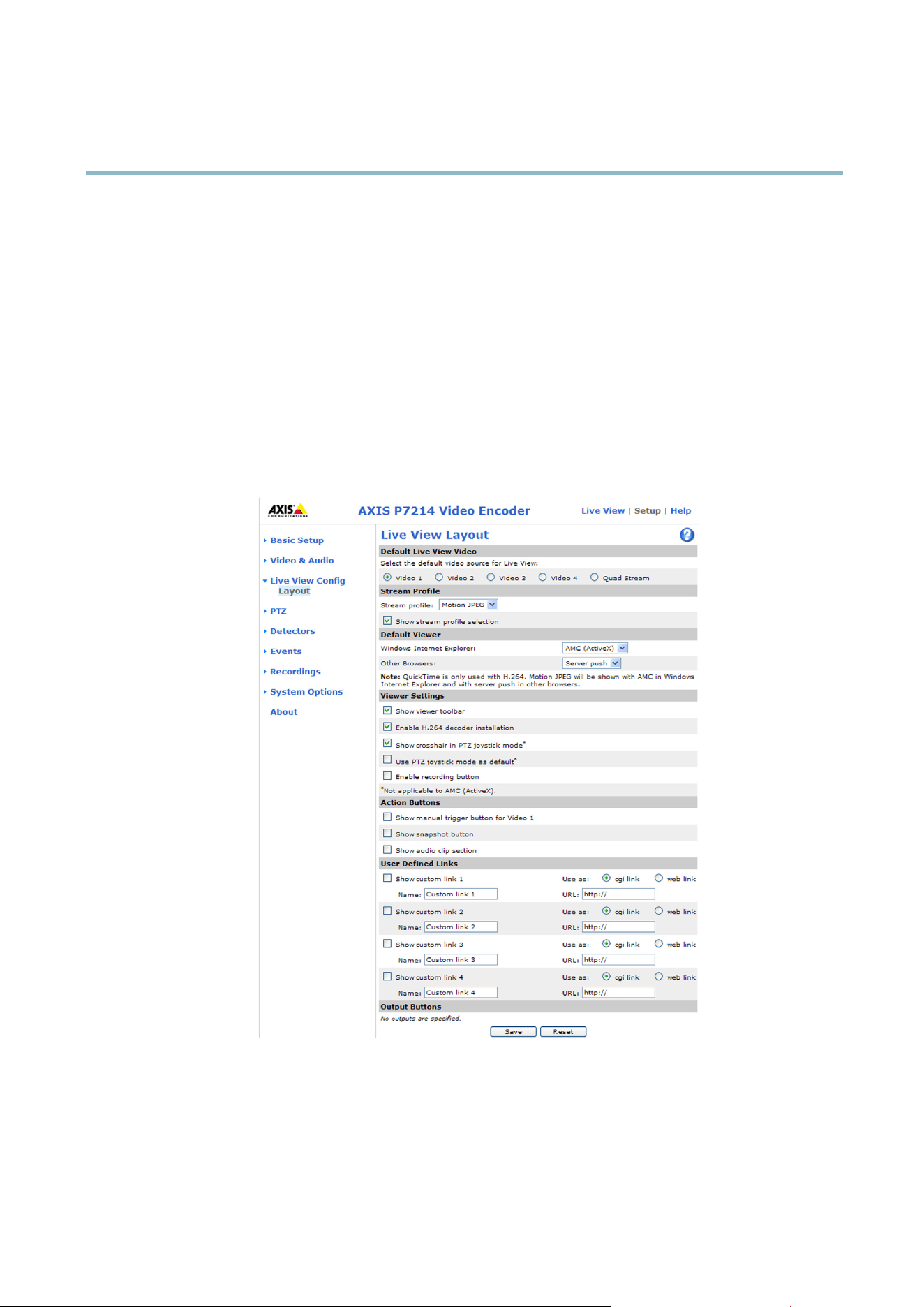
You can customize the Live View page and alter it to suit your requirements. It is possible to define the following features of
theLiveViewpage.
•StreamProfile. See
page 16
.
• Default Viewer for Browser. See
page 22
.
• Viewer Settings. See
page 22
.
• Action Buttons. These are the buttons described in
Controls on the Live View Page, on page 8
.
•UserDefined Links. See
page 22
.
• Output Buttons. S ee
page 22
.
Default live view video
Select the default vide o source to be displayed in the Live View page from Setup > Live View Config This could be one of the 4
video streams or Q uad stream. See
Quad stream , on page 1 6
.
21

AXIS P7214 Video Encoder
Live View Config
Default Viewer for Browsers
From Live View Config > Default Viewer select the default method for view ing video images in your brow ser. The product attem pts
to show the video images in the selected video form a t and viewe r. If this is not pos si bl e, the product o verrides the settings and
selects the best available combination.
Browser Viewer Description
AMC
Recommended viewer in Internet Explorer (H.264/Motion JPEG)
QuickTime
H.264
Java applet
A slow er imaging alter native to AM C (Motion J PE G ). Requires o ne of the
following installed on the client:
• JVM (J2SE) 1.4.2 or higher
• JRE (J2SE) 5.0 or higher
Windows Internet Explorer
Still image Displays stil l images only. Click the Refresh button in yo u r browser to view a
new image
Server Push
Recommended viewer for other browsers (Motion JPEG).
QuickTime
H.264
Java applet
A slower imaging a lternative to Se rver Push ( Mo tio n JPEG onl y ).
Other browsers
Still image Displays stil l images only. Click the Refresh button in yo u r browser to view a
new image
For m o re information, pleas e see the online help .
Viewer Settings
To co nfigure options for the viewer, go to Live View Config > Viewer Settings.
•SelectShow viewer toolbar to display the AXIS Media Control (AMC) or the QuickTime viewe r toolbar under the video
image in your browse r.
• H.264 decoder installation. The administrator can d isable installation of the H.264 decoder included with AXIS Media
Control. This is used to prevent installation of unlicensed copies. Further decoder licenses can be purchased from your
Axis reselle r.
•SelectShow crosshair in PTZ joystick mode to enable a cross that will ind icate the center of the image in PTZ joystick mode.
•SelectUse PTZ joystick mode as default to enable joystick mode. The mo de can be changed temporarily from the PTZ
control panel.
•SelectEnable recording button to enable recording from the Live View page. This button is a vailable when using
the AMC viewer. The record ings are saved to the location specified in the AMC Control Panel. See
AXIS Media Control
(AMC), on page 11
.
User Defined Links
To display user-defined links in the Live View page, select the Show custom link option, give the link a name and then enter the URL
to link to. When defining a web link do not remove the 'http://' from the URL address. Custom links can be used to run scripts or
activate external devices connected to the product, or they can link to a web page. C u sto m links defined as cgi links will run the
script in the background, in a hidden frame. De fining the link as a web link w ill o pen the link in a new window.
Output Buttons
External I/O devices connected to the Axis product’s output ports can be controlled directly from the Live View page.
To display output buttons in the Live View page:
22

AXIS P7214 Video Encoder
Live View Config
1. Go to Setup > Live View Config.
2. Under Output Buttons, select the type of control to use:
- Pulse activates the output for a defined period of time. The pulse time can be set from 1/100 second to 60
seconds.
- Active/Inactive displays two buttons, one or each action.
To configuretheactiveandinactivestates,gotoSystem Options > Ports & Devices > I/O Ports and set the port’s Normal state.
For more information about I/O ports, see
I/O Ports, on page 41
.
23
AXIS P7214 Video Encoder
PTZ (Pan Tilt Zoom)
PTZ (Pan Tilt Zoom )
Preset Positions
A preset position is a predefined view that can be used to quickly steer the camera to a specific location. Preset positions can
be accessed in several ways:
• By selecting the preset from the Preset positions drop-down list in the Live View Page.
• When setting up action rules. See
page 29
.
• When setting up Guard Tour. See .
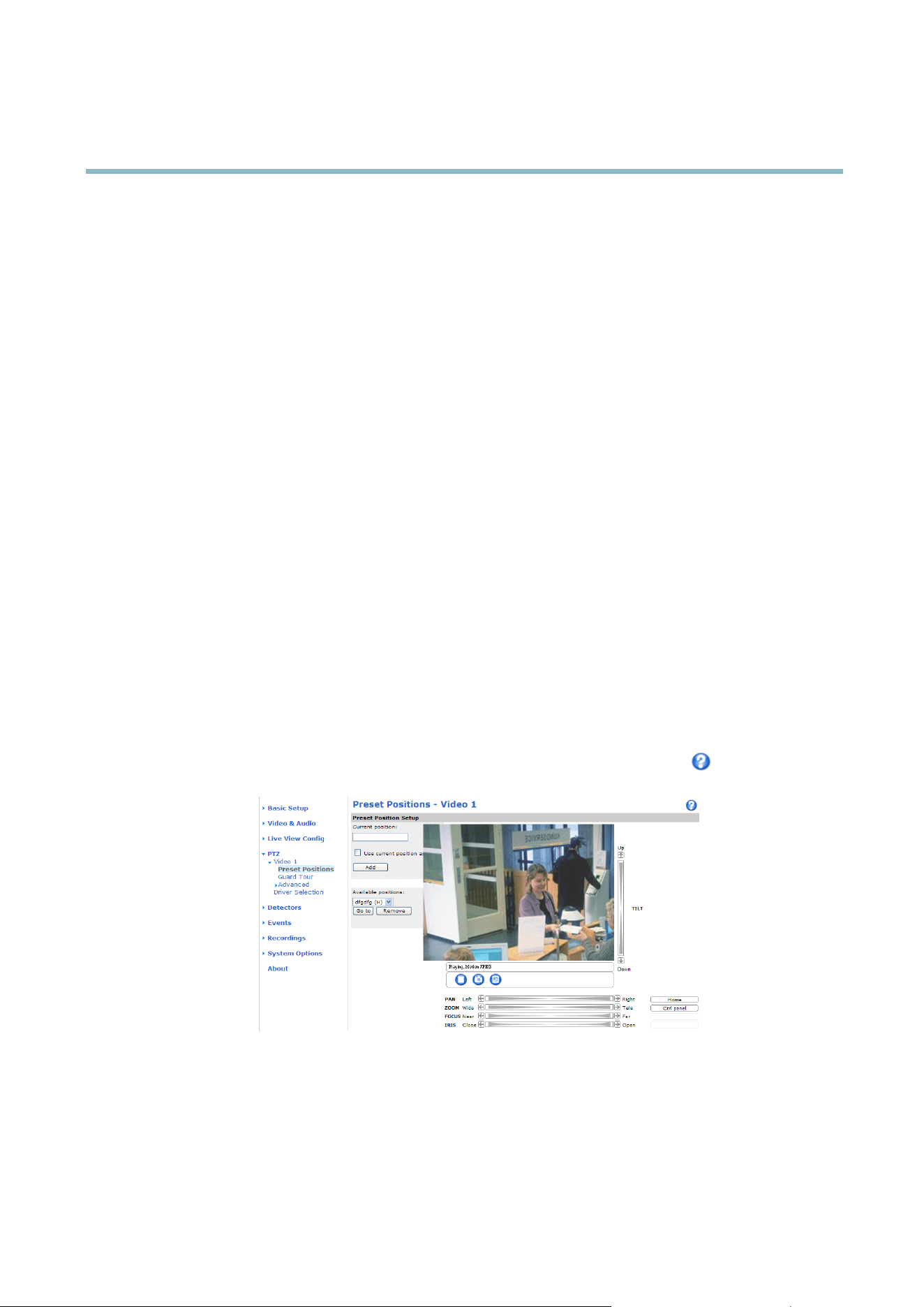
To add a preset position:
1. Go to PTZ > Preset Positions.
2. Use the pan, tilt and zoom controls to steer the camera view to the desired position.
3. Enter a descriptive nam e in the Current position field.
4. If required, select Use current position as Home.
5. Click Add.Thecamera’sposition,irisandfocussettingsaresavedasapresetposition.
The Hom e position is readily accessible by clicking the Home button on the Live View page and in the Preset Positions se
tup window.
To set a customized home position, select Use current position as Home when adding a preset position. The u
ser-defined home
position will have (H) added, for examp le, Entr ance (H). The defaul t Home position, calle d “Ho m e ”, will still be availa ble .
The product can be configured to return to the Home position w hen the PTZ functionality has been inactive for a specified length
of time. Enter the length of time in the Return to home when inactive field and click Save.Setthetimetozerotopreventthe
product fr om automatically returning to the Home posi
tion.
To include the preset position name in the over
lay text, go to Video & Audio,selectInclude overlay text and enter the modifier #P in
the field. For more information abo ut modi fiers, see
File Nam i n g & Date /Time Fo rm ats
in the online help .
Advanced
Limits
Define the pan, tilt, zo om and focus limits for the Axis p roduct. Mov ements to the left and right, up and down, can be restricted to
narrow the area under surveillance.
24

AXIS P7214 Video Encoder
PTZ (Pan Tilt Zoom)
Move speed sets the speed of the cam era’s pan and tilt movements. The default setting is maximum speed.
When using a jo ystick (or emulating one with the mouse) the Enable proportional speed setting can be used to reduce the maximum
pan/tilt move m ent speed, i.e. the s pee d the ca m er a view moves at when the joystick is pushed all the way out in any direction. This is
useful then the view is zoomed in on an object.
See the online help
for more information.
Controls
Panel Shortcut Command Buttons can be configured to provide direct access to commands issued via the VAPIX® Application
Programming Interface. The buttons will be displayed in the PTZ control panel, w hich is available in the Live View page through
the Ctrl panel button, see
page 9
.
Deselect the op tions under Enable/Disable controls to disable the pan, tilt, zoom, focus and iris controls.
Control Queue
The administrator can set up a queue for PTZ controllers from PTZ > Control Queue. Once set up, the PTZ Control Queue buttons
appear in the Live View pag e offering one viewer exclusive control for a limited period of time. Other users will be p laced in queue.
A user who belongs to a group (see
Users, on page 34
) with a higher PTZ priority can go befo re other users in the queue and
take control of the product. The order of priority is as follows:
1. Administrator — An administrator takes over PTZ control regardless of who is first in queue. The administrator will be
removed from the queue 60 second s after the last PTZ control command.
2. Event — The A xis product can be configuredtogotoapresetpositionwhen triggered by an alarm (see
Events, on p ag e 29
).
The event will imm ediately be placed first in the queue exce pt w he n an administrator is in contro l.
3. Operator — Same as adm inistrator but with lower prio rity
4. Guard Tour — A guard tour (see ) has PTZ co ntrol for an indefinite period of time. It may be overridden by an operator,
event or adm inistr ator. The gua rd tour will resume when higher priority groups leave the queue.
5. Viewer — M ultiple viewers must wait for their turn. The view er has 60 seconds PTZ control before control is passed
on to the next viewer in queue.
Note
• The administrator can enable and disable PTZ controls for selected users.
• To identify d ifferent users in the vi
ewer group, cookies m ust be enabled on the client.
25

AXIS P7214 Video Encoder
Detectors
Detectors
Camera Tampering
Camera Ta m per ing can generate an alarm whenever the camera is repositioned, or when the lens is c o vered, sp rayed or severely
defocused. To send an alarm, for example an email, an action rule must be set up.
To configure tampering:
1. Go to Detectors > Camera Tampering.
2. Set the Minim u m duration, that is, the time that must elapse before an a larm is generated. This ca n help prevent fals e
alarms for known conditions that affect the image.
3. Select Alarm for dark images if an alarm should be gene rate d if lights are dimmed or turned off, or if the lens is sprayed,
covered, or rendered severely out of focus.
4. Click Save.
To configure the pro duct to send an alarm when tampering occurs:
1. Go to Events > Action Rules.
2. Click Add to set up a new action rule.
3. Enter a Name for the action rule.
4. Under Condition,selectDetectors from the Trigger list.
5. Select Tam p erin g from the list of detectors.
6. Select the video channel.
7. Optionally, s ele ct a schedule and set additional conditions
.
8. Select the action. To send a n email, select Send Notifi
cation and select a Recipient from the list of de fined recipients.
Note
The While the rule is active option under Duration cannot be used with camera tampering, since camera tampering does not
have a duration and once it has been triggered it will not automatically return to its untriggered state .
For more information on actions rules, see
Events, on page 29
.
Motion D etect
ion
Motion detection is used to generate an alarm whenever movement starts or stops in the camera view.
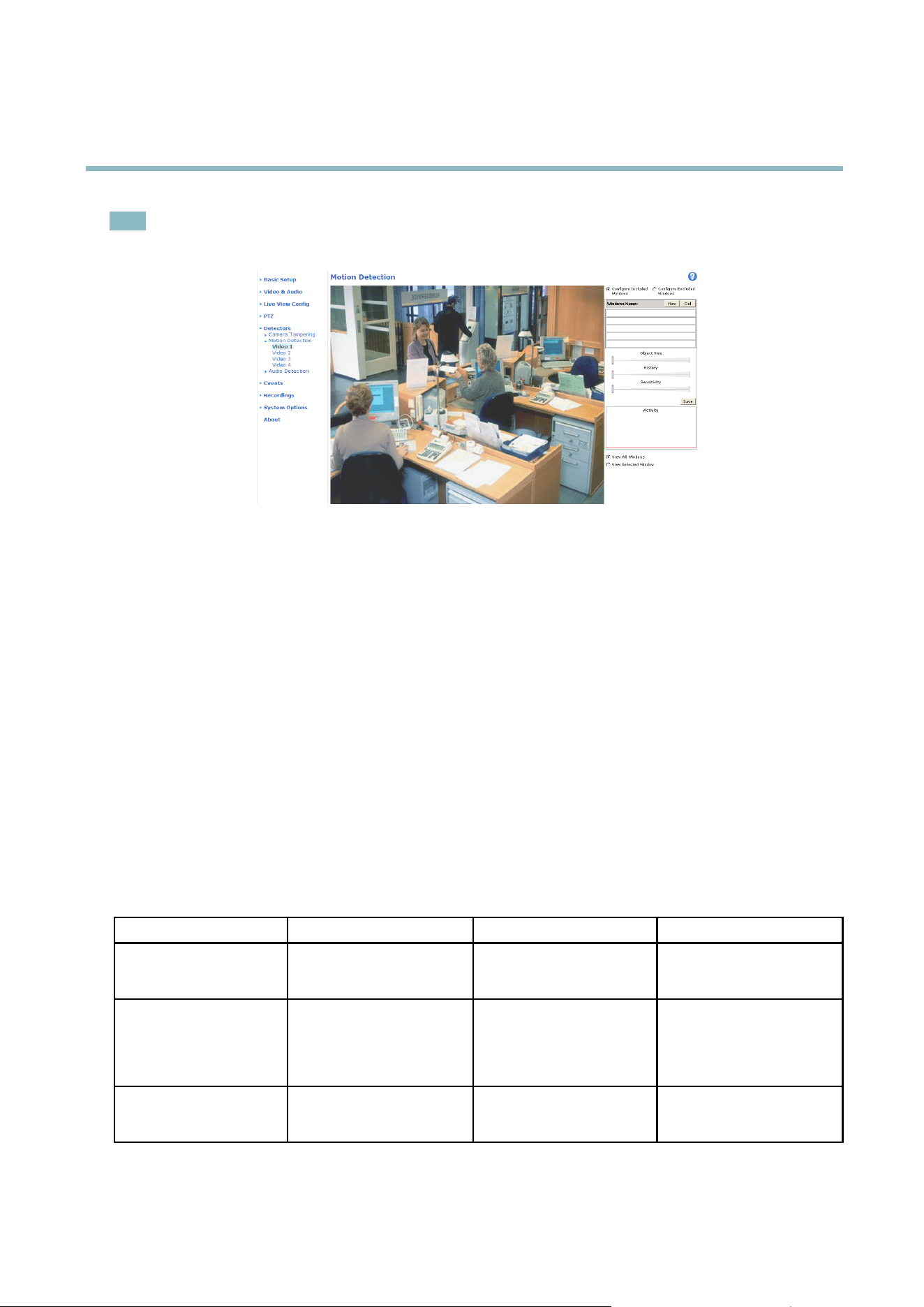
Motion detection i s configured by d efining up to 10 Include and Exclude windows:
• Include windows —define areas where motion should be detected
• Exclude windows —define areas within an Include window that should be ignored (areas outside Include w indows
are automatically ignore d).
For instructions, see
Set Up Motion Detection W indows, on page 27
.
To control the number of motion detection alarms, the parameters Object Size, History and Sensitivity can be adjusted. See
Motion
Detection Parameters, on page 27
.
Once motion detection window s are configured, the Axis product can be configured to perform actions when motion is detected.
Possible actions include uploading images and start recording. For more information, see
Setting U p a n Action Rule, on page 30
.
26
AXIS P7214 Video Encoder
Detectors
Note
Using the motion detection feature may decrease the product’s overal l p erf orm a nce.
Set Up Motion Detection Windows
To set up a motion detection Include Window, follow these instructions:
1. Go to Detectors > Motion Detection.
2. Select the Configure Included Windows option and click New. Select the new window in the list of windows and enter
a descriptive name.
3. Adjustthesize(dragthebottomright-handcorner)andthepositio n (click on the text a t the top and d rag to the desired
position) of the window.
4. Adjust the Object Size, History and Sensitivity profile sliders (see
Motion Detection Parameters
for details). Any detected
motion within an active window is indicated by red p eak s in the Activity window.
5. Click Save.
To exclude parts of the include window, select the Configure Excluded Windows and position the exclude window within the
include window.
To delete an include or exclude window, select the w indow in the list of windows and click Del.
Motion Detection Parameters
The parameters c ontrolling motion detection are described in the table below:
Parameter
Object Size
History
Sensitivity
Description
Object size relative to window
size.
Object memory length.
Difference in luminance
between background an
d
object.
High level (100%)
Only very large objects trigger
motion detec
tion.
An object that appears in
the window triggers motion
detection for a long time
before it is considered as
non-moving.
Ordinary colored objects on
ordinary bac
kgrounds trigger
motion detection.
Medium level (50%)
A large difference in luminance
is required to trigger motion
d
etection.
27

AXIS P7214 Video Encoder
Detectors
Low level (0%)
Even very small objects trigger
motion detection.
An object that appears in
the window triggers motion
detection only for a very short
time before it is considered as
non-moving.
Only very bright objects on
a dark background trigger
motion detection.
Recommen d ed values
5–15% 60–90% 75–95%
Default values
15% 90% 90%
Note
• To trigger on small objects or movements, use several small motion detection windows rather than one large window
and select a low object size.
• To avoid triggering on small objects, select a high obj ect size.
• If no objects should appear in the Include Window, select a high history level. This will cause m otion detection to
trigger as long as the object is present in the window.
• To only detect flashing light, select a low sensitivity. In other cases hig h se ns itivity is rec omm e nde d.
Audio Detection
The Axis product can be configured to generate an alarm when audio r ises ab ove or fa lls be low the threshold value. The threshold
value can be set in the range 0–100 where 0 is the most sensitive and 100 the least sensitive.
1. Go to Detectors > Audio D etection.
2. Set the audio alarm level and click Save.
3. Go to Events > Action Rules and set up an action rule, see
Setting Up an Action Rule, on pa
ge 30
.
Detected audio is indicated by colored peaks in the Activity indicator. An eve
nt is trigge re d whe n de te c te d audio ris es above or falls
below the threshold value, w hich is represented by the bar.
28

AXIS P7214 Video Encoder
Events
Events
The Axis product can be configured to perform actions when different e vents occur, for example, star t a re cording when motion is
detected. The set of conditions that defines how and when the action is triggered is called an Action Rule.
Available Action Rul e triggers and conditions include:
• Applications — u se installed applications to trigger the rule, see .
• Detectors
- Audio Detection — trigger the rule w hen audio is detected, see
Audio Detection, on page 28
.
- Motion Detection — trigger the rule w hen motion is detected , see
Motion Detection, on page 26
.
- Tampering — tr igger the rule w h en tampering is detected, se e
Camera Tampering, on page 26
.
• Hardware
- Video Signal — trigg er the rule if video signal is lost.
- Network — trigger the rule if network connection is lost or restored. This can for example be used to start
recording to the SD card.
• Input Signal
- Digital Input Port — trigger the rule when an I/O port receives a signal from a connected device, see
I/O
Ports, on page 41
.
- Manual Trigger — trigger the rule using the Manual Trigger button in the Live View page, see
Controls on the
Live View Page, on page 8
. This can for example be used to validate actions d
uring product installa tion
and configuration.
• PTZ
- Moving — trigger the rule when the camera view moves due to a PTZ operation. This c an for exam ple be used
as an additional condition to prevent an action rule triggered by motion detection to record video while the
camera view moves due to a PTZ operation.
- Preset Reached —triggertheru
le when the camera sto ps at a preset pos ition. This can be fo r exam ple be u s e d
with the Send Images action to upload images from the preset position .
• Storage
- Available — trigger the rule when the storage device is unmounted or removed. This can for example be
used to send maintenance notifications.
- Full — trigger the rule when the storage device is full. U nd er normal operation, the oldest recordings will be
overw
ritten to prevent the storage device from becoming full.
- L
ocked — trigger the rule if the storage device is locked (write protected).
• System
- System Initializing — trigger the rule when the product is being started . This can for ex ample b e used to send a
notification when the product restarts.
• Time
- Recurrence — trigger the rule periodically, see
Recurrences, on p ag e 31
. This can for example be used to
upload an image every 5 minutes.
- Use Schedule — trigger the rule according to the s elected schedule, see
Schedules, on page 31
.
29

AXIS P7214 Video Encoder
Events
Available actions include:
• Output Port — a ctivate an I/O port to control an external device.
• Play Audio Clip —see
Audio Clips, on page 20
.
• PTZ Control
- Preset Position — go to a preset position.
- Guard Tour — start a guard tour, see .
• Record Video — record video to a selected storage.
• Send Images —sendimagestoarecipient.
• Send Notifications —sendanotification message to a recipient.
Setting Up an Action Rule
An action rule defines the conditions that m ust be met for the product to perform an action, for example record video or send email
notifications. If multiple conditions are defined, all must be m et to trigger the action.
The following example describes how to set up an action rule to record video to a netwo rk share if there is movement in the
camera’s field of view.
Set up motion detection and add a network share:
1. Go to Detectors > Motion Detection and configure a motion detection window, see
page 27
2. Go to System Options > Storage and set up the network share, see
page 41
.
Set up the action rule:
1. Go to Events > Action Rules and click Add.
2. Select Enable rule and enter a d escriptive name for the rule.
3. Select Detectors from the Trigger drop-d own list.
4. Select Motion Detection from the drop-down list. Select the motion detectio n w indow to use.
5. Optionally, sel ect a Schedule and Additional conditions,seebelow.
6. Under Actions, select Record Video from the Type drop-down list.
7. Select a Stream profile and configure the Duration settings as describ ed below.
8. Select Network Share from the Storage drop-down list.
To add additional criteria, select the Additional conditions option and add additional triggers. To preve nt an action from being
triggered repeatedly, a Wait at least time can b e set. Enter the time in hours, minutes and seconds, during which the trigger
should be ignored before the ac ti on rule can be activated again.
The recording Duration of some actions can be set to include time immediately before and after the event. Select Pre-trigger time
and/or Post-trigger time and enter the number of seconds. When W hile the rule is active is enabled and the action is triggered
again during the post-trigger time, the recording time will be extended with another post-trigger time period.
For more information, see the online help
.
Recipients
Recipients receive media files and notification messages. The following recipients ar e available:
30

AXIS P7214 Video Encoder
Events
Recipient Use with action
Email
Send Images
Send Notification
FTP
Send Images
HTTP
Send Images
Send Notification
Network Share Send Images
TCP Send Notification
To add a recipient:
1. Go to Events > Recipients and click Add.
2. Enter a descriptive name
3. Select a recipient Type.
4. Enter the information needed for the recipient type.
5. Click Test to test the connectio n to the recipient.
6. Click OK.
Schedules
Schedules can be used as action rule triggers or as additional conditions, for exam ple to record video if mo tion is de tecte d outs ide
office hours. Use one of the predefined schedules or create a new schedule as described below.
To create a new schedule:
1. Go to Events > Schedules and click Add.
2. Enter a descriptive name and the info rmation neede d for a daily, weekly, monthly or yearly schedule.
3. Click OK.
To use the schedule in an Action Rule, select the schedule from the Schedule drop-down list in the Actio n Rule Setup page.
Recurrences
Recurrences are us ed to trigger Action Rules repeatedly, for ex am ple every 5 m inutes or every hour.
To set up a recurrence :
1. Go to Events > Recurrences and click Add.
2. Enter a descriptive name and recurrence p atter n.
3. Click OK.
To use the recurrence in an Action Rule, first select Time from the Trigger drop-down list in the Action Rule Setup page a nd
then select the recurrence from the second drop-down list.
To modify or remove recurrences, select the recurrence in the Recurrences List an d click Modify or Remove.
31

AXIS P7214 Video Encoder
Recordings
Recordings
TheAxisproductcanbeconfigured to record video continuously or according to a n action rule:
• To start a continuous recording, see
page 32
.
• To set up action rules, se e
page 30
.
• To access recordings, see
Recording List, on page 32
.
•Toconfigure camera controlle d storage, see
Storage, on page 40
.
Recording List
Recorded videos are listed on the Recordings > List p age. The list shows each recording’s start date and tim e, duration and the
event that triggered the recording.
To play or download a recording, follow these steps:
1. Go to Recordings > List.
2. Use the filte r to narrow the list of recordings. Enter the desired filter criteria and click Filter. Some filters may take
a long time to complete.
3. Select the recording.
4. Click Play to play the recording, or click Download to dow nload the recording.
Multiple recordings can be downloaded at the sa m e time . Select the r ecor dings and click Download. The downloaded file is a z ip file
containing a minimum of three files, of which the M a troska (mkv) filesaretheactualrecordings.The recordings are time-stamped
with the date and time they were downloaded (that is, not the date the
recordings were made).
Note
To play recordings in Windows Media Player, A XIS Matroska File Splitter m ust be installe d. AXIS M a tros ka File Splitter
can be downloaded from www.axis.com/techsup/software
For detailed recording and video informat ion, select a recording and click Properties.
To remove a recording, select the recording and click Remove.
Continuous Recording
The Axis product can be configured to continuously save video to a storage device. See
Storage, on page 40
for more inform ation
about storage devices. To prevent the disk from becoming full, it is recommended to configure the disk to autom atica lly remove
old recordings.
To start a continuous recording, follo w these steps:
1. Go to Recordings > Continuous.
2. Select Enabled.
3. Select type of storage device from the Disk list.
4. Select a Stream profile to use for continuous recordings.
5. Click Save to save and start the recording.
32

AXIS P7214 Video Encoder
Recordings
Note
If a new stream profile is selected while a recording is o ng oing, the recording will be stopped and saved in the recording list
and a new recording with the new stream profile will start. All pre vious continuous recordings will remain in the reco rding
list until the y are removed manually or through automatic removal of old recordings.
33

AXIS P7214 Video Encoder
System Options
System Options
Security
Users
User access control is enabled by default and can b e configured under System Options > Security > Users. An administrator can
set up other users by giving them user names and passwords. It is also possible to allow anonymous viewer login, which means
that anybody may access the Live View page.
The use r list displays authorized users and user groups (access levels):
Viewer - Access to the Live V iew page
Operator - Access to the Live View page and to all settings except System Options
Administrator - Unrestricted access to all settings; can add, modify and remove other users.
Under HTTP/RTSPPasswordSettings, select the type of password to allow. You may need to allow unencrypted passwords if there
are view ing clients that do not support encryption, or if you upgraded the firmware and existing c lients support encryption but need
to log in again and be configuredtousethisfunctionality.
Under User Settings, select the Enable anonymous viewer login option to allow anonymous users access to the Live View page.
Select the Enable anonymous PTZ control login to allow anonymous users access to the PTZ c ontrols.
Deselect the Enable Basic Setup option to hide the Basic S etup menu. Basic Setup provides quick access to settings that should be
made before using the Axis product.
ONVIF
ONVIF (Op en Network Video Interface Forum) is a global interface standard that makes it easier for en d us er s, inte grators, consultants ,
and manufacturers to take advantage of the possibilities offer ed by network video technology. ONVIF enab les interoperablity between
different vendor products, increased fl exibility, red
uced cost and future-proof systems.
By creating a user you automaticall
y enable ONVIF communication. Use the user name and password with all ONVIF communication
with the product. For more information see www.onvif.org
IP Address Filter
IP address filtering is enable d on the System Options > Security > IP Address Filter page. Once enabled, the listed IP address are
allowed or denied acces
s to the Axis product. Select Allow or Deny from the list and click Apply to enable IP addre ss fi lter ing.
The administr
ator can add up to 256 IP address entries to the list (a single entry can c onta in m ultipl e IP addre sses ).
HTTPS
The Axis product supports encrypted browsing using HTTPS. This is con figured on the System Options > Security > HTTPS page.
A self-sig ned cer tificate can be used until a C ertificate Authority-issued certificate has been obtained. Click Create self-signed
certificate to install a s elf-signe d certificate. Although self-signed certificates are free and offer some protection, true security is only
implemented after the installation of a signed certificate iss u ed by a Certificate Authority.
To obtain a s igne d certificate from an issuing Certificate Authority, click Create Certificate Request. When the signed certificate
is returned, click Install signed certificate to import the certificate. The properties of any certificate request currently resident in
the pro duct or installed can be viewed by clicking Properties.
To enable HTTPS in the Axis p roduct, the HTTPS Connection Policy must be set for each user group.
For more information, see the online help
.
34

AXIS P7214 Video Encoder
System Options
IEEE 802.1X
IEEE 802.1X is a standard for port-based Network Admission Control providing secure authentication of wired and wireless network
devices. IEEE 802.1X is based on EAP (Extensible Authentication Protocol).
To access a network protected by IEEE 802.1X, devices must authenticate themselves. The authentication is performed by a
third-party entity called an authentication server, typically a RAD IUS se rve r, examples of which are FreeRADIUS and Microsoft
Internet Authentication Service.
In Ax is ' implementation, the network device and the authentication server authenticate themselves with the help of digital
certificates using EAP-TLS (Extensible Authentication Protocol - Transport Layer Security). The certificates are provided by an
Certification Authority (CA). You need:
•aCAcertificate to validate the identity of the authentication server
• a CA-signed client certificate and a private key to authenticate the network device.
To allow the network d evice to access a network protected by IEEE 802.1X:
1. Obtain a CA certificate, a client certificate and a client private key (contact your network administrator).
2. Go to Setup > System Options > Security > IEEE 802.1X and upload the CA certificate, the client certificate and the
client private key.
3. Under Settings, select the EAPOL version, provide your EAP identity and private key password.
4. Check the box to enable IEEE 802.1X and click Save.
Certificates
CA Certificate The CA certificate is used to valida te the identity of the authentication server. Enter the path to
the certificate directly, or locate the file using the Brow se button. Then click U
pload.Toremove
acertificate , click Remove.
Client certificate
Client private k ey
The clie nt certificate and private key are used to authenticate the network device. They can be
uploaded as separ ate files or in one combined file (e .g. a PFX file or a PEM file). U se the Client
private key field if uploading one combined file. For ea ch file, enter the path to the
file, or locate the
file using the Browse button. Then click Upload.Toremoveafile, click Remove.
Settings
EAPOL version
SelecttheEAPOLversion(1or2)asusedinyournetworkswitch.
EAP identity
Enter the user identity (maximum 16 chara cters) associated with your certificate.
Private key password
Enter the password (maximum
16 characters) for the private key.
Enable IEEE 802.1X
Check the box to enable the IEEE 802.1X protocol.
Audio Support
Select Enable audio support to allow c lie nts to re trie ve a udio s tre am s from the Axis product. Fo r info rm ati on o n how to configure
audio settings, se e
Audio Settings, on page 18
.
Note
Deselecting this option will dis ab le audio globally in the Axis product, for con fig u red events and profiles with audio as well.
Date & T ime
The Axis product’s date and time settings are configured under System Options > Date & Time.
Current Server Time displays the current date and time (24h clock). The time can be displayed in 12h clock in the text overlay (see
below).
35

AXIS P7214 Video Encoder
System Options
To change the date and time settings, select the preferred Time mode under New Server Time:
• Synchronize with computer time sets date a nd time according to the computer’s clock. With this option, date and
time are set once and will not be updated a u tomatica lly.
• Synchronize with NTP Server o btains date and time from an NTP server. W ith this option, date and time settings are
updated continuously. For information on NTP settings, see
NTP Configuration, on page 37
.
If using a host name for the NTP server, a DNS server must be configured. See
DNS Configuration, on page 37
.
• Set manually allows you to manually set date and time.
If using an NTP server, select your Time zone from the drop-down list. If required, check A utomatically adjust for daylight saving
time changes.
The Date & Time Format Used in Images is the date and time format displayed as a text overlay in the video stream. Use the
predefined formats or see
File Naming & Date/Time Formats
in the online help for information on how to create custom date and
time forma ts. To include date and time in the overlay text, go to Video & Audio and select Include date and Include time.
Network
Basic TCP/IP Settings
The Axis product supports IP version 4 and IP version 6. Both versions can be enabled simultaneously, and at least one version
must always be enabled.
IPv4 Address Confi guration
By default, the Axis product is set to use IPv4 (IP version 4) and to obtain the IP address a utomatically via DHCP. The IPv4 settings are
configured under System Options > Network > TCP/IP > Basic.
DHCP (Dynamic Host Configuration Protocol) allow s network administrators to centrally manage and automate the assignment of
IP addresses. DHCP should only be enabled if using dynamic IP address notification, or if the DH C P can u pdate a DNS server. It is
then possible to access the Axis product by name (host name).
If DHCP is enabled and the product cannot be accessed, run A X IS IP Utility to search the network f or connected Axis prod ucts , or reset
the product to the factory default settings ( see
page 44
) and then perform the installation again.
To use a static IP address, check Use the following IP address and specify the IP address, subnet mask and default router.
IPv6 Address Confi guration
If IPv6 (IP version 6) is enabled, the Axis product will receive an IP address according to the configuration in the network router.
To enab le IPv6, go to System O ptions > Network > TCP/IP > Basic. Other settings for IPv6 should be configu red in the network router.
ARP/Ping
The IP address can be set using A RP a nd Ping. For instructions, see the product’s Installation Guide.
ARP/Ping is enabled by d efa u lt. To disable, uncheck the box under System Options > Network > TCP/IP > Basic.
The ARP/P ing service is automatically disabled two minute s after the product is started, or as soon as an IP address is set. To reset the
IP address, the product must be restarted to activate ARP/Ping for an additional two minutes.
Pinging the product is still possible when this service is disabled.
36

AXIS P7214 Video Encoder
System Options
AXIS Video Hosting System (AVHS)
AVHS used in conjunction with an AVHS service, provides easy and secure Internet access to live and recorded video accessible from
any location. For more information and help to find a local AVH S Service Pro vider go to www.axis.com/hosting
AVHS is enabled by d efa u lt. The settings are configured under System Options > Network > TCP IP > Basic.
One-click enabled - Press the product’s control button (see
Hardware Overview, o n page 4
) to connect to an AVHS service o ver the
Internet. Once registered, Always will be enabled and the Axis product stays connected to the AVHS service. If the product is not
registered within 24 hours from when the button is pressed, the product will disconnect from the AVHS service.
Always - The Axis product will constantly attempt to connect to the AVHS service over the Internet. Once registered the product will
stay connected to the service. This option can be used when the product is already installed and it is not convenient to use the
one-click installation.
AXIS Internet Dynamic DNS Service
AXIS Internet Dynamic DNS Service assigns a host name for easy a c ce s s to the product. For more informati on, see www.axisca m .ne t
To register the Axis product with AXIS Internet Dynamic DNS Service, go to System Options > Network > TCP/IP > B asic.Under
Services, click the AXIS Internet Dynamic DN S Service Settings button (requires access to the Internet). The domain name currently
registered at AXIS Internet Dynamic DNS service for the product can at any time be removed.
Advanced TCP/IP Settings
DNS Configuration
DNS (Domain Name Service) provides the translation of host names to IP addresses. The DNS settings are configured under System
Options > Network > TCP/IP > Advanced.
Select Obtain DN S server addres s v ia DHCP to use the DNS settings provided by the DHCP server.
To make manual settings, select Use the following DNS server address and specify the following:
Domain name - Enter the domain(s) to search for the host name used by the Axis product. Mu ltiple domains can be se par ated by
semicolons. The ho st name is always the firstpartofafullyqualified domain name, for example, myserver is the host na m e in the
fully qualified dom ai n name myserver.mycompany.com where mycompany.com is the domain name.
Primary/Secondary DNS server - Enter the IP addresses of the primary and secondary DNS servers. The s econda ry DNS server is
optional and will be used if the primary is unavailable.
NTP Configuration
NTP (Network Time Protocol) is us ed to synchronize the clock times of devices in a network. The NTP settings are configured under
System Options > Network > TCP/IP > Advanced.
Select Obtain NTP server address via DHCP to use the N TP s etting s provided by the DHCP server.
To m ake manual settings, select Use the following NTP server address and enter the host name or IP address of the NTP server.
Host Name Configuration
The Axis p r odu c t can be acce ss ed usin g a host name instead of an IP addre s s. The host name is usually the same as the assigne d DNS
name. The host name is con fi gured under System Options > Network > TCP/IP > Advanced.
Select Obtain host name via IPv4 DHCP to use host name provided by the DHCP server running on IPv4.
Select Use the host name to set the host name m anually.
Select Enable dynamic DNS updates to dynamically update local DNS servers whenever the Axis prod uct’s IP address changes.
For more information, see the online help
.
37

AXIS P7214 Video Encoder
System Options
Link-Local IPv4 Address
Link-Local Address is enabled by default and assigns the Axis product an additional IP address whichcanbeusedtoaccess
the p roduct from other hosts on the same segment on the local network. The product can have a Link-Local IP and a static
or DHCP-supplied IP address at the same time .
This function can be disable d under System Options > Network > TCP/IP > Advanced.
HTTP
The H TTP port used by the Axis product can be changed under System Options > Network > TCP/IP > Advanced. In addition to the
default setting, which is 80, any port in the range 1024–65535 can be used.
HTTPS
The HTTPS port used by the Axis product can be changed under System Options > Network > TCP/IP > A dvanced. In addition to
the default setting, which is 443, any port in the range 1024–65535 can be used.
To enable HTTPS , g o to System Options > Security > HTTPS. For more information, see
page 34
.
NAT traversal (port mapping) for IPv4
A network router allows devices on a priva te netw o rk (LA N) to share a single connection to the Internet . This is done by forwa rding
network traffic from the private network to the “outside”, that is, the Internet. Security on the private network (LAN) is incre ased
since m ost routers are pre-configured to stop attempts to access the private network (LAN) from the public network (Internet).
Use NAT traversal when the Ax is product is located on an intranet (LAN) and you wi sh to make it available from the other
(WAN) s ide of a NAT router. W ith NAT tra ve rs al properly con figured, all HTTP traffic to an external HTTP port in the NAT router
isforwardedtotheproduct.
NAT tra ve rsal is configured under System Options > Network > TCP/IP > Advanced.
Note
• For NAT tra vers al to wo rk, this m us t be sup porte d by the ro uter. The router must also support UPnP
TM
.
• The route r has many different nam e s: “NAT router”, “Network router”, “Internet Gateway”, ”Broadband router”, “Broadband
sharing device” or “Home fi rewall” but the essential purpose of the device is the sa
me.
Enable/Disable - Wh en enabled, the Axis product attem pts to configure port mapping in a NAT router on yo ur netwo rk, using U PnP
TM
.
Note that UPnP
TM
must be enabled in the product (see System Options > Network > UPnP).
Use manually selected NAT router - Select this option to manually select a NAT router and enter the IP address for the router in
the field. If no router is specified, the product automatically searches for N AT routers o n y o ur n etwork. If more than one ro uter is
found, the default router is selected.
Alternative HTTP port - Select this option to manually define an external HTTP port. Enter the port number in the field. If no port is
entered he re , a port number is automa tically selected whe n NAT travers al is enabled.
Note
• An alternative HTTP p ort ca n be use d or be active even if NA T travers al is disabled . This is useful if your NAT route r does
not support UPnP and you need to manually configur e port forwarding in the NAT router.
• If you attempt to man
ually enter a port that is already in use, anothe r avail able port is autom atica lly se le cte d.
• When the port is se le cte d automatically it is displayed in this field. To change this, enter a new port number and click Save.
FTP
The FTP server running in the Axis product enables upload of new firmware, u se r applications, etc. The FTP server can be d isabled
under System O ptions > Network > TCP/IP > Advanced.
38

AXIS P7214 Video Encoder
System Options
Note
This FTP serve r has nothing to do with the product’s ability to transfer i m ages via FTP to other locations and servers.
RTSP
The RTSP server running in the Axis product allows a connecting client to start an H .264 stream. The RTSP port number can be
changed under System Options > Network > TCP/IP > Advanced. The default port is 554.
Note
H.264 vide o streams will not be available if the RTSP server is disabled.
SOCKS
SOCKS is a networking proxy protocol. The Axis product can be configured to use a SOCKS server to reach networks o n the other
side of a firewall or proxy server. This functionality is useful if the Axis product is located on a local network behind a firewa ll, and
notifications, uploads, alarms, etc need to b e send to a destination outside the local network (for example the Internet).
SOCKS is configured under System Options > Network > SOCKS. For more information, see the online help
.
QoS (Quality of Service)
QoS (Quality of Service) guarantees a certain level of a specified resource to selected traffic on a network. A QoS-aware network
prioritizes network traffi c and provides a greater network reliability by controlling the amount of ba ndwi dth an application may use.
The QoS settings are configured under System Options > Network > QoS. Using DSCP (Differentiated Services Co depo int) values, the
Axis product can mark the following types of traffic: live video, live audio, event/a lar m traffic and m anag ement traffic.
Note
Live audio DSCP will be equal to live video DSCP if H.264 over RTSP is us ed.
SMTP (email)
To send email messages from the Axis pro duct via SMTP (Simple Mail Transfer Protocol), an SMTP mail server must be set up. This
is do ne under System Options > Network > SMTP (email).
Enter the host names or IP addresses and port numbers for the primary and secondary mail servers in the fields provided. A From
email address is a lso required. If the mail s erver require s a
uthentication, check Use authentication to log in to this server and enter
the necessary inform ation.
SNMP
The Simple Network Management Protocol (SNMP) allows remote management of network devices. An SNM P community is the
group of devices and management stati
on running SNMP. Community names are used to identify groups.
The Axis product can be configured
to support SNMP on the System Options > Network > SNMP page.
Depending on the level of sec
urity required, select the version on SNMP to use.
SNMP v1/v2 provides the
lowest level of security. The community name can be specified as a password for read or read/w rite
access to all supported SNMP devices. The default password for the Read community is public and the default password for the
Write community is write.
Note
If HTTPS is enabled, SNMP v1 and SNMP v2c should b e disabled.
Traps for SNMP v1/v2 ar e used by the Axis product to send messages to a management system on important events a nd status
change
s. Check Enable traps and enter the IP address where the trap message should be sent and the Trap community that
should receive the messa ge.
39

AXIS P7214 Video Encoder
System Options
The following traps are available:
•Coldstart
•Warmstart
•Linkup
• Authentication failed
SNMP v3 provides encryption and secure passw ords. To u se traps with SNMP v3, an SN MP v3 management application is required.
To use SNMP v3, HTTPS must be enabled, see
HTTPS, on page 34
. To enable SNMP v3, check the box and provide the initial user
password.
Note
The initial password can only be set once. If the password is lost, the Axis product must be reset to factory default, see
Reset to Factory Default Settings, on page 44
.
UPnP
TM
The Axis pro duct includes support for UPnP
TM
.UPnP
TM
is enabled by default and the product is automatically detected by operating
systems and clients that support this protocol.
UPnP
TM
can b e disabled under System Options > N etwork > UPnP
TM
.
RTP/H.264
The RTP port range and multicast settings are configured under System Options > Network > RTP.
The RTP port range defines the range of ports from which the video/audio ports are auto
matically selected. For multicast streams,
only certain IP addresses and port numbers should be used.
Select Alw ays Multicast Video and/or A lwa ys Mu lticast Audio to start multicast stream i n g with ou t open in g an RTSP se ssion .
Bonjour
The A xis product includes support for Bonjour. Bonjour i s enabled by default and the product is automatically detected by operating
systems and clients that support this protoc
ol.
Bonjour can be disabled under System Op
tions > Network > Bonjour.
Storage
SD Card
NOTICE
To prevent corruption of recordings, the SD c ard should always be unmounted before it is ejected.
The Axis product supports SD cards with the following file systems:
• ext4 — recom m e nde d due to its resilience aga inst data loss if the card is ejected or if there is abrupt power loss. To access
data stored on the card from the Windows operating system, a third-party ext4 driver or application is r equired.
• vFAT — most SD cards are pre-formatted with vFAT when purchased.
If required, the SD card can be re-formatted to the desired file system. To format the SD card:
1. Insert the SD card in the SD card slot.
2. Go to System Options > Storage an d click SD Card.
40

AXIS P7214 Video Encoder
System Options
3. Click Format and select the desired file system.
Note
During forma tting any pre vious data s tore d on the disk wi ll be lost.
Mounting is done automatically when the card is inserted or when the product is started. A manual mount is only required if the
card has been unmounted and not ejected and re-inserted.
To unmount the SD card:
1. Go to System Options > Storage an d click SD Card.
2. Click Unmount.
3. The car d can now be removed.
The SD card is managed on the System Options > Storage page. Click SD Card to open Storage Management.
If the c ard’s status shows as failed, click Check disk to see if the problem can be found and then try Repair. This o p tion is only
available for S D card s with e xt4. For SD cards with vFAT, use a card reader or computer to troubleshoot the card.
To a void filli ng the card, it is re com m e nde d to remove recordings continuously. Under Recording Settings, select Rem ove recordings
older than and select the number of days or weeks.
To stop writing to the card and protect recordings from being rem ove d, s elec t Lock under Recording Settings.
Network Share
Network share allow s you to add network storage such as a NAS (Network Attached Storage) or any server that uses CIFS (Common
Internet File System) a nd use them for storage o f recordings.
To add a network share:
1. Go to System Options > Storage.
2. Click Network Share.
3. Enter the IP address, DNS or Bonjour name to the host server in the Host field.
4. Enter the name of the share in the Share field.
5. If required, select The share requires login and e nter the user name and passw o rd .
6. Click Connect.
To clear all recor dings and data f rom the A xis product’s folder on the designate d sha re, click Clear under Storage Tools.
To avoid filling the share, it is recommended to remove recordings continuously. Under Recording Settings,selectRemove recordings
older than and select the number of days or weeks.
To stop w riting to the share and protect recordings from being removed, select Lock under Recording Settings.
Ports & Devices
I/O Ports
The Axis product provides four configurable input and output ports for connection of e xte rna l devices. For info rm ation on how to
connect external devices, see
Connectors, on page 4
.
The I/O ports are configured under System Options > Ports & Devices > I/O Ports. Select the port direction (Input or Output). The
ports can be given descriptive names and their Normal states can be configured as Open circuit or Grounded circuit.
41

AXIS P7214 Video Encoder
System Options
COM Port
The video encoder has one RS-485/RS-422 serial port. The port supports the following modes:
• Generic HTTP allows the video encoder to receive data and send commands via HTTP.
• Pan Tilt Zoom i s used to control a PTZ de v ice. The PTZ device requires a driver. See for more informa tion. Drivers can be
downloaded from www.axis.com
• Generic TCP/IPallows the Axis product to rece ive data and send com m ands via TCP/IP. Daisy chain server - Allow s Da isy
chain clients to communicate with the Axis product. See also RS -485/RS-422 connector, on page 43.
Select the desired Port Type from the drop-down list. For m ore information on Serial Port Settings and Daisy Chain Port Settings
seetheonlinehelp
.
Port Status
The lis t on the System Options > Ports & Devices > Port Status page shows the status of the product’s input and output ports.
Maintenance
The Axis product provides several maintenance functions. These are available under System Options > Maintenance.
Click Restart to perform a correct restart if the Axis product is not b ehaving as expected. This will not a ffect any of the current
settings.
Click Restore to reset m ost settings to the fa ctory default values. The following settings a re not affected:
• the boot protocol (DHCP or static)
• the static IP address
• the default router
• the sub net mask
•thesystemtime
• the IEEE 802.1X settings
Click Default to reset all settings, including the IP address, to the factory default values. This button should be used with caution. The
Axis product can also be reset to factory default using the control button, see
Reset to Factory Default Settings, on page 44
.
To identify the p roduct or test the Status LED, click Flash LED under Identify and specify the duration in seconds, minutes or hours.
This can be useful for id entifying the p roduct among other products ins talle d in t he same location.
For information about firmware upgrade, se e
Upgrading the Firmw are , o n page 45
.
42
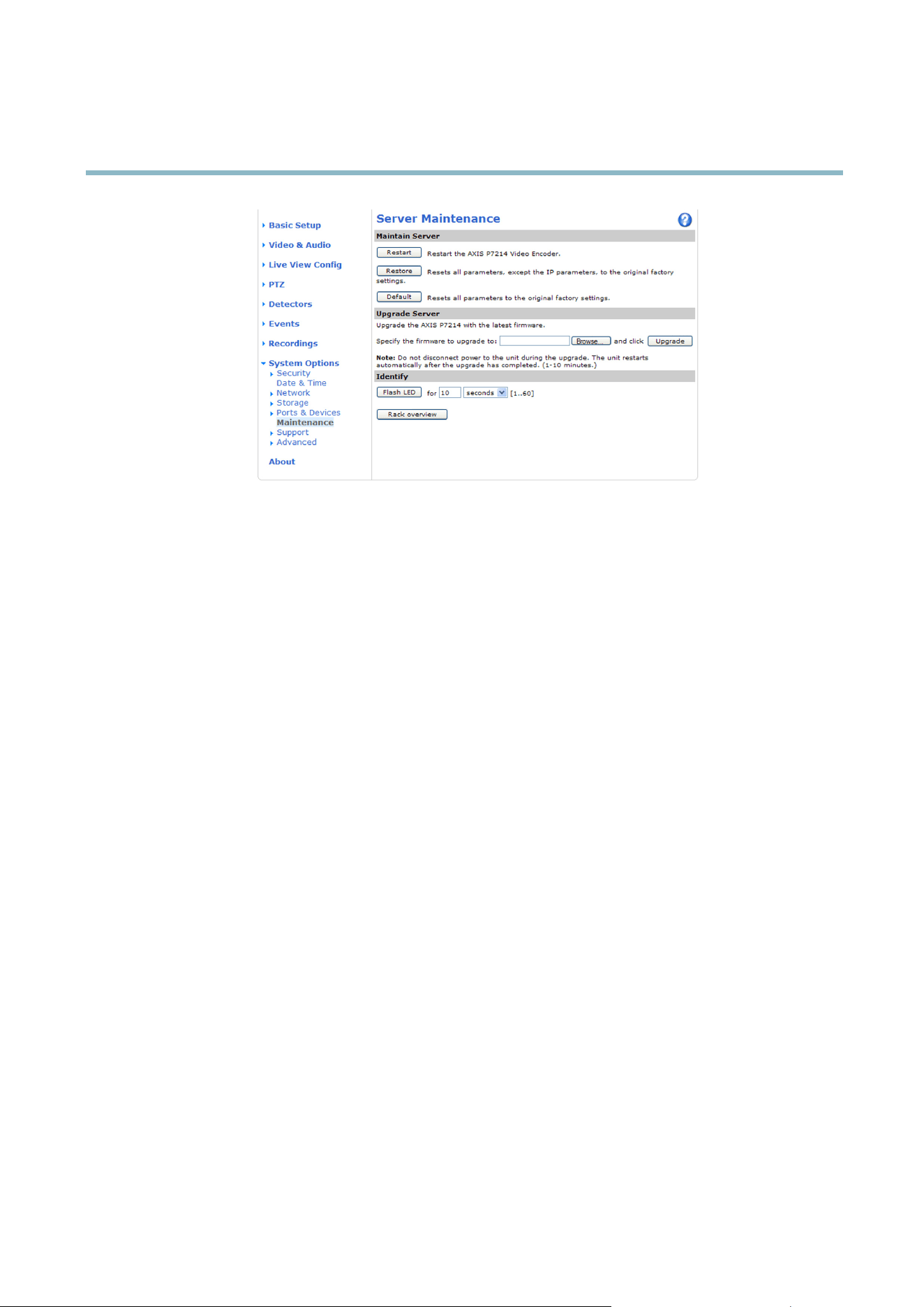
AXIS P7214 Video Encoder
System Options
Support
Support Overview
The System Options > Support > Support Overview page provides information on troubleshooting and contact information,
should you require technical assistance.
See also
Troubleshooting, on page 45
.
System Overview
To g et an overview of the Axis product’s status and settings, go to System Options > Support > System Overview. Information that
can be found here includes firmware version, IP address, network and security settings, event settings, image s ettings and recent log
items. Many of the captio ns are links to the proper Setup page.
Logs & Reports
The System Options > Support > Logs & Reports page generates log s and reports useful for system analysis and troubleshooting. If
contacting Axis Support, please provide a valid Server Report with your query.
System Log - P rovides information about system events.
Access Log - Lists all failed attempts to access the product. The Access Log can also be configured to l ist all connections to the
product (see below).
Server Report - Provides information about the product status in a pop-up window. The Access Log is automatically include d
in the Server Report.
You can view or download the server report. Downloading the server report c reates a .zip file that contains a complete server report
text file in UTF–8 format. Select the Include snapshot w ith default image settings option to include a snapshot of the product’s
Live View that also sh
ows the settings specified under Video Stream>Image >Image Appearance. The server report .zip file should
always be included when contacting support.
Parameter List - Shows the product's parameters and their current settings. This may prove useful when troubleshooting or
when contacting Axis Support.
Connection List - Lis ts all clients that a re currently a c ce s sing media streams.
Crash Report - Generate s an a rchive wi th debugging i nform a tion. The repo rt takes several minutes to generate.
43

AXIS P7214 Video Encoder
System Options
The log levels for the System Log and the Access Log are set under System Options > Support > Logs & Reports > Configuration.
The Access Log can be configured to list a ll connections to the product (se lect Critica l, W arning s & Info). I f require d, a differ ent log
level can be used when sending emails.
Advanced
Scripting
Scripting allow s experienced users to customize and use their own scripts.
NOTICE
Improper use may cause unexpected behavior and loss of contact with the Axis product.
Axis strongly recomm ends that you do not use this function unless you understand the consequences. Axis Support does not provide
assistance for problems with customized scripts.
To open the Script Ed itor, go to System Options > Advanced > Scripting. It is recommended to create a backup file before
customizing the scripts. If a script cause s problems, reset the product to its factory default settings, se e
page 44
.
For more information, see www.axis.com/developer
File Upload
Files, for example web page s and images, can be uploaded to the Axis product a nd used as custom settings. To upload a file, go
to System Options > Advanced > File Upload.
Uploaded files are accessed through http://<ip address>/local/<user>/<file name> where <user> is the
selected user group (viewer, operator or a dministrator) for the up loaded file.
Plain Config
Plain C onfig is for advanced users with experience of Axis product configuration. Most parameters can be set and modified from this
page. Help is available from the standard help pages.
To open Plain Config, go to Sy stem O p tion s > Advan c ed > Plain Config .
Reset to Factory Default Settings
This will reset all pa rameters, including the IP address, to the fac tory default settings:
1. Disconnect power from the product.
2. Press and ho ld the C ontrol button and reconnect power (see
Hardware Overview, on page 4
).
3. Keep the C ontrol b u tton pressed for about 15 seconds until the Status indicator flashes amber.
4. Release the Control button. The pro cess is complete after about 1 minute (when the Status indicator turns green). The
product has been reset to the factory default settings. The d efault IP address is 192.168.0.90
5. Re-assign the IP address.
It is also possible to reset parameters to fa ctory default via the web interface. Go to Setup > System Options > Maintenance.
44

AXIS P7214 Video Encoder
Troubleshooting
Troubleshooting
Checking the Firmware
Firmware is software that determines the functionality of network devices. One of your first actions w hen trou bleshooting a problem
should be to check the current firmware vers ion. The latest ver sion m a y conta in a corr ection that fixesyourparticularproblem.The
current firmware ve rs ion in the Axis product is displayed in the page Setup > Basic Setup and in Setup > About.
Upgrading the Firmware
When you upgrade the product w ith the latest fi rm ware from Ax is website, the p roduct receives the latest functionality available.
Always read the upgrade instructi ons and release notes available w ith each new r eleas e, be fore upgra ding the firm ware.
To upgrade, follow these instructions:
1. Save the firmware file to your computer. The latest version of the firmware is a v ailable free of c harge from A xis website
at www.axis.com/techsup
2. Go to Setup > System Options > Maintenance in the products web pages.
3. Under Upgrade Server, click Browse and locate the file on your com puter . Click Upgrade.
After starting the upgrade process, always wait at least 5–10 minutes before restarting the product, even if you suspect the
upgrade has failed.
AXIS Camera Management can be used for multiple upgrades. See www.axis.com for more information.
Note
• Your dealer reserves the right to charge for any repair attributable to faulty upgrade by the user.
•Preconfigured and customized settings are saved when the firmw are is up graded
(providing the features are available in
the new firmware) although this is not guaranteed b y Axis Comm unications AB.
Emergency Recovery Procedure
If power or network connection is lost during the upgrade, the process fails and the product becomes unresponsive. Flashing red Status
indicator indicates a fa ile d upgrade. To recover the product, follow the steps below. The serial number is f ound on the product’s label.
1. In UNIX/Linux, type the following from the command line:
arp -s <IP address> <serial number> temp
ping -s 408 <IP address>
In Windows,typ
e the following from a command/DOS prompt (this may require that you run the command prompt as
an administra tor):
arp -s <IP address> <serial number>
ping -l 408 -t <IP address>
2. If the product d oes not rep ly in 30 seconds, restart it and wait for a rep ly. Press CTRL+C to stop Ping.
3. Open a browser and type in the product’s IP address. In the page that appears, use the Browse button to select the upgrade
file to use. Then click Load to restart the upgrade process.
4. After the upgrade is complete (1–10 minutes), the product automatically restarts and shows a steady green on the Status
indicator.
5. Reinstall the product, referring to the Installation Guide.
If the emergency recovery procedure does not get the product up and running again, contact A xis support at www.axis.com/techsup/
45

AXIS P7214 Video Encoder
Troubleshooting
Symptoms, Possible Causes and Remedial Actions
Problems setting the IP address
When using ARP/Ping
Try the installa tion again. The IP address must be set within two minutes after power has been
applied to the product. Ensure the Ping length is set to 408. See the Installation Guide for
detailed instructions.
The product is located on a
different s ubnet
If the IP address intended for the prod uct and the IP add ress of the computer used to access the
product are located on different subnets, you will not be able to set the IP address. Contact your
network administrator to obtain an IP address.
The IP addre ss is being used
by another device
Disconnect the Axis p roduct from the network. Run the Ping command (in a Command/DOS
window, type ping and the IP address of the product:
•Ifyoureceive:Reply from <IP address>: bytes=32; time=10...
this means that the IP address m ay already be in use by another device on the netwo rk.
Obtain a n ew IP address from the network administrator and reinstall the product.
•Ifyoureceive:Request timed out, this m eans that the IP address is available for
use with the Axis product. Check all cabling and reinstall the product.
Possible IP address con flict
with another device on the
same subnet.
The static IP address in the Axis product is used be fore the DHCP serve r sets a dynamic address.
This means that if the sam e default static IP a ddressisalsousedbyanotherdevice,theremay
be problems accessing the product.
The product cannot be a ccessed from a browser
Cannot log in
When HTTPS is enabled, ensure that the correct proto co l (HTTP or HTTPS) is used when attempting
to log in. You may need to manually type http or https in the browser’s address field.
If the password for root is lost, the product must be reset to the factory default settings. See
Reset to Factory Default Settings, on page 44
.
The IP address has been
changed by DHCP
If the product and the client are on the same netw ork, run AXIS IP Utility to locate the pro duct.
Identify the product using its model or serial number.
Move the Axis product to an isolated network, or to one with no DHCP or BOOTP server. Set the IP
address again, using AXIS IP Utility or ARP/Ping (see the Installation Guide). Open the Setup pages
and disabled DH CP in the TCP/IP settings. Return the product to the main network. The product
now has a fixed IP address that will not change.
Certificate error when using
IEEE 802.1X
For authentication to work properly, the date and time settings in the Axis product should be
synchronized with an NTP server. See
Date
& Time, on page 35
.
The product is accessible locally but not e xternally
Router configuration To config ure your router to allow incoming data traffic to the Axis product, enable the NAT-traversal
feature which w ill attempt to automatically configure the router to a llow access to the Axis
product, see
NAT traversal (port mapping) for IPv4, on page 38
. The router must support UPnP
TM
.
Firewall protection
Check the Internet fire wall with your networ k administrator.
Default router
srequired
Check if you need to configure the router settings.
Problems with the H.264 format
No H.264 displayed in the
client
Check that the relevant H.264 connection methods and correct interface are enabled in the AM C
Control Pa n el (streaming ta b). See
AXIS Media Control (AMC), on page 11
.
In the AM C Control Panel, select the H.264 tab a nd click Set to default H.264 decoder.
Check that RTSP is enabled under System Options > Network > TCP/IP > Advanced.
46

AXIS P7214 Video Encoder
Troubleshooting
No m ulticas t H.264
displayed in the client
Check with your network administrator that the m ultica st addresses used by the Axis product
arevalidforyournetwork.
Check with your network administrator to see if there is a firewall preventing viewing.
Multicast H.264 only
accessible by local clients
Check if your router supports multicasting, or if the router settings between the client and the
product n eed to be configured. The TTL (Time To Live) value may need to be increa se d.
Poor rendering of H .264
images
Color depth set incorrectly on clients. Set to 16–bit or 32–bit color.
If text overlays are blurred, or if there are other rendering problems, you may need to enable
Advanced Video R end ering fromv the Video tab in the AMC Control Panel.
Ensure that your graphics card is using the latest driver. The latest drive rs can usua lly be
downloaded from the manufacturer’s web site.
Color saturation is different
in H.264 and Motion JPEG
Modify the settings for your graphics adapter. Refer to the adapter’s d ocumenta tion for more
information.
Lower frame rate than
expected
Reduce the number of applications running on the client computer.
Limit the number of simultaneous viewers.
Check with the network administra tor that there is enough bandwidth available.
Check in the AMC Control Panel (H.264 tag ) that video processing is N OT set to Decode only
key frames.
Lower the im age resolution.
Why do I not get maximum
frames per second?
See
Performance Considerations, on page 51
.
The max im um frames per second is depe nden t on the utility frequen cy (60/50 Hz) of the Axis
product. See
Technical Specificatio ns, on page 50
.
Image degeneration
Decrease the GOV length. Go to Video & Audio > Video Stream and select the H.264 tab
to modify the GOV length.
Status and Network indicator LEDs are flashing red rapidly
Hardware failure
Contact your Axis res ell er.
Status indicator LED is flashing red and the product is ina ccessible
A firmw are upg rade h
as
been interrupted or the
firmware has othe rw ise been
damaged
See
Emergency Recovery Procedure, on page 45
.
No images displayed on web page
Problems with AXIS Media
Control (
Internet Explorer
only
)
To enable the updating of video images in Internet Explorer, set the browser to allow ActiveX
contr
ols. Also, make sure that AXIS Media Control is installed on your computer.
Installation of additional
ActiveX component
restricted or prohibited
Configure the Axis product to use a Java applet for updating video images in Internet Explorer. Go
to Setup > Live View Config and select Java app let unde r Default viewer.
Video and image problems, general
Image too dark or too light
Check the video stream and camera setting s under Setup > Video & Audio > Video Stream and
Setup > Video & Aud io > Camera Settings.
47

AXIS P7214 Video Encoder
Troubleshooting
Missing images in uploads This can o ccur when trying to use a larger im age buffer than is actually ava ila ble. Try lowering
the frame rate or the upload period.
Slow image update Configuring pre -buffe rs , m oti on de t ectio n , high-resolution images or high frame ra tes will affect
the performance of the Axis product.
Poor performance Poor performance may be caused by heavy network traffic, m ultiple users accessing the product,
low performance clients , use of features such a s motion detection, event handling or uploaded
applications.
Poor quality snapshot images
Screen incorrectly
configured o n your computer
Configure your screen to show at least 65000 colors, that is, at least 16 bits. Using only 16 or 256
colors will produce dithering artifacts in the image.
Overlay image is not displayed
Incorrect size or l ocation of
overlay image
The overlay ima ge may have been positioned incorrectly or may be too large . See
Overlay Image
Settings
in the online help for more information.
Browser freezes
Firefox can sometimes
freeze on a slow computer
Lower the im age resolution
Problems uploading files
Limited space There is only limited space available for the upload of your ow n files. D ele te existing files to free
up space.
Motion Detection triggers unexpectedly
Changes in luminance
Motion detection is based on changes in luminance in the image. This means that if there are
sudden chang es in the lighting, motion dete cti on may trigger mistakenly. Lowe r the sensitivity
setting to avoid problems w ith luminance.
No audio
Incorrect setup
Check the sound card in the computer. Ensure that mute is not selected a nd t
hat the volume
settings are correct.
No audio or very poor audio
quality
Check that Enable audio support is selected under Setup > System Options > Security > Audio
Support.
Check that the correct Audio Input source is s
elected under Setup > Video & A udio > A udio
Settings.
Poor audio quality
CPU overloaded
Reduce the number of listeners and viewe
rs. Decrease image resolution and compression.
Unsynchronized audio and
video
Synchronize the product’s date and tim esettingswithanNTPserver. GotoSetup > System
Options > Date & Time.
Distorted audio
Check that the correct Audio Input source is selected under Setup > Video & Audio > Audio
Settings.
Feedback loops Feedback loops might appear in full-duplex mode. Try moving the m icrophone or the speaker, or
use half-duple
xmodeinstead.
48

AXIS P7214 Video Encoder
Troubleshooting
Storage and disk management problems
Video cannot be recorded
Check that the SD card is not write protected (that is, read only).
SD card cannot be mounted Reformat the SD card and then click M o unt.
49

AXIS P7214 Video Encoder
Technical Specifications
Technical Specifications
Function/group
Item
Specifications
Model
AXIS P7214 (4 channels)
Video Encoder
Pan/Tilt/Zoom
Wide range of analog PTZ cameras supported (drivers available for download at
www.axis.com)
100 presets/camera, guard tour, PTZ control queue
Supports Windows comp atible joysticks
Video
compression
H.264 (MPEG-4 Part 10/AVC) Baseline Profile (BP) and Main Profile (M P) Mo tion JPEG
Resolutions
176x120 to 720x576,
176x120 to 1536x1152 for quad view
Frame rate H.264 15 fps in quad view
30/25 (NTSC/PAL) fps in all other resolutions
Frame rate
Motion JPEG
30/25 (NTSC/P AL) fps in all resolutions
Video streaming
Multi-stream H.264 and Motion JPEG: One H.264 and one JPEG stream on each channel
(8 streams in total) in full framerate individually configured streams in m ax. resolution
at 30/25 fps; more streams if identical or limited in frame rate/re s olution C ontrollable
frame rate and bandwidth VBR/CBR H.264
Video
Image settings
Compression, color, brightness , contrast
Rotation: 90°, 180°, 270°
Aspect ratio correction
Mirroring of images
Text and im age overlay
Privacy mask
Enhanced deinterlace filter
Video termination
Anti-aliasing
Temporal noise filtering
Audio streaming
Two-way, full duplex and half duplex (mic/line input 1/line output)
Two-way, full duplex and half duplex (mic/line input 2/line output)
Audio
compression
In:
AAC-LC 8 or 16 kHz 8-64 kbit/s G.711 μ-law PCM 8 kHz 64 kbit/s G .726 A DPCM 8 kHz 32
kbit/s or 24 kbit/s
Out:
G.711 μ-law PCM 8 kHz 64 kbit/s μ-law PCM 16 kHz 128 kbit/s G.726 ADPCM 8 kHz 32
kbit/s or 24 kbit/s
Audio
Audio
input/output
Two external microphone or line inputs and one line output.
Security Password protection, IP address filtering, HTTPS* encryption, IEEE 802.1X network a ccess
control, digest authentication, user access log
Network
Supported
protocols
IPv4/v6, HTTP, HTTPS*, Q oS layer 3 DiffServ, FTP, SMTP, B onjour, UPnP,
SNMPv1/v2c/v3(MIB-II), DNS, DynDNS, NTP, RTSP, RTP, TCP, UDP, IGM P, RTCP, ICMP,
DHCP, ARP, SOCKS
50

AXIS P7214 Video Encoder
Technical Specifications
Function/group
Item
Specifications
Application
Programming
Interface
Open API for software integration, including VA PIX ® from Axis Comm unica ti ons available
at www.axis.com Includes the ONVIF specification available at w ww .onvif.org
Support for AXIS Video Hosting System (AVHS) with One-C lick Ca m er a connection
Intelligent video Video motion detection, active tampering alarm
Alarm triggers Audio detection
System
Integration
Alarm events File upload via FTP, HTTP and email
Notification via email, HTTP and TCP
PTZ preset
External output a ctivatio n
Play audio clip
Pre- and post-alarm video buffering
Casing Standalone
Processor,
memory
ARTPEC-4, 512 MB RAM, 128 MB Flash
Power
8-20 V DC, max 8W; Power over Ethernet IEEE 802.3af Class 3, AXIS PS-K power supply
Connectors
4x a nalog composite video inputs (BNC)
2x mono microphone or line inputs, 6Vpp max (3.5 m m jacks)
1x mono audio output, 2Vpp max at 1kohm (3.5 mm jack)
1x 10BASE-T/100BASE-TX Ethernet
4x Configurable external inputs/outputs (terminal block)
1x RS -485/422 full duplex (terminal block)
1x DC input terminal block
Local storage
1x microSD/SDHC
Operating
conditions
0–50°C(32–122°F)
Humidity 20 – 80% RH (non-condensing)
Approvals
EN 55022 Class B, EN 61000-3-2, EN 61000-3-3, EN 55024, EN61000-6-1, EN61000-6-2
FCC Part 15 Subpart B Class B, ICES-003 Class B, VCCI Clas
s B, C-tick AS/NZS CISPR 22,
KCC Class B UL/IEC/EN 60950-1
Weight
570 g
General
Included
accessories
Power supply, mounting and connector kits, Installati on Gu ide , CD with installation and
management tools, software and U ser’s Manual, Windows decoder user lice nses
Dimensions
(HxWxD)
38 x 109 x 172 mm
Performance Considerations
When settings up your system, it is important to consider how various settings and situations will affect perform ance . Some facto rs
affect the amount of bandwidth (the b it rate) required , others can a ffe ct the frame rate, and some affect both. If the load on the
CPU reaches its maximum, this will a lso affect the frame rate.
The following factors are among the most important to consider:
• High image resolution and/or lower compression levels result in images containing m ore data. Bandw idth af fecte d.
• Access by large numbers of Mo tion JPEG and/or unicast H.264 clients. Bandwidth affected.
• Simultaneous viewing of different streams (resolution, compression) by different clients. Effect on frame rate and bandwidth.
• Accessing Motion JPEG and H .264 vide o s tream s s imu ltaneo usly. Frame rate a nd ba ndw idth a ffe cted.
• Heavy usage of event settings affect the product’s CPU load. Frame rate affected.
51

AXIS P7214 Video Encoder
Technical Specifications
• Heavy network utilization due to poor infrastructure. Bandwidth affected.
• Viewing on poorly performing client computers lowers perceived performance. Frame rate affected.
52

User's Manual Ver. M2.3
AXIS P7214 V
ideo Encoder Date: April 2012
© Axis Communications AB, 2011 - 2012
Part No. 47
398