RMB954E9VX
RME954E9VX
EN User manual 02
USER
MANUAL
2 www.aeg.com
CONTENTS
Subject to change without notice.
FOR PERFECT RESULTS
CUSTOMER CARE AND SERVICE
Thank you for choosing this AEG product. We have created it to give you impeccable
performance for many years, with innovative technologies that help make
life simpler features you might not nd on ordinary appliances. Please spend
a few minutes reading to get the very best from it.
Always use original spare parts.
When contacting our Authorised Service Centre, ensure that you have the following
data available: Model, PNC, Serial Number.
The information can be found on the rating plate.
Visit our website to:
Get usage advice, brochures, trouble shooter, service information:
www.aeg.com
Register your product for better service:
www.registeraeg.com
Buy Accessories, Consumables and Original spare parts for your appliance:
www.aeg.com/shop
Warning / Caution-Safety information.
General information and tips.
Environmental information.
1. SAFETY INFORMATION ����������������������������������������������������������������������������������������������������������3
2. SAFETY INSTRUCTIONS ��������������������������������������������������������������������������������������������������������5
3. ENVIRONMENT CONCERNS �������������������������������������������������������������������������������������������������6
4. DESCRIPTION OF THE APPLIANCE ��������������������������������������������������������������������������������������7
5. INSTALLING YOUR NEW APPLIANCE �����������������������������������������������������������������������������������8
6. DISPLAY CONTROLS ������������������������������������������������������������������������������������������������������������10
7. USING THE DISPENSER ������������������������������������������������������������������������������������������������������15
8. STORAGE FEATURES ����������������������������������������������������������������������������������������������������������17
9. CONNECTING THE WATER SUPPLY �����������������������������������������������������������������������������������20
10. CHANGING THE FILTER �����������������������������������������������������������������������������������������������������22
11. INSTALLATION ���������������������������������������������������������������������������������������������������������������������24
12. DOOR REMOVAL INSTRUCTIONS �������������������������������������������������������������������������������������26
13. HELPFUL HINTS AND TIPS ������������������������������������������������������������������������������������������������29
14. CLEANING AND CARE ��������������������������������������������������������������������������������������������������������32
15. BEFORE CALLING ��������������������������������������������������������������������������������������������������������������33
16. DISPOSAL OF THE APPLIANCE �����������������������������������������������������������������������������������������38
17. TECHNICAL DATA ���������������������������������������������������������������������������������������������������������������38
18. NOISES ��������������������������������������������������������������������������������������������������������������������������������39
3ENGLISH
1. SAFETY INFORMATION
Before the installation and use of the appliance, carefully
read the supplied instructions� The manufacturer is not
responsible if an incorrect installation and use causes
injuries and damages� Always keep the instructions with
the appliance for future reference�
1.1 Children and vulnerable people safety
• This appliance can be used by children aged from
8 years and above and persons with reduced physical,
sensory or mental capabilities or lack of experience
and knowledge if they have been given supervision
or instruction concerning the use of the appliance in
a safe way and understand the hazards involved.
• This appliance may be used by children between
3 and 8 years of age and persons with very extensive
and complex disabilities, if they have been properly
instructed.
• Children of less than 3 years of age should be kept
away unless continuously supervised.
• Do not let children play with the appliance.
• Children shall not carry out cleaning and user
maintenance of the appliance without supervision.
• Keep all packaging away from children and dispose
of it appropriately.
1.2 General Safety
• This appliance is for storing food and beverages only.
• This appliance is designed for single household
domestic use in an indoor environment.
• This appliance may be used in oces, hotel guest
rooms, bed & breakfast guest rooms, farm guest
houses and other similar accommodation where such
use does not exceed (average) domestic usage levels.
• WARNING: Keep ventilation openings, in the
appliance enclosure or in the built-in structure,
clear of obstruction.
• WARNING: Do not use mechanical devices or other
means to accelerate the defrosting process, other
than those recommended by the manufacturer.

4 www.aeg.com
• WARNING: Do not damage the refrigerant circuit.
• WARNING: Do not use electrical appliances inside
the food storage compartments of the appliance,
unless they are of the type recommended by the
manufacturer.
• Do not use water spray and steam to clean the
appliance.
• Clean the appliance with a moist soft cloth. Only use
neutral detergents. Do not use abrasive products,
abrasive cleaning pads, solvents or metal objects.
• Do not store explosive substances such as aerosol
cans with a ammable propellant in this appliance.
• If the supply cord is damaged, it must be replaced by
the manufacturer, its service agent or similarly qualied
persons in order to avoid a hazard.
• If the appliance is equipped with an Ice maker or a
water dispenser, ll them with potable water only.
• If the appliance requires a water connection, connect
it to potable water supply only.
• The inlet water pressure (minimum and maximum)
must be between 1 bar (0,1 MPa) and 10 bar (1 MPa)
• The instructions of appliances connected to the water
mains by detachable hose-sets shall state that the new
hose-sets supplied with the appliance are to be used
and that old hose-sets should not be reused.
• To avoid contamination of food, please repect the
following instructions:
–Opening the door for long periods can cause
a signicant increase of the temperature in the
compartments of the appliance.
–Clean regularly surfaces that can come in contact
with food and accessible drainage systems.
–Clean water tanks if they have not been used for
48 h: ush the water system connected to a water
supply if water has not been drawn for 5 days.
–Store raw meat and sh in suitable containers in
the refrigerator, so that it is not in contact with or
drip onto other food.
5ENGLISH
2. SAFETY INSTRUCTIONS
2.1 Installation
WARNING!
Only a qualied person must
install this appliance�
• Remove all the packaging.
• Do not install or use a damaged appliance.
• Obey the installation instruction
supplied with the appliance.
• Always be careful when you move the
appliance because it is heavy. Always
wear safety gloves.
• Make sure the air can circulate around
the appliance.
• Wait at least 4 hours before
connecting the appliance to the power
supply. This is to allow the oil to ow
back in the compressor.
• Do not install the appliance close to
radiators or cookers, oven or hobs.
• The rear of the appliance must stand
against the wall.
• Do not install the appliance where
there is direct sunlight.
• Do not install this appliance in areas
that are too humid or too colds, such
as the construction appendices,
garages or wine cellars.
• When you move the appliance, lift it
by the front edge to avoid scratching
the oor.
2.2 Electrical connection
WARNING!
Risk of re and electrical shock.
WARNING!
When positioning the appliance,
ensure the supply cord is not
trapped or damaged�
WARNING!
Do not use multi-plug adapters
and extension cables�
• The appliance must be earthed
• Make sure that the electrical
information on the rating plate agrees
with the power supply. If not, contact
an electrician.
• Always use a correctly installed
shockproof socket.
• Make sure not to cause damage to
the electrical components (e.g. mains
plug, mains cable, compressor).
• Contact the Service or an electrician
to change the electrical components.
• The mains cable must stay below the
level of the mains plug.
Connect the mains plug to the mains
socket only at the end of the installation.
Make sure that there is access to the
mains plug after the installation.
Do not pull the mains cable to disconnect
the appliance. Always pull the mains plug.
2.3 Use
WARNING!
Risk of injury, burns, electrical
shock or re.
The appliance contains
ammable gas, isobutane
(R600a), a natural gas with
a high level of environmental
compatibility� Be careful not to
cause damage to the refrigerant
circuit containing isobutane�
• Do not change the specication of this
appliance.
• Do not put electrical appliances
(e.g. ice cream makers) in the
appliance unless they are stated
applicable by the manufacturer.
–Two-star frozen-food compartments are suitable for
storing pre-frozen food, storing or making icecream and
making ice cubes.
– One-, two- and three-star compartments are not suitable
for the freezing of fresh food.
– If the refrigerating appliance is left empty for long periods,
switch o, defrost, clean, dry, and leave the door open to
prevent mould developing within the appliance.
6 www.aeg.com
• Be careful not to cause damage
to the refrigerant circuit. It contains
isobutane (R600a), a natural gas
with a high level of environmental
compatibility. This gas is ammable.
• If damage occurs to the refrigerant
circuit, make sure that there are no
ames and sources of ignition in the
room. Ventilate the room.
• Do not let hot items to touch the
plastic parts of the appliance.
• Do not put soft drinks in the freezer
compartment. This will create
pressure on the drink container.
• Do not store ammable gas and liquid
in the appliance.
• Do not put ammable products or
items that are wet with ammable
products in, near or on the appliance.
• Do not touch the compressor or the
condenser. They are hot.
• Do not remove or touch items from
the freezer compartment if your hands
are wet or damp.
• Do not freeze again food that has
been thawed.
• Obey the storage instructions on the
packaging of frozen food.
2.4 Internal lighting
WARNING!
Risk of electric shock�
• This product contains a light source of
energy eciency class F.
• The type of lamp used for this appliance
is for household appliances only. Do not
use it for house lighting.
• Concerning the lamp(s) inside this
product and spare part lamps sold
separately: These lamps are intended
to withstand extreme physical
conditions in household appliances,
such as temperature, vibration,
humidity, or are intended to signal
information about the operational status
of the appliance. They are not intended
to be used in other applications and
are not suitable for household room
illumination.
2.5 Care and cleaning
WARNING!
Risk of injury or damage to the
appliance�
Before maintenance, deactivate the
appliance and disconnect the mains
plug from the mains socket.
This appliance contains hydrocarbons
in the cooling unit. Only a qualied
person must do the maintenance
and the recharging of the unit.
Regularly examine the drain of the
appliance and if necessary, clean it. If the
drain is blocked, defrosted water collects
in the bottom of the appliance.
2.6 Disposal
WARNING!
Risk of injury or suocation.
Disconnect the appliance from
the mains supply�
• Cut o the mains cable and discard it.
• Remove the door to prevent children
and pets to be closed inside of the
appliance.
• The refrigerant circuit and the
insulation materials of this appliance
are ozone-friendly.
• The insulation foam contains
ammable gas. Contact your
municipal authority for information on
how to discard the appliance correctly.
• Do not cause damage to the part of
the cooling unit that is near the heat
exchanger.
3. ENVIRONMENT CONCERNS
Recycle the materials with the symbol .
Put the packaging in applicable
containers to recycle it. Help protect
the environment and human health
and to recycle waste of electrical and
electronic appliances. Do not dispose
appliancesmarked with the symbol with
the household waste. Return the product
to your local recycling facility or contact
your municipal oce.
7ENGLISH
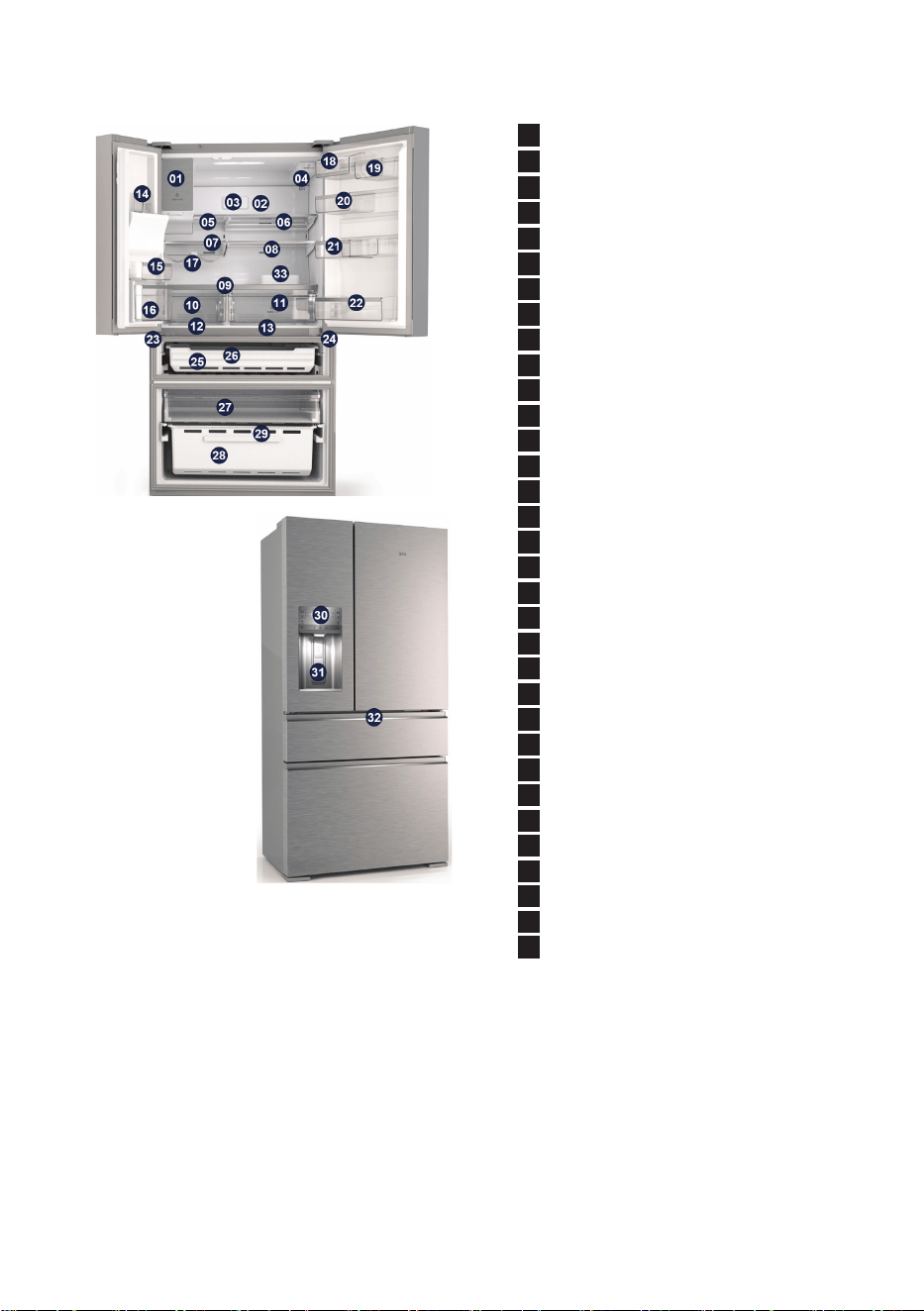
4. DESCRIPTION OF THE APPLIANCE
1
Ice Maker
2
Mulitifow
3
Air Filter
4
Water Filter
5
Flip Up Shelf
6
Slide Under Shelf
7
Left Glass Shelf
8
Right Glass Shelf
9
Crisper Cover Shelf
10
Left Crisper
11
Right Crisper
12
Left Snack Zone
13
Right Snack Zone
14
Left Superior Fixed Bin
15
Left Bottom Fixed Bin
16
Tilt Bin
17
Wine Rack
18
Dairy Bin Flex 2/3
19
Door Bin Flex 1/3
20
Door Bin Flex 2/3
21
Sliding door bin ex
22
Bottle Bin
23
Left Middle Hinge
24
Right Middle Hinge
25
MultiSwitch/MultiChill drawer
26
MultiSwitch/MultiChill divider
27
Upper Freezer Drawer
28
Basket Freezer
29
Freezer Divide
30
User Interface
31
Padle
32
User Interface FlexiSpace
33
Egg Tray
Note: Due to constant improvement
of our products, your refrigerator may
be slightly dierent from the above
illustration, but its functions and using
methods remain the same.
Note: To get the best energy eciency
of this product, please place all shelves,
drawers and baskets on their original
position as the illustration above.
Fridge
Freezer
Middle variable
temperature drawer
8 www.aeg.com
5. INSTALLING YOUR NEW APPLIANCE
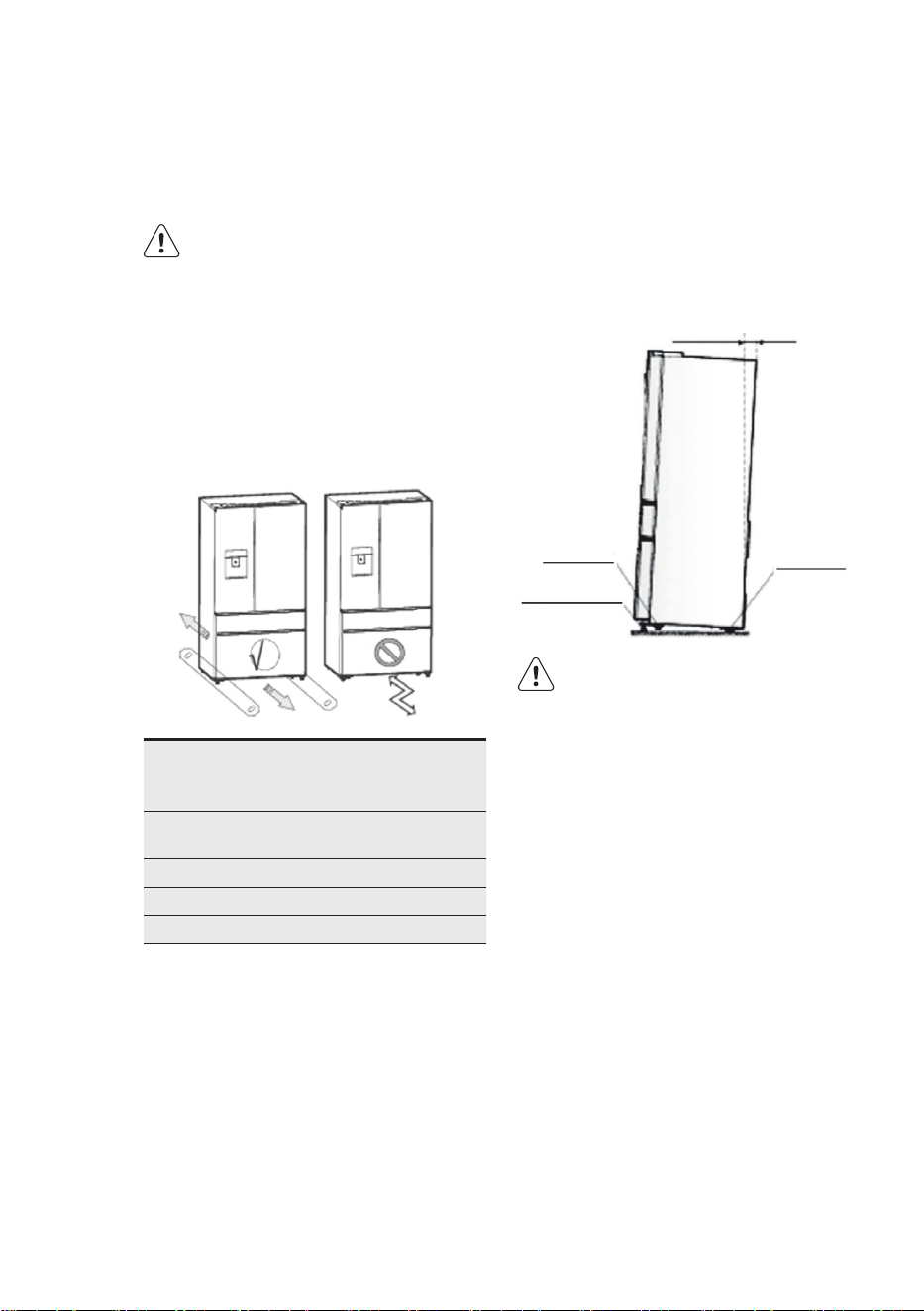
This section explains the installation of
the new appliance before using it for the
rst time. We recommend reading the
following tips.
WARNING!
For proper installation, this
refrigerator must be placed
on a level surface of hard
material that is the same height
as the rest of the ooring.
This surface should be strong
enough to support a fully loaded
refrigerator, or approximately
250 kg� When moving, be sure to
pull out and push back the unit in
straight�
Class
Symbol Ambient
Temperature
rage (°C)
Extend
Temperate
SN +10 to +32
Temperate N +16 to +32
Subtropical ST +16 to +38
Tropical T +16 to +43
This appliance is not intended to be used
as a built-in appliance.
Leveling of appliance
For proper leveling and avoid vibration,
this appliance is provided with adjustable
feet in front. Please adjust the level by
following below instructions:
1. Roll the refrigerator into place.
2. Turn the adjustable feet (with your
ngers or a suitable spanner) until
they touch the oor.
3. Tilt back the top backwards for about
10-15 mm by turning the feet 1~2
turn further. This will allow the doors
to selfclose and seal properly.
4. Whenever you want to move the
appliance, remember to turn the feet
back up so that the appliance can roll
freely. Reinstall the appliance when
relocating.
10-15mm
Front roller
Rear roller
Adjustable foot
WARNING!
The rollers, which are not
castors, should be only used for
forward or backward movement�
Moving the refrigerator sideways
may damage your oor and the
rollers�
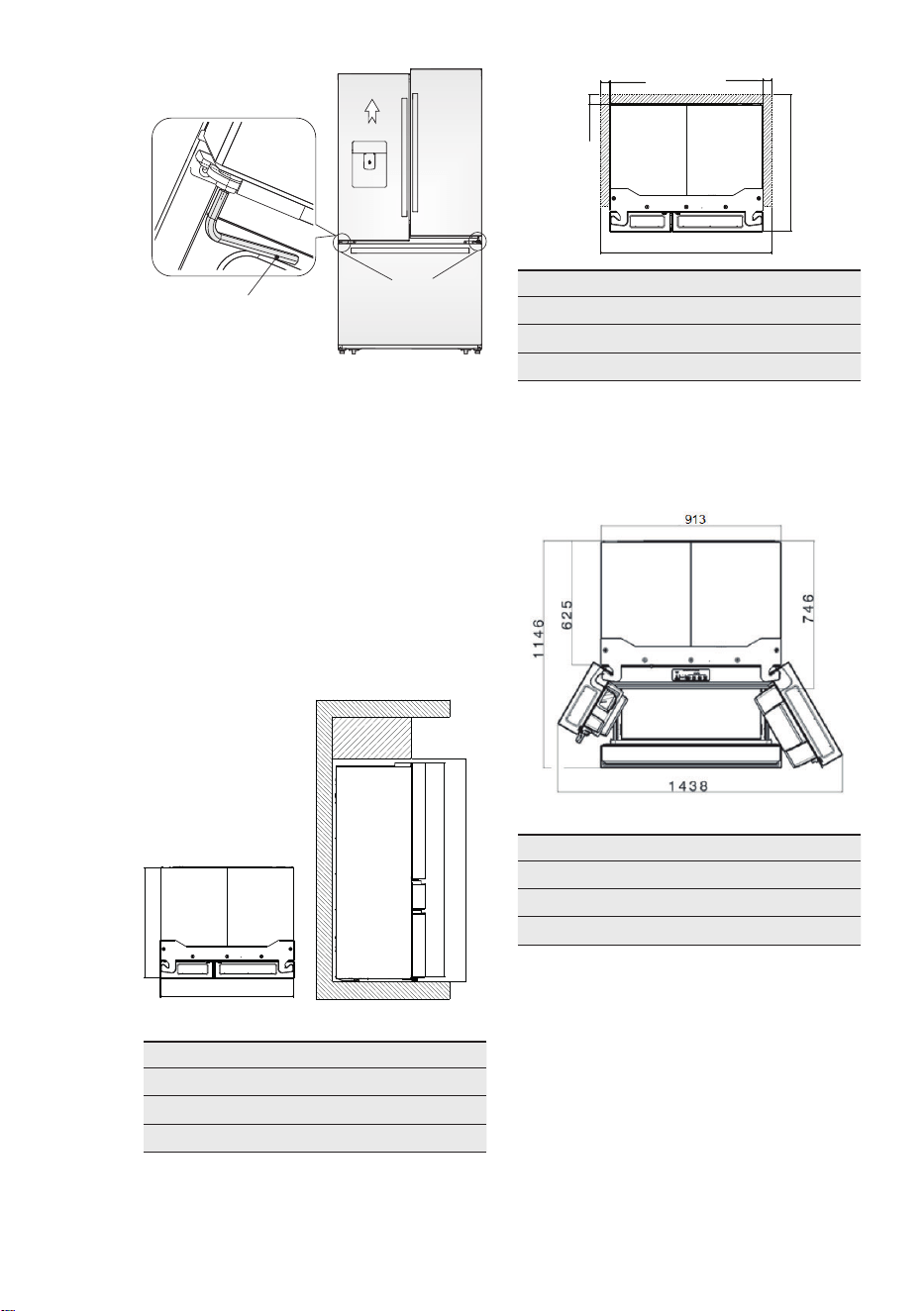
Adjusting the doors
• Both left and right doors are equipped
with adjustable axes, which are
located in the lower hinges.
• Before adjusting its doors, please
ensure that the refrigerator is level.
Please review the previous section on
“Leveling appliance”. If you nd the
top of the doors are uneven, insert the
Allen wrench into the hinge axis, and
turn it clockwise to rise the door or
anticlockwise to lower the door, and
insert an E Ring into the gap.
9ENGLISH
Allen wrench
Adjustable part
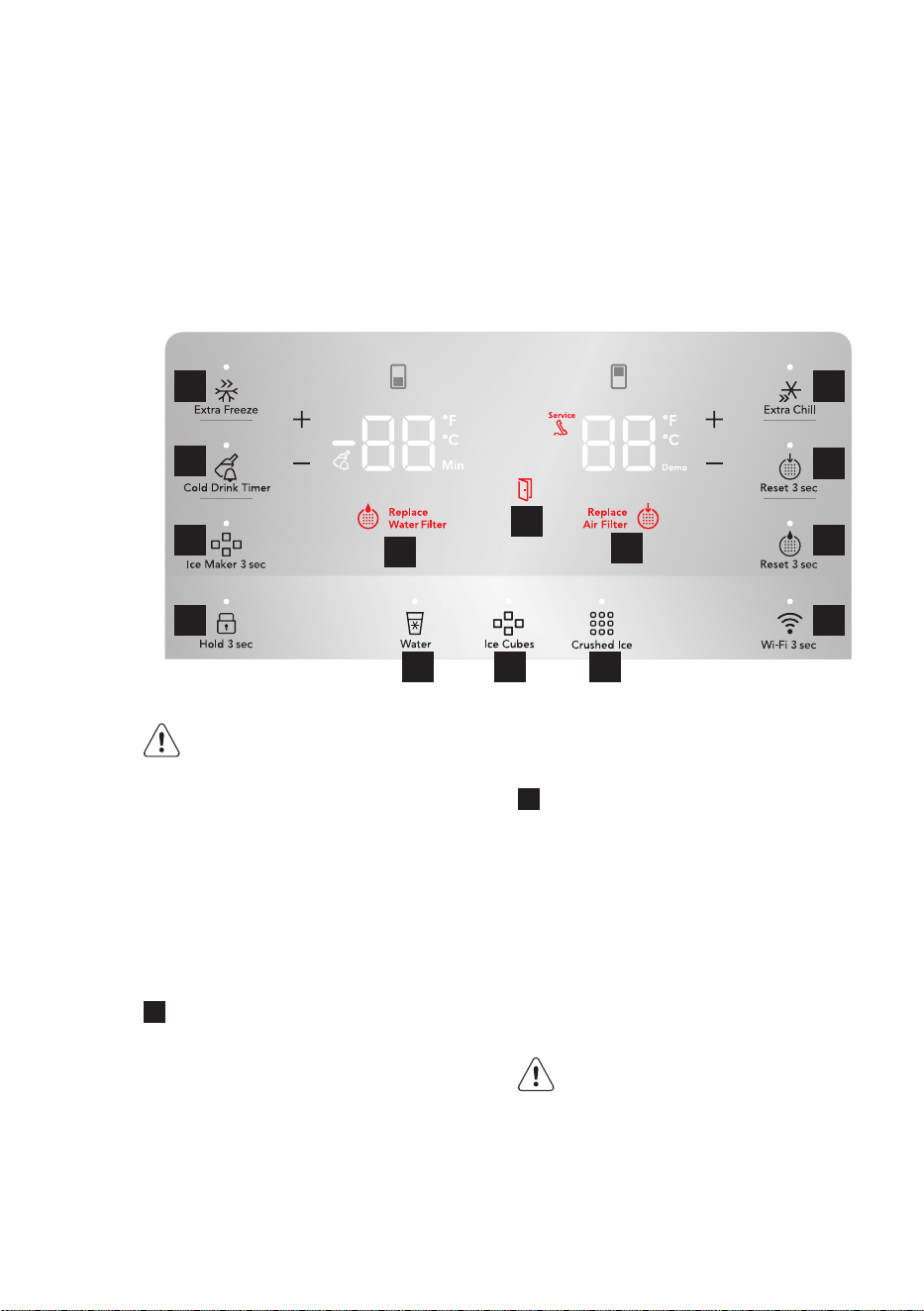
Ventilation of appliance
In order to improve eciency of the
cooling system and save energy, it is
necessary to maintain proper ventilation
around the appliance for heat dissipation.
For this reason, sucient space should
be provided around the refrigerator
and the area should be clear of any
obstruction that aects the air circulation.
In case of dierent installation from
freestanding, respecting space required
in use dimensions, the functionality of
the appliance is guaranteed but energy
rating increase slightly.
W1
D1
H1
H2
Overall dimensions *
H1 mm 1746
W1 mm 913
D1 mm 749
* The height, width and depth of the
appliance without the handle and feet.
W2
25 mm
25 mm
25 mm
D2
Space required in use **
H2 mm 1806
W2 mm 963
D2 mm 774
** The height, width and depth of the
appliance including the handle, plus the
space necessory for free circulation of
the cooling air.
Overall space required in use ***
H2 mm 1806
W2 mm 963
D2 mm 774
*** The height, width and depth of the
appliance including the handle, plus the
space necessory for free circulation of
the cooling air, plus the space necessory
to allow door opening to the minimum
angle premitting removal of all internal
equipment.
10 www.aeg.com
CAUTION!
When you set a temperature,
you set an average temperature
for the whole refrigerator cabinet�
Temperatures inside each
compartment may vary from the
temperature values displayed
on the panel, depending on
how much food you store and
where you place them� Ambient
temperature may also aect the
actual temperature inside the
appliance�
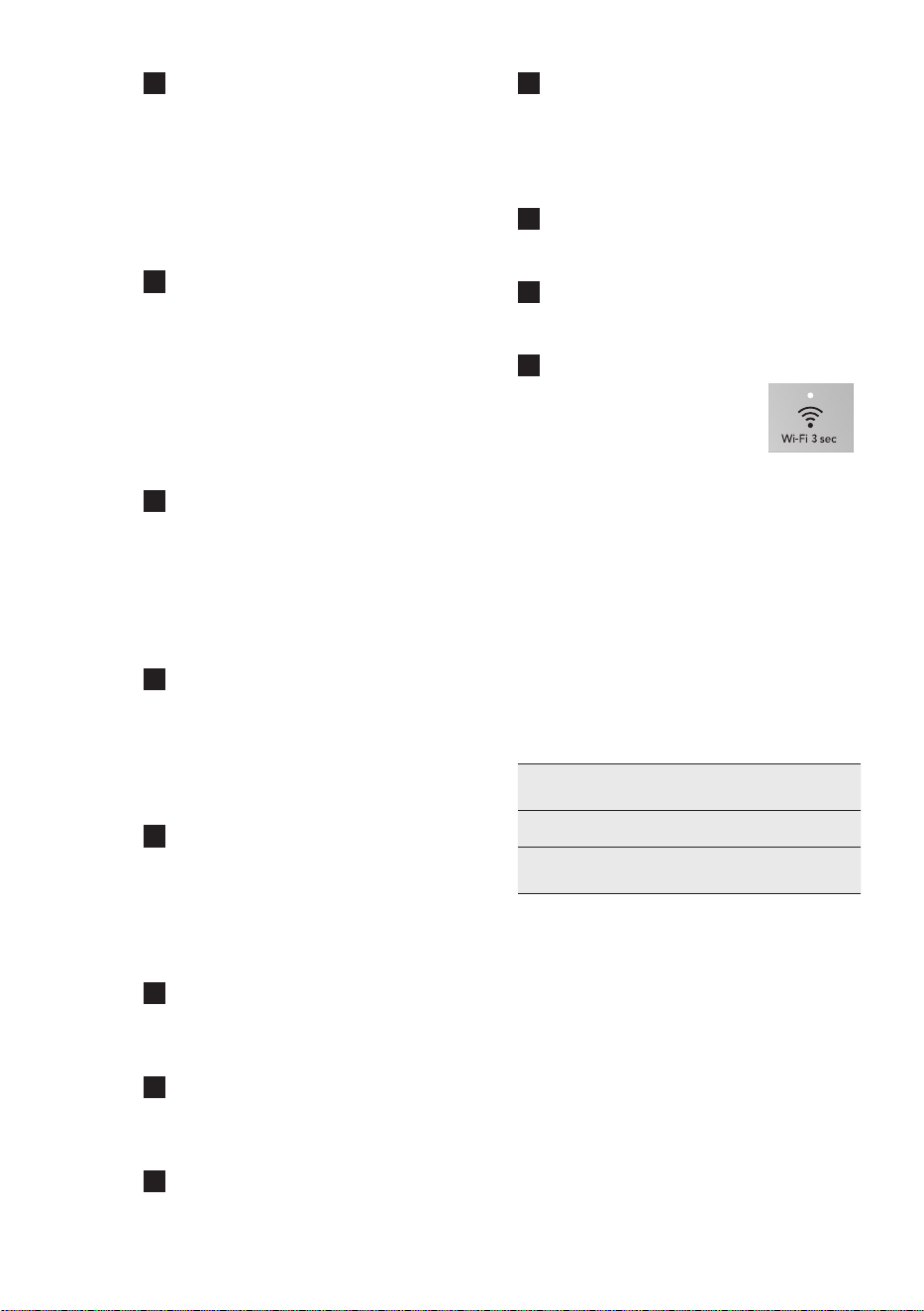
1
Extra Freeze
Activates a faster rate for freezing
food in the freezer. Use this feature
when loading several items into the
freezer at one time. Automatically
deactivates after 12 hours.
To freeze fresh food activate the
FastFreeze function at least 24 hours
before placing the food to be frozen in
the freezer compartment.
Store the fresh food evenly distributed
in the rst compartment or drawer
from the top.
2
Cold Drink Timer
Quickly chills a drink inside the
freezer compartment. To enable,
touch the Cold Drink Timer Key. A
time value will appear on the freezer
temp display (in minutes) and can be
changed using the +/- buttons. A tone
will sound when the time has been
input. Range is from 20-45 minutes in
5 minute intervals. Drinks will freeze if
temperature setting is too low or timer
setting is too long.
WARNING
When using the cold drink timer,
make sure to remove drinks from
freezer compartment when alarm
sounds� Carbonated drinks may
explode if left in freezer for too
long�
6. DISPLAY CONTROLS
All functions and controls of the unit
are accessible from a control panel
conveniently located on the door of the
refrigerator. While setting of middle drawer
are done with dedicated controls place
inside the drawer. A keypad of touch
buttons and a digital display allow easy
conguration of features andsettings in
a simple and intuitive manner.
Important! Touch buttons require only
a short press on a button to operate.
The operation occurs when releasing
your nger from the button, not while the
button is pressed. There is no need for
applying pressure on the keypad.
Please refer to those related sections of
this Manual for detailed instructions.
1
2
3
4
11
12
13
14
5
6
7
98 10
11ENGLISH
3
Ice Maker
Press and hold for 3 seconds to turn on/
o ice maker. When indicator is lit, ice
maker is on. When indicator is not lit,
ice maker is in the OFF state and will
stop making ice. While o, ice dispensing
can continue as long as there is ice in the
bucket. When ice maker is o and ice is
dispensing, indicator will blink.
4
Lock
The lock button can be used to lock the
display preventing it from being used
in certain situations. Press and hold for
3seconds to enable/disable. While in the
locked state, non changes can be made
to settings on the display. Dispensing ice
and water will be disabled. The indicator
will ash and an auditable warning tone
is played.
5
Door Open
Illuminates whenever the doors are
open. If a door is left open for 5 minutes
or more, an alarm will sound and the
display will be illuminated until the doors
are shut. Pressing any button will mute
the alarm temporarily. Check to make
sure no food is blocking the doorway.
6
Replace Water Filter
Display illuminates every 6 months or
when lter needs replacing. Replace
lter and then press and hold ‘Reset
Water Filter’ for 3 seconds to deactivate
warning on display. See “Replacing the
Filter” section for more information.
7
Replace Air Filter
Display illuminates every 6 months or
when lter needs replacing. Replace lter
and then press and hold ‘Reset Air Filter’
for 3 seconds to deactivate warning
on display. See “Replacing the Filter”
section for more information.
8
Water
Press the “water” key to dispense water.
An indicator light will be illuminated
above the active feature.
9
Cube
Press the “cube” key to dispense cubed
ice. An indicator light will be illuminated
above the active feature.
10
Crush
Press the “crush” key to dispense
crushed ice. An indicator light will be
illuminated above the active feature.
11
Cool Matic
Quick chill is a faster rate for chilling food
in the refrigerator compartment. Use this
feature when loading several items into
the refrigerator at one time. Deactivates
after 6 hours.
12
Reset Air Filter
After replacing lter, press and hold for
3 seconds to reset.
13
Reset Water Filter
After replacing lter, press and hold for
3 seconds to reset.
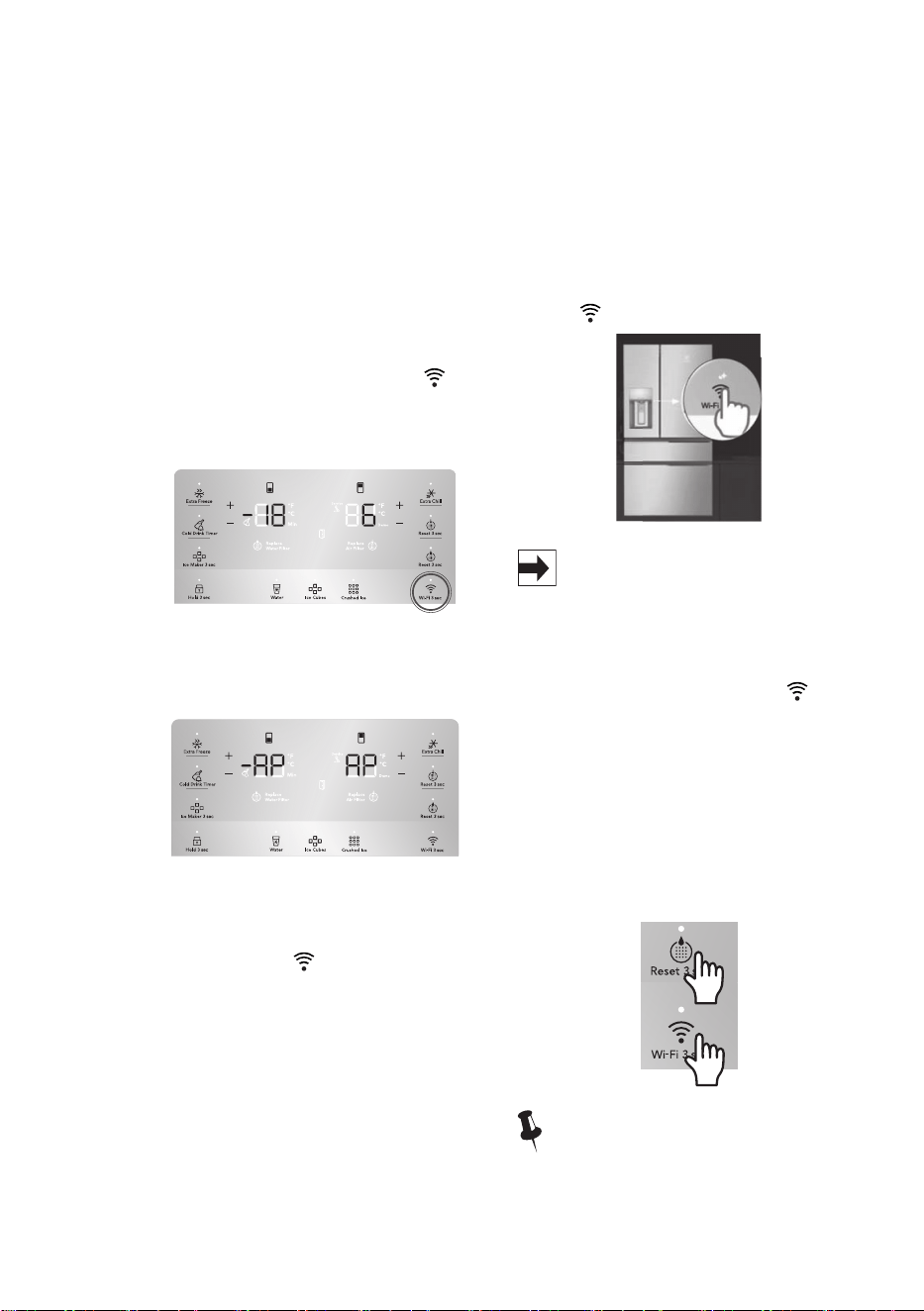
14
Wi-Fi Connectivity
Press and hold for 3 second
to enable / disable wireless
connection.
When LED is lit the product is
connected.
When LED is ashing the product is
connecting or during setup.
When LED is o, Wi-Fi is o.
1. WI-FI CONNECTIVITY SETUP
This chapter describes how to connect
the smart refrigerator to the Wi-Fi
network and to link it to your mobile
device.
By this functionality you can receive
notications, control and monitor your
refrigerator from your mobile device.
Frequency/
Protocol
Wi-Fi: 2�4 GHz /
802�11 bgn
Power Wi-Fi 2.4 GHz: <20 dBm
Encryption WPA-PSK, WPA2-
PSK, WPA3-Personal
To connect the appliance to enjoy the full
range of features and services you need:
• Wireless 2.4GHz network at home with
internet connection enabled.
• Mobile device connected to wireless
home network.
1.1 Installing the mobile application
When connecting the refrigerator to the
application, stand near it with your mobile
device (Android or iOS). Make sure that
your mobile device is connected to the
same wireless network you want to add
your refrigerator to.
1.
Go to the relevant App Store on your
device
12 www.aeg.com
2.
Download the dedicated application
on your mobile device from Google
Play (Android) or App Store (iOS) and
install the application on your mobile
device.
3.
Open the app and register to create
an account.
1.2 Conguring the appliance wireless
connection
1.
Follow the app’s guidance to onboard
your refrigerator. The app will ask you
to start the refrigerators WiFi which
your do on the appliance.
2.
Press and hold the Wi-Fi icon on
your refrigerator for 3 seconds until
you hear a beep – this will start the
Wi-Fi system.
3.
After few seconds the refrigerator will
display AP on the user interface and
will be ready to move on to the next
stage in the app.
4.
Continue to follow the instructions in
the app to complete the onboarding
process.
5.
When the refrigerator has connected,
the Wi-Fi icon will stop ashing
and will stay solid and the screen will
display your desired temperatures
again. Continue to follow the app
guidance to complete the registration
and name your refrigerator.
After the successful onboarding, the
Connectivity indicator stops ashing and
becomes solid. Display shows the set
temperatures.
1.3 Disabling / Resetting the
refrigerator wireless connection
1.
You can temporarily disable the
Wi-Fi connection by pressing and
holding for 3 seconds the Wi-Fi
button. The Wi-Fi icon will switch
o and you will hear a beep. Once
the Wi-Fi connection is disabled,
to automatically re-establish
the connection you will have to
press and hold for the 3 seconds
the button again.
IMPORTANT
After reset, the Connectivity
indicator may be o. Wait a few
seconds until it turns on�
2.
You can reset the Wi-Fi conguration
by pressing and holding for
10 seconds the Wi-Fi button
and the Reset Water Filter button
together. Once the conguration is
reset, the refrigerator will beep and
return to your desired temperatures.
To then re-establish the connection,
you will have to repeat all the steps
at section 1.2 “Conguring the
refrigerator wireless connection”.
Alternatively this can be done through
the App.
NOTE
Control features and alarms may
vary by model�

13ENGLISH
Alarms
High temperature, “HI” indicator
An increase in the temperature in the
Fridge or Freezer compartment (for
example due to earlier power failure) is
indicated by:
- Flashing the HI on the correspondent
compartment display
- Sound alar, every 10 seconds until the
alert is acknowledgment
To reset the alarm press any button or
opening the door.
• The buzzer switches o
• The display shows the highest
temperature reached for 10 seconds.
Then show again the set temperature.
After 60 minutes, if the high temperature
condition is not improved at all, please
contact an Authorised Service Center.
Water Filter
When illuminated, the water lter needs
to be replaced. Change the water lter
every 6 months or when 450 litres of
water has been dispensed. To reset,
press and hold button for 3 seconds.
Tone will sound once it has been reset.
Air Filter
When illuminated, air lter needs to be
replaced. Change the air lter every
6 months. To reset, press and hold
button for 3 seconds. Tone will sounds
once it has been reset.
Door
If a door has been left open for ve
minutes or more, an alarm will sound
and the door open indicator will illuminate
on the display. The alarm can be turned
o by closing the door or pressing any
key. Control panel will return to normal
operations after the door is closed.
Error Tone
An alarm will sound if the user tries to
make a selection that is not available.
Mode Fahrenheit / Celsius degree
Press and hold for 5 seconds + and ‐
from the refrigerator side.
After that, we will have a ‘Tone Conrm’
and display will change the temperature
unit showing the other option directly on
the numeric display. The temperature
value will also change.
Demonstration mode
Pressing and holding + (freezer) and –
(refrigerator) for 10 seconds will activate
Demonstration mode.
• On detection of 10‐sec‐holding,
- Illuminate Icon “Demo”
- Play tone Conrm
• Pressing and holding + (freezer) and –
(refrigerator) for 10 seconds again will
deactivate Demo mode
- Illuminate Icon “Demo”
- Play tone Cancel
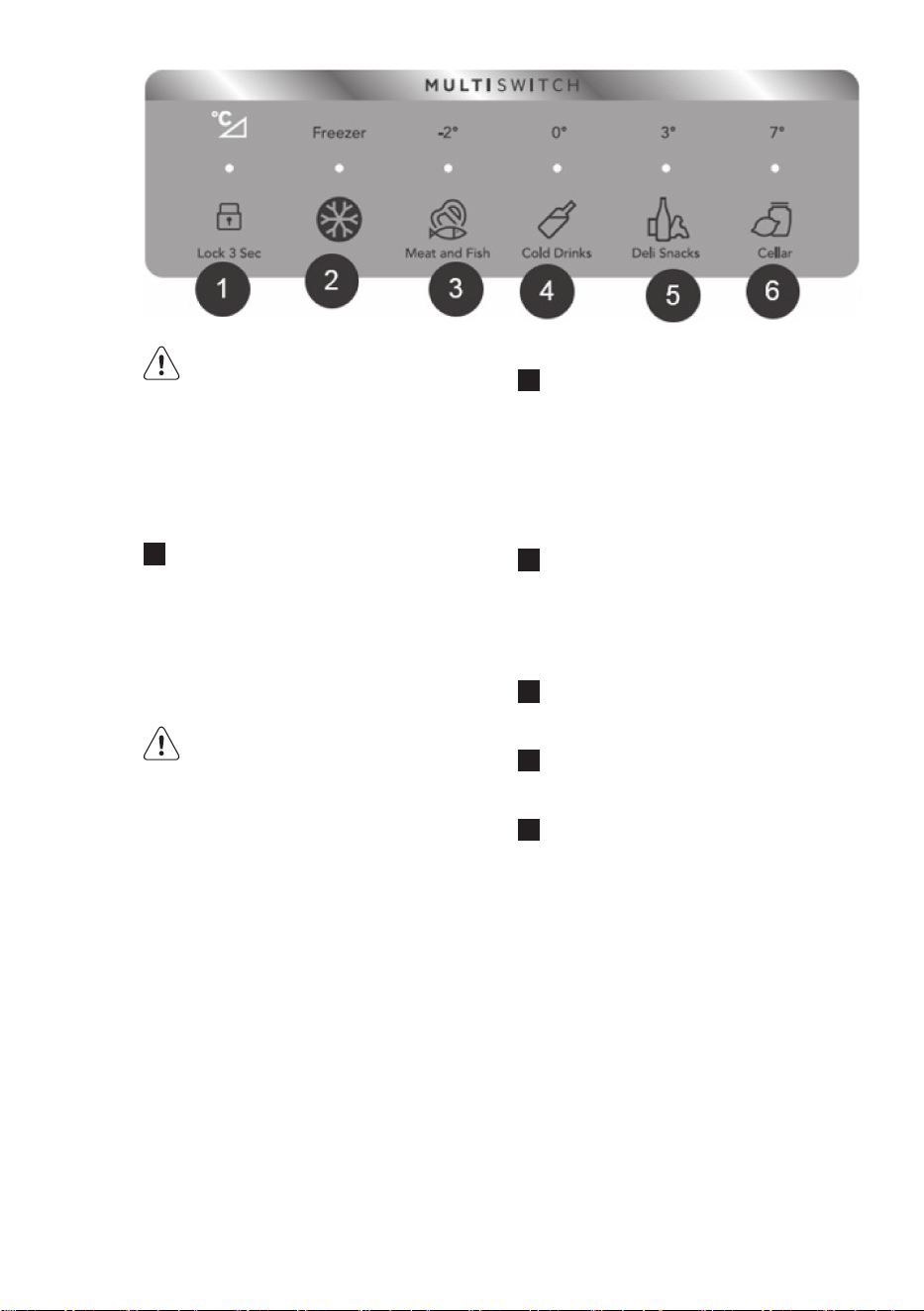
The software in this product contains
components that are based on free
and open source software. Electrolux
gratefully acknowledges the contributions
of the open software and robotics
communities to the development project.
To access the source code of these
free and open source software
components whose license conditions
require publishing, and to see
their full copyright information and
applicable license terms, please visit:
http://aeg.opensoftwarerepository.com
(folder NIUS).
14 www.aeg.com
WARNING!
Do not use the MultiSwitch
Drawer to store fresh prodoce
as these Items may freeze ahd
ause damage to the fruits and
leafy vegetables stored in the
drawer�
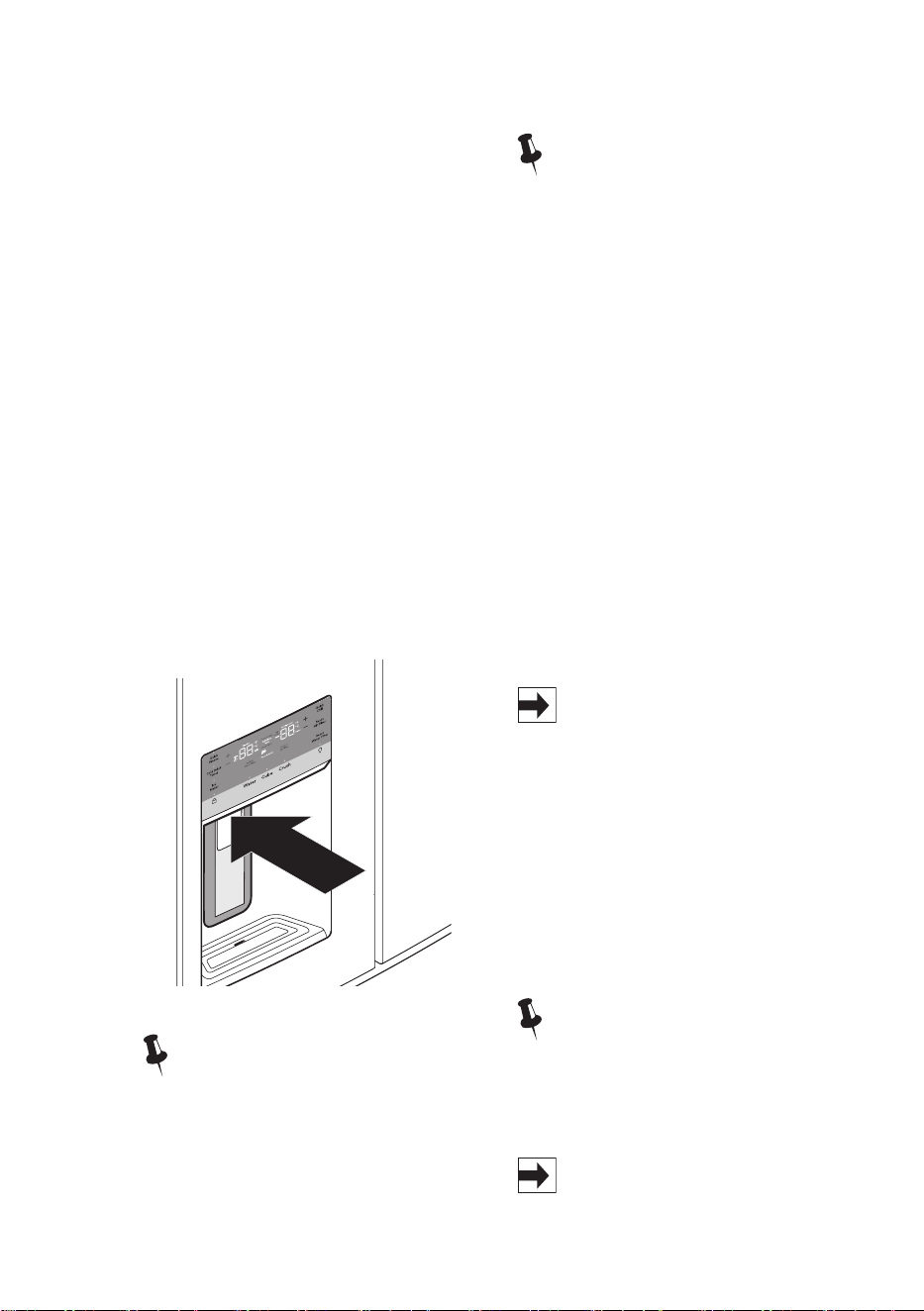
Using Your MultiSwitch Drawer
Controls
1
The drawer automatically defaults
to a locked state to prevent any
unwanted use. To change the drawe’s
settings, it rst needs to be unlocked.
To unlock, press and hold the
UNLOCK icon for 3 seconds. It will
automatically lock after 10 seconds
witllout any interaction.
WARNING!
Do not store glass bottles in
the MultiSwitch Drawer when
the Temperature setting is in
Freezer, Meat/seafood, or Cold
drink modes� The glass may
break and shatter, causing
physical harm and injury�
Freezer:
2
To change the drawer temperature
when in the freezer temp setting,
use the control panel display on
the front door. Changing the temp
on the display wil change both the
drawer temp setting And the freezer
compartment.
Refrigerator:
3
Choosing Meat and Fish will set
drawer temperature to -2°C. A tone
will sound to conrm choice. Use this
setting for short term storage. Any
meat to be kept longer than two days
should be frozen.
4
Choosing Cold Drinks will set drawer
temperature to 0°C. A tone will sound
to conrm choice.
5
Choosing Deli/Snacks will set drawer
temperature to 3°C. A tone will sound
to conrm choice.
6
Choosing Cellar will set drawer
temperature to 7°C. A tone will
sound to conrm choice.
15ENGLISH
7. USING THE DISPENSER
7.1 Using the ice maker after
installation
Before making ice for the rst time, be
sure to prime the water supply system.
Air in new plumbing lines can result in
two or three empty ice maker cycles.
Furthermore, if the system is not ushed,
the rst ice cubes may be discolored or
have an odd avor.
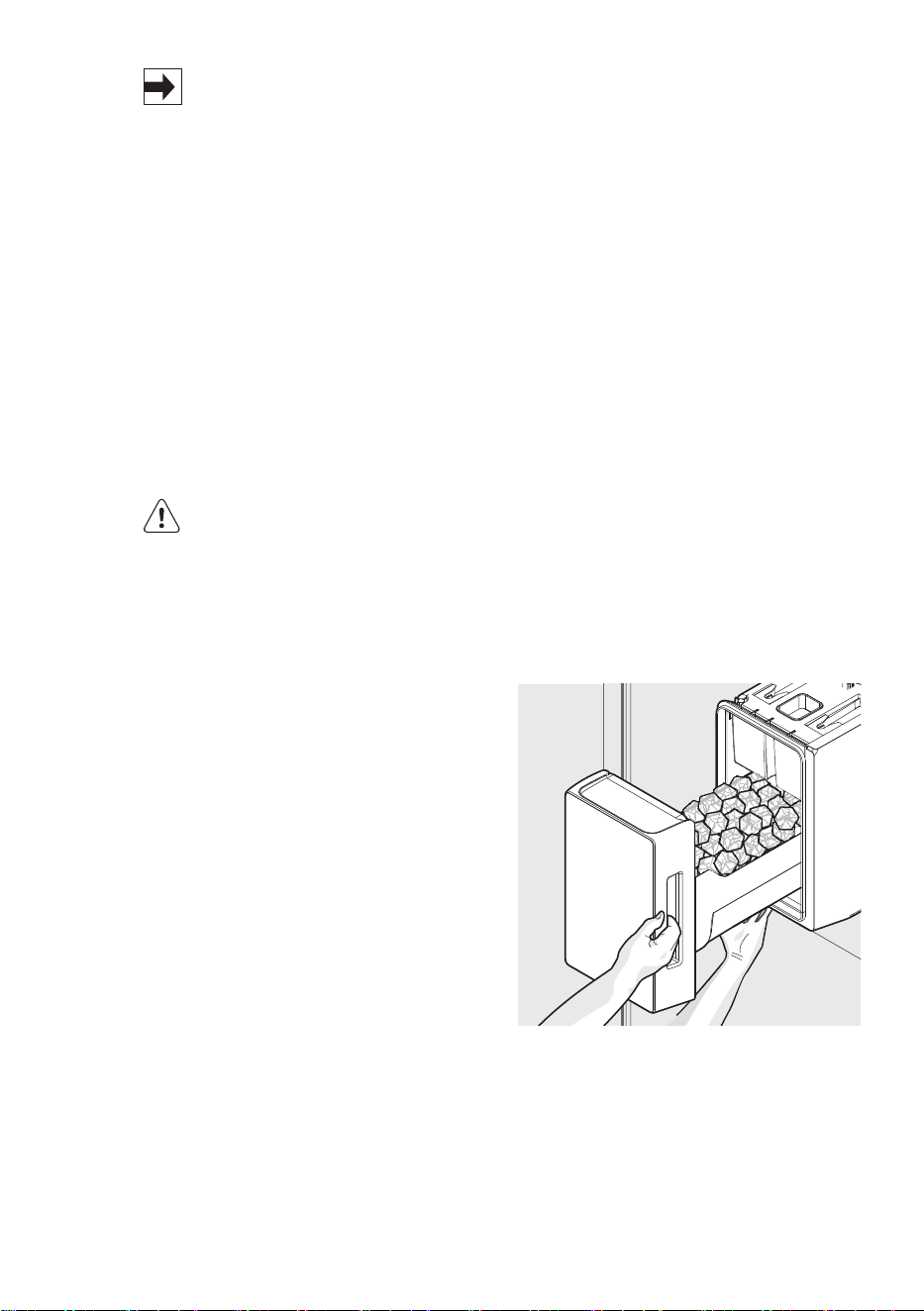
7.2 Priming the water supply
system
1. Begin lling the system by pressing
and holding a drinking glass against
the dispenser.
2. Keep the glass in this position until
water comes out of the dispenser.
It may take about 1½ minutes.
3. Continue dispensing water for about
four minutes to ush the system
and plumbing connections of any
impurities (stopping to empty the
glass as necessary).
Dispenser
NOTE
The water dispenser has a
built-in device that shuts o the
water ow after three minutes
of continuous use� To reset this
shuto device, simply release
the dispenser paddle�
NOTE
After the initial 750 ml, water will
remain room temperature until
the tank has relled and been
given enough time to chill the
next 750 ml of water� May take
up to 8 hours to chill�
7.3 Ice maker operation & care
After the refrigerator is installed properly
and has cooled for several hours, the ice
maker can produce ice within 24 hours.
The ice maker will ll the ice bin from the
rear. Dispense some ice to force the ice
forward in the bin. This will allow the bin
to ll completely.
7.4 Ice Maker and Storage Bin
Capacity
This ice maker should produce 1 Kilogram
of ice per 24 hours. The ice bin will hold
about 1,6 Kilogram of ice.
7.5 Turning the fresh food
ice maker on and o
IMPORTANT
The ice maker is turned on at the
factory so it can work as soon as
the refrigerator is installed� If it is
not possible to connect a water
supply, set the ice maker’s On/
O feature to O; otherwise, the
ice maker’s ll valve may make
a loud chattering noise when it
attempts to operate without water�
Ice production is controlled by the ice
maker’s On/O feature on the control
panel. Pressing the On/O feature turns
the ice maker on & o.
NOTE
The ice maker also has a
built-in plastic signal arm that
automatically stops ice production
when the ice bin is full� This
signal arm should not be used
to manually stop the ice maker�
IMPORTANT
Turning o the ice maker simply
disables ice making� Existing ice
can still be dispensed, and water
can be dispensed�
16 www.aeg.com
IMPORTANT
On occasion, unusually small
ice cubes may be noticed in the
bucket or in dispensed ice� This
could occur in normal operation
of the ice maker� If happening
frequently, it may be an indication
of low water pressure or the
water lter needs to be replaced.
As the water lter nears the end
of its useful life and becomes
clogged with particles, less water
is delivered to the ice maker
during each cycle� Remember,
if it’s been six months or longer
since last changing the water
lter, replace it with a new one.
Poor quality household water
may require the lter to be
changed more frequently�
CAUTION
If the water supply to the
refrigerator is softened,
be sure the softener is properly
maintained� Chemicals from a
water softener can damage the
ice maker�
7.6 Ice maker/dispenser tips
• If refrigerator is not connected to a
water supply or the water supply is
turned o, turn o the ice maker as
described in the previous section.
• The following sounds are normal
when the ice maker is operating:
- Motor running
- Ice dropping into ice bin
- Water valve opening or closing
- Running water
• If a large quantity of ice is needed
at one time, it is best to get cubes
directly from the ice bin.
• Ice cubes stored too long may
develop an odd avor. Empty the ice
bin as explained below.
• When dispensing cubed ice, it is
normal to have a small quantity of little
pieces along with the whole cubes.
• To avoid splashing, dispense ice into
the container before adding liquids.
• It is normal for ice to ll to the top of
the ice bin.
7.7 Cleaning the ice maker
Clean the ice maker and ice bin at
regular intervals, especially prior to
vacation or moving.
1. Turn o the ice maker.
2. Remove the ice bin by pulling
straight out.
3. Empty and carefully clean the ice bin
with mild detergent. Do not use harsh
or abrasive cleaners. Do not place in
dishwasher. Rinse with clear water.
4. Allow the ice bin to dry completely
before replacing in the freezer.
5. Replace the ice bin. Turn the ice
maker on.
Remove and empty the ice
bin if:
• An extended power failure (one hour
or longer) causes ice cubes in the
ice bin to melt and refreeze together
after power is restored, jamming the
dispenser mechanism.
• Ice dispenser is used infrequently. Ice
cubes will freeze together in the bin,
jamming the dispenser mechanism.
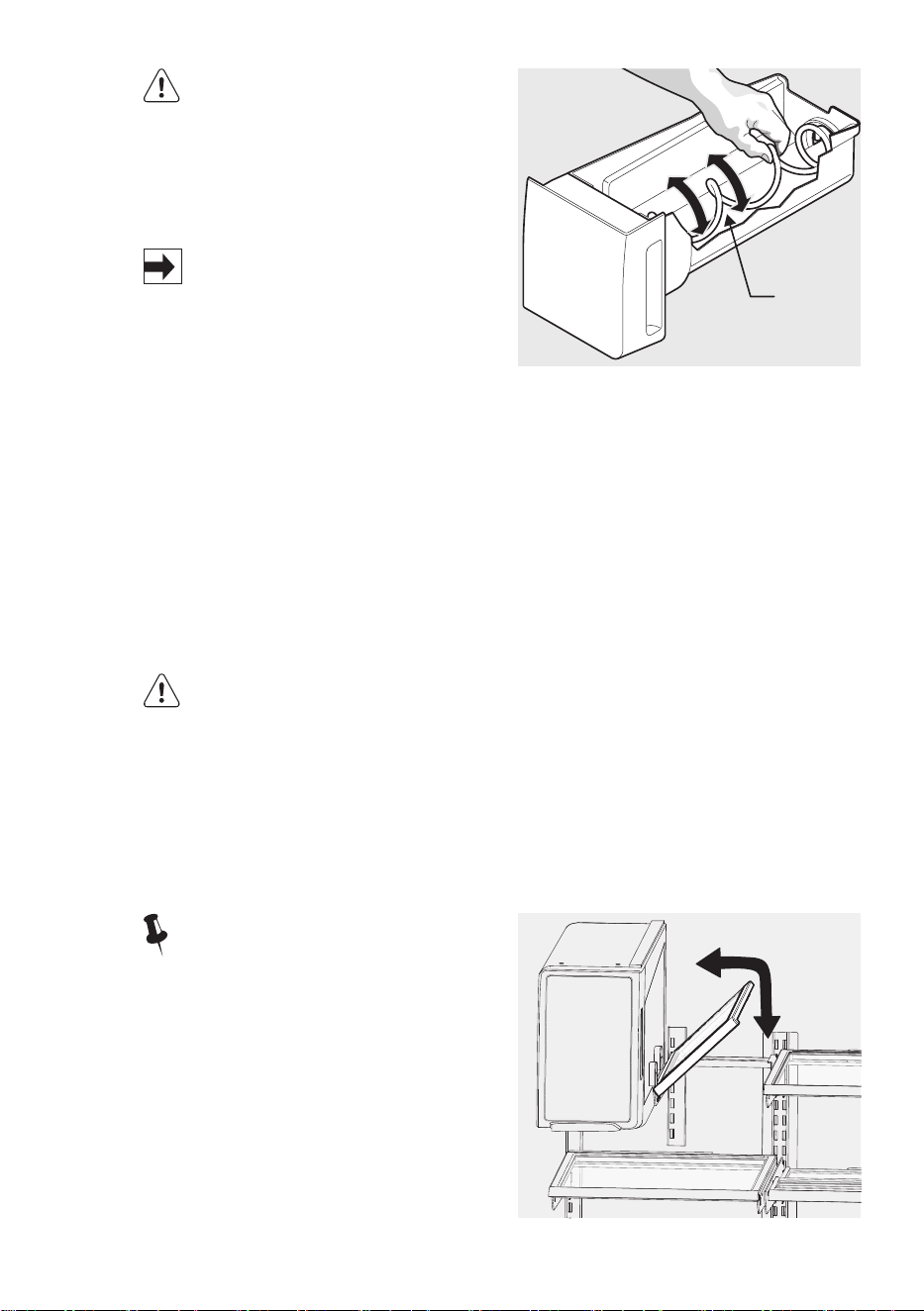
Removing Ice Bin
Remove the ice bin and shake to loosen
the cubes or clean as explained above.
17ENGLISH
CAUTION
NEVER use an ice pick or similar
sharp instrument to break up the
ice� This could damage the ice
bin and dispenser mechanism�
To loosen stuck ice, use warm
water� Before replacing the ice bin,
make sure it is completely dry�
IMPORTANT
When removing or replacing the
ice bin, avoid rotating the auger
in the ice bin� If the auger is
accidentally rotated, realign the
auger by turning it in 45 degree
turns (see below) until the ice
bin ts into place with the drive
mechanism� If the auger is not
properly aligned when replacing
the ice bin, the refrigerator will
not dispense ice� The fresh food
door also may not close properly
causing warm air to leak into the
fresh food compartment�
Adjusting Ice Bin Auger
Auger
8. STORAGE FEATURES
CAUTION
To avoid personal injury or
property damage, handle
tempered glass shelves
carefully� Shelves may break
suddenly if nicked, scratched, or
exposed to sudden temperature
change� Allow the glass shelves
to stabilize to room temperature
before cleaning� Do not wash in
dishwasher�
NOTE
Features may vary according to
model�
Shelf positions can easily be adjusted in
the fresh food compartments as needed.
The shelves have mounting brackets that
attach to slotted supports at the rear of
each compartment.
8.1 Change the Position
of a Shelf
1. Remove all food from shelf.
2. Lift the front edge up and pull the
shelf out.
3. Replace by inserting the mounting
bracket hooks into the desired
support slots.
4. Lower the shelf and lock into position.
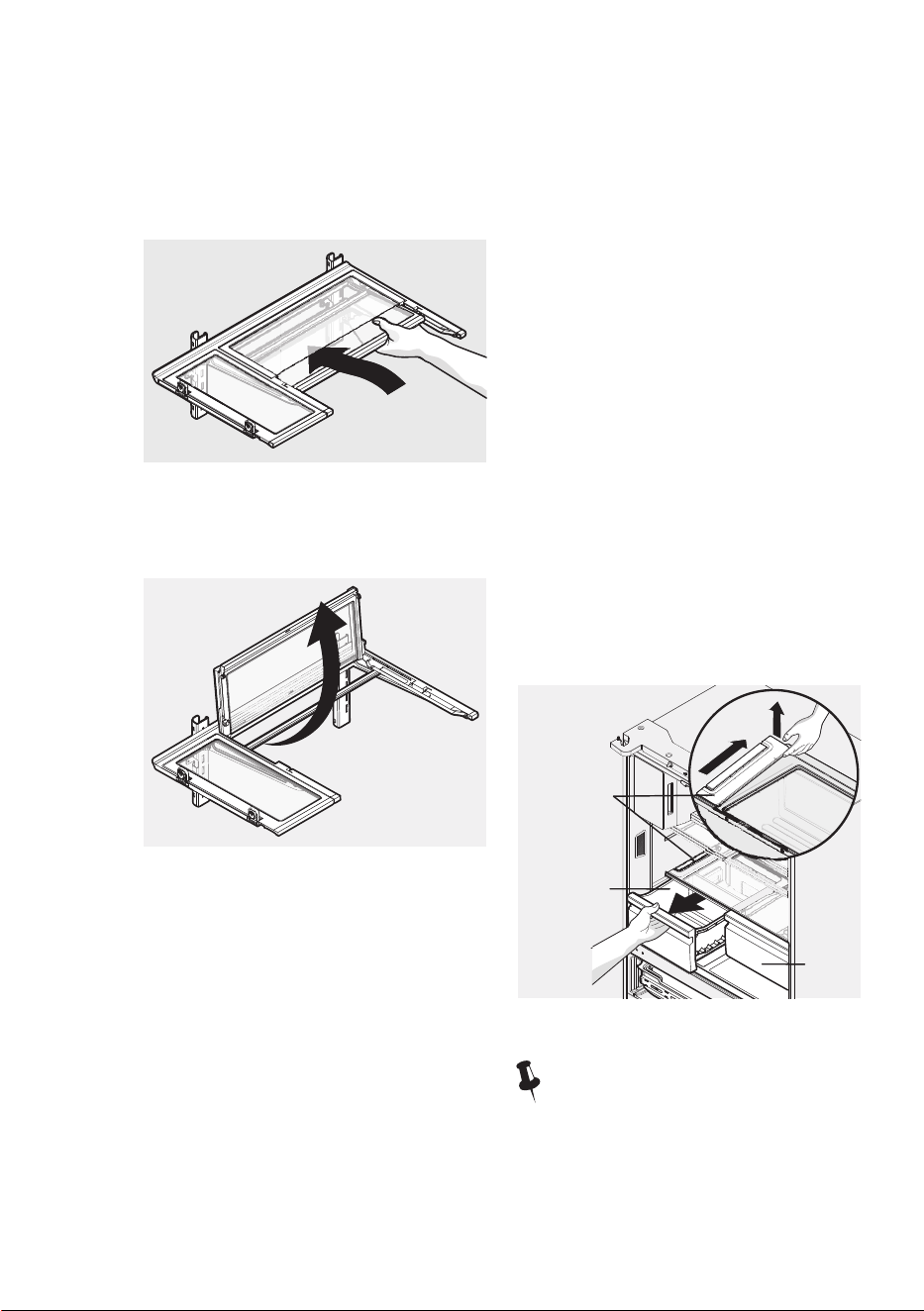
To adjust ip shelf:
1. Remove food from shelf.
2. Lift the right side edge of shelf
upwards and push to the left towards
ice maker.
Flip Shelf
18 www.aeg.com
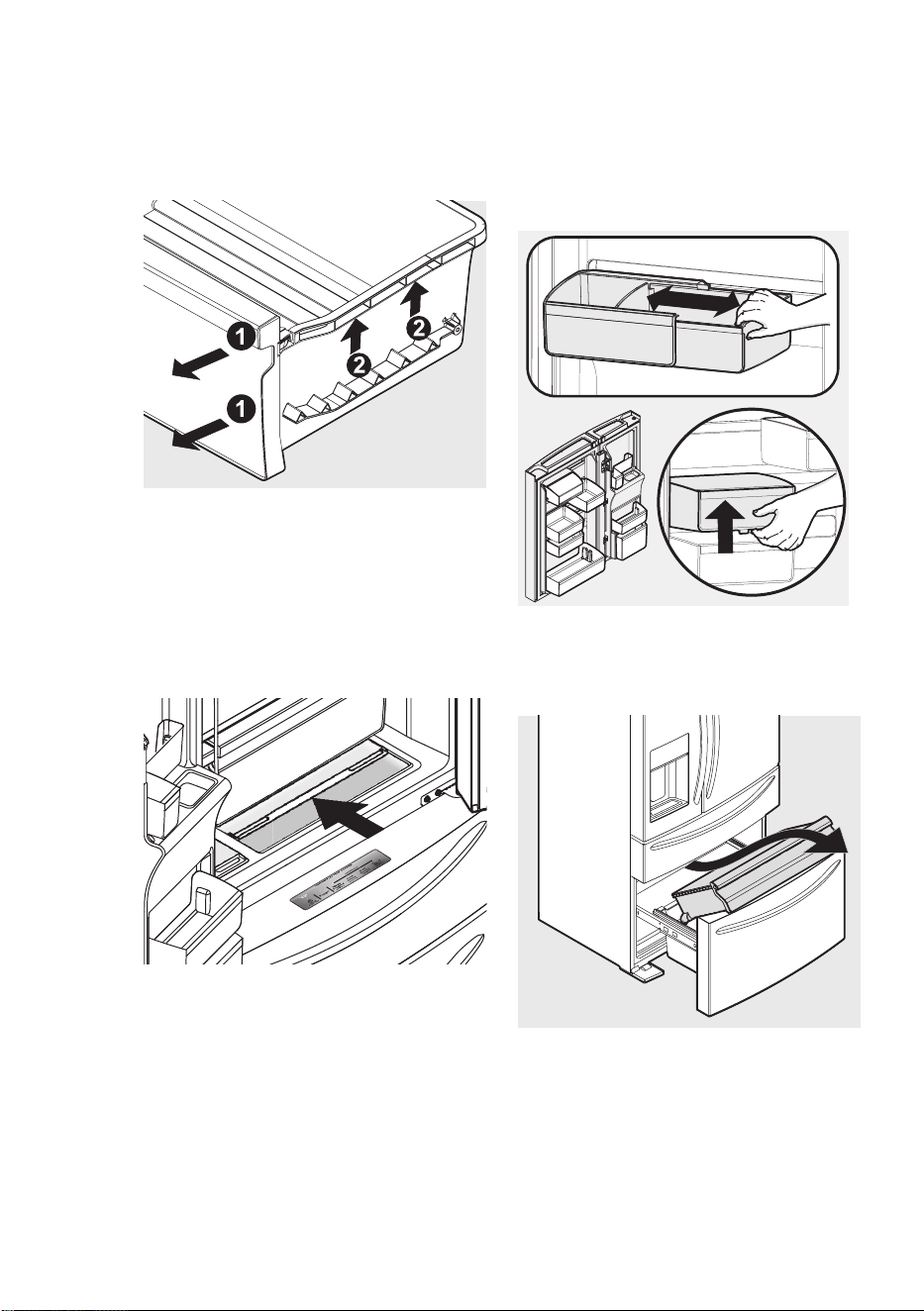
To adjust slide-under/ip
shelf:
1. Push front half shelf backward
towards rear of cabinet until the rear
half shelf drops down, then gently
continue pushing front half shelf back
and under the rear half shelf.
Flip Shelf
2. With front half fully below back half,
lift front of shelf to ip it upwards
toward the back of the cabinet.
Flip Shelf
8.2 Drawers
The refrigerator includes a variety
of storage drawers.
Auto Ultra Fresh Crispers
(with automatic humidity
control)
Crisper drawers are designed for storing
fruits, vegetables, and other fresh
produce. Crispers have an auto humidity
control (with replaceable membrane) on
the side of each crisper under the humidity
control cover. Order a replacement
membrane at www.aeg.com.
To remove the auto humidity
control membrane:
1. Reach to back of humidity control
cover.
2. Pull up on cover.
3. Pull cover towards back of cabinet
and remove.
4. Wash the humidity membrane with
water and soap
5. Replace cover by reversing the steps
above. Repeat for both crispers.
Auto
Humidity
Membrane
Crisper
Crisper
Removing Auto Humidity
Control Membrane
NOTE
Producer does not recommend
replacing the auto-humidity
membrane unless it
becomes damaged or ruined�
Replacement membranes can
be found on www�aeg�com
19ENGLISH
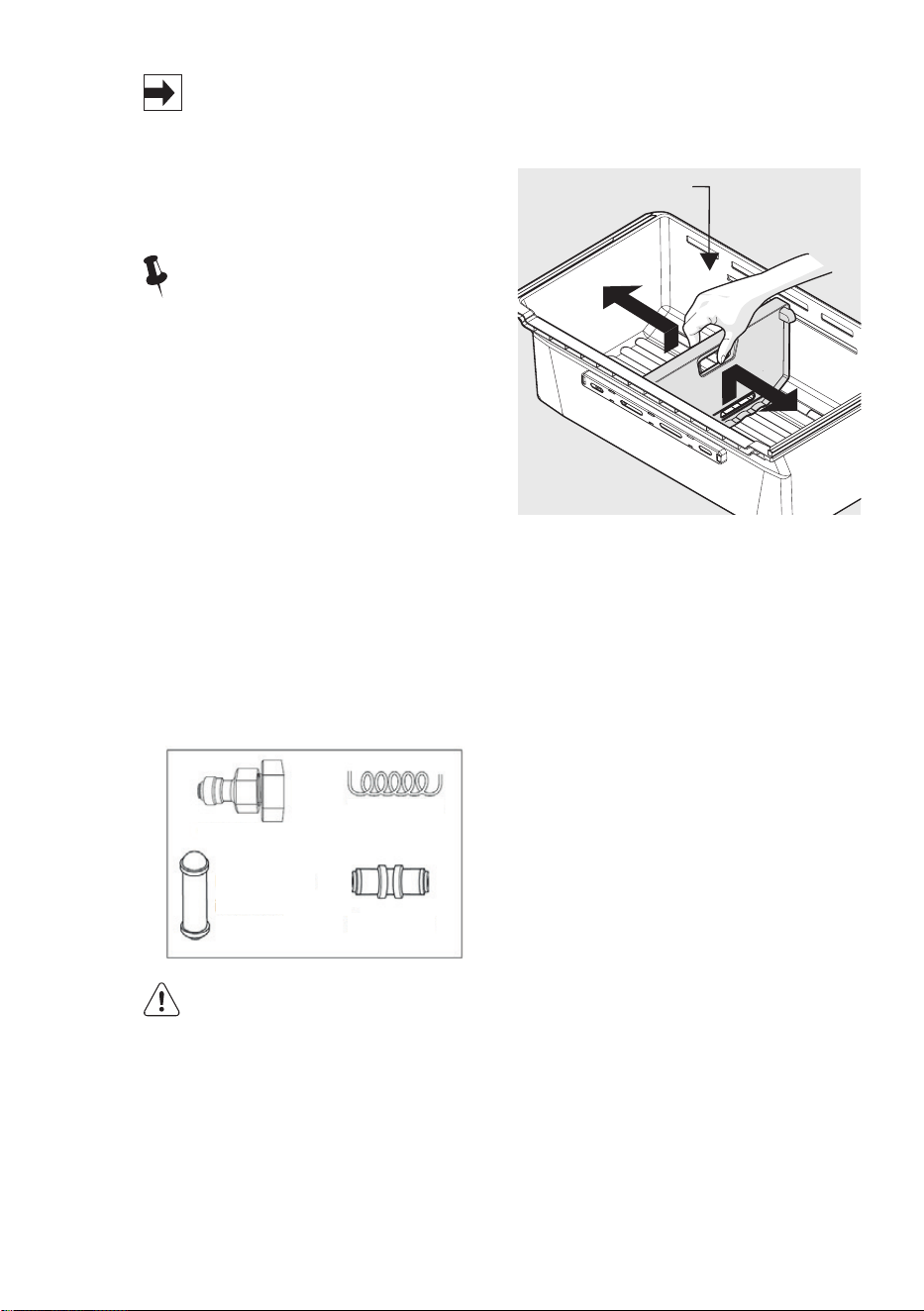
To remove the Ultra Fresh
drawer for cleaning:
1. Pull the drawer out until it stops.
2. Lift the front slightly and remove the
drawer.
Removing Ultra Fresh Drawer
Snack Zone - Recessed
Snack Drawers
These drawers are ideal for storage
of deli meats and cheeses.
To open: slide back the cover to allow
access to the drawers.
Opening Snack Zone
Recessed Snack Drawers
To move door bin along a rail:
1. Tilt bin up so the back of the bin is o
the door but the hook is still engaged.
2. Slide bin along rail to desired
position.
3. Lower bin back into place.
To move door bin from rail
to rail:
1. Lift bin up disengaging the hook.
2. Move bin to desired rail location.
3. Push bin hook into rail engaging
the hook.
Custom Flex door Bins
8.3 Freezer Features
(varies by model)
Freezer Drawer
To remove upper freezer
drawer:
1. Open freezer compartment
completely.
2. Lift up and out to remove upper
freezer drawer.
Reverse the steps to reinstall drawer.
20 www.aeg.com
9. CONNECTING THE WATER SUPPLY
Water supply kit
Check the parts below for installing water
supply.
Connector
Connector
Water Tube
Filter already
Installed
WARNING
To avoid electric shock, which
can cause death or severe
personal injury, disconnect the
refrigerator from electrical power
before connecting a water supply
line to the refrigerator�
1. When installing the water tubes,
ensure they are not close to any hot
surface.
2. The water lter only “lters” water;
it does not eliminate any bacteria or
microbes.
3. If the water pressure is not high
enough to run the icemaker, call the
local plumber to get an additional
water pressure pump.
4. The lter life depends on the amount
of use. We recommend you replace
the lter at least once every 6
months, (look at “changing the lter”).
5. Use sealing tape to every connection
of pipes/tubes to ensure there is no
water leak.
6. The water tube should be connected
to the cold water line.
IMPORTANT
There are wheels on the bottom
of the drawer� Make sure all
wheels are aligned on their
respective tracks for proper
function� If drawer is not aligned
properly, it will cause problems
with the door operation�
NOTE
If basket is not resting on
stabilizer bar retainer clips, the
drawer will not close properly�
To remove freezer basket:
1. Open freezer compartment
completely.
2. Lift the basket up and remove.
Reverse the steps to reinstall drawer.
8.4 Dividers
Grab hand hold on lower divider and
pull up slightly to slide to next position.
(The divider cannot be removed.)
Plastic Lower Basket Divider
Lower Basket
Divider
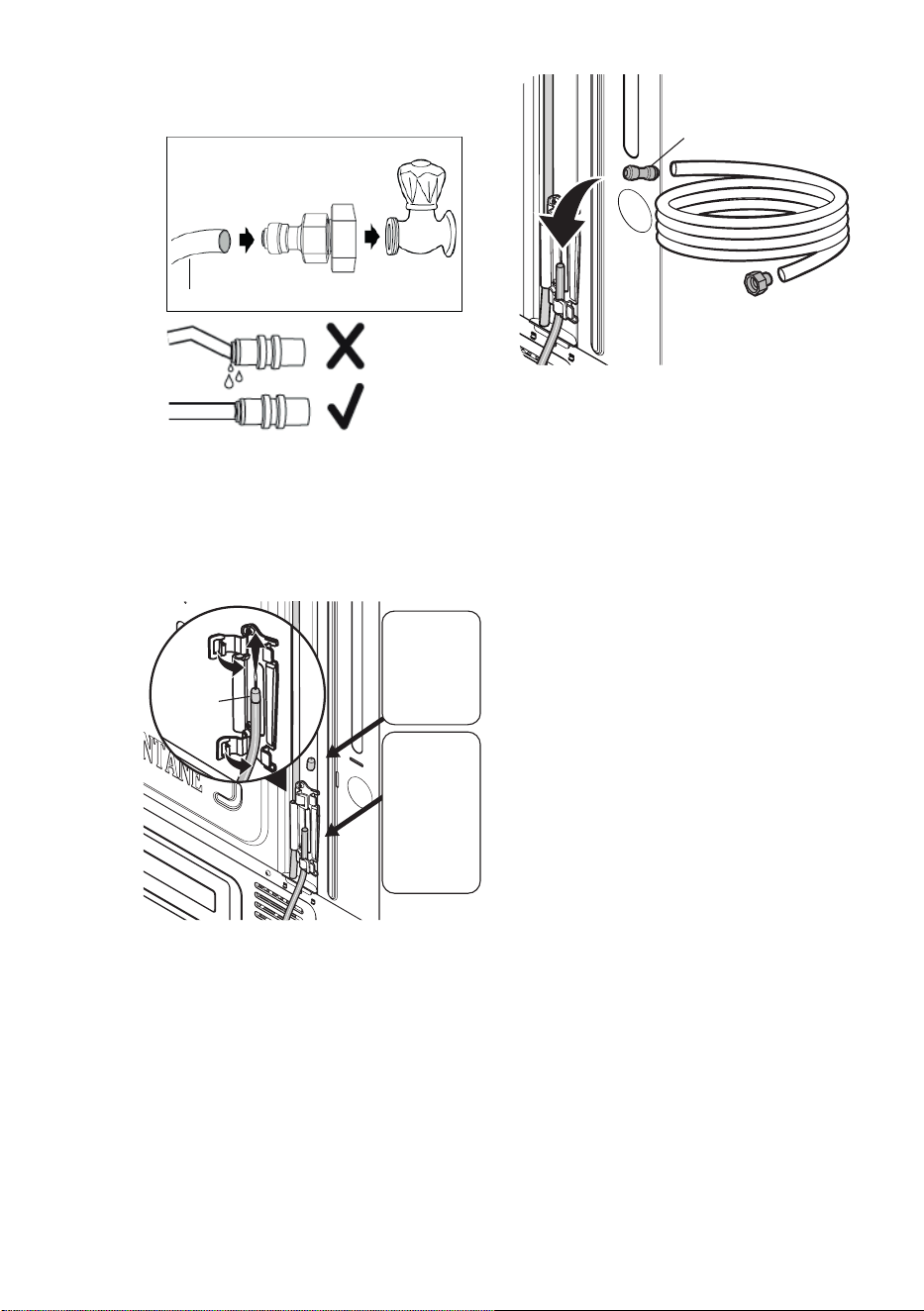
21ENGLISH
Installation Procedure
Join Connector to the tap water line
Water Tube
Connector
Tap
7. Open the locking clips and grab
water coming from the refrigerator.
Remove plastic cap from water inlet
tting and discard cap. Replace the
connected tubes into the clips and
lock clips back in place to keep the
tubing in the right position.
Remove
the cap
from the
inlet tube
¼ inch
water
valve
plastic
tube
Plastic
cap
A
C
Connector to
connect the water
supply line to the
refrigerator tube
Adapter to connect
the water supply
8. After installation of refrigerator and
water line system, select “WATER”
on your control panel and press it for
1‐2 minutes to supply water into the
water tank and dispenser water.
22 www.aeg.com
10. CHANGING THE FILTER
10.1 Air Filter (select models)
The air lter is located in the top center of
the fresh food compartment.
10.2 Replacing the Air Filter
(TasteGuard)
To ensure optimal ltering of refrigerator
odors, change the air lter every six
months (Replace Air Filter on the
Display indicates replacing the lter
after six months).
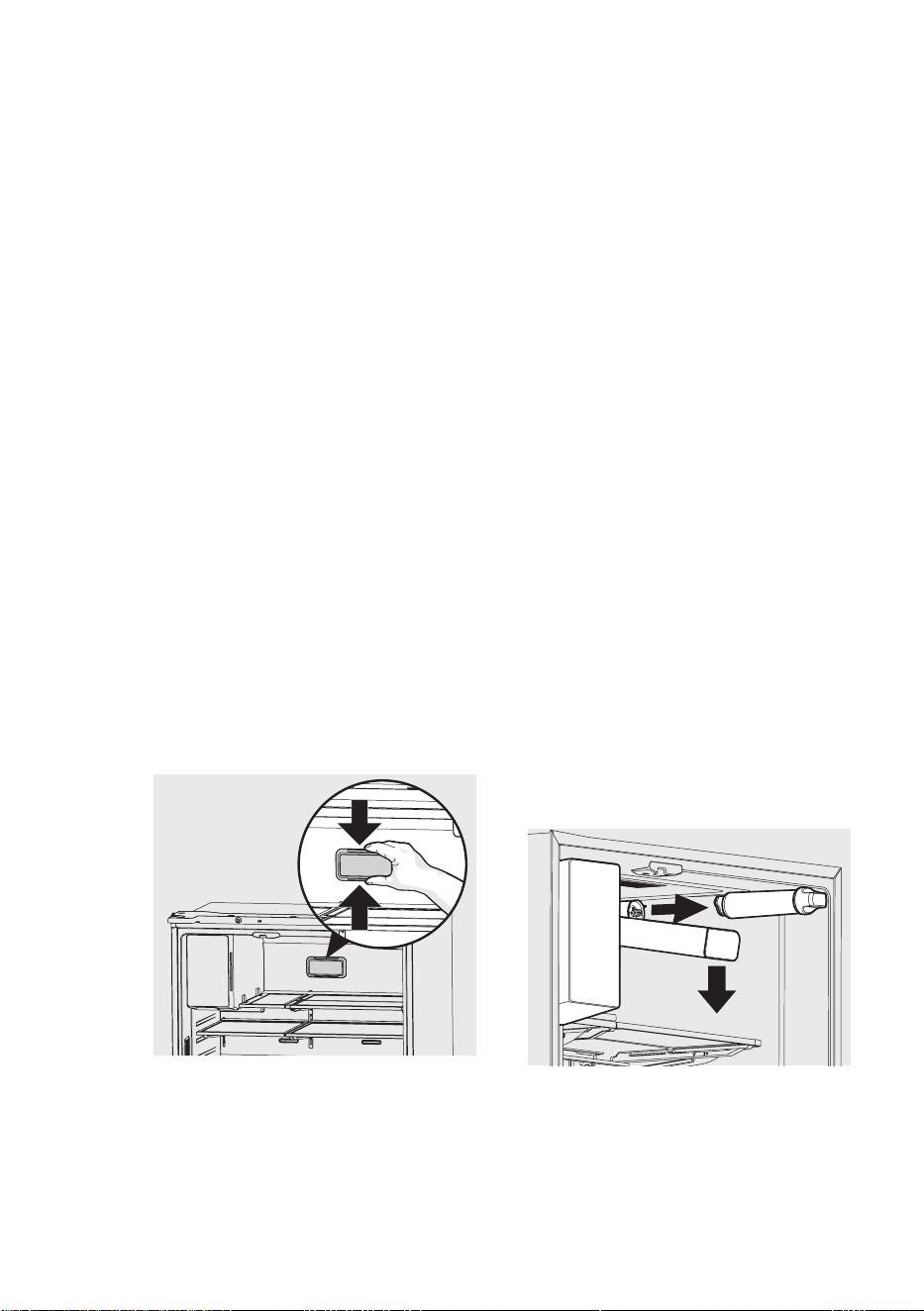
1. Remove the air lter cover by
squeezing the top and bottom of the
cover together and removing from
liner.
2. Remove the old lter and discard it.
3. Unpack the new lter and slide it into
the housing. The open face must
(carbon media) of the lter should
be installed facing the air port (hole)
in the multiow.
4. Replace the air lter cover by
squeezing the sides and snapping
it back into place.
5. Press and hold the “Reset Air Filter”
button on the Display for three
seconds. When the indicator turns
o, the status has been reset.
10.3 Ordering Replacement
Air Filters
Use original spare parts only. Please
contact an Authorised Service Centre
10.4 Water Filter
The refrigerator is equipped with a water
ltering system. The water ltering system
lters all dispensed drinking water, as well
as the water used to produce ice. The
water lter is located at the top right side
of the fresh food compartment.
10.5 Replacing the Water Filter
Change the water lter every six months
to ensure the highest possible water
quality. Replace Water Filter on the
display indicates when to replace the
lter after a standard amount of water
(473 liters) has owed through the
system.
If the refrigerator has not been used
for a period of time (during moving
for example), change the lter before
reinstalling the refrigerator.
To Remove: Pull cover forwards and
cover will drop down and allow access
to lter.
To Reinstall: Push cover up towards liner
and then push towards rear of cabinet.
Filter cover will snap back into place.

23ENGLISH
10.6 Ordering Replacement
Water Filters
Use original spare parts only. Please
contact an Authorised Service Centre
To replace the water lter:
It is not necessary to turn the water
supply o to change the lter. Be ready
to wipe up any small amounts of water
released during the lter replacement.
1. Turn o the ice maker by pressing
and holding the Ice Maker button on
the display until no longer illuminated.
2. Push down on front edge of lter
cover. Cover will tilt down and
expose water lter.
3. Remove the old lter by rotating
it counter-clockwise (to the left)
90 degrees to release it.
4. Slide the old lter cartridge straight
out of the housing and discard it.
5. Unpackage the new lter cartridge.
Slide it into the lter housing as far as
it will go with the grip end horizontal.
6. Push lightly inward on the lter while
rotating it clockwise (to the right).
The lter will then pull itself inward
as it is rotated. Rotate the lter
90 degrees until it stops and the grip
end is vertical. A very light click may
be heard as the lter locks into place.
7. Press a drinking glass against the
water dispenser while checking for
any leaks at the lter housing. Any
spurts and sputters that occur as
the system purges air out of the
dispenser system are normal.
8. Continue dispensing water for
3-4 minutes. It may be necessary to
empty and rell the container several
times.
9. Turn on the ice maker by pressing
and holding the Ice Maker button
on the display until it is illuminated.
10. Press and hold the Reset Water
Filter button on the display for three
seconds. When indicator is no longer
illuminated, the water lter status has
been reset.
11. Replace lter cover by pushing up
and snapping into place.
24 www.aeg.com
This User Manual provides general
installation and operating instructions for
this model. We recommend using a service
or kitchen contracting professional to
install the refrigerator. Use the refrigerator
only as instructed in this User Manual.
Before starting the refrigerator, follow
these important rst steps.
11.1 Location
• Choose a place that is near a grounded,
non-GFCI, electrical outlet. Do Not use
an extension cord or an adapter plug.
• If possible, place the refrigerator out
of direct sunlight and away from the
range, dishwasher, or other heat
sources.
• The refrigerator must be installed on
a oor that is level and strong enough
to support a fully loaded refrigerator.
• Consider water supply availability for
models equipped with an automatic
ice maker.
• To ensure appliance’s best
functionality, you should not install
the appliance in the nearby of the
heat source (oven, stoves, radiators,
cookers or hobs)
CAUTION
Do Not install the refrigerator
where the temperature will drop
below 10°C or rise above 43°C.
The compressor will not be able
to maintain proper temperatures
inside the refrigerator.
Do Not block the toe grille on
the lower front of the refrigerator.
Sucient air circulation
is essential for the proper
operation of the refrigerator.
11.2 Installation
Allow the following clearances for ease
of installation, proper air circulation, and
plumbing and electrical connections:
Sides & Top 40 mm
Back 30 mm
NOTE
If the refrigerator is placed with
the door hinge side against a
wall, allow additional space so
the door can be opened wider.
11. INSTALLATION
WARNING!
Refer to Safety chapters�
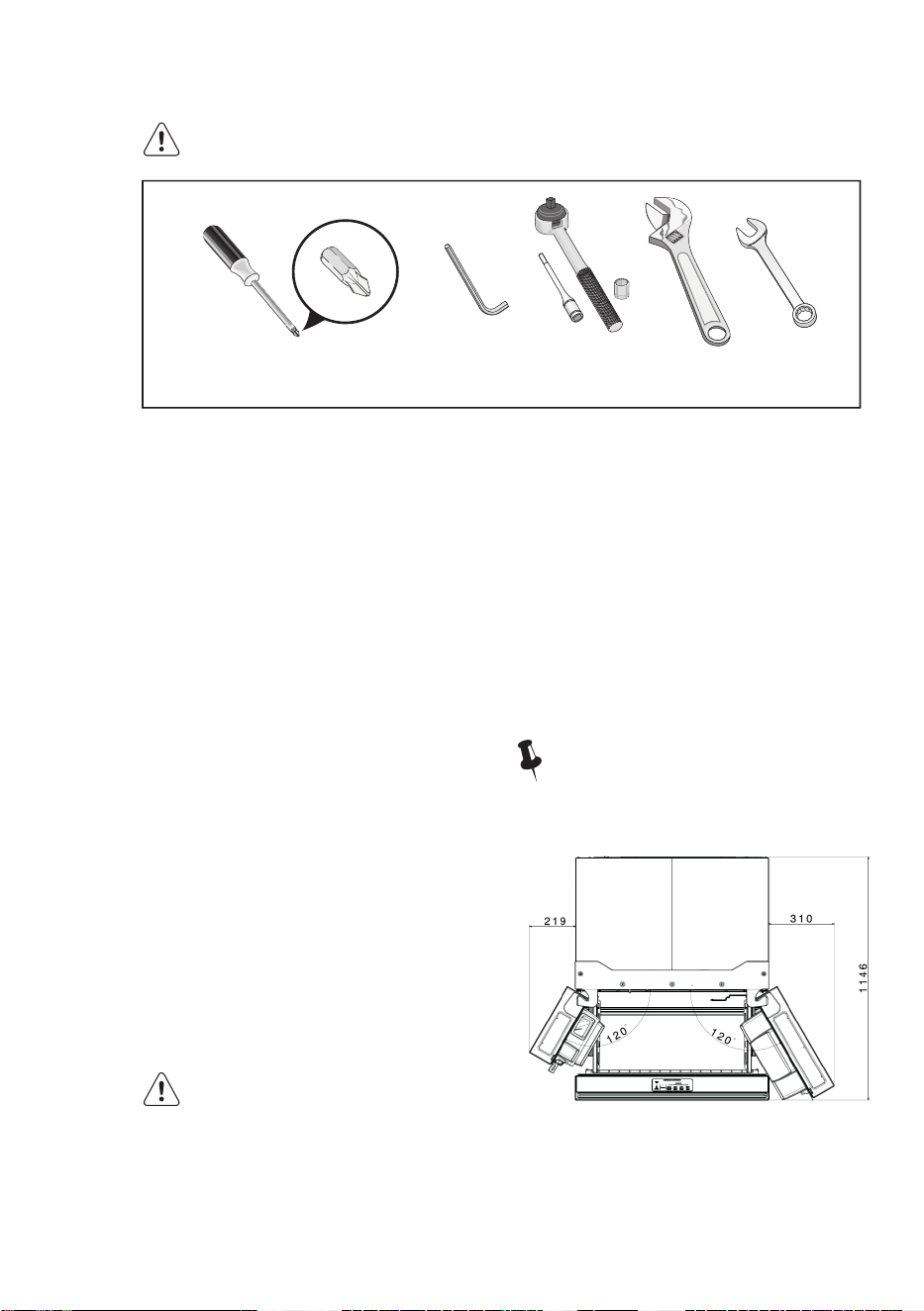
Tools Necessary:
Phillips Head
6mm
Allen Wrench
8mm
Socket Wrench
Adjustable
Wrench
⅜" Fixed
Wrench
AND AND
OR
OR
25ENGLISH
11.3 Positioning
This appliance is not intended to be used
as a built-in appliance.
This appliance should be installed in a
dry, well ventilated indoor position.
This appliance is intended to be used at
ambient temperature ranging from 10°C
to 43°C.
If, due to dierent installation, proper
ventilation requirements are not
respected, the appliance will function
correctly but energy consumption might
increase slightly.
The correct operation of
the appliance can only be
guaranteed within the specied
temperature range�
If you have any doubts regarding
where to install the appliance,
please turn to the vendor, to
our customer service or to the
nearest Authorised Service
Centre�
It must be possible to disconnect
the appliance from the mains
power supply� The plug must
therefore be easily accessible
after installation�
CAUTION
If you position the appliance
against the wall, use back
spacers provided or keep the
minimum distance indicated in
the installation instructions.
CAUTION
If you install the appliance next
to a wall, refer to the installation
instructions to understand the
minimum distance between
the wall and the side of the
appliance where door hinges
are to provide enough space to
open the door when the internal
equipment is removed (e.g.
when cleaning).
11.4 Door opening
The refrigerator should be positioned
to allow easy access to a counter when
removing food. For best use of refrigerator
drawers and freezer baskets, the
refrigerator should be in a position
where both can be fully opened.
11.5 Cabinet Leveling &
Refrigerator Door
Alignment (if necessary)
Guidelines for nal positioning
of refrigerator:
• All four corners of the cabinet must
rest rmly on the oor.
• The front should be slightly elevated
to ensure that doors close and seal
properly.
• Doors should align with each other
and be level.
Most of these conditions can be met by
raising or lowering the adjustable front
rollers.
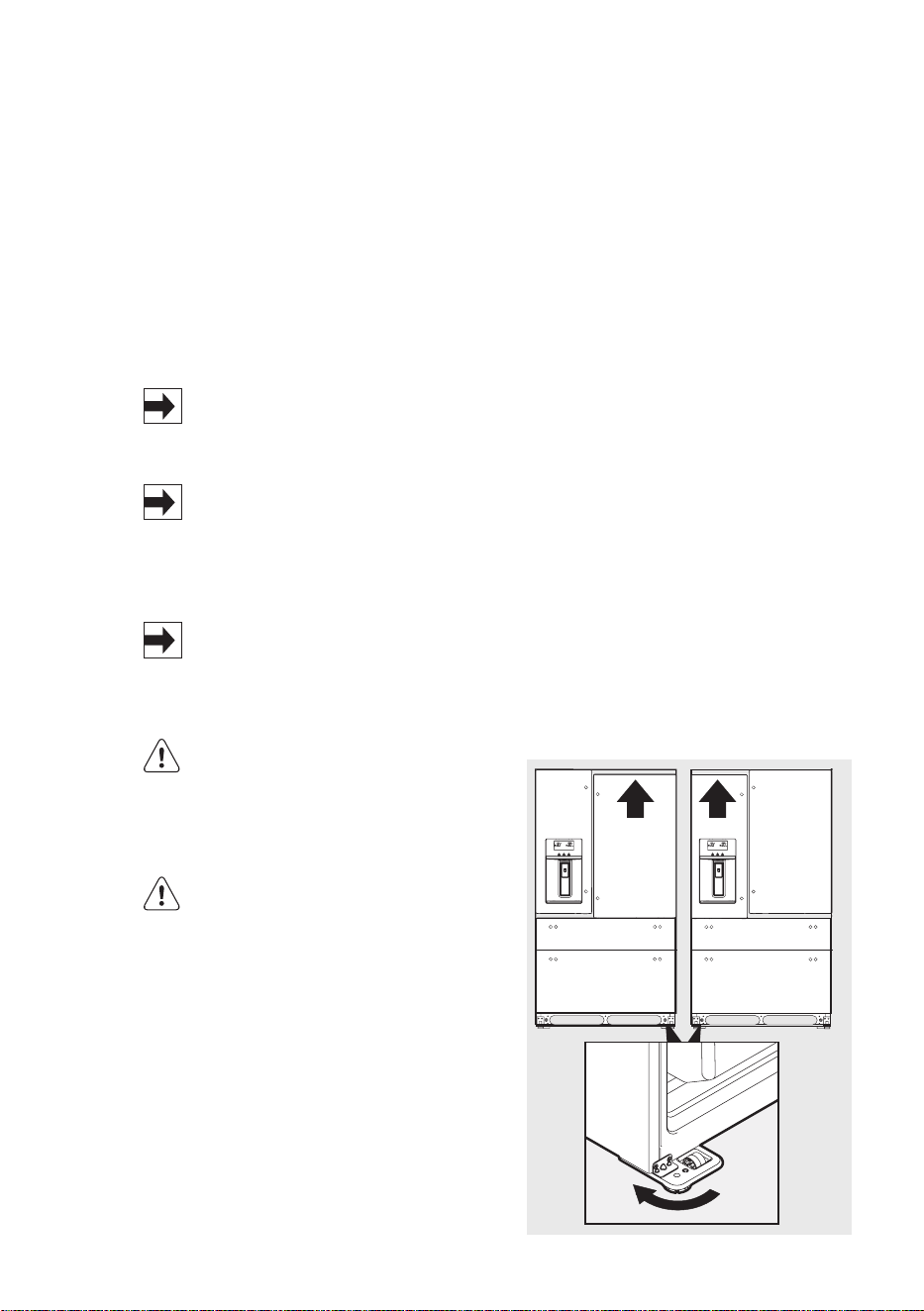
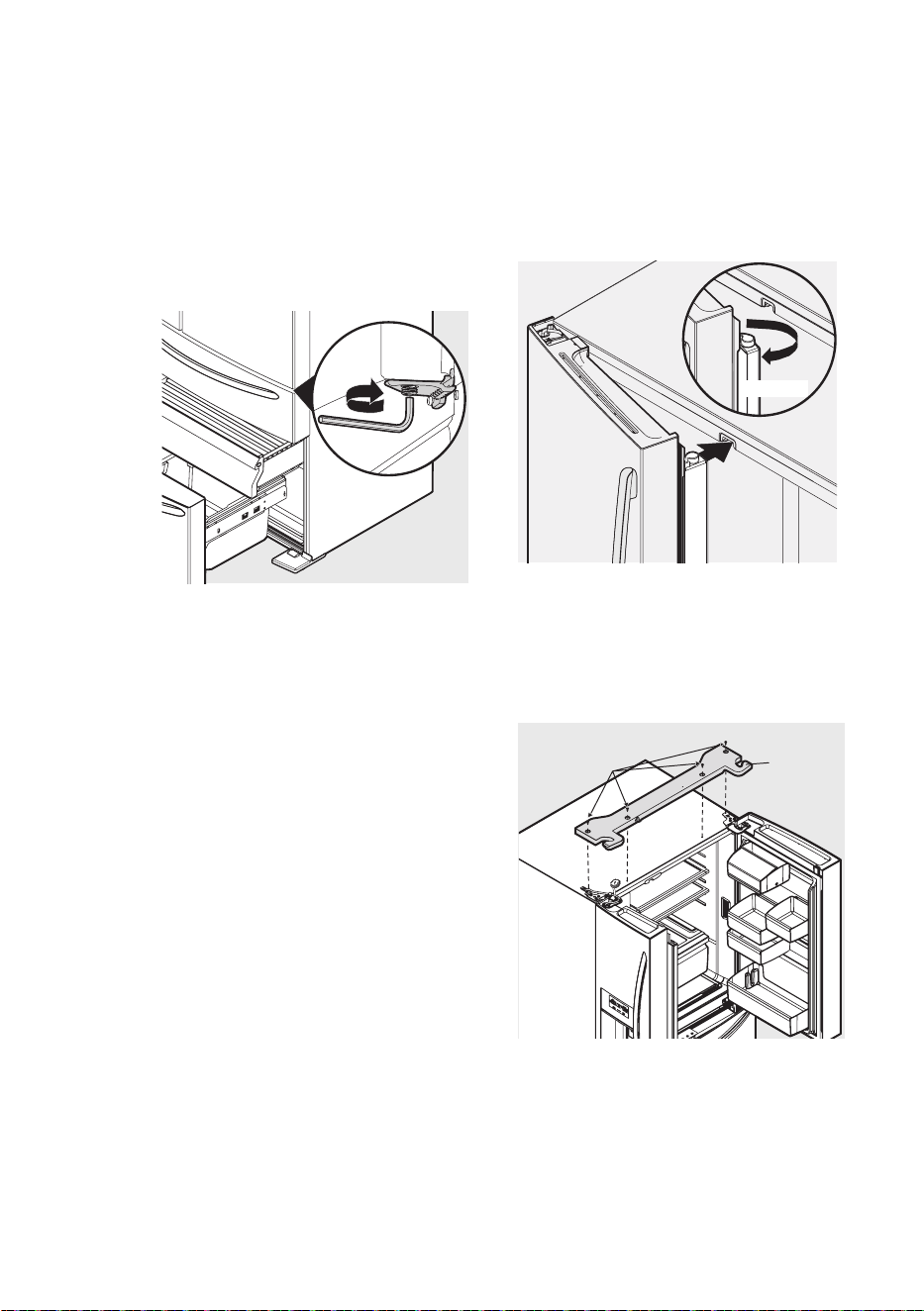
To level the cabinet using the front rollers:
1. Slightly open freezer drawer.
2. Lower anti-tip legs until they are both
touching the oor. Once on the oor,
use a pair of pliers to adjust.
To raise unit: turn leg clockwise.
To lower unit: turn leg
counterclockwise.
3. Ensure both doors are bind-free with
their seals touching the cabinet on all
four sides and that cabinet is stable.
Door Door
Anti-Tip
Legs
26 www.aeg.com
12.1 Getting through narrow
spaces
If refrigerator will not t through an
entrance area, doors can be removed.
Check rst by measuring the entrance.
To prepare for removing the
doors:
1. Make sure the electrical power cord
is unplugged from the wall outlet.
2. Remove any food from the door
shelves and close the doors.
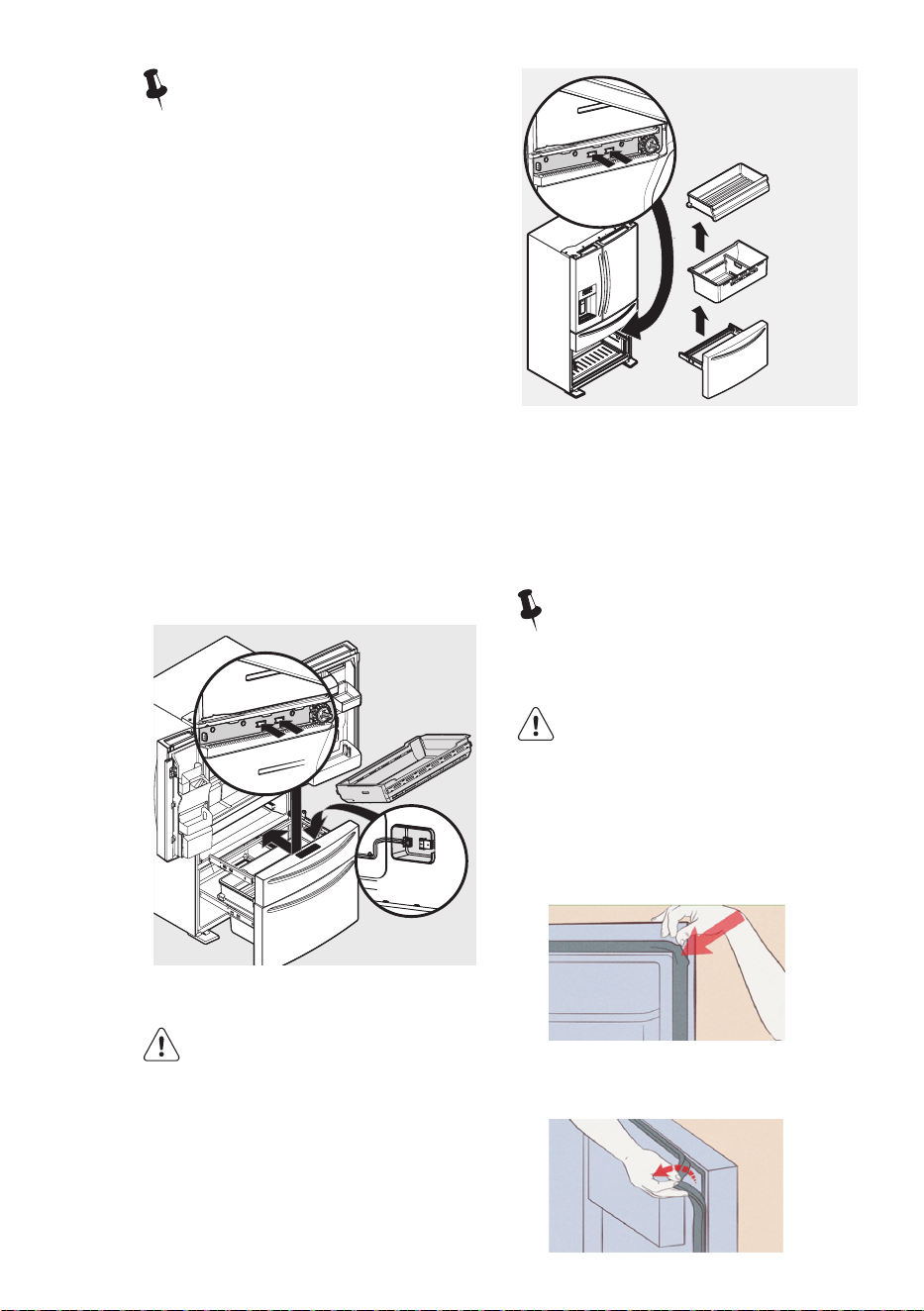
To remove the refrigerator
doors:
1. Open doors to 90°.
2. Remove all ve Phillips screws from
top hinge cover and lift up.
Phillips Screws
Top
Hinge
Cover
3. Trace lightly around the door’s top
hinges with a pencil. This makes
reinstallation easier.
12. DOOR REMOVAL INSTRUCTIONS
To make nal door height adjustments:
1. Open freezer drawer to make lower
hinge visible.
2. Insert 6mm Allen wrench into the
shaft of the lower hinge.
3. Adjust the height by turning clockwise
or counterclockwise. Turning
clockwise will lower the door. Turning
counterclockwise will raise the door.
Default setting is to the lowest height.
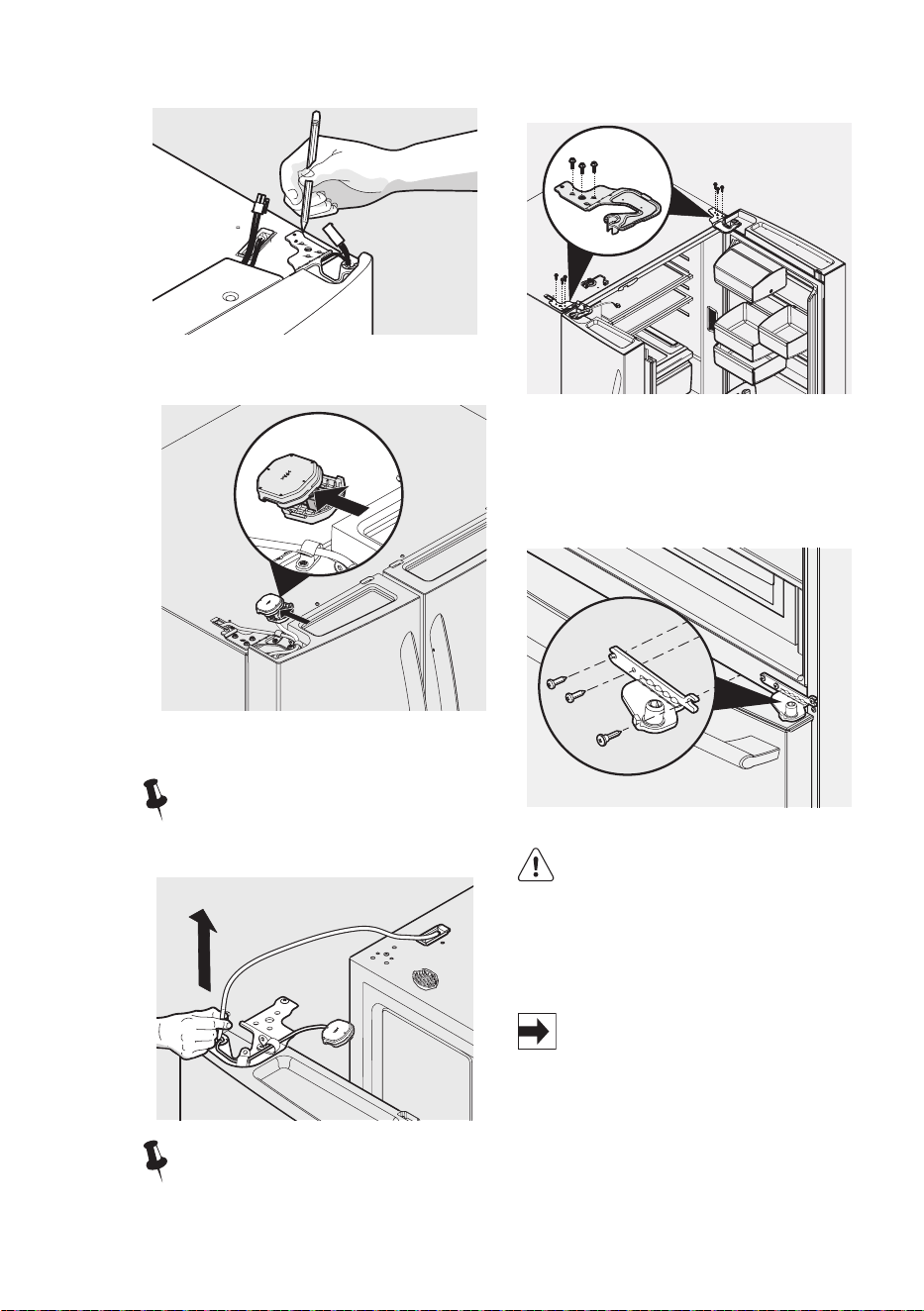
Raise
11.6 Flipper Mullion
Adjust Flipper Mullion for proper
connection with the mullion guide by
ensuring the ipper mullion is folded
and perpendicular to the fresh food door.
If the mullion guide is not in the correct
position, it could prevent the door from
closing completely.
:521*
WRONG
27ENGLISH
4. Lift o the top hinge cover.
5. Disconnect electrical harness running
from door to hinge cover.
6. Pull up on water line gently to remove
from door.
NOTE
Use care while pulling the water
tube from the door to be sure
that tube does not kink.
Waterline
NOTE
Approximately four feet of water
tube will be pulled from the
refrigerator door.
7. Remove three 8mm bolts from both
top hinges.
[
8. To gain access to lower hinge,
drawer will need to be extended.
Unscrew the three lower hinge
screws and slide the hinge inwards
Lift up on door and remove from
bottom hinge.
Lower Hinge Removal
CAUTION
Be sure doors are set aside in
a secure position where they
cannot fall and cause personal
injury, or damage to the doors
or handles.
9. To reinstall doors, reverse procedure.
IMPORTANT
Make sure water line tubing
goes through hole at top of
dispenser pocket. There is also
a metal wrap on the tubing to
prevent damage from the hinge
rubbing against it. This needs
to be xed back around the
tube in the proper location upon
reinstallation (just as long as the
tube is protected from the hinge).
28 www.aeg.com
NOTE
When reinserting the water tube
and replacing the top hinge
cover, use care to be sure the
tube does not kink.
Once both doors are in place, ensure
they are aligned with each other and
level (Please see the Installation section
for more details), and replace the top
hinge cover.
12.2 To remove the
MultiSwitch/MultiChill
drawer
1. Fully open drawer.
2. Remove basket from drawer.
3. Unclip harness at front of drawer
and move harness out of the way
of drawer slides.
4. Press liner clips and slide rail past
clips on both sides to fully remove
drawer from cabinet.
5. Reverse the steps to reinstall
the drawer.
Press the
two tabs on
both sides to
release the
sliders
Unclip
Harness
12.3 Removing Freezer Drawer
CAUTION
Drawer is heavy. Use caution
when lifting.
1. Open drawer and fully extend.
2. Remove the freezer drawer.
3. Remove the freezer basket.
4. Inside the cabinet, press the two tabs
on both sides to release the sliders.
5. Remove the drawer with brackets
and sliders.
Press the two tabs
on both sides to
release the sliders
Freezer
Drawer
Freezer
Drawer
12.4 Re-installing Freezer
Drawer
1. Place drawer with brackets and
sliders inside the cabinet and click
into place.
2. Replace the basket.
NOTE
For additional instructions,
see Storage Features section.
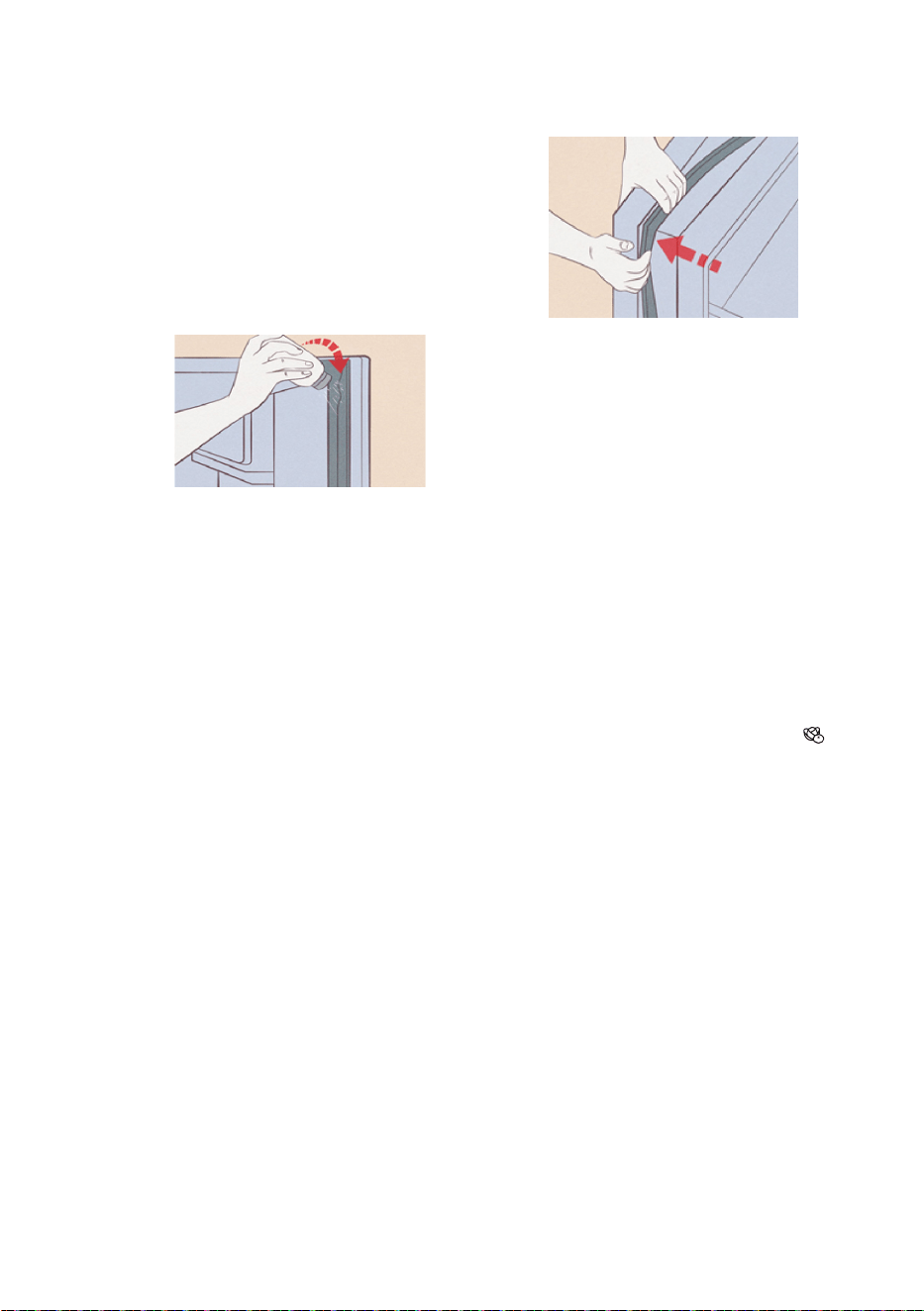
12.5 To remove the door seal
CAUTION
Please make sure that you have
switched your appliance o at
the mains before starting your
repair.
1. Place your thumb underneath the
seal, the best method is to start at the
corner. Grab the bottom of it on the
side, and pull the gasket back.
2. Then proceed to run it around the
underside of your seal-and it can then
be gently lifted away around the door.
29ENGLISH
Energy saving tips
We recommend that you follow the tips
below to save energy.
• Freezer: The internal conguration of
the appliance is the one that ensures
the most ecient use of energy.
• Fridge: Most ecient use of energy
is ensured in the conguration with
the drawers in the bottom part of
the appliance and shelves evenly
distributed. Position of the door bins
does not aect energy consumption.
• Do not open the door frequently or
leave it open longer than necessary.
• Freezer: The colder the temperature
setting, the higher the energy
consumption.
• Fridge: Do not set too high temperature
to save energy unless it is required by
the characteristics of the food.
• If the ambient temperature is high
and the temperature control is set to
low temperature and the appliance
is fully loaded, the compressor may
run continuously, causing frost or ice
formation on the evaporator. In this
case, set the temperature control
toward higher temperature to allow
automatic defrosting and to save
energy this way.
• Ensure a good ventilation. Do not
cover the ventilation grilles or holes.
Hints for fresh food
refrigeration
• Fresh food compartment is the one
marked (on the rating plate) with .
• Good temperature setting that
ensures preservation of fresh food is a
temperature less than or equal to +4°C.
• Higher temperature setting inside the
appliance may lead to shorter shelf
life of food.
• Cover the food with packaging to
preserve its freshness and aroma.
• Always use closed containers for
liquids and for food, to avoid avours
or odours in the compartment.
• To avoid the cross-contamination
between cooked and raw food, cover
the cooked food and separate it from
the raw one.
• It is recommended to defrost the food
inside the fridge.
• Do not insert hot food inside the
appliance. Make sure it has cooled
down at room temperature before
inserting it.
• To prevent food waste the new stock
of food should always be placed
behind the old one.
13. HELPFUL HINTS AND TIPS
12.6 To tting the door seal
1. Take the new gasket, the best way
to t it is starting at the top corners
of the refrigerator door. Push the lip
of the new gasket into the channel
between corners and work your
way around the door. Before tting
the bottom corners and t between.
Lastly work evenly at the top then the
bottom to the middle helping spread
any excess evenly on the longest
part of the se al.
2. Apply powder. Use a bit of baby
powder or talcum powder to prevent
sticking.
3. Close the refrigerator door, and open
it several times to inspect the gasket.
You are looking for any warped areas
of the gasket. Repeat this process
several times

30 www.aeg.com
Hints for refrigeration
• Meat (all types): wrap in a suitable
packaging and place it on the glass
shelf above the vegetable drawer.
Store meat for at most 1-2 days.
• Fruit and vegetables: clean thoroughly
(eliminate the soil) and place in a
special drawer (vegetable drawer).
• It is advisable not to keep the exotic
fruits like bananas, mangos, papayas
etc. in the refrigerator.
• Vegetables like tomatoes, potatoes,
onions, and garlic should not be kept
in the refrigerator.
• Butter and cheese: place in an airtight
container or wrap in an aluminium
foil or a polythene bag to exclude
as much air as possible.
• Bottles: close them with a cap and
place them on the door bottle shelf,
or (if available) on the bottle rack.
• Always refer to the expiry date of the
products to know how long to keep
them.
Hints for freezing
• Activate FastFreeze function at least
24 hours before placing the food
inside the freezer compartment.
• Before freezing wrap and seal fresh
food in: aluminium foil, plastic lm or
bags, airtight containers with lid.
• For more ecient freezing and
thawing divide food into small
portions.
• It is recommended to put labels and
dates on all your frozen food. This
will help to identify foods and to know
when they should be used before their
deterioration.
• The food should be fresh when being
frozen to preserve good quality.
Especially fruits and vegetables
should be frozen after the harvest to
preserve all of their nutrients.
• Do not freeze bottles or cans with
liquids, in particular drinks containing
carbon dioxide - they may explode
during freezing.
• Do not put hot food in the freezer
compartment. Cool it down at room
temperature before placing it inside
the compartment.
• To avoid increase in temperature
of already frozen food, do not place
fresh unfrozen food directly next to it.
Place food at room temperature in the
part of the freezer compartment where
there is no frozen food.
• Do not eat ice cubes, water ices or ice
lollies immediately after taking them
out of the freezer. Risk of frostbites.
• Do not re-freeze defrosted food. If
the food has defrosted, cook it, cool it
down and then freeze it.
Hints for the storage
of frozen food
• Freezer compartment is the one
marked with .
• Good temperature setting that
ensures preservation of frozen food
products is a temperature less than
or equal to -18°C.
• Higher temperature setting inside the
appliance may lead to shorter shelf life.
• The whole freezer compartment is
suitable for storage of frozen food
products.
• Leave enough space around the food
to allow air to circulate freely.
• For adequate storage refer to food
packaging label to see the shelf life
of food.
• It is important to wrap the food in such
a way that prevents water, humidity or
condensation from getting inside.
Shopping tips After grocery
shopping:
• Ensure that the packaging is not
damaged - the food could be
deteriorated. If the package is
swollen or wet, it might have not been
stored in the optimal conditions and
defrosting may have already started.
31ENGLISH
Shelf life for freezer compartment:
Type of food Shelf life (months)
Bread 3
Fruits (except citrus) 6 - 12
Vegetables 8 - 10
Leftovers without meat 1 - 2
Dairy food:
Butter 6 - 9
Soft cheese (e.g. mozzarella) 3 - 4
Hard cheese (e.g. parmesan, cheddar) 6
Seafood:
Fatty fish (e.g. salmon, mackerel) 2 - 3
Lean fish (e.g. cod, flounder) 4 - 6
Shrimps 12
Shucked clams and mussels 3 - 4
Cooked sh 1 - 2
Meat:
Poultry 9 - 12
Beef 6 - 12
Pork 4 - 6
Lamb 6 - 9
Sausage 1 - 2
Ham 1 - 2
Leftovers with meat 2 - 3
• To limit the defrosting process buy
frozen goods at the end of your
grocery shopping and transport them
in a thermal and insulated cool bag.
• Place the frozen foods immediately
in the freezer after coming back from
the shop.
• If food has defrosted even partially, do
not re-freeze it. Consume it as soon
as possible.
• Respect the expiry date and the
storage information on the package.
Switching o your appliance
If the appliance needs to be switched
o for an extended period, the following
steps should be taken to prevent mould
on the appliance.
1. Remove all food.
2. Remove the power plug from
the mains socket.
3. Clean and dry the interior thoroughly.
4. Ensure that all the doors are wedged
open slightly to allow air to circulate.
32 www.aeg.com
For hygienic reasons the appliance
(including exterior and interior accessories)
should be cleaned regularly at least every
two months.
CAUTION!
The appliance must not be
connected to the mains during
cleaning. Danger of electrical
shock! Before cleaning switch
the appliance o and remove the
plug from the mains socket.
Exterior cleaning
To maintain good appearance of your
appliance, you should clean it regularly.
- Wipe the digital panel and display
panel with a clean, soft cloth.
- Spray water onto the cleaning cloth
instead of spraying directly on the
surface of the appliance. This
helps ensure an even distribution
of moisture to the surface.
- Clean the doors, handles and cabinet
surfaces with a mild detergent and
then wipe dry with a soft cloth.
CAUTION!
- Don’t use sharp objects as
they are likely to scratch
the surface.
- Don‘t use Thinner, Car
detergent, Clorox, ethereal oil,
abrasive cleansers or organic
solvent such as Benzene for
cleaning. They may damage
the surface of the appliance
and may cause re.
Interior cleaning
• You should clean the appliance interior
regularly. It will be easier to clean when
food stocks are low. Wipe the inside of
the fridge freezer with a weak solution of
bicarbonate of soda, and then rinse with
warm water using a wrung-out sponge
or cloth. Wipe completely dry before
replacing the shelves and baskets.
Thoroughly dry all surfaces and
removable parts.
• Although this appliance automatically
defrosts, a layer of frost may occur
on the freezer compartment’s interior
walls if the freezer door is opened
frequently or kept open too long. If the
frost is too thick, choose a time when
the supply of food stocks are low and
proceed as follows:
1. Remove existing food and
accessories baskets, unplug
the appliance from the mains
power and leave the doors open.
Ventilate the room thoroughly to
accelerate the thawing process.
2. When defrosting is completed,
clean your freezer as described
above.
CAUTION!
Don’t use sharp objects to
remove frost from the freezer
compartment. Only after the
interior is completely dry should
the appliance be switched back
on and plugged back into the
mains socket.
Door seals cleaning
Take care to keep door seals clean.
Sticky food and drinks can cause seals
to stick to the cabinet and tear when you
open the door. Wash seal with a mild
detergent and warm water. Rinse and dry
it thoroughly after cleaning.
CAUTION!
Only after the door seals are
completely dry should the
appliance be powered on.
WARNING!
The LED light must not be
replaced by the user! If the LED
light is damaged, contact the
customer helpline for assistance.
14. CLEANING AND CARE
33ENGLISH
15. BEFORE CALLING
Concern Potential Cause Common Solution
Automatic Ice Maker
Ice maker is not
making any ice.
• Ice maker is turned o.
• Refrigerator is not
connected to water line
or water valve is not open.
• The water supply line
is kinked.
• The water lter is not seated
properly.
• The water lter may be
clogged with foreign
material.
• Turn on ice maker. For the
fresh food ice maker, press
ice maker on-o button once.
• Connect the unit to the
household water supply and
ensure the water valve is
open.
• Ensure that the supply line
does not kink when the
refrigerator is pushed into
place against the wall.
• Remove and re-install the
water lter. Be sure to seat it
fully into the locked position.
• If water dispenses slowly
or not at all, or if the lter
is six months old or older,
it should be replaced.
Ice maker is not
making enough ice.
• Ice maker is producing less
ice than expected.
• The water lter may be
clogged with foreign
material.
• The water supply line is
kinked.
• Water pressure is extremely
low. Cut-o and cut-on
pressures are too low
(well systems only).
• Reverse osmosis system
is in regenerative phase.
• The ice maker will produce
approximately 1 kg of ice
(fresh food ice maker)
every 24 hours depending
on usage conditions.
• If water dispenses slower
than normal, or if the lter
is six months old or older,
it should be replaced.
• Ensure that the supply line
does not kink when the
refrigerator is pushed into
place against the wall.
• Have someone turn up the
cut-o and cut-on pressure
on the water pump system
(well systems only).
• It is normal for a reverse
osmosis system to be
below 20 psi during the
regenerative phase.
Ice cubes are
freezing together.
• Ice cubes are not being
used frequently enough
or interruption of power
for prolonged time.
• Remove ice container and
discard ice. The ice maker
will produce fresh supply.
Ice should be used at least
twice weekly to keep the
cubes separated.
34 www.aeg.com
Concern Potential Cause Common Solution
• Ice cubes are hollow (shells
of ice with water inside). The
hollow cubes break open in
the bin and leak their water
onto existing ice, which
causes it to freeze together.
• This generally occurs when
the ice maker does not get
enough water. This is usually
the result of a clogged water
lter or restricted water
supply. Replace the water
lter and if the condition still
occurs, check to see if the
water valve is not turned on
all the way or if there is a
kinked water supply line.
Dispenser (Ice & Water)
Dispenser will not
dispense ice.
• There is no ice in the bin
to be dispensed.
• The refrigerator doors are
not completely closed.
• Dispenser paddle has
been pressed too long and
the dispenser motor has
overheated.
• See the “Ice maker is not
making any ice” section.
• Be sure the refrigerator
doors are completely closed.
• The motor overload
protector will reset in about
three minutes and then ice
can be dispensed.
Ice dispenser
is jammed.
• Ice has melted and frozen
around auger due to
infrequent use, temperature
uctuations, and/or power
outages.
• Ice cubes are jammed
between ice maker and
back of ice container.
• Remove ice container, thaw,
and empty the contents.
Clean container, wipe
dry, and replace in proper
position. When new ice is
made, dispenser should
operate.
• Remove ice cubes that are
jamming the dispenser.
Dispenser will not
dispense water.
• Water lter not seated
properly.
• Water lter is clogged.
• Household water line valve
is not open.
• Remove and reinstall the
water lter. For Puresource
Ultra II, be sure to rotate it
to the right until it stops and
the grip end is vertical.
• Replace lter cartridge. Be
sure to rotate it to the right
until it stops and the grip
end is vertical.
• Open household water
line valve. See CONCERN
column AUTOMATIC ICE
MAKER.
35ENGLISH
Concern Potential Cause Common Solution
Water not cold
enough.
• As warmer tap water goes
through the lter and enters
the water supply system,
the chilled water is pushed
through to the dispenser.
Once the chilled water is used
up, it will take several hours
to bring the freshly replaced
water to a cooler temperature.
• Add ice to cup or container
before dispensing water.
Note: Only rst 750 ml are
chilled.
Water has an odd
taste and/or odor.
• Water has not been
dispensed for an extended
period of time.
• Unit not properly connected
to cold water line.
• Draw and discard
10-12 glasses of water
to freshen the supply.
• Connect unit to cold water
line that supplies water
to the kitchen faucet.
Opening/Closing Of Doors/Drawers
Door(s) will not
close.
• Door was closed too hard,
causing other door to open
slightly.
• Refrigerator is not level.
It rocks on the oor when
moved slightly.
• Refrigerator is touching
a wall or cabinet.
• Check gasket and
cabinet interface for any
obstructions.
• Close both doors gently.
• Ensure oor is level and
solid, and can adequately
support the refrigerator.
Contact a carpenter to correct
a sagging or sloping oor.
• Ensure oor is level and
solid, and can adequately
support the refrigerator.
Contact a carpenter to correct
a sagging or sloping oor.
• Clean the refrigerator door
gaskets and interface
with warm, soapy water to
remove any grease, dirt
and grime from the surface.
Wipe clean with a dry cloth.
Inspect the gasket to make
sure it is thoroughly clean.
Drawers are
dicult to move.
• Food is touching shelf
on top of drawer.
• Track that drawers slide
on is dirty.
• Remove top layer of items
in drawer.
• Ensure drawer is properly
installed on track.
• Clean drawer, rollers,
and track. See Care &
Cleaning.
36 www.aeg.com
Concern Potential Cause Common Solution
Running of Refrigerator
Compressor
does not run.
• Refrigerator is in defrost
cycle.
• Plug at electrical outlet
is disconnected.
• House fuse blown or tripped
circuit breaker.
• Power outage.
• This is normal for a fully
automatic defrost refrigerator.
The defrost cycle occurs
periodically, lasting about
30 minutes.
• Ensure plug is tightly pushed
into outlet.
• Check/replace fuse with
a 15 amp time- delay fuse.
Reset circuit breaker.
• Check house lights. Call
local electric company.
Refrigerator seems
to run too much or
too long.
• The variable speed
compressor is designed to
run 100% of the time except
during the defrost cycle.
At times it will run faster,
such as after a defrost cycle.
• It is normal for the
compressor to run
continuously except
during defrost mode.
Digital Temperature Setting Display
Digital temperature
displays an error.
• Electronic control system
has detected a performance
problem.
• Contact Electrolux Customer
Care for assistance.
Water/Moisture/Frost Inside Refrigerator
Moisture collects
on inside of
refrigerator walls.
• Weather is hot and humid.
• Flipper mullion
• The rate of frost buildup and
internal sweating increases.
• Adjust ipper mullion. (See
“To adjust the ipper mullion”
in the Installation section.)
Water collects
on bottom side
of drawer cover.
• Vegetables contain and give
o moisture.
• It is not unusual to have
moisture on the bottom side
of the cover.
• Both crispers contain
an automatic humidity
control, which should adjust
automatically to the varying
levels of moisture inside
the drawer without creating
additional condensation or
drying out the air inside the
crisper drawer, works with
various types of produce.
If excess moisture is noticed,
check to verify humidity
membrane is not damaged
and replace as necessary.
Water collects in
bottom of drawer.
• Washed vegetables and fruit
drain while in the drawer.
• Dry items before putting
them in the drawer.
Water collecting in bottom
of drawer is normal.
37ENGLISH
Concern Potential Cause Common Solution
Water/Moisture/Frost Outside Refrigerator
Moisture collects
on outside of
refrigerator or
between doors.
• Weather is humid. • This is normal in humid
weather. When humidity is
lower, the moisture should
disappear.
Food/Drinks in Fresh Food Compartment/Multi Switch drawer
Food is freezing.
• Temperature setting is too
low.
• Temperature sensor is
covered by food (right side
of fresh food area).
• Food is covering the air ports.
• Move the setting to a higher
degree.
• Allow space for air ow
to the sensor.
• Allow space between the
air ports and the food.
Cold Drink Timer
Drinks are freezing.
• Temperature setting
is too low.
• Cold drink timer is set
too long.
• Move temperature setting
higher.
• Reduce time of cold drink
timer accordingly.
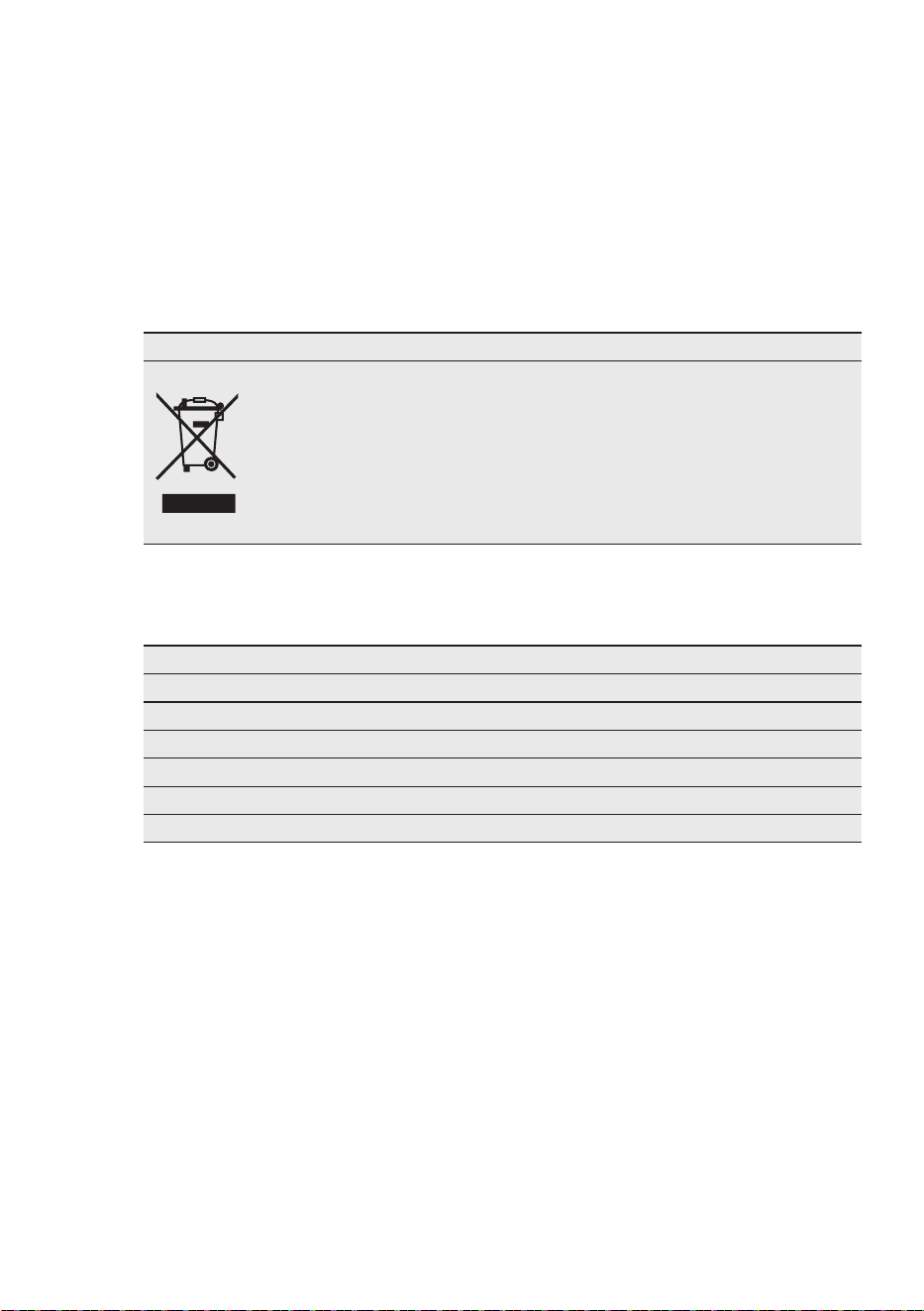
38 www.aeg.com
Dimension
Height 1782 mm
Width 913 mm
Depth 746 mm
Rising Time 14 h
Voltage 220-240 V
Frequency 50 Hz
The technical information are situated
in the rating plate on the internal left side
of the appliance and in the energy label.
The technical information is situated in the rating plate on the internal side of the
appliance and on the energy label.
The QR code on the energy label supplied with the appliance provides a web link
to the information related to the performance of the appliance in the EU EPREL
database. Keep the energy label for reference together with the user manual and
all other documents provided with this appliance.
It is also possible to nd the same information in EPREL using the link
https://eprel.ec.europa.eu and the model name and product number
that you nd on the rating plate of the appliance.
See the link www.theenergylabel.eu for detailed information about the energy label.
Correct Disposal of this product
This symbol on the product or in its packing indicates that this product
may not be treated as household waste. Instead, it should be taken to the
appropriate waste collection point for the recycling of electrical and electronic
equipment. By ensuring this product is disposed of correctly, you will help
prevent potential negative consequences for the environment and human
health, which could otherwise be caused by the inappropriate waste handling
of this product. For more detailed information about the recycling of this
product, please contact your local council your household waste disposal
service, or the shop where you purchased the product.
16. DISPOSAL OF THE APPLIANCE
17. TECHNICAL DATA
The refrigerator is built from reusable
materials. It must be disposed of
in compliance with current local waste
disposal regulations. The appliance
contains a small quantity of refrigerant
(R600a) in the refrigerant circuit. For
your safety please refer to the section
of “the refrigerant and risk of re” in this
Instruction Manual before scrapping the
appliance. Please cut o the power cord
to make the refrigerator unusable and
remove the door seal and lock. Please
be cautious of the cooling system and
do not damage it by puncturing the
refrigerant container and/or bending the
tubing, and/or scratching of the surface
coating.
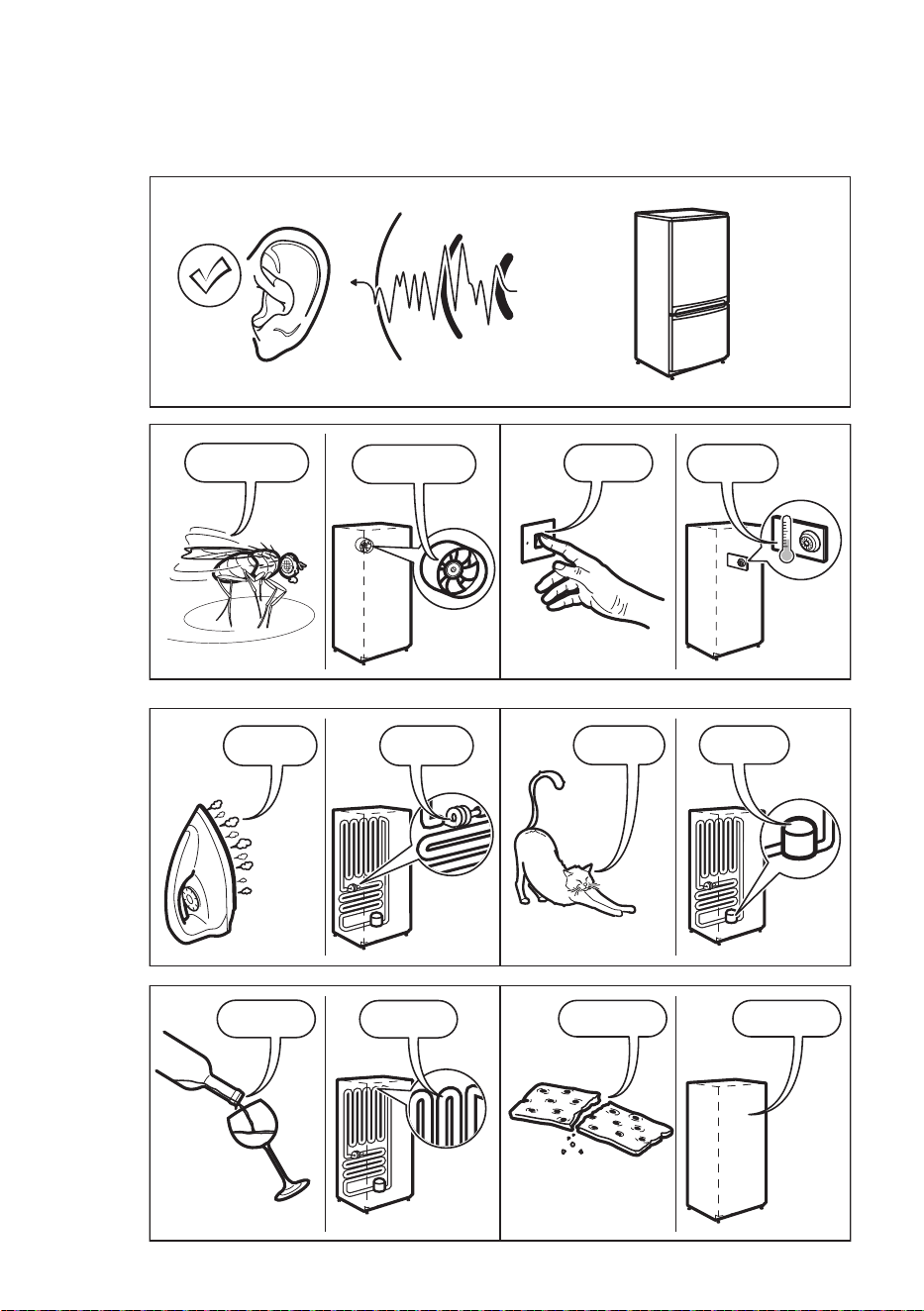
39ENGLISH
18. NOISES
There are some sounds during normal running (compressor, refrigerant circulation).
BRRR
!
HISSS!
CLICK!
BLUBB!
CRACK!
SSSRR
R!
OK
CLICK!
CLICK!
SSSRRR!
SSSRRR!
BRRR!
BRRR!
HISSS!
HISSS!
BLUBB!
BLUBB!
CRACK!CRACK!
A10883187-A-422023
www�aeg�com/shop
UK importer: Electrolux Appliances AB , Addington
Way , Luton , Bedfordshire , LU4 9QQ , UK