aeg.com/register
ORC7P321DW
ORC7P321DX
EN
User Manual | Fridge Freezer
aeg.com\register
Welcome to AEG! Thank you for choosing our appliance.
Get usage advice, brochures, trouble shooter, service and repair information:
www.aeg.com/support
Subject to change without notice.
CONTENTS
1. SAFETY INFORMATION................................................................................ 2
2. SAFETY INSTRUCTIONS.............................................................................. 4
3. INSTALLATION...............................................................................................6
4. OPERATION................................................................................................... 9
5. DAILY USE....................................................................................................11
6. HINTS AND TIPS.......................................................................................... 16
7. CARE AND CLEANING................................................................................ 18
8. TROUBLESHOOTING.................................................................................. 19
9. NOISES.........................................................................................................22
10. TECHNICAL DATA..................................................................................... 22
11. INFORMATION FOR TEST INSTITUTES.................................................. 22
12. ENVIRONMENTAL CONCERNS................................................................23
1. SAFETY INFORMATION
Before the installation and use of the appliance, carefully read
the supplied instructions. The manufacturer is not responsible
for any injuries or damage that are the result of incorrect
installation or usage. Always keep the instructions in a safe
and accessible location for future reference.
1.1 Children and vulnerable people safety
• This appliance can be used by children aged from 8 years
and above and persons with reduced physical, sensory or
mental capabilities or lack of experience and knowledge if
they have been given supervision or instruction concerning
the use of the appliance in a safe way and understand the
hazards involved. Children aged from 3 to 8 years and
persons with very extensive and complex disabilities are
allowed to load and unload the appliance provided that they
have been properly instructed. Children of less than 3 years
2 ENGLISH

of age should be kept away from the appliance unless
continuously supervised.
• Children should be supervised to ensure that they do not
play with the appliance.
• Children shall not carry out cleaning and user maintenance
of the appliance without supervision.
• Keep all packaging away from children and dispose of it
appropriately.
1.2 General Safety
• This appliance is for storing food and beverages only.
• This appliance is designed for single household domestic
use in an indoor environment.
• This appliance may be used in, offices, hotel guest rooms,
bed & breakfast guest rooms, farm guest houses and other
similar accommodation where such use does not exceed
(average) domestic usage levels.
• To avoid contamination of food respect the following
instructions:
– do not open the door for long periods;
– clean regularly surfaces that can come in contact with
food and accessible drainage systems;
– store raw meat and fish in suitable containers in the
refrigerator, so that it is not in contact with or drip onto
other food.
• WARNING: Keep ventilation openings, in the appliance
enclosure or in the built-in structure, clear of obstruction.
• WARNING: Do not use mechanical devices or other means
to accelerate the defrosting process, other than those
recommended by the manufacturer.
• WARNING: Do not damage the refrigerant circuit.
• WARNING: Do not use electrical appliances inside the food
storage compartments of the appliance, unless they are of
the type recommended by the manufacturer.
• Do not use water spray and steam to clean the appliance.
ENGLISH 3
• Clean the appliance with a moist soft cloth. Only use neutral
detergents. Do not use abrasive products, abrasive
cleaning pads, solvents or metal objects.
• When the appliance is empty for long period, switch it off,
defrost, clean, dry and leave the door open to prevent
mould from developing within the appliance.
• Do not store explosive substances such as aerosol cans
with a flammable propellant in this appliance.
• If the supply cord is damaged, it must be replaced by the
manufacturer, its Authorised Service Centre or similarly
qualified persons in order to avoid a hazard.
2. SAFETY INSTRUCTIONS
2.1 Installation
WARNING!
Only a qualified person must install this
appliance.
• Remove all the packaging.
• Do not install or use a damaged
appliance.
• Follow the installation instructions supplied
with the appliance.
• Always take care when moving the
appliance as it is heavy. Always use safety
gloves and enclosed footwear.
• Make sure the air can circulate around the
appliance.
• At first installation or after reversing the
door wait at least 4 hours before
connecting the appliance to the power
supply. This is to allow the oil to flow back
in the compressor.
• Before carrying out any operations on the
appliance (e.g. reversing the door),
remove the plug from the power socket.
• Do not install the appliance close to
radiators or cookers, ovens, or hobs,
unless otherwise specified in the
installation instructions.
• Do not expose the appliance to the rain.
• Do not install the appliance where there is
direct sunlight.
• Do not install this appliance in areas that
are too humid or too cold.
• When you move the appliance, lift it by the
front edge to avoid scratching the floor.
2.2 Electrical connection
WARNING!
Risk of fire and electric shock.
WARNING!
When positioning the appliance, ensure
the supply cord is not trapped or
damaged.
WARNING!
Do not use multi-plug adapters and
extension cables.
• The appliance must be earthed.
• Make sure that the parameters on the
rating plate are compatible with the
electrical ratings of the mains power
supply.
• Always use a correctly installed
shockproof socket.
• Make sure not to cause damage to the
electrical components (e.g. mains plug,
mains cable, compressor). Contact the
Authorised Service Centre or an
electrician to change the electrical
components.
• The mains cable must stay below the level
of the mains plug.
4 ENGLISH
• Connect the mains plug to the mains
socket only at the end of the installation.
Make sure that there is access to the
mains plug after the installation.
• Do not pull the mains cable to disconnect
the appliance. Always pull the mains plug.
2.3 Use
WARNING!
Risk of injury, burns, electric shock or
fire.
The appliance contains flammable gas,
isobutane (R600a), a natural gas with a high
level of environmental compatibility. Be
careful not to cause damage to the refrigerant
circuit containing isobutane.
• Do not change the specification of this
appliance.
• Do not put electrical appliances (e.g. ice
cream makers) in the appliance unless
they are stated applicable by the
manufacturer.
• If damage occurs to the refrigerant circuit,
make sure that there are no flames and
sources of ignition in the room. Ventilate
the room.
• Do not let hot items to touch the plastic
parts of the appliance.
• Do not put soft drinks in the freezer
compartment. This will create pressure on
the drink container.
• Do not store flammable gas and liquid in
the appliance.
• Do not put flammable products or items
that are wet with flammable products in,
near or on the appliance.
• Do not touch the compressor or the
condenser. They are hot.
• Do not remove or touch items from the
freezer compartment if your hands are wet
or damp.
• Do not freeze again food that has been
thawed.
• Follow the storage instructions on the
packaging of frozen food.
• Wrap the food in any food contact material
before putting it in the freezer
compartment.
• Do not allow food to come in contact with
the inner walls of the appliance
compartments.
2.4 Internal lighting
WARNING!
Risk of electric shock.
• This product contains one or more light
sources of energy efficiency class F.
• Concerning the lamp(s) inside this product
and spare part lamps sold separately:
These lamps are intended to withstand
extreme physical conditions in household
appliances, such as temperature,
vibration, humidity, or are intended to
signal information about the operational
status of the appliance. They are not
intended to be used in other applications
and are not suitable for household room
illumination.
2.5 Care and cleaning
WARNING!
Risk of injury or damage to the appliance.
• Before maintenance, deactivate the
appliance and disconnect the mains plug
from the mains socket.
• This appliance contains hydrocarbons in
the cooling unit. Only a qualified person
must do the maintenance and the
recharging of the unit.
• Regularly examine the drain of the
appliance and if necessary, clean it. If the
drain is blocked, defrosted water collects
in the bottom of the appliance.
2.6 Service
• To repair the appliance contact the
Authorised Service Centre. Use original
spare parts only.
• Please note that self-repair or non-
professional repair can have safety
consequences and might void the
guarantee.
• The following spare parts are available for
at least 7 years after the model has been
discontinued: thermostats, temperature
sensors, printed circuit boards, light
ENGLISH 5
sources, door handles, door hinges, trays
and baskets. Door gaskets are available
for at least 10 years after the model has
been discontinued. The duration may be
longer in your country. For further
information, please visit our website.
• Please note that some of these spare
parts are only available to professional
repairers, and that not all spare parts are
relevant for all models.
2.7 Disposal
WARNING!
Risk of injury or suffocation.
• Disconnect the appliance from the mains
supply.
• Cut off the mains cable and discard it.
• Remove the door to prevent children and
pets to be closed inside of the appliance.
• The refrigerant circuit and the insulation
materials of this appliance are ozone-
friendly.
• The insulation foam contains flammable
gas. Contact your municipal authority for
information on how to discard the
appliance correctly.
• Do not cause damage to the part of the
cooling unit that is near the heat
exchanger.
3. INSTALLATION
WARNING!
Refer to Safety chapters.
3.1 Dimensions
H1
H2
D1
W1
D3
90°
D2
W2
W3
140°
6 ENGLISH
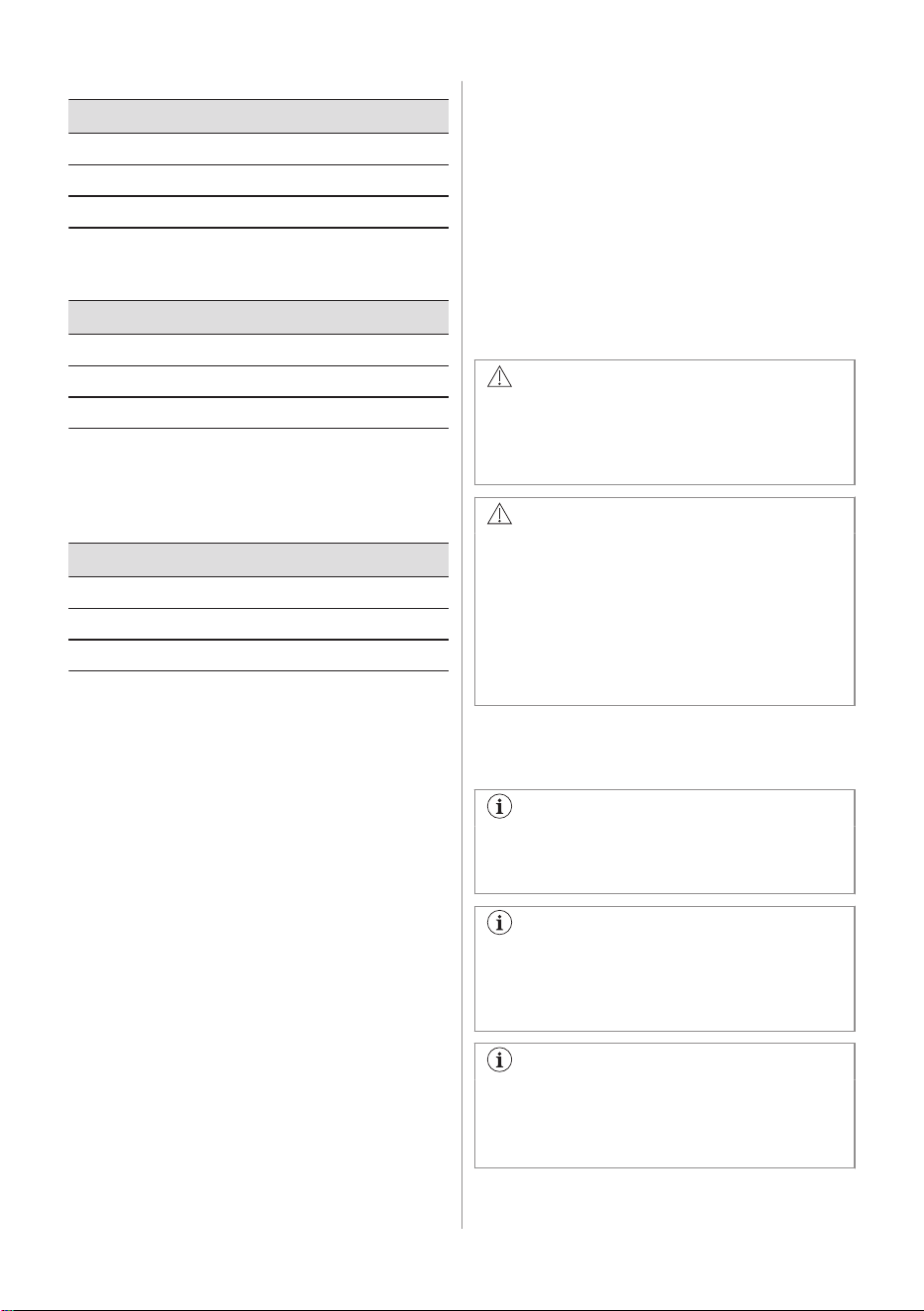
Overall dimensions ¹
H1 mm 1870
W1 mm 595
D1 mm 639
¹ the height, width and depth of the appliance
without the handle
Space required in use ²
H2 mm 1900
W2 mm 600
D2 mm 700
² the height, width and depth of the appliance
including the handle, plus the space
necessary for free circulation of the cooling
air
Overall space required in use ³
H2 mm 1900
W3 mm 1031
D3 mm 1256
³ the height, width and depth of the appliance
including the handle, plus the space
necessary for free circulation of the cooling
air, plus the space necessary to allow door
opening to the minimum angle permitting
removal of all internal equipment
3.2 Location
This appliance is not intended to be used as
a built-in appliance.
In case of different installation from
freestanding respecting space required in use
dimensions, the appliance will function
correctly but energy consumption might
increase slightly.
To ensure appliance's best functionality, you
should not install the appliance in the place
with direct sunlight. Do not install the
appliance close to the heat source (oven,
stoves, radiators, cookers, hoods, hobs or
extractor hobs) unless otherwise specified in
the installation instruction. Make sure that air
can circulate freely around the back of the
cabinet.
This appliance should be installed in a dry,
well ventilated indoor position.
To ensure best performance, if the appliance
is positioned below an overhanging wall unit,
the minimum distance between the top of the
cabinet shall be maintained. Ideally, however,
the appliance should not be positioned below
overhanging wall units. One or more
adjustable feet at the base of the cabinet
ensure that the appliance stands level.
CAUTION!
If you position the appliance against the
wall, use back spacers provided or keep
the minimum distance indicated in the
installation instructions.
CAUTION!
If you install the appliance next to a wall,
refer to the installation instructions to
understand the minimum distance
between the wall and the side of the
appliance where door hinges are to
provide enough space to open the door
when the internal equipment is removed
(e.g. when cleaning).
This appliance is intended to be used at
ambient temperature ranging from 10°C to
43°C.
The correct operation of the appliance
can only be guaranteed within the
specified temperature range.
If you have any doubts regarding where
to install the appliance, please turn to the
vendor, to our customer service or to the
nearest Authorised Service Centre.
It must be possible to disconnect the
appliance from the mains power supply.
The plug must therefore be easily
accessible after installation.
ENGLISH 7
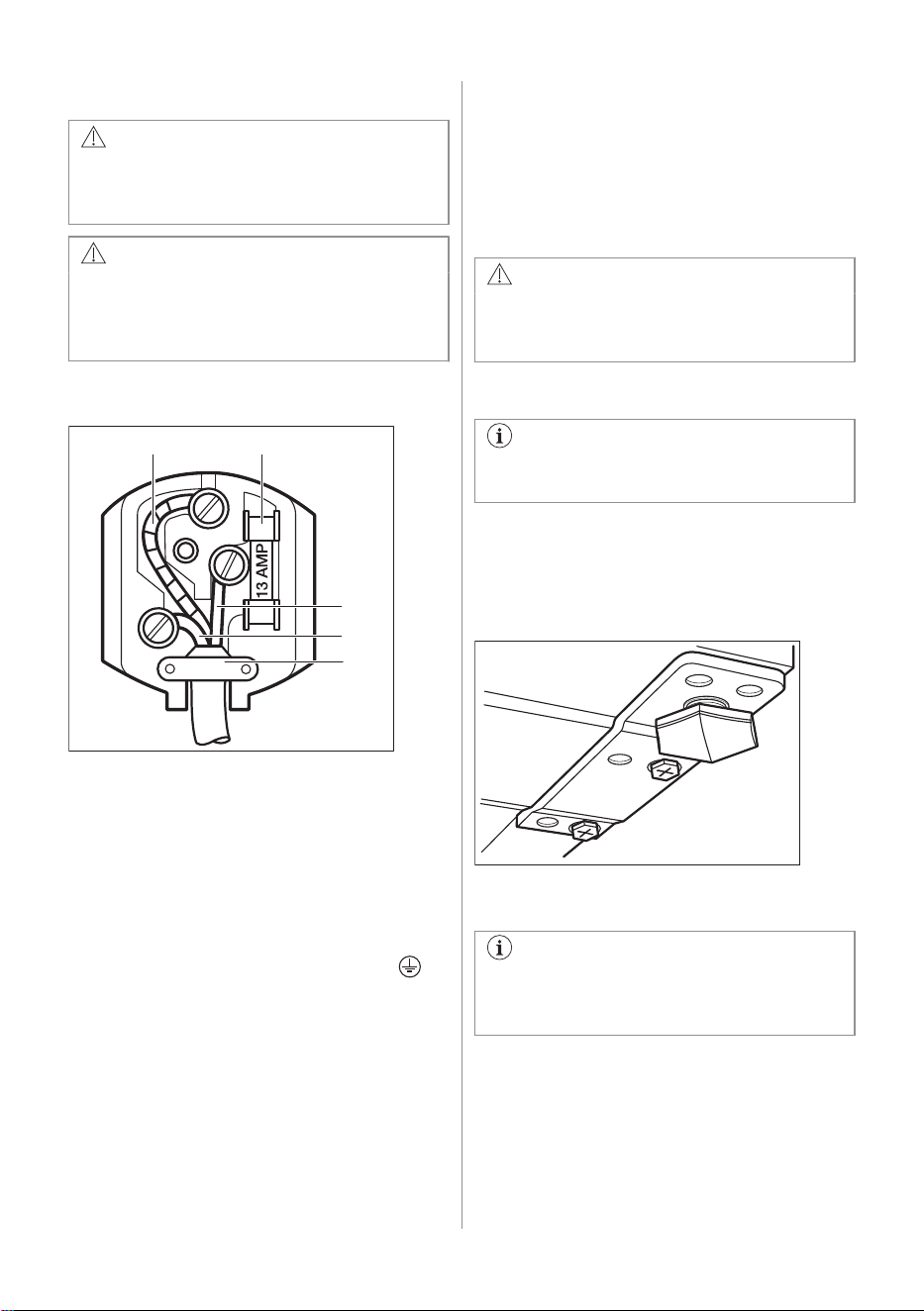
3.3 Electrical Connection
CAUTION!
Any electrical work required to install this
appliance should be carried out by a
qualified electrician or competent person.
WARNING!
This appliance must be earthed.
The manufacturer declines any liability
should these safety measures not be
observed.
The wires in the mains lead are coloured in
accordance with the following code:
A B
C
D
E
• A - green and yellow: Earth
• C - brown: Live
• D - blue: Neutral
As the colours of the wires in the mains lead
of this appliance may not correspond with the
coloured markings identifying the terminals in
your plug, proceed as follows:
1. Connect the wire coloured green and
yellow to the terminal marked either with
the letter “E“ or by the earth symbol
or
coloured green and yellow.
2. Connect the wire coloured blue to the
terminal either marked with the letter
“N“ or coloured black.
3. Connect the wire coloured brown to the
terminal either marked with the “L“ or
coloured red.
4. Check that no cut, or stray strands of wire
is present and the cord clamp (E) is
secure over the outer sheath.
Make sure the electricity supply voltage is
the same as that indicated on the
appliance rating plate.
5. Switch on the appliance.
The appliance is supplied with a 13 amp fuse
(B). In the event of having to change the fuse
in the plug supplied, a 13 amp ASTA
approved (BS 1362) fuse must be used.
WARNING!
A cut off plug inserted into a 13 amp
socket is a serious safety (shock) hazard.
Ensure that it is disposed of safely.
3.4 Levelling
Door alignment depends on proper
levelling.
It is advisable to empty the appliance before
carrying out this operation.
When placing the appliance ensure that it
stands level. This can be achieved by two
adjustable feet at the bottom in front.
3.5 Rear spacers
Please refer to the separate document
with instructions on installation and door
reversal.
8 ENGLISH
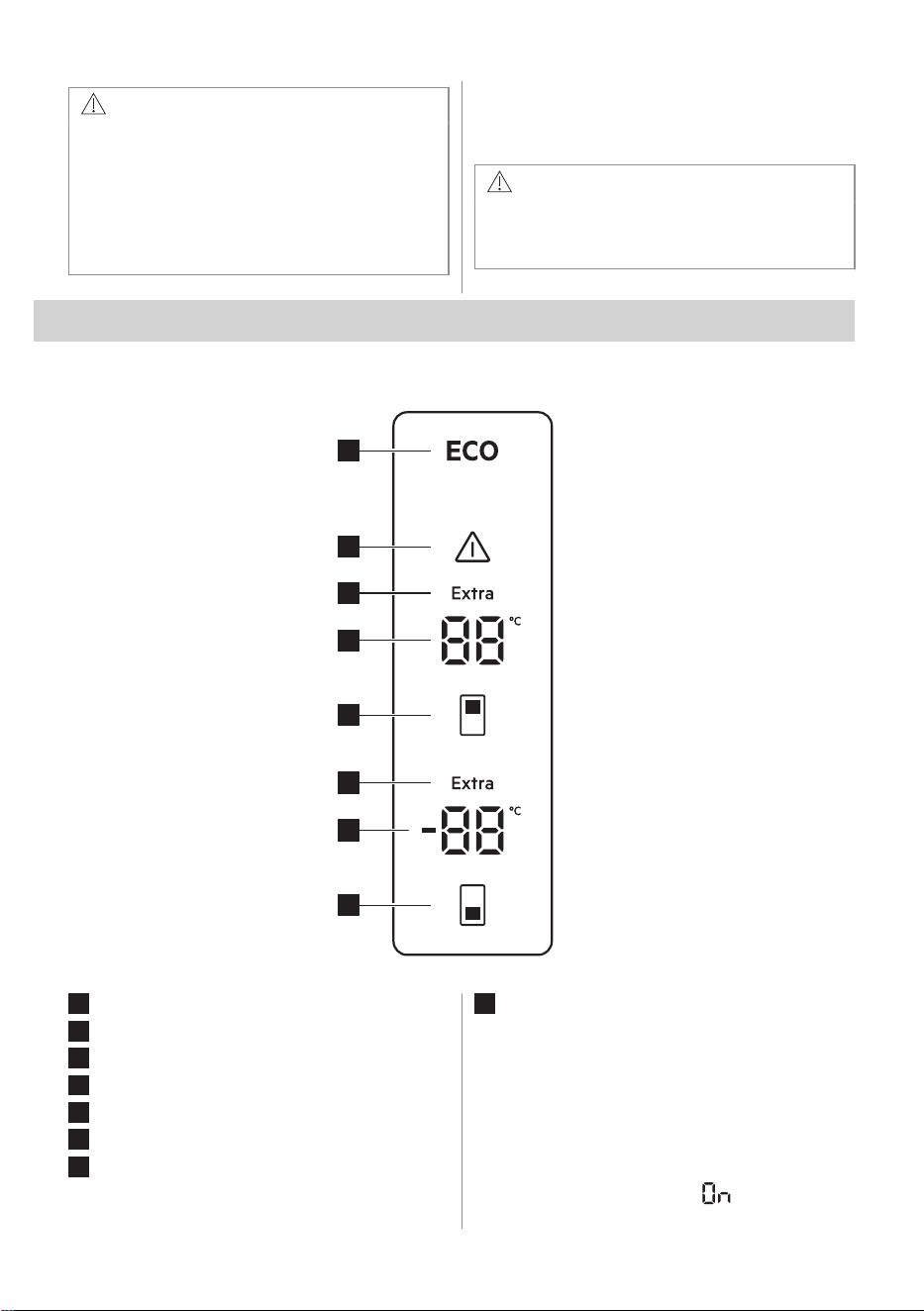
CAUTION!
If you position the appliance against the
wall in a freestanding installation, install
the rear spacers in order to guarantee
the minimum distance required for air
circulation. Use the provided rear
spacers as indicated in the Installation
Instruction.
3.6 Door reversibility
Please refer to the separate document with
instructions on installation and door reversal.
CAUTION!
At every stage of reversing the door
protect the floor from scratching with a
durable material.
4. OPERATION
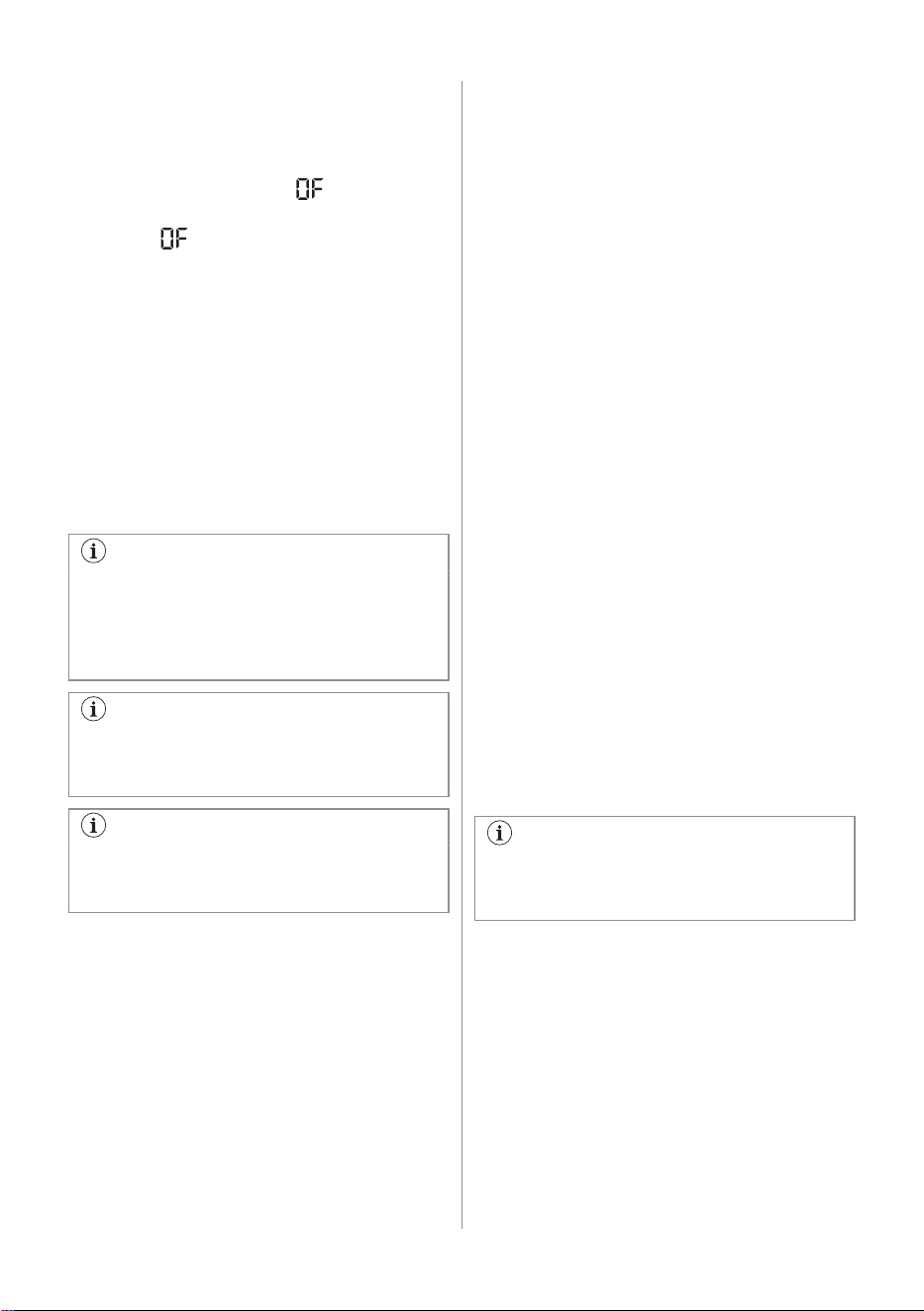
4.1 Control panel
1
2
3
4
5
6
7
8
1
Freezer temperature button
2
Freezer compartment indicator
3
Extra Freeze indicator
4
Fridge temperature button
5
Fridge compartment indicator
6
Extra Cool indicator
7
Alarm indicator
8
ECOMETER indicator
4.2 Switching on
1. Connect the mains plug to the power
socket.
2. Press and hold the Freezer temperature
and Fridge temperature buttons for 10
seconds.
The display shows blinking
indication.
ENGLISH 9
4.3 Switching off
1. Press and hold the Freezer temperature
and Fridge temperature buttons for 10
seconds.
The display shows blinking indicator.
2. The appliance is switched off and a
steady indication substitutes the
fridge temperature. Disconnect the mains
plug from the power socket.
4.4 Temperature regulation
Set the temperature of the appliance by
pressing the temperature buttons.
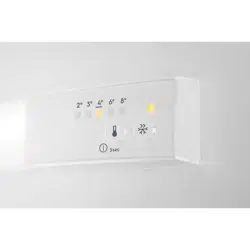
Recommended set temperatures are:
• +4°C for the fridge
• -18°C for the freezer
The temperature range may vary between
-15 and -24°C for freezer and between 2 and
8°C for fridge.
The temperature indicators show the set
temperature. The set temperature will be
reached within 24 hours. After a power
failure the set temperature remains
stored.
ECO indicator LED light is on when the
recommended temperature or level is
set.
Switch off the Extra Freeze function
before setting a different freezer
temperature level.
4.5 ECO function
The ECO function ensures minimum energy
consumption with the optimal temperature for
food preservation.
During this mode:
• The set temperature of the fridge
compartment is 4°C.
• The set temperature of the freezer
compartment is -18°C.
To deactivate the ECO function:
• set a different temperature. Refer to
"Temperature regulation".
• activate the Extra Cool and Extra Freeze
functions.
4.6 Extra Cool function
If you need to insert a large amount of food at
ambient temperature in the fridge
compartment, for example after grocery
shopping, activate the Extra Cool function.
This function accelerates cooling and
prevents the stored food from warming up.
To activate the function, press and hold the
Fridge temperature button until the Extra Cool
indicator lights up.
The function stops automatically after
approximately 6 hours.
To deactivate the Extra Cool function before
its automatic end, press and hold the Fridge
temperature button until the Extra Cool
indicator turns off.
To set a different fridge temperature, turn off
the Extra Cool function. Refer to
"Temperature regulation" section.
4.7 Extra Freeze function
The Extra Freeze function performs pre-
freezing and fast freezing in sequence in the
freezer compartment. This function
accelerates the freezing of fresh food and
protects the food already stored from
warming up.
To freeze fresh food activate the Extra
Freeze function at least 4 hours before
placing the food to complete pre-freezing.
To activate the Extra Freeze function, press
and hold the Freezer temperature button until
Extra Freeze indicator lights up.
This function stops automatically after 24
hours.
To deactivate the Extra Freeze function
before its automatic end, press and hold the
Freezer temperature button until Extra Freeze
indicator turns off.
10 ENGLISH
4.8 Door open alarm
If the fridge or the freezer door is left open for
approximately 5 minutes the alarm activates.
During the alarm:
• the sound is on,
• temperature indicators flash,
• the alarm indicator flashes.
The internal fridge light may be flashing.
The alarm stops after closing the door.
You can switch off the alarm by pressing any
button.
The sound switches off automatically
after 1 hour.
4.9 High temperature alarm
The alarm activates when you plug the
appliance for the first time.
Freezer compartment
The alarm activates when the freezer
compartment temperature is too high.
During the alarm:
• the display shows blinking E09,
• the alarm indicator flashes,
• the alarm sound is on.
Turning off the alarm
• Press any button on the control panel to
turn off the alarm. The alarm indicator and
sound turn off. The display shows E09 for
5 seconds and then the current freezer
temperature is displayed.
• The alarm sound turns off automatically
after 1 hour. If the temperature is still too
high, the alarm activates again.
• Once the temperature is back to the set
value, the alarm turns off and the normal
display restores.
4.10 Rest mode
The Rest mode ensures optimal food
preservation while minimizing energy
consumption during periods of non-operation.
To enable the Rest mode, press and hold
freezer temperature button for 5 seconds.
The display shows:
• on the Freezer temperature indicator,
•
on the Fridge temperature indicator.
Tap Freezer temperature button to switch the
Rest mode on or off. The Freezer
temperature indicator changes to for the
enabled or for the disabled Rest mode.
The Rest mode activates after 3 days without
any interaction with the appliance. The Rest
mode deactivates automatically after any
interaction with the appliance.
5. DAILY USE
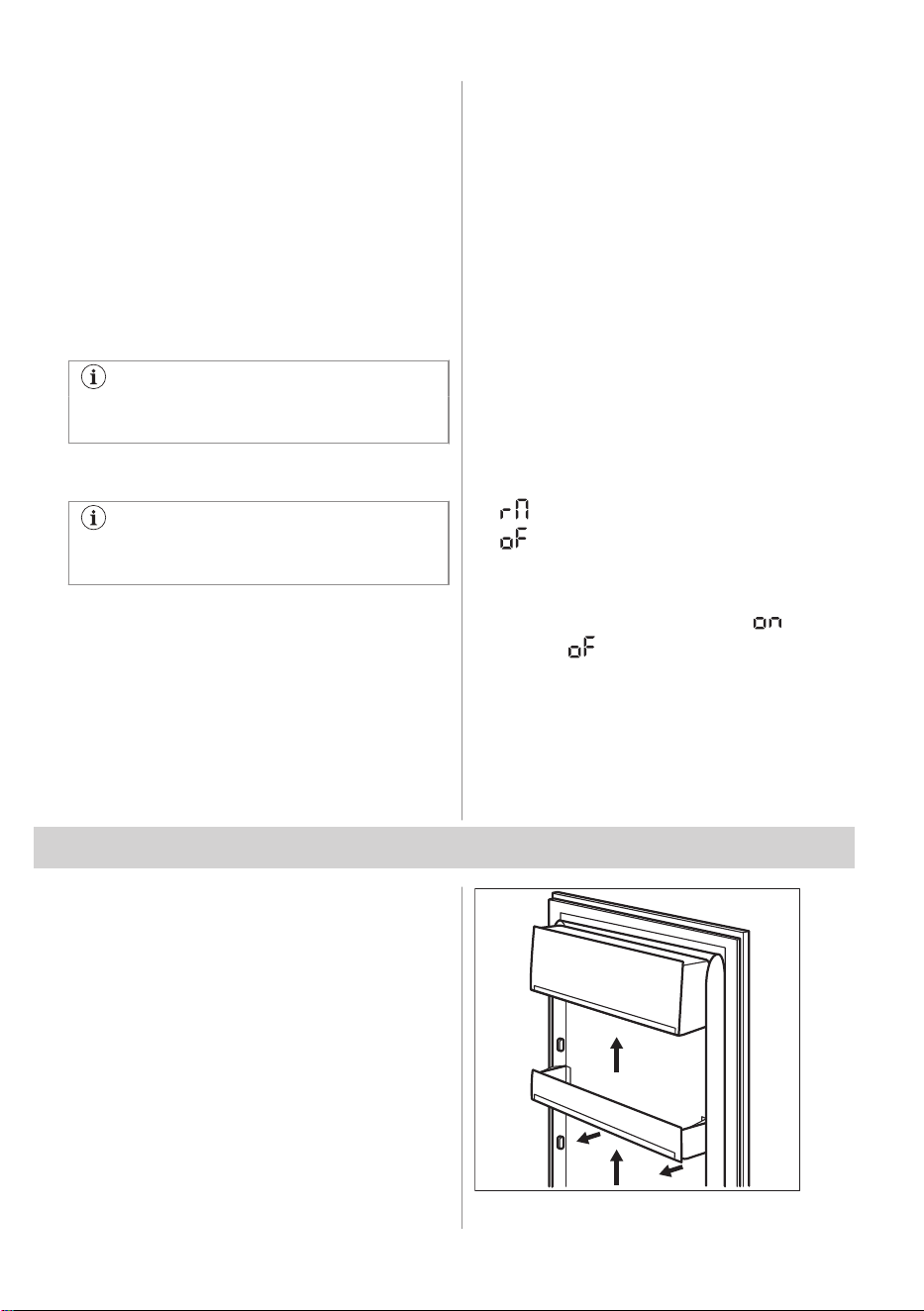
5.1 Positioning the door shelves
To permit storage of food packages of
various sizes, the door shelves can be placed
at different heights.
1. Gradually pull the shelf up until it comes
free.
2. Reposition as required.
1
2
ENGLISH 11
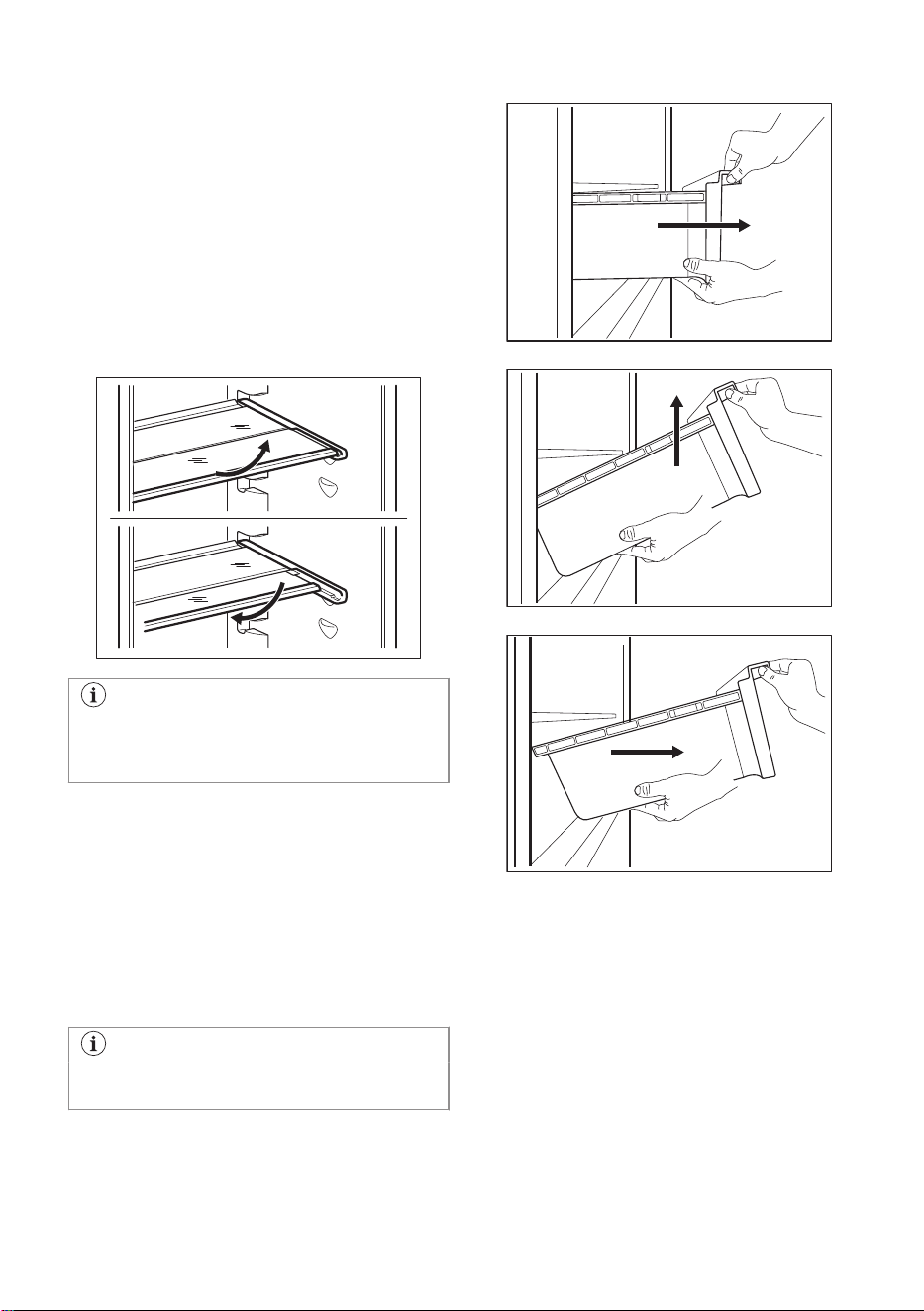
5.2 Movable shelves
The walls of the refrigerator are equipped
with a series of runners so that the shelves
can be positioned as desired.
This appliance is also equipped with a shelf
consisting of two parts. The front half of the
shelf can be placed under the second half to
make better use of space.
To fold the shelf:
1. Take out the front half gently.
2. Slide it into the lower rail and under the
second half.
1
2
Do not move the glass shelf above the
vegetable drawer to ensure correct air
circulation.
5.3 GreenZone drawer
There is a pull-out drawer in the bottom part
of the refrigerator compartment.
The glass shelf of the GreenZone is fitted
with a device that regulates its sealing and
provides for optimal humidity inside the
drawer.
5.4 Removing GreenZone drawer
It is recommended to empty the drawer
before removing it from the refrigerator.
To remove the drawer:
1. Pull out the drawer from the refrigerator.
2. Lift up the front of the drawer.
3. Pull the drawer out while lifting it up.
To remove the glass cover of the GreenZone
drawer:
12 ENGLISH
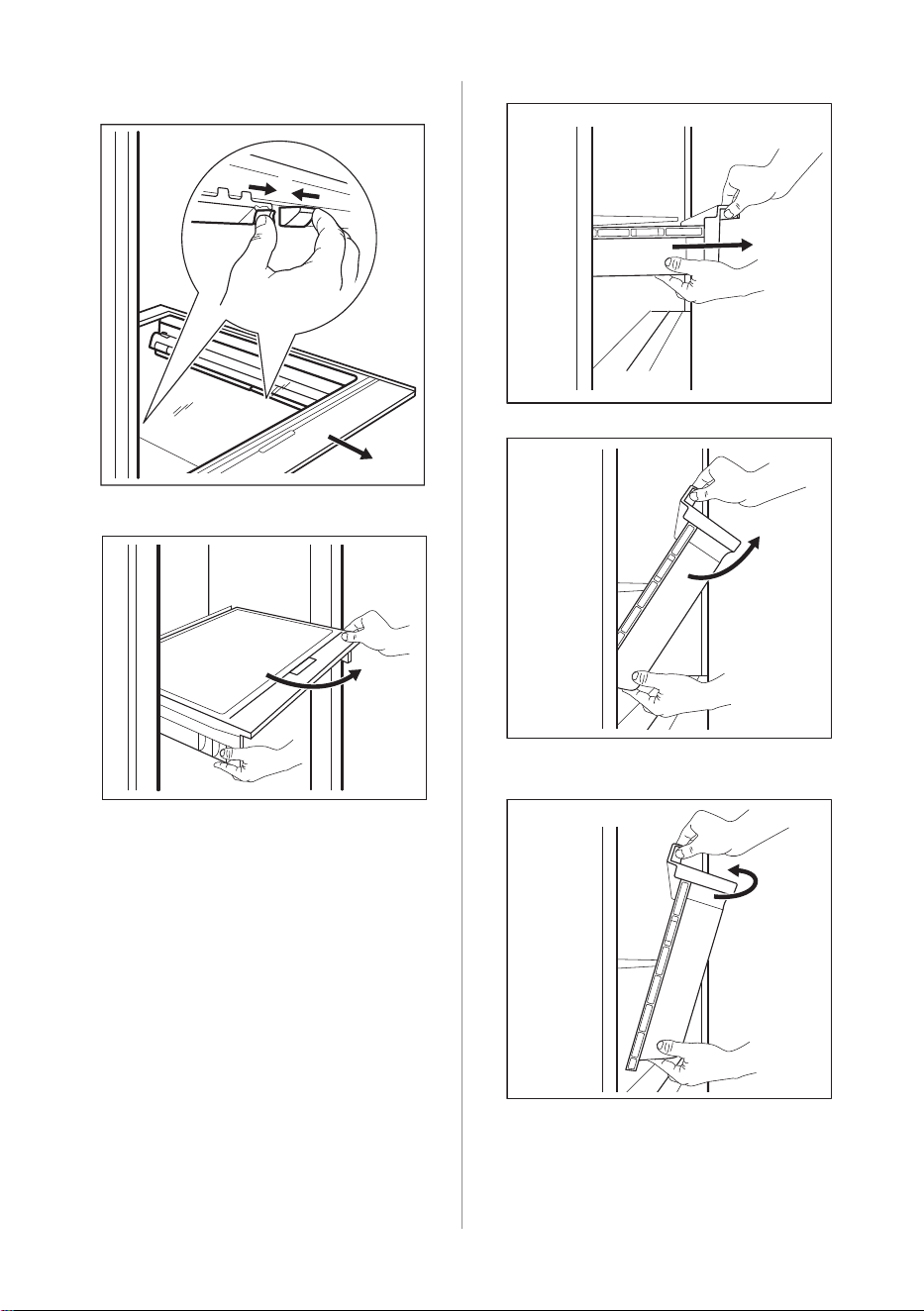
1. Unlock lateral gripping from both sides
simultaneously.
2
x2
1
2. Pull the glass shelf support towards
yourself.
5.5 Removing ExtraChill
There is a drawer above the GreenZone
drawer.
To remove the drawer:
1. Pull out the drawer from the refrigerator.
2. Lift up the front of the drawer.
3. Lift and turn the drawer to pull it out of the
appliance.
The shelf above the drawer can be removed
from the appliance only for cleaning purpose.
ENGLISH 13
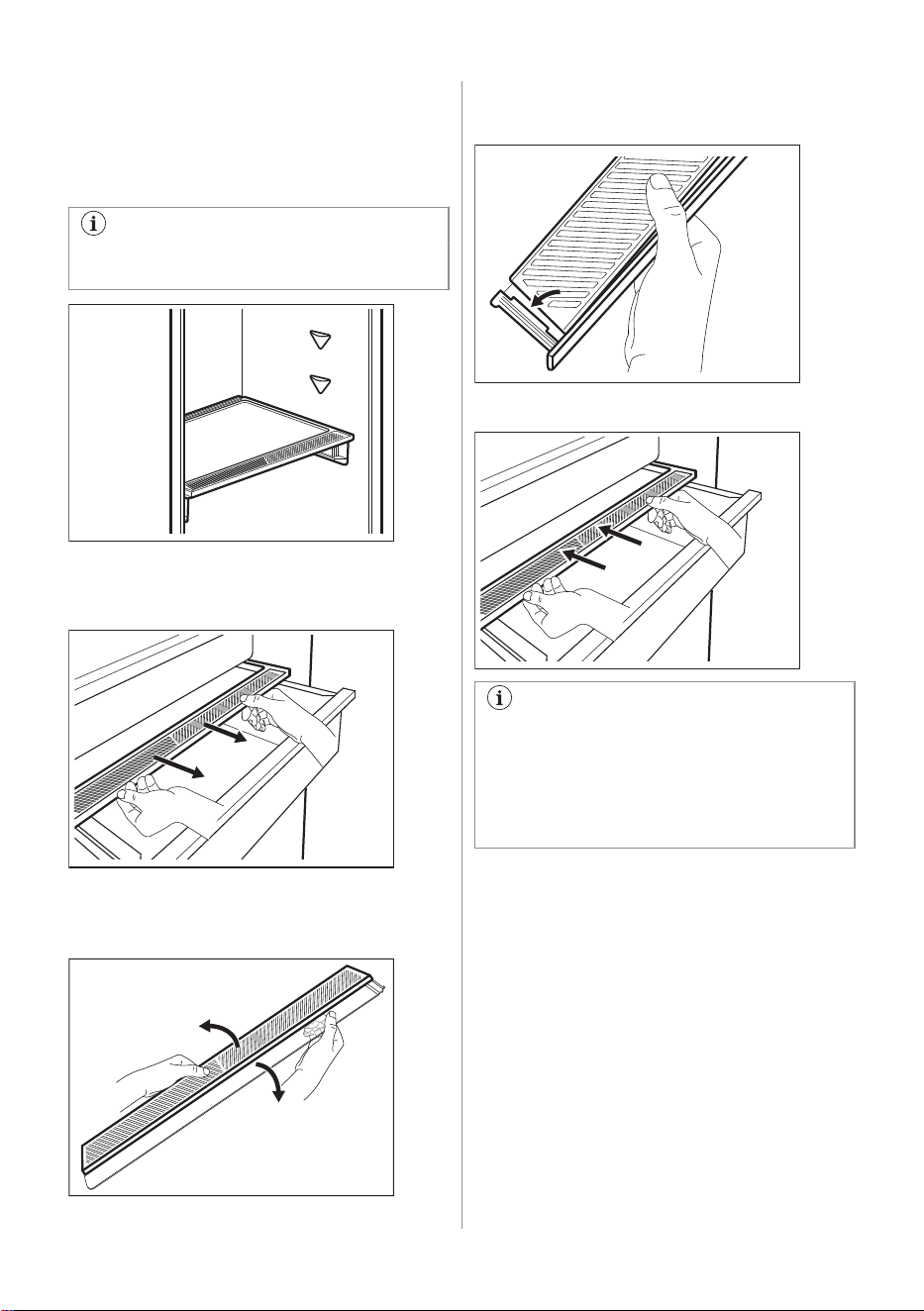
5.6 Humidity control
The glass shelf of the GreenZone drawer
features a device that regulates its sealing
and provides for optimal humidity inside the
drawer.
Do not place any food products on the
humidity control device.
To remove the humidity control device:
1. Open the drawer below the glass shelf
and pull out the cover.
2. If you need to replace the device's white
membrane, grab the device in the middle
and separate the membrane from the
cover by pulling the cover.
3. Assemble a new membrane into the
cover by pressing the edge of the
membrane into the cover.
4. Reassemble the humidity control back on
the drawer.
Depending on the quantity and condition
of fruit and vegetables stored in the
GreenZone drawer, condensation may
occur.
In such a case, remove the condensation
using a soft cloth.
5.7 MULTIFLOW
The refrigerator compartment is equipped
with the MULTIFLOW device that allows for
rapid and more effective cooling of food and
maintaining a more uniform temperature in
each part of the refrigerator compartment.
This device activates automatically when
needed.
14 ENGLISH
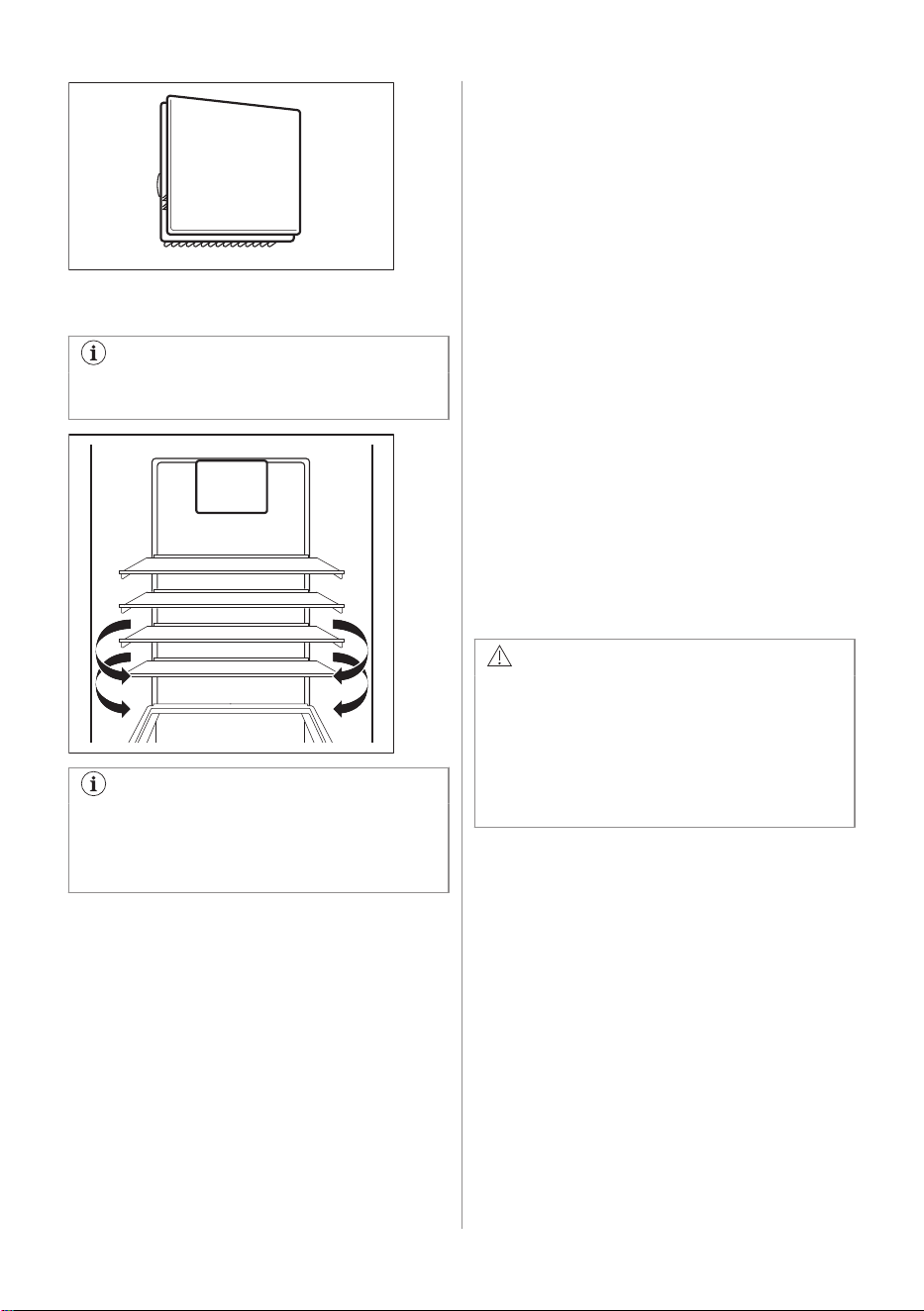
MULTIFLOW operates only when the door is
closed.
Do not block the air vents to allow better
cooling.
Do not remove the MULTIFLOW panel.
Do not use water spray or steam to clean
the appliance. For cleaning instructions,
refer to the "Care and cleaning" chapter.
5.8 Freezing fresh food
The freezer compartment is suitable for
freezing fresh food and storing frozen and
deep-frozen food for a long time.
To freeze fresh food activate the Extra
Freeze function at least 4 hours before
placing the food to be frozen in the freezer
compartment.
Store the fresh food evenly distributed in the
first compartment or drawer from the top.
The maximum amount of food that can be
frozen without adding other fresh food during
24 hours is specified on the rating plate (a
label located inside the appliance).
When the freezing process is complete, the
appliance returns to the previously set
temperature (see "Extra Freeze" function).
For more information refer to "Hints for
freezing
5.9 Storage of frozen food
When activating an appliance for the first time
or after a period out of use, before putting the
products in the compartment let the appliance
run at least 3 hours with the Extra Freeze
function switched on.
The freezer drawers ensure that it is quick
and easy to find the food package you want.
If large quantities of food are to be stored,
remove all drawers, except for the bottom
drawer which needs to be in place to provide
good air circulation.
Keep the food on the shelves no closer than
15 mm from the door.
CAUTION!
In the event of accidental defrosting, for
example due to a power failure, if the
power has been off for longer than the
value shown on rating plate under "rising
time", the defrosted food must be
consumed quickly or cooked immediately
then cooled and then re-frozen.
5.10 Thawing
Deep-frozen or frozen food, prior to being
used, can be thawed in the refrigerator
compartment or at room temperature,
depending on the time available for this
operation.
Small pieces may even be cooked still frozen,
directly from the freezer: in this case, cooking
will take longer.
5.11 Ice-cube production
This appliance is equipped with one or more
trays for the production of ice-cubes.
ENGLISH 15
Do not use metallic instruments to
remove the trays from the freezer.
1. Fill these trays with water.
2. Put the ice trays in the freezer
compartment.
6. HINTS AND TIPS
6.1 Hints for energy saving
• Freezer: The internal configuration of the
appliance is the one that ensures the most
efficient use of energy.
• Fridge: Most efficient use of energy is
ensured in the configuration with the
drawers in the bottom part of the
appliance and shelves evenly distributed.
Position of the door bins does not affect
energy consumption.
• Do not open the door frequently or leave it
open longer than necessary.
• Freezer: The colder the temperature
setting, the higher the energy
consumption.
• Fridge: Do not set too high temperature to
save energy unless it is required by the
characteristics of the food.
• If the ambient temperature is high and the
temperature control is set to low
temperature and the appliance is fully
loaded, the compressor may run
continuously, causing frost or ice
formation on the evaporator. In this case,
set the temperature control toward higher
temperature to allow automatic defrosting
and to save energy this way.
• Ensure a good ventilation. Do not cover
the ventilation grilles or holes.
• Make sure that food products inside the
appliance allow air circulation through
dedicated holes in the rear interior of the
appliance.
6.2 Hints for freezing
• Activate Extra Freeze function at least 4
hours before placing the food inside the
freezer compartment.
• Before freezing wrap and seal fresh food
in: aluminium foil, plastic film or bags,
airtight containers with lid.
• For more efficient freezing and thawing
divide food into small portions.
• It is recommended to put labels and dates
on all your frozen food. This will help to
identify foods and to know when they
should be used before their deterioration.
• The food should be fresh when being
frozen to preserve good quality. Especially
fruits and vegetables should be frozen
after the harvest to preserve all of their
nutrients.
• Do not freeze bottles or cans with liquids,
in particular drinks containing carbon
dioxide - they may explode during
freezing.
• Do not put hot food in the freezer
compartment. Cool it down at room
temperature before placing it inside the
compartment.
• To avoid increase in temperature of
already frozen food, do not place fresh
unfrozen food directly next to it. Place food
at room temperature in the part of the
freezer compartment where there is no
frozen food.
• Do not eat ice cubes, water ices or ice
lollies immediately after taking them out of
the freezer. Risk of frostbites.
• Do not re-freeze defrosted food. If the food
has defrosted, cook it, cool it down and
then freeze it.
6.3 Hints for storage of frozen food
• Freezer compartment is the one marked
with .
• Higher temperature setting inside the
appliance may lead to shorter shelf life.
• The whole freezer compartment is suitable
for storage of frozen food products.
• Leave enough space around the food to
allow air to circulate freely.
• For adequate storage refer to food
packaging label to see the shelf life of
food.
16 ENGLISH
• It is important to wrap the food in such a
way that prevents water, humidity or
condensation from getting inside.
6.4 Shopping tips
After grocery shopping:
• Ensure that the packaging is not damaged
- the food could be deteriorated. If the
package is swollen or wet, it might have
not been stored in the optimal conditions
and defrosting may have already started.
• To limit the defrosting process buy frozen
goods at the end of your grocery shopping
and transport them in a thermal and
insulated cool bag.
• Place the frozen foods immediately in the
freezer after coming back from the shop.
• If food has defrosted even partially, do not
re-freeze it. Consume it as soon as
possible.
• Respect the expiry date and the storage
information on the package.
6.5 Shelf life for freezer compartment
Type of food Shelf life (months)
Bread 3
Fruits (except citrus) 6 - 12
Vegetables 8 - 10
Leftovers without meat 1 - 2
Dairy food:
Butter
Soft cheese (e.g. mozzarella)
Hard cheese (e.g. parmesan, cheddar)
6 - 9
3 - 4
6
Seafood:
Fatty fish (e.g. salmon, mackerel)
Lean fish (e.g. cod, flounder)
Shrimps
Shucked clams and mussels
Cooked fish
2 - 3
4 - 6
12
3 - 4
1 - 2
Meat:
Poultry
Beef
Pork
Lamb
Sausage
Ham
Leftovers with meat
9 - 12
6 - 12
4 - 6
6 - 9
1 - 2
1 - 2
2 - 3
6.6 Hints for fresh food refrigeration
• Good temperature setting that ensures
preservation of fresh food is a temperature
less than or equal to +4°C.
Higher temperature setting inside the
appliance may lead to shorter shelf life of
food.
• Cover the food with packaging to preserve
its freshness and aroma.
• Always use closed containers for liquids
and for food, to avoid flavours or odours in
the compartment.
• To avoid the cross-contamination between
cooked and raw food, cover the cooked
food and separate it from the raw one.
• It is recommended to defrost the food
inside the fridge.
• Do not insert hot food inside the
appliance. Make sure it has cooled down
at room temperature before inserting it.
ENGLISH 17
• To prevent food waste the new stock of
food should always be placed behind the
old one.
6.7 Hints for food refrigeration
• Fresh food compartment is the one
marked (on the rating plate) with .
• Meat (all types): wrap in a suitable
packaging and place it on the glass shelf
above the vegetable drawer. Store meat
for at most 1-2 days.
• Fruit and vegetables: clean thoroughly
(eliminate the soil) and place in a special
drawer (vegetable drawer).
• It is advisable not to keep the exotic fruits
like bananas, mangos, papayas etc. in the
refrigerator.
• Vegetables like tomatoes, potatoes,
onions, and garlic should not be kept in
the refrigerator.
• Butter and cheese: place in an airtight
container or wrap in an aluminium foil or a
polythene bag to exclude as much air as
possible.
• Bottles: close them with a cap and place
them on the door bottle shelf, or (if
available) on the bottle rack.
• Always refer to the expiry date of the
products to know how long to keep them.
7. CARE AND CLEANING
WARNING!
Refer to Safety chapters.
7.1 General warnings
CAUTION!
Unplug the appliance before carrying out
any maintenance operation.
This appliance contains hydrocarbons in
its cooling unit; maintenance and
recharging must therefore only be carried
out by authorized technicians.
The accessories and parts of the
appliance are not suitable for washing in
a dishwasher.
7.2 Cleaning the interior
Before using the appliance for the first time,
the interior and all internal accessories should
be washed with lukewarm water and some
neutral detergent to remove the typical smell
of a brand-new product, then dried
thoroughly.
CAUTION!
Do not use detergents, abrasive
powders, chlorine or oil-based cleaners
as they will damage the finish.
CAUTION!
The accessories and parts of the
appliance are not suitable for washing in
a dishwasher.
CAUTION!
Clean the control panel with a moist
cloth. Do not use any detergents. After
cleaning, wipe the control panel dry with
a soft cloth.
7.3 Periodic cleaning
CAUTION!
Do not pull, move or damage any pipes
and/or cables inside the appliance.
CAUTION!
Do not damage the cooling system.
CAUTION!
When moving the cabinet, lift by the front
edge to avoid scratching the floor.
Clean the equipment regularly:
18 ENGLISH
1. Clean the inside and accessories with
lukewarm water and some neutral
detergent.
2. Regularly check the door seals and wipe
them clean to ensure they are clean and
free from debris.
3. Rinse and dry thoroughly.
The lowest shelf, dividing the cooler
compartment from the rest of the cabinet, can
be removed only for cleaning. Pull out the
shelf straight to remove it. The cover plates
above the drawers in the compartment can
be taken out for cleaning.
7.4 Defrosting of the freezer
The freezer compartment is frost free. This
means that there is no build up of frost when
it is in operation, neither on the internal walls,
nor on the foods.
7.5 Defrosting of the fridge
Defrosting of the fridge compartment is
automatic. The water that condenses flows
into a recipient on the compressor and
evaporates. The recipient cannot be
removed.
7.6 Periods of non-operation
When the appliance is not in use for long
periods, take the following precautions:
1. Disconnect the appliance from electricity
supply.
2. Remove all food.
3. Clean the appliance and all accessories.
4. Leave the doors open to prevent
unpleasant smells.
8. TROUBLESHOOTING
WARNING!
Refer to Safety chapters.
8.1 What to do if...
Problem Possible cause Solution
The appliance does not operate. The appliance is switched off. Switch on the appliance.
The mains plug is not connected to
the mains socket correctly.
Connect the mains plug to the
mains socket correctly.
There is no voltage in the mains
socket.
Connect a different electrical appli‐
ance to the mains socket. Contact a
qualified electrician.
The appliance is noisy. The appliance is not supported
properly.
Check if the appliance stands sta‐
ble.
Acoustic or visual alarm is on. The cabinet has been recently
switched on.
Refer to "High temperature alarm".
The temperature in the appliance is
too high.
Refer to "High temperature alarm".
Acoustic or visual alarm is on. The door is left open. Close the door.
The compressor operates continual‐
ly.
Temperature is set incorrectly. Refer to "Control panel" chapter.
Many food products were put in at
the same time.
Wait a few hours and then check the
temperature again.
ENGLISH 19
Problem Possible cause Solution
The room temperature is too high. Refer to "Installation" chapter.
Food products placed in the appli‐
ance were too warm.
Allow food products to cool to room
temperature before storing.
The door is not closed correctly. Refer to "Closing the door" section.
The Extra Freeze function is switch‐
ed on.
Refer to "Extra Freeze function"
section.
The Extra Cool function is switched
on.
Refer to "Extra Cool function" sec‐
tion.
The compressor does not start im‐
mediately after pressing the "Extra
Freeze" or "Extra Cool", or after
changing the temperature.
The compressor starts after a period
of time.
This is normal, no error has occur‐
red.
Door is misaligned or interferes with
ventilation grill.
The appliance is not levelled. Refer to installation instructions.
Door does not open easily. You attempted to re-open the door
immediately after closing.
The lamp does not work. The lamp is in stand-by mode. Close and open the door.
The lamp is defective. Contact the nearest Authorized
Service Centre.
There is too much frost and ice. The door is not closed correctly. Refer to "Closing the door" section.
The gasket is deformed or dirty. Refer to "Closing the door" section.
Food products are not wrapped
properly.
Wrap the food products better.
Temperature is set incorrectly. Refer to "Control panel" chapter.
Appliance is fully loaded and is set
to the lowest temperature.
Set a higher temperature. Refer to
"Control panel" chapter.
Temperature set in the appliance is
too low and the ambient tempera‐
ture is too high.
Set a higher temperature. Refer to
"Control panel" chapter.
Water flows on the rear plate of the
refrigerator.
During the automatic defrosting
process, frost melts on the rear
plate.
This is correct.
There is too much condensed water
on the rear wall of the refrigerator.
Door was opened too frequently. Open the door only when necessa‐
ry.
Door was not closed completely. Make sure the door is closed com‐
pletely.
Stored food was not wrapped. Wrap food in suitable packaging be‐
fore storing it in the appliance.
20 ENGLISH
Problem Possible cause Solution
Temperature cannot be set. The Extra Freeze function or Extra
Cool function is switched on.
Switch off Extra Freeze function or
Extra Cool function manually, or
wait until the function deactivates
automatically to set the temperature.
Refer to "Extra Freeze function" or
"Extra Cool function" section.
The temperature in the appliance is
too low/too high.
The temperature is not set correctly. Set a higher/lower temperature.
The door is not closed correctly. Refer to "Closing the door" section.
The food products' temperature is
too high.
Let the food products temperature
decrease to room temperature be‐
fore storage.
Many food products are stored at
the same time.
Store less food products at the
same time.
The door has been opened often. Open the door only if necessary.
The Extra Freeze function is switch‐
ed on.
Refer to "Extra Freeze function"
section.
The Extra Cool function is switched
on.
Refer to "Extra Cool function" sec‐
tion.
There is no cold air circulation in the
appliance.
Make sure that there is cold air cir‐
culation in the appliance. Refer to
"Hints and tips" chapter.
If the advice does not lead to the desired
result, call the nearest Authorized
Service Centre.
8.2 Replacing the lamp
The appliance is equipped with a longlife LED
interior light.
Only service is allowed to replace the lighting
device. Contact your Authorised Service
Centre.
8.3 Closing the door
1. Clean the door gaskets.
2. If necessary, adjust the door. Refer to the
"Installation" chapter.
3. If necessary, replace the defective door
gaskets. To obtain more information,
contact the Authorised Service Centre.
ENGLISH 21
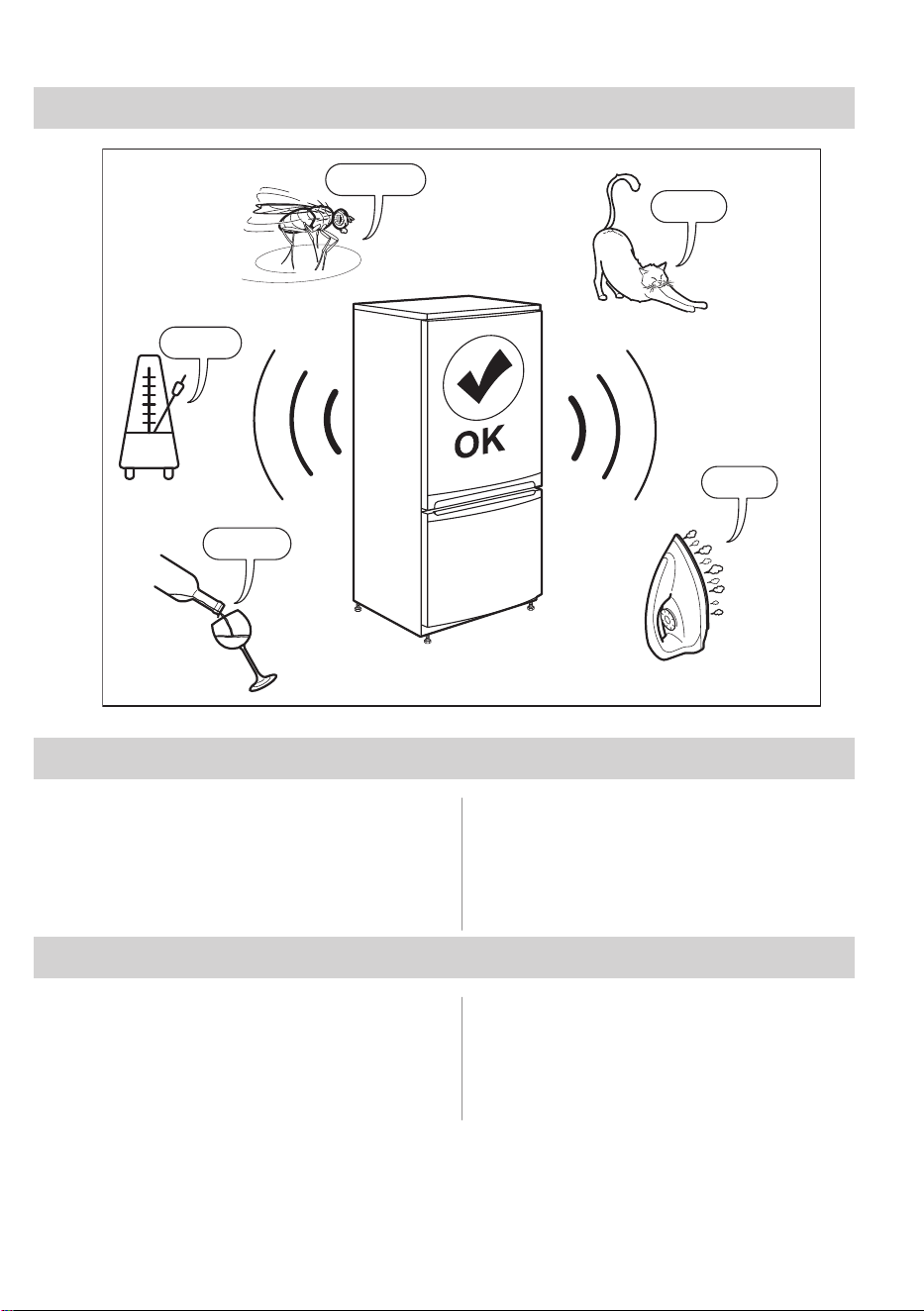
9. NOISES
SSSRRR!
CLICK!
HISSS!
BRRR!
BLUBB!
10. TECHNICAL DATA
The technical information is situated in the
rating plate on the internal side of the
appliance and on the energy label.
The QR code on the energy label supplied
with the appliance provides a web link to the
information related to the performance of the
appliance. Keep the energy label for
reference together with the user manual and
all other documents provided with this
appliance.
11. INFORMATION FOR TEST INSTITUTES
Installation and preparation of the appliance
for any EcoDesign verification shall be
compliant with BS EN 62552 (UK) .
Ventilation requirements, recess dimensions
and minimum rear clearances shall be as
stated in this User Manual in "Installation".
Please contact the manufacturer for any other
further information, including loading plans.
22 ENGLISH
12. ENVIRONMENTAL CONCERNS
Recycle materials with the symbol . Put the
packaging in relevant containers to recycle it.
Help protect the environment and human
health by recycling waste of electrical and
electronic appliances. Do not dispose of
appliances marked with the symbol with
the household waste. Return the product to
your local recycling facility or contact your
municipal office.
ENGLISH 23
*
212003067-C-052024