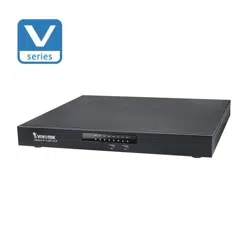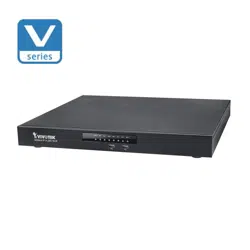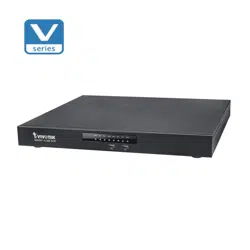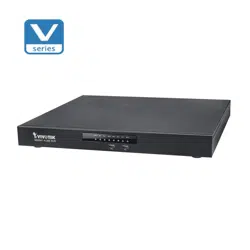

VIVOTEK - Built with Reliability
2 - User's Manual
Table of Contents
Revision History ..................................................................................................................................................... 5
Chapter One Hardware Installation and Initial Conguration ...................................................................................... 6
Introducing the Network Video Recorder ............................................................................................................... 6
Special Features ............................................................................................................................................. 6
Safety .............................................................................................................................................................. 7
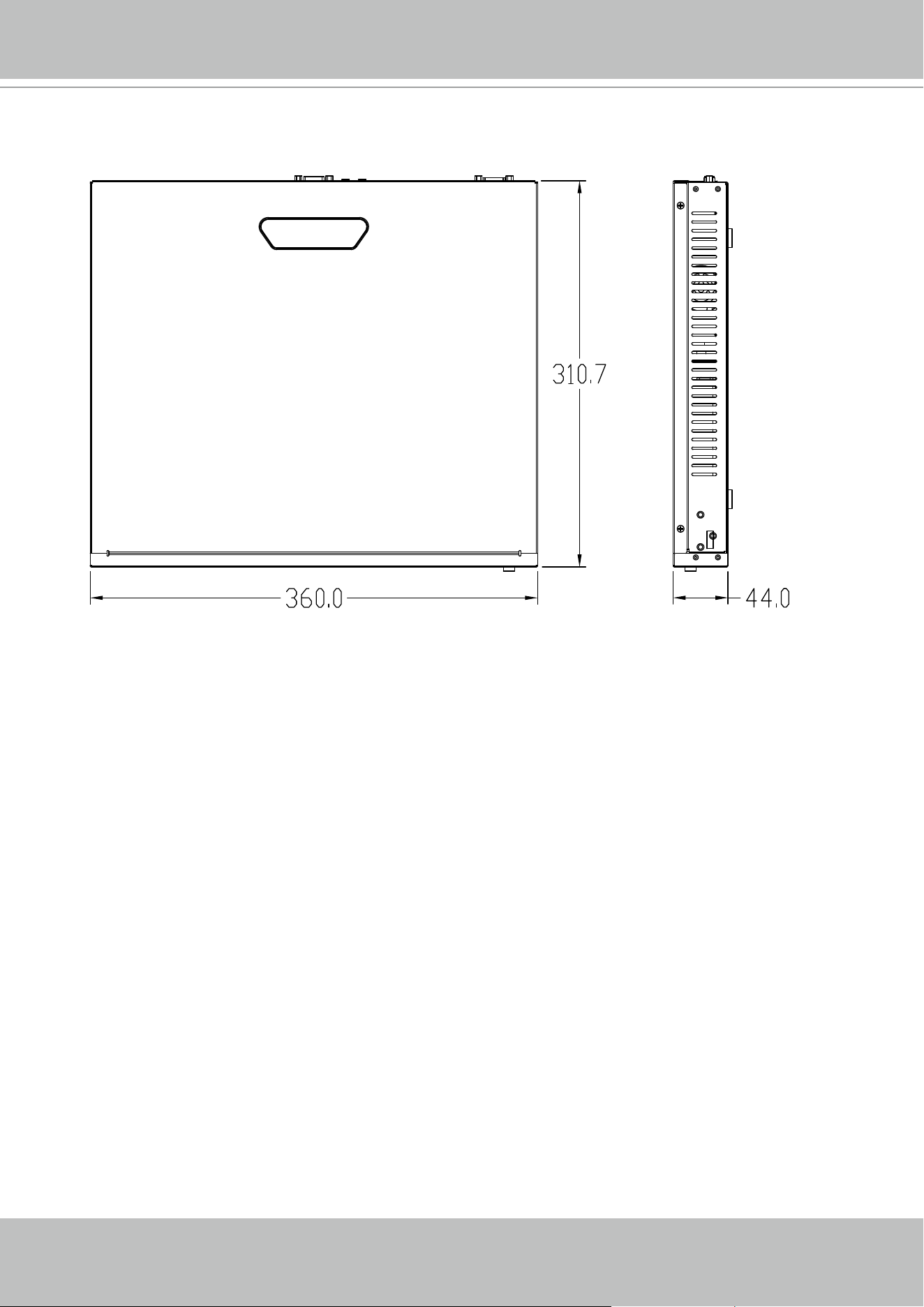
Chassis Dimensions .................................................................................................................................... 8
Physical Description ............................................................................................................................................. 9
LED Indicators ...................................................................................................................................................... 27
Power Up and Power Down ................................................................................................................................. 28
Section One Management over a Local Console ..................................................................................................... 29
Chapter Two Introduction to the Local Console Interface ......................................................................................... 29
2-1. How to Begin ................................................................................................................................................. 31
2-2. Operation on Camera View Cell .................................................................................................................... 37
2-2-1. PTZ Panel ........................................................................................................................................... 37
2-2-2. PiP (Picture in Picture) Panel .............................................................................................................. 39
2-2-3. Play Recording Clips Panel ................................................................................................................ 40
2-2-4. DI/DO .................................................................................................................................................. 41
2-2-5. Others ................................................................................................................................................. 41
2-2-6. Right-click Commands ........................................................................................................................ 42
Chapter Three Conguration Using the Local Console ............................................................................................. 43
The Main Control Portal ....................................................................................................................................... 43
3-1. Layout .................................................................................................................................................... 43
3-2. DI/DO ..................................................................................................................................................... 43
3-3. Search recording clips ........................................................................................................................... 44
3-3-1. Basic Search ................................................................................................................................ 44
3-3-2. Advanced Search......................................................................................................................... 47
3-3-3. Storyboard ................................................................................................................................... 50
3-4. Settings .................................................................................................................................................. 54
3-4-1. Settings - Overview ...................................................................................................................... 54
3-4-2. Settings - Camera - Management................................................................................................ 55
3-4-3. Settings - Camera - Recording .................................................................................................... 60
3-4-4. Settings - Camera - Media ........................................................................................................... 62
3-4-5. Settings - Camera - Image ........................................................................................................... 65
3-4-6. Settings - Camera - Motion Detection.......................................................................................... 67
3-4-7. Settings - Camera - PTZ settings ................................................................................................ 68
3-4-8. Settings - Alarm - Alarm ............................................................................................................... 70
3-4-9. Settings - Alarm - Email ............................................................................................................... 79
3-4-10. Settings - System - Information ................................................................................................. 80
3-4-11. Settings - System - Maintenance ............................................................................................... 81
3-4-12. Settings - System - Display ........................................................................................................ 82

VIVOTEK - Built with Reliability
User's Manual - 3
3-4-13. Settings - System - UPS ........................................................................................................... 83
3-4-14. Settings - System - Log ............................................................................................................ 84
3-4-15. Settings - System - EZConnect service .................................................................................... 86
3-4-16. Settings - User .......................................................................................................................... 87
3-4-17. Settings - Storage ..................................................................................................................... 89
3-4-17. Settings - Network .................................................................................................................... 91
Settings - Network - IP .......................................................................................................................... 91
Settings - DDNS .................................................................................................................................... 92
Settings - Service .................................................................................................................................. 93
3-5. Information ............................................................................................................................................ 94
Section Two Management over a Web Console ...................................................................................................... 95
Chapter Four Login and Getting Started .................................................................................................................. 96
4-1. Login ............................................................................................................................................................ 96
4-2. Graphical Layout and Screen Elements - Liveview .................................................................................... 100
4-2-1. Camera List Panel ........................................................................................................................... 101
4-2-2. Layout .............................................................................................................................................. 103
4-2-3. Layout contents ............................................................................................................................... 104
4-2-4. Logo & Menu ................................................................................................................................... 104
4-2-5. View Cell panel ................................................................................................................................ 105
Adding Cameras to View Cells ................................................................................................................... 105
4-2-6. PTZ panel .........................................................................................................................................113
4-2-7. Alarm panel .......................................................................................................................................115
4-3. Graphical Layout and Screen Elements - Search recording clips ...............................................................119
4-3-1. Camera List Panel ........................................................................................................................... 120
4-3-2. Search Recording Clips Layout ....................................................................................................... 121
4-3-3. Logo & Menu ................................................................................................................................... 121
4-3-4. View Cells in Search Recording Clips .............................................................................................. 122
Search Recording Clips Control Panel ...................................................................................................... 123
4-3-5. Alarm Panel ..................................................................................................................................... 125
4-3-6. Calendar Panel ................................................................................................................................ 126
Chapter Five System Settings ................................................................................................................................ 127
5-1. System ....................................................................................................................................................... 128
5-1-1. System - General ............................................................................................................................. 128
5-1-2. System - Upgrade ............................................................................................................................ 129
5-1-3. System - Backup .............................................................................................................................. 130
5-1-4. System - Maintenance ..................................................................................................................... 132
UPS support ........................................................................................................................................ 133
5-1-5. System - Display .............................................................................................................................. 134
5-2. Network ...................................................................................................................................................... 135
5-2-1. Network - General ............................................................................................................................ 135
5-2-2. Network - DDNS .............................................................................................................................. 136
5-2-3. Network - Service ............................................................................................................................ 138
5-2-4. Network - Utility ................................................................................................................................ 139
5-3. Camera ...................................................................................................................................................... 140

VIVOTEK - Built with Reliability
4 - User's Manual
5-3-1. Camera - General ............................................................................................................................. 140
5-3-2. Camera - Video ................................................................................................................................. 146
5-3-3. Camera - Audio ................................................................................................................................. 147
5-3-3. Camera - Motion detection ............................................................................................................... 148
5-3-4. Camera - Schedule ........................................................................................................................... 149
5-4. Storage ........................................................................................................................................................ 151
5-4-1. Storage - Volume .............................................................................................................................. 151
5-4-2. Storage - Disk ................................................................................................................................... 155
5-5. Security ....................................................................................................................................................... 157
5-5-1. User account ..................................................................................................................................... 157
5-5-2. Access list ......................................................................................................................................... 160
5-6. Alarm ........................................................................................................................................................... 161
5-6-1. General ............................................................................................................................................. 161
5-6-2. Editing Alarms via Source, Action, and Schedule ............................................................................. 171
5-6-3. Alarm History .................................................................................................................................... 172
5-7. Logs ............................................................................................................................................................ 173
Chapter Six Operation ............................................................................................................................................. 175
6-1. Liveview ...................................................................................................................................................... 175
6-1-1. Placing Cameras into the Layout ...................................................................................................... 175
6-1-2. PTZ and Other Screen Controls ....................................................................................................... 178
6-1-3. Audio ................................................................................................................................................. 181
6-1-4. Camera Properties and Controls ...................................................................................................... 182
6-1-5. Alarm Panel ...................................................................................................................................... 183
6-1-6. Layout view Control Buttons ............................................................................................................. 184
6-2. Search Recording Clips .............................................................................................................................. 185
6-2-1. Begin Playback and Search for Past Recordings ............................................................................. 185
6-2-2. Past Alarms and Bookmarks ............................................................................................................. 186
6-2-3. Synchronous Playback ..................................................................................................................... 187
6-2-4. Export media ..................................................................................................................................... 188
6-2-5. Time Search ...................................................................................................................................... 190
Technical Specications .......................................................................................................................................... 192
Safety and Compatibility .......................................................................................................................................... 193
Revision History
* Rev. 1.0: Initial release.
VIVOTEK - Built with Reliability
User's Manual - 5
Revision History
Rev. 1.0: Initial release.
Symbols and Statements in this Document
i
INFORMATION: provides important messages or advices that might help prevent inconvenient
or problem situations.
NOTE: Notices provide guidance or advices that are related to the functional integrity of the
machine.
Tips: Tips are useful information that helps enhance or facilitate an installation, function, or
process.
WARNING! or IMPORTANT: These statements indicate situations that can be dangerous or
hazardous to the machine or you.
Electrical Hazard: This statement appears when high voltage electrical hazards might occur
to an operator.
Read Before Use
The use of surveillance devices may be prohibited by law in your country. The Network Camera
is not only a high-performance web-ready camera but can also be part of a exible surveillance
system. It is the user’s responsibility to ensure that the operation of such devices is legal before
installing this unit for its intended use.
It is important to first verify that all contents received are complete according to the Package
Contents listed below. Take note of the warnings in the Quick Installation Guide before the
Network Camera is installed; then carefully read and follow the instructions in the Installation
chapter to avoid damage due to faulty assembly and installation. This also ensures the product is
used properly as intended.
The Network Camera is a network device and its use should be straightforward for those who
have basic networking knowledge. It is designed for various applications including video sharing,
general security/surveillance, etc. The Configuration chapter suggests ways to best utilize the
Network Camera and ensure proper operations. For creative and professional developers, the
URL Commands of the Network Camera section serves as a helpful reference to customizing
existing homepages or integrating with the current web server.
Package Contents
■ ND8322P and ND8422P
■ Power adapter & power cord
■ Software CD
■ Quick Installation Guide
■ Mouse
■ Screws and HDD brackets
■ SATA cables
The operating system and management software are installed on a ash memory mounted
on the main board. Except for the plug-ins for the onscreen control, there is no need to install
software.
NOTE:

VIVOTEK - Built with Reliability
6 - User's Manual
Chapter One Hardware Installation and
Initial Configuration
Introducing the Network Video Recorder
VIVOTEK ND8322P and ND8422P series is a compact Linux embedded 8-CH or 16-CH stand-
alone desktop NVR designed for any small-scale video surveillance installation. The series fea-
tures ease of installation, and facilitates “One Button Setup” with its plug & play and auto setup
functionality.
Supporting HDMI and VGA local video output, users can control the GUI OSD interface via
mouse & keyboard, eliminating the need for a separate PC to search video or to playback from
the NVR. The new local display design - Auto Adaptive Stream will dynamically modify Stream 2
resolution of a camera to best fit the display resolution according to the layout type, resulting in
an efficient display, while maintaining superb image quality. What’s more, the NVR provides vari-
ous I/O ports, such as eSATA, alarm input/output, RS232, and RS485 giving users great flexibil-
ity with applications.
Together with VAST CMS and ST7501 VMS, users can set up an easy-to-use IP surveillance
system with ease. VIVOTEK also provides the mobile application, iViewer, for both iOS and An-
droid handheld devices, enabling users to monitor live video anytime, anywhere.
Special Features
● Runs on embedded Linux
● 1 x HDMI and 1 x VGA for local display
● 2 x HDD bay, for a max. capacity of 12TB
● 1 x Gigabit RJ45 Ethernet port;
● 8 x 10/100Mbit Ethernet ports w/ PoE Class 3 (15.4 Watts)
● 3 x USB Port (2 in Front / 1 in Back)
● 1 x eSATA for external hard disk
● Size: 360 mm (W) x 310.7 mm (D) x 44 mm (H)
● 16-CH Live View & 4-CH Synchronous Playback (web console)
● H.264 / MJPEG
● PTZ Support
● Snapshot / Export Media
● PiP Video Control
● Terminal block pins for DI/DO and RS-485 connection.
● Configuration Backup / Restore
● Compatible with VIVOTEK VAST Central Management Software*
● Integration with VIVOTEK Network Cameras
● VIVOTEK iViewer Support (iOS/Android)
*The VIVOTEK VAST Central Management Software is not included in the package.

VIVOTEK - Built with Reliability
User's Manual - 7
Safety
Connect the system to an earthed main power outlet.
Never open the housing of the power supply unit.
Install and operate the system only in a dry, weather-proof location.
Observe the following safety factors:
•
Is there visible damage to the system or power cord?
•
Is the system operating correctly?
•
Has the system been exposed to rain or moisture?
•
Has the system been in a long storage under harsh conditions or exposed to
unconforming stress?
The relevant electrical engineering regulations must be complied with at all times during
installation.
Ensure that all maintenance and repair work is handled by qualified personnel such as
electrical engineers or network specialists.
Read this manual before installing or operating the system. The documentation contains
important safety instructions about permitted uses.
The rated AC input is: 100-240V~ 2.1A, 60-50Hz; the max. consumption: 120W (DC56V, 2.5A)
If a fault occurs, disconnect the power cord from the power supply.
Do not install the system close to heaters or other heat sources. Avoid locations with direct
sunlight.
All ventilation openings must not be blocked.
Use only the cables shipped with system or use appropriate cables that can withstand elec-
tromagnetic interference.
VIVOTEK - Built with Reliability
8 - User's Manual
Chassis Dimensions
VIVOTEK - Built with Reliability
User's Manual - 9
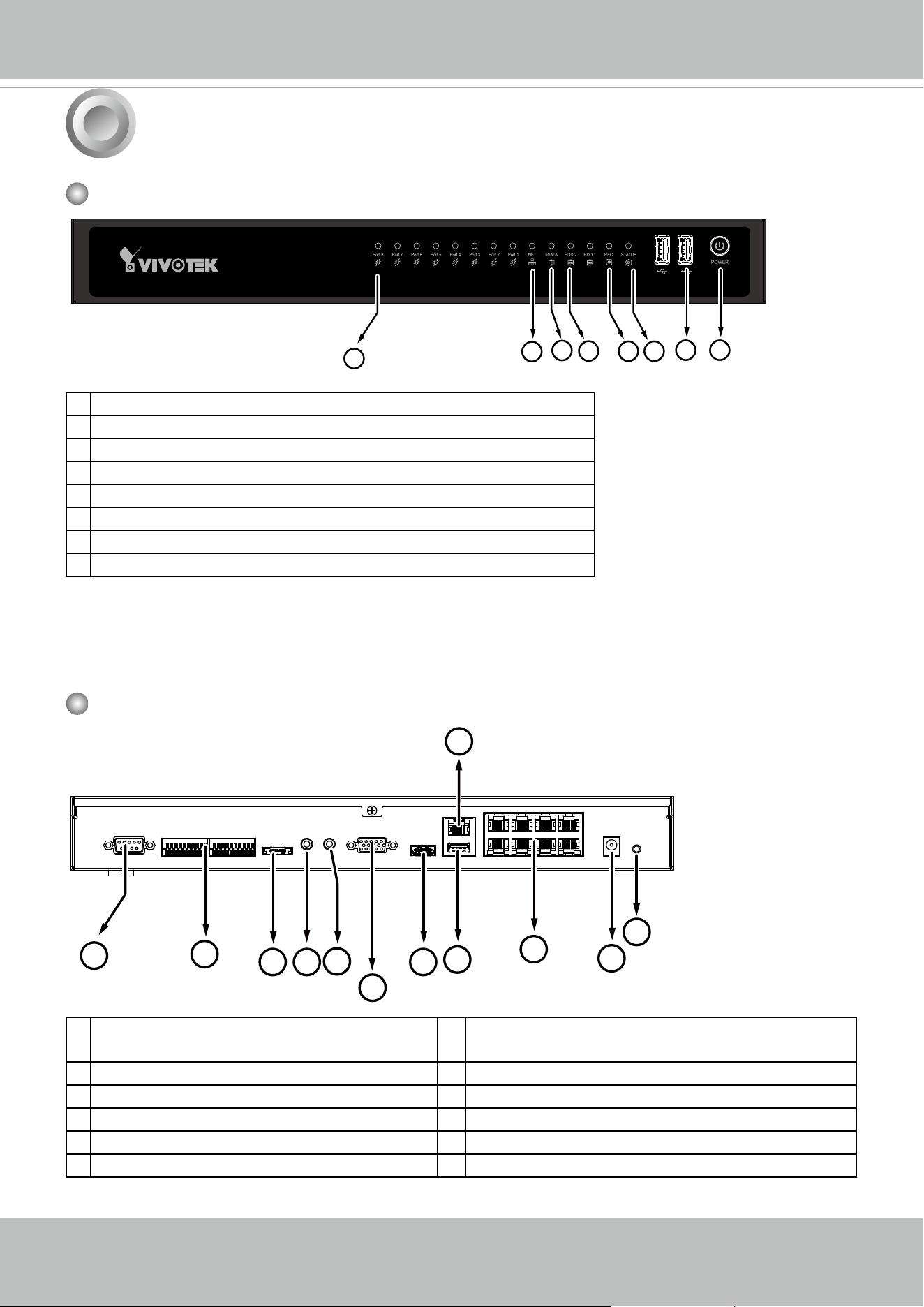
Physical Description
Front View
Rear View
1
2
3
4
5 6
7 8
1
2
3 4
5
6
7
8
9
10
11
12
1 LAN and PoE activity LED
2 Network status LED
3 eSATA activity LED
4 HDD activity LED
5 Recording activity LED
6 System status LED
7 USB ports
8 Power button
1 RS-232 for opening a terminal console
(for debug purposes only)
7 HDMI
2 DI/DO terminal block 8 USB port
3 eSATA port 9 GbE uplink port
4 Audio OUT 10 10/100Mbit 802.3af PoE Ethernet
5 Audio IN 11 Power socket (DC56V, 2.5A)
6 VGA 12 Reset button
1
VIVOTEK - Built with Reliability
10 - User's Manual
IMPORTANT:
It is important to leave a clearance of 10cm around the
chassis. The clearance is required to ensure an ad-
equate airow through the chassis to ventilate heat.
10cm
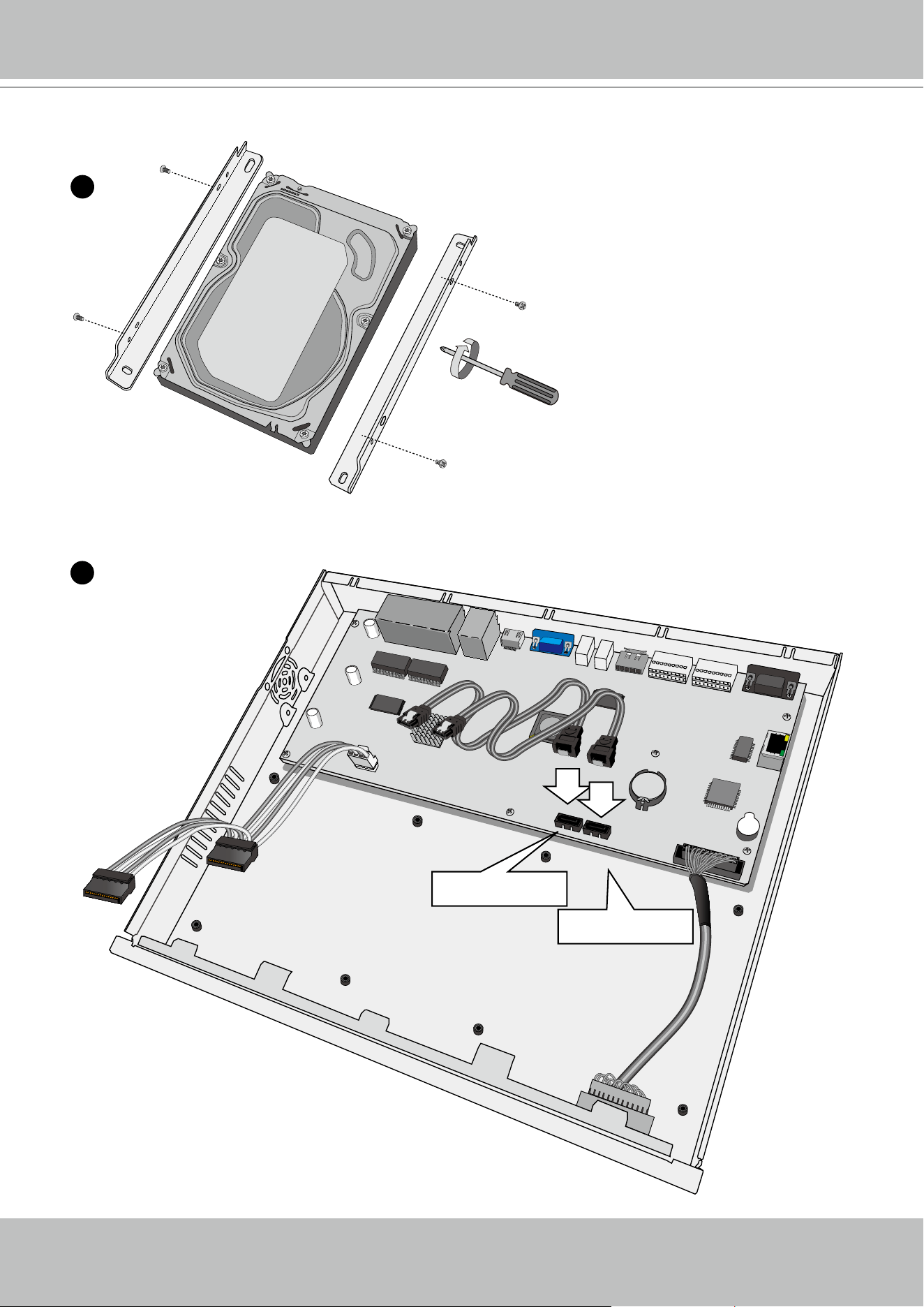
SATA hard disk(s) are user-supplied. The network video recorder can readily accommodate
most of the off-the-shelf SATA hard drives.
Hardware Installation
2
To ensure normal operation, maintain ambient airow.
Do not block the airow around chassis such as placing
the system in a closed cabinet.
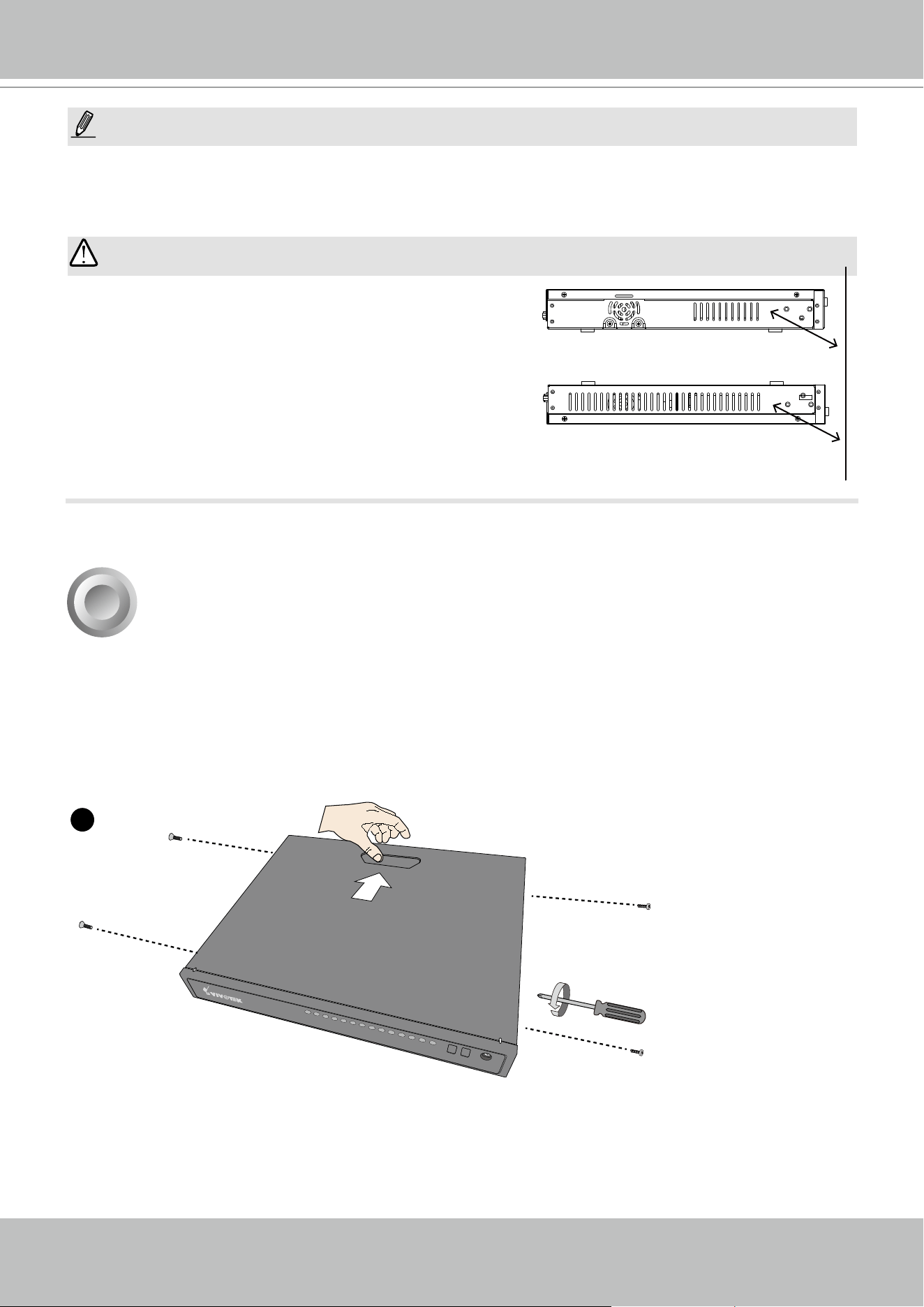
1. Use a screwdriver to loosen the retention screw on the sides of the chassis. Slide the top
cover back, and then remove the top cover.
NOTE:
You can also use the Reset button to restore system defaults. Use a straightened paper clip to
press and hold down the button for longer than 5 seconds. The system should start restoring de-
faults.
1
VIVOTEK - Built with Reliability
User's Manual - 11
2. Secure the HDD brackets to the hard drives.
2
Label side
3. Connect SATA data cables to the connectors on the main board.
SATA Data
SATA Power
J18
J19
HDD 1 connector
HDD 2 connector
3
VIVOTEK - Built with Reliability
12 - User's Manual
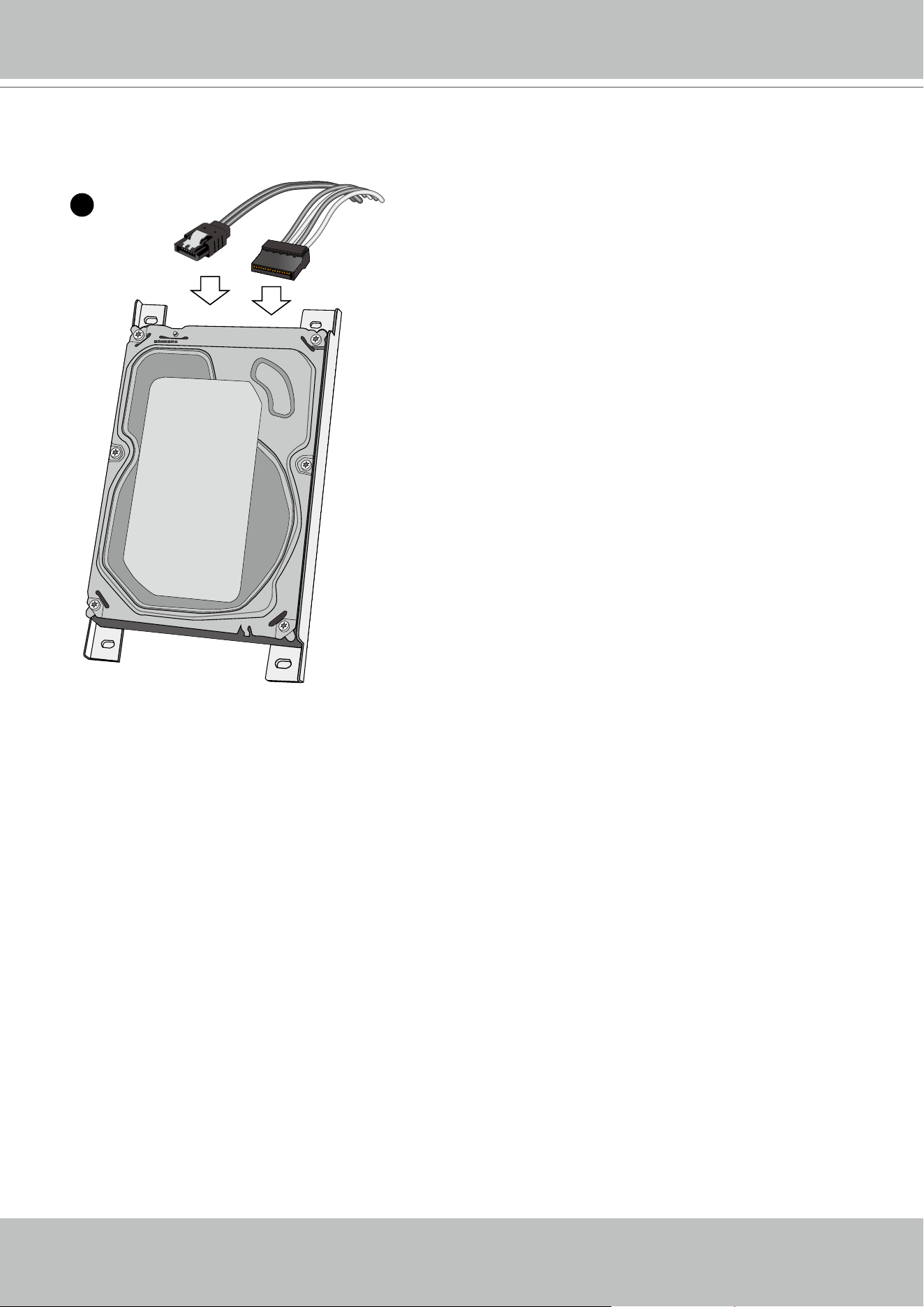
SATA Data SATA Power
4. Connect SATA data and power cables to the hard drives.
4
VIVOTEK - Built with Reliability
User's Manual - 13
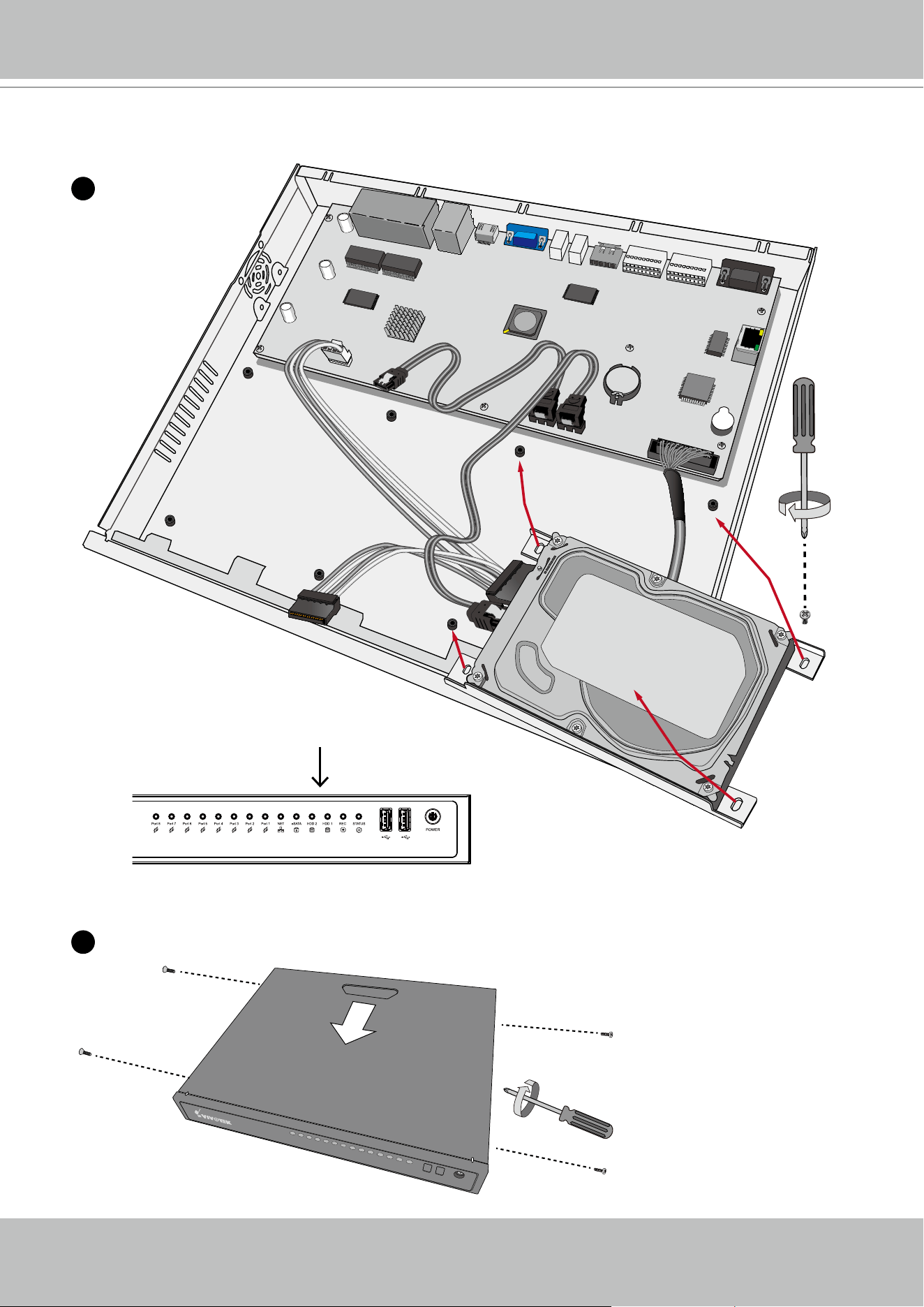
5
6. When done, install the top cover.
5. Secure the hard disks to the mounting positions in the chassis with its label side facing up,
and the connectors facing the inside of the chassis.
Note that the connectors correspond to
the LED display on the front panel. The
LEDs do not indicate the physical posi-
tions.
5
VIVOTEK - Built with Reliability
14 - User's Manual
Interface Connections
Although the system supports MAC Binding, the system should be able to detect VIVOTEK's
cameras within the network regardless of the presence of a DHCP server. Ideally, cameras
and the NVR should reside in the same subnet. If a camera's IP is changed for some reasons,
the system should be able to detect its new IP.
NOTE:
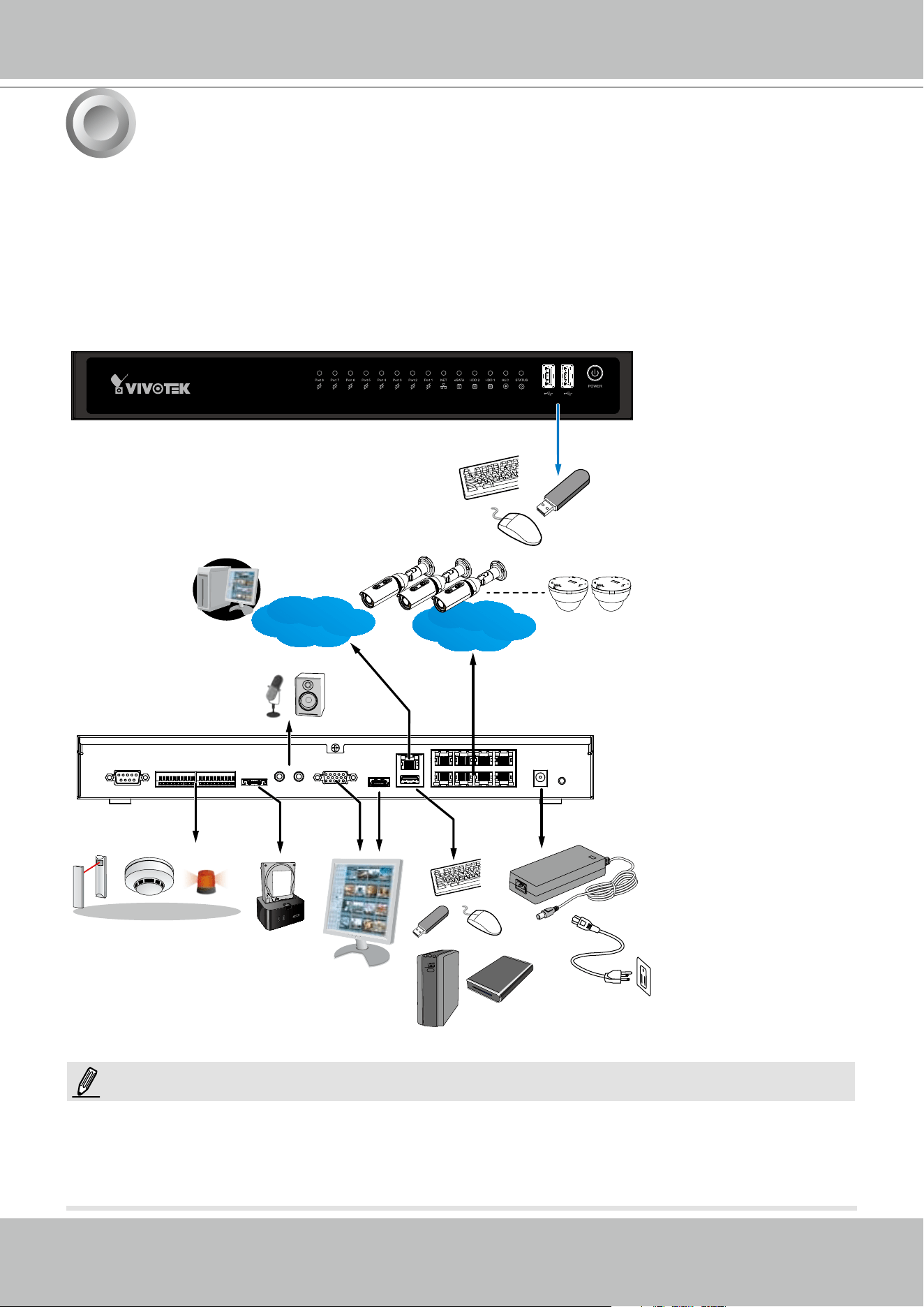
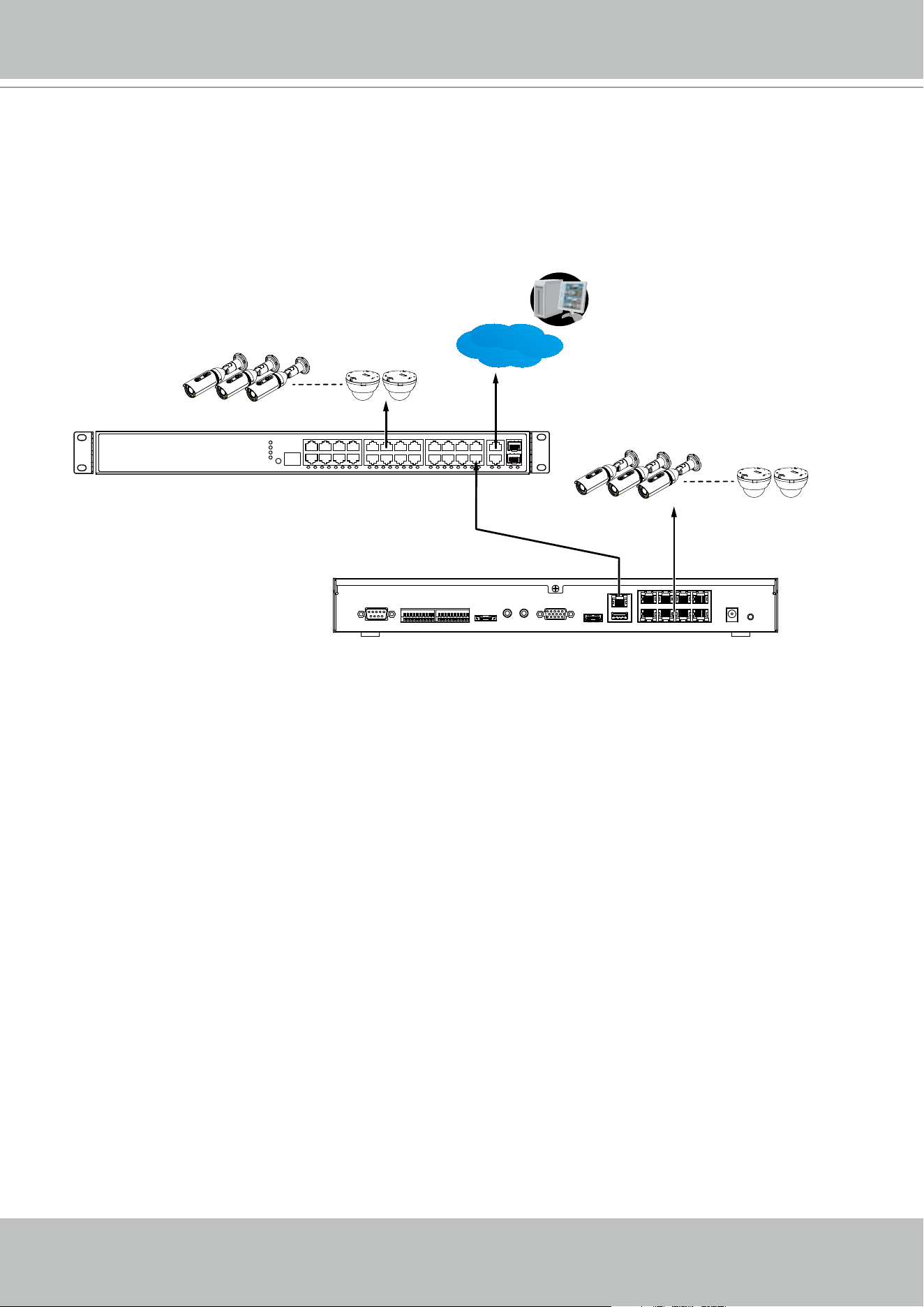
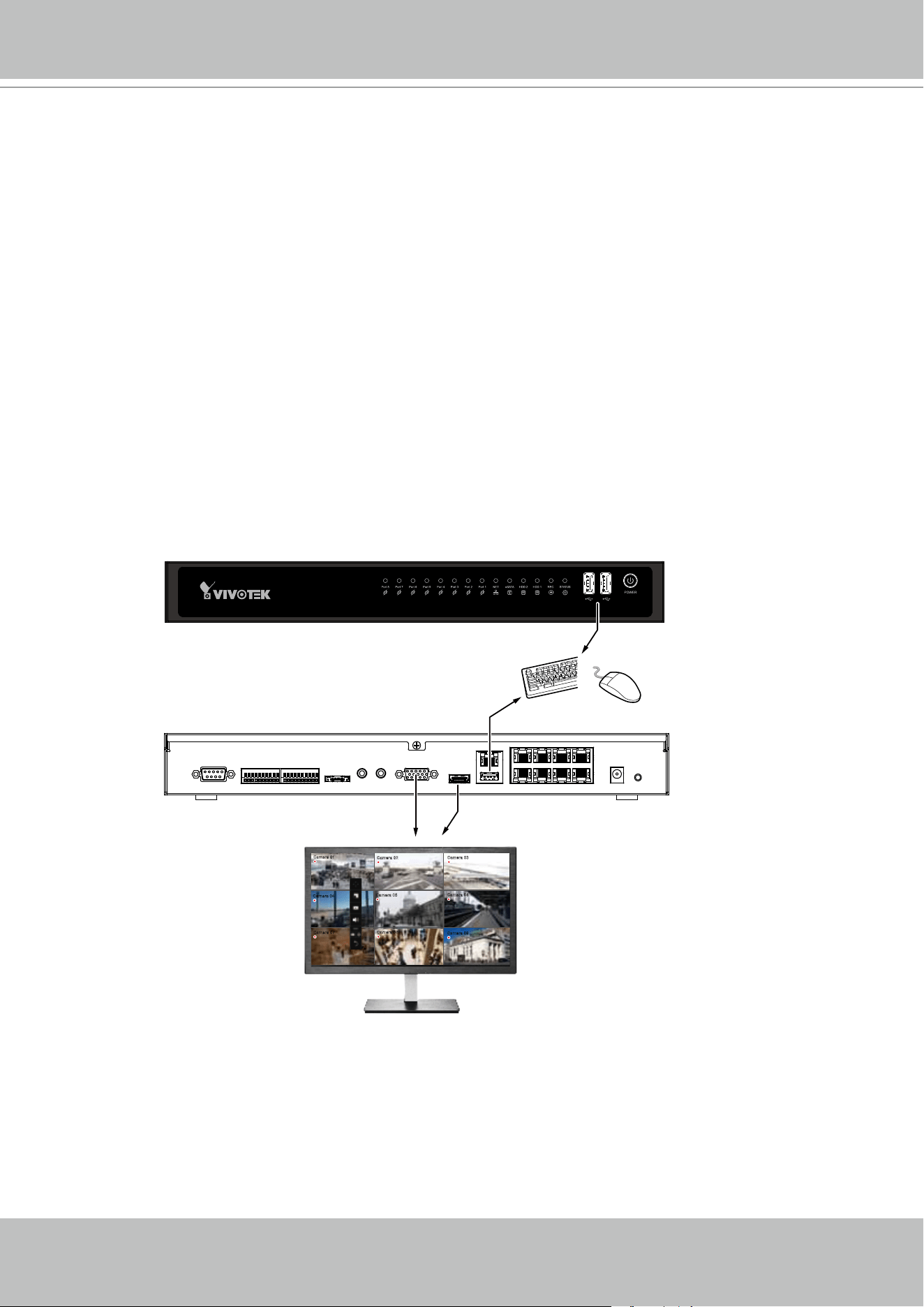
1. Connect to a monitor using an HDMI cable. VGA is also supported.
2. Connect CAT5e or better-quality Ethernet cable to IP cameras. The Ethernet ports provide
PoE power. The maximum power per port is 15.4 watts. However, please note that the total
budget is 40 watts by every 4 PoE ports.
3. Connect USB devices such as, mouse, keyboard, USB optical drive, or USB thumb drive (for-
matted in FAT format), or UPS.
4. Connect external devices, such as sensors, relays, or alarms to the terminal block.
5. Connect the power adaptor to the power mains and the system.
3
AC100~240V
50/60Hz, 2-1A
LAN
LAN/WAN
PoE
VIVOTEK - Built with Reliability
User's Manual - 15
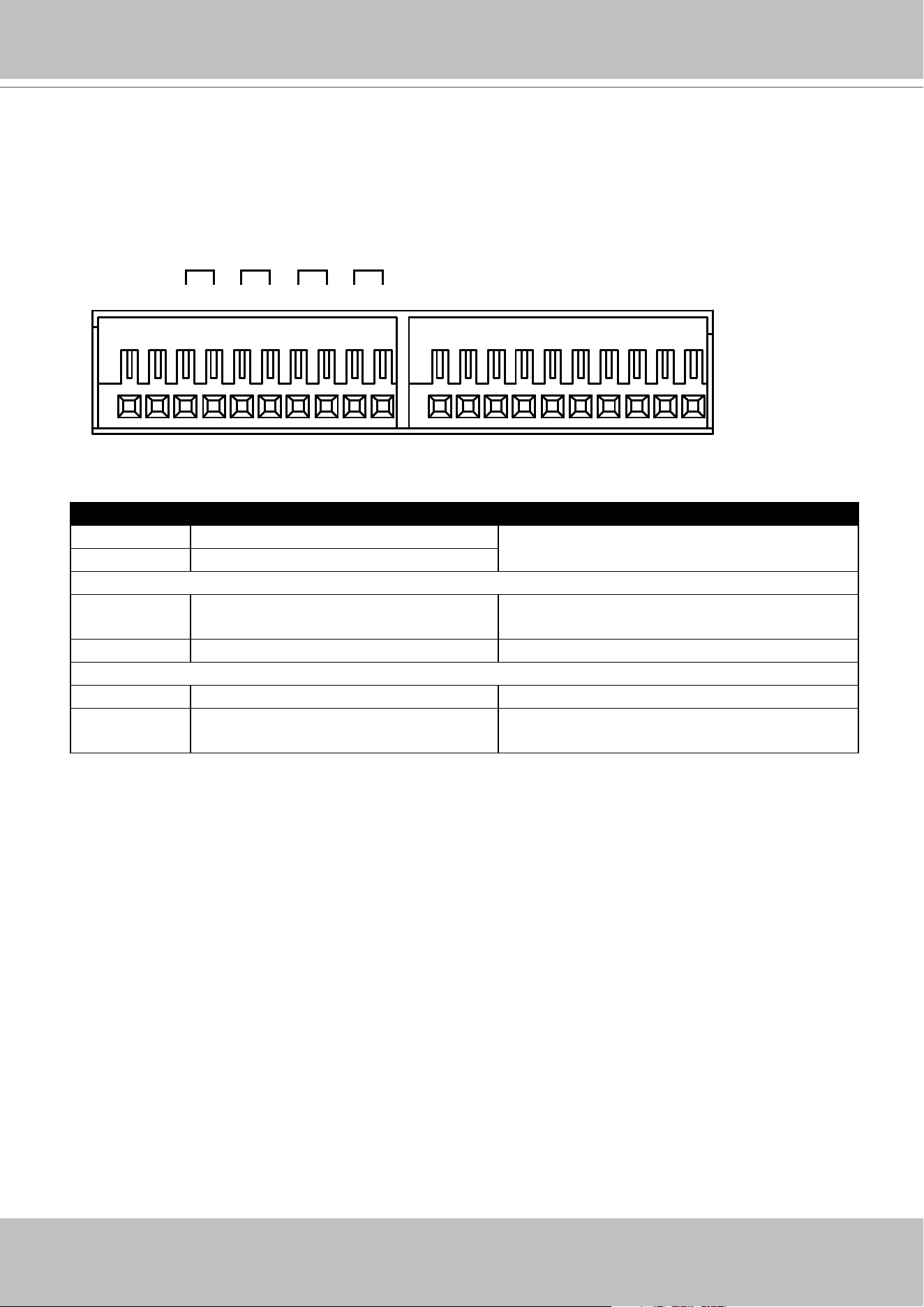
16-Channel Connections (ND8422P)
LAN/WAN
PoE
x8
x8
AW-GEV-264A PoE switch
ND8422P NVR
Uplink
The ND8422P supports the connections to 16 cameras. However, the NVR comes with 8 PoE
ports. The other 8 cameras should be powered by other devices, e.g., a PoE switch. The other 8
cameras should then be detected via the NVR’s Gb/s Ethernet uplink to the local network.
VIVOTEK - Built with Reliability
16 - User's Manual
Terminal Block Connections
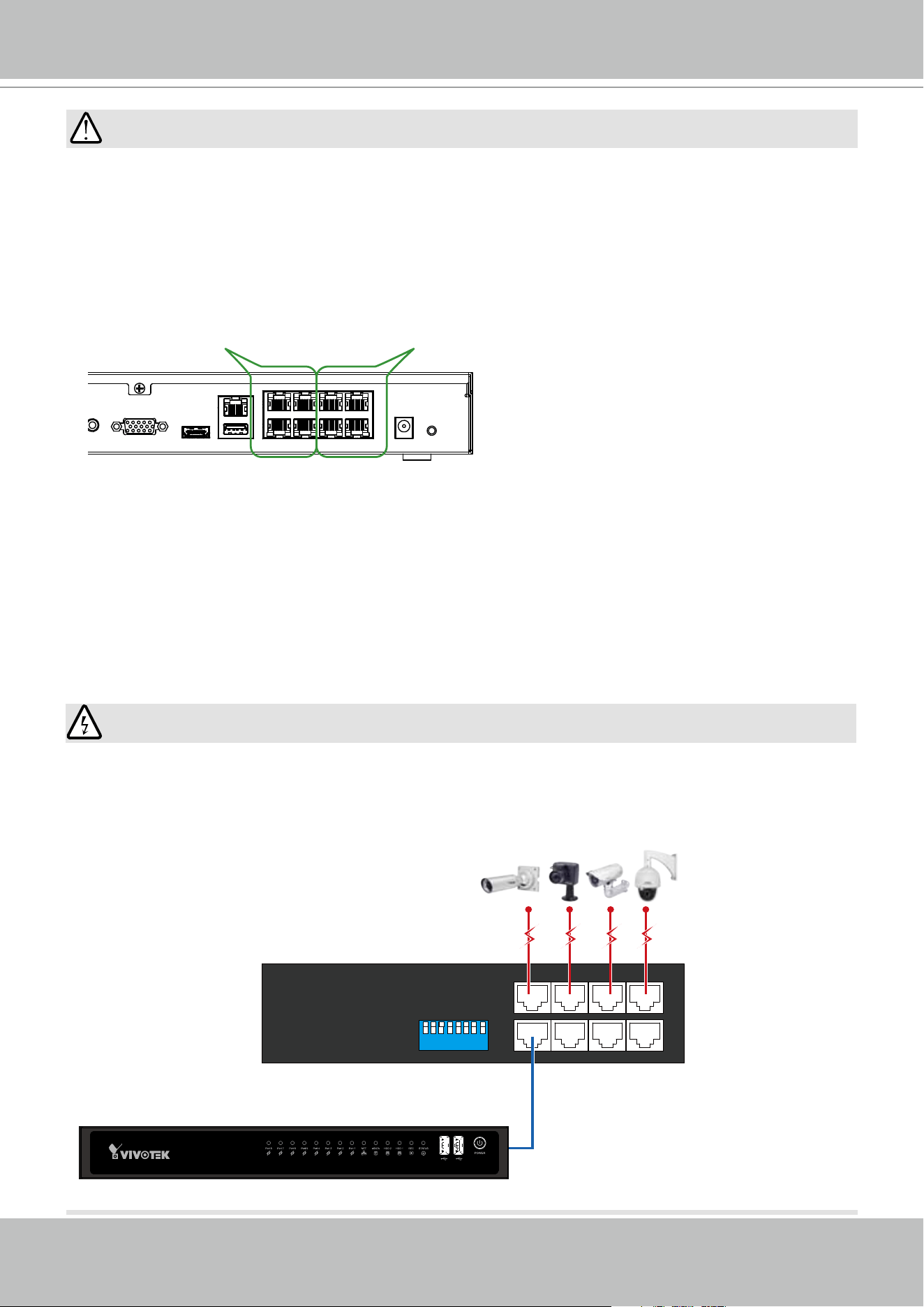
The terminal block pinouts is shown as follows:
RS485
+-
4 3 2 1
Alarm OUT
G 8 7 6 5 G 4 3 2 1
Alarm IN
DO+DO- DO+DO- DO+DO- DO+DO-
The pins are listed and described from left to right as shown in the drawing above.
Pin Description NOTE
RS485- RS485 Data- A 120Ω terminator is enabled on the bus.
The terminator cannot be disabled.
RS485+ RS485 Data+
Alarm OUT
DO+ DC 12V±5% output, max. 40V,
50mA. Open collector design.
DO- Signal ground
Alarm IN
DI no. 1 ~ 8 Open-short-to-GND
G Pins #1~4 share a common ground.
Pins #5~8 share a common ground.
VIVOTEK - Built with Reliability
User's Manual - 17
1. The PoE ports come with a limitation on power budget. Every 4 ports share a 40 watts
power budget. For network cameras that consume large or additional amount of power, e.g.,
speed dome or those with embedded IR lights or heater, it is recommended you power these
cameras with DC or AC power. You can still connect the Ethernet cables from these cameras
to the NVR for data transmission. You can use VIVOTEK's design tool to evaluate the power
consumption of network cameras:
http://www.vivotek.com/design-tool/
IMPORTANT:
If you connect the NVR to a PoE port of the AW-FED series PoE switch, make sure you turn off
the PoE output on that specic port using the onboard DIP switch. Otherwise, the high power
output can damage the LAN port on NVR.
WARNING:
ON
1 2 3 4
5
6 7 8
PoE cameras
NVR
AW-FED PoE switch
PoE ON/OFF switch
2. The system supports the connection to one H.D.D. via the eSATA connection. The system
does not support the connection to external eSATA housings containing multiple H.D.D.s.
3. The Client computers should support IE10 browser at a minimum of 1280x960 resolution or
higher.
40W budget 40W budget
Please note that when a network camera is powered by a DC/AC source, connect the power
lines rst, before you connect the Ethernet cable. The network cameras will use the DC/AC
source as the main power source.
VIVOTEK - Built with Reliability
18 - User's Manual
Initial Conguration - via a Local Console
4
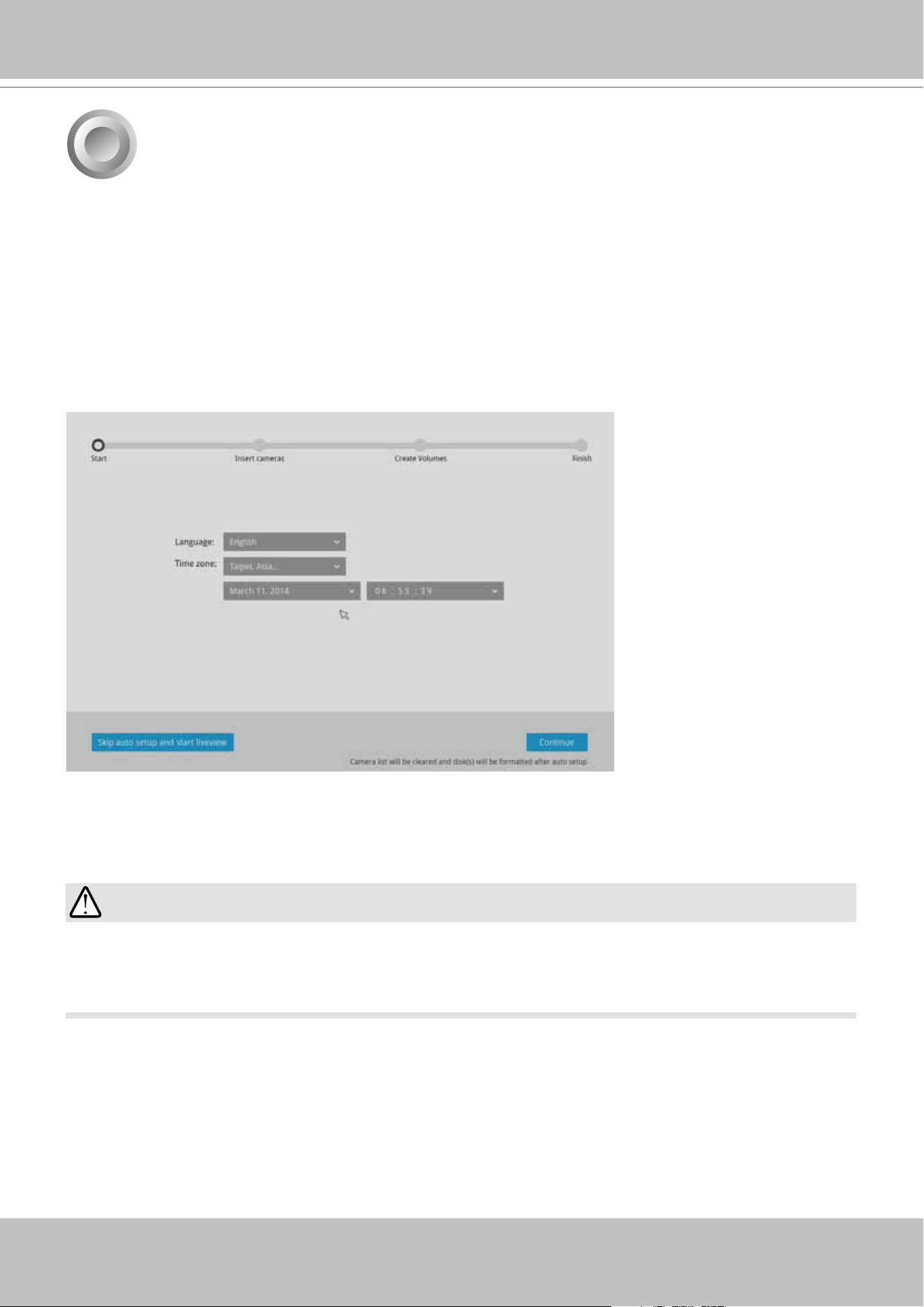
Follow the onscreen messages to complete the initial conguration:
1. Select the UI language, Time zone, and current date and time. Click on the Continue button
to proceed.
A local console requires the following:
1. A monitor is connected via an HDMI or VGA cable.
2. A mouse and/or a keyboard are connected to the system.
3. It is presumed that the system has not been congured yet.
Except in the initial setup, changing system time can produce disruptions to the existing
recordings. Turning the current system time back to a time when video recording was taking
place can generate duplicate les. And those les may not be playable.
IMPORTANT:
VIVOTEK - Built with Reliability
User's Manual - 19
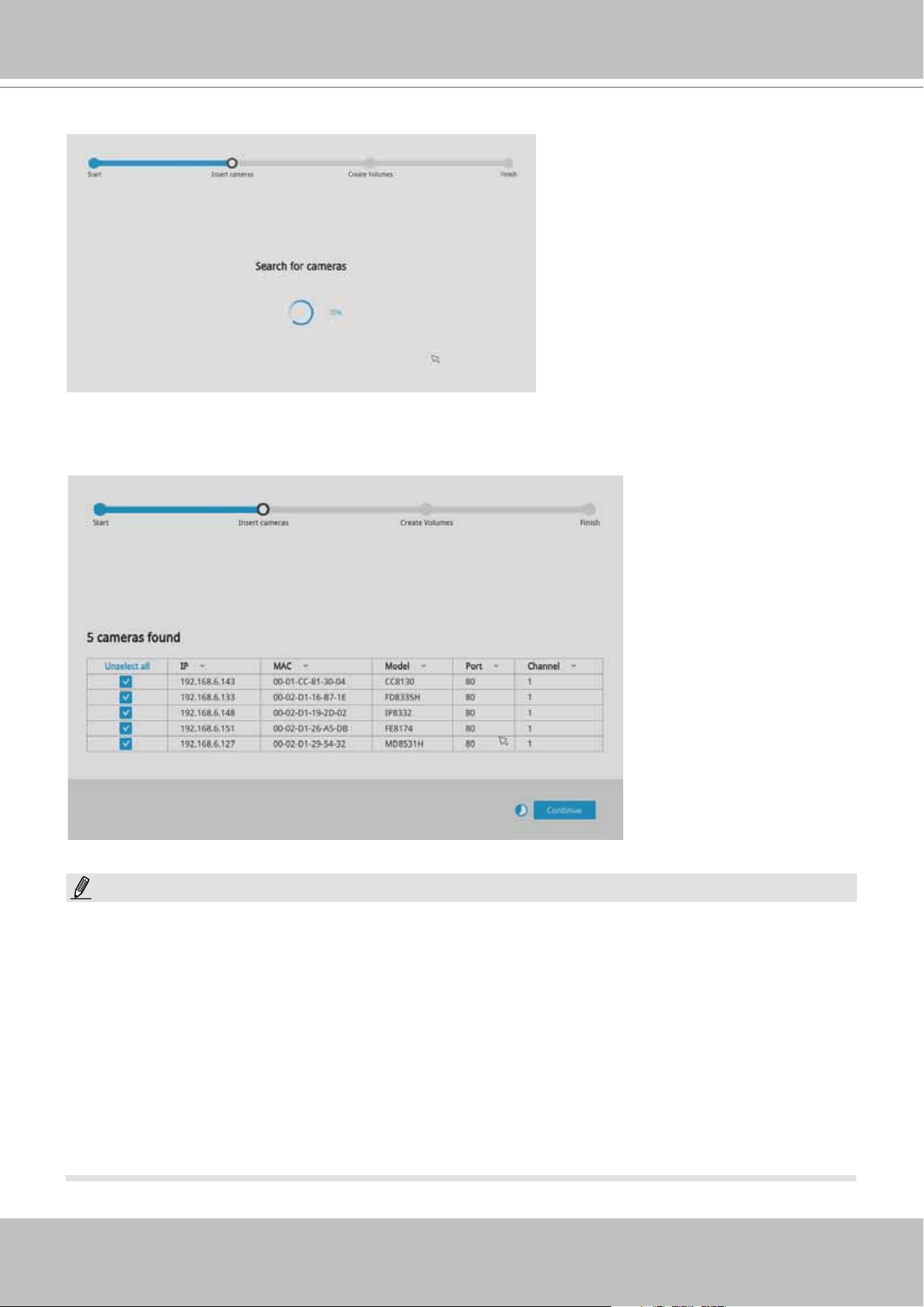
2. The system will then start to scan the local subnet for connected cameras.
3. All cameras detected on the network will be automatically selected. If necessary, deselect the
cameras you want to exclude from the conguration. Click Continue to proceed.
1. The maximum recording bandwidth is 64Mbps - ND8322P or 96Mbps - ND8422P. When
cameras are recruited into the conguration, their stream 1 is used as the recording stream.
The resolution and fps (frame rate per second) of stream 1 may vary depending on the
specications of different cameras.
2. If there are more than 8 or 16 cameras in your local network, you will need to manually select
cameras.
If there are less than 8 or 16 cameras, the Auto Setup will automatically move to the next
conguration step.
NOTE:
VIVOTEK - Built with Reliability
20 - User's Manual
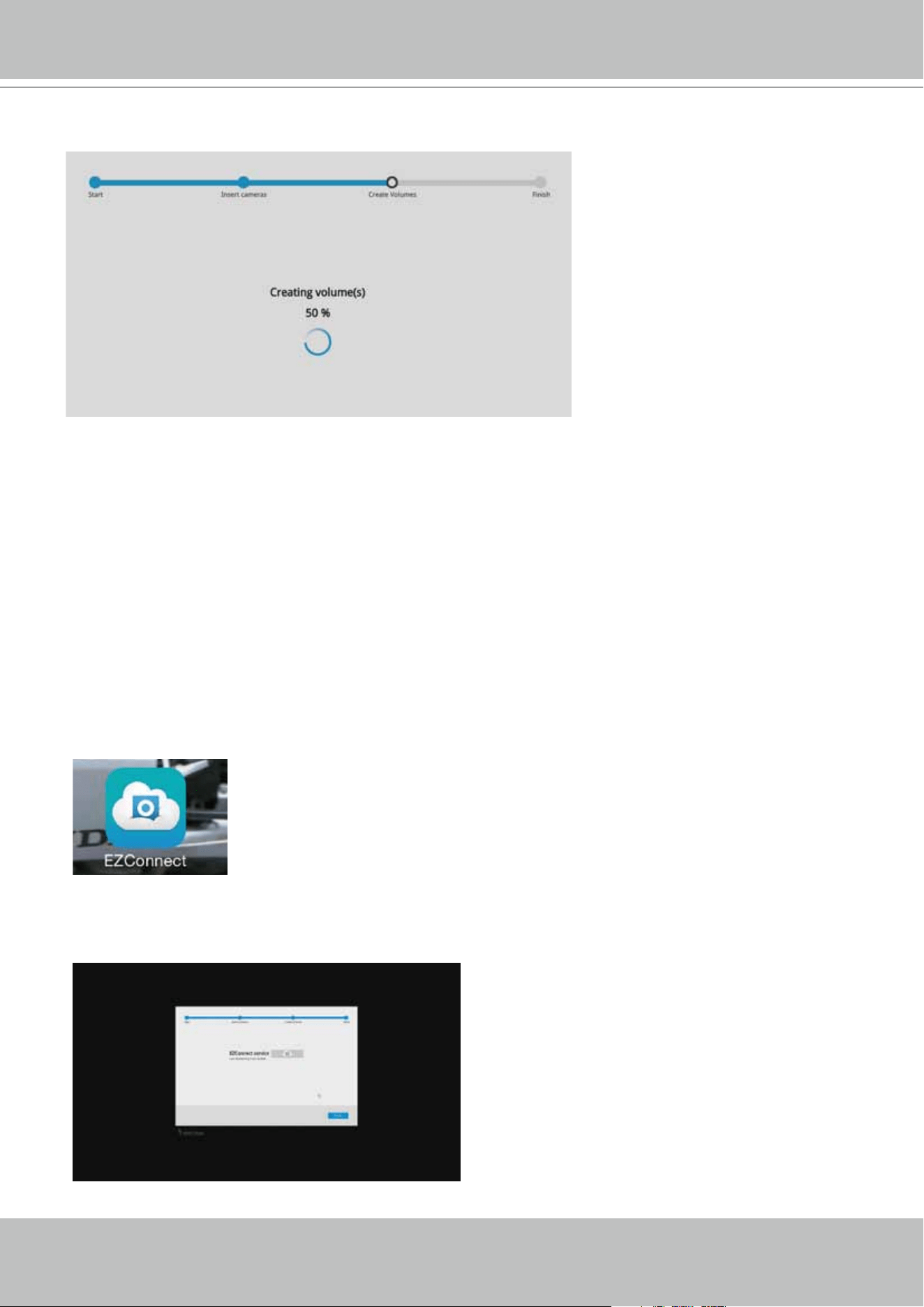
4. The system will automatically create volumes from the installed disk drives. The process will
take several minutes.
5. An optional utility, EZConnect, is available through the Apple and Android App Stores. The
EZConnect works with a server hosted by VIVOTEK for bridging and tunneling video requests
between client devices and network cameras/CMS/NVR. The utility simplies and facilitates
network conguration for access across the Internet.
The prerequisites for using the EZConnect are as follows:
1. Download and install the EZConnect utility to your cell phone.
2. Both the NVR and your cell phone have access to the Internet.
With this utility, you do not need to congure IP port forwarding on router or set up a DDNS
address for the NVR. You do not even need to know the IP address of the NVR. The
EZConnect utility automatically manages the network parameters required for making the
connection. The EZConnect comes with viewing and playback interfaces very similar to those
in the iViewer utility.
To connect the NVR from a cell phone using the EZConnect:
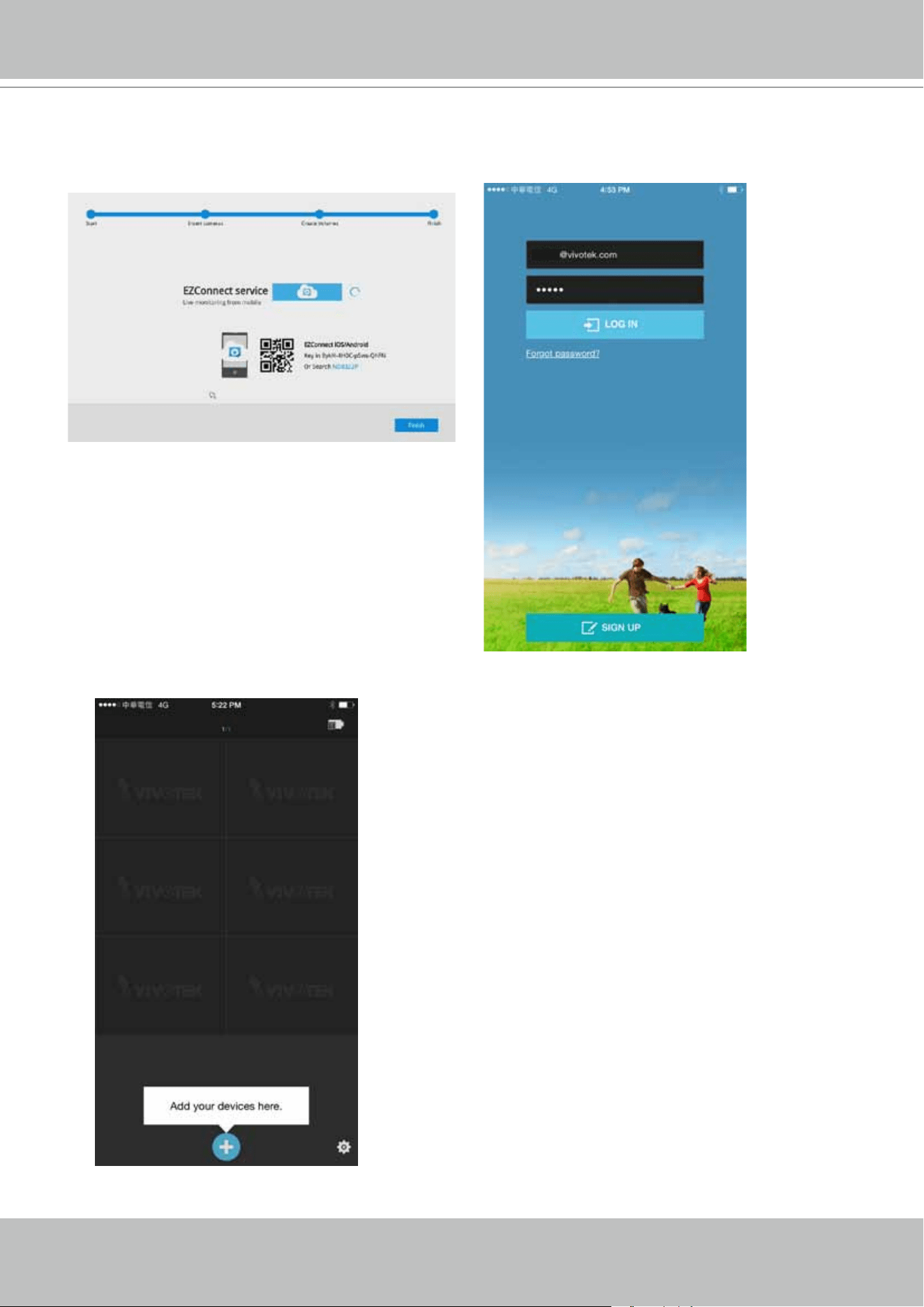
5-1. Click on the EZConnect button on the wizard.
VIVOTEK - Built with Reliability
User's Manual - 21
5-2. The QR code will be generated.
5-3. Open the utility from your cell phone. If you already registered an account, tap LOG IN. If
not, tap SIGN UP to register an account from a VIVOTEK server.
User
5-4. You can be defaulted to the Live view page. Tap the Add button below to add devices.
VIVOTEK - Built with Reliability
22 - User's Manual
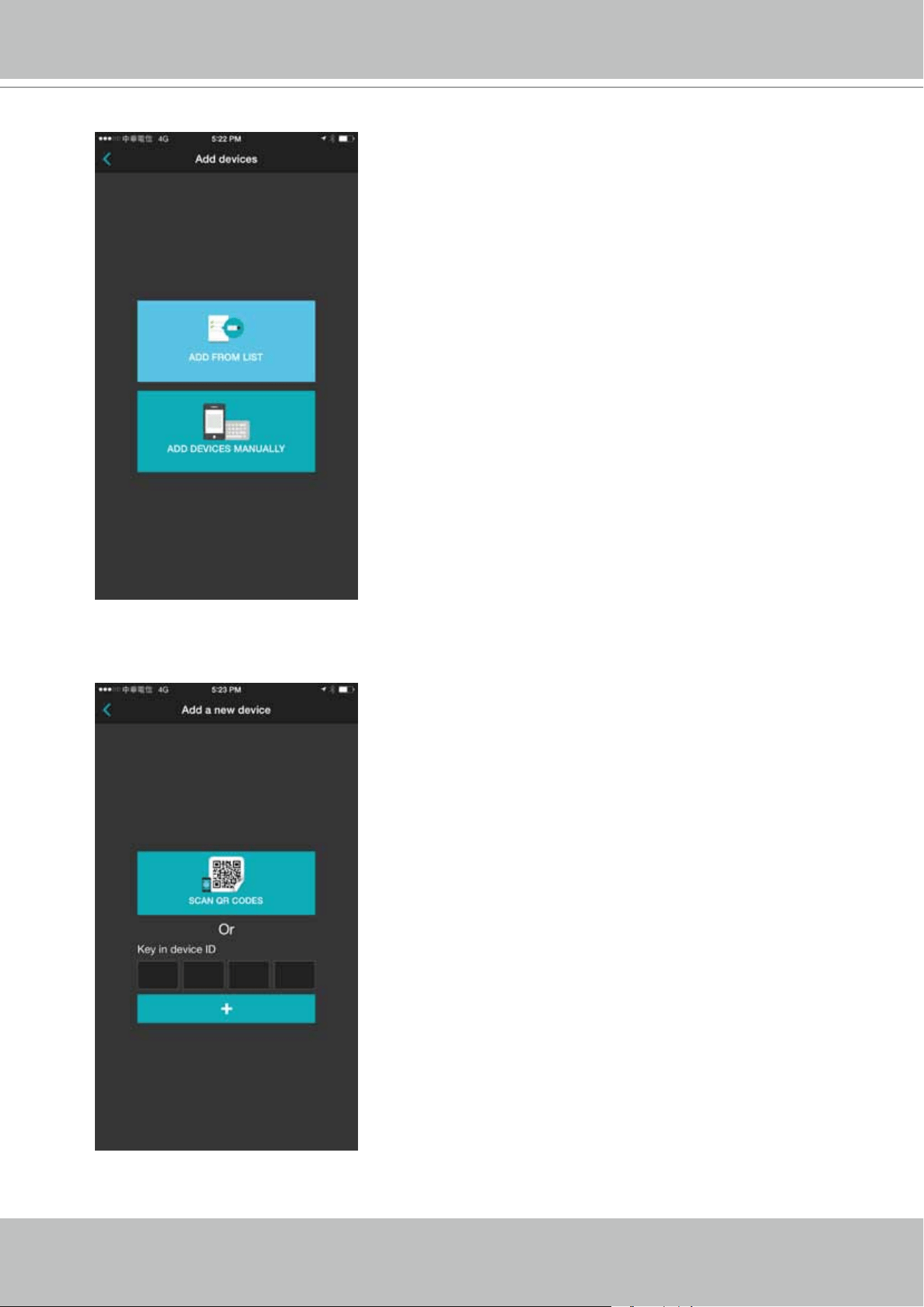
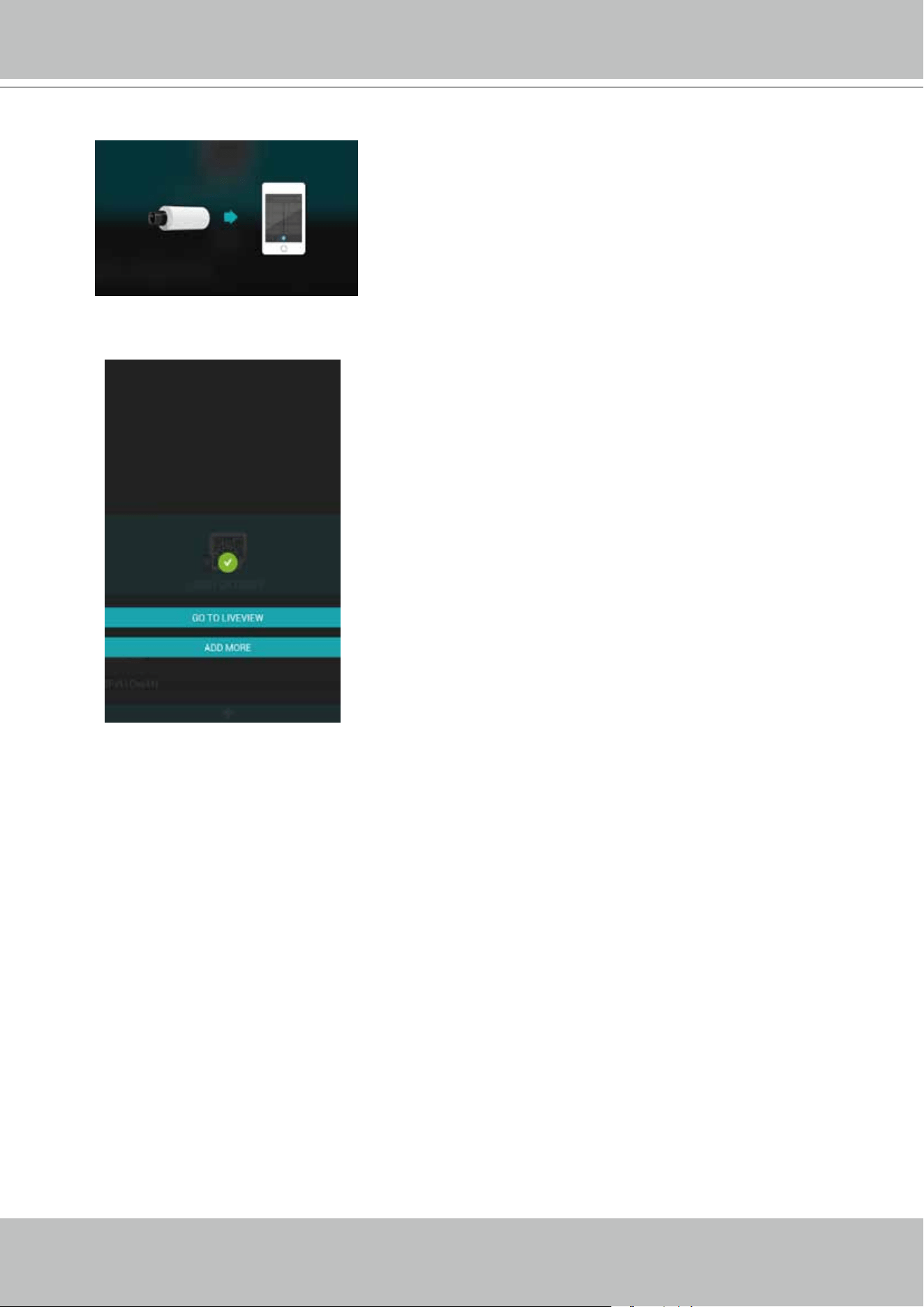
5-5. Tap the ADD DEVICES MANUALLY button.
5-6. You can then point your cell phone lens at the NVR screen (Step 5-3.) and use the SCAN
QR CODES function to establish the connection. You may also manually enter the device
ID.
VIVOTEK - Built with Reliability
User's Manual - 23
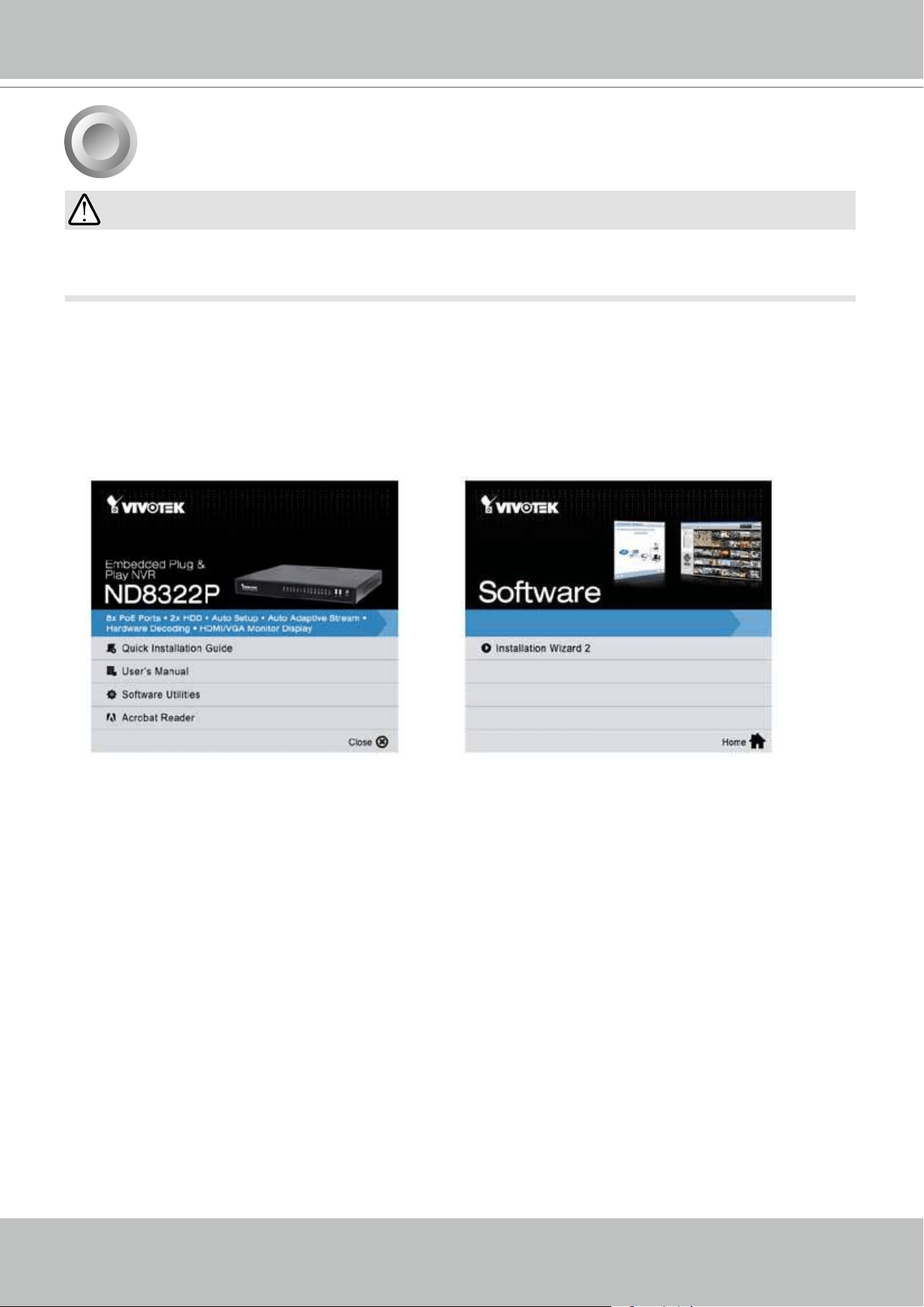
6. Click the Done button. The LiveClient screen will display, and, by default, the recording from
the selected cameras will immediately take place.
5-7. The process will take several seconds to complete.
5-8. The NVR and the cameras under it will be ready for access.
VIVOTEK - Built with Reliability
24 - User's Manual
Initial Conguration - via a Web Console (Optional)
5
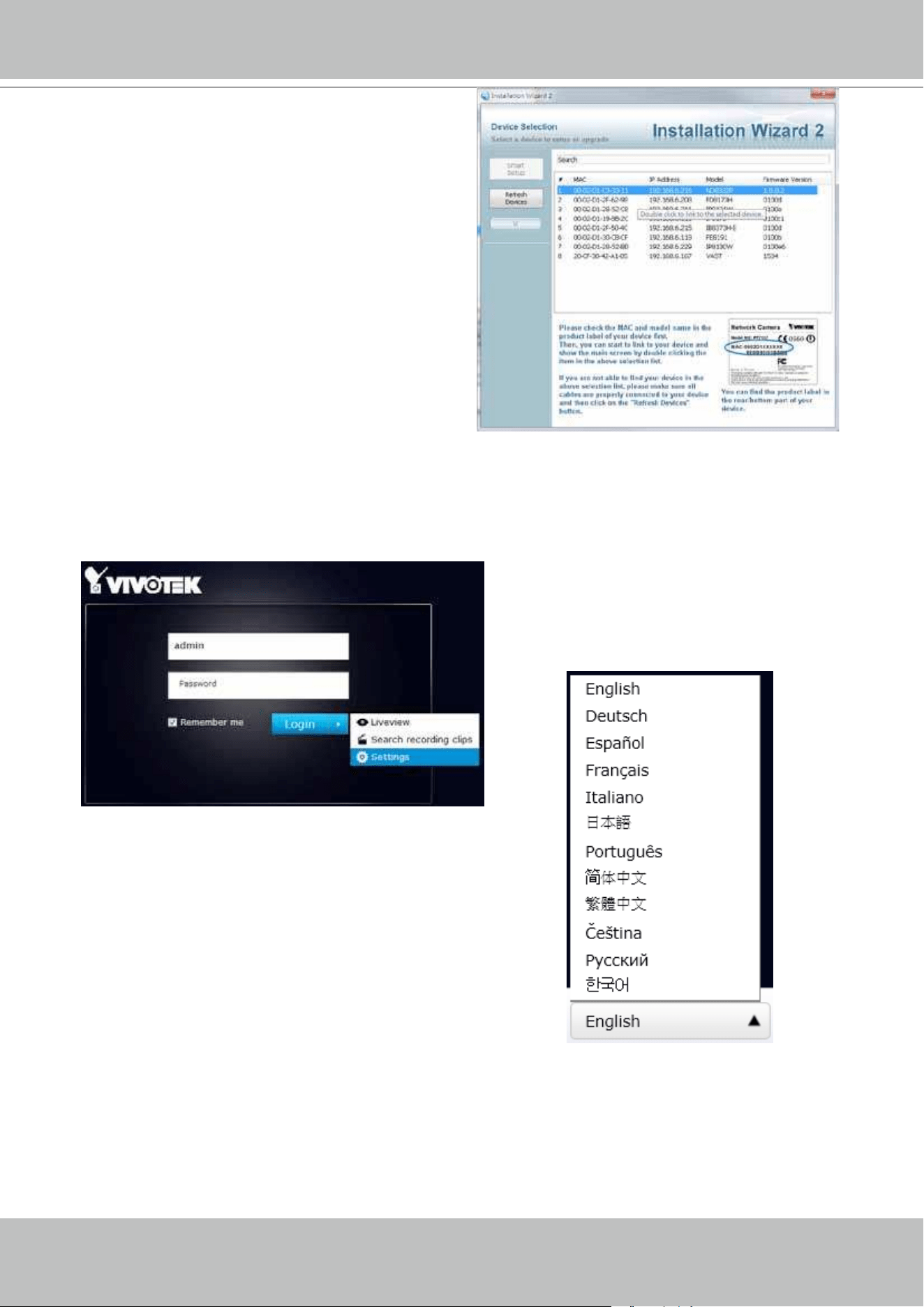
2. From a management computer, install the IW2 utility software included in the product CD.
Follow the onscreen instructions to complete the installation.
1. Press the power switch on the front panel to start the NVR. Wait for the system status LED to
light green.
If you already congured the system using an Ethernet web console, please skip the Auto Setup
steps when you connect the HDMI cable. You may accidentally format your storage volumes.
IMPORTANT:
VIVOTEK - Built with Reliability
User's Manual - 25
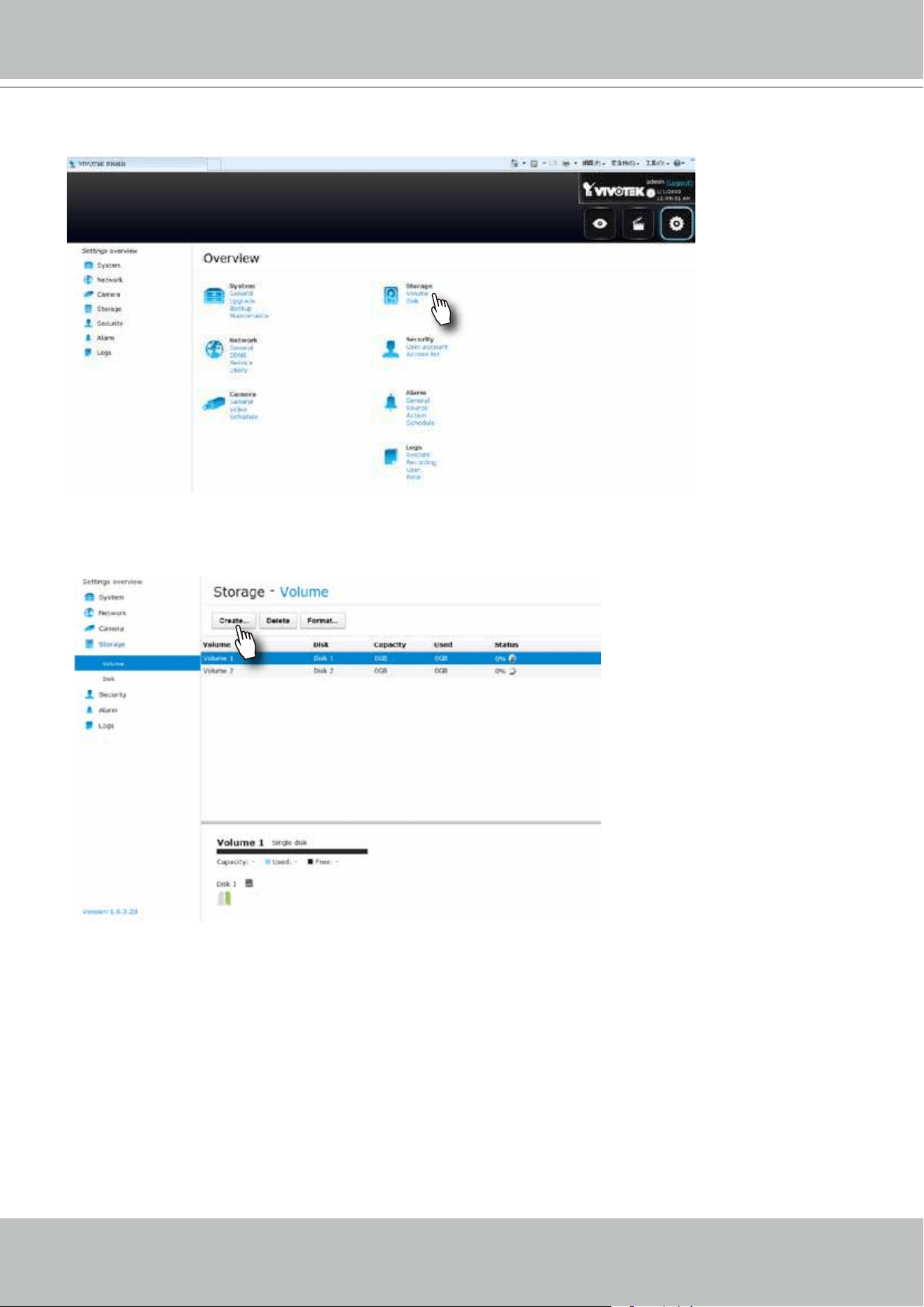
3. Start the IW2 utility. The IW2 utility will
discover the NVR located in the same
subnet.
4. Double-click on the ND8422P or 8322P entry to start a web session with the NVR system.
5. The login page will prompt. Enter "admin" and "admin" as user name and password for
access for the rst time. Expand the menu on the right of the Login button. Select and click on
the Settings button to begin your conguration.
You can select the display language
from the lower left corner of the screen.
VIVOTEK - Built with Reliability
26 - User's Manual
7. On the Storage settings page, check if your hard drives are present and identied by your
system. Click on the Create... button.
8. Refer to the later discussions for the rest of the conguration procedure.
6. On the Settings page, click on Storage > Volume to access your storage volume
conguration.
VIVOTEK - Built with Reliability
User's Manual - 27
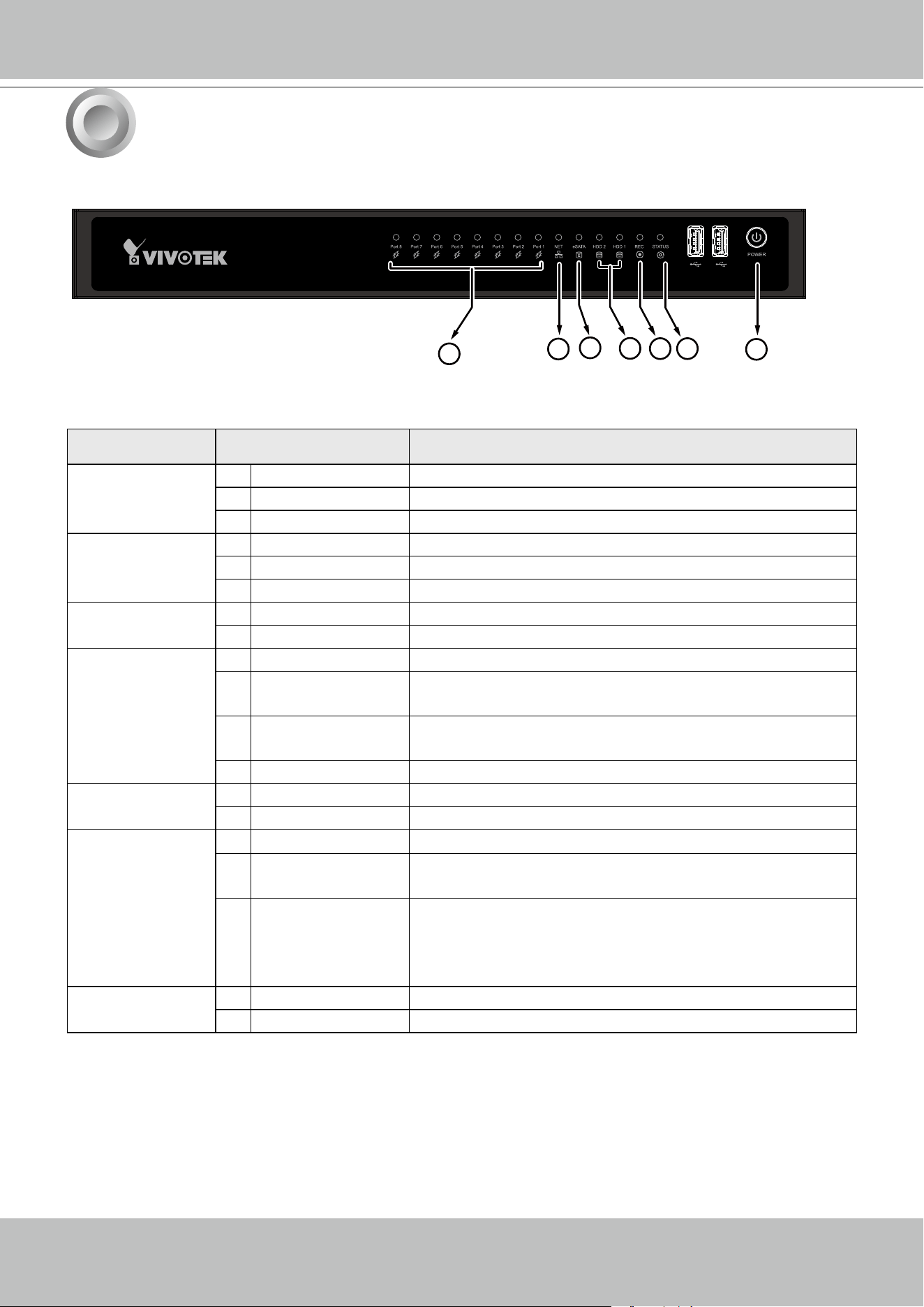
LED Indicators
Name Behavior Denitions
1. PoE &
Network LED
1 Flashing
Green Transmitting or receiving data.
2 OFF Device disconnected.
3 Solid
Green Device is connected.
2. NET activity
LED
1 Flashing Orange Indicating on-going trafc over the LAN connection.
2 Solid Orange Ethernet is connected.
3 OFF Ethernet is disconnected.
3. eSATA LED 1 Solid Green Indicating the status of the external eSATA device.
2 OFF H.D.D. is disconnected.
4. HDD activity
LED
1 Constant
Green H.D.D. is connected and ready.
2 Constant Red SMART-related disk errors or a congured H.D.D. is
missing.
3 Blinking
Red every
1 second
H.D.D. conguration errors.
4 OFF H.D.D. is disconnected or removed.
5. Record LED 1 Flashing
Red Camera streams are recorded to the system storage.
2 OFF No recording.
6. Status LED 1 Constant Green System is ready.
2 Blinking
Green
every 1 second
Updating rmware or device pack.
3 Constant Red S.M.A.R.T.-related disk errors, or a congured H.D.D.
is missing, or H.D.D. is full. Buzzer will also be
sounded. When buzzer is turned off, LED will return
normal.
7. Power button
LED
1 Solid
Green Power is on.
2 OFF Power is turned off.
6
1
2
3
4
5 6
7
VIVOTEK - Built with Reliability
28 - User's Manual
To power up and power down,
On the initial conguration:
1. Connect the power adapter between the system and power outlet.
2. Turn on the system by pressing the power button for more than one second.
After the initial connection,
1. Press the power button for 1 second to power on.
2. Press the power button for 4 seconds to power down. the system should start ushing the
cached contents in system memory and gracefully shut down.
Power Up and Power Down
1. No storage system is completely fail-safe. Damage to data might occur due to le system
corruption, operating system malfunction, virus infection, HDD component failures, and so on.
Therefore, it is highly recommended to regularly back up your data, and VIVOTEK disclaims
responsibilities of data loss or recovery.
2. Always power off the system using the power button. Do not disconnect the power cord while
the system is still operating. Doing so will result in data inconsistencies. The normal power-off
procedure allows cached data to be written to disks.
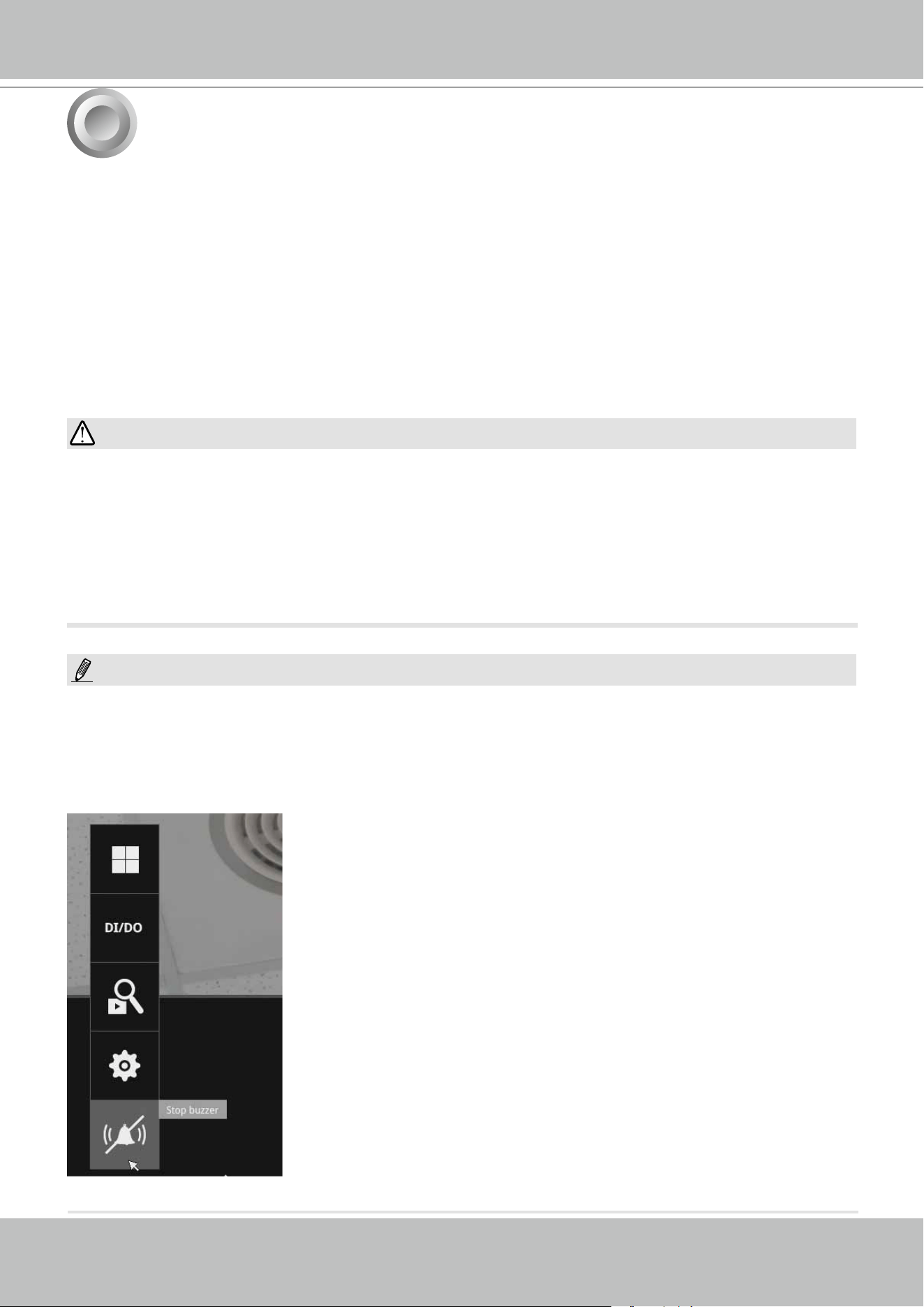
If system buzzer is sounded, move your mouse cursor to reveal the main screen portal, and
then click on the Stop buzzer button.
Serious system faults, such as a missing volume, can trigger the system buzzer. Verify the
cause of system fault and turn off the buzzer.
NOTE:
WARNING:
7
VIVOTEK - Built with Reliability
User's Manual - 29
Section One
Management over a
Local Console
Chapter Two
Introduction to the Local Console Interface
Camera 01
Camera 02
Camera 03
Camera 04
Camera 06
Camera 05
Camera 07
Camera 08
Camera 09
VIVOTEK - Built with Reliability
30 - User's Manual
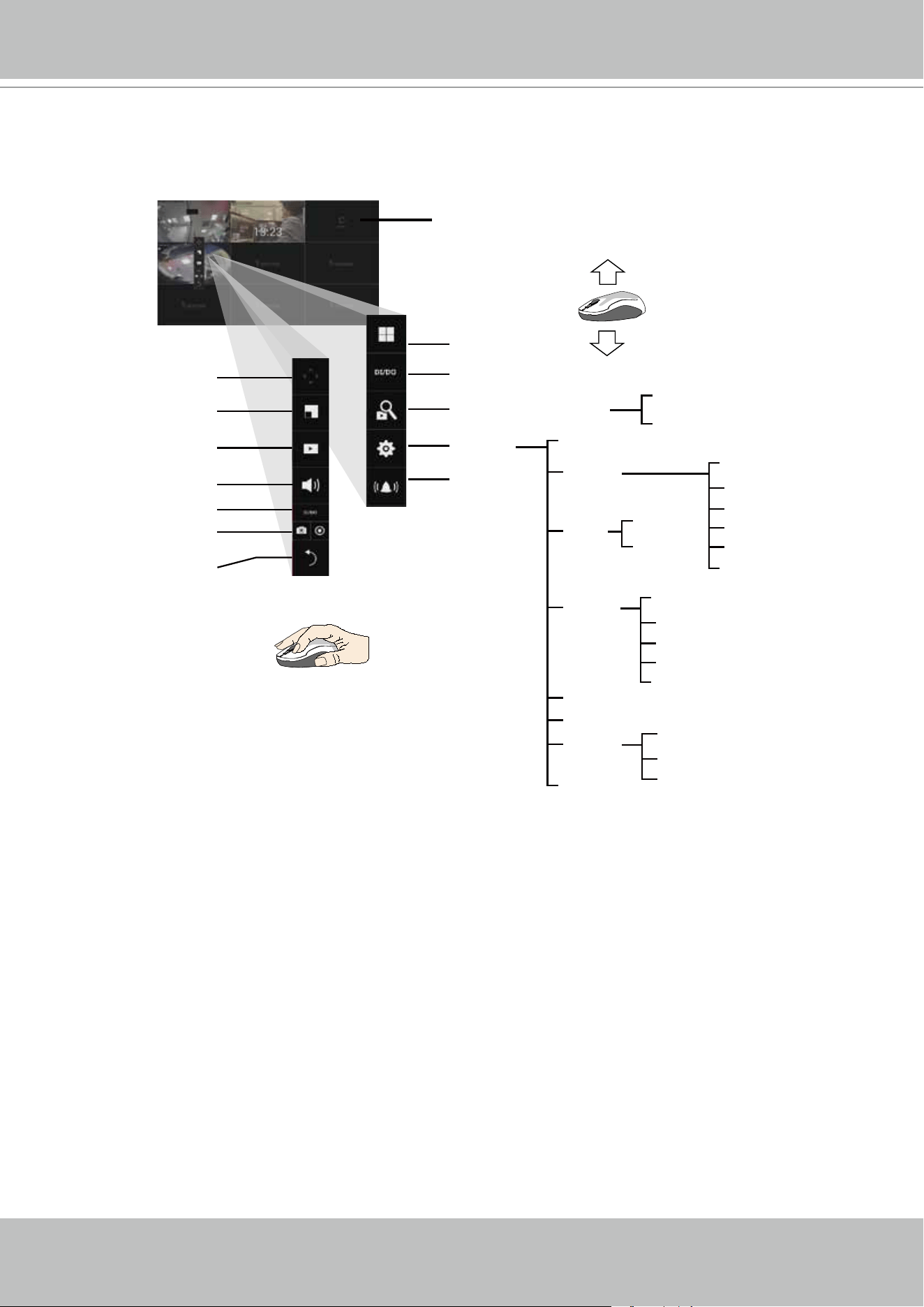
By default, a live view appears on an HDMI monitor. The interface architecture of the local
console is illustrated as follows:
LiveView Main screen
Main control portals
Search recording clip
DI/DO
Layout
Settings
Search panel
Storyboard
Camera
Alarm
Management
Recording
Media
Image
Motion detection
PTZ settings
Alarm
Email
System
Information
Maintenance
Display
UPS
Logs
User
Storage
Network
IP
DDNS
Services
Overview (camera connection & storage)
Stop buzzer
Play recording clip
PiP
PTZ
DI/DO
Snapshot | Manual
recording
Deselect camera
Config. portal
Camera portal
Information
Audio
When a view cell is selected.
VIVOTEK - Built with Reliability
User's Manual - 31
2-1. How to Begin
1. How to access the Conguration Portal?
Make sure a mouse is attached to your NVR. Move your mouse cursor, and the Conguration
Portal will appear on screen. For all the congurable options available through this portal,
please refer to Chapter 3 on page 43.
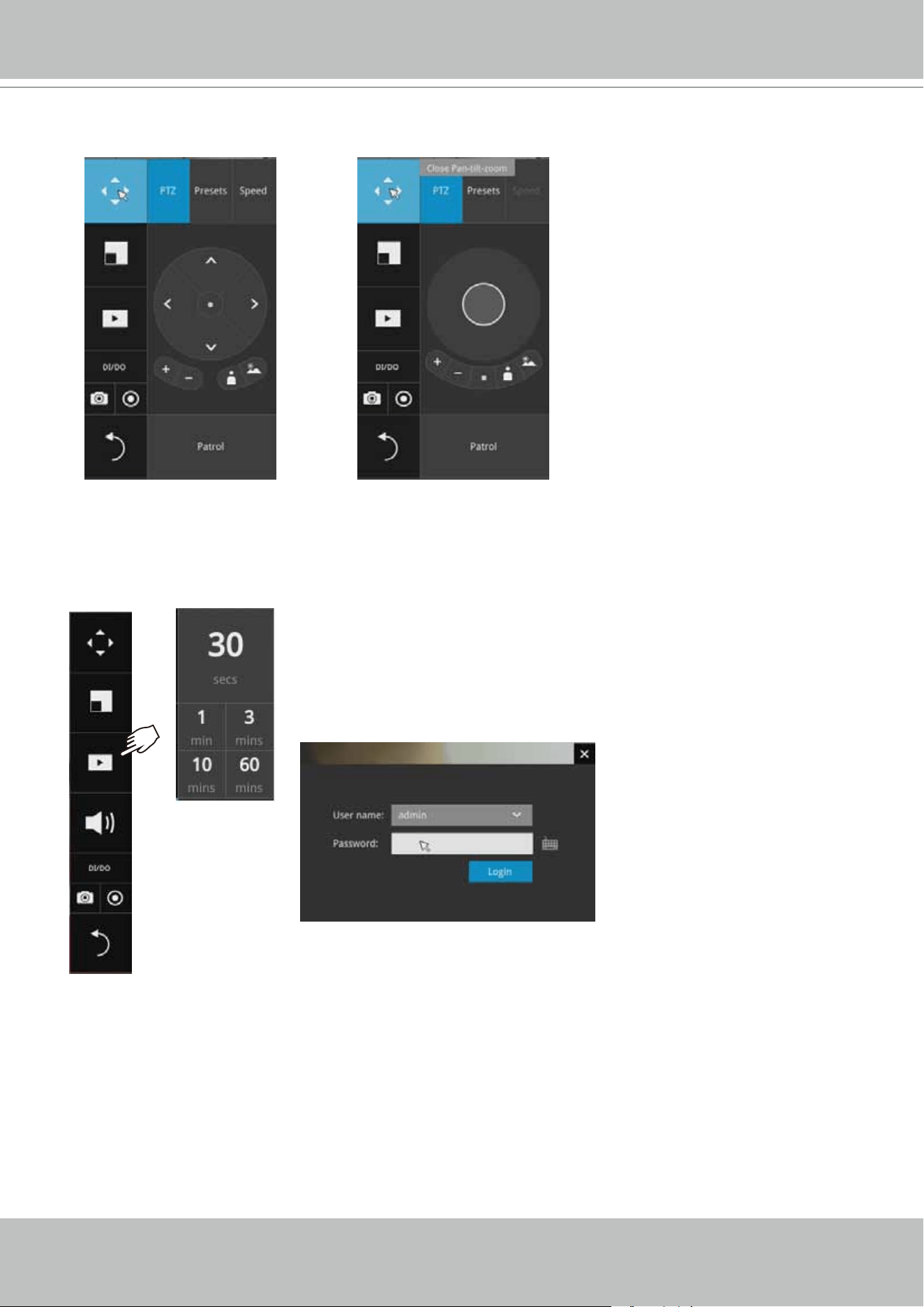
2. How to access the Camera Portal?
Single click to select a view cell, the Camera Portal will appear. The system automatically
detects the characteristics of an individual camera when you select a view cell.
This portal appears with a camera that supports mechanical PTZ.
This portal appears with a camera that does not support mechanical PTZ.
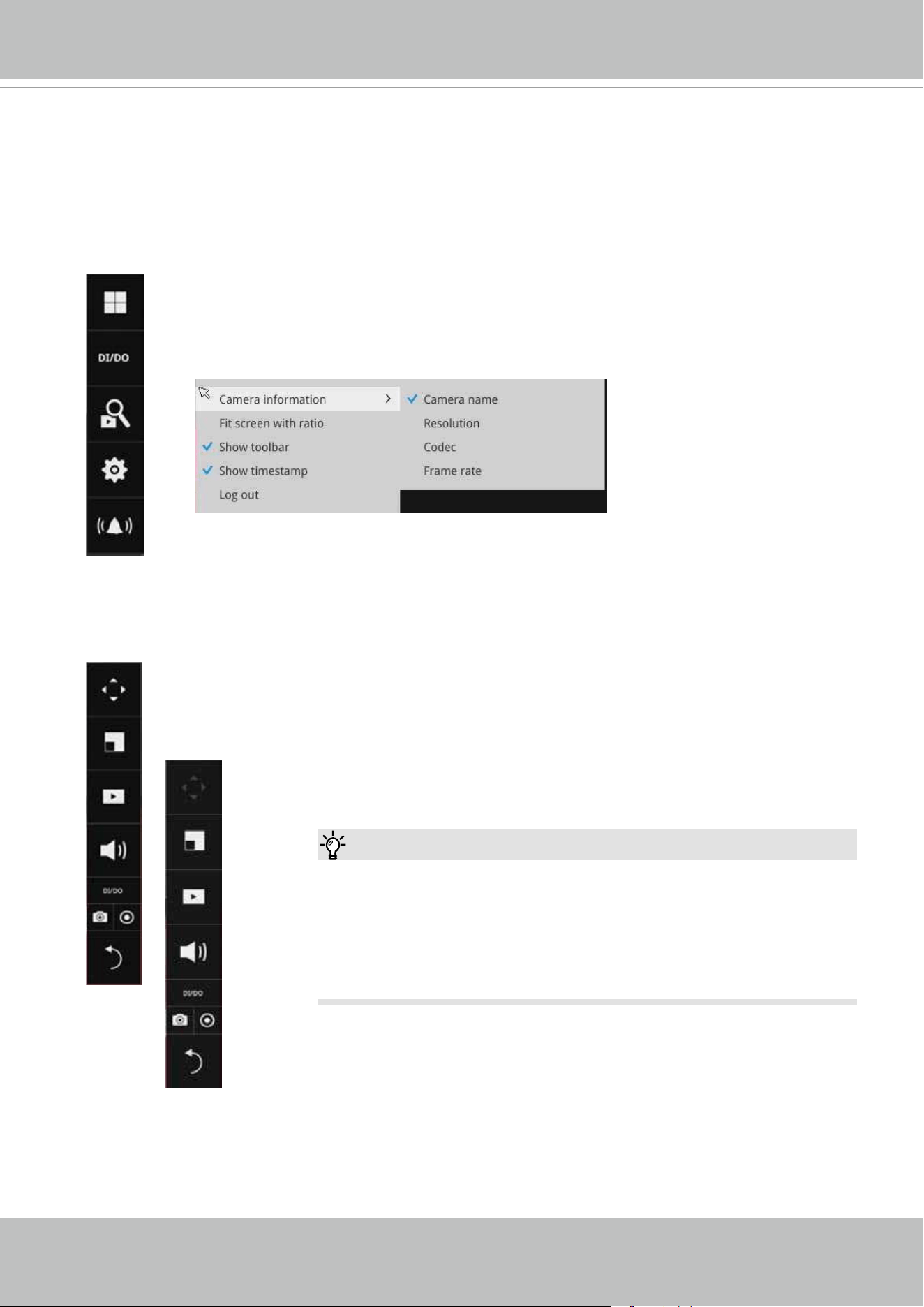
You can also hide these portal toolbar. Right-click on the LiveView screen to
display the option.
Here are some operation steps using the tool bar:
1. Single-click to select a view cell and bring out the tool bar.
2. Double-click to expand a view cell to the full view.
3. Double-click again to shrink the view cell to the original size.
Tips:
VIVOTEK - Built with Reliability
32 - User's Manual
PTZ control panel for ordinary
PTZ type
PTZ control panel for joystick type PTZ
3. How to retrieve and access recorded videos?
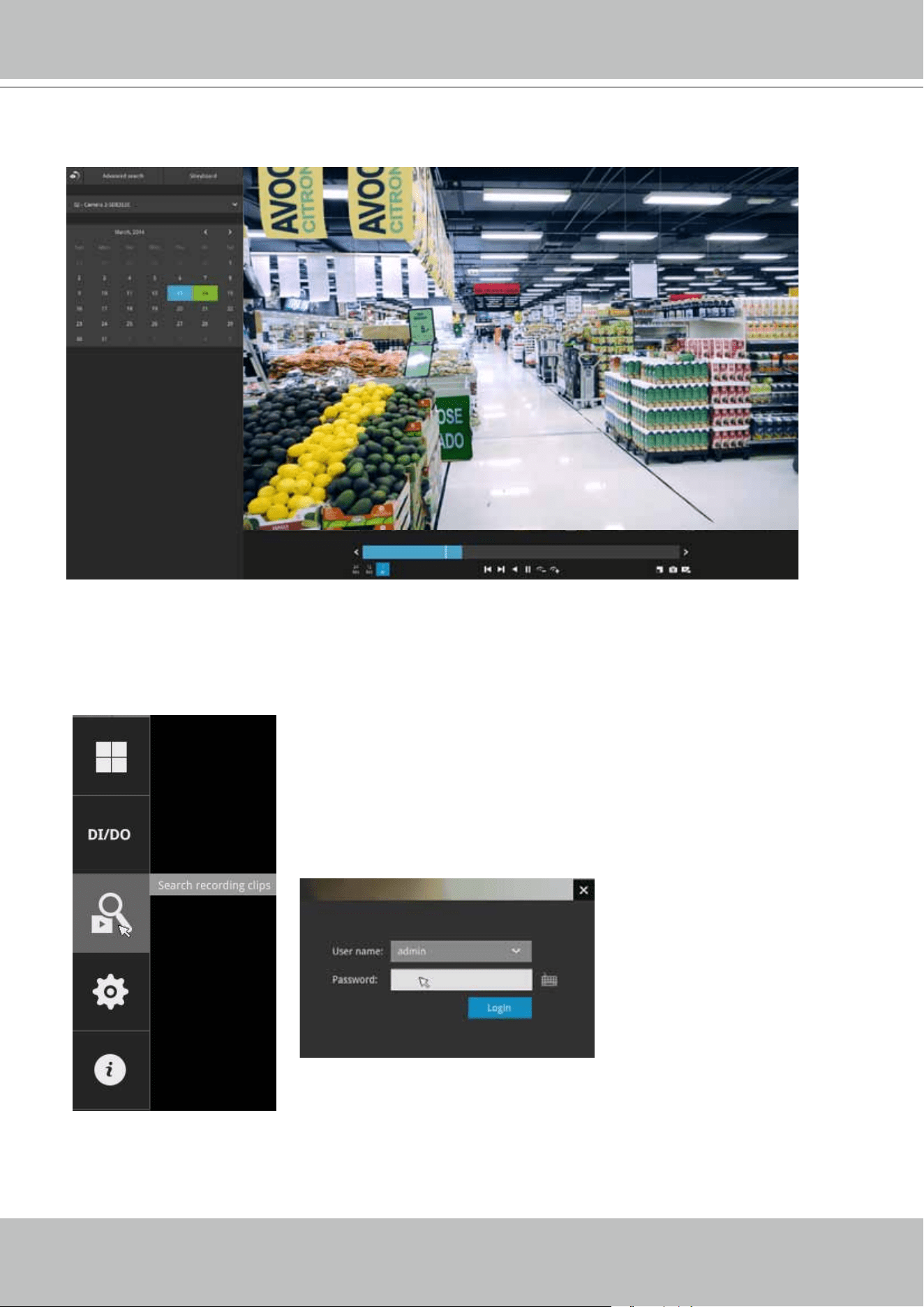
3-1. One is to access the video clips taken within 2 hours. Left-click to select a view cell, and
then click on the Recording clips button.
Select a time value by a single click. You will be prompted for User
name and Password, enter admin and admin (the default user
name and password), and then click Login.
VIVOTEK - Built with Reliability
User's Manual - 33
The Playback window will prompt, and a playback begins from the point in time you selected,
e.g., 30 seconds ago. This function allows you to quickly review what has just happened.
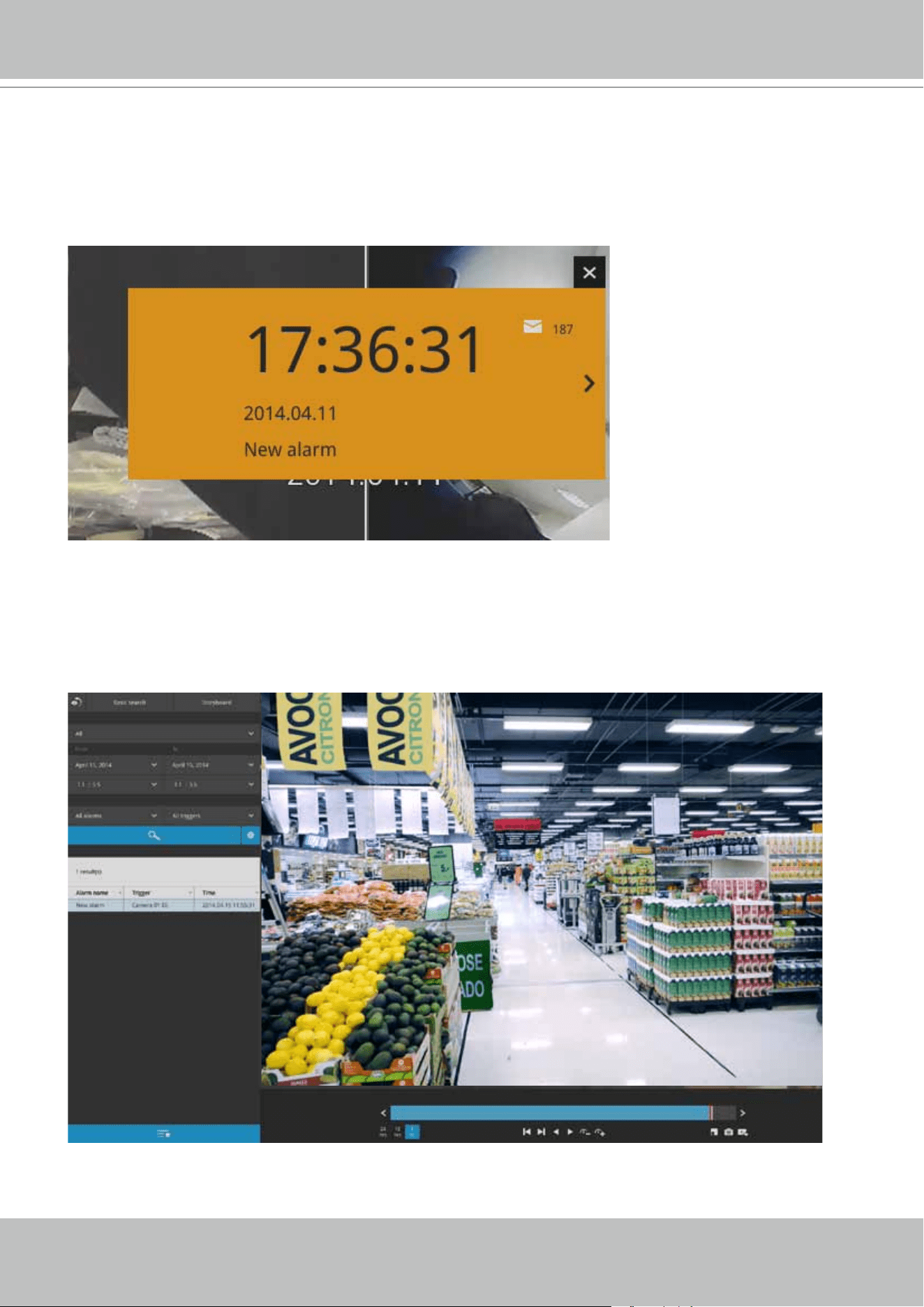
3-2. Another way to access past videos is to open the Search recording clips window. Move
your mouse cursor to display the Conguration Portal (without selecting any view cell).
Click on the Search recording clips button. Please refer to page 44 for more information
about the search functions.
You will be prompted for User name and Password, enter admin
and admin (the default user name and password) and click Login.
It is highly recommended to change the password after you log in.
VIVOTEK - Built with Reliability
34 - User's Manual
4. How to recieve system alarm?
Please refer to page 70 for how to congure system alarm triggers. When the alarm is triggered,
e.g., by digital inputs or motion detection, an alarm message will prompt on the screen.
Use the > arrow button to browse through the alarm messages.
If the alarm is congured with video recording as the responding action, you can click on the
alarm entry. The Playback window will appear, allowing an instant playback of the alarm-related
footage. You will enter the "Search alarm results" page even if the alarm does not trigger a
recording action.
VIVOTEK - Built with Reliability
User's Manual - 35
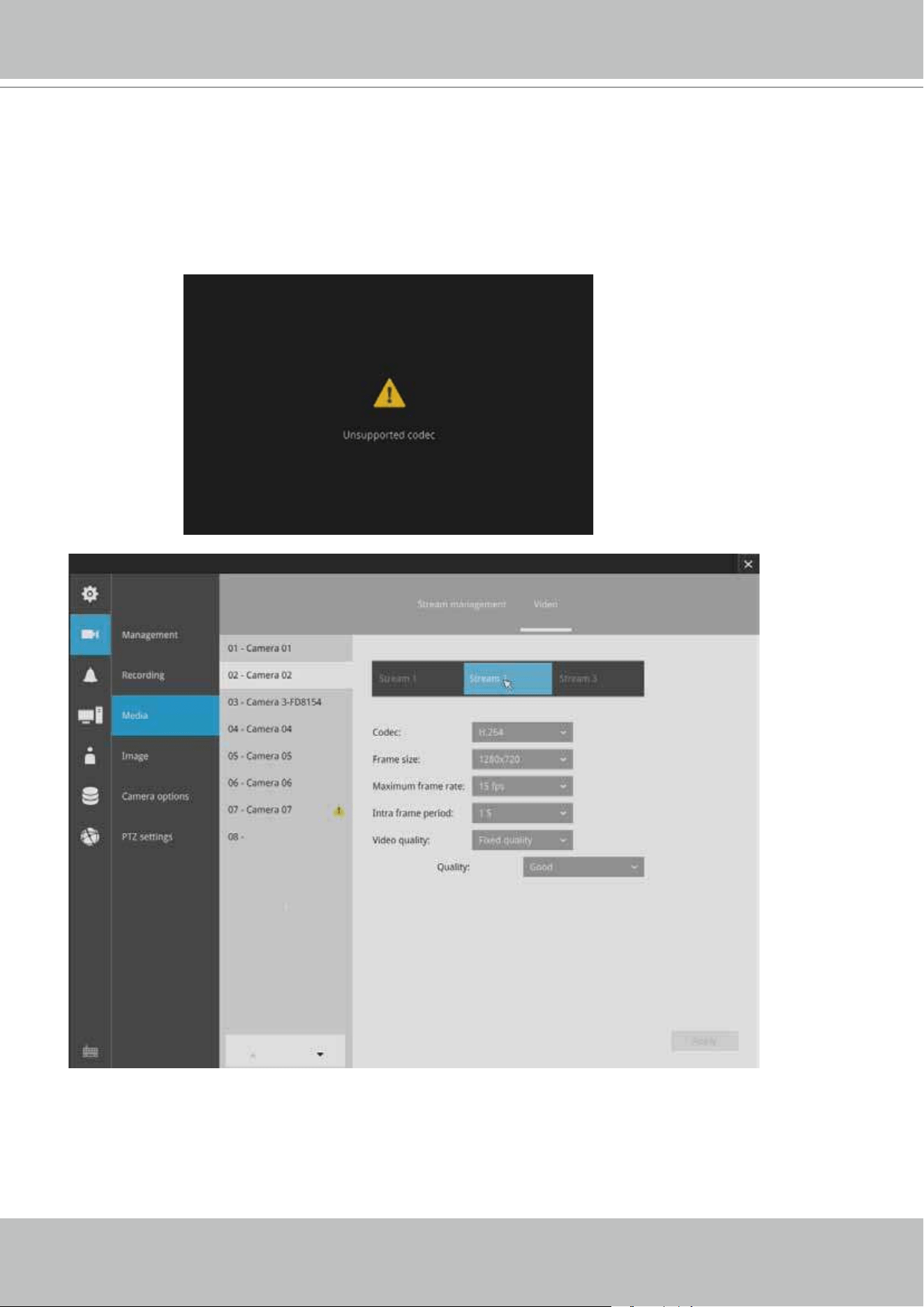
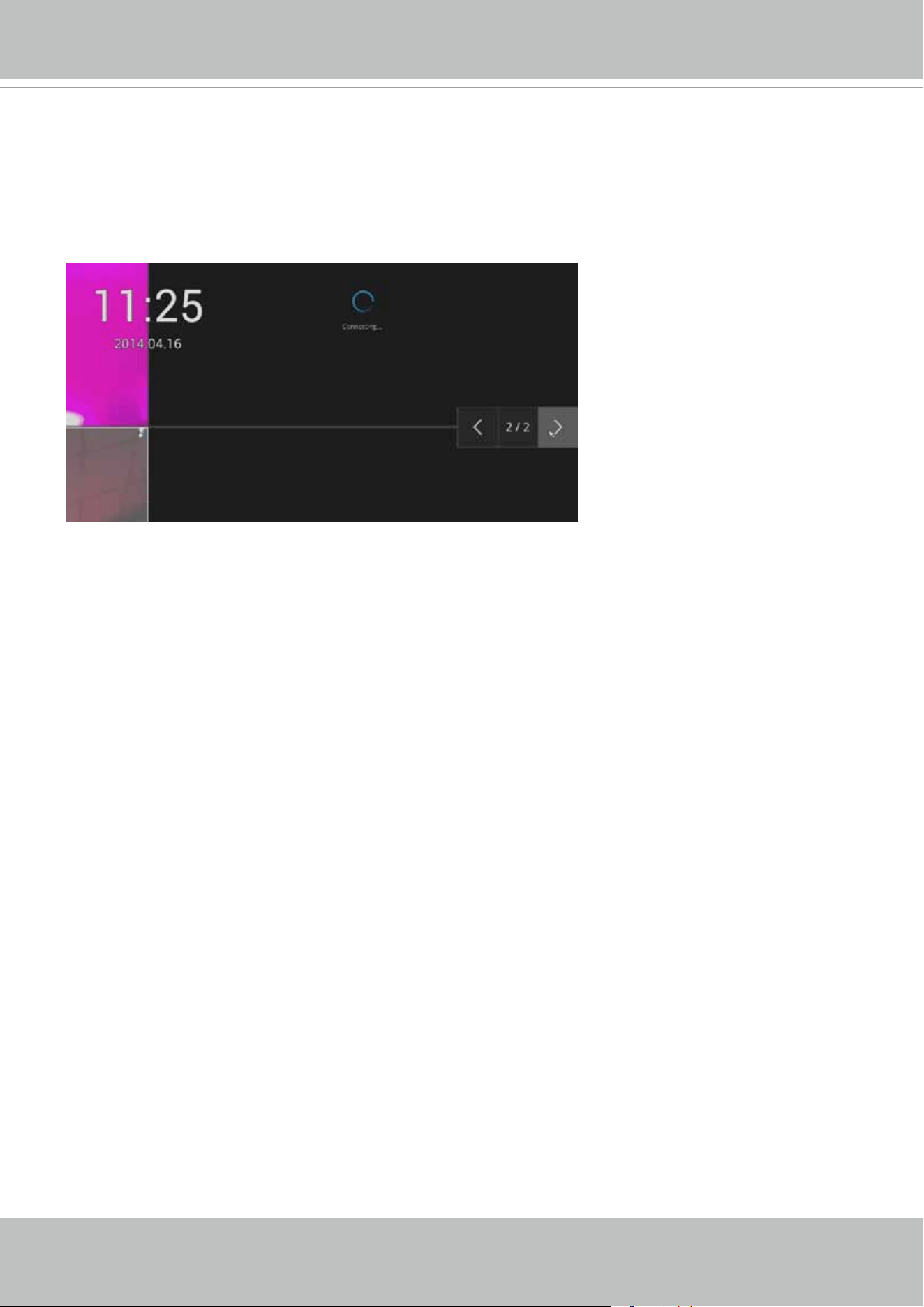
5. Why live view is unavailable?
The default live view receives a camera's stream #1. If a camera's stream #1 is congured using
MPEG-4 as the video codec, the following message will prompt.
You can go to the Settings > Camera > Media > Video window to congure the video codec of
stream #1 into H.264.
VIVOTEK - Built with Reliability
36 - User's Manual
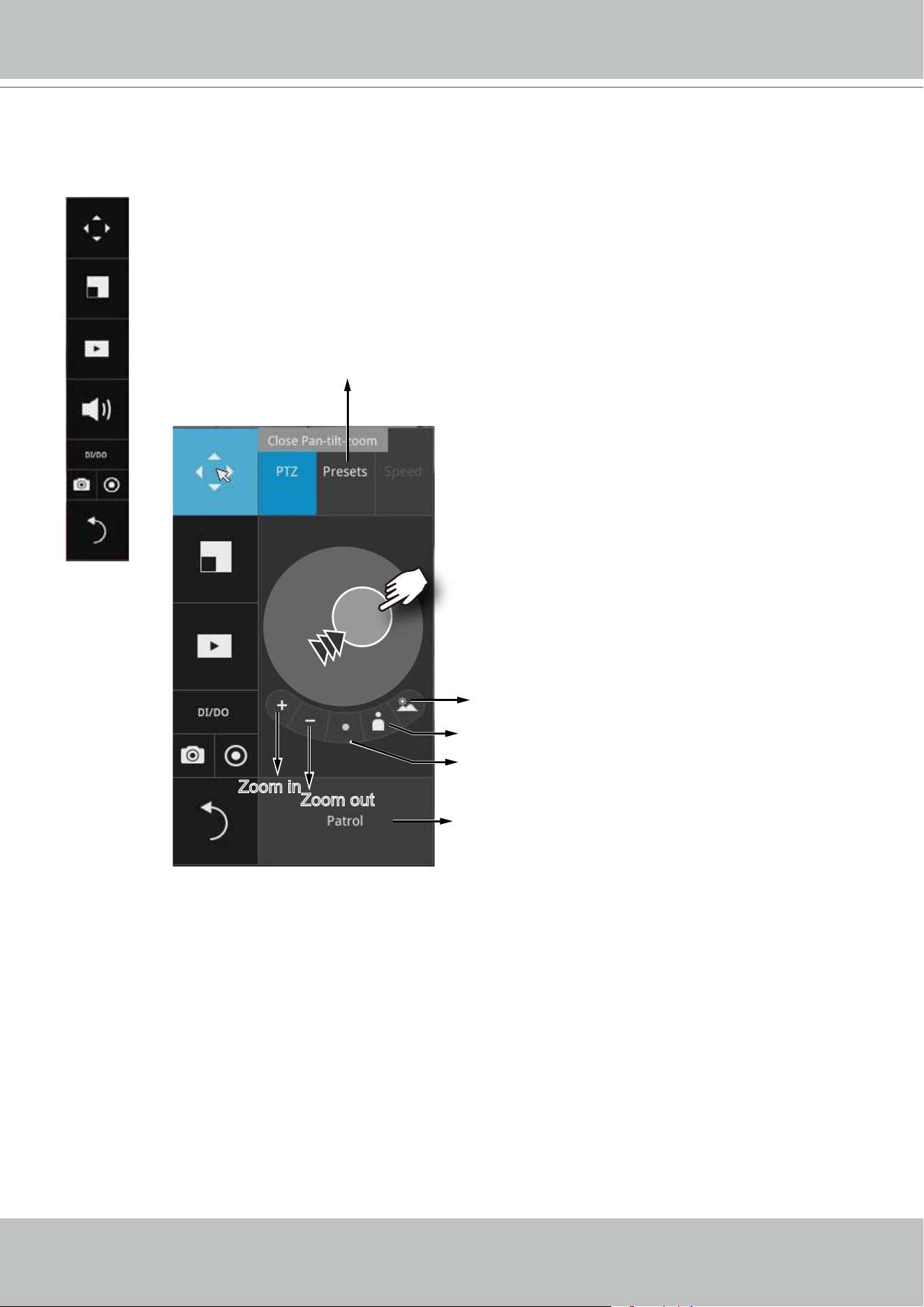
6. How do I move to another layout page?
Move your cursor to the right hand side of your screen. The page turner buttons will appear as
shown below.
For example, if you have 8 cameras placed on 2 2x2 layout pages, use these buttons to visit
different pages.
7. Why the onscreen tool bars disappear after some time?
The system comes with idle modes. Below are the applicable conditions:
1. Live view: if no management activities occur for 5 seconds, the tool bars disappear from
screen. When in the idle mode, mouse cursor and tool bars will disappear. Moving the mouse
cursor will re-activate the screen.
2. Settings page: If left unattended for 10 minutes, system will automatically log out. The system
will prompt for user credentials if a user tries to access the Settings page again.
3. Search recording clips window: If currently there is a video playback, the system will not enter
the idle mode.
VIVOTEK - Built with Reliability
User's Manual - 37
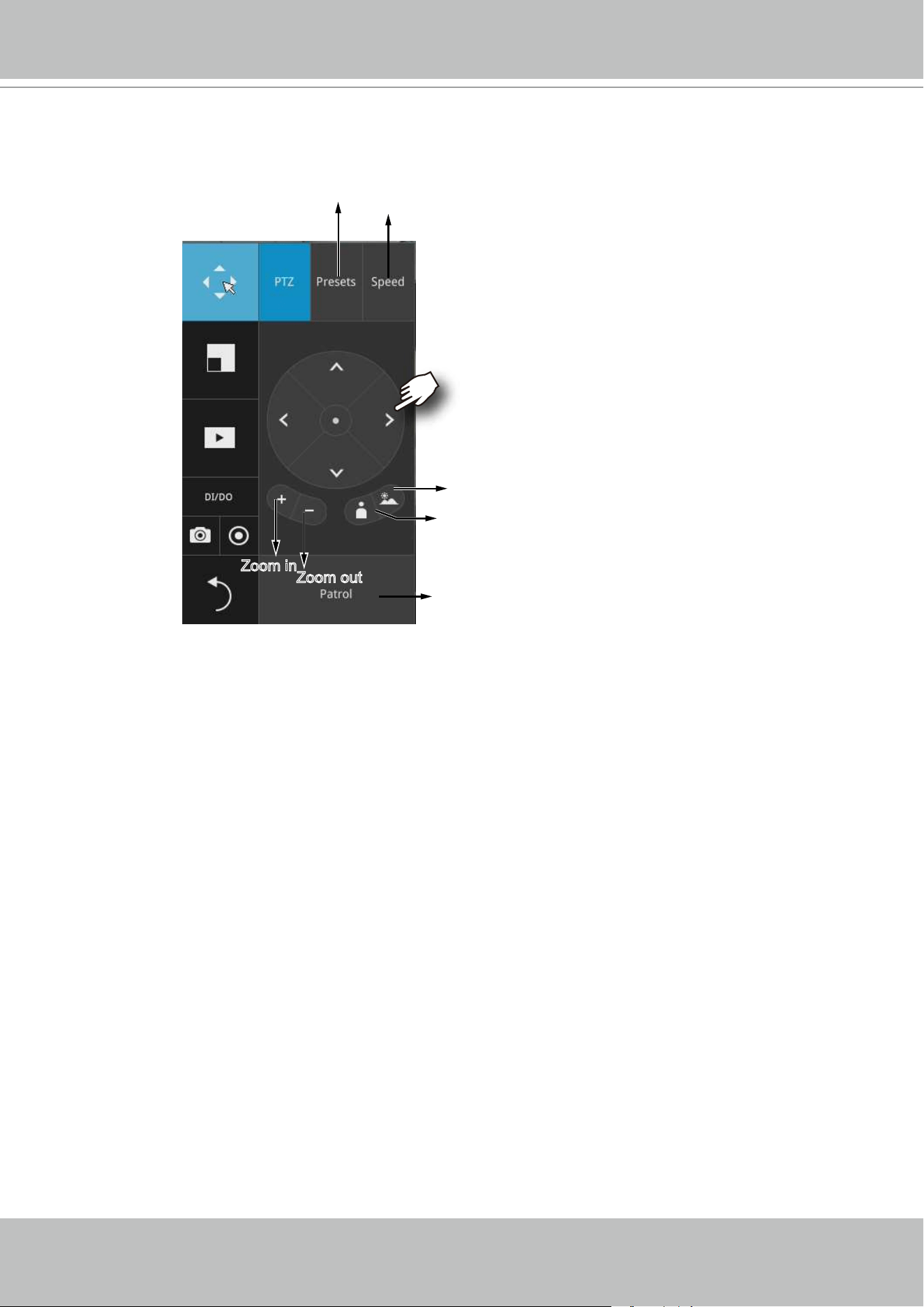
2-2. Operation on Camera View Cell
Once you selected a camera, click on the PTZ button on a camera portal.
2-2-1. PTZ Panel
List of preset positions
Focus far
Focus near
Starts patrol
Home
Zoom out
Zoom in
The PTZ panel will prompt. Below are the description of its functions:
1. PTZ control: Click and drag the nudget in the center towards the direction you wish
to move to.
2. Focus: Click on the Focus near and Focus far buttons to adjust camera focus.
3. Home: Click to move the camera lens towards the default home position.
4. Zoom: Use the Zoom in and Zoom out buttons to adjust the camera's zoom ratio.
5. Presets: If you congured preset positions, a list of preset positions will appear.
6. Patrol: If you congured preset positions into a patrolling tour, click on this button
and the camera will proceed with patrolling through preset points.
Note that on a speed dome camera, the farther you pull the nudget away from the
center, the faster the lens moves. This works like speed control.
VIVOTEK - Built with Reliability
38 - User's Manual
List of preset positions
Focus far
Focus near
Starts patrol
Zoom out
Zoom in
Speed selector
1. PTZ control: Click on the arrow buttons to move towards the direction you wish to
move to.
2. Focus: Click on the Focus near and Focus far buttons to adjust camera focus.
3. Zoom: Use the Zoom in and Zoom out buttons to adjust the camera's zoom ratio.
4. Presets: If you congured preset positions, a list of preset positions will appear.
5. Speed: Adjusts the speed when moving across the eld of view.
6. Patrol: If you congured preset positions into a patrolling tour, click on this button
and the camera will proceed with patrolling through the preset points.
Below is the PTZ panel that appears with ordinary PTZ cameras.
VIVOTEK - Built with Reliability
User's Manual - 39
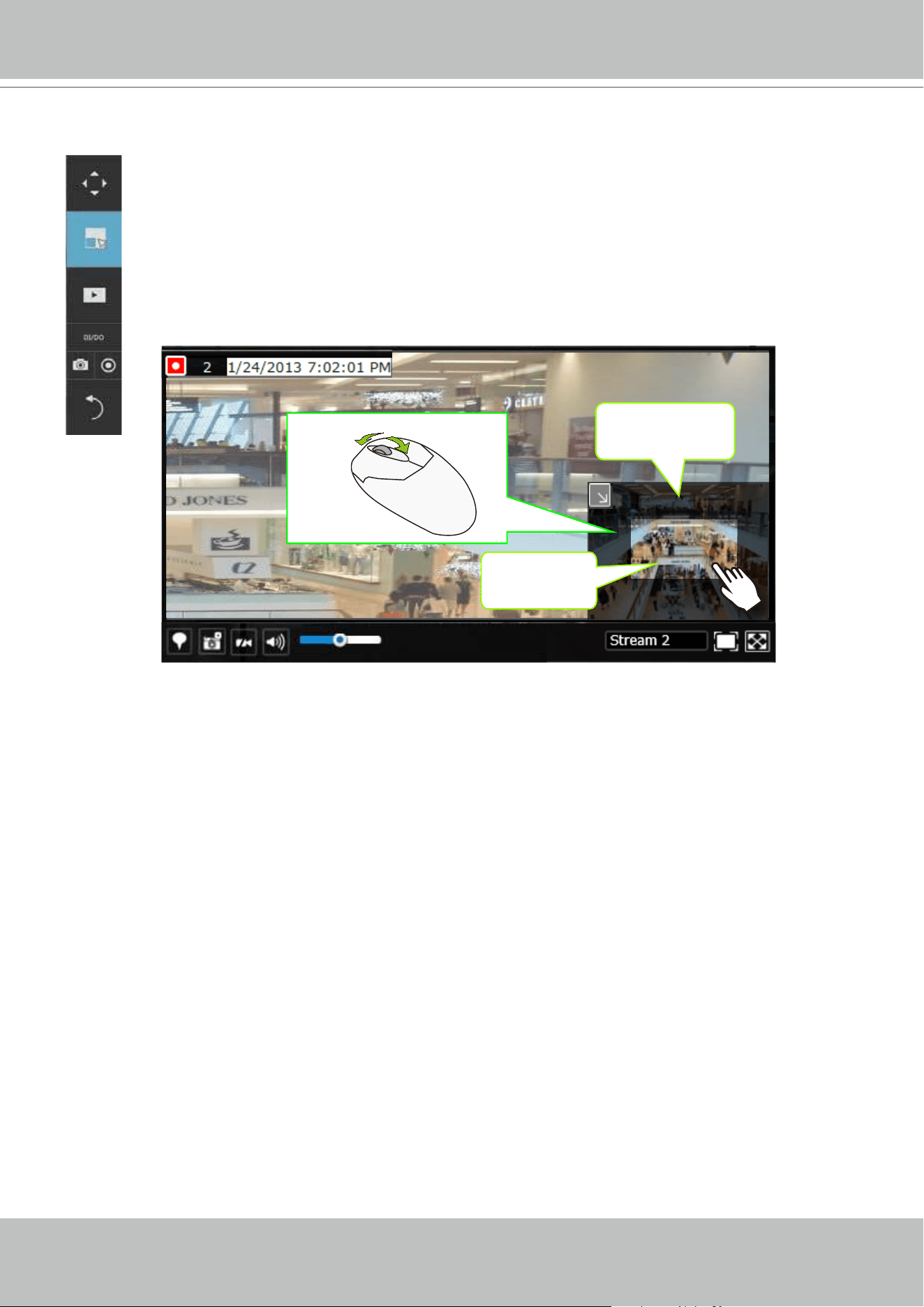
2-2-2. PiP (Picture in Picture) Panel
PiP is short for Picture in Picture, a function that provides digital zoom into a live
video.
When activated, a Global view window will appear at the lower right of the view cell
as shown below. You can display only a portion of the complete video frame as an
area of your interest. Using a click and drag on the ROI window, you can instantly
move to other areas within the video frame. Use the zoom ratio pull bar at the bottom
to change the zoom ratio. You may also move the ROI around by click and drags.
Global view
ROI
Zoom In Zoom Out
Note that not every camera supports the PiP function.
VIVOTEK - Built with Reliability
40 - User's Manual
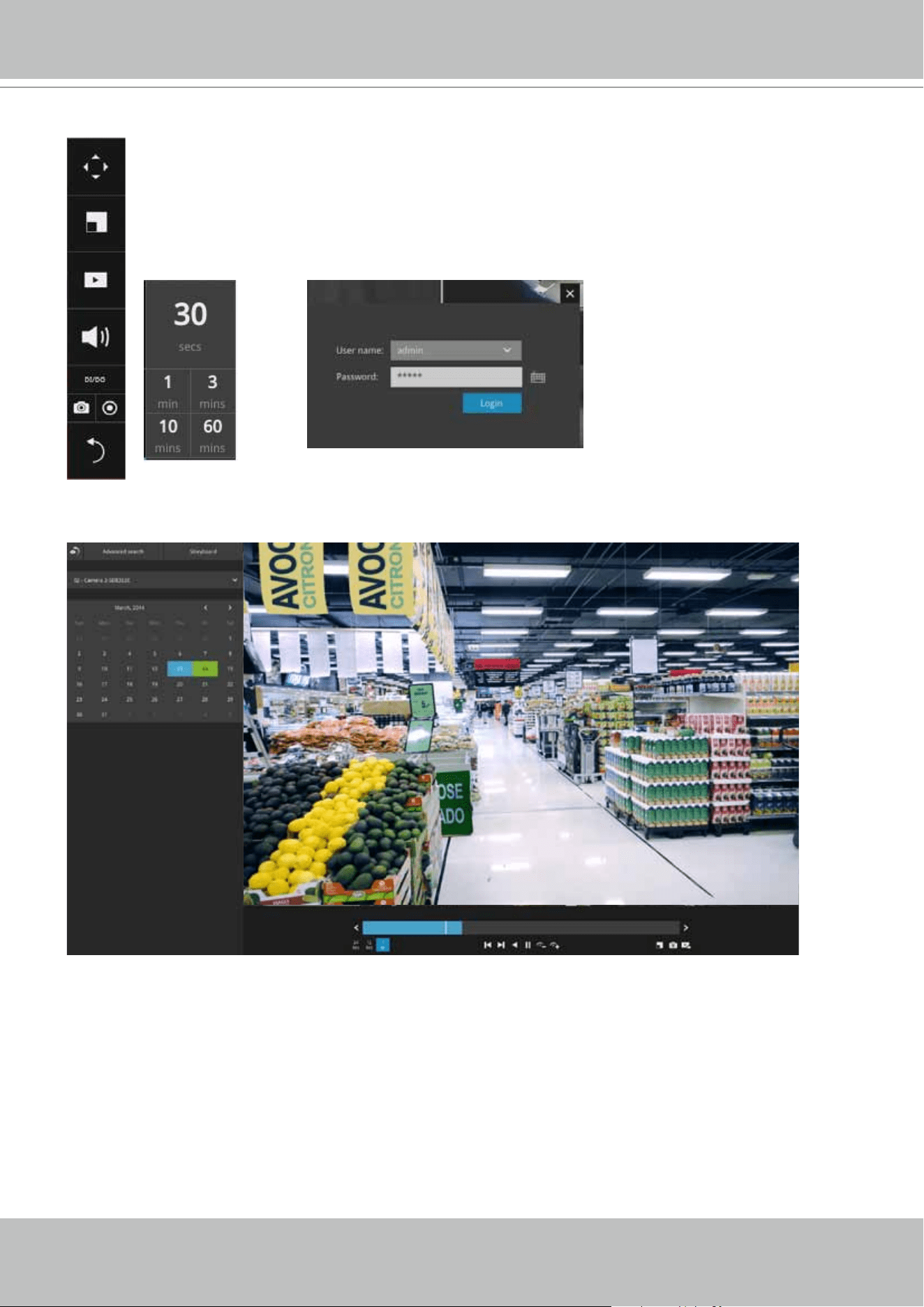
2-2-3. Play Recording Clips Panel
The Play Recording Clips function provides a shortcut to the latest recordings
on the system. You can select 30 secs, 1 min, 3 mins, 10 mins, and 60 mins
for an immediate playback.
For security reasons, using this function requires users to enter his/her
credentials.
The Playback window will prompt, and a playback begins from the point in time you selected,
e.g., 30 seconds ago. This function allows you to quickly review what has just happened.
VIVOTEK - Built with Reliability
User's Manual - 41
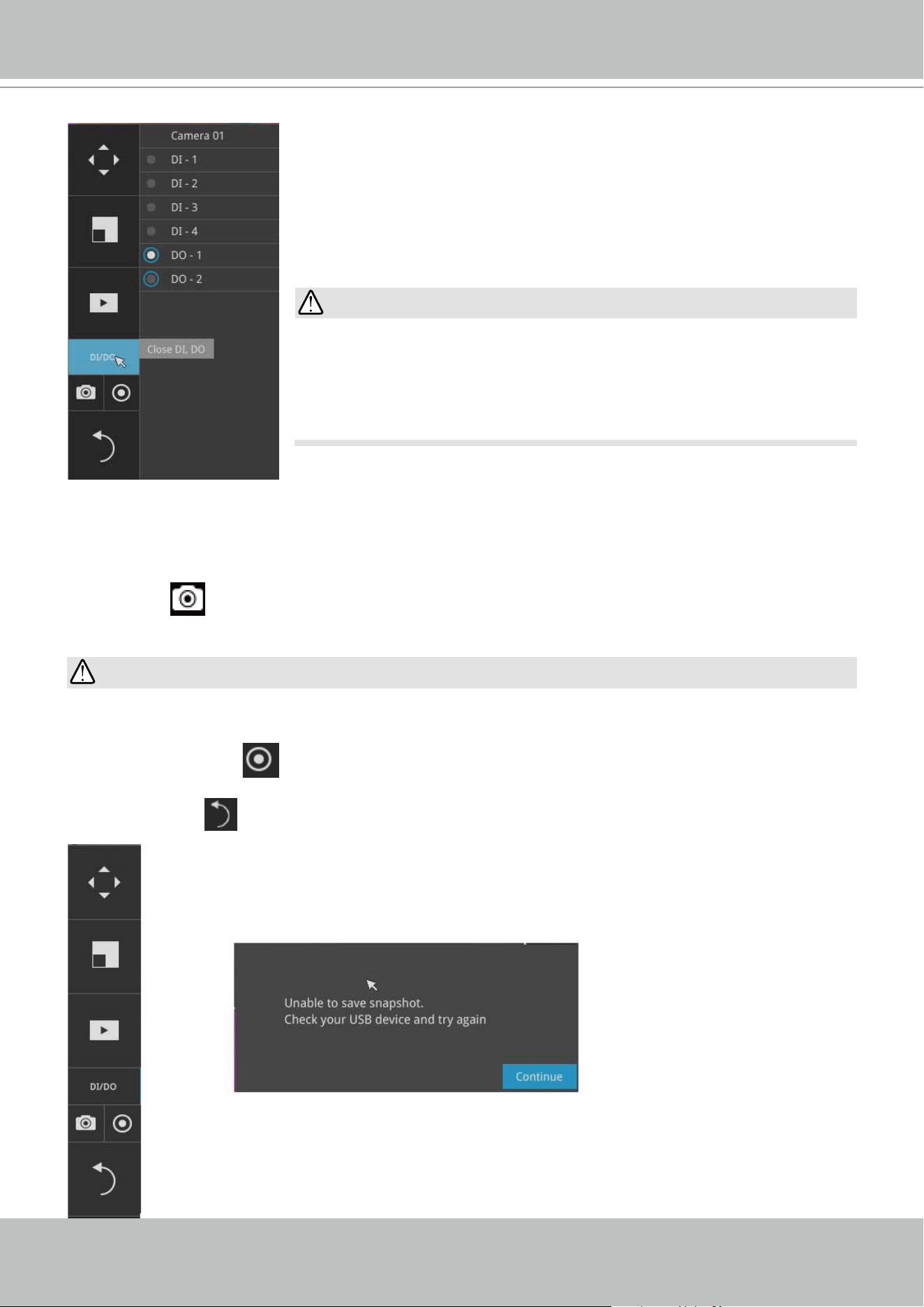
2-2-4. DI/DO
The DI/DO panel provides a glimpse of all DI and DO signal
statuses from the connected cameras. You can manually trigger a
digital output by clicking on its indicators.
When a digital input is triggered, its status will also be indicated on
the panel.
Please note that DO is triggered by one click. You should then
click again to disable the DO. Otherwise, the DO signal will be
continuously triggered. As the result, if the DO is congured as an
alarm trigger, many alarm messages will be generated.
WARNING:
2-2-5. Others
1. Snapshot : is used to take a snapshot from the camera currently selected. Note that this
function only saves the snapshot (in JPEG) to a USB thumb drive.
The USB thumb drive has to be one that is formatted in FAT format.
2. Manual Recording
: Press the button to start a manual recording from a selected camera.
Click again to stop the recording.
3. Return button
: Click to return to the LiveView window.
IMPPORTANT:
VIVOTEK - Built with Reliability
42 - User's Manual
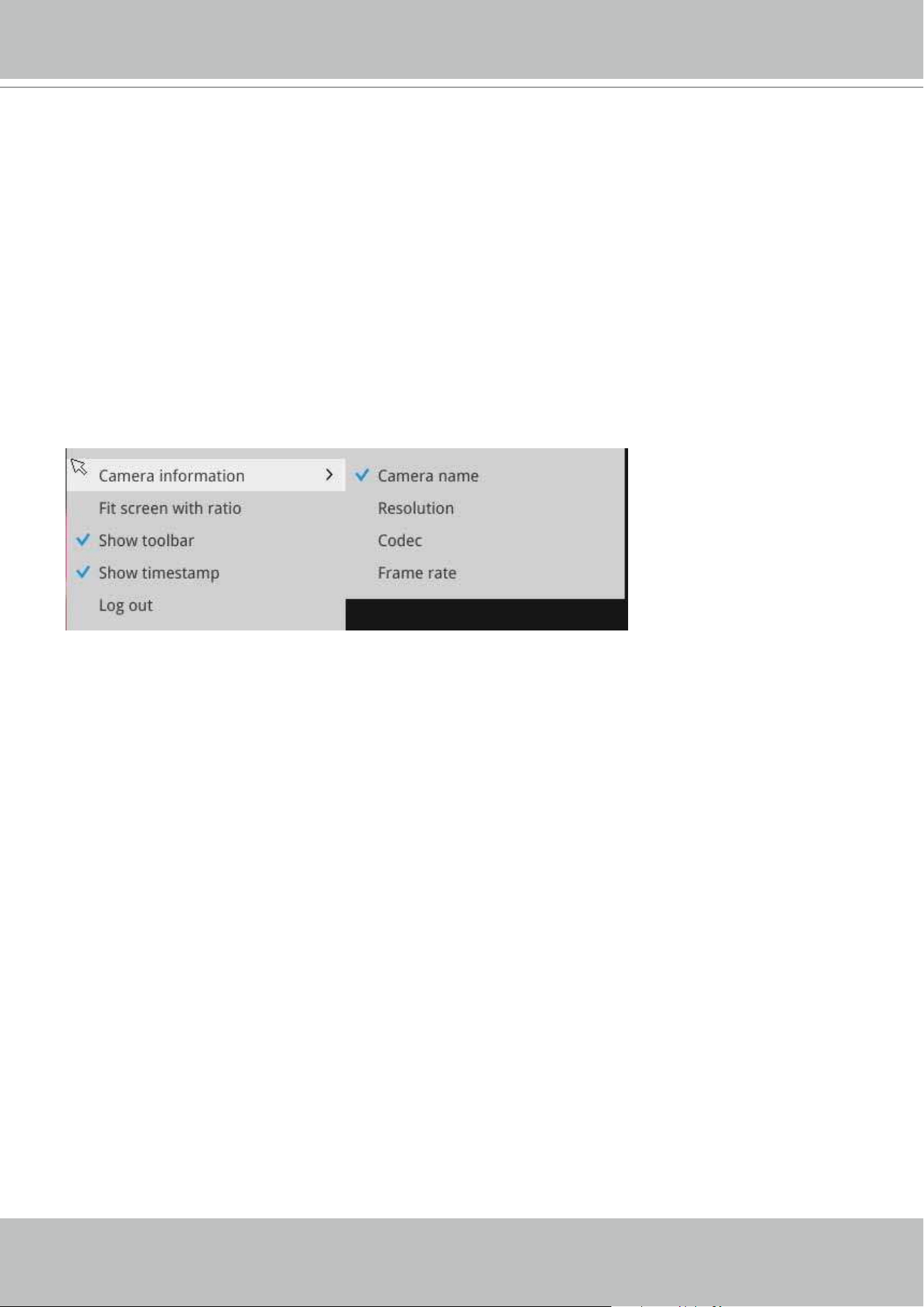
2-2-6. Right-click Commands
Left-click to select a camera. Right-click to display the selection menu.
1. Camera information: Click to display camera name, resolution, codec, or frame rate on the
view cell. The information will display on the upper left corner of a view cell.
2. Fit screen with ratio: The NVR server automatically optimizes the display camera view cells.
However, you can still select this option to display the camera's original aspect ratio: for
example, the original video feed can be 4:3. Without the t screen, every camera's image will
be expanded to ll the view cell.
3. Show tool bar: You can hide the tool bars by deselecting this option.
4. Show timestamp: You can hide the time stamp bars by deselecting this option.
5. Log in: Log in to enable system conguration.
VIVOTEK - Built with Reliability
User's Manual - 43
Chapter Three
Configuation Using the Local Console
The Main Control Portal
3-1. Layout
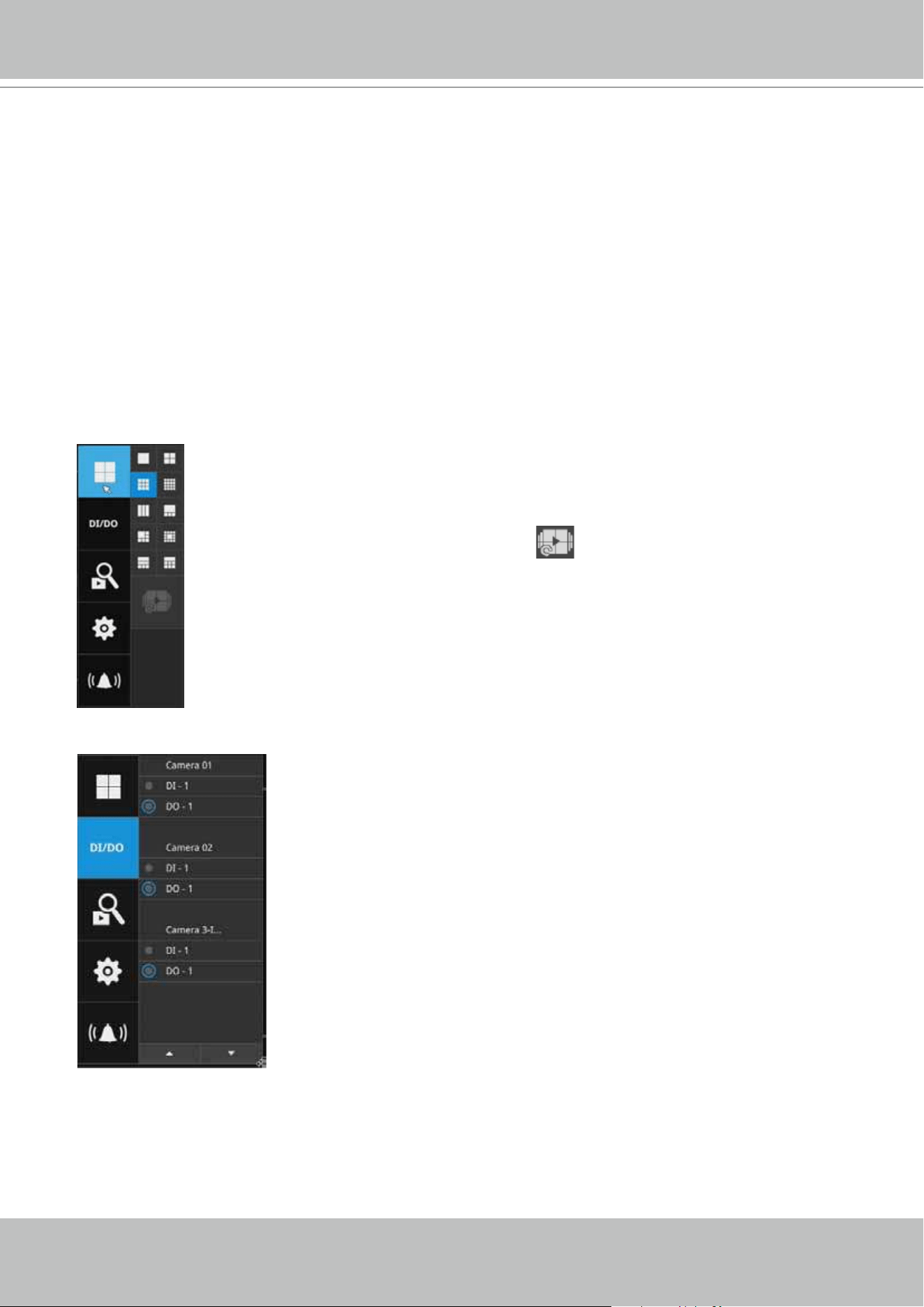
The rst functional button is Layout. You can select the 1x1, 1x3, 2x2, 3x3,
4x4, 1+5, 1+12, 1+3, 1+1+3, 1+3+3 layout as the screen display. If you select
the single view layout, the rotation button
will appear. Click the rotation
button below to let the system swap the display of different cameras by every 10
seconds. The rotation speed is congurable via Settings > System > Display.
Note that the 4x4 and the 1+12 layouts are only available for the ND8422P.
Move your mouse cursor across the screen to display the portal.
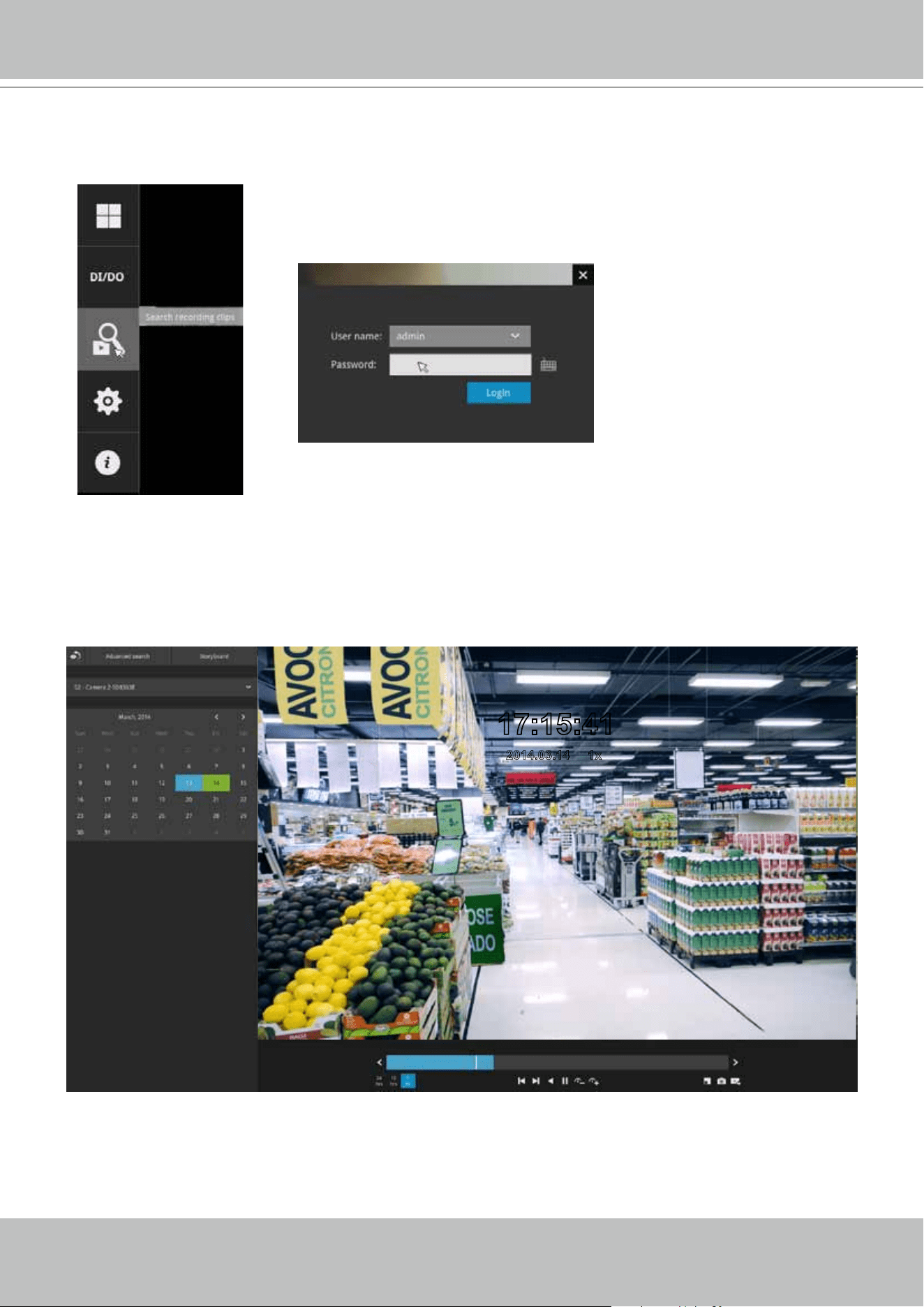
3-2. DI/DO
Click on the DI/DO button to display the full list of all DI and DO
signals (whether they are connected or not) from all cameras in the
conguration. If a digital input signal is triggered, e.g., the DI-4 on the
left, its indicator will turn solid white.
VIVOTEK - Built with Reliability
44 - User's Manual
3-3. Search recording clips
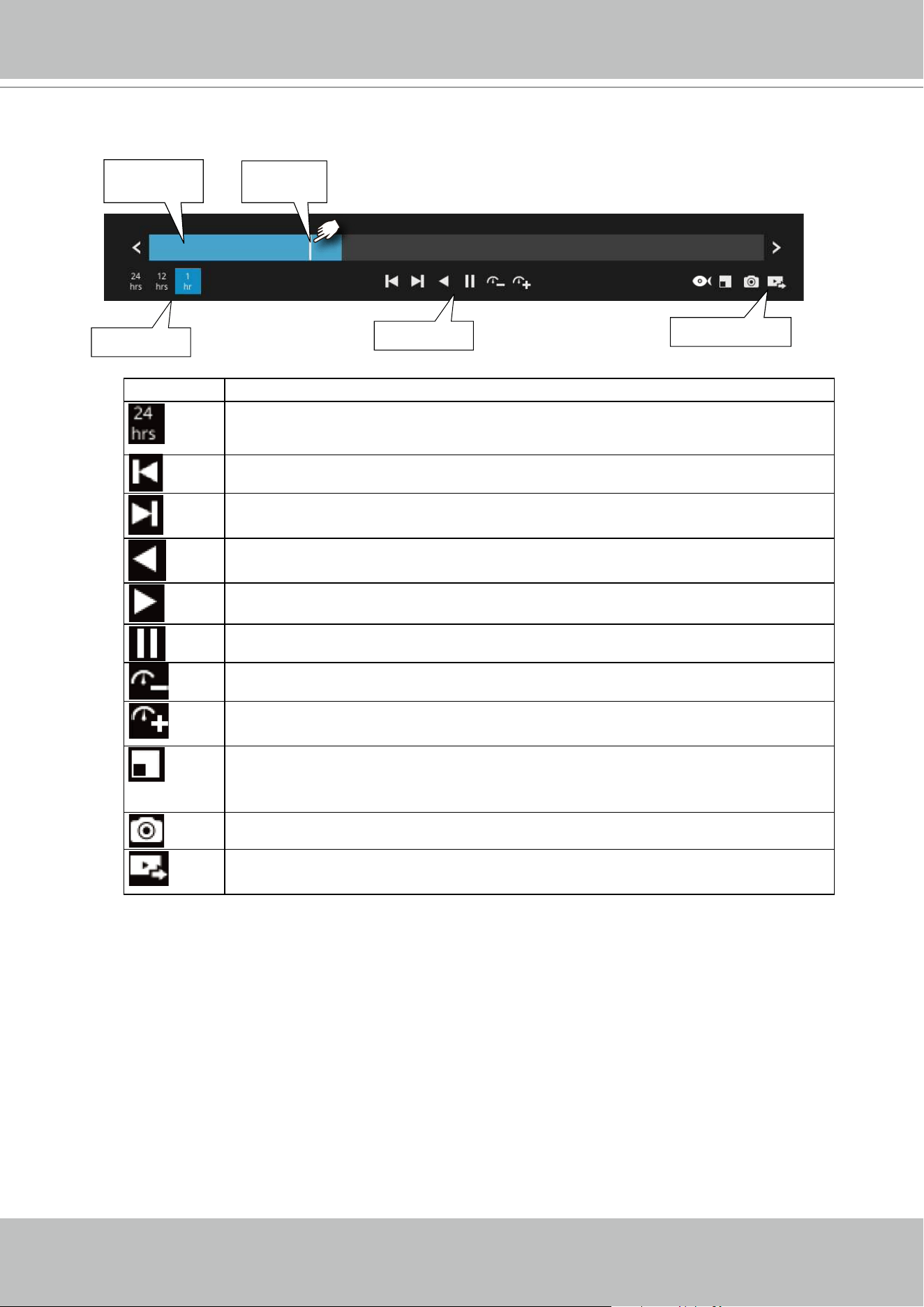
Click the button to start searching for recorded clips. A conrm box will
prompt. Enter User name and Password to proceed.
17:15:41
2014.03.14 1x
The search and calendar view will appear. Select a day on the calendar when the the
recordings took place (the days with recorded clips will be highlighted in blue and green).
Double-click on a day to begin playback and search.
The date highlighted in green indicates today, and the green indicator does not
necessarily mean that there are recorded videos today.
3-3-1. Basic Search
VIVOTEK - Built with Reliability
User's Manual - 45
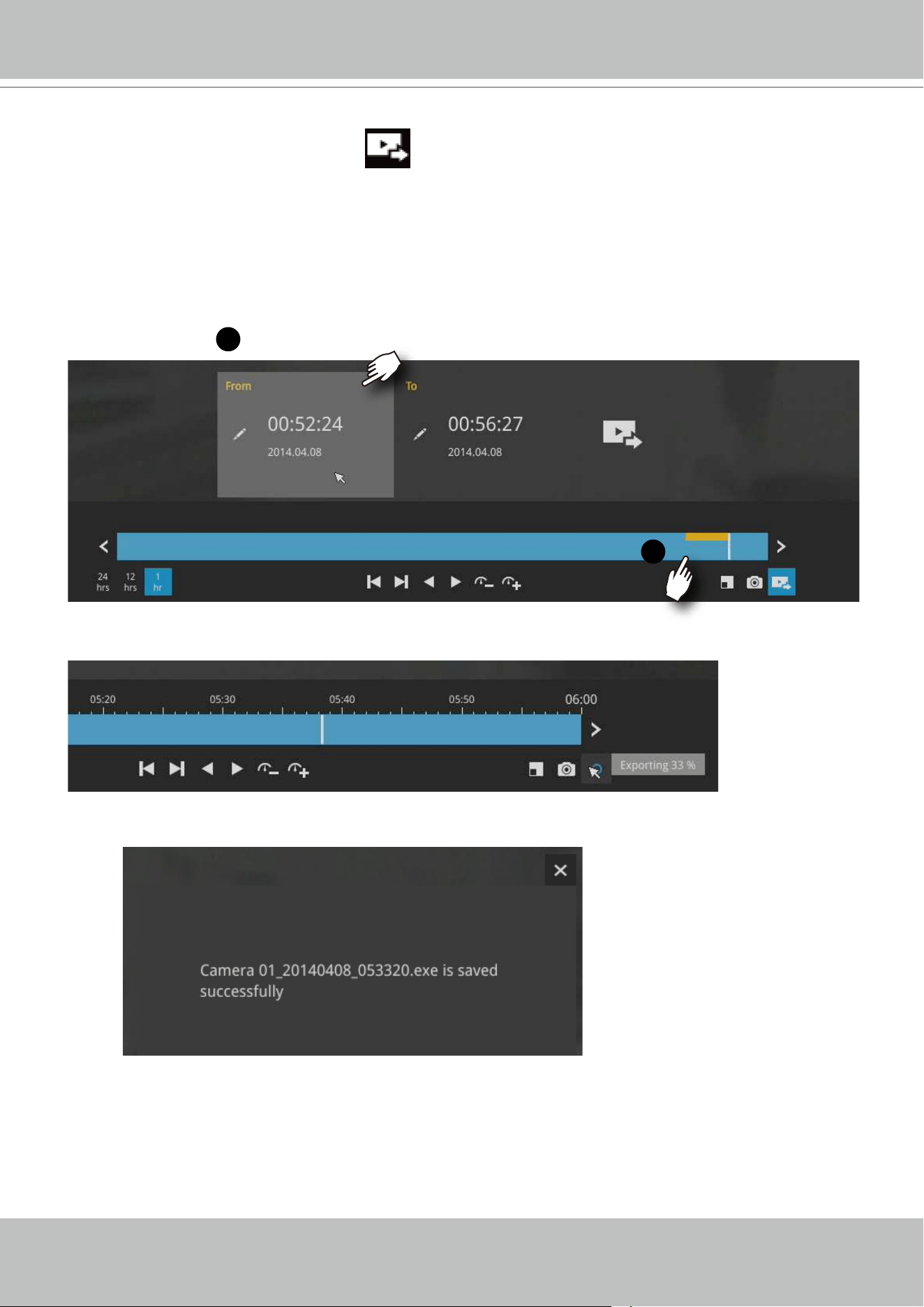
Current time
indicator
Span of existing
recording
Timeline scale
Control buttons
Functional buttons
The timeline bar enables quick skimming through the recording. Its functions are
described as follows:
Buttons Description
Time scale selector. Use the buttons to select the span of time displayed
on the tool bar.
Previous frame. (I-frame only)
Next frame. (I-frame only) After you paused a playback, use this button
to browse video frame by frame.
Play backwards.
Play. This button is available after you paused a playback.
Pause.
Each click on it speeds down by 1/2. The slowest speed is 1/16.
Each click on it speeds up by 2x. The fastest speed is 16 times.
The current playback status is indicated on the screen.
PiP (Picture in Picture). This applies when a camera is displaying the full
of its eld of view. You can use the PiP function to move to unrevealed
areas.
Snapshot. Takes a snapshot of the current FOV.
Export clips. Use this function to select a span of time you want to export
to other medias.
By default, the playback starts from the beginning of a day's recording. While playing the
recorded video, click on the timeline to replay a point in time in the video.
VIVOTEK - Built with Reliability
46 - User's Manual
Note that to export a video segment from the playback timeline,
1. Click on the Export button ,
2. Insert a USB drive formatted in the FAT format.
3. Select the "From time" by clicking on the timeline. You can also manually enter the
"From time" and the "To time."
4. Click on the "From time" tab using a single click.
5. Repeat steps 3 and 4 to congure the To time.
6. Click on the Export button.
1
2
The export process is indicated on the right. Depending on the length of footage to be
exported, this process can take minutes.
When completed, a message will display on screen.
The default for export is 5 minutes before and 5 minutes after the point in time that is
currently selected.
VIVOTEK - Built with Reliability
User's Manual - 47
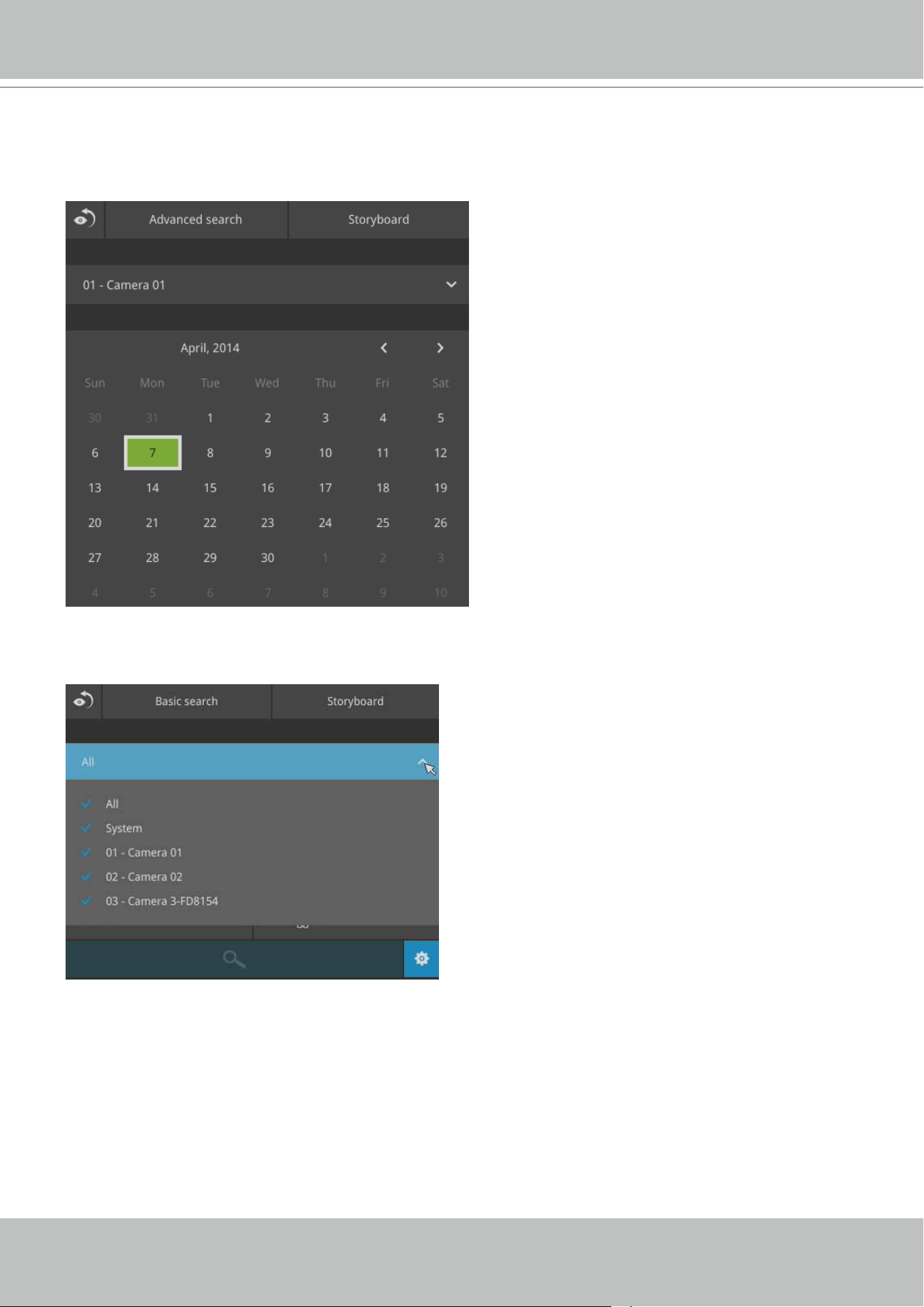
3-3-2. Advanced Search
Click on the Advanced search button on the upper left of the screen to enter the Advanced
Search mode.
You can specify the search criteria by selecting the devices to be involved in the advanced
search.
VIVOTEK - Built with Reliability
48 - User's Manual
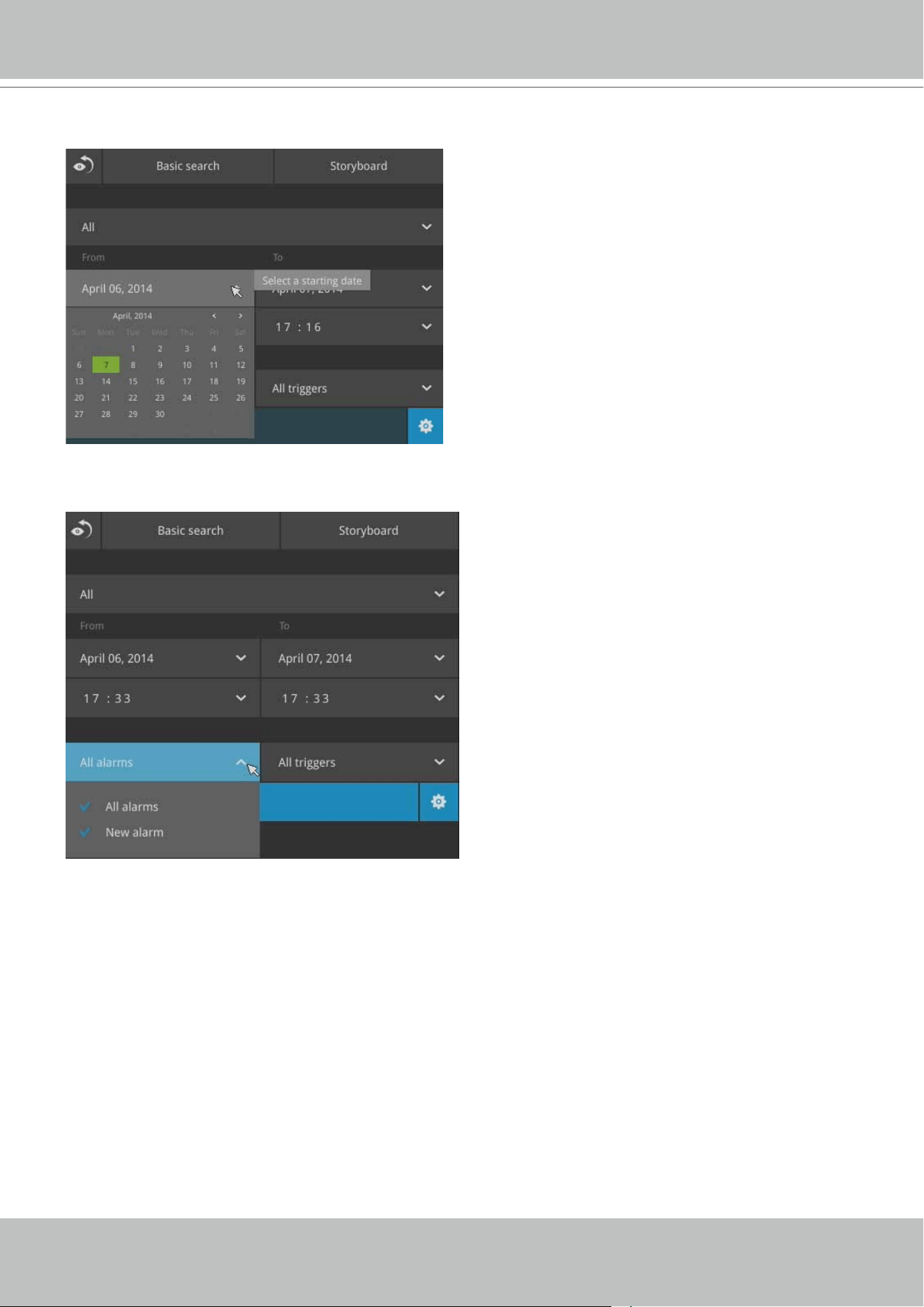
You can then specify the start time and end time to congure a span of time to be searched.
You can also determine what alarms will be included in the search.
VIVOTEK - Built with Reliability
User's Manual - 49
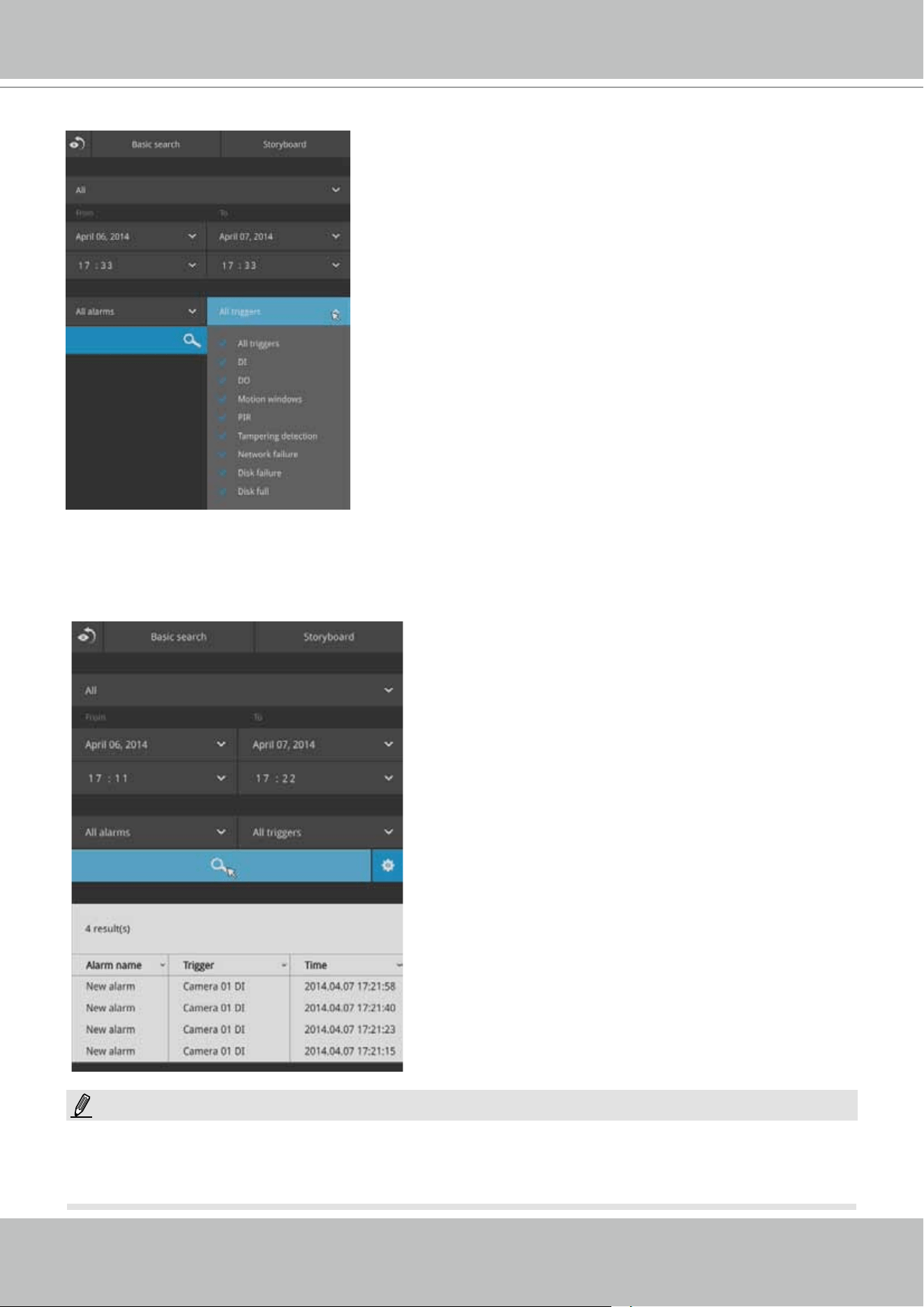
You can select what types of triggers were associated with the recordings you want to nd.
When done with the selection, click on the Search button. In the sample screen below, a list of
alarms is displayed, and you can double-click on any of them to replay the moment when the
alarm was triggered. The alarm-related recording will typically include a length of 5 seconds of
pre-alarm and 20 seconds of post-alarm footage.
When the Search window is left unattended for 10 minutes, the NVR will return to the live view
display. To enter the Search window, you will have to enter the user credentials again.
NOTE:
Up to 200 search result entries will appear. If more
than 200 entries have been found, click on the
New results button on the last entry page.
If two cameras participate in the recording of an
alarm-related event, the footage of one camera will
be played rst, and then that of the other.
If user's operation takes place (pause, rewind,
etc.) during the playback, the system will stop the
consecutive playback of multiple alarm footages.
VIVOTEK - Built with Reliability
50 - User's Manual
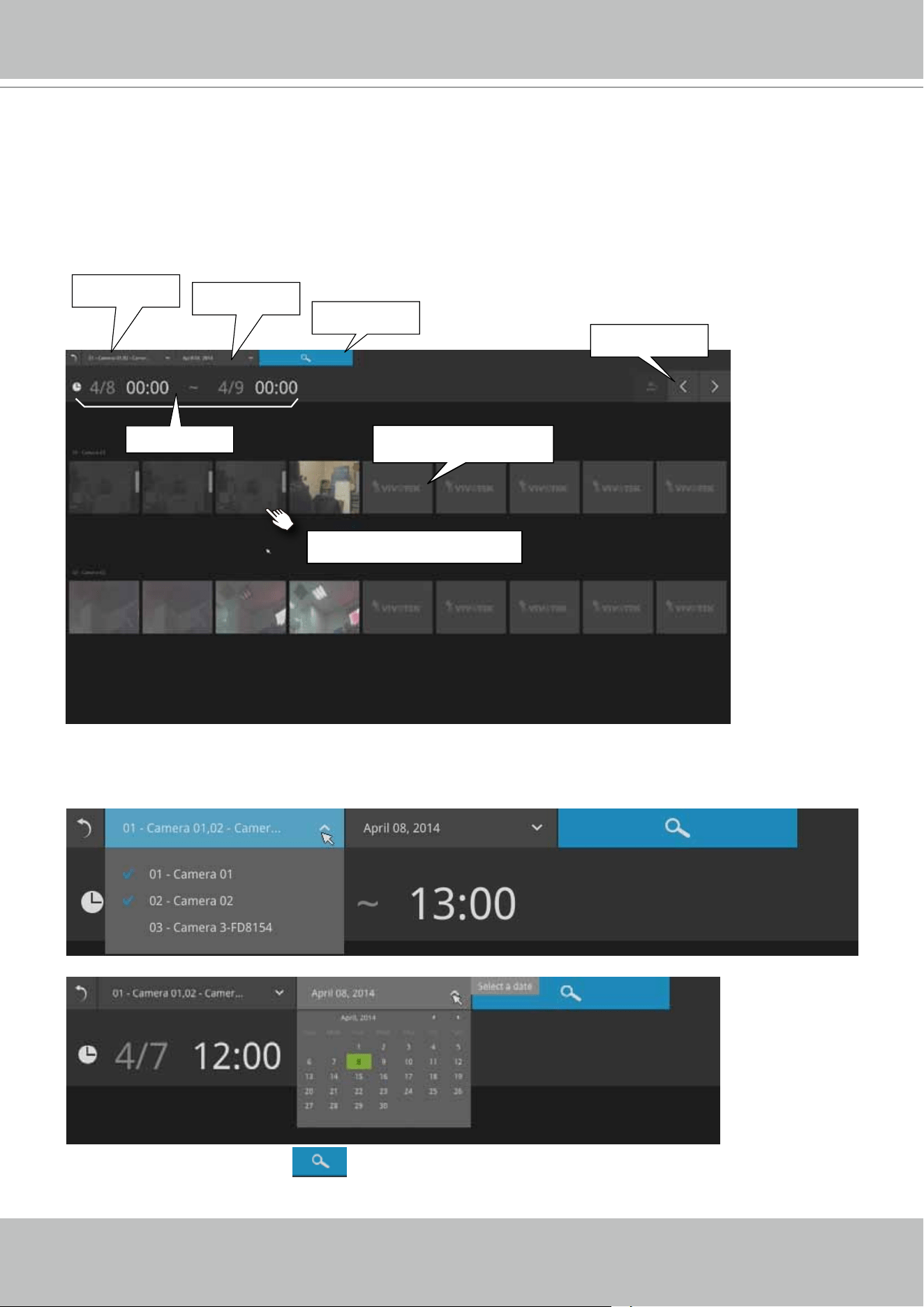
3-3-3. Storyboard
Camera selector
Time selector
Search button
Time span
Snapshots during the time
span
Fore- & backward
buttons
Click to enter a shorter time span
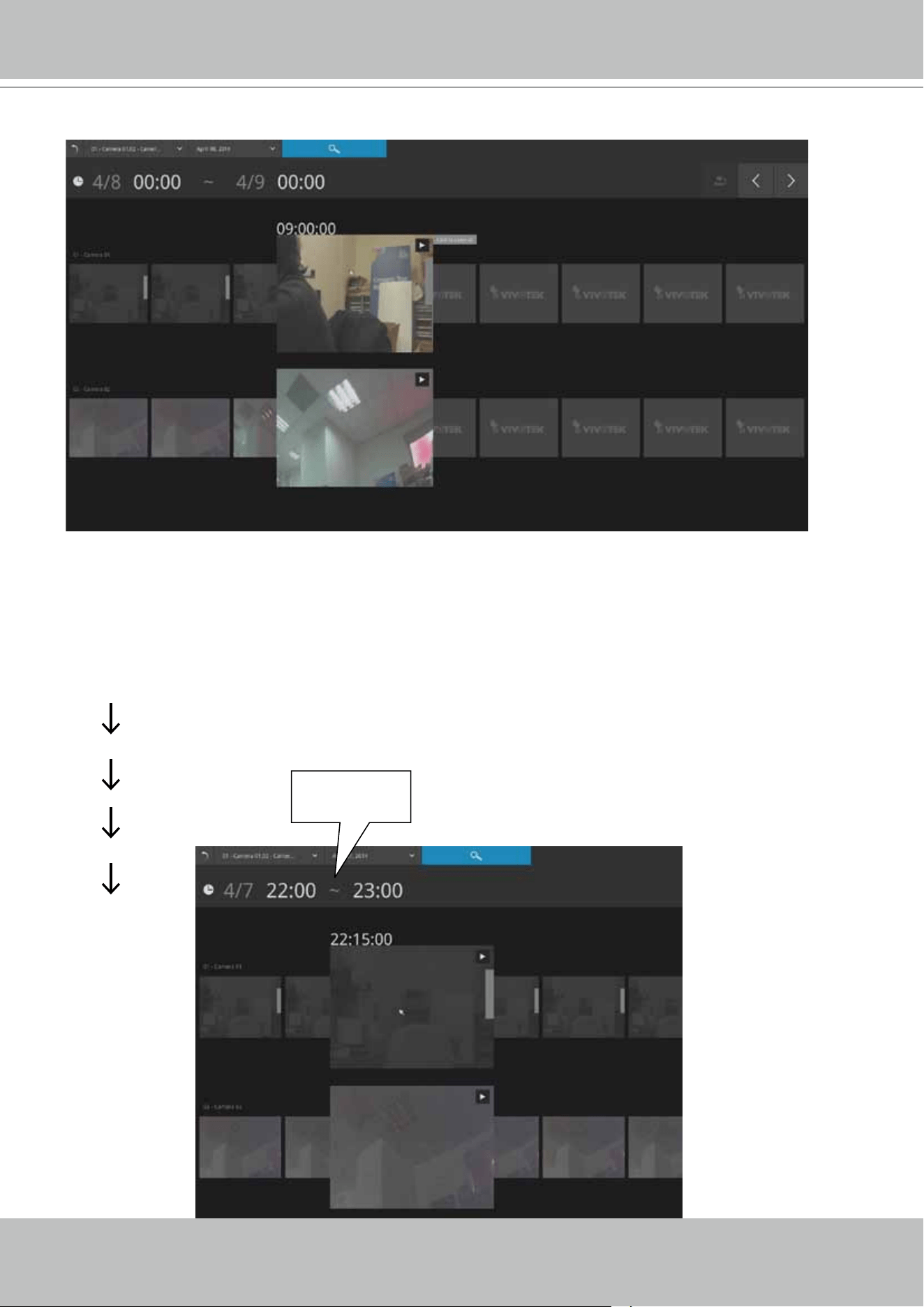
The Storyboard interface provides a glimpse of past recordings over a timeline. It looks like
doing the lm editing after a lm was shot.
To enter the Storyboard window, click on the Storyboard shortcut on the upper-left of screen.
Below are the screen elements of the Storyboard window:
To search for a particular video footage, select the target cameras and the time of recording. On
the Storyboard, the timelines of up to two cameras can be displayed.
Click on the Search button .
VIVOTEK - Built with Reliability
User's Manual - 51
Mouse over the line of snapshots to display its time of recording. Click on a snapshot of your
interest. The time of recording is immediately displayed on top of it.
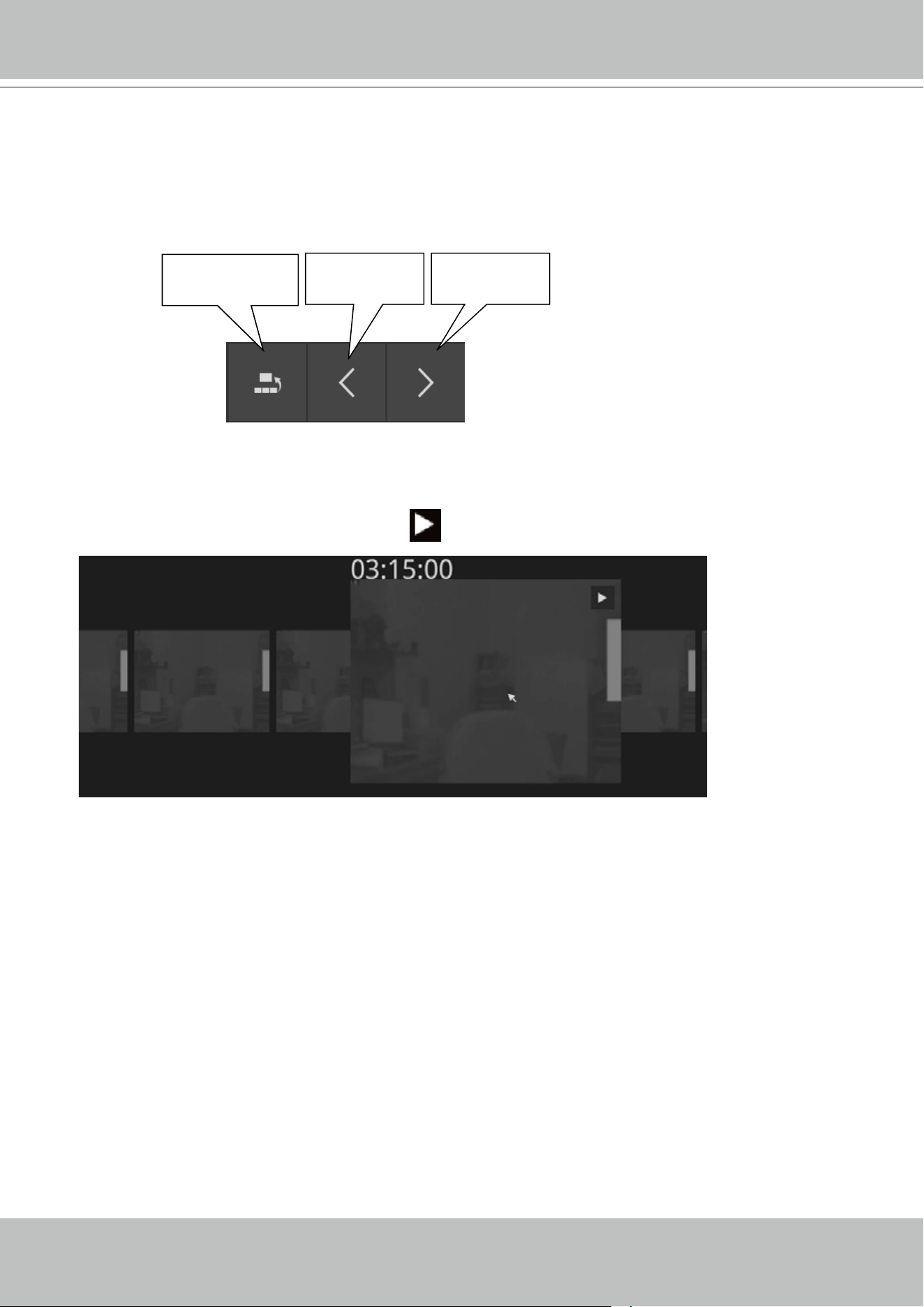
The detailed search is based on a narrow-down criteria. The search begins from a 24-hour time
span, and then moving in to a 4-hour, 1-hour, 10-minutes, and 2-minutes span. When the screen
displays a 24-hour span, each snapshot represents a 3-hour time span.
Each click on a snapshot brings you deeper into the timeline.
24 hour
4 hour
1 hour
10 mins
2 mins
Time span:
1 hour
22:00:00 22:07:30
22:22:30
22:30:00 22:37:30
Below is a sample screen showing the screen of a one-hour time span. Each
snapshot represents a point in time 7.5 minutes apart. Click on a snapshot of
your interest to get deeper into the timeline.
VIVOTEK - Built with Reliability
52 - User's Manual
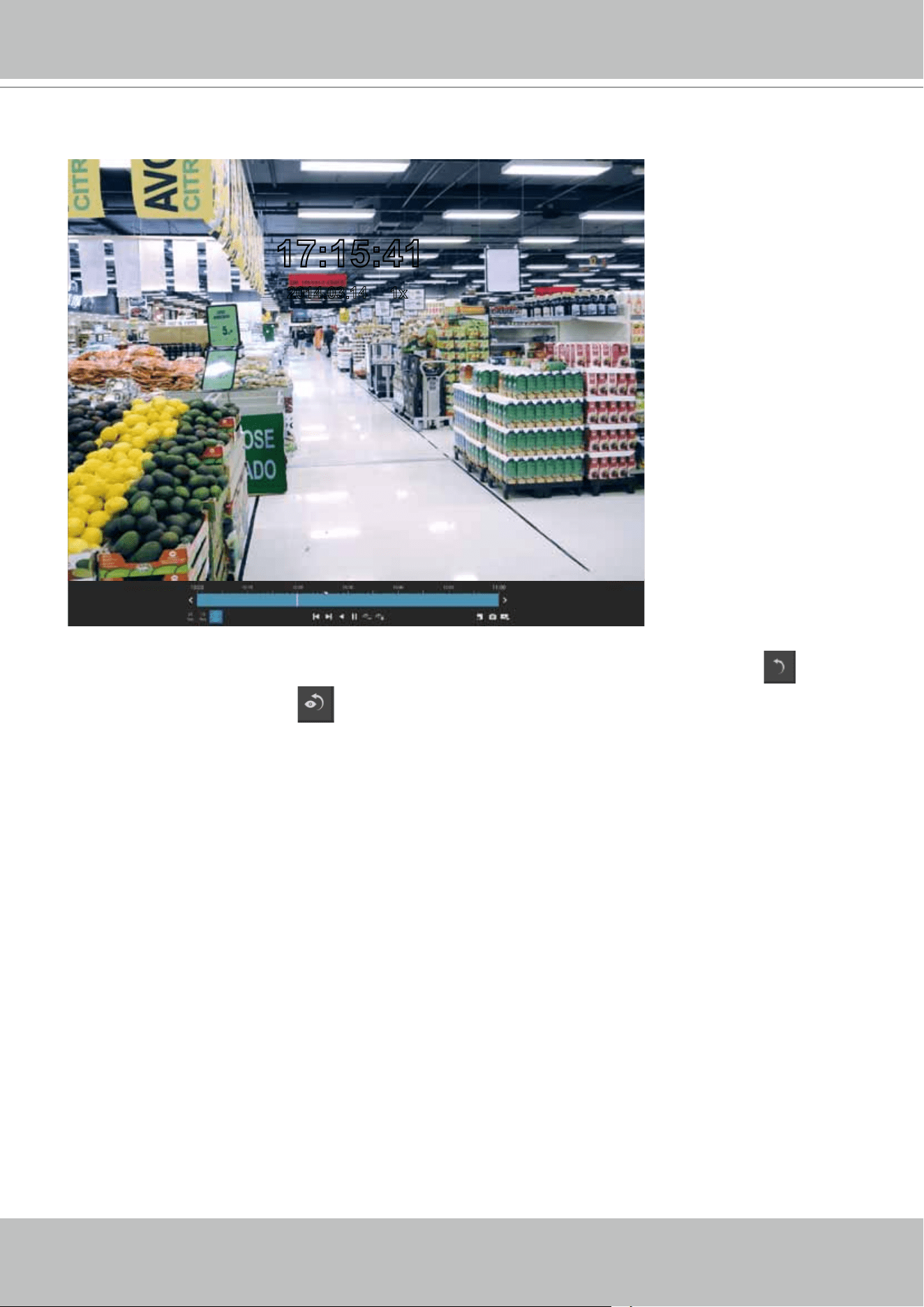
If you nd yourself in the wrong segment on the timeline, use the buttons on the upper-right
of the screen to travel.
The denitions of these buttons depend on the time span of your current position. For
example, if you are in a 4-hour time span, the "Back to previous state button" will bring you
back to the 24-hour time span.
Back to
previous state
Previous
# hours/mins
Next
# hours/mins
The smallest time span is 2 minutes. And on the screen of 2-mins span, each snapshot
represents a 15 seconds video footage.
You can then click on the Play button
to playback the recorded footage.
VIVOTEK - Built with Reliability
User's Manual - 53
17:15:41
2014.03.14 1x
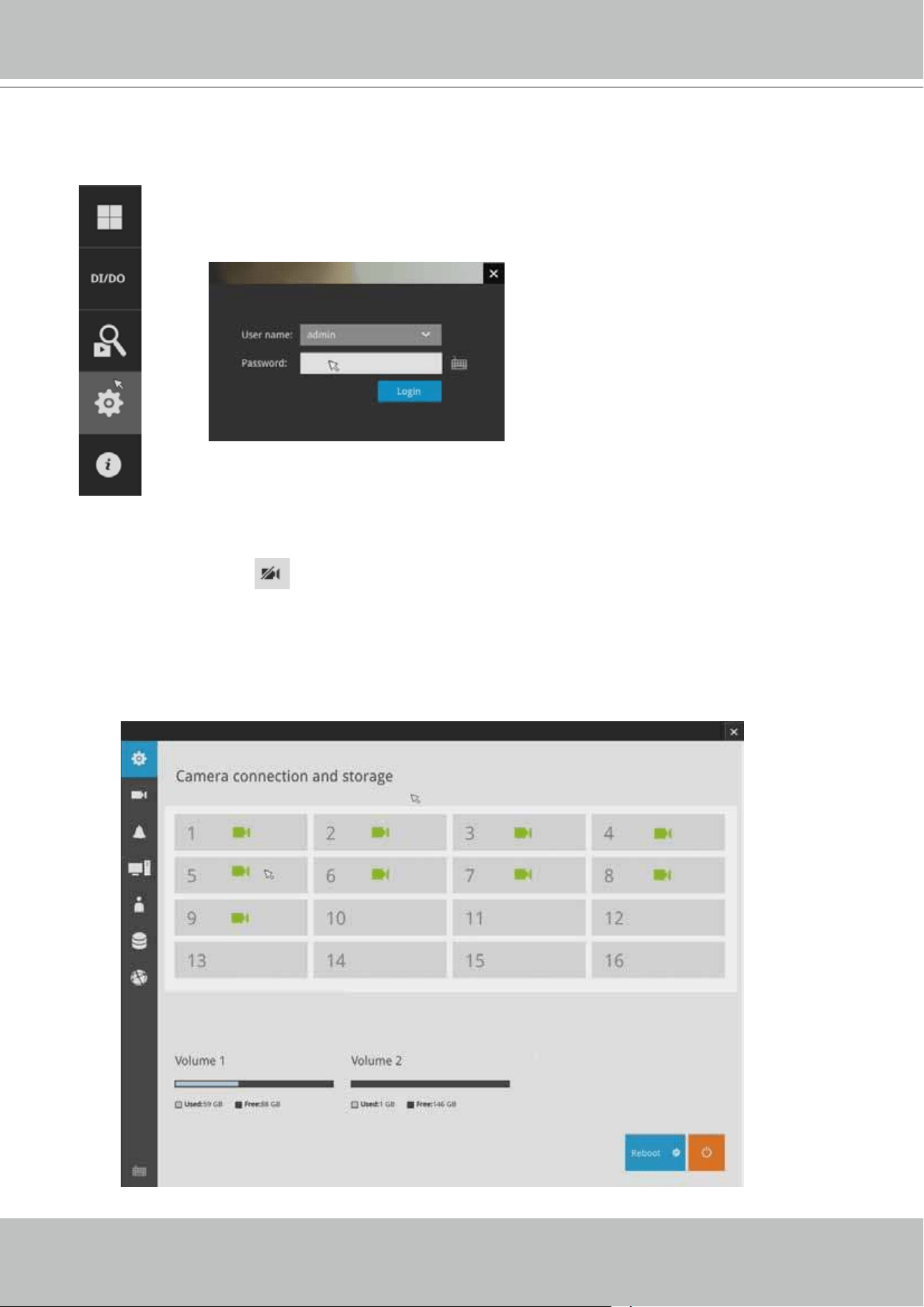
The playback window will appear. Please refer to page 45 for the operation details.
To return to the Live View window, click on the Back to Search recording clips button
and
the Back to Liveview button
on the upper-left of the screen.
VIVOTEK - Built with Reliability
54 - User's Manual
3-4. Settings
Click the Settings button to start the camera and system settings window. A
conrm box will prompt. Enter User name and Password to proceed.
The system will default to the overview page displaying the camera connection and
storage statuses. An empty position will be left in blank, and a disconnected camera will
be indicated as
. The storage volume usage is displayed as the used and unused
spaces.
The Stop Buzzer, Reboot, and Power-down buttons are also available on this page.
There are critical conditions that can sound the system buzzer, such as a disk failure.
3-4-1. Settings - Overview
VIVOTEK - Built with Reliability
User's Manual - 55
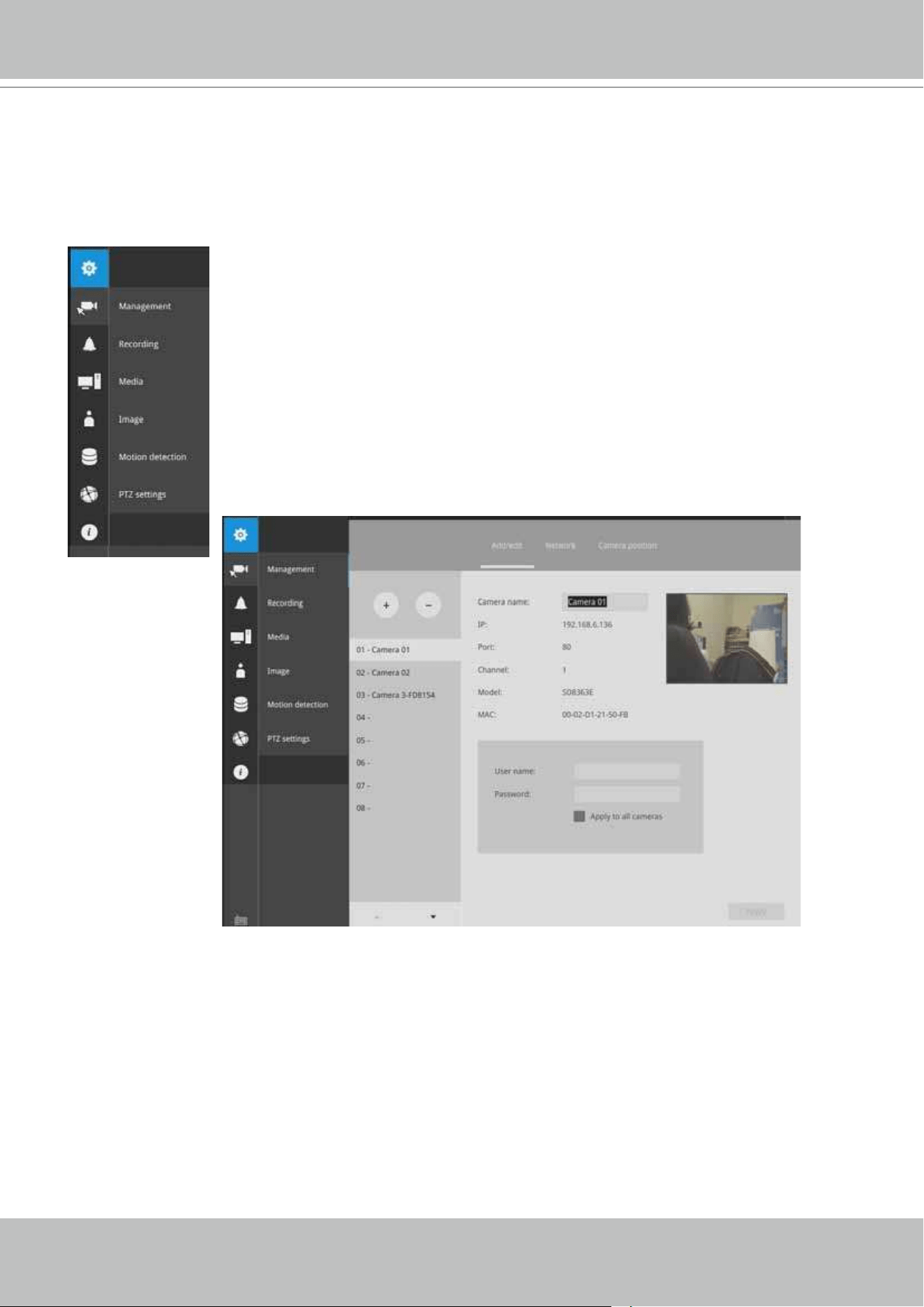
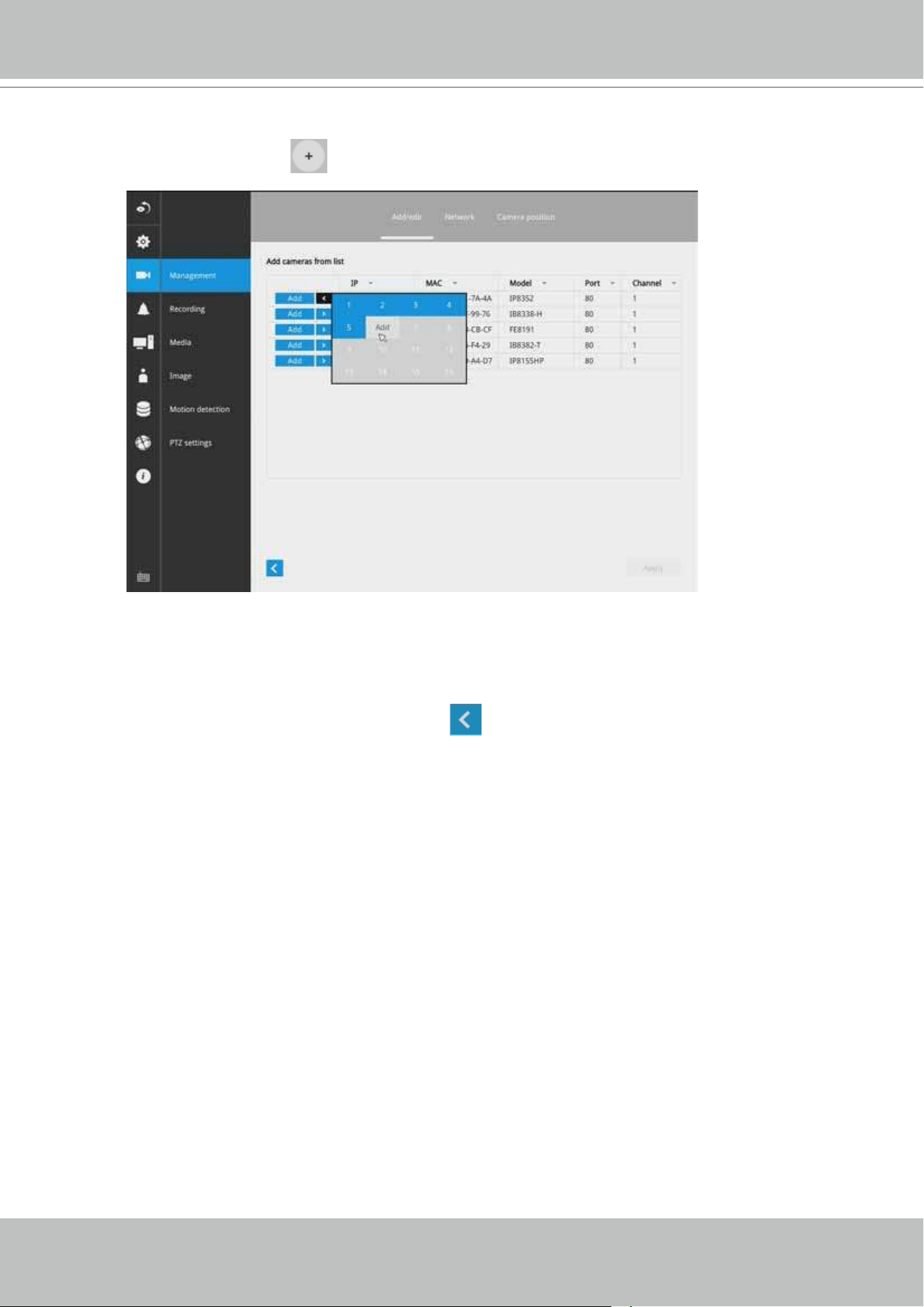
On the camera Management page, you can congure the following:
1. Recruit or disband cameras.
2. Create a camera name.
3. Assign User name and Password, or apply the credentials to all cameras in
your conguration.
4. Change the Network settings.
5. Change the cameras' positions on the layout screen.
3-4-2. Settings - Camera - Management
The Camera menu provides access to Management, Recording, Media, Image, Motion
detection, and PTZ settings pages.
For camera name, you can enter up to 64 alphabetic and numeric characters including
[0-9][a-z][A-Z][_][-][ ]. For user name and password, you can enter up to 64 alphabetic
and numeric characters including [0-9][a-z][A-Z][!][$][%][-][.][@][''][~].
VIVOTEK - Built with Reliability
56 - User's Manual
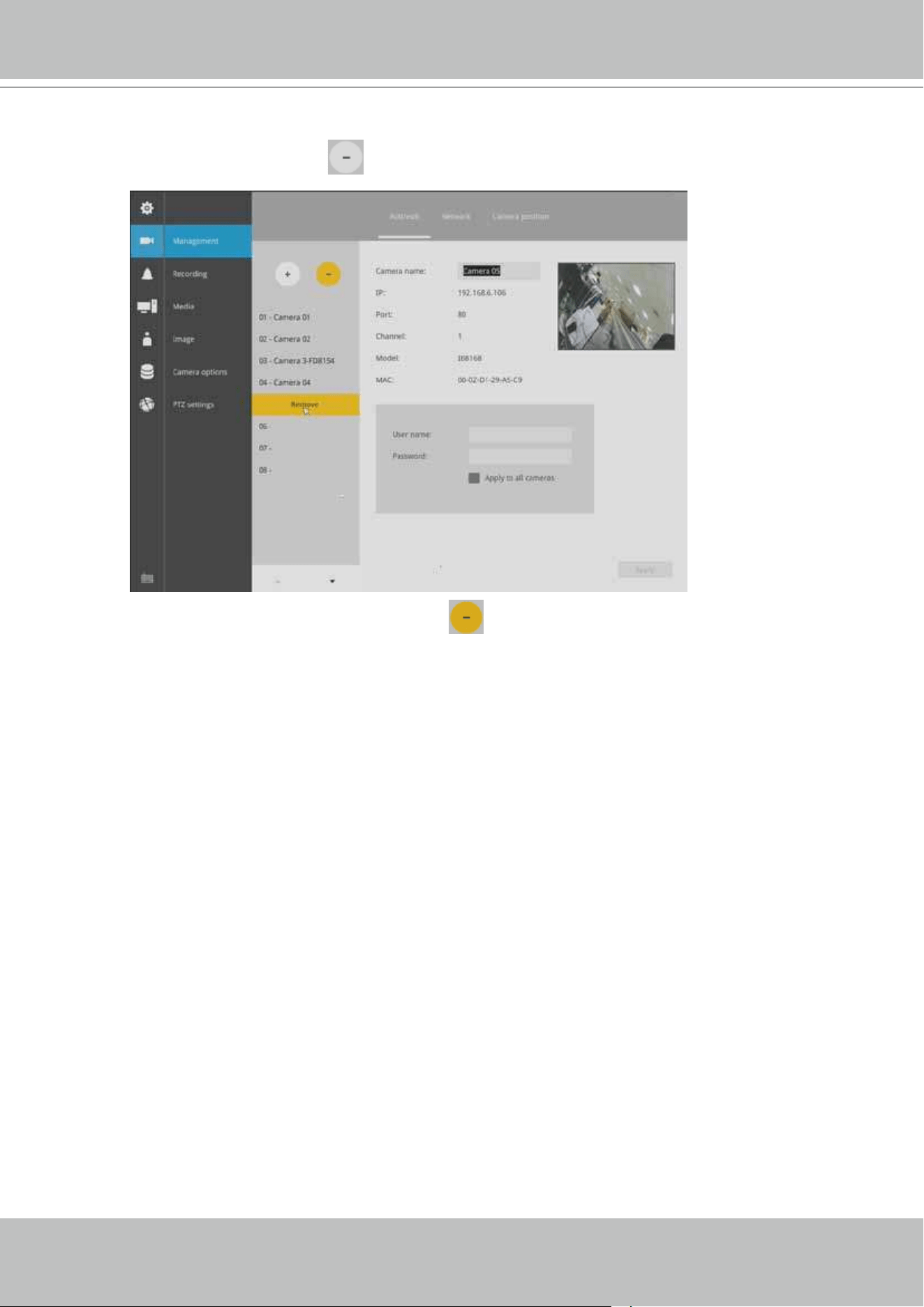
To recruit cameras:
1. Click on the Add button. A list of cameras in the same subnet will appear.
2. Click the Add button, the camera will be placed at an unoccupied position. You may
also expand the menu on the side of the Add button to select a position number.
3. When a camera is added, it should appear on the graphical placement below.
4. Click the Apply button after you added cameras.
5. You may click the page back button
to return to the previous window.
VIVOTEK - Built with Reliability
User's Manual - 57
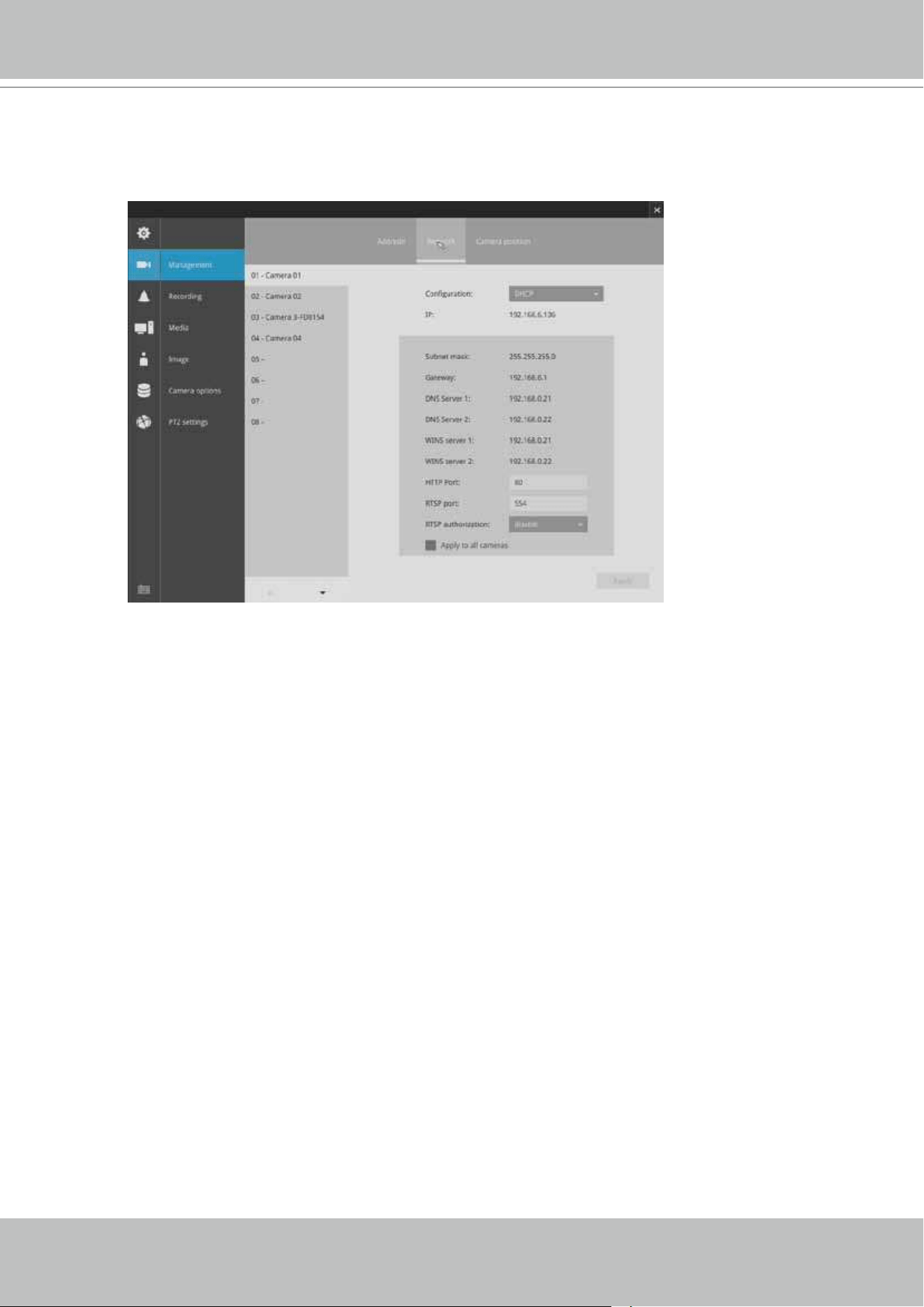
To disband cameras:
1. Click on the Remove button. A list of cameras will appear.
2. The Remove button will turn yellow . Mouse over to the camera you want to
remove, and its entry will display the Remove message.
3. Click on the Remove message. The camera should then disappear from the camera
list. The recording from that camera will also be discontinued.
VIVOTEK - Built with Reliability
58 - User's Manual
Network
On the Network tabbed window, you can congure the network type, IP address, and the
connection ports for video streaming.
You can select DHCP as the method for cameras to acquire IP addresses, or you
can manually congure static IPs for a single or all cameras. Using static IPs is
recommended. Although the NVR can remember the MAC addresses of cameras, if
IPs are changed under the DHCP conguration, your NVR may still fail to connect the
cameras. Please consult your network administrator for details about network settings.
It is usually not necessary to change port numbers for the HTTP and RTSP ports unless
there is a conict in your network environment.
VIVOTEK - Built with Reliability
User's Manual - 59
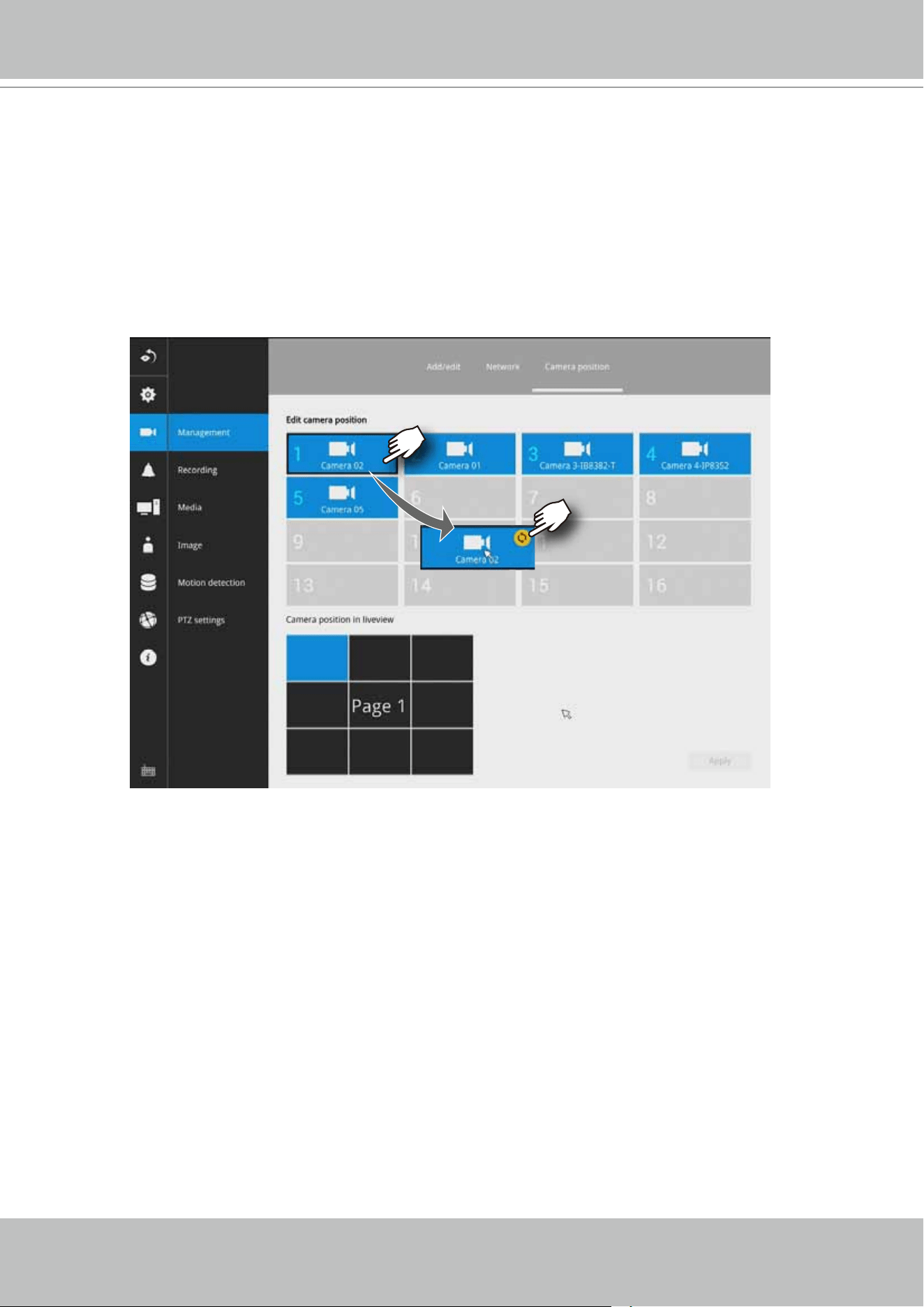
Camera position
To change a camera's position on the Liveview layout, click and drag a camera to an
unpopulated position. Note that you cannot swap the positions of two cameras by
dragging a camera onto a position already populated by the other. Also, the camera
index number on the management list is not affected by the change of positions.
Click the Apply button for the conguration change to take effect. The position screen
displays the current layout on the Liveview screen.
VIVOTEK - Built with Reliability
60 - User's Manual
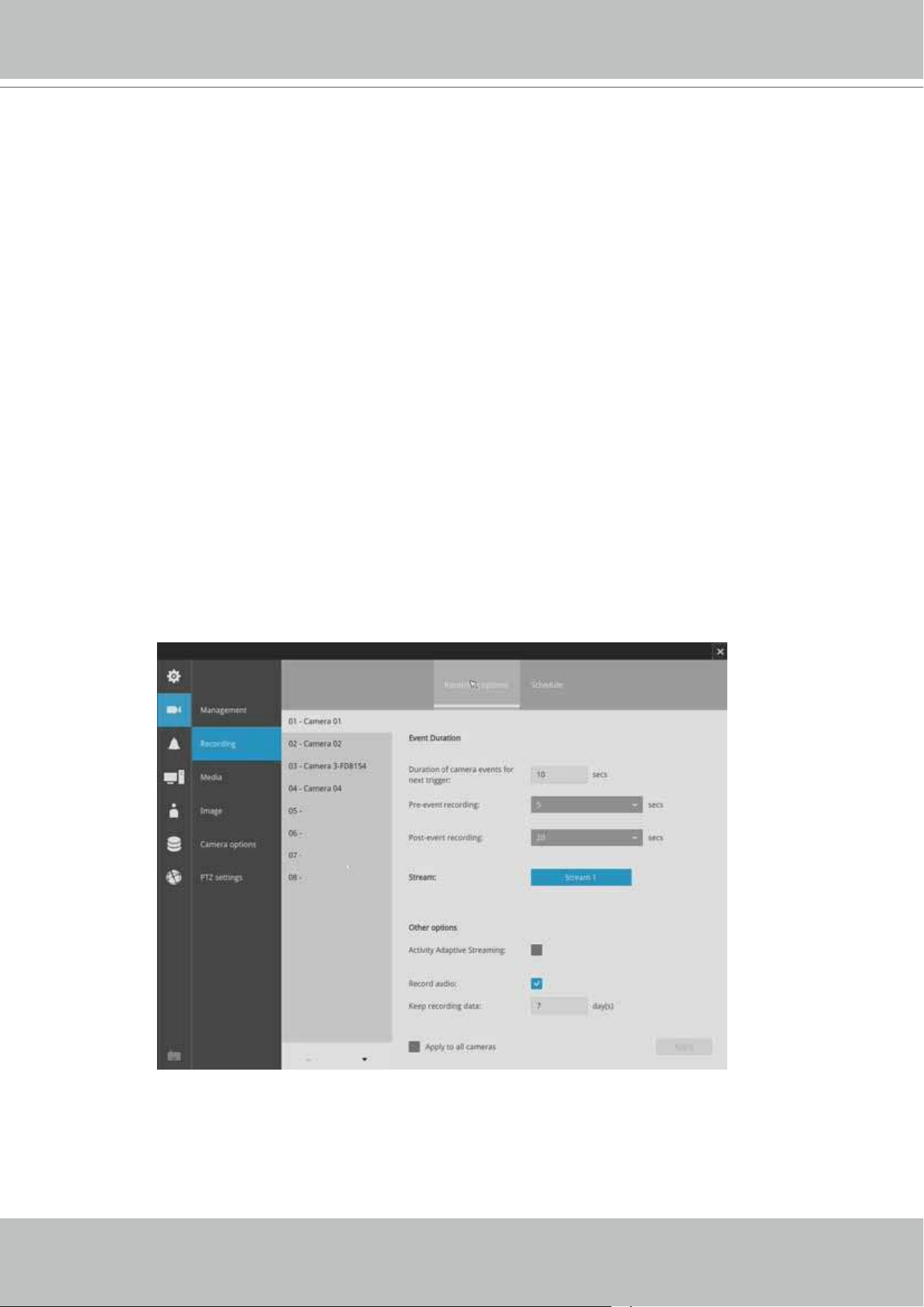
Recording options
On the camera Recording page, you can congure the following:
1. Congure the duration of camera events, for the concern that camera can be too
frequently triggered.
2. Enter the Pre- and Post-event recording time. The triggering events can be DI,
DO, Motion detection, PIR, or Tampering detection.
3. The default recording stream is Stream 1, and the system automatically adjusts
the frame rate, resolution, etc. for optimum performance. However, you can still
change the streaming characteristics. Note that you can not assign the recording
task to other video stream.
4. Enable the Activity Adaptive Streaming feature. This feature records the I-frames
only when there are no activities detected. When activities or alarm are triggered,
the camera raises the recording stream to the full frame rate. This feature can
save tremendous ammount of bandwidth.
5. Enable or disable audio recording. Note that audio transmission through HDMI
cable is currently not available.
6. Change the life expectancy of the recording data.
7. You can apply a typical conguration to all cameras using the Apply to all cameras
checkbox.
3-4-3. Settings - Camera - Recording
You can refer to the User Manuals that come with your network cameras for more
discussions of these congurable options.
VIVOTEK - Built with Reliability
User's Manual - 61
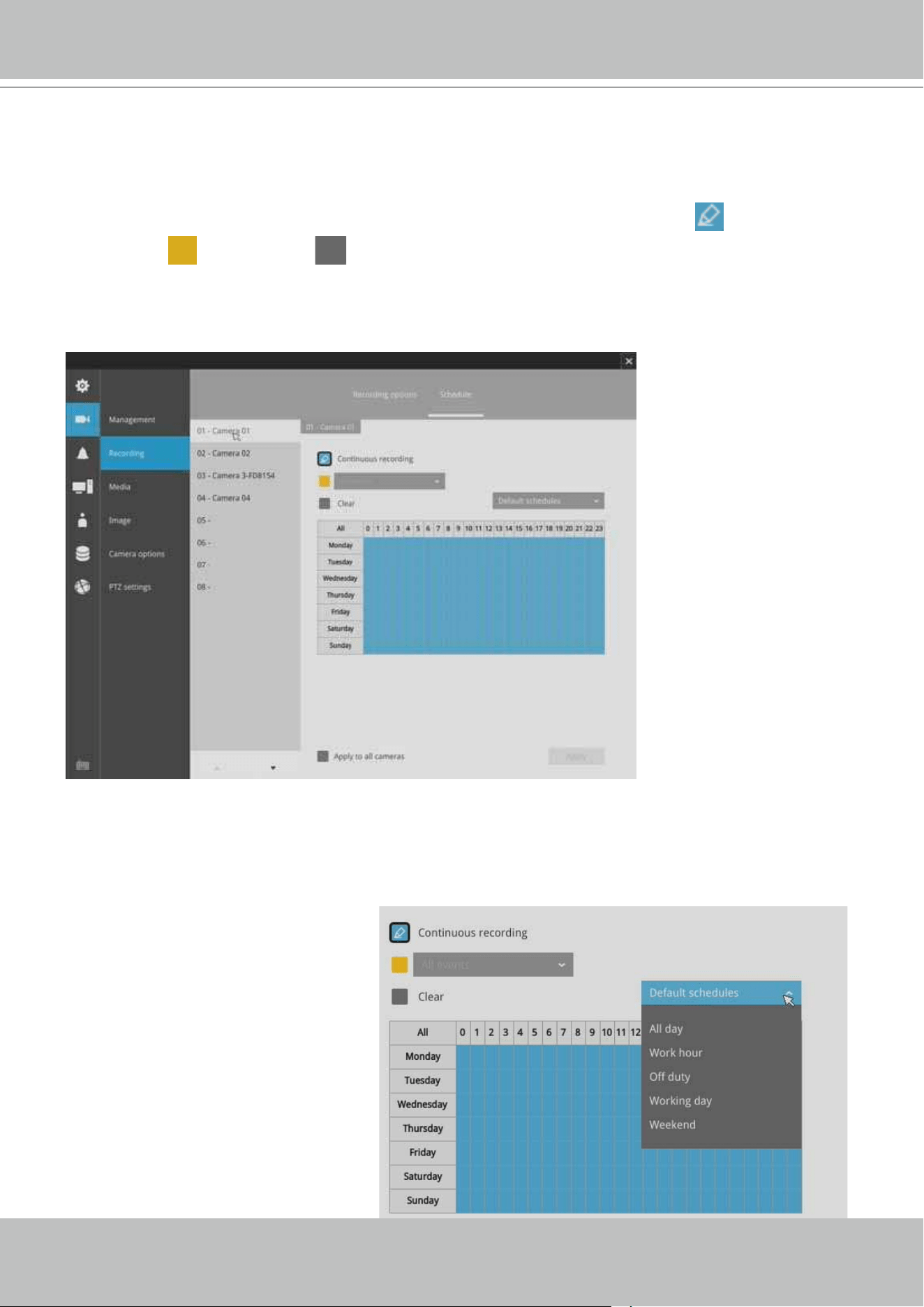
Recording Schedule
By default, all video feeds from cameras are recorded at all time. You can modify the recording
task using the schedule tool:
1. Click to select a recording condition's checkbox - 1. Continuous recording
, Event
recording
, and 3. Clear (no recording).
2. Click and drag on the cells on the time table. For example, to stop the recording during a
period of time, select the the Clear checkbox and move the cursor across the time table. The
minimum unit on the table is half an hour.
3. You may also use the scheduler tool on the right to facilitate the process. You can select a
condition checkbox, and then select the All day, Work hour, Off duty, Working day, Weekend
options to apply a time selection.
4. Repeat the process on individual cameras or select the Apply to all checkbox if the schedule
can apply to all cameras.
5. When done with the conguration,
click on the Apply button.
Note that Event-triggered
recording and continuous
recording can not be take place
at the same time.
VIVOTEK - Built with Reliability
62 - User's Manual
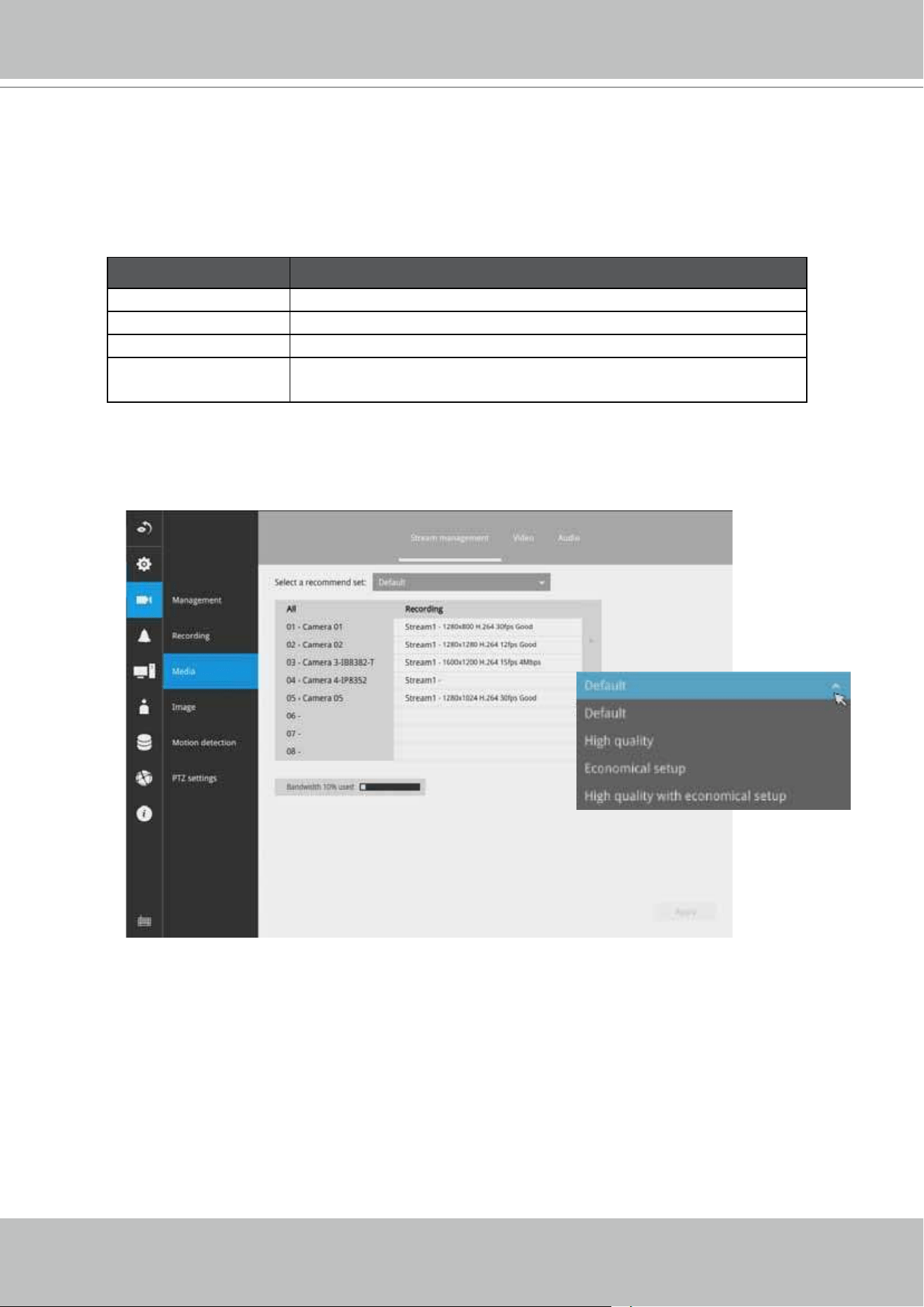
Stream management
The stream here refers to the recording stream, namely, Stream 1. You can use these
preset conditions to congure the resolution, image quality, frame rate, and the bandwidth
consumption of the recording stream on this window.
Recommended setting
Conguration
Default Medium resolution; full frame rate
High Quality Guaranteed video quality set as Good; full frame rate
Economical Medium to low resolution; frame rate at 5fps
High quality w/
economical
High resolution, Good image quality; frame rate at 5fps
With each recommended conguration applied, the estimated bandwidth consumption
value is immediately calculated and displayed at the lower screen.
Click the Apply button for the conguration change to take effect.
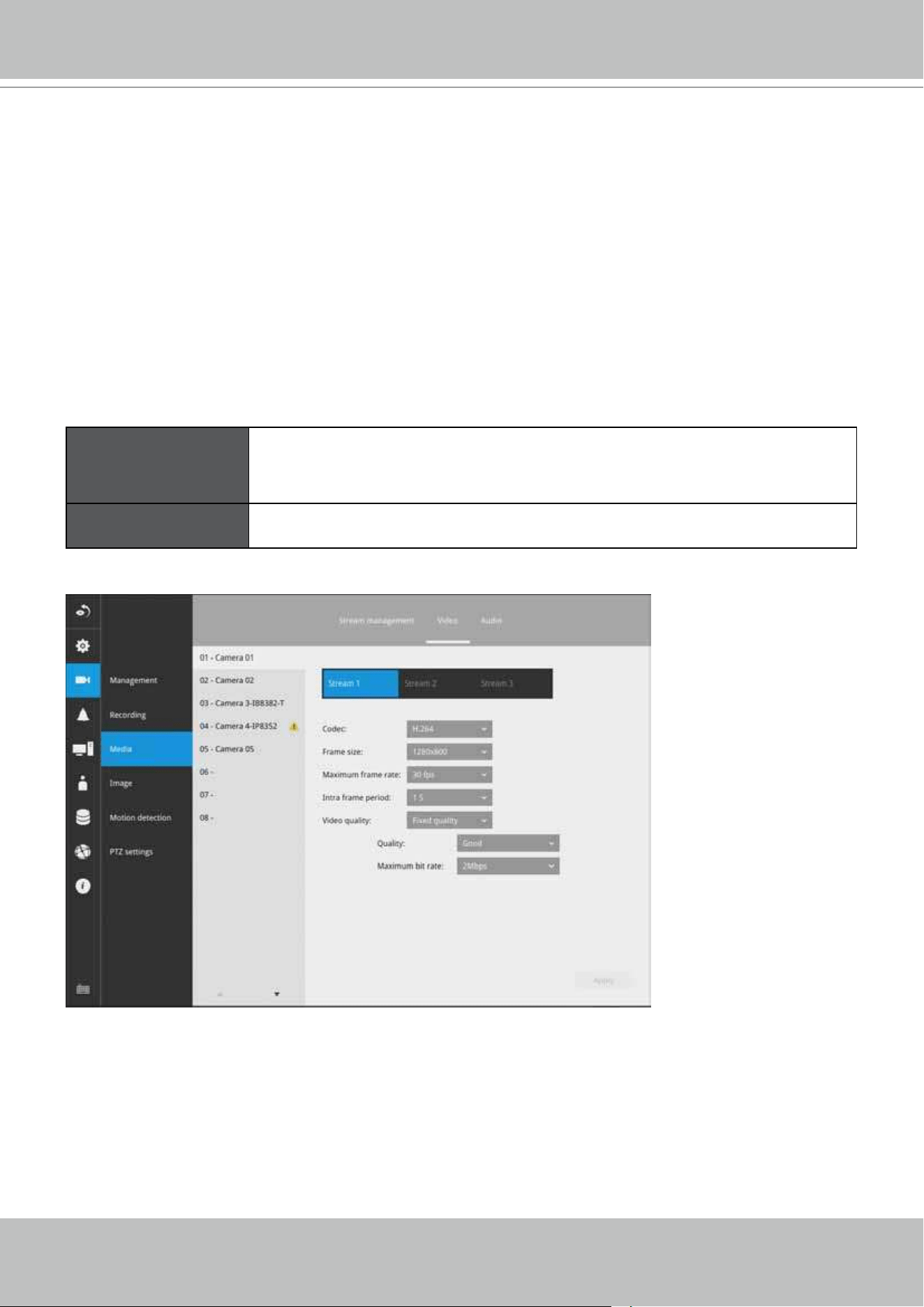
3-4-4. Settings - Camera - Media
VIVOTEK - Built with Reliability
User's Manual - 63
Video
The Video window allows you to congure all video streams (the no. of stream available can be
different for different models). You can congure the following:
1. Codec: video compression codec in H.264, MPEG-4, or MJPEG. Note that MPEG-4 is not
supported for Liveview.
2. Frame size: video resolution. Note that due to the limited CPU resources, you may not be
able to change the resolution to a very high value, e.g., 5MP in the 1920x1920 resolution.
3. Maximum frame rate: the highest frame rate.
4. Intra frame period: How often an I-frame will be inserted into the video stream.
5. Video quality: You may either select Constant bit rate or Fixed Quality as the dening rules for
video transmission:
Constant bit rate Places a packet size threshold on video frames; This guarantees
the frame rate per second performance, yet image quality can be
compromised if bandwidth is not sufcient in your network environment.
Fixed Quality Guaranteed video quality, and to ensure image quality, some frames may
be dropped when bandwidth is not sufcient.
When done with the conguration, click the Apply button.
VIVOTEK - Built with Reliability
64 - User's Manual
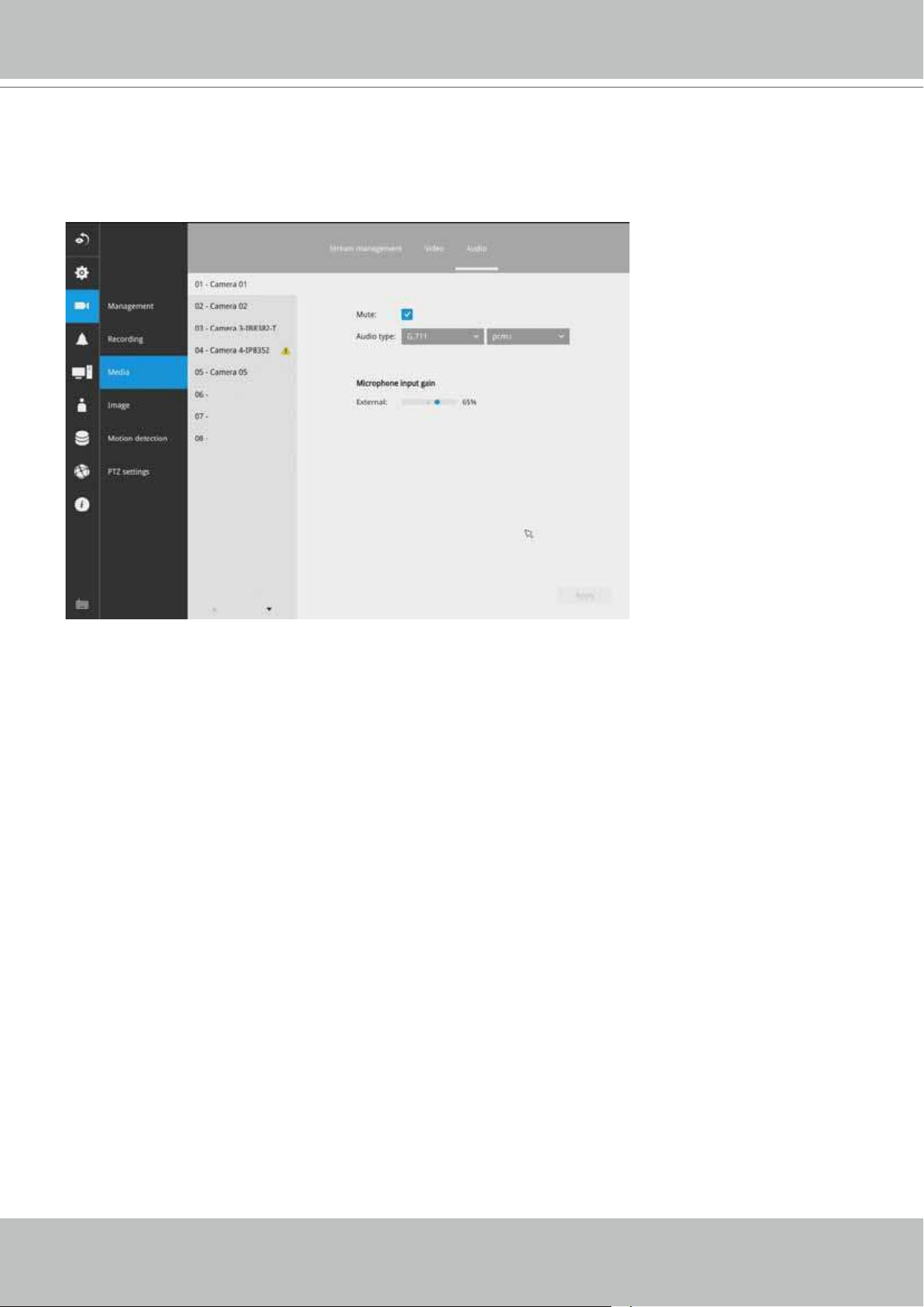
Audio
The Audio window allows you to congure all audio codec, sampling rate, and Microphone input
gains. Depending on design of the camera models, some codecs may not be available. Also,
there are cameras that come without embedded mircrophones.
VIVOTEK - Built with Reliability
User's Manual - 65
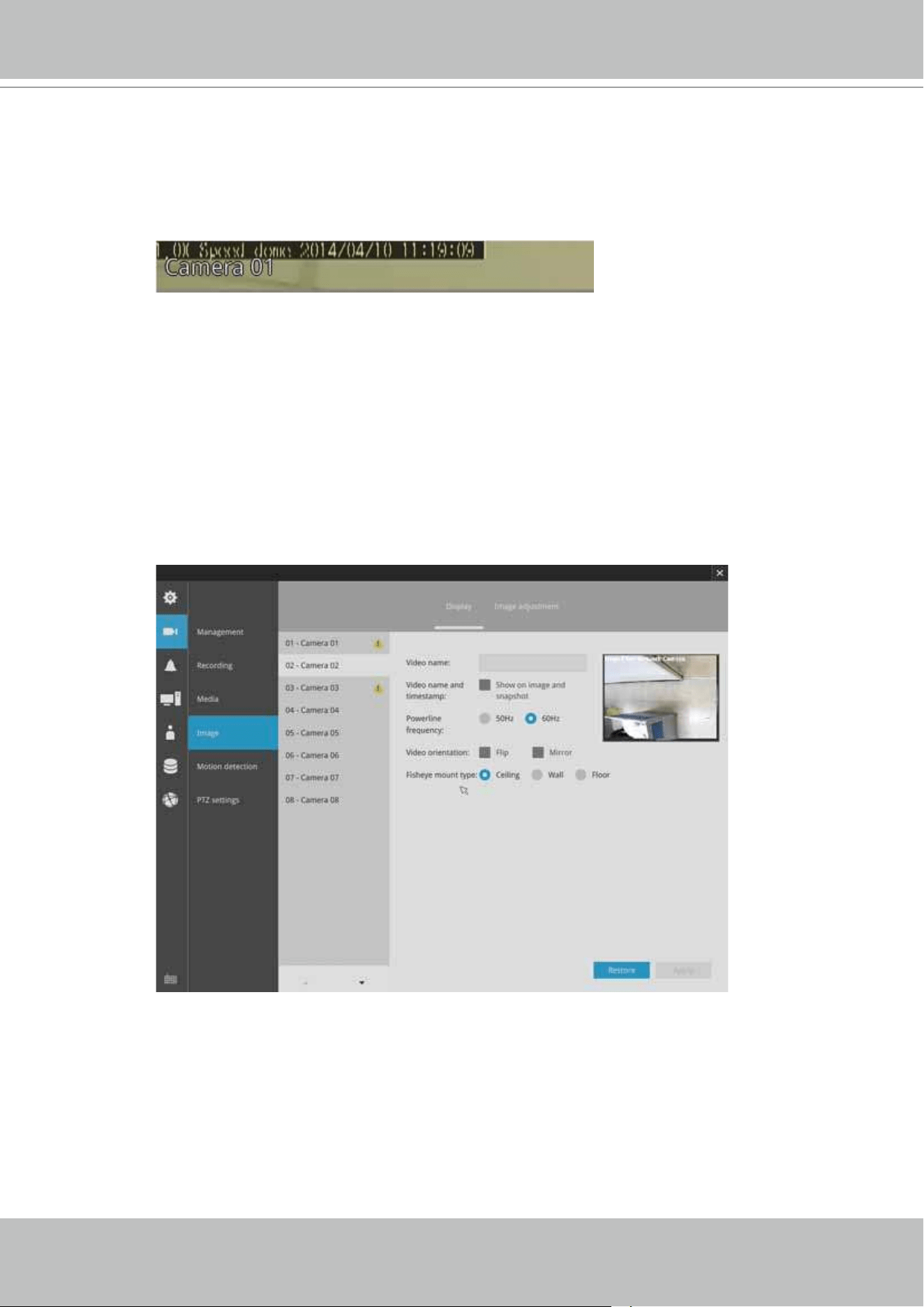
Display
The Display window allows users to tune the image display options:
1. Video name: the video name is displayed on the title bar that is displayed on each
view cell. The screen shot below shows a name as "Speed dome."
2. Video name and timestamp: Default is enabled. If enabled, the video name and
time is displayed on the view cell.
3. Power line frequency: Depending on power line frequency of your country, select
a matching option, NTSC 60Hz or PAL 50Hz, to avoid image ickering due to
unmatched electricity.
4. Video orientation: select these options if the image from camera needs to be
vertically or horizontally ipped.
5. Click Restore to poll for the original settings or click the Apply button to nish the
process.
3-4-5. Settings - Camera - Image
VIVOTEK - Built with Reliability
66 - User's Manual
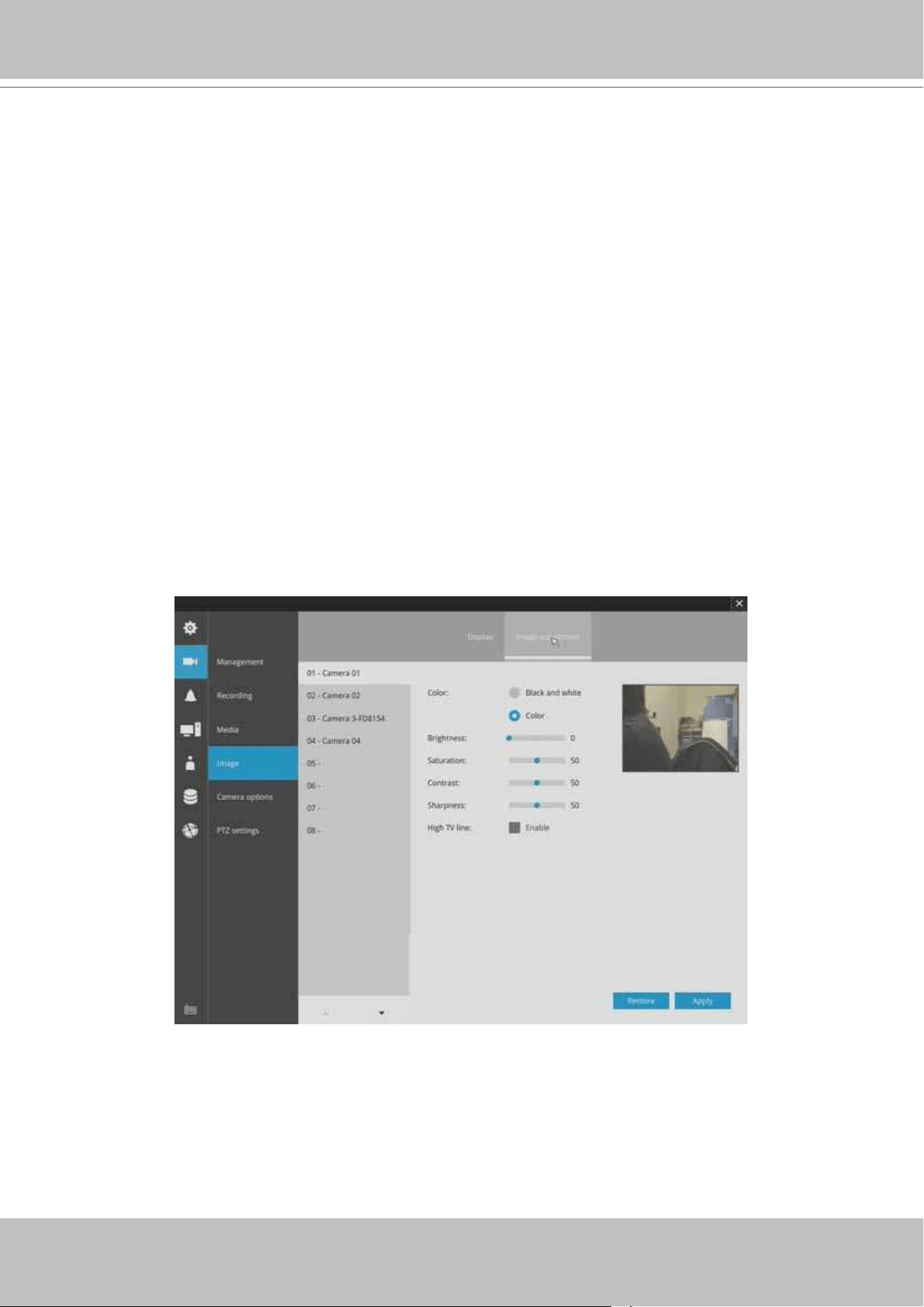
Image adjustment
The Image adjustment window allows users to tune the basics about image display
options:
1. Color: Select to display image as color or black and white.
2. Brightness.
3. Saturation.
4. Contrast.
5. Sharpness.
6. High TV line, Gamma curve, low light compensation, etc. The rest of the options
depend on the lens and image sensor type of each individual camera. Therefore,
the options here can vary. For unique options coming with each individual camera,
please refer to their User Manuals for more information.
Click Restore to poll for the original settings or click the Apply button to nish the
process. For features common among cameras, you may select the Apply to all
cameras checkbox.
VIVOTEK - Built with Reliability
User's Manual - 67
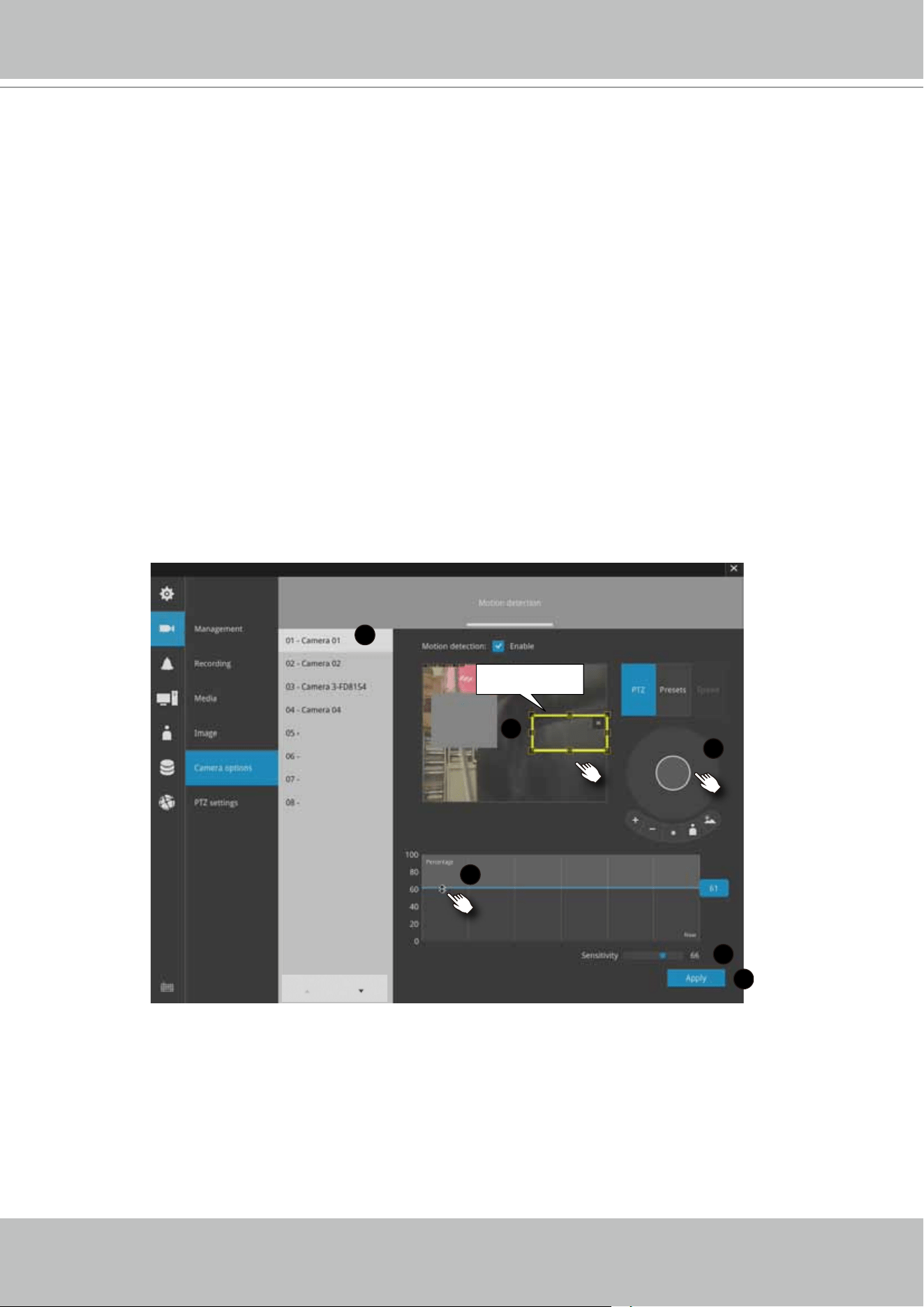
Motion Detection
To set up a detection window:
1. Select a camera by a single click.
2. Use the PTZ panel to move to a eld of view where you want to place a detection
window.
3. Click and drag to draw a rectangular detection window.
4. Pull the detection area level up to a preferred position. An object must be larger
than the detection area to trigger an alarm.
5. Select a Sensitivity level using the slide bar.
6. Click the Apply button for the conguration to take effect.
The sample screen shows a connection with a speed dome camera.
If you already congured Preset positions, expand its menu and click on the
presets to move to a position.
3-4-6. Settings - Camera - Motion Detection
Detection window
1
2
3
5
6
4
VIVOTEK - Built with Reliability
68 - User's Manual
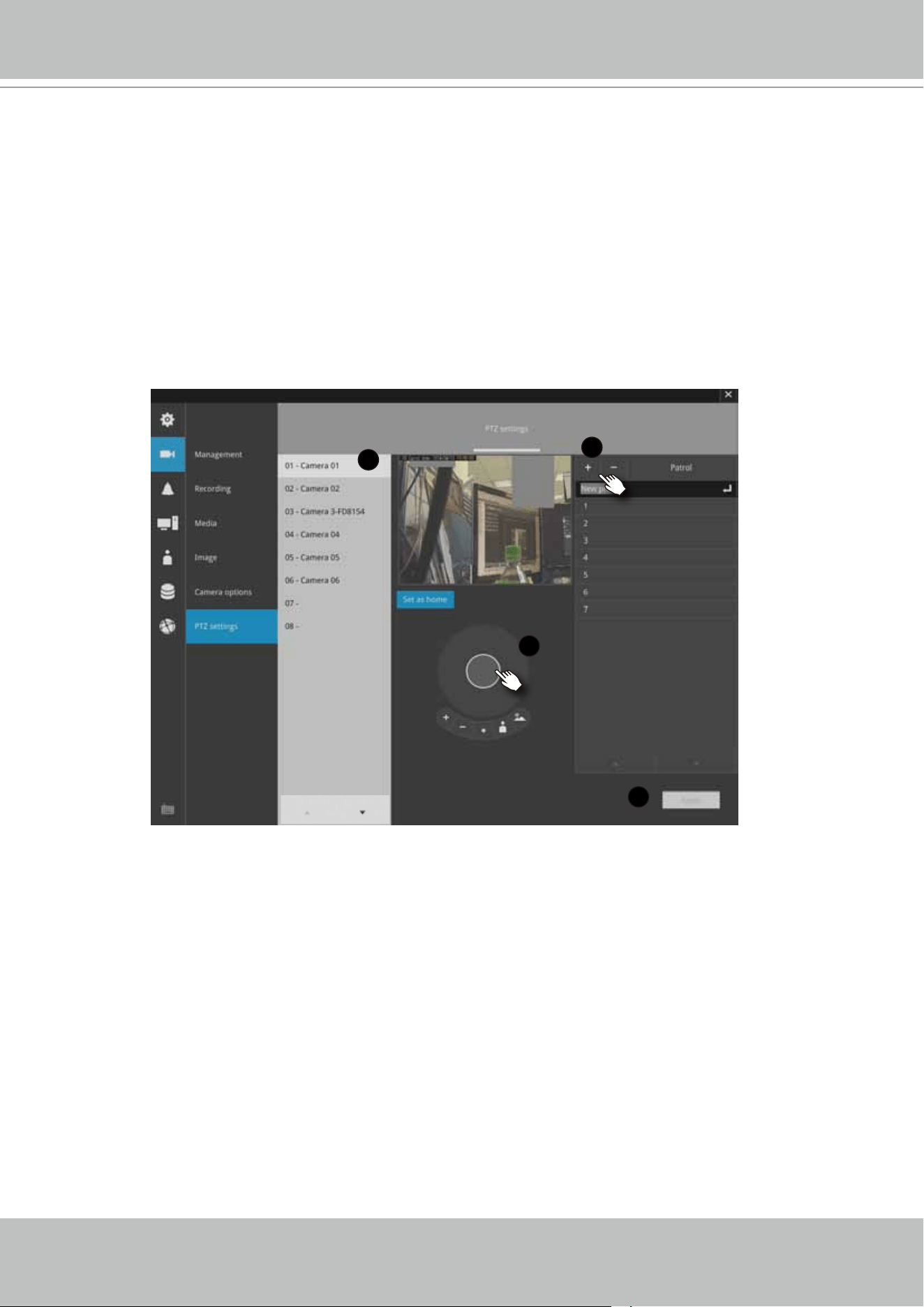
To congure PTZ preset positions:
1. Select a PTZ camera by a single click.
2. Use the PTZ panel to move to a eld of view where you want to designate as a
preset position.
3. Click the add button, and enter a name for the position. Press Enter to proceed.
Repeat the conguration to create more positions.
4. Click the Apply button for the conguration to take effect.
Note that the PTZ panel can vary with different PTZ cameras.
3-4-7. Settings - Camera - PTZ settings
1
2
3
4
VIVOTEK - Built with Reliability
User's Manual - 69
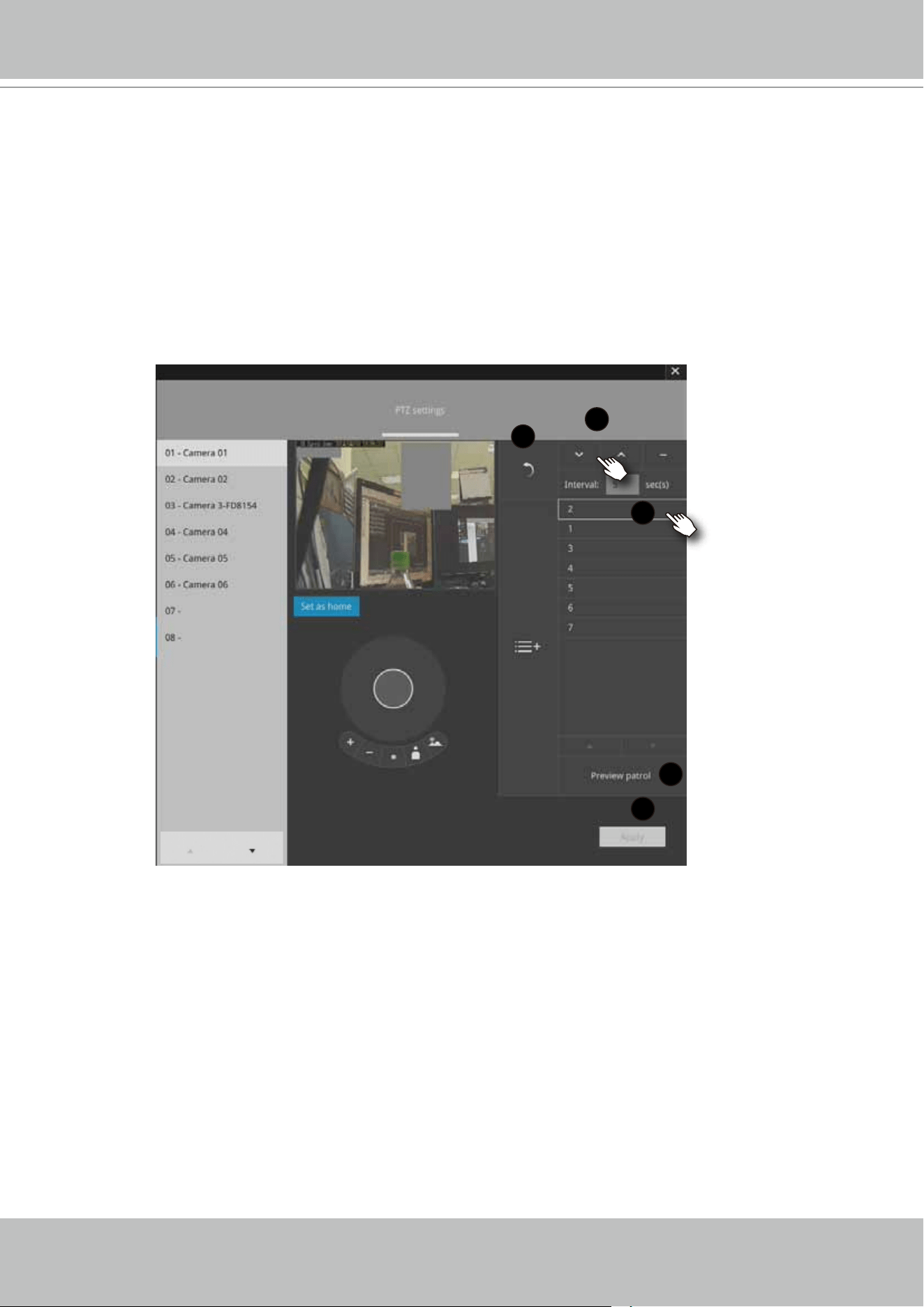
To congure a patrol:
1. Click to enter the Patrol menu. Select a preset position if you want to change its
position on the patrolling order.
2. Click the up and down buttons to change the position on the order, or click the
remove button to disband a position from the order. You can also change the
interval to stay before moving from one position to the next position.
3. You may then click on the Preview patrol button to see if it runs as expected.
4. Click the Apply button for the conguration to take effect.
5. Click on the Back to preset list button to return to the preset window.
1
2
3
4
5
VIVOTEK - Built with Reliability
70 - User's Manual
3-4-8. Settings - Alarm - Alarm
The events reported from individual cameras' digital inputs, digital outputs, and motion detection
can be accommodated in the NVR system's alarm settings. These events will then be reported
or trigger corresponding actions as follows:
1. Reporting events via Email or system buzzer.
2. Triggering video snapshot and text message by the occurrences of events to an FTP site.
3. Triggering the camera(s) for its lens to move to a preset position.
4. Triggering the cameras' digital output.
You can create up to 10 instances of alarm.
Hardware connections to DIs or DOs, e.g., window sensors, should be made separately. The
motion detection conguration can be made in the Camera conguration window.
Below is a glimpse of alarm sources and alarm actions:
Sources Actions
DI ► Video recording ►video footage
DO Email ►snapshots
Motion detection Buzzer
Network failure FTP ►snapshots
Disk full Camera preset points ►Pan-Tilt-Zoom
Disk failure
PIR Camera DO
Tampering
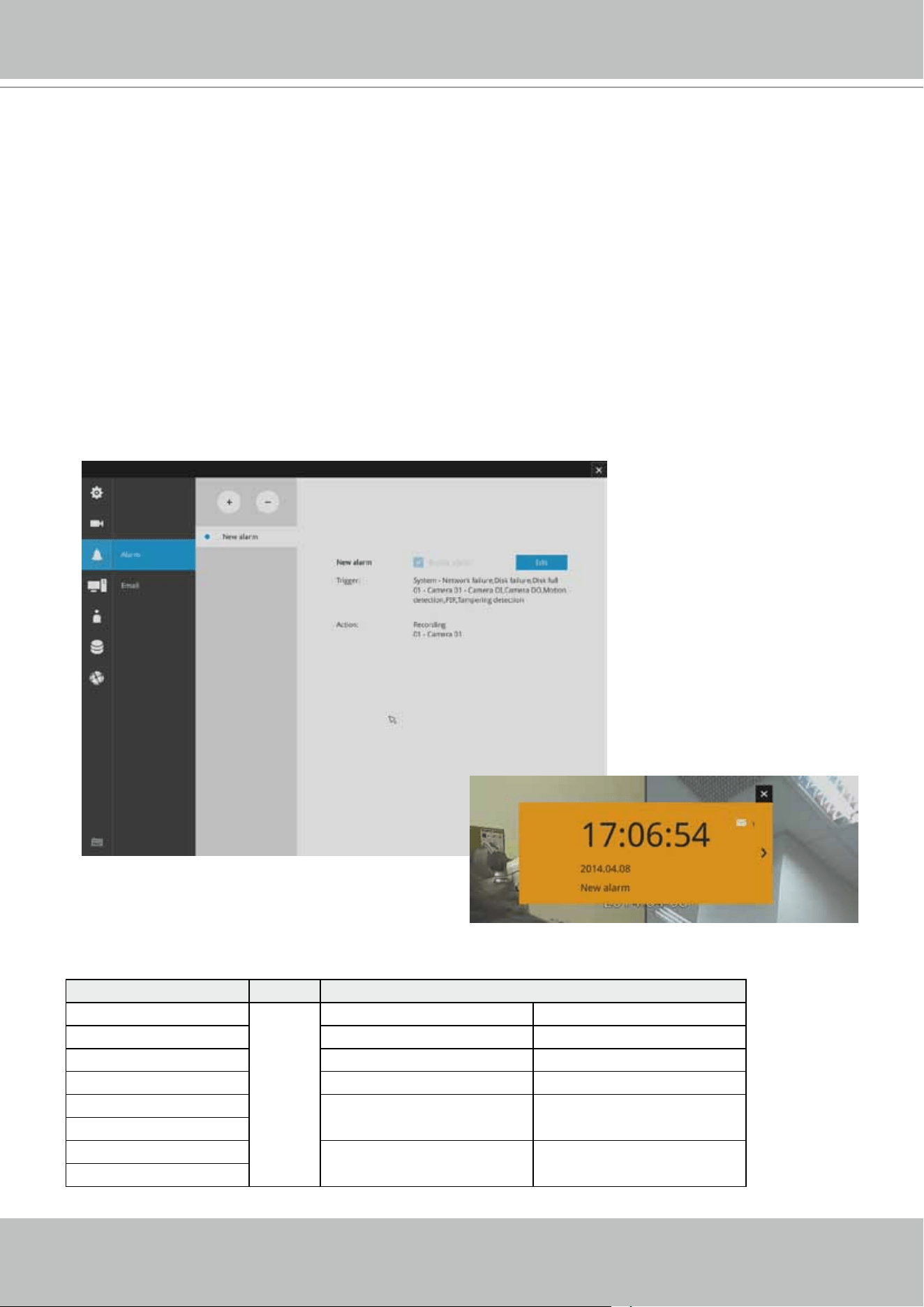
When an alarm is triggered, a message prompt
will appear on the Liveview or any conguration
window.
VIVOTEK - Built with Reliability
User's Manual - 71
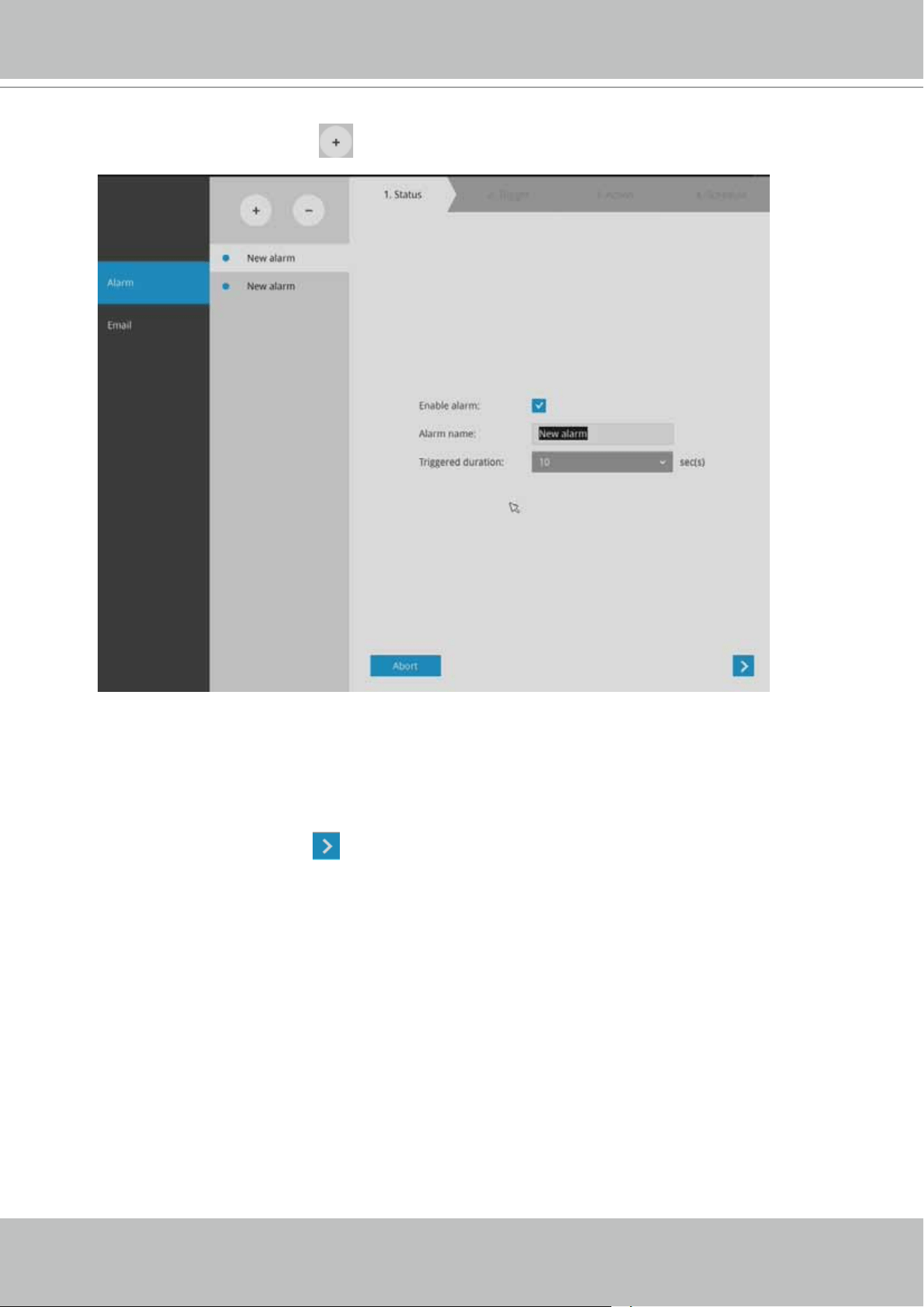
To create an alarm,
1. Click on the Add button .
You can manually enter a name for the current setting. You can enter up to 16 numeric
or alphabetic characters for the name, including symbols such as [0-9][a-z][A-Z][_][ ]. You
can also designate the interval between one alarm and the next triggered alarm to avoid
the situation that the alarms can be too frequently triggered.
Click on the next button
to proceed.
VIVOTEK - Built with Reliability
72 - User's Manual
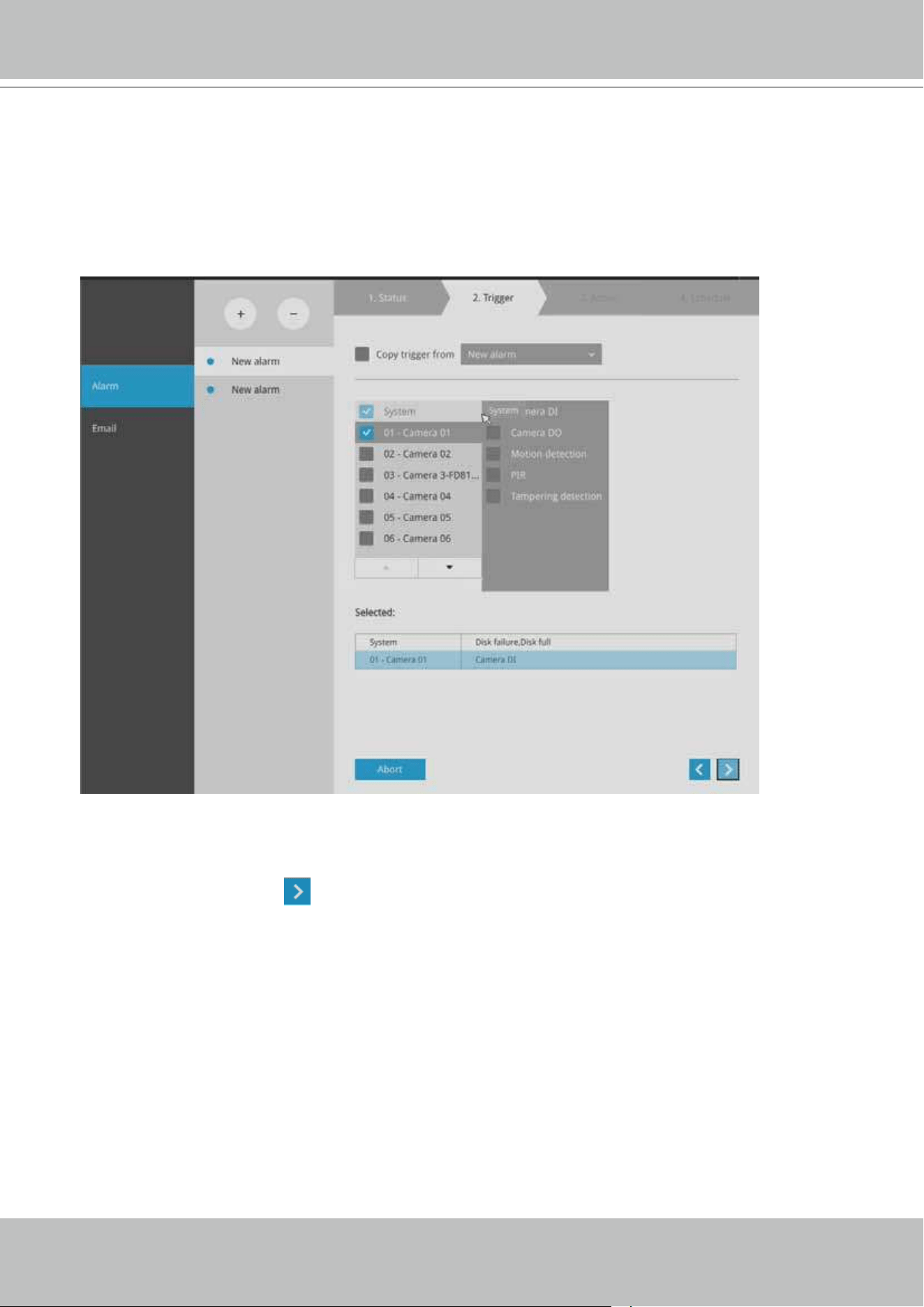
3. On the Trigger window, select system triggering conditions, or one or more cameras by
selecting their checkboxes. The number of DI or DOs on each camera is automatically
detected and displayed through individual checkboxes. The Motion detection function, if
there are many detection windows congured on a camera, is all triggered by one checkbox.
Note that the triggering sources will be listed even if the camera is currently not connected.
You may also select the "Copy trigger from" menu to borrow the setting you previously
congured.
Click on the next button
to proceed.
VIVOTEK - Built with Reliability
User's Manual - 73
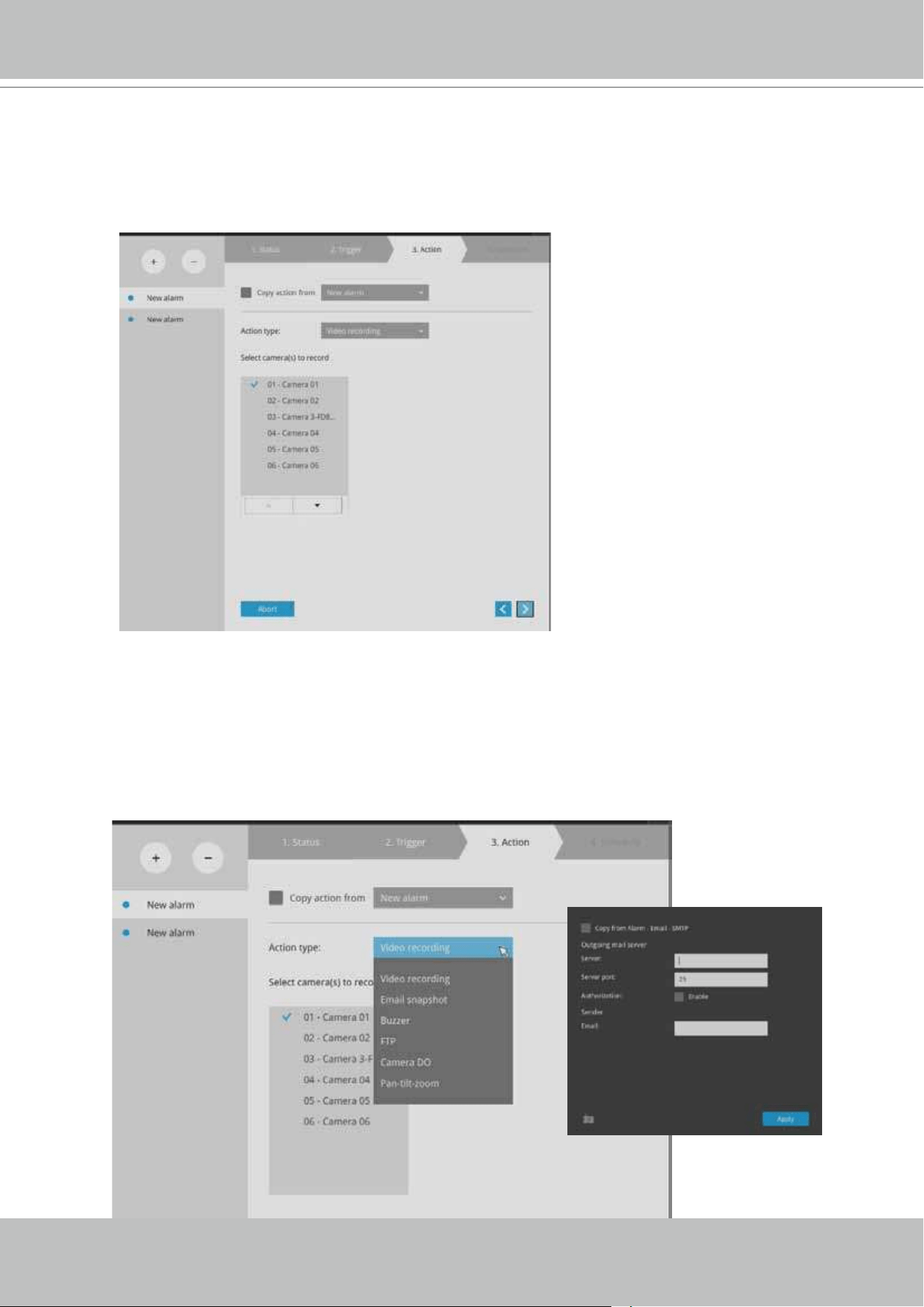
4. On the Action window, you can select the Action type from a drop-down menu. The
conguration details of each action type is discussion below.
4-1. Recording - When an event is triggered, the selected camera will record a video footage of
the length dened by the pre-/post-event setting, to the NVR system.
4-2. Email - The Email action sends an Email to the administrator along with a snapshot of the
event.
To congure Email notication, enter valid Email addresses as the Sender and Recipient
addresses, an Email subject, and the SMTP server address through which the Email will
be delivered. If you need to log in to SMTP server to deliver an Email, enter the User name
and password for access to that account.
VIVOTEK - Built with Reliability
74 - User's Manual
The Email subject and addresses can be composed of 254 characters in numeric or
alphabetic characters including: [0-9][a-z][A-Z][_][ ][-][.][,][@]. You can enter the addresses
of multiple recipients. Use semicolons, (;), to separate the addresses of multiple recipients.
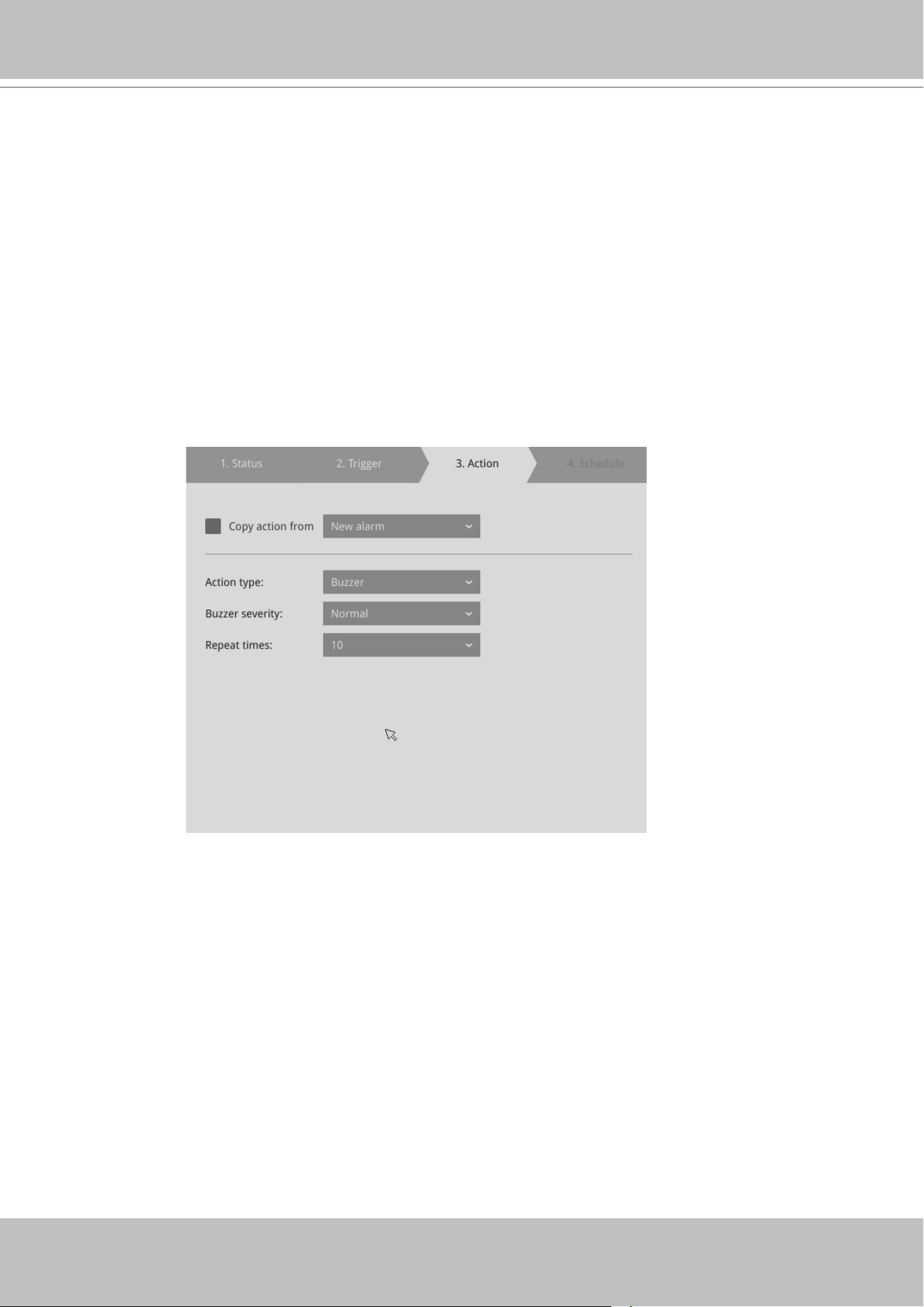
4-3. Buzzer - The buzzer is sounded on the occurrence of the event. The buzzer tones are
categorized into: Critical (1 long, 1 sec interval) Major (1 long 2 shorts, 1 sec interval),
Normal (3 shorts, 2 sec interval), Minor (2 shorts, 2 sec interval), and Notify (2 very shorts)
depending on the importance of an event. Select a Buzzer modulation from the drop-down
list. A long tone has a duration of 1 second, while a short tone 0.5 second. A very short tone
lasts only for 0.1 second.
Select how many times the buzzer tones will be repeated on the occurrence of an event.
If events of different importance are issued at the same time, e.g., one major and one minor
event, system will ignore the minor event and sound the buzzer tone for the major event
only. The buzzer can be sounded either by the Alarm actions or the system events. If Alarm
actions and system service events occur at the time, Alarm actions have the higher priority.
If multiple Alarm actions occur, the currently-sounded events can be depleted by the new
event.
There are conditions that the system will sound the buzzer, and the conditions are not
congurable.
1. Disk failure - missing drives or SMART detected failures.
2. Disk full - the free space is too small for recording tasks.
VIVOTEK - Built with Reliability
User's Manual - 75
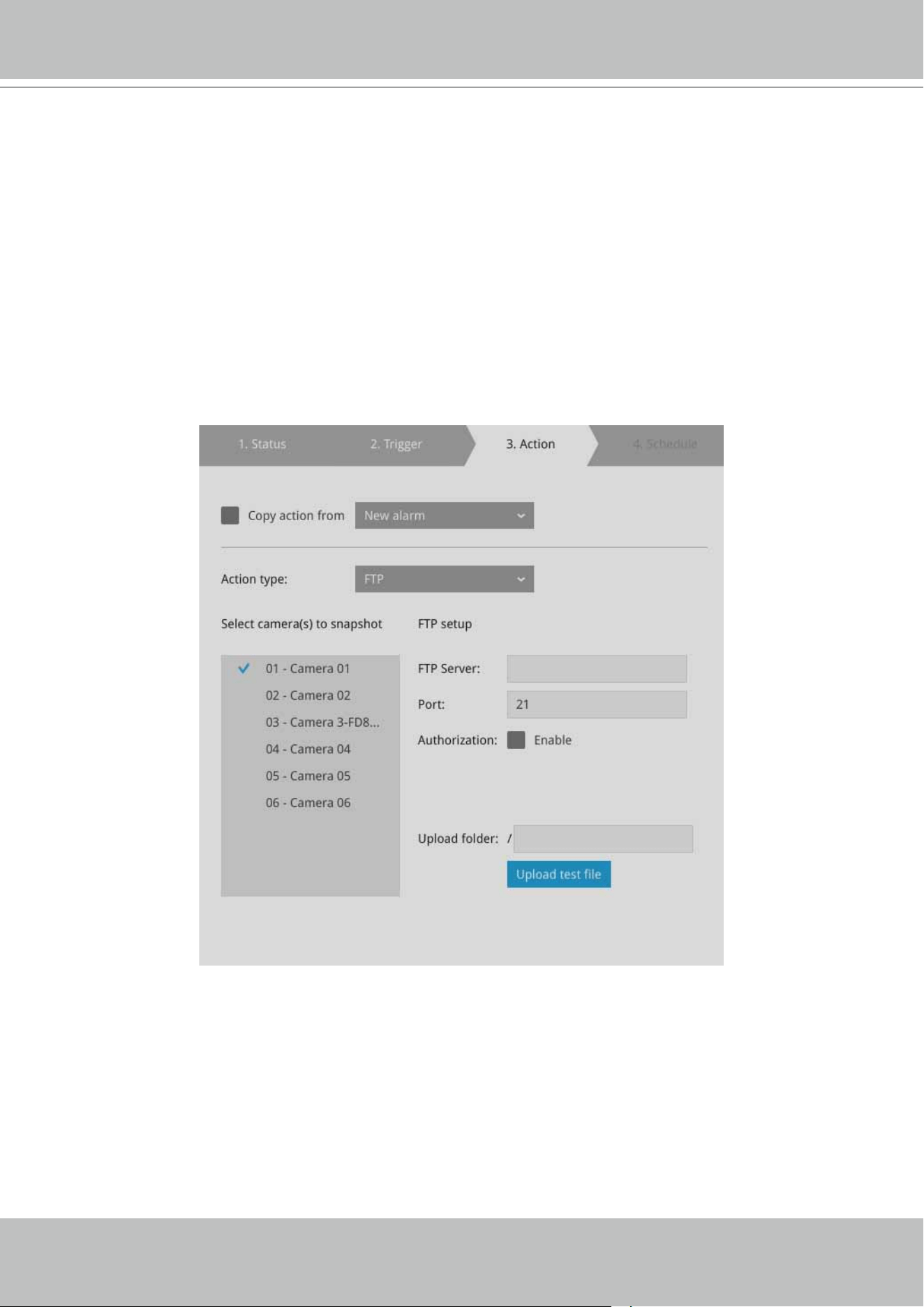
4-4. FTP - Snapshots from specied cameras can be uploaded to an FTP site on the
occurrence of an event. Enter the FTP site address in the dotted-decimal notation, e.g.,
159.22.151.20. Enter the login name and password for the user account. You can enter
a directory name you prefer on the FTP site. The server port default is 21, a different
number between 1025 and 65535 can also be assigned.
The snapshot thus delivered has a size of 320x240 pixels.
If authentication is not applied, login will proceed using the [anonymous] account.
The le names of the snapshot jpeg les will look like this:
[MAC]_[DATE]_[TIME]_[CAMERA_INDEX].jpg - If similar les already exist, an
additional index number will be added to the end of le name.
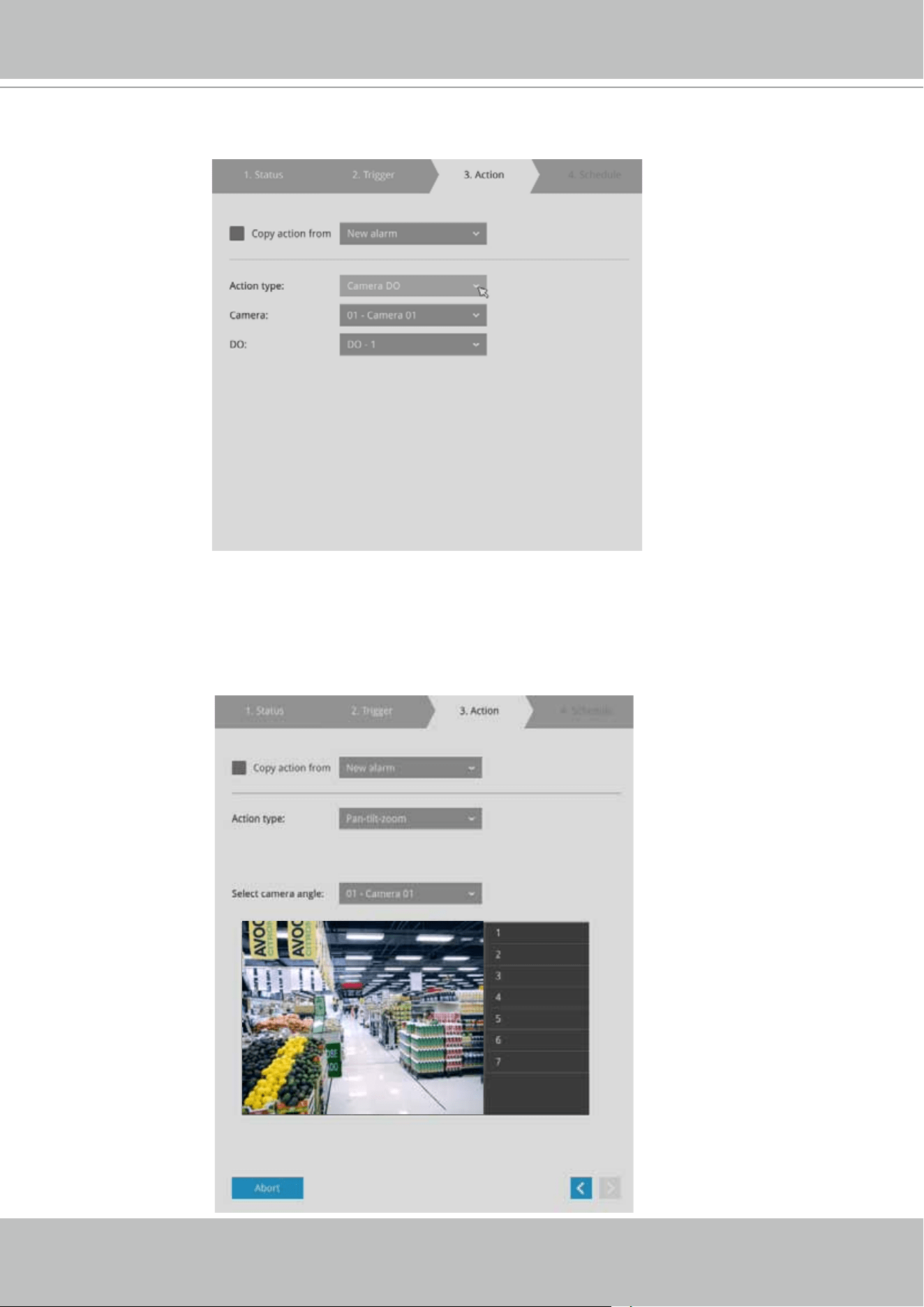
VIVOTEK - Built with Reliability
76 - User's Manual
4-5. Camera DO - A triggered alarm triggers a camera's DO, e.g., an alarm siren.
4-6. Camera pan-tilt-zoom - A PTZ capable camera can move its lens to the preset position
in case of a triggered alarm. For example, a triggered sensor may indicate an area of
interest has been intruded, and a camera's eld of view should be moved to cover that
area. The precondition is that you properly set up preset positions on your PTZ cameras
using a local or a web console.
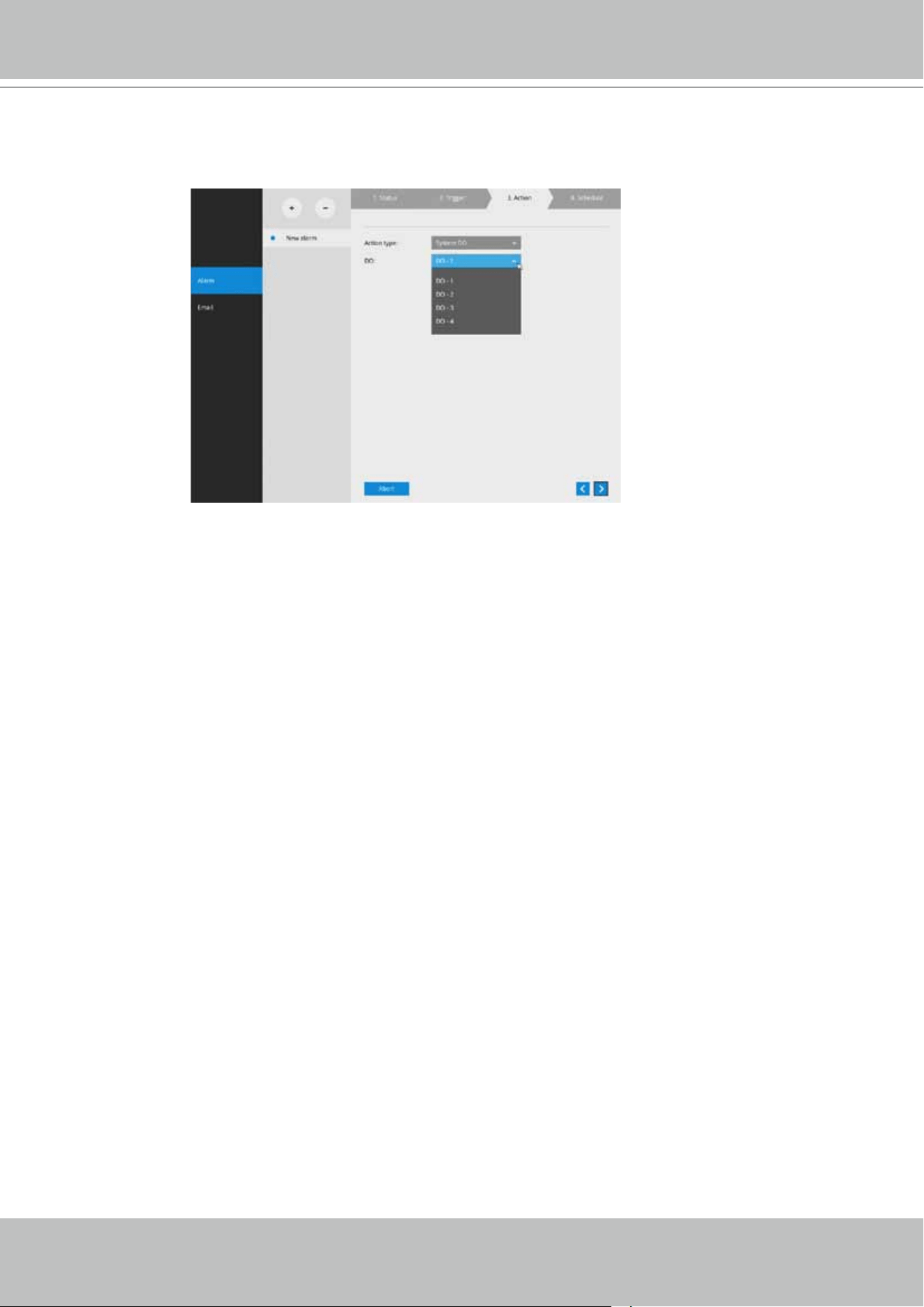
VIVOTEK - Built with Reliability
User's Manual - 77
4-7. System DO - A triggered alarm can be used to toggle the NVR's digital output, e.g., to
sound an alarm siren.
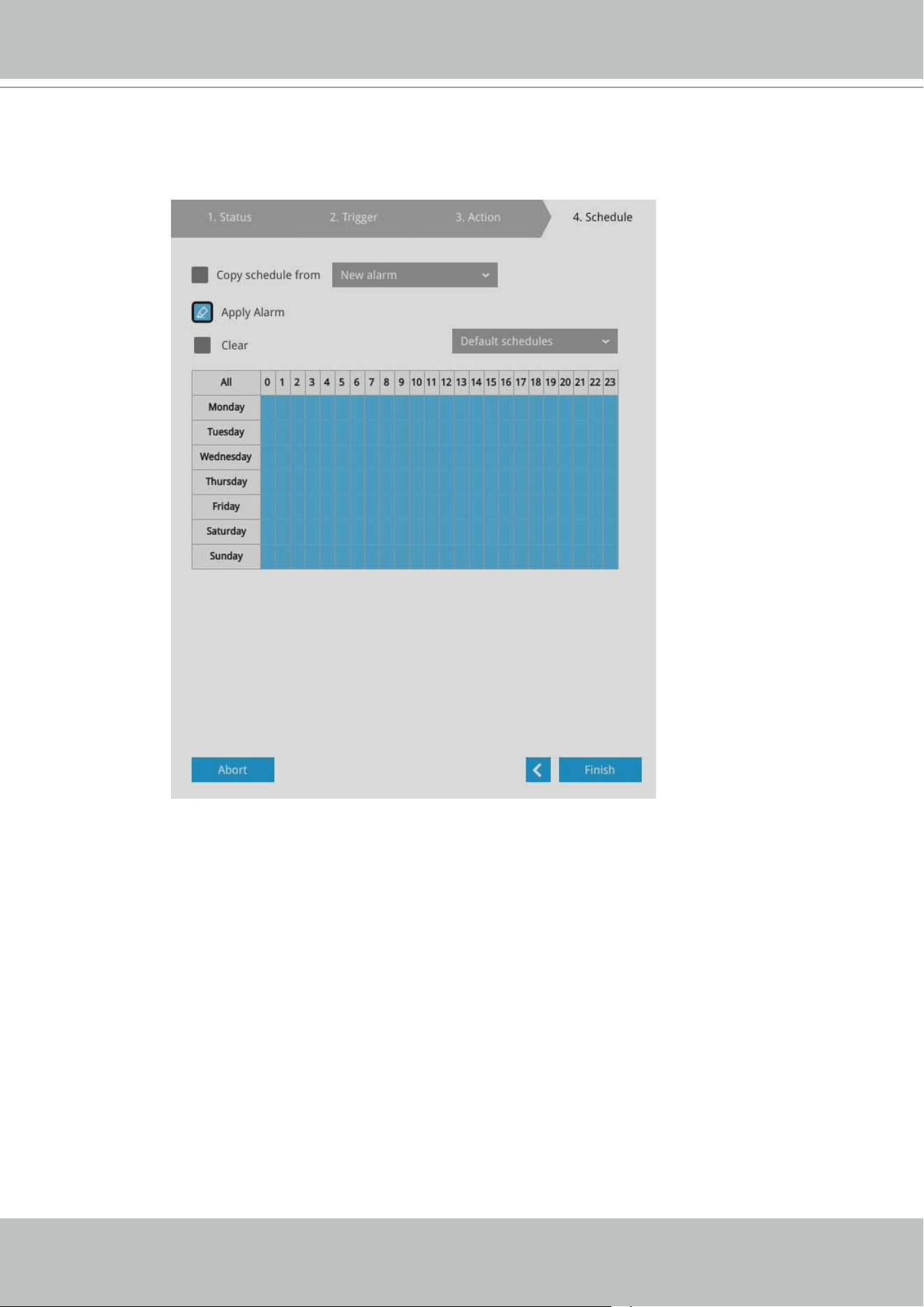
VIVOTEK - Built with Reliability
78 - User's Manual
5. On the Schedule page, you can select to activate or de-activate alarm triggers throughout a
specic timeline. For example, in some situations you can disable the alarm triggers during
the ofce hours, and choose to enable the triggers only during the off-ofce hours.
6. Click Finish to end the conguration.
7. Repeat the process above to create more alarms according to the needs in your surveillance
deployment.
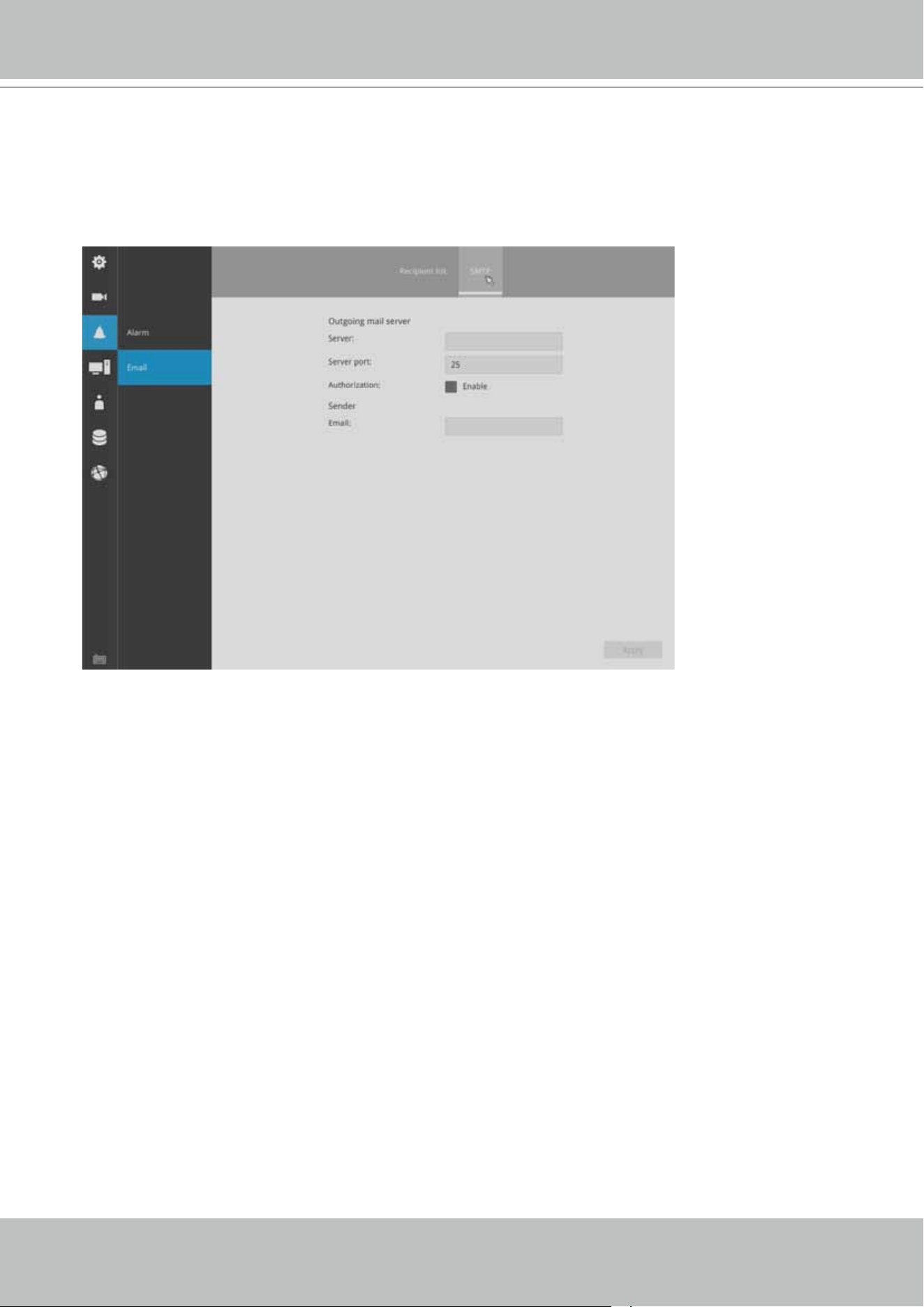
VIVOTEK - Built with Reliability
User's Manual - 79
3-4-9. Settings - Alarm - Email
This window provides an interface where you can congure the connection to a Mail server. Via
the Mail server, the system can deliver Emails containing system alarm messages to multiple
receivers. A reachable Mail server and Email accounts must be provided before you can apply
the settings.
The conguration options are identical to those found in the Email conguration in Settings -
Alarm window.
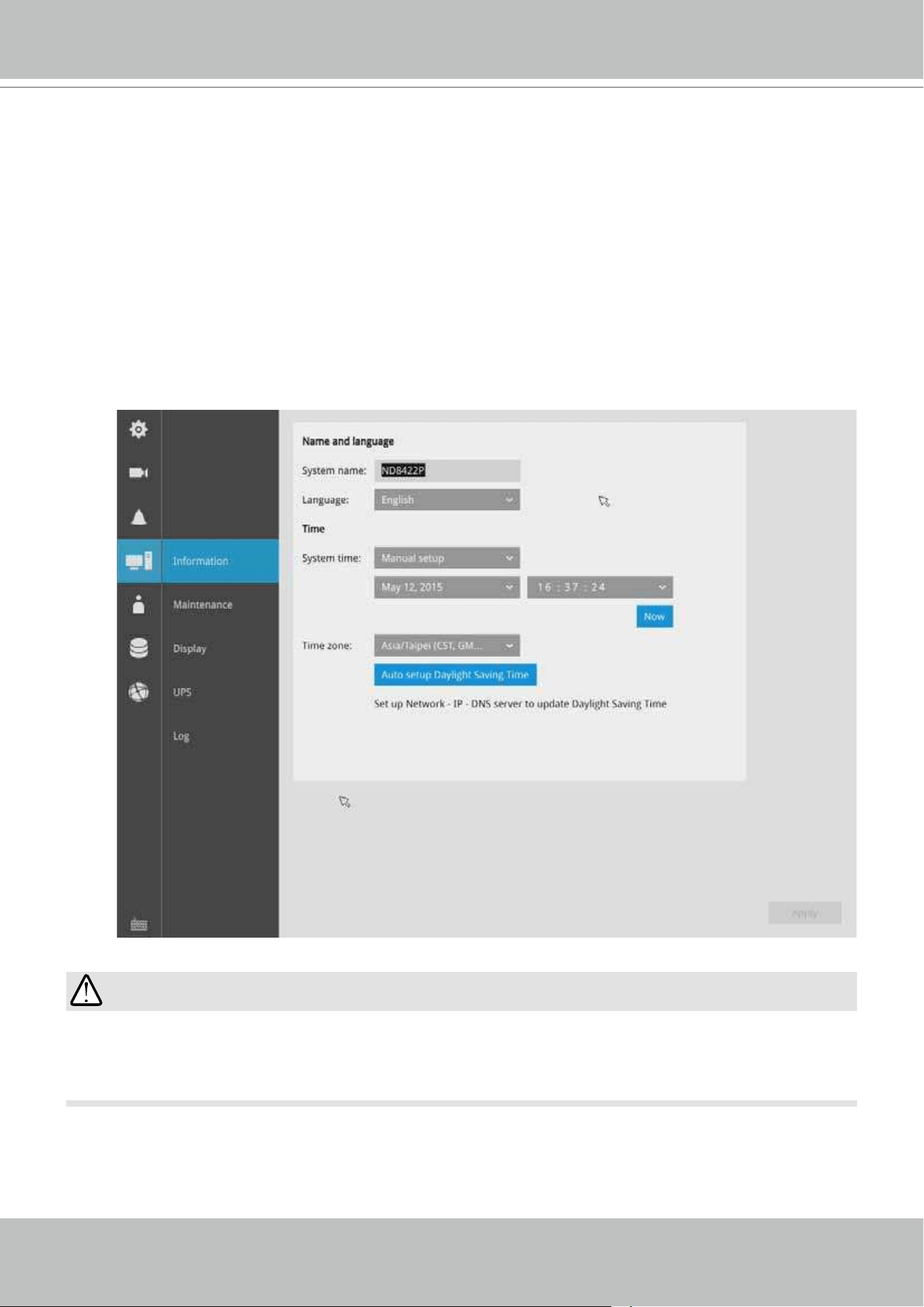
VIVOTEK - Built with Reliability
80 - User's Manual
On this window, you can congure the following:
1. Change the system name.
2. Select the UI text language.
3. Congure system time, time zone, and if you are connected to a DNS server where
Auto Daylight Saving time can be applied, you can acquire the associated setting from
a server within your network.
4. Click the Apply button for the conguration to take effect.
Note that if NTP time server conguration (Auto) is preferred, the system will automatically
congure all cameras to be listening to the system, and therefore to the same time server.
3-4-10. Settings - System - Information
Changing system time can produce disruptions to the existing recordings. Turning the current
system time back to a time when video recording was taking place can generate duplicate les.
And those les may not be playable.
IMPORTANT:
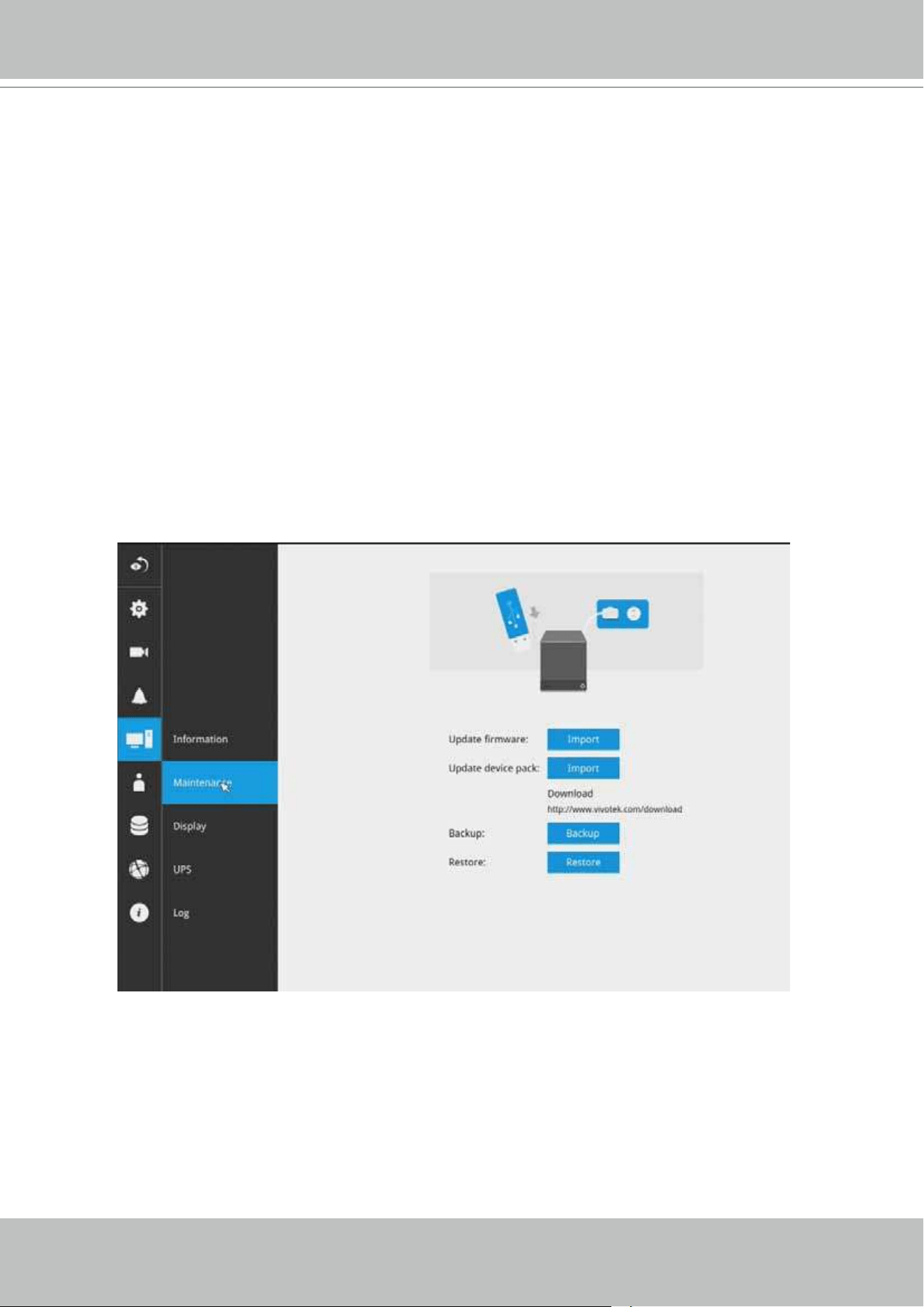
VIVOTEK - Built with Reliability
User's Manual - 81
3-4-11. Settings - System - Maintenance
If the need arises for updating system rmware, acquire the update from VIVOTEK's technical
support or download site. Locate the rmware binaries, and click the Import button. The upgrade
should take several minutes to complete. Note that during the upgrade, the recording task will
be interrupted.
On this window, you can perform 4 maintenance tasks:
1. Update rmware - Download rmware and save it to a USB drive in the FAT format, attach
the USB device to the NVR for rmware upgrade.
2. Update device pack - A device pack allows you to import associated congurations and
parameters for new camera models so that these cameras can be integrated into your NVR
conguration. The information in the device pack is related to some tunable parameters.
Note that the backup action does not involve the following:
1. Recorded videos and database,
2. Alarm records, bookmarks, and bookmarked footages.
Select a location for your backup le, then click Save to complete the process. If you back up
to a USB thumb drive, that thumb drive must be formatted using the FAT format.
4. Restore - If you have a previously-saved prole, you can restore your previous conguration.
Click the Restore button.
A le location window will prompt. Locate the backup le, and click Open. The Restore
process will take several minutes to complete, and system operation will be interrupted during
the process.
3. Backup - You can backup your system conguration using the Backup function. Click Backup,
a message window will prompt. Click Save to preserve your system congurations.
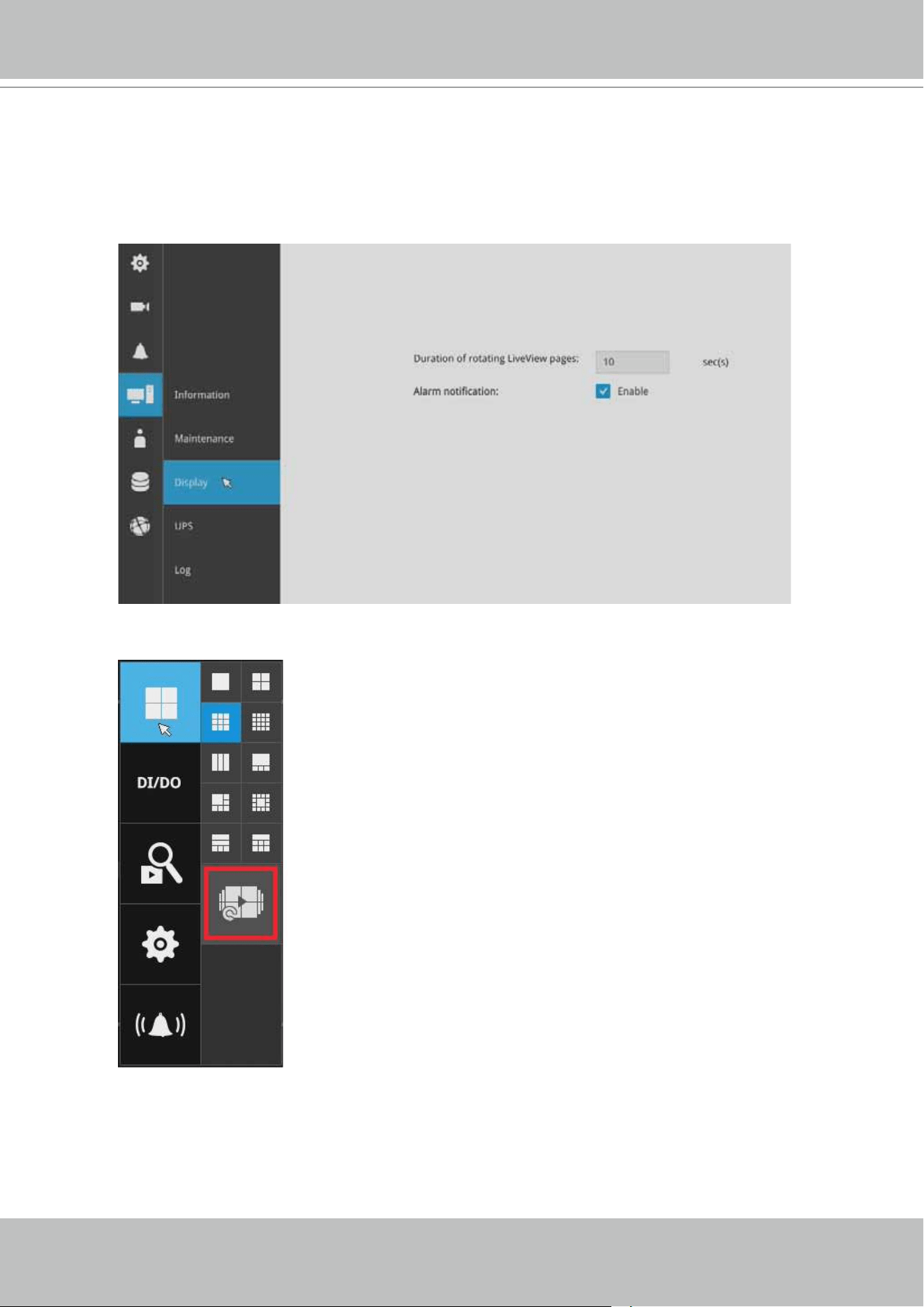
VIVOTEK - Built with Reliability
82 - User's Manual
3-4-12. Settings - System - Display
On this page, you can congure the system to consecutively display (rotate) cameras' view cells
on the Liveview window. For example, if you have 8 cameras in 2 2x2 layouts, the rotation can
let you see the live views of all cameras by every few seconds.
You can also enable or disable the Alarm notication.
To enable the rotate function, click on the rotate button on the layout panel.
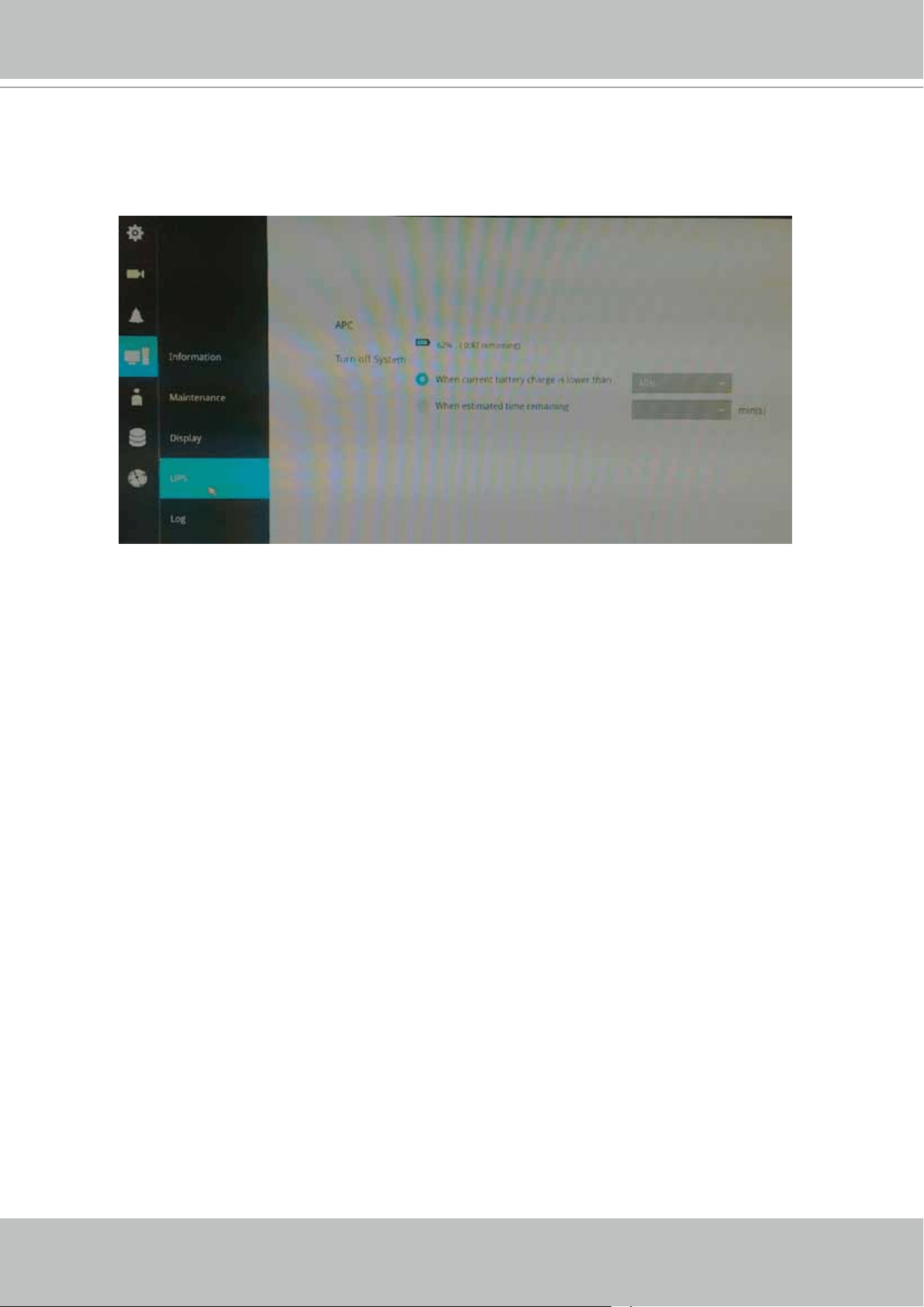
VIVOTEK - Built with Reliability
User's Manual - 83
3-4-13. Settings - System - UPS
On this page, you can congure the system to gracefully shut down when UPS battery is lower
than a certain level. You may also let it shut down when the estimated sustainable time is
reached.
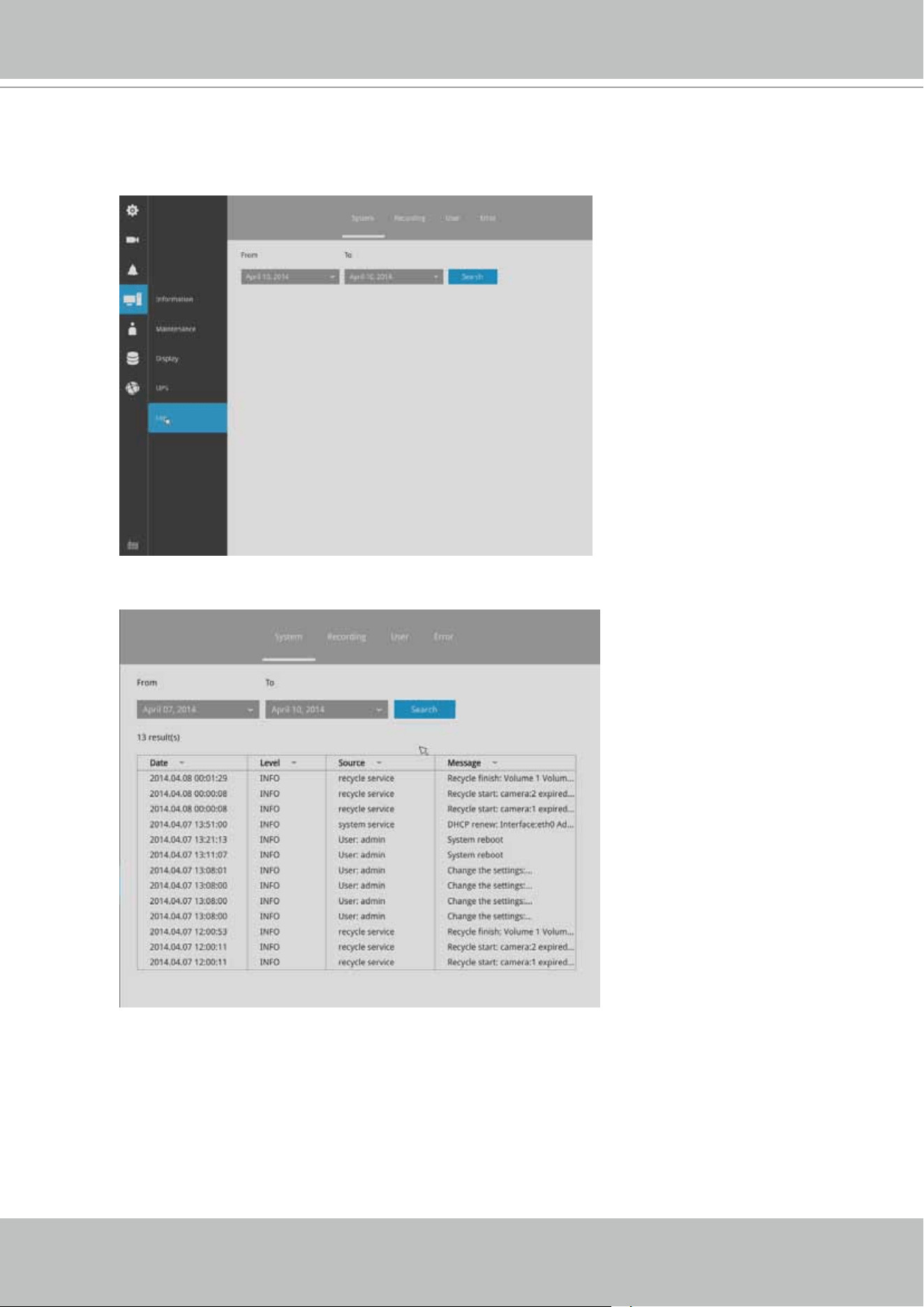
VIVOTEK - Built with Reliability
84 - User's Manual
3-4-14. Settings - System - Log
System logs are categorized as System, Recording, User, and Error.
To display system logs, select a range of time and click on the Search button.
You can search for past logs in each category window.
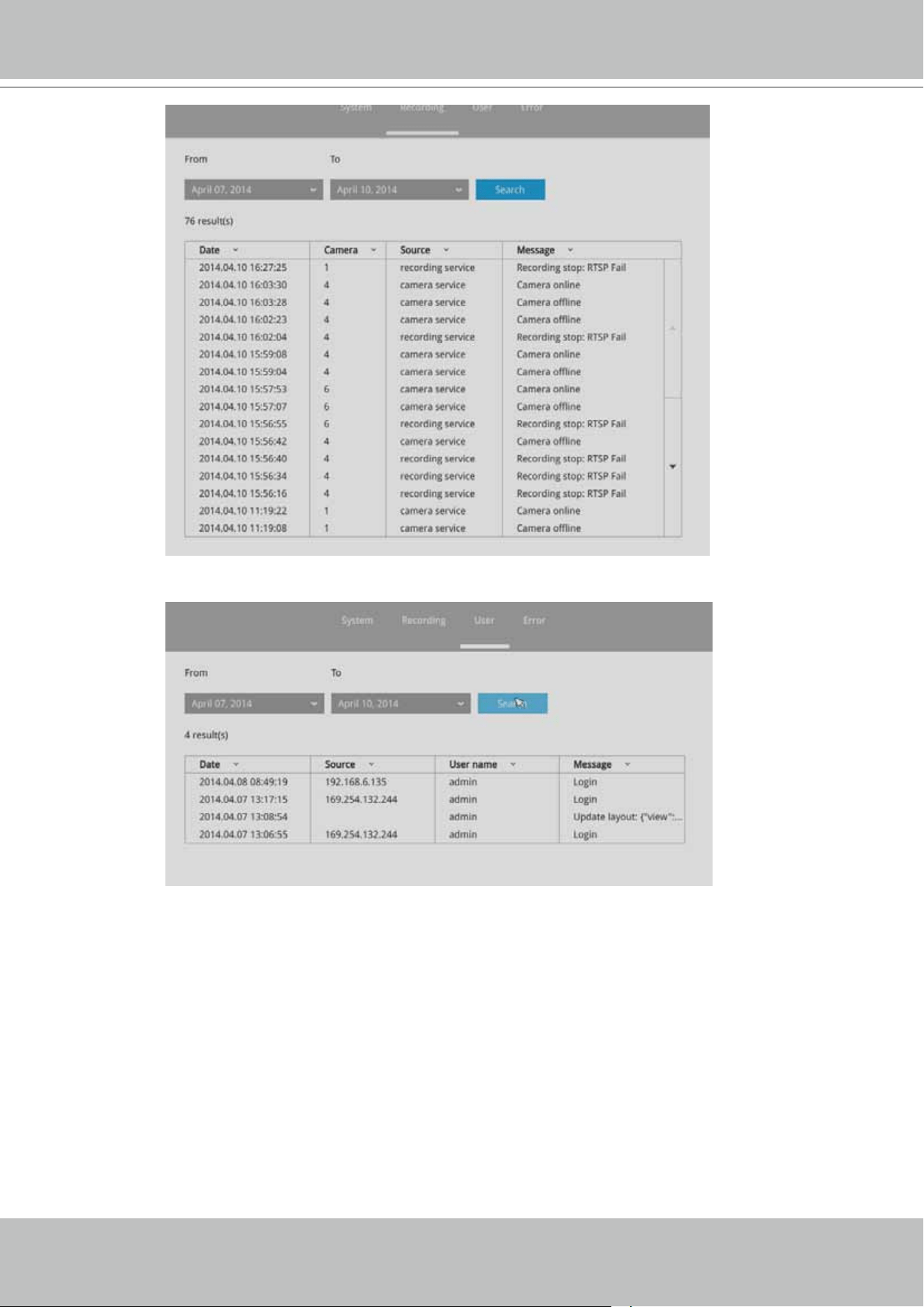
VIVOTEK - Built with Reliability
User's Manual - 85
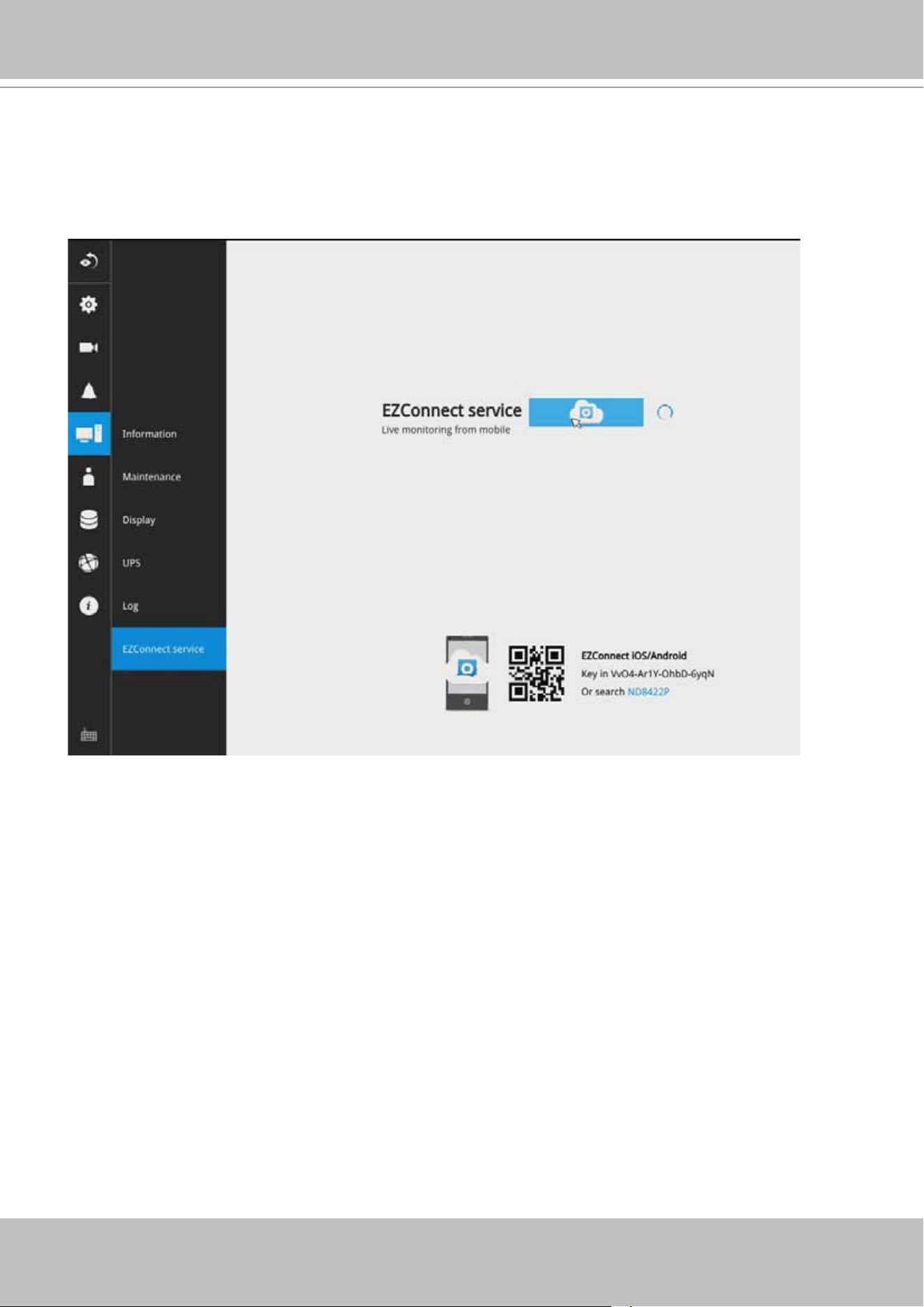
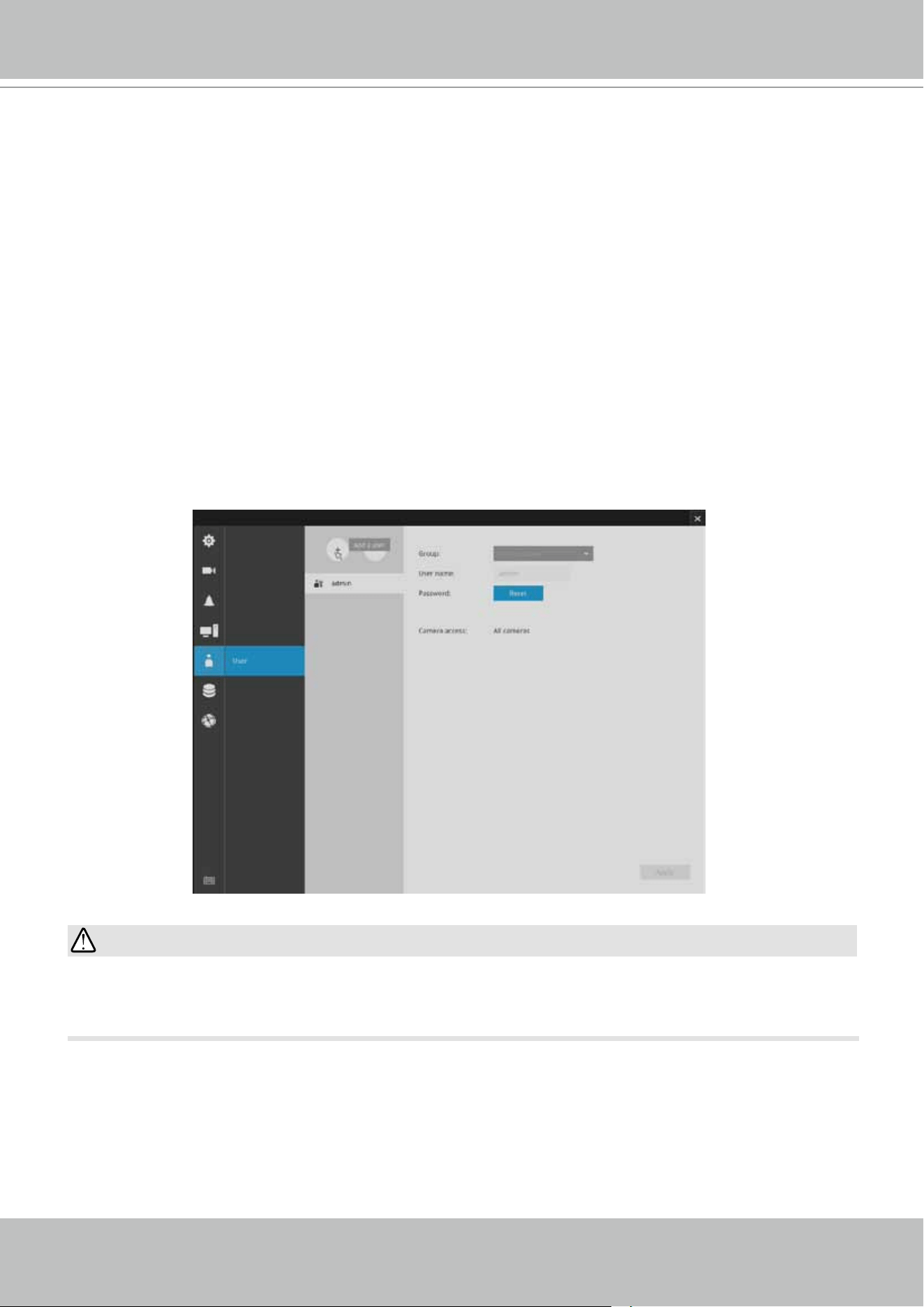
VIVOTEK - Built with Reliability
User's Manual - 87
3-4-16. Settings - User
The User window allows you to create more users, to change user password, and place
limitations on users' privileges and administration rights. Up to 16 users can be created,
including the default administrator.
1. By default, there are two user groups: Administrator and Regular user.
2. The regular users cannot access the Settings window, meaning that regular users can not
add or remove cameras, make changes to alarm, network, and all other system settings.
When users try to access the Settings window, the login window prohibits regular users to log
in. There is simply no regular user's name on the login window.
3. The administrator users can access all cameras recruited in the conguration; while the
regular users can be congured to have access to some or all cameras.
4. The system blocks out the video feeds from users who are denied of the access to particular
cameras. The alarms and the alarm-triggered recordings from those cameras will also be
inaccessible for unauthorized users.
The default administrator name and password are: admin and admin. It is highly recommended
to change the default password to prevent unauthorized access to the system.
IMPORTANT:
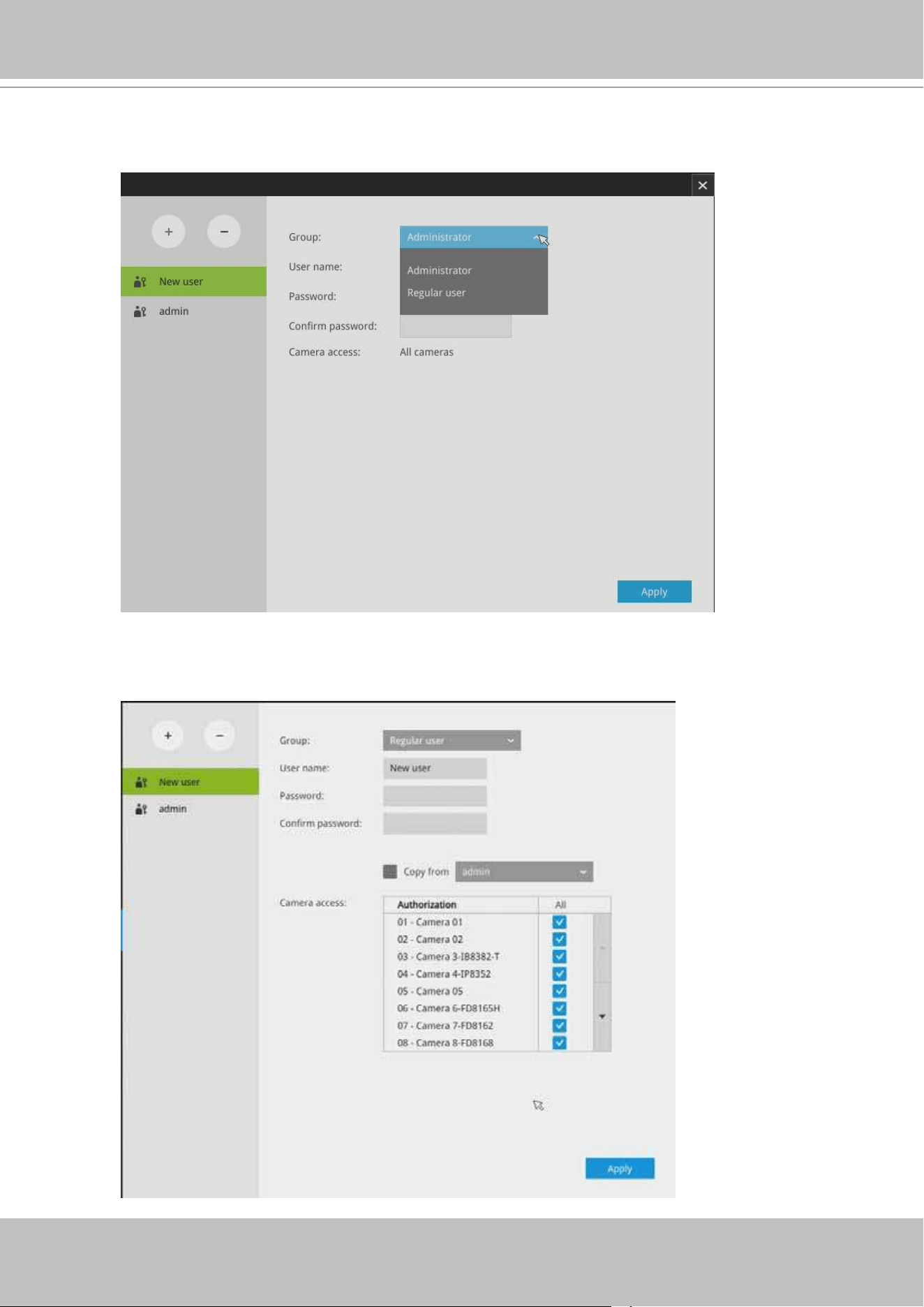
VIVOTEK - Built with Reliability
88 - User's Manual
To create or edit users,
1. Select a User group by unfolding its pull-down menu. Select either an Administrator or
regular user as the user group.
2. Enter the User name and password. The max. number of characters for a user name is
64, with alphabetic and numeric characters including [0-9][a-z][A-Z][_][ ][-][.][,][@]. The
max. number for password is also 64.
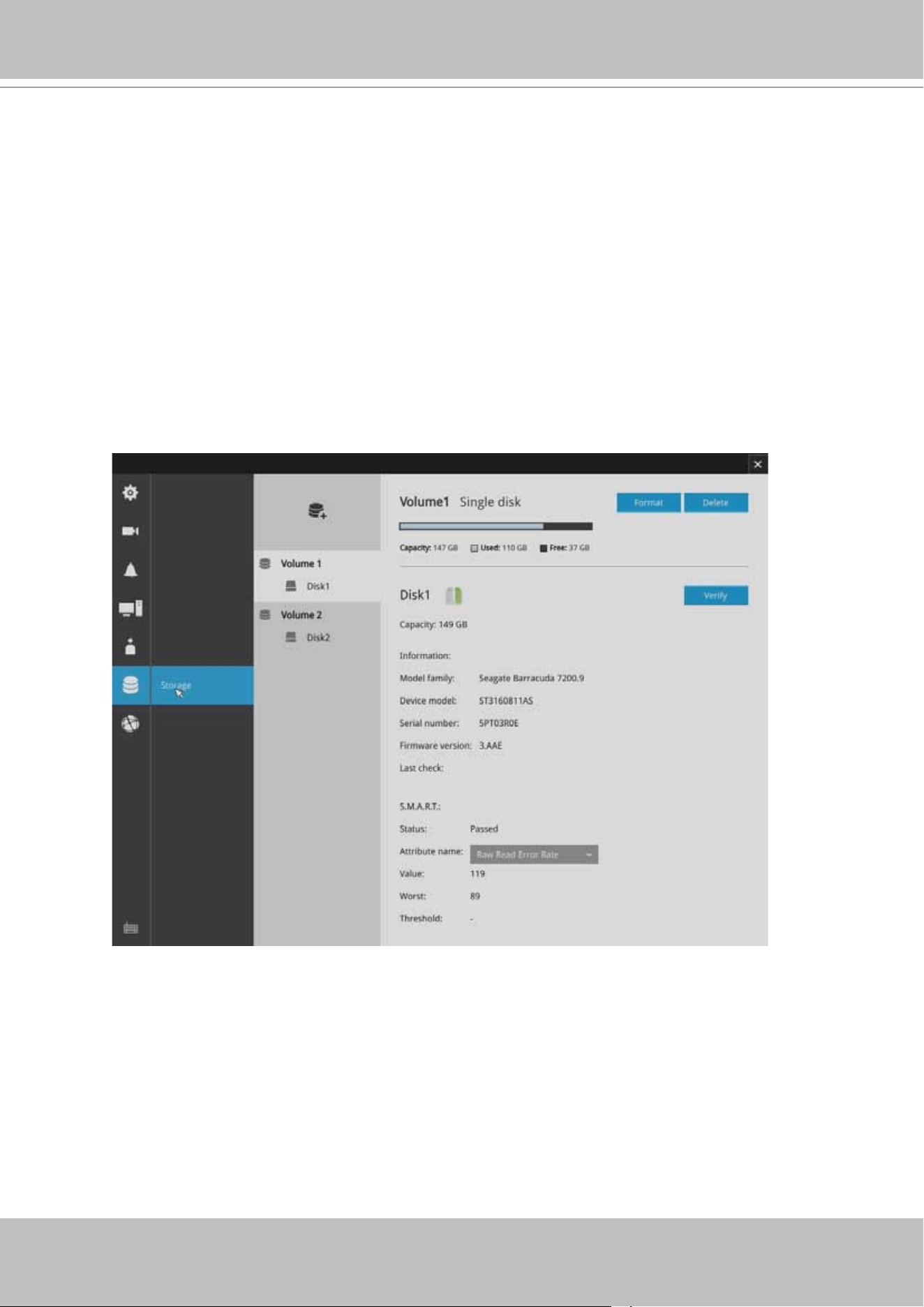
VIVOTEK - Built with Reliability
User's Manual - 89
3. If you are creating a regular user with limited access to cameras, deselect the checkboxes by
the cameras to deny the user access.
4. Click Apply to close the conguration window. Repeat the process to create more users.
3-4-17. Settings - Storage
The storage page displays the volume information including physcial position, total capacity,
used and free space, and associated commands such as Format and Delete. Since each
volume contains only 1 hard drive, details information about the hard drive is also displayed on
this page.
You can format an existing storage volume in situations such as when you need to re-deploy the
system elsewhere.
Disk Information:
Model family: The brand name of the HDD manufacturer.
Device model: The disk model name.
Serial number: Serial number assigned to the disk drive.
Firmware version: The version of rmware running on this disk drive.
Last check: The bad block check or S.M.A.R.T. test previously executed on this drive.
Status: S.M.A.R.T. status polled from the disk drive. This is not the results from a manually-
executed S.M.A.R.T. test.
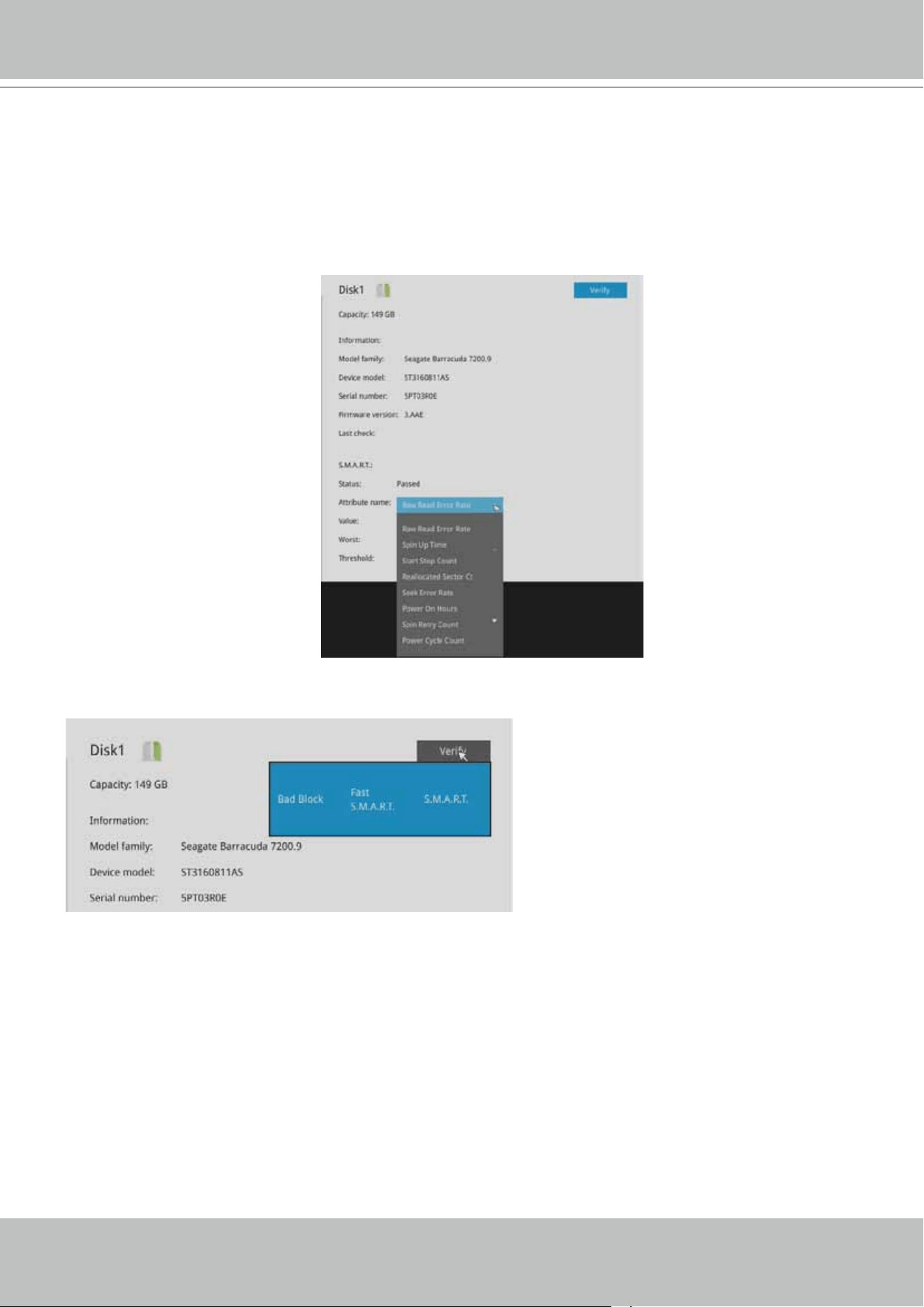
VIVOTEK - Built with Reliability
90 - User's Manual
Attribute: The various attributes can vary from different HDD manufacturers.
Value: Value for the currently selected attribute.
Worst: Worst value acquired for that attribute.
Threshold: A predened threshold or triggering value. The threshold below which the
normalized value will be considered exceeding specications.
Raw value: The detected parameters for that attribute.
Status: The judgement made to deem the current reading as OK or failed.
Verify:
Three types of check disk actions can be initiated through this button.
Bad block check: Performs read/write test to drive sectors to locate bad blocks. This action
may take several hours to complete.
Fast S.M.A.R.T. test: Tests the electronic and mechanical performance and disk read
performance, including those on disk buffer, read head, seek time, and integrity of drive
sectors. The short test is performed on a small section of disk platters, and takes about 2
minutes to complete.
S.M.A.R.T. long test: The long test is more thoroughly and is performed to all drive sectors.
The actual completion time depends on drive sizes and the attributes put to test.
The Check disk functions mentioned above, when performed during active I/Os, can consume
system resources and cause dropped frames with the recording tasks.
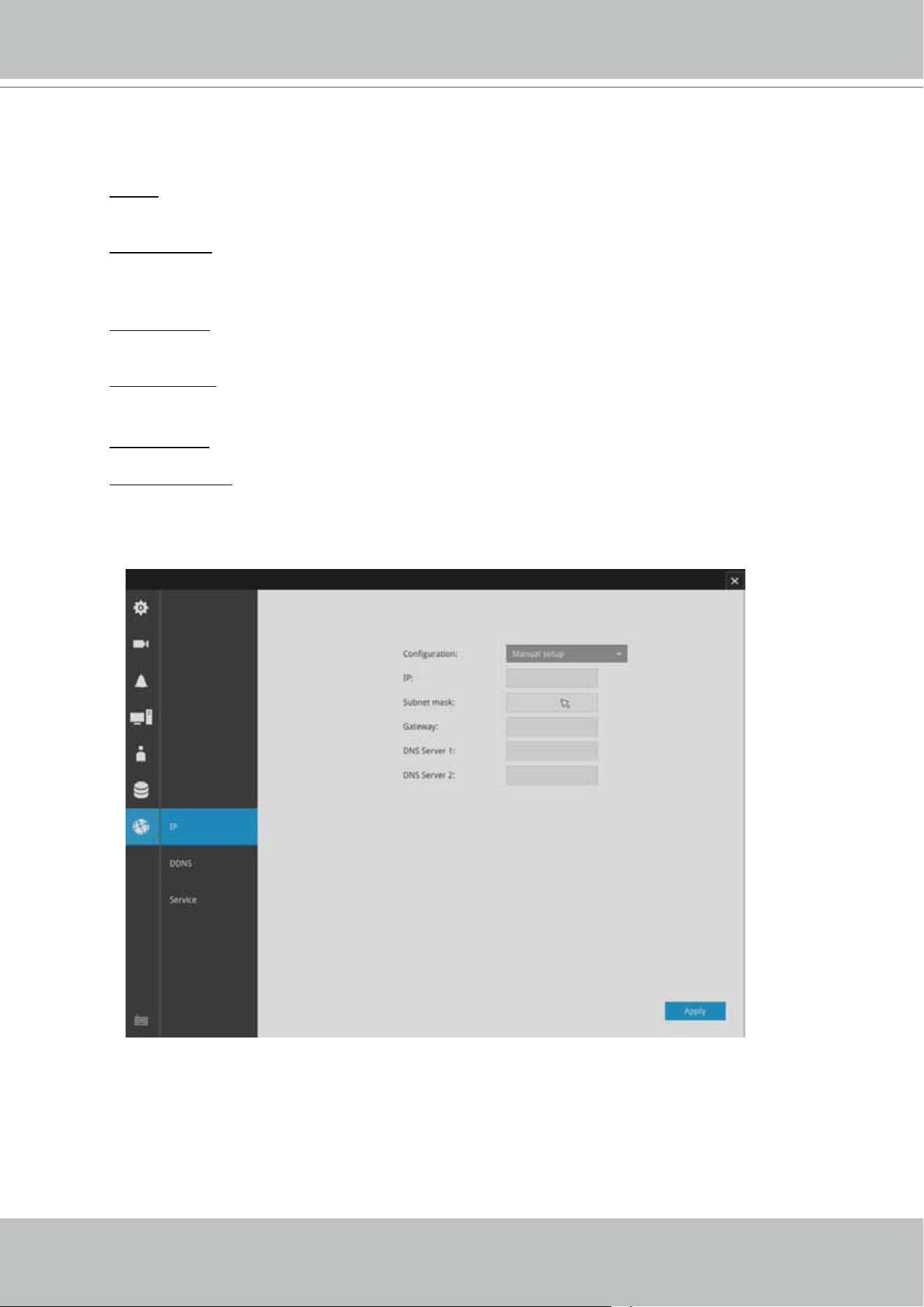
VIVOTEK - Built with Reliability
User's Manual - 91
3-4-17. Settings - Network
Settings - Network - IP
Primary DNS: The primary domain name server that translates hostnames into IP addresses.
Secondary DNS: Secondary domain name server that backups the Primary DNS.
DHCP: Default is selected, the server obtains an available dynamic IP address assigned by the
DHCP server each time the system is connected to the LAN.
Manual setup: Select this option to manually assign a static IP address to the Network Camera.
Enter the Static IP, Subnet mask, Default router, and Primary DNS provided by your ISP.
Subnet mask: This is used to determine if the destination is in the same subnet. The default value
is “255.255.255.0”.
Default router: This is the gateway used to forward frames to destinations in a different subnet.
Invalid router setting will fail the transmission to destinations in different subnet.
When nished with the network settings, click on the Apply button.
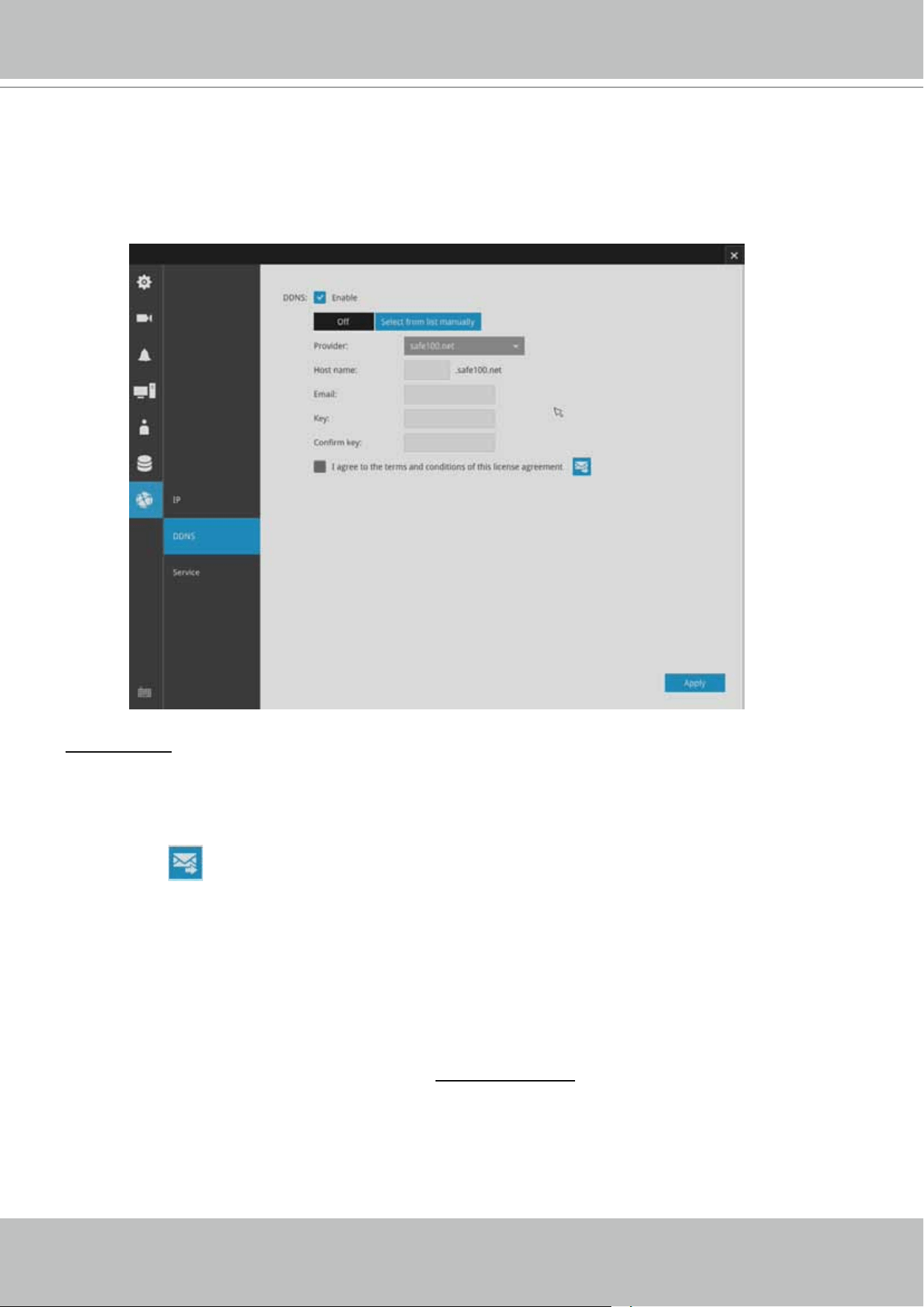
VIVOTEK - Built with Reliability
92 - User's Manual
Settings - DDNS
VIVOTEK provides Safe100.net, as a free DDNS dynamic domain name service for users who
want access from the internet or a domain name service for the NVR. VIVOTEK maintains a
database of product MAC addresses for the Safe100.net service, and you can apply one domain
name for each NVR system.
DDNS Enable: Select this checkbox to enable the DDNS setting.
Enter a Host name, Email address, and password twice, and then click Apply to proceed.
Make sure you have internet access.
Click the Register button. The terms of service agreement window is selected from a checkbox at the
bottom. Click
to read the license agreement terms.
When completed, a conrm message will prompt. You will also receive a conrm Email. You
can now access your NVR system using the xxxx.safe100.net domain name address. Note
that access from the Internet should be routed to the private IP assigned to your NVR, using
methodologies such as port forwarding, etc.
The acceptable characters for email address are: [0-9][a-z][A-Z][!][#][$][%][‘][*][+][-][/][=][?]
[^][_][`][{][|][}][~][.]. Two successive periods, [..], are not acceptable. The address filed can
accommodate up to 256 characters.
Use only alphabetic and numeric characters for the password. The maximum number of
characters is 64.
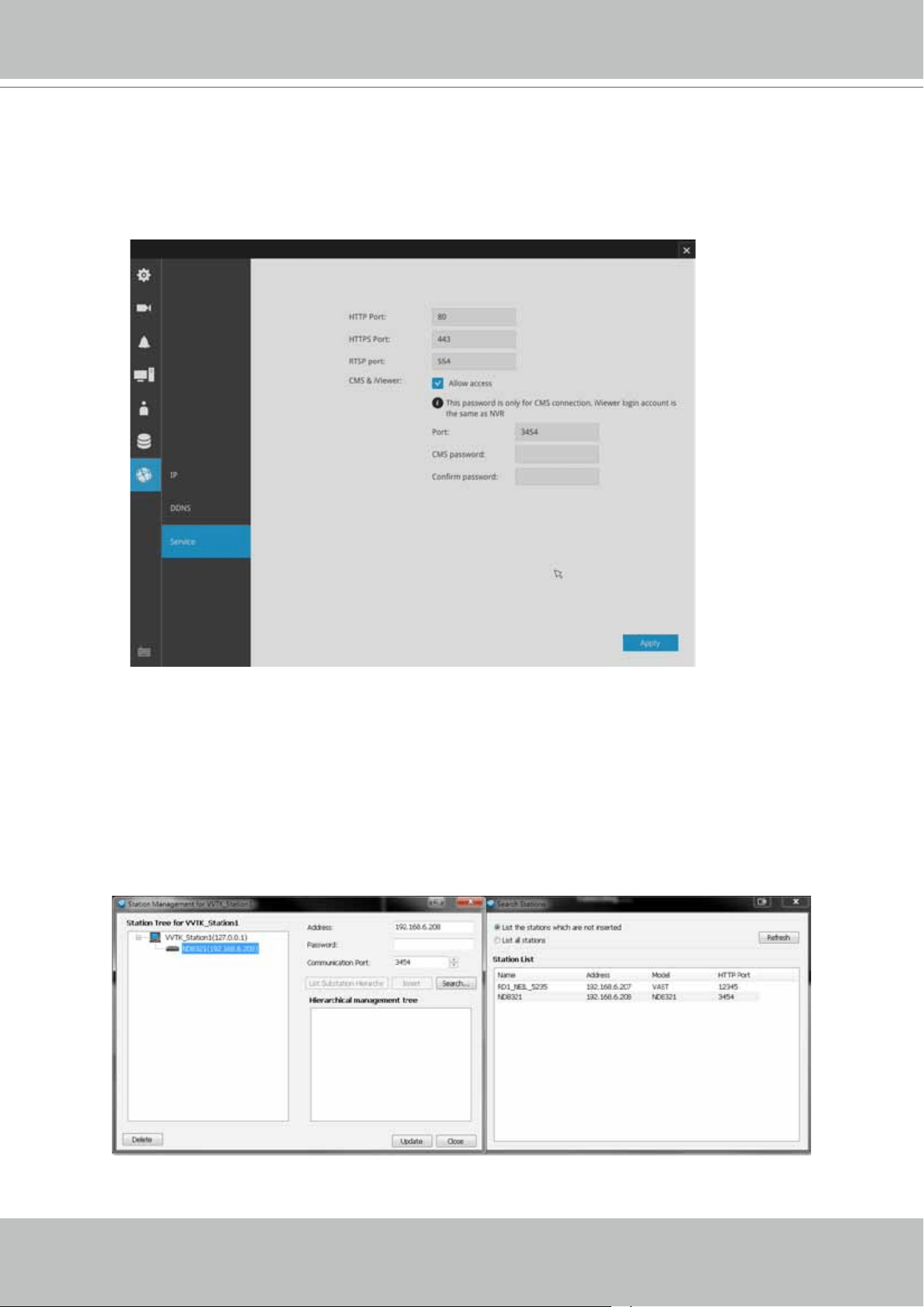
VIVOTEK - Built with Reliability
User's Manual - 93
Settings - Service
By default, the NVR service and video streaming are accessed via HTTP port 80 and RTSP port
554. You can designate a different port number if the need arises. Usually it is not necessary to
change these ports. HTTPS encrypted connection is enabled by default.
Instead of a web console, you can also access the NVR and the subordinate cameras using the
iViewer and VIVOTEK's VAST software. The NVR can be managed as one of the sub-stations
in a hierarchical device structure.
Set up a password for access from the VAST server before you can join the NVR to a VAST
conguration. For access from the iViewer, you log in using the same user name and password
for the login to the NVR.
Below is the screen showing the sub-station recruitment process from a VAST server.
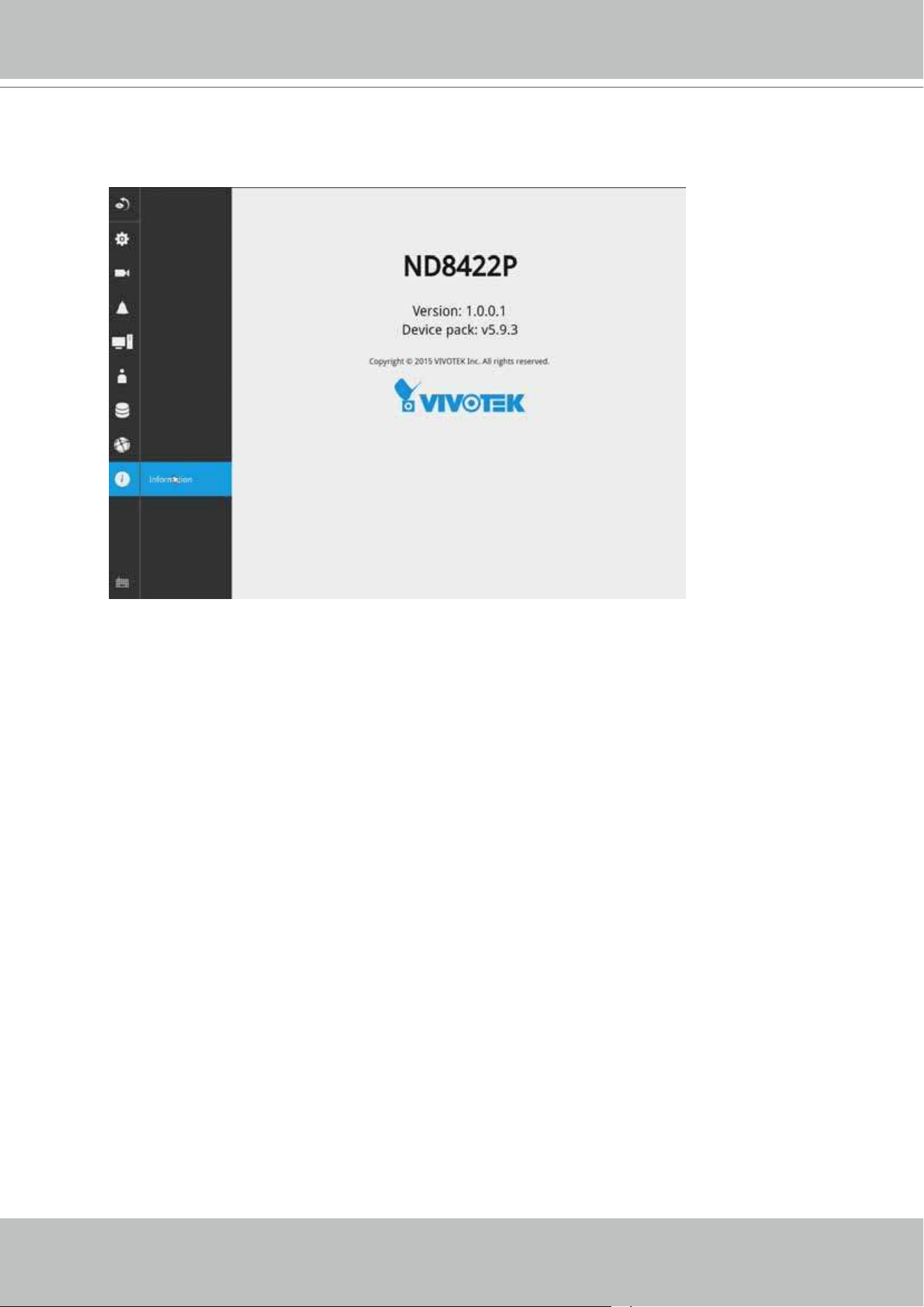
VIVOTEK - Built with Reliability
94 - User's Manual
3-5. Information
This window shows the revision number of the rmware running on this machine.
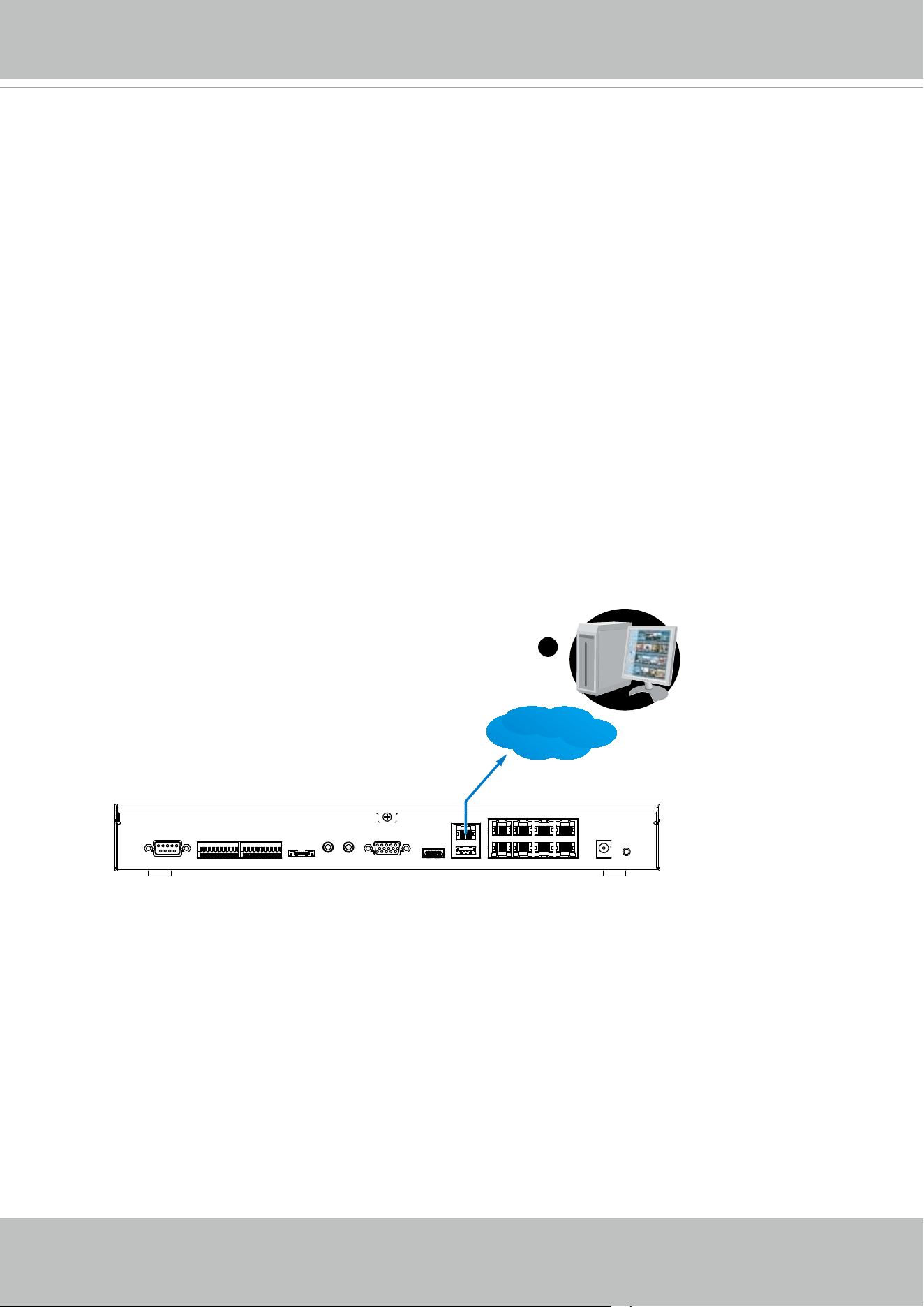
VIVOTEK - Built with Reliability
User's Manual - 95
Section Two
Management over a Web Console
There are two different interfaces on the system:
1. One is connecting mouse and keyboard, and an HDMI cable to a TV screen or monitor. The
local management thus made is described in Section One of this manual.
2. The other is accessed through the Ethernet connection. Management via a web console will
be described in Section Two of this manual.
LAN / WAN
1
Web console
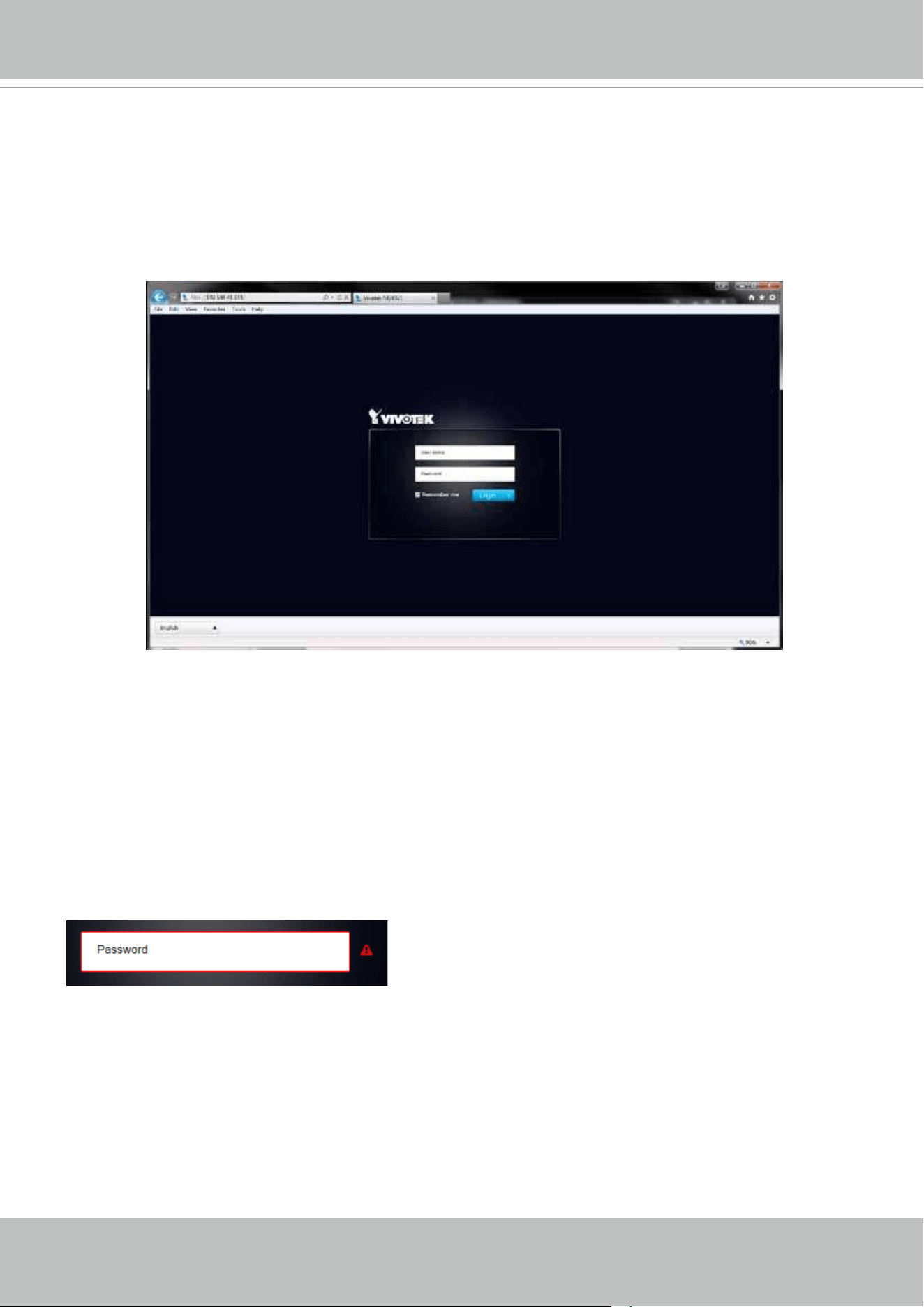
VIVOTEK - Built with Reliability
96 - User's Manual
Chapter Four Login and Getting Started
4-1. Login
This is the login page on the browser. The minimum for resolution is 1280x960.
If you enable the IE7 compatible mode when using the IE8 browser, please disable the
compatibility function. While you are in the browser, press F12 to check its status.
It is highly recommended that you should change the default password. Please refer to Settings
> Security > User account page to see how to prevent unauthorized access. The system will
prompt you if you entered an incorrect user name or password.
Remember me: Your user name will be preserved in browser cookies for two days if you select
the Remember me checkbox. The user name will be automatically erased if you do not log in to
the system for two days.
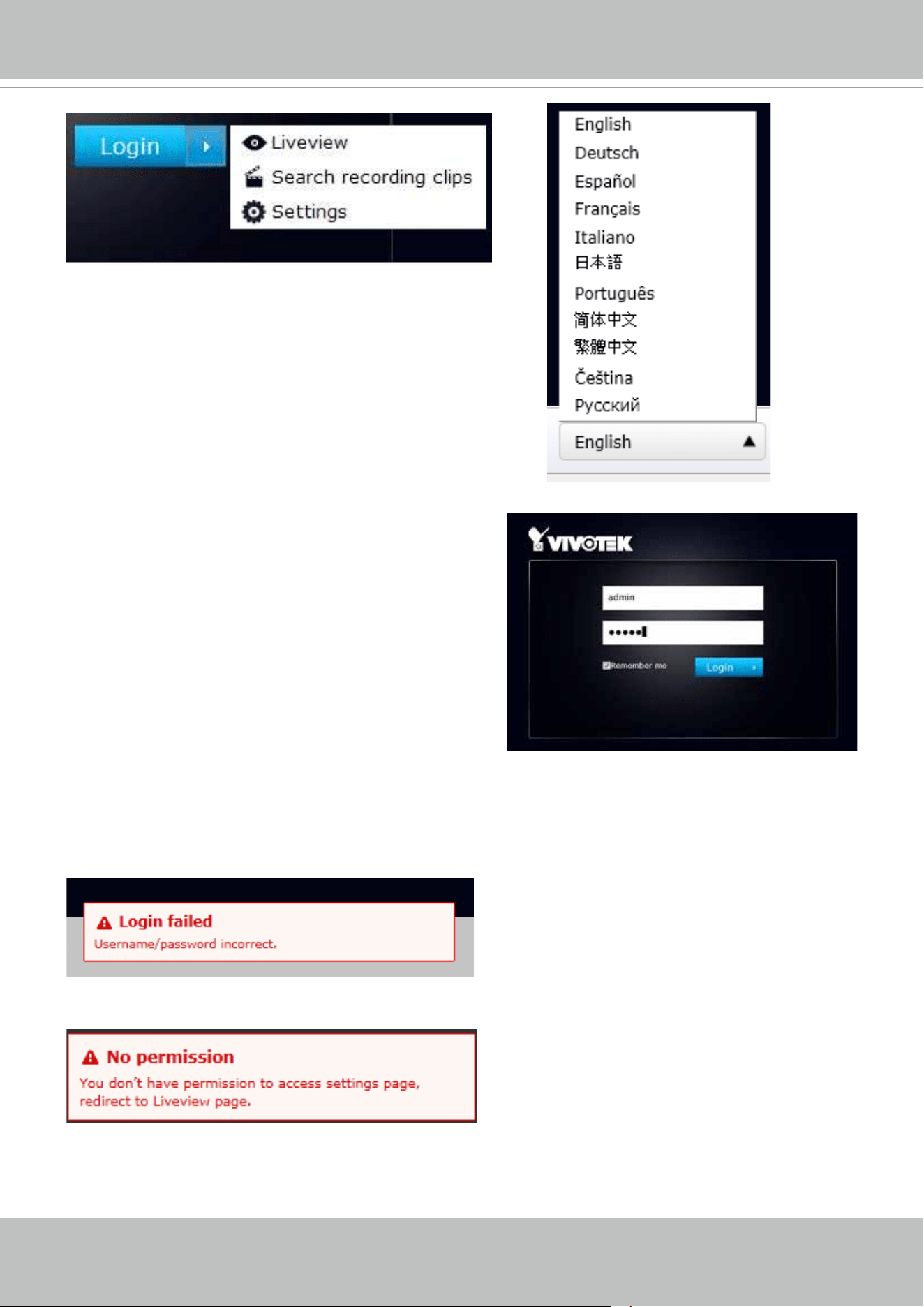
VIVOTEK - Built with Reliability
User's Manual - 97
You may login to a different software utility by unfolding
the side panel on the Login button.
You can also select a different language using the
Multilingual selector menu on the lower left corner
of the Login screen. The functional items, menus, and
dialogues will then be displayed using the selected
language.
Login errors: below are the login errors that might occur.
A Login failure can result from the incorrect user name and passwords.
The No permission error occurs when a user logs in using an authentication that has no access
rights to the Settings page. He will then be re-directed to the Liveview page.
Remember me:
Select the checkbox to save your user name for use
on the next login. The user name will be preserved
in browser cookies for two days. If you do not login
within the next two days, the user name will be
erased.
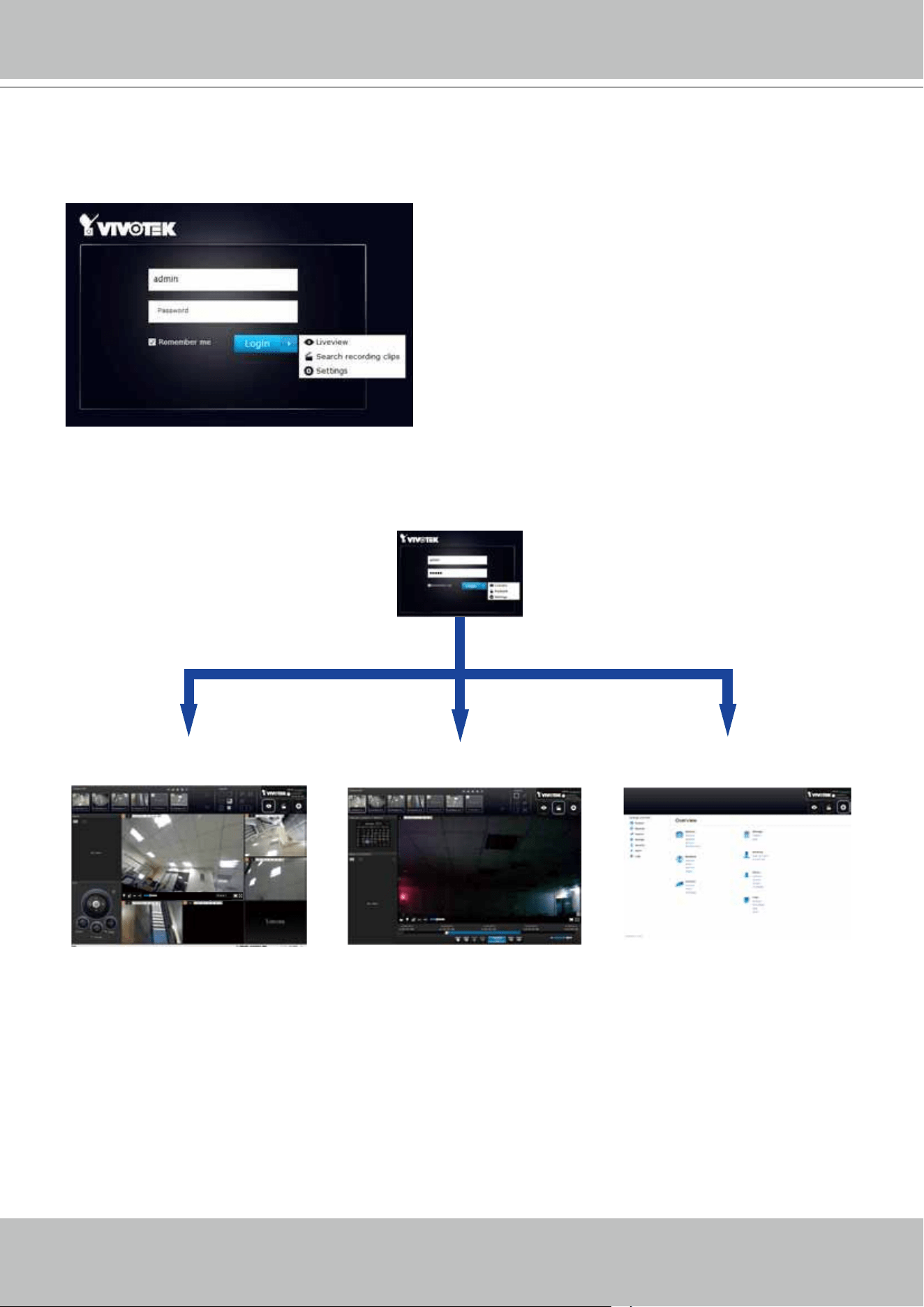
VIVOTEK - Built with Reliability
98 - User's Manual
Login options:
You may also mouse over the Login button to display the login options. You can then enter the
Liveview, Playback, or Settings window.
Liveview Search recording clips Settings
The NVR system features a simple UI structure which consists of a Liveview window, a
Playback utility, and a system Settings window. Once logged in, you can move from one window
to another by selecting the hot link buttons on the upper right of the screen.
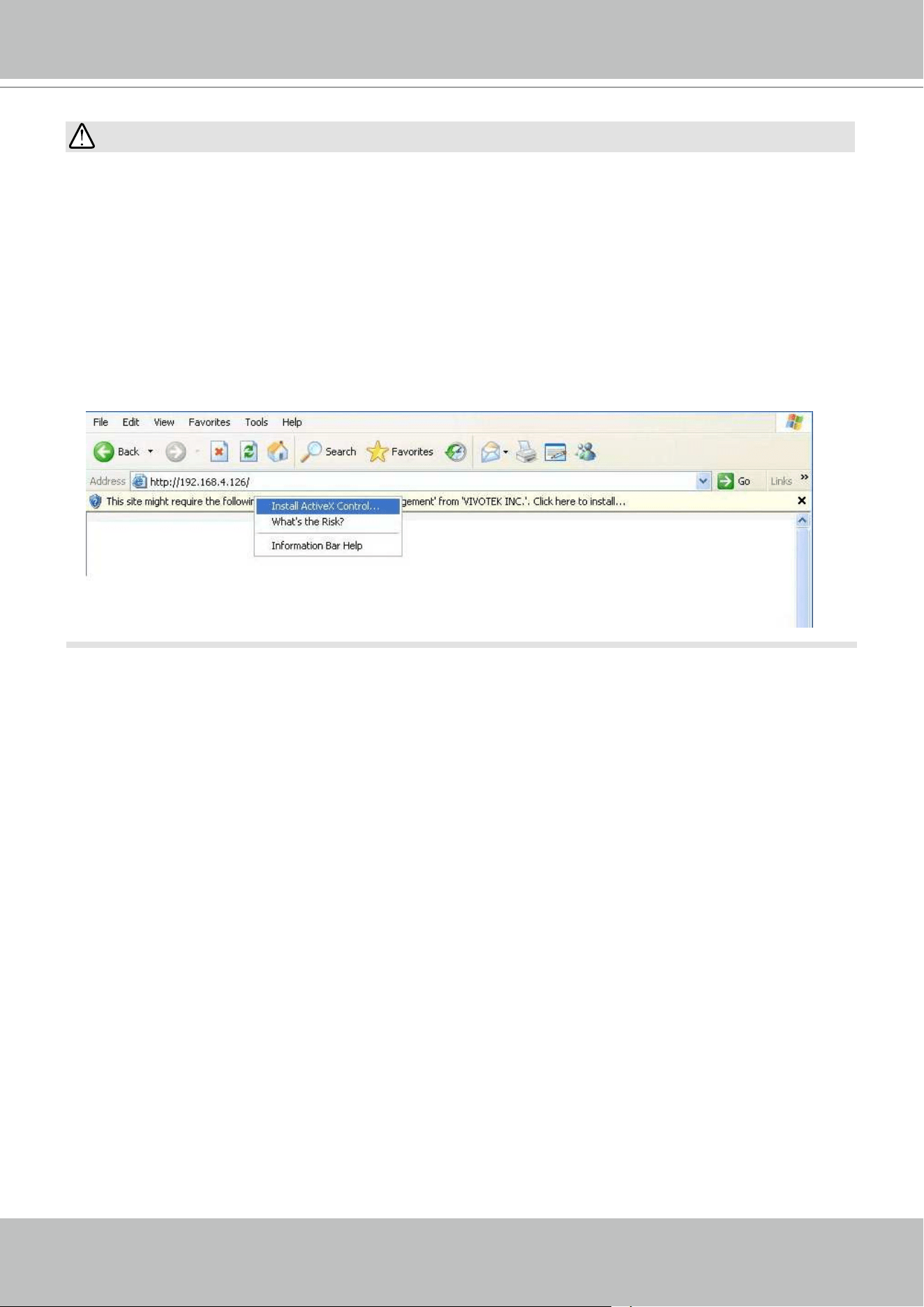
VIVOTEK - Built with Reliability
User's Manual - 99
1. Before operating the NVR, make sure you have properly installed hard drives and congured
the storage volumes. Otherwise, you will not be able to operate some of the system's
functionality.
2. Since the NVR system comes with 32-bit plug-ins for screen control, if your PC runs a default
64-bit IE browser and you manually enter the NVR's address on the browser, your browser
session may malfunction. Instead, if you double-click on the discovered NVR on the IW2
utility, a 32-bit IE browser will open.
3. When you log in to the Liveview or Playback interface to stream a live or recorded video,
install the ActiveX plug-ins. If it does not prompt when you log in, install plug-ins when you try
to playback a recorded video. You may then need to re-start the IE browser console.
IMPORTANT:
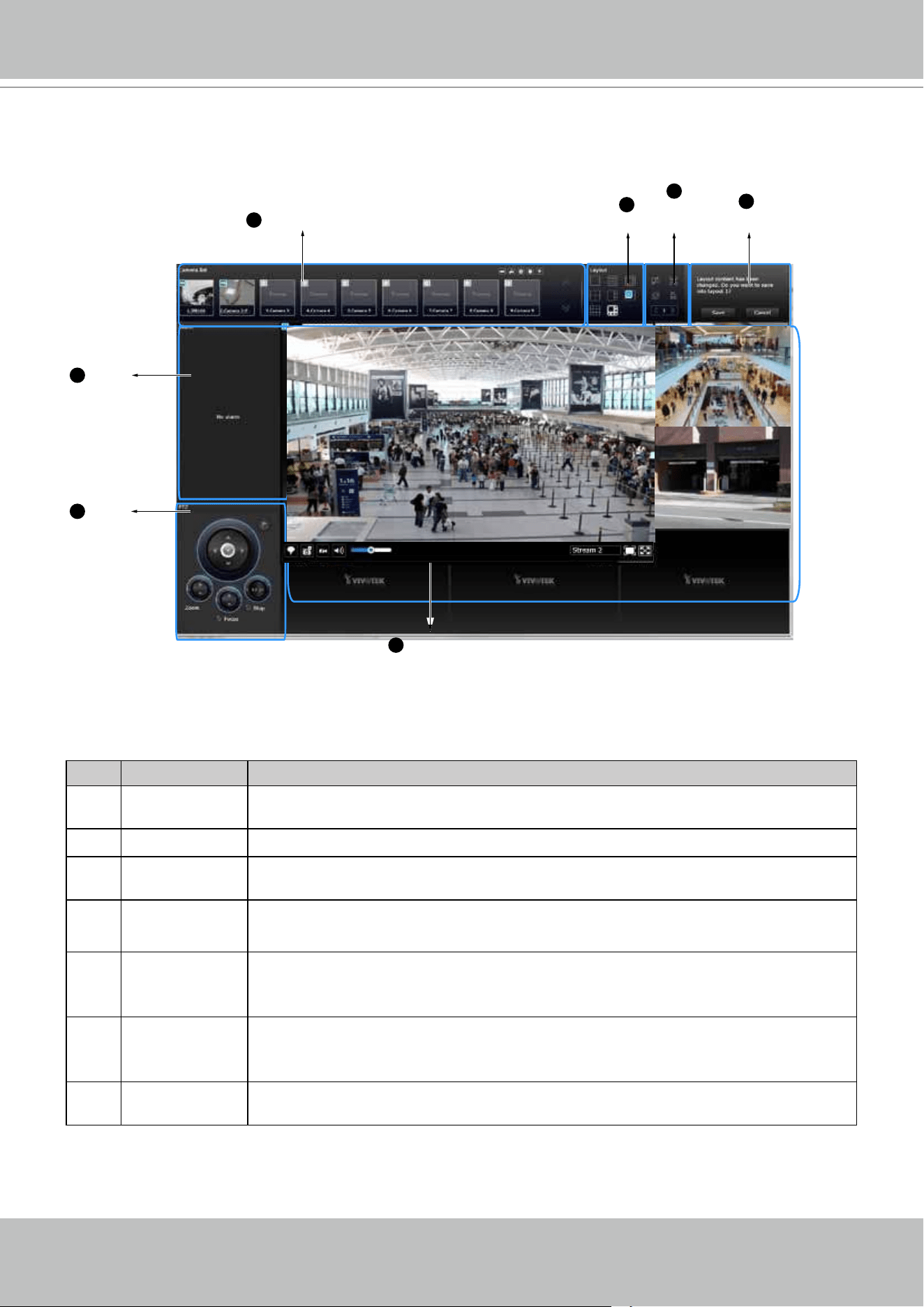
VIVOTEK - Built with Reliability
100 - User's Manual
Camera list
Layout
Layout
contents
Logo & Menu
Viewcell panel
Alarm
panel
PTZ
panel
1
2
3
4
5
6
7
4-2. Graphical Layout and Screen Elements - Liveview
Once you log in, the system defaults to the Liveview page, which provides access to other
conguration utilities, live view screen, and other functional panels. The screen elements are
described as follows:
Item Name Description
1 Camera List Provides a glimpse of all cameras inserted into your conguration. Basic
information is also provided along with a screenshot.
2 Layout Provides access to various layouts
3 Layout contents Provides functions to extend, rotate, and redo the layout. System DI/DOs are
also shown in here.
4 Logo & Menu Provides access to the Playback and System Settings utilities, as well as
system time and logout function.
5 View cell panel Displays video streams from one or multiple cameras. Snapshot, streaming,
bookmark, and audio control functions are also available on individual view
cells.
6 PTZ panel Exerts Pan/Tilt control on a selected view cell if the camera comes with
mechanical PTZ mechanism. Note that the use of joystick is currently not
available.
7 Alarm panel Reports alarms transmitted via cameras' DI connections or those by the Motion
Detection, Tampering, etc.
Each panel will be described in further discussions.
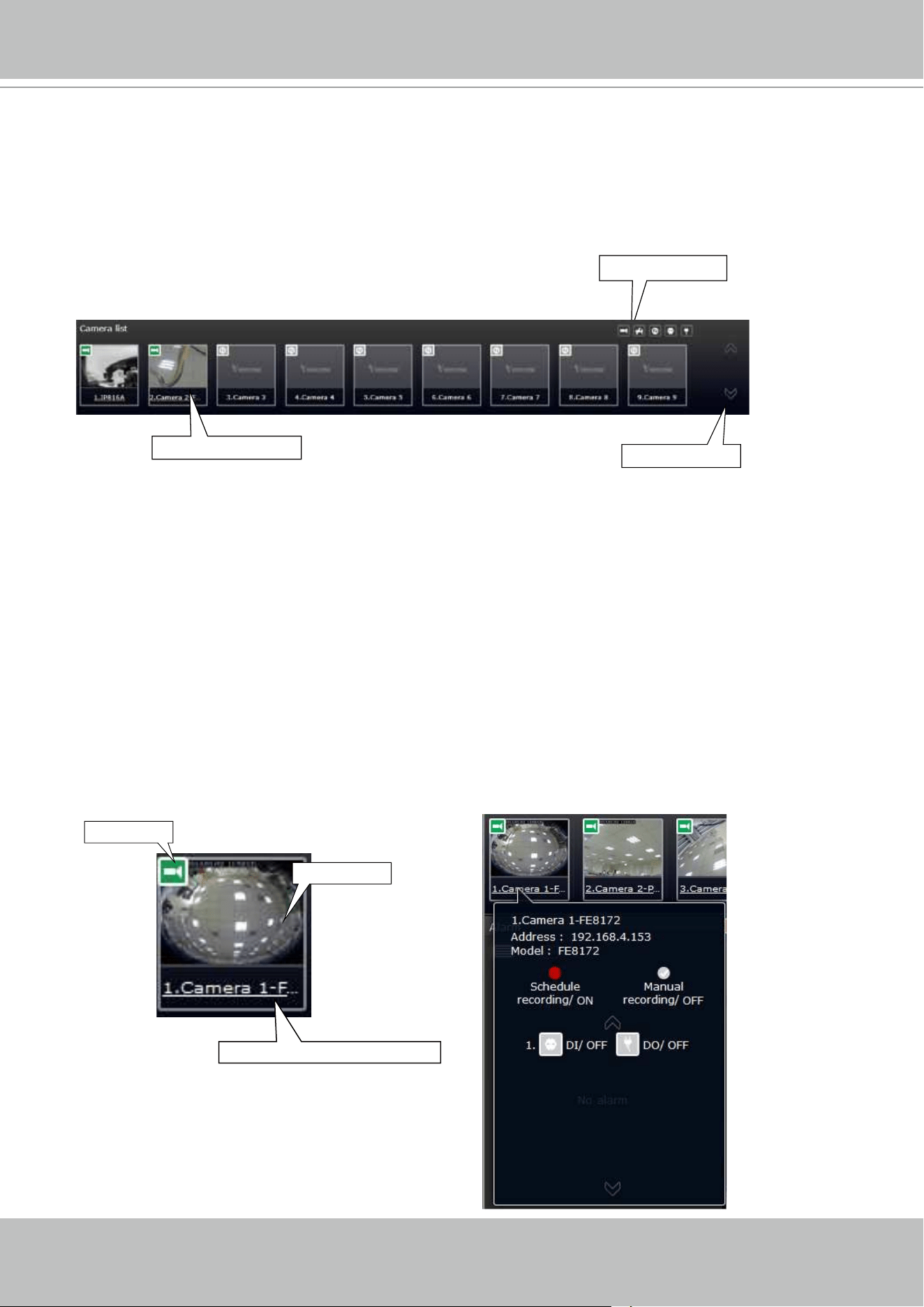
VIVOTEK - Built with Reliability
User's Manual - 101
4-2-1. Camera List Panel
The camera list displays the recruited cameras by the sequential numbering order you
congured in the System Settings utility.
Sorting criteria
Page switcher
Camera thumbnails
Depending on the size and screen resolution of your monitor, the snapshots of 8 cameras are
displayed in this panel. If a user logged in using a credential of a limited access, he may only
see cameras that he can access instead of all of the cameras.
To arrange a view cell layout, users can click and drag a camera to a view cell. Once connected,
a camera's video stream is displayed in the view cell.
Camera Thumbnail:
A mouse click on the camera name under the thumbnail brings forth the summary of IP address,
model name, recording setup and DI/DO information.
Camera index and camera name
Snapshot
Status
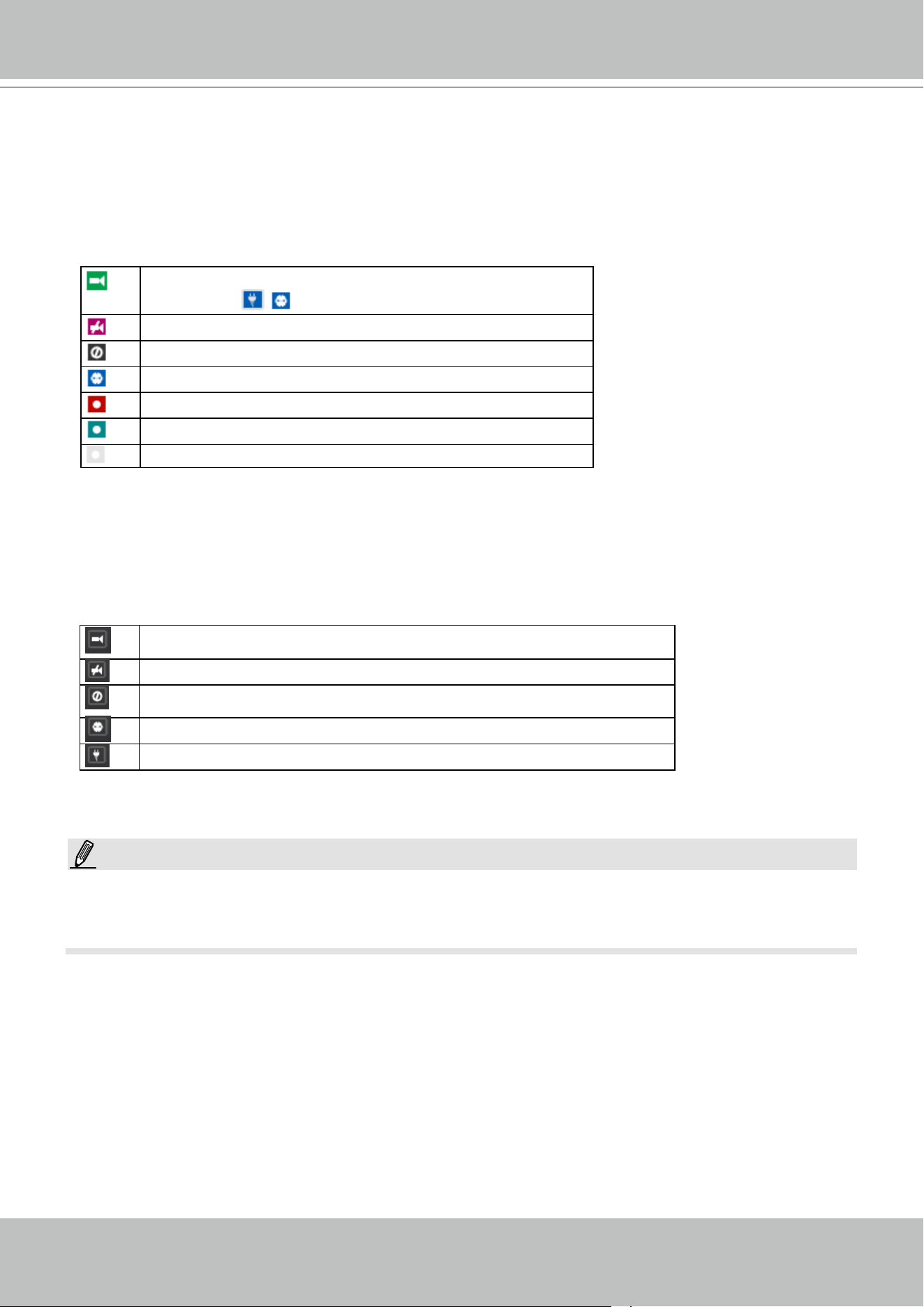
VIVOTEK - Built with Reliability
102 - User's Manual
* Snapshot: the camera's image snapshot is replenished every 5 minutes. If a camera is
disconnected, the last image taken will be used to represent a camera.
* Camera index & Camera name: Placing the mouse cursor on top of a camera text displays
the camera index number and the camera name. You can click on the camera index to display
the information box.
* Status:
Online: the online status can be accompanied by the
DI/DO icon
Ofine: camera is disconnected.
An uncongured camera instance
Digital input is triggered
Connected and recording video to system storage
Connected with live streaming
Disconnected or trying to establish a connection
Sorting criteria
Use the sorting buttons to re-arrange the order of the cameras on the list. Cameras that match
the condition will be brought to higher places on the list (front of the order) regardless of its
original camera index.
Online: the online cameras.
Ofine: the ofine cameras.
Uncongured camera instances
Cameras whose Digial inputs have been triggered
Cameras whose Digial outputs have been triggered
For online cameras, the snapshots on the camera list are refreshed by every 5 minutes, and
therefore may not represent the latest occurrences on the surveillance areas.
NOTE:

VIVOTEK - Built with Reliability
User's Manual - 103
4-2-2. Layout
Note that a user who did not log in as an administrator can change a layout, but his conguration
changes (with cameras placed on view cells) will not be saved.
User Layouts
There are another 4 user layouts that can be individually
congured. An administrator can insert camera views into
these layouts, and save the conguration. These user layouts
can be seen by all users.
If you click the Rotate button before the conguration changes
can be saved, your conguration changes will be lost.
Because the maximum number of supported cameras is 8, the last view cell on the 3x3 page
conguration will be unuseful.
Only an administrator can change and preserve a custom layout, and every user can designate
a specic layout to be displayed when he/she logs in. The default layout for each user is stored
in a browser's cookies.
Whenever changes are made to the current layout, a message prompt will appear on the side of
the layout panel reminding you to save your current setting.
1x1
1+3
1+5
2x2
3x3
User layout #1
User layout #2
User layout #3
User layout #4
By default, 5 typical layouts are provided for the user.
They include: 1x1, 2x2, 3x3, 4x4, 1+3, 1+5, and 1M+12.
System default is the 4x4 layout. Cameras that do not t
into the rst page of a layout, say, a 3x3 layout, will be
displayed on the succeeding layout pages.
Each functional button on the screen is activated by a
mouse hover. For example, the below states designate
user's operation on a button:
1.
: not selected.
2.
: moused over, and is ready for selection.
3.
: selected, and is taking effects.
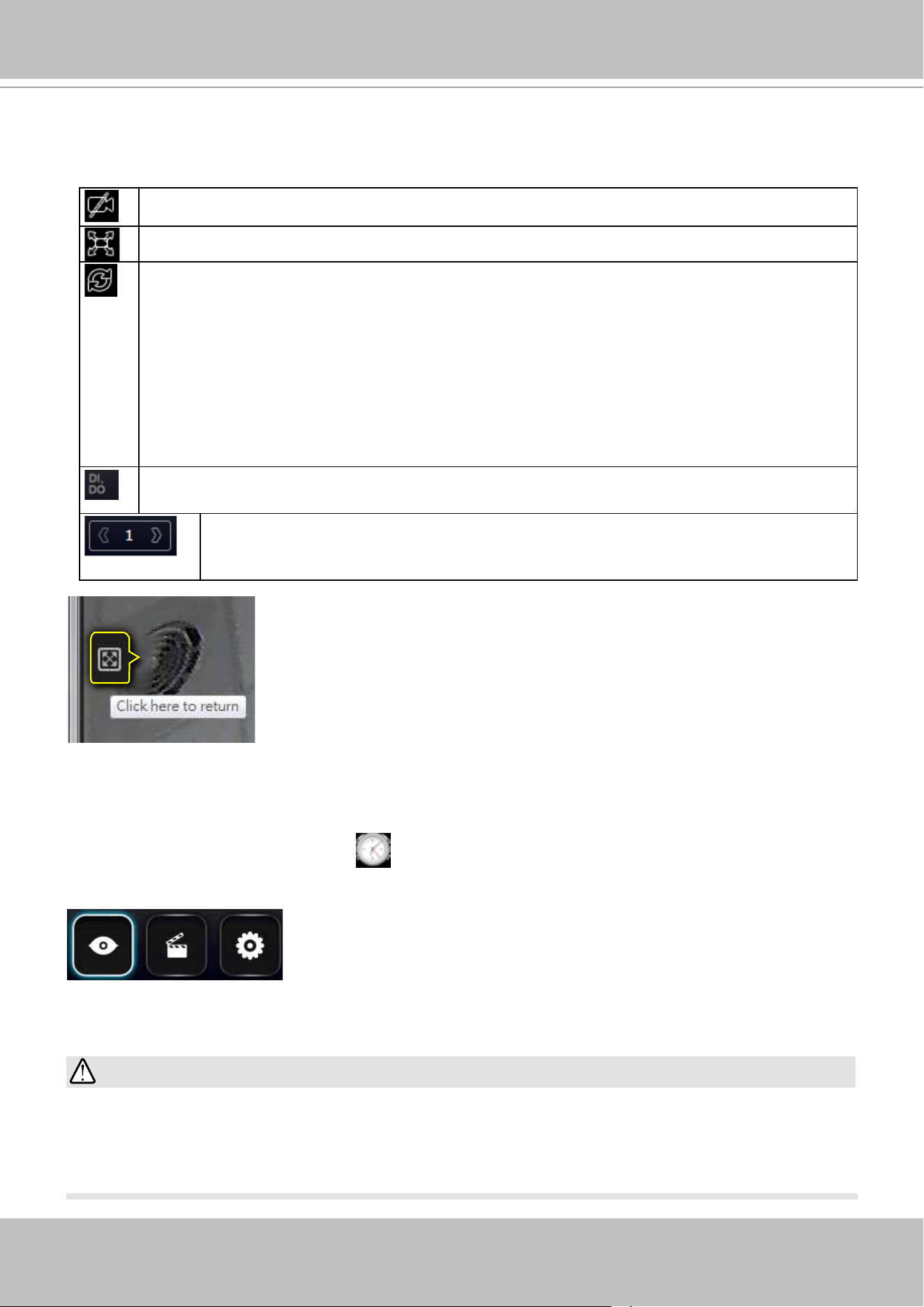
VIVOTEK - Built with Reliability
104 - User's Manual
4-2-3. Layout contents
A few functional buttons are available on the Layout contents page.
Clears all view cells on the current layout.
Full view: extends the view cells on the current layout to the full of the screen.
Rotate: the rotate function lets system display successive layout pages by the
intervals of 10 seconds. The layout page that does not contain camera views will be
skipped.
A Rotate action will stop when you
1. move to another page,
2. move to a user layout,
3. click to select a view cell,
4. remove a camera from view cell.
Click to display the NVR's DI/DO statuses.
If your current layout spans across multiple pages, use the arrow buttons to
switch from one page to another. The index number of the current page will be
shown between the arrow buttons.
When your current layout is displayed in a full view, move your cursor
to the left center of the screen to return to the default Liveview screen.
The Return button will appear.
4-2-4. Logo & Menu
A logout button, system time panel , and 3 hot link buttons to access the Liveview, Search
recording clips, and System Settings utilities.
The system date and time refers to the date and time kept on the
NVR system's real time clock.
Due to the limited space for the user name, user name may be
partially displayed until you hover your mouse cursor.
Your conguration changes will be lost if you click one of the hot link buttons to move to another
utility window. For example, you have changed your Live View layout and then click on the
Playback button, you will enter the Playback window without saving your conguration. Save
your changes before you use these buttons.
IMPORTANT:
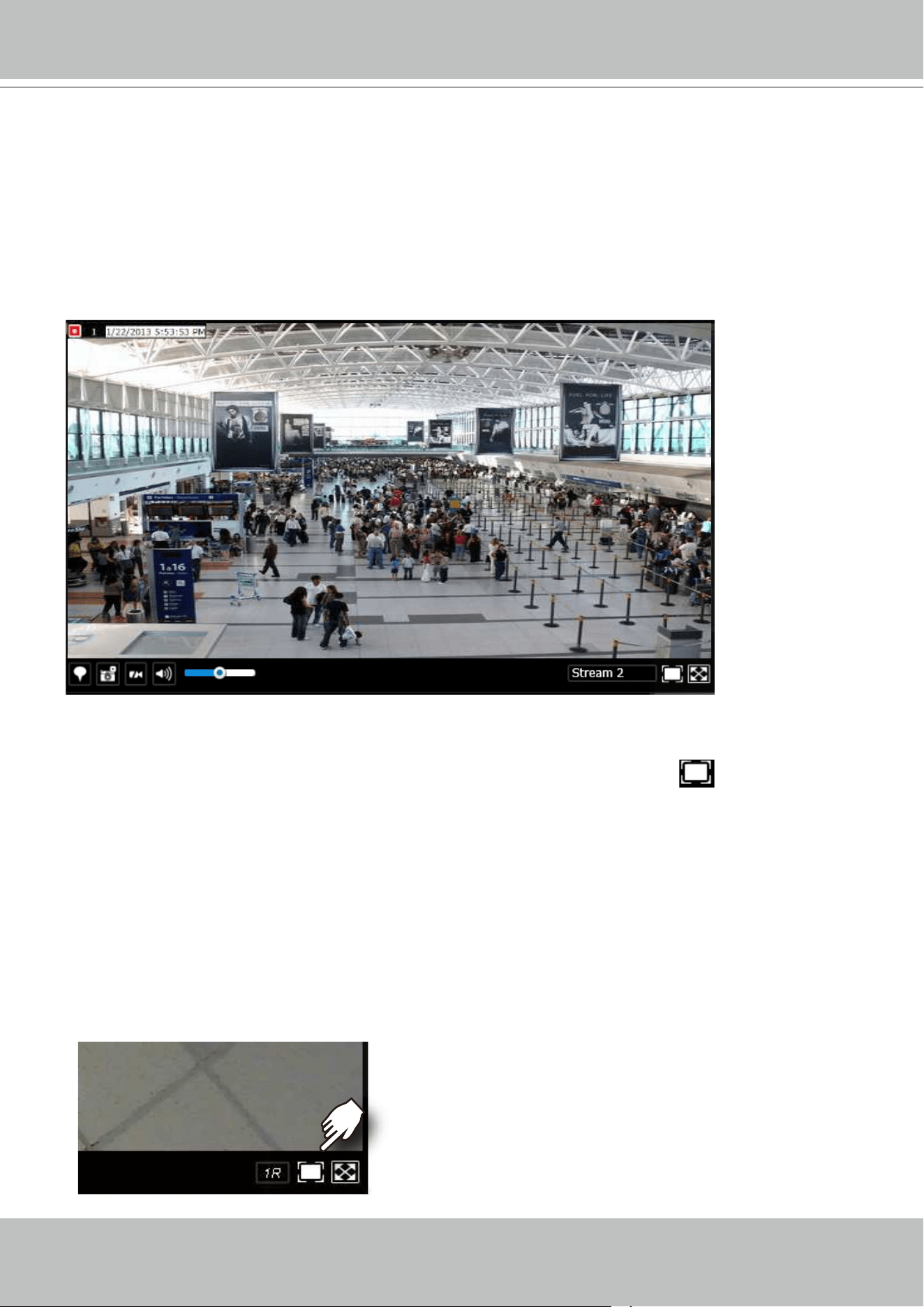
VIVOTEK - Built with Reliability
User's Manual - 105
4-2-5. View Cell panel
A single view cell is shown below. Each view cell contains a video stream display area, an
information bar, and functional buttons at the bottom. A view cell is displayed in Normal,
Focused, or Maximized mode.
1. A single click selects a view cell from the View Cell panel, enables its function buttons, and
turn it into the Focused mode.
2. The 2nd click maximizes the size of the view cell to the full of the panel.
3. The 3rd click shrinks the maximized view back into the focused mode.
Although the system automatically selects the video stream to display on the view cell, you can
still manually select a different video stream from the Stream tab below.
To deselect a view cell and return to the normal view, click on the Restore
button at the
lower right of the window.
Adding Cameras to View Cells
1. Click and drag a camera from the camera list to an unoccupied view cell.
2. Double-click a camera on the camera list. The camera will be added to the rst available view
cell.
To deselect a view cell and return to the normal view, click on the Restore button at the lower
right of the window. You can also click on another view cell to continue adding other cameras.
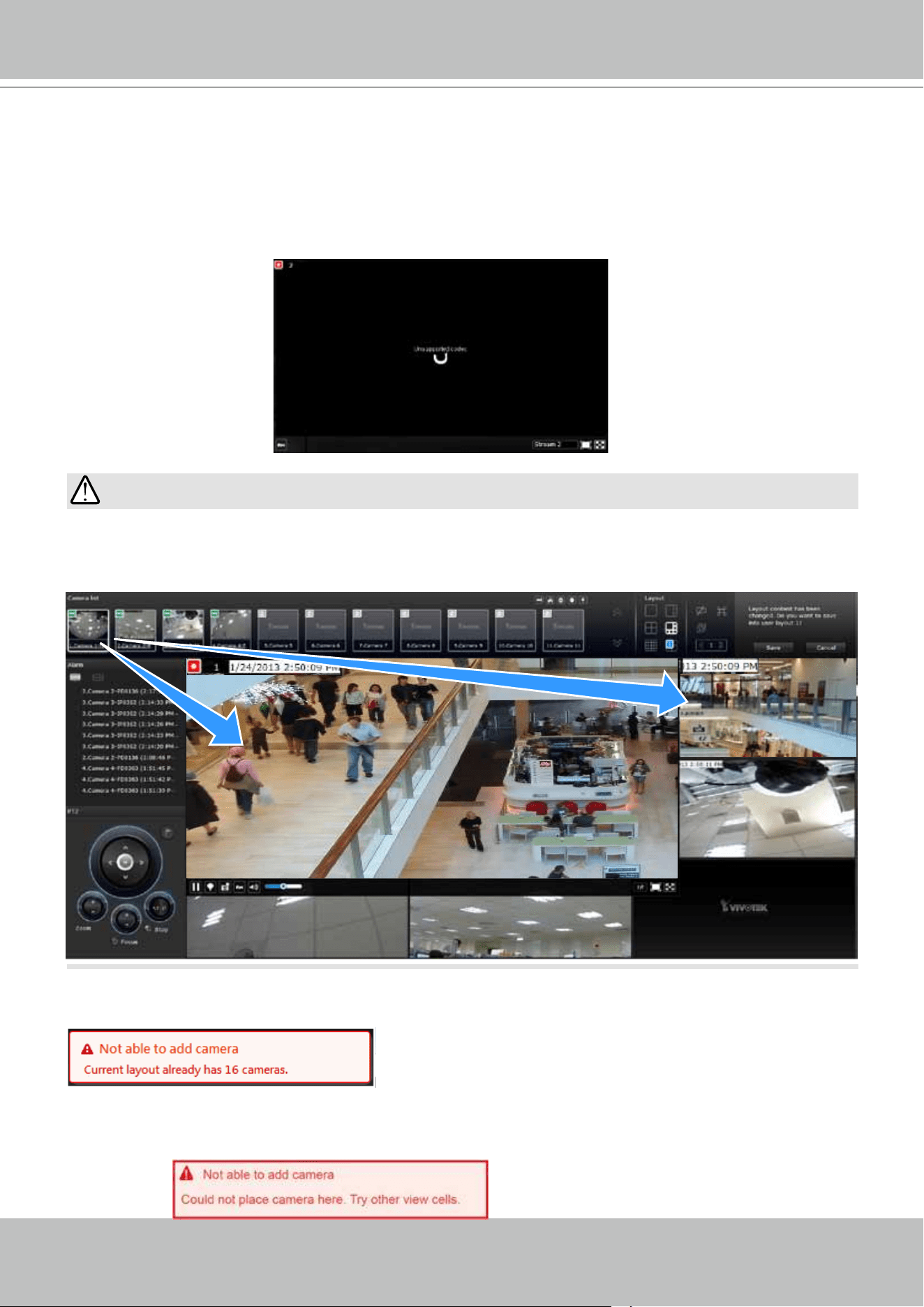
VIVOTEK - Built with Reliability
106 - User's Manual
A camera can be inserted into multiple view cells. This way, a camera with a wide eld of view, ,
can simultaneously display different regions of interest on different view cells.
IMPORTANT:
If the current layout already contain the max. number of cameras - 8 for ND8322P, and 16 for
ND8422P, the following message will prompt.
If you are using the 8-CH ND8322P, there can be more than 8 view cells across multiple layout
pages, e.g., on the second page of the 1+5 layout. Placing a camera in the 9th to 11th view cells
will bring out the following message.
A view cell attempting to connect to a network camera will look like this. If the connection
attempt takes a long time, it may result from network problems or incorrect conguration with
video streaming. For example, you may have congured the camera to be streaming a 5MP
stream. The NVR uses video stream #1 for recording, and stream #2 from cameras for live
viewing. You should then open an individual web console with the network camera to change its
video streaming conguration.
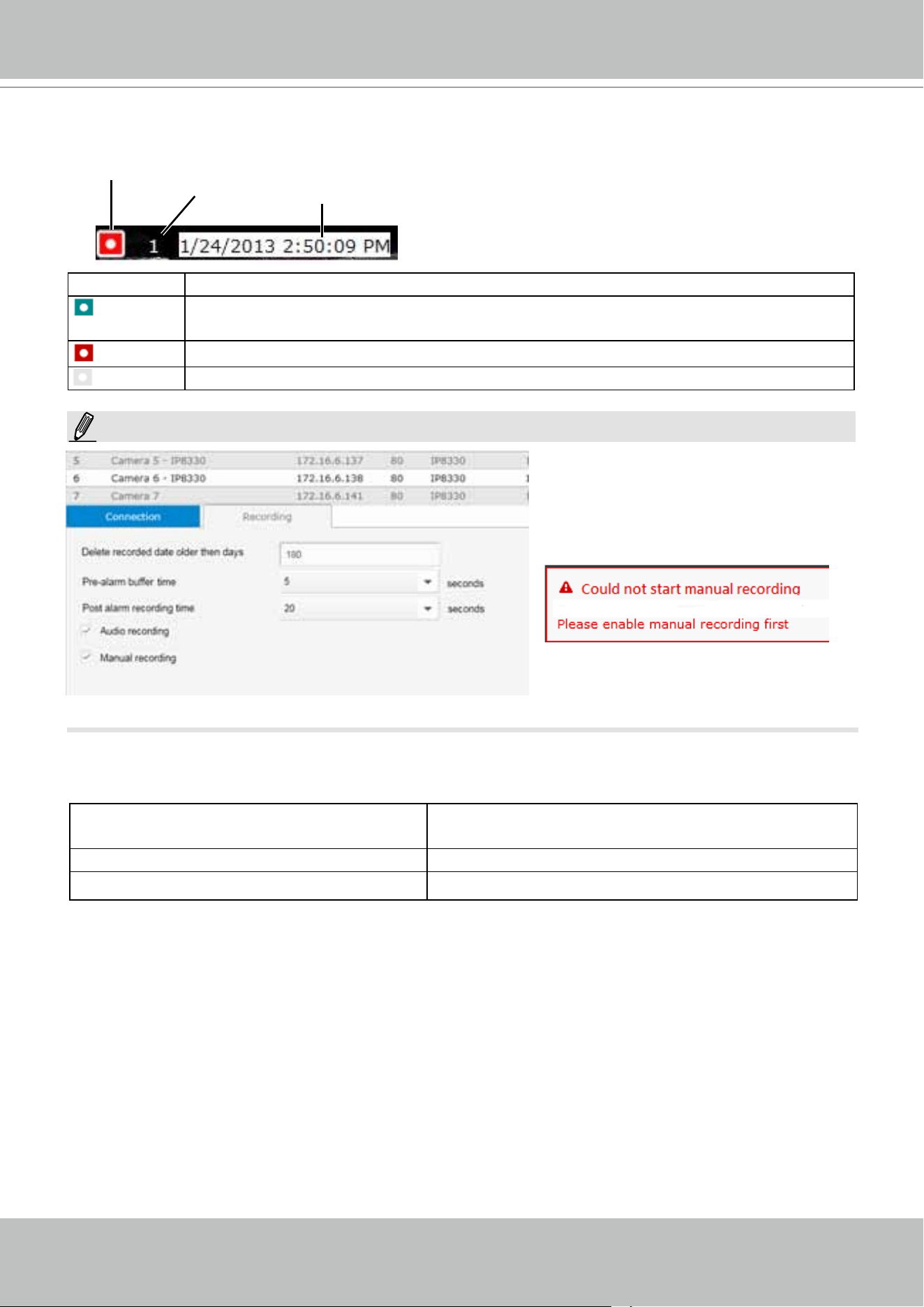
VIVOTEK - Built with Reliability
User's Manual - 107
Information Bar
Status icon Description
Connected with live streaming; a single click on this icon can trigger a manual
recording.
Connected and recording video to system storage.
Disconnected or trying to establish a connection.
If you disable the Manual recording
function on the Settings page, you
will not be able to use the Manual
Recording function on the Liveview.
A mouse hover over the status icon will produce the following messages:
1. "Connecting..." or "Cannot connect" Connecting to a camera, or connection problem
might have occurred.
2. "Live streaming" Video is being streamed.
3. "Recording" Currently recording the video stream.
Status icon
Camera index
Video time
Video time: The time congured on the NVR system is displayed here.
Camera index: an index number appointed to a camera following the order you inserted
cameras during the initial setup.
NOTE:
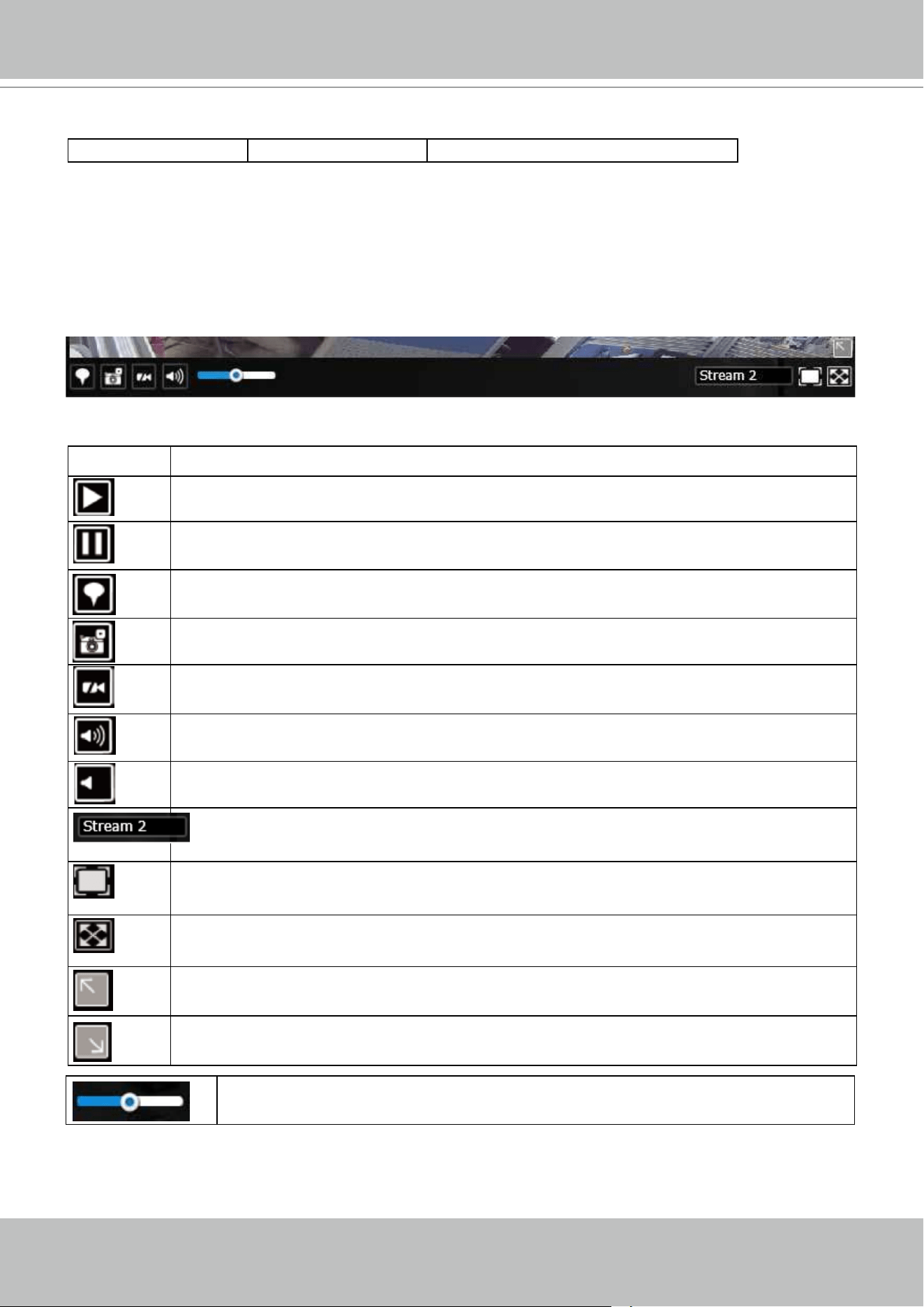
VIVOTEK - Built with Reliability
108 - User's Manual
The time display format is as follows:
yyyy/m/d/yyyy hh:mm:ss 2014.05.05 16:15:41
Tool Bar Buttons
Buttons Description
Resumes streaming.
Pauses a video stream.
Adds a Bookmark (that saves a short description and a one-minute footage from
the current feed)
Takes a snapshot.
Removes camera from the view cell.
Mutes (if there is audio input from the camera.)
Unmutes
Stream selector.
Restores the view cell's original position on the Liveview panel.
Maximize the size of current view cell.
Activates the PiP function.
Disables digital zoom (PiP).
Volume controller
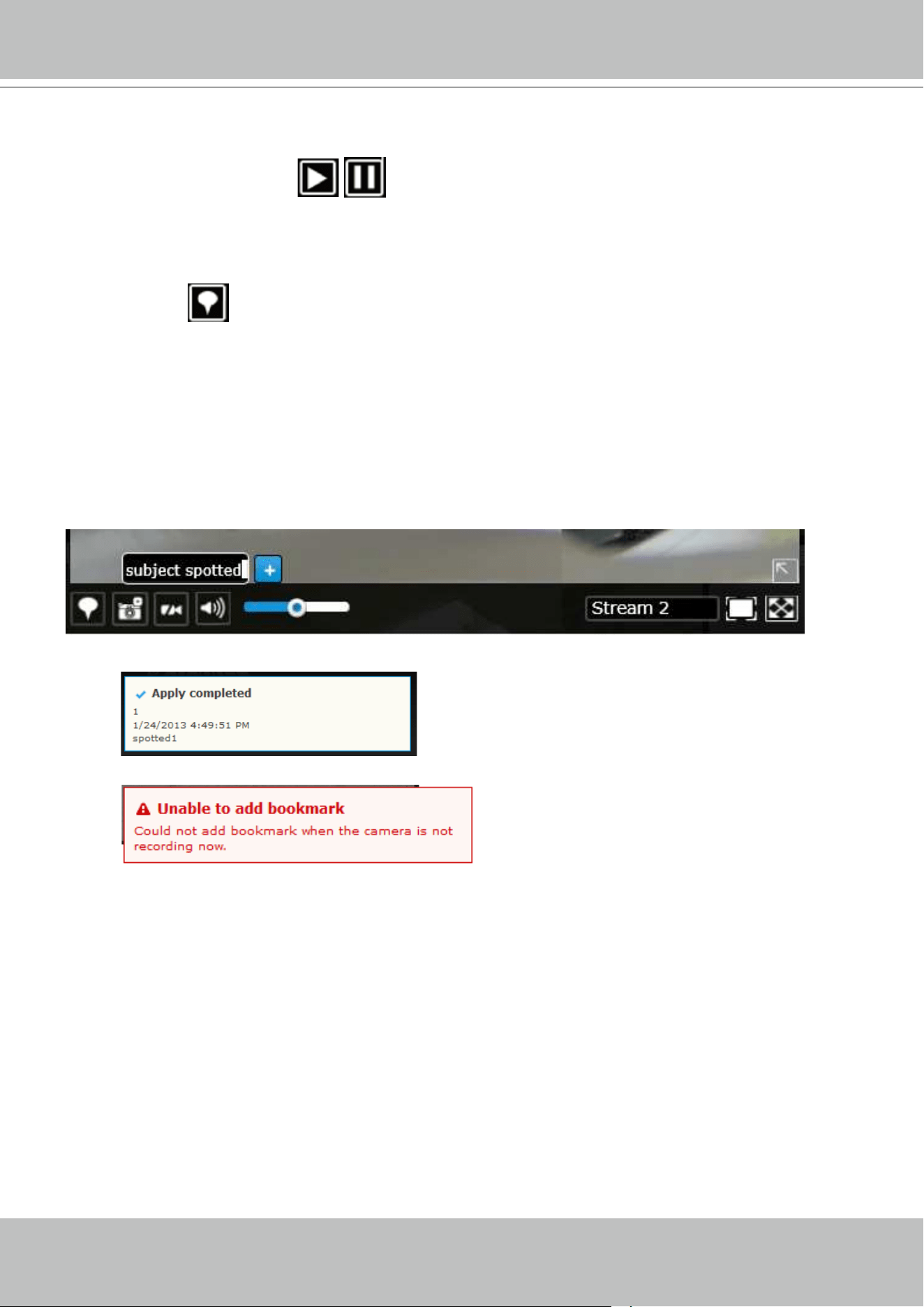
VIVOTEK - Built with Reliability
User's Manual - 109
Tool Bar Functions in Details
1. Play and Pause buttons:
These buttons pause and resume a video stream currently being played on your web browser.
Note that this operation does not affect the video recording taking place between a camera and
the NVR system.
2. Bookmark:
This function allows you to place a bookmark on a recorded stream when you observe a
situation from your live view window. The bookmark is preserved as a one-minute footage along
with a short description of a particular incident. The precondition of using this function is that
the video stream, while you are watching it on the view cell, must be recorded to the NVR at the
same time.
To add a bookmark,
1. Click on the button,
2. Enter a short description that can be as long as 120 characters.
3. A conrm message will prompt at the lower right of the screen.
If the current video feed is not being recorded to storage, you will receive the following message:
Errors with creating bookmarks may also result from network and server errors.
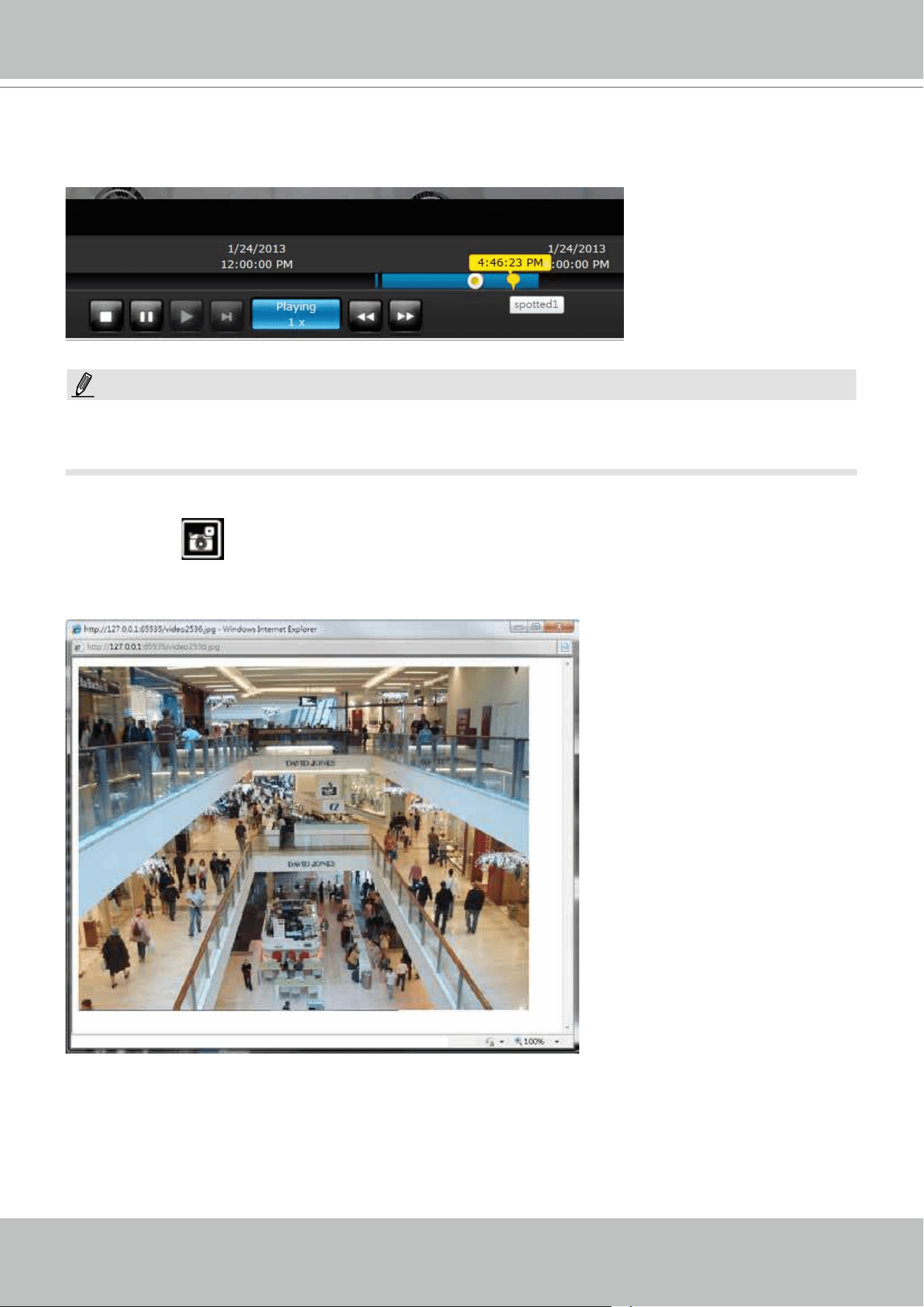
VIVOTEK - Built with Reliability
110 - User's Manual
Below are two bookmarks (yellow tags) shown along with a recorded video in the Playback utility
screen. Bookmarks help nd and retrieve important moments in a recoded video.
3. Snapshot:
This button produces a snapshot prompt. You may then right-click on the snapshot image to
save it to a preferred location.
Bookmarks will be erased if the user/system erases the video clips they were appended to. For
example, system will recycle storage space by deleting old videos along with their bookmarks.
Note that the size of a snapshot is equal to the frame size set for the video stream.
NOTE:
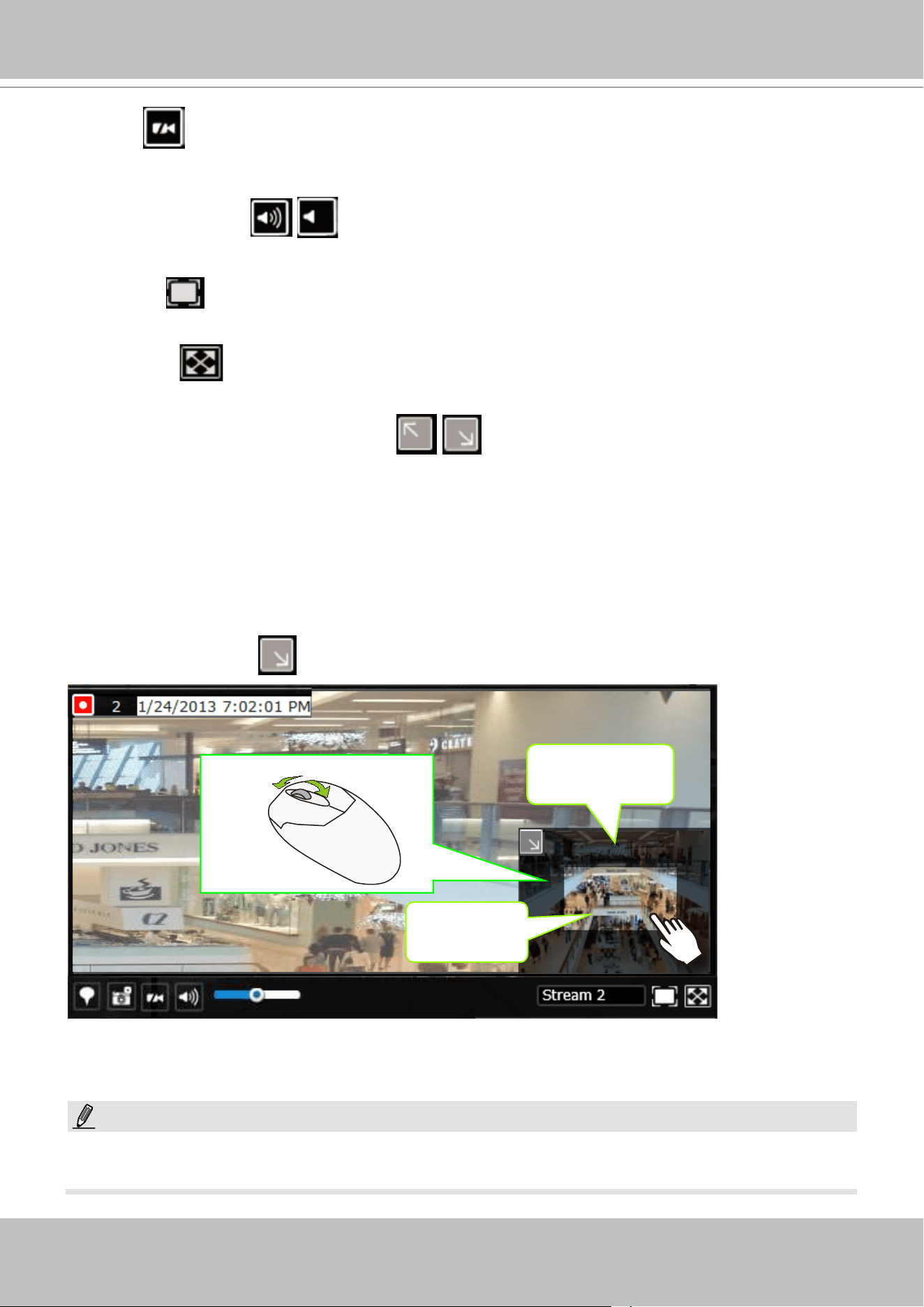
VIVOTEK - Built with Reliability
User's Manual - 111
4. Clear:
This button removes camera from the current view cell. The view cell will then be available for
other cameras
5. Mute and Unmute:
These buttons stops or resumes audio from a live stream.
6. Restore:
This button restores the view cell's original position on the Liveview panel.
7. Maximize:
This button extends the size of current view cell to the full of the Liveview panel.
8. Activate and Deactivate PiP function:
PiP is short for Picture in Picture, a function that provides digital zoom into a live video.
When activated, a Global view window will appear at the lower right of the view cell as shown
below. You can display only a portion of the complete video frame as an area of your interest.
Using a click and drag on the ROI window, you can instantly move to other areas within the
video frame.
Global view
ROI
Zoom In Zoom Out
Note that not every camera supports the PiP function.
You can resize the ROI window by a mouse hover on the lower-right corner of the window until
the resize mark appears. The default size of the ROI window is 25% of the Global view.
Click on the deactivate
button to close the PiP window.
The Talk function in the two-way audio is currently not supported.
NOTE:

VIVOTEK - Built with Reliability
112 - User's Manual
9. Volume controller:
The volume control takes effect when audio input from the network camera is available. Audio
is heard only from a focused window, one that you selected by a mouse click from the Liveview
panel. Some network cameras do not come with an embedded microphone, and its audio is
disabled by system default. The actual sound level is also dependent on the system volume of
the PC having a web console with the NVR.
The sound volume conguration will not be preserved when a camera is removed from a view
cell, web console is restarted, or when the Liveview layout is re-congured.
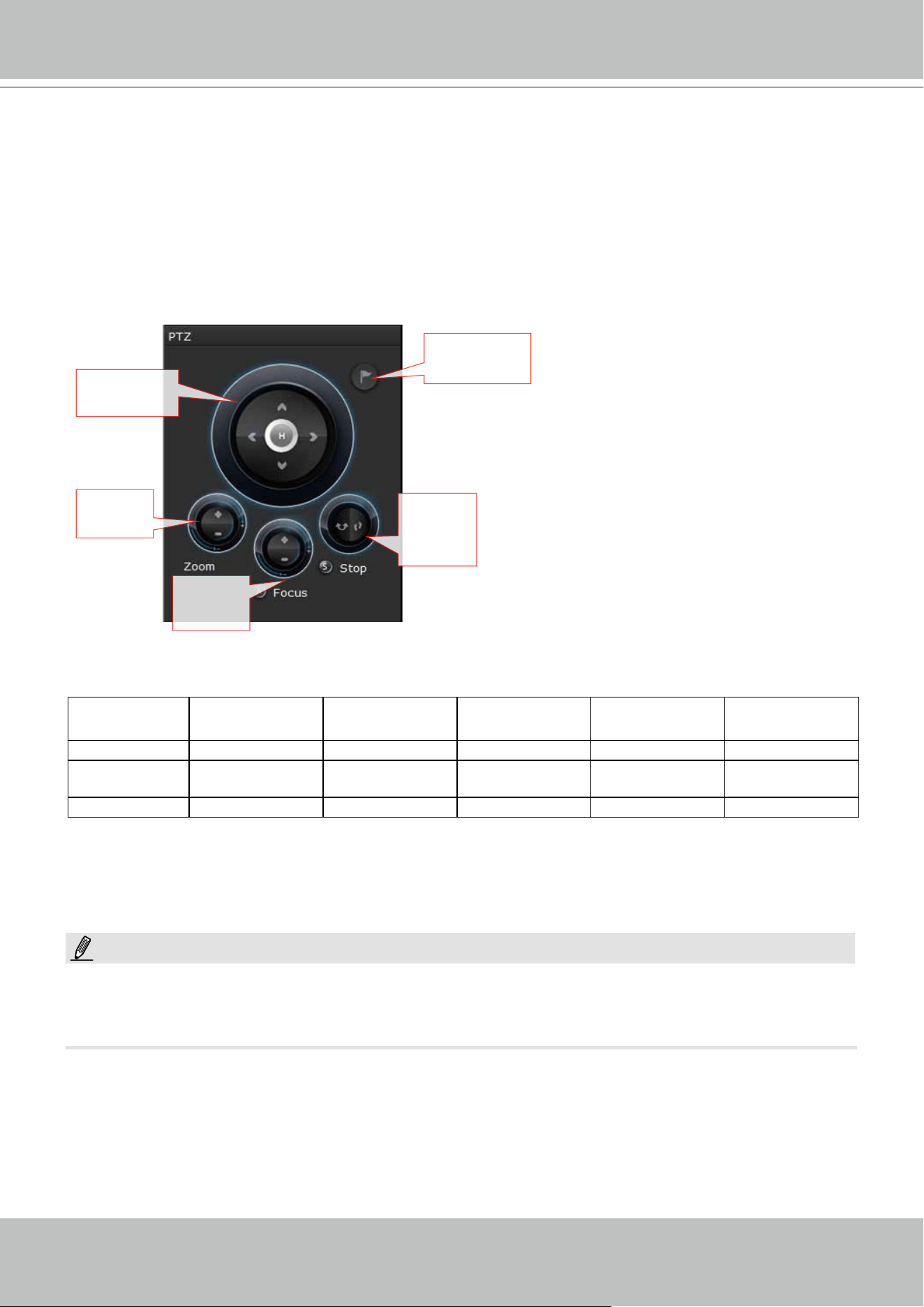
VIVOTEK - Built with Reliability
User's Manual - 113
4-2-6. PTZ panel
The PTZ panel takes effect for cameras that come with mechanical PTZ functions. It does not
support digital PTZ functions. To utilize its functions, select a view cell populated by a PTZ
camera, such as a speed dome.
Depending on the individual functions that come with PTZ cameras, some functions will not be
available for every cameras. For example, the zoom controller will not apply for a PTZ camera
that comes without a mechanized zoom module, such as PD8136 and PT8133.
Pan/Tilt
controller
Preset locaon
selector
Zoom
controller
Auto
pan/patrol
controller
Focus
controller
Model (series) Pan/tilt
controller
Preset location Zoom controller Focus controller Auto Pan/Patrol
controller
PD Yes Yes No No Yes
VS (VS8100
and 8102)
* Depends Depends Depends Depends No
VS84xx/88xx Depends Depends Depends Depends Depends
Listed below are the camera models and the types of supported PTZ controls:
* If the analogue cameras connected through the video server support PTZ mechanism.
On the Liveview window, currently the Continuous Move and the Click-on-image functions for
PTZ cameras are not supported. Neither can you zoom in/out using the mouse wheel.
NOTE:
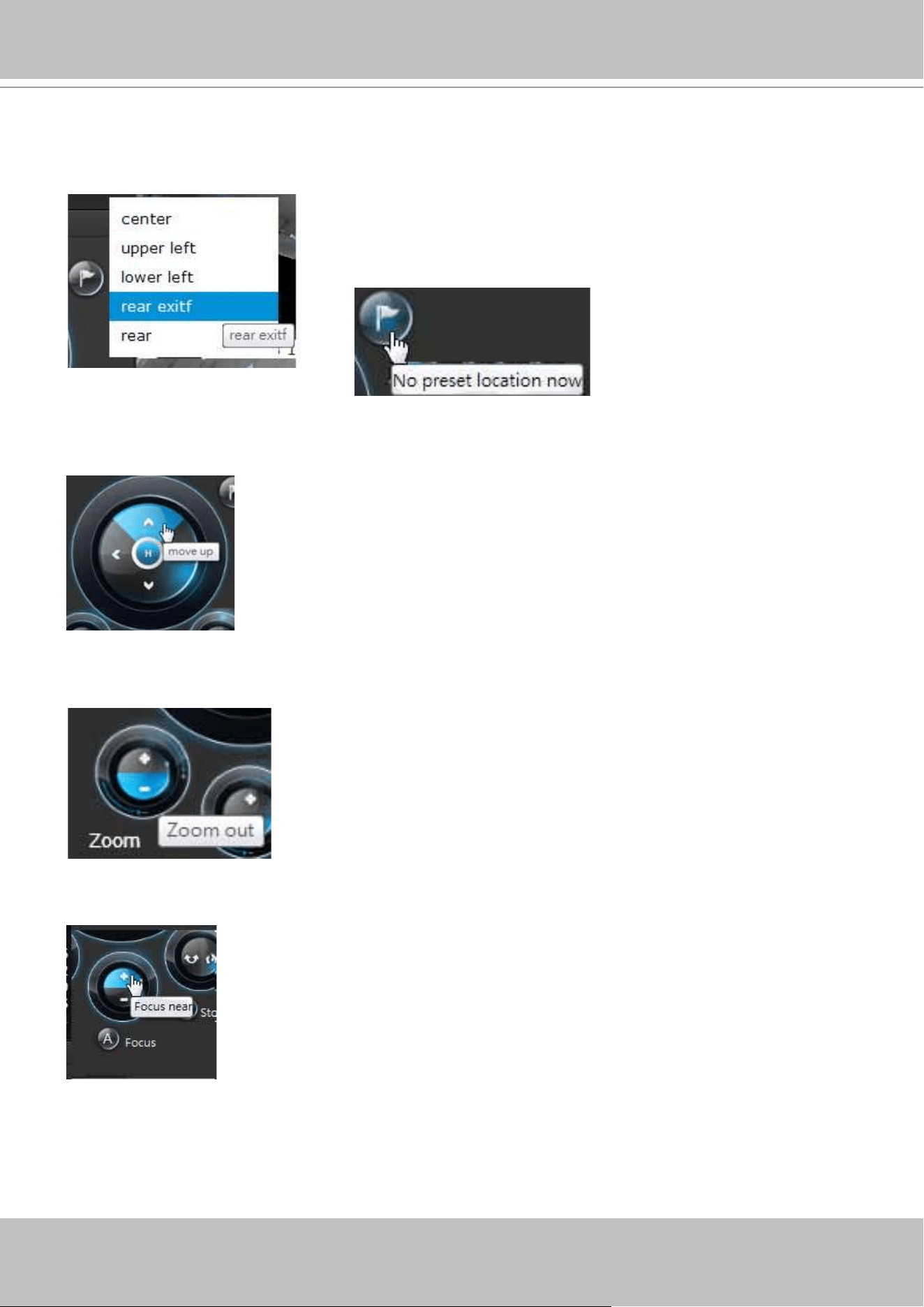
VIVOTEK - Built with Reliability
114 - User's Manual
PTZ presets: If your PTZ cameras have preset locations, click on the button to unfold the preset
menu. Click on any of the preset locations to move to the area of your interest. Refer to your
camera's User Manual for how to congure preset locations.
The following message will prompt if the camera has no
preset locations.
Pan/Tilt controller: A mouse hover over the arrow buttons activates the arrow button. Use the
buttons to navigate to a preferred location.
Zoom controller: The zoom controller buttons only apply to cameras that come with an optical
zoom module, such as a speed dome camera.
Focus controller: The focus controller buttons apply to cameras that come with focus control
over its lens module, such as a speed dome camera.
Auto Focus: If your camera supports the auto focus function, use this
button to acquire an optimal focus point.
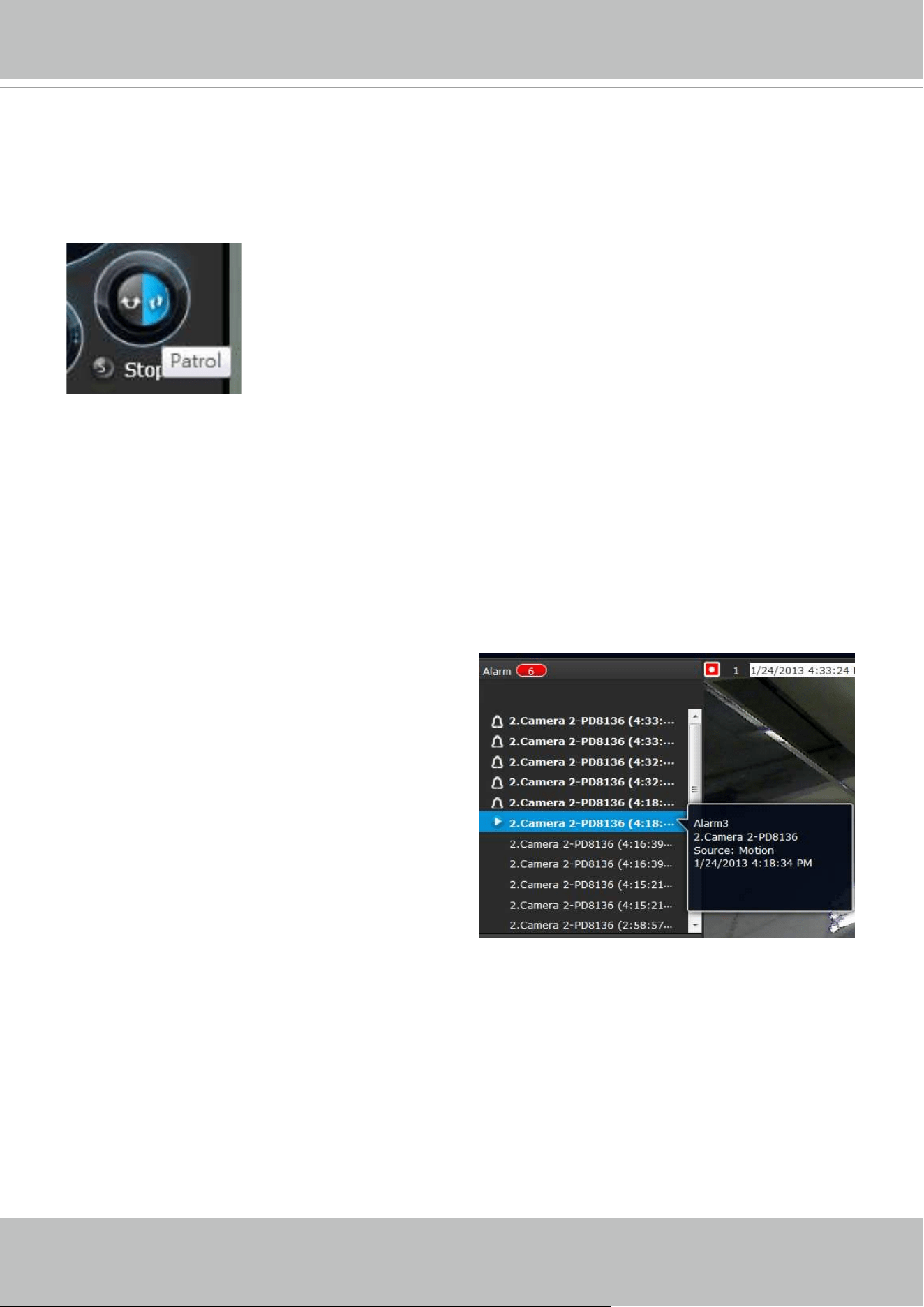
VIVOTEK - Built with Reliability
User's Manual - 115
Auto pan/patrol controller: These buttons provides pan and patrol functions provided that
preset locations have been congured on the camera. For a speed dome camera, the pan
command tells the camera to continuously pan 360 degrees until it is stopped by a user
command. For PZ or PT series cameras, the pan action only takes place once to cover
reachable areas.
The Stop button ends a pan or patrol tour.
4-2-7. Alarm panel
To receive alarms from cameras, you need to congure alarm triggers in the Settings > Alarm
conguration window (
see page 161). Network cameras' digital inputs, digital outputs, or motion
detection can all be used to detect conditions in external environments. When the alarms are
triggered, you can congure certain kind of actions to take place in response to the alarms, such
as:
1. recording the immediate image,
2. sending an Email,
3. sounding the buzzer,
4, sending snapshots to an FTP server,
5. sending event messages to web server,
6. moving camera lens to a preset location,
7. triggering a camera digital output.
The alarm panel displays the latest 10 alarm
entries with the latest alarm on top of the list.
The alarm list keeps up to 200 events. Older
events will be erased if the number exceeds
200.
The alarm panel is polled every 10 seconds. A mouse hover on an alarm entry displays full
information of the event.
Note that multiple alarms can be triggered by one incident. See page 161 for how to congure
the alarm settings.
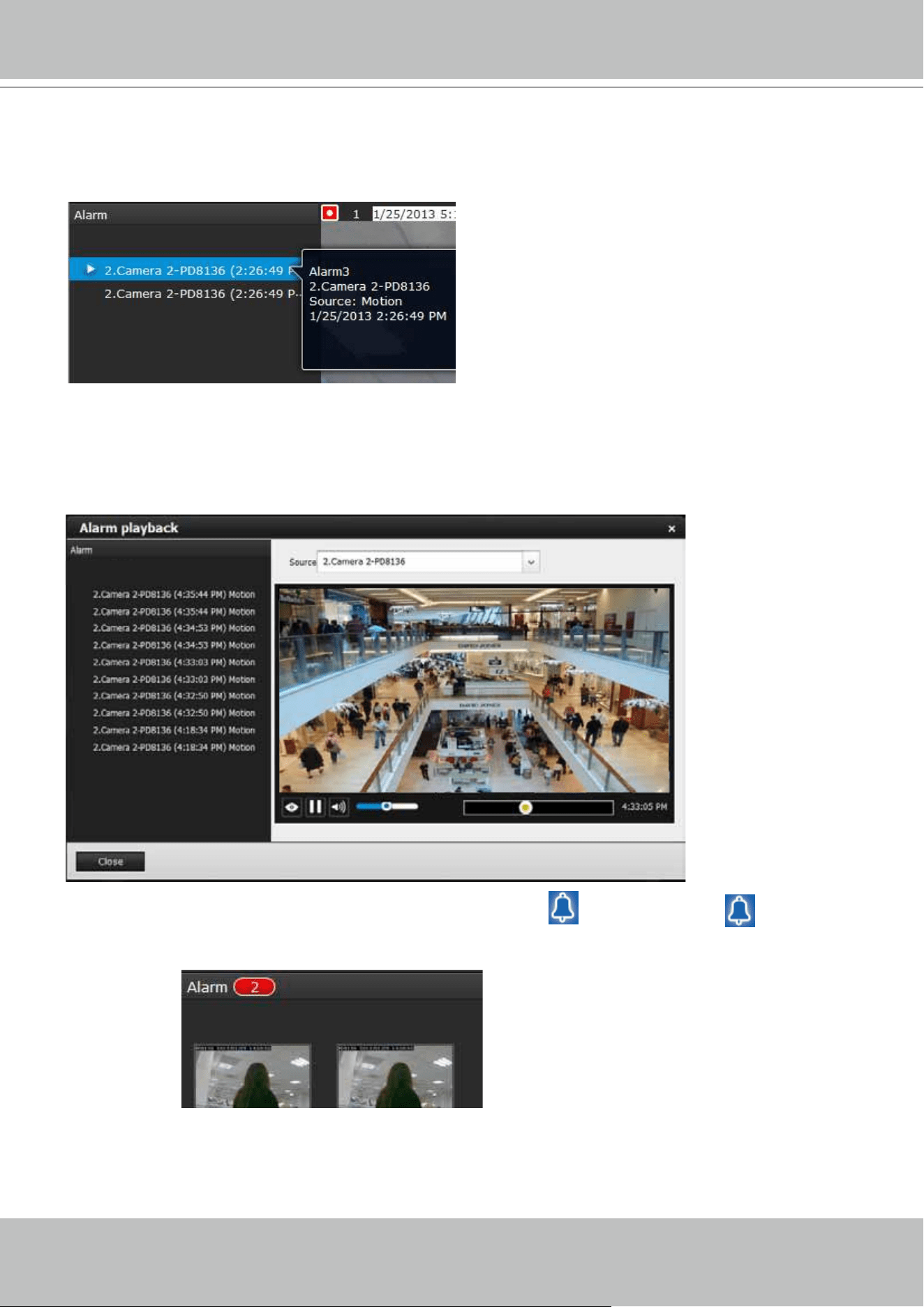
VIVOTEK - Built with Reliability
116 - User's Manual
If an event is congured with a recording action, there will be a play button to the left of the
alarm message.
Click and read a text-only alarm will turn off the alarm icon . The alarm icons indicate
unread alarms. The number of unread alarms will be listed on the title bar.
The alarm playback window will begin playback of a footage taken 10 seconds before the
occurrence of an alarm. The playback of an alarm-triggered recording will normally last for one
minute. If, however, you congured a shorter pre- and post-alarm recording time, your alarm
recording may be slightly shorter. The default for pre- and post-alarm buffer time are 5 seconds
and 20 seconds.
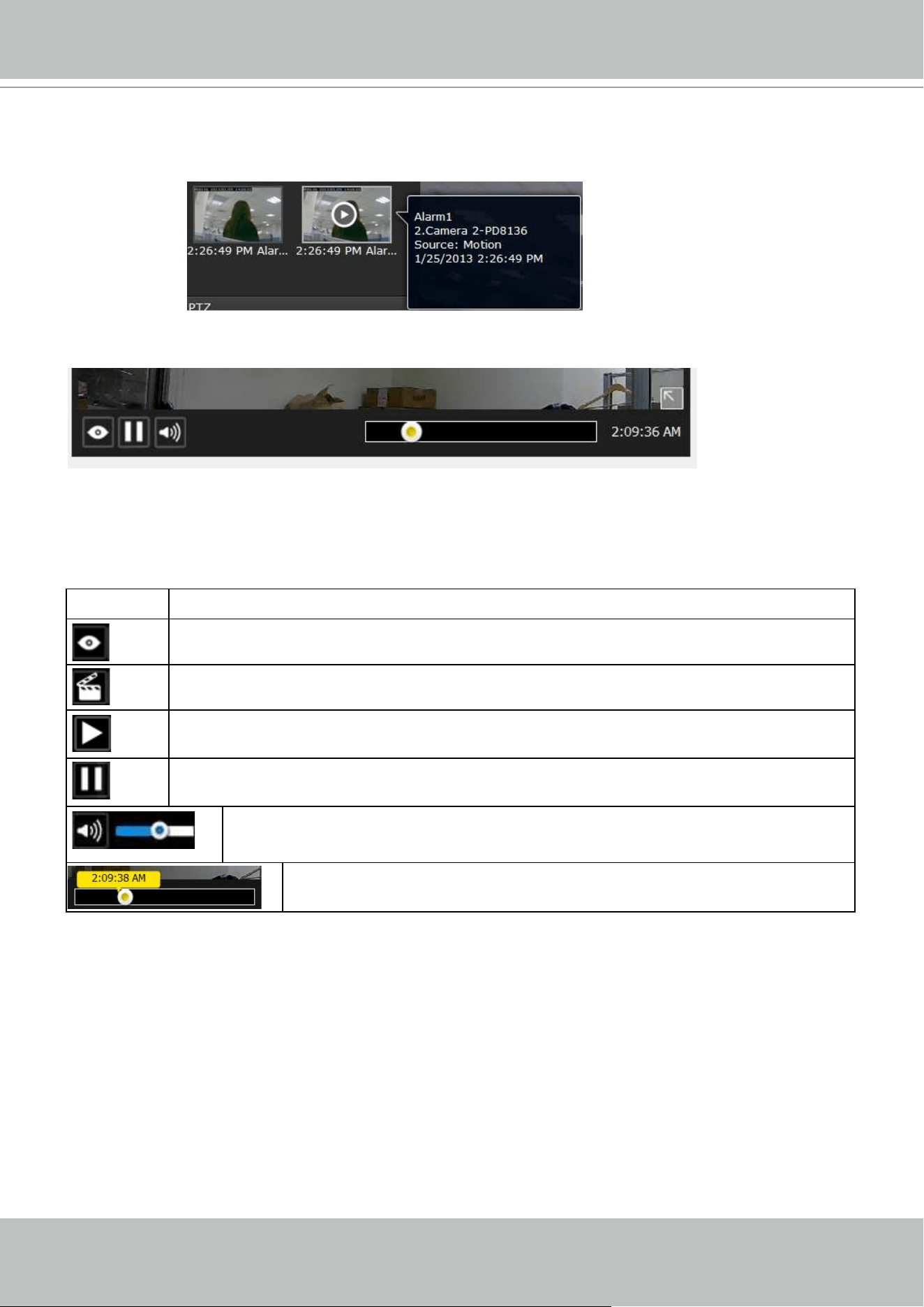
VIVOTEK - Built with Reliability
User's Manual - 117
Move your cursor over an alarm with a recorded
footage. The Play button will become available.
Buttons Description
View live video: displays the live view streaming instead of the alarm recording.
Resumes the alarm playback.
Begins the alarm playback.
Pauses the current playback.
Mute or unmute the audio with the current playback. Drag the controller to
change the audio volume level.
Use the playback slider to quickly change the playback position.
The following buttons are available in the alarm playback window.
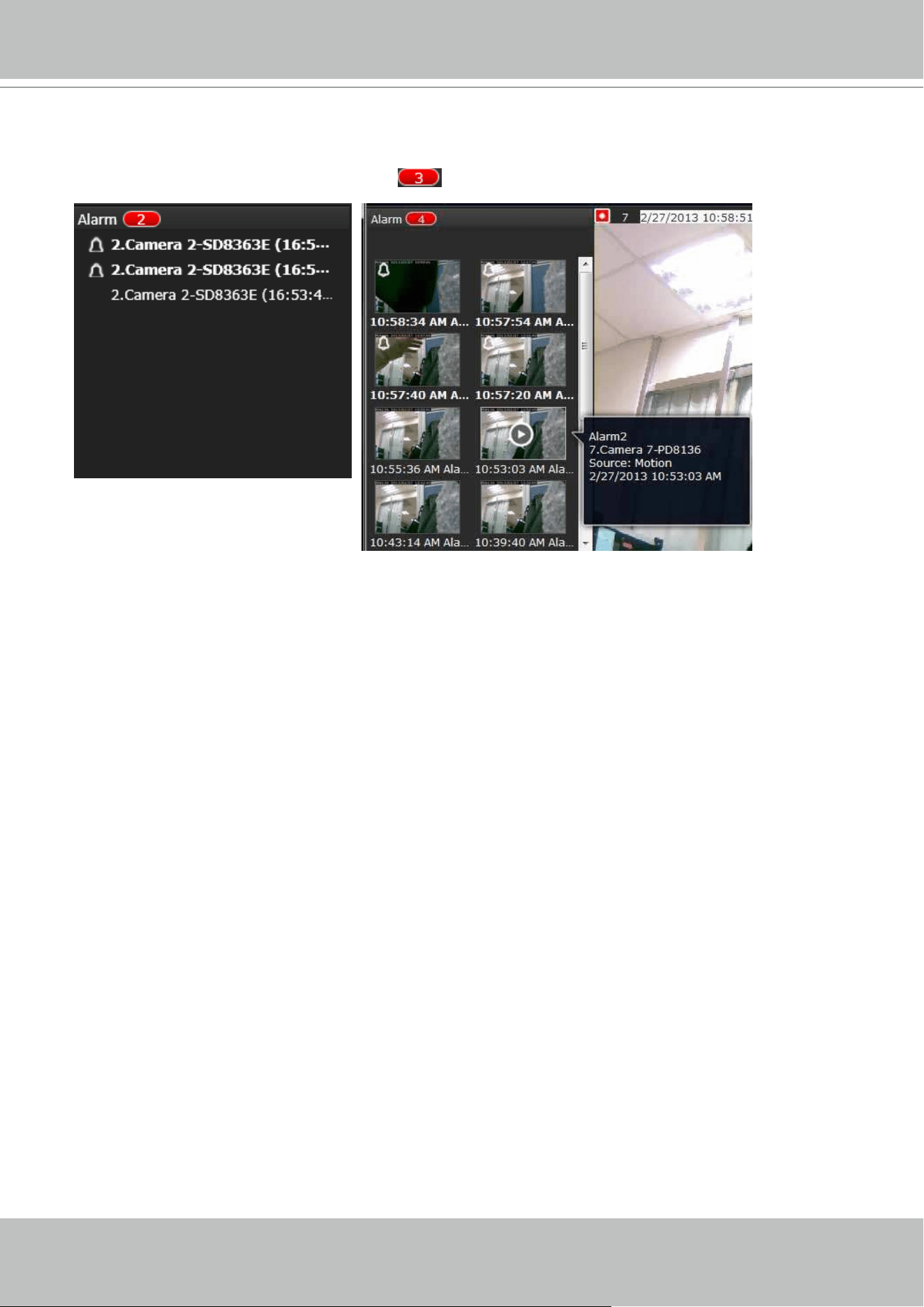
VIVOTEK - Built with Reliability
118 - User's Manual
Incoming Alarms
New alarms will be indicated by the messages in bold letters, the alarm bell icons, and the
increasing number of unread messages
on the title bar.
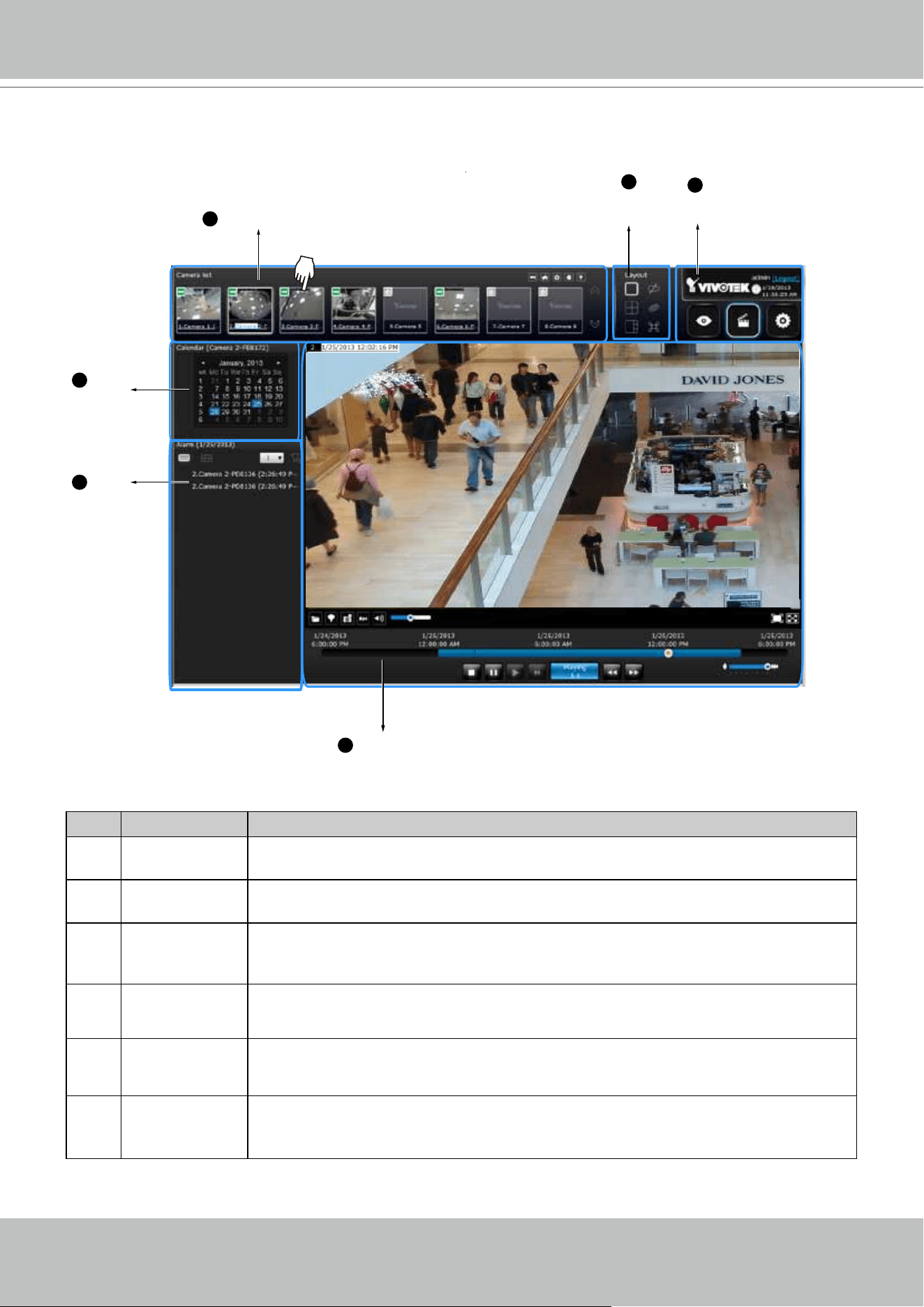
VIVOTEK - Built with Reliability
User's Manual - 119
4-3. Graphical Layout and Screen Elements - Search recording
clips
Camera list
Layout
contents
Logo & Menu
Playback panel
Alarm
panel
Calendar
1
2
3
4
5
6
The screen elements of the Playback window are described as follows:
Item Name Description
1 Camera List Provides a glimpse of all cameras that have recorded data. Basic information is
also provided along with a screenshot.
2 Layout contents Provides functions to extend, rotate, redo the layout, and the synchronous
playback.
3 Logo & Menu Provides access to the Playback and System Settings utilities, as well as
system time and logout function.
4 Playback panel Displays the playback functions. Snapshot, bookmark, and export functions are
also available on individual view cells.
5 Alarm panel Reports alarms transmitted via cameras' DI connections or those by the Motion
Detection, etc.
6 Calendar Shows when the recording took place, and thus enables users to quickly locate
a specic part of recording in history.
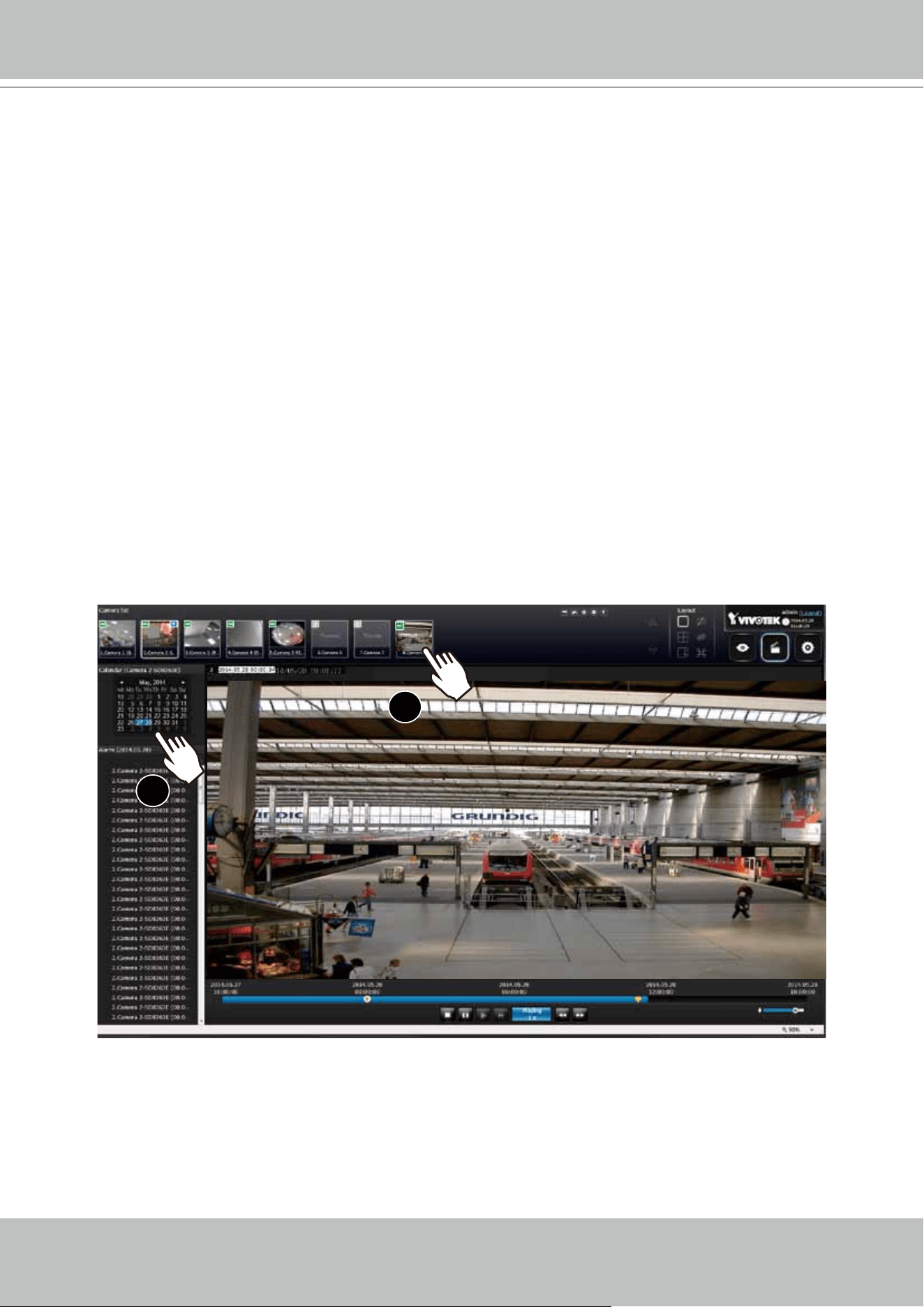
VIVOTEK - Built with Reliability
120 - User's Manual
4-3-1. Camera List Panel
The camera list displays the 8 recruited cameras by the sequential numbering order you
congured in the System Settings window on page 140. The elements in the Camera list on a
Search recording clips window are identical to those on a Liveview window. Please refer to
page 101 for details on the Camera list panel.
To begin playback and search for past recordings,
1. Double-click on a camera.
2. The Calendar panel will display the days video recording actually took place. And those days
will be highlighted by a blue background (as the 25th and 28th in the screen below.)
x2
2
3
There are two key differences between the Camera List on Liveview and that on the Playback
window:
1. Users can not click and drag a camera thumbnail to a playback view cell.
2. A double-click on a camera does not display video in a view cell. A double-click displays a
calendar where days with recorded videos are shown.
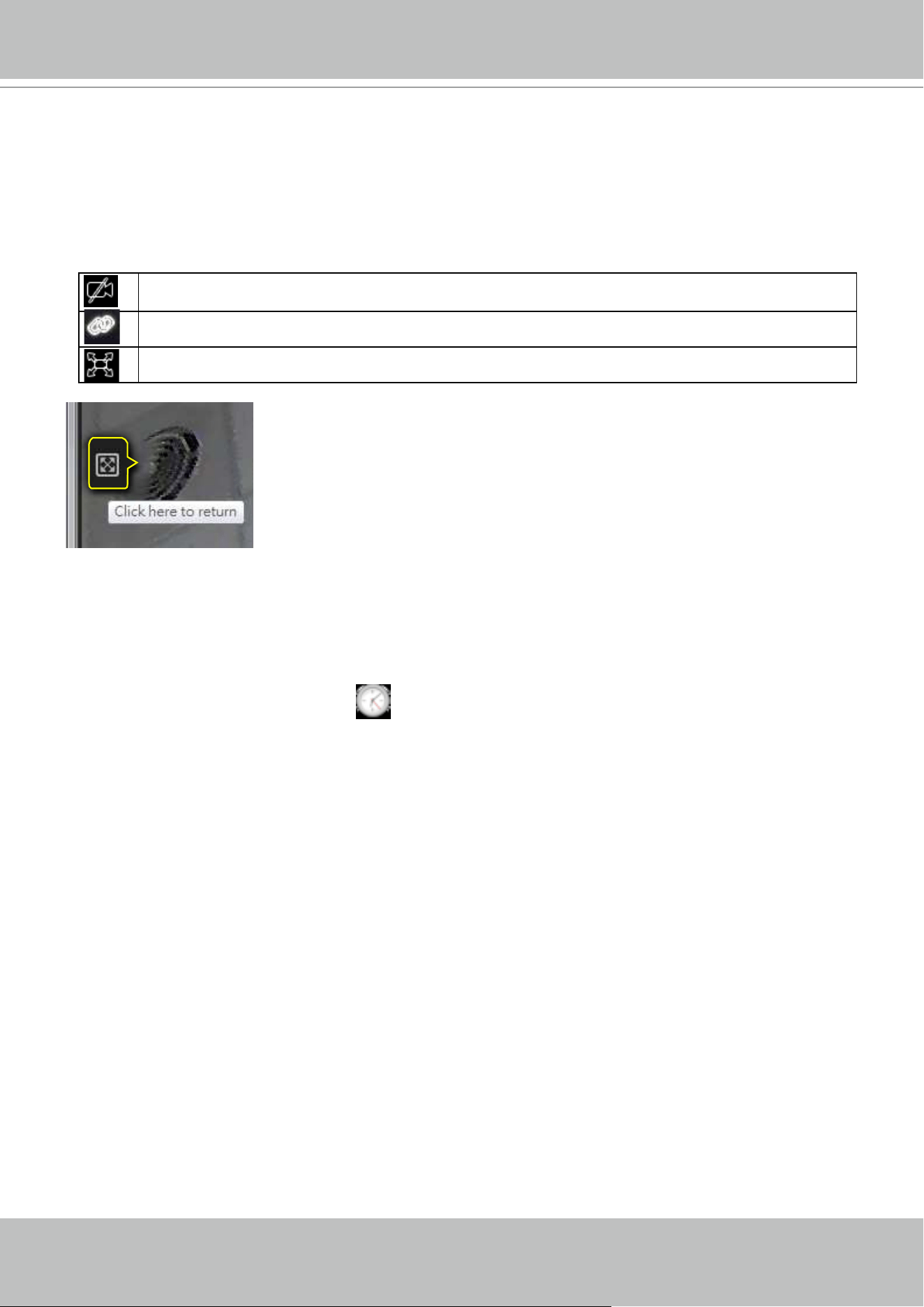
VIVOTEK - Built with Reliability
User's Manual - 121
4-3-2. Search Recording Clips Layout
3 types of layouts are provided for the Search recording clips window: 1x1, 2x2, and 1+3.
In the Search recording clips window, users can simultaneously playback up to 4 recorded
videos.
Clears all view cells on the current layout
Starts or stops the Synchronous playback.
Full view: extends the view cells on the current layout to the full of the screen.
When your current layout is displayed in a full view, move your cursor
to the left center of the screen to return to the default Liveview screen.
The Return button will appear.
4-3-3. Logo & Menu
A logout button, system time panel
, and 3 hot link buttons to access the Liveview,
Playback, and Settings utilities. This panel is identical to that on the Liveview window.
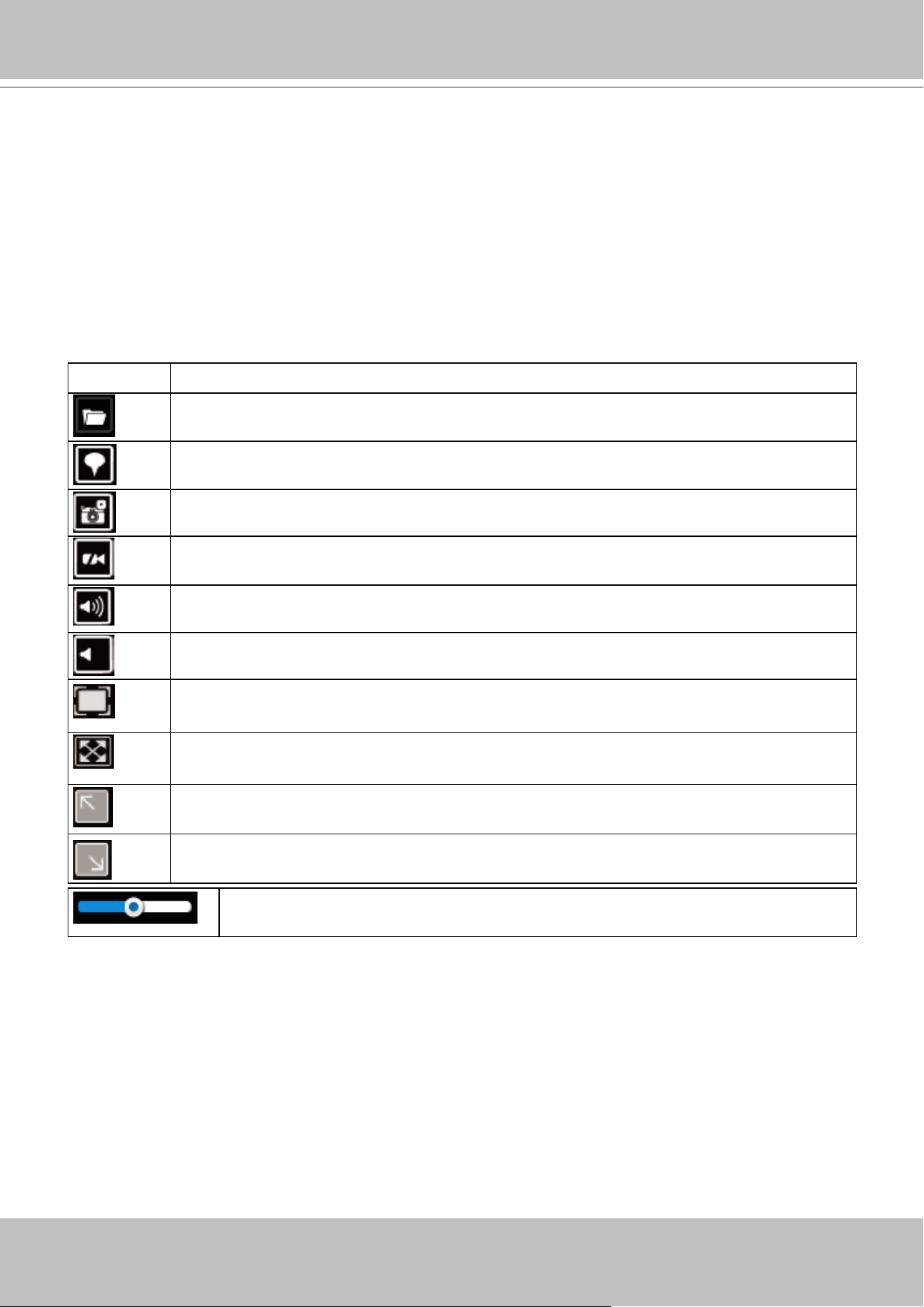
VIVOTEK - Built with Reliability
122 - User's Manual
4-3-4. View Cells in Search Recording Clips
The view cells in Liveview and Playback windows are similar. Their differences are listed as
follows:
1. 3 simple layout types are supported as previously described.
2. The information bar displays camera index and video time information only.
3. The Play and Pause buttons are not available on the Tool bar. One Export function is added
on a playback view cell.
The functional buttons on an individual view cell are descrbed as follows:
Buttons Description
Exports a section of the video into a 3GP or Windows exe le. The length of
exported video is congurable to 1, 3, 5, or 10 minutes.
Adds a Bookmark (that saves a short description and a one-minute footage from
the current feed)
Takes a snapshot.
Removes camera from the view cell.
Mutes (if there is audio input from the camera.)
Unmutes
Restores the view cell's original position on the liveview panel.
Maximizes the size of current view cell.
Enables the digital zoom.
Disables digital zoom (PiP).
Volume controller
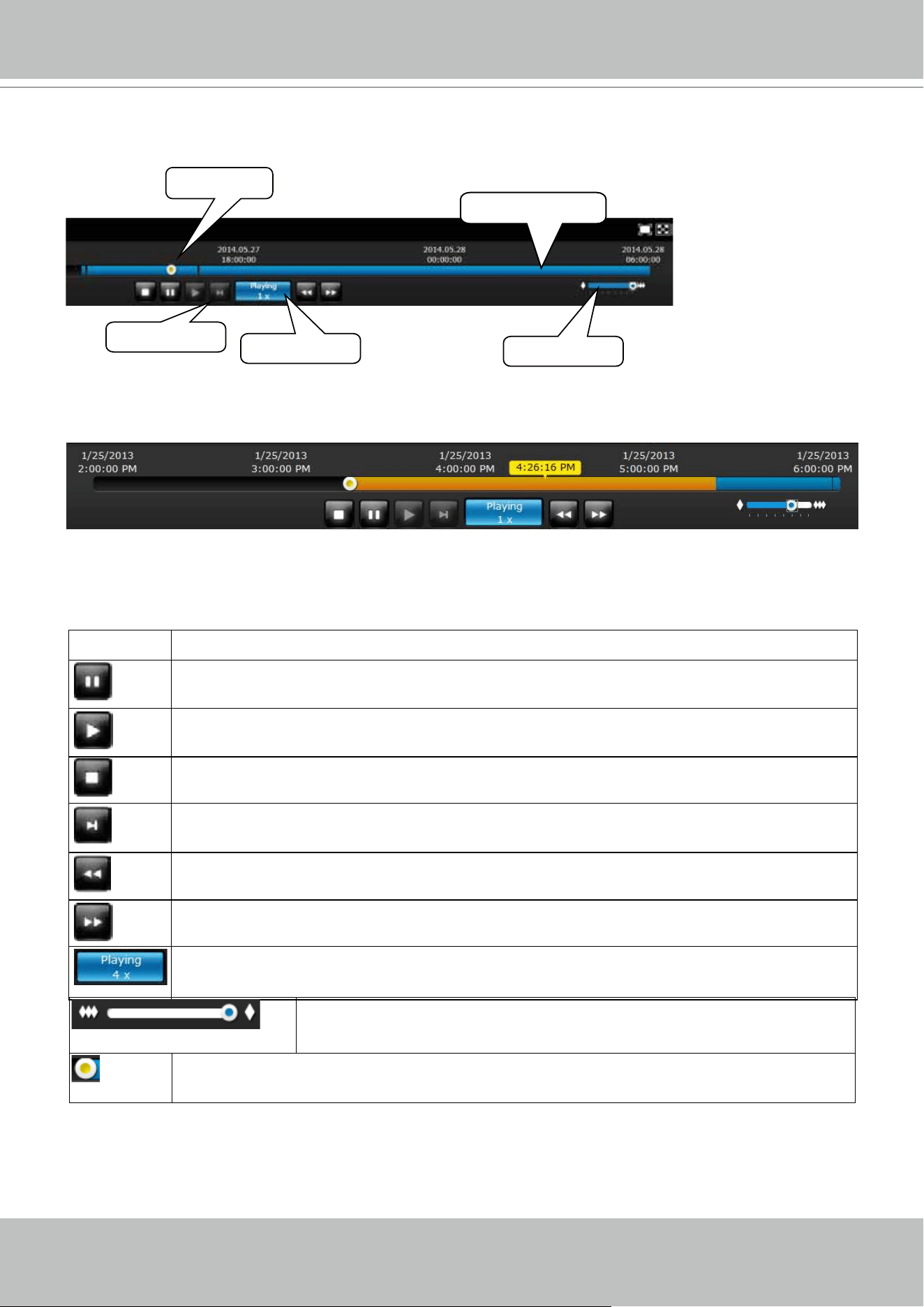
VIVOTEK - Built with Reliability
User's Manual - 123
Search Recording Clips Control Panel
The time slide bar enables quick skimming through the recording. Its functional buttons are
described as follows:
Buttons Description
Pause
Play. This button is available after you manually pause a playback.
Stops the current playback.
Next frame. After you paused a playback, use this button to browse video frame by
frame.
Speeds down by 1/2. The slowest speed is 1/8.
Speeds up. Increases the playback speed, to 2x, 4x, 8x, 16x, and then to a
maximum of 32x.
Displays the current playback status, such as Playing, Pause, play speed, or Stop.
Timeline slider
Timeline zoomer
Playback info
Control buttons
Span of existing
recording
Timeline zoomer. Use the zoomer to zoom in for more precise
skimming.
Timeline slider thumb. Click and drag this thumb button to move along and reach
a specic point in time. A click on the time line will also work.
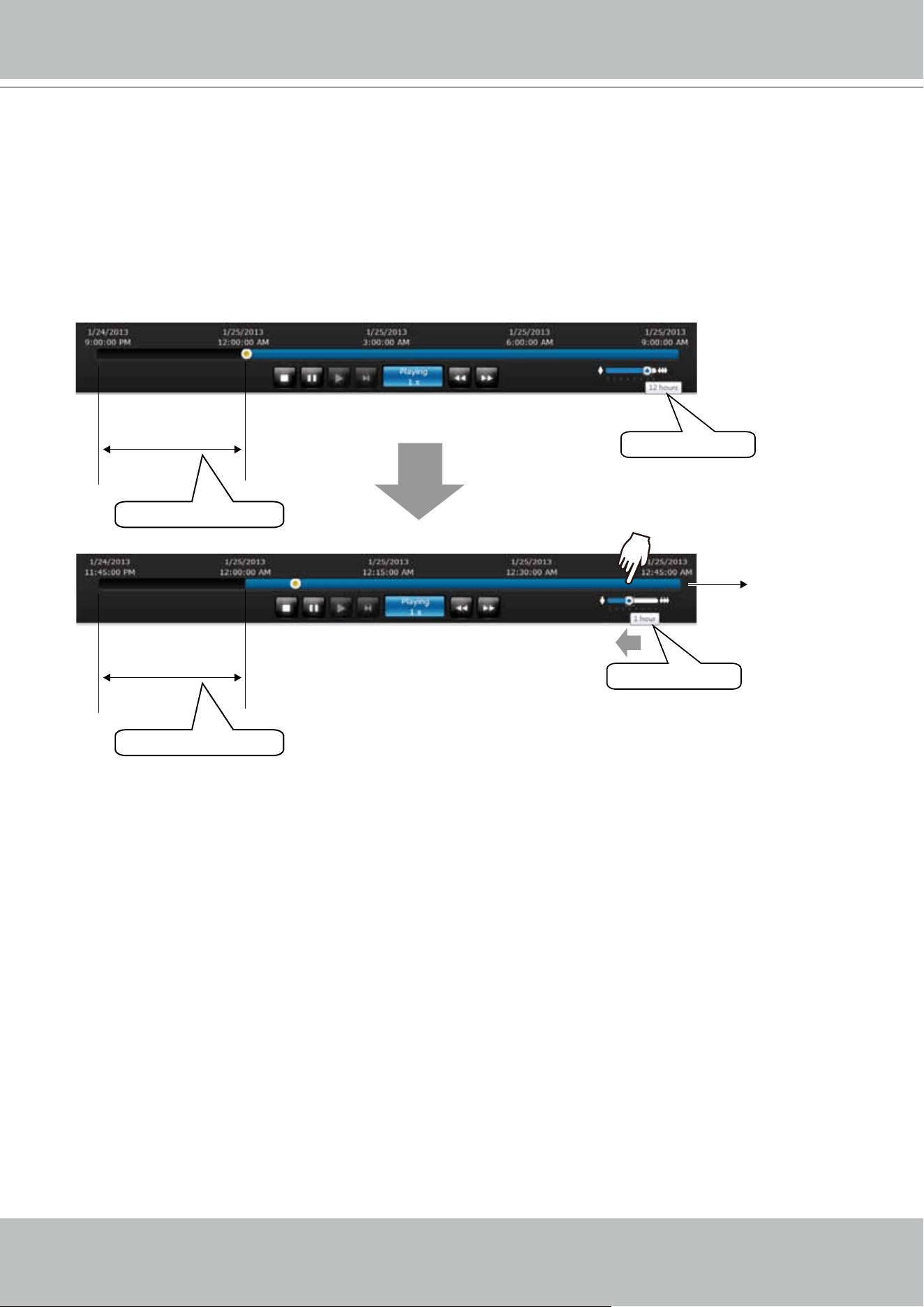
VIVOTEK - Built with Reliability
124 - User's Manual
Time span =12 hrs
Time span =1 hrs
Each section =15 mins
Each section =3 hrs
Total time span
The time line shows the length of existing recording taken on a specic time span. You can use
the timeline zoomer to scale down the span of time. For example, if the time span is reduced
to 1 hour, then each section on the time line represents 15 minutes of recording. The total time
span of a timeline starts from the minimal of 4 minutes, 20 minutes, 40 minutes, 1 hour, and up
to a maximum of 24 hours.
In the Synchronous play mode, a change to the zoomer will be reected by all synchronously
playing view cells.
If recordings take place by an event-triggered recording, the intervals between recordings can
be down to 1 minute, and the individual recordings will not be easily discernible. In this situation,
you can mouse over the timeline to pinpoint individual recording instances.
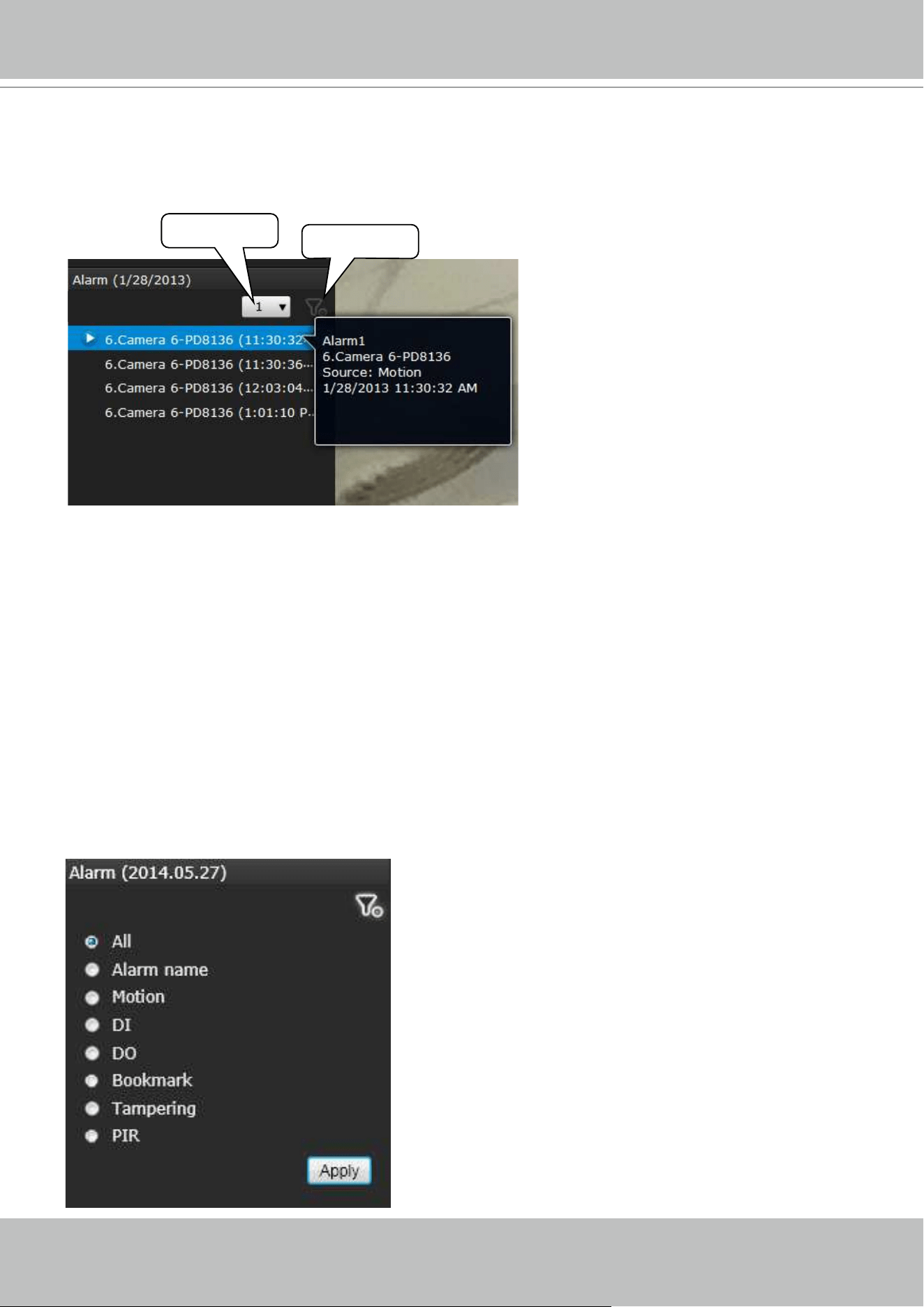
VIVOTEK - Built with Reliability
User's Manual - 125
4-3-5. Alarm Panel
Page selector
Alarm filter
The alarm panel displays the alarms or bookmarks recorded by the day of recording. Two
additional buttons are available: Page selector and Alarm lter.
• A playback button will be available with an alarm-triggered recording. The alarm panel in the
Playback window also supports the List mode and Icon mode that are similar to that in the
Liveview window.
• There can be numerous alarms occurring in a day. Use the page selector to display different
pages of alarm entries. Up to 200 entries can appear on one page. Note that the new alarms
that occurred seconds or minutes ago may not be instantaneously listed on the page.
If bookmarks are listed in the Alarm list, a bookmark entry will look like this:
Camera index. camera name (time) - bookmark
Alarm lter:
Use the alarm lter to nd out specic alarms. Use the check circles below to narrow down your
search criteria by Alarm name or alarm type by Motion detection, DI, DO, Tampering, PIR, or
those manually marked down as Bookmarks.
The alarm name is dened by users in the Settings
> Alarm page.
See page 161 for how to congure
alarms.
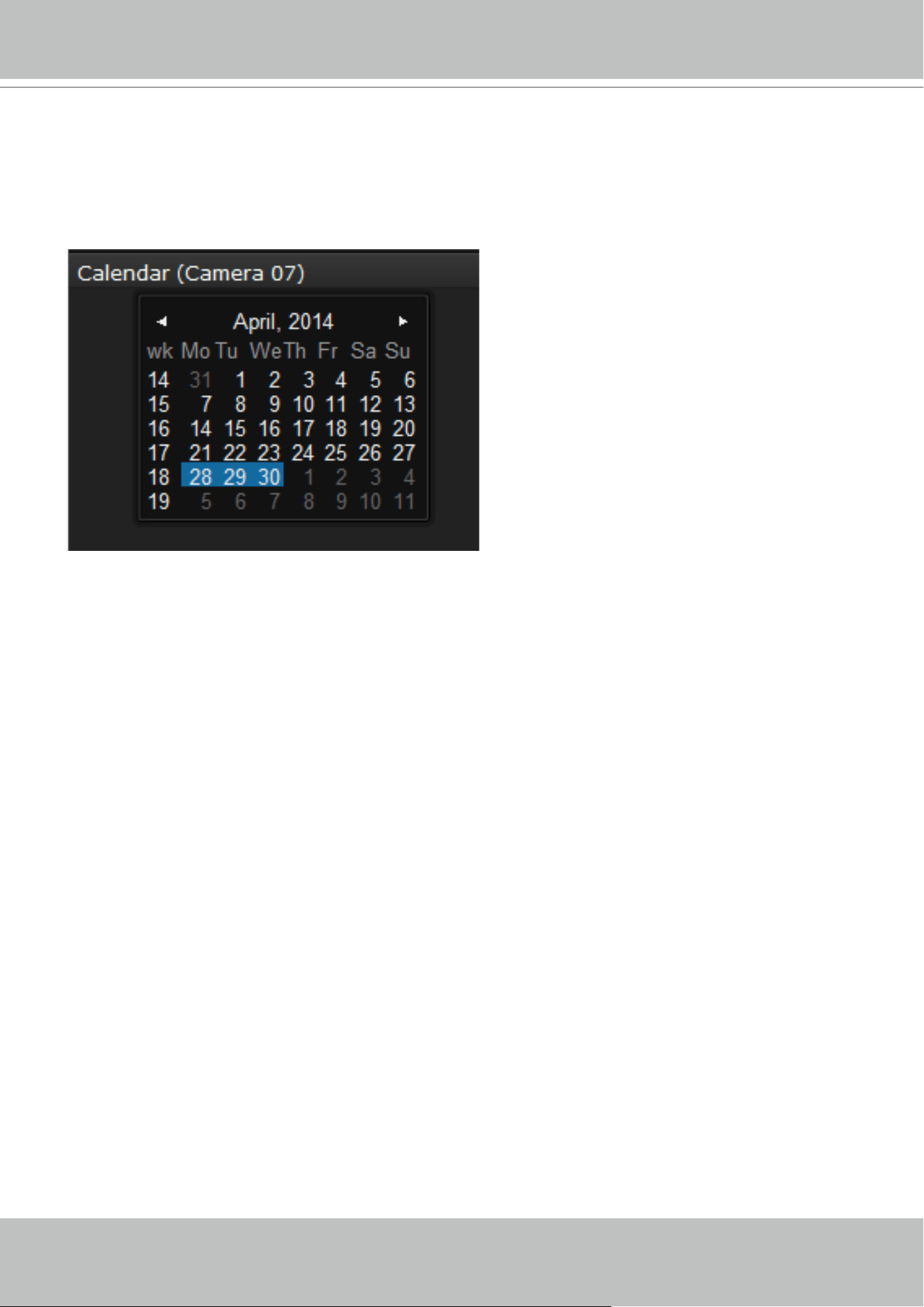
VIVOTEK - Built with Reliability
126 - User's Manual
You may use the arrow button to view the records in other months. If there are no recordings in
the current month, the recordings taken in the days of the following month will be shown stead.
4-3-6. Calendar Panel
Double-click on any of the existing cameras to display the Calendar panel. Days with recorded
videos will be highlighted in blue regardless of the length of existing recordings that occurred in
that day. You may then click on a day to begin viewing the past recordings.
2 31
4
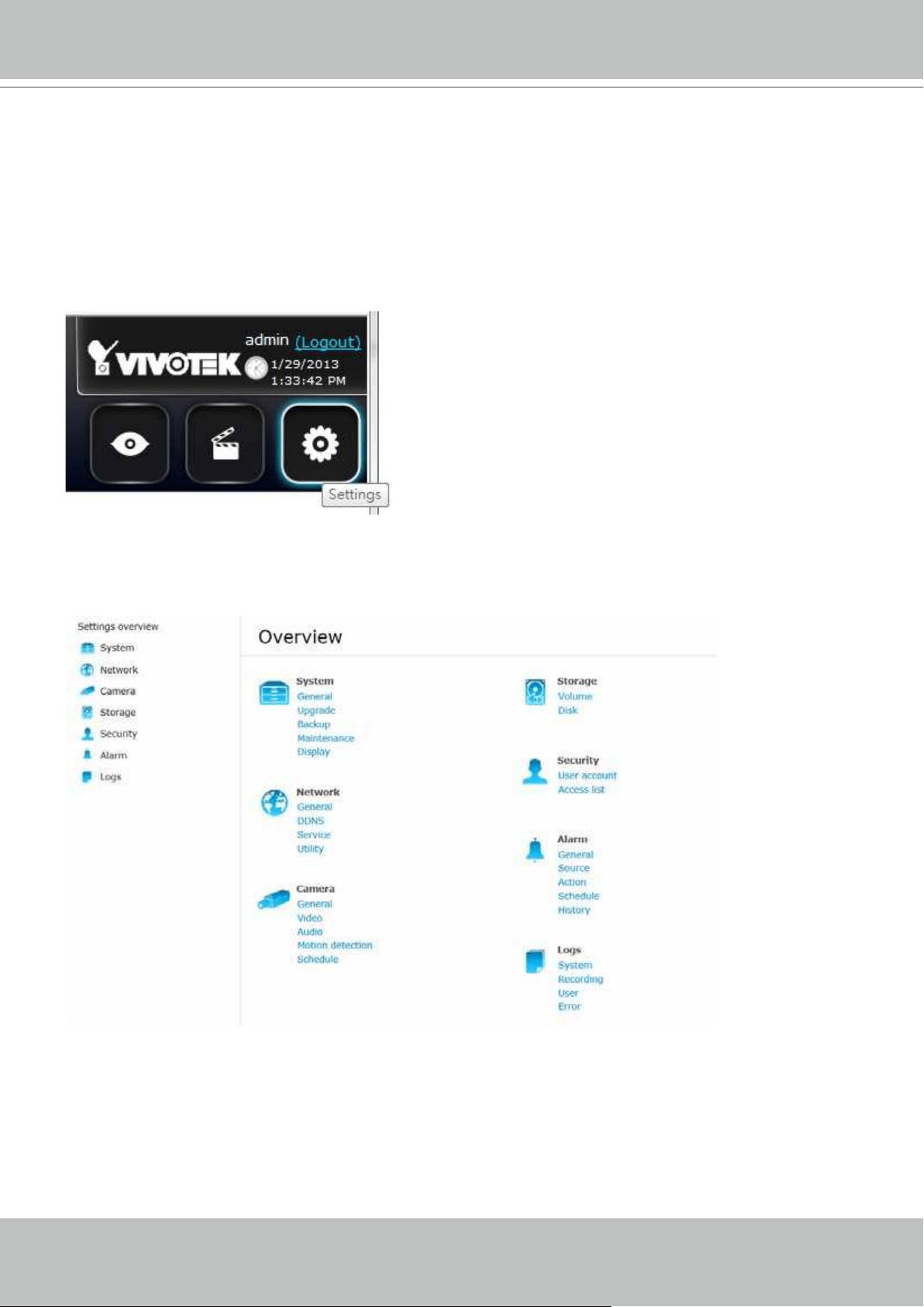
VIVOTEK - Built with Reliability
User's Manual - 127
Chapter Five System Settings
The Settings window is accessed by clicking on the Settings button on the Logo panel.
You will enter the Overview of the Settings window. All the conguration menus are placed under
7 major categories: System, Network, Camera, Storage, Security, Alarm, and Logs. Click on
any of the menu shortcuts to begin conguration.
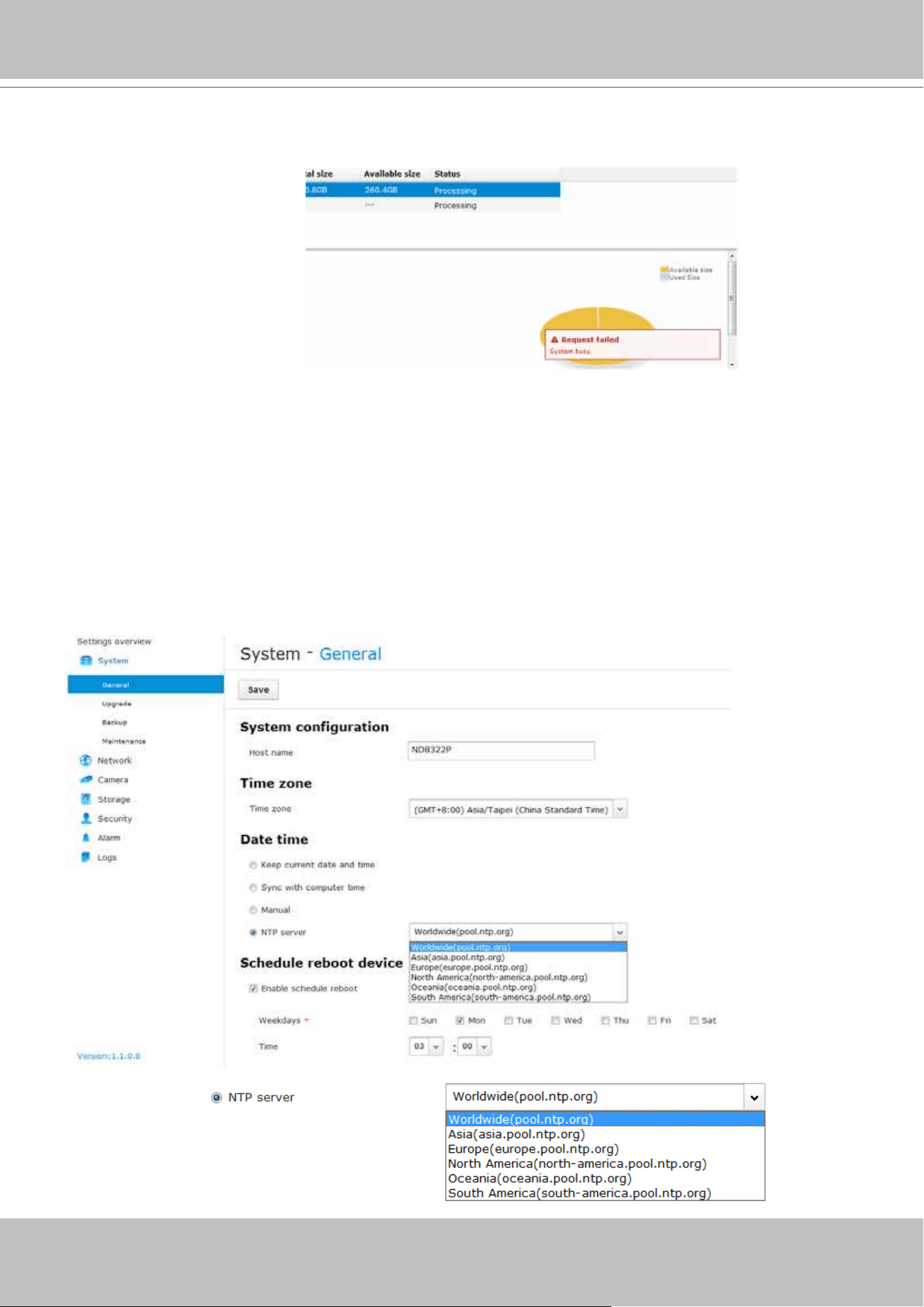
VIVOTEK - Built with Reliability
128 - User's Manual
5-1. System
The system general information window allows you to change the system host name, time zone,
system date and time, and set up a scheduled reboot of the system.
Note that if NTP time server conguration is preferred, all cameras recruited into the
conguration will automatically listen to the time server on the NVR. If you make changes to the
conguration in the System > General settings > System time page, cameras will also listen
to the changes. The precondition is that the system must have access to the Internet.
5-1-1. System - General
Notify - During the conguration process, conguration errors or information will be indicated by
a small pnotify message boxes on the lower right of the screen.
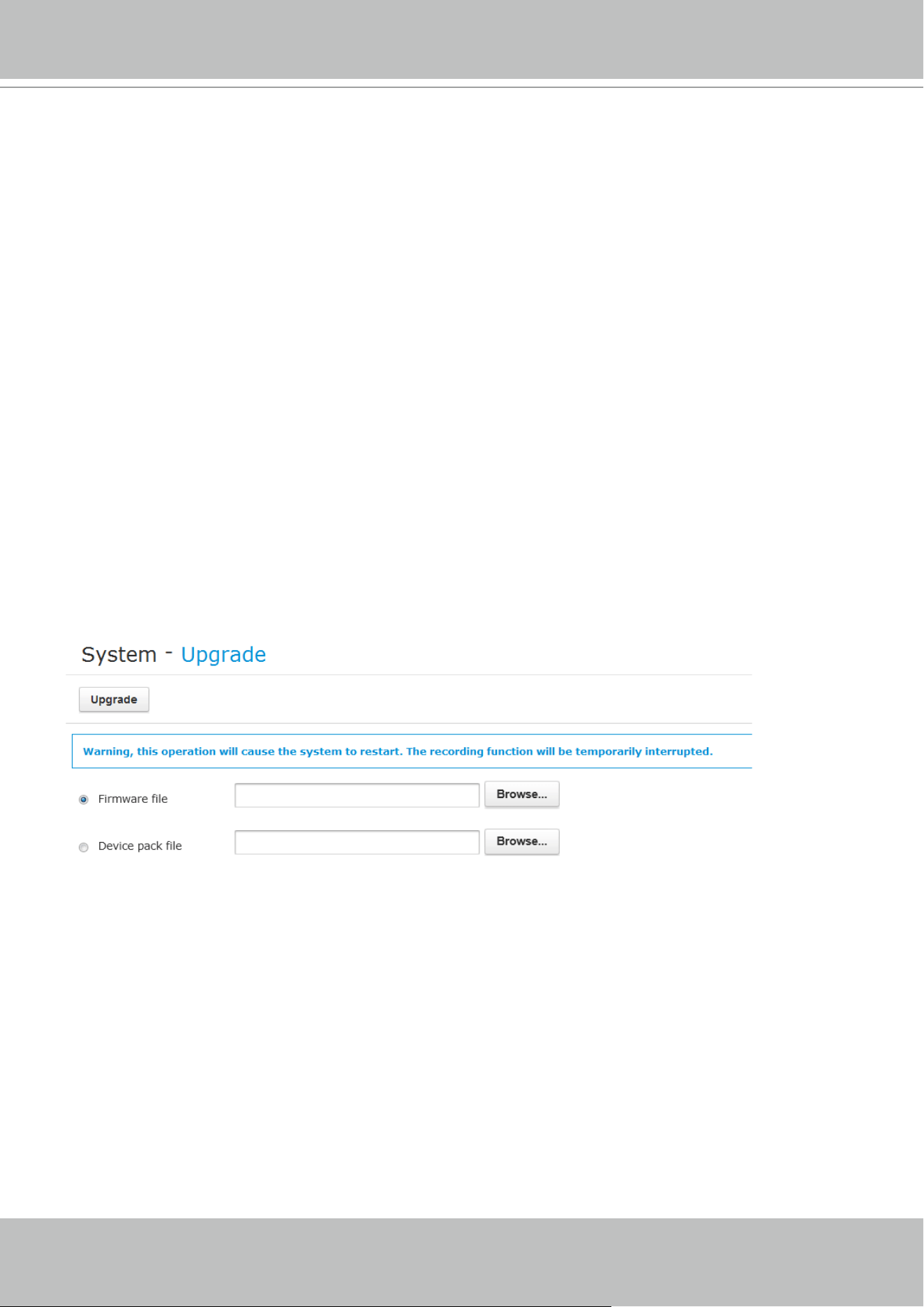
VIVOTEK - Built with Reliability
User's Manual - 129
If the need arises for updating system rmware, acquire the update from VIVOTEK's technical
support or download site. Locate the rmware binaries, and click Upgrade. The upgrade should
take several minutes to complete. Note that during the upgrade, the recording task will be
interrupted.
A Device pack contains information for network cameras that are newly released. It enables the
implementation of new models into your NVR conguration with necessary parameters, and
other tunable imaging features.
5-1-2. System - Upgrade
The Schedule reboot device allows the system to clean up dirty cache by a scheduled reboot.
You can congure a reboot by a specic time within a week. Note that during the reboot the
video recording will be temporarily interrupted.
Scheduled reboot is an recurring event. Select the day within a week and a time for the reboot
using the checkboxes and drop-down menus.
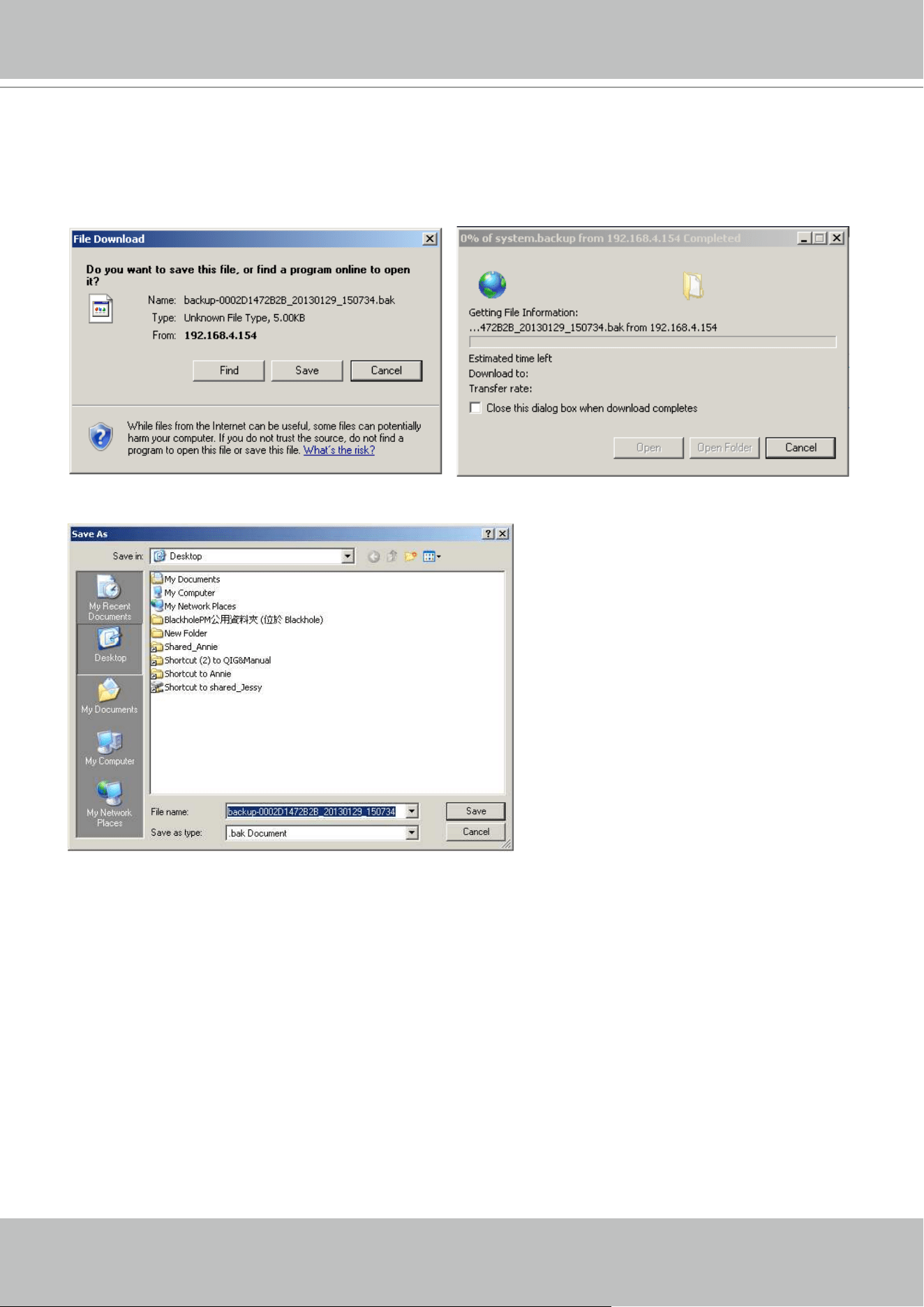
VIVOTEK - Built with Reliability
130 - User's Manual
On this window, you can perform 3 maintenance tasks:
1. Backup - You can backup your system conguration using the Backup function. Click
Backup, a message window will prompt. Click Save to preserve your system congurations.
5-1-3. System - Backup
Select a location for your backup le, then click Save to complete the process.
Note that the backup action does not involve the following:
1. Recorded videos and database,
2. Alarm records, bookmarks, and bookmarked footages.
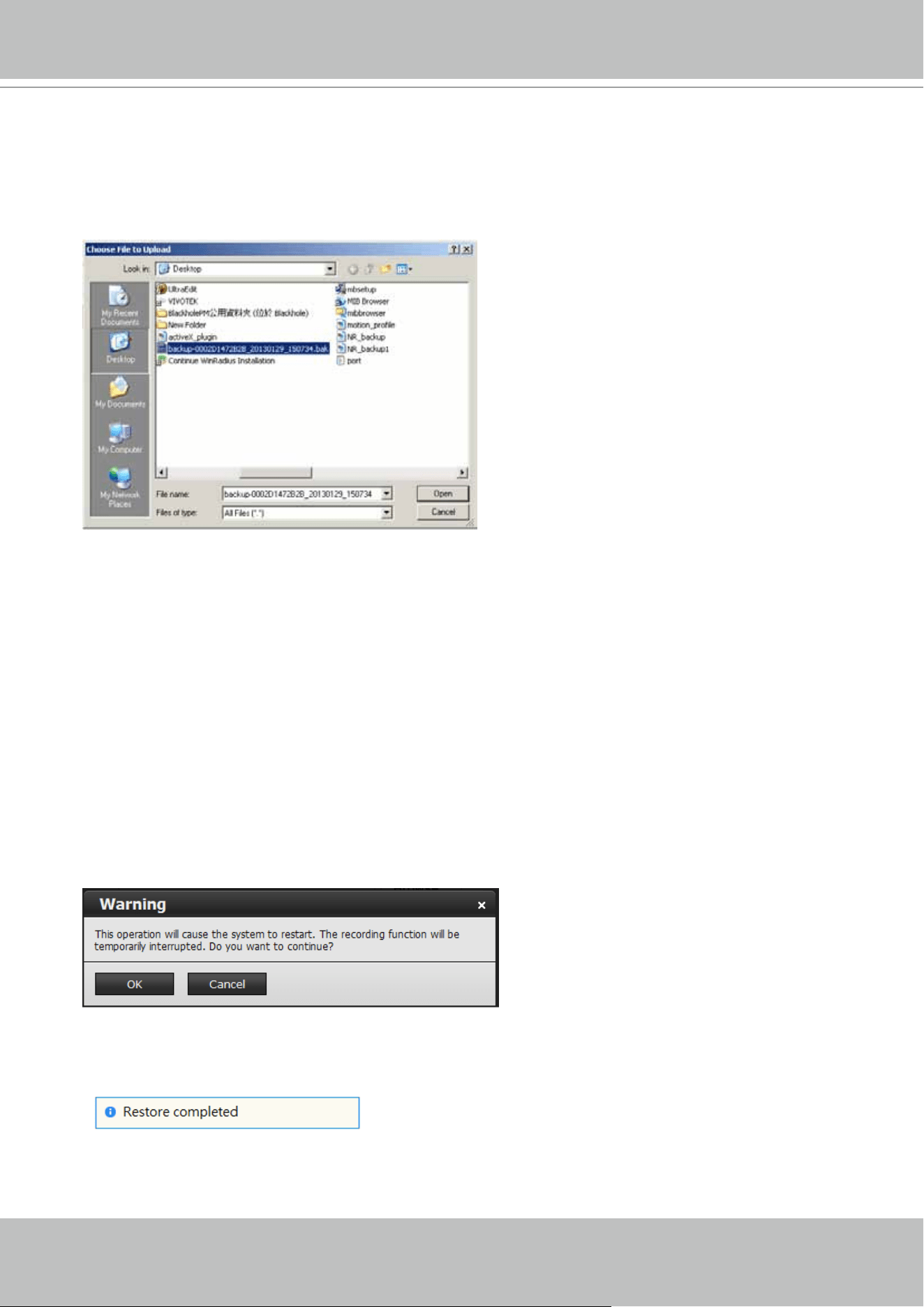
VIVOTEK - Built with Reliability
User's Manual - 131
2. Restore - If you have a previously-saved prole, you can restore your previous conguration.
Click the Restore button.
A le location window will prompt. Locate the backup le, and click Open. The Restore
process will take several minutes to complete, and system operation will be interrupted during
the process.
3. Restore Default - There are two kinds of defaults for the NVR systems: System defaults and
factory defaults.
The system defaults can be restored using the reset button on the system panel (press for
5 seconds) . This applies when users forget about its IP address or login password, while
most other operation details will remain unchanged.
The factory defaults (operated on this window) restores to its primitive state before shipping,
and hence users' congurations (such as host name, IP address, and layout settings) will be
erased.
Click Restore to restore your system defaults. A warning message will appear. Click OK to
proceed. The Restore process will take several minutes to complete, and system operation
will be interrupted during the process.
A successful operation will produce the following message.
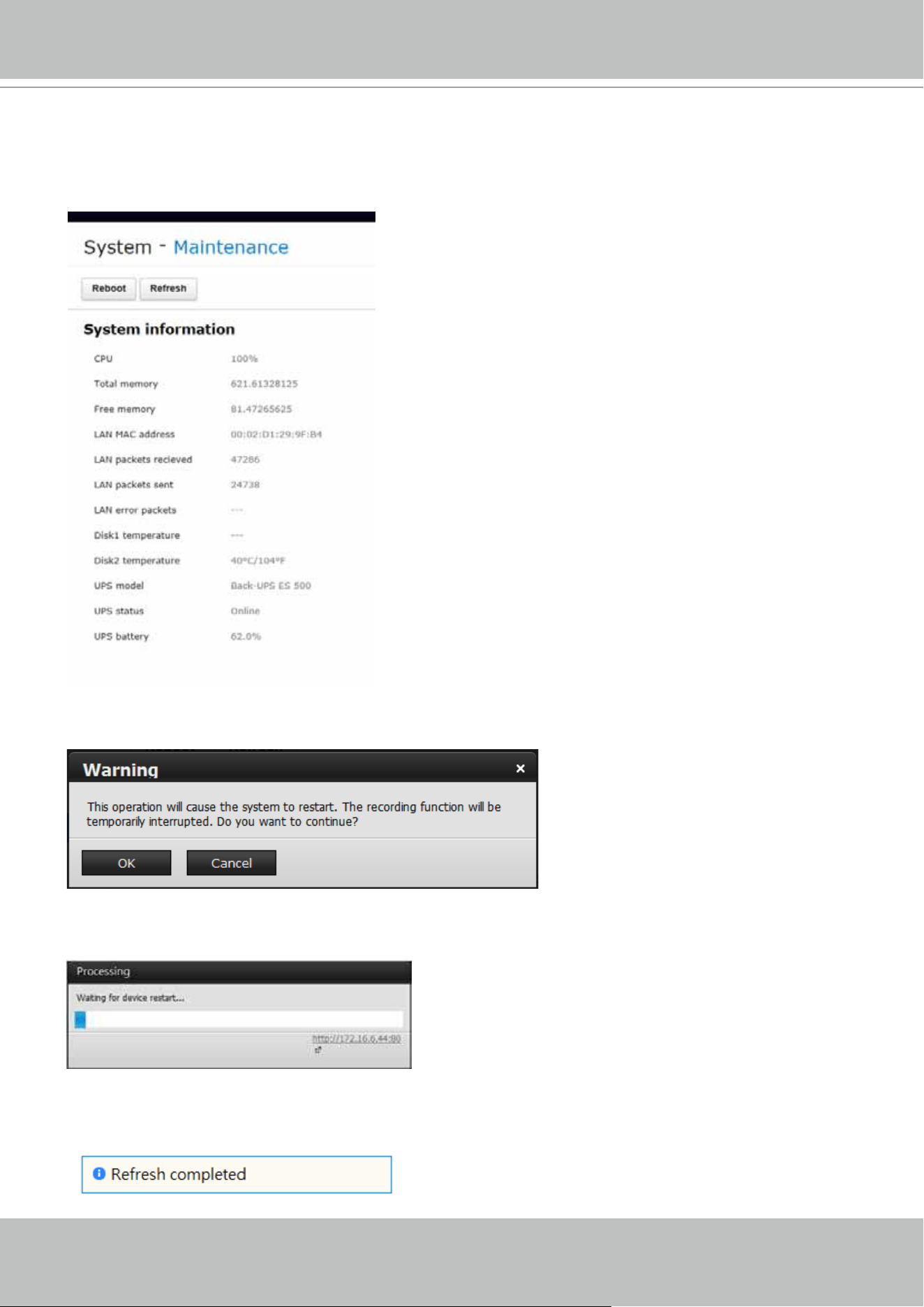
VIVOTEK - Built with Reliability
132 - User's Manual
This window displays basic information of various aspects, including CPU and memory usage,
LAN port operation and its bonding, disk drive temperatures, and UPS status.
5-1-4. System - Maintenance
The Reboot button is used to restart the NVR system.
The Refresh button polls the system for the latest system information as previously described.
The Reboot process will take about 180 seconds to complete.
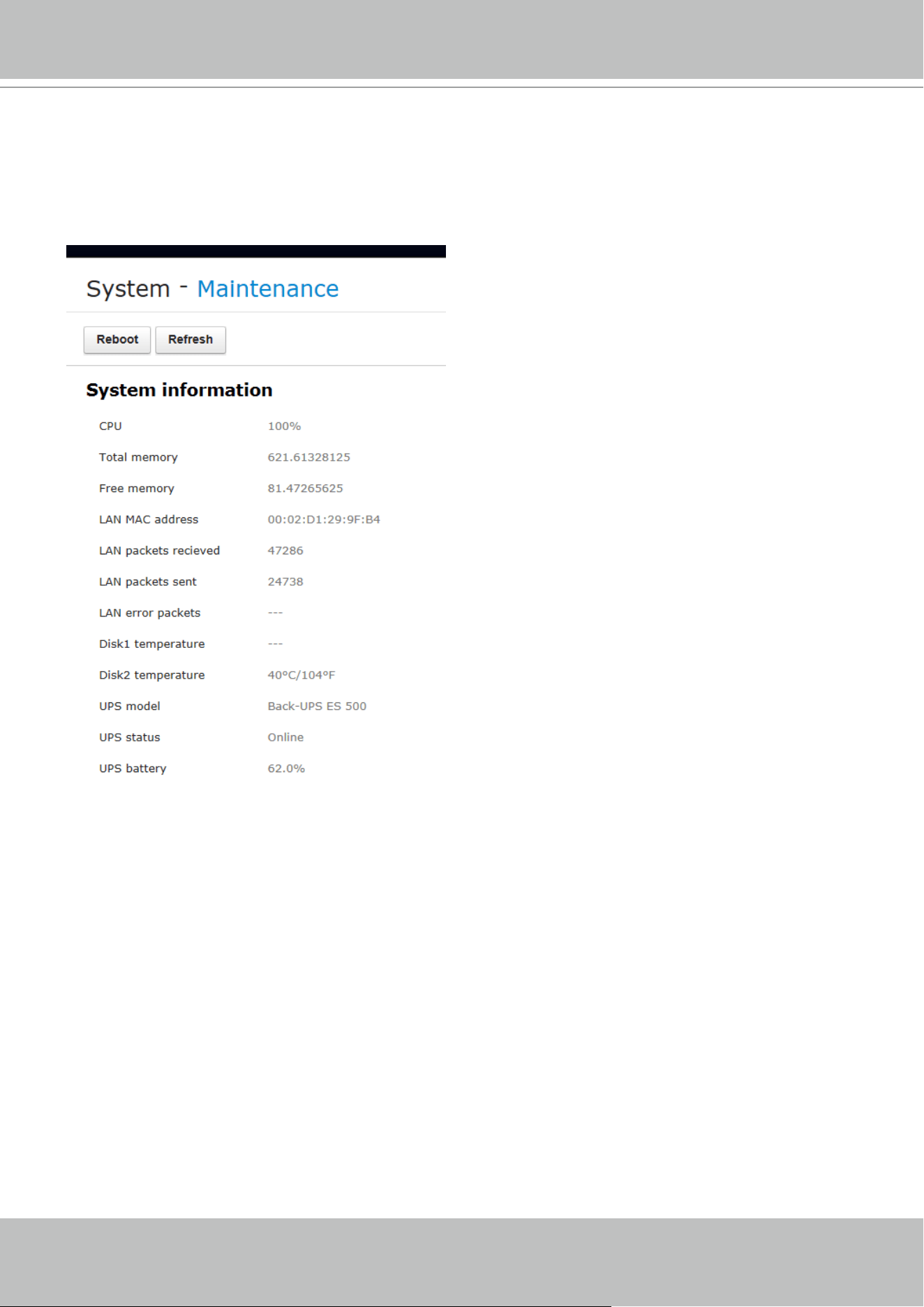
VIVOTEK - Built with Reliability
User's Manual - 133
Once a UPS is connected via the USB interface, the NVR system supports the cooperating
protection against power outage. The UPS status [model name, status (Online or On battery),
battery charge level] is listed in the Maintenance page as shown below.
UPS support
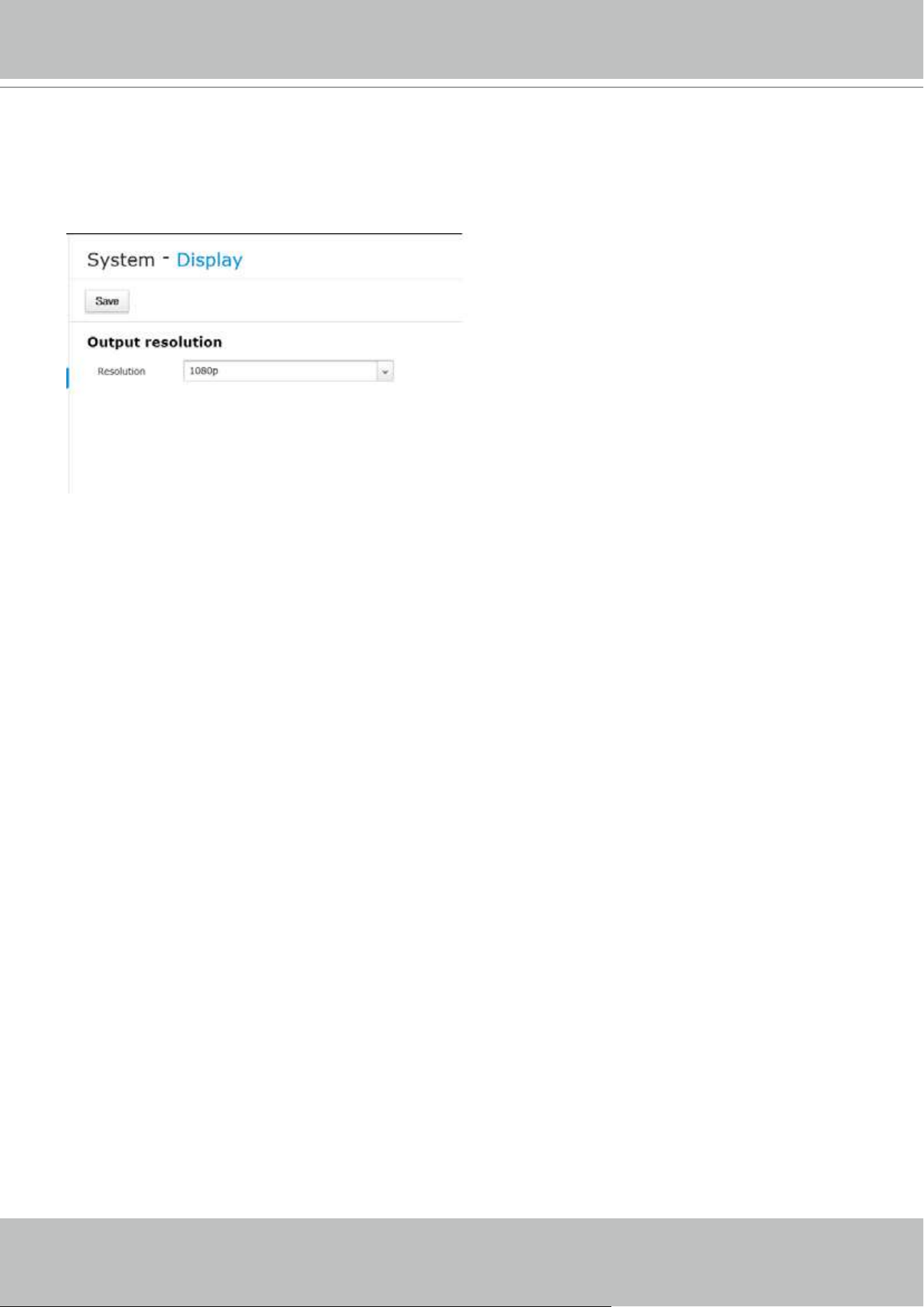
VIVOTEK - Built with Reliability
134 - User's Manual
Depending on the resolution of the monitor you use to connect to the NVR, select the output
resolution as 1080P or 720P. Once connected, you can also use the F5 key on keyboard to
switch between the two resolutions.
5-1-5. System - Display
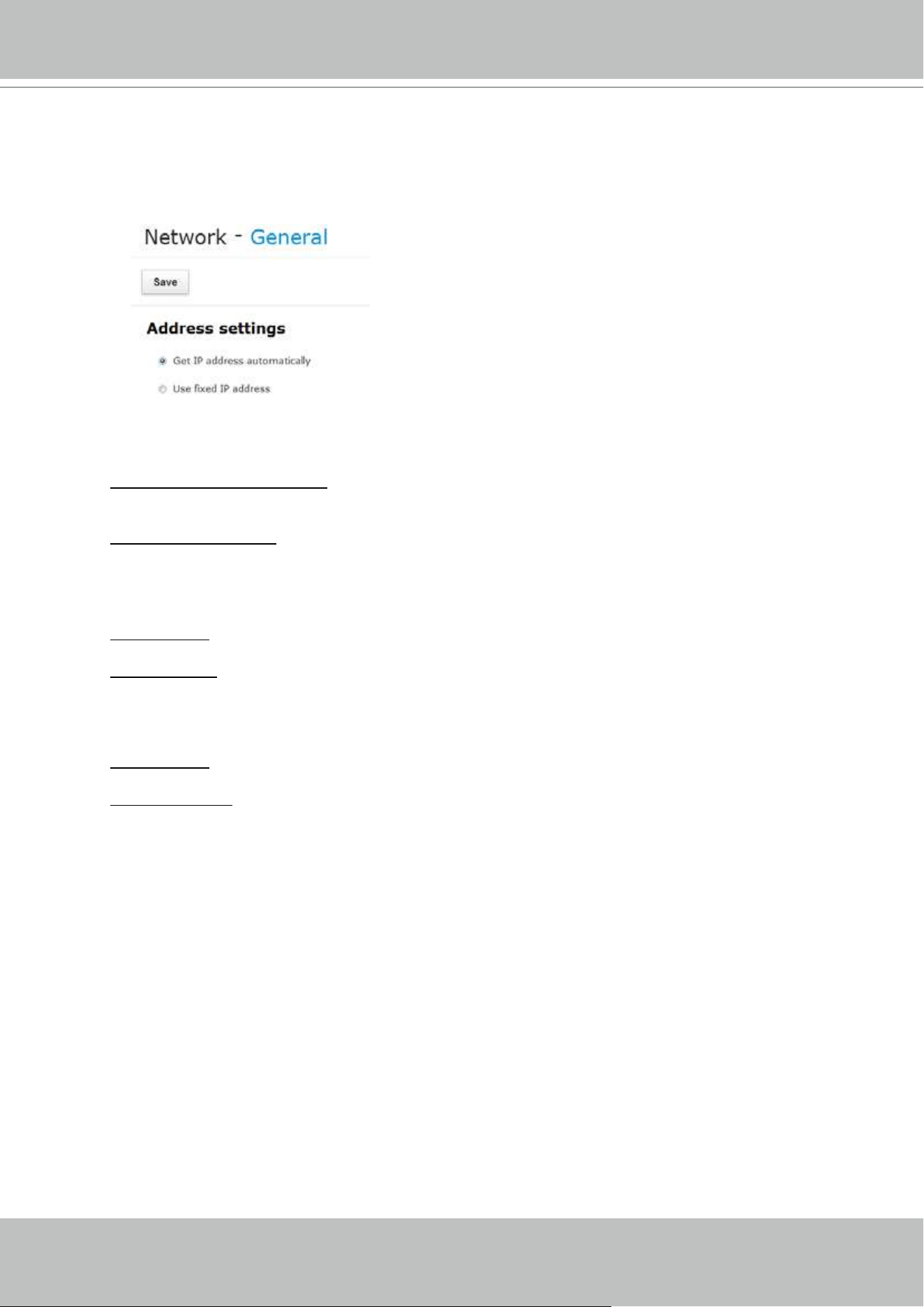
VIVOTEK - Built with Reliability
User's Manual - 135
5-2. Network
5-2-1. Network - General
Primary DNS: The primary domain name server that translates hostnames into IP addresses.
Secondary DNS: Secondary domain name server that backups the Primary DNS.
Address settings:
Get IP address automatically: Select this option to obtain an available dynamic IP address assigned
by the DHCP server each time the system is connected to the LAN.
Use fixed IP address: Select this option to manually assign a static IP address to the Network
Camera.
Enter the Static IP, Subnet mask, Default router, and Primary DNS provided by your ISP.
Subnet mask: This is used to determine if the destination is in the same subnet.
Default router: This is the gateway used to forward frames to destinations in a different subnet.
Invalid router setting will fail the transmission to destinations in different subnet.
When nished with the network settings, click on the Save button.
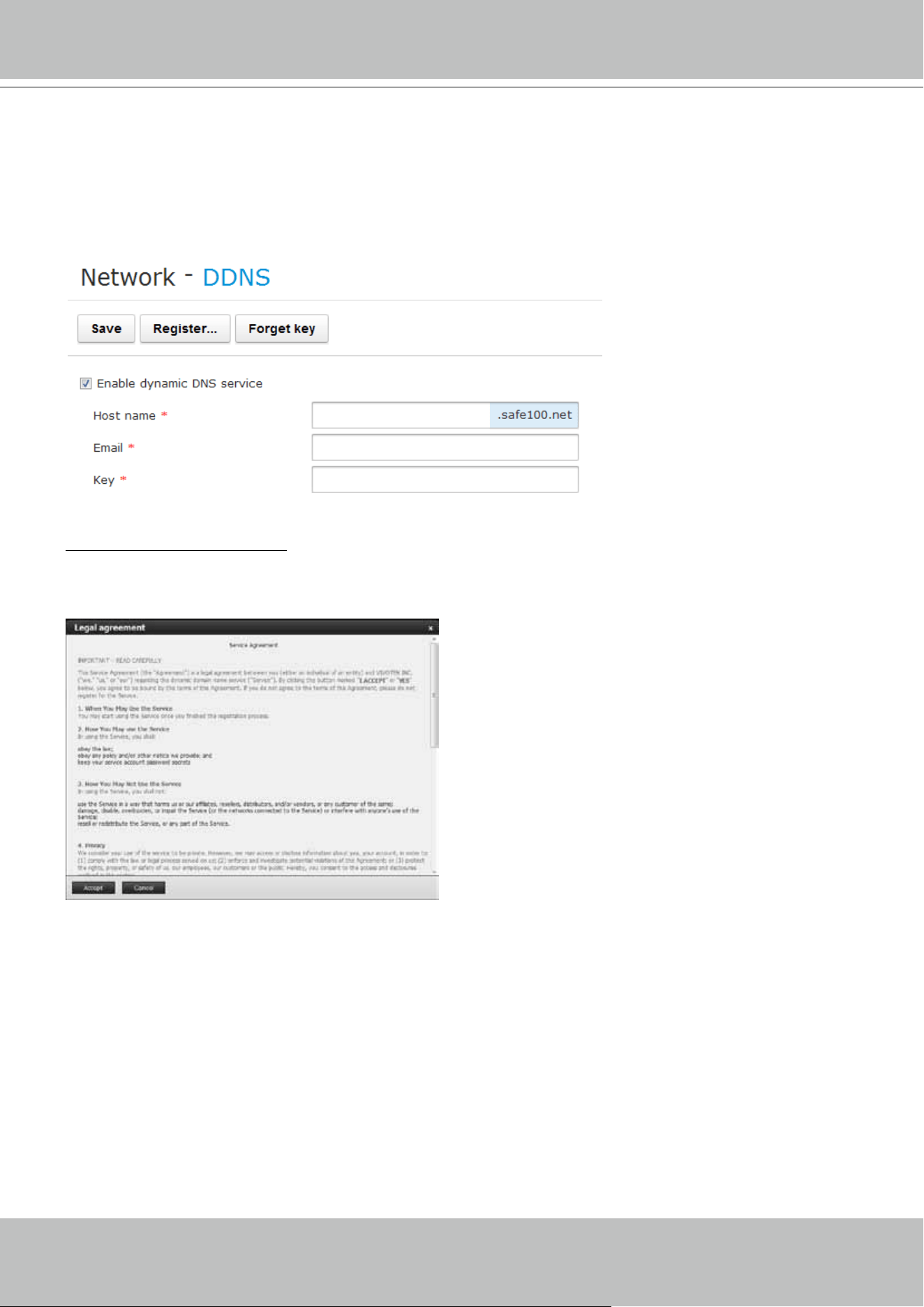
VIVOTEK - Built with Reliability
136 - User's Manual
VIVOTEK provides Safe100.net, as a free DDNS dynamic domain name service for users who
want access from the internet or a domain name service for the NVR. VIVOTEK maintains a
database of product MAC addresses for the Safe100.net service, and you can apply one domain
name for each NVR system.
5-2-2. Network - DDNS
Enable dynamic DNS service: Select this checkbox to enable the DDNS setting.
Make sure you have internet access. Click the Register button. The terms of service agreement window
will prompt. Click Accept to proceed.
In the Register column, ll in the Host name (xxxx.safe100.net), Email, Key, and Conrm Key, and
click Register. After a host name has been successfully created, a success message will be displayed
in the DDNS Registration Result column.
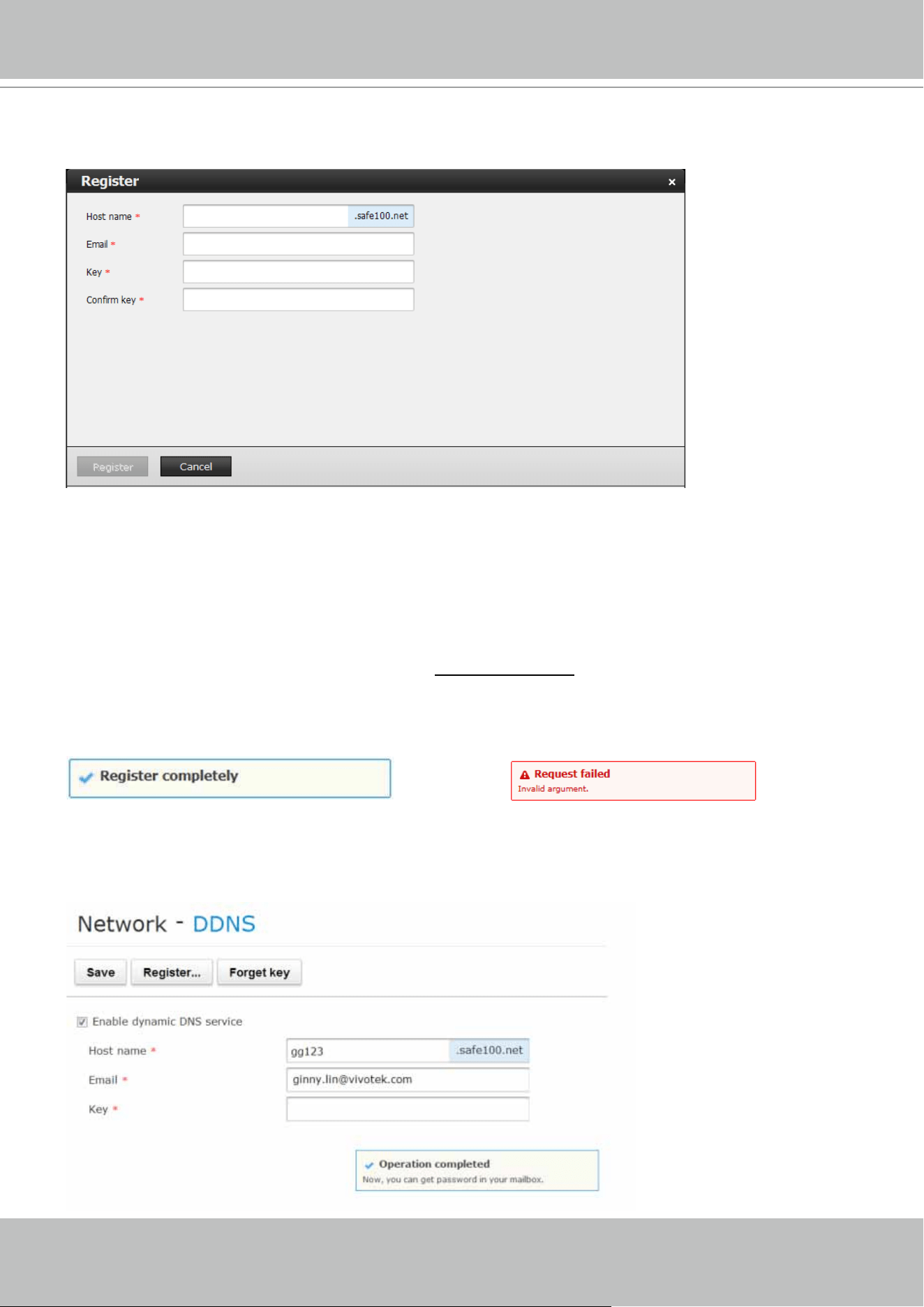
VIVOTEK - Built with Reliability
User's Manual - 137
When completed, a conrm message will prompt. You will also receive a conrm Email. You
can now access your NVR system using the xxxx.safe100.net domain name address. Note
that access from the Internet should be routed to the private IP assigned to your NVR, using
methodologies such as port forwarding, etc. Successful and invalid input will display the
following messages.
Enter a Host name, Email address, and password twice, and then click Register to proceed.
Forget key: Click this button if you have forgotten the key to Safe100.net account. Enter host
name and Email address, and then click the Forget key button. Your account information will be
sent to your Email address.
The acceptable characters for email address are: [0-9][a-z][A-Z][!][#][$][%][‘][*][+][-][/][=][?]
[^][_][`][{][|][}][~][.]. Two successive periods, [..], are not acceptable. The address filed can
accommodate up to 254 characters.
Use only alphabetic and numeric characters for the password. The maximum number of
characters is 64.
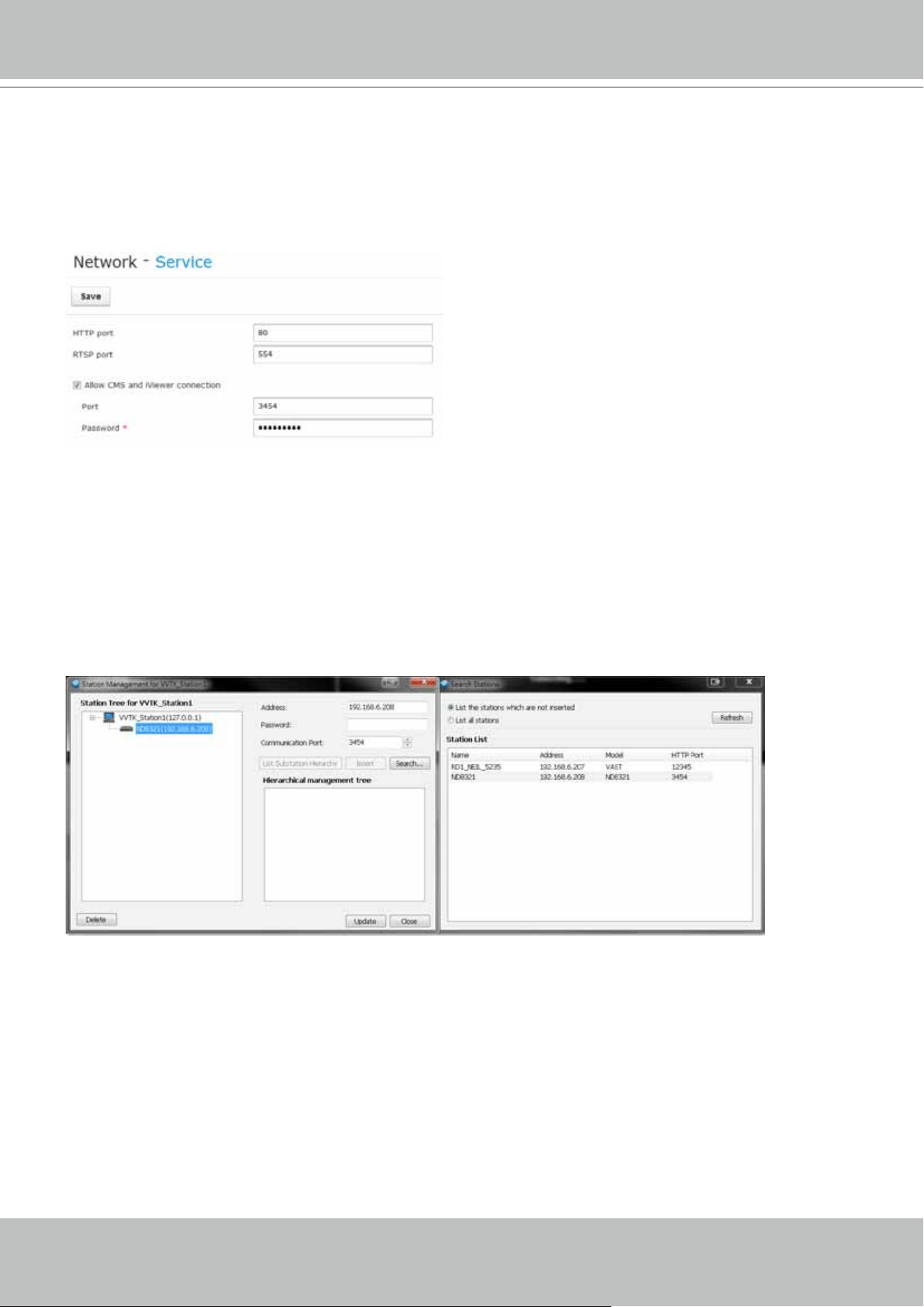
VIVOTEK - Built with Reliability
138 - User's Manual
By default, the NVR service and video streaming are accessed via HTTP port 80 and RTSP port
554. You can designate a different port number if the need arises. Usually it is not necessary to
change these ports.
5-2-3. Network - Service
Instead of a web console, you can also access the NVR and the subordinate cameras using the
iViewer and VIVOTEK's VAST software. The NVR can be managed as one of the sub-stations
in a hierarchical device structure.
Set up a password for access from the VAST server before you can join the NVR to a VAST
conguration. For access from the iViewer, you log in using the same user name and password
for the login to the NVR.
Below is the screen showing the sub-station recruitment process from a VAST server.
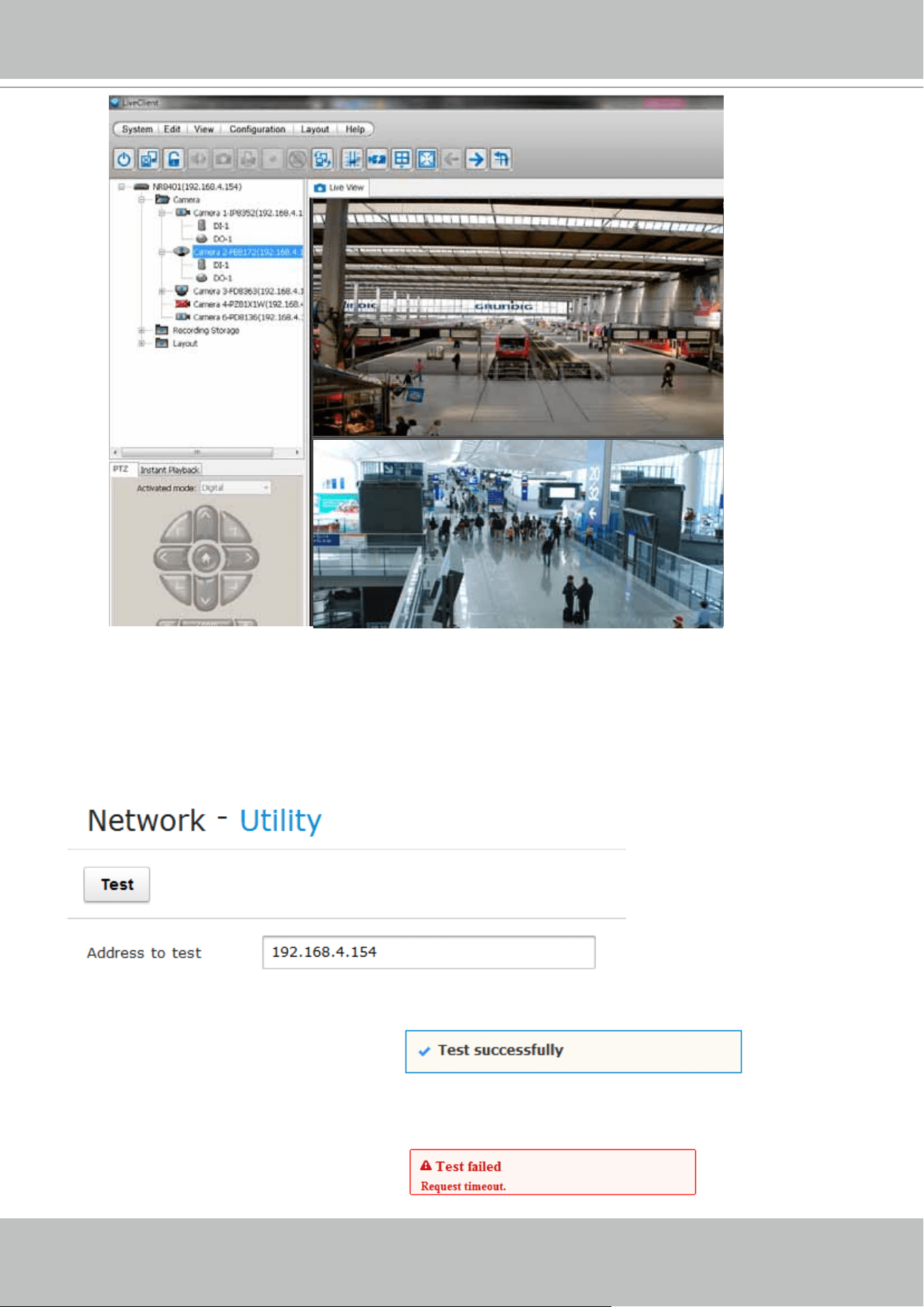
VIVOTEK - Built with Reliability
User's Manual - 139
Use the test utility to test the connectivity with a network device, such as a camera. Test results
will be displayed by a message prompt.
5-2-4. Network - Utility
Failure to reach a device displays the message below.
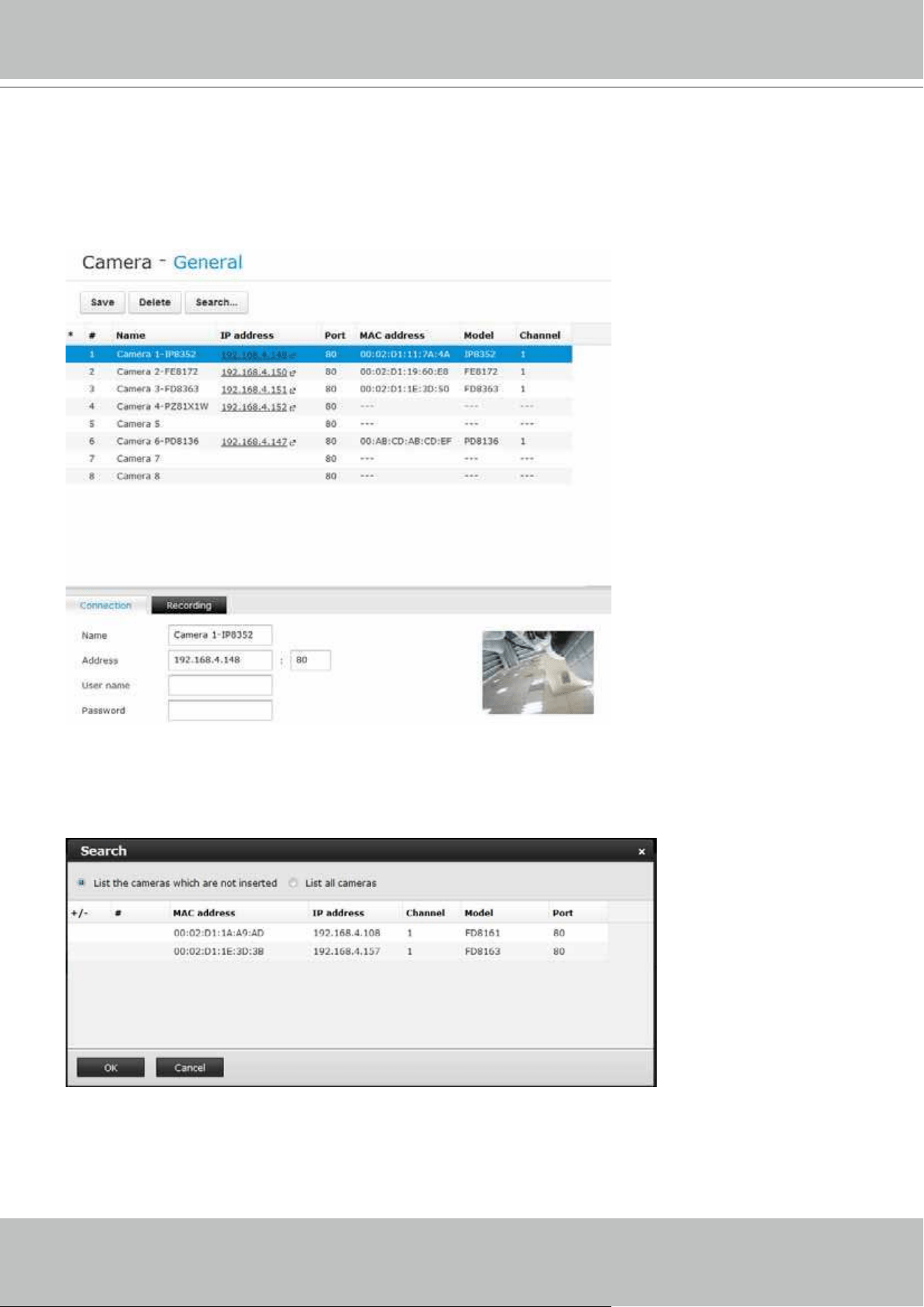
VIVOTEK - Built with Reliability
140 - User's Manual
5-3. Camera
The camera window provides management tools to recruit or disband cameras from your NVR
conguration.
5-3-1. Camera - General
1. Search:
The Search button allows you to locate all VIVOTEK cameras within a local network. Use the
check circles on top to display
all cameras or only cameras that have not been recruited.
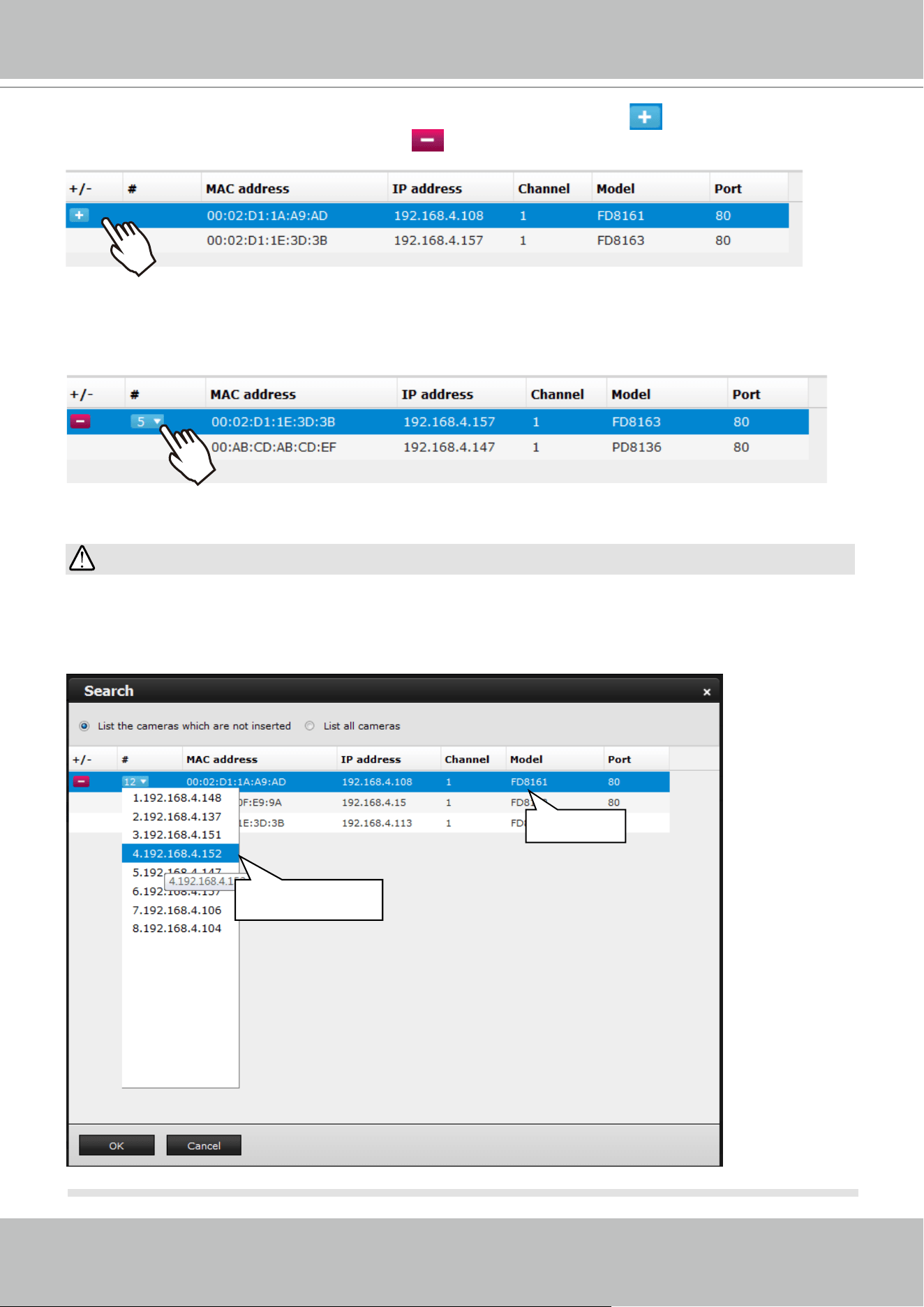
VIVOTEK - Built with Reliability
User's Manual - 141
On a listed camera, mouse over to the left of the entry to display the Add button. Click on
the button. To deselect a camera, use the
Remove button.
Select a camera index number from the pull-down menu. The rst unused number will be listed.
You may also select a different number or a number already appointed to another camera.
However, doing so will replace an existing camera.
Repeat this process to select more cameras in your deployment, and then click the OK button.
If you select an index number already appointed to an existing camera for a new camera, the
recorded data taken from the existing camera will still be intact. However, the recorded data is
accessed through the same index number but using the name of the new camera.
New camera
Index no. taken by
an existing camera
IMPORTANT:
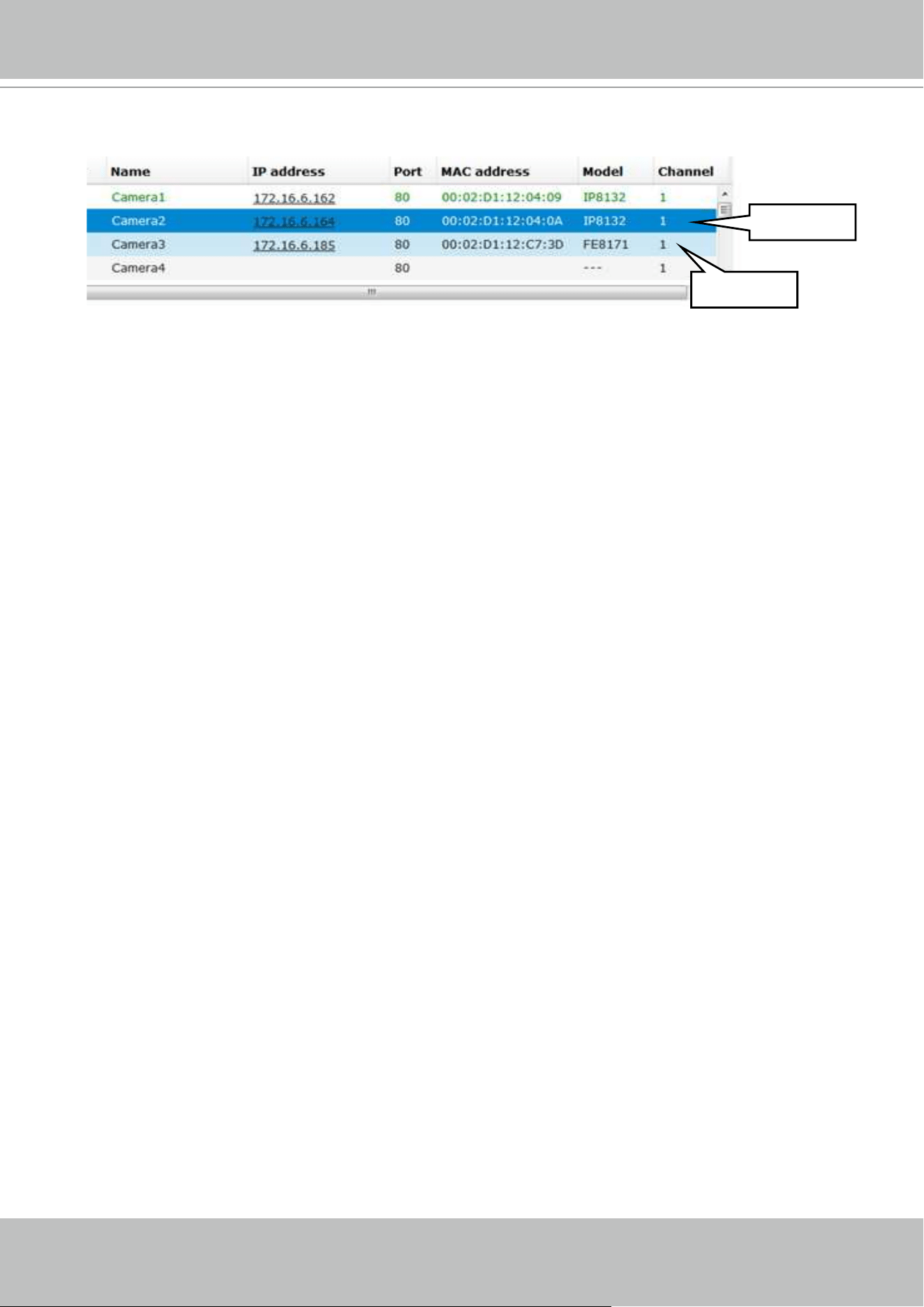
VIVOTEK - Built with Reliability
142 - User's Manual
Move hover
Selected
(#) numbered: Camera index.
Name: Camera name.
IP address: A valid camera conguration enables the IP address as a hyper link. You can
click on the hyper link to open an IE web console with the camera.
MAC address: A unique MAC address as that printed on the camera's label.
Model: Camera model name.
Channel: This indicates the stream number. If connected via a video server, the channel
number indicates the channel through which an analogue camera is connected.
A recent snapshot from the camera will also appear at the bottom of the camera list window.
The legends used in the camera list are described below:
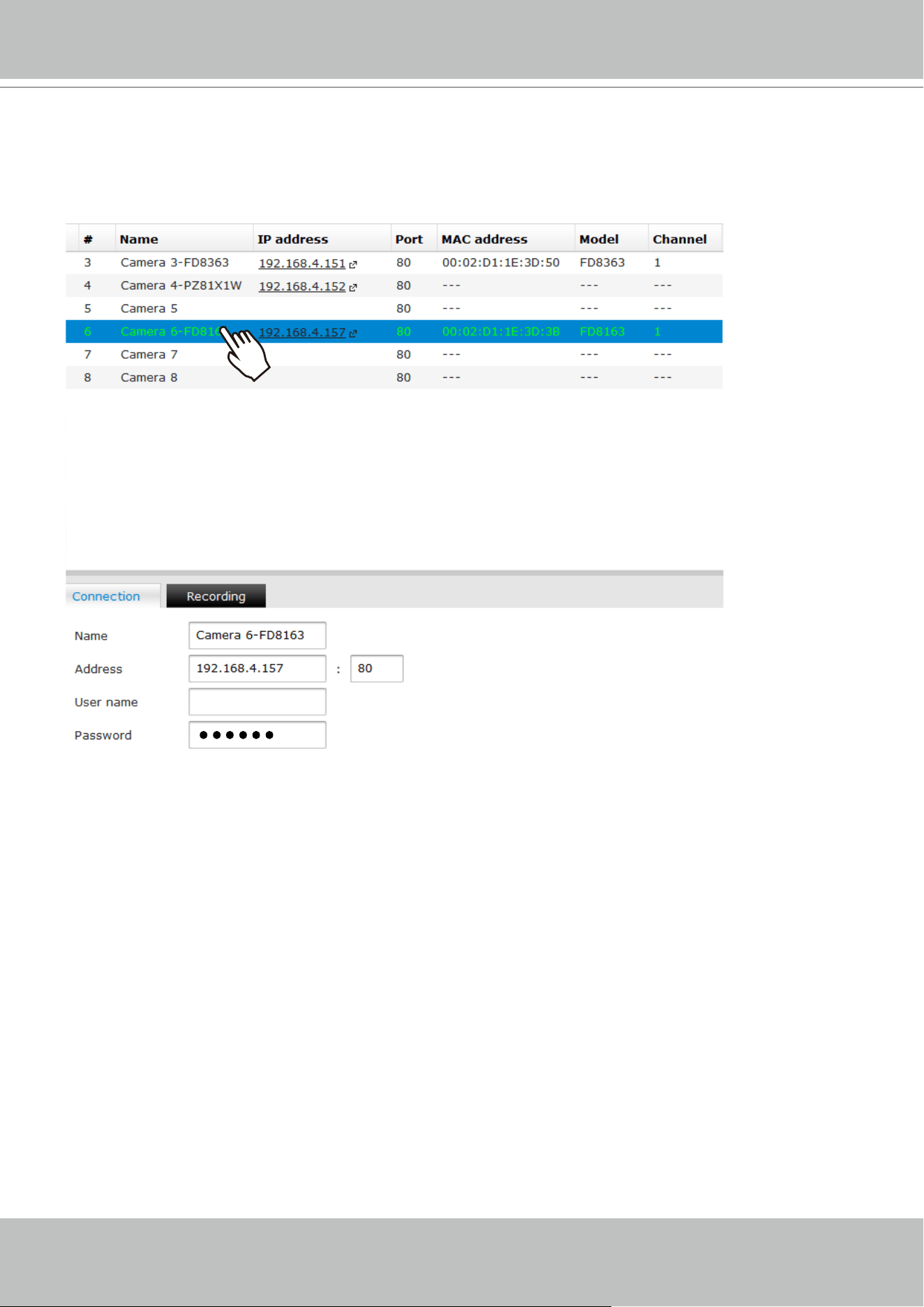
VIVOTEK - Built with Reliability
User's Manual - 143
root
Left-click to select a camera, and edit the Connection and Recording conguration below:
1. Connection - You can rename the camera, and if your camera comes with password
protection, enter its User name and Password here. Otherwise, you will not be able to
manage or access the camera.
If preferred, the acceptable characters for a new camera name can be: [0-9][a-z][A-Z][_][-][ ].
The max. number of alphabetic and numeric characters is 64.
For a user name, the acceptable characters for a camera name can be: [0-9][a-z][A-Z][_][^][-][.]
[@][~][!][$][%]. The max. number of characters is 64.
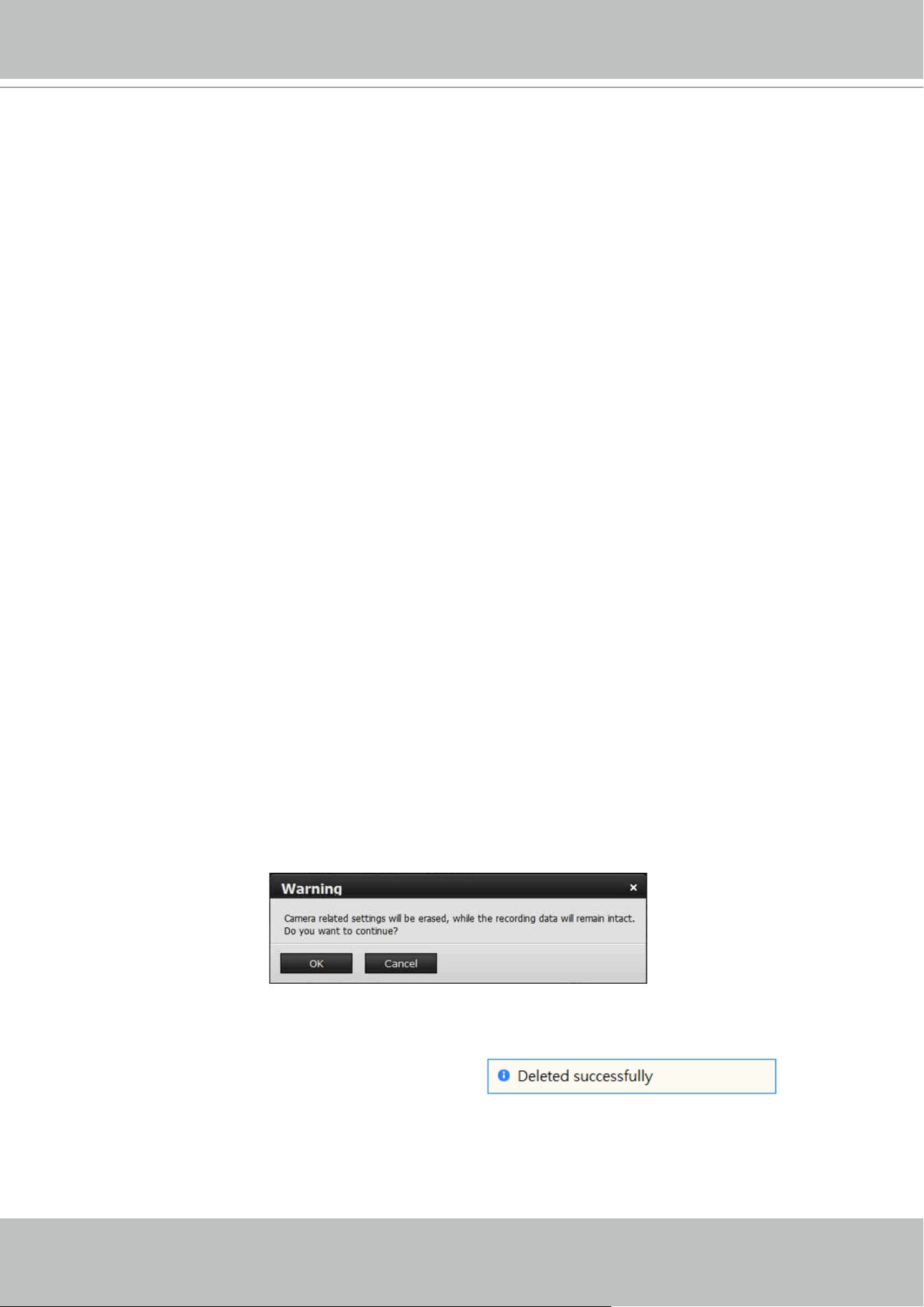
VIVOTEK - Built with Reliability
144 - User's Manual
2. Recording:
2-1. Keep all recordings for maximum * days - determine the life span of recordings in your
system. Usually old recordings will be erased when the storage volumes become full.
When a storage volume is 90% full, the recorded videos taken on the oldest day (from
every camera) will be erased. Deletion of old les will stop when the used space falls
under 85% again.
When recycling takes place, the system buzzer will be triggered, and the recording task
can be halted temporarily until more storage space is regained.
2-2. Pre-alarm buffer time (seconds) - if the alarm-triggered recording is preferred, set up
a pre-alarm buffer for the system to record video before the occurrence of an alarm. The
congurable options are 3, 5, and 10 seconds. A 20MB memory space is reserved for
each camera, and therefore the pre-alarm buffer time can be shorter if the camera video
is recorded using a higher resolution.
2-3. Post-alarm buffer time (seconds) - if the alarm-triggered recording is preferred, set
up a length of time for the system to record video after the occurrence of an alarm. The
congurable options are: 10, 20, 30, 40, 60, and 300 seconds.
2-4. Enable audio recording - Selected by default. Audio input is also recorded along with
the video. However, audio can be muted by default on some cameras. For example, a
speed dome camera requires the connection to an external microphone, and the audio
function is manually turned on through a management session with the camera.
2-5. Enable Activity Adaptive Streaming - You can enable the Activity Adaptive streaming
feature to reduce the frame rate of a video stream when there is no activities in the eld of
view. The frame rate of the video stream will return to normal, say, 30fps, when activities
occur in the eld of view. This feature can save a considerable amount of bandwidth and
also the le size.
3. Delete:
To remove a camera from your list, left-click to select a camera on the list, and then click the
Delete button.
Note that once a camera is removed, all alarm settings related to the camera, such as DO and
preset location settings, will be erased.
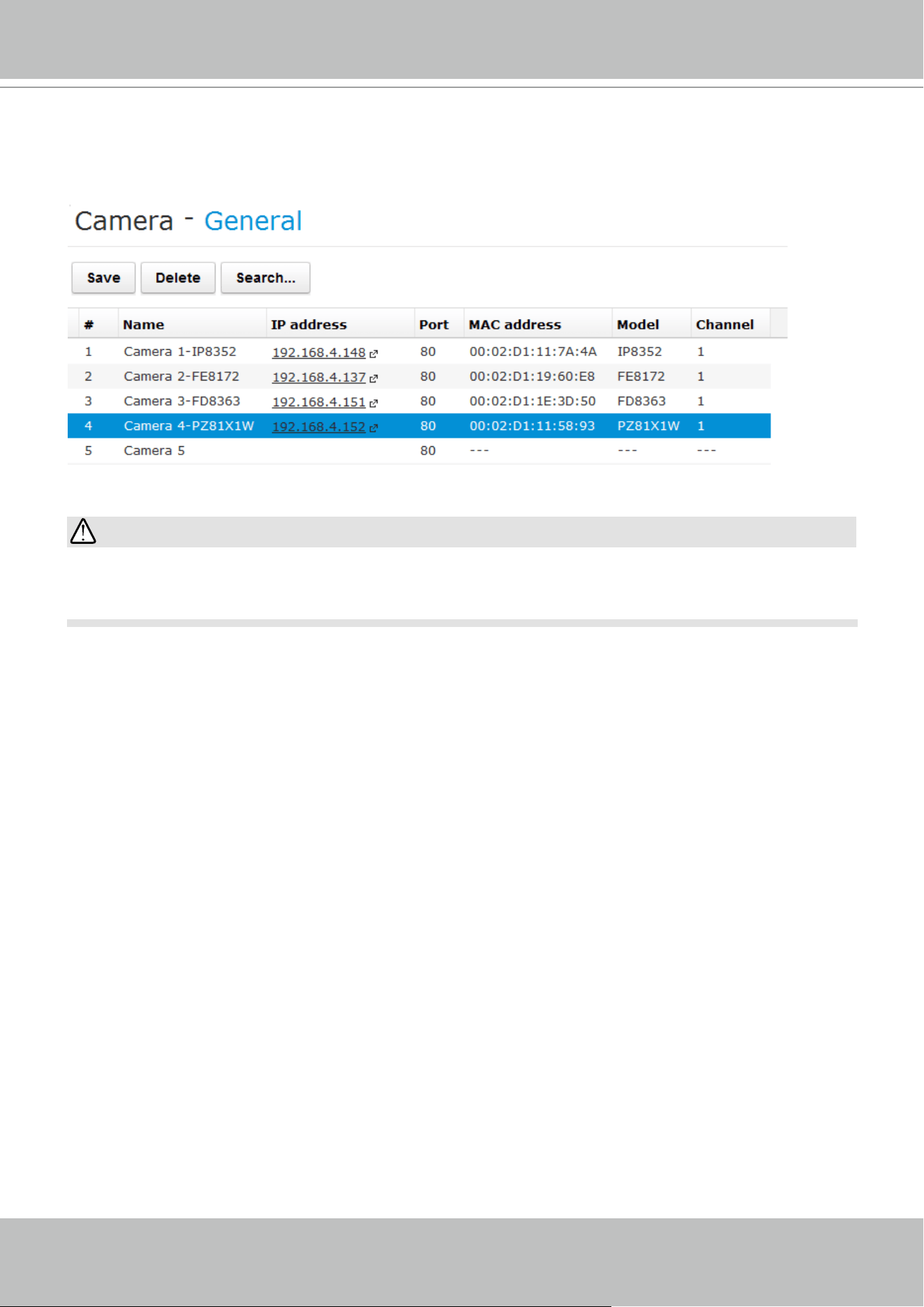
VIVOTEK - Built with Reliability
User's Manual - 145
Leaving the Camera - General page without saving your conguration, you will lose your
conguration changes.
4. Save:
Click the Save button to preserve your conguration whenever changes are made to the
conguration or when you are leaving this page.
IMPORTANT:
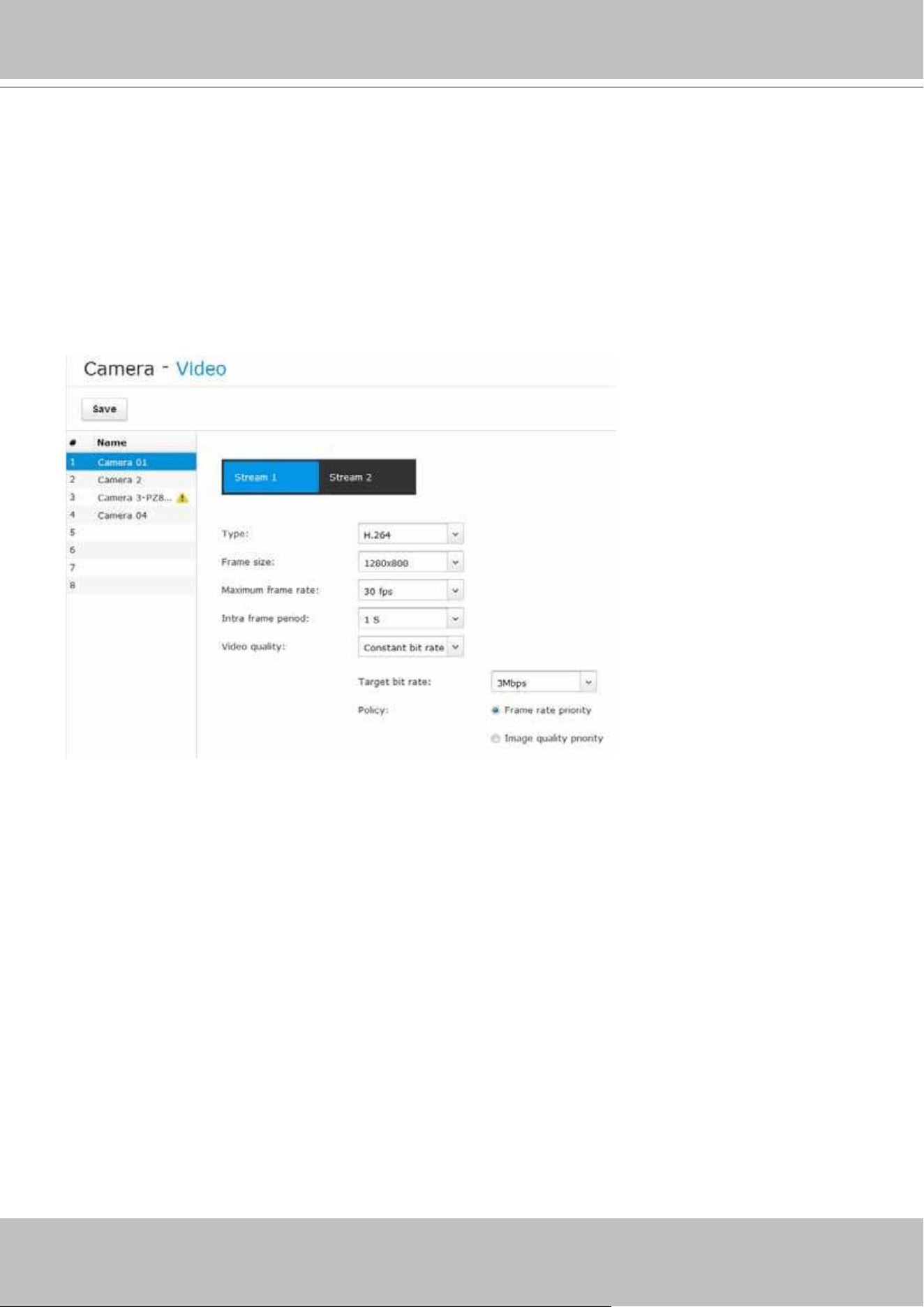
VIVOTEK - Built with Reliability
146 - User's Manual
The Video page determines the Liveview and recording streams of individual cameras in terms
of compression format, video resolutions, frame rate, and the constant bit rate settings.
The constant bit rate setting is especially important in that the sum of bandwidth consumed
for all recording streams must not exceed the 64/96Mbps (8-/16-CH models) threshold. The
constant bit rate is like an upper threshold placed on each video stream. The size of IP packets
delivered from the network camera will be maintained within the bit rate limitation.
By default, Stream 1 is the recorded stream, the NVR uses Stream 2 for live viewing.
5-3-2. Camera - Video
1. Type: The supported formats are: MJPEG and H.264. The MPEG-4 format is not
supported.
If you change the bit rate and resolution settings of a camera, the conguration
applies to the camera rmware settings on its individual video stream. If a camera becomes
disconnected, your conguration change will not take effect util the camera come online
again.
2. Frame size: The applicable video resolutions comes available in a pull-down menu. For
different cameras, the applicable resolutions can vary.
3. Maximum frame rate: The applicable frame rate also varies from camera to camera. The list
of applicable frame rates is polled from individual cameras.
5. Video Quality:
Constant bit rate: This places an upper threshold to limit the bandwidths consumed for live
viewing and recording streams. If "---" (not available) is shown, your camera stream might
have been congured using a "xed quality" setting. You may need to open a web console
with it to convert the camera stream to be using the constant bit rate setting.
4. Intra frame period: This indicates the I-frame insertion period. Default is 1 second.
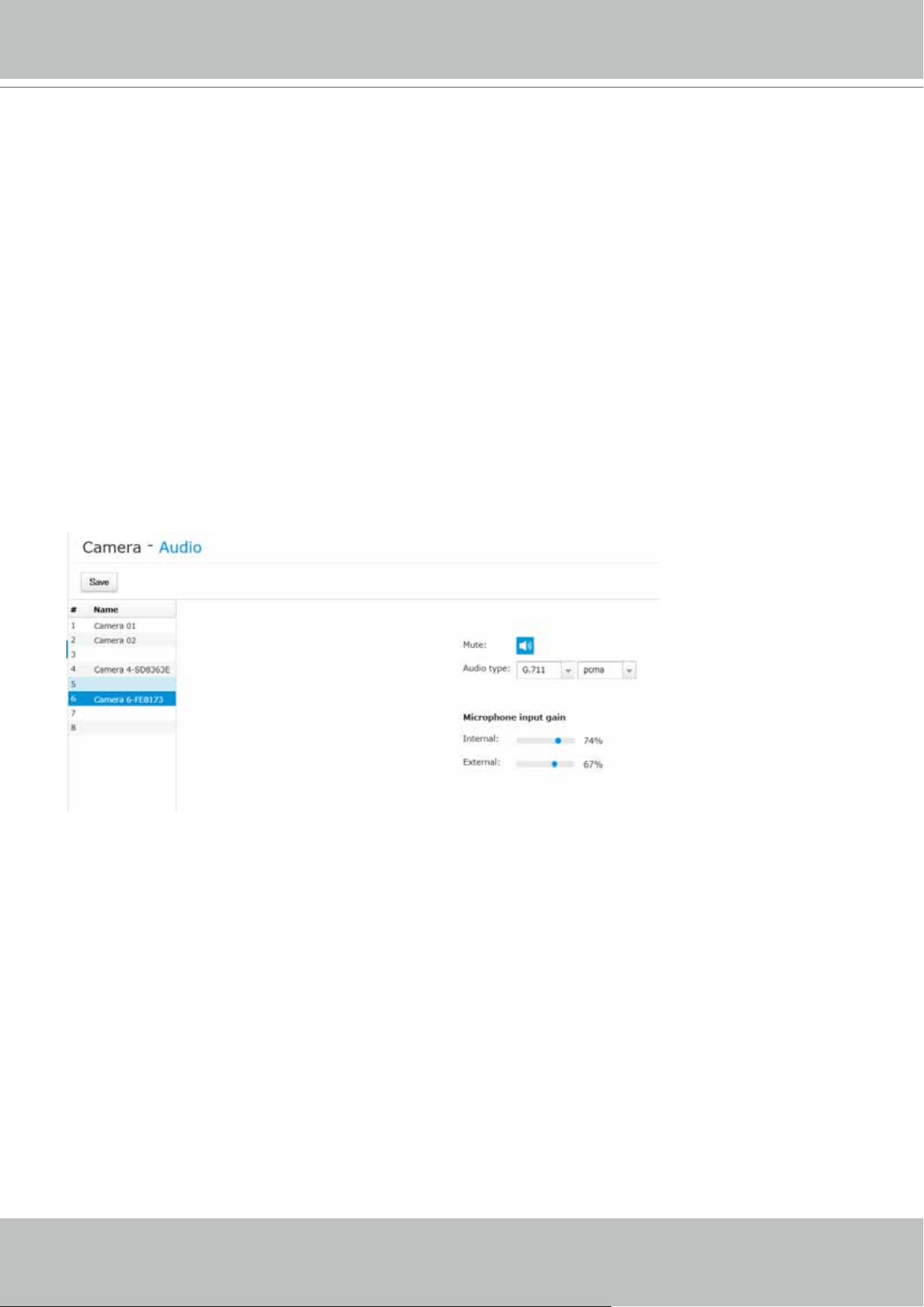
VIVOTEK - Built with Reliability
User's Manual - 147
5-3-3. Camera - Audio
The Audio window allows you to congure all audio codec, sampling rate, and Microphone input
gains. Depending on design of the camera models, some codecs may not be available. Also,
there are cameras that come without embedded mircrophones.
Fixed quality: This guarantees all video frames in a video stream will be delivered using the
same image quality. If network congestion or in the case of insufcent bandwidth, some video
frames may be dropped in order to maintain image quality.
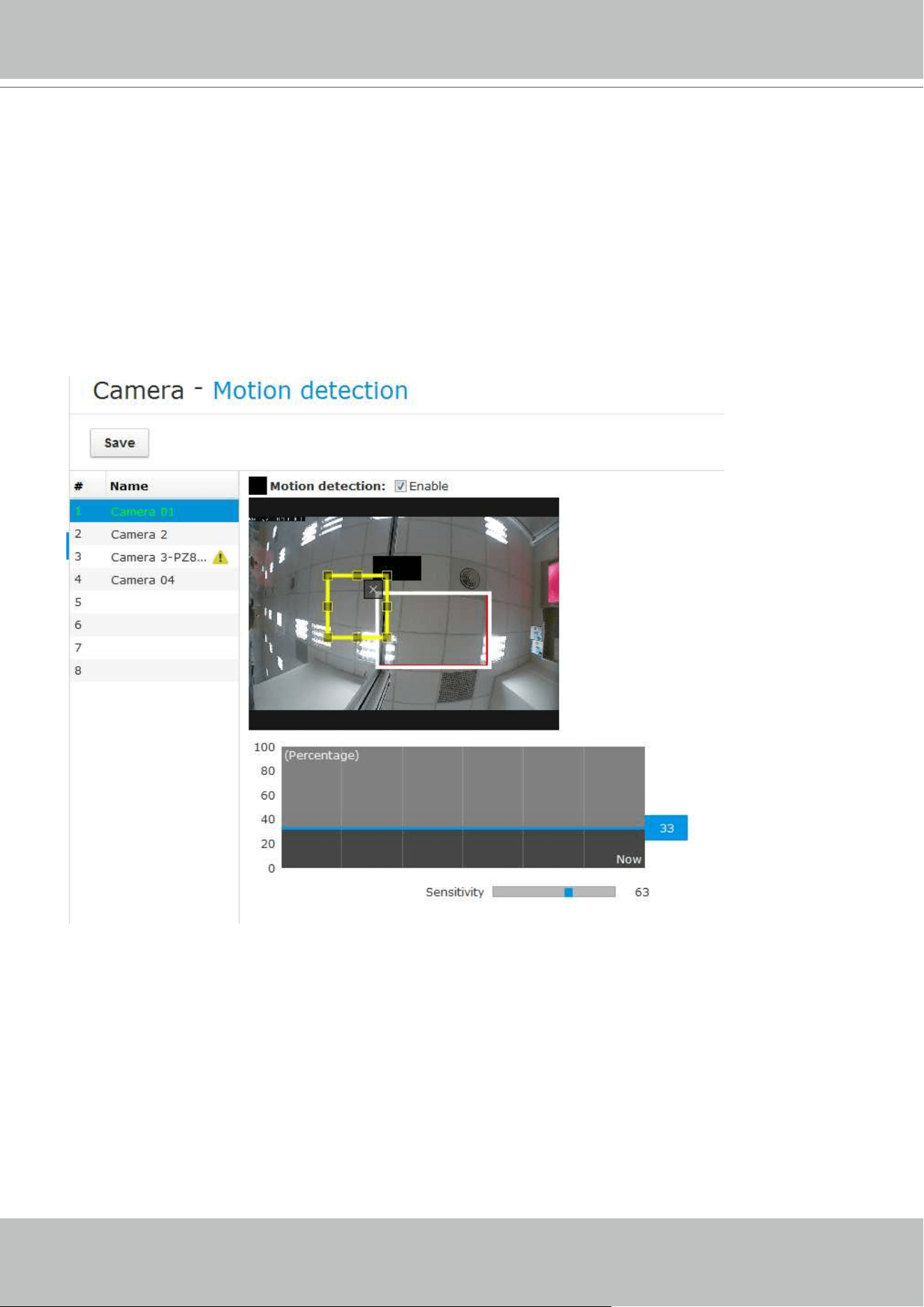
VIVOTEK - Built with Reliability
148 - User's Manual
To congure the motion detection,
1. Select a camera from the list using a single mouse click,
2. Use mouse clicks and drag to draw a square to cover an area of your interest.
3. In a graph below, raise the Detecting area bar (blue), to a percentage you prefer. A moving
object can only trigger an alarm when it is larger than the preset percentage of the detection
area. If set a very low level, any activities can trigger an alarm.
4. Select the Sensitivity on the slide bar.
5. Click Save to preserve your conguration.
5-3-3. Camera - Motion detection
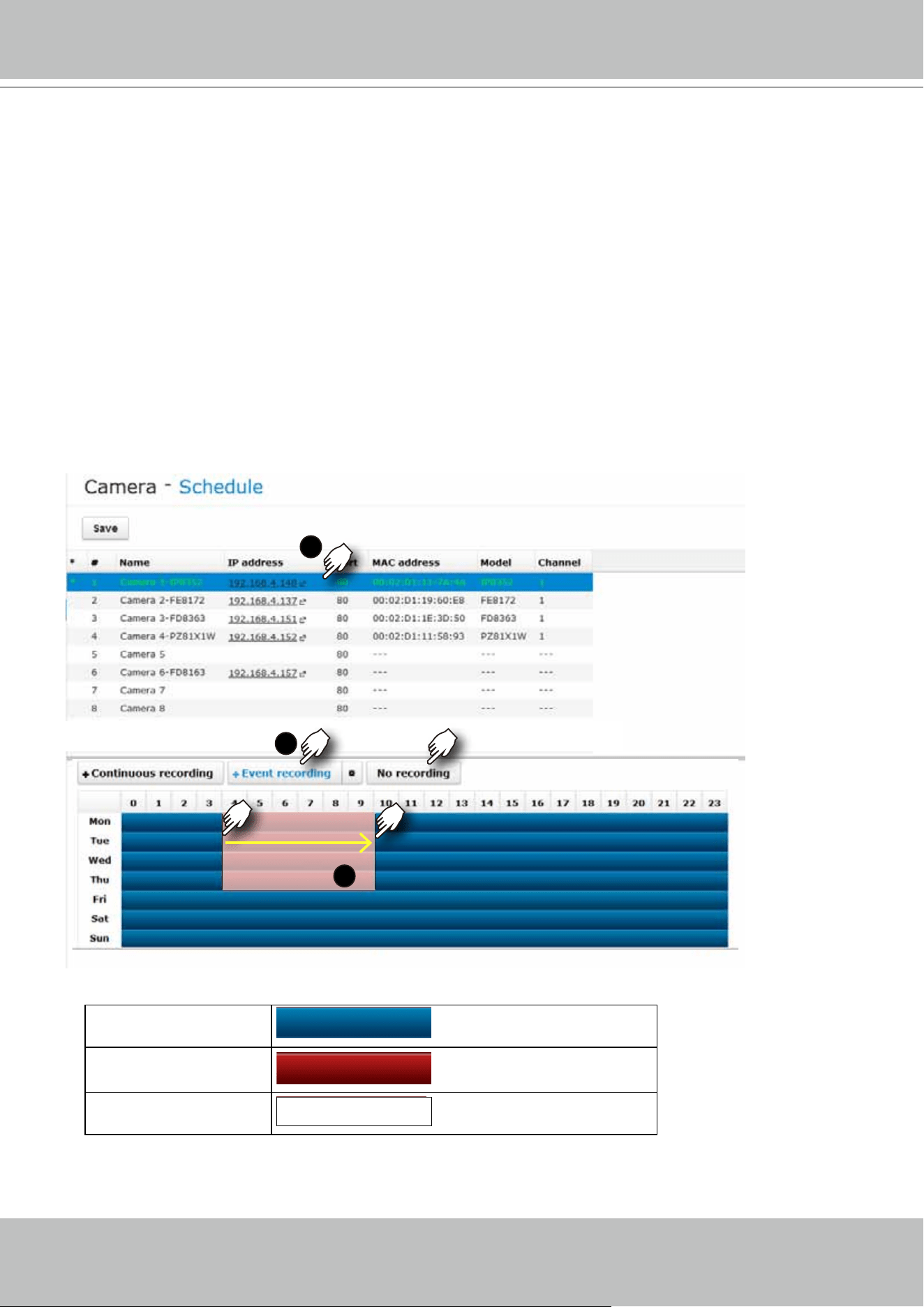
VIVOTEK - Built with Reliability
User's Manual - 149
The camera recording schedule can be congured down to an hourly basis. The default settings
for cameras is to record videos at all time.
To set up a schedule,
1. Select a camera from the list using a single mouse click,
2. By default, all days and hours will be selected for continuous recording. If you want to disable
recording for specic time during a week, or enable event-triggered recording during some
time, use the Event recording and No recording buttons.
3. Use them as a paint brush or eraser on the weekly time chart. Click or drag your mouse
cursor across the time chart to change the recording schedule.
Change a non-recording hour to continuous recording by one click on the Continuous
recording button and then click and/or drag on the time chart.
5-3-4. Camera - Schedule
1
2
3
- or -
The color codes for the display on the time chart are shown below:
Continuous recording
Event recording
No recording
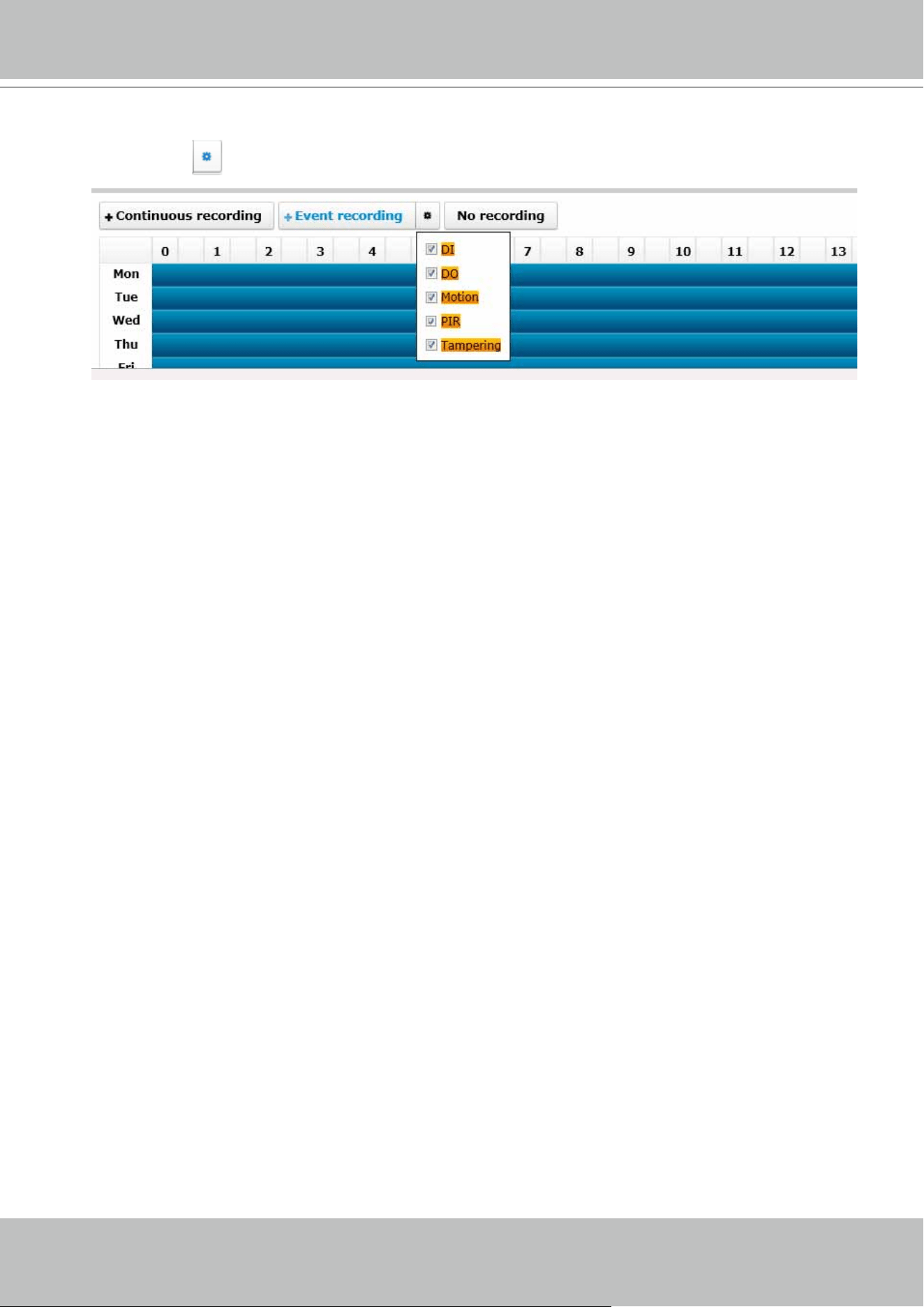
VIVOTEK - Built with Reliability
150 - User's Manual
The Event recording is triggered by digital inputs or motion detection. You can click on the
setup button to select or deselect the triggering options.
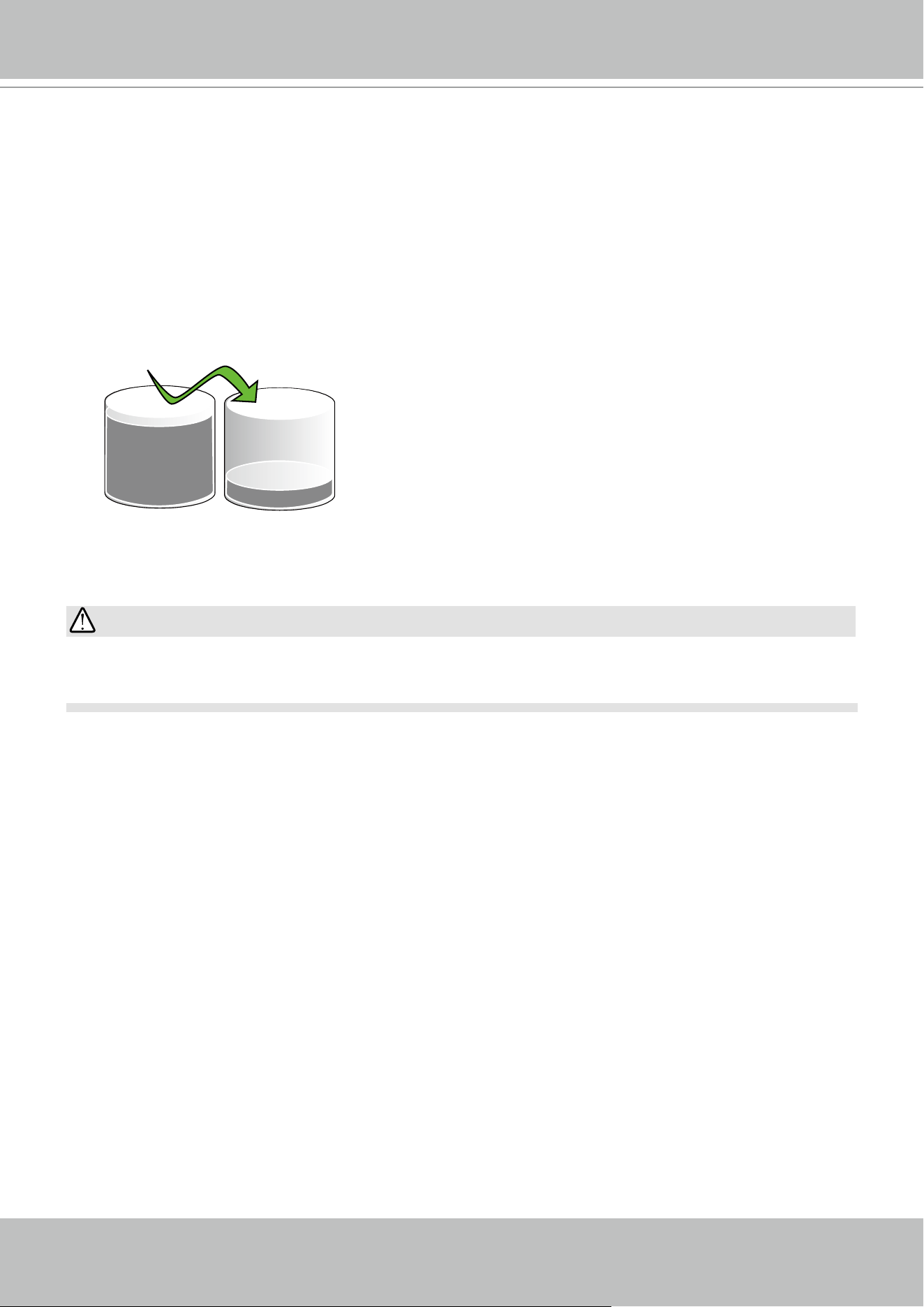
VIVOTEK - Built with Reliability
User's Manual - 151
Each hard drive installed into the system will be considered as a candidate for composing a
single-disk volume.
Single disk: The single disk conguration provides no fault tolerance. The system stores video
recordings to one or more single disk volumes in a consecutive order.
5-4-1. Storage - Volume
5-4. Storage
Single disks
Disk 1 Disk 1
Each single disk volume contains one disk drive.
If you remove a disk drive and insert it into a different drive bay, the system will consider it as a
new and different disk drive.
IMPORTANT:
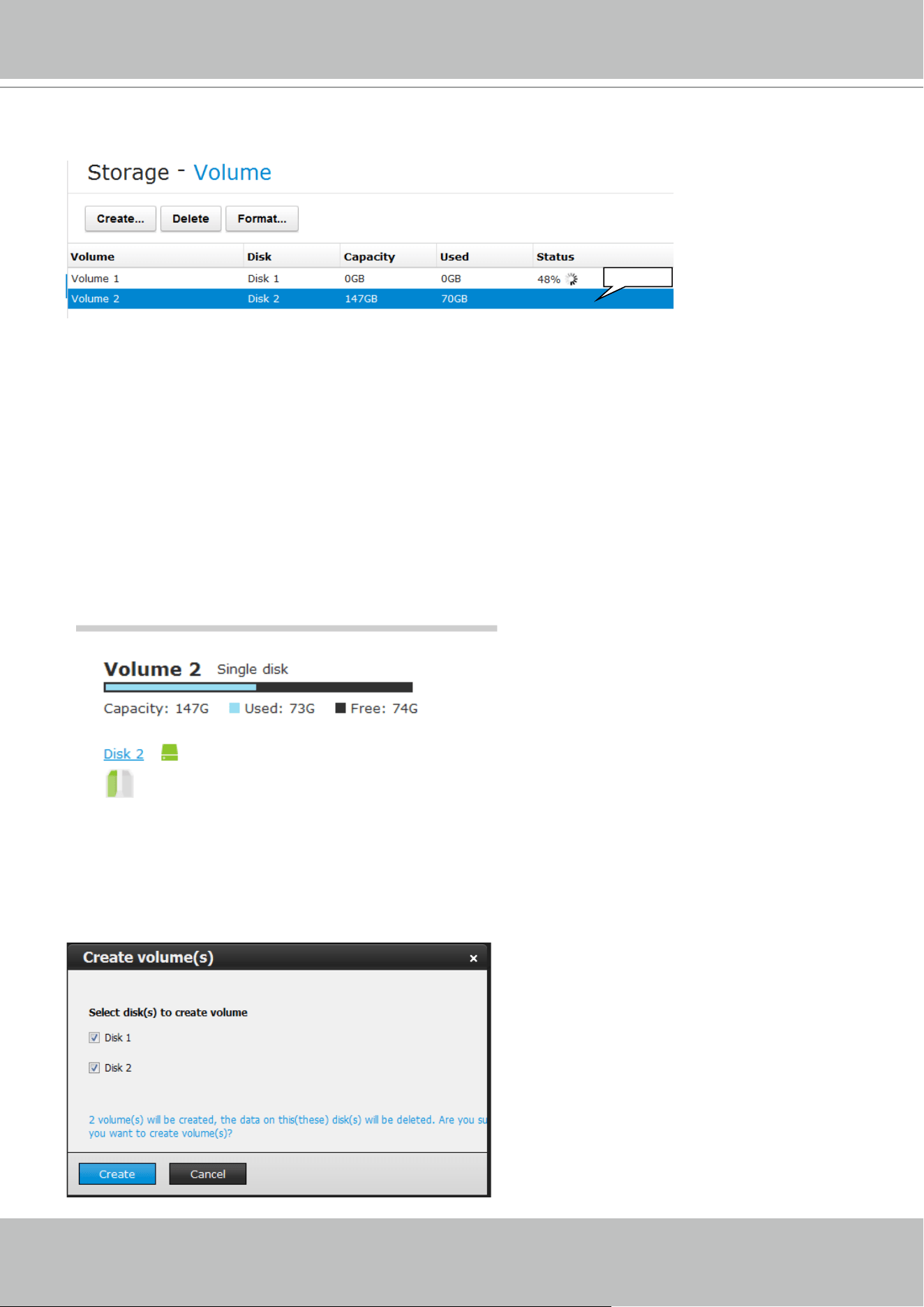
VIVOTEK - Built with Reliability
152 - User's Manual
To create a storage volume:
1. Click on the Create... button. Also check that if all your disk drives are listed. If properly
installed, they should all be listed in the Storage - Volume window.
Selected
(#) numbered: Volume index.
Disk: Member(s) of this volume.
Capacity: Total usable capacity size in Gigabytes.
Used: The used capacity in Gigabytes.
Status: The status display when processing volume conguration, deleting, and
formatting a volume.
Error: Conguration or hard drive errors. The volume is invalid, and may need to
be manually removed.
The legends used in the Volume list are described below:
You can click to select a volume and its current status will be displayed as shown below. The
information will include its physical position, capacity, used capacity, and free capacity.
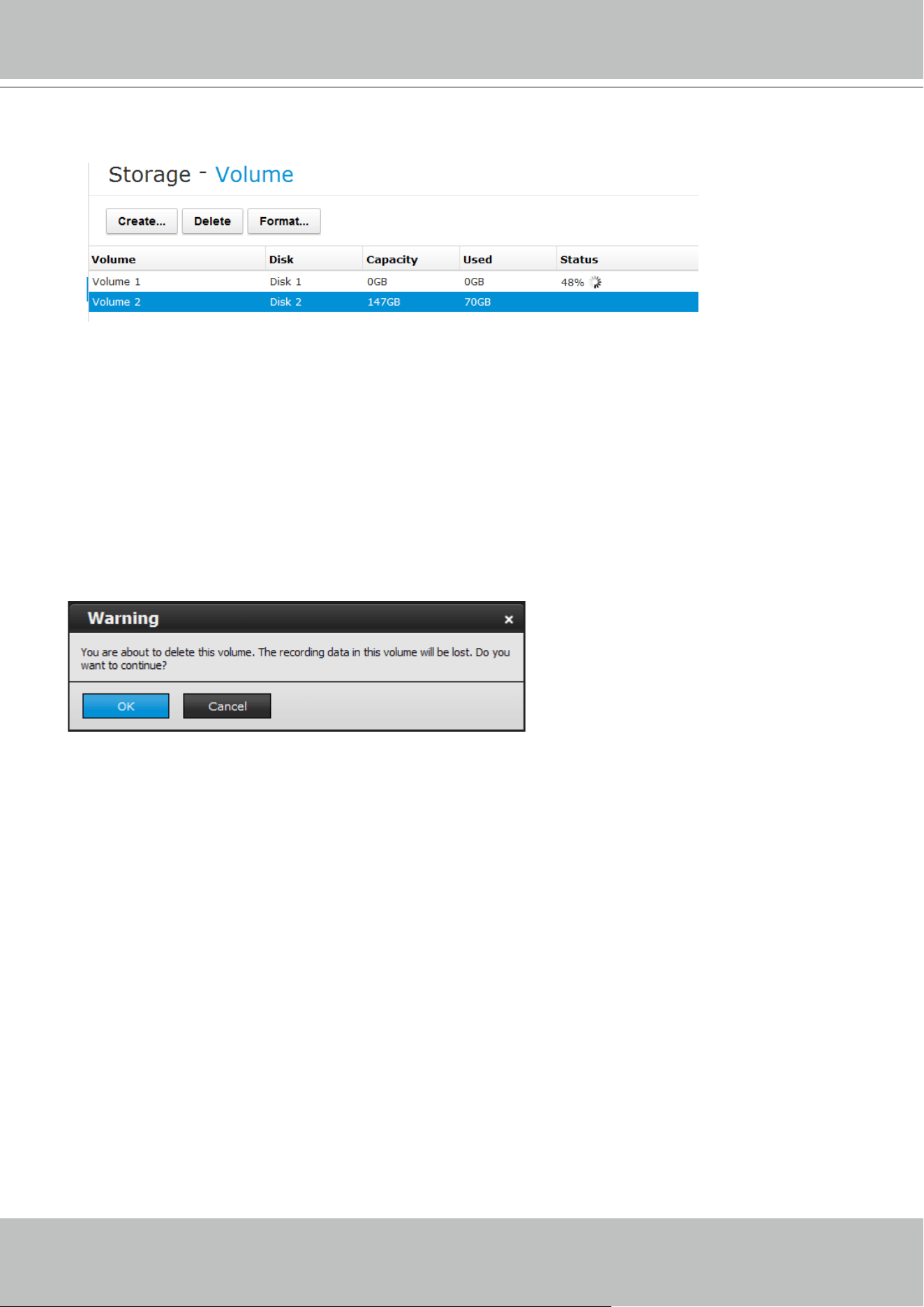
VIVOTEK - Built with Reliability
User's Manual - 153
2. The creation progress will be shown at the Status column.
When completed, and if you already have cameras in your conguration, the recording task will
immediately begin.
To delete a storage volume:
1. Click to select a storage volume from the list.
2. Click on the Delete button.
3. A warning message will prompt saying all recorded data will be lost. Click OK if you want to
remove the volume.
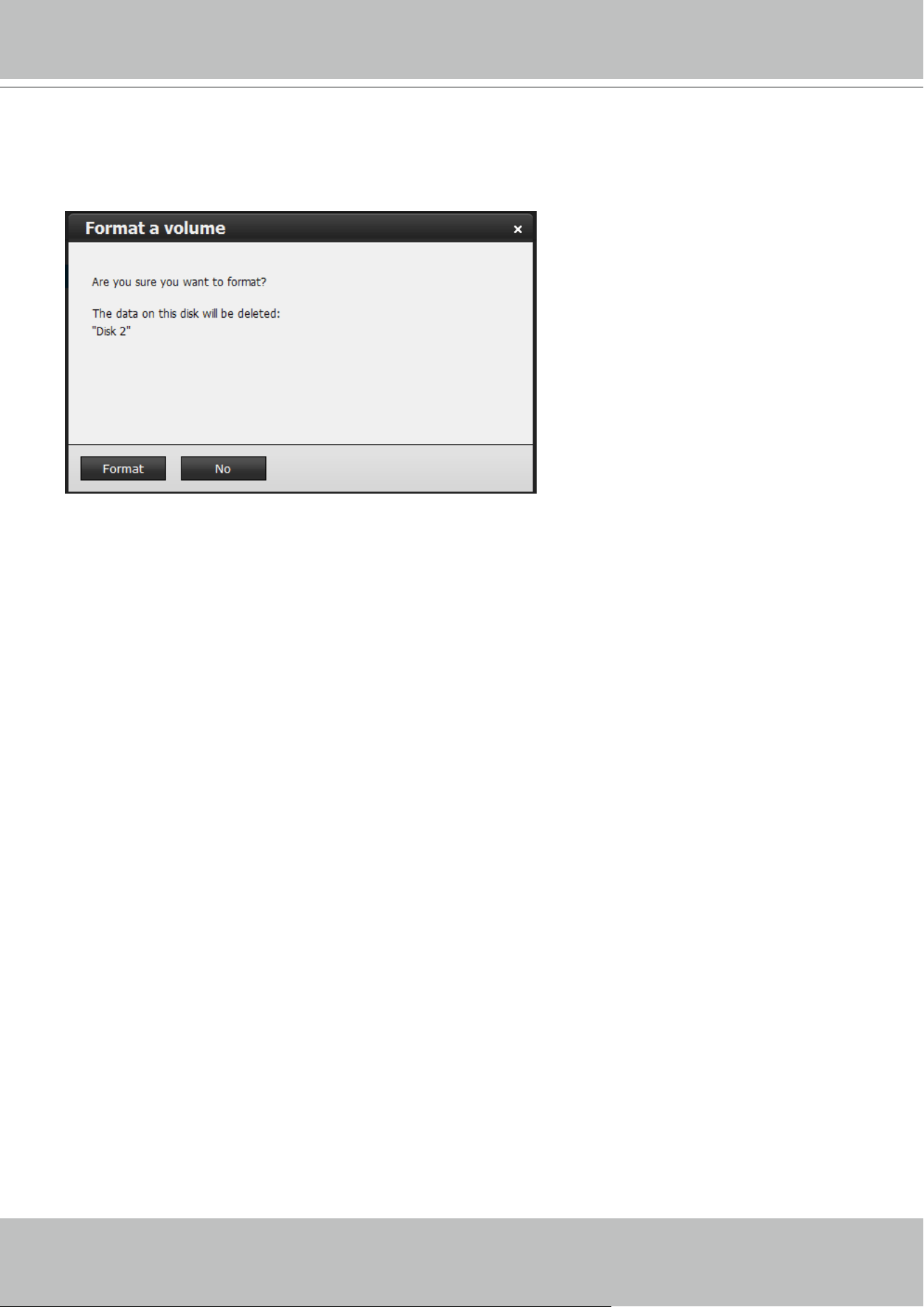
VIVOTEK - Built with Reliability
154 - User's Manual
To format a storage volume:
You may also format an existing storage volume in situations such as when you need to re-
deploy the system elsewhere.
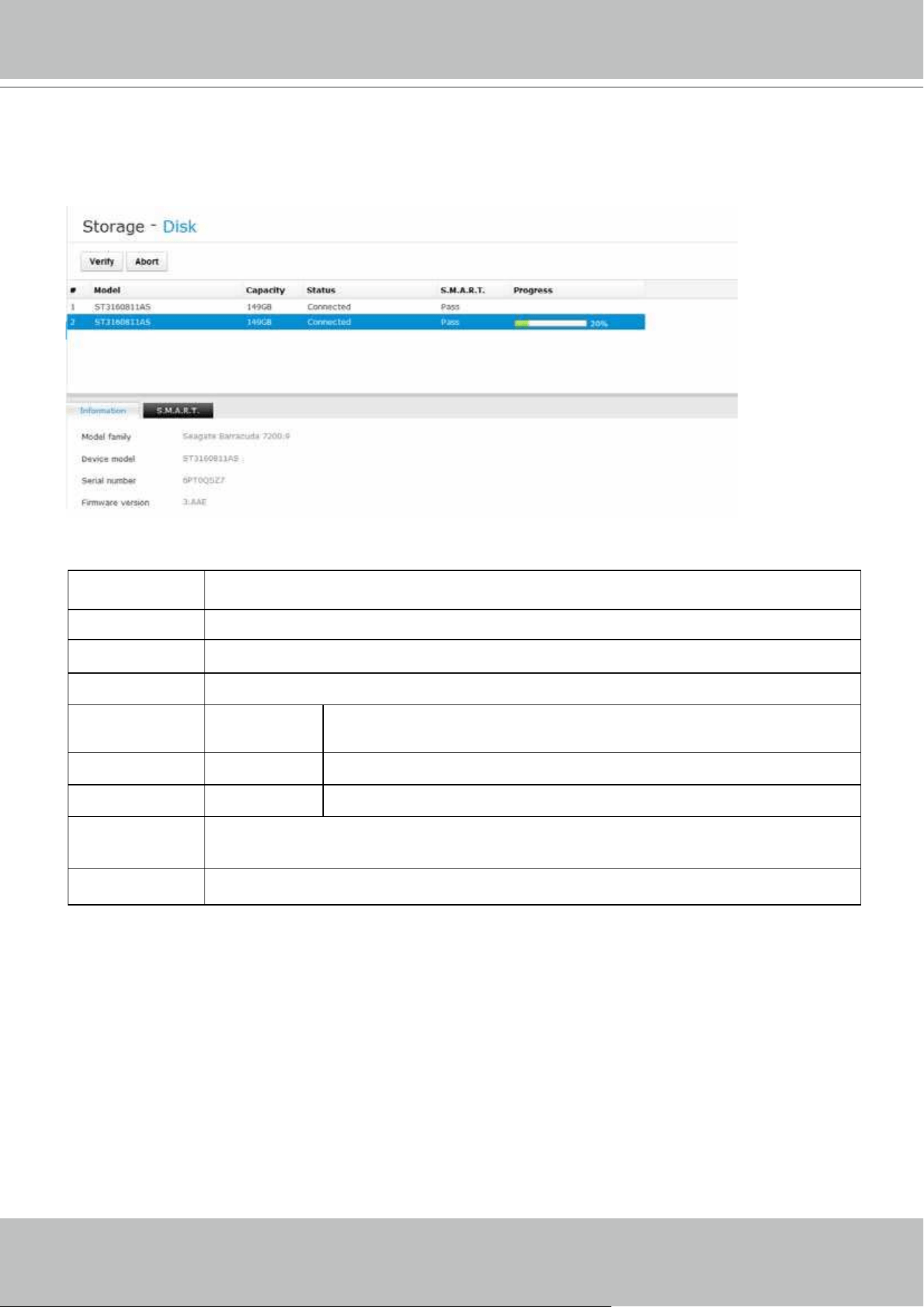
VIVOTEK - Built with Reliability
User's Manual - 155
The Disk window provides access to physical disk information, disk physical location, disk
health, polling for S.M.A.R.T. statuses, and bad block check.
5-4-2. Storage - Disk
(#) numbered: Disk index. This is determined by their locations in the chassis.
Model: Disk model name.
Capacity: Disk capacity in Gigabytes.
Status: Disk operating status. Can be stated as:
Connected: Disk is properly installed, but not yet congured into storage
volume.
Identied: The storage volume this disk belongs to is operating normally.
Corrupted: Disk is faulty.
S.M.A.R.T.:
S.M.A.R.T. status polled from the disk drive. These are not the results from a
manually-executed S.M.A.R.T. test.
Progress: This shows the progress of drive S.M.A.R.T. test or bad block scan.
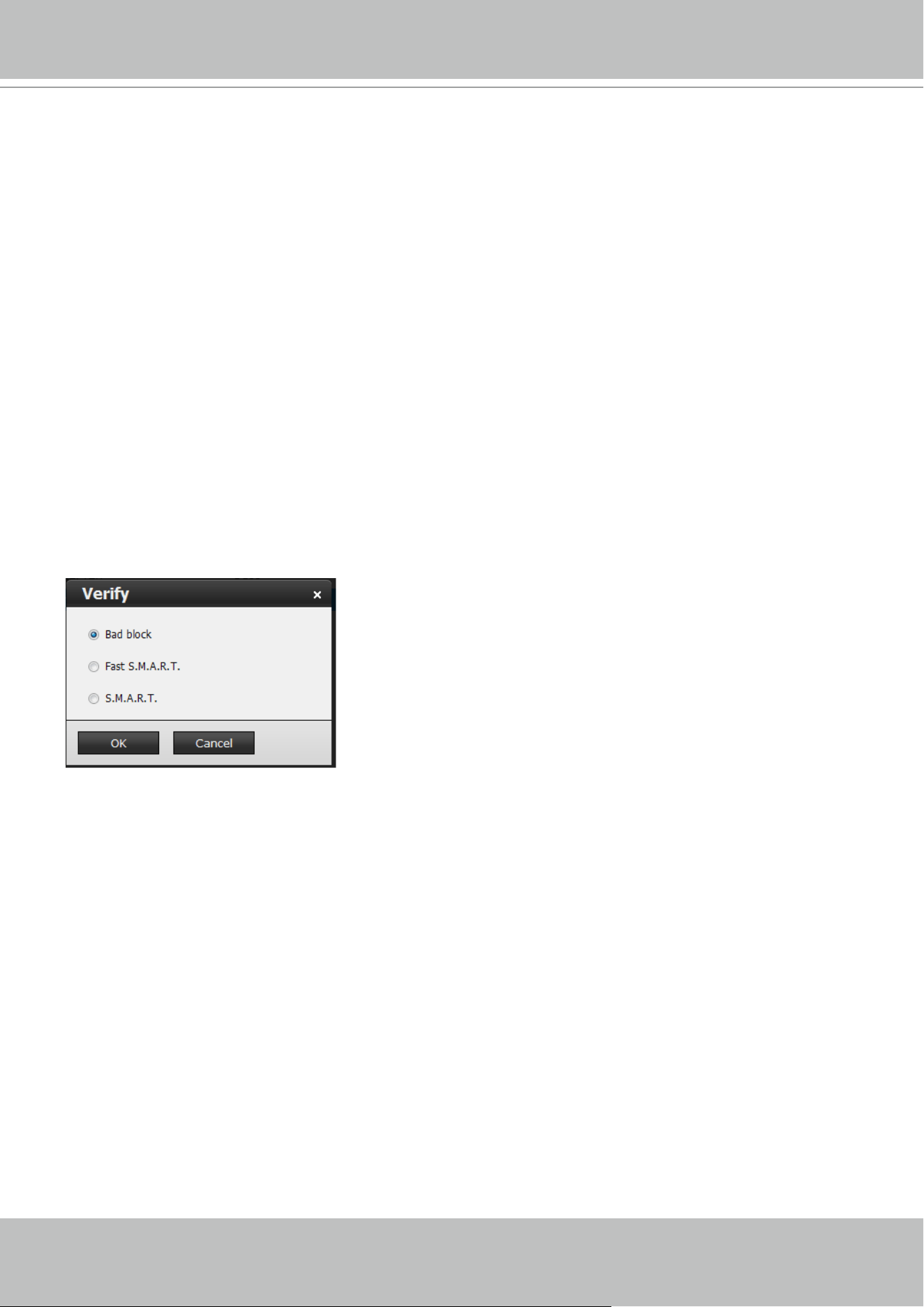
VIVOTEK - Built with Reliability
156 - User's Manual
1. Disk Information:
Model family: The brand name of the HDD manufacturer.
Device model: The disk model name.
Serial number: Serial number assigned to the disk drive.
Firmware version: The version of rmware running on this disk drive.
User capacity: The rated capacity for this disk drive.
Status: The bad block check or S.M.A.R.T. test previously executed on this drive.
2. S.M.A.R.T. test:
Attribute: The various attributes can vary from different HDD manufacturers.
Value: Value for the currently selected attribute.
Worst: Worst value acquired for that attribute.
Threshold: A predened threshold or triggering value. The threshold below which the
normalized value will be considered exceeding specications.
Raw value: The detected parameters for that attribute.
Status: The judgement made to deem the current reading as OK or failed.
3. Verify:
Three types of check disk actions can be initiated through this button. Select the action you wish
to take and click the OK button.
Bad block check: Performs read/write test to drive sectors to locate bad blocks. This action
may take several hours to complete.
Fast S.M.A.R.T. test: Tests the electronic and mechanical performance and disk read
performance, including those on disk buffer, read head, seek time, and integrity of drive
sectors. The short test is performed on a small section of disk platters, and takes about 2
minutes to complete.
S.M.A.R.T. long test: The long test is more thoroughly and is performed to all drive sectors.
The actual completion time depends on drive sizes and the attributes put to test.
The Check disk functions mentioned above, when performed during active I/Os, can consume
system resources and cause dropped frames with the recording tasks.
4. Abort:
Stops the bad block check or S.M.A.R.T. test on an individual disk drive. The disk drive
currently running a disk check should have a progress bar shown in the Progress column.
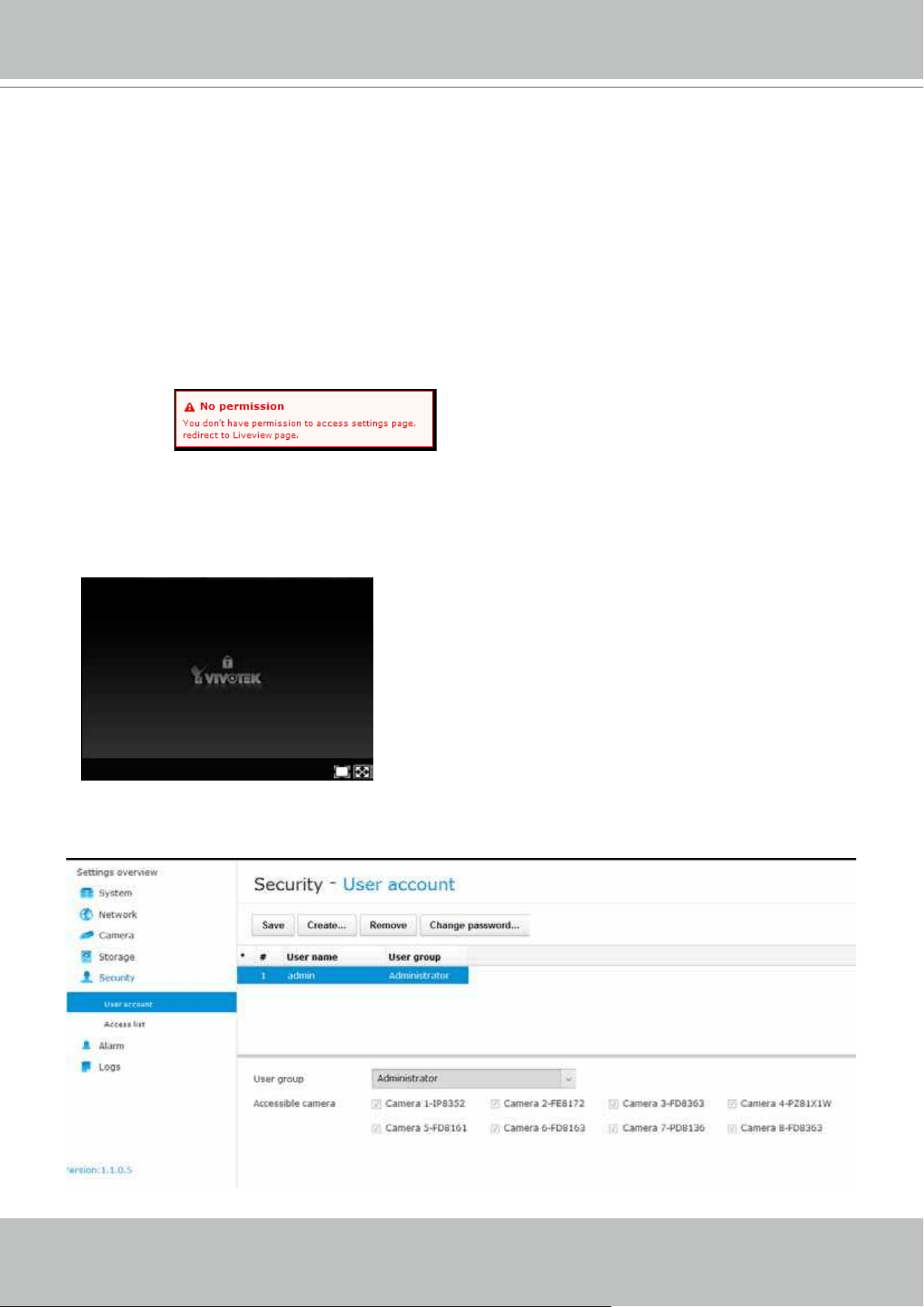
VIVOTEK - Built with Reliability
User's Manual - 157
The User account window allows you to create more users, to change user password, and
place limitations on users' privileges and administration rights. Up to 16 users can be created,
including the default administrator.
1. By default, there are two user groups: Administrator and Normal user.
2. The normal users cannot access the Settings window, meaning that normal users can not
add or remove cameras, make changes to alarm, network, and all other system settings.
When a normal user tries to access the system Settings window, the following message will
prompt.
3. The administrator users can access all cameras recruited in the conguration; while the
normal users can be congured to have access to some or all cameras.
4. The system blocks out the video feeds from users who are denied of the access to particular
cameras. The alarms and the alarm-triggered recordings from those cameras will also be
inaccessible for unauthorized users.
5-5-1. User account
5-5. Security
To create users,
1. From the Security > User account window, click on the Create... button.
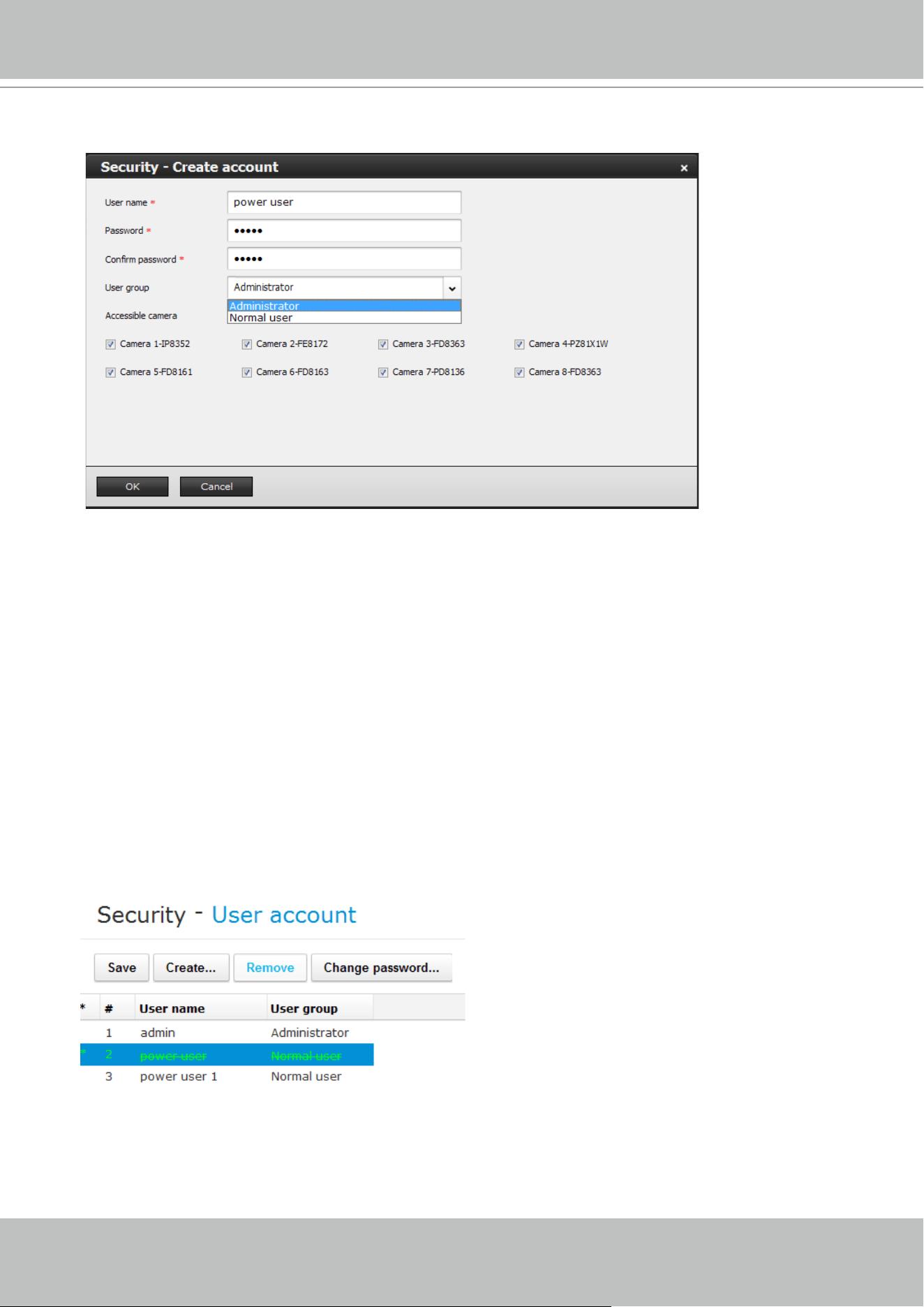
VIVOTEK - Built with Reliability
158 - User's Manual
2. Select a User group by unfolding its pull-down menu. Select either an Administrator or normal
user as the user group.
3. Enter the User name and password. The max. number of characters for a user name is 64,
with alphabetic and numeric characters including [0-9][a-z][A-Z][_][ ][-][.][,][@]. The max.
number for password is also 64.
4. If you are creating a normal user with limited access to cameras, deselect the checkboxes in
front of the cameras to deny the user access.
5. Click OK to close the conguration window. Repeat the process to create more users, and
please remember to click the Save button to preserve your conguration after you created all
users.
To remove users,
1. From the Security > User account window, left-click to select an existing user.
2. Click on the Remove button.
3. The user's entry will appear in lighter color with a strike-through to distinguish it as a deletion
that has not been applied.
4. Click on the Save button, and then the deletion will actually take place.
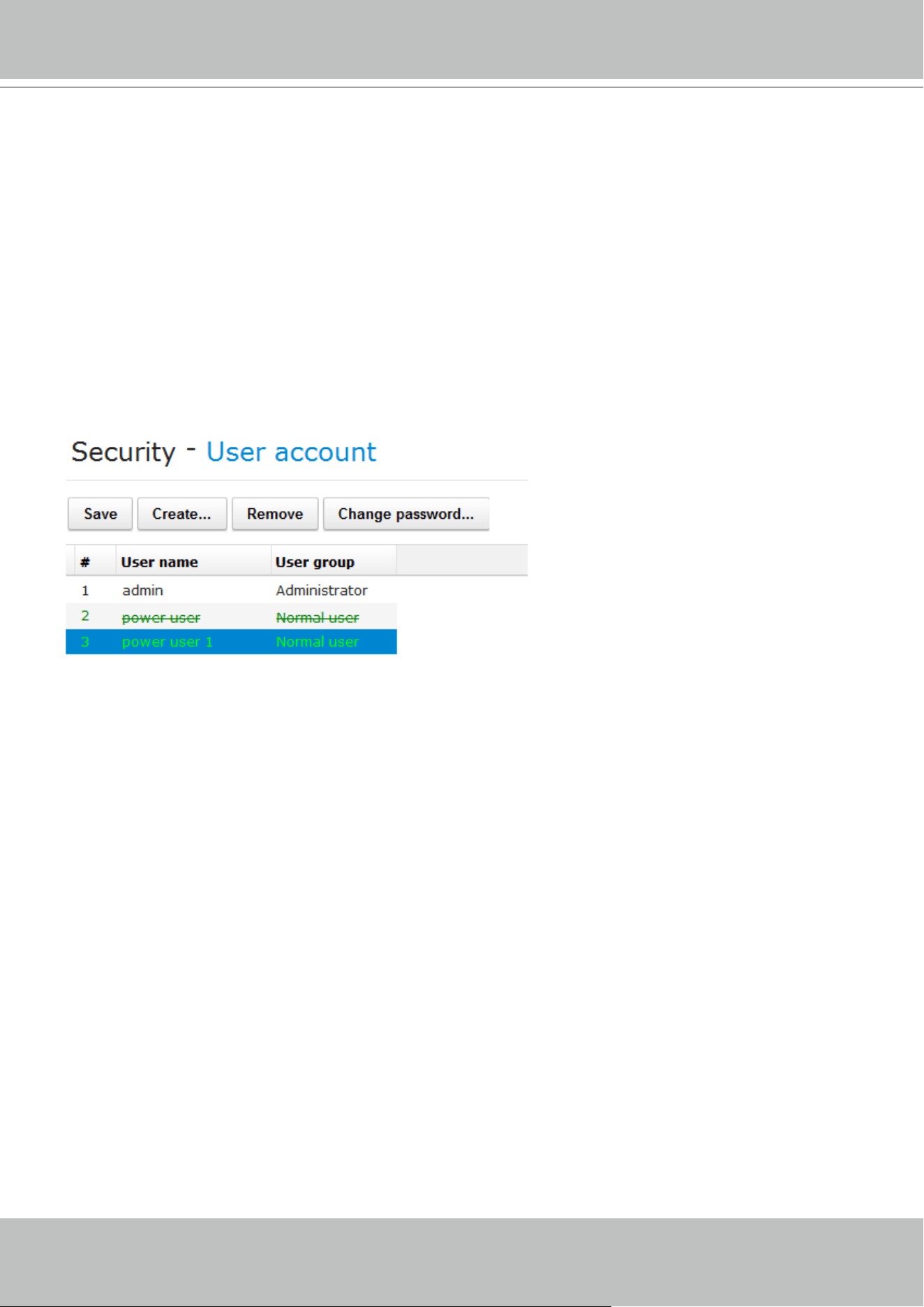
VIVOTEK - Built with Reliability
User's Manual - 159
To change the password for an existing user,
1. From the Security > User account window, click on an existing user.
2. click on the Change password... button.
3. The password prompt will appear. Enter the new password twice and click OK to conrm.
4. The user's entry will appear in a lighter color to distinguish it as a changed entry that has not
been applied.
5. Click Save to preserve your changes on the screen.
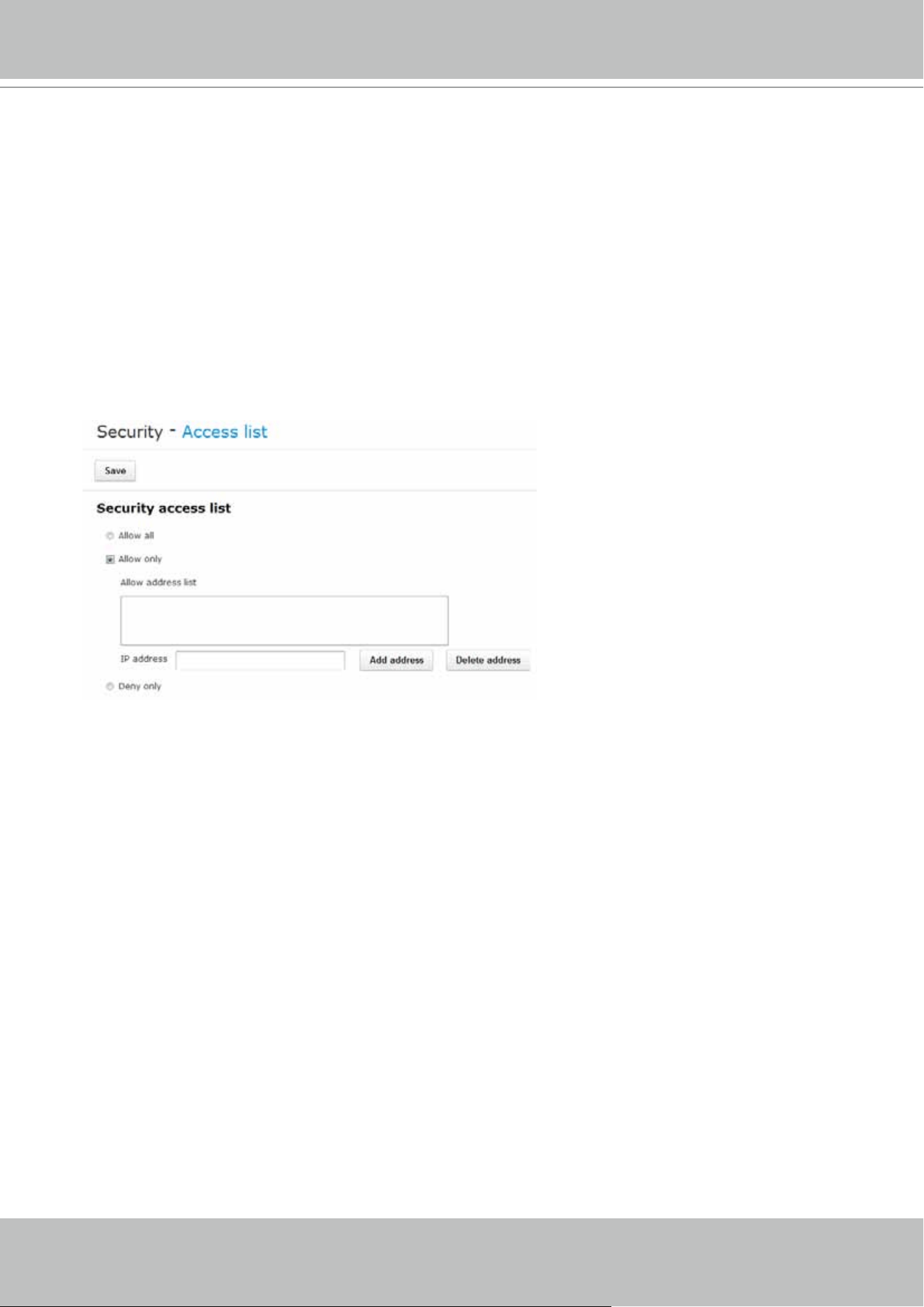
VIVOTEK - Built with Reliability
160 - User's Manual
The access control applies to the access from a web client over HTTP and RTSP protocols.
Three access conguration options are available:
1. Allow all: Allows access from all IP addresses.
2. Allow only: Allows access only from the listed IPs. You should manually enter the IPs for
computers that need to access the NVR.
Note that you can use the asterisk (*) mark to represent all decimal numbers in each
individual octet of the range of IP address: such as using 172.16.0.* for addresses ranging
from 172.16.0.1 to 172.16.0.254.
A decimal number between two asterisks, e.g., <172.*.10.*>, is considered as invalid.
5-5-2. Access list
3. Deny only: Denies the access from the listed IPs. You should manually enter the IPs for
computers that will be blocked out from the access. The conguration details is the same as
those for the Allow only methodology.
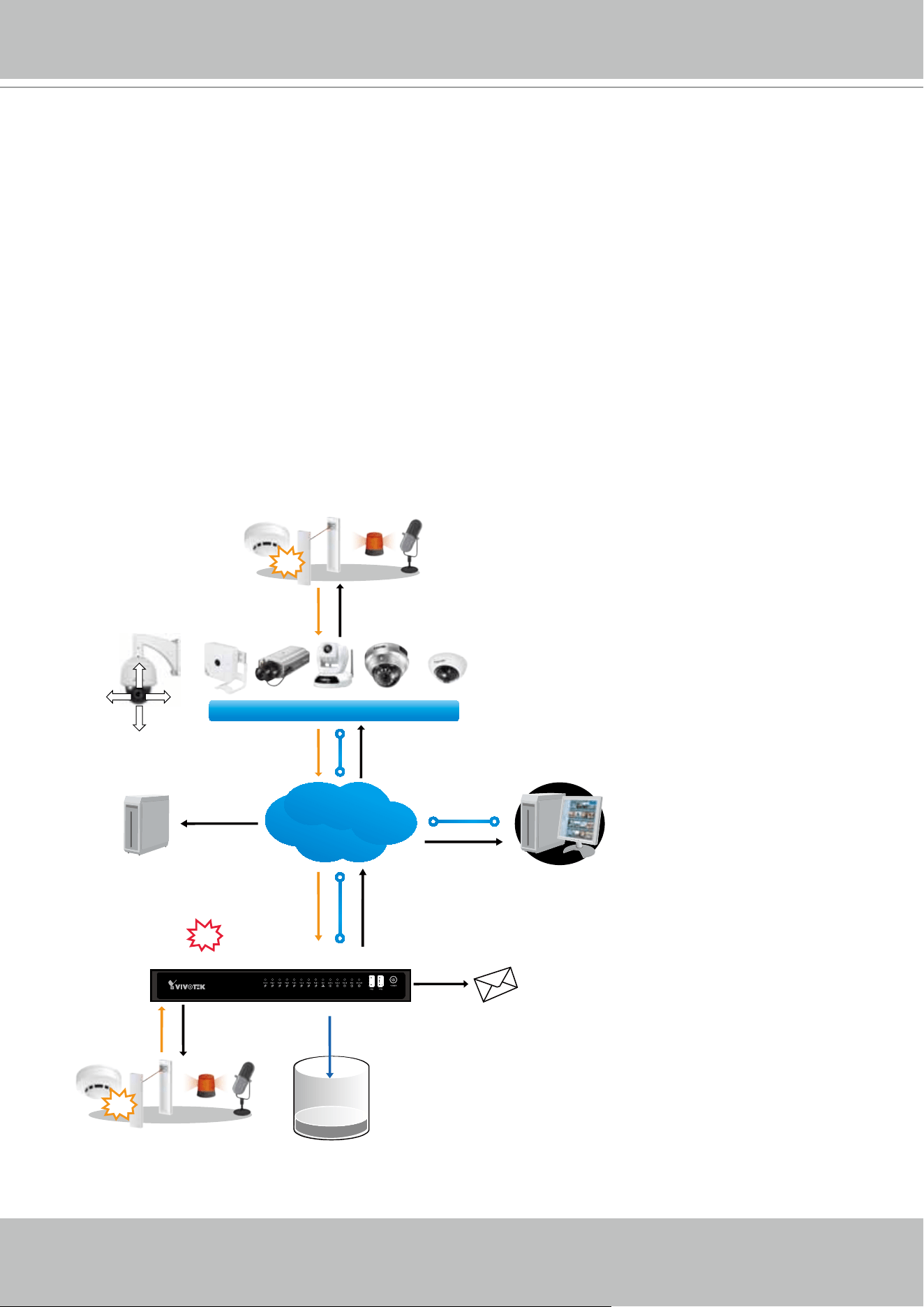
VIVOTEK - Built with Reliability
User's Manual - 161
The events reported from individual cameras' digital inputs, digital outputs, motion detection,
PIR, or tampering detection can be accommodated in the NVR system's alarm settings. These
events will then be reported or trigger corresponding actions as follows:
1. Reporting events via Email or system buzzer.
2. Triggering video snapshot and text message by the occurrences of events to an FTP site.
3. Triggering the camera(s) for its lens to move to a preset position.
4. Triggering the cameras' digital output.
You can create up to 10 instances of alarm.
5-6-1. General
5-6. Alarm
LAN/WAN
VIVOTEK Network Cameras
Email
Alarms
Digital input/output
Motion detection
Event-triggered
recording
Web Console
Events triggered
FTP
Buzzer
Preset positions
1
2
3
4
5
6
PIR/
Tampering detection/
Digital input/output
Hardware connections to DIs or DOs, e.g., window sensors, should be made separately. The
motion detection conguration can be made in the Camera conguration window.
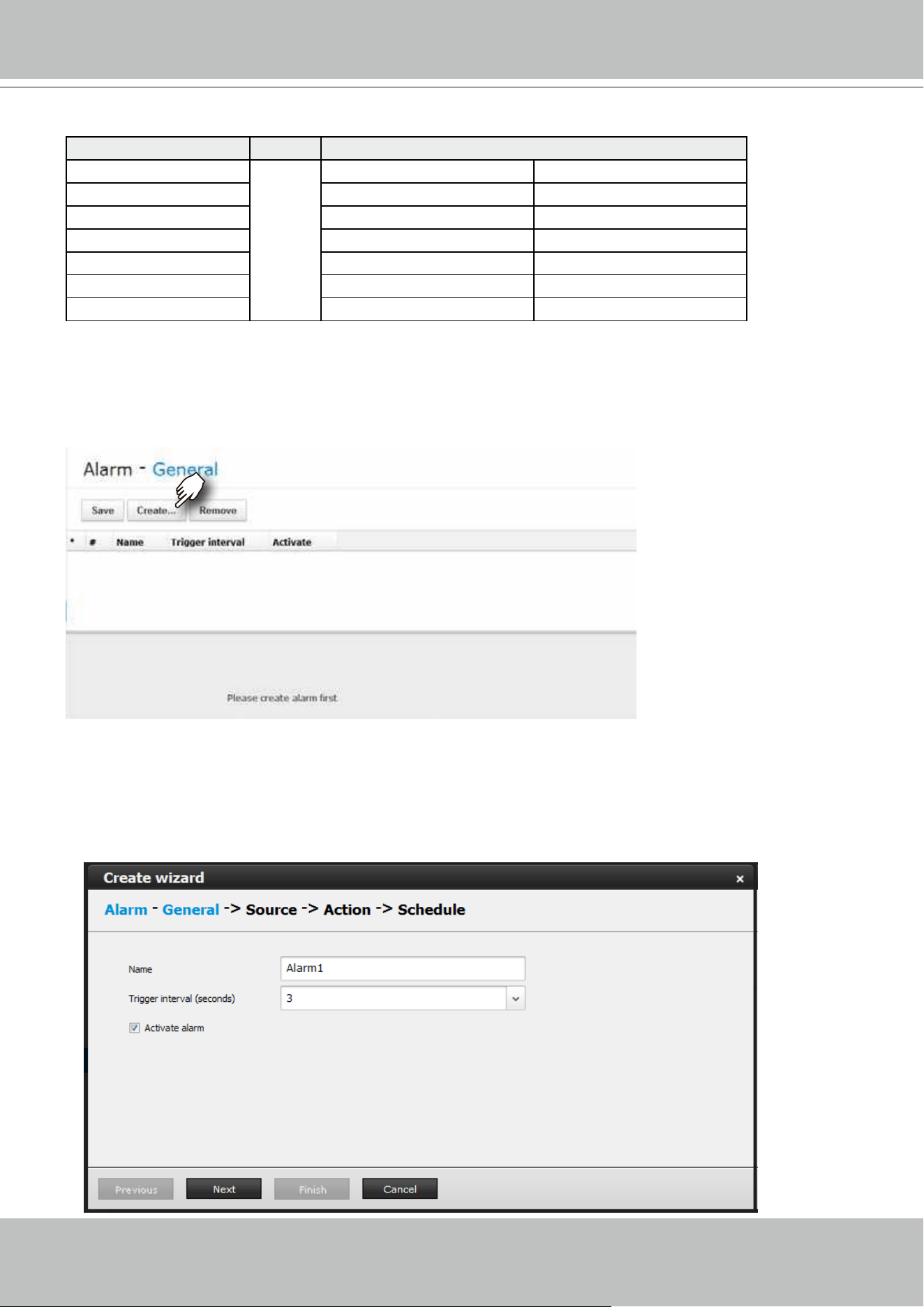
VIVOTEK - Built with Reliability
162 - User's Manual
2. The Create Alarm wizard window will prompt. You can manually enter a name for the current
setting. You can enter up to 16 numeric or alphabetic characters for the name, including
symbols such as [0-9][a-z][A-Z][_][ ]. You can also designate the interval between one alarm
and the next triggered alarm to avoid the situation that the alarms can be too frequently
triggered.
Below is a glimpse of alarm sources and alarm actions:
Sources Actions
DI ► Video recording ►video footage
DO Email ►Email snapshots
Motion detection Buzzer
Disk failure FTP ►snapshots
Disk full Camera preset points ►Pan-tilt-zoom actions
PIR Camera DO
Tampering
To create an alarm,
1. Click on the Create... button.
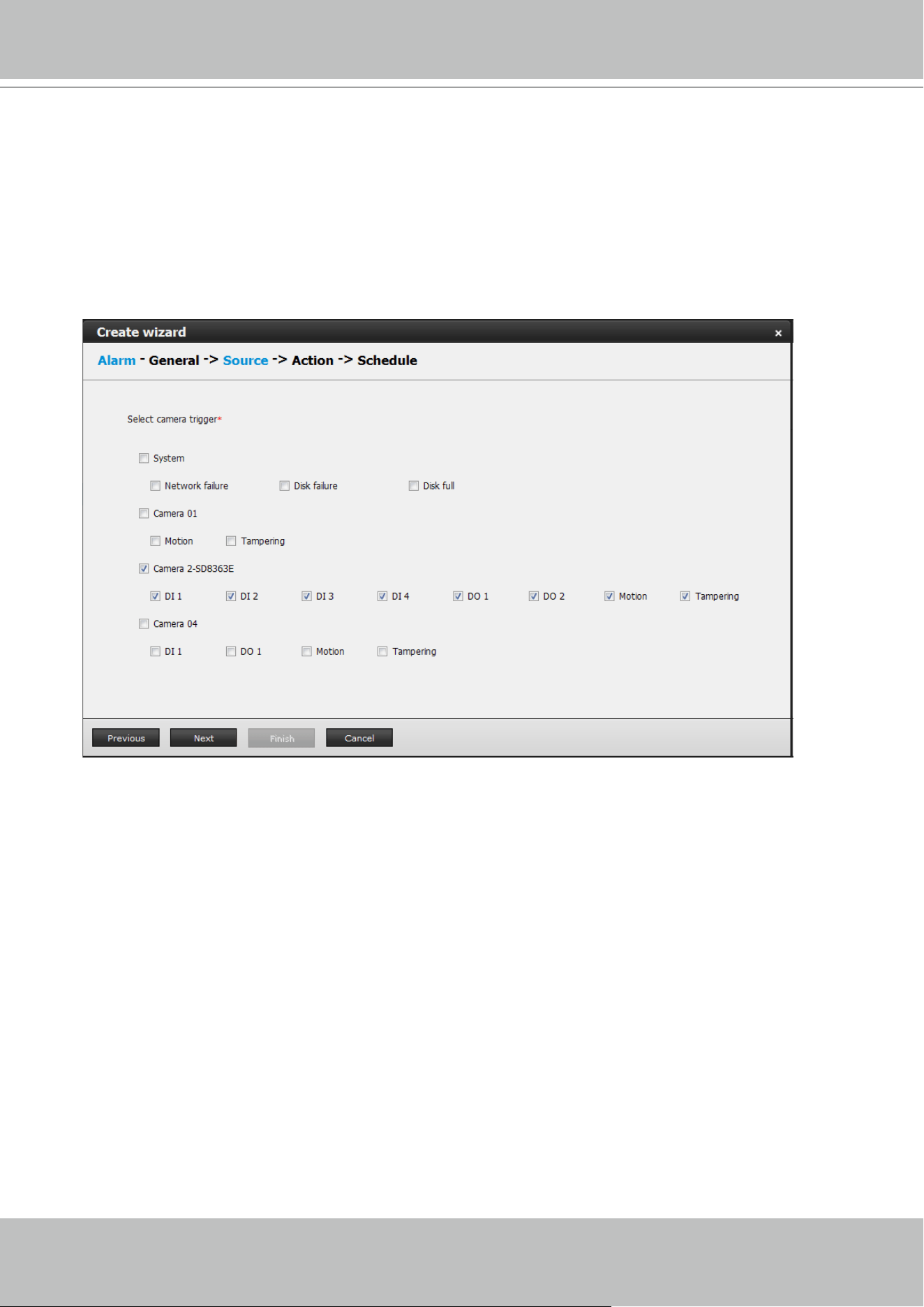
VIVOTEK - Built with Reliability
User's Manual - 163
The Activate alarm checkbox is selected by default. Click on the Next button to proceed.
3. On the Source window, select one or more cameras by selecting its checkboxes. The number
of DI or DOs on each camera is automatically detected and displayed through individual
checkboxes. The Motion detection function, if there are many detection windows congured
on a camera, is all triggered by one checkbox.
Note that the triggering sources will be listed even if the camera is currently not connected.
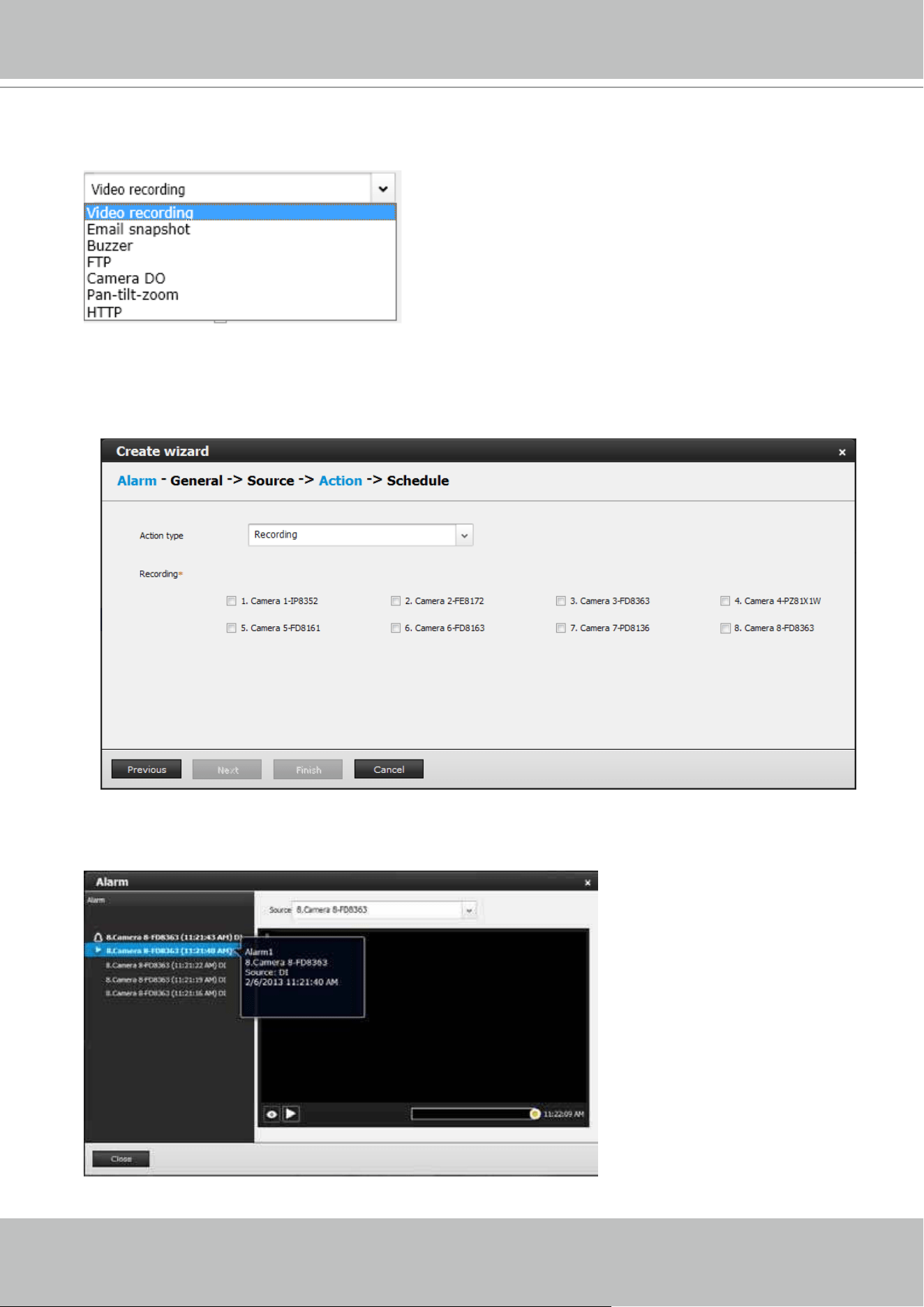
VIVOTEK - Built with Reliability
164 - User's Manual
4. On the Action window, you can select the Action type from a drop-down menu. The
conguration details of each action type is discussion below.
4-1. Recording - When an event is triggered, the selected camera will record a video footage
of the length dened by the pre-/post-event setting, to the NVR system. See below for an
Alarm window.
Once an alarm is triggered, it is listed on the Alarm panel on the Liveview window. See page
115 for details about the functions of alarm panel and the alarm playback function.
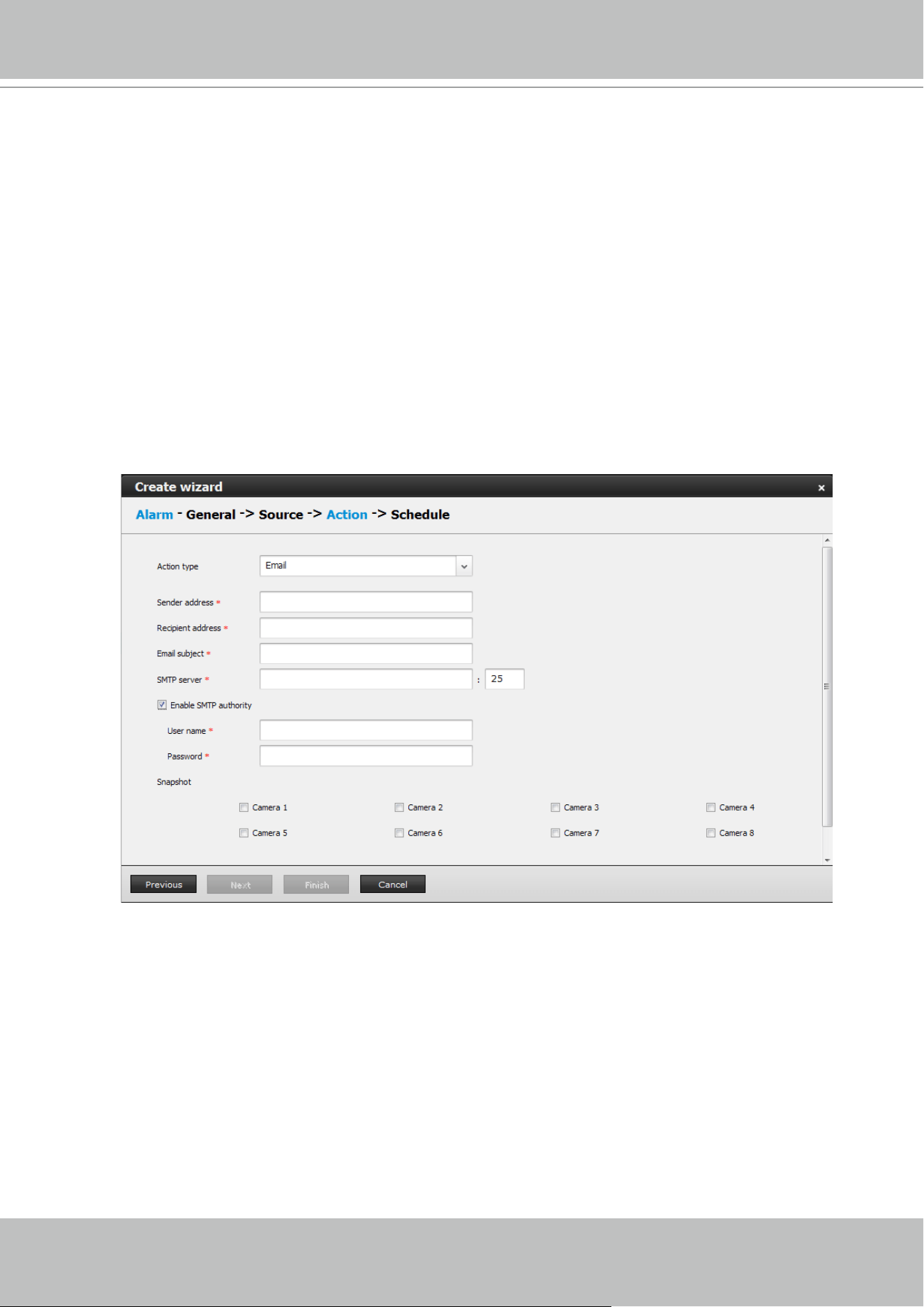
VIVOTEK - Built with Reliability
User's Manual - 165
4-2. Email - The Email action sends an Email to the administrator along with a snapshot of
the event.
To congure Email notication, enter valid Email addresses as the Sender and Recipient
addresses, an Email subject, and the SMTP server address through which the Email will
be delivered. If you need to log in to SMTP server to deliver an Email, enter the User
name and password for access to that account.
The Email subject and addresses can be composed of 64 and 254 characters in numeric
or alphabetic characters including: [0-9][a-z][A-Z][!][#][$][%][‘][*][+][-][/][=][?][^][_][`][{][|][}]
[~][.]. Double quotation marks, "", is not allowed. For domain names, hierarchy of labels is
allowed, and labels should contain [0-9][a-z][A-Z][-]. A domain name should not start with
a hyphen, -. You can enter the addresses of multiple recipients. Use semicolons, (;), to
separate the addresses of multiple recipients.
Select the checkboxes below for which camera's snapshots will be sent along with the
Email.
The le names of the snapshot jpeg les will look like this:
[MAC]_[DATE]_[TIME]_[CAMERA_INDEX].jpg
The Email recipient and addresses can be composed 512 characters in numeric or
alphabetic characters including: [0-9][a-z][A-Z][!][#][$][%][‘][*][+][-][/][=][?][^][_][`][{][|][}][~]
[.]. Double quotation marks, "", is not allowed. For domain names, hierarchy of labels is
allowed, and labels should contain [0-9][a-z][A-Z][-]. A domain name should not start with
a hyphen, -. You can enter the addresses of multiple recipients. Use semicolons, (;), to
separate the addresses of multiple recipients.
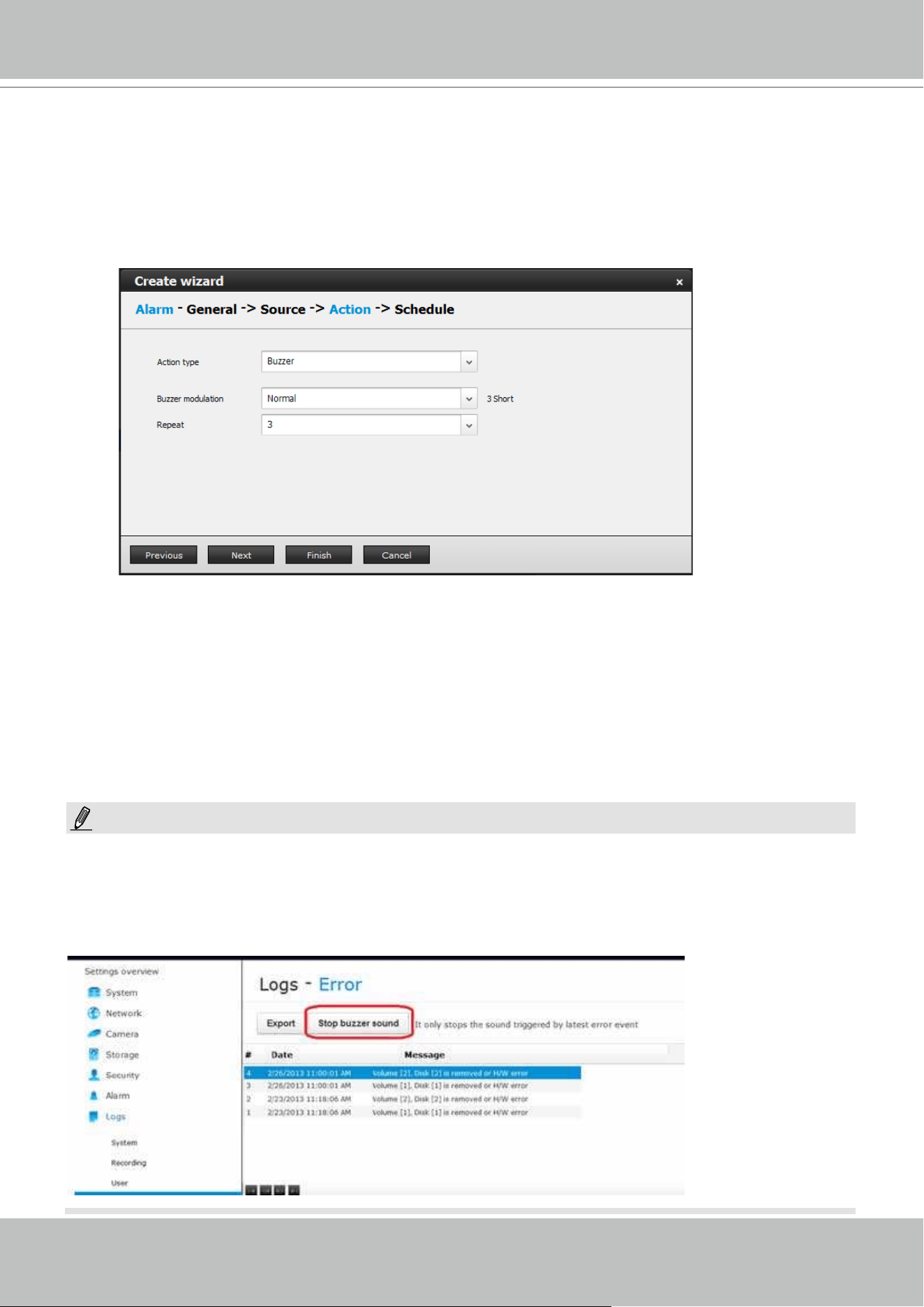
VIVOTEK - Built with Reliability
166 - User's Manual
4-3. Buzzer - The buzzer is sounded on the occurrence of the event. The buzzer tones
are categorized into: Major (1 long 2 shorts), Normal (3 shorts), and Minor (2 shorts)
depending on the importance of an event. Select a Buzzer modulation from the drop-
down list. A long tone has a duration of 1 second, while a short tone 0.5 second.
Select how many times the buzzer tones will be repeated on the occurrence of an event.
If events of different importance are issued at the same time, e.g., one major and one
minor event, system will ignore the minor event and sound the buzzer tone for the major
event only. The buzzer can be sounded either by the Alarm actions or the system events.
If Alarm actions and system service events occur at the time, Alarm actions have the
higher priority.
If multiple Alarm actions occur, the currently-sounded events can be depleted by the new
event.
If system buzzer is sounded, turn it off in Settings > Logs > Error page. Click the Stop
buzzer sound button.
Serious system faults, such as a missing volume or a faulty disk drive, can trigger the system
buzzer. Verify the cause of system fault and turn off the buzzer.
NOTE:
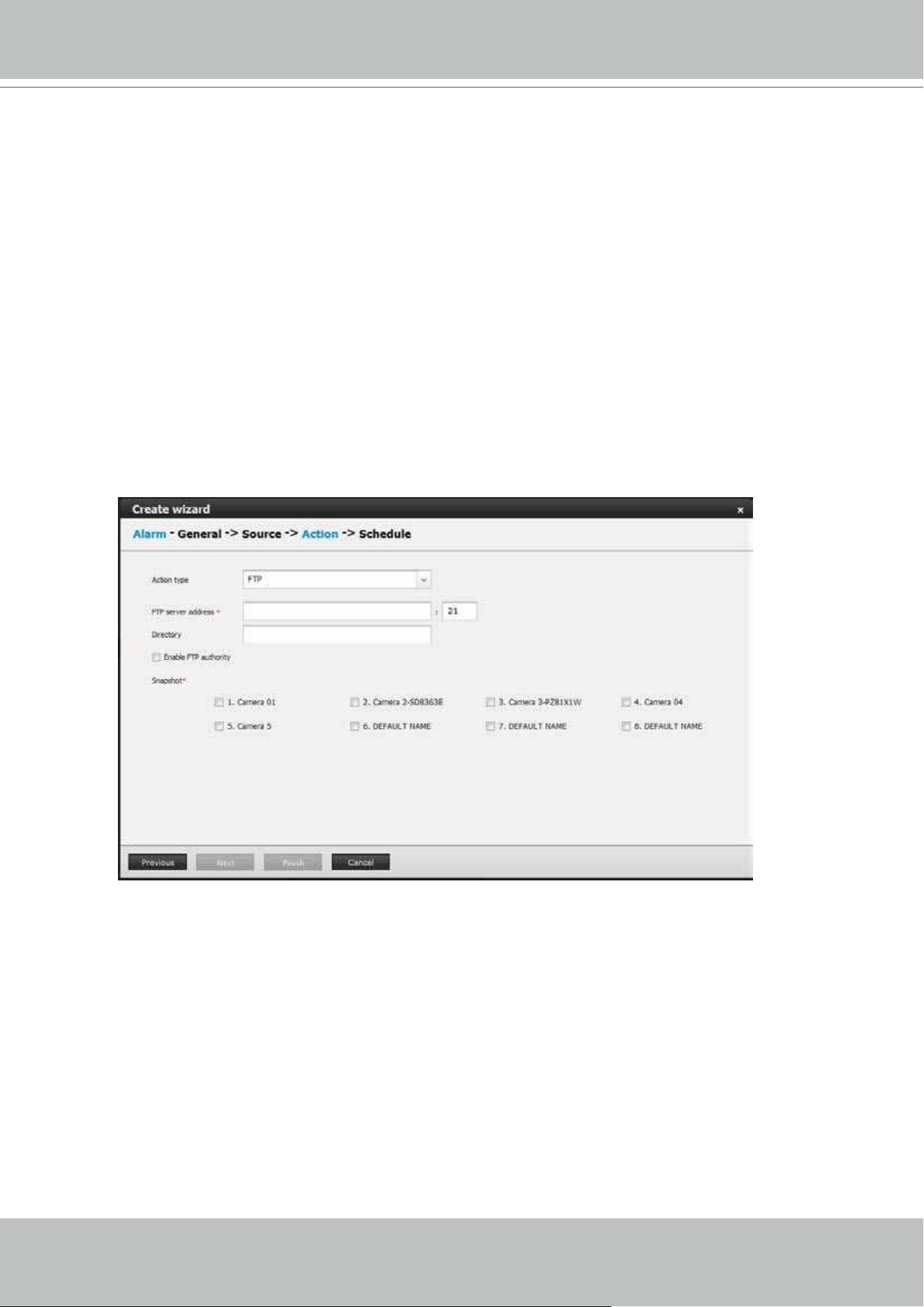
VIVOTEK - Built with Reliability
User's Manual - 167
4-4. FTP - Snapshots from specied cameras can be uploaded to an FTP site on the
occurrence of an event. Enter the FTP site address in the dotted-decimal notation, e.g.,
159.22.151.20. Enter the login name and password for the user account. You can enter
a directory name you prefer on the FTP site. The server port default is 21, a different
number between 1025 and 65535 can also be assigned.
You can enter [0-9][a-z][A-Z][-] characters in the Directory eld, and [0-9][a-z][A-Z][-] [.][_]
in other elds.
If authentication is not applied, login will proceed using the [anonymous] account.
The le names of the snapshot jpeg les will look like this:
[MAC]_[DATE]_[TIME]_[CAMERA_INDEX].jpg - If similar les already exist, an
additional index number will be added to the end of le name.
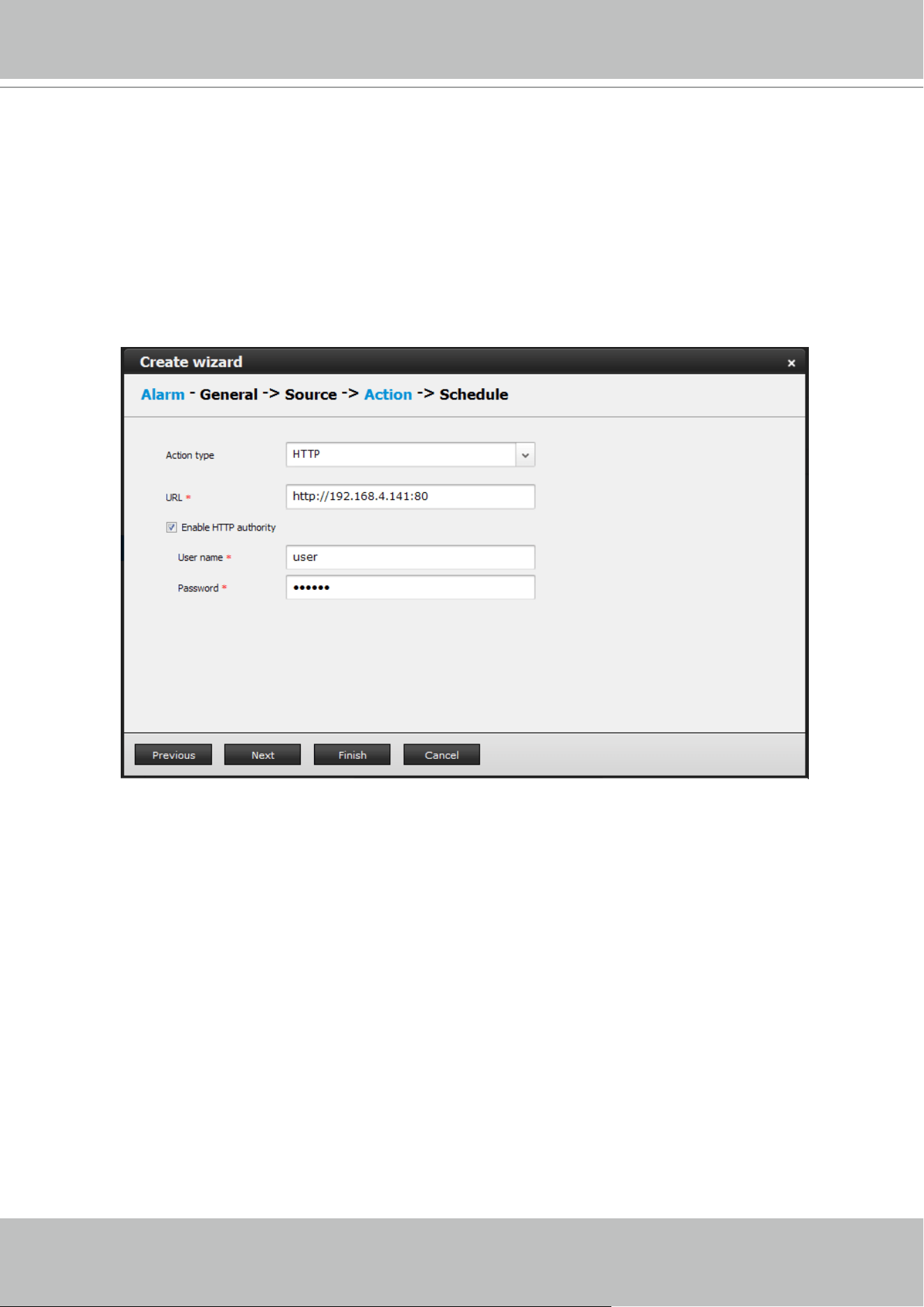
VIVOTEK - Built with Reliability
168 - User's Manual
4-5. HTTP - An event message is sent to an HTTP server on the occurrence of an event. The
URL format for the HTTP server address is http://host:port[abs_path]. The applicable
characters for the abs_path are: [0-9][a-z][A-Z][-][.][:][/][?][&][@][_][=].
If you need to log in to HTTP server, enter the User name and password for access to
that account.
The user name can be composed of 64 numeric or alphabetic characters and symbols
including [0-9][a-z][A-Z][_][ ][-][.][,].
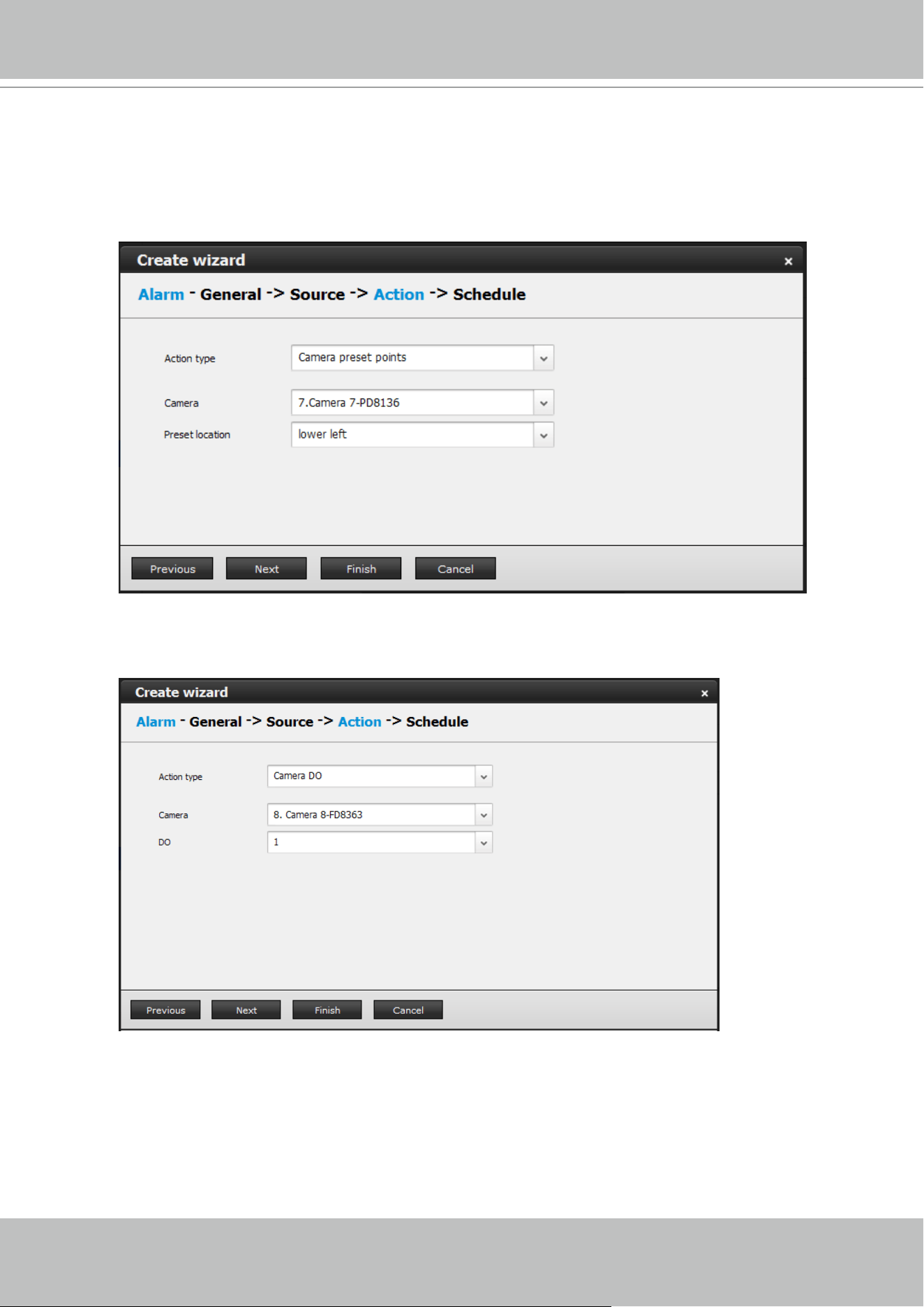
VIVOTEK - Built with Reliability
User's Manual - 169
4-6. Camera preset points - A PTZ capable camera can move its lens to the preset position
in case of a triggered alarm. For example, a triggered sensor may indicate an area of
interest has been intruded, and a camera's eld of view should be moved to cover that
area. The precondition is that you properly set up preset positions on your PTZ cameras
using a web console.
4-7. Camera DO - A triggered alarm triggers a camera's DO, e.g., an alarm siren.
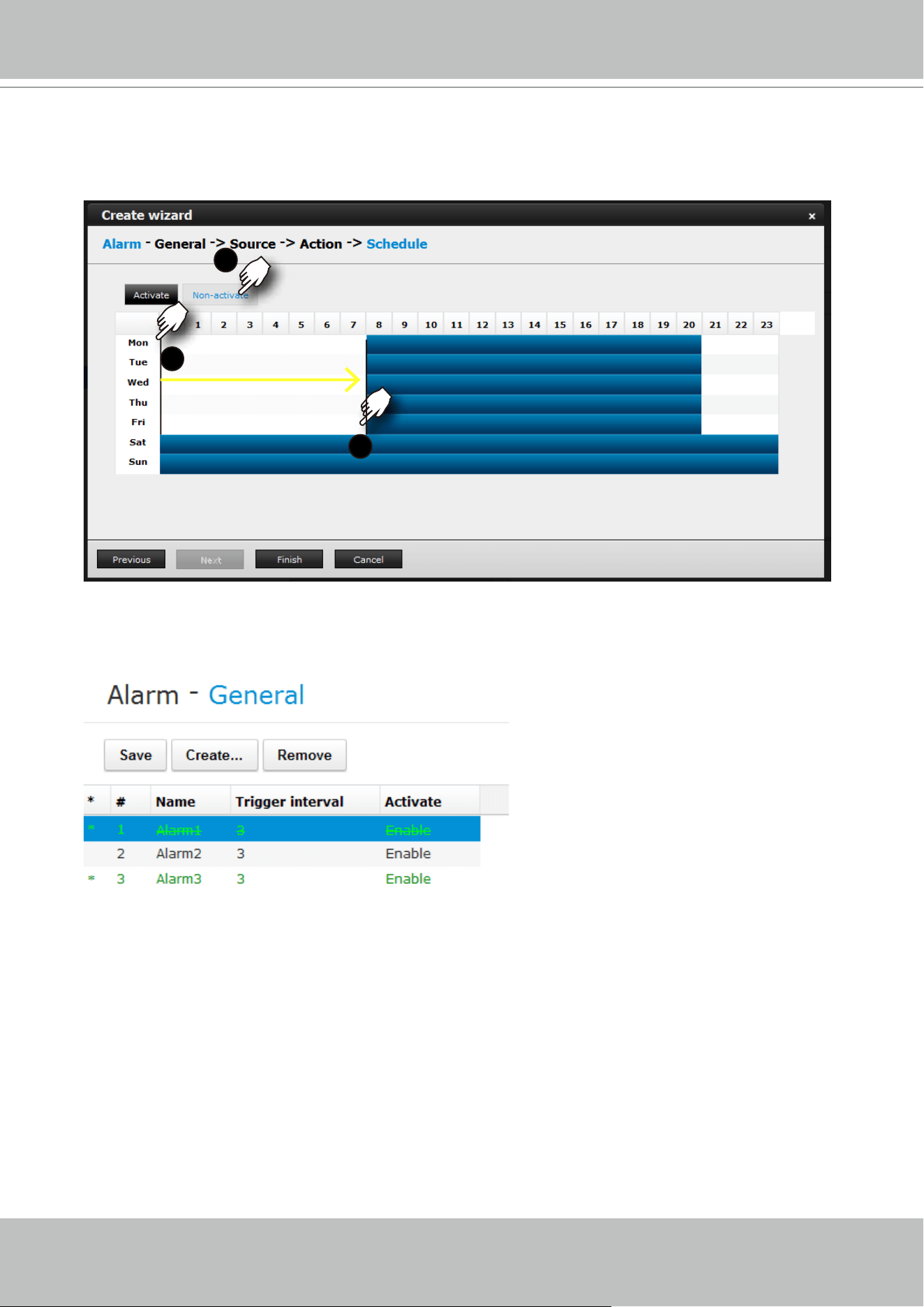
VIVOTEK - Built with Reliability
170 - User's Manual
1
2
3
5. On the Schedule page, you can select to activate or de-activate alarm triggers throughout a
specic time. For example, in some situations you can disable the alarm triggers during the
ofce hours, and choose to enable the triggers only during the off-ofce hours.
6. Click Finish to end the conguration. A congured instance will appear in lighter color and an
asterisk mark in front to distinguish it as a changed entry that has not been applied.
7. Click Save to preserve and enable your alarm setting.
8. Repeat the process above to create more alarms according to the needs in your surveillance
deployment.
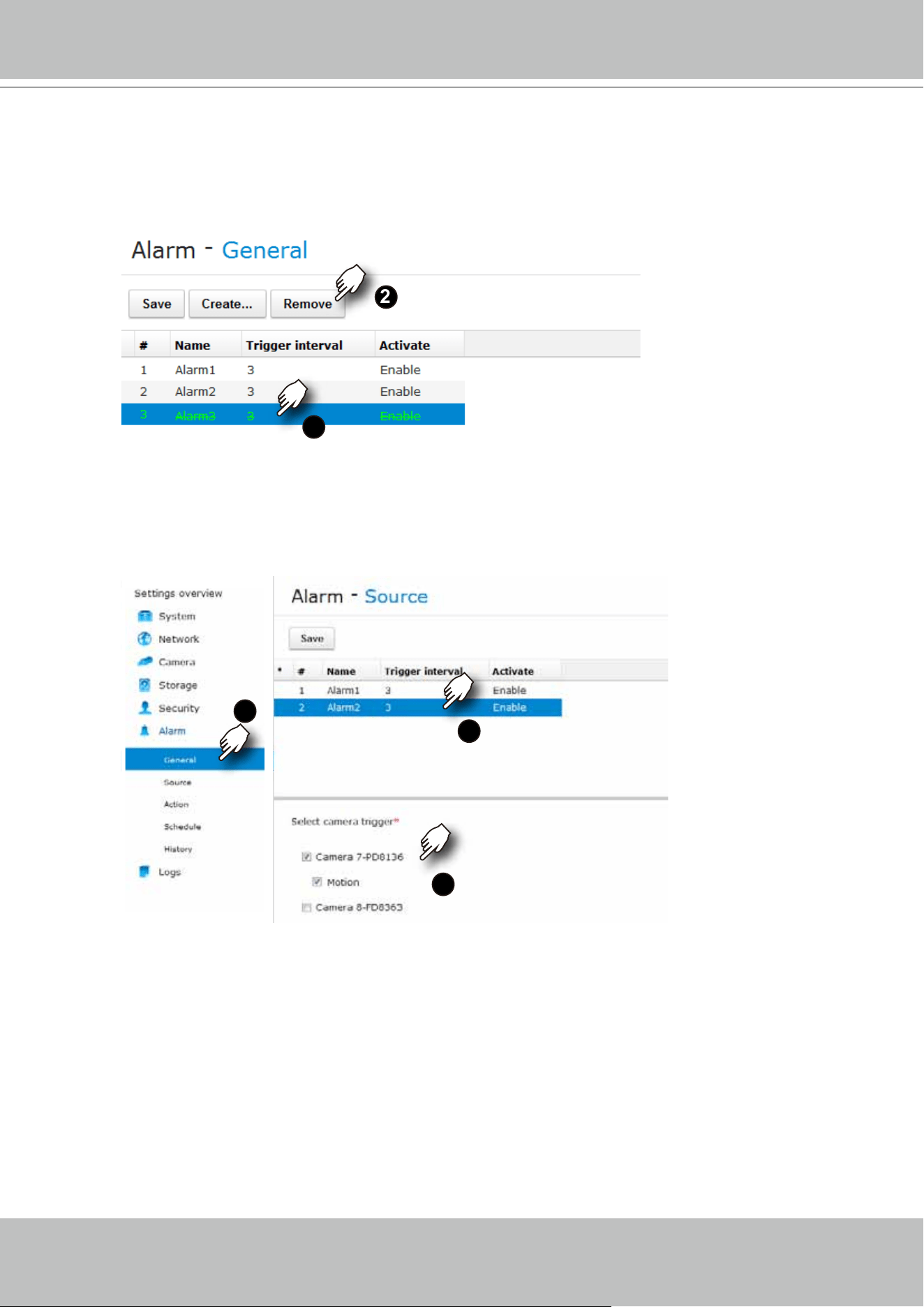
VIVOTEK - Built with Reliability
User's Manual - 171
5-6-2. Editing Alarms via Source, Action, and Schedule
1. Editing an existing instance -
1-1. To remove an existing alarm, select by a left-click, and then click on the Remove button.
1
2
1-2. To edit an existing alarm, select by a left-click, and then click on the Source, Action,
or Schedule button on the left function tree. The associated parameters will display
on different windows. You can then edit the previous conguration such as selecting a
different triggering source, reactive action, or time span on a schedule.
1
3
2
While in the editing window, the Create and Remove buttons are not available.
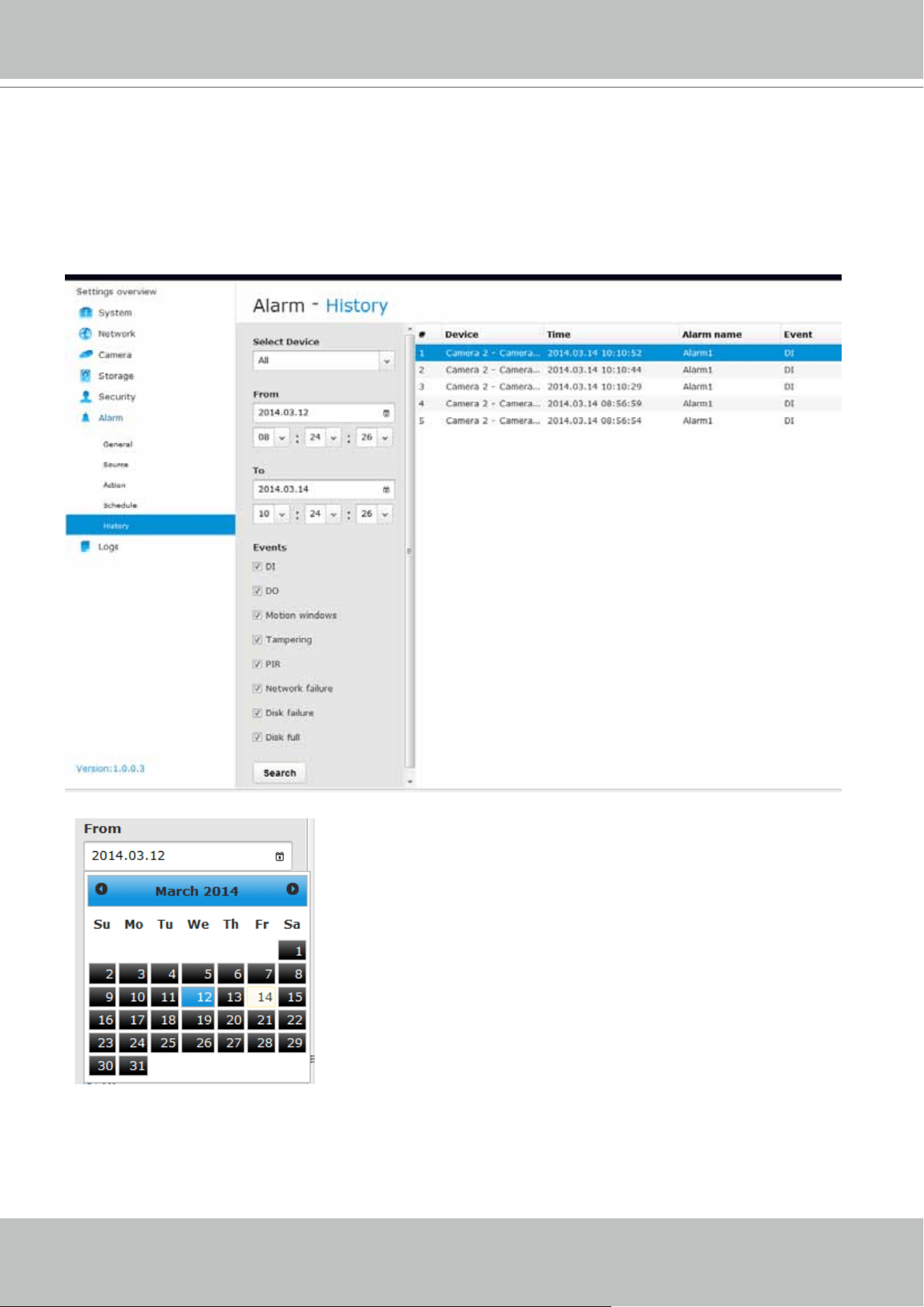
VIVOTEK - Built with Reliability
172 - User's Manual
5-6-3. Alarm History
The alarm history comes with a search engine for a quick access to the list of alarms that
happened before. To search for past alarms, select the search conditions such as the span of
time of its occurrence, trigger type, and the device, and click the Search button.
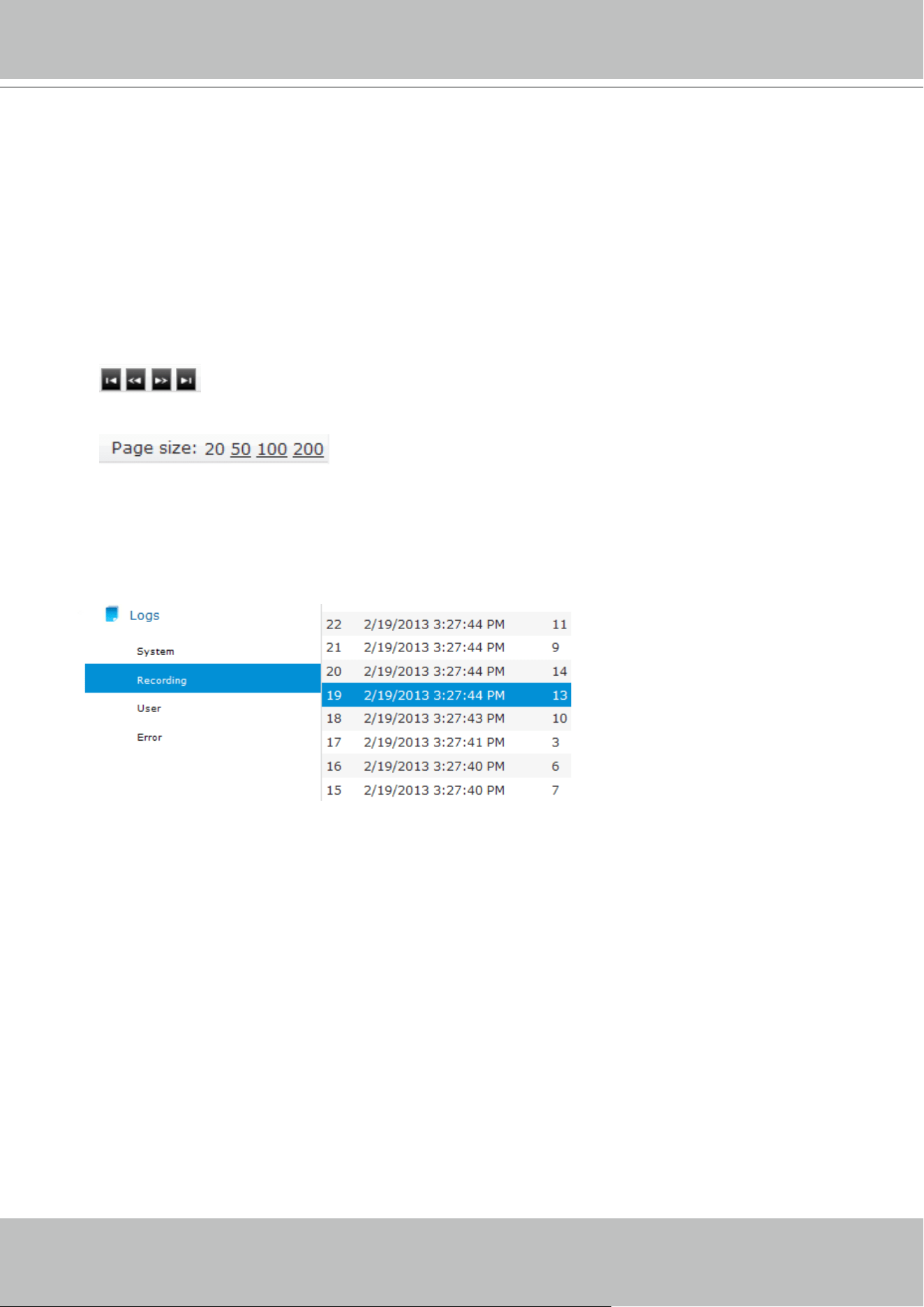
VIVOTEK - Built with Reliability
User's Manual - 173
By defaults, system logs will be written to every disk drives installed into the system. Up to
10,000 event logs will be kept with a segmented disk section within each drive. Old logs will be
automatically removed if exceeding the 10,000 threshold.
The logs related functions include:
1. Export button: This button can be used to export the current event logs in the CSV format.
The default export le name is [MAC]_[DATE]_[TIME].csv. For example, an exported le
may look like this: 0002D1112233_20130222_011013.csv.
2.
Page selector buttons: (from left to right) First page, Previous page, Next page,
and the Last page.
3.
Page size buttons: These buttons determines how many event
logs will be displayed on a single page. The selected number will be displayed without the
underline.
5-7. Logs
The event logs fall into the following categories: System, Recording, User, and Error. A click
on each category brings out a list of event logs belonging to that category.
Usually the Error events can trigger the onboard buzzer. Use the Stop buzzer sound button
to mute the buzzer. The will buzzer will still be sounded if the system is powered off and then
powered on until the errors can be corrected, such as a missing volume.
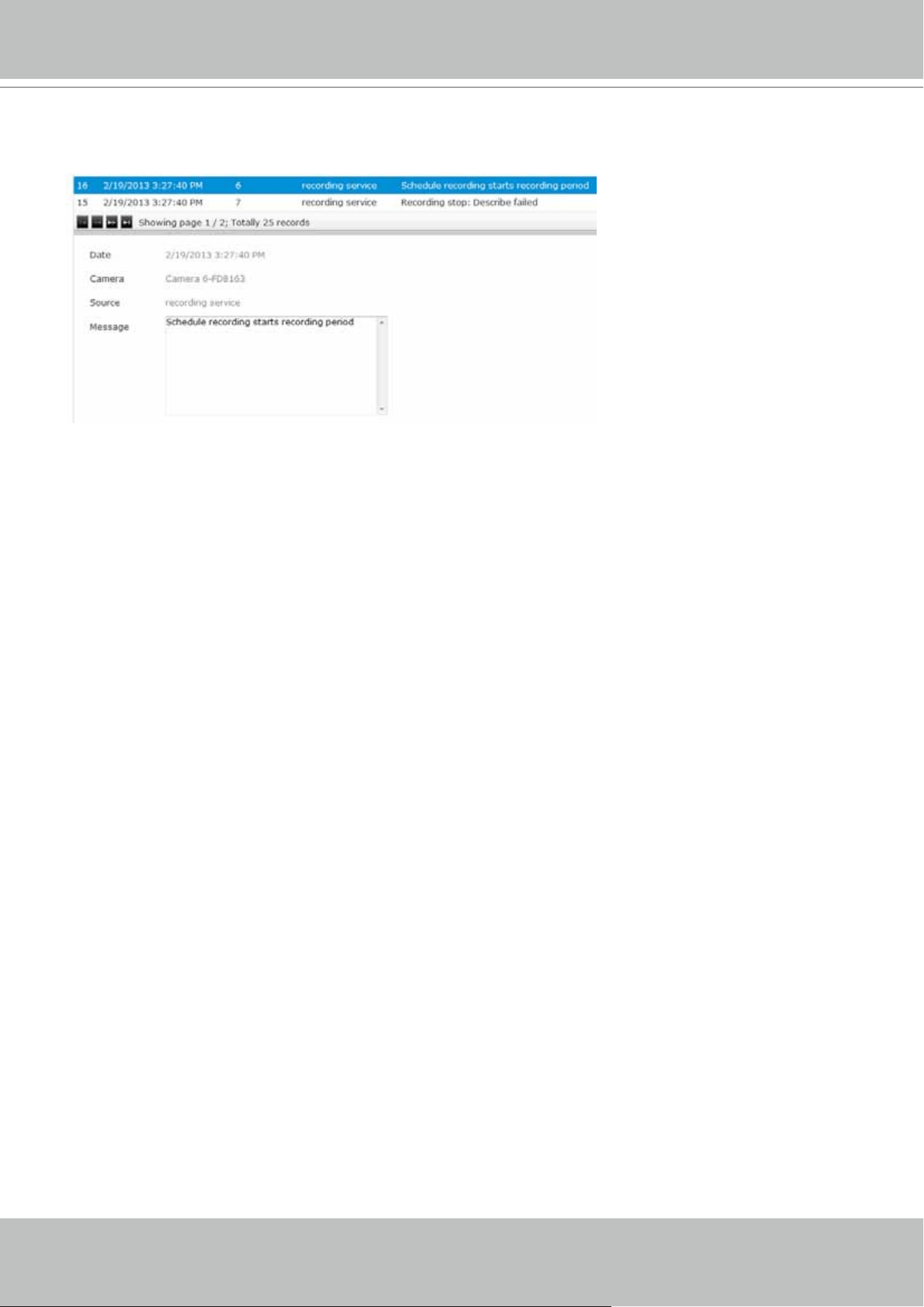
VIVOTEK - Built with Reliability
174 - User's Manual
The following information is shown with each event log:
1. Level: The following severity level can be applied to an event.
1-1. Error: Conguration errors such as lack of system memory or a faulty camera password.
1-2. Info: General information such as acquiring an IP from DHCP server.
1-3. Warning: Conguration and operation errors such as re-starting server service.
1-4. Cong: Events that are generated due to conguration changes, such as a change in
address or that to a camera conguration.
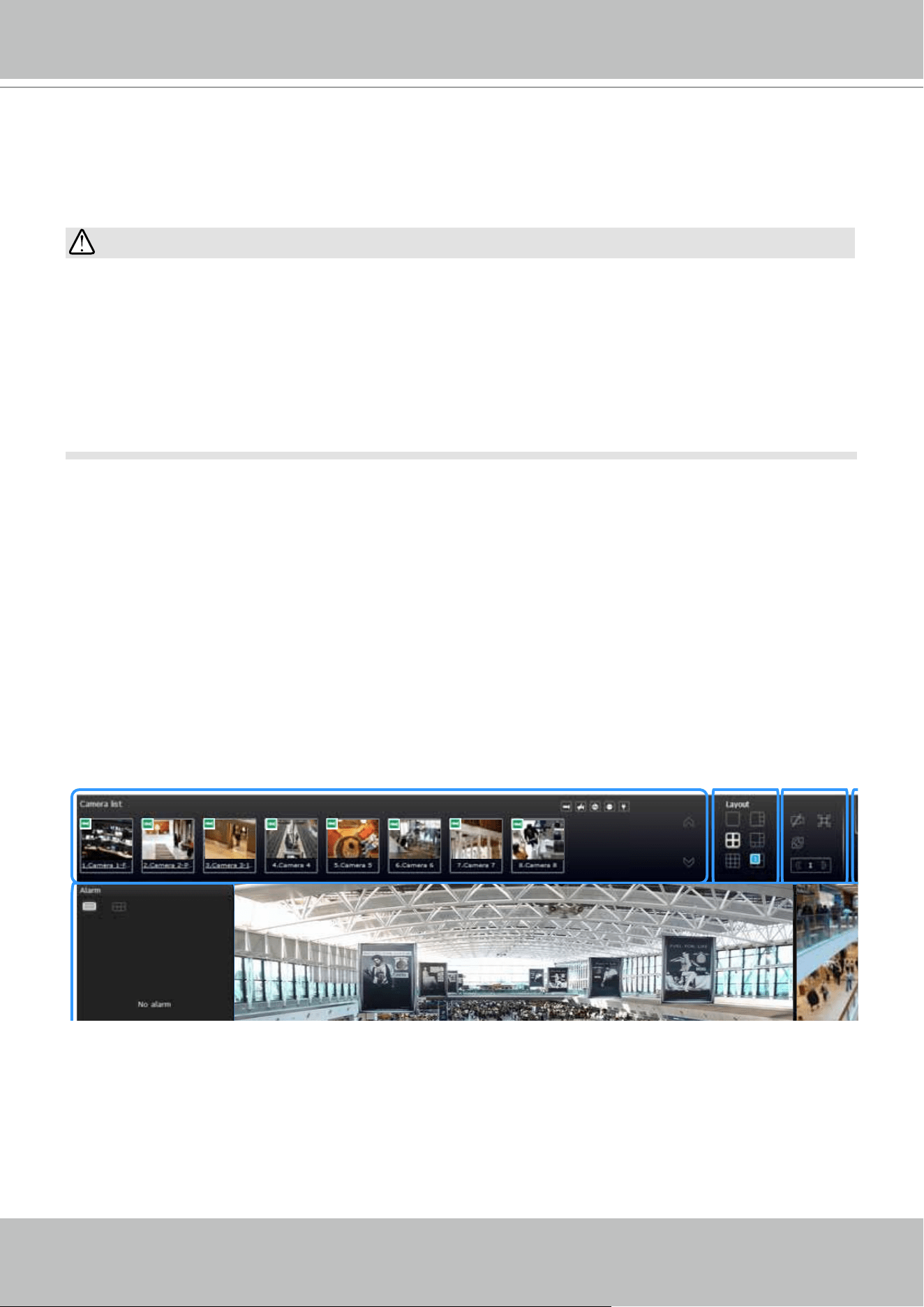
VIVOTEK - Built with Reliability
User's Manual - 175
Chapter Six Operation
6-1. Liveview
Legends and denitions of icons on the layout panel have been described on page 103.
6-1-1. Placing Cameras into the Layout
It is presumed that you have properly inserted all network cameras in your deployment as
previously described on page 140. All 8 cameras should be listed on the Camera list.
Camera list
Layout
Layout
contents
1. Before operating the NVR, make sure you have properly installed hard drives and congured
the storage volumes. Otherwise, you will not be able to operate most of the system's
functionality.
2. Since the NVR system comes with 32-bit plug-ins for screen control, if your PC runs a default
64-bit IE browser and you manually enter the NVR's address on the browser, your browser
session may malfunction. Instead, if you double-click on the discovered NVR on the IW2
utility, a 32-bit IE browser will open.
Note that layout design can only be performed by the system administrator.
IMPORTANT:
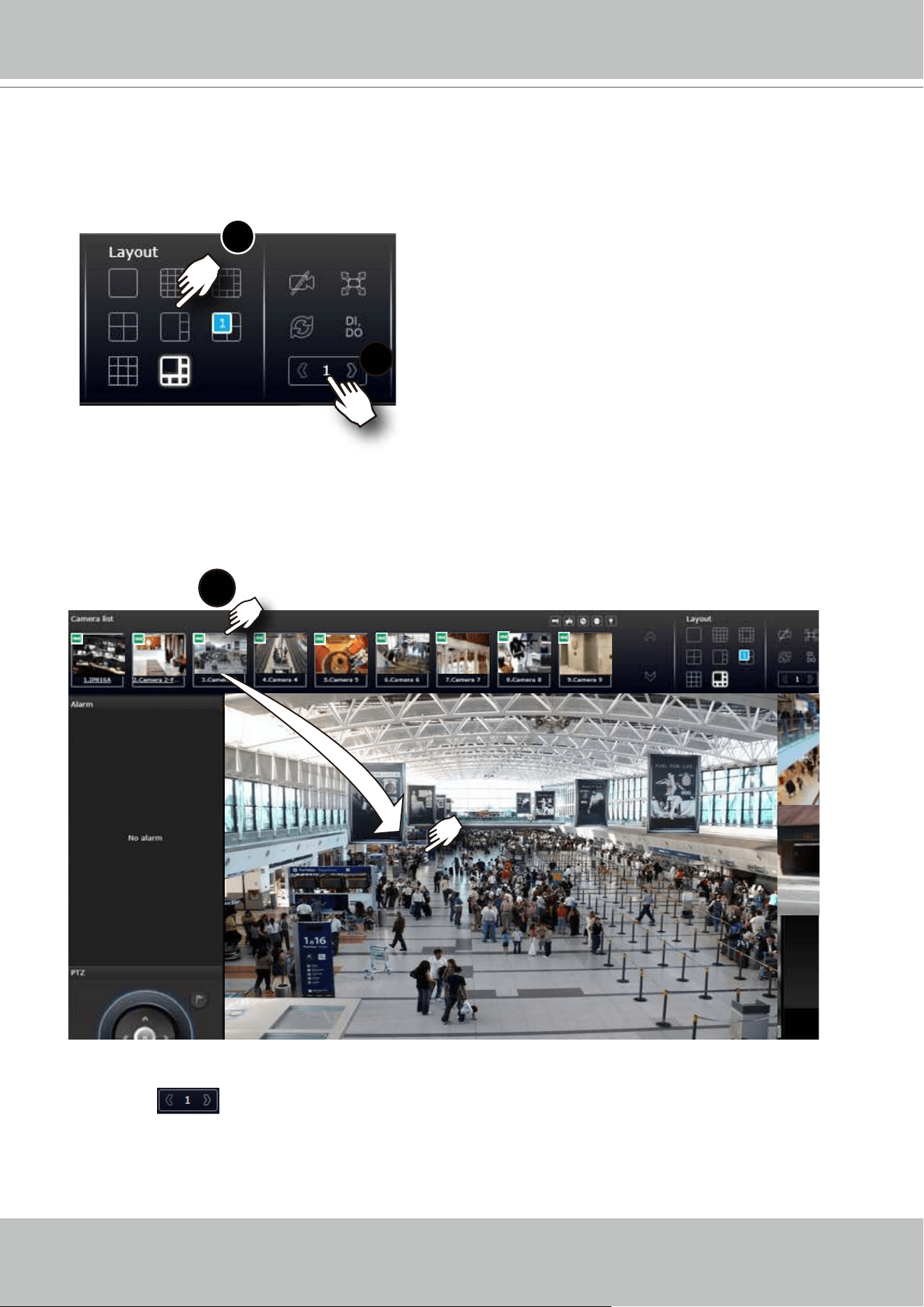
VIVOTEK - Built with Reliability
176 - User's Manual
2. Click and drag cameras from the Camera list to empty cells on your layout. Repeat the
action until you placed all your cameras into the layout. You may also double-click on a
camera's thumbnail to ll it into the rst unoccupied view cell.
To begin the design of your layout,
1
3
1. Select a layout pattern by a single click. The options are: 1x1, 1+3, 1+5,
2x2, 3x3, where 4x4 and 1+12 are available for the 16-CH model.
Camera list
2
3. When you lled up the current layout, e.g., 6 camera into the 1+5 layout, click the page
switch button to continue on the next layout page.
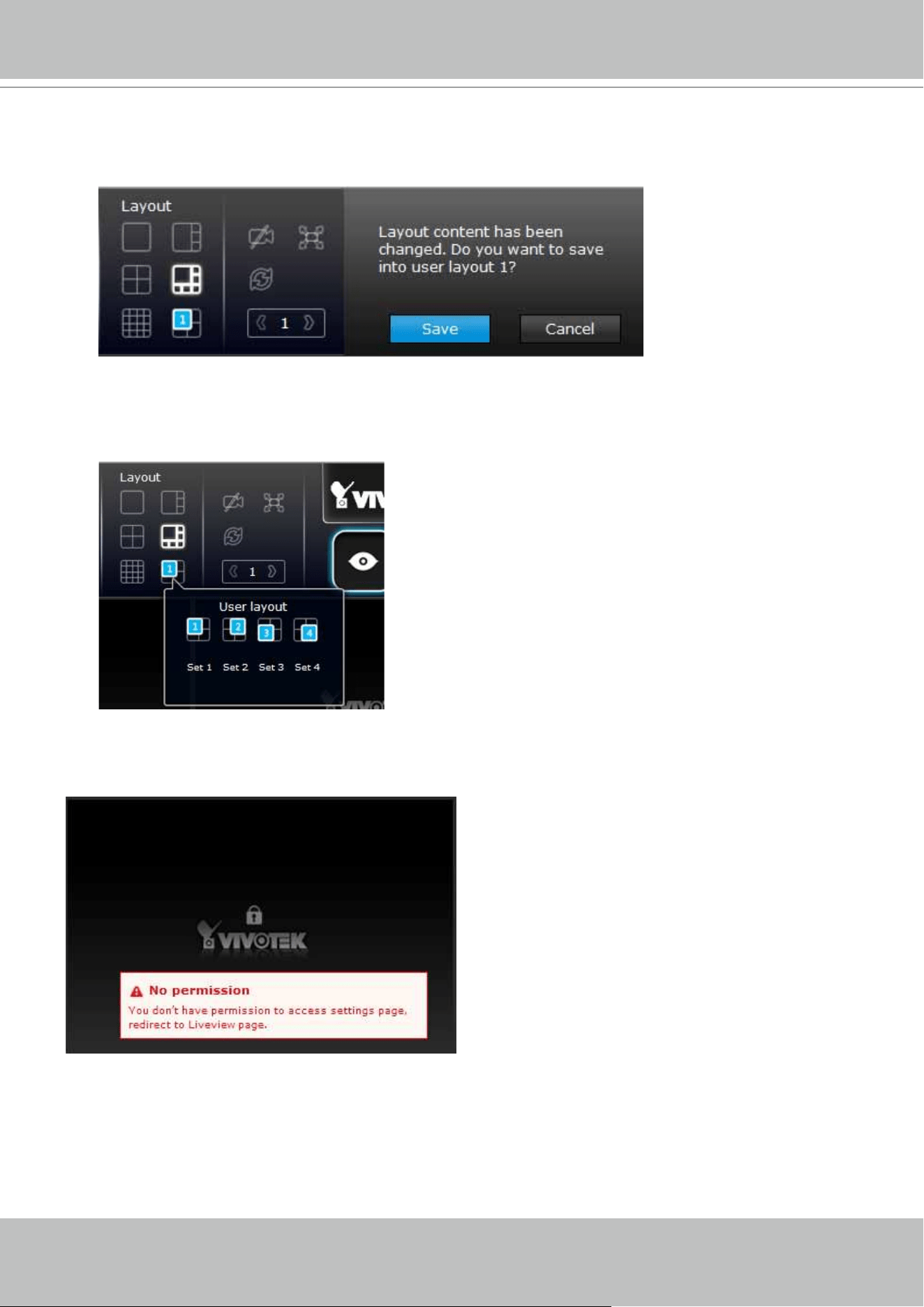
VIVOTEK - Built with Reliability
User's Manual - 177
4. When you are done with the current layout design, i.e., the user layout 1, click Save to
preserve your settings. This message prompts on the screen whenever any change is made
to the current layout.
5. You can create more user layouts by mouse-overing the user layout button. You may create
more user layouts for different purposes, such as for the use of different users, or playing
different views of a camera on multiple view cells.
If users were created and some cameras are excluded from their access, a user may log in and
see the locked-on cells as shown below:
A user who has limited access rights may still re-arrange the layout of view cells. However,
his conguration change will not be saved after he leaves the current console.
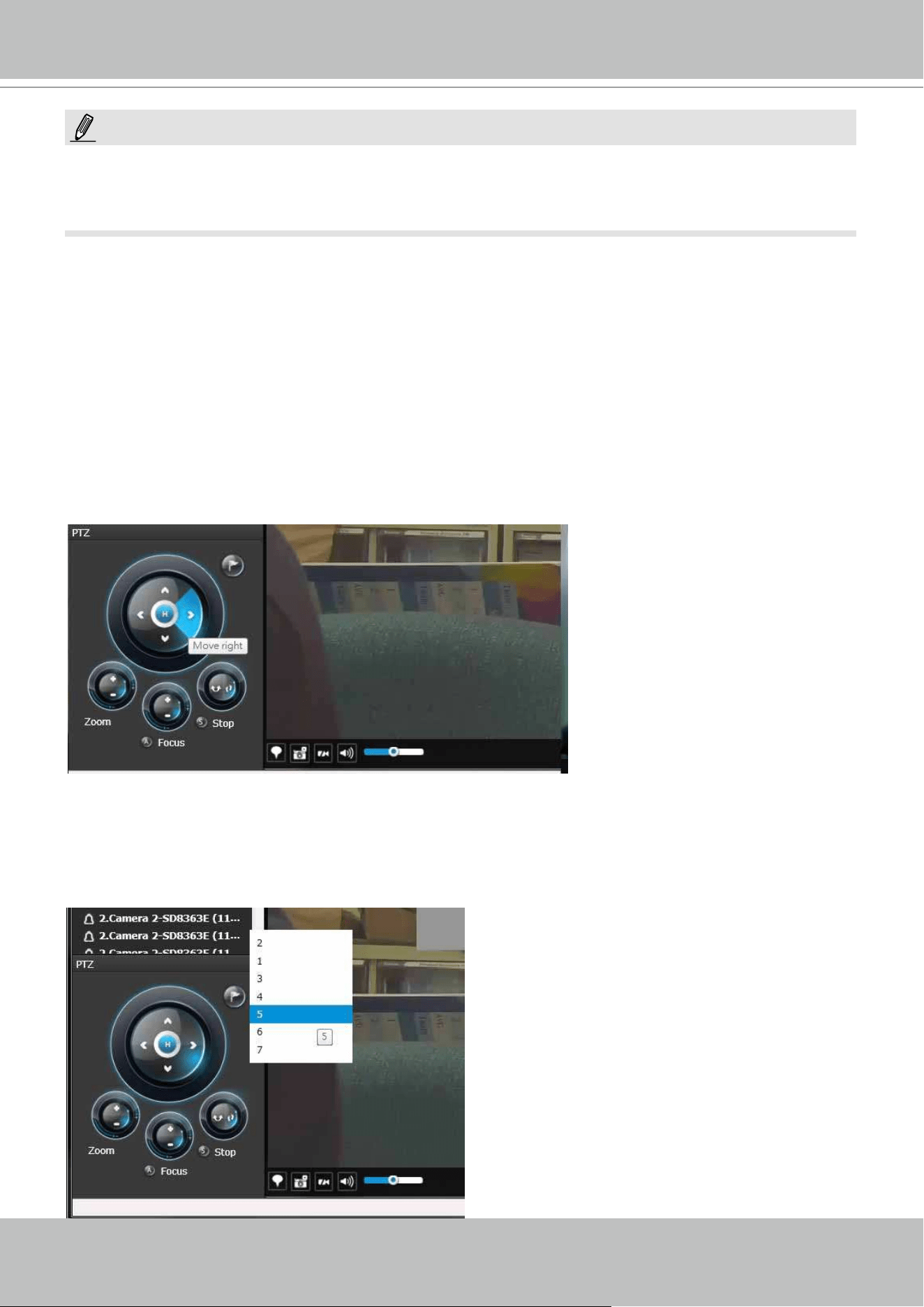
VIVOTEK - Built with Reliability
178 - User's Manual
Note that the PTZ control panel only applies when you select a view cell with a camera that
comes with mechanical PTZ functions. Currently the e-PTZ function is not supported by the
NVR system.
6-1-2. PTZ and Other Screen Controls
With a PTZ camera, the buttons on the PTZ panel become functional when you mouse over
its GUI elements. For all compatible cameras and exerting Zoom, Focus, and Patrol functions,
please refer to page 113 for details. The Zoom function, for example, requires a camera that
comes with a motorized zoom module, and may not be applicable to every PTZ camera.
The preset positions and the patrol functions require the associated conguration on the
cameras via a web console. Before you make use of these functions, you should set up
the preset positions on a web console with the camera. The NVR GUI does not provide the
conguration options with PTZ preset positions.
You can use Preset button to display preset
positions and tell the camera to move and
point at the preset direction, and to perform
a camera tour to visit these positions in a
consecutive order.
By default, every users or administrator logs in to the Live view window to the last layout page
he visited. The last layout page a user visited during the previous console becomes the default
layout.
NOTE:
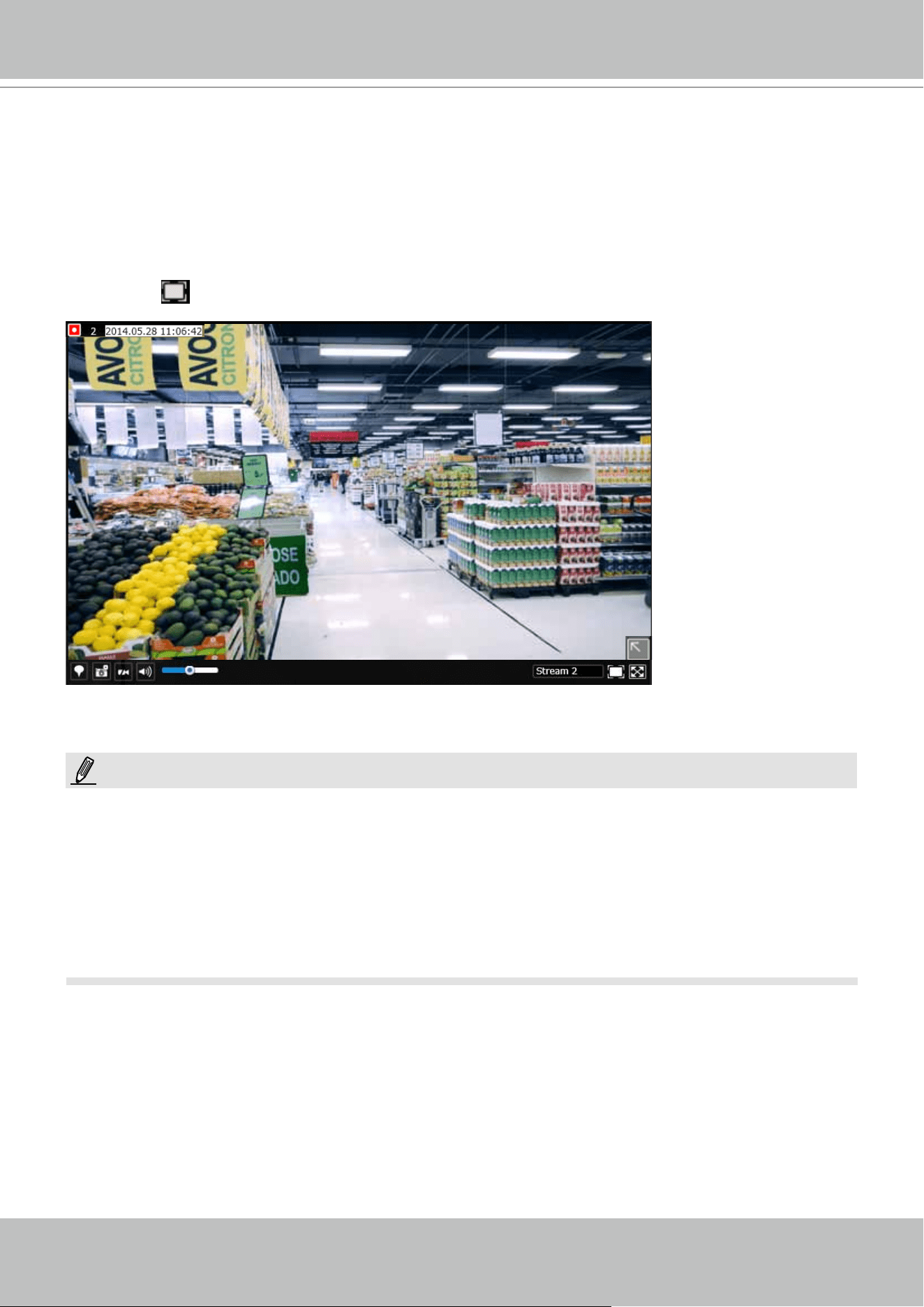
VIVOTEK - Built with Reliability
User's Manual - 179
To access live view control,
1. Click on a view cell. The view cell will become a focused view cell. The streaming control
buttons will be listed at the bottom of a view cell. These buttons have been discussed on
page 108.
2. The 2nd click on a view cell enlarges it to the full of the live view area. The 3rd click
reduces its size to the original focused view.
3. To deselect a view cell, you can click on another view cell in the display area or click on the
Restore
button.
A selected, focused,
view cell.
If you have concerns with the display quality and frame rate per second, refer to page 146 for
how to congure video feeds for live viewing as well as for video recording. The conguration
options can be found in Settings > Camera > Video.
Note that the constant bit rate methodology is applied in this system and it sets an upper
threshold on the size of IP packets sent with the video streams. Image quality will be slightly
compromised if reaching the ceiling of allowable bandwidth.
NOTE:
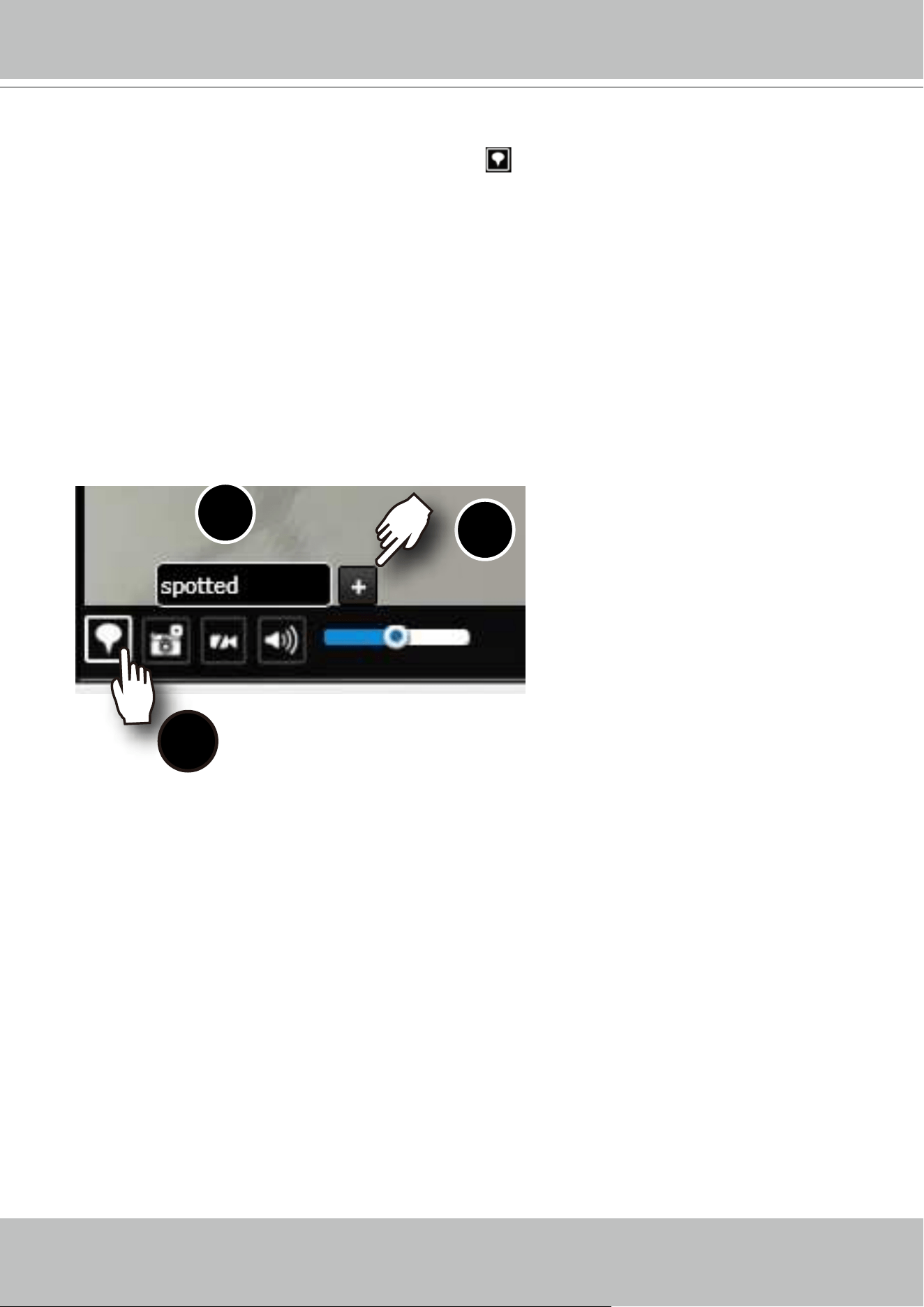
VIVOTEK - Built with Reliability
180 - User's Manual
The bookmark function can be executed on a live or recorded stream when you observe a
situation from your Live view or Playback window. The precondition of using this function is that
the video stream, while you are watching it on the view cell, must be recorded to the NVR at the
same time.
To add a bookmark,
1. Click on the button,
2. Enter a short description that can be as long as 120 characters.
3. Click on the + button or simply press Enter on your keyboard.
1
2
3
To place bookmarks and exert screen controls,
On a focused view cell, you can place a bookmark
that saves a short description and a one-
minute footage from the current feed. The bookmark is also displayed along with the recorded
video, and therefore it is easier to look for a specic moment in time when you need to trace
back for a scenario later.
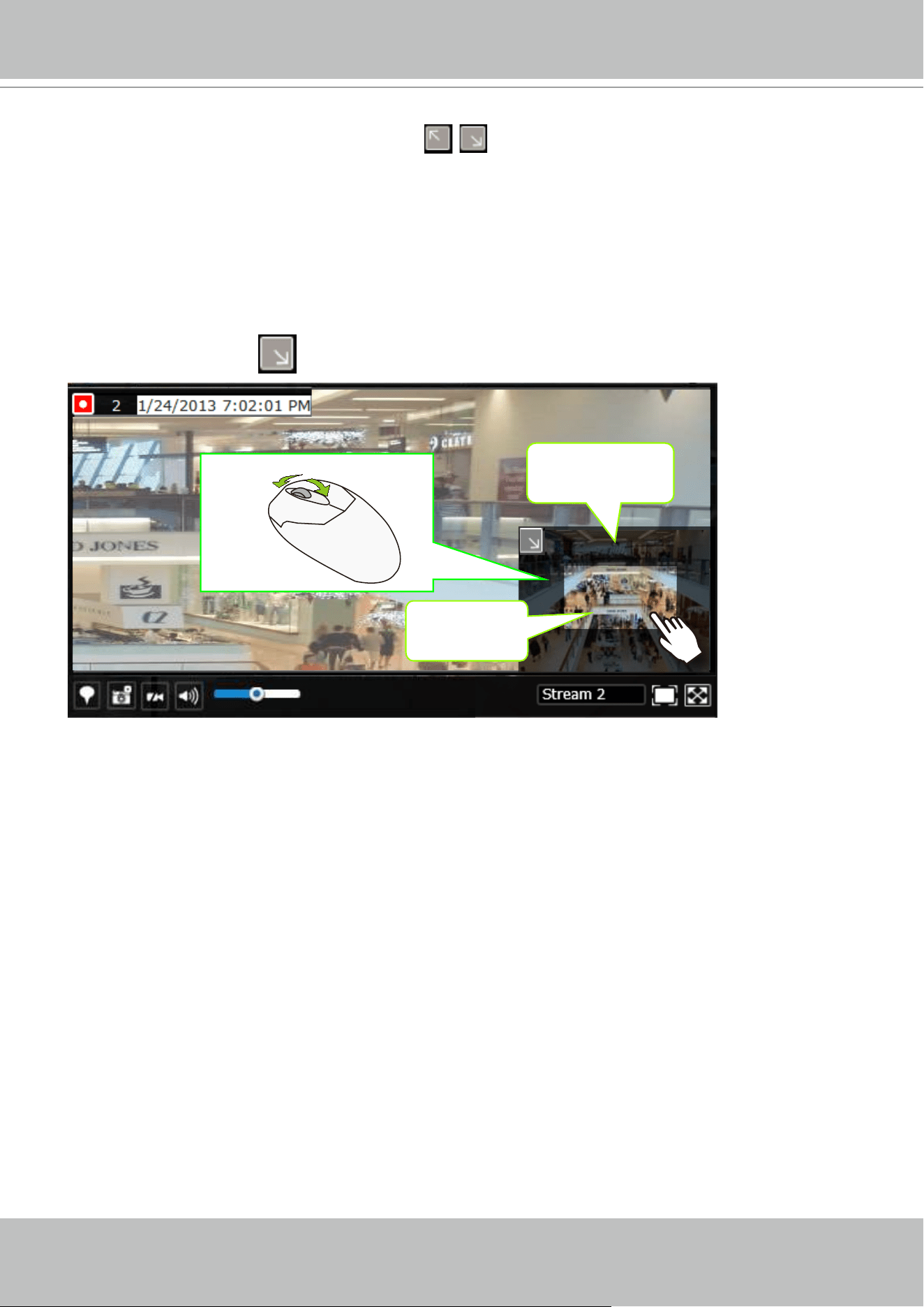
VIVOTEK - Built with Reliability
User's Manual - 181
To Activate and Deactivate PiP function,
PiP is short for Picture in Picture, a function that provides digital zoom into a live video.
When activated, a Global view window will appear at the lower right of the view cell as shown
below. You can display only a portion of the complete video frame as an area of your interest.
Using a click and drag on the ROI window, you can instantly move to other areas within the
video frame.
Global view
ROI
Zoom In Zoom Out
Note that not every camera supports the PiP function. For example, PTZ cameras do not
support the PiP feature.
You can resize the ROI window by a mouse hover on the lower-right corner of the window until
the resize mark appears. The default size of the ROI window is 25% of the Global view.
Click on the deactivate
button to close the PiP window.
Refer to page 108 for GUI legends and individual functionality.
Audio is only transmitted through the camera in a view cell that is currently selected. You can
manually tune the volume level, mute, or unmute the audio feed through a view cell.
6-1-3. Audio
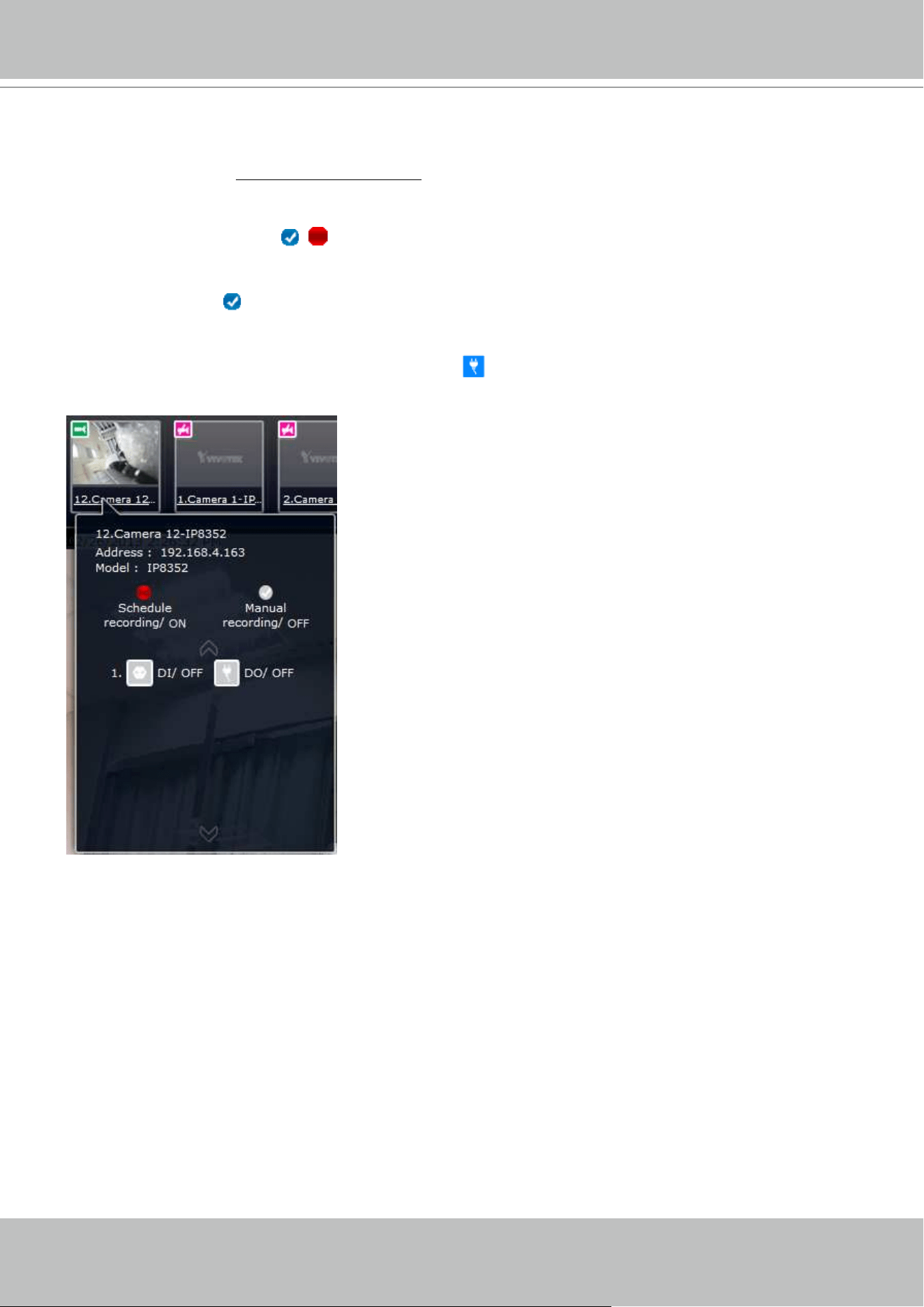
VIVOTEK - Built with Reliability
182 - User's Manual
You can click on the underlined name entry of a camera on the camera list to open its properties
window. Here you can nd a short description of the camera name, address, and model name.
You can also enable or disable the scheduled or continuous recording set for the camera. Click
on their associated icons,
, , to change their recording status.
For a camera that is not performing a continuous recording, you can click on the Manual
Recording button,
, to start a manual recording. The recording will stop using the same
button.
You can also manually turn on the digital output
, e.g., to trigger an external alarm that is
connected to a specic camera.
6-1-4. Camera Properties and Controls
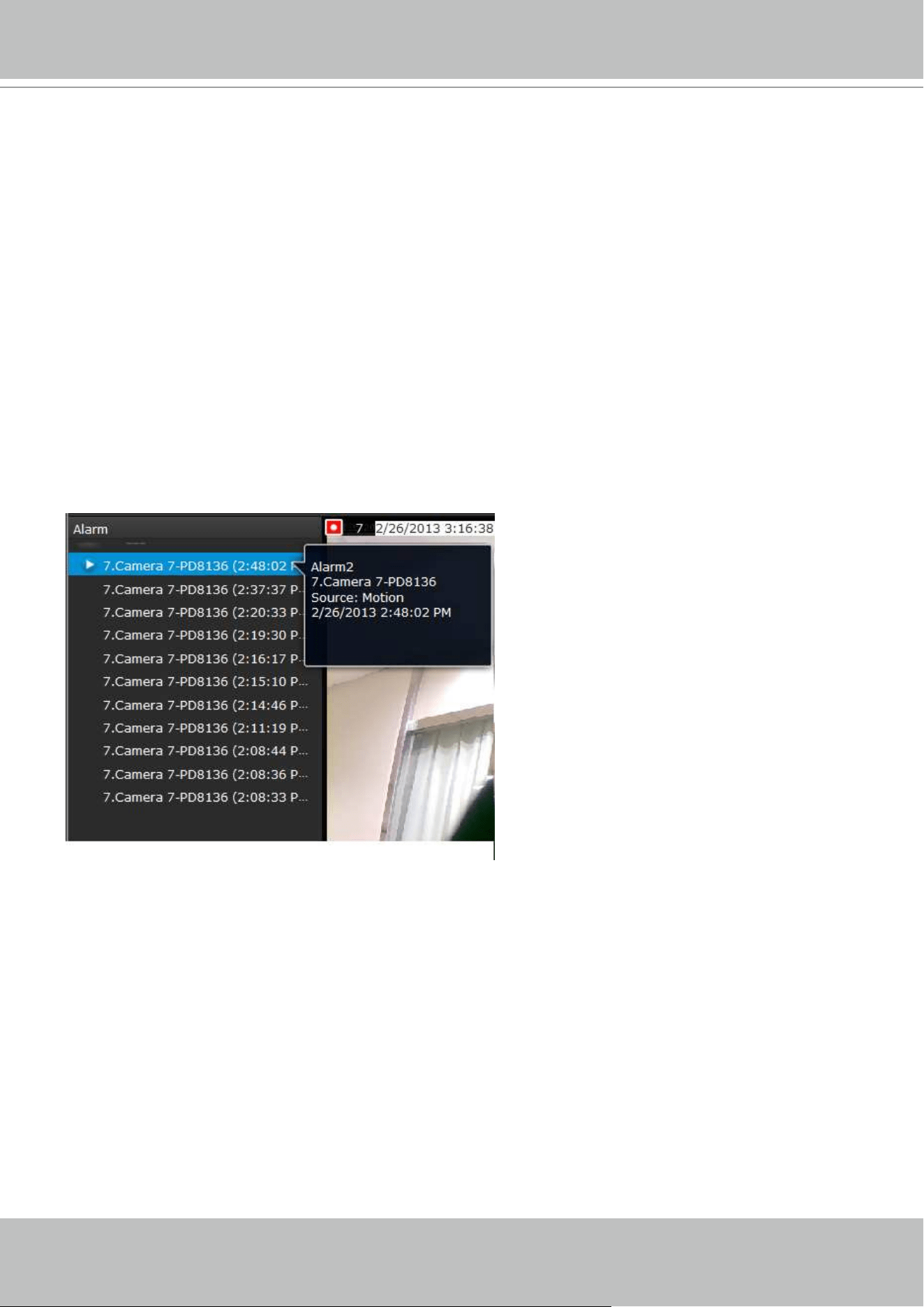
VIVOTEK - Built with Reliability
User's Manual - 183
To receive alarms from cameras, you need to congure alarm triggers in the Settings > Alarm
conguration window (
see page 161). Network cameras' digital inputs, digital outputs, or motion
detection can all be used to detect conditions in external environments. You can congure
certain kind of actions to take place in response to the alarms: such as
1. recording the immediate image,
2. sends an Email notication,
3. sounds the onboard buzzer,
4, sends snapshots to an FTP server,
5. sends videos to web server,
6. moves camera lens to a preset location,
7. triggers a camera's digital output.
The operation details of the Alarm panel and Alarm Playback utility have been described on
page 115
.
6-1-5. Alarm Panel
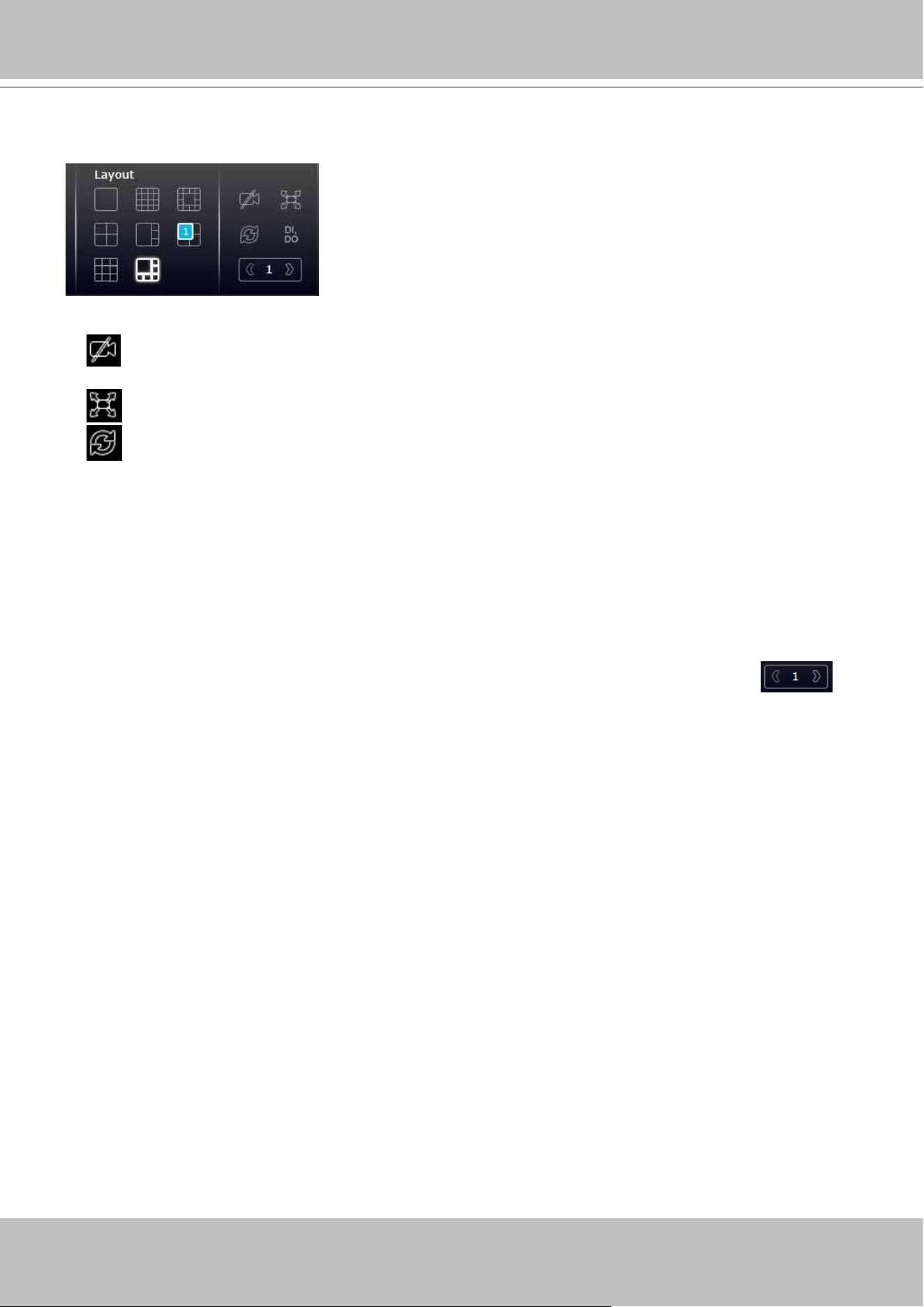
VIVOTEK - Built with Reliability
184 - User's Manual
6-1-6. Layout view Control Buttons
1. When editing a user layout, you can use this button to clear all view cells of inserted
cameras.
2. This button extends the current layout to the full of the screen.
3.
The Rotate function lets system display successive pages in a user layout by the
intervals of 10 seconds.
The layout page that does not contain camera views will be skipped.
A Rotate action will stop when you
1. move to another page in the user layout,
2. move to another user layout,
3. click to select a view cell,
4. remove a camera from view cell,
5. click to disable the rotation function.
When your current layout spans across multiple pages, use the arrow buttons
to
switch from one page to another. The index number of the current page will be shown between
the arrow buttons.
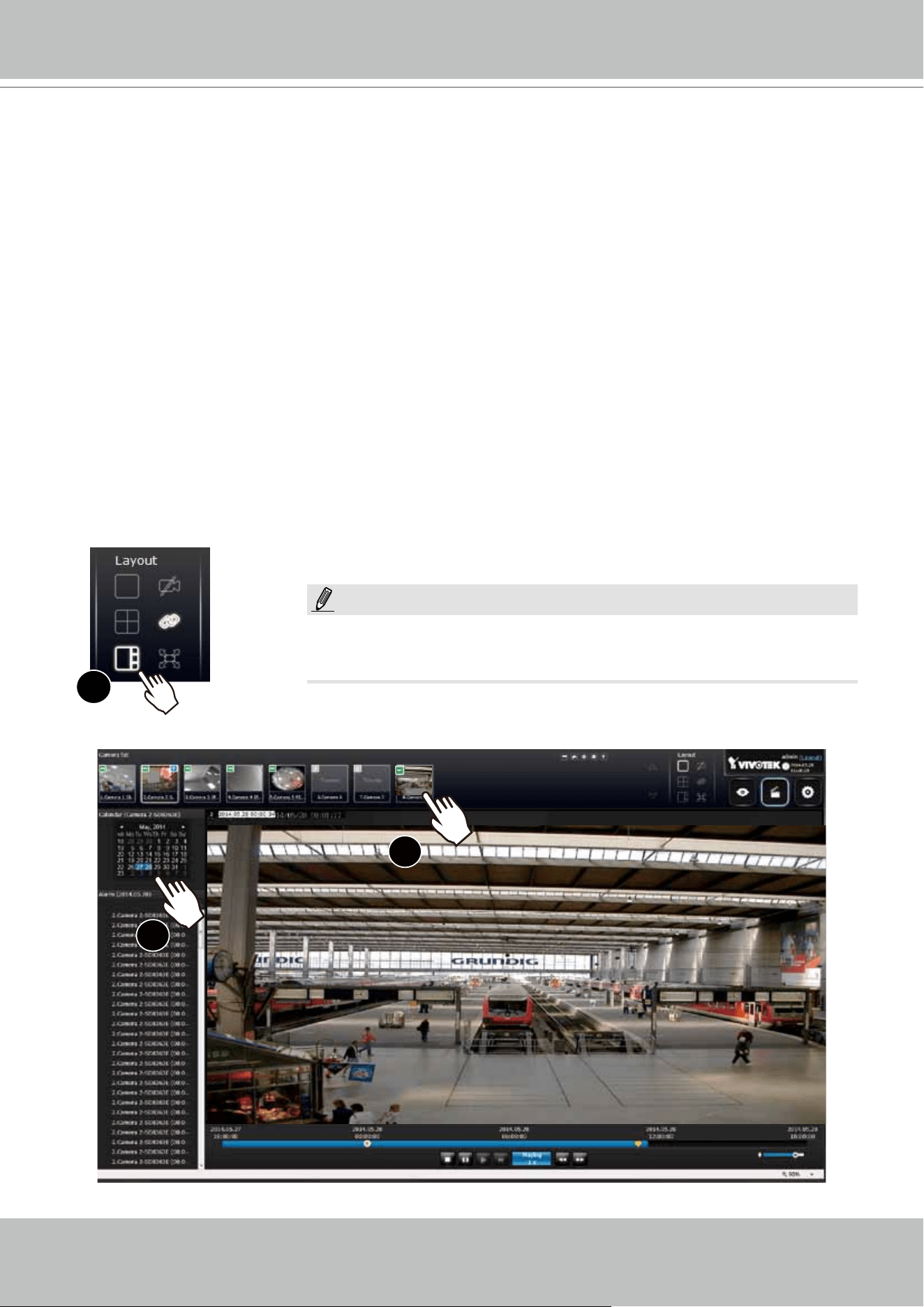
VIVOTEK - Built with Reliability
User's Manual - 185
6-2. Search Recording Clips
The elements in the Camera list on a Search recording clips window are similar to those on a
Liveview window. Please refer to page 101 for details on the Camera list panel.
1. Select a layout. You can display the playback views of multiple cameras on one screen.
2. Double-click on a camera.
3. The Calendar panel will display the days video recording actually took place. And those days
will be highlighted by a blue background (as the 25th and 28th in the screen below.)
x2
2
3
However, on a Search recording clips window, you can not:
1. Users cannot click and drag a camera thumbnail to a playback view cell.
2. A double-click on a camera does not display video in a view cell. A double-click displays a
calendar where days with recorded videos are shown.
6-2-1. Begin Playback and Search for Past Recordings
1
NOTE:
If a video stream is recorded in the MPEG-4 format, it will not be playable
on the Playback window.
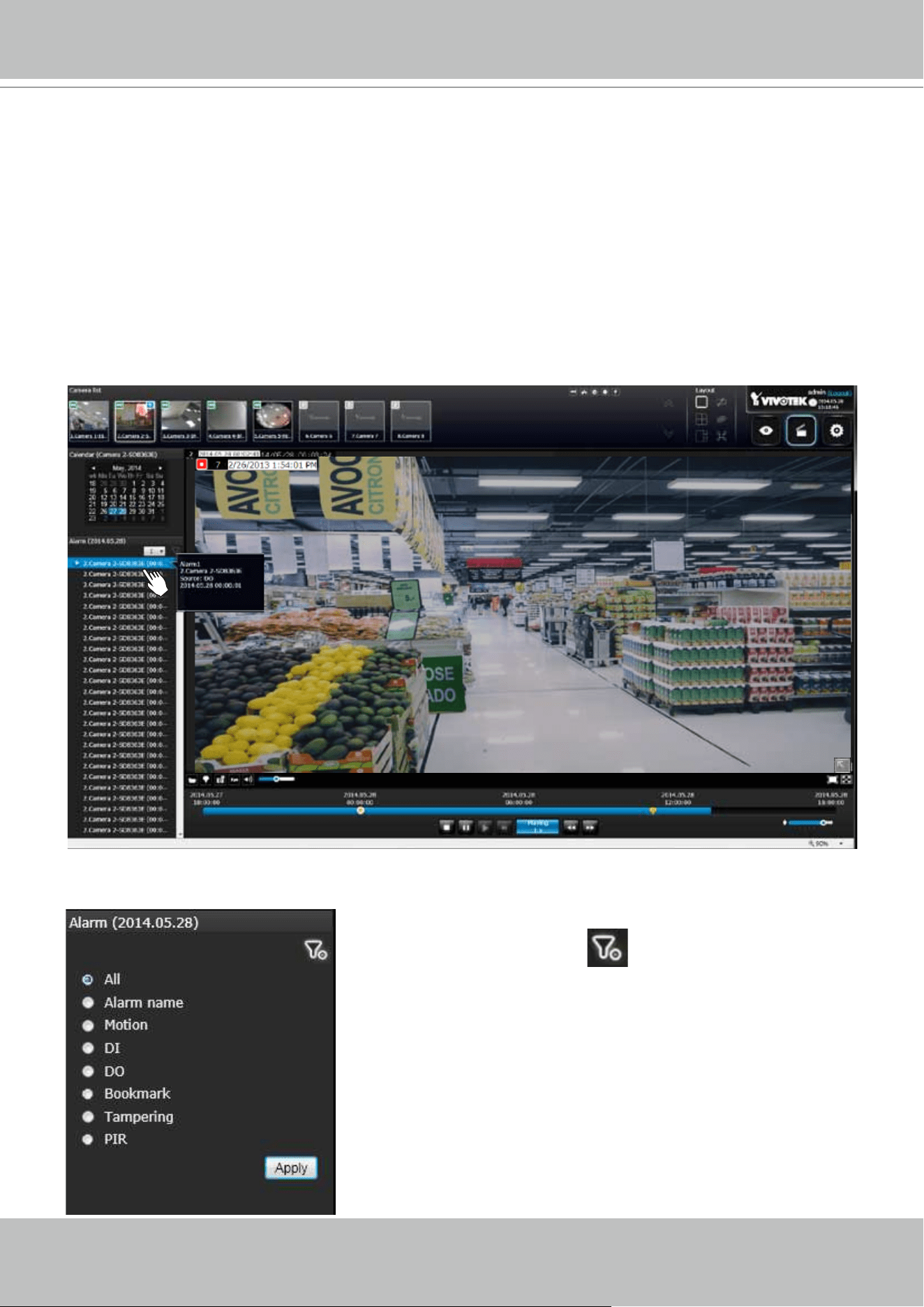
VIVOTEK - Built with Reliability
186 - User's Manual
When you selected a day when alarms took place on a camera, the alarms will be listed on
the Alarm panel. Up to 200 entries can be listed on a single page, and a max. of 1,000 entries
across multiple pages.
You may then,
1. Mouse over the alarm thumbnails and click on the play button. The Playback window will then
play back the video recorded by the time of the occurrence.
2. Unlike the Alarm playback function on the Liveview window, which only plays back the
related video for only one minute, the alarm playback will continue throughout the recording
of that day.
6-2-2. Past Alarms and Bookmarks
If you set up multiple triggering sources on a camera,
you can use the Alarm lter button to nd the alarms of
a specic type.
You can select the check circles to narrow down the types of
listed alarms using search criteria by Alarm name, Motion,
DI, DO, Bookmark, Tampering, or PIR.
Note that if searching by the Alarm name, the search does
not apply to the camera model name that is automatically
appended to the description of an alarm. Only the name of an
alarm should apply in the search.
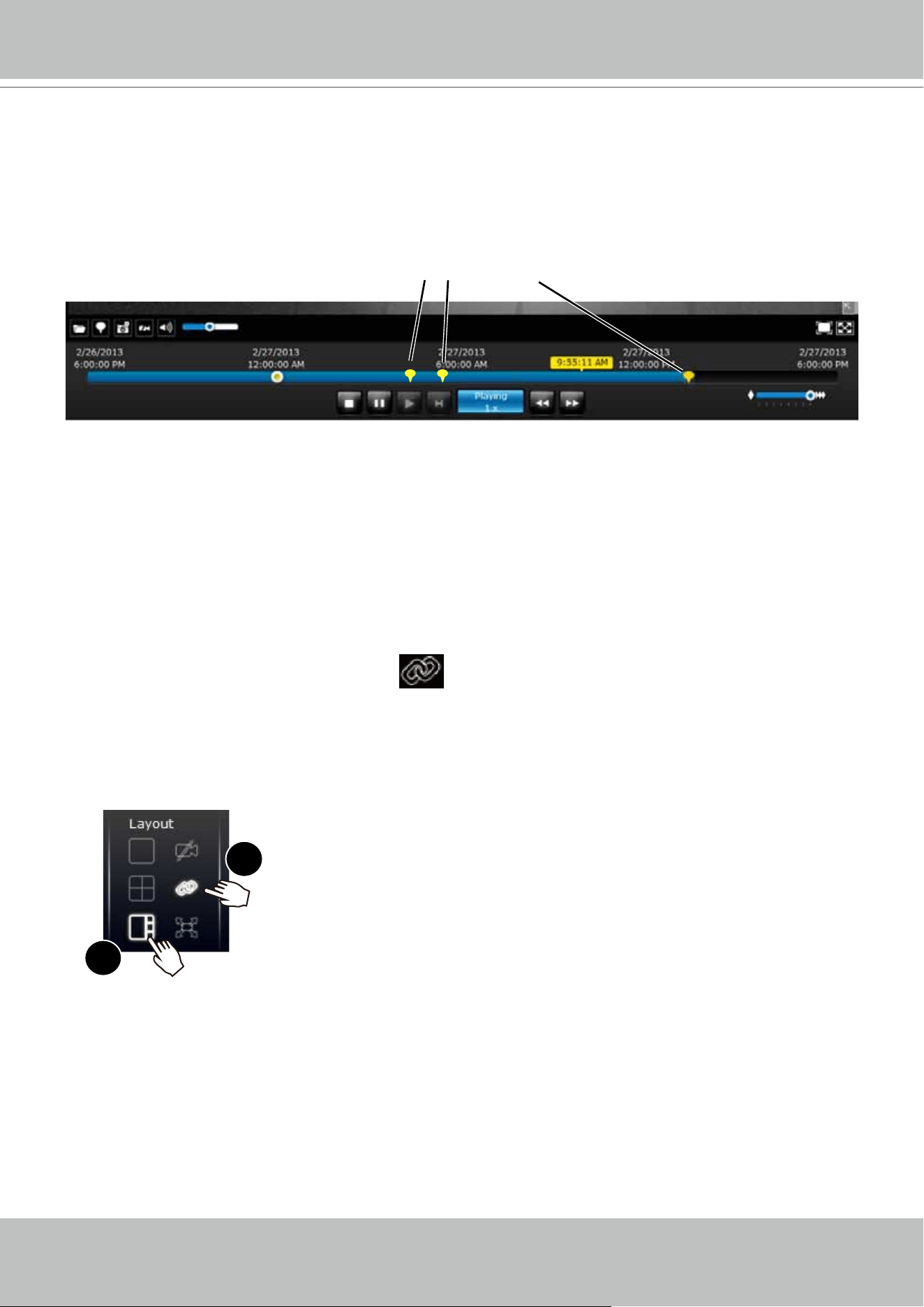
VIVOTEK - Built with Reliability
User's Manual - 187
Note that the bookmarks you inserted on the Liveview window will be listed on the Alarm panel,
and the bookmarks will also appear on the slide bar of the Playback window.
To retrieve or view the video clip tagged by the bookmark, click on it to play the video that was
recorded by the time bookmark was inserted.
Bookmarks
6-2-3. Synchronous Playback
The NVR supports synchronous playback, which allows you to review video clips from up to 4
cameras at the same time. These video clips will be retrieved simultaneously all playing for a
specic point in time.
To perform synchronous playback:
1. Select a layout from the Layout panel, e.g., a 2x2 layout.
2. Click on the Synchronous playback
button.
3. Double-click to select a camera from the camera list. This camera becomes the Master
camera.
4. When the Calendar panel appears, click to select a date you prefer.
5. Click and drag other cameras from the camera list to the empty view cells. These cameras
will play back videos according to your operation on the Master camera.
1
2
Note the following when using the Synchronous playback:
1. Only the alarms triggered on the Master camera will be shown. In the Synchronous mode,
you can not nd the alarms or bookmarks generated for other cameras.
2. The playback speed, selection of video clips, and alarm playback of all cameras are made
synchronous.
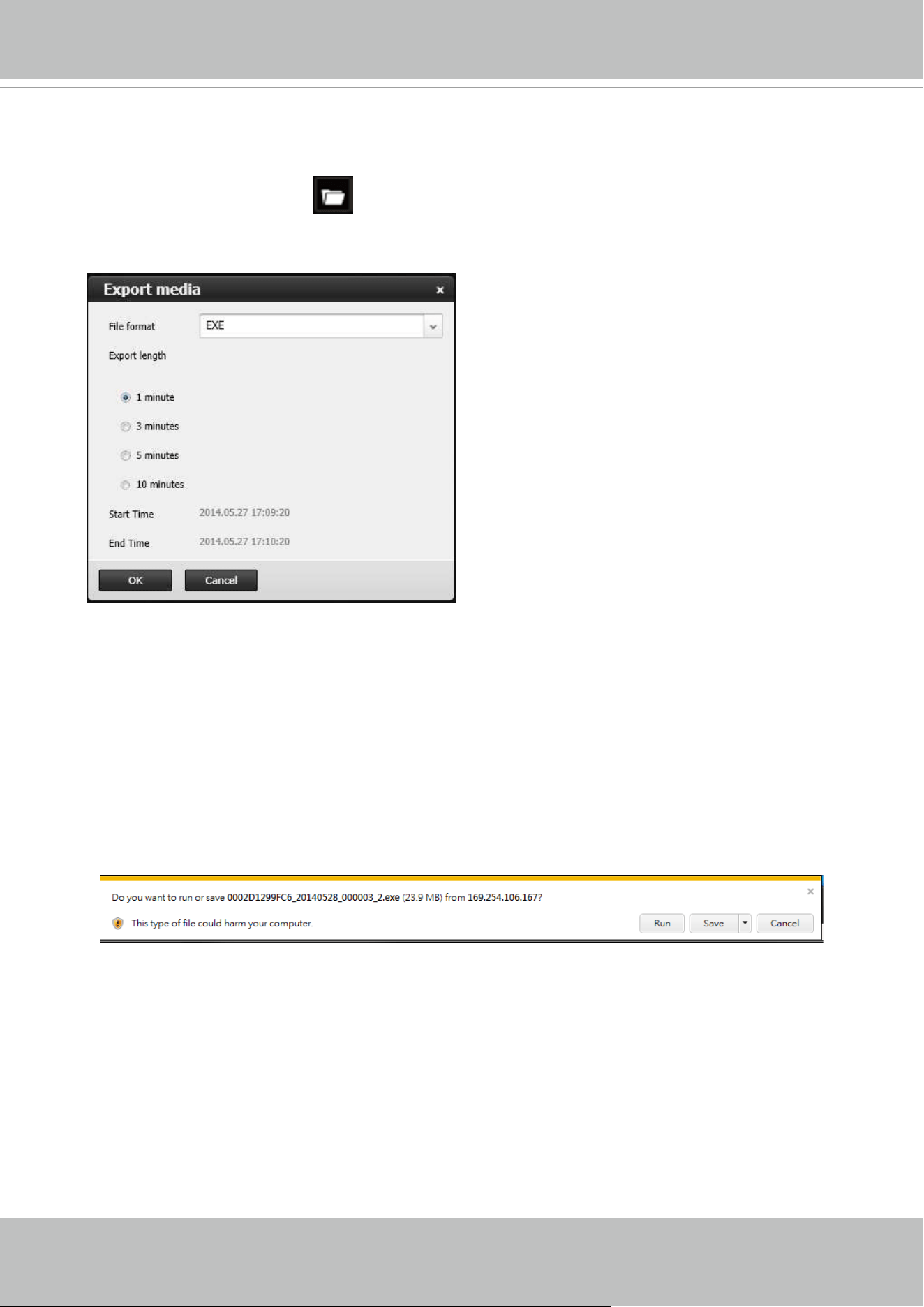
VIVOTEK - Built with Reliability
188 - User's Manual
6-2-4. Export media
To export video clips,
1. Click on the Export media
button on the tool bar, while the Playback window is playing
a video section of your interest.
2. An Export media window will prompt.
3. Select the le format using the pull-down menu. An EXE le is an self-executable le playable
by an embedded Media Player. The 3GP format is a multimedia container format for 3G
UMTS services. These les can be played on QuickTime, RealPlayer, and VLC. The le
name will look like this: [MAC]_ [DATE]_[TIME]_ [CAMERA_INDEX].[3gp/exe].
4. Select an export length of video by 1, 3, 5, or 10 minutes. The actual length can be longer
due to the fact that the program needs to trace back to the previous I-frame for a complete
rendering of video frames into the media.
5. Click OK to proceed.
6. System will prompt you for the EXE le. Click Save to proceed.

VIVOTEK - Built with Reliability
User's Manual - 189
7. The exported media le should be saved to the default download folder.
8. A self-executable EXE le should look like this.
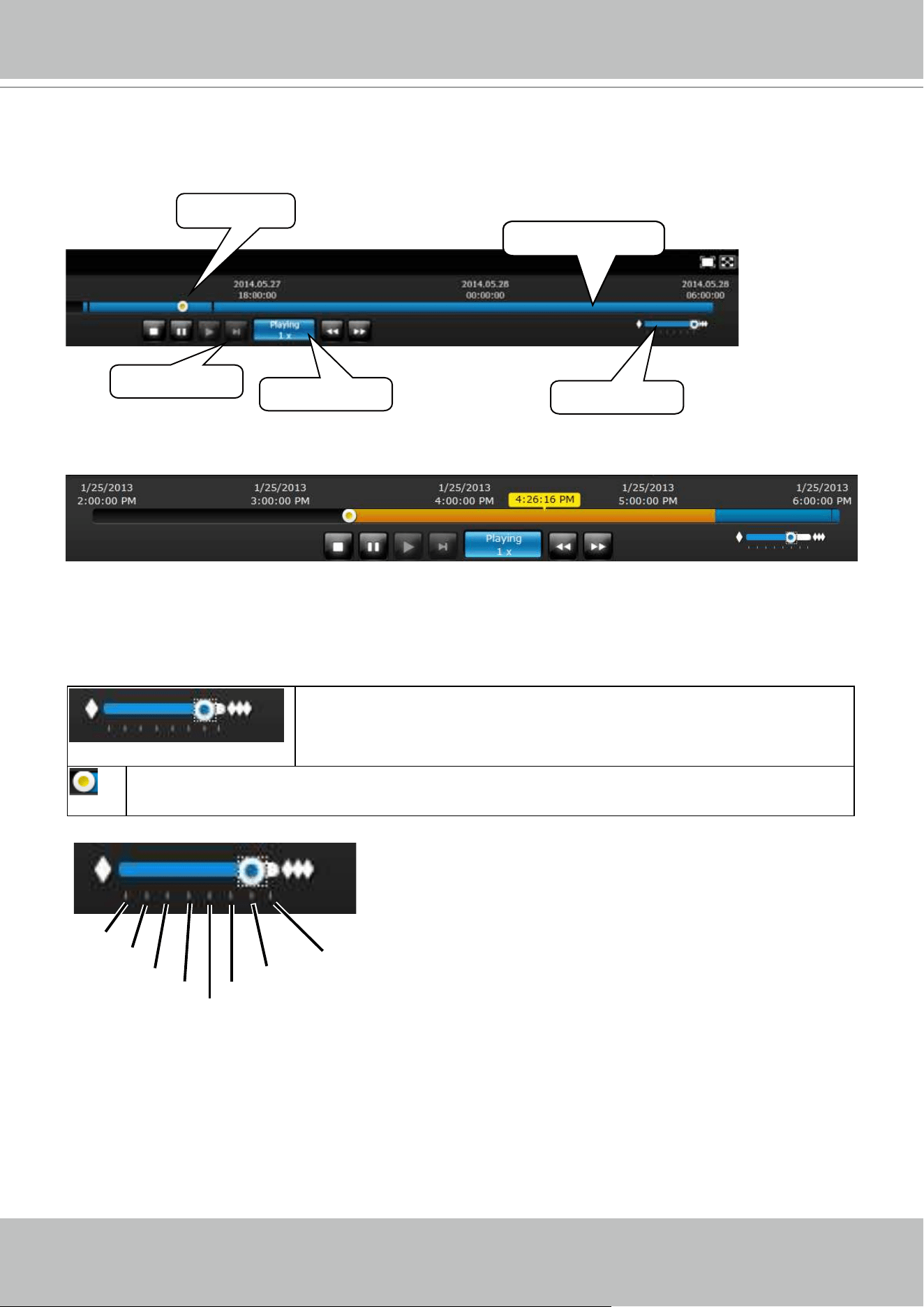
VIVOTEK - Built with Reliability
190 - User's Manual
6-2-5. Time Search
Use the time line slide bar to nd the nearest recording from a specic point in time.
Timeline slider
Timeline zoomer
Playback info
Control buttons
Span of existing
recording
If the need arises to more accurately pin-point the occurrence of an event, you can use the
Timeline zoomer and the slider thumb on the time line for a closer view into the existing
recording.
Timeline zoomer. Use the zoomer to zoom in for more precise
skimming.
Timeline slider thumb. Click and drag this thumb button to move along and reach a
specic point in time.
Details of the control bar in the Playback window can be found on
page 123.
You can use the timeline zoomer to scale down the span of time. For example, if the time span
is reduced to 1 hour, then each section on the time line represents 15 minutes of recording. The
total time span on a timeline starts from the minimal of 4 minutes, 20 minutes, 40 minutes, 1
hour, and up to a maximum of 24 hours.
In the Synchronous play mode, a change to the zoomer will be reected by all synchronously
playing view cells.
24 hrs
12 hrs
4 hrs
2 hrs
1 hr
40 mins
20 mins
4 mins
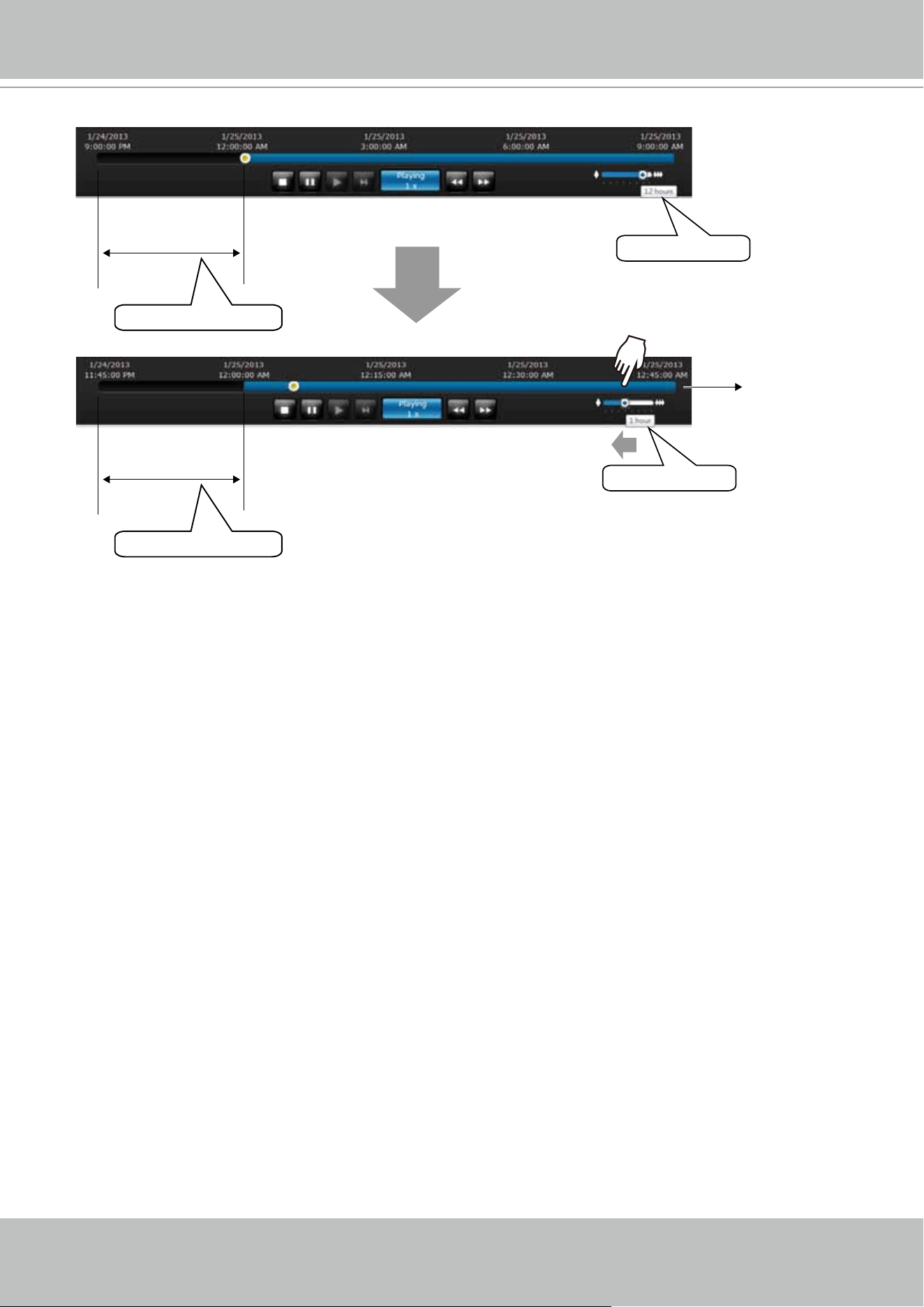
VIVOTEK - Built with Reliability
User's Manual - 191
Time span =12 hrs
Time span =1 hrs
Each section =15 mins
Each section =3 hrs
Total time span
If recordings take place by an event-triggered recording, the intervals between recordings can
be down to 1 minute, and the individual recordings will not be easily discernible. In this situation,
you can mouse over the timeline to pin-point individual recording instances.
VIVOTEK - Built with Reliability
192 - User's Manual
Technical Specifications
6F, No.192, Lien- Cheng Rd., Chung- Ho,
New Taipei Cit y, 235, Taiwan, R.O.C.
T: + 886 - 2- 82455282 F: + 886 - 2- 82455532
E: sales@vi votek .com
VIVOTEK INC.
2050 Ringwood Avenue,
San Jose, CA 95131
T: 408- 773- 8686 F: 408 - 773- 8298
E: salesusa@vivot ek.com
VIVOTEK USA
Ver. 9
All specif icat ions are subject to change without not ice. Copyright © VIVOTEK INC. All right s reserved.
Randst ad 22- 133, 1316BW Alm ere,
The Net herlan ds
T: + 31(0)36- 5298- 434
E: saleseurop e@vivotek .com
VIVOTEK Europe
602, Best sky Tower, Plot No. F- 5,
Net aji Subhash Place, Pitam Pura, Delhi- 110 034
T: + 91- 11- 45137465
E: salesindia@vivot ek.com
VIVOTEK India
Model ND8322P
System
OS Em bedded Linux
CPU ARM Processor
Flash 256MB
RAM 1GB
Watchdog Hardware + Sof tware
Power Rest orat i on System Restart Automatically af ter Power Recovery
Storage
HDD Devices Int ernal x2
HDD Max. Capacit y 6TB x 2
Disk Managem ent Create, Format and Remove Disk
HDD S.M.A.R.T
Video
Video Out put 1 x HDMI, 1 x VGA
Resolution 1920 x 1080, 1280 x 720
Gr aphics Decod er Hardware decoding
Decording Capacit y H.264:
2560 x 1920 @ 30 fps (1- CH)
1920 x 1080 @ 120 f ps (4 - CH)
1280 x 720 @ 240 fps (8- CH)
Camera Positi on Change the viewcell position on the Live View screens
External Interface
USB Inter f ace Front: 2 (USB 2.0)
Back: 1 (USB 2.0)
Alarm In 8
Alarm Out 4
Audio 1 x 3.5 Phone Jack Audio Out put
1 x 3.5 Phone Jack Audio Input (Reserved)
Ex ternal HDD 1 x eSATA Por t
RS232 1 Por t (Reser ved)
RS485 1 Por t (Reserved)
Network
Net work Int er face 1 x RJ- 45 10/ 100/ 100 0 Mbps Ether net int erface
PoE 8x 802.3af Compliant PoE Por ts (Tot al Max. 80W)
Record
Max im um Channel 8
Recor d Throughput (MB) 64 Mbps
Net work Thr oughput (MB) 48 Mbps
Audio Format G.711, G.726
Video Format MJPEG, H.264
Video Resolution VGA, 1MP, 2MP, 3 MP & 5MP Camera
Recor d ing Time (sec.) Pre- Record: 5 (max . 10)
Post- Record: 20 (max . 300)
Recor d ing Stream Single
Recor d ing Mode Cont inuous, Schedule, Manual, Event , Act ivit y Adaptive
Streaming
Recor d ing Sett ing Recycle (unit : Day)
Recor d ing Path Local Pat h
Recor d Video Format 3GP
LiveView (Local Display)
Stream Application Auto Adaptive Stream
LiveView Display 8 Channel
Mult i Layout displ ay:
1x1, 1x 3 (Corridor View), 2x2, 3x3, 1+5, 1+3, 1+1+ 3 (1P), 1+3+ 3 (1P)
Monit or Enhancement OSD Display (NVR), OSD Display (Camera), Cam era Inform ati on,
Remote I/ O Control, Event Not ification, Aspect Ratio
PTZ Control Panel Cont rol
PTZ Operation Direction Cont rol, Hom e, Iris, Preset, Patrol (Group), PiP Cont rol
Playback (Local Display)
Playback Displ ay 1 Channel
Mult i Layout Display: 1x1
Playback Cont rol Regular (Play, Pause, Stop), Rewind, Nex t / Previous Frame, Speed
Cont rol, Calendar, Event , Tim eline, Timeline Scale, Thumbnail
(St or yboard)
Video Search By calendar, by date/ tim e, by alarm
Thum bnail Explorer (Storyboard) Listing the thumbnail of recorded video (Max. 2 CH)
Monit or Enhancement OSD Display (Camera), Event Notif ication, Aspect Ratio, PiP
Cont rol
Snapshot JPEG
Video Clip Ex port EXE
LiveView (Remote)
Stream Application Stream Selection
Audio Capabilit y One Way
LiveView Display 8 Channel
Mult i Layout displ ay:
1x1, 2x 2, 3x3, 1+ 3, 1+ 5
Monit or Enhancement OSD Display (NVR), Drag & Drop, Image Freeze, Audio Cont rol,
Remote I/ O Control, Event Not ificat ion, Bookm ark
PTZ Control Panel Cont rol
PTZ Operation Direction Control, Home, Zoom, Focus, Iris, Preset, Patrol (Group),
PiP Control
Snapshot JPEG
Playback (Remote)
Playback Displ ay 4 Channel
Mult i Layout displ ay:
1x1, 2x 2, 1+ 3
Playback Cont rol Regular (Pl ay, Pause, Stop), Nex t Frame, Speed Cont rol, Calendar,
Timeline, Timeline Scale, Bookmar k
Hardware Information
Software Information
Prot ocols IPv4, TCP/ IP, HTTP, HTTPS, UPnP, RTSP/ RTP/ RTCP, SMTP, FTP,
DHCP, NTP, DNS, DDNS, IP Filter
Power
Power Input DC56V 2.5A
Power Consumpt i on Max. 120W
LED Indicator
LED Indicat or Power, St at us, Record, HDD1, HDD2, eSATA, Ethernet,
Por t1~Por t8
Mechanic
Form Factor Deskt op
Opateration Butt ons Power (Front) / Reset (Back )
Dimensions 360 mm (W) x 311 mm (D) x 44 m m (H)
Weight 2.7 kg (without HDD)
Operating Tem perature 0°C ~ 40°C (32°F ~ 104°F)
Hum idit y 0~95%
General
Safet y Certif ications CE, LVD, FCC, VCCI, C-Tick
Warrant y 24 m ont hs
Client PC Requirements
Operating System Micr osof t Windows OS:
XP/ Vista/ 7/ 8/ 2008/ 2012
CPU Int el Celeron or above
Memor y 2 GB or ab ove
Ethenet 10/ 10 0 Mbps
Displ ay Resolut ion 1024 x 768 pix els or above
Web Browser Int ernet Ex plor er 10 (32 bit) or above
Sof t ware AP Inst allation Wizard 2, ST7501, VAST
Mobile APP, Tablet APP EZconnect, iViewer (iOS)
EZconnect, iViewer (Android)
Accessories
CD User's Manual, Quick Installation Guide (QIG), Installation Wizard
2
Others Power Adapt er, Power Cord, Quick Installation Guide,
16 x H.D.D. Screws, 4 x H.D.D. Bracket s, 1 x USB Mouse, 2 x SATA
Cables
Monit or Enhancement OSD Display (NVR), Drag & Drop, Audio Cont rol, PiP Cont r ol
Snapshot JPEG
Video Clip Ex port EXE
Alarm Management
Schedule Type Continuous, Schedule, Manual
Event Mot ion Detect ion, PIR Detection, Tampering Detect ion, Digit al
Input (Camera), Digit al Output (Camera), Connection Abnorm al,
Storage Abnormal, Storage Full, Camera Net work Loss, DI, DO
Action Record, Em ail (Text ), Email (Snapshot), FTP, Buzzer, PTZ Control
(Go t o Preset), NVR DO, Camera DO
Recor ding Ti
me (sec.)
Pre- Record: 5 (max. 10), Post- Record: 20 (max. 300)
Backup
Manual USB Dongle (FAT Format)
System
User Managem en t User Account: 10
User Account Tim e Limit: 10 mins
User Level: Administrator / Regular User
User Feature Definition: By Camera
Log System, Recordi ng, User, Error
Date&Time Time Zone, Manual, Autom at ic Sync NTP, Daylight Saving Tim e
Firm ware Manual update
Restor e Default Suppor ted
Backup/ Restore (Conf iguration) Suppor ted
Language English, French, Germa
n, It alian, Japanese, Por t uguese, Russian,
Spanish, Simplif ied Chinese, Traditional Chinese, Kor ean, Czech
Camera Intergration
Inser t Camera Manual, Search
Video (Media) Sett ing Compression, Resolution, FPS, Video Qualit y
Image Sett ing Image Display
Image Adjustment
PTZ Control Panel Cont rol
PTZ Operation Direction Cont rol, Hom e, Preset, Patrol (Group)
Motion Detection Suppor ted
Device Intergration
UPS APC Model Com patible
Dimensions
360 mm 44 mm
311 mm
VIVOTEK - Built with Reliability
User's Manual - 193
6F, No.192, Lien-Cheng Rd., Chung-Ho,
New Taipei City, 235, Taiwan, R.O.C.
T: +886-2-82455282 F: +886-2-82455532
E: sales@vivotek.com
VIVOTEK INC.
2050 Ringwood Avenue,
San Jose, CA 95131
T: 408-773-8686 F: 408-773-8298
VIVOTEK USA
Ver. 2
All specifications are subject to change without notice. Copyright © VIVOTEK INC. All rights reserved.
Randstad 22-133, 1316BW Almere,
The Netherlands
T: +31(0)36 -5298- 434
E: saleseurope@vivotek.com
VIVOTEK Europe
602, Best sky Tower, Plot No. F-5,
Netaji Subhash Place, Pitam Pura, Delhi-110 034
T: +91-11- 45137465
E: salesindia@vivotek.com
VIVOTEK India
Model ND8422P
System
OS Embedded Linux
CPU ARM Processor
Flash 256MB
RAM 2GB
Watchdog Hardware + Software
Power Restoration System Restart Automatically after Power Recovery
Storage
HDD Devices Internal x2
HDD Max. Capacity 6TB x2
Disk Management Create, Format and Remove Disk
HDD S.M.A.R.T
Video
Video Output 1 x HDMI, 1 x VGA
Resolution 1920 x 1080, 1280 x 720
Graphics Decoder Hardware decoding
Decording Capacity H.264:
2560 x 1920 @ 30 fps (1-CH) 1920 x 1080 @ 120 fps (4-CH)
1280 x 720 @ 240 fps (8-CH) 720 x 480 @ 480 fps (16-CH)
Camera Position Change the viewcell position on the Live View screens
External Interface
USB Interface Front: 2 (USB 2.0)
Back: 1 (USB 2.0)
Alarm In 8
Alarm Out 4
Audio 1 x 3.5 Phone Jack Audio Output
1 x 3.5 Phone Jack Audio Input (Reserved)
External HDD 1 x eSATA Port
RS232 1 Port (Reserved)
RS485 1 Port (Reserved)
Network
Network Interface 1 x RJ-45 10/100/1000Mbps Ethernet interface
PoE 8x 802.3af Compliant PoE Ports (Total Max. 80W)
Record
Maximum Channel 16
Record Throughput (MB) 96 Mbps
Network Throughput (MB) 48 Mbps
Audio Format G.711, G.726
Video Format MJPEG, H.264
Video Resolution VGA, 1MP, 2MP, 3MP & 5MP Camera
Recording Time (sec.) Pre-Record: 5 (max. 10)
Post-Record: 20 (max. 300)
Recording Stream Single
Recording Mode Continuous, Schedule, Manual, Event, Activity Adaptive
Streaming
Recording Setting Recycle (unit: Day)
Recording Path Local Path
Record Video Format 3GP
LiveView (Local Display)
Stream Application Auto Adaptive Stream
LiveView Display 16 Channel
Multi Layout display:
1x1, 1x3 (Corridor View), 2x2, 3x3, 4x4, 1+5, 1+3, 1+12, 1+1+3
(1P), 1+3+3 (1P)
*Not support dewarp function from fisheye cameras
Monitor Enhancement OSD Display (NVR), OSD Display (Camera), Camera Information,
Remote I/O Control, Event Notification, Aspect Ratio
PTZ Control Panel Control
PTZ Operation Direction Control, Home, Iris, Preset, Patrol (Group), PiP Control
Playback (Local Display)
Playback Display 1 Channel
Multi Layout Display: 1x1
Playback Control Regular (Play, Pause, Stop), Rewind, Next / Previous Frame,
Speed Control, Calendar, Event, Timeline, Timeline Scale,
Thumbnail (Storyboard)
Video Search By calendar, by date/time, by alarm
Thumbnail Explorer (Storyboard) Listing the thumbnail of recorded video (Max. 2 CH)
Monitor Enhancement OSD Display (Camera), Event Notification, Aspect Ratio, PiP
Control
Snapshot JPEG
Video Clip Export E XE
LiveView (Remote)
Stream Application Stream Selection
Audio Capability One Way
LiveView Display 16 Channel
Multi Layout display:
1x1, 2x2, 3x3, 4x4, 1+3, 1+5, 1+12
Monitor Enhancement OSD Display (NVR), Drag & Drop, Image Freeze, Audio Control,
Remote I/O Control, Event Notification, Bookmark
PTZ Control Panel Control
PTZ Operation Direction Control, Home, Zoom, Focus, Iris, Preset, Patrol
(Group), PiP Control
Snapshot JPEG
Playback (Remote)
Playback Display 4 Channel
Multi Layout display:
1x1, 2x2, 1+3
Hardware Information
Software Information
Protocols IPv4, TCP/IP, HTTP, HTTPS, UPnP, RTSP/RTP/RTCP, SMTP, FTP,
DHCP, NTP, DNS, DDNS, IP Filter
Power
Power Input DC56V 2.5A
Power Consumption Max. 120W
LED Indicator
LED Indicator Power, Status, Record, HDD1, HDD2, eSATA, Ethernet,
Port1~Port8
Mechanic
Form Factor Desktop
Opateration Buttons Power (Front) / Reset (Back)
Dimensions 360 (W) x 311 (D) x 44 (H) mm
Weight 2.7 kg (without HDD)
Operating Temperature 0°C ~ 40°C (32°F ~ 104°F)
Humidity 0 ~ 95%
General
Safety Certifications CE, LVD, FCC, VCCI, C-Tick
Warranty 24 months
Client PC Requirements
Operating System Microsoft Windows OS:
XP/Vista/7/8/2008/2012
CPU Intel Celeron or above
Memory 2 GB or above
Ethenet 10/100 Mbps
Display Resolution 1024 x 768 pixels or above
Web Browser Internet Explorer 10 (32 bit) or above
Software AP Installation Wizard 2, ST7501, VAST
Mobile APP, Tablet APP EZconnect, iViewer (iOS)
EZconnect, iViewer (Android)
Accessories
CD User's Manual, Quick Installation Guide (QIG),
Installation Wizard 2
Others Power Adapter, Power Cord, Quick Installation Guide,
16 x H.D.D. Screws, 4 x H.D.D. Brackets, 1 x USB Mouse, 2 x SATA
Cables
Playback Control Regular (Play, Pause, Stop), Next Frame, Speed Control,
Calendar, Timeline, Timeline Scale, Bookmark
Monitor Enhancement OSD Display (NVR), Drag & Drop, Audio Control, PiP Control
Snapshot JPEG
Video Clip Export EXE
Alarm Management
Schedule Type Continuous, Schedule, Manual
Event Motion Detection, PIR Detection, Tampering Detection, Digital
Input (Camera), Digital Output (Camera), Connection Abnormal,
Storage Abnormal, Storage Full, Camera Network Loss, DI, DO
Action Record, Email (Text), Email (Snapshot), FTP, Buzzer, PTZ Control
(Go to Preset), NVR DO, Camera DO
Recording Time (sec.) Pre-Record: 5 (max. 10), Post-Record: 20 (max. 300)
Backup
Manual USB Dongle (FAT Format)
System
User Management User Account: 16
User Account Time Limit: 10 mins
User Level: Administrator / Regular User
User Feature Definition: By Camera
Log System, Recording, User, Error
Date&Time Time Zone, Manual, Automatic Sync NTP, Daylight Saving Time
Firmware Manual update
Restore Default Supported
Backup/Restore (Configuration) Supported
Language English, French, German, Italian, Japanese, Portuguese, Russian,
Spanish, Simplified Chinese, Traditional Chinese, Korean, Czech
Camera Intergration
Insert Camera Manual, Search
Video (Media) Setting Compression, Resolution, FPS, Video Quality
Image Setting Image Display
Image Adjustment
PTZ Control Panel Control
PTZ Operation Direction Control, Home, Preset, Patrol (Group)
Motion Detection Supported
Device Intergration
UPS APC Model Compatible
Dimensions
360 mm 44 mm
311 mm
VIVOTEK - Built with Reliability
194 - User's Manual
Information on Disposal for Users of Waste Electrical & Electronic
Equipment (private households)
This symbol on the products and/or accompanying documents means that used
electrical and electronic products should not bemixed with general household
waste.
For proper treatment, recovery and recycling, please take these products to
designated collection points, where they will beaccepted on a free of charge
basis. Alternatively, in some countries you may be able to return your products to
your local retailerupon the purchase of an equivalent new product.
Disposing of this product correctly will help to save valuable resources and prevent
any potential negative effects on humanhealth and the environment which could
otherwise arise from inappropriate waste handling. Please contact your local
authorityfor further details of your nearest designated collection point.
Penalties may be applicable for incorrect disposal of this waste, in accordance with
national legislation.
For business users in the European Union
If you wish to discard electrical and electronic equipment, please contact your dealer
or supplier for further information.
Information on Disposal in other Countries outside the European Union
This symbol is only valid in the European Union.If you wish to discard this product,
please contact your local authorities or dealer and ask for the correct method of
disposal.
Safety and Compatibility
Federal Communications Commission (FCC) Statement
This Equipment has been tested and found to comply with the limits for a Class A
digital device, pursuant to Part 15 of the FCC rules. These limits are designed to
provide reasonable protection against harmful interference when the equipment is
operated in a commercial environment. This equipment generates, uses and can
radiate radio frequency energy and, if not installed and used in accordance with the
instructions, may cause harmful interference to radio communications. Operation of
this equipment in a residential area is likely to cause harmful interference in which
case the user will be required to correct the interference at his own expense.
Warning:
[A shielded-type power cord is required in order to meet FCC emission limits and also
to prevent interference to the nearby radio and television reception. It is essential that
only the supplied power cord be used. ]
[Use only shielded cables to connect I/O devices to this equipment.]
You are cautioned that changes or modications not expressly approved by the party
responsible for compliance could void your authority to operate the equipment.
[ ]: depend on EUT condition.
VIVOTEK - Built with Reliability
User's Manual - 195
Japan VCCI Class A statement
ACA (Australian Communications Authority)