


3
Table of contents
Table of contents
1 Important safety information 5
1.1 Safety instructions 5
2 About this user manual 7
2.1 Symbols used 7
3 VoiceTracer 8
3.1 Product highlights 8
3.2 What's in the box 9
3.3 Product overviews 10
3.3.1 Front and rear sides 10
3.3.2 Keys 11
3.4 Start-up screen 12
3.4.1 Menu overview 13
4 First steps 14
4.1 Inserting the batteries 14
4.2 Power on/o 15
4.3 Initial installation process 15
4.3.1 Language selection 15
4.3.2 Set date & time 15
4.4 Enabling/disabling the keypad lock 16
4.5 Inserting a microSD card 16
4.6 Accessories 17
4.6.1 How to connect headphones 17
4.6.2 Connecting an external microphone 18
4.7 Connecting to a computer 18
4.7.1 Transferring files from or to the device 19
4.7.2 Disconnecting from a computer 19
5 Record 20
5.1 Creating a recording 20
5.1.1 Recording using an external microphone 21
5.2 Starting recording automatically 21
5.2.1 Use Timer function 21
5.2.2 Use voice activation 21
6 Playback 22
6.1 Selecting a recording 22
6.2 Playback a recording or music file 22
6.3 Adjusting playback speed 22
6.4 Quick search 23
6.5 Repeat a file / repeat a sequence 23
6.6 Protecting a recording / lock file 24
6.7 Unprotect / unlock file 24
7 Delete 25
7.1 Deleting recordings on the device 25
7.2 Deleting all recordings in the folder 25
8 Radio 26
8.1 Radio mode 26
8.2 Saving a radio station pre-set 26
8.2.1 Saving radio stations automatically 26
8.2.2 Saving a radio station manually 26
8.2.3 Deleting a pre-set radio station 27

4
Table of contents
8.3 Recording from FM radio 27
9 Settings 28
9.1 Recording settings 28
9.1.1 Set file location 28
9.1.2 Setting recording quality 28
9.1.3 Setting microphone sensitivity 29
9.1.4 Enabling/disabling noise reduction 30
9.1.5 Setting the timer 30
9.1.6 Enabling/disabling voice-activated recording 31
9.1.7 Setting auto divide 32
9.1.8 Enabling/disabling the record indicator 32
9.2 Display settings 33
9.2.1 Select language 33
9.2.2 Adjusting the display contrast 33
9.2.3 Enabling/disabling the background light 34
9.3 Device settings 34
9.3.1 Set date & time 34
9.3.2 AUTO-OFF 35
9.3.3 Enabling/disabling key and signal tones 36
10 Service 37
10.1 Service functions 37
10.1.1 Display device information 37
10.1.2 Memory formatting 37
10.1.3 Device reset 38
10.2 Replacing batteries or rechargeable batteries 38
10.3 Updating the firmware 39
10.4 Troubleshooting 40
11 Appendix 41
11.1 Technical data 41

5
Table of contents
1 Important safety information
Do not make any adjustments and modifications that are not described
in this manual. Follow all safety instructions to ensure proper
operation of the device. The manufacturer assumes no liability for
damages resulting from non-compliance with the safety instructions.
1.1 Safety instructions
• Protect the device from rain or water to prevent a short circuit.
• Do not expose the device to excessive heat caused by placing it on a
heating device or in direct sunlight.
• Protect the cables from damage by being trapped, particularly at the
plugs and where cables exit the housing.
• Back up your data and recordings. The manufacturer cannot be held
responsible for any loss of data.
• Do not perform any maintenance operations that are not
described in this user manual. Do not disassemble the device into
its component parts to carry out repairs. The device may only be
repaired in authorised service centres.
1.1.1 Batteries and rechargeable batteries
• Only use AAA batteries with the device.
• Never try to recharge alkaline or non-rechargeable batteries.
• Remove batteries or rechargeable batteries from the device if it
will not be used for an extended period of time. The device can be
damaged by leaking batteries or rechargeable batteries.
• Do not remove batteries or rechargeable batteries from the device
while it is recording. If you do this, data may be damaged or lost.
Device malfunctions may also occur.
• Batteries and rechargeable batteries contain substances that may
pollute the environment. Used batteries and rechargeable batteries
should be disposed of at an ocial collection point.
1.1.2 Memory cards
• The device supports microSD memory cards up to 32 GB in capacity
(optimised for class 6 or higher).
• Make sure that the card has a suciently high data transfer rate. The
manufacturer makes no guarantee for trouble free operation.
• Formatting a memory card erases all data on the card. The memory
card must always be formatted in the device to ensure that the
format is correct. Formatting the memory card using a computer
can lead to eventual errors when reading or writing data.

6
Table of contents
1.1.3 Hearing protection
Observe the following guidelines when using headphones:
• Set the volume to a moderate level and do not use headphones to
listen for excessively long periods of time.
• Be particularly careful to avoid adjusting the volume to a level that
your hearing cannot deal with.
• Do not turn the volume up so high that you cannot hear what is
going on around you.
• In potentially dangerous situations you must be very careful, or
temporarily discontinue use.
• Do not use headphones while operating a motorised vehicle, cycling,
or skateboarding, etc. You could be a hazard to yourself and other
road users, and possibly be breaking the law.
1.1.4 Maximum sound power
• The manufacturer guarantees compliance with the maximum sound
power of its audio players as determined by relevant regulatory
bodies, but only with the original model of headphones supplied. If
you need to replace these headphones, we recommend contacting
your dealer to order the respective original Philips model.
1.1.5 Legal restrictions on recording
• The use of the device's recording function is subject to the legal
restrictions that may apply in your country. You should also respect
the privacy and personal rights of the third parties if you record
talks or lectures.
• Please note that, in certain countries, you may be legally required
to inform the person you are conversing with on the telephone
that you are recording the conversation, or that the recording of
telephone conversations is illegal. Please check if the use of such
data is legal in your country prior to recording telephone calls.
7
About this user manual
Table of contents
2 About this user manual
You can find a quick overview of your device in the following pages.
For detailed description, see the following chapters of this user
manual. Read this user manual carefully.
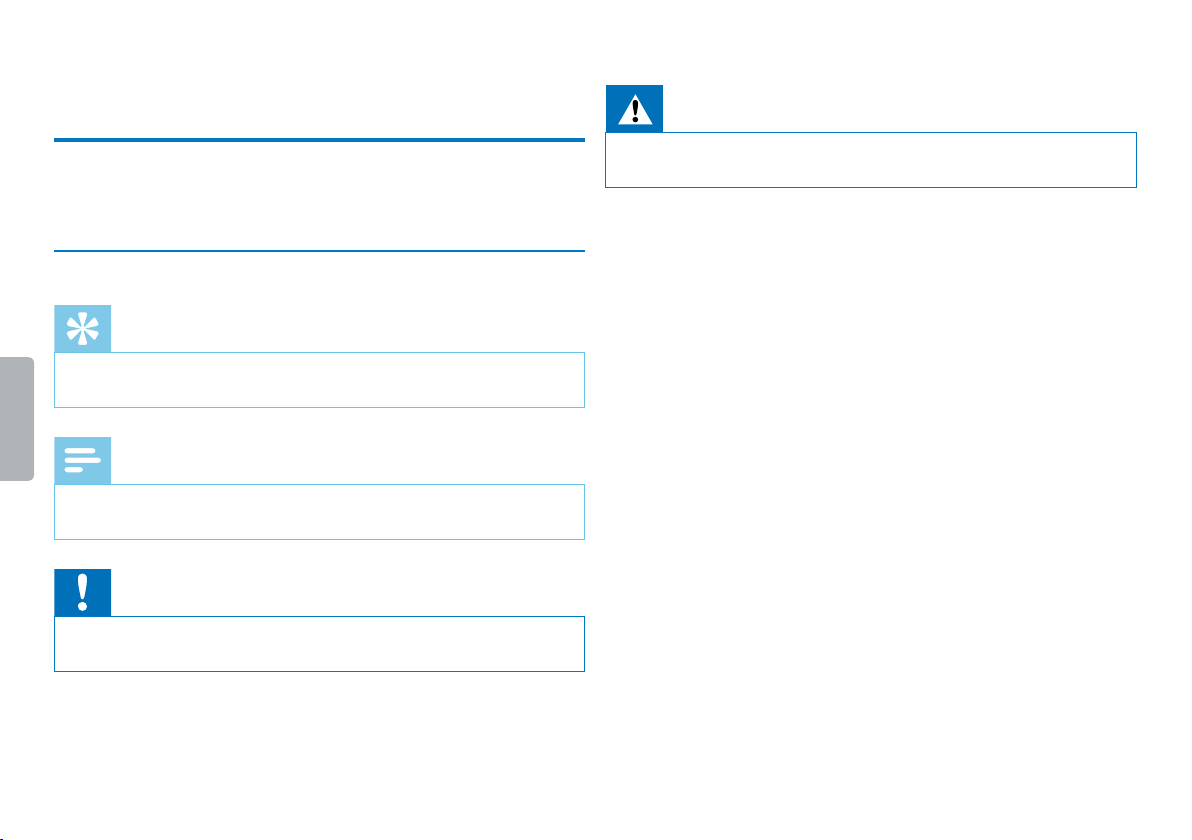
2.1 Symbols used
Tip
• This symbol identifies information that helps you to use your
device more eciently and simply.
Note
• This symbol indicates notices which you must observe when
handling or operating the device.
Caution
• This symbol warns of damage to the device and possible data loss.
Damage can be caused by improper handling.
Warning
• This symbol warns of danger to persons. Bodily injury or damage
could be caused by improper handling.

8 VoiceTracer
Table of contents
3 VoiceTracer
We are delighted that you have chosen a Philips device. Visit our
website for comprehensive support such as user manuals, software
downloads, warranty information and much more:
www.voicetracer.com.
3.1 Product highlights
• Voice-activated recording mode without pressing buttons
• Slot for microSD card for extra memory
• Highlight important parts of your recording using index marks
• Noise reduction for clear recordings
9
VoiceTracer
Table of contents
MENU
j e
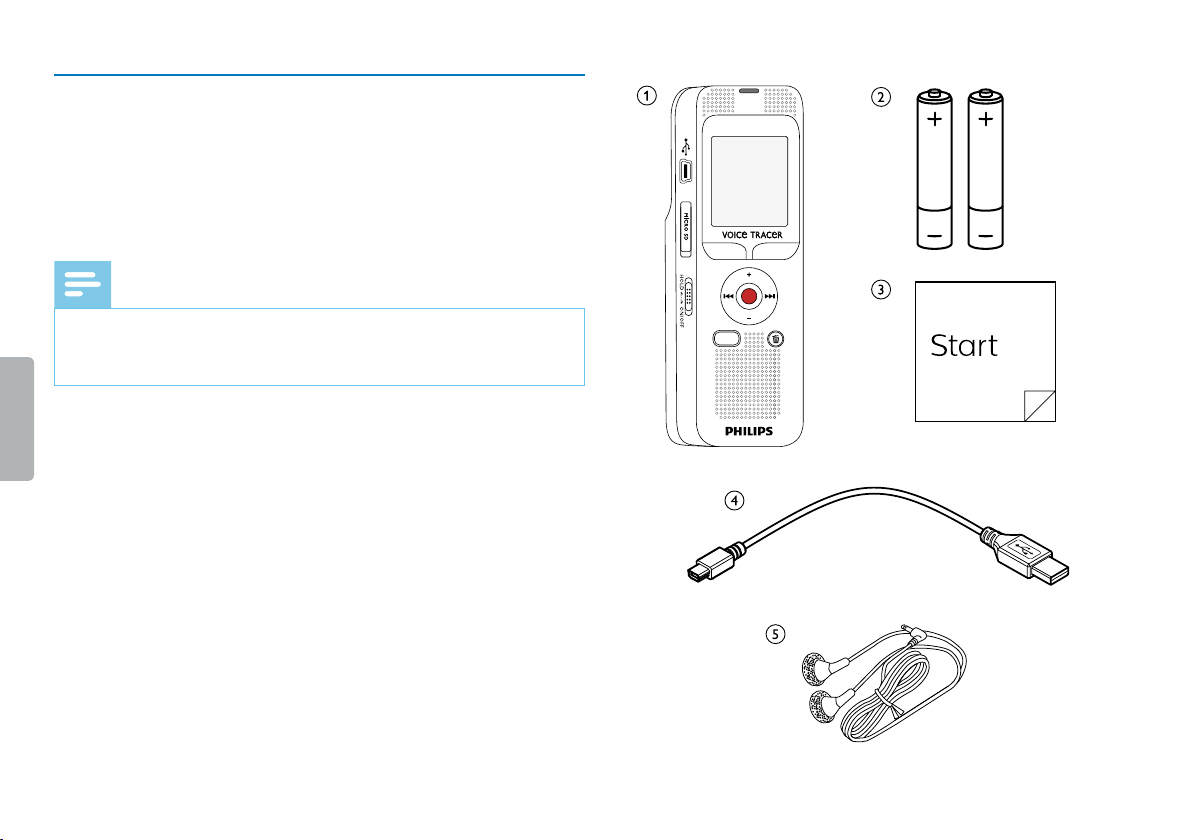
3.2 What's in the box
a Device
b Two AAA batteries
c Quick-start guide
d USB cable to connect to a computer
e Stereo headphones
Note
• Please note that some individual components may not be included
in delivery with your model. If any item is missing or damaged,
please contact your distributor.
Quick
Guide
10 VoiceTracer
Table of contents
3.3 Product overviews
3.3.1 Front and rear sides
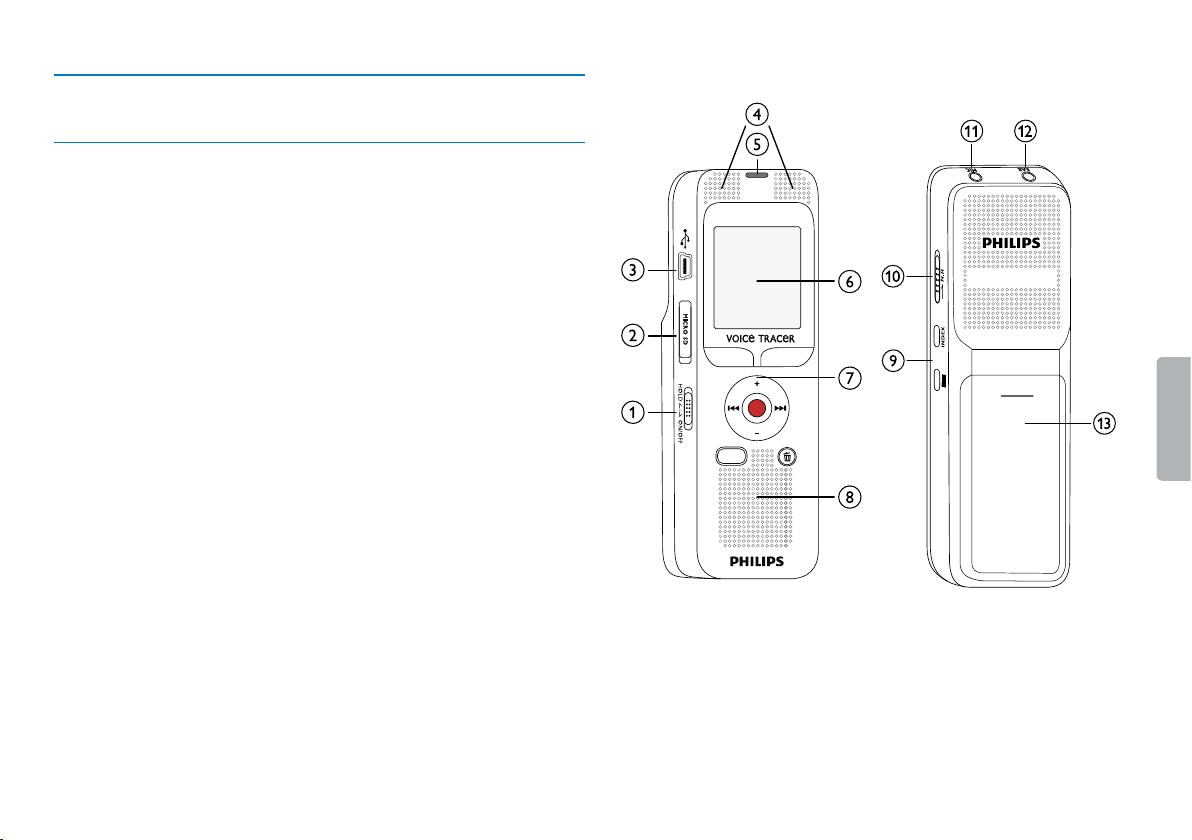
a Power on/o key, keypad lock
b Slot for memory card (microSD card)
c Micro USB port for computer connection
d Microphone
e Status LED:
Red–device is recording
Green–device is playing back
Yellow–data is being transferred to/from the computer
f Display
g Operating panel with keys
h Speaker
i Operating panel with keys
j Noise reduction
k External microphone socket, line-in socket
(stereo jack, 3.5 mm)
l Headphone socket
(stereo jack, 3.5 mm)
m Battery compartment
MENU
j e
11
VoiceTracer
Table of contents
3.3.2 Keys
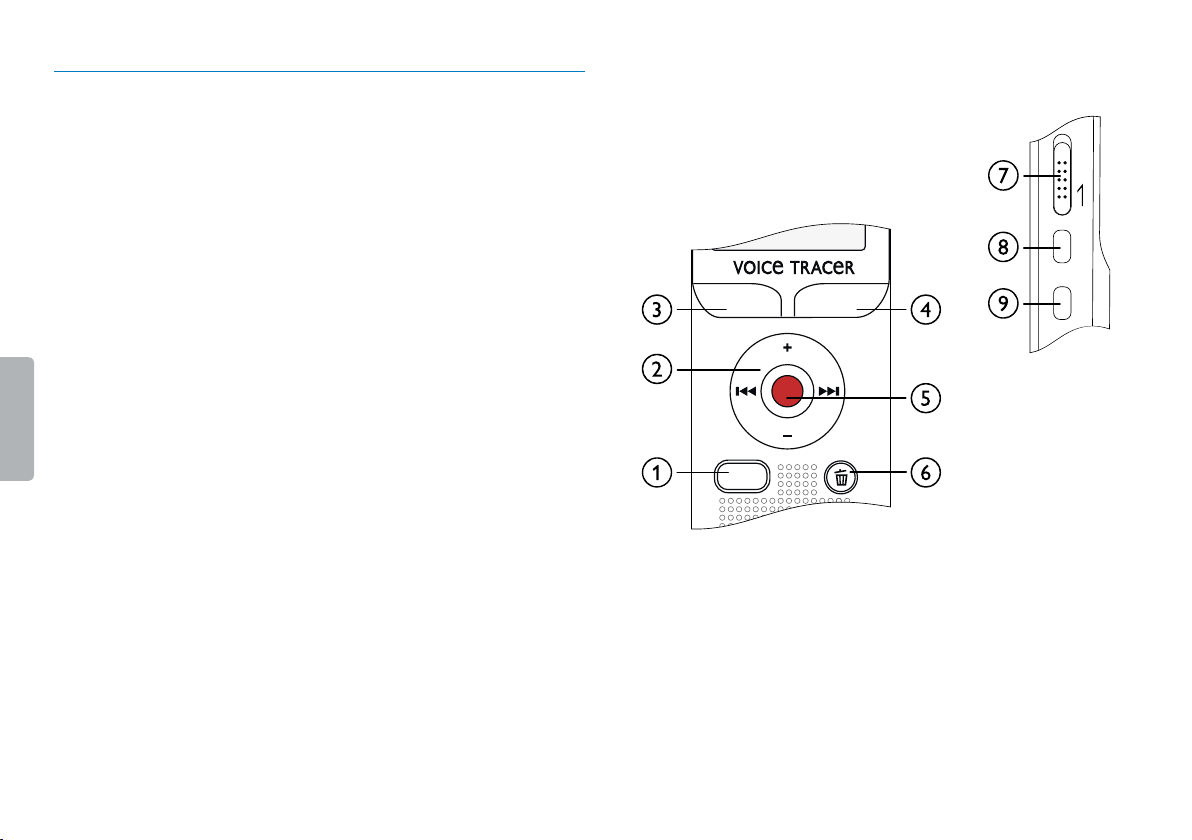
a Call up menu functions (MENU key)
b + Increase volume, menu navigation: Select menu functions
b Short press: jump to the next index mark
Menu navigation: display next menu tab
Long press: fast seek forward mode
– Volume down, menu navigation: Select menu functions
h Short press: jump to the previous recording
Menu navigation: display previous menu tab
Long press: fast seek rewind mode
c j Stop playback (stop key), close menu
d e Play recording (playback key), Pause playback (pause key)
e g Start recording (record key), confirm selection
f z Delete recording (delete key)
g Switch on noise reduction (N.R key)
h Short press: Set index mark, display list of index marks
(INDEX key)
i a Stop mode: Change folder
MENU
j e
INDEX
N.R
a
12 VoiceTracer
Table of contents
3.4 Start-up screen
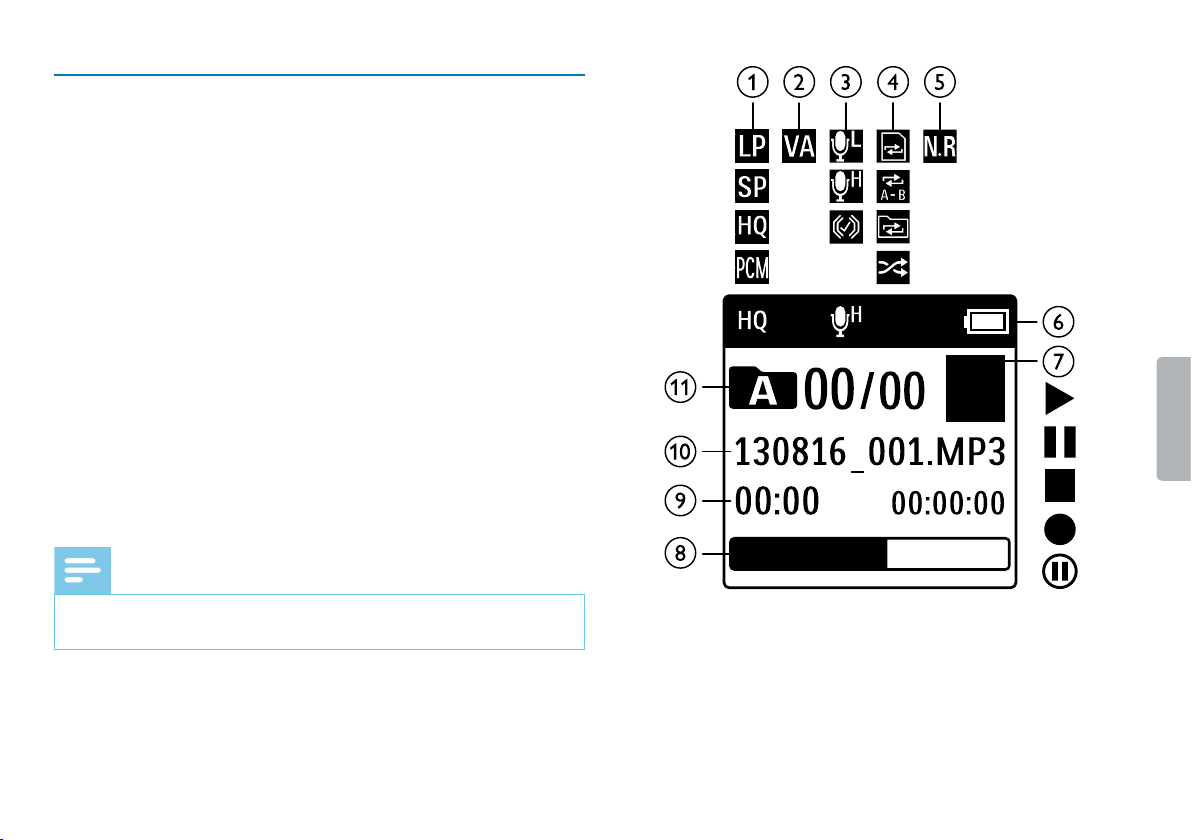
a ‹ Set recording quality: Œ–LP, Ž–SP, ‹–HQ, €–PCM
b Š – Voice activation switched on
c º Microphone sensitivity: ¹ – low sensitivity (shorter distance),
º – high sensitivity (longer distance), Ç – Line-in source
d Set repeat mode / continuous loop: –Repeat file playback,
ÖRepeat selection/sequence, Á–Repeat folder playback,
Ä–Random repeat mode
e [ – Noise reduction on
f ¾ Battery charge level
g j S–Playback, {–Pause, j–Stop, g–Record, |–Pause
record
h Position indicator of current playback/recording
i Playback/recording time / Remaining recording time
j File name of current playback/recording
k u Selected folder, depending on the selected sttorage medium
(u–internal memory, i–microSD card)/ number of the
current recording / total number of recordings in the folder
Note
• The position of the symbols may vary, depending on the model,
the mode and the selected functions.
13
VoiceTracer
Table of contents
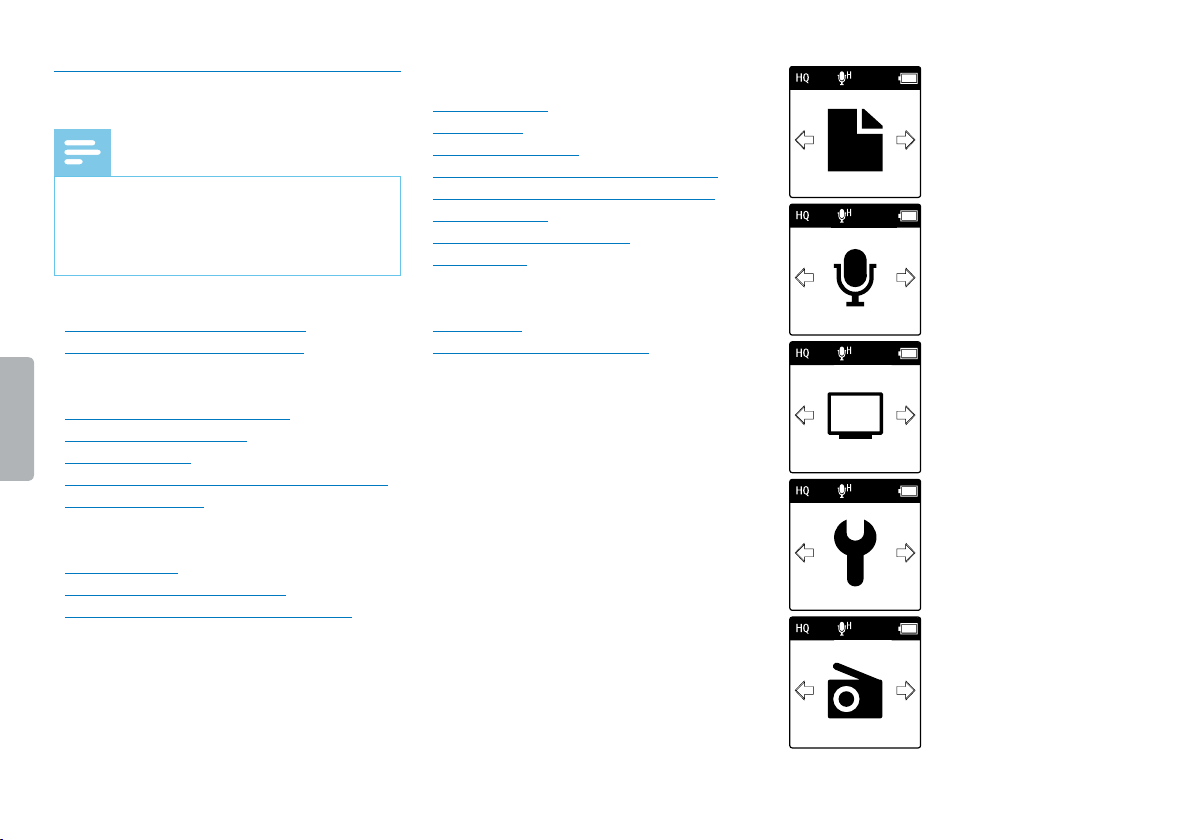
3.4.1 Menu overview
Note
• In stop mode (start-up screen), press
MENU, to call the menu.
• Press h / b to select one of the
following menus: Ò, Ó, Ô, Õ or Ö.
Ò File menu:
Repeat a file / repeat a sequence
Protecting a recording / lock file
Ó Recording settings:
Setting microphone sensitivity
Setting recording quality
Setting the timer
Enabling/disabling voice-activated recording
Setting auto divide
Ô Display settings:
Select language
Adjusting the display contrast
Enabling/disabling the background light
Õ Device settings:
Set date & time
AUTO-OFF
Memory formatting
Enabling/disabling the record indicator
Enabling/disabling key and signal tones
Set file location
Display device information
Device reset
Ö Radio settings:
Radio mode
Saving a radio station pre-set
14 First steps
Table of contents
4 First steps
Use the installation guide on the following pages to start using your
device quickly and easily.
Caution
• Follow the instructions on handling the device, especially the
batteries and rechargeable batteries (see also chapter 1.1.1
Batteries and rechargeable batteries, page 5).
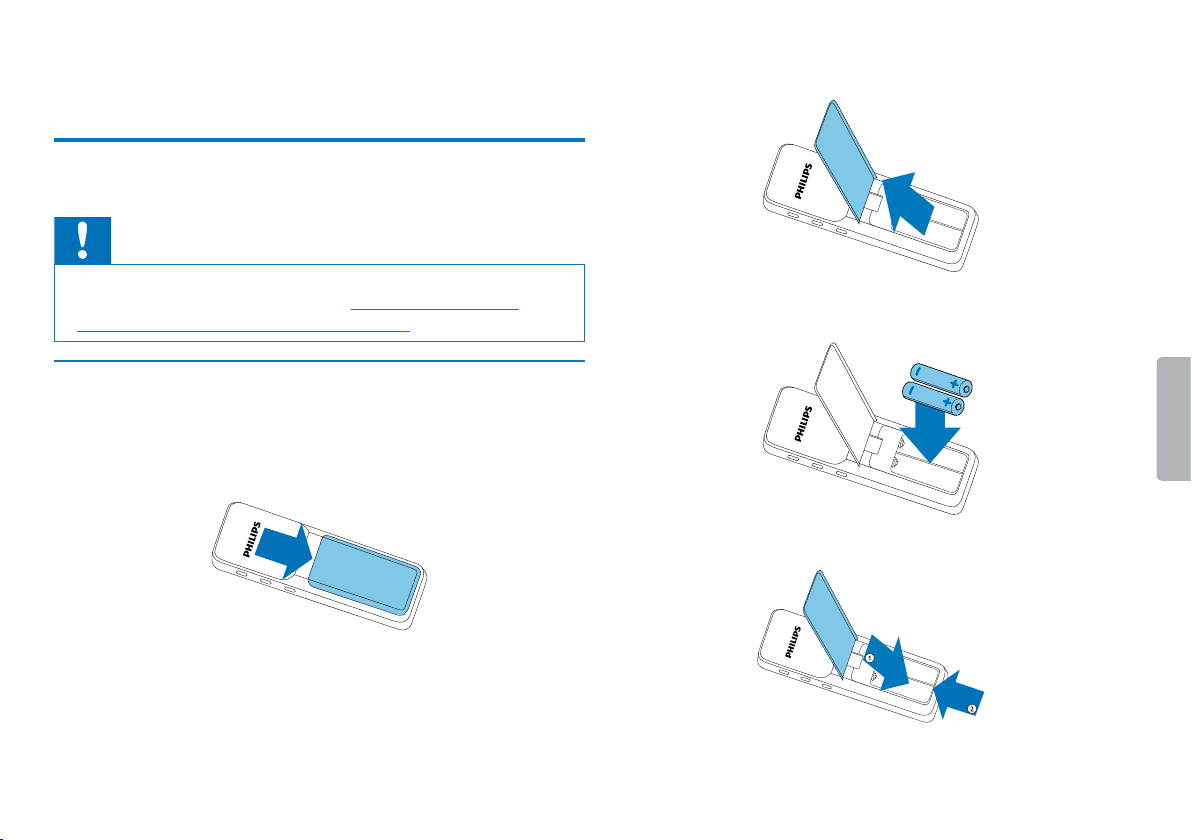
4.1 Inserting the batteries
Your device is supplied with two AAA batteries.
1
Slide the battery compartment cover downwards.
2
Fold the cover out.
3
Insert the batteries or rechargeable batteries as shown into the
device. Make sure the polarity is correct.
4
Fold the cover in. Push the cover up until it engages.
15
First steps
Table of contents
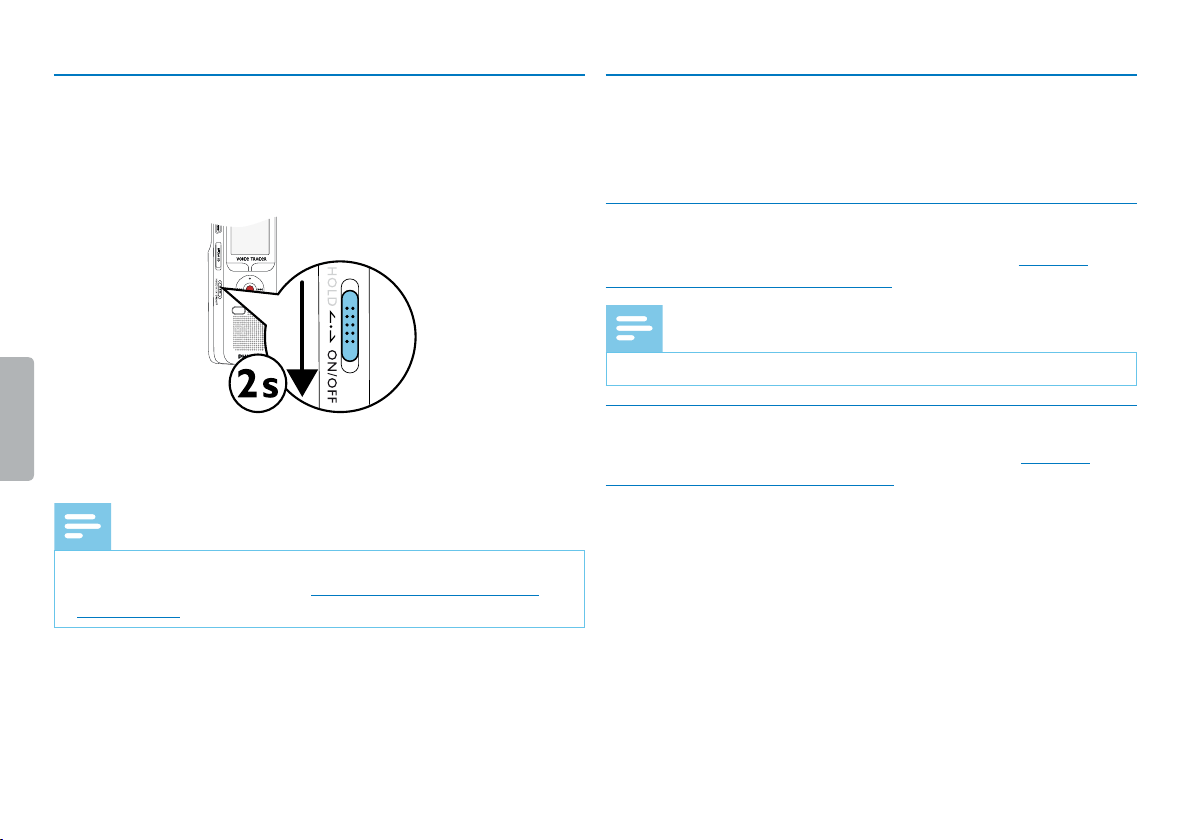
4.2 Power on/o
1
Slide the on/o switch on the side of the device downwards for
approximately two seconds.
X The device turns on and the start-up screen is displayed.
MENU
j e
2
To power o, pull down the power switch on the side of the device
again and hold for about two seconds.
Note
• The device switches itself o automatically if no key is pressed
within a pre-set period of time (see also chapter 9.3.2 AUTO-
OFF, page 35).
4.3 Initial installation process
When using for the first time, you must set the display language as well
as the date and time of the device.
4.3.1 Language selection
Follow the description in the chapter "Select language" (see also
chapter 9.2.1 Select language, page 33).
Note
• Your language might not be available. Select an alternative one.
4.3.2 Set date & time
Follow the description in the chapter "Set date & time" (see also
chapter 9.3.1 Set date & time, page 34).
16 First steps
Table of contents
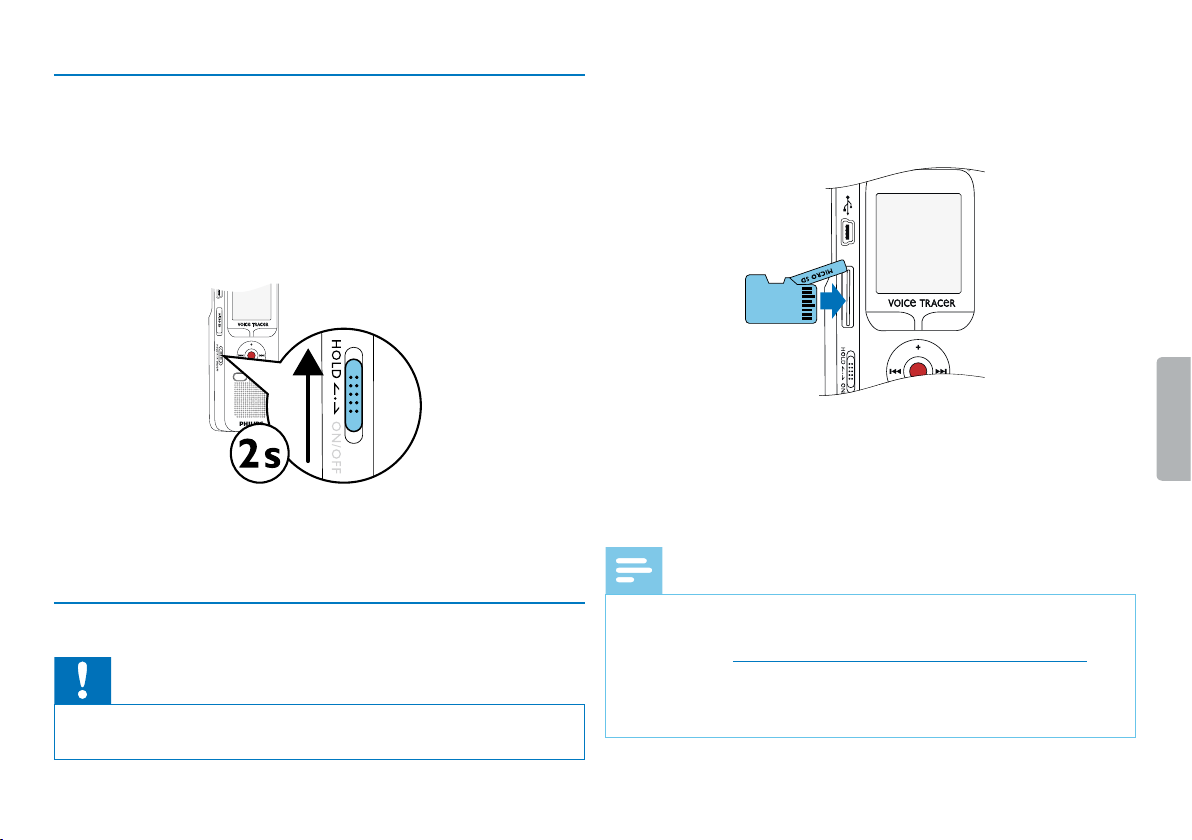
4.4 Enabling/disabling the keypad lock
The keypad lock deactivates all keys on the device. The timer function
of the device continues to function.
1
Slide the HOLD switch up into the HOLD position to lock the
keypad of the device.
X The display briefly shows ‘On Hold’ and turns o.
MENU
j e
2
Slide the HOLD switch down to the O position to disengage the
keypad lock.
4.5 Inserting a microSD card
Caution
• Do not remove the memory card while recording is in progress. If
you do this, data may be damaged or lost.
1
Flip the memory card slot cover to the side.
2
Insert the microSD card into the card slot with the contacts facing
upwards.
j e
3
Insert the memory card until it snaps into place.
4
To remove the card press the memory card slightly until the
snapping mechanism unlocks and the card is ejected.
Note
• To ensure that the device stores the recordings on the memory
card, you must switch from the internal memory to microSD
memory card (see also chapter 9.1.1 Set file location, page 28). The
display shows a folder icon which indicates where the recordings
are currently being stored: u, v, w, x, y–internal memory,
¡, ¢, £, ¤, ¥–memory card.
17
First steps
Table of contents
4.6 Accessories
Additional accessories may be obtained directly from your retailer.
4.6.1 How to connect headphones
Warning
• Set the volume to a moderate level and do not use headphones
to listen for excessively long periods of time. Exposure to intense
sound can cause hearing damage. Observe the Hearing safety
instructions (see also chapter 1.1.3 Hearing protection, page 6).
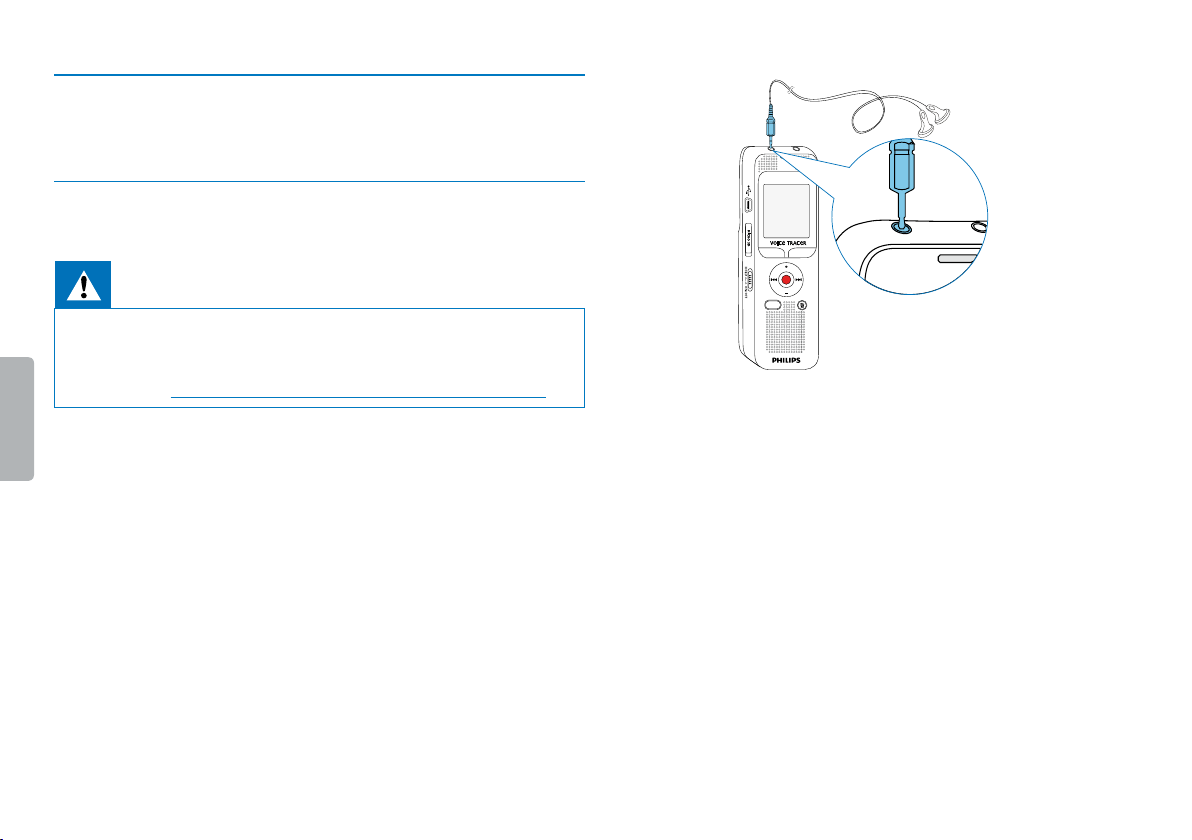
1
Turn down the volume of the device before you plug in the
headphones.
2
Insert the stereo jack into the headphone connection EAR on the
top of the device.
MENU
j e
MIC
EAR
MIC
EAR
3
Turn up the volume until you reach a comfortable listening level.
The speaker is switched o when headphones are connected.
18 First steps
Table of contents
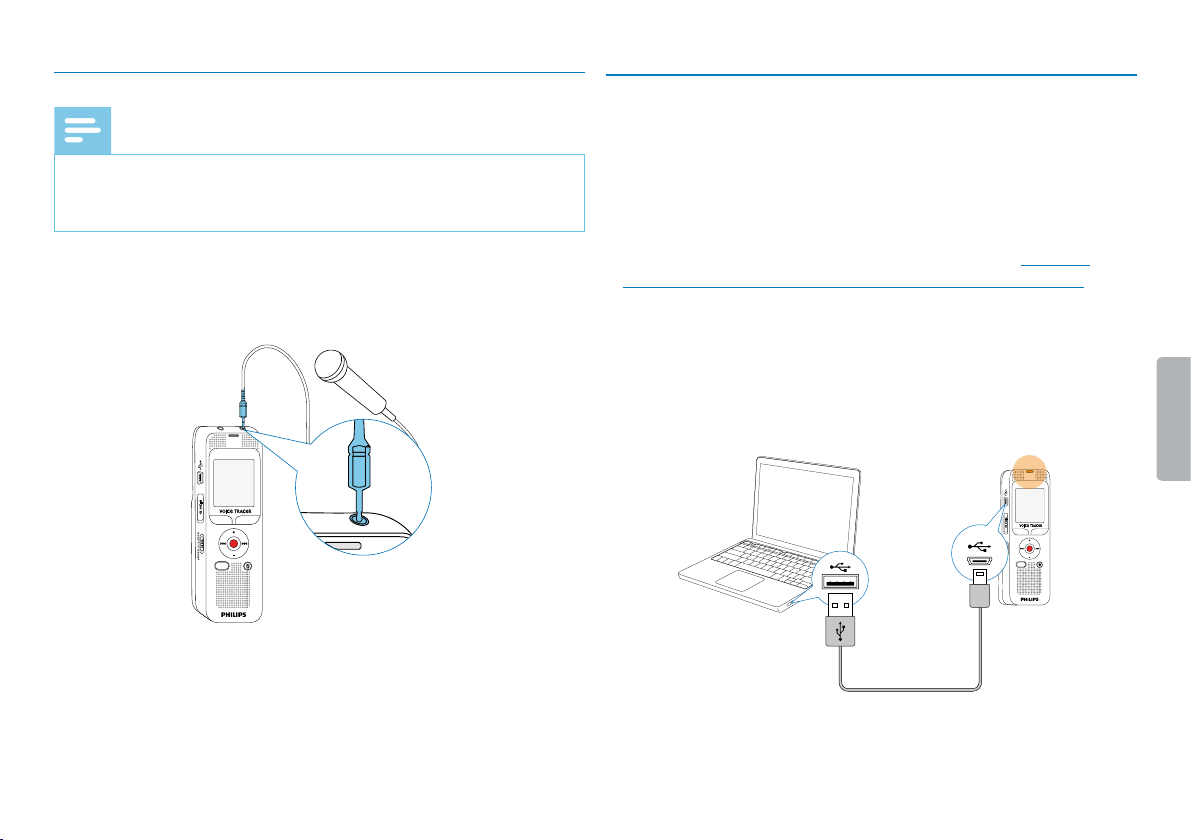
4.6.2 Connecting an external microphone
Note
• If you connect an external microphone to the device, the
recording source will switch automatically and the device
microphone will turn o.
1
Stop the recording currently in progress.
2
Insert the jack into the microphone connection MIC on the top of
the device.
MENU
j e
MIC
EAR
MIC
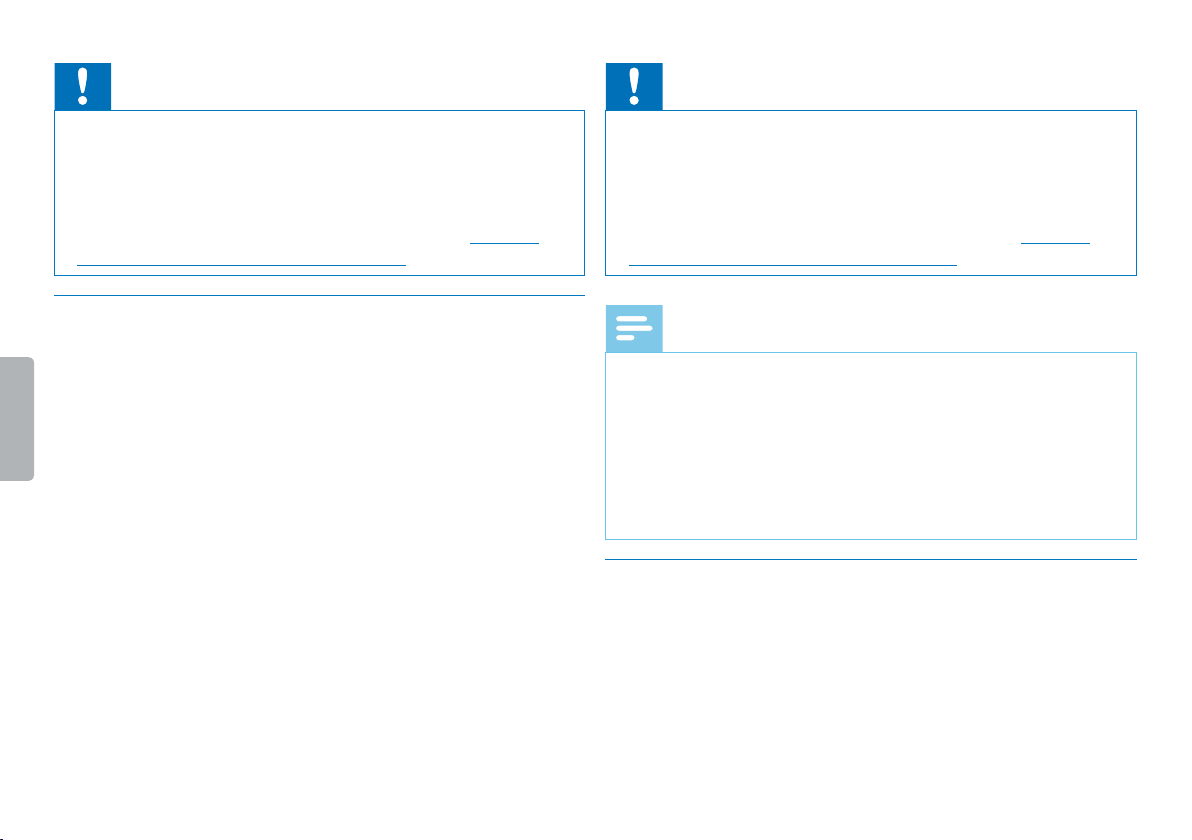
4.7 Connecting to a computer
You can select one of the following options once you have connected
the device to a computer
• A USB mass storage device: You can use the File Explorer to
access the device data without installing additional software. The
device is automatically displayed as a mass storage device. It is a
convenient way to store, back up and and move files. (see also
chapter 4.7.1 Transferring files from or to the device, page 19).
1
Plug the USB connector into a USB port on your computer.
2
Insert the micro USB plug into the USB port on the side of the
device.
X The device is displayed as a mass storage device in File
Explorer.
MENU
j e
19
First steps
Table of contents
Caution
• Do not disconnect the device from the computer while files are
transferred from or to the device (the status LED indicatorflashes
yellow when data is being transferred). This this may damage or
corrupt the files.
• Do not format the drive of the device on a computer. If you want
to delete all data, use the
Format memory function (see also
chapter 10.1.2 Memory formatting, page 37).
4.7.1 Transferring files from or to the device
You can use the File Explorer to access the device data without
installing additional software. The device is automatically displayed as a
mass storage device.
1
Connect the device to the computer as described.
2
Open File Explorer.
X The device is automatically displayed, similarly to a USB
memory stick or card, as a mass storage device. Use the Voice
folder for recordings and the Music folder for music files.
3
Copy or move files to your computer or delete files to archive
recordings and free up space on the device.
Caution
• Do not disconnect the device from the computer while files are
transferred from or to the device (the status LED indicatorflashes
yellow when data is being transferred). This this may damage or
corrupt the files.
• Do not format the drive of the device on a computer. If you want
to delete all data, use the
Format memory function (see also
chapter 10.1.2 Memory formatting, page 37).
Note
• The device supports music files in the formats WMA and MP3,
which can be transferred from the computer to the Music folder
of the device. The files are located in the y/ä folder on the
device.
• Files with copy protection (Digital Rights Management, DRM) are
not supported.
• The device can store up to 99 music files.
4.7.2 Disconnecting from a computer
1
Select Eject USB in File Explorer.
2
Disconnect the USB cable from the computer.
20 Record
Table of contents
5 Record
The device oers many features that you can use during recording
or to improve the quality of a recording. Use the timer and the voice
activation functions to start a recording automatically.
5.1 Creating a recording
Before starting a recording, set the required recording quality and
microphone sensitivity.
When you record in environments with lots of noise in the background
(e.g. while in a crowd or during a train or car journey), you can enable the
noise reduction function to reduce the background noise (see also chapter
9.1.4 Enabling/disabling noise reduction, page 30).
Caution
• Do not remove batteries or rechargeable batteries from the
device while it is recording. If you do this, data may be damaged or
lost. Device malfunctions may also occur.
1
In stop mode (start-up screen), press a to select the desired
folder for the recording.
X The following symbols will be displayed, depending on the
selected location folder: u, v, w, x, y–internal memory, ¡,
¢, £, ¤, ¥–memory card.
2
Point the built-in microphone toward the sound source and press
g.
X The record/play indicator lights red. The recording duration
and the remaining recording time are displayed in the selected
folder on the display.
3
Press g to pause recording.
X The record/play indicator will blink red.
4
Press the g key to resume recording.
5
Press the j key to stop recording.
X The device returns to stop mode.
Note
• Start a new recording: To stop the current recording and start
a new one, press b.
• To prevent files becoming too big during a long recording, for
example a meeting lasting several hours, you can automatically
split recordings (see also chapter 9.1.7 Setting auto divide, page 32).
• Each folder can store up to 99 files. The size of the memory
depends on the location folder and the quality of a recording (see
also chapter 9.1.2 Setting recording quality, page 28).
If the recording time or the number of files exceeds the available
capacity, recording stops and a message is displayed. You can not
make any more recordings. Delete the recordings which you no
longer require, or connect the device to a computer and transfer
the files to your computer.

21
Record
Table of contents
Tip
• If you are to start a long recording session, replace or recharge
the batteries before you begin.
5.1.1 Recording using an external microphone
If you connect an external microphone to the device, the recording
source will switch automatically and the device's microphone will be
turned o.
5.2 Starting recording automatically
You have two options to start automatic recording: Timer function
and voice activation.
5.2.1 Use Timer function
You can use this function to start a recording at a specified date and
time. The device can record from the device's microphone or an
external microphone.
1
Customize the timer settings in the Settings menu and turn on the
feature (see also chapter 9.1.5 Setting the timer, page 30).
X The device will start recording at a specified time. The device
can be switched o at this time or the keypad can be locked.
5.2.2 Use voice activation
When voice-activated recording is enabled, recording will start
when you begin speaking. When you stop speaking, the device will
automatically pause recording after three seconds of silence, and
resume only when you begin speaking again.
Use the voice activation level to set the volume at which the device
should begin recording.
1
Customize the voice-activated recording settings in the Settings
menu and turn on the feature (see also chapter 9.1.6 Enabling/
disabling voice-activated recording, page 31).
X If this feature is on, the Š symbol is displayed.
2
Press the g key.
X The devices switches to standby mode. The (|) symbol will
be displayed. Recording will start when you begin speaking. When
you stop speaking, the device will automatically pause recording
after three seconds of silence.
3
Press the j key to stop recording.
X The device returns to stop mode.
22 Playback
Table of contents
6 Playback
6.1 Selecting a recording
1
Press a to select the desired folder while the device is stopped.
X The following symbols will be displayed, depending on the
selected location folder: u, v, w, x, y–internal memory,
¡, ¢, £, ¤, ¥–memory card. (A, B, C and D are recording
folders, the y/¥ folder contains music files).
2
Press b while the device is stopped.
X The position indicator jumps to the start of the next file.
3
Press h while the device is stopped.
X The position indicator jumps to the start of the preceding
recording.
Note
• The device supports music files in the formats WMA and MP3,
which can be transferred from the computer to the Music folder
of the device. The files are located in the y/ä folder on the
device.
• Files with copy protection (Digital Rights Management, DRM) are
not supported.
• The device can store up to 99 music files.
6.2 Playback a recording or music file
1
Select the required file as described.
2
Press e to playback the selected file.
X The record/play indicator will light green. The total playback
time of the current file will be shown on the display.
3
Press the + / – buttons to adjust the volume.
4
Press the e key to pause playback.
X The playback will stop and the green LED will start blinking.
5
Press e to continue playback from the previous position.
6
Press the j key to stop playback.
Tip
• You can call up the playback mode settings during music playback.
6.3 Adjusting playback speed
1
During playback press MENU.
2
Press + / – to set the desired playback speed.
3
Press the record key, g, to confirm.

23
Playback
Table of contents
6.4 Quick search
You can scan backward or forward in the current file at a fast speed.
This allows to find a specific part of the recording.
1
During playback press and hold one of the two navigation keys h
or b.
X The selected recording is searched for at high speed in either
forward or rewind mode.
2
Release the key
X to resume playback at the selected speed form the current
position.
6.5 Repeat a file / repeat a sequence
You can automatically repeat playback of a certain file, folder or
sequence (=loop).
1
In stop mode (start-up screen), press MENU.
2
Press h / b to select the file menu Ò.
3
Press the record key, g, to confirm.
4
Press + / – to select the Repeat function.
5
Press the record key, g, to confirm.
6
Press + / – to repeat a certain recording/file or a folder
automatically.
X The symbol of the selected repeat mode is displayed on the
display:
–repeat a file
Á–repeat all files in a folder
Örepeat a selection/sequence
a Press a, to specify the sequence start point.
b Press a, to specify the sequence end point.
Ä–Random playback
7
Press the record key, g, to confirm.
X Playback of the recording or folder starts.
Tip
• During playback, press a, to call the function repeat selection/
sequence directly. Press a, to specify the sequence start point.
Press a, to specify the sequence end point.
• Press a, to end repeating of the sequence.

24 Playback
Table of contents
6.6 Protecting a recording / lock file
You can protect recordings against unintentional deletion.
1
Select the required file as described.
2
Press MENU.
3
Press h / b to select the file menu Ò.
4
Press the record key, g, to confirm.
5
Press + / – to select the Lock file function.
6
Press the record key, g, to confirm.
7
Use + / – Lock to select.
8
Press the record key, g, to confirm.
6.7 Unprotect / unlock file
1
Select the required file as described.
2
Press MENU.
3
Press h / b to select the file menu Ò.
4
Press the record key, g, to confirm.
5
Press + / – to select the Lock file function.
6
Press the record key, g, to confirm.
7
Use + / – Unlock to select.
8
Press the record key, g, to confirm.
25
Delete
Table of contents
7 Delete
You can delete an individual recording on the device or all the
recordings in the folder
7.1 Deleting recordings on the device
You can delete individual recordings from the device. Connect the
device to a computer if you want to delete multiple files.
Caution
• Only delete the recordings that you no longer need. Keep in mind
that deleted recordings can not be recovered.
1
In stop mode (start-up screen) select the folder in which you wish
to delete a recording by pressing a.
2
Press h / b to select the recording that you wish to delete.
3
Press the delete key z.
4
Press + / – Delete to select.
5
Press the record key, g, to confirm.
6
Use + / – OK to select.
7
Press g to confirm the deletion.
X The recording is deleted. Sequential file numbers are
reassigned automatically.
7.2 Deleting all recordings in the folder
You can delete all recordings in the selected folder. Connect the
device to a computer if you want to rename an entire folder.
1
In stop mode (start screen), select the folder in which you wish to
delete all recordings by pressing a.
2
Press the delete key z.
3
Press + / – Delete all to select.
4
Press the record key, g, to confirm.
5
Use + / – OK to select.
6
Press g to confirm the deletion.
X All recordings in the folder are deleted. The numbering of the
recordings is renewed.
26 Radio
Table of contents
8 Radio
Note
• The headphones are the device's antenna. Radio reception is only
possible if headphones are connected to the device.
8.1 Radio mode
1
Connect the headphones to the device. (see also chapter 4.6.1
How to connect headphones, page 17).
2
In stop mode (start-up screen), press MENU.
3
Press h / b to select the radio menu Ö.
4
Press the record key, g, to confirm.
5
Press h / b to select the required frequency. Alternatively:
Press and hold h / b to start seeking for the next radio station.
6
Press the + / – buttons to adjust the volume.
7
Press MENU to switch o the radio.
8.2 Saving a radio station pre-set
The radio can store up to 40 radio stations in pre-sets.
8.2.1 Saving radio stations automatically
1
In radio mode, press the record key g.
2
Press + / – to select the Auto search function.
3
Press the record key, g, to confirm.
X The device automatically seeks and stores the radio
frequencies in the pre-sets. The device can store up to 40 radio
stations.
8.2.2 Saving a radio station manually
1
In radio mode, press h / b to select the required frequency.
Alternatively:
Press and hold h / b to start seeking for the next radio station.
2
Press the g key.
3
Press + / – to select the Save channel function.
4
Press the record key, g, to confirm.
5
Press + / – to select a station pre-set.
6
Press the g key to save the selected radio station in the pre-sets.

27
Radio
Table of contents
8.2.3 Deleting a pre-set radio station
1
Press h / b to select the radio station that you wish to delete.
2
Press the g key.
3
Press + / – to select Delete or Delete all.
4
Press g to confirm the deletion.
8.3 Recording from FM radio
You can record FM radio.
1
Start the radio as described, and select the radio station you want
to record.
2
Press the g key.
3
Press + / – FM Record to select.
X The record/play indicator lights red.
4
Press g to pause recording.
5
Press the j key to stop recording.
28 Settings
Table of contents
9 Settings
Press and hold the MENU key for at least two seconds while the
device is stopped (start-up screen) to enter the Settings menu.
Note
• Press the j key at the end of an operation to return to the
stop mode. Press the j key during the operation to cancel the
operation without saving and return to the stop mode.
9.1 Recording settings
9.1.1 Set file location
The display shows a folder icon which indicates where the recordings
are currently being stored: u, v, w, x, y–internal memory, ¡,
¢, £, ¤, ¥–memory card.
1
In stop mode (start-up screen), press MENU.
2
Press h / b to select the device settings menu Õ.
3
Press + / – to select the Memory select function.
4
Press the record key, g, to confirm.
5
Press + / – to select if you want to save the files in the internal
memory or on the microSD card.
6
Press the record key, g, to confirm.
7
Press the j key to exit the menu.
Tip
• Press the j key to cancel the operation without saving and return
to the stop mode.
9.1.2 Setting recording quality
Use the recording quality settings to set the file format and the quality
of the recording as the data rate (bit rate). The higher the recording
quality the bigger the file and the less recordings you can create.
1
In stop mode (start-up screen), press MENU.
2
Press the h / b key to select the record settings menu Ó.
3
Press + / – to select the Quality settings function.
4
Press the record key, g, to confirm.
29
Settings
Table of contents
5
Press + / – to select the required recording quality.
X The selected quality setting icon will be displayed.
€–maximum quality, uncompressed,
format: WAV, 1,536 kbit/s
‹–high quality, Format: MP3, 192 kbit/s
Ž–above-average recording time,
Format: MP3, 64 kbit/s
Œ–maximum recording time,
Format: MP3, 8 kbit/s
6
Press the record key, g, to confirm.
7
Press the j key to exit the menu.
Tip
• Press the j key to cancel the operation without saving and return
to the stop mode.
9.1.3 Setting microphone sensitivity
You can customize the microphone settings to suit the recording
conditions. Adjust the recording sensitivity to avoid recording
background noises and to adapt to the recording environment.
1
In stop mode (start-up screen), press MENU.
2
Press the h / b key to select the record settings menu Ó.
3
Press + / – to select the Mic sensitivity function.
4
Press the record key, g, to confirm.
5
Press + / – to select the required recording quality.
X The selected microphone/recording sensitivity icon will be
displayed.
High – high sensitivity, source far away
Low – low sensitivity, source very near
6
Press the record key, g, to confirm.
7
Press the j key to exit the menu.
Tip
• Press the j key to cancel the operation without saving and return
to the stop mode.
30 Settings
Table of contents
9.1.4 Enabling/disabling noise reduction
When you record in environments with lots of background (e.g. while
in a crowd or during a train or car journey), you can enable the noise
reduction function to reduce the background noise .
1
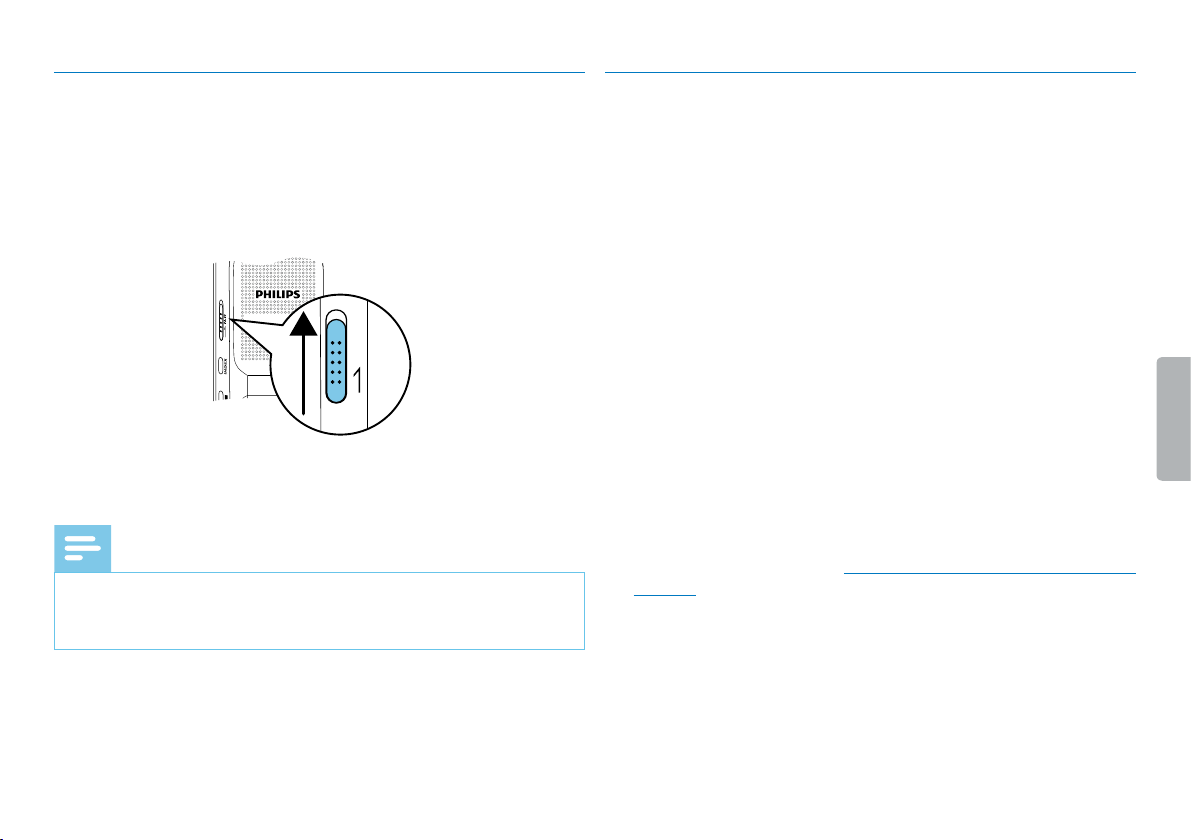
In stop mode, drag the switch on the side of the device upwards
into the position N.R.
N.R
2
Press the record key g to start recording.
X If this feature is on, the [ symbol is displayed.
Note
• Noise reduction is only possible with PCM recording quality €. If
you switch on noise reduction, the device automatically switches
to PCM recording quality €.
9.1.5 Setting the timer
You can use this function to start a recording at a specified date and
time. The device can record from the device's microphone or an
external microphone.
1
In stop mode (start-up screen), press MENU.
2
Press the h / b key to select the record settings menu Ó.
3
Press + / – to select the Timer function.
4
Press the record key, g, to confirm.
5
Press + / – to select the Set the begin function to set the alarm.
6
Press the record key, g, to confirm.
7
Press +/– to select the Set date function.
8
Press the record key, g, to confirm.
9
Set the date as described in (see also chapter 9.3.1 Set date & time,
page 34).
10
Press the record key, g, to confirm.
11
Press +/– to select the Set time function.
12
Press the record key, g, to confirm.
31
Settings
Table of contents
13
Set the time as described in (see also chapter 9.3.1 Set date & time,
page 34).
14
Press the record key, g, to confirm.
15
Press the stop key j.
16
Press + / – to select the Duration function to set the recording
duration.
17
Press the record key, g, to confirm.
18
Press + / – to set the required recording duration. Press no limit
for unlimited recording.
19
Press the record key, g, to confirm.
20
Press + / – to select the Record source function to set the sound
source.
21
Press the record key, g, to confirm.
22
Press + / – to select if the device should record from an internal
microphone or an external source.
23
Press the record key, g, to confirm.
24
Press the stop key j.
X The device will start recording at a specified time.
Tip
• Press the j key to cancel the operation without saving and return
to the stop mode.
9.1.6 Enabling/disabling voice-activated recording
If voice-activated recording is enabled, recording session will start
when you begin speaking. When you stop speaking, the device will
automatically pause recording after three seconds of silence, and
resume only when you begin speaking again.
Use the voice activation level to set the volume at which the device
should begin recording.
1
In stop mode (start-up screen), press MENU.
2
Press the h / b key to select the record settings menu Ó.
3
Press + / – to select the Voice Activation function.
4
Press the record key, g, to confirm.
5
Press + / – to select the On function.
6
Press the record key, g, to confirm.
X If this feature is on, the Š symbol is displayed.
7
Press + / – to select the Off function to turn o voice-activated
recording.
32 Settings
Table of contents
Tip
• Press the j key to cancel the operation without saving and return
to the stop mode.
9.1.7 Setting auto divide
You can automatically divide large recordings, such as a multi-hour
meeting recording. Once the set time has been reached, the device
stops the current recording and automatically starts a new one.
1
In stop mode (start-up screen), press MENU.
2
Press the h / b key to select the record settings menu Ó.
3
Press + / – to select the Auto divide function.
4
Press the record key, g, to confirm.
5
Press + / – to select if you want to record to a new file every 30 or
60 minutes, or turn o this feature.
6
Press the record key, g, to confirm.
7
Press the j key to exit the menu.
Tip
• Press the j key to cancel the operation without saving and return
to the stop mode.
9.1.8 Enabling/disabling the record indicator
This function allows you to switch o the status LED.
1
In stop mode (start-up screen), press MENU.
2
Press h / b to select the device settings menu Õ.
3
Press + / – to select the Record lamp function.
4
Press the record key, g, to confirm.
5
Press + / – to enable/disable the LED indicator.
6
Press the record key, g, to confirm.
7
Press the j key to exit the menu.
Tip
• Press the j key to cancel the operation without saving and return
to the stop mode.
33
Settings
Table of contents
9.2 Display settings
9.2.1 Select language
Note
• Your language might not be available. Select an alternative one.
1
In stop mode (start-up screen), press MENU.
2
Press the h / b key to select the display settings menu Ô.
3
Press + / – to select the Language function.
4
Press the record key, g, to confirm.
5
Use the + / – keys to select the display language you want.
6
Press the record key, g, to confirm.
7
Press the j key to exit the menu.
Tip
• Press the j key to cancel the operation without saving and return
to the stop mode.
9.2.2 Adjusting the display contrast
1
In stop mode (start-up screen), press MENU.
2
Press the h / b key to select the display settings menu Ô.
3
Press + / – to select the Contrast function.
4
Press the record key, g, to confirm.
5
Press h / b to select the required display contrast.
6
Press the record key, g, to confirm.
7
Press the j key to exit the menu.
Tip
• Press the j key to cancel the operation without saving and return
to the stop mode.
34 Settings
Table of contents
9.2.3 Enabling/disabling the background light
1
In stop mode (start-up screen), press MENU.
2
Press the h / b key to select the display settings menu Ô.
3
Press + / – to select the Backlit function.
4
Press the record key, g, to confirm.
5
Press + / – to select from the following settings: 8s, 20s, On.
6
Press the record key, g, to confirm.
7
Press the j key to exit the menu.
Tip
• Press the j key to cancel the operation without saving and return
to the stop mode.
9.3 Device settings
9.3.1 Set date & time
The date and time entered are saved with each recording as the
recording time.
1
In stop mode (start-up screen), press MENU.
2
Press h / b to select the device settings menu Õ.
3
Press + / – to select the Date/time function.
4
Press the record key, g, to confirm.
5
Press + / – to select the Set time format function.
6
Press the record key, g, to confirm.
7
Press + / – to switch between the 12/24-hour system.
8
Press the record key, g, to confirm.
9
Press + / – to select the Set date function.
10
Press + / – to set the year.
11
Press b.
12
Press + / – to set the month.
35
Settings
Table of contents
13
Press b.
14
Press + / – to set the day.
15
Press the record key, g, to confirm.
16
Press + / – to select the Set time function.
17
Press the record key, g, to confirm.
18
Press + / – to set the hours.
19
Press b.
20
Press + / – to set the minutes.
21
Press the record key, g, to confirm.
22
Press the j key to exit the menu.
Tip
• Press the j key to cancel the operation without saving and return
to the stop mode.
9.3.2 AUTO-OFF
The device switches o automatically if no key is pressed within a pre-
set period of time. This saves power.
1
In stop mode (start-up screen), press MENU.
2
Press h / b to select the device settings menu Õ.
3
Press + / – to select the Auto off function.
4
Press the record key, g, to confirm.
5
Press + / – to specify whether the device should turn o
automatically after
5, 15, 30 or 60 minutes' inactivity.
6
Press the record key, g, to confirm.
7
Press the j key to exit the menu.
Tip
• Press the j key to cancel the operation without saving and return
to the stop mode.
36 Settings
Table of contents
9.3.3 Enabling/disabling key and signal tones
1
In stop mode (start-up screen), press MENU.
2
Press h / b to select the device settings menu Õ.
3
Press + / – to select the Device sounds function.
4
Press the record key, g, to confirm.
5
Press + / – to enable/disable the key and signal tones.
6
Press the record key, g, to confirm.
7
Press the j key to exit the menu.
Tip
• Press the j key to cancel the operation without saving and return
to the stop mode.
37
Service
Table of contents
10 Service
Do not perform any maintenance operations that are not described in
this user manual. Do not disassemble the device into its component
parts to carry out repairs. The device may only be repaired in
authorised service centres.
10.1 Service functions
10.1.1 Display device information
1
In stop mode (start-up screen), press MENU.
2
Press h / b to select the device settings menu Õ.
3
Press + / – to select the Information function.
4
Press the record key, g, to confirm.
5
Press + / – to select the desired information.
6
Press the record key, g, to confirm.
X The display shows general device-related data: Recording
time in the selected memory, remaining recording time in the
selected memory, firmware version of the device.
7
Press the stop key j to return to the stop mode.
10.1.2 Memory formatting
Caution
• Formatting the memory deletes all recordings and files saved on
the device.
You can use this feature to delete all data and format the selected
memory.
1
Select the memory that you want to format (internal memory or
microSD card memory) (see also chapter 9.1.1 Set file location,
page 28).
2
In stop mode (start-up screen), press MENU.
3
Press h / b to select the device settings menu Õ.
4
Press + / – to select the Format memory function.
5
Press the record key, g, to confirm.
6
Press + / – to select the memory to be formatted.
7
Press the record key, g, to confirm.
8
Use + / – OK to select.
9
Press the record key, g, to confirm.
38 Service
Table of contents
Tip
• Press the j key to cancel the operation without saving and return
to the stop mode.
10.1.3 Device reset
This function is used to return all settings to the factory defaults.
Recordings and files are not deleted.
1
In stop mode (start-up screen), press MENU.
2
Press h / b to select the device settings menu Õ.
3
Press + / – to select the Reset default function.
4
Press the record key, g, to confirm.
5
Use + / – OK to select.
6
Press the record key, g, to confirm.
X All device settings will be reset to the factory defaults. You
must reset the display language, date and time (see also chapter 4.3
Initial installation process, page 15).
10.2 Replacing batteries or rechargeable batteries
Caution
• Do not remove batteries or rechargeable batteries from the device
while it is recording. If you do this, data may be damaged or lost.
Device malfunctions may also occur.
When the batteries are nearly empty, the battery indicator blinks; you
should replace them.
Proceed as described in 4.1 Inserting the batteries.
Note
• If it takes longer than 2 minutes to replace the batteries, you may
have to reset the time.
• Never try to recharge alkaline or non-rechargeable batteries.
• Batteries and rechargeable batteries contain substances that
may pollute the environment. Used batteries and rechargeable
batteries should be disposed of at an ocial collection point.

39
Service
Table of contents
10.3 Updating the firmware
Your device is controlled by an internal program called firmware. As
a part of ongoing product maintenance, the firmware is upgraded and
errors are corrected.
It is possible that a newer version (an "update") of the firmware has
been released since you purchased the device. In this case you can
easily update your device to the latest version.
You can find more information under www.voicetracer.com.
40 Service
Table of contents
10.4 Troubleshooting
Problem Possible cause/solution
The device does not turn on • The batteries or rechargeable batteries
are not inserted correctly.
X Check to ensure that the batteries
or rechargeable batteries are correctly
inserted. Make sure the polarity is
correct.
• Batteries are empty.
X Replace or recharge the batteries.
The device does not playback
recordings
• The keypad lock may be enabled.
X Slide the HOLD switch to the
"O" position.
• No recordings are saved in the device.
The device does not
respond.
Remove the batteries/rechargeable
batteries and insert them again.
microSD card can not be
selected as a recording
location
• There is no memory card in the device.
X Insert a memory card into the
device.
• Memory card is not formatted (file
sys tem FAT 32).
X Format the memory card in the
device.
Problem Possible cause/solution
I cannot hear anything from
the speaker.
• A headset is connected to the device.
• The volume is at the lowest setting.
The recording session does
not start
• The keypad lock may be enabled.
X Slide the HOLD switch to the
"O" position.
• The maximum number of recordings
may have been reached or the available
space for recording is full.
X Delete some recordings or move
them to an external device.
X Select another location folder.
I cannot hear anything from
the headphones.
• The headphones are incorrectly
connected.
X Check the headphone connection.
• The volume is at the lowest setting.
External microphone records
mono sound only
Switch external sound source to stereo
microphone.
41
Appendix
Table of contents
11 Appendix
The information in this user manual has been produced to the best of
our knowledge. It (particularly the technical data) may be modified or
updated at any time without prior notice.
11.1 Technical data
Technical data
Dimensions 40 × 118 × 20 mm
Weight 55 g (incl. batteries/rechargeable
batteries)
Batteries 2 × AAA alkaline batteries
USB connection High-speed 2.0, Micro-USB
USB input USB 5 V/DC ª, 500 mA
Microphone connection Stereo jack, 3.5 mm
Headset connection Stereo jack, 3.5 mm
Display 23 × 23 mm
Resolution: 112 × 112 pixels
Technical data
Internal memory NAND-Flash, 8 GB
Memory card microSD card
up to 32 GB SDHC
optimised for class 6 or higher
Recording format PCM – WAV, 1,536 kbits/s
HQ – MP3, 192 kbits/s
SP – MP3, 64 kbits/s
LP – MP3, 8 kbits/s
Music playback MP3, WMA
Bit rate: 8 – 320 kbps
no DRM
Speaker Frequency range: 750 – 18,000 Hz
Output: 110 mW
Recording time
Internal storage
PCM – 10 h
HQ – 90 h
SP – 272 h
SLP – 2164 h
Battery life Recording in LP mode (built-in memory /
microSD memory card)
40 h/18 h (alkaline batteries)

42 Appendix
Table of contents
Technical data
Sampling rate PCM – 48 kHz
HQ – 32 kHz
SP – 16 kHz
LP – 8 kHz
Radio FM stereo
Frequency range: 87.5 – 108 MHz
Memory capacity: 20 radio stations
System requirements Operating system: Windows, macOS
Temperature 5 ºC – 45 ºC / 41 ºF – 113 ºF
Humidity 10 % – 90 %
˜
The conformity with the relevant EU directives is confirmed by the CE
mark.
Declaration of Conformity
Speech Processing Solutions GmbH hereby declares that the device
fully comply with the basic requirements and other relevant provisions
of Directives 2006/95/EC, 2004/108/EC and 2009/125/EC.
A complete Declaration of Conformity for this product is available at
www.philips.com/dictation.
This product was manufactured using high-quality materials and
components which may be recycled and reused. Adhere to the
applicable statutory provisions, and only dispose of these products at
ocial collection points. The proper disposal of the device helps avoid
potential adverse impacts on environment and health.
— Ÿ
Packaging: Please observe the recycling and packaging provisions
applicable in your country.
Batteries: Used batteries should be disposed of at an ocial
collection point.
›

43
Appendix
Table of contents
Product: The crossed dustbin symbol on your product indicates that
special waste regulations shall apply to the electrical and electronic
equipment contained therein.
In keeping with the provisions of the EU Directive relating to the
disposal of waste electrical and electronic equipment and the
protection of the environment and the health, old devices which are
no longer required, may be disposed of as follows:
• Your dealer will take care of the old equipment when you buy a new
device from him.
• Used devices should be disposed of at an ocial collection point.
Neither Speech Processing Solutions GmbH nor its aliates shall be
liable to the purchaser of this product or third parties with respect to
claims for damages, losses, costs or expenses incurred by purchaser or
third parties as a result of an accident, misuse or abuse of this product
or unauthorized modifications, repair, modification of the product or
failure to meet the operating and maintenance instructions provided
by Philips.
This User Manual is a document with no contractual nature.
We accept no liability for changes, mistakes or printing errors.
Philips and the Philips Shield Emblem are registered trademarks of
Koninklijke Philips Electronics NV and are used by Speech Processing
Solutions under license from Koninklijke Philips Electronics NV.
Trademarks are the property of their respective owners.

© 2021 Speech Processing Solutions GmbH. All rights reserved.
Document Version 1.0, 2021/06/30