02
INFORMATION FOR YOUR SAFETY!
THE FCC REGULATION WARNING (for USA)
This equipment has been tested and found to comply with
the limits for a Class B digital device, pursuant to Part 15 of
the FCC Rules.
These limits are designed to provide reasonable protection
against harmful interference in a residential installation. This
equipment generates, uses, and can radiate radio frequency
energy and, if not installed and used in accordance with the
instructions, may cause harmful interference to radio
communications. However, there is no guarantee that
interference will not occur in a particular installation.
If this equipment does cause harmful interference to radio or
television reception, which can be determined by turning the
equipment off and on, the user is encouraged to try to
correct the interference by one or more of the following
measures:
Reorient or relocate the receiving antenna.
Increase the separation between the equipment and
receiver.
Connect the equipment into an outlet on a circuit different
from that to which the receiver is connected.
Consult the dealer or an experienced radio/TV technician
for help.
Unauthorized changes or modification to this system can
void the user's authority to operate this equipment.
PRECAUTIONS
PLEASE READ CAREFULLY BEFORE PROCEEDING
Please keep this manual in a safe place for future reference.
Power Supply
Please connect the designated AC adaptor to an AC outlet
of the correct voltage.
Do not connect it to an AC outlet of voltage other than that
for which your instrument is intended.
Unplug the AC power adaptor when not using the instru-
ment, or during electrical storms.
Connections
Before connecting the instrument to other devices, turn off
the power to all units. This will help prevent malfunction and
/ or damage to other devices.
Location
Do not expose the instrument to the following conditions to
avoid deformation, discoloration, or more serious damage:
Direct sunlight
Extreme temperature or humidity
Excessive dusty or dirty location
Strong vibrations or shocks
Close to magnetic fields
Interference with other electrical devices
Radios and televisions placed nearby may experience
reception interference. Operate this unit at a suitable
distance from radios and televisions.
Cleaning
Clean only with a soft, dry cloth.
Do not use paint thinners, solvents, cleaning fluids, or
chemical-impregnated wiping cloths.
Handling
Do not apply excessive force to the switches or controls.
Do not let paper, metallic, or other objects into the instru-
ment. If this happens, remove the electric plug from the
outlet. Then have the instrument inspected by qualified
service personnel.
Disconnect all cables before moving the instrument.
CAUTION
The normal function of the product may be disturbed
by Strong Electro Magnetic Interference. If so, simply
reset the product to resume normal operation by
following the owner's manual. In case the function
could not resume, please use the product in other
location.

Contents
Panel Description
Front Panel............................................................................4
Rear Panel............................................................................4
LCD Display...........................................................................5
Setup
Setting a Music Stand...........................................................6
Power Supply........................................................................6
Connections
Connecting a pair of Headphones.........................................7
Connecting an Audio Equipment...........................................7
Connecting a MP3/CD Player...............................................7
Connecting a PC or an MIDI Device.....................................7
Connecting a Foot Switch.....................................................8
Connecting a Unit Pedal.......................................................8
Connecting a Microphone.....................................................8
Quick Start
Power Switch and Master Volume........................................9
Playing Demo Songs.............................................................9
Playing Voices.......................................................................9
Playing Styles......................................................................10
Playing Songs.....................................................................10
Record.................................................................................10
Advanced Use
Playing Voices.....................................................................11
Select and Play Main Voice.................................................11
Playing Two Voices Simultaneously-DUAL.........................11
Playing Different Voices with Both Hands-LOWER.............11
Touch Sensitivity..................................................................12
Sustain................................................................................12
Pitch Bend...........................................................................12
Transpose...........................................................................13
Piano mode.........................................................................13
Twinova
Octave.................................................................................14
Auto Accompaniment
Playing Auto Accompaniment(rhythm track only)................15
Playing Auto Accompaniment(all tracks).............................15
Accompaniment Sections....................................................15
Playing Different Accompaniment Sections.........................16
Accompaniment Volume Control.........................................16
Chord Fingering..................................................................17
Tempo.................................................................................18
Fade In/Out.........................................................................18
Metronome..........................................................................18
One Touch Setting...............................................................18
Mixer...................................................................................19
Harmony
Harmony Switch..................................................................20
Playing with harmony effect................................................20
Performance Assistant
What’s the Performance Assistant?....................................20
Enter the Performance Assistant.........................................20
Guitar Mode........................................................................21
Playing in Guitar Mode........................................................21
Piano Mode.........................................................................22
Playing in Piano Mode........................................................22
Exit the Performance Assistant...........................................22
DSP.....................................................................................23
Pedal Function..................................................................23
Function Menu
Tune....................................................................................24
Split Point............................................................................24
Beat Type............................................................................25
Pedal Type..........................................................................25
EQ Type..............................................................................25
Reverb Type........................................................................26
Reverb Level.......................................................................26
Chorus Type........................................................................26
Chorus Level.......................................................................27
Harmony Type.....................................................................27
MIDI IN................................................................................28
MIDI OUT............................................................................28
Auto Power Off....................................................................28
Registration Memory
Registering the Panel Setting..............................................29
Recalling the Registered Panel Settings.............................29
Selecting a Registration Bank.............................................29
Record
Start Recording...................................................................30
Select a Track.....................................................................30
Stop Recording...................................................................31
Playback Recording............................................................31
Delete User Song ...............................................................31
Song
Listening to the Songs.........................................................32
Song Control.......................................................................32
Lesson Mode
Lesson 1..............................................................................33
Lesson 2..............................................................................33
Lesson 3..............................................................................33
Chord Dictionary
DICT 1 (Chord Learning Mode)...........................................34
DICT 2 (Chord Examining Mode)........................................34
Connecting a USB Device
USB Device Operation........................................................35
Play......................................................................................35
Load....................................................................................35
Save....................................................................................36
Delete..................................................................................36
Format.................................................................................37
Keyboard and ASCII Character Relative Table...................37
MIDI Functions
What's MIDI?.......................................................................38
Restore Factory Setting
Restore Factory Setting......................................................39
Restore the Registered Panel Settings...............................39
Delete User Songs..............................................................39
Troubleshooting ...............................................................39
Specifications....................................................................40
Appendices
Voice List.............................................................................41
Style List..............................................................................47
Song List.............................................................................49
Demo List............................................................................50
MIDI Implementation Chart .................................................51
03
PITCH BEND
PERFORM. METRONOME
ACCOMP
MELODY 1
MELODY 2
MELODY 3
MELODY 4
MELODY 5
TWINOVA
SUSTAIN
TOUCH
PERFORM
PERFORM.H
PIANO
VOICE STYLE
SONG
SHIFT DEMO
PERFORM. METRONOME
ACCOMP
MELODY 1
MELODY 2
MELODY 3
MELODY 4
MELODY 5
PIANO
SHIFT
PERFORM. METRONOME
PIANO
SHIFT
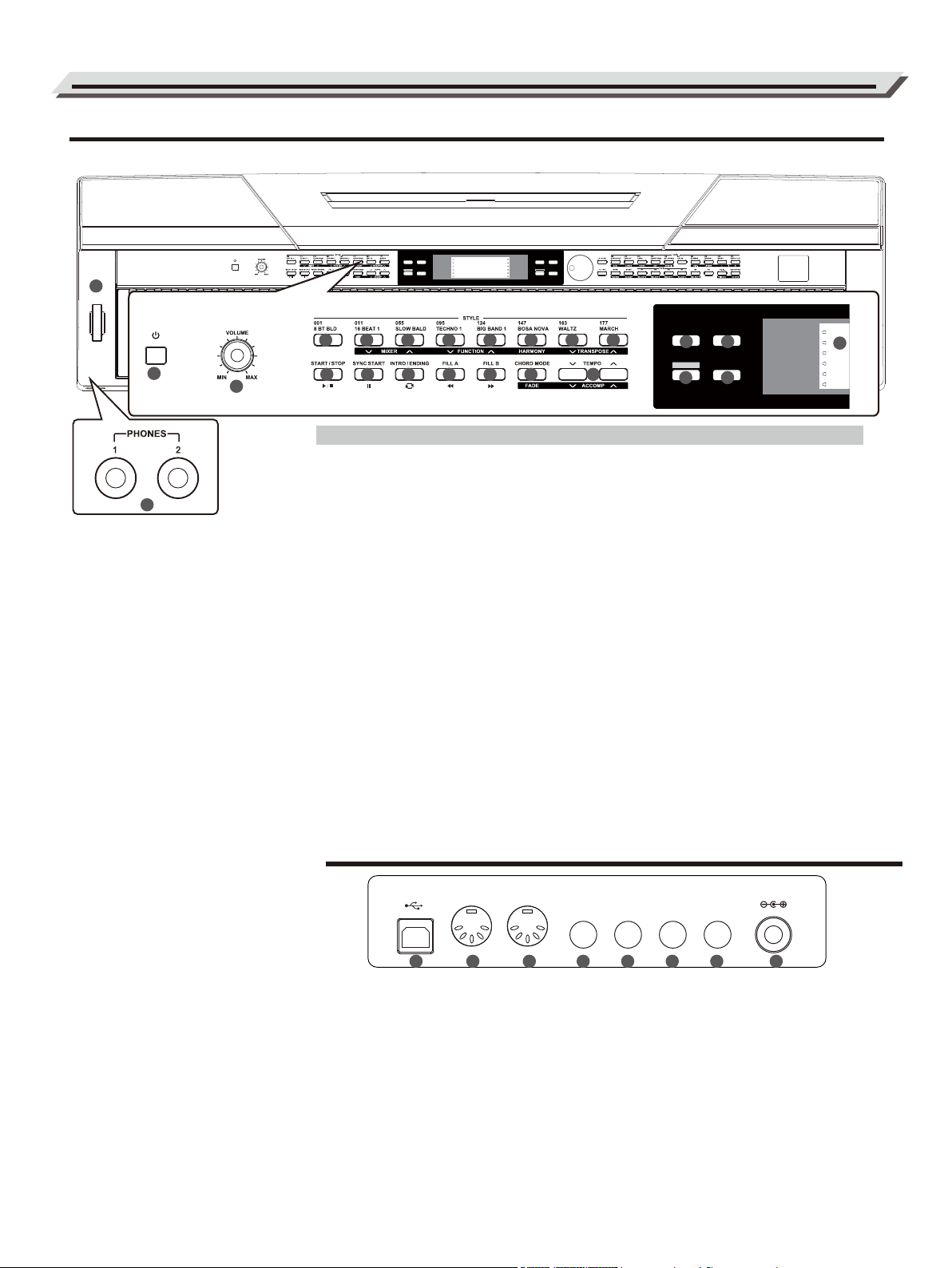
Panel Description
Front Panel
Rear Panel
1. [POWER] Switch
Turn the power on or off.
2. [VOLUME] Knob
Adjust the master volume.
11. [PERFORM] Button
Turn the performance assistant
function on or off.
12. [METRONOME] Button
Turn the metronome on or off.
13. [START/STOP] Button
Start/Stop playing the song
or style.
14. [SYNC START] Button
Turn the Sync Start function on
or off.
15. [INTRO/ ENDING] Button
Play the Intro or Ending.
16. [FILL A] Button
Fill-in variation A section.
17. [FILL B] Button
Fill-in variation B section.
20. [SHIFT] Button
Press and hold [SHIFT], then
press other button enables you to
execute various commands.
21. [PIANO] Button
Turn the piano mode on or off.
When the [SHIFT] button is released
3~10. STYLE DIRECT SELECT Buttons
Select a preset style directly.
18. [CHORD MODE] Button
Choose the chord mode.
19. [TEMPO -] / [TEMPO +] Button
Adjust the current Tempo value.
When the [SHIFT] button is pressed
4~5. [MIXER -] / [MIXER +] Button
Enter the Mixer menu.
6~7. [Function -] / [Function +] Button
Enter the Function menu.
8. [HARMONY] Button
Turn the Harmony effect on or off.
9~10. [TRANSPOSE -] / [TRANSPOSE +]
Button
Enter the Transpose setting.
18. [FADE] Button
Turn the Fade In/Out function on or off.
19. [ACCOMP -] / [ACCOMP +] Button
Adjust the accompaniment volume value.
22. LCD
Display all the parameters and
values related to the currently
selected operation and mode of the
piano.
50. PITCH BEND
Roll the wheel upward or downward
to raise or lower the pitch variations.
51. Phones
Connect stereo headphones with a
¼” stereo phone plug.
1. USB Terminal
Connect to a PC.
2. MIDI OUT Jack
Connect an external MIDI device.
3. MIDI IN Jack
Connect an external MIDI device.
4. SUSTAIN Jack
Connect a sustain pedal.
5. AUX OUT Jack
Connect the audio equipment.
6. AUX IN Jack
Connect some external audio source,
such as MP3 or CD player.
7. MIC Jack
Connect a microphone with a ¼” stereo
phone plug.
8. DC 12V Jack
Connect the DC 12V power adapter.
04
50
51
1
11
2
20
12
13
14 15
16
17
18
19
5
6
7
8
9
10
43
21
22
USB MIDI OUT MIDI IN SUSTAIN AUX OUT AUX IN MIC DC IN
1
2
5
6
7
8
4
3
PITCH BEND
PERFORM. METRONOME
ACCOMP
MELODY 1
MELODY 2
MELODY 3
MELODY 4
MELODY 5
TWINOVA
SUSTAIN
TOUCH
PERFORM
PERFORM.H
PIANO
VOICE STYLE
SONG
SHIFT DEMO
VOICE STYLE
SONGDEMO
TWINOVA
SUSTAIN
TOUCH
PERFORM
PERFORM.H
VOICE STYLE
SONGDEMO
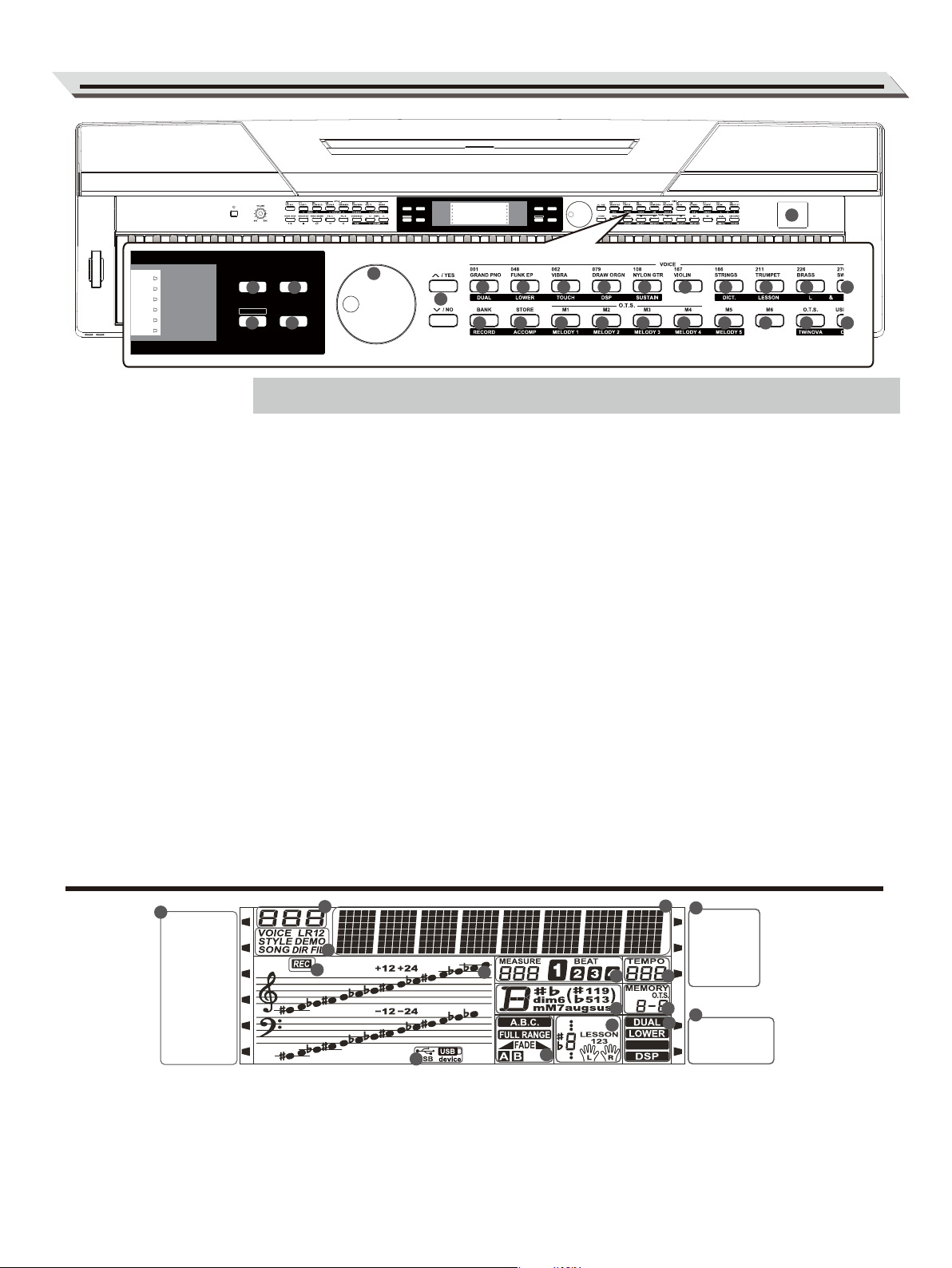
Panel Description
23. [VOICE] Button
Switch to voice mode.
24. [STYLE] Button
Switch to style mode.
25. DATA DIAL
Adjust the parameter
value.
26. [+/YES] / [ -/NO] Button
Select operation of the
parameter value currently.
37. [DEMO] Button
Start/Stop demo playback.
38. [SONG] Button
Enter the song mode.
49. USB Device
Connect to USB Device.
When the [SHIFT] button is
released
27-36. VOICE DIRECT SELECT
Buttons
Select a preset voice directly.
39. [BANK] Button
Switch between memory
banks.
40. [STORE] Button
Save the registered panel
settings.
41~46. [M1]~[M6] Buttons
Recall the registered panel
settings.
In O.T.S. mode, only M1-M4
are available.
47. [O.T.S.] Button
Turn the One Touch Setting
function on or off.
48. [USB Device] Button
Enter the USB Device menu.
When the [SHIFT] button is pressed
27. [DUAL] Button
Turn the dual function on
or off.
28. [LOWER] Button
Turn the lower function on
or off.
29. [TOUCH] Button
Set an appropriate touch
sensitivity level.
30. [DSP] Button
Turn the DSP function on
or off.
31. [SUSTAIN] Button
Turn the sustain function
on or off.
32. [DICT] Button
Turn the chord dictionary
function on or off.
34. [LESSON] Button
Enter/Exit the lesson mode.
35. LEFT HAND Button
Choose the left hand in
Lesson mode.
36. RIGHT HAND Button
Choose the right hand in
Lesson mode.
39. [RECORD] Button
Enter the record mode.
40. [ACCOMP] Button
Select the accompaniment
track to record.
41~45. MELODY 1-5 Button
Select the melody 1-5 track
to record.
47. [TWINOVA] Button
Turn the TWINOVA function
on or off.
48. [OCTAVE] Button
In TWINOVA mode, adjust
the octave value.
1. ACCOMP/ MELODY 1-5
2. SERIES NUMBER
3. VOICE/STYLE/DEMO/SONG/DIR/FILE
4. STRING
5. RECORD
6. TREBLE/BASS CLEF
7. USB CABLE/USB DEVICE
8. MEASURE/BEAT
9. TEMPO
10. CHORD
11. MEMORY NUMBER/ONE TOUCH SETTING
12. A.B.C./FULL RANGE/FADE/SECTION
13. NOTE INDICATION/LESSON
14. DUAL/LOWER/HARMONY/DSP
15. PERFORM/PERFORM.H
16. TWINOVA/SUSTAIN/TOUCH
05
LCD Display
24
27
26
28 29 30 31 32 33 34 35 36
37 38
23
25
39 40 41 42 43 44 45
46
47 48
49
ACCOMP
MELODY 1
MELODY 2
MELODY 3
MELODY 4
MELODY 5
TWINOVA
SUSTAIN
TOUCH
PERFORM
PERFORM.H
HARMONY
1
2
5
6
4
8 9
10
13
14
15
16
11
3
7
12
Setup
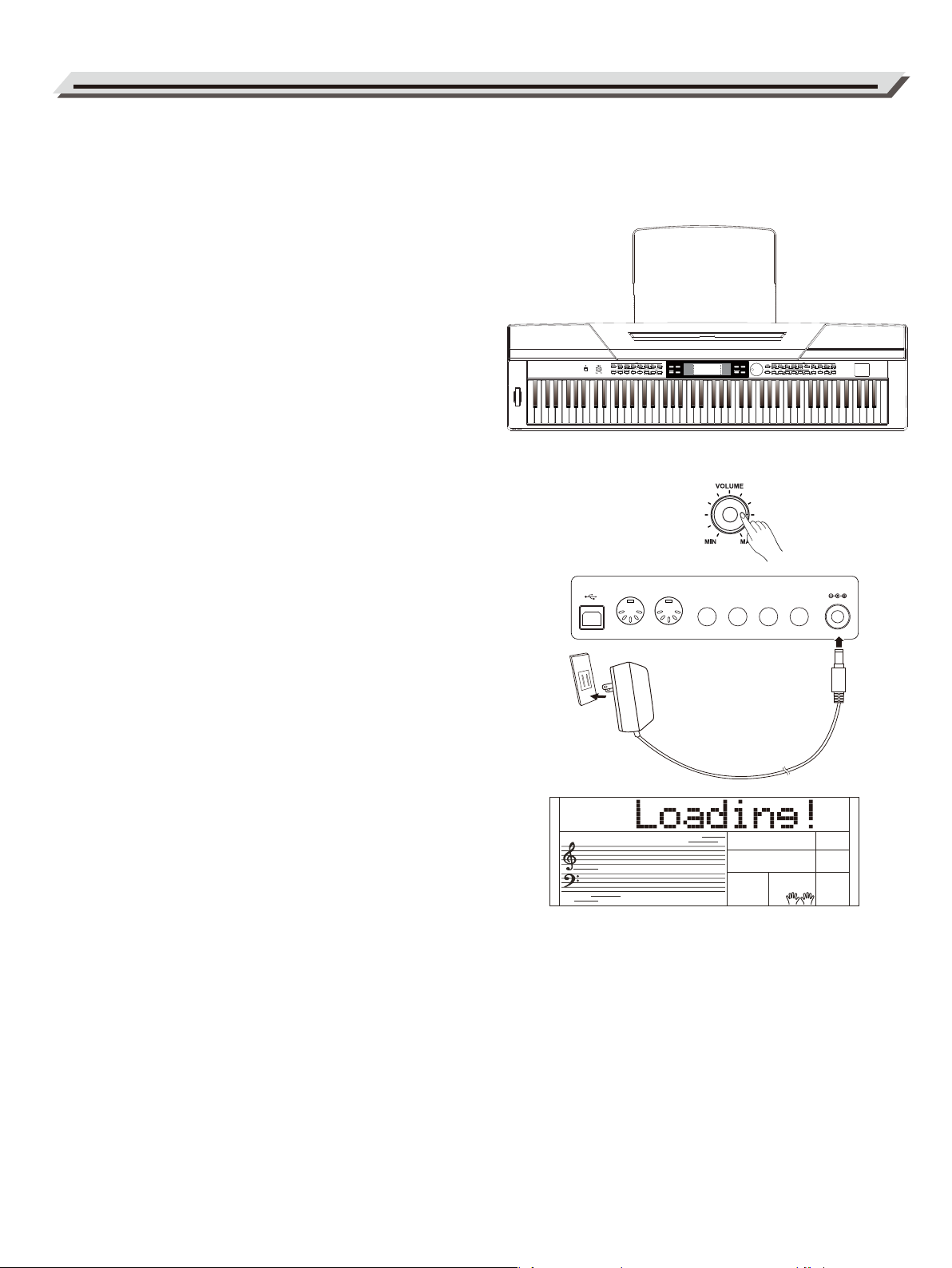
Please use the specified AC adapter, 12V DC output, also pay
attention to the polarity when connecting to one end of the AC
adapter.
Note:
1. Never attempt to use an AC adapter other than the specified type,
otherwise it may cause a fire or electrical shock.
2. For your safety, please disconnect the power when the piano is not
used or during a thunderstorm.
Setting a Music Stand
Follow the image on the right, insert the bottom of the music stand
into the groove on the top of the instrument`s console.
Power Supply
1. Turn down the volume of this instrument and all audio equipment
connected.
2. Connect the power cable to the AC outlet.
3. Plug the AC adapter into the AC outlet.
4. Press the POWER switch, the LCD will display “Loading!”, which
indicates the piano has been powered on.
5. Press the [POWER] switch for a short while until the LCD off,
which indicates the piano has been powered off.
Note:
1. The piano will shut down automatically in 30 minutes later if you do
not take any action on the piano. Please refer to the “Auto Power
Off” for details.
2. For your safety, please remove the electric plug from the outlet
when the piano is not to be used for extended periods or during the
thunderstorm.
06
USB MIDI OUT MIDI IN SUSTAIN AUX OUT AUX IN MIC DC IN
PITCH BEND
PERFORM. METRONOME
ACCOMP
MELODY 1
MELODY 2
MELODY 3
MELODY 4
MELODY 5
TWINOVA
SUSTAIN
TOUCH
PERFORM
PERFORM.H
PIANO
VOICE STYLE
SONG
SHIFT DEMO
PITCH BEND
PERFORM. METRONOME
ACCOMP
MELODY 1
MELODY 2
MELODY 3
MELODY 4
MELODY 5
TWINOVA
SUSTAIN
TOUCH
PERFORM
PERFORM.H
PIANO
VOICE STYLE
SONG
SHIFT DEMO
Connecting a pair of Headphones
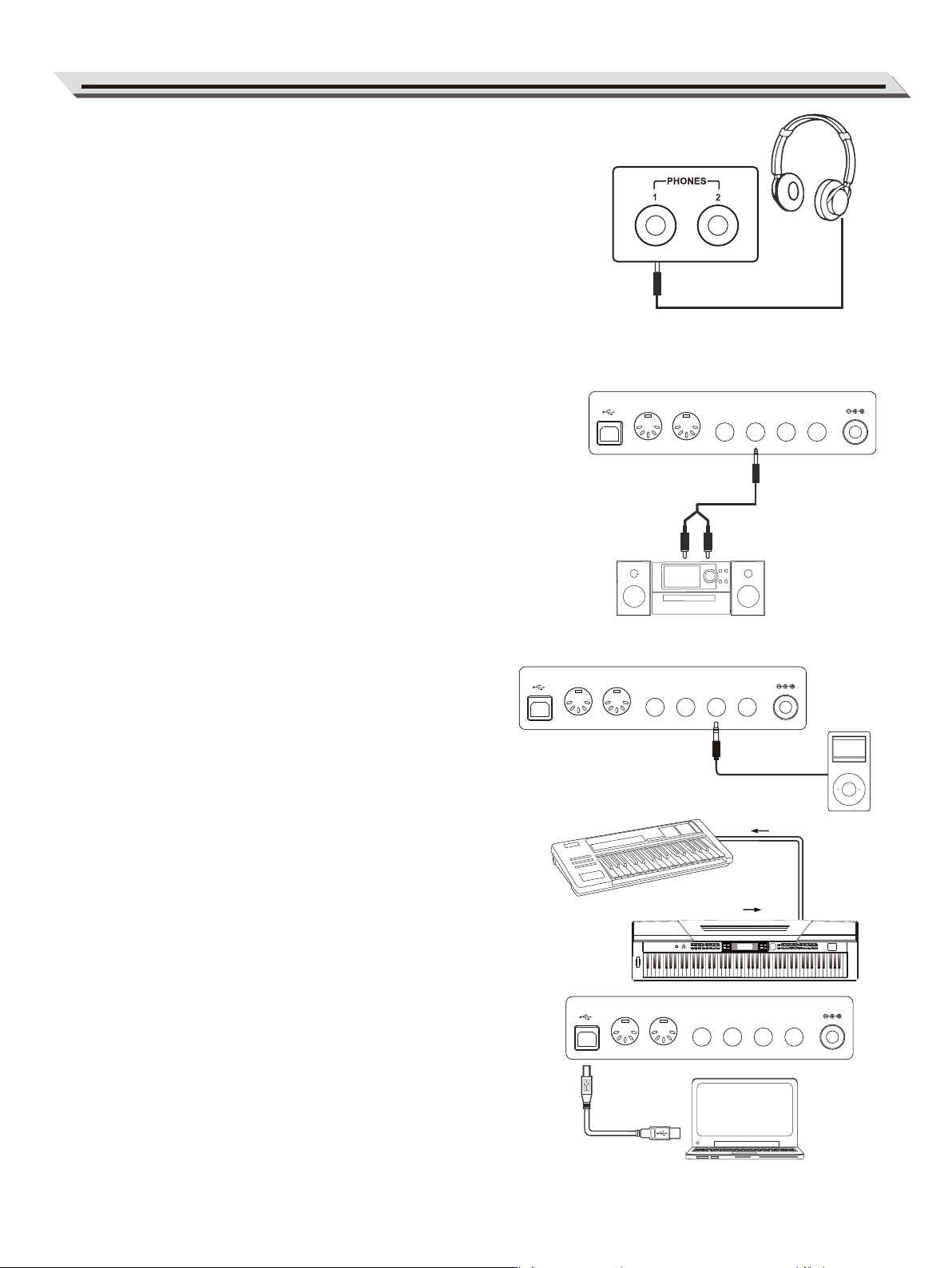
A standard pair of stereo headphones can be plugged in here for
private practice or late-night playing.
Jack 1: When a pair of headphones is plugged into the jack 1, the
sound can be heard from both headphones and speakers of the
instrument.
Jack 2: When a pair of headphones is plugged into the jack 2, the
internal stereo speaker system is automatically shut off. The sound
can only be heard from headphones.
Note:
Listening at excessively high volume levels will not only damage the
headphones, but may also cause hearing loss. Use the headphones
at a moderate volume level.
Connecting an Audio Equipment
The rear-panel AUX OUT jack delivers the output of the instrument
for the connection to a keyboard amplifier, stereo sound system, a
mixing console, or a tape recorder.
Use an audio cable to plug into the AUX OUT jack, which is located
on the rear board then plug the other end of the cord into AUX IN of
the amplifier.
Note:
To avoid damaging the speakers, please ensure that the volume has
been set to the minimum level before connecting to the power and
other devices.
Connecting a MP3/CD Player
Connect the audio output of an MP3/CD player or other audio
source to the stereo AUX IN jack on the rear panel.
The input signal is mixed with the piano signal so as to play along.
Connecting a PC or an MIDI Device
MIDI OUT Connector
Connect the instrument MIDI OUT terminal to the MIDI IN terminal
of external device via the MIDI cables. All performance data will be
transmitted from this connector to connected PC or MIDI devices.
This instrument will be used as the MIDI controller. Namely the
external sound source can be used through this instrument.
MIDI IN Connector
Connect the MIDI IN terminal to PC or the MIDI OUT terminal of
external device with MIDI cables. In order to be used as a sound
source, all the performance data will be transmitted from other MIDI
devices to the instrument.
USB Connector
By connecting the USB terminal to PC, the data will be transmitted
between the instrument and the PC via the USB cables.
For example, you can save your instrument performance data in the
PC and playback the saved MIDI file by piano.
Note:
Please do not set the USB audio to be input and output simultane-
ously when you are setting the software on the PC. Otherwise the
sound will be overlapped when play the keyboard.
Connections
07
MIDI OUTMIDI IN MIDI OUTMIDI IN
MIDI OUT MIDI IN
USB MIDI OUT MIDI IN SUSTAIN AUX OUT AUX IN MIC DC IN
USB MIDI OUT MIDI IN SUSTAIN AUX OUT AUX IN MIC DC IN
USB MIDI OUT MIDI IN SUSTAIN AUX OUT AUX IN MIC DC IN
Connecting a Foot Switch
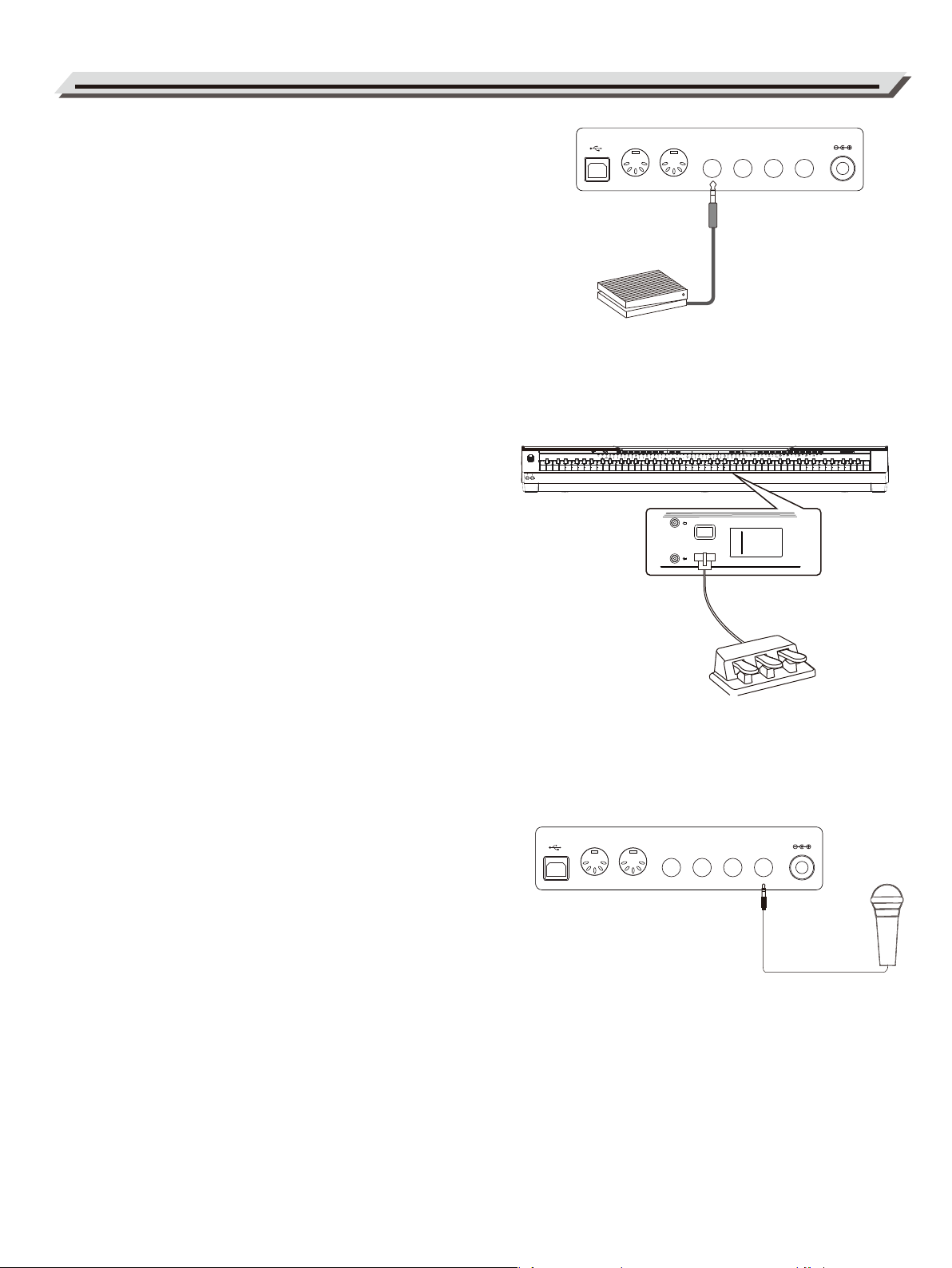
To achieve a natural effect, step on the sustain switch when playing.
Plug an supplied foot switch into this jack and use it to switch
sustain on or off.
You can assign other pedal functions to the sustain pedal. Please
refer to the Function Menu for details.
Note:
1. This instrument supports not only the foot switch we supply, but
also those with other brands.
2. Please make sure the power is off when connecting the pedal
with other brands, otherwise the sequence of switch on/off will be
reversed when turning the piano on.
Connecting a Unit Pedal
To simulate a real piano, the unit pedal can be connected to the
pedal terminal at the rear bottom of the piano.
It contains three functional pedals: Sustain, Sostenuto, Soft.
Sustain Pedal
Use this pedal to sustain the sound.It also supports the half-pedal
operation. Performing with the sustain pedal will achieve a smoothly
effect.
Sostenuto Pedal
This pedal sustains only the sounds of the keys that were already
played when you pressed the pedal.
Soft Pedal
This pedal is used to make the sound softer. You can assign other
pedal functions to the soft pedal. Please refer to the Function Menu
for details.
Note:
The unit pedal needs to be purchased separately.
Connecting a Microphone
By connecting a microphone, you can enjoy singing along with your
keyboard performance or with Song playback (KARAOKE).
1. Before turning the power on, set the master volume to minimal
value.
2. Plug the microphone into the [MIC] jack at the rear of the
instrument.
3. Turn the power on. Adjust the master volume value while singing
through the microphone.
Connections
08
USB MIDI OUT MIDI IN SUSTAIN AUX OUT AUX IN MIC DC IN
USB MIDI OUT MIDI IN SUSTAIN AUX OUT AUX IN MIC DC IN
1 2
PHONES

VOICE
START / STOP
DEMO
MIN MAX
VOLUME
Power Switch and Master Volume
Power Switch
1. Please make sure you have connected the instrument with power
correctly.
2. Press the [POWER] switch, the LCD screen lights up, and displays
“Loading!”, it indicates the instrument is powered on.
Note:
Press the POWER switch, if the LCD screen does not light up, please
check the power connection.
Adjust the Master Volume
After starting, rotate the [VOLUME] knob clockwise, the master volume
will increase and vice verse . It can be adjusted as required.
Note:
If the keyboard is in silent, that means the volume has been adjusted to
its minimum level or the jack 2 of headphone has been connected.
Playing Demo Songs
This instrument features 5 wonderful demos with different characters.
(Please refer to the Demo List for details.)
1. Press the [DEMO] button
Enter the main interface of demo playing back, the LCD displays
current demo number and name, meanwhile, all demo songs will play
in circle.
2. Select Demo Songs
Use the data dial or the [+/Yes]/ [-/No] button to select a demo song.
3. Press the [START/STOP] button
Press the [DEMO] or [START/STOP] button to stop playing and exit
demo mode.
Playing Voices
The keyboard has 600 remarkably realistic built-in voices, including
Piano, Guitar, Saxophone, Drum Kits and many more. Please refer to
Voice List.
1. Press the [VOICE] button
Enter the Voice mode. The LCD displays the current default voice
name and number.
2. Select a Voice.
Use the data dial or the [+/Yes]/ [-/No] button to select the voice you
need. You can also use the voice direct buttons to select the desired
voice.
3. Play the Voice.
Play the keyboard and listen to the wonderful voice.
Quick Start
09
/ YES
/ NO
/ YES
/ NO
BANK
RECORD
SHIFT
STYLE
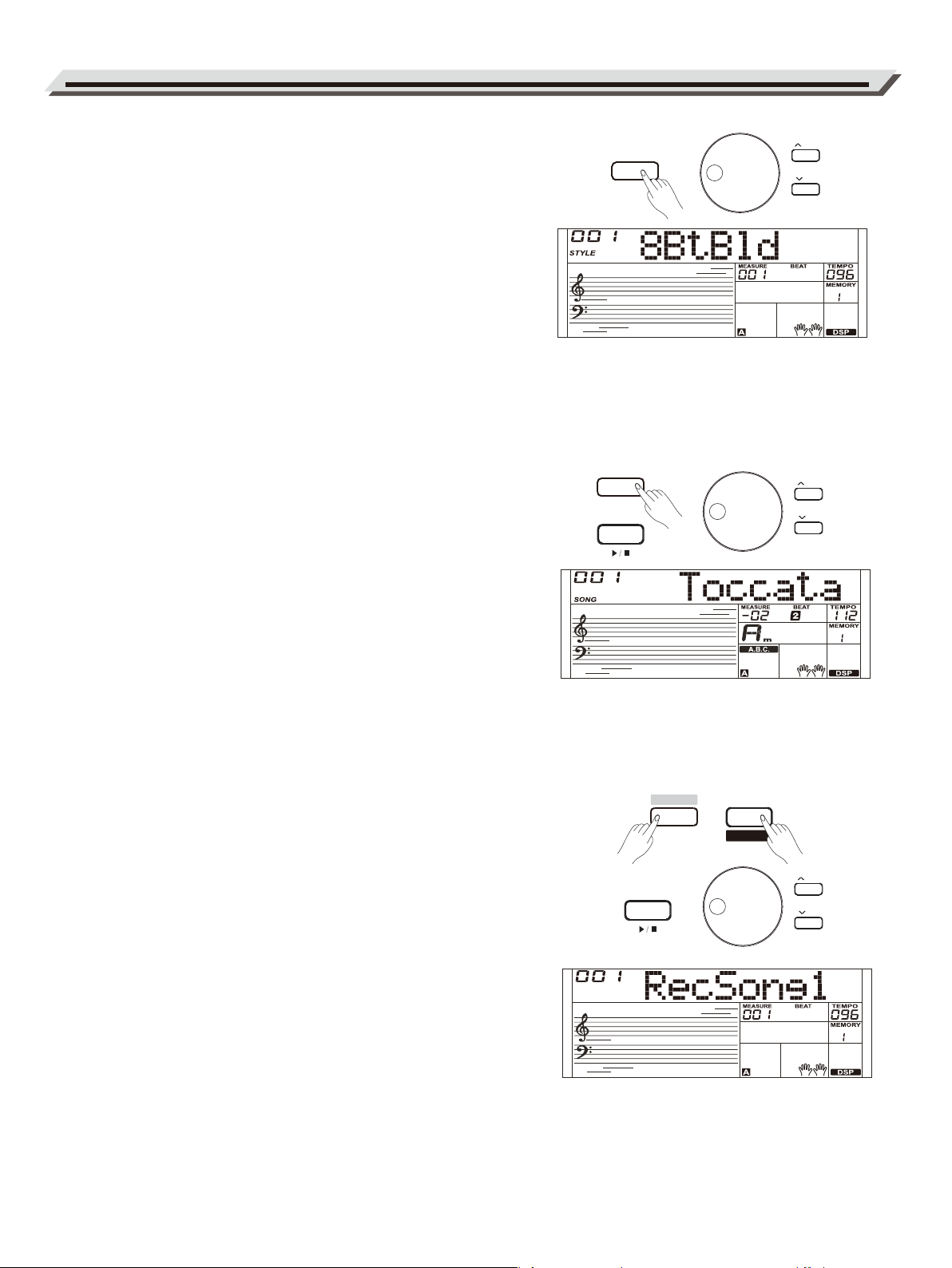
Playing Styles
The instrument features 230 styles in a variety of different musical
genres, and 10 more user styles in addition to this. Try to select
different styles and playing with the auto accompaniment.(Please refer
to the Style List for details.)
1. Press the [STYLE] button
Enter the Style Mode. The LCD displays the current default style
name and number.
2. Select a Style
Use the data dial or the [+/Yes]/ [-/No] button to select the style you
need. You can also use the style direct buttons.
3. Play the Style.
Press the [START/STOP] button, directly start a rhythm playing.
Playing Songs
This instrument features 120 preset songs, and 5 more user songs in
addition to this. Each preset song can be practiced in learning mode.
1. Press the [SONG] button
Enter the song selection mode. It will play all songs in circle.
2. Select a song
Use the data dial or the [+/YES]/ [-/NO] button to select the song
you want.
3. Press the [START/STOP] button, it will stop playing. Press the
button again, it will play the selected song in circle.
4. When the song stops, press either [STYLE] or [VOICE] button to
exit the song mode.
Record
This instrument can record up to 5 user songs.
1. Holding down the [SHIFT] button and press the [RECORD] button to
enter the user song mode, use the data dial or the [+/YES]/[-/NO]
button to select a user song to be saved.
2. Holding down the [SHIFT] button and press the [RECORD] button to
enter the record standby mode, select the voice, style or other
parameters to prepare for recording.
3. Press the [START/STOP] button or playing a key on the keyboard to
start recording.
4. When recording is in process, holding down the [SHIFT] button and
press the [RECORD] button, it will stop recording and exit the
record mode, then the current recorded song will play automatically
in circle.
5. Press the [SONG] button to select the user song:121~125 for
playing back after exiting the record mode.
Quick Start
10
SONG
START / STOP
START / STOP
/ YES
/ NO
/ YES
/ NO
/ YES
/ NO
LOWER
DUAL
Playing Voices
This instrument features 600 preset voices (Please refer to the Voice List
for details). In order to offer you a better performance experience, we
supply some useful effects which can be inserted while playing voices.
Select and Play Main Voice
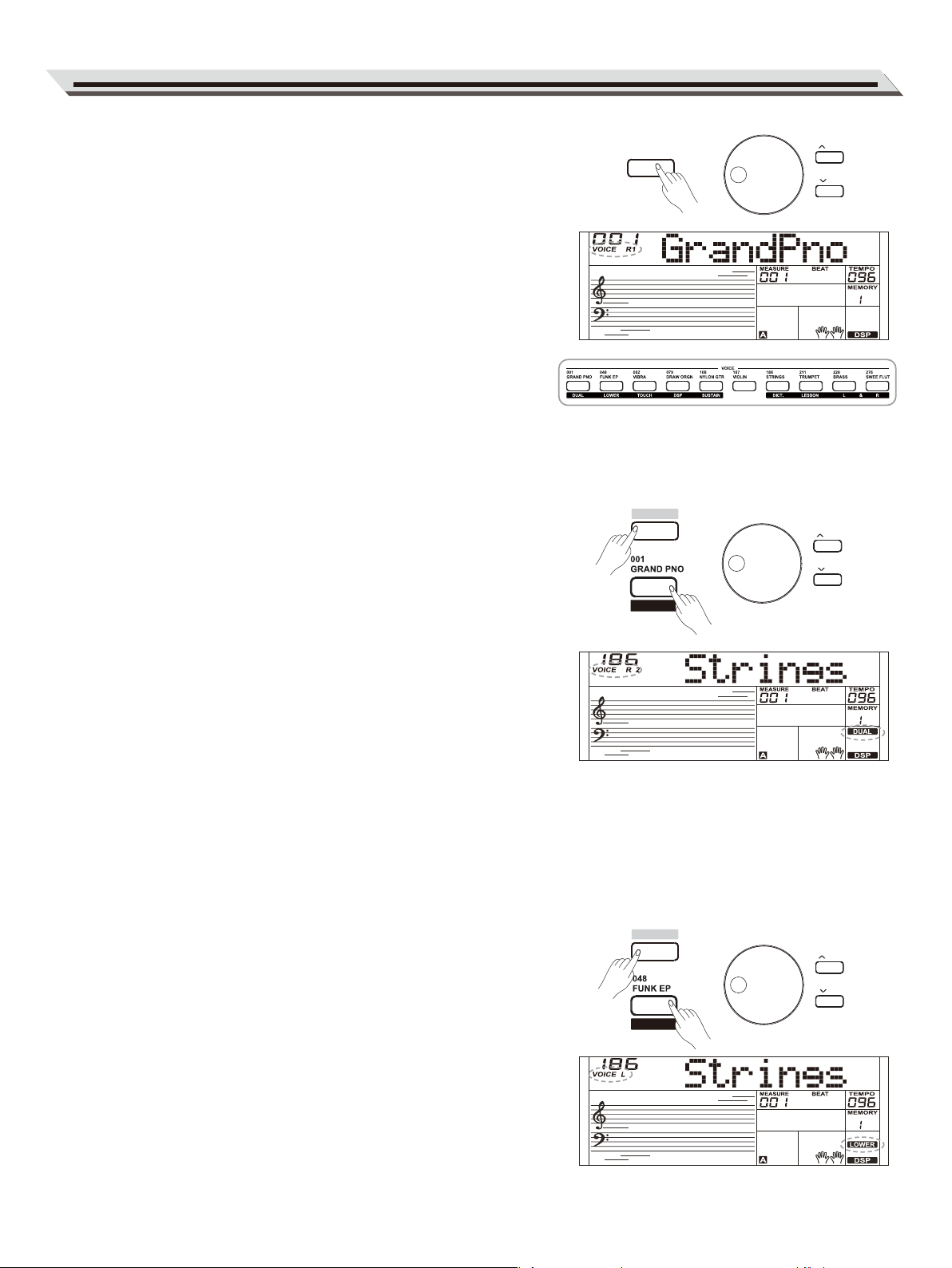
1. Press the [VOICE] button or the voice direct button to enter the VOICE
mode. The LCD displays “VOICE R1” and the current voice name and
number.
2. Select a voice
Use the data dial, or the [+/YES] / [-/NO] button to select the voice you
want, also use the voice direct button.
3. Play the voice
You can play the keyboard and hear the wonderful voice.
Note:
When the DUAL and LOWER function is on, you can press [VOICE]
button repeatedly to choose the voice source. The corresponding LCD
indication will highlight between R1, R2, and L1.
Playing Two Voices Simultaneously-DUAL
This instrument supports dual function. This function allows two sounds
to be layered together, creating a more rich sound. Once you turn the
function on, the voice indicated “VOICE R2”, when the dual function is
off, the voice indicated “ VOICE R1”.
1. Holding down the [SHIFT] button and press the [DUAL] button to turn
the dual function on. The LCD displays DUAL and VOICE 2 will light
up, which indicates the name and number of DUAL.
2. Use the data dial or the [+/YES]/ [-/NO] button to select the dual voice
you need, also use the voice direct buttons.
3. Play the keyboard, two different voices to be layered together will be
heard simultaneously. It seems like two different instruments playing at
the same time.
4. Holding down the [SHIFT] button and then press the [DUAL] button
again to turn dual function off.
Note:
When the keyboard has been split, only the right hand area will respond
to the dual voice, the left hand will not respond to it.
Playing Different Voices with Both
Hands-LOWER
The lower function splits the keyboard into right and left areas to create
two different voices. The left section voice is lower voice. A desired split
point can be assigned on the keyboard.
1. Holding down the [SHIFT] button and press the [LOWER] button to
turn LOWER function on. The LCD displays VOICE L and LOWER
will light up, which indicates the name and the number of LOWER.
2. Use the [+/YES]/[-/NO] or voice direct buttons to select the lower voice
you want.
3. Play the keyboard.
Different voices will be heard between the right-hand and left-hand
area.
Advanced Use
11
VOICE
SHIFT
SHIFT
/ YES
/ NO
/ YES
/ NO
/ YES
/ NO

PITCH BEND
PERFORM. METRONOME
ACCOMP
MELODY 1
MELODY 2
MELODY 3
MELODY 4
MELODY 5
TWINOVA
SUSTAIN
TOUCH
PERFORM
PERFORM.H
PIANO
VOICE STYLE
SONG
SHIFT DEMO
4. Holding down the [SHIFT] button and press the [LOWER] button
again turns LOWER function off.
Split Point
The point on the keyboard which separates voice L and voice R1/R2 is
called the “split point”. The split point is default set to F#3(34).
However you can set the split point to any key you want.
(Please refer to “Split Point Setting” part for details)
Touch Sensitivity
The instrument is equipped with a touch response feature which lets
you dynamically and expressively control the level of the voice with
your playing strength just as on an acoustic instrument. The instru-
ment features 3 touch types to be chosen: off,1,2,3.
1. Holding down the [SHIFT] button and press the [TOUCH] button to
enter touch settings. The LCD displays the touch setting number.
The default number is 2.
2. Choose a touch type
When the LCD displays touch setting, using the[+/YES]/ [-/NO]
button or data dial or while hold down the [SHIFT] button, press the
[TOUCH] button to change touch type. Pressing the[+/YES] and
[-/NO] buttons simultaneously will restore the touch value to its
default setting: 2.
3. Turn the touch function off
If the LCD displays “OFF Touch”, that means no touch response on
the keyboard.
Sustain
1. Holding down the [SHIFT] button and press the [SUSTAIN] button
to turn sustain function on. All notes will sustain even after
releasing the keys.
2. Holding down the [SHIFT] button and press the [SUSTAIN] button
again to exit the sustain function.
Note:
In order to achieve a natural sustain effect, use the sustain pedal.
Pitch Bend
Use the pitch bend wheel to bend notes up (roll the wheel away from
you) or down (roll the wheel toward you) while playing the keyboard.
The pitch bend wheel is self-centering and will automatically return to
normal pitch when released. Use the pitch bend wheel to imitate the
guitar, violin, saxophone, urheen, suona and pitch bend effect of other
instruments for making your performance more vivid.
Advanced Use
12
Default Split Point:F#3A0
SHIFT
SHIFT
PITCH BEND
TOUCH
TOUCH
TOUCH
SUSTAIN
SUSTAIN
/ YES
/ NO
Transpose
Transpose function allows the overall pitch of the instrument to be
transposed up or down by a maximum of one octave in semitone
increments.
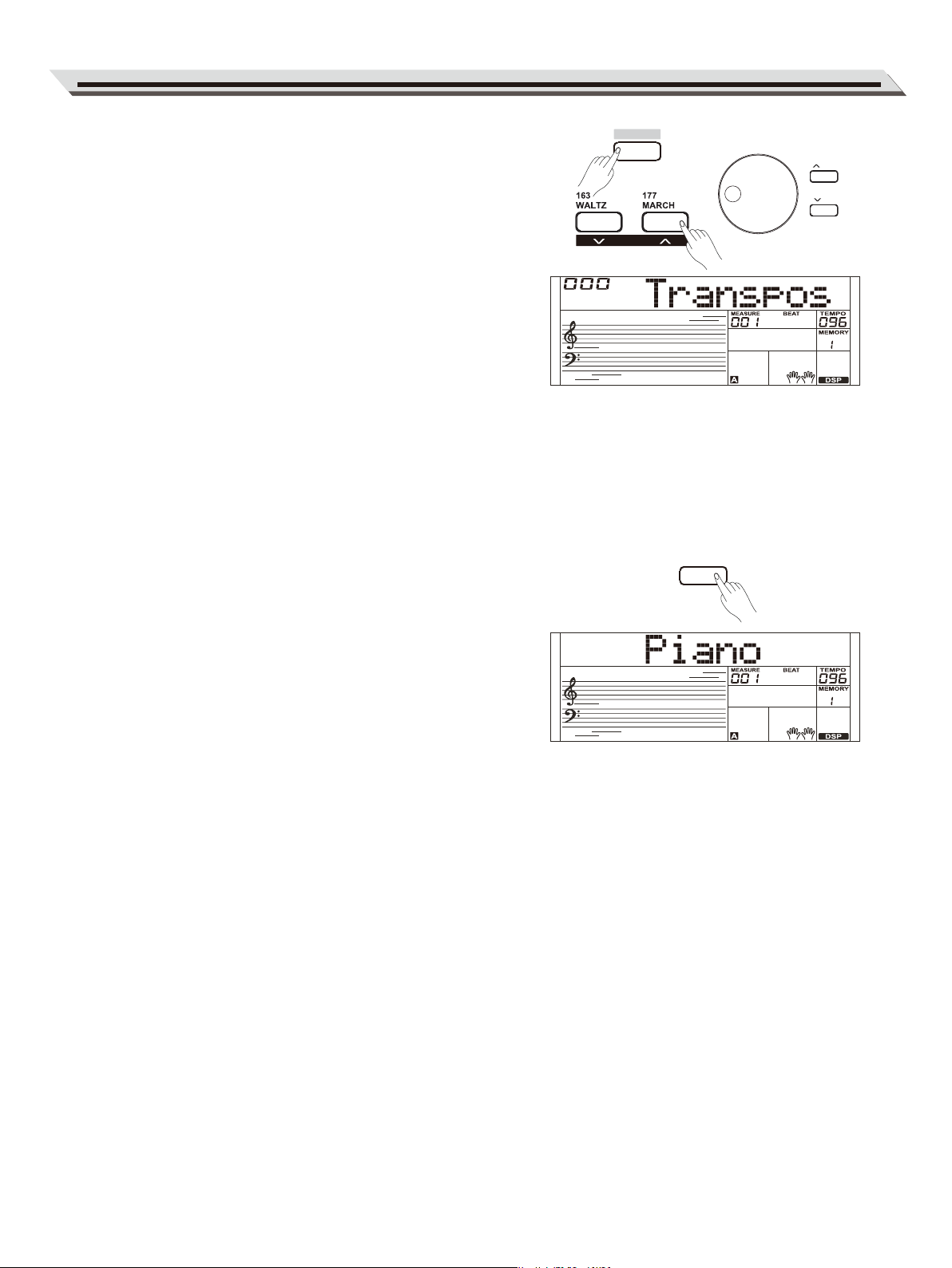
1. Holding down the [SHIFT] button and press the [TRANSPOSE]
button to enter transpose settings. LCD displays the current
transpose: “***Transpos”.
2. When LCD displays “***Transpos”, use [TRANSPOSE-]/
[TRANSPOSE+], [+/YES]/ [-/NO] or data dial to change transpose
value. The max range is ±12 semitones.
3. Press the[+/YES] / [-/NO] buttons or [TRANSPOSE-] /
[TRANSPOSE+] simultaneously to restore the transpose value to its
default setting: “000Transpos”.
Notes:
1. Playing in G key, set the transpose to -05 or 007, and then you can
play the G scale using C scale keys.
2. Transpose setting is applied to automatic chord accompaniment and
full keyboard.
Piano mode
This function is to set the voice of the whole keyboard to the piano
instantly.
1. Press the [PIANO] button to enter/exit piano mode.
2. In piano mode, the accompaniment control is the same to other
mode. The accompaniment only plays the rhythm part.
Note:
In piano mode, the CHORD MODE function is automatically turned off.
Advanced Use
13
SHIFT
TRANSPOSE
PIANO
/ YES
/ NO
O.T.S.
TWINOVA
In Twinova mode, the keyboard is divided into the right area and the
left area which creates two parts with the same voice and pitch based
on a split point for your convenience on one to one teaching.
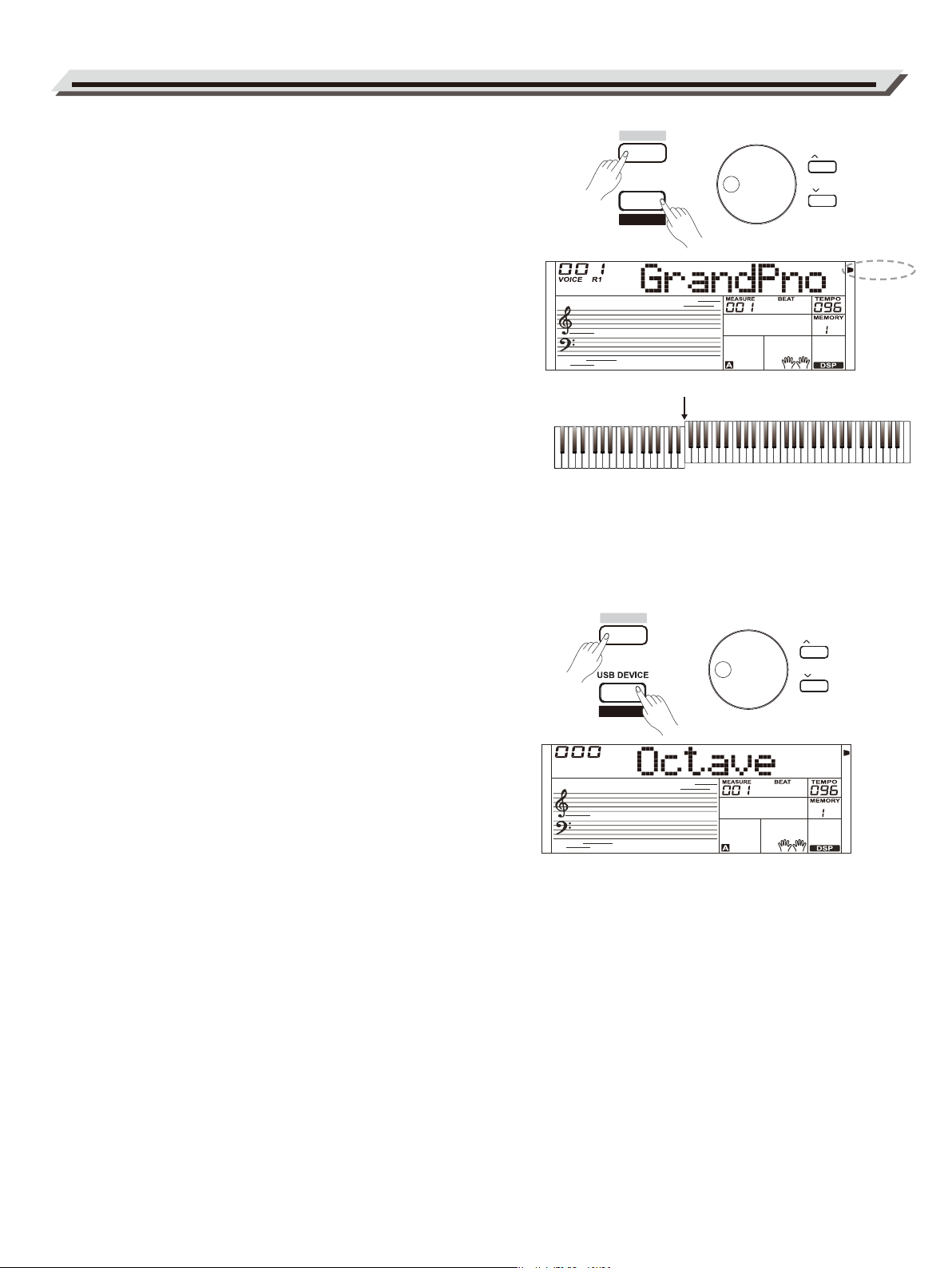
1. Holding down the [SHIFT] button and then press the [TWINOVA]
button to turn this function on. The “TWINOVA” icon lights up. At
the same time, both DUAL and LOWER functions cannot be used
under this mode. The default split point is E3 (32).
2. The main voice is the default one for either the right-hand part or
the left-hand part before entering into the Twinova mode. Use the
data dial or the [+/YES]/[-NO] button, to select the desired voice.
3. Holding down the [SHIFT] button, and then press the [TWINOVA]
button again to turn off the Twinova function. The “TWINOVA” icon
will be off.
Notes:
1. Twinova is unable to be used under the Songs/Demo playing mode.
2. To set the split point of Twinova, please refer to “Split Point Setting”
part for details.
3. Octave is invalid unless in the Twinova mode. After adjusting the
octave, some highest range or the lowest part of the voice may be
silent.
Octave
This function can let the whole pitch of the keyboard raise or lower an
octave. Only in the Twinova mode, the octave can be adjusted, and
the octave in the same region of the keyboard is adjusted together.
After exiting the Twinova mode, the keyboard will restore and is unable
to be adjusted.
1. In the Twinova mode, holding down the [SHIFT] button and press
the [OCTAVE] button, the LCD displays the current octave
temporarily “xxx Octave”. At this time, use the [+/YES]/ [-/NO]
button or the data dial to change the octave value, the adjustable
range is: -1~ +1. Press the [+/YES] and [-/NO] buttons simultane-
ously to restore the octave value to its default setting: 000.
2. Without any operation within 5 seconds, the system will exit the
Octave mode automatically.
Twinova
TWINOVA
TWINOVA
14
SHIFT
SHIFT
Default Split Point: E3
OCTAVE
/ YES
/ NO
/ YES
/ NO
STYLE
Playing Auto Accompaniment (rhythm
track only)
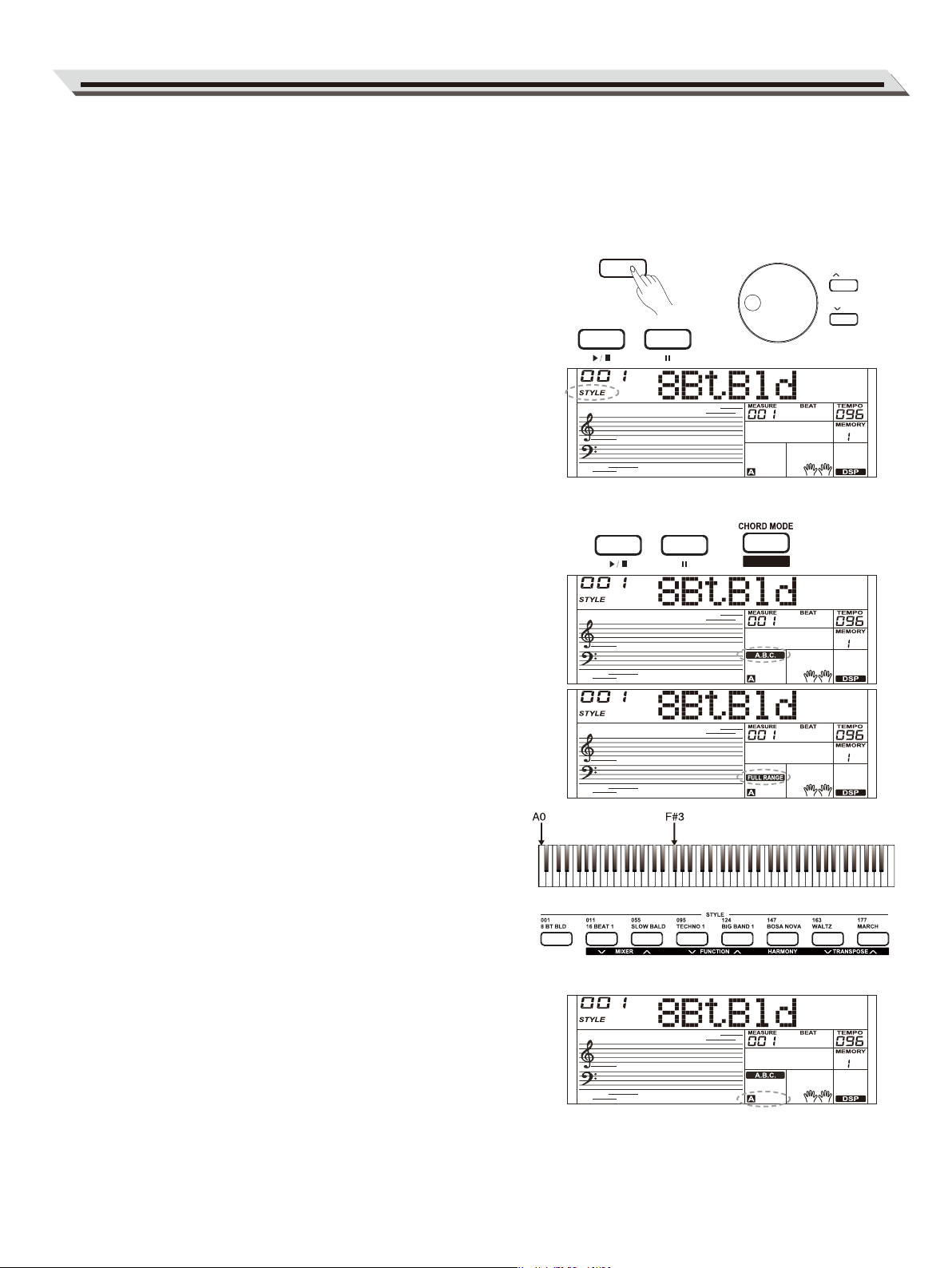
1. Press the [STYLE] button
Enter the style mode. The “STYLE” icon on the left-top of the LCD
will light up. The LCD displays the name and the number of the
current style.
2. Select a style
Use the data dial or the [+/YES]/ [-/NO] button to select a style you
want. Or use the style direct buttons.
3. Start playing a style
Press the [START/STOP] button to start the rhythm tracks of the
auto accompaniment. Also press [SYNC START] and then play any
key to start the rhythm tracks of the auto accompaniment.
4. Press the [START/STOP] again to stop style playing.
Playing Auto Accompaniment (all tracks)
1. Turn the auto accompaniment on
In style mode, press the [CHORD MODE] button to enter the “auto
bass chord” (A.B.C.) mode. The keyboard is divided into two
sections. Left-hand section is the chord detecting section.
Meanwhile the “A.B.C.” icon lights up. Now pressing any key in
chord detect section (Sync Start status), the fantastic
accompaniment will be heard.
Press [CHORD MODE] button again to enter “full range” mode.
The “FULL RANGE” icon will light up. The whole keyboard is chord
detect section.
2. Start the auto accompaniment
Press the [SYNC START] button and then play a chord in chord
detecting section to start the auto accompaniment of all tracks.
The accompaniment automatically changes followed by the change
of the chord. Press the [START/STOP] button to start the auto
accompaniment of the rhythm track, then play a chord in chord
detecting section. It will start the auto accompaniment of all tracks.
Accompaniment Sections
A various types of Auto Accompaniment sections which allow you to
vary the arrangement of the accompaniment to match the song
playing.
They are: Intro, Main (A, B), Fill (A, B), and Ending. By switching
among them during your performance, easily produce the dynamic
elements of a professional sounding arrangement .
1. INTRO Section
The intro is an opening section of the song. When the intro pattern
is finished, the system will automatically shift to the main section.
2. MAIN Section
The main is an important section of the song. And it plays an
accompaniment pattern and repeat infinitely until another section’s
button is pressed.
Auto Accompaniment
15
START / STOP SYNC START
FADE
START / STOP SYNC START
/ YES
/ NO
The auto accompaniment function puts a full backing band at your fingertips. All you have to do is to play the chords with
your left hand using your selected accompaniment style, and then the accompaniment will automatically play along, instantly
following the chords you play. This keyboard features 230 styles in a variety of different musical genres. Try to select and
playing with the style you want . (Please refer to the Style List for details)
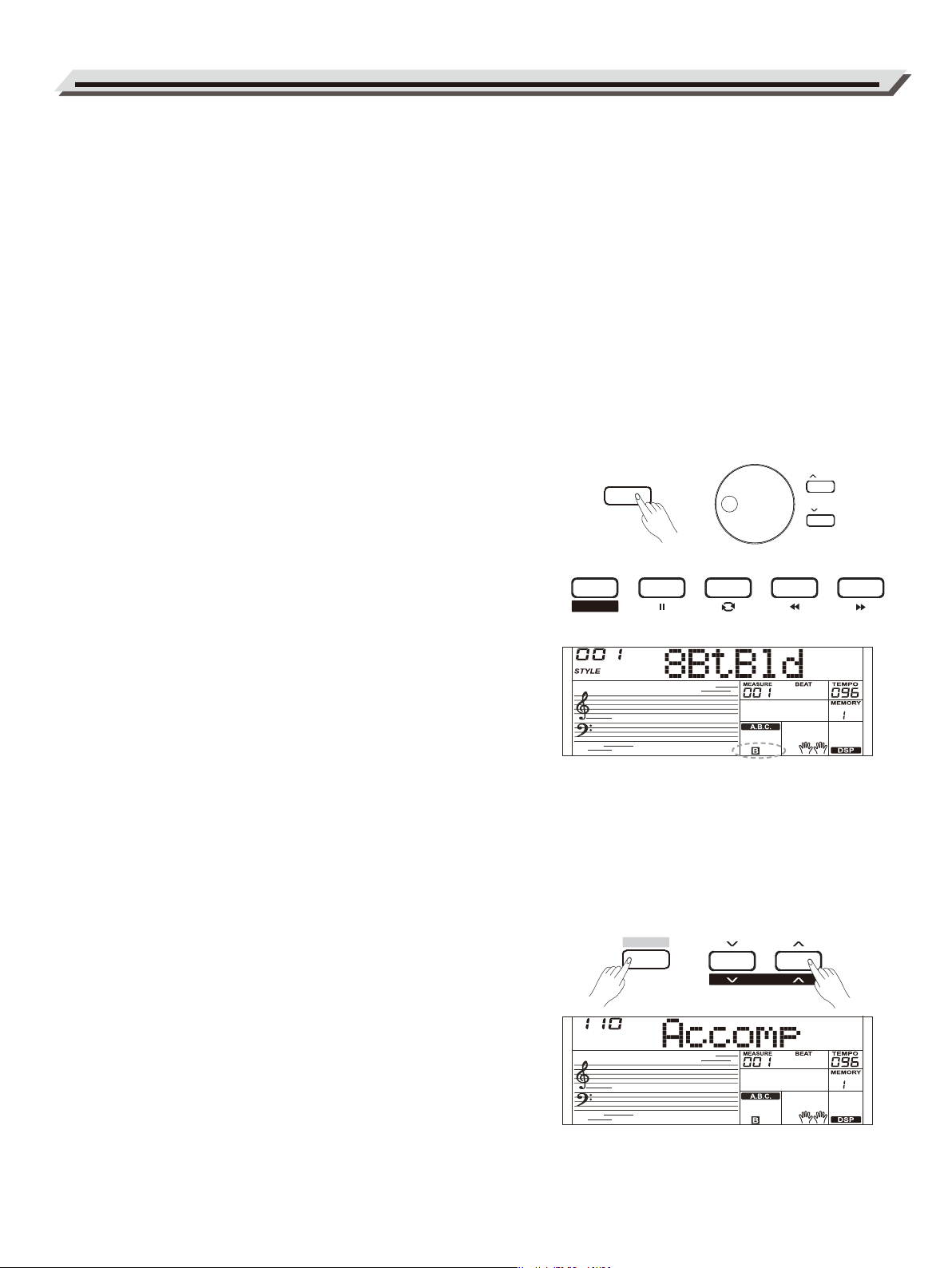
3. FILL-IN Section
Auto fill in function automatically adds a fill to your performance.
When the fill-in is finished,accompaniment shifts to the Main
section (A,B).
4. ENDING Section
Ending is used for the ending of the song. When the ending is
finished, accompaniment automatically stops.
Notes:
1. Holding down the [FILL A]/ [FILL B] button when the style is playing,
the selected fill-in pattern repeats continuously until button is
released.
2. Press the [FILL A]/ [FILL B] button when style stops, it will change
the preset main section. The “A” or “B” icon lights up.
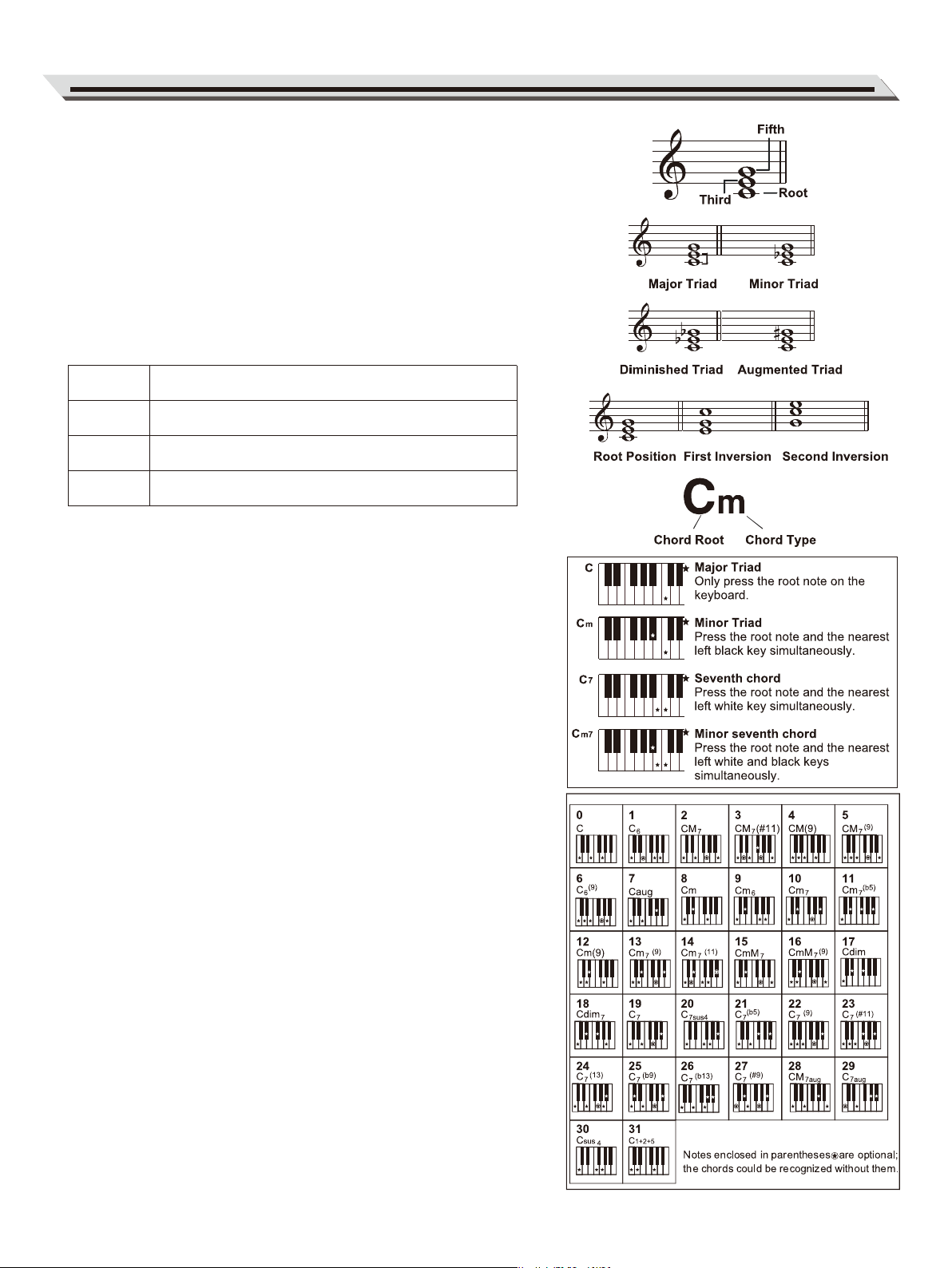
Playing Different Accompaniment Sections
1. Press the [STYLE] button or [+/YES]/ [-/NO] button to select a style,
also use the style direct buttons or data dial.
2. Press the [CHORD MODE] button to enter A.B.C. (auto bass chord)
mode.
3. Press the [SYNC START] button to turn SYNC START on.
4. Press the [FILL A] button, select the Main A section.
5. Press the [INTRO/ENDING] button, the “A” icon flashes, and the
style is ready to play.
6. It will start the accompaniment as soon as you start playing in
Chord section. When the playback of the intro is finished, it
automatically leads into Main A section.
7. Press the [FILL B] button plays an appropriate fill-in pattern to spice
up the rhythm (the “B” icon flashes). When the fill in is completed, it
leads smoothly into the main B section.
8. Press the [INTRO/ENDING] button again, and it will enter the
ending section. When the ending is finished, the auto accompani-
ment automatically stops.
Accompaniment Volume Control
This function is used to adjust the volume of all tracks of accompani-
ment for balancing the volume between accompaniment part and
keyboard voice.
1. Holding down the [SHIFT] button and use the [ACCOMP +] or
[ACCOMP -] button to adjust accompaniment volume, adjustable
range: 0~127, the LCD displays current accompaniment volume
value.
2. Holding down the [SHIFT] button and then press the [ACCOMP +]
and [ACCOMP -] button simultaneously to turn the accompaniment
volume off. The LCD displays “OFF Accomp”. Press the [ACCOMP
+] and [ACCOMP -] button simultaneously again to turn the
accompaniment volume on.
Auto Accompaniment
16
STYLE
FADE
INTRO / ENDING FILL A FILL BSYNC STARTCHORD MODE
SHIFT
TEMPO
ACCOMP
/ YES
/ NO
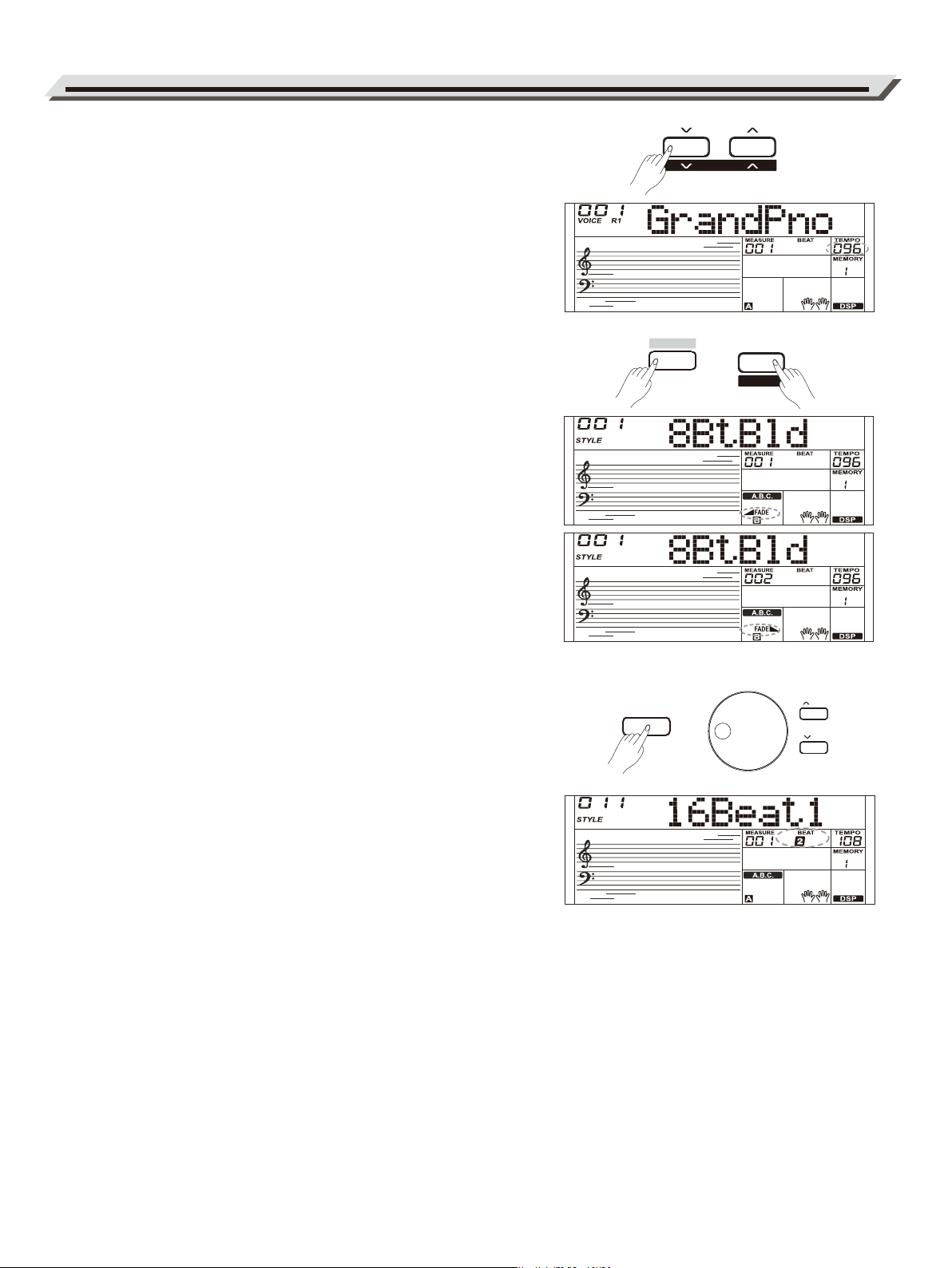
Chord Fingering
How the chords are played or indicated with your left hand (in the auto
accompaniment section of the keyboard) is referred to as “fingering”.
There are 2 types of fingerings as described below.
Auto Accompaniment
17
Chord Basics
A chord, in music, is any harmonic set of three or more notes that is
heard as if sounding simultaneously. The most frequently encountered
chords are triads. A triad is a set of three notes that can be stacked in
thirds. When stacked in thirds, the triad's members, from lowest
pitched tone to highest, are called: the Root, the Third, and the Fifth.
Triad Type
There are following basic triad types:
Chord Inversion
We define this chord its root is not in the bass (i.e., is not the lowest
note) as an inversion chord. When the root is in the bass, we call the
chord: root-position chord. If we put the Third and Fifth in the root
position, then it forms “Inversion”, we call this chord “Inversion Chord”.
See the following major triad and its inverted chord.
Chord Name
The chord name contains two parts content: Chord root and Chord
type.
Single Finger
Single-finger makes it simple to produce major, seventh, minor and
minor seventh chords by pressing a minimum number of keys on the
auto accompaniment section.
Multi-finger
Multi-finger allows you to play chords in normal fingering. Try playing
the 32 chord types in C scale as listed on the right.
Note:
In full range mode, the entire keyboard will only recognize chords
played in normal fingering.
Major Triad
Minor Triad
Augmented
Triad
Diminished
Triad
A root with a major third added above and a perfect fifth
will consist as a “Major Triad”.
A root with a minor third added above and a perfect fifth
will consist as a “Minor Triad”.
A root with a major third added above and an
augmented fifth will consist as an “Augmented Triad”.
A root with a minor third added above and a diminished
fifth will consist as a “Diminished Triad”.
Tempo
Each style of the instrument has been set with a default or standard
tempo, however, this can be changed by using the [TEMPO +]/
[TEMPO -] button.
1. Use the [TEMPO +]/ [TEMPO -] button to change the tempo value.
While the tempo data is flashing, also use the data dial.
2. Press the [TEMPO+] and [TEMPO-] buttons simultaneously to
restore the tempo value to its default setting.
Note:
The default tempo is automatically selected when you select a style in
the style standby mode. But the value still keeps the same if you
change styles in the playback mode.
Fade In/Out
1. Fade In
Starting the style with fade in produces a smooth beginning, the
volume increases from low to high.
Holding down the [SHIFT] button and press the [FADE] button
before start the style playback . The “ FADE” icon will light up, and
then keep flashing with style playing.
2. Fade Out
Stopping the style with fade out produces a smooth ending, the
volume decreases from high to low. Holding down the [SHIFT]
button and then press the [FADE] button during the style playback.
The “FADE” icon lights up, and then keeps flashing with style
playing.
3. Fade In/ Out time
The default time is 10 seconds.
Metronome
The Metronome function provides a steady beat to help practicing the
piano at a consistent tempo.
1. Turn the metronome on/ off
Press the [METRONOME] button to turn metronome function on or
off.
2. Metronome beat type setting
Please refer to the “Function Menu” for details.
Notes:
1. If turn the metronome on while a style is playing, the click sound will
be sounded at the next beat. The metronome time signature will
synchronize to a style which is playing.
2. If turn the metronome on first, and then play rhythm, the metronome
time signature will synchronize to a style which is playing.
3. The metronome function is available for recording mode, but it
cannot be saved as a recording data.
One Touch Setting
Maybe it is not easy to find out a suitable voice to play the song,
nevertheless, ONE TOUCH SETTING is the most powerful and
relaxed method to solve it. When One Touch Setting is switched on,
you can instantly recall all auto accompaniment related settings
including voices selection and digital effects simply with a single touch
of a button.
Auto Accompaniment
18
SHIFT
TEMPO
ACCOMP
CHORD MODE
FADE
METRONOME
/ YES
/ NO
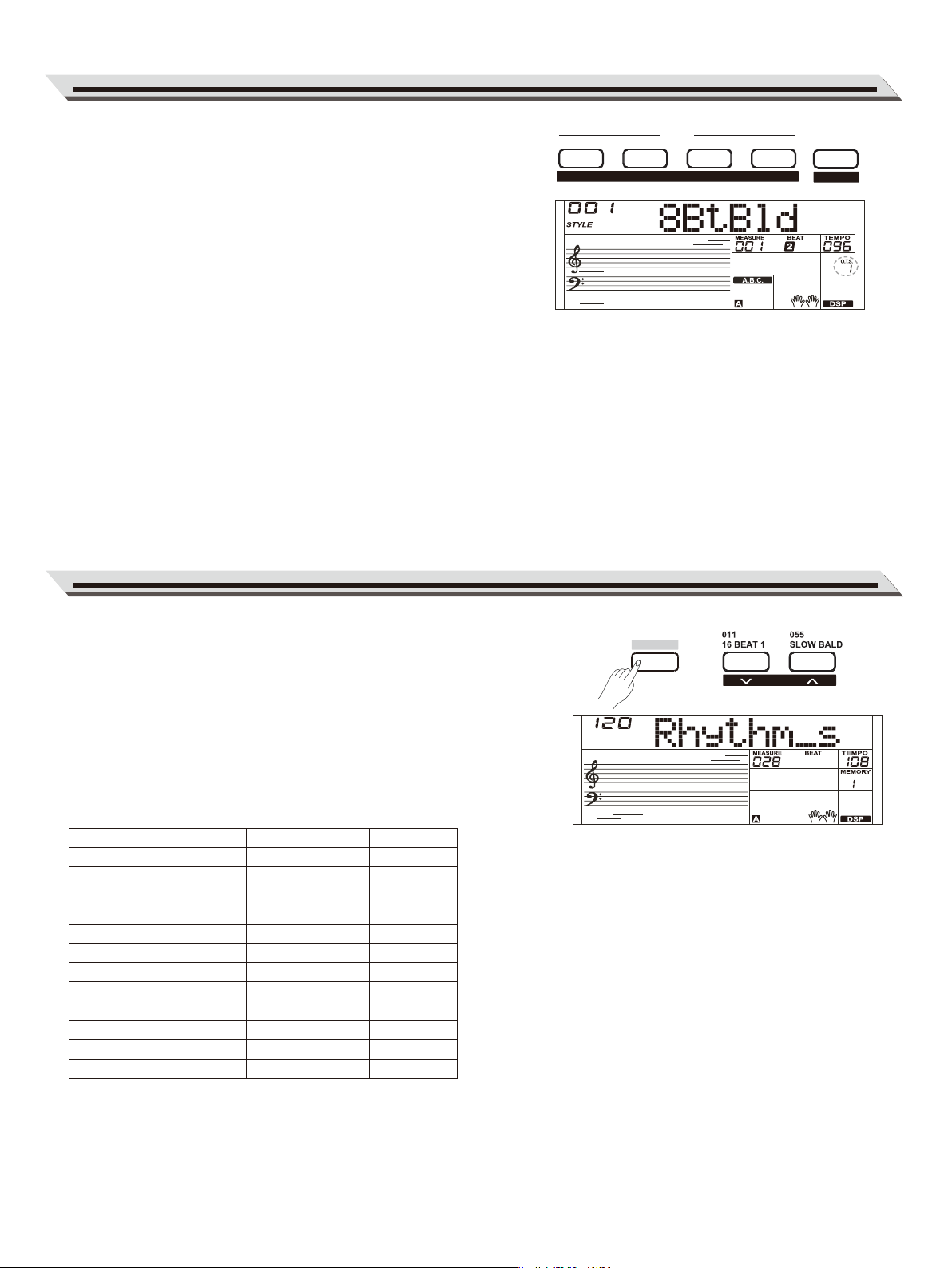
1. Press the [O.T.S.] button to turn on the One Touch Setting for
current style. The “ O.T.S” icon will light up. The “MEMORY” icon
will be off.
2. Press one of the [M1]-[M4] button, various panel settings (such as
voice, effect, etc.) that match the selected style can be instantly
recalled with just a single button.
One Touch Setting parameter list:
Part ON/OFF .
Voice Change
Voice Volume
Voice Reverb Level
Voice Chorus Level
Notes:
1. The A.B.C. function is automatically turned on in O.T.S. mode.
2. The” Registration Memory” function is invalid in the O.T.S. mode.
Mixer function can control the volume of different tracks.
1. Holding down the [SHIFT] button and press the [MIXER -] / [MIXER
+] button to enter the mixer function menu, the LCD displays the
current number. The first rhythm volume value option is “Rhythm_s”
for the first time , it will keep the last option when you enter the mixer
menu again.
2. Holding down the [SHIFT] button, and press the [MIXER -] / [MIXER
+] button repeatedly to select the track to be setting. Use [+/YES]/
[-/NO] button or data dial to change parameters.
The option and parameters are shown below:
Note:
Without any operation within 5 seconds, the function menu status will
exit automatically.
Mixer
19
Auto Accompaniment
Content
Rhythm s volume
Rhythm m volume
Bass volume
Chord 1 volume
Chord 2 volume
Chord 3 volume
Phrase 1 volume
Phrase 2 volume
Voice R1 volume
Voice R2 volume
Voice L volume
U_Disk midi play volume
LCD Display
XXX Rhythm_ s
XXX Rhythm_ m
XXX Bass
XXX Chord1
XXX Chord2
XXX Chord3
XXX Phrase1
XXX Phrase2
XXX Upper 1
XXX Upper 2
XXX LOWER
XXX U_Disk
Range
0 - 127
0 - 127
0 - 127
0 - 127
0 - 127
0 - 127
0 - 127
0 - 127
0 - 127
0 - 127
0 - 127
0 - 127
SHIFT
M1 M2 M3 M4
MELODY 1 MELODY 2 MELODY 3 MELODY 4
O.T.S.
O.T.S.
TWINOVA
MIXER
PERFORM.
PERFORM.
PERFORM.
HARMONY
The harmony function will automatically add harmony notes to the
notes played in the right-hand section, which gives you a rich and
harmonic expression.
Harmony Switch
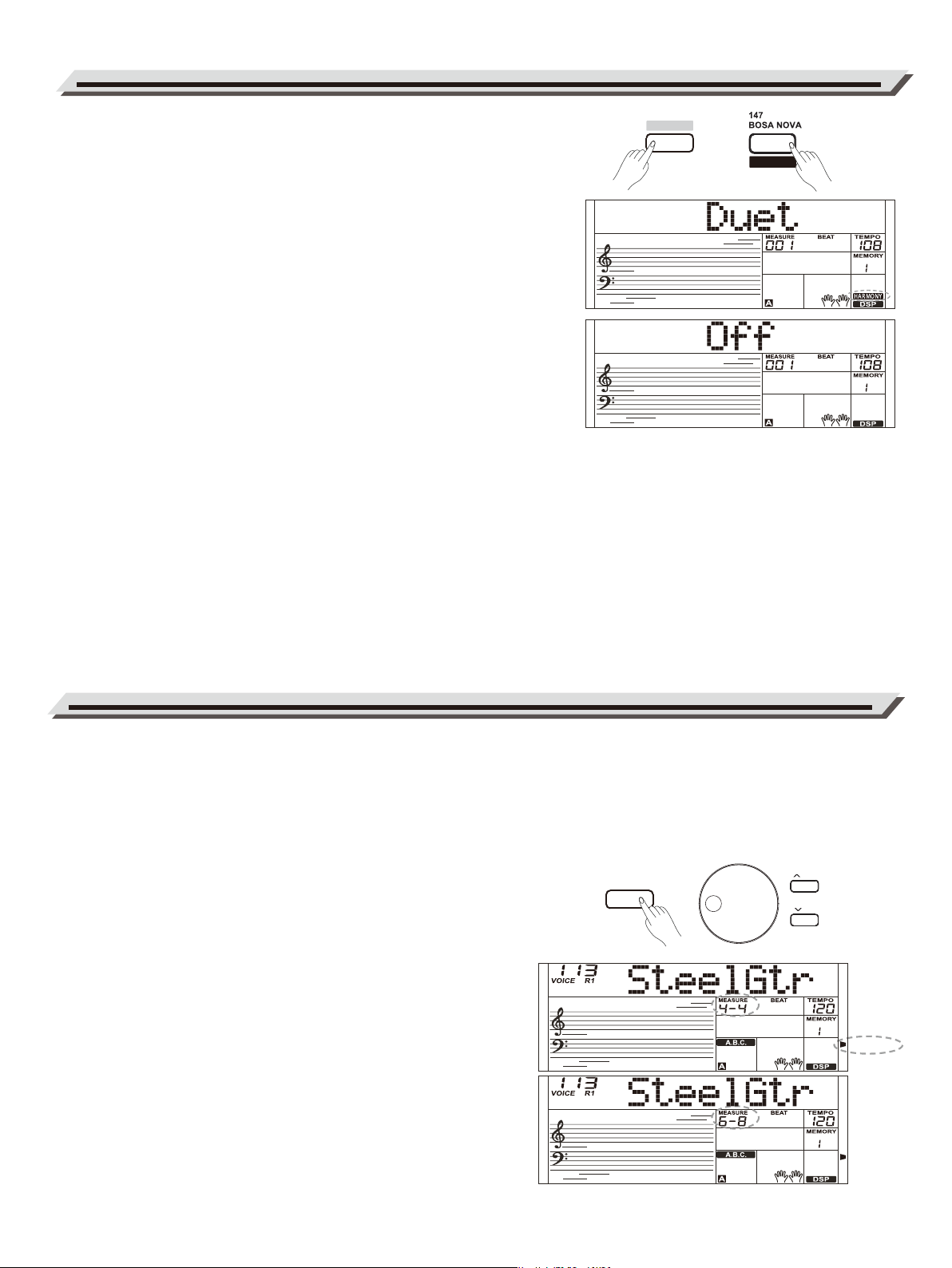
1. Holding down the [SHIFT] button and press the [HARMONY] button
to enter harmony mode. The “HARMONY” icon lights up and LCD
displays “Duet” which indicates the harmony effect is open, and the
type is Duet.
2. Holding down the [SHIFT] button and press the [HARMONY] button
again to exit harmony mode. The “HARMONY” icon goes out and
LCD displays “Off” which indicates the harmony effect is off.
3. This instrument features 26 harmony types. Please refer to the
“Function menu” for details.
Playing with harmony effect
Open the A.B.C. mode, first play a chord in the chord section, and
then the main voice you play in right-hand section will be added with
the harmony effect.
Notes:
1. The harmony types of 1+5, Octave 1~2, Echo 1~4, Tremolo 1~4
and Trill 1~4 are available whether the A.B.C. is open or not. Other
harmony types are available only when the A.B.C. is open.
2. The harmony types cannot be recorded in user songs.
There are 2 voices you can select to perform in performance assistant
mode: Guitar, Piano.
What’s the Performance Assistant?
Performance assistant is an easy-to-use function. With this function, you
will find playing to be more interesting. Even if you are not a keyboard
player, the performance assistant will help you to play your familiar
instrument voice on the keyboard. If you are a pianist, you can achieve
many hard perform skills on the keyboard with the help of this function
more easily. Performance assistant will provide many wonderful phrases.
Just use several keys and you will perform your own wonderful music.
Enter the Performance Assistant
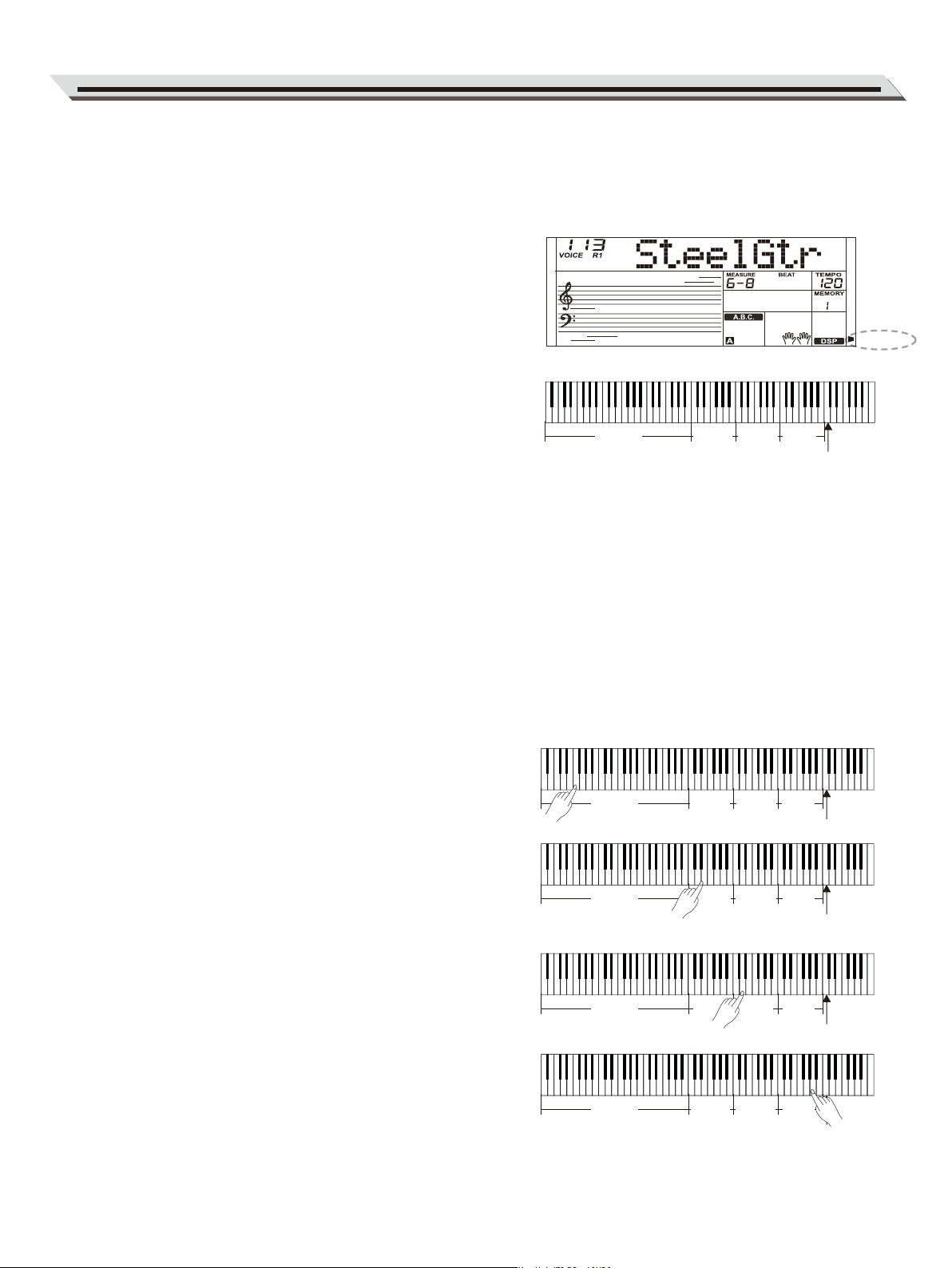
1. Press the [PERFROM] button to enter the performance assistant
mode. The default setting is Guitar Mode. The LCD will display the
name and number of Guitar.
2. Use the data dial to change the voice you want to perform.
3. The default time signature “4-4” will be displayed on the LCD. In
Performance Assistant mode, you can choose the beat between 2/4,
3/4, 4/4, and 6/8 with the [+/YES] / [-/NO] button.
Performance Assistant
20
Harmony
SHIFT
/ YES
/ NO
5. In Performance Assistant mode, use [TEMPO+] / [TEMPO-] to adjust
the tempo value.
Guitar Mode
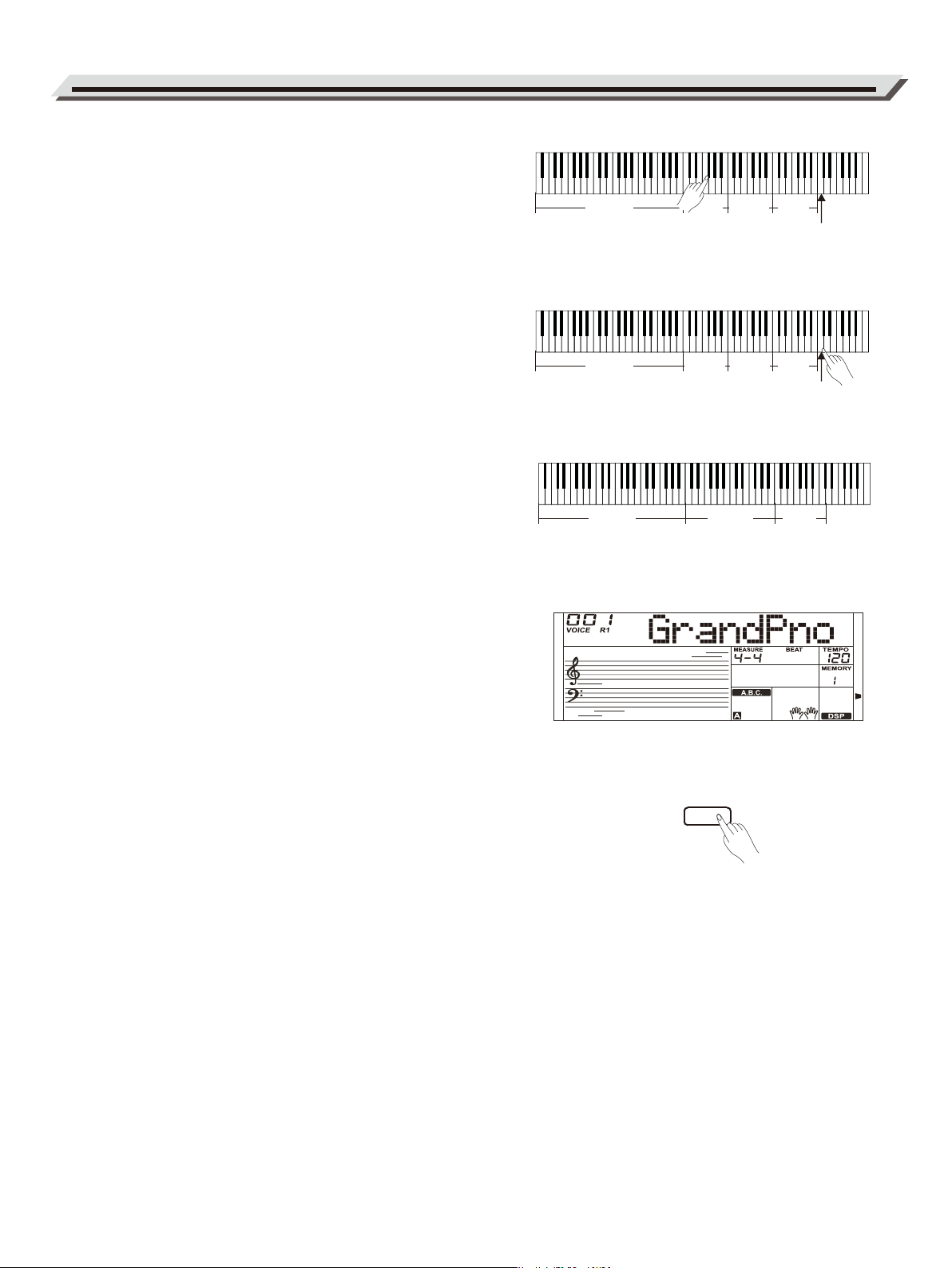
Guitar key map
The Guitar Mode makes you perform a guitar voice with keyboard just
like you're playing a real guitar. In this mode you can use some perform
skills like strum (5), broken chord (5), echoism (5) and also 2 endings.
Chord part
A0 to B3 is the chord part area. Play a chord in this area.
Sub Area 1
C4 to B4 (only white keys) is the sub area and 1. 5 types of broken
chord are provided in this area.
Sub Area 2
The 6 keys: C5 to A5 (only white keys) is just like real guitar's 6 strings.
Play a free solo in this area.
Rhythm Area
C6 to G6 (only white keys) is the rhythm area. Wonderful styles and
strums are provided in this area. Use A6 to B6 to play an ending.
Position Change
Press C7, the guitar voice will be changed to a high position.
Note:
The keys above C7 cannot be responded in this mode.
Playing in Guitar Mode
Play a chord in the chord part
A chord type will be displayed on the LCD and the guitar root note will
be sounded.
Play a broken chord in the sub area 1
When the chord type displayed, press a white key in the sub area 1, a
wonderful broken chord phrase will start. Try to change the white key
and you will hear some different types of phrase. Change the chord
with your left hand, you will hear the broken chord phrase has a little bit
change.
Play a free solo in the sub area 2
When the chord type displayed, press a white key in the sub area 2
you can play guitar free solo, sounds of which like you're playing a real
one. Try to change the chord with your left hand, and play your free
solo. The last white key B5 is invalid.
Play a strum rhythm in the rhythm area
When the chord type displayed, press a white key in the rhythm area
you can play the magic strum rhythm. Try to change the chord with your
left hand, and play your strums.
Performance Assistant
21
PERFORM.H
Guitar Key map
Chord Part Sub Area 1 Sub Area 2 Rhythm
Area
Position Change
Chord Part Sub Area 1Sub Area 2 Rhythm
Area
Position Change
Chord Part Sub Area 1 Sub Area 2 Rhythm
Area
Position Change
Chord Part Sub Area 1 Sub Area 2 Rhythm
Area
Position Change
Chord Part Sub Area 1 Sub Area 2 Rhythm
Area
Position Change
End the guitar performing
Press the A6 or B6 to end your guitar performs. When the ending is
finished, the phrase stops automatically.
Play the echoism
All of black keys on Sub area 1, Sub area 2 and Rhythm area are
echoism keys. There are 5 kinds of echoism to arrange on the C#, D#,
F#, G#, A# circularly.
Change the position
Press the C7, the “PERFORM.H” icon will light up on the LCD. It
means that the guitar position has been changed to the High position.
Try to play the white keys in sub area 1, Sub area 2 and Rhythm area,
listen to the phrase you are performing now.
Piano Mode
Piano Key Map
In Piano Mode, you can easily achieve many hard piano perform skills
just like playing the acoustic one. In this mode you can use some
perform skills like piano rhythm (5), broken chord (5) and also 3
endings.
The piano key map is similar with the guitar key map. Press A6 to C7
(white keys) to start an ending. All the black keys above C4 are invalid.
Playing in Piano Mode
1. Select Piano Mode
In performance assistant mode, use data dial to select Piano Mode.
2. Play a chord in chord part
3. Play phrases and rhythm in sub area and rhythm area.
4. Press the A6, B6 or C7 to end your piano perform. When the
ending is finished, the phrase stops automatically.
Exit the Performance Assistant
When the performance is complete, press the [VOICE] / [STYLE] /
[SONG]/ [PERFORM] to exit the performance assistant mode.
Performance Assistant
22
PERFORM
Sub Area 1Chord Part Sub Area 2 Rhythm
Area
Position Change
Sub Area 1Chord Part Sub Area 2 Rhythm
Area
Position Change
Piano Key map
Sub AreaChord Part Rhythm
Area
PERFORM.
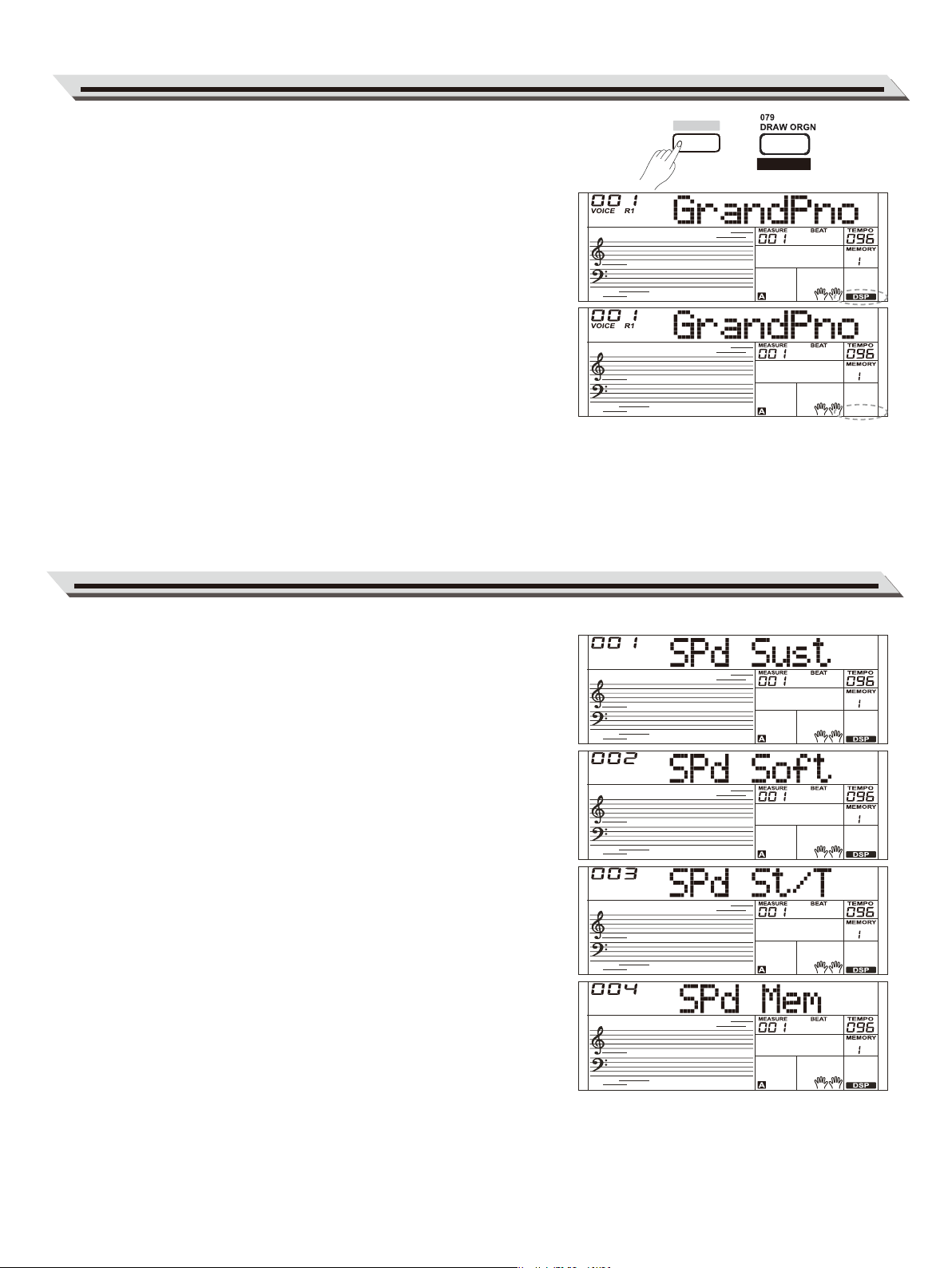
The DSP effect is the sound localization technology for simulating the
sounds in the real environment. With the DSP effect, you can add
ambience and depth to your performance in a variety of ways.
The DSP effect is automatically open when the instrument is turned
on. Holding down [SHIFT] button and press the [DSP] button to turn
the DSP effect on or off. The “DSP” icon lights up.
Note:
It may cause a break or a noise while switching on/off the DSP when
the style or the song is playing. It is normal and need not to panic.
You can assign other pedal functions to the sustain pedal. Please refer
to the Function Menu for details.
1. Sustain Pedal (SPd Sust)
This pedal function performs the same function as the damper
pedal on an acoustic piano, letting you sustain the sound of voices
even after releasing the keys. Step and press on the pedal to turn
the sustain effect on. Release the pedal to turn the sustain effect
off.
2. Soft Pedal (SPd Soft)
When the soft pedal is selected, pressing this pedal and makes the
notes you playing sound softer.
3. Style Start/Stop Pedal (SPd St/T)
When the style start/stop pedal is selected, pressing this pedal to
start/stop the accompaniment.
4. Memory Pedal (SPd Mem)
When the memory pedal is selected, pressing this pedal at the first
time to call up register memory: M1, and then you can call up
register memory M2, M3…by pressing this pedal step by step
(There are 48 memories).
The soft pedal of a unit pedal can be assigned with other pedal
functions. Please refer to the Function Menu for details.
1. Pedal Soft (UPd Soft)
2. Pedal St/T (UPd St/T)
3. Pedal Mem (UPd Mem)
DSP
23
Pedal Function
SHIFT
DSP
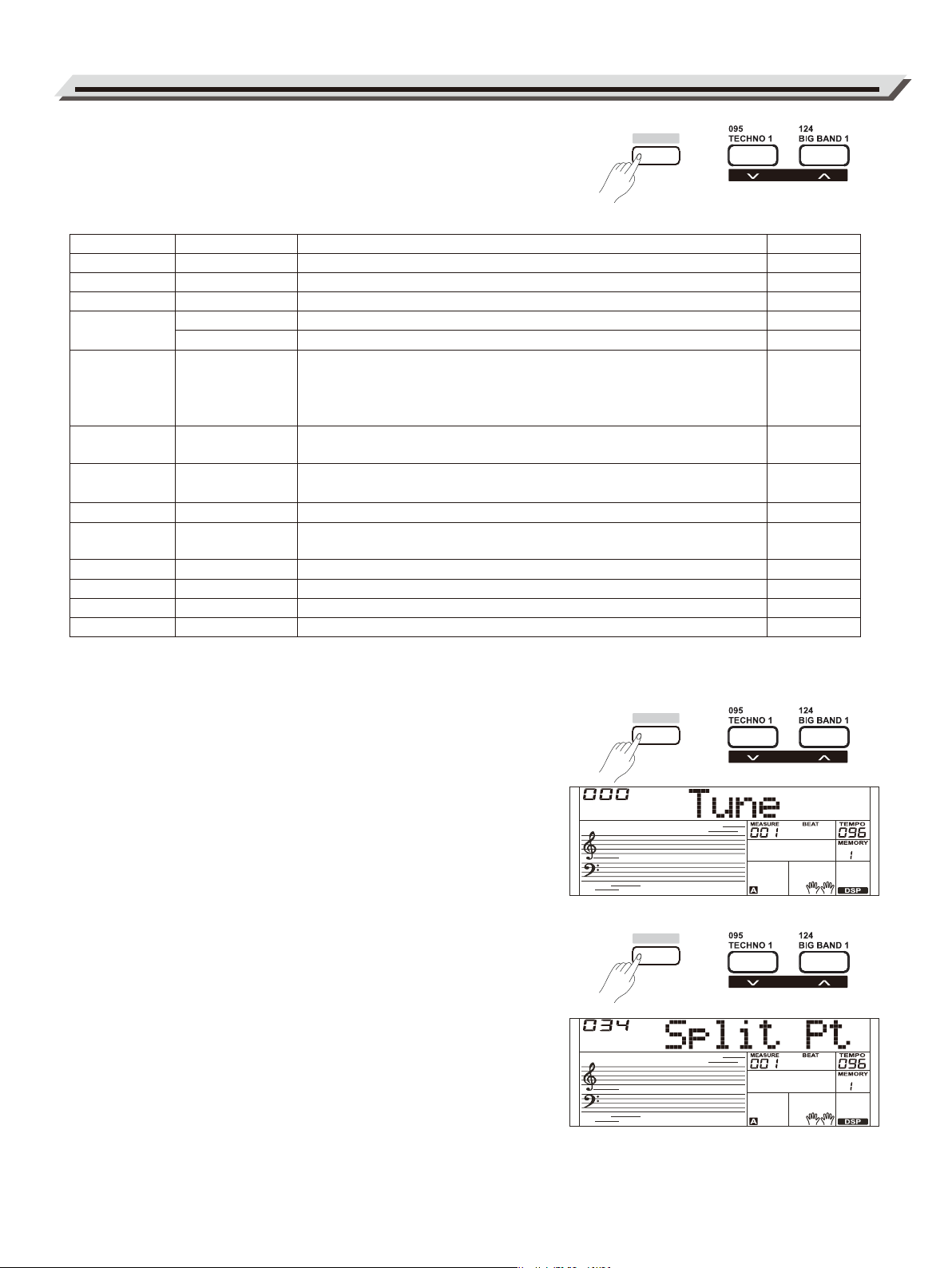
Holding down the [SHIFT] button and press the [FUNCTION-] or
[FUNCTION+] button to enter function menu. The LCD displays the
current function menu option. Use the [+/YES]/ [-/NO] button or data
dial to set parameters of the current menu.
The option and parameters are shown below:
Note:
Without any operation within 5 seconds, system will exit the Function
mode automatically.
Tune
This function sets the pitch of entire keyboard in semitone step.
1. Holding down the [SHIFT] button and press the [FUNCTION-]/
[FUNCTION+] button repeatedly to select the tune menu. The LCD
displays “xxx Tune”. Use the [+/YES]/ [-/NO] button or data dial to
adjust the tune value.
2. Press the [+/YES] and [-/NO] buttons simultaneously to restore the
tune value to its default setting: 000.
The setting is applied to both the accompaniment and the voice.
Split Point
The Point on the keyboard that separates voice L and voice R1/R2 is
called the “split point”. Left hand section controls the auto bass chord
accompaniment when the A.B.C. function is on, or it can be used to
play the lower voices when the A.B.C. function is off.
1. Holding down the [SHIFT] button and press the [FUNCTION-]/
[FUNCTION+] button repeatedly to select split point menu, the LCD
displays “*** Split Pt”. Use the[+/YES]/[-/NO] button or data dial to
change the split point. Adjustable range is: 1~88.
Function Menu
24
CONTENT
Tune
Beat Type
Split Point
Pedal Type
Harmony Type
EQ Type
Reverb Type
Reverb Level
Chorus Type
Chorus Level
MIDI Receive
MIDI Transmit
Auto Power Off
LCD DISPLAY
XXX Tune
XXX Beat
XXX Split Pt
00X SPd ****
00X UPd ****
00X HAR TYPE
XXX EQ TYPE
XXX Rev TYPE
XXX Rev Lev
XXX Chr TYPE
XXX Chr Lev
XXX Receive
XXX Transmit
XXX POWEROFF
RANGE
-50…50
0,2…9
1…88
SUST, SOFT, St/T, MEM
SOFT St/T MEM
Duet, StandardTrio, Full Chord, Rock Duet, Country Duet, Country Trio,
Block, 4 Close 1, 4 Close 2, 4 Open, 1+5, Octave1, Octave2,Strum,
Echo1, Echo2,Echo3,Echo4,Tremolo1, Tremolo2, Tremolo3,
Tremolo4,Trill1, Trill2, Trill3, Trill4
EQ Pop、EQ Rock、EQ Class、EQ Jazz、EQ Dance、EQ Reset
RevRoom1/RevRoom2/RevRoom3/RevHall1/RevHall2/RevHall3/
Rev Chr1/Rev Chr2/Rev Del/Rev PanD
0-127
Chorus1/Chorus2/GM Chr1/GMChr2/Flanger1/Flanger2/Rotary1/Rotary2
0-127
01—16、ALL
01—16
Off,30,60
DEFAULT
0
4
34
SUST(001)
Soft (001)
Duet(001)
006
EQ Reset
004
RevHall1
Current voice
004
GM chr2
Current voice
ALL
01
30
SHIFT
SHIFT
SHIFT
FUNCTION
FUNCTION
FUNCTION
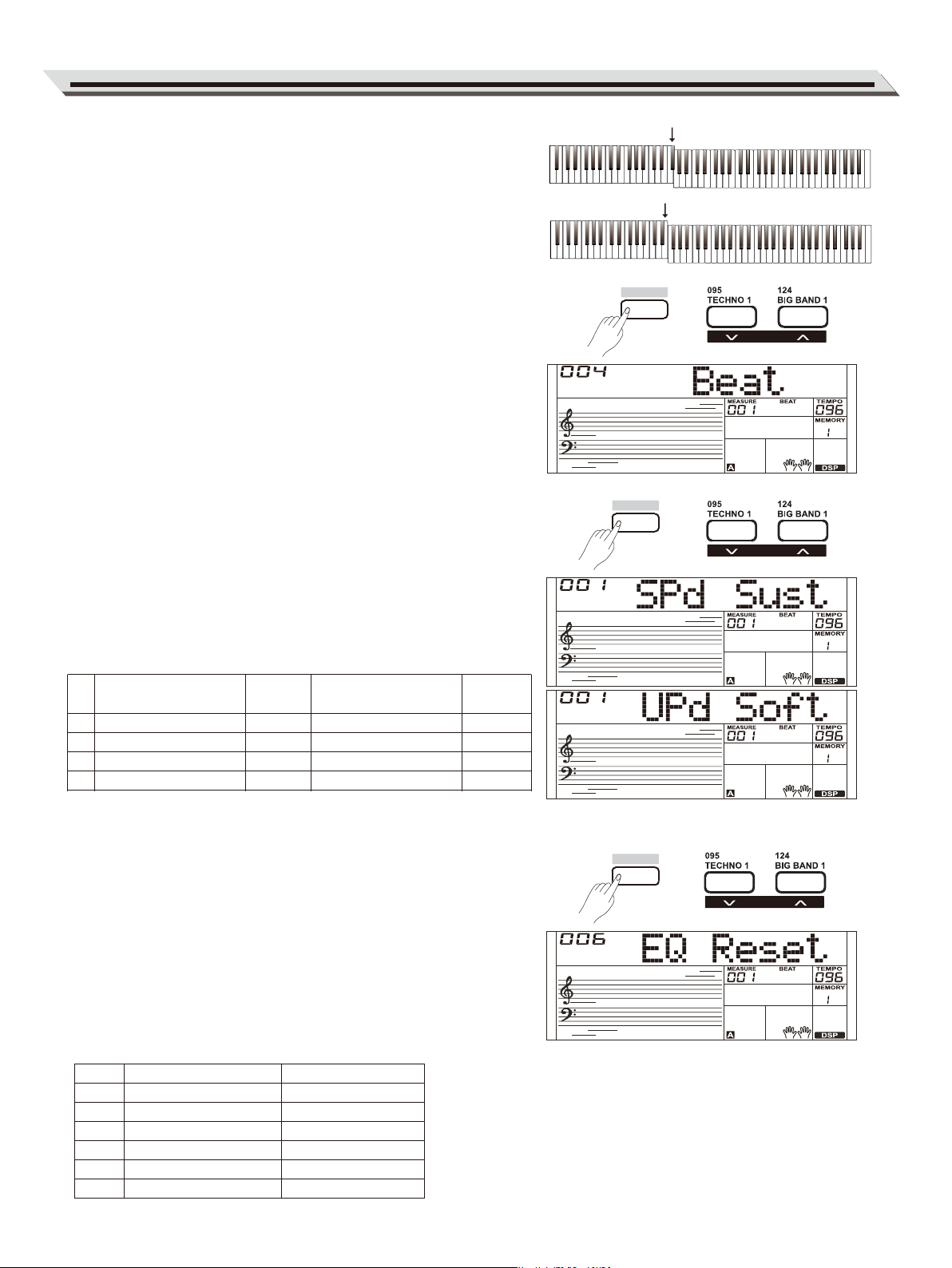
2. Press the[+/YES] and [-/NO] buttons simultaneously restore the split
point value to its default setting: F#3 (34).
3. In TWINOVA function, the adjustable range of split point is C3~C6
(28~64). Press the [+/YES] and [-/NO] buttons simultaneously
to restore the split point to its default setting: E3 (32).
Note:
The key of the split point belongs to the left hand.
Beat Type
1. Holding down the [SHIFT] button and press the [FUNCTION-] or
[FUNCTION+] button repeatedly to select beat type menu. The LCD
displays “***Beat”. Use the[+/YES]/ [-/NO] button or data dial to
change beat type. The adjustable range is: 0, 2~9.
2. Press the [+/YES] and [-/NO] buttons simultaneously to restore the
beat type value to its default setting: 004.
Pedal Type
1. Holding down the [SHIFT] button and press the [FUNCTION-] or
[FUNCTION+] button repeatedly to select the sustain pedal type
menu. The LCD displays “00x SPd xxxx”. Use the [+/YES] / [-/NO]
button or data dial to change pedal type.
2. Press the [+/YES] and [-/NO] buttons simultaneously restore the pedal
type to its default setting: 001 SPd (Sust).
3. Follow the operation in Step 1 to assign functions to the soft pedal of
a unit pedal, except that the LCD displays "00X UPd xxxx".
All pedal types are shown below:
EQ Type
Equalizer is a sound processor that can be used to adjust the gain
value of each frequency band of sound, different gain value settings can
make a different sound field effect. You can select one of the 6 preset
EQ settings in the EQ display.
1. Holding down the [SHIFT] button and press the [FUNCTION-] or
[FUNCTION+] button repeatedly to select the EQ type menu. The
LCD displays “001 EQ Pop ”. Use the [+/YES] / [-/NO] button or data
dial to change EQ type.
2. Press the [+/YES] and[-/NO] buttons simultaneously to restore the
EQ type to its default setting: 006 EQ Reset.
The EQ types are shown below:
Function Menu
25
No.
1
2
3
4
Sustain Pedal
(Assignable Functions)
Sustain Pedal
Soft Pedal
Start/Stop Pedal
Memory Switch Pedal
LCD
SPd Sust
SPd Soft
SPd St/T
SPd Mem
LCD
UPd Soft
UPd St/T
UPd Mem
Soft Pedal
(Assignable Functions)
Soft Pedal
Start/Stop Pedal
Memory Switch Pedal
No.
1
2
3
4
5
6
LCD
EQ Pop
EQ Rock
EQ Class
EQ Jazz
EQ Dance
EQ Reset
EQ Type
Pop
Rock
Classical
Jazz
Dance
Reset
SHIFT
SHIFT
SHIFT
F#3
E3
FUNCTION
FUNCTION
FUNCTION

Reverb Type
1. Holding down the [SHIFT] button and press the [FUNCTION-] or
[FUNCTION+] button repeatedly to select the reverb type menu.
The LCD displays “001 Rev Hall 1”. Use the[+/YES]/ [-/NO] button
or data dial to change reverb type.
2. Press the [+/YES] and [-/NO] buttons simultaneously restore the
reverb type to its default setting: 004 Rev Hall1.
The reverb types are shown below:
Reverb Level
1. Holding down the [SHIFT] button and press the [FUNCTION-] or
[FUNCTION+] button repeatedly to select reverb level.
The LCD displays “*** Rev Lev”. Use the [+/YES]/ [-/NO] button or
data dial to change reverb level, adjustable range is: 0-127
2. Press the [+/YES] / [-/NO] button simultaneously to restore the
reverb level to its default setting: 070.
Chorus Type
1. Holding down the [SHIFT]button and press the [FUNCTION-] or
[FUNCTION+] button repeatedly to select chorus type menu.
The LCD displays “004 GM Chorus2”. Use the [+/YES]/ [-/NO] button
or data dial to change chorus type. You can select one of the 8
preset in the Chorus Type.
2. Press the [+/YES]/ [-/NO] buttons simultaneously to restore the
chorus type to its default setting: 004 GM Chorus2.
The chorus types are shown below:
Function Menu
26
No.
1
2
3
4
5
6
7
8
9
10
LCD
RevRoom1
RevRoom2
RevRoom3
RevHall1
RevHall2
RevHall3
Rev Chr1
Rev Chr2
Rev Del
Rev PanD
Reverb Type
Room 1
Room 2
Room 3
Hall 1
Hall 2
Hall 3
Church 1
Church 2
Delay
Pan Delay
No.
1
2
3
4
5
6
7
8
LCD
Chorus1
Chorus2
GM Chr1
GM Chr2
Flanger1
Flanger2
Rotary1
Rotary2
Chorus Type
Chorus 1
Chorus 2
GM Chorus 1
GM Chorus 2
Flanger 1
Flanger 2
Rotary 1
Rotary 2
SHIFT
SHIFT
SHIFT
FUNCTION
FUNCTION
FUNCTION
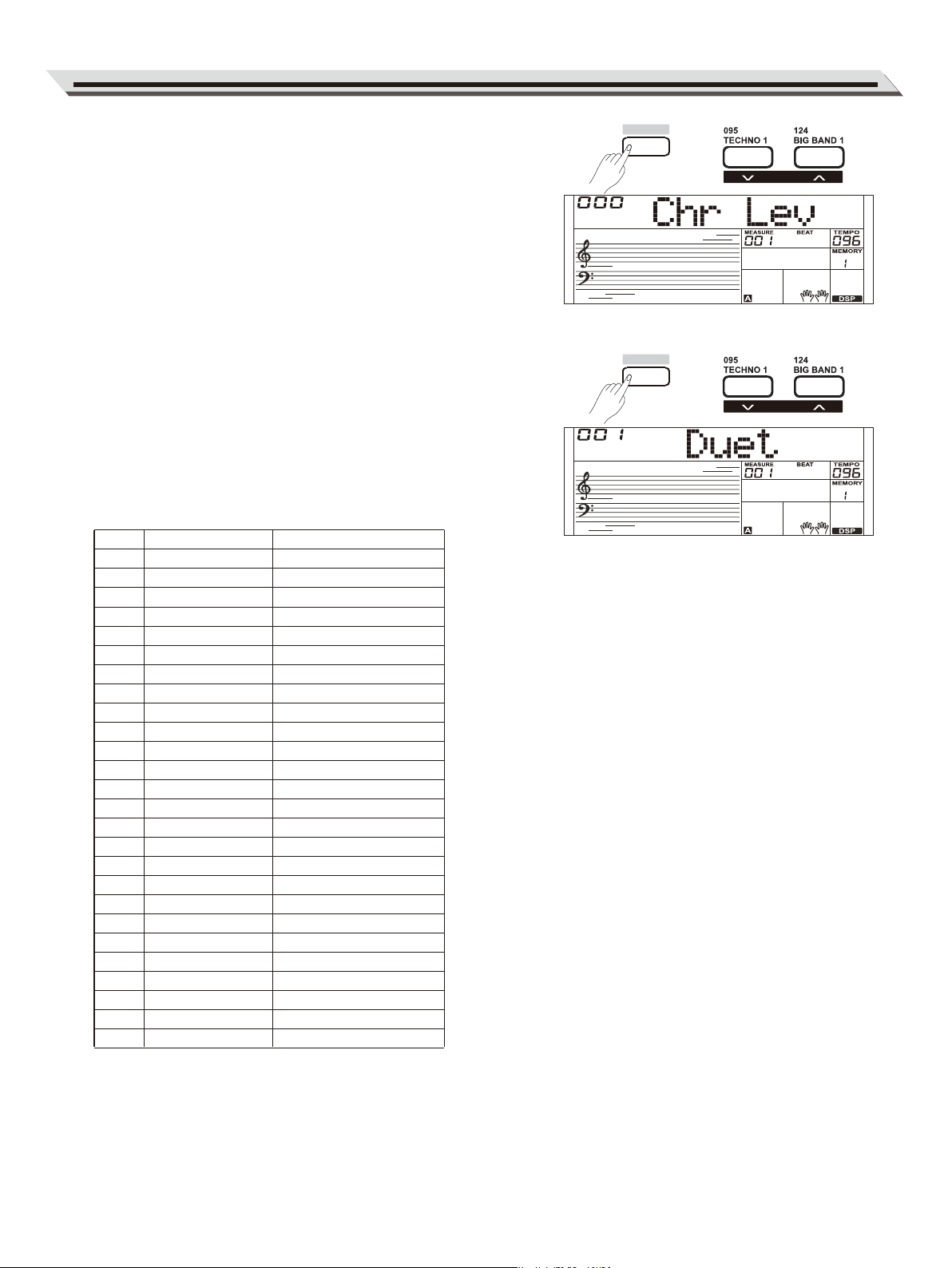
Chorus Level
1. Holding down the [SHIFT] button and press the [FUNCTION-] or
[FUNCTION+] button repeatedly to select chorus level menu.
The LCD displays “*** Chr Lev”, Use the [+/YES]/ [-/NO] button or
data dial to change chorus level, adjustable range is: 0-127.
2. Press the [+/YES] and [-/NO] buttons simultaneously to restore the
chorus level to its default setting: 000.
Harmony Type
1. Holding down the [SHIFT] button and press the [FUNCTION-] or
[FUNCTION+]button repeatedly to select harmony type menu.
The LCD displays “001 Duet”. Use the [+/YES]/ [-/NO] button or data
dial to change harmony type.
2. Press the [+/YES] and [-/NO] buttons simultaneously to restore the
harmony type to its default setting: 001 Duet.
The harmony types are shown below:
Function Menu
27
No.
1
2
3
4
5
6
7
8
9
10
11
12
13
14
15
16
17
18
19
20
21
22
23
24
25
26
LCD
Duet
STD Trio
FulChord
RockDuet
CtryDuet
CtryTrio
Block
4Close1
4Close2
4 Open
1+5
Octave1
Octave2
Strum
Echo1
Echo2
Echo3
Echo4
Tremolo1
Tremolo2
Tremolo3
Tremolo4
Trill1
Trill2
Trill3
Trill4
Harmony Type
Duet
Standard Trio
Full Chord
Rock Duet
Country Duet
Country Trio
Block
4 Close 1
4 Close 2
4 Open
1+5
Octave 1
Octave 2
Arpeggio
Echo1
Echo2
Echo3
Echo4
Tremolo1
Tremolo2
Tremolo3
Tremolo4
Trill1
Trill2
Trill3
Trill4
SHIFT
SHIFT
FUNCTION
FUNCTION
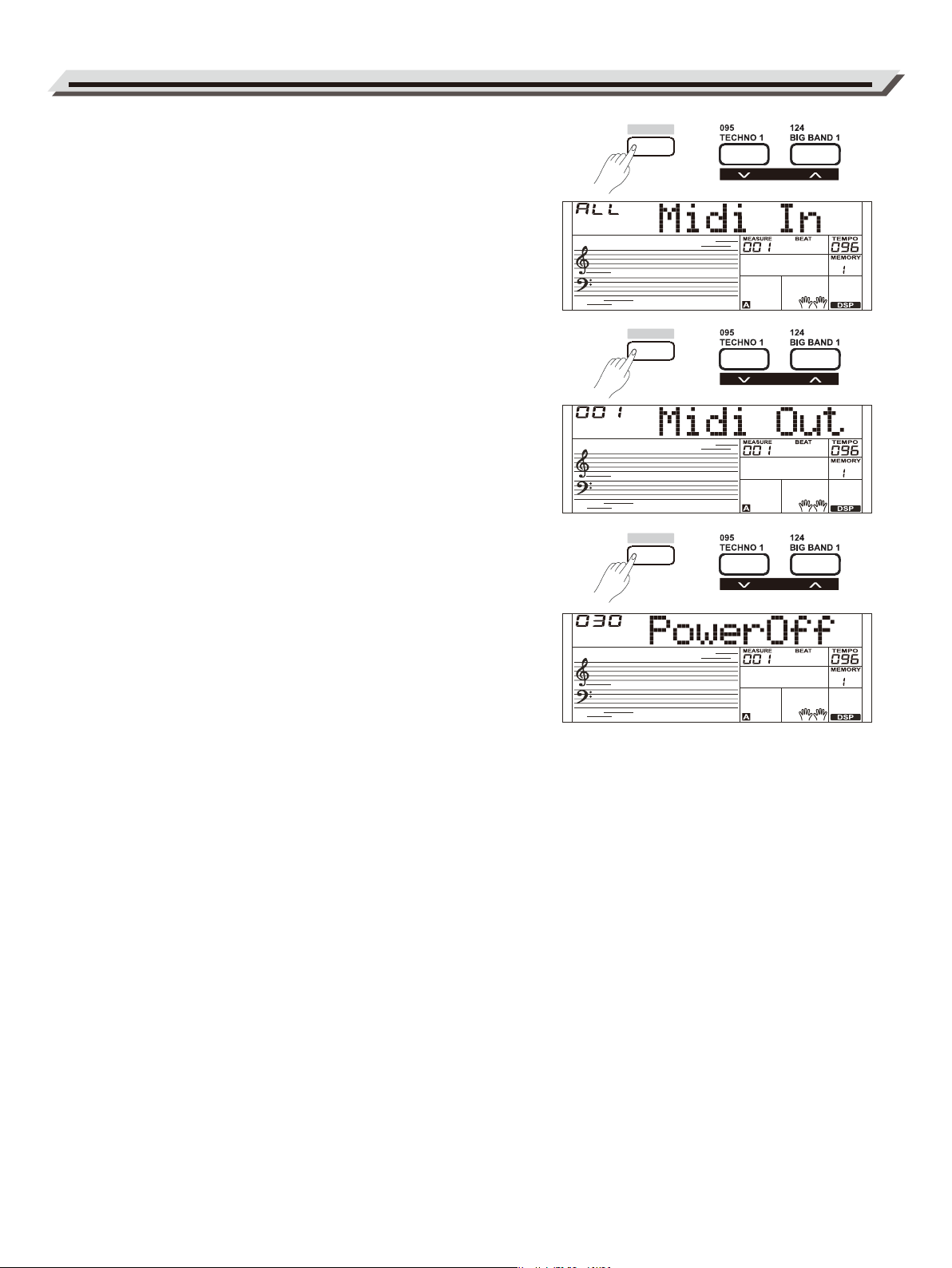
MIDI IN
1. Holding down the [SHIFT] button and press the [FUNCTION-] or
[FUNCTION+] button to select the MIDI In menu. The LCD displays
“*** Midi In”. Use the[+/YES]/ [-/NO] button or data dial to adjust
MIDI in channel: 1~16, ALL.
2. Press the[+/YES] and [-/NO] buttons simultaneously to restore the
MIDI In channel to its default setting: ALL.
MIDI OUT
1. Holding down the [SHIFT] button and press the [FUNCTION-] or
[FUNCTION+] button repeatedly to select MIDI Out menu.
The LCD displays “*** MIDI Out”. Use the[+/YES]/ [-/NO] button or
data dial to adjust MIDI Out channel: 1~16.
2. Press the [+/YES] and [-/NO] buttons simultaneously to restore the
MIDI out channel to its default setting: 001.
Auto Power Off
This function is used to set the auto power off time.
1. Holding down the [SHIFT] button and press the [FUNCTION-] or
[FUNCTION+] button repeatedly to enter the auto power off menu.
The LCD displays “*** Power Off”. Use the [+/YES]/ [-/NO] button or
data dial to change auto power off time: 30 minutes, 60minutes or
OFF.
2. Press the[+/YES] and [-/NO] buttons simultaneously to restore the
auto power off time to its default setting: 030(30 minutes).
Function Menu
28
SHIFT
SHIFT
SHIFT
FUNCTION
FUNCTION
FUNCTION
M1 M2 M3 M4 M5 M6
MELODY 1 MELODY 2 MELODY 3 MELODY 4 MELODY 5
O.T.S.
STORE
ACCOMP
This instrument has a Registration Memory feature that lets you save
your favorite settings for easy recall whenever they are needed
Registering the Panel Setting
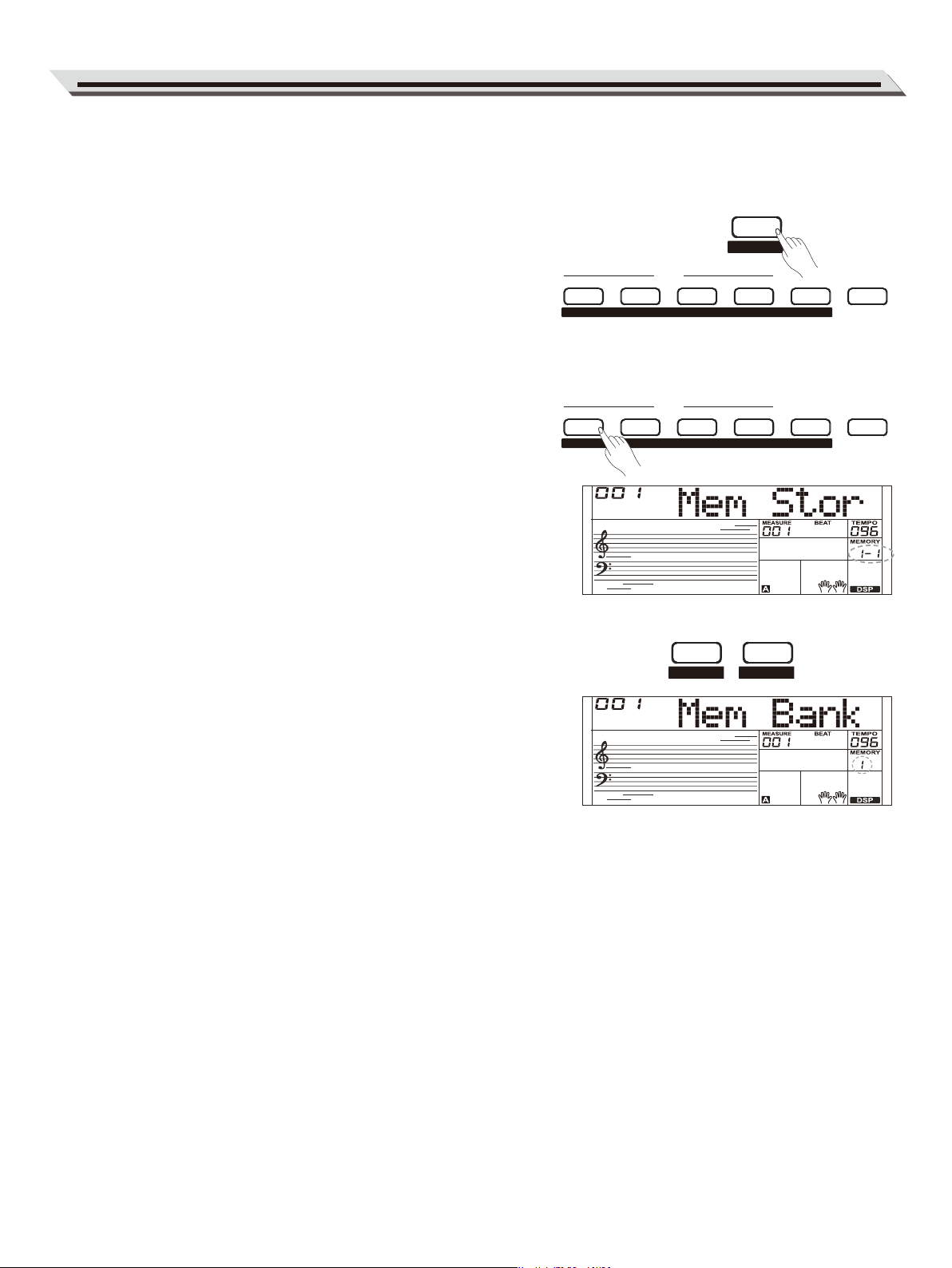
1. There are 8 memory banks, and each bank has 6 memories (M1-M6).
2. Holding down the [STORE] button and press one of the registration
memory buttons: [M1] - [M6]. Notice that the new settings will replace
the previous memory data.
Note:
Press the[STORE] and [M1] button simultaneously then power on, the
registration memory will be restored to its default setting.
Recalling the Registered Panel Settings
Press one of the registration memory buttons: [M1] - [M6].
If you choose bank 1, and then press [M1] button, the panel settings
stored in the memory 1 of bank 1 are recalled. Meanwhile the LCD
displays “1-1”.
Note:
Registration data cannot be recalled when the One Touch Setting
function is on.
Selecting a Registration Bank
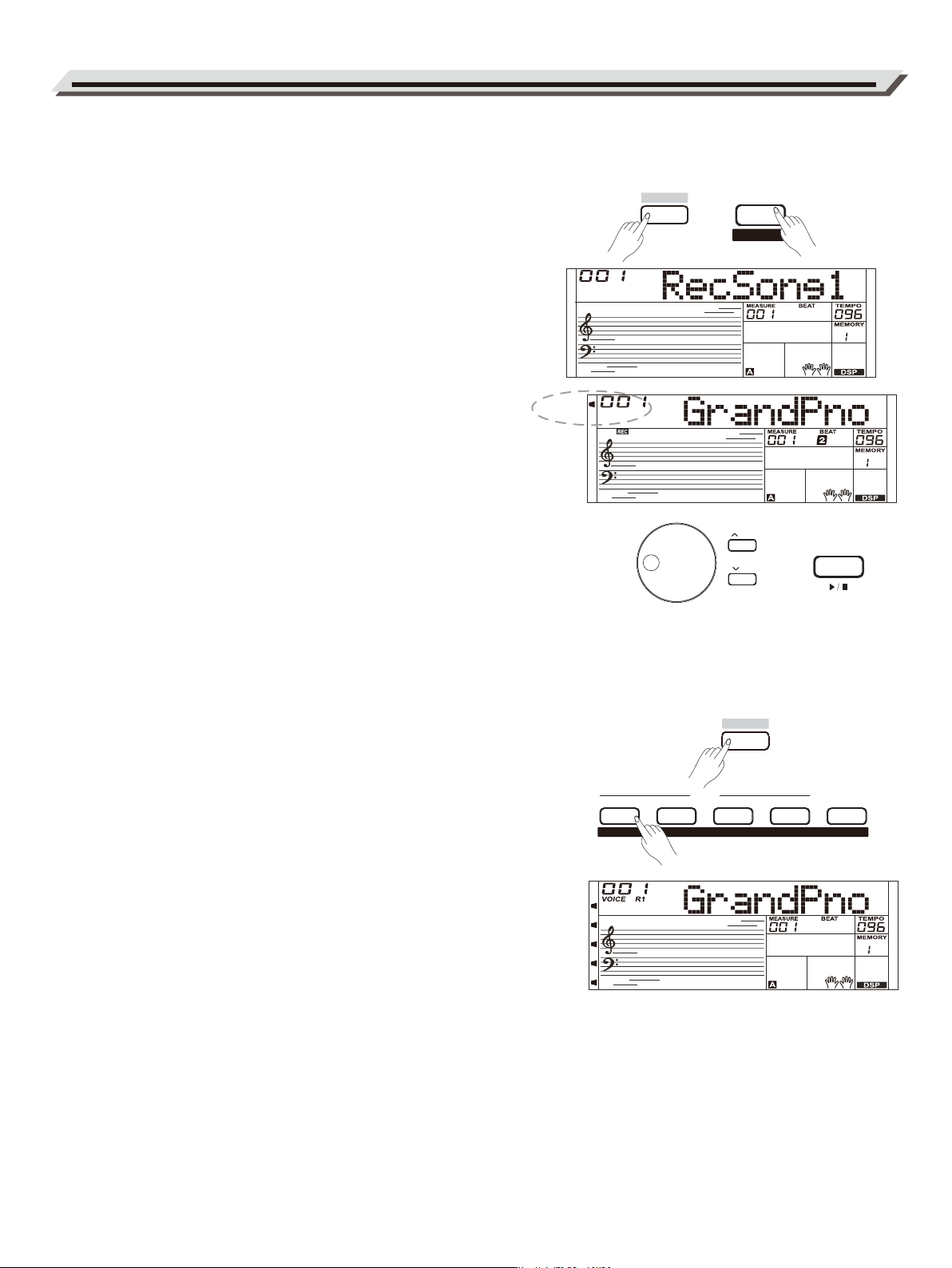
1. Press the [BANK] button. The LCD will display the current bank
number.
2. Press the [BANK] button repeatedly to select bank settings: 1~8.
3. You can save following parameters into [M1]-[M6].
Voice Parameter: including main voice, dual, lower, DSP and mixer.
Accompaniment Parameter: including style, tempo, chord mode
on/off and section selection.
Function Parameter: including touch, part parameters in function
menu.
Registration Memory
29
M1 M2 M3 M4 M5 M6
MELODY 1 MELODY 2 MELODY 3 MELODY 4 MELODY 5
O.T.S.
BANK STORE
RECORD ACCOMP
BANK
RECORD
With the easy-to-use song recording features, you can record your own
keyboard performances as a user song. 5 user songs can be recorded,
and you can record up to a total of 6 tracks: 5 MELODY tracks and
1 ACCOMP track, each track can be recorded individually.
Start Recording
Before you start recording, you need to select a user song to keep the
recording song.
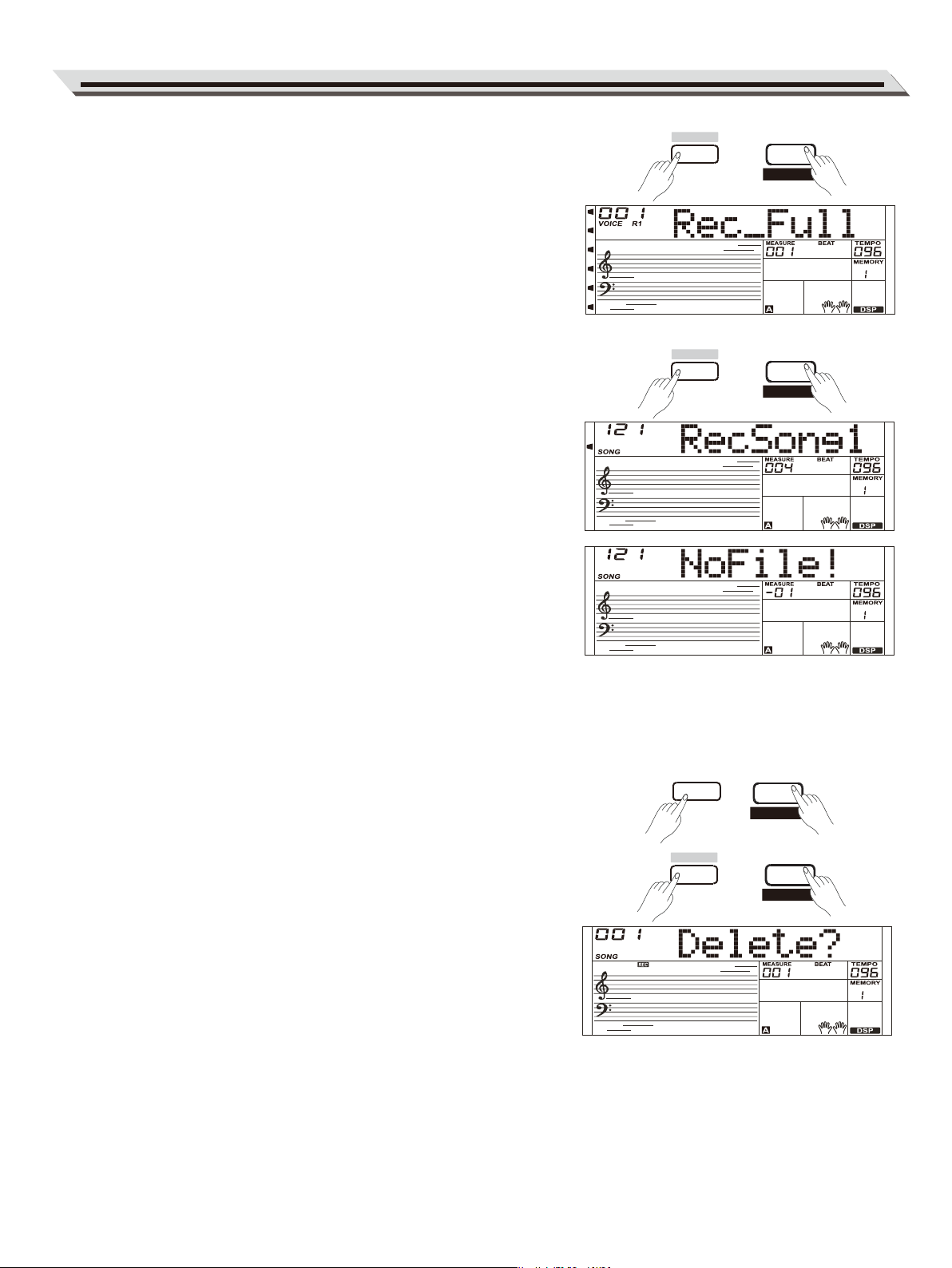
1. Holding down the [SHIFT] button and press the [RECORD] button to
enter user song selection mode. The LCD displays "RecSong1” and
the sequence number. Use the data dial, or the [+/YES] / [-/NO] button
to select the user song you want to record.
2. Holding down the [SHIFT] button and press the [RECORD] button
again to enter record preparation mode. The “REC” icon will light up,
four beats and the system automatically selected empty track
“Melody1” or other track keeps flashing on the LCD.
3. In the recording preparation status, you can adjust parameters such as
the voice, style and tempo. When recording a new song, the system
will automatically select “Melody 1” as the recorded track.Holding down
the [SHIFT] button and press “ACCOMP” (or “MELODY1” to “MELODY
5”) to make your own selection.
The ACCOMP track and one of MELODY track can be recorded at the
same time, but it cannot record two MELODY tracks simultaneously.
4. Press the [START/STOP] button or play the keyboard to start record-
ing. When choosing the ACCOMP track and A.B.C. is open, play an
effective chord in left-hand section or press the [START/STOP] button
to start recording.
Select a Track
There are 3 states of the track cursor on the LCD: blinking, light and off.
Blinking: It means the track was chosen for recording. If the track has
recorded data, the original data will be replaced.
Light: It means this track have recorded data, which will be played back
during the recording process for other track.
Off: It means no data in this track, or this track have recorded data but
cannot be played back. The 3 states can be switched by repeatedly press
the relevant button to select “ACCOMP” track, “MELODY 1” track or
“MELODY 2” track.
Notes:
1. Record style with accompaniment track, and record melody with
melody track.
2. In the recording preparation status, you can repeatedly press the
[ACCOMP], [MELODY 1] ~ [MELODY 5] button to shift track state.
When recording an existing song, the keyboard will automatically select
the empty track next to the occupied track. For example, if “Melody 1” is
occupied, then “Melody 2” will be selected as the record track. When
all 6 tracks have been recorded, select the “melody 1” track to save
recordings.
Record
30
M1 M2 M3 M4 M5
MELODY 1 MELODY 2 MELODY 3 MELODY 4 MELODY 5
O.T.S.
SHIFT
SHIFT
ACCOMP
MELODY1
MELODY2
MELODY3
MELODY4
MELODY5
START / STOP
/ YES
/ NO
Stop Recording
1. When recording is in process, holding down the [SHIFT] button
and press the [RECORD] button to stop recording.
2. When recording is in process, if the memory is full, the recording
will stop and save automatically, and the LCD displays “Rec_Full”.
If you choose the accompaniment recording, the recording will stop
automatically when the ending of the rhythm finishes.
Playback Recording
1. When recording is in process, holding down the [SHIFT] button and
press the [RECORD] button, it will stop recording and enter the
song play mode, the LCD displays its default name “UserSong”
and the number of user song, the current recorded song will play
automati-cally in circle.
2. Press the [SONG] button to enter the song mode and it will play all
songs circularly. Use the data dial, or the[+/YES] / [-/NO] button to
select a song, there are 125 songs in all, including 5 user songs
(121~125). If there is no data in the selected user song, it will
display “NoFile!” and stop playing in circle.
3. Press the [START/STOP] button to play a user song or select one
user song in the song standby mode. Press the [START/STOP]
button, this user song will be played in circle automatically.
Notes:
1. We have programmed power-off protection, all data of user songs
will not be erased even the instrument is powered off.
2. To mute a track, simply press the button of selected track and the
related cursor goes out, this track will have no sound when the
song is played.
Delete User Song
1. While holding the [RECORD] and [SONG] buttons simultaneously
turn power on, all user songs will be erased.
2. In the recording preparation status, holding down the [SHIFT]
button and press the [RECORD] button for two seconds, the LCD
will display “Delete?”. Now hold down the [SHIFT] button and then
press [ACCOMP] (or [MELODY 1] to [MELODY 5]) button to select
the track you want to delete.
In the delete user song mode, the lightened track icon means this
track you want to delete. Otherwise, it means the track you want to
keep. If all track icons light up, it means you will delete the whole
user song after confirmation.
3. Choose the track you want to delete, press [+/YES] to confirm and
the recorded data in this track will be delete. Press [-/NO] to quit
this step, and go back to the recording preparation status.
Record
31
BANK
RECORD
SHIFT
BANK
RECORD
BANK
RECORD
SHIFT
BANK
RECORD
SHIFT
MELODY1
ACCOMP
MELODY1
MELODY2
MELODY3
MELODY4
MELODY5
SONG
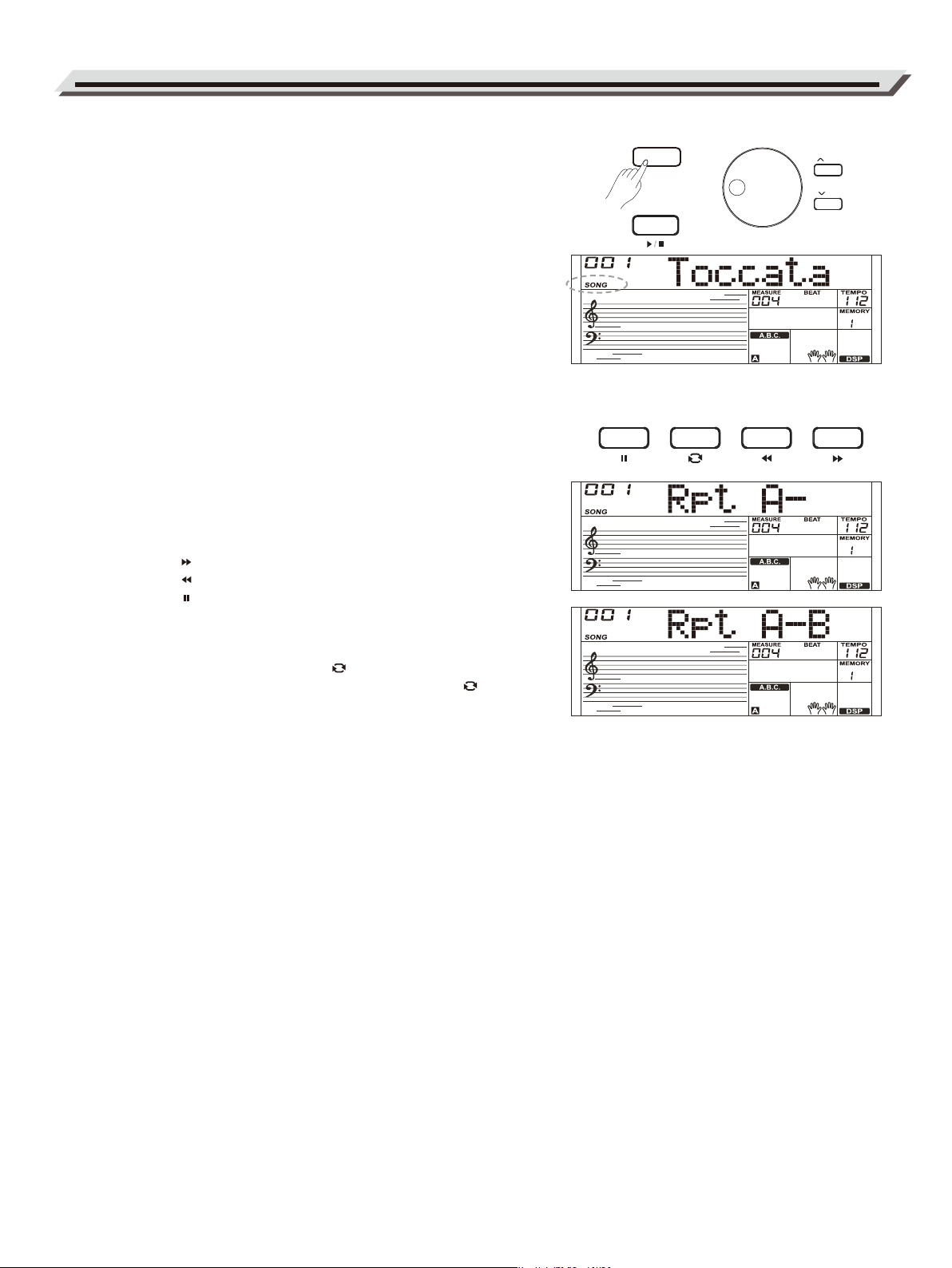
The instrument has 120 songs in all, and each song has equipped with
learning mode.
Listening to the Songs
1. Press the [SONG] button to enter the song mode. The LCD shows
“SONG” icon and it will play all songs circularly.
2. Use the data dial or the[+/YES] / [-/NO] button to select a song.
3. In song playing mode, press the [START/STOP] button to stop playing
without exit the song mode. Press the [START/STOP] button again to
play the current song in circle.
4. When the song is stopped, press the[STYLE] or[VOICE] button to exit
the song mode.
Song Control
1. Introductory Beat
Before the prelude of the song starts to playback, it has the introducto-
ry beat. The measure starts from the negative value. And the melody
starts to play when the measure value comes to “1”.
2. REW, FF and PAUSE
When the song is playing:
Press the [ ] button to fast forward the song.
Press the [ ] button to rewind the song (base on the measure).
Press the [ ] button to pause the playing song, press again to
continue playing.
3. Song Repeat
When playing the song, press the [ ] to set the loop begin andpress
it again to set the loop end. When in loop status, press [ ] again to
quit the loop playing status.
32
Song
SONG
SYNC START INTRO / ENDING FILL A FILL B
START / STOP
/ YES
/ NO
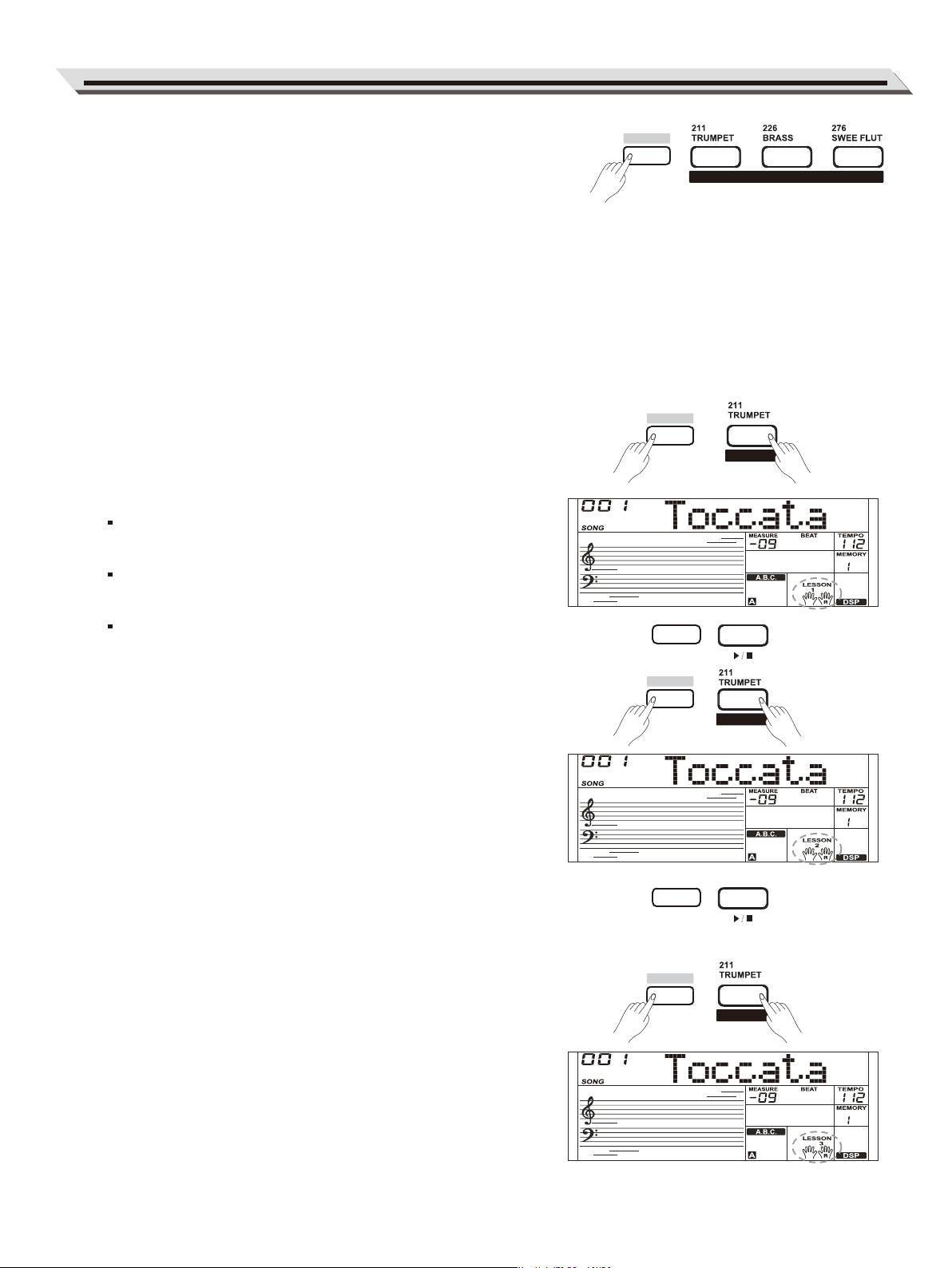
The lesson mode includes 3 buttons: [LESSON]/[LEFT]/[RIGHT]. The 3
buttons will work only in song mode and when song stops playing.
1. Holding down the [SHIFT] button and press the [LESSON] button to
enter the LESSON mode. The default setting is right-hand lesson.
Press the [LEFT] button to choose left-hand lesson.
Press the [RIGHT] button to choose right- hand lesson.
Press [LEFT] and [RIGHT] button simultaneously to choose the both-
hands lesson.
Press the [START/STOP] or [SONG] button to start lesson mode.
2. Switching lesson mode is not allowed in the process. After lessons, the
system will mark automatically. No score will be on the LCD if stop
learning in the process.
Notes:
1. Not every song can give practices for both hands.
2. For your convenience, the LCD displays the keys of rhythm or chord
in the song mode.
Lesson 1
1. Holding down the [SHIFT] button and press the [LESSON] button to
enter the lesson mode. The lesson 1 icon lights up on the LCD. In
Lesson 1 mode, the system only grades the time value of the perfor-
mance, but not the pitch or the chord.
If [RIGHT] is selected, it will mute melody of right hand and you will
have to follow the time value of the right hand. As long as the time
value is correct, the melody will sound.
If [LEFT] is selected, it will mute the changing chord and melody by
left hand. You will have to follow time value of the left hand. As long
as the time value is correct, the chord/melody will sound.
If [LEFT] and [RIGHT] are selected, the chord/melody of left hand
and the melody of right hand will be muted.
2. Press the [START/STOP] / [SONG] button to start practice. Your
performance will be evaluated by system.
Lesson 2
1. Holding down the [SHIFT] button and press the [LESSON] button twice
to enter the lesson 2 mode. The lesson 2 icon lights up on the LCD. In
LESSON 2 mode, the keyboard only grades your accuracy of pitch. The
song stops until you play the correct note. The main melody will be
hidden when you choose the right-hand lesson. The main melody and
the chord will be hidden when you choose the left-land lesson.
2. Press the [START/STOP] / [SONG] button to start to practice. The
system will give you a fair mark after lesson.
Note:
In this state, the note sounds only you play the right one.
Lesson 3
1. Holding down the [SHIFT] button and press the [LESSON] button thrice
to enter “Lesson 3” Mode. The lesson 3 icon lights up on the LCD. The
system grades the accuracy of both pitch and timing of notes when the
song is playing. You must play the right notes in time with the correct
value. The rhythmic accompaniment is still playing even if no notes are
played.
2. The main melody will be hidden when you choose the right -hand lesson.
The main melody and the chord will be hidden when you choose the
left-land lesson. Press [LEFT] and [RIGHT] button simultaneously to
choose both-hands lesson.
3. In LESSON 3 mode, hold down the [SHIFT] button, then press again the
[LESSON] button to turn off the lesson mode, the icon on LCD will be off.
Note:
In this lesson mode, the notes are sounded whether they are right or wrong.
Lesson Mode
33
SHIFT
SHIFT
LESSON
LESSON
L R
&
SHIFT
SONG
START / STOP
SHIFT
SONG
START / STOP
LESSON
LESSON

If you know the name of a chord but don’t know how to play it, you can
use the Chord Dictionary function. You can learn the chord and test in
this features.
DICT 1 (Chord Learning Mode)
Holding down the [SHIFT] button and press the [DICT.] button to enter
the DICT 1 mode, the LCD displays “Dict.1” and the A.B.C. is
automatically turned on.
In DICT 1 mode, the keys C4~B5 are used to assign the Chord Type,
the keys C6~B6 are used to assign the Chord Root.
When the Chord Type and Chord Root are confirmed, the LCD will
display the Chord and its keyboard position. For example, if you want to
play a CM7 Chord, press the C6 key to specify C as the chord root.
The root note you set will be shown on the LCD but the note does not
sound. Refer to the picture on the right for assigning the Chord Root.
Press the E4 key to specify M7 as chord type. The notes you should
play for the specified chord (root and chord type) are shown on the LCD
as the notation and also the screen printing of the panel. When the
Chord Type and Chord Root are confirmed, the LCD will display the
chord and its keyboard position. A prompt sound will be heard when you
play it correctly in the chord section of the keyboard.
DICT 2 (Chord Examining Mode)
Holding down the [SHIFT] button and press the [DICT.] button to enter
the DICT 2 mode. This is an Examining mode. The chord area on the
LCD will display a random chord while the keyboard position does not
display anything on LCD.
When you play the correct chord within 3 seconds, the next chord
(random) will be displayed on LCD to wait for the correct chord playing.
If not, LCD will display the corresponding keyboard position automati-
cally.
In DICT 2 mode, holding down the [SHIFT] button, and then press the
[DICT.] button again to turn off chord dictionary.
24 Chords are indicated in the display as shown below:
Chord Dictionary
34
Note
C6
C#6
D6
Eb6
E6
F6
F#6
G6
Ab6
A6
Bb6
B6
Chord Root
C
C#/Db
D
Eb/D#
E
F
F#/Gb
G
Ab/G#
A
Bb/A#
B
Note
C4
C#4
D4
Eb4
E4
F4
F#4
G4
Ab4
A4
Bb4
B4
Chord Type Note Chord Type
M
M(9)
6
mM7
M7
M
M(9)
M6
M7(9)
M7
M7b5
7
C5
C#5
D5
Eb5
E5
F5
F#5
G5
Ab5
A5
Bb5
B5
7(b9)
7(9)
7(#9)
7(b13)
7(13)
7(#11)
dim7
dim
7aug
aug
7sus4
sus4
SHIFT
DICT.
SHIFT
C4 B5 B6C6
DICT.
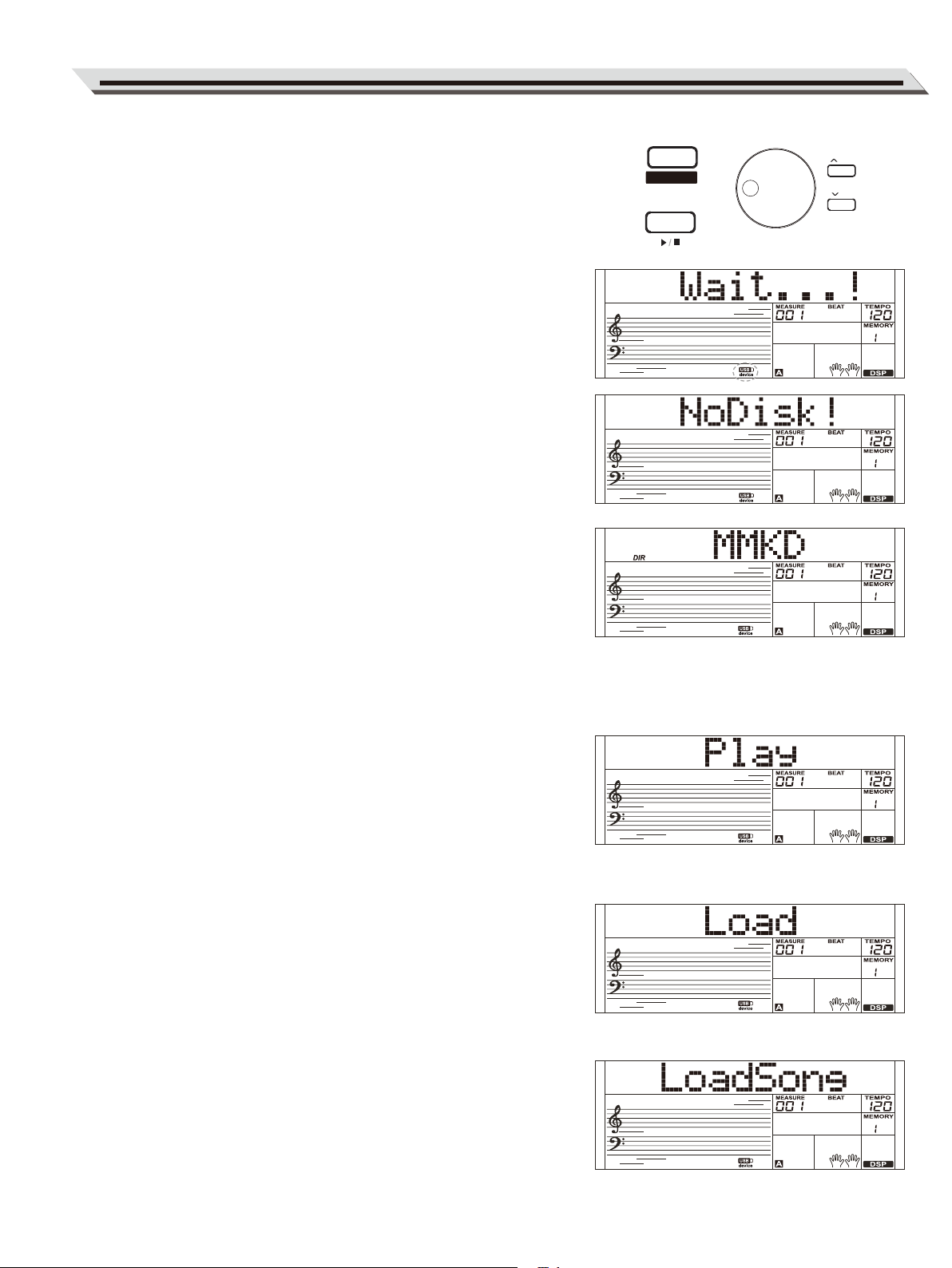
There is a standard USB Storage Device external interface which
supports the USB Storage Device of 16M ~ 32G capability. It is
compatible with the file system format of the FAT 16/32. It is better to use
the USB Storage Device which is formatted by the keyboard. Please do
not edit these files which come from the keyboard in PC.
USB Device Operation
1. In the mode, use the key as following: [USB DEVICE], [START/STOP]
/[+/YES], [-/NO], data dial and [START/STOP].
2. Press [USB DEVICE] button to enter mode, press again to exit mode.
3. If the USB Storage device has been inserted before press the
[USB DEVICE] button, the LCD will display “Wait...!”. After the
initialization finished, the LCD displays “Play”.
4. If the initialization failed, the LCD will display “DiskErr!”.If the USB
Device has not been inserted, the LCD will displays “NoDisk!”
5. In the mode, use data dial to choose menu, or use the [+/YES] button
to the next operation, press [-/NO] to return to the previous menu.
6. In USB Storage mode, a directory includes 512 files at most. The LCD
displays “DIR” for directory, ”FILE” for files. Press the [USB Device]/
[STYLE]/[SONG] button to exit USB Device mode.
7. When playing the MIDI files, press the [MIXER] button to adjust the
volume.
8. You can only execute the operations of “Load”, ”Save”, “Format” with
the files in the directory “MMKD”.
Note:
The “MMKD” folder will be generated automatically when user data is
saved to the USB storage device.
Play
1. Press [USB DEVICE] button to enter mode, use data dial to choose
“Play”.
2. Press the [+/YES] button, the LCD will display the name of MIDI and
sub-directory.
3. When you choose a sub-directory, the LCD will display its name and
the icon will light up. Press the [+/YES] button to enter in.
4. Use data dial to choose a MIDI file. Press [START/STOP] to play the
MIDI file in circle. Press [+/YES] to start all files playback in circle.
Press [START/STOP] again to stop.
5. Press the [+/YES] button to return to previous menu when the LCD
displays “..”.
Load
1. Press the[USB DEVICE]button to enter USB Storage mode. Use data
dial to choose “Load”.
2. Press [+/YES] to the enter subdirectory menu.
Connecting a USB Device
35
USB DEVICE
START
/ STOP
OCTAVE
/ YES
/ NO
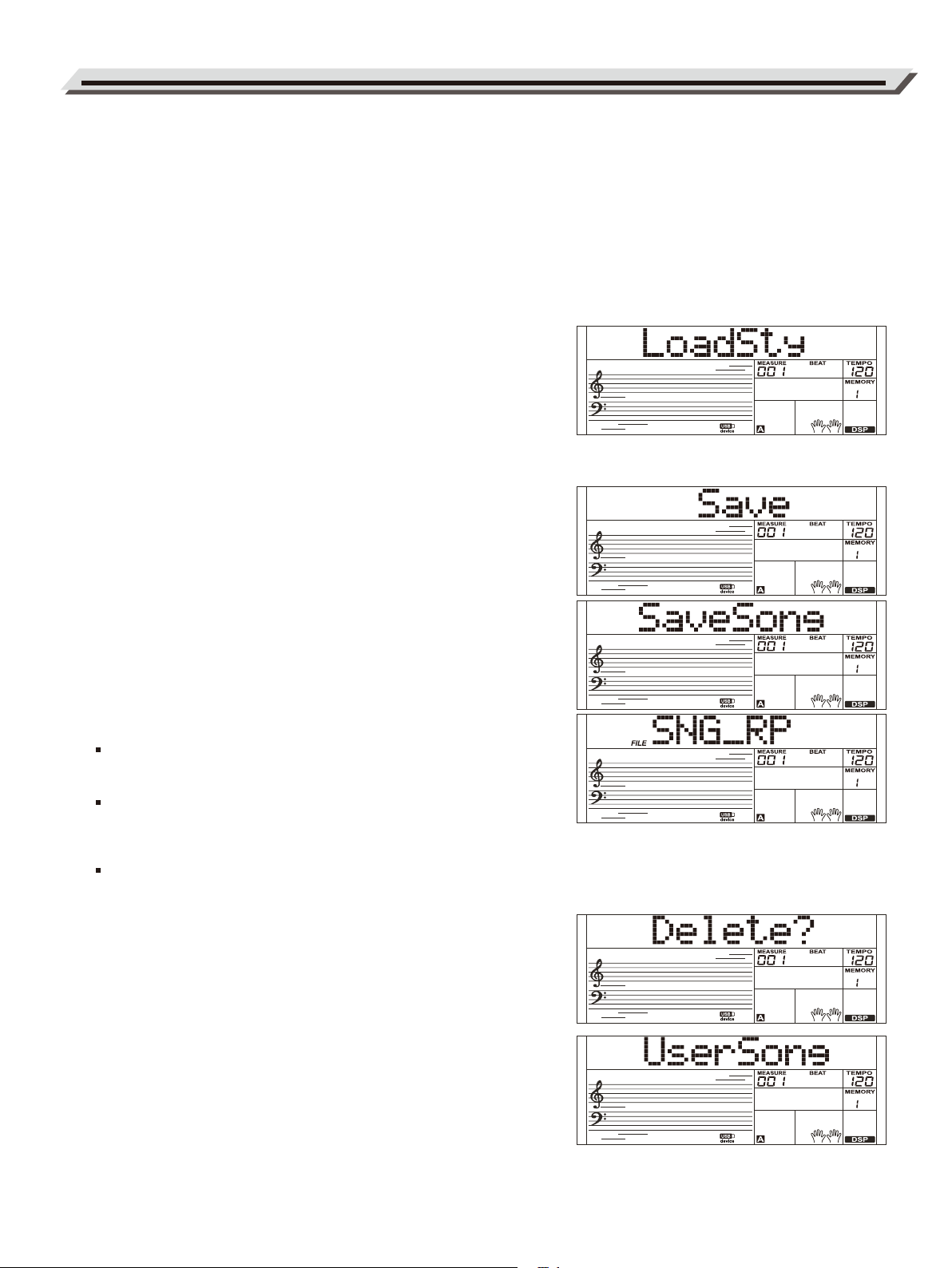
Load song
1. Select the menu "LoadSong" and press the [+/YES] button, the MIDI
files in the "SONG" directory of USB Storage Device are displayed on
the LCD, use data dial to choose the file to be loaded.
2. Press the [+/YES] button to confirm the file needed, the user song
number will be displayed on LCD, select them by using data dial.
3. Press the [+/YES] button, "Sure?" will be displayed on LCD, press the
[+/YES] button to load the file or press the [-/NO] button to cancel.
Load Style:
1. Select the menu “LoadSty” and press the [+/YES] button, the style files
in the “STYLE” directory of USB Storage Device are displayed on the
LCD, select styles by using data dial.
2. Press the [+/YES] button to confirm the file needed, the user style
number will be displayed on LCD, select them by using data dial.
3. Press the [+/YES] button, “Sure?” will be displayed on LCD, press the
[+/YES] button to load the file or press the [-/NO] button to cancel.
Load Memory:
1. Select the menu “LoadMem” and press the [+/YES] button, the mem
files in the “MEMORY” directory of USB Storage Device are displayed
on the LCD. You can select memories by data dial.
2. Press the [+/YES] button, “Sure?” will be displayed on LCD, press the
[+/YES] button to load the file or press the [-/NO] button to cancel.
Save
1. Press the [USB DEVICE] button to enter USB Storage mode, use data
dial to choose “SAVE”.
2. Press the [+/YES] button to enter subdirectory of saving. Use data dial
to choose “SaveSong”, “SaveSty”, “SaveMem” and “SaveVoic”.
For example:
Enter in the ”Save Song” mode, press the [+/YES] button, the LCD will
display the current name and the number of user song. Use data dial to
choose songs to be saved.
Select the song to be saved, press the [+/YES] button, the LCD
displays “SNG_”, use the keyboard to edit the name. After that. Press
the [+/YES] button, the LCD will display “Sure?” Press the [+/YES]
button to save, press the [-/NO] button to cancel.
If the name is same as an exiting song, the LCD will display
“SameName”, and then you should edit another name to be saved.
Operations in Style, Voice and Memory setting will be same as the
name of user song.
Delete
1. Press the [USB] button to enter USB Storage mode, use data dial to
choose “Delete”. Press [+/YES] to enter delete menu, which includes
“UserSong”, “UserSty” , “UserMem” and “UserVoic”. Use data dial to
select one.
2. Select the data to be deleted, press the [+/YES] button to enter current
menu. Select the one to be deleted, press the [+/YES] button, the LCD
displays ”Sure?” .Press [+/YES] to delete, press [-/NO] to cancel.
Connecting a USB Device
36
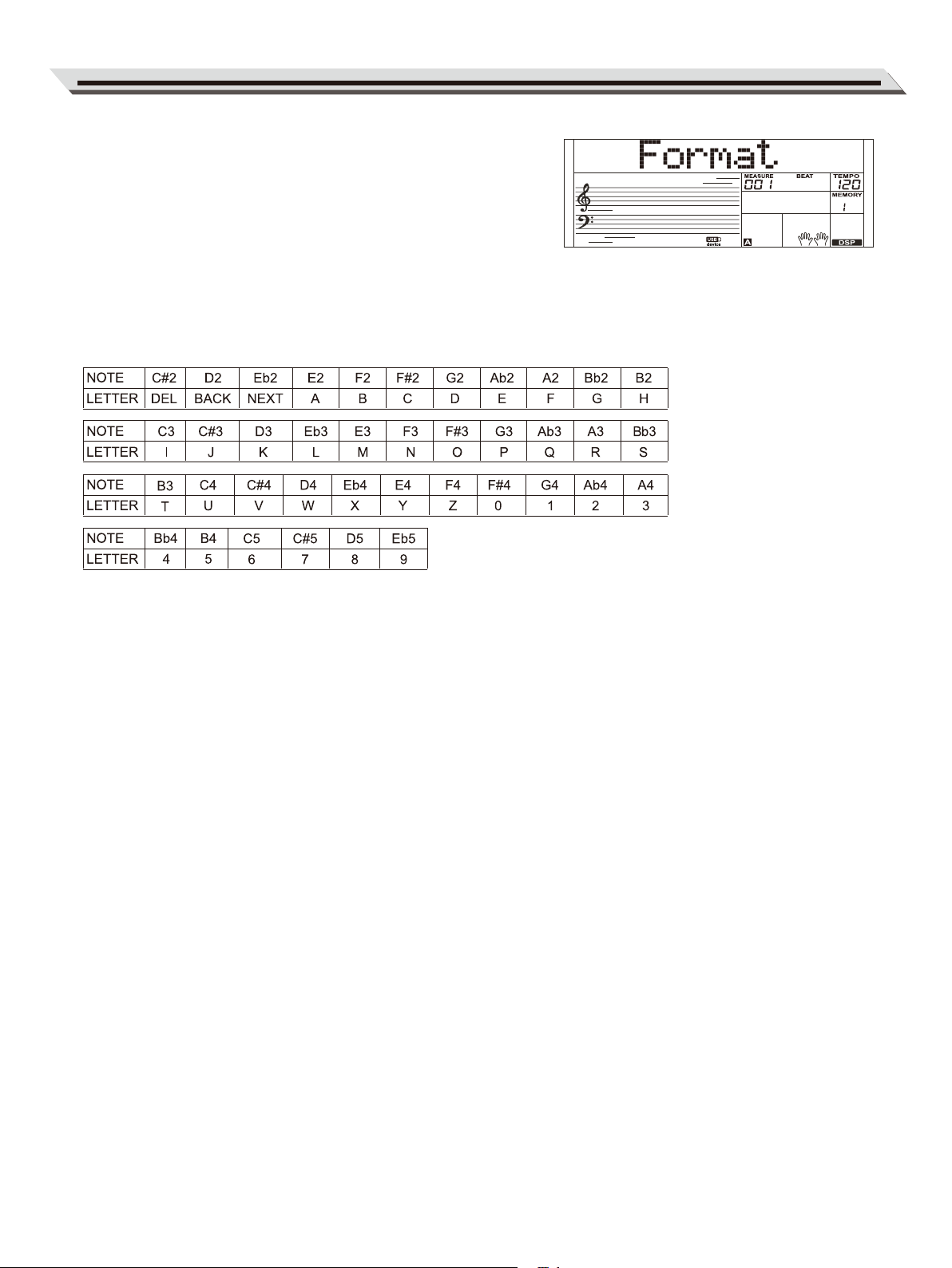
Connecting a USB Device
37
Format
Press the [USB] button to enter USB Storage mode, use data dial to
Choose “Format”. Press [+/YES] to format the USB Storage Device, the
LCD displays” Sure?” .Press [+/YES] to format the USB Storage, press
[-/NO] to cancel.
Note:
Formatting will delete all user data in the USB Storage Device!
Keyboard and ASCII Character Relative
Table:
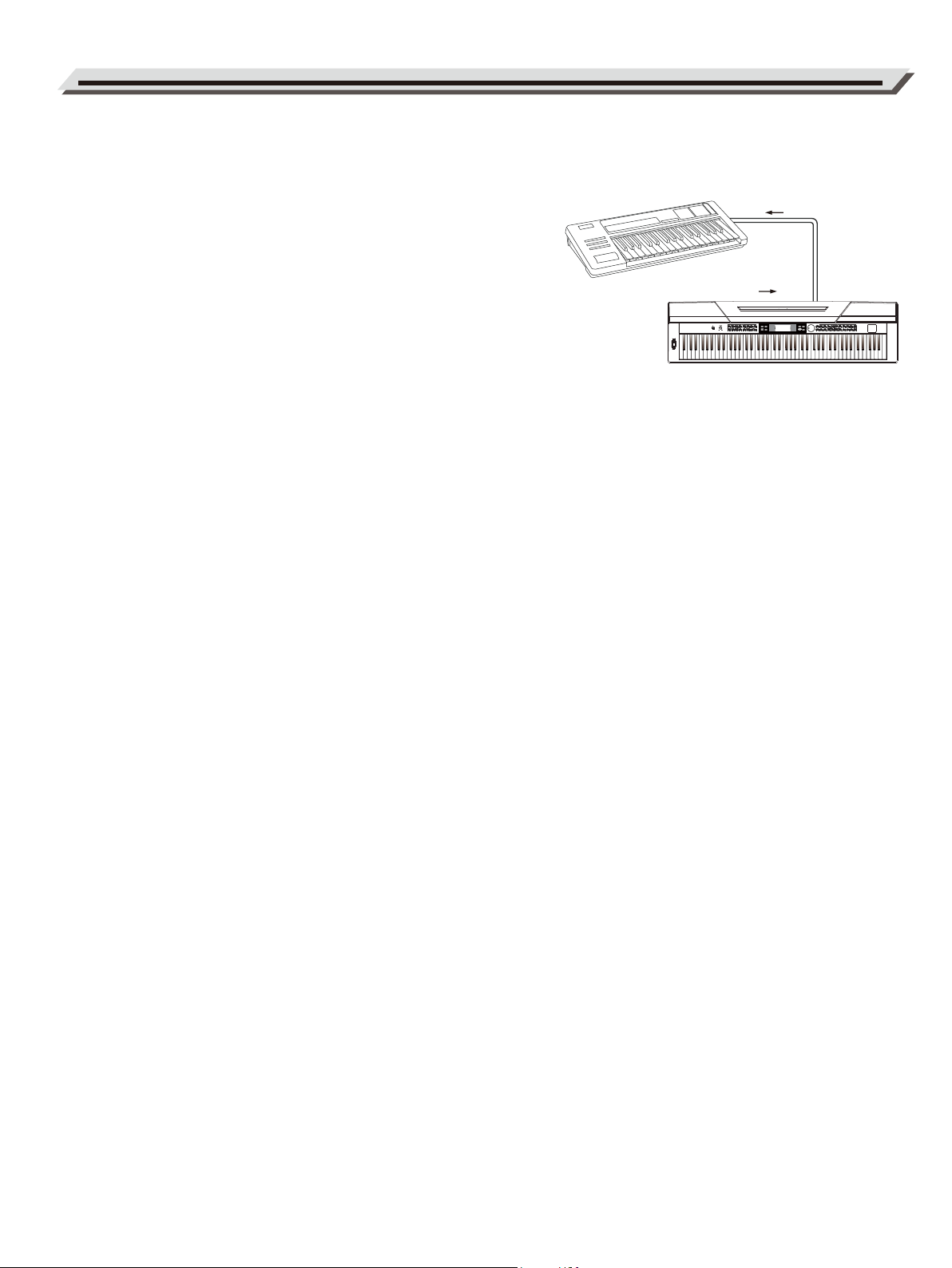
By using the MIDI functions you can expand your musical possibilities.
This section explains what MIDI is, and what it can do, as well as how
you can use MIDI on your instrument.
What's MIDI?
1. MIDI (short for Musical Instrument Digital Interface) allows a wide
variety of electronic musical instruments, computers and other
related devices to connect and communicate with one another. MIDI
carries event messages that specify notation, pitch and velocity,
control signals for parameters such as volume, vibrato, audio
panning, and program change information to change the voice
selections.
2. The instrument can output the real-time playback information via
MIDI messages and control external MIDI devices. The instrument
can also accept incoming MIDI messages and generate sound
accordingly.
Note:
The USB connector belongs to USB device which can only be connect-
ed with PC. It is not allowed to be connected with the USB port of other
instrument unless the one belongs to HOST.
38
MIDI Functions
MIDI OUTMIDI IN
MIDI OUT
MIDI IN
PITCH BEND
PERFORM. METRONOME
ACCOMP
MELODY 1
MELODY 2
MELODY 3
MELODY 4
MELODY 5
TWINOVA
SUSTAIN
TOUCH
PERFORM
PERFORM.H
PIANO
VOICE STYLE
SONG
SHIFT DEMO
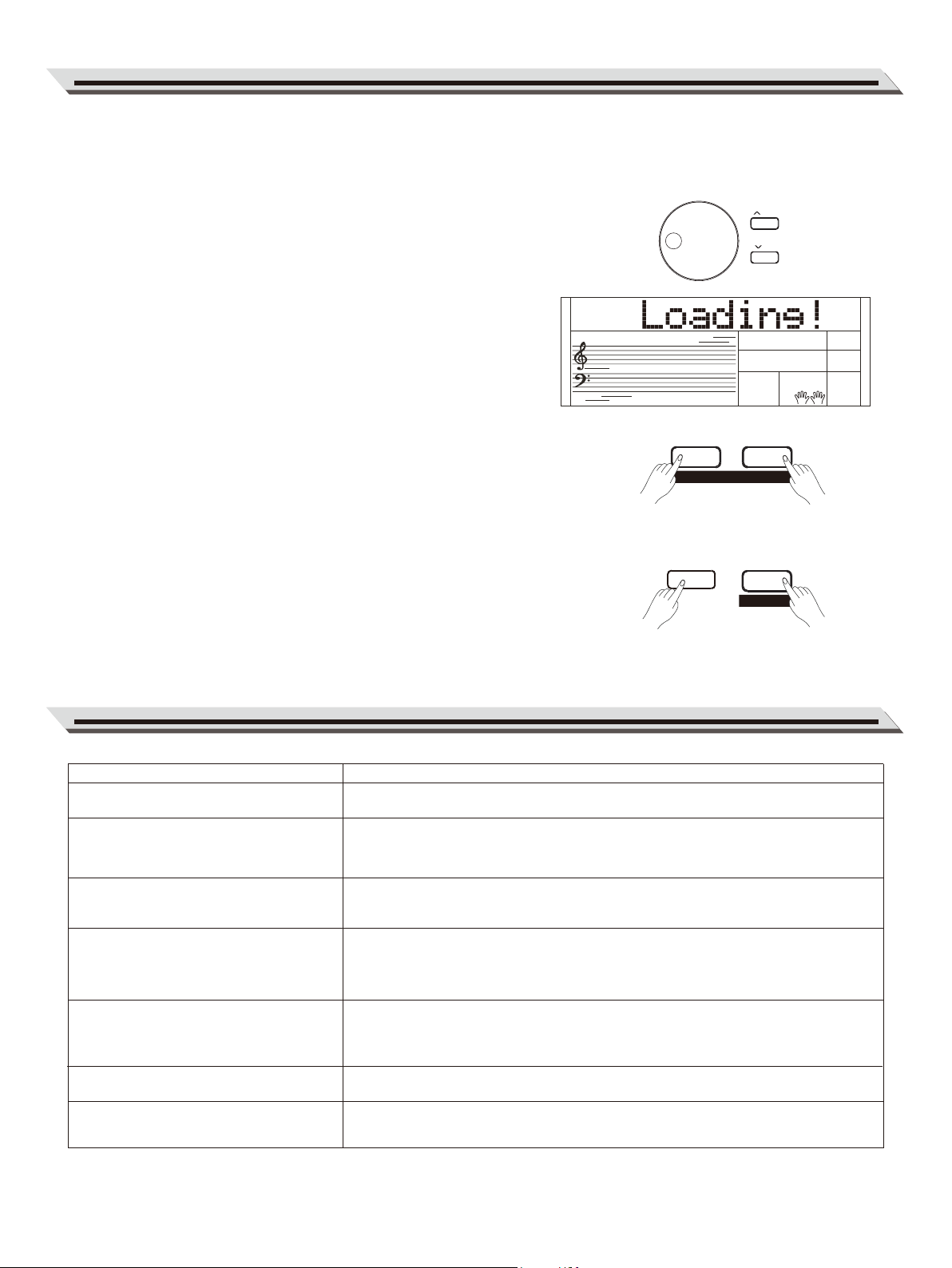
By pressing some designated combinations of buttons and keeping for
a while, and then starting the instrument. This instrument will execute
some special functions.
Restore Factory Setting
Holding down [+/YES] and [-/NO] buttons simultaneously and then turn
the [POWER] switch on, the instrument will be restored to its default
setting. It will delete all the user data: user styles, user songs and
registered memory. The LCD will display “Loading!”.
After the restore process is completed, the instrument will start normally.
Handle with care!
Restore the Registered Panel Settings
Holding down [STORE] and [M1] buttons simultaneously and then turn
the [POWER] switch on , the instrument will be restored to its default
setting. It will delete all data of registered memory.
Handle with care!
Delete User Songs
Holding down [SONG] and [RECORD] buttons simultaneously and then
turn the [POWER] switch on, the system will delete all user songs.
Handle with care!
Restore Factory Setting
Troubleshooting
39
Problem
The speakers produce a pop sound when
the power is turned ON or OFF.
No sound when the keyboard is played.
When using a mobile phone, noise is
produced.
The auto accompaniment does not play
back even Sync is in standby status and
a key is pressed.
Certain notes sound at wrong pitch.
The Harmony function does not operate.
The instrument cannot be recognized after
connecting with PC via USB cable.
Possible Cause and Solution
This is normal , please no cause for alarm.
1. Make sure that the volume is set to an appropriate level.
2. Check the headphones if they are connected to the PHONES jack 2.
3. Make sure the R1/R2/L voice volume (in the Mixer) is set to an appropriate level.
Using a mobile phone close to the instrument may produce interference. To avoid
this, turn off the mobile phone or use it further away from the instrument.
Please try to start accompaniment by playing a key in the right-hand section of the
keyboard. To start the accompaniment with Sync Start, make sure to play a key in
the left-hand section of the keyboard.
Make sure that the tuning value is set to 0 . Holding down the [+/YES] and [-/NO]
buttons simultaneously, then turning the power on will set the instrument to its
default setting.
Harmony cannot be turned on when a drum kit is selected for the voice R1.
Please check if the USB cable is being connected firmly, or try to connect another
USB port of the PC, without the need to install another driver on the PC.
Notice:
If you notice any abnormality cannot be handled, please connect the provider or specified repair station, and have the instrument
inspected by qualified service personnel.
BANK
RECORD
SONG
M1STORE
ACCOMP MELODY 1
/ YES
/ NO
* All specifications and appearances are subject to change without notice.
40
Specifications
Keyboard & Display
Keyboard
Touch Response
Display
Voices
Polyphony (max.)
Voices
Layer
Split
Duo (Twinova)
Styles
Styles
Style Control
Style Creator
O.T.S.
Chord Types
Effects
Effects
Master EQ
Reverb
Chorus
Performance Enhance
Harmony
Performance Assistant
Song & Recording
Music Library
Sequencer
Demo Song
Pitch Adjustment
Transpose
Octave
Tuning
Other Functions
Mixer
Performance Memory
Assignable Controllers
Pitch Bend
Metronome
Tempo
Other control
Connections
Interaction & Expansion
External Drive
Microphone
Phones
Pedals
MIDI
USB
Input
Output
Power Supply
Power
Power Off Protection
Amplifiers & Speakers
Amplifiers
Speakers
Dimensions & Weight
Dimensions LWH (mm)
Weight (kg)
88 Hammer-Action Keys
3 Types, Off
Multi-functional LCD
128
600
Left, Right1, Right2
Yes
Yes
230 preset, 10 user
Start / Stop
Sync Start
Intro / Ending
Main A / Fill in A
Main B / Fill in B
A.B.C.
Fade In / Out
Accomp volume
Yes (PC software)
Yes
32
DSP on / off
6 types
10 types, 128 levels
8 types, 128 levels
26 types
Yes
120 preset songs, Music tutorial system
5 user songs (5 melody + 1 accomp.)
5
-12 ~ +12
-1 ~ +1 (Twinova)
-50 ~ +50
Yes (12 tracks)
8 preset banks x 6
Sustain pedal
Yes
0, 2 ~ 9
30 ~ 280
Chord dictionary
USB MIDI, PC software
USB flash drive (32G max.)
Yes
2 standard stereo
Unit pedal, Sustain pedal
In, Out
USB MIDI
Standard stereo
Standard stereo
DC12V / 2A
Yes
10W x 2
10W x 2
25W x 2
1365 x 366 x 137
13.8
41
VoiceList
NO.
1
2
3
4
5
6
7
8
9
10
11
12
13
14
15
16
17
18
19
20
21
22
23
24
25
26
27
28
29
30
31
32
33
34
35
36
37
38
39
40
41
42
43
44
45
46
47
48
49
50
51
52
53
English Name
Acoustic Grand Piano
Acoustic Grand Piano 2
Acoustic Grand Piano 3
Acoustic Grand Piano (wide)
Acoustic Grand Piano (dark)
Bright Acoustic Piano
Bright Acoustic Piano 2
Bright Acoustic Piano 3
Bright Acoustic Piano (wide)
Electric Grand Piano
Electric Grand Piano 2
Electric Grand Piano (wide)
Electric Grand Piano (dark)
Honky Tonk Piano
Honky Tonk Piano 2
Honky Tonk Piano (wide)
Honky Tonk Piano (dark)
Harpsichord
Harpsichord 2
Harpsichord (octave mix)
Harpsichord (wide)
Harpsichord (with key off)
Octave Grand Piano
Octave Grand Piano 2
Piano & Strings
Piano & Pad
Piano & Choir
Piano & EP
Piano & Vibraphone
Detuned Electric Piano
Detuned Electric Piano 2
Electric Piano
Electric Piano 2
Electric Piano 3
Electric Piano 4
Electric Piano 1 (velocity mix)
Electric Piano 2 (velocity mix)
60's Electric Piano
EP Legend
Phase EP
Clavi
Clavi 2
Phase Clavi
Wah Clavi
Pulse Clavi
Dream EP
Tremolo EP
Funk EP
Warm EP
Choir EP
Wah EP
Modern EP
EP Pad
LCD Name
GndPno
GndPno2
GndPno3
GndPnoW
GndPnoDk
BritePno
BritePn2
BritePn3
BritePnW
E.Grand
E.Grand2
E.GrandW
E.GrandD
HnkyTnk
HnkyTnk2
HnkyTnkW
HnkyTnkD
Harpsi
Harpsi2
HarpsiO
HarpsiW
HrpsiRl2
OctPno1
OctPno2
Pno&Str
Pno&Pad
Pno&Cho
Pno&EP
Pno&Vib
DetunEP1
DetunEP2
E.Piano1
E.Piano2
E.Piano3
E.Piano4
E.PnoV1
E.PnoV2
60'sEP
EPLegend
PhaseEP
Clavi
Clavi2
PhsClav
WahClav
PlsClav
DreamEP
TremEP
FunkEP
WarmEP
ChoirEP
WahEP
ModernEP
EPPad
54
55
56
57
58
59
60
61
62
63
64
65
66
67
68
69
70
71
72
73
74
75
76
77
78
79
80
81
82
83
84
85
86
87
88
89
90
91
92
93
94
95
96
97
98
99
100
101
102
103
104
105
Celesta
Celesta 2
Celesta 3
Glockenspie
Glockenspiel 2
Music Box
Music Box 2
Music Box 3
Vibraphone
Vibraphone 2
Vibraphone (wide)
Marimba
Marimba 2
Marimba (wide)
Xylophone
Xylophone 2
Xylophone 3
Tubular Bells
Tubular Bells 2
Church Bell
Carillon
Dulcimer
Dulcimer 2
Santur
Italian 60's Organ
Drawbar Organ
Drawbar Organ 2
Detuned Drawbar Organ
Drawbar Organ 3
Detuned Percussive Organ
Percussive Organ
Percussive Organ 2
70's Percussive Organ
Percussive Organ 3
Rock Organ
Rock Organ 2
Rock Organ 3
Church Organ
Church Organ 2
Church Organ 3
Church Organ (octave mix)
Detuned Church Organ
Reed Organ
Reed Organ 2
Rotary Organ
Puff Organ
Accordion
Accordion 2
Accordion 3
Harmonica
Harmonica 2
Harmonica 3
Celesta
Celesta2
Celesta3
Glock
Glock2
MusicBox
MusicBx2
MusicBx3
Vibe1
Vibe2
VibeW
Marimba
Marimba2
MarimbaW
Xylo
Xylo2
Xylo3
TubulBel
TubulBe2
ChurBell
Carillon
Dulcimer
Dulcime2
Santur
60'sOrgn
DrawOrgn
DrawOrg2
DtOrgan
DrawOrg3
DtPrcOrg
PercOrgn
PercOrg2
70PrcOrg
PercOrg3
RockOrgn
RockOrg2
RockOrg3
ChrhOrg
ChrhOrg2
ChrhOrg3
ChrhOrgO
DtChOrg
ReedOrgn
ReedOrg2
RotaOrgn
PuffOrgn
Acordion
Acordn2
Acordn3
Harmnica
Harmnic2
Harmnic3
Chromatic Percussion
Organ
Piano

42
VoiceList
Guitar
Bass
Strings & Orchestral
106
107
108
109
110
111
112
113
114
115
116
117
118
119
120
121
122
123
124
125
126
127
128
129
130
131
132
133
134
135
136
137
138
139
140
141
142
143
144
145
146
147
148
149
150
151
152
153
154
155
156
157
Tango Accordion
Tango Accordion 2
Acoustic Guitar (nylon)
Acoustic Guitar (nylon) 2
Acoustic Guitar (nylon) 3
Acoustic Guitar (nylon + key off)
Ukulele
Acoustic Guitar (steel)
Acoustic Guitar (steel) 2
12-Strings Guitar
Mandolin
Mandolin 2
Steel Guitar with Body Sound
Electric Guitar (jazz)
Electric Guitar (jazz) 2
Electric Guitar (pedal steel)
Electric Guitar (clean)
Electric Guitar (clean) 2
Electric Guitar (detuned clean)
Mid Tone Guitar
Electric Guitar (muted)
Electric Guitar (muted) 2
Electric Guitar (funky cutting)
Electric Guitar (muted velo-sw)
Jazz Man
Overdriven Guitar
Overdriven Guitar 2
Guitar Pinch
Distortion Guitar
Distortion Guitar 2
Distortion Guitar (with feedback)
Guitar Feedback
Distorted Rhythm Guitar
Guitar Harmonics
Guitar Harmonics 2
Velocity Nylon Guitar
Acoustic Bass
Acoustic Bass 2
Wah Bass
Electric Bass (finger)
Finger Slap Bass
Electric Bass (pick)
Electric Bass (pick) 2
Fretless Bass
Fretless Bass 2
Slap Bass
Slap Bass 2
Slap Bass 3
Slap Bass 4
Synth Bass
Synth Bass 2
Synth Bass 3
TangoAcd
TangAcd2
NylonGtr
NylonGt2
NylonGt3
NylGtrOf
Ukulele
SteelGtr
SteelGt2
12StrGtr
Mandolin
Mandoli2
StGtrBd
JazzGtr
JazzGt2
PedalGtr
CleanGtr
CleanGt2
DtClnGtr
MidTonGt
MutedGtr
MutedGt2
FunkGtr
MutVeGtr
JazzMan
Ovrdrive
Ovrdriv2
GtPinch
DistGtr
DistGtr2
FeedbkGt
FeedbkG2
DistRyth
GtrHarmo
GtHarmo2
NylnGtVe
AcBass
AcBass2
WahBass
FngrBass
FngrSlap
PickBass
PickBs2
Fretless
Fretlss2
SlapBas1
SlapBas2
SlapBas3
SlapBas4
SynBass1
SynBass2
SynBass3
158
159
160
161
162
163
164
165
166
167
168
169
170
171
172
173
174
175
176
177
178
179
180
181
182
183
184
185
186
187
188
189
190
191
192
193
194
195
196
197
198
199
200
201
202
203
204
205
206
207
208
209
210
Synth Bass 4
Warm Synth Bass
Rsonance SynBass
Clavi Bass
Hammer
Attack Bass
Synth Bass (rubber)
Synth Bass (rubber) 2
Attack Pulse
Violin
Violin 2
Violin (slow attack)
Viola
Viola 2
Cello
Cello 2
Contrabass
Contrabass 2
Tremolo Strings
Tremolo Strings 2
Tremolo Strings 3
Pizzicato Strings
Pizzicato Strings 2
Orchestral Harp
Orchestral Harp 2
Yang Chin
Timpani
Timpani 2
String Ensembles
String Ensembles 2
String Ensembles 3
String Ensembles 4
Strings & Brass
60's Strings
Synth Strings
Synth Strings 2
Synth Strings 3
Synth Strings 4
Synth Strings 5
Choir Aahs
Choir Aahs 2
Choir Aahs 3
Voice Oohs
Voice Oohs 2
Humming
Anlong Voice
Synth Voice
Synth Voice 2
Orchestra Hit
Orchestra Hit 2
Bass Hit Plus
6th Hit
Euro Hit
SynBass4
WarmBass
ResBass
ClavBass
Hammer
AttkBass
RbbrBass
RbbrBas2
AttkPls
Violin
Violin2
SlViolin
Viola
Viola2
Cello
Cello2
Ctrbass
Ctrbs2
TremStr
TremStr2
TremStr3
PizzStr
PizzStr2
Harp
Harp2
YangChin
Timpani
Timpani2
Strings1
SynStrs2
SynStr3
SynStr4
Str&Bras
60'sStr
SynStrs1
SynStrs2
SynStrs3
SynStrs4
SynStrs5
ChoirAah
ChoirAh2
ChoirAh3
VoiceOoh
VoiceOh2
Humming
AnaVoice
SynVoice
SynVoic2
OrchHit
OrchHi2
BassHit
6thHit
EuroHit
43
VoiceList
Brass
Reed
Synth Lead
Pipe
211
212
213
214
215
216
217
218
219
220
221
222
223
224
225
226
227
228
229
230
231
232
233
234
235
236
237
238
239
240
241
242
243
244
245
246
247
248
249
250
251
252
253
254
255
256
257
258
259
260
261
262
Trumpet
Trumpet 2
Dark Trumpet
Trombone
Trombone 2
Trombone 3
Bright Trombone
Tuba
Tuba 2
Muted Trumpet
Muted Trumpet 2
Muted Trumpet 3
French Horn
French Horn 2
French Horn 3
Brass Section
Brass Section 2
Brass Section 3
Synth Brass
Synth Brass 2
Synth Brass 3
Synth Brass 4
Synth Brass 5
Synth Brass 6
Synth Brass 7
Synth Brass 8
Analog Synth Brass
Analog Synth Brass 2
Analog Synth Brass 3
Jump Brass
Jump Brass 2
Funny
Funny 2
Soprano Sax
Soprano Sax 2
Soprano Sax 3
Alto Sax
Alto Sax 2
Alto Sax 3
Tenor Sax
Tenor Sax 2
Tenor Sax 3
Baritone Sax
Baritone Sax 2
Baritone Sax 3
Oboe
Oboe 2
Oboe 3
2 Oboes
English Horn
English Horn 2
English Horn 3
Trumpet
Trumpet2
DarkTrp
Trombone
Trmbone2
Trmbone3
BritBone
Tuba
Tuba2
MuteTpt1
MuteTpt2
MuteTpt3
FrHorn
FrHorn2
FrHorn3
Brass
Brass2
Brass3
SynBras1
SynBras2
SynBras3
SynBras4
SynBras5
SynBras6
SynBras7
SynBras8
AnaBras1
AnaBras2
AnaBras3
JumpBras
JumpBrs2
Funny
Funny2
SprnoSax
SprnSax2
SprnSax3
AltoSax
AltoSax2
AltoSax3
TenorSax
TenoSax2
TenoSax3
BariSax
BariSax2
BariSax3
Oboe
Oboe2
Oboe3
2Oboes
EngHorn
EngHorn2
EngHorn3
263
264
265
266
267
268
269
270
271
272
273
274
275
276
277
278
279
280
281
282
283
284
285
286
287
288
289
290
291
292
293
294
295
296
297
298
299
300
301
302
303
304
305
306
307
308
309
310
311
312
313
314
2 English Horns
Bassoon
Bassoon 2
Bassoon 3
2 Bassoons
Clarinet
Clarinet 2
Clarinet 3
2 Clarinets
Piccolo
Piccolo 2
Piccolo 3
2 Piccolos
Sweet Flute
Flute
Flute 2
Flute 3
2 Flutes
Recorder
Recorder 2
2 Recorders
Pan Flute
Pan Flute 2
Sweet Pan Flute
Blown Bottle
Blown Bottle 2
Shakuhachi
Shakuhachi 2
Whistle
Whistle 2
Ocarina
Ocarina 2
Lead 1 (square)
Lead 1a (square) 2
Lead 1 (square) 3
Lead 1b (sine)
Lead 2 (sawtooth)
Lead 2a (sawtooth) 2
Lead 2 (sawtooth) 3
Lead 2b (saw + pulse)
Lead 2c (double sawtooth)
Lead 2d (sequenced analog)
Lead 2d (sequenced analog) 2
Wavy Sawtooth
Bauble Lead
Super Analog
Lead 3 (calliope)
Lead 3 (calliope) 2
Lead 4 (chiff)
Lead 4 (chiff) 2
Lead 4 (chiff) 3
Lead 5 (charang)
2EngHons
Bassoon
Basson2
Basson3
2Basoons
Clarinet
Clarint2
Clarint3
2Clarins
Piccolo
Piccolo2
Piccolo3
2Picolos
SweFlute
Flute
Flute2
Flute3
2Flutes
Recorder
Recorde2
2Records
PanFlute
PanFlut2
SwPanFl
Bottle
Bottle2
Shakhchi
Shakhch2
Whistle
Whistle2
Ocarina
Ocarina2
SquareLd
SquarLd2
SquarLd3
SineLead
SawLead
SawLead2
SawLead3
SawPlsLd
DubSawLd
SquAnaLd
SqAnaLd2
WavySaw
BaubleLd
SuperAna
CaliopLd
CalipLd2
ChiffLd
ChiffLd2
ChiffLd3
CharanLd
44
VoiceList
Synth Pad
Synth SFX
Ethnic Misc.
315
316
317
318
319
320
321
322
323
324
325
326
327
328
329
330
331
332
333
334
335
336
337
338
339
340
341
342
343
344
345
346
347
348
349
350
351
352
353
354
355
356
357
358
359
360
361
362
363
364
365
366
367
Lead 5 (charang) 2
Lead 5 (charang) 3
Lead 5 (charang) 4
Lead 5a (wire lead)
Lead 5a (wire lead) 2
Lead 6 (voice)
Lead 6 (voice) 2
Lead 7 (fifths)
Lead 7 (fifths) 2
Lead 8 (bass + lead)
Lead 8 (bass + lead) 2
Lead 8 (bass + lead) 3
Lead 8a (soft wrl)
Massiness
Square
Slow Square Lead
Sine Solo
Square Lead 4
Thick Square
2Oscillators Lead
Wavy Sawtooth 2
Analog Lead
Big Lead
Fat Lead
PWM 4th
Delayed Lead
Delayed Lead 2
Fifth Lead
Corrie
Quint
Pad 1 (new age)
Pad 1 (new age) 2
Pad 2 (warm)
Pad 2 (warm) 2
Pad 2a (sine pad)
Pad 3 (polysynth)
Pad 3 (polysynth) 2
Pad 3 (polysynth) 3
Pad 3 (polysynth) 4
Pad 4 (choir)
Pad 4 (choir) 2
Pad 4a (itopia)
Pad 5 (bowed)
Pad 5 (bowed) 2
Pad 6 (metallic)
Pad 6 (metallic) 2
Pad 7 (halo)
Pad 7 (halo) 2
Pad 8 (sweep)
Pad 8 (sweep) 2
Pad 8 (sweep) 3
Pan Pad
Pan Pad 2
CharaLd2
CharaLd3
CharaLd4
WireLead
WireLd2
VoiceLd
VoiceLd2
FifthsLd
FifthLd2
BassLd1
BassLd2
BassLd3
SftWrlLd
Massin
Square
SlwSquLd
SineSolo
SquarLd4
ThickSqu
2OscLd
WavySaw2
AnaLead
BigLead
FatLead
Rezz4th
DelyLead
DlyLead2
FifLead
Corrie
Quint
NewAge
NewAge2
WarmPad
WarmPad2
SinePad
PolySyn
PolySyn2
PolySyn3
PolySyn4
ChoirPad
ChoirPd2
ItopiaPd
BowedPad
BowedPd2
MetalPad
MetalPd2
HaloPad
HaloPad2
SweepPad
SweepPd2
SweepPd3
PanPad
PanPad2
368
369
370
371
372
373
374
375
376
377
378
379
380
381
382
383
384
385
386
387
388
389
390
391
392
393
394
395
396
397
398
399
400
401
402
403
404
405
406
407
408
409
410
411
412
413
414
415
416
417
418
419
Dipolar Pad
PWM Pad
Warmly Pad
Horn Pad
Click Pad
Analog Pad
80's Poly Pad
PWM 4th Soft
Synth Calliope Soft
Soft Vox
5th SawWave
5th Lead Soft
Slow Square
New Year Pad
Space Voice
Rising
Congregate
FX 1 (rain)
FX 1 (rain) 2
FX 2 (soundtrack)
FX 2 (soundtrack) 2
Prelude
FX 3 (crystal)
FX 3 (crystal) 2
FX 3a (synth mallet)
FX 4 (atmosphere)
FX 4 (atmosphere) 2
Warm Air
FX 5 (brightness)
Smog
FX 6 (goblins)
FX 6 (goblins) 2
Choir Bell
Choir Bell 2
FX 7 (echoes)
FX 7 (echoes) 2
FX 7b (echo pan)
FX 7a (echo bell)
FX 7a (echo bell) 2
FX 7a (echo bell) 3
FX 8 (sci-fi)
FX 8 (sci-fi) 2
Sitar
Sitar 2
Banjo
Banjo 2
Shamisen
Shamisen 2
Koto
Koto 2
Taisho Koto
Kalimba
DipolPad
PWMPad
WarmlyPd
HornPad
ClickPad
AnalogPd
80'sPoly
Rezz4thS
CalioLdS
SoftVox
5thSaw
FiftLdSf
SlSquare
NewYear
SpcVoice
Rising
Congrega
FXRain
FXRain2
Soundtrk
Sondtrk2
Prelude
Crystal
Crystal2
SynMalet
Atmosphr
Atmosph2
WarmAir
Bright
Smog
Goblins
Goblins2
ChorBell
ChorBel2
Echoes
Echoes2
EchoPan
EchoBell
EchoBel2
EchoBel3
Sci-Fi
Sci-Fi2
Sitar
Sitar2
Banjo
Banjo2
Shamisen
Shamise2
Koto
Koto2
TaishoKt
Kalimba
45
VoiceList
Percussive
SFX
420
421
422
423
424
425
426
427
428
429
430
431
432
433
434
435
436
437
438
439
440
441
442
443
444
445
446
447
448
449
450
451
452
453
454
455
456
457
458
459
460
461
462
463
464
465
466
467
468
469
470
471
472
Kalimba 2
Bag Pipe
Bag Pipe 2
Fiddle
Fiddle 2
Fiddle 3
Shanai
Shanai 2
Tinkle Bell
Agogo
Steel Drums
Woodblock
Castanets
Taiko Drum
Concert Bass Drum
Acoustic Bass Drum
Jazz Kick
Side Stick
Analog Rim Shot
Acoustic Snare
Jazz Snare
Brush Tap
Concert SD
Hand Clap
Tom
Brush Tom
Closed Hi-hat
Analog Closed Hi-hat
Pedal Hi-hat
Open Hi-hat
Crash Cymbal
Analog Cymbal
Ride Cymbal
China Cymbal
Ride Bell
Tambourine
Splash Cymbal
Cowbell
Analog Cowbell
High Bongo
Low Bongo
Mute Hi Conga
Open Hi Conga
Low Conga
Analog Hi Conga
Analog Mid Conga
Analog Low Conga
High Timbale
Low Timbale
Cabasa
Maracas
Analog Maracas
Short Guiro
Kalimba2
BagPipe
BagPipe2
Fiddle
Fiddle2
Fiddle3
Shanai
Shanai2
TnklBell
Agogo
SteelDrm
WoodBlok
Castanet
TaikoDrm
ConBasDm
BassDrum
JazzKick
SidStick
AnRiShot
A.Snare
JazSnare
SrushTap
ConcetSD
HandClap
Tom
BrushTom
ClosedHH
AnCloHH
PedalHH
OpenHH
CrashCym
AnaCym
RideCym
ChinaCym
RideBell
Tambouri
SplashCy
Cowbell
AnaCowbl
HiBongo
LoBongo
MuHiCnga
OpHiCnga
LowConga
AnHiCnga
AnMiCnga
AnLoCnga
HiTimbal
LoTimbal
Cabasa
Maracas
AnMaracas
ShGuiro
473
474
475
476
477
478
479
480
481
482
483
484
485
486
487
488
489
490
491
492
493
494
495
496
497
498
499
500
501
502
503
504
505
506
507
508
509
510
511
512
513
514
515
516
517
518
519
520
521
522
523
524
525
Long Guiro
Claves
Mute Cuica
Open Cuica
Mute Triangle
Open Triangle
Shaker
Mute Surdo
Open Surdo
Melodic Tom
Melodic Tom 2
Synth Drum
Rhythm Box Tom
Electric Drum
Reverse Cymbal
Guitar Fret Noise
Guitar Cutting Noise
Acoustic Bass String Slap
Breath Noise
Flute Key Click
Seashore
Rain
Thunder
Wind
Stream
Bubble
Bird Tweet
Bird Tweet 2
Dog
Horse Gallop
Telephone Ring
Telephone Ring 2
Door Creaking
Door
Scratch
Wind Chime
Helicopter
Car Engine
Car Stop
Car Pass
Car Crash
Siren
Train
Jetplane
Starship
Burst Noise
Applause
Laughing
Screaming
Punch
Heart Beat
Footsteps
Gunshot
LoGuiro
Claves
MuCuica
OpCuica
MuTrgle
OpTrgle
Shaker
MuSurdo
OpSurdo
MeloTom
MeloTom2
SynDrum
RhythBox
ElecDrum
RevCymbl
FretNoiz
GtCtNoiz
BsStSlap
BrthNoiz
FlKeyClk
Seashore
Rain
Thunder
Wind
Stream
Bubble
Tweet
Tweet2
Dog
HouseGlp
Telphone
Telphon2
DoorCrek
Door
Scratch
WindChim
Helicptr
CarEngin
CarStop
CarPass
CarCrash
Siren
Train
Jetplane
Starship
BurtNois
Applause
Laughing
Scream
Punch
HeartBet
Footstep
Gunshot
46
VoiceList
Combined Voice
Chinese Instruments
526
527
528
529
530
531
532
533
534
535
536
537
538
539
540
541
542
543
544
545
546
547
548
549
550
551
552
553
554
555
556
557
558
559
560
561
562
563
564
565
566
567
568
569
570
571
572
573
574
575
576
577
578
Machine Gun
Lasergun
Explosion
Stereo Piano & Strings Pad
Stereo Piano & Choir
Stereo Piano & Synth Strings
Stereo Piano & Warm Pad
Stereo Piano & Soft EP
FM Electric Piano
Digital Piano
E.Piano & Strings
E.Piano & Acoustic Guitar
E.Piano & Vibraphone
E.Piano 2 & Pad
E.Piano 2 & Strings
Harpsichord & Stereo Strings
Music Box & Stereo Strings
Vibraphone & Stereo Strings
Vibraphone Octave
Vibraphone & Marimba & Kalimba
Marimba & Kalimba
Marimba Delay
Xylophone Octave
Organ & Stereo Strings
Stereo Organ & Piano
Rock Organ & Strings
Church Organ & Choir
Church Organ & Strings
Acoustic Guitar & Flute
Acoustic Guitar & Clavi
24 String Guitar
Steel Guitar & Warm Pad
Stereo Strings & Horn
Orchestra
Full Strings
Full Strings 2
Symphonic
Stereo Choir & Strings
Stereo Choir & Steel Guitar
3 Trumpet Loose
Trombone & Stereo Strings
3 Trombones Loose
3 Muted Trumpets Loose
Club Brass
Brass & Woodwinds
Woodwinds & Strings
Section Woods Small
Pan Flute & Strings Pad
Koto & Shamisen
Flute & Clarinet
Flute & Oboe
Flute & Bassoon
Flute & Oboe & Clarinet
MachnGun
Lasergun
Explosio
Pn&StrPd
Pn&Choir
Pn&SyStr
Pn&WrmPd
Pn&SfEP
FMEP
DigiPn
EP&Str
EP&Gtr
EP&Vib
EP2&Pad
EP2&Str
Hrps&Str
MBox&Str
Vib&Str
VibOct
Vib&M&K
Mar&Kal
MarDelay
XylopOct
Orgn&Str
Orgn&Pno
RkOr&Str
ChOr&Cho
ChOr&Str
Gt&Fl
Gt&Cl
24Gt
StGt&Pad
Str&Hn
Orchest
FullStr1
FullStr2
Symphon
Cho&St
Cho&Gt
3Trump
Tb&StStr
3Tromb
3MuTrump
ClubBras
Br&Wood
Wind&Str
WoodSma
PanFu&St
Koto&Sh
Flu&Clar
Flu&Oboe
Flu&Bn
Fl&Ob&Cl
579
580
581
582
583
584
585
586
587
588
589
590
591
592
593
594
595
596
597
598
599
600
Flute & Clarinet & Bassoon
Flute & Oboe & Bassoon
Flute Octave
Flute & Oboe Octave
Flute & Clarinet Octave
Oboe & Bassoon
Oboe & Clarinet
Oboe & Clarinet & Bassoon
Oboe Octave
Oboe & Clarinet Octave
Oboe & Bassoon Octave
Clarinet & Bassoon
Clarinet & Oboe Octave
Standard Set
Room Set
Power Set
Electronic Set
Analog Set
Jazz Set
Brush Set
Orchestra Set
SFX Set
Fl&Cl&Bn
Fl&Ob&Bn
FluteOct
Fl&ObOct
Fl&ClOct
Oboe&Bn
Ob&Cl
Ob&Cl&Bn
OboeOct
Ob&ClOct
Ob&BnOct
Cl&Bn
Cl&ObOct
StandSet
RoomSet
PowerSet
ElectSet
AnalgSet
JazzSet
BrushSet
OrcheSet
SFXSet
47
StyleList
16BEAT
ROCK
BALLROOM
DANCE
POP&BALLAD
8BEAT
NO.
1
2
3
4
5
6
7
8
9
10
11
12
13
14
15
16
17
18
19
20
21
22
23
24
25
26
27
28
29
30
31
32
33
34
35
36
37
38
39
40
41
42
43
44
45
46
47
48
49
50
51
52
Ebglish Name
8Beat Ballad
8Beat Piano
8Beat 1
Guitar Pop 1
8Beat Hip Hop
8Beat Blues Rock
8Beat 2
Sweet Beat
8Beat 3
Rhythm&Beat 2
16Beat 1
16Beat Funk 1
16Beat Ballad 1
16Beat R&B
Pop 16Beat 1
16Beat Funk 2
16Beat Dance
Pop 16Beat 2
16Beat 2
Pop 16Beat 3
Pop 16Beat 4
Modern 16Beat
16Beat Hot
16Beat Modern
16Beat Funk 3
16Beat 3
Cool Beat
16Beat Ballad 2
16Beat 4
Pop Shuffle
Pop Rock 1
Pop Dance 1
Pop Fusion
Analog Night 1
6/8 Pop
Brit. Pop 1
Brit. Pop 2
Pop Hit
Fusion Shuffle
Analog Night 2
Guitar Pop 3
Pop Beat
Soft Beat
60's Pop
Sting Latin
R&B Ballad 1
Guitar Ballad
Ballad Rock
Piano Pop
Soft Ballad
Natural Ballad
Love Ballad
LCD Name
8BtBld
8BtPiano
8Beat1
GtPop1
8BtHiHop
8BtBluRk
8Beat2
SweetBt
8Beat3
Rhy&Bt2
16Beat1
16BtFuk1
16BtBld1
16BtR&B
Pop16Bt1
16BtFuk2
16BtDanc
Pop16Bt2
16Beat2
Pop16Bt3
Pop16Bt4
Modr16Bt
16BtHot
16BtModr
16BtFuk3
16Beat3
CoolBeat
16BtBld2
16Beat4
PopShfl
PopRock1
PopDanc1
PopFusn
AnalgNt1
6/8Pop
BritPop1
BritPop2
PopHit
FusShufl
AnalgNt2
GtPop3
PopBeat
SoftBeat
60'sPop
StigLatn
R&BBld1
GtBallad
BaldRock
PianoPop
SoftBald
NatulBld
LoveBald
53
54
55
56
57
58
59
60
61
62
63
64
65
66
67
68
69
70
71
72
73
74
75
76
77
78
79
80
81
82
83
84
85
86
87
88
89
90
91
92
93
94
95
96
97
98
99
100
101
102
103
104
105
Easy Ballad
Miami Folk
Slow Ballad
Folk Ballad
Pop Ballad 1
Pop Ballad 2
EP Ballad
New R&B Ballad
Rock
New Wave
Ska
Pop Rock 2
Slow Rock
70's Rock&Roll
Folk Rock
Soft Rock
Old Rock
Easy Rock
New Shuffle
Rock Hip Hop
Rock&Roll 1
Rock Shuffle
Rock&Roll 2
Tango 1
Spain Matador
Twist 1
Twist 2
Big Band Fox
Tango 2
Slow Fox
Slow Waltz 1
Swing Fox
Salsa 1
Cha Cha 1
Cha Cha 2
Beguine 1
Beguine 2
Rumba 1
Samba 1
Samba 2
Jive
Fox Trot
Techno 1
Hip Hop 1
House 1
Down Beat
Progressive
Rap 1
Disco
70's Disco
Club Dance
Euro Dance
Garage
EasyBald
MiamiBld
SlowBald
FolkBald
PopBald1
PopBald2
EPBallad
NewRBBld
Rock
NewWave
Ska
PopRock2
SlowRock
70'sRock
FolkRock
SoftRock
OldRock
EasyRock
NewShufl
RkHipHop
R'N'R1
RockShfl
R'N'R2
Tango1
Matador
Twist1
Twist2
BandFox
Tango2
SlowFox
SlowWlz1
SwingFox
Salsa1
ChaCha1
ChaCha2
Beguine1
Beguine2
Rumba1
Samba1
Samba2
Jive
FoxTrot
Techno1
HipHop1
House1
DownBeat
Progress
Rap1
Disco
70'sDisc
ClubDanc
EuroDanc
Garage
48
StyleList
SOUL & FUNK
COUNTRY
LATIN&LATIN DANCE
WALTZ&TRADITIONAL
WORLD
PIANIST
106
107
108
109
110
111
112
113
114
115
116
117
118
119
120
121
122
123
124
125
126
127
128
129
130
131
132
133
134
135
136
137
138
139
140
141
142
143
144
145
146
147
148
149
150
151
152
153
154
155
156
157
158
Funk 1
Classic Funk
Jay R&B
Gospel Swing
Gospel
Funk 2
Electric Funk
Groove Funk
Rubber Funk
Cool Funky
Jazz Funk
Groove
Soul
Hip Hop Soul
Hip Hop Beat
R&B
British Soul Pop
Latin Jazz 1
Big Band 1
Dixieland 1
Guitar Swing 1
Broadway Big Band
Swing
Latin Jazz 2
Fusion
Acid Jazz
Cool Jazz Ballad
Swing Shuffle
Big Band Medium
Ragtime
Country Pop 1
Bluegrass 1
8Beat Country
Modern Country
Country Pop 2
Bluegrass 2
2/4 Country
Country Quick Steps
Country Folk
Country Shuffle
Samba 3
Bossa Nova
Latin
New Reggae
Reggae Dance
Paso Doble
Lite Bossa
Latin Rock
Beguine 3
Slow Bolero
Disco Samba
Mambo
Meneito
Funk1
ClasFunk
JayR&B
GopSwing
Gospel
Funk2
ElecFunk
GrooveFk
RubberFk
ColFunky
JazzFunk
Groove
Soul
HipHopSl
HipHopBt
R&B
BritSoul
LatinJz1
BigBand1
Dixland1
GtSwing1
BwayBand
Swing
LatinJz2
Fusion
AcidJazz
CoolJzBd
SwingSfl
BandMid
Ragtime
CntyPop1
Blugras1
8BtCnty
ModrCnty
CntyPop2
Blugras2
2/4Cntry
QuickStp
CntyFolk
CnyShufl
Samba3
BosaNova
Latin
NewRegga
DanRegga
Pasodobl
LteBossa
LatinRck
Beguine3
SlBolero
DscSamba
Mambo
Meneito
159
160
161
162
163
164
165
166
167
168
169
170
171
172
173
174
175
176
177
178
179
180
181
182
183
184
185
186
187
188
189
190
191
192
193
194
195
196
197
198
199
200
201
202
203
204
205
206
207
208
209
210
211
Rumba 2
Rumba 3
Lambada
Pop Cha Cha 1
Waltz
Old Waltz
English Waltz
German Waltz
Italian Mazurka
Mexico Waltz
Vienna Waltz
Slow Waltz 2
Jazz Waltz
Polka
6/8 March
German Polka
Party Polka
Army March
March
US March
French Musette
Mazurka
Enka Ballad
Laendler
Hawaiian
Sirtake
Dangdut
6/8 Flipper
New Age
Tarantella
Scottish
Norteno
Pianist 1
Pianist 2
Pianist 3
March 1
Italian Polka
Slow Waltz
Waltz 1
Waltz 2
Waltz 3
Vienna Waltz
Latin
Tango
Lambada
Samba
ChaCha
Beguine
Salas
Pop Bossa
Jazz 1
Jazz 2
Jazz 3
Rumba2
Rumba3
Lambada
PChaCha1
Waltz
OldWaltz
EngWaltz
GemWaltz
ItaMazuk
MexWaltz
VinaWltz
SlwWltz2
JazzWltz
Polka
6/8March
GemPolka
PtyPolka
ArmMarch
March
USMarch
FMusette
Mazurka
EnkaBald
Laendler
Hawaiian
Sirtake
Dangdut
6/8Flipp
NewAge
Tarantel
Scottish
Norteno
Pianist1
Pianist2
Pianist3
March1
ItaPolka
SlwWltz
Waltz1
Waltz2
Waltz3
VinaWtz
Latin
Tango
Lambada
Samba
ChaCha
Beguine
Salas
PopBossa
Jazz1
Jazz2
Jazz3
212
213
214
215
216
217
218
219
220
221
222
223
224
225
226
227
228
229
230
Jazz 4
Jazz 5
Jazz 6
Jazz 7
Boogie
Jive
Dixland
Blues 1
Blues 2
Jazz Bluse
Pop 1
Pop 2
Pop 3
Pop 4
Ballad 1
Ballad 2
Ballad 3
Ballad 4
6/8 Ballad 2
Jazz4
Jazz5
Jazz6
Jazz7
Boogie
Jive
Dixland
Blues1
Blues2
JazBluse
Pop1
Pop2
Pop3
Pop4
Ballad1
Ballad2
Ballad3
Ballad4
6/8Bld2
49
Song List
NO.
1
2
3
4
5
6
7
8
9
10
11
12
13
14
15
16
17
18
19
20
21
22
23
24
25
26
27
28
29
30
31
32
33
34
35
36
37
38
39
40
41
42
43
44
45
46
47
48
49
50
51
52
53
54
English Name
Toccata
Carry Me Back To Old Virginny
El Condor Pasa
Traumerei
Aloha Oe
Greensleeves
Home Sweet Home
Heidenroslein
Long Long Ago
Die Lorelei
Over The Waves
My Darling Clementine
Gwine To Run All Night
Symphony No.6 "Pathetic"
Oh! Susanna
Prelude Op.28 No.15
The House Of The Rising Sun
Menuet
Valse Des Fleurs
Fruhlingsstimmen
Frohlicher Landmann
Are You Lonesome Tonight?
Toy Symphony
Auld Lang Syne
Ave Maria
Tales Of Hoffman
La Donne Mobile
Serenata
Bridal March
Can't Help Fallin' In Love
Chanson Du Toreador
Danny Boy
Ich Liebe Dich
Wiegenlied 2
Spanish Serenade
Piano Concerto
Piano Concerto 2
Madame Butterfly
Invitation To The Dance
Wiegenlied 3
Jingle Bells
Joy To The World
La Paloma
My Bonnie
La Reine De Saba
La Cucaracha
Little Brown Jug
Battle Hymne Of The Republic
Yellow Rose Of Texas
The Wabash Cannon Ball
Annie Laurie
Turkish March
An Die Musik
Lieder Ohne Worte Op.62 No.6
LCD Name
Toccata
Virginny
ElCondor
Traumere
AlohaOe
Sleeves
SwetHome
Heidenro
LongAgo
Lorelei
OverWave
Clemtine
Gwine
Sympony6
Susanna
Prelude
RiseSun
Menuet
Fleurs
Fruhling
Landmann
Lonesome
ToySymph
LangSyne
AveMaria
Hoffman
DoneMble
Serenata
Bridal
InLove
Toreador
DannyBoy
LieDich
Wieglid2
Serenade
Concerto
Concrto2
Madame
ToDance
Wieglid3
JingBell
JoyWorld
LaPaloma
MyBonnie
Saba
Cucarach
BrownJug
BatlHyme
YellRose
CannBall
AnnieLa
Turkish
Musik
Lieder
55
56
57
58
59
60
61
62
63
64
65
66
67
68
69
70
71
72
73
74
75
76
77
78
79
80
81
82
83
84
85
86
87
88
89
90
91
92
93
94
95
96
97
98
99
100
101
102
103
104
105
106
107
108
109
Red River Valley
Die Forelle
Symphony No. 94 "Suprise"
Polonaise
Rondeau
Moments Musicaux
Silent Night
Moldau
Summertime
Dreaming Of Home And Mother
Ring Ring De Banjo
Der Lindenbaum
Zigeunerweisen
The Maiden's Prayer
Fur Elise
Der Freischutz
Maria! Mari!
Waves Of The Danube
Santa Lucia
Solveig's Song
Piano Sonatan No. 8 In C Minor (Pathetique)
Brahms Waltz
Aida
Carmen-Prelude
L'Arlesienne
Uungarische Tanz
Mazurka
Pizzicato Polka
Menuett
Rigoletto
Serenade
Song Without Words
Swan
The Dying Swan
Swan Lake Valse
The Happy Farmer
The Sleeping Beauty
La Traviata
Wiegenlied
Mov. 2 Adagio Non Troppo Piano Sonata No. 9 In D
Piano Sonata No. 11 In A
Prelude In C
Chinese Dance
Emperor Waltz
March Militaire
Symphony No. 40
Hanon Piano Fingering 1
Hanon Piano Fingering 2
Hanon Piano Fingering 3
Hanon Piano Fingering 4
Hanon Piano Fingering 5
Basic Tutorial Beyer Piano 12
Basic Tutorial Beyer Piano 13
Basic Tutorial Beyer Piano 14
Basic Tutorial Beyer Piano 15
RedRiver
Forelle
No. 94
Polonais
Rondeau
Musicaux
SltNight
Moldau
Summer
Dreaming
DeBanjo
DerLinde
Zigeuner
Prayer
FurElise
DerFreis
Maria!
Danube
SantaLuc
Solveig
Patheque
BrmsWltz
Aida
Carmen
L'Arlesi
Uungaris
Mazurka
Polka
Menuett
Rigoleto
Serenade
SongNoWd
Swan
DyingSwn
SwnWalse
HpFarmer
SleepBty
LaTravia
Wiegenli
Sonata9
Sonata11
Prelude
ChDance
Emperor
Militair
Symphony
Hanon1
Hanon2
Hanon3
Hanon4
Hanon5
Beyer12
Beyer13
Beyer14
Beyer15
FOLK & COUNTRY
GOLDEN & POP
CLASSICAL
PIANO
50
Song List
Demo List
110
111
112
113
114
115
116
117
118
119
120
Basic Tutorial Beyer Piano 18
Cuckoo
Basic Tutorial Beyer Piano 21
Basic Tutorial Beyer Piano 29
Butterfly
Basic Tutorial Beyer Piano 45
Christmas Eve
Basic Tutorial Beyer Piano 50
Basic Tutorial Beyer Piano 52
Basic Tutorial Beyer Piano 55
Basic Tutorial Beyer Piano 59
Beyer18
Cuckoo
Beyer21
Beyer29
Buterfly
Beyer45
XmasEve
Beyer50
Beyer52
Beyer55
Beyer59
NO.
1
2
3
4
5
English Name
Demo1
Demo2
Bossa Nova
Fusion
Jazz
LCD Name
Demo1
Demo2
BosaNova
Fusion
Jazz
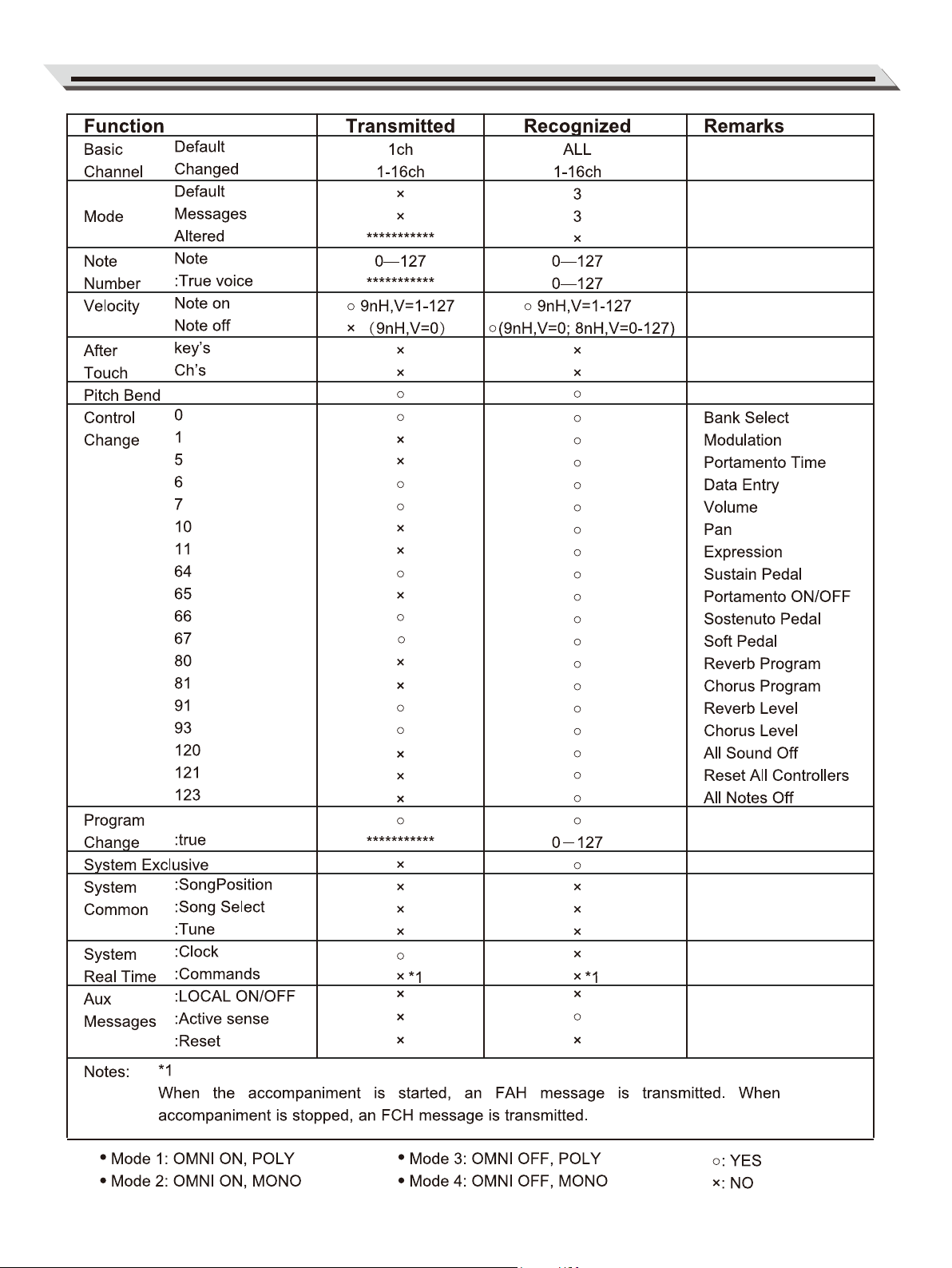
51
MIDI Implementation Chart