
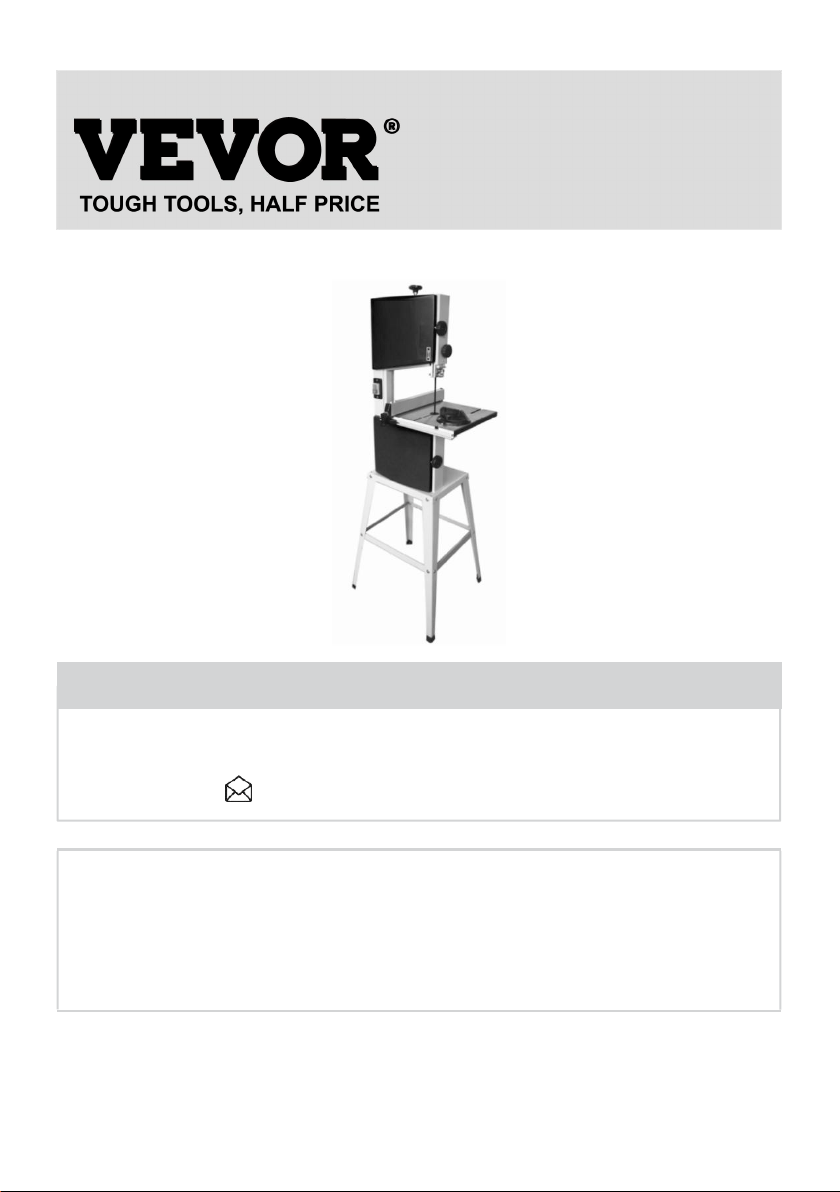
Support and E-Warranty Certificate https://www.vevor.com/support
BAND SAWR
USER MANUAL
MODEL:HBS250
We continue to be committed to provide you tools with competitive price.
"Save Half", "Half Price" or any other similar expressions used by us only represents an
estimate of savings you might benefit from buying certain tools with us compared to the major
top brands and doses not necessarily mean to cover all categories of tools offered by us. You
are kindly reminded to verify carefully when you are placing an order with us if you are
actually saving half in comparison with the top major brands.
- 1 -
MODEL:HBS250
Have product questions? Need technical support? Please feel free to
contact us:
CustomerService@vevor.com
NEED HELP? CONTACT US!
This is the original instruction, please read all manual instructions
carefully before operating. VEVOR reserves a clear interpretation of our
user manual. The appearance of the product shall be subject to the
product you received. Please forgive us that we won't inform you again if
there are any technology or software updates on our product.
BAND SAWR

- 2 -
READ THESE INSTRUCTION CAREFULLY BEFORE
COMMISSIONING AND OPERATING THIS BAND SAW
TABLE OF CONTENTS
Please Read First!.....................................................................................2
Safety ........................................................................................................4
Transport..................................................................................................13
Machine Details.......................................................................................14
Initial Operation.......................................................................................18
Operation.................................................................................................25
Care And Maintenance............................................................................29
Repairs ...................................................................................................39
Environmental Protection......................................................................39
Troubleshooting Guide..........................................................................39
Technical Specifications........................................................................41
Electric Wiring Diagram..........................................................................41
Exploded View and Part List..................................................................42
PLEASE READ FIRST!
These operating instructions have been written to make it easier for you,
the user, to learn how to operate this machine and to do so safely. These
instructions should be used as follows:
Read these instructions before use. Pay special attention to the safety
information.
These operating instructions are intended for people with basic
technical knowledge regarding the operation of a machine like this or
similar electrical power tools. Inexperienced persons are strongly
advised to seek competent advice and guidance from an experienced
person before operating this machine.
- 3 -
Keep all documents supplied with this machine for future reference.
Retain your proof of purchase in case of a future warranty claim.
This machine must not be sold or lent to someone else without being
accompanied by all machine documents supplied with it.
The manufacturer assumes no liability for any damage caused by
neglect of these operating instructions.
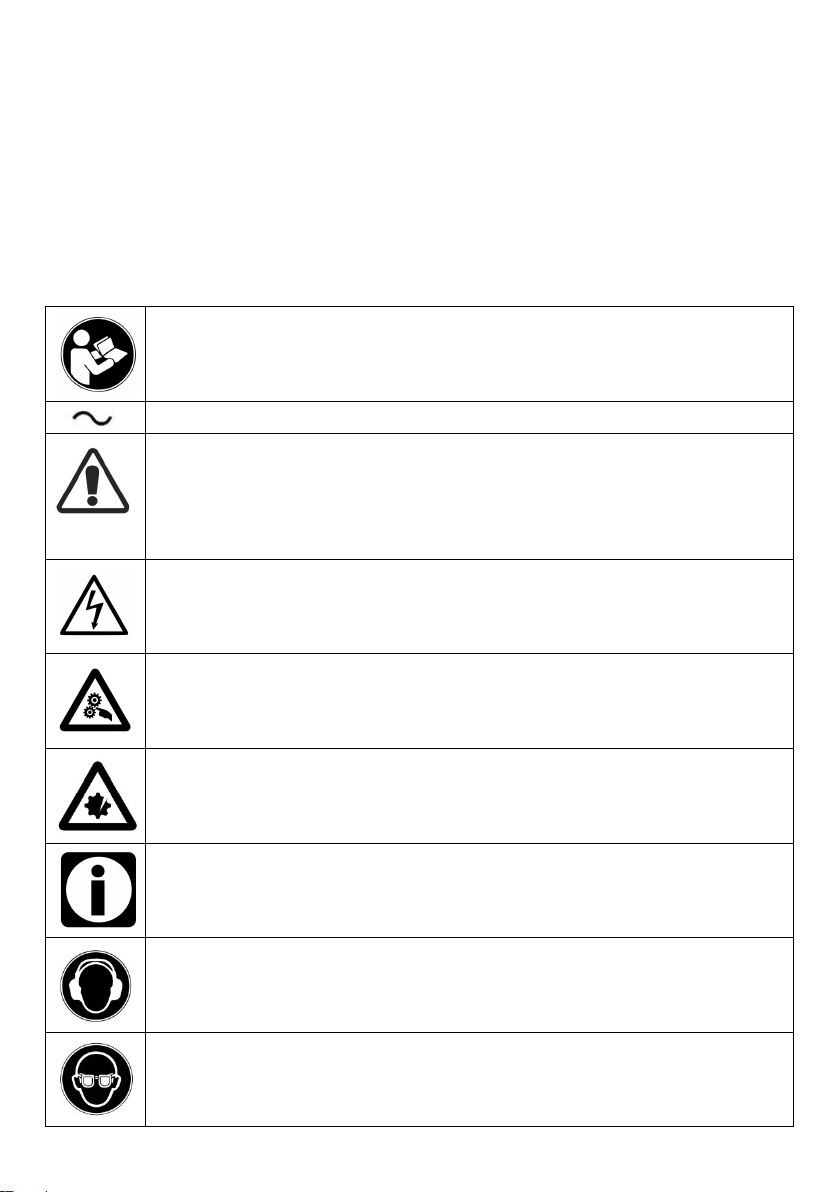
Information in these instructions is marked as under:
Warning - To reduce the risk of injury, user must read instructions
manual carefully.
Alternating current
This symbol, placed before a safety comment, indicates a kind of
precaution, warning, or danger. Ignoring this warning may lead to an
accident. To reduce the risk of injury, fire, or electrocution, please
always follow the recommendation shown below.
Danger!
Risk of personal injury or environmental damage! Risk of electric
shock! Risk of personal injury by electric shock!
Entanglement hazard! Risk of personal injury by body parts or clothing
being drawn into the rotating saw blade.
Caution! Risk of material damage.
Note:Additional information.
Warning- Be sure to wear ear protectors when using this product.
Warning- Be sure to wear eye protectors when using this product.
- 4 -
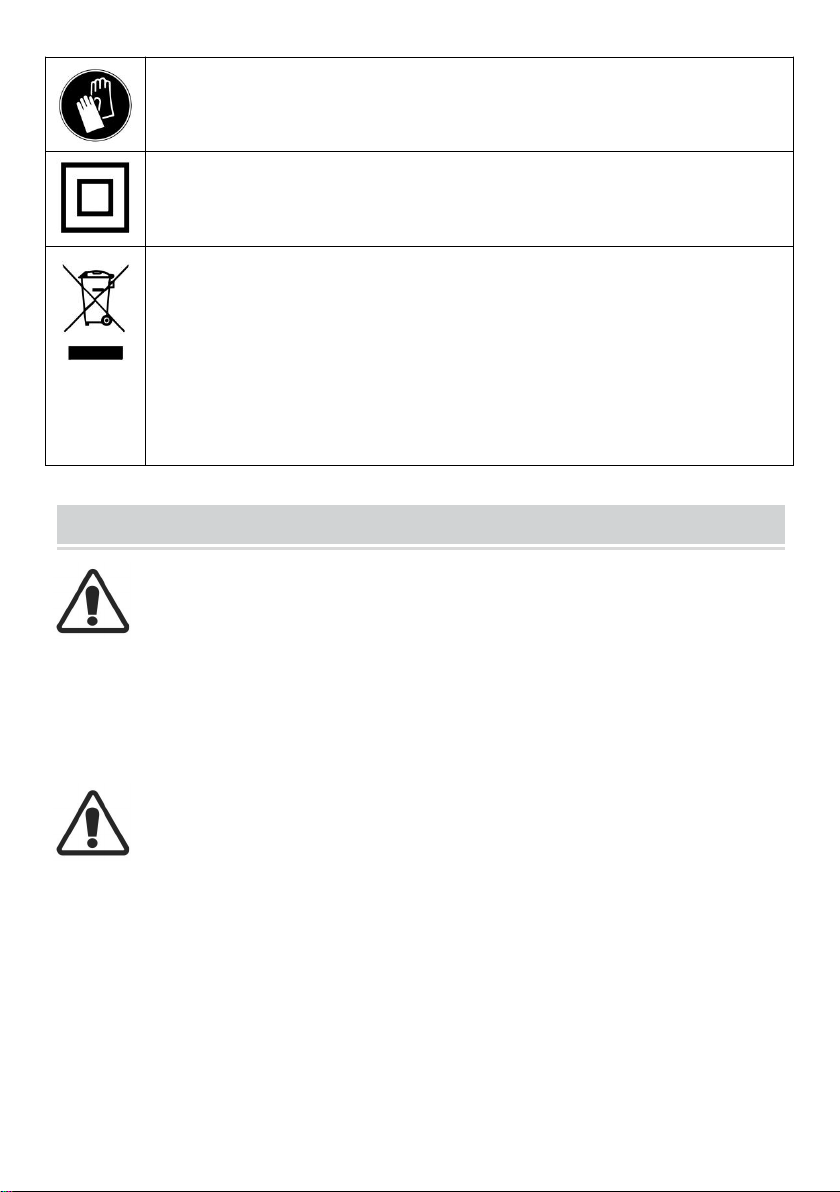
Warning- Be sure to wear gloves when using this product.
This product is of protection class II. That means it is equipped with
enhanced or double insulation.
Disposal information: This product is subject to the provision of
European Directive 2012/19/EC. The symbol showing a wheelie bin
crossed through indicates that the product requires separate refuse
collection in the European Union. This applies to the product and all
accessories marked with this symbol. Products marked as such may
not be discarded with normal domestic waste, but must be taken to a
collection point for recycling electrical and electronic devices
SAFETY
WARNING:Read all safety warnings,instructions,illustrations and
specifications provided with this band saw.Failure to follow all instructions
listed below may result in electric shock, fire and/or serious injury.
Save all warnings and instructions for future reference.
General Power Tool Safety Warnings-Work Area Safety
a)Keep work area clean and well-lit. Cluttered or dark areas invite
accidents.
b)Do not operate power tools in explosive atmospheres,such as in the
presence of flammable liquids,gases or dust.Power tools create sparks
that may ignite dust or fumes.
c)Keep children and bystanders away while operating a power tool.
Distractions can cause you to lose control.
- 5 -
General Power Tool Safety Warnings-Electrical Safety
a)Power tool plugs must match the outlet. Never modify the plug in any way.
Do not use any adapter plugs with earthed(grounded)power tools.
Unmodified plugs and matching outlets will reduce risk of electric shock.
b)Avoid body contact with earthed or grounded surfaces, such as pipes,
radiators, ranges and refrigerators. There is an increased risk of electric
shock if your body is earthed or grounded.
c)Do not expose power tools to rain or wet conditions. Water entering a
power tool will increase the risk of electric shock.
d)Do not abuse the cord. Never use the cord for carrying,pulling or
unplugging the power tool. Keep cord away from heat,oil,sharp edges or
moving parts.Damaged or entangled cords increase the risk of electric
shock.
e)When operating a power tool outdoors, use an extension cord suitable
for outdoor use. Use of a cord suitable for outdoor use reduces the risk of
electric shock.
f)If operating a power tool in a damp location is unavoidable,use a residual
current device(RCD)protected supply.Use of an RCD reduces the risk of
electric shock.
General Power Tool Safety Warnings-Personal Safety
a)Stay alert, watch what you are doing and use common sense when
operating a power tool. Do not use a power tool while you are tired or
under the influence of drugs,alcohol or medication. A moment of inattention
while operating power tools may result in serious personal injury.
b)Use personal protective equipment.Always wear eye protection.
Protective equipment such as a dust mask, non-skid safety shoes, hard hat
or hearing protection used for appropriate conditions will reduce personal
injuries.
c)Prevent unintentional starting. Ensure the switch is in the off-position

- 6 -
before connecting to power source and/or battery pack, picking up or
carrying the tool. Carrying power tools with your finger on the switch or
energizing power tools that have the switch on invites accidents.
d)Remove any adjusting key or wrench before turning the power tool on.A
wrench or a key left attached to a rotating part of the power tool may result
in personal injury.
e)Do not overreach.Keep proper footing and balance at all times.This
enables better control of the power tool in unexpected situations.
f)Dress properly.Do not wear loose clothing or jewellery.Keep your hair and
clothing away from moving parts.Loose clothes,jewellery or long hair can
be caught in moving parts.
g)If devices are provided for the connection of dust extraction and
collection facilities,ensure these are connected and properly used.Use of
dust collection can reduce dust-related hazards.
h)Do not let familiarity gained from frequent use of tools allow you to
become complacent and ignore tool safety principles.A careless action can
cause severe injury within a fraction of a second.
Power Tool Use and Care
a)Do not force the power tool. Use the correct power tool for your
application. The correct power tool will do the job better and safer at the
rate for which it was designed.
b)Do not use the power tool if the switch does not turn on and off. Any
power tool that cannot be controlled with the switch is dangerous and must
be repaired.
c)Disconnect the plug from the power source and/or remove the battery
pack,if detachable,from the power tool before making any
adjustments,changing accessories,or storing power tools.Such preventive
safety measures reduce the risk of starting the power tool accidentally.
d)Store idle power tools out of the reach of children and do not allow
persons unfamiliar with the power tool or these instructions to operate the
power tool.Power tools are dangerous in the hands of untrained users.
e)Maintain power tools and accessories.Check for misalignment or binding
of moving parts,breakage of parts and any other condition that may affect

- 7 -
the power tools operation.If damaged,have the power tool repaired before
use.Many accidents are caused by poorly maintained power tools.
f)Keep cutting tools sharp and clean.Properly maintained cutting tools with
sharp cutting edges are less likely to bind and are easier to control.
g)Use the power tool,accessories and tool bits etc.in accordance with
these instructions,taking into account the working conditions and the work
to be performed.Use of the power tool for operations different from those
intended could result in a hazardous situation.
h)Keep handles and grasping surfaces dry,clean and free from oil and
grease.Slippery handles and grasping surfaces do not allow for safe
handling and control of the tool in unexpected situations.
Service
a)Have your power tool serviced by a qualified repair person using only
identical replacement parts.This will ensure that the safety of the power
tool is maintained.
1. Specified Conditions of Use
The machine is suitable for cutting wood,wood-derived materials and
plastics.Do not cut round stock transverse to its longitudinal axis without
suitable jigs or fixtures.The rotating saw blade could turn the
workpiece.When sawing thin stock lay on edge,a suitable guide must be
used for firm support.
Any other use is not as specified.The manufacturer is not liable for any
damage caused by unspecified use.
Alteration of the machine or use of parts not approved by the equipment
manufacturer can cause unforeseeable damage!
3. General Safety Information
When using this tool observe the following safety instructions,to exclude
the risk of personal injury or material damage.Please also observe the
special safety instructions in the respective chapters.
Where applicable,follow the legal directives or regulations for the
prevention of accidents pertaining to the use of band saws.
- 8 -
General hazards!
Keep your work area tidy-a messy work area invites accidents.
Be alert.Know what you are doing.Set out to work with reason.Do not
operate tool while under the influence of drugs,alcohol or medication.
Consider environmental conditions:keep work area well-lighted.
Prevent adverse body positions.Ensure firm footing and keep your balance
at all times.When working long stock use suitable supports.
Do not operate tool near inflammable liquids or gases.
The saw shall only be started and operated by persons familiar with band
saws and who are at any time aware of the dangers associated with the
operation of such tool.
Keep bystanders,particularly children,out of the danger zone.Persons
under 18 years of age shall use this tool only in the course of their
vocational training,under the supervision of an instructor.
Do not permit other persons to touch the tool or power cable while it is
running.
Do not overload tool ¨C use it only within the performance range it was
designed for(see"Technical specifications").
Danger!Risk of Electric Shock!
Do not expose tool to rain.Do not operate tool in damp or wet
environment.Prevent body contact with earthed objects such as
radiators,pipes,cooking stoves,refrigerators when operating this tool.
Do not use the power cable for any purpose it is not intended for.
Risk of personal injury and crushing by moving parts!
Do not operate the tool without installed guards.
Always keep a sufficient distance from the band saw blade. Use suitable
feeding aids if necessary.
Keep sufficient distance to drive components when operating this tool.Do
- 9 -
not attempt to stop the band saw blade by pushing the workpiece against
its side.
Ensure tool is disconnected from power supply before servicing.Ensure
that when switching on(e.g.after servicing)no tools or loose parts are left on
or in the tool.
Turn power off if the tool is not used.
Cutting hazard,even with the cutting tool at a standstill!
Wear gloves when changing cutting tools.
Risk of kickback(workpiece is caught by the band saw blade
and thrown against the operator)!
Do not jam workpieces.
Cut thin or thin-walled workpieces only with fine-toothed saw blades.Always use
sharp band saw blades.
If in doubt,check workpiece for inclusion of foreign matter(e.g.nails or
screws).
Cut only stock of dimensions that allow for safe and secure holding while
cutting.Never cut several workpieces at the same time and also no bundles
containing several individual pieces.Risk of personal injury if individual
pieces are caught by the band saw blade uncontrolled.
When cutting round stock,use a suitable jig to prevent the workpiece from
turning.
Entanglement hazard!
Ensure that no parts of the body or clothing can be caught and drawn in by
rotating components(no neckties,no loose fitting clothes;contain long hair
with hairnet).
Never cut workpieces containing the following materials:
-Ropes
-Strings
- 10 -
-Cords
-Cables
-Wires
Hazard generated by insufficient personal protection gear!
Wear hearing protection.
Wear safety glasses.
Wear dust mask.
Wear suitable work clothes. When working outdoors, wearing non-slip
shoes is recommended.
Risk of injury by inhaling wood dust!
Dust of certain timber species(e.g.oak,beech,ash)can cause cancer when
inhaled:work only with a suitable dust collector connected to the saw.
Hazard generated by modification of the machine,or use of
parts not tested and approved by the equipment manufacturer!
Assemble tool in strict accordance with these instructions.Use only parts
approved by the equipment manufacturer.Use only tools(band saw
blades)conforming to EN 847-1:1997.
Do not change any parts.
Hazard generated by tool defects!
Keep tool and accessories in good repair.Observe the maintenance
instructions.Check tool for possible damage prior to any use:
Before operating the tool all safety devices,protection devices or slightly
damaged parts must be inspected for proper functioning as specified.
Check to see that all moving parts work properly and do not jam.All parts
- 11 -
must be correctly installed and meet all conditions necessary for the proper
operation of the tool.
Damaged protection devices or parts must be repaired or replaced by a
qualified specialist.Have damaged switches replaced by a service
centre.Do not operate tool if the switch cannot be turned ON or OFF.
Keep handles free of oil and grease.
3. Symbols on the Machine
Danger! Disregard the following warnings may lead to serious
personal injury or material damage.
Read instructions.
Band saw blade running direction.
- 12 -
4. Safety Devices
Without this
accessory
- 13 -
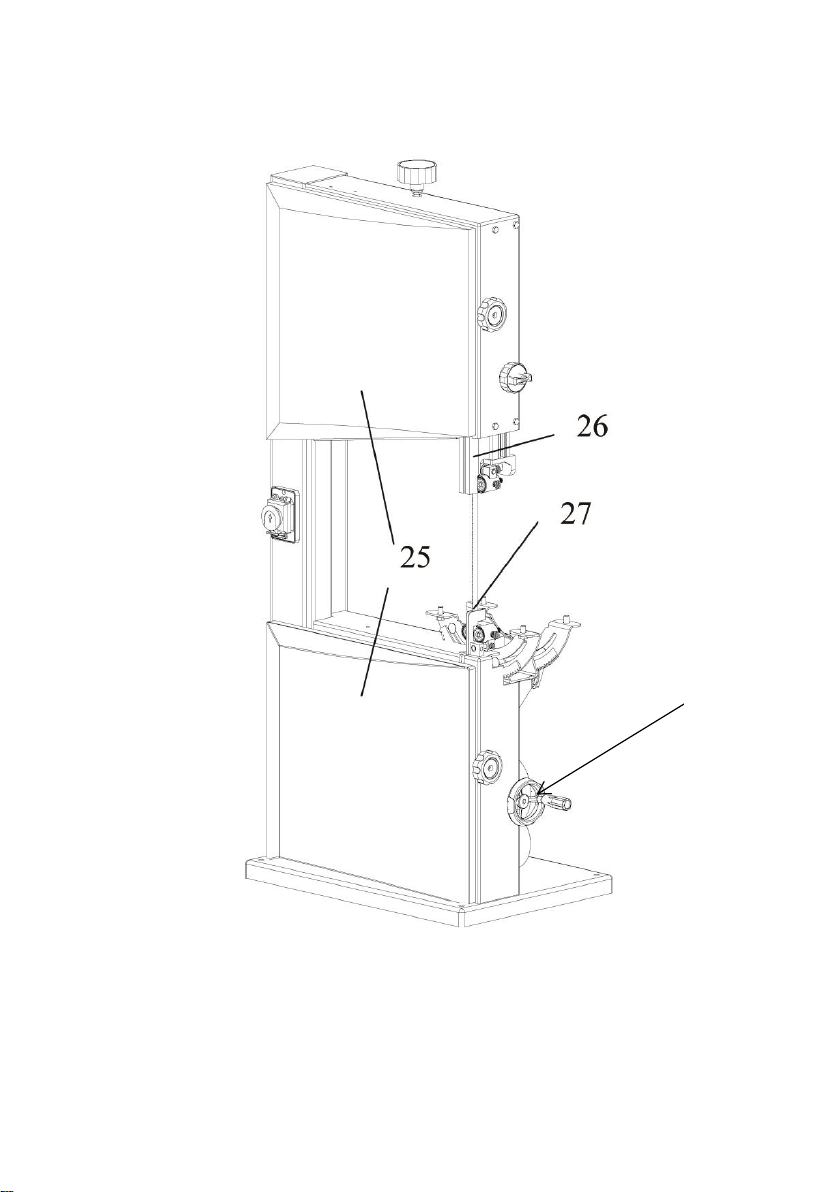
Upper Blade Guard
The upper blade guard(26)protects against unintentional contact with the
saw blade and from chips flying about.In order for the upper blade guard to
provide adequate protection against contact with the band saw blade,it
must always be set as close as possible to the workpiece (max.distance 3
mm).
Lower Blade Guard
The lower blade guard(27)protects against unintentional contact with the
saw blade.
The lower blade guard must always be in place and cover the band saw
blade while the band saw is running.
Housing Doors
The housing doors(25)protect against contact with the rotating parts inside
the machine.Both housing doors must be closed while the machine is in
use.
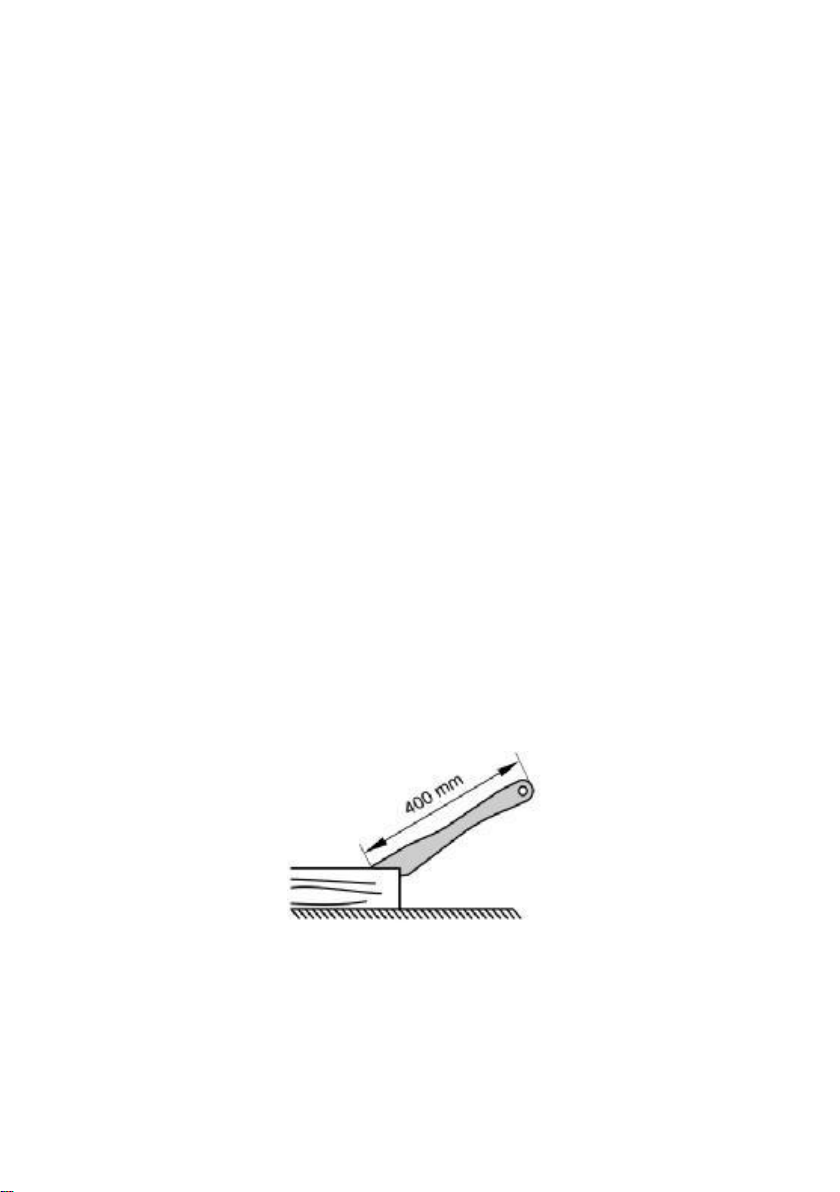
Push Stick
The push stick serves as an extension of the hand and protects against
accidental contact with the saw blade.
The push stick must always be used if the distance between band saw
blade and a rip fence is less than 120 mm.Guide the push stick at an angle
of 20°…30°against the saw table's surface.
When the push stick is not used it can be stored on the push stick holder
provided at the band saw frame.Replace push stick if damaged.
- 14 -
TRANSPORT
Set upper blade guide to its lowest position.
Remove projecting accessories.
When shipping,use original packing if possible.
MACHINE DETAILS
Note:In this chapter, the essential operating elements of the
machine are introduced.
The proper use of the machine is described in chapter"Operation".Read
this chapter before using the saw for the first time.
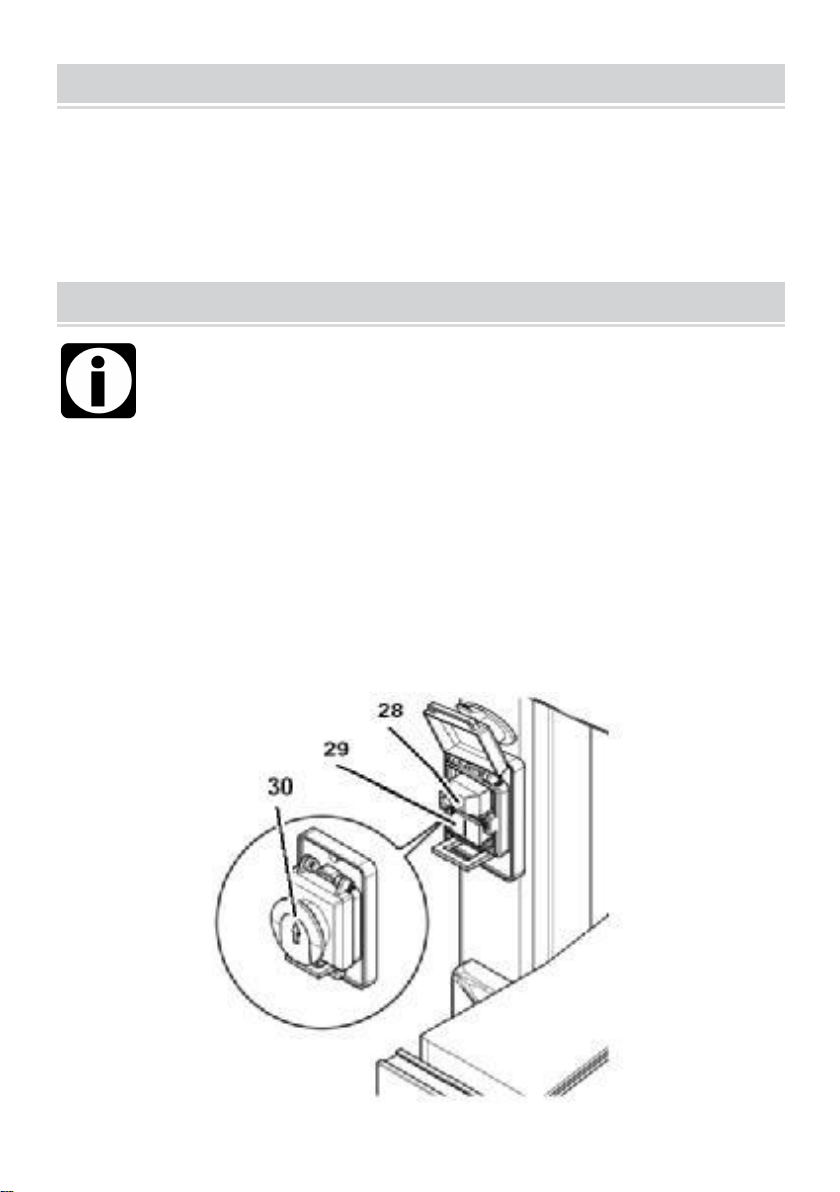
ON/OFF Switch with Emergency Stop
To start=press the green switch button(29).
To stop=press the red switch button(28)or the cover(30)of the ON/OFF
switch.
In the event of a voltage failure an undervoltage relay trips.This prevents
- 15 -
the machine from starting up when the power is restored.To restart,the
green switch button must be pressed.
The cover of the ON/OFF switch(30)can be safeguarded by a padlock.
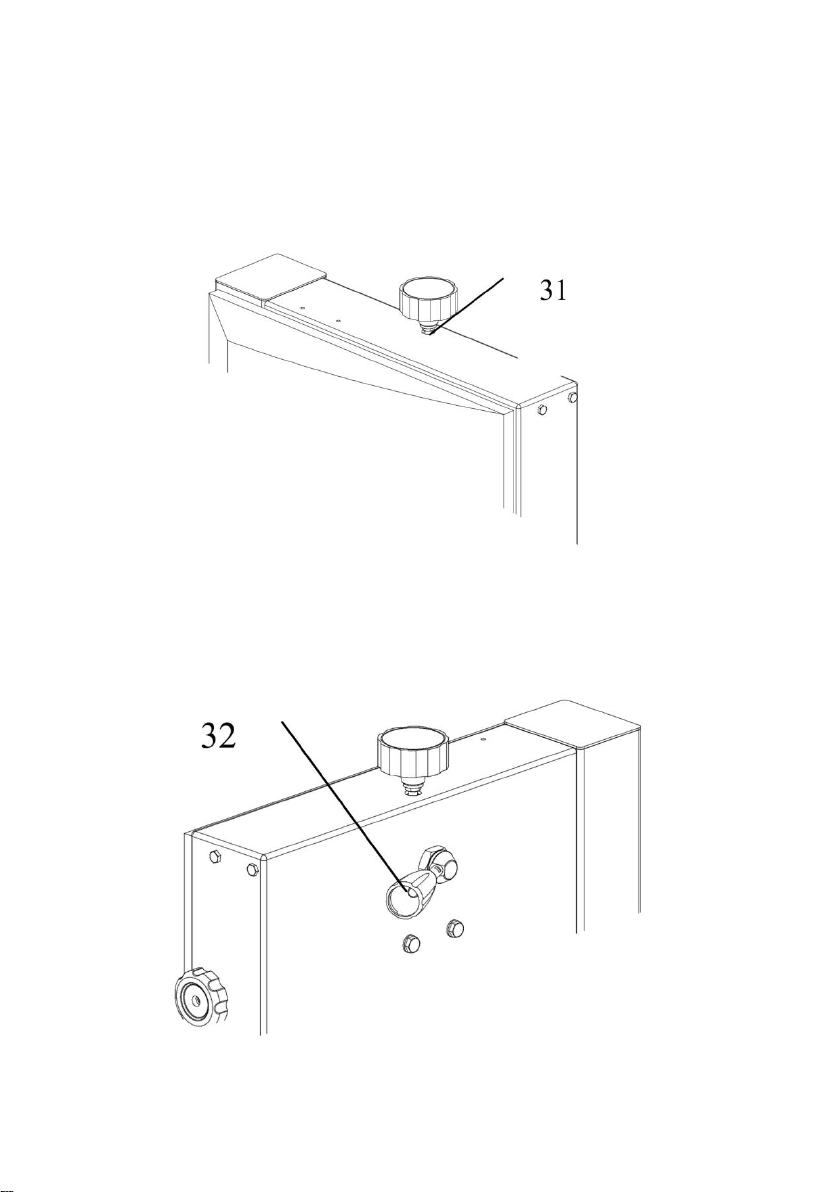
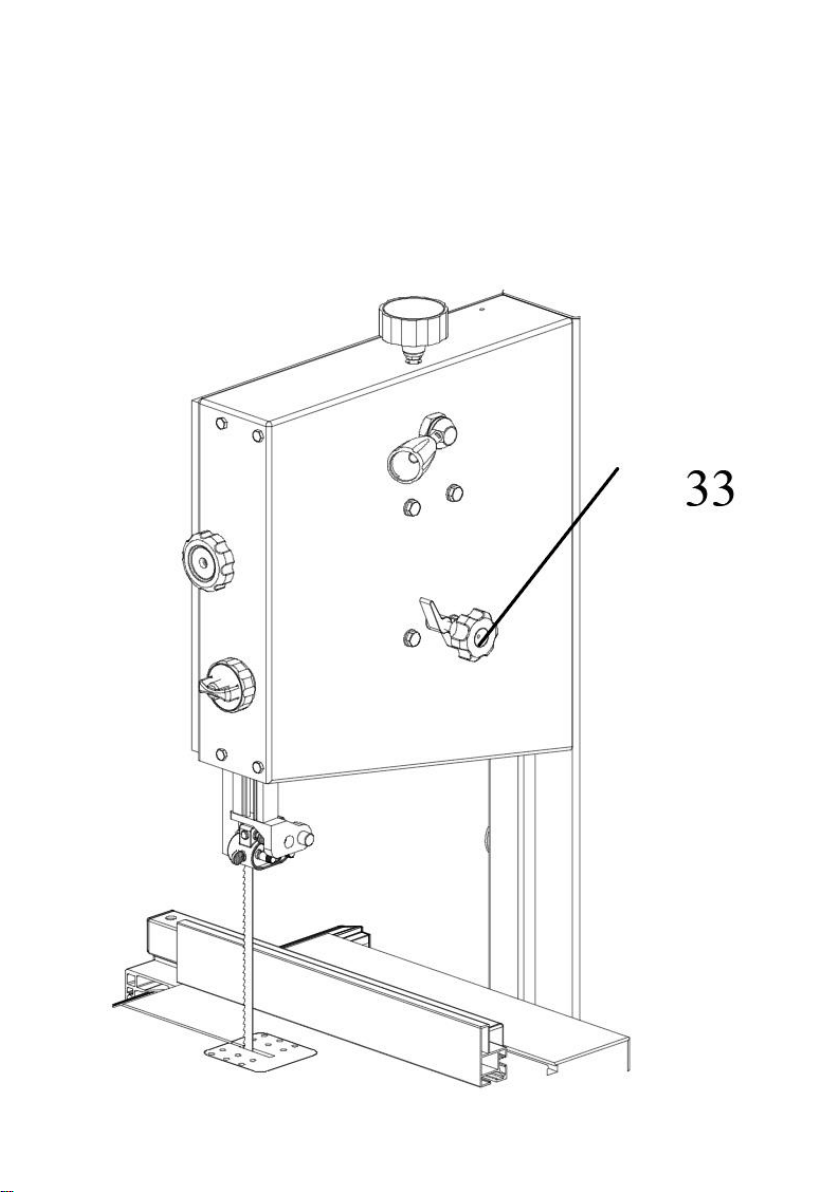
Setting Knob for Band Saw Blade Tension
With the setting knob(31)the band saw blade tension is corrected,if
necessary:
-Turning the setting knob clockwise increases the blade tension.
-Turning the setting knob counterclockwise reduces the blade tension.
Quick Release Lever
With the quick release lever(32)the saw blade tension is released.
- 16 -
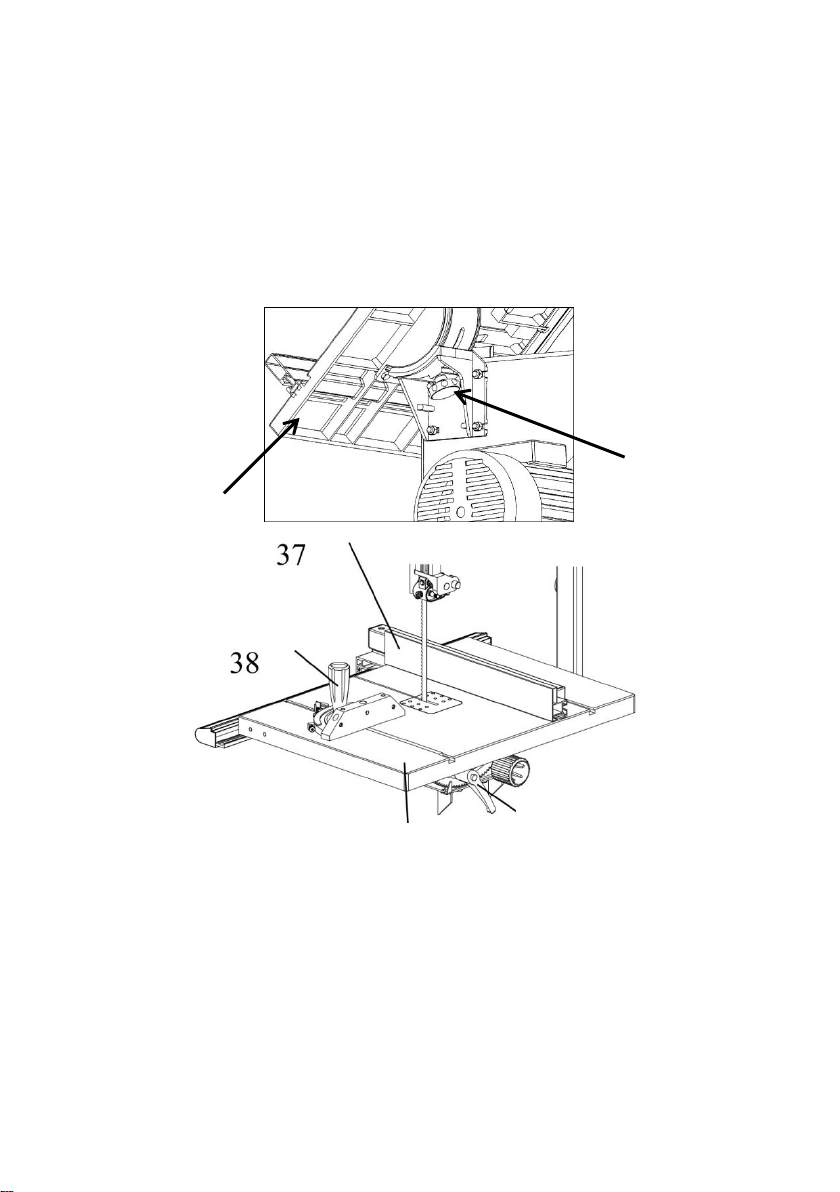
Setting Knob for Blade Tracking Adjustment
- 17 -
With the setting knob(33)the tilt of the upper band saw wheel can be
adjusted,if necessary.This tracking adjustment is required to have the
blade run dead center on the rubber tyres of the band saw wheels:
-Turning clockwise=blade moves to the rear.
-Turning counter-clockwise=blade moves to the front.
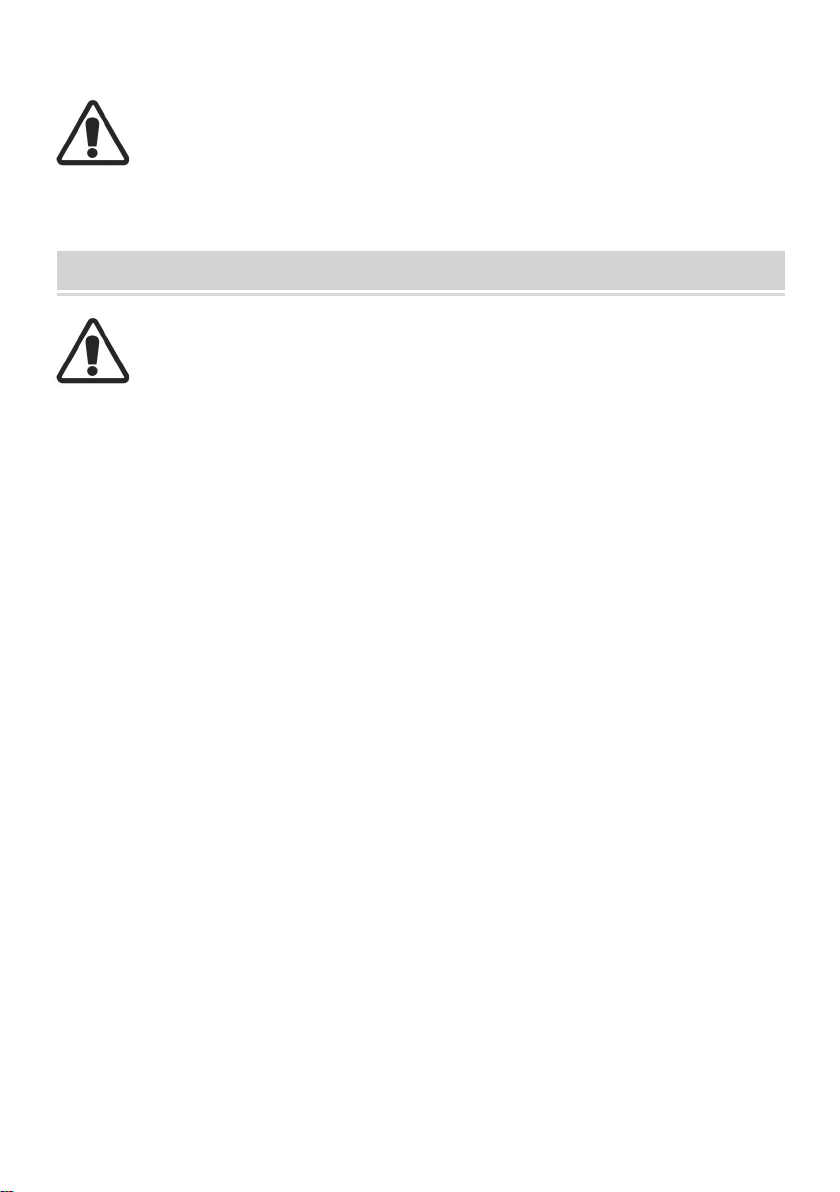
Saw Table Tilt
After loosening the lock screw(35)the saw table(36)tilts steplessly through
45°against the blade.
Rip Fence
The rip fence(37)clamps to the front of the bandsaw table;The rip fence
can be used on both sides of the blade.
Mitre Fence
The mitre fence is inserted into the table slot from the table’s front edge.For
mitre cuts the mitre fence turns to60°in both directions For 45°and
90°miters positive stops are provided.To set a mitre angle:loosen lock
35
36
- 18 -
handle(38)by turning it counter-clockwise.
Risk of injury!When cutting with the mitre fence the lock
handle must be firmly tightened.
INITIAL OPERATION
Danger!Start the saw only after the following preparations are
completed:
-The saw is securely mounted;
-The saw table is installed and aligned;
-The belt tension was checked;
-Safety devices have been checked.Connect the saw to the mains
supply only after all of the above preparations are completed! Otherwise
there is a risk of an unintentional starting of the saw,which can cause
severe personal injury.
1. Mounting
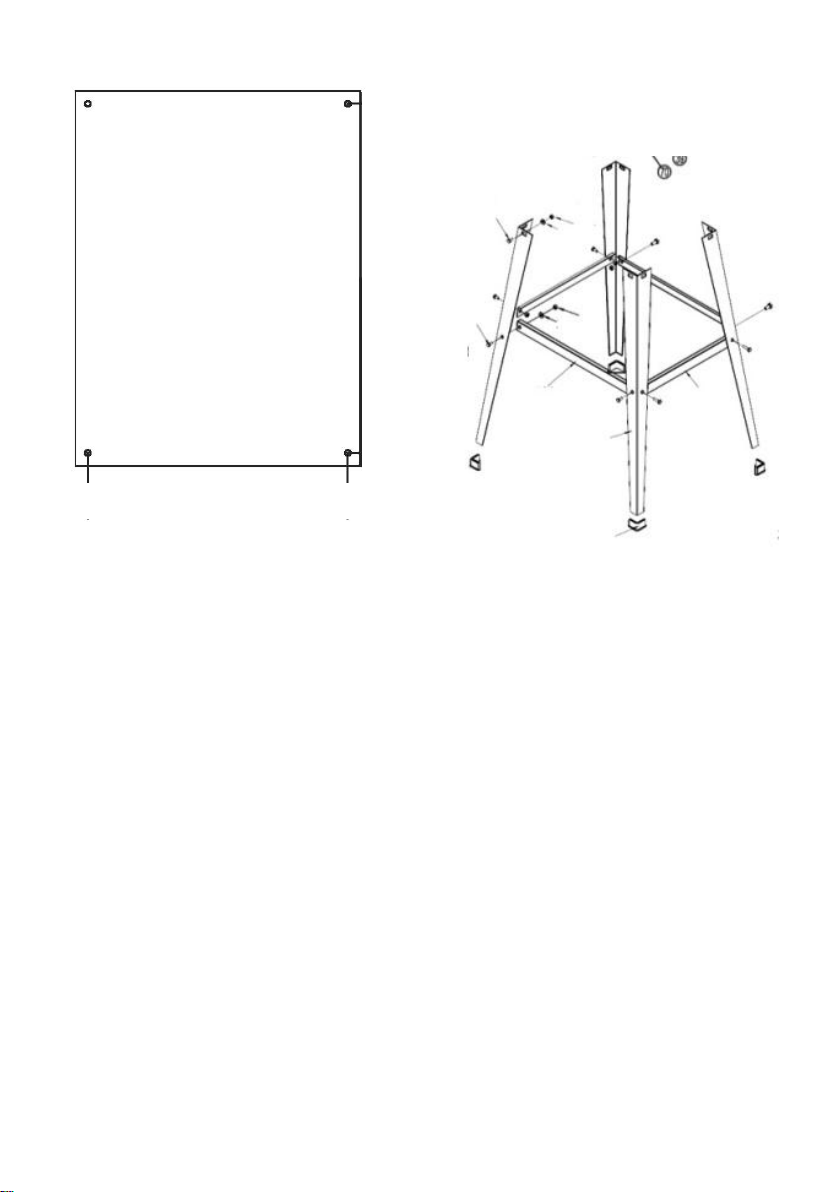
For a firm stand the saw must be mounted on a stable supporting surface:
Put fixing bolts through the base plate and secure it with nuts.
- 19 -
Optimal working height and stability are provided by the steel stand,which
is already prepared for mounting the saw.
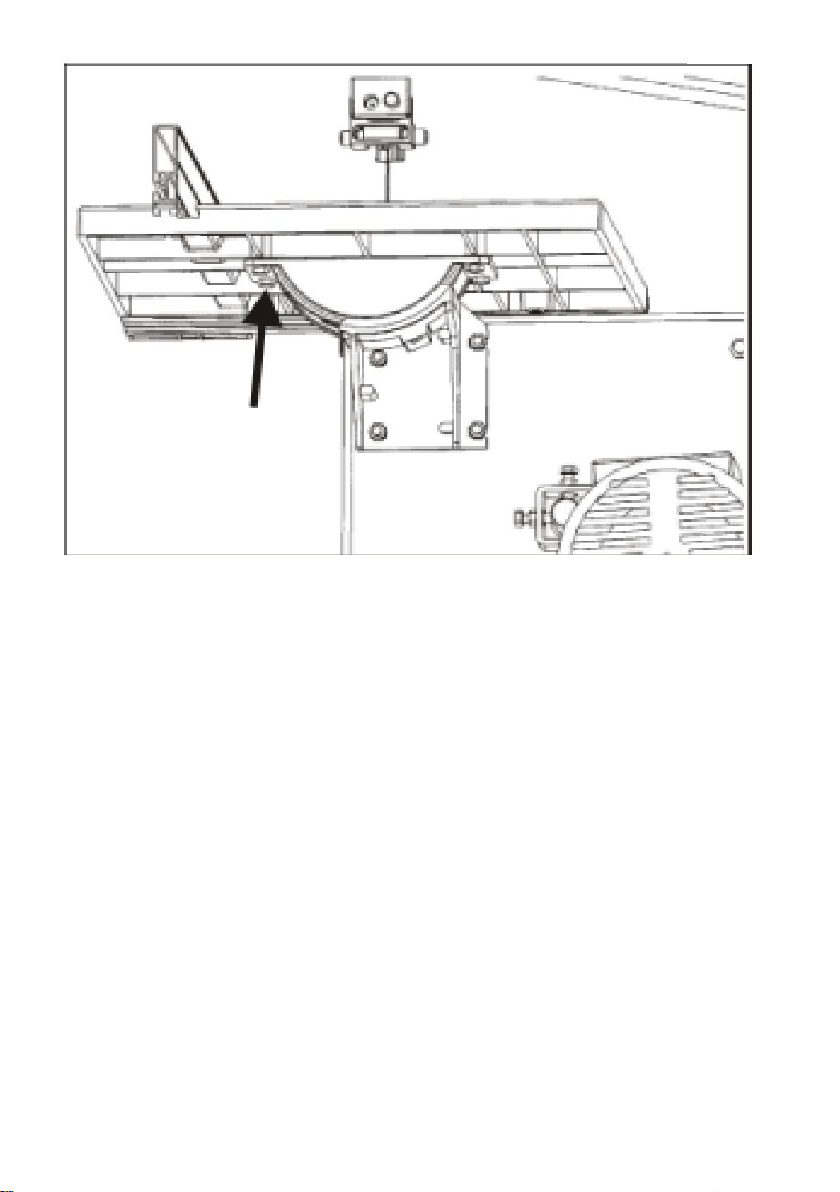
2. Installing the Saw Table
1).Fit limit stop screw to the underside of the low house.
2).Guide saw table over the band saw blade and place it on the table
trunnion.
3).Attach the saw table with four each screws and washers to the table
trunnion.
去除数值
- 20 -
3. Aligning the Saw Table
The saw table needs to be aligned in two planes
-Laterally,in order for the blade to run dead centre through the table
insert;
-At right angles to the band saw blade.
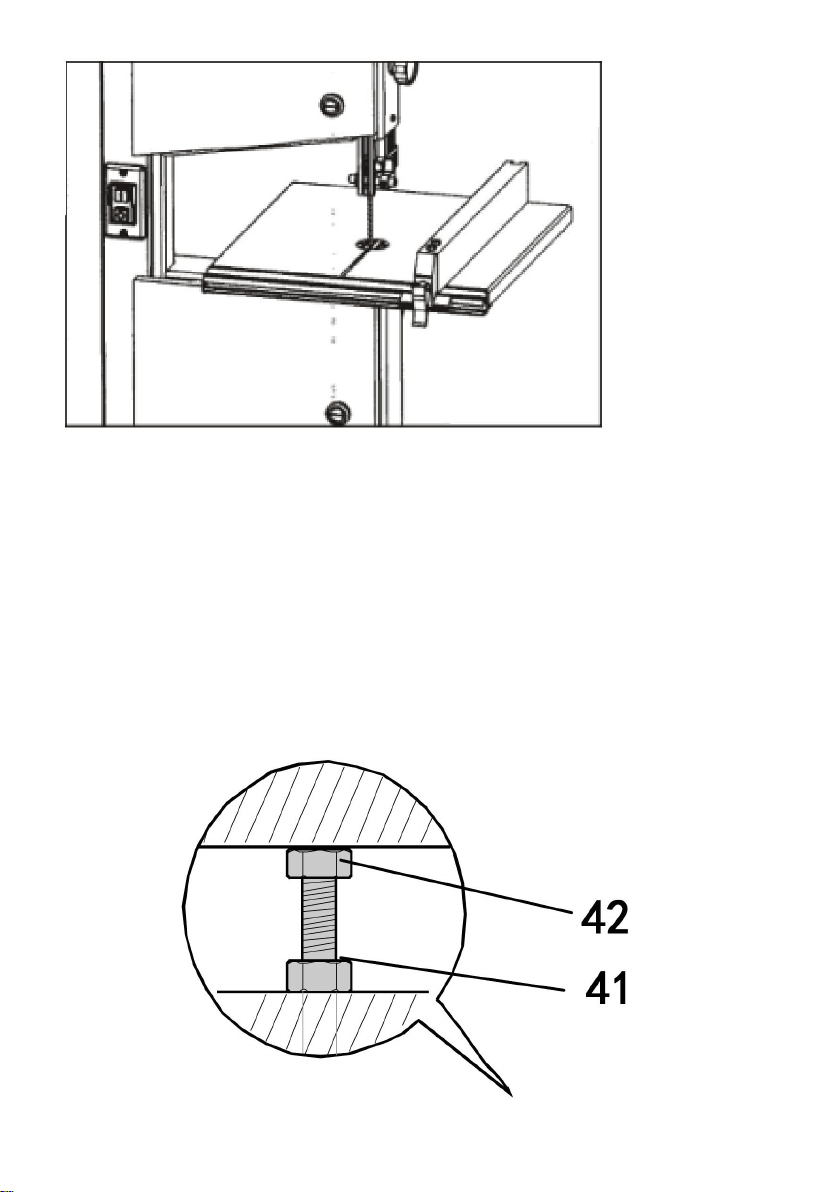
Saw Table Lateral Alignment
1).Loosen the four fastening screws that hold the lower support of table
trunnion.
2).Align the working table so that the blade runs through the centre of the
table insert’s slot.
- 21 -
3).Tighten the four fastening screws again.
Aligning the Working Table at Right Angles to the Band Saw Blade
1).Raise upper blade guide fully(see"Operation").Check band saw blade
tension(see"Initial operation").
2).Loosen the lock lever.
3).Using a try square,set the table at right angles to the blade and tighten
the lock lever again.
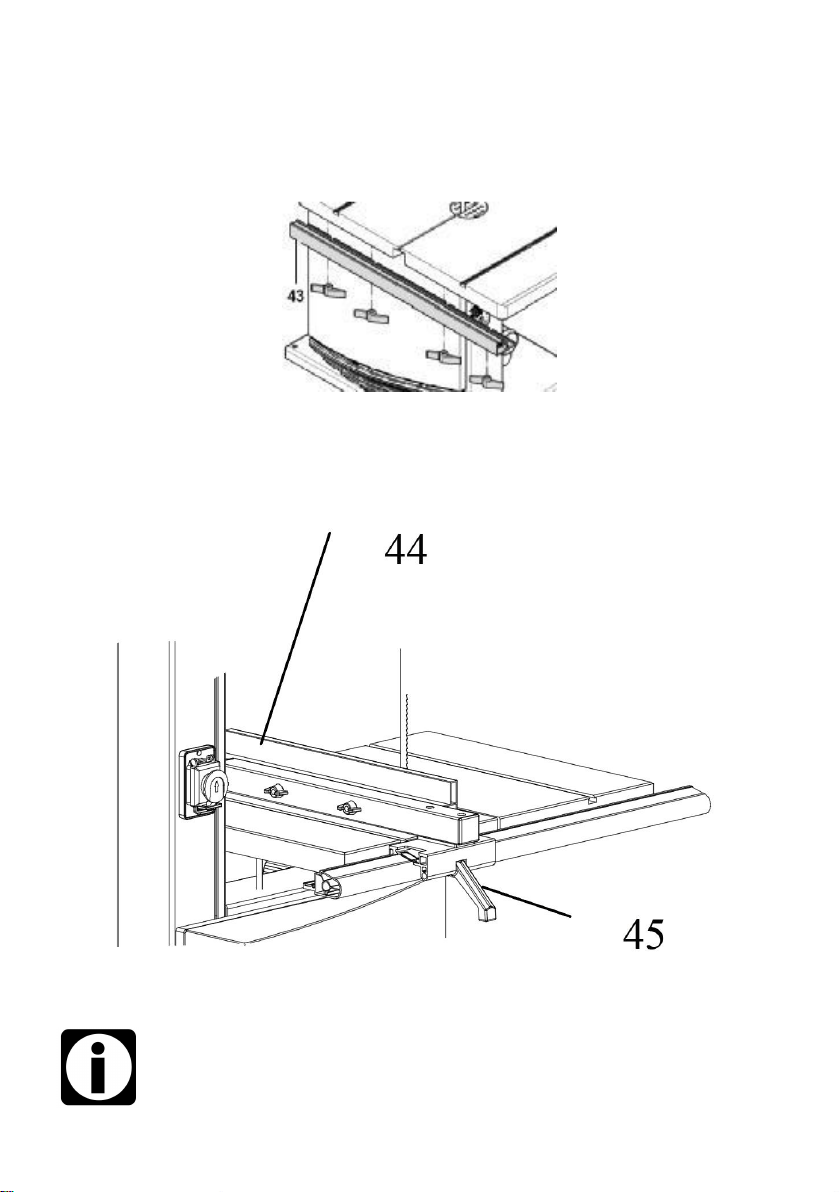
4).Loosen locking nut(41)and adjust limit stop screw(42)until it touches the
working table.
- 22 -
5).Tighten the locking nut.
4. Installing the Fence Guide Extrusion
Fasten the fence guide extrusion with four thumb screws and washers to
the saw table.
5. Installing the Rip Fence
The rip fence can be used on both sides of the blade.When the rip fence is
moved from one side of the saw blade to the other the fence
extrusion(44)needs to be reversed.
Place rip fence on the rip fence guide.Tighten the lock lever(45)of the rip.
6. Installing the Push Stick Holder
Note:If the saw is to be mounted on the stand,the push stick
- 23 -
holder can only be installed afterward.
1) Turn a hexagon nut on a cap screw(46),all the way up to the
unthreaded part of the shank.
2) Turn cap screw into the hole on the left side of the band saw.
3) Tighten hexagon nut hand-tight only.
4) Hang push stick(47)on the cap screw when not in use.
7. Dust Collector Connection
Danger!Dust of certain timber species(e.g.oak,beech,and
ash)can cause cancer when inhaled:always use a dust collector when
working in enclosed spaces(air speed at the saw’s dust extraction
port≥20 m/s).
Caution!Operation without a dust collector is only possible:
-Outdoors;
-For short-term operation(up to max.30 minutes);
-With dust respirator.
-If no dust collector is used chips will accumulate,which need to be
removed periodically.
Connect dust collector or industrial vacuum with a suitable adaptor to the
dust extraction port.
8. Tensioning the Band Saw Blade
Danger!Too much tension can cause the band saw blade to
break.Too little tension can cause the driven band saw wheel to slip
and the band saw blade to stop.
1. Raise upper blade guide fully(see"Operation").
2. Checking the blade tension:-Check tension by pushing with a
finger,halfway between table and upper blade guide,against the side of the
blade(the blade should flex not more than 1-2 mm).
Check adjustment at the blade tension indicator.The scale indicates
- 24 -
the correct adjustment in dependence on the band saw blade width.
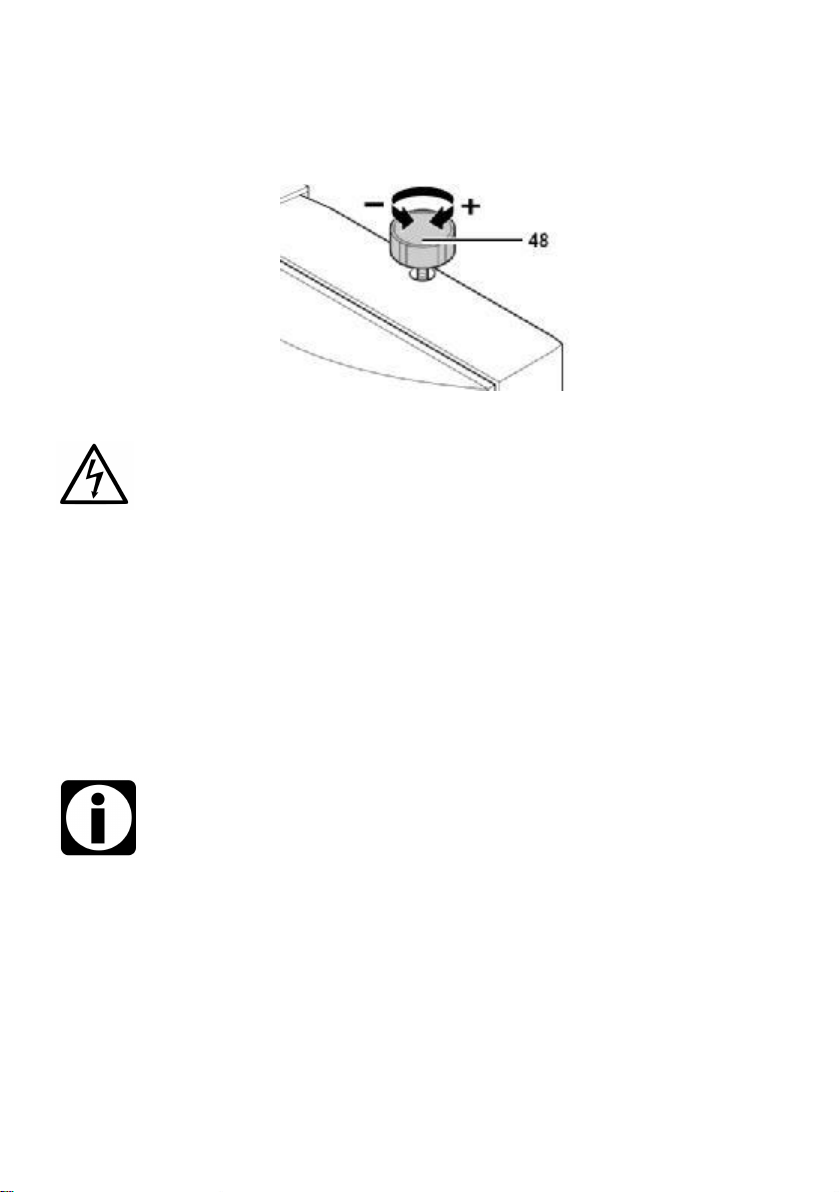
3. Correct tension if necessary:turning the setting knob(48)
counter-clockwise increases the blade tension.T urning the setting
knob(48)counter-clockwise reduces the blade tension.
4.
9. Connection to Power Mains
Danger!High Voltage Operate the saw only in a dry
environment.
Operate the saw only on a power source matching the following
requirements(see also"Technical Specifications"):
Mains voltage and system frequency conform to the voltage and
frequency shown on the machine's nameplate;
Fuse protection by a residual current operated device(RCD)of 30 mA
sensitivity;
Outlets properly installed,earthed and tested;
Note:
Check with your local Electricity Board or your electrician if in doubt
whether your house service connection meets the requirements.
Make sure the power supply cable is out of the way,so that it does not
interfere with the work and does not pose a tripping hazard or will get
damaged.
Protect the power supply cable from heat,aggressive liquids and sharp
edges.
Use only rubber-insulated extension cables of sufficient lead cross
- 25 -
section(3 x 1.5 mm2,for machines with 3-phase motor:5 x 1.5 mm2).
Do not pull on the power supply cable to unplug.
1. When the saw is assembled and all safety devices are installed,connect
it to the power supply.
2. Start saw briefly and turn OFF immediately again.
3. Check the band saw blade's direction of rotation:in the cutting area it
must run from the top downwards.
4. If the band saw blade turns in the wrong direction,unplug the power
supply cable at the saw.
5. Have the electrical connection changed by a qualified electrician!
10. Connection to Power Mains
OPERATION
Danger!To reduce the risk of personal injury as much as
possible,the following safety recommendations should be observed
when operating the saw.
Use personal protection gear:
Dust respirator;
Hearing protection;
Safety goggles.
Cut only one workpiece at a time.
Always hold the workpiece down on the table.
Do not jam the workpiece.
Do not attempt to stop the band saw blade by pushing the workpiece
against its side.
If the type of work requires,use the following:
Work support for long stock,which would otherwise fall off the table on
completion of the cut;
Push stick–if distance rip fence–band saw blade d120 mm;
Dust collector;
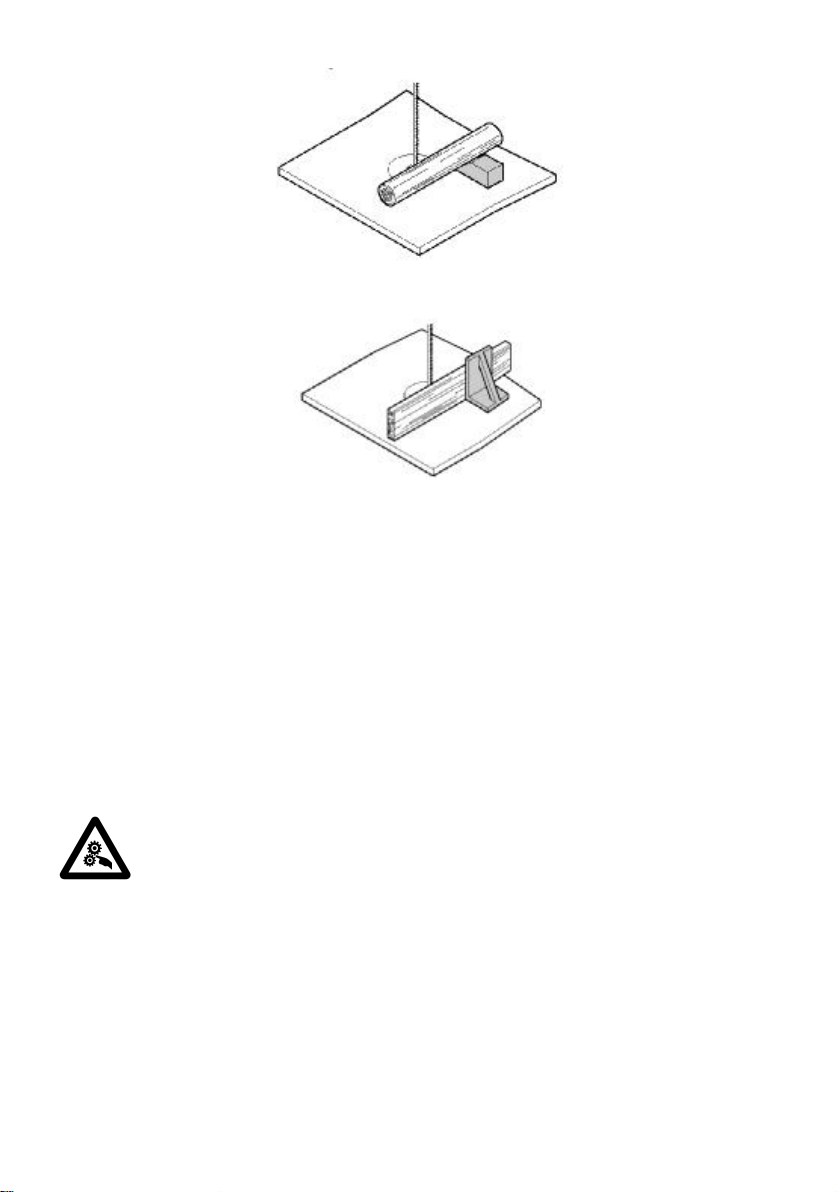
An appropriate jig when cutting round stock,to keep it from turning;
- 26 -
A suitable guide for firm support when cutting thin stock lay on edge.
Before starting work,check to see that the following are in proper working
order:
Band saw blade;
Upper and lower blade guard.
Replace damaged parts at once!
Assume correct work position(the band saw blade's teeth must point
towards the operator).
Never cut several workpieces at the same time, and also, any bundles
containing several individual pieces. Risk of personal injury if individual
pieces are caught by the saw blade uncontrolled
Drawing-in/trapping hazard!
Do not wear loose clothing,jewellery,or gloves,which may get caught
and wound up by revolving machine parts.
Contain long hair with a hairnet.
Never cut stock to which ropes,cords,strings,cables and wires are
attached or which contain such materials.
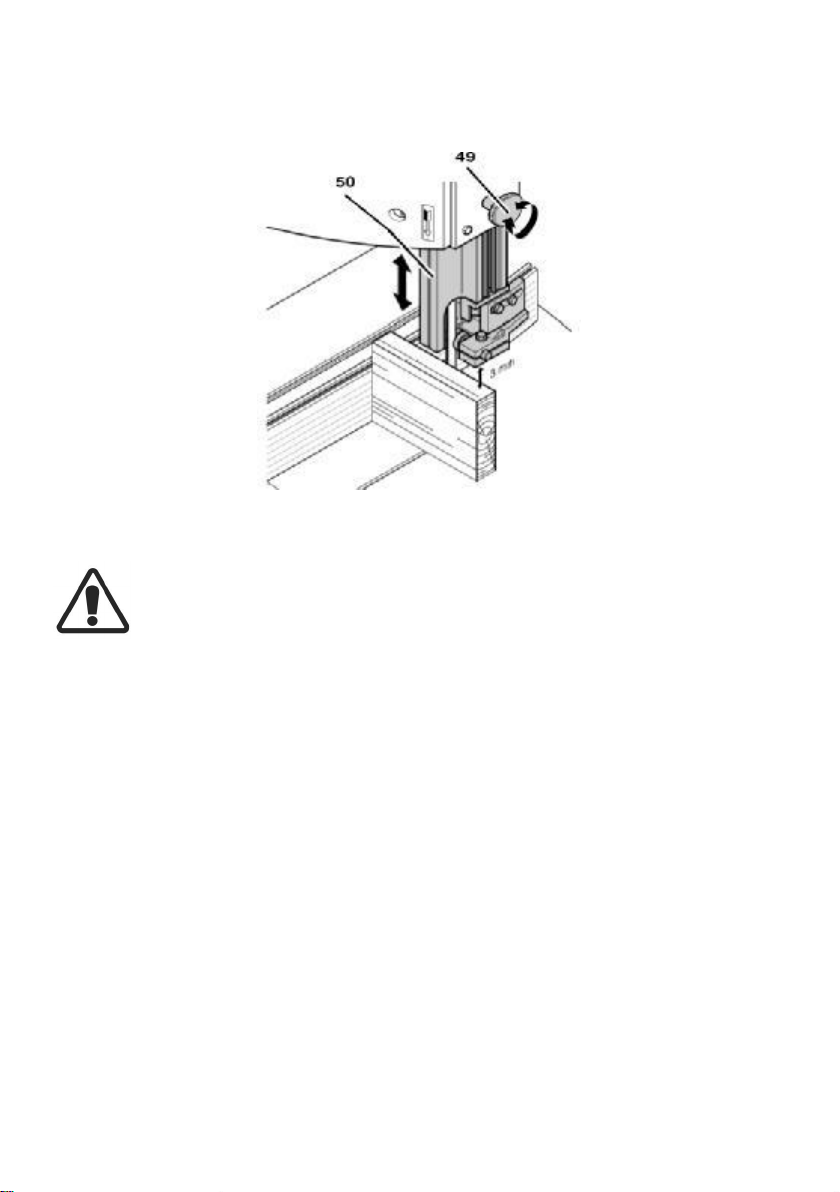
Upper blade guide adjustment
The height of the upper blade guide(50)needs to be adjusted:
- 27 -
Prior to every cutting operation,to accommodate the height of the
workpiece(the upper blade guide should be set approx.3 mm above
the workpiece);
After adjustments of band saw blade or saw table(e.g.band saw blade
change,tensioning of the band saw blade,saw table alignment).
Danger!Before adjusting the upper blade guide and saw table
tilt:
Switch machine OFF.
Wait until the band saw blade has come to a complete stop.Set upper
blade guide(50)with the adjusting knob(49)to the desired
- 28 -
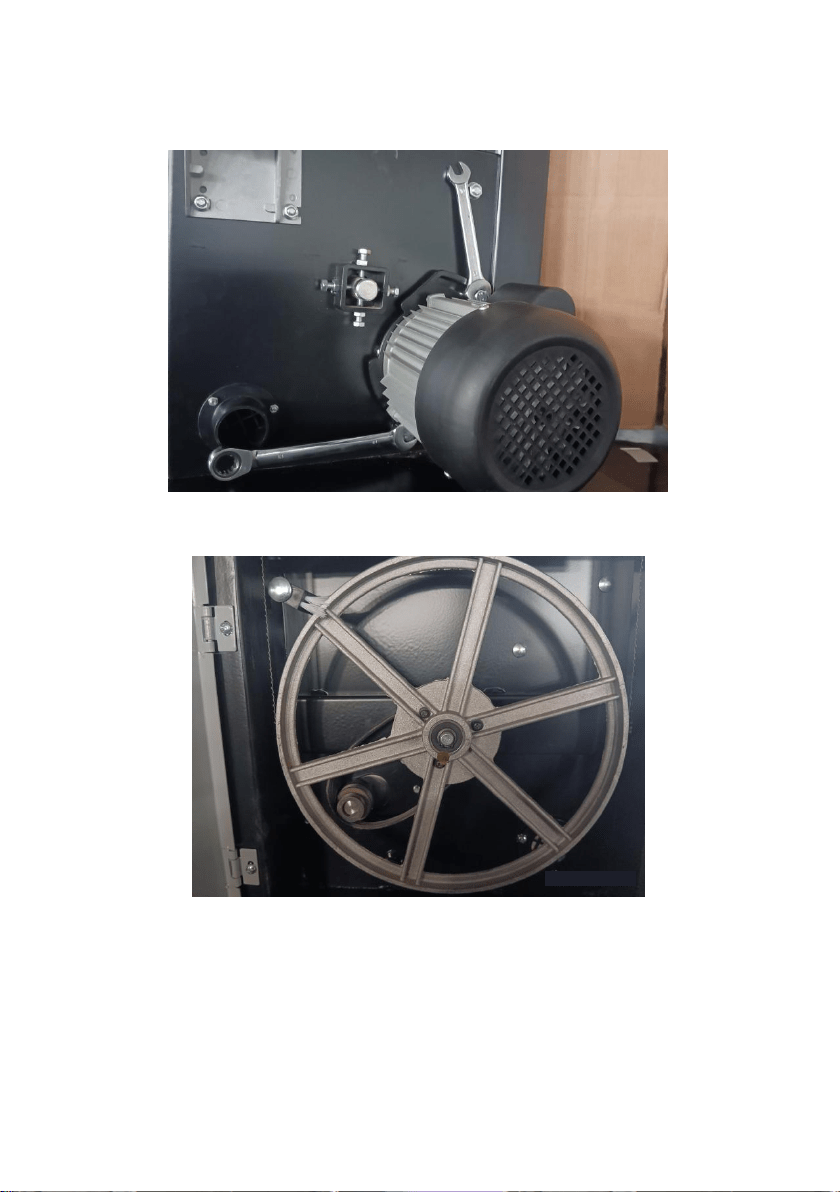
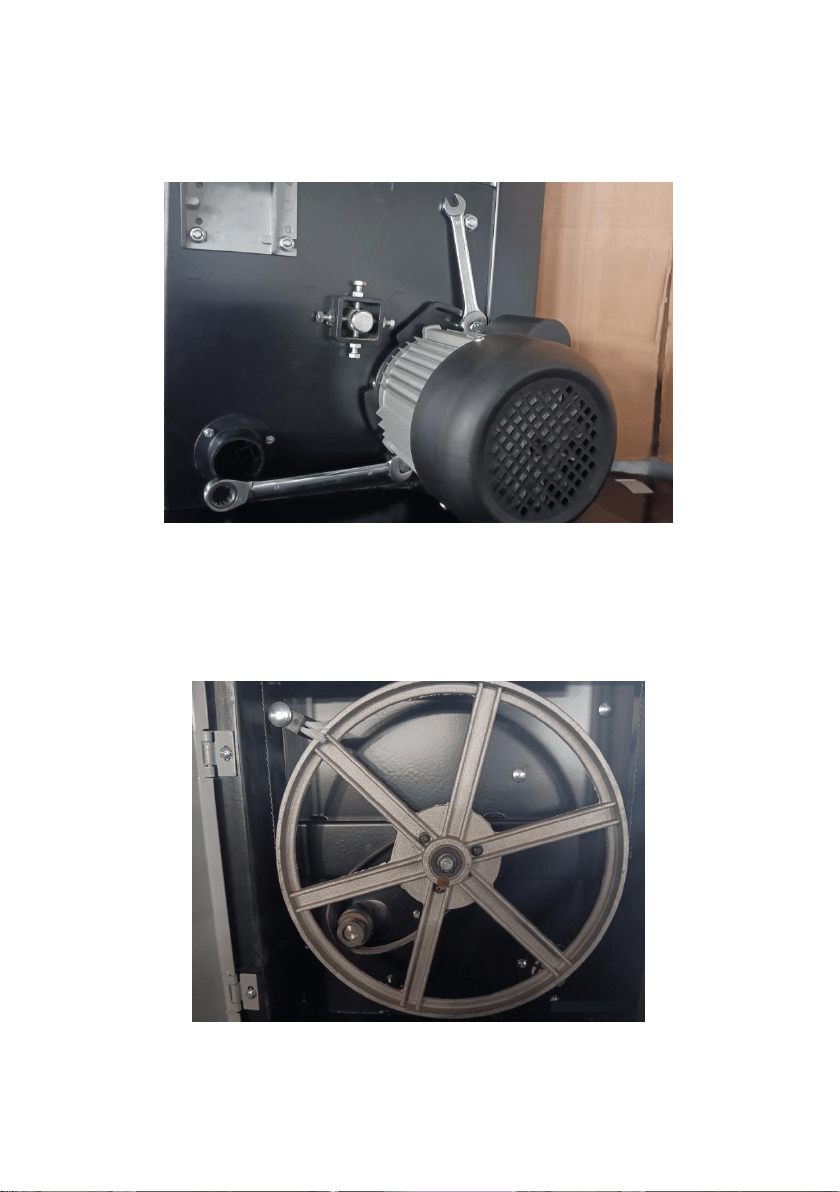
Speed Adjustment
1. Use a wrench to loosen the two bolts shown and turn the motor
counterclockwise.
2. After the belt is loosened, adjust the position of the belt in the motor
wheel and driven wheel to achieve speed regulation.
3. After the speed is adjusted, turn the motor clockwise, belt up and lock
the bolt.
- 29 -
1. Sawing
1) Choose and install a table insert extrusion suitable for the type of cut to
be performed:
Table insert extrusion with a narrow slot for standard cross-cuts only;
Table inserts extrusion with a beveled slot for bevel cuts also.
2) Adjust the band saw blade speed.
3) If necessary,adjust the table tilt.
Risk of kickback(workpiece is caught by the band saw blade
and thrown against the operator)!Do not jam any workpieces.
4) Select rip fence and table tilt for the type of cutting operation to be
carried out.
5) Set upper blade guide 3 mm above the workpiece.
Note:Always make a trial cut in a piece of scrap to verify
settings;correct if necessary before cutting the workpiece.
6) Place workpiece on the saw table.
7) Plug in.
8) Start saw.
9) Cut workpiece in a single pass.
10) Switch off if no further cutting is to be done immediately afterwards.
CARE AND MAINTENANCE
Danger!Prior to all servicing:
Switch machine OFF.
Unplug power cable.
Wait until the saw has come to a complete stop.
Check that all safety devices are operational again after each service.
- 30 -
Replace defective parts,especially safety devices,only with genuine
replacement parts.Parts not tested and approved by the equipment
manufacturer can cause unforeseen damage.
Repair and maintenance work other than described in this section
should only be carried out by qualified specialists.
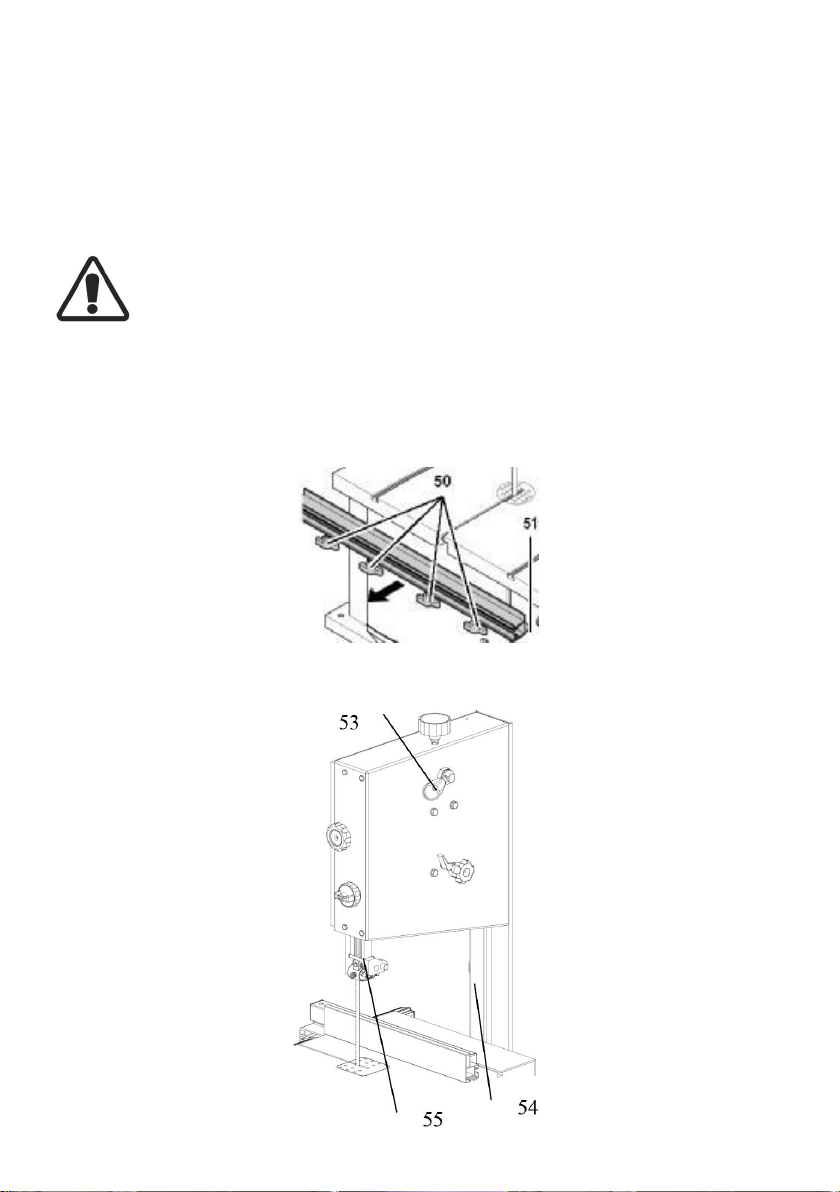
1. Changing the Band Saw Blade
Danger!Risk of injury,even with the band saw blade at a
standstill.Wear gloves when changing blades.Use only suitable band
saw blades(see"Technical specifications").
1. Loosen the four thumb screws(50)and remove the fence guide
extrusion(51).
2. Open both housing doors.

- 31 -
3. Set the upper blade guide(55)to its lowest position.
4. Loosen quick release lever(53)until the band saw blade has slackened.
5. To remove the band saw blade,guide it through
The slot in the saw table
The blade guard on the upper blade guide
The blade cover on the saw housing(54)and
The blade guides.
6. Fit a fresh band saw blade.Observe correct position:the teeth point
towards the front(door)side of the saw.
7. Center band saw blade on the rubber tyres of the band saw wheels.
8. Tighten quick release lever until blade no longer slip off the band saw
wheels.
9. Close both housing doors.
10.Then:
Tension band saw blade(see"Initial operation").
Align band saw blade(see"Care and maintenance");
Align blade guides(see"Care and maintenance");
Let saw test run for at least one minute;
Stop saw,unplug and recheck settings.
2. Aligning the Band Saw Blade
If the band saw blade does not run in the centre of the rubber tyres,the
tracking needs to be corrected by adjusting the tilt of the upper band saw
wheel:
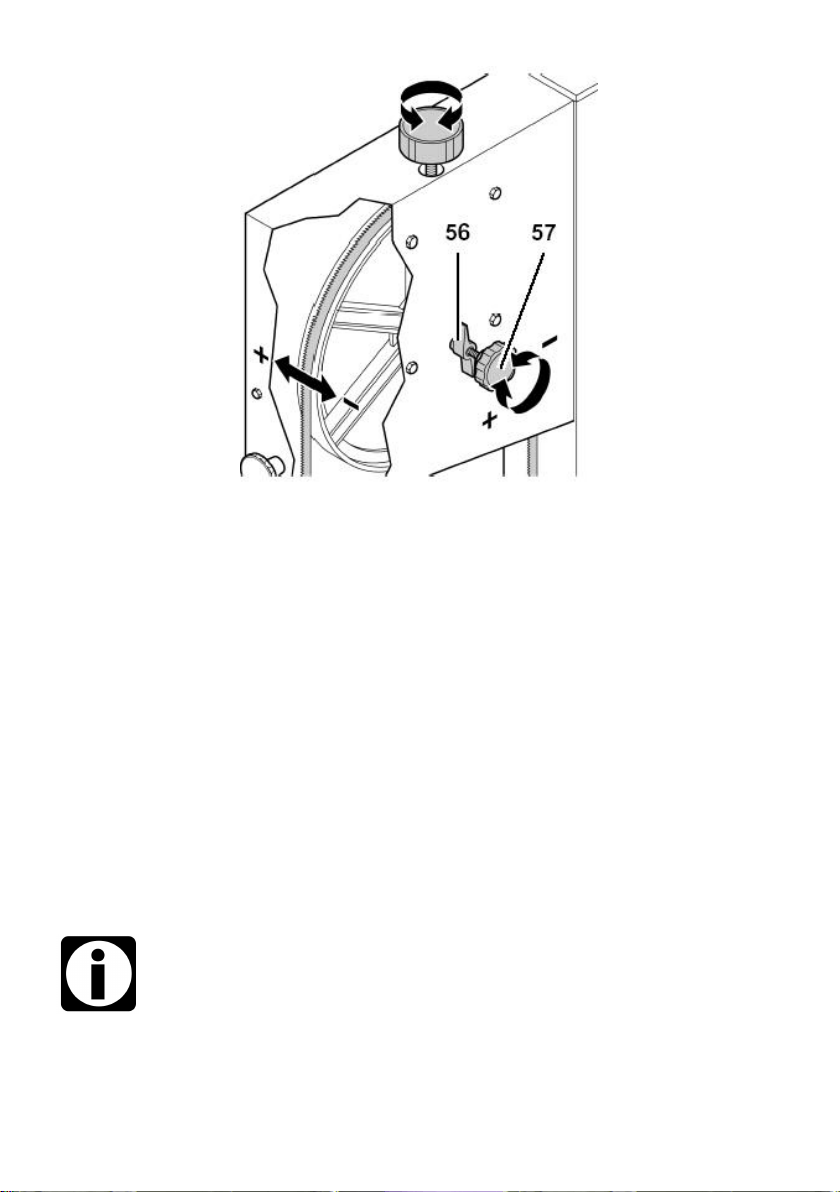
- 32 -
1. Loosen lock nut(56).
2. Turn setting knob(57):
-Turn setting knob(57)clockwise if the band saw blade runs towards the
front of the saw.
-Turn setting knob(57)counterclockwise if the band saw blade runs
towards the rear of the saw.
3. Tighten lock nut(56).
3. Aligning the Upper Blade Guide
The upper blade guide consists of:
A thrust bearing(supporting the band saw blade from the rear)
Two guide bearings(providing lateral support).
All bearings need to be readjusted after every band saw blade change
and/or tracking adjustment.
Note:Periodically check all bearings for wear. If necessary,
replace both guide bearings at the same time.
Adjusting the Thrust Bearing
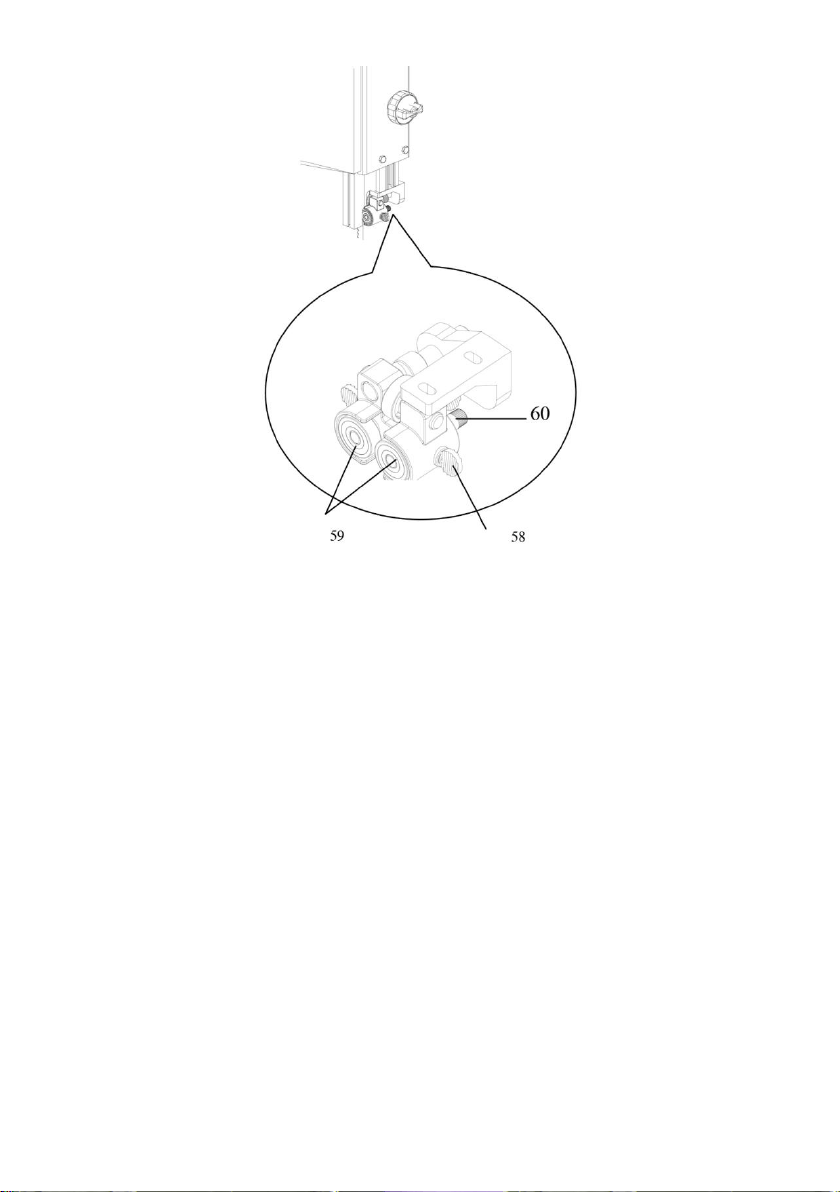
- 33 -
1.If necessary,align and tighten the band saw blade.
2.Loosen fixing screw of the upper blade guide.
3.Align upper blade guide
4.Tighten the upper blade guide's fixing screw.
5.Loosen the thrust bearing's lock screw.
6.Adjust thrust bearing position(distance thrust bearing-band saw
blade=0.5 mm–if the band saw blade is turned by hand,it must not touch
the thrust bearing).
7.Tighten the thrust bearing lock screw.
Adjusting the Guide Bearings
1.Loosen locking bolt(58).
2.Set guide bearings(59)with the shaft(60)against the band saw blade.
3.Turn band saw wheel by hand in a clockwise direction several times to
bring the guide bearings in correct position–both guide bearings should just
touch the band saw
4.Retigthen locking bolt(58)to lock the shaft(60).
4. Aligning the Lower Blade Guide
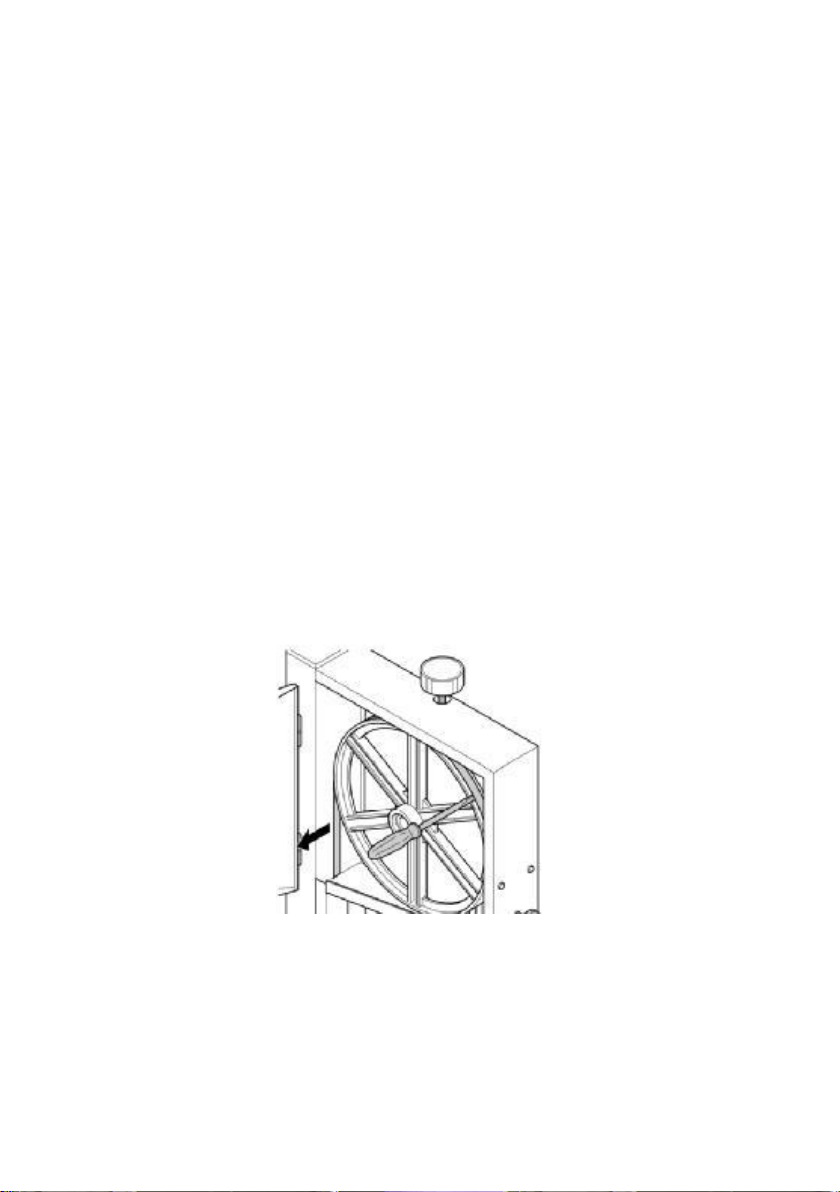
- 34 -
The lower blade guide consists of:
A thrust bearing(supporting the band saw blade from the rear)
Two guide bearings(providing lateralThese parts need to be
readjusted after every band saw blade change or tracking
Adjusting the Thrust Bearing
See“Aligning the Upper BladeGuide”
Adjusting the Guide Bearings
See“Aligning the Upper BladeGuide”
5. Replacing the Band Saw Tyre
Periodically check band saw tyres for wear.Replace only in pairs:
1.Remove band saw blade(see"Care and Maintenance");
2.Lift band saw tyre with a small screwdriver,then pull off the band saw
wheel.
3.Mount new band saw tyres and reinstall the band saw blade.
6. Replacing the Table Insert
The table insert needs replacement when its slot has become enlarged or
damaged.
1. Remove table insert(61)from saw table(push up from underneath).
2. Fit new table insert.
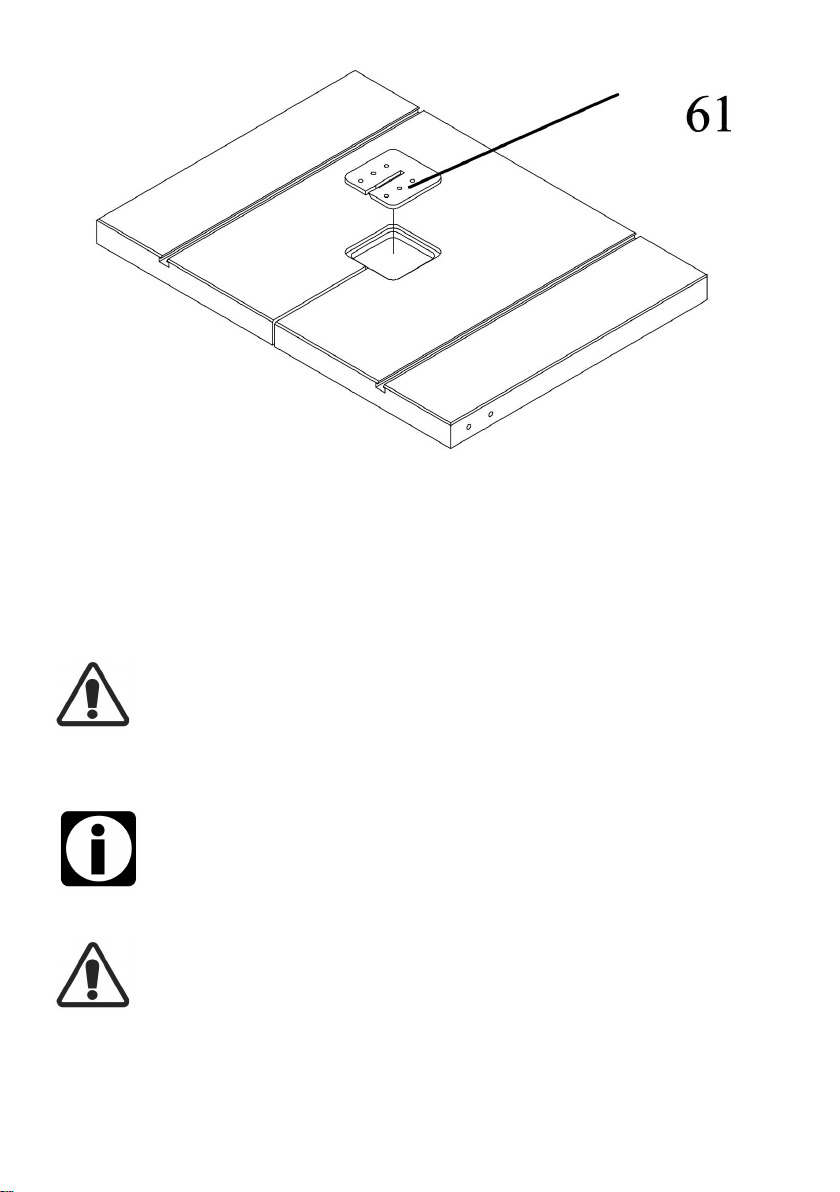
- 35 -
7. Cleaning the Saw
1.Open the housing doors.
2.Remove chips and sawdust with brush or vacuum cleaner.
3.Close the housing doors.
8. Storage
Danger!Store saw where
It cannot be used or tampered with by unauthorized persons and
Nobody can get hurt by the machine.
Note:
The ON/OFF switch can be safeguarded by a padlock.
Caution!
Do not store the saw outdoors,in unprotected areas or in damp or wet
locations.
- 36 -
9. Belt Replacement
(1) Use a wrench to loosen the two bolts shown and turn the motor
counterclockwise.
(2) Loose the belt
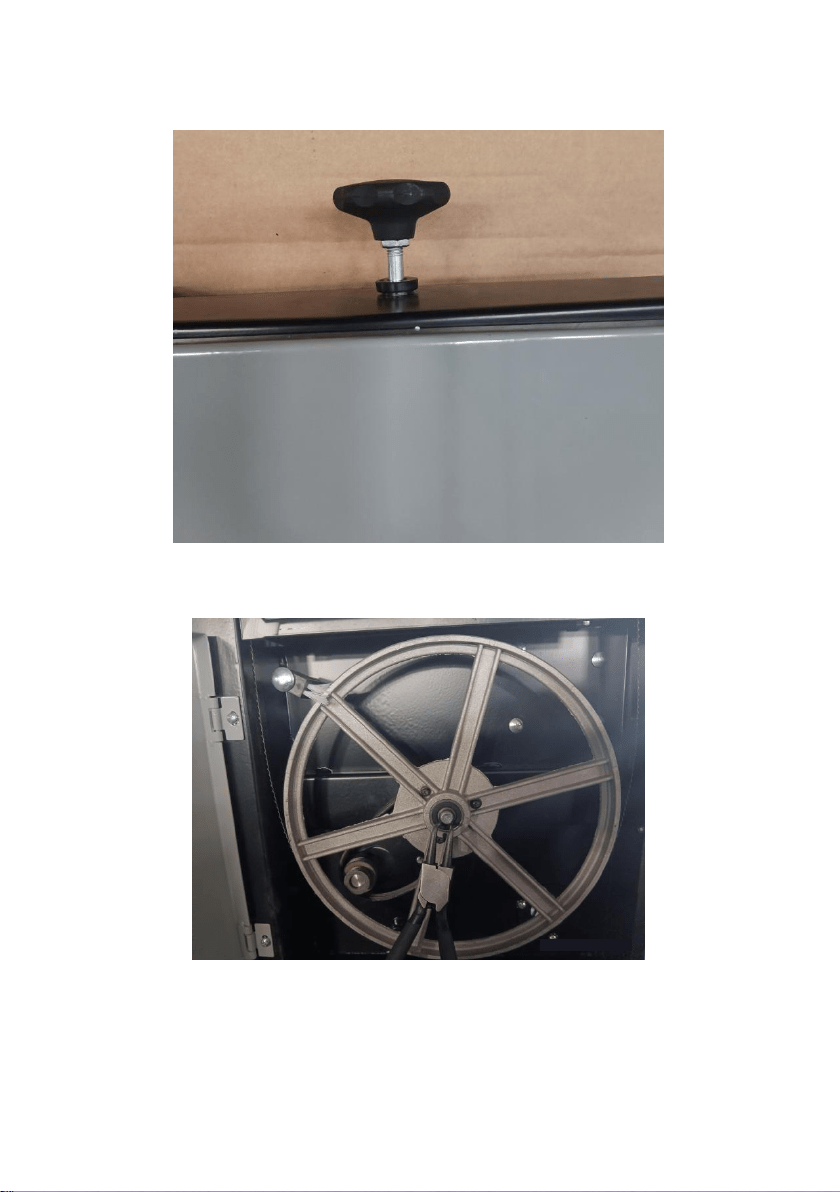
- 37 -
(3) Loosen the upper part of the band saw up tight knob, loosen the saw
blade
(4)Loosen the spring with a spring clamp
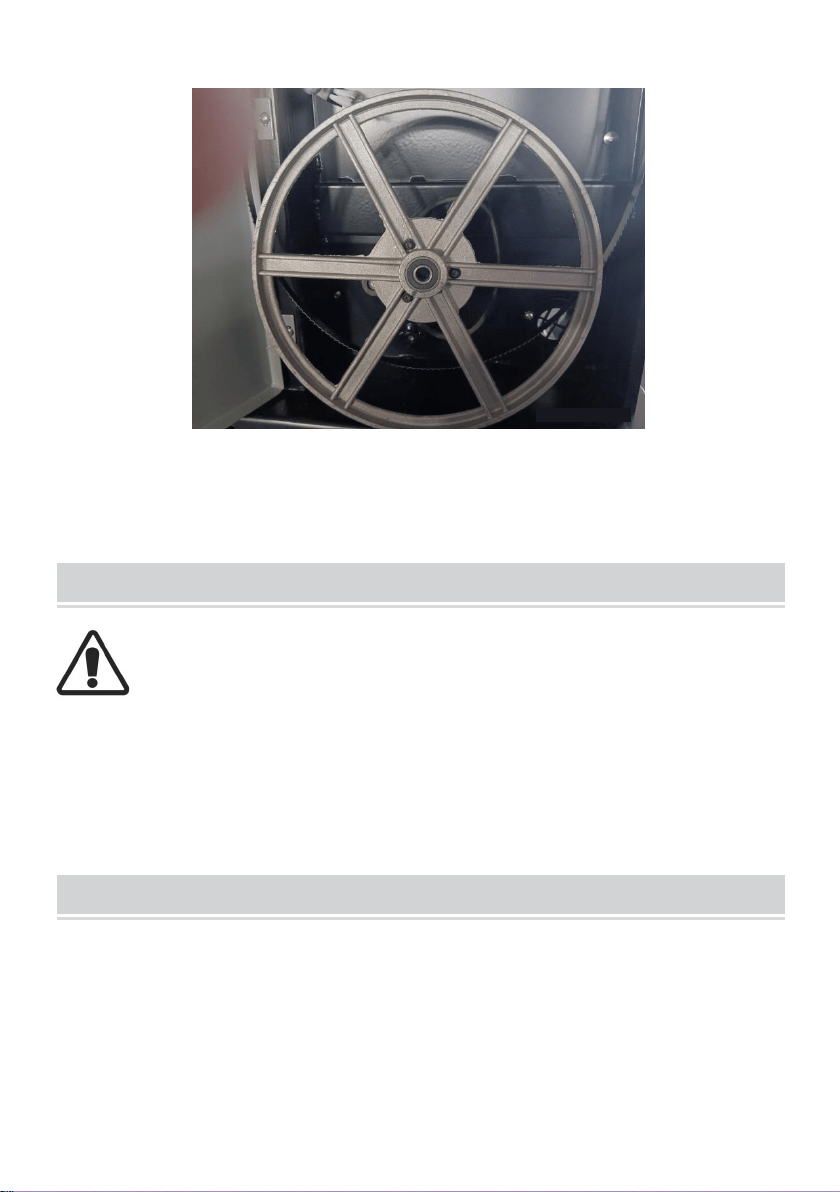
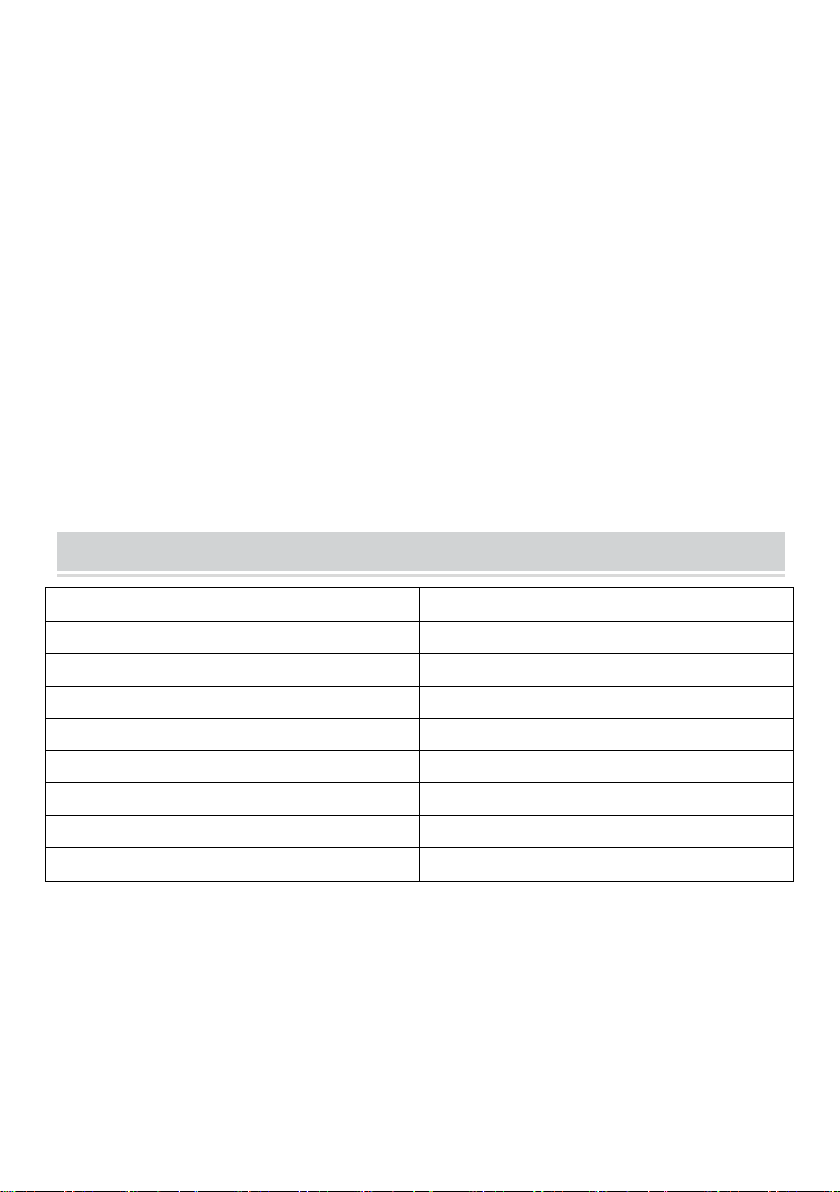
- 38 -
(5) Take off the lower wheel and replace the belt
REPAIRS
Danger!
Repairs to electric tools must be carried out by qualified electricians only!
Electric tools in need of repair can be sent to the service center of your
country.Refer to the spare parts list for the address.
Please attach a description of the fault to the electric tool.
ENVIRONMENTAL PROTECTION
All packaging materials are 100%recyclable.Worn out power tools and
accessories contain considerable amounts of valuable raw and rubber
materials,which can be recycled.
These instructions are printed on paper produced with elemental
chlorine-free bleaching process.

- 39 -
TROUBLE SHOOTING
Danger!
Before carrying out any fault service or maintenance work always:
Switch machine OFF
Unplug power cable.
Wait until the band saw blade has come to a complete stop.
Check to see that all safety devices are operational after each fault service.
Motor does not run
Under voltage relay tripped by power failure:
Switch on again.
No mains voltage
Check cables,plug,outlet and mains fuse.
Motor overheated,e.g.by a blunt band saw blade or chip build-up in the
housing:
Remove cause for overheating,let cool down for a few minutes,then
start again.
Band saw blade wanders off the line of cut or runs off the band saw
wheels
Band saw blade is not running dead center on the band saw wheels:
Correct tracking(see"Care and maintenance").
Band saw blade breaks
Incorrect tension:
Correct band saw blade tension(see"Initial operation").
Load too high:
Reduce pressure against band saw blade(reduced feed speed).
Incorrect band saw blade:
Replace band saw blade(see"Care and maintenance"):
Thin stock=narrow band saw blade
Thick stock=wide band saw blade.
Band saw blade warped
Load too high:
- 40 -
Avoid lateral pressure on the band saw blade.
Saw vibrates
Insufficient mounting:
Fasten saw properly to a suitable surface(see"Initial operation").
Saw table loose:
Align and fasten saw table.
Motor mount loose:
Check fastening screws,tighten if necessary.
Dust extraction port blocked
No dust collector connected or suction capacity insufficient:
Connect a dust collector or increase suction capacity(air speed≥20
m/sec at dust extraction port).
TECHNICAL SPECIFICATIONS
Power
370W
Max. Throat Width
245 mm
Max.Cutting Height
160 mm
Sawblade Length
1832 mm
Sawtable Size
:
340 x 335 mm
Max.Sawblade Speeds(50 Hz)
730 m/min
Max.Sawblade Speeds(60 Hz)
890 m/min
N.W.
27.5 kg
G.W.
31 kg
- 41 -
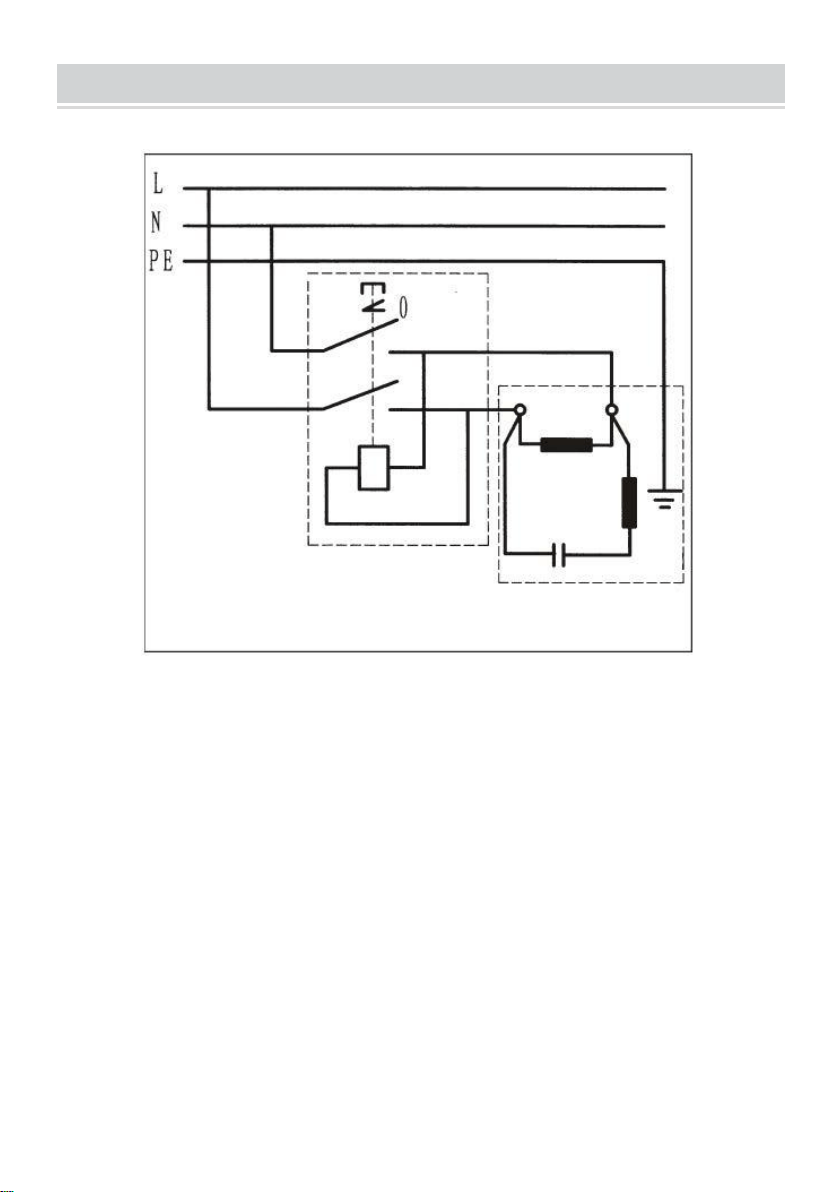
ELECTRICAL WIRING DIAGRAM
- 42 -
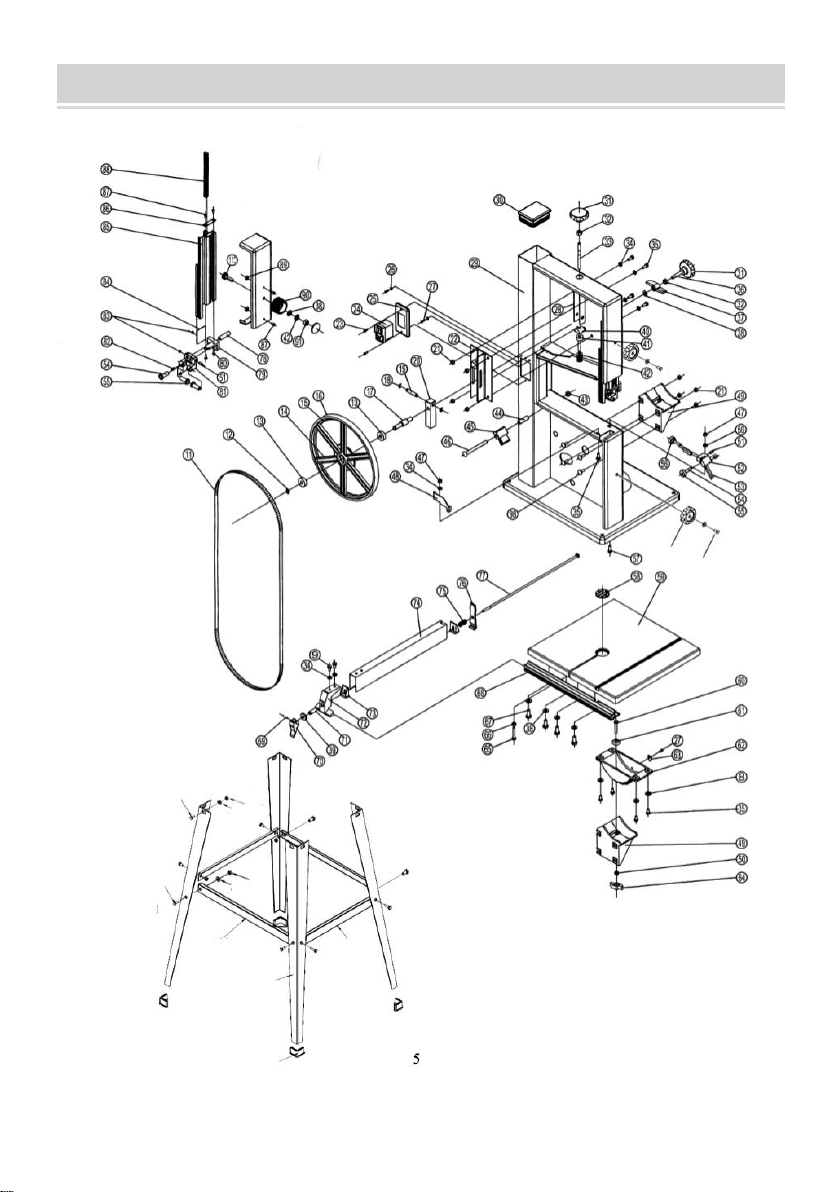
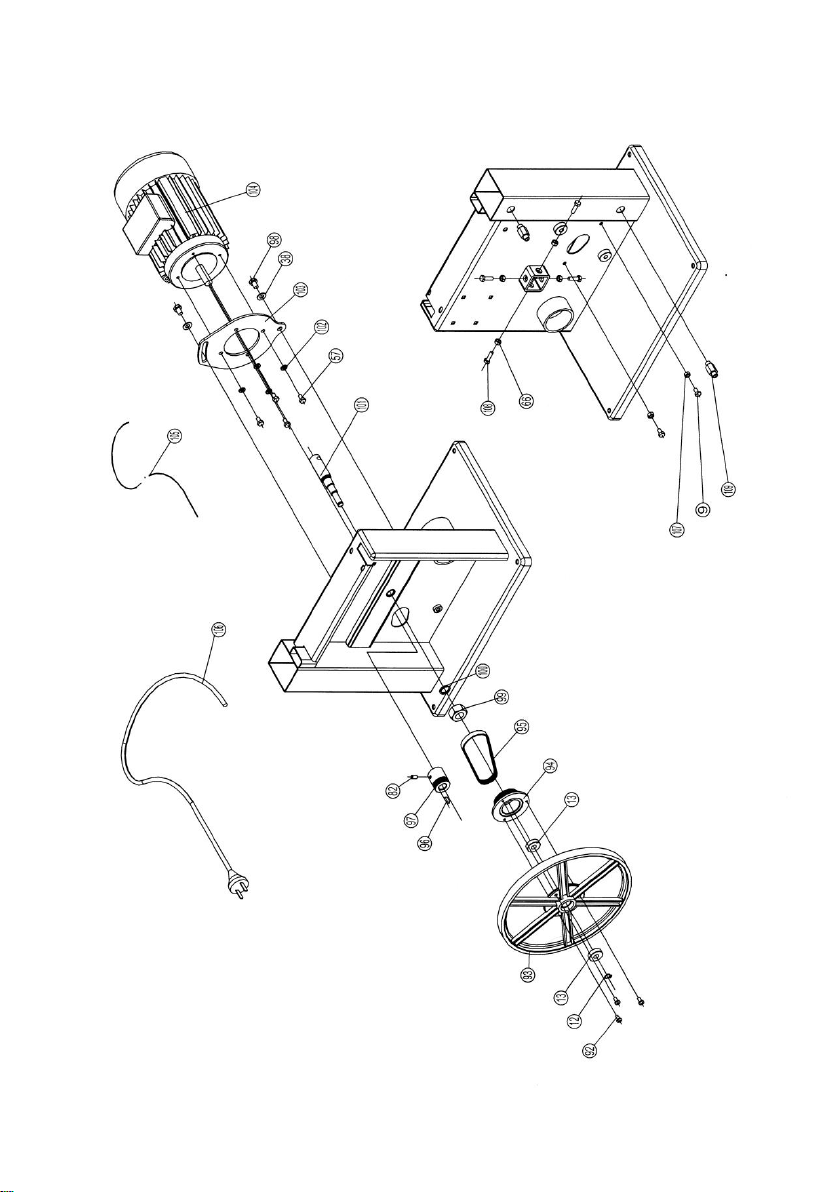
EXPLODED VIEW DRAWING AND PART LIST
- 43 -
- 44 -
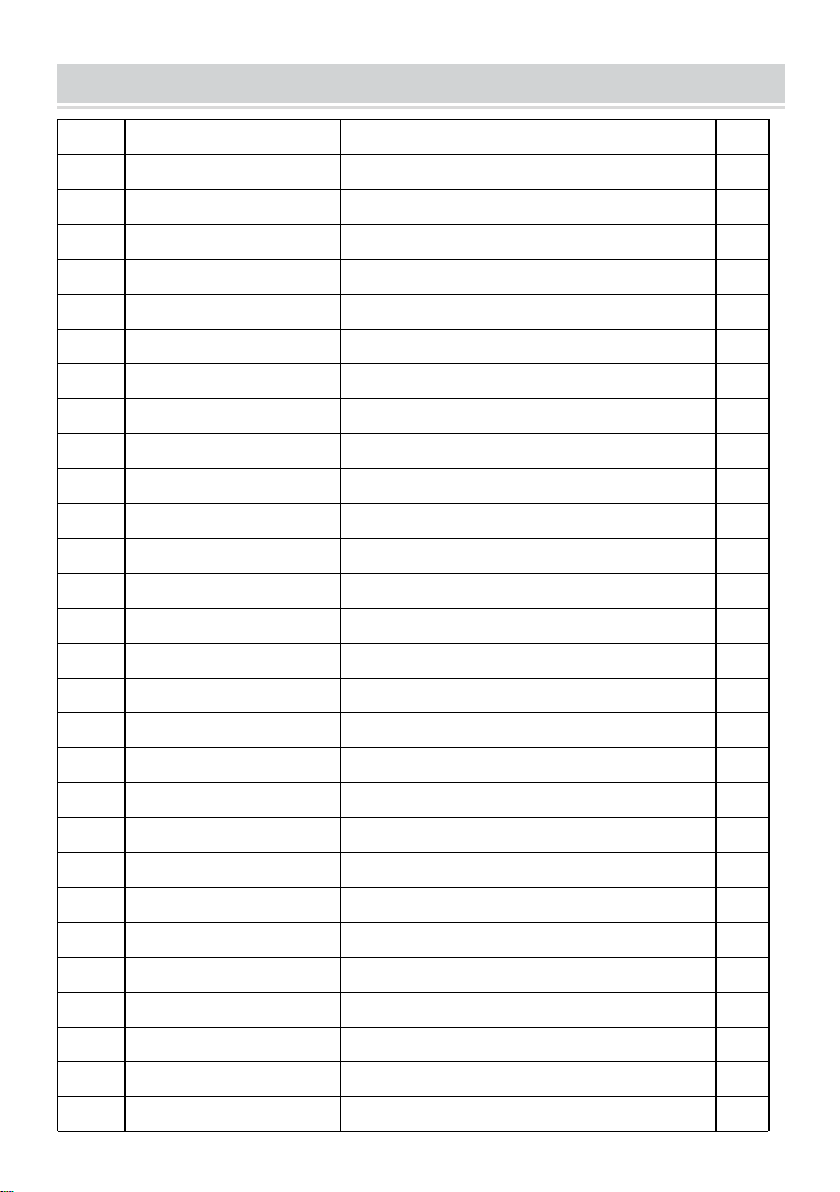
SPARE PARTS LIST/EXPLODEDVIEW DRAWING
ITEM
PART NO.
Description
Q'ty
1
GB/T70. 1 M6X16
Hex.Hd.Bolt
2
2
DJ31703012
Sheathing
2
3
GB/T889.1/1
Nut M6
2
4
DJ250B04001-1D
Door Lower
1
5
DJ250A03023
Spring
2
6
GB/T12618
Housing with Nut
4
7
DJ250B03001-1G
Door Upper
1
8
GB862.2-87 6
Ext.Lock Washer 6
3
9
GB5783-86 M6x10
Hex.Hd.Bolt M6x10
5
11
DJ250A05001
Saw Blade
1
12
GB894.1-86 10
Ring Retaining
2
13
GB/T276-94 6000-2Z
Ball Bearing
4
14
DJ250A03005
Upper Wheel
1
15
DJ250A03005-1
Balance Collar
fit
16
DJ250A04009
Band Saw Tyre
2
17
DJ250A03004A
Bearing Bolt Upper
1
18
GB896-86
"E" Rings
2
19
DJ250A03007
Pin Guide
1
20
DJ250A03003A
Seat Bearing Bolt Upper
1
21
GB6177-86 M6
Hex.Hd.Flange Nut
8
22
DJ250A03002A
Guide Plate Assembly
1
23
GB819-85 M4x12
Cross Countorsunk HD.Screw
2
24
KJD20
Magnetic Switch
1
25
DJ25005004B
Switch Plate
1
26
GB862.2-87 4
Ext.Lock Washer
2
27
GB823-88 M4x6
Cross Pan.Hd.Screw
2
28
DJ250A03010
Blade Tensioner
1
29
DJ250B01000
Band Saw Frame
1

- 45 -
30
DJ250A05002
Lamello Plug Black
1
31
DJ250A03008
Adjust Handle
2
32
GB6172-86 M8
Hex.Hd.Thin Nut
4
33
DJ250A03006
Thread Bolt
1
34
GB97.1-85 6
Washer
8
35
GB5783-86 M6x12
Hex.Hd.Bolt
9
36
GB5783-86 M8x45
Hex.Hd.Bolt
1
37
31503007
Wing knob
1
38
GB97.1-85 8
Washer
10
39
GB97.1-85 10
Washer
1
40
DJ250A03009
Nut
1
41
DJ250A03011
Shaft
1
42
GB/T1792 A16
Butterfly Spring
18
43
GB6177-86 M8
Hex.Hd.Flange Nut
1
44
DJ250A04014
Spacer Bushing
1
45
31504015
Brush Strip
1
46
GB14-88 M8x70
Cup Square Neck Bolt
1
47
GB889-86 M6
Hx.Hd.Lock Nut
2
48
DJ25004011
Blade Guard
1
49
DJ250A02002
Blade Trunnion Lower
1
50
GB96-85 6
Washer
1
51
GB80-85 M6x12
Int.Hd.Screw
3
52
DJ250A04002A
Roller Guide
1
53
31504003
Pilot Pin
2
54
DJ250A03021
Thurst Bearing Shaft
4
55
GB/T276-94 625-2Z
Bearing
4
56
31504018
Idler Wheel Shaft
1
57
GB5783-86 M6x16
Hex.Hd.Bolt
8
58
DJ25002005
Blade Fork
1
59
DJ250A02001
Table
1

- 46 -
60
GB14-88 M6x30
Cup Square Neck Bolt
1
61
DJ25002006A
Guide Piece
1
62
DJ250A02003
Table Trunnion Upper
1
63
DJ250A02004
Indicator
1
64
DJ250A02005
Tension knob
1
65
GB5783-86 M6x30
Hex.Hd.Bolt
1
66
GB6170-86 M6
Hex.Nut
5
67
GB5783-86 M8x12
Hex.Hd.Bolt
4
68
DJ250A02014
Rip Fence Canier Extrvsion
1
69
GB879-86 3x16
Roll Pin
1
70
DJ250A02008A-8
Partiality Piece
1
71
DJ250A02008A-6
Connect Set
1
72
DJ250B02008-1
Baffle Bracket
1
73
DJ250A02008A-2
Stuck Piece
2
74
DJ250A02008A-1
Baffle
1
75
DJ250A02008A-3
Spring
1
76
DJ250A02008A-4
Clamp Board
1
77
DJ250A02008A-5
Clamp Screw
1
78
DJ315B03024
Fastening Shaft
1
79
DJ250A03014A
Seat Guide Upper
1
80
GB846-85 ST4.2x13
Cross CS.HD Tapping Screw
2
81
DJ250A03022A
Housing Upper Guide
1
82
GB80-85 M6x8
Int.Hd.Screw
3
83
GB80-85 M6x6
Int.Hd.Screw
2
84
DJ250A03024
Slide Board
1
85
DJ250A03012
Guide Lever
1
86
DJ315B03031-1
Cover Board
1
87
GB845-85 ST4.2x9.5
Cross Pan.Hd.Screw
4
88
DJ250A03018
Rack
1

- 47 -
89
DJ250A03013
Guide Piece
2
90
DJ315B03016
Adjust Knob
1
91
GB889-86 M8
Hx.Hd.Lock Nut
1
92
GB818-85 M5x10
Cross Pan.Hd.Screw
3
93
DJ250A04005
Wheel Lower
1
94
DJ25004008
Pulley Lower
1
95
DJ25004010
V-Ribbed Belts
1
96
GB1096-79 5x30
Key
1
97
DJ25004004
Motor Pulley
1
98
GB14-88 M6x16
Cup Square Neck Bolt
4
99
GB6171-86 M14x1.5
Hex.Nut
1
100
GB93-87 14
Spring Washer
1
101
DJ250A04006
Bearing Bolt Upper
1
102
GB93-87 6
Spring Washer
4
103
DJ25005003-1
Plate Mounting Motor
1
104
YYL7114
Motor
1
105
DJ250A05006
Motor Cord
1
106
DJ250A05005
Power Cord
1
107
GB6172-86 M6
Hex.Hd.Thin Nut
2
108
GB5783-86 M6x20
Hex.Hd.Bolt
4
109
31505010A
relief strain
2
110
DJ250A03019
Shaft
1
111
5000037007
Angle Gauge
1
112
DJ31703002
Door locker
2
113
M6 X 25
Hex Socket Head Bolt
2
114
Foot Pad
4
115
DJ250B01011-2B
LEG
4
116
DJ250B01011-5
Cross Brace (Short)
2
117
DJ250B01011-4
Cross Brace (Long)
2

- 48 -
118
M8 X 16
Carriage Bolt
16
119
M8
Nut
16
120
8
Washer
16
- 49 -
Importer: WAITCHX
Address: 250 bis boulevard Saint-Germain 75007 Paris
Importer: FREE MOOD LTD
Address: 2 Holywell Lane, London, England, EC2A 3ET
Manufacturer: Laizhou Hengji Electromechanical Technology Co. , Ltd.
Address: No. 1858, Kaiming Road, Lai zhou, Yantai, Shandong Province
Made In China
REP
UK
EUREP UK LTD
UNIT 2264, 100 OCK STREET, ABINGDON
OXFORDSHIRE ENGLAND OX14 5DH
REP
EC
EUREP GmbH
Unterlettenweg 1a, 85051
Ingolstadt, Germany