
Digital VTH (4.6 version)
User's Manual
V1.0.0

I
Foreword
This manual introduces the structure and configuration of digital VTH. Read carefully before using
the VTH, and keep the manual safe for future reference.
Safety Instructions
The following signal words might appear in the manual.
Signal Words Meaning
Indicates a high potential hazard which, if not avoided, will result in
death or serious injury.
Indicates a medium or low potential hazard which, if not avoided,
could result in slight or moderate injury.
Indicates a potential risk which, if not avoided, could result in property
damage, data loss, reductions in performance, or unpredictable
results.
Provides methods to help you solve a problem or save time.
Provides additional information as a supplement to the text.
Revision History
Version Revision Content Release Time
V1.0.0 First release. January 2023
Privacy Protection Notice
As the device user or data controller, you might collect the personal data of others such as their face,
fingerprints, and license plate number. You need to be in compliance with your local privacy
protection laws and regulations to protect the legitimate rights and interests of other people by
implementing measures which include but are not limited: Providing clear and visible identification
to inform people of the existence of the surveillance area and provide required contact information.
About the Manual
●
The manual is for reference only. Slight differences might be found between the manual and the
product.
●
We are not liable for losses incurred due to operating the product in ways that are not in
compliance with the manual.
●
The manual will be updated according to the latest laws and regulations of related jurisdictions.
For detailed information, see the paper user’s manual, use our CD-ROM, scan the QR code or visit
our official website. The manual is for reference only. Slight differences might be found between
the electronic version and the paper version.
●
All designs and software are subject to change without prior written notice. Product updates
might result in some differences appearing between the actual product and the manual. Please
contact customer service for the latest program and supplementary documentation.
●
There might be errors in the print or deviations in the description of the functions, operations
and technical data. If there is any doubt or dispute, we reserve the right of final explanation.
●
Upgrade the reader software or try other mainstream reader software if the manual (in PDF

II
format) cannot be opened.
●
All trademarks, registered trademarks and company names in the manual are properties of their
respective owners.
●
Please visit our website, contact the supplier or customer service if any problems occur while
using the device.
●
If there is any uncertainty or controversy, we reserve the right of final explanation.

III
Important Safeguard and Warnings
This section introduces content covering the proper handling of the device, hazard prevention, and
prevention of property damage. Read carefully before using the device, and comply with the
guidelines when using it.
Operation Requirements
●
Check whether the power supply is correct before use.
●
Do not unplug the power cord on the side of the device while the adapter is powered on.
●
Operate the device within the rated range of power input and output.
●
Transport, use and store the device under allowed humidity and temperature conditions.
●
If the device is powered off for longer than a month, it should be placed in its original package
and sealed. Make sure to keep it away from moisture, and store it under allowed humidity and
temperature conditions.
●
Do not drop or splash liquid onto the device, and make sure that there is no object filled with
liquid on the device to prevent liquid from flowing into it.
●
Do not disassemble the device without professional instruction.
Installation Requirements
●
Do not connect the power adapter to the device while the adapter is powered on.
●
Strictly comply with the local electric safety code and standards. Make sure the ambient voltage
is stable and meets the power supply requirements of the device.
●
Do not connect the device to two or more kinds of power supplies, to avoid damage to the
device.
●
Improper use of the battery might result in a fire or explosion.
●
Personnel working at heights must take all necessary measures to ensure personal safety
including wearing a helmet and safety belts.
●
Do not place the device in a place exposed to sunlight or near heat sources.
●
Keep the device away from dampness, dust, and soot.
●
Install the device on a stable surface to prevent it from falling.
●
Install the device in a well-ventilated place, and do not block its ventilation.
●
Use an adapter or cabinet power supply provided by the manufacturer.
●
Use the power cords that are recommended for the region and conform to the rated power
specifications.
●
The power supply must conform to the requirements of ES1 in IEC 62368-1 standard and be no
higher than PS2. Please note that the power supply requirements are subject to the device label.
●
The device is a class I electrical appliance. Make sure that the power supply of the device is
connected to a power socket with protective earthing.

IV
Table of Contents
Foreword
........................................................................................................................................................................................................I
Important Safeguard and Warnings
.............................................................................................................................................. III
1 Product Overview
................................................................................................................................................................................. 1
1.1 Front Panel
.................................................................................................................................................................................... 1
1.1.1 VTH2421F Series
............................................................................................................................................................. 1
1.1.2 VTH2621G/VTH2622G Series
.................................................................................................................................... 1
1.1.3 VTH5221D Series
............................................................................................................................................................. 2
1.1.4 VTH5241D Series
............................................................................................................................................................. 3
1.1.5 VTH5421E Series
............................................................................................................................................................. 4
1.1.6 VTH5421H Series
............................................................................................................................................................. 4
1.1.7 VTH8621K Series
............................................................................................................................................................. 5
1.2 Rear Panel
...................................................................................................................................................................................... 6
1.2.1 VTH2421F Series
............................................................................................................................................................. 6
1.2.2 VTH2621G Series
............................................................................................................................................................. 7
1.2.3 VTH2622G Series
............................................................................................................................................................. 8
1.2.4 VTH5221D Series
............................................................................................................................................................. 9
1.2.5 VTH5241D Series
........................................................................................................................................................... 10
1.2.6 VTH5421E Series
........................................................................................................................................................... 11
1.2.7 VTH5421H Series
........................................................................................................................................................... 12
1.2.8 VTH8621K Series
........................................................................................................................................................... 13
1.3 Alarm Port
................................................................................................................................................................................... 13
1.4 Function
........................................................................................................................................................................................ 14
2 Quick Configuration of VTO and VTH
....................................................................................................................................... 15
2.1 Preparation
................................................................................................................................................................................. 15
2.2 VTO Configuration
.................................................................................................................................................................. 15
2.2.1 Initialization
.................................................................................................................................................................... 15
2.2.2 Network Parameters
................................................................................................................................................... 17
2.2.3 Server Type
...................................................................................................................................................................... 18
2.2.4 SIP Server
.......................................................................................................................................................................... 18
2.2.5 Adding VTO
...................................................................................................................................................................... 20
2.2.6 Adding VTH
...................................................................................................................................................................... 21
2.3 VTH Configuration
.................................................................................................................................................................. 22
2.3.1 Initialization (Quick Configuration)
.................................................................................................................... 22
2.3.2 Network Parameters
................................................................................................................................................... 28
2.3.2.1 WLAN
........................................................................................................................................................................ 28
2.3.2.2 LAN
............................................................................................................................................................................ 29
2.3.3 Configuring VTH
............................................................................................................................................................ 30
2.3.4 SIP Server
.......................................................................................................................................................................... 31

V
2.3.5 VTO Configuration
....................................................................................................................................................... 32
2.4 Commissioning
......................................................................................................................................................................... 33
2.4.1 VTO Calling VTH
............................................................................................................................................................ 33
2.4.2 VTH Monitoring VTO
................................................................................................................................................... 34
3 VTH Screen Operation
...................................................................................................................................................................... 36
3.1 Home Screen
.............................................................................................................................................................................. 36
3.2 Call
................................................................................................................................................................................................... 38
3.2.1 Call Log
............................................................................................................................................................................... 39
3.2.2 Contacts
............................................................................................................................................................................. 39
3.2.3 Calling User
...................................................................................................................................................................... 41
3.2.3.1 By Room Number
............................................................................................................................................... 41
3.2.3.2 From Contact
........................................................................................................................................................ 42
3.2.4 Call from User
................................................................................................................................................................. 42
3.2.5 Call from VTO
.................................................................................................................................................................. 43
3.2.6 Calling DMSS
................................................................................................................................................................... 45
3.3 Information
................................................................................................................................................................................. 45
3.3.1 Security Alarm
................................................................................................................................................................ 45
3.3.2 Guest Message
............................................................................................................................................................... 47
3.3.3 Publish Information
..................................................................................................................................................... 47
3.3.4 Video Pictures
................................................................................................................................................................. 47
3.4 Monitor
......................................................................................................................................................................................... 48
3.4.1 Monitoring VTO
............................................................................................................................................................. 48
3.4.2 Monitoring IPC
............................................................................................................................................................... 50
3.4.2.1 Adding IPC
............................................................................................................................................................. 50
3.4.2.2 Modifying IPC
...................................................................................................................................................... 52
3.4.2.3 Deleting IPC
.......................................................................................................................................................... 52
3.4.2.4 Monitoring
............................................................................................................................................................ 52
3.4.3 Favorite
.............................................................................................................................................................................. 53
3.5 Concierge
..................................................................................................................................................................................... 54
3.6 Setting
........................................................................................................................................................................................... 54
3.6.1 Ring Settings
................................................................................................................................................................... 54
3.6.1.1 VTO Ring
................................................................................................................................................................. 54
3.6.1.2 VTH Ring
................................................................................................................................................................. 55
3.6.1.3 Alarm Ring
............................................................................................................................................................. 56
3.6.1.4 Other Ring Settings
........................................................................................................................................... 56
3.6.2 Card Information
........................................................................................................................................................... 57
3.6.3 Alarm Setting
.................................................................................................................................................................. 58
3.6.3.1 Wired Zone
............................................................................................................................................................ 58
3.6.3.2 Wireless Zone
....................................................................................................................................................... 60
3.6.3.3 Alarm Output
....................................................................................................................................................... 61

VI
3.6.4 Mode Setting
................................................................................................................................................................... 61
3.6.5 Forward Setting
............................................................................................................................................................. 63
3.6.6 General Setting
.............................................................................................................................................................. 64
3.6.6.1 Time Setting and DND
..................................................................................................................................... 64
3.6.6.2 Display Setting
.................................................................................................................................................... 65
3.6.6.3 QR Code
.................................................................................................................................................................. 66
3.6.6.4 Other Settings
..................................................................................................................................................... 68
3.6.7 WLAN
.................................................................................................................................................................................. 70
3.6.8 User Password Setting
............................................................................................................................................... 71
3.6.9 Network Password Setting
....................................................................................................................................... 72
3.6.9.1 Creating Network Password
......................................................................................................................... 72
3.6.9.2 Changing Network Password
...................................................................................................................... 74
3.6.9.3 Resetting Network Password
....................................................................................................................... 75
3.6.10 Product Information
................................................................................................................................................. 75
3.7 Project Settings
........................................................................................................................................................................ 76
3.7.1 Forget Password
............................................................................................................................................................ 76
3.7.2 Network Settings
.......................................................................................................................................................... 77
3.7.3 Configuring VTH
............................................................................................................................................................ 78
3.7.4 VTO Configuration
....................................................................................................................................................... 79
3.7.5 Factory Reset
................................................................................................................................................................... 80
3.7.6 Adding Device
................................................................................................................................................................ 81
3.7.7 Reset MSG
......................................................................................................................................................................... 83
3.8 Unlock Function
....................................................................................................................................................................... 84
3.9 Arm and Disarm Function
.................................................................................................................................................... 84
3.9.1 Arm
....................................................................................................................................................................................... 84
3.9.2 Disarm
................................................................................................................................................................................ 85
4 DSS Agile VDP
...................................................................................................................................................................................... 87
4.1 Downloading the App
........................................................................................................................................................... 87
4.2 Registration and Login
......................................................................................................................................................... 87
4.3 Call Functions
............................................................................................................................................................................ 89
4.3.1 Forwarding Calls
........................................................................................................................................................... 89
4.3.2 Calling Operations
....................................................................................................................................................... 91
4.4 Monitoring
.................................................................................................................................................................................. 92
4.5 Call Records
................................................................................................................................................................................ 94
4.6 Message
........................................................................................................................................................................................ 95
4.7 Visitor
............................................................................................................................................................................................ 98
4.7.1 Creating Pass
................................................................................................................................................................... 98
4.7.2 Visit Records
................................................................................................................................................................. 101
4.8 Setting
................................................................
........................................................................................................................ 102
5 DMSS App
............................................................................................................................................................................................ 104

VII
5.1 Downloading DMSS
............................................................................................................................................................. 104
5.2 Registration and Login
...................................................................................................................................................... 104
5.3 Adding VTH to DMSS
.......................................................................................................................................................... 106
5.4 Configuring Arm and Disarm
.......................................................................................................................................... 108
5.5 DMSS Calling VTH
................................................................................................................................................................. 109
5.6 DMSS Calling VTO
................................................................................................................................................................. 110
5.7 DMSS Unlocking Door
........................................................................................................................................................ 111
5.8 DMSS Monitoring VTO
....................................................................................................................................................... 112
5.9 Viewing Alarm Information
............................................................................................................................................. 114
5.10 Device Sharing
..................................................................................................................................................................... 114
Appendix 1 Cybersecurity Recommendations
..................................................................................................................... 118

1
1 Product Overview
The following front and rear panel figures are for reference only.
1.1 Front Panel
1.1.1 VTH2421F Series
Figure 1-1 Front panel
1.1.2 VTH2621G/VTH2622G Series
Figure 1-2 Front panel

2
1.1.3 VTH5221D Series
Figure 1-3 Front panel
Table 1-1 Icon description
Icon Name Description
SOS Emergency call.
Call
●
Answer call.
●
During call, press to hang up.
●
During monitoring, press to speak to unit VTO, villa VTO,
fence station and verifying VTO.
●
During speaking, press to exit speaking.
Menu Go to main menu.
Monitor
●
In standby mode, press to monitor the main VTO.
●
During monitoring, press to exit monitoring.
Unlock
When calling, talking, monitoring and speaking to VTO, press to
unlock corresponding VTO.

3
1.1.4 VTH5241D Series
Figure 1-4 Front panel
Table 1-2 Icon description
Icon Name Description
SOS Emergency call.
Call
●
Answer call.
●
During call, press to hang up.
●
During monitoring, press to speak to unit VTO, villa VTO,
fence station and verifying VTO.
●
During speaking, press to exit speaking.
Menu Go to main menu.
Monitor
●
In standby mode, press to monitor the main VTO.
●
During monitoring, press to exit monitoring.
Unlock
When calling, talking, monitoring and speaking to VTO, press to
unlock corresponding VTO.

4
1.1.5 VTH5421E Series
Figure 1-5 Front panel
1.1.6 VTH5421H Series
Figure 1-6 Front panel

5
1.1.7 VTH8621K Series
Figure 1-7 Front panel


7
1.2.2 VTH2621G Series
Figure 1-9 Rear panel (non 2-wire)
Table 1-4 Rear panel description
No. Port
1 Alarm port
2 Power input port
3 Network port

8
1.2.3 VTH2622G Series
Figure 1-10 Rear panel (2-wire)
Table 1-5 Rear panel description
No. Port
1 Alarm port
2 2-wire port
3 Network port

9
1.2.4 VTH5221D Series
Figure 1-11 Rear panel
Table 1-6 Rear panel description
No. Port
1 Reset key
2 Network port
3 RS-485 extended port
4 Alarm port
5 SD card slot
Figure 1-12 RS-485 extended port

10
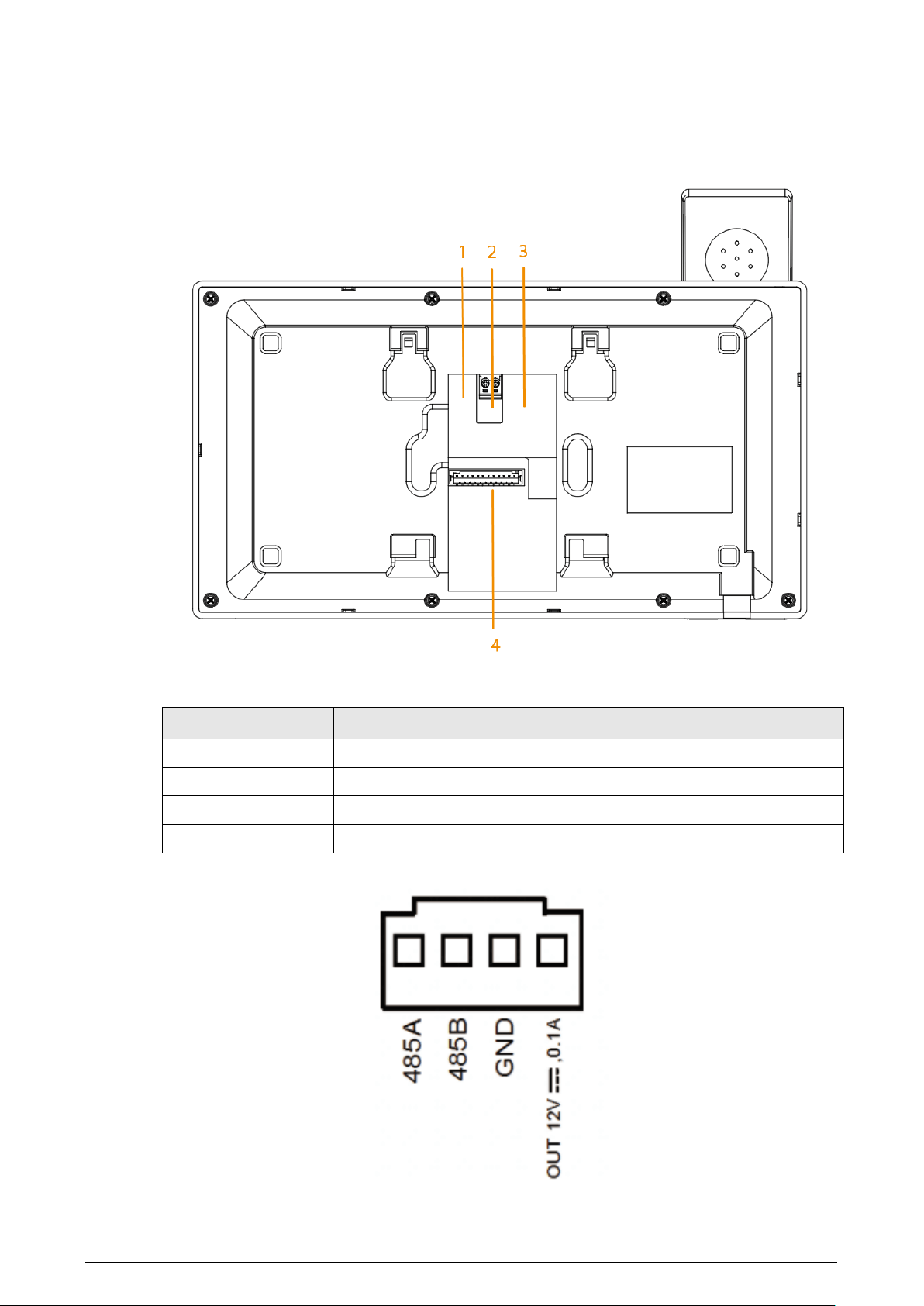
1.2.5 VTH5241D Series
Figure 1-13 Rear panel
Table 1-7 Rear panel description
No. Port
1 Network port
2 RS-485 extended port
Figure 1-14 RS-485 extended port
11
1.2.6 VTH5421E Series
Figure 1-15 Rear panel
Table 1-8 Rear panel description
No. Port
1 RS-485 extended port
2 Power port
3 Network port
4 Alarm port
Figure 1-16 RS-485 extended port

12
1.2.7 VTH5421H Series
Figure 1-17 Rear panel
Table 1-9 Rear panel description
No. Port
1 Alarm port
2 RS-485 and power output port
3 Power input port
4 Network port
Figure 1-18 RS-485 port

13
1.2.8 VTH8621K Series
Figure 1-19 Rear panel
Table 1-10 Rear panel description
No. Port
1 Alarm port
2 RS-485 and power output port
3 Power input port
4 Network port
1.3 Alarm Port
Figure 1-20 Alarm Port

14
1.4 Function
Wi-Fi Networking
Connect to Wi-Fi networks.
Video/Voice Call
Make video or voice call to other VTOs and VTHs.
Monitoring
Monitor fence station, VTO and IPC devices (only supported by certain models).
Concierge
Make calls to the Management Center.
Auto Snapshot
Take snapshots when calling or monitoring, and store them in the SD card.
DND (Do Not Disturb)
Mute all message and call notifications.
Remote Unlock
Unlock doors remotely.
Arm and Disarm
Arm and disarm 6 alarm devices.
Playback
Play back videos and pictures in the SD card.
Alarm
Alarms will trigger linkage and be sent to the Call Center.
Record
View call and alarm records.
Message
View messages, including videos, pictures and announcements.

15
2 Quick Configuration of VTO and VTH
Carry out quick configuration to make sure that the device can realize basic network access, call and
monitoring functions.
2.1 Preparation
Before commissioning:
●
Power on the device only after there is no short or open circuit.
●
Plan IP addresses and numbers (works as phone numbers) for every VTO and VTH.
●
Confirm the position of the SIP server.
●
The device must be used with a VTO that is the SIP server. This section takes a unit VTO as an
example. See corresponding user’s manuals for other VTO types.
●
Log in to the web interface of every VTO and VTH and configure all relevant information.
2.2 VTO Configuration
2.2.1 Initialization
Background Information
For first-time use, you must initialize the device.
Make sure that the IP addresses of the PC and VTO are in the same network segment. The default IP
address of VTO is 192.168.1.108.
Procedure
Step 1 Power on the VTO.
Step 2 Go to the default IP address of VTO in the browser.

16
Figure 2-1 Device initialization
Step 3 Enter the password and confirm it, and then click
Next
.
This password is used to log in to the web interface. It must be at least 8 characters, and
include a combination of at least two types among number, letter and symbol.
Figure 2-2 Set an email address
Step 4 Select
Email
and enter your email address for resetting password.
Step 5 Click
Next
.

17
Figure 2-3 Initialization successful
Step 6 Click
OK
and it jumps to the login web page.
Figure 2-4 Login web page
Step 7 Enter username (admin by default) and password, and then click
Login
.
2.2.2 Network Parameters
Background Information
Change the IP address of the VTO to the one that you planned.
Procedure
Step 1 Select
Network
>
Basic
.

18
Figure 2-5 TCP/IP
Step 2 Enter the parameters, and then click
OK
.
The VTO automatically restarts. Make sure that the PC is in the same network segment as
the VTO to log in again.
2.2.3 Server Type
Background Information
You can select the type of the server that manages all VTO devices.
Procedure
Step 1 Select
Network
>
SIP Server
.
Figure 2-6 SIP server (1)
Step 2 Select a server type.
●
When this VTO or another VTO works as the SIP server, select
Server Type
to
VTO
. It
applies to a scenario where there is only one building.
●
When a platform (such as DSS Express/DSS Pro) works as the SIP server, select
Server
Type
to
DSS Express/DSD Pro
. It applies to a scenario where there are multiple
buildings.
2.2.4 SIP Server
Procedure
Step 1 Select
Network Setting
>
SIP Server
.

19
Figure 2-7 SIP server (2)
Step 2 Configure SIP server.
●
The current VTO works as the SIP server.
●
Another VTO works as the SIP server.
Table 2-1 SIP server parameters when a VTO works as the SIP server
Parameter Description
IP Address IP address of the VTO that works as the SIP server.
Port 5060 by default.
Username
Keep it default.
Password
SIP Domain VDP.
Login Username
SIP server login username and password.
Login Pwd
●
The platform (DSS Express/DSS Pro) works as the SIP server.
●
Select
Server Type
as
DSS Express/DSS Pro
Pro, and configure the parameters, and
then click
OK
. The VTO automatically restarts, and it jumps to the login web page.
◇
VTO settings have been completed if the platform or another VTO works as the SIP
server.
◇
If the current VTO works as the SIP server,
Device Manager
will appear on the left.
Table 2-2 SIP server parameters when the platform works as the SIP server
Parameter Description
IP Address IP address of the platform.
Port 5080 by default.
Username
Keep it default.
Password
SIP Domain Keep it default or null.
SIP Server
Username
SIP server login username and password.
SIP Server
Password

20
2.2.5 Adding VTO
Background Information
Add VTO only when the current VTO works as the SIP server.
Procedure
Step 1 Log in to the web page of the VTO.
Step 2 Select
Household Setting
>
VTO No. Management
.
Figure 2-8 VTO number management
Step 3 Click
Add
.
Figure 2-9 Add a VTO
Step 4 Configure the parameters.
Table 2-3 Parameters of adding a VTO
Parameter Description
Rec No. VTO number.
Register Password Keep it default.

21
Parameter Description
IP Address IP address of VTO.
Username
Web interface login username and password of this VTO.
Password
Step 5 Click
OK
.
Step 6 Repeat Step3- Step5 to add other VTOs.
2.2.6 Adding VTH
Background Information
●
Add VTHs only when the current VTO works as the SIP server.
●
Add both main and extension VTHs.
Procedure
Step 1 Select
Household Setting
>
Room No. Management
.
Figure 2-10 Room number management
Step 2 Click
Add
.
Figure 2-11 Add a VTH
Step 3 Configure the parameters.

22
Table 2-4 Parameters of adding a VTH
Parameter Description
First Name
Information to distinguish each device. Last Name
Nick Name
Room No.
●
VTH number consists of 1–6 numbers, which may include number
and #. It must be consistent with room number configured at the
VTH.
●
When there are main VTH and extensions, to use group call
function, the main VTH number must end with #0, and the
extension VTH number must end with #1, #2 and #3. For example, if
the main VTH is 101#0, extension VTHs must be 101#1, 101#2…
Register Password
Keep it default.
Register Type
Step 4 Click
OK
.
Step 5 Repeat Step2 to Step4 to add other VTHs.
2.3 VTH Configuration
The first-time configuration function is only available for VTHs that have not been initialized. If your
VTH has been initialized and you want to use this function, you need to go to
Settings
>
Project
Settings
>
Factory Reset
to factory reset your VTH first.
2.3.1 Initialization (Quick Configuration)
Procedure
Step 1 Select a region and language.

23
Figure 2-12 Select a region and language
Step 2 Select
Apartment
or
Villa
, and then tap
OK
.
This section takes
Villa
as an example.
Figure 2-13 Select apartment or villa
Step 3 Select
First-time Config
, and tap
OK
.

24
Figure 2-14 First-time configuration
Step 4
DHCP
is selected by default, or select
Static IP
and configure the parameters as needed.
Figure 2-15 DHCP
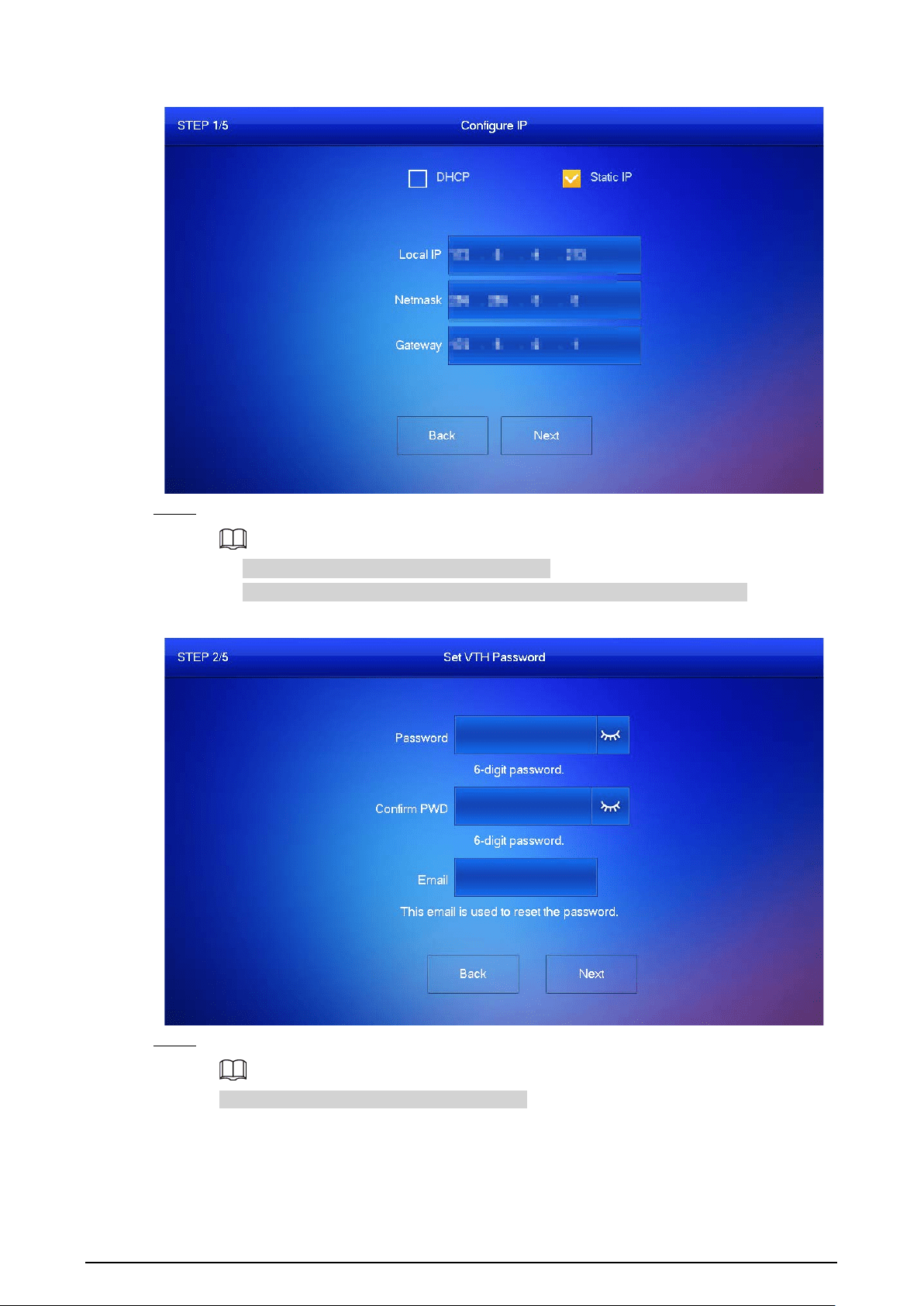
25
Figure 2-16 Static IP
Step 5 Set a password and an email address for the VTH, and then tap
Next
.
●
The password is used to enter project setting.
●
If you select
Apartment
in Step 2, initialization is completed with this step.
Figure 2-17 Set a password an email address for the VTH
Step 6 Set a password and an email address for the VTO.
The password is used to enter project setting.

26
Figure 2-18 Set a password an Email address for the VTO
Step 7 Click
Initialize
to initialize a single device or
Batch Initialization
to initialize all available
devices, and then click
Next
.
Figure 2-19 Initialize devices
Step 8 Click
One-key Config
to go to the main screen.

27
Figure 2-20 Network configuration
Result
Different models have different main screens. Here are the two kind of main screens.
Figure 2-21 Main screen (1)

28
Figure 2-22 Main Screen (2)
2.3.2 Network Parameters
2.3.2.1 WLAN
●
Only certain models support WLAN function.
●
Use a router with secured encryption protocols.
WLAN
1. On the main screen, select
Setting
>
WLAN
.
2. Tap
WLAN
screen, and tap next
Wi-Fi Name
to see all of the available Wi-Fi services.
Figure 2-23 Enable Wi-Fi
3. Tap a Wi-Fi, and then enter the password to connect to the Wi-Fi.

29
Figure 2-24 Wi-Fi
WireLess IP
1. On the main screen, select
Setting
>
WLAN
.
2. Tap
Wireless IP
, and enter
Local IP
,
Subnet Mask
and
Gateway
, and then tap
OK
.
Figure 2-25 Wireless IP
You can also tap
Wireless IP
, and turn on
DHCP
to obtain the information automatically.
2.3.2.2 LAN
Procedure
Step 1 On the main screen, select
Setting
>
Project Setting
.
Step 2 Enter the password and tap
OK
.

30
Step 3 Tap
Network
>
LAN
.
Step 4 Enter the information, and then tap
OK
; or turn on
DHCP
to obtain the information
automatically.
Figure 2-26 Configuring LAN
2.3.3 Configuring VTH
Procedure
Step 1 On the main screen, select
Setting
>
Project Setting
.
Step 2 Enter password and tap
OK
.
Step 3 Tap
VTH Config
.
Figure 2-27 VTH configuration
Step 4 Configure VTH information.
●
As a main VTH. Enter the room number (such as 9901 or 101#0) and other information,

31
and then tap
OK
.
◇
Main VTH Username
and
Main VTH PWD
are turned grey and cannot be edited in
this situation.
◇
Room number must be the same with
Room No.
, which is configured when adding
VTHs on the VTO web page. Otherwise, it will fail to connect to the VTO. When there
are extension VTHs, room numbers must end with #0. Otherwise, it will fail to
connect to the VTO.
●
As an extension VTH.
1. Tap
Main
to witch
Main
to
Extension
.
2. Enter the room number (such as 101#1), Main VTH IP and password (IP address and
password of the main VTH), and then tap
OK
.
Main VTH Username
and
Main VTH PWD
are the username and password of main
VTH. Default user name is admin, and the password is the one set during initialization.
Step 5 Turn on the following functions as needed.
●
SSH
: The debugging terminal will connect to the VTH remotely through SSH protocol.
●
Security Mode
: Log in to the VTO in a secured way.
●
Password Protection
: Encrypt the password before sending out.
It is recommended to turn off SSH, and turn on security mode and password protection.
Otherwise, the device might be exposed to security risks and data leakage.
Step 6 Tap
OK
.
2.3.4 SIP Server
Background Information
Configure SIP server information to connect to other devices.
Procedure
Step 1 On the main screen, select
Setting
>
Project Setting
.
Step 2 Enter password and tap
OK
.
Step 3 Tap
SIP Server
.

32
Figure 2-28 SIP server
Step 4 Configure the parameters.
Table 2-5 SIP server parameters
Parameter Description
Server IP
●
When a platform works as the SIP server, it is the IP address of the
platform.
●
When a VTO works as the SIP server, it is the IP address of the VTO.
Network Port
●
5080 when a platform works as the SIP server.
●
5060 when a VTO works as the SIP server.
Username
Keep it default, or turn on
Custom Name
, and then you can edit the
username.
Registration
PWD
Keep it default.
Domain Name When a VTO works as the SIP server, it must be VDP; otherwise, it can be null.
Username
SIP server login username and password.
Login PWD
Step 5 Turn on
Enable Status
to enable the SIP server function.
Step 6 Tap
OK
.
2.3.5 VTO Configuration
Background Information
Add VTOs and fence stations to bind them with the VTH.
Procedure
Step 1 On the main screen, select
Setting
>
Project Setting
.
Step 2 Enter password and tap
OK
.
Step 3 Tap
VTO Config
.

33
Figure 2-29 VTO configuration
Step 4 Add VTO or fence station.
●
Add main VTO.
1. Enter the main VTO name, VTO IP address, username and password.
2. Turn on
Enable Status
.
User Name
and
Password
must be consistent with the web interface login
username and password of the VTO.
●
Add sub VTO or fence station.
1. Enter the sub VTO or fence Station name, IP address, username and password.
2. Turn on
Enable Status
.
Tap / to turn page and add more sub VTO or fence stations.
2.4 Commissioning
2.4.1 VTO Calling VTH
Dial the VTH room number (such as 101) on the VTO and the following image appears, which means
all parameters are correctly configured.

34
Figure 2-30 Calling interface
2.4.2 VTH Monitoring VTO
VTH can monitor VTO, fence station or IPC. This section takes monitoring VTO as an example.
On the main screen of the VTH, select
Monitor
>
Door
, and then tap a VTO to enter monitoring
image.
Figure 2-31 Door

35
Figure 2-32 Monitoring image
SD card is needed for recording and snapshot; otherwise, the icons will be gray.

36
3 VTH Screen Operation
3.1 Home Screen
There are two kinds of main screens.
Figure 3-1 Home screen-type 1
Table 3-1 Home screen description (1)
No. Name Description
1 Room number Number of the room where the VTH is located.
2 Time and Date —
3 Info
●
View, delete and clear announcements or security
alarm information.
●
When the VTH does not have an SD card, and the
video-audio message uploading function is
enabled on the VTO, three tabs will be displayed,
Guest MSG
,
Guest Snap
and
Guest Video
. You
can view, delete and clear the messages.
●
When the VTH has an SD card, the
Video Pic
tab
will be displayed. View, delete and clear the
videos and pictures.
4 Setting
●
Tap to enter system setting.
●
Tap the icon, and then select
Project Setting
.
Enter the password you set during initialization,
and then go to the project setting screen.
5 Restart Tap the icon to restart the VTH.

37
No. Name Description
6 Status
Network connection status is displayed.
●
:Not connected to the network.
●
: Connected to the network through a
cable.
●
:Wirelessly connected to the network.
●
:Failed to connect to the main VTO, when
disappeared, the device has connected to the
main VTO.
7 Concierge Make calls to the Call Management Center.
8 Arm/disarm
●
Display unread alarm information.
●
Tap to select an arm mode from
Sleep
,
Away
,
Home
and
Custom
.
9 Do not disturb Enable to not receive any call or message.
10 Screen Off Tap to screen off the current screen.
11 Monitor Monitor VTOs, fence stations, IPCs and NVRs.
12 Call
●
Call other VTOs and VTHs.
●
View and manage the contacts and call records.
Figure 3-2 Home screen (2)
Table 3-2 Home screen description (2)
No. Name Description
1 Room number Number of the room where the VTH is located.

38
No. Name Description
2 Info
●
View, delete and clear announcements or security
alarm information.
●
When the VTH does not have an SD card, and the
video-audio message uploading function is
enabled on the VTO, three tabs will be displayed,
Guest MSG
,
Guest Snap
and
Guest Video
. You
can view, delete and clear the messages.
●
When the VTH has an SD card, the
Video Pic
tab
will be displayed. View, delete and clear the
videos and pictures.
3 Call
●
Call other VTOs and VTHs.
●
View and manage the contacts and call records.
4 Monitor Monitor VTOs, fence stations, IPCs and NVRs.
5 DND Enable to not receive any call or message.
6 Setting
●
Tap to enter system setting.
●
Tap the icon, and then select
Project Setting
.
Enter the password you set during initialization,
and then go to the project setting screen.
7 Status
●
:Not connected to the network.
●
: Connected to the network through a
cable.
●
:Wirelessly connected to the network.
●
:Failed to connect to the main VTO, when
disappeared, the device has connected to the
main VTO.
8 Cloud Connection
The network connection status.
●
: Cloud function not enabled or in abnormal
status.
●
: Cloud function enabled.
9 Time and Date —
10 Concierge Make calls to the Call Management Center.
11 Arm/Disarm
●
Display unread alarm information.
●
Tap to select an arm mode from
Sleep
,
Away
,
Home
and
Custom
.
3.2 Call
Manage contact, call and view call records.

39
3.2.1 Call Log
Tap
Call
>
Call Log
to view and manage call records.
Figure 3-3 Call log
●
Call back
: Tap a call record to call back.
●
Delete
: Tap
Edit
, and then tap
Delete
to delete a record.
●
Clear
: Clear all record in the current tab (
All
or
Missed Call
).
If storage is full, the oldest records will be overwritten. Back up the records as needed.
3.2.2 Contacts
Viewing Contacts
Tap
Call
>
Contacts
, and then add or edit the users.

40
Figure 3-4 Contacts
Add User
Figure 3-5 User information
1. Tap
Add
.
2. Enter the information.
3. Tap
OK
.
Related Operations
●
Edit user information: Tap a user and tap
Edit
.
●
Delete a user: Tap
Edit
, select a user, and then tap
Delete
.
You can select multiple contacts at the same time.
41
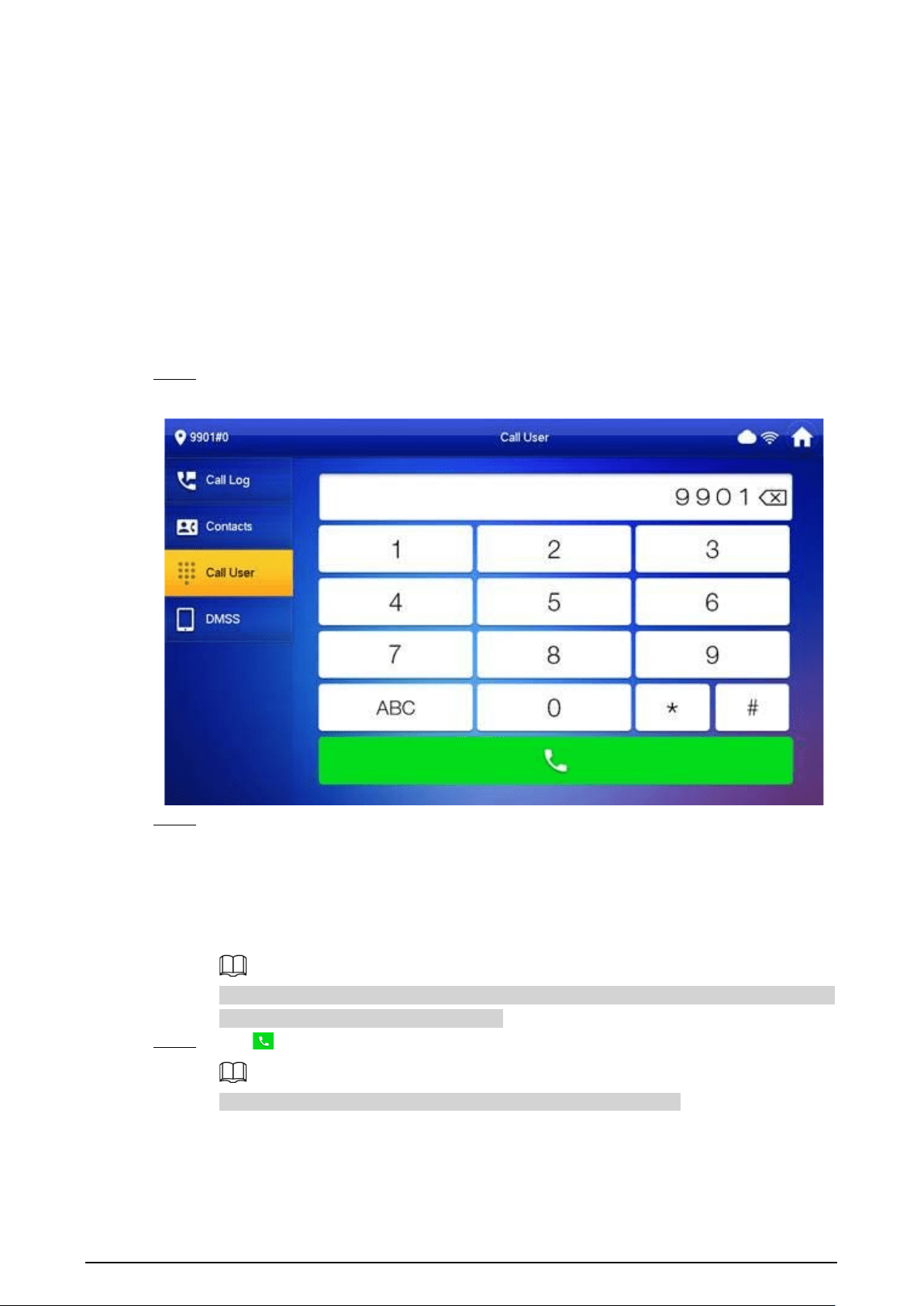
3.2.3 Calling User
●
Make sure that resident-to-resident call function has been enabled.
●
Call function is used by VTH to call VTH.
●
If both VTHs have a camera, bilateral video call can be provided.
3.2.3.1 By Room Number
Background Information
On the
Call User
screen, dial and call the user.
Procedure
Step 1 Select
Call
>
Call User
.
Figure 3-6 Call user
Step 2 Enter the room number (VTH room number).
●
If VTO works as SIP server, dial room number directly.
●
If the platform works as SIP server:
◇
Call a user in the same unit and the same building, dial room number directly.
◇
Call a user in other buildings or units, add the building number. For example, dial
1#1#101 to call Building 1 Unit 1 Room 101.
If main VTH (101#0) calls extension (101#1), please enter room no.: #1; if the extension calls
main VTH, please enter room number.: #0.
Step 3 Tap .
If the VTH has a camera, there will be videos after answering the call.

42
Figure 3-7 Calling
Figure 3-8 Call in progress
3.2.3.2 From Contact
Procedure
Step 1 Select
Call
>
Contact
.
Step 2 Select the one you want to call.
Step 3 Tap to start.
3.2.4 Call from User
When receiving calls from other VTHs, the following interface will be displayed.

43
Figure 3-9 Call screen (1)
●
: Answer.
●
: Hang up.
Figure 3-10 Call screen (2)
3.2.5 Call from VTO
Procedure
Step 1 Dial VTH room number (such as 9901) at VTO, to call VTH.
Step 2 On the VTH screen, tap
Answer
.

44
Figure 3-11 Call from VTO
Table 3-3 Call screen description
Key Description
/
Remotely unlock the door where the VTO is installed.
The system provides 2-channel unlock. If the icon is gray, it means that the
unlock function of this channel is not available.
Tap to talk to the VTO.
Select an IPC in
Favorite
to monitor.
Take snapshot.
This key will be gray if SD card is not inserted.
Take recording. Complete recording when the call is completed or by
tapping .
●
This key is gray if SD card is not installed.
●
Videos are stored in SD card of this VTH. If SD card is full, the earlier
videos will be covered.
Mute.
Reduce volume.
Increase volume.
Answer calls.
Hang up.

45
3.2.6 Calling DMSS
Tap
Call
>
DMSS
to make calls to DMSS.
Figure 3-12 DMSS
Tap to call the DMSS app account that the VTH has bonded with.
3.3 Information
You can view and manage different kinds of information.
●
Information in
Security Alarm
and
Publish Info
is stored in the device, and the one in
Guest
Message
and
Video Pictures
is stored in the SD card, which means you need an SD card for
these two functions.
●
Only certain models support SD card.
●
If the storage in the Device or SD card is full, the oldest records will be overwritten. Back up the
records as needed.
3.3.1 Security Alarm
When an alarm is triggered, there will be 15s alarm sound, and the interface below will be displayed.
The alarm information will be uploaded to the alarm record interface and management platform.

46
Figure 3-13 Message
Select
Info
>
Security Alarm
, and then you can view and manage all alarm records.
Figure 3-14 Security alarm

47
3.3.2 Guest Message
Select
Info
>
Guest Message
, and then you can view and manage all messages.
Figure 3-15 Guest message
3.3.3 Publish Information
Select
Info
>
Publish Info
, and then you can view and manage all messages.
Figure 3-16 Publish information
3.3.4 Video Pictures
Select
Info
>
Video Pictures
, and then you can view and manage the pictures and videos.

48
Figure 3-17 Records
3.4 Monitor
You can monitor VTO, fence station or IPC on the VTH.
3.4.1 Monitoring VTO
Background Information
When adding VTOs, make sure that the username and password of each device is consistent with the
web login username and password. Otherwise, monitoring will not work properly.
Procedure
Step 1 Select
Monitor
>
VTO
.

49
Figure 3-18 Door
Table 3-4 Function description
Icon Description
Add the VTO or fence station to Favorite.
Select an IPC, and when this VTO or fence station calls, you
will see the monitoring image from this IPC.
Display the serial number of the VTO or fence station in QR
code. Scan the QR code in the app to add it to the app, and
then you can monitor the VTO from your smart phone.
Step 2 Tap .
Figure 3-19 Monitoring VTO

50
Table 3-5 Interface description
Icon Description
/
Remotely unlock the door where the VTO is located.
The system provides 2-channel unlock function. If the icon is
gray, it means that unlock function of this channel is not
available.
Take snapshot.
An SD card is needed to use this function.
Tap to start recording, and it will stop when the call is
completed or by tapping .
If the SD card is full, the oldest videos will be overwritten.
An SD card is needed to use this function.
/
If the VTH is connected to multiple VTOs/IPCs, tap and
to switch device.
Exit monitoring.
Tap to speak to the other end device, and tap again to stop.
3.4.2 Monitoring IPC
3.4.2.1 Adding IPC
Background Information
●
IPCs added to the main VTO and DSS Express/DSS Pro will be synchronized to the VTH. The
synchronized IPCs cannot be deleted.
●
Before adding an IPC, make sure that it is powered on, and connected to the same network as the
VTH.
Procedure
Step 1 Select
Monitor
>
IPC
.

51
You can tap to add the IPC to Favorites.Figure 3-20 IPC
Step 2 Tap
Add
.
Figure 3-21 Add IPC
Step 3 Configure the parameters.
Table 3-6 Parameter description
Parameter Description
IPC Select IPC or NVR.
IPC32 Name Name of the IPC/NVR.
IP IP address of the IPC/NVR.
User Name
The login username and password of the web page of the IPC/NVR.
Password
Port 554 by default.

52
Parameter Description
Stream Type
●
Main stream: High definition that needs large amount of bandwidth.
Applicable to local storage.
●
Extra stream: Relatively smooth image that needs small amount of
bandwidth. Applicable to network with insufficient bandwidth.
Protocol
It includes local protocol and Onvif protocol. Please select according to
the protocol of the connected device.
Encryption Enable it if the IPC to be added is encrypted.
Channel
●
If IPC is connected, default setting is 1.
●
If NVR is connected, set channel number of IPC on NVR.
Step 4 Tap
OK
.
3.4.2.2 Modifying IPC
Procedure
Step 1 Select
Monitor
>
IPC
.
Step 2 Tap of IPC.
Step 3 Modify IPC parameters. Please refer to Table 3-6 for details.
Step 4 Tap
OK
.
3.4.2.3 Deleting IPC
Background Information
Delete IPC that has been added. However, IPC synchronized from VTO or the platform cannot be
deleted.
Procedure
Step 1 Select
Monitor
>
IPC
.
Step 2 Tap
Edit
.
Step 3 Select
IPC
.
Step 4 Tap
Delete
to delete the selected IPC.
3.4.2.4 Monitoring
Background Information
Monitor the IPC.
Procedure
Step 1 Select
Monitor
>
IPC
.
Step 2 Select IPC to be monitored, and tap .

53
Figure 3-22 Monitoring video
Step 3 Monitor the VTO.
3.4.3 Favorite
Background Information
Displays VTO, fence stations or IPC that have been added to favorites.
To view favorite list, please ensure that VTO, fence station or IPC have been added to favorites.
Otherwise, the list is empty.
Procedure
Step 1 Select
Monitor
>
Favorite
.
Figure 3-23 Favorite

54
Step 2 Select the device to be monitored, and tap .
The system displays monitoring interface. In case of multiple devices in Favorite tab, tap
/ to switch and monitor them.
3.5 Concierge
Tap on the
Home
screen to call management center.
Please ensure that management center has been connected. Otherwise, it will fail to call.
3.6 Setting
3.6.1 Ring Settings
Set VTO ring, VTH ring, alarm ring and other rings.
●
There is an SD card on the VTH, and users can import ring tones to the SD card.
●
Ring tones must be stored in the /Ring folder at the root directory of the SD card.
●
Audio files must be .pcm files (audio files of other formats cannot be played if you change their
extension names).
●
Audio file size must be less than 100 KB.
●
Ring tone format: .pcm.
●
You can only customize 10 ring tones. Other ring tones will not be displayed at the VTH.
3.6.1.1 VTO Ring
Background Information
Set a ring for the connected VTO, and support to set maximum 20 VTOs.
Procedure
Step 1 Tap
Setting
.
Step 2 Select
Ring
>
VTO Ring
.

55
Tap or to page up and down.Figure 3-24 VTO ring setup
Step 3 Tap text box to select rings, and tap and to adjust the volume.
3.6.1.2 VTH Ring
Background Information
Set the ring for this VTH.
Procedure
Step 1 Tap
Setting
.
Step 2 Select
Ring
>
VTH Ring
.
Figure 3-25 VTH ring setup
Step 3 Tap text box to select rings, and tap and to adjust the volume.

56
3.6.1.3 Alarm Ring
Background Information
Set the ring when the VTH gives an alarm.
Procedure
Step 1 Tap
Setting
.
Step 2 Select
Ring
>
Alarm Ring
.
Figure 3-26 Alarm ring
Step 3 Tap text box to select rings, and tap and to set the volume.
3.6.1.4 Other Ring Settings
Background Information
Set VTO ring time, VTH ring time, MIC volume, talk volume and ring mute setting.
VTO Ring
and
VTH Ring
of extension VTH are synchronized with main VTH, and cannot be set.
Procedure
Step 1 Tap
Setting
.
Step 2 Select
Ring
>
Other
.

57
Figure 3-27 Other settings
Step 3 Tap and to set the time or volume. Tap to enable
Ring Mute
, and the icon
becomes .
●
VTO ring time: ring time when a VTO calls this VTH.
●
VTH ring time: ring time when another VTH calls this VTH.
3.6.2 Card Information
Background Information
Issue and manage card information.
This function is only available under
Villa
.

58
Figure 3-28 Card management
Procedure
Step 1 Click
Issue Card
.
Step 2 Swipe the card on the corresponding VTO.
Step 3 The card information will be added to the VTH. Assign unlock permission by selecting
Lock
1
and
Lock 2
as needed.
Step 4 Click
Confirm
.
Click
Delete
to delete the card information.
3.6.3 Alarm Setting
Set wire zone, wireless zone and alarm output.
Zones can be set under disarm mode.
3.6.3.1 Wired Zone
Background Information
Set zone type, NO/NC, alarm status and delay. It supports to set 8 zones at most.
Procedure
Step 1 Tap
Setting
.
Step 2 Select
Alarm
>
Wired Zone
.

59
Figure 3-29 Wired zone
Table 3-7 Parameter description
Paramete
r
Description
Area The number cannot be modified.
NO/NC
Select NO (normally open) or NC (normally closed) according to detector type. It
shall be the same as detector type.
Type
Select corresponding type according to detector type, including IR, gas, smoke,
urgency btn, door, burglar alarm, perimeter and doorbell.
Status
●
Instant Alarm
: After armed, if an alarm
is triggered, the device produces siren
at once and enters alarm status.
●
Delay Alarm
: After armed, if an alarm
is triggered, the device enters alarm
status after a specified time, during
which you can disarm and cancel the
alarm.
●
Bypass
: Alarm will not be triggered in
the area. After disarmed, this area will
restore to normal working status.
●
Remove
: The area is invalid during
arm/disarm.
●
24 Hour
: Alarm will be triggered all the
time in the area regardless of arm or
disarm.
A zone in
Remove
status cannot be
bypassed.
●
Instant Alarm
: After armed, if
an alarm is triggered, the device
produces siren at once and
enters alarm status.
●
Delay Alarm
: After armed, if an
alarm is triggered, the device
enters alarm status after a
specified time, during which you
can disarm and cancel the alarm.
●
Bypass
: Alarm will not be
triggered in the area. After
disarmed, this area will restore
to normal working status.
●
Remove
: The area is invalid
during arm/disarm.
●
24 Hour
: Alarm will be triggered
all the time in the area
regardless of arm or disarm.
A zone in
Remove
status cannot be
bypassed.

60
Paramete
r
Description
Enter
Delay
After entering delay, when armed area
triggers an alarm, entering armed area
from non-armed area within the delay time
period will not lead to linkage alarm.
Linkage alarm will be produced if delay
time comes to an end and it is not
disarmed.
Delay is only valid to the areas of
Delay Alarm
.
Exit Delay
After arm,
Delay Alarm
area will enter arm
status at the end of
Exist Delay
.
If multiple areas set the exit delay,
interface prompt will conform to
maximum delay time.
3.6.3.2 Wireless Zone
Background Information
●
Only devices with wireless function have this function.
●
For devices with wireless function, only after you enabled
433
in
General Setting
>
Other
, the
Wireless Zone
tab would appear.
●
The actual screen of the
Wireless Zone
might differ depending on the model you use. The
snapshot is for reference only.
Add, delete and set wireless zones.
Procedure
Step 1 Tap
Setting
.
Step 2 Select
Alarm
>
Wireless Zone
.
Figure 3-30 Wireless zone

61
Step 3 Tap
Add
.
Step 4 Tap wireless code button of wireless device. See wireless device user’s manual for details.
After successful coding, display area info.
Step 5 Tap corresponding positions to set alarm status, enter delay and exit delay.
Tap
Edit
to select a zone and
Delete
to delete the selected area.
3.6.3.3 Alarm Output
Background Information
After enabling alarm output, when other devices call this VTH, the alarm output device will output
alarm information.
Procedure
Step 1 Tap
Setting
.
Step 2 Select
Alarm
>
Output
.
Figure 3-31 Output
Step 3 Tap to enable alarm output function, and the icon becomes .
3.6.4 Mode Setting
Set area on/off status under different modes.
Background Information
Area mode can only be set in disarm status.
Procedure
Step 1 Select
Setting
>
Mode
.
Step 2 Select from the four arm modes based on your needs.
●
Home
: An arming mode that allows you to arm the system when inside the area of the

62
alarm system.
●
Away
: Arm the system when you leave the area of the alarm system.
●
Sleep
: An alarming mode that allows you to arm the system in the sleep time.
●
Custom
: Arm the system based on your customized needs.
Step 3 Turn on or turn off the area you selected to enable or disable the arm mode.
Multiple areas can be added into one arm mode simultaneously, whereas one area can be
added into different modes.
Figure 3-32 Mode setting-Area
Step 4 (Optional) Tap to page down the screen to where the
WirelessArea
is located, and
then turn on or turn off the area you selected to add it into or remove from the arm mode.
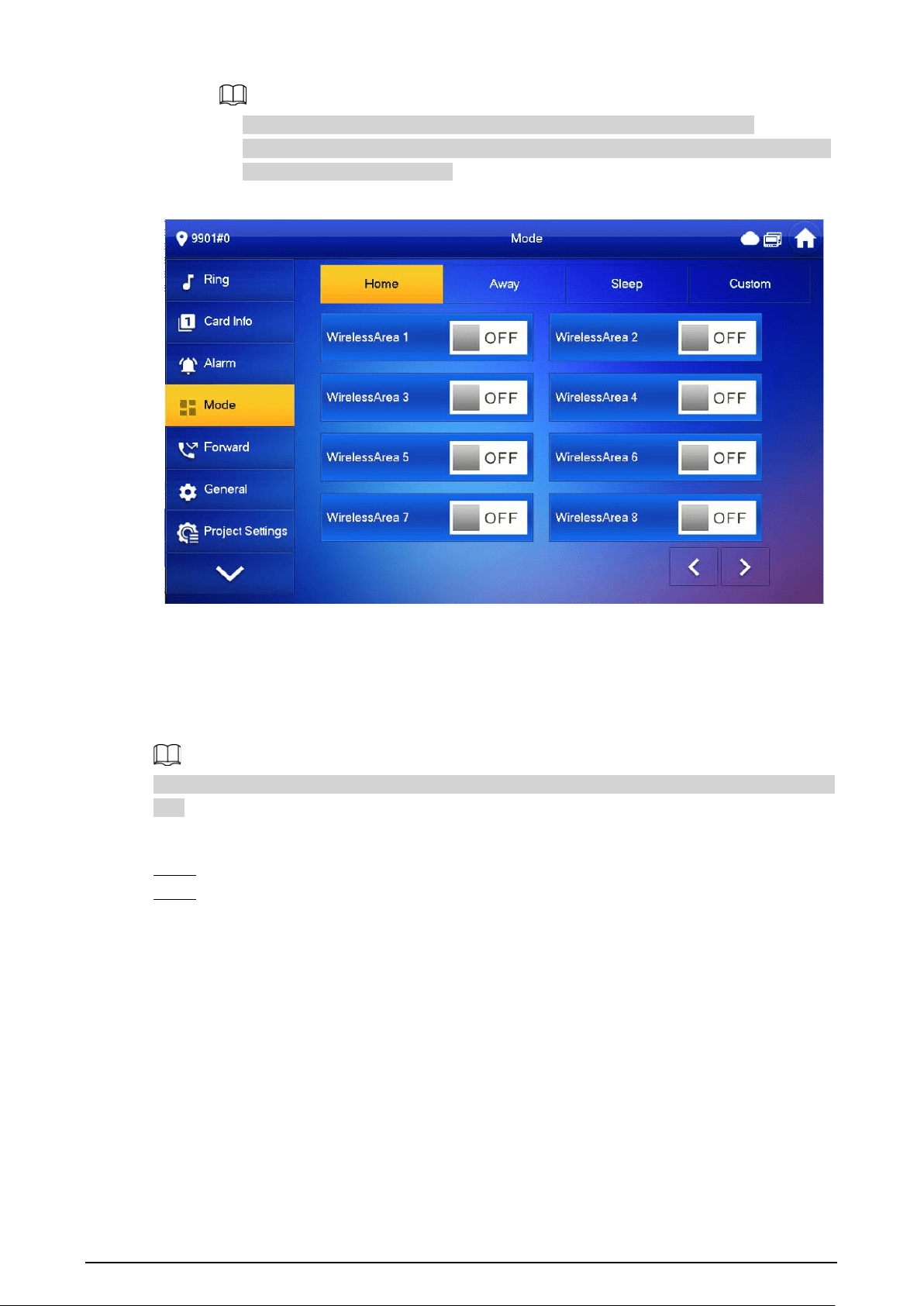
63
●
The
WirelessArea
is only available for devices supporting Wi-Fi connection.
●
Multiple areas can be added into one arm mode simultaneously, whereas one area can
be added into different modes.
Figure 3-33 Mode setting-WirelessArea
3.6.5 Forward Setting
Background Information
Forward incoming calls.
Parameters at this interface are set on main VTH only, and extension VTH synchronizes with the main
VTH.
Procedure
Step 1 Tap
Setting
.
Step 2 Select
Forward
.

64
Figure 3-34 Forward
Step 3 Enter the VTH number in the corresponding forward mode, tap to enable the
forward function.
Table 3-8 Parameter description
Parameter Description
Always All incoming calls will be forwarded to preset number immediately.
Busy
When the user is busy, incoming call from the third party will be
forwarded to preset number. If No Answer is not set, when the user
refuses to answer, the incoming call will be deemed as busy forwarding.
No Answer
If no one answers after VTH ring time, the incoming call will be
forwarded to preset number.
Set VTH ring time at
Setting
>
Ring
>
Other
screen.
●
To forward to a user of another building or unit, the forward number is Building + Unit
+ VTH room number. For example, input 1#1#101 for 101 of Unit 1, Building 1.
●
To forward to a user of the same unit, the forward number is VTH room number.
Step 4 Tap
OK
to save settings.
3.6.6 General Setting
Set VTH time, display, password and others.
3.6.6.1 Time Setting and DND
Background Information
Set VTH system time, time zone DST, and do not disturb time.

65
Parameters at this interface are set on main VTH only, and extension VTH synchronizes with main
VTH.
Procedure
Step 1 Tap
Setting
.
Step 2 Select
General
>
Time
.
Figure 3-35 Set time and time zone
Step 3 Set time parameter.
●
Enable
NTP
, the VTH will synchronize time with the NTP server automatically; turn it off
to set time or time zone manually.
●
Enable
DND period
, set start and end time or tap
Click to select week
to select the
day(s), and you will not receive any call or message during this period.
3.6.6.2 Display Setting
Background Information
The snapshots are for reference only, and might differ from the actual screen.
Set VTH screen brightness, screensaver time and clean.
Procedure
Step 1 Tap
Setting
.
Step 2 Select
General
>
Display
.

66
Figure 3-36 Display
Step 3 Set parameters.
●
Brightness
: The brightness of the VTH screen. If the screen display is brighter or darker
than your expectation, you can go to choose adjust the brightness by taping or .
●
Screenclose Time
: The screen will automatically turn off when it reaches the time limit
of being idle. If it is longer or shorter than your expected time limit, you can go to
choose adjust the time by taping or .
●
Clean
: Tap the icon, and then the screen will be locked for 30 seconds. During the
period, clean the screen. It restores after 10 seconds.
3.6.6.3 QR Code
Background Information
Download the app on your smart phone by scanning the QR code, register the VTH on the app, and
then you can unlock the door, or talk to the VTH, and more directly on your smart phone.
Procedure
Step 1 Tap
Setting
.
Step 2 Select
General
>
QR Code
.
If you go to the screen for the first time, there is an onscreen prompt that reminds you to
create a DMSS app account before using the DMSS function. For detailed operations,
please refer to "5.3 Adding VTH to DMSS" for details.

67
Figure 3-37 DMSS onscreen prompt
Figure 3-38 QR Code (without DMSS QR code)

68
Figure 3-39 QR Code (with DMSS QR code)
Step 3 (Optional) Scan the
DMSS
QR code on your DMSS App to automatically obtain the device
information of the VTH, and gain remote access to the device.
Step 4 Scan the
Download App
QR code on the right to download the DSS Agile VDP on your
smart phone.
Step 5 Scan the
Register
QR code on the left to register the VTH to the DSS Agile VDP.
For detailed operation of this step, see "4.2 Registration and Login".
3.6.6.4 Other Settings
Background Information
Set monitor time, record time, VTO message time, VTO talk time, resident-to-resident call enable,
resident-to-resident call time, auto capture and touch ring.
Extension VTH can set Auto Capture and Touch Ring, but other parameters synchronize with main
VTH and cannot be set.
Procedure
Step 1 Tap
Setting
.
Step 2 Select
General
>
Other
.

69
Figure 3-40 Other
Step 3 Configure parameters.
Table 3-9 Parameter description
Parameter Description Operation
Monitor Time (s) Maximum time to monitor VTO, IPC and fence station.
Tap and
to set the time.
Record Time (s)
Maximum recording time of videos during call, talk,
monitoring and speaking. The system stops recording at
the end of recording time.
VTO Message
Time (s)
●
When
VTO Message Time(s)
is not 0:
◇
If the VTH has an SD card and does not answer
the VTO, it will enter message status according to
prompt, and save the message in the SD card.
◇
If VTH does not have SD card, and the leave
message upload function is not enabled on the
VTO, the call will be hung up automatically if the
VTH does not answer the VTO.
●
When
VTO Message Time(s)
is 0:
●
In any situation, the call will be hung up
automatically if the VTH does not answer the VTO.
If VTO sets to forward the call to management center, if
VTH doesn’t answer when VTO calls, and there is no
message prompt, the call will be forwarded to
management center.
VTO Call
Durations (s)
Maximum talk time when VTO calls VTH.

70
Parameter Description Operation
Internal Call/
Internal Call
Duration (m)
After resident-to-resident call is enabled, VTH can call
another VTH.
The called party enables internal call, to realize this
function.
Tap to
enable the
function. The
icon becomes
.
Auto Capture
After enabled, 3 pictures will be captured automatically
when the VTO calls the VTH. Tap
Info
>
Record and
Picture
to view them.
●
An SD card is needed for this function.
●
After enabling auto capture,
Answer and Delete
Snapshots
will be displayed, which when turned on,
snapshots will be deleted if the VTH answers the call.
Touch Sound
After enabling touch sound, there will be a ring when
touching the screen.
433
After enabling
433
function, the devices that supports
wireless function would have a
Wireless Zone
tab
appeared in the
Setting
>
Alarm
.
3.6.7 WLAN
●
Only certain models support WLAN function.
●
Use a router with secured encryption protocols.
WLAN
1. On the main screen, select
Setting
>
WLAN
.
2. Tap
WLAN
screen, and tap next
Wi-Fi Name
to see all of the available Wi-Fi services.
Figure 3-41 Enable Wi-Fi
3. Tap a Wi-Fi, and then enter the password to connect to the Wi-Fi.

71
Figure 3-42 Wi-Fi
WireLess IP
1. On the main screen, select
Setting
>
WLAN
.
2. Tap
Wireless IP
, and enter
Local IP
,
Subnet Mask
and
Gateway
, and then tap
OK
.
Figure 3-43 Wireless IP
You can also tap
Wireless IP
, and turn on
DHCP
to obtain the information automatically.
3.6.8 User Password Setting
The user password is used to go to enter the arm and disarm mode and unlocking doors. You can

72
revise your user password based on your needs. The default password is 123456.
Procedure
Step 1 On the home screen, select
Setting
>
Password
>
User PWD
.
Step 2 Enter the old password, new password and conform it.
Figure 3-44 Change user password
Step 3 Tap
OK
to save the configuration.
3.6.9 Network Password Setting
The network password is used when adding the VTH to the DMSS app.
3.6.9.1 Creating Network Password
The network password is used to add the VTH to the DMSS app.
Procedure
Step 1 On the home screen, select
Setting
>
Password
>
Network PWD
.
Step 2 Tap to enable the cloud function.
Step 3 Create a user account and then enter the password you planned and then confirm it.
The
Username
is
user
by default.

73
Figure 3-45 Create network password
Make sure that you have created a strong password. Otherwise, there will be onscreen
prompt appeared.
Figure 3-46 Weak password prompt
Step 4 Tap
OK
.
Result
The VTH would automatically generate a QR code that contains the User account. When you scan the
DMSS QR code in the Setting > General > QR Code, the DMSS App would synchronize the device
information of the VTH.

74
When going to the QR Code screen for the first time, the
DMSS
OR code would not appear. Only
after you set the network password, this module would be displayed.
Figure 3-47 DMSS QR Code
3.6.9.2 Changing Network Password
This section applies to the situation when you know your current network password and you want to
change it to another one.
Procedure
Step 1 On the home screen, select
Setting
>
Password
>
Network PWD
.
Step 2 Enter the old password, new password and then confirm it.
Figure 3-48 Change password
Step 3 Tap
OK
.

75
3.6.9.3 Resetting Network Password
This section applies to the situation when you forget your network password and you can reset it to
create a new one.
Procedure
Step 1 On the home screen, select
Setting
>
Password
>
Network PWD
.
Step 2 Tap
Forget PWD
, and enter the new password in the
Password Verification
window, and
then tap
OK
.
Figure 3-49 Password verification
3.6.10 Product Information
Background Information
Restart the system and format SD card.
If SD card isn’t inserted into the device, SD format function is invalid.
Procedure
Step 1 Tap
Setting
.
Step 2 Select
Product Info
.

76
Figure 3-50 Product information
●
Restart
: Restart the device.
●
Language
: Change the language of the device.
3.7 Project Settings
3.7.1 Forget Password
Background Information
If you forget initialization password when entering project settings interface, reset password
through
Forget Password
on the screen.
Procedure
Step 1 Select
Setting
>
Project Setting
.
Step 2 On the
Password Verification
window, tap
Forget Password
.

77
Figure 3-51 Password
Step 3 Scan the QR code with any code-scanning APP, bind your email box, send it by email to the
specified email addressed on the screen to obtain a security code.
Step 4 Tap
Next
.
Step 5 Enter the password and confirm it, and then enter the obtained security code.
Step 6 Tap
OK
to complete resetting the password.
3.7.2 Network Settings
Procedure
Step 1 On the main screen, select
Setting
>
Project Setting
.
Step 2 Enter the password and tap
OK
.
Step 3 Tap
Network
>
LAN
.
Step 4 Enter the information, and then tap
OK
; or turn on
DHCP
to obtain the information
automatically.

78
Figure 3-52 Configuring LAN
3.7.3 Configuring VTH
Procedure
Step 1 On the main screen, select
Setting
>
Project Setting
.
Step 2 Enter password and tap
OK
.
Step 3 Tap
VTH Config
.
Figure 3-53 VTH configuration
Step 4 Configure VTH information.
●
As a main VTH. Enter the room number (such as 9901 or 101#0) and other information,
and then tap
OK
.

79
◇
Main VTH Username
and
Main VTH PWD
are turned grey and cannot be edited in
this situation.
◇
Room number must be the same with
Room No.
, which is configured when adding
VTHs on the VTO web page. Otherwise, it will fail to connect to the VTO. When there
are extension VTHs, room numbers must end with #0. Otherwise, it will fail to
connect to the VTO.
●
As an extension VTH.
1. Tap
Main
to witch
Main
to
Extension
.
2. Enter the room number (such as 101#1), Main VTH IP and password (IP address and
password of the main VTH), and then tap
OK
.
Main VTH Username
and
Main VTH PWD
are the username and password of main
VTH. Default user name is admin, and the password is the one set during initialization.
Step 5 Turn on the following functions as needed.
●
SSH
: The debugging terminal will connect to the VTH remotely through SSH protocol.
●
Security Mode
: Log in to the VTO in a secured way.
●
Password Protection
: Encrypt the password before sending out.
It is recommended to turn off SSH, and turn on security mode and password protection.
Otherwise, the device might be exposed to security risks and data leakage.
Step 6 Tap
OK
.
3.7.4 VTO Configuration
Background Information
Add VTOs and fence stations to bind them with the VTH.
Procedure
Step 1 On the main screen, select
Setting
>
Project Setting
.
Step 2 Enter password and tap
OK
.
Step 3 Tap
VTO Config
.

80
Figure 3-54 VTO configuration
Step 4 Add VTO or fence station.
●
Add main VTO.
1. Enter the main VTO name, VTO IP address, username and password.
2. Turn on
Enable Status
.
User Name
and
Password
must be consistent with the web interface login
username and password of the VTO.
●
Add sub VTO or fence station.
1. Enter the sub VTO or fence Station name, IP address, username and password.
2. Turn on
Enable Status
.
Tap / to turn page and add more sub VTO or fence stations.
3.7.5 Factory Reset
Background Information
All parameters of the device will be restored to default values.
IP address and data in the SD card will not be restored.
Procedure
Step 1 Select
Setting
>
Project Setting
.
Step 2 Enter the password you set during initialization, and tap
OK
.
Step 3 Tap
Factory Reset
.
Step 4 Tap
OK
.
The device restarts and proceeds to initialization.

81
3.7.6 Adding Device
Background Information
This module differs in
Villa
and
Apartment
mode. This section takes the
Apartment
mode as an
example. The snapshots are for reference only.
You can add VTHs and VTOs.
Procedure
Step 1 On the main screen, select
Setting
>
Project Setting
>
Add Device
Step 2 Set a password for the VTH you want to add.
Figure 3-55 Set a password an email address for the VTH
Step 3 Set a password and an email address for the VTO.
The password is used to enter project setting.

82
Figure 3-56 Set a password an Email address for the VTO
Step 4 Tap
Initialize
to initialize a single device or
Batch Initialization
to initialize all available
devices, and then click
Next
.
Figure 3-57 Initialize devices
Step 5 Tap
One-key Config
to go to the main screen.

83
Figure 3-58 Network configuration
3.7.7 Reset MSG
Background Information
Modify the bonded Email.
Procedure
Step 1 Select
Setting
>
Project Setting
.
Step 2 Enter the password you set during initialization, and tap
OK
.
Step 3 Tap
Reset MSG
.
Figure 3-59 Reset MSG
Step 4 Enter a new email address, turn on
Reset PWD
, and then tap
OK
.
●
The email will obtain security code during password resetting. See "3.7.1 Forget
84
Password"for details.
●
If
Reset PWD
is turned off, you cannot reset the password.
3.8 Unlock Function
When the VTH is being called, during monitoring, talking and speaking, tap unlock button, and the
VTO will be unlocked remotely.
3.9 Arm and Disarm Function
3.9.1 Arm
Background Information
In case of triggering alarm after arm, produce linkage alarm and upload alarm info.
●
Please ensure that the area has been added into arm mode. Otherwise, there will be no alarm
triggering after arm.
●
Please ensure that it is in disarmed status. Otherwise, arm will fail.
Procedure
Step 1 Tap on the home screen to select an arm mode.
There are two kinds of arm mode depending on the model you are using.
●
Home
: An arming mode that allows you to arm the system when inside the area of the
alarm system.
●
Away
: Arm the system when you leave the area of the alarm system.
●
Sleep
: An alarming mode that allows you to arm the system in the sleep time.
●
Custom
: Arm the system based on your customized needs.

85
Figure 3-60 Arm mode (type1)
Figure 3-61 Arm mode (type 2)
Step 2 Enter arm and disarm password; tap
OK
.
●
Default password of arm and disarm is 123456. If you want to modify the password,
please refer to"3.6.8 User Password Setting" for details.
●
If delay alarm is set in the area, the device will beep continuously at the end of exit
delay time.
3.9.2 Disarm
Procedure
Step 1 Tap disarm symbol ( ) on the main screen.
Step 2 Enter disarm password, and then tap
OK
.

86
●
Default password of arm and disarm is 123456. Please refer to"3.6.8 User Password
Setting"for details.
●
If you are forced to enter disarm password in case of emergencies, enter anti-hijacking
password, which is the reversed arm password. The system will disarm, and at the same
time, upload alarm info to management center/platform.

87
4 DSS Agile VDP
You can download DSS Agile VDP (hereinafter referred to as the "app") and link your VTH to the app
to unlock the door, talk to connected VTO devices, call the management center, and view call
records and messages.
Interfaces and operations might vary between iOS and Android OS. This section takes Android OS as
an example.
4.1 Downloading the App
Background Information
Before you start, make sure the VTO, VTH, and DSS server are properly connected.
Procedure
Step 1 On the VTH main screen, tap
Setting
.
Step 2 Enter the password you configured during initialization, and then select
General
>
QR
Code
.
Step 3 Scan the
Download App
QR code with your smart phone, and then download and install
the app.
Figure 4-1 QR code
4.2 Registration and Login
Procedure
Step 1 Tap on your smartphone, read the
Software license agreement and Privacy policy
,
and then tap
Agree
(only for first-time login).
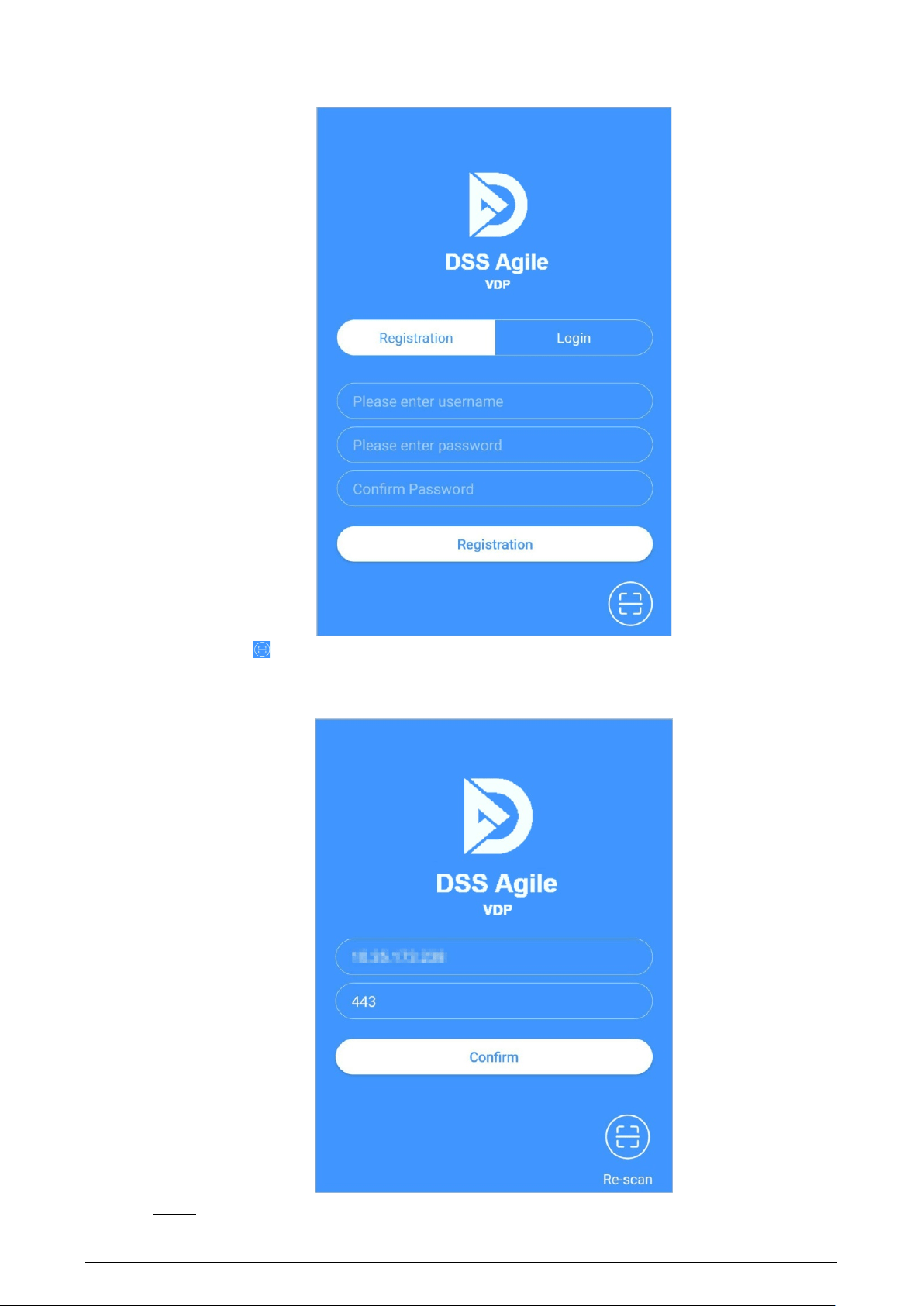
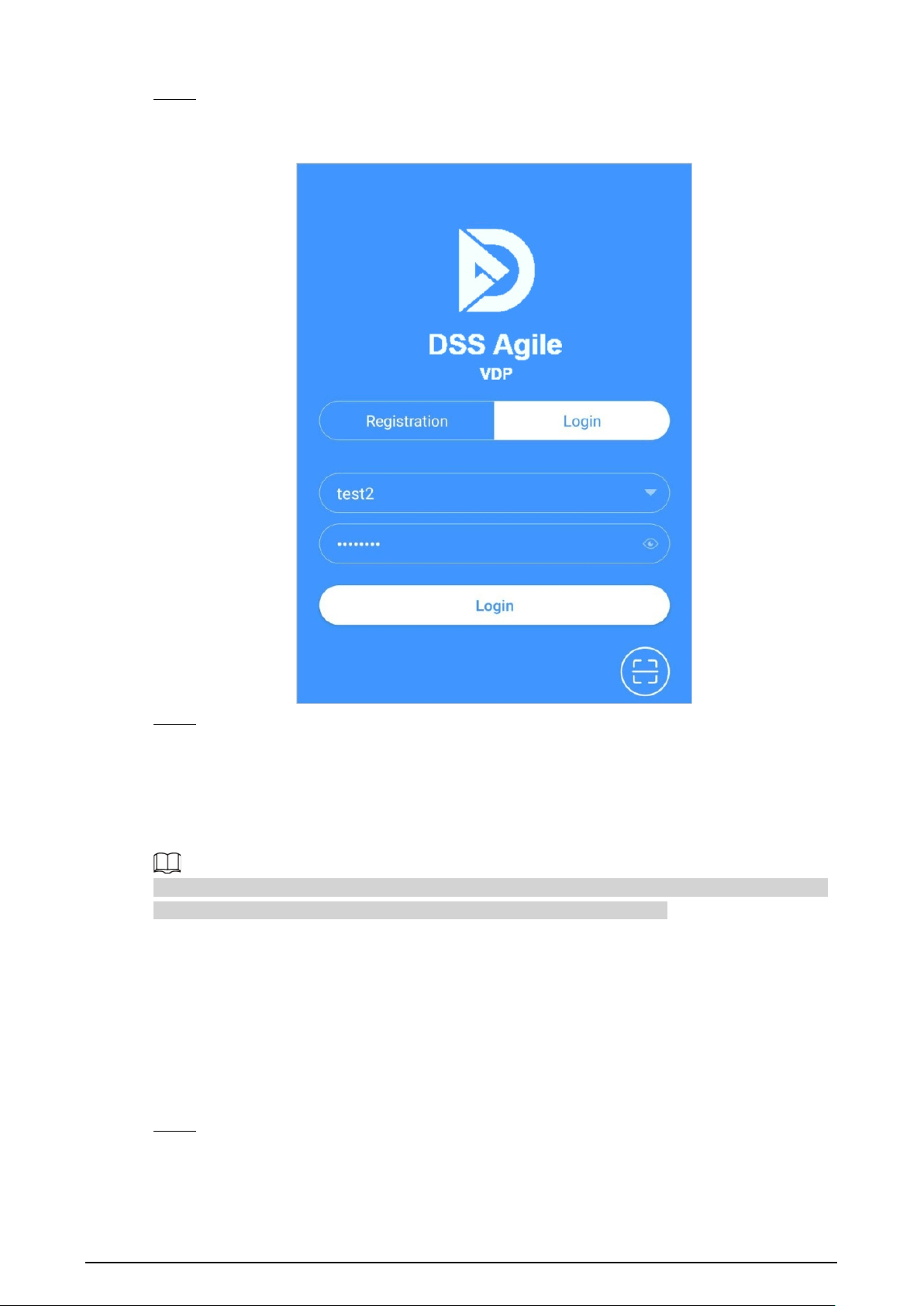
89
Step 4 Enter the username and password, and then tap
Registration
. You can add 5 users to one
VTH at most.
Figure 4-4 Login
Step 5 Tap the
Login
, enter the username and password you have set, and then tap
Login
.
4.3 Call Functions
You can receive the forwarded calls, remotely unlock the door, view live video of the VTO, and more.
To receive push notifications of call messages on the mobile phone, make sure that notifications of
the app are enabled on your smart phone, and you are logged in to the app.
4.3.1 Forwarding Calls
Background Information
Confirm your SIP ID, and then configure call forwarding on the VTH. If any device calls the VTH, you
will receive the call on your smartphone.
Procedure
Step 1 Log in to the app, and then tap
Setting
.
In the following example, the
SIP ID
is
1#1#8001#179
.

90
Figure 4-5 Settings
Step 2 On the VTH main screen, tap
Setting
.
Step 3 Enter the password you configured, and then tap
Forward
.
Select forwarding type as needed:
●
Always
: All calls to this VTH will be forwarded.
●
Busy
: If the VTH is busy, the call will be forwarded.
●
No Answer
: Any call that is not answered within the defined ring time will be
forwarded. See "3.6.1.4 Other Ring Settings" for details.

91
Figure 4-6 Forward
Step 4 Enter the SIP ID in the input box.
●
Forward calls to a specific user: Enter the SIP ID of the user. For example, enter
1#1#8001#179 from Figure 4-5, and then calls will be forwarded to this user.
●
Forward calls to every user: Change the last three numbers of the SIP ID to 100
(1#1#8001#100), and then all users linked to this VTH will receive the call on their smart
phones at the same time.
Step 5 Tap to enable the forwarding type you selected, and then tap
OK
.
4.3.2 Calling Operations
After call forwarding is configured, you can receive and answer phone calls from the VTO or the
management center.
For example, when a VTO is calling, you can answer the call, view live video, and remotely unlock the
door if the VTO is connected to a lock.

92
Figure 4-7 A call from a VTO
4.4 Monitoring
Background Information
After a VTO is added, you can view its live video, have two-way audio talk, call management center,
and remotely unlock the door.
Procedure
Step 1 Log in to the app, and then tap
Monitor
.

93
Figure 4-8 Monitor screen
Step 2 Tap , select the VTO from the channel list as needed.

94
Figure 4-9 Live video
●
: Switch to another VTO.
●
: Unlock the door remotely.
●
: Have a two-way audio talk with the VTO.
●
: Call management center.
4.5 Call Records
View the incoming and outgoing call records.
Log in to the APP, and then tap
Records
.

95
Figure 4-10 Call records
●
Red phone icon: The call is missed or not answered.
●
Green phone icon: The call is answered.
●
Not Opened/Opened
: Indicates whether the door is unlocked.
●
Edit
: Delete the record one by one, or tap
Edit
>
Empty
to delete all records.
4.6 Message
You can view the unlocking records and alarm messages, and search for history messages.
●
You need to enable
Event Subscription
in
Setting
of the App first.
●
To receive messages on your smart phone, make sure that notifications of the app are enabled on
your smart phone and the you are logged in to the app.

96
Viewing Messages
●
Log in to the app, tap
Messages
>
Access
, and then you can view unlocking records, such as
unlocking method, which user unlocked the door, and when the door is unlocked.
Figure 4-11 Access messages
●
Log in to the App, tap
Messages
>
Alarm
, and then you can view alarm messages.

97
Figure 4-12 Alarm messages
Searching for History Messages
Tap
History
, set the start and end time, and then tap
SEARCH
.
You search for messages within up to 7 days.

98
Figure 4-13 History messages
4.7 Visitor
You can create a pass for a visitor to have access permission. The pass is invalid after it is manually
invalidated, the visiting period expires, or the visit is ended. You can also view visit records.
4.7.1 Creating Pass
Procedure
Step 1 Log in to the APP, and then tap
Visitor
.

99
Figure 4-14 Visitor information
Step 2 Enter the information of the visitor, and then tap
Generate Pass
.
Each visitor can only register one plate number.

100
Figure 4-15 Visitor pass
Step 3 Tap
Send to Visitor
to send the QR code to the visitor.
Tap
Save
to save the QR code to your smartphone.
Step 4 (Optional) Tap
Invalidate
to cancel the appointment, and then the QR code will not have
access permissions.
Tap
Invite Again
to generate a new pass for the visitor.

101
Figure 4-16 Invalidate the pass
4.7.2 Visit Records
You can view visitor status such as having an appointment, on a visit, ending the visit, and cancelling
the appointment. You can also view and modify the pass.
●
View visitor status: Log in to the APP, tap
Visitor
>
Record
.
●
View and modify a pass: Tap a visitor in the list, and then you can view detailed information of
the pass, invalidate the appointment, invite the visitor again, and more. For details, see "4.7.1
Creating Pass".

102
Figure 4-17 Visitor records
4.8 Setting
You can view SIP ID, and enable message subscription, stream encryption, message sound, login by
pattern, and more.
Log in to the app, and then tap
Setting
.

103
Figure 4-18 Setting
●
Event Subscription
: Enable it, and then you can receive unlocking messages and alarm
messages. See "4.6 Message"for details.
●
Stream Encryption
: Enable it to enhance security, but stream acquisition speed might slow
down.
●
Gesture
: Draw a pattern, and then you can log in by that pattern.
●
About
: View app version, software license and privacy policy, help document, or log out of the
current account.

104
5 DMSS App
You can download DMSS App and link your VTH to the app to unlock the door, talk to connected
VTO devices, call the management center, and view call records and messages.
5.1 Downloading DMSS
●
iOS users: Search for DMSS in the App store, and then download the App.
●
Android users: Search for DMSS in Google Play to download the App.
5.2 Registration and Login
Procedure
Step 1 On your phone, tap to open the app.
Figure 5-1 Login
Step 2 Create an account.
1) On the
Login
screen, tap
Sign up
.

105
Figure 5-2 Sign up
2) Enter your email address and password.
Tap to show the password, and the icon will become .
3) Read the
User Agreement
and
Privacy Policy
, and then select the
I have read and
agree to
checkbox.
4) Tap
Get verification code
, check your email box for the verification code, and then
enter the code.
Use the verification code within 60 seconds of receiving it. Otherwise, the verification
code will become invalid.
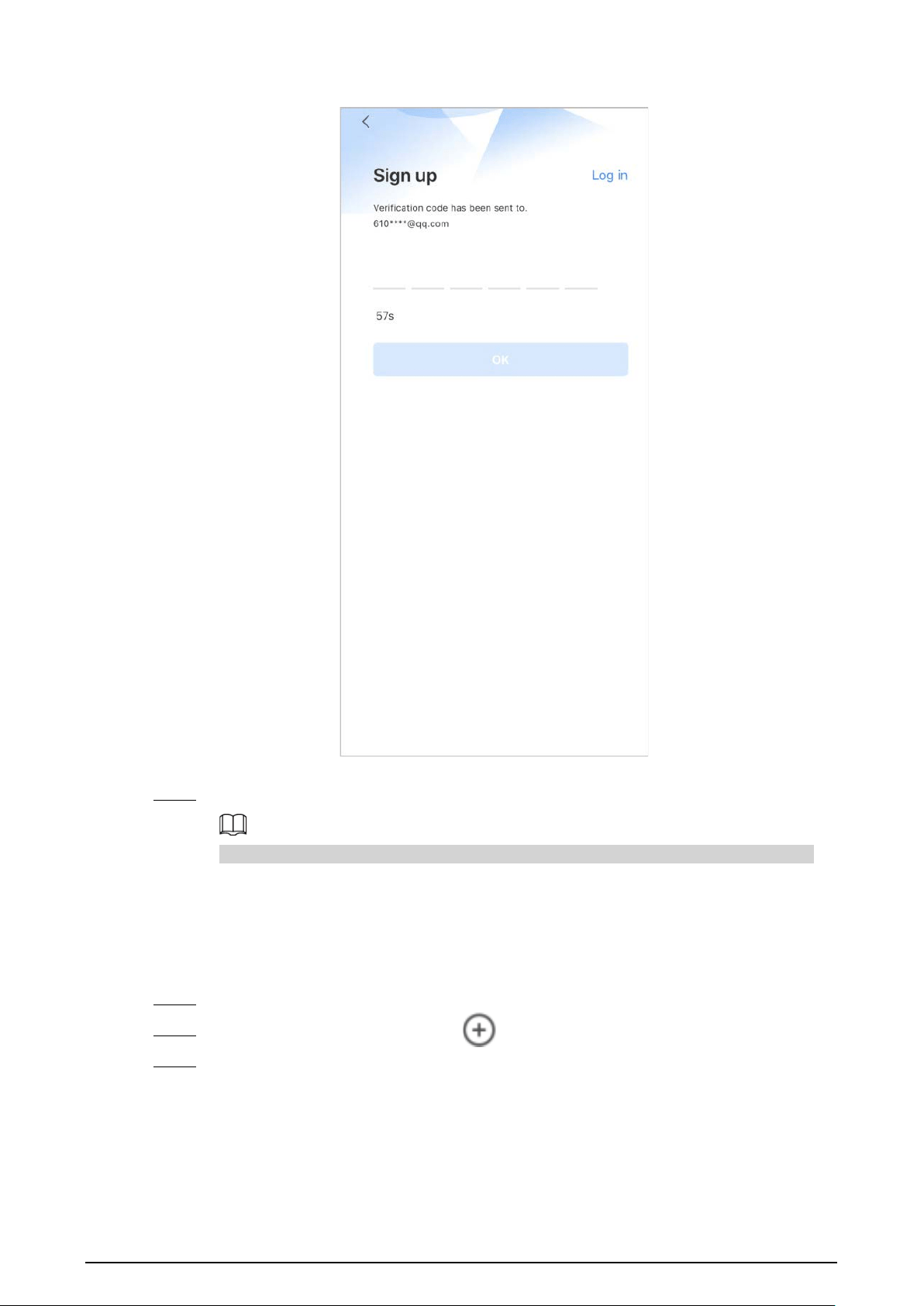
106
Figure 5-3 Enter verification code
5) Tap
OK
.
Step 3 On the
Login
screen, enter your email and password, and then tap
Log in
.
You can modify the password on the
Me
>
Account Management
>
Modify Password
.
5.3 Adding VTH to DMSS
Procedure
Step 1 Power on the VTH.
Step 2 On the
Home
screen of the app, tap , and then select
SN/Scan
.
Step 3 Scan the QR code at the rear panel of the VTH to obtain the information of the VTH or scan
the DMSS QR code in
Setting
>
General
>
QR Code
on the VTH to obtain the device
information of the VTH.

107
When going to the QR Code screen for the first time, the
DMSS
OR code would not appear.
Only after you set the network password, this module would be displayed. For the detailed
operation, see "3.6.9 Network Password Setting".
Figure 5-4 Add VTH
Figure 5-5 DMSS QR code
Step 4 On the
Add Device
screen, enter the device name of the VTH, username and password of
the VTH, and then tap
Save
.
●
Device Name
: customized.
●
Username
: Enter
user
.

108
●
Password
: Enter the network password of the VTH you configured in "3.6.9.1 Creating
Network Password".
Figure 5-6 Add device
Step 5 Configure the time zone, and then tap
Done
.
You have completed the device adding steps.
5.4 Configuring Arm and Disarm
Make sure that the VTH and VTO are properly connected.
Procedure
Step 1 On the
Home
screen, tap , select the VTH you have just added, and then tap
Device
Details
to go to the function screen.
Step 2 Tap
Disarm
or
Arm
to disarm or arm the VTH.
Figure 5-7 Disarm VTO
Step 3 Select from the arm/disarm mode list, and the arm/disarm configuration would take effect
on the VTH after you completed the setting.

109
●
Sleep
: An alarming mode that allows you to arm the system in the sleep time.
●
Home Mode
: An arming mode that allows you to arm the system when inside the area
of the alarm system.
●
Always Mode
: Arm the system when you leave the area of the alarm system.
●
Custom Arming
: Arm the system based on your customized needs.
●
Disarm
: Turn the security system off. The opposite of arming.
Figure 5-8 Arm and disarm mode
5.5 DMSS Calling VTH
Make sure that the VTH and VTO are properly connected.
Procedure
Step 1 On the
Home
screen, tap , select the VTH you have just added, and then tap
Device
Details
to go to the function screen.
Step 2 Tap
Call Video Intercom
to call the VTH you added to the DMSS.

110
Figure 5-9 Calling VTO
5.6 DMSS Calling VTO
Procedure
Step 1 On the
Home
screen, tap , select the VTH you have just added, and then tap
Device
Details
to go to the function screen.
Step 2 Tap to call the VTO you added to the DMSS.
If there are more than one VTO, you can call the main VTO and sub VTO respectively.

111
Figure 5-10 Calling VTO
5.7 DMSS Unlocking Door
Procedure
Step 1 On the
Home
screen, tap , select the VTH you have just added, and then tap
Device
Details
to go to the function screen.
Step 2 Tap to unlock the door.

112
Figure 5-11 Unlocking door
5.8 DMSS Monitoring VTO
Make sure that the VTH and VTO are properly connected.
Procedure
Step 1 On the
Home
screen, tap , select the VTH you have just added, and then tap
Device
Details
to go to the function screen.
Step 2 Tap to view the monitoring video of the VTO.
Figure 5-12 View monitoring video

113
Figure 5-13 Viewing monitoring video
Table 5-1 Video call function icons
Function Description
Play/Pause.
Mute/Unmute.
Change the image orientation to landscape.
Favorites. Select a video, tap , and then select an existing file that
you want to save the video to.
Video stream. Tap the icon to switch between SD and HD video quality.
Video playback.
Take snapshot.
Video recording.
Answer/End the call.

114
5.9 Viewing Alarm Information
Procedure
Step 1 On the
Message
screen, tap
Alarm Message
to view the alarm recorded reported from the
VTOs and VTHs.
Figure 5-14 Viewing alarm records
5.10 Device Sharing
Once one user has added the VTH, the user can share the binding relationship with other users.
Procedure
Step 1 On the
Home
screen, select the VTH you have just added, and tap the .
Step 2 Select
Device Sharing
.

115
Figure 5-15 Device sharing (1)
Step 3 On the
Device Sharing
screen, tap to scan the QR code of the users you want to
share the device.
Figure 5-16 Device sharing (2)

116
Figure 5-17 Scan QR code of the user you want to share
Step 4 After scanning the QR code, the user that receives the sharing has to refresh the
Home
screen to update the sharing information.
Related Operations
To Obtain the QR Code of the User that Receives the Sharing
1. Log in to the DMSS account of the user that to receive the sharing.
2. Tap
Me
, and tap the QR code icon at the top of the screen.

117
Figure 5-18 Obtain the QR code
Figure 5-19 Obtain the QR code (2)

118
Appendix 1 Cybersecurity Recommendations
Mandatory actions to be taken for basic device network security:
1.
Use Strong Passwords
Please refer to the following suggestions to set passwords:
●
The length should not be less than 8 characters.
●
Include at least two types of characters; character types include upper and lower case letters,
numbers and symbols.
●
Do not contain the account name or the account name in reverse order.
●
Do not use continuous characters, such as 123, abc, etc.
●
Do not use overlapped characters, such as 111, aaa, etc.
2.
Update Firmware and Client Software in Time
●
According to the standard procedure in Tech-industry, we recommend to keep your device
(such as NVR, DVR, IP camera, etc.) firmware up-to-date to ensure the system is equipped with
the latest security patches and fixes. When the device is connected to the public network, it is
recommended to enable the “auto-check for updates” function to obtain timely information
of firmware updates released by the manufacturer.
●
We suggest that you download and use the latest version of client software.
"Nice to have" recommendations to improve your device network security:
1.
Physical Protection
We suggest that you perform physical protection to device, especially storage devices. For
example, place the device in a special computer room and cabinet, and implement well-done
access control permission and key management to prevent unauthorized personnel from
carrying out physical contacts such as damaging hardware, unauthorized connection of
removable device (such as USB flash disk, serial port), etc.
2.
Change Passwords Regularly
We suggest that you change passwords regularly to reduce the risk of being guessed or cracked.
3.
Set and Update Passwords Reset Information Timely
The device supports password reset function. Please set up related information for password
reset in time, including the end user’s mailbox and password protection questions. If the
information changes, please modify it in time. When setting password protection questions, it is
suggested not to use those that can be easily guessed.
4.
Enable Account Lock
The account lock feature is enabled by default, and we recommend you to keep it on to
guarantee the account security. If an attacker attempts to log in with the wrong password several
times, the corresponding account and the source IP address will be locked.
5.
Change Default HTTP and Other Service Ports
We suggest you to change default HTTP and other service ports into any set of numbers between
1024–65535, reducing the risk of outsiders being able to guess which ports you are using.
6.
Enable HTTPS
We suggest you to enable HTTPS, so that you visit Web service through a secure communication
channel.
7.
MAC Address Binding
We recommend you to bind the IP and MAC address of the gateway to the device, thus reducing
the risk of ARP spoofing.
8.
Assign Accounts and Privileges Reasonably
According to business and management requirements, reasonably add users and assign a

119
minimum set of permissions to them.
9.
Disable Unnecessary Services and Choose Secure Modes
If not needed, it is recommended to turn off some services such as SNMP, SMTP, UPnP, etc., to
reduce risks.
If necessary, it is highly recommended that you use safe modes, including but not limited to the
following services:
●
SNMP: Choose SNMP v3, and set up strong encryption passwords and authentication
passwords.
●
SMTP: Choose TLS to access mailbox server.
●
FTP: Choose SFTP, and set up strong passwords.
●
AP hotspot: Choose WPA2-PSK encryption mode, and set up strong passwords.
10.
Audio and Video Encrypted Transmission
If your audio and video data contents are very important or sensitive, we recommend that you
use encrypted transmission function, to reduce the risk of audio and video data being stolen
during transmission.
Reminder: encrypted transmission will cause some loss in transmission efficiency.
11.
Secure Auditing
●
Check online users: we suggest that you check online users regularly to see if the device is
logged in without authorization.
●
Check device log: By viewing the logs, you can know the IP addresses that were used to log in
to your devices and their key operations.
12.
Network Log
Due to the limited storage capacity of the device, the stored log is limited. If you need to save the
log for a long time, it is recommended that you enable the network log function to ensure that
the critical logs are synchronized to the network log server for tracing.
13.
Construct a Safe Network Environment
In order to better ensure the safety of device and reduce potential cyber risks, we recommend:
●
Disable the port mapping function of the router to avoid direct access to the intranet devices
from external network.
●
The network should be partitioned and isolated according to the actual network needs. If
there are no communication requirements between two sub networks, it is suggested to use
VLAN, network GAP and other technologies to partition the network, so as to achieve the
network isolation effect.
●
Establish the 802.1x access authentication system to reduce the risk of unauthorized access to
private networks.
●
Enable IP/MAC address filtering function to limit the range of hosts allowed to access the
device.

