USER
MANUAL
EN User Manual
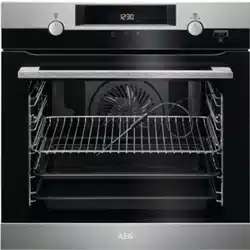
Oven
BPK556320M

CONTENTS
1. SAFETY INFORMATION.............................................................................................2
2. SAFETY INSTRUCTIONS.............................................................................................4
3. PRODUCT DESCRIPTION...........................................................................................7
4. CONTROL PANEL....................................................................................................... 8
5. BEFORE FIRST USE..................................................................................................... 8
6. DAILY USE....................................................................................................................9
7. CLOCK FUNCTIONS.................................................................................................11
8. USING THE ACCESSORIES...................................................................................... 13
9. ADDITIONAL FUNCTIONS...................................................................................... 16
10. HINTS AND TIPS..................................................................................................... 17
11. CARE AND CLEANING.......................................................................................... 31
12. TROUBLESHOOTING.............................................................................................34
13. ENERGY EFFICIENCY.............................................................................................37
14. SAUDI ARABIA - CUSTOMER SERVICE................................................................ 38
FOR PERFECT RESULTS
Thank you for choosing this AEG product. We have created it to give you
impeccable performance for many years, with innovative technologies that help
make life simpler features you might not find on ordinary appliances. Please
spend a few minutes reading to get the very best from it.
Visit our website for:
Get usage advice, brochures, trouble shooter, service information:
www.aeg.com/webselfservice
Register your product for better service:
www.registeraeg.com
Buy Accessories, Consumables and Original spare parts for your appliance:
www.aeg.com/shop
CUSTOMER CARE AND SERVICE
Always use original spare parts.
When contacting our Authorised Service Centre, ensure that you have the
following data available: Model, PNC, Serial Number.
The information can be found on the rating plate.
Warning / Caution-Safety information
General information and tips
Environmental information
Subject to change without notice.
1.
SAFETY INFORMATION
Before the installation and use of the appliance,
carefully read the supplied instructions. The
www.aeg.com
2

manufacturer is not responsible for any injuries or
damages that are the result of incorrect installation or
usage. Always keep the instructions in a safe and
accessible location for future reference.
1.1 Children and vulnerable people safety
• This appliance can be used by children aged from 8
years and above and persons with reduced physical,
sensory or mental capabilities or lack of experience
and knowledge if they have been given supervision or
instruction concerning the use of the appliance in a
safe way and understand the hazards involved.
• Children between 3 and 8 years of age and persons
with very extensive and complex disabilities shall be
kept away unless continuously supervised.
• Children of less than 3 years of age should be kept
away unless continuously supervised.
• Do not let children play with the appliance.
• Keep all packaging away from children and dispose of
it appropriately.
• Keep children and pets away from the appliance when
it operates or when it cools down. Accessible parts are
hot.
• If the appliance has a child safety device, it should be
activated.
• Children shall not carry out cleaning and user
maintenance of the appliance without supervision.
1.2
General Safety
• Only a qualified person must install this appliance and
replace the cable.
• WARNING: The appliance and its accessible parts
become hot during use. Care should be taken to
avoid touching heating elements.
• Always use oven gloves to remove or put in
accessories or ovenware.
• Before carrying out any maintenance, disconnect the
appliance from the power supply.
ENGLISH
3

• Ensure that the appliance is switched off before
replacing the lamp to avoid the possibility of electric
shock.
• Do not use a steam cleaner to clean the appliance.
• Do not use harsh abrasive cleaners or sharp metal
scrapers to clean the glass door since they can scratch
the surface, which may result in shattering of the glass.
• If the mains power supply cable is damaged, it must
be replaced by the manufacturer, its Authorised
Service Centre or similarly qualified persons to avoid
an electrical hazard.
• Excessive spillage must be removed before the
pyrolytic cleaning. Remove all parts from the oven.
• To remove the shelf supports first pull the front of the
shelf support and then the rear end away from the
side walls. Install the shelf supports in the opposite
sequence.
• Use only the food sensor (core temperature sensor)
recommended for this appliance.
2. SAFETY INSTRUCTIONS
2.1 Installation
WARNING!
Only a qualified person must
install this appliance.
• Remove all the packaging.
• Do not install or use a damaged
appliance.
• Follow the installation instructions
supplied with the appliance.
• Always take care when moving the
appliance as it is heavy. Always use
safety gloves and enclosed footwear.
• Do not pull the appliance by the
handle.
• Keep the minimum distance from
other appliances and units.
• Install the appliance in a safe and
suitable place that meets installation
requirements.
• The appliance is equipped with an
electric cooling system. It must be
operated with the electric power
supply.
2.2 Electrical connection
WARNING!
Risk of fire and electric
shock.
• All electrical connections should be
made by a qualified electrician.
• The appliance must be earthed.
• Make sure that the parameters on the
rating plate are compatible with the
electrical ratings of the mains power
supply.
• Always use a correctly installed
shockproof socket.
• Do not use multi-plug adapters and
extension cables.
• Make sure not to cause damage to
the mains plug and to the mains
cable. Should the mains cable need
to be replaced, this must be carried
out by our Authorised Service Centre.
• Do not let mains cables touch or
come near the appliance door,
especially when the door is hot.
www.aeg.com
4

• The shock protection of live and
insulated parts must be fastened in
such a way that it cannot be removed
without tools.
• Connect the mains plug to the mains
socket only at the end of the
installation. Make sure that there is
access to the mains plug after the
installation.
• If the mains socket is loose, do not
connect the mains plug.
• Do not pull the mains cable to
disconnect the appliance. Always pull
the mains plug.
• Use only correct isolation devices: line
protecting cut-outs, fuses (screw type
fuses removed from the holder), earth
leakage trips and contactors.
• The electrical installation must have
an isolation device which lets you
disconnect the appliance from the
mains at all poles. The isolation
device must have a contact opening
width of minimum 3 mm.
• This appliance complies with the
E.E.C. Directives.
2.3 Use
WARNING!
Risk of injury, burns and
electric shock or explosion.
• This appliance is for household use
only.
• Do not change the specification of
this appliance.
• Make sure that the ventilation
openings are not blocked.
• Do not let the appliance stay
unattended during operation.
• Deactivate the appliance after each
use.
• Be careful when you open the
appliance door while the appliance is
in operation. Hot air can release.
• Do not operate the appliance with
wet hands or when it has contact with
water.
• Do not apply pressure on the open
door.
• Do not use the appliance as a work
surface or as a storage surface.
• Open the appliance door carefully.
The use of ingredients with alcohol
can cause a mixture of alcohol and air.
• Do not let sparks or open flames to
come in contact with the appliance
when you open the door.
• Do not put flammable products or
items that are wet with flammable
products in, near or on the appliance.
WARNING!
Risk of damage to the
appliance.
• To prevent damage or discoloration
to the enamel:
– do not put ovenware or other
objects in the appliance directly
on the bottom.
– do not put aluminium foil directly
on the bottom of cavity of the
appliance.
– do not put water directly into the
hot appliance.
– do not keep moist dishes and
food in the appliance after you
finish the cooking.
– be careful when you remove or
install the accessories.
• Discoloration of the enamel or
stainless steel has no effect on the
performance of the appliance.
• Use a deep pan for moist cakes. Fruit
juices cause stains that can be
permanent.
• This appliance is for cooking
purposes only. It must not be used for
other purposes, for example room
heating.
• Always cook with the oven door
closed.
• If the appliance is installed behind a
furniture panel (e.g. a door) make sure
the door is never closed when the
appliance is in operation. Heat and
moisture can build up behind a
closed furniture panel and cause
subsequent damage to the appliance,
the housing unit or the floor. Do not
close the furniture panel until the
appliance has cooled down
completely after use.
2.4 Care and cleaning
WARNING!
Risk of injury, fire, or damage
to the appliance.
ENGLISH 5

• Before maintenance, deactivate the
appliance and disconnect the mains
plug from the mains socket.
• Make sure the appliance is cold.
There is the risk that the glass panels
can break.
• Replace immediately the door glass
panels when they are damaged.
Contact the Authorised Service
Centre.
• Be careful when you remove the door
from the appliance. The door is
heavy!
• Clean regularly the appliance to
prevent the deterioration of the
surface material.
• Clean the appliance with a moist soft
cloth. Only use neutral detergents. Do
not use any abrasive products,
abrasive cleaning pads, solvents or
metal objects.
• If you use an oven spray, follow the
safety instruction on it's packaging.
• Do not clean the catalytic enamel (if
applicable) with any kind of
detergent.
2.5 Pyrolytic cleaning
WARNING!
Risk of Injury / Fires /
Chemical Emissions (Fumes)
in Pyrolytic Mode.
Do not start the Pyrolysis if
the Plus Steam button is
pressed in.
• Before carrying out a Pyrolitic self-
cleaning function or the First Use
please remove from the oven cavity:
– any excess food residues, oil or
grease spills / deposits.
– any removable objects (including
shelves, side rails etc., provided
with the product) particularly any
non-stick pots, pans, trays,
utensils etc.
• Read carefully all the instructions for
Pyrolytic cleaning.
• Keep children away from the
appliance while the Pyrolytic cleaning
is in operation.
The appliance becomes very hot and
hot air is released from the front
cooling vents.
• Pyrolytic cleaning is a high
temperature operation that can
release fumes from cooking residues
and construction materials, as such
consumers are strongly advised to:
– provide good ventilation during
and after each Pyrolytic cleaning.
– provide good ventilation during
and after the first use at maximum
temperature operation.
• Unlike all humans, some birds and
reptiles can be extremely sensitive to
potential fumes emitted during the
cleaning process of all Pyrolytic
Ovens.
– Remove any pets (especially birds)
from the vicinity of the appliance
location during and after the
Pyrolytic cleaning and first use
maximum temperature operation
to a well ventilated area.
• Small pets can also be highly sensitive
to the localized temperature changes
in the vicinity of all Pyrolytic Ovens
when the Pyrolytic self cleaning
program is in operation.
• Non-stick surfaces on pots, pans,
trays, utensils etc., can be damaged
by the high temperature Pyrolytic
cleaning operation of all Pyrolytic
Ovens and can be also a source for
low level harmful fumes.
• Fumes released from all Pyrolytic
Ovens / Cooking Residues as
described are not harmful to humans,
including infants or persons with
medical conditions.
2.6 Internal lighting
WARNING!
Risk of electric shock.
• The type of light bulb or halogen
lamp used for this appliance is for
household appliances only. Do not
use it for house lighting.
• Before replacing the lamp, disconnect
the appliance from the power supply.
• Only use lamps with the same
specifications.
2.7 Service
• To repair the appliance contact an
Authorised Service Centre.
www.aeg.com
6
• Use original spare parts only.
2.8 Disposal
WARNING!
Risk of injury or suffocation.
• Disconnect the appliance from the
mains supply.
• Cut off the mains electrical cable
close to the appliance and dispose of
it.
• Remove the door catch to prevent
children or pets from becoming
trapped in the appliance.
3. PRODUCT DESCRIPTION
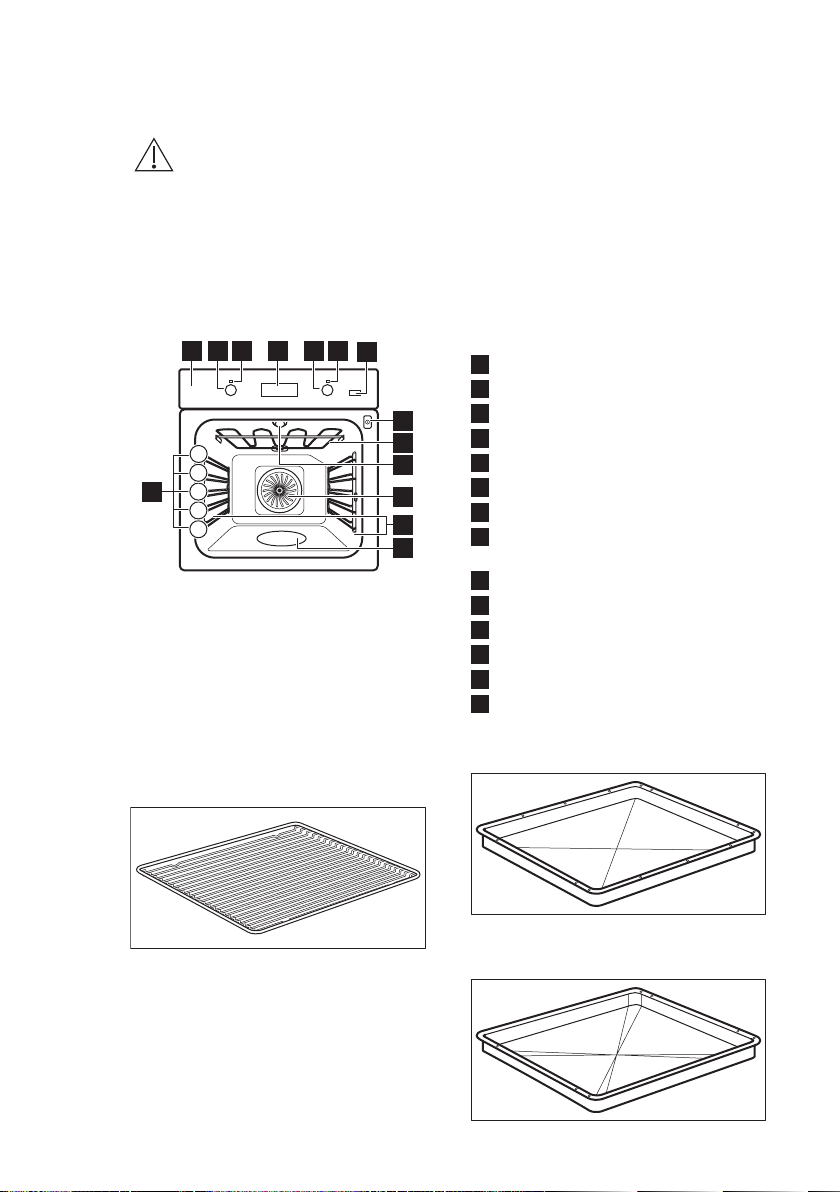
3.1 General overview
1
2
3
4
5
2 3 5
8
14
11
9
10
641
12
7
13
1
Control panel
2
Knob for the heating functions
3
Power lamp / symbol
4
Display
5
Control knob (for the temperature)
6
Temperature indicator / symbol
7
Plus Steam
8
Socket for the core temperature
sensor
9
Heating element
10
Lamp
11
Fan
12
Shelf support, removable
13
Cavity embossment
14
Shelf positions
3.2 Accessories
Wire shelf
For cookware, cake tins, roasts.
Baking tray
For cakes and biscuits.
Grill- / Roasting pan
ENGLISH 7
To bake and roast or as a pan to collect
fat.
Food Sensor
To measure the temperature inside the
food.
Telescopic runners
For shelves and trays.
4. CONTROL PANEL
4.1 Buttons
Sensor field / Button Function Description
MINUTE MIND-
ER
To set the MINUTE MINDER. Hold it for
more than 3 seconds to turn on or turn off
the oven lamp.
CLOCK To set a clock function.
TEMPERATURE To check the oven temperature or the
temperature of the core temperature sen-
sor (if applicable). Use only while a heat-
ing function operates.
PLUS STEAM To turn on the True Fan Cooking PLUS
function.
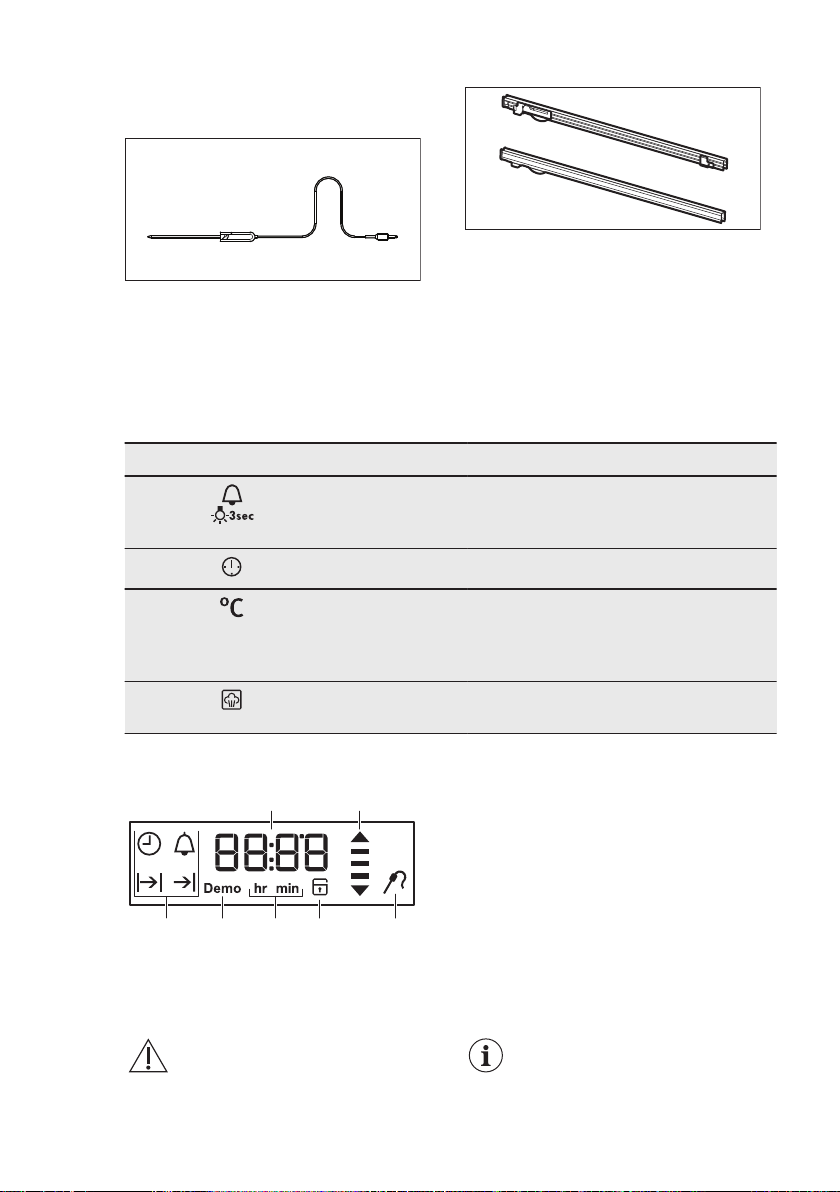
4.2 Display
A B
DG EF C
A. Timer / Temperature
B. Heat-up and residual heat indicator
C. Core temperature sensor (selected
models only)
D. Door lock (selected models only)
E. Hours / minutes
F. Demo mode (selected models only)
G. Clock functions
5. BEFORE FIRST USE
WARNING!
Refer to Safety chapters.
To set the Time of day refer
to "Clock functions"
chapter.
www.aeg.com8
5.1 Initial Cleaning
Remove all accessories and removable
shelf supports from the oven.
Refer to "Care and
cleaning" chapter.
Clean the oven and the accessories
before first use.
Put the accessories and the removable
shelf supports back to their initial
position.
6. DAILY USE
WARNING!
Refer to Safety chapters.
6.1 Retractable knobs
To use the appliance press the knob. The
knob comes out.
6.2 Heating functions
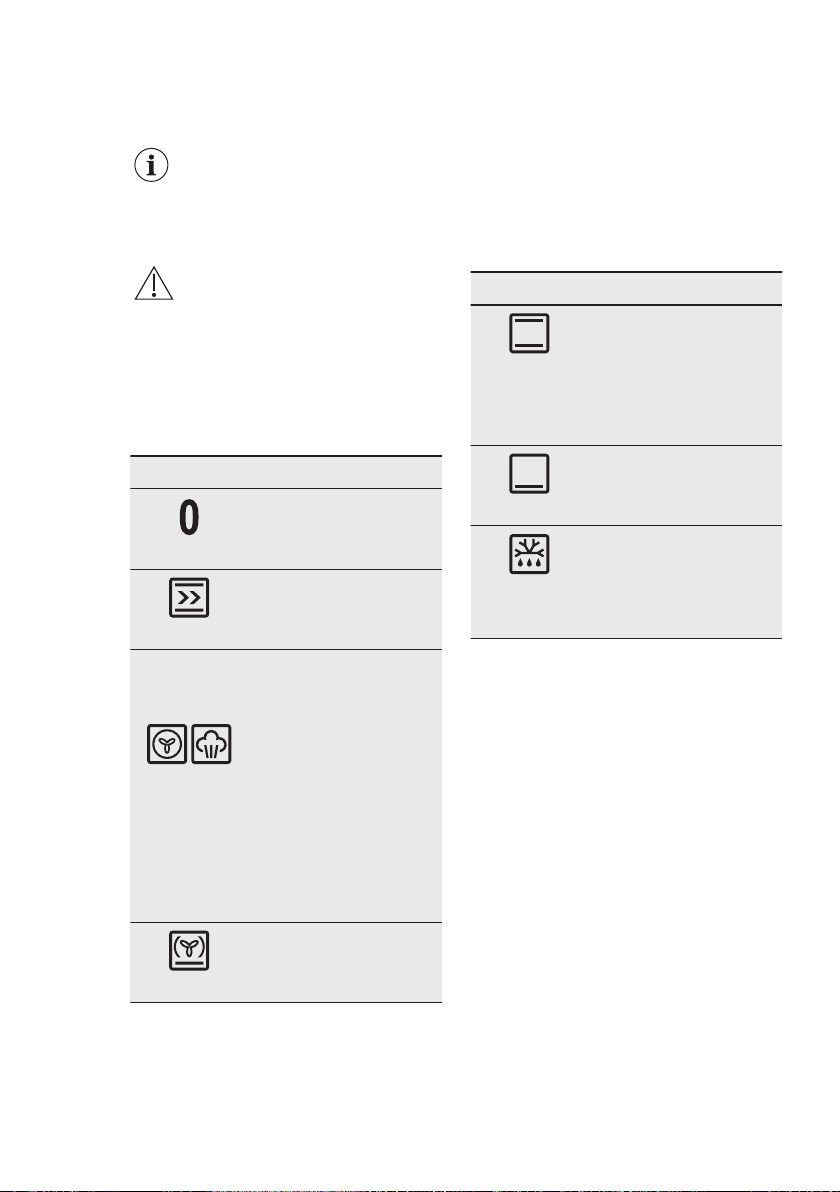
Oven function Application
Off position
The oven is off.
Fast Heat Up
To decrease the heat-up
time.
True Fan
Cooking /
True Fan
Cooking PLUS
To bake on up to three
shelf positions at the
same time and to dry
food.
Set the temperature 20 -
40 °C lower than for Con-
ventional Cooking.
To add humidity during
the cooking. To get the
right colour and crispy
crust during baking. To
give more juiciness dur-
ing reheating.
Pizza Setting
To bake pizza. To make
intensive browning and a
crispy bottom.
Oven function Application
Conventional
Cooking
(Top / Bottom
Heat)
To bake and roast food
on one shelf position.
Bottom Heat
To bake cakes with crispy
bottom and to preserve
food.
Defrost
To defrost food (vegeta-
bles and fruit). The de-
frosting time depends on
the amount and size of
the frozen food.
ENGLISH 9
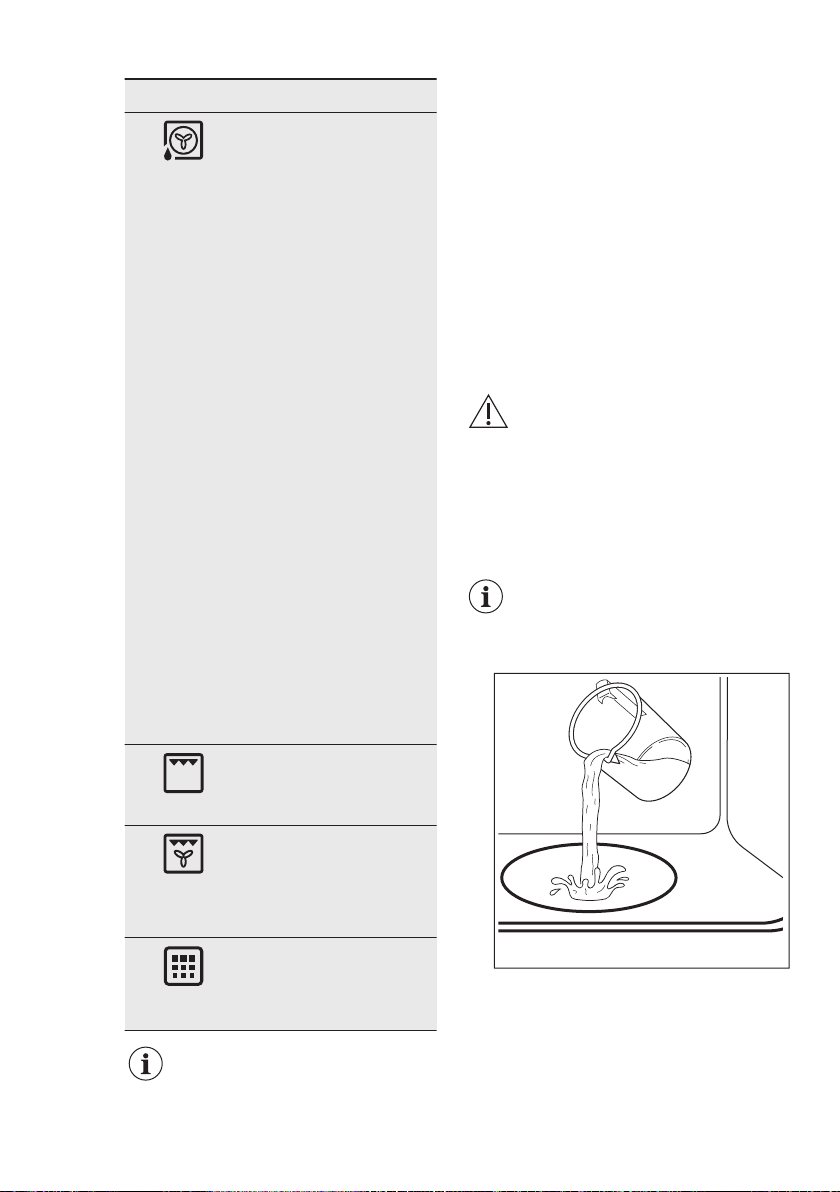
Oven function Application
Moist Fan Bak-
ing
This function is designed
to save energy during
cooking. For the cooking
instructions refer to
"Hints and tips" chapter,
Moist Fan Baking. The
oven door should be
closed during cooking so
that the function is not in-
terrupted and to ensure
that the oven operates
with the highest energy
efficiency possible. When
you use this function, the
temperature in the cavity
may differ from the set
temperature. The residu-
al heat is used.The heat-
ing power may be re-
duced. For general ener-
gy saving recommenda-
tions refer to "Energy Ef-
ficiency" chapter, Energy
Saving.This function was
used to comply with the
energy efficiency class
according to EN 60350-1.
When you use this func-
tion the lamp automati-
cally turns off after 30
seconds.
Grilling
To grill flat food and to
toast bread.
Turbo Grilling
To roast larger meat
joints or poultry with
bones on one shelf posi-
tion. To make gratins and
to brown.
Pyrolysis
To turn on the pyrolytic
cleaning of the oven. This
function burns off residu-
al dirt in the oven.
The lamp may turn off
automatically at a
temperature below 60 °C
during some oven functions.
6.3 Setting a heating function
1. Turn the knob for the heating
functions to select a heating function.
2. Turn the control knob to select the
temperature.
The lamp turns on when the oven
operates.
3. To turn off the oven, turn the knob
for the heating functions to the off
position.
6.4 Setting the function:True
Fan Cooking PLUS
This function allows to improve humidity
during the cooking.
WARNING!
Risk of burns and damage to
the appliance.
Released humidity can cause burns:
• Do not open the oven door when the
function works.
• Open the oven door with care after
the function stops.
Refer to “Hints and tips”
chapter.
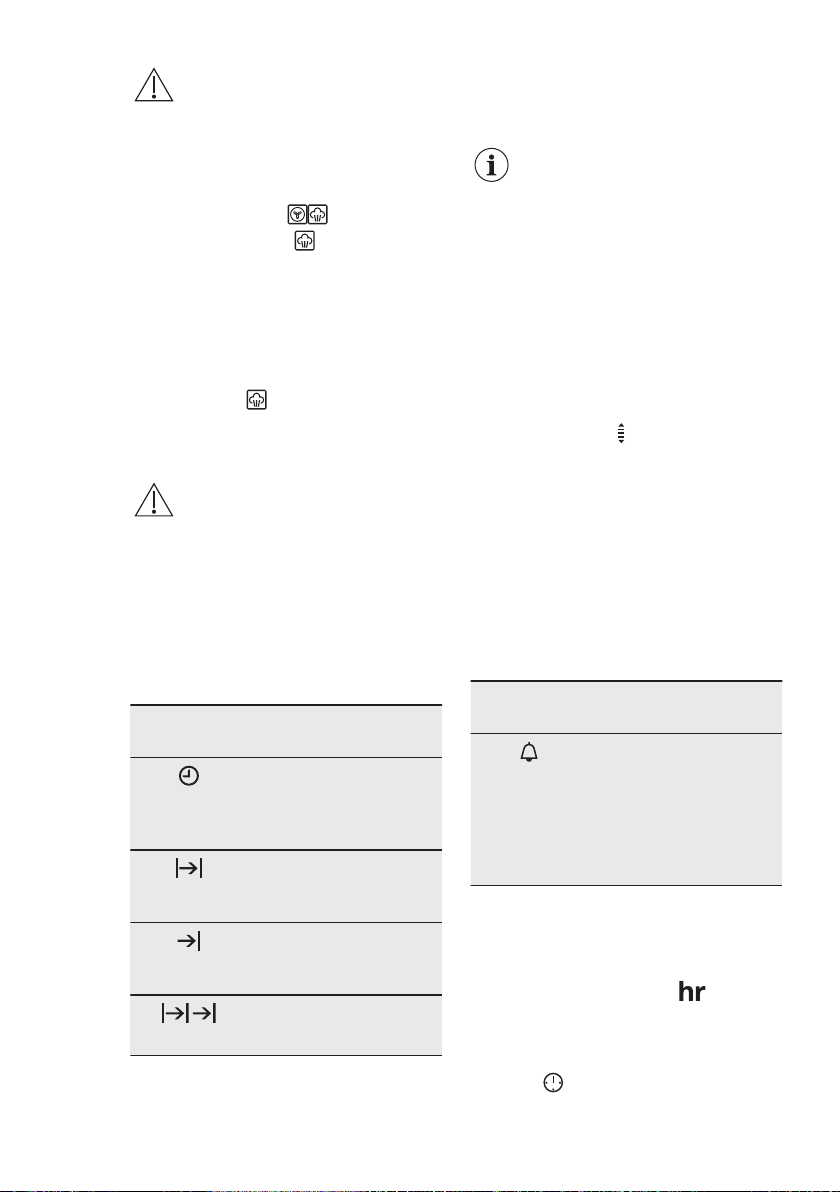
1. Fill the cavity embossment with tap
water.
The maximum capacity of the cavity
embossment is 250 ml.
Fill the cavity embossment with water
only when the oven is cold.
www.aeg.com
10
CAUTION!
Do not refill the cavity
embossment with water
during cooking or when
the oven is hot.
2. Put food in the oven and close the
oven door.
3. Set the function: .
4. Press: Plus Steam .
It works only with the function: True Fan
Cooking PLUS.
The indicator turns on.
5. Turn the control knob to select a
temperature.
6. Turn the knob for the heating
functions to the off position, press
Plus Steam to turn off the oven.
The indicator turns off.
7. Remove water from the cavity
embossment.
WARNING!
Make sure that the oven
is cold before you
remove the remaining
water from the cavity
embossment.
6.5 Fast Heat Up
The fast heat up decreases the heat up
time.
Do not put food in the oven
when the Fast heat up
operates.
1. Turn the knob for the oven functions
to set the fast heat up.
2. Turn the knob for the temperature to
set the temperature.
The signal sounds when the oven is at
the set temperature.
3. Set an oven function.
6.6 Heat-up indicator
When the oven function operates, the
bars in the display
appear one by one
when the temperature in the oven
increases, and disappear when it
decreases.
7. CLOCK FUNCTIONS
7.1 Clock functions table
Clock func-
tion
Application
TIME OF DAY
To show or change the
time of day. You can
change the time of day
only when the oven is off.
DURATION
To set how long the oven
works. Use only when a
heating function is set.
END
To set when the oven
turns off. Use only when a
heating function is set.
TIME DELAY
Combination of DURA-
TION and END function.
Clock func-
tion
Application
MINUTE
MINDER
Use to set a countdown
time. This function has no
effect on the operation of
the oven. You can set the
MINUTE MINDER at any
time, also if the oven is
off.
7.2 Setting and changing the
time
After the first connection to the mains,
wait until the display shows and
"12:00". "12" flashes.
1. Turn the knob for the temperature to
set the hours.
2. Press
to confirm and set the
minutes.
ENGLISH
11

The display shows and the set
hour. "00" flashes.
3. Turn the knob for the temperature to
set the current minutes.
4. Press to confirm or the set time of
day will be saved automatically after
5 seconds.
The display shows the new time.
To change the time of day press
again and again until the indicator for the
time of day flashes in the display.
7.3 Setting the DURATION
function
1. Set a heating function.
2. Press
again and again until
starts to flash.
3. Turn the knob for the temperature to
set the minutes and press to
confirm. Turn the knob for the
temperature to set the hours and
press
to confirm.
When the set Duration time ends the
signal sounds for 2 minutes. and time
setting flash in the display. The oven
turns off automatically.
4. Press any button or open the oven
door to stop the signal.
5. Turn the knob for the heating
functions to the off position.
7.4 Setting the END function
1. Set a heating function.
2. Press
again and again until
starts to flash.
3. Turn the knob for the temperature to
set the hours and press to
confirm. Turn the knob for the
temperature to set the minutes and
press
to confirm.
At the set End time the signal sounds for
2 minutes. and time setting flash in
the display. The oven turns off
automatically.
4. Press any button or open the oven
door to stop the signal.
5. Turn the knob for the heating
functions to the off position.
7.5 Setting the TIME DELAY
function
1. Set a heating function.
2. Press
again and again until
starts to flash.
3. Turn the knob for the temperature to
set the minutes for DURATION time
and press to confirm. Turn the
knob for the temperature to set the
hours for DURATION time and press
to confirm.
The display shows flashing .
4. Turn the knob for the temperature to
set the hours for END time and press
to confirm. Turn the knob for the
temperature to set the minutes for
END time and press
to confirm.
The display shows and the
set temperature.
Oven turns on automatically later on,
works for the set DURATION time and
stops at the set END time.
At the set END time the signal sounds
for 2 minutes. and time setting flash
in the display. The oven turns off.
5. Press any button or open the oven
door to stop the signal.
6. Turn the knob for the heating
functions to the off position.
7.6 Setting the MINUTE
MINDER
Minute minder can be both set when the
oven is turned on and off.
1. Press again and again until
and "00" flash in the display.
2. Turn the knob for the temperature to
set the seconds and than the
minutes.
When the time you set is longer than
60 minutes, flash in the display.
3. Set the hours.
4. The MINUTE MINDER starts
automatically after 5 seconds.
After 90% of the set time the signal
sounds.
5. When the set time ends the signal
sounds for 2 minutes. "00:00" and
www.aeg.com
12
flash in the display. Press any
button to stop the signal.
8. USING THE ACCESSORIES
WARNING!
Refer to Safety chapters.
8.1 Core temperature sensor
The core temperature sensor measures
temperature inside the food. When the
food is at the set temperature, the oven
turns off.
There are two temperatures to be set:
• the oven temperature (minimum 120
°C),
• the food core temperature.
CAUTION!
Use only the core
temperature sensor supplied
and the original replacement
parts.
Directions for the best results:
• Ingredients should be at room
temperature.
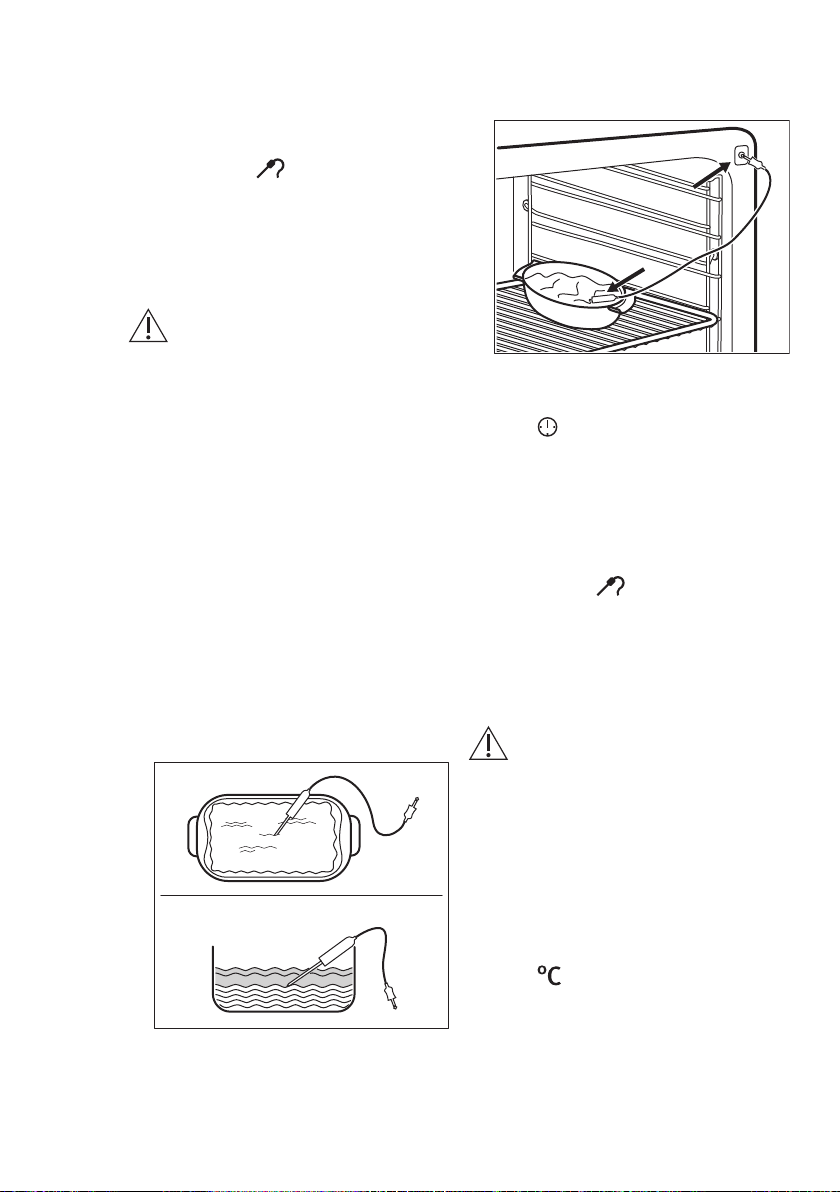
• Core temperature sensor cannot be
used for liquid dishes.
• During cooking the core temperature
sensor must remain in the dish and
the plug in the socket.
• Use recommended food core
temperature settings. Refer to "Hints
and tips" chapter.
Every time you put the core
temperature sensor in the
socket, you need to set the
core temperature time
again. You cannot select the
duration and end time.
The aoven calculates the
approximate cooking time, it
may change.
Food categories: meat, poultry
and fish
1. Set the oven function and
temperature.
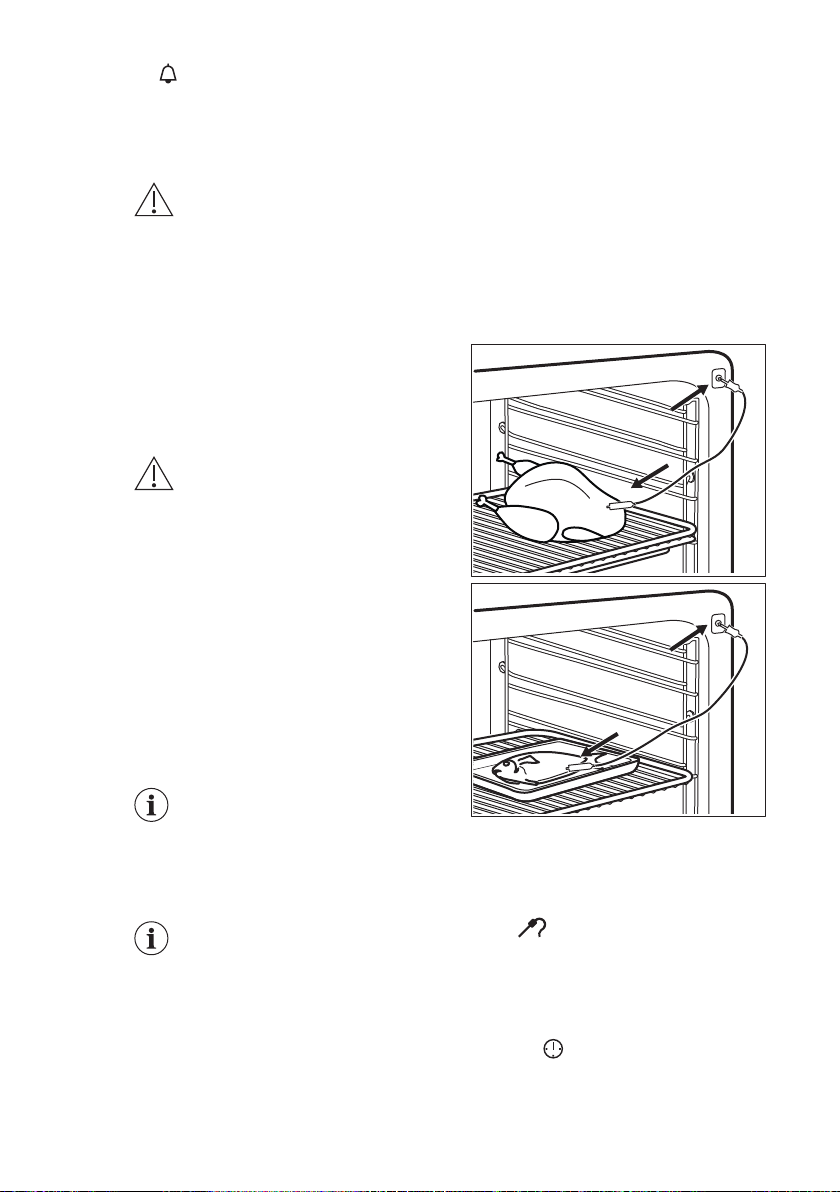
2. Insert the tip of the core temperature
sensor into the centre of meat or fish,
in the thickest part if possible. Make
sure that at least 3/4 of the core
temperature sensor is inside of the
dish.
3. Put the plug of the core temperature
sensor into the socket located in the
front frame of the appliance.
The display shows the core temperature
sensor symbol.
When you use the core temperature
sensor for the first time, the default core
temperature is 60 °C.
While flashes, you can use the knob
for the temperature to change the
default core temperature. The display
shows the symbol of the core
temperature sensor and the default core
temperature.
4. Press
to save the new core
temperature, or wait 10 seconds for
the setting to be saved automatically.
ENGLISH
13
The new default core temperature is
displayed during the next use of the core
temperature sensor.
When the food is at the set core
temperature, the default core
temperature and flashes. An acoustic
signal sounds for 2 minutes.
5. Press any button or open the oven
door to stop the acoustic signal.
6. Remove the core temperature sensor
plug from the socket and remove the
dish from the appliance.
WARNING!
There is a risk of burns as the
core temperature sensor
becomes hot. Be careful
when you unplug it and
remove it from the dish.
Food category: casserole
1. Set the oven function and
temperature.
2. Place half of the ingredients in a
baking dish.
3. Insert the tip of the core temperature
sensor exactly in the centre of the
casserole.The core temperature
sensor should be stabilized in one
place during baking. Use a solid
ingredient to achieve that. Use the
rim of the baking dish to support the
silicone handle of the core
temperature sensor. The tip of the
core temperature sensor should not
touch the bottom of a baking dish.
4. Cover the core temperature sensor
with the remaining ingredients.
5. Put the plug of the core temperature
sensor into the socket located in the
front frame of the appliance.
The display shows the core temperature
sensor symbol.
6. Press
to save the new core
temperature, or wait 10 seconds for
the setting to be saved automatically.
The new default core temperature is
displayed during the next use of the core
temperature sensor.
When the food is at the set core
temperature, the default core
temperature and flashes. An acoustic
signal sounds for 2 minutes.
7. Press any button or open the oven
door to stop the acoustic signal.
8. Remove the core temperature sensor
plug from the socket and remove the
dish from the appliance.
WARNING!
There is a risk of burns as the
core temperature sensor
becomes hot. Be careful
when you unplug it and
remove it from the dish.
Changing the temperature
during the cooking
You can change the temperature at any
time during the cooking:
1. Press :
• one time - the display shows the
set core temperature which
changes every 10 seconds to the
current core temperature.
• two times - the display shows the
current oven temperature which
www.aeg.com
14

changes every 10 seconds to the
set oven temperature.
• three times - the display shows
the set oven temperature.
2. Use the knob for the temperature to
change the temperature.
8.2 Inserting the accessories
Wire shelf:
Push the shelf between the guide bars of
the shelf support .
Baking tray/ Deep pan:
Push the baking tray / deep pan between
the guide bars of the shelf support.
Wire shelf and baking tray / deep pan
together:
Push the baking tray / deep pan between
the guide bars of the shelf support and
the wire shelf on the guide bars above.
Small indentation at the top
increase safety. The
indentations are also anti-tip
devices. The high rim
around the shelf prevents
cookware from slipping of
the shelf.
8.3 Telescopic runners -
inserting the accessories
With the telescopic runners you can put
in and remove the shelves more easily.
CAUTION!
Do not clean the telescopic
runners in the dishwasher.
Do not lubricate the
telescopic runners.
CAUTION!
Make sure you push back
the telescopic runners fully
in the oven before you close
the oven door.
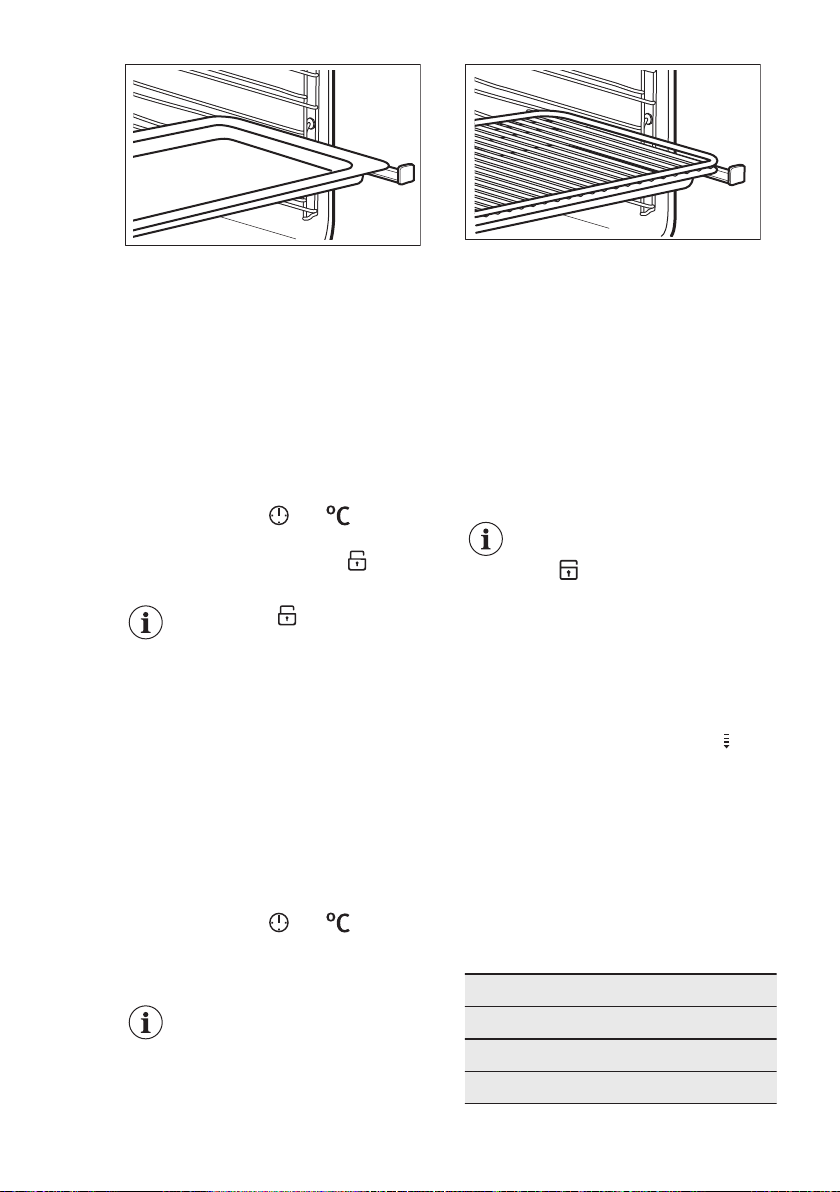
Wire shelf:
Put the wire shelf on the telescopic
runners so that the feet point
downwards.
The high rim around the wire
shelf is a special device to
prevent the cookware from
slipping.
Deep pan:
Put the deep pan on the telescopic
runners.
ENGLISH
15
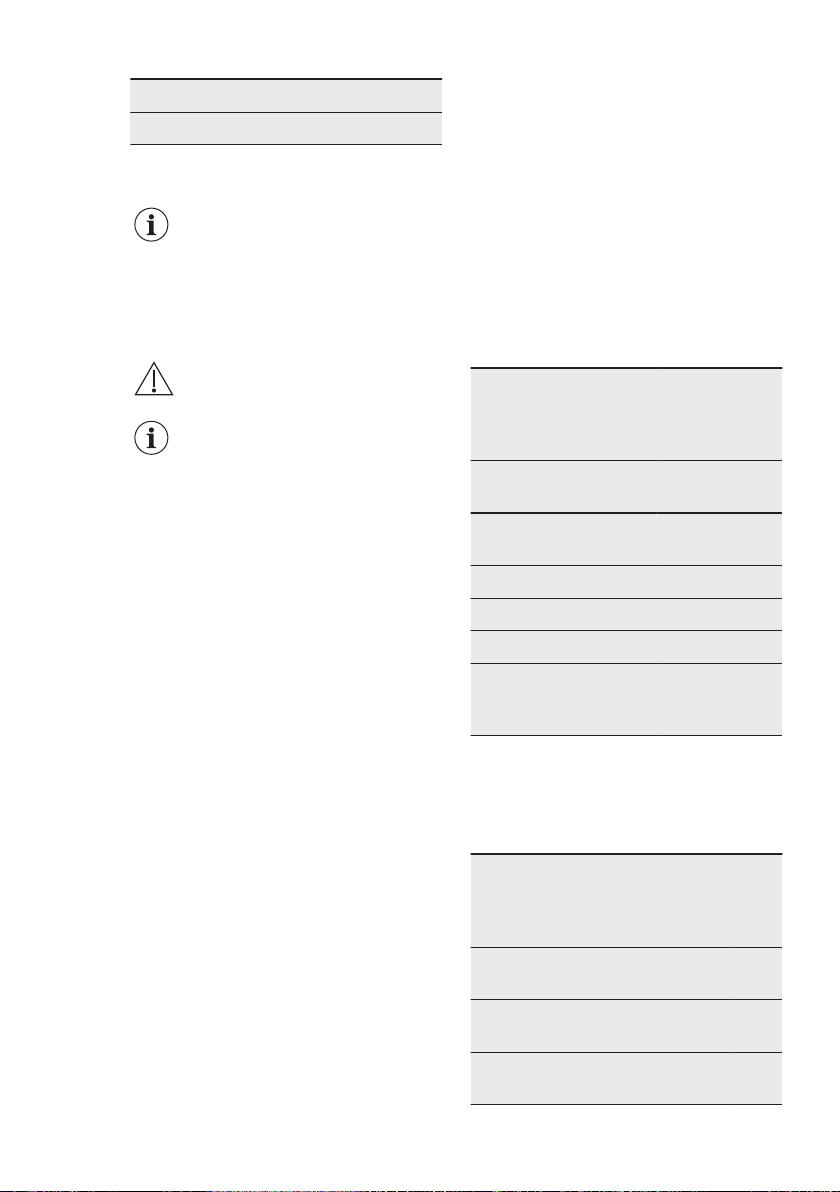
Wire shelf and deep pan together:
Place the wire shelf and the deep pan
together on the telescopic runner.
9. ADDITIONAL FUNCTIONS
9.1 Using the Child Lock
When the Child Lock is on the oven
cannot be turned on accidentally.
1. Ensure the knob for the oven
functions is in the off position.
2. Press and hold and at the
same time for 2 seconds.
The signal sounds. SAFE and appear
on the display. The door is locked.
The symbol appear on
the display also when
Pyrolysis function operates.
To turn off the Child Lock, repeat step 2.
9.2 Using the Function Lock
You can turn on the Function Lock
function only when the oven operates.
When the Function lock is on the
temperature and time settings of a
running oven function cannot be
changed accidentally.
1. Select an oven function and set it
according your preferences.
2. Press and hold
and at the
same time for 2 seconds.
The signal sounds. Loc appears on the
display for 5 seconds.
Loc appears on the display
when you turn the knob for
the temperature or press any
button when the Function
lock is on.
When you turn the knob for the oven
functions, the oven stops.
When you turn off the oven while the
Function Lock is on, the Function Lock
switches automatically to the Child Lock.
Refer to "Using the Child Lock".
If the Pyrolysis function
operates, the door is locked
and appears on the
display.
To turn off the Function Lock, repeat
step 2.
9.3 Residual heat indicator
When you turn off the oven, the display
shows the residual heat indicator
if
the temperature in the oven is more than
40 °C.Turn the knob for the temperature
left or right to check the oven
temperature.
9.4 Automatic Switch-off
For safety reasons the oven turns off
automatically after some time if a heating
function operates and you do not
change the oven temperature.
Temperature (°C) Switch-off time (h)
30 - 115 12.5
120 - 195 8.5
200 - 245 5.5
www.aeg.com16
Temperature (°C) Switch-off time (h)
250 - maximum 1.5
After an automatic switch-off, press any
button to operate the oven again.
The Automatic switch-off
does not work with the
functions: core temperature
sensor, Light, Duration, End.
9.5 Cooling fan
When the oven operates, the cooling fan
turns on automatically to keep the
surfaces of the oven cool. If you turn off
the oven, the cooling fan can continues
to operate until the oven cools down.
10. HINTS AND TIPS
WARNING!
Refer to Safety chapters.
The temperature and baking
times in the tables are
guidelines only. They
depend on the recipes and
the quality and quantity of
the ingredients used.
10.1 Cooking
recommendations
Your oven may bake or roast differently
to the oven you had before. The below
tables provide you with the standard
settings for temperature, cooking time
and shelf position.
If you cannot find the settings for a
special recipe, look for the similar one.
10.2 Inner side of the door
On the inner side of the door you can
find:
• the numbers of the shelf positions.
• information about the oven functions,
recommended shelf positions and
temperatures for dishes.
10.3 True Fan Cooking PLUS
Cakes / pastries / breads
Preheat the empty oven for 5 minutes.
Use the baking tray.
Use the second shelf position.
Use 150 ml of water.
Food Tem-
pera-
ture
(°C)
Time
(min)
Cookies, scones, crois-
sants
150 -
180
10 - 20
Focaccia 200 -
210
10 - 20
Pizza 230 10 - 20
Bread rolls 200 20 - 25
Bread 180 35 - 40
Plum cake, apple pie,
cinnamon rolls baked in
a cake mould
160 -
180
30 - 60
Frozen ready meals
Preheat the empty oven for 10 minutes.
Use the second shelf position.
Use 200 ml of water.
Food Tem-
pera-
ture
(°C)
Time
(min)
Pizza 200 -
210
10 -
20
Croissants 170 -
180
15 -
25
Lasagna 180 -
200
35 -
50
ENGLISH 17

Food regeneration
Use the second shelf position.
Use 100 ml of water.
Set the temperature to 110 °C.
Food Time
(min)
Bread rolls 10 - 20
Bread 15 - 25
Focaccia 15 - 25
Meat 15 - 25
Pasta 15 - 25
Pizza 15 - 25
Rice 15 - 25
Vegetables 15 - 25
Roasting
Use the glass baking dish.
Use the second shelf position.
Use 200 ml of water.
Food Tempera-
ture (°C)
Time
(min)
Roast beef 200 50 - 60
Chicken 210 60 - 80
10.4 Baking
• Use the lower temperature the first
time.
• You can extend baking times by 10 –
15 minutes if you bake cakes on more
than one shelf position.
• Cakes and pastries at different
heights do not always brown equally.
There is no need to change the
temperature setting if an unequal
browning occurs. The differences
equalize during baking.
• Trays in the oven can twist during
baking. When the trays become cold
again, the distortions disappear.
10.5 Tips on baking
Baking results Possible cause Remedy
The bottom of the cake
is not browned suffi-
ciently.
The shelf position is incor-
rect.
Put the cake on a lower shelf.
The cake sinks and be-
comes soggy, lumpy or
streaky.
The oven temperature is
too high.
The next time you bake, set a
slightly lower oven temperature.
The baking time is too
short.
Set a longer baking time. You
cannot decrease baking times by
setting higher temperatures.
There is too much liquid in
the mixture.
Use less liquid. Be careful with
mixing times, especially if you use
a mixing machine.
The cake is too dry. The oven temperature is
too low.
The next time you bake, set a
higher oven temperature.
The baking time is too long. The next time you bake, set a
shorter baking time.
www.aeg.com18

Baking results Possible cause Remedy
The cake browns un-
evenly.
The oven temperature is
too high and the baking
time is too short.
Set a lower oven temperature and
a longer baking time.
The mixture is unevenly dis-
tributed.
Spread the mixture evenly on the
baking tray.
The cake is not ready in
the baking time given.
The oven temperature is
too low.
The next time you bake, set a
slightly higher oven temperature.
10.6 Baking on one level:
Baking in tins
Food Function Temperature
(°C)
Time (min) Shelf position
Ring cake / Brio-
che
True Fan Cook-
ing
150 - 160 50 - 70 1
Madeira cake /
Fruit cakes
True Fan Cook-
ing
140 - 160 70 - 90 1
Flan base - short
pastry
True Fan Cook-
ing
170 - 180
1)
10 - 25 2
Flan base -
sponge mixture
True Fan Cook-
ing
150 - 170 20 - 25 2
Cheesecake Top / Bottom
Heat
170 - 190 60 - 90 1
1)
Preheat the oven.
Cakes / pastries / breads on baking trays
Food Function Tempera-
ture (°C)
Time
(min)
Shelf posi-
tion
Plaited bread / Bread crown Top / Bottom Heat 170 - 190 30 - 40 3
Christmas stollen Top / Bottom Heat
160 - 180
1)
50 - 70 2
Bread (rye bread):
1. First part of baking proce-
dure.
2. Second part of baking
procedure.
Top / Bottom Heat
1. 230
1)
2. 160 - 180
1. 20
2. 30 -
60
1
Cream puffs / Eclairs Top / Bottom Heat
190 - 210
1)
20 - 35 3
Swiss roll Top / Bottom Heat
180 - 200
1)
10 - 20 3
Cake with crumble topping
(dry)
True Fan Cooking 150 - 160 20 - 40 3
ENGLISH 19

Food Function Tempera-
ture (°C)
Time
(min)
Shelf posi-
tion
Buttered almond cake / Sugar
cakes
Top / Bottom Heat
190 - 210
1)
20 - 30 3
Fruit flans (made with yeast
dough / sponge mixture)
2)
True Fan Cooking 150 35 - 55 3
Fruit flans (made with yeast
dough / sponge mixture)
2)
Top / Bottom Heat 170 35 - 55 3
Fruit flans made with short
pastry
True Fan Cooking 160 - 170 40 - 80 3
Yeast cakes with delicate top-
pings (e.g. quark, cream, cus-
tard)
Top / Bottom Heat
160 - 180
1)
40 - 80 3
1)
Preheat the oven.
2)
Use a deep pan.
Biscuits
Food Function Temperature
(°C)
Time (min) Shelf position
Short pastry bis-
cuits
True Fan Cook-
ing
150 - 160 10 - 20 3
Biscuits made
with sponge
mixture
True Fan Cook-
ing
150 - 160 15 - 20 3
Pastries made
with egg white /
Meringues
True Fan Cook-
ing
80 - 100 120 - 150 3
Macaroons True Fan Cook-
ing
100 - 120 30 - 50 3
Biscuits made
with yeast
dough
True Fan Cook-
ing
150 - 160 20 - 40 3
Puff pastries True Fan Cook-
ing
170 - 180
1)
20 - 30 3
Rolls True Fan Cook-
ing
160
1)
10 - 25 3
Rolls Top / Bottom
Heat
190 - 210
1)
10 - 25 3
1)
Preheat the oven.
www.aeg.com20

10.7 Bakes and gratins
Food Function Temperature
(°C)
Time (min) Shelf position
Pasta bake Top / Bottom
Heat
180 - 200 45 - 60 1
Lasagne Top / Bottom
Heat
180 - 200 25 - 40 1
Vegetables au
gratin
1)
Turbo Grilling 160 - 170 15 - 30 1
Baguettes top-
ped with melted
cheese
True Fan Cook-
ing
160 - 170 15 - 30 1
Sweet bakes Top / Bottom
Heat
180 - 200 40 - 60 1
Fish bakes Top / Bottom
Heat
180 - 200 30 - 60 1
Stuffed vegeta-
bles
True Fan Cook-
ing
160 - 170 30 - 60 1
1)
Preheat the oven.
10.8 Moist Fan Baking
For best results follow
suggestions listed in the
table below.
Food Temperature
(°C)
Time (min) Shelf position
Pasta gratin 200 - 220 45 - 55 3
Potato gratin 180 - 200 70 - 85 3
Moussaka 170 - 190 70 - 95 3
Lasagne 180 - 200 75 - 90 3
Cannelloni 180 - 200 70 - 85 3
Bread pudding 190 - 200 55 - 70 3
Rice pudding 170 - 190 45 - 60 3
Apple cake, made with sponge mix-
ture (round cake tin)
160 - 170 70 - 80 3
White bread 190 - 200 55 - 70 3
ENGLISH 21

10.9 Multilevel Baking
Use the function:True Fan Cooking.
Cakes / pastries / breads on baking trays
Food Temperature
(°C)
Time (min) Shelf position
2 positions 3 positions
Cream puffs /
Eclairs
160 - 180
1)
25 - 45 1 / 4 -
Dry streusel
cake
150 - 160 30 - 45 1 / 4 -
1)
Preheat the oven.
Biscuits / small cakes / pastries / rolls
Food Temperature
(°C)
Time (min) Shelf position
2 positions 3 positions
Short pastry bis-
cuits
150 - 160 20 - 40 1 / 4 1 / 3 / 5
Biscuits made
with sponge
mixture
160 - 170 25 - 40 1 / 4 -
Biscuits made
with egg white,
meringues
80 - 100 130 - 170 1 / 4 -
Macaroons 100 - 120 40 - 80 1 / 4 -
Biscuits made
with yeast
dough
160 - 170 30 - 60 1 / 4 -
Puff pastries
170 - 180
1)
30 - 50 1 / 4 -
Rolls 180 20 - 30 1 / 4 -
1)
Preheat the oven.
10.10 Pizza Setting
Food Temperature (°C) Time (min) Shelf position
Pizza (thin crust)
200 - 230
1)2)
15 - 20 2
Pizza (with a lot of
topping)
180 - 200 20 - 30 2
Tarts 180 - 200 40 - 55 1
Spinach flan 160 - 180 45 - 60 1
www.aeg.com22

Food Temperature (°C) Time (min) Shelf position
Quiche Lorraine 170 - 190 45 - 55 1
Swiss Flan 170 - 190 45 - 55 1
Cheesecake 140 - 160 60 - 90 1
Apple cake, covered 150 - 170 50 - 60 1
Vegetable pie 160 - 180 50 - 60 1
Unleavened bread
230 - 250
1)
10 - 20 2
Puff pastry flan
160 - 180
1)
45 - 55 2
Flammekuchen (Piz-
za-like dish from Al-
sace)
230 - 250
1)
12 - 20 2
Piroggen (Russian
version of calzone)
180 - 200
1)
15 - 25 2
1)
Preheat the oven.
2)
Use a deep pan.
10.11 Roasting
Use heat-resistant ovenware.
Roast large roasting joints directly in the
tray or on the wire shelf placed above
the tray.
Put some water in the tray to prevent the
meat juices or fat from burning.
Meat with crackling can be roasted in the
roasting tin without the lid.
Turn the roast after 1/2 - 2/3 of the
cooking time.
To keep meat more succulent:
• roast lean meat in the roasting tin with
the lid or use roasting bag.
• roast meat and fish in large pieces (1
kg or more).
• baste large roasts and poultry with
their juices several times during
roasting.
10.12 Roasting tables
Beef
Food Quantity Function Tempera-
ture (°C)
Time (min) Shelf posi-
tion
Pot roast 1 - 1.5 kg Top / Bot-
tom Heat
230 120 - 150 1
Roast beef or fil-
let: rare
per cm of
thickness
Turbo Grill-
ing
190 - 200
1)
5 - 6 1
Roast beef or fil-
let: medium
per cm of
thickness
Turbo Grill-
ing
180 - 190
1)
6 - 8 1
ENGLISH 23

Food Quantity Function Tempera-
ture (°C)
Time (min) Shelf posi-
tion
Roast beef or fil-
let: well done
per cm of
thickness
Turbo Grill-
ing
170 - 180
1)
8 - 10 1
1)
Preheat the oven.
Veal
Food Quantity
(kg)
Function Temperature
(°C)
Time (min) Shelf posi-
tion
Roast veal 1 Turbo Grill-
ing
160 - 180 90 - 120 1
Knuckle of
veal
1.5 - 2 Turbo Grill-
ing
160 - 180 120 - 150 1
Lamb
Food Quantity
(kg)
Function Temperature
(°C)
Time (min) Shelf posi-
tion
Leg of lamb /
Roast lamb
1 - 1.5 Turbo Grill-
ing
150 - 170 100 - 120 1
Saddle of
lamb
1 - 1.5 Turbo Grill-
ing
160 - 180 40 - 60 1
Game
Food Quantity
(kg)
Function Temperature
(°C)
Time (min) Shelf posi-
tion
Saddle / Leg
of hare
up to 1 Top / Bottom
Heat
230
1)
30 - 40 1
Saddle of
venison
1.5 - 2 Top / Bottom
Heat
210 - 220 35 - 40 1
Haunch of
venison
1.5 - 2 Top / Bottom
Heat
180 - 200 60 - 90 1
1)
Preheat the oven.
Poultry
Food Quantity
(kg)
Function Temperature
(°C)
Time (min) Shelf posi-
tion
Poultry por-
tions
0.2 - 0.25
each
Turbo Grill-
ing
200 - 220 30 - 50 1
Half chicken 0.4 - 0.5 each Turbo Grill-
ing
190 - 210 35 - 50 1
Chicken,
poulard
1 - 1.5 Turbo Grill-
ing
190 - 210 50 - 70 1
www.aeg.com24
Food Quantity
(kg)
Function Temperature
(°C)
Time (min) Shelf posi-
tion
Duck 1.5 - 2 Turbo Grill-
ing
180 - 200 80 - 100 1
Goose 3.5 - 5 Turbo Grill-
ing
160 - 180 120 - 180 1
Turkey 2.5 - 3.5 Turbo Grill-
ing
160 - 180 120 - 150 1
Turkey 4 - 6 Turbo Grill-
ing
140 - 160 150 - 240 1
Fish (steamed)
Food Quantity
(kg)
Function Temperature
(°C)
Time (min) Shelf posi-
tion
Whole fish 1 - 1.5 Top / Bottom
Heat
210 - 220 40 - 60 1
10.13 Grilling
• Always grill with the maximum
temperature setting.
• Set the shelf into the shelf position as
recommended in the grilling table.
• Always set the pan to collect the fat
into the first shelf position.
• Grill only flat pieces of meat or fish.
• Always preheat the empty oven with
the grill functions for 5 minutes.
CAUTION!
Always grill with the oven
door closed.
Grilling
Food Temperature
(°C)
Time (min) Shelf position
1st side 2nd side
Roast beef 210 - 230 30 - 40 30 - 40 2
Filet of beef 230 20 - 30 20 - 30 3
Back of veal 210 - 230 30 - 40 30 - 40 2
Back of lamb 210 - 230 25 - 35 20 - 25 3
Whole Fish, 500
- 1000 g
210 - 230 15 - 30 15 - 30 3 / 4
10.14 Frozen Foods
Use the function True Fan Cooking.
Food Temperature (°C) Time (min) Shelf position
Pizza, frozen 200 - 220 15 - 25 2
ENGLISH 25

Food Temperature (°C) Time (min) Shelf position
Pizza American, fro-
zen
190 - 210 20 - 25 2
Pizza, chilled 210 - 230 13 - 25 2
Pizza Snacks, frozen 180 - 200 15 - 30 2
French Fries, thin 200 - 220 20 - 30 3
French Fries, thick 200 - 220 25 - 35 3
Wedges / Cro-
quettes
220 - 230 20 - 35 3
Hash Browns 210 - 230 20 - 30 3
Lasagne / Cannello-
ni, fresh
170 - 190 35 - 45 2
Lasagne / Cannello-
ni, frozen
160 - 180 40 - 60 2
Oven baked cheese 170 - 190 20 - 30 3
Chicken Wings 190 - 210 20 - 30 2
10.15 Defrost
• Remove the food packaging and put
the food on a plate.
• Use the first shelf position from the
bottom.
• Do not cover the food with a bowl or
a plate, as this can extend the defrost
time.
• For large portions of food place an
upturned empty plate on the bottom
of the oven cavity. Put the food in a
deep plate or dish and set it on top of
the plate inside the oven. Remove
shelf supports if necessary.
Food Quantity
(kg)
Defrosting
time (min)
Further de-
frosting time
(min)
Comments
Chicken 1 100 - 140 20 - 30 Put the chicken on an upturned
saucer in a big plate. Turn halfway
through.
Meat 1 100 - 140 20 - 30 Turn halfway through.
Trout 0.15 25 - 35 10 - 15 -
Strawber-
ries
0.3 30 - 40 10 - 20 -
Butter 0.25 30 - 40 10 - 15 -
www.aeg.com26

Food Quantity
(kg)
Defrosting
time (min)
Further de-
frosting time
(min)
Comments
Cream 2 x 0.2 80 - 100 10 - 15 Whip the cream when still slightly
frozen in places.
Gateau 1.4 60 60 -
10.16 Preserving - Bottom
Heat
• Use only preserve jars of the same
dimensions available on the market.
• Do not use jars with twist-off and
bayonet type lids or metal tins.
• Use the first shelf from the bottom for
this function.
• Put no more than six one-litre
preserve jars on the baking tray.
• Fill the jars equally and close with a
clamp.
• The jars cannot touch each other.
• Put approximately 1/2 litre of water
into the baking tray to give sufficient
moisture in the oven.
• When the liquid in the jars starts to
simmer (after approximately 35 - 60
minutes with one-litre jars), stop the
oven or decrease the temperature to
100 °C (see the table).
Soft fruit
Food Temperature (°C) Cooking time until
simmering (min)
Continue to cook at
100 °C (min)
Strawberries / Blue-
berries / Raspber-
ries / Ripe gooseber-
ries
160 - 170 35 - 45 -
Stone fruit
Food Temperature (°C) Cooking time until
simmering (min)
Continue to cook at
100 °C (min)
Pears / Quinces /
Plums
160 - 170 35 - 45 10 - 15
Vegetables
Food Temperature (°C) Cooking time until
simmering (min)
Continue to cook at
100 °C (min)
Carrots
1)
160 - 170 50 - 60 5 - 10
Cucumbers 160 - 170 50 - 60 -
Mixed pickles 160 - 170 50 - 60 5 - 10
Kohlrabi / Peas / As-
paragus
160 - 170 50 - 60 15 - 20
1)
Leave standing in the oven after it is deactivated.
ENGLISH 27

10.17 Drying - True Fan
Cooking
Cover trays with grease proof paper or
baking parchment.
For a better result, stop the oven halfway
through the drying time, open the door
and let it cool down for one night to
complete the drying.
Vegetables
For one tray use the third shelf position.
For 2 trays use the first and fourth shelf position.
Food Temperature (°C) Time (h)
Beans 60 - 70 6 - 8
Peppers 60 - 70 5 - 6
Vegetables for sour 60 - 70 5 - 6
Mushrooms 50 - 60 6 - 8
Herbs 40 - 50 2 - 3
Fruit
Food Temperature
(°C)
Time (h) Shelf position
1 position 2 positions
Plums 60 - 70 8 - 10 3 1 / 4
Apricots 60 - 70 8 - 10 3 1 / 4
Apple slices 60 - 70 6 - 8 3 1 / 4
Pears 60 - 70 6 - 9 3 1 / 4
10.18 Food Sensor table
Beef Food core temperature (°C)
Rare Medium Well done
Roast beef 45 60 70
Sirloin 45 60 70
Beef Food core temperature (°C)
Less Medium More
Meat loaf 80 83 86
Veal Food core temperature (°C)
Less Medium More
Roast veal 75 80 85
www.aeg.com28

Veal Food core temperature (°C)
Less Medium More
Knuckle of veal 85 88 90
Mutton / lamb Food core temperature (°C)
Less Medium More
Leg of mutton 80 85 88
Saddle of mutton 75 80 85
Leg of lamb,
Roast lamb
65 70 75
Game Food core temperature (°C)
Less Medium More
Saddle of hare,
Saddle of venison
65 70 75
Leg of hare,
Whole hare,
Leg of venison
70 75 80
Poultry Food core temperature (°C)
Less Medium More
Chicken (whole / half / breast) 80 83 86
Duck (whole / half),
Turkey (whole / breast)
75 80 85
Duck (breast) 60 65 70
Fish (salmon, trout, zander) Food core temperature (°C)
Less Medium More
Fish (whole / large / steamed),
Fish (whole / large / roasted)
60 64 68
Casseroles - Precooked vegeta-
bles
Food core temperature (°C)
Less Medium More
Zucchini Casserole,
Broccoli Casserole,
Fennel Casserole
85 88 91
ENGLISH 29

Casseroles - Savoury Food core temperature (°C)
Less Medium More
Cannelloni,
Lasagne,
Pasta bake
85 88 91
Casseroles - Sweet Food core temperature (°C)
Less Medium More
White bread casserole with / with-
out fruits,
Rice porridge casserole with /
without fruits,
Sweet noodle casserole
80 85 90
10.19 Information for test
institutes
Tests according to EN 60350-1:2013 and
IEC 60350-1:2011.
Baking on one level. Baking in tins
Food Function Temperature
(°C)
Time
(min)
Shelf posi-
tion
Fatless sponge cake True Fan Cooking 140 - 150 35 - 50 2
Fatless sponge cake Top / Bottom Heat 160 35 - 50 2
Apple pie (2 tins Ø20
cm, diagonally off set)
True Fan Cooking 160 60 - 90 2
Apple pie (2 tins Ø20
cm, diagonally off set)
Top / Bottom Heat 180 70 - 90 1
Baking on one level. Biscuits
Use the third shelf position.
Food Function Temperature (°C) Time (min)
Short bread / Pastry stripes True Fan Cooking 140 25 - 40
Short bread / Pastry stripes Top / Bottom Heat
160
1)
20 - 30
Small cakes (20 per tray) True Fan Cooking
150
1)
20 - 35
Small cakes (20 per tray) Top / Bottom Heat
170
1)
20 - 30
1)
Preheat the oven.
www.aeg.com30
Multilevel Baking. Biscuits
Food Function Temperature
(°C)
Time
(min)
Shelf position
2 po-
sitions
3 po-
si-
tions
Short bread / Pastry
Stripes
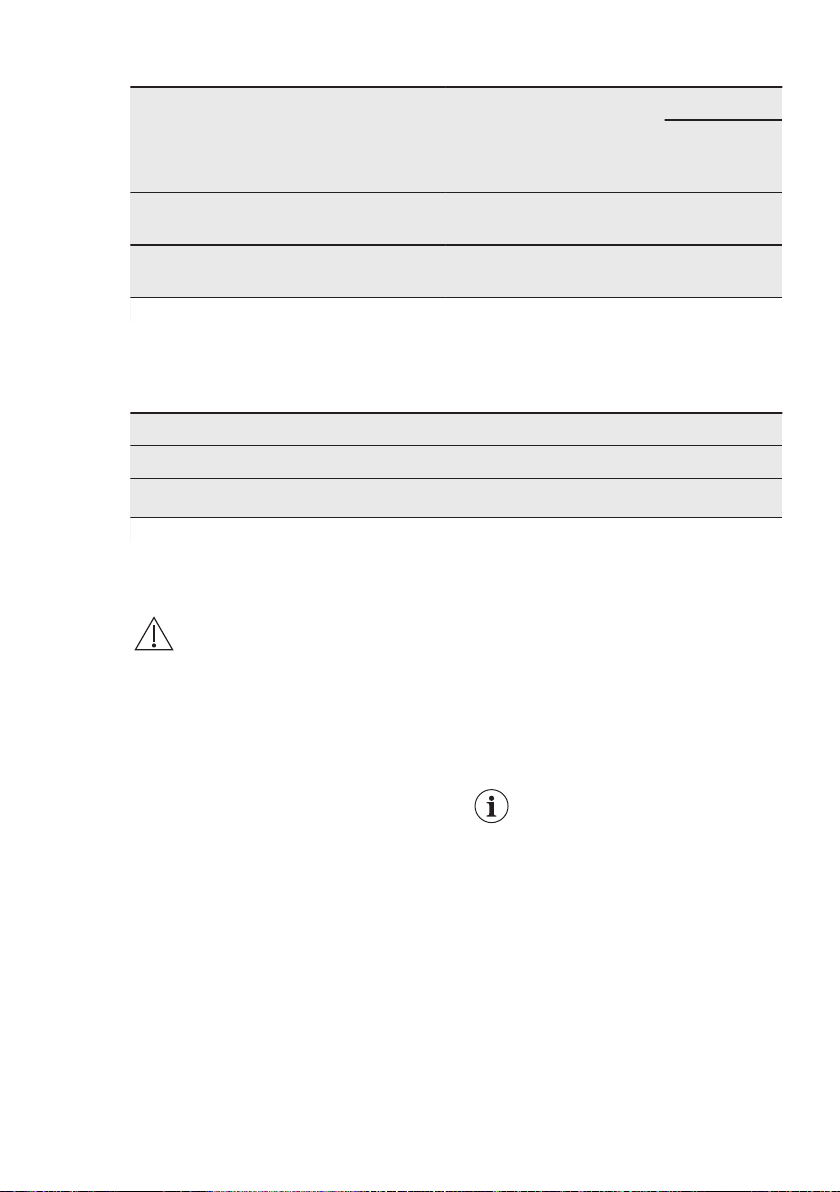
True Fan Cooking 140 25 - 45 1 / 4 1 / 3 /
5
Small cakes (20 per
tray)
True Fan Cooking
150
1)
23 - 40 1 / 4 -
1)
Preheat the oven.
Grilling
Preheat the empty oven for 5 minutes.
Grill with the maximum temperature setting.
Food Function Time (min) Shelf position
Toast Grilling 1 - 3 5
Beef Steak Grilling
24 - 30
1)
4
1)
Turn halfway through.
11. CARE AND CLEANING
WARNING!
Refer to Safety chapters.
11.1 Notes on cleaning
Clean the front of the oven with a soft
cloth with warm water and a mild
cleaning agent.
To clean metal surfaces, use a dedicated
cleaning agent.
Clean the oven interior after each use.
Fat accumulation or other food remains
may result in a fire. The risk is higher for
the grill pan.
Clean all accessories after each use and
let them dry. Use a soft cloth with warm
water and a cleaning agent. Do not clean
the accessories in the dishwasher.
Clean stubborn dirt with a special oven
cleaner.
If you have nonstick accessories, do not
clean them using aggressive agents,
sharp-edged objects or a dishwasher. It
can cause damage to the nonstick
coating.
Clean the moisture from the cavity after
each use.
11.2 Cleaning the cavity
embossment
The cleaning procedure removes
limestone residue from the cavity
embossment after cooking with steam.
For the function: True Fan
Cooking PLUS we
recommend to do the
cleaning procedure at least
every 5 - 10 cooking cycles.
1. Put 250 ml of white vinegar into the
cavity embossment at the bottom of
the oven.
Use maximum 6% vinegar without
any additives.
2. Let the vinegar dissolve the residual
limestone at the ambient
temperature for 30 minutes.
3. Clean the cavity with warm water and
a soft cloth.
ENGLISH
31

11.3 Removing the shelf
supports
To clean the oven, remove the shelf
supports.
CAUTION!
Be careful when you remove
the shelf supports.
1. Pull the front of the shelf support
away from the side wall.
2. Pull the rear end of the shelf support
away from the side wall and remove
it.
2
1
Install the removed accessories in the
opposite sequence.
The retaining pins on the
telescopic runners must
point to the front.
11.4 Pyrolysis
CAUTION!
Do not start the Pyrolysis if
the Plus Steam button is
pressed in.
CAUTION!
Remove all accessories and
removable shelf supports.
Do not start the Pyrolysis if
you did not fully close the
oven door. In some models,
the display shows "C3"
when this error occurs.
WARNING!
The oven becomes very hot.
There is a risk of burns.
CAUTION!
If there are other appliances
installed in the same
cabinet, do not use them
when the Pyrolysis function
operates. It can cause
damage to the appliance.
1. Wipe out the cavity with a wet, soft
cloth.
2. Clean the inner side of the door with
hot water, so that the residues do not
burn from the hot air.
3. Set the Pyrolysis function. Refer to
"Daily use" chapter, "Oven
Functions".
4.
When flashes, turn the knob for
the temperature to set the pyrolysis
duration:
Option Description
P1 Light clean-
ing. Duration:
1 h 30 min.
P2 Normal clean-
ing. Duration:
3 h.
After 2 seconds the pyrolysis starts.
You can use the END function to delay
the start of the cleaning.
During the pyrolysis the oven lamp is off.
5. To change the default length of the
pyrolysis (P1 or P2), press
to set
, and then turn the knob for the
temperature.
6. When the oven is at the set
temperature, the door locks. The
display shows and the bars of the
heat indicator until the door unlocks.
7. When pyrolysis is completed, the
display shows the time of day. The
oven door stays locked.
8. When the oven is cool again, the
door unlocks.
www.aeg.com
32
11.5 Cleaning reminder
To remind you that the pyrolysis is
necessary, PYR flashes in the display for
10 seconds after each activation and
deactivation of the oven.
The cleaning reminder
goes out:
• after the end of the
pyrolysis.
• if you press and
at the same time
while PYR flashes in the
display.
11.6 Removing and installing
the door
You can remove the door and the
internal glass panels to clean it. The
number of glass panels is different for
different models.
WARNING!
The door is heavy.
1. Open the door fully.
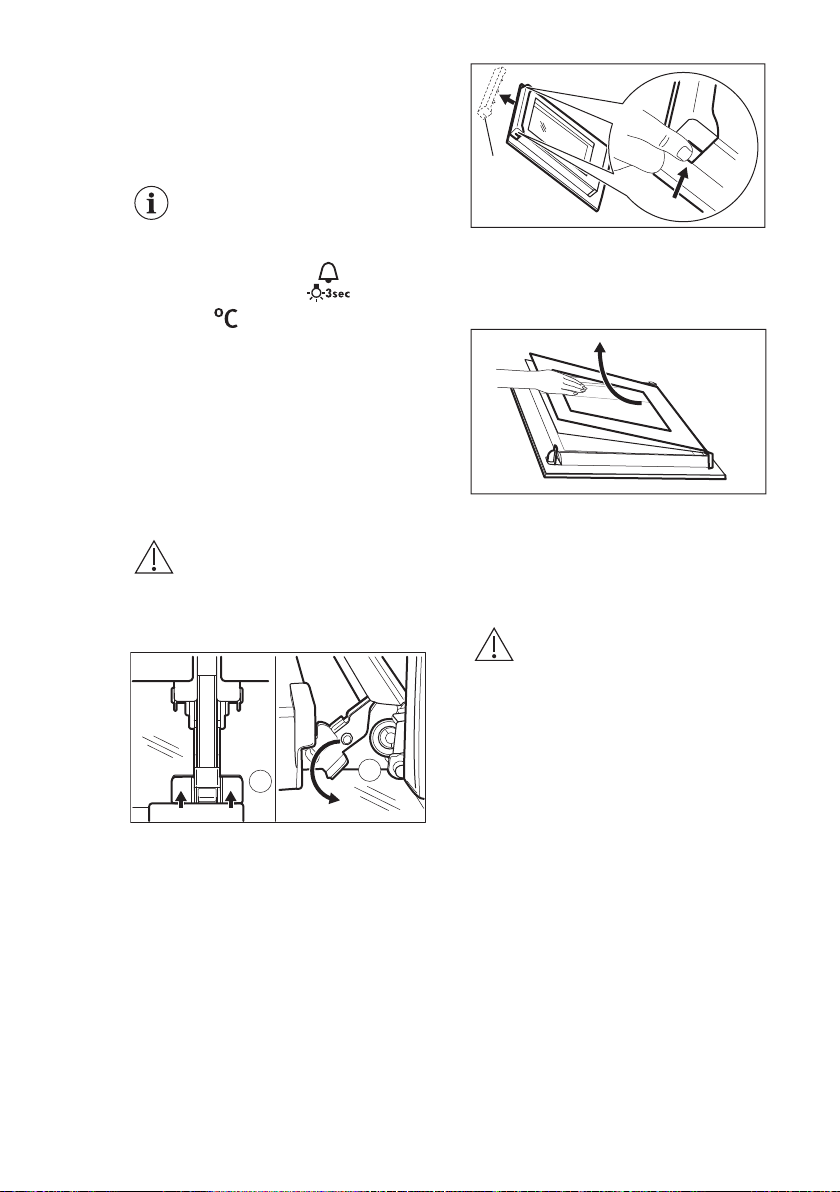
2. Fully press the clamping levers (A) on
the two door hinges.
A
A
3. Close the oven door to the first
opening position (approximately 70°
angle).
4. Hold the door with one hand on each
side and pull it away from the oven at
an upwards angle.
5. Put the door with the outer side
down on a soft cloth on a stable
surface.
6. Hold the door trim (B) on the top
edge of the door at the two sides
and push inwards to release the clip
seal.
1
2
B
7. Pull the door trim to the front to
remove it.
8. Hold the door glass panels on their
top edge one by one and pull them
up out of the guide.
9. Clean the glass panel with water and
soap. Dry the glass panel carefully.
When the cleaning is completed, do the
above steps in the opposite sequence.
Install the smaller panel first, then the
larger and the door.
WARNING!
Make sure that the glasses
are inserted in the correct
position otherwise the
surface of the door may
overheat.
Make sure that you put the glass panels
(C, B and A) back in the correct
sequence. First, insert panel C, which has
a square printed on the left side and a
triangle on the right side. You will also
find those symbols embossed on the
door frame. The triangle symbol on the
glass must match the triangle on the
door frame, and the square symbol must
match the square. After that insert the
other two glass panels.
ENGLISH
33

A B C
11.7 Replacing the lamp
WARNING!
Risk of electric shock.
The lamp can be hot.
1. Turn off the oven.
Wait until the oven is cooled down.
2. Disconnect the oven from the mains.
3. Put a cloth on the bottom of the
cavity.
The top lamp
1. Turn the lamp glass cover to remove
it.
2. Clean the glass cover.
3. Replace the lamp with a suitable 300
°C heat-resistant lamp.
4. Install the glass cover.
12. TROUBLESHOOTING
WARNING!
Refer to Safety chapters.
12.1 What to do if...
Problem Possible cause Remedy
You cannot activate or oper-
ate the oven.
The oven is not connected
to an electrical supply or it is
connected incorrectly.
Check if the oven is correctly
connected to the electrical
supply (refer to the connec-
tion diagram if available).
The oven does not heat up. The oven is deactivated. Activate the oven.
The oven does not heat up. The clock is not set. Set the clock.
The oven does not heat up. The necessary settings are
not set.
Make sure that the settings
are correct.
The oven does not heat up. The automatic switch-off is
activated.
Refer to "Automatic switch-
off".
The oven does not heat up. The Child Lock is on. Refer to "Using the Child
Lock".
www.aeg.com34

Problem Possible cause Remedy
The oven does not heat up. The fuse is blown. Make sure that the fuse is
the cause of the malfunction.
If the fuse is blown again
and again, contact a quali-
fied electrician.
The lamp does not operate. The lamp is defective. Replace the lamp.
The core temperature sensor
does not operate.
The plug of the core tem-
perature sensor is not cor-
rectly installed into the sock-
et.
Put the plug of the core tem-
perature sensor as far as
possible into the socket.
It takes too long to cook the
dishes or they cook too
quickly.
The temperature is too low
or too high.
Adjust the temperature if
necessary. Follow the advice
in the user manual.
Steam and condensation
settle on the food and in the
cavity of the oven.
You left the dish in the oven
for too long.
Do not leave the dishes in
the oven for longer than 15 -
20 minutes after the cooking
process ends.
The display shows "C2". You want to start the Pyroly-
sis or Defrost function, but
you did not remove the core
temperature sensor plug
from the socket.
Remove the core tempera-
ture sensor plug from the
socket.
The display shows "C3". The cleaning function does
not operate. You did not
fully close the door, or the
door lock is defective.
Fully close the door.
The display shows "F102". • You did not fully close
the door.
• The door lock is defec-
tive.
• Fully close the door.
• Deactivate the oven with
the house fuse or the
safety switch in the fuse
box and activate it again.
• If the display shows
"F102" again, contact the
Customer Care Depart-
ment.
The display shows an error
code that is not in this table.
There is an electrical fault. • Deactivate the oven with
the house fuse or the
safety switch in the fuse
box and activate it again.
• If the display shows the
error code again, contact
the Customer Care De-
partment.
ENGLISH 35

Problem Possible cause Remedy
There is no good cooking
performance using the func-
tion: True Fan Cooking
PLUS.
You did not turn on the func-
tion: True Fan Cooking
PLUS.
Refer to "Activating the
function: True Fan Cooking
PLUS".
There is no good cooking
performance using the func-
tion: True Fan Cooking
PLUS.
You did not turn on correctly
the function: True Fan Cook-
ing PLUSwith the Plus Steam
button.
Refer to "Activating the
function: True Fan Cooking
PLUS".
There is no good cooking
performance using the func-
tion: True Fan Cooking
PLUS.
You did not fill the cavity
embossment with water.
Refer to "Activating the
function: True Fan Cooking
PLUS".
You want to activate the
True Fan Cooking function,
but the indicator of the Plus
Steam button is on.
The True Fan Cooking PLUS
function operates.
Push the Plus Steam button
to stop the True Fan
Cooking PLUS function.
You want to activate the
cleaning function, but the
display shows "C4".
The Plus Steam button is
pressed in.
Press the Plus Steam button
again.
The water in the cavity em-
bossment does not boil.
The temperature is too low. Set the temperature at least
to 110 °C.
Refer to "Hints and tips"
chapter.
The water comes out of the
cavity embossment.
There is too much water in
the cavity embossment.
Deactivate the oven and
make sure that the appliance
is cold. Wipe the water with
a cloth or sponge. Add the
correct amount of water to
the cavity embossment. Re-
fer to the specific procedure.
www.aeg.com36
Problem Possible cause Remedy
The appliance is activated
and does not heat up. The
fan does not operate. The
display shows "Demo".
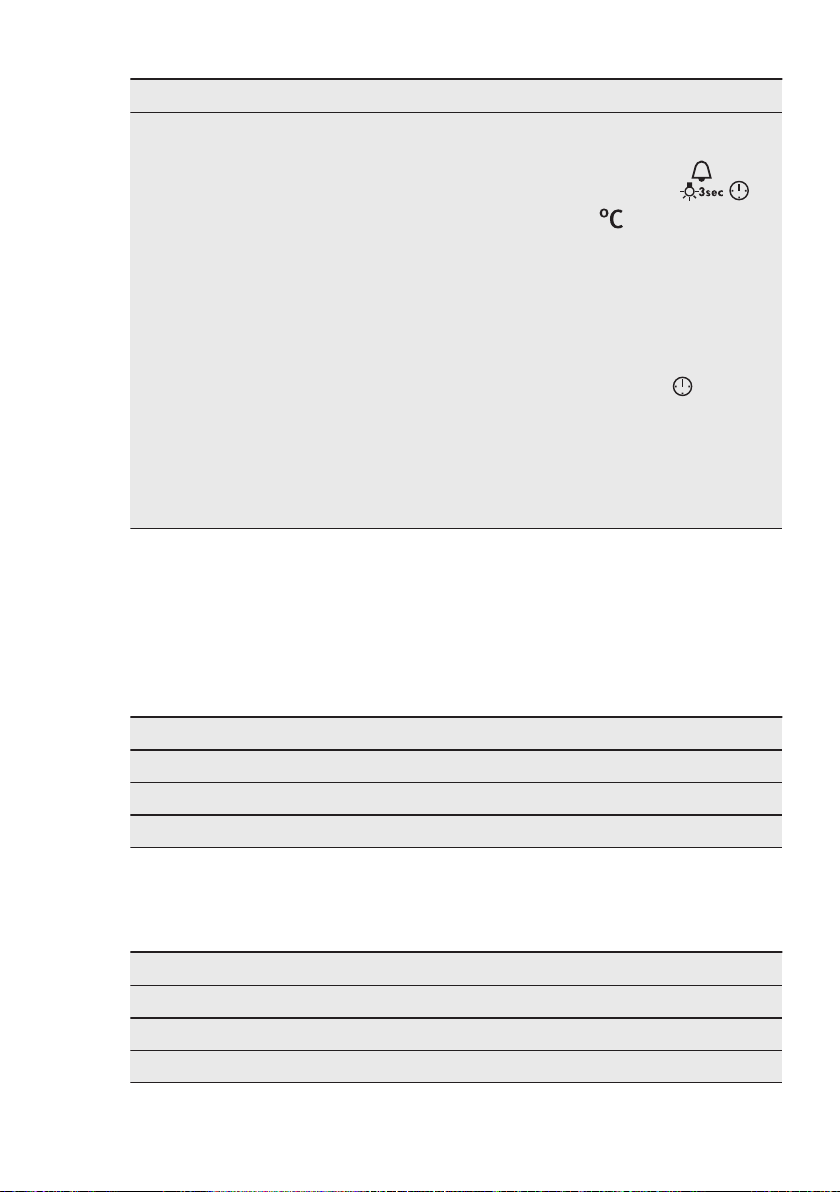
The demo mode is activa-
ted.
1. Deactivate the oven.
2. Press and hold at the
same time
.
3. The first digit on the dis-
play and Demo indicator
start to blink.
4. Enter the code 2468 by
turning the knob for the
temperature right or left
to change the values
and press
to confirm.
5. The next digit starts to
blink.
6. Demo mode deactivates
when you confirm the
last digit and the code is
correct.
12.2 Service data
If you cannot find a solution to the
problem yourself, contact your dealer or
an Authorised Service Centre.
The necessary data for the service centre
is on the rating plate. The rating plate is
on the front frame of the oven cavity. Do
not remove the rating plate from the
oven cavity.
We recommend that you write the data here:
Model (MOD.) .........................................
Product number (PNC) .........................................
Serial number (S.N.) .........................................
13. ENERGY EFFICIENCY
13.1 Product Fiche and information according to EU 65-66/2014
Supplier's name AEG
Model identification BPK556320M
Energy Efficiency Index 81.2
Energy efficiency class A+
ENGLISH 37

Energy consumption with a standard load, conven-
tional mode
1.09 kWh/cycle
Energy consumption with a standard load, fan-forced
mode
0.69 kWh/cycle
Number of cavities 1
Heat source Electricity
Volume 71 l
Type of oven Built-In Oven
Mass 36.5 kg
EN 60350-1 - Household electric cooking
appliances - Part 1: Ranges, ovens, steam
ovens and grills - Methods for measuring
performance.
13.2 Energy saving
The oven contains features
which help you save energy
during everyday cooking.
General hints
Make sure that the oven door is closed
properly when the oven operates. Do not
open the door too often during cooking.
Keep the door gasket clean and make
sure it is well fixed in its position.
Use metal dishes to improve energy
saving.
When possible, do not preheat the oven
before you put the food inside.
When the cooking duration is longer
than 30 minutes, reduce the oven
temperature to minimum 3 - 10 minutes
before the end of the cooking time,
depending on the duration of the
cooking. The residual heat inside the
oven will continue to cook.
Use the residual heat to warm up other
dishes.
Keep breaks between baking as short as
possible when you prepare few dishes at
one time.
Cooking with fan
When possible, use the cooking
functions with fan to save energy.
Residual heat
If a programme with the Duration or End
Time selection is activated and the
cooking time is longer than 30 minutes,
the heating elements automatically
deactivate earlier in some oven
functions.
The fan and lamp continue to operate.
Keep food warm
Choose the lowest possible temperature
setting to use residual heat and keep a
meal warm. The residual heat indicator
or temperature appears on the display.
Cooking with the lamp off
Turn off the lamp during cooking. Turn it
on only when you need it.
Moist Fan Baking
Function designed to save energy during
cooking.
When you use this function the lamp
automatically turns off after 30 seconds.
14.
SAUDI ARABIA - CUSTOMER SERVICE
Further after-sales service agencies
overseas
In these countries our respective agents’
own guarantee conditions are
applicable. Please obtain further details
directly.
Awad Badi Nahas Trading Co. Ltd.
Address:
www.aeg.com38

RAWDAH DISTRICT, BEHIND SARI ST.,
JEDDAH P.O. BOX 11529 JEDDAH
21463
Kingdom of Saudi Arabia
Contact numbers:
Tel: +966 2 2560888/+966 2 2561333
Fax: +966 2 2560555
Customer Service (Maintenance &
Spare Parts)
Tel: +966 2 920003240
E-mail: [email protected]
Website: www.awadnahas.com
http://www.facebook.com/
awadbadinahas
http://twitter.com/awadbadinahas
Alia Trading Establishment
P.O.BOX: 4101
Riyadh: 11491
Showroom tel: 00966 1 464 5977
Service Center tel: 00966 1 463 1957
Fax: 00966 1 465 8103
Riyadh — Olaya
Makkah Road
Saudi Arabia
15. ENVIRONMENTAL CONCERNS
Recycle materials with the symbol .
Put the packaging in relevant containers
to recycle it. Help protect the
environment and human health by
recycling waste of electrical and
electronic appliances. Do not dispose of
appliances marked with the symbol
with the household waste. Return the
product to your local recycling facility or
contact your municipal office.
*
ENGLISH
39

www.aeg.com/shop
867343286-B-282018
0016