EN
W415-1335 / B / 10.04.16
FR
PG
61
INSTALLER: LEAVE THIS MANUAL WITH THE APPLIANCE.
CONSUMER: RETAIN THIS MANUAL FOR FUTURE REFERENCE.
NEVER LEAVE CHILDREN OR OTHER AT RISK INDIVIDUALS ALONE WITH THE APPLIANCE
INSTALLATION AND
OPERATING INSTRUCTIONS
Wolf Steel Ltd., 24 Napoleon Rd., Barrie, ON, L4M 0G8 Canada /
103 Miller Drive, Crittenden, Kentucky, USA, 41030
Phone (705)721-1212 • Fax (705)720-9081 • www.napoleonfi replaces.com • [email protected]
1.28F
$10.00
HOT GLASS WILL CAUSE
BURNS.
DO NOT TOUCH GLASS UNTIL
COOLED.
NEVER ALLOW CHILDREN TO
TOUCH GLASS.
!
DANGER
A barrier designed to reduce the risk of burns from
the hot viewing glass is provided with this appliance
and shall be installed for the protection of children
and other at-risk individuals.
SAFETY INFORMATION
!
WARNING
- Do not store or use gasoline or other fl ammable
vapors and liquids in the vicinity of this or any
other appliance.
- WHAT TO DO IF YOU SMELL GAS:
• Do not try to light any appliance.
• Do not touch any electrical switch; do not use
any phone in your building.
• Immediately call your gas supplier from a
neighbour’s phone. Follow the gas supplier’s
instructions.
• If you cannot reach your gas supplier, call the
fi re department.
- Installation and service must be performed by a
qualifi ed installer, service agency or the supplier.
This appliance may be installed in an aftermarket,
permanently located, manufactured home (USA
only) or mobile home, where not prohibited by
local codes.
This appliance is only for use with the type of gas
indicated on the rating plate. This appliance is
not convertible for use with other gases, unless a
certifi ed kit is used.
If the information in these instructions
are not followed exactly, a fi re or
explosion may result causing property
damage, personal injury or loss of life.
CERTIFIED FOR CANADA AND UNITED STATES USING ANSI/CSA METHODS.
Decorative Product: Not for use as a heating appliance.
LHD45N
NATURAL GAS
LHD45P
PROPANE
SAFETY BARRIER
CONFORMS TO AMERICAN NATIONAL STANDARDS: ANSI Z21.50, CERTIFIED TO CANADIAN CSA 2.22 FOR VENTED GAS FIREPLACES.

2
W415-1335 / B / 10.04.16
EN
NOTE: Changes, other than editorial, are denoted by a vertical line in the margin.
TABLE OF CONTENTS
1.0 INSTALLATION OVERVIEW 3
2.0 INTRODUCTION 4
2.1 DIMENSIONS 5
2.2 GENERAL INSTRUCTIONS 6
2.3 GENERAL INFORMATION 7
2.4 RATING PLATE INFORMATION 8
3.0 VENTING 8
3.1 VENTING LENGTHS AND COMPONENTS FOR DIRECT VENT INSTALLATIONS 9
3.2 TYPICAL VENT INSTALLATIONS 10
3.3 SPECIAL VENT INSTALLATIONS 11
3.3.1 PERISCOPE TERMINATION 11
3.3.2 CORNER TERMINATION 11
3.4 VENT TERMINAL CLEARANCES 12
3.5 VENT APPLICATION FLOW CHART 13
3.6 DEFINITIONS 13
3.7 ELBOW VENT LENGTH VALUES 13
3.8 HORIZONTAL TERMINATION 14
3.9 VERTICAL TERMINATION 16
3.10 VERTICAL THROUGH EXISTING CHIMNEY 18
3.11 VENT HEAT SHIELD INSTALLATION 19
4.0 INSTALLATION 20
4.1 WALL AND CEILING PROTECTION 20
4.1.1 HORIZONTAL INSTALLATION 21
4.1.2 VERTICAL INSTALLATION 21
4.2 USING RIGID VENT COMPONENTS 22
4.3 HORIZONTAL AIR TERMINAL INSTALLATION 22
4.4 EXTENDED HORIZONTAL AND CORNER TERMINAL INSTALLATION 23
4.5 VERTICAL AIR TERMINAL INSTALLATION 23
4.6 USING FLEXIBLE VENTING 24
4.7 MOBILE HOME INSTALLATION 24
4.8 REMOTE RECEIVER PLACEMENT 24
4.9 GAS INSTALLATION 25
4.10 INSTALLING NON-COMBUSTIBLE BOARD 26
5.0 FRAMING 27
5.1 MINIMUM CLEARANCE TO COMBUSTIBLE ENCLOSURES 30
5.2 ALCOVE ENCLOSURE 32
5.3 MINIMUM COMBUSTIBLE MANTEL CLEARANCES 32
5.4 MINIMUM NON-COMBUSTIBLE PROTRUSION 33
5.5 NON-COMBUSTIBLE FACING MATERIAL 33
6.0 FINISHING 34
6.1 SAFETY SCREEN AND DOOR REMOVAL / INSTALLATION 34
6.2 BATTERY HOUSING INSTALLATION 35
6.3 LOGO PLACEMENT 35
6.4 TRIM INSTALLATION 35
6.5 GLASS EMBERS 36
6.6 OPTIONAL ROCK PLACEMENT 37
7.0 OPTIONAL BLOWER INSTALLATION 38
7.1 ACCESSING THE BLOWER 38
7.1.1 BURNER REMOVAL 38
7.1.2 VALVE TRAIN ASSEMBLY 39
7.2 INSTALLING THE BLOWER 40
8.0 ELECTRICAL CONNECTION 41
8.1 HARD WIRING CONNECTION 42
8.2 RECEPTACLE WIRING DIAGRAM 42
8.3 WIRING DIAGRAM 43
9.0 OPERATING INSTRUCTIONS 44
9.1 OPERATING INSTRUCTIONS - FOR YOUR SAFETY READ BEFORE OPERATING 44
9.2 LIGHTING INSTRUCTIONS 44
9.3 ANTI CONDENSATION SWITCH (OPTIONAL) 45
10.0 ADJUSTMENT 45
10.1 PILOT BURNER ADJUSTMENT 45
10.2 VENTURI ADJUSTMENT 46
10.3 FLAME CHARACTERISTICS 46
10.4 RESTRICTING VERTICAL VENTS 47
11.0 MAINTENANCE 47
11.1 ANNUAL MAINTENANCE 48
11.2 GLASS / DOOR REPLACEMENT 48
11.3 CARE OF GLASS 49
11.4 CARE OF PLATED PARTS 49
11.5 VALVE REMOVAL 49
12.0 REPLACEMENTS 50
13.0 OVERVIEW 51
14.0 ACCESSORIES 52
15.0 VALVE TRAIN ASSEMBLY 54
16.0 TROUBLESHOOTING 55
17.0 WARRANTY 57
18.0 NOTES 58
19.0 SERVICE HISTORY 59
NOTE: The camera icon indicates video tutorials are available as additional reference, visit
http://mynapoleon.napoleonproducts.com/download/index/44/1
3
W415-1335 / B / 10.04.16
EN
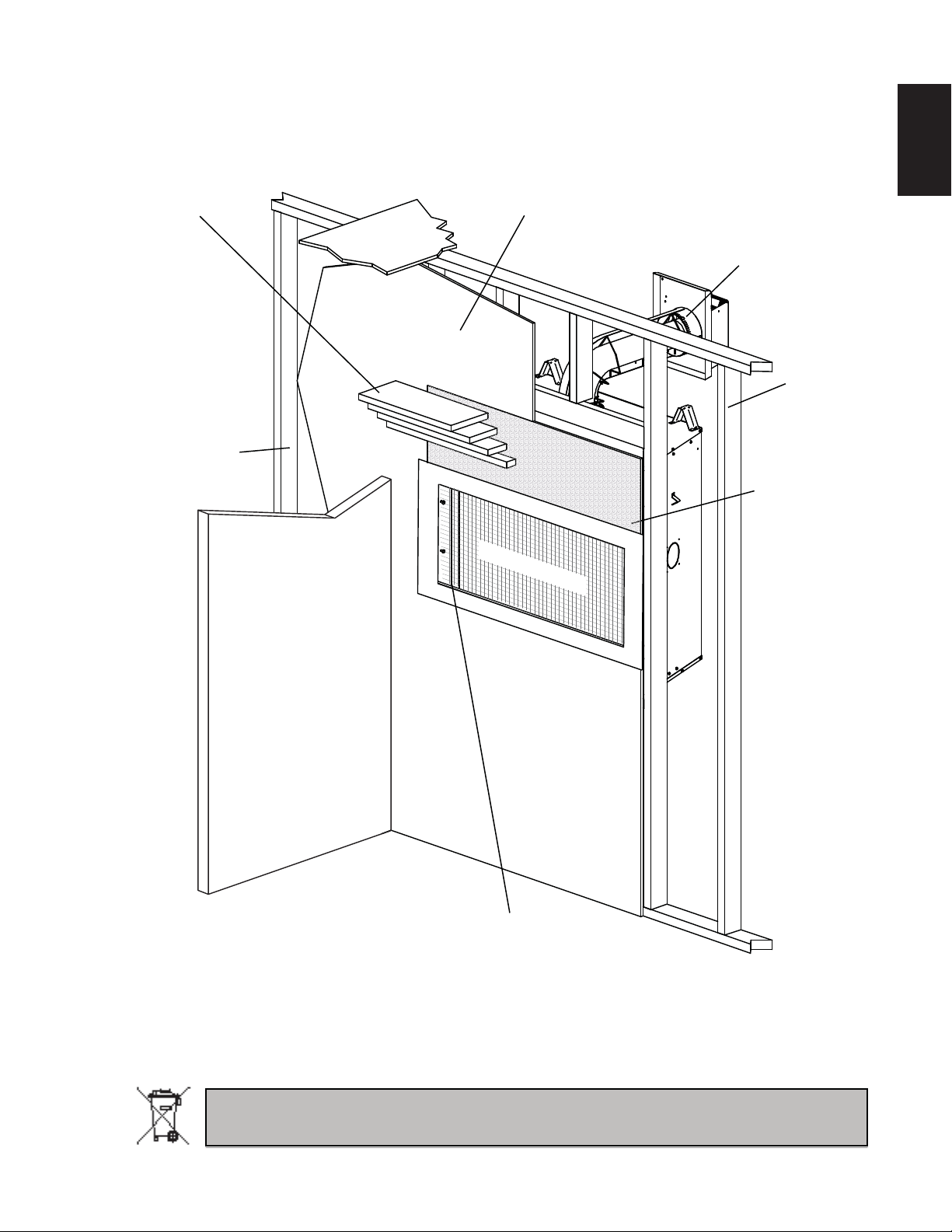
1.0 INSTALLATION OVERVIEW
Mantel, see
“MINIMUM
MANTEL
CLEARANCES”
section.
Enclosures, see the section “MINIMUM
CLEARANCES TO COMBUSTIBLE
ENCLOSURES” section for drywall (or
other combustible material).
Framing, see
“FRAMING”
section.
Side Wall
Venting, see
“VENTING” section.
Framing, see
“FRAMING”
section.
Enclosures, see
the section
“MINIMUM
CLEARANCE TO
COMBUSTIBLE
ENCLOSURES”
section for
non-combustible
materials such as
tile, marble,
granite, etc.
Rating plate, see “RATING
PLATE INFORMATION”
section.
SAFETY BARRIER
Batteries must be disposed of according to the local laws and regulations. Some batteries may be
recycled, and may be accepted for disposal at your local recycling center. Check with your municipality
for recycling instructions.

4
W415-1335 / B / 10.04.16
EN
3.2C
!
WARNING
• THIS APPLIANCE IS HOT WHEN OPERATED AND CAN CAUSE SEVERE BURNS IF CONTACTED.
• ANY CHANGES OR ALTERATIONS TO THIS APPLIANCE OR ITS CONTROLS CAN BE DANGEROUS AND IS
PROHIBITED.
• Do not operate appliance before reading and understanding operating instructions. Failure to operate appliance
according to operating instructions could cause fi re or injury.
• Risk of fi re or asphyxiation do not operate appliance with fi xed glass removed.
• Do not connect 110 volts to the control valve.
• Risk of burns. The appliance should be turned off and cooled before servicing.
• Do not install damaged, incomplete or substitute components.
• Risk of cuts and abrasions. Wear protective gloves and safety glasses during installation. Sheet metal edges may
be sharp.
• Do not burn wood or other materials in this appliance.
• Children and adults should be alerted to the hazards of high surface temperature and should stay away to
avoid burns or clothing ignition.
• Young children should be carefully supervised when they are in the same room as the appliance.
Toddlers, young children and others may be susceptible to accidental contact burns. A physical barrier
is recommended if there are at risk individuals in the house. To restrict access to an appliance, install an
adjustable safety gate to keep toddlers, young children and other at risk individuals out of the room and
away from hot surfaces.
• Clothing or other fl ammable material should not be placed on or near the appliance.
• Due to high temperatures, the appliance should be located out of traffi c and away from furniture and
draperies.
• Ensure you have incorporated adequate safety measure to protect infants/toddlers from touching hot surfaces.
• Even after the appliance is out, the glass and/or screen will remain hot for an extended period of time.
• Check with your local hearth specialty dealer for safety screens and hearth guards to protect children from hot
surfaces. These screens and guards must be fastened to the fl oor.
• Any safety screen, guard or barrier removed for servicing the appliance, must be replaced prior to operating
the appliance.
• The appliance is a vented gas-fi red appliance. Do not burn wood or other materials in the appliance
• It is imperative that the control compartments, burners and circulating blower and its passageway in the appliance
and venting system are kept clean. The appliance and its venting system should be inspected before use and at
least annually by a qualifi ed service person. More frequent cleaning may be required due to excessive lint from
carpeting, bedding material, etc. The appliance area must be kept clear and free from combustible materials,
gasoline and other fl ammable vapors and liquids.
• Under no circumstances should this appliance be modifi ed.
• This appliance must not be connected to a chimney fl ue pipe serving a separate solid fuel burning appliance.
• Do not use this appliance if any part has been under water. Immediately call a qualifi ed service technician to
inspect the appliance and to replace any part of the control system and any gas control which has been under
water.
• Do not operate the appliance with the glass door removed, cracked or broken. Replacement of the glass should be
done by a licensed or qualifi ed service person.
• Do not strike or slam shut the appliance glass door.
• When equipped with pressure relief doors, they must be kept closed while the appliance is operating to prevent
exhaust fumes containing carbon monoxide, from entering into the home. Temperatures of the exhaust escaping
through these openings can also cause the surrounding combustible materials to overheat and catch fi re.
• Only doors / optional fronts certifi ed with the appliance are to be installed on the appliance.
• Keep the packaging material out of reach of children and dispose of the material in a safe manner. As with all
plastic bags, these are not toys and should be kept away from children and infants.
• As with any combustion appliance, we recommend having your appliance regularly inspected and serviced as well
as having a Carbon Monoxide Detector installed in the same area to defend you and your family against Carbon
Monoxide.
• Ensure clearances to combustibles are maintained when building a mantel or shelves above the appliance.
Elevated temperatures on the wall or in the air above the appliance can cause melting, discolouration or damage of
decorations, a T.V. or other electronic components.
• A barrier designed to reduce the risk of burns from the hot viewing glass is provided with this appliance and
shall be installed.
• If the barrier becomes damaged, the barrier shall be replaced with the manufacturer’s barrier for this
appliance.
• Installation and repair should be done by a qualifi ed service person. The appliance should be inspected
before use and at least annually by a professional service person. More frequent cleaning may be required
due to excessive lint from carpeting, bedding material, etc. It is imperative that control compartments,
burners and circulating air passageways of the appliance be kept clean.
2.0 INTRODUCTION
5
W415-1335 / B / 10.04.16
EN
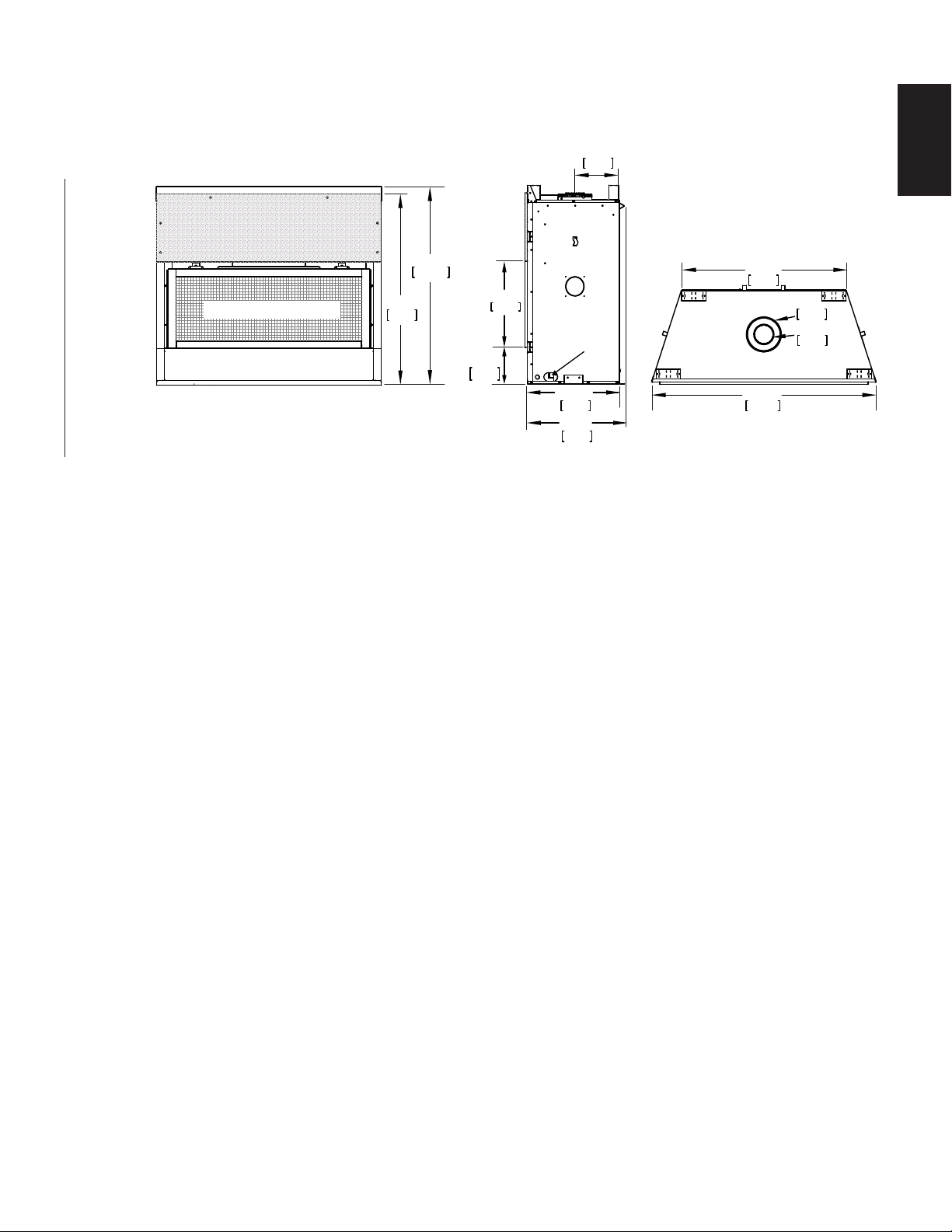
39 5/16"
99.9cm
40 13/16"
1.036 m
GAS INLET
10 1/8"
25.7cm
19 7/8"
50.5cm
18 7/8"
47.9cm
46 1/4"
1.175 m
34 1/16"
86.5cm
Ø
7"
17.8cm
Ø
4"
10.2cm
17 13/16"
45.2cm
7 1/2"
19.1cm
SAFETY BARRIER
2.1 DIMENSIONS
6
W415-1335 / B / 10.04.16
EN
4.1C
THIS GAS APPLIANCE SHOULD BE INSTALLED AND SERVICED BY A QUALIFIED INSTALLER to
conform with local codes. Installation practices vary from region to region and it is important to know the
specifi cs that apply to your area, for example in Massachusetts State:
• This product must be installed by a licensed plumber or gas fi tter when installed within the
commonwealth of Massachusetts.
• The appliance damper must be removed or welded in the open position prior to installation of an
appliance insert or gas log.
• The appliance off valve must be a “T” handle gas cock.
• The fl exible connector must not be longer than 3 feet (0.9m).
• A Carbon Monoxide detector is required in all rooms containing gas fi red appliances.
• The appliance is not approved for installation in a bedroom or bathroom unless the unit is a direct vent
sealed combustion product.
The installation must conform with local codes or, in
absence of local codes, the National Gas and Propane
Installation Code CSA B149.1 in Canada, or the National
Fuel Gas Code, ANSI Z223.1 / NFPA 54 in the United
States. Suitable for mobile home installation if installed
in accordance with the current standard CAN/CSA
Z240MH Series, for gas equipped mobile homes, in
Canada or ANSI Z223.1 and NFPA 54 in the United
States.
A
s long as the required clearance to combustibles is
maintained, the most desirable and benefi cial location for an appliance is in the center of a building, thereby
allowing the most effi cient use of the heat created. The location of windows, doors and the traffi c fl ow in the
room where the appliance is to be located should be considered. If possible, you should choose a location
where the vent will pass through the house without cutting a fl oor or roof joist.
If the appliance is installed directly on carpeting, vinyl tile or other combustible material other than wood
fl ooring, the appliance shall be installed on a metal or wood panel extending the full width and depth.
Some appliances have optional fans or blowers. If an optional fan or blower is installed, the junction box must
be electrically connected and grounded in accordance with local codes, use the current CSA C22.1 Canadian
Electrical Code in Canada or the ANSI/NFPA 70 National Electrical code in the United States.
We suggest that our gas
hearth products be installed
and serviced by professionals
who are certied in the U.S.
by the National Fireplace
Institute
®
(NFI) as NFI Gas
Specialists
www.ncertied.org
ALWAYS LIGHT THE PILOT WHETHER FOR THE FIRST TIME OR IF THE GAS SUPPLY HAS RUN OUT,
WITH THE GLASS DOOR OPENED OR REMOVED.
PROVIDE ADEQUATE CLEARANCE FOR SERVICING AND OPERATING THE APPLIANCE.
PROVIDE ADEQUATE VENTILATION.
NEVER OBSTRUCT THE FRONT OPENING OF THE APPLIANCE.
OBJECTS PLACED IN FRONT OF THE APPLIANCE MUST BE KEPT A MINIMUM OF 4 FEET (1.2m)
FROM THE FRONT FACE OF THE APPLIANCE.
SURFACES AROUND AND ESPECIALLY ABOVE THE APPLIANCE CAN BECOME HOT. AVOID CONTACT
WHEN THE APPLIANCE IS OPERATING.
FIRE RISK. EXPLOSION HAZARD.
HIGH PRESSURE WILL DAMAGE VALVE. DISCONNECT GAS SUPPLY PIPING BEFORE PRESSURE TESTING GAS
LINE AT TEST PRESSURES ABOVE 1/2 PSIG. CLOSE THE MANUAL SHUT-OFF VALVE BEFORE PRESSURE
TESTING GAS LINE AT TEST PRESSURES EQUAL TO OR LESS THAN 1/2 PSIG (35mb).
USE ONLY WOLF STEEL APPROVED OPTIONAL ACCESSORIES AND REPLACEMENT PARTS WITH THIS APPLIANCE.
USING NON-LISTED ACCESSORIES (BLOWERS, DOORS, LOUVRES, TRIMS, GAS COMPONENTS, VENTING
COMPONENTS, ETC.) COULD RESULT IN A SAFETY HAZARD AND WILL VOID THE WARRANTY AND CERTIFICATION.
THE APPLIANCE MUST NOT BE OPERATED AT TEMPERATURES BELOW FREEZING (32°F / 0°C).
ALLOW THE APPLIANCE TO WARM TO ABOVE FREEZING PRIOR TO OPERATION.
!
WARNING
2.2 GENERAL INSTRUCTIONS
7
W415-1335 / B / 10.04.16
EN
2.3 GENERAL INFORMATION
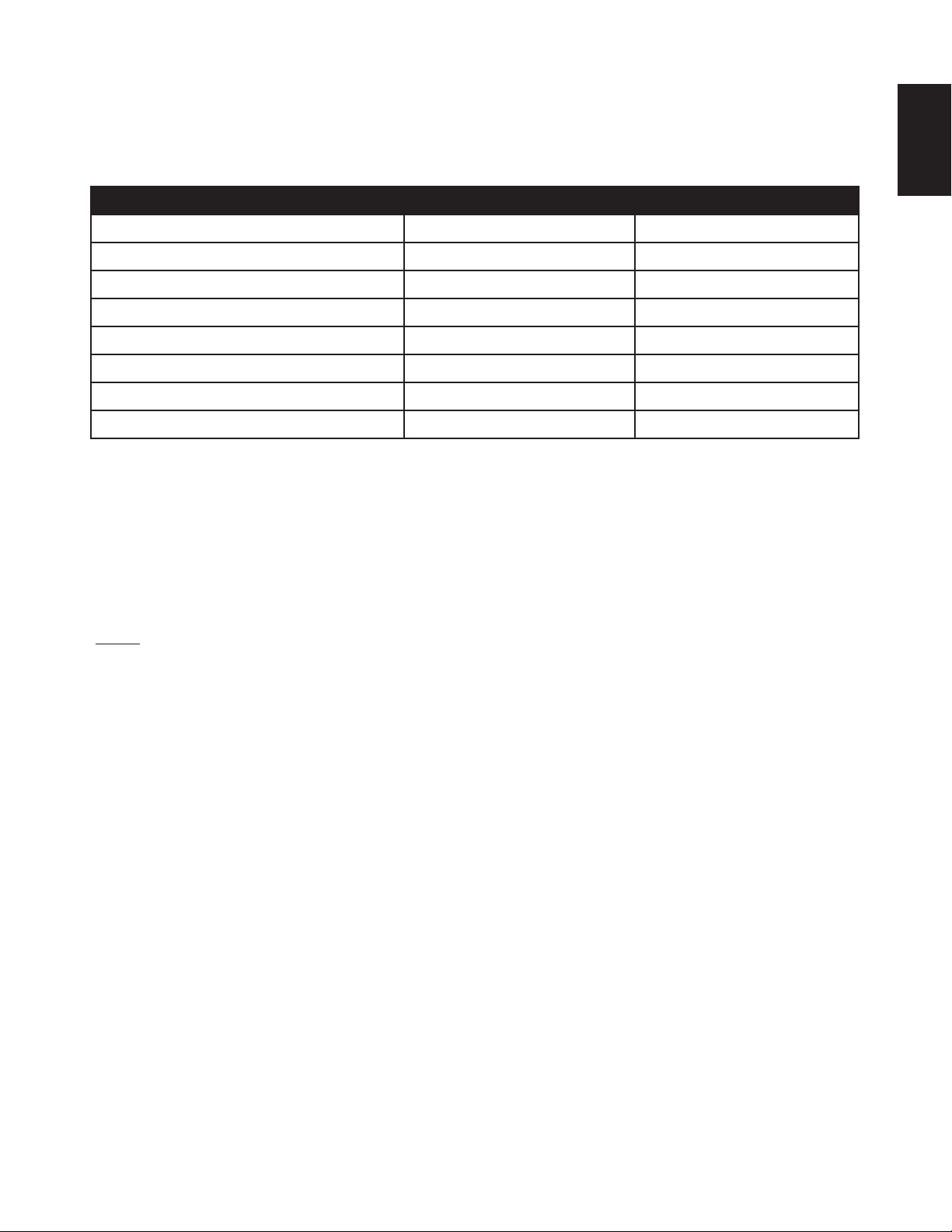
RATES AND EFFICIENCIES
NG LP
Altitude (FT) 0-4,500 0-4500
Max. Input (BTU/HR) 24,000 24,000
Max. Output Steady State (BTU/HR) 17,280 17,280
Effi ciency (w/the fan on) 72% 72%
Min. Inlet Gas Supply Pressure 4.5" WC (11mb) 11" WC (27mb)
Max. Inlet Gas Supply Pressure 7" WC (17mb) 13" WC (32mb)
Manifold Pressure (Under Flow Conditions) 3.5" WC (9mb) 10" WC (25mb)
FOR YOUR SATISFACTION, THIS APPLIANCE HAS BEEN TEST-FIRED TO ASSURE ITS OPERATION AND
QUALITY!
When the appliance is installed at elevations above 4,500ft (1372m), and in the absence of specifi c recommendations
from the local authority having jurisdiction, the certifi ed high altitude input rating shall be reduced at the rate of 4% for
each additional 1,000ft (305m).
This appliance is approved for bathroom, bedroom and bed-sitting room installations and is certifi ed for mobile home
installation.
This appliance is only for use with the type of gas indicated on the rating plate. This appliance is not convertible
for use with other gases, unless a certifi ed kit is used.
Expansion / contraction noises during heating up and cooling down cycles are normal and are to be expected.
NOTE: The protective wrap on plated parts is best removed when the assembly is at room temperature but this
can be improved if the assembly is warmed, using a hair dryer or similar heat source.
A barrier designed to reduce the risk of burns from the hot viewing glass is provided with the appliance
and shall be installed.
8
W415-1335 / B / 10.04.16
EN
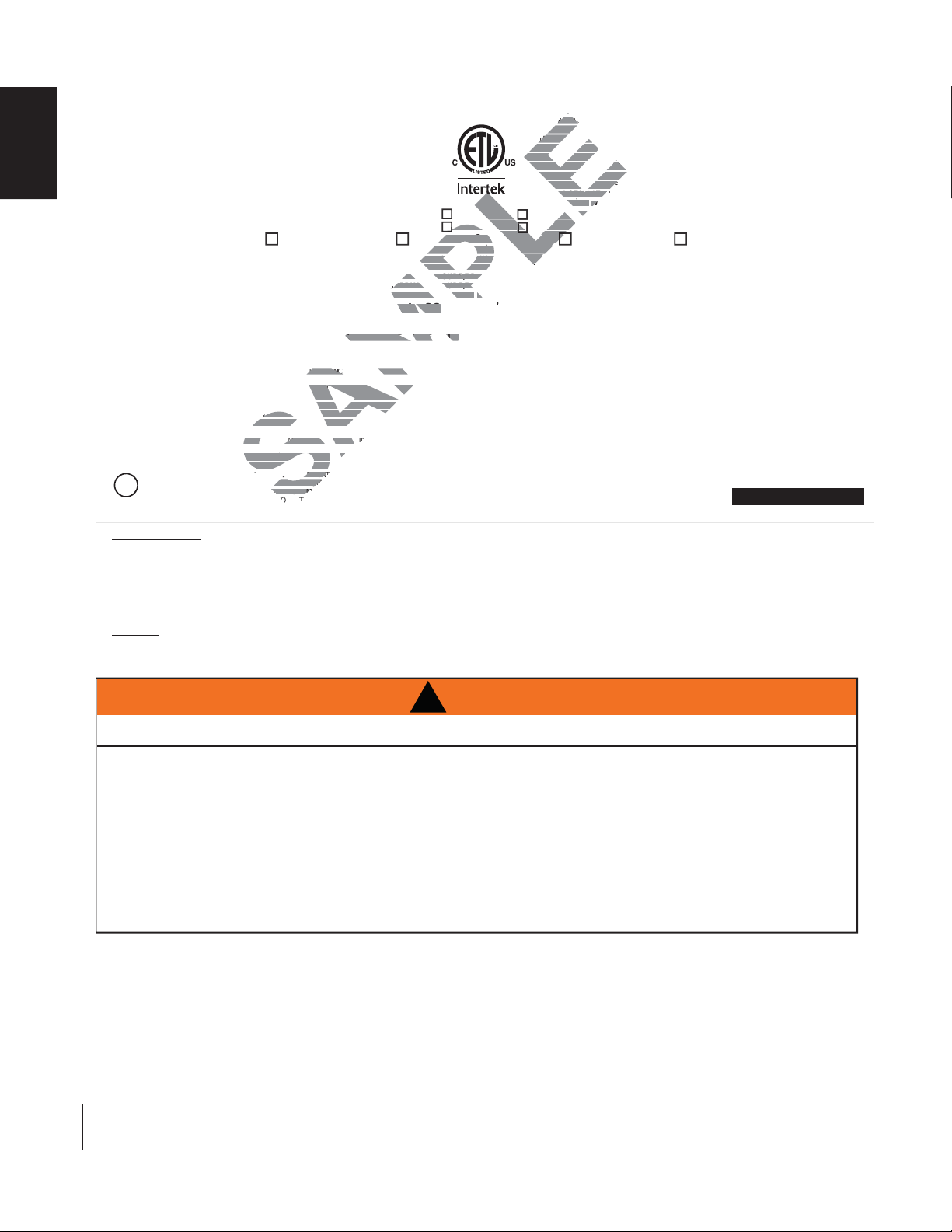
INSTALLER: It is your responsibility to check off the appropriate box on the rating plate according to
the model, venting and gas type of the appliance.
For rating plate location, see “INSTALLATION OVERVIEW” section.
This illustration is for reference only. Refer to the rating plate on the appliance for accurate information.
NOTE: The rating plate must remain with the appliance at all times. It must not be removed.
W385-1967
DIRECT VENT GAS FIREPLACE. APPROVED FOR BEDROOM, BATHROOM AND BED-SITTING ROOM
INSTALLATION. SUITABLE FOR MOBILE HOME INSTALLATION IF INSTALLED IN ACCORDANCE WITH
THE CURRENT STANDARD CAN/CSA Z240MH SERIES GAS EQUIPPED MOBILE HOMES, IN
CANADA OR IN THE UNITED STATES THE MANUFACTURED HOME CONSTRUCTION AND
SAFETY STANDARD, TITLE 24 CFR, PART 3280. WHEN THIS US STANDARD IS NOT
APPLICABLE USE THE STANDARD FOR FIRE SAFETY CRITERIA FOR MANUFACTURED HOME
INSTALLATIONS, SITES AND COMMUNITIES, ANSI / NFPA 501A. THIS APPLIANCE MUST BE
INSTALLED IN ACCORDANCE WITH LOCAL CODES, IF ANY; IF NONE, FOLLOW THE CURRENT
ANSI Z223.1, OR CSA B149, INSTALLATION CODES.
FOR USE WITH BARRIER W565-0138.
FOLLOW THE INSTALLATION INSTRUCTIONS LOCATED IN THE INSTALLATION MANUAL.
FOYER À GAZ VENTILÉ. HOMOLOGUÉ POUR INSTALLATION DANS UNE CHAMBRE À COUCHER, UNE
SALLE DE BAIN ET UN STUDIO. APPROPRIÉ POUR INSTALLATION DANS UNE MAISON MOBILE SI
SON INSTALLATION CONFORME AUX EXIGENCES DE LA NORME CAN/CSA Z240MH SÉRIE DE
MAISONS MOBILES ÉQUIPÉES AU GAZ, EN VIGUEUR AU CANADA OU AUX ÉTATS-UNIS DE LA
NORME DE SECURITÉ ET DE CONSTRUCTION DE MAISONS MANUFACTURÉES, TITRE 24
CFR, SECTION 3280. DANS LE CAS OU CETTE NORME D'ÉTATS-UNIS NE PEUT ÊTRE
APPLIQUÉE, SE RÉFÉRER A LA NORME RELATIVE AU CRITÈRE DE MESURES DE SÉCURITÉ
CONTRE L'INCENDIE POUR LES INSTALLATIONS DANS LES MAISONS MANUFACTURÉS, LES
SITES ET LES COMMUNAUTÉS, ANSI/NFPA 501A. CODES. INSTALLER L’APPAREIL SELON LES
CODES OU RÈGLEMENTS LOCAUX, OU EN L’ABSENCE DE TELS RÈGLEMENTS, SELON LES
CODES D’INSTALLATION ANSI Z223.1 OU CSA-B149 EN VIGUER.
POUR UNE UTILISER AVEC
BARRIÈRE
W565-0138
. SUIVEZ LES INSTRUCTIONS D'INSTALLATION SE TROUVENT DANS LE
MANUEL D'INSTALLATION.
9700539 (WSL) 4001657 (NGZ)
4001658 (NAC) 4001659 (WUSA)
LHD45N CLHD45N MODEL CLHD45P LHD45P
0-4500FT (0-1370m) ALTITUDE / ÉLÉVATION 0-4500FT (0-1370m)
24,000 BTU/h INPUT / ALIMENTATION 24,000 BTU/h
3.5" WATER COLUMN/D'UNE COLONNE D'EAU MANIFOLD PRESSURE/PRESSION AU COLLECTEUR: 10" WATER COLUMN/D'UNE COLONNE D'EAU
4.5" WATER COLUMN/D'UNE COLONNE D'EAU MINIMUM SUPPLY PRESSURE/PRESSION D'ALIMENTATION MINIMALE: 11" WATER COLUMN/D'UNE COLONNE D'EAU
7.0" WATER COLUMN/D'UNE COLONNE D'EAU MAXIMUM SUPPLY PRESSURE/PRESSION D'ALIMENTATION MAXIMALE: 13" WATER COLUMN/D'UNE COLONNE D'EAU
52% P4 52%
NOT FOR USE WITH SOLID FUEL. FOR USE WITH GLASS
DOORS CERTIFIED WITH THIS UNIT ONLY.
WARNING: DO NOT ADD ANY MATERIAL TO THE APPLIANCE, WHICH WILL COME IN CONTACT WITH THE FLAMES,
OTHER THAN THAT SUPPLIED BY THE MANUFACTURER WITH THE APPLIANCE.
MINIMUM CLEARANCE TO COMBUSTIBLE MATERIALS /
DÉGAGEMENTS MINIMAUX DES MATÉRIAUX COMBUSTIBLES:
TOP/ DESSUS 0” RECESSED DEPTH / PROFONDEUR D'ENCASTRE 20.5”
FLOOR / PLANCHER 0”
FRAMING (NOT INCLUDING FACE MATERIAL)/OSSATURE (MATÉRIAU DE FAÇON NON COMPRIS)
SIDES / CÔTÉS 0“ BACK / ARRIÈRE 0”
VENT TOP / DESSUS DU CONDUIT D’ÉVENT 2"
VENT SIDES & BOTTOM / CÔTÉS ET DESSOUS DU CONDUIT D'ÉVENT 1"
VERTICAL VENT / CONDUIT D’ÉVENT VERTICAL 1"
MANTEL / TABLETTE 6" *
TOP, SIDES & BACK: PER STAND OFF SPACERS FOR FRAMING MATERIALS. FOR FINISHING MATERIALS
SEE OWNERS MANUAL
DESSUS, COTÉS &ARRIÈRE: SELON LES ESPACEURS DE DÉGAGEMENT POUR LES MATÉRIAUX D'OSSATURE SELON LA
MANUEL DE PROPRIÉTAIRE POUR LESMATÉRIAUX DE FINITION.
* MAXIMUM HORIZONTAL EXTENSION / L'EXTENSION HORIZONTALE MAXIMALE: 2". SEE INSTRUCTION MANUAL
FOR GREATER EXTENSIONS. RÉFÉRER AU MANUEL D'INSTRUCTION POUR DES EXTENSIONS PLUS GRANDES.
SEE OWNER'S INSTRUCTION MANUAL FOR MINIMUM AND MAXIMUM VENT LENGTHS.
REFERER AU MANUEL D'INSTALLATION DE PROPRIETAIRE POUR LES LONGUEURS D'EVACUATION MINIMALE
ET MAXIMALE.
UN COMBUSTIBLE SOLIDE NE DOIT PAS ÊTRE UTILISÉ
AVEC CET APPAREIL. UTILISER AVEC LES PORTES
VITRÉES HOMOLOGUÉES SEULEMENT AVEC CETTE UNITÉ.
AVERTISSEMENT: N’AJOUTEZ PAS A CET APPAREIL AUCUN MATÉRIAU DEVANT ENTRER EN CONTACT
AVEC LES FLAMMES AUTRE QUE CELUI QUI EST FOURNI AVEC CET APPAREIL PAR LE FABRICANT.
THE APPLIANCE MUST BE VENTED USING THE APPROPRIATE NAPOLEON VENT KITS. SEE OWNERS INSTALLATION
MANUAL FOR VENTING SPECIFICS. PROPER REINSTALLATION AND RESEALING IS NECESSARY AFTER SERVICING THE
VENT-AIR INTAKE SYSTEM.
L'APPAREIL DOIT ÉVACUER SES GAZ EN UTILISANT L'ENSEMBLE D'ÉVACUATION PROPRE A NAPOLEON. RÉFÉRER AU
MANUEL D'INSTALLATION DE PROPRIÉTAIRE POUR L'ÉVACUATION PRÉCISE. IL EST IMPORTANT DE BIEN RÉINSTALLER
ET RESCELLER L'ÉVENT APRES AVOIR ASSURÉ LE MAINTIEN DU SYSTÉME DE PRISE D'AIR.
ELECTRICAL RATING: 115V, 60HZ. LESS THAN 12 AMPERES
SPÉCIFICATIONS ÉLECTRIQUES: 115V, 60HZ. MOINS DE 12 AMPÈRE
DECORATIVE PRODUCT: NOT FOR USE AS A HEATING APPLIANCE
PRODUIT DÉCORATIF: NE PAS UTILISER COMME APPAREIL DE CHAUFFAGE
SERIAL NUMBER/NO. DE SÉRIE: LHD45
WOLF STEEL LTD.
24 NAPOLEON ROAD, BARRIE, ON, L4M 0G8 CANADA
CONFORMS TO / CONFORME AUX: ANSI Z21.50-2014, CERTIFIED TO / CERTIFIE CSA 2.22-2014 VENTED GAS FIREPLACE / FOYER À GAZ VENTILÉ.
SAMPLE
T
T
TALLATTALLAT
ONS MOBILESNS MOB
RME DE SECURITRME DE SECUR
CFR, SECTION 3280. FR, SECTION 3280
APPLIQUÉE, SE RÉFÉRERAPPLIQUÉE, SE RÉFÉRER
CONTRE L'INCENDIE POUR ONTRE L'INCENDIE POUR
SITES ET LES COMMUNAUTÉ
ES ET LES COMMUNAUTÉ
CODES OU RÈGLEMENTS S OU RÈGLEMENTS
CODES D’INSTALLATIOND’INSTALLATIO
BARRIÈR
ERRIÈRE
W5W
L
L
L
L
L
4001657 (NGZ) 4001657 (NGZ)
4001659 (WU 4001659 (W
PLE
PL
P
MODEL MODEL
ALTITUDE / ÉLÉVATION ALTITUDE / ÉLÉVATION
INPUT / ALIMENTATION INPUT / ALIMENTATION
L
OLD PRESSURE/PRESSION AU COD PRESSURE/PRESSION AU CO
UPPLY PRESSURE/PRESSION D'ALIPPLY PRESSURE/PRES
SUPPLY PRESSURE/PRESSION D'ASUPPLY PRESSURE/PR
P4P4
WITH GLASSGLASS
.
LL COME IN CONTACT WITH THE FLAMES, COME IN CONTACT WITH THE FLAMES,
E.
NDEUR D'ENCASTRE 20.5”DEUR D'ENCASTRE 2
SSATURE (MATÉRIAU DE FAÇON NON COMPRRE (MATÉRIAU DE FAÇON NON COMP
0
NDUIT D'ÉVENT NDUIT D'ÉVENT
RS FOR FRAMING MATERIALS. FOR FINISHIN
FOR FRAMING MATERIALS. FOR FINIS
ACEURS DE DÉGAGEMENT POUR LES
EURS DE DÉGAGEMENT POUR LES
R LESMATÉRIAUX DE FINITION.LESMATÉRIAUX DE FINITION
/ L'EXTENSION HORIZONTASION HORIZONT
R AU MANUEL D'INSTRMANUEL D'INSTR
R MINIMUM ANDR MINIMUM AND
ROPRIETA
U
2.4 RATING PLATE INFORMATION
THIS APPLIANCE USES A 4” (102mm) EXHAUST / 7” (178mm) AIR INTAKE VENT PIPE SYSTEM.
Refer to the section applicable to your installation.
For safe and proper operation of the appliance follow the venting instruction exactly. Deviation from the
minimum vertical vent length can create diffi culty in burner start-up and/or carboning. Under extreme
vent confi gurations, allow several minutes (5-15) for the fl ame to stabilize after ignition. Although not a
requirement, it is recommended for vent lengths that pass through unheated spaces (attics, garages, crawl
spaces) be insulated with the insulation wrapped in a protective sleeve to minimize condensation. Provide
a means for visually checking the vent connection to the appliance after the appliance is installed. Use a
fi restop, vent pipe shield or attic insulation shield when penetrating interior walls, fl oor or ceiling.
The vent terminal may be painted with a high temperature paint to match exterior colours. Use an outdoor
paint suitable for 400°F (204°C). Application and performance of paint is the consumer’s responsibility. Spot
testing is recommended.
!
WARNING
RISK OF FIRE, MAINTAIN SPECIFIED AIR SPACE CLEARANCES TO VENT PIPE AND APPLIANCE.
IF VENTING IS INCLUDED WITH SPACERS THE VENT SYSTEM MUST BE SUPPORTED EVERY 3FT
(0.9m) FOR BOTH VERTICAL AND HORIZONTAL RUNS. USE SUPPORTS OR EQUIVALENT
NON-COMBUSTIBLE STRAPPING TO MAINTAIN THE REQUIRED CLEARANCE FROM
COMBUSTIBLES. USE WOLF STEEL LTD. SUPPORT RING ASSEMBLY W010-0370 OR EQUIVALENT
NON-COMBUSTIBLE STRAPPING TO MAINTAIN THE MINIMUM CLEARANCE TO COMBUSTIBLES
FOR BOTH VERTICAL AND HORIZONTAL RUNS. SPACERS ARE ATTACHED TO THE INNER PIPE AT
PREDETERMINED INTERVALS TO MAINTAIN AN EVEN AIR GAP TO THE OUTER PIPE. THIS GAP IS
REQUIRED FOR SAFE OPERATION. A SPACER IS REQUIRED AT THE START, MIDDLE AND END OF
EACH ELBOW TO ENSURE THIS GAP IS MAINTAINED. THESE SPACERS MUST NOT BE REMOVED.
3.0 VENTING

9
W415-1335 / B / 10.04.16
EN
Use only Wolf Steel, Simpson Dura-Vent, Selkirk Direct Temp, American Metal Amerivent or Metal-Fab
venting components. Minimum and maximum vent lengths, for both horizontal and vertical installations,
clearances from vent pipes to combustibles and air terminal locations as set out in this manual apply to
all vent systems and must be adhered to. For Simpson Dura-Vent, Selkirk Direct Temp, American Metal
Amerivent and Metal-Fab follow the installation procedure provided with the venting components.
A starter adaptor must be used with the following vent systems and may be purchased from the
corresponding supplier:
For Simpson Dura-Vent, Selkirk Direct Temp, American Metal Amerivent and Metal-Fab follow the
installation procedure found on the website for your venting supplier.
For vent systems that provide seals on the inner exhaust fl ue, only the outer air intake joints must be sealed
using a red high temperature silicone (RTV). This same sealant may be used on both the inner exhaust and
outer intake vent pipe joints of all other approved vent systems except for the exhaust vent pipe connection
to the appliance fl ue collar which must be sealed using the black high temperature sealant Mill Pac. High
temperature sealant must be ordered separately.
When using Wolf Steel venting components, use only approved Wolf Steel rigid / fl exible components with the
following termination kits: wall terminal kit GD-222, GD-222R, or 1/12 to 7/12 pitch roof terminal kit
GD-110, 8/12 to 12/12 roof terminal kit GD-111, fl at roof terminal kit GD-112 or periscope kit GD-201 (for wall
penetration below grade). With fl exible venting, in conjunction with the various terminations, use either the
5 foot (1.5m) vent kit GD-220 or the 10 foot (3.1m) vent kit GD-330.
For optimum fl ame appearance and appliance performance, keep the vent length and number of
elbows to a minimum. The air terminal must remain unobstructed at all times. Examine the air
terminal at least once a year to verify that it is unobstructed and undamaged.
Rigid and fl exible venting systems must not be combined. Different venting manufacturer
components must not be combined.
These vent kits allow for either horizontal or vertical venting of the appliance. The maximum allowable
horizontal run is 20 feet (6.1m). The maximum allowable vertical vent length is 40 feet (12.2m). The maximum
number of vent connections is two horizontally or three vertically (excluding the appliance and the air terminal
connections) when using fl exible venting.
PART 4”/7” SUPPLIER WEBSITE
Duravent W175-0053 Wolf Steel www.duravent.com
Amerivent 4DSC-N2 American Metal www.americanmetalproducts.com
Direct Temp 4DT-AAN Selkirk www.selkirkcorp.com
SuperSeal 4DNA Metal-Fab www.mtlfab.com
8.1B
3.1 VENTING LENGTHS AND COMPONENTS FOR DIRECT VENT INSTALLATIONS
7.1F
NOTE: If for any reason the vent air intake system is disassembled; reinstall per the instructions
provided for the initial installation.
NOTE: This appliance must be installed with a continuous connection of exhaust and air intake vent
pipes. Utilizing alternate constructions such as a chimney as part of the vent system is not permitted.
NOTE: There MUST be a 25% reduction in total horizontal length (H
T
) when using fl ex vent.
10
W415-1335 / B / 10.04.16
EN
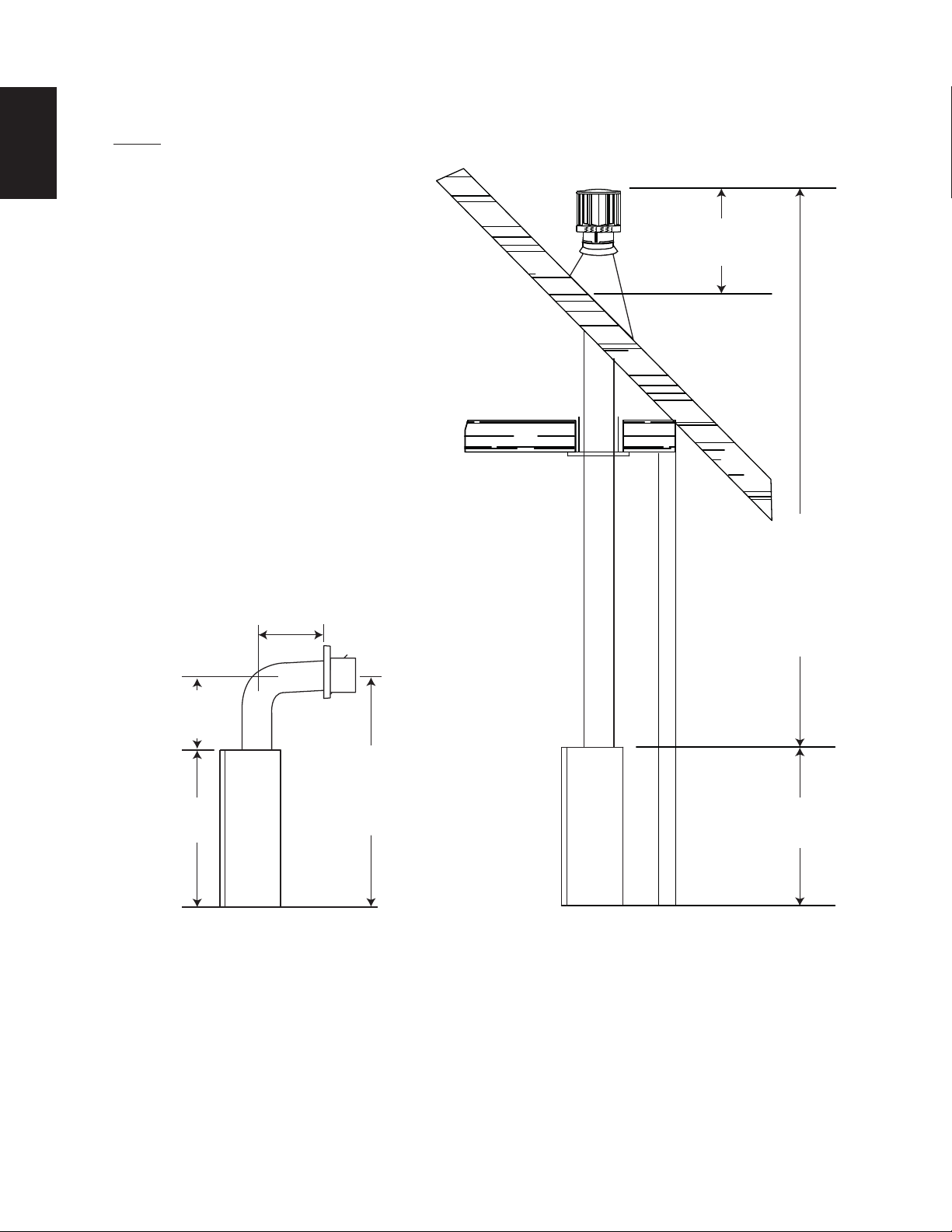
40 FEET
(12M)
MAXIMUM
3 FEET
(1M)
MINIMUM
16” (406mm)
MINIMUM
8” (20.3cm)
MINIMUM
18” (45.7cm) MAXIMUM
(FLEX VENT)
24” (61cm) MAXIMUM
(RIGID VENT)
45 13/16”
(116.3 cm)
MINIMUM
PLUS RISE*
3.2 TYPICAL VENT INSTALLATIONS
* See “VENTING” section.
NOTE: There MUST be a 25% reduction in total horizontal length (H
T
) when using fl ex vent.
37 13/16”
(96cm)
37 13/16”
(96cm)
11
W415-1335 / B / 10.04.16
EN
3.3 SPECIAL VENT INSTALLATIONS
3.3.1 PERISCOPE TERMINATION
3.3.2 CORNER TERMINATION
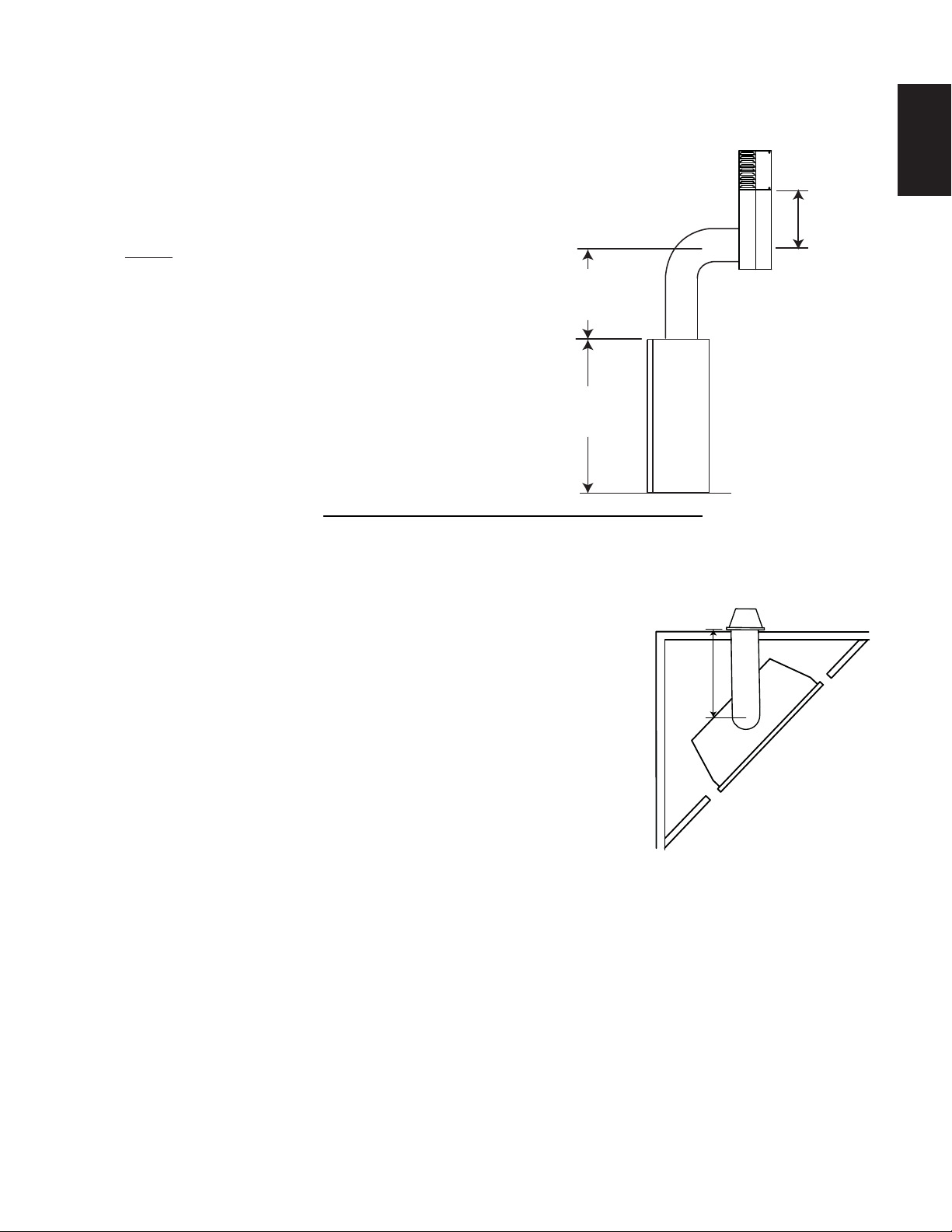
The maximum vent length for a corner installation is 24” (609.6mm) of
horizontal run with a minimum 8” (203.2mm) rise.
24” (610mm)
MAX
NOTE: There MUST be a 25% reduction in total
horizontal length (H
T
) when using fl ex vent.
Use the periscope kit to locate the air termination above grade. The periscope must
be installed so that when fi nal grading is completed, the bottom air slot is located a
minimum 12” (30.5cm) above grade. The maximum allowable vent length is 10’ (3m)
for a fi replace and 8’ (2m) for a stove.
91B
12”
(305mm)
MIN TO
GRADE
24” (610mm)
MINIMUM
40 13/16”
(1037mm)
12
W415-1335 / B / 10.04.16
EN
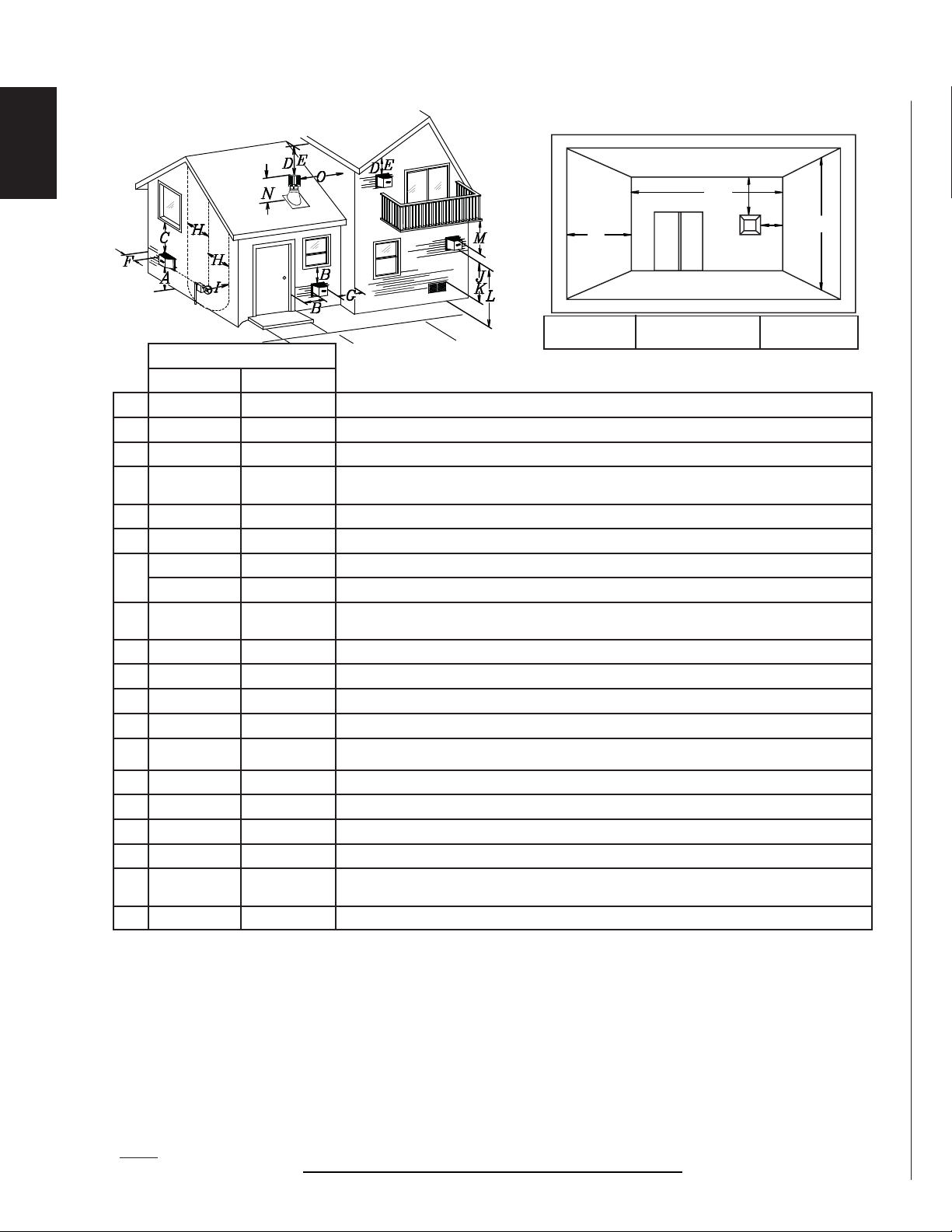
3.4 VENT TERMINAL CLEARANCES
12.1E
NOTE: Clearances are in accordance with local installation codes and the requirements of the gas supplier.
COVERED BALCONY APPLICATIONS ††*
Q
MIN
R
MAX
MAX
R
= 3 feet
(0.9m)
= 2 x
IHHW
(4.6m)
Q
ACTUAL
R
Q
S
G
P
INSTALLATIONS
CANADA U.S.A.
A
12” (30.5cm) 12” (30.5cm) Clearance above grade, veranda porch, deck or balcony.
B
12” (30.5cm)
Δ
9” (229mm) Clearance to windows or doors that open.
C
12” (30.5cm)* 12” (30.5cm) * Clearance to permanently closed windows.
D
18”
(45.7cm)**
18”
(45.7cm)**
Vertical clearance to ventilated soffi ts located above the terminal within a horizontal distance of 2’
(0.6m) from the center line of the terminal.
E
12” (30.5cm)** 12” (30.5cm)** Clearance to unventilated soffi t.
F
0” (0mm) 0” (0mm) Clearance to an outside corner wall.
G
0” (0mm)*** 0” (0mm)***
Clearance to an inside non-combustible corner wall or protruding non-combustible obstructions (chimney, etc.).
2” (51mm)*** 2” (51mm)*** Clearance to an inside combustible corner wall or protruding combustible obstructions (vent chase, etc.).
H
3’(0.9m) 3’(0.9m)****
Clearance to each side of the center line extended above the meter / regulator assembly to a maxi-
mum vertical distance of 15’ (4.6m).
I
3’ (0.9m) 3’ (0.9m)**** Clearance to a service regulator vent outlet.
J
12” (30.5cm) 9” (229mm) Clearance to a non-mechanical air supply inlet to the building or a combustion air inlet to any other appliance.
K
6’ (1.8m) 3’ (0.9m) † Clearance to a mechanical air supply inlet.
L
7’ (2.1m) ‡ 7’ (2.1m) **** Clearance above a paved sidewalk or paved driveway located on public property.
M
12” (30.5cm)†† 12” (30.5cm)**** Clearance under a veranda, porch or deck.
N
16” (40.6cm) 16” (40.6cm) Clearance above the roof.
O
2’ (0.6m)†* 2’ (0.6m) †* Clearance from an adjacent wall including neighbouring buildings.
P
8’ (2.4m) 8’ (2.4m)
Roof must be non-combustible without openings.
Q
3’ (0.9m) 3’ (0.9m) See chart for wider wall dimensions.
R
6’ (1.8m) 6’ (1.8m)
See chart for deeper wall dimensions. The terminal shall not be installed on any wall that has an
opening between the terminal and the open side of the structure.
S
12” (30.5cm) 12” (30.5cm) Clearance under a covered balcony
Δ The terminal shall not be located less than 6 feet under a window that opens on a horizontal plane in a structure with three walls and a roof.
* Recommended to prevent condensation on windows and thermal breakage
** It is recommended to use a heat shield and to maximize the distance to vinyl clad soffi ts.
*** The periscope requires a minimum 18 inches clearance from an inside corner.
**** This is a recommended distance. For additional requirements check local codes.
† 3 feet above if within 10 feet horizontally.
‡ A vent shall not terminate where it may cause hazardous frost or ice accumulations on adjacent property surfaces.
†† Permitted only if the veranda, porch, or deck is fully open on a minimum of two sides beneath the fl oor.
†* Recommended to prevent recirculation of exhaust products. For additional requirements check local codes.
††* Permitted only if the balcony is fully open on a minimum of one side.
13
W415-1335 / B / 10.04.16
EN
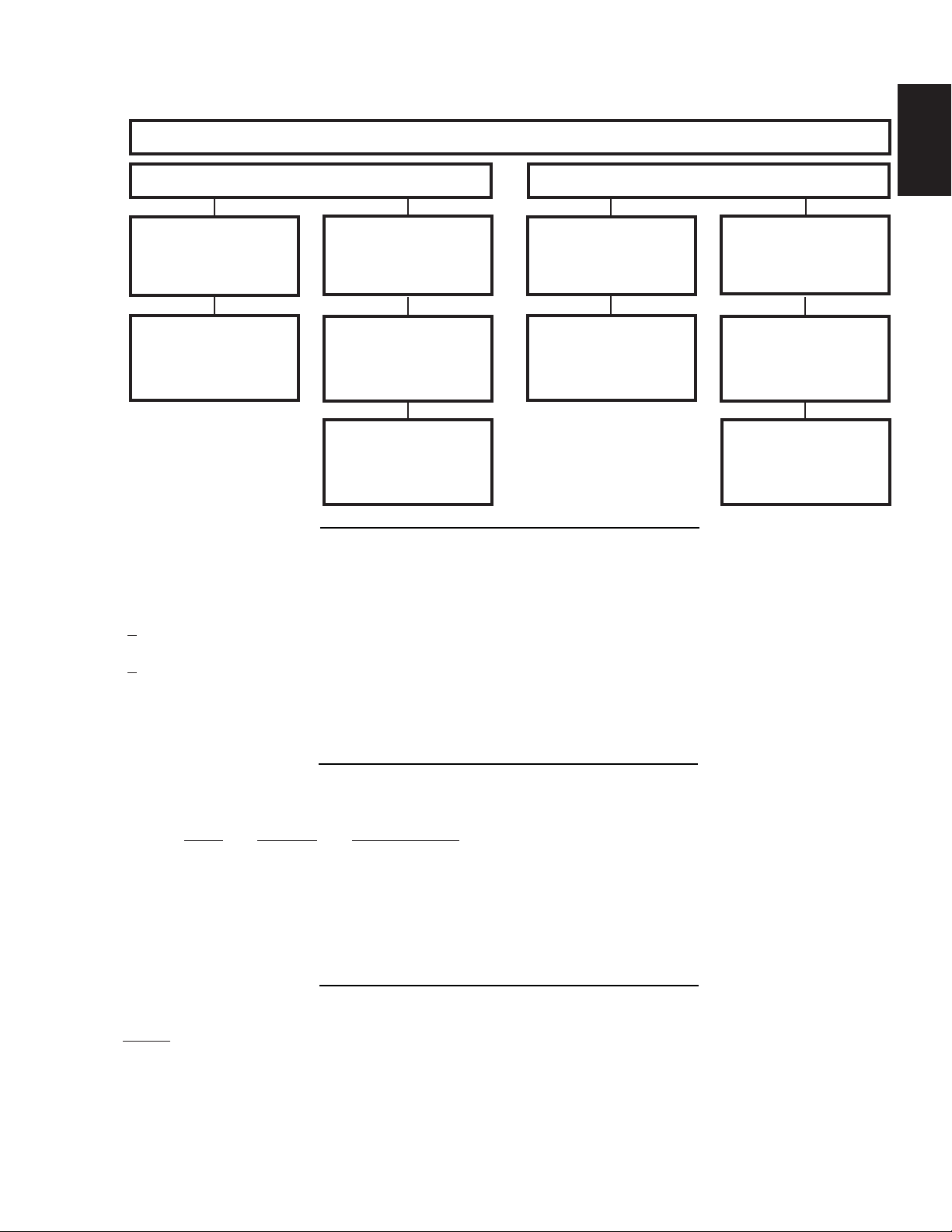
13.1A
TOP EXIT
Horizontal Termination
Vertical Termination
Vertical rise is equal
to or greater than
the horizontal run
Vertical rise is less
than horizontal run
Vertical rise is equal
to or greater than
the horizontal run
Vertical rise is less
than horizontal run
Horizontal run +
vertical rise to
maximum of 40 feet
(12m)
Horizontal run +
vertical rise to
maximum of
24.75 feet (7.5m)
Horizontal run +
vertical rise to
Horizontal run +
vertical rise to
4.2 times the
vertical rise equal to
or greater than the
horizontal run
3 times the vertical
rise equal to or
greater than the
horizontal run
maximum of 40 feet
(12m)
maximum of 40 feet
(12m)
3.5 VENT APPLICATION FLOW CHART
14.1
For the following symbols used in the venting calculations and examples are:
> - greater than
> - equal to or greater than
< - less than
< - equal to or less than
H
T
- total of both horizontal vent lengths (Hr) and offsets (Ho) in feet
H
R
- combined horizontal vent lengths in feet
H
O
- offset factor: .03 (total degrees of offset - 90°*) in feet
V
T
- combined vertical vent lengths in feet
15.1A
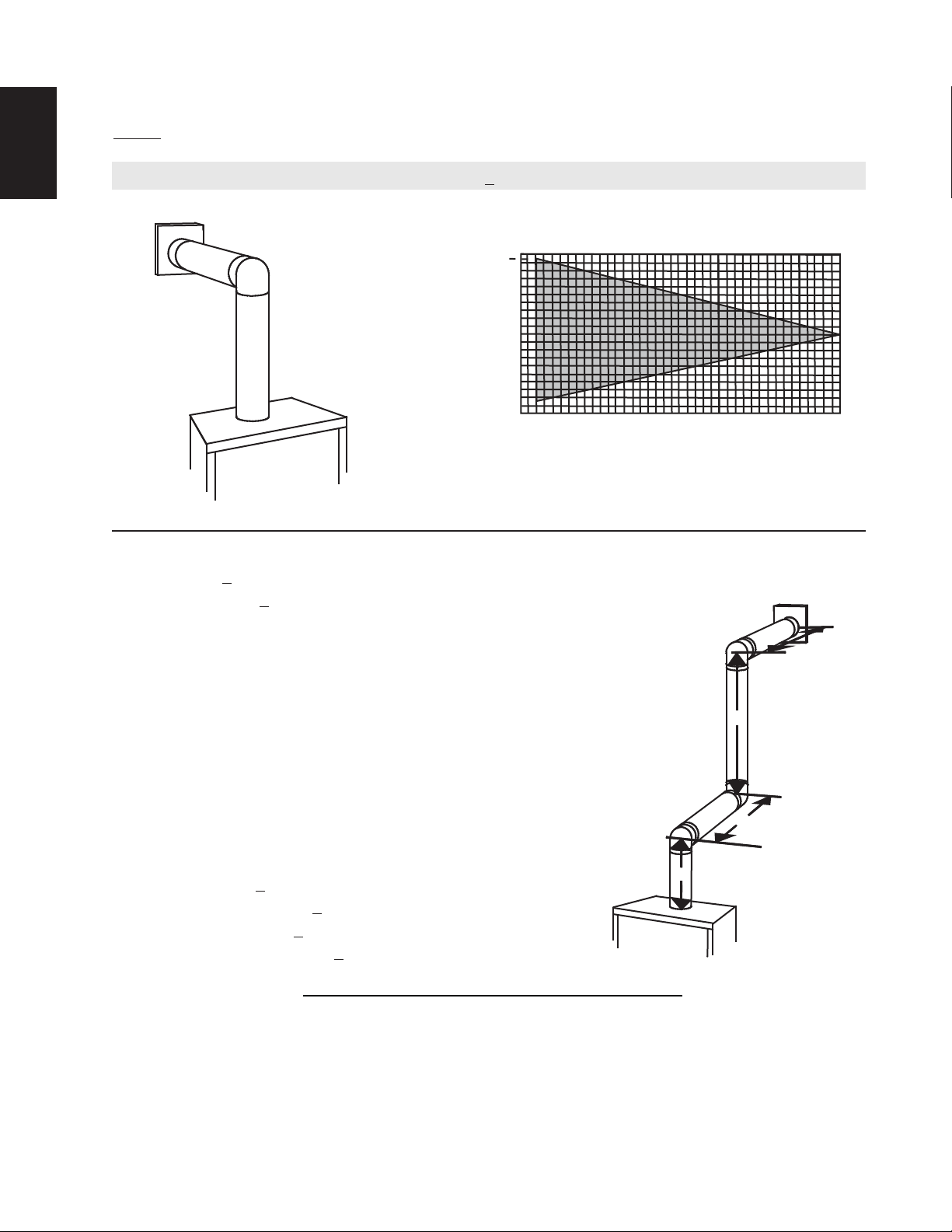
FEET INCHES MILLIMETERS
1° 0.03 0.5 12.7
15° 0.45 6.0 152.4
30° 0.9 11.0 279.4
45° 1.35 16.0 406.4
90°* 2.7 32.0 812.8
* The fi rst 90° offset has a zero value and is shown in the formula as - 90°
NOTE: There MUST be a 25% reduction in total horizontal length (H
T
) when using fl ex vent.
3.6 DEFINITIONS
3.7 ELBOW VENT LENGTH VALUES
14
W415-1335 / B / 10.04.16
EN
16.1B
Simple venting confi guration (only one 90° elbow)
(H
T
) < (V
T
)
For vent confi gurations requiring more than one 90° elbow, the following formulas apply:
Formula 1: H
T
< V
T
Formula 2: H
T
+ V
T
< 40 feet (12.2m)
Example:
V
1
= 3 FT (0.9m)
V
2
= 8 FT (2.4m)
V
T
= V
1
+ V
2
= 3 FT (0.9m ) + 8 FT (2.4m) = 11 FT (3.4m)
H
1
= 2.5 FT (0.8m)
H
2
= 2 FT (0.6m)
H
R
= H
1
+ H
2
= 2.5 FT (0.8m) + 2 FT (0.6m) = 4.5 FT (1.4m)
H
O
= .03 (three 90° elbows - 90°) = .03 (270° - 90°) = 5.4 FT (1.7m)
H
T
= H
R
+ H
O
= 4.5 FT (1.4m) + 5.4 FT (1.6m) = 9.9 FT (3m)
H
T
+ V
T
= 9.9 FT (3m) + 11 FT (3.4m) = 20.9 FT (6.4m)
Formula 1: H
T
< V
T
9.9 FT (3m) < 11 FT (3.4m)
Formula 2: H
T
+ V
T
< 40 FT (12.2m)
20.9 FT (6.4m) < 40 FT (12.2m)
Since both formulas are met, this vent confi guration is acceptable.
See graph to determine the required vertical
rise V
T
for the required horizontal run H
T
.
The shaded area within the lines represents
acceptable values for H
T
and V
T
0
2.5
(0.8)
5
(1.5)
7.5
(2.3)
10
(3.1)
12.5
(3.8)
15
(4.6)
40 (12.2)
10 (3.1)
20 (6.1)
30 (9.1)
17.5
(5.3)
20
(6.1)
39 (11.9)
REQUIRED
VERTICAL
RISE IN FEET
(METERS)V
T
HORIZONTAL VENT RUN PLUS OFFSET IN
FEET (METERS) H
T
90°
90°
90°
V
1
V
2
H
1
H
2
3.8 HORIZONTAL TERMINATION
NOTE: There MUST be a 25% reduction in total horizontal length (H
T
) when using fl ex vent.
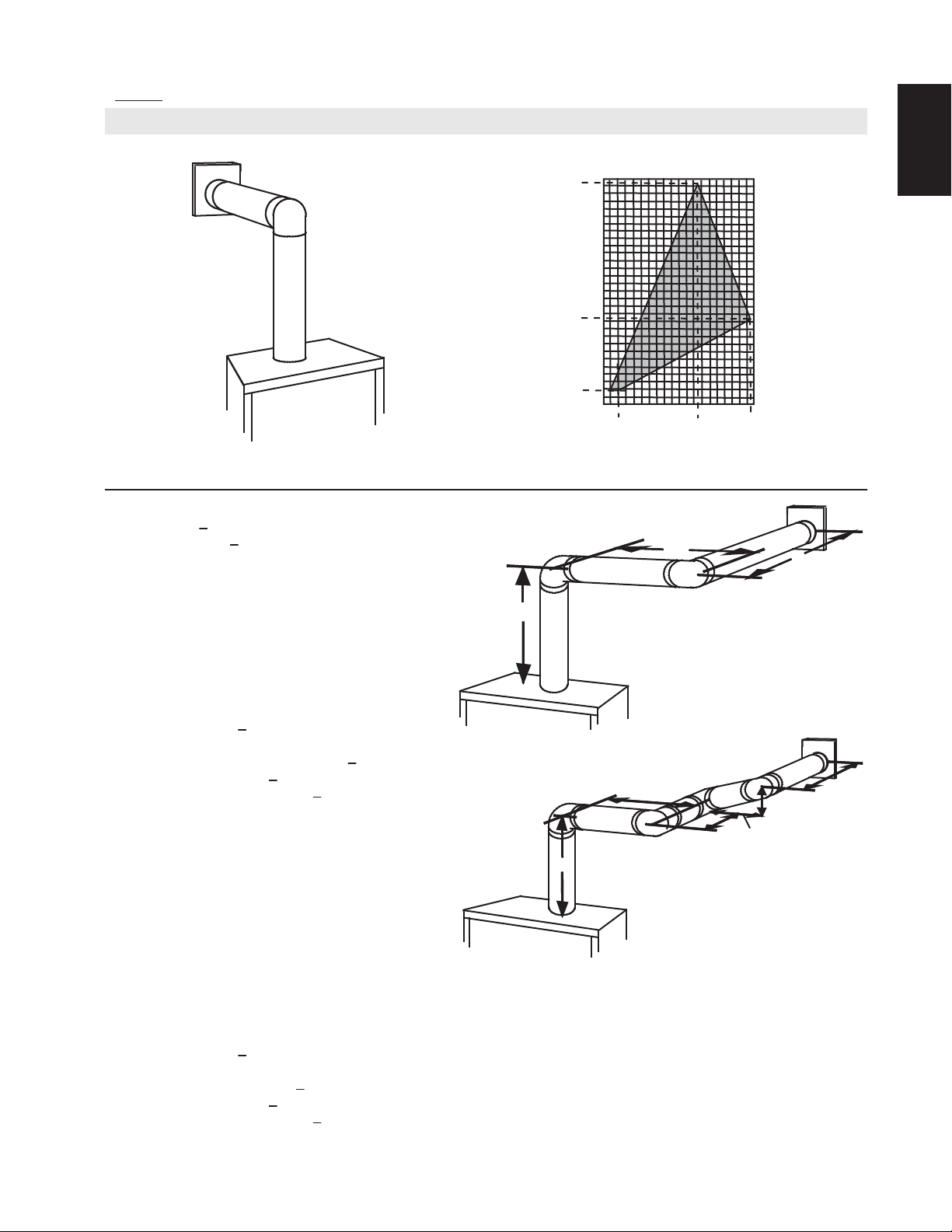
15
W415-1335 / B / 10.04.16
EN
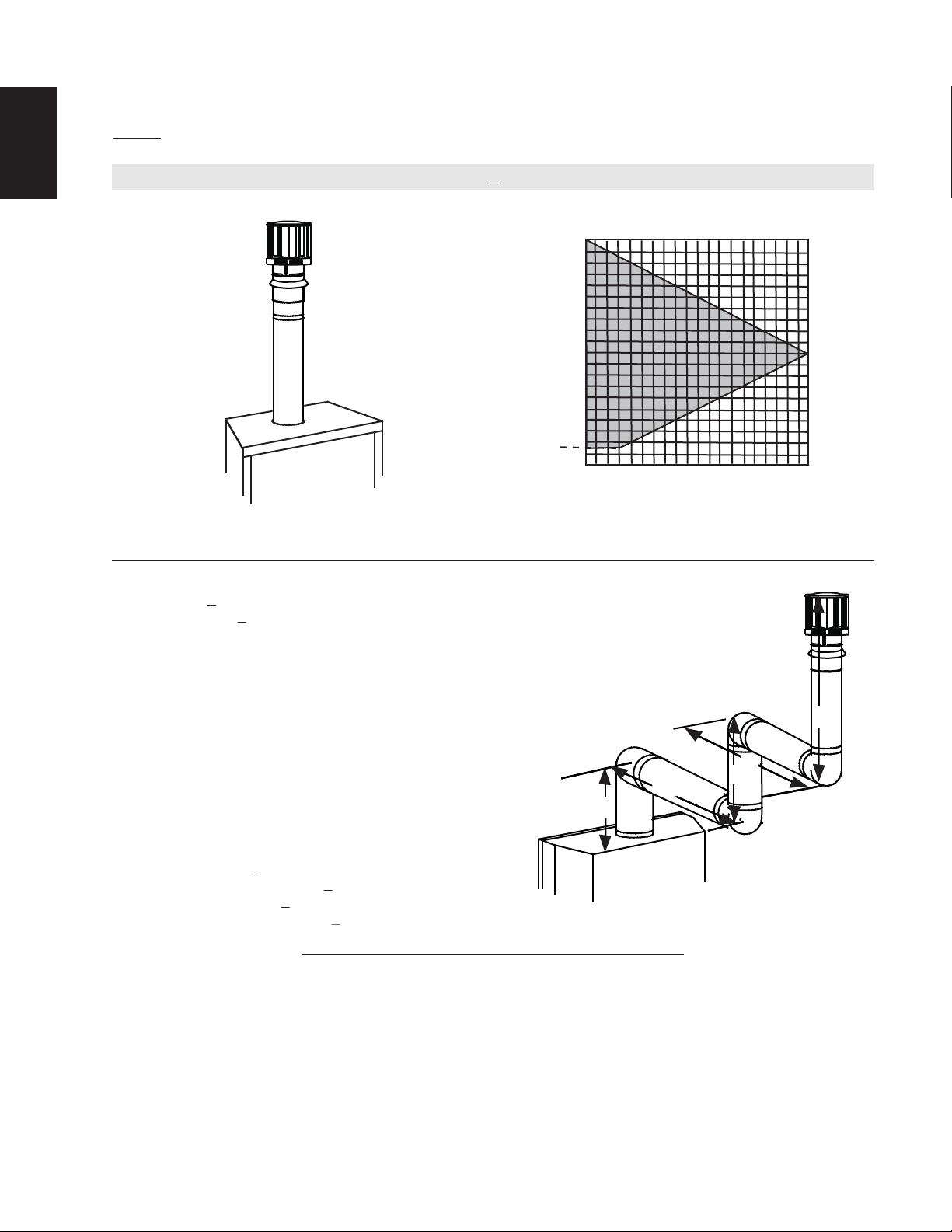
NOTE: There MUST be a 25% reduction in total horizontal length (H
T
) when using fl ex vent.
(H
T
) > (V
T
)
Simple venting configuration (only one 90° elbow)
See graph to determine the required vertical rise V
T
for the
required horizontal run H
T
.
REQUIRED
VERTICAL RISE
IN INCHES
(METERS)V
T
HORIZONTAL VENT RUN PLUS OFFSET IN FEET (METERS)H
T
For vent configurations requiring more than one 90° elbow, the following formulas apply:
Formula 1:
H
T
< 4.2 V
T
Formula 2: H
T
+ V
T
< 24.75 feet (7.5m)
Example:
V
1
= V
T
= 6 FT (1.8m)
H
1
= 3 FT (0.9m)
H
2
= 5 FT (1.5m)
H
R
= H
1
+ H
2
= 3FT (0.9m) + 5FT (1.5m) = 8FT (2.4m)
H
O
= .03 (two 90° elbows - 90°) = .03 (180° - 90°) = 2.7FT (0.8m)
H
T
= H
R
+ H
O
= 8FT (2.4m) + 2.7FT (0.8m) = 10.7FT (3.3m)
H
T
+ V
T
= 10.7FT (3.3m) + 6FT (1.8m) = 16.7FT (5.1m)
Formula 1: H
T
< 4.2 V
T
4.2 V
T
= 4.2 FT (1.3m) x 6 FT (1.8m) = 25.2FT (15.9m)
10.7 FT (3.3m) < 25.2FT (15.9m)
Formula 2: H
T
+ V
T
< 24.75 FT
16.7FT (3.3m) < 24.75 FT (7.5m)
Since both formulas are met, this vent configuration is acceptable.
The shaded area within the lines represents acceptable
values for H
T
and V
T
90°
V
1
H
1
H
2
90°
Example:
V
1
= 4 FT (1.2m)
V
2
= 1.5 FT (0.5m)
V
T
= V
1
+ V
2
= 4FT (1.2m) + 1.5FT (0.5m) = 5.5FT (1.7m)
H
1
= 2 FT (0.6m)
H
2
= 1 FT (0.3m)
H
3
= 1 FT (0.3m)
H
4
= 1.5 FT (0.5m)
H
R
= H
1
+ H
2
+ H
3
+ H
4
= 2FT (0.6m) + 1FT (0.3m) + 1FT (0.3m) + 1.5FT (0.5m) = 5.5FT (1.7m)
H
O
= .03 (four 90° elbows - 90°) = .03 (360° - 90°) = 8.1 FT (2.5m)
H
T
= H
R
+ H
O
= 5.5FT (1.7m) + 8.1 FT (2.5m) = 13.6 FT (14.2m)
H
T
+ V
T
= 13.6 FT (14.2m) + 5.5 FT (1.7m) = 19.1 FT (5.8m)
Formula 1: H
T
< 4.2 V
T
4.2 V
T
= 4.2 FT (1.3m) x 5.5 FT (1.7m) = 23.1 FT (7m)
13.6 (4.1m) < 23.1 FT (7m)
Formula 2: H
T
+ V
T
< 24.75 FT (7.5m)
19.1 FT (5.8m) < 24.75 FT (7.5m)
Since both formulas are met, this vent configuration is acceptable.
90°
90°
90°
90°
H
1
H
2
V
1
V
2
H
3
H
4
0
5
(1.5)
15
(4.6)
20 (6.1)
100 (2.54)
50 (1.27)
150 (3.81)
12.5
(3.8)
8 (.203)
57 (144.8)
147 (3733.8)
2
(0.6)
10
(3.1)
19.5
(5.9)
16
W415-1335 / B / 10.04.16
EN
(H
T
) < (V
T
)
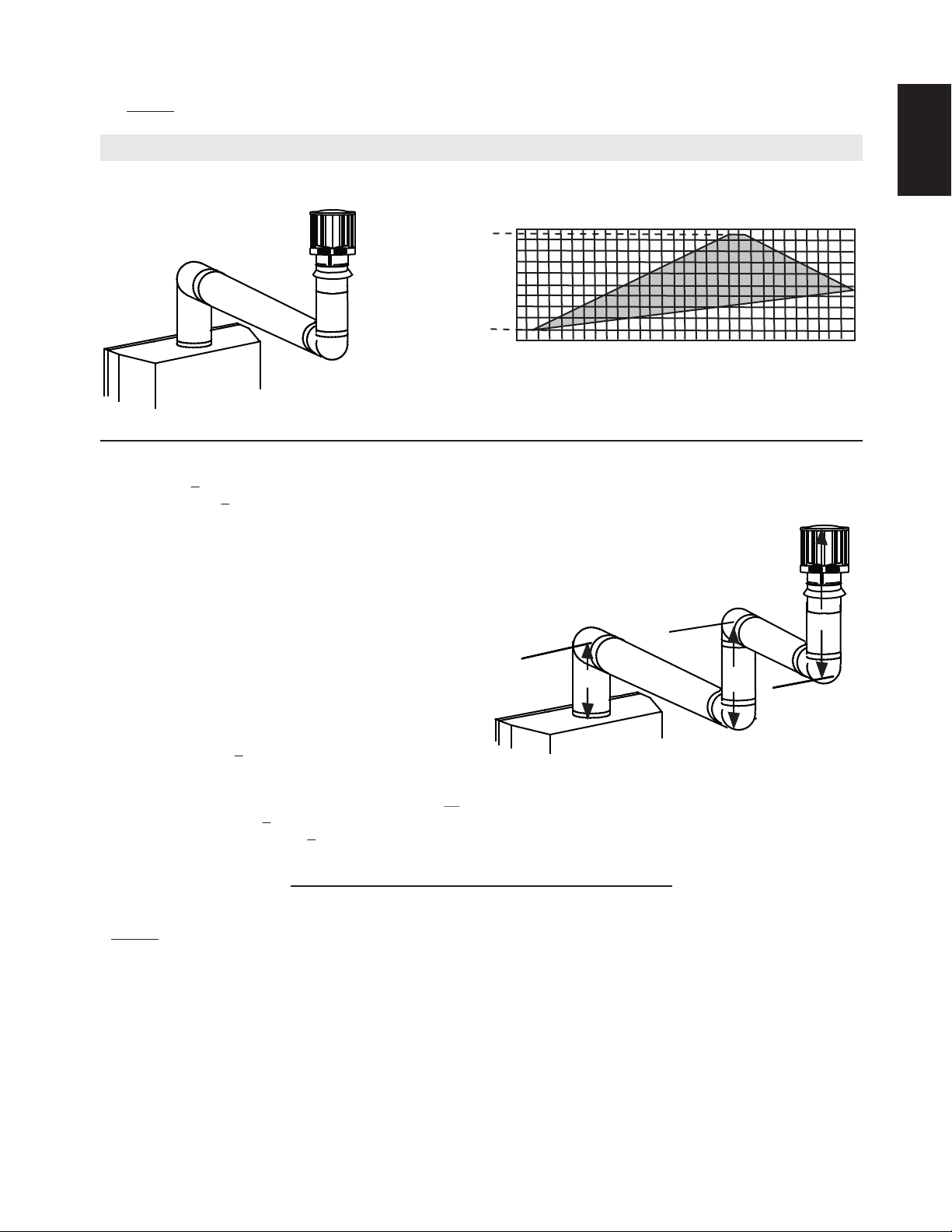
Simple venting configurations.
See graph to determine the required vertical rise V
T
for the
required horizontal run H
T
.
REQUIRED
VERTICAL
RISE IN FEET
(METERS) V
T
HORIZONTAL VENT RUN PLUS OFFSET IN FEET (METERS) H
T
For vent configurations requiring one or more 90° elbows the following formulas apply:
Formula 1: H
T
< V
T
Formula 2: H
T
+ V
T
< 40 feet (12.2m)
Example:
V
1
= 5 FT (1.5m)
V
2
= 6 FT (1.8m)
V
3
= 10 FT (3.1m)
V
T
= V
1
+ V
2
+ V
3
= 5FT (1.5m) + 6FT (1.8m) + 10FT (3.1m) = 21FT (6.4m)
H
1
= 8 FT (2.4m)
H
2
= 2.5 FT (0.8m)
H
R
= H
1
+ H
2
= 8FT (2.4m) + 2.5FT (0.8m) = 10.5 FT (3.2m)
H
O
= .03 (four 90° elbows - 90°)
= .03 (360° - 90°) = 8.1 FT (2.5m)
H
T
= H
R
+ H
O
= 10.5FT (3.2m) + 8.1FT (2.5m) = 18.6FT (5.7m)
H
T
+ V
T
= 18.6FT (5.7m) + 21FT (6.4m) = 39.6FT (12.1m)
Formula 1: H
T
< V
T
18.6FT (5.7m) < 21FT (6.4m)
Formula 2: H
T
+ V
T
< 40 FT (12.19m)
39.6FT (12.1m) < 40FT (12.2m)
Since both formulas are met, this vent configuration is acceptable.
90°
V
1
V
2
H
1
H
2
The shaded area within the lines represents acceptable
values for H
T
and V
T
90°
90°
90°
0
5
(1.5)
10
(3.1)
15
(4.6)
20
(6.1)
40 (12.2)
10 (3.1)
20 (6.1)
30 (9.1)
3 (0.9)
V
3
18.1A
3.9 VERTICAL TERMINATION
NOTE: There MUST be a 25% reduction in total horizontal length (H
T
) when using fl ex vent.
17
W415-1335 / B / 10.04.16
EN
(H
T
) > (V
T
)
Simple venting configurations.
See graph to determine the required vertical rise V
T
for the
required horizontal run H
T
.
REQUIRED
VERTICAL
RISE IN FEET
(METERS) V
T
HORIZONTAL VENT RUN PLUS OFFSET IN FEET (METERS) H
T
For vent configurations requiring more than two 90° elbows the following formulas apply:
Formula 1: H
T
< 3V
T
Formula 2: H
T
+ V
T
< 40 feet (12.2m)
Example:
V
1
= 2 FT (0.6m)
V
2
= 1 FT (0.3m)
V
3
= 1.5 FT (0.5m)
V
T
= V
1
+V
2
+V
3
= 2FT (0.6m) + 1FT (0.3m) + 1.5FT (0.5m) = 4.5FT (1.4m)
H
1
= 6 FT (1.8m)
H
2
= 2 FT (0.6m)
H
R
= H
1
+ H
2
= 6FT (1.8m) + 2FT (0.6m) = 8 FT (2.4m)
H
O
= .03 (four 90° elbows - 90°)
= .03 (360° - 90°) = 8.1 FT (2.5m)
H
T
= H
R
+ H
O
= 8FT (2.4m) + 8.1FT (2.5m) = 16.1FT (4.9m)
H
T
+ V
T
= 16.1FT (4.9m) + 4.5FT (1.4m) = 20.6 FT (6.3m)
Formula 1: H
T
< 3V
T
3V
T
= 3FT (0.9m) x 4.5FT (1.4m) = 13.5FT (4.1m)
16.1FT (4.9m) > 13.5FT (4.1m)
Since this formula is not met, this vent configuration is unacceptable.
Formula 2: H
T
+ V
T
< 40 feet (12.2m)
20.6FT (6.3m) < 40 (12.2m)
Since only formula 2 is met, this vent configuration is unacceptable and a new appliance location or vent configuration
will need to be established to satisfy both formulas.
The shaded area within the lines represents acceptable
values for H
T
and V
T
0
5
(1.5)
10
(3.1)
15
(4.6)
20
(6.1)
10 (3.1)
20 (6.1)
3 (0.9)
25
(7.6)
30
(9.1)
19 (5.8)
90°
V
1
V
2
H
1
H
2
90°
90°
90°
V
3
18.1_2B
NOTE: All vent parameters are stated for rigid venting. If using approved Wolf Steel Ltd. fl exible venting
then maximum horizontal requirements are reduced by 25%.
NOTE: There MUST be a 25% reduction in total horizontal length (H
T
) when using fl ex vent.
18
W415-1335 / B / 10.04.16
EN
3.10 VERTICAL THROUGH EXISTING CHIMNEY
7.6B
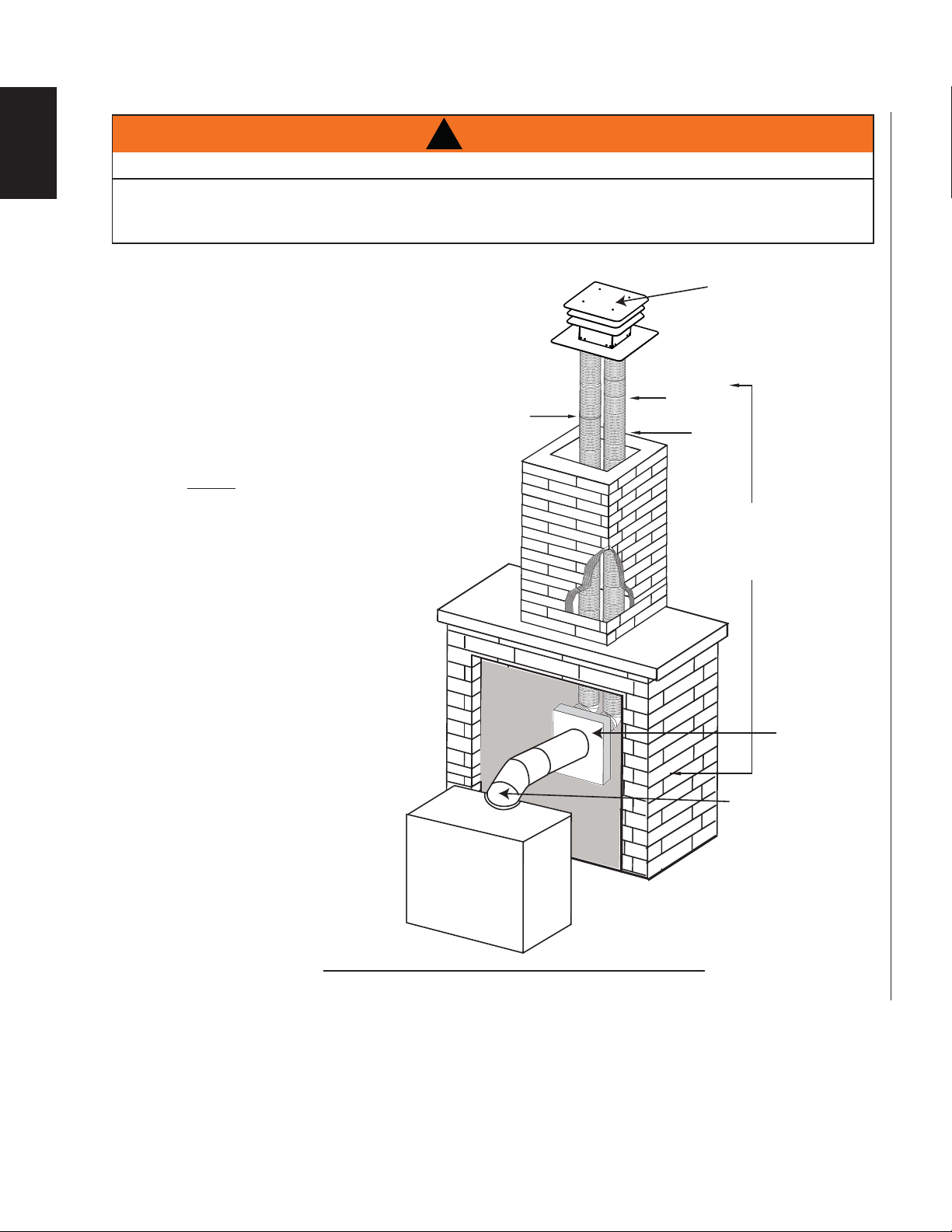
This appliance is designed to be attached to a 3” (76.2mm) co-linear aluminum fl ex vent system running the
full length of a masonry chimney.
The fl ex liners accommodate any contours of a
masonry chimney, however, it is necessary to keep
the fl exible liners as straight as possible. The inlet air
collar of the termination cap must be connected to
the air intake fl ex liner and the exhaust collar must be
connected to the exhaust fl exible liner.
Both Simpson Duravent and Selkirk co-linear to
co-axial adaptors have been approved on this
appliance (NOTE: A vent adaptor will be required
directly off the appliance).
Follow vent manufacturer’s installation instructions.
Different manufacturer’s venting components must
not be combined. Once the preferred manufacturer’s
appliance adaptor has been attached, the
remainder of the system must be that of the
same manufacturer.
The only exception to this rule is to use Wolf
Steel’s approved 3” (76.2mm) fl ex liner and
co-linear termination.
!
WARNING
RISK OF FIRE!
CO-AXIAL TO CO-LINEAR VENTING CONFIGURATIONS MUST ONLY BE USED IN A
NON-COMBUSTIBLE CHIMNEY OR ENCLOSURE. INSTALLATION IN A COMBUSTIBLE ENCLOSURE
COULD RESULT IN A FIRE.
AIR
INTAKE
EXHAUST
FLUE
FLEX
LINER
* 40 FT (12.2m)
MAX.
10 FT (3.1m)
MIN
COAXIAL TO
CO-LINEAR
ADAPATOR
APPLIANCE
VENT ADAPTOR
TERMINATION
* Measured from appliance fl ue collar to
termination fl ue collar
19
W415-1335 / B / 10.04.16
EN
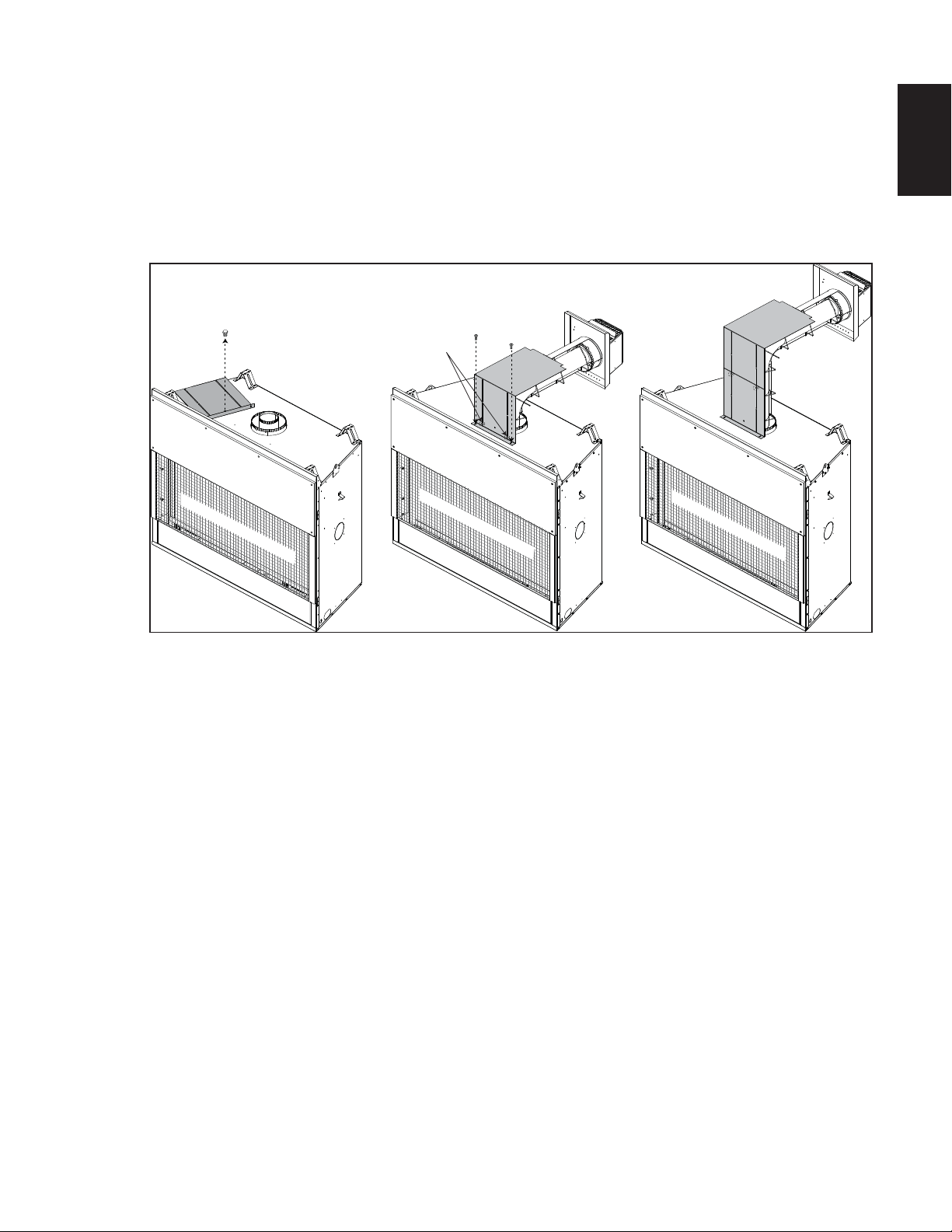
For shipping purposes, the heat shield has been attached on top of the appliance.
If venting with a 90 degree elbow directly off of the top of the appliance, the elbow heat shield must be
repositioned and secured with the two screws (supplied) as illustrated.
The heat shield can be adjusted up to a maximum of 18” (457mm). Remove the two screws as illustrated to
adjust the shield. If the elbow height exceeds this height, the use of the shield is no longer required.
REMOVE SCREWS
TO ADJUST
HEIGHT
18”
(457.2mm)
MAX
S
AF
ETY BARR
IER
S
A
F
ETY BARR
IER
S
AF
ETY BARR
IER
3.11 VENT HEAT SHIELD INSTALLATION
20
W415-1335 / B / 10.04.16
EN
For optimum performance it is recommended that all horizontal runs have a minimum of 1/4” (6.4mm) rise per
1ft (0.3m). For safe and proper operation of the appliance, follow the venting instructions exactly.
!
WARNING
ENSURE TO UNPACK ALL LOOSE MATERIALS FROM INSIDE THE FIREBOX PRIOR TO HOOKING UP
THE GAS AND ELECTRICAL SUPPLY.
IF YOUR APPLIANCE IS SUPPLIED WITH A REMOTE ENSURE THE REMOTE RECEIVER IS IN THE
“OFF” POSITION PRIOR TO HOOKING UP THE GAS AND ELECTRICAL SUPPLY TO THE APPLIANCE.
FOR SAFE AND PROPER OPERATION OF THE APPLIANCE, FOLLOW THE VENTING INSTRUCTIONS
EXACTLY.
ALL EXHAUST AND INTAKE VENT PIPE JOINTS MUST BE SEALED USING RED RTV HIGH TEMP
SILICONE SEALANT W573-0002 (NOT SUPPLIED) OR BLACK HIGH TEMP MILL PAC W573-0007 (NOT
SUPPLIED) WITH THE EXCEPTION OF THE APPLIANCE EXHAUST FLUE COLLAR WHICH MUST BE
SEALED USING MILL PAC.
IF USING PIPE CLAMPS TO CONNECT VENT COMPONENTS, A MINIMUM OF 3 SCREWS MUST ALSO
BE USED TO ENSURE THE CONNECTION CANNOT SLIP OFF.
DO NOT CLAMP THE FLEXIBLE VENT PIPE.
RISK OF FIRE, EXPLOSION OR ASPHYXIATION. IMPROPER SUPPORT OF THE ENTIRE VENTING
SYSTEM MAY ALLOW VENT TO SAG AND SEPARATE. USE VENT RUN SUPPORTS AND CONNECT
VENT SECTIONS PER INSTALLATION INSTRUCTIONS.
RISK OF FIRE, DO NOT ALLOW LOOSE MATERIALS OR INSULATION TO TOUCH THE VENT PIPE.
REMOVE INSULATION TO ALLOW FOR THE INSTALLATION OF THE ATTIC SHIELD AND TO
MAINTAIN CLEARANCES TO COMBUSTIBLES.
68.2D
!
WARNING
DO NOT FILL THE SPACE BETWEEN THE VENT PIPE AND ENCLOSURE WITH ANY TYPE OF
MATERIAL. DO NOT PACK INSULATION OR COMBUSTIBLES BETWEEN CEILING FIRESTOPS.
ALWAYS MAINTAIN SPECIFIED CLEARANCES AROUND VENTING AND FIRESTOP SYSTEMS.
INSTALL WALL SHIELDS AND FIRESTOPS AS SPECIFIED. FAILURE TO KEEP INSULATION OR
OTHER MATERIALS AWAY FROM VENT PIPE MAY CAUSE FIRE.
70.1
4.0 INSTALLATION
4.1 WALL AND CEILING PROTECTION
21
W415-1335 / B / 10.04.16
EN
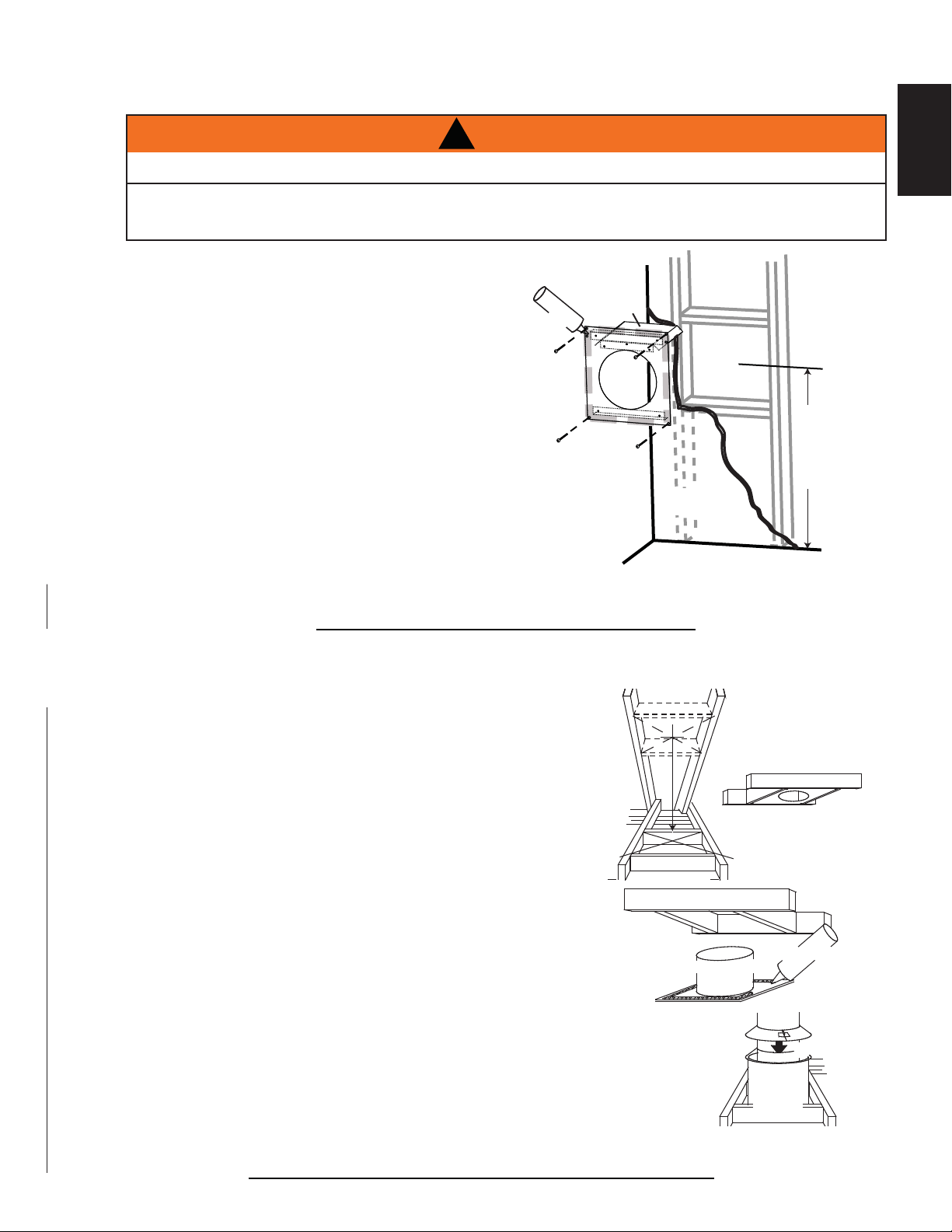
4.1.1 HORIZONTAL INSTALLATION
This application occurs when venting through an exterior wall.
Having determined the correct height for the air terminal
location, cut and frame a hole in the exterior wall as
illustrated to accommodate the fi restop assembly.
Dry fi t the fi restop assembly before proceeding to
ensure the brackets on the rear surface fi t to the
inside surface of the horizontal framing.
The length of the vent shield may be cut shorter
for combustible walls that are less than 8 1/2”
(215.9mm) thick but the vent shield must extend
the full depth of the combustible wall.
A. Apply a bead of caulking (not supplied) around the corner edge of
the inside surface of the fi restop assembly, fi t the fi restop
assembly to the hole and secure using the 4 screws (supplied in
your manual baggie).
B. Once the vent pipe is installed in its fi nal position, apply red RTV silicone (W573-0002) (not supplied)
between the pipe and the fi restop.
DETERMINE
THE
CORRECT
HEIGHT
CAULKING
FIRESTOP
SPACER
VENT
SHIELD
FINISHING
MATERIAL
20.2B
!
WARNING
THE FIRESTOP ASSEMBLY MUST BE INSTALLED WITH THE VENT SHIELD TO THE TOP.
TERMINALS MUST NOT BE RECESSED INTO A WALL OR SIDING MORE THAN THE DEPTH OF THE
RETURN FLANGE OF THE MOUNTING PLATE.
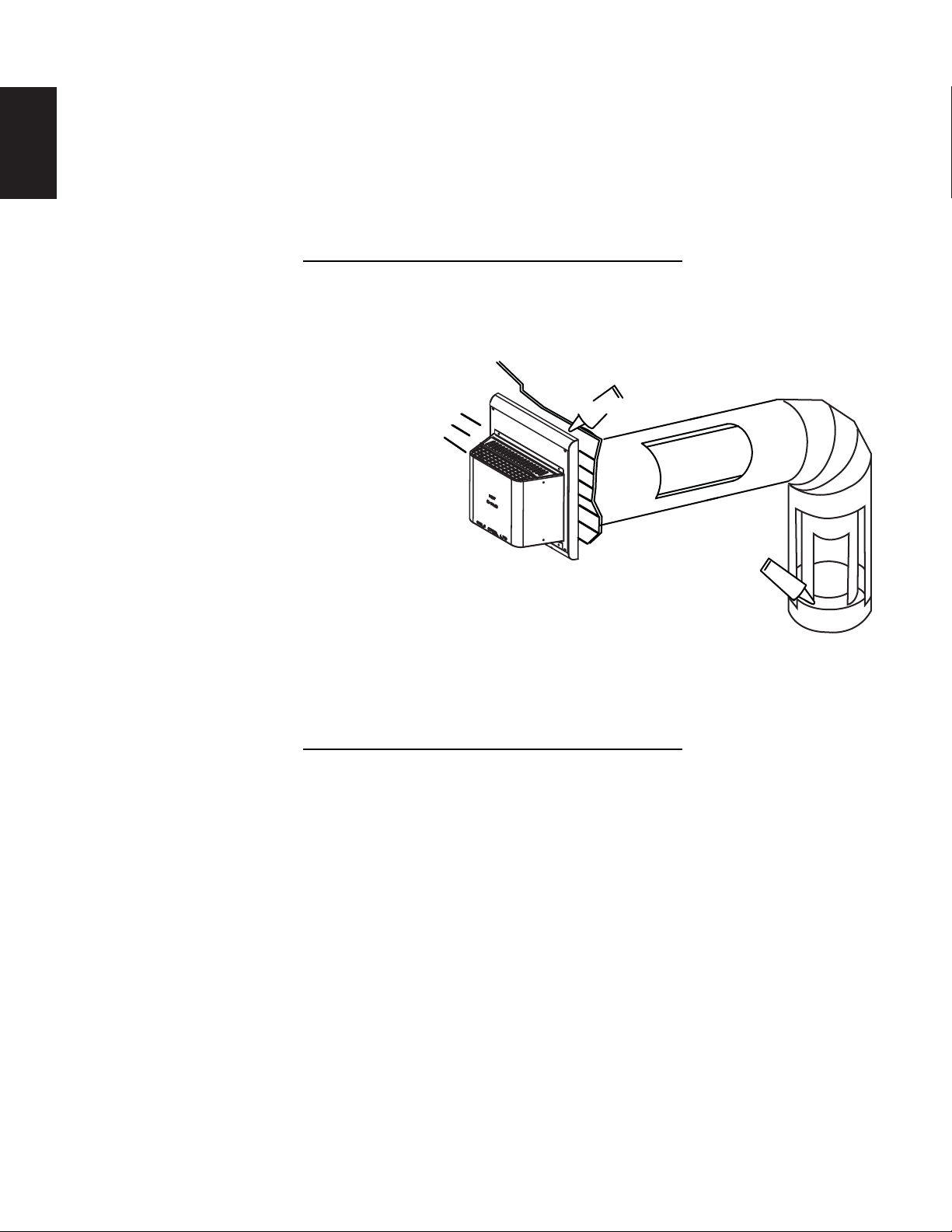
This application occurs when venting through a roof. Installation kits for
various roof pitches are available from your authorized dealer / distributor.
See accessories to order specifi c kits required.
A. Determine the air terminal location, cut and frame a square opening as
illustrated in the ceiling and the roof to provide the minimum 1" (25mm)
clearance between the vent pipe and any combustible material. Try to
center the vent pipe location midway between two joists to prevent
having to cut them. Use a plumb bob to line up the center of the
openings. A vent pipe shield will prevent any materials such as
insulation, from fi lling up the 1" (25mm) air space around the pipe.
Nail headers between the joist for extra support.
B. Apply a bead of caulking (not supplied) to the framework or to the
Wolf Steel vent pipe shield plate or equivalent (in the case of a fi nished
ceiling), and secure over the opening in the ceiling. A fi restop must be placed
on the bottom of each framed opening in a roof or ceiling that the venting
system passes through. Apply a bead of caulking all around and place a
fi restop spacer over the vent shield to restrict cold air from being drawn into the
room or around the fi replace. Ensure that both spacer and shield maintain the required
clearance to combustibles. Once the vent pipe is installed in its fi nal position, apply
Mill Pac sealant (W573-0007) (not supplied) or red RTV silicone (W573-0002) (not
supplied) between the pipe and the fi restop assembly.
C. In the attic, slide the vent pipe collar down to cover up the open end of the shield and
tighten. This will prevent any materials, such as insulation, from fi lling up the 1" (25mm)
air space around the pipe.
21.1B
CAULKING
VENT PIPE
SHIELD
FIRESTOP
UNDERSIDE OF
JOIST
VENT
PIPE
COLLAR
VENT
PIPE
SHIELD
4.1.2 VERTICAL INSTALLATION
22
W415-1335 / B / 10.04.16
EN
4.2 USING RIGID VENT COMPONENTS
The vent system must be supported approximately every 3 feet (0.9m) for both vertical and horizontal runs.
Use Wolf Steel Ltd. support ring assembly or equivalent noncombustible strapping to maintain the minimum
clearance to combustibles for both vertical and horizontal runs.
A
ll inner exhaust and outer intake vent pipe joints may be sealed using either red high temperature silicone
sealant W573-0002 (not supplied) or black high temperature sealant W573-0007 Mill Pac (not supplied) with
the exception of the appliance exhaust fl ue collar which must be sealed using Mill Pac.
25.1A
4.3 HORIZONTAL AIR TERMINAL INSTALLATION
A. Move the appliance into position.
Measure the vent length required
between terminal and appliance
taking into account the additional
length needed for the fi nished wall
surface and any 1¼” (31.8mm)
overlaps between venting components.
B. Apply high temperature sealant
W573-0007 (not supplied) to the outer
edge of the inner collar of the appliance.
Attach the fi rst inner rigid pipe component and secure
using 3 self tapping screws. Repeat using the outer rigid pipe.
C. Insert the vent pipes through the fi restop maintaining the required clearance
to combustibles. Holding the air terminal (lettering in an upright, readable position),
secure to the exterior wall and make weather tight by sealing with caulking (not supplied).
The air terminal mounting plate may be recessed into the exterior wall or siding no greater than the
depth of the return fl ange.
26.3A
SCREWS
#10x2"
OUTER
RIGID
PIPE
CAULKING
INNER
RIGID
PIPE
2” (50.8mm) OVERLAP
HI-TEMP
SEALANT
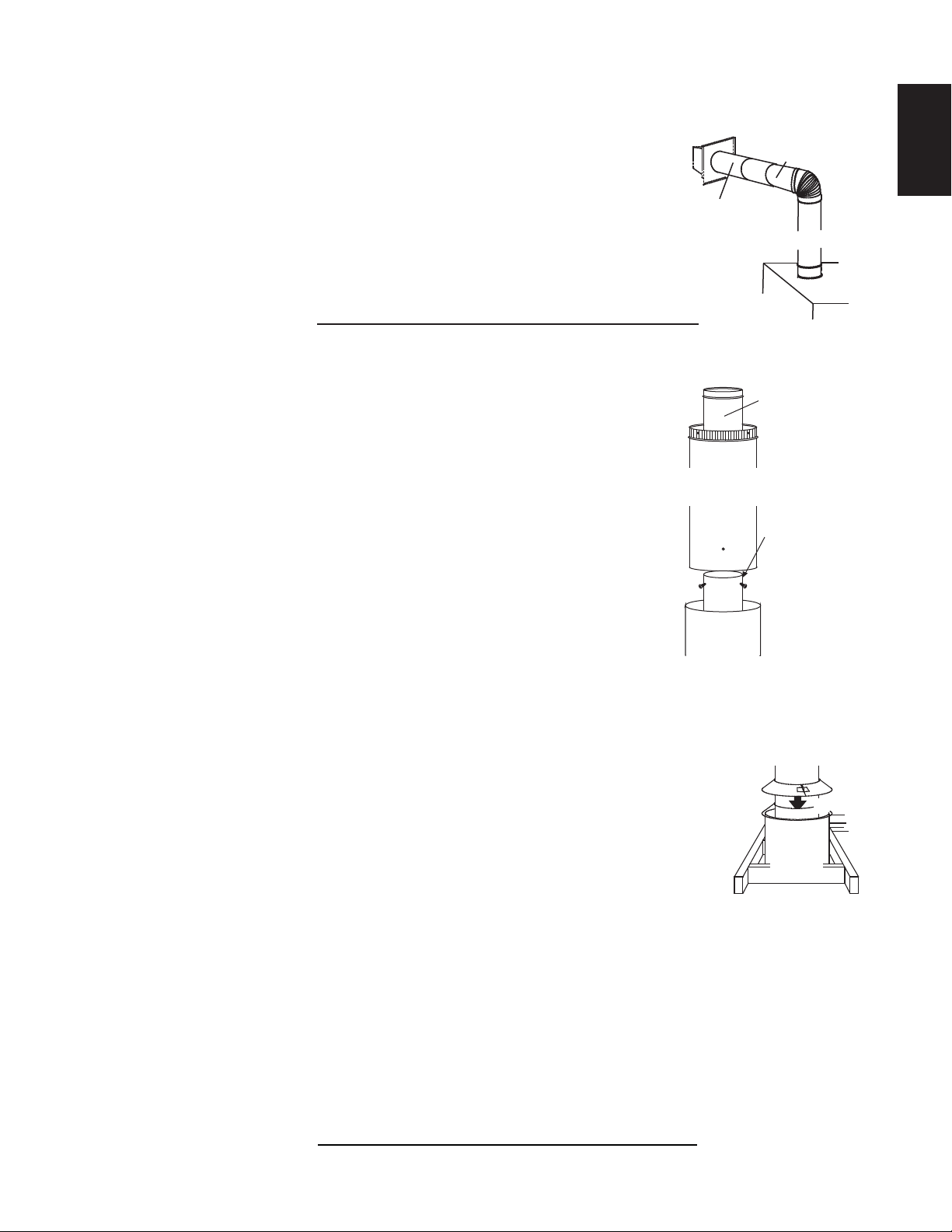
23
W415-1335 / B / 10.04.16
EN
4.4 EXTENDED HORIZONTAL AND CORNER TERMINAL INSTALLATION
A. Follow the instructions for "HORIZONTAL AIR TERMINAL INSTALLATIONS" section.
B.
Continue adding components alternating inner rigid pipe and outer rigid pipe. Ensure
that all inner rigid pipe and elbows have sufficient vent spacers attached and each
component is sealed and securely fastened to the one prior. Attach the inner telescopic
sleeve to the vent run. Repeat using the outer telescopic sleeve. Seal and secure as
before. To facilitate completion, attach inner and outer couplers to the air terminal.
C. Install the air terminal. See “HORIZONTAL AIR TERMINAL INSTALLATION” section.
TELESCOPIC
SLEEVE
VENTING
AIR TERMINAL
20" (508mm)
COUPLER
48.1A
4.5 VERTICAL AIR TERMINAL INSTALLATION
A. Move the appliance into position.
B. Fasten the roof support to the roof using the screws provided. The
roof support is optional. In this case the venting is to be adequately
supported using either an alternate method suitable to the authority
having jurisdiction or the optional roof support.
C. Apply high temperature sealant (not supplied) to the outer edge of
the inner sleeve of the air terminal. Slip the inner coupler a minimum
of 2" (51mm)over the sleeve and secure using a minimum of 3
screws.
D. Apply high temperature sealant (not supplied) to the outer edge of
the of the outside sleeve of the air terminal connector. Slip the outer
coupler over the sleeve and secure as before. Trim the outer coupler
even with the inner coupler end.
E. Thread the air terminal connector / vent pipe assembly down through
the roof support and attach, ensuring that a minimum 16" (40.6cm) of
air terminal connector will penetrate the roof when fastened. If the attic space is tight, we recommend
threading the Wolf Steel vent pipe collar or equivalent loosely onto the air terminal connector / vent
pipe assembly as it is passed through the attic. The air terminal connector must be located vertically
and plumb.
F. Remove nails from the shingles, above and to the sides of the air terminal
connector. Place the fl ashing over the air terminal connector and slide it
underneath the sides and upper edge of the shingles. Ensure that the air
terminal connector is properly centered within the fl ashing, giving a 3/4"
(19mm) margin all around. Fasten to the roof. Do NOT nail through the lower
portion of the fl ashing. Make weather-tight by sealing with caulking. Where
possible, cover the sides and top edges of the fl ashing with roofi ng material.
G. Apply a heavy bead of waterproof caulking 2" (51mm) above the fl ashing. Install the storm collar
around the air terminal and slide down to the caulking. Tighten to ensure that a weather-tight seal
between the air terminal connector and the collar is achieved.
H. Continue adding rigid venting sections, sealing and securing as above. Attach the inner collapsed
telescopic sleeve to the last section of rigid piping. Secure with screws and seal. Repeat using the
outer telescopic sleeve.
I. Run a bead of red RTV silicone (not supplied) around the outside of the inner exhaust fl ue collar
on the appliance. Pull the telescopic sleeve a minimum of 2" (51mm) onto the collar. Secure with a
mnimum of 3 screws. Repeat with the outer telescopic sleeve.
J. In the attic, slide the vent pipe collar down to cover up the open end of the shield and tighten. This will
prevent any materials, such as insulation, from fi lling up the 1" (25mm) air space around the pipe.
27.2A
INNER RIGID
PIPE
OUTER
RIGID PIPE
INNER PIPE
HIGH
TEMPERATURE
SEALANT
AIR
TERMINAL
CONNECTOR
VENT
PIPE
COLLAR
VENT
PIPE
SHIELD
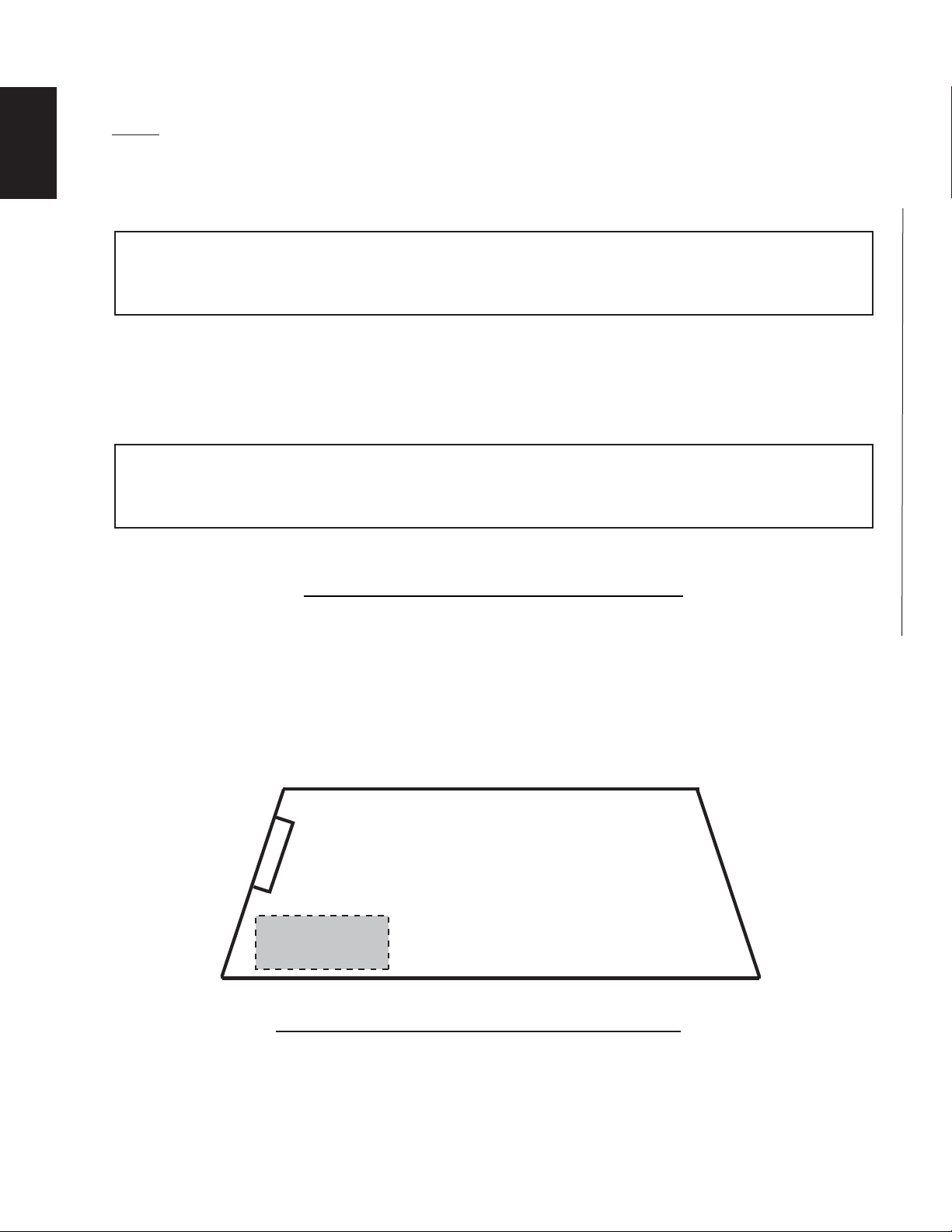
24
W415-1335 / B / 10.04.16
EN
This appliance must be installed in accordance with the manufacturer’s instructions and the Manufactured
Home Construction and Safety Standard, Title 24 CFR, Part 3280, in the United States or the Mobile Home
Standard, CAN/CSA Z240 MH Series, in Canada. This appliance is only for use with the type(s) of gas
indicated on the rating plate.
29.1B
This Mobile/Manufactured Home Listed appliance comes factory equipped with a means to secure the unit. Built
in appliances are equipped with 1/4” (6.4mm) diameter holes located in the front left and right corners of the base.
Use #10 hex head screws, inserted through the holes in the base to secure. For free standing products contact
your local authorized dealer / distributor for the appropriate securing kit. For mobile home installations,
the appliance must be fastened in place. It is recommended that the appliance be secured in all installations.
Always turn off the pilot and the fuel supply at the source, prior to moving the mobile home. After moving the
mobile home and prior to lighting the appliance, ensure that the logs are positioned correctly.
This appliance is certifi ed to be installed in an aftermarket permanently located, manufactured (mobile)
home, where not prohibited by local codes.
This appliance is only for use with the type of gas indicated on the rating plate. This appliance is not
convertible for use with other gases, unless a certifi ed kit is used.
Conversion Kits
This appliance is fi eld convertible between Natural Gas (NG) and Propane (LP).
To convert from one gas to another consult your Authorized dealer/distributor.
NOTE: All vent parameters are stated for rigid venting. If using approved Wolf Steel Ltd. fl exible
venting then total horizontal lengths (H
T
) are reduced by 25%.
4.6 USING FLEXIBLE VENTING
4.7 MOBILE HOME INSTALLATION
4.8 REMOTE RECEIVER PLACEMENT
Position the remote receiver in the valve compartment close to the electrical junction box. Ensure the
receiver is on top of the placement label, if equipped.
35.25
PLACE REMOTE
RECEIVER ON TOP
OF THIS LABEL
FIREPLACE BASE
JUNCTION
BOX
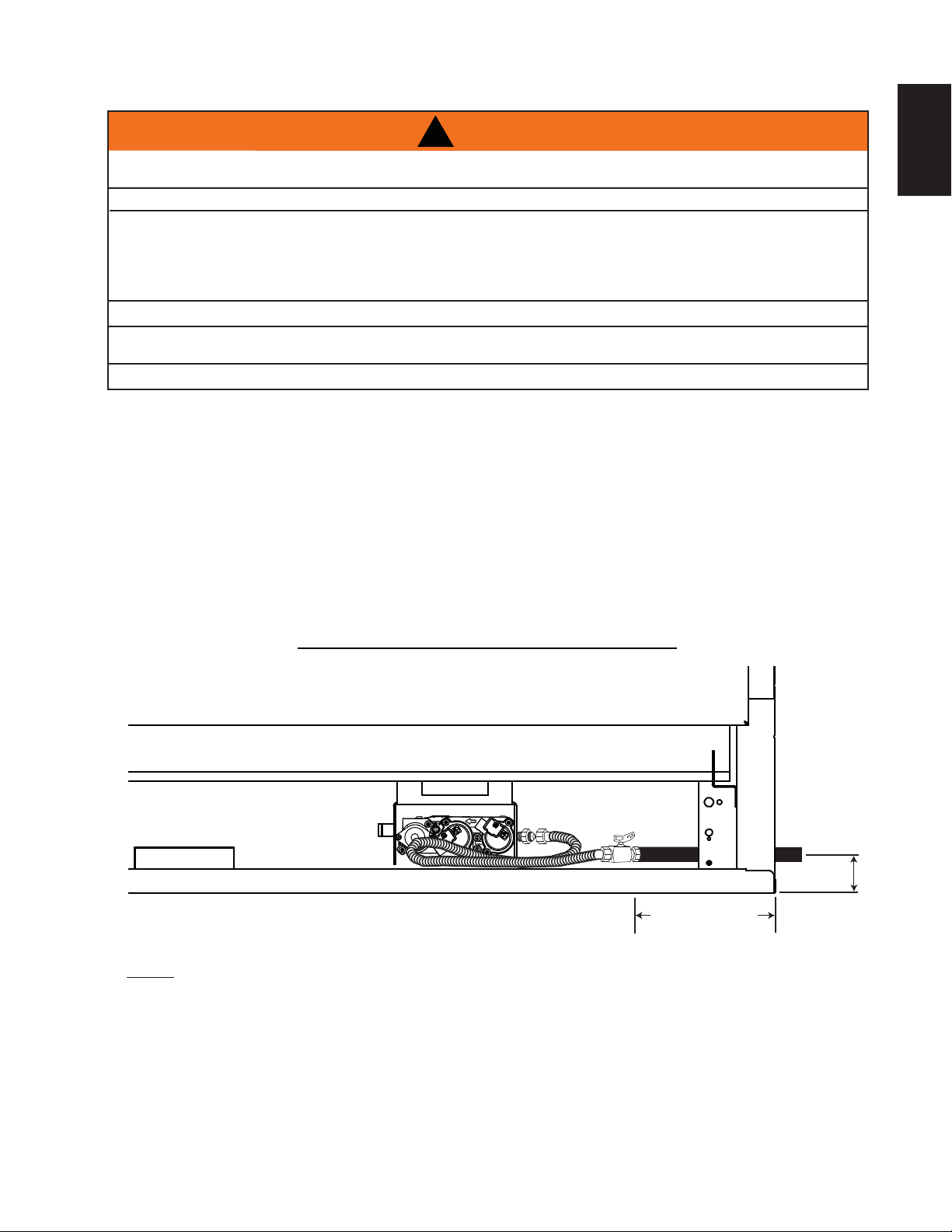
25
W415-1335 / B / 10.04.16
EN
30.1A
Installation and servicing to be done by a qualifi ed installer.
• Move the appliance into position and secure.
• If equipped with a fl ex connector the appliance is designed to accept a 1/2” (13mm) gas supply.
Without the connector it is designed to accept a 3/8” (9.5mm) gas supply. The appliance is equipped
with a manual shut off valve to turn off the gas supply to the appliance.
• Connect the gas supply in accordance to local codes. In the absence of local codes, install to the
current CAN/CSA-B149.1 Installation Code in Canada or to the current National Fuel Gas Code, ANSI
Z223.1 / NFPA 54 in the United States.
• When fl exing any gas line, support the gas valve so that the lines are not bent or kinked.
• The gas line fl ex-connector should be installed to provide suffi cient movement for shifting the burner
assembly on its side to aid with servicing components.
• Check for gas leaks by brushing on a soap and water solution. Do not use open fl ame.
!
WARNING
RISK OF FIRE, EXPLOSION OR ASPHYXIATION. ENSURE THERE ARE NO IGNITION SOURCES SUCH AS
SPARKS OR OPEN FLAMES.
SUPPORT GAS CONTROL WHEN ATTACHING GAS SUPPLY PIPE TO PREVENT DAMAGING GAS LINE.
ALWAYS LIGHT THE PILOT WHETHER FOR THE FIRST TIME OR IF THE GAS SUPPLY HAS RUN OUT
WITH THE GLASS DOOR OPENED OR REMOVED. PURGING OF THE GAS SUPPLY LINE SHOULD BE
PERFORMED BY A QUALIFIED SERVICE TECHNICIAN. ASSURE THAT A CONTINUOUS GAS FLOW IS AT
THE BURNER BEFORE CLOSING THE DOOR. ENSURE ADEQUATE VENTILATION. FOR GAS AND
ELECTRICAL LOCATIONS, SEE “DIMENSIONS” SECTION.
ALL GAS CONNECTIONS MUST BE CONTAINED WITHIN THE APPLIANCE WHEN COMPLETE.
HIGH PRESSURE WILL DAMAGE VALVE. DISCONNECT GAS SUPPLY PIPING BEFORE TESTING GAS
LINE AT TEST PRESSURES ABOVE 1/2 PSIG.
VALVE SETTINGS HAVE BEEN FACTORY SET, DO NOT CHANGE.
4.9 GAS INSTALLATION
2”
(51mm)
12” (305mm)
NOTE: Connect the gas supply to the 1/2” (12.7mm) shut off and fl ex connector (supplied). Ensure gas
supply is secured and that there is suffi cient movement of the connector to permit lifting the burner
base assembly for component servicing.
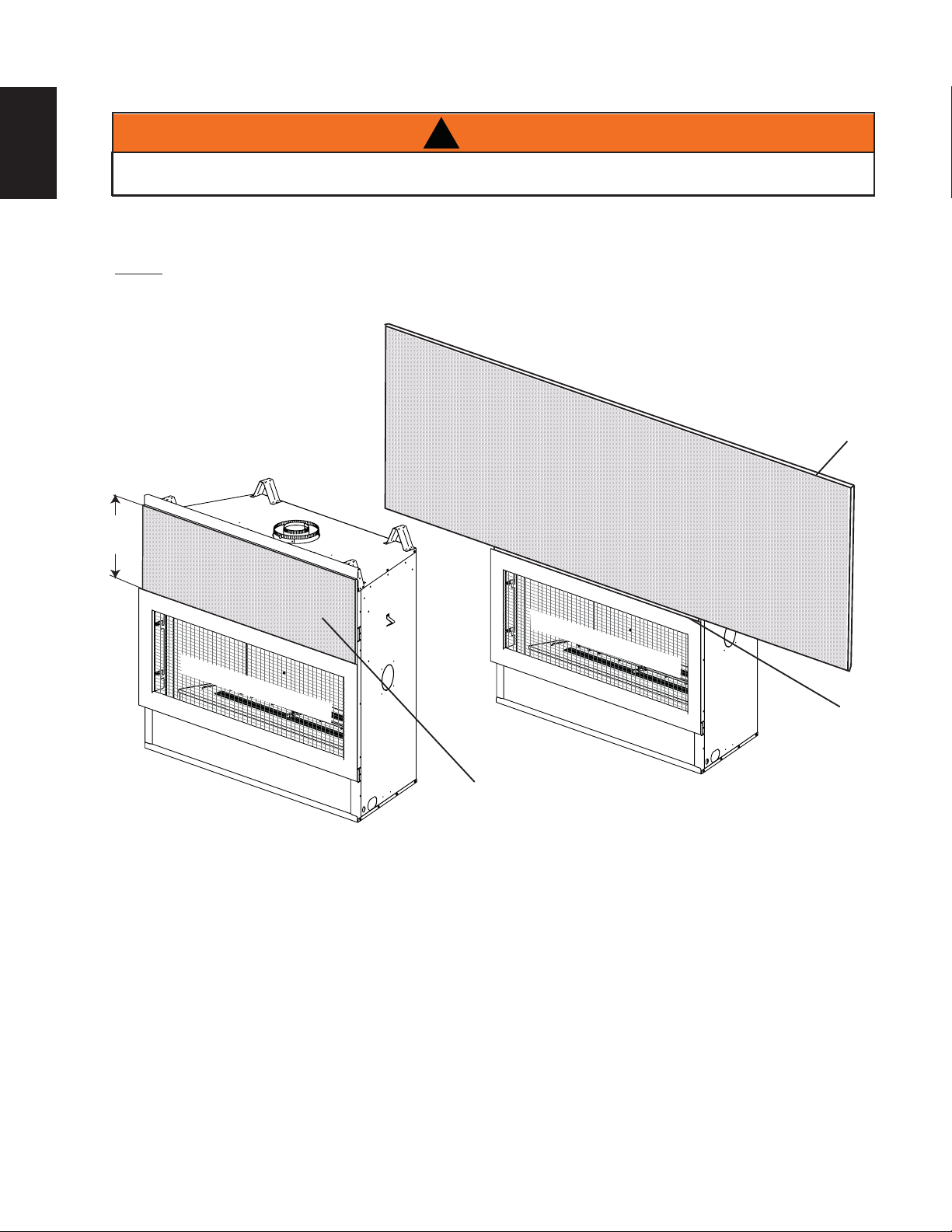
26
W415-1335 / B / 10.04.16
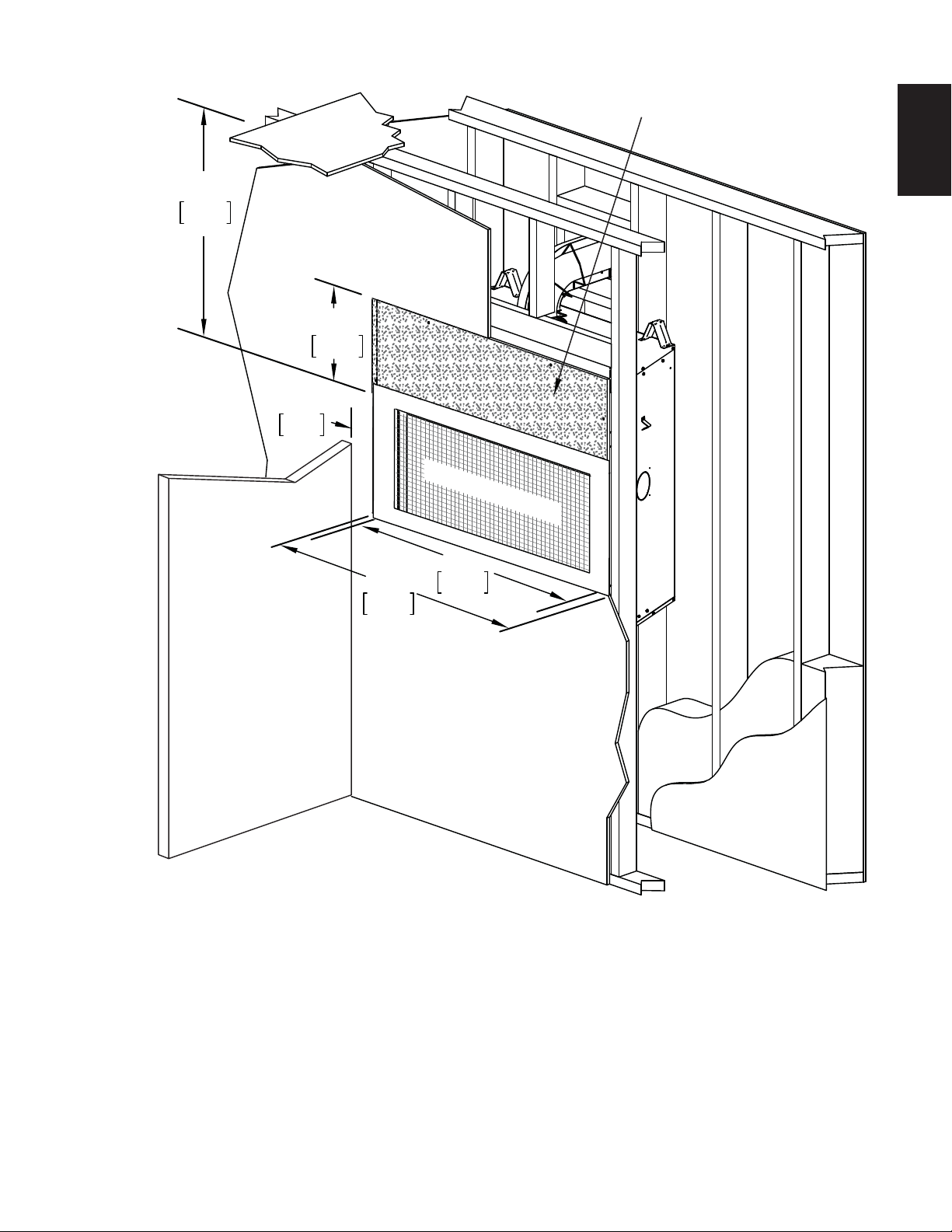
EN
The 14” (355.8mm) above the appliance opening
must not be fi nished with any combustible materials.
Joint Compound where required
Joint compounds such as Durabond 90 and tapes that are resilient to heat and cracking should be used when
taping and mudding seams.
Setting tiles and grouting
If using tiles, we recommend you use tiles with a dry butt joint to be installed using a two-part mortar with an
acrylic latex additive, such as Mapei Kerabond/Kerlastic, to allow for slight movement in the normal operation
of the appliance.
If grout is used between the tiles, a polymer-based grout, such as Mapei Ultracolour plus, is recommended.
Primer/Paint
For a painted surface, use a 100% acrylic latex primer and fi nish coat. Light coloured paints may discolour.
SUPPLIED NON-
COMBUSTIBLE
BOARD
14”
(356mm)
TO CEILING
TOP OF
OPENING
S
AFE
T
Y B
A
RR
I
ER
S
AFE
T
Y B
A
RR
I
ER
4.10 INSTALLING NON-COMBUSTIBLE BOARD
NOTE: To minimize
joints, it may be best
to replace the supplied
non-combustible board
with a larger piece.
!
WARNING
If only a painted surface is desired, a full single sheet
of Duralock cement board should be used.
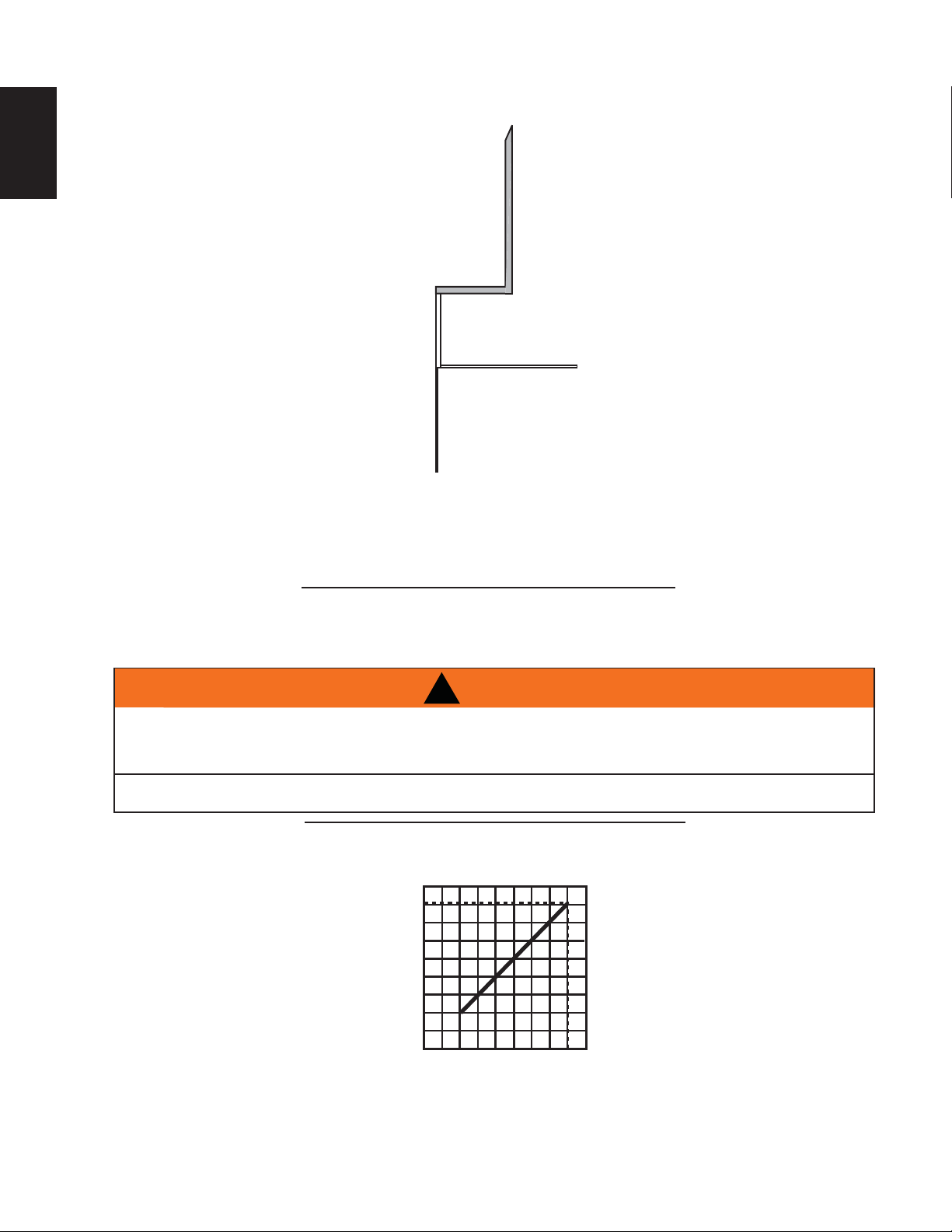
THE SURFACE ABOVE THE APPLIANCE GETS VERY HOT. IF PROPER FINISHING MATERIALS ARE
NOT USED, CRACKING CAN OCCUR.
27
W415-1335 / B / 10.04.16
EN
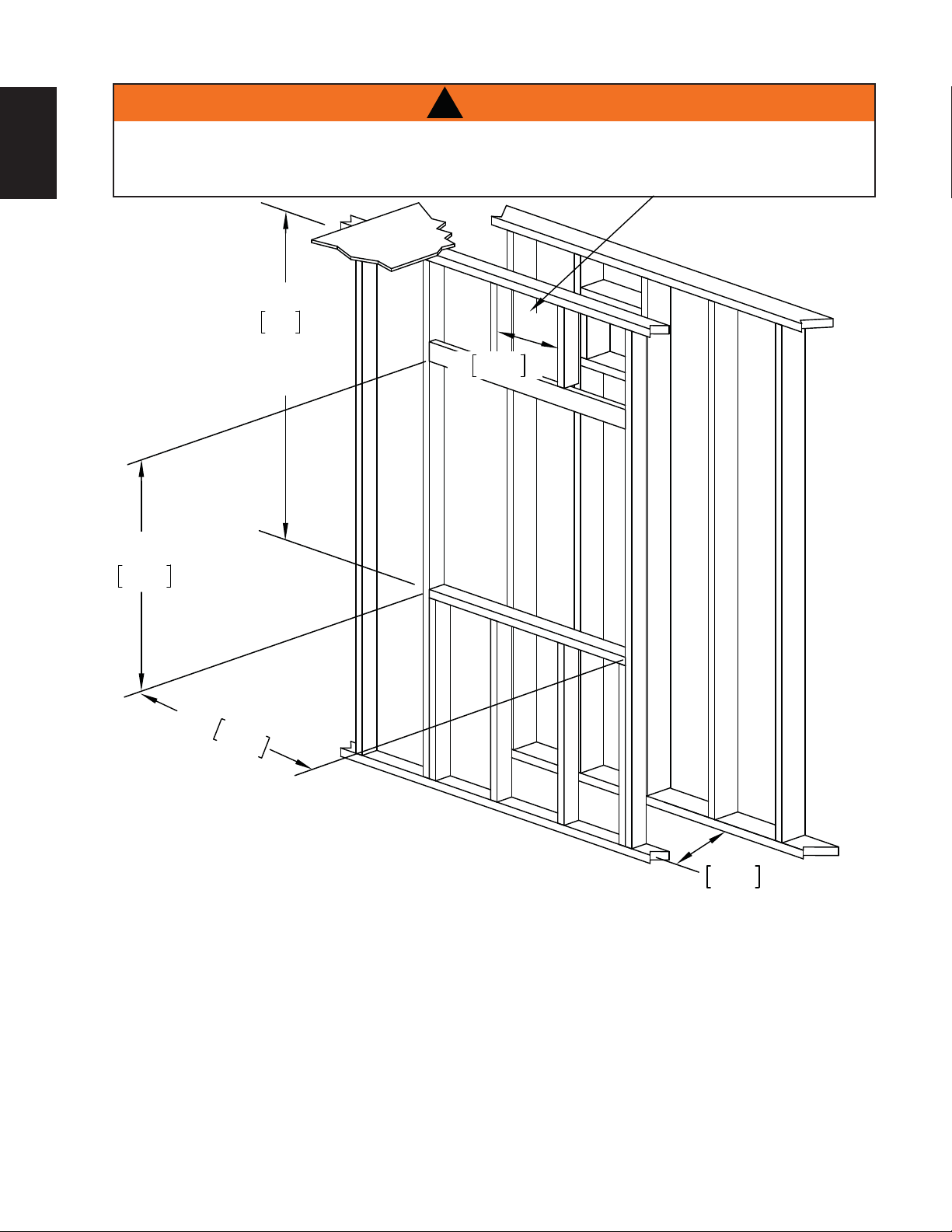
It is best to frame your appliance after it is positioned and the vent system is installed. Frame to local building
codes.
It is not necessary to install a hearth extension with this appliance. When roughing in the appliance, raise the
appliance to accommodate for the thickness of the fi nished fl oor materials, i.e. tile, carpeting, hard wood.
5.0 FRAMING
!
WARNING
RISK OF FIRE!
IN ORDER TO AVOID THE POSSIBILITY OF EXPOSED INSULATION OR VAPOUR BARRIER COMING
IN CONTACT WITH THE APPLIANCE BODY, IT IS RECOMMENDED THAT THE WALLS OF THE
APPLIANCE ENCLOSURE BE “FINISHED” (IE: DRYWALL / SHEETROCK), AS YOU WOULD FINISH
ANY OTHER OUTSIDE WALL OF A HOME. THIS WILL ENSURE THAT CLEARANCE TO
COMBUSTIBLES IS MAINTAINED WITHIN THE CAVITY.
DO NOT NOTCH THE FRAMING AROUND THE APPLIANCE STAND-OFFS. FAILURE TO MAINTAIN
AIR SPACE CLEARANCE MAY CAUSE OVER HEATING AND FIRE. PREVENT CONTACT WITH
SAGGING OR LOOSE INSULATION OR FRAMING AND OTHER COMBUSTIBLE MATERIALS. BLOCK
OPENING INTO THE CHASE TO PREVENT ENTRY OF BLOWN-IN INSULATION. MAKE SURE
INSULATION AND OTHER MATERIALS ARE SECURED.
WHEN CONSTRUCTING THE ENCLOSURE ALLOW FOR FINISHING MATERIAL THICKNESS TO
MAINTAIN CLEARANCES. FRAMING OR FINISHING MATERIAL CLOSER THAN THE MINIMUMS
LISTED MUST BE CONSTRUCTED ENTIRELY OF NON-COMBUSTIBLE MATERIALS. MATERIALS
CONSISTING ENTIRELY OF STEEL, IRON, BRICK, TILE, CONCRETE, SLATE, GLASS OR PLASTERS,
OR ANY COMBINATION THEREOF ARE SUITABLE. MATERIALS THAT ARE REPORTED AS PASSING
ASTM E 136, STANDARD TEST METHOD FOR BEHAVIOUR OF MATERIALS IN A VERTICAL TUBE
FURNACE AT 750°C/1382°F AND UL763 SHALL BE CONSIDERED NON-COMBUSTIBLE MATERIALS.
MINIMUM CLEARANCE TO COMBUSTIBLES MUST BE MAINTAINED OR A SERIOUS FIRE HAZARD
COULD RESULT.
THE APPLIANCE REQUIRES A MINIMUM ENCLOSURE HEIGHT. MEASURE FROM THE APPLIANCE
BASE.
IF STEEL STUD FRAMING KITS WITH CEMENT BOARD ARE PROVIDED, THEY MUST BE
INSTALLED.
71.1
28
W415-1335 / B / 10.04.16
EN
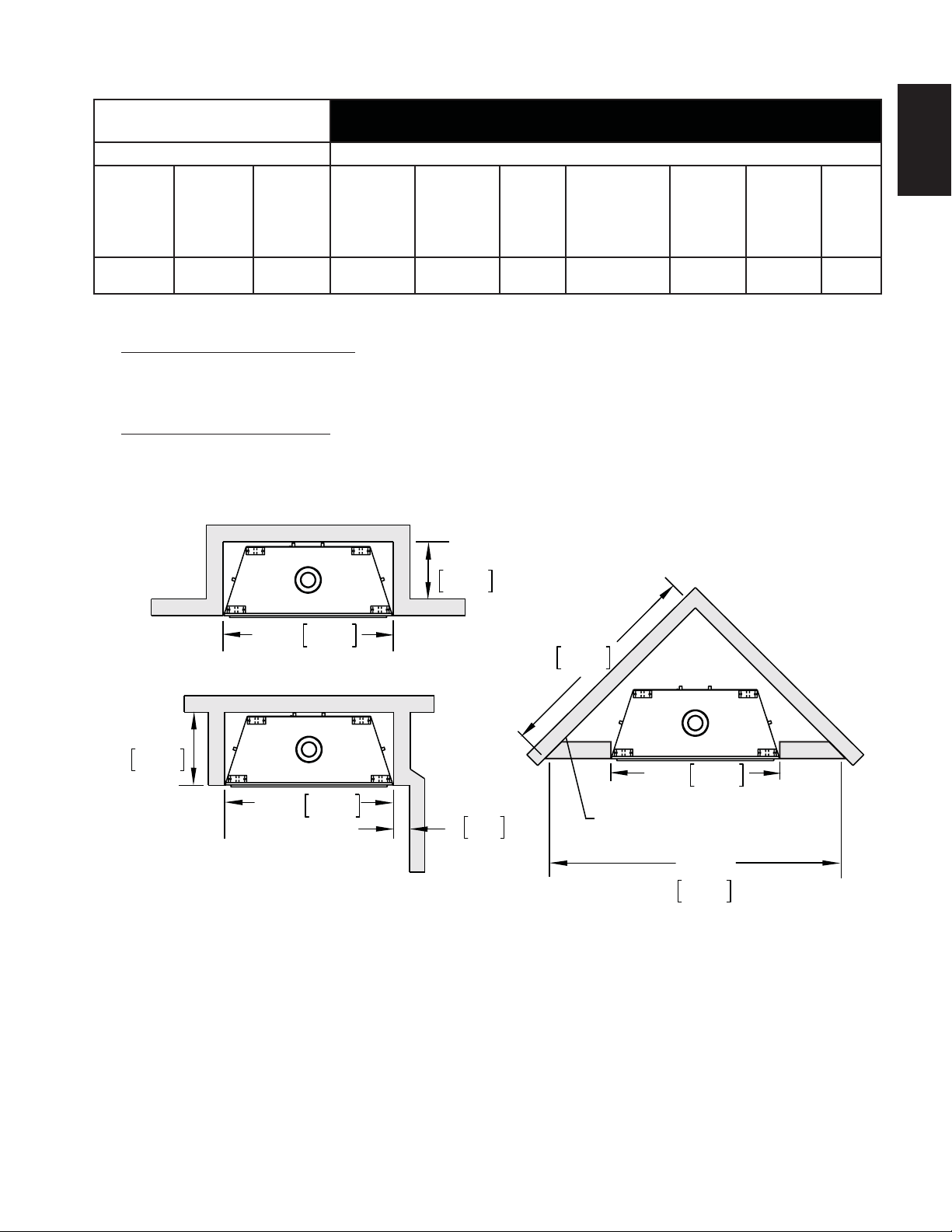
DO NOT BUILD INTO THIS AREA - IT MUST BE LEFT CLEAR TO PROVIDE ADEQUATE CLEARANCE
FOR THE VENT IN THIS 14” (356mm) WIDE AREA CENTERED ALONG THE FRONT OF THE
FIREPLACE. NO COMBUSTIBLES ARE ALLOWED. FIREPLACE SHOULD BE IN ITS FINAL LOCATION
BEFORE FRAMING.
!
WARNING
46 3/4"
1.19 m
41 1/4"
1.05 m
56"
1.4 m
MINIMUM FROM BASE
OF APPLIANCE
14"
35.6cm MIN
20 1/8"
51.1cm *
29
W415-1335 / B / 10.04.16
EN
INSIDE
CHASE
OUTSIDE
CHASE
73 1/2"
187 cm
MIN
BACK WALL OF CHASE / ENCLOSURE
(INCLUDING ANY FINISHING MATERIAL)
46 3/4"
52"
132 cm
20 1/8"
51.1cm
20 1/8"
51.1cm
46 3/4"
118.7cm
46 3/4"
118.7cm
2"
5.1cm
118.7cm
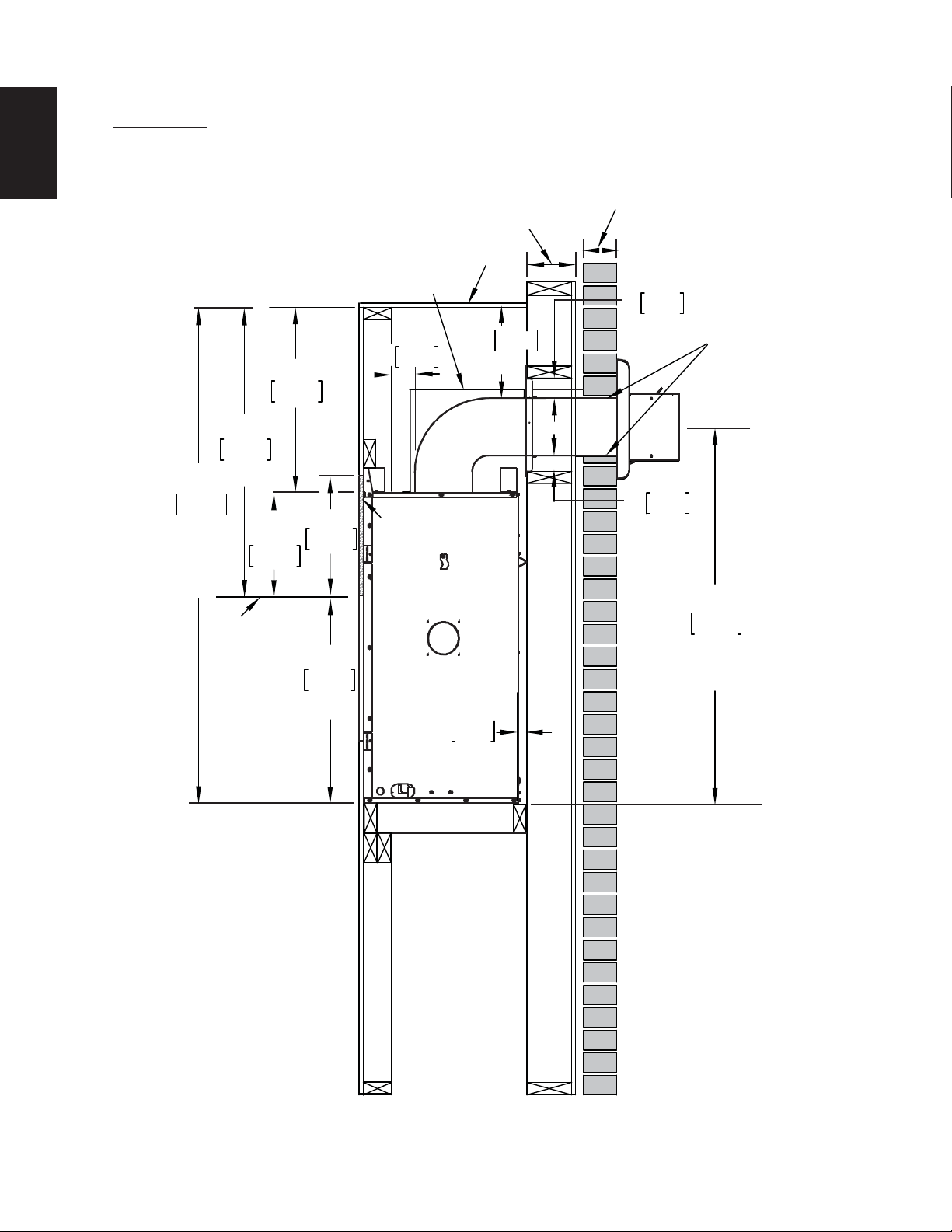
* When constructing the enclosure allow for fi nishing material thickness to maintain clearances.
** HORIZONTAL VENT SECTIONS: A minimum clearance of 2” (51mm) to the top and 1” (25mm) to the
sides and bottom of the vent pipe on all horizontal runs to combustibles is required. Horizontal vent sections
within enclosures require a minimum clearance of 6” (152mm) at the top of the vent pipe, see “MINIMUM
CLEARANCE TO COMBUSTIBLE ENCLOSURES” section. Use fi restop spacer W010-1777 (supplied).
** VERTICAL VENT SECTIONS: A minimum of 1” (25mm) all around the vent pipe on all vertical runs
to combustibles is required except for clearances in appliance enclosures. Vertical vent sections within
enclosures require a minimum clearance of 2” (51mm) around the vent pipe. Use fi restop spacer W500-0096
(not supplied).
FRAMING
MAINTAIN THESE MINIMUM CLEARANCES TO COMBUSTIBLES FROM
APPLIANCE AND VENT SURFACES:
ROUGH OPENING
HEIGHT WIDTH DEPTH TO
CEILING
FROM
BASE OF
APPLIANCE
TO CEILING
FROM TOP
OF
APPLIANCE
OPENING
SIDE
WALL
TO
COMBUSTIBLE
FINISHING
ABOVE
APPLIANCE
OPENING
TOP OF
VENT
PIPE
SIDES
AND
BOTTOM
OF VENT
PIPE
REAR
& SIDE
STAND-
OFFS
41 ¼”
(1.05m)
46 ¾”
(1.19m)
20 ¹/
8
”
(51.1cm)*
56”
(1.42m)
30 ¹¹/
16
”
(78cm)
2”
(5.1cm)
14”
(35.6cm)
2”
(5.1cm)**
1”
(2.5cm)**
0”
(0mm)
30
W415-1335 / B / 10.04.16
EN
IMPORTANT: The LHD45 requires a minimum inside enclosure height of 56” (1422mm), measured from
the bottom of the appliance. For temperature requirements, this area must be left unobstructed. It is
recommended that the enclosure be ventilated at the top and bottom to circulate the hot air.
5.1 MINIMUM CLEARANCE TO COMBUSTIBLE ENCLOSURES
* See “VENTING” section.
TOP OF
FIREPLACE
OPENING
SHELF
COMBUSTIBLE
0” (0mm) IF NON-
COMBUSTIBLE
FINISHING IS USED
SUCH AS BRICK AND
STONE
NON-COMBUSTIBLE
NON-COMBUSTIBLE
MATERIAL
VENT HEAT SHIELD
1"
25mm
2"
51mm
2"
51mm
1"
25mm
6"
152mm
MIN
45 13/16"
1164mm
MIN PLUS
RISE*
56 "
1422mm
MINIMUM
ENCLOSURE
HEIGHT
30 11/16"
780mm
MIN
18 3/16"
462mm
12 1/2"
317mm
14"
356mm
25 5/16"
643mm
MIN
31
W415-1335 / B / 10.04.16
EN
COMBUSTIBLE
NON-COMBUSTIBLE
TOP OF
APPLIANCE
OPENING
30 11/16"
780mm
14"
365mm
42"
1067mm
46 1/4"
1175mm
2"
51mm
S
AFE
T
Y
BA
R
R
I
ER
Finishing material may be secured directly to the appliance body where practical.
32
W415-1335 / B / 10.04.16
EN
5.2 ALCOVE ENCLOSURE
APPLIANCE
RECESS OR
ALCOVE
AREA
NOTE: Recesses or alcoves above the appliance can be made as deep as desired provided the minimum
clearances to combustibles are maintained.
Non-combustible material can be used, provided the minimum clearances to combustible materials are applied.
The minimum enclosure volume must be increased by no less than the volume of the recess. This adjustment
can be made by increasing any or all of the height, width and depth of the enclosure.
71.2
ENCLOSURE
AREA
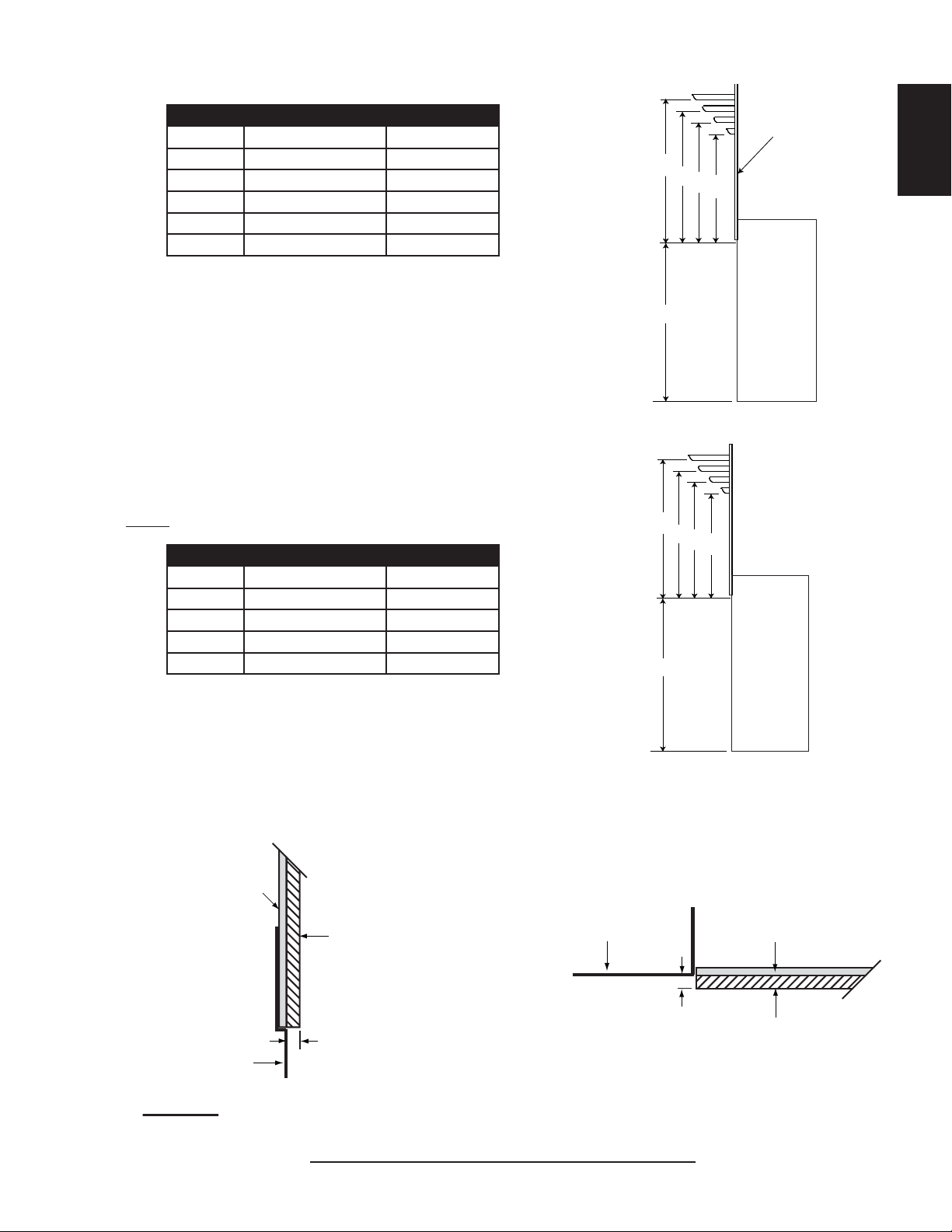
Combustible mantel clearance can vary according to the mantel depth. Use the graph to help evaluate the
clearance needed.
0
34 712 56
12
+
(
,
*
+
7
0
$
1
7
(
/
MANTEL DEPTH
8
10
6
8
!
WARNING
RISK OF FIRE, MAINTAIN ALL SPECIFIED AIR SPACE CLEARANCES TO COMBUSTIBLES. FAILURE
TO COMPLY WITH THESE INSTRUCTIONS MAY CAUSE A FIRE OR CAUSE THE APPLIANCE TO
OVERHEAT. ENSURE ALL CLEARANCES (I.E. BACK, SIDE, TOP, VENT, MANTEL, FRONT, ETC.) ARE
CLEARLY MAINTAINED.
WHEN USING PAINT OR LACQUER TO FINISH THE MANTEL, THE PAINT OR LACQUER MUST BE
HEAT RESISTANT TO PREVENT DISCOLOURATION.
73.1
5.3 MINIMUM COMBUSTIBLE MANTEL CLEARANCES
33
W415-1335 / B / 10.04.16
EN
MANTEL DIMENSIONS
Ref Height Depth
A 25 5/16” (643mm)
B 6” (152mm) 2” (51mm)
C 8” (203mm) 4” (102mm)
D 10” (254mm) 6” (152mm)
E 12” (305mm) 8” (203mm)
E
D
C
B
A
TOP OF
APPLIANCE
(DOOR)
OPENING
BASE OF UNIT
MUST BE
NON-COMBUSTIBLE
FRONT OF
APPLIANCE
WARNING: Non-combustible facing material may protrude past the face of the opening relative to its
depth as referenced in the table. If it does, it is considered a non-combustible protrusion and must meet
the non-combustible protrusion clearance requirements.
71.3B
3/4” (19mm)
FRONT OF
APPLIANCE
TOP VIEWSIDE VIEW
NON-COMBUSTIBLE
FACING MATERIAL
NON-COMBUSTIBLE
FACING MATERIAL
FINISH
MATERIAL
FINISH
MATERIAL
3/4” (19mm)
5.4 MINIMUM NON-COMBUSTIBLE PROTRUSION
5.5 NON-COMBUSTIBLE FACING MATERIAL
FROM TOP OF APPLIANCE OPENING
Ref Height Depth
A 25 5/16” (643mm)
B 0 2” (51mm)
C 2” (51mm) 6” (152mm)
D 4” (102mm) 10” (254mm)
NOTE: Projection must be non-combustible.
E
D
C
B
A
TOP OF
OPENING
34
W415-1335 / B / 10.04.16
EN
6.0 FINISHING
6.1 SAFETY SCREEN AND DOOR REMOVAL / INSTALLATION
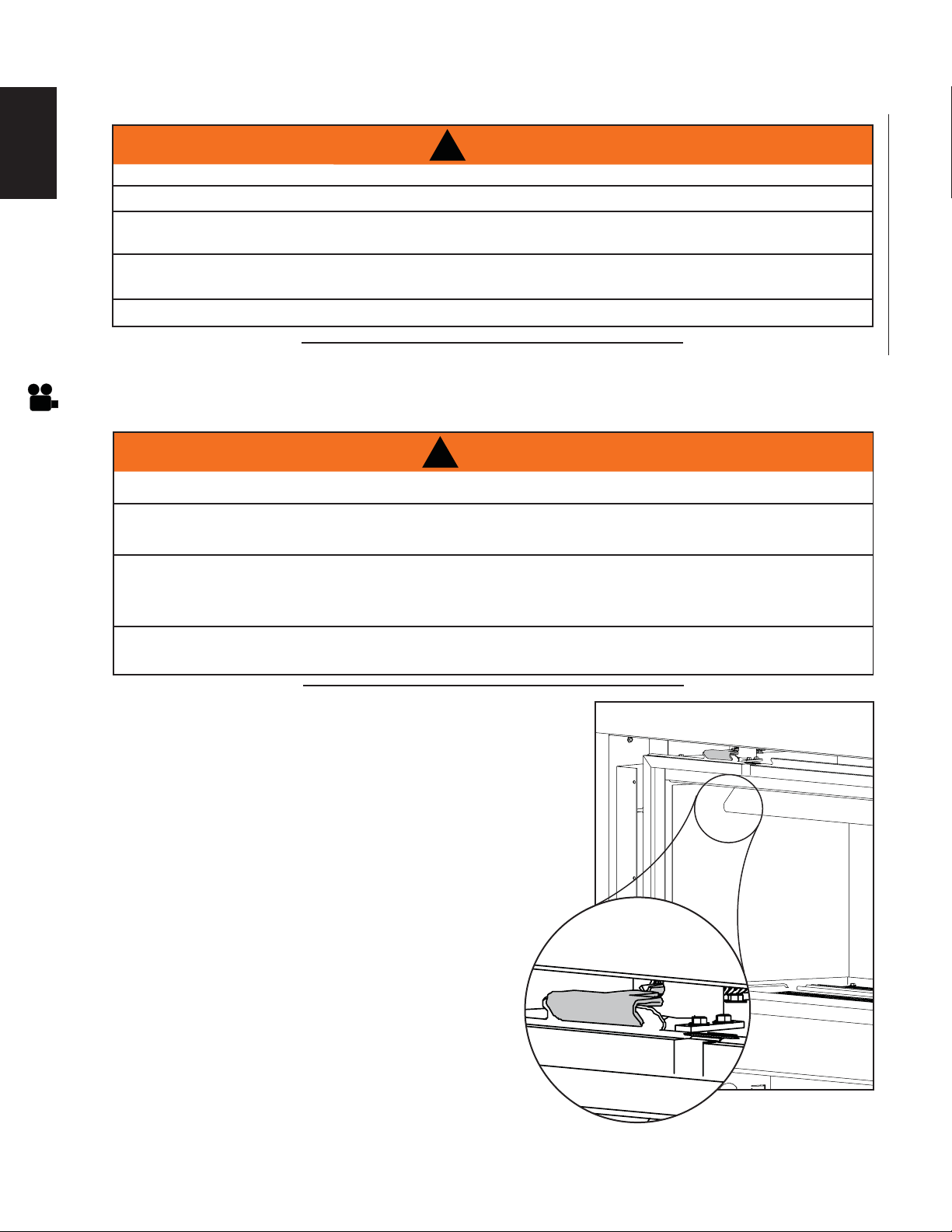
!
WARNING
GLASS MAY BE HOT, DO NOT TOUCH GLASS UNTIL COOLED.
IF EQUIPPED WITH DOOR LATCHES THAT ARE PART OF A SAFETY RELIEF SYSTEM, THEY MUST BE
PROPERLY ENGAGED. DO NOT OPERATE THE APPLIANCE WITH LATCHES DISENGAGED.
FACING AND/OR FINISHING MATERIALS MUST NOT INTERFERE WITH AIR FLOW THROUGH AIR
OPENINGS, LOUVRE OPENINGS, OPERATION OF LOUVRES OR DOORS OR ACCESS FOR
SERVICE. OBSERVE ALL CLEARANCES WHEN APPLYING COMBUSTIBLE MATERIALS.
BEFORE DOOR IS REMOVED TURN THE APPLIANCE OFF AND WAIT UNTIL APPLIANCE IS COOL TO
THE TOUCH. DOORS ARE HEAVY AND FRAGILE SO HANDLE WITH CARE.
75.1A
A barrier designed to reduce the risk of burns from
the hot viewing glass is provided with the appliance
and shall be installed.
Remove the optional front trim equipped with safety barrier, refer to
leafl et for removal instructions.
The glass door is secured to the top front edge of the fi rebox with
two latches. Pull the handles of the latches forward, then lift the
latches out from the door frame to release the top of the door. Next,
pivot the door forward until the top edge clears the front of the
appliance. Carefully grip the sides of the door lifting it out from the
retainer along the bottom of the door.
Reverse these steps to re-install the door.
NOTE: For ease of door removal, it is necessary to
remove the trim.
!
WARNING
RISK OF FIRE!
NEVER OBSTRUCT THE FRONT OPENING OF THE APPLIANCE.
IF FINISHING THE FRONT OF THE APPLIANCE, IT MUST BE FINISHED WITH ANY NON-COMBUSTIBLE
MATERIAL SUCH AS BRICK, MARBLE, GRANITE, ETC.
DO NOT STRIKE, SLAM OR SCRATCH GLASS. DO NOT OPERATE APPLIANCE WITH GLASS
REMOVED, CRACKED, BROKEN OR SCRATCHED.
FACING AND/OR FINISHING MATERIAL MUST NEVER OVERHANG INTO THE APPLIANCE OPENING.
72.1B
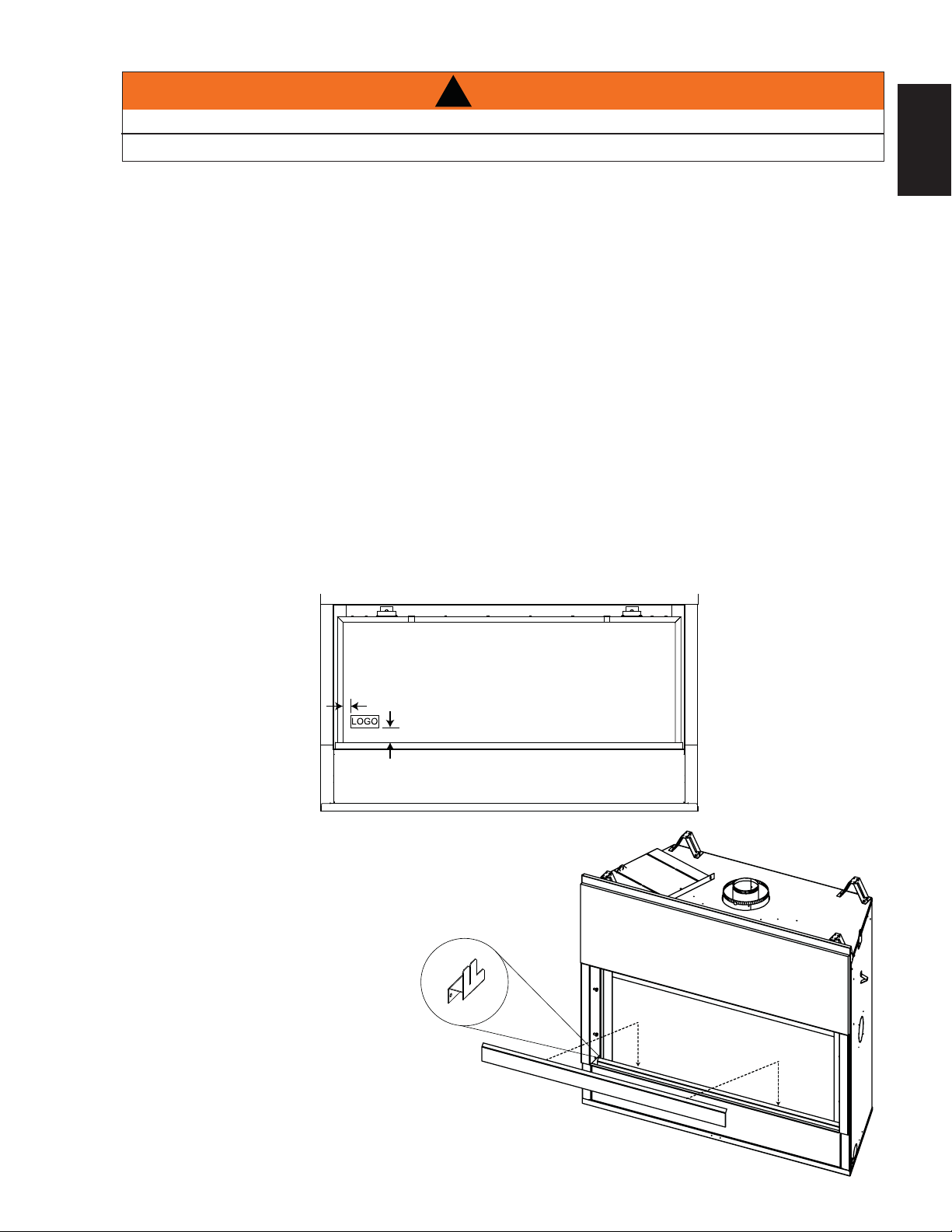
35
W415-1335 / B / 10.04.16
EN
ƎPP
ƎPP
Place trim as shown into the slots of the right and left
brackets behind the access panel.
LEFT BRACKET SHOWN
A. Turn the gas and electrical power off to the appliance, before beginning installation.
B. Locate the battery housing supplied in the manual baggie.
C. Install four “AA” batteries (not supplied) into the battery housing, ensure the positive and negative
ends correspond with those identifi ed on the holder. (To open the battery housing, slide the back
piece upwards and off of the battery housing).
D. Remove the surround equipped with the safety screen then remove the trim to easily access the
control compartment.
E. Attach the wire labelled “BATTERY” from the wiring harness, located in the control compartment of
the appliance, to the battery housing.
F. Place the battery housing into the control compartment, ensure that the battery housing is placed in a
clean and easily accessible location.
G. Reinstall the trim then the surround equipped with the safety screen. The surround must be installed
at all times during the appliance operation.
H. Turn the gas and electrical power back on to begin operating the appliance.
6.2 BATTERY HOUSING INSTALLATION
6.3 LOGO PLACEMENT
6.4 TRIM INSTALLATION
!
WARNING
ENSURE THE GAS AND ELECTRICAL POWER IS TURNED OFF TO THE APPLIANCE.
APPLIANCE MAY BE HOT, DO NOT SERVICE UNTIL THE APPLIANCE HAS COOLED.
NOTE: In the event of a power failure your appliance can be operated using the battery back-up supplied.
NOTE: Once the power has been restored remove the batteries from the holder. The system will drain the
batteries if they are left in the battery holder.
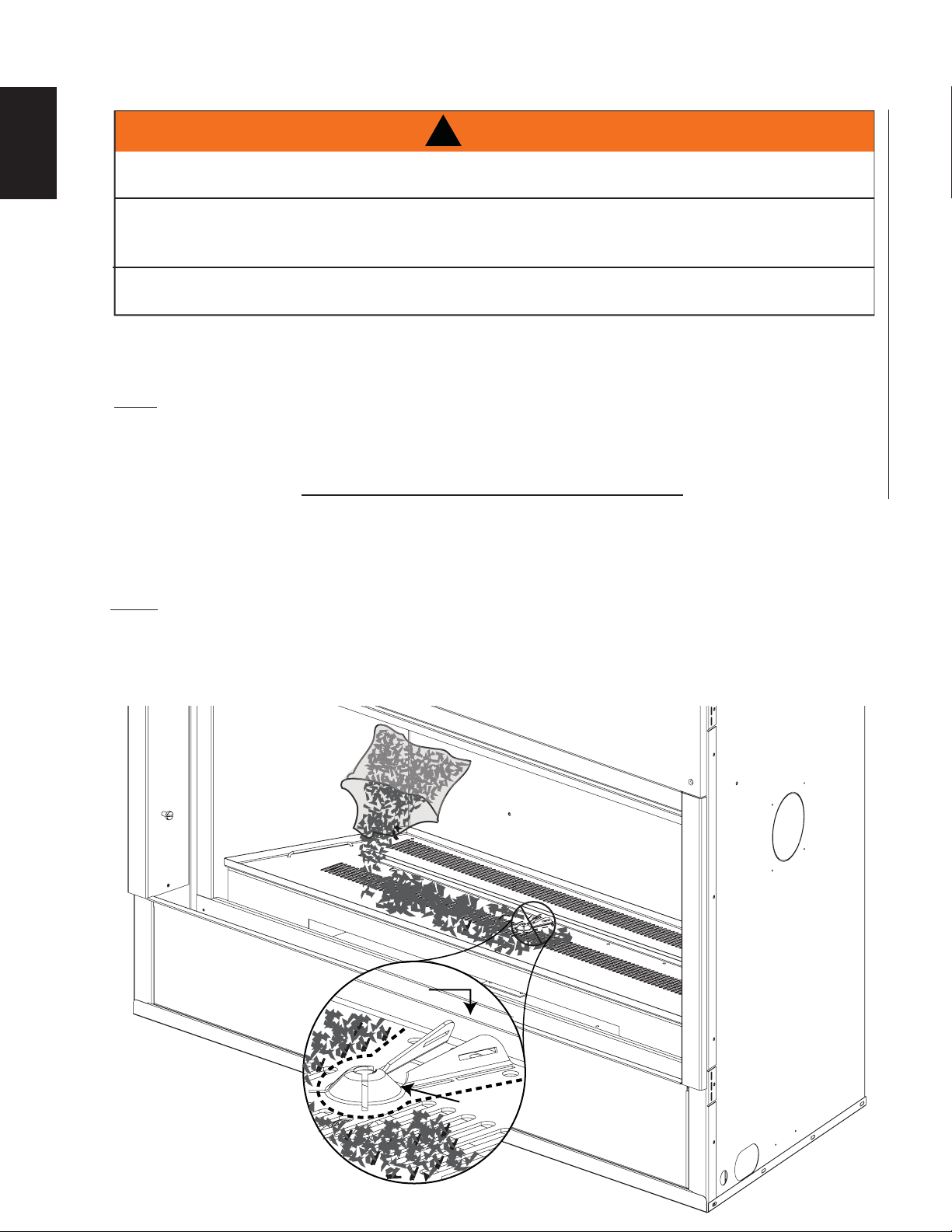
36
W415-1335 / B / 10.04.16
EN
6.5 GLASS EMBERS
NOTE: Care must be taken to ensure glass embers are kept .250” (6.35mm) clear of the pilot area on
the media tray and are not interfering with the pilot operation.
Glass embers must not cover burner ports.
When the fl ames impinge on the glass, the glass may discolour slightly and the edges may soften.
74.2C
Evenly spread the glass media onto the media tray, ensuring no glass media falls into the pilot opening. If this
happens, insert a clean bag into your vacuum cleaner and vacuum out the glass media. Replacement glass
can be purchased from your local authorized dealer / distributor.
NOTE: Do not use more media than what was supplied with the appliance.
CLEANING GLASS MEDIA
Glass media may have a fi ne oil residue that needs to be cleaned prior to installation. Clean the glass with
mild dish soap and water, drain, rinse thoroughly and dry before placing around the burner.
CLEAN THE GLASS MEDIA PRIOR TO INSTALLATION. BEFORE APPLYING THE CLEANED GLASS, ENSURE
THAT IT IS DRY.
DO NOT CHANGE OR SUBSTITUTE THE GLASS MEDIA MATERIAL PROVIDED WITH THIS APPLIANCE. IF
REPLACING, USE ONLY THE REPLACEMENT GLASS MEDIA AVAILABLE FROM YOUR AUTHORIZED
DEALER / DISTRIBUTOR.
DO NOT PLACE ANY MEDIA (GLASS OR VERMICULITE) IN OR AROUND THE PILOT OPENING. THIS WILL
INTERFERE WITH THE PILOT OPERATION
!
WARNING
PILOT
AREA
BURNER
PORTS
WARNING: DO NOT PLACE MEDIA ON OR AROUND THE PILOT, THIS WILL INTERFERE WITH PILOT
OPERATION. USE ONLY MEDIA APPROVED FOR USE WITH THIS APPLIANCE. DO NOT OVERFILL MEDIA,
USE ONLY THE AMOUNT SUPPLIED WITH THE APPLIANCE.
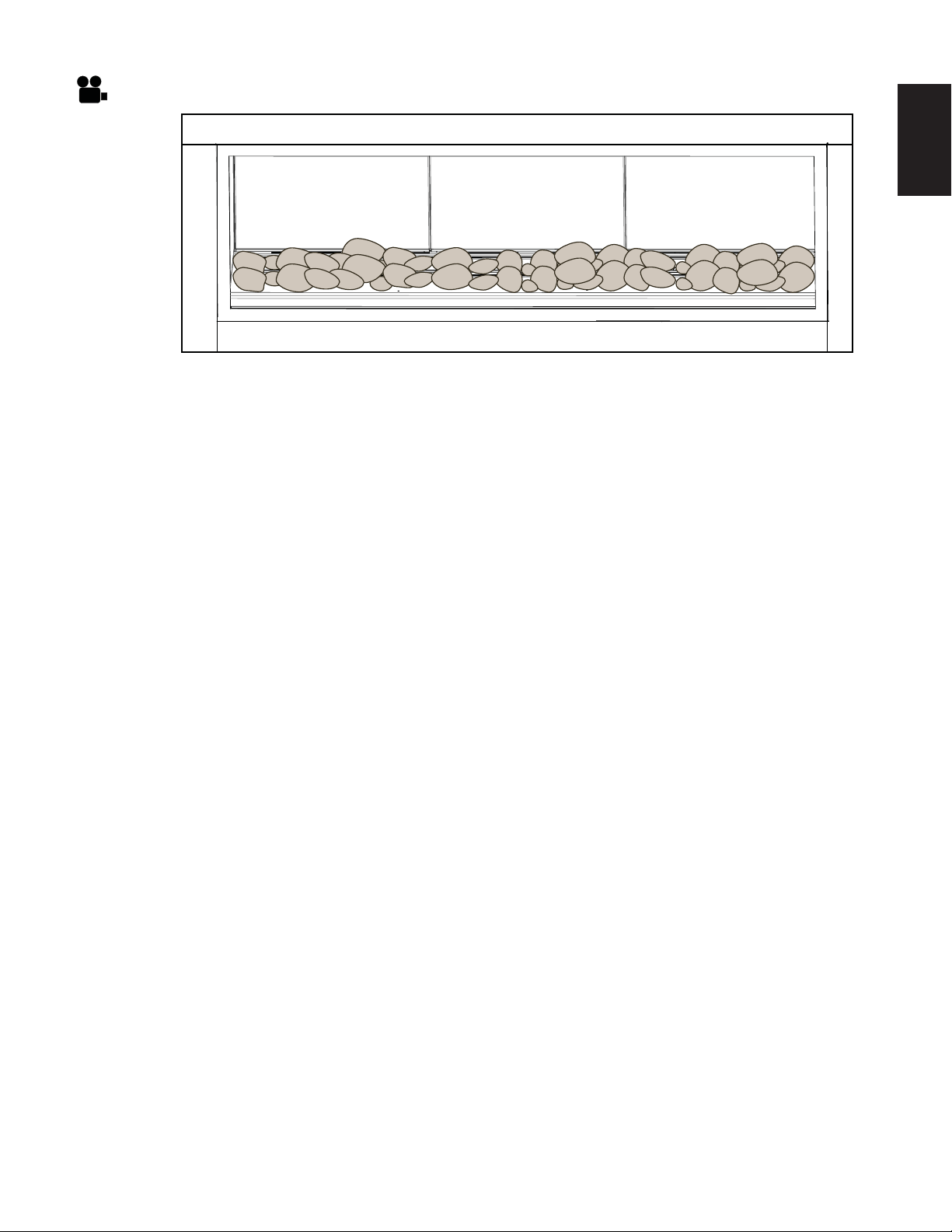
37
W415-1335 / B / 10.04.16
EN
6.6 OPTIONAL ROCK PLACEMENT
Randomly place the refractory rocks onto the media tray, around, but not on the burner ports or pilot mesh.
Follow the instructions provided with RK62.
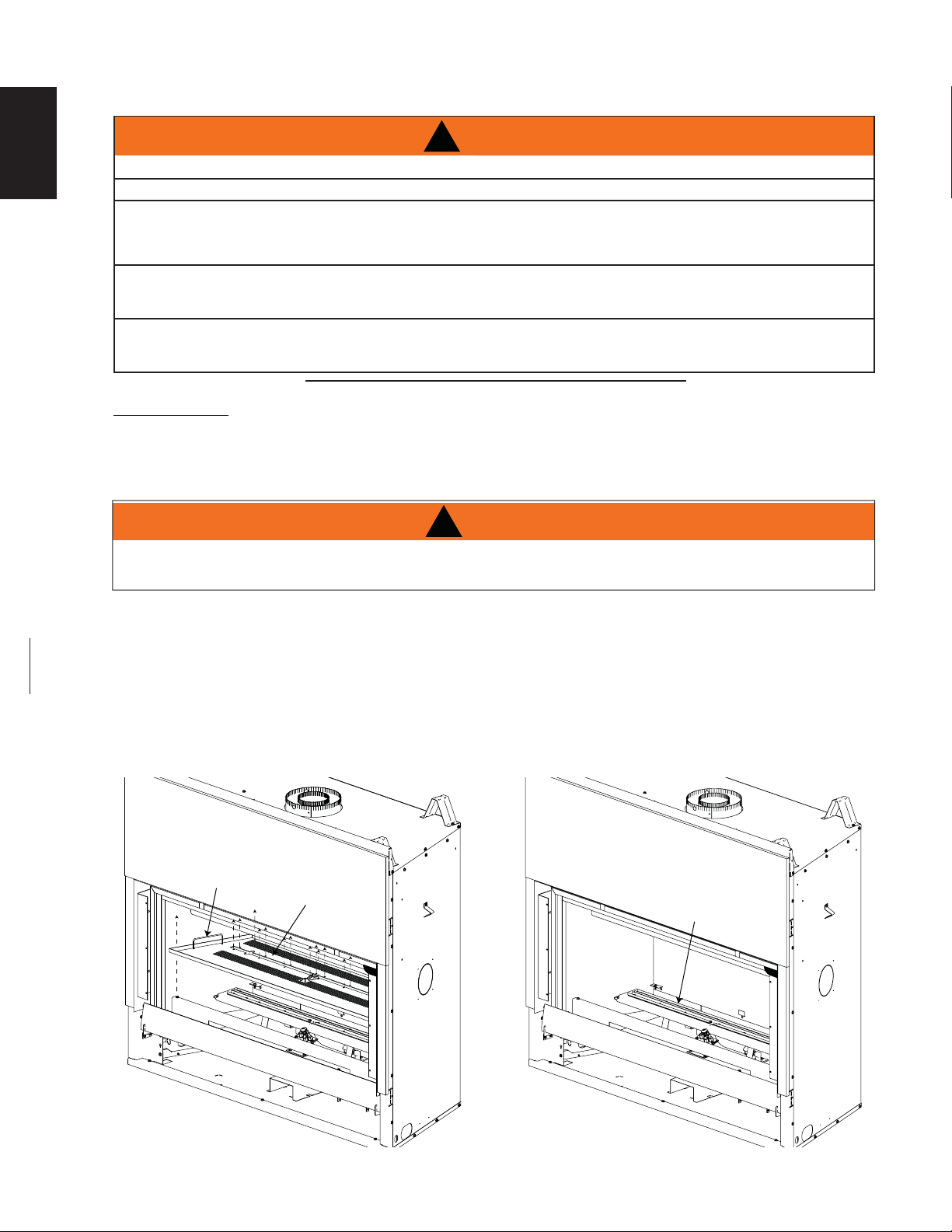
38
W415-1335 / B / 10.04.16
EN
7.0 OPTIONAL BLOWER INSTALLATION
!
WARNING
RISK OF FIRE AND ELECTRICAL SHOCK.
TURN OFF THE GAS AND ELECTRICAL POWER BEFORE SERVICING THIS APPLIANCE.
USE ONLY WOLF STEEL APPROVED OPTIONAL ACCESSORIES AND REPLACEMENT PARTS WITH
THIS APPLIANCE. USING NON-LISTED ACCESSORIES (BLOWERS, DOORS, LOUVRES, TRIMS, GAS
COMPONENTS, VENTING COMPONENTS, ETC.) COULD RESULT IN A SAFETY HAZARD AND WILL
VOID THE WARRANTY AND CERTIFICATION.
ENSURE THAT THE FAN’S POWER CORD IS NOT IN CONTACT WITH ANY SURFACE OF THE
APPLIANCE TO PREVENT ELECTRICAL SHOCK OR FIRE DAMAGE. DO NOT RUN THE POWER
CORD BENEATH THE APPLIANCE.
THE WIRE HARNESS PROVIDED IN THE BLOWER KIT IS A UNIVERSAL HARNESS. WHEN
INSTALLED, ENSURE THAT ANY EXCESS WIRE IS CONTAINED, PREVENTING IT FROM MAKING
CONTACT WITH MOVING OR HOT OBJECTS.
51.5
7.1 ACCESSING THE BLOWER
!
WARNING
BE CAREFUL NOT TO TEAR THE BURNER TRAIN GASKET. A REPLACEMENT GASKET CAN BE
ORDERED FROM YOUR LOCAL AUTHORIZED DEALER / DISTRIBUTOR.
7.1.1 BURNER REMOVAL
A. Remove the door, see “SAFETY SCREEN AND DOOR REMOVAL / INSTALLATION” section.
B. Remove the 20 screws (8 per side and each corner) that secure the media tray in place. Using the
lifting handles lift the tray up and out.
C. Remove the 4 screws that secure the burner in place. Lift the burner up and out.
MEDIA
TRAY
LIFTING
HANDLES
BURNER
HELPFUL HINT: Prior to fi nishing in the appliance, we recommend installing the blower through the
pre-fi nishing access panel.
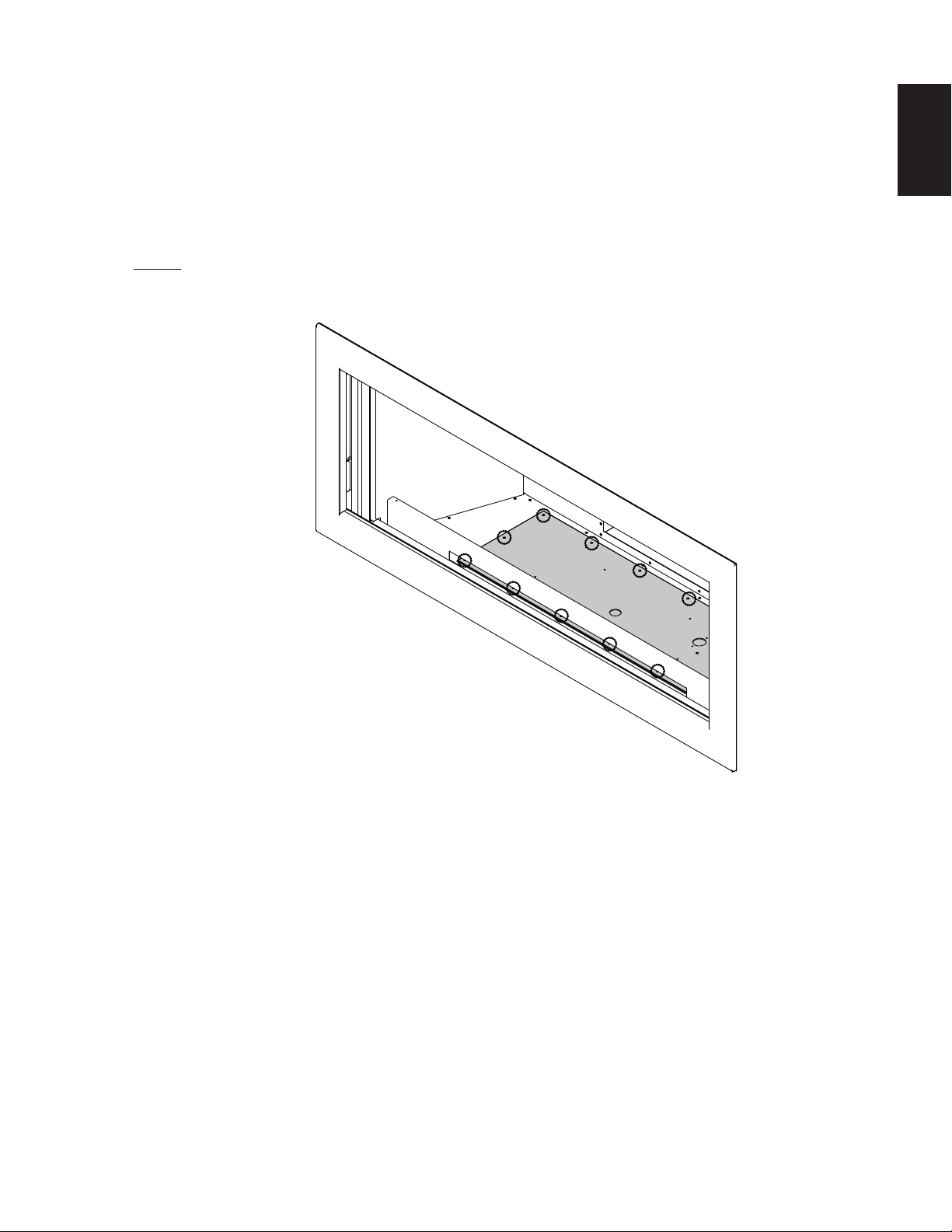
39
W415-1335 / B / 10.04.16
EN
A. Remove the door, see “SAFETY SCREEN AND DOOR REMOVAL / INSTALLATION” section.
B. Remove the media tray and burner, see “BURNER REMOVAL” section.
C. Remove the fourteen screws from the valve train assembly. Carefully lift the valve train assembly and
turn off the manual shut-off valve, see “GAS INSTALLATION” section.
NOTE: A new gasket may be required, when re-installing the
valve train assembly, contact your local
Authorized dealer / distributor.
7.1.2 VALVE TRAIN ASSEMBLY
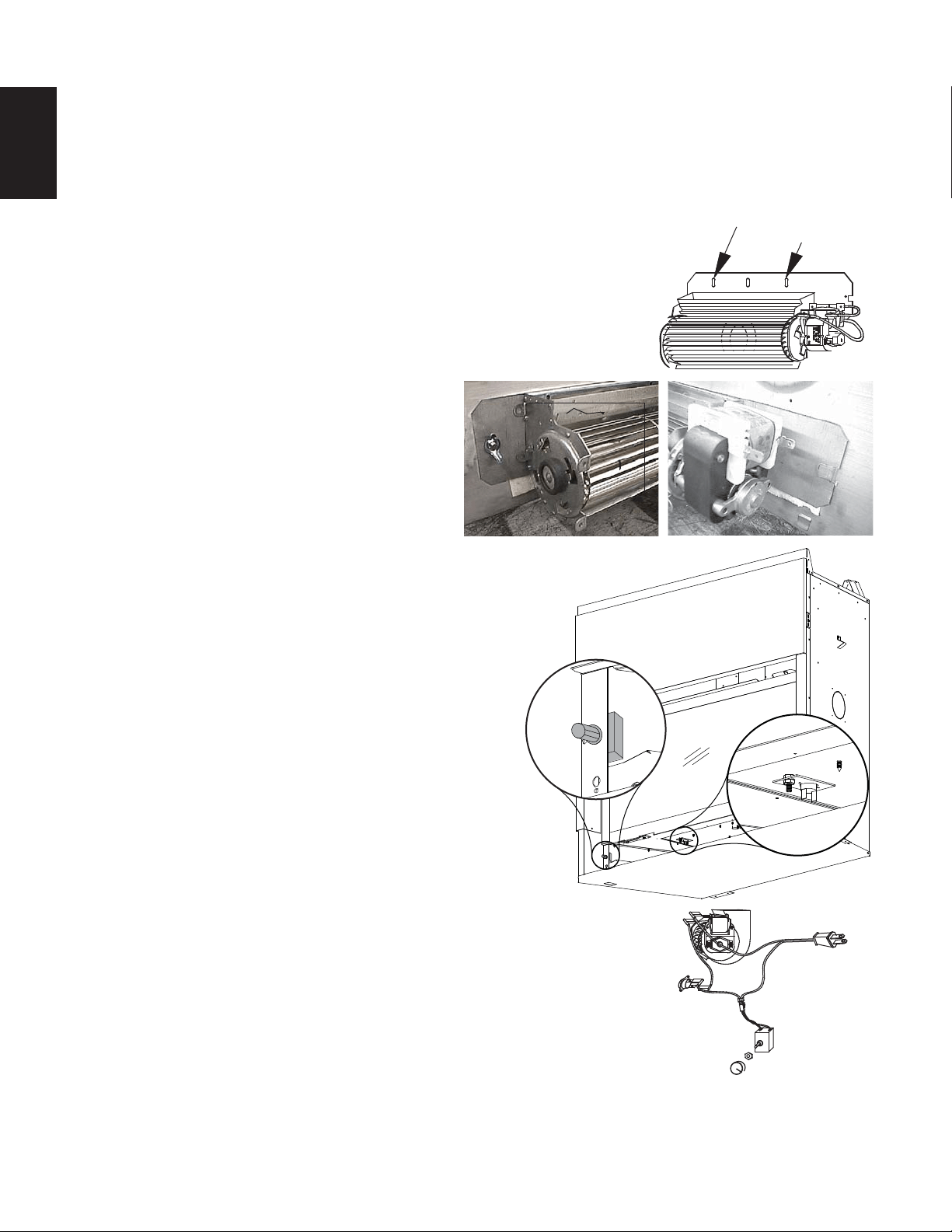
40
W415-1335 / B / 10.04.16
EN
7.2 INSTALLING THE BLOWER
INSTALLATION TO BE DONE BY A QUALIFIED INSTALLER and must be electrically connected and
grounded in accordance with local codes. In the absence of local codes, use the current CSA C22.1 Canadian
electrical code in Canada or the ANSI / NFPA 70 National Electrical Code in the United States
The three slots on the blower mounting bracket allow ease of adjustment
when attaching the blower. For a quiet running blower, do not allow the
assembly to sit on the firebox base. Slide the vibration reducing pad (A) into
the clip (C) and up against the threaded stud (B) at the other end. The blower
must be able to be positioned entirely onto the pad.
Tilt the blower onto its side. Slide it past the controls and into the clip (C).
Secure to the threaded stud using the lock washer and wing nut provided.
Ensure that the blower does not touch the
appliance base or the firebox.
Attach the connectors from the black and white
wires to the thermal switch. Ensure that the
thermal switch makes contact the with the burner
base.
Attach the connectors from the black and red
wires to the blower. Ensure that the wires are
routed safely away from hot objects and retained
from the blower impellers.
Attach and secure the variable speed switch to the
corner post. However this is difficult to access when
the appliance is operating. For frequent useage
consider an alternative position beside your appli-
ance wall switch. If the wire does not reach, then it
must be cut and a splice added.
These connections must conform with local codes or,
in the absence of local codes, use the current CSA
C22.1 Canadian Electrical Code in Canada or the
ANSI/NFPA 70 National Electrical Code in the United
States.
Plug the blower cord into the receptacle.
Drywall dust will penetrate into the blower bearings,
causing irreparable damage. Care must be taken to
prevent drywall dust from coming into contact with
the blower or its compartment. Any damage resulting from this condition is
not covered by the warranty policy.
Because the blower is thermally activated, when turned on, it will automati-
cally start approximately 10-30 minutes after lighting the appliance and will
run for approximately 30-40 minutes after the appliance has been turned
off. Use of the fan increases the heat output of the appliance.
black
white
red
VARIABLE
SPEED
SWITCH
BLOWER
THERMAL
SWITCH
SLOTS
ELONGATED
A
B
C
VARIABLE
SPEED
SWITCH
THERMAL
SWITCH
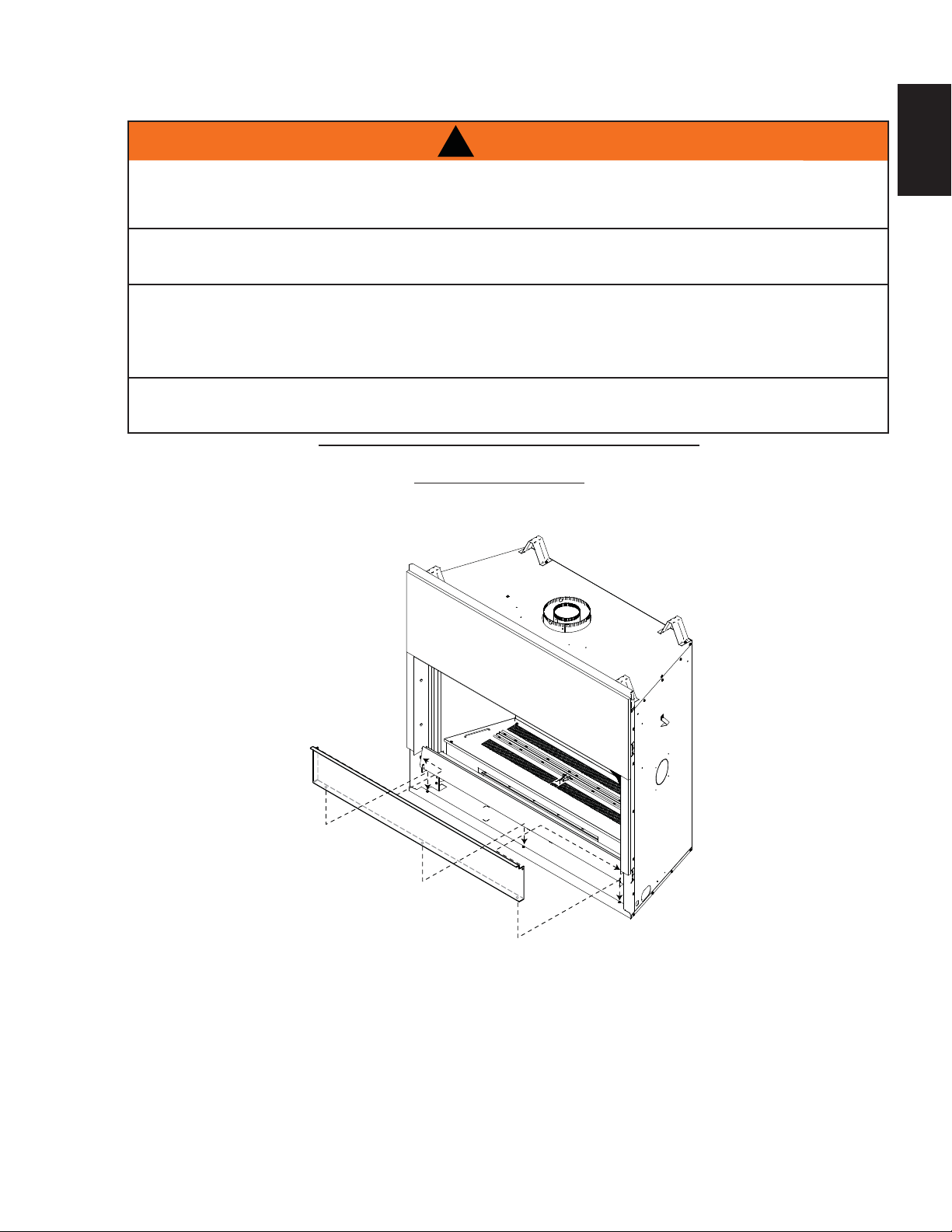
41
W415-1335 / B / 10.04.16
EN
If access to the control area is necessary BEFORE INSTALLATION, remove the pre-fi nishing access panel.
The access panel must be re-installed before operating the appliance.
8.0 ELECTRICAL CONNECTION
!
WARNING
DO NOT USE THIS APPLIANCE IF ANY PART HAS BEEN UNDER WATER. CALL A QUALIFIED
SERVICE TECHNICIAN IMMEDIATELY TO HAVE THE APPLIANCE INSPECTED FOR DAMAGE TO THE
ELECTRICAL CIRCUIT.
RISK OF ELECTRICAL SHOCK OR EXPLOSION. DO NOT WIRE 110V TO THE VALVE OR TO THE
APPLIANCE WALL SWITCH. INCORRECT WIRING WILL DAMAGE CONTROLS.
ALL WIRING SHOULD BE DONE BY A QUALIFIED ELECTRICIAN AND SHALL BE IN COMPLIANCE
WITH LOCAL CODES. IN THE ABSENCE OF LOCAL CODES, USE THE CURRENT CSA22.1 CANADIAN
ELECTRIC CODE IN CANADA OR THE CURRENT NATIONAL ELECTRIC CODE ANSI/NFPA NO. 70 IN
THE UNITED STATES.
ALWAYS LIGHT THE PILOT WHETHER FOR THE FIRST TIME OR IF THE GAS SUPPLY HAS RUN OUT,
WITH THE GLASS DOOR OPENED OR REMOVED.
69.2_2
PRE-FINISHING
ACCESS PANEL
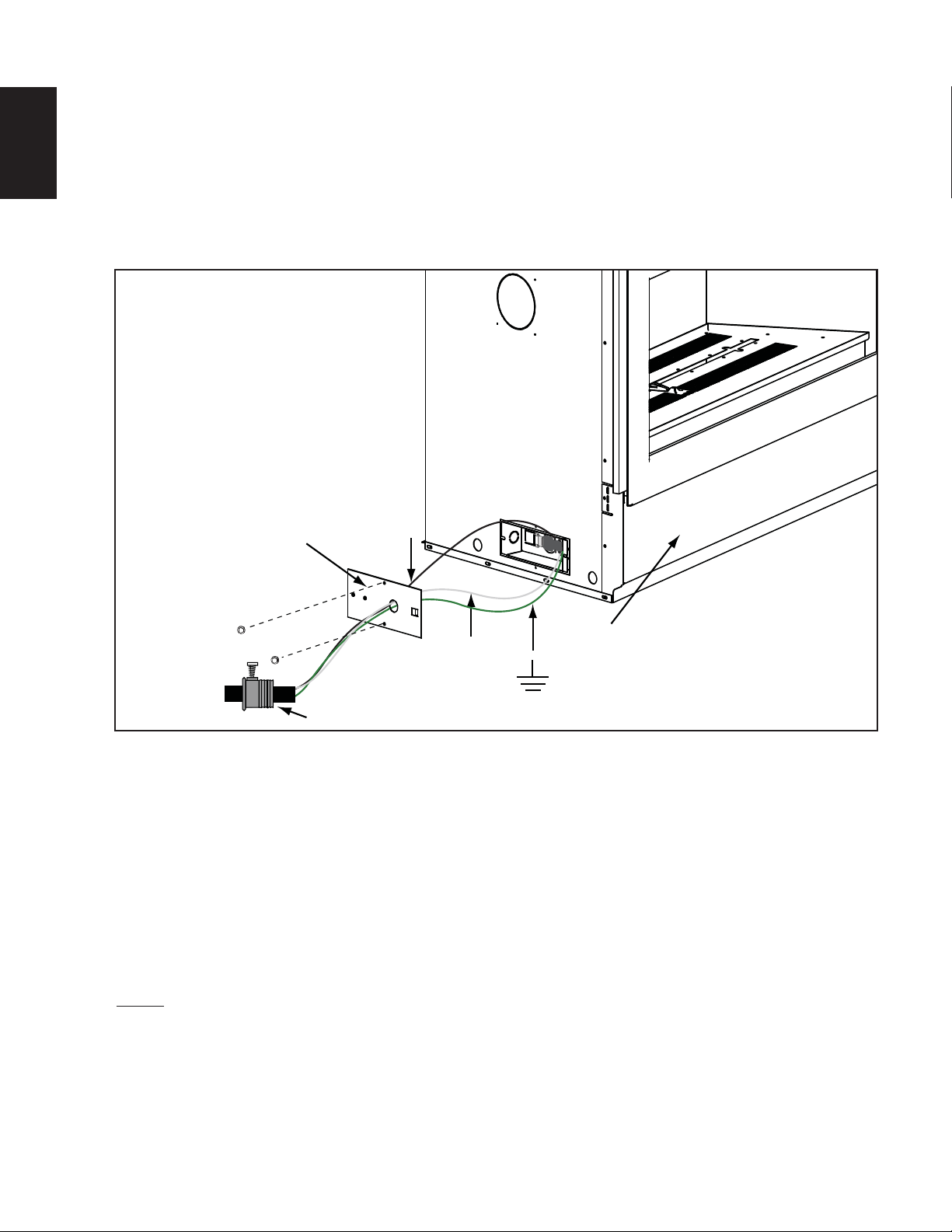
42
W415-1335 / B / 10.04.16
EN
It is necessary to hard wire this appliance.
Permanently framing the appliance with an enclosure, requires the appliance junction box to be hard wired.
This appliance must be electrically connected and grounded in accordance with local codes. In the absence
of local codes, use the current CSA C22.1 Canadian electrical code in Canada or the ANSI/NFPA 70-1996
national electrical code in the United States.
8.1 HARD WIRING CONNECTION
8.2 RECEPTACLE WIRING DIAGRAM
CABLE CONNECTOR
L1
L2
ELECTRICAL COVER
PRE-FINISHING
ACCESS PANEL
A. Remove the two screws that secure the junction box assembly to the outer shell on the left side of
the appliance and remove the junction box assembly.
B. Remove the one screw that secures the junction box to the junction box plate and slide the clip off.
C. Route the supply wire through the 7/8” (22.2mm) hole of the junction box plate with a box connector
(not supplied).
D. Connect the 120 volt supply wire to the receptacle as per the CSA C22.1 Canadian Electrical Code in
Canada or the ANSI/NFPA 70-1996 National Electrical Code in the United States.
E. Once the wiring is complete, re-install the junction box to the junction box plate and re-secure the
screw that was previously removed.
F. Re-install the junction box assembly by reversing step A.
NOTE: If the appliance is already installed inside the enclosure, you can access the junction box from
inside the appliance by removing the burner base assembly, see “BURNER REMOVAL” section and
“VALVE TRAIN REMOVAL” section.
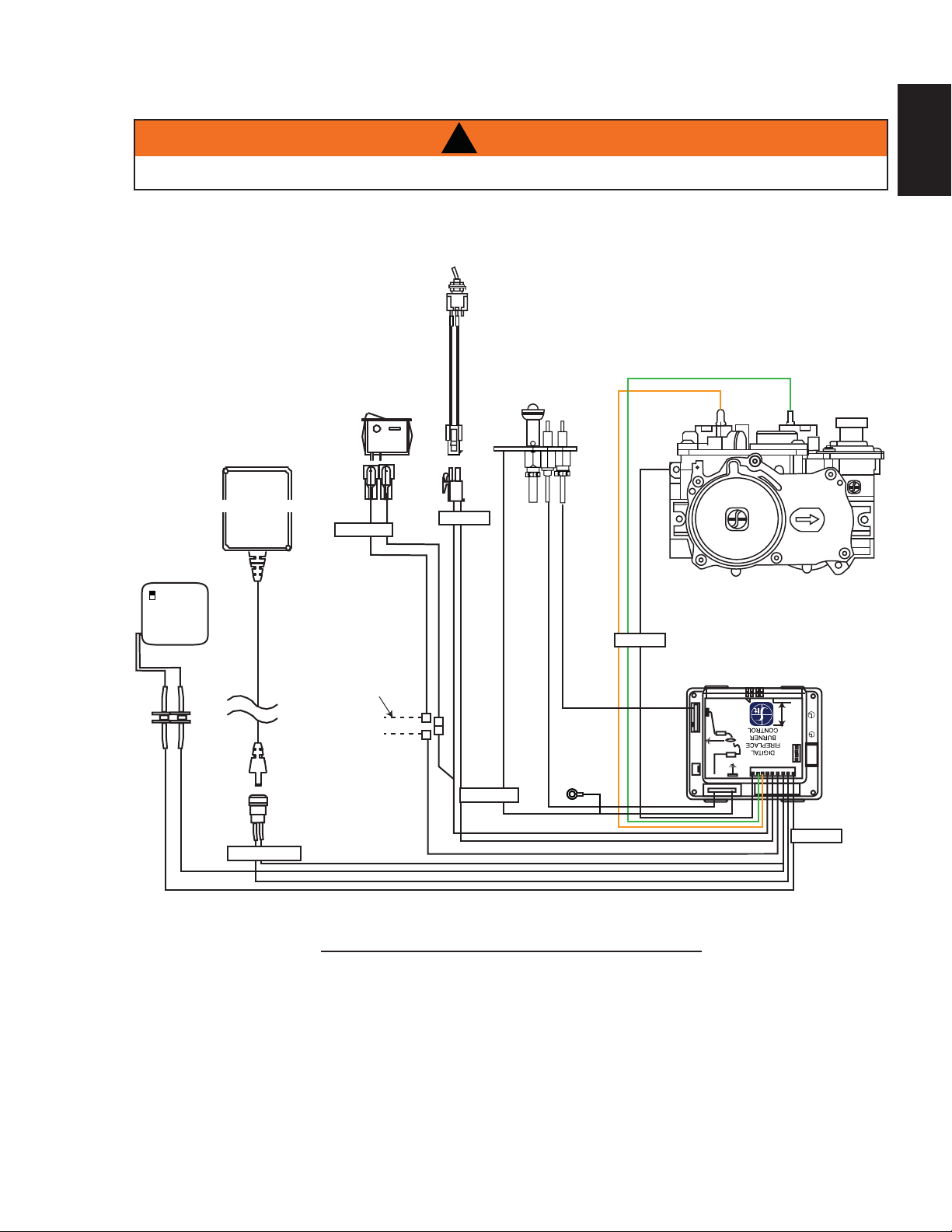
43
W415-1335 / B / 10.04.16
EN
8.3 WIRING DIAGRAM
69.5A
!
WARNING
DO NOT WIRE 110 VOLTS TO THE VALVE OR WALL SWITCH.
ON / OFF
SWITCH
ACS/IPI
SWITCH
(OPTIONAL)
BATTERY
HOUSING
GROUND
DFC
VALVE
ORANGE
GREEN
GROUND
EYELET
ON / OFF
IPI / CPI
DISCONNECT THESE
CONNECTIONS TO THE
ON/OFF SWITCH. CONNECT
AN OPTIONAL THERMOSTAT
OR REMOTE CONTROL AND
IF ALLOWED WITH THIS
APPLIANCE A “B” VENT
ADAPTOR.
IPI BOARD
DC SUPPLY
TRANSFORMER
VALVE
ELECTRONIC
WITH “B” VENT ADAPTORS THE SPILL SWITCH MUST BE WIRED IN SERIES WITH EITHER THE
EXISTING SWITCH OR OPTIONAL WALL SWITCH, THERMOSTAT OR REMOTE.
OFF ON
This appliance comes equipped with a battery back-up. If this backup is used, install 4 AA batteries (not
supplied) into the holder and connect to the wire harness. Place near the IPI board. Connect the battery
holder to the wire harness before using the appliance. Place near the IPI board. If backup is used, it must be
connected to the 6 volt battery pack (supplied).
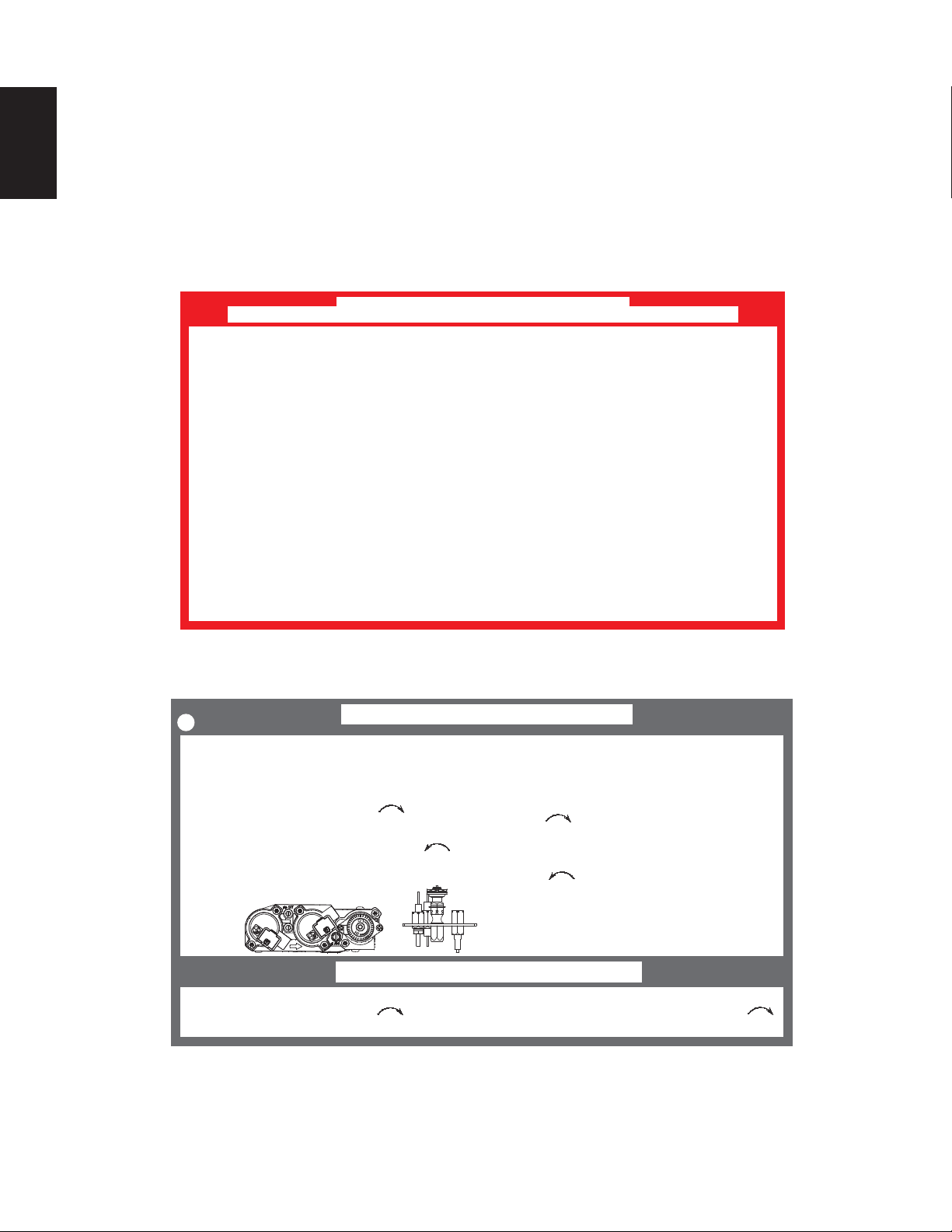
44
W415-1335 / B / 10.04.16
EN
9.0 OPERATING INSTRUCTIONS
When lit for the fi rst time, the appliance will emit a slight odour for a few hours. This is a normal temporary
condition caused by the “burn-in” of internal paints and lubricants used in the manufacturing process and will not
occur again. Simply open a window to suffi ciently ventilate the room. After extended periods of non-operation
such as following a vacation or a warm weather season, the appliance may emit a slight odour for a few hours.
This is caused by dust particles in the heat exchanger burning off. Open a window to suffi ciently ventilate the
room.
9.1 OPERATING INSTRUCTIONS - FOR YOUR SAFETY READ BEFORE OPERATING
9.2 LIGHTING INSTRUCTIONS
LIGHTING INSTRUCTIONS / INSTRUCTIONS D’ALLUMAGE
1. STOP! READ ALL INFORMATION OF OPERATING AND LIGHTING
INSTRUCTIONS BEFORE PROCEEDING.
2. TURN OFF ELECTRIC POWER TO THE FIREPLACE.
3. THIS FIREPLACE IS EQUIPPED WITH AN IGNITION DEVICE WHICH
AUTOMATICALLY LIGHTS THE PILOT. DO NOT TRY TO LIGHT THE PILOT
BY HAND.
4. OPEN THE GLASS DOOR.
5.
TURN MANUAL SHUTOFF VALVE CLOCKWISE TO OFF.
6. WAIT FIVE (5) MINUTES TO CLEAR OUT ANY GAS. IF YOU SMELL GAS
INCLUDING NEAR THE FLOOR,
STOP! FOLLOW “B” OF THE OPERATING
INSTRUCTIONS. IF YOU DON’T SMELL GAS GO TO THE NEXT STEP.
7. TURN MANUAL SHUTOFF VALVE COUNTER-CLOCKWISE TO ON.
8. CLOSE THE GLASS DOOR.
9. TURN ON ALL ELECTRIC POWER TO THE FIREPLACE.
10.
TURN ON MAIN BURNER.
1. ARRÊTEZ! LISEZ TOUTES LES INSTRUCTIONS DE
FONCTIONNEMENT ET D’ALLUMAGE AVANT DE CONTINUER.
2. COUPEZ L’ALIMENTATION ÉLECTRIQUE À L’APPAREIL.
3. CET APPAREIL EST MUNI D’UN DISPOSITIF D’ALLUMAGE QUI
ALLUME LA VEILLEUSE AUTOMATIQUEMENT, N’ESSAYEZ PAS
D’ALLUMER LA VEILLEUSE MANUELLEMENT.
4.
OUVREZ LA PORTE VITRÉE.
5.
TOURNEZ LA SOUPAPE DE SECTIONNEMENT MANUELLE VERS LA
DROITE A “OFF”.
6.
ATTENDEZ CINQ (5) MINUTES POUR QUE LE GAZ PUISSE
S’ÉCHAPPER. SI VOUS DÉTECTEZ UNE ODEUR DE GAZ, ARRÊTEZ!
SUIVEZ « B » DANS LES INSTRUCTIONS DE FONCTIONNEMENT.
S’IL N’Y A PAS D’ODEUR DE GAZ, PASSEZ À L’ÉTAPE SUIVANTE.
7. TOURNEZ LA SOUPAPE DE SECTIONNEMENT MANUELLE VERS LA
GAUCHE A “ON”.
8. FERMEZ LA PORTE VITRÉE.
9. RÉTABLISSEZ L’ALIMENTATION ÉLECTRIQUE AU FOYER.
10. ALLUMEZ LE BRÛLEUR PRINCIPAL.
1.
TURN OFF ALL ELECTRICAL POWER TO THE FIREPLACE IF SERVICE IS
TO BE PERFORMED.
2. TURN MANUAL SHUTOFF VALVE CLOCKWISE TO OFF. DO NOT
FORCE.
1. COUPEZ L’ALIMENTATION ÉLECTRIQUE AU FOYER SI UN TRAVAIL
D’ENTRETIEN DOIT SE FAIRE.
2. TOURNEZ LA SOUPAPE D’ARRÉT MANUELLE VERS LA DROITE
À “OFF” NE FORCEZ PAS.
TO TURN OFF GAS / INSTRUCTIONS POUR COUPER LE GAZ
WARNING: DO NOT TURN ON IF CHILDREN OR OTHER AT RISK
INDIVIDUALS ARE NEAR THE FIREPLACE. IF YOU DO NOT FOLLOW THESE
INSTRUCTIONS EXACTLY, A FIRE OR EXPLOSION MAY RESULT CAUSING
PROPERTY DAMAGE, PERSONAL INJURY OR LOSS OF LIFE.
INITIAL LIGHTING OF THE PILOT AND MAIN BURNERS MUST BE DONE
WITH THE GLASS DOOR OFF.
DO NOT CONNECT VALVE OR WALL SWITCH TO ELECTRICITY. SEE
INSTALLATION INSTRUCTIONS.
A. THIS FIREPLACE IS EQUIPPED WITH AN IGNITION DEVICE WHICH AUTOMATICALLY
LIGHTS THE PILOT. DO NOT TRY TO LIGHT BY HAND.
B. BEFORE OPERATING SMELL ALL AROUND THE FIREPLACE AREA FOR GAS AND NEXT TO
THE FLOOR BECAUSE SOME GAS IS HEAVIER THAN AIR AND WILL SETTLE ON THE
FLOOR.
WHAT TO DO IF YOU SMELL GAS:
78512))$//*$6727+(),5(3/$&(
23(1:,1'2:6
'212775<72/,*+7$1<$33/,$1&(
'2127728&+$1<(/(&75,&6:,7&+'212786($1<3+21(,1<285%8,/',1*
,00(',$7(/<&$//<285*$66833/,(5)520$1(,*+%285¶63+21()2//2:7+(
*$66833/,(5¶6,16758&7,216
,)<28&$11275($&+<285*$66833/,(5&$//7+(),5('(3$570(17
C. DO NOT TRY TO REPAIR ANY PART OF THIS ASSEMBLY. CALL A QUALIFIED SERVICE
TECHNICIAN. FORCE OR ATTEMPTED REPAIR MAY RESULT IN A FIRE OR EXPLOSION.
D. DO NOT USE THIS FIREPLACE IF ANY PART HAS BEEN UNDER WATER. IMMEDIATELY
CALL A QUALIFIED SERVICE TECHNICIAN TO INSPECT THE FIREPLACE AND REPLACE
ANY PART OF THE CONTROL SYSTEM AND ANY GAS CONTROL WHICH HAS BEEN UNDER
WATER.
ATTENTION: 1(3$6$//80(56,'(6(1)$17628'¶$875(6
INDIVIDUS À RISQUE SONT À PROXIMITÉ DU FOYER. QUICONQUE NE
RESPECTE PAS À LA LETTRE LES INSTRUCTIONS DANS LA PRÉSENTE
NOTICE RISQUE DE DÉCLENCHER UN INCENDIE OU UN EXPLOSION
ENTRAÎNANT DES DOMMAGES, DES BLESSURES OU LA MORT.
/¶$//80$*(,1,7,$/'(/$9(,//(86((7'8%5Ó/(8535,1&,3$/
DOIT SE FAIRE AVEC LA PORTE VITRÉE ENLEVÉE.
1(5$&&25'(=3$6/$6283$3(28/¶,17(55837(85085$/$
/¶e/(&75,&,7e&2168/7(=/(6,16758&7,216'¶,167$//$7,21
$ &(7$33$5(,/(67081,'¶81',6326,7,)'¶$//80$*(48,$//80(
$8720$7,48(0(17/$9(,//(86(1(7(17(=3$6'¶$//80(5/$9(,//(86(
MANUELLEMENT.
%$9$17'()$,5()21&7,211(55(1,)/(=7287$87285'(/¶$33$5(,/3285
DÉCELER UN ODEUR DE GAZ. RENIFLEZ PRÈS DU PLANCHER, CAR CERTAINS GAZ
62173/86/285'648(/¶$,5(73(89(176¶$&&808/(5$81,9($8'862/
QUE FAIRE SI VOUS DÉTECTEZ UNE ODEUR DE GAZ:
&283(=/¶$/,0(17$7,21'(*$=35,1&,3$/(
2895(=/(6)(1(75(6
1(3$67(17(5'¶$//80(5'¶$33$5(,/
1(728&+(=¬$8&81,17(55837(851(3$692866(59,5'(67e/e3+21(66(
TROUVANT DANS LE BÂTIMENT.
$33(/(=,00e',$7(0(179275()2851,66(85'(*$='(38,68192,6,1
SUIVEZ LES INSTRUCTIONS DU FOURNISSEUR.
6,92861(3289(=5(-2,1'5(/()2851,66(85$33(/(=/(6(59,&('(6
INCENDIES.
&1¶(66$<(=3$6'(5e3$5(5$8&81(3,Ê&('(&(7$66(0%/$*($33(/(=81
7(&+1,&,(148$/,),e)25&(5287(17(5'(5e3$5(5/¶$66(0%/$*(32855$,7
CAUSER UN FEU OU UNE EXPLOSION.
' 1¶87,/,6(=3$6&(7$33$5(,/6¶,/$e7e3/21*e'$16/¶($80Ç0(
3$57,(//(0(17)$,7(6,163(&7(5/¶$33$5(,/3$5817(&+1,&,(148$/,),e(7
REMPLACEZ TOUTE PARTIE DU SYSTÈME DE CONTRÔLE ET TOUTE COMMANDE QUI
217e7e3/21*e6'$16/¶($8
OPERATING INSTRUCTIONS / INSTRUCTIONS D’OPERATION
FOR YOUR SAFETY READ BEFORE OPERATING / POUR VOTRE SÉCURITÉ LIRE AVANT DE FAIRE FONCTIONNER
W385-0460 / D
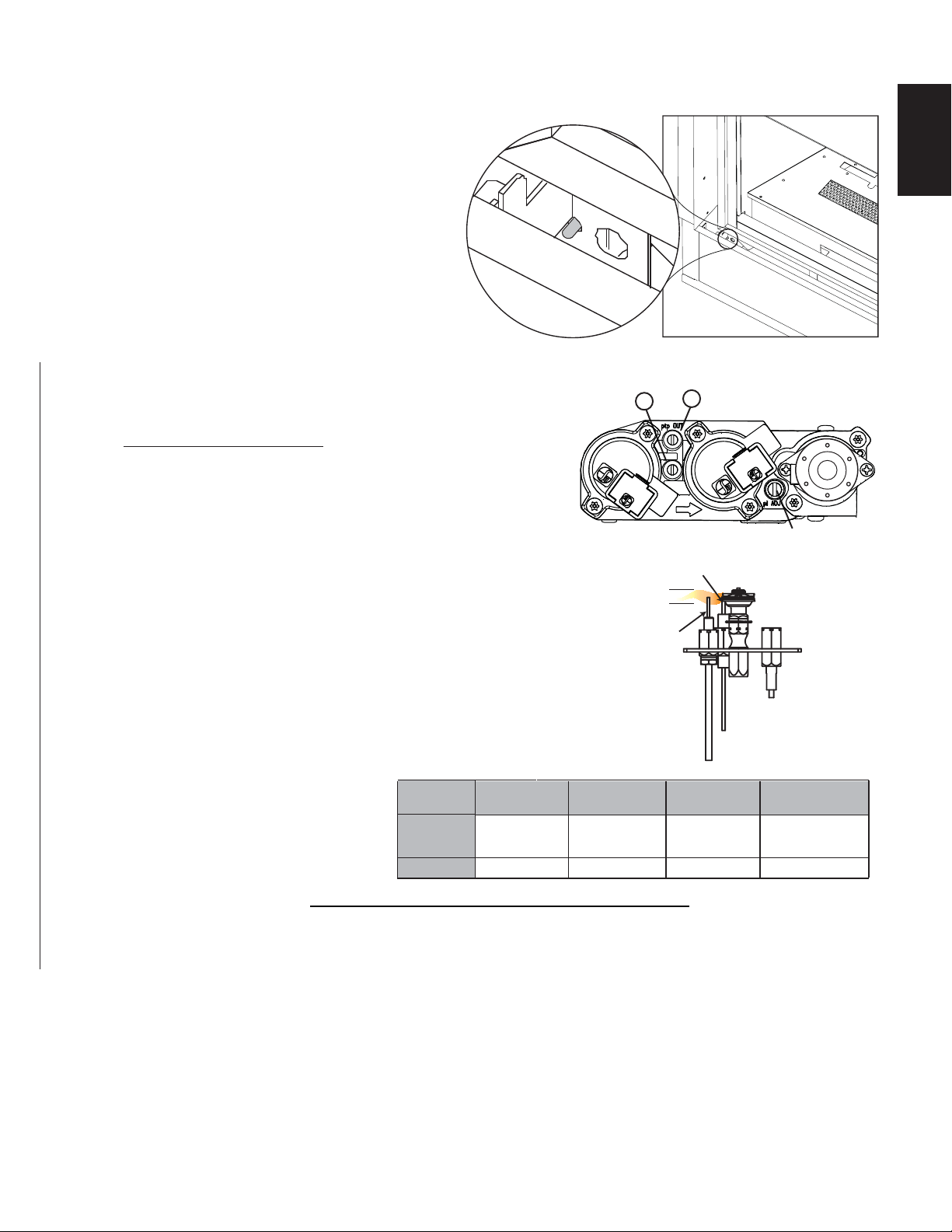
45
W415-1335 / B / 10.04.16
EN
9.3 ANTI CONDENSATION SWITCH (OPTIONAL)
This appliance has the option to switch from an
electronic intermittent pilot ignition (IPI) to a
standing pilot (ACS) for cold climates. The anti
condensation switch (standing pilot) is located in
the center of the control panel. Using your fi nger,
fl ip the switch up for standing pilot, or down for
intermittent pilot ignition.
Adjust the pilot screw to provide properly sized fl ame. Turn in a
clockwise direction to reduce the gas fl ow.
Check Pressure Readings:
Inlet pressure can be checked by turning screw (A) counter-
clockwise 2 or 3 turns and then placing pressure gauge tubing
over the test point. Gauge should read as described on the chart
below. Check pressure with main burner operating on “HI”.
Outlet pressure can be checked the same as above using
screw (B). Gauge should read as described on the chart
below. Check pressure with main burner operating on “HI”.
AFTER TAKING PRESSURE READINGS, BE SURE TO
TURN SCREWS CLOCKWISE FIRMLY TO RESEAL. DO
NOT OVERTORQUE.
Leak test with a soap and water solution.
Prior to pilot adjustment, ensure that the pilot assembly
has not been painted. If overspray or painting of the pilot
assembly has occurred remove the paint from the pilot
assembly, or replace. Fine emery
cloth or a synthetic scrub pad (such as
Scotch-Brite
™)
can be used to remove
the paint from the pilot hood, electrode
and fl ame sensor.
*Maximum inlet pressure
not to exceeed 13”.
39.1E
A
B
PILOT SCREW
FLAME MUST ENVELOP
UPPER 3/8” (9.5mm) TO 1/2”
(12.7mm) OF FLAME SENSOR
PILOT
BURNER
ELECTRODE
FLAME
SENSOR
3/8” - 1/2”
(9.5mm - 12.7mm)
Pressure
Inlet
Outlet
Natural Gas
(inches)
Natural Gas
(millibars)
Propane
(inches)
Propane
(millibars)
*7"
(MIN. 4.5”)
3.5"
13"
(MIN. 11")
10"
17.4mb
(MIN. 11.2mb)
8.7mb
32.4mb
(MIN. 27.4mb)
24.9mb
10.0 ADJUSTMENT
10.1 PILOT BURNER ADJUSTMENT
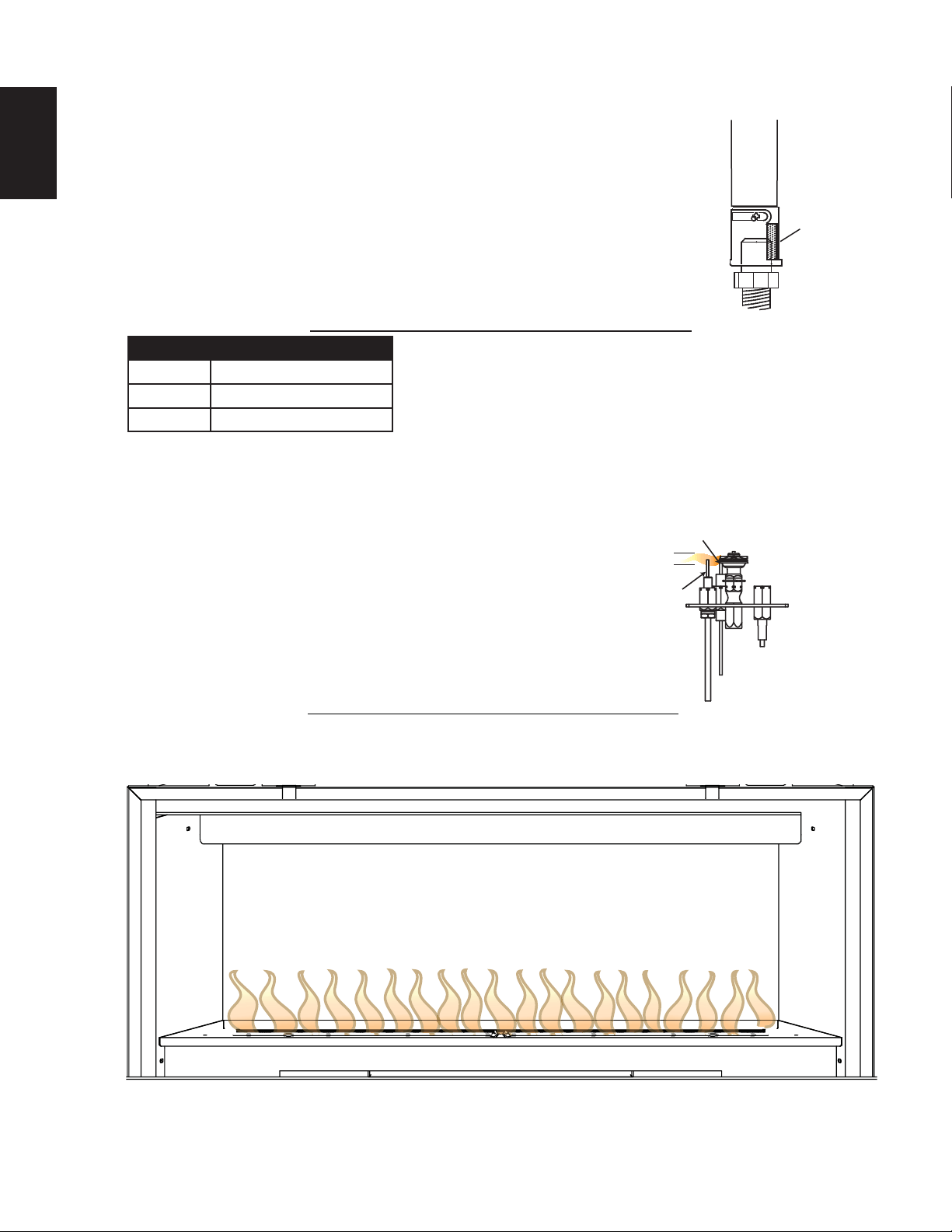
46
W415-1335 / B / 10.04.16
EN
It is important to periodically perform a visual check of the pilot and burner fl ames. Compare them to the
illustration provided. If any fl ames appear abnormal, call a service person.
FLAME MUST ENVELOP
UPPER 3/8” (9.5mm) TO 1/2”
(12.7mm) OF FLAME SENSOR
PILOT
BURNER
ELECTRODE
FLAME
SENSOR
3/8” - 1/2”
(9.5mm - 12.7mm)
54.1B
This appliance has an air shutter that has been factory set open according
to the chart below:
Regardless of venturi orientation, closing the air shutter will cause a more
yellow flame, but can lead to carbonization. Opening the air shutter will
cause a more blue flame, but can cause flame lifting from the burner ports.
The flame may not appear yellow immediately; allow 15 to 30 minutes for
the final flame colour to be established.
AIR SHUTTER ADJUSTMENT MUST ONLY BE DONE BY A QUALIFIED
INSTALLER!
AIR
SHUTTER
OPENING
VENTURI
BURNER
ORIFICE
49.1
VENTURI ADJUSTMENT CHART
FUEL LHD45
NG 1/32” (0.8mm)
LP 1/8” (3.2mm)
10.2 VENTURI ADJUSTMENT
10.3 FLAME CHARACTERISTICS
47
W415-1335 / B / 10.04.16
EN
This appliance and its venting system should be inspected before use and at least annually by a qualifi ed
service person. The following suggested checks should be performed by a qualifi ed technician. The
appliance area must be kept clear and free of combustible materials, gasoline or other fl ammable vapors and
liquids. The fl ow of combustion and ventilation air must not be obstructed.
CAUTION: Label all wires prior to disconnection when servicing controls. Wiring errors can cause improper
and dangerous operation. Verify proper operation after servicing.
A. In order to properly clean the burner and pilot assembly, remove the logs, rocks and/or glass to
expose both assemblies.
B. Keep the control compartment, media, burner, air shutter opening and the area surrounding the logs
clean by vacuuming or brushing, at least once a year.
C. Check to see that all burner ports are burning. Clean out any of the ports which may not be burning
or are not burning properly.
D. Check to see that the pilot fl ame is large enough to engulf the fl ame sensor and/or thermocouple /
thermopile as well as reaches the burner.
E. Replace the cleaned logs, rocks or glass. Failure to properly position the media may cause carbon
which can be distributed inside of fi rebox and on exterior surfaces surrounding vent termination.
F. Check to see that the main burner ignites completely on all openings when turned on. A 5 to 10
second total light-up period is satisfactory. Service as required.
G. Check that the gasketing on the sides, top and bottom of the door is not broken or missing. Replace
if necessary.
H. If for any reason the vent air intake system is disassembled, re-install and re-seal per the instructions
provided for the initial installation.
I. Cleaning the safety barrier may be necessary due to excessive lint / dust from carpeting, pets, etc.
simply vacuum using the brush attachment.
J. Ensure the relief system performs effectively. Check that the gasket is not worn or damaged. Replace
if necessary.
40.1E
TURN OFF THE GAS AND ELECTRICAL POWER BEFORE SERVICING THE APPLIANCE.
APPLIANCE MAY BE HOT, DO NOT SERVICE UNTIL APPLIANCE HAS COOLED.
DO NOT USE ABRASIVE CLEANERS.
DO NOT PAINT THE PILOT ASSEMBLY.
MAINTENANCE
MAINTENANCE
MAINTENANCE
!
WARNING
77.3
Vertical installations may display a very active fl ame. If this appearance is not desirable, the vent exit must
be restricted using a restrictor vent kit. Refer to “ACCESSORIES” in the “REPLACEMENTS” section for
the appropriate kit. This will reduce the velocity of the exhaust gases, slowing down the fl ame pattern and
creating a more traditional gentle fl ame appearance. Specifi c instructions are included with the kit.
10.4 RESTRICTING VERTICAL VENTS
11.0 MAINTENANCE
48
W415-1335 / B / 10.04.16
EN
11.1 ANNUAL MAINTENANCE
37.1E
!
WARNING
THE FIREBOX BECOMES VERY HOT DURING OPERATION. LET THE APPLIANCE COOL
COMPLETELY OR WEAR HEAT RESISTANT GLOVES BEFORE CONDUCTING SERVICE.
NEVER VACUUM HOT EMBERS.
DO NOT PAINT THE PILOT ASSEMBLY.
• This appliance will require maintenance which should be planned on an annual basis.
• Service should include cleaning, battery replacement, venting inspection and inspection of the burner,
media and fi rebox. Refer to the door removal section and remove the door as instructed.
• Carefully remove media if necessary (logs, glass, brick panels etc).
• Using a vacuum with a soft brush attachment, gently remove any dirt, debris or carbon build up from the
logs, fi rebox and burner. For glass media, follow the installation instructions for pre-cleaning.
• Also gently remove any build-up on the pilot assembly including, if equipped; thermopile, thermocouple,
fl ame sensor and igniter.
NOTE: Clean fl ame sensor using a fi ne emery cloth or a synthetic scrub pad
(such as Scotch-Brite™) to remove any oxides.
Clean the pilot assembly using a vacuum with a soft
brush attachment.
It is important that the pilot assembly is not painted.
• Inspect all accessible gaskets and replace as required.
• Access the blower, if equipped and clean using a soft brush and vacuum.
• Re-assemble the various components in reverse order.
• Inspect the relief system. The appliance relieves through the main glass door or through the fl aps on the
fi rebox top. Ensure they open freely, and close sealed.
• Check the gas control valve pilot and Hi / Lo knobs move freely (if equipped) – replace if any stiffness in
movement is experienced.
• Check for gas leaks on all gas connections up and downstream from the gas valve including the pilot
tube connections.
!
WARNING
DO NOT USE SUBSTITUTE MATERIALS.
GLASS MAY BE HOT, DO NOT TOUCH GLASS UNTIL COOLED.
CARE MUST BE TAKEN WHEN REMOVING AND DISPOSING OF ANY BROKEN DOOR GLASS OR
DAMAGED COMPONENTS. BE SURE TO VACUUM UP ANY BROKEN GLASS FROM INSIDE THE
APPLIANCE BEFORE OPERATION.
DO NOT STRIKE, SLAM OR SCRATCH GLASS. DO NOT OPERATE APPLIANCE WITH GLASS
REMOVED, CRACKED, BROKEN OR SCRATCHED.
56.1C
Replacement glass/frame assembly shall be replaced as a complete unit as supplied by the
appliance manufacturer.
11.2 GLASS / DOOR REPLACEMENT
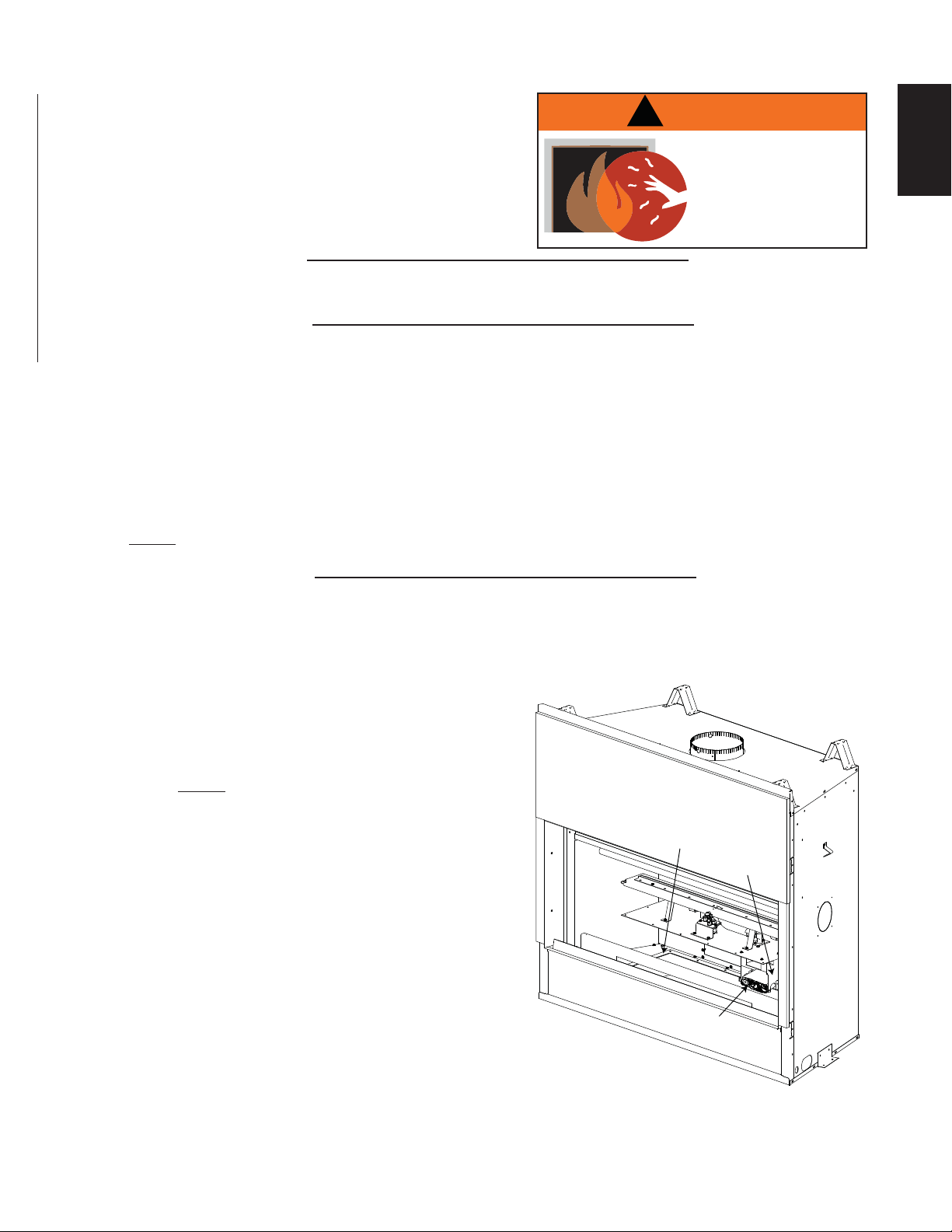
49
W415-1335 / B / 10.04.16
EN
A. Carefully lift the valve train assembly and turn
off the manual shut-off valve, see “VALVE TRAIN
ASSEMBLY” and “GAS INSTALLATION” section.
NOTE: A new gasket may be required, when
re-installing the valve train assembly, contact
your local Authorized dealer / distributor.
Disconnect the fl ex connector from the valve.
Remove the valve wire connections, labeling each
one to aid with re-connection.
B. Remove the four screws from the valve bracket
and remove the valve.
C. Replace all components before returning the
appliance to service.
D. Check for gas leaks by brushing on a soap and
water solution.
VALVE
VALVE
BRACKET
GASKET
6.1
If the appliance is equipped with plated parts, you must clean fi ngerprints or other marks from the plated
surfaces before operating the appliance for the fi rst time. Use a glass cleaner or vinegar and towel to clean.
If not cleaned properly before operating for the fi rst time, the marks can cause permanent blemishes on the
plating. After the plating is cured, the fi ngerprints and oils will not affect the fi nish and little maintenance
is required, just wipe clean as needed. Prolonged high temperature burning with the door ajar may cause
discolouration on plated parts.
NOTE: The protective wrap on plated parts is best removed when the assembly is at room temperature
but this can be improved if the assembly is warmed, using a hair dryer or similar heat source.
5.1A
DO NOT CLEAN GLASS WHEN HOT! DO NOT USE
ABRASIVE CLEANERS TO CLEAN GLASS.
Buff lightly with a clean dry soft cloth. Clean both sides
of the glass after the fi rst 10 hours of operation with a
recommended fi replace glass cleaner. Do not use an
ammonia-based fi replace glass cleaner. Thereafter clean
as required. If the glass is not kept clean permanent
discoloration and / or blemishes may result.
HOT GLASS WILL
CAUSE BURNS.
DO NOT TOUCH GLASS
UNTIL COOLED.
NEVER ALLOW CHILDREN
TO TOUCH GLASS.
!
WARNING
5.5.1A
This appliance is factory equipped with 5mm ceramic glass. Use only replacement parts as supplied by the
appliance manufacturer. DO NOT SUBSTITUTE MATERIALS.
11.3 CARE OF GLASS
11.4 CARE OF PLATED PARTS
11.5 VALVE REMOVAL

50
W415-1335 / B / 10.04.16
EN
41.1C
Contact your dealer for questions concerning prices and policies on replacement parts. Normally, all parts
can be ordered through your Authorized dealer / distributor.
FOR WARRANTY REPLACEMENT PARTS, A PHOTOCOPY OF THE ORIGINAL INVOICE WILL BE
REQUIRED TO HONOUR THE CLAIM.
When ordering replacement parts always give the following information:
• Model & Serial Number of appliance
• Installation date of appliance
• Part number
• Description of part
• Finish
PARTS, PART NUMBERS AND AVAILABILITY ARE SUBJECT TO CHANGE WITHOUT NOTICE.
PARTS IDENTIFIED AS STOCKED WILL BE DELIVERED WITHIN 2 TO 5 BUSINESS DAYS FOR MOST
DELIVERY DESTINATIONS.
PARTS NOT IDENTIFIED AS STOCKED WILL BE DELIVERED WITHIN A 2 TO 4 WEEK PERIOD, FOR
MOST CASES.
PARTS IDENTIFIED AS ‘SO’ ARE SPECIAL ORDER AND CAN TAKE UP TO 90 DAYS FOR DELIVERY.
FAILURE TO POSITION THE PARTS IN ACCORDANCE WITH THIS MANUAL OR FAILURE TO USE
ONLY PARTS SPECIFICALLY APPROVED WITH THIS APPLIANCE MAY RESULT IN PROPERTY
DAMAGE OR PERSONAL INJURY.
!
WARNING
12.0 REPLACEMENTS
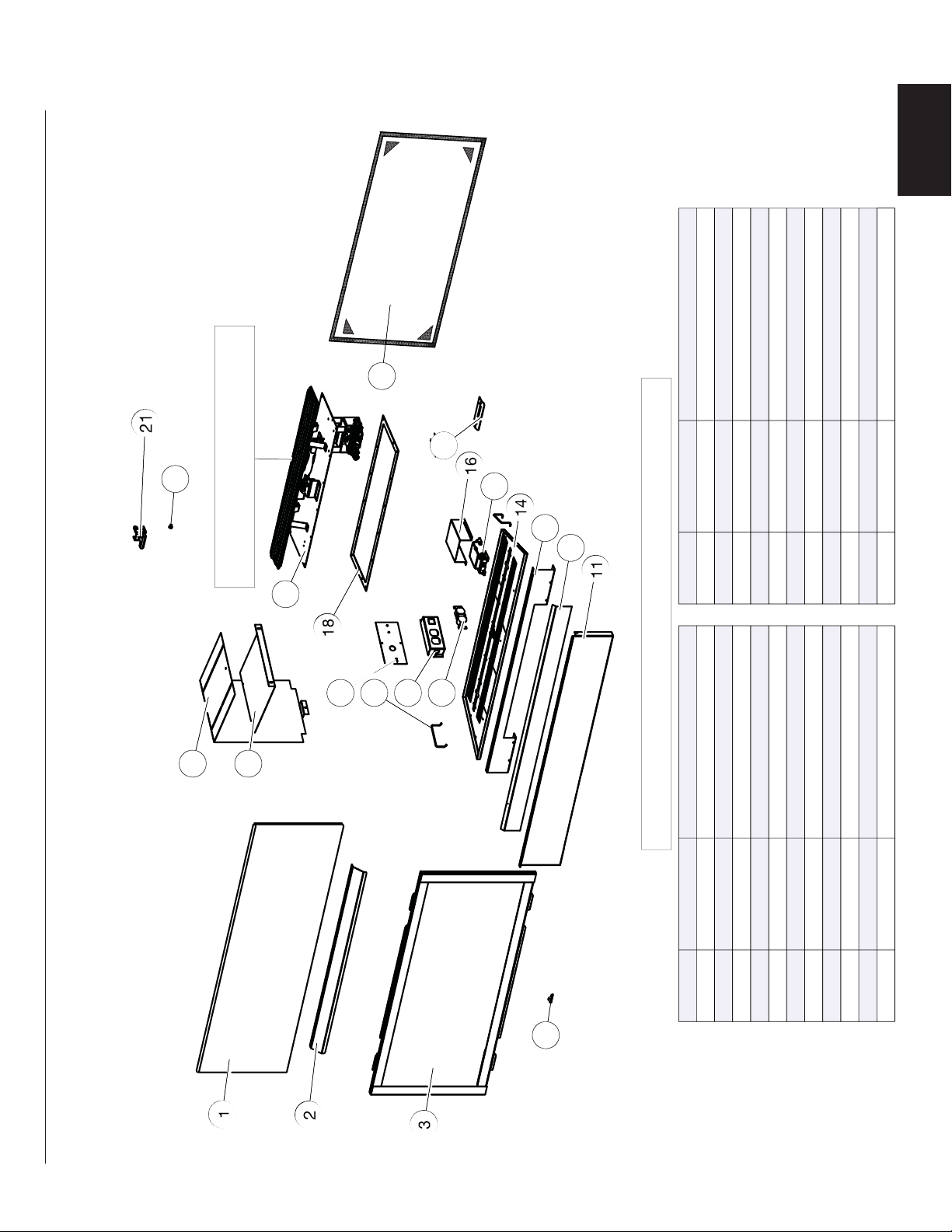
51
W415-1335 / B / 10.04.16
EN
1
2
1
2
222
33
44
ITEMS MAY NOT APPEAR EXACTLY AS ILLUSTRATED
5
6
8
7
9
15
10
16
21
17
20
14
13
12
11
5
6
8
7
9
15
10
16
21
17
20
14
13
12
11
18
19
18
19
FOR REPLACEMENTS PARTS REFER
TO: "VALVE TRAIN ASSEMBLY"
REF. NO. PART NUMBER DESCRIPTION
1 W475-0680 CEMENT BOARD
2 W215-0143 HOT AIR DEFLECTOR
3 W010-2221 DOOR ASSEMBLY
4 W385-2010 NAPOLEON LOGO
5 W585-0329 VENTING SHIELD, TOP
6 W585-0330 VENTING SHIELD, BOTTOM
7 W500-0443 JUNCTION BOX PLATE
8 W325-0057 MEDIA TRAY HANDLE (X2)
9 W350-0464 ELECTRICAL HOUSING
10 W460-0006-SER RECEPTACLE
11 W200-0317 CONTROL ACCESS COVER 22 W562-0062 DOOR GASKET KIT
REF. NO. PART NUMBER DESCRIPTION
12 W715-0890 FRONT LOUVRE COVER
13 W655-0341 MEDIA TRAY SUPPORT
14 W710-0053 MEDIA TRAY
15 W190-0072 CONTROL BOARD
16 W585-0331 CONTROL BOARD SHIELD
17 W500-0515 DOOR RETAINER (X2)
18 W290-0152 VALVE TRAIN GASKET
19 W010-2218 VALVE TRAIN ASSEMBLY (NG)
20 W065-0034 SHOULDER SCREWS (X4)
21 W010-3687 DOOR LATCHES (X2)
13.0 OVERVIEW
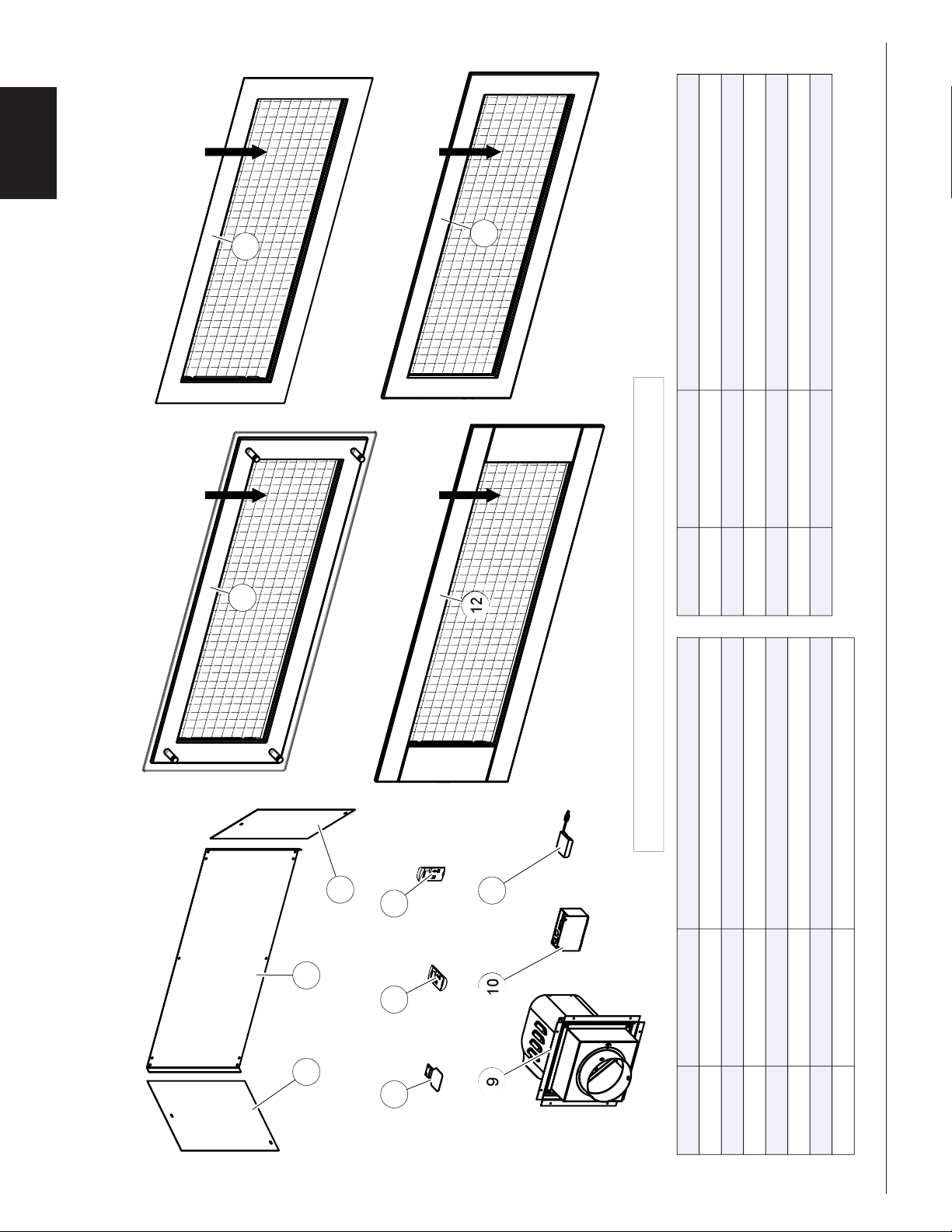
52
W415-1335 / B / 10.04.16
EN
1
10
2
7
11
3
6
4
9
8
5
12
13
1
10
2
7
11
3
6
4
9
8
5
12
13
ITEMS MAY NOT APPEAR EXACTLY AS ILLUSTRATED
LS45K
LDS45LPS45SS
LGFS45
PRP45
LHD45 ACCESSORIES (Page 1)
SAFETY BARRIER
ASSEMBLY
REF. NO. PART NUMBER DESCRIPTION
1 W475-0684 LS PORCELAIN PANEL (PRP45)
2 W475-0682 REAR PORCELAIN PANEL (PRP45)
3 W475-0683 RS PROCELAIN PANEL (PRP45)
4 LGF45 LINEAR STYLO SURROUND
5 LS45KSB BASIC SURROUND C/W SAFETY SCREEN
6 RP4 RESTRICTOR PLATE (RP4)
7 F45 / F60 HAND HELD REMOTE CONTRO
L
REF. NO. PART NUMBER DESCRIPTION
8 W660-0081 WALL MOUNTED THERMOSTAT
9 GPV POWER VENT TERMINA
L
10 PVAL45 POWER VENT ADAPTOR KIT
11 W350-0702 BATTERY HOUSING
12 LPS45SSSB PREMIUM SURROUND C/W SAFETY SCREEN
13 LDS45KSB / WSB DELUXE SURROUND C/W SAFETY SCREEN
SAFETY BARRIER
ASSEMBLY
SAFETY BARRIER
ASSEMBLY
SAFETY BARRIER
ASSEMBLY
05.15.14
14.0 ACCESSORIES
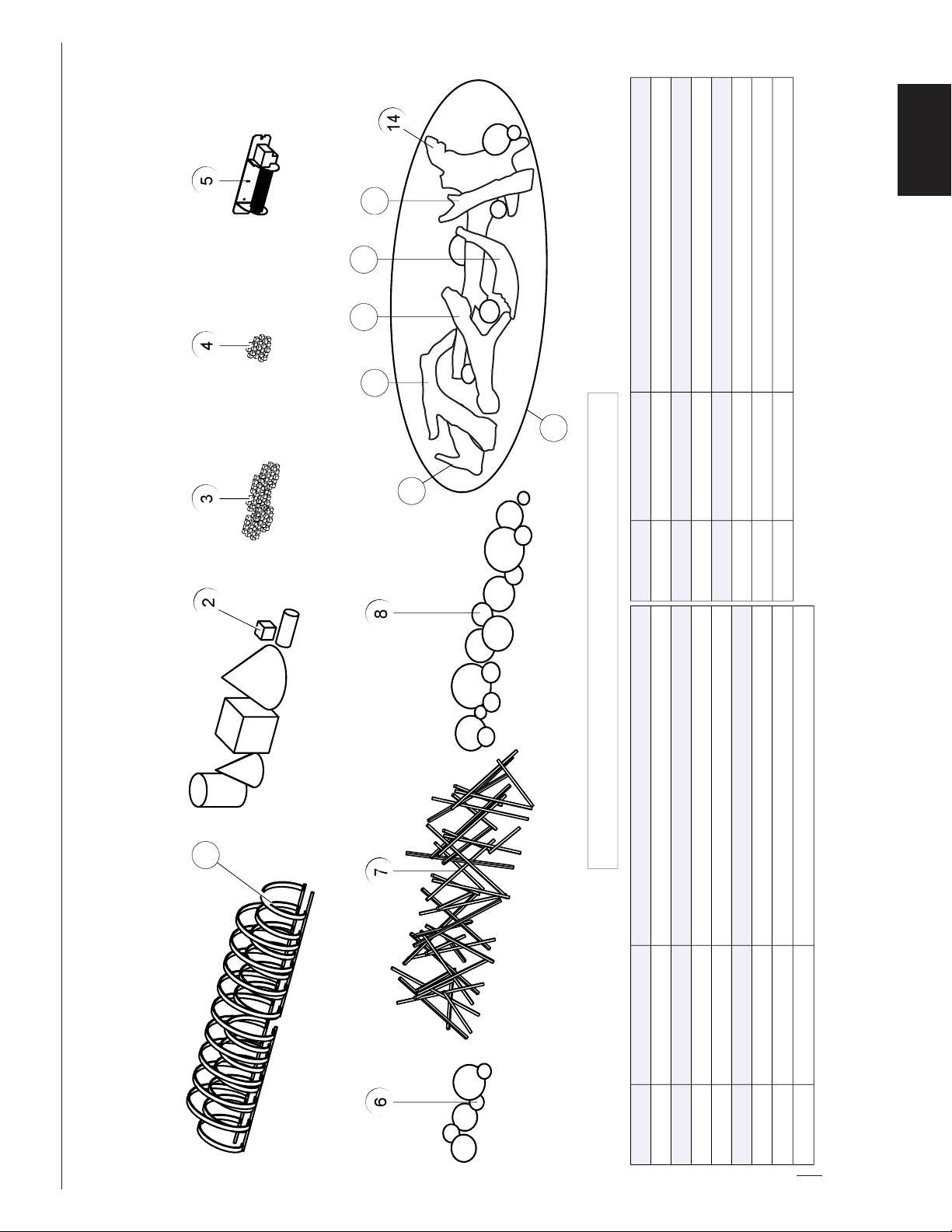
53
W415-1335 / B / 10.04.16
EN
DRIFTWOOD LOG SET
DL45
7
5
6
3
2
4
2
ITEMS MAY NOT APPEAR EXACTLY AS ILLUSTRATED
LDAC MEKG
LDNS
REK
DL45
REF. NO. PART NUMBER DESCRIPTION
1 LDAC DECORATIVE COIL ART
2 DECORATIVE GEO SHAPES
3 GLASS MEDIA MEDIA KIT (VARIOUS COLOURS)
REF. NO. PART NUMBER DESCRIPTION
3
4
9
MEKG
MEKR
36
LDNS DECORATIVE NICKEL STIX ART
MEKR
ROCK MEDIA ENHANCEMENT KIT
W135-0452 DRIFTWOOD LOG #1 (DL45)
W135-0456
DRIFTWOOD LOG #5 (DL45)
W135-0455 DRIFTWOOD LOG #4 (DL45)
W135-0454 DRIFTWOOD LOG #3 (DL45)
W135-0453 DRIFTWOOD LOG #2 (DL45)
4
10
3
14
4
13
3
15
4
11
4
12
MKGK / MKGB / MKGR
MKGA / MKGC / MKGT
33
MEGK / MEGB / MEGR
MEGA / MEGT
31
W135-0459 DRIFTWOOD LOG #8 (DL45)
GLASS MEDIA MEDIA ENHANCEMENT KIT (VARIOUS COLOURS)
4
8
4
7
35
GZ550-1KT / B440KT
8
REK ROCK ENHANCEMENT KIT
13
11
9
10
12
14
15
GZ550-1KT/B440KT BLOWER KIT
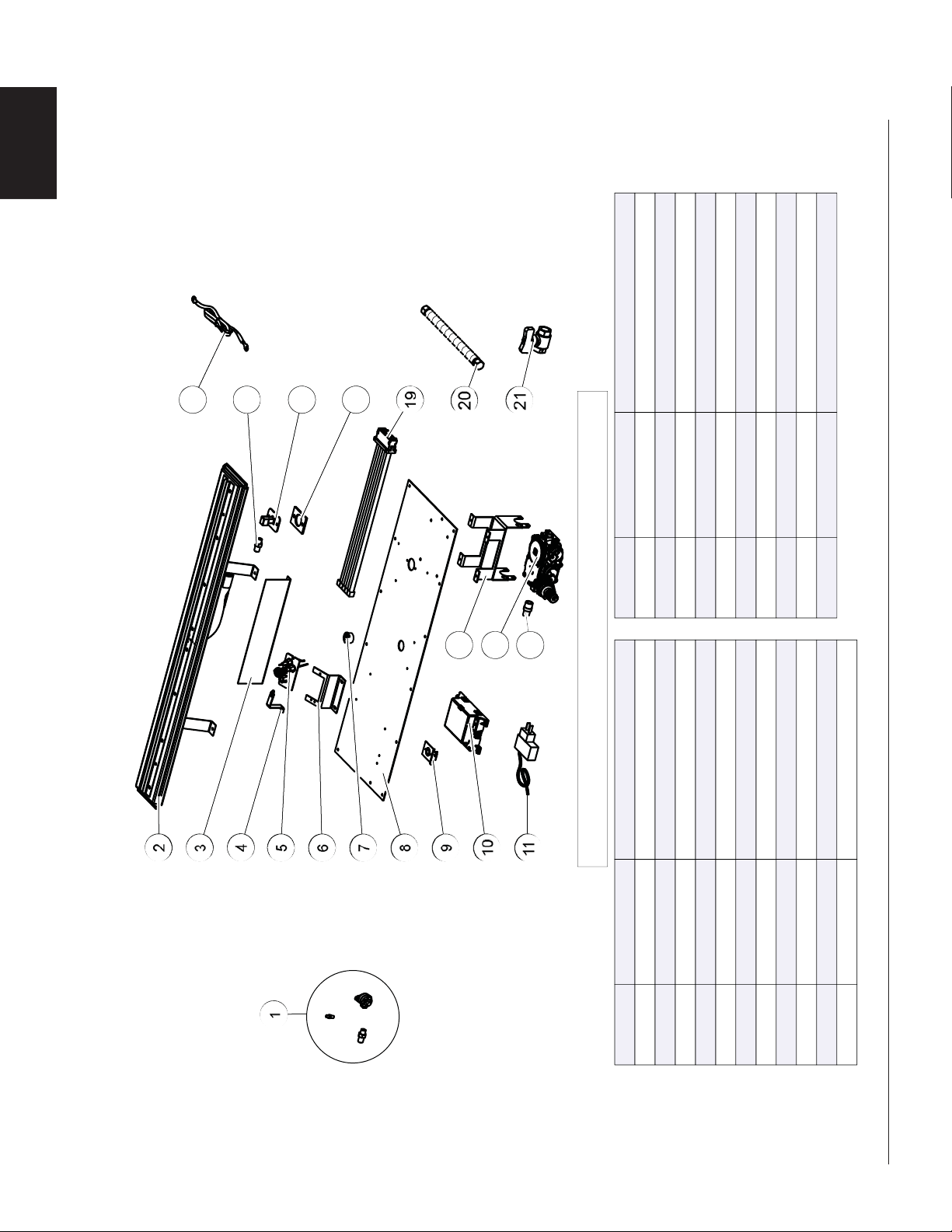
54
W415-1335 / B / 10.04.16
EN
11
15
19
9
14
8
1
13
3
12
7
2
5
16
10
18
6
17
4
21
20
11
15
19
9
14
8
1
13
3
12
7
2
5
16
10
18
6
17
4
21
20
ITEMS MAY NOT APPEAR EXACTLY AS ILLUSTRATED
05.15.14
W175-0326
(NG) VALVE TRAIN ASSEMBLY (W010-2218)
REF. NO. PART NUMBER DESCRIPTION
1 W175-0326 LP CONVERSION KIT
2 W100-0119 BURNER ASSEMBLY
3 W215-0145 BOTTOM AIR DEFLECTOR
4 W080-1305 PILOT GROUND BRACKET
5 W010-2763 PILOT ASSEMBL
Y
6 W080-1062 PILOT BRACKET
7 W105-0001 7/8" BUSHING
8 W035-0263 BURNER BASE
9 W010-2821 THERMAL DISC. ASSEMBLY
10 W190-0072 CONTROL BOARD
11 W707-0010 TRANSFORMER
REF. NO. PART NUMBER DESCRIPTION
12 W080-1066 VALVE BRACKET
13 W725-0065 VALVE
14 W445-0038 3/8" CONNECTOR
15 W750-0290 24" WIRE HARNESS
16 W456-0043 BURNER ORIFICE #43
17 W432-0103 MANIFOLD
18 W290-0157 MANIFOLD GASKET
19 W010-1986 WIRE HARNESS ASSEMBLY
20 W175-0227 FLEX CONNECTOR
21 W725-0046 GAS VALVE
15.0 VALVE TRAIN ASSEMBLY
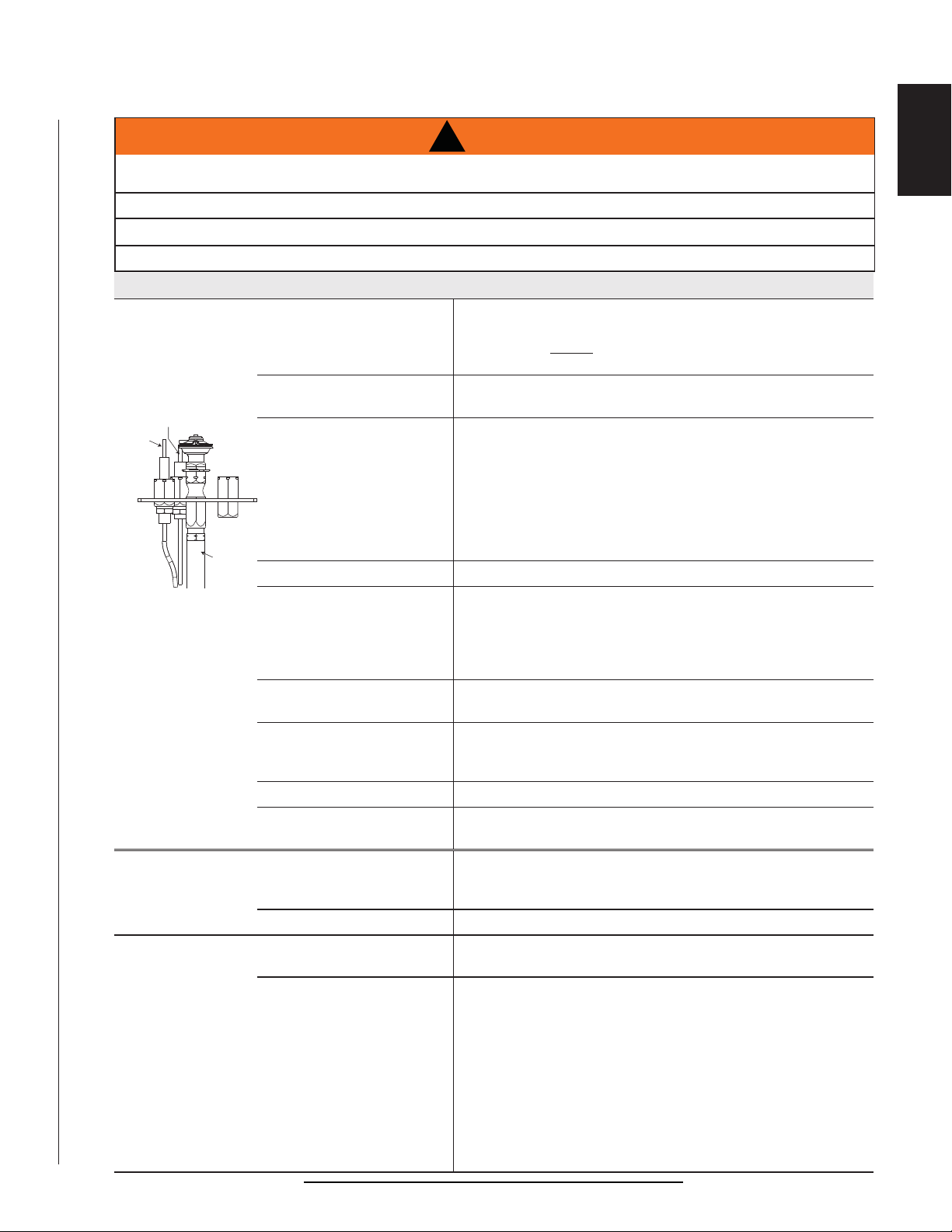
55
W415-1335 / B / 10.04.16
EN
16.0 TROUBLESHOOTING
SYMPTOM PROBLEM TEST SOLUTION
Pilot will not light.
Makes noise with
no spark at pilot
burner.
Wiring. - Verify the wire for the sensor and the wire for the ignitor are
connected to the correct terminals (not reversed) on the
module. NOTE: Sensor has 3/16” (4.8mm) connection
and ignitor has 1/8” (3.2mm)connection.
Loose connection. - Verify no loose connections, electrical shorts in the wiring
or ground out to any metal object.
Module. - Turn the ON/OFF switch to the “OFF” position. Remove
the igniter wire from the module. Place the ON/OFF switch
to the “ON” position. Hold a grounded wire about 3/16”
(4.8mm) away from the ignitor (spark) terminal on the
module. If no spark the ignitor terminal module must be
replaced. If there is a spark the ignitor terminal is fi ne.
Inspect pilot assembly for a shorted wire or cracked
insulator around the electrode.
Igniter Spark gap is incorrect. - Spark gap of the ignitor to the pilot should be 1/8” (3.2mm).
Transformer. - Verify the transformer is installed and plugged into the
module. Check voltage of the transformer under load at
the spade connections on the module with the ON/OFF
switch in the “ON” position. Acceptable readings of a good
transformer are between 6.2 and 7.0 volts A.C.
Battery backup (if power is
off)
- Check batteries.
A shorted or loose
Connection.
- Remove and reinstall the wiring harness that plugs into the
module. Remove and verify continuity of each wire in wiring
harness.
Improper switch wiring. - Troubleshoot the system with the simplest ON/OFF switch.
Module is not grounded. - Verify the valve and pilot assemblies are properly grounded to
the metal chassis of the appliance or log set.
Pilot sparks but
will not light.
Gas supply. - Verify that the incoming gas line ball valve is “Open”. Verify
that the inlet pressure reading is within acceptable limits,
inlet pressures must not exceed 13” W.C. (32.3mb).
Out of propane gas. - Fill the tank.
Carbon is being
deposited on
glass, logs,
rocks, media
or combustion
chamber surfaces.
Air shutter has become
blocked.
- Ensure air shutter opening is free of lint or other
obstructions.
Flame is impinging on the
glass, logs, rocks, media or
combustion chamber.
- Check that the glass, logs, rocks or media are correctly positioned.
- Too much glass media around the burner can cause carbon deposits.
- Open air shutter to increase the primary air.
- Check the input rate: check the manifold pressure and
orifi ce size as specifi ed by the rating plate values.
- Check that the door gasketing is not broken or missing and
that the seal is tight.
- Check that both vent liners are free of holes and well
sealed at all joints.
- Check that minimum rise per foot has been adhered to for
any horizontal venting.
SENSOR
IGNITOR
(SPARK)
PILOT
TUBE
42.7B
!
WARNING
ALWAYS LIGHT THE PILOT WHETHER FOR THE FIRST TIME OR IF THE GAS SUPPLY HAS RUN OUT,
WITH THE GLASS DOOR OPEN OR REMOVED.
TURN OFF THE GAS AND ELECTRICAL POWER BEFORE SERVICING THE APPLIANCE.
APPLIANCE MAY BE HOT, DO NOT SERVICE UNTIL APPLIANCE HAS COOLED.
DO NOT USE ABRASIVE CLEANERS.
56
W415-1335 / B / 10.04.16
EN
42.7_2A
SYMPTOM PROBLEM TEST SOLUTION
Continues to spark
and pilot lights, but
main burner will not
light.
Short or loose
connection in sensor rod.
- Verify all connections. Verify the connections from the
pilot assembly are tight; also verify these connections are
not grounding out to any metal.
Poor fl ame rectifi cation
or contaminated
sensor rod.
- Verify the fl ame is engulfi ng the sensor rod. This will
increase the fl ame rectifi cation. Verify correct pilot orifi ce is
installed and inlet gas specifi cations to manual. (Remember,
the fl ame carries the rectifi cation current, not the gas. If the
fl ame lifts from pilot hood, the circuit is broken. A wrong
orifi ce or to high of an inlet pressure can cause the pilot
fl ame to lift.) The sensor rod may need cleaning.
Poor grounding between
pilot assembly and
gas valve.
- Verify that the wire harness is fi rmly connected to module.
Verify that the ceramic insulator around the sensor rod is
not cracked, damaged, or loose. Verify the connection from
the sensor rod to the sensor wire.
Damaged pilot or dirty
sensor rod.
- Clean sensor rod with a fi ne emery cloth or synthetic
scrub pad to remove any contamination that may have
accumulated on the sensor rod. Verify continuity with
multimeter with ohms set at the lowest range.
Pilot lights
Stops sparking
/ pilot remains lit
but burner will
not turn on.
Wiring / Connection. - Inspect all wires, ensure good tight connections. Verify
that all wiring is installed exactly as specifi ed.
Wiring harness. - Inspect the wiring harness, and verify the harness is
tightly connected to the module. Verify that all wires are
connected in the right order. See “WIRING DIAGRAM”
section.
Exhaust fumes
smelled in room,
headaches.
Appliance is spilling. - Check all seals.
- Check if exhaust is re-entering through an open door or
window.
White / grey fi lm
forms.
Sulphur from fuel is being
deposited on glass, logs or
combustion chamber
surfaces.
- Clean the glass, see “CARE OF GLASS” section
- DO NOT CLEAN GLASS WHEN HOT.
- If deposits are not cleaned off regularly, the glass may
become permanently marked.
Flames are very
aggressive.
Door is ajar. - Tighten door clamps if applicable.
Venting action is too great. - Restrict vent exit with restrictor plate. See
“RESTRICTING VENTS” section if applicable.
Main burner fl ame
is a blue, lazy,
transparent
fl ame.
Blockage in vent. - Remove blockage. In extreme conditions, ice buildup
may occur on the terminal and should be removed. To
minimize this from happening again, it is recommended
that the vent lengths that pass through unheated
spaces (attics, garages, crawl spaces) be wrapped
with an insulated mylar sleeve. Prevent sleeve from
sagging. Contact your local authorized dealer for more
information.
Compromised venting.
- Check venting system parameters (seal, length, rise, etc.).
Main burner goes
out: pilot goes out.
Vent recirculation. - Check joint seals and installation.
57
W415-1335 / B / 10.04.16
EN
NAPOLEON warrants its products against manufacturing defects to the original purchaser only. Registering your warranty is not
necessary. Simply provide your proof of purchase along with the model and serial number to make a warranty claim. NAPOLEON
reserves the right to have its representative inspect any product or part thereof prior to honouring any warranty claim. Provided
that the purchase was made through an authorized NAPOLEON dealer your appliance is subject to the following conditions and
limitations:
Warranty coverage begins on the date of original installation.
This factory warranty is non-transferable and may not be extended whatsoever by any of our representatives.
The gas appliance must be installed by a licensed, authorized service technician or contractor. Installation must be done in
accordance with the installation instructions included with the product and all local and national building and fi re codes.
This limited warranty does not cover damages caused by misuse, lack of maintenance, accident, alterations, abuse or neglect and
parts installed from other manufacturers will nullify this warranty.
This limited warranty further does not cover any scratches, dents, corrosion or discoloring caused by excessive heat, abrasive and
chemical cleaners nor chipping on porcelain enamel parts, mechanical breakage of PHAZER™ logs and embers.
This warranty extends to the repair or replacement of warranted parts which are defective in material or workmanship provided that
the product has been operated in accordance with the operation instructions and under normal conditions.
After the fi rst year, with respect to this President’s Lifetime Limited Warranty, NAPOLEON may, at its discretion, fully discharge all
obligations with respect to this warranty by refunding to the original warranted purchaser the wholesale price of any warranted but
defective part(s).
NAPOLEON will not be responsible for installation, labour or any other expenses related to the reinstallation of a warranted part and
such expenses are not covered by this warranty.
Notwithstanding any provisions contained in the President’s Lifetime Limited Warranty, NAPOLEON’S responsibility under this
warranty is defi ned as above and it shall not in any event extend to any incidental, consequential or indirect damages.
This warranty defi nes the obligations and liability of NAPOLEON with respect to the NAPOLEON gas appliance and any other
warranties expressed or implied with respect to this product, its components or accessories are excluded.
NAPOLEON neither assumes, nor authorizes any third party to assume, on its behalf, any other liabilities with respect to the sale of
this product.
NAPOLEON will not be responsible for: over-fi ring, downdrafts, spillage caused by environmental conditions such as rooftops,
buildings, nearby trees, hills, mountains, inadequate vents or ventilation, excessive venting confi gurations, insuffi cient makeup air, or
negative air pressures which may or may not be caused by mechanical systems such as exhaust fans, furnaces, clothes dryers, etc.
Any damages to the appliance, combustion chamber, heat exchanger, plated trim or other components due to water, weather
damage, long periods of dampness, condensation, damaging chemicals or cleaners will not be the responsibility of NAPOLEON.
All parts replaced under the President’s Limited Lifetime Warranty Policy are subject to a single claim.
During the fi rst 10 years NAPOLEON will replace or repair the defective parts covered by the lifetime warranty at our discretion free of
charge. From 10 years to life, NAPOLEON will provide replacement parts at 50% of the current retail price.
All parts replaced under the warranty will be covered for a period of 90 days from the date of their installation.
The manufacturer may require that defective parts or products be returned or that digital pictures be provided to support the
claim. Returned products are to be shipped prepaid to the manufacturer for investigation. If a product is found to be defective, the
manufacturer will repair or replace such defect.
Before shipping your appliance or defective components, your dealer must obtain an authorization number. Any merchandise
shipped without authorization will be refused and returned to sender.
Shipping costs are not covered under this warranty.
Additional service fees may apply if you are seeking warranty service from a dealer.
Warranty labour allowance is only for the replacement of the warranted part. Travel, diagnostic tests, shipping and other related
charges are not covered by this warranty.
2.1D
NAPOLEON products are manufactured under the strict Standard of the world recognized ISO 9001 : 2008 Quality
Assurance Certifi cate.
NAPOLEON products are designed with superior components and materials assembled by trained craftsmen who take
great pride in their work. The burner and valve assembly are leak and test-fi red at a quality test station. The complete
appliance is again thoroughly inspected by a qualifi ed technician before packaging to ensure that you, the customer,
receives the quality product that you expect from NAPOLEON.
The following materials and workmanship in your new NAPOLEON gas appliance are warranted against defects for
as long as you own the appliance. This covers: combustion chamber, heat exchanger, stainless steel burner, phazer™
logs and embers, rocks, ceramic glass (thermal breakage only), gold plated parts against tarnishing, porcelainized
enameled components and aluminum extrusion trims.*
Electrical (110V and millivolt) components and wearable parts are covered and NAPOLEON will provide replacement
parts free of charge during the fi rst year of the limited warranty. This covers: blowers, gas valves, thermal switches,
switches, wiring, remote controls, ignitors, gaskets and pilot assemblies.*
Labour related to warranty repair is covered free of charge during the fi rst year. Repair work, however, requires
the prior approval of an authorized company offi cial. Labour costs to the account of NAPOLEON are based on a
predetermined rate schedule and any repair work must be done through an authorized NAPOLEON dealer.
* Construction of models vary. Warranty applies only to components included with your specifi c appliance.
NAPOLEON GAS APPLIANCE PRESIDENT’S LIFETIME LIMITED WARRANTY
CONDITIONS AND LIMITATIONS
ALL SPECIFICATIONS AND DESIGNS ARE SUBJECT TO CHANGE WITHOUT PRIOR NOTICE DUE TO ON-GOING PRODUCT
IMPROVEMENTS. NAPOLEON IS A REGISTERED TRADEMARK OF WOLF STEEL LTD.
17.0 WARRANTY

58
W415-1335 / B / 10.04.16
EN
44.1
18.0 NOTES
59
W415-1335 / B / 10.04.16
EN
19.0 SERVICE HISTORY
Other Napoleon
®
Products
'JSFQMBDF*OTFSUTt$IBSDPBM(SJMMT
t(BT'JSFQMBDFTt8BUFSGBMMTt8PPE4UPWFT
)FBUJOH$PPMJOHt&MFDUSJD'JSFQMBDFTt0VUEPPS'JSFQMBDFTt(BT(SJMMT
'JSFQMBDFT)FBUJOH$PPMJOHDBMMt(SJMMTDBMM
napoleonproducts.com
/BQPMFPO3PBE#BSSJF0OUBSJP$BOBEB-.(
#BZWJFX%SJWF#BSSJF0OUBSJP$BOBEB-/:
.JMMFS%SJWF$SJUUFOEFO,FOUVDLZ64"
5SBOT$BOBEB)JHIXBZ.POUSFBM2VFCFD$BOBEB)5"
Scan this QR code for more information or visit our website at:
www.napoleonfi replaces.com/support/lhd45
FR
61
W415-1335 / B / 10.04.16
INSTALLATEUR : LAISSEZ CE MANUEL AVEC L’APPAREIL.
PROPRIÉTAIRE : CONSERVEZ CE MANUEL POUR CONSULTATION ULTÉRIEURE.
NE LAISSEZ PAS LES ENFANTS OU AUTRES INDIVIDUS À RISQUE SEULS À PROXIMITÉ DE L’APPAREIL.
INSTRUCTIONS
D’INSTALLATION ET
D’OPÉRATION
1.28E
Wolf Steel Ltd., 24 Napoleon Rd., Barrie, ON, L4M 0G8 Canada /
103 Miller Drive, Crittenden, Kentucky, USA, 41030
Téléphone 705-721-1212 • Télécopieur 705-720-9081 • www.napoleonfoyers.com • hearth@napoleonproducts.com
10,00$
CERTIFIÉ POUR LE CANADA ET LES ÉTATS-UNIS SELON LES
MÉTHODES ANSI/CSA.
CONSIGNES DE SÉCURITÉ
!
AVERTISSEMENT
- N’entreposez pas et n’utilisez pas d’essence ou autres
liquides et vapeurs infl ammables à proximité de cet ap-
pareil ou tout autre appareil.
- QUE FAIRE SI VOUS DÉTECTEZ UNE ODEUR DE GAZ :
• N’allumez aucun appareil.
• Ne touchez à aucun interrupteur électrique;
n’utilisez aucun téléphone dans votre immeuble.
• Appelez immédiatement votre fournisseur de gaz
d’un téléphone voisin. Suivez ses instructions.
• Si vous ne pouvez pas rejoindre votre fournisseur
de gaz, appelez le service des incendies.
- L’installation et l’entretien doivent être faits par un
installateur qualifi é, une agence d’entretien ou le
fournisseur.
Cet appareil peut être installé dans une maison
préfabriquée (mobile) déjà installée à demeure si les
règlements locaux le permettent.
Cet appareil doit être utilisé uniquement avec le type de
gaz indiqué sur la plaque signalétique. Cet appareil ne
peut être converti à d’autres gaz, sauf si une trousse de
conversion est utilisée.
Si ces instructions ne sont pas suivies à la
lettre, un incendie ou une explosion pourraient
s’ensuivre, causant des dommages matériels,
des blessures corporelles ou des pertes de vie.
Produit décoratif : Ne pas utiliser comme appareil de chauffage.
LA VITRE CHAUDE CAUSERA
DES BRÛLURES.
NE PAS TOUCHER LA VITRE
AVANT QU’ELLE AIT REFROIDI.
NE JAMAIS LAISSER LES
ENFANTS TOUCHER LA VITRE.
!
AVERTISSEMENT
Une barriére conçu à réduire le risque de brûlures
causées par le verre chaud est fourni avec l’appareil
et sera installé pour la protection des enfants et
d’autres personnes à risque.
ÉCRAN DE
PROTECTION
É
C
RAN DE
P
RO
TE
C
T
I
O
N
LHD45N
GAZ NATUREL
LHD45P
PROPANE
CONFORME AUX LES NORMES NATIONALES AMÉRICAINES: ANSI Z21.50, CERTIFIE CANADIENNES: CSA 2.22 FOYER À GAZ VENTILÉ.

TABLE DES MATIÈRES
NOTE : Les changements autres que de nature éditoriale sont dénotés par une ligne verticale dans la marge.
FR
62
W415-1335 / B / 10.04.16
1.0 VUE D’ENSEMBLE DE L’INSTALLATION 63
2.0 INTRODUCTION 64
2.1 DIMENSIONS 65
2.2 INSTRUCTIONS GÉNÉRALES 66
2.3 INFORMATIONS GÉNÉRALES 67
2.4 INFORMATION SUR LA PLAQUE D’HOMOLOGATION 68
3.0 ÉVACUATION 69
3.1 LONGUEURS DES CONDUITS D’ÉVACUATION ET COMPOSANTS POUR UNE ÉVACUATION DIRECTE 70
3.2 INSTALLATIONS TYPIQUES D’ÉVENTS 71
3.3 INSTALLATIONS PARTICULIÈRES D’ÉVENTS 72
3.3.1 ENSEMBLE PÉRISCOPIQUE 72
3.3.2 TERMINAISON EN COIN 72
3.4 EMPLACEMENTS ET DÉGAGEMENTS MINIMAUX DE LA TERMINAISON 73
3.5 CHARTE D’APPLICATION DES ÉVACUATIONS 74
3.6 LÉGENDE 74
3.7 VALEURS DU COUDE EN LONGUEUR D’ÉVENT 74
3.8 TERMINAISON HORIZONTALE 75
3.9 TERMINAISON VERTICALE 77
3.10 TERMINAISON VERTICALE À TRAVERS UNE CHEMINÉE EXISTANTE 79
3.11 INSTALLATION DU PROTECTEUR DE CONDUIT D’ÉVACUATION 80
4.0 INSTALLATION 81
4.1 PROTECTION DU MUR ET DU PLAFOND 81
4.1.1 INSTALLATION HORIZONTALE 82
4.1.2 INSTALLATION VERTICALE 83
4.2 UTILISATION DE COMPOSANTS RIGIDES D’ÉVACUATION 83
4.3 INSTALLATION DE LA TERMINAISON HORIZONTALE 84
4.4 INSTALLATION ÉTENDUE DE LA TERMINAISON HORIZONTALE 84
4.5 INSTALLATION DE LA TERMINAISON VERTICALE 85
4.6 UTILISATION DE COMPOSANTS FLEXIBLES D’ÉVACUATION 86
4.7 INSTALLATION DANS UNE MAISON MOBILE 86
4.8 INSTALLATION TÉLÉCOMMANDE 86
4.9 BRANCHEMENT DU GAZ 87
4.10 INSTALLATION DU MATÉRIAUX INCOMBUSTIBLE 88
5.0 OSSATURE 89
5.1 DÉGAGEMENTS MINIMAUX AUX ENCEINTES COMBUSTIBLES 92
5.2 INSTALLATION EN ALCÔVE 94
5.3 DÉGAGEMENTS MINIMAUX DE LA TABLETTE 94
5.4 PROTRUSION MINIMUM DE FINITION INCOMBUSTIBLE 95
5.5 MATÉRIAUX DE FINITION INCOMBUSTIBLES 95
6.0 FINITIONS 96
6.1 INSTALLATION/ENLÈVEMENT DE L’ÉCRAN DE PROTECTION ET LA PORTE 96
6.2 INSTALLATION DE LA BOÎTIER DE BATTERIE 97
6.3 MISE EN PLACE DU LOGO 97
6.4 INSTALLATION DE LA MOULURE 97
6.5 BRAISES VITRIFIÉES 98
6.6 REMPLACEMENT DE ROCHES 99
7.0 INSTALLATION DE LA SOUFFLERIE OPTIONELLE 100
7.1 ACCÈS À LA SOUFFLERIE 100
7.1.1 ENLÈVEMENT DU BRÛLEUR 100
7.1.2 ASSEMBLAGE DE LA SOUPAPE 101
7.2 INSTALLATION DE LA SOUFFLERIE 102
8.0 BRANCHEMENT ÉLECTRIQUE 103
8.1 BRANCHEMENT PAR CÂBLE 104
8.2 SCHÉMA DE CÂBLAGE DU RÉCEPTACLE 104
8.3 SCHÉMA DE CÂBLAGE 105
9.1 INSTRUCTIONS DE FONCTIONNEMENT - POUR VOTRE SÉCURITÉ, LISEZ CE QUI SUIT AVANT D’ALLUMER L’APPAREIL 106
9.2 INSTRUCTIONS D’ALLUMAGE 106
9.0 INSTRUCTIONS DE FONCTIONNEMENT 106
9.3 L’INTERRUPTEUR ANTICONDENSATION (OPTIONNEL) 107
10.0 RÉGLAGES 107
10.1 RÉGLAGE DE LA VEILLEUSE 107
10.2 RÉGLAGE DU VENTURI 108
10.3 CARACTÉRISTIQUES DE LA FLAMME 108
11.0 ENTRETIEN 109
11.1 ENTRETIEN ANNUEL 109
11.2 REMPLACEMENT DE LA VITRE/PORTE 110
11.3 SOINS DE LA VITRE 110
11.4 SOINS DES PIÈCES PLAQUÉES 111
11.5 ENLÈVEMENT DE LA SOUPAPE 111
11.6 PLAQUE DE RESTRICTION 111
12.0 REPLACEMENTS 112
13.0 VUE D'ENSEMBLE 113
14.0 ACCESSORIES 114
15.0 L'ASSEMBLAGE DE LA SOUPAPE 116
16.0 GUIDE DE DÉPANNAGE 117
17.0 GARANTIE 119
NOTE: L'icône du camera indique que les vidéos sont disponibles comme une référence supplémentaire,
visitez http://mynapoleon.napoleonproducts.com/download/index/44/1
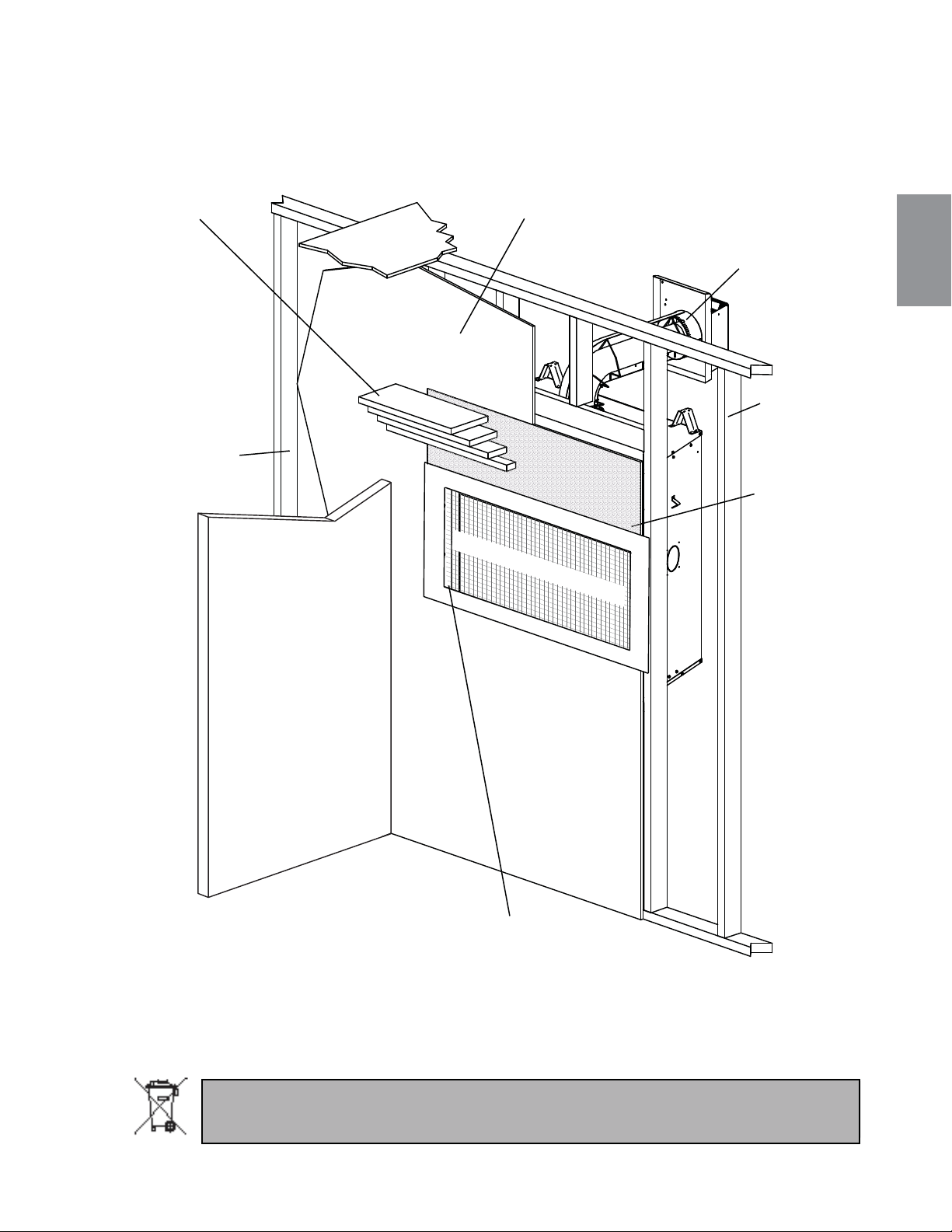
1.0 VUE D’ENSEMBLE DE L’INSTALLATION
Les piles doivent être mises au rebut conformément aux lois et à la réglementation locales. Certaines piles
peuvent être recyclées dans votre centre de recyclage local. Renseignez-vous auprès de votre municipal-
ité au sujet des directives de recyclage.
FR
63
W415-1335 / B / 10.04.16
Enceintes, voir la section « DÉGAGEMENTS
MINIMAUX AUX ENCEINTES
COMBUSTIBLES » pour les cloisons sèches
(ou autres matériaux combustibles).
Évacuation, voir la
section
« ÉVACUATION ».
Plaque d'homologation, voir la section
« INFORMATION SUR LA PLAQUE
D'HOMOLOGATION ».
Voir la section
« DÉGAGEMENTS
MINIMAUX DE LA
TABLETTE »
Voir la section
« OSSATURE »
Voir la section
« ÉVACUATION »
Voir la section
« DÉGAGEMENTS
MINIMAUX AUX
ENCEINTES
COMBUSTIBLES »
pour gypse (ou
autres matériaux
combustibles)
Mur de
côté
É
C
R
A
N
D
E
P
RO
T
E
C
T
I
ON
2.0 INTRODUCTION
FR
3.2C
!
AVERTISSEMENT
• CET APPAREIL EST CHAUD LORSQU’IL FONCTIONNE ET PEUT CAUSER DE GRAVES BRÛLURES EN CAS DE CONTACT.
• TOUTE MODIFICATION APPORTÉE À CET APPAREIL OU AUX CONTRÔLES PEUT ÊTRE DANGEREUX ET EST INTERDIT.
• Ne faites pas fonctionner l’appareil avant d’avoir lu et compris les instructions d’opération. Omettre d’utiliser l’appareil selon les
instructions d’opération pourrait causer un incendie ou des blessures.
• Risque d’incendie ou d’asphyxie. Ne faites pas fonctionner l’appareil avec la vitre retirée.
• Ne branchez pas la soupape à du courant 110 volts.
• Risque de brûlures. L’appareil doit être éteint et refroidi avant d’effectuer un entretien.
• N’installez pas de composants endommagés ou incomplets ni des composants substituts.
• Risque de coupures et d’érafl ures. Portez des gants protecteurs et des lunettes de sécurité lors de l’installation. Les bordures des
pièces de métal peuvent être coupantes.
• Ne brûlez pas de bois ou autres matériaux dans cet appareil.
• Les enfants et les adultes devraient être informés des dangers que posent les températures de surface élevées et se
tenir à distance afin d’éviter des brûlures ou que leurs vêtements ne s’enflamment.
• Les jeunes enfants doivent être surveillés attentivement lorsqu’ils sont dans la même pièce que l’appareil. Les
jeunes enfants et autres personnes à risque sont sujets aux brûlures accidentelles. Une barrière de protection est
recommandée si des individus à risque se trouvent dans la maison. Afi n de restreindre l’accès à l’appareil, installez une
barrière de protection ajustable pour garder les jeunes enfants ou autres personnes à risque hors de la pièce et loin des
surfaces chaudes.
• Les vêtements et autres matériaux combustibles ne doivent pas être posés sur l’appareil ou à proximité.
• En raison des températures élevées, l’appareil devrait être placé loin des endroits passants et loin des meubles et des
rideaux.
• Assurez-vous de disposer de mesures de sécurité adéquates pour empêcher les jeunes enfants de toucher aux surfaces
chaudes.
• Même une fois que l’appareil est éteint, la vitre et/ou le pare-étincelles demeureront chauds pendant un temps prolongé.
• Consultez votre détaillant local de foyer pour connaître les grillages de sécurité et les écrans offerts pour protéger les enfants des
surfaces chaudes. Ces grillages de sécurité et ces écrans doivent être fi xés au plancher.
• Tout grillages de sécurité, écrans ou barriére enlevés pour faire l’entretien devront être remis en place avant d’utiliser l’appareil.
• Cet appareil est un appareil à gaz ventilé. Ne brûlez pas de bois ou autres matériaux dans cet appareil.
• Il est primordial de garder propres les compartiments de contrôle, les brûleurs, la souffl erie, les bouches d’air de l’appareil ainsi
que le système d’évacuation. L’appareil et son système d’évacuation doivent être inspectés avant la première utilisation et au
moins une fois l’an par un spécialiste en entretien. Un entretien plus fréquent pourrait être nécessaire en raison des peluches
provenant des tapis, literie, etc. L’emplacement de l’appareil doit être gardé libre de tous matériaux combustibles, essence ou
autres liquides et vapeurs infl ammables.
• Cet appareil ne devra être modifi é en aucun cas.
• Cet appareil ne doit pas être raccordé au conduit d’une cheminée desservant un autre appareil de chauffage à combustible solide.
• N’utilisez pas cet appareil si une partie quelconque a été submergée. Contactez immédiatement un technicien de service qualifi é
pour inspecter l’appareil et pour remplacer toute pièce du système de contrôle et du contrôle du gaz qui aurait été submergée.
• Ne pas opérer l’appareil lorsque la porte vitrée est enlevée, fi ssurée ou brisée. Le remplacement de la vitre devra être effectué
par un technicien de service certifi é ou qualifi é.
• Ne frappez pas et ne claquez pas la porte vitrée de l’appareil.
• Les portes d’évacuation de pression doivent demeurer fermées pendant le fonctionnement de l’appareil afi n d’empêcher les
gaz de combustion contenant du monoxyde de carbone de s’infi ltrer dans la maison. La température des gaz de combustion
s’échappant par ces ouvertures peut aussi causer les matériaux combustibles avoisinants à surchauffer et à prendre feu.
• Seules les portes/façades certifi ées pour cet appareil peuvent être utilisées avec cet appareil.
• Gardez les matériaux d’emballage hors de la portée des enfants et mettez ces matériaux au rebut de façon sécuritaire. Comme tous
les emballages de plastique, ces matériaux ne sont pas des jouets et doivent demeurer hors de la portée des enfants et des bébés.
• Comme dans le cas de tout appareil à combustion, il est recommandé de faire inspecter et entretenir votre appareil
régulièrement. De même, installez un détecteur de monoxyde de carbone dans la pièce pour vous protéger, ainsi que votre
famille, contre les intoxications.
• Assurez-vous de respecter les dégagements aux matériaux combustibles lorsque vous installez un manteau ou des tablettes au-
dessus de l’appareil. Les températures élevées sur le mur ou de l’air au-dessus de l’appareil peuvent faire fondre, décolorer ou
endommager les décorations, les téléviseurs ou autres composants électroniques.
• Une barriére conçu à réduire le risque de brûlures causées par le verre chaud est fourni avec l’appareil et sera installé.
• Si la barriére est endommagée, elle devra être remplacée par la barriére conçu par le manufacturier pour cet appareil.
• L’installation et la réparation devraient être effectuées par un technicien qualifi é. L’appareil et son système d’évacuation
devraient être inspectés avant l’utilisation initiale et au moins une fois l’an par un professionel qualifi é. Un nettoyage
plus réquent peut être requis en raison de la poussière excessive laissée par les moquettes, les couvertures, etc. Il est
impératif que les compartiments de contrôle, le brûleur et les passages de circulation d’air soient gardés propres afi n de
fourni une combustion et une circulation d’air adéquates.
64
W415-1335 / B / 10.04.16
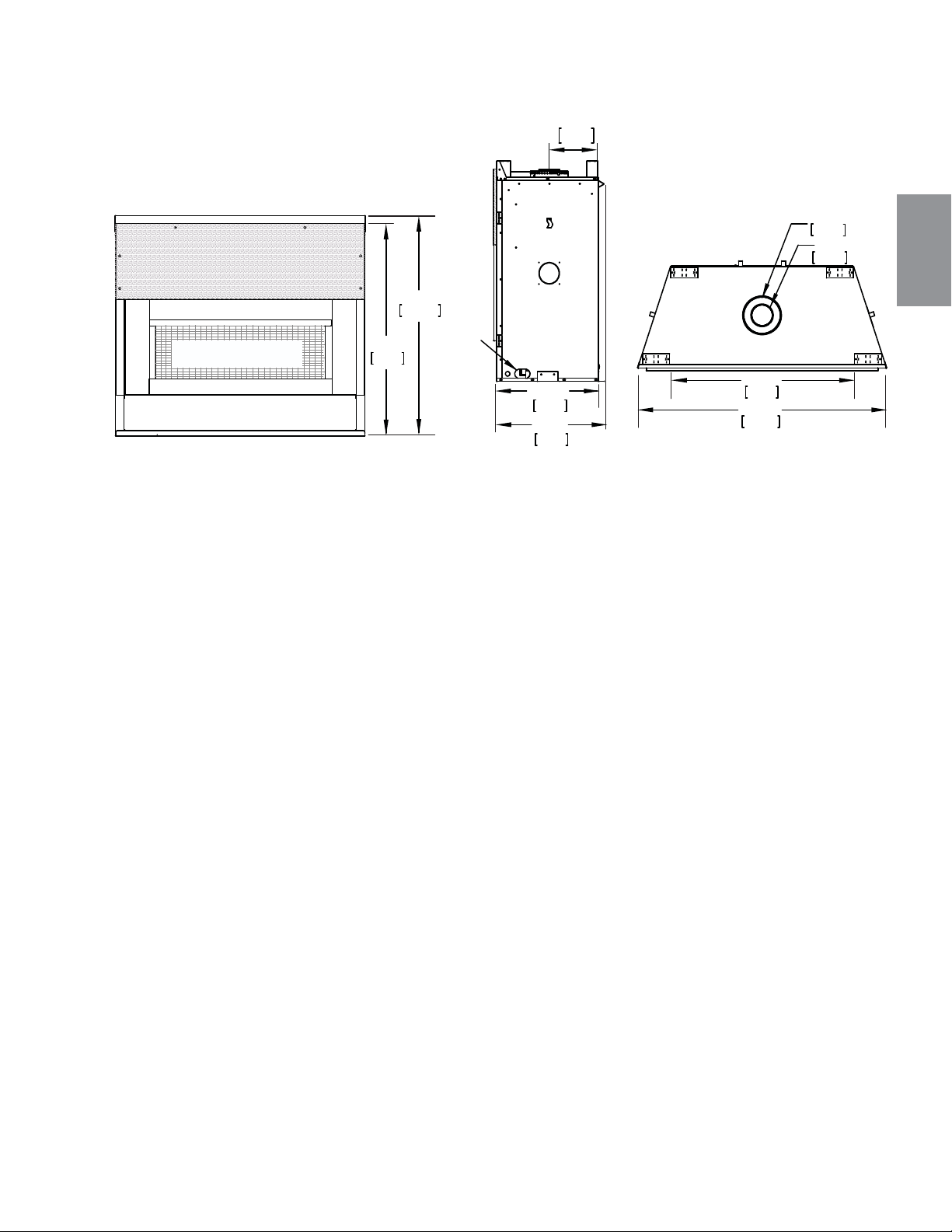
FR
65
W415-1335 / B / 10.04.16
2.1 DIMENSIONS
ENTRÉE
DU GAZ
39 5/16"
999mm
40 13/16"
1036mm
10 1/8"
257mm
Ø
19 7/8"
505mm
18 7/8"
479mm
46 1/4"
1175mm
34 1/16"
865mm
7"
178mm
Ø
4"
102mm
ÉCRAN DE PROTECTION
2.2 INSTRUCTIONS GÉNÉRALES
FR
4.1C
CET APPAREIL AU GAZ DEVRAIT ÊTRE INSTALLÉ ET ENTRETENU PAR UN INSTALLATEUR QUALIFIÉ en se conformant
aux codes locaux. Les pratiques d’installation peuvent varier d’une région à l’autre. Il est donc important de connaître les normes
spécifi ques qui s’appliquent à votre région. Par exemple dans l’état du Massachusetts:
• Ce produit doit être installé par un plombier certifi é ou un installateur pour le gaz lorsque installé dans le Commonwealth du Massachusetts.
• Le registre de l’appareil doit être enlevé ou bloqué en le soudant en position ouverte avant d’installer un encastré ou un ensemble
de bûches à gaz.
• La soupape d’arrêt doit être un robinet à gaz avec une poignée en T.
• Le raccord fl exible ne doit pas mesurer plus que 36 pouces (914.4mm).
• Un détecteur de monoxyde de carbone est requis dans toutes les pièces contenant des appareils alimentés au gaz.
• L’appareil n’est pas approuvé pour installation dans une chambre à coucher ou une salle de bain à moins d’être un appareil avec
une chambre de combustion scellée à évacuation directe.
L’installation doit se conformer aux codes locaux. En l’absence de codes locaux, l’installation doit être conforme au Code d’installation
du gaz naturel et du propane CSA B149.1 au Canada ou au National Fuel Gas Code, ANSI Z223.1/ NFPA 54 aux États-Unis. Cet
appareil convient pour installation dans une maison mobile si l’installation est conforme aux normes actuelles pour les maisons
mobiles équipées au gaz CAN/CSA Z240 SÉRIE MM au Canada ou selon les normes ANSI Z223.1 et NFPA 54 aux États-Unis.
Tant que les distances requises pour les dégagements aux matériaux combustibles sont respectées, le meilleur endroit pour un
appareil est le centre de la maison, car ceci permet une meilleure utilisation de la chaleur fournie. L’emplacement des fenêtres, des
portes et la circulation dans la pièce où se trouve l’appareil devront être
pris en considération. Si possible, vous devriez choisir un emplacement où
le système d’évent peut passer à travers la maison sans avoir à découper
des solives de plancher ou de toit.
Si l’appareil est installé directement sur un tapis, sur une surface de vinyle
ou tout autre revêtement de plancher combustible autre que le bois,
l’appareil devra être monté sur un panneau continu de métal ou de bois se
prolongeant sur toute la largeur et la profondeur.
Certains appareils ont une souffl erie ou un ensemble de deux
souffl eries optionnel. Si la souffl erie ou l’ensemble de deux souffl eries
optionnel est installé, la boîte de dérivation doit être branchée au circuit électrique et mise à la terre conformément aux codes
locaux. Utilisez la version courante du Code canadien de l’électricité CSA C22.1 au Canada ou le National Electrical Code ANSI/
NFPA 70 aux États-Unis.
Nous suggérons que nos
appareils au gaz soient installés
et que l'entretien soit effectué
par des professionnels certi-
fiés par le National Fireplace
Institute® (NFI) comme
spécialiste du gaz NFI.
!
AVERTISSEMENT
ALLUMEZ TOUJOURS LA VEILLEUSE, QUE CE SOIT POUR LA PREMIÈRE FOIS OU LORSQUE
L’APPROVISIONNEMENT EN GAZ EST ÉPUISÉ, AVEC LA PORTE VITRÉE OUVERTE OU RETIRÉE.
PRÉVOYEZ UN ACCÈS SUFFISANT POUR ENTRETENIR ET OPÉRER L’APPAREIL.
ASSUREZ-VOUS D'UNE QUANTITÉ SUFFISANTE D’AIR DE VENTILATION.
N’OBSTRUEZ JAMAIS L’OUVERTURE DE L’APPAREIL.
LES OBJETS PLACÉS DEVANT L’APPAREIL DOIVENT ÊTRE GARDÉS À UNE DISTANCE D'AU MOINS 48"
(1219.2mm) DE LA FACE VITRÉE DE L'APPAREIL.
LES SURFACES AUTOUR ET SURTOUT AU-DESSUS DE L’APPAREIL PEUVENT DEVENIR CHAUDES.
NE TOUCHEZ PAS L’APPAREIL QUAND IL FONCTIONNE.
RISQUE D’INCENDIE OU D’EXPLOSION.
LES PRESSIONS ÉLEVÉES ENDOMMAGERONT LA SOUPAPE. L’ALIMENTATION EN GAZ DOIT ÊTRE DÉBRAN-
CHÉE PENDANT LES ESSAIS DE PRESSION DE CE SYSTÈME LORSQUE LES PRESSIONS D’ESSAI EXCÈDENT
½ LB/PO² (3,5 KPA). FERMEZ LA SOUPAPE D’ARRÊT MANUELLE PENDANT TOUT ESSAI DE PRESSION DU
SYSTÈME D’ALIMENTATION EN GAZ LORSQUE LA PRESSION EST DE ½ LB/PO² (3,5 mb) OU MOINS.
N’UTILISEZ QUE LES ACCESSOIRES OPTIONNELS ET LES PIÈCES DE RECHANGE APPROUVÉS PAR WOLF
STEEL POUR CET APPAREIL. L’UTILISATION D’ACCESSOIRES NON LISTÉS (SOUFFLERIE, PORTES, PER-
SIENNES, MOULURES, COMPOSANTS DE GAZ, COMPOSANTS D’ÉVACUATION, ETC.) POURRAIT ÊTRE NON
SÉCURITAIRE ET ANNULERA LA GARANTIE ET LA CERTIFICATION.
L'APPAREIL NE DOIT PAS ÊTRE UTILISÉ AU TEMPÉRATURES AU-DESSOUS DE ZERO (
32°F / 0°C)
. PERMETTRE
À L'APPAREIL POUR RÉCHAUFFER AU-DESSUS DE ZERO AVANT LE FONCTIONNEMENT.
66
W415-1335 / B / 10.04.16
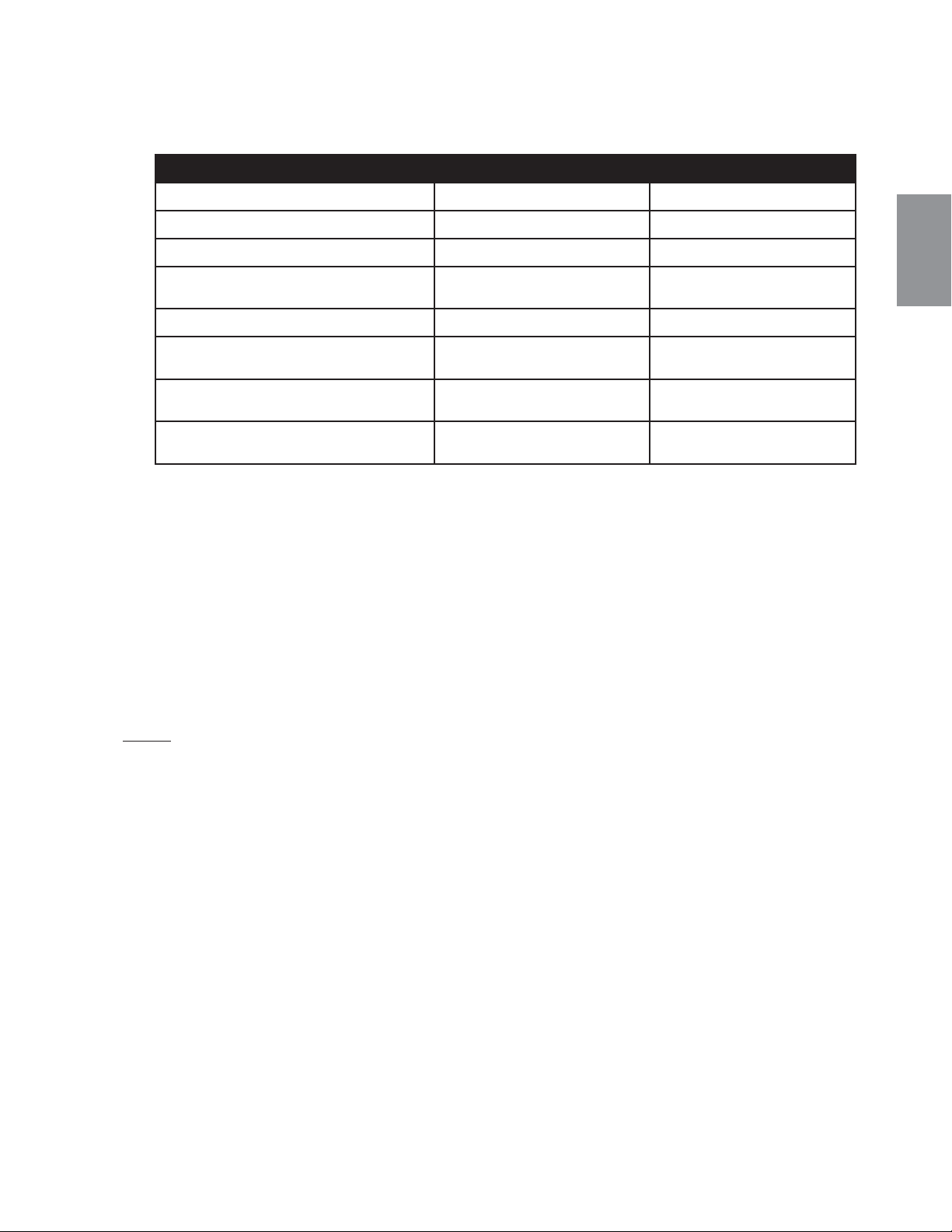
2.3 INFORMATIONS GÉNÉRALES
POUR VOTRE SATISFACTION, CET APPAREIL A ÉTÉ MIS À L’ESSAI POUR CONFIRMER SON
FONCTIONNEMENT ET SA QUALITÉ!
Lorsque l’appareil est installé à des élévations dépassant 4 500 pieds (1371,6m), et en l’absence de recommanda-
tions spécifi ques de l’autorité compétente locale, l’indice certifi é du débit à haute altitude devra être réduit au taux
de 4 % pour chaque 1 000 pieds
(304,8m) supplémentaires.
Cet appareil est approuvé pour installation dans les salles de bain, les chambres à coucher ou les chambres studio
et est homologué pour installation dans les maisons mobiles.
Cet appareil ne doit fonctionner qu’avec le gaz spécifi é sur la plaque d’homologation. Cet appareil ne peut
être converti à un autre type de gaz à moins d’utiliser un ensemble de conversion certifi é.
Les bruits causés par l’expansion et la contraction lors des cycles de chauffage et de refroidissement sont tout à
fait normaux et il faut s’y attendre.
NOTE : L’emballage de protection sur les pièces plaquées s’enlève mieux lorsque l’assemblage est à tempéra-
ture ambiante ou lorsqu’il est chauffé avec un séchoir à cheveux ou une autre source de chaleur similaire.
Une barrière conçu à réduire le risque de brûlures à partir de le chaude la vitre est à condition que avec
l’appareil et sera être installés.
FR
67
W415-1335 / B / 10.04.16
APPAREIL
GN PL
Altitude (PI) 0-4 500 0-4 500
Débit max. (BTU/H) 24 000 24 000
Rendement maximal à régime continu
(BTU/H)
17 280 17 280
Effi cacité (souf. allumée) 72 % 72 %
Pression minimale d’alimentation en
gaz
4 5"(11,2mb) de colonne
d’eau
11"(27,4mb) de colonne
d’eau
Pression maximale d’alimentation en
gaz
7"(17,4mb) de colonne d’eau
13" (32,4mb) de colonne
d’eau
Pression au collecteur (lorsque le gaz
circule)
3 5"(8,7mb) de colonne
d’eau
10" (25mb) de colonne
d’eau
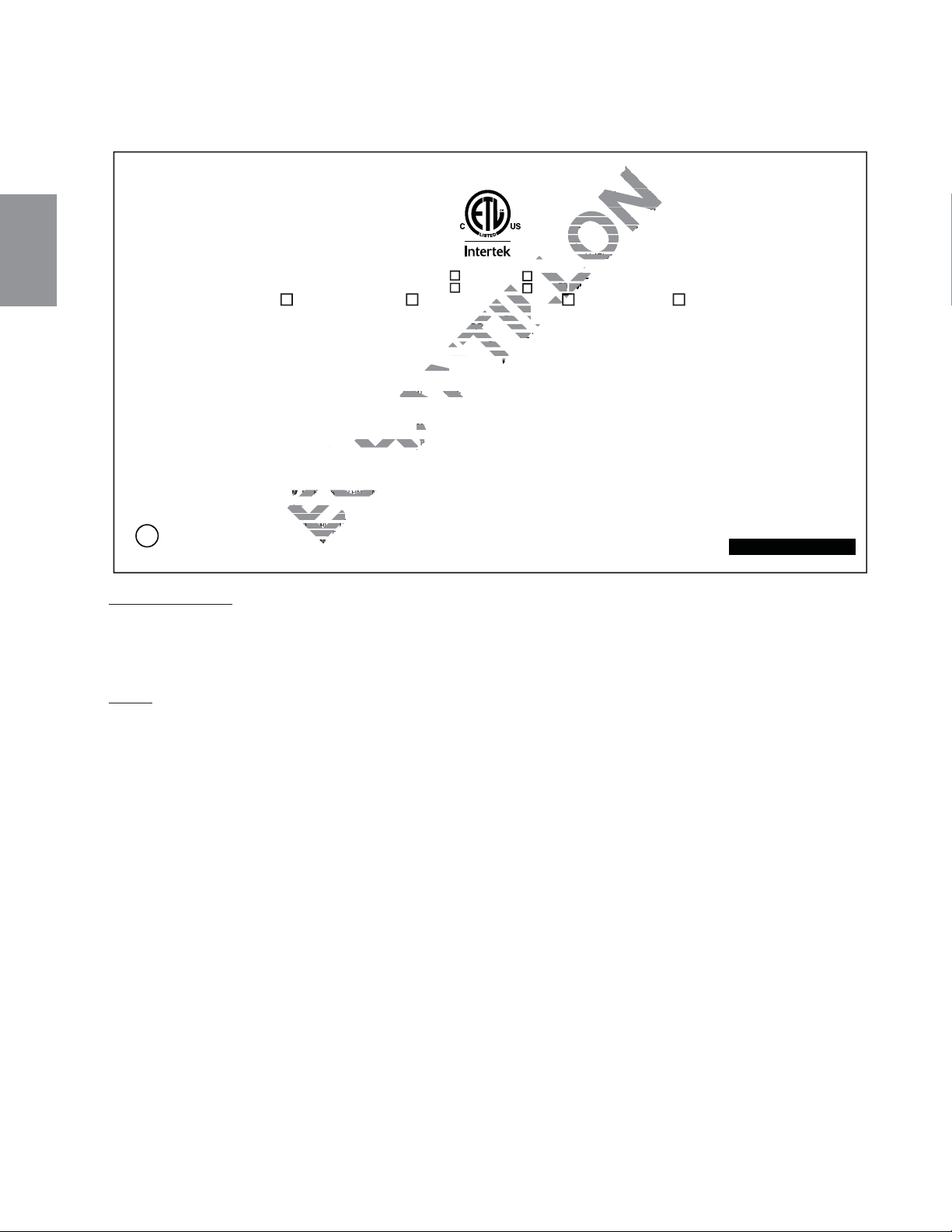
INSTALLATEUR: Vous êtes responsable de cocher les cases appropriées sur la plaque d’homologation
selon le modèle, l’évacuation et le type de gaz de l’appareil.
Pour l’emplacement de la plaque d’homologation, voir la section «VUE D’ENSEMBLE DE L’INSTALLATION».
Cette illustration est à titre de référence seulement. Consultez la plaque d’homologation pour obtenir
l’information précise.
NOTE: La plaque d’homologation doit rester avec l’appareil à toutes temps. Il ne doit pas être enlever.
2.4 INFORMATION SUR LA PLAQUE D’HOMOLOGATION
FR
W385-1967
DIRECT VENT GAS FIREPLACE. APPROVED FOR BEDROOM, BATHROOM AND BED-SITTING ROOM
INSTALLATION. SUITABLE FOR MOBILE HOME INSTALLATION IF INSTALLED IN ACCORDANCE WITH
THE CURRENT STANDARD CAN/CSA Z240MH SERIES GAS EQUIPPED MOBILE HOMES, IN
CANADA OR IN THE UNITED STATES THE MANUFACTURED HOME CONSTRUCTION AND
SAFETY STANDARD, TITLE 24 CFR, PART 3280. WHEN THIS US STANDARD IS NOT
APPLICABLE USE THE STANDARD FOR FIRE SAFETY CRITERIA FOR MANUFACTURED HOME
INSTALLATIONS, SITES AND COMMUNITIES, ANSI / NFPA 501A. THIS APPLIANCE MUST BE
INSTALLED IN ACCORDANCE WITH LOCAL CODES, IF ANY; IF NONE, FOLLOW THE CURRENT
ANSI Z223.1, OR CSA B149, INSTALLATION CODES.
FOR USE WITH BARRIER W565-0138.
FOLLOW THE INSTALLATION INSTRUCTIONS LOCATED IN THE INSTALLATION MANUAL.
FOYER À GAZ VENTILÉ. HOMOLOGUÉ POUR INSTALLATION DANS UNE CHAMBRE À COUCHER, UNE
SALLE DE BAIN ET UN STUDIO. APPROPRIÉ POUR INSTALLATION DANS UNE MAISON MOBILE SI
SON INSTALLATION CONFORME AUX EXIGENCES DE LA NORME CAN/CSA Z240MH SÉRIE DE
MAISONS MOBILES ÉQUIPÉES AU GAZ, EN VIGUEUR AU CANADA OU AUX ÉTATS-UNIS DE LA
NORME DE SECURITÉ ET DE CONSTRUCTION DE MAISONS MANUFACTURÉES, TITRE 24
CFR, SECTION 3280. DANS LE CAS OU CETTE NORME D'ÉTATS-UNIS NE PEUT ÊTRE
APPLIQUÉE, SE RÉFÉRER A LA NORME RELATIVE AU CRITÈRE DE MESURES DE SÉCURITÉ
CONTRE L'INCENDIE POUR LES INSTALLATIONS DANS LES MAISONS MANUFACTURÉS, LES
SITES ET LES COMMUNAUTÉS, ANSI/NFPA 501A. CODES. INSTALLER L’APPAREIL SELON LES
CODES OU RÈGLEMENTS LOCAUX, OU EN L’ABSENCE DE TELS RÈGLEMENTS, SELON LES
CODES D’INSTALLATION ANSI Z223.1 OU CSA-B149 EN VIGUER.
POUR UNE UTILISER AVEC
BARRIÈRE
W565-0138
. SUIVEZ LES INSTRUCTIONS D'INSTALLATION SE TROUVENT DANS LE
MANUEL D'INSTALLATION.
9700539 (WSL) 4001657 (NGZ)
4001658 (NAC) 4001659 (WUSA)
LHD45N CLHD45N MODEL CLHD45P LHD45P
0-4500FT (0-1370m) ALTITUDE / ÉLÉVATION 0-4500FT (0-1370m)
24,000 BTU/h INPUT / ALIMENTATION 24,000 BTU/h
3.5" WATER COLUMN/D'UNE COLONNE D'EAU MANIFOLD PRESSURE/PRESSION AU COLLECTEUR: 10" WATER COLUMN/D'UNE COLONNE D'EAU
4.5" WATER COLUMN/D'UNE COLONNE D'EAU MINIMUM SUPPLY PRESSURE/PRESSION D'ALIMENTATION MINIMALE: 11" WATER COLUMN/D'UNE COLONNE D'EAU
7.0" WATER COLUMN/D'UNE COLONNE D'EAU MAXIMUM SUPPLY PRESSURE/PRESSION D'ALIMENTATION MAXIMALE: 13" WATER COLUMN/D'UNE COLONNE D'EAU
52% P4 52%
NOT FOR USE WITH SOLID FUEL. FOR USE WITH GLASS
DOORS CERTIFIED WITH THIS UNIT ONLY.
WARNING:
DO NOT ADD ANY MATERIAL TO THE APPLIANCE, WHICH WILL COME IN CONTACT WITH THE FLAMES,
OTHER THAN THAT SUPPLIED BY THE MANUFACTURER WITH THE APPLIANCE.
MINIMUM CLEARANCE TO COMBUSTIBLE MATERIALS /
DÉGAGEMENTS MINIMAUX DES MATÉRIAUX COMBUSTIBLES:
TOP/ DESSUS 0” RECESSED DEPTH / PROFONDEUR D'ENCASTRE 20.5”
FLOOR / PLANCHER 0”
FRAMING (NOT INCLUDING FACE MATERIAL)/OSSATURE (MATÉRIAU DE FAÇON NON COMPRIS)
SIDES / CÔTÉS 0“ BACK / ARRIÈRE 0”
VENT TOP / DESSUS DU CONDUIT D’ÉVENT 2"
VENT SIDES & BOTTOM / CÔTÉS ET DESSOUS DU CONDUIT D'ÉVENT 1"
VERTICAL VENT / CONDUIT D’ÉVENT VERTICAL 1"
MANTEL / TABLETTE 6" *
TOP, SIDES & BACK: PER STAND OFF SPACERS FOR FRAMING MATERIALS. FOR FINISHING MATERIALS
SEE OWNERS MANUAL
DESSUS, COTÉS &ARRIÈRE: SELON LES ESPACEURS DE DÉGAGEMENT POUR LES MATÉRIAUX D'OSSATURE SELON LA
MANUEL DE PROPRIÉTAIRE POUR LESMATÉRIAUX DE FINITION.
* MAXIMUM HORIZONTAL EXTENSION / L'EXTENSION HORIZONTALE MAXIMALE: 2". SEE INSTRUCTION MANUAL
FOR GREATER EXTENSIONS. RÉFÉRER AU MANUEL D'INSTRUCTION POUR DES EXTENSIONS PLUS GRANDES.
SEE OWNER'S INSTRUCTION MANUAL FOR MINIMUM AND MAXIMUM VENT LENGTHS.
REFERER AU MANUEL D'INSTALLATION DE PROPRIETAIRE POUR LES LONGUEURS D'EVACUATION MINIMALE
ET MAXIMALE.
UN COMBUSTIBLE SOLIDE NE DOIT PAS ÊTRE UTILISÉ
AVEC CET APPAREIL. UTILISER AVEC LES PORTES
VITRÉES HOMOLOGUÉES SEULEMENT AVEC CETTE UNITÉ.
AVERTISSEMENT: N’AJOUTEZ PAS A CET APPAREIL AUCUN MATÉRIAU DEVANT ENTRER EN CONTACT
AVEC LES FLAMMES AUTRE QUE CELUI QUI EST FOURNI AVEC CET APPAREIL PAR LE FABRICANT.
THE APPLIANCE MUST BE VENTED USING THE APPROPRIATE NAPOLEON VENT KITS. SEE OWNERS INSTALLATION
MANUAL FOR VENTING SPECIFICS. PROPER REINSTALLATION AND RESEALING IS NECESSARY AFTER SERVICING THE
VENT-AIR INTAKE SYSTEM.
L'APPAREIL DOIT ÉVACUER SES GAZ EN UTILISANT L'ENSEMBLE D'ÉVACUATION PROPRE A NAPOLEON. RÉFÉRER AU
MANUEL D'INSTALLATION DE PROPRIÉTAIRE POUR L'ÉVACUATION PRÉCISE. IL EST IMPORTANT DE BIEN RÉINSTALLER
ET RESCELLER L'ÉVENT APRES AVOIR ASSURÉ LE MAINTIEN DU SYSTÉME DE PRISE D'AIR.
ELECTRICAL RATING: 115V, 60HZ. LESS THAN 12 AMPERES
SPÉCIFICATIONS ÉLECTRIQUES: 115V, 60HZ. MOINS DE 12 AMPÈRE
DECORATIVE PRODUCT: NOT FOR USE AS A HEATING APPLIANCE
PRODUIT DÉCORATIF: NE PAS UTILISER COMME APPAREIL DE CHAUFFAGE
SERIAL NUMBER/NO. DE SÉRIE: LHD45
WOLF STEEL LTD.
24 NAPOLEON ROAD, BARRIE, ON, L4M 0G8 CANADA
CONFORMS TO / CONFORME AUX: ANSI Z21.50-2014, CERTIFIED TO / CERTIFIE CSA 2.22-2014 VENTED GAS FIREPLACE / FOYER À GAZ VENTILÉ.
ÉCHANTILLON
OLOGU
GU
TUDIO. APPRAPPR
ON CONFORME ARME A
BILES ÉQUIPÉES AU GAÉQUIPÉES AU GA
SECURITÉ ET DE CONST
TÉ ET DE CONST
CTION 3280. DANS LE CAN 3280. DANS LE CA
QUÉE, SE RÉFÉRER A LA NO, SE RÉFÉRER A LA
NTRE L'INCENDIE POUR LESNCENDIE POUR LES
ITES ET LES COMMUNAUTÉES COMMUNAU
CODES OU RÈGLEMENTS RÈGLEMENTS
CODES D’INSTALLATIONODES D’INSTALLATION
BARRIÈRE
RE
W5
4001657 (NGZ) 001657 (NGZ)
40016594001659
(WU(WU
LL
LL
MODEL DEL
ITUDE / ÉLÉVATIONE / ÉLÉVATION
NPUT / ALIMENTATION / ALIMENTATION
L
ESSURE/PRESSION AU CORE/PRESSION AU CO
RESSURE/PRESSION D'ALIMURE/PRESSION D'ALI
PRESSURE/PRESSION D'ASSURE/PRESSIO
P44
GLASSLASS
N CONTACT WITH THE FLAMES,ACT WITH THE FLAMES
NCASTRE
20
.
5
”
20.5
(MATÉRIAU DE FAÇON NON COMPRAU DE FAÇON NON COMPR
0
VENT
RAMING MATERIALS. FOR FINISHIN
NG MATERIALS. FOR FINISHIN
E DÉGAGEMENT POUR LES
DÉGAGEMENT POUR
RIAUX DE FINITION.RIAUX DE FINITION.
ON HORIZONTAON HORIZONT
L D'INSTRL D'INSTR
AND
AND
UU
FIRE
68
W415-1335 / B / 10.04.16
3.0 ÉVACUATION
FR
CET APPAREIL UTILISE UN SYSTÈME DE CONDUITS DE 4” (102mm) POUR L’ÉVACUATION ET DE 7” (178mm)POUR LA PRISE D’AIR.
Veuillez consulter la section qui correspond à votre installation.
Afi n d’assurer un fonctionnement sécuritaire et adéquat de l’appareil, vous devez observer les instructions d’évacuation
à la lettre. Un changement à la longueur verticale minimale de l’évacuation pourrait entraîner des problèmes d’allumage
du brûleur et/ou des accumulations de carbone. Sous des confi gurations d’évacuation extrêmes, allouez de 5 à 15 min-
utes pour que la fl amme se stabilise après l’allumage. Il est suggérons fortement de les évents qui passent à travers des
espaces non chauffés (greniers, garages, espaces réduits) devraient être recouverts d’un manchon isolant pour minimiser
la condensation. Prévoyez un moyen d’inspecter visuellement le raccord des évents à l’appareil après que ce dernier a été
installé. Utilisez un espaceur coupe-feu, un protecteur de conduit d’évacuation ou un écran thermique de grenier lorsque
les murs intérieurs, le plancher ou le plafond sont traversés.
La terminaison peut être peints avec une peinture haute température pour faire correspondre les couleurs extérieures.
Utilisez une peinture extérieure pour 400°F (200°C). Application et performance de la peinture est la responsabilité du
consommateur. Spot test est recommandé.
NOTE ; Si, pour une raison quelconque, le système d’évents de prise d’air est démonté, réinstallez-le selon les
instructions fournies dans l’installation initiale.
NOTE : Cet appareil doit être installé de manière à ce que le conduit d’évacuation et de prise d’air se prolongent
sur toute la longueur de la cheminée. Toute autre méthode d’installation telle que d’utiliser la cheminée comme
partie du système d’évent est interdite.
7.1F
!
AVERTISSEMENT
RISQUE D’INCENDIE. CONSERVEZ LES DÉGAGEMENTS NÉCESSAIRES AU CONDUIT D’ÉVENT ET
À L’APPAREIL.
SI LE SYSTÈME D’ÉVENT EST FOURNI AVEC DES ESPACEURS, LES COURSES HORIZONTALES ET
VERTICALES DU SYSTÈME DOIVENT ÊTRE SUPPORTÉES À TOUS LES 3 PI (0,9m). UTILISEZ DES
SUPPORTS OU DES ATTACHES INCOMBUSTIBLES ÉQUIVALENTS AFIN DE MAINTENIR LE
DÉGAGEMENT AUX MATÉRIAUX COMBUSTIBLES. UTILISEZ L’ENSEMBLE DE SUPPORT MURAL
WOLF STEEL W010-0370 OU DES SUPPORTS INCOMBUSTIBLES ÉQUIVALENTS AFIN DE
CONSERVER LE DÉGAGEMENT MINIMAL AUX MATÉRIAUX COMBUSTIBLES POUR LES COURSES
VERTICALES ET HORIZONTALES. DES ESPACEURS SONT FIXÉS AU CONDUIT INTÉRIEUR À
INTERVALLES PRÉDÉTERMINÉS AFIN DE GARDER UN ESPACE VIDE AVEC LE CONDUIT
EXTÉRIEUR. POUR QUE LE FONCTIONNEMENT SOIT SÉCURITAIRE, UN ESPACE VIDE EST
REQUIS. UN ESPACEUR EST REQUIS AU DÉBUT, AU MILIEU ET À LA FIN DE CHAQUE COUDE AFIN
DE MAINTENIR CET ESPACE VIDE. N’ENLEVEZ PAS CES ESPACEURS.
69
W415-1335 / B / 10.04.16
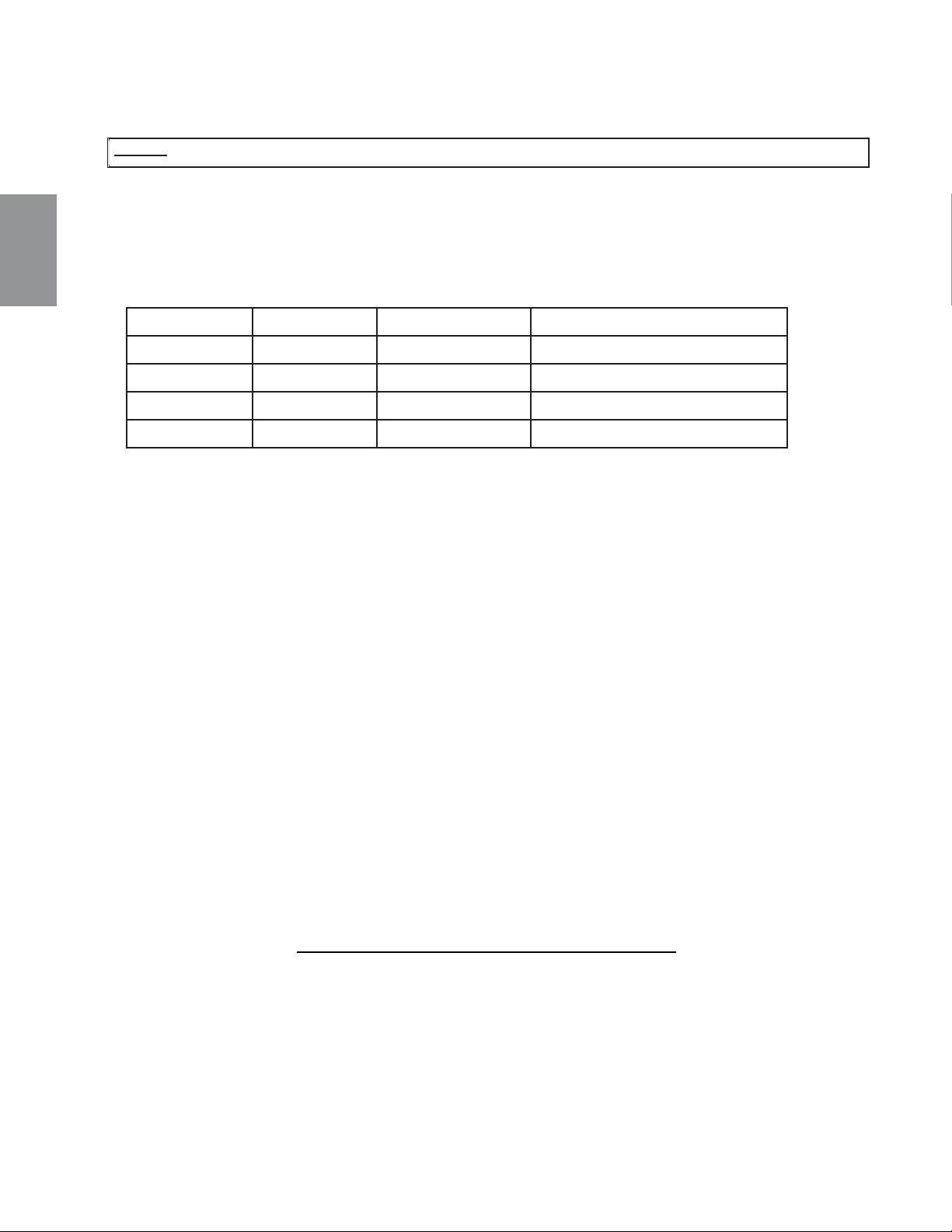
3.1 LONGUEURS DES CONDUITS D’ÉVACUATION ET COMPOSANTS POUR UNE
ÉVACUATION DIRECTE
FR
Utilisez uniquement des composants d’évacuation Wolf Steel, Simpson Dura-Vent, Selkirk Direct Temp, American
Metal Amerivent ou Metal-Fab. Les minimums et maximums des longueurs d’évent, pour les installations
verticales et horizontales, et les emplacements des terminaisons pour les deux systèmes sont précisés dans ce
manuel et doivent être respectés. Pour le Simpson Duravent, le Selkirk Direct Temp, l’American Metal Amerivent
et le Metal-Fab, suivez la procédure d’installation fournie avec les composants d’évacuation.
Un adaptateur de départ est nécessaire et peut être acheté chez le fournisseur correspondant :
Pour le Simpson Dura-Vent, le Selkirk Direct Temp, l’American Metal Amerivent et le Metal-Fab, suivez
la procédure d’installation qui se trouve sur le site Web de votre fournisseur.
Pour les systèmes d’évents dont le conduit intérieur d’évacuation possède déjà des joints scellés, seuls
les joints du conduit extérieur de prise d’air doivent être scellés avec un scellant de silicone rouge à haute
température (RTV). Ce même scellant peut être utilisé sur les joints des conduits intérieurs et extérieurs de
tous les autres systèmes d’évents approuvés à l’exception du raccordement du conduit d’évacuation à
la buse du foyer qui doit être scellé avec le scellant noir à haute température Mill Pac. Le scellant à haute
température doit être commandé séparément.
Lorsque vous utilisez des composants d’évacuation de Wolf Steel, n’utilisez que des composants fl exibles/
rigides d’évacuation Wolf Steel ltée conjointement avec les ensembles de terminaison suivants : les
ensembles de terminaison murale GD222, GD222R, ou l’ensemble de terminaison pour toit de pente 1/12 à
7/12 GD110, l’ensemble de terminaison pour toit de pente 8/12 à 12/12 GD111, l’ensemble de terminaison
pour toit plat GD112 ou l’ensemble périscopique GD201 (pour pénétration des murs sous le niveau du
sol). Lorsque vous utilisez des conduits fl exibles, conjointement avec les différentes terminaisons, utilisez
l’ensemble d’évents de 5PI (1,5m) GD220 ou l’ensemble d’évents de 10PI (3,1m) GD330.
Pour une performance optimale de l’appareil et une apparence optimale des fl ammes, gardez la
longueur des évents et le nombre de coudes au minimum. La prise d’air de la terminaison extérieure
doit demeurer dégagée en tout temps. Vérifi ez la prise d’air de la terminaison au moins une fois l’an
pour vous assurer qu’elle n’est pas obstruée ni endommagée. Ne combinez pas de composants
rigides ou fl exibles ni de composants d’évacuation provenant de fabricants différents.
Ces ensembles d’évents permettent soit une évacuation verticale, soit une évacuation horizontale de
l’appareil. La course horizontale doit être conservée à un maximum de 20PI (6,1m). La hauteur totale permise
pour un évent vertical est de 40PI (12,2m). Lorsque vous utilisez des composants fl exibles, le nombre
maximal de raccordements est de deux horizontalement ou trois verticalement (excluant les raccordements
à l’appareil et à la section de terminaison).
PIÈCE 4”/7” FOURNISSEUR SITE WEB
Duravent W175-0053 Wolf Steel www.duravent.com
Amerivent 4DSC-N2 American Metal www.americanmetalproducts.com
Direct Temp 4DT-AAN Selkirk www.selkirkcorp.com
SuperSeal 4DNA Metal-Fab www.mtlfab.com
8.1B
70
W415-1335 / B / 10.04.16
NOTE : La course horizontale totale (HT) DOIT être réduite de 25 % lorsqu’un évent fl exible est utilisé.
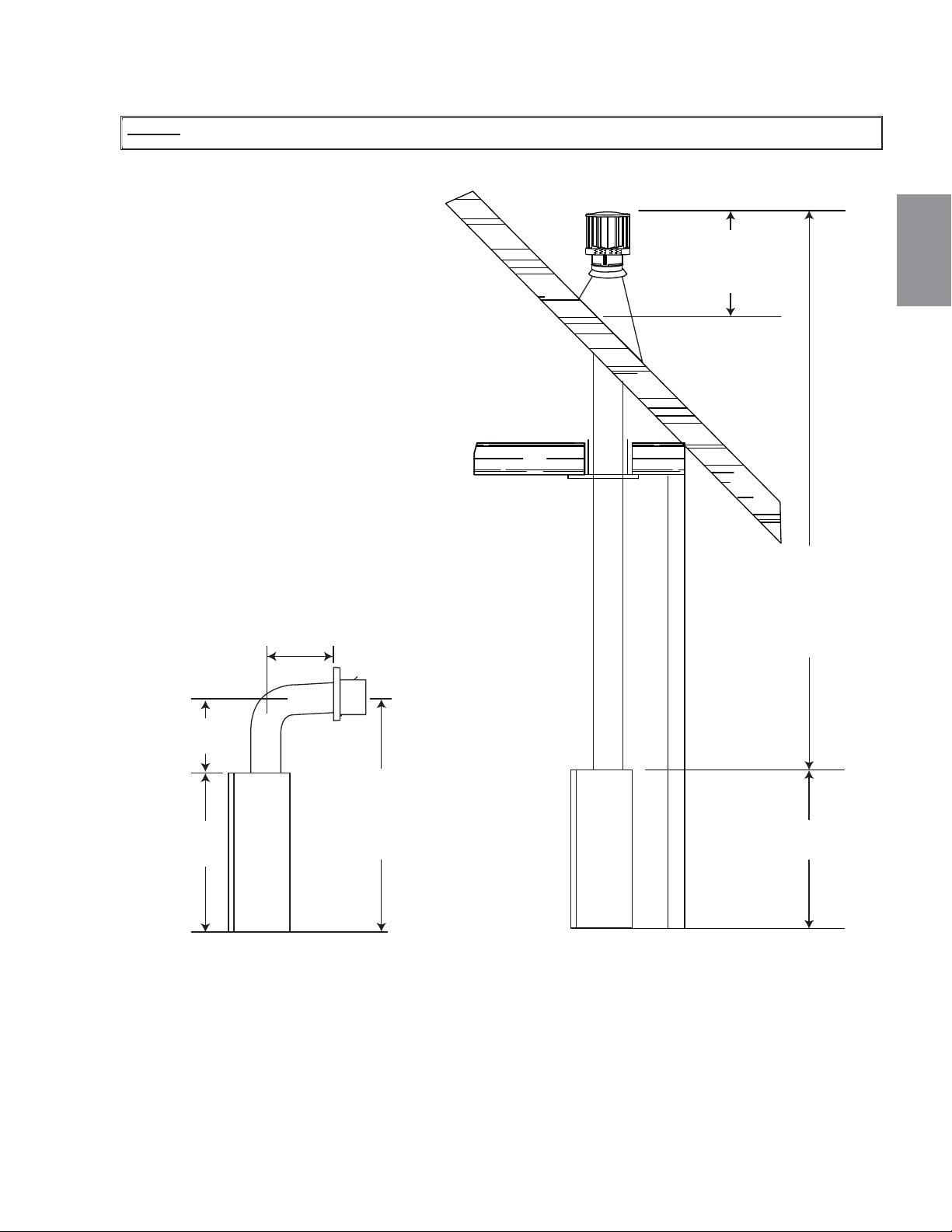
37 13/16”
(960mm)
8” (203mm)
MINIMUM
45 13/16”
(1163mm)
MINIMUM
PLUS
L’ÉLÉVATION*
40 PIEDS
(12M)
MAXIMUM
3 PIEDS
(1M)
MINIMUM
16” (406mm)
MINIMUM
37 13/16”
(960mm)
* Voir la section « ÉVACUATION ».
FR
71
W415-1335 / B / 10.04.16
18” (457mm) MAXIMUM
(ÉVENT FLEXIBLE)
24” (610mm) MAXIMUM
(ÉVENT RIGIDE)
3.2 INSTALLATIONS TYPIQUES D’ÉVENTS
NOTE : La course horizontale totale (HT) DOIT être réduite de 25 % lorsqu’un évent fl exible est utilisé.
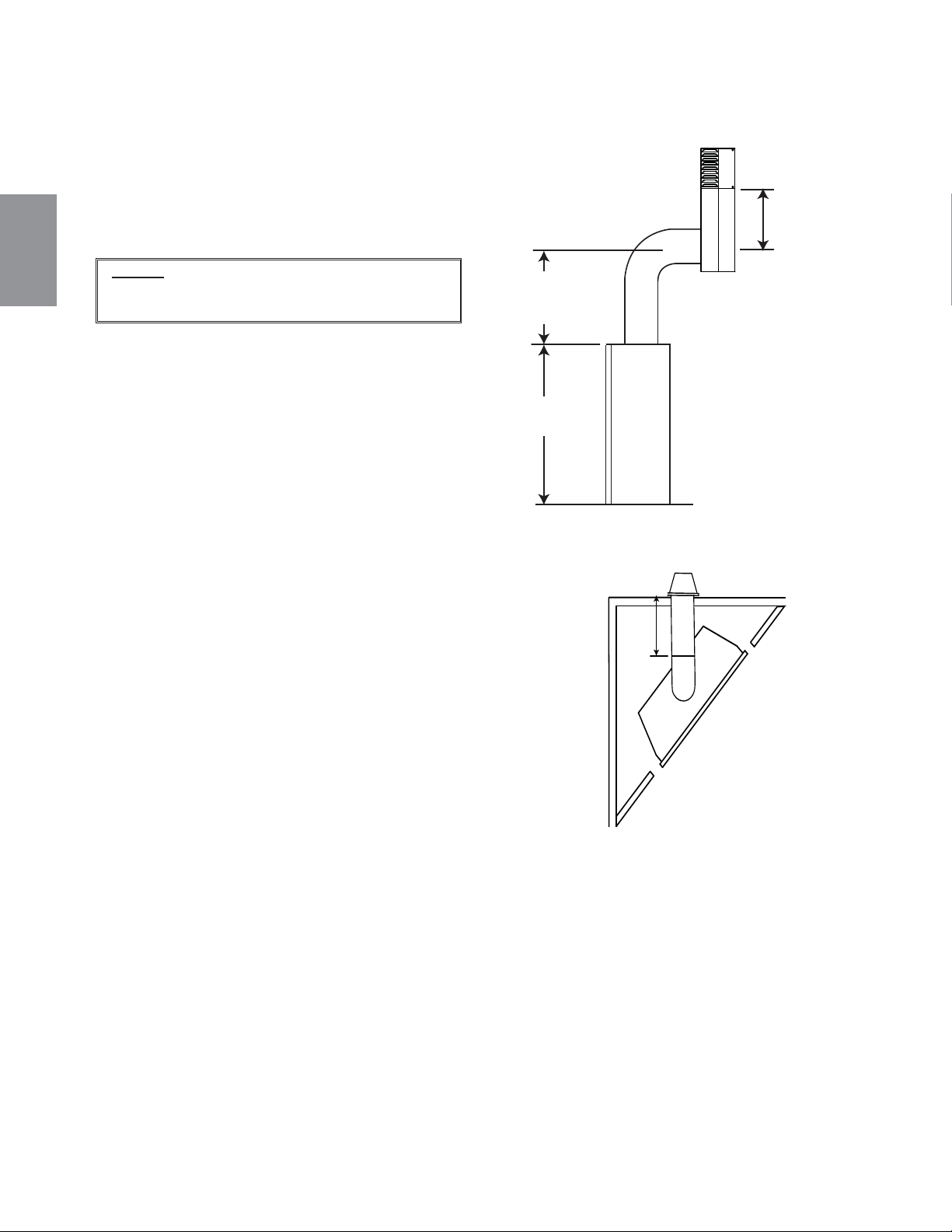
3.3.1 ENSEMBLE PÉRISCOPIQUE
12” (305mm)
MINIMUM
AU NIVEAU
DU SOL
24” (610mm)
MINIMUM
40 13/16”
(1037mm)
3.3 INSTALLATIONS PARTICULIÈRES D’ÉVENTS
3.3.2 TERMINAISON EN COIN
Lorsque l’évent est installé en coin, la longueur maximale du
conduit d’évacuation est de 24 pouces (610mm) de course horizontale,
avec une pente minimale de 8” (203mm).
20
(508mm)
MAX
FR
Utilisez l’ensemble périscopique afi n de positionner la terminaison au-dessus
du niveau du sol. L’ensemble périscopique doit être installé de façon à ce que
la fente d’air du bas soit située à un minimum de 12 pouces (304,8mm)
au-dessus du niveau du sol. La longueur maximale permise de
l’évent est 10 pieds (3,1m) pour un foyer et 8 pieds (2,4m)
pour un poêle.
91B
24”
(610mm)
MAX
72
W415-1335 / B / 10.04.16
NOTE : LA COURSE HORIZONTALE TOTALE
(HT) DOIT ÊTRE RÉDUITE DE 25 % LORSQU’UN
ÉVENT FLEXIBLE EST UTILISÉ.
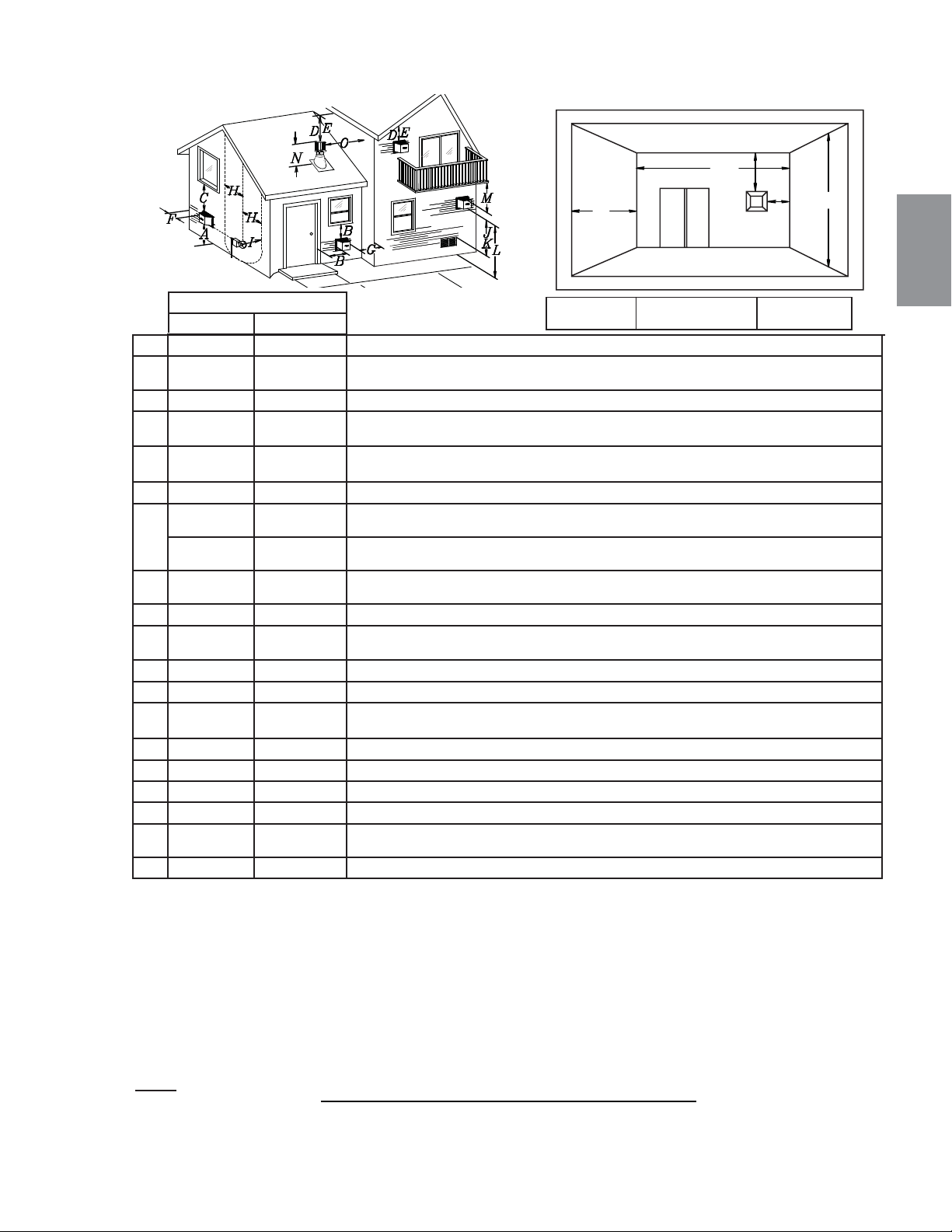
3.4 EMPLACEMENTS ET DÉGAGEMENTS MINIMAUX DE LA TERMINAISON
FR
12.1E
INSTALLATION
CANADA É.-U.
A 12” (30,5cm) 12” (30,5cm) Dégagement au-dessus du sol, d’une véranda, d’une terrasse en bois ou d’un balcon.
B
12”
(30,5cm)
Δ
9” (229mm)
Δ
Dégagement des fenêtres ou des portes qui ouvrent.
C 12” (30,5cm)* 12” (30,5cm)* Dégagement des fenêtres fermées en permanence.
D
18”
(45,7cm)**
18”
(45,7cm)**
Dégagement vertical d’un soffi te ventilé situé au-dessus de la terminaison si la distance
horizontale est de moins de 2’ (0,6m) de la ligne médiane de la terminaison.
E
12”
(30,5cm)**
12”
(30,5cm)**
Dégagement d’un soffi te non ventilé.
F 0” (0mm) 0” (0mm) Dégagement des murs faisant coin extérieur.
G
0” (0mm)*** 0” (0mm)***
Dégagement des murs extérieurs incombustibles faisant coin intérieur ou aux obstructions
incombustibles (cheminée, etc.).
2” (51mm)*** 2” (51mm)***
Dégagement des murs extérieurs combustibles faisant coin intérieur ou aux obstructions
combustibles (habillage extérieur, etc.).
H 3’ (0,9m) 3’ (0,9m)****
Dégagement horizontal de chaque côté depuis la ligne verticale tirée du centre d’un ensemble de
régulateur/compteur pour une distance verticale maximale de 15’ (4,6m).
I 3’ (0,9m) 3’ (0,9m)**** Dégagement de l’évent du régulateur.
J
12”
(30,5cm)
9”
(229mm)
Dégagement d’une prise d’air de ventilation non mécanique de la maison ou d’une prise d’air de
combustion de tout autre appareil.
K 6’ (1,8m) 3’ (0,9m) † Dégagement d’une prise d’air mécanique.
L 7’ (2,1m) ‡ 7’ (2,1m) **** Dégagement au-dessus d’un trottoir ou d’une entrée pavée situés sur une propriété publique.
M
12”
(30,5cm)††
12”
(30,5cm)****
Dégagement sous une véranda ou une terrasse en bois.
N 16” (40,6cm) 16” (40,6cm) Dégagement au-dessus du toit.
O 2’ (0,6m) †* 2’ (0,6m) †* Dégagement des murs adjacents, incluant les maisons voisines.
P 8’ (2,4m) 8’ (2,4m) Le toit doit être incombustible et sans ouvertures.
Q 3’ (0,9m) 3’ (0,9m)
Voir le tableau pour les dimensions d’un mur plus large
R 6’ (1,8m) 6’ (1,8m)
Voir le tableau pour les dimensions d’un mur plus profond. La terminaison ne doit pas être installée
sur quelconque mur ayant une ouverture entre la terminaison et le côté ouvert de la structure.
S
12” (30,5cm) 12” (30,5cm) Dégagement sous un balcon couvert.
Δ
Pour les structures comportant trois murs et un toit, la terminaison doit être située à plus de 6 pieds (1,8m) sous une fenêtre s’ouvrant sur un plan horizontal.
* Recommandé afi n de prévenir la formation de buée dans les fenêtres et les cassures thermiques.
** Il est recommandé d’utiliser un protecteur de chaleur et de maximiser la distance au soffi te de plastique.
*** L’ensemble périscopique requiert un dégagement minimal de 18 pouces (457,2m) d’un mur extérieur faisant coin intérieur.
**** Ceci est une distance recommandée. Vérifi ez les codes locaux pour connaître les contraintes additionnelles.
† Trois pieds au-dessus si la distance horizontale est de moins de 10 pieds (3,1m).
‡
Une terminaison d’évacuation ne doit pas être installée à un endroit où elle pourrait causer une formation dangereuse de givre ou de glace sur les surfaces d’une propriété
adjacente.
†† Permis seulement si la véranda ou la terrasse en bois sont complètement ouverts sur un minimum de deux côtés sous le plancher.
†* Recommandé afi n d’éviter la recirculation des produits d’échappement. Vérifi ez les codes locaux pour connaître les contraintes additionnelles.
††* Permis seulement si le balcon est complètement ouvert sur au moins un côté.
NOTE : Les dégagements sont en conformité avec les codes d’installation locaux et les exigences du fournisseur de gaz.
APPLICATIONS POUR BALCON COUVERT ††*
Q
MIN
R
MAX
MAX
R
= 3 pieds
(0,9m)
= 2 x
SLHGV
(4,6m)
Q
RÉELLE
R
Q
S
G
P
73
W415-1335 / B / 10.04.16
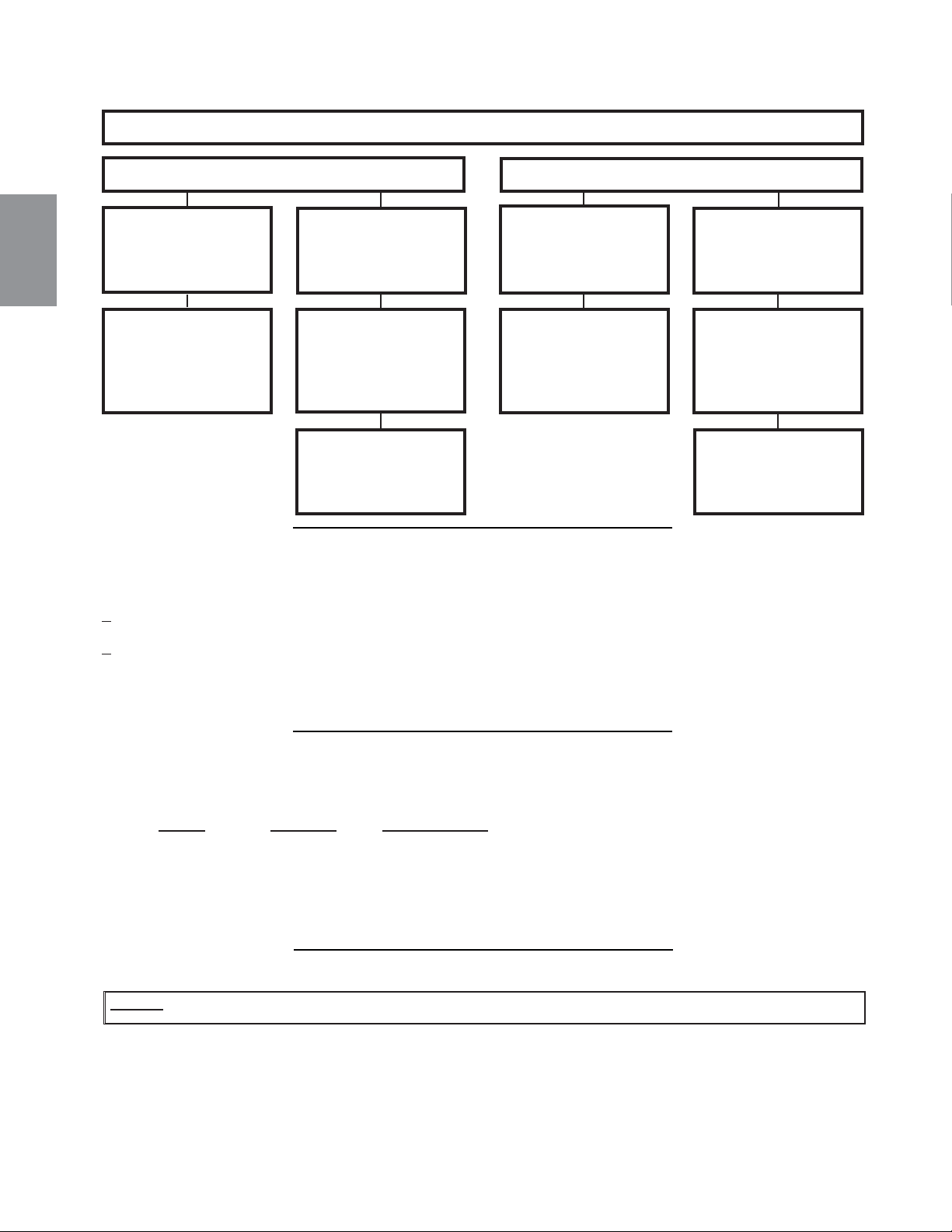
3.5 CHARTE D’APPLICATION DES ÉVACUATIONS
FR
13.1A
Terminaison horizontale
Terminaison verticale
La course verticale
est plus grande ou
égale à la course
horizontale.
La course verticale
est plus petite
que la course
horizontale.
La course verticale
est plus grande ou
égale à la course
horizontale.
La course verticale
est plus petite
que la course
horizontale.
La course
horizontale + la
course verticale
jusqu’à un maximum
de 40’ (12,2m).
La course horizon-
tale + la course
verticale jusqu’à un
maximum de
24,75’ (7,5m).
La course
horizontale
+ la course verticale
jusqu’à un maximum
de 40’ (12,2m).
La course
horizontale
+ la course verticale
jusqu’à un maximum
de 40’ (12,2m).
4,2 fois la course
verticale plus
grande ou égale à la
course horizontale.
3 fois la course
verticale plus
grande ou égale à la
course horizontale.
ÉVACUATION SUR LE DESSUS
14.1
Les symboles suivants sont utilisés dans le calcul et les exemples d’évacuation :
> - plus grand que
> - plus grand ou égal à
< - plus petit que
< - plus petit ou égal à
H
T
- total de la longueur des courses horizontales (Hr) et des déviations (Ho) en pieds
H
R
- longueur des courses horizontales combinées en pieds
H
O
- facteur de la valeur d’une déviation : 0,03 (du total des degrés de déviation - 90°*) en pieds
V
T
- longueur des courses verticales combinées en pieds
15.1A
PIEDS POUCES MILLIMÈTRES
1° 0,03 0,5 12,7
15° 0,45 6,0 152,4
30° 0,9 11,0 279,4
45° 1,35 16,0 406,4
90°* 2,7 32,0 812,8
* La première déviation de 90° a une valeur zéro et est illustrée dans la formule comme - 90°
3.6 LÉGENDE
3.7 VALEURS DU COUDE EN LONGUEUR D’ÉVENT
74
W415-1335 / B / 10.04.16
NOTE : La course horizontale totale (HT) DOIT être réduite de 25 % lorsqu’un évent fl exible est utilisé.
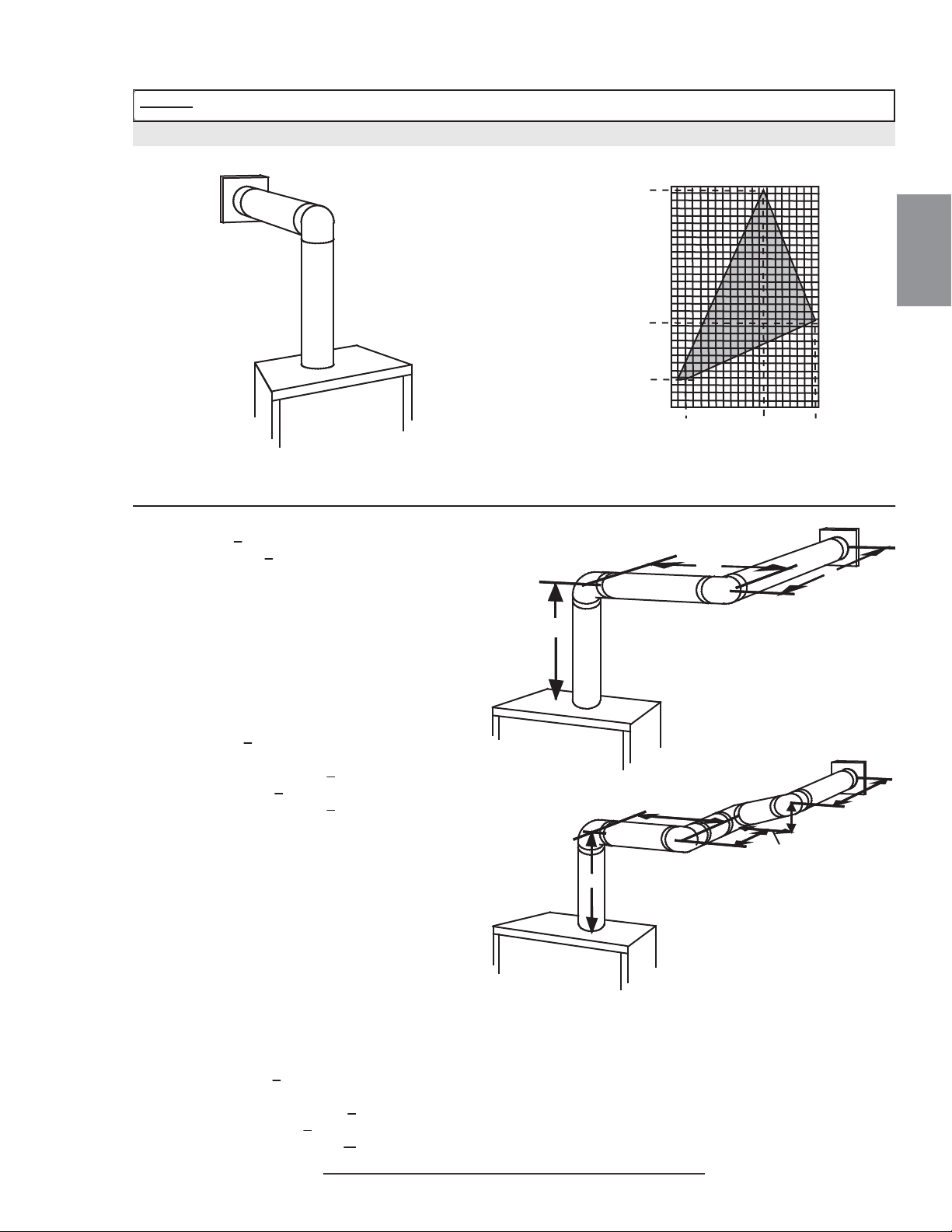
3.8 TERMINAISON HORIZONTALE
FR
(H
T
) > (V
T
)
Configuration d'évacuation simple (un coude de 90°
seulement).
Consultez le graphique pour déterminer la course verticale
nécessaire V
T
par rapport à la course horizontale requise H
T
.
COURSE
VERTICALE
REQUISE EN
POUCES
(MILLIMÈTRES) V
T
LONGUEUR DES COURSES HORIZONTALES PLUS LES
DÉVIATIONS EN PIEDS (MÈTRES) H
T
La section ombragée à l'intérieur des lignes représente
des valeurs acceptables pour H
T
et V
T
.
90°
V
1
H
1
H
2
90°
90°
90°
90°
90°
H
1
H
2
V
1
V
2
H
3
H
4
0
5
(1.5)
15
(4.6)
20 (6.1)
100 (2540)
50 (1270)
150 (3810)
12.5
(3.8)
19 1/2 (495.3)
57 (1447.8)
147 (3733.8)
2
(0.6)
10
(3.1)
19.5
(5.9)
16.1_2A
Lorsque la configuration de l'évacuation exige plus d'un coude de 90°, les formules suivantes s'appliquent :
Formule 1: H
T
< 4,2 V
T
Formule 2: H
T
+ V
T
< 24,75 pieds (7,5m)
Exemple:
V
1
= V
T
= 6 PI (1,8m)
H
1
= 3 PI (0,9m)
H
2
= 5 PI (1,5m)
H
R
= H
1
+ H
2
= 3PI (0,9m) + 5PI (1,5m) = 8PI (2,4m)
H
O
= .03 (two 90° elbows - 90°) = .03 (180° - 90°) = 2,7PI (0,8m)
H
T
= H
R
+ H
O
= 8PI (2,4m) + 2,7PI (0,8m) = 10,7PI (3,3m)
H
T
+ V
T
= 10,7PI (3,3m) + 6PI (1,8m) = 16,7PI (5,1m)
Formule 1: H
T
< 4,2 V
T
4,2 V
T
= 4.2PI (1,3m) x 6PI (1,8m) = 25,2PI (7,7m)
10,7PI (3,3m) < 25,2PI (7,7m)
Formule 2: H
T
+ V
T
< 24.75 PI (7,5m)
16,7PI (5,1m) < 24,75PI (7,5m)
Puisque les deux formules sont respectées, cette configuration
d'évacuation est acceptable.
Exemple:
V
1
= 4 PI (1,2m)
V
2
= 1,5 PI (0,5m)
V
T
= V
1
+ V
2
= 4PI (1,2m) + 1,5PI (0,5m) = 5,5 PI (1,7m)
H
1
= 2 PI (0,6m)
H
2
= 1 PI (0,3m)
H
3
= 1 PI (0,3m)
H
4
= 1,5 PI (0,5m)
H
R
= H
1
+ H
2
+ H
3
+ H
4
= 2PI (0,6m) + 1PI (0,3m) + 1PI (0,3m) + 1,5PI (0,5m) = 5,5 PI (1,7m)
H
O
= 0,03 (quatre coudes 90° - 90°) = 0,03 (360° - 90°) = 8,1 PI (2,5m)
H
T
= H
R
+ H
O
= 5,5PI (1,7m) + 8,1 PI (2,5m) = 13,6 PI (4,2m)
H
T
+ V
T
= 13,6 PI (4,2m) + 5,5PI (1,7m) = 19,1PI (5,8m)
Formule 1: H
T
< 4.2 V
T
4.2 V
T
= 4,2 PI (1,3m) x 5,5PI (1,7m) = 23,1 PI (7m)
13,6 PI (4,2m) < 23,1 PI (7m)
Formule 2: H
T
+ V
T
< 24,75 PI (7,5m)
19,1PI (5,8m) < 24,75 PI (7,5m)
Puisque les deux formules sont respectées, cette configuration d'évacuation est acceptable.
75
W415-1335 / B / 10.04.16
NOTE : La course horizontale totale (HT) DOIT être réduite de 25 % lorsqu’un évent fl exible est utilisé.
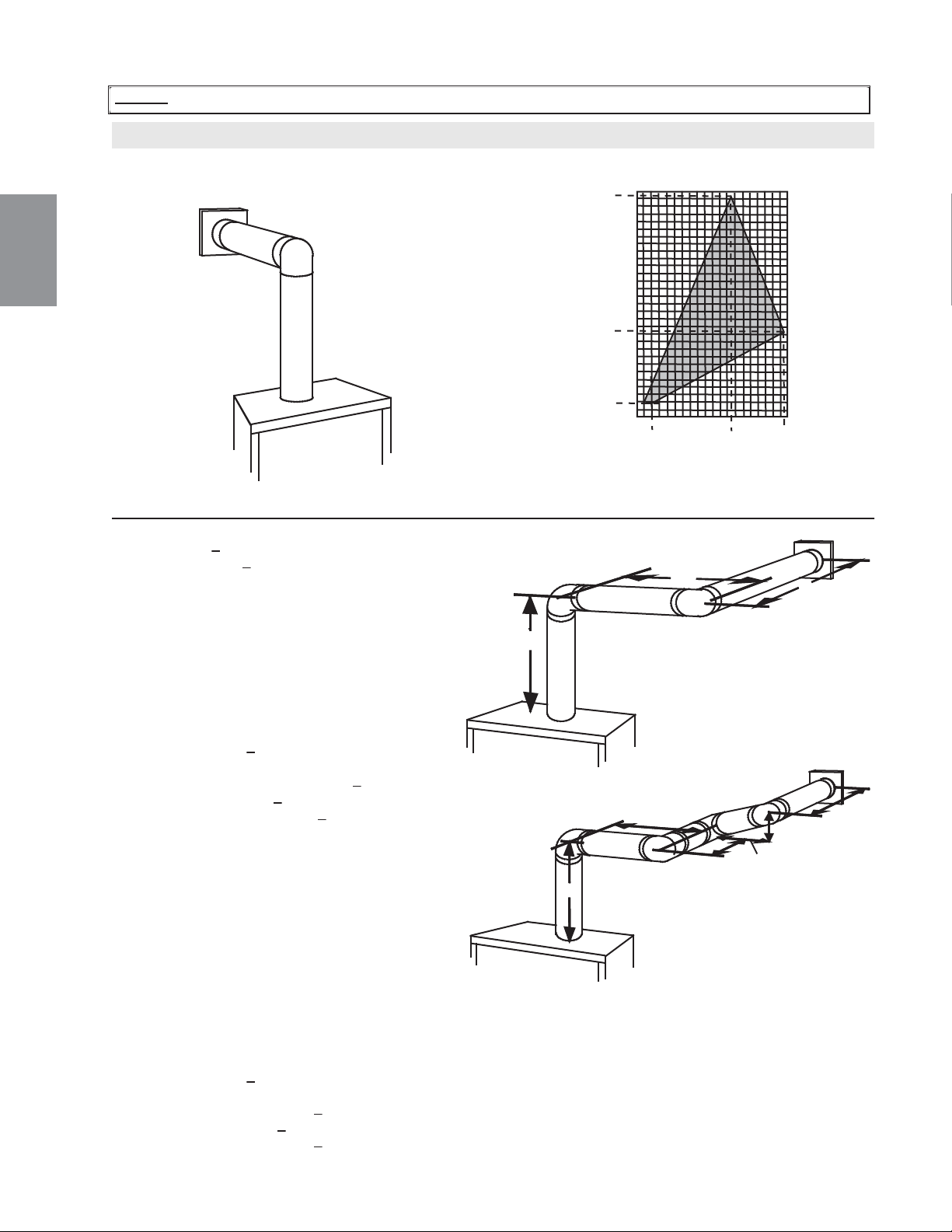
(H
T
) > (V
T
)
Configuration d'évacuation simple (un coude de 90°
seulement).
Consultez le graphique pour déterminer la course verticale
nécessaire V
T
par rapport à la course horizontale requise H
T
.
COURSE
VERTICALE
REQUISE EN
POUCES
(MILLIMÈTRES)V
T
LONGUEUR DES COURSES HORIZONTALES PLUS LES
DÉVIATIONS EN PIEDS (MÈTRES) H
T
Lorsque la configuration de l'évacuation exige plus d'un coude de 90°, les formules suivantes s'appliquent :
Formule 1 : H
T
< 4,2 V
T
Formule 2 : H
T
+ V
T
< 24,75 pieds (7,5m)
Exemple :
V
1
= V
T
= 6 PI (1,8m)
H
1
= 3 PI (0,9m)
H
2
= 5 PI (1,5m)
H
R
= H
1
+ H
2
= 3PI (0,9m) + 5PI (1,5m) = 8 PI (2,4m)
H
O
= 0,03 (deux coudes 90°- 90°) = 0,03 (180° - 90°) = 2,7PI (0,8m)
H
T
= H
R
+ H
O
= 8PI (2,4m) + 2,7PI (0,8m) = 10,7 PI (3,3m)
H
T
+ V
T
= 10,7 PI (3,3m) + 6 PI (1,8m) = 16,7 PI (5,1m)
Formule 1 : H
T
< 4,2 V
T
4,2 V
T
= 4,2PI (1.3m) x 6PI (1,8m) = 25,2PI (15,9m)
10,7 PI (3,3m) < 25,2 PI (12,9m)
Formule 2 : H
T
+ V
T
< 24,75 PI (7,5m)
16,7 PI (3,3m) < 24,75 (7,5m)
Puisque les deux formules sont respectées, cette configuration
d'évacuation est acceptable.
La section ombragée à l'intérieur des lignes représente des
valeurs acceptables pour H
T
et V
T
.
Exemple :
V
1
= 4 PI (1,2m)
V
2
= 1,5 PI (0,5m)
V
T
= V
1
+ V
2
= 4PI (1,2m) + 1,5PI (0,5m) = 5,5 PI (1,7m)
H
1
= 2 PI (0,6m)
H
2
= 1 PI (0,3m)
H
3
= 1 PI (0,3m)
H
4
= 1,5 PI (0,5m)
H
R
= H
1
+ H
2
+ H
3
+ H
4
= 2PI (0,6m) + 1PI (0,3m) + 1PI (0,3m) + 1,5PI (0,5m) = 5,5 PI (1,7m)
H
O
= 0,03 (quatre coudes 90° - 90°) = 0,03 (360° - 90°) = 8,1 PI (2,5m)
H
T
= H
R
+ H
O
= 5,5PI (1,7m) + 8,1PI (2,5m) = 13,6 PI (14,2m)
H
T
+ V
T
= 13,6PI (14,2m) + 5,5PI (1,7m) = 19,1PI (5,8m)
Formule 1 : H
T
< 4,2 V
T
4,2 V
T
= 4,2PI (1,3m) x 5,5PI (1,7m) = 23,1PI (7m)
13,6PI (4,1m) < 23,1 PI (7m)
Formule 2 : H
T
+ V
T
< 24,75 PI (7,5m)
19,1PI (5,8m) < 24,75 PI (7,5m)
Puisque les deux formules sont respectées, cette configuration d'évacuation est acceptable.
90°
V
1
H
1
H
2
90°
90°
90°
90°
90°
H
1
H
2
V
1
V
2
H
3
H
4
0
5
(1,5)
15
(4,6)
20 (6,1)
100 (2540)
50 (1270)
150 (3810)
12,5
(3,8)
8 (203,2)
57 (1447,8)
147 (3733,8)
2
(0,6)
10
(3,1)
19,5
(5,9)
FR
76
W415-1335 / B / 10.04.16
NOTE : La course horizontale totale (HT) DOIT être réduite de 25 % lorsqu’un évent fl exible est utilisé.
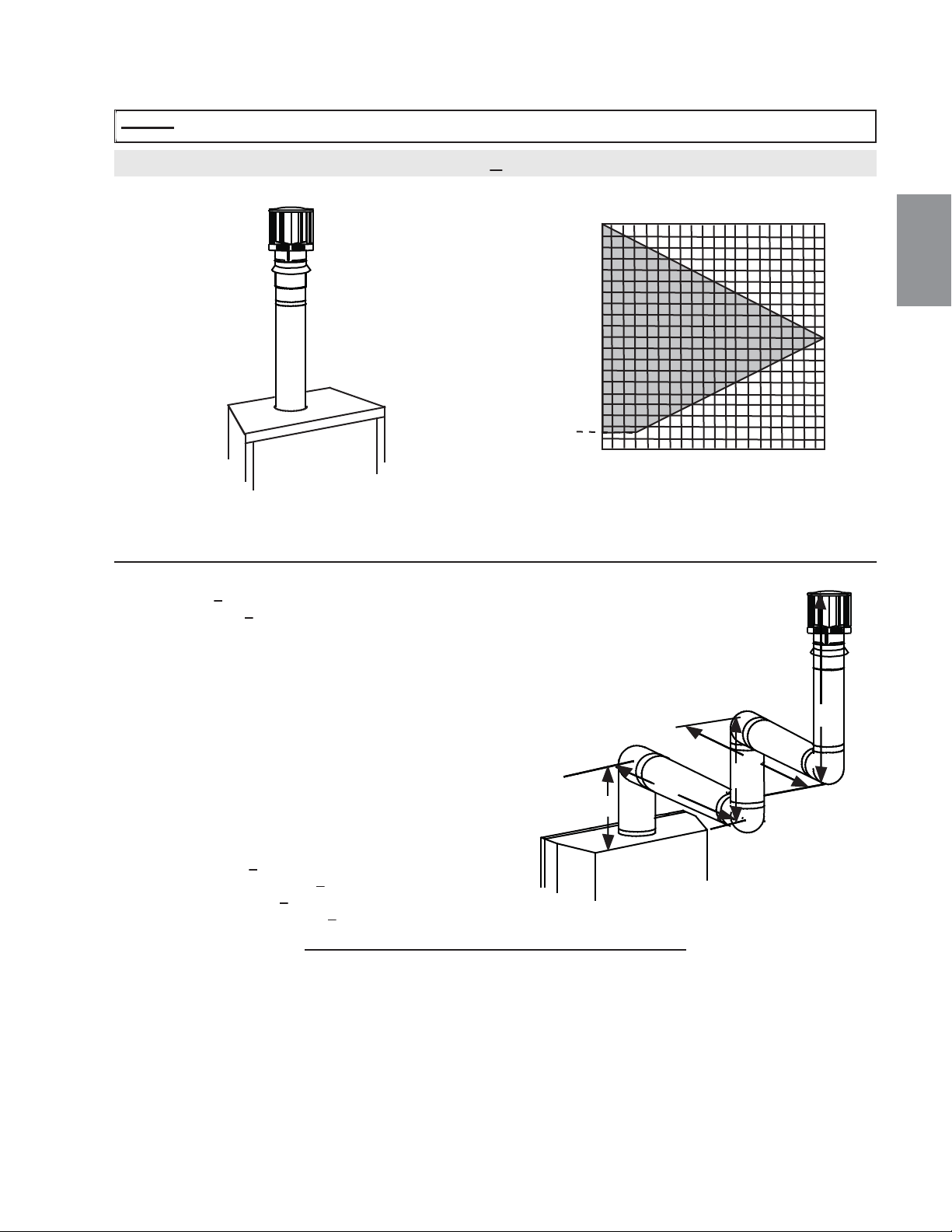
3.9 TERMINAISON VERTICALE
FR
(H
T
) < (V
T
)
Configuration d'évacuation simple.
Consultez le graphique pour déterminer la course verticale
nécessaire V
T
par rapport à la course horizontale requise H
T
.
COURSE
VERTICALE
REQUISE EN
PIEDS
(MÈTRES)V
T
LONGUEUR DES COURSES HORIZONTALES PLUS
LES DÉVIATIONS EN PIEDS (MÈTRES) H
T
Lorsque la configuration de l'évacuation exige plus de zéro coude de 90°, les formules suivantes s'appliquent :
Formule 1 : H
T
< V
T
Formule 2 : H
T
+ V
T
< 40 pieds (12,2m)
Exemple :
V
1
= 5 PI (1,5m)
V
2
= 6 PI (1,8m)
V
3
= 10 PI (3,1m)
V
T
= V
1
+ V
2
+ V
3
= 5PI (1,5m) + 6PI (1,8m) + 10PI (3,1m) = 21 PI (6,4m)
H
1
= 8 PI (2,4m)
H
2
= 2,5 PI (0,8m)
H
R
= H
1
+ H
2
= 8 PI (2,4m) + 2,5 PI (0,8m) = 10,5 PI (3,2m)
H
O
= 0,03 (quatre coudes 90° - 90°)
= 0,03 (360° - 90°) = 8,1 PI (2,5m)
H
T
= H
R
+ H
O
= 10,5PI (3,2m) + 8,1PI (2,5m) = 18,6 PI (5,7m)
H
T
+ V
T
= 18,6PI (5,7m) + 21PI (6,4m) = 39,6 PI (12,1m)
Formule 1 : H
T
< V
T
18,6PI (5,7m) < 21PI (6,4m)
Formule 2 : H
T
+ V
T
< 40 PI (12,2m)
39,6 PI (12,1m) < 40 PI (12,2m)
Puisque les deux formules sont respectées, cette configuration d'évacuation est acceptable.
90°
V
1
V
2
H
1
H
2
La section ombragée à l'intérieur des lignes représente
des valeurs acceptables pour H
T
et V
T
.
90°
90°
90°
V
3
18.1A
0
5
(1,5)
10
(3,1)
15
(4,6)
20
(6,1)
40 (12,2)
10 (3,1)
20 (6,1)
30 (9,1)
3 (0,9)
77
W415-1335 / B / 10.04.16
NOTE : La course horizontale totale (HT) DOIT être réduite de 25 % lorsqu’un évent fl exible est utilisé.
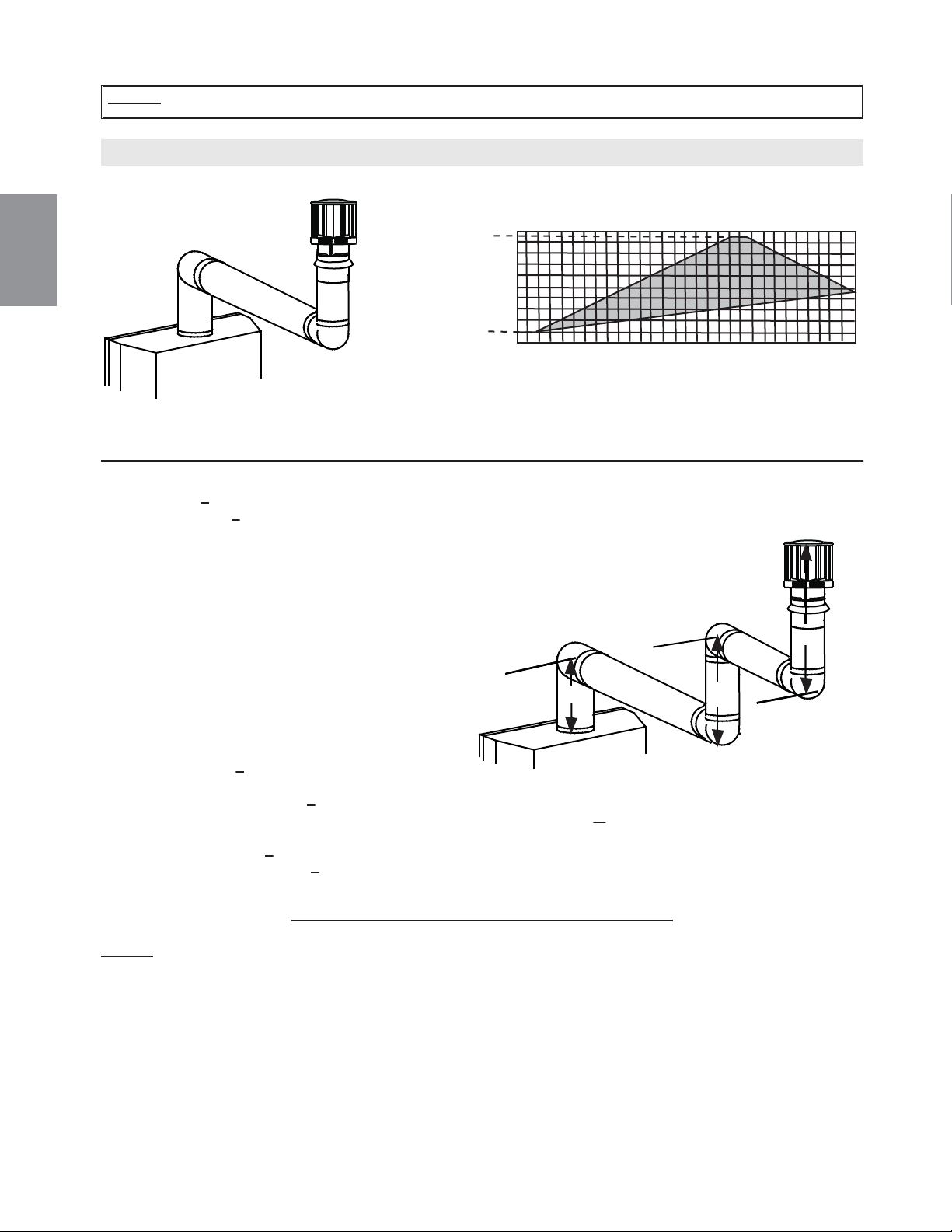
FR
(H
T
) > (V
T
)
Configuration d'évacuation simple.
Consultez le graphique pour déterminer la course verticale
nécessaire V
T
par rapport à la course horizontale requise H
T
.
COURSE
VERTICALE
REQUISE EN
PIEDS
(MÈTRES) V
T
LONGUEUR DES COURSES HORIZONTALES PLUS
LES DÉVIATIONS EN PIEDS (MÈTRES) H
T
Lorsque la configuration de l'évacuation exige plus de deux coudes de 90°, les formules suivantes s'appliquent :
Formule 1 : H
T
< 3V
T
Formule 2 : H
T
+ V
T
< 40 pieds (12,2m)
Exemple :
V
1
= 2 PI (0,6m)
V
2
= 1 PI (0,3m)
V
3
= 1,5 PI (0,5m)
V
T
= V
1
+ V
2
+ V
3
= 2PI (0,6m) + 1PI (0,3m) + 1,5PI (0,5m) = 4,5 PI (1,4m)
H
1
= 6 PI (1,8m)
H
2
= 2 PI (0,6m)
H
R
= H
1
+ H
2
= 6PI (1,8m) + 2PI (0,6m) = 8 PI (2,4m)
H
O
= 0,03 (quatre coudes 90° - 90°)
= 0,03 (360° - 90°) = 8,1 PI (2,5m)
H
T
= H
R
+ H
O
= 8 PI (2,4m) + 8,1 PI (2,5m) = 16,1 PI (4,9m)
H
T
+ V
T
= 16,1PI (4,9m) + 4,5PI (1,4m) = 20,6 PI (6,3m)
Formule 1 : H
T
< 3V
T
3V
T
= 3PI (0,9m) x 4,5PI (1,4m) = 13,5 PI (4,1m)
16,1 PI (4,9m) < 13,5 PI (4,1m)
Puisque cette formule n'est pas respectée, cette configuration d'évacuation est inacceptable.
Formule 2 : H
T
+ V
T
< 40 pieds (12,2m)
20,6 PI (6,3m) < 40 PI (12,2m)
Puisque seulement la formule 2 est respectée, cette configuration est inacceptable et l'on devra trouver un autre endroit
pour installer l’appareil ou trouver une configuration d'évacuation qui pourra respecter les deux formules.
La section ombragée à l'intérieur des lignes représente
des valeurs acceptables pour H
T
et V
T
.
18.1_2B
0
5
(1,5)
10
(3,1)
15
(4,6)
20
(6,1)
10 (3,1)
20 (6,1)
3 (0,9)
25
(7,6)
30
(9,1)
19 (5,8)
90°
V
1
V
2
H
1
H
2
90°
90°
90°
V
3
78
W415-1335 / B / 10.04.16
NOTE : Tous les paramètres énoncés s’appliquent aux évents rigides. Si vous utilisez des évents
fl exibles Wolf Steel ltée., les courses horizontales maximales doivent être réduites de 25 %.
NOTE : La course horizontale totale (HT) DOIT être réduite de 25 % lorsqu’un évent fl exible est utilisé.
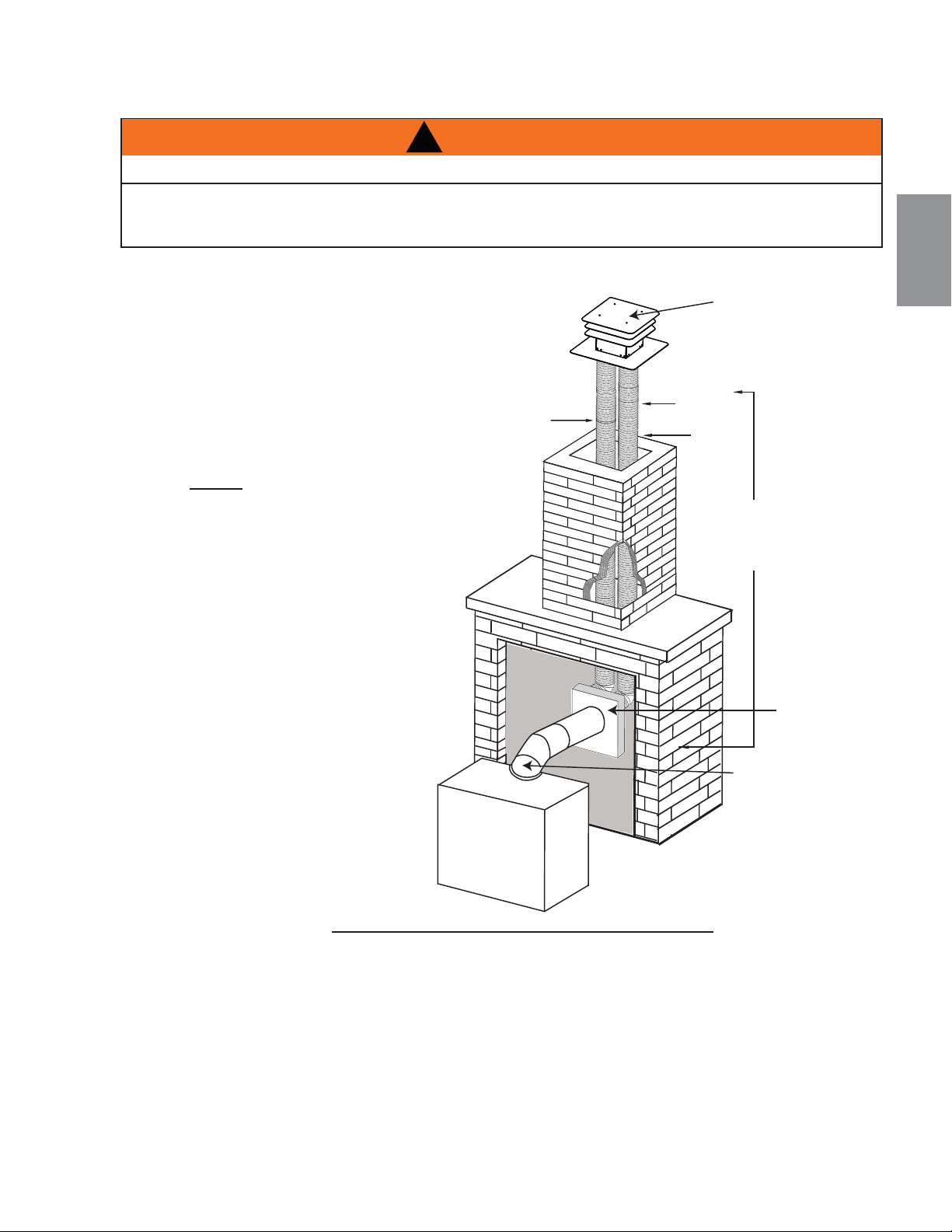
FR
79
W415-1335 / B / 10.04.16
3.10 TERMINAISON VERTICALE À TRAVERS UNE CHEMINÉE EXISTANTE
7.6B
Cet appareil est conçu pour être raccordé à un système d’évent fl exible colinéaire de 3” (76,2mm) en
aluminium se prolongeant sur toute la longueur de la cheminée de maçonnerie.
Les conduits fl exibles s’adaptent à tous les contours d’une
cheminée de maçonnerie. Néanmoins, vous devez garder
les conduits fl exibles aussi droit que possible. Le collet
de prise d’air de la terminaison doit être raccordé au
conduit fl exible de prise d’air et le collet d’évacuation
de la terminaison au conduit fl exible d’évacuation.
Les adaptateurs colinéaire à coaxial Simpson
Duravent et Selkirk sont approuvés pour cet
appareil (NOTE : Un adaptateur d’évent sera
nécessaire directement à partir de l’appareil).
Suivez les instructions d’installation du fabricant
du système d’évacuation.
Des composants d’évacuation de différents
fabricants ne doivent pas être combinés. Une
fois que l’adaptateur de votre choix est installé,
le reste du système d’évacuation doit provenir
du même fabricant.
La seule exception à cette règle est l’usage du
système de conduit fl exible de 3” (76,2mm) et
de terminaison colinéaire Wolf Steel.
RISQUE D'INCENDIE!
LES CONFIGURATIONS D'ÉVACUATION COAXIALES À COLINÉAIRES NE DOIVENT ÊTRE UTILISÉES
QUE DANS UNE CHEMINÉE OU UNE ENCEINTE DE NATURE INCOMBUSTIBLE. UNE INSTALLATION
DANS UNE ENCEINTE COMBUSTIBLE PEUT CAUSER UN INCENDIE.
!
AVERTISSEMENT
ÉVACUATION
ADAPTATEUR
COAXIAL À
COLINÉAIRE
ADAPTATEUR
D'ÉVENT DE
L'APPAREIL
TERMINATION
PRISE
D’AIR
CONDUIT
FLEXIBLE
* 40 PIEDS
(12,2m) MAX.
10 (3,1m)PIEDS
MIN.
* Mesurée à partir de la buse de l’appareil
jusqu’au collet de la terminaison.
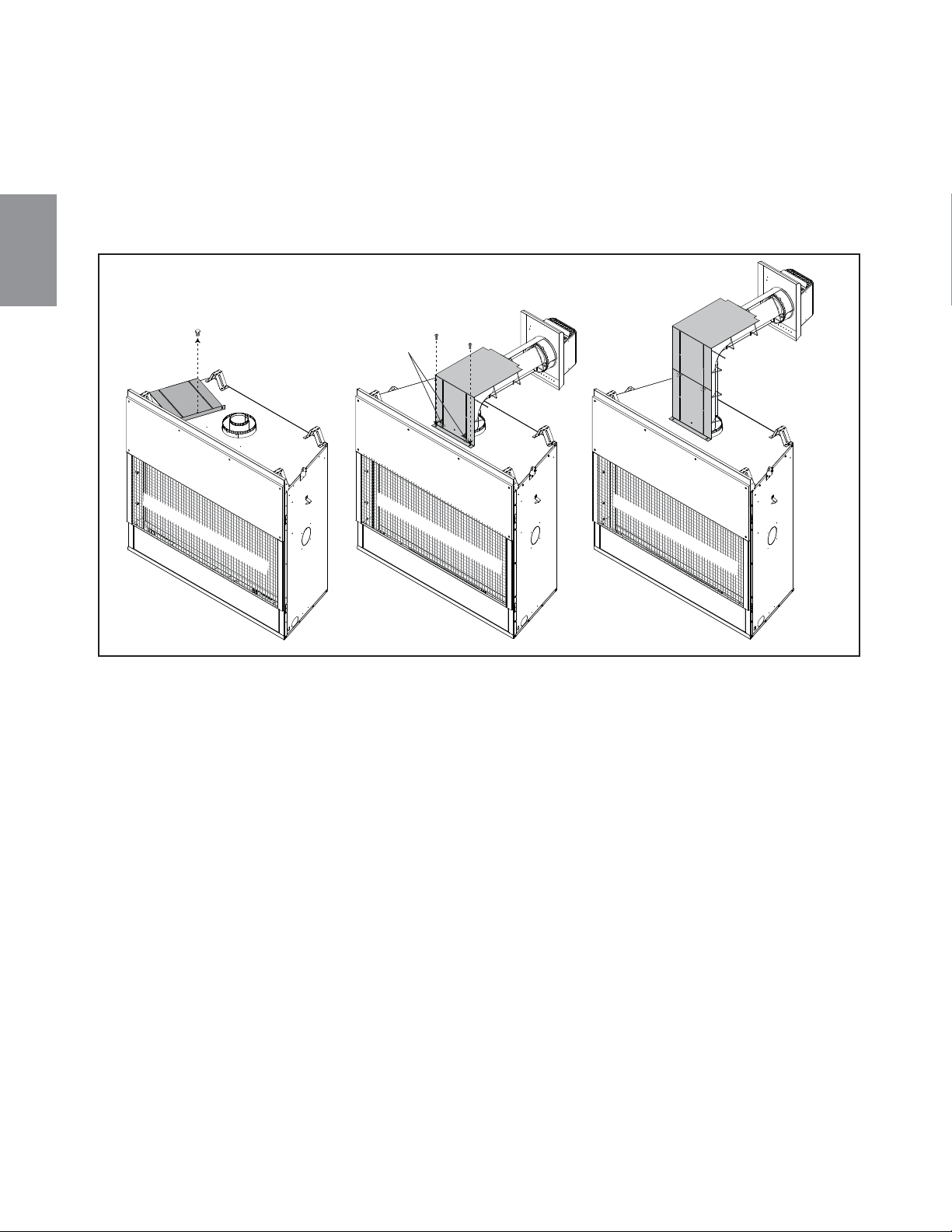
FR
80
W415-1335 / B / 10.04.16
3.11 INSTALLATION DU PROTECTEUR DE CONDUIT D’ÉVACUATION
Le protecteur de conduit d’évacuation a été fi xé au-dessus de l’appareil aux fi ns de livraison.
Si l’évacuation se fait avec un coude de 90 degrés directement à partir du dessus de l’appareil, le protecteur
de conduit d’évacuation doit être repositionné et fi xé à l’aide des deux vis (fournies) tel qu’illustré.
Le protecteur de conduit d’évacuation peut être ajusté jusqu’à un maximum de 18”(457mm). Pour ajuster le
protecteur de conduit d’évacuation, retirer les deux vis tel qu’illustré. Si la hauteur du coude dépasse cette
hauteur, le protecteur de conduit d’évacuation n’est plus nécessaire.
ENLEVEZ LES VIS
POUR RÉGLER LA
HAUTEUR.
18”
MAX
ÉCRAN DE PRO
TECTION
ÉCRA
N
D
E PRO
TECTION
ÉCRAN DE
PR
O
TECTION
4.1 PROTECTION DU MUR ET DU PLAFOND
4.0 INSTALLATION
Pour une performance optimale de l’appareil, toutes les courses horizontales devraient avoir une élévation
minimale de 1/4” (6,4mm) par pied lorsque vous utilisez des composants fl exibles d’évacuation. Afi n
d’assurer un fonctionnement sécuritaire et adéquat de l’appareil, vous devez observer les instructions
d’évacuation à la lettre.
FR
!
AVERTISSEMENT
AVANT D’EFFECTUER LES BRANCHEMENTS POUR L’ALIMENTATION EN GAZ ET ÉLECTRIQUE,
ASSUREZ-VOUS DE RETIRER TOUTE COMPOSANTE NON FIXÉE À L’INTÉRIEUR DE LA CHAMBRE
DE COMBUSTION.
SI VOTRE APPAREIL COMPREND UN SYSTÈME DE TÉLÉCOMMANDE, ASSUREZ-VOUS QUE LE
RÉCEPTEUR EST À LA POSITION « OFF » AVANT D’EFFECTUER LES BRANCHEMENTS POUR
L’ALIMENTATION EN GAZ ET ÉLECTRIQUE.
AFIN D’ASSURER UN FONCTIONNEMENT SÉCURITAIRE ET ADÉQUAT DE L’APPAREIL, VOUS DEVEZ
OBSERVER LES INSTRUCTIONS D’ÉVACUATION À LA LETTRE.
TOUS LES JOINTS DES CONDUITS DOIVENT ÊTRE SCELLÉS AVEC DU SCELLANT DE SILICONE
ROUGE À HAUTE TEMPÉRATURE RTV W573-0002 (NON FOURNI) OU DU SCELLANT NOIR À HAUTE
TEMPÉRATURE MILL PAC W573-0007 (NON FOURNI) À L’EXCEPTION DU RACCORDEMENT DU
CONDUIT D’ÉVACUATION À LA BUSE DE L’APPAREIL QUI DOIT ÊTRE SCELLÉ AVEC LE SCELLANT
MILL PAC.
SI VOUS UTILISEZ DES COLLIERS POUR TUYAU POUR RACCORDER LES COMPOSANTS
D’ÉVACUATION, VOUS DEVEZ AUSSI INSTALLER TROIS VIS POUR VOUS ASSURER QUE LE
RACCORDEMENT NE SE DÉFASSE PAS.
NE SERREZ PAS LA GAINE FLEXIBLE.
RISQUE D'INCENDIE, D'EXPLOSION OU D'ASPHYXIE. SI L'ENSEMBLE DU SYSTÈME DE CONDUIT
D'ÉVENT N'EST PAS ADÉQUATEMENT SOUTENU, IL RISQUE DE FLÉCHIR OU DE SE SÉPARER.
UTILISEZ DES SUPPORTS DE CONDUIT ET RACCORDEZ LES SECTIONS DE CONDUITS SELON LES
INSTRUCTIONS D’INSTALLATION.
RISQUE D'INCENDIE. ÉVITEZ QUE L'ISOLANT TOUCHE AU CONDUIT D'ÉVACUATION. RETIREZ
L'ISOLANT POUR PERMETTRE L'INSTALLATION DE L'ÉCRAN PROTECTEUR DU GRENIER ET POUR
MAINTENIR LES DÉGAGEMENTS AUX MATÉRIAUX COMBUSTIBLES.
68.2D
70.1
!
AVERTISSEMENT
NE REMPLISSEZ L’ESPACE ENTRE LE CONDUIT D’ÉVENT ET LA CHARPENTE AVEC AUCUN TYPE DE MATÉRIAU.
NE BOURREZ PAS D’ISOLANT NI DE MATÉRIAUX COMBUSTIBLES ENTRE LES ESPACEURS COUPE-FEU DU
PLAFOND. CONSERVEZ TOUJOURS LES DÉGAGEMENTS REQUIS AUTOUR DES CONDUITS D’ÉVENT ET
L’ASSEMBLAGE DE L’ESPACEUR COUPE-FEU. INSTALLEZ LES ÉCRANS MURAUX ET LES ESPACEURS COUPE-
FEU TEL QUE SPÉCIFIÉ. SI VOUS NE GARDEZ PAS L’ISOLANT OU TOUT AUTRE MATÉRIAU À L’ÉCART DU
CONDUIT D’ÉVENT, UN RISQUE D’INCENDIE POURRAIT S’ENSUIVRE.
81
W415-1335 / B / 10.04.16
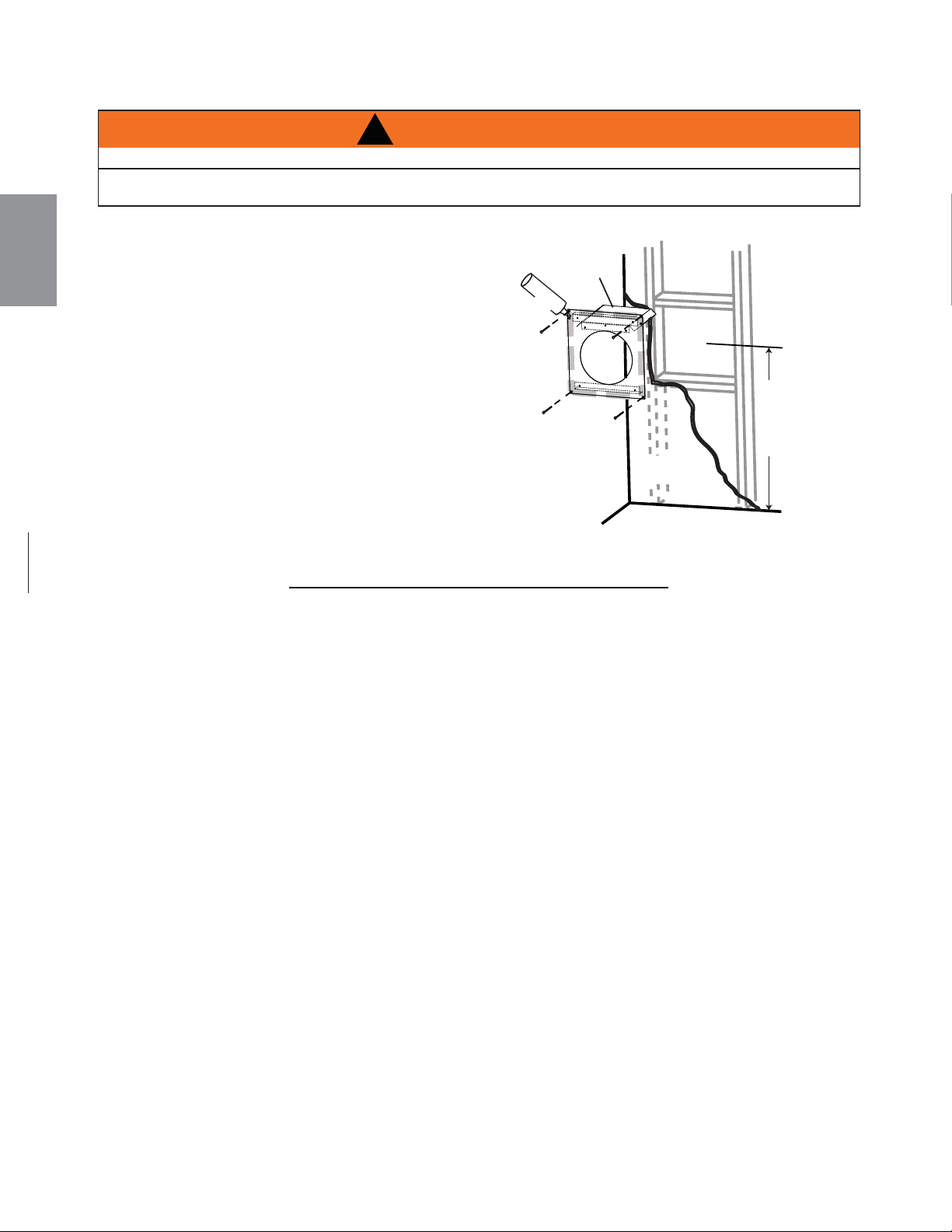
4.1.1 INSTALLATION HORIZONTALE
FR
Cette confi guration s’applique lorsque le conduit
d’évent traverse un mur extérieur. Une fois que vous aurez
déterminé la hauteur exacte pour l’emplacement de la
terminaison, découpez et charpentez
une ouverture dans le mur extérieur (comme
illustré) pour permettre l’installation de l’espaceur
coupe-feu. Avant de continuer, placez l’espaceur
coupe-feu dans l’ouverture pour vous assurer que les
supports sur la surface arrière soient placés contre la
face intérieure de la pièce de charpente horizontale.
L’écran protecteur peut-être taillé pour des murs
combustibles qui ont moins de 8 1/2” (215,9mm) de profond,
mais doit se prolonger sur toute la profondeur du mur
combustible.
A. Appliquez un joint de calfeutrage (non fourni) tout autour de la
bordure de la face intérieure de l’espaceur coupe-feu, installez
l’espaceur coupe-feu contre le trou et fi xez à l’aide des quatre
vis (fournies dans le sac de votre manuel).
B. Une fois que le conduit d’évent est en place, appliquez du scellant à haute température rouge RTV
W573-0002 (non fourni) entre le conduit d’évent et l’espaceur coupe-feu.
20.2B
!
AVERTISSEMENT
L’ESPACEUR COUPE-FEU DOIT ÊTRE INSTALLÉ AVEC L’ÉCRAN PROTECTEUR ORIENTÉ VERS LE HAUT.
LA TERMINAISON NE DOIT PAS ÊTRE ENCHÂSSÉE DANS LE MUR OU LE REVÊTEMENT EXTÉRIEUR
PLUS QUE L’ÉPAISSEUR DE LA BRIDE DE LA PLAQUE DE MONTAGE.
DÉTERMINEZ
LA BONNE
HAUTEUR
CALFEUTRAGE
ESPACEUR
COUPE-FEU
PROTECTEUR
DE CONDUIT
D’ÉVACUATION
MATÉRIAU
DE FINITION
82
W415-1335 / B / 10.04.16
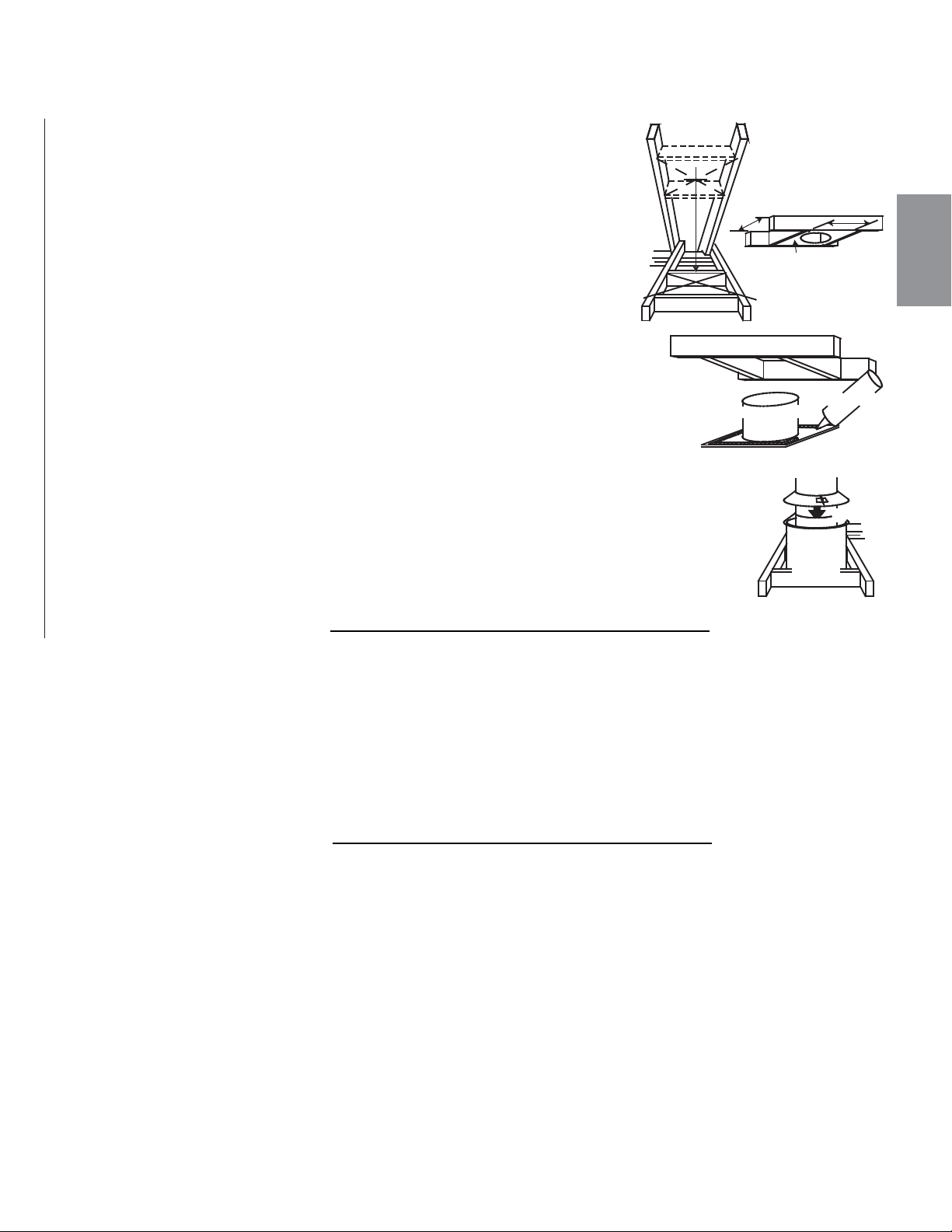
FR
Le système d’évacuation doit être soutenu à peu près tous les 3 pieds (0.9m) de courses verticales et horizontales.
Utilisez l’ensemble de support mural Wolf Steel ou des supports incombustibles équivalents afi n de conserver le
dégagement minimal aux matériaux combustibles pour les courses verticales et horizontales.
Tous les joints des conduits intérieurs et extérieurs peuvent être scellés avec du scellant de silicone rouge à haute
température W573-0002 (non fourni) ou du scellant noir à haute température Mill Pac W573-0007 (non fourni) à
l’exception du raccordement du conduit d’évacuation à la buse de l’appareil qui doit être scellé avec le scellant
Mill Pac.
25.1A
4.1.2 INSTALLATION VERTICALE
Cette confi guration s’applique lorsque l’évacuation se fait à travers un toit. Des
ensembles d’installation pour les différentes pentes de toit sont disponibles
chez votre détaillant autorisé. Voir la section « Accessoires » pour commander
l’ensemble spécifi que dont vous avez besoin.
A. Une fois que vous aurez déterminé l’emplacement de la terminaison,
découpez et charpentez une ouverture dans le plafond et le toit pour
laisser le dégagement minimal de 1” (25,4mm) entre le conduit d’évent et
tout matériau combustible. Essayez de positionner le conduit d’évent à
michemin entre deux solives pour ne pas être obligé de les couper. Utilisez
du fi l à plomb pour aligner le centre des ouvertures. Un protecteur de
conduit d’évacuation empêchera tout matériau, tel que l’isolant, de remplir
l’espace vide de 1” (25,4mm) autour de l’évent. Fixez des entretoises entre
les solives pour assurer un support additionnel.
B. Appliquez un joint de calfeutrage (non fourni) sur la charpente ou sur le
protecteur de conduit d’évacuation Wolf Steel ou l’équivalent (dans le
cas d’un plafond fi ni) et fi xez le protecteur de conduit d’évacuation de
façon à recouvrir l’ouverture dans le plafond. Un espaceur coupe-feu
doit être fi xé à la base de chaque ouverture charpentée dans un toit ou un
plafond par lequel traverse le système d’évacuation. Appliquez un joint de
calfeutrage tout autour et placez un espaceur coupe-feu par-dessus le protecteur
de conduit d’évacuation pour empêcher l’arrivée d’air froid dans la pièce ou autour de l’appareil.
Assurez-vous que l’espaceur coupe-feu et le protecteur de conduit d’évacuation conservent
le dégagement nécessaire aux matériaux combustibles. Une fois que le conduit d’évacuation
est en place, appliquez une scellant Mill Pac (W573-0007) ou Silicone Rouge (W573-0002)
(non fourni) entre le conduit d’évacuation et l’espaceur coupe-feu.
C. Dans le grenier, faites glisser le collet de conduit d’évacuation vers le bas afi n de recouvrir
l’extrémité ouverte du protecteur de conduit d’évacuation et serrez. Ceci empêchera tout
matériau, tel que l’isolant, de remplir l’espace vide de 1 po (25,4mm) autour de l’évent.
21.1B
CALFEUTRAGE
PROTECTEUR
DU CONDUIT
D’ÉVACUATION
ESPACEUR
COUPE-FEU
FACE INFÉRIEURE
DES SOLIVES
COLLET DE
CONDUIT
D’ÉVACUATION
PROTECTEUR
DU CONDUIT
D’ÉVACUATION
9 3/4”
9 3/4”
4.2 UTILISATION DE COMPOSANTS RIGIDES D’ÉVACUATION
83
W415-1335 / B / 10.04.16
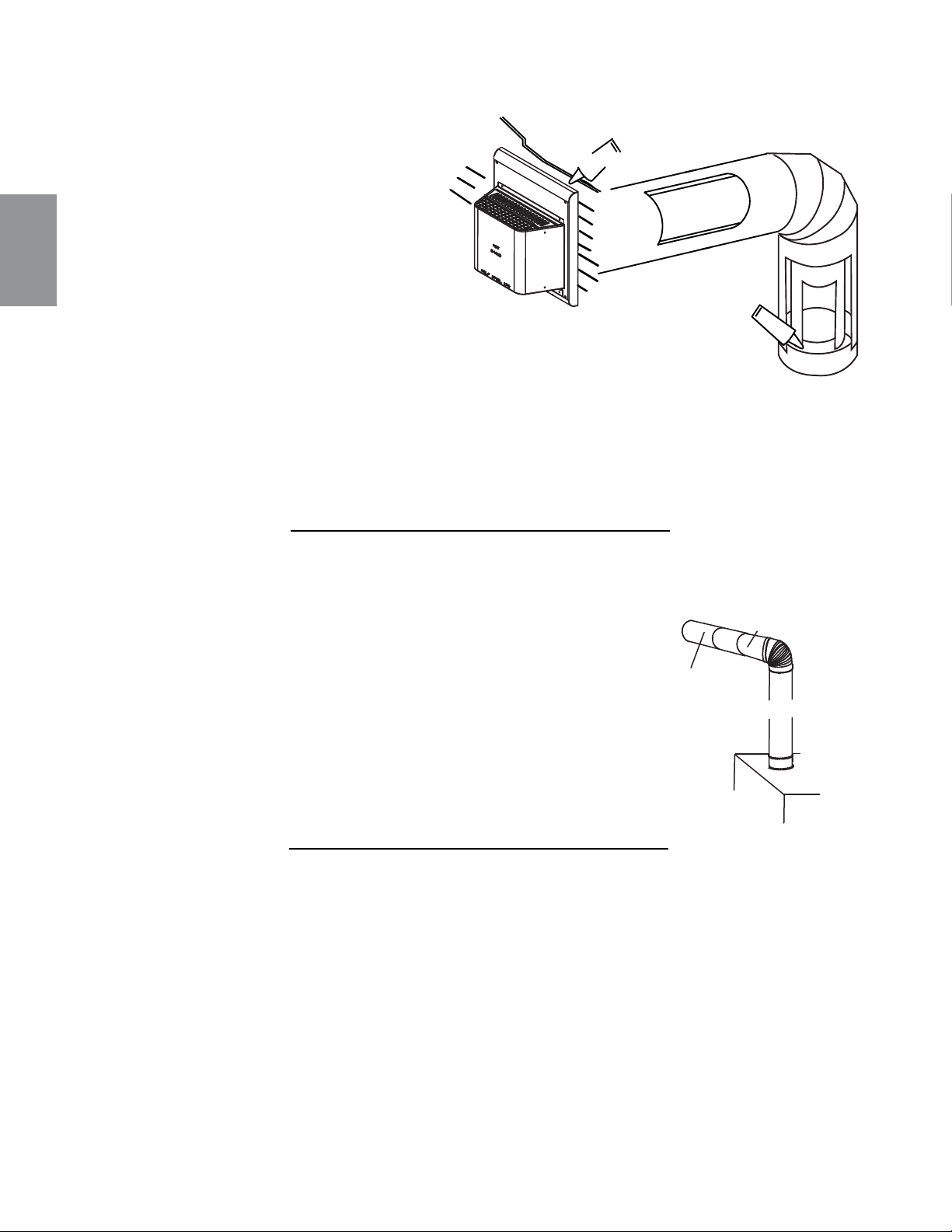
4.3 INSTALLATION DE LA TERMINAISON HORIZONTALE
4.4 INSTALLATION ÉTENDUE DE LA TERMINAISON HORIZONTALE
FR
VIS #10x2"
CONDUIT
RIGIDE
EXTÉRIEUR
CALFEUTRAGE
CHEVAUCHEMENT DE
2
" (50.8mm)
SCELLANT
À HAUTE
TEMPÉRATURE
CONDUIT
RIGIDE
INTÉRIEUR
A. Mettez l’appareil en place. Mesurez
la longueur d’évent requise entre la
terminaison et l’appareil en tenant
compte de la longueur additionnelle
nécessaire pour la surface du mur
fi ni et tout chevauchement de 1
¼” (31.8mm) entre les composants
d’évacuation.
B. Appliquez du scellant à haute température
W573-0007 (non fourni) sur le rebord
extérieur du collet intérieur de l’appareil. Installez un
conduit rigide intérieur et fi xez-le en utilisant trois vis auto-
perceuses. Procédez de la même façon avec un conduit rigide
extérieur.
C. Insérez les évents dans le coupe-feu tout en conservant le dégagement nécessaire aux matériaux
combustibles. En soutenant la terminaison (les inscriptions étant à l’endroit et lisibles), fi xez-la au mur
extérieur et rendez-la étanche en la scellant avec du calfeutrage (non fourni).
La plaque de montage de la terminaison ne doit pas être enchâssée dans un mur ou un parement à
une profondeur excédant celle de la bride.
26.3A
A. Suivez les instructions dans la section « INSTALLATION DE LA TER-
MINAISON HORIZONTALE ».
B. Continuez d’ajouter des composants en alternant les évents intérieurs
et extérieurs. Assurez-vous que tous les évents et les coudes aient
suffi samment d’espaceurs et que chaque composant est scellé et
fi xé solidement à celui qui le précède. Fixez le manchon télescopique
à la course de l’évent. Répétez cette étape en utilisant un manchon
télescopique. Fixez et scellez comme auparavant. Pour faciliter
l’achèvement, fi xez des bagues d’accouplement à la terminaison.
C. Installez la terminaison horizontale. Voir la section « INSTALLATION
DE LA TERMINAISON HORIZONTALE ».
48.1A
MANCHON
TÉLESCOPIQUE
ÉVACUATION
BAGUE
D’ACCOUPLEMENT
DE 20"
84
W415-1335 / B / 10.04.16
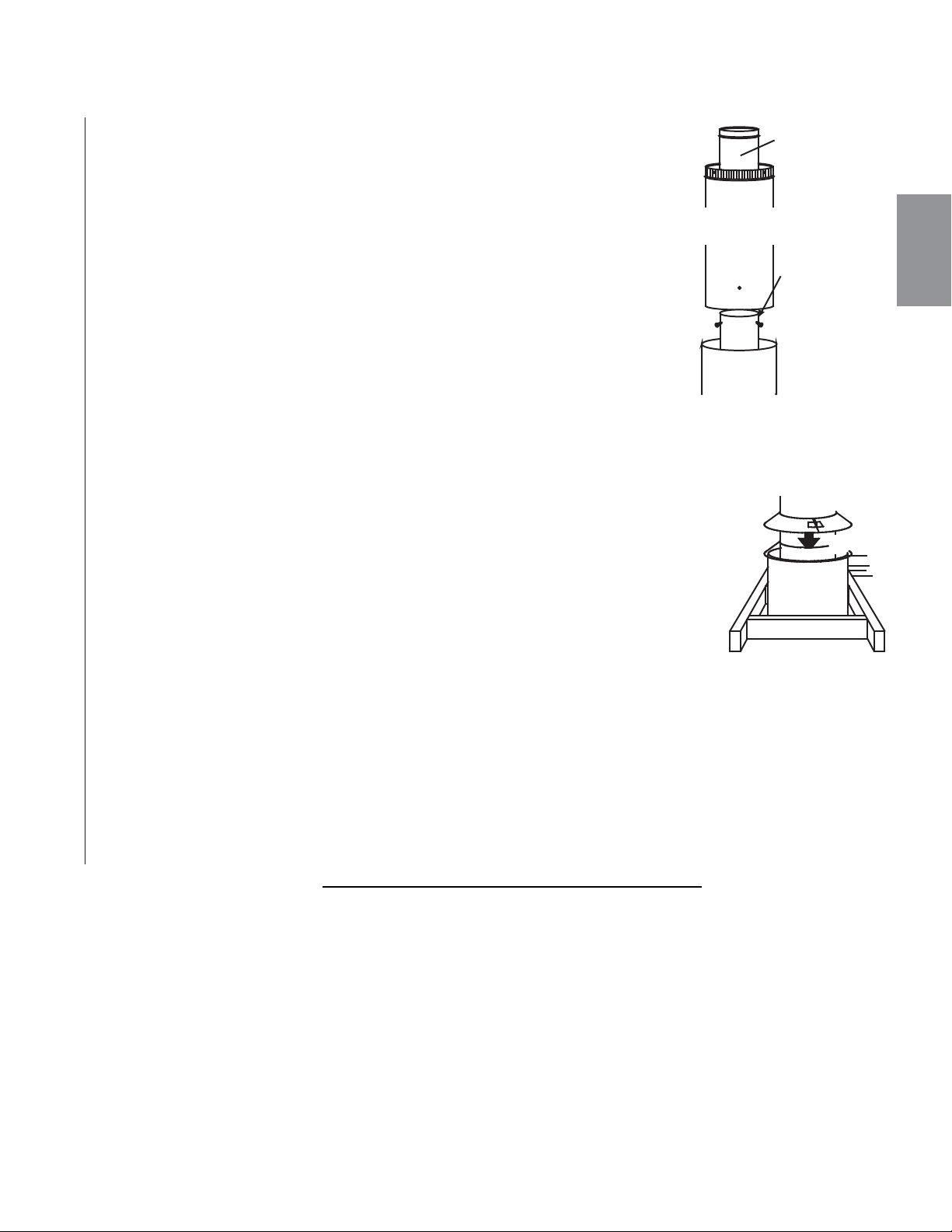
4.5 INSTALLATION DE LA TERMINAISON VERTICALE
FR
A. Mettez l’appareil en place.
B. Fixez le support de toit au toit à l’aide des vis fournies. Le support de toit
est optionnel. Dans ce cas, l’évent doit être supporté adéquatement, soit en
utilisant une méthode alternative se conformant aux normes des autorités
compétentes, soit en utilisant le support de toit optionnel.
C. Appliquez du scellant à haute température (non fourni) sur le rebord extérieur
du manchon intérieur de la terminaison. Glissez une bague d’accouplement
sur le manchon à au moins 2 po (51 mm) de l’extrémité de celui-ci et fi xez-la
avec au moins trois vis.
D. Appliquez du scellant à haute température (non fourni) sur le rebord
extérieur du manchon extérieur de la terminaison. Glissez une bague
d’accouplement sur le manchon et fi xez comme auparavant. Taillez la
bague d’accouplement extérieure à la même longueur que la bague
d’accouplement intérieure.
E. Faites passer l’ensemble de terminaison à travers le support de toit. Fixez
l’ensemble de terminaison au support de toit en vous assurant que la
section de terminaison excède le toit d’au moins 16" (40,6cm) une fois
fi xée. Si l’espace du grenier est restreint, nous recommandons de visser le collet de conduit d’évacuation Wolf
Steel ou l’équivalent sans serrer dans l’ensemble de la terminaison lorsqu’il est passé à
travers le grenier. La terminaison doit être verticale et d’aplomb.
F. Enlevez les clous des bardeaux sur le dessus et les côtés de la cheminée. Placez le
solin par-dessus la terminaison et glissez-le sous les côtés et le bord supérieur des
bardeaux. Assurez-vous que la terminaison est bien centrée dans le solin, en laissant
une marge de 3/4" (19mm) tout autour. Fixez-le au toit. NE clouez PAS à travers la
partie inférieure du solin. Imperméabilisez-le en le scellant avec du calfeutrage. Si
possible, recouvrez les côtés et le bord supérieur du solin avec des matériaux de
couvertures.
G. Appliquez un généreux joint de calfeutrage à l’épreuve de l’eau à 2" (51mm) au-
dessus du solin. Installez le collet de solin autour du connecteur de terminaison et
glissez-le jusqu’à la ligne de calfeutrage. Serrez afi n d’assurer l’étanchéité entre le
connecteur de terminaison et le collet.
H. Continuez d’ajouter des sections rigides d’évacuation, fi xez et scellez comme ci-dessus. Installez le manchon
télescopique intérieur en position fermé à la dernière section de conduit rigide. Fixez-le avec des vis et
scellez. Procédez de la même façon avec le manchon télescopique extérieur.
I. Appliquez un joint de scellant à haute température (non fourni) sur le côté extérieur du collet de conduit
d’évacuation intérieur sur l’appareil. Glissez le manchon télescopique sur une longueur d’au moins 2" (51mm)
par-dessus le collet de conduit d’évacuation. Fixez avec un minimum de trois vis. Procédez de la même façon
avec le manchon télescopique extérieur.
J. Dans le grenier, faites glisser le collet de conduit d’évacuation vers le bas afi n de recouvrir l’extrémité ouverte
du protecteur de conduit d’évacuation et serrez. Ceci empêchera tout matériau, tel que l’isolant, de remplir
l’espace vide de 1" (25mm) autour de l’évent.
27.2A
CONDUIT
RIGIDE
INTÉRIEUR
CONDUIT
RIGIDE
EXTÉRIEUR
CONDUIT
SCELLANT À
HAUTE
TEMPÉRATURE
CONNECTEUR
DE
TERMINAISON
INTÉRIEUR
PROTECTEUR
DE CONDUIT
D’ÉVACUATION
COLLET
DE CONDUIT
D’ÉVACUATION
85
W415-1335 / B / 10.04.16
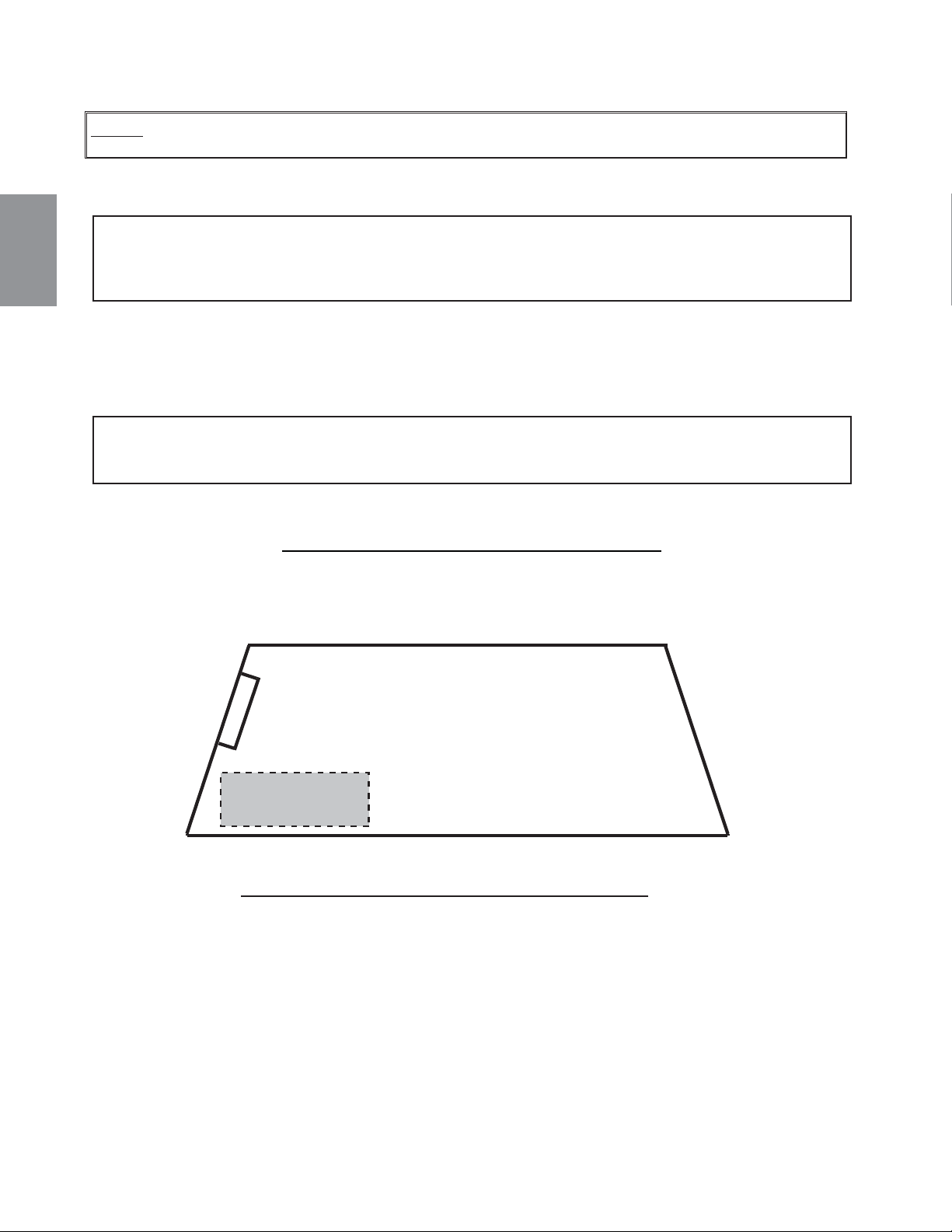
4.6 UTILISATION DE COMPOSANTS FLEXIBLES D’ÉVACUATION
4.8
INSTALLATION TÉLÉCOMMANDE
35.25
PLACER LE
TÉLÉCOMMANDE SUR
CETTE ÉTIQUETTE
BASE DU FOYER
BOÎTE DE
DÉRIVATION
Positionner le télécommande aux compartiment du soupape près du boite de dérivation électrique.
Assurez-vous que le télécommande est en haut de l’étiquette de placement, si équipé.
FR
Cet appareil doit être effectuée en respectant les directives du fabricant et le Manufactured Home Construction and
Safety Standard, Title 24 CFR, Part 3280, aux États-Unis, ou les normes actuelles pour les maisons mobiles, CAN/
CSA Z240 SÉRIE MH, au Canada. Cet appareil ne doit être utilisé qu’avec le type de gaz indiqué sur la plaque
d’homologation. Un ensemble de conversion est fourni avec l’appareil pour maison mobile.
29.1B
Cet appareil homologué pour les maisons mobiles et préfabriquées possède des éléments de fi xation. L’appareil est
muni de deux trous de ¼” (6,4mm)de diamètre, situés aux coins avant, gauche et droit de la base. Fixez à l’aide de vis
#10 à tête hexagonale insérées dans les trous de la base. Pour les produits autoportante, contactez votre revendeur
agréé / distributeur permettant la sécurisation kit. Lors d’une installation dans une maison mobile, l’appareil doit être fi xé
au plancher. Éteignez toujours la veilleuse et l’alimentation en gaz à la source avant de déplacer la maison mobile. Après
avoir déplacé la maison mobile et avant d’allumer l’appareil, assurez-vous que les bûches sont placées correctement.
Cet appareil est certifi é pour être installé dans une maison mobile installée de façon permanente, sauf si les codes
locaux l’interdisent. Cet appareil ne doit être utilisé qu’avec le type de gaz indiqué sur la plaque d’homologation. On
ne peut utiliser cet appareil avec d’autres types de gaz, sauf si un ensemble de conversion certifi é est utilisé.
Ensembles de conversion
L’appareil pour maison mobile peut être converti au gaz naturel (GN) ou au propane (PL).
Pour effectuer une conversion, veuillez consulter votre détaillant autorisé.
4.7 INSTALLATION DANS UNE MAISON MOBILE
86
W415-1335 / B / 10.04.16
NOTE : Tous les paramètres énoncés s’appliquent aux évents rigides. Si vous utilisez des évents
fl exibles Wolf Steel ltée., les courses horizontales maximales doivent être réduites de 25 %.
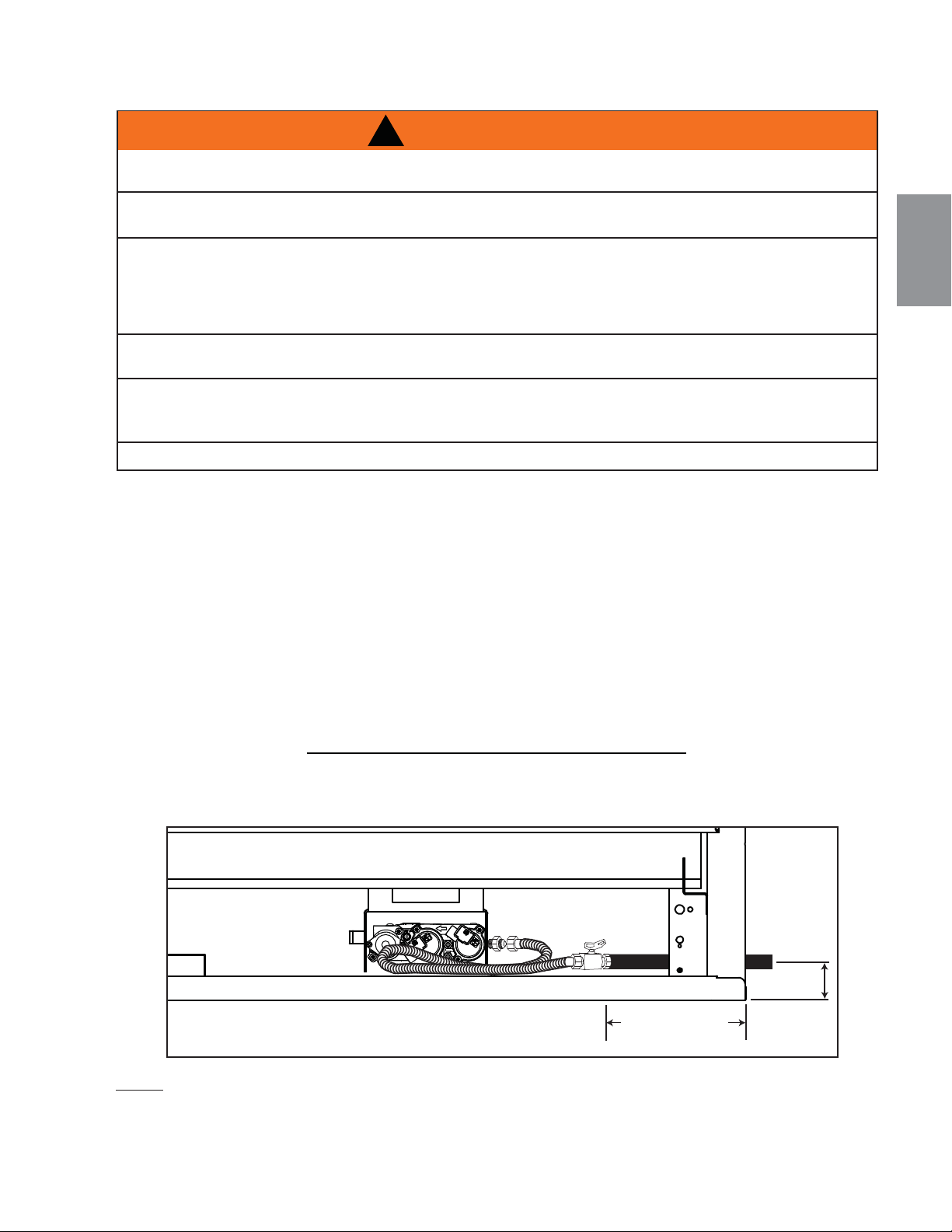
4.9 BRANCHEMENT DU GAZ
FR
30.1A
L’installation et l’entretien doivent être effectués par un installateur qualifi é.
A. Mettez l’appareil en place et fi xez-le.
B. Si l’appareil est muni d’un raccord fl exible, celui-ci est conçu pour recevoir une conduite de gaz de
1/2”. Sans raccord fl exible, l’appareil est conçu pour recevoir une conduite de gaz de 3/8”. L’appareil
est muni d’une soupape d’arrêt manuelle pour fermer l’alimentation en gaz.
C. Branchez le gaz en conformité avec les codes locaux. En l’absence de codes locaux, l’installation doit
être conforme au Code d’installation du gaz CAN/CSA-B149.1 dans sa version pour le Canada ou le
National Fuel Gas Code, ANSI Z223.1 / NFPA 54 pour les États-Unis.
D. Lorsque vous manipulez des conduites de gaz, soutenez la soupape de gaz pour éviter que les con-
duites ne se plient.
E. Le raccord fl exible de l’alimentation en gaz devrait être suffi samment mobile pour permettre de placer
l’assemblage du brûleur sur le côté.
F. Vérifi ez pour des fuites de gaz en appliquant une solution d’eau savonneuse. N’utilisez pas une
fl amme nue.
!
AVERTISSEMENT
RISQUE D'INCENDIE, D'EXPLOSION OU D'ASPHYXIE. ASSUREZ-VOUS QU'IL N'Y AIT AUCUNE SOURCE
D'ALLUMAGE COMME DES ÉTINCELLES OU UNE FLAMME NUE.
SOUTENEZ LE CONTRÔLE DU GAZ LORSQUE VOUS ATTACHEZ LE TUYAU POUR ÉVITER DE PLIER LA CON-
DUITE DE GAZ.
ALLUMEZ TOUJOURS LA VEILLEUSE, QUE CE SOIT POUR LA PREMIÈRE FOIS OU LORSQUE
L’APPROVISIONNEMENT EN GAZ EST ÉPUISÉ, AVEC LA PORTE VITRÉE OUVERTE OU RETIRÉE. LA PURGE
DOIT ÊTRE EFFECTUÉE PAR UN TECHNICIEN QUALIFIÉ. ASSUREZ-VOUS QUE L’ARRIVÉE DE GAZ AU BRÛLEUR
EST CONTINUE AVANT DE FERMER LA PORTE. ASSUREZ-VOUS D’UNE VENTILATION ADÉQUATE. POUR LES
EMPLACEMENTS DE L’ENTRÉE DU GAZ ET DE L’ENTRÉE ÉLECTRIQUE, VOIR LA SECTION « DIMENSIONS ».
LORSQUE LE BRANCHEMENT EST TERMINÉ, TOUS LES RACCORDS DE GAZ DOIVENT SE TROUVER À
L’INTÉRIEUR DU FOYER.
LES PRESSIONS ÉLEVÉES ENDOMMAGERONT LA SOUPAPE. L’ALIMENTATION EN GAZ DOIT ÊTRE
DÉBRANCHÉE PENDANT LES ESSAIS DE PRESSION DE CE SYSTÈME LORSQUE LES PRESSIONS D’ESSAI
EXCÈDENT ½ LB/PO² (3,5 KPA).
LES RÉGLAGES DE LA SOUPAPE ONT ÉTÉ FAITS EN USINE; NE LES MODIFIEZ PAS.
2”
(51mm)
12” (305mm)
87
W415-1335 / B / 10.04.16
NOTE: Branchez l’alimentation en gaz à la soupape d’arrêt et au raccord fl exible de 1/2" (13mm)
(fournis). Assurez-vous que le conduit d’alimentation en gaz est bien fi xé et que le connecteur est
suffi samment mobile pour que la base du brûleur puisse être soulevée pour faire l’entretien des
composants.
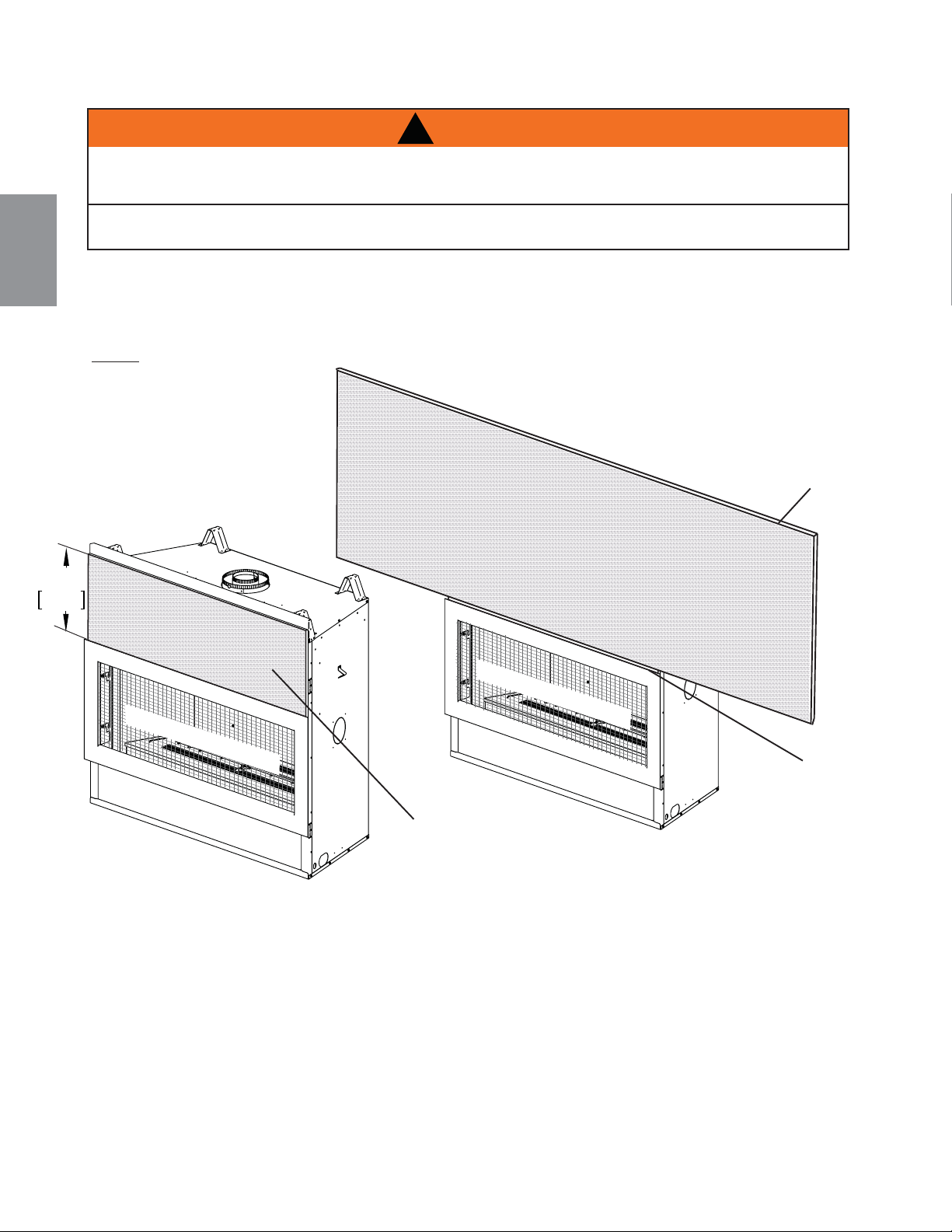
!
WARNING
Le 14” (356mm) au-dessus de l’ouverture de
l’appareil doit être fi nis avec les matériaux
incombustibles.
Si seulement la surface peinte est souhaitée, une
feuille complète de panneau de ciment Duralock
devrait être utilisée.
Composé à joints au besoin
Des composés à joints tels Durabond 90 et des rubans à joints résistants à la chaleur et aux craquelures
devraient être utilisés lorsque vous posez du ruban à joints et que vous comblez des joints.
Installation des carreaux et du coulis
Nous recommandons d’utiliser des carreaux à joints secs et de les installer à l’aide d’un mortier à deux
composantes avec un additif au latex acrylique tel que Mapei Kerabond/Kerlastic, pour permettre un léger
mouvement lors du fonctionnement normal de l’appareil.
Si du coulis est utilisé entre les carreaux, un coulis à base de polymère tel que Mapei Ultracolour plus est
recommandé.
Apprêt/Peinture
Pour une surface peinte, utilisez un apprêt au latex 100 % acrylique et une couche de fi nition.
MATÉRIAUX
INCOMBUSTIBLE
(FOURNI)
AU PLAFOND
DESSUS
L'OUVERTUR
E
14"
336mm
É
CR
A
N
D
E
P
R
OT
E
C
T
I
O
N
É
CR
A
N
D
E
PRO
T
E
C
TI
O
N
4.10 INSTALLATION DU MATÉRIAUX INCOMBUSTIBLE
NOTE: Pour minimiser les
joints, il peut être préférable
de remplacer le material
incombustible fourni avec
une piece plus grande.
UNE BORDURE DE FINITION INCOMBUSTIBLE COMME DE LA BRIQUE, DU MARBRE, DU GRANITE,
ETC. EST REQUISE. IL EST INTERDIT D’UTILISER SEULEMENT DES PANNEAUX DE CIMENT POUR LA
FINITION DES CÔTÉS ET DU DESSUS DE L’APPAREIL.
LA SURFACE AU-DESSUS DE L’APPAREIL DEVIENT TRÈS CHAUDE. SI DES MATÉRIAUX DE FINITION
INADÉQUATS SONT UTILISÉS, DES CRAQUELURES PEUVENT APPARAÎTRE.
FR
88
W415-1335 / B / 10.04.16
FR
!
AVERTISSEMENT
RISQUE D’INCENDIE!
AFIN D’ÉVITER LA POSSIBILITÉ QUE DE L’ISOLATION OU UN COUPE-VAPEUR ENTRENT EN CON-
TACT AVEC L’EXTÉRIEUR DU CAISSON, IL EST CONSEILLÉ D’INSTALLER L’APPAREIL CONTRE DES
MURS FINIS (C.-À-D. PANNEAU DE GYPSE) COMME TOUT AUTRE MUR DE LA MAISON. CECI
ASSURERA QUE LE DÉGAGEMENT AUX MATÉRIAUX COMBUSTIBLES EST MAINTENU.
NE FAITES PAS D’ENTAILLES À L’OSSATURE AUTOUR DES ESPACEURS. NE PAS MAINTENIR LES
DÉGAGEMENTS PEUT CAUSER UNE SURCHAUFFE ET UN INCENDIE. EMPÊCHEZ TOUT CONTACT
AVEC DE L'ISOLANT QUI S'AFFAISSE, AVEC L’OSSATURE OU AVEC TOUT AUTRE MATÉRIAU COM-
BUSTIBLE. BLOQUEZ L’ENTRÉE DE L’ENCEINTE POUR EMPÊCHER L'INFILTRATION D'ISOLANT
SOUFFLÉ. ASSUREZ-VOUS QUE L’ISOLATION ET LES AUTRES MATÉRIAUX SONT BIEN FIXÉS.
LORSQUE VOUS CONSTRUISEZ L’ENCEINTE, PRÉVOYEZ L’ÉPAISSEUR DES MATÉRIAUX DE
FINITION POUR MAINTENIR LES DÉGAGEMENTS. SI L’OSSATURE OU LES MATÉRIAUX DE FINITION
SE TROUVENT À UNE DISTANCE INFÉRIEURE À CELLE INDIQUÉE, ILS DOIVENT ÊTRE FAITS
ENTIÈREMENT DE MATÉRIAUX NON COMBUSTIBLES. LES MATÉRIAUX FAITS ENTIÈREMENT
D’ACIER, DE FER, DE BRIQUE, DE TUILE, DE BÉTON, D’ARDOISE, DE VERRE OU DE PLÂTRE, OU
D’UNE COMBINAISON DE CES MATÉRIAUX, SONT APPROPRIÉS. LES MATÉRIAUX RÉPONDANT À LA
NORME ASTM E 136, MÉTHODE DE TEST STANDARD DU COMPORTEMENT DES MATÉRIAUX DANS
UNE FOURNAISE AVEC TUBE VERTICAL À 1382° F (750°C), ET À LA NORME UL763 SONT
CONSIDÉRÉS COMME ÉTANT DES MATÉRIAUX NON COMBUSTIBLES.
AFIN D'ÉVITER UN RISQUE D'INCENDIE, LES DÉGAGEMENTS MINIMAUX AUX MATÉRIAUX
COMBUSTIBLES DOIVENT ÊTRE MAINTENUS.
L’ENCEINTE DE L’APPAREIL DOIT RESPECTER LA HAUTEUR MINIMALE REQUISE. MESUREZ À
PARTIR DE LA BASE DE L’APPAREIL.
SI DES ENSEMBLES DE MONTANTS EN ACIER AVEC PANNEAU DE CIMENT SONT FOURNIS, OU
SPÉCIFIÉ DANS LES INSTRUCTIONS D’INSTALLATION, ILS DOIVENT ÊTRE INSTALLÉS.
SI SPÉCIFIÉ DANS LES INSTRUCTIONS D’INSTALLATION, LES MATÉRIAUX DE FINITION DOIVENT
ÊTRE NON-COMBUSTIBLES PLACER ÉCLAT AVEC LE FACE DE L’APPAREIL ÉTENDUE DU SOMMET
DE L’APPAREIL COMME LE CONSEIL DE CIMENT, LE CARREAU EN CERAMIQUE, LE MARBRE, ETC.
NE PAS UTILISÉ DES BÛCHES OU LE CLOISON SECHE. N’IMPORTE QUEL FEU A ÉVALUÉ DU
COLISON SÈCHE N’EST PAS ACCEPTABLE.
71.1C
89
W415-1335 / B / 10.04.16
Il est préférable de construire l’ossature après que l’appareil est en place et que le système d’évacuation est installé.
Construisez conformément aux exigences des codes du bâtiment locaux.
Il n’est pas nécessaire d’installer une base de protection avec ce type d’appareil. Lorsque vous mettez l’appareil
en place, surélevez-le de façon à prévoir l’épaisseur du plancher fi ni, c.-à-d. tuiles, tapis ou bois franc.
5.0 OSSATURE
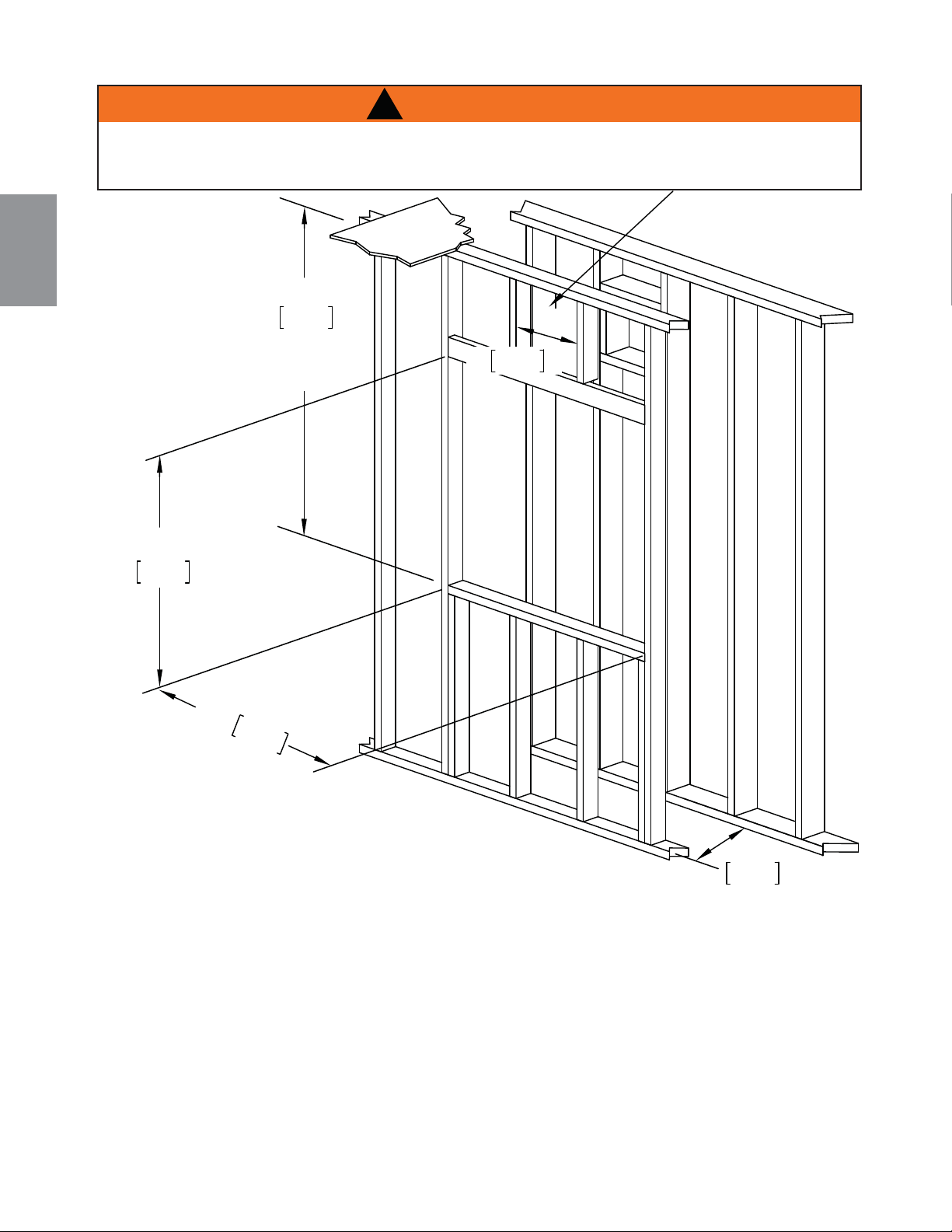
FR
90
W415-1335 / B / 10.04.16
NE RIEN CONSTRUIRE DANS CETTE ZONE - CETTE ZONE DE 14 PO DE LARGEUR, CENTRÉE LE
LONG DE L’AVANT DU FOYER, DOIT RESTÉE LIBRE AFIN D’OFFRIR UN DÉGAGEMENT ADÉQUAT
POUR L’ÉVACUATION. AUCUN MATÉRIAU COMBUSTIBLE N’EST PERMIS.
!
AVERTISSEMENT
46 3/4"
1187mm
41 1/4"
1048mm
56"
1422mm
MINIMUM DE LA BASE
DE L’APPAREIL
14"
356mm MIN
20 1/8"
511mm *
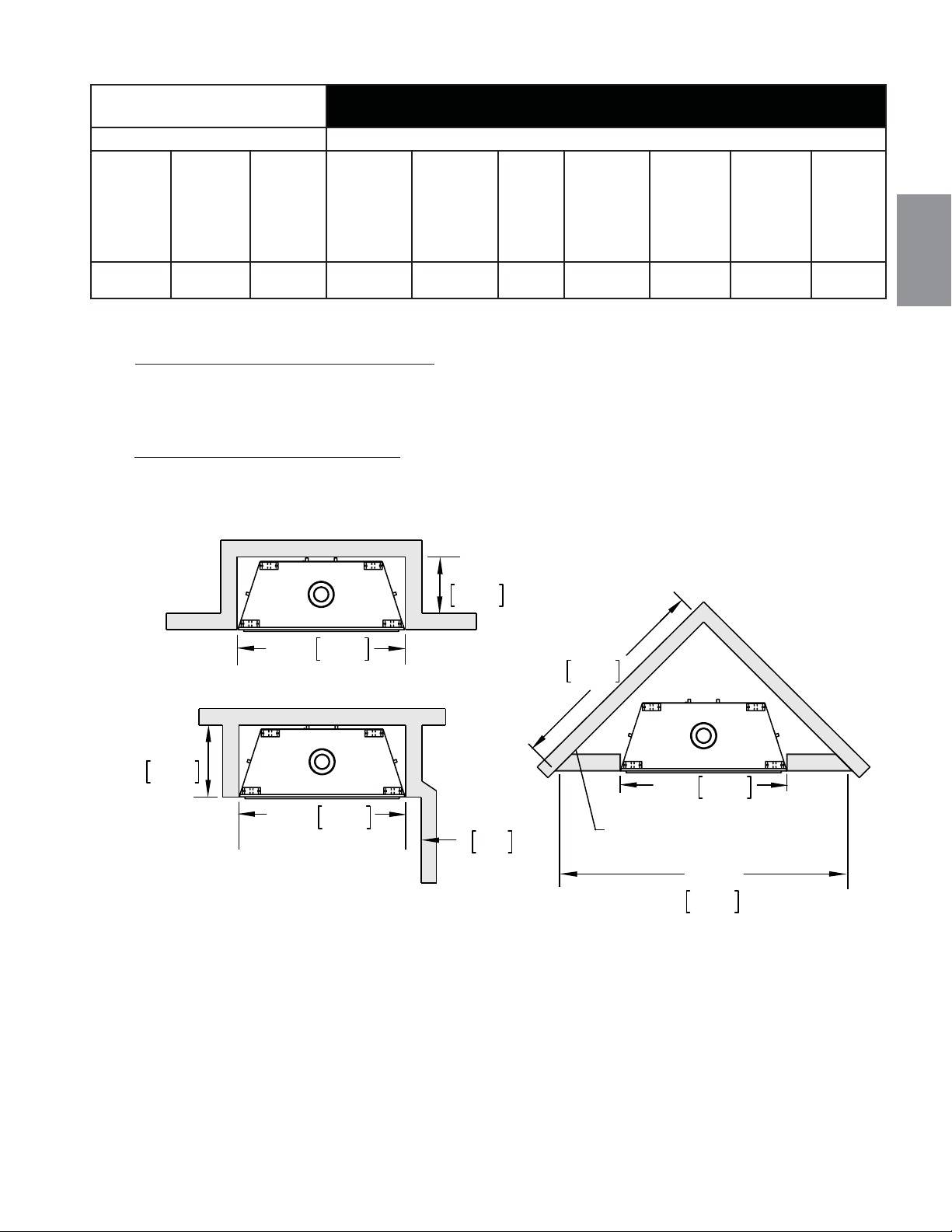
ENCEINTE
INTÉRIEURE
ENCEINTE
EXTÉRIEURE
73 1/2"
1867mm
MIN
MUR ARRIÈRE DE L’ENCEINTE (INCLUANT
DES MATÉRIAUX DE FINITION)
46 3/4"
1187mm
52"
1320mm
20 1/8"
511mm
20 1/8"
511mm
46 3/4"
1187mm
46 3/4"
1187mm
2"
51mm
FR
91
W415-1335 / B / 10.04.16
* Lorsque vous construisez l’enceinte, prévoyez l’épaisseur des matériaux de fi nition pour maintenir les
dégagements.
** SECTIONS D’ÉVENTS HORIZONTALES : Un dégagement minimal aux matériaux combustibles de
2” (51mm) au-dessus et 1”(25mm) au-dessous et sur les côtés de l’évent doit être maintenu sur toutes
les courses horizontales. Les sections d’évents horizontales dans l’enceinte requièrent un dégagement
minimal de 6” (152mm) sur le dessus. Voir la section « DÉGAGEMENTS MINIMAUX DE L’ENCEINTE ».
Utilisez l’espaceur coupe-feu W010-1777 (fourni).
** SECTIONS D’ÉVENTS VERTICALES : Un dégagement minimal aux matériaux combustibles de 1”
(25mm) tout autour de l’évent est requis sur toutes les courses verticales. Les sections d’évents verticales
dans l’enceinte requièrent un dégagement minimal de 2” (51mm) tout autour de l’évent. utilisez l’espaceur
coupe-feu w500-0096 (non fourni).
OSSATURE
CONSERVEZ CES DÉGAGEMENTS MINIMAUX AUX MATÉRIAUX
COMBUSTIBLES :
OUVERTURE BRUTE
HATEUR LARGEUR PROFON-
DEUR
DU PLA-
FOND
JUSQU’À
LA BASE
DE
L’APPAREIL
DU PLA-
FOND
JUSQU’AU
HAUT DE
L’OUVER-
TURE DE
L’APPAREIL
MUR
LATÉ-
RAL
DE LA
FINITION
COMBUS-
TIBLE AU-
DESSUS DE
L’APPAREIL
DES-
SUS DU
CONDUIT
D’ÉVACUA-
TION
CÔTÉS ET
BAS DU
CONDUIT
D’ÉVACUA-
TION
ES-
PACEURS
ARRIÈRE
ET LATÉ-
RAUX
41 ¼”
(1048mm)
46 ¾”
(1188mm)
20 ¹/
8
”
(511mm)*
56”
(1422mm)
30 ¹¹/
16
”
(780mm)
2”
(51mm)
14”
(356mm)
2”
(51mm)**
1”
(25mm)**
0”
(0mm)
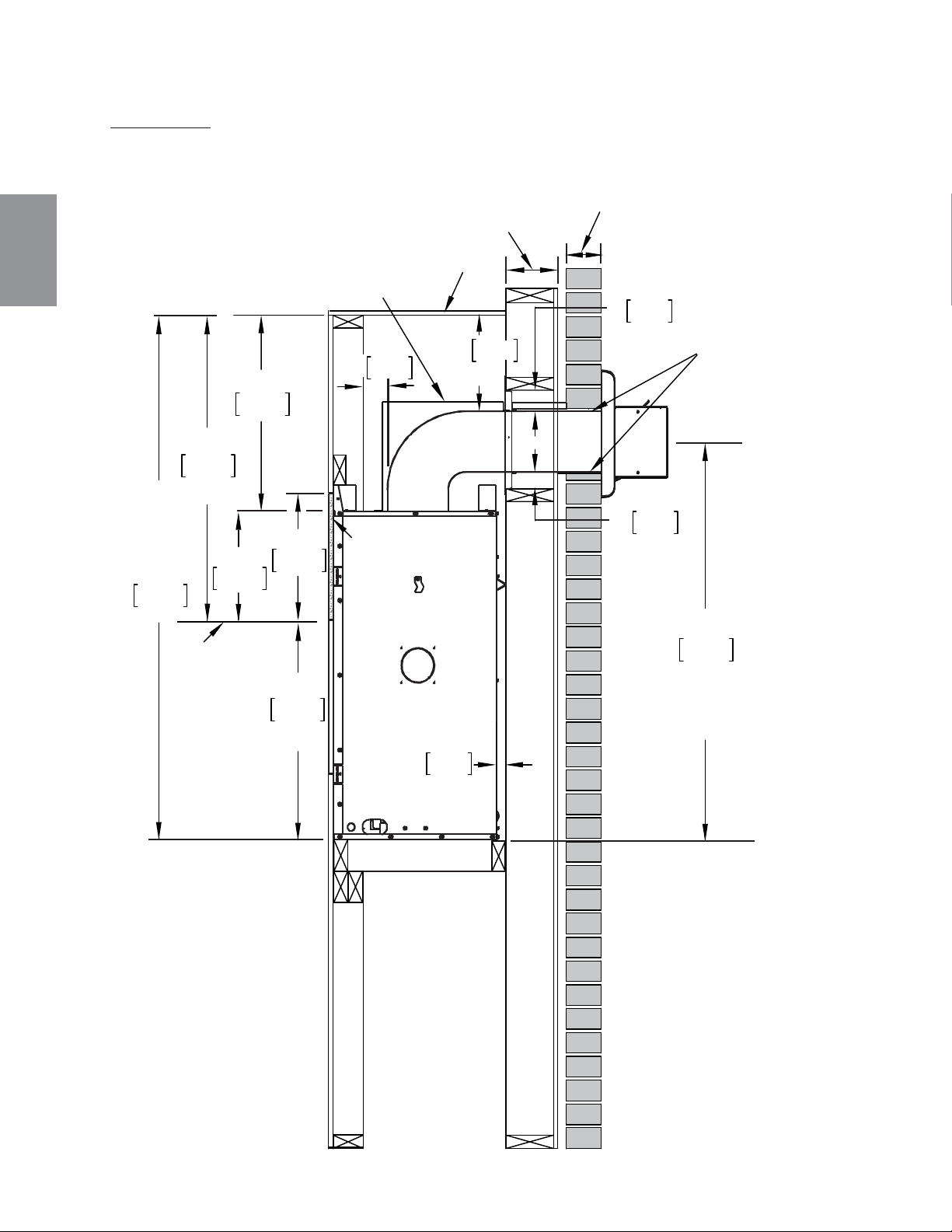
5.1 DÉGAGEMENTS MINIMAUX AUX ENCEINTES COMBUSTIBLES
FR
92
W415-1335 / B / 10.04.16
IMPORTANT : Le LHD45 requiert une hauteur d’enceinte minimale de 56” (1422mm) à partir de la base de
l’appareil. Afi n de respecter les contraintes de température, cet espace doit demeurer sans obstruction. Il est
recommandé que l’enceinte soit ventilée dans le haut et le bas afi n de faire circuler l’air chaud.
* Voir la section « ÉVACUATION ».
HAUT DE
L’OUVERTURE
DE L’APPAREIL
TABLETTE
COMBUSTIBLE
0'' (0mm) SI LES
MATÉRIAUX DE
FINITION SONT
INCOMBUSTIBLES,
COMME DE LA
BRIQUE ET DE LA
PIERRE.
INCOMBUSTIBLE
MATÉRIAUX
INCOMBUSTIBLES
PROTECTEUR DE
CONDUIT
D’ÉVACUATION
1"
25mm
2"
51mm
2"
51mm
1"
25mm
6"
152mm
MIN
45 13/16"
1164mm
56 "
1422mm
HAUTEUR
D’ENCEINTE
MINIMALE DE
30 11/16"
780mm
MIN
18 3/16"
462mm
12 1/2"
317mm
14"
356mm
25 5/16"
643mm
MIN
MINIMUM
PLUS
LA PENTE*
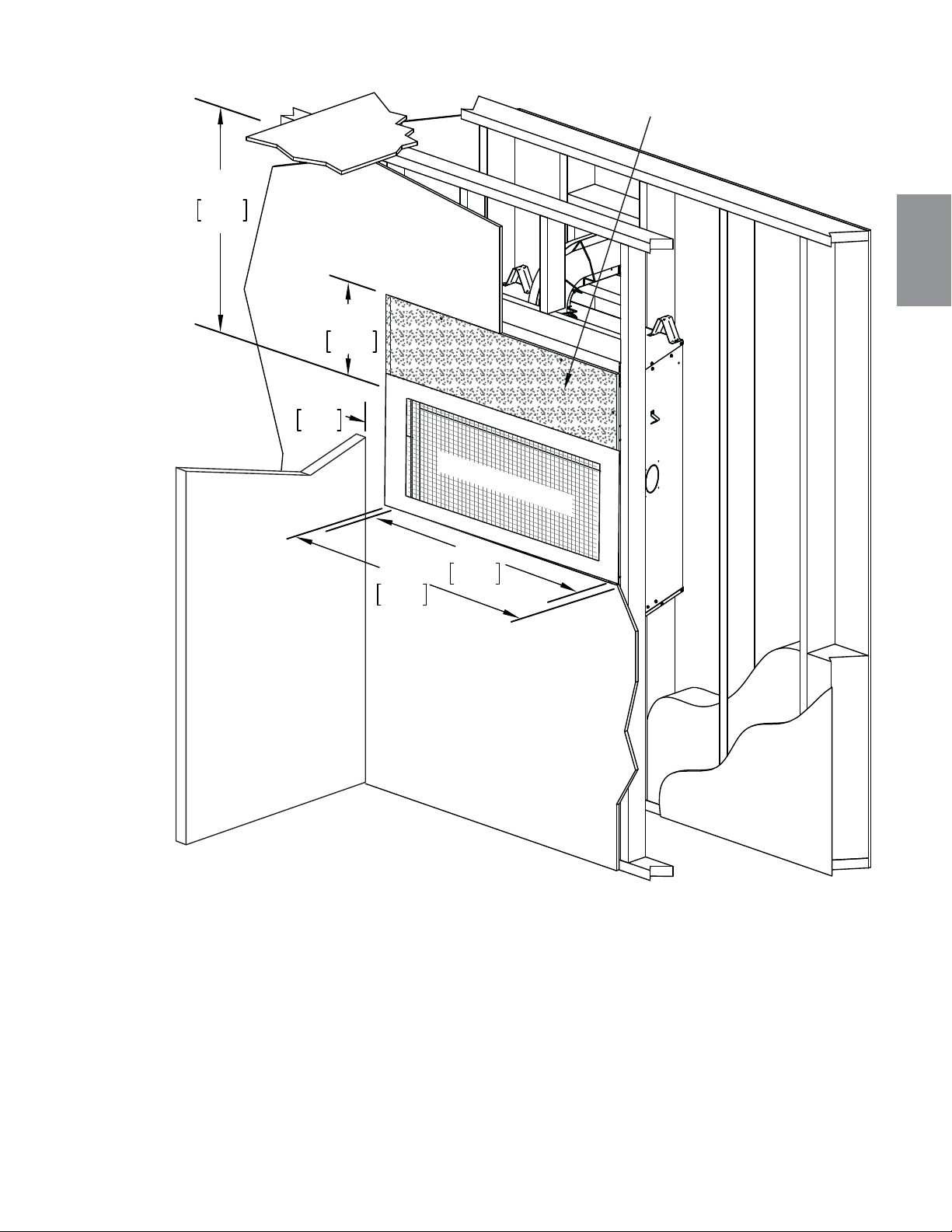
FR
93
W415-1335 / B / 10.04.16
Le matériau de fi nition peut être fi xé directement au caisson lorsque cela s’avère pratique.
COMBUSTIBLE
INCOMBUSTIBLE
HAUT DE
L’OUVERTURE
DE L’APPAREIL
30 11/16"
780mm
14"
365mm
42"
1067mm
46 1/4"
1175mm
2"
51mm
É
C
R
A
N
D
E
PRO
T
E
C
TI
O
N
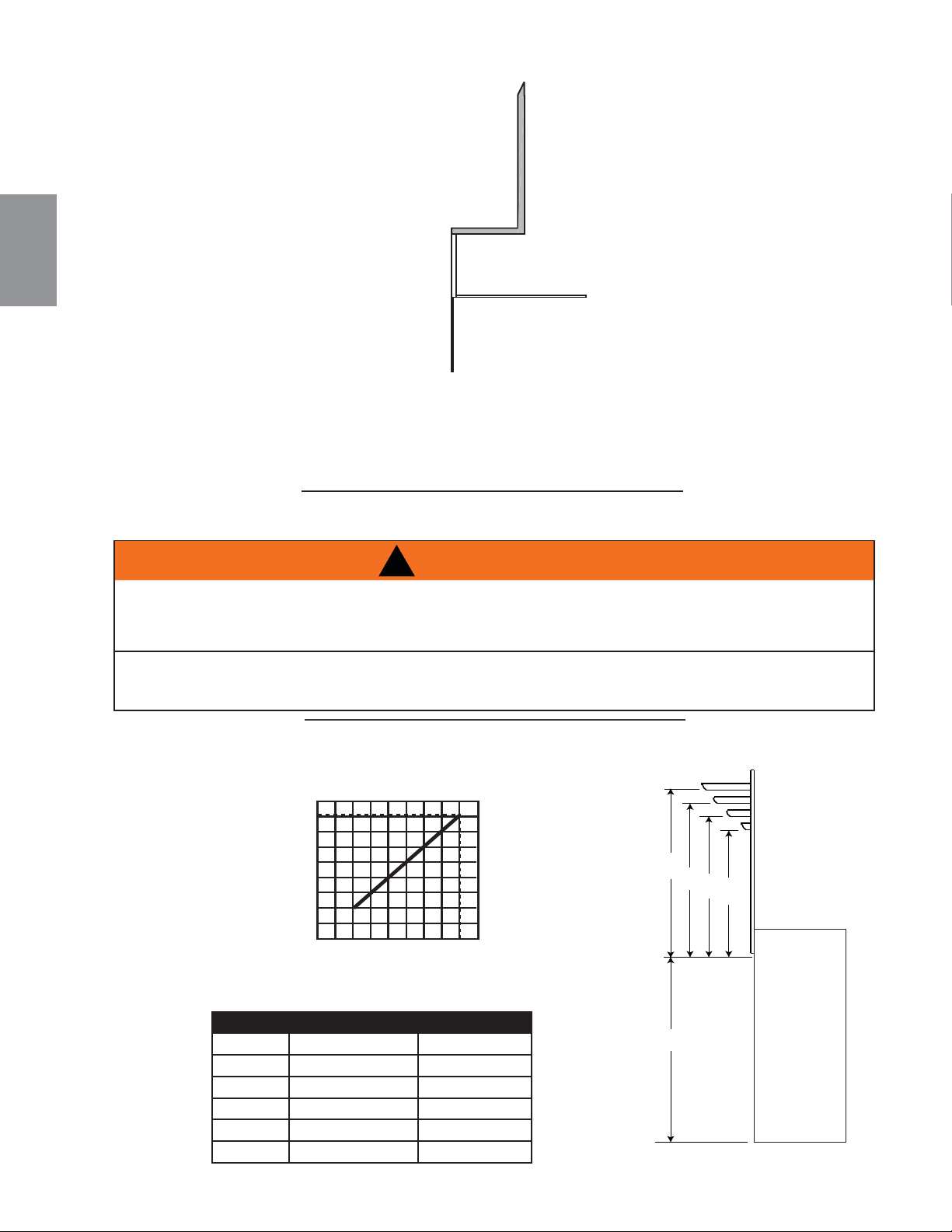
Le dégagement d’une tablette combustible peut varier selon la profondeur de la tablette. Utilisez le graphique
pour vous aider à déterminer le dégagement nécessaire.
DIMENSIONS DE LA TABLETTE
Ref Hauteur Profondeur
A 25 5/16” (643mm)
B 6” (152mm) 2” (51mm)
C 8” (203mm) 4” (102mm)
D 10” (254mm) 6” (152mm)
E 12” (305mm) 8” (203mm)
0
34 712 56
12
8
10
6
8
+
$
8
7
(
8
5
'
(
/
$
7
$
%
/
(
7
7
(
PROFONDEUR DE
LA TABLETTE
FR
!
AVERTISSEMENT
RISQUE D’INCENDIE. CONSERVEZ TOUS LES DÉGAGEMENTS AUX MATÉRIAUX COMBUSTIBLES
SPÉCIFIÉS. NE PAS RESPECTER CES INSTRUCTIONS PEUT CAUSER UN INCENDIE OU UNE
SURCHAUFFE. ASSUREZ-VOUS QUE TOUS LES DÉGAGEMENTS (ARRIÈRE, CÔTÉS, DESSUS,
ÉVENTS, TABLETTE, FAÇADE, ETC.) SONT RESPECTÉS À LA LETTRE.
LORSQUE VOUS UTILISEZ DE LA PEINTURE OU DU VERNIS COMME FINITION POUR VOTRE
TABLETTE, ASSUREZ-VOUS QU’ILS SOIENT RÉSISTANTS À LA CHALEUR AFIN DE
PRÉVENIR LA DÉCOLORATION.
73.1
94
W415-1335 / B / 10.04.16
5.2 INSTALLATION EN ALCÔVE
APPAREIL
ZONE
ENCASTRÉE
OU ALCÔVE
NOTE : Les zones encastrées ou les alcôves au dessus de l'appareil peuvent être aussi profondes que désiré
tant que les dégagements minimaux aux matériaux combustibles sont respectés.
Vous pouvez utiliser un matériau incombustible, pourvu que les dégagements minimaux aux matériaux
combustibles soient appliqués.
Le volume minimal de l'enceinte doit être augmenté d'au moins la valeur du volume de la zone encastrée. Cet
ajustement peut être réalisé en augmentant une ou toutes les dimensions de l'enceinte.
71.2
ZONE
ENCEINTE
E
D
C
B
A
HAUT DE
L’OUVERTURE
DE L’APPAREIL
5.3 DÉGAGEMENTS MINIMAUX DE LA TABLETTE
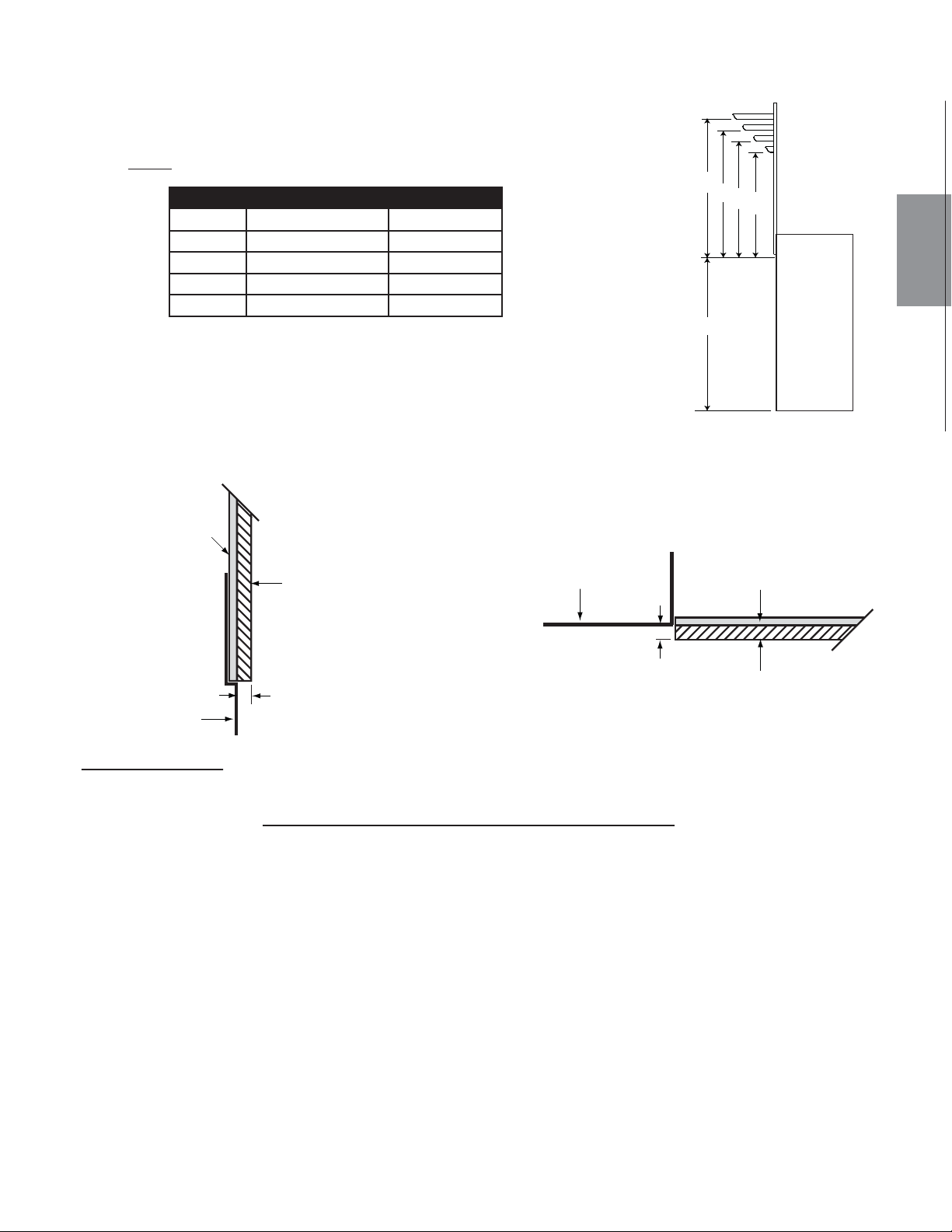
71.3A
3/4” (19mm)
MATÉRIAUX DE FINITION
INCOMBUSTIBLES
MATÉRIAUX DE FINITION
COMBUSTIBLES
MATÉRIAUX
DE FINITION
3/4” (19mm)
AVERTISSEMENT: Les matériaux de finition incombustibles ne doivent pas dépasser de la sommet, du fond ou des
côtés de l’appareil, comme illutsrée (pour une projection maximale de 3/4” (19mm)). Les projections plus grandes sont
considérés une tablette et doivent suivre les conditions incombustibles des tablettes.
VUE DU SOMMETVUE DU CÔTÉ
SOMMET DE
L’APPAREIL
SOMMET DE
L’APPAREIL
MATÉRIAUX
DE FINITION
FROM TOP OF APPLIANCE OPENING
Ref Height Depth
A 25 5/16” (643mm)
B 0 2” (51mm)
C 2” (51mm) 6” (152mm)
D 4” (102mm) 10” (254mm)
NOTE: Projection must be non-combustible.
E
D
C
B
A
TOP OF
OPENING
FR
95
W415-1335 / B / 10.04.16
5.4 PROTRUSION MINIMUM DE FINITION INCOMBUSTIBLE
5.5 MATÉRIAUX DE FINITION INCOMBUSTIBLES
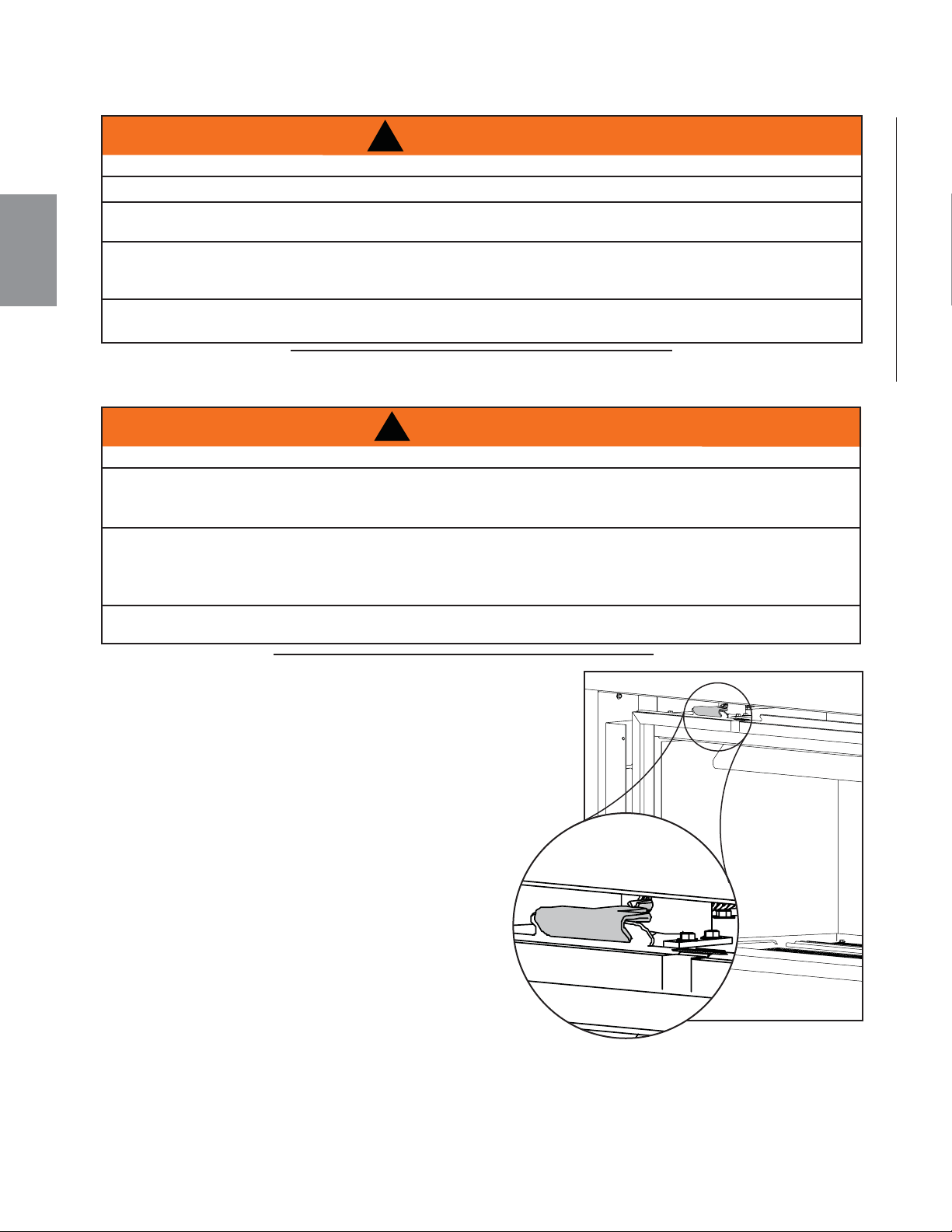
6.0 FINITIONS
6.1 INSTALLATION/ENLÈVEMENT DE L’ÉCRAN DE PROTECTION ET LA PORTE
FR
!
AVERTISSEMENT
RISQUE D’INCENDIE!
N’OBSTRUEZ JAMAIS L’OUVERTURE SUR LE DEVANT DE L’APPAREIL.
SI LA FINITION DE LA FAÇADE DE L’APPAREIL EST FAIT, ELLE DOIT ÊTRE FAITE DE MATÉRIAU
INCOMBUSTIBLE COMME DE LA BRIQUE, DU MARBRE, DU GRANITE, ETC.
NE FRAPPEZ PAS, NE CLAQUEZ PAS ET N’ÉGRATIGNEZ PAS LA PORTE VITRÉE. NE FAITES PAS
FONCTIONNER L’APPAREIL LORSQUE LA PORTE VITRÉE EST ENLEVÉE, FISSURÉE, BRISÉE OU
ÉGRATIGNÉE.
LES MATÉRIAUX DE FAÇADE OU DE FINITION NE DOIVENT JAMAIS EMPIÉTER SUR L’OUVERTURE
DE L’APPAREIL.
72.1B
!
AVERTISSEMENT
LA VITRE PEUT ÊTRE CHAUDE, NE TOUCHEZ PAS LA VITRE JUSQU’À CE QU’ELLE AIT REFROIDI.
SI ÉQUIPÉ AVEC LES LOQUETS DE PORTE QUI FONT PARTIE D'UN DISPOSITIF DE SÉCURITÉ ET DOIVENT
ÊTRE ADÉQUATEMENT VERROUILLÉS. NE FAITES PAS FONCTIONNER L’APPAREIL LORSQUE LES LOQUETS
SONT DÉVERROUILLÉS.
LES MATÉRIAUX DE FAÇADE ET DE FINITION NE DOIVENT PAS NUIRE À LA CIRCULATION DE L'AIR DANS LES
OUVERTURES D'AIR ET LES PERSIENNES, NI AU FONCTIONNEMENT DES PERSIENNES OU DES PORTES. ILS
NE DOIVENT PAS NON PLUS ENTRAVER L'ACCÈS POUR L'ENTRETIEN. RESPECTEZ TOUS LES DÉGAGEMENTS
AUX MATÉRIAUX COMBUSTIBLES.
AVANT D’ENLEVER LA PORTE, ÉTEIGNEZ L’APPAREIL ET ATTENDEZ QUE CE DERNIER SOIT FROID AU
TOUCHER. LES PORTES SONT LOURDES ET FRAGILES; MANIPULEZ AVEC SOIN.
75.1A
96
W415-1335 / B / 10.04.16
Une barrière conçu à réduire le risque de brûlures à partir de le
chaude la vitre est à condition que avec l’appareil et sera être
installés.
Enlevez de la moulure pour façade optionnel avec l’écran de
protection, référer la instructions du leafl et.
La porte vitrée est maintenue en place par deux loquets situés en haut
sur le devant de l’appareil. Tirez les poignées des loquets vers l’avant,
puis retirez les loquets du cadre de porte afi n de libérer le haut de
la porte. Pivotez ensuite le haut de la porte vers l’avant jusqu’à
ce que vous puissiez saisir les côtés. Soulevez la porte hors du
dispositif de retenu inférieur.
Inversez ces étapes pour réinstaller la porte.
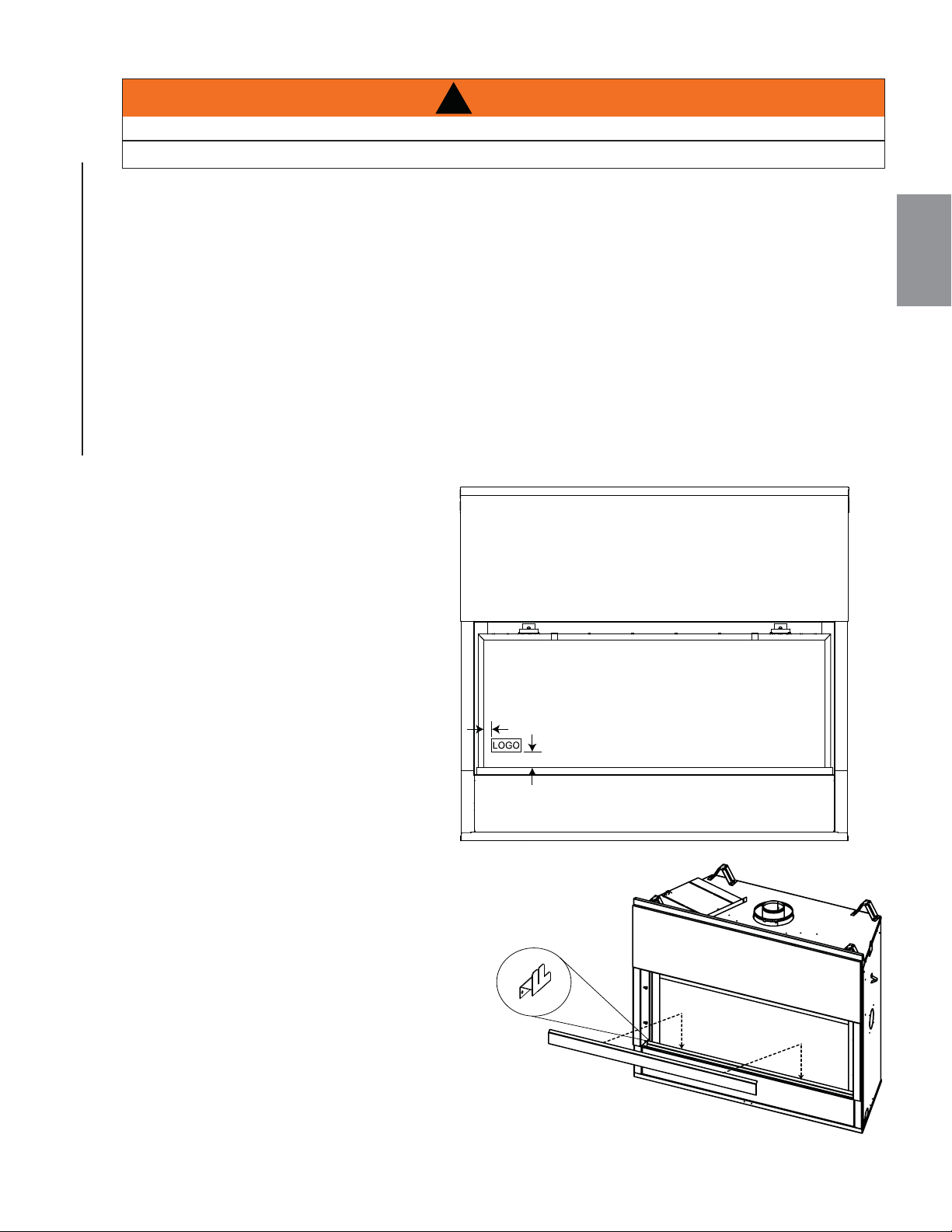
ƎPP
ƎPP
A. Éteindre le gaz et l’énergie électrique de l’appareil, avant de commencer l’installation.
B. Placez le boîtier de la batterie fourni dans le manuel en plastique.
C. Installez 4 piles AA (non fourni) dans le bloc-piles du boîtier fourni, notez la polarité des piles puis
insérez-les comme indiqué sur le couvercle (+/-). (Pour ouvrir le boîtier de batterie glisser le piece de
l’arrière hors du boîtier de batterie).
D. Enlever l’habillage équipé de l’écran de sécurité puis enlever la garniture pour facilement accéder au
compartiment de contrôle.
E. Attacher les fi ls du harnais de fi ls de l’appareil aux boîtier de batterie.
F. Placez le boîtier de batterie dans la compartiment du soupape au-dessous du brûleur, garantir que le
boîtier de batterie est placer dans un endroit proper facilement.
G. Réinstaller la garniture puis l’habillage équipé de l’écran de sécurité. L’habillage doit être installé à
tout moment pendant l’opération de l’appareil.
H. Ouvrir l’alimentation de gaz et l’alimentation électrique pour fonctionner l’appareil.
!
WARNING
COUPEZ L’ALIMENTATION EN GAZ ET L’ALIMENTATION ÉLECTRIQUE DE L’APPAREIL
L’APPAREIL PEUT ÊTRE, NE TOUCHEZ PAS L’APPAREIL JUSQU’À CE QU’ELLE AIT REFROIDI.
6.2 INSTALLATION DE LA BOÎTIER DE BATTERIE
6.3 MISE EN PLACE DU LOGO
FR
97
W415-1335 / B / 10.04.16
Placez la moulure comme illustré dans
les fentes des supports gauche et droit
derrière le panneau d’accès.
SUPPORT GAUCHE
ILLUSTRÉ.
6.4 INSTALLATION DE LA MOULURE
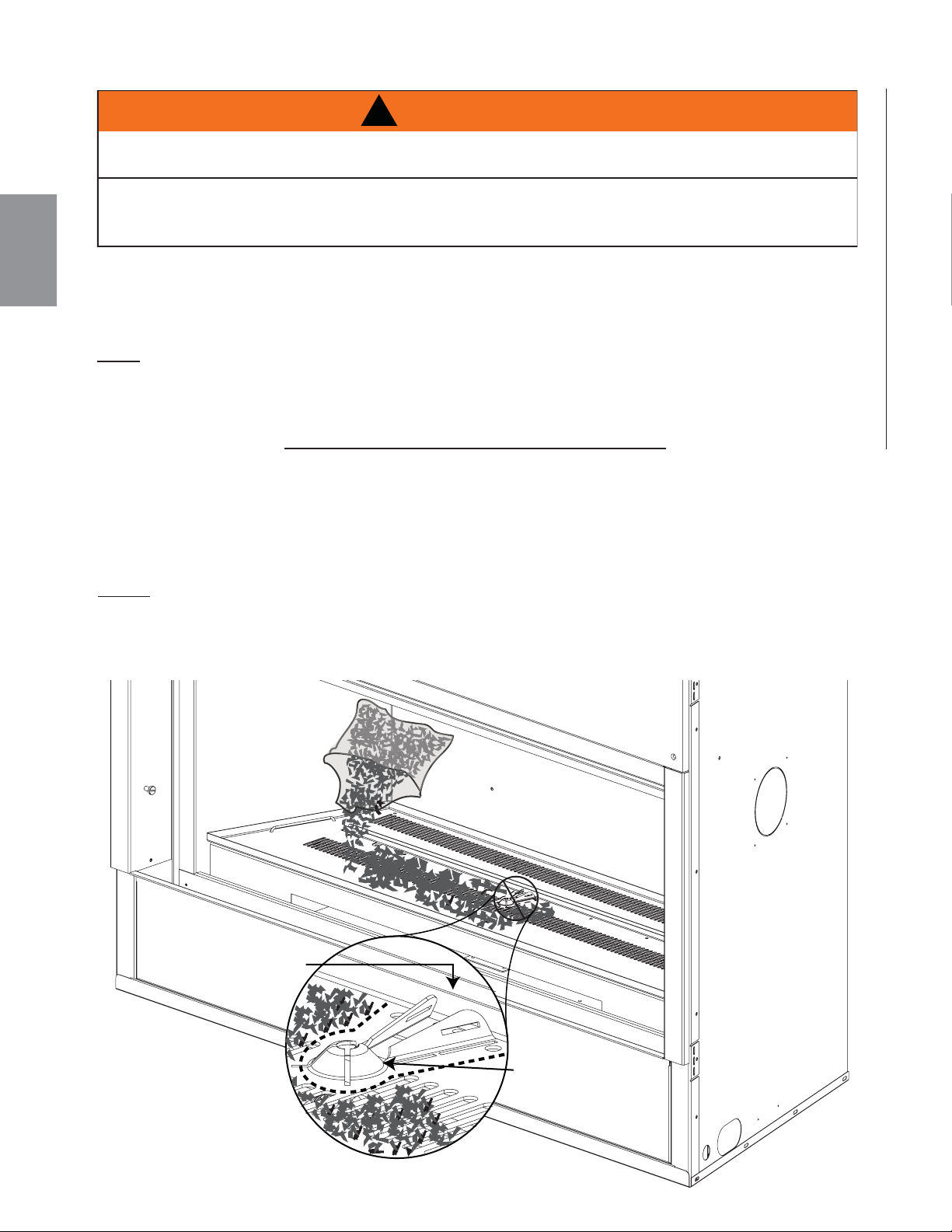
FR
74.2C
Éparpillez soigneusement les braises vitrifi ées sur le plateau de manière uniforme. Assurez-vous qu’aucun
morceau de verre ne tombe dans la zone du brûleur. Si cela se produit, installez un nouveau sac dans votre
aspirateur et aspirez les braises vitrifi ées. Des braises vitrifi ées de rechange peuvent être commandées au-
près de votre détaillant autorisé.
NOTE: Ne pas trop remplir les composants décoratifs, utilise seulment ce qui est fourni avec l’appareil
.
NETTOYAGE DES BRAISES VITRIFIÉES
Il est possible qu’un fi lm huileux recouvre les braises. Avant de les disposer dans le plateau, nettoyez les
braises avec un savon à vaisselle doux, égouttez-les, rincez-les à fond et laissez-les sécher.
NETTOYEZ LES BRAISES VITRIFIÉES AVANT L’INSTALLATION. ASSUREZ-VOUS QU'ELLES SONT SÈCHES
AVANT DE LES DISPOSER DANS LE PLATEAU.
NE CHANGEZ PAS OU NE SUBSTITUEZ PAS LES BRAISES VITRIFIÉES FOURNIES AVEC CET
APPAREIL. EN CAS DE REMPLACEMENT, N’UTILISEZ QUE LES BRAISES VITRIFIÉES DE RECHANGE
DISPONIBLES CHEZ VOTRE DÉTAILLANT AUTORISÉ.
!
AVERTISSEMENT
AVERTISSEMENT: NE PLACEZ AUCUN COMPOSANTS DÉCORATIFS AUTOUR OU SUR LE PILOTE,
CELA VONT INTERFÉRER AVEC L’OPÉRATION DU PILOTE. UTILISE SEULEMENT LES COMPOSANTS
À CELLE APPROVÉES POUR CETTE APPAREIL. NE PAS TROP REMPLIR LES COMPOSANTS
DÉCORATIFS, UTILISE SEULEMENT CE QUI EST FOURNI AVEC L’APPAREIL.
98
W415-1335 / B / 10.04.16
6.5 BRAISES VITRIFIÉES
NOTE : Assurez-vous que les braises vitrifi ées sont à au moins 0,250” de l’emplacement de la veilleuse
et qu’elles ne nuisent pas à son fonctionnement.
Les braises vitrifi ées ne doivent pas couvrir les orifi ces du brûleur.
Lorsque les fl ammes empiètent sur les braises vitrifi ées, celles-ci peuvent se décolorer légèrement et
les bords peuvent ramollir.
EMPLACEMENT DE
LA VEILLEUSE
ORIFICES DU
BRÛLEUR
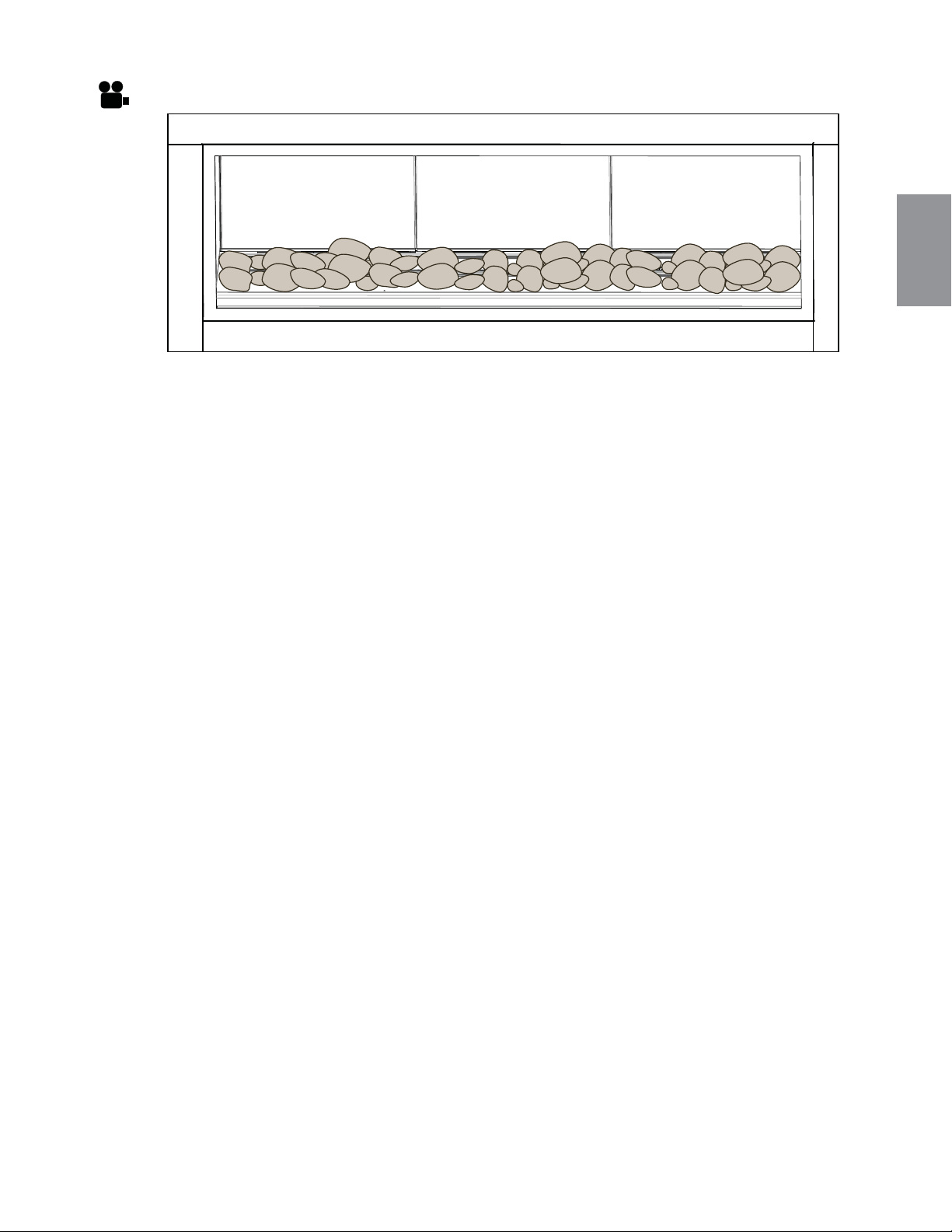
FR
99
W415-1335 / B / 10.04.16
6.6 REMPLACEMENT DE ROCHES
Placer les roches réfractaires au hasard sur le plateau, au tours, mais pas sur les ports de brûleur ou pilote
mailler. Suivre les instructions fournies avec RK62.
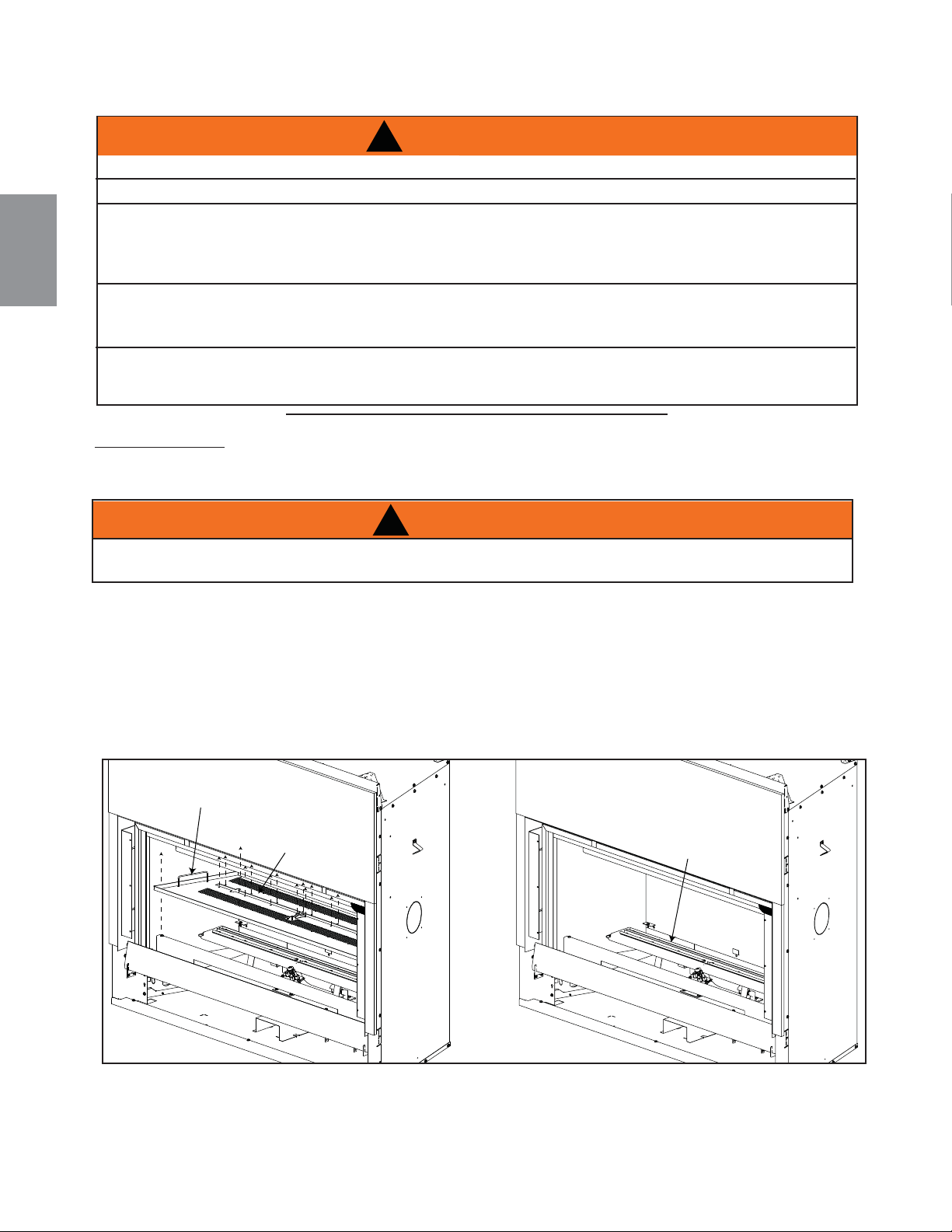
7.0 INSTALLATION DE LA SOUFFLERIE OPTIONELLE
7.1 ACCÈS À LA SOUFFLERIE
FAITES ATTENTION DE NE PAS DÉCHIRER LE JOINT DÉTANCHÉTTÉ DU BRÛLEUR VOUS POUVES COMMANDER
UN JOINT DÉTANCHÉTTÉ DE RECHANGE AUPRÉS DE VOTRE DÉTAILLANT AUTORISÉ
!
AVERTISSEMENT
FR
!
AVERTISSEMENT
RISQUE D’INCENDIE ET DE CHOC ÉLECTRIQUE.
COUPEZ L’ALIMENTATION EN GAZ ET L’ALIMENTATION ÉLECTRIQUE AVANT DE PROCÉDER À L’ENTRETIEN DE L’APPAREIL.
N’UTILISEZ QUE LES ACCESSOIRES OPTIONNELS ET LES PIÈCES DE RECHANGE APPROUVÉS PAR WOLF
STEEL POUR CET APPAREIL. L’UTILISATION D’ACCESSOIRES NON LISTÉS (SOUFFLERIE, PORTES, PERSI-
ENNES, MOULURES, COMPOSANTS DE GAZ, COMPOSANTS D’ÉVACUATION, ETC.) POURRAIT ÊTRE NON
SÉCURITAIRE ET ANNULERA LA GARANTIE ET LA CERTIFICATION.
AFIN DE PRÉVENIR LES CHOCS ÉLECTRIQUES ET LES DOMMAGES CAUSÉS PAR LE FEU, ASSUREZ-VOUS
QUE LE CORDON D’ALIMENTATION DU VENTILATEUR N’ENTRE PAS EN CONTACT AVEC QUELCONQUE
SURFACE DE L’APPAREIL. NE FAITES PAS PASSER LE CORDON D’ALIMENTATION SOUS L’APPAREIL.
LE HARNAIS DE FILS FOURNI DANS L’ENSEMBLE DE SOUFFLERIE EST UN HARNAIS UNIVERSEL.
LORS DE SON INSTALLATION, ASSUREZ-VOUS QUE TOUT EXCÈS DE FIL EST CONFINÉ,
L’EMPÊCHANT AINSI D’ENTRER EN CONTACT AVEC DES OBJETS CHAUDS OU MOBILES.
51.5
100
W415-1335 / B / 10.04.16
7.1.1 ENLÈVEMENT DU BRÛLEUR
A. Enlevez la porte. Voir la section « ENLÈVEMENT ET INSTALLATION DE L’ÉCRAN DE PROTECTION
ET LA PORTE».
B. Retirez les 20 vis (8 de chaque côté et une dans chaque coin) qui servent à fi xer le plateau de braises
vitrifi ées en place. À l’aide des poignées, soulevez le plateau et retirez-le.
C. Retirez les 4 vis qui servent à fi xer le brûleur en place. Soulevez le brûleur et retirez-le.
PLATEAU DE
BRAISES
VITRIFIÉES
POIGNÉES DE
LEVAGE
BRÛLEUR
Conseil pratique : Il est recommandé d’installer la souffl erie par le panneau d’accès de pré-installation
avant de terminer l’installation de l’appareil.
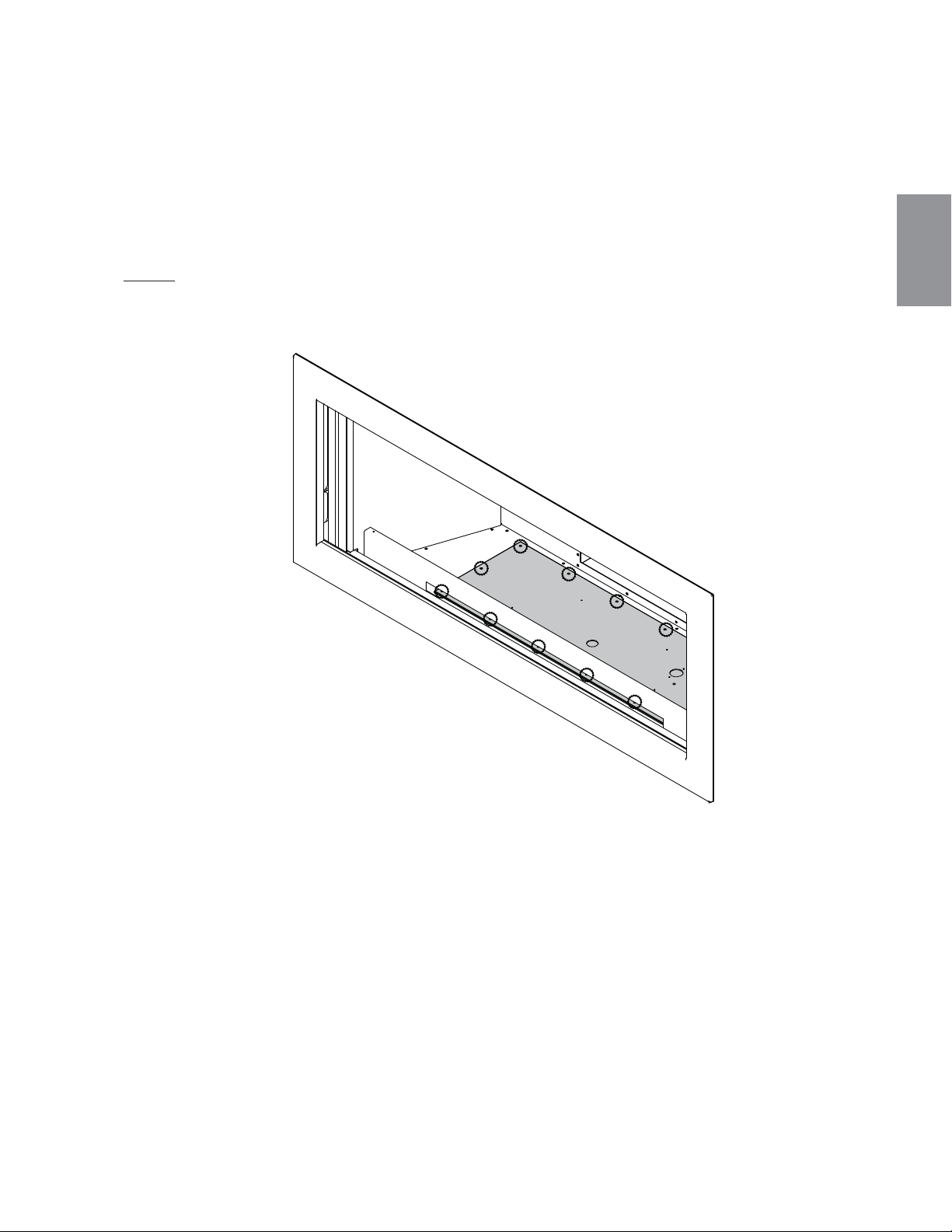
FR
101
W415-1335 / B / 10.04.16
A. Enlevez la porte. Voir la section « ENLÈVEMENT ET INSTALLATION DE LA PORTE ».
B. Retirez le plateau de braises/cristaux et le brûleur. Voir la section « ENLÈVEMENT DU BRÛLEUR ».
C. Enlevez les 14 vis de l’assemblage de la soupape. Soulevez soigneusement l’assemblage de la soup-
ape et fermez la soupape d’arrêt manuel. Voir la section « BRANCHEMENT DU GAZ ».
NOTE : Un nouveau joint d’étanchéité pourrait être nécessaire lorsque vous réinstallez l’assemblage
de la soupape; contactez votre détaillant autorisé.
7.1.2 ASSEMBLAGE DE LA SOUPAPE
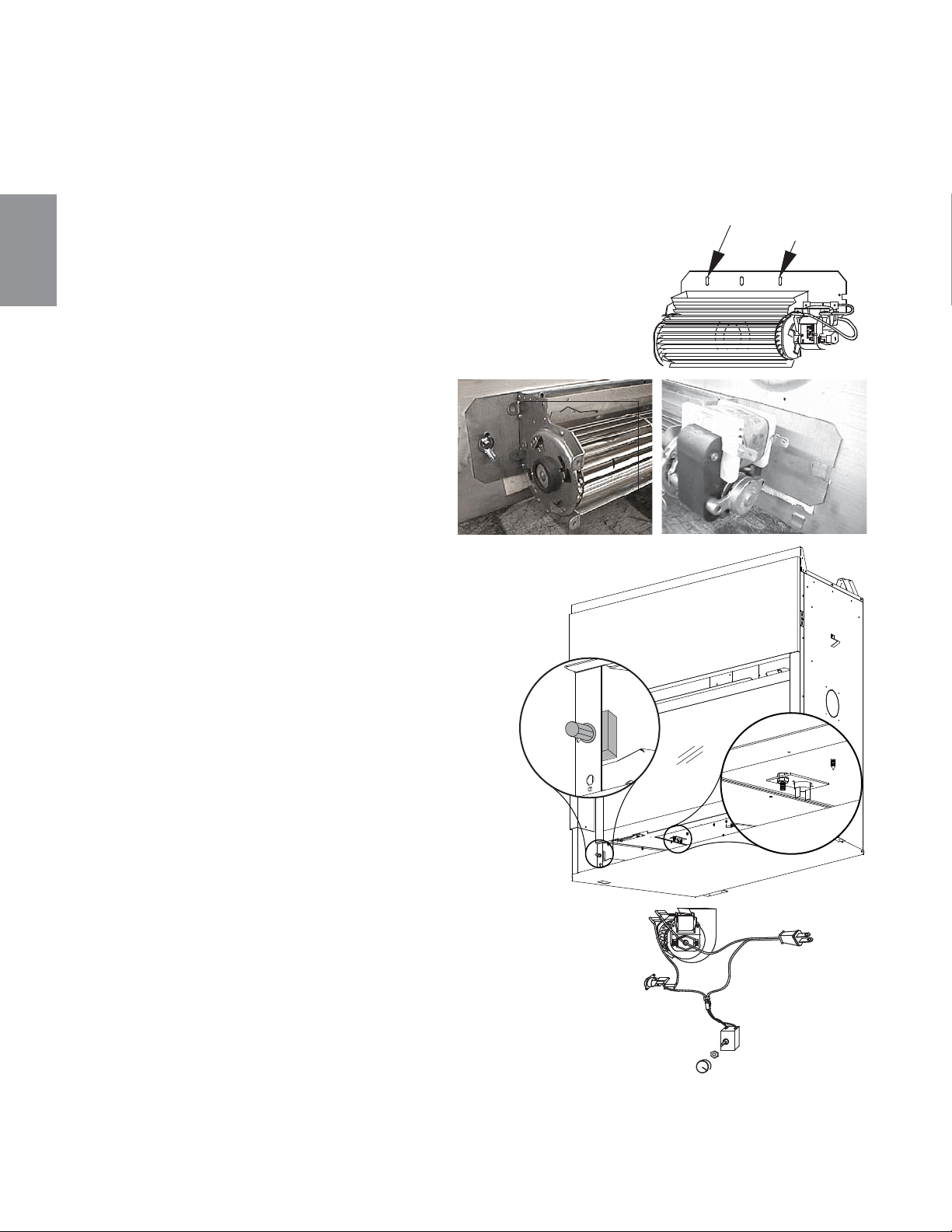
7.2 INSTALLATION DE LA SOUFFLERIE
FR
102
W415-1335 / B / 10.04.16
L’INSTALLATION DOIT ÊTRE FAITE PAR UN INSTALLATEUR QUALIFIÉ et doit être raccordée
électriquement et mise à la terre conformément aux codes locaux. En l’absence de codes locaux, utilisez la
version courante du Code canadien de l’électricité CSA C22.1 au Canada ou le National Electrical Code
ANSI/NFPA 70 aux États-Unis.
Les trois fentes sur le support de montage de la soufflerie vous permettent
d'ajuster la soufflerie lorsque vous l'installez. Pour que la soufflerie fonctionne
silencieusement, il est important que le montage ne repose pas sur la base
de la chambre de combustion. Insérez le coussinet amortisseur (A) dans la
pince (C) et glissez-le jusqu'à la tige filetée (B) à l'autre extrémité. La
soufflerie doit pouvoir être entièrement placée sur le coussinet.
Inclinez la soufflerie sur le côté, glissez-la au-delà des contrôles et placez-la
dans la pince (C). Fixez la soufflerie à la tige
filetée à l'aide de la rondelle de blocage et de
l'écrou papillon fournis.
Assurez-vous que la soufflerie ne touche pas la
base de l’appareil ni la chambre de combustion.
Reliez les raccords des fils noir et blanc à
l’interrupteur thermique. Assurez-vous que
l'interrupteur thermique touche la base du
brûleur.
Reliez les raccords des fils noir et rouge à la soufflerie.
Assurez-vous que les fils passent loin des
composantschauds et des pales de la soufflerie.
Fixez l’interrupteur à vitesse variable au cadre du
caisson. Toutefois, il est difficile d’y accéder lorsque
l’appareil fonctionne. Si vous l’utilisez fréquemment,
considérez l’installer à côté de l’interrupteur mural de
l’appareil. Si le fil n’est pas assez long pour atteindre
l’appareil, vous pouvez le couper et ajouter une jonction
de fil. Ces connexions doivent être conformes aux codes
locaux. En l’absence de codes locaux, utilisez la version
courante du Code canadien de l’électricité CSA C22.1 au
Canada ou le National Electrical Code ANSI /NFPA 70
aux États-Unis.
Branchez le cordon de la soufflerie dans la
prise.
La poussière de gypse pénétrera dans le
roulement à billes de la soufflerie causant des dommages
irréparables. Vous devez éviter que cette poussière n’entre en
contact avec la soufflerie ou son compartiment. Tout dommage
causé par ce problème ne sera pas couvert par la garantie.
La soufflerie étant actionnée par la chaleur, lorsque
l’interrupteur est à « ON », elle se mettra automatiquement en
marche, environ 10 minutes après l’allumage de l’appareil et
fonctionnera de 30 à 40 minutes environ après l’arrêt de
l’appareil. L’utilisation de la soufflerie accroît le débit de chaleur de l’appareil.
noir
blanc
rouge
INTERRUPTEUR
À VITESSE
VARIABLE
SOUFFLERIE
INTERRUPTEUR
THERMIQUE
FENTES
A
B
C
INTERRUPTEUR
À VITESSE
VARIABLE
INTERRUPTEUR
THERMIQUE
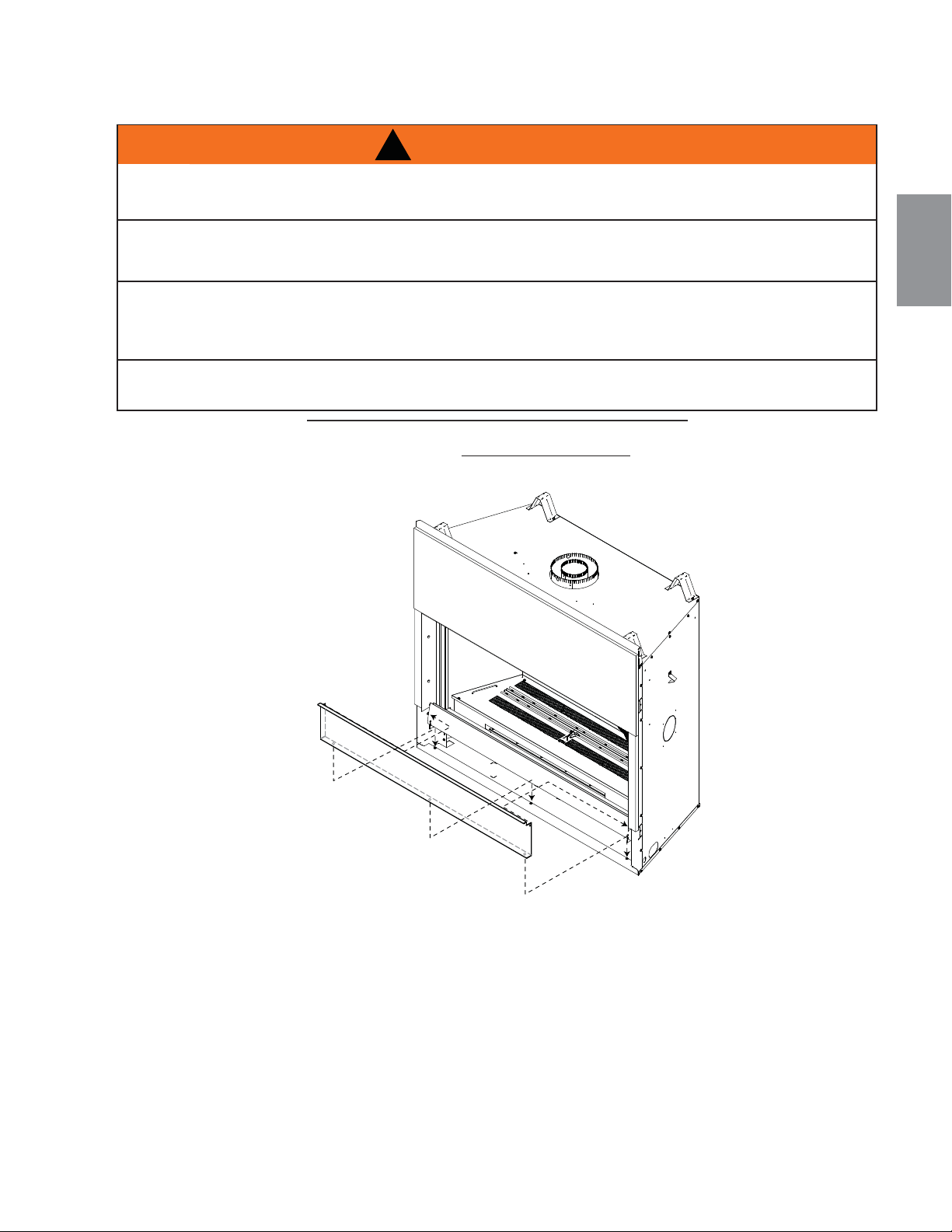
FR
!
AVERTISSEMENT
N’UTILISEZ PAS CE FOYER SI UNE PARTIE QUELCONQUE A ÉTÉ SUBMERGÉE. CONTACTEZ
IMMÉDIATEMENT UN TECHNICIEN DE SERVICE QUALIFIÉ POUR INSPECTER L’APPAREIL POUR
DES DOMMAGES AU CIRCUIT ÉLECTRIQUE.
RISQUE DE CHOCS ÉLECTRIQUES OU D’EXPLOSION. NE BRANCHEZ PAS LE 110 V À LA SOUPAPE
OU À L’INTERRUPTEUR MURAL DE L’APPAREIL. UN BRANCHEMENT ÉLECTRIQUE INCORRECT
ENDOMMAGERA LES CONTRÔLES.
CET APPAREIL DOIT ÊTRE RACCORDÉ ÉLECTRIQUEMENT PAR UN ÉLECTRICIEN QUALIFIÉ
CONFORMÉMENT AUX CODES LOCAUX. EN L’ABSENCE DE CODES LOCAUX, UTILISEZ LA
VERSION COURANTE DU CODE CANADIEN DE L'ÉLECTRICITÉ CSA C22.1 AU CANADA OU LE
NATIONAL ELECTRICAL CODE ANSI/NFPA 70 AUX ÉTATS-UNIS.
ALLUMEZ TOUJOURS LA VEILLEUSE, QUE CE SOIT POUR LA PREMIÈRE FOIS OU LORSQUE
L’APPROVISIONNEMENT EN GAZ EST ÉPUISÉ, AVEC LA PORTE VITRÉE OUVERTE OU RETIRÉE.
69.2
103
W415-1335 / B / 10.04.16
Si vous devez accéder à la zone des commandes AVANT L’INSTALLATION, retirez le panneau d’accès de
pré-installation. Vous devez réinstaller le panneau d’accès avant de faire fonctionner l’appareil.
8.0 BRANCHEMENT ÉLECTRIQUE
PANNEAU D’ACCÈS DE
PRÉ-INSTALLATION
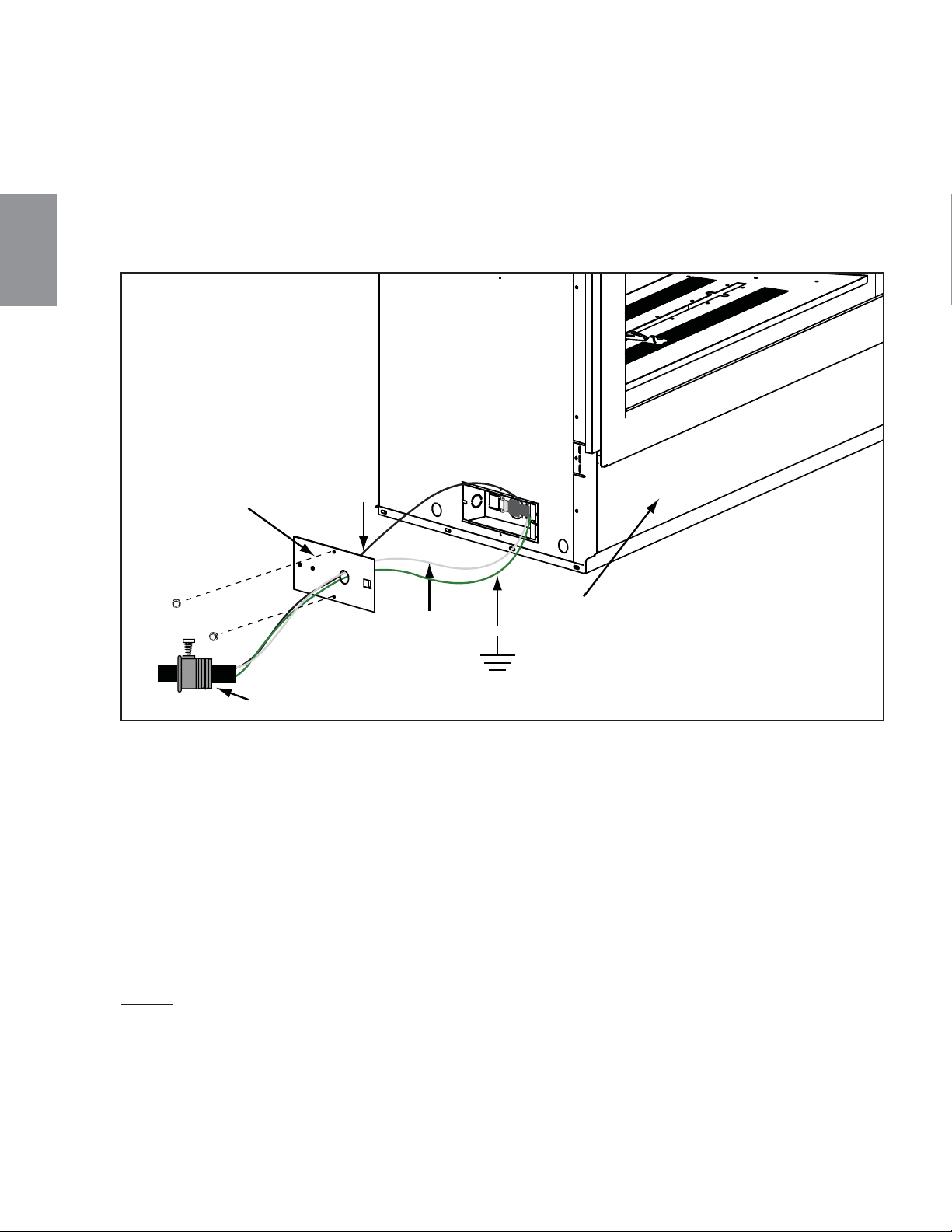
FR
104
W415-1335 / B / 10.04.16
Vous devez effectuer un branchement par câble avec cet appareil.
Une charpente permanente servant à encastrer l’appareil nécessite un branchement par câble de la boîte de
dérivation de l’appareil.
Cet appareil doit être raccordé électriquement et mis à la terre conformément aux codes locaux. En l’absence
de codes locaux, utilisez la version courante du Code canadien de l’électricité CSA C22.1 au Canada ou le
National Electrical Code ANSI / NFPA 70-1996 aux États-Unis.
8.1 BRANCHEMENT PAR CÂBLE
8.2 SCHÉMA DE CÂBLAGE DU RÉCEPTACLE
CONNECTEUR DE CÂBLE
L1
L2
PLAQUE
PANNEAU D’ACCÈS DE
PRÉ-INSTALLATION
A. Enlevez les deux vis qui fi xent l’assemblage de la boîte de dérivation à la paroi extérieure, du côté
gauche de l’appareil, puis retirez l’assemblage de la boîte de dérivation.
B. Enlevez la vis qui fi xe la boîte de dérivation à la plaque de la boîte et glissez la boîte hors de l’attache.
C. Passez le câble d’alimentation dans le trou de 7/8” de la plaque de la boîte de dérivation en utilisant
un connecteur de boîte (non fourni).
D. Branchez le câble d’alimentation de 120 volts au réceptacle selon les normes du Code Canadien de
l’électricité CSA C22.1 au Canada ou du National Electrical Code ANSI / NFPA 70-1996 aux États-
Unis.
E. Dès que le câblage est terminé, réinstallez la boîte de dérivation sur la plaque de la boîte et remettez
la vis retirée précédemment.
F. Réinstallez l’assemblage de la boîte de dérivation en répétant, à l’inverse, l’étape A.
NOTE : Si l’appareil est déjà installé dans l’enceinte, vous pouvez accéder à la boîte de dérivation par
l’intérieur de l’appareil, en enlevant la base du brûleur. Voir les sections « ENLÈVEMENT DU BRÛLEUR
» et « ENLÈVEMENT DE LA SOUPAPE ».
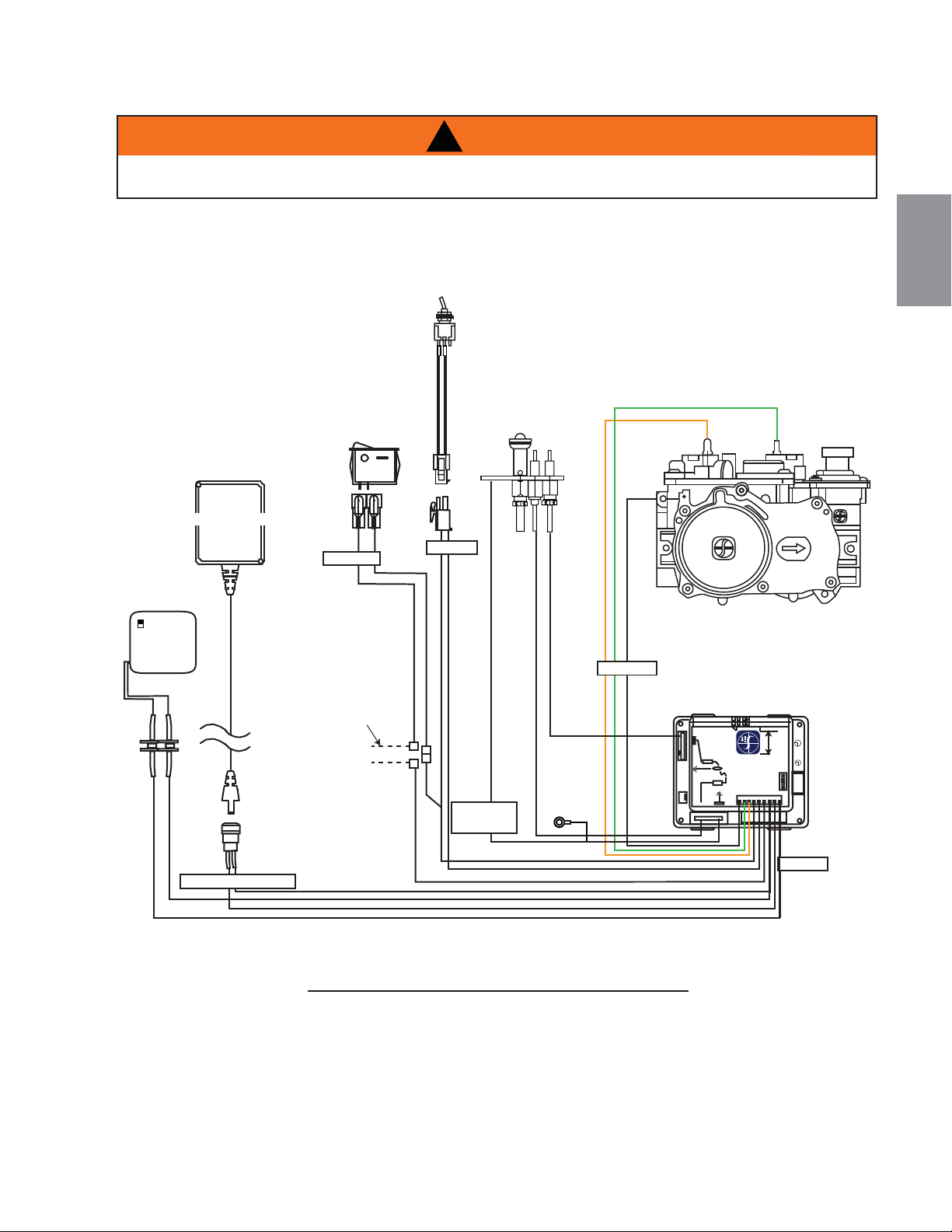
FR
105
W415-1335 / B / 10.04.16
8.3 SCHÉMA DE CÂBLAGE
69.5A
!
AVERTISSEMENT
NE RACCORDEZ PAS L’INTERRUPTEUR MURAL OU LA SOUPAPE DE GAZ À L’ALIMENTATION
ÉLECTRIQUE (110 VOLTS)
INTERRUPTEUR
MARCHE/ARRÊT
INTERRUPTEUR
ACS/IPI
(OPTIONNEL)
SUPPORT
DE PILES
MISE À LA
TERRE
DFC
SOUPAPE
ORANGE
VERT
ANNEAU
DE MISE
À LA
TERRE
ON / OFF
IPI / CPI
DÉBRANCHEZ CES RACCORDS
DE L’INTERRUPTEUR
MARCHE/ARRÊT. BRANCHEZ-
LES AU THERMOSTAT
OPTIONNEL OU LE
TÉLÉCOMMANDE ET SI
PERMIS AVEC CETTE
APPAREIL UN ADAPTATEUR
POUR ÉVENT-B.
PANNEAU IPI
ALIMENTATION CC
TRANSFORMATEUR
SOUPAPE
ÉLECTRONIQUE
CONTRÔLE
NUMÉRIQUE DU
BRÛLEUR
AVEC LES ADAPTATEURS POUR ÉVENT-B, L’INTERRUPTEUR D’ÉCOULEMENT DOIT ÊTRE BRANCHÉ
EN SÉRIE AVEC L’INTERRUPTEUR ACTUEL OU L’INTERRUPTEUR MURAL OPTIONNEL, LE THERMO-
STAT OU LE SYSTÈME DE TÉLÉCOMMANDE.
OFF ON
Cet appareil est équipé d’un système de dépannage à piles. Si le système de dépannage à piles est utilisé,
installez quatre piles AA (non fournies) dans le support et branchez-le au harnais de fi ls. Placez-le près
du panneau IPI. Branchez le support à piles au harnais de fi ls avant d’utiliser l’appareil. Placez-le près du
panneau IPI. Si le système de dépannage à piles est utilisé, il doit être branché au bloc-piles 6 volts fourni.
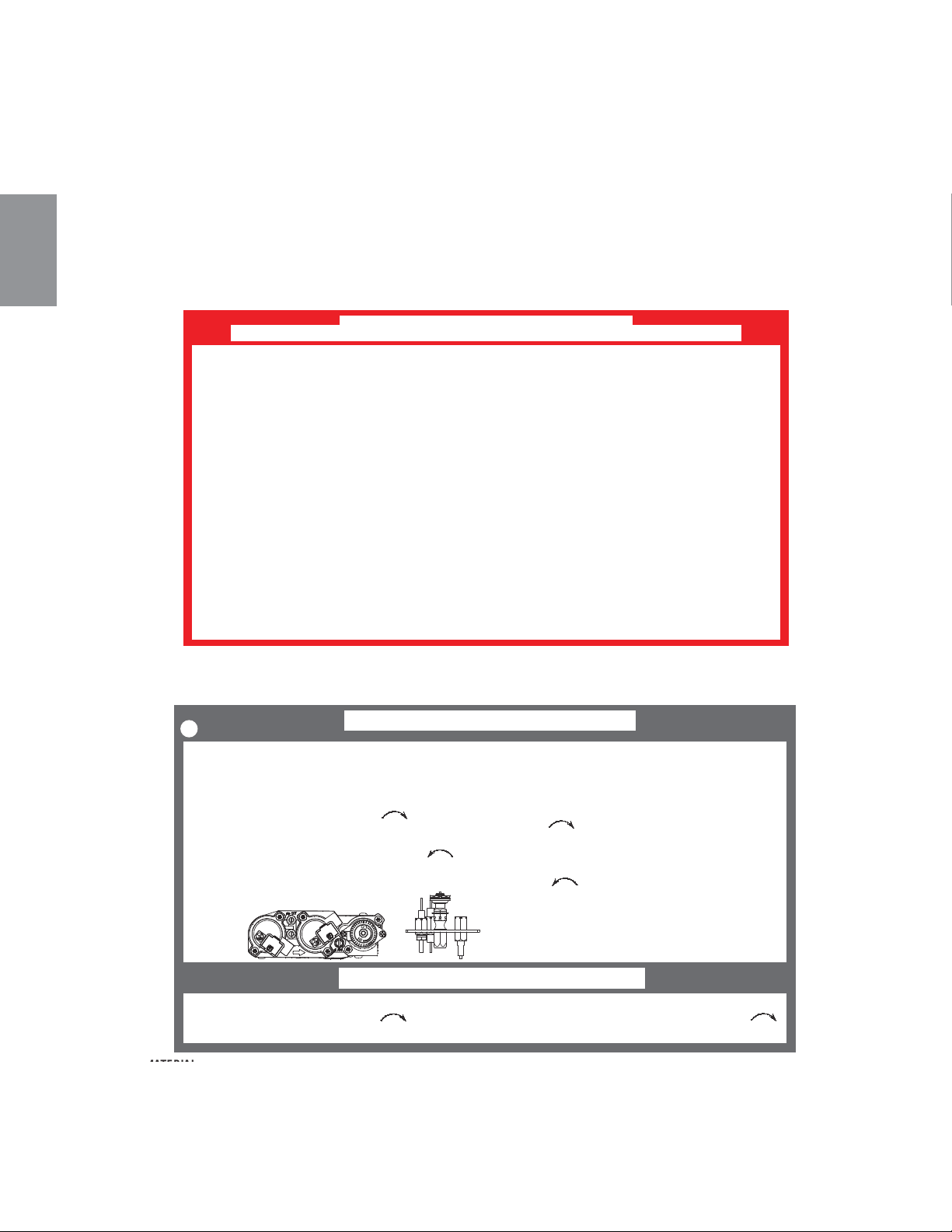
FR
LIGHTING INSTRUCTIONS / INSTRUCTIONS D’ALLUMAGE
1. STOP! READ ALL INFORMATION OF OPERATING AND LIGHTING
INSTRUCTIONS BEFORE PROCEEDING.
2. TURN OFF ELECTRIC POWER TO THE FIREPLACE.
3. THIS FIREPLACE IS EQUIPPED WITH AN IGNITION DEVICE WHICH
AUTOMATICALLY LIGHTS THE PILOT. DO NOT TRY TO LIGHT THE PILOT
BY HAND.
4. OPEN THE GLASS DOOR.
5.
TURN MANUAL SHUTOFF VALVE CLOCKWISE TO OFF.
6. WAIT FIVE (5) MINUTES TO CLEAR OUT ANY GAS. IF YOU SMELL GAS
INCLUDING NEAR THE FLOOR,
STOP! FOLLOW “B” OF THE OPERATING
INSTRUCTIONS. IF YOU DON’T SMELL GAS GO TO THE NEXT STEP.
7. TURN MANUAL SHUTOFF VALVE COUNTER-CLOCKWISE TO ON.
8. CLOSE THE GLASS DOOR.
9. TURN ON ALL ELECTRIC POWER TO THE FIREPLACE.
10.
TURN ON MAIN BURNER.
1. ARRÊTEZ! LISEZ TOUTES LES INSTRUCTIONS DE
FONCTIONNEMENT ET D’ALLUMAGE AVANT DE CONTINUER.
2. COUPEZ L’ALIMENTATION ÉLECTRIQUE À L’APPAREIL.
3. CET APPAREIL EST MUNI D’UN DISPOSITIF D’ALLUMAGE QUI
ALLUME LA VEILLEUSE AUTOMATIQUEMENT, N’ESSAYEZ PAS
D’ALLUMER LA VEILLEUSE MANUELLEMENT.
4.
OUVREZ LA PORTE VITRÉE.
5.
TOURNEZ LA SOUPAPE DE SECTIONNEMENT MANUELLE VERS LA
DROITE A “OFF”.
6.
ATTENDEZ CINQ (5) MINUTES POUR QUE LE GAZ PUISSE
S’ÉCHAPPER. SI VOUS DÉTECTEZ UNE ODEUR DE GAZ, ARRÊTEZ!
SUIVEZ « B » DANS LES INSTRUCTIONS DE FONCTIONNEMENT.
S’IL N’Y A PAS D’ODEUR DE GAZ, PASSEZ À L’ÉTAPE SUIVANTE.
7. TOURNEZ LA SOUPAPE DE SECTIONNEMENT MANUELLE VERS LA
GAUCHE A “ON”.
8. FERMEZ LA PORTE VITRÉE.
9. RÉTABLISSEZ L’ALIMENTATION ÉLECTRIQUE AU FOYER.
10. ALLUMEZ LE BRÛLEUR PRINCIPAL.
1.
TURN OFF ALL ELECTRICAL POWER TO THE FIREPLACE IF SERVICE IS
TO BE PERFORMED.
2. TURN MANUAL SHUTOFF VALVE CLOCKWISE TO OFF. DO NOT
FORCE.
1. COUPEZ L’ALIMENTATION ÉLECTRIQUE AU FOYER SI UN TRAVAIL
D’ENTRETIEN DOIT SE FAIRE.
2. TOURNEZ LA SOUPAPE D’ARRÉT MANUELLE VERS LA DROITE
À “OFF” NE FORCEZ PAS.
TO TURN OFF GAS / INSTRUCTIONS POUR COUPER LE GAZ
MATERIAL
WARNING: DO NOT TURN ON IF CHILDREN OR OTHER AT RISK
INDIVIDUALS ARE NEAR THE FIREPLACE. IF YOU DO NOT FOLLOW THESE
INSTRUCTIONS EXACTLY, A FIRE OR EXPLOSION MAY RESULT CAUSING
PROPERTY DAMAGE, PERSONAL INJURY OR LOSS OF LIFE.
INITIAL LIGHTING OF THE PILOT AND MAIN BURNERS MUST BE DONE
WITH THE GLASS DOOR OFF.
DO NOT CONNECT VALVE OR WALL SWITCH TO ELECTRICITY. SEE
INSTALLATION INSTRUCTIONS.
A. THIS FIREPLACE IS EQUIPPED WITH AN IGNITION DEVICE WHICH AUTOMATICALLY
LIGHTS THE PILOT. DO NOT TRY TO LIGHT BY HAND.
B. BEFORE OPERATING SMELL ALL AROUND THE FIREPLACE AREA FOR GAS AND NEXT TO
THE FLOOR BECAUSE SOME GAS IS HEAVIER THAN AIR AND WILL SETTLE ON THE
FLOOR.
WHAT TO DO IF YOU SMELL GAS:
• TURN OFF ALL GAS TO THE FIREPLACE.
• OPEN WINDOWS.
• DO NOT TRY TO LIGHT ANY APPLIANCE.
• DO NOT TOUCH ANY ELECTRIC SWITCH; DO NOT USE ANY PHONE IN YOUR BUILDING.
• IMMEDIATELY CALL YOUR GAS SUPPLIER FROM A NEIGHBOUR’S PHONE. FOLLOW THE
GAS SUPPLIER’S INSTRUCTIONS.
• IF YOU CANNOT REACH YOUR GAS SUPPLIER, CALL THE FIRE DEPARTMENT.
C. DO NOT TRY TO REPAIR ANY PART OF THIS ASSEMBLY. CALL A QUALIFIED SERVICE
TECHNICIAN. FORCE OR ATTEMPTED REPAIR MAY RESULT IN A FIRE OR EXPLOSION.
D. DO NOT USE THIS FIREPLACE IF ANY PART HAS BEEN UNDER WATER. IMMEDIATELY
CALL A QUALIFIED SERVICE TECHNICIAN TO INSPECT THE FIREPLACE AND REPLACE
ANY PART OF THE CONTROL SYSTEM AND ANY GAS CONTROL WHICH HAS BEEN UNDER
WATER.
ATTENTION: NE PAS ALLUMER SI DES ENFANTS OU D’AUTRES
INDIVIDUS À RISQUE SONT À PROXIMITÉ DU FOYER. QUICONQUE NE
RESPECTE PAS À LA LETTRE LES INSTRUCTIONS DANS LA PRÉSENTE
NOTICE RISQUE DE DÉCLENCHER UN INCENDIE OU UN EXPLOSION
ENTRAÎNANT DES DOMMAGES, DES BLESSURES OU LA MORT.
L’ALLUMAGE INITIAL DE LA VEILLEUSE ET DU BRÛLEUR PRINCIPAL
DOIT SE FAIRE AVEC LA PORTE VITRÉE ENLEVÉE.
NE RACCORDEZ PAS LA SOUPAPE OU L’INTERRUPTEUR MURAL A
L’ÉLECTRICITÉ. CONSULTEZ LES INSTRUCTIONS D’INSTALLATION.
A. CET APPAREIL EST MUNI D’UN DISPOSITIF D’ALLUMAGE QUI ALLUME
AUTOMATIQUEMENT LA VEILLEUSE. NE TENTEZ PAS D’ALLUMER LA VEILLEUSE
MANUELLEMENT.
B. AVANT DE FAIRE FONCTIONNER, RENIFLEZ TOUT AUTOUR DE L’APPAREIL POUR
DÉCELER UN ODEUR DE GAZ. RENIFLEZ PRÈS DU PLANCHER, CAR CERTAINS GAZ
SONT PLUS LOURDS QUE L’AIR ET PEUVENT S’ACCUMULER AU NIVEAU DU SOL.
QUE FAIRE SI VOUS DÉTECTEZ UNE ODEUR DE GAZ:
• COUPEZ L’ALIMENTATION DE GAZ PRINCIPALE.
• OUVREZ LES FENETRES.
• NE PAS TENTER D’ALLUMER D’APPAREIL.
• NE TOUCHEZ À AUCUN INTERRUPTEUR; NE PAS VOUS SERVIR DES TÉLÉPHONES SE
TROUVANT DANS LE BÂTIMENT.
• APPELEZ IMMÉDIATEMENT VOTRE FOURNISSEUR DE GAZ DEPUIS UN VOISIN.
SUIVEZ LES INSTRUCTIONS DU FOURNISSEUR.
• SI VOUS NE POUVEZ REJOINDRE LE FOURNISSEUR APPELEZ LE SERVICE DES
INCENDIES.
C. N’ESSAYEZ PAS DE RÉPARER AUCUNE PIÈCE DE CET ASSEMBLAGE. APPELEZ UN
TECHNICIEN QUALIFIÉ. FORCER OU TENTER DE RÉPARER L’ASSEMBLAGE POURRAIT
CAUSER UN FEU OU UNE EXPLOSION.
D. N’UTILISEZ PAS CET APPAREIL S’IL A ÉTÉ PLONGÉ DANS L’EAU, MÊME
PARTIELLEMENT. FAITES INSPECTER L’APPAREIL PAR UN TECHNICIEN QUALIFIÉ ET
REMPLACEZ TOUTE PARTIE DU SYSTÈME DE CONTRÔLE ET TOUTE COMMANDE QUI
ONT ÉTÉ PLONGÉS DANS L’EAU.
OPERATING INSTRUCTIONS / INSTRUCTIONS D’OPERATION
FOR YOUR SAFETY READ BEFORE OPERATING / POUR VOTRE SÉCURITÉ LIRE AVANT DE FAIRE FONCTIONNER
W385-0460 / D
D
106
W415-1335 / B / 10.04.16
9.0 INSTRUCTIONS DE FONCTIONNEMENT
Lorsqu’il est allumé pour la première fois, l’appareil dégagera une légère odeur pendant quelques heures.
Cela est une condition normale temporaire causée par la cuisson de la peinture et l’évaporation des lubrifi ants
internes utilisés dans le processus de fabrication; elle ne se reproduira plus. Après de longues périodes sans
utiliser l’appareil, comme à la suite de vacances ou à la fi n de l’été, il se peut qu’une légère odeur se dégage
pendant quelques heures. Ceci est causé par des particules de poussière brûlant dans l’échangeur de chal-
eur. Dans les deux cas, ouvrez une fenêtre pour aérer la pièce.
9.1 INSTRUCTIONS DE FONCTIONNEMENT - POUR VOTRE SÉCURITÉ, LISEZ CE
QUI SUIT AVANT D’ALLUMER L’APPAREIL
9.2 INSTRUCTIONS D’ALLUMAGE
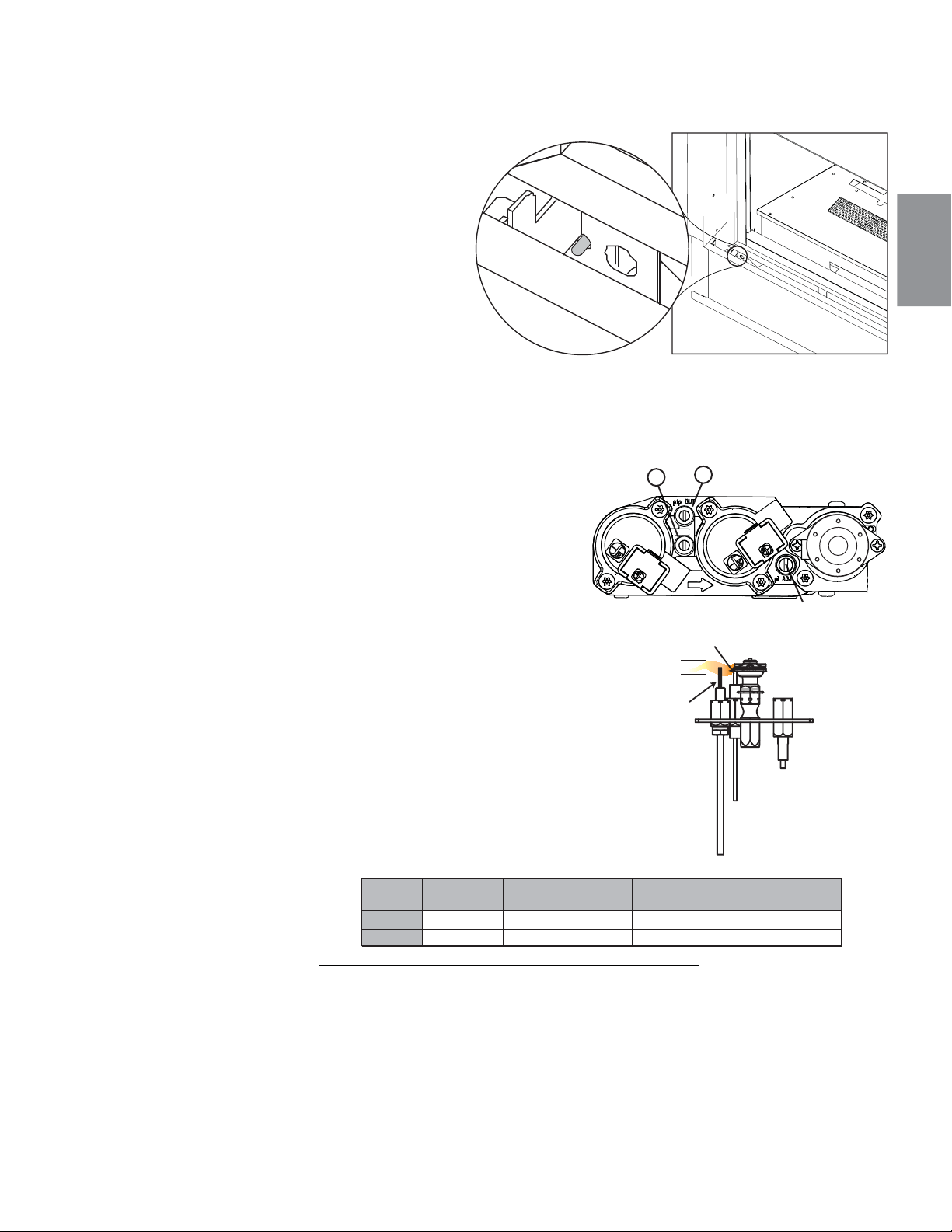
FR
Ajustez la vis de la veilleuse pour obtenir une fl amme de taille
normale. Tournez vers la droite pour réduire l’apport de gaz.
VÉRIFIER LA PRESSION :
Pour vérifi er la pression d’arrivée, tournez la vis (A) vers la
gauche deux à trois tours, puis emboîtez le tube du manomètre
sur la pointe d’essai. Le manomètre doit indiquer la pression
comme décrit sur le diagramme ci-dessous. Vérifi er la pression
avec brûleur principal sur « HI ».
La vérifi cation de la pression de sortie s’effectue comme ci-
dessus en utilisant la vis (B). Le manomètre doit indiquer la
pression comme décrit sur le diagramme ci-dessous. Vérifi er
la pression avec brûleur principal sur « HI ».
APRÈS AVOIR PRIS LA LECTURE DES PRESSIONS,
ASSUREZ-VOUS DE TOURNER FERMEMENT LES VIS
VERS LA DROITE POUR SCELLER. NE SEREZ PAS TROP FORT.
Vérifi ez pour des fuites en apliquant une solution d’eau savonneuse.
Avant d’effectuer le réglage de la veilleuse, assurez-vous que l’assemblage de la
veilleuse n’a pas été peint. S’il y a des traces de peinture ou de surpulvérisation,
enlevez-les de l’assemblage de la veilleuse ou remplacez-le. Une toile d’émeri
ou un tampon récurage (comme Scrotch-Brite™) peut être utilisé pour enlever la
peinture sur la hotte de la veilleuse, sur l’électrode et sur le capteur de fl amme.
39.1D
A
B
VIS DE LA VEILLEUSE
Pression
Gaz Naturel
(pouces)
Gaz Naturel
(millibars)
Propane
(pouces)
Propane
(millibars)
Arrivée *7” (min.4,5”) 17,4 mb (min.11,2mb) 13” (min.11”) 32,4 mb(min.27,4mb)
Sortie 3,5” 8,7 mb 10” 24,9 mb
3/8” - 1/2”
(9,5mm - 12,7mm)
LA FLAMME DOIT
ENVELOPPER LA PARTIE
SUPÉRIEURE DE LA SONDE
DE FLAMME DE 3/8” (9,5mm)
À 1/2” (12,7mm)
ÉLECTRODE
LA SONDE
DE FLAMME
VEILLEUSE
* Pression d’alimentation
maximale ne devait ne
pas dépasser 13”
107
W415-1335 / B / 10.04.16
9.3 L’INTERRUPTEUR ANTICONDENSATION (OPTIONNEL)
Cet appareil a la possibilité de passer d’un mode de veilleuse
électronique à allumage intermittent à un mode de
veilleuse permanente pour les climats froids.
L’interrupteur anticondensation (veilleuse
permanente) est situé au centre du panneau
de commande. Avec votre doigt, basculez
l’interrupteur vers le haut pour le mode veilleuse
permanente ou vers le bas pour le mode
allumage intermittent de la veilleuse.
10.0 RÉGLAGES
10.1 RÉGLAGE DE LA VEILLEUSE
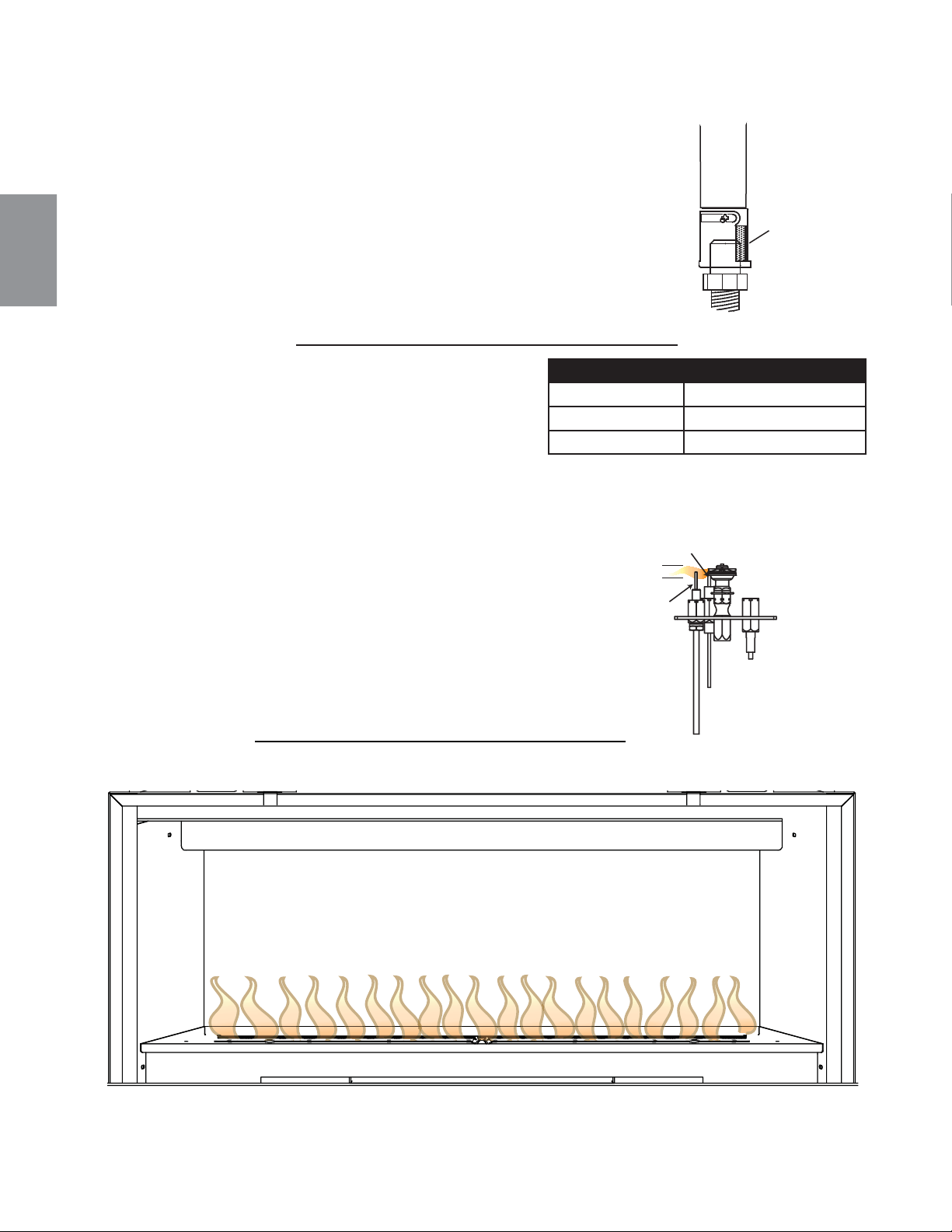
TABLEAU DE RÉGLAGE DU VENTURI
COMBUSTIBLE LHD45
GN 1/32” (0,8mm)
PL 1/8” (3,2mm)
10.3 CARACTÉRISTIQUES DE LA FLAMME
FR
L’ouverture du volet d’air a été préréglée en usine selon le tableau
ci-dessous :
Indépendamment de l’orientation du venturi, plus le volet est fermé,
plus la flamme est jaune et aura tendance à causer des dépôts de
carbone. Plus le volet est ouvert, plus la flamme est bleue et plus elle a
tendance à se détacher des orifices du brûleur. La flamme peut ne pas
être jaune immé-diatement; allouez de 15 à 30 minutes pour que la
couleur finale de la flamme se stabilise.
LE RÉGLAGE DU VOLET D’AIR DOIT ÊTRE EXÉCUTÉ PAR UN
TECHNICIEN OU INSTALLATEUR QUALIFIÉ!
VENTURI
INJECTEUR
49.1
OUVERTURE
DU VOLET
D’AIR
10.2 RÉGLAGE DU VENTURI
3/8” - 1/2”
(9,5mm - 12,7mm)
LA FLAMME DOIT
ENVELOPPER LA PARTIE
SUPÉRIEURE DE LA SONDE
DE FLAMME DE 3/8” (9,5mm)
À 1/2”
(
12,7mm
)
ÉLECTRODE
LA SONDE
DE FLAMME
VEILLEUSE
54.1B
Il est important d’effectuer périodiquement une inspection visuelle de la fl amme de la veilleuse et du brûleur.
Comparez-les à ces illustrations. Si des fl ammes paraissent anormales,
contactez un technicien de service.
108
W415-1335 / B / 10.04.16
11.0 ENTRETIEN
11.1 ENTRETIEN ANNUEL
FR
Assurez-vous que l’appareil fonctionne adéquatement une fois l’entretien terminé. Cet appareil et son système
d’évacuation devraient être inspectés avant la première utilisation et au moins une fois l’an par un technicien
de service qualifi é. Les vérifi cations suggérées doivent être effectuées par un technicien qualifi é. L’espace
entourant l’appareil doit être gardé propre et libre de matériaux combustibles, d’essence ou autres liquides et
vapeurs infl ammables. Les apports d’air comburant et d’air de convection ne doivent pas être obstrués.
ATTENTION : Lors de l’entretien des contrôles, assurez-vous d’identifi er chacun des fi ls avant de les
débrancher. Une réinstallation incorrecte des fi ls peut occasionner un mauvais fonctionnement et être
dangereuse.
A. Pour nettoyer le brûleur principal et la veilleuse adéquatement, il faut retirer les bûches, les roches ou
la vitre afi n de dégager les deux ensembles.
B. Gardez le compartiment des contrôles, les composants décoratifs, le brûleur, le volet d’air et l’espace
entourant les bûches propres en brossant ou en passant l’aspirateur au moins une fois l’an.
C. Assurez-vous que tous les orifi ces des brûleurs produisent des fl ammes. Nettoyez tous les orifi ces qui
n’ont pas de fl amme ou dont la fl amme ne brûle pas adéquatement.
D. Assurez-vous que la fl amme de la veilleuse est assez puissante pour envelopper la sonde de fl amme
et/ou le thermocouple/thermopile et qu’elle atteigne le brûleur.
E. Remettez en place les bûches, les roches ou la vitre nettoyées, si équipé. Omettre de positionner les
composants décoratifs adéquatement peut causer des dépots de carbone qui peuvent se déposer à
l’intérieure de la chambre de combustion et sur les surfaces extérieures entourant d’évent.
F. Vérifi ez si le brûleur principal allume sur tous les orifi ces lorsque le bouton de contrôle du gaz est à
« ON ». Un temps d’allumage total de 5 à 10 secondes est satisfaisant. Service selon les besoins.
G. Vérifi ez si les joints d’étanchéité sur les côtés, le haut et le bas de la porte ne sont pas brisés ou
manquants. Remplacez si nécessaire.
H. Si pour une raison quelconque le système d’évents de prise d’air est démonté, réinstallez et rescellez-
le selon les instructions fournies dans l’installation initiale.
I. Il est possible que l’écran de protection (pare-étincelles) nécessite un nettoyage occasionnel en raison
des peluches/poussières provenant des tapis, des animaux, etc. il suffi t de passer l’aspirateur à l’aide
de l’embout avec une brosse.
J. Vérifi ez si le système de décharge effectue effi cacement. Vérifi ez si les joints d’étanchéité ne sont pas
brisés ou manquants. Remplacez si nécessaire.
40.1E
!
AVERTISSEMENT
COUPEZ L’ALIMENTATION EN GAZ ET L’ALIMENTATION ÉLECTRIQUE AVANT DE PROCÉDER À
L’ENTRETIEN DE L’APPAREIL.
L’APPAREIL PEUT ÊTRE CHAUD. ATTENDEZ QU’IL SOIT REFROIDI AVANT D’EN FAIRE L’ENTRETIEN.
N’UTILISEZ PAS DE PRODUITS ABRASIFS.
NE PEINTURE PAS L’ASSEMBLAGE DU VEILLEUSE.
109
W415-1335 / B / 10.04.16
LE CAISSON DEVIENT TRÈS CHAUD LORS DU FONCTIONNEMENT. LAISSEZ L’APPAREIL SE
REFROIDIR COMPLÈTEMENT OU PORTEZ DES GANTS ANTICHALEUR AVANT D’EFFECTUER
L’ENTRETIEN.
NE JAMAIS ASPIRER DES BRAISES QUI SONT CHAUDES.
NE PEINTUREZ PAS L’ASSEMBLAGE DE LA VEILLEUSE.
!
AVERTISSEMENT
• Cet appareil nécessite un entretien qui devra être effectué sur une base annuelle.
• L’entretien devrait inclure un nettoyage, le remplacement des piles, une inspection du système d’évent,
du brûleur, des éléments décoratifs internes et de la chambre de combustion. Consultez la section pour
l’enlèvement de la porte et retirez la porte comme indiqué.
• Enlevez soigneusement les éléments décoratifs internes s’il y a lieu (bûches, braises de verre, panneaux
de brique, etc.)
• À l’aide d’un aspirateur muni d’une brosse souple, aspirez les saletés, les débris et les dépôts de
carbone sur les bûches, la chambre de combustion et le brûleur. Pour les braises de verre, suivez les
instructions de prénettoyage.
• Enlevez aussi tout dépôt se trouvant sur l’assemblage de la veilleuse et aussi, s’il y a lieu, sur la
thermo
p
ile, le thermocou
p
le, le ca
p
teur de fl amme et l’allumeur.
NOTE: Vous devrez netto
y
er le ca
p
teur
11.2 REMPLACEMENT DE LA VITRE/PORTE
!
WARNING
DO NOT USE SUBSTITUTE MATERIALS.
GLASS MAY BE HOT, DO NOT TOUCH GLASS UNTIL COOLED.
CARE MUST BE TAKEN WHEN REMOVING AND DISPOSING OF ANY BROKEN DOOR GLASS OR
DAMAGED COMPONENTS. BE SURE TO VACUUM UP ANY BROKEN GLASS FROM INSIDE THE
APPLIANCE BEFORE OPERATION.
DO NOT STRIKE, SLAM OR SCRATCH GLASS. DO NOT OPERATE APPLIANCE WITH GLASS
REMOVED, CRACKED, BROKEN OR SCRATCHED.
56.1C
Replacement glass/frame assembly shall be replaced as a complete unit as supplied by the
appliance manufacturer.
11.3 SOINS DE LA VITRE
FR
110
W415-1335 / B / 10.04.16
5.4
NE PAS NETTOYER LA VITRE LORSQU’ELLE EST CHAUDE! N’EMPLOYEZ PAS DE DÉTERGENTS
ABRASIFS POUR NETTOYER LA VITRE.
Polissez légèrement à l’aide d’un linge propre et sec pour
enlever la poussière et les traces de doigts. Nettoyez la vitre
avec un nettoyant recommandé après les dix premières
heures de fonctionnement. NOTE : Les nettoyants à
base de vinaigre ou sans ammoniaque procurent
habituellement une surface propre et sans traces. Par
la suite, nettoyez aussi souvent qu’il le faudra, sinon la vitre
risque de rester marquée en permanence.
Ne touchez pas la surface intérieure de la vitre avec des lames de rasoir, de la laine d’acier ou d’autres
objets métalliques puisque la mince couche de métal retirée de l’objet pourrait se déposer sur le revêtement
causant une décoloration ou une égratignure. De telles marques ne peuvent être enlevées en utilisant les
procédés de nettoyage habituels, elles exigent des procédés spéciaux.
Contactez votre détaillant local autorisé pour les instructions de nettoyage complètes.
LA VITRE CHAUDE CAUSERA
DES BRÛLURES.
NE PAS TOUCHER LA VITRE
AVANT QU’ELLE AIT REFROIDI.
NE JAMAIS LAISSER LES
ENFANTS TOUCHER LA VITRE.
!
AVERTISSEMENT
37.1E
ppp
yp
de fl amme à l’aide d’une morceau de de laine d’acier ou un tampon récurage (Scotch-Brite™) afi n de
retirer toute trace d’oxydation. Nettoyez l’assemblage du pilote à
l’aide d’un aspirateur muni d’une
brosse souple.
Il est important de ne pas peinturer l’assemblage de la veilleuse.
• Inspectez tous les joints d’étanchéité accessibles et remplacez-les au besoin.
• Accédez à la souffl erie, s’il y a lieu, puis nettoyez à l’aide d’une brosse souple et d’un aspirateur.
• Réinstallez tous les composants dans l’ordre inverse.
• Inspectez le système de surpression. L’appareil dissipe la pression par la porte vitrée ou par les clapets
sur le dessus du caisson. Assurez-vous qu’ils ouvrent sans restriction et qu’ils ferment de façon étanche.
• Vérifi ez si la soupape de gaz de la veilleuse et les boutons Hi / Lo bougent librement (s’il y a lieu) -
remplacez si vous constatez de la rigidité dans le mouvement.
• Vérifi ez tous les branchements du gaz pour des fuites de gaz, en amont et en aval de la soupape de gaz
incluant les connexions du tube de la veilleuse.
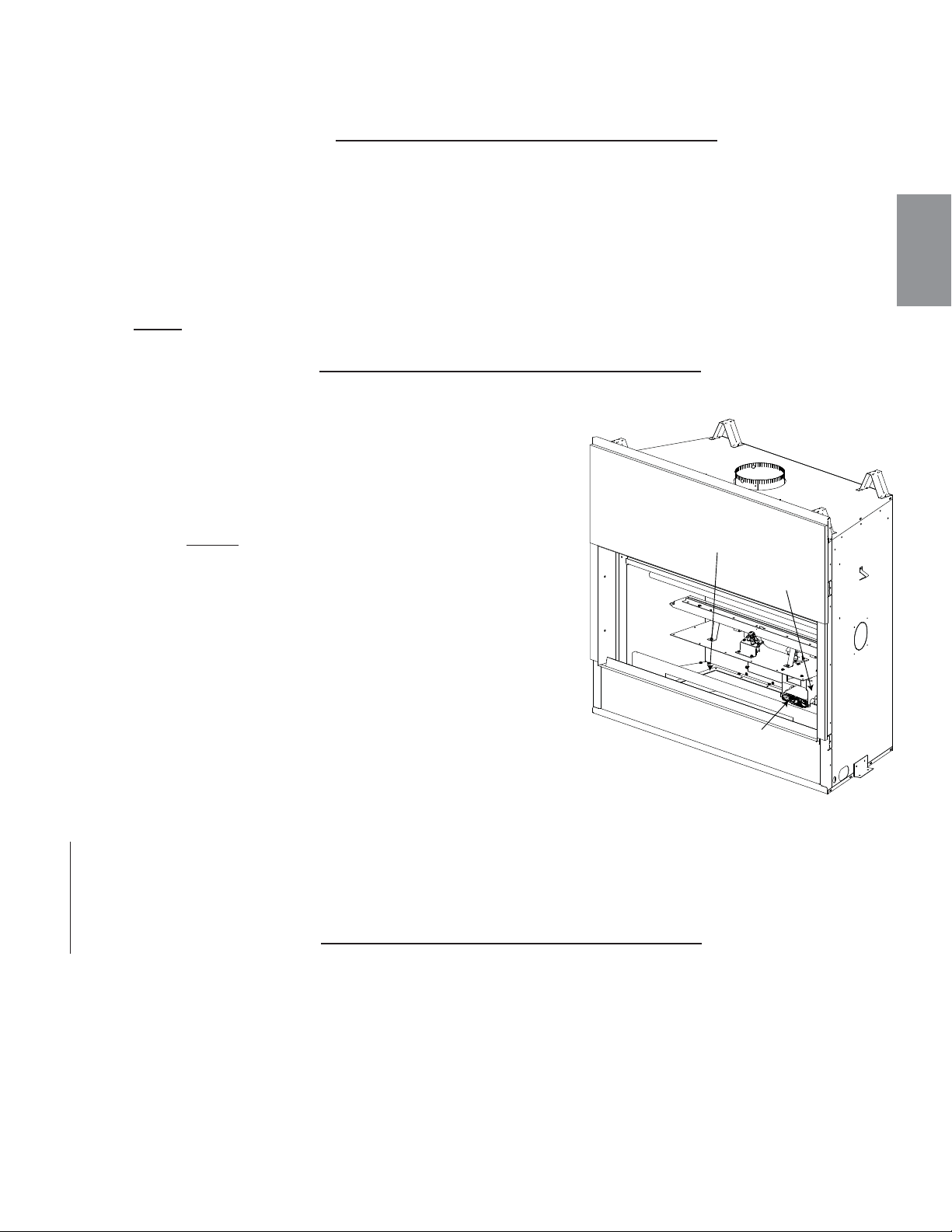
11.4 SOINS DES PIÈCES PLAQUÉES
11.5 ENLÈVEMENT DE LA SOUPAPE
11.6 PLAQUE DE RESTRICTION
5.5.1A
L’appareil est muni d’une 5mm en verre céramique Remplacez uniquement avec une pièce pour le foyer
disponible chez votre détaillant autorisé. N’UTILISEZ PAS DE MATÉRIAUX SUBSTITUTS.
FR
6.1
Si l’appareil est muni de pièces plaquées, vous devez enlever toutes traces de doigts ou autres marques
des surfaces plaquées avant d’allumer l’appareil pour la première fois. Utilisez un nettoyant à vitres ou du
vinaigre et un linge pour nettoyer. Si la surface plaquée n’est pas bien nettoyée avant le premier allumage de
l’appareil, elle risque de rester marquée en permanence. Une fois que la surface plaquée aura chauffé, les
traces de doigts et le gras n’affecteront plus la surface et très peu d’entretien sera requis; vous n’aurez qu’à
l’essuyer au besoin. Une combustion prolongée à haute température avec la porte ouverte peut causer une
décoloration des pièces plaquées.
NOTE: L’emballage de protection sur les pièces plaquées s’enlève mieux lorsque l’assemblage est
à température ambiante ou lorsqu’il est chauffé avec un séchoir à cheveux ou une autre source de
chaleur similaire.
77.3
C
ertaines con
fi
gurations d’évacuation verticales peuvent avoir une
fl
amme très active.
S
i cette apparence
n’est pas désirée, la sortie du conduit d’évacuation doit être réduite en utilisant une plaque de restriction. Pour
obtenir l’ensemble approprié, voir les « ACCESSOIRES » à la section « RECHANGES ». Ceci diminuera la
vélocité des gaz de combustion, ralentissant ainsi le mouvement de la fl amme et créant une apparence plus
traditionnelle. Les instructions sont incluses avec l’ensemble.
111
W415-1335 / B / 10.04.16
A. Soulevez soigneusement l’assemblage de la
soupape et fermez la soupape d’arrêt manuel. Voir
les sections « ASSEMBLAGE DE LA SOUPAPE » et
« BRANCHEMENT DU GAZ ».
NOTE : Un nouveau joint d’étanchéité pourrait être
nécessaire lorsque vous réinstallez l’assemblage de
la soupape; contactez votre détaillant autorisé.
B. Débranchez le raccord fl exible de la soupape. Enlevez
les fi ls de connexion à la soupape en les identifi ant pour
faciliter le rebranchement.
C. Retirez les quatre vis du support de la soupape et
enlevez la soupape.
D. Remettez en place tous les composants avant de
réutiliser l’appareil.
E. Vérifi ez pour des fuites de gaz en appliquant une solution
d’eau savonneuse.
SOUPAPE
SUPPORT DE
LA SOUPAPE
JOINT
D’ÉTANCHÉITÉ
12.0 REPLACEMENTS
FR
41.1C
Contactez votre détaillant pour les questions concernant les prix et la disponibilité des pièces de
rechange. Normalement, toutes les pièces peuvent être commandées chez votre détaillant autorisé.
POUR UN REMPLACEMENT DE PIÈCE SOUS GARANTIE, UNE PHOTOCOPIE DE LA
FACTURE ORIGINALE SERA REQUISE AFIN DE POUVOIR HONORER LA DEMANDE.
Lorsque vous commandez des pièces, donnez toujours l’information suivante :
• Modèle et numéro de série de l’appareil
• Date d’installation de l’appareil
• Numéro de la pièce
• Description de la pièce
• Fini
PIÈCES, NUMÉRO DES PIÈCES ET SI’IL SOIT DISPONIBILITÉ PEUT CHANGER SANS PRÉAVIS.
PARTIES IDENTIFIÉES COMME GARNIE SERONT LIVRÉS DANS 2 À 5 JOURS POUR LA
PLUPART DES DESTINATIONS DE LIVRAISON.
PIÈCES NON IDENTIFIÉES QUE STOCKÉS SERONT LIVRÉS DANS UN DÉLAI DE 2 À 4
SEMAINES POUR LA PLUPART DES CAS.
PIÈCES IDENTIFIÉES COMME « SO » SONT COMMANDE SPÉCIALE ET PEUVENT PRENDRE
JUSQU’À 90 JOURS POUR LA LIVRAISON.
OMETTRE DE POSITIONNER LES PIÈCES CONFORMÉMENT À CE MANUEL OU D’UTILISER UNIQUEMENT DES
PIÈCES SPÉCIFIQUEMENT APPROUVÉES POUR CET APPAREIL PEUT CAUSER DES DOMMAGES MATÉRIELS
OU DES BLESSURES CORPORELLES.
!
AVERTISSEMENT
112
W415-1335 / B / 10.04.16
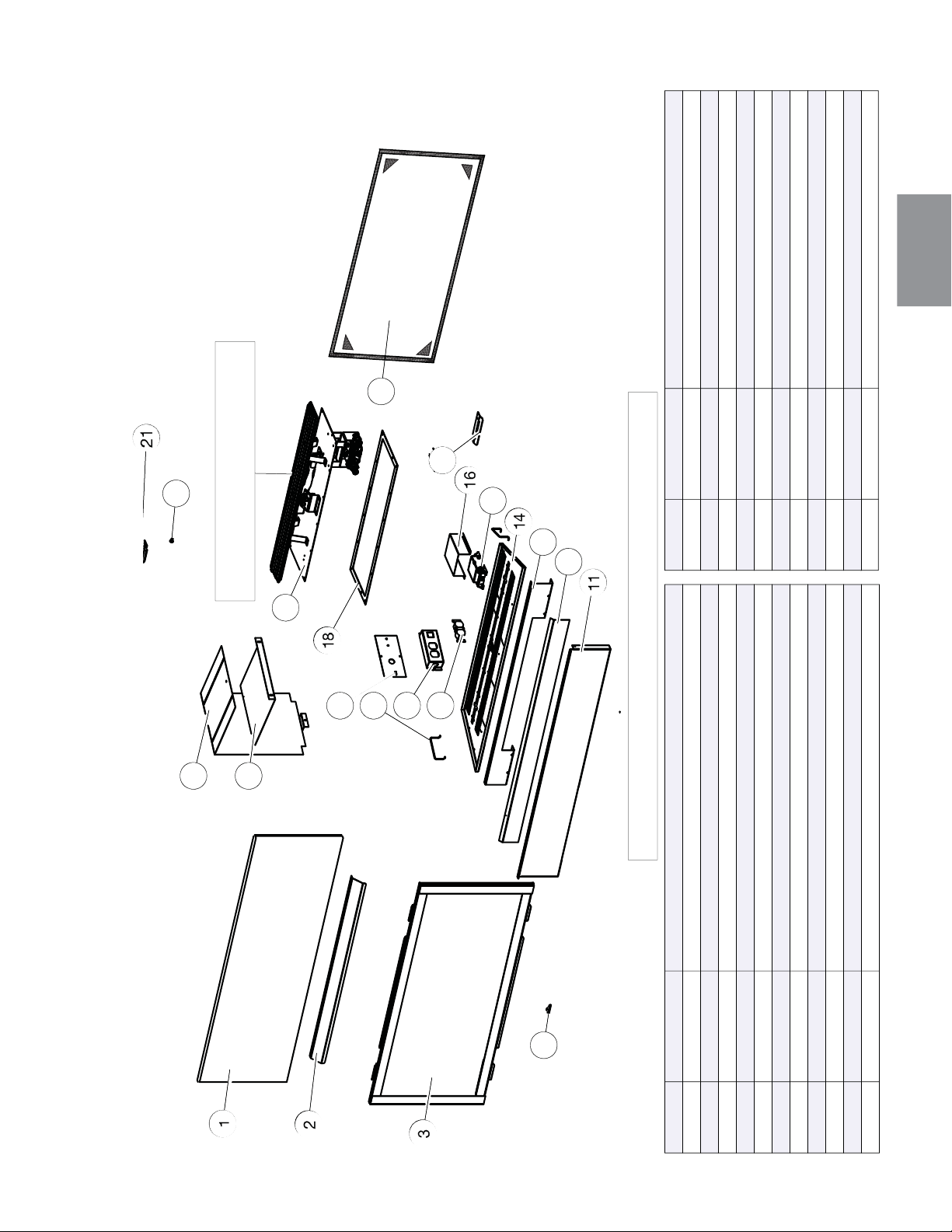
FR
113
W415-1335 / B / 10.04.16
13.0 VUE D'ENSEMBLE
REF. NO.
PART NO. DESCRIPTION
1 W475-0680 PANNEAU DE CIMENT
2 W215-0143 DEFLECTEUR AIR CHAUD
3 W010-2221 ASSEMBLAGE DE LA PORTE
4 W385-0334 LOGO NAPOLÉON
5 W585-0329 PROTECTEUR DE CONDUIT D’ÉVACUATION, SUPÉRIEUR
6 W585-0330 PROTECTEUR DE CONDUIT D’ÉVACUATION, INFÉRIEURE
7 W500-0443 BOÎTE DE JONCTION
8 W325-0057 PLATEAU DE POIGNÉE
(X2)
9 W350-0464 BOÎTIER DU ÉLECTRONIQUE
10 W460-0006 RÉCEPTACLE
11 W200-0317 COUVERTURE DE CONTROLE D'ACCES
22 W562-0062 KIT DE JOINT DE LA PORTE
REF. NO.
PART NO. DESCRIPTION
12 W715-0890 COUVERCLE D’AFFLEURANTES AVANT
13 W655-0341 PLATEAU DU SUPPORT
14 W710-0053 PLATEAU
15 W190-0029 PANNEAU DE CONTRÔLE
16 W585-0331 PANNEAU DE CONTRÔLE DU PROTECTEUR
17 W500-0515 RETENUE DU PORTE (X2)
18 W290-0152 JOINT D’ÉTANCHÉITÉ DE LA SOUPAPE
19 W010-2218 L’ASSEMBLAGE DE LA SOUPAPE (NG)
20 W065-0034 VIS À ÉPAULEMENT (X4)
21 W010-2109 LOQUET DE PORTE (X2)
CES ARTICLES PEUT DIFFÉRER DE CELLE ILLUSTRÉ
1
2
1
2
222
33
44
5
6
8
7
9
15
10
16
21
17
20
14
13
12
11
5
6
8
7
9
15
10
16
21
17
20
14
13
12
11
18
19
18
19
POUR LES PIÉCES DE REMPLACEMENT
VOIR "L’ASSEMBLAGE DE LA SOUPAPE"
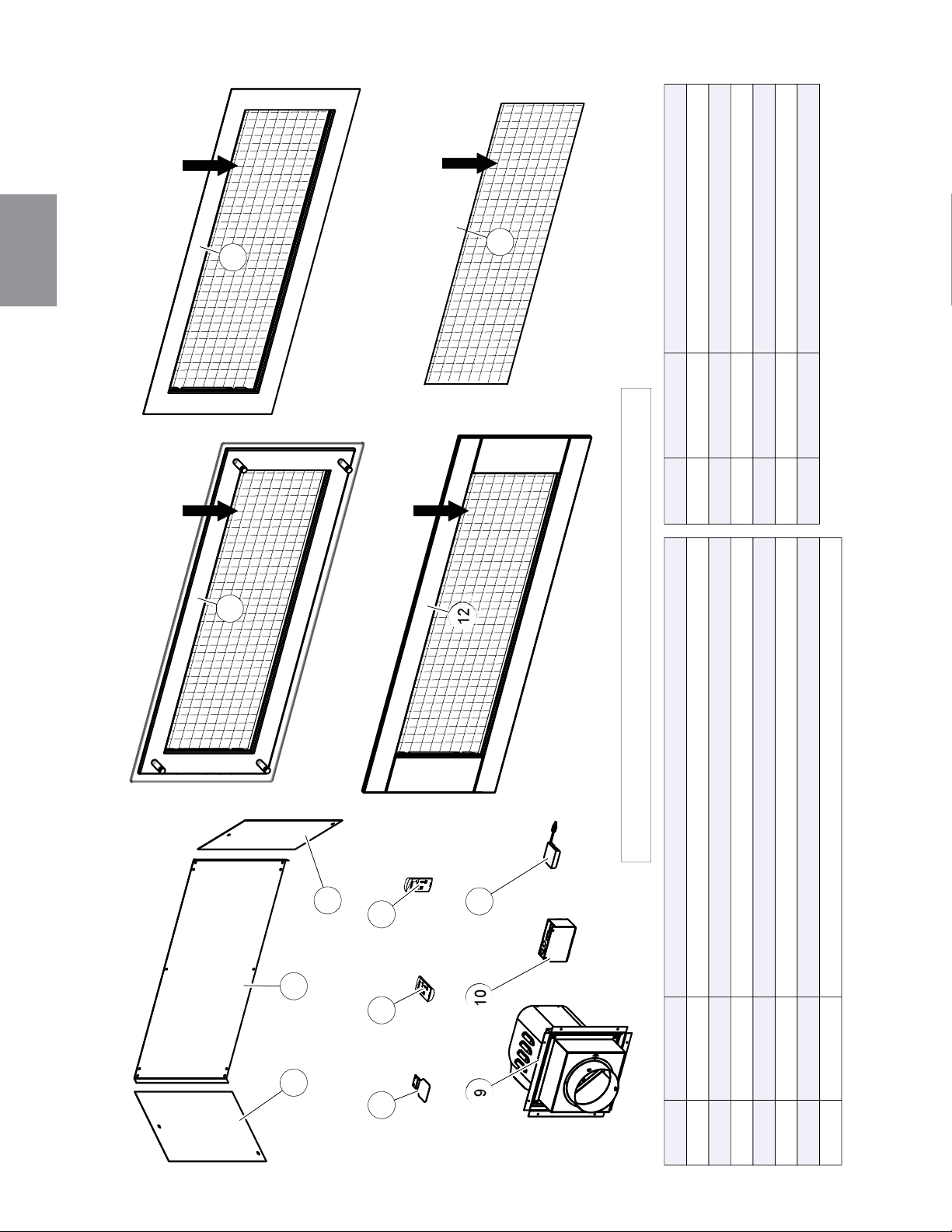
FR
114
W415-1335 / B / 10.04.16
1
10
2
7
11
3
6
4
9
8
5
12
1
10
2
7
11
3
6
4
9
8
5
12
LS45K
LPS45SS
LGFS45
PRP45
REF. # PART # DESCRIPTION
1 W475-0684 PANNEAU DE PORCELAINE DU CÔTÉ GAUCHE (PRP45)
2 W475-0682 PANNEAU DE PORCELAINE DE L’ARRIÈRE (PRP45)
3 W475-0683 PANNEAU DE PORCELAINE DU CÔTÉ DROITE (PRP45)
4 LGF45 CONTOUR LINEAR STYLO
5 LS45K CONTOUR NATURE
L
6
W500-0673 PLAQUE DE RESTRICTION (RP4)
7 F45 / F60 TÉLÉCOMMANDE MANUELLE
REF. # PART # DESCRIPTION
8 W660-0081
THERMOSTAT MURA
L
9 GPV TERMINAISON MÉCANIQUE
10 PVAL45 ADAPTATEUR DE TERMINAISON
11 W350-0702 BOÎTIER DE PILES
12 LPS45SS CONTOUR PREMIUM
13 LDS45 CONTOUR DELUXE
ÉCRAN DE PROTECTION
CES ARTICLES PEUT DIFFÉRER DE CELLE ILLUSTRÉ
ÉCRAN DE PROTECTION
ÉCRAN DE PROTECTION
1313
W565-0138
ÉCRAN DE PROTECTION
14.0 ACCESSORIES
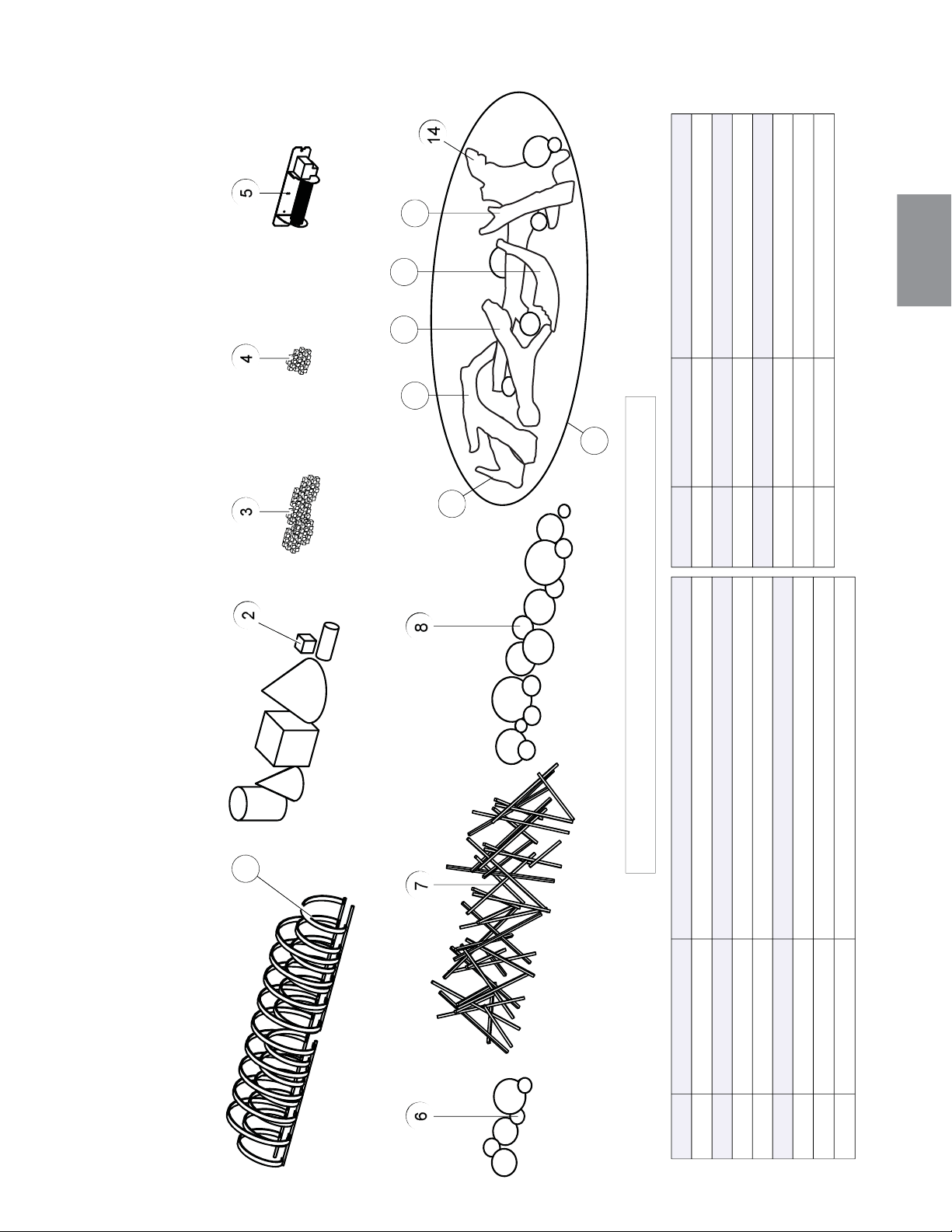
FR
115
W415-1335 / B / 10.04.16
L'ASSEMBLAGE DE BOIS FLOTTÉ
DL45
7
5
6
3
2
4
2
LDAC MEKG
LDNS
REK
DL45
REF. # PART NO. DESCRIPTION
1 LDAC SERPENTIN DÉCORATIF
2 FORMES GEO
3 BRAISES VITRIFIÉES COMPOSANTS DÉCORATIF (DIVERSES COULEURS)
REF. # PART NO. DESCRIPTION
3
4
9
MEKG
MEKR
36
LDNS ENSEMBLE DÉCORATIF DES NICKEL STIX
MEKR
ENSEMBLE DÉCORATIF DES ROCHES
W135-0452 BOIS FLOTTÉ #1 (DL45)
W135-0456
BOIS FLOTTÉ #5 (DL45)
W135-0455 BOIS FLOTTÉ #4 (DL45)
W135-0454 BOIS FLOTTÉ #3 (DL45)
W135-0453 BOIS FLOTTÉ #2 (DL45)
4
10
3
14
4
13
3
15
4
11
4
12
MKGK / MKGB / MKGR
MKGA / MKGC / MKGT
33
MEGK / MEGB / MEGR
MEGA / MEGT
31
W135-0459 BOIS FLOTTÉ #8 (DL45)
BRAISES VITRIFIÉES ENSEMBLE DÉCORATIF (DIVERSES COULEURS)
4
8
4
7
35
GZ550-1KT / B440KT
8
REK ENSEMBLE DÉCORATIF DES ROCHES RIVER
13
11
9
10
12
14
15
GZ550-1KT/B440KT SOUFFLERIE
CES ARTICLES PEUT DIFFÉRER DE CELLE ILLUSTRÉ
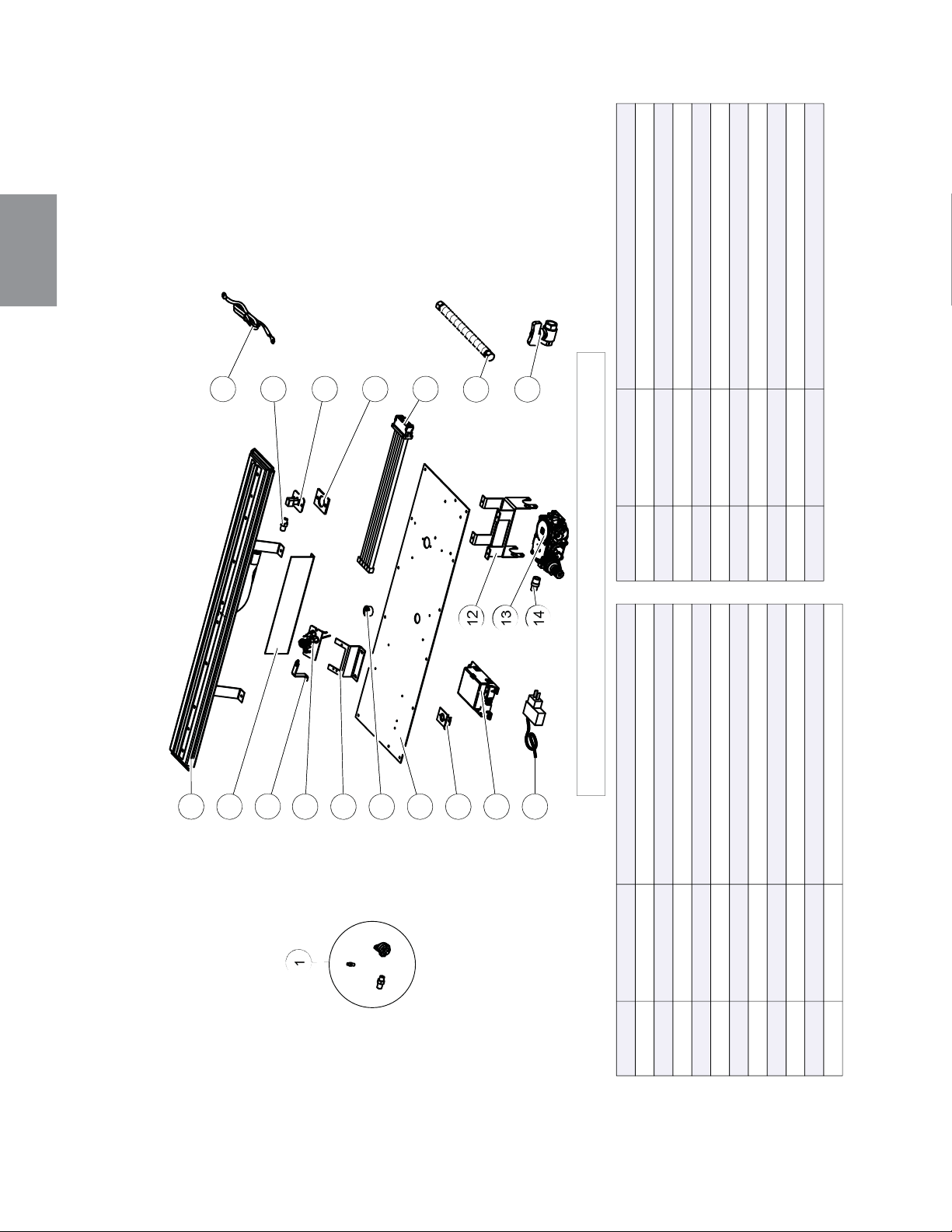
FR
116
W415-1335 / B / 10.04.16
11
15
19
9
14
8
1
13
3
12
7
2
5
16
10
18
6
17
4
21
20
11
15
19
9
14
8
1
13
3
12
7
2
5
16
10
18
6
17
4
21
20
W175-0326
REF. # PART # DESCRIPTION
1 W175-0326 TROUSSE DE CONVERSION (PL)
2 W100-0119 ASSEMBLAGE DE BRÛLEUR
3 W215-0145 DEFLECTEUR D'AIR INFÉRIEURE
4 W080-1305 SUPPORT DE TERRE DE LA VEILLEUSE
5 W010-2763 ASSEMBLAGE DE VEILLEUSE
6 W080-1062 SUPPORT DE VEILLEUSE
7 W105-0001 BAGUE 7/8"
8 W035-0263 BASE DU BRÛLEUR
9 W010-2821 L'ASSEMBLAGE DU THERMODISQUE
10 W190-0029 PANNEAU DE CONTRÔLE
11 W707-0010 TRANSFORMATEUR
REF. # PART # DESCRIPTION
12 W080-1066 SUPPORT DU SOUPAPE
13 W725-0065 SOUPAPE
14 W445-0021 CONNECTEUR 3/8"
15 W750-0290 HARNAIS DE FILS 24"
16 W456-0043 INJECTEUR DE VEILLEUSE #43
17 W432-0103 COLLECTEUR
18 W290-0157 JOINT D’ÉTANCHÉITÉ DE COLLECTEUR
19 W010-1986 L'ASSEMBLAGE DU HARNAIS DE FILS
20 W175-0227 CONNECTEUR FLEXIBLE
21 W725-0046 SOUPAPE DE GAZ
CES ARTICLES PEUT DIFFÉRER DE CELLE ILLUSTRÉ
15.0 L'ASSEMBLAGE DE LA SOUPAPE
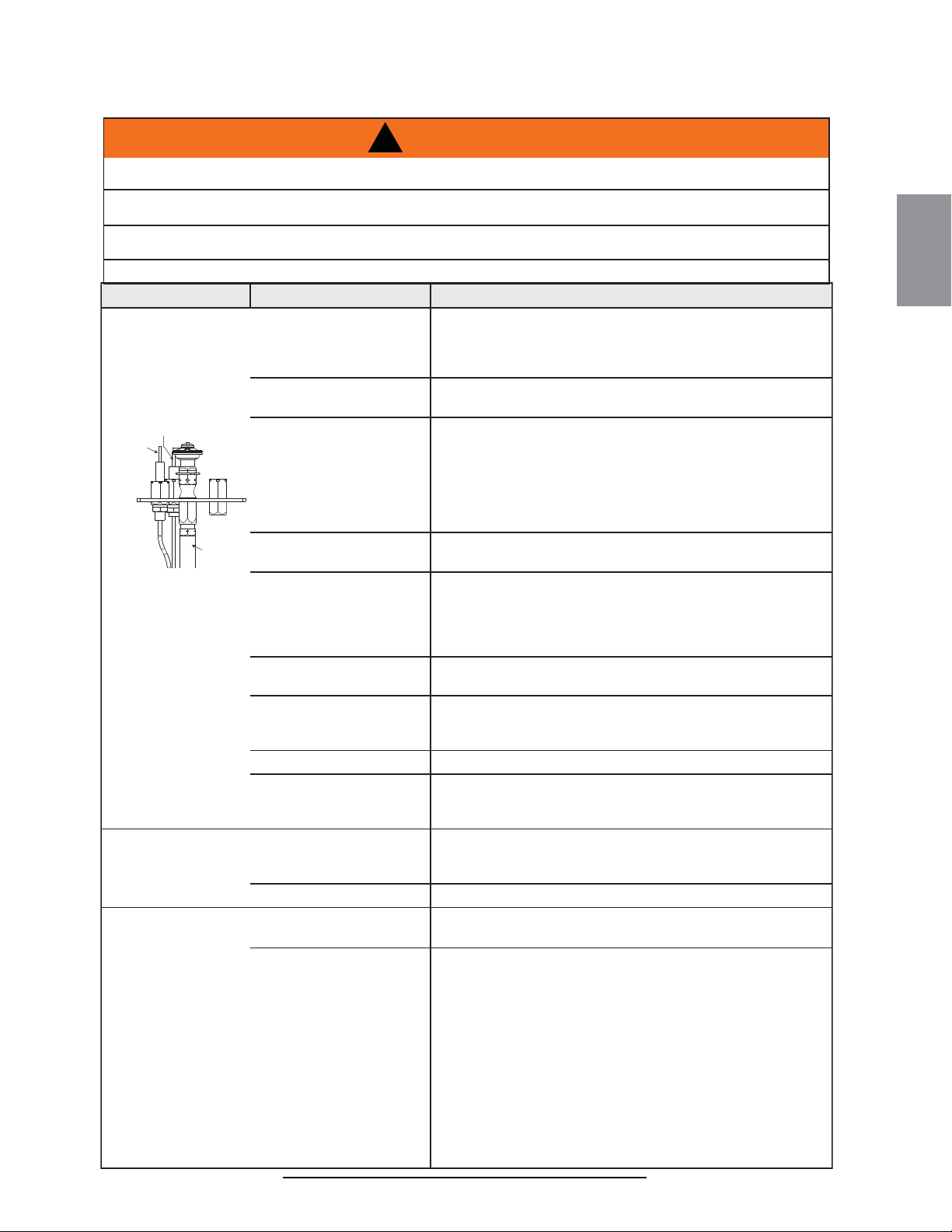
16.0 GUIDE DE DÉPANNAGE
FR
SYMPTÔME PROBLÈME SOLUTIONS
La veilleuse ne
s’allume pas.
Il y a du bruit, mais
aucune étincelle au
brûleur de la veilleuse.
Filage
.
- Vérifi ez si le fi l « S » pour la sonde et le fi l « I » pour l’allumeur
sont raccordés aux bonnes bornes (non inversés) sur le module
d’allumage et l’assemblage de la veilleuse. NOTE: Connexion du
capeur 3/16” (4.8mm) et l’allumeur à 1/8” (3.2mm).
Connexion desserrée. - Vérifi ez qu’il n’y ait pas de connexions desserrées, de courts-circuits
dans le fi lage ou des contacts avec des objets métalliques.
Module d’allumage.
- Mettez l’interrupteur MARCHE/ARRÊT à «OFF». Retirez le fi l
d’allumage «I» du module. Mettez l’interrupteur MARCHE/ARRÊT à
«ON». Tenez un fi l mis à la terre à environ 3/16” (4.8mm) de la borne
«I» sur le module. S’il n’y a pas d’étincelle, la borne «I» du module
doit être remplacée. S’il y a une étincelle, la borne «I» fonctionne bien.
Inspectez l’assemblage de la veilleuse pour un fi l causant un court-
circuit ou un isolateur craqué autour de l’électrode.
La longueur de l’étincelle
est incorrecte.
- La longueur de l’étincelle de l’allumeur à la veilleuse devrait être de
0,17” ou 1/8”
(3.2mm)
.
Transformateur.
- Vérifi ez si le transformateur est installé et branché dans le
module. Vérifi ez le voltage du transformateur sous tension aux
connexions sur le module avec l’interrupteur MARCHE/ARRÊT
à « ON ». Les lectures acceptables d’un bon transformateur se
situent entre 3,2 et 2,8 volts C.A.
Système de dépannage à piles
(s’il y a panne de courant)
- Vérifi ez les piles
Une connexion desserrée
ou causant un court-circuit.
- Retirez et réinstallez le harnais de fi ls qui se branche dans le
module. Retirez et vérifi ez la continuité de chaque fi l dans le
harnais de fi ls.
Filage d’interrupteur inapproprié. - Réparez le système avec un simple interrupteur MARCHE/ARRÊT.
Le module n’est pas mis
à la terre.
- Vérifi ez si les assemblages de la veilleuse et de la soupape
sont bien mis à la terre au niveau du châssis métallique de
l’appareil ou de l’ensemble de bûches.
Étincelle à la
veilleuse, mais celle-
ci ne s’allume pas.
Alimentation en gaz.
- Vérifi ez si la soupape à bille de la conduite d’arrivée du gaz est «Ouverte».
Vérifi ez si la pression d’arrivée est dans les limites acceptables. La pression
d’arrivée ne doit pas excéder 13” de colonne d’eau (32,3mb).
Plus de propane.
- Remplissez le réservoir.
Du carbone se
dépose sur la
vitre, les bûches,
les roches, les
composants
décoratifs ou les
parois de la chambre
de combustion.
Le volet d’air est bloqué. - Assurez-vous que l’ouverture du volet d’air n’est pas bloquée
par des fi bres ou autres obstructions.
Les fl ammes effl eurent la
vitre, les bûches, les roches,
les composants décoratifs ou
la chambre de combustion.
- Vérifi ez si la vitre, les bûches, les roches ou les composants décoratifs
sont positionnés correctement.
- Une trop grande quantité de verre autour du brûleur peut engendrer
des dépôts de carbone
- Augmenté l’ouverture du volet d’air pour augmenté le volume d’air primaire.
- Vérifi é le débit d’alimentation: vérifi e que la pression et la grandeur de
l’injecteur sont tel que spécifi é sur la plaque d’homologation.
- Vérifi ez si les joints de la porte ne sont pas brisés ou manquants et
qu’ils sont étanches.
- Vérifi ez que les deux conduits d’évent ne sont pas troués et qu’ils sont
bien scellés à tous les joints.
- Vérifi ez si l’élévation minimale par pied est conforme pour toute
évacuation horizontale.
42.7B
MAINTENANCE
MAINTENANCE
MAINTENANCE
ALLUMEZ TOUJOURS LA VEILLEUSE, QUE CE SOIT POUR LA PREMIÈRE FOIS OU LORSQUE
L’APPROVISIONNEMENT EN GAZ EST ÉPUISÉ, AVEC LA PORTE VITRÉE OUVERTE OU RETIRÉE.
COUPEZ L’ALIMENTATION EN GAZ ET L’ALIMENTATION ÉLECTRIQUE AVANT DE PROCÉDER À
L’ENTRETIEN DE L’APPAREIL.
L’APPAREIL PEUT ÊTRE CHAUD. N’EFFECTUEZ AUCUN ENTRETIEN JUSQU’À CE QUE L’APPAREIL
SOIT REFROIDI.
N’UTILISEZ PAS DE NETTOYANTS ABRASIFS.
!
AVERTISSEMENT
CAPTEUR
DE FLAMME
ALLUMEUR
(ÉTINCELLE)
TUBE DE
VEILLEUSE
117
W415-1335 / B / 10.04.16
FR
42.7_2A
SYMPTÔME PROBLÈME SOLUTIONS
Continue de
produire
des étincelles
et la veilleuse
s’allume,mais le
brûleur principal ne
s’allume pas.
Court-circuit ou connexion
desserrée dans la tige de la
sonde.
- Vérifi ez toutes les connexions. Vérifi ez si les connexions
de l’assemblage de la veilleuse sont serrées; vérifi ez
aussi si ces connexions ne causent pas de mise à la
terre au niveau du métal.
Mauvais redressement du
courant de la fl amme ou tige
de sonde contaminée.
- Vérifi ez si la fl amme enveloppe la tige de la sonde. Ceci
augmentera le redressement du courant de la fl amme. Vérifi ez
si le bon injecteur de veilleuse est installé et que l’alimentation
en gaz est conforme aux spécifi cations du manuel. (Souvenez-
vous que la fl amme transporte le courant redresseur et non le
gaz. Si la fl amme se détache de la hotte, le circuit est rompu.
Un mauvais injecteur ou une pression d’arrivée trop élevée peut
causer la fl amme de la veilleuse à se détacher.) La tige de la
sonde a possiblement besoin d’être nettoyée.
Mauvaise mise à la terre
entre l’assemblage de la
veilleuse et la soupape de
gaz.
- Vérifi ez si le harnais de fi ls est solidement branché au
module. Vérifi ez si l’isolateur de céramique autour de la
sonde est craqué, endommagé ou desserré. Vérifi ez la
connexion de la tige de la sonde au fi l de la sonde.
Veilleuse endommagée
ou tige de sonde
salie.
- Nettoyez la tige de la sonde avec une toile d’émeri ou
Scotch-Brite™ afi n d’enlever toute contamination qui
ait pu s’accumuler sur la tige de la sonde. Vérifi ez la
continuité avec un multimètre réglé sur Ohms au calibre
le plus bas.
La veilleuse
s’allume.
Arrête de produire
des d’étincelles/la
veilleuse reste
allumée, mais le
brûleur ne s’allume
pas.
Filage/connexion. - Inspectez tous les fi ls, assurez-vous que les connexions
sont bien serrées. Vérifi ez si tout le fi lage est installé
exactement tel que spécifi é.
Harnais de fi ls. - Inspectez le harnais de fi ls et vérifi ez qu’il soit
solidement branché au module. Vérifi ez que tous les
fi ls sont branchés dans le bon ordre. Voir la section «
SCHÉMA DE CÂBLAGE ».
On détecte
l’odeur des gaz de
combustion dans
la pièce; maux de
tête.
L’appareil refoule les gaz de
combustion dans la pièce.
- Vérifi ez tous les joints scellés.
- Vérifi ez si l’odeur de gaz n’entre pas par une porte ou
une fenêtre ouverte.
Une pellicule
blanche ou grise
se forme.
Le soufre du combustible se
dépose sur la vitre, les bûches
ou les parois de la chambre
de combustion.
- Nettoyez la vitre avec un nettoyeur recommandé. NE PAS
NETTOYER LORSQU’ELLE EST CHAUDE.
- Si vous ne nettoyez pas les dépôts régulièrement, la vitre
risque de rester marquée en permanence.
Les fl ammes sont
très actives.
La porte est entrouverte. - Serrez les loquets de porte s’il y a lieu.
Forte action de ventilation.
- Étranglez la sortie de l’évacuation avec la plaque de
restriction. Voir la section «ÉTRANGLEMENT DES
ÉVENTS VERTICAUX» s’il y a lieu.
La fl amme du
brûleur principal est
bleue, paresseuse et
transparente.
Système d’évacuation bloqué.
- Enlevez ce qui obstrue. Dans des conditions de froid extrême,
une accumulation de glace peut se former sur la terminaison
et devrait être enlevée lorsque nécessaire.
Pour minimiser les
chances que cela survienne de nouveau, il est recommandé
que les évents qui passent à travers des espaces non chauffés
(greniers, garages, espaces réduits) soient recouverts d’un
manchon isolant en mylar. Assurez-vous que le manchon ne
puisse pas s’affaisser. Pour plus de renseignements, contactez
votre détaillant local autorisé.
Installation incorrecte. - Vérifi ez les paramètres du système d’évacuation
(étanchéité, longueur, élévation, etc.).
Le brûleur principal
s’éteint; la veilleuse
s’éteint.
L’évacuation recircule. - Vérifi ez l’étanchéité des joints et leur installation.
118
W415-1335 / B / 10.04.16
17.0 GARANTIE
FR
NAPOLÉON garantit ses produits contre les défauts de fabrication à l’acheteur d’origine seulement. L’enregistrement de la garantie n’est pas
nécessaire. Fournissez simplement une preuve d’achat ainsi que le modèle et le numéro de série afi n d’effectuer une réclamation de garantie.
NAPOLÉON se réserve le droit de demander à son représentant d’inspecter tous produits ou pièces avant d’honorer toute réclamation.
L’achat doit avoir été fait par l’entremise d’un détaillant NAPOLÉON autorisé et sous réserve des conditions et limitations suivantes :
La couverture de la garantie débute à partir de la date d’installation originale.
Cette garantie du fabricant n’est pas transférable et ne peut être prolongée ou étendue par aucun de nos représentants quelle qu’en soit la raison.
L’appareil au gaz doit être installé par un installateur ou entrepreneur qualifi é. L’installation doit être faite conformément aux instructions
d’installation incluses avec le produit et à tous les codes d’incendie et de construction locaux et nationaux.
Cette garantie limitée ne couvre pas les dommages causés par un mauvais usage, un manque d’entretien, un accident, des altérations, des
abus ou de la négligence et l’installation de pièces d’autres fabricants annulera cette garantie.
Cette garantie limitée ne couvre pas non plus les égratignures, les bossellements, la corrosion ou la décoloration causés par une chaleur excessive, des
produits d’entretien chimiques et abrasifs ou l’écaillage des pièces en porcelaine émaillée, le bris par manipulation des bûches PHAZER
TM
et des braises.
NAPOLÉON garantit à vie ses brûleurs en acier inoxydable contre les défauts de fabrication et de matériau sous réserve des conditions
suivantes : durant les dix premières années, NAPOLÉON remplacera ou réparera selon notre option les pièces défectueuses gratuitement.
Après les dix premières années, NAPOLÉON fournira les brûleurs de rechange à 50 % du prix de détail courant.
Au cours de la première année seulement, cette garantie s’applique à la réparation ou au remplacement des pièces garanties dont les
matériaux ou la fabrication sont défectueux à la condition que le produit ait été utilisé conformément aux instructions de fonctionnement et
dans des conditions normales.
Après la première année, concernant cette Garantie à Vie Limitée du Président, NAPOLÉON peut, à sa discrétion, se libérer entièrement de toutes
obligations en ce qui concerne cette garantie en remboursant à l’acheteur d’origine le prix de gros de toute pièce garantie qui est défectueuse.
NAPOLÉON ne sera pas responsable de l’installation, de la main-d’oeuvre ou autres dépenses relatives à la réinstallation d’une pièce garantie
et de telles dépenses ne sont pas couvertes par cette garantie.
Nonobstant toutes les dispositions contenues dans cette Garantie à Vie Limitée du Président, la responsabilité de NAPOLÉON sous cette
garantie est défi nie comme ci-dessus et elle ne s’appliquera à aucun dommage accidentel, consécutif ou indirect.
Cette garantie défi nit l’obligation et la responsabilité de NAPOLÉON en ce qui concerne l’appareil au gaz Napoléon®. Toute autre garantie
énoncée ou implicite en ce qui concerne ce produit, ses composants ou accessoires est exclue.
NAPOLÉON n’endosse ni n’autorise aucun tiers à assumer en son nom, toute autre responsabilité concernant la vente de ce produit.
NAPOLÉON ne sera pas responsable d’une surchauffe, des refoulements, des déversements causés par des conditions environnementales
telles que des toits, des bâtiments, la proximité d’arbres, de collines, de montagnes, une ventilation ou des évents inadéquats, une
confi guration d’évacuation excessive, un apport d’air insuffi sant ou des pressions négatives qui peuvent ou non être causés par des systèmes
mécaniques tels que les ventilateurs d’évacuation, les fournaises, les sécheuses de linge, etc.
Tout dommage causé à l’appareil, à la chambre de combustion, à l’échangeur de chaleur, aux garnitures plaquées ou autres composants
par l’eau, les dommages causés par les intempéries, de longues périodes d’humidité, la condensation, des produits chimiques ou produits
d’entretien nuisibles ne seront pas la responsabilité de NAPOLÉON.
Toutes les pièces remplacées en vertu de la politique de Garantie à vie limitée du Président ne peuvent faire l’objet que d’une seule réclamation.
Durant les dix premières années, NAPOLÉON remplacera ou réparera les pièces défectueuses qui sont couvertes par la garantie à vie limitée
à sa discrétion gratuitement. Après les dix premières années, NAPOLÉON fournira les pièces de rechange à 50 % du prix de détail courant.
Toutes les pièces remplacées au titre de la garantie seront couvertes pour une période de 90 jours à partir de leur date d’installation.
Le fabricant peut exiger que les pièces défectueuses ou les produits soient retournés ou que des photos numériques soient fournies pour
valider la réclamation. Les produits retournés doivent être expédiés port payé au fabricant pour une inspection en usine. Si un produit est
déclaré défectueux, le fabricant le réparera ou le remplacera.
Avant d’expédier votre appareil ou les pièces défectueuses, votre détaillant doit obtenir un numéro d’autorisation. Toute marchandise
expédiée à notre usine sans autorisation sera refusée et retournée à l’expéditeur.
Les coûts d’expédition ne sont pas couverts par cette garantie.
Des frais de service supplémentaires peuvent être appliqués si vous cherchez à obtenir des services au titre de la garantie auprès d’un
détaillant. Les indemnités de main-d’oeuvre au titre de la garantie s’appliquent uniquement pour le remplacement d’une pièce garantie. Les
frais de déplacement, de tests de diagnostic, d’expédition et autres frais afférents ne sont pas couverts par cette garantie.
2.1D
Les produits NAPOLÉON sont fabriqués conformément aux normes strictes du Certifi cat d’Assurance de la
Qualité mondialement reconnu ISO 9001 : 2008.
Les produits NAPOLÉON sont conçus avec des composants et des matériaux de qualité supérieure, assemblés par des artisans
qualifi és qui sont fi ers de leur travail. Le brûleur et le montage de la soupape subissent un test de détection de fuite et d’allumage
à une station de test de qualité. Une fois assemblé, chaque appareil est soigneusement inspecté par un technicien qualifi é avant
d’être emballé pour garantir que vous, le client, recevez le produit de qualité dont vous vous attendez de NAPOLÉON.
Les matériaux suivants et la fabrication de votre nouveau appareil au gaz NAPOLÉON sont garantis contre les défauts tant que
vous en êtes le propriétaire. Ceci couvre : la chambre de combustion, l’échangeur de chaleur, le brûleur en acier inoxydable, les
bûches phazer
TM
et les braises, les roches, la vitre en céramique (cassure thermique seulement), les pièces plaquées or contre le
ternissement, les composants en porcelaine émaillée et les moulures d’extrusion en aluminium.*
Les composants électriques (110V et millivolt) et les pièces soumises à l’usure sont couverts et NAPOLÉON fournira
gratuitement les pièces de rechange durant la première année de la garantie limitée. Ceci couvre: la souffl eries, les
soupapes de gaz, l’interrupteur thermique, les interrupteurs, l’installation électrique, les télécommandes, l’allumeur, les joints
d’étanchéité et l’assemblage de la veilleuse.*
Les coûts de main-d’oeuvre relatifs aux réparations garanties sont couverts gratuitement durant la première année. Cependant, les
travaux de réparation nécessitent l’approbation préalable d’un représentant autorisé de la compagnie. Les coûts de main-d’oeuvre
à la charge de Napoléon® sont basés sur un programme de tarifs prédéterminé et tout travail de réparation doit être accompli par
l’entremise d’un représentant autorisé NAPOLÉON.
GARANTIE À VIE LIMITÉE DU PRÉSIDENT DES APPAREILS AU GAZ NAPOLÉON
CONDITIONS ET LIMITATIONS
TOUTES LES SPÉCIFICATIONS ET LES CONCEPTIONS SONT SUJETTES À MODIFICATIONS SANS PRÉAVIS EN RAISON DES
AMÉLIORATIONS CONSTANTES APPORTÉES AUX PRODUITS. NAPOLÉON EST UNE MARQUE DE COMMERCE DÉPOSÉE DE
WOLF STEEL LTÉE.
119
W415-1335 / B / 10.04.16
"VUSFTQSPEVJUT/BQPMÏPO
®
'PZFST FODBTUSÏT t (SJMT BV DIBSCPO EF CPJT t 'PZFST BV HB[ t $BTDBEFT EFB
V
1PÐMFTËCPJTt1SPEVJUT)7"$t'PZFSTÏMFDUSJRVFTt'PZFSTFYUÏSJFVSTt(SJMTËHB[EFRVBMJU
Ï
'PZFST$IBVGGBHFFU$MJNBUJTBUJPO(SJMTDPNQPTF[
napoleonproducts.com
3PVUF5SBOTDBOBEJFOOF.POUSÏBM2VÏCFD)5"
/BQPMFPO3PBE#BSSJF0OUBSJP$BOBEB-.(
#BZWJFX%SJWF#BSSJF0OUBSJP$BOBEB-/:
.JMMFS%SJWF$SJUUFOEFO,FOUVDLZ64"