IMPORTANT SAFETY INSTRUCTIONS - 391477A923/A
e
IMPORTANT SAFETY INSTRUCTIONS 3
How to read the User Manual 3
For this appliance 5
Appliance purpose 8
This user manual 9
Manufacturer’s liability 9
Technical Support. 9
Identification plate 9
Energy label 9
To save energy 9
Light sources 9
How to read the user manual 9
DESCRIPTION 10
General Description 10
Control panel 10
Description of parts 11
USE 11
Preliminary operations 11
First use 11
Using the control panel 11
Using the wine cellar compartments 13
Alarms 14
Preservation tips 14
CLEANING AND MAINTENANCE 16
Cleaning the appliance 16
Removing the removable shelves 16
What to do if... 17
INSTALLATION 17
Electrical connection 17
Positioning 17
Overall dimensions of the appliance (mm) 18
Recess (mm) 19
We advise you to read this manual carefully, which contains all the instructions for maintaining the
appliance’s aesthetic and functional qualities. For further information on the product: www.smeg.com
IMPORTANT SAFETY INSTRUCTIONS
How to read the User Manual
This User Manual uses the following definitions
of terms:
Notice: Proposition 65 of the State of
California
Injury to persons
• Read all instructions.
• This appliance is not intended
for use by persons (including
WARNING: If the instructions in this manual are not carefully
followed, fire or explosion may occur resulting in property
damage, personal injury or death.
DANGER
• failure to follow instructions immediately
may result in death or serious injury.
WARNING
• failure to follow instructions may result in
death or serious injury.
PRECAUTION
• indicates a potentially hazardous situation
which, if not avoided, may result in minor to
moderate injury.
NOTE: important information
This product may expose you to
chemicals including vinyl chloride,
which is known to the State of California
to cause cancer and prenatal defects or
other reproductive harm. See
www.P65Warnings.ca.gov for more
information.
WARNING

4 - IMPORTANT SAFETY INSTRUCTIONS 91477A923/A
children) with reduced
physical, sensory or mental
capabilities, or lack of
experience and knowledge,
unless they have been given
supervision or instruction
concerning use of the
appliance by a person
responsible for their safety.
• Do not leave children
unattended: Children should
not be left alone or unattended
in the area where the
appliance is used.
• Never allow children to sit or
stand on any part of the
appliance.
• Never allow children to play
with the appliance and have
them use the shelves and other
parts of the appliance only as
described in this manual.
• Keep children away unless they
are constantly supervised.
• Children should be supervised
to ensure that they do not play
with the appliance.
• Children can pick up or load
food from the appliance, but it
is highly discouraged to allow
children to perform these
operations and in general to
use the appliance.
• Children should not play with
the appliance.
• Never attempt to extinguish
flames/fire with water. Turn off
the appliance and cover the
flame with a lid or a fire-proof
blanket.
• CAUTION: do not use
electrical equipment inside the
food storage compartments of
the appliance
• Cleaning and maintenance
should not be performed by
children without supervision.
• Do not insert sharp metal
objects (knives and utensils) into
the slots.
• Do not attempt to repair the
appliance yourself or without
the intervention of a qualified
technician.
• Do not pull the cable to remove
the plug.
• Do not insert the plug into the
electrical outlet with wet hands.
• If the power cord is damaged,
immediately contact the
technical support service to
replace the cord.
• If the power cord needs to be
replaced, the operation should
only be carried out by an
authorized technician from the
Technical Service Department.
• DO NOT USE OR STORE
FLAMMABLE MATERIALS
NEAR THE APPLIANCE.
•DO NOT USE AEROSOLS IN
THE VICINITY OF THIS
APPLIANCE WHILST IT IS IN
USE.
• DO NOT MODIFY THIS
APPLIANCE.
• Qualified personnel should
carry out the installation and
IMPORTANT SAFETY INSTRUCTIONS - 591477A923/A
e
servicing in compliance with
existing regulations.
Damage to the appliance
• While in use, do not place
metal objects on the appliance,
such as knives, forks, spoons
and lids.
• Do not use cleaning products
containing chlorine, ammonia
or bleach on the steel parts or
those with metallic surface
finishes (e.g. anodizing, nickel
or chrome plating).
• Do not use abrasive or
corrosive detergents on the
glass parts (e.g. powder
products, stain removers or
metal scouring pads).
• Do not use rough or abrasive
materials or sharp metal
scrapers.
• Do not sit on the appliance.
• Do not lean or sit on the door
when it is open.
• Make sure that no objects are
stuck in the doors.
• Do not store flammable,
explosive or evaporating
substances (e.g., aerosol cans
with flammable propellant).
• Organic, acidic substances
and ethereal oils can corrode
plastic surfaces and seals if in
contact for a long time.
• Bottles with high alcohol
content should be tightly
closed.
• Do not lay bottles sideways on
the bottom of the cellar
compartment. Upon opening
the door they may fall.
• Do not use steam jets to clean
the appliance.
• Do not spray any spray
products near the appliance.
• Do not block openings,
ventilation slots and heat
dissipation vents.
• Do not obstruct the gaps in the
ventilation grille in any way.
• Do not use electrical equipment
inside the food storage
compartments unless it is of the
type recommended by the
manufacturer.
• DO NOT USE THE
APPLIANCE TO COOL
ROOMS FOR ANY REASON.
• Do not use mechanical devices
or other means to accelerate
the defrosting process other
than those recommended by
the manufacturer.
• Always disconnect the
appliance from the power
supply when troubleshooting,
servicing or cleaning.
For this appliance
• The appliance contains a small
amount of isobutane (R600a),
take care during transport,
assembly or cleaning not to
WARNING
WARNING
6 - IMPORTANT SAFETY INSTRUCTIONS 91477A923/A
damage the refrigeration
circuit.
• Do not damage the coolant
circuit, (in case it may be
accessible).
• In case of damage to the
refrigeration circuit, avoid using
open flames and ventilate the
room appropriately.
• Do not operate the equipment
or any part of it other than as
specified in this manual.
• Caution: Fire hazard/
flammable materials.
•Opening the door for long
periods of time can cause a
significant temperature increase
in the appliance compartments.
• Regularly clean surfaces that
may come in contact with
accessible drainage systems.
I
Installation and maintenance
• It takes two or more people to
move and install this appliance.
• This appliance is heavy and
must be secured during
transport and installation.
• Do not place the appliance
outdoors.
• CAUTION: When positioning
the appliance, make sure the
power cord is not caught or
damaged.
• CAUTION: To prevent
instability of the appliance,
install and secure it properly
according to the instructions in
this manual.
• Do not install this appliance in
prefab (mobile) homes,
recreational vehicles (RV), or
boats.
• Do not install this appliance in a
room where there is a risk of
freezing.
• The appliance should not be
exposed to sunlight.
• The appliance should not be
placed near any heat sources
or flammable materials. If this is
not possible, a suitable
insulation panel should be
used.
• Always place the appliance in
a dry, well-ventilated room.
• Observe all applicable
regulations and ordinances.
• The ground connection must be
completed in the manner
indicated in the regulations on
electric installations.
• Insert the plug into a 3-pin
grounded outlet.
• The plug must always be
accessible when the appliance
is installed or a switch must be
incorporated into the fixed
installation in accordance with
the installation rules.
• Do not remove the grounding
WARNING

IMPORTANT SAFETY INSTRUCTIONS - 791477A923/A
e
pin.
• Do not use an adapter plug.
• Do not use an extension cord.
• Do not twist or tie the power
cord.
• Do not pull or bend the power
cord.
• Do not damage the power
cord when moving the
appliance.
• To avoid any danger, if the
power supply cable is
damaged, contact the
technical assistance service
immediately, that will replace
the cable to prevent any risk.
• Never unplug an appliance
device by pulling on the power
cord. Always grasp the plug
firmly when pulling it out of the
outlet to avoid damaging the
power cord.
• Always disconnect the
appliance from the power
supply when troubleshooting,
servicing, replacing bulbs, or
cleaning.
• Have a qualified electrician
check the wall outlet and circuit
to make sure the outlet is
properly grounded.
• Qualified personnel should
carry out the installation and
servicing in compliance with
existing regulations. Service
personnel should disconnect
power before working on this
appliance.
• A qualified technician must
complete the electrical
connection.
• Before any operation on the
appliance (installation,
maintenance, positioning or
movement) always wear PPE.
• Before performing any
operation on the appliance,
switch off the power supply.
• Do not attempt to repair or
replace any part of this
appliance unless specifically
recommended in this manual.
Any other maintenance must be
performed by a qualified
technician.
• Do not damage or drill the
coolant pipes.
• Do not damage the coolant
circuit.
• Do not use sharp instruments,
alcohol, flammable liquids, or
abrasive cleaners to remove
tape glue. Clean only with
warm water.
• CAUTION: Keep ventilation
openings in the appliance
enclosure or built-in structure free
from obstructions.
• CAUTION: Do not use
mechanical, electrical, or
chemical products other than
those recommended by the
manufacturer to speed up the
defrosting process.
• Do not dispose of packaging
material. Separate the various
scraps by type and consign them
to the nearest separate waste
collection center.

8 - IMPORTANT SAFETY INSTRUCTIONS 91477A923/A
• Before turning on the appliance
for the first time, leave it in the
upright position for at least 2
hours.
• Leave enough space around
the appliance and install it on a
flat surface.
• Do not use the open door as a
lever to move the appliance
into place.
• Do not apply excessive
pressure to the door when it is
open.
• When installing the appliance
be careful not to scratch or
damage the floor.
• Do not move back and forth or
drag the appliance when trying
to move it, as you may damage
the floor.
• Never cover or block any
ventilation openings on the
appliance.
• THIS APPLIANCE MUST NOT
BE INSTALLED IN A BOAT OR
CARAVAN.
• This appliance must not be
installed on a pedestal.
• Move the appliance into the
desired position with the help of
a second person.
• To prevent any possible
overheating, the appliance
should not be installed behind
a decoration door or a panel.
• Do not install/use the
appliance outdoors.
• CAUTION: Do not place
portable power strips or
portable power supplies in the
rear of the appliance.
• Use cables withstanding a
temperature of at least 90°C.
• The tightening torque of the
screws of the terminal board
leads must be 1.5 - 2 Nm.
• Opening the door for long
periods of time can cause a
significant temperature increase
in the appliance compartments.
• If the appliance is left empty for
long periods, turn it off, defrost,
clean, dry, and leave the door
open to prevent the
development of mold inside.
• This appliance can be used up
to a maximum altitude of 2,000
metres above sea level.
Appliance purpose
• This appliance has been
designed exclusively for storing
wine in a domestic setting.
Every other use is considered
inappropriate.
• The appliance is not designed
to operate with external timers
or with remote-control systems.
The appliance is designed for
use in a domestic or similar
environment, for instance:
• Staff kitchen areas in shops,
offices and other working
environments;
• Farm houses and by guests in
hotels, motels and other
residential type environments;
• bed and breakfast
establishments;
IMPORTANT SAFETY INSTRUCTIONS - 991477A923/A
e
• catering and similar non-retail
applications.
This user manual
• This user manual is an integral part of the
appliance and must therefore be kept in its
entirety and within the user's reach for the
whole working life of the appliance.
• Read this user manual carefully before using
the appliance.
• The explanations in this manual include
images, which describe all that regularly
appears on the display. However, it should
be kept in mind that the appliance may be
equipped with an updated version of the
system, and as such, all that appears on the
display may differ from those in the manual.
Manufacturer’s liability
The manufacturer declines all liability for
damage to persons or property caused by:
• use of the appliance other than that
specified;
• failure to comply with the instructions in the
user manual;
• tampering with any part of the appliance;
• use of non-original spare parts.
Technical Support.
• In the event of failure of the appliance,
contact the technical support and have the
repair carried out by qualified personnel
only.
• make sure you have the model and serial
number available on the identification plate.
• Use original spare parts only.
• Do not try to repair the appliance yourself or
without the assistance of a qualified
technician: this affects safety and may void
the warranty.
• Genuine spare parts for some specific
components remain available for a minimum
of 7 or 10 years, depending on the type of
component, from the date the model is
released on the market.
Identification plate
The identification plate bears the technical data,
serial number and brand name of the
appliance. Do not remove the identification
plate for any reason.
Energy label
To be informed about the performance of your
device via the EU EPREL database
visit the following web address and enter the
model name (available on the identification
plate):
https://eprel.ec.europa.eu
On the energy label there is a QR code for a
quick access to the web address. Use a device
equipped with an appropriate reading
program.
The energy label must be kept together with all
documents supplied with the appliance.
To save energy
• Reduce any opening of the door to a
minimum to avoid temperature dispersal.
• Whenever the appliance is to remain
unused for long periods, it should be
switched off.
Light sources
• This appliance contains light sources which
cannot be replaced by the user and must
only be replaced by the technical assistance
service.
• This appliance contains light sources of
efficiency class "A".
How to read the user manual
This user manual uses the following reading
conventions:
Warning/Caution
Information/Advice
10 - DESCRIPTION 91477A923/A
DESCRIPTION
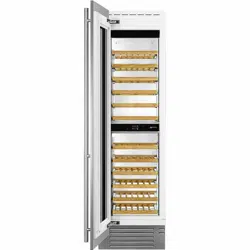
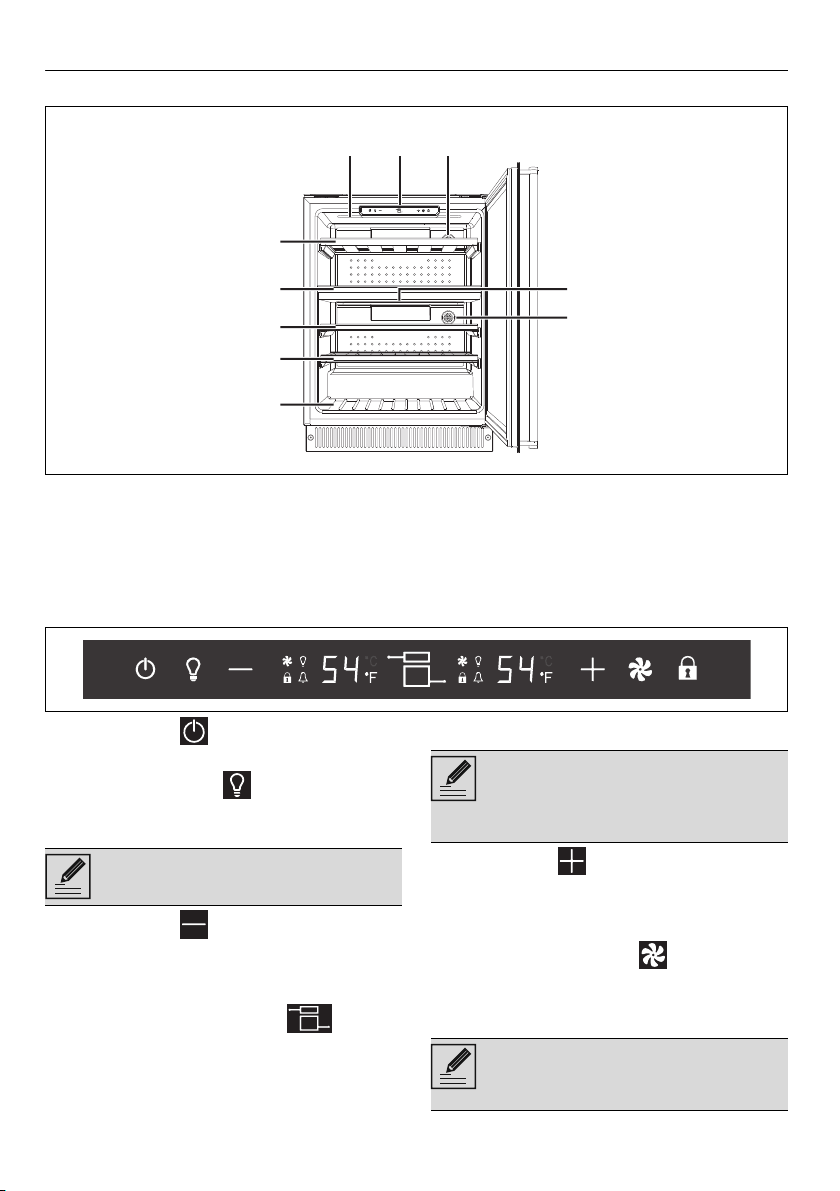
General Description
1 Control panel
2 Upper compartment interior lighting
3 Activated charcoal filter
4 Removable shelf
5 Fixed shelf
6 Lower compartment interior lighting
7 Activated charcoal filter
8 Removable shelf
9 Removable shelf
10 Fixed shelf
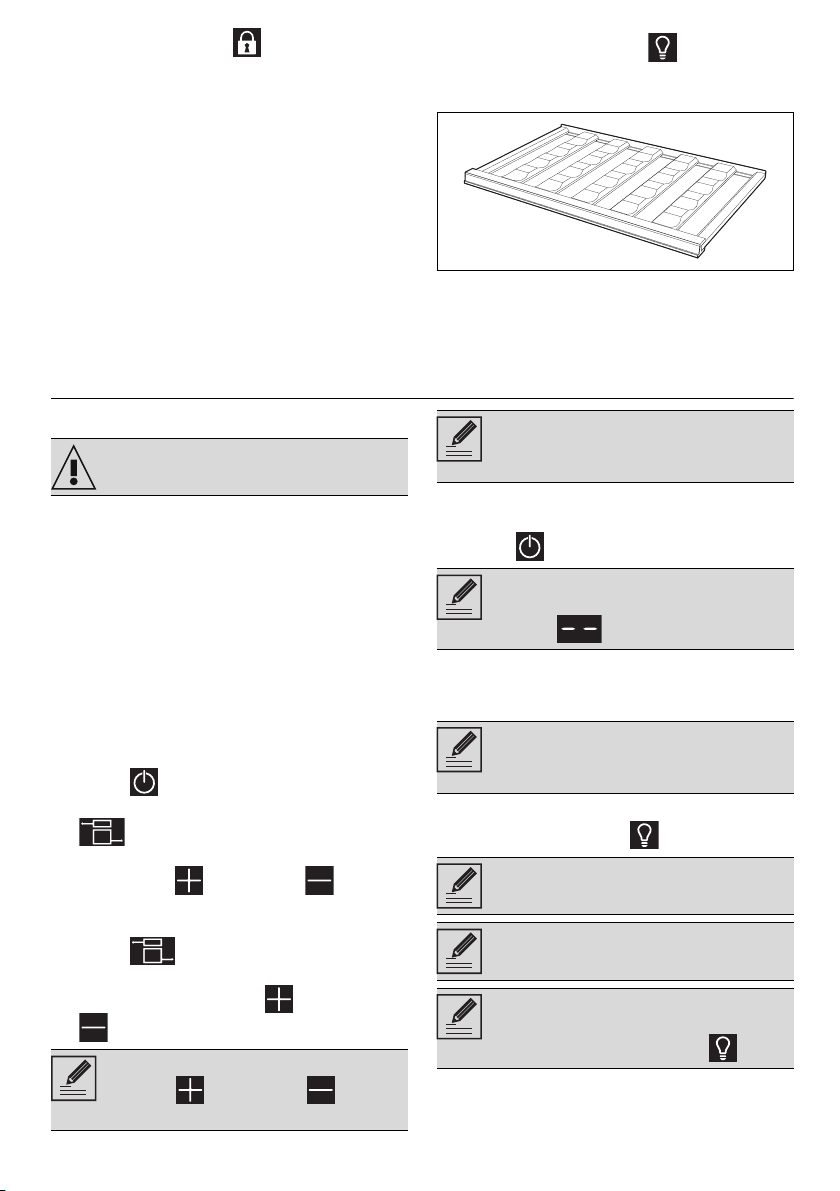
Control panel
ON/OFF button
Allows the appliance to be turned on or off.
Forced lighting button
Turns on or off the lighting inside the wine cellar
compartments.
Decrease button
Using this button, the temperature inside the
upper or lower cellar compartment can be
decreased.
Compartment selection button
Using this button you can select the
compartment on which to change the settings.
Increase button
Using this button, the temperature inside the
upper or lower cellar compartment can be
increased.
Manual ventilation button
Turn on or off the manual ventilation mode to
increase the humidity level inside the wine cellar
compartment.
1
3
2
7
6
4
5
8
9
10
Forced lighting automatically turns off
after a maximum time of 15 minutes.
Values in the left display refer to the
upper compartment.
Values in the right display refer to the
lower compartment.
If manual ventilation is turned off, the fan
will automatically turn on according to
the software settings.
USE - 1191477A923/A
e
Command Lock button
Through this button you can disable the buttons
on the control panel.
Description of parts
Activated charcoal filters
Ensure optimum air quality for wine storage.
Fans (not visible)
Distribute the temperature and reduce
condensation on the shelves and other surfaces.
Interior lighting
The interior lighting of the appliance turns on
when the door is opened (maximum brightness)
or when the light forced key on the control
panel is pressed (medium brightness).
Removable shelves
The removable shelves allow easy removal of
the bottles of wine.
USE
Preliminary operations
1. Remove any protective film from the outside
or inside of the appliance, including
accessories.
2. Remove any labels (apart from the technical
data plate) from the accessories and
shelves.
3. Remove and wash all the appliance
accessories (see chapter "CLEANING
AND MAINTENANCE").
First use
To switch the appliance on:
1. on the control panel, press the ON/OFF
button ;
2. press the compartment selection button
, then select the desired temperature
inside the upper compartment by pressing
the Increase or Decrease buttons
(41°F/5°C to 68°F/20°C).
3. Press again the compartment selection
button and select the desired
temperature inside the lower compartment
by pressing the Increase or Decrease
buttons (41°F/5°C to 68°F/20°C).
To switch the appliance off:
4. on the control panel, press the ON/OFF
button for a few seconds.
Using the control panel
Interior lighting
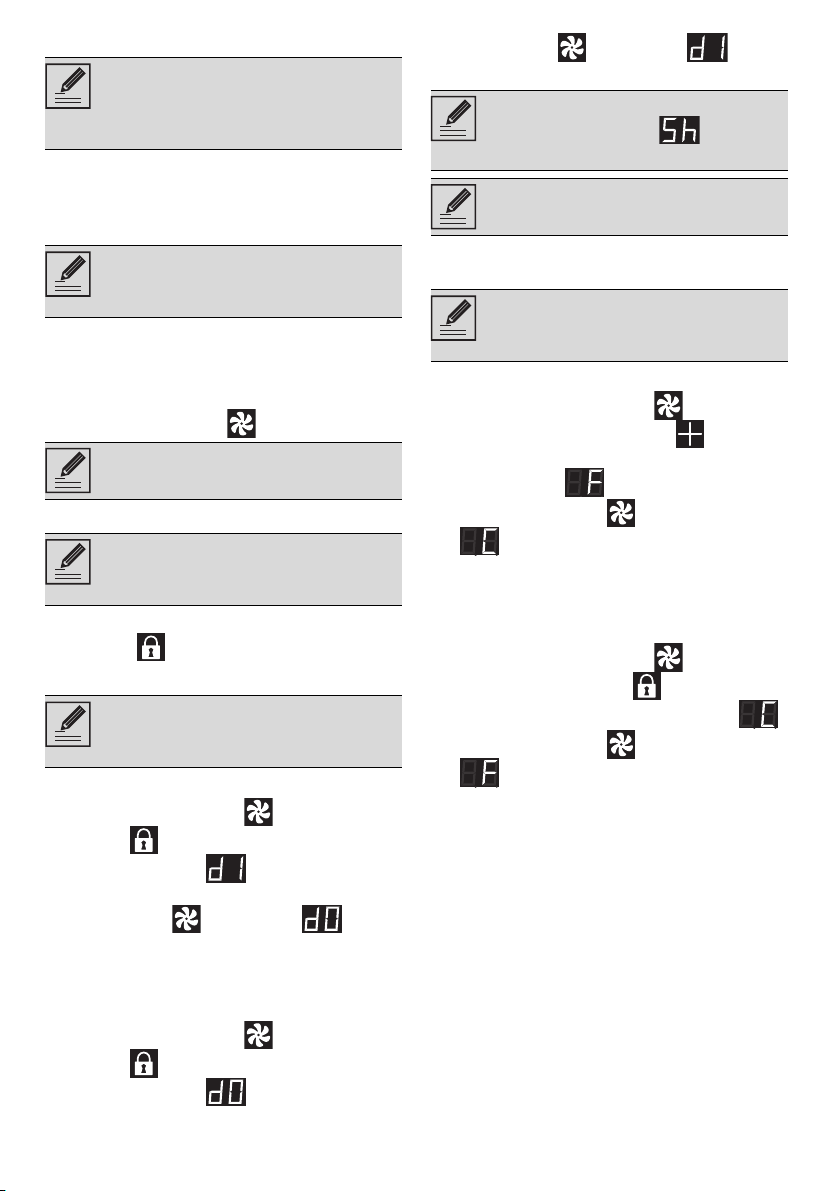
To activate/deactivate the interior lighting, press
the forced lighting button .
See General safety instructions.
The change is 1°C each time the
Increase or Decrease buttons
are pressed.
The set temperature flashes on the
display for about 5 seconds, and then
remains steady.
If necessary, only a single compartment
can be turned off; set its temperature
value to .
The interior lighting is provided by an
LED light bar installed at the top of the
wine cellar.
Manually operated interior lighting will
stay on for a maximum of 15 minutes.
The lighting also comes on when the
door is opened.
The internal lighting activated when the
door is opened is brighter than the
lighting activated via the key .
12 - USE 91477A923/A
Manual ventilation
If increasing the level of humidity inside the wine
cellars is necessary, you can activate the
manual ventilation mode. The manual ventilation
mode forces the continuous operation of the fan.
Select this option occasionally in order to
prevent corks from drying out when bottles are
stored for long periods.
To activate/deactivate manual ventilation
mode, press the fan key .
Keylock
To activate/deactivate the Keylock hold down
the Keylock control key for a few seconds.
Demo mode (for showrooms only)
To activate demo mode:
1. press and hold the fan and Keylock
control keys simultaneously for a few
seconds. The text will appear on the
display;
2. press the fan key. The text will
appear on the display.
3. after a few seconds, without any key being
pressed, the selection is stored.
To deactivate demo mode:
4. press and hold the fan and Keylock
control keys simultaneously for a few
seconds. The text will appear on the
display;
5. press the fan key. The text will
appear on the display.
Temperature format change (on some models
only)
To change the temperature display format:
1. hold down the Fan button and the
Temperature Increase button
simultaneously for a few seconds. The
display reads .
2. Press the fan button . The display reads
.
3. after a few seconds have passed without
any button being pressed, the selection is
memorized.
To return to the previous format:
4. hold down the Fan button and the
Command Lock button simultaneously
for a few seconds. The display reads ;
5. Press the fan button . The display reads
.
The fans switch on and off automatically
to guarantee a constant temperature
and provide suitable climate control for
conservation of the wine.
If the manual ventilation mode is
deactivated, the fan goes back to the
standard automatic operation.
If manual ventilation is activated, the
energy consumption will be higher.
This function prevents the appliance
functions from being accidentally
switched on/off.
Turns off the appliance's fans and
compressor while keeping the control
panel active.
When demo mode is active, the display
will show the message for 2
seconds every 2 minutes.
In demo mode, forced lighting will have
no time limit for switching off.
Allows the temperature scale to be set
in either degrees Fahrenheit (°F) or
degrees Celsius (°C).

USE - 1391477A923/A
e
Using the wine cellar compartments
Bottle arrangement
Each removable shelf can hold up to 6 standard
0.75 litre Bordeaux-type wine bottles.
The extractable shelves can hold up to 4
champagne/sparkling wine type bottles (or in
any case slightly larger in diameter compared
to traditional wine bottles) horizontally.
Activated charcoal filter
To replace the activated charcoal filter:
1. turn the filter cap 90° to the left or right.
2. Extract the cap from its seat.
3. Replace the activated charcoal filter with a
new one.
4. Replace the filter cap following the
indications in points 1 and 2.
Noises during operation
The wine cellar is cooled by means of a
compression system. In order to maintain the
preset temperature inside the wine cellar, the
compressor comes into operation in response to
the level of cooling required, and may operate
continuously if necessary. When the compressor
starts up a humming sound will be heard,
tending to drop in volume after a few minutes.
A maximum of 38 Bordeaux-type 0.75
litre bottles can be stored.
Do not place bottles horizontally on the
base of the wine cellar. They could fall
when the door is opened.
To maintain optimum air quality inside
the wine cellar, the activated charcoal
filter must be replaced at least once a
year.
Replacement filters can be ordered
from Authorised Service Centres.
90°90°
14 - USE 91477A923/A
Another normal wine cellar operating noise is a
gurgling due to the refrigerant flowing through
the pipes in the circuit. This noise is normal and
does not indicate an appliance malfunction.
Turning the appliance off
Whenever the appliance is to remain unused for
long periods, it should be switched off.
1. Press and hold the ON/OFF key on the
control panel for a few seconds until the
appliance turns off.
2. Unplug the appliance from the wall socket.
3. Empty the wine cellar.
4. Dry any residual moisture which has
accumulated with a soft cloth.
Leave the door ajar to prevent the humidity and
trapped air from creating unpleasant smells.
Alarms
Each alarm consists of a message flashing on
the display, and an audible warning.
The display continues to flash until the alarm
condition finishes.
• To deactivate the alarm press any key or the
key (if available).
Temperature alarm
The temperature on the display may start to
flash. This means that the temperature inside the
wine cellar compartment is too high or too low
in relation to that set.
This may occur:
• when the appliance is first turned on;
• if a temperature much higher or much lower
than the previous one is set;
• if the wine cellar is loaded with many bottles
at ambient temperature;
• in the event of an extended interruption in
mains voltage.
These conditions may occur during normal
operations of the appliance and are not caused
by problems/faults.
In this case, deactivate the alarm through any
key on the control panel (or, on some models
only, through the key ) and wait for the
temperature to return within the normal storage
values. It may be necessary to repeat this
operation 1–2 times.
Alarm for door open
The display shows : the door has been left
open for more than 60 seconds.
• Close the door.
Fault alarms
The display shows from to (
excluded) or or or or :
appliance fault.
• Switch off the appliance and call Technical
Support.
Connectivity alarms (on some models only)
The display shows : appliance fault.
The App shows : appliance fault.
• Contact technical support.
For further information, please read the
Connectivity Manual.
Preservation tips
White wines
White wines, compared to red wines, are
generally more acidic and lower in tannins. An
acidic beverage should generally be stored at
a slightly lower temperature than others to better
appreciate its characteristics, which is why these
wines should be stored at temperatures
between 50°F (10°C) and 57°F (14°C).
Young, fresh and aromatic white wines can also
be served at a temperature of 50°F (10°C)
while less aromatic ones at 54°F (12°C). Soft,
ripe white wines aged for a few years in the
bottle bear higher temperatures and can be
served between 54°F (12°C) and 57°F
(14°C).
Serving a white wine at higher temperatures
means enhancing its "sweet" characters at the
expense of the acidity and savoriness that are
instead considered pleasant and desired
The alarms help protect the wine from
temperatures which could compromise
its quality.
If the alarm continues to occur, call
Technical Support.
The alarm will reactivate in the same
way 60 seconds after it is shut off if the
door is still open.
In case of alarm the appliance
continues cooling wines.

USE - 1591477A923/A
e
characteristics in this type of wine.
Rosé wines
Serving rosé wines generally follows the same
rules as white wines. However, it is necessary to
consider the possible tannin content of these
wines and therefore serve them at a higher
temperature so as not to make them too
astringent. Young and fresh rosé wines, tannin
content permitting, are served between 50°F
(10°C) and 54°F (12°C), while the more
robust and full-bodied ones, including the more
mature ones, can be served between 54°F
(12°C) and 57°F (14°C).
Red wines
The serving temperature of red wines depends
on many factors, but given their "tannin content"
and less acidic nature than whites, they are
usually served at higher temperatures. Young
red wines with little tannin are usually served
between 57°F (14°C) and 61°F (16°C), while
full-bodied ones can be served as high as 61°F
(16°C), exceptionally even 64°F (18°C).
Young tannic and unstructured red wines can
also be served between 54°F (12°C) and
57°F (14°C) without being astringent and
remain appealing. This rule applies to "novello"
wines, which, due to their special winemaking
technique, are low in tannins and can be served
cooler than other red wines, while still being
enjoyable.
Sparkling wines
Given the large number of types of sparkling
wines that exist, establishing one rule that
applies to all would make little sense. Sweet
and aromatic white sparkling wines should be
served at a temperature of 46°F (8°C). In fact,
due to their aromaticity, they can withstand low
temperatures.
Sweet red sparkling wines such as Brachetto
can be served at temperatures between 50°F
(10°C) and 54°F (12°C). Again, the more
aromatic sparkling wines will tolerate lower
temperatures down to 46°F (8°C), while those
that are a bit more tannic will need to be raised
to as high as 57°F (14°C).
So-called "Charmat method" or "Martinotti
method" dry sparkling wines, such as some
Proseccos, can be served at temperatures
between 46°F (8°C) and 50°F (10°C).
A special consideration should be made for
"classic method" and "méthode Champenoise"
sparkling wines such as Champagne: generally
these sparkling wines are served at
temperatures between 8°C and 50°F (10°C),
however when it comes to important vintage
wines or at any rate sparkling wines aged for a
long time, one can go as high as 54°F (12°C)
so as to encourage the development of the
complex aromas that have slowly and
laboriously developed over time.
Raisin and fortified wines
The common characteristic of these two types of
wines is usually a high percentage of alcohol,
and both are often sweet. However, there are
some dry fortified wines, e.g., Marsala, that
contain so much sugar that it is not noticeable to
the taste. For these wines, the serving
temperature should be determined according to
what you intend to enhance. If you prefer to
accentuate the sweet characteristics of the wine,
the complexity of its aroma and its austerity, it
will be good to serve it at a high temperature,
between 57°F (14°C) and 64°F (18°C),
remembering in this case that it will also be the
alcohol that will be enhanced.
If you intend to favor their freshness, or in the
case of very sweet wines where you prefer to
mitigate this aspect, you will need to serve them
at a lower temperature between 50°F (10°C)
and 57°F (14°C).
Fresh, young dry fortified wines can also be
served at cooler temperatures below 50°F
(10°C). This will greatly reduce the perception
of alcohol. However, it is necessary to
remember that the lower the temperature, the
less the aromas will develop. The pleasantness
and complexity of aromas typical of these wines
is a welcome and interesting feature; serving
them too cold also means sacrificing this
important aspect.
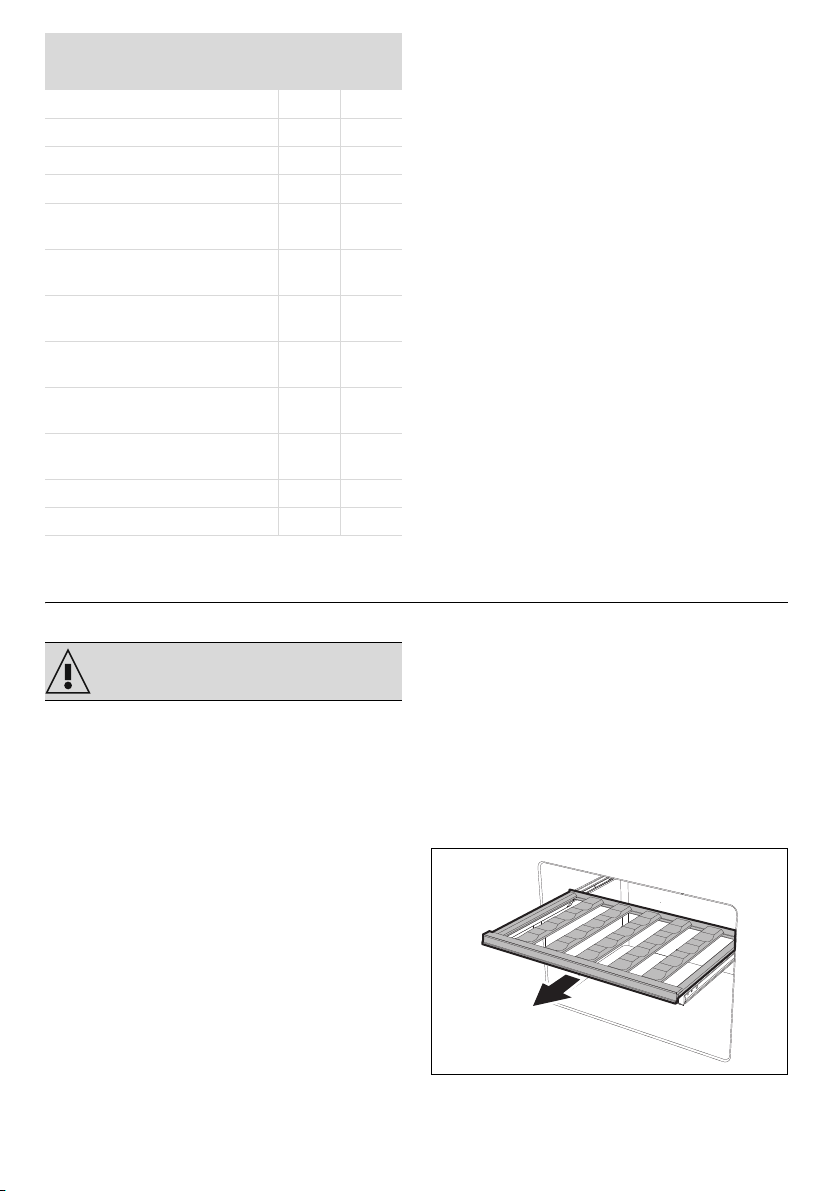
Storage temperatures
To appreciate the organoleptic qualities of any
wine properly, storage and consumption must
be done at certain temperatures. The following
ideal temperatures are recommended for
different types of wine.
Type of wine
Temp.
(°F) (°C)
Young whites 50-54 10-12
Mature whites 54-57 12-14
Young and light rosés 50-54 10-12
Ripe, full-bodied rosés 54-57 12-14
16 - CLEANING AND MAINTENANCE 91477A923/A
CLEANING AND MAINTENANCE
Cleaning the appliance
A special antibacterial protection on the
appliance's interior walls prevents bacterial
growth and keeps them clean. They must
nevertheless be cleaned regularly in order to
keep them in good condition.
Cleaning the outside of the appliance
• The appliance may be cleaned with water
or alcohol-based liquid detergents (e.g.
window cleaning products).
• Avoid aggressive detergents and rough
sponges in order not to damage the
surfaces.
Cleaning the inside of the appliance
• Clean the inside of the appliance with
diluted liquid detergent and warm water,
adding a little bit of vinegar.
Cleaning the removable shelves
• Use a soft, damp cloth to clean the
removable shelves. Avoid the use of soaps
and detergents and/or sponges which
could damage both the wooden and steel
surfaces.
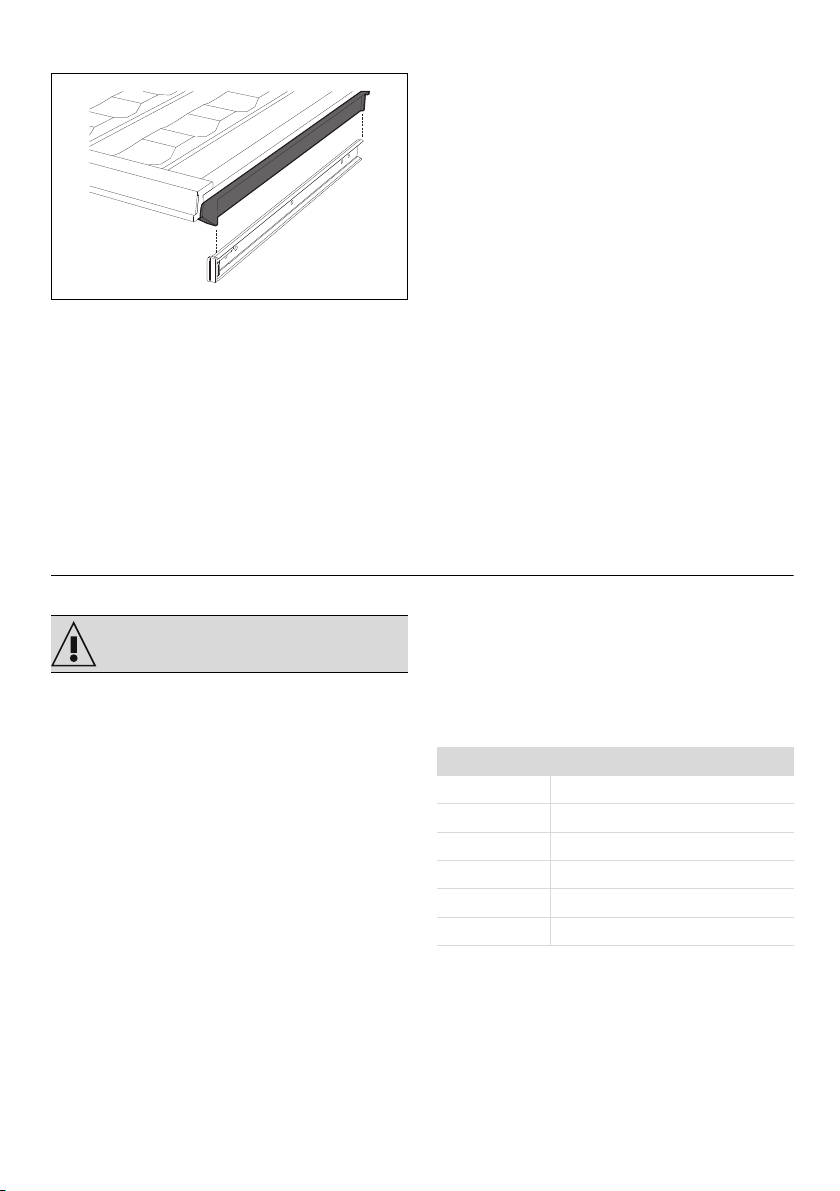
Removing the removable shelves
The removable shelves can be extracted from
the interior of the wine cellar to facilitate
cleaning.
Removing the removable shelves
1. Open the door.
2. Pull the shelf out.
3. Remove any bottles present.
4. Lift the shelf removed upwards.
Novello reds 50-57 10-14
Young, low-tannin, light reds 57-61 14-16
Ripe, tannic and full-bodied reds 61-64 16-18
Very mature and refined reds 61-64 16-18
Sweet and aromatic sparkling
wines
46 8
Sweet and aromatic red sparkling
wines
50-64 10-12
"Charmat method" sparkling
wines
46-50 8-10
"Long Charmat method" sparkling
wines
50-54 10-12
"Classic method without year"
sparkling wine
46-50 8-10
"Classic vintage method"
sparkling wines
50-54 10-12
Passito and sweet wines 50-64 10-18
Fortified or liqueur wines 50-64 10-18
Type of wine
Temp.
(°F) (°C)
See General safety instructions.
INSTALLATION - 1791477A923/A
e
5. Position the shelf correctly again on the
guides.
What to do if...
The appliance does not work:
• Make sure that the appliance is plugged in
and that the main switch is turned on.
The compressor starts to function too often or
functions continuously:
• The room temperature is too high.
• The door is being opened too often or for
too long.
• The door is not closing/sealing properly.
• There is an excessive quantity of non-cooled
bottles.
There is excessive condensate build-up inside
the wine cellar:
• The door is being opened too often or for
too long.
• Warm bottles have been placed inside the
wine cellar.
• The door seal is damaged or dirty. Clean or
replace it.
Water builds up inside the wine cellar:
• The drainage channel or opening is
blocked.
The wine cellar cooling is insufficient:
• The temperature set on the display is too
high.
• The door is being opened too often or for
too long.
• The door is not closing/sealing properly.
• The room temperature is too high.
INSTALLATION
Electrical connection
General information
• Check the mains characteristics against the
data indicated on the plate. The
identification plate bearing the technical
data, serial number and brand name is
visibly positioned inside the appliance. Do
not remove this plate for any reason.
• Make sure that the plug and socket are of
the same type.
• Avoid using adapters, gang sockets or
shunts as these could cause overheating
and a risk of burns.
• Leave the appliance standing for at least
two hours before turning it on for the first
time.
• If it is necessary to replace the power cable,
this must be performed by an authorised
technician from Technical Support Service.
Positioning
Choice of location
Always install the appliance in a dry place with
satisfactory ventilation. Depending on its climate
class (stated on the nameplate inside), the wine
cellar can be used in different temperature
conditions.
SN = Subnormal - N = Normal
ST = Subtropical - T = Tropical
• Locate the appliance at least 3 cm away
from electrical or gas cookers and at least
30 cm away from combustion heaters or
radiators.
• The appliance must not be installed near
heat sources. If this is not possible, suitable
See General safety instructions.
Class Room temperature
SN + 10°C to + 32°C
N + 16°C to + 32°C
ST + 16°C to + 38°C
T + 16°C to + 43°C
SN-ST + 10°C to + 38°C
SN-T + 10°C to + 43°C
18 - INSTALLATION 91477A923/A
insulation must be used.
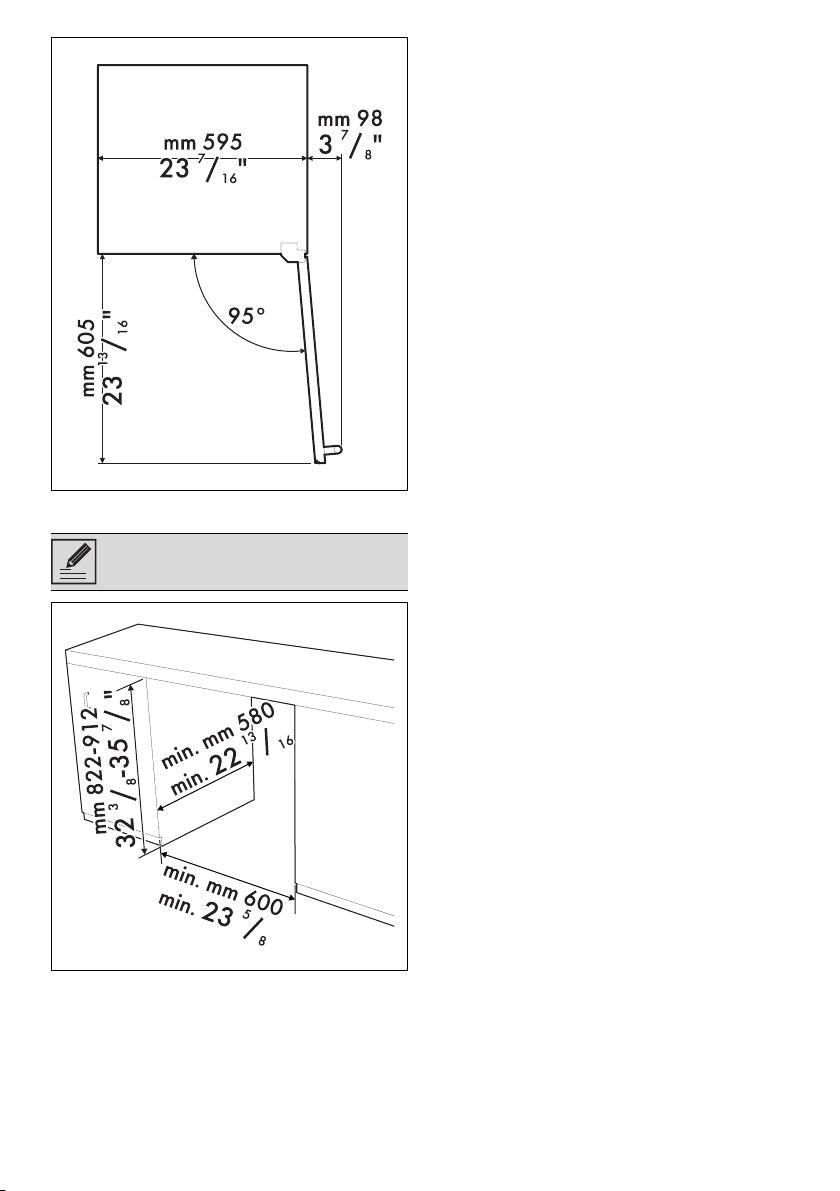
• Ensure that the appliance is located with
sufficient space for the door to open and for
the internal drawers and shelves to be
removed, if necessary.
• To ensure correct cooling of the condenser,
respect the clearance requirements when
mounting.
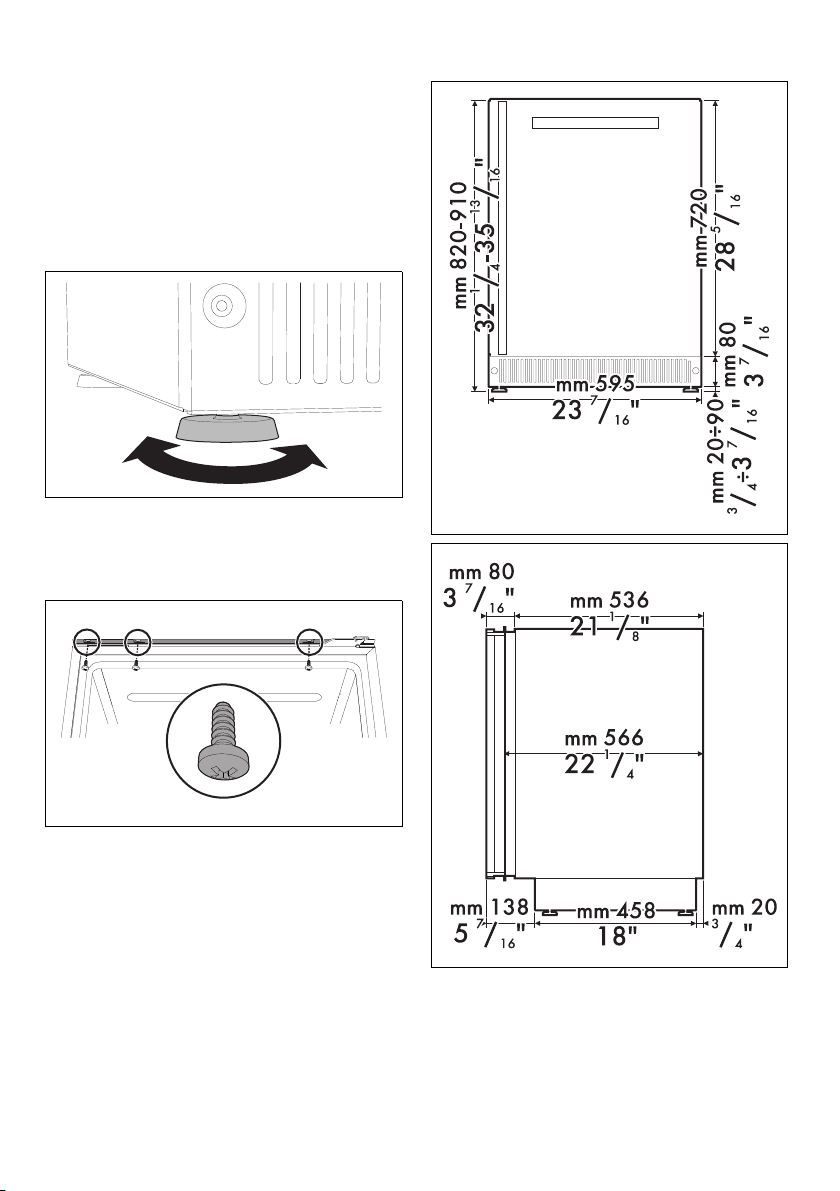
Levelling
To level the appliance correctly, there are four
feet on the lower front.
Fixing to the furniture
To fix the appliance to the furniture:
1. open the door;
2. tighten the 3 screws provided.
Overall dimensions of the appliance
(mm)
INSTALLATION - 1991477A923/A
e
Recess (mm)
Do not cover the ventilation holes.