
565, 572 XP
®
, 572 XP
®
G
EN Operator's manual 2-37
Contents
Introduction..................................................................... 2
Safety..............................................................................4
Assembly........................................................................ 9
Operation...................................................................... 10
Maintenance................................................................. 21
Troubleshooting............................................................ 31
Transportation, storage and disposal........................... 32
Technical data.............................................................. 33
Accessories.................................................................. 34
Declaration of Conformity............................................. 36
Introduction
Product description
The Husqvarna 565, 572 XP, 572 XPG are chainsaw
models with a combustion engine.
Work is constantly in progress to increase your safety
and efficiency during operation. Speak to your servicing
dealer for more information.
Intended use
This chainsaw for forest service is designed for forest
work such as felling, limbing and cutting.
Note: National regulations can set limit to the
operation of the product.
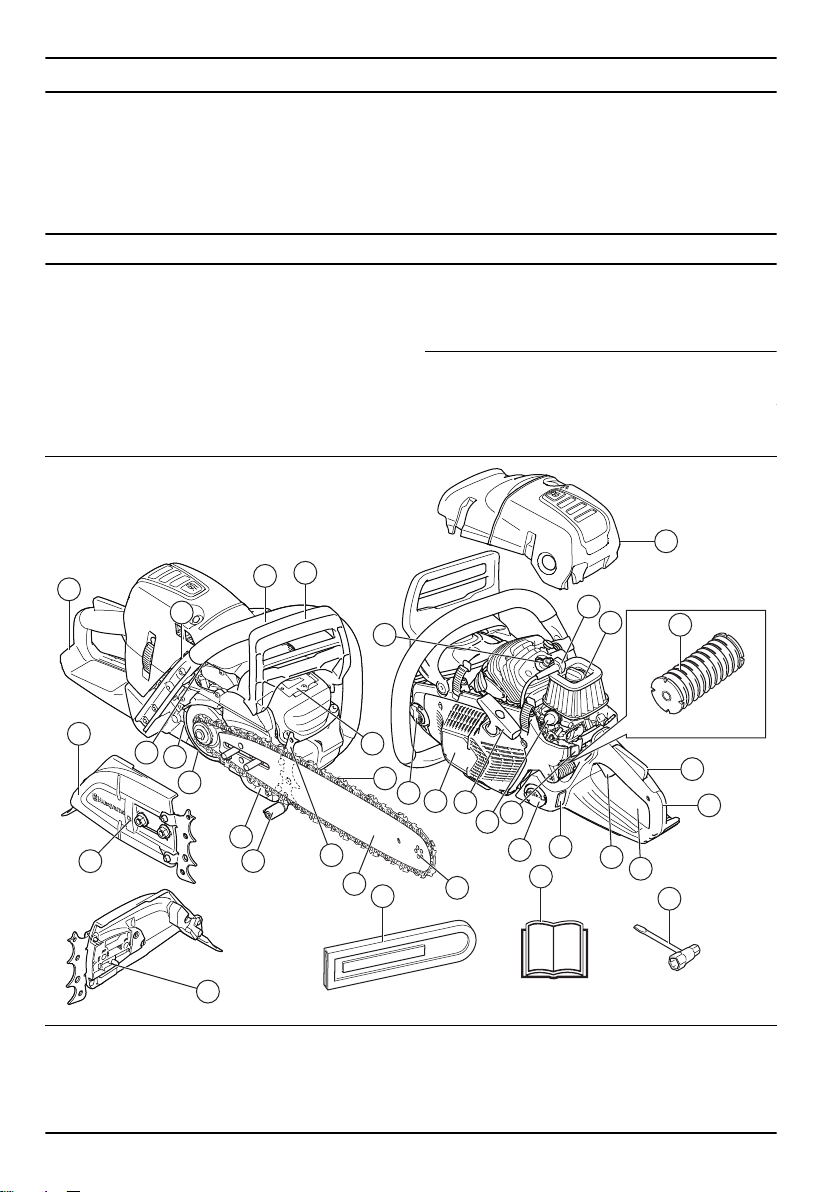
Product overview
18
6
17
7
28
26
1
8
23
9
10
3
4
2
5
30
31
32
11
12
15
24
5
27
14
16
13
19
5
20
21
22
29
25
33
34
1. Cylinder cover
2. Spark plug
3. Spark plug cap
4. Air filter
5. Vibration damping system, 3 units
6. Throttle trigger lockout
2 140 - 012 - 21.08.2023
7. Rear handle
8. Information and warning decal
9. Throttle trigger
10. Start/stop switch
11. Fuel level window
12. Fuel tank
13. Air purge bulb
14. Starter rope handle
15. Starter housing
16. Chain oil tank
17. Muffler
18. Chain brake and front hand guard
19. Front handle
20. Right hand guard
21. Clutch cover
22. Chain tensioning screw
23. Oil pump adjustment screw
24. Chain catcher
25. Spiked bumper
26. Saw chain
27. Guide bar
28. Bar tip sprocket
29. Chain adjuster pin
30. Transportation guard
31. Operator's manual
32. Combination wrench
33. Switch for heated handles (572 XPG)
34. Brake band
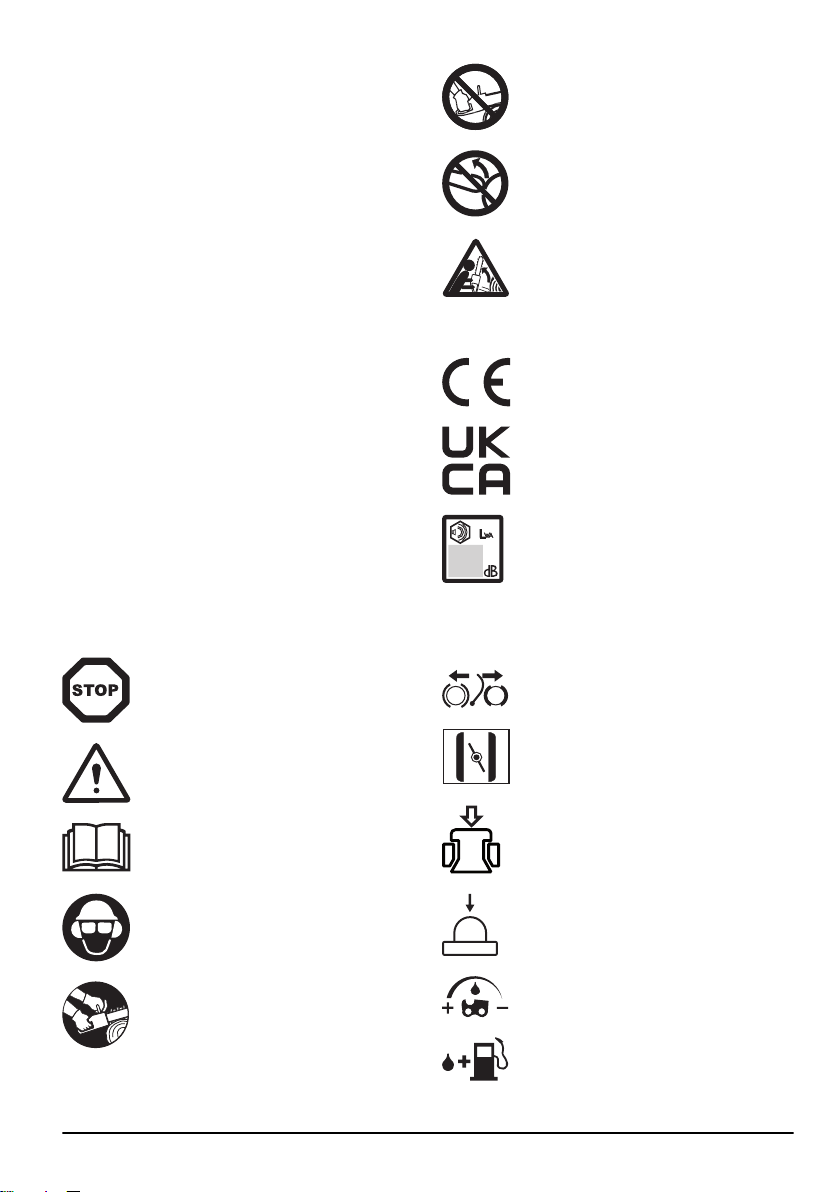
Symbols on the product
Stop.
Be careful and use the product correctly.
This product can cause serious injury or
death to the operator or others.
Read the operator's manual carefully
and make sure that you understand the
instructions before you use this product.
Always wear approved protective helmet,
approved hearing protection and eye
protection.
Use 2 hands to operate the product.
Do not operate the product with one hand.
Do not let the guide bar tip touch an
object.
Warning! Kickback can occur when the
guide bar tip touches an object. A
kickback causes a lightning fat reverse
reaction that throws the guide bar up and
in the direction of the operator. Can cause
serious injury.
This product complies with applicable EC
Directives.
This product conforms to the applicable
UK regulations.
Noise emission to the environment
label as per EU and UK directives
and regulations, and New South Wales
legislation "Protection of the Environment
Operations (Noise Control) Regulation
2017". The guaranteed sound power level
of the product is specified in
Technical
data on page 33
and on the label.
Chain brake, engaged (right). Chain
brake, disengaged (left).
Choke.
Decompression valve.
Air purge bulb.
Adjustment of the oil pump.
Fuel.
140 - 012 - 21.08.2023 3
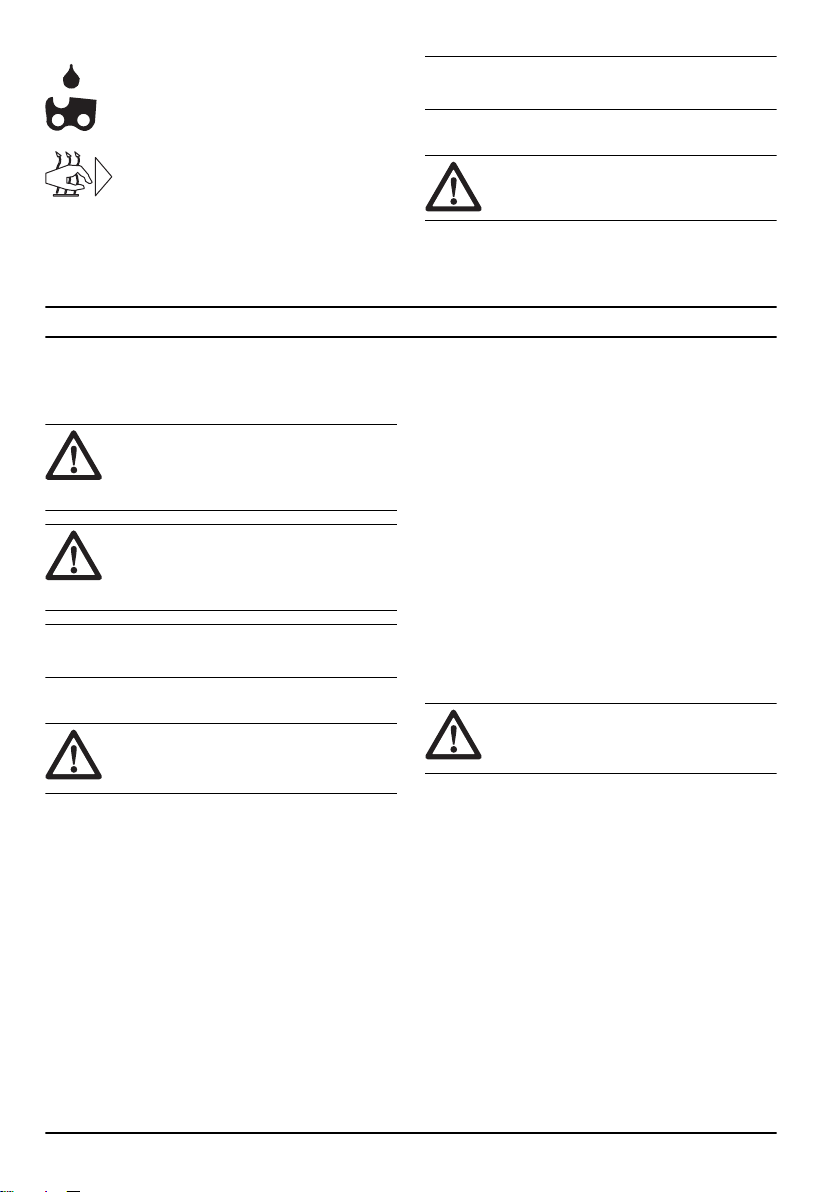
Chain oil.
If your product has this symbol it has
heated handles.
yyyywwxxxx The rating plate shows se-
rial number. yyyy is the
production year and ww is
the production week.
Note: Other symbols/decals on the product refer to
certification requirements for some markets.
Euro V Emissions
WARNING: Tampering with the engine
voids the EU type-approval of this product.
Safety
Safety definitions
Warnings, cautions and notes are used to point out
specially important parts of the manual.
WARNING: Used if there is a risk of
injury or death for the operator or bystanders
if the instructions in the manual are not
obeyed.
CAUTION: Used if there is a risk of
damage to the product, other materials or
the adjacent area if the instructions in the
manual are not obeyed.
Note: Used to give more information that is necessary
in a given situation.
General safety instructions
WARNING: Read the warning
instructions that follow before you use the
product.
• A chainsaw is a dangerous tool if used carelessly or
incorrectly and can cause serious injury or death. It
is very important that you read and understand the
contents of this operator’s manual.
• Under no circumstances may the design of the
product be modified without the permission of the
manufacturer. Do not use a product that appears
to have been modified by others and only use
accessories recommended for this product. Non-
authorized modifications and/or accessories can
result in serious personal injury or the death of the
operator or others.
• A used muffler/spark arrester and spark arrester
mounting face may contain deposits of combustion
particles that may be carcinogenic. Avoid being
exposed to these compounds when handling the
muffler and/or spark arrester. Prior to any handling
of the muffler and/or the spark arrester, refer to
To
do a check of the muffler on page 23
.
• Long term inhalation of the engine’s exhaust fumes,
chain oil mist and sawdust can represent a health
risk.
• This product produces an electromagnetic field
during operation. This field may under some
circumstances interfere with active or passive
medical implants. To reduce the risk of serious or
fatal injury, we recommend persons with medical
implants to consult their physician and the medical
implant manufacturer before operating this product.
• The information in this operator's manual is never
a substitute for professional skills and experience.
If you get into a situation where you feel unsafe,
stop and seek expert advice. Contact your servicing
dealer or an experienced chainsaw user. Do not
attempt any task that you feel unsure of!
Safety instructions for operation
WARNING: Read the warning
instructions that follow before you use the
product.
• Before using the product you must understand the
effects of kickback and how to avoid them. Refer to
Kickback information on page 12
for instructions.
• Never use a product that is faulty.
• Never use a product with visible damage to the
spark plug cap and ignition cable. A risk of sparking
arises, which can cause a fire.
• Never use the product if you are fatigued, while
under the influence of alcohol or drugs, medication
or anything that could affect your vision, alertness,
coordination or judgement.
• Do not use the product in bad weather such
as dense fog, heavy rain, strong wind, intense
cold, etcetera. Working in bad weather is tiring
and often brings added risks, such as icy ground,
unpredictable felling direction, etcetera.
• Never start a product unless the guide bar, saw
chain and all covers are fitted correctly. Refer to
4
140 - 012 - 21.08.2023
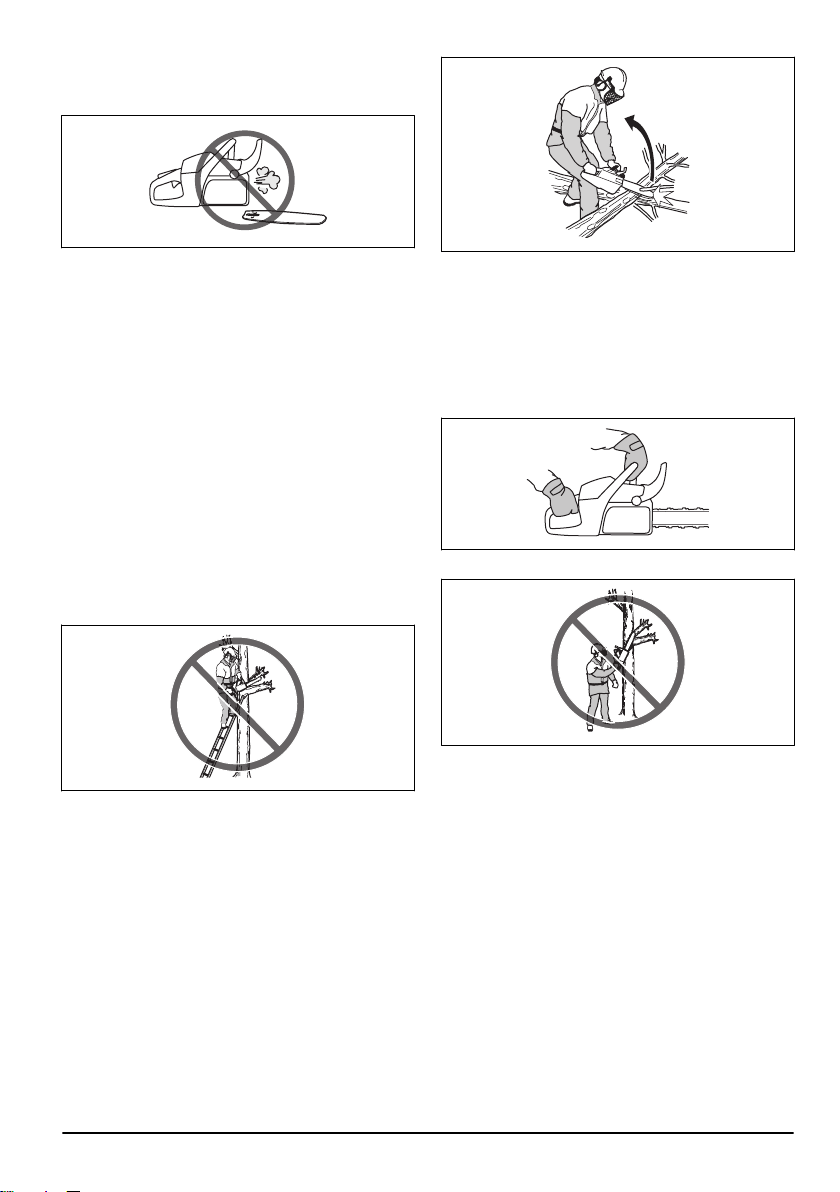
Assembly on page 9
for instructions. Without a bar
and saw chain attached to the product the clutch can
come loose and cause serious injury.
• Never start the product indoors. Exhaust fumes can
be dangerous if inhaled.
• The exhaust fumes from the engine are hot and can
contain sparks, which can start a fire. Never start the
product near flammable material!
• Observe your surroundings and make sure that there
is no risk of people or animals coming in contact with
or affect your control of the product.
• Never allow children to use or be in the vicinity of the
product. As the product is equipped with a spring-
loaded start/stop switch and can be started by low
speed and force on the starter handle, even small
children under some circumstances can produce the
force necessary to start the product. This can mean
a risk of serious personal injury. Therefore remove
the spark plug cap when the product is not under
close supervision.
• You must have a steady stance in order to have
full control of the product. Never work standing on
a ladder, in a tree or where you do not have a firm
ground to stand on.
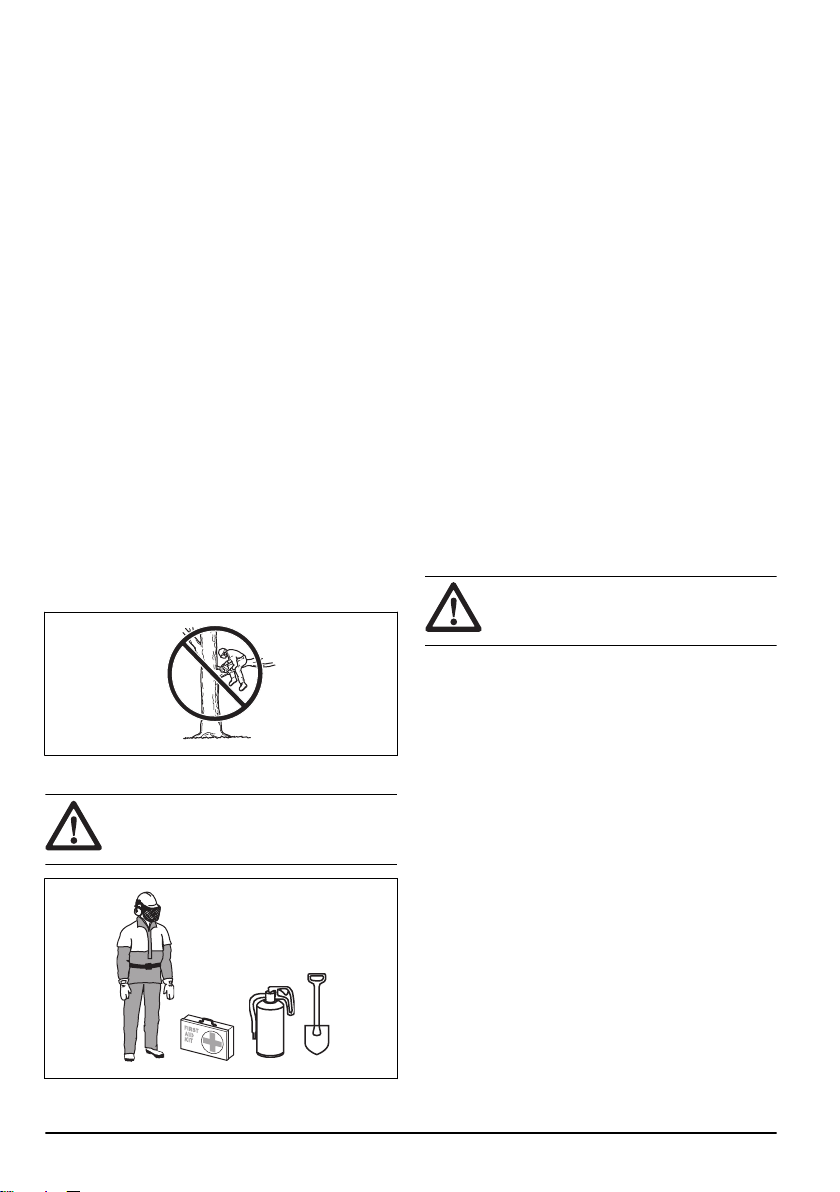
• Working in a tree requires the use of special
cutting and working techniques which must be
observed in order to reduce the increased risk
of personal injury. Never work in a tree unless
you have received specific, professional training for
such work, including training in the use of safety
and other climbing equipment, such as harnesses,
ropes, belts, climbing irons, snap hooks, carabiners,
etcetera.
• Never attempt to catch falling sections. Never cut in
the tree when you are only secured with one rope.
Always use two secured ropes.
• Lack of concentration can lead to kickback if the
kickback zone of the bar accidentally touches a
branch, nearby tree or some other object.
• Never use the product by holding it with one hand.
This product is not safely controlled with one hand.
• Always hold the product with both hands. The right
hand should be on the rear handle, and the left hand
on the front handle. All people, whether right or left
handed, should use this grip. Use a firm grip with
thumbs and fingers encircling the handles. This grip
minimizes the risk of kickback and lets you keep the
product under control. Do not let go of the handles!
• Never use the product above shoulder height.
• Do not use the product in a situation where you
cannot call for help in case of an accident.
• Before moving your product, switch off the engine
and lock the saw chain using the chain brake.
Carry the product with the guide bar and saw chain
pointing backwards. Fit a transportation guard to the
guide bar before transporting the product or carrying
it for any distance.
• When you put the product on the ground, lock the
saw chain using the chain brake and ensure you
have a constant view of the product. Switch the
engine off before leaving your product for any length
of time.
• Sometimes chips get stuck in the clutch cover
causing the saw chain to jam. Always stop the
engine before cleaning.
• Running an engine in a confined or badly ventilated
area can result in death due to carbon monoxide
poisoning.
140 - 012 - 21.08.2023
5
• The exhaust fumes from the engine are hot and may
contain sparks which can start a fire. Do not start the
product indoors or near flammable material.
• Use the chain brake as a parking brake when
you start the product and when you move short
distances. Always carry the product in the front
handle. This decreases the risk that you or a person
near you get hit by the saw chain.
• Overexposure to vibration can lead to circulatory
damage or nerve damage in people who have
impaired circulation. Contact your doctor if you
experience symptoms of overexposure to vibration.
Such symptoms include numbness, loss of feeling,
tingling, pricking, pain, loss of strength, changes in
skin colour or condition. These symptoms normally
appear in the fingers, hands or wrists. These
symptoms may be increased in cold temperatures.
• It is not possible to cover every conceivable situation
you can face when using this product. Always
exercise care and use your common sense. Avoid
all situations which you consider to be beyond your
capability. If you still feel uncertain about operating
procedures after reading these instructions, you
should consult an expert before continuing. Do not
hesitate to contact your dealer or Husqvarna if you
have any questions about the use of the product.
We will willingly be of service and provide you with
advice as well as help you to use your product
both efficiently and safely. Attend a training course
in chainsaw usage if possible. Your dealer, forestry
school or your library can provide information about
which training materials and courses are available.
Personal protective equipment
WARNING:
Read the warning
instructions that follow before you use the
product.
• Most chainsaw accidents occur when the saw chain
touches the operator. You must use approved
personal protective equipment during operation.
Personal protective equipment does not give you
full protection from injuries but it decreases the
degree of injury if an accident occurs. Speak to your
servicing dealer for recommendations about which
equipment to use.
• Your clothing must be close-fitting but not limit your
movements. Regularly do a check of the condition of
the personal protective equipment.
• Use an approved protective helmet.
• Use approved hearing protection. Long-term
exposure to noise can result in permanent damage
to the hearing.
• Use approved protective glasses or a face visor
to decrease the risk of injury from thrown objects.
The product can throw objects, such as wood chips,
small pieces of wood and more, at large force. This
can result in serious injury, especially to the eyes.
• Use gloves with saw protection.
• Use pants with saw protection.
• Use boots with saw protection, steel toe-cap and
non-slip sole.
• Always have a first-aid kit with you.
• Risk of sparks. Keep fire extinguishing tools and a
shovel near to prevent forest fires.
Safety devices on the product
WARNING: Read the warning
instructions that follow before you use the
product.
• Do not use a product with safety devices that are
damaged or do not operate correctly.
• Do a check of the safety devices regularly. Refer to
Maintenance and checks of the safety devices on
the product on page 22
.
• If the safety devices are damaged or do not operate
correctly, speak to your Husqvarna servicing dealer.
Chain brake and front hand guard
Your product has a chain brake that stops the saw chain
if you get a kickback. The chain brake decreases the
risk of accidents, but only you can prevent them.
The chain brake engages (A) manually by your left hand
or automatically by the inertia release mechanism. Push
6
140 - 012 - 21.08.2023
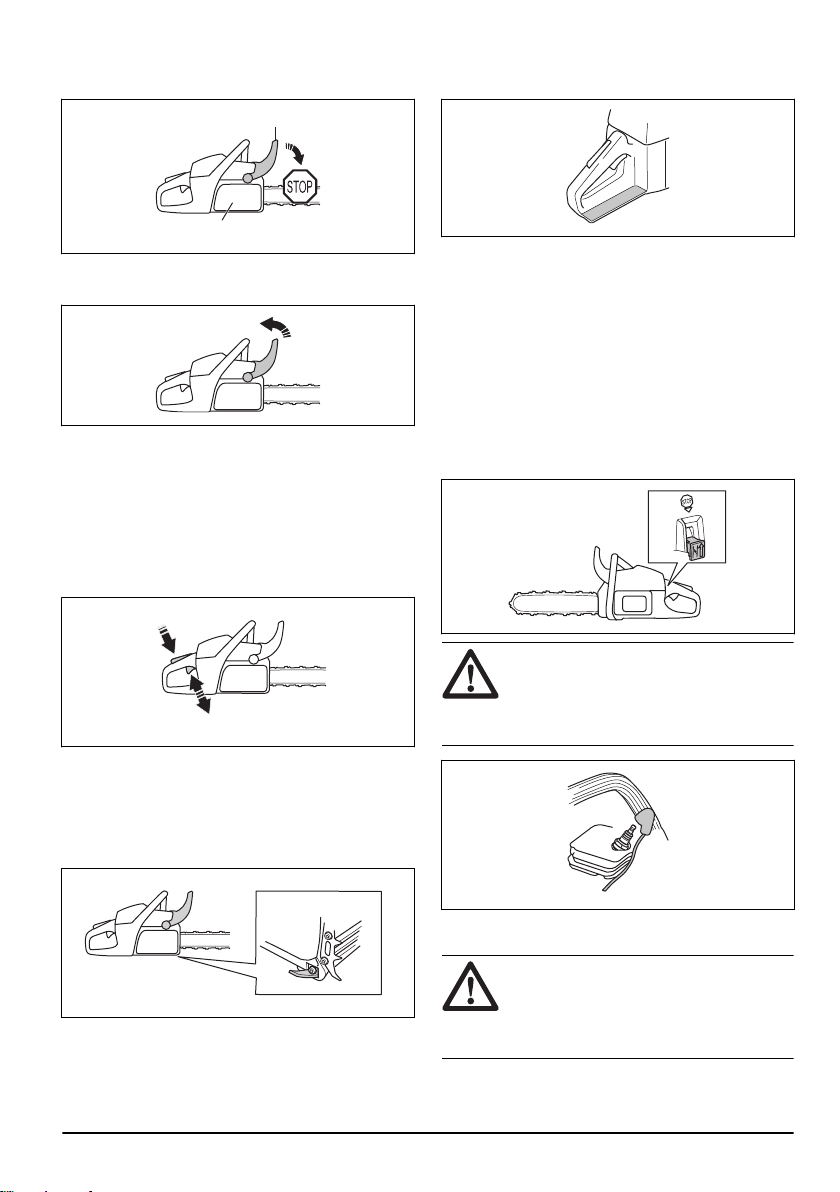
the front hand guard (B) forward to engage the chain
brake manually.
A
B
Pull the front hand guard rearward to disengage the
chain brake.
Throttle trigger lockout
The throttle trigger lockout prevents accidental operation
of the throttle trigger. If you put your hand around
the handle and press the throttle trigger lockout (A),
it releases the throttle trigger (B). If you release the
handle, the throttle trigger and the throttle trigger lockout
move back to their initial positions. This function locks
the throttle trigger at idle speed.
A
B
Chain catcher
The chain catcher catches the saw chain if it breaks or
derails. Correct saw chain tension and correctly applied
maintenance on the saw chain and guide bar, decrease
the risk of accidents.
Right hand guard
The right hand guard is a protection for your hand on the
rear handle. The right hand guard gives you protection
if the saw chain breaks or derails. The right hand guard
also gives you protection from branches or twigs.
Vibration damping system
The vibration damping system decreases vibration in
the handles. Vibration damping units operate as a
separation between the product body and the handle
unit.
Refer to
Product overview on page 2
for information
about where the vibration damping system is on your
product.
Start/stop switch
Use the start/stop switch to stop the engine.
WARNING: The start/stop switch
automatically goes back to start position. To
prevent accidental start, remove the spark
plug cap from the spark plug when you
assemble or do maintenance on the product.
Muffler
WARNING:
The muffler becomes very
hot during/after operation and at idle speed.
There is a risk of fire, especially when
you operate the product near flammable
materials and/or fumes.
140 - 012 - 21.08.2023 7
WARNING: Do not operate a product
without a muffler or with a defective
muffler. A defective muffler can increase
the noise level and the risk of fire. Keep
fire extinguishing tools near. Do not use
a product without, or with a broken, spark
arrestor mesh if you must have a spark
arrestor mesh in your area.
The muffler keeps the noise levels to a minimum and
points the exhaust fumes away from the operator. In
areas with a hot, dry weather there is a high risk of fire.
Obey local regulations and maintenance instructions.
Fuel safety
WARNING: Read the warning
instructions that follow before you use the
product.
• Make sure there is plenty of ventilation when
refuelling or mixing fuel (petrol and two-stroke oil).
• Fuel and fuel vapour are highly flammable and
can cause serious injury when inhaled or allowed
to come in contact with the skin. For this reason
observe caution when handling fuel and make sure
there is adequate ventilation.
• Take care when handling fuel and chain oil. Be
aware of the risks of fire, explosion and those
associated with inhalation.
• Do not smoke and do not place any hot objects in
the vicinity of fuel.
• Always stop the engine and let it cool for a few
minutes before refuelling.
• When refuelling, open the fuel cap slowly so that any
excess pressure is released gently.
• Tighten the fuel cap carefully after refuelling.
• Never refuel the machine while the engine is
running.
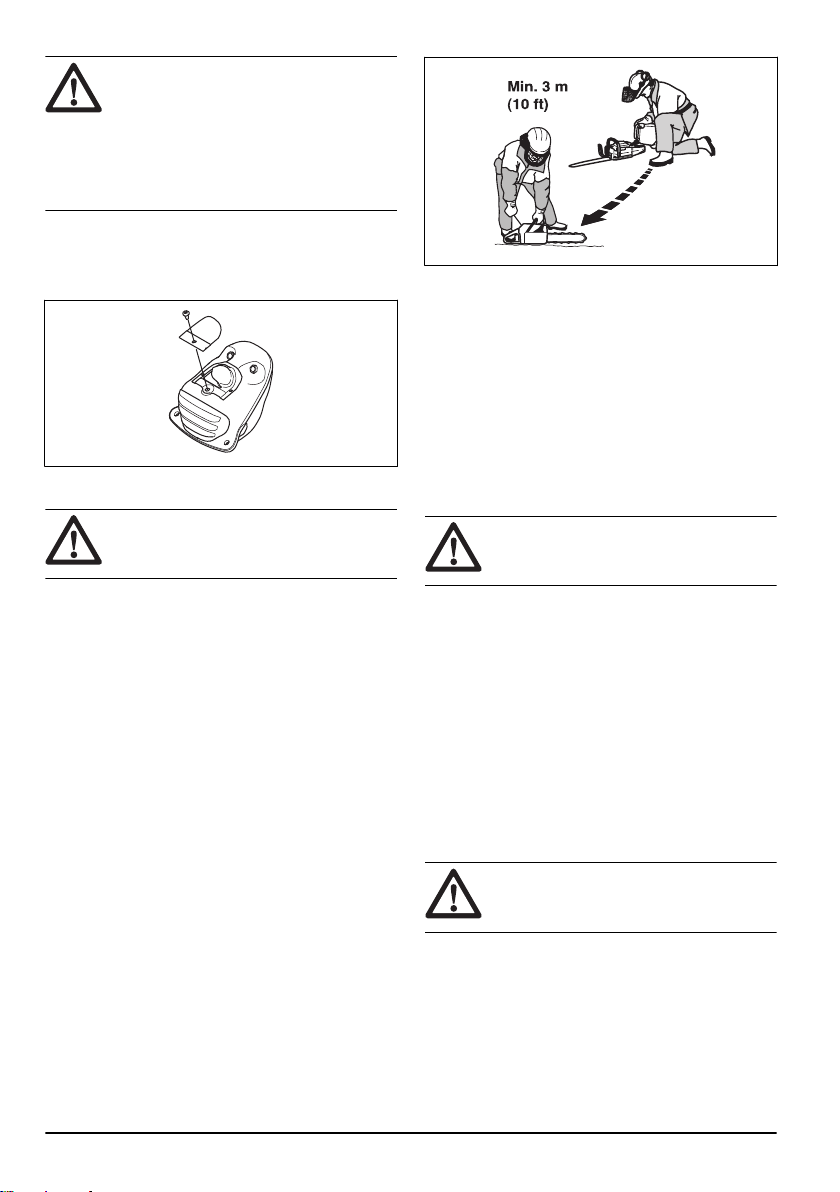
• Always move the product at least 3 m (10 ft) away
from the refuelling area and fuel source before
starting.
After refuelling, there are some situations where you
must never start the product:
• If you have spilled fuel or chain oil on the product.
Wipe off the spillage and allow remaining fuel to
evaporate.
• If you have spilled fuel on yourself or on your
clothes. Change your clothes and wash any part of
your body that has come in contact with fuel. Use
soap and water.
• If the product leaks fuel. Regularly do a check for
leaks from the fuel tank, fuel cap and fuel lines.
Safety instructions for maintenance
WARNING: Read the warning
instructions that follow before you do
maintenance on the product.
• Do only the maintenance and servicing given in
this operator's manual. Let professional servicing
personnel do all other servicing and repairs.
• Regularly do the safety checks, maintenance and
service instructions given in this manual. Regular
maintenance increases the life of the product
and decreases the risk of accidents. Refer to
Maintenance on page 21
for instructions.
• If the safety checks in this operator's manual is
not approved after you do maintenance, speak to
your servicing dealer. We guarantee that there are
professional repairs and servicing available for your
product.
Safety instructions for the cutting equipment
WARNING:
Read the warning
instructions that follow before you use the
product.
• Only use approved guide bar/saw chain
combinations and filing equipment. Refer to
Accessories on page 34
for instructions.
• Use protective gloves when you use or do
maintenance on the saw chain. A saw chain that
does not move can also cause injuries.
• Keep the cutting teeth correctly sharpened. Obey the
instructions and use the recommended file gauge. A
8
140 - 012 - 21.08.2023
saw chain that is damaged or incorrectly sharpened
increases the risk of accidents.
• Keep the correct depth gauge setting. Obey the
instructions and use the recommended depth gauge
setting. Too large depth gauge setting increases the
risk of kickback.
• Make sure that the saw chain has the correct
tension. If the saw chain is not tight against the
guide bar, the saw chain can derail. An incorrect saw
chain tension increases wear on the guide bar, saw
chain and chain drive sprocket. Refer to
To adjust
the tension of the saw chain on page 28
.
• Do maintenance on the cutting equipment regularly
and keep it correctly lubricated. If the saw chain is
not correctly lubricated, the risk of wear on the guide
bar, saw chain and chain drive sprocket increases.
Assembly
Introduction
WARNING: Read and understand the
safety chapter before you assemble the
product.
To assemble the guide bar and saw
chain
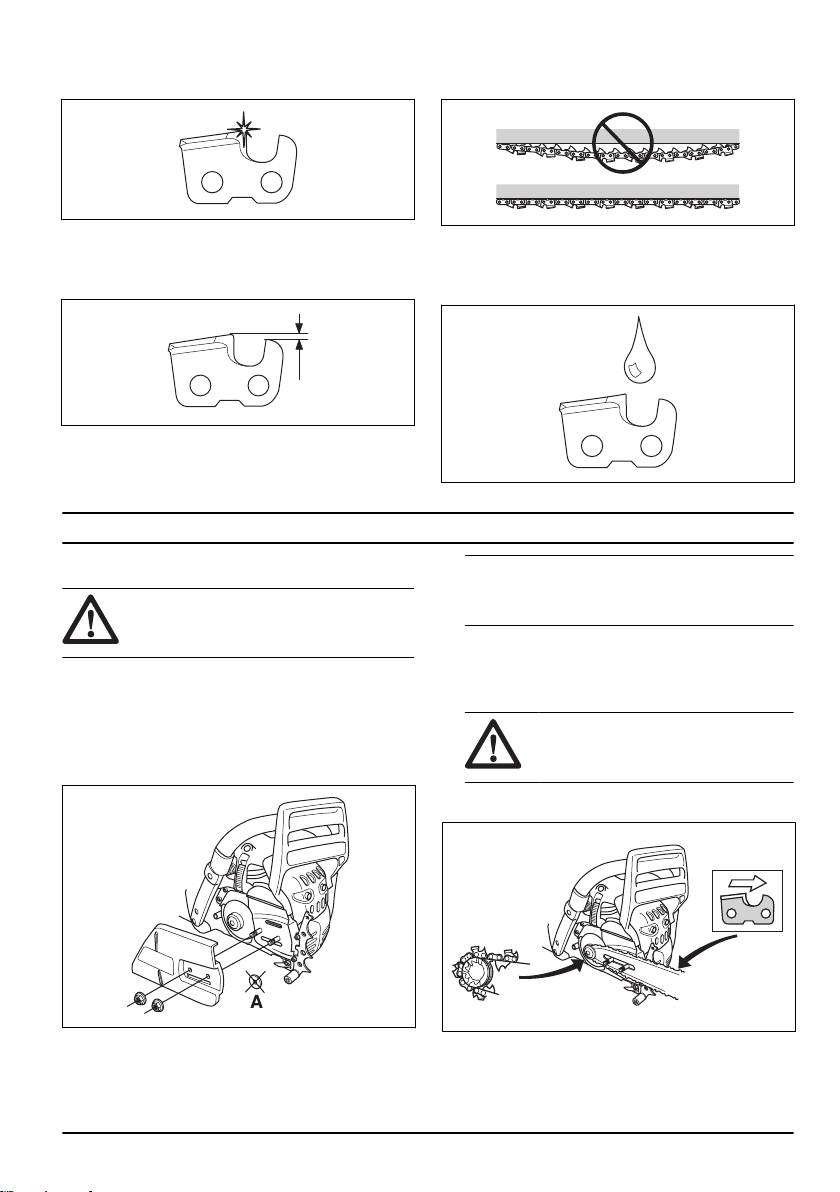
1. Move the front hand guard rearward to disengage
the chain brake.
2. Remove the bar nuts and the clutch cover.
Note: If the clutch cover is not easy to remove,
tighten the bar nut, engage the chain brake and
release. A click is heard if it is released correctly.
3. Assemble the guide bar onto the bar bolts. Move the
guide bar to its most rear position.
4. Install the saw chain correctly around the drive
sprocket and put it in the groove on the guide bar.
WARNING: Always use protective
gloves when you assemble the saw
chain.
5. Make sure that the edges of the cutters point forward
on the top edge of the guide bar.
140 - 012 - 21.08.2023 9
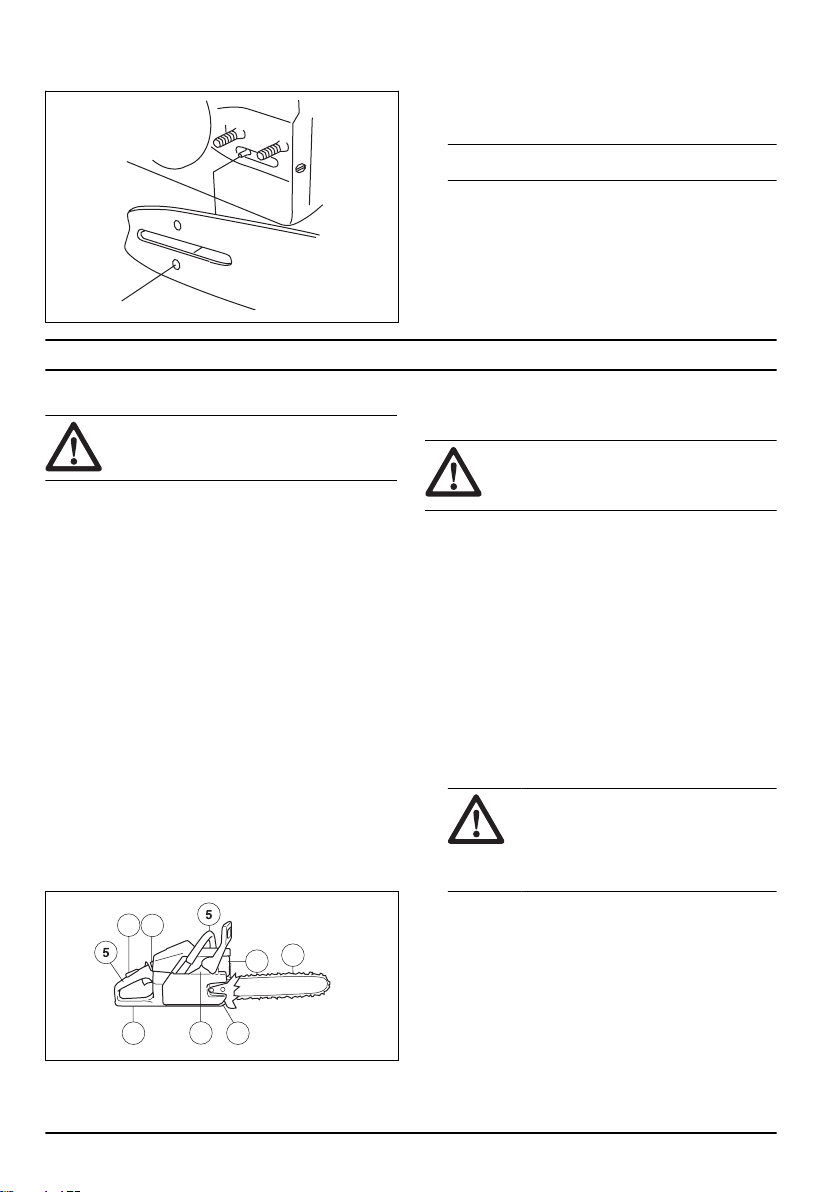
6. Align the hole in the guide bar with the chain adjuster
pin and install the clutch cover.
7. Tighten the bar nuts finger tight.
8. Tighten the saw chain. Refer to
To adjust the tension
of the saw chain on page 28
for instructions.
9. Tighten the bar nuts.
Note: Some models have only 1 bar nut.
Operation
Introduction
WARNING: Read and understand the
safety chapter before you use the product.
To do a function check before you use
the product
1. Make sure that the chain brake operates correctly
and that it is not damaged.
2. Make sure that the right hand guard is not damaged.
3. Make sure that the throttle lockout operates correctly
and that it is not damaged.
4. Make sure that the start/stop switch operates
correctly and that it is not damaged.
5. Make sure that there is no oil on the handles.
6. Make sure that the vibration damping system
operates correctly and that it is not damaged.
7. Make sure that the muffler is correctly attached and
that it is not damaged.
8. Make sure that all parts of the product are correctly
attached and not damaged or missing.
9. Make sure that the chain catcher is correctly
attached.
10. Do a check of the saw chain tension.
7
10
9
1
2
3
6,8
4
Fuel
This product has a two-stroke engine.
CAUTION: Incorrect type of fuel can
result in engine damage. Use a mixture of
gasoline and two-stroke oil.
Premixed fuel
• Use Husqvarna premixed alkylate fuel for best
performance and extension of the engine life. This
fuel contains less harmful chemicals compared
to regular fuel, which decreases harmful exhaust
fumes. The quantity of remains after combustion is
lower with this fuel, which keeps the components of
the engine more clean.
To mix fuel
Gasoline
• Use good quality unleaded gasoline with a maximum
of 10% ethanol contents.
CAUTION: Do not use gasoline with
an octane grade less than 90 RON/87
AKI. Use of a lower octane grade can
cause engine knocking, which causes
engine damages.
Two-stroke oil
• For best results and performance use Husqvarna
two-stroke oil.
• If Husqvarna two-stroke oil is not available, use a
two-stroke oil of good quality for air-cooled engines.
Speak to your servicing dealer to select the correct
oil.
10
140 - 012 - 21.08.2023
CAUTION: Do not use two-stroke
oil for water-cooled outboard engines,
also referred to as outboard oil. Do not
use oil for four-stroke engines.
To mix gasoline and two-stroke oil
Gasoline, liter Two-stroke oil,
liter
2% (50:1)
5 0.10
10 0.20
15 0.30
20 0.40
CAUTION: Small errors can influence
the ratio of the mixture drastically when you
mix small quantities of fuel. Measure the
quantity of oil carefully and make sure that
you get the correct mixture.
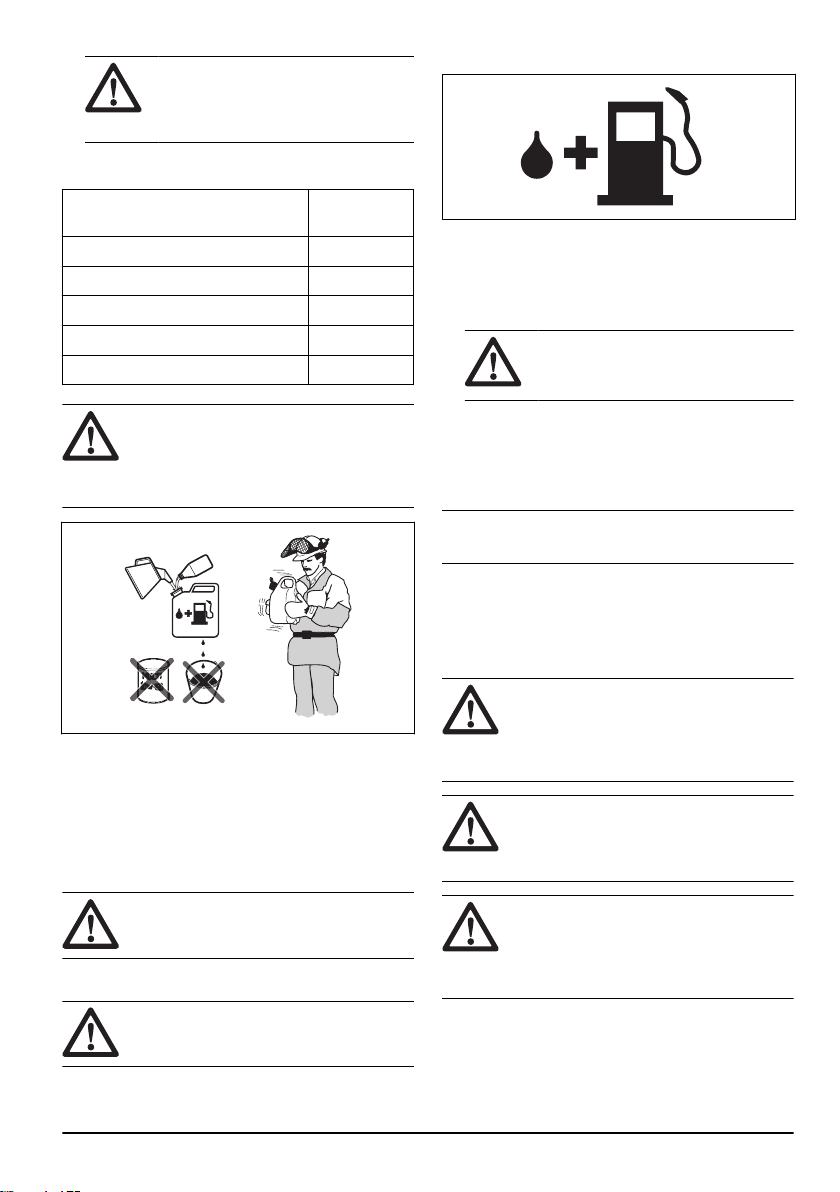
1. Fill half the quantity of gasoline in a clean container
for fuel.
2. Add the full quantity of oil.
3. Shake the fuel mixture.
4. Add the remaining quantity of gasoline to the
container.
5. Carefully shake the fuel mixture.
CAUTION: Do not mix fuel for more
than 1 month at a time.
To fill the fuel tank
WARNING: Obey the procedure that
follows for your safety.
1. Stop the engine and let the engine become cool.
2. Clean the area around the fuel tank cap.
3. Shake the container and make sure that the fuel is
fully mixed.
4. Remove the fuel tank cap slowly to release the
pressure.
5. Fill the fuel tank.
CAUTION: Make sure that there is
not too much fuel in the fuel tank. The
fuel expands when it becomes hot.
6. Tighten the fuel tank cap carefully.
7. Clean fuel spillage on and around the product.
8. Move the product 3 m/10 ft or more away from the
refueling area and fuel source before you start the
engine.
Note: To see where the fuel tank is on your product,
refer to
Product overview on page 2
.
To do a run-in
• During the first 10 hours of operation, do not apply
full throttle without load for extended periods.
To use the correct chain oil
WARNING:
Do not use waste oil,
which can cause injury to you and the
environment. Waste oil also causes damage
to the oil pump, the guide bar and the saw
chain.
WARNING: The saw chain can break
if the lubrication of the cutting equipment is
not sufficient. Risk of serious injury or death
to the operator.
WARNING: This product has a function
that lets the fuel run out before the chain
oil. Use the correct chain oil for this function
to operate correctly. Speak to your servicing
dealer when you select your chain oil.
• Use Husqvarna chain oil for maximum saw chain life
and to prevent negative effects on the environment.
If Husqvarna chain oil is not available, we
recommend you to use a standard chain oil.
140 - 012 - 21.08.2023
11
• Use a chain oil with good adherence to the saw
chain.
• Use a chain oil with correct viscosity range that
agrees with the air temperature.
CAUTION: If the oil is too thin, it
runs out before the fuel. In temperatures
below 0°C/32°F some chain oils become
too thick, which can cause damage to
the oil pump components.
• Use the recommended cutting equipment. Refer to
Accessories on page 34
.
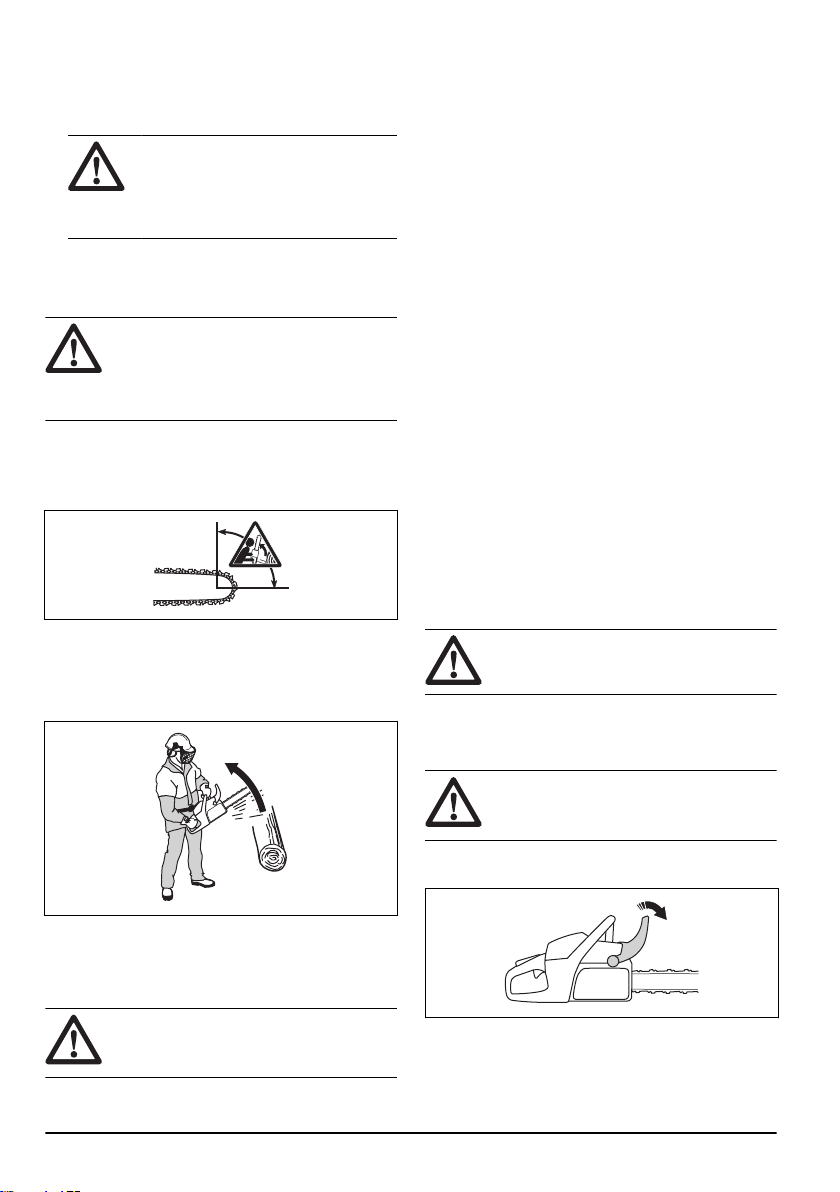
Kickback information
WARNING: A kickback can cause
serious injury or death to the operator or
others. To decrease the risk you must know
the causes of kickback and how to prevent
them.
A kickback occurs when the kickback zone of the guide
bar touches an object. A kickback can occur suddenly
and with large force, which throws the product in the
direction of the operator.
Kickback always occurs in the cutting plane of the guide
bar. Usually, the product is thrown against the operator
but can also move in a different direction. It is how you
use the product when the kickback occurs that causes
the direction of the movement.
A smaller bar tip radius decreases the force of the
kickback.
Use a low kickback saw chain to decrease the effects of
kickback. Do not let the kickback zone touch an object.
WARNING:
No saw chain fully
prevents kickback. Always obey the
instructions.
Common questions about kickback
• Will the hand always engage the chain brake during
a kickback?
No. It is necessary to use some force to push the
front hand guard forward. If you do not use the force
necessary, the chain brake will not be engaged. You
must also hold the handles of the product stable with
two hands during work. If a kickback occurs, it is
possible that the chain brake does not stop the saw
chain before it touches you. There are also some
positions in which your hand can not touch the front
hand guard to engage the chain brake.
• Will the inertia release mechanism always engage
the chain brake during kickback?
No. First, the chain brake must operate correctly.
Refer to
Maintenance and checks of the safety
devices on the product on page 22
for instructions
about how to do a check of the chain brake. We
recommend you to do this each time before you
use the product. Second, the force of the kickback
must be large to engage the chain brake. If the chain
brake is too sensitive, it can engage during rough
operation.
• Will the chain brake always protect me from injury
during a kickback?
No. The chain brake must operate correctly to give
protection. The chain brake must also be engaged
during a kickback to stop the saw chain. If you are
near the guide bar, it is possible that the chain brake
does not have time to stop the saw chain before it
hits you.
WARNING:
Only you and the correct
working technique can prevent kickbacks.
To start the product
To prepare to start with a cold engine
WARNING:
The chain brake must be
engaged when the product is started to
decrease the risk of injury.
1. Move the front hand guard forward to engage the
chain brake.
2. Pull the start/stop switch (A) out and up, to set it in
choke position.
3. Push the decompression valve (B).
12
140 - 012 - 21.08.2023
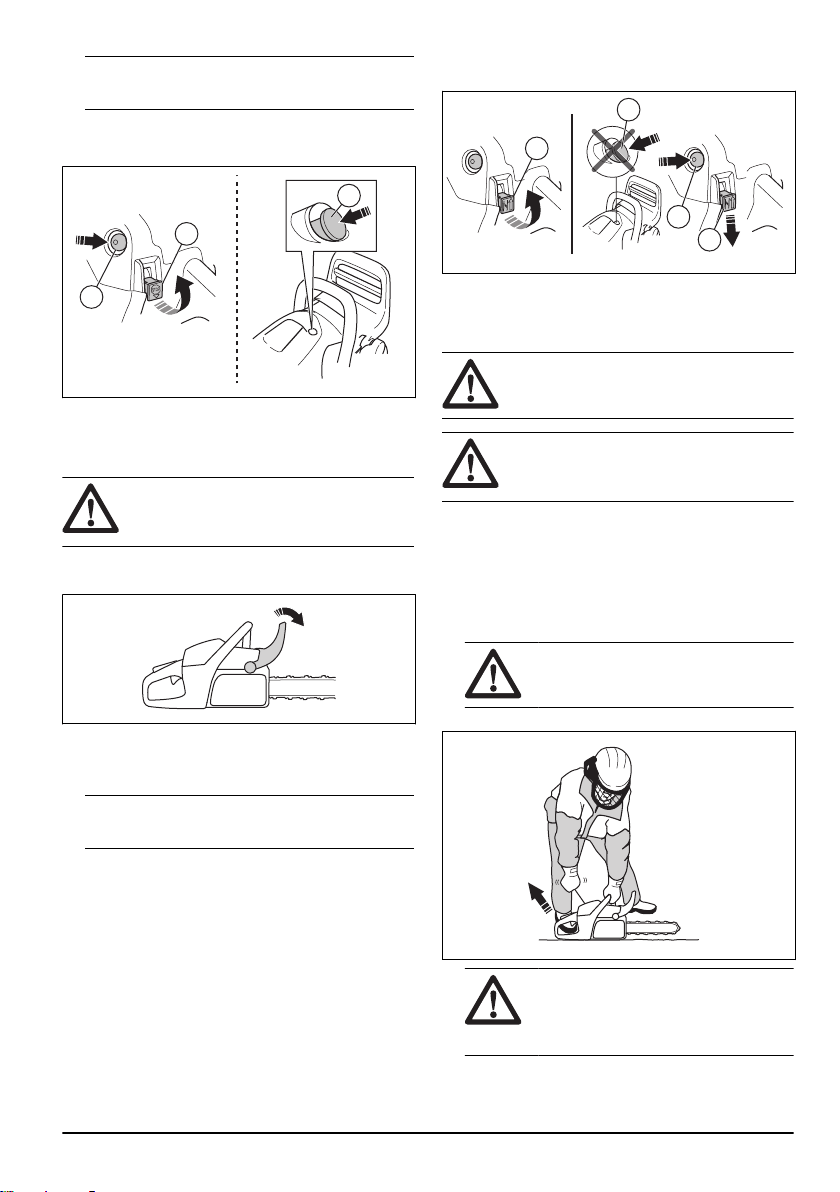
Note: The decompression valve moves to the
initial position when the product starts.
4. Push the air purge bulb (C) approximately 6 times or
until fuel starts to fill the bulb. It is not necessary to
fill the air purge bulb fully.
A
C
B
5. Continue to
To start the product on page 13
for
more instructions.
To prepare to start with a warm engine
WARNING: The chain brake must be
engaged when the product is started to
decrease the risk of injury.
1. Move the front hand guard forward to engage the
chain brake.
2. Pull the start/stop switch (A) out and up to set it in
choke position.
3. Push the decompression valve (B).
Note:
The decompression valve moves to the
initial position when the product starts.
4. Push the air purge bulb (C) approximately 6 times or
until fuel starts to fill the bulb. It is not necessary to
fill the air purge bulb fully.
5. Push the start/stop switch (D) down to set start
throttle setting.
A
B
C
D
6. Continue to
To start the product on page 13
for
more instructions.
To start the product
WARNING: You must keep your feet in
a stable position when you start the product.
WARNING: If the saw chain rotates at
idle speed, speak to your servicing dealer
and do not use the product.
1. Put the product on the ground.
2. Put your left hand on the front handle.
3. Put your right foot into the footgrip on the rear
handle.
4. Pull the starter rope handle slowly with your right
hand until you feel resistance.
WARNING:
Do not twist the starter
rope around your hand.
5. Pull the starter rope handle quickly and with force.
CAUTION:
Do not pull the starter
rope to full extension and do not let go of
the starter rope handle. This can cause
damage to the product.
a) If you start your product with a cold engine, pull
the starter rope handle until the engine fires.
140 - 012 - 21.08.2023
13
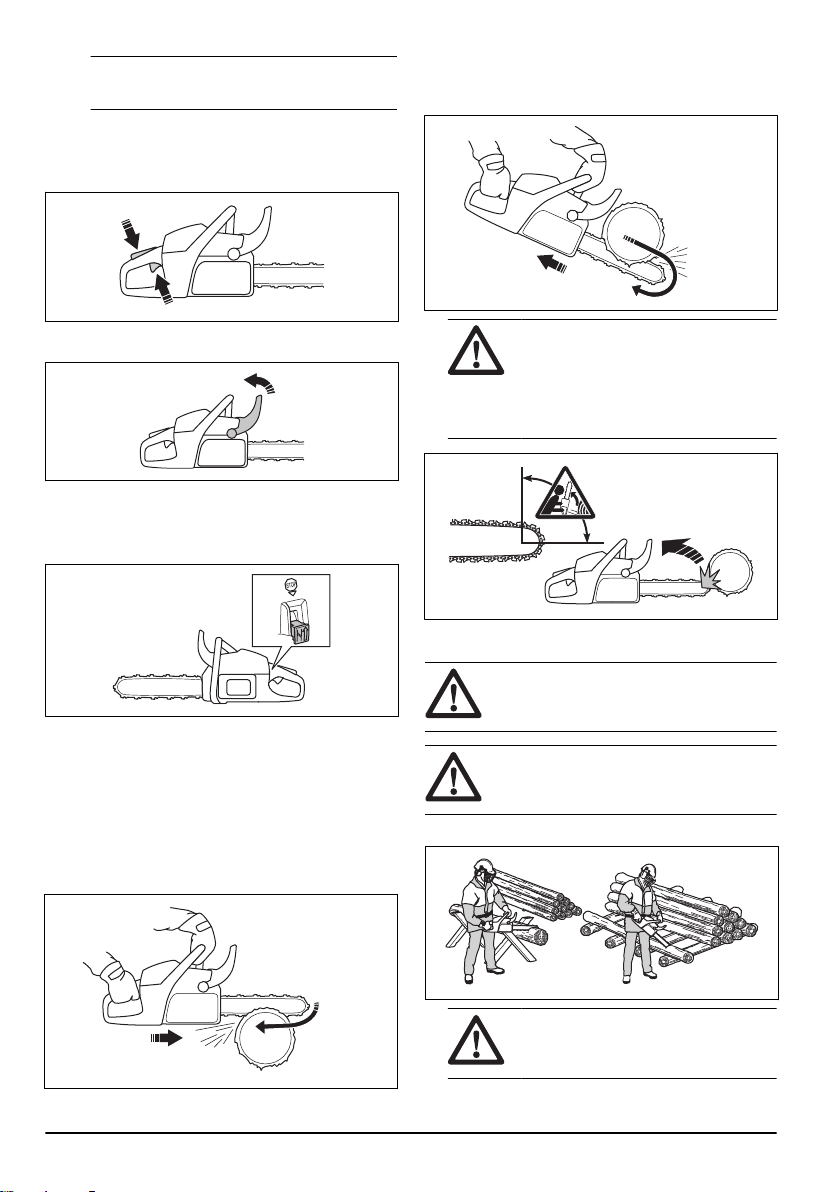
Note: You can identify when the engine fires
through a "puff" sound.
b) Disengage the choke.
6. Pull the starter rope handle until the engine starts.
7. Quickly disengage the throttle trigger lockout to set
the product to idle speed.
8. Move the front hand guard rearward to disengage
the chain brake.
9. Use the product.
To stop the product
1. Push the start/stop switch down to stop the engine.
Pull stroke and push stroke
You can cut through wood with the product in 2 different
positions.
• To cut on the pull stroke is when you cut with the
bottom of the guide bar. The saw chain pulls through
the tree when you cut. In this position you have
better control of the product and the position of the
kickback zone.
• To cut on the push stroke is when you cut with the
top of the guide bar. The saw chain pushes the
product in the direction of the operator.
WARNING: If the saw chain is
caught in the trunk, the product can be
pushed at you. Hold the product tightly
and make sure that the kickback zone
of the guide bar does not touch the tree
and causes a kickback.
To use the cutting technique
WARNING:
Use full throttle when you
cut and decrease to idle speed after each
cut.
CAUTION: Engine damage can occur if
the engine runs for too long at full throttle
without load.
1. Put the trunk on a saw horse or runners.
WARNING:
Do not cut trunks in a
pile. That increases the risk of kickback
and can result in serious injury or death.
2. Remove the cut pieces from the cutting area.
14
140 - 012 - 21.08.2023
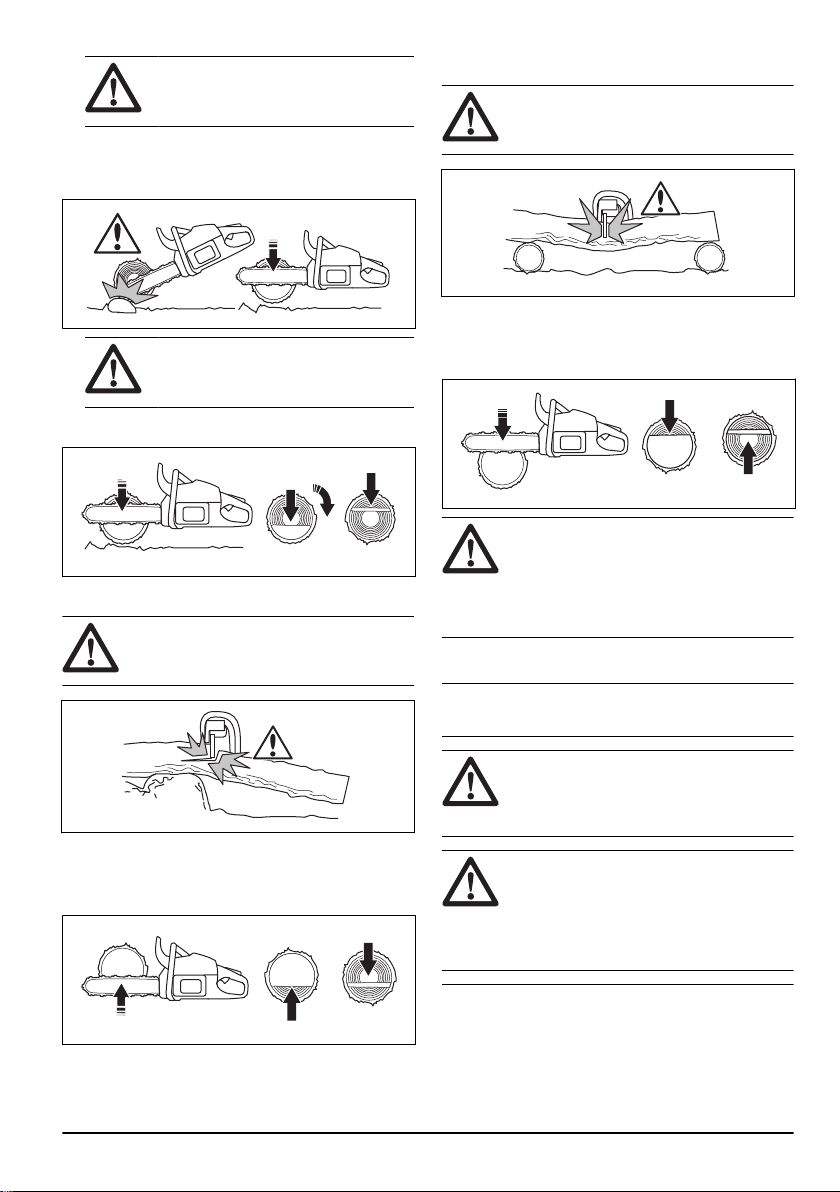
WARNING: Cut pieces in the
cutting area increase the risk of kickback
and that you can not keep your balance.
To cut a trunk on the ground
1. Cut through the trunk on the pull stroke. Keep full
throttle but be prepared for sudden accidents.
WARNING: Make sure that the saw
chain does not touch the ground when
you complete the kerf.
2. Cut approximately ⅔ through the trunk and then
stop. Turn the trunk and cut from the opposite side.
1.
2.
To cut a trunk that has support on one end
WARNING:
Make sure that the trunk
does not break during cutting. Obey the
instructions below.
1. Cut on the push stroke approximately ⅓ through the
trunk.
2. Cut through the trunk on the pull stroke until the two
kerfs touch.
1.
2.
To cut a trunk that has support on two ends
WARNING: Make sure that the saw
chain does not get caught in the trunk during
cutting. Obey the instructions below.
1. Cut on the pull stroke approximately ⅓ through the
trunk.
2. Cut through the remaining part of the trunk on the
push stroke to complete the cut.
1.
2.
WARNING: Stop the engine if the saw
chain gets caught in the trunk. Use a lever
to open up the kerf and remove the product.
Do not try to pull the product out by hand.
This can result in injury when the product
suddenly breaks free.
To use the limbing technique
Note:
For thick branches, use the cutting technique.
Refer to
To use the cutting technique on page 14
.
WARNING: There is a high accident
risk when you use the limbing technique.
Refer to
Kickback information on page 12
for
instructions how to prevent kickback.
WARNING: Cut limbs one by one. Be
careful when you remove small limbs and do
not cut bushes or many small limbs at the
same time. Small limbs can get caught in the
saw chain and prevent safe operation of the
product.
Note: Cut the limbs piece by piece if it is necessary.
140 - 012 - 21.08.2023 15
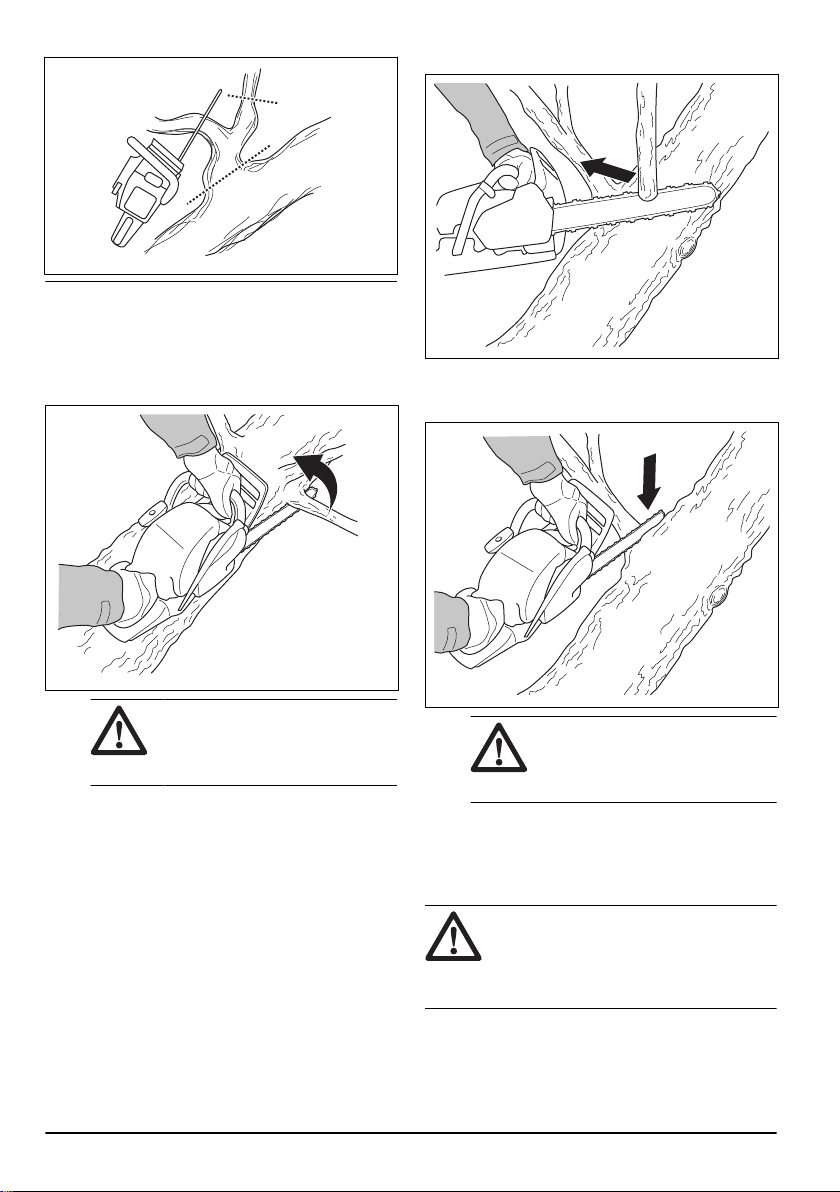
1
2
3
1. Remove the limbs on the right side of the trunk.
a) Keep the guide bar on the right side of the trunk
and keep the body of the product against the
trunk.
b) Select the applicable cutting technique for the
tension in the branch.
WARNING: If you are not sure
about how to cut the branch, speak
to a professional chainsaw operator
before you continue.
2. Remove the limbs on the top of the trunk.
a) Keep the product on the trunk and let the guide
bar move along the trunk.
b) Cut on the push stroke.
3. Remove the limbs on the left side of the trunk.
a) Select the applicable cutting technique for the
tension in the branch.
WARNING: If you are not sure
about how to cut the branch, speak
to a professional chainsaw operator
before you continue.
Refer to
To cut trees and branches that are in tension
on page 20
for instructions on how to cut branches that
are in tension.
To use the tree felling technique
WARNING:
You must have experience
to fell a tree. If possible, engage in
a training course in chainsaw operation.
Speak to an operator with experience for
more knowledge.
16 140 - 012 - 21.08.2023
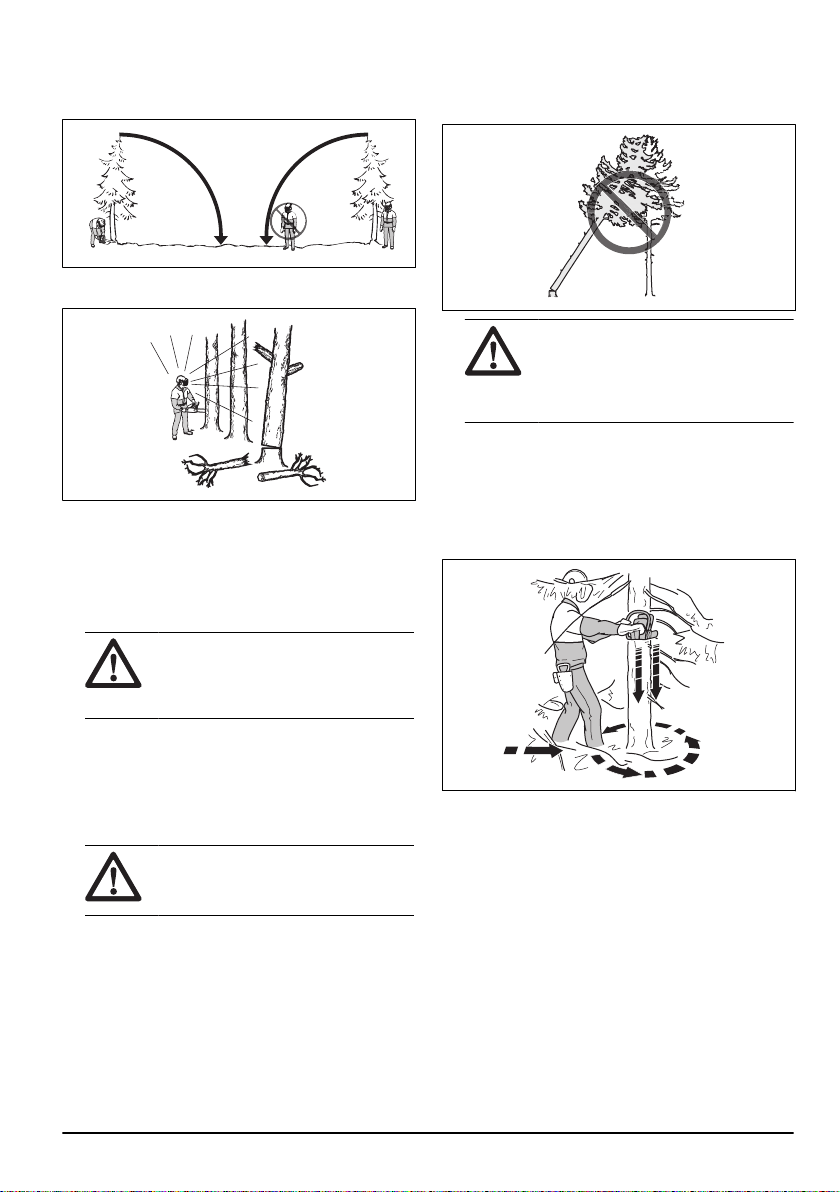
To keep a safe distance
1. Make sure that persons around you keep a safe
distance at a minimum of 2 1/2 tree lengths.
2. Make sure that no person is in the risk zone before
or during felling.
To calculate the felling direction
1. Examine in which direction it is necessary for the
tree to fall. The goal is to fell it in a position where
you can limb and cut the trunk easily. It is also
important that you are stable on your feet and can
move about safely.
WARNING:
If it is dangerous or not
possible to fell the tree in its natural
direction, fell the tree in a different
direction.
2. Examine the natural fall direction of the tree. For
example the tilt and bend of the tree, wind direction,
the location of the branches and weight of snow.
3. Examine if there are obstacles, for example other
trees, power lines, roads and/or buildings around.
4. Look for signs of damage and rot in the stem.
WARNING:
Rot in the stem can
mean a risk that the tree falls before you
complete the cutting.
5. Make sure the tree has no damaged or dead
branches that can break off and hit you during
felling.
6. Do not let the tree fall onto a different standing tree.
It is dangerous to remove a caught tree and there is
a high accident risk. Refer to
To free a trapped tree
on page 19
.
WARNING: During critical felling
operations, lift your hearing protection
immediately when the sawing is
complete. It is important that you hear
sounds and warning signals.
To clear the trunk and prepare your path of
retreat
Cut off all branches from your shoulder height and
down.
1. Cut on the pull stroke from the top down. Make sure
that the tree is between you and the product.
2. Remove undergrowth from the work area around the
tree. Remove all cut off material from the work area.
3. Do a check of the area for obstacles such as stones,
branches and holes. You must have a clear path
of retreat when the tree starts to fall. Your path of
retreat must be approximately 135 degrees away
from the felling direction.
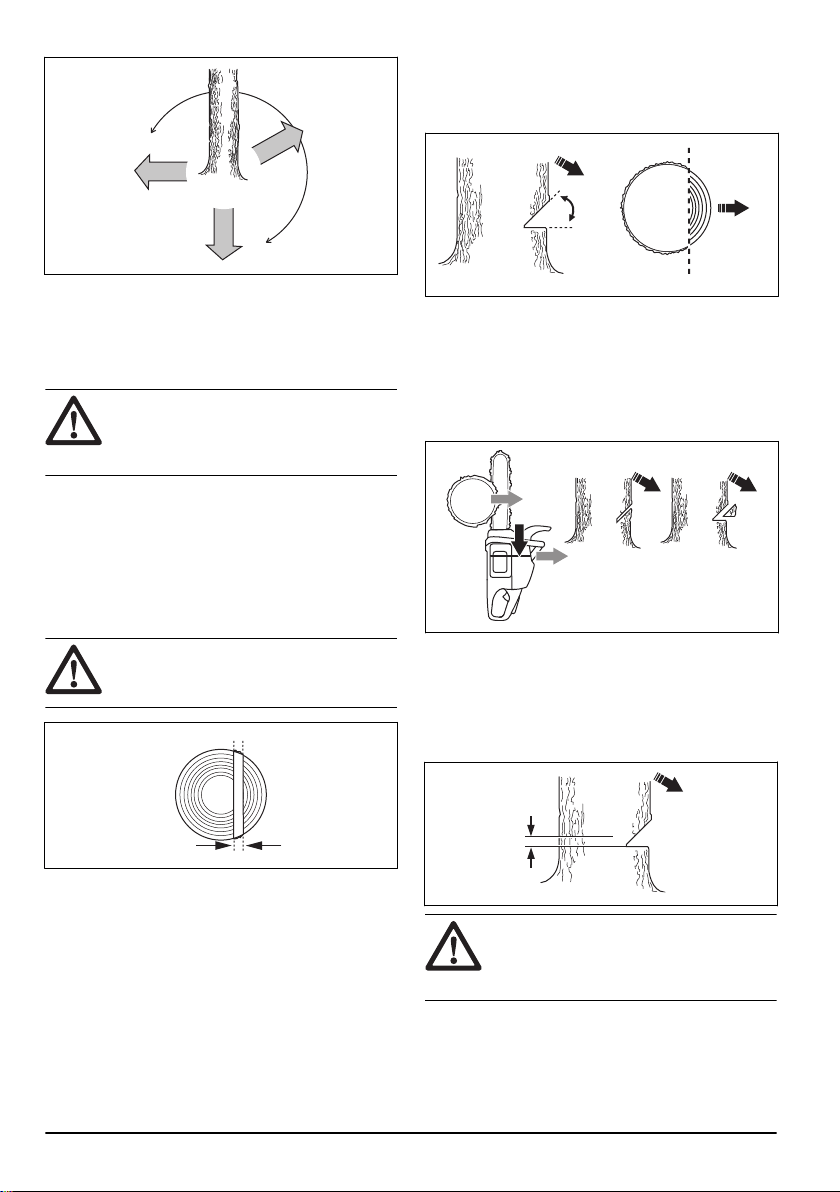
1. The danger zone
2. The path of retreat
3. The felling direction
140 - 012 - 21.08.2023
17
1
2
2
1
3
To fell a tree
Husqvarna recommends you to make the directional
cuts and then use the safe corner method when you
fell a tree. The safe corner method helps you to make a
correct felling hinge and control the felling direction.
WARNING: Do not fell trees with a
diameter that is more than two times larger
than the guide bar length. For this, you must
have special training.
The felling hinge
The most important procedure during tree felling is to
make the correct felling hinge. With a correct felling
hinge, you control the felling direction and make sure
that the felling procedure is safe.
The thickness of the felling hinge must be equal and a
minimum of 10% of the tree diameter.
WARNING:
If the felling hinge is
incorrect or too thin, you have no control of
the felling direction.
To make the directional cuts
1. Make the directional cuts ¼ of the diameter of
the tree. Make a 45°-70° angle between the top
directional cut and bottom directional cut.
45º-70º
a) Make the top directional cut. Align the felling
direction mark (1) of the product with the felling
direction of the tree (2). Stay behind the product
and keep the tree on your left side. Cut with a
pull stroke.
b) Make the bottom directional cut. Make sure that
the end of the bottom directional cut is at the
same point as the end of the top directional cut.
2
1
2. Make sure that the bottom directional cut is
horizontal and at a 90° angle to the felling direction.
To use the safe corner method
The felling cut must be made slightly above the
directional cut.
WARNING:
Be careful when you cut
with the guide bar tip. Start to cut with the
lower section of the guide bar tip as you
make a bore cut into the trunk.
18 140 - 012 - 21.08.2023
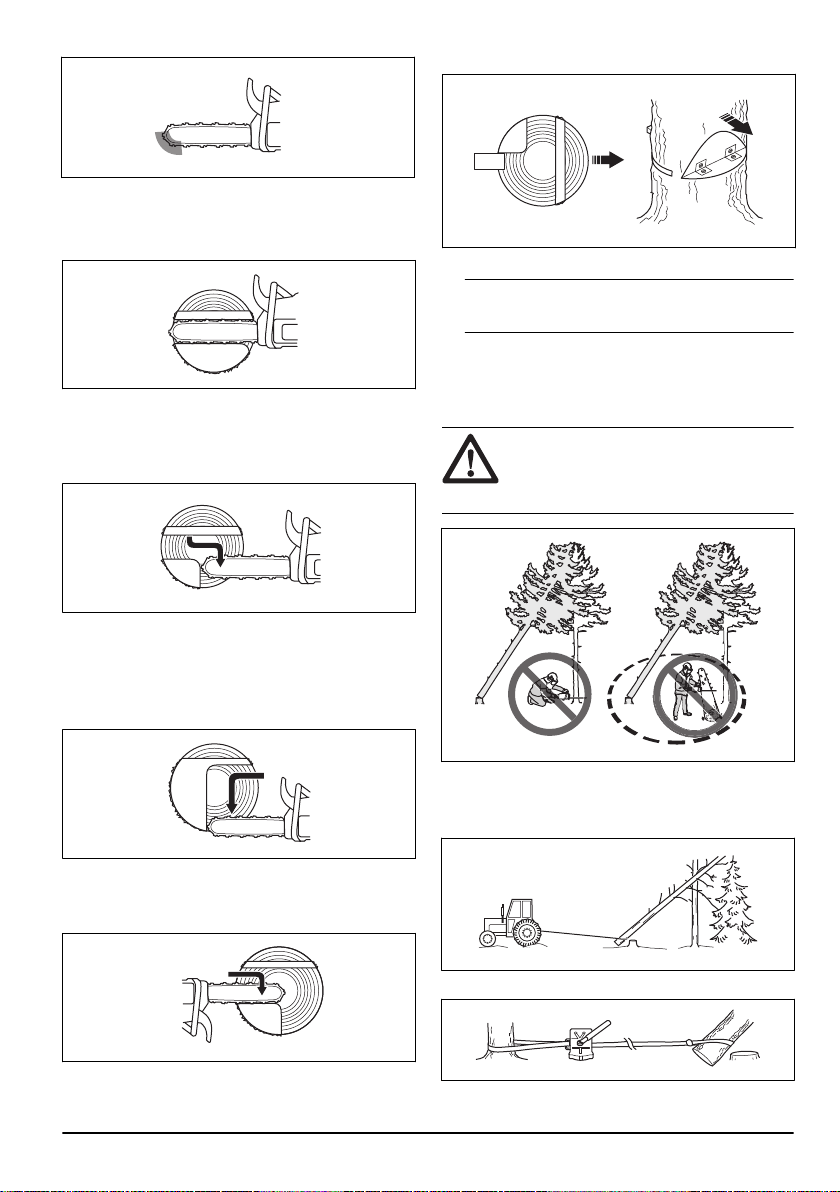
1. If the usable cutting length is longer than the tree
diameter, do these steps (a-d).
a) Make a bore cut straight into the trunk to
complete the felling hinge width.
b) Cut on the pull stroke until ⅓ of the trunk is left.
c) Pull the guide bar 5-10 cm/2-4 in rearward.
d) Cut through the remaining of the trunk to
complete a safe corner that is 5-10 cm/2-4 in
wide.
2. If the usable cutting length is shorter than the tree
diameter, do these steps (a-d).
a) Make a bore cut straight into the trunk. The bore
cut must extend 3/5 of the tree diameter.
b) Cut on the pull stroke through the remaining
trunk.
c) Cut straight into the trunk from the other side of
the tree to complete the felling hinge.
d) Cut on the push stroke, until ⅓ of the trunk is left,
to complete the safe corner.
3. Put a wedge in the kerf straight from behind.
4. Cut off the corner to make the tree fall.
Note: If the tree does not fall, hit the wedge until it
does.
5. When the tree starts to fall, use the path of retreat
to move away from the tree. Move a minimum of 5
m/15 ft away from the tree.
To free a trapped tree
WARNING: It is very dangerous to
remove a trapped tree and there is a high
accident risk. Keep out of the risk zone and
do not try to fell a trapped tree.
The safest procedure is to use one of the following
winches:
• Tractor-mounted
• Portable
140 - 012 - 21.08.2023
19
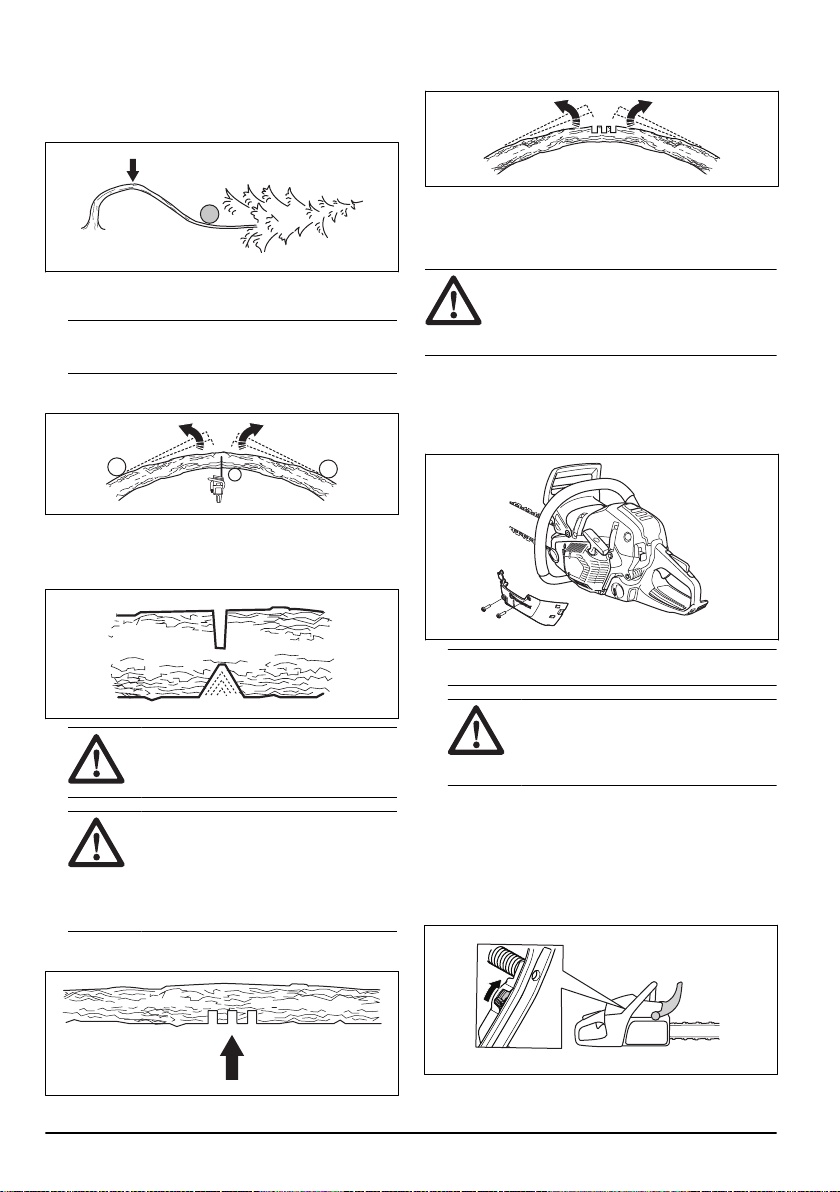
To cut trees and branches that are in tension
1. Figure out which side of the tree or branch that is in
tension.
2. Figure out where the point of maximum tension is.
3. Examine which is the safest procedure to release the
tension.
Note: In some situations the only safe procedure
is to use a winch and not your product.
4. Keep a position where the tree or branch can not hit
you when the tension is released.
5. Make one or more cuts of sufficient depth necessary
to decrease the tension. Cut at or near the point of
maximum tension. Make the tree or branch break at
the point of maximum tension.
WARNING: Do not cut straight
through a tree or branch that is in
tension.
WARNING: Be very careful when
you cut a tree that is in tension. There is
a risk that the tree moves quickly before
or after you cut it. Serious injury can
occur if you are in an incorrect position
or if you cut incorrectly.
6. If you must cut across tree/branch, make 2 to 3 cuts,
1 in. apart and with a depth of 2 in.
7. Continue to cut more into the tree until the tree/
branch bends and the tension is released.
8. Cut the tree/branch from the opposite side of the
bend, after the tension is released.
To use the product in cold weather
CAUTION: Snow and cold weather can
cause operation problems. Risk of too low
engine temperature or ice on the air filter
and the carburetor.
• For temperatures below -5°C/23°F or in conditions
with snow, a winter cover is available. Assemble the
winter cover on the starter housing. The winter cover
decreases the flow of cool air and keeps snow away
from the carburetor space.
Note: Part number for winter cover: 575 52 75-01
CAUTION: Remove the winter
cover if the temperature increases above
-5°C/23°F. Risk of too high engine
temperature and damage to the engine.
Heated handles (572XPG)
The product has heated front and rear handles. The
electrical heating coils are powered by a generator.
Push the switch in the direction of the arrow to engage
the function. Push the switch in the opposite direction to
disengage the function.
20
140 - 012 - 21.08.2023

Electrical carburetor heating (572XPG)
Adjustment of the carburetor heating is done electrically
through a thermostat. This keeps the correct carburetor
temperature and prevents ice in the carburetor.
Maintenance
Introduction
WARNING: Read and understand the
safety chapter before you do maintenance
on the product.
Maintenance schedule
Daily maintenance Weekly maintenance Monthly maintenance
Clean the external parts of the prod-
uct and make sure that there is no oil
on the handles.
Clean the cooling system. Refer to
To clean the cooling system on page
31
.
Do a check of the brake band. Refer
to
To do a check of the brake band
on page 22
.
Do a check of the throttle trigger and
throttle trigger lockout. Refer to
To
do a check of the throttle trigger and
throttle trigger lockout on page 23
.
Do a check of the starter, starter rope
and return spring.
Make sure that the clutch center,
clutch drum and clutch spring are not
worn or damaged.
Make sure that there is no damage
on the vibration damping units.
Lubricate the needle bearing. Refer
to
To lubricate the needle bearing on
page 29
.
Clean the spark plug. Refer to
To do
a check of the spark plug on page
25
.
Clean and do a check of the chain
brake. Refer to
To do a check of the
chain brake on page 22
.
Remove burrs from the edges of the
guide bar. Refer to
To do a check of
the guide bar on page 29
.
Clean the external parts of the carbu-
retor.
Do a check of the chain catcher. Re-
fer to
To do a check of the chain
catcher on page 23
.
Clean or replace the spark arrester
screen on the muffler. Refer to
To do
a check of the muffler on page 23
.
Do a check of the fuel filter and the
fuel hose. Replace if necessary.
Turn the guide bar, do a check of the
lubrication hole and clean the groove
in the guide bar. Refer to
To do a
check of the guide bar on page 29
.
Clean the carburetor area. Do a check of all cables and connec-
tions.
Make sure that the guide bar and
saw chain are getting sufficient oil.
Clean or replace the air filter. Refer
to
To clean the air filter on page 25
.
Empty the fuel tank.
Do a check of the saw chain. Refer to
To examine the cutting equipment on
page 29
.
Clean between the cylinder fins. Empty the oil tank.
Sharpen the saw chain and do a
check of its tension. Refer to
To
sharpen the saw chain on page 26
.
Do a check of the chain drive sprock-
et. Refer to
To do a check of the rim
sprocket on page 29
.
Clean the air intake on the starter.
140 - 012 - 21.08.2023 21
Daily maintenance Weekly maintenance Monthly maintenance
Make sure that nuts and screws are
tightened.
Do a check of the stop switch. Refer
to
To do a check of the start/stop
switch on page 23
.
Make sure that these are no fuel
leaks from the engine, tank or fuel
lines.
Make sure that the saw chain does
not rotate when the engine is at idle
speed.
Make sure that there is no damage
on the right hand guard.
Make sure that the muffler is correct-
ly attached, has no damages and
that no parts of the muffler are miss-
ing.
Maintenance and checks of the safety
devices on the product
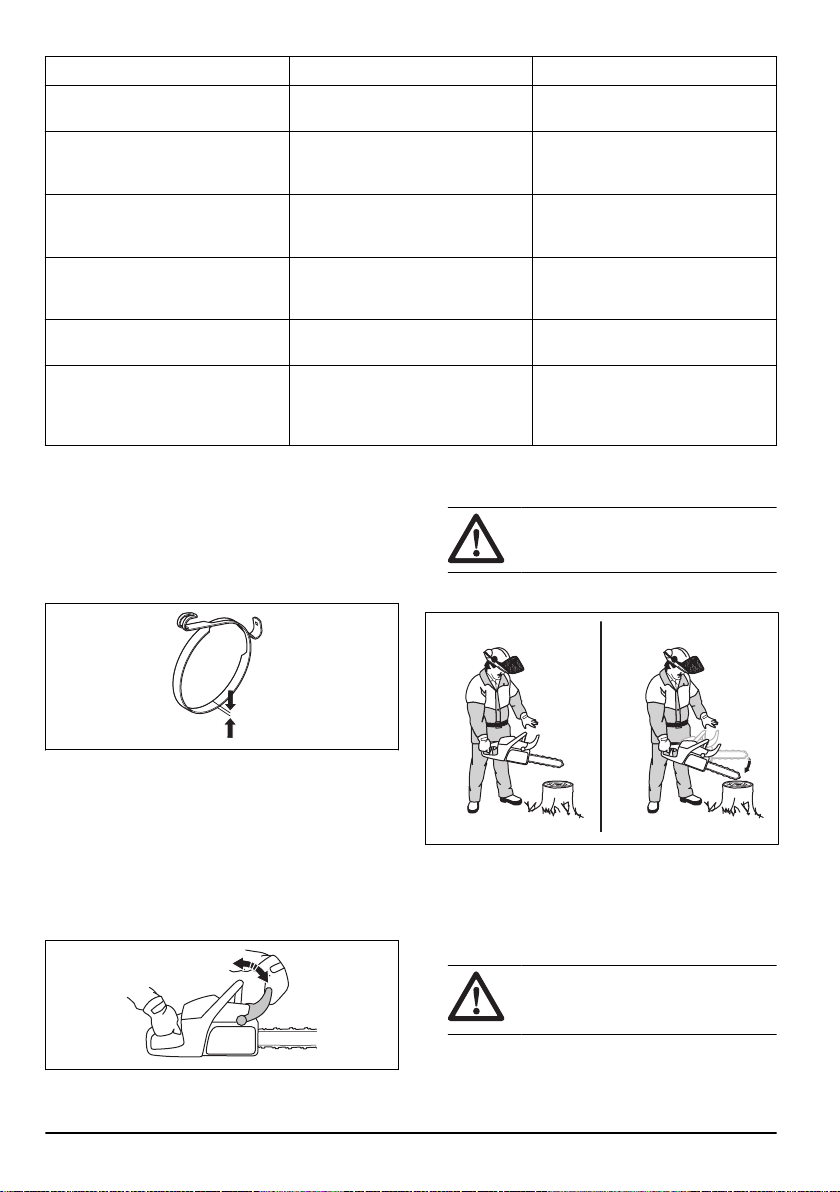
To do a check of the brake band
1. Use a brush to remove wood dust, resin and dirt
from the chain brake and clutch drum. Dirt and wear
can decrease the function of the brake.
2. Do a check of the brake band. The brake band must
be at a minimum of 0.6 mm/0.024 in thick at its
thinnest point.
To do a check of the front hand guard and the
chain brake activation
1. Make sure that the front hand guard does not have
damages such as cracks.
2. Make sure that the front hand guard moves freely
and that it is attached safely to the clutch cover.
3. Hold the product with 2 hands above a stump or
other stable surface.
WARNING: The engine must be off.
4. Let go of the front handle and let the guide bar tip fall
against the stump.
5. Make sure that the chain brake engages as the
guide bar tip hits the stump.
To do a check of the chain brake
1. Start the product. Refer to
To start the product on
page 12
for instructions.
WARNING: Make sure that the saw
chain does not touch the ground or other
objects.
2. Hold the product tightly.
22
140 - 012 - 21.08.2023
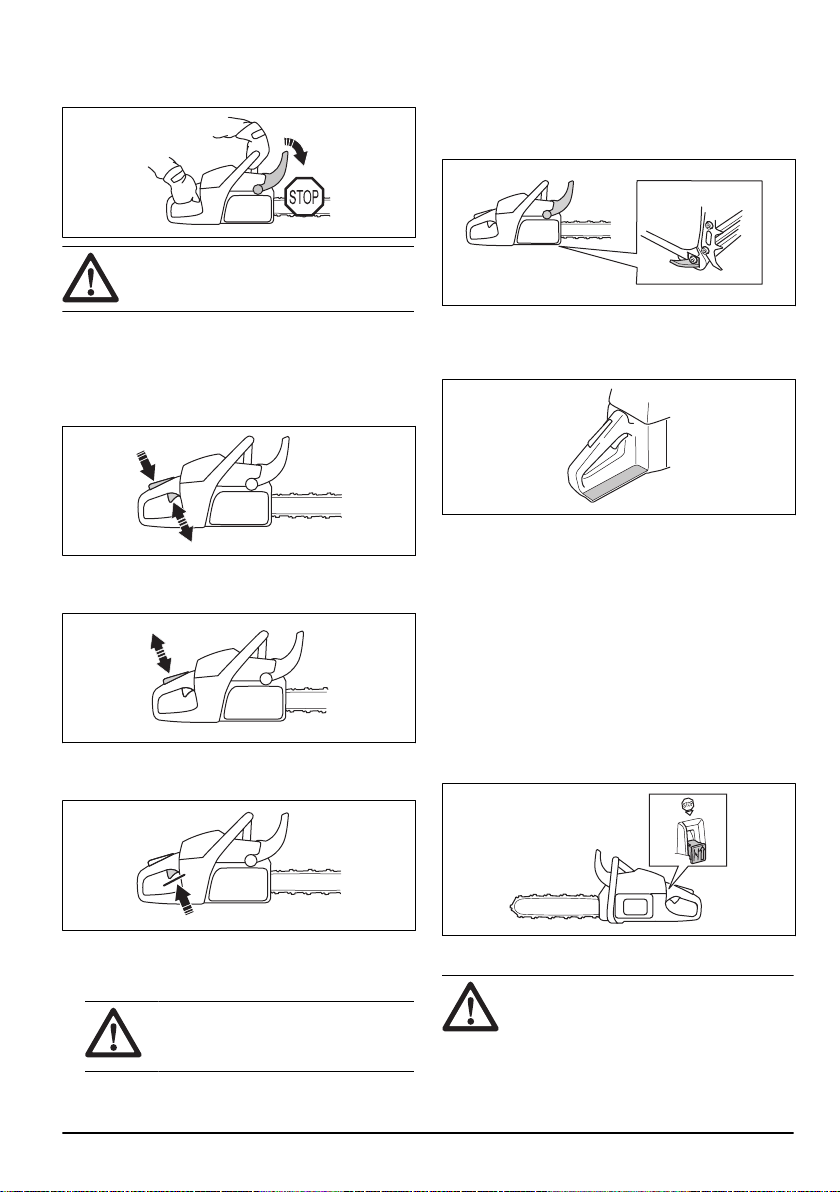
3. Apply full throttle and tilt your left wrist against the
front hand guard to engage the chain brake. The
saw chain must stop immediately.
WARNING: Do not let go of the front
handle.
To do a check of the throttle trigger and
throttle trigger lockout
1. Make sure that the throttle trigger and throttle trigger
lockout move freely and that the return spring works
correctly.
2. Press down the throttle trigger lockout and make
sure that it goes back to its initial position when you
release it.
3. Make sure that the throttle trigger is locked at the
idle position when the throttle trigger lockout is
released.
4. Start the product and apply full throttle.
5. Release the throttle trigger and make sure that the
saw chain stops and stays stationary.
WARNING:
If the saw chain rotates
when the throttle trigger is in the idle
position, speak to your servicing dealer.
To do a check of the chain catcher
1. Make sure that there is no damage on the chain
catcher.
2. Make sure that the chain catcher is stable and
attached to the body of the product.
To do a check of the right hand guard
• Make sure that the right hand guard does not have
damages such as cracks.
To do a check of the vibration damping system
1. Make sure that there are no cracks or deformation
on the vibration damping units.
2. Make sure that the vibration damping units are
correctly attached to the engine unit and handle unit.
Refer to
Product overview on page 2
for information
about where the vibration damping system is on your
product.
To do a check of the start/stop switch
1. Start the engine.
2. Press the start/stop switch down to the STOP
position. The engine must stop.
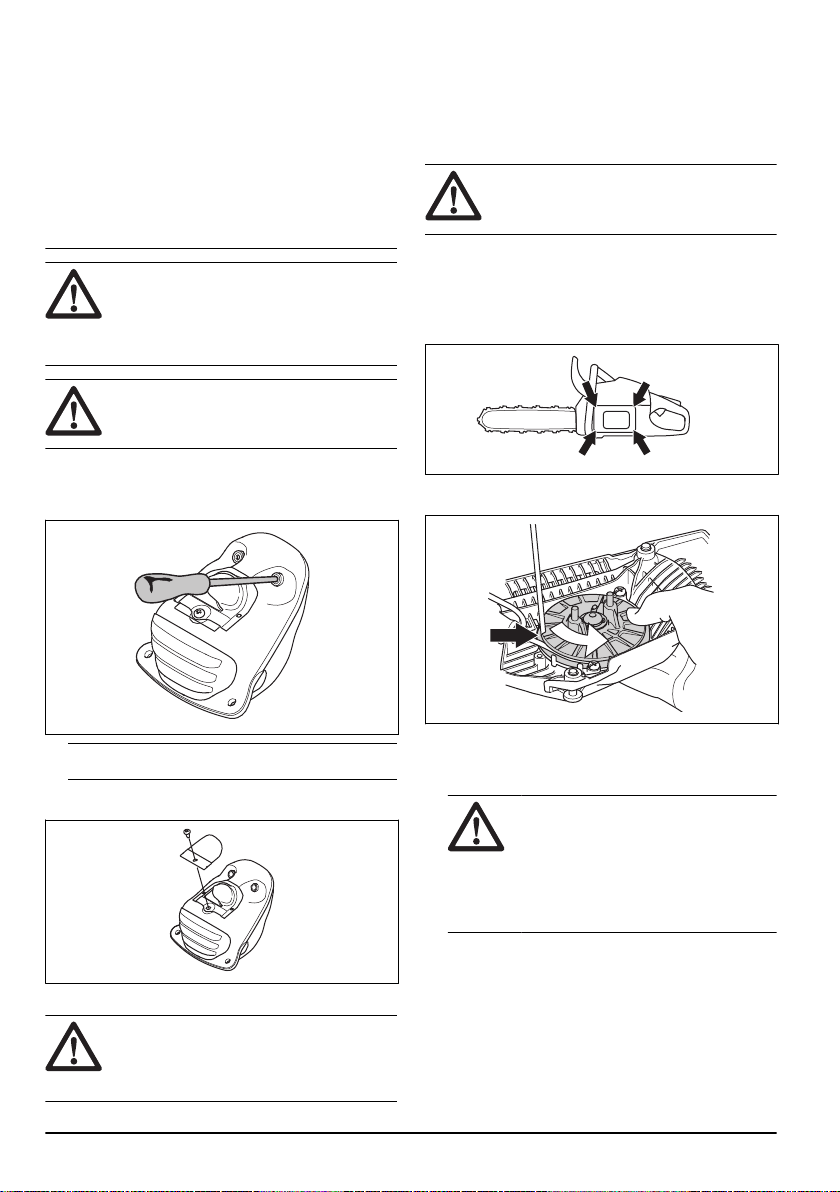
To do a check of the muffler
WARNING:
A used muffler/spark
arrester and spark arrester mounting
face may contain deposits of combustion
particles on the surfaces that may be
carcinogenic. To avoid skin contact and
inhalation of such particles when cleaning
140 - 012 - 21.08.2023 23
and/or servicing the spark arrester, make
sure you always:
• wear gloves;
• clean and/or service in a well ventilated
area;
• do not use pressurized air to clean the
spark arrester screen;
• use a steel brush and brush away from
your body when cleaning the spark
arrester.
WARNING: Do not use a product
that has a defective muffler or a muffler
that is in bad condition. Return product to
a Husqvarna dealer/service station if the
muffler is defective.
WARNING: Do not use a product if
the spark arrestor mesh on the muffler is
missing or defective.
1. Examine the muffler for damages and defects.
2. Make sure that the muffler is correctly attached to
the product.
Note: Do not remove the muffler from the product.
3. If your product has a special spark arrestor mesh,
clean the spark arrestor mesh weekly.
4. Replace a damaged spark arrestor mesh.
CAUTION:
If the spark arrestor mesh
is blocked the product becomes too hot
and this causes damage to the cylinder and
piston.
Your product has the function that adjusts the carburetor
automatically, which gives the best possible adjustment.
lets the engine adapt to weather conditions, altitude,
gasoline and the type of two-stroke oil.
CAUTION: If does not work correctly,
speak to your servicing dealer. The product
adjusts correctly after some fuelings.
To replace a broken or worn starter
rope
1. Loosen the screws to the starter housing.
2. Remove the starter housing.
3. Pull out the starter rope approximately 30 cm/12 in
and put it in the notch on the pulley.
4. Let the pulley rotate slowly rearward to release the
recoil spring.
5. Remove the center screw and remove the pulley.
WARNING:
You must be careful
when you replace the return spring or
the starter rope. The recoil spring is in
tension when it is wound up in the starter
housing. If you are not careful, it can
eject and cause injuries. Use protective
glasses and protective gloves.
6. Remove the used starter rope from the handle and
the pulley.
7. Attach a new starter rope to the pulley. Wind the
starter rope approximately 3 turns around the pulley.
8. Pull the starter rope through the hole in the starter
housing and the starter rope handle.
24
140 - 012 - 21.08.2023
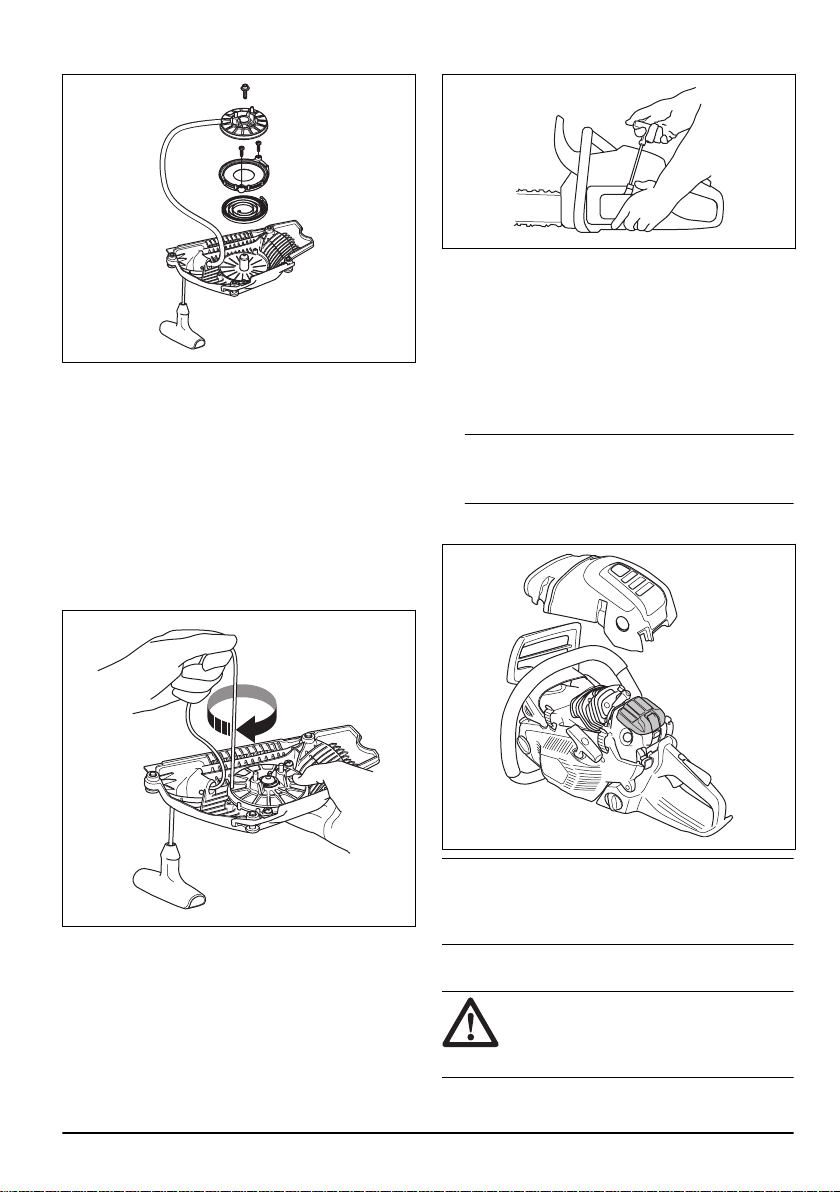
9. Attach the center screw in the center of the pulley.
10. Make a tight knot at the end of the starter rope.
To tighten the recoil spring
1. Put the starter rope into the notch in the pulley.
2. Turn the starter pulley approximately 2 turns
clockwise.
3. Pull the starter rope handle and pull out the starter
rope fully.
4. Put your thumb on the pulley.
5. Move your thumb and release the starter rope.
6. Make sure that you can turn the pulley ½ turn after
the starter rope is fully extended.
To assemble the starter housing on the
product
1. Pull out the starter rope and put the starter in
position against the crankcase.
2. Slowly release the starter rope until the pulley
engages with the pawls.
3. Tighten the screws that hold the starter.
To clean the air filter
Clean the air filter regularly from dirt and dust. This
prevents carburetor malfunctions, starting problems,
loss of engine power, wear to engine parts and more
fuel consumption than usual.
1. Remove the cylinder cover and the air filter.
2. Use a brush or shake the air filter clean. Use
detergent and water to clean it fully.
Note: An air filter that is used for a long time can
not be fully cleaned. Replace the air filter regularly
and always replace a defective air filter.
3. Attach the air filter and make sure that the air filter
seals tightly against the filter holder.
Note: Because of different work conditions, weather
or season, your product can be used with different types
of air filter. Speak to your servicing dealer for more
information.
To do a check of the spark plug
CAUTION:
Use the recommended
spark plug. Refer to
Technical data on page
33
. An incorrect spark plug can cause
damage to the product.
140 - 012 - 21.08.2023 25
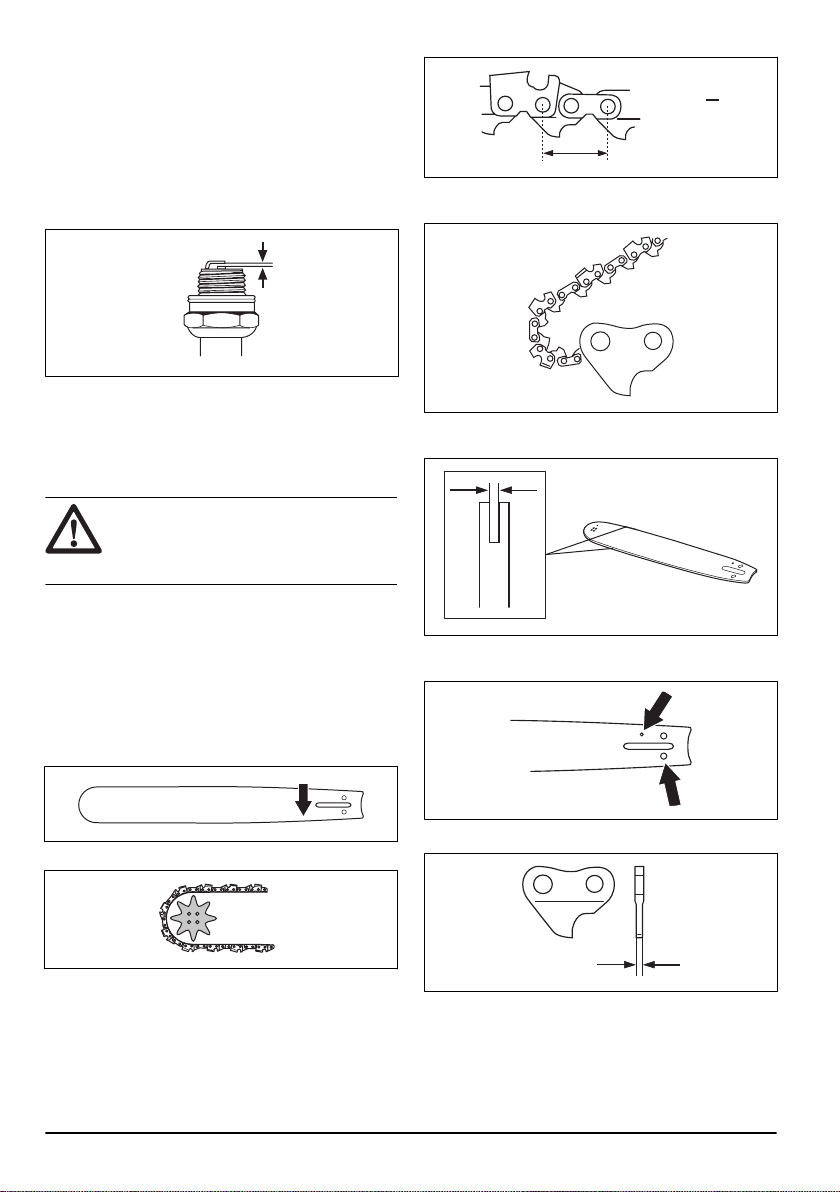
1. If the product is not easy to start or to operate
or if the product operates incorrectly at idle speed,
examine the spark plug for unwanted materials. To
decrease the risk of unwanted material on the spark
plug electrodes, do these steps:
a) make sure that the fuel mixture is correct.
b) make sure that the air filter is clean.
2. Clean the spark plug if it is dirty.
3. Make sure that the electrode gap is 0.5 mm/0.020 in.
4. Replace the spark plug monthly or more frequently if
necessary.
To sharpen the saw chain
Information about the guide bar and saw chain
WARNING: Use protective gloves
when you use or do maintenance on the
saw chain. A saw chain that does not move
can also cause injuries.
Replace a worn or damaged guide bar or saw chain with
the guide bar and saw chain combination recommended
by Husqvarna. This is necessary to keep the safety
functions of the product. Refer to
Accessories on
page 34
, for a list of replacement bar and chain
combinations that we recommend.
• Guide bar length, in/cm. Information about the guide
bar length can usually be found on the rear end of
the guide bar.
• Number of teeth on bar tip sprocket (T).
• Chain pitch, in. The distance between the drive links
of the saw chain must align with the distance of the
teeth on the bar tip sprocket and drive sprocket.
PITCH =
D
D
2
• Number of drive links. The number of drive links is
decided by the type of guide bar.
• Bar groove width, in/mm. The groove width in guide
bar must be the same as the chain drive links width.
• Chain oil hole and hole for chain tensioner. The
guide bar must align with product.
• Drive link width, mm/in.
General information about how to sharpen the
cutters
Do not use a blunt saw chain. If the saw chain is blunt,
you must apply more pressure to push the guide bar
26
140 - 012 - 21.08.2023
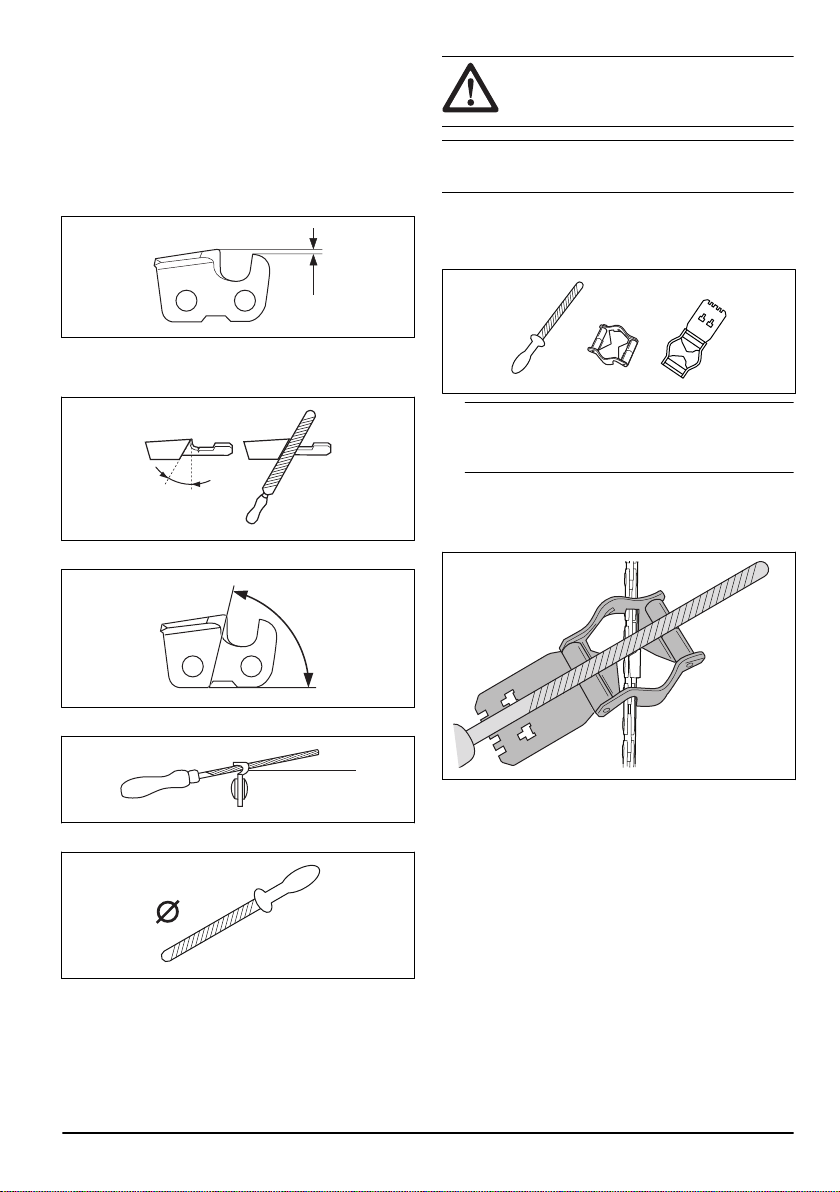
through the wood. If the saw chain is very blunt, there
will be no wood chips but sawdust.
A sharp saw chain eats through the wood and the wood
chips becomes long and thick.
The cutting tooth (A) and the depth gauge (B) together
makes the cutting part of the saw chain, the cutter. The
difference in height between the two gives the cutting
depth (depth gauge setting).
A
B
When you sharpen the cutter, think about the following:
• Filing angle.
• Cutting angle.
• File position.
• Round file diameter.
It is not easy to sharpen a saw chain correctly without
the correct equipment. Use Husqvarna file gauge. This
will help you to keep maximum cutting performance and
the kickback risk at a minimum.
WARNING:
The force of the kickback
increases a lot if you do not follow the
sharpening instructions.
Note: Refer to
To sharpen the saw chain on page 26
for information about sharpening of the saw chain.
To sharpen the cutters
1. Use a round file and a file gauge to sharpen the
cutting teeth.
Note: Refer to
Accessories on page 34
for information about which file and gauge that
Husqvarna recommends for your saw chain.
2. Apply the file gauge correctly on to the cutter. Refer
to the instruction supplied with the file gauge.
3. Move the file from the inner side of the cutting teeth
and out. Decrease the pressure on the pull stroke.
4. Remove material from one side of all the cutting
teeth.
5. Turn the product around and remove material on the
other side.
6. Make sure that all cutting teeth are the same length.
General information about how to adjust the
depth gauge setting
The depth gauge setting (C) decreases when you
sharpen the cutting tooth (A). To keep maximum
cutting performance you must remove filing material
from the depth gauge (B) to receive the recommended
depth gauge setting. See
Accessories on page 34
140 - 012 - 21.08.2023
27
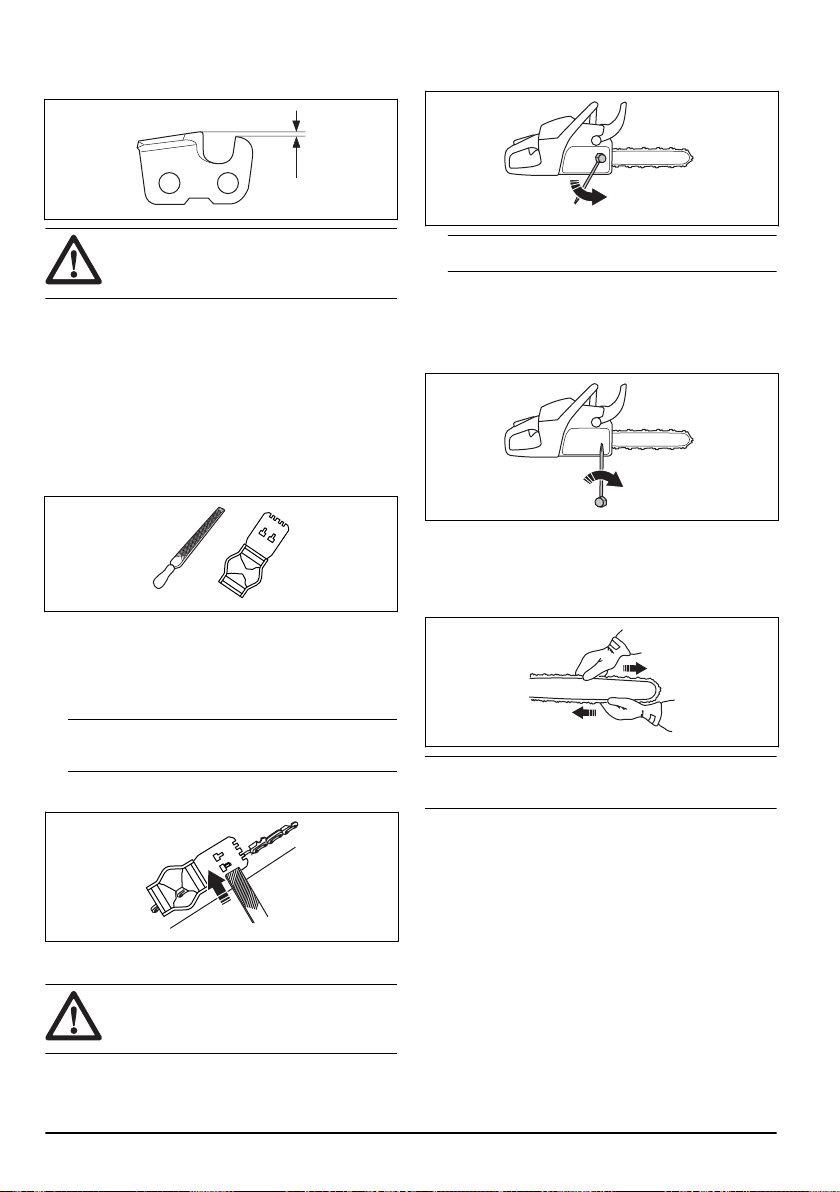
for instructions about how to receive the correct depth
gauge setting for your saw chain.
A
B
C
WARNING: The risk of kickback
increases if the depth gauge setting is too
large!
To adjust the depth gauge setting
Before you adjust the depth gauge setting or sharpen
the cutters, refer to
To sharpen the cutters on page
27
, for instructions. We recommend you to adjust the
depth gauge setting after each third operation that you
sharpen the cutting teeth.
We recommend that you use our depth gauge tool to
receive the correct depth gauge setting and bevel for the
depth gauge.
1. Use a flat file and a depth gauge tool to adjust
the depth gauge setting. Only use Husqvarna depth
gauge tool to get the correct depth gauge setting and
bevel for the depth gauge.
2. Put the depth gauge tool on the saw chain.
Note:
See the package of the depth gauge tool for
more information about how to use the tool.
3. Use the flat file to remove the part of the depth
gauge that extends through the depth gauge tool.
To adjust the tension of the saw chain
WARNING:
A saw chain with an
incorrect tension can come loose from the
guide bar and cause serious injury or death.
A saw chain becomes longer when you use it. Adjust the
saw chain regularly.
1. Loosen the bar nuts that hold the clutch cover/chain
brake. Use a wrench.
Note: Some models have only one bar nut.
2. Tighten the bar nuts by hand as tightly as you can.
3. Lift the front of the guide bar and turn the chain
tensioning screw. Use a wrench.
4. Tighten the saw chain until it is tight against the
guide bar but still can move easily.
5. Tighten the bar nuts using the wrench and lift the
front of the guide bar at the same time.
6. Make sure you can pull the saw chain around freely
by hand and that it does not hang from the guide
bar.
Note:
Refer to
Product overview on page 2
for the
position of the chain tensioning screw on your product.
To do a check of the saw chain
lubrication
1. Start the product and let it operate at ¾ throttle. Hold
the bar approximately 20 cm/8 in above a surface of
light color.
28
140 - 012 - 21.08.2023
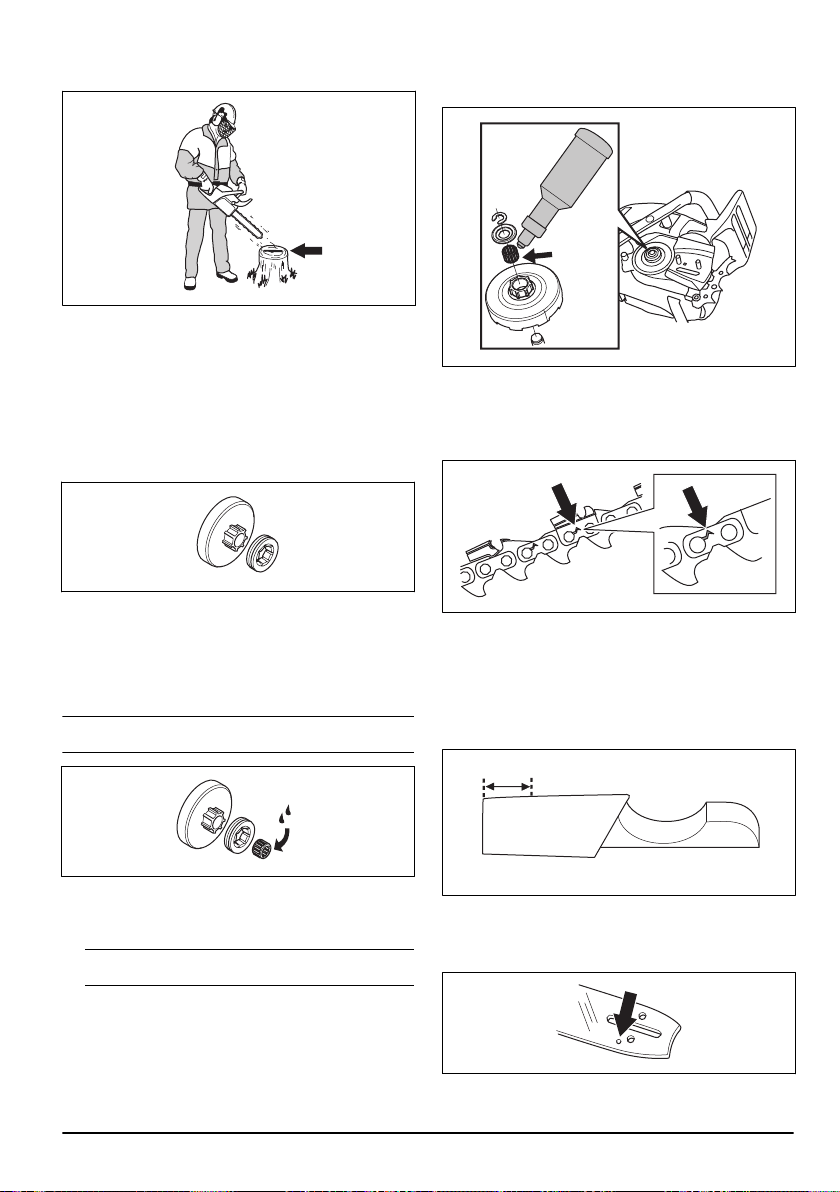
2. If the saw chain lubrication is correct, you see a clear
line of oil on the surface after 1 minute.
3. If the saw chain lubrication does not operate
correctly, do a check of the guide bar. Refer to
To do a check of the guide bar on page 29
for
instructions. Speak to your servicing dealer if the
maintenance steps does not help.
To do a check of the rim sprocket
The clutch drum has a rim sprocket that can be
replaced.
1. Make sure that the rim sprocket is not worn. Replace
if necessary.
2. Replace the rim sprocket each time you replace the
saw chain.
To lubricate the needle bearing
Note:
Lubricate the needle bearing weekly.
1. Pull the front hand guard rearward to disengage the
chain brake.
2. Loosen the bar nuts and remove the clutch cover.
Note:
Some models have only one bar nut.
3. Remove the clutch drum and lubricate the needle
bearing with a grease gun. Use engine oil or a
bearing grease of high quality.
To examine the cutting equipment
1. Make sure that there are no cracks in rivets and
links and that no rivets are loose. Replace if it is
necessary.
2. Make sure that the saw chain is easy to bend.
Replace the saw chain if it is rigid.
3. Compare the saw chain with a new saw chain to
examine if the rivets and links are worn.
4. Replace the saw chain when the longest part of the
cutting tooth is less than 4 mm/0.16 in. Also replace
the saw chain if there are cracks on the cutters.
To do a check of the guide bar
1. Make sure that the oil channel is not blocked. Clean
if it is necessary.
140 - 012 - 21.08.2023
29
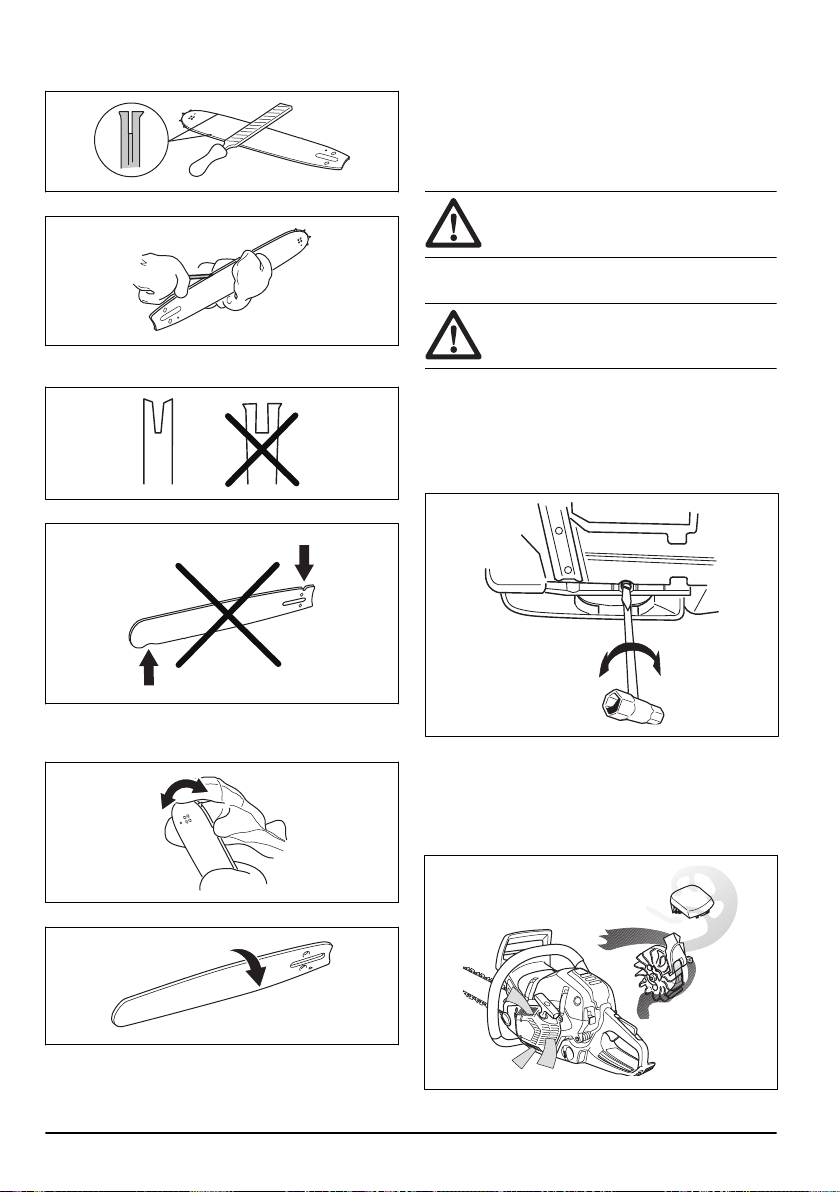
2. Examine if there are burrs on the edges of the guide
bar. Remove the burrs using a file.
3. Clean the groove in the guide bar.
4. Examine the groove in the guide bar for wear.
Replace the guide bar if it is necessary.
5. Examine if the guide bar tip is rough or very worn.
6. Make sure that the bar tip sprocket turns freely and
that the lubricating hole in the bar tip sprocket is not
blocked. Clean and lubricate if it is necessary.
7. Turn the guide bar daily to extend its life cycle.
To do maintenance on the fuel tank
and the chain oil tank
• Drain and clean the fuel tank and the chain oil tank
regularly.
• Replace the fuel filter yearly or more frequently if
necessary.
CAUTION: Contamination in the tanks
causes malfunction.
To adjust the chain oil flow
WARNING: Stop the engine before you
make adjustments to the oil pump.
1. Turn the adjustment screw for the oil pump. Use a
screwdriver or combination wrench.
a) Turn the adjustment screw clockwise to decrease
the chain oil flow.
b) Turn the adjustment screw counterclockwise to
increase the chain oil flow.
–
+
Air cleaning system
AirInjection
™
is a centrifugal air cleaning system that
removes dust and dirt before the particles are caught by
the air filter. AirInjection
™
extends the life of the air filter
and the engine.
30
140 - 012 - 21.08.2023
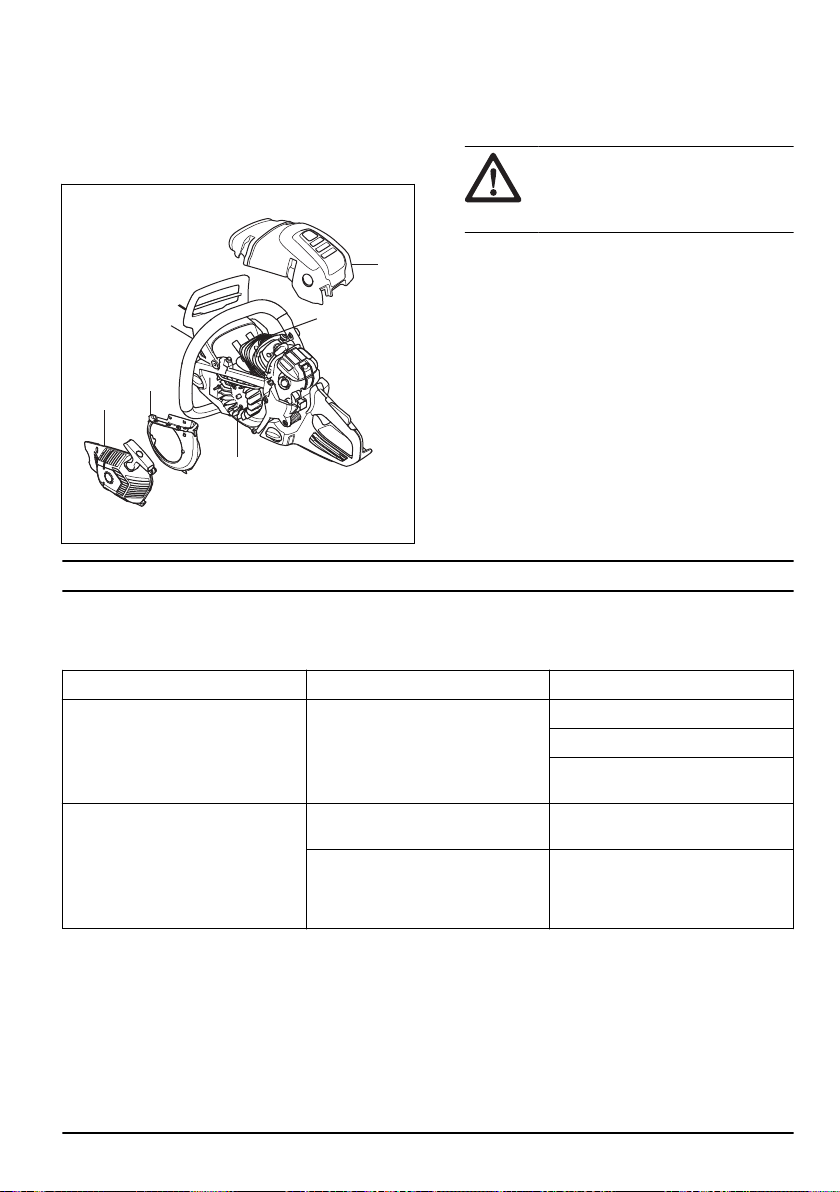
To clean the cooling system
The cooling system keeps the engine temperature
down. The cooling system includes the air intake on the
starter (A) and the air guide plate (B), the pawls on the
flywheel (C), the cooling fins on the cylinder (D) and the
cylinder cover (E).
A
B
C
D
E
1. Clean the cooling system with a brush weekly or
more frequently if it is necessary.
2. Make sure that the cooling system is not dirty or
blocked.
CAUTION: A dirty or blocked
cooling system can make the product
too hot, which can cause damage to the
product.
Troubleshooting
The engine does not start
Product part to examine Possible cause Action
Starter pawls The starter pawls are blocked. Adjust or replace the starter pawls.
Clean around the pawls.
Speak to an approved service work-
shop.
Fuel tank Incorrect fuel type. Drain the fuel tank and fill with cor-
rect fuel.
The fuel tank is filled with chain oil. If you have tried to start the product,
speak to your servicing dealer. If you
have not tried to start the product,
drain the fuel tank.
140 - 012 - 21.08.2023 31

Product part to examine Possible cause Action
Ignition, no spark The spark plug is dirty or wet. Make sure that the spark plug is dry
and clean.
The electrode gap is incorrect. Clean the spark plug. Make sure that
the electrode gap and spark plug is
correct, and that the correct spark
plug type is the recommended or
equivalent.
Refer to
Technical data on page 33
for the correct electrode gap.
Spark plug and cylinder The spark plug is loose. Tighten the spark plug.
Engine is flooded because of repea-
ted starts with full choke after igni-
tion.
Remove and clean the spark plug.
Put the product on its side with the
spark plug hole away from you. Pull
the starter rope handle 6-8 times. As-
semble the spark plug and start the
product. Refer to
To start the product
on page 12
.
The engine starts but stops again
Product part to examine
Possible cause Action
Fuel tank Incorrect fuel type. Drain the fuel tank and fill with cor-
rect fuel.
Carburetor The idle speed is not correct. Speak to your servicing dealer.
Air filter Clogged air filter. Clean or replace the air filter.
Fuel filter Clogged fuel filter. Replace the fuel filter.
Transportation, storage and disposal
Transportation and storage
• For storage and transportation of the product and
fuel, make sure that there are no leaks or fumes.
Sparks or open flames, for example from electrical
devices or boilers, can start a fire.
• Always use approved containers for storage and
transportation of fuel.
• Empty the fuel and chain oil tanks before
transportation or before long-term storage. Discard
the fuel and chain oil at an applicable disposal
location.
• Use the transportation guard on the product to
prevent injuries or damage to the product. A saw
chain that does not move can also cause serious
injuries.
• Remove the spark plug cap from the spark plug and
engage the chain brake.
• Attach the product safely during transportation.
To prepare your product for long-term
storage
1. Stop the product and let it become cool before you
disassemble it.
2. Disassemble and clean the saw chain and the
groove in the guide bar.
CAUTION: If the saw chain and
guide bar are not cleaned, they can
become rigid or blocked.
3. Attach the transportation guard.
32 140 - 012 - 21.08.2023

4. Clean the product. Refer to
Maintenance schedule
on page 21
for instructions.
5. Do a complete servicing of the product.
Disposal
• Obey the local recycling requirements and applicable
regulations.
• Discard all chemicals, such as oil or fuel, at a service
center or at an applicable disposal location.
• When the product is no longer in use, send it to
a Husqvarna dealer or discard it at a recycling
location.
Technical data
Technical data
Husqvarna 565 Husqvarna 572 XP Husqvarna 572 XPG
Engine
Cylinder displacement, cm
3
70.6 70.6 70.6
Idle speed, rpm 2700 2700 2700
Maximum engine power
acc. to ISO 7293, kW/hp @
rpm
3.7/5.0 @ 9300 4.3/5.8 @ 9900 4.3/5.8 @ 9900
Ignition system
1
Spark plug NGK BPMR7A NGK BPMR7A NGK BPMR7A
Electrode gap, mm 0.5 0.5 0.5
Fuel and lubrication system
Fuel tank capacity, liter/cm
3
0.71/710 0.71/710 0.71/710
Oil tank capacity, liter/cm
3
0.35/350 0.35/350 0.35/350
Type of oil pump Adjustable Adjustable Adjustable
Weight
Weight, kg 6.5 6.6 6.8
Noise emissions
2
Sound power level, meas-
ured dB(A)
117 118 118
Sound power level, guaran-
teed L
WA
dB(A)
119 120 120
Sound levels
3
Equivalent sound pressure
level at the operator’s ear,
dB(A)
105 107 107
1
Always use the recommended spark plug type! Use of the wrong spark plug can damage the piston/cylinder.
2
Noise emissions in the environment measured as sound power (LWA) in conformity with EC directive
2000/14/EC.
3
Equivalent sound pressure level, according to ISO 22868, is calculated as the time-weighted energy total for
different sound pressure levels under various working conditions. Typical statistical dispersion for equivalent
sound pressure level is a standard deviation of 1 dB (A).
140 - 012 - 21.08.2023 33

Husqvarna 565 Husqvarna 572 XP Husqvarna 572 XPG
Equivalent vibration levels, a
hveq
4
Front handle, m/s
2
5.2 5.0 5.0
Rear handle, m/s
2
5.3 4.1 4.1
Saw chain/guide bar
Type of drive sprock-
et/number of teeth
Rim/7 Rim/7 Rim/7
Saw chain speed at 133%
of maximum engine power
speed, m/s.
27.5 29.3 29.3
Accessories
Recommended cutting equipment
Chainsaw models Husqvarna 565, 572 XP, 572 XPG
have been evaluated for safety according to EN
ISO 11681-1:2011 (Machinery for forestry - Portable
chainsaw safety requirements and testing) and fulfill the
safety requirements when equipped with the below listed
guide bar and saw chain combinations.
Kickback and guide bar nose radius
For sprocket nose bars the nose radius is specified by
the number of teeth, such as 10T. For solid guide bars
the nose radius is specified by the dimension of the
nose radius. For a given guide bar length, you can use a
guide bar with smaller nose radius than given.
Guide bar Saw chain
Length, in/cm Pitch, in Gauge, in/mm Max. nose radius Type Length, drive
links (no.)
15/38 3/8 0.058/1.5 11T Husqvarna H42
Husqvarna C85
Husqvarna S85
56
16/41 60
18/46 34 mm 68
20/50 72
24/61 84
28/71 92
15/38 3/8 0.050/1.3 11T Husqvarna C83 56
16/41 60
18/46 34 mm 68
20/50 72
24/61 84
28/71 92
The usable cutting length is usually 1 in less than the
nominal guide bar length.
4
Equivalent vibration level, according to ISO 22867, is calculated as the time-weighted energy total for vibration
levels under various working conditions. Reported data for equivalent vibration level has a typical statistical
dispersion (standard deviation) of 1 m/s
2
.
34 140 - 012 - 21.08.2023

Filing equipment and filing angles
Using Husqvarna file gauge will give you the correct
filing angles. We recommend you to always use a
Husqvarna file gauge to restore the sharpness of the
saw chain. The part numbers are given in the table
below.
If you are not sure of how to identify what saw
chain you have on your chainsaw, please visit
www.husqvarna.com for more information.
H42
7/32 in/5.5 mm
505 69 81-30
0.025 in/0.65 mm
25° 55°
C85/C83 586 93 85-01 30° 60°
S85 586 93 85-03 30° 60°
140 - 012 - 21.08.2023 35
Declaration of Conformity
EU Declaration of conformity
We, Husqvarna AB, SE-561 82 Huskvarna, Sweden, tel:
+46-36-146500, declare on our sole responsibility that
the product:
Description Chainsaws for forest service
Brand Husqvarna
Type / Model 565, 572 XP, 572 XPG
Identification Serial numbers dating from 2017 and onwards
complies fully with the following EU directives and
regulations:
Regulation Description
2006/42/EC "relating to machinery"
2014/30/EU ”relating to electromagnetic compability”
and that the following standards and/or technical
specifications are applied: EN ISO 12100:2010, EN
ISO 14982:2009, EN ISO 11681-1:2011, EN IEC
63000:2018.
Certificate numbers: 0404/17/2475
Notified body: 0404, SMP Svensk Maskinprovning AB,
Box 4053, SE-904 03 Umeå, Sweden has carried out
EC type examination in accordance with the machinery
directive's (2006/42/EC) article 12, clause 3b.
SMP Svensk Maskinprovning AB has also verified
agreement with annex V of the council's directive
2000/14/EC.
For information relating to noise emissions, refer to
Technical data on page 33
.
Huskvarna, 2023-07-01
Stefan Holmberg, R&D Director, Technology
Management, Husqvarna AB
Responsible for technical documentation
36 140 - 012 - 21.08.2023

UK Declaration of conformity
We, Husqvarna AB, SE-561 82 Huskvarna, Sweden, tel:
+46-36-146500, declare on our sole responsibility that
the product:
Description Chainsaw for forest service
Brand Husqvarna
Type / Model 565, 572 XP, 572 XPG
Identification Serial numbers dating from 2017 and onwards
complies fully with the following UK regulations:
Description
The Supply of Machinery (Safety) Regulations 2008
Electromagnetic Compatibility Regulations 2016
The Noise Emission in the Environment by Equipment for use Outdoors Regulations 2001, Schedule 8
The Restriction of the Use of Certain Hazardous Substances in Electrical and Electronic Equipment Regulations
2012
and that the following standards and/or technical
specifications are applied: EN ISO 12100:2010, EN
ISO 14982:2009, EN ISO 11681-1:2011, EN IEC
63000:2018.
Huskvarna, 2023-07-01
Stefan Holmberg, R&D Director, Technology
Management, Husqvarna AB
Responsible for technical documentation
UK Importer:
Husqvarna UK Ltd
Preston Road, Co. Durham
DL5 6UP
140 - 012 - 21.08.2023 37

38 140 - 012 - 21.08.2023

140 - 012 - 21.08.2023 39

www.husqvarna.com
Original instructions
1143014-26
2023-08-30