0TRtllcBILT' ----
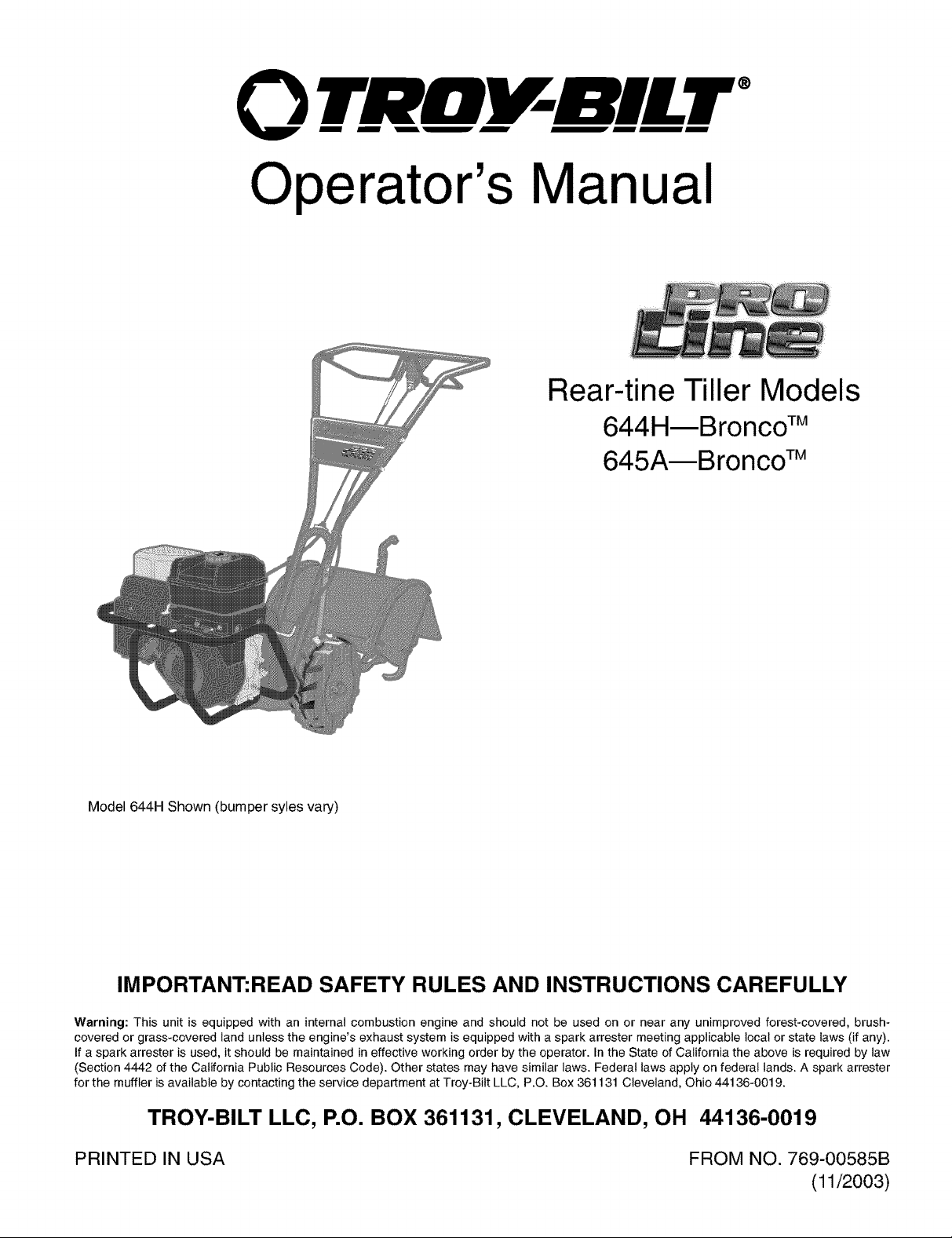
Operator's Manual
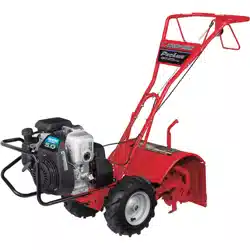
Rear-tine Tiller Models
644HmBronco TM
645AmBronco TM
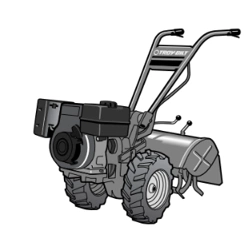
Model 644H Shown (bumper syles vary)
IMPORTANT:READ SAFETY RULES AND INSTRUCTIONS CAREFULLY
Warning: This unit is equipped with an internal combustion engine and should not be used on or near any unimproved forest-covered, brush-
covered or grass-covered land unless the engine's exhaust system is equipped with a spark arrester meeting applicable local or state laws (if any).
If a spark arrester is used, it should be maintained in effective working order by the operator. In the State of California the above is required by law
(Section 4442 of the California Public Resources Code). Other states may have similar laws. Federal laws apply on federal lands. A spark arrester
for the muffler is available by contacting the service department at Troy-Bilt LLC, P.O. Box 361131 Cleveland, Ohio 44136-0019.
TROY-BILT LLC, P.O. BOX 361131, CLEVELAND, OH 44136-0019
PRINTED IN USA FROM NO. 769-00585B
(11/2003)
TABLEOFCONTENTS
Content Page Content Page
Customer Support 2 Maintenance 19
Safety 3 Off-season Storage 24
Assembly 6 Troubleshooting 25
Features and Controls 10
Operation 13 Warranty Back Cover
FINDINGMODELNUMBER
This Operator's Manual is an important part of your new lawn tractor. It will help you assemble, prepare and maintain the
unit for best performance. Please read and understand what it says.
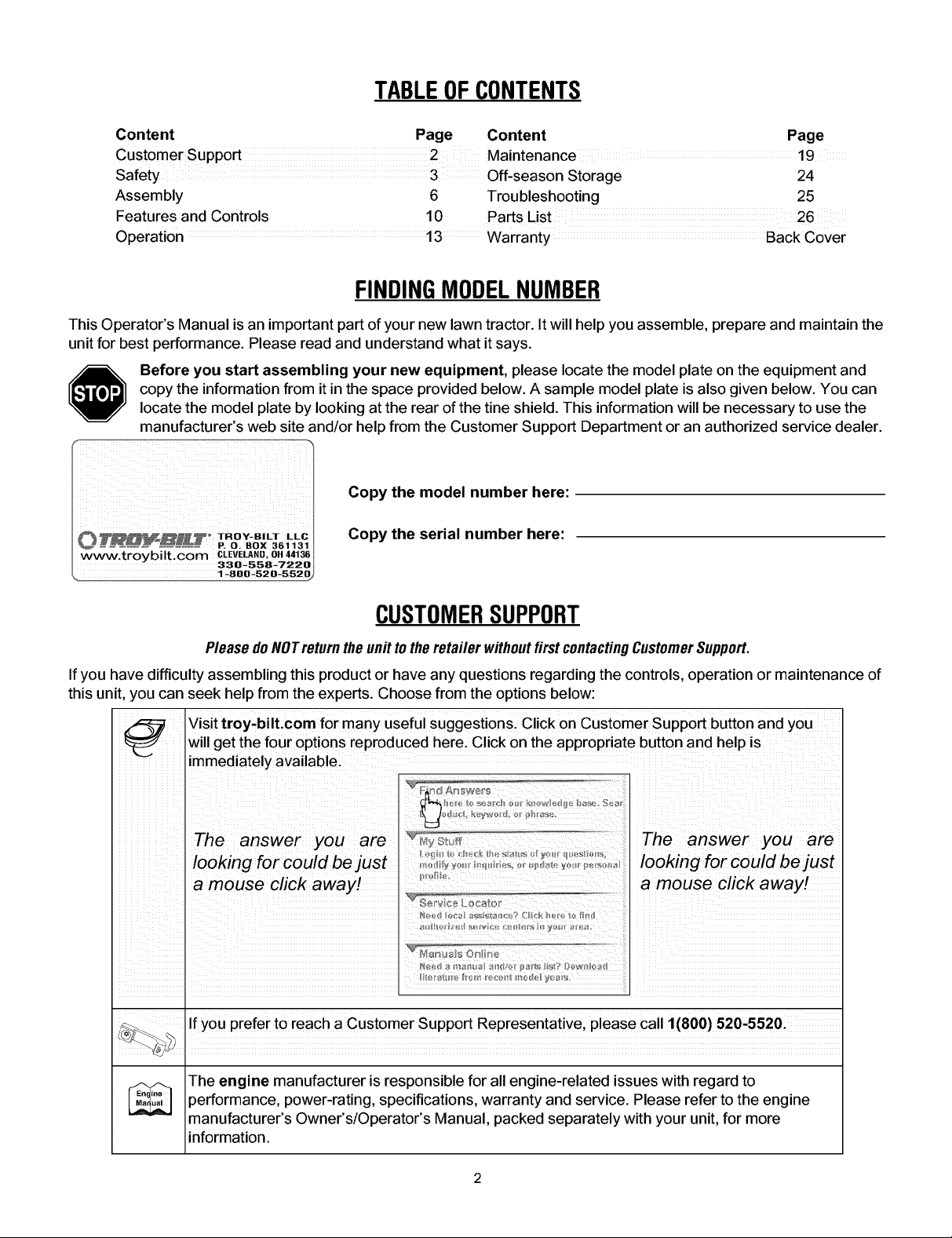
Before you start assembling your new equipment, please locate the model plate on the equipment and
copy the information from it in the space provided below. A sample model plate is also given below. You can
locate the model plate by looking at the rear of the tine shield. This information will be necessary to use the
manufacturer's web site and/or help from the Customer Support Department or an authorized service dealer.
www.troybilt:com CLEVELAND,01144136
330-558-7220
1-800-520"5520
Copy the model number here:
Copy the serial number here:
CUSTOMERSUPPORT
Please doNOTreturnthe unit to the retailer withoutfirstcontactingCustomerSupport.
If you have difficultyassembling this product or have any questions regarding the controls, operation or maintenance of
this unit, you can seek help from the experts. Choose from the options below:
Visit troy-bilt.com for many useful suggestions. Click on Customer Support button and you
will get the four options reproduced here. Click on the appropriate button and help is
immediately available.
_S
The answer you are _The answer you are
IlOOKingfor could be just ....,,_y.... _ ,,.........,_0._......... looking for could bejust
a mouse click away! a mouse click away!
I
The engine manufacturer is responsible for all engine-related issues with regard to
performance, power-rating, specifications, warranty to engine
and service. Please refer the
manufacturer's Owner's/Operator's Manual, packed separately with your unit, for more
information.
n
Safety
SPARK ARRESTERWARNING TO RESIDENTSOF CALIFORNIAAND SEVERALOTHERSTATES
Under California law, and under the laws of several other states, you are not permitted to operatean
internal combustion engine using hydrocarbon fuels on any forest, brush, hay, grain, or grass
covered land; or land covered by any flammable agricultural crop without an engine spark arrester in
continuous effective working order.
The engine on the unit is an internal combustion engine which burns gasoline,a hydrocarbon fuel, and must be equipped with a
spark arrester muffler in continuous effective working order. The spark attester must be attached to the engine exhaust system in
such a manner that flames or heatfrom the system will not ignite flammable material. Failureof the owner/operator of the unit to
comply with this regulation is a misdemeanor under California law (and other states) and may also be a violation of other state
and/or federal regulations, laws, ordinancesor codes. Contactyour local fire marshal or forest service for specific information
about which regulations apply in your area.
Training
1. Carefully readthis
Owner's Manual,the
separateEngineOwner's
Manual,and any other literature you may
receive. Bethoroughly familiar with the
controls and the proper use of the tiller
and its engine. Know how to stop the unit
and disengagethe controls quickly.
2. Never allow children to operate the
tiller. Never allow adults to operatethe
tiller without proper instruction.
3. Keepthe area of operation clear of all
persons, particularly children and pets.
4. Keepin mind that the operator or user
is responsible for accidents or hazards
occurring to other people,their property,
andthemselves.
Preparation
1. Thoroughly inspect the area where the
tiller is to be used and remove all foreign
objects.
2. Besure all tiller controls are released
and both wheelsare in the Wheel Drive
position before starting the engine.
3. Do not operatethe tiller without
wearing adequate outer garments. Avoid
loose garments or jewelry that could get
caught in moving parts.
4. Do not operatethe tiller when barefoot
or wearing sandals, sneakers,or light
footwear. Wear protectivefootwear that
will improve footing on slippery surfaces.
5. Do not till near underground electric
cables, telephone lines, pipes or hoses. If
in doubt, contact your telephone or utility
company.
6. Warning: Handlefuel with care; it is
highly flammable and its vapors are
explosive. Be sure to take the following
precautions:
a. Store fuel in containers specifically
designedfor this purpose.
b. The gas cap shall never be removed
or fuel added while the engine is
running. Allow the engine to cool
for several minutes before adding
fuel.
c. Keepmatches,cigarettes, cigars,
pipes, openflames, and sparks
awayfrom the fuel tank and fuel
container.
d. Fill fuel tank outdoors with extreme
care. Neverfill fuel tank indoors.
Useafunnel or spout to prevent
spillage.
e. Replaceall fuel tank and container
caps securely.
I. If fuel is spilled, do not attempt to
start the engine, but movethe
machineawayfrom the area of
spillage and avoid creating any
source of ignition until fuel vapors
havedissipated.
7. Never make adjustments when engine
is running (unless recommended by
manufacturer).
Operation
1. Do not put hands or feet nearor under
rotating parts. The tines begin to rotate
once the engine starts and the Forward
Clutch Bail (or ReverseClutch Control) is
engaged.
2. Exerciseextreme caution when on or
crossing gravel drives, walks, or roads.
Stay alert for hidden hazardsor traffic. Do
not carry passengers.
3. After striking a foreign object, stop the
engine, remove the wire from the spark
plug and prevent it from touching the
spark plug, thoroughly inspect the
machinefor any damage, and repair the
damage before restarting and operating
the machine.
4. Exercisecaution to avoid slipping or
falling.
5. If the unit should start to vibrate abnor-
mally, stop the engine, disconnect the
spark plug wire and prevent it from
touching the spark plug, and check
immediately for the cause. Vibration is
generally a warning of trouble.
6. Stop the engine, disconnect the spark
plug wire and prevent it from touching
the spark plug wheneveryou leavethe
operating position, before unclogging the
tines, or when making any repairs, adjust-
ments or inspections.
Section1: Safety
7. Takeall possible precautions when
leavingthe machineunattended. Stop the
engine. Disconnect spark plug wire and
move it away from the spark plug. Be
sure both wheels are in the Wheel Drive
position.
8. Before cleaning, repairing, or inspect-
ing, stop the engineand makecertain all
moving parts havestopped. Disconnect
the spark plug wire and prevent it from
touching the spark plug to prevent acci-
dental starting.
9. The flap on the tine hood must be
down when operating the tiller.
10. Never usethe tiller unless proper
guards, plates, or other safety protective
devices are in place.
11. Do not run engine in an enclosed
area. Engineexhaust contains carbon
monoxide gas, a deadly poison that is
odorless, colorless, and tasteless.
12. Keepchildren and pets away.
13. Never operatethe tiller under
engine powerif the wheels are in the
Freewheelposition. Inthe Freewheel
position,the wheelswill notholdthe
tiller backand the revolvingtines could
propelthe tiller rapidly, possibly
causinglossof control.Always engage
the wheelswith the wheel drive pins in
the Wheel Drive position before starting
the engine or engaging the tines/wheels
with the Forward Clutch Bail or the
ReverseClutch Control.
14. Beaware that the tiller may unexpect-
edly bounce upward or jump backward
and bepropelled toward you if the tines
should strike extremely hard packed soil,
frozen ground, or buried obstacles like
largestones, roots, or stumps. If in doubt
about the tilling conditions, always use
the following operating precautionsto
assist you in maintaining control of the
tiller:
a. Walk behindandto one side of the
tiller, usingone handonthe han-
dlebars. Relax your arm, but use a
securehand grip.
b. Use a deep depthregulator
setting.
c. Useslower enginespeeds.
d. Clear the tilling area of all large
stones, rootsandother debris.
e. Avoidusingdownwardpressure
on handlebars.If needbe, use
slightupwardpressureto keep the
tines from diggingtoo deeply.
f. Beforecontactinghard packedsoil
at the end of a row, reduceengine
speedand lilt handlebarsto raise
tines out of the soil.
g. In an emergency, stoptines and
wheels by releasing whichever
clutchcontrolis engaged. Donot
attemptto restrainthe tiller.
15. Do not overload the tiller's capacity
by attempting to till too deeply at too fast
a rate.
16. Neveroperate the tiller at high
transport speeds on slippery surfaces.
Look behind and use great care when
backing up.
17. Do not operatethe tiller on a slope
that is too steepfor safety. When on
slopes, slow down and makesure you
have good footing. Never permit the tiller
to freewheel down slopes.
18. Neverallow bystanders nearthe unit.
19. Only use attachments and acces-
sories that are approved by the manufac-
turer of the tiller.
20. Usetiller attachments and acces-
sories when recommended.
21. Neveroperate the tiller without good
visibility or light.
22. Neveroperate the tiller if you are
tired, or under the influenceof alcohol,
drugs or medication.
23. Operatorsshall not tamper with the
engine-governor settings on the machine;
the governor controls the maximum safe
operating speed to protect the engine and
all moving partsfrom damage caused by
overspeed. Authorized service shall be
sought if a problem exists.
24. Do not touch engine parts which may
be hot from operation. Let parts cool
down sufficiently.
25. Pleaseremember: You can always
stop the tines and wheels by releasingthe
Forward Clutch control or the Reverse
Clutch control (whichever control you
have engaged), or by moving the throttle
control lever on the engine to "OFF"or
"STOP".
26. To load or unload the tiller, seethe
instructions in Section4 of this Manual.
27. Use extreme caution when reversing
or pulling the machinetowards you.
28. Start the engine carefully according to
instructions andwith feet well away from
the tines.
29. Neverpick up or carry a machine
while the engine is running.
Maintenance and Storage
1. Keepthe tiller, attachments and acces-
sories in safe working condition.
2. Checkall nuts, bolts, and screws at
frequent intervals for proper tightness to
besure the equipment is in safeworking
condition.
3. Neverstore the tiller with fuel in the
fuel tank inside a building where ignition
sources are present such as hot water
and space heaters,furnaces, clothes
dryers, stoves, electric motors, etc.).
Allow engine to cool before storing in any
enclosure.
4. To reduce the chancesof a fire hazard,
keepthe engine free of grass, leaves,or
excessive grease.
5. Store gasoline in a cool, well-ventilated
area, safely away from any spark- or
flame-producing equipment. Store
gasoline in an approved container, safely
away from the reachof children.
6. Refer to the Maintenancesections of
this Manual and the separate Engine
Owner's Manualfor instructions if the
tiller is to be stored for an extended
period.
7. Never perform maintenancewhile the
engine is running or the spark plug wire
is connected, except when specifically
instructed to do so.
8. If the fuel tank hasto be drained, do
this outdoors.
Section1: Safety
Decals
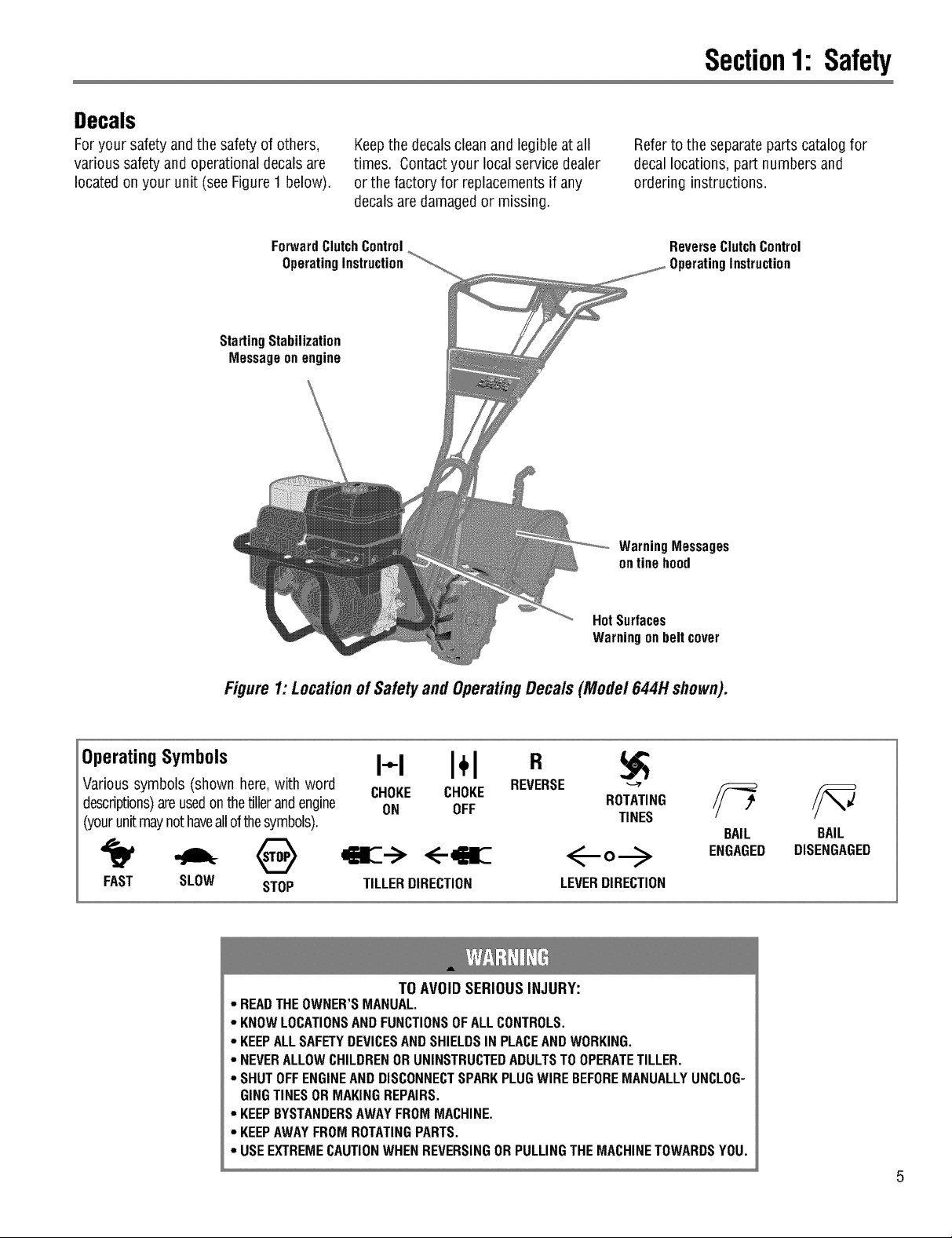
For your safety and the safety of others,
various safety and operational decals are
located on your unit (see Figure 1 below).
Keepthe decals clean and legible at all
times. Contact your local service dealer
or the factory for replacementsif any
decalsare damagedor missing.
Referto the separate parts catalog for
decal locations, part numbers and
ordering instructions.
ForwardClutchControl
OperatingInstruction
ReverseClutchControl
OperatingInstruction
StartingStabilization
Message on engine
Warning Messages
ontine hood
HotSurfaces
Warning on belt cover
Figure 1: Location of Safety and Operating Decals (Model 644H shown).
Operating Symbols
Various symbols (shown here, with word
descriptions) are used on the tiller and engine
(your unit may not haveallof the symbols).
FAST SLOW STOP
i÷i I÷1 R
CHOKE CHOKE REVERSE
ON OFF
€,E--> <--lZ,
TILLER DIRECTION
ROTATING
TINES
BAIL BAIL
_-_ 0_ENGAGED DISENGAGED
LEVERDIRECTION
TO AVOID SERIOUS INJURY:
•READTHE OWNER'S MANUAL.
•KNOWLOCATIONSANDFUNCTIONSOFALL CONTROLS.
•KEEPALLSAFETYDEVICESAND SHIELDSIN PLACEANDWORKING.
•NEVERALLOWCHILDRENOR UNINSTRUCTEDADULTSTOOPERATETILLER.
•SHUT OFFENGINEAND DISCONNECTSPARKPLUGWIRE BEFOREMANUALLYUNCLOG-
GINGTINESOR MAKINGREPAIRS.
•KEEPBYSTANDERSAWAYFROM MACHINE.
•KEEPAWAYFROM ROTATINGPARTS.
•USEEXTREMECAUTIONWHENREVERSINGOR PULLINGTHE MACHINETOWARDSYOU.
n
Assembly
WARNING
To prevent personal injury or
property damage, do not start
the engine until all assembly
steps are complete and you
have read and understandthe
safety and operating instruc-
tions in this manual.
Introduction
Carefullyfollow these assembly steps to
correctly prepareyour tiller for use. It is
recommendedthat you read this Section
in its entirety before beginning assembly.
NOTE: Enginesyles vary by model. The
engineon your tiller may appear differ-
ently than those shown in illustrations
and Figuresthroughout this manual.
Inspectunit
Inspectthe unit and carton for damage
immediately after delivery. Contact the
carrier (trucking company) if you find or
suspect damage. Inform them of the
damageand request instructions for filing
aclaim. To protect your rights, put your
claim in writing and mail acopy to the
carrier within 15 days after the unit has
beendelivered.
STEP 1: Unpacking Instructions
1. Removeany cardboard inserts and
packagingmaterial from the carton.
Removeany staples from the bottom of
the carton andthen lift the carton up and
off the unit.
2. The tiller is heavyand you should not
attempt to remove it from the shipping
platform until the handlebarsare
installed. The procedure for removing the
tiller is explained in Step 3 of these
assemblysteps.
NOTE:Be careful not to severely bend any
of the control cables on the unit.
3. Removeall unassembled parts and
the separate hardware bag from the
carton. Checkthat you havethe items
listed below (contact your local dealeror
the factory if any items are missing or
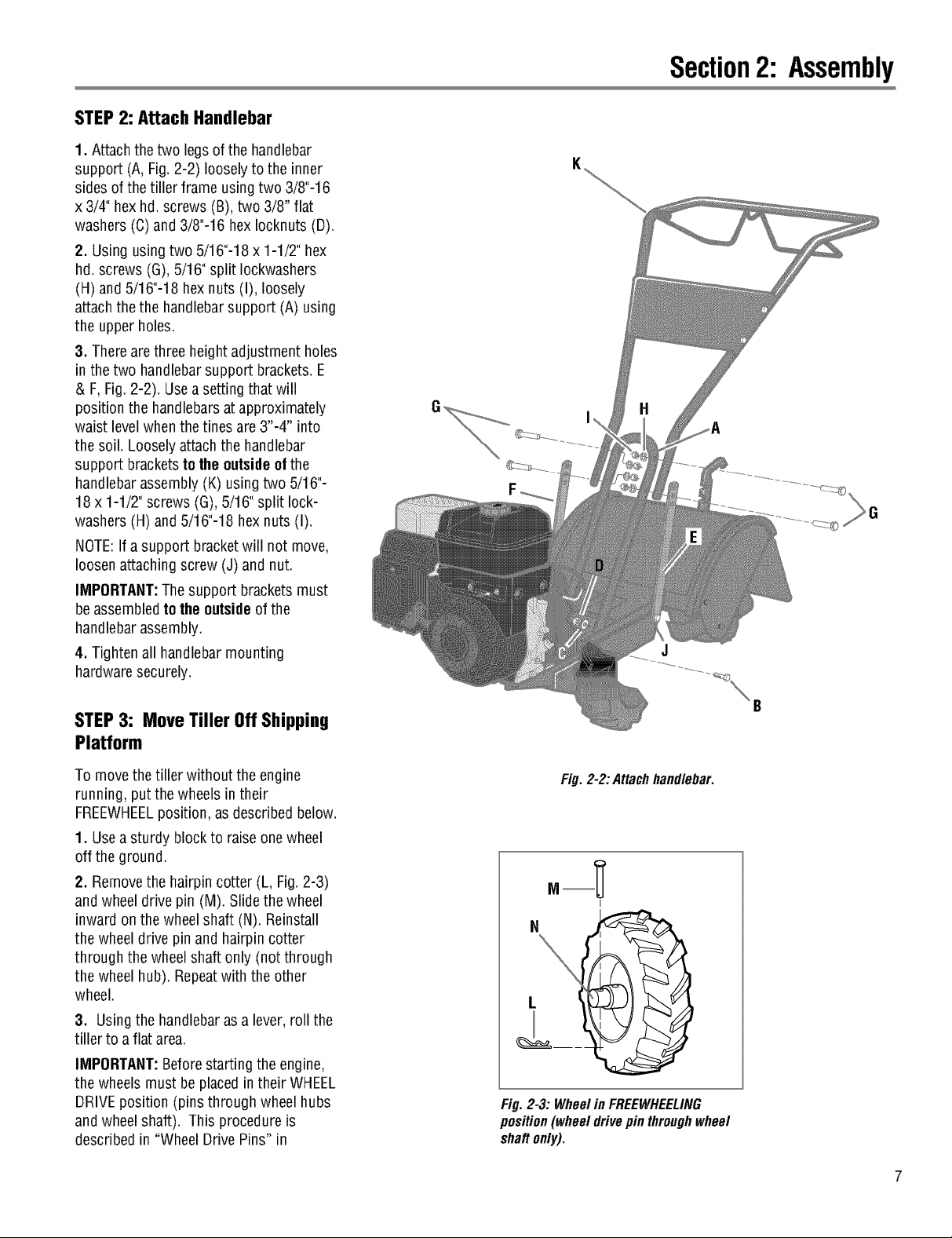
damaged). NOTE: Usethe screw length
template (Fig. 2-1) to identify screws.
LooseParts List
Qty. Description
1HandlebarSupport (seeA, Fig.2-2,
page7)
1 HandlebarAssembly
(see K, Fig. 2-2)
Thefo//owing itemsare in the
hardware bag:
4 Hexhd. screw, 5/16-18 x 1-1/2"
2 Hexhd. screw, 3/8-16 x 3/4"
2 Flatwasher, 3/8"
4 Split Iockwasher,5/16"
4 Hexnut, 5/16"-18
2 HexIocknut, 3/8"-16
IMPORTANT:Motor oil mustbe addedto
the enginecrankcasebeforethe engine
is started. Followthe instructionsin this
"Assembly" section.
NOTE:LEFTand RIGHTsides of the tiller
are as viewed from the operator's
position behindthe handlebars.
Tools/MaterialsNeededfor
Assembly
(2) 1/2" open-end wrench*
(1) 3/8" open-end wrench*
(2) 9/16" open-end wrench*
(1) Large adjustable wrench
(1) Scissors (to trim plastic ties)
(1) Ruler (for belt tension check)
(1) Block of wood (to support tiller
when removing wheels)
(1) Automotive-type air pressure gauge
(1) Cleanoil funnel
(1) Clean, high-quality engine oil. Refer
to the Engine Owner Manual for
engine oil specifications and quantity
required. Do not overfill.
*Adjustable wrenches may be used.
Figure2-1: Toidentifylength ofscrew,
placescrewontemplateasshownand
measuredistancebetweenbottomofscrew
headandtipofscrew.
STEP 2: Attach Handlebar
1. Attach the two legs of the handlebar
support (A, Fig. 2-2) loosely to the inner
sides of the tiller frame using two 3/8"-16
x 3/4" hex hd. screws (B), two 3/8" flat
washers (C) and 3/8"-16 hex Iocknuts (D).
2. Using using two 5/16"-18 x 1-1/2" hex
hd. screws (G), 5/16" split Iockwashers
(H) and 5/16"-18 hex nuts (I), loosely
attach the the handlebarsupport (A) using
the upper holes.
3. There are three height adjustment holes
in the two handlebarsupport brackets. E
& F, Fig.2-2). Use a setting that will
position the handlebarsat approximately
waist level when the tines are 3"-4" into
the soil. Looselyattach the handlebar
support bracketsto the outside of the
handlebarassembly (K) using two 5/16"-
18 x 1-1/2" screws (G), 5/16" split lock-
washers (H) and 5/16"-18 hex nuts (I).
NOTE:If a support bracket will not move,
loosen attaching screw (J) and nut.
IMPORTANT:The support brackets must
be assembledto the outsideof the
handlebarassembly.
4. Tighten all handlebar mounting
hardware securely.
STEP 3: Move Tiller Off Shipping
Platform
To move the tiller without the engine
running, put the wheels in their
FREEWHEELposition, as described below.
1. Usea sturdy block to raise onewheel
off the ground.
2. Removethe hairpin cotter (L, Fig. 2-3)
and wheel drive pin (M). Slide the wheel
inward on the wheel shaft (N). Reinstall
the wheel drive pin and hairpin cotter
through the wheel shaft only (not through
the wheel hub). Repeatwith the other
wheel.
3. Using the handlebaras a lever, roll the
tiller to a flat area.
IMPORTANT:Before starting the engine,
the wheels must be placed in their WHEEL
DRIVEposition (pins through wheel hubs
and wheel shaft). This procedure is
described in "Wheel Drive Pins" in
Section2: Assembly
Fig. 2-2: Attach handlebar.
Fig. 2-3: Wheel in FREEWHEELING
position (wheel drive pin throughwheel
shaftonly).
Section2: Assembly
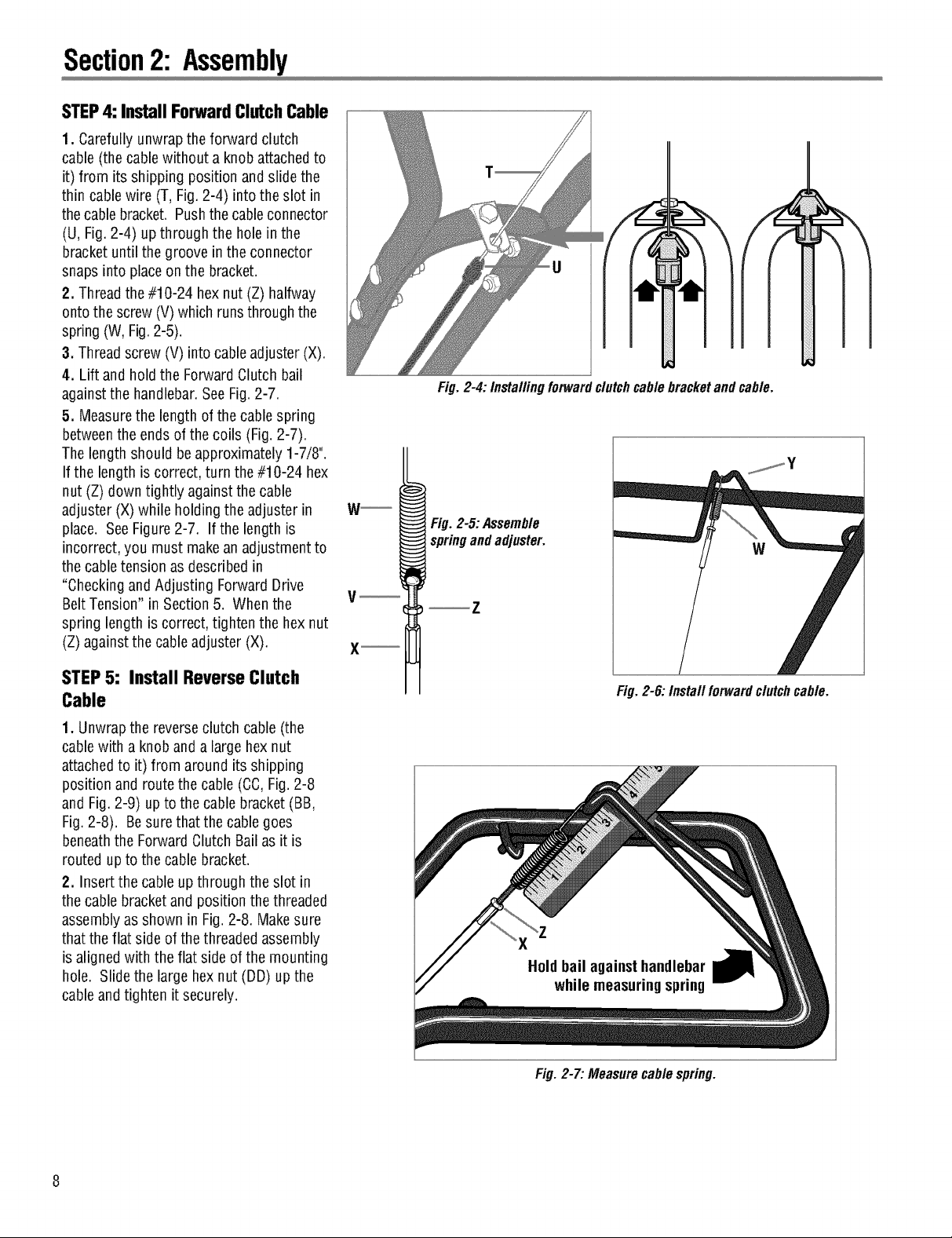
STEP4: Install Forward Clutch Cable
1. Carefully unwrap the forward clutch
cable (the cable without a knob attached to
it) from its shipping position and slide the
thin cable wire (T, Fig. 2-4) into the slot in
the cable bracket. Pushthe cableconnector
(U, Fig.2-4) up through the hole in the
bracket until the groove in the connector
snaps into place on the bracket.
2. Threadthe #10-24 hex nut (Z) halfway
onto the screw (V) which runs through the
spring (W, Fig.2-5).
3. Thread screw (V) into cable adjuster (X).
4. Lift and hold the Forward Clutch bail
against the handlebar. SeeFig.2-7.
5. Measurethe length of the cable spring
betweenthe ends of the coils (Fig. 2-7).
The length should be approximately 1-7/8".
If the length is correct, turn the #10-24 hex
nut (Z) down tightly against the cable
adjuster (X) while holding the adjuster in
place. SeeFigure 2-7. If the length is
incorrect, you must make an adjustment to
the cable tension as described in
"Checking andAdjusting Forward Drive
BeltTension" in Section 5. When the
spring length is correct, tighten the hex nut
(Z) against the cable adjuster (X).
STEP5: Install ReverseClutch
Cable
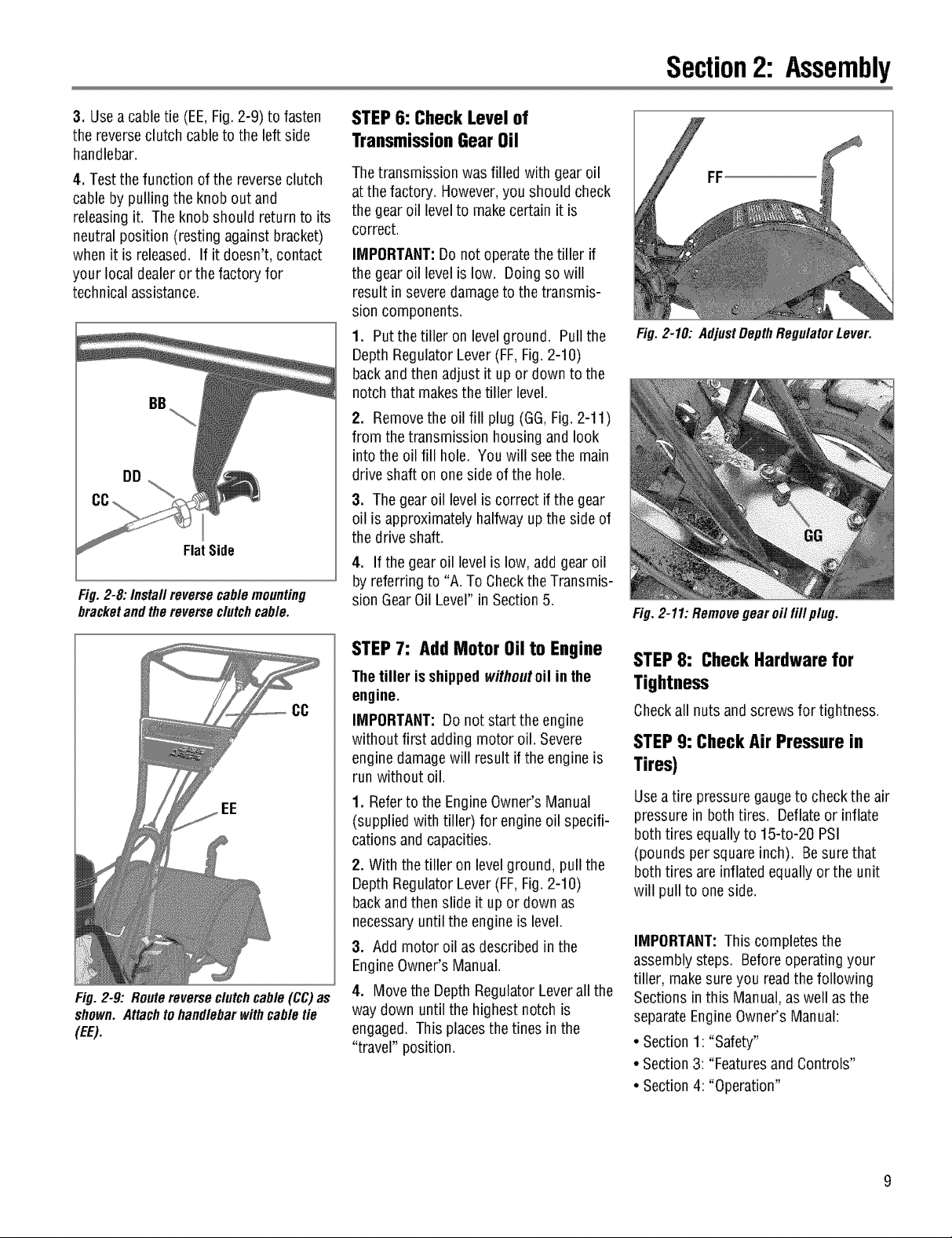
1. Unwrapthe reverse clutch cable (the
cable with a knob and a large hex nut
attached to it) from around its shipping
position and route the cable (CC, Fig.2-8
and Fig. 2-9) up to the cable bracket (BB,
Fig.2-8). Besure that the cable goes
beneaththe Forward Clutch Bail as it is
routed up to the cable bracket.
2. Insert the cable up through the slot in
the cable bracket and position the threaded
assembly as shown in Fig. 2-8. Make sure
that the flat side of the threaded assembly
is aligned with the flat side of the mounting
hole. Slide the large hex nut (DD) up the
cable and tighten it securely.
Fig. 2-4: Installing forwardclutchcable bracket and cable.
Fig. 2-5: Assemble
springand adjuster.
Fig. 2-6: Install forwardclutch cable.
Fig. 2-7: Measure cable spring.
Section2: Assembly
3. Usea cable tie (EE,Fig. 2-9) to fasten
the reverseclutch cableto the left side
handlebar.
4. Test the function of the reverseclutch
cable by pulling the knob out and
releasingit. The knob should return to its
neutral position (resting against bracket)
when it is released. If it doesn't, contact
your local dealer or the factory for
technical assistance.
BB
DD
Flat Side
Fig. 2-8: Install reverse cable mounting
bracketand the reverse clutchcable.
CC
Fig. 2-9: Route reverse clutchcable (CC) as
shown. Attach to handlebar with cable tie
(EE).
STEP6: CheckLevelof
TransmissionGearOil
The transmission was filled with gear oil
at the factory. However, you should check
the gear oil levelto make certain it is
correct.
IMPORTANT:Do not operate the tiller if
the gear oil level is low. Doing so will
result insevere damageto the transmis-
sign components.
1. Put the tiller on levelground. Pullthe
DepthRegulator Lever (FF, Fig. 2-10)
backand then adjust it up or down to the
notch that makesthe tiller level.
2. Removethe oil fill plug (GG,Fig. 2-11)
from the transmission housing and look
into the oil fill hole. You will see the main
drive shaft on oneside of the hole.
3. The gear oil level is correct if the gear
oil is approximately halfway up the side of
the drive shaft.
4. If the gear oil level is low, add gear oil
by referring to "A. To Checkthe Transmis-
sion Gear Oil Level" in Section 5.
STEP 7: Add Motor Oil to Engine
Thetiller is shipped withoutoil in the
engine.
IMPORTANT:Do not start the engine
without first adding motor oil. Severe
engine damagewill result if the engine is
run without oil.
1. Referto the Engine Owner's Manual
(supplied with tiller) for engine oil specifi-
cations and capacities.
2. With the tiller on level ground, pull the
DepthRegulator Lever (FF, Fig. 2-10)
backand then slide it up or down as
necessaryuntil the engine is level.
3. Add motor oil as described in the
EngineOwner's Manual.
4. Movethe Depth Regulator Lever all the
way down until the highest notch is
engaged. This placesthe tines in the
"travel" position.
Fig. 2-10: Adjust DepthRegulator Lever.
Fig. 2-11: Removegear oil fill plug.
STEP 8: Check Hardware for
Tightness
Checkall nuts and screws for tightness.
STEP9: CheckAir Pressurein
Tires)
Usea tire pressuregaugeto check the air
pressure in both tires. Deflateor inflate
both tires equally to 15-to-20 PSI
(pounds per square inch). Besure that
both tires are inflated equally or the unit
will pull to one side.
IMPORTANT:This completes the
assembly steps. Beforeoperating your
tiller, make sure you read the following
Sections in this Manual, as well as the
separateEngineOwner's Manual:
• Section 1: "Safety"
• Section3: "Featuresand Controls"
• Section 4: "Operation"
n
FeaturesandControls
WARNING
Before operating your
machine, carefully read and
understand all safety, controls
and operating instructions in
this Manual, the separate
Engine Owner's Manual, and
on the decals on the machine.
Failure to follow these
instructions can result in
serious personal injury.
Forward ReverseClutch
ClutchBail Control
Regulator
HandlebarHeight
Adjustment
Anti-ReverseStake
Drive Pin
(on eachwheel)
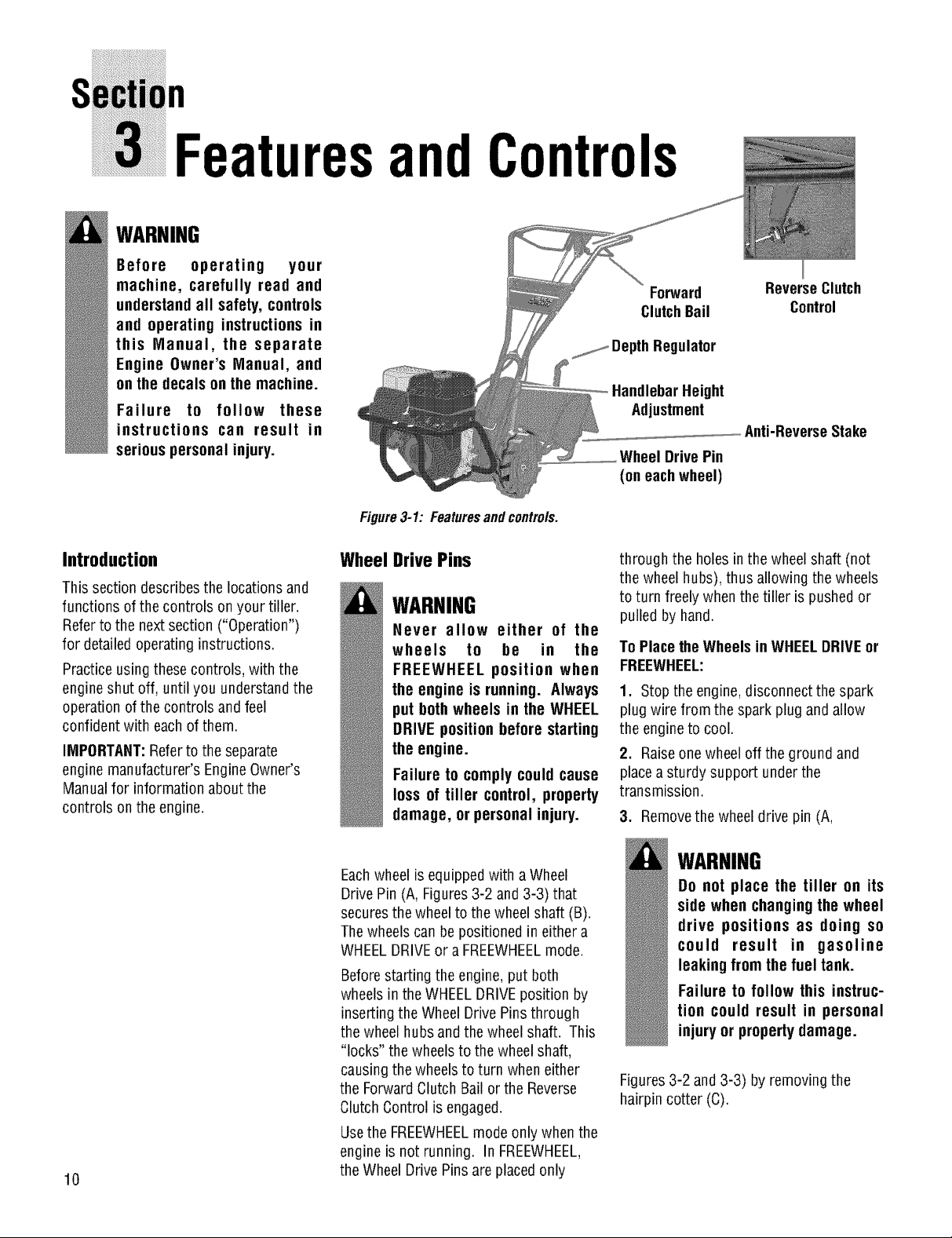
Figure 3-1: Featuresand controls.
Introduction
This section describesthe locations and
functions of the controls on your tiller.
Referto the next section ("Operation")
for detailed operating instructions.
Practice using these controls, with the
engine shut off, until you understandthe
operation of the controls and feel
confident with each of them.
IMPORTANT:Refer to the separate
engine manufacturer's Engine Owner's
Manual for informationabout the
controls on the engine.
Wheel Drive Pins
WARNING
Never allow either of the
wheels to be in the
FREEWHEEL position when
the engine is running. Always
put both wheels in the WHEEL
DRIVE position before starting
the engine.
Failure to comply could cause
loss of tiller control, property
damage, or personal injury.
through the holes in the wheel shaft (not
the wheel hubs), thus allowing the wheels
to turn freely when the tiller is pushed or
pulled by hand.
To Placethe Wheels in WHEELDRIVEor
FREEWHEEL:
1. Stop the engine, disconnect the spark
plug wire from the spark plug and allow
the engineto cool.
2. Raiseone wheel off the ground and
place a sturdy support under the
transmission.
3. Removethe wheel drive pin (A,
10
Eachwheel is equipped with a Wheel
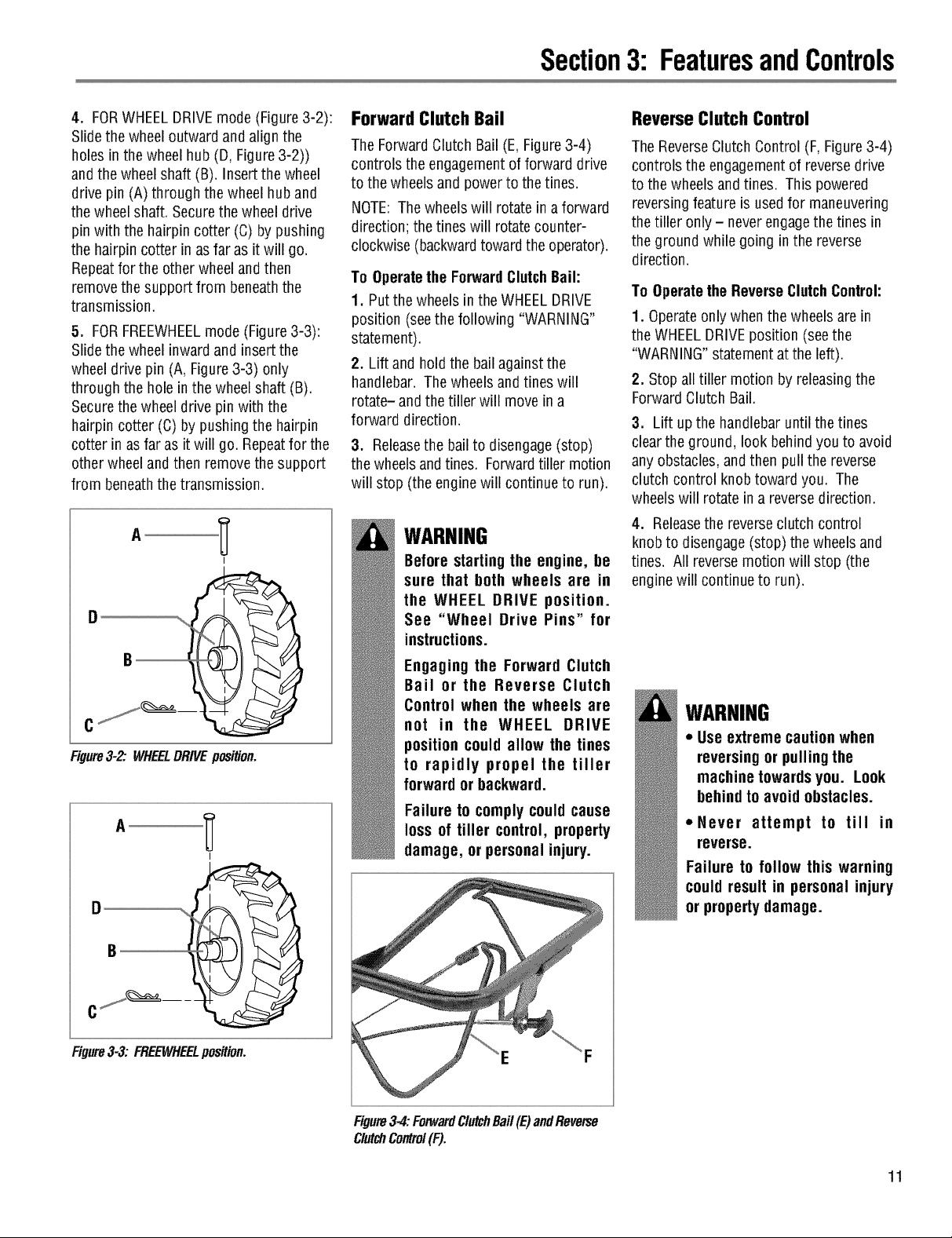
Drive Pin (A, Figures3-2 and 3-3) that
secures the wheel to the wheel shaft (B).
The wheels can be positioned in either a
WHEELDRIVEor a FREEWHEELmode.
Before starting the engine, put both
wheels in the WHEELDRIVEposition by
inserting the Wheel Drive Pins through
the wheel hubs andthe wheel shaft. This
"locks" the wheels to the wheel shaft,
causing the wheels to turn when either
the ForwardClutch Bail or the Reverse
Clutch Control is engaged.
Usethe FREEWHEELmode only when the
engine is not running. In FREEWHEEL,
the Wheel Drive Pins are placed only
WARNING
Do not place the tiller on its
side when changing the wheel
drive positions as doing so
could result in gasoline
leaking from the fuel tank.
Failure to follow this instruc-
tion could result in personal
injury or property damage.
Figures3-2 and 3-3) by removingthe
hairpin cotter (C).
Section3: FeaturesandControls
4. FORWHEELDRIVEmode (Figure3-2):
Slide the wheel outward and align the
holes in the wheel hub (D, Figure3-2))
and the wheel shaft (B). Insert the wheel
drive pin (A) through the wheel hub and
the wheel shaft. Securethe wheel drive
pin with the hairpin cotter (C) by pushing
the hairpin cotter in as far as it will go.
Repeatfor the other wheel and then
removethe support from beneaththe
transmission.
5. FORFREEWHEELmode (Figure 3-3):
Slide the wheel inward and insert the
wheel drive pin (A, Figure 3-3) only
through the hole in the wheel shaft (B).
Secure the wheel drive pin with the
hairpin cotter (C) by pushing the hairpin
cotter in as far as it will go. Repeatfor the
other wheel and then removethe support
from beneaththe transmission.
I
Figure3-2: WHEELDRIVEposition.
I
D
B
Figure3-3: FREEWHEELposition.
Forward Clutch Bail
The Forward Clutch Bail (E, Figure3-4)
controls the engagementof forward drive
to the wheelsand power to the tines.
NOTE: The wheels will rotate in a forward
direction; the tines will rotate counter-
clockwise (backwardtoward the operator).
To Operatethe Forward ClutchBail:
1. Put the wheels in the WHEELDRIVE
position (see the following "WARNING"
statement).
2. Lift and hold the bail against the
handlebar. The wheels and tines will
rotate- and the tiller will move in a
forward direction.
3. Releasethe bail to disengage(stop)
the wheelsandtines. Forwardtiller motion
will stop (the engine will continue to run).
WARNING
Before starting the engine, be
sure that both wheels are in
the WHEEL DRIVE position.
See "Wheel Drive Pins" for
instructions.
Engaging the Forward Clutch
Bail or the Reverse Clutch
Control when the wheels are
not in the WHEEL DRIVE
position could allow the tines
to rapidly propel the tiller
forward or backward.
Failure to comply could cause
loss of tiller control, property
damage, or personal injury.
ReverseClutchControl
The ReverseClutch Control (F, Figure3-4)
controls the engagement of reverse drive
to the wheels and tines. This powered
reversingfeature is used for maneuvering
the tiller only - never engagethe tines in
the ground while going in the reverse
direction.
To Operatethe ReverseClutchControl:
1. Operateonly when the wheels are in
the WHEELDRIVEposition (seethe
"WARNING" statement at the left).
2. Stop all tiller motion by releasingthe
ForwardClutch Bail.
3. Lift up the handlebaruntil the tines
clear the ground, look behindyou to avoid
any obstacles, and then pull the reverse
clutch control knob toward you. The
wheels will rotate in a reverse direction.
4. Releasethe reverseclutch control
knob to disengage (stop) the wheels and
tines. All reversemotion will stop (the
engine will continue to run).
WARNING
•Use extreme cautionwhen
reversing or pulling the
machine towards you. Look
behind to avoid obstacles.
•Never attempt to till in
reverse.
Failure to follow this warning
could result in personal injury
or property damage.
Figure34: FonvardClutchBail (E)andReverse
ClutchControl(F).
11
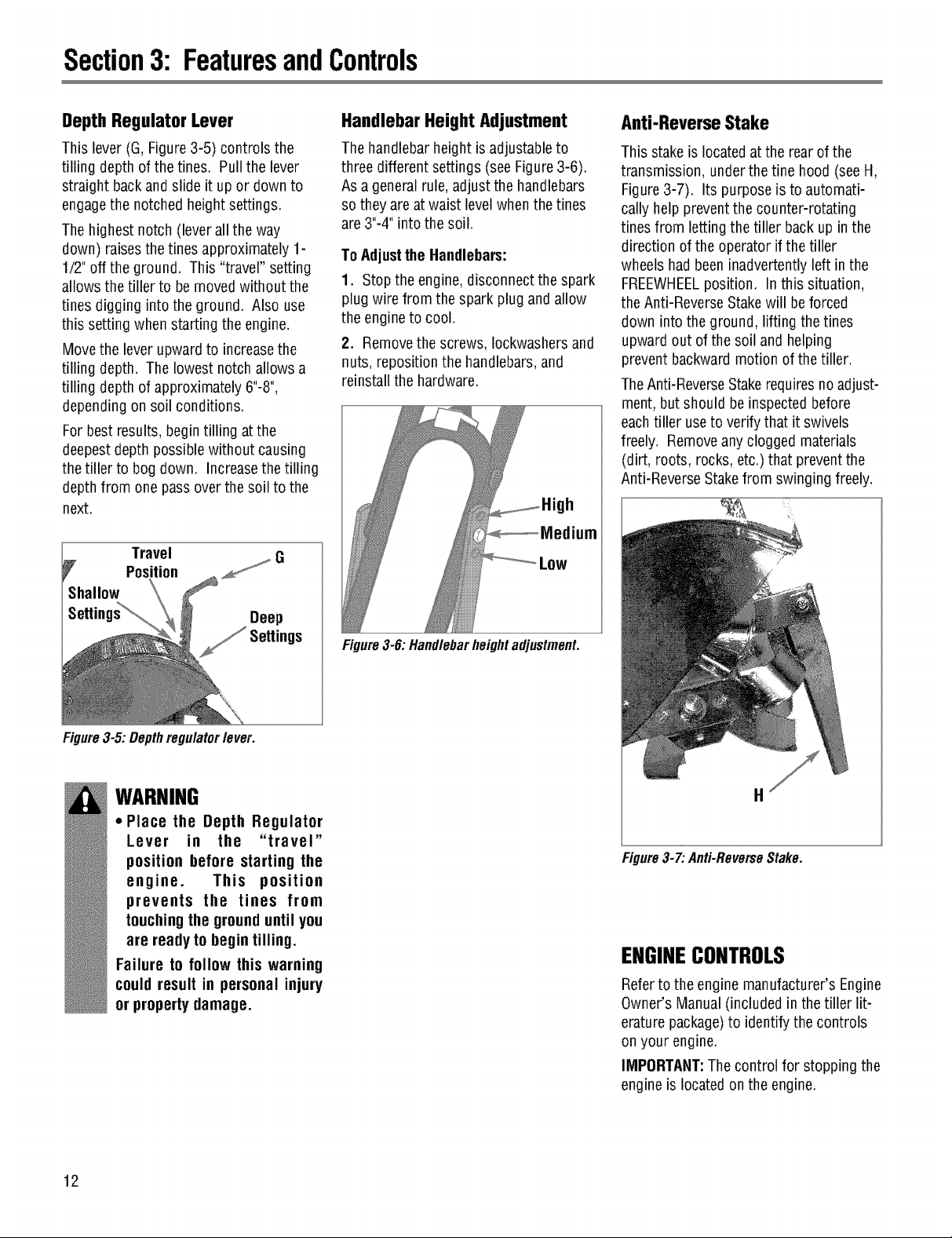
Section3: FeaturesandControls
DepthRegulatorLever
This lever (G, Figure3-5) controls the
tilling depth of the tines. Pullthe lever
straight backand slide it up or down to
engagethe notched height settings.
The highest notch (lever all the way
down) raisesthe tines approximately 1-
1/2" off the ground. This "travel" setting
allows the tiller to be movedwithout the
tines digging into the ground. Also use
this setting when starting the engine.
Movethe lever upward to increasethe
tilling depth. The lowest notch allows a
tilling depth of approximately 6"-8",
dependingon soil conditions.
For best results, begin tilling at the
deepestdepth possiblewithout causing
the tiller to bog down. Increasethe tilling
depth from one pass over the soil to the
next.
Shallow
Travel
Position jG
Deep
_Settings
HandlebarHeightAdjustment
The handlebarheight is adjustableto
three different settings (see Figure 3-6).
As a general rule, adjust the handlebars
so they are at waist level when the tines
are 3"-4" into the soil.
To Adjustthe Handlebars:
1. Stop the engine, disconnectthe spark
plug wire from the spark plug and allow
the engineto cool.
2. Removethe screws, Iockwashers and
nuts, reposition the handlebars, and
reinstall the hardware.
Figure3-6: Handlebar height adjustment.
Anti-ReverseStake
This stake is locatedat the rear of the
transmission, under the tine hood (see H,
Figure 3-7). Its purpose is to automati-
cally help preventthe counter-rotating
tines from letting the tiller back up in the
direction of the operator if the tiller
wheels had beeninadvertently left in the
FREEWHEELposition. In this situation,
the Anti-Reverse Stake will beforced
down into the ground, lifting the tines
upward out of the soil and helping
prevent backward motion of the tiller.
TheAnti-ReverseStake requires no adjust-
ment, but should be inspected before
eachtiller useto verify that it swivels
freely. Remove any clogged materials
(dirt, roots, rocks, etc.) that preventthe
Anti-ReverseStakefrom swinging freely.
L_
Figure3-5: Depth regulator lever.
WARNING
•Place the Depth Regulator
Lever in the "travel"
position before starting the
engine. This position
prevents the tines from
touching the ground until you
are ready to begin tilling.
Failure to follow this warning
could result in personal injury
or property damage.
H
Figure 3-7: Anti-ReverseStake.
ENGINECONTROLS
Referto the engine manufacturer's Engine
Owner's Manual (included in the tiller lit-
erature package)to identify the controls
on your engine.
IMPORTANT:The control for stopping the
engine is located on the engine.
12
.........................Operation
WARNING
Before operating your
machine, carefully read and
understand all safety (Section
1), controls (Section 3) and
operating instructions (Section
4) in this Manual, in the
separate Engine Owner's
Manual, and on the decals on
the machine.
Failure to follow these instruc-
tions can result in serious
personal injury.
INTRODUCTION
Readthis Section of the manual thor-
oughly beforeyou start the engine. Then,
takethe time to familiarize yourself with
the basic operation of the tiller before
using it in the garden. Find an open, level
areaand practice using the tiller controls
without the tines engagingthe soil (put
tines in "travel" setting). Only after
you've becomecompletely familiar with
the tiller should you begin using it in the
garden.
INITIAL OPERATION
Perform the following maintenanceduring
the first hours of new operation (see
"Maintenance" section in this manual and
inthe EngineOwner's Manual).
1. Changeengine oil after first 2 hours of
new engine operation.
2. Checkfor loose or missing hardware
on unit. Tighten or replace as needed.
3. Checktension on forward drive belt
after first 2 hours of operation.
4. Checktransmission gear oil level after
first 2 hours of operation.
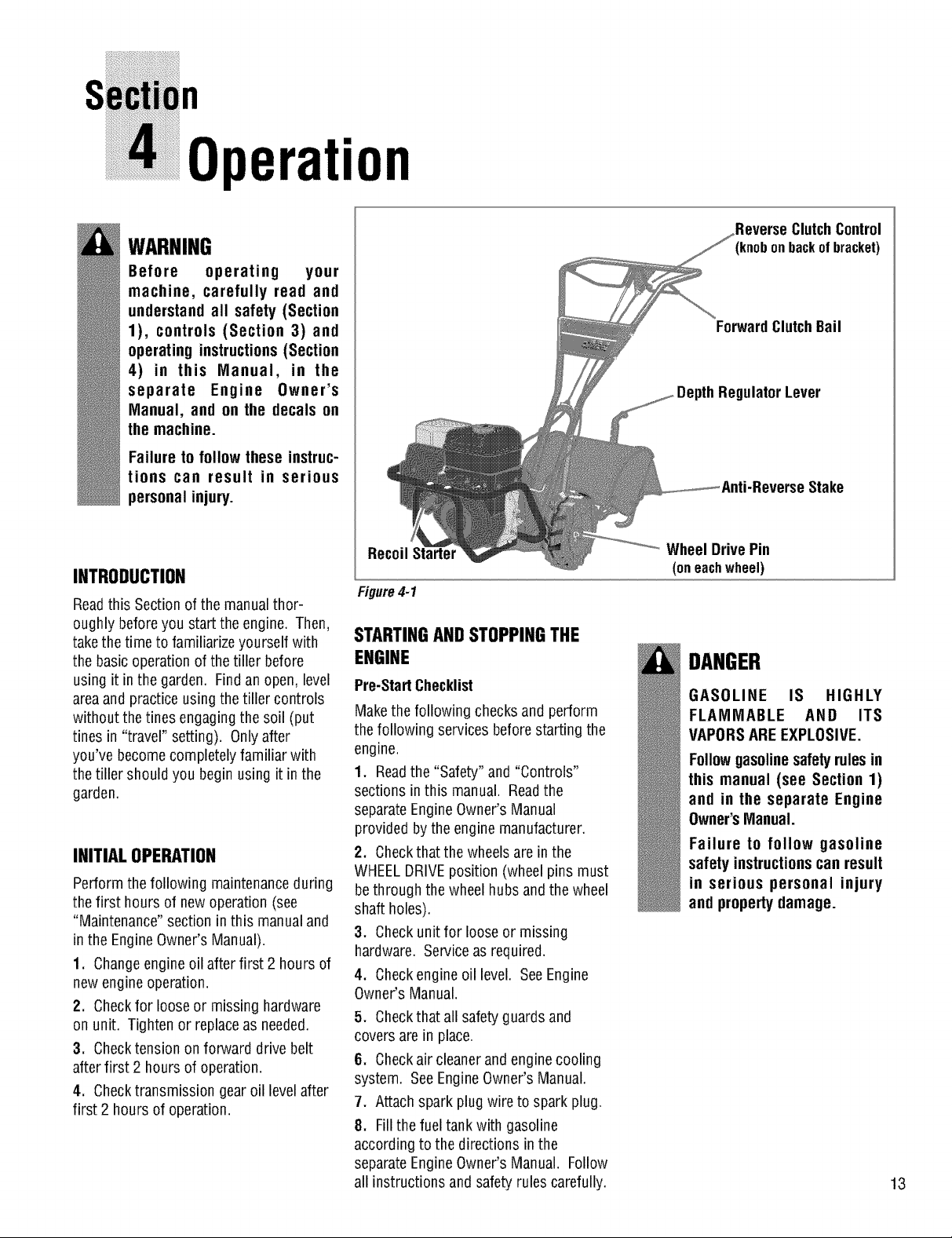
ReverseClutchControl
(knobon backofbracket)
__---_FonNard Clutch Bail
DepthRegulatorLever
Ii-Reverse Stake
Recoil
Figure4-1
Wheel Drive Pin
(oneachwheel)
STARTINGAND STOPPINGTHE
ENGINE
Pre-StartChecklist
Makethe following checks and perform
the following services before starting the
engine.
1. Readthe "Safety" and "Controls"
sections in this manual. Readthe
separateEngineOwner's Manual
provided by the engine manufacturer.
2. Checkthat the wheels are in the
WHEELDRIVEposition (wheel pins must
bethrough the wheel hubs and the wheel
shaft holes).
3. Check unit for loose or missing
hardware. Service as required.
4. Checkengine oil level. SeeEngine
Owner's Manual.
5. Checkthat all safety guards and
covers are in place.
6. Checkair cleaner and engine cooling
system. See Engine Owner's Manual.
7. Attach spark plug wire to spark plug.
8. Fillthe fuel tank with gasoline
according to the directions in the
separateEngineOwner's Manual. Follow
all instructions and safety rules carefully.
DANGER
GASOLINE IS HIGHLY
FLAMMABLE AND ITS
VAPORSARE EXPLOSIVE.
Followgasolinesafety rules in
this manual (see Section 1)
and in the separate Engine
Owner'sManual.
Failure to follow gasoline
safety instructionscan result
in serious personal injury
and property damage.
13
Section4: Operation
Startingthe Engine
The following steps describe how to start
and stop the engine. Donot attemptto
engagetines or wheels until you have
read all the operatinginstructionsin this
Section. Alsoreview the salety rules in
Section1: "Safety" and the tiller and
engine controlsinlormation in Section
3: "Features and Controls."
CAUTION
To help prevent serious
personal injury or damage to
equipment:
•Before starting engine, put
both wheels in the WHEEL
DRIVE position. Never have
the wheels in the
FREEWHEEL position when
the engine is running. When
the wheels are in
FREEWHEEL, they do not
hold back the tiller and the
tines could propel the tiller
rapidly backward.
•Before starting engine, put
Forward Clutch Bail (all
Models) and Reverse Clutch
Control in neutral (disen-
gaged) positionsby releasing
levers.
•Never run engine indoors or
in enclosed, poorly venti-
lated areas. Engine exhaust
contains carbon monoxide,
an odorless and deadly gas.
•Avoid engine muffler and
nearby areas. Temperatures
in these areas may exceed
150OF.
1. Completethe "Pre-Start Checklist" on
the previous page.
2. Put the wheels in the WHEELDRIVE
position (see "Wheel Drive Pins" in
Section 3).
3. Put the DepthRegulator Lever in the
"travel" position (lever all the way down)
so that the tines are clear of the ground.
4. Releaseall controls on the tiller.
5. If engine is equipped with a fuel valve,
1t'urn4valve to open position as instructed
in the separate Engine Owner's Manual.
6. Put ignition switch and/or throttle
control lever on engine in "ON," "RUN,"
"FAST"or "START" position as instructed
in the separate Engine Owner's Manual.
7. Chokeor prime engine as instructed in
the separate Engine Owner's Manual.
8. Place one hand on the fuel tank to
stabilize the unit when you pull the starter
handle. Usethe recoil starter rope to start
the engine as instructed in the separate
EngineOwner's Manual. When engine
starts, gradually move choke lever (on
engines so equipped)to "NO CHOKE,"
"CHOKEOFF"or "RUN" position.
WARNING
Hot surfaces can cause severe
burns. Do not touch muffler or
adjacent areas.
9. Usethe "FAST"throttle speed setting
when tilling.
WARNING
Keep away from rotating
tines. Rotating tines will
cause injury.
Stoppingthe Engineand Tiller
1. To stop the wheels and tines, release
the ForwardClutch Bail or the Reverse
Clutch Control -- whichever control is in
use.
2. To stop the engine, put the throttle
control lever on engine in "OFF"or
"STOP" position.
OPERATINGTHE TILLER
The following pages provide guidelines to
using your tiller effectively andsafely in
various gardening applications. Besure
to read "Tilling Tips & Techniques" in this
Section beforeyou actually put the tines
into the soil.
This is a CRT(counter-rotating tine) tiller.
As the wheels pull forward, the tines
rotate backward.
This creates an "uppercut" tine action
which digs deeply, uprooting soil and
weeds. Don't overload the engine, but dig
as deeply as possible on each pass. On
later passes,the wheels may tend to spin
in the soft dirt. Help them along by lifting
up slightly on the handlebar (palm facing
up).
1. Followthe "Pre-Start Checklist" on the
previous page. Besure that the wheels
are in the WHEELDRIVEposition.
2. Put the Depth Regulator Lever in the
"travel" position (lever all the way down)
so that the tines are clear of the ground.
Usethis position when practicing with
your tiller or when moving to or from the
garden. When you are readyto begin
tilling, you must move the Depth
Regulator Lever to the desired depth
setting (see "Tilling Tips & Techniques").
Checkthat the Anti-Reverse Stakeswivels
freelybackandforth. Removeany clogged
material on or around the stake.
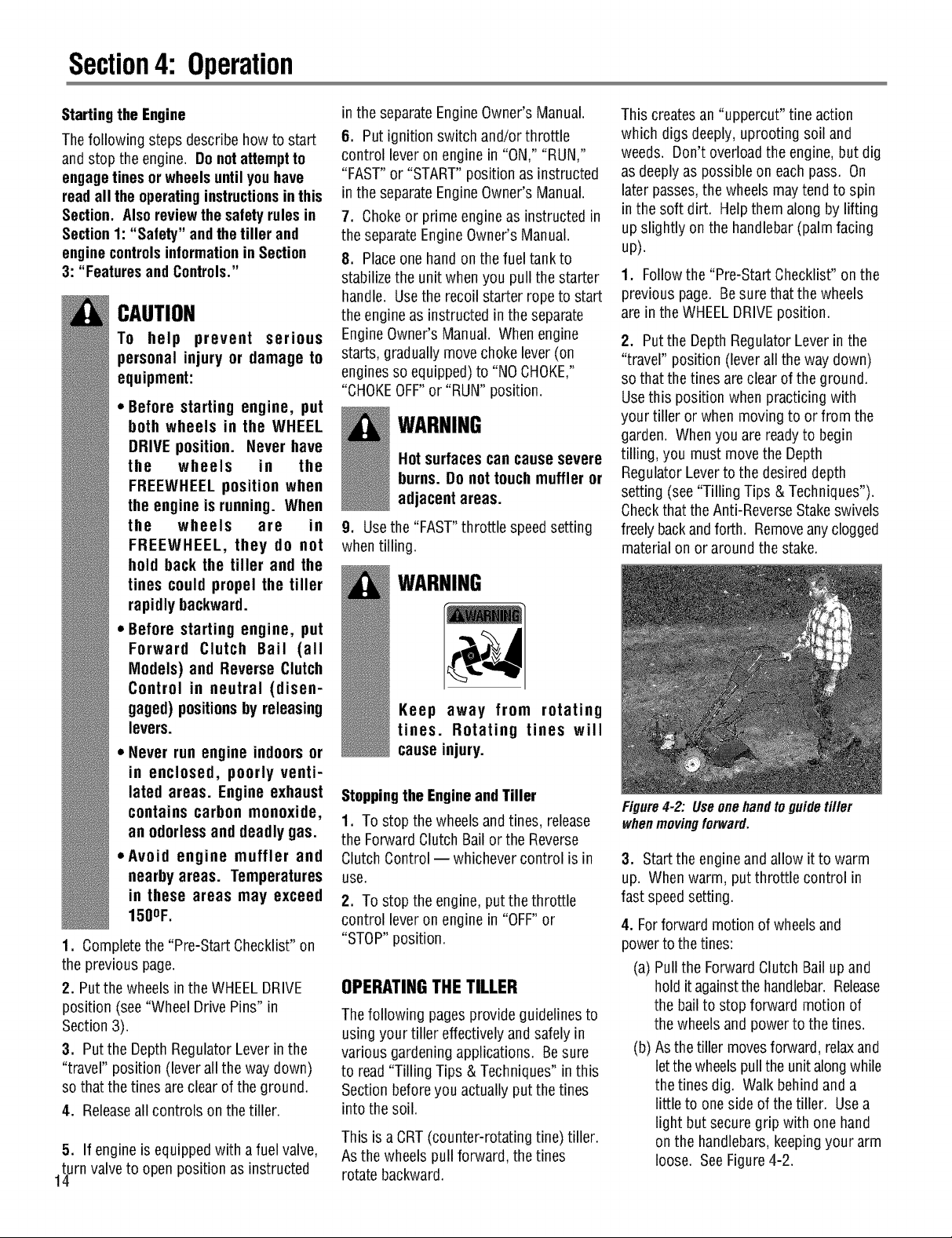
Figure 4-2: Use one handto guide tiller
when movingforward.
3. Start the engine and allow it to warm
up. When warm, put throttle control in
fast speedsetting.
4. Forforward motion of wheels and
power to the tines:
(a) Pull the Forward Clutch Bail up and
hold it againstthe handlebar. Release
the bail to stop forward motion of
the wheelsand power to the tines.
(b) As the tiller moves forward, relaxand
letthe wheels pull the unit along while
the tines dig. Walk behindand a
little to one side of the tiller. Usea
light but secure grip with one hand
on the handlebars,keeping your arm
loose. See Figure 4-2.
Section4: Operation
WARNING
Do not push down on the
handlebars to try to make the
tiller till more deeply. This
prevents the wheels from
holding the tiller back and can
allow the tines to rapidly
propel the tiller backward
toward the operator, which
could result in loss of control,
property damage, or personal
injury.
Let the tiller move at its own paceand do
not push down on the handlebarsto try to
dig deeper- this takes weight off the
wheels, cuts traction, andcausesthe tines
to try and propel the tiller.
5. For reverse motion of the wheels and
tines:
(a) Look behind and exercise caution
when operating in reverse. Donot
till while in reverse.
(b) Stop all forward motion before
reversing. Lift the handlebars with
one hand until the tines areoff the
ground and then pull the Reverse
Clutch Control knob out to engage
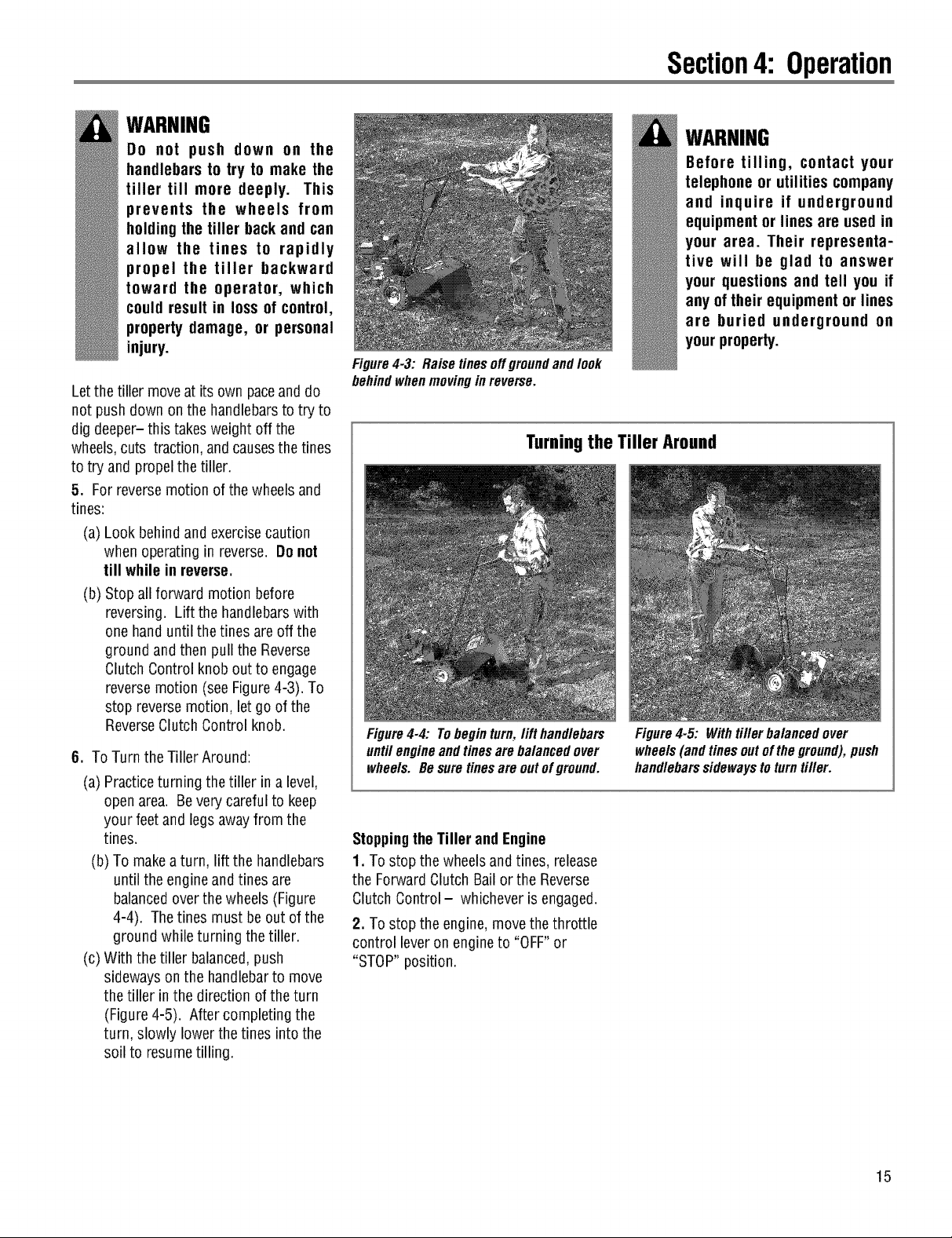
reverse motion (see Figure4-3). To
stop reversemotion, let go of the
ReverseClutch Control knob.
6. To Turn the Tiller Around:
(a) Practice turning the tiller in a level,
open area. Be very careful to keep
your feet and legs awayfrom the
tines.
(b) To makeaturn, lift the handlebars
until the engine and tines are
balancedover the wheels (Figure
4-4). The tines must be out of the
ground while turning the tiller.
(c) With the tiller balanced,push
sideways on the handlebar to move
the tiller in the direction of the turn
(Figure 4-5). After completing the
turn, slowly lower the tines into the
soil to resume tilling.
Figure 4-3: Raise tines off groundandlook
behind whenmovingin reverse.
WARNING
Before tilling, contact your
telephone or utilities company
and inquire if underground
equipment or lines are used in
your area. Their representa-
tive will be glad to answer
your questions and tell you if
any of their equipment or lines
are buried underground on
your property.
Turning the Tiller Around
Figure 4-4: Tobegin turn, lift handlebars
until engine and tines are balanced over
wheels. Besure tines are out of ground.
Figure 4-5: Withtiller balanced over
wheels (and tines out of the ground),push
handlebars sidewaysto turn tiller.
Stoppingthe Tiller and Engine
1. To stop the wheels and tines, release
the ForwardClutch Bail or the Reverse
Clutch Control- whichever is engaged.
2. To stop the engine, move the throttle
control lever on engine to "OFF"or
"STOP" position.
15
Section4: Operation
16
Tilling Tips& Techniques
Let the tiller dothe work
*While tilling, relax and let the wheels
pull the tiller along while the tines do
the digging. Walk on the side that is
not yet finished (to avoid making foot-
prints in the freshly tilled soil) and
lightly, but securely grip the handlebar
with just one hand. SeeFigure 4-2.
oAvoid the temptation to push down on
the handlebars in an attempt to force
the tiller to dig deeper. Doing so takes
the weight off the powered wheels,
causing them to losetraction. Without
the wheels helping to hold the tiller
back,the tines will attempt to propel
the tiller backward toward the
operator- often causingthe tiller to
skip rapidly across the ground.
Tilling depths
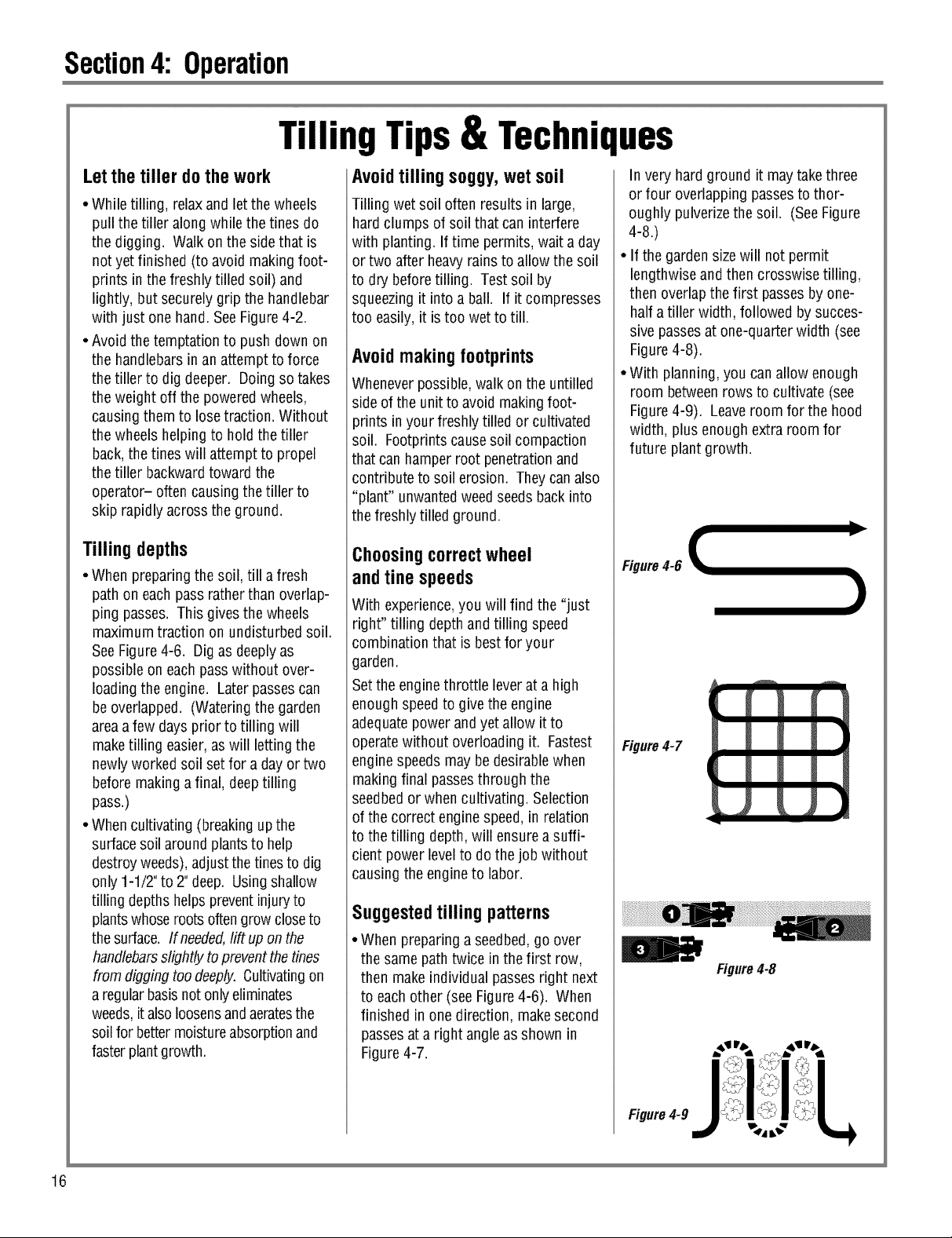
• When preparing the soil, till a fresh
path on each passrather than overlap-
ping passes. This gives the wheels
maximum traction on undisturbed soil.
SeeFigure4-6. Dig as deeply as
possible on each pass without over-
loadingthe engine. Later passescan
be overlapped. (Watering the garden
area afew days prior to tilling will
maketilling easier, as will letting the
newly worked soil set for a day or two
before making a final, deeptilling
pass.)
• When cultivating (breaking up the
surface soil around plantsto help
destroyweeds), adjust the tinesto dig
only 1-1/2" to 2" deep. Using shallow
tilling depths helpspreventinjuryto
plantswhose rootsoftengrow closeto
the surface. If needed,lift up on the
handlebarsslightly to preventthe tines
from digging too deeply. Cultivatingon
a regular basis not only eliminates
weeds,it also loosensandaeratesthe
soil for bettermoistureabsorptionand
faster plantgrowth.
Avoidtilling soggy,wet soil
Tilling wet soil often results in large,
hardclumps of soil that can interfere
with planting. If time permits, wait a day
or two after heavyrains to allow the soil
to dry before tilling. Test soil by
squeezing it into a ball. If it compresses
too easily, it is too wet to till.
Avoidmakingfootprints
Wheneverpossible, walk on the untilled
side of the unit to avoid makingfoot-
prints inyour freshly tilled or cultivated
soil. Footprints cause soil compaction
that can hamper root penetrationand
contribute to soil erosion. They can also
"plant" unwantedweed seeds back into
the freshly tilled ground.
Choosingcorrectwheel
and tine speeds
With experience,you will find the "just
right" tilling depth andtilling speed
combination that is best for your
garden.
Set the engine throttle lever at a high
enough speed to give the engine
adequate power and yet allow it to
operate without overloading it. Fastest
engine speeds may be desirable when
makingfinal passesthrough the
seedbed or when cultivating. Selection
of the correct engine speed, in relation
to the tilling depth, will ensure a suffi-
cient power level to do the job without
causing the engine to labor.
Suggestedtilling patterns
• When preparinga seedbed,go over
the same path twice in the first row,
then make individual passes right next
to each other (see Figure4-6). When
finished in one direction, makesecond
passes at a right angle as shown in
Figure 4-7.
In very hard ground it may take three
or four overlapping passesto thor-
oughly pulverizethe soil. (See Figure
4-8.)
• If the garden size will not permit
lengthwise and then crosswise tilling,
then overlap the first passesby one-
half a tiller width, followed by succes-
sive passesat one-quarter width (see
Figure4-8).
• With planning, you can allow enough
room betweenrows to cultivate (see
Figure4-9). Leaveroom for the hood
width, plus enough extra room for
future plant growth.
Figure4-6
Figure 4-7
Figure4-8
%
Figure 4-9
Section4: Operation
Tilling Tips & Techniques
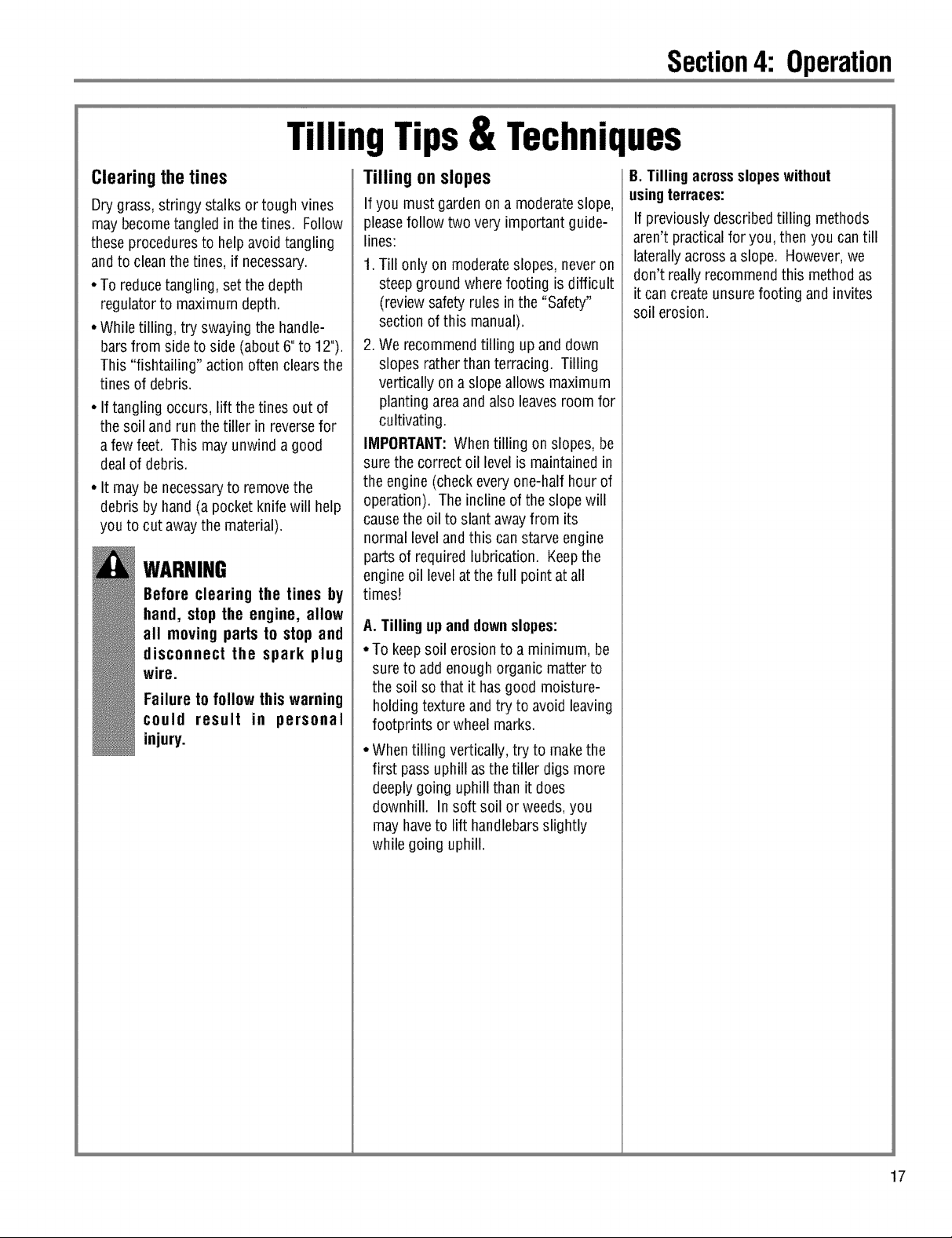
Clearing the tines
Dry grass, stringy stalks or tough vines
may becometangled in the tines. Follow
these procedures to help avoid tangling
andto clean the tines, if necessary.
• To reducetangling, set the depth
regulator to maximum depth.
• While tilling, try swaying the handle-
bars from side to side (about 6" to 12").
This "fishtailing" action often clears the
tines of debris.
• If tangling occurs, lift the tines out of
the soil and run the tiller in reverse for
afew feet. This may unwind a good
dealof debris.
• It may be necessaryto removethe
debris by hand (a pocket knife will help
you to cut away the material).
WARNING
Before clearing the tines by
hand, stop the engine, allow
all moving parts to stop and
disconnect the spark plug
wire.
Failure to follow this warning
could result in personal
injury.
Tilling on slopes
If you must garden on a moderate slope,
pleasefollow two very important guide-
lines:
1. Till only on moderate slopes, never on
steep ground where footing is difficult
(review safety rules in the "Safety"
section of this manual).
2. We recommend tilling up and down
slopes rather than terracing. Tilling
vertically on a slope allows maximum
planting area and also leaves room for
cultivating.
IMPORTANT:When tilling on slopes, be
sure the correct oil level is maintained in
the engine (check every one-half hour of
operation). The inclineof the slope will
causethe oil to slant away from its
normal level and this can starve engine
parts of required lubrication. Keepthe
engine oil level at the full point at all
times!
A. Tilling upand downslopes:
• To keepsoil erosion to a minimum, be
sure to add enough organic matter to
the soil so that it has good moisture-
holding texture and try to avoid leaving
footprints or wheel marks.
• When tilling vertically, try to make the
first pass uphill as the tiller digs more
deeply going uphill than it does
downhill. Insoft soil or weeds, you
may haveto lift handlebars slightly
while going uphill.
B. Tilling acrossslopeswithout
usingterraces:
If previously describedtilling methods
aren't practical for you, then you can till
laterallyacross a slope. However, we
don't really recommend this method as
it can create unsure footing and invites
soil erosion.
17
Section4: Operation
LOADINGAND UNLOADINGTHE
TILLER
WARNING
Loading and unloading the
tiller into or from a vehicle is
potentially hazardous. We
don't recommend doing so
unless absolutely necessary,
as this could result in person-
al injury or property damage.
However, if you must load or
unload the tiller, follow the
guidelines given next.
•Before loading or unloading, stop the
engine, wait for all parts to stop
moving, disconnect the spark plug wire
and let the engine and muffler cool.
•Thetiller is too heavyand bulky to lift
safely by one person. Two or more
peopleshould share the load.
• Usesturdy ramps and manually (engine
shut off) roll the tiller into and out of the
vehicle. Two or more people are needed
to do this.
• Ramps must be strong enough to
support the combined weight of the tiller
and any handlers. The ramps should
provide good traction to prevent
slipping; they should haveside rails to
guide the tiller along the ramps; and
they should havea locking deviceto
secure them to the vehicle.
• The handlers should wear sturdy
footwear that will helpto prevent
slipping.
• Position the loading vehicle so that the
ramp angle is as flat as possible (the
less incline to the ramp,the better).
Turn the vehicle's engine off and apply
its parking brake.
°When going up ramps, stand in the
normal operating position and push the
tiller aheadof you. Havea person at
each side to turn the wheels.
When going down ramps, walk
backward with the tiller following you.
Keepalert for any obstacles behind you.
Position a person at eachwheel to
control the speed of the tiller. Nevergo
down ramps tiller-first, as the tiller could
tip forward.
Usewooden blocks to place on the
downhill side of the wheels if you need
to stop the tiller from rolling down the
ramp. Also, use the blocks to temporar-
ily keepthe tiller in place on the ramps
(if necessary),and to chock the wheels
in placeafter the tiller is in the vehicle.
Whenthe tiller is in the vehicle, prevent
it from rolling by chocking the wheels
with blocks and securely tie the tiller
down.
18
Maintenance
WARNING
Before inspecting,
cleaning or servicing the
machine, shut off engine,
wait for all moving parts to
come to a complete stop,
disconnect spark plug wire
and move wire away from
spark plug.
Failure to follow these
instructions can result in
serious personal injury or
property damage.
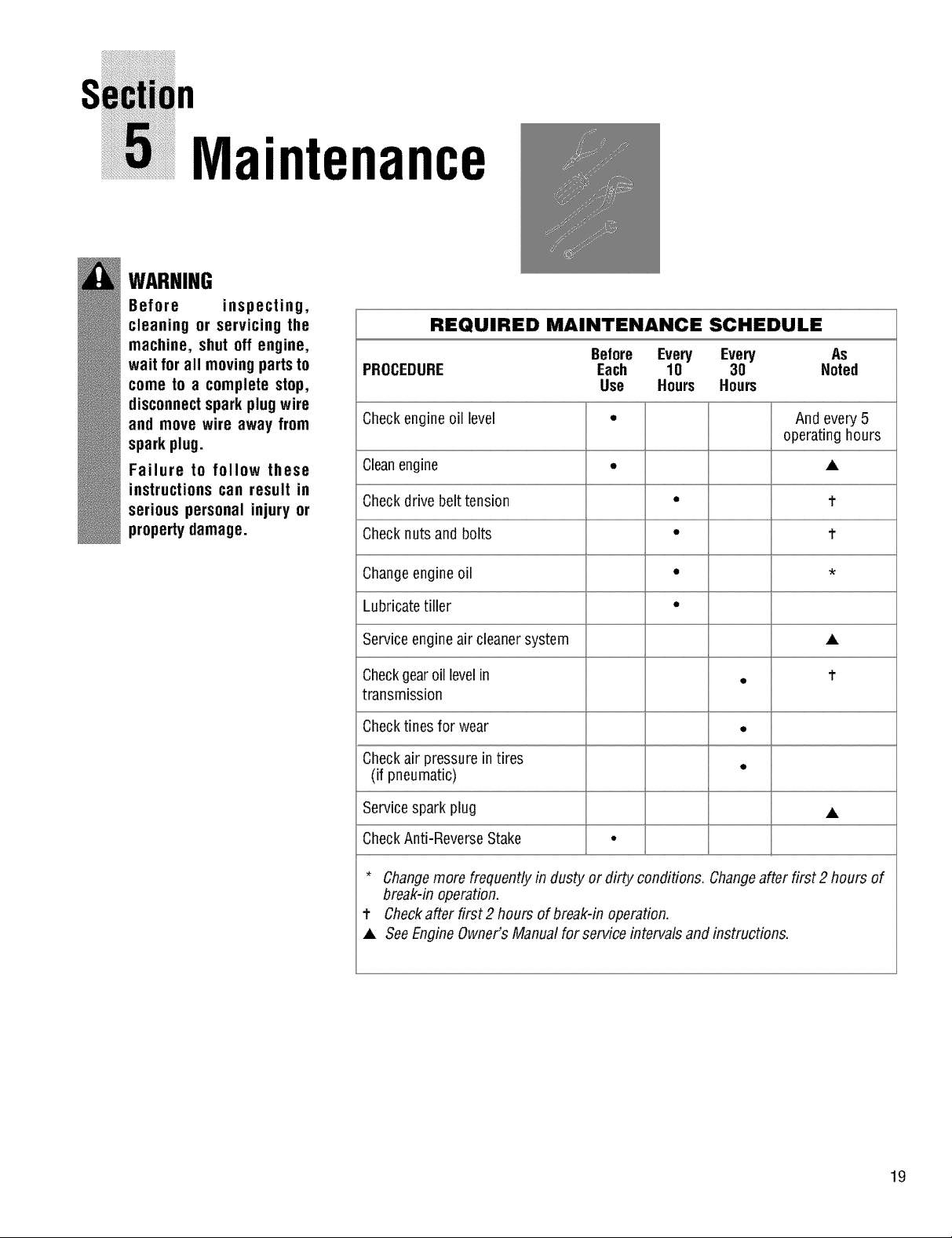
REQUIRED MAINTENANCE SCHEDULE
PROCEDURE
Checkengine oil level
Cleanengine
Check drive belt tension
Check nuts and bolts
Changeengine oil
Lubricate tiller
Serviceengine air cleaner system
Checkgear oil level in
transmission
Checktines for wear
Checkair pressure in tires
(if pneumatic)
Servicespark plug
CheckAnti-Reverse Stake
Before
Each
Use
e
e
Every
10
Hours
e
e
e
e
Every
30
Hours
As
Noted
And every 5
operating hours
A
t-
1-
A
1-
A
* Changemore frequently in dusty or dirty conditions, Changeafter first 2 hours of
break-in operation,
1- Checkafter first 2 hours of break-in operation,
ASeeEngine Owner's Manual for service intervals and instructions.
19
Section5: Maintenance
WARNING Before inspecting,cleaning or servicing the unit, shut off engine, wait for all
partsto come to a completestop, disconnectspark plug wire and movewire away from spark
plug. Failure to follow these instructions can result in serious personal injury or
propertydamage.
TILLERLUBRICATION
Proper lubrication of the tiller is an
essential part of maintenance. After
every 10 operating hours, oil or grease
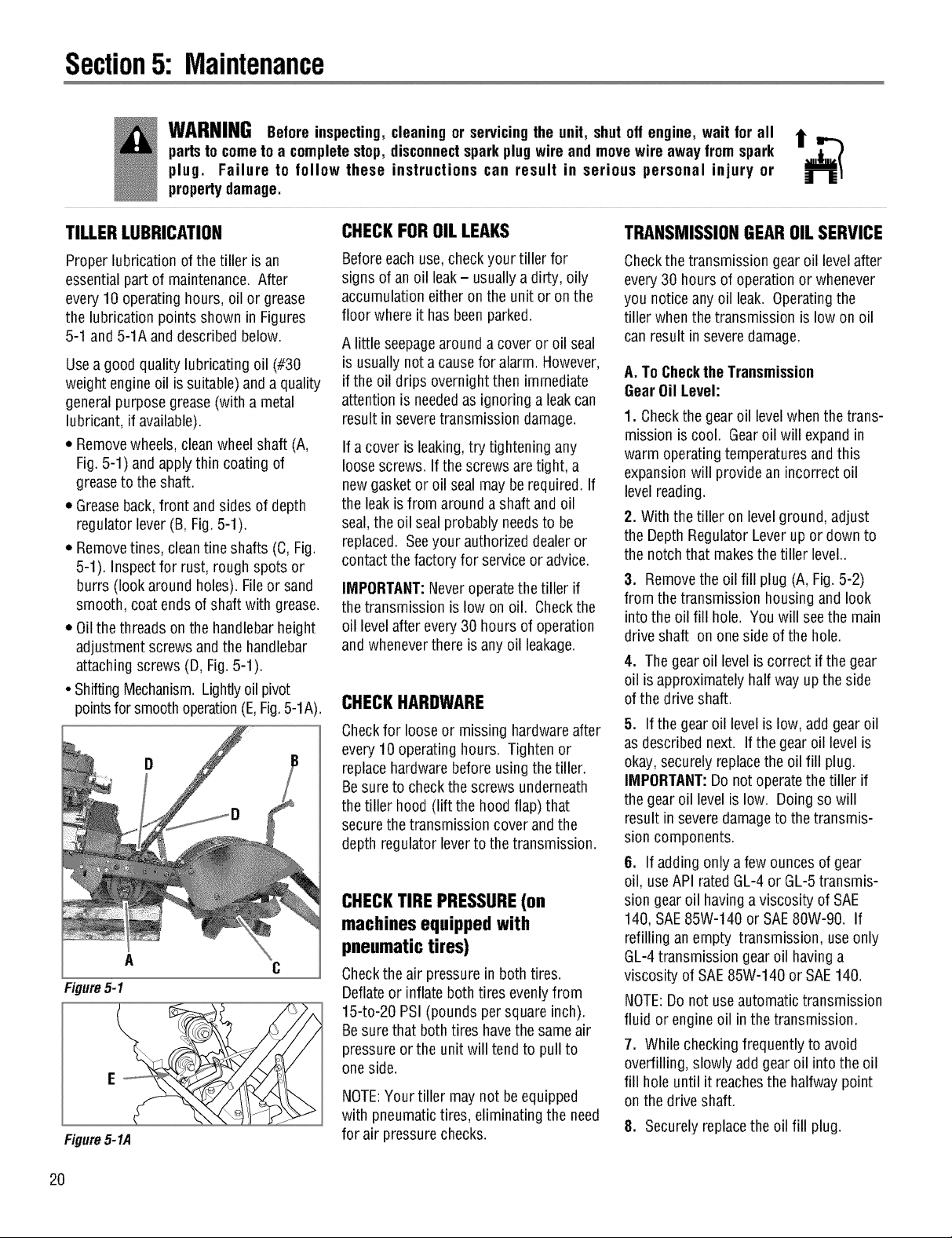
the lubrication points shown in Figures
5-1 and 5-1A and described below.
Usea good quality lubricating oil (#30
weight engineoil is suitable) and a quality
generalpurpose grease (with a metal
lubricant, if available).
,, Removewheels, clean wheel shaft (A,
Fig.5-1) and apply thin coating of
grease to the shaft.
,, Greaseback, front andsides of depth
regulator lever (B, Fig. 5-1).
,, Removetines, clean tine shafts (C, Fig.
5-1). Inspect for rust, rough spots or
burrs (look around holes). Fileor sand
smooth, coat ends of shaft with grease.
,, Oil the threads on the handlebar height
adjustment screws and the handlebar
attaching screws (D, Fig. 5-1).
• ShiftingMechanism. Lightlyoil pivot
pointsfor smooth operation(E,Fig.5-1A).
A
Figure5-1
Figure5-1A
CHECKFOR OIL LEAKS
Before each use,check your tiller for
signs of an oil leak- usually a dirty, oily
accumulation either on the unit or on the
floor where it has been parked.
A little seepagearound a cover or oil seal
is usually not a causefor alarm. However,
if the oil drips overnight then immediate
attention is neededas ignoring a leak can
result in severetransmission damage.
If a cover is leaking, try tightening any
loose screws. If the screws are tight, a
new gasket or oil seal may berequired. If
the leak is from around a shaft and oil
seal,the oil seal probably needsto be
replaced. Seeyour authorizeddealer or
contact the factory for service or advice.
IMPORTANT:Never operate the tiller if
the transmission is low on oil. Checkthe
oil level after every 30 hours of operation
andwhenever there is any oil leakage.
CHECKHARDWARE
Checkfor loose or missing hardware after
every 10 operating hours. Tighten or
replace hardware before using the tiller.
Besure to check the screws underneath
the tiller hood (lift the hood flap) that
securethe transmission cover andthe
depth regulator leverto the transmission.
CHECKTIREPRESSURE(on
machines equipped with
pneumatic tires)
Checkthe air pressure in both tires.
Deflateor inflate both tires evenly from
15-to-20 PSI (pounds per square inch).
Besure that both tires havethe same air
pressure or the unit will tend to pull to
oneside.
NOTE:Your tiller may not beequipped
with pneumatic tires, eliminating the need
for air pressure checks.
TRANSMISSIONGEAROIL SERVICE
Checkthe transmission gear oil level after
every30 hours of operation or whenever
you notice any oil leak. Operating the
tiller when the transmission is low on oil
can result in severe damage.
A. To Checkthe Transmission
Gear Oil Level:
1. Checkthe gearoil levelwhen the trans-
mission is cool. Gear oil will expand in
warm operating temperatures and this
expansionwill provide an incorrect oil
level reading.
2. With the tiller on levelground, adjust
the DepthRegulator Lever up or down to
the notch that makesthe tiller level..
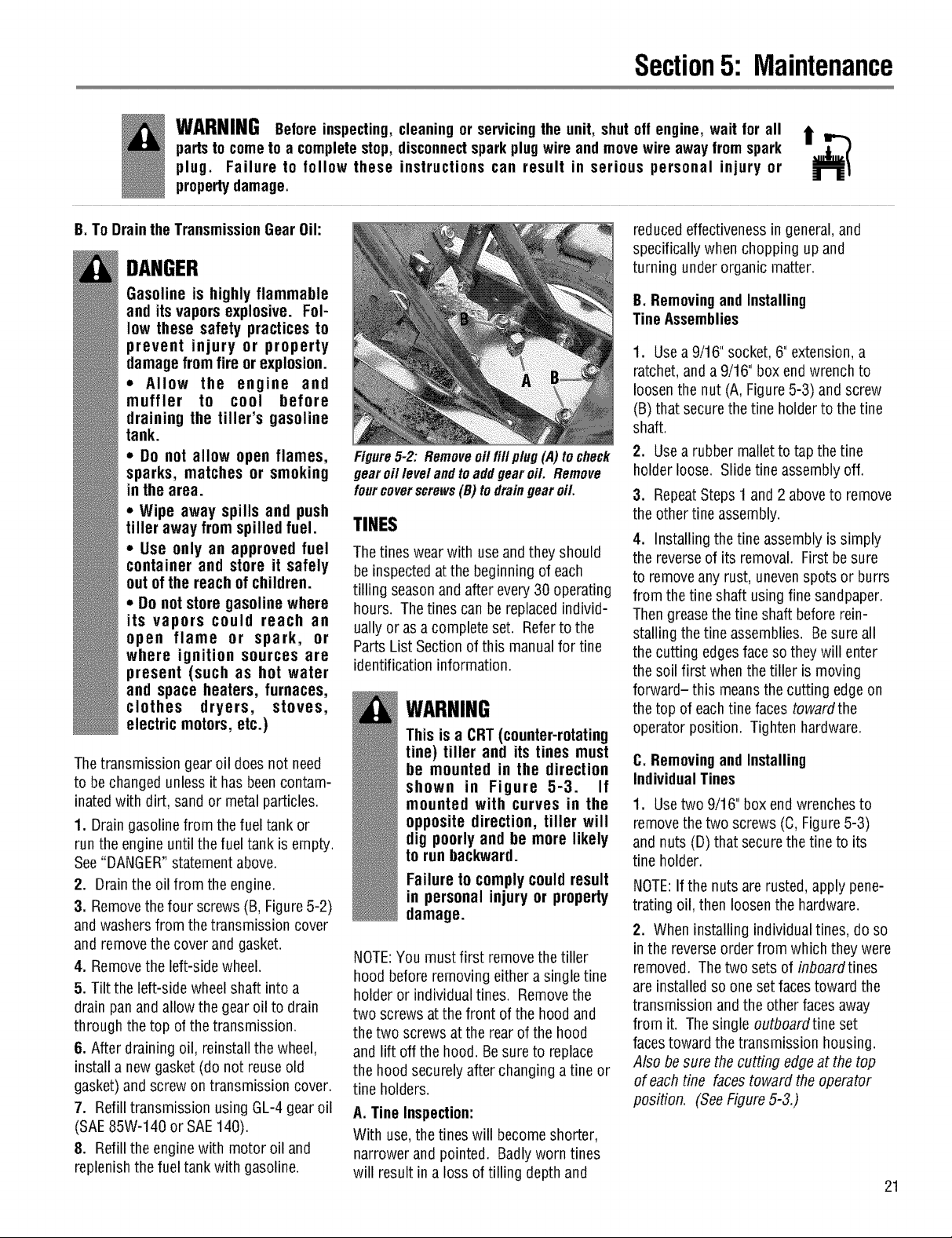
3. Removethe oil fill plug (A, Fig.5-2)
from the transmission housing and look
into the oil fill hole. You will seethe main
drive shaft on one side of the hole.
4. The gear oil level is correct if the gear
oil is approximately half way up the side
of the drive shaft.
5. If the gear oil level is low, add gear oil
as described next. If the gear oil level is
okay, securely replacethe oil fill plug.
IMPORTANT:Do not operatethe tiller if
the gear oil level is low. Doing so will
result in severe damageto the transmis-
sion components.
6. If adding only a few ounces of gear
oil, useAPI rated GL-4 or GL-5 transmis-
sion gear oil having a viscosity of SAE
140, SAE85W-140 or SAE 80W-90. If
refilling anempty transmission, use only
GL-4transmission gear oil having a
viscosity of SAE 85W-140 or SAE 140.
NOTE:Do not use automatic transmission
fluid or engine oil in the transmission.
7. While checking frequently to avoid
overfilling, slowly add gear oil into the oil
fill hole until it reaches the halfway point
on the drive shaft.
8. Securely replacethe oil fill plug.
2O
Section5: Maintenance
WARNING Before inspecting, cleaning or servicingthe unit, shut off engine, wait for all
partsto come to a completestop, disconnectsparkplug wire and move wire away from spark
plug. Failure to follow these instructions can result in serious personal injury or
propertydamage.
B. To Drainthe TransmissionGear Oil:
DANGER
Gasoline is highly flammable
and its vapors explosive. Fol-
low these safety practices to
prevent injury or property
damage from fire orexplosion.
,, Allow the engine and
muffler to cool before
draining the tiller's gasoline
tank.
,, Do not allow open flames,
sparks, matches or smoking
in the area.
,, Wipe away spills and push
tiller away from spilled fuel.
,, Use only an approved fuel
container and store it safely
out of the reach of children.
,, Do not store gasoline where
its vapors could reach an
open flame or spark, or
where ignition sources are
present (such as hot water
and space heaters, furnaces,
clothes dryers, stoves,
electric motors, etc.)
The transmission gear oil does not need
to bechanged unless it has beencontam-
inatedwith dirt, sand or metal particles.
1. Drain gasoline from the fuel tank or
run the engine until the fuel tank is empty.
See"DANGER"statement above.
2. Drain the oil from the engine.
3. Removethe four screws (B, Figure5-2)
and washersfrom the transmission cover
and remove the cover and gasket.
4. Removethe left-side wheel.
5. Tilt the left-side wheel shaft into a
drain panand allow the gear oil to drain
through the top of the transmission.
6. After draining oil, reinstall the wheel,
install a new gasket (do not reuse old
gasket) and screw on transmission cover.
7. Refill transmission using GL-4gear oil
(SAE85W-140 or SAE140).
8. Refill the engine with motor oil and
replenishthe fuel tank with gasoline.
Figure5-2: Removeoil fi// plug(A)tocheck
gearoil/eve/and toaddgearoil. Remove
fourcoverscrews(B) todraingearoil.
TINES
The tines wear with use and they should
be inspected at the beginning of each
tilling seasonand after every30 operating
hours. The tines can be replaced individ-
ually or as a complete set. Referto the
Parts List Section of this manual for tine
identification information.
WARNING
This is a CRT (counter-rotating
tine) tiller and its tines must
be mounted in the direction
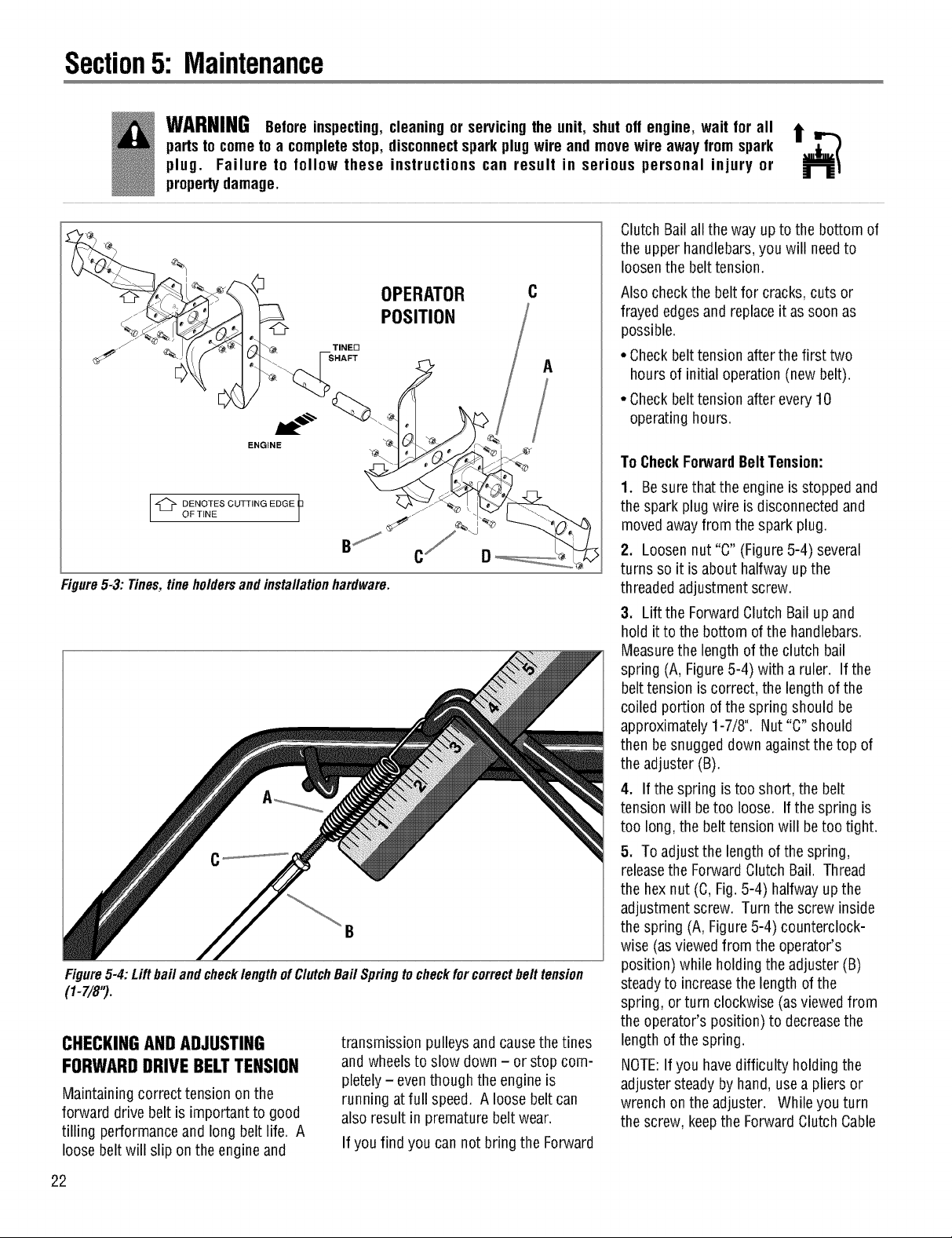
shown in Figure 5-3. If
mounted with curves in the
opposite direction, tiller will
dig poorly and be more likely
to run backward.
Failure to comply could result
in personal injury or property
damage.
NOTE:You must first removethe tiller
hood before removing either a single tine
holder or individual tines. Removethe
two screws at the front of the hood and
the two screws at the rear of the hood
and lift off the hood. Be sure to replace
the hood securely after changing a tine or
tine holders.
A. Tine Inspection:
With use,the tines will becomeshorter,
narrower and pointed. Badly worn tines
will result in a loss of tilling depth and
reducedeffectiveness in general, and
specifically when chopping up and
turning under organic matter.
B. Removingand Installing
Tine Assemblies
1. Usea 9/16" socket, 6" extension, a
ratchet,and a 9/16" box end wrench to
loosen the nut (A, Figure 5-3) and screw
(B) that secure the tine holder to the tine
shaft.
2. Usea rubber mallet to tap the tine
holder loose. Slide tine assembly off.
3. RepeatSteps 1 and 2 aboveto remove
the other tine assembly.
4. Installing the tine assembly is simply
the reverseof its removal. First besure
to removeany rust, unevenspots or burrs
from the tine shaft using fine sandpaper.
Then greasethe tine shaft before rein-
stalling the tine assemblies. Be sure all
the cutting edgesface so they will enter
the soil first when the tiller is moving
forward- this meansthe cutting edge on
the top of each tine faces towardthe
operator position. Tighten hardware.
C. Removingand Installing
IndividualTines
1. Usetwo 9/16" box end wrenchesto
removethe two screws (C, Figure 5-3)
and nuts (D) that securethe tine to its
tine holder.
NOTE:If the nuts are rusted, apply pene-
trating oil, then loosen the hardware.
2. When installing individual tines, do so
in the reverse order from which they were
removed. The two sets of inboard tines
are installed so one set faces toward the
transmission andthe other faces away
from it. The single outboardtine set
faces toward the transmission housing.
Also be sure the cutting edge at the top
of each fine faces toward the operator
position. (SeeFigure 5-3.)
21
Section5: Maintenance
WARNING Before inspecting, cleaning or servicing the unit, shutoff engine, wait for all
partsto come to a completestop, disconnectspark plug wire and move wire away from spark
plug. Failure to follow these instructions can result in serious personal injury or
propertydamage.
TINED
OPERATOR C
POSITION
A
ENGINE
,'_ DENOTES CUTTING EDGE _3
OF TINE |
Figure5-3: Tines,tineholdersandinstallationhardware.
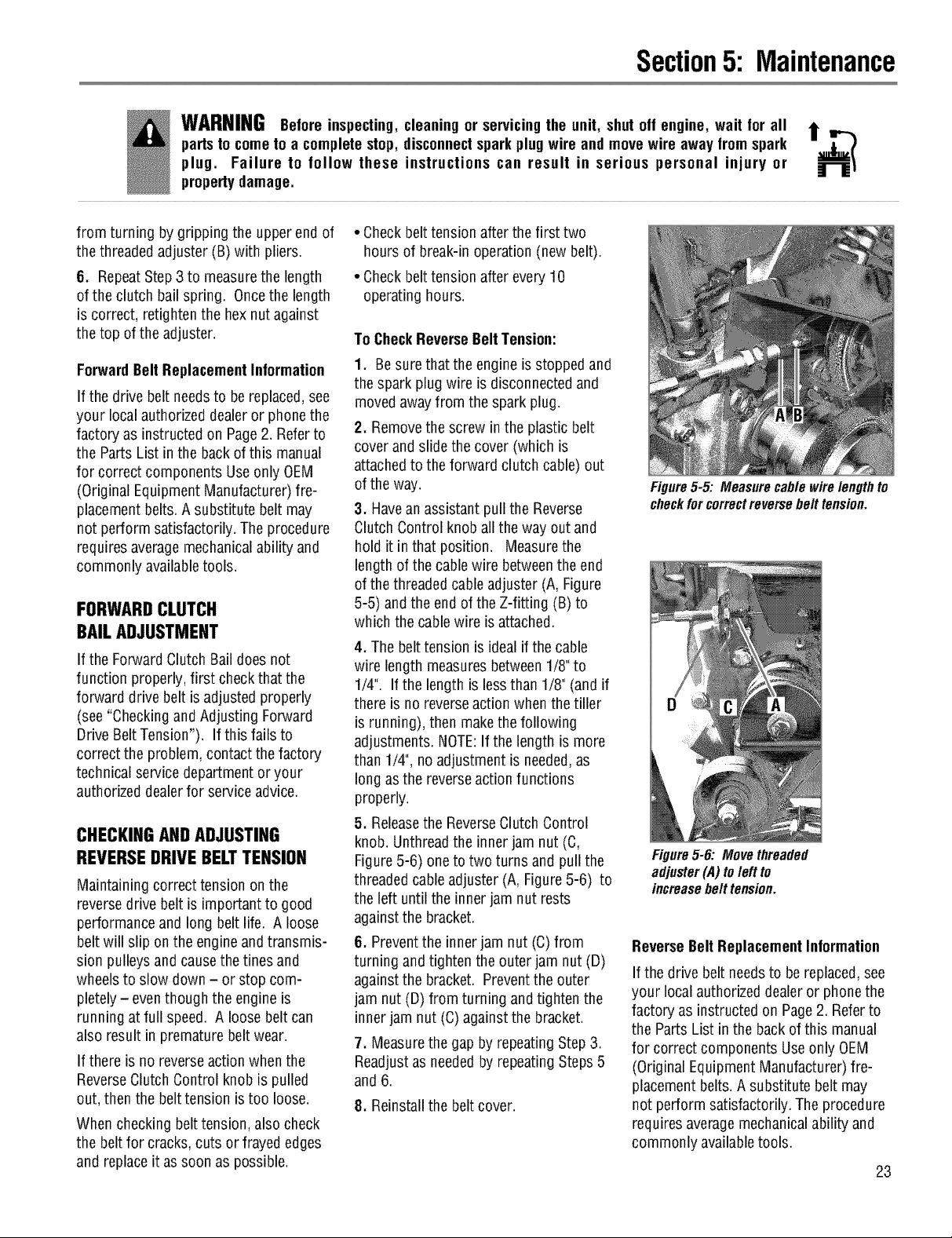
Figure5-4:Liftbail andchecklengthofClutchBailSpringtocheckforcorrectbelttension
(1-7/8").
CHECKINGAND ADJUSTING
FORWARDDRIVE BELTTENSION
Maintaining correct tension on the
forward drive belt is important to good
tilling performance and long belt life. A
loose belt will slip on the engine and
transmission pulleys and causethe tines
and wheels to slow down -or stop com-
pletely- even though the engine is
running at full speed. A loose belt can
also result in premature belt wear.
If you find you can not bring the Forward
Clutch Bail all the way upto the bottom of
the upper handlebars,you will need to
loosen the belt tension.
Also check the belt for cracks, cuts or
frayed edges and replaceit as soon as
possible.
•Checkbelt tension after the first two
hours of initial operation (new belt).
• Checkbelt tension after every 10
operating hours.
To CheckForwardBelt Tension:
1. Besure that the engine is stopped and
the spark plug wire is disconnectedand
moved awayfrom the spark plug.
2. Loosen nut "C" (Figure 5-4) several
turns so it is about halfway up the
threaded adjustment screw.
3. Lift the Forward Clutch Bail up and
hold it to the bottom of the handlebars.
Measurethe length of the clutch bail
spring (A, Figure 5-4) with a ruler. If the
belt tension is correct, the length of the
coiled portion of the spring should be
approximately 1-7/8". Nut "C" should
then besnugged down againstthe top of
the adjuster (B).
4. If the spring is too short, the belt
tension will betoo loose. If the spring is
too long, the belt tension will be too tight.
5. To adjust the length of the spring,
releasethe Forward Clutch Bail. Thread
the hex nut (C, Fig. 5-4) halfway up the
adjustment screw. Turn the screw inside
the spring (A, Figure 5-4) counterclock-
wise (as viewed from the operator's
position) while holding the adjuster (B)
steadyto increasethe length of the
spring, or turn clockwise (as viewed from
the operator's position) to decreasethe
length of the spring.
NOTE:If you have difficulty holding the
adjuster steady by hand, use a pliers or
wrench on the adjuster. While you turn
the screw, keepthe Forward Clutch Cable
22
Section5: Maintenance
WARNING Before inspecting, cleaning or servicing the unit, shut off engine, wait for all
partsto cometo a complete stop, disconnectspark plugwire and move wire away from spark
plug. Failure to follow these instructions can result in serious personal injury or
propertydamage.
from turning by gripping the upper end of
the threaded adjuster (B) with pliers.
6. RepeatStep 3 to measure the length
of the clutch bail spring. Oncethe length
is correct, retighten the hex nut against
the top of the adjuster.
ForwardBelt Replacement Information
If the drive belt needsto be replaced,see
your local authorized dealer or phone the
factory as instructed on Page2. Refer to
the Parts List in the back of this manual
for correct components Use only OEM
(Original Equipment Manufacturer) fre-
placement belts. A substitute belt may
not perform satisfactorily. The procedure
requires average mechanicalability and
commonly availabletools.
FORWARDCLUTCH
BAILADJUSTMENT
If the Forward Clutch Bail does not
function properly, first check that the
forward drive belt is adjusted properly
(see "Checking and Adjusting Forward
Drive Belt Tension"). If this fails to
correct the problem, contact the factory
technical service department or your
authorized dealer for service advice.
CHECKINGAND ADJUSTING
REVERSEDRIVE BELTTENSION
Maintaining correct tension on the
reversedrive belt is important to good
performance and long belt life. A loose
belt will slip on the engine andtransmis-
sion pulleys and causethe tines and
wheels to slow down - or stop com-
pletely- even though the engine is
running at full speed. A loose belt can
also result in premature belt wear.
If there is no reverse action when the
ReverseClutch Control knob is pulled
out, then the belt tension is too loose.
When checking belt tension, also check
the belt for cracks, cuts or frayed edges
and replace it as soon as possible.
*Checkbelt tension after the first two
hours of break-in operation (new belt).
- Checkbelt tension after every 10
operating hours.
To CheckReverseBeltTension:
1. Be sure that the engine is stopped and
the spark plug wire is disconnectedand
moved awayfrom the spark plug.
2. Removethe screw in the plastic belt
cover and slide the cover (which is
attachedto the forward clutch cable) out
of the way.
3. Havean assistant pull the Reverse
Clutch Control knob all the way out and
hold it in that position. Measure the
length of the cable wire betweenthe end
of the threaded cable adjuster (A, Figure
5-5) andthe end of the Z-fitting (B) to
which the cable wire is attached.
4. The belt tension is ideal if the cable
wire length measures between 1/8" to
1/4". If the length is less than 1/8" (and if
there is no reverse action when the tiller
is running), then makethe following
adjustments. NOTE:If the length is more
than 1/4", no adjustment is needed,as
long as the reverse action functions
properly.
5. Releasethe ReverseClutch Control
knob. Unthreadthe inner jam nut (C,
Figure5-6) oneto two turns and pull the
threaded cable adjuster (A, Figure5-6) to
the left until the inner jam nut rests
againstthe bracket.
6. Preventthe inner jam nut (C) from
turning and tighten the outer jam nut (D)
againstthe bracket. Preventthe outer
jam nut (D) from turning and tighten the
inner jam nut (C) against the bracket.
7. Measurethe gap by repeating Step 3.
Readjust as neededby repeating Steps 5
and 6.
8. Reinstall the belt cover.
Figure 5-5: Measure cable wire length to
checkfor correctreverse belt tension.
Figure 5-6: Move threaded
adjuster (,4) to left to
increase belt tension.
ReverseBeltReplacementInformation
If the drive belt needsto be replaced,see
your local authorized dealer or phone the
factory as instructed on Page2. Refer to
the Parts List in the back of this manual
for correct components Use only OEM
(Original Equipment Manufacturer) fre-
placement belts. A substitute belt may
not perform satisfactorily. The procedure
requires average mechanicalability and
commonly availabletools.
23
Section5: Maintenance
WARNING Before inspecting, cleaning or servicing the unit, shutoff engine, wait for all
partsto cometo a completestop, disconnectspark plugwire and movewire away from spark
plug. Failure to follow these instructions can result in serious personal injury or
propertydamage.
ENGINEOIL SERVICE
Checkthe engine oil level before starting
the engine each day and check it after each
5 hours of continuous operation. Running
the engine when it is low on oil will quickly
ruin the engine.
It is recommended that you changethe
motor oil after every 10 hours of operation
and evensooner when operating in
extremely dirty or dusty conditions. Refer
to the separate Engine Owner's Manualfor
detailed service instructions.
A. To Checkthe Engine0il Level:
1. Move the tiller to a level areaand shut
off the engine.
2. Levelthe engine by adjusting the Depth
Regulator Lever. The tines must be in
contact with the ground. Move the Anti-
ReverseStake back if necessary.
3. Cleanthe area around the oil dipstick or
oil fill tube to prevent dirt from falling into
the crankcase.
4. Onengines with an oil fill tube, remove
the filler cap, add oil (if required) until it
reachesthe top of the tube and reinstall the
filler cap.
5. Onengines with a dipstick, remove it,
wipe it clean, and reinstall it finger-tight.
Removethe dipstick and check the reading.
Add oil (if required) to bring the levelto the
FULLmark. Do not overfill.
B. To Changethe Engine0il:
Changethe engine oil as instructed in the
separateEngineOwner's Manual.
ENGINECLEANING
Keepthe engine clean to assure smooth
operation and to prevent damagefrom
overheating. Refer to the separate Engine
Owner's Manualfor specific repair and
cleaning instructions. All inspections and
services must be done with the engine shut
off and cool to the touch.
24
AIR CLEANERSERVICE
The engine air cleanerfilters dirt and dust
out of the air before it enters the carbure-
tor. Operating the engine with a dirty,
clogged air filter can cause poor perfor-
manceand damageto the engine. Never
operatethe engine without the air cleaner
installed. Inspect and service the air
cleaner more often if operating in very
dusty or dirty conditions.
Servicethe air cleaner as instructed in the
separateEngineOwner's Manual.
SPARKPLUGSERVICE
Inspect and clean or replacethe spark plug
after every 100 operating hours or
annually. Cleanthe plug and set the gap as
described in the separate Engine Owner's
Manual.
In some areas, local law requires using
resistor spark plugs to suppress ignition
signals. If the engine was originally
equippedwith a resistor spark plug, use
the same type for replacement.
SPARKARRESTERSCREENSERVICE
If the engine muffler is equipped with a
spark attester screen, remove and clean it
according to the time intervals and instruc-
tions in the separateEngineOwner's
Manual.
THROTTLELEVERADJUSTMENT
If the engine does not respond to various
throttle lever settings, refer to the separate
EngineOwner's Manualfor service infor-
mation or contact your local authorized
engineservice dealer.
CARBURETOR/GOVERNORCONTROL
ADJUSTMENTS
The carburetor was adjusted at the factory
for best operating speed. Referto the
separateEngineOwner's Manualfor any
adjustment information or seeyour autho-
rized engine service dealer.
The governor controls the maximum
safe operating speed and protects the
engineand all moving parts from
damagecaused by overspeeding. Do
not tamper with the engine governor
settings.
WARNING
Operators shall not tamper
with the engine governor
settings on the machine;
the governor controls the
maximum safe operating
speed to protect the
engine and all moving
parts from damage caused
by overspeed. Authorized
service shall be sought if a
problem exists.
OFFSEASONSTORAGE
When the tiller won't be used for
extendedperiods, prepareit for storage
as follows:
1. Cleanthe tiller and engine.
2. Do routine tiller lubrication and check
for loose parts and hardware.
3. Protect the engine and perform rec-
ommended engine maintenanceby
following the engine storage instruc-
tions found in the separate Engine
Owner's Manual. NOTE:Besure to
protect the fuel lines, carburetor and
fuel tank from gum deposits by
removing fuel or by treating fuel with a
fuel stabilizer (follow engine manufac-
turer's recommendations).
4. Store unit in a clean, dry area.
5. Never store the tiller with fuel in the
fuel tank in an enclosed area where gas
fumes could reach an open flame or
spark, or where ignition sources are
present (space heaters, hot water
heaters,furnaces, etc.).
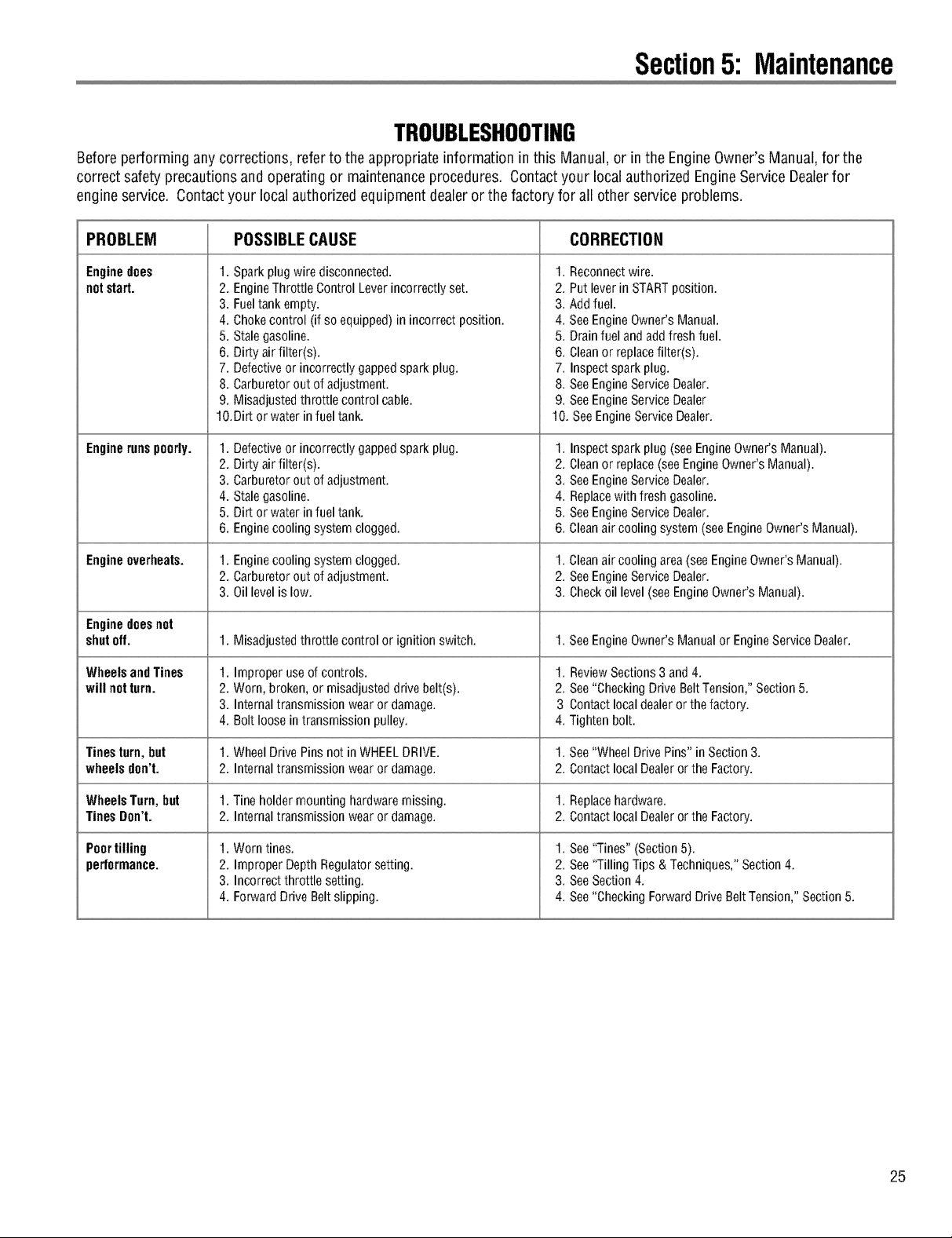
Section5: Maintenance
TROUBLESHOOTING
Before performing any corrections, refer to the appropriate information in this Manual, or in the Engine Owner's Manual, for the
correct safety precautions and operating or maintenance procedures. Contact your local authorized Engine Service Dealer for
engine service. Contact your local authorized equipment dealer or the factory for all other service problems.
PROBLEM
Enginedoes
notstart.
Enginerunspoorly.
Engineoverheats.
POSSIBLE CAUSE CORRECTION
1. Sparkplug wire disconnected.
2. EngineThrottle ControlLever incorrectlyset.
3. Fueltank empty.
4. Chokecontrol (if so equipped)in incorrect position.
5. Stalegasoline.
6. Dirty air filter(s).
7. Defectiveor incorrectlygappedspark plug.
8. Carburetorout of adjustment.
1. Reconnectwire.
2. Put leverin STARTposition.
3. Addfuel.
4. SeeEngineOwner'sManual.
5. Drain fuel and addfresh fuel.
6. Cleanor replacefilter(s).
7. Inspect sparkplug.
8. SeeEngineServiceDealer.
9. Misadjustedthrottle control cable.
10.Dirt or water in fuel tank.
1.
2.
3.
4.
5.
6.
9. SeeEngineServiceDealer
10. SeeEngineServiceDealer.
Defectiveor incorrectlygappedspark plug. 1.
Dirty air filter(s). 2.
Carburetorout of adjustment. 3.
Stalegasoline. 4.
Dirt or water in fuel tank.
Enginecooling systemclogged.
1. Enginecooling systemclogged.
2. Carburetorout of adjustment.
3. Oil levelis low.
5,
6.
Inspect sparkplug (seeEngineOwner's Manual).
Cleanor replace(seeEngineOwner'sManual).
SeeEngineServiceDealer.
Replacewith fresh gasoline.
SeeEngineServiceDealer.
Cleanair coolingsystem (seeEngineOwner'sManual).
1. Cleanair cooling area (seeEngineOwner's Manual).
2. SeeEngineServiceDealer.
3. Checkoil level(seeEngineOwner'sManual).
Enginedoesnot
shut off. 1. Misadjustedthrottle control or ignition switch. 1. SeeEngineOwner'sManualor EngineServiceDealer.
Wheels andTines 1. Improper use of controls. 1. ReviewSections3 and 4.
will notturn. 2. Worn,broken, or misadjusteddrivebelt(s). 2. See"CheckingDriveBeltTension," Section5.
3. Internaltransmission wear or damage. 3 Contactlocaldealeror the factory.
4. Bolt loose in transmission pulley. 4. Tightenbolt.
Tinesturn, but 1. WheelDrive Pinsnot in WHEELDRIVE. 1. See"Wheel DrivePins" in Section3.
wheels don't. 2. Internaltransmission wear or damage. 2. ContactlocalDealeror the Factory.
WheelsTurn, but 1. Tine holdermounting hardwaremissing. 1. Replacehardware.
Tines Don't. 2. Internaltransmission wear or damage. 2. ContactlocalDealeror the Factory.
1. Worntines.
2. Improper DepthRegulatorsetting.
3. Incorrectthrottle setting.
4. ForwardDrive Belt slipping.
Poortilling
performance.
1. See"Tines" (Section5).
2. See "Tilling Tips & Techniques,"Section4.
3. SeeSection4.
4. See"CheckingForwardDriveBelt Tension,"Section5.
25
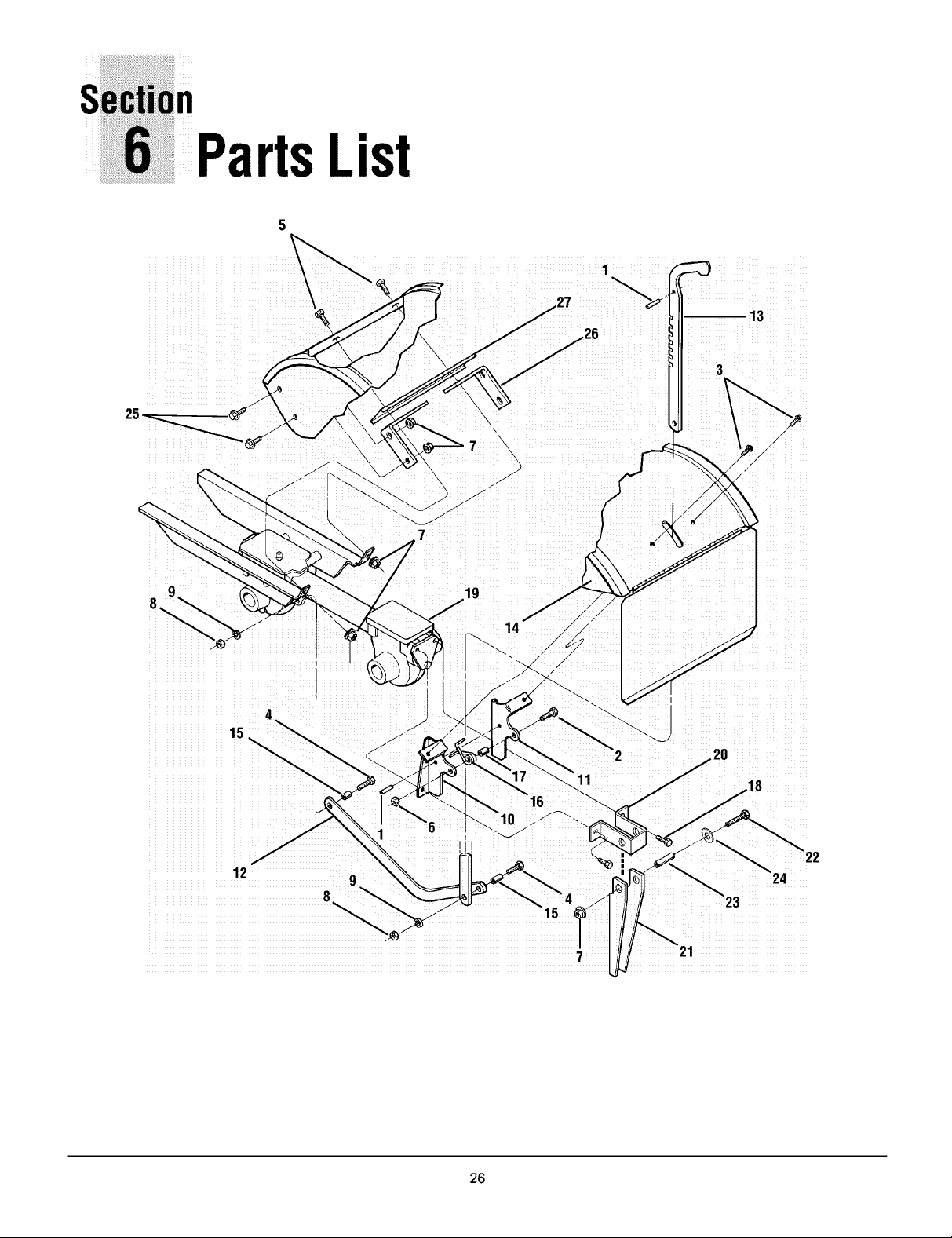
n
PartsList
7_\
7
13
9
4
15
12
8
19
14
2 20
18
23
24
22
7 21
26
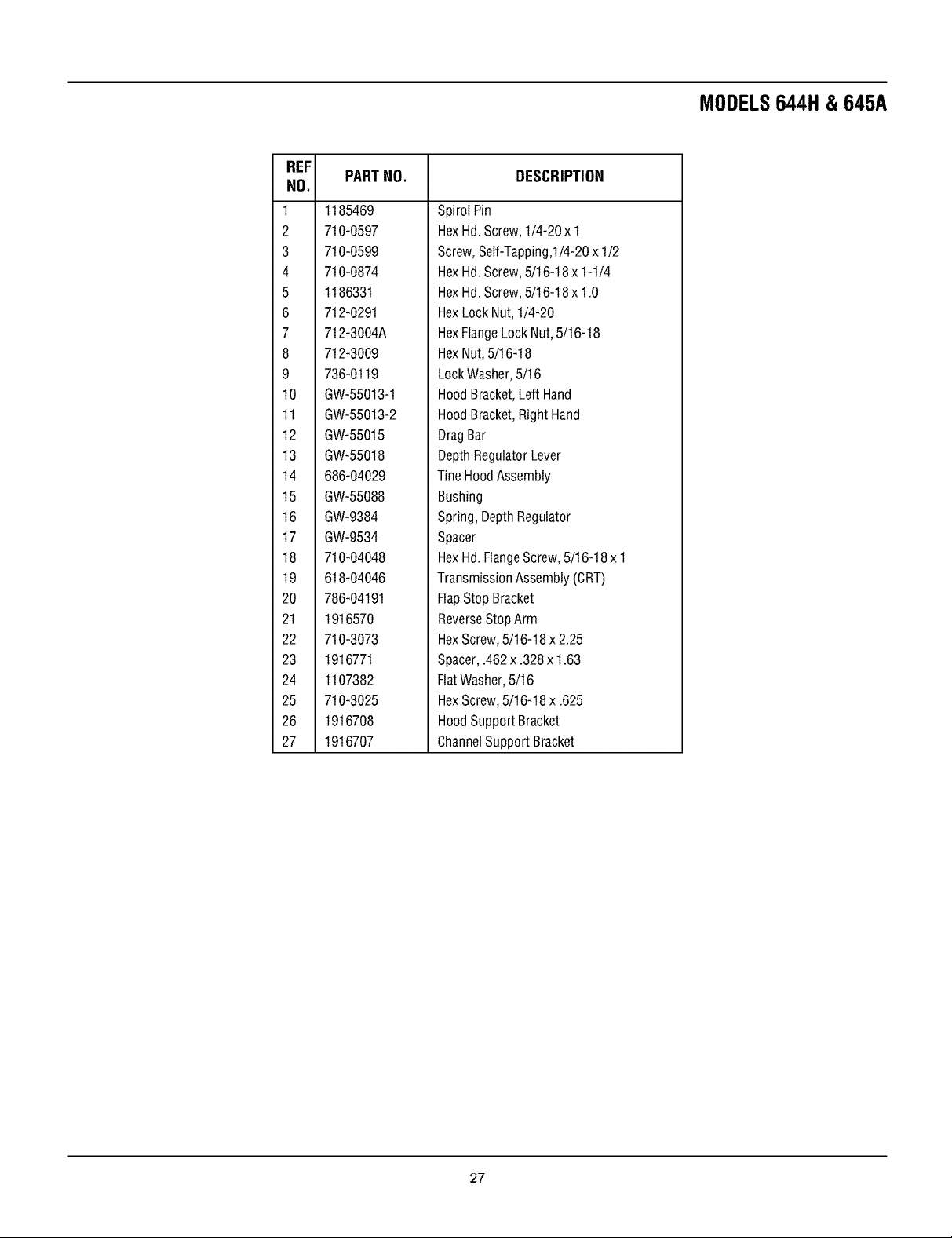
MODELS644H & 645A
REF
NO.
1
2
3
4
5
6
7
8
9
10
11
12
13
14
15
16
17
18
19
20
21
22
23
24
25
26
27
PARTNO. DESCRIPTION
1185469
710-0597
710-0599
710-0874
1186331
712-0291
712-3004A
712-3009
736-0119
GW-55013-1
GW-55013-2
GW-55015
GW-55018
686-04029
GW-55088
GW-9384
GW-9534
710-04048
618-04046
786-04191
1916570
710-3073
1916771
1107382
710-3025
1916708
1916707
Spirol Pin
HexHd. Screw, 1/4-20 x 1
Screw, Self-Tapping,I/4-20 x 1/2
HexHd. Screw, 5/16-18 x 1-1/4
HexHd. Screw, 5/16-18 x 1.0
HexLock Nut, 1/4-20
HexFlangeLock Nut, 5/16-18
HexNut, 5/16-18
Lock Washer, 5/16
Hood Bracket,Left Hand
Hood Bracket,Right Hand
Drag Bar
Depth Regulator Lever
Tine HoodAssembly
Bushing
Spring, Depth Regulator
Spacer
HexHd. FlangeScrew, 5/16-18 x 1
Transmission Assembly (CRT)
FlapStop Bracket
ReverseStop Arm
HexScrew, 5/16-18 x 2.25
Spacer, .462 x .328 x 1.63
FlatWasher, 5/16
HexScrew, 5/16-18 x .625
Hood Support Bracket
ChannelSupport Bracket
27
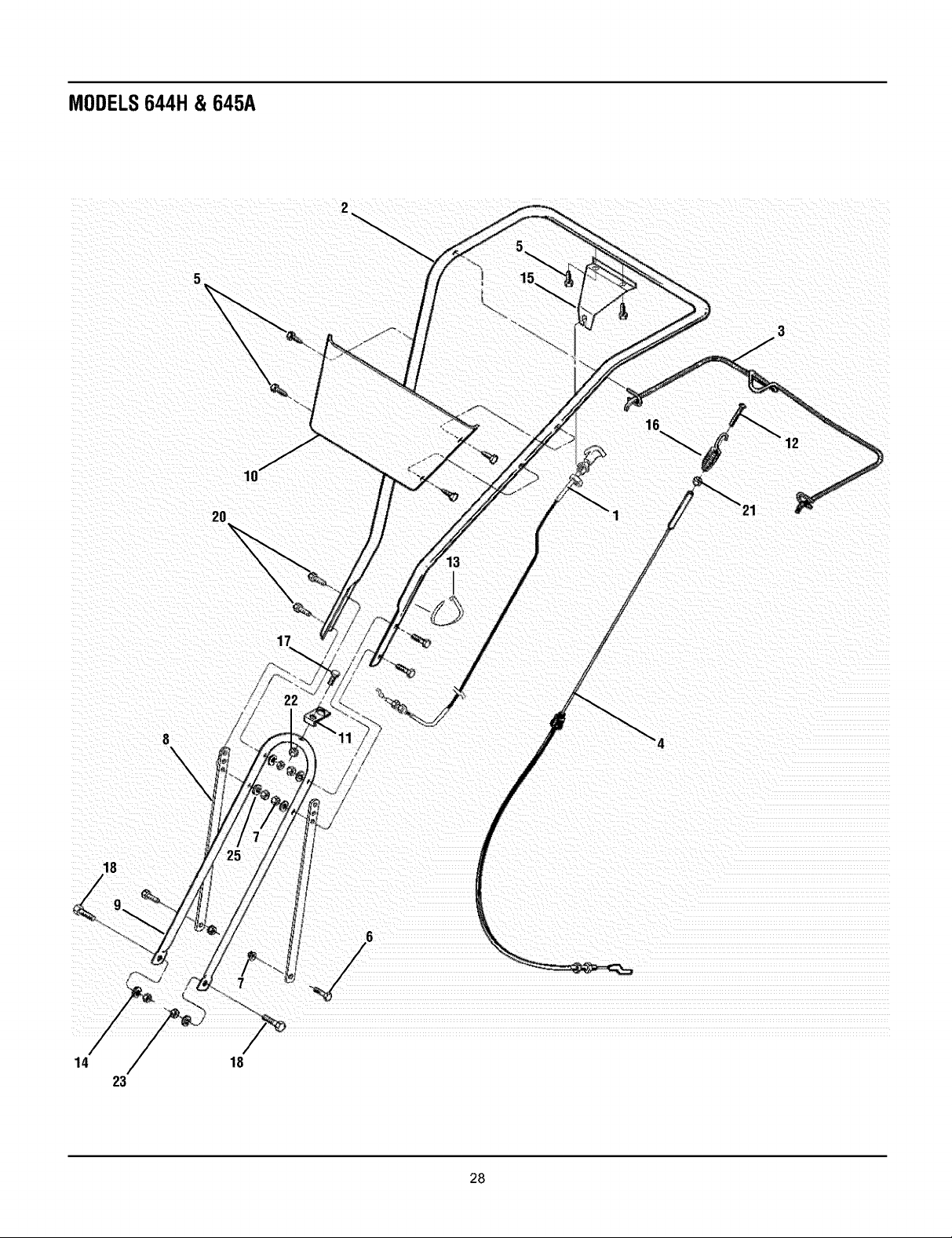
MODELS644H & 645A
2
5
10
3
20
13
I
17
4
18
/
23
18
28
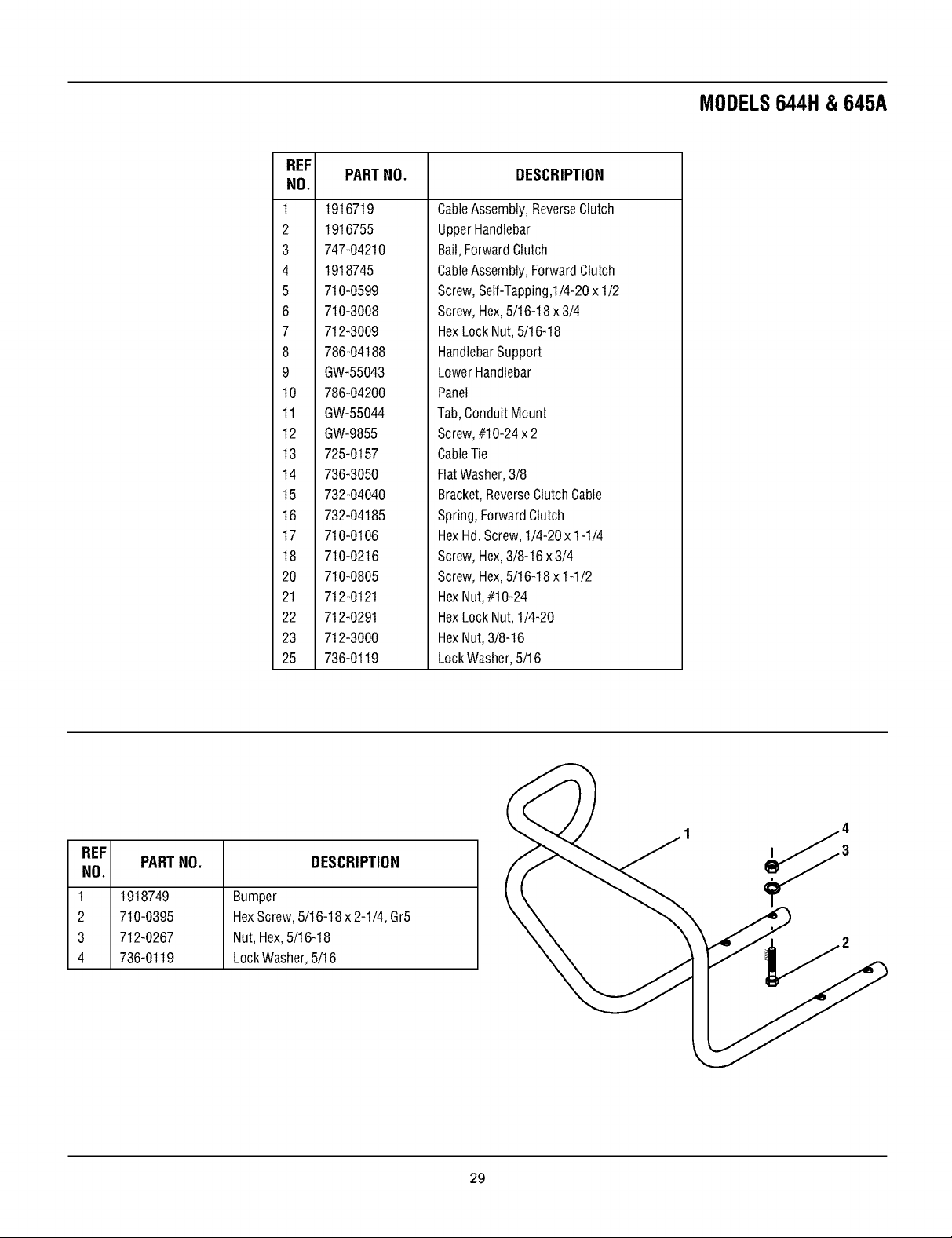
MODELS644H & 645A
REF
NO.
1
2
3
4
5
6
7
8
9
10
11
12
13
14
15
16
17
18
20
21
22
23
25
PARTNO. DESCRIPTION
1916719
1916755
747-04210
1918745
710-0599
710-3008
712-3009
786-04188
GW-55043
786-04200
GW-55044
GW-9855
725-0157
736-3050
732-04040
732-04185
710-0106
710-0216
710-0805
712-0121
712-0291
712-3000
736-0119
OableAssembly, ReverseOlutch
Upper Handlebar
Bail, Forward Olutch
OableAssembly, Forward Olutch
Screw, Self-Tapping,I/4-20 x 1/2
Screw, Hex,5/16-18 x 3/4
HexLock Nut, 5/16-18
Handlebar Support
Lower Handlebar
Panel
Tab, Oonduit Mount
Screw, #10-24 x 2
OableTie
FlatWasher, 3/8
Bracket, ReverseOlutch Oable
Spring, Forward Olutch
HexHd. Screw, 1/4-20 x 1-1/4
Screw, Hex,3/8-16 x 3/4
Screw, Hex,5/16-18 x 1-1/2
HexNut, #10-24
HexLock Nut, 1/4-20
HexNut, 3/8-16
Lock Washer, 5/16
REF
NO.
1
2
3
4
PART NO.
1918749
710-0395
712-0267
736-0119
DESCRIPTION
Bumper
HexScrew, 5/16-18 x 2-1/4, Gr5
Nut, Hex,5/16-18
Lock Washer, 5/16
29
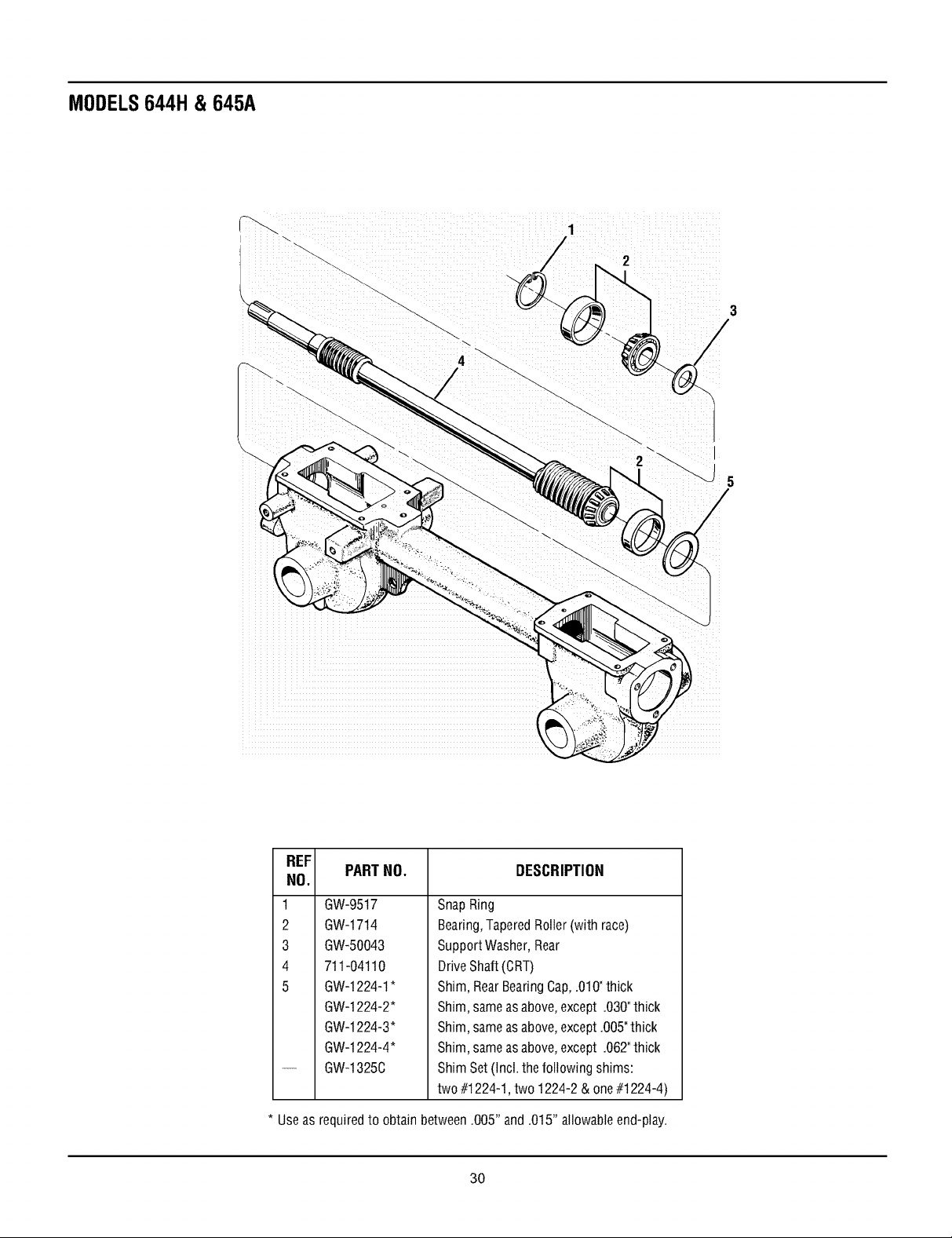
MODELS644H & 645A
1
2
3
/
REF
NO.
1 GW-9517
2 GW-1714
3 GW-50043
4 711-04110
5 GW-1224-1"
GW-1224-2"
GW-1224-3"
GW-1224-4"
-- GW-13250
PARTNO. DESCRIPTION
Snap Ring
Bearing,Tapered Roller (with race)
Support Washer, Rear
Drive Shaft (ORT)
Shim, RearBearing Oap,.010"thick
Shim, same as above,except .030"thick
Shim, same as above,except .005"thick
Shim, same as above,except .062"thick
Shim Set (Incl. the following shims:
two #1224-1, two 1224-2 & one#1224-4)
*Useas required to obtain between .005" and .015" allowable end-play.
30
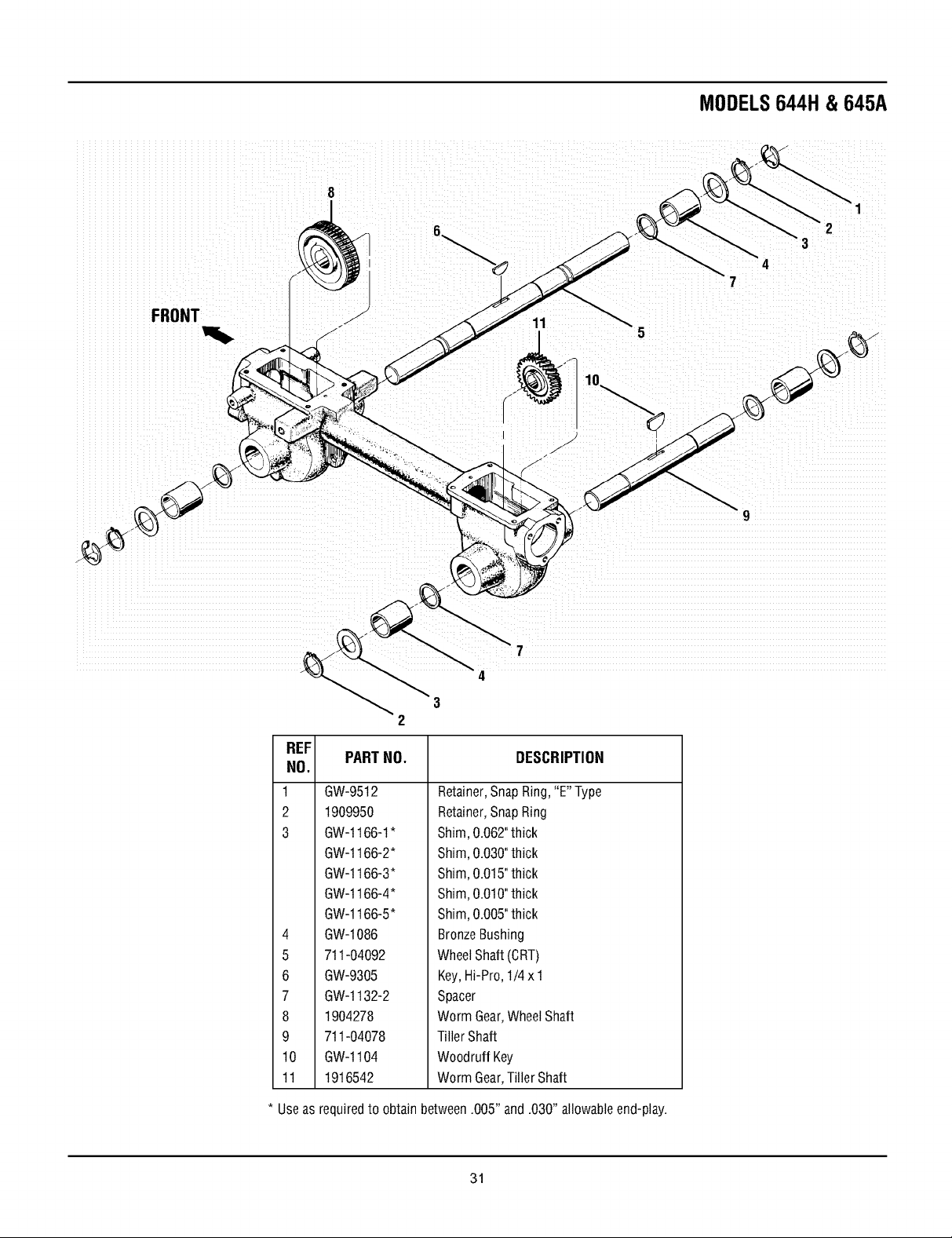
MODELS644H & 645A
FRONT
4
7
J
REF
NO.
1
2
3
4
5
6
7
8
9
10
11
7
4
3
2
PARTNO. DESCRIPTION
GW-9512
1909950
GW-1166-1*
GW-1166-2"
GW-1166-3"
GW-1166-4"
GW-1166-5"
GW-1086
711-04092
GW-9305
GW-1132-2
1904278
711-04078
GW-1104
1916542
Retainer,Snap Ring, "E" Type
Retainer,Snap Ring
Shim, 0.062" thick
Shim, 0.030" thick
Shim, 0.015" thick
Shim, 0.010" thick
Shim, 0.005" thick
Bronze Bushing
Wheel Shaft (CRT)
Key, Hi-Pro, 1/4 x 1
Spacer
Worm Gear,Wheel Shaft
Tiller Shaft
Wood ruff Key
Worm Gear,Tiller Shaft
Useas required to obtain between .005" and .030" allowable end-play.
31
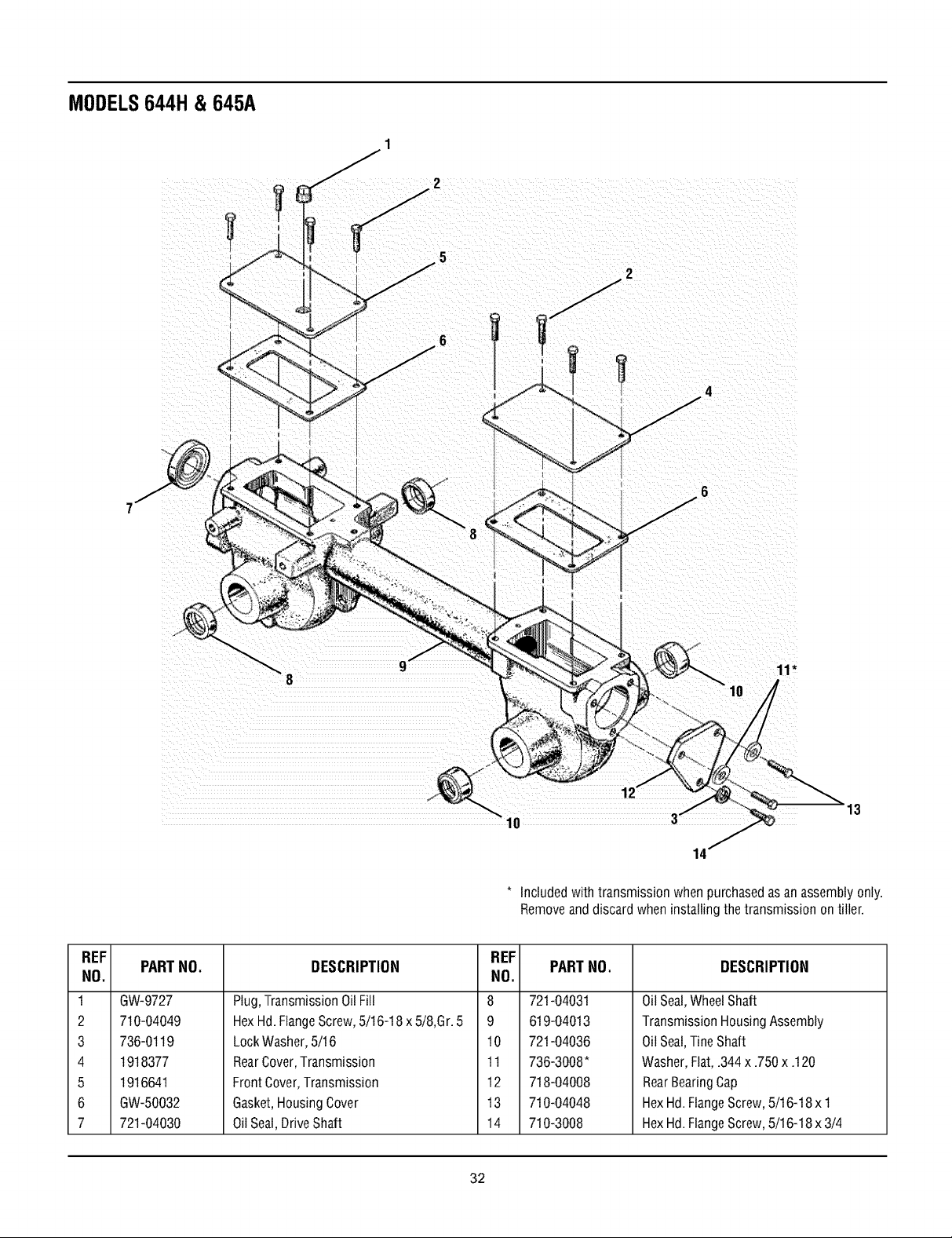
MODELS644H & 645A
2
10
10
12
3
14
13
*Included with transmission when purchased as an assembly only.
Removeand discard when installing the transmission on tiller.
REF PART NO.
NO.
1 GW-9727
2 710-04049
3 736-0119
4 1918377
5 1916641
6 GW-50032
7 721-04030
DESCRIPTION REF
NO.
Plug,Transmission Oil Fill 8
HexHd. FlangeScrew,5/16-18 x 5i8,Gr. 5 9
Lock Washer, 5/16 10
RearCover,Transmission 11
Front Cover,Transmission 12
Gasket, Housing Cover 13
Oil Seal,Drive Shaft 14
PARTNO.
721-04031
619-04013
721-04036
736-3008"
718-04008
710-04048
710-3008
DESCRIPTION
Oil Seal,Wheel Shaft
Transmission Housing Assembly
Oil Seal,Tine Shaft
Washer, Flat, .344 x .750 x .120
RearBearingCap
Hex Hd. FlangeScrew, 5/16-18 x 1
Hex Hd. FlangeScrew, 5/16-18 x 3/4
32
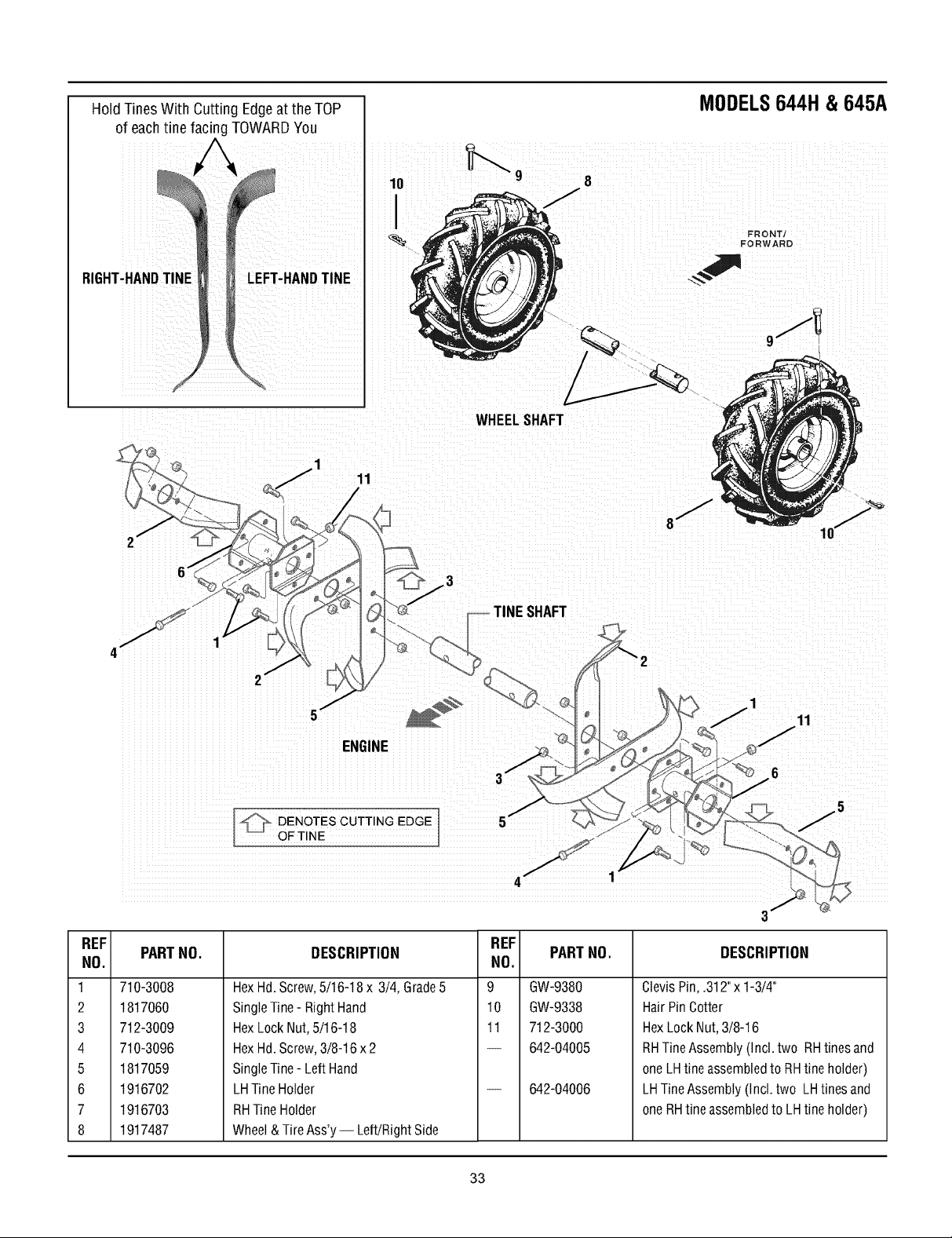
Hold TinesWith Cutting Edgeat the TOP
of eachtine facing TOWARDYou
10 8
I
MODELS644H & 645A
FRONT/
FORWARD
9
WHEELSHAFT
11
REF
NO.
1
2
3
4
5
6
7
8
ENGINE
1
11
6
'_ ENOTES CUTTING EDGE
OF TINE
PART NO.
710-3008
1817060
712-3009
710-3096
1817059
1916702
1916703
1917487
DESCRIPTION
HexHd. Screw,5/16-18 x 3/4, Grade5
Single Tine - Right Hand
HexLock Nut, 5/16-18
HexHd. Screw, 3/8-16 x 2
Single Tine - Left Hand
LHTine Holder
RHTine Holder
Wheel & Tire Ass'y-- Left/Right Side
REF
NO.
9
10
11
PART NO.
GW-9380
GW-9338
712-3000
642-04005
642-04006
DESCRIPTION
Clevis Pin, .312"x 1-3/4"
Hair Pin Cotter
HexLock Nut, 3/8-16
RH TineAssembly (incl. two RHtines and
one LHtine assembledto RHtine holder)
LH Tine Assembly (incl. two LHtines and
one RHtine assembledto LHtine holder)
33
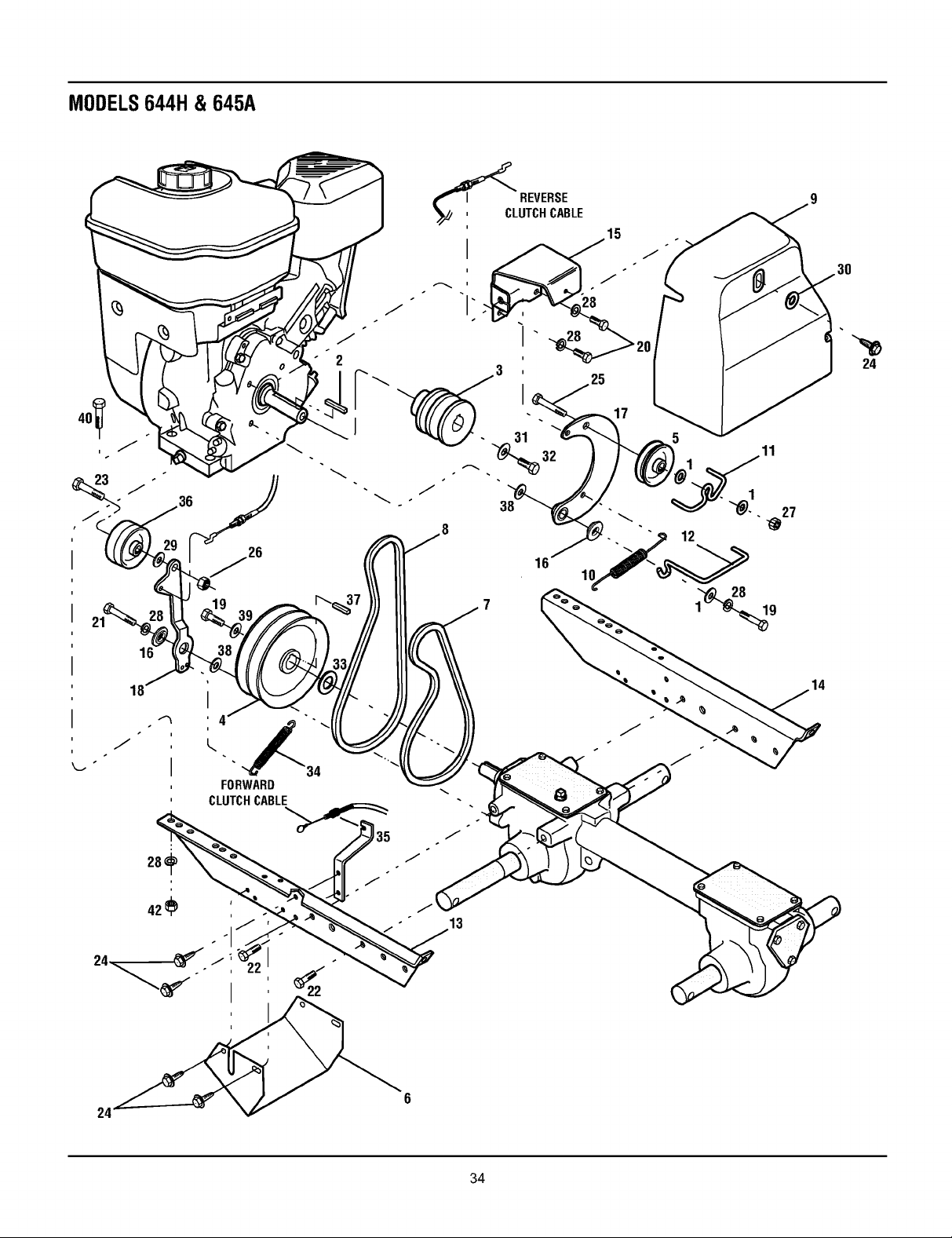
MODELS644H & 645A
I
16
17
,3O
24
16
34
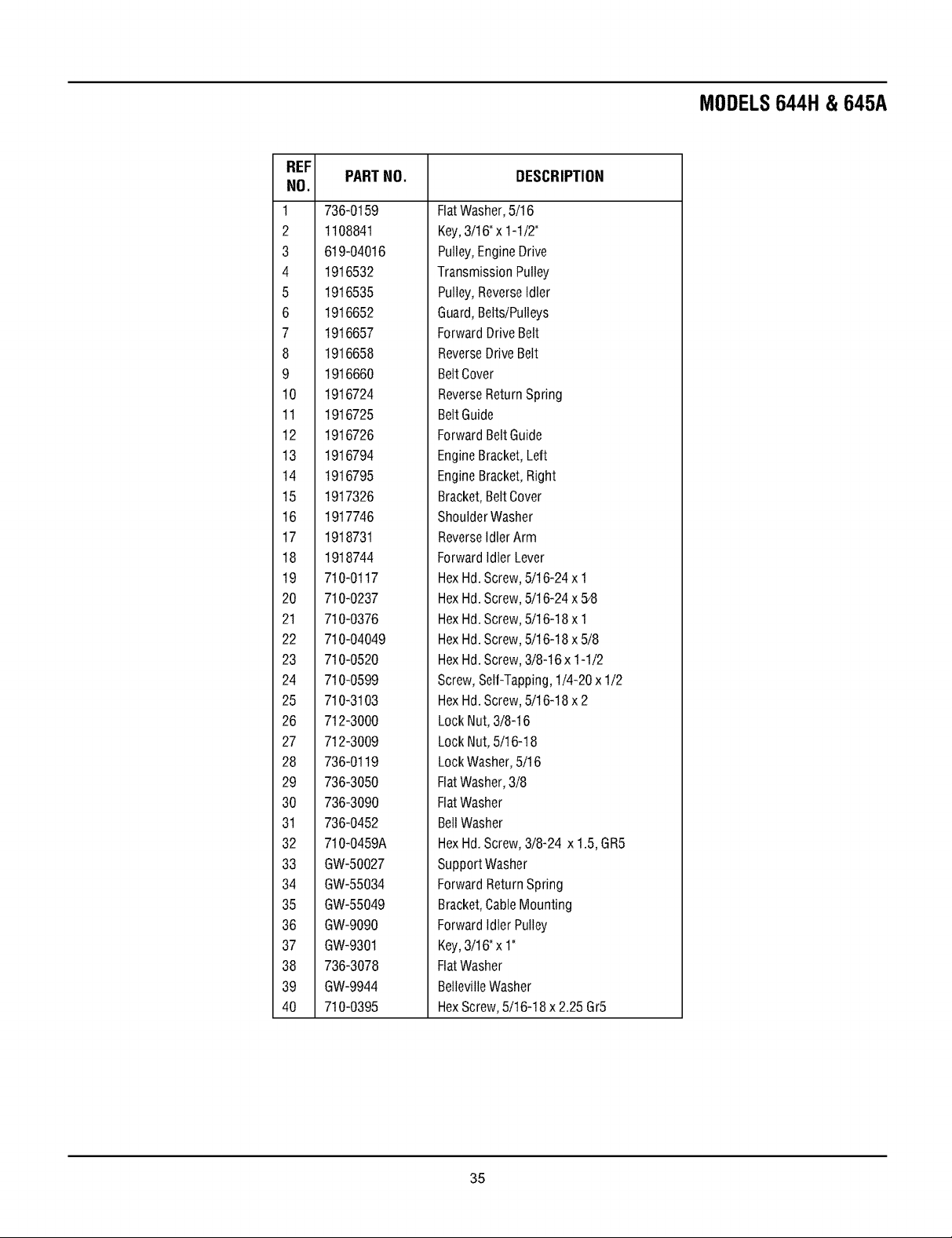
MODELS644H & 645A
REF
NO.
1
2
3
4
5
6
7
8
9
10
11
12
13
14
15
16
17
18
19
20
21
22
23
24
25
26
27
28
29
30
31
32
33
34
35
36
37
38
39
40
PARTNO. DESCRIPTION
736-0159
1108841
619-04016
1916532
1916535
1916652
1916657
1916658
1916660
1916724
1916725
1916726
1916794
1916795
1917326
1917746
1918731
1918744
710-0117
710-0237
710-0376
710-04049
710-0520
710-0599
710-3103
712-3000
712-3009
736-0119
736-3050
736-3090
736-0452
710-0459A
GW-50027
GW-55034
GW-55049
GW-9090
GW-9301
736-3078
GW-9944
710-0395
FlatWasher, 5/16
Key, 3/16"x 1-1/2"
Pulley, Engine Drive
Transmission Pulley
Pulley, ReverseIdler
Guard, Belts/Pulleys
Forward Drive Belt
ReverseDrive Belt
Belt Cover
ReverseReturn Spring
Belt Guide
Forward Belt Guide
Engine Bracket, Left
Engine Bracket, Right
Bracket, Belt Cover
Shoulder Washer
ReverseIdler Arm
Forward Idler Lever
HexHd. Screw, 5/16-24 x 1
HexHd. Screw, 5/16-24 x 5/8
HexHd. Screw, 5/16-18 x 1
HexHd. Screw, 5/16-18 x 5/8
HexHd. Screw, 3/8-16 x 1-1/2
Screw, Self-Tapping, 1/4-20 x 1/2
HexHd. Screw, 5/16-18 x 2
Lock Nut, 3/8-16
Lock Nut, 5/16-18
Lock Washer, 5/16
FlatWasher, 3/8
FlatWasher
BellWasher
HexHd. Screw, 3/8-24 x 1.5, GR5
Support Washer
Forward Return Spring
Bracket,Cable Mounting
Forward Idler Pulley
Key, 3/16" x 1"
FlatWasher
BellevilleWasher
HexScrew, 5/16-18 x 2.25 Gr5
35
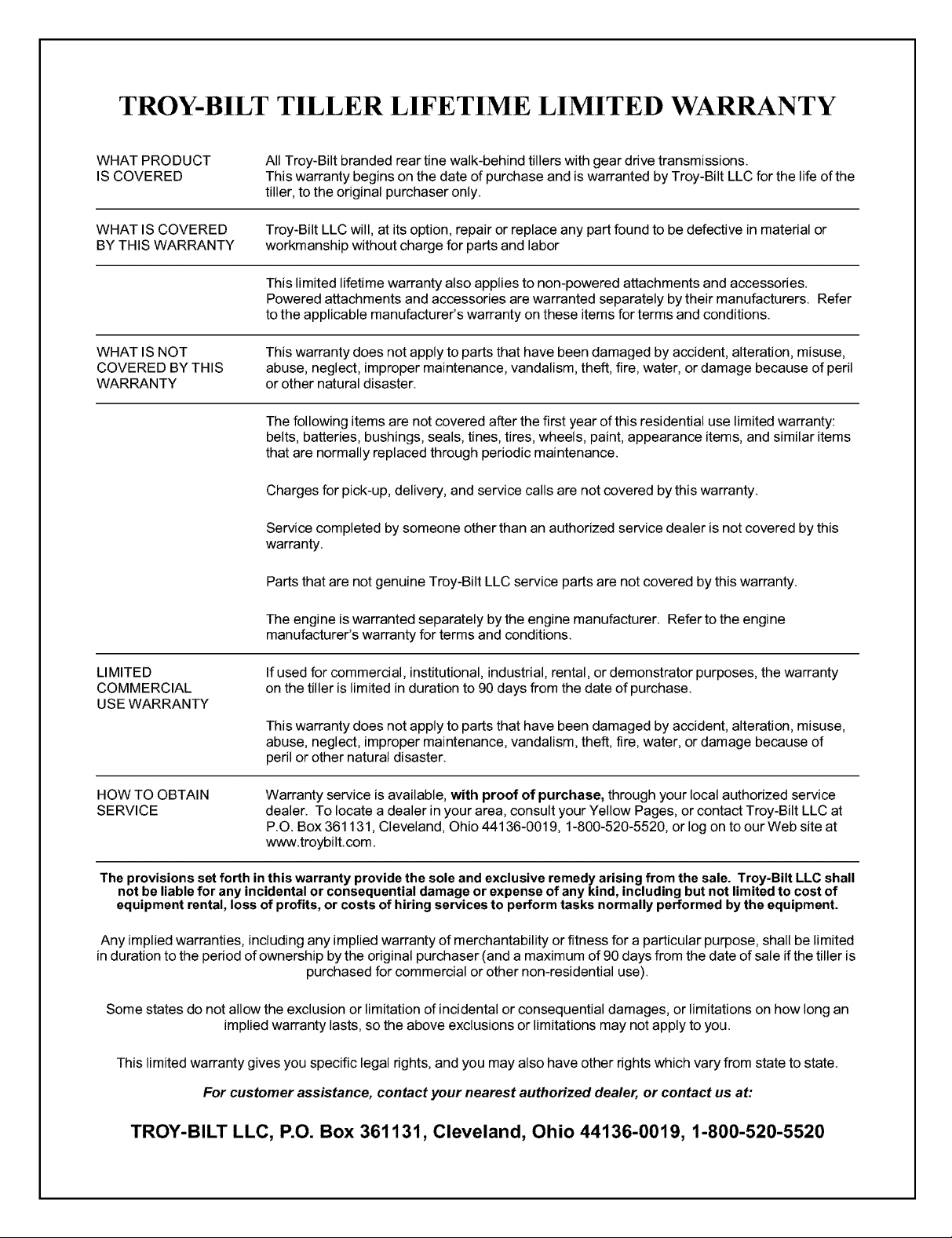
TROY-BILT TILLER LIFETIME LIMITED WARRANTY
WHAT PRODUCT
IS COVERED
WHAT IS COVERED
BY THIS WARRANTY
WHAT IS NOT
COVERED BY THIS
WARRANTY
All Troy-Bilt branded rear tine walk-behind tillers with gear drive transmissions,
This warranty begins on the date of purchase and is warranted by Troy-Bilt LLC for the life of the
tiller, to the original purchaser only,
Troy-Bilt LLC will, at its option, repair or replace any part found to be defective in material or
workmanship without charge for parts and labor
This limited lifetime warranty also applies to non-powered attachments and accessories,
Powered attachments and accessories are warranted separately by their manufacturers, Refer
to the applicable manufacturer's warranty on these items for terms and conditions,
This warranty does not apply to parts that have been damaged by accident, alteration, misuse,
abuse, neglect, improper maintenance, vandalism, theft, fire, water, or damage because of peril
or other natural disaster,
The following items are not covered after the first year of this residential use limited warranty:
belts, batteries, bushings, seals, tines, tires, wheels, paint, appearance items, and similar items
that are normally replaced through periodic maintenance,
Charges for pick-up, delivery, and service calls are not covered by this warranty,
Service completed by someone other than an authorized service dealer is not covered by this
warranty,
Parts that are not genuine Troy-Bilt LLC service parts are not covered by this warranty,
The engine is warranted separately by the engine manufacturer, Refer to the engine
manufacturer's warranty for terms and conditions,
LIMITED
COMMERCIAL
USE WARRANTY
If used for commercial, institutional, industrial, rental, or demonstrator purposes, the warranty
on the tiller is limited in duration to 90 days from the date of purchase,
This warranty does not apply to parts that have been damaged by accident, alteration, misuse,
abuse, neglect, improper maintenance, vandalism, theft, fire, water, or damage because of
peril or other natural disaster,
HOW TO OBTAIN
SERVICE
Warranty service is available, with proof of purchase, through your local authorized service
dealer. To locate a dealer in your area, consult your Yellow Pages, or contact Troy-Bilt LLC at
P,O. Box 361131, Cleveland, Ohio 44136-0019, 1-800-520-5520, or log on to our Web site at
www,troybilt,com,
The provisions set forth in this warranty provide the sole and exclusive remedy arising from the sale. Troy-Bilt LLC shall
not be liable for any incidental or consequential damage or expense of any kind, including but not limited to cost of
equipment rental, loss of profits, or costs of hiring services to perform tasks normally performed by the equipment.
Any implied warranties, including any implied warranty of merchantability or fitness for a particular purpose, shall be limited
in duration to the period of ownership by the original purchaser (and a maximum of 90 days from the date of sale if the tiller is
purchased for commercial or other non-residential use),
Some states do not allow the exclusion or limitation of incidental or consequential damages, or limitations on how long an
implied warranty lasts, so the above exclusions or limitations may not apply to you,
This limited warranty gives you specific legal rights, and you may also have other rights which vary from state to state,
For customer assistance, contact your nearest authorized dealer, or contact us at:
TROY-BILT LLC, P.O. Box 361131, Cleveland, Ohio 44136-0019, 1-800-520-5520