Operator’s Manual
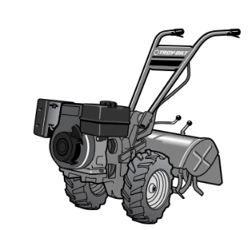
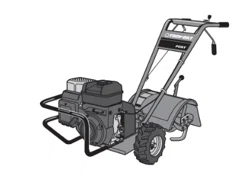
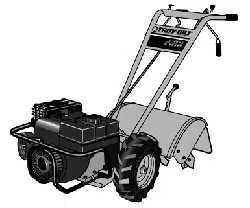
Rear-tine PTO Tiller Models
682J—Horse
TM
E686N—Horse
TM
E682L—Horse
TM
Warning: This unit is equipped with an internal combustion engine and should not be used on or near any unimproved forest-covered, brush-
covered or grass-covered land unless the engine’s exhaust system is equipped with a spark arrester meeting applicable local or state laws (if any).
If a spark arrester is used, it should be maintained in effective working order by the operator. In the State of California the above is required by law
(Section 4442 of the California Public Resources Code). Other states may have similar laws. Federal laws apply on federal lands. A spark arrester
for the muffler is available by contacting the service department at Troy-Bilt LLC, P.O. Box 361131 Cleveland, Ohio 44136-0019.
IMPORTANT:READ SAFETY RULES AND INSTRUCTIONS CAREFULLY
TROY-BILT LLC, P.O. BOX 361131, CLEVELAND, OH 44136-0019
PRINTED IN USA FORM NO. 770-10598B
(11/2002)
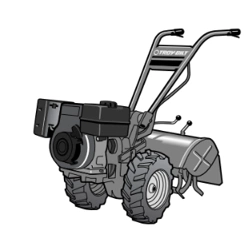
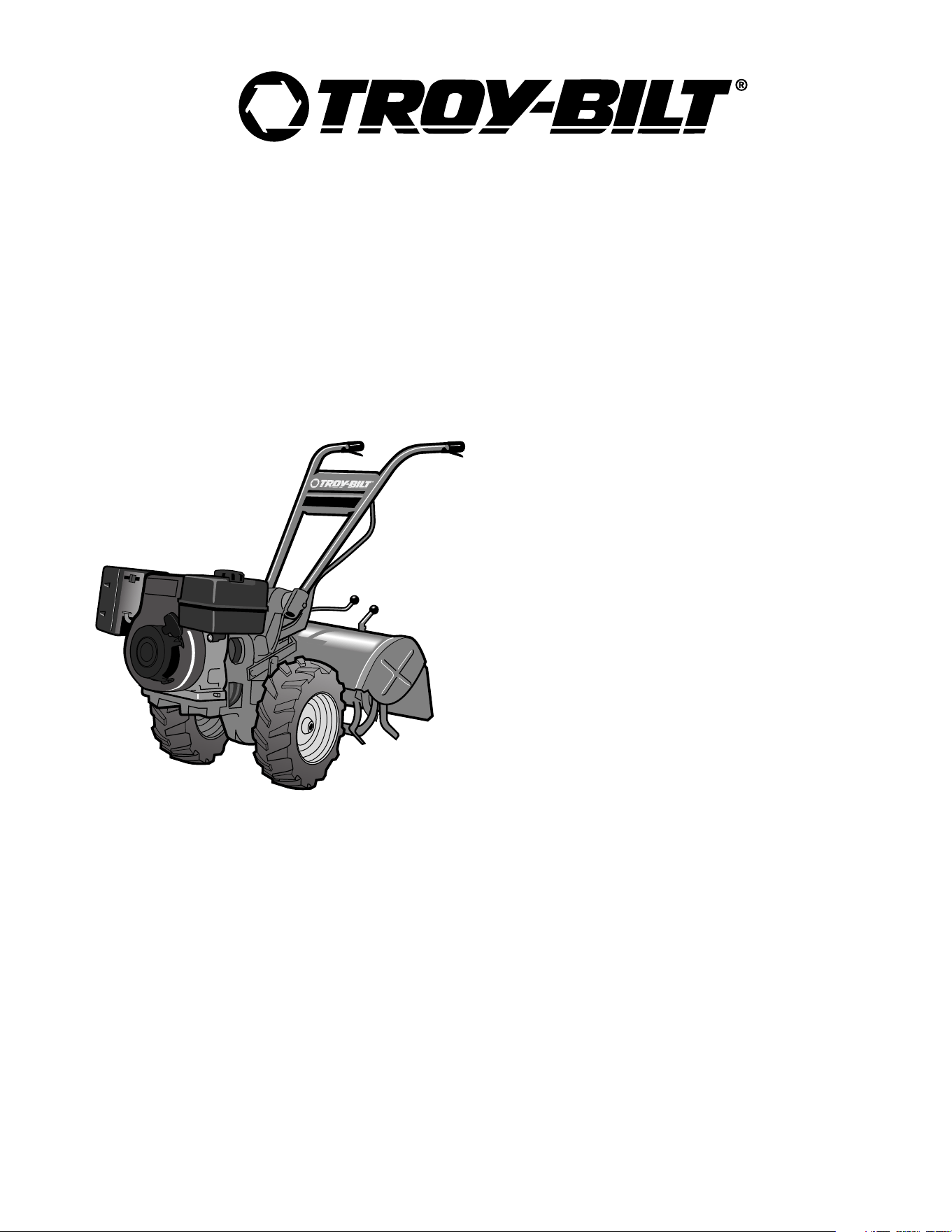
Model 682J Shown
2
For more details about your unit, visit our website at www.troybilt.com
T
ABLE OF CONTENTS
Content Page
Calling Customer Support . . . . . . . . . . . . . . . . . . . . . . . . . . . . . . . . . . . . . . . . . . . . . . . . . . . . 2
Safety . . . . . . . . . . . . . . . . . . . . . . . . . . . . . . . . . . . . . . . . . . . . . . . . . . . . . . . . . . . . . . . . . . . 3
Assembly. . . . . . . . . . . . . . . . . . . . . . . . . . . . . . . . . . . . . . . . . . . . . . . . . . . . . . . . . . . . . . . . . 6
Features and Controls. . . . . . . . . . . . . . . . . . . . . . . . . . . . . . . . . . . . . . . . . . . . . . . . . . . . . . . 11
Operation . . . . . . . . . . . . . . . . . . . . . . . . . . . . . . . . . . . . . . . . . . . . . . . . . . . . . . . . . . . . . . . . 14
Maintenance . . . . . . . . . . . . . . . . . . . . . . . . . . . . . . . . . . . . . . . . . . . . . . . . . . . . . . . . . . . . . . 28
Troubleshooting . . . . . . . . . . . . . . . . . . . . . . . . . . . . . . . . . . . . . . . . . . . . . . . . . . . . . . . . . . . 41
Attachments & Accessories . . . . . . . . . . . . . . . . . . . . . . . . . . . . . . . . . . . . . . . . . . . . . . . . . . 43
Parts List . . . . . . . . . . . . . . . . . . . . . . . . . . . . . . . . . . . . . . . . . . . . . . . . . . . . . . . . . . . . . . . . . 44
Warrany Information . . . . . . . . . . . . . . . . . . . . . . . . . . . . . . . . . . . . . . . . . . . . . . . . . . . . . . . . Back Cover
FINDING MODEL NUMBER
This Operator’s Manual is an important part of your new Rear-tine Tiller. It will help you assemble, prepare and
maintain the unit for best performance. Please read and understand what it says.
Before you start assembling your new equipment, please locate the model plate on the equipment and copy the infor-
mation from it in the space provided below. This information is very important if you need help from our Customer
Support Department or an authorized dealer.
• You can locate the model number by looking at the rear surface of the tine shield. A sample model plate is
explained below. For future reference, please copy the model number and the serial number of the equipment
in the space below
ENGINE INFORMATION
The engine manufacturer is responsible for all engine-related issues with regards to performance, power-rating, speci-
fications, warranty and service. Please refer to the engine manufacturer’s Owner’s/Operator’s Manual packed sepa-
rately with your unit for more information.
CALLING CUSTOMER SUPPORT
If you have difficulty assembling this product or have any questions regarding the controls, operation or maintenance
of this unit, please call the Customer Support Department.
Call
1- (330) 558-7220 or 1- (866) 840-6483 to reach a Customer Support representative. Please have
your unit’s model number and serial number ready when you call. See previous section to locate this
information. You will be asked to enter the serial number in order to process your call .
Copy Model Number Here
Copy Serial Number Here
www.troybilt.com
TROY-BILT LLC
P. O. BOX
361131
CLEVELAND, OH 44136
866-840-6483
330-558-7220
The engine exhaust from this product contains
chemicals known to the State of California to cause
cancer, birth defects or other reproductive harm.
WARNING
This machine meets voluntary safety standard B71.8
– 1996, which is sponsored by the Outdoor Power
Equipment Institute, Inc., and is published by the
American National Standards Institute.
Safety Alert Symbol
This is a safety alert symbol. It is used in this
manual and on the unit to alert you to
potential hazards. When you see this symbol,
read and obey the message that follows it.
Failure to obey safety messages could result in personal
injury or property damage.
Section
1
Safety
Training
1. Carefully read this Owner’s Manual, the
separate Engine Owner’s Manual, and any
other literature you may receive. Be thor-
oughly familiar with the controls and the
proper use of the tiller and its engine.
Know how to stop the unit and disengage
the controls quickly.
2. Never allow children to operate the
tiller. Never allow adults to operate the
tiller without proper instruction.
3. Keep the area of operation clear of all
persons, particularly children and pets.
4. Keep in mind that the operator or user
is responsible for accidents or hazards
occurring to other people, their property,
and themselves.
Preparation
1. Thoroughly inspect the area where the
tiller is to be used and remove all foreign
objects.
2. Put the Wheels/Tines/PTO Drive Lever
into NEUTRAL before starting the engine.
3. Do not operate the tiller without
wearing adequate outer garments. Avoid
loose garments or jewelry that could get
caught in moving parts.
4. Do not operate the tiller when barefoot
or wearing sandals, sneakers, or light
footwear. Wear protective footwear that
will improve footing on slippery surfaces.
5. Do not till near underground electric
cables, telephone lines, pipes or hoses. If
in doubt, contact your telephone or utility
company.
6. Warning: Handle fuel with care; it is
highly flammable and its vapors are
explosive. Be sure to take the following
precautions:
a. Store fuel in containers specifically
designed for this purpose.
b. The gas cap shall never be removed
or fuel added while the engine is
running. Allow the engine to cool
for several minutes before adding
fuel.
c. Keep matches, cigarettes, cigars,
pipes, open flames, and sparks
away from the fuel tank and fuel
container.
d. Fill fuel tank outdoors with extreme
care. Never fill fuel tank indoors.
Use a funnel or spout to prevent
spillage.
e. Replace all fuel tank and container
caps securely.
f. If fuel is spilled, do not attempt to
start the engine, but move the
machine away from the area of
spillage and avoid creating any
source of ignition until fuel vapors
have dissipated.
7. Never make adjustments when engine
is running (unless recommended by
manufacturer).
Operation
1. Do not put hands or feet near or under
rotating parts. Do not allow hands or any
other part of the body or clothing near the
rotating tines or near any other moving
part. The tines begin to rotate forward
once the engine starts, the Tines/PTO
Clutch Lever is in the ENGAGE position,
the Forward Interlock Levers are squeezed
closed and the Wheels/Tines/PTO Drive
Lever is shifted to FORWARD. The tines
rotate in Reverse whether the Interlock
Levers are closed or open.
2. Exercise extreme caution when on or
crossing gravel drives, walks, or roads.
Stay alert for hidden hazards or traffic. Do
not carry passengers.
3. After striking a foreign object, stop the
engine, remove the wire from the spark
plug wire and prevent it from touching the
spark plug. Thoroughly inspect the
machine for any damage and repair the
damage before restarting and operating
the machine.
4. Exercise caution to avoid slipping or
falling.
5. If the unit should start to vibrate abnor-
mally, stop the engine, disconnect the
spark plug wire and prevent it from
touching the spark plug, and check imme-
diately for the cause. Vibration is
generally a warning of trouble.
6. Stop the engine, disconnect the spark
plug wire and prevent it from touching the
spark plug whenever you leave the
operating position, before unclogging the
tines, or when making any repairs, adjust-
ments or inspections.
7. Take all possible precautions when
leaving machine unattended. Stop engine.
Disconnect spark plug wire and move it
away from spark plug. Remove ignition
key on electric start models
3

Section 1: Safety
8. Before cleaning, repairing, or inspect-
ing, stop the engine and make certain all
moving parts have stopped. Disconnect
the spark plug wire and prevent it from
touching the spark plug to prevent acci-
dental starting.
9. The flap on the tine hood must be
down when operating the tiller, unless
using the Hiller/Furrower attachment.
10. Never use the tiller unless proper
guards, plates, or other safety protective
devices are in place.
11. Do not run engine in an enclosed
area. Engine exhaust contains carbon
monoxide gas, a deadly poison that is
odorless, colorless, and tasteless.
12. Keep children and pets away.
13. Never operate the tiller under engine
power if the Wheel Speed Lever is in the
FREEWHEEL position. In FREEWHEEL,
the wheels will not hold the tiller back and
the revolving tines could propel the tiller
rapidly, possibly causing loss of control.
Always engage the Wheel Speed Lever in
either FAST or SLOW position before
starting the engine or engaging the tines
with the Wheels/Tines/PTO Drive Lever.
14. Be aware that the tiller may unex-
pectedly bounce upward or jump
forward if the tines should strike
extremely hard packed soil, frozen
ground, or buried obstacles like large
stones, roots, or stumps. If in doubt
about the tilling conditions, always use
the following operating precautions to
assist you in maintaining control of the
tiller:
a. Walk behind and to one side of the
tiller, using one hand on the han-
dlebars. Relax your arm, but use a
secure hand grip.
b. Use shallower depth regulator
settings, working gradually deeper
with each pass.
c. Use slower wheel, tine and engine
speeds.
d. Clear the tilling area of all large
stones, roots and other debris.
e. Avoid using downward pressure on
handlebars. If need be, use slight
upward pressure to keep the tines
from digging too deeply.
f. Before contacting hard packed soil
at the end of a row, reduce engine
speed and lift handlebars to raise
tines out of the soil.
g. In an emergency, stop tines and
wheels by shifting the
Wheels/Tines/PTO Drive Lever
into NEUTRAL. If you can not
reach the lever or have lost control
of the tiller, let go of the handle-
bars and all controls. Do not
attempt to restrain the tiller.
15.
Do not overload the tiller’s capacity by
attempting to till too deeply at too fast a
rate.
16. Never operate the tiller at high
transport speeds on hard or slippery
surfaces. Look behind and use care when
backing up.
17. Do not operate the tiller on a slope
that is too steep for safety. When on
slopes, slow down and make sure you
have good footing. Never permit the tiller
to freewheel down slopes.
18. Never allow bystanders near the unit.
19. Only use attachments and accessories
that are approved by the manufacturer of
the tiller.
20. Use tiller attachments and acces-
sories when recommended.
21. Never operate the tiller without good
visibility or light.
22. Never operate the tiller if you are
tired, or under the influence of alcohol,
drugs or medication.
23. Operators shall not tamper with the
engine-governor settings on the machine;
the governor controls the maximum safe
operating speed to protect the engine and
all moving parts from damage caused by
overspeed. Authorized service shall be
sought if a problem exists.
24. Do not touch engine parts which may
be hot from operation. Let parts cool
down sufficiently.
25. POISON/DANGER—CAUSES
SEVERE BURNS. The battery on electric
start models contains sulfuric acid. Avoid
contact with skin, eyes or clothing. Keep
out of reach of children.
Antidotes:
External– Flush immediately with lots of
water.
Internal– Drink large quantities of water
or milk. Follow with milk of magnesia,
beaten eggs or vegetable oil. Call a
doctor immediately.
Eyes– Flush with water for 15 minutes.
Get prompt medical attention.
26. DANGER– BATTERIES PRODUCE
EXPLOSIVE GASES. Keep sparks, flame
or smoking materials away. Ventilate
when charging battery or using in an
enclosed space. Always wear safety
goggles when working near battery.
27. Please remember: You can always
stop the tines and wheels by releasing all
controls, or by moving the ignition switch
and/or throttle control lever on the engine
to OFF or STOP.
28. To load or unload the tiller, see the
instructions in Section 4 of this Manual.
29. Use extreme caution when backing or
pulling the machine towards you.
30. Start the engine carefully according to
instructions and with feet well away from
the tines.
31. Never pick up or carry a machine
while the engine is running.
32. When loading or unloading the tiller,
always disengage tines and use slower
wheel and engine throttle speeds. Use
sturdy ramps wide and strong enough to
easily support the tiller (280-to-325 lbs.,
depending on model) and operator.
Never go down ramps in FORWARD
drive—the tiller could tip forward,
exposing you to the tines (which should
be disengaged). Always use REVERSE
drive and back down ramps. To go up
ramps, use FORWARD drive and follow
the tiller.
33. The Forward Interlock Safety System
should be tested for correct functioning
every time the tiller or PTO power unit is
used. See Section 4 in this Manual.
34. If using the optional Dozer Blade,
either remove the tine attachment, or
disengage the tines with the Tines/PTO
Clutch Lever. Revolving tines are
dangerous.
4
Section 1: Safety
5
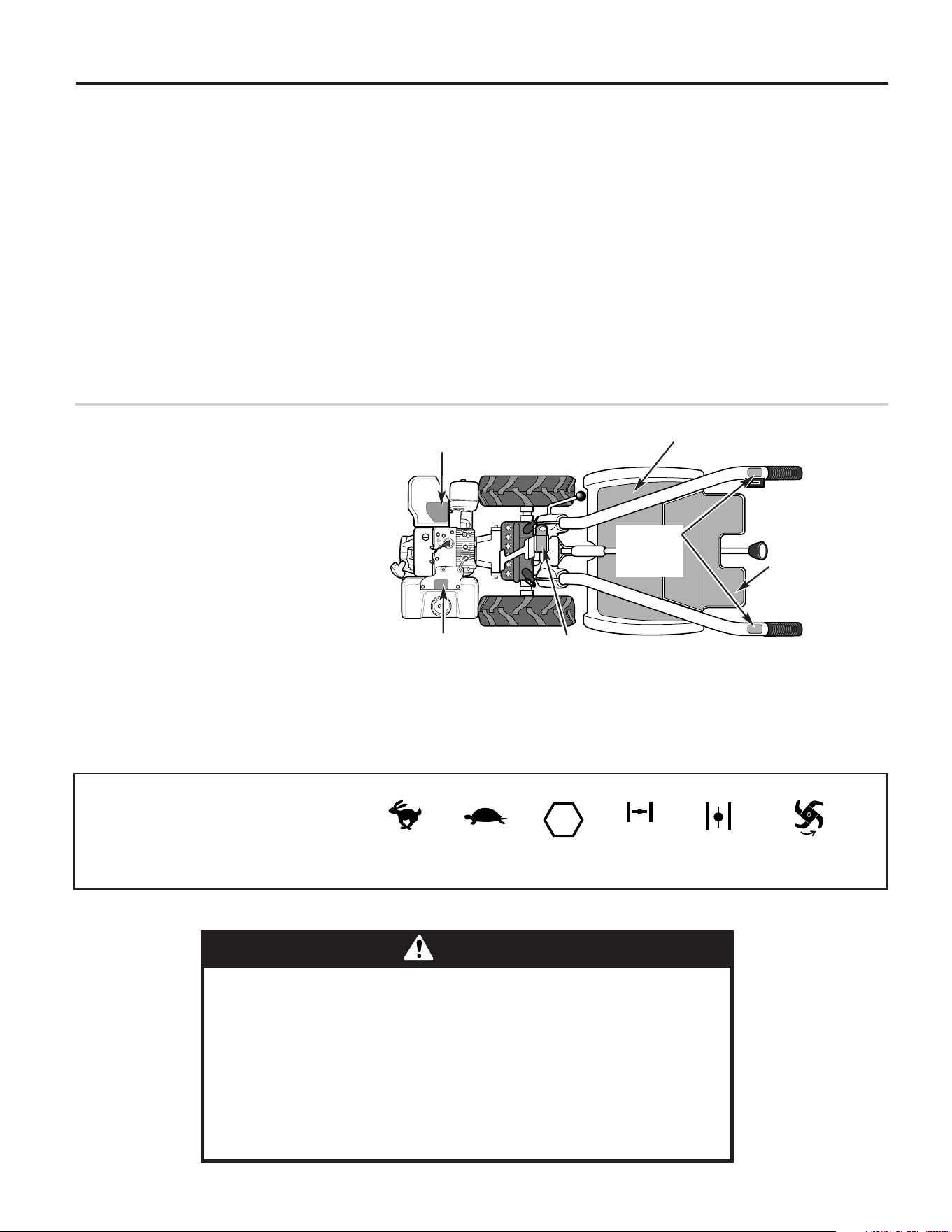
Decals
For your safety and the safety of others,
various safety and operational decals are
located on your unit (Figure 1).
Keep the decals clean and legible at all
times. Contact your local service dealer
or the Factory for replacements if any
decals are damaged or missing.
Refer to the Parts List for decal locations,
descriptions and part numbers.
Figure 1: Location of Safety and Operating Decals.
(Briggs & Stratton engine shown)
Operating Symbols
Various symbols (shown here, with word
descriptions) are used on the tiller and engine.
Your unit may not have all of the symbols.
FAST
SLOW
CHOKE
ON
CHOKE
OFF
STOP
STOP
ROTATING
TINES
B) WARNING: Engine Ignition.
Electric start models only.
C) WARNING: Operating and
Safety Instructions
A) WARNING: Hot Surfaces.
Top of the air cleaner housing.
D) Power Unit
Operating
Instructions
F) Engine Stabilization.
Top of fuel tank.
E) Forward
Interlock
Lever (2)
Maintenance and Storage
1. Keep the tiller, attachments and acces-
sories in safe working condition.
2. Check all nuts, bolts, and screws at
frequent intervals for proper tightness to
be sure the equipment is in safe working
condition.
3. Never store the tiller with fuel in the
fuel tank inside a building where ignition
sources are present such as hot water
and space heaters, furnaces, clothes
dryers, stoves, electric motors, etc.).
Allow engine to cool before storing in any
enclosure.
4. To reduce the chances of a fire hazard,
keep the engine free of grass, leaves, or
excessive grease.
5. Store gasoline in a cool, well-ventilated
area, safely away from any spark- or
flame-producing equipment. Store
gasoline in an approved container, safely
away from the reach of children.
6. Refer to the Maintenance sections of
this Manual and the separate Engine
Owner’s Manual for instructions if the
tiller is to be stored for an extended
period.
7. Never perform maintenance while the
engine is running or the spark plug wire is
connected, except when specifically
instructed to do so.
8. If the fuel tank has to be drained, do
this outdoors.
TO AVOID SERIOUS INJURY:
• READ THE OWNER’S MANUAL.
• KNOW LOCATIONS AND FUNCTIONS OF ALL CONTROLS.
• KEEP ALL SAFETY DEVICES AND SHIELDS IN PLACE AND WORKING.
• NEVER ALLOW CHILDREN OR UNINSTRUCTED ADULTS TO OPERATE TILLER.
• SHUT OFF ENGINE AND DISCONNECT SPARK PLUG WIRE BEFORE MANUALLY UNCLOG-
GING TINES OR MAKING REPAIRS.
• KEEP BYSTANDERS AWAY FROM MACHINE.
• KEEP AWAY FROM ROTATING PARTS.
• USE EXTREME CAUTION WHEN REVERSING OR PULLING THE MACHINE TOWARDS YOU.
WARNING
6
Introduction
Carefully follow these assembly steps to
correctly prepare your tiller for use. It is
recommended that you read this Section
in its entirety before beginning assembly.
NOTE: Three different Horse model tillers
are covered in this Manual. Use only the
information applicable to your model.
Tiller engines vary by model. Your engine
may appear differently than those found
in illustrations of this manual.
Inspect Unit
Inspect the unit and carton for damage
immediately after delivery. Contact the
carrier (trucking company) if you find or
suspect damage. Inform them of the
damage and request instructions for filing
a claim. To protect your rights, put your
claim in writing and mail a copy to the
carrier within 15 days after the unit has
been delivered. Contact us at the Factory
if you need assistance in this matter.
STEP 1: Unpacking Instructions
NOTE: Do not severely bend any of the
control cables on the unit.
1. The tiller is heavy. Do not attempt to
remove it from the shipping platform until
instructed to do so in these Assembly
steps.
2. Remove all unassembled parts from
the carton. The hardware bag is included
in your literature packaging.
3. Check that you have the items listed
below (contact your local dealer or the
Factory if any items are missing or
damaged).
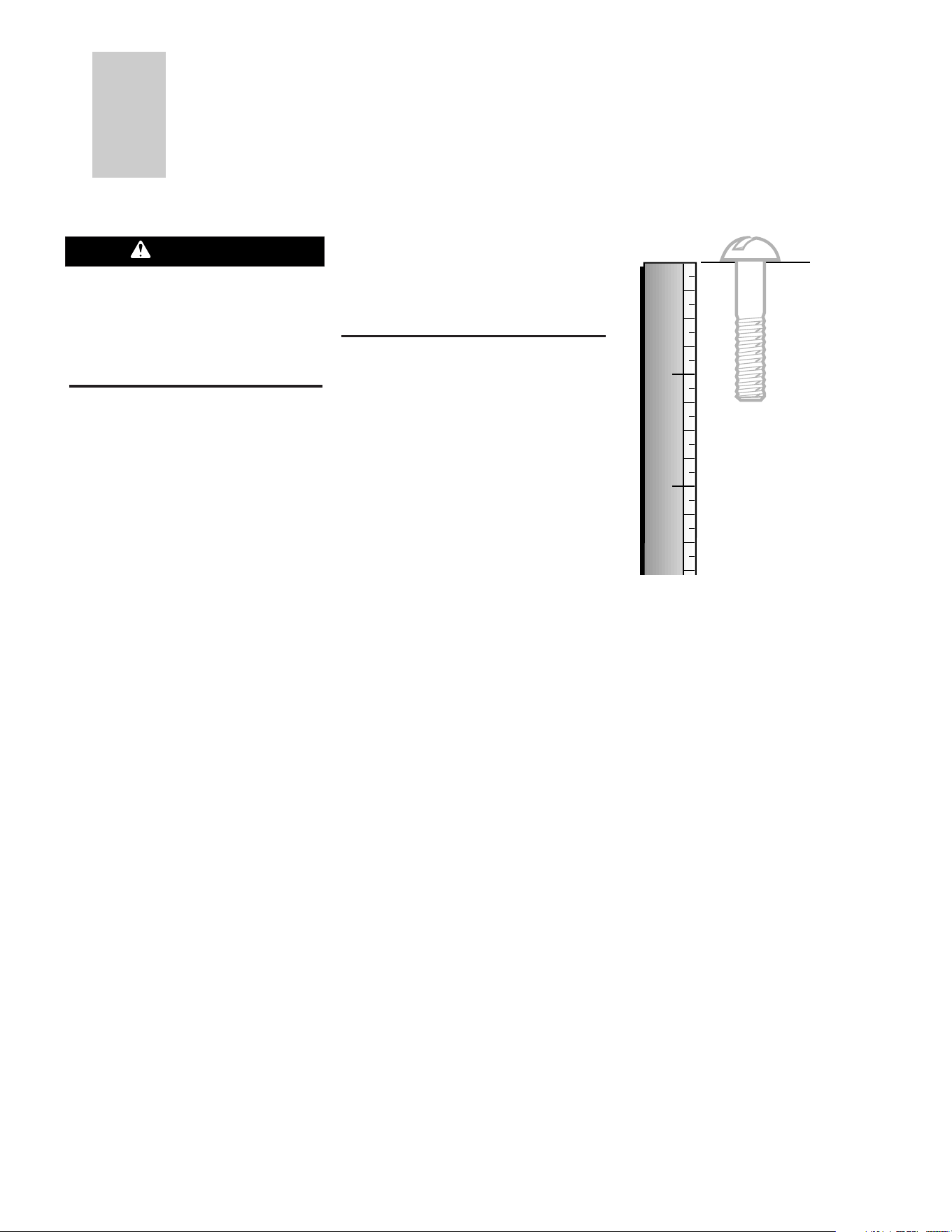
NOTE: Use the screw length template
(Figure 2-1) to identify screws.
Loose Parts List
Qty. Description
1 Handlebar Assembly
1 Wheels/Tines PTO Drive Lever
The following items
are in the hardware bag:
2 20 oz. Bottles SAE 30W Oil
1 Clutch Pawl Spring
1 Belt Adjusting Tool
2 Plastic Cable Ties
1 Curved Head Screw, 1/4-20 x 2
1 Flanged Lock Nut, 1/4-20
1 Pan Head Screw, #10-32 x 1/2
The following parts (electric start models
only), packaged separately.
2 Nuts, 1/4-20
(for battery terminals)
2 Screws, 1/4-20 x 5/8
(for battery terminals)
2 Keys
(in ignition switch)
NOTE: LEFT and RIGHT sides of the
tiller are as viewed from the
operator’s position behind the han-
dlebars (unless otherwise noted).
Tools/Materials Needed
for Assembly
(1) 3/8" open-end wrench*
(2) 7/16" open-end wrench*
(2) 1/2" open-end wrench*
(1) 9/16" open-end wrench*
(1) 3/4" open-end wrench*
(1) Flat blade screwdriver
(1) Scissors (to trim plastic ties)
(1) Tire pressure gauge
(1) 4-1/2" high wood block to prop unit
*
Adjustable wrenches may be used.
STEP 2: Attach Handlebar
IMPORTANT: When disassembling
handlebar assembly, keep left-side clamp
and ratchet separated from the right-side
clamp and ratchet.
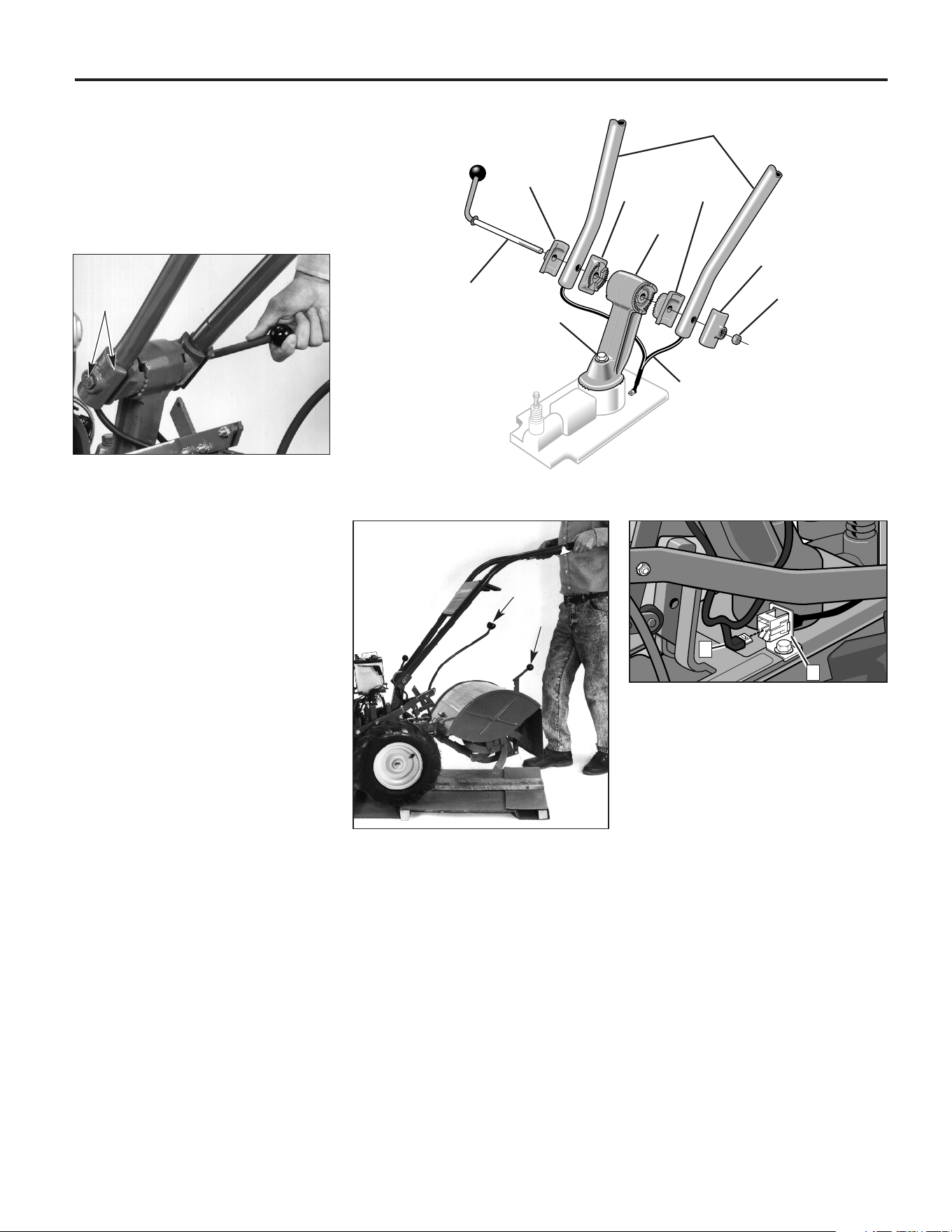
1. Disassemble the handlebar assembly.
To do this, remove the height adjustment
lever by turning the lever in a counter-
clockwise direction (Figure 2-2).
2. Place the handlebar ends on either side
of the base, with the wire harness toward
the rear of the base (Figure 2-2).
3. Install the height adjustment lever
through the right-side clamp, handlebar
end, ratchet, and base; then out through
the left-side ratchet, handlebar end, and
clamp (Figure 2-2). Secure with nut, but
don't fully tighten.
IMPORTANT: Do not force the height
adjustment lever through the handlebars.
The interlock wires may be blocking the
Section
2
Assembly
Figure 2-1: To identify length of screw,
place screw on template as shown and
measure distance between bottom of screw
head and tip of screw.
1
2
1
2
To prevent personal injury or property
damage, do not start the engine until
all assembly steps are complete and
you have read and understand the
safety and operating instructions in this
manual.
WARNING
Section 2: Assembly
lever and could be damaged. You may
gently move the wires aside if this
condition occurs.
4. Raise handlebars to one of two height
settings and tighten the height adjustment
lever. Also, make sure all other mounting
hardware is securely tightened.
NOTE: Fully assembled handlebar
assembly should appear as shown in
Figure 2-3.
STEP 3: Move Tiller Off Shipping
Platform
1. Set the Depth Regulator Lever
(A, Figure 2-4) to Travel position. Do this
by lifting the tiller by the handlebars, then
pulling straight back on the lever and
sliding down to the highest notched
setting.
2. Set the Wheel Speed Lever (B, Figure
2-4) to Freewheel position. To do this,
move the lever approximately halfway
between the Fast and Slow settings while
you rock the tiller forward and backward
until the wheels move freely.
3. Lift Handlebars high enough to clear
tiller tines and pull back firmly to dislodge
the tiller from the platform wheel wells.
STEP 4: Connect Forward
Interlock Wire Harness
1. Remove any dirt from the Forward
Interlock wire harness plug (C, Figure
2-5) and its receptacle (D).
2. Connect the Forward Interlock wire
harness plug (C, Figure 2-5) to the recep-
tacle (D).
STEP 5: Attach
Wheels/Tines/PTO Drive Lever
1. Loosen the bolt (Figure 2-2) on the
handlebar base and swing the handlebars
out to the right side.
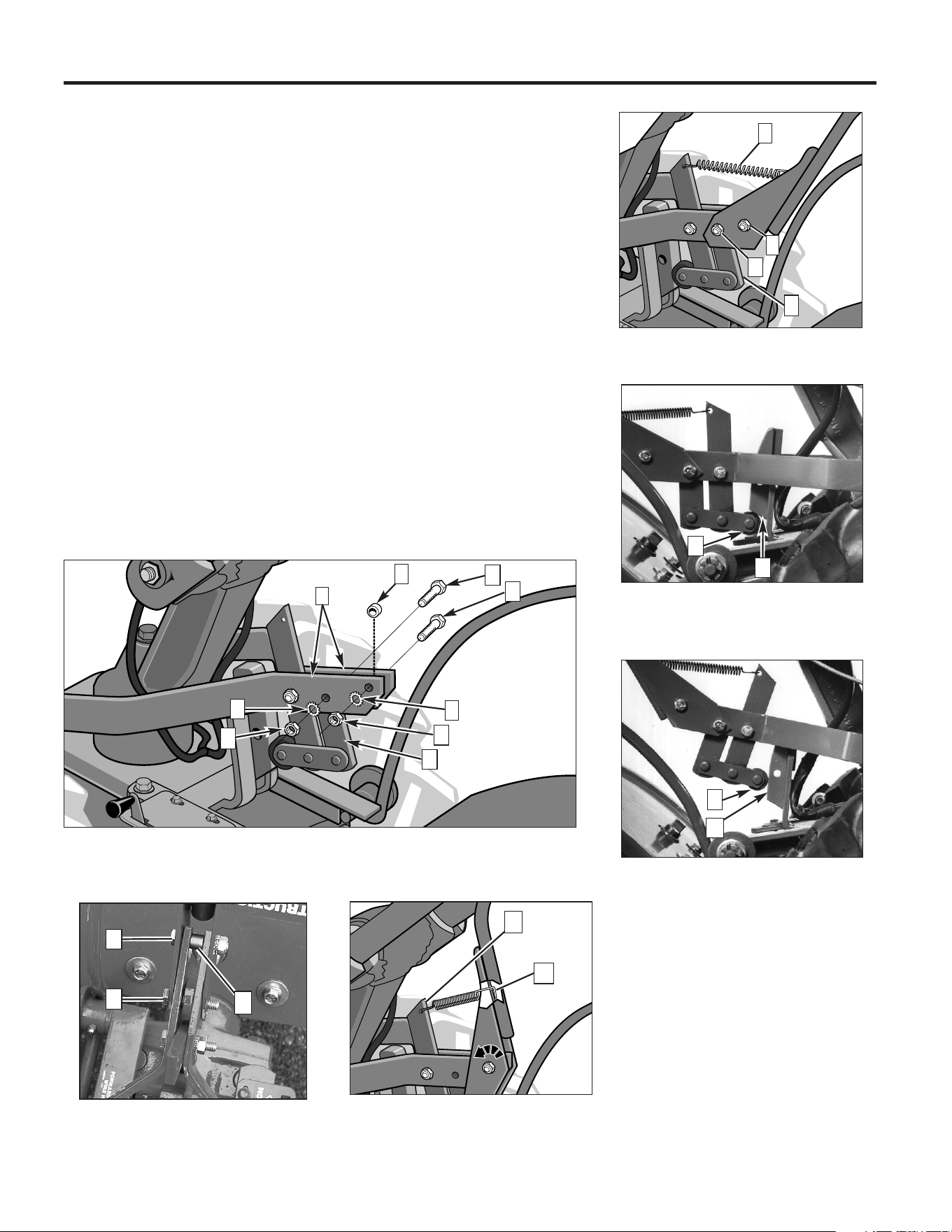
2. Remove both sets of nuts, star
washers, screws, and one bushing
(A, B, C, D, E, F, G, Figure 2-6) from the
yoke plates (H). There is a bushing inside
the short link (I). Be careful not to lose it
when removing screw (G).
3. Slide the plates at the end of the
Wheels/Tines/PTO Lever over the yoke
plates (Figure 2-9). To aid in the next
step, insert a screw temporarily into the
forward most holes (J, Figure 2-7) of the
yoke plates and the lever.
4. Align the rear most holes of the yoke
plates and the Wheels/Tines/PTO Lever.
Use long nose pliers to hold the bushing
(L, Figure 27) in place while inserting the
screw (K) through the lever and yoke
plates. Install star washer (B, Figure 2-6)
and nut (A), then hand tighten.
5. Retrieve the clutch pawl spring (Figure
2-8) from hardware bag.
Figure 2-2. Handlebar assembly.
Left
Ratchet
Right
Ratchet
Handlebars
Right
Clamp
Left
Clamp
Height
Adjustment
Lever
Wire
Harness
Base
Bolt
Base
FRONT
OF TILLER
Nut
Figure 2-3. Fully assembled handle-
bars.
Left-Side
Clamp
and Nut
Figure 2-4: Photo shows the Depth
Regulator Lever (A) and the Wheel
Speed Lever (B).
B
A
7
Figure 2-5. Forward Interlock Wire
Harness connection.
D
C
8
Figure 2-6: Illustration shows the yoke plates (H), nuts, washers, and
screws (A, E, B, F, D, G), bushing (C), and long and short links (I, J).
Figure 2-7: Drive Lever assembly.
Figure 2-11: Neutral position; roller
(T) rests against middle area of the
adjustment block (U).
A
I
B
C
H
D
E
F
G
Figure 2-10 Forward position; roller
(T) rests under the adjustment
block (U).
U
T
T
U
Figure 2-8: Clutch pawl spring. Tilt
Wheels\Tines\PTO Lever fully
forward before installing spring.
N
M
Section 2: Assembly
Figure 2-9: Fully assembled
Wheels/Tines/PTO Lever assembly.
K
J
L
Q
R
S
STEP 6: Check Gear Oil Levels
Your tiller has two separate transmis-
sions: one for the Power Unit (Figure 2-
12), the other for the Tine Attachment
(Figure 2-13). Both transmissions were
filled at the factory with SAE #85W–140
weight gear oil (with an A.P.I rating of
GL-4). Check level in both transmis-
sions to verify that they are still correct.
See Section 5,
Transmission Gear Oil
Maintenance for complete information
on how to check and fill the transmis-
sions.
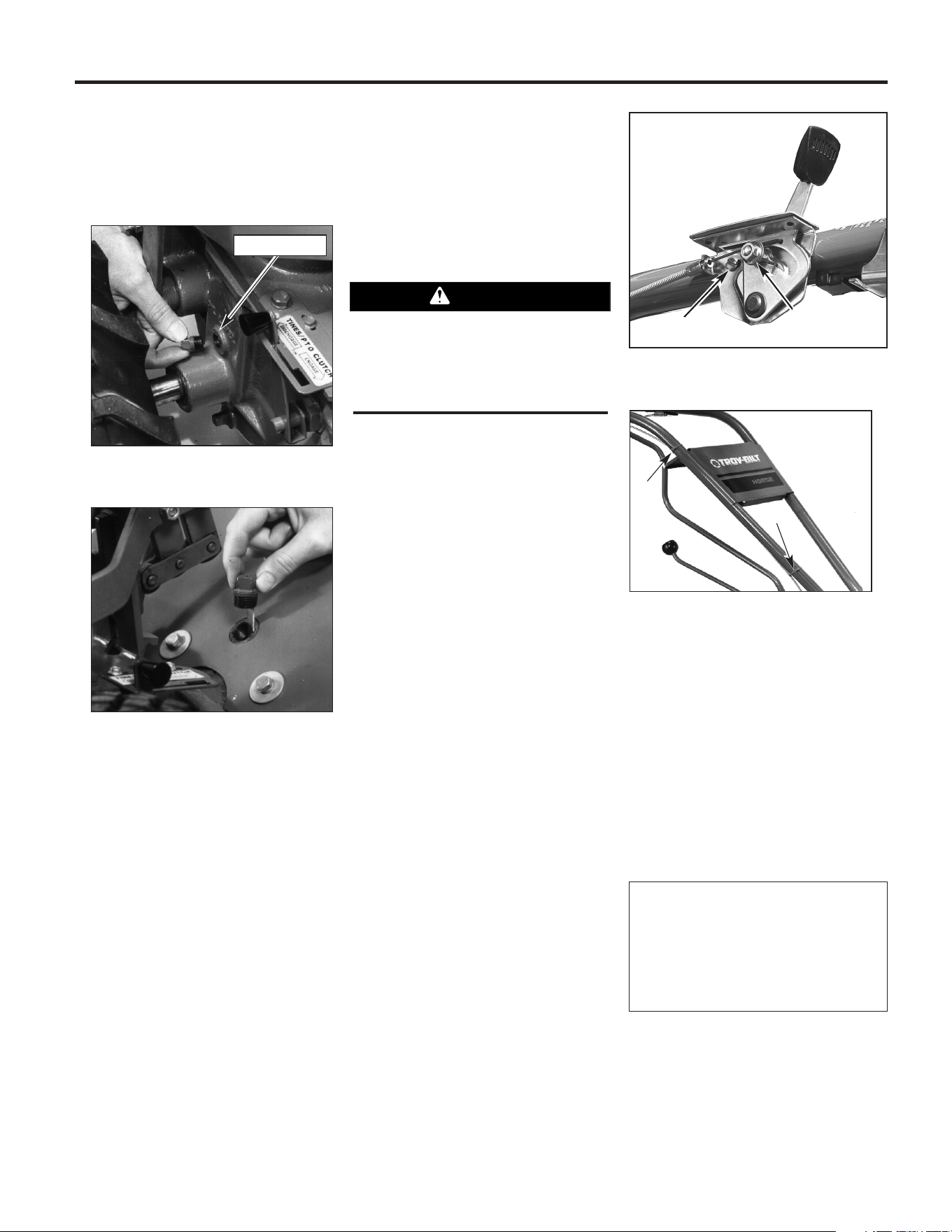
P
Remove the temporary screw (J, Figure
2-7) from the forward holes and move the
Wheels/Tines/PTO Lever fully forward.
Install the wider hook end of the clutch
pawl spring (M, Figure 2-8) down into the
small hole at the end of the handle. Use
pliers to insert the other end into the hole
in the long link bar (N).
NOTE: Do not bend or over stretch the
spring while installing.
6. Pull the Wheels/Tines/PTO Lever back
to align the forward most holes (Q, Figure
2-9) in the yoke plate with the holes in the
lever plates. Also align the bushing that is
inside the short link bar (P). Install the
screw, star washer, and nut, then tighten
securely.
Securely tighten all other hardware (Q, R,
Figure 2-9). Also ensure that the spring
(S) is properly seated at both ends.
Completed assembly should appear as
illustrated in Figure 2-9.
7. Test the operation of the
Wheels/Tines/PTO Lever. Push the lever
down until it engages in the Forward
position. The clutch roller (T, Figure 2-
10) must rest beneath the adjustment
block (U). Next, move the lever up to the
Neutral position. The clutch roller (T,
Figure 2-11) should rest on the face of the
adjustment block (U). To test Reverse, lift
and hold the lever all the way up in
Reverse position, then let it go. The lever
should automatically return to the Neutral
position (Figure 2-11). If not, do not use
the tiller. See your local authorized dealer
or call the Factory Technical Service
Department for instructions.
Section 2: Assembly
9
IMPORTANT: Check gear oil level in both
transmissions after the first 2 hours of
new tiller operation, then every 30
operating hours thereafter. See Section 5
for instructions.
STEP 7: Add Motor Oil to Engine
1. Before adding motor oil, park the tiller
on level ground. Level the engine by
placing a sturdy block under the tines or
the tines depth regulator bar.
2. Refer to the Engine Owner’s Manual
provided with your tiller for detailed infor-
mation on how to add motor oil and for
motor oil specifications.
IMPORTANT: Two 20 oz. bottles of motor
oil are included with your tiller. Check the
oil level as instructed in the Engine
Owner’s Manual provided with your tiller
BEFORE pouring the full amount of each
bottle into the engine.
IMPORTANT:
• Change engine oil after first 2 hours of
new operation.
• Check engine oil level every 5 hours of
operation or each use.
STEP 8: Attach Engine Throttle
Lever and Cable
For shipping purposes, the throttle cable,
together with the throttle lever, is wound
around the engine. Carefully unwind the
cable. If the throttle control label is
covered with a clear protective coating,
peel it off.
To attach the throttle lever and cable:
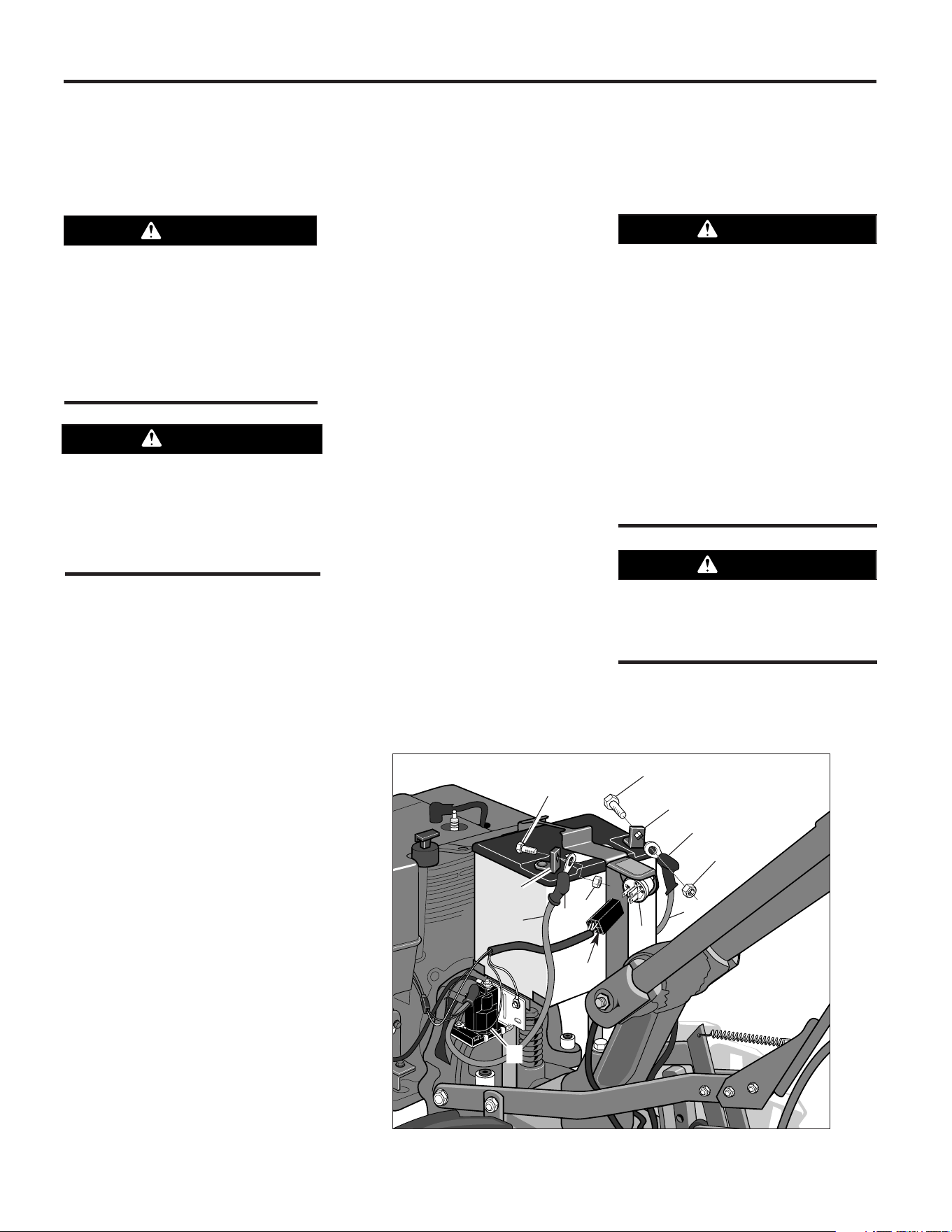
1. Run the throttle cable up the inside
edge of the right handlebar and position
the lever as shown in Figure 2-14.
2. From the outside of the handlebar,
insert the curved head screw (A, Figure 2-
14), through the handlebar and the center
hole in the throttle lever mounting
bracket.
3. Loosely install the flanged lock nut
and move the throttle lever back to the
STOP position.
4. From the lever side of the bracket,
thread a pan head screw (B, Figure 2-14)
through the small hole in the throttle lever
bracket and into the handlebar. Tighten
the screw securely.
5. Securely tighten both the flanged lock
nut and the curved head screw.
6. Use two plastic ties to secure the
throttle cable to the right handlebar in two
places (Figure 2-15). Loop each tie
around the handlebar and cable (serrated
side faces in) and pull the ties tight. Trim
the ends.
Figure 2-12: Checking oil level on
Power Unit Transmission.
Figure 2-13: Checking oil level on
Tine Attachment Transmission.
To avoid electric shock from a short
circuit (electric start tillers only), never
allow the throttle cable to touch the
battery. Route cable below the battery,
on the outside of the battery holder.
WARNING
Figure 2-14: Engine Throttle Lever
position and installation.
Figure 2-15: Plastic Ties placement
on handlebars.
Oil Level Hole
B
A
Tie
Tie
Assembly is complete for recoil start
tillers. See Assembling The Electric
Start System if you own an electric
start tiller; otherwise, refer to Section
3,
Controls for information on tiller
controls.
STEP 9: Adjust Air Pressure in
Tires
For shipping purposes, the tires may be
overinflated. Check the air pressure in
each tire and adjust them to between 10
and 20 pounds per square inch. You
must inflate each tire to equal air
pressures to prevent the tiller from pulling
to one side.
Section 2: Assembly
10
NOTE: If the battery is put into
service after the date shown on the
top of the battery, charge for a
minimum of one hour at 6-10
amps. Refer to the Maintenence
section of this manual for more
detailed instructions regarding
proper battery charging procedure
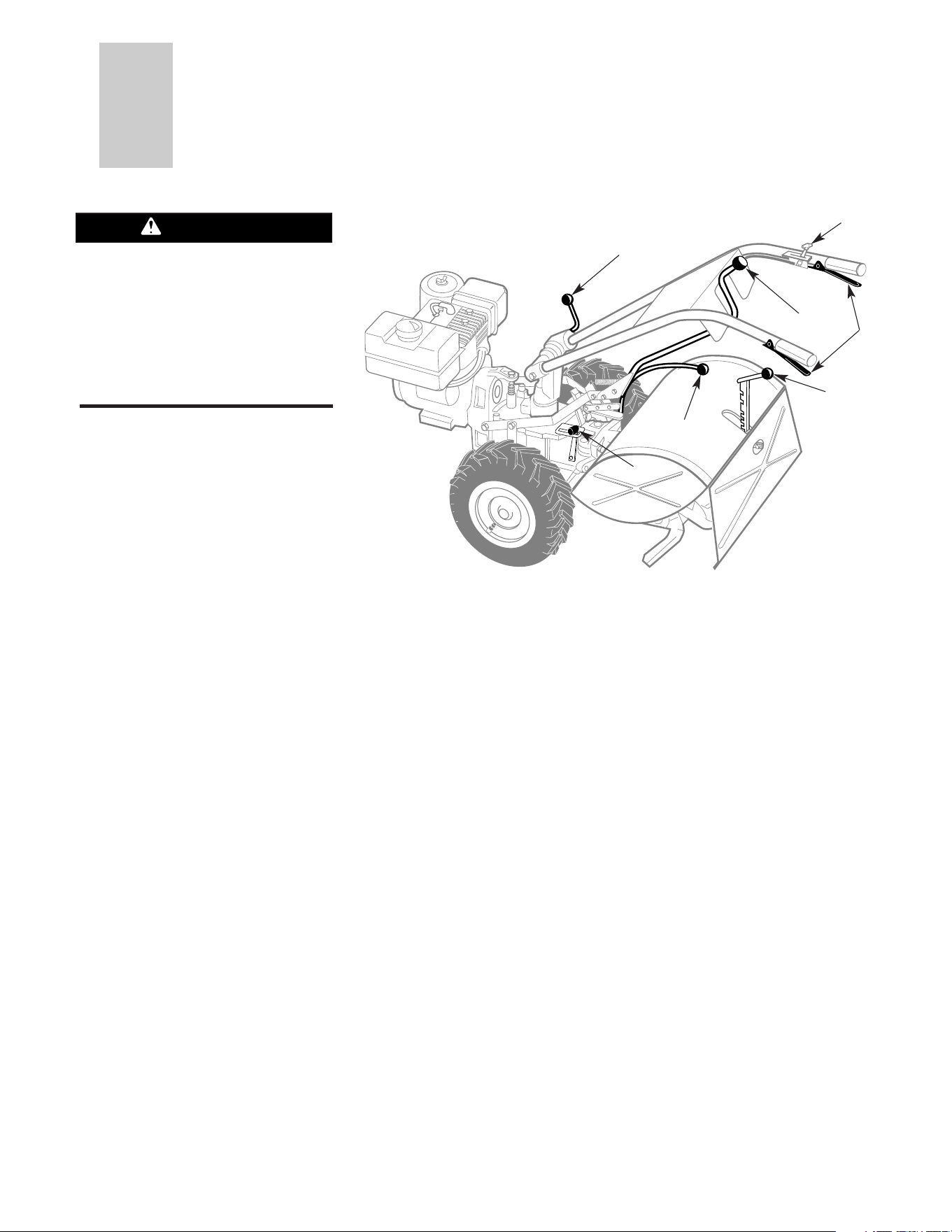
STEP 1: Connect the Wire
Harness Receptacle
1. Before installing the battery and its
hold-down clamp, insert the plastic wire
harness receptacle (A, Figure 2-18) into
the prongs of the keyswitch (M) located
on the hold-down clamp.
2. Remove the ignition keys from the
keyswitch and store them safely away.
Do not insert the key into the keyswitch
until you complete this section and read
Section 3,
Controls.
STEP 2: Install the
Battery Cables
NOTE: The cable terminals should be
toward the rear (keyswitch side) of the
battery posts.
1. Use a 5/8" long screw (K, Figure 2-18)
and 1/4-20 hex nut (L) to connect the
positive (+) battery cable (B) to the
positive (marked +) battery post (C).
Make sure that this is the cable on the left
side, with one end attached to the
solenoid (D).
2. Slide the black rubber boot (E) com-
pletely over the battery post and cable
connector.
3. Use a 5/8" long screw and 1/4-20 hex
nut to connect the negative (-) battery
cable (F) to the negative (marked -)
battery post (G) and secure with screw
(H) and nut (I).
4. Slide the black rubber boot (J) com-
pletely over the battery post and cable
connector.
Assembly is complete for electric start
tillers. See Section 3,
Controls for
information on tiller controls.
ASSEMBLING THE ELECTRIC START SYSTEM
The following steps explain how to install and charge the battery on electric start tillers. For your safety, follow all steps and observe
all accompanying safety messages. Section 5 contains other general battery maintenance and recharging instructions.
Battery produces explosive gases.
• Keep away sparks, flames, and
cigarettes.
• Ventilate area when charging or using
battery in an enclosed space.
• Make sure battery vent tube is always
open after battery is filled with acid.
DANGER
Remove metal jewelry before working
near the battery or near the electrical
system. Failure to comply may cause a
short circuit, resulting in electrical
burns, a shock, or battery gas
explosion.
WARNING
To Avoid Personal Injury or Property
Damage:
• Do not touch positive battery terminal
and any surrounding metal objects
with tools, jewelry or other metal
items. Failure to comply could cause
a short circuit leading to electrical
burns or explosion of battery gases.
• Never bring a gas can near the positive
(+) battery terminal. A short circuit
could occur leading to an explosion of
the gasoline or the battery gases.
Always fill the engine fuel tank from
the front or side of the engine.
DANGER
Never jump start the battery with a
vehicle battery or charging system. This
may produce a battery explosion,
causing acid or electrical burns.
DANGER
Figure 2-18: Battery cable assembly.
OIL
B
C (+)
F
G (-)
K
H
M
I
J
E
L
D
A
Section
3
Features and Controls
11
Introduction
This section describes the location and
function of the controls and features on
your tiller. Refer to Section 4,
Operation
for detailed operating instructions.
Practice using these controls, with the
engine shut off, until you completely
understand the operation of the controls
and feel confident with each of them.
IMPORTANT: Refer to the separate engine
manufacturer’s Engine Owner’s Manual
for information about the controls on the
engine.
NOTE: All references to left, right, front
and rear of the machine are based on a
position behind the handlebars and facing
forward.
PTO Attachments Feature
In addition to powerful tilling capability,
you can quickly convert your machine
into a PTO (Power Take-Off) Power Unit
that is capable of towing or powering
various TROY-BILT attachments.
You can access this capability by
removing the tines attachment (powered
by the PTO Power Unit). The PTO Power
Unit is then available for engine powered
attachments, or for pulling or towing non-
powered attachments. See Section 4,
PTO Power Unit for detailed information
on installing and operating TROY-BILT
PTO attachments.
Wheels/Tines/PTO Drive Lever
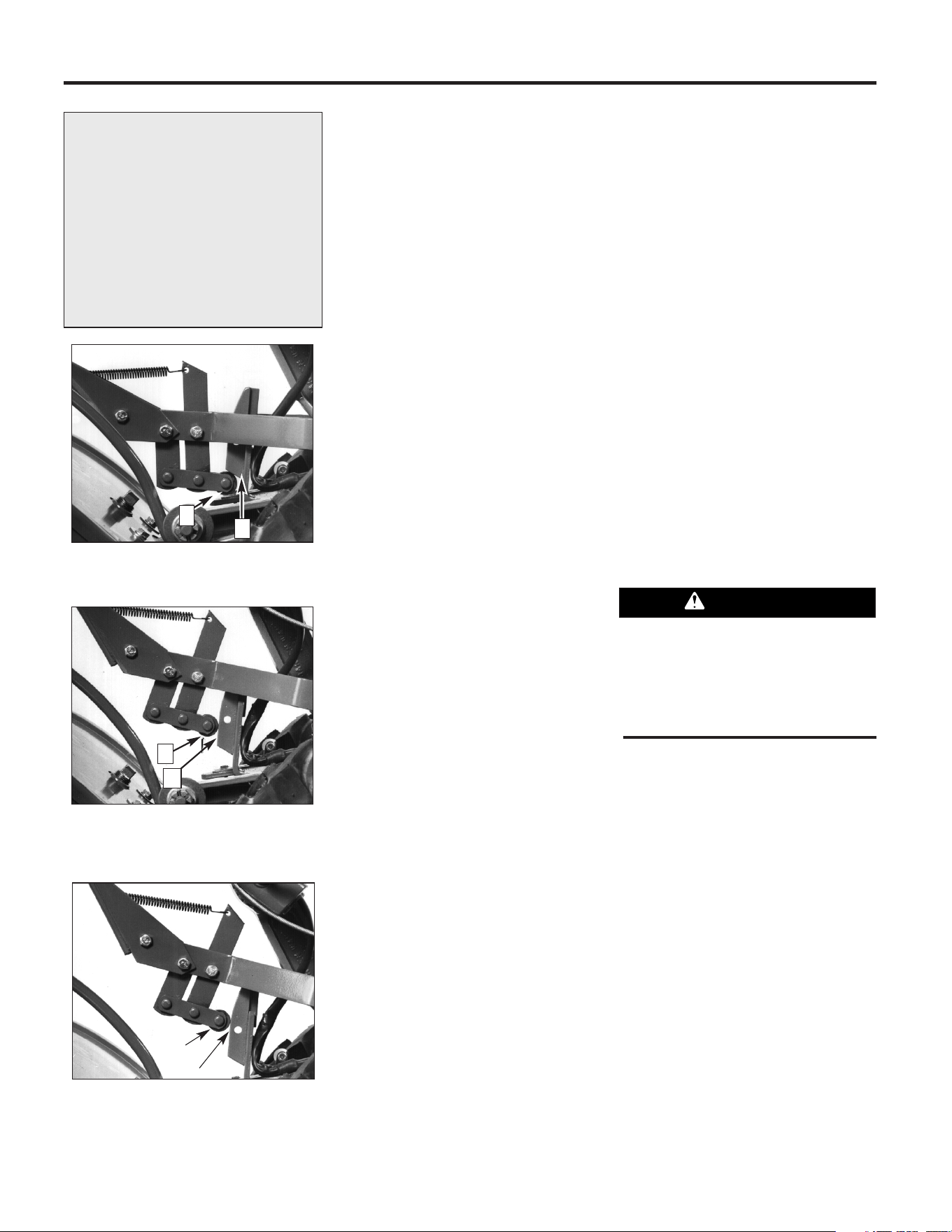
Use the Wheels/Tines/PTO Drive Lever (A,
Figure 3-1) to engage and disengage
power to the transmission.
This lever has three operating positions:
FORWARD, NEUTRAL and REVERSE.
• FORWARD is engaged when the lever is
moved down until the clutch roller (G,
Figure 3-2) engages into the detent
position under the adjustment block (H,
Figure 3-2). You will definitely feel the
lever engage into this position.
Use the FORWARD setting to move the
wheels and tines forward, or to apply
power to an optional PTO (Power Take
Off) attachment. (See also
Forward
Interlock Levers.)
To stop the wheels, tines or any PTO
attachment, move the lever to NEUTRAL
by tapping the lever upwards (Figure
3-3) and releasing.
• REVERSE is engaged when the lever is
pushed (with an open palm) all the way
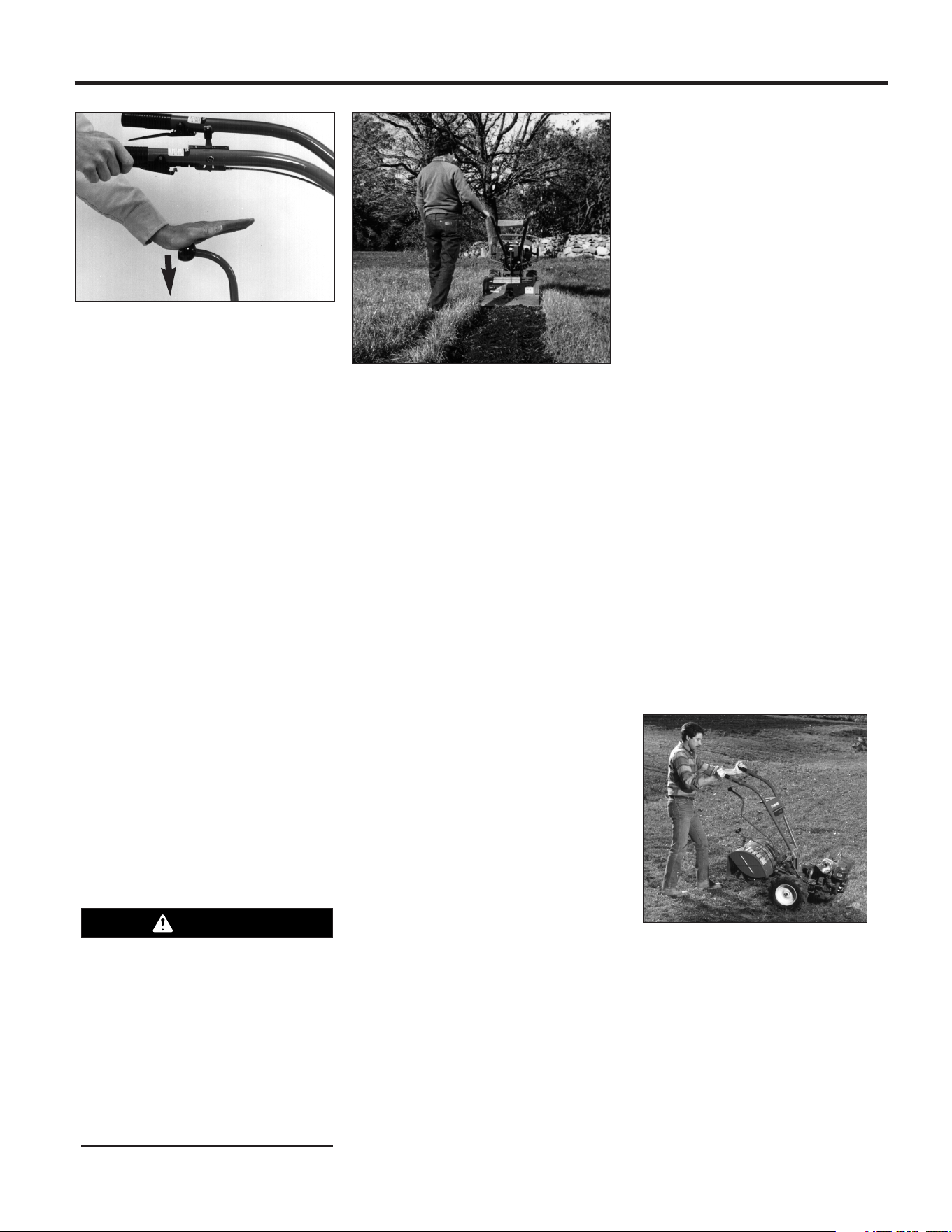
up and held in that position (Figure 3-4).
Use this setting to move the wheels in
reverse. To stop moving in reverse,
release the lever; it automatically returns
to the NEUTRAL position.
IMPORTANT: Do not operate the tines or
any PTO attachment in REVERSE.
• NEUTRAL is this control’s normal non-
operating position. The lever returns to
NEUTRAL when it is tapped out of the
FORWARD position or released from the
REVERSE position. NEUTRAL position
is between FORWARD and REVERSE
(Figure 3-3). Use this setting to stop
the wheels, tines or any PTO attach-
ment.
IMPORTANT: Always shift to NEUTRAL
before starting the engine or before
engaging the wheels, tines or any PTO
attachment.
Forward Interlock Levers
The Forward Interlock Levers (B,
Figure 3-1) are attached under each
handlebar grip.
You must squeeze at least one of these
interlock levers up against the handlebar
grip whenever the Wheels/Tines/PTO
Drive Lever is engaged in FORWARD
position.
Figure 3-1:
A– Wheels/Tines/PTO Drive Lever E– Depth Regulator Lever
B– Forward Interlock Levers F– Handlebar Height Adjustment Lever
C– Wheel Speed Lever G– Engine Throttle Lever
D– Tines/PTO Clutch Lever
A
G
B
C
D
E
F
Before operating your machine,
carefully read and understand all
safety, controls, operating instructions
in this Manual, the separate Engine
Owner’s Manual and on the decals on
the machine.
Failure to follow these instructions can
result in serious personal injury.
WARNING
Section 3: Features and Controls
Figure 3-2: FORWARD position; roller
(G) rests under the adjustment block (H).
Figure 3-3: NEUTRAL position; roller
(G) rests against middle area of the ad-
justment block (H).
Figure 3-4: REVERSE position; roller
(G) rests against upper area of the ad-
justment block (H).
G
H
Verify Position of Clutch Roller
When you shift between FORWARD,
NEUTRAL and REVERSE, the clutch
roller at the base of the
Wheels/Tines/PTO Drive Lever should
be positioned as shown in Figures 3-2,
3-3 and 3-4. Verify the position of the
clutch roller as you shift the lever. If it
is not positioned correctly, contact the
Factory or see your local authorized
dealer.
G
H
G
H
12
If both Forward Interlock Levers are
released before first returning the
Wheels/Tines/PTO Drive Lever to
NEUTRAL, the engine will stop.
IMPORTANT: The Forward Interlock
Levers are a safety control that stops the
engine should you lose control while
going forward and cannot shift into
NEUTRAL.
Wheel Speed Lever
Use the Wheel Speed Lever (C, Fig. 3-1)
to select one of three operating positions:
SLOW, FAST or FREEWHEEL.
• SLOW – Lever moved all the way down.
Most effective for normal tilling or for
low-speed transport.
• FAST – Lever moved all the way up.
Most effective for cultivating or for fast-
speed transport.
• FREEWHEEL – Lever in between SLOW
and FAST (wheels will roll freely). Used
when transporting the machine on level
ground without engine power, and when
using stationary PTO attachments.
IMPORTANT: To avoid transmission
damage, always move Wheels/Tines/PTO
Drive Lever into NEUTRAL before shifting
the Wheel Speed Lever.
IMPORTANT: When shifting into SLOW
or FAST, gently roll the machine forward
or backward to help fully engage the
wheel gears. When engaged, the wheels
will not turn unless the engine is running
and the Wheels/Tines/PTO Drive Lever is
engaged in FORWARD or REVERSE.
Tines/PTO Clutch Lever
Use this lever (D, Figure 3-1) to engage or
disengage power from the transmission
PTO clutch to the tines or any PTO attach-
ment. This control has two operating
positions: ENGAGE and DISENGAGE.
• ENGAGE – Lever moved into detent slot
farthest from engine. Use this position to
operate tines or other PTO attachments.
After shifting to ENGAGE, briefly operate
machine in FORWARD to help fully
engage the PTO clutch.
• DISENGAGE – Lever moved into detent
slot nearest engine. Use this position to
disengage power to tines or other PTO
attachments before transporting, loading,
turning, or operating in reverse.
IMPORTANT: To avoid transmission
damage, always move the Wheels/Tines/
PTO Drive Lever into NEUTRAL before
shifting the Tines/PTO Clutch Lever.
Depth Regulator Lever
Use this lever (E, Figure 3-1) to regulate
the tilling depth of the tines. This control
also has a TRAVEL position, which
enables transport with the tines off the
ground.
To operate the lever, lift up on the handle-
bars, pull the Depth Regulator Lever
straight back, and then slide it up or down
to one of the eight detent height settings.
The eight detent positions offer a range of
tine height settings. This enables you to
select the height that is most effective for
a particular condition. The top detent
position is the TRAVEL setting. Use the
second or third detent from the top for
shallow tilling and cultivating. Use the
other detents for deeper tilling and for
power composting.
Handlebar Height Adjustment
Lever
Use this lever (F, Figure 3-1) to adjust the
handlebars to one of two height settings.
1. To change the height, hold the handle-
bars with one hand and loosen the lever in
a counterclockwise direction.
2. Move the handlebars to one of the two
preset height settings.
3. Retighten the lever.
NOTE: You can swap the positions of the
inside handlebar ratchets to change the
two preset settings by approximately four
inches higher or lower. See Section 2,
Step 2: Attach Handlebar for detailed
assembly information.
To avoid personal injury,
always place the tines in the TRAVEL
position before starting the engine.
This prevents the tines from touching
the ground until you are ready to begin
tilling.
WARNING
Engine Throttle Lever
Use the throttle lever (G, Figure 3-1) to
adjust engine speed as well as to start
and stop the engine.
Move the lever away from the STOP
position before starting the engine.
Engine speeds are variable and range
between the FAST and SLOW. Use the
STOP position to turn the engine off.
NOTE: A secondary throttle lever is
located on the front of the 8HP and 10HP
engines. A separate On/Off switch may
also be available on the engine. (See
Engine Owner’s Manual for information.)
Engine Controls
Refer to the engine manufacturer’s Engine
Owner’s Manual (included in the tiller lit-
erature package) to identify the controls
on your engine.
IMPORTANT: An engine On/Off switch, a
secondary throttle control, a choke lever
and a fuel line shut-off control may be
located on the engine. Refer to your
Engine Owner’s Manual for detailed
information.
Section 3: Features and Controls
The tiller handlebars can be swung out
30
o
to the right side for use only with the
PTO Chipper/Shredder attachment. This
is done by loosening the mounting bolt
on the handlebar base. Never operate
your tiller or attachments, other than the
PTO Chipper/Shredder, with the handle-
bars in the right side position. Doing so
could result in unsafe handling and
personal injury.
WARNING
To avoid serious personal injury or
damage to equipment, do not start your
engine at this time. Complete starting
instructions are described in Section 4,
Operation.
WARNING
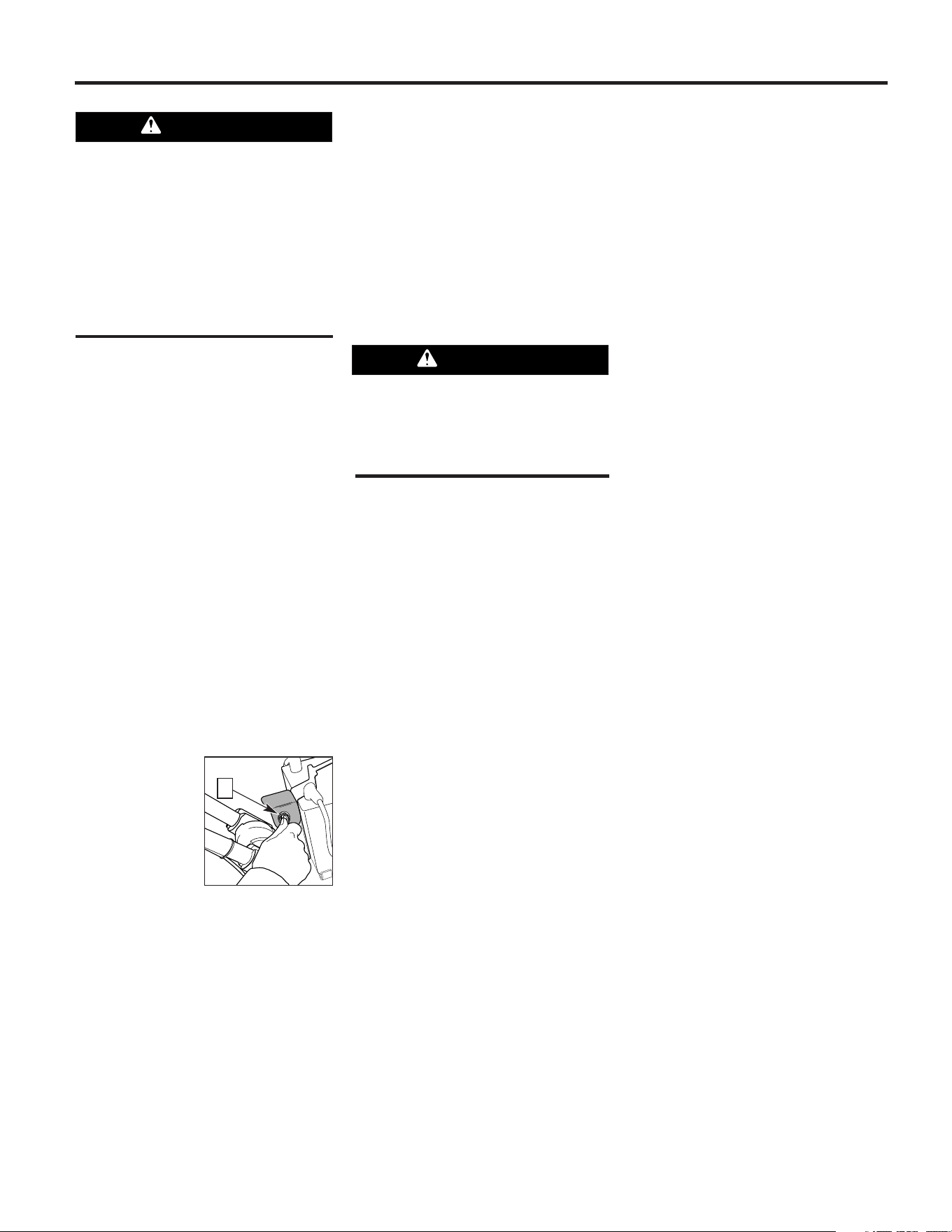
Keyswitch Starter
The keyswitch starter on electric start
models (A, Figure 3-5) has three
positions: OFF, RUN and START. Turn
the key to START to start the engine.
Release the key and
it will return to the
RUN position. Turn
the key to OFF to
stop the engine.
(Another way to
stop the engine is to
move the engine
throttle lever to the
STOP position.)
Figure 3-5
A
13
Section
4
Operation
INTRODUCTION
Read this Section of the manual
thoroughly before you start the engine.
Then, take the time to familiarize yourself
with the basic operation of the tiller
before using it in your garden. Find an
open, level area and practice using the
tiller controls without the tines engaging
the soil (put tines in Travel setting—
Section 3,
Depth Regulator Lever). Only
after you’ve become completely familiar
with the tiller should you begin using it in
the garden.
Break-In Operation
Perform the following maintenance during
the first hours of new operation (see
Maintenance Section in this Manual and
maintenance information in the Engine
Owner’s Manual).
1. Change engine oil after first 2 hours of
new engine operation.
2. After the first 2 hours of new
operation, check the gear oil levels in the
PTO Power Unit and the tine attachment
transmissions.
3. Check for loose or missing hardware
on unit. Tighten or replace as needed.
4. Check tension on forward drive belt
after first 2 hours of operation.
Starting and Stopping the Engine
The following steps describe how to start
and stop the engine.
IMPORTANT: Do not attempt to engage
the tines, wheels, or any PTO attachment
until you have read all of the operating
instructions in this Section. Also review
the safety rules in Section 1,
Safety and
the tiller and engine controls information
in Section 3, Features and Controls.
Pre-Start Checklist
Make the following checks and perform
the following services before starting the
engine.
1. Read the Safety and Controls Sections
in this Manual. Read the separate Engine
Owner’s Manual provided by the engine
manufacturer.
2. Check unit for loose or missing
hardware. Service as required.
3. Check engine oil level. See Engine
Owner’s Manual.
4. Shift the Wheels/Tines/PTO Drive lever
(Figure 4-2) into NEUTRAL position. See
Section 3, Controls for more information
on this lever.
5. Check Safety Guards. All guards and
covers must be securely in place.
6. Check air cleaner. See Engine Owner’s
Manual.
7. Attach spark plug wire to spark plug.
8. Check Engine Cooling System. Clear
cooling fins and air intake screen of
debris.
9. Select High/Low Belt Speed range.
10. Adjust Handlebar Height.
11. Fill the fuel tank with gasoline in
accordance with the directions in the
separate Engine Owner’s Manual. Follow
all instructions and safety rules carefully.
Your tiller and its optional PTO Power
Unit attachments are capable of
causing serious injury to untrained or
careless operators.
To avoid serious personal injury or
property damage, read the Owner’s
Manual that is provided with any
optional accessories or attachments
before using the tiller or PTO Power
Unit.
WARNING
Figure: 4-1
Before operating your machine,
carefully read and understand all safety
(Section 1), controls (Section 3) and
operating instructions (Section 4) in
this Manual, in the separate Engine
Owner’s Manual, and on the decals on
the machine.
Failure to follow these instructions can
result in serious personal injury.
WARNING
GASOLINE IS HIGHLY FLAMMABLE AND
ITS VAPORS ARE EXPLOSIVE.
Follow gasoline safety rules in this
Manual (Section 1) and in the separate
Engine Owner’s Manual.
Failure to follow gasoline safety instruc-
tions can result in serious personal
injury and property damage.
DANGER
14
Section 4: Operation
Starting the Engine:
1. With the engine off, place the
Wheels/Tines/PTO Drive Lever (Figure
4-2) in the NEUTRAL position. If in the
FORWARD position, tap the lever sharply
upward, it should automatically move into
NEUTRAL position.
2. Put the Depth Regulator Lever in the
Travel position (lever all the way down)
so that the tines are off the ground. To do
this, lift up on the handlebars, pull the
lever (Figure 4-2) back, and push it down
all the way to the top detent (notched)
position.
3. Move the Wheel Speed Lever (Figure
4-2) to either the SLOW or FAST position.
Be sure to roll the wheels while shifting the
lever until the wheels engage.
NOTE: If using a PTO stationary attach-
ment, move the Wheel Speed Lever into
FREEWHEEL and block the wheels to
prevent the equipment from moving (Figure
4-29 on page 29).
4. Move the Tines/PTO Clutch Lever into
DISENGAGE position (Figure 4-2).
NOTE: Use the ENGAGE position if you want
the tines to revolve or to apply power to a
PTO-driven stationary attachment.
5. If engine is equipped with a fuel valve,
turn valve to OPEN position as instructed
in the separate Engine Owner’s Manual.
6. If engine is equipped with an ON/OFF
switch, move the switch to ON.
7. Move engine throttle lever (Figure 4-2)
away from STOP.
8. Choke or prime engine as instructed in
the separate Engine Owner’s Manual.
9. If not equipped with an electric start
system, place one hand on the fuel tank to
stabilize the unit when you pull the recoil
starter rope. Use the recoil starter rope to
start the engine as instructed in the
separate Engine Owner’s Manual.
10. If equipped with an electric start
system, turn key to START position to crank
engine then release when engine starts. If
the engine does not start right away, do not
hold key at START for more than a few
seconds. Release then try again after a short
pause. Damage to starter motor can occur if
it is cranked more than 15 seconds per
minute.
11. If the engine does not start after a
number of tries, refer to the Engine Owner’s
Manual for specific instructions.
12. When engine starts, move the Throttle
Lever to the SLOW position and then
gradually move choke lever (on engines so
equipped) to OFF or RUN position.
13. Move the throttle speed control to
FAST setting when tilling.
Starting Electric Start Engines
with the Recoil Starter Rope
You may, at some point, have to start an
electric start engine with the recoil starter
rope. Before attempting to do so,
perform the following applicable steps:
• If you suspect the battery charge is
weak, and there is no visible damage.
Disconnect cables from battery and
clean both cable terminals, and the
battery posts in accordance with the
instructions provided in Section 5,
Battery Care and Maintenance.
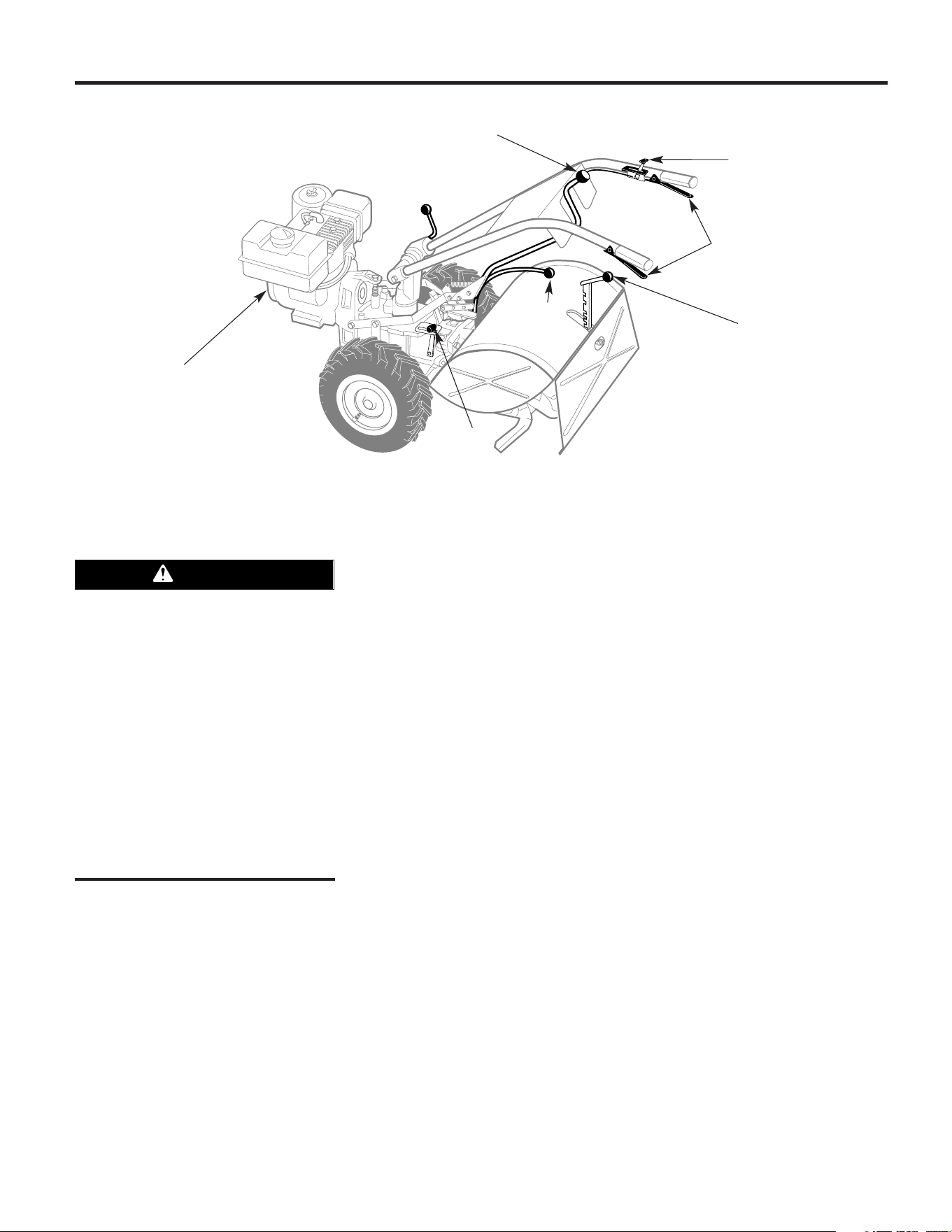
Figure 4-2: Tiller and engine controls.
Wheels/Tines/PTO
Drive Lever
Forward
Interlock Levers
Depth
Regulator
Lever
Wheel
Speed
Lever
Engine Throttle
Lever
Tines/PTO
Clutch Lever
Recoil Start Rope
(at front of engine)
15
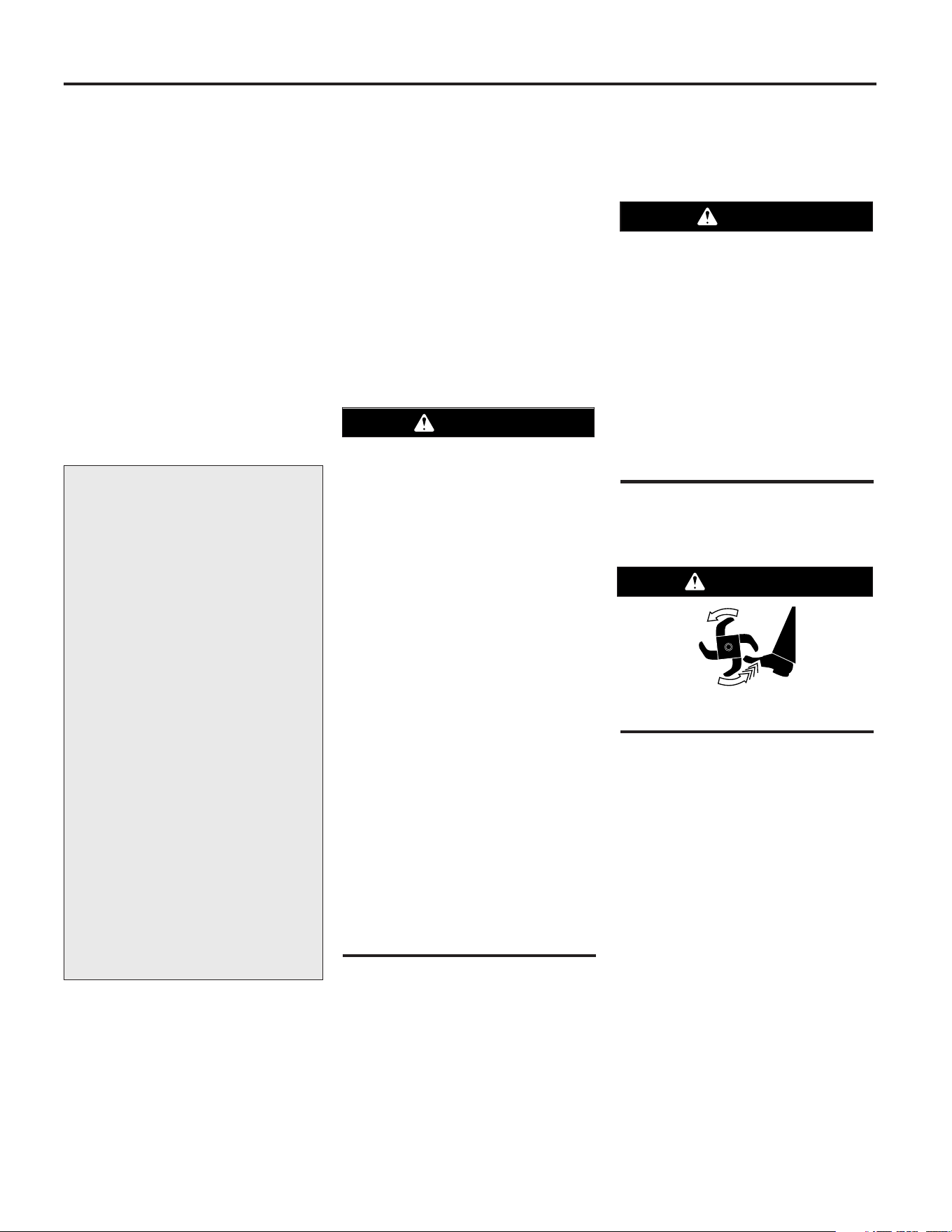
To help prevent serious
personal injury or damage to equipment:
• Always place Wheels/Tines/PTO Drive
Lever into NEUTRAL before starting
engine, and before engaging wheels,
tines or other PTO-driven attachments.
• Never run engine indoors or in
enclosed, poorly ventilated areas.
Engine exhaust contains carbon
monoxide, an odorless and deadly
gas.
• Avoid engine muffler and nearby
areas. Temperatures in these areas
may exceed 150
o
F.
CAUTION
Section 4: Operation
Reconnect the cables and securely
tighten to battery posts. The engine will
recharge the battery if the battery is still
good.
• If you suspect the batter is “dead”, or if
the battery is damaged, disconnect, and
remove it. Have it checked by a
qualified technician.
• If battery has been removed, wrap cable
terminals at end of positive cable with
electrical tape and secure the cable to
the battery bracket. This will prevent
electrical discharge.
• Before pulling the recoil starter rope,
turn the keyswitch to the RUN position.
Move the Throttle Lever away from
STOP position and set the choke as
applicable. See Engine Owner’s Manual.
Stopping the Engine and Tiller
1. To stop the wheels and tines, move the
Wheels/Tines/PTO Drive Lever into
NEUTRAL position and then release both
Forward Interlock Levers.
2. Move the engine Throttle Lever to the
STOP position. Then on electric start
models, turn the key to OFF. Remove the
key for safekeeping.
NOTE: The engine may have a separate
Throttle Control Lever and ON/OFF switch
on the engine. These controls can also be
used to stop the engine. See the Engine
Owner’s manual for information specific
to your engine.
Operating the Tiller
When first practicing, keep the Tines/PTO
Clutch Lever in DISENGAGE position and
the Wheel Speed Lever in SLOW position.
The following pages provide guidelines
for using your tiller effectively and safely
in various gardening applications. Be
sure to read
Tilling Tips & Techniques, in
this Section, before you actually put the
tines into the soil.
This is a traditional standard-rotating-tine
(SRT) tiller with forward rotating tines. It
operates in a completely different manner
than counter-rotating-tine (CRT) tillers, or
from front-tine tillers.
Moving the Tiller Forward and Tilling
1. Start the engine and gradually increase
engine speed to FAST (see
Starting the
Engine, this Section).
2. Test the Forward Interlock Safety
System. See Testing Forward Interlock
System
, this Section.
3. When practicing, set the Depth
Regulator Lever to Travel position.
Otherwise, set the Depth Regulator Lever
to a desired depth.
4. Move Tines/PTO Clutch Lever to
ENGAGE position if you want the tines to
turn. If practicing, leave in DISENGAGE.
IMPORTANT: Do not move Tines/PTO
Clutch Lever to ENGAGE unless
Wheels/Tines/PTO Drive Lever is in
NEUTRAL. Tiller damage may occur!
5. To move the tiller forward and engage
the tines, squeeze and hold either Forward
Interlock Lever (Figure 4-3) against the
handlebar grip, then move the
Wheels/Tines/PTO Drive Lever down to
FORWARD position.
To avoid serious personal injury or
damage to equipment:
• Always place Wheels/Tines/PTO Drive
Lever in NEUTRAL before starting
engine, and before engaging wheels,
tines or other PTO attachments.
• Be sure there are no obstacles behind
you before moving in reverse.
• Wheels/Tines/PTO Drive Lever should
automatically return to NEUTRAL
when released from REVERSE
position. If it does not, move lever to
NEUTRAL manually and discontinue
use until you adjust the lever. See
Section 5,
Checking and Adjusting
Reverse Drive System.
• No reverse motion should occur if
Wheels/Tines/PTO Drive Lever is not
held up in REVERSE. See Section 5,
Checking and Adjusting Reverse
Drive System for adjustment steps.
Do not use tiller unless properly
adjusted.
• Always return to NEUTRAL and let all
motion stop before shifting to
FORWARD or REVERSE.
CAUTION
The Forward Interlock Safety System is
designed for the operator’s safety. Do
not disconnect or attempt to defeat the
purpose of the system. If the system
malfunctions, immediately contact your
local authorized dealer or the
TROY-BILT Technical Service Depart-
ment for assistance. Do not use the
tiller or the PTO power unit until the
Forward Interlock Safety System is
functioning properly. Always test the
system before using the tiller or PTO
power unit.
DANGER
Keep away from rotating tines. Rotating
tines will cause injury.
WARNING
Cold Weather Operation
When temperatures fall below 40
o
F, do
the following steps to protect your
engine and transmission from damage:
1. Refer to the Engine Owner’s Manual
for motor oil specifications for cold
weather operation. Use winter blend
gasoline.
2. Warm up the engine before putting it
under a load.
3. Use winter-blend gasoline.
4. Use the correct weight gear oil in PTO
Power Unit transmission.
5. Warm up the transmission gear oil as
follows: With engine running, move
Wheel Speed Lever (Figure 4-2) to
FREEWHEEL (then block wheels so they
can’t roll), put Tines/PTO Clutch Lever
into DISENGAGE, then squeeze one of
the Forward Interlock Levers and shift
the Wheels/Tines/PTO Drive Lever to
FORWARD.
6. If wheels are frozen to the ground,
melt ice with warm water.
16
Section 4: Operation
6. When the tiller moves forward, relax
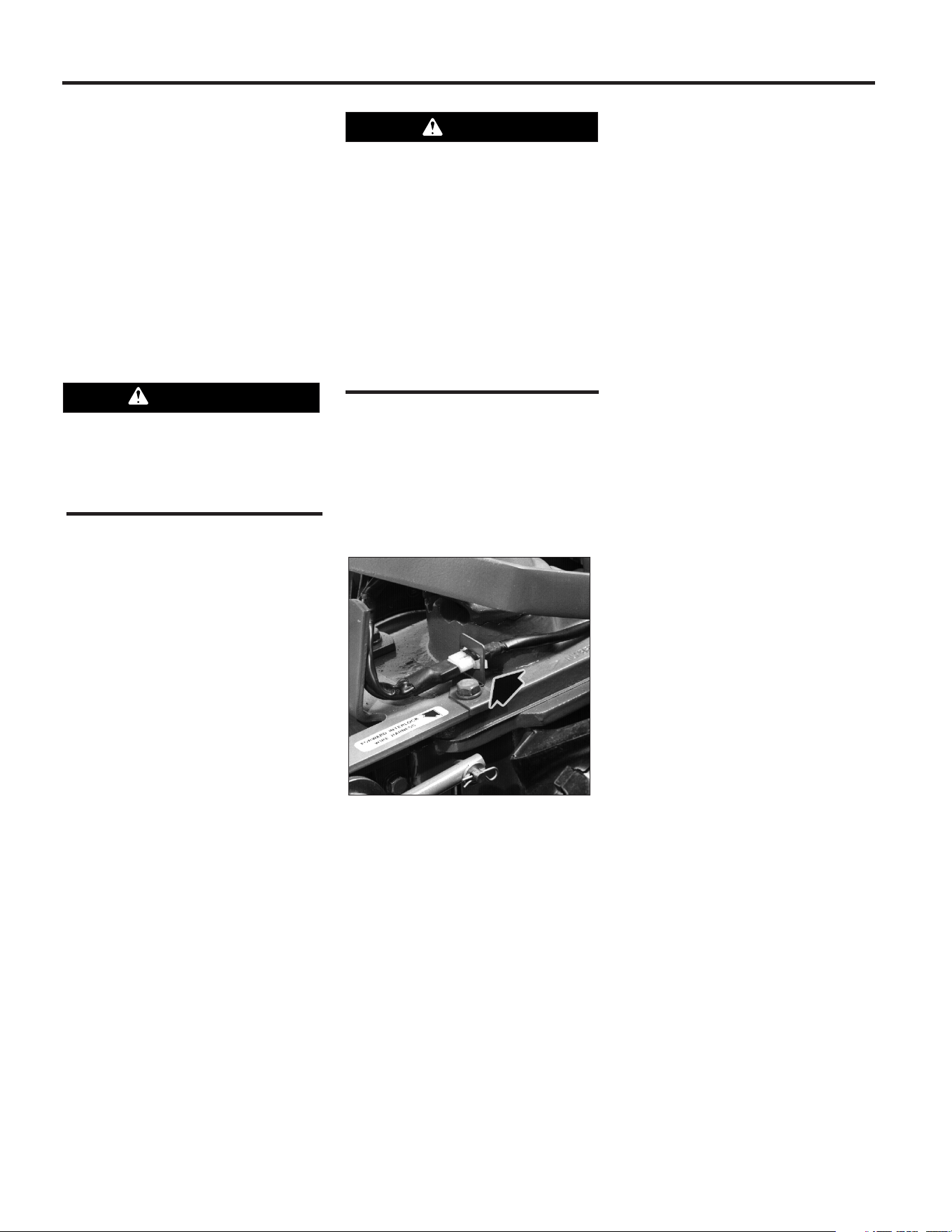
and let the wheels power the tiller along
while the tines dig. Walk behind and to
one side of the tiller. Walk on the side
that is not yet tilled (Figure 4-4). Use a
firm grip on the handlebars but keep your
arm relaxed.
IMPORTANT: Let the tiller move ahead at
its own pace. Do not push it ahead—this
reduces operator control and tilling effi-
ciency. Do not push handlebars down in
an attempt to dig deeper— this takes
weight off the wheels, reduces traction,
and causes the tines to try to propel the
tiller.
Stopping Forward Motion and Tines
1. To stop forward motion, tap
Wheels/Tines/PTO Drive Lever upward
into NEUTRAL. Then release the Forward
Interlock Levers. The wheels and tines
will stop and the engine will continue
running.
2. In an emergency, release all of the
control levers. This stops forward motion
and shuts-off the engine.
Moving the Tiller in Reverse
IMPORTANT: Do not till while in
REVERSE.
1. Shift the Tines/Wheels/PTO Drive Lever
(Figure 4-2) into NEUTRAL and move the
Wheel Speed Lever to the SLOW position.
2. Move Tines/PTO Clutch Lever (Figure
4-2) into DISENGAGE position.
3. Verify that the area behind you is clear.
4. Lift up the handlebars until the tines
are off the ground, then shift the
Wheels/Tines/PTO Drive Lever all the way
up and hold. You do not need to squeeze
the Forward Interlock Levers to use
reverse.
5. The unit immediately engages in
reverse. Periodically check behind you
while holding the handlebars up and the
Wheels/Tines/PTO Lever in its upper-most
position.
Stopping Reverse Motion
Release the Wheels/Tines/PTO Drive
Lever– the lever automatically returns to
the NEUTRAL position. This stops the
wheels immediately. (The Forward
Interlock Levers will not stop REVERSE
motion.)
To Stop the Engine
Move the engine Throttle Lever to the
STOP position. Then, on electric start
models, turn key to OFF. Remove the key
for safekeeping.
Making Turns
Turning the tiller is easy and just requires
practice. First find the balance point
between the engine and the tines by lifting
up the handlebars (Figure 4-5). Once you
find the balance point, then let the
powered wheels do the turning as you
push sideways on the handlebars in the
direction of the turn. Practice the turning
maneuver described here in a large open
area. Once comfortable turning the tiller,
you can then take it to the garden area.
1. At the end of a row, move the Wheels/
Tines/PTO Drive Lever (Figure 4-2) to
NEUTRAL position and reduce the engine
speed.
2. Move the Tines/PTO Clutch Lever
(Figure 4-2) into the DISENGAGE
position.
3. Resume forward operation, and lift
handlebars until tines are off the ground
(Figure 4-5). Find the balance point
between the engine and the tines. Then
push the handlebars in the direction of the
turn.
Be very careful to keep feet and legs
away from the tines (which should be dis-
engaged).
Let the powered wheels do the
hard work. The inside wheel will pivot in
place while the outside wheel drives the
tiller around in the direction of the turn.
NOTE: Use REVERSE if necessary to turn
in a limited space.
17
Figure 4-4: Guide tiller with one hand.
Figure 4-3: Moving tiller forward:
squeeze one Forward Interlock Lever
and then move Wheels/Tines/PTO
Drive Lever down to FORWARD.
To Help Avoid Personal Injury or
Damage to Equipment:
• Be sure no obstacles are behind you
before operating the tiller in REVERSE.
• Disengage the tines, reduce engine
speed, and move the Wheel Speed
Lever to SLOW position before
operating in REVERSE. Avoid using
FAST wheel speed until you are
familiar with backing the tiller.
CAUTION
Figure 4-5: Turning the tiller.
Section 4: Operation
4. When the turn is complete, shift to
NEUTRAL and lower the handlebars.
Move Tines/PTO Clutch Lever back to
ENGAGE position and resume forward
operation.
Transporting The Tiller Around
Your Property
When the engine is running, the tiller’s
powered wheels make moving the tiller to
and from the garden easy. If the engine is
not running set the Wheel Speed Lever to
FREEWHEEL position to roll the tiller to
another location.
1. Place the Tines/PTO Clutch Lever in
DISENGAGE position.
2. Move Depth Regulator Lever down all the
way into the Travel setting.
3. If using engine power, move Wheel
Speed Lever to either SLOW or FAST, and
use the Wheels/Tines/PTO Drive Lever to
drive the wheels.
4. If the engine is stopped, move Wheel
Speed Lever to FREEWHEEL, and
manually push tiller.
Testing the Forward
Interlock Safety System
The Forward Interlock Safety System is
designed to shut the tiller engine off
immediately if you lose control and
cannot stop moving FORWARD by
shifting the Wheels/Tines/PTO Drive Lever
into NEUTRAL. When you release both
Forward Interlock Levers, they send
ground to the ignition system thereby
stopping the engine. Squeezing one or
both levers up against the handlebars
enables the ignition system; therefore,
you must squeeze at least one lever
whenever the Wheels/Tines/PTO Drive
Lever is engaged in FORWARD.
IMPORTANT: The interlock system also
prevents the engine from starting if the
Wheels/Tines/PTO Drive Lever is engaged
in FORWARD.
How to Check the Interlock System
The Forward Interlock System has an
electro-mechanical design, and so is
subject to normal wear and possible mal-
function. Check the system for proper
operation each time prior to using the
tiller or PTO power unit.
To test the Forward Interlock System:
1. Move tiller outside to level ground.
Remove any obstacles.
2. Check that the Forward Interlock wire
harness plug, at the bottom of the handle-
bars (Figure 4-6), is securely connected
to the receptacle on the top, right side of
the transmission.
3. Move Wheel Speed Lever (Figure 4-2)
to SLOW position and move Tines/ PTO
Clutch Lever to DISENGAGE.
4. Start engine as described under
Starting and Stopping the Engine, in this
section. Set engine throttle lever to
SLOW, and let engine warm up.
5. Squeeze and hold just one of the
Forward Interlock Levers against the
handlebar grip while moving the Wheels/
Tines/ PTO Drive Lever down to
FORWARD (Figure 4-3). As the tiller
moves forward, release the Forward Inter-
lock Lever briefly. The engine should
start to stall out if the interlock system is
working properly. If it does start to stall,
quickly squeeze the lever up against the
handlebar grip, and then return the
Wheels/ Tines/ PTO Drive Lever to
NEUTRAL. Repeat this test to check that
the engine begins to stall out when the
other Forward Interlock Lever is released.
6. If the engine does not begin to shut off
when either Forward Interlock lever is
released, shut the engine off, remove the
key (if electric start), and
do not operate
the tiller or PTO power unit until the
system has been repaired and is func-
tioning properly.
IMPORTANT:
To avoid possible damage
to the Forward Interlock Safety system,
do not use high-pressure sprays near the
wire harness receptacle or neutral plunger
assembly.
Loading and Unloading the Tiller
The following provides information on
tiller loading, unloading, and requirements
before loading and unloading the tiller.
Read the following instructions carefully
before attempting to load or unload your
tiller.
Before Loading or Unloading the
Tiller
• Ramps must be strong enough to
support the combined weight of the tiller
and handlers. They should provide good
traction to prevent slipping; they should
have side rails to guide the tiller along
the ramps; and they should have a
locking device to secure them to the
vehicle.
• Handlers should wear sturdy footwear
that will help to prevent slipping.
Figure 4-6: Plug and receptacle of
Forward Interlock Safety System
must be securely connected.
The Forward Interlock Safety System is
designed for the operator’s safety. Do
not disconnect or attempt to defeat the
purpose of the system. If the system
malfunctions, immediately contact your
local authorized dealer or the
TROY-BILT Technical Service Depart-
ment for assistance. Do not use the
tiller or the PTO power unit until the
Forward Interlock Safety System is
functioning properly. Always test the
system before using the tiller or PTO
power unit.
DANGER
To help avoid personal injury from
revolving tines, always put the
Tines/PTO Clutch Lever in DISENGAGE
position before transporting, loading, or
unloading tiller.
WARNING
18
Section 4: Operation
• Turn the vehicle’s engine off and apply
its parking brake.
• Position the loading vehicle so that the
ramp angle is as flat as possible (the
less incline to the ramp, the better).
Loading the Tiller
1. Use loading ramps that are strong and
wide enough to safely hold the weight of
the tiller and the operator combined—
your tiller weighs between 280 and 325
lbs.
2. Move the Tines/PTO Clutch Lever
(Figure 4-2) into DISENGAGE position.
3. Set the Depth Regulator lever (Figure
4-2) to the Travel position.
4. Move Wheel Speed Lever (Figure 4-2)
into SLOW position and reduce the
engine throttle speed.
5. Shift the Wheels/Tines/PTO Lever
(Figure 4-2) into FORWARD position and
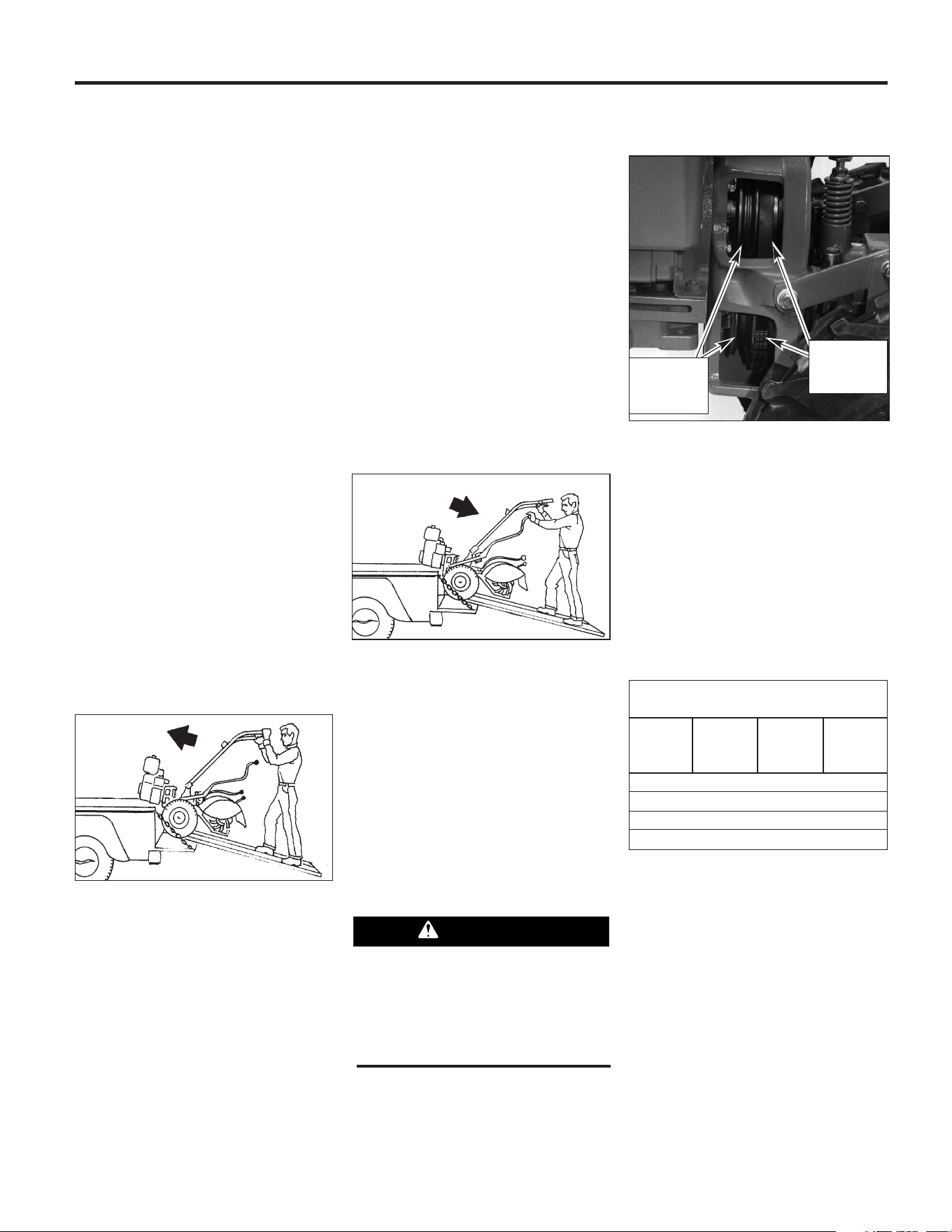
follow the tiller up the ramps (Figure 4-7).
Check the wheels as you move the tiller
forward. Ensure that they move up the
center of each ramp.
6. Prevent tiller from rolling in vehicle.
Leave Wheel Speed Lever in FAST or
SLOW position, chock wheels with blocks
and tie down the tiller.
Unloading the Tiller
IMPORTANT: Never unload the tiller in
FORWARD drive. The tiller could tip
forward and expose you to the tines
(which should be disengaged as
instructed).
1. Use loading ramps that are strong and
wide enough to safely hold the weight of
the tiller and the operator combined—
your tiller weighs between 280 and 325
lbs.
2. Move the Tines/PTO Clutch Lever
(Figure 4-2) to DISENGAGE position.
3. Set the Depth Regulator Lever (Figure
4-2) to the Travel position.
4. Move Wheel Speed Lever (Figure 4-2)
to SLOW position and reduce the engine
throttle speed.
IMPORTANT: Look behind you before
you back down the ramp to ensure that all
is clear. While descending, keep checking
for obstacles behind you.
5. Move and hold the Wheels/Tines/PTO
Lever into REVERSE drive and back down
the ramps (Figure 4-8). Check the wheels
as you move the tiller backward. Ensure
that they move down the center of each
ramp.
Changing Speed Belts
Your tiller has two belt-driven speed
ranges – HIGH RANGE and LOW RANGE
– you pick one or the other by deciding
which set of pulley grooves to move the
forward belt into. By moving the belt
from one speed range into the other, in
combination with the FAST and SLOW
wheel speeds, you obtain a choice of four
different forward wheel speeds and two
different tine speeds.
Changing the belt from LOW range into
HIGH range (or back again) is a matter of
moving the belt from one set of pulley
grooves to a second set of pulley grooves.
This change is done quickly and without
tools (Figures 4-9 through 4-13).
When the tiller is moving in REVERSE, the
wheels are powered by a rubber reverse
disc, not by the belt. Therefore, you have
only two reverse speeds SLOW and FAST,
as set with the Wheel Speed Lever.
Table 4-1 shows the range of wheel and
tine speeds available when using the two
belt speed ranges and the FAST and
SLOW selections on the Wheel Speed
Lever.
Changing Belt From LOW Range
to HIGH Range
1. To avoid personal injury, shut off
engine, let all moving parts come to a
complete stop, then disconnect spark
plug wire from spark plug and move it
away from spark plug before making any
adjustments. Wait for the engine and
muffler to cool down.
2. Move Wheels/Tines/PTO Drive Lever
into NEUTRAL.
19
Figure 4-7: To go up ramps, use
Figure 4-8: To go down ramps, use
REVERSE drive.
Figure 4-9: Belt range positions.
To help avoid serious personal injury,
stop the engine, remove the ignition
key, disconnect spark plug wire and
move the wire away from the spark
plug, and let engine and muffler cool
down before changing belt speeds.
WARNING
Low Range
Pulley
Grooves
High Range
Pulley
Grooves
Table 4-1
Available wheel and tine speeds at 3000 RPM
engine speed.
Belt
Position
Wheel
Speed
Lever
Wheel
Speed
Tine
Speed
Low Range Slow .5MPH 146RPM
Low Range Fast 1.2MPH 146RPM
High Range Slow .7MPH 200RPM
High Range Fast 1.72MPH 200RPM
Section 4: Operation
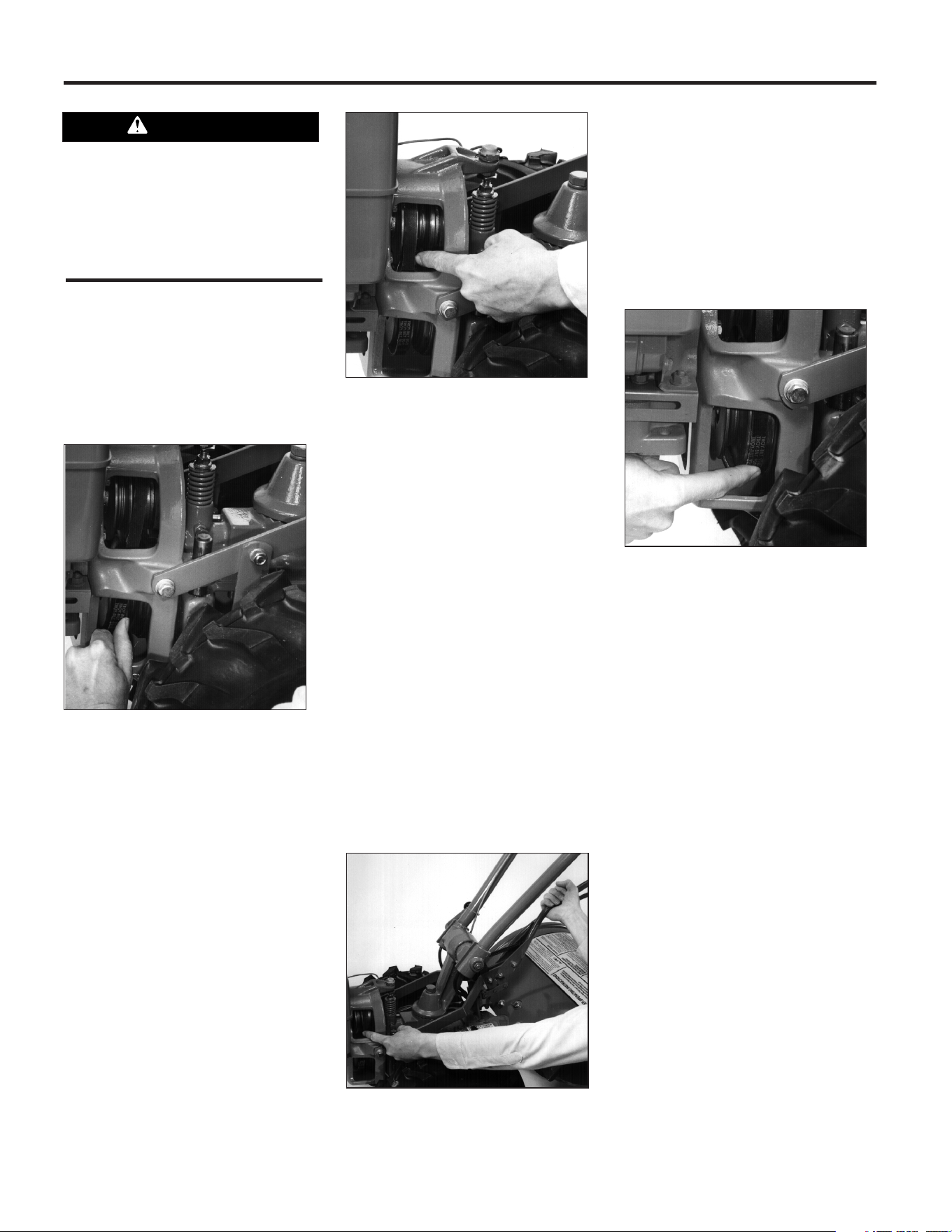
3. Kneel on left side of tiller. To create
belt slack, reach over to right side of the
pulleys and push in at the center of the
belt with a finger. At the same time, use
your left hand to work the belt part-way
onto the lower-front transmission pulley
groove (Figure 4-10).
4. Go to the other side of the tiller to
finish seating the belt onto the pulley
groove.
5. Working from the left side of the tiller,
work the belt as much as possible onto
the top-front engine pulley groove (Figure
4-11).
6. Finish seating the belt from the right
side
of the tiller.
IMPORTANT: Proper belt tension is
important for good performance. See
Section 5,
Drive Belt Maintenance for
information on belt maintenance schedule
and procedures.
NOTE: If extra belt slack is needed to
move the belt, just raise the
Wheels/Tines/PTO Drive Lever up into
REVERSE. This lowers the engine pulley,
and creates more slack.
7. Check both sides of the high range
pulley grooves to verify that the belt is
properly seated.
Changing Belt From HIGH Range to
LOW Range
1. To avoid personal injury, shut off
engine, let all moving parts come to a
complete stop, then disconnect spark
plug wire from spark plug and move wire
away from spark plug before making any
adjustments. Let engine and muffler cool.
2. Move the Wheels/Tines/PTO Drive
Lever into NEUTRAL.
3. Stand on left side of tiller. Use your
right hand to hold the Wheels/Tines/PTO
Drive Lever up into REVERSE position.
Use your left hand to move the belt off
top-front engine pulley groove to top-rear
engine pulley groove (Figure 4-12).
4. Go to right side of tiller and finish
seating the belt.
5. Still holding the lever up in REVERSE
position, and working from the left side of
the tiller, move the belt from the lower-
front transmission groove to the lower-
rear transmission groove.
6. Go to the right side of the tiller and
finish seating the belt (Figure 4-13).
7. Check that the belt is fully seated in the
pulley grooves. Check this from both
sides of the tiller.
Choosing Wheel
and Tine Speeds
Your tiller has four FORWARD wheel/tine
speed combinations for handling a variety
of tilling tasks and gardening jobs. Exper-
iment with the tine depth, engine speed,
and wheel/tine speed and determine the
combination that provides the best
results. Here are some tips:
1. Advance the throttle lever so the engine
has sufficient power.
2. When tilling untilled or hard earth, do
not set the Depth Regulator too deep. The
tiller will buck and the engine will load
down.
3. You will know your settings are ideal
when the tines break-up the soil easily,
the engine does not labor, and your
progress is steady and smooth.
See Table 2,
Wheel Speed and Belt Range
Selection Guide for recommendations.
20
Figure 4-12: High range to low
range. Shows moving belt from top-
front groove onto top-rear pulley
groove.
Figure 4-13: High range to low
range. Shows moving belt from
lower-front onto lower-rear groove.
Figure 4-11: Low range to high
range. Shows moving belt from top-
rear groove onto top-front groove.
Figure 4-10: Low range to high range.
Shows moving belt from lower-rear
groove onto lower-front groove.
The HIGH speed belt range position
combined with a FAST wheel speed
setting propels the tiller at the fastest
pace. Reduce the engine throttle speed
when starting out to help avoid personal
injury or property damage if using this
speed combination.
WARNING
Section 4: Operation
SLOW GEAR, LOW BELT RANGE
For:
• Tilling in sod.
• Tilling in hard clay.
• Tilling under standing corn-
stalks in tough soil conditions.
• Tilling under cover crops.
• Preparing a deep seedbed.
• Tilling in stony soil.
• Tilling under residues and
organic matter.
• Mixing in fertilizers, manure.
SLOW GEAR, HIGH BELT RANGE
For:
• Tilling in sod or hard clay.
• Tilling under standing corn-
stalks (slow, steady speed
allows time to shred stalks).
• Tilling under cover crops
(best wheel speed and belt
speed range in most soils).
• Preparing seedbeds (best
speed choice in most soils).
• Tilling in stony ground.
• Building raised garden beds.
• Mixing in fertilizer.
• Using hiller wings in hard
soil.
• Mixing fertilizer and manure.
• Tilling residues and organics.
FAST GEAR, LOW BELT RANGE
For:
• Going over seedbed for the
last time before planting crops.
• Covering over seeds in wide
row or plot planting (lift han-
dlebars to avoid going too
deep).
• Hilling and furrowing.
• Making raised beds.
• Cultivating (lift handlebars to
avoid going too deep).
• Tilling large areas.
• Tilling organic matter in.
• Cultivating between raised
beds with optional
hiller/furrower attachment.
FAST GEAR, HIGH BELT RANGE
For:
• Preparing seedbeds for
planting.
• Covering seeds with less need
to hold up the handlebars.
• Cultivating (tiller travels faster,
rides higher on the soil; allows
engine RPM to be reduced;
handlebars don’t have to be
raised).
• Keeping large areas tilled and
cultivated in the summer.
• Tilling organic matter under.
• Moving tiller quickly.
• Cultivating between raised
beds using the optional
hiller/furrower.
TABLE 2-4: WHEEL SPEED AND BELT RANGE SELECTION GUIDE
IMPORTANT — For correct wheel speed and belt range choices when using attachments or accessories
other than tines, read the Owner/Operator Manual provided with the attachment or accessory.
Let the tiller do the work
• While tilling, relax and let the wheels
pull the tiller along while the tines do
the digging. Walk on the side that is not
yet finished (to avoid making footprints
in the freshly tilled soil) and lightly, but
securely grip the handlebar with just
one hand (Figure 4-4).
• Avoid pushing down on the handlebars
in an attempt to force the tiller to dig
deeper. Doing so takes the weight off
the powered wheels, causing them to
lose traction. Without the wheels
helping to hold the tiller back, the tines
will attempt to propel the tiller – often
causing the tiller to skip rapidly across
the ground. (Sometimes, slight
downward pressure on the handlebars
will help get through a particularly
tough section of sod or unbroken
ground, but in most cases this won’t be
necessary.)
Tilling depths
• Avoid trying to dig too deeply too
quickly, especially when busting sod or
tilling soil that hasn’t been tilled for
some time.
Use shallow depth settings
(only an inch or two deep) for the first
passes through the garden area.
With each succeeding pass, adjust the
depth regulator to dig another inch or
two deeper. (Watering the garden area
a few days prior to tilling will make
tilling easier, as will letting the newly
worked soil set for a day or two before
making a final, deep tilling pass.)
• When cultivating (breaking up the
surface soil around plants to help
destroy weeds), use very shallow depth
settings to prevent injury to plants whose
roots often grow close to the surface. If
needed, lift up on the handlebars slightly
to prevent the tines from digging too
deeply. Cultivating on a regular basis not
only eliminates weeds, it also loosens and
aerates the soil for better moisture
absorption and faster plant growth.
Avoid tilling wet, soggy soil
Tilling wet soil often results in large, hard
clumps of soil that can interfere with
planting. If time permits, wait a day or
two after heavy rains to allow the soil to
dry before tilling. Test the soil by
squeezing it into a ball. If it compresses
too easily, it is too wet to till.
Tilling Tips
&
Techniques
21
To help avoid personal injury, be aware
that the tiller can unexpectedly bounce
up or jump ahead and propel away from
you if the tines strike hard or frozen
ground, or buried obstacles like large
stones, roots or stumps. Always use
the following precautions to help
maintain control of the tiller:
• Walk behind and to the side of the
tiller. Use one hand on the handlebars,
relaxing your arm but with a secure
hand grip.
• Use shallow depth regulator settings.
Till gradually deeper.
• Use slower wheel, tine and engine
speeds.
• Clear the tilling area of all large
stones, roots and other debris.
• Do not put downward pressure on the
handlebars. If needed, apply slight
upward handlebar pressure to keep the
tines from digging too deeply.
• Avoid contacting hard soil or sod at
the end of a row – reduce engine speed
and lift handlebars to raise tines out of
the soil.
• In An Emergency, stop tines and
wheels by moving Wheels/Tines/ PTO
Drive Lever to NEUTRAL. If you cannot
reach the lever or have lost control, Let
Go Of The Handlebars and All Controls.
WARNING
Section 4: Operation
22
Avoid making footprints
When possible, walk on the untilled side
of the unit to avoid making footprints in
the freshly tilled soil (Figure 4-4). Foot-
prints cause soil compaction that can
hamper root penetration and contribute
to soil erosion. They can also “plant”
unwanted weed seeds back into the
newly tilled soil.
Suggested tilling patterns
• When preparing a seedbed, go over
the same path twice in the first row,
then overlap one-half the tiller width
on the rest of the passes (Figure 4-
14). When finished in one direction,
make a second pass at a right angle as
shown in Figure 4-15. Overlap each
pass for best results (in very hard
ground it may take three or four
passes to thoroughly pulverize the
soil).
• If the garden size will not permit
lengthwise and then crosswise tilling,
then overlap the first passes by one-
half a tiller width, followed by succes-
sive passes at one-quarter width
(Figure 4-16).
• With planning, you can allow enough
room between rows to cultivate
(Figure 4-17). Leave room for the
hood width, plus enough extra room
for future plant growth.
Tilling on slopes
If you must garden on sloping ground,
please follow two very important guide-
lines:
1. Till only on moderate slopes, never
on steep inclines where footing is
difficult (review safety rules in the
“Safety” Section of this Manual).
2. We recommend tilling up and down
slopes rather than terracing. Tilling
vertically on a slope allows maximum
planting area and also leaves room
for cultivating.
IMPORTANT: When tilling on slopes,
be sure the correct oil level is main-
tained in the engine (check every one-
half hour of operation). The incline of
the slope will cause the oil to slant away
from its normal level and this can starve
engine parts of required lubrication.
Keep the engine oil level at the full point
at all times!
A. Tilling up and down slopes:
• To keep soil erosion to a minimum, be
sure to add enough organic matter to
the soil so that it has good moisture-
holding texture and try to avoid leaving
footprints or wheel marks.
• When tilling vertically, try to make the
first pass uphill as the tiller digs more
deeply going uphill than it does
downhill. In soft soil or weeds, you
may have to lift the handlebars slightly
while going uphill. When going
downhill, overlap the first pass by
about one-half the width of the tiller.
HINT: For best results, use the HIGH
belt range and SLOW wheel speed lever
position. See Changing Speed Belts in
this section for more information on
changing to high range.
Tilling Tips
&
Techniques
Figure 4-14
Figure 4-15
Figure 4-17
1
2
3
Figure 4-16
To avoid serious personal injury or
damage to the equipment:
• Do not operate tiller on a slope too
steep for safe operation. Go slowly
on any slope. Make sure you have
good footing.
• Wear footwear that increases
stability and reduces slippage.
• Do not use FAST wheel speed
position when on sloped ground.
• Do not shift the Wheel Speed Lever
when heading up or down a slope. If
lever is accidentally moved to FREE
WHEEL position, the tiller could roll
out of control.
• To prevent engine damage due to oil
starvation (on slopes,the engine is
inclined and oil moves away from
surfaces that need lubrication), be
sure the correct oil level is main-
tained during all uphill/downhill
tilling operations. Check the level of
the oil in your engine after every one-
half hour of operation.
WARNING
23
B. Terrace Gardening:
• When a slope is too steep or too short
for vertical tilling, it may be necessary
to till across the slope and create
terraced rows. Terraces are rows that
are cut into the side of a slope, creating
a narrow, but flat area on which to
plant.
• On a long slope, you can make several
terraces, one below the other.
• Terraces should be only 2-to-3 feet
wide. Digging too far into the side of
the slope will expose poor subsoil that
is unproductive for plants.
• To create a terrace, start at the top of
the slope and work down. Go back and
forth across the first row as shown in
Figure 4-18.
• Each succeeding lower terrace is
started by walking below the terrace
you’re preparing. For added stability of
the tiller, always keep the uphill wheel
in the soft, newly tilled soil. Do not till
the last 12" or more of the downhill
outside edge of each terrace. This
untilled strip helps prevents the
terraces from breaking apart and
washing downhill. It also provides a
walking path between rows.
C. Tilling across slopes
without terracing
• If vertical or terracing gardening aren’t
practical for you, then you can till
laterally across a slope. We don’t
really recommend this method as it
can create unsure footing and invites
soil erosion.
• Study the terrain to make certain the
slope is not too steep for safe tilling.
If possible, make terraced rows or till
vertically.
• Move the belt into LOW belt range and
the Wheel Speed Gear Lever to SLOW
position. As in terrace gardening, start
at the top of the slope and overlap the
first pass by half the width of the tiller.
For added stability, keep the uphill
wheel in the soft, newly tilled soil. Each
succeeding terraced area is started by
walking
below the terrace you are
preparing (Figure 4-19).
Clearing the tines
The tines have a self-clearing action
which helps to eliminate most tangling
of debris. However, occasionally dry
grass, stringy stalks or tough vines may
become tangled.
Follow these procedures to help avoid
tangling and to clear the tines, if
necessary.
• To reduce tangling, set the Depth
Regulator deep enough to get
maximum “chopping” action as the
tines chop the material against the
ground. Also, try to till under crop
residues or cover crops while they are
green, moist and tender.
• While power composting, try swaying
the handlebars from side to side (about
6" to 12"). This “fishtailing” action
often clears the tines of debris.
• It may be necessary to remove the
debris by hand (a pocket knife will help
you to cut away the material).
Section 4: Operation
Figure 4-18
Before clearing the tines by hand, stop
the engine, allow all moving parts to
stop and disconnect the spark plug
wire. Failure to follow this warning
could result in personal injury.
WARNING
Figure 4-19: Make a terrace in just 4
or 5 passes with the tiller.
Tilling Tips
&
Techniques
Section 4: Operation
24
POWER COMPOSTING
Power composting means tilling under
and burying in the soil all manner of
organic matter such as crop residues,
leaves, grass clippings and cover crops.
This material will decompose during the
non-growing season and add important
natural nutrients to the soil.
Begin by composting crop residues such
as leftover vines, stalks, stems and
roots. Power compost these crop
residues as soon as they finish bearing.
The sooner this is done, the better, as
tender green matter is easier to till
under. Use the deepest depth regulator
setting possible without causing the
engine to labor or the tiller to jump
ahead.
Standing cornstalks of reasonable height
can be power composted (Figure 4-20).
Pushing over (but not uprooting) corn-
stalks will often make it easier for your
tiller to chop up the stalks. Keep the
tines clear of excessive tangling by “fish-
tailing” or frequently using reverse.
Make several passes, then return a few
days later to finish off any remaining
stubble.
After tilling under crop residues, add
more organic matter such as leaves,
grass clippings and even kitchen scraps.
When tilled into the soil, this organic
matter will decompose and add even
more important nutrients to the soil.
After power composting, you may want
to plant a “green manure” cover crop to
protect the soil during the off-season.
Grow a crop of clover, alfalfa,
buckwheat, peas, beans, rye grass,
grain, or kale and then till it into the soil
prior to the planting season.
Wide-Row Planting
The wide-row planting technique is
spreading seeds anywhere from 10
inches to 2 feet wide or more. As a
result, you can grow anywhere from 3 to
4 times (or more) produce in the same
space that is normally set aside for an
area that has narrow, single rows.
Wide-row planting automatically shades
the ground which keeps weed growth
down and also holds moisture in the
soil. And of course, harvesting is much
easier – everything is right at hand to be
picked. Preparing wide rows is easy —
after you prepare the seedbed and mark
off the rows with string, hand-broadcast
the seeds as if seeding a lawn (not quite
as much as lawn seed). Cover with soil
and tamp the area firmly with a hoe.
Tilling Under Corn
After corn is harvested, the stalks should
be tilled into the soil while still green.
Dry plants are more difficult to till under,
and the roots break loose too easily.
IMPORTANT: Do not pull the roots out
by hand or cut the stalks before tilling.
Stalks that are firmly anchored by their
roots are much easier for the tines to
chop, cut, and work under.
1. As you move forward into a row of
stalks, aim the tiller so that the stalks go
between the left wheel and the transmis-
sion case (Figure 4-19). Do not use the
right wheel because damage could occur
to the air cleaner, carburetor or throttle
linkage.
2. Each new pass should overlap the
previous pass by one-half the width of
the tiller.
3. Till as deeply as possible. Pull the
Depth Regulator all the way UP and
engage the lowest notch for deep tilling.
Use either LOW or HIGH belt range and
SLOW wheel speed gear position.
Let the tilled-in stalks decompose for a
week or so. Then till in the remaining
residue as deep as possible.
Soil Enrichment Idea
Trench Composting — Trench com-
posting is easy with the optional
Hiller-Furrower Attachment (Section
5). Dig a trench, put in all kinds of
organic matter, and cover with soil.
Earthworms and microbes will break it
down quickly.
Figure 4-20: Tilling under corn
stalks.
Tilling Tips
&
Techniques
When power composting, do not keep
the Depth Regulator Lever at a deep
setting if the tiller jumps or bucks.
If jumping or bucking occurs, move
the Depth Regulator Lever down to
one of the shallower settings and
then slowly increase the tilling depth
on later passes.
Failure to comply could result in loss
of tiller control, property damage or
personal injury.
WARNING
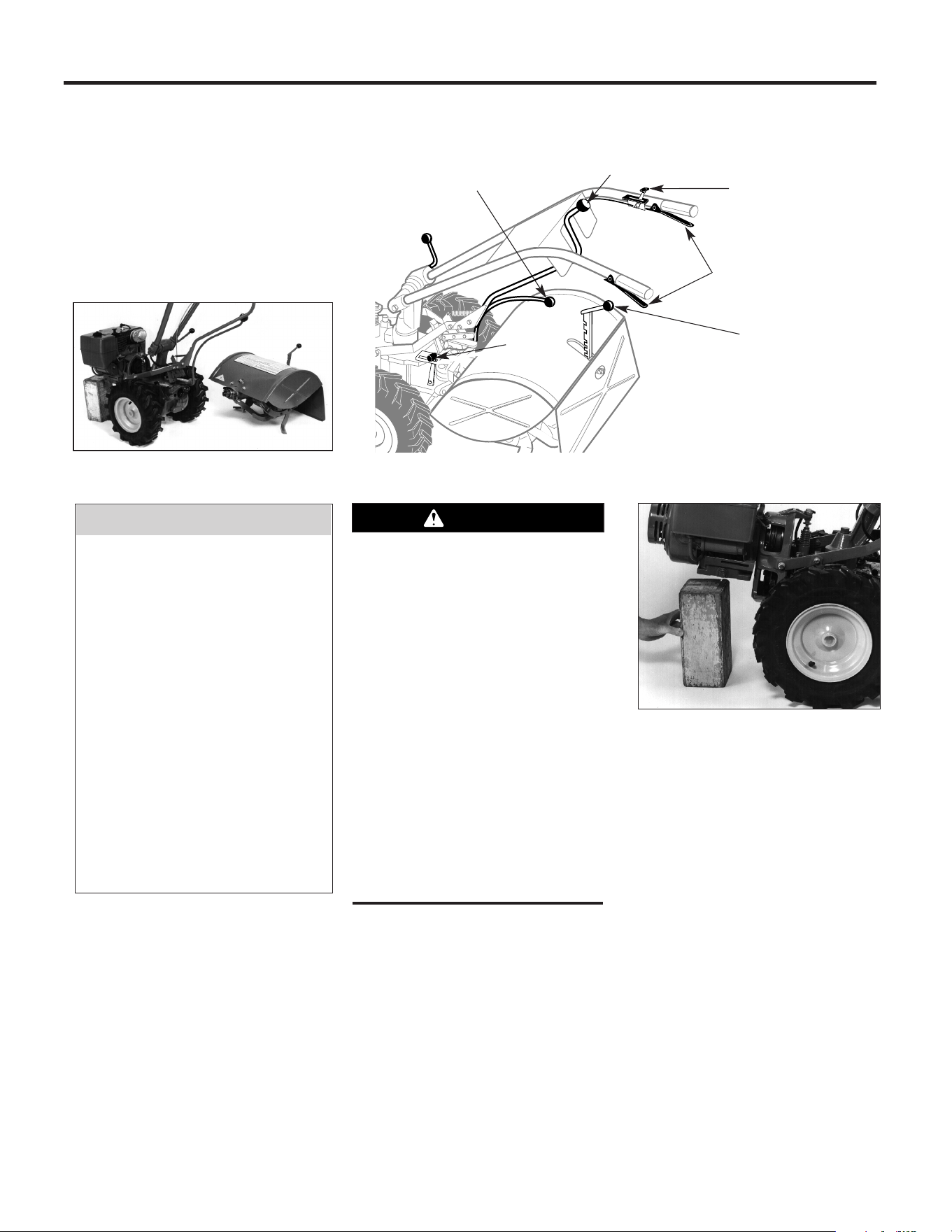
Your tiller is a self-contained PTO (Power
Take-Off) Power Unit that was shipped
with a tine attachment installed. The tine
attachment can be quickly removed and
replaced with other optional attachments.
The following instructions will familiarize
you with your PTO Power Unit. Please
read these pages carefully.
The following steps explain how to
remove and replace the tine attachment.
You will need a 3/4" wrench (minimum
12" long for leverage).
Removing Tine Attachment
1. Move the tiller to level ground.
2. Be sure the engine is stopped, the
electric start key is removed, and the spark
plug wire is disconnected and moved away
from spark plug.
3. Place a sturdy support under the
engine to prevent the engine from tipping
forward when the tine attachment is
removed (Figure 4-23).
4. Place the Wheels/Tines/PTO Drive Lever
into NEUTRAL (Figure 4-22).
5. Place Tines/PTO Clutch Lever in
DISENGAGE (Figure 4-22).
6. Place Wheel Speed Lever into FREE
WHEEL (Figure 4-22).
7. Loosen the two swing-out bolts (Figure
4-24) that connect the power unit trans-
mission to the tine attachment and swing
out the bolts (Figure 4-25).
HINT: Loosening swing-out bolts can be
difficult. Use an extra-long wrench for
leverage.
8. Tip the PTO power unit forward about
one inch with one hand while pulling the
tine attachment back (Figure 4-26). The
guide pin on the power unit will slide out
of the guide hole in the tine attachment
(Figure 4-27).
Removing And Replacing The Tine Attachment
PTO POWER UNIT
Figure 4-21: PTO Power Unit and tine
attachment.
Before operating your PTO Power
Unit for the first time, make sure that
you have:
• Read all the safety instructions in
Section 1 of this Manual and in the
Manual supplied with any attach-
ment.
• Read the controls information and
operating procedures for the tiller
and engine described in Sections 3
and 4 of this Manual and in the
Engine Owner’s Manual.
• Read and understand the assembly
instructions, controls information,
and operating procedures for the
attachment as described in the
Attachment Owner’s Manual supplied
with the attachment.
Section 4: Operation
TO AVOID PERSONAL INJURY OR
DAMAGE TO EQUIPMENT:
• Stop the engine, remove the electric
start key, disconnect the spark plug
wire and let the engine and muffler
cool before removing or installing any
attachment.
• Do not place hands, tools, or any
object near or inside the PTO access
area while the engine is running.
• When removing or replacing the tine
attachment, be careful of the sharp
edges on the tiller hood. Wear thick
gloves for hand protection.
• When the tine attachment is
removed, always prop it up with a
block to prevent the attachment from
falling forward.
CAUTION
Figure 4-23: Block up engine.
VERY IMPORTANT
Figure 4-22: PTO Power Unit controls.
Wheels/Tines/PTO
Drive Lever
Forward
Interlock Levers
Depth
Regulator
Lever
Wheel
Speed
Lever
Engine
Throttle Lever
Tines/PTO
Clutch
Lever
25
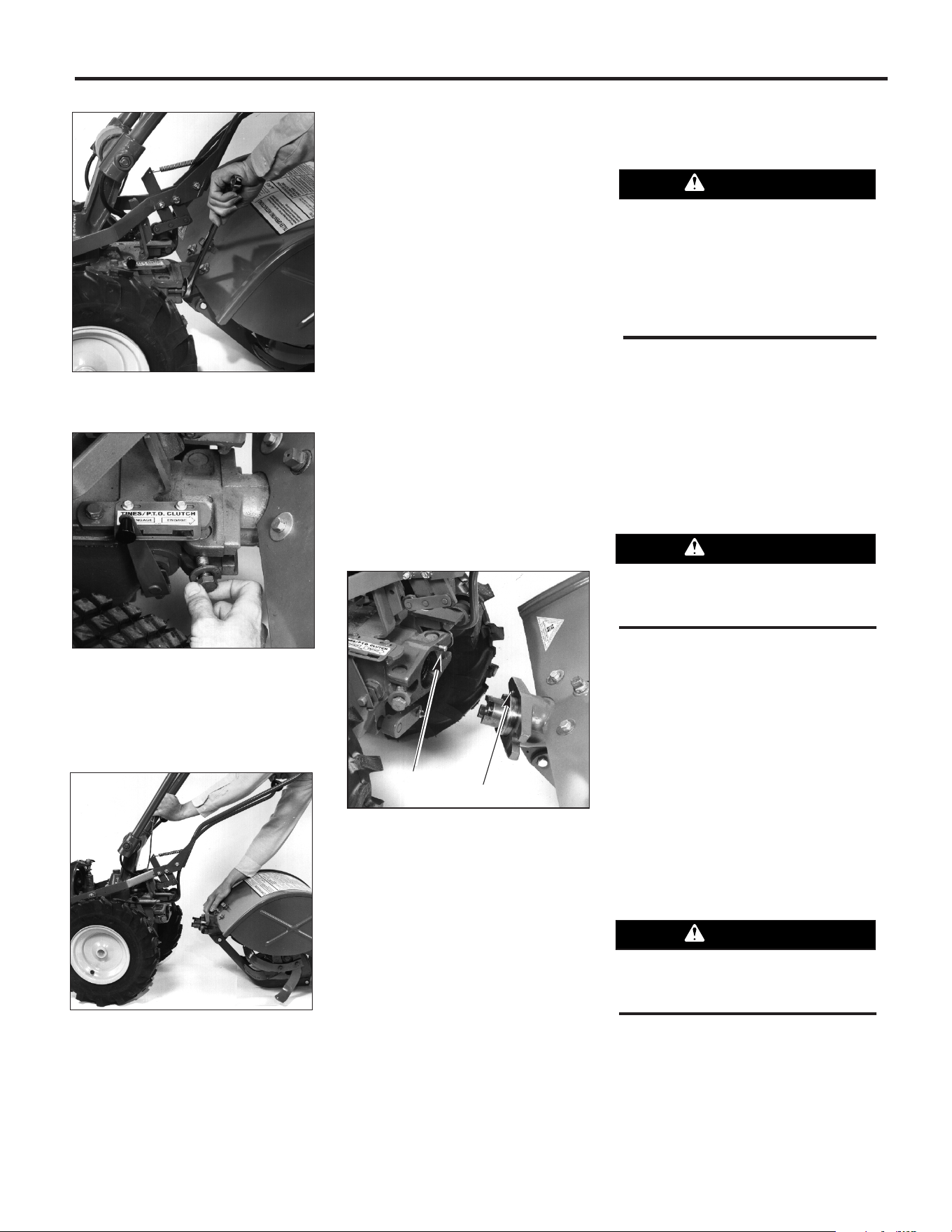
IMPORTANT: Store tine attachment in a
level, upright position to prevent gear oil
from leaking from the dipstick area.
9. To keep the tine attachment dog clutch
coupling clean, cover with the dust cap
(on some attachments) or plastic wrap.
10. The PTO Power Unit is now ready to
install other powered or non-powered
attachments. See the attachment's
Owner’s Manual for installation and
operation instructions specific to that
attachment.
Installing the Tine Attachment
1. Move the two PTO Power Unit swing-
out bolts outward and slide the washers
up against the bolt heads.
2. Remove the support block from under
the engine and slowly roll the power unit
back next to the tine attachment. Place
the support block back under the engine.
3. Remove the dust cap (or protective
wrapping) from the dog clutch coupling
on the tine attachment.
4. Carefully align the guide pin on the
PTO Power Unit with the alignment hole
in the tine attachment and bring the two
units together (Figure 4-27).
5. Move the two swing-bolts into the
slots of the tine attachment. Alternately
tighten each bolt until they are tight
enough to make the concave washers flat.
The bolts must be very tight – if you have
a torque wrench, tighten each bolt to
between 70 and 80 ft.-lbs.
IMPORTANT: The swing-bolts must be
kept very tight to prevent damaging wear
to the dog clutch coupling, alignment pin
or the alignment hole. Check bolt
tightness every 2-1/2 operating hours.
6. Remove the engine support before
moving the tiller in a forward direction.
PTO POWER UNIT
OPERATING INSTRUCTIONS
The following are operating instructions
specifically for the PTO Power Unit. Read
the separate Owner’s Manual supplied
with each attachment before attempting
to assemble, attach, transport or operate
the attachment. If needed, please contact
us for a replacement manual. See the
back cover for customer support
information.
Some attachments have a drive shaft or a
hydraulic pump that is powered by the
engine on the PTO Power Unit. These
units are called Stationary Attachments,
since they remain in one location when
operating. Attachments can be towed to a
work site with the PTO Power Unit as
described in
Operating Non-Powered
Attachments
. Other attachments are
pulled or towed behind the PTO Power
Unit. These attachments are called Non-
Powered Attachments.
Setting Up Stationary Attachments
1. Move the Tines/PTO Clutch Lever to
DISENGAGE.
2. Move Wheel Speed Lever (Figure 4-22)
to FREEWHEEL, then block all wheels
(Figure 4-29) to prevent the equipment
from rolling.
Figure 4-26: Pulling attachment
away from power unit.
Figure 4-27: Aligning guide pin with
mounting hole.
Guide Pin
Mounting Hole
Section 4: Operation
Figure 4-25: Moving swing-bolts
outward.
Figure 4-24: Loosening attachment
swing-bolts.
To help avoid personal injury or
damage to equipment, read the attach-
ment's Owner’s Manual supplied with
each attachment before installing or
operating an attachment. Please read
all control, operation and safety
instructions.
WARNING
To help avoid personal injury, always
disengage the Tines/ PTO Clutch Lever
before towing any attachment.
WARNING
26
To help avoid personal injury, never
allow people to ride on any PTO Power
Unit or attachment.
WARNING
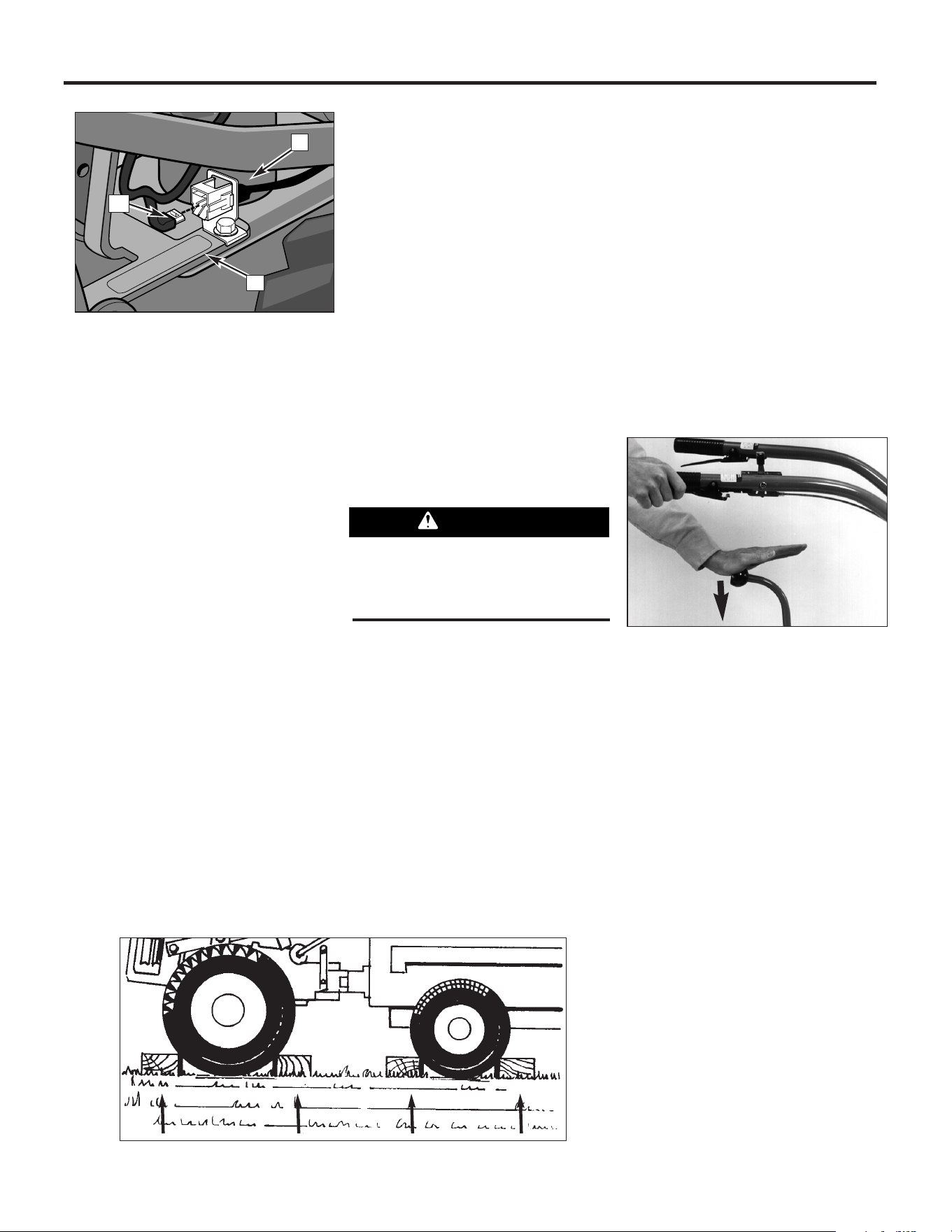
3. On the PTO Power Unit, unplug the
Forward Interlock Wire Harness that leads
from the base of the handlebars (A, Figure
4-28) to the receptacle (B) located on the
top, right side of the transmission cover.
4. On the Stationary Attachment, locate
the interlock wire (C, Figure 4-28) and
clean contacts on plug and receptacle (B).
This connection enables you to operate
the Wheels/Tines/PTO Drive Lever in
FORWARD without having to squeeze a
Forward Interlock Lever.
5. Connect the plug from the Stationary
Attachment (C, Figure 4-28) to the recep-
tacle on the PTO Power Unit (B). The
connection must be tight.
Setting Up Non-Powered Attach-
ments
1. Move the Tines/PTO Clutch Lever
(Figure 4-22) to DISENGAGE.
2. Move the Wheel Speed Lever (Figure
4-22) to either SLOW or FAST position
To do this, roll the PTO Power Unit while
shifting lever until wheels engage.
3. Verify that the Forward Interlock Wire
Harness plug at the base of the handle-
bars (A, Figure 4-28) is connected to the
Forward Interlock Wire Harness recepta-
cle (B) on the top right side of the
transmission.
Starting The Engine
IMPORTANT: Refer to Cold Weather
Operation
instructions, in this section,
before operating in temperatures below
40
o
F.
1. Move the Wheels/Tines/PTO Drive
Lever into NEUTRAL. To find NEUTRAL
(be sure engine is off), push lever down
and engage it in FORWARD then tap the
lever upward to automatically move into
NEUTRAL .
2. Move the Tines/PTO Clutch Lever into
DISENGAGE position.
3. Start Engine. See Starting and
Stopping the Engine, in the beginning of
this section, for detailed starting informa-
tion. Also see the Engine Owner's Manual.
4. For non-powered attachments only test
the Forward Interlock Safety System. See
Testing the Forward Interlock Safety
System, in this section, for a procedure.
Operating Stationary Attachments
1. Move Tines/PTO Clutch Lever (Figure
4-22) into ENGAGE.
2. To apply power to PTO-driven attach-
ments, move Wheels/Tines/PTO Lever
(Figure 4-22) down to FORWARD position
(
do not use REVERSE with stationary
attachments).
3. To stop the PTO Power Unit, tap the
Wheels/Tines/PTO Drive Lever upward
into NEUTRAL position.
Operating Non-Powered Attachments
(or to Tow Stationary Attachments)
1. To move forward, squeeze and hold
one Forward Interlock Lever (Figure 4-30)
up against the handlebars, and move the
Wheels/Tines/PTO Drive Lever down to
FORWARD.
2. To stop forward motion, tap
Wheels/Tines/PTO Drive Lever upward
into NEUTRAL, then release the Forward
Interlock Levers.
3. To stop forward motion in an
emergency, release all PTO Power Unit
controls (stops engine).
4. To move in reverse, reduce the engine
speed then shift the Wheel Speed Lever
into SLOW. Move and hold the
Wheels/Tines/PTO Drive Lever all the way
up. Ensure that the area behind you is
clear of all obstacles, before moving the
lever into REVERSE.
5. To stop moving in REVERSE, release
the Wheels/Tines/PTO Drive Lever.
Stopping the Engine
Move the Engine Throttle Lever to STOP.
Turn keyswitch to OFF on electric start
models.
Figure 4-29: Block wheels on PTO Power Unit and stationary
attachment.
Figure 4-28: Forward Interlock Wiring
A - PTO Power Unit Interlock Harness
B - Forward Interlock Receptacle
C - Attachment Interlock Wire
Section 4: Operation
Figure 4-30: Moving tiller forward:
squeeze one Forward Interlock Lever
and then move Wheels/Tines/PTO
Drive Lever down to FORWARD.
A
B
C
To avoid injury,do not run the engine in
an enclosed or poorly vented area.
Engine exhaust contains carbon
monoxide, an odorless and deadly gas.
WARNING
27

NOTE: All references to left, right, front
and rear of the machine are determined by
standing behind the handlebars and facing
the direction of forward travel.
REQUIRED MAINTENANCE SCHEDULE
Before Every Every Every As
PROCEDURE Each 10 25 30 Noted
Use Hours Hours Hours
Check engine oil level • Every 5
operating hrs.
Clean engine cooling system •
Test operation of Forward Interlock • Section 4
Safety System
Forward Interlock Safety System –•
check wire condition,connections
Check electrical connections •
Recharge battery Before/after
long storage
Check drive belt tension • After initial
2 hours
Check nuts and bolts • After initial
2 hours
Clean tiller tine shaft •
Lubricate tiller •
Change engine oil* • More often
in dusty or
dirty areas
Clean foam element air filter • More often
Check paper element air filter • in dusty or
dirty areas
Check for oil leaks • After initial
2 hours
Check gear oil level in • After initial
both transmissions 2 hours
Check bolo tines for wear •
Check reverse disc for wear •
Check air pressure in tires •
* During engine break-in period, change engine oil after first 2 hours of operation.
28
Section
5
Maintenance
Before inspecting, cleaning or
servicing the machine, shut off engine,
wait for all moving parts to come to a
complete stop, disconnect spark plug
wire and move wire away from spark
plug. Remove ignition key on electric
start models.
Failure to follow these instructions can
result in serious personal injury or
property damage.
WARNING
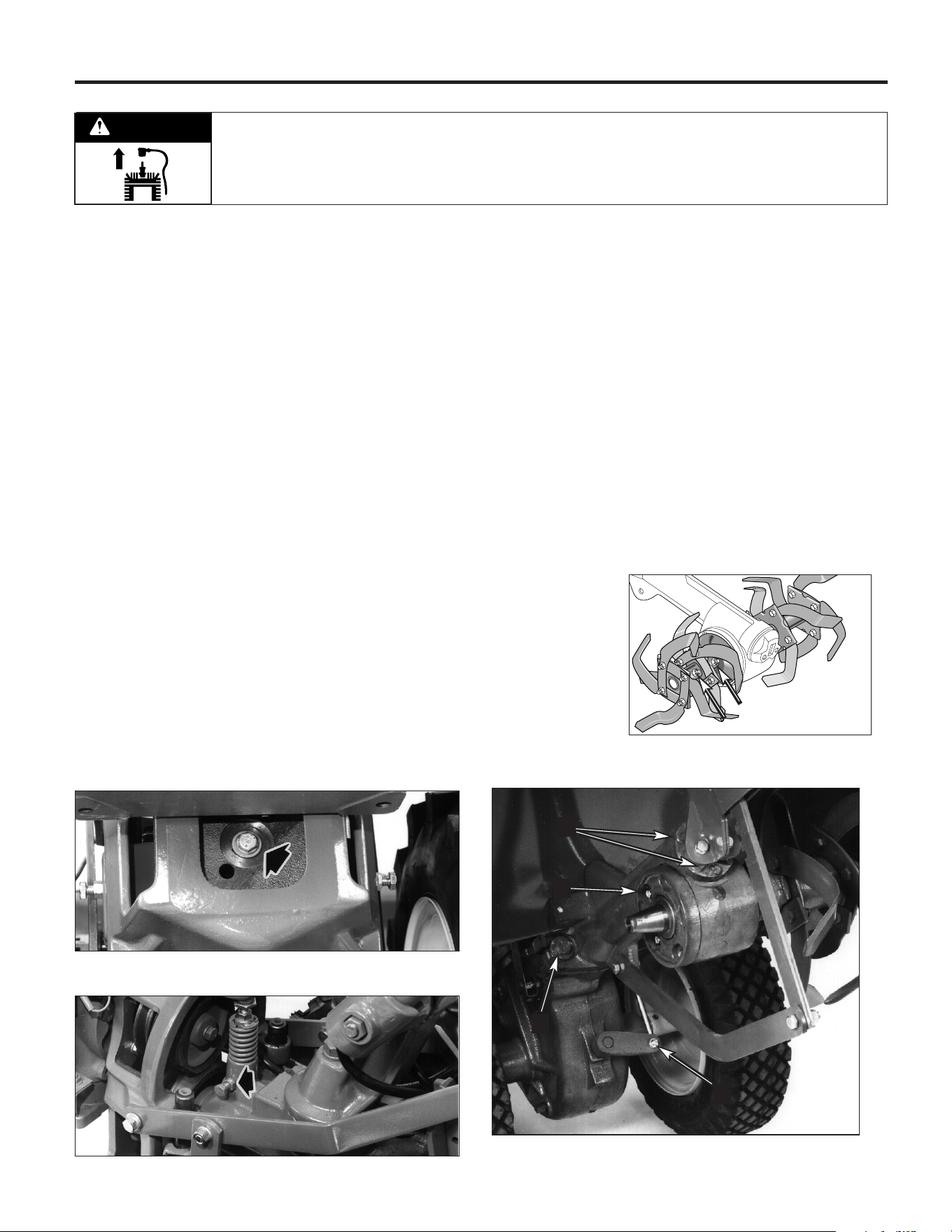
Tighten Bolts and Nuts
Check for loose or missing hardware
every ten (10) operating hours. Failure to
tighten or replace fasteners can cause
poor performance, equipment damage or
oil leakage. See your Parts Catalog for
complete fastener descriptions.
Most hardware on your tiller is visible.
Pay particular attention to hardware
shown in Figures 5-1, 5-2, 5-3 and 5-3A.
1. Check the transmission pulley
mounting bolt (Figure 5-1). If the washer
behind the bolt head is loose, the bolt
needs tightening. To do this, first insert a
punch or thick screwdriver into the hole
next to the bolt and wedge the tool
against the side of the motor mount
casting. This immobilizes the pulley while
you tighten the bolt.
2. Check jam nut on left side of neutral
plunger assembly (Figure 5-2). If loose,
immobilize bolt head with one wrench and
use another wrench to tighten the nut.
3. Check the three rear bearing cap
screws under the depth regulator
mounting bracket (A, Figure 5-3). If any
is loose, it can cause an oil leak or drive
shaft end play.
4. Check the five bolts securing the tiller
housing cover to the left side of the trans-
mission (B in Figure 5-3). Gear oil can
leak from a loose housing cover. To
reach the bolts, remove the left side tine
holder. See
Bolo Tine Maintenance in this
Section for tine holder removal directions.
5. Check both swing-bolts (C, Figure 5-3)
that connect the power unit transmission
to the tine attachment. Both bolts should
be checked every 2-1/2 hours of
operation. If loose, wear can occur on the
locating pin on the power unit, and cause
enlargement of the locating hole in the
tine attachment. Using a torque wrench,
tighten these bolts to 70-to-80 ft.-lbs.
6. Check the locknut that fastens the
shifting linkage to the eccentric shifting
lever (D, Figure 5-3). Do not tighten the
locknut against the eccentric lever. It
should be very close to, but not touching
the lever.
7. Check the four bolts and nuts securing
left and right tine holders to the tine shaft
(Figure 5-3A).
IMPORTANT: Give screws or bolts that
go into the transmission housing a
coating of non-hardening gasket sealant
to prevent gear oil from leaking.
Tiller Lubrication
Proper lubrication of the tiller’s mechani-
cal parts is an essential part of good
maintenance. Lubrication should be done
after every ten (10) hours of operation.
Use ordinary motor oil (#30 weight or
lighter) where oil is specified. Use a
quality grease with a metal lubricant
where grease is recommended (regular
grease is acceptable). Do not over
lubricate. If there is a build-up of dirt,
remove the build-up and re-apply oil or
grease.
Figure 5-1: Check bolt on transmission pulley.
Figure 5-3A: Tine holder hardware
must be tight.
Figure 5-2: Check jam nut on plunger assembly.
Figure 5-3: Gently tilt tiller forward to check fasteners.
A
B
C
D
Section 5: Maintenance
29
Before inspecting, cleaning or servicing the machine, shut off engine, wait for all moving parts to come
to a complete stop, disconnect spark plug wire and move wire away from spark plug. Remove ignition
key, if so equipped.
Failure to follow these instructions can result in serious personal injury or property damage.
WARNING
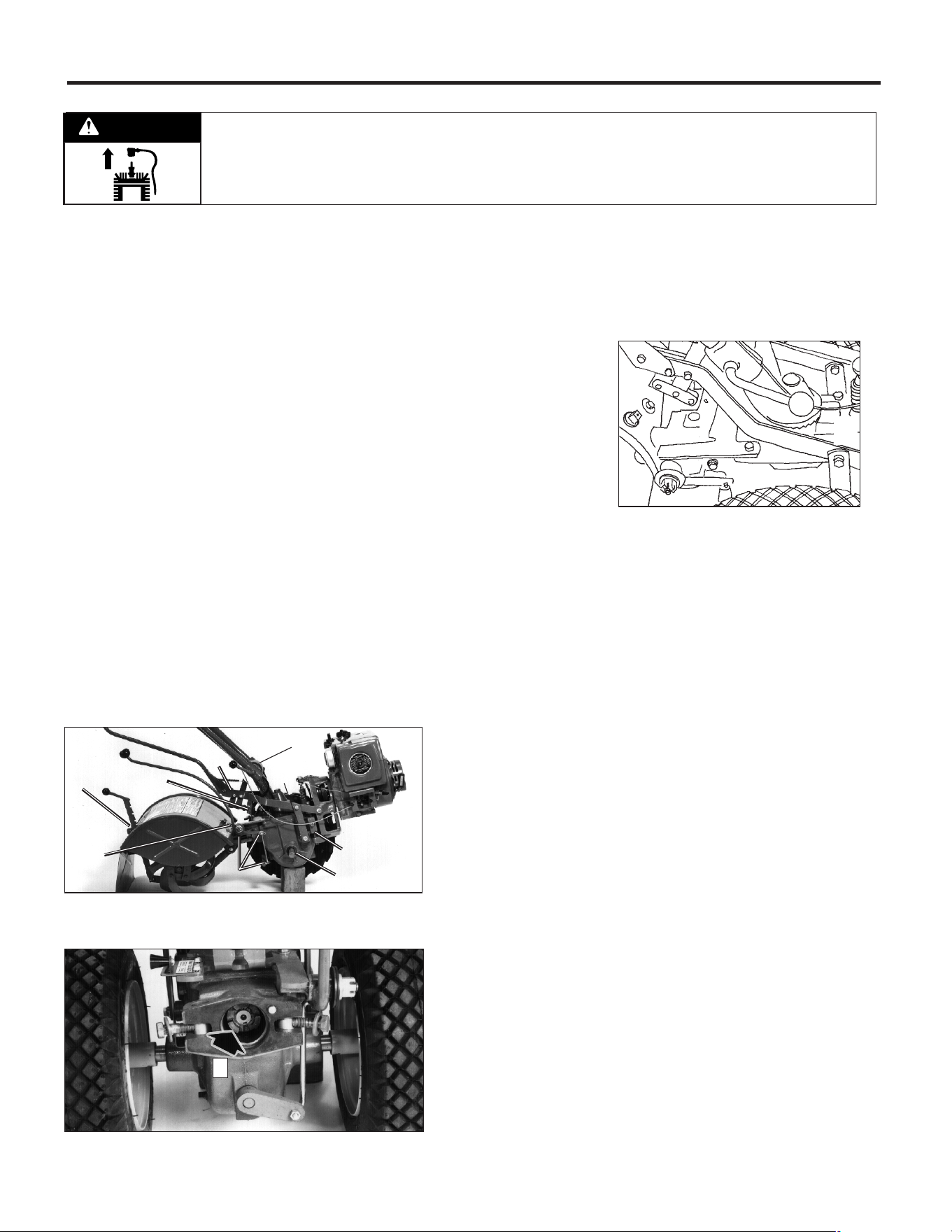
Section 5: Maintenance
IMPORTANT: Do not allow oil or grease
to contact the pulleys, drive belt or
reverse disc. This can cause the belt or
disc to slip on the pulleys.
Lubricate the numbered areas in Figures
5-4 and 5-5, as follows:
1. Oil the wheel shaft between the wheel
hubs and the transmission housing
(A, Figure 5-4).
2. Oil all pivoting and connecting points
on the Wheels/Tines/PTO Drive Lever and
the Wheel Speed Lever (B, Figure 5-4).
3. Grease the face of the belt adjustment
block (C, Figure 5-4).
4. Oil the Depth Regulator Lever,
including the spring in the mounting
bracket (D, Figure 5-4).
5. Oil the full length of the throttle cable
casing (E, Figure 5-4).
6. Oil threads on Handlebar Height Adjust-
ment Lever (F, Figure 5-4).
7. Grease left- and right-side engine
mounting bars at the top, the middle, and
bottom (G, Figure 5-4).
8. Grease the zerk grease fitting located
on the pivot point at the end of the Wheel
Speed Lever (H, Figure 5-4). If Wheel
Speed Lever has a grease fitting on pivot
assembly, apply 2-to-3 strokes of multi-
purpose grease at beginning and end of
tilling season.
9. Keep the PTO access area well-greased
(I, Figure 5-5). If the Tines/PTO Clutch
Lever becomes hard to move, squirt some
oil into its access hole, and work it back
and forth to disperse the oil.
Transmission Gear
Oil Maintenance
Checking for Oil Leaks
At 25-hour operation intervals, check the
tiller for oil leaks. Inspect for oil accumu-
lations on the tiller or the floor where it’s
stored.
A small amount of oil seepage or wetness
around a shaft opening or
cover is no cause for
alarm. But a heavy con-
centration of oil is more
serious. You should
tighten all bolts immedi-
ately, and replace any
worn seals or gaskets.
It may be impossible to
determine how much oil
has been lost, so check the
oil levels in the PTO trans-
mission and the tine
attachment before using
the tiller again. Add any
necessary gear oil.
Serious damage to the
transmission components
can result from operation
when gear oil levels are
low.
If tilling during very hot weather, the gear
oil may heat up and expand inside the
transmissions. To allow for this oil
expansion, both the power unit transmis-
sion and the tine attachment transmis-
sions have oil relief vents (Figure 5-6).
The vents allow small amounts of oil to
seep out.
If a serious leak is discovered, please
contact your authorized dealer or the
Factory Technical Service Department for
service advice.
Checking Gear Oil Levels
Every 30 hours of operation, check the
gear oil level in both the power unit trans-
mission and the tine attachment transmis-
sion. Operating them while low on gear
oil (even briefly) can cause serious
damage to internal components.
Preparation
1. The transmissions must be cool,
since hot gear oil expands and gives a
false reading.
2. The power unit transmission and the
tine attachment transmission must be
connected when checking (or adding)
gear oil.
Checking the Power Unit Oil Level
1. Move the tiller to level ground. Move
the Depth Regulator up so the tines rest
on the ground.
2. Use a 3/8" wrench to remove the oil
level check plug on the left side of the
transmission housing (Figure 5-7).
Figure 5-4: Tiller lubrication points
(wheel removed for clarity).
Figure 5-5: Use grease liberally in PTO access area.
I
Figure 5-6: Oil relief vent locations.
➨
➨
E
F
G
D
H
C
B
B
A
30
➨
➨
Before inspecting, cleaning or servicing the machine, shut off engine, wait for all moving parts to come
to a complete stop, disconnect spark plug wire and move wire away from spark plug. Remove ignition
key, if so equipped.
Failure to follow these instructions can result in serious personal injury or property damage.
WARNING
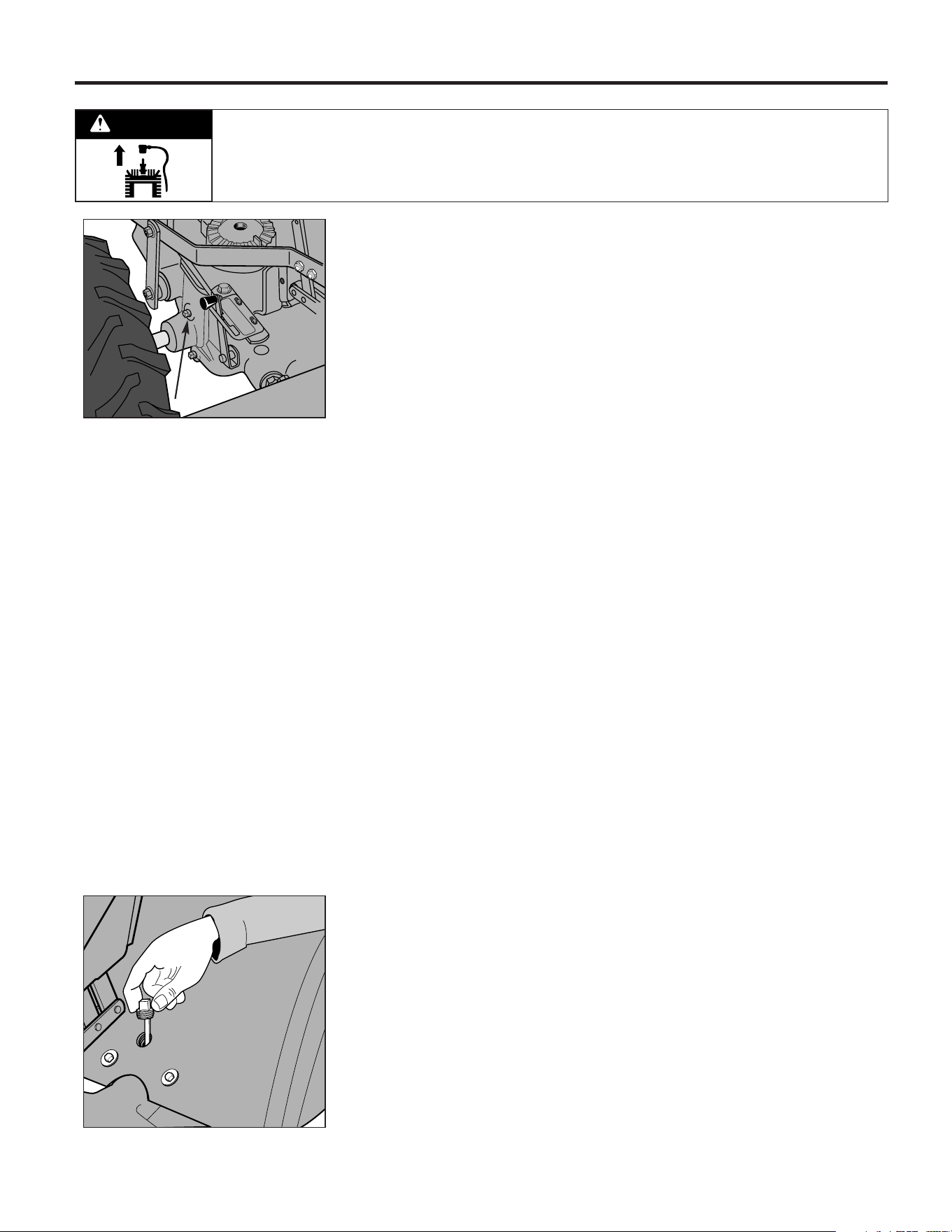
Section 5: Maintenance
3. If the oil level is correct, oil will seep
out of the check hole (allow extra time in
cold weather). If it does, the level is fine
and you should replace the check plug. If
no oil seeps out, see
Adding or Changing
Gear Oil
.
Checking the Tine
Attachment Oil Level
IMPORTANT: Two different gear oil
checking procedures for the tine attach-
ment transmission are described next.
Use the first procedure if the dipstick in
your tine attachment has only a ‘Check
Cold’ marking. Use the second procedure
if the dipstick has both cold and hot
markings at the end. First remove the
dipstick from the tine attachment trans-
mission (Figure 5-8) to see which type
dipstick you have. Then replace the
dipstick with markings on dipstick facing
to rear.
For Dipsticks With ‘Check Cold’ Marking
(Cold means 2 hours has passed since
the tiller was used.)
1. Move the tiller to level ground.
2. Pull the Depth Regulator Lever back,
then push it down all the way (to engage
its top notch).
3. Place a sturdy support under the
engine to prevent the tiller from tilting too
far.
4. Now slide three pieces of 2" x 4"
lumber underneath the drag bar– raising
the drag bar about 4-1/2" above ground.
This elevation allows an accurate “cold”
gear oil reading .
5. Wait two hours with tiller elevated
(allow more time if temperature is below
40
o
F).
6. Loosen and remove transmission
dipstick (Fig. 5-8). Wipe it clean with a
rag.
7. Hold dipstick so its markings face to
rear of tiller. Lower it straight down into
the sump hole to
touch the drive shaft
inside (Fig. 5-8). Don’t force or try to
thread it back in; an incorrect reading will
result.
8. Remove dipstick and check oil level. It
should be anywhere within the cross-
hatched area or even slightly above the
Max marking. If correct, replace dipstick
and remove the boards used as props.
9. If oil level was low, gear oil must be
added before using the tiller. See Adding
or Changing Gear Oil next.
For Dipsticks With Hot/Cold Markings
1. Move the tiller to level ground.
2. Pull the Depth Regulator Lever back,
then push it down all the way (to engage
its top notch).
3. Place a sturdy support under the
engine to prevent the tiller from tilting too
far.
4. Cold reading (preferred method):
(Two hours has passed since the tiller
was used.) Place a 2" x 4" board (on
edge) under the drag bar– raising the tiller
and drag bar about 3-1/2" above ground.
Hot reading: (Tiller was operated for
more than 30 minutes within the past
hour.) Do not use the wood prop to
elevate the tiller.
5. Follow Steps 4, 5 and 6 given for the
other dipstick type.
6. Remove dipstick and check level. It
should be within or above the “Cold”
range marking if taking a cold reading. If
taking a hot reading, the level should be
within or slightly above the “Hot” range.
7. If the level is incorrect, see Adding or
Changing Gear Oil.
Adding or Changing Gear Oil
For partial fill-ups (just a few ounces or
less), use SAE 140, SAE 85W-140, or SAE
80W-90 weight gear oil with an API rating
of GL-4 or GL-5. For full replacement,
use SAE 140 or SAE 85W-140 gear oil
with an API rating of GL-4 only. (At the
factory, SAE 85W-140 weight gear oil is
used.)
IMPORTANT: Do not use automatic
transmission fluid or engine oil. They are
too light in weight and will result in trans-
mission damage.
The gear oil does not need to be changed.
Do so only if you know, or suspect, it is
contaminated with dirt, sand or other
foreign particles.
Gear oil is available at authorized dealers
and most service stations, power
equipment centers, or farm/heavy
equipment outlets.
Capacities: Power unit transmission
holds approximately 60 ozs.; Tine Attach-
ment transmission holds approximately
12-1/2" ozs.
Figure 5-7: Remove oil level check
plug. Gear oil should seep out if
the level is sufficient.
Figure 5-8: Checking gear oil level;
markings on dipstick (tine attach-
ment transmission) must face rear.
➧
Before inspecting, cleaning or servicing the machine, shut off engine, wait for all moving parts to come
to a complete stop, disconnect spark plug wire and move wire away from spark plug. Remove ignition
key, if so equipped.
Failure to follow these instructions can result in serious personal injury or property damage.
WARNING
31
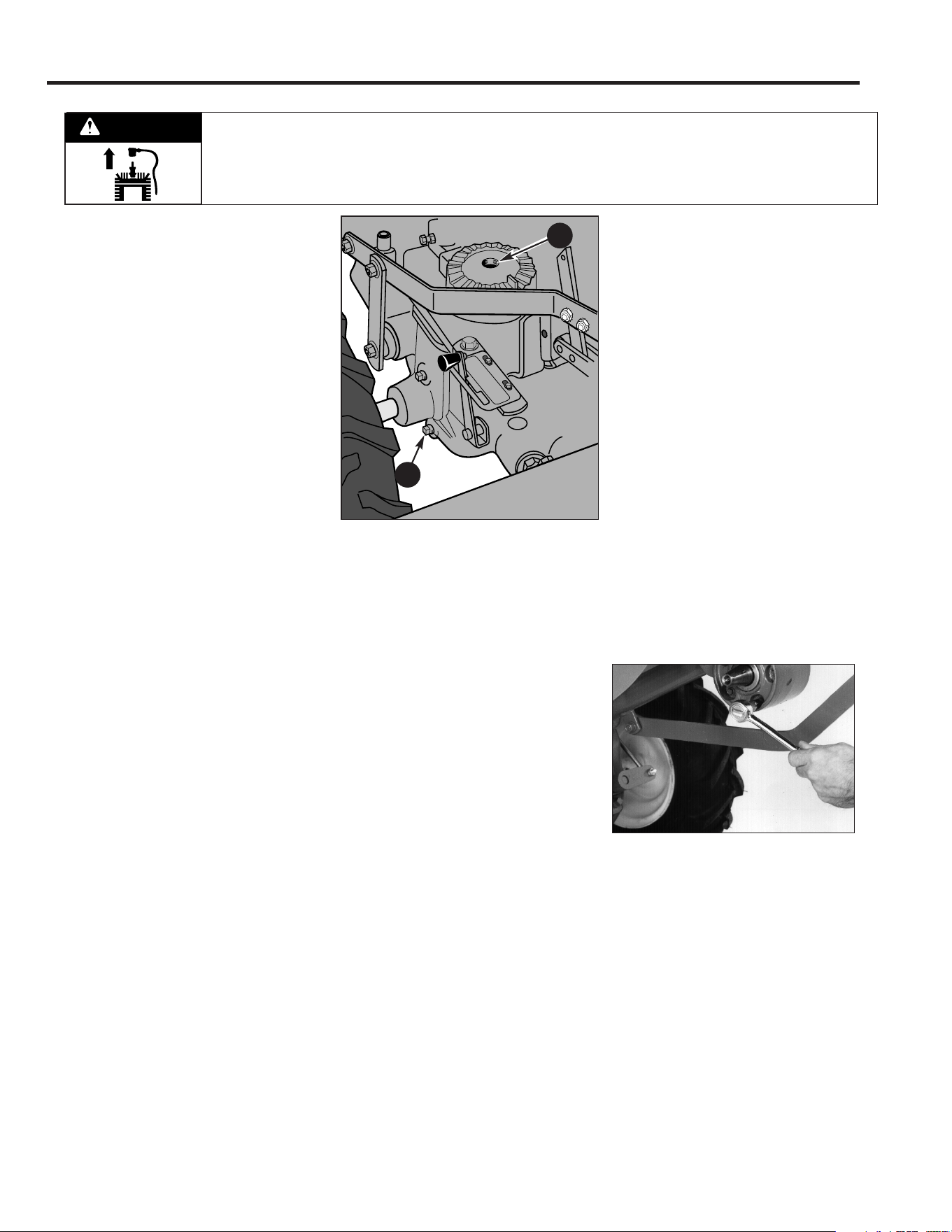
Section 5: Maintenance
Adding Gear Oil to the
PTO Power Unit Transmission
1. Do steps 1 and 2 of Checking the
Power Unit Oil Level on page 32.
2. Using a 3/4" wrench (or socket),
remove the bolt securing the handlebar
base to the top of the transmission (prop
the handlebars first to prevent them from
falling).
Then, unplug the Forward Interlock wire
harness receptacle at the bottom of the
handlebars. Set the handlebar base and
bolt aside on a clean surface. The bolt
hole in the top of the transmission is the
gear oil fill hole (A, Figure 5-9).
3. Slowly pour gear oil through a clean
funnel into the transmission. Stop when
gear oil begins to flow from the oil level
check hole on the left side of the trans-
mission (B, Figure 5-7).
4. Reinstall the oil level check plug.
Tighten it securely.
5. Reinstall the handlebars using the
mounting bolt previously removed. Align
the handlebars so they point straight
backwards, not at an angle. Then tighten
the mounting bolt securely.
6. Reconnect the Forward Interlock wire
harness to the receptacle. Be certain it’s
secure.
7. Test operation of the Forward Interlock
Safety System. See Section 4 for a
procedure.
Draining and Filling the
PTO Power Unit Transmission
1. Place a shallow pan under the trans-
mission gear oil drain plug (B, Figure
5-9).
2. Remove the oil level check plug (Figure
5-7) with a 3/8" wrench. This vents the
transmission for faster oil draining.
3. Using the 3/8" wrench, remove the
drain plug (B, Figure 5-9). The gear oil
will drain quite slowly since it is thick.
After about two quarts have drained, tilt
the tiller forward so any oil at the rear of
the transmission will drain out.
4. Clean the drain plug threads, put non-
hardening gasket sealant on the threads,
and reinstall plug.
5. Refill the transmission with the correct
amount of gear oil before operating the
tiller again. When oil seeps from the oil
level check hole, the right amount of gear
oil has been added. Replace all plugs.
Adding Gear Oil to the Tine
Attachment Transmission
1. Select the right Depth Regulator Lever
setting:
a. If filling an empty transmission, raise
the Depth Regulator Lever so tines
are on the ground.
b. If topping off the gear oil, move Depth
Regulator Lever down to engage its
top notch.
2. Remove dipstick from tine attachment
(Figure 5-8).
3. Slowly add gear oil in the dipstick hole.
Add 1/2-ounce at a time to avoid overfill-
ing. It takes about 12-1/2 ounces.
4. Take dipstick readings frequently. Stop
when oil reaches “Cold” range marking on
dipstick. Replace dipstick securely.
Draining and Filling the Tine
Attachment Transmission
1. The tine attachment transmission is
not equipped with an oil drain plug. To
drain just a small amount of gear oil,
remove the dipstick and tilt the attach-
ment forward (first uncoupling it from the
Power Unit).
2. For complete drainage, remove the left-
side tine assembly (refer to Bolo Tine
Maintenance for instructions), then
remove just one of the lower screws from
the tiller housing cover (Figure 5-10). To
speed drainage, remove the tine attach-
ment dipstick to vent transmission.
NOTE: If you find a plastic washer on the
cover screw you remove, discard the
washer. There is no need to install a
replacement washer.
3. Once all gear oil has drained, reinstall
the housing cover screw securely (first
coat its threads with non-hardening
gasket sealant).
4. Be certain to refill the transmission
with the correct amount of gear oil before
operating the tiller again.
Figure 5-9: Gear oil fill hole (A) and
gear oil drain location (B).
B
Before inspecting, cleaning or servicing the machine, shut off engine, wait for all moving parts to come
to a complete stop, disconnect spark plug wire and move wire away from spark plug. Remove ignition
key, if so equipped.
Failure to follow these instructions can result in serious personal injury or property damage.
WARNING
A
Figure 5-10: Remove housing cover
screw to drain tine attachment
transmission gear oil.
➧
32
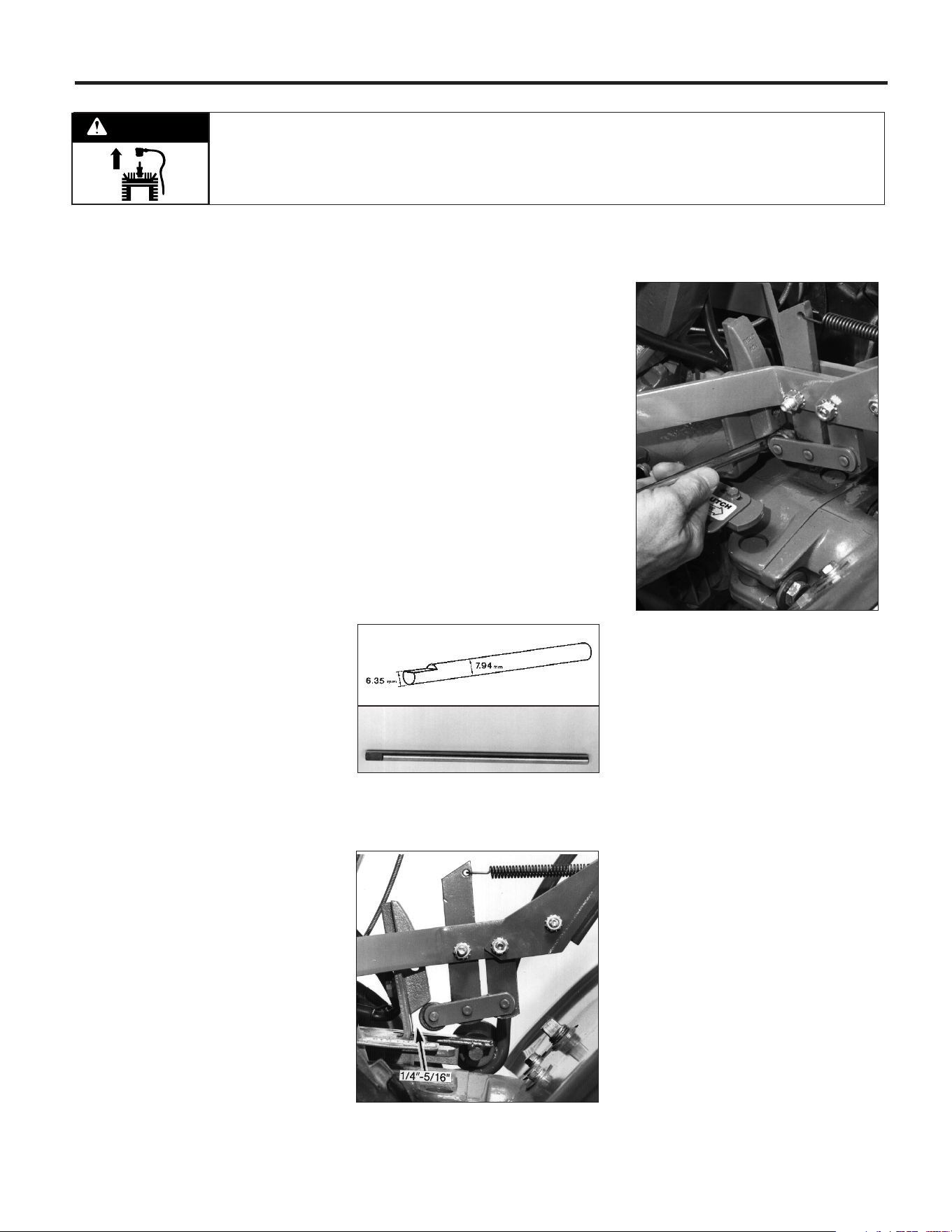
Section 5: Maintenance
Drive Belt Maintenance
Measuring and Adjusting
Drive Belt Tension
On a new tiller (or if a new belt is
installed), the belt tension will probably
need to be adjusted after the first two (2)
hours of operation. Thereafter, check belt
tension every ten (10) operating hours.
Maintaining the right tension is important
to good tiller performance and long belt
life. If too loose, the belt will slip on the
pulleys, and be unable to deliver full
power to the wheels and tines. A loose
belt will also wear prematurely.
While checking belt tension, also inspect
the belt for cuts, cracks, deterioration,
etc. Don’t continue using a belt that isn’t
in good shape. You’re sacrificing tiller
performance by doing so.
Tips on keeping the drive belt in top
condition include:
• Always put the Wheels/Tines/PTO Drive
Lever in NEUTRAL when the tiller is not in
use.
• Keep tension adjusted correctly.
• Don’t “speed shift” when moving the
Wheels/Tines/PTO Drive Lever between
FORWARD and REVERSE.
How to Measure Belt Tension
1. Before taking a measurement, be sure
the linkages and pivot points on the
Wheels/Tines/PTO Drive Lever are clean
and lubricated. If there is any binding,
you won’t get true measurements. Also,
you’ll need the belt adjustment tool you
received with your new tiller (Figure
5-11).
2. Move the Wheels/Tines/PTO Drive
Lever fully down to the FORWARD
position. The clutch roller at the bottom
of the lever should be positioned under-
neath the belt adjustment block (Figure
5-12). Don’t let the clutch roller move
during the next few steps. If it moves,
you’ll get a false belt tension reading.
3. The belt tension is correct if the front
of the clutch roller is 1/4"-to-5/16" away
from the face of the upright bracket that
holds the adjustment block in place
(Figure 5-12). To measure this distance:
a. Without moving the clutch roller, try
inserting the 1/4"-thick, slotted end
of the belt adjustment tool in
between the roller and the upright
bracket. (The flat edge of the tool
must be facing the roller.) Refer to
Figure 5-13.
b. If only the slotted portion of the tool
will fit, the belt tension is correct.
c. If the slotted part of the tool will not
fit in, the belt is too loose.
d. If the full thickness (5/16") of the
tool easily fits in, the belt is too
tight.
4. If the belt tension is correct, move the
Wheels/Tines/PTO Drive Lever back to
NEUTRAL.
How to Adjust Belt Tension
1. As described in the following steps,
drive belt tension is adjusted by moving
the adjustment block up or down.
Moving it down will tighten the belt;
moving it up loosens the belt.
HINT: The distance the block moves
approximately equals the distance the
roller moves.
In most cases, the clutch roller will not
have been very far out of position, so the
adjustment block will only need to be
moved slightly (up or down).
2. Move the Wheels/Tines/PTO Drive
Lever to NEUTRAL position. The clutch
roller will come to rest anywhere on the
face of the belt adjustment block,
depending upon drive belt length and
current belt tension adjustment.
Figure 5-12: Shift into FORWARD
and measure distance between
roller and upright bracket using the
belt adjustment tool.
Figure 5-11: Use this belt adjust-
ment tool to measure and adjust
drive belt tension.
Belt Adjustment Tool
1/4"
5/16"
Before inspecting, cleaning or servicing the machine, shut off engine, wait for all moving parts to come
to a complete stop, disconnect spark plug wire and move wire away from spark plug. Remove ignition
key, if so equipped.
Failure to follow these instructions can result in serious personal injury or property damage.
WARNING
Figure 5-13: Insert slotted end of
belt adjustment tool between roller
and bracket, with the flat side of the
slotted end facing the roller.
33
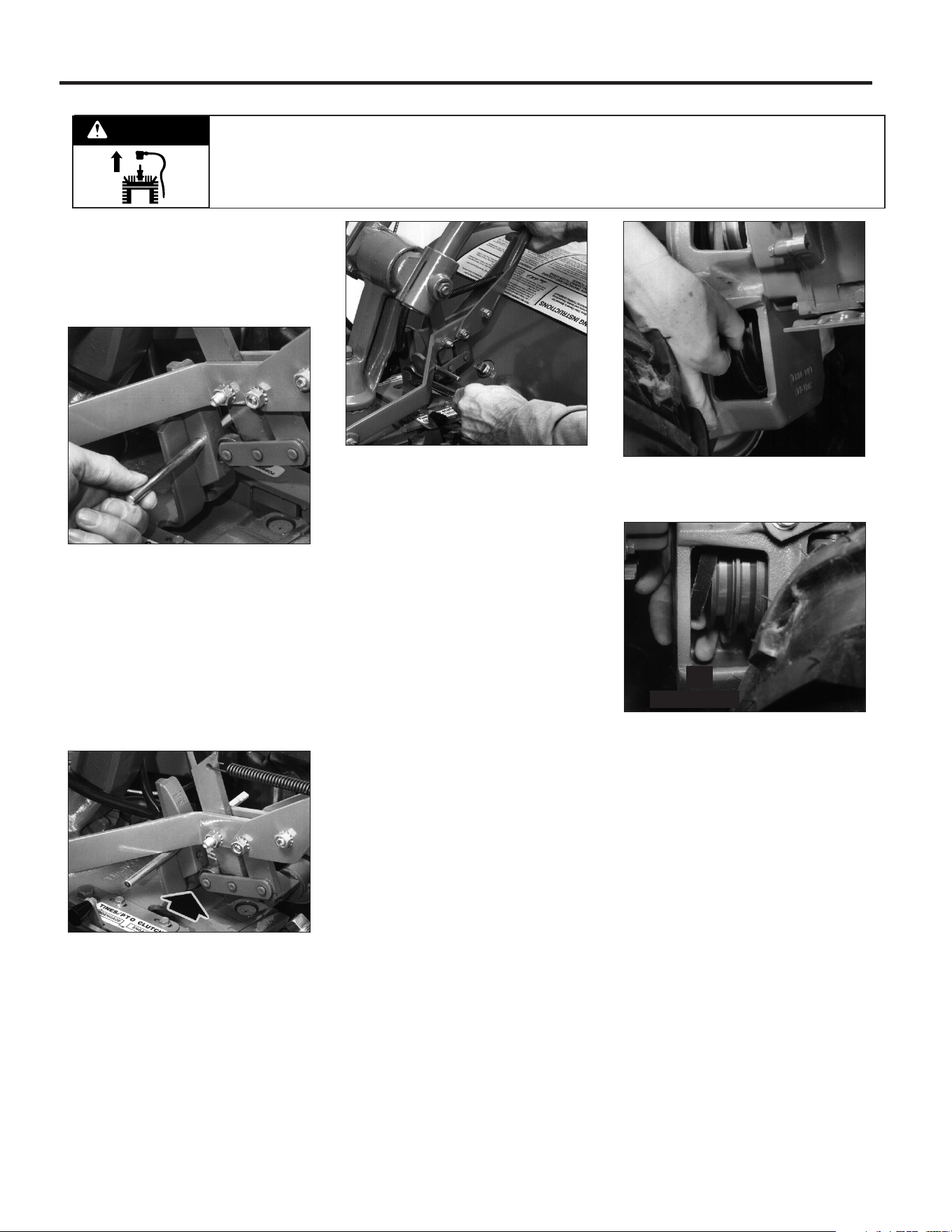
Section 5: Maintenance
3. Insert the belt adjustment tool through
the hole in the side of the adjustment
block, spacing the ends of the tool equally
on both sides (Figure 5-14). Rotate the
tool so the slotted end faces down.
4. Place the Wheels/Tines/PTO Drive
Lever in FORWARD position. The arms of
the clutch control yoke will be resting on
the belt adjustment tool and the clutch
roller should be engaged slightly beneath
the adjustment block (Figure 5-15).
5. Use one hand to hold the drive lever in
FORWARD while using a 9/16" wrench to
loosen (don’t remove) the bolt at the back
of the belt adjustment block (Figure 5-16).
The adjustment block should be free to
move either up or down.
6. Push the drive lever down if the belt
needs tightening. Pull the lever up if the
belt needs to be loosened. Hold the drive
lever in place and tighten the bolt in the
adjustment block firmly.
7. Let go of the drive lever and remove
the belt adjustment tool from the hole in
the adjustment block.
8. Check the tension on the belt by
following the previous instructions “How
to Measure Belt Tension.”
NOTE: If the adjustment block is all the
way down and the measurement between
the clutch roller and the bracket is less
than 1/4", then a new drive belt is needed.
Replacing the Drive Belt
Removing the Belt
1. Move Wheels/Tines/PTO Drive Lever to
NEUTRAL position.
2. While kneeling on the right side of the
tiller, create slack in the belt by reaching
over to the left side of the pulleys and
pushing in on the center of the belt with
your finger.
3. Use your right hand to move the belt
down and away from the lower pulley, in
the direction of the engine (Figure 5-17).
4. Push the belt upward to create slack in
the belt (Figure 5-18).
5. Lift the top half of the belt up and over
the upper pulley and the rubber reverse
disc, moving it in front of the reverse disc
(refer to Figure 5-19).
6. Push the Wheels/Tines/PTO Drive
Lever down into the FORWARD position.
This increases the distance between the
upper and lower pulleys. Next, lift and
pull the entire belt out between the pulleys
(Figure 5-20).
Replacing the Drive Belt
1. Place Wheels/Tines/PTO Drive Lever in
FORWARD position.
2. Squeeze the belt in the middle and
insert one end in between the pulleys
(Figure 5-20).
Figure 5-14: With Wheels/Tines/PTO
Drive Lever in NEUTRAL, insert tool
through hole in adjustment block.
Figure 5-15: With Drive Lever in
FORWARD position, clutch roller
should be engaged slightly beneath
the adjustment block.
Figure 5-16: Hold Drive Lever while
loosening bolt. Push lever down to
tighten belt; pull up to loosen belt.
Before inspecting, cleaning or servicing the machine, shut off engine, wait for all moving parts to come
to a complete stop, disconnect spark plug wire and move wire away from spark plug. Remove ignition
key, if so equipped.
Failure to follow these instructions can result in serious personal injury or property damage.
WARNING
Figure 5-18: Push belt upward to
create slack.
Figure 5-17: First move belt off the
lower pulley.
➧
Push Belt UP
34
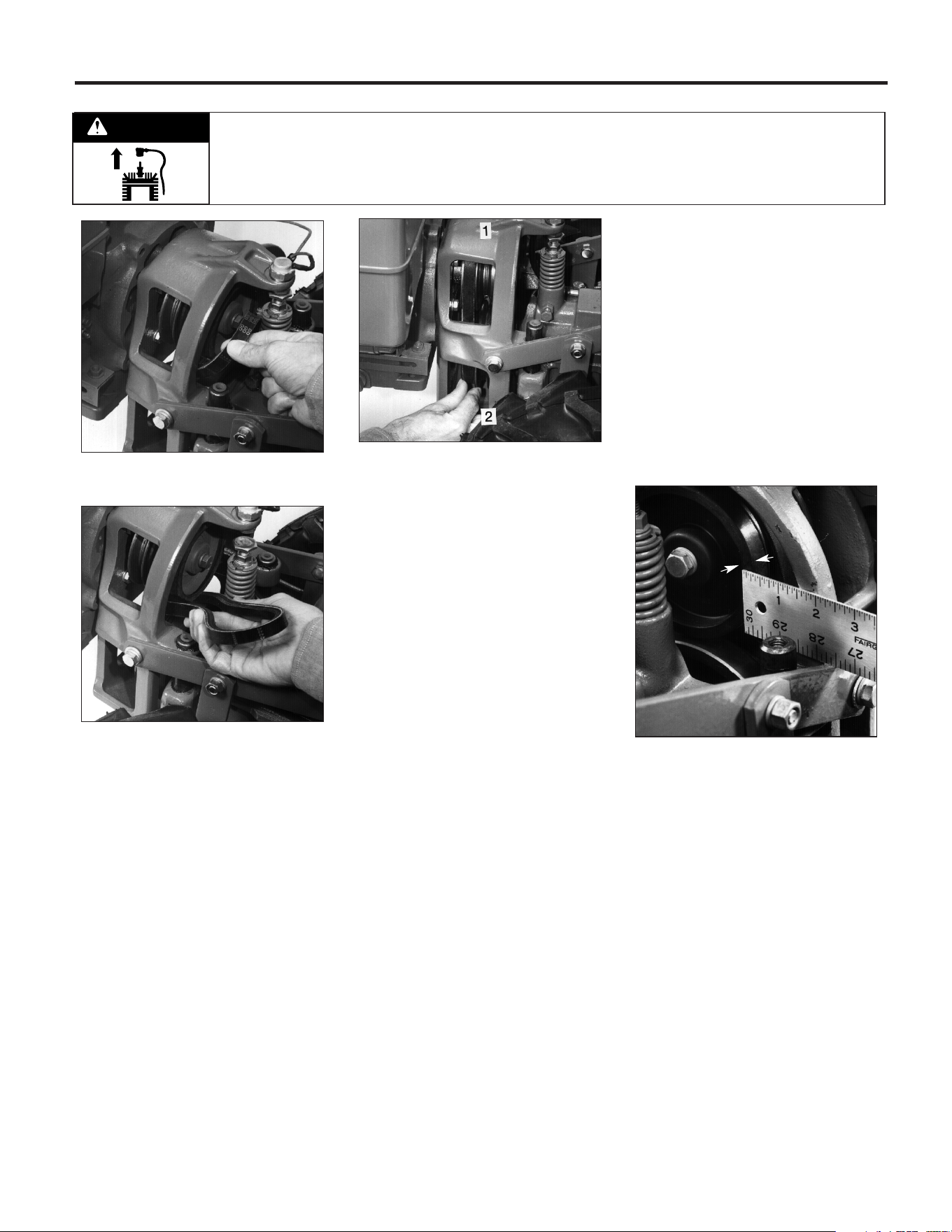
Section 5: Maintenance
3. Push belt forward then down until it is
looped over the lower pulley (Figure
5-18). Do not yet seat it in either of the
lower pulley’s grooves.
HINT: A blunt object, like a ruler, can
help you push the belt downward if
needed.
4. Move the top half of the belt up and
over the rubber reverse disc, but do not
seat it in either of the grooves in the top
pulley.
5. Place the Wheels/Tines/PTO Drive
Lever in NEUTRAL.
6. Move the top half of the belt into the
HIGH Range groove (groove closest to
the engine) on the top pulley (Figure
5-21).
7. Move the bottom half of the belt into
the HIGH Range groove of the lower
pulley (groove closest to engine— Figure
5-21). If extra slack is needed, hold up
Wheels/Tines/PTO Drive Lever while
moving the belt. Verify the belt is seated
properly on the pulleys.
8. To move the belt to the LOW Range
position, see Changing Belt Speeds in
Section 4.
9. After installing the belt, check and
adjust for correct belt tension as
explained previously.
Reverse Drive
System Maintenance
These instructions explain how to inspect,
replace or adjust the various reverse drive
components.
But first, here’s how the reverse drive
system works: When you raise the
Wheels/Tines/PTO Drive Lever up in
REVERSE position, this lowers the rub-
berized reverse disc (it’s attached to the
engine drive pulley) until this rotating disc
contacts the transmission drive pulley.
The friction between the rotating reverse
disc and the transmission pulley causes
the transmission drive shaft to be
powered in a counterclockwise direction
(as viewed from the operator’s position
behind handlebars). The drive shaft then
turns the wheels and tine shafts in a
reverse direction.
Reverse Disc Inspection
The reverse disc is made of steel with a
special, long-lasting rubber compound
bonded to the disc rim. Since this is a
wearing part, it should be inspected after
every 30 operating hours.
1. Measure the width of the outside edge
of the disc as shown in Figure 5-22.
Replace the disc before the rubber edge
wears to a thickness of 1/8" or less.
Failure to do so could cause the steel
underneath the rubber to damage the
transmission pulley.
2. Look for big cracks or missing chunks
of rubber from the disc. If so damaged,
the disc should be replaced immediately.
IMPORTANT: Extend the life of the
reverse disc by always pausing in
NEUTRAL before shifting between
FORWARD and REVERSE. Also – the
reverse disc is not suited for continuous
or sustained reverse operation. Use
reverse sparingly.
Figure 5-21: Seat belt in upper
pulley, then in lower pulley (High
Range position shown).
Figure 5-20: Shift into FORWARD
and remove the belt.
Figure 5-19: Move top half of belt
over pulley and reverse disc.
➦
➦
Before inspecting, cleaning or servicing the machine, shut off engine, wait for all moving parts to come
to a complete stop, disconnect spark plug wire and move wire away from spark plug. Remove ignition
key, if so equipped.
Failure to follow these instructions can result in serious personal injury or property damage.
WARNING
Figure 5-22: Measure the edge of
the reverse disc for wear.
35
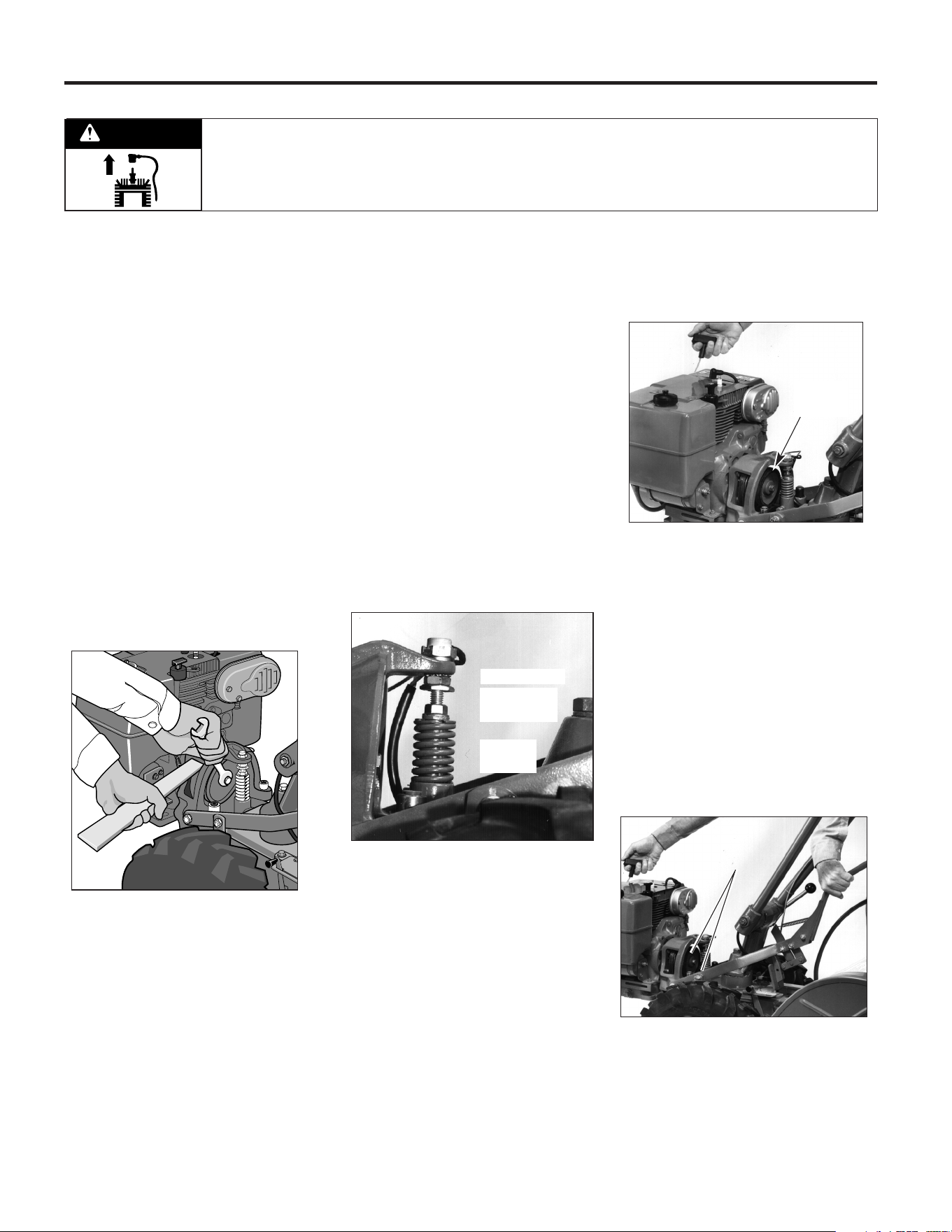
Replacing the Reverse Disc
Follow these steps to replace the reverse
disc. (If your tiller has a Bumper Attach-
ment mounted, it must be removed first.)
Removing the Reverse Disc
1. Move Wheels/Tines/PTO Drive Lever in
NEUTRAL position.
2. Wedge a 5/16"-thick board between top
of engine pulley (avoid contacting reverse
disc) and cast iron housing next to it.
This immobilizes pulley.
3. Use a 9/16" wrench to loosen the
mounting bolt shown in Figure 5-23.
Remember to immobilize the pulley with
the wood wedge while loosening the bolt.
If necessary, pry the disc from the pulley
with the tip of a screwdriver. Back the
bolt out as far as possible. Then angle
the disc a little to remove it. Bring the
bolt and lockwasher along with the disc.
Installing a New Reverse Disc
1. Do steps 1-through-3, described previ-
ously, in reverse.
2. Tighten mounting bolt securely, and
check for correct operation — see
Checking and Adjusting Reverse Drive
System
.
Checking and Adjusting
Reverse the Drive System
When the Wheels/Tines/PTO Drive Lever
is moved up into REVERSE, the engine
and engine mount move down to press
on the reverse adjustment bolt (Figure 5-
24). This action compresses the reverse
spring and plunger assembly, requiring
you to hold the lever up in REVERSE.
When you release the lever, the spring
automatically pushes the lever back into
NEUTRAL position.
The spring and plunger assembly is
designed to prevent the reverse disc from
making contact with the transmission
pulley until you shift into REVERSE.
When the lever is in NEUTRAL, the switch
body on the bottom of the engine mount
tab should be resting squarely on top of
the reverse adjustment bolt (Figure 5-24).
The reverse adjustment bolt can be
adjusted up or down to correct a number
of reverse drive operating problems, as
explained next.
Checking and Adjusting Reverse Disc
1. Verify that linkages for
Wheels/Tines/PTO Drive Lever are lubri-
cated with oil and engine mount bars and
belt adjustment block are lubricated with
grease. (See
Tiller Lubrication in this
section.)
2. Place Wheels/Tines/PTO Drive Lever in
NEUTRAL. Briefly pull out engine recoil
start rope while watching reverse disc.
The disc should turn, but lower pulley
should not (Figure 5-25). If reverse disc
turns lower pulley, or if it is located closer
than 3/16" to the pulley, reverse adjust-
ment bolt should be adjusted upward (see
instructions that follow). Moving adjust-
ment bolt upward will also solve problem
of a tiller that goes into REVERSE on its
own.
3. Use your left hand to hold
Wheels/Tines/PTO Drive Lever up in
REVERSE, while briefly pulling out engine
start rope. The reverse disc should turn
lower pulley (see Figure 5-26). If not, or
it requires a lot of pressure to hold lever
up in REVERSE, then reverse adjustment
bolt must be adjusted downward. When
correctly adjusted, the Wheels/Tines/PTO
Drive Lever should pop out of reverse
when the lever is released, but not require
exceptional effort to hold it up in reverse
position.
4. Shift the Wheels/Tines/PTO Drive Lever
to REVERSE and then let it go. The lever
should return to NEUTRAL. If not, the
reverse adjustment bolt will have to be
adjusted upward.
Figure 5-23: Removing Reverse Disc.
OIL
Figure 5-25: Checking Reverse
Disc in NEUTRAL.
Figure 5-26: Checking Reverse Disc
in REVERSE.
Both Pulleys
Should Turn
Section 5: Maintenance
Before inspecting, cleaning or servicing the machine, shut off engine, wait for all moving parts to come
to a complete stop, disconnect spark plug wire and move wire away from spark plug. Remove ignition
key, if so equipped.
Failure to follow these instructions can result in serious personal injury or property damage.
WARNING
Figure 5-24: Spring and plunger
assembly.
Switch Body
Spring &
Plunger
Adjustment
Bolt
➧
➧
➧
Reverse
Disc
36
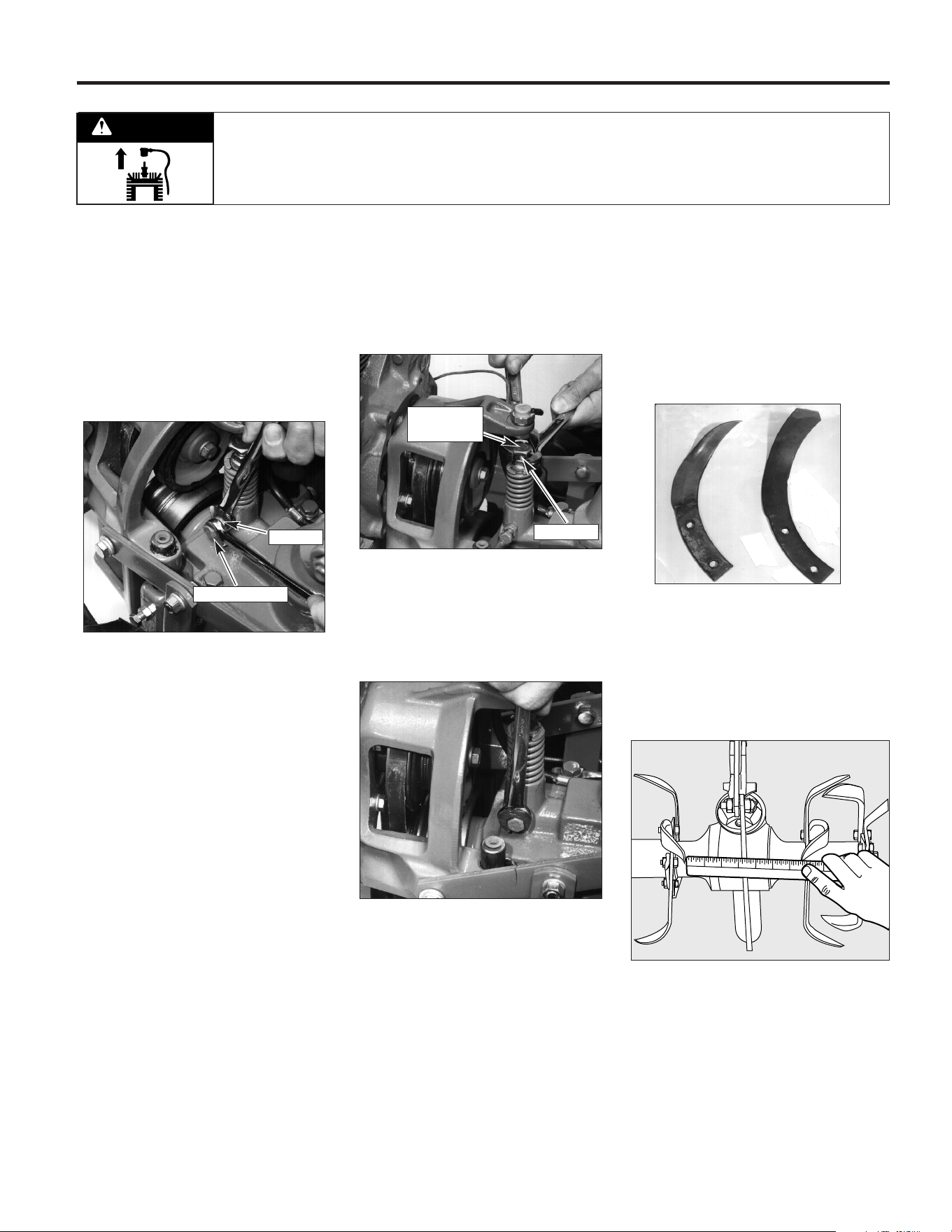
Adjusting Reverse Drive:
1. Place Wheels/Tines/PTO Drive Lever in
FORWARD position.
2. On left side of tiller, put a 1/2" wrench
on the plunger retaining bolt and another
1/2" wrench on the jam nut next to it
(Figure 5-27). While holding the bolt
steady, loosen the jam nut (counterclock-
wise) until it touches the bolt head.
3. Turn the bolt in until it tightens against
the plunger inside the spring. The bolt
must be tight to prevent plunger from
turning – but
be careful not to overtighten
and break the bolt.
4. Place a 7/8" wrench on the head of the
reverse adjustment bolt and a 9/16"
wrench on the jam nut below it (Figure 5-
28). Hold the bolt steady while loosening
the jam nut three or four turns.
5. Move the Wheels/Tines/PTO Drive
Lever to NEUTRAL. The switch body on
the bottom of the engine mount tab
(Figure 5-24) should be resting squarely
on top of the reverse adjustment bolt, and
the reverse disc should be at least 3/16"
away from the transmission drive pulley.
If the reverse disc is any closer than this,
raise the reverse adjustment bolt (turn it
counterclockwise).
6. Check that reverse disc is at least 3/16"
away from transmission drive pulley.
Then hold reverse adjustment bolt steady
with one wrench while tightening jam nut
with a second wrench (Figure 5-28).
7. Place a chalk or pencil mark on the top
edge of the plunger retaining bolt. Now,
while watching the mark, loosen the bolt
3/4-turn (Figure 5-29). Do not exceed a
3/4 turn (this would disengage the bolt
from the locking groove in the side of the
plunger).
8. Hold the plunger retaining bolt steady
with a wrench while tightening the jam
nut against the side of the plunger housing
(Figure 5-27).
9. Check the action of the reverse disc as
explained previously.
IMPORTANT: If the above adjustments
have not corrected an improperly working
reverse drive, contact an authorized
dealer or Factory Technical Service
Department for assistance.
Bolo Tine Maintenance
Checking Tines for Wear
Inspect the tines for wear or damage after
every 30 operating hours. The rate of
wear depends upon hours of use and soil
conditions. With use, the tines get
shorter, narrower and more pointed
(Figure 5-30). If badly worn, they lose the
ability to till deeply.
Worn tines leave an ever-increasing gap
in the middle of a tilled row. The normal
gap is 3" between the tine tips – replace
the tines when the gap widens to 5"
(Figure 5-31).
Tines can be replaced individually or as a
complete set. See replacement instruc-
tions that follow.
Figure 5-27: Hold bolt steady while
loosening or tightening jam nut.
Figure 5-29: Loosen plunger
retaining bolt about 3/4-turn, then
tighten jam nut against plunger
housing.
Figure 5-28: Loosen jam nut before
turning reverse adjustment bolt.
Figure 5-30: Check for wear
every 30 operating hours.
Figure 5-31: Replace tines when gap
between inner tines is 5" or more
(normal gap is 3").
1
2
3
4
5
6
7
8
Worn New
Retaining Bolt
Jam Nut
Section 5: Maintenance
Before inspecting, cleaning or servicing the machine, shut off engine, wait for all moving parts to come
to a complete stop, disconnect spark plug wire and move wire away from spark plug. Remove ignition
key, if so equipped.
Failure to follow these instructions can result in serious personal injury or property damage.
WARNING
Adjustment
Bolt
Jam Nut
37
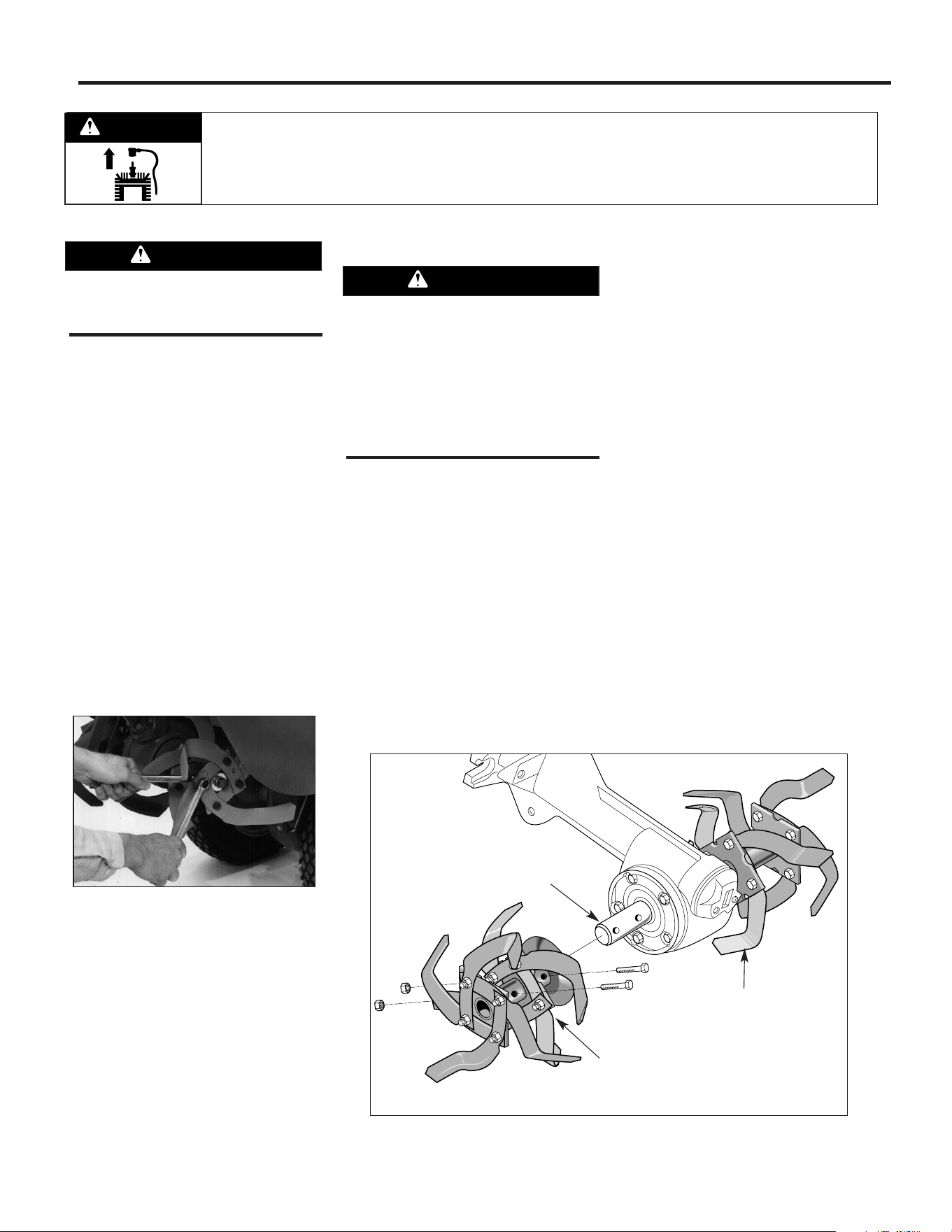
Single Tine Replacement
1. Move the Wheels/Tines/PTO Drive
Lever to NEUTRAL, the Wheel Speed
Lever to either FAST or SLOW position,
and the Tines/PTO Clutch Lever to
ENGAGE.
2. Gently tilt the tiller forward until the
engine rests on the ground.
3. Raise the hood flap at the back of the
tiller and tie it up with string.
4. Before removing a tine, note in which
direction the bent tip points. The new tine
must be installed in the same direction.
5. Use two 9/16" wrenches to remove the
two bolts and nuts securing the tine to the
tine holder plate (Figure 5-32). Use pene-
trating oil on the hardware if it is rusted or
hard to remove.
6. Mount the new tine exactly the way the
old tine was positioned. (The sharp edge
of the tine, which enters the soil first, must
face forward when above the tine shaft.)
Replace the bolts and nuts and tighten
them securely.
Removing and Replacing A Tine
Holder Assembly
The 16 Bolo Tines are mounted eight per
side on left-side and right-side tine
holders. Here’s how to replace the tines
and holders as
assemblies.
Removing Tine Holder Assembly
1. Follow steps 1-through-3 in Single
Tine Replacement above.
2. Identify the tine holders as left-side
and right-side holders – they must be
replaced on the same side from which
they were removed. Use a piece of chalk
or a grease pencil to mark them L and R
.
3. Remove the two bolts and nuts
securing each holder (Figure 5-33).
4. Use a soft mallet to drive the holder
off the tine shaft. (Use a heavy hammer
and block of wood to knock off the immo-
bilized tine holder.)
5. When the holder is off, clean all dirt
and debris from the shaft and the holder.
Apply fresh grease to the tine shaft.
Replacing Tines Holder Assembly
1. Replace the holder so the sharp tine
edges face
forward (toward front of tiller).
Tap tine holder back on the tine shaft.
2. Grease the threads on the mounting
bolt(s). Install and tighten the bolt(s)
securely.
Figure 5-33: Tine Holders.
Left-Side
Tine Holder
Tine Shaft
Right-Side
Tine Holder
Section 5: Maintenance
Before inspecting, cleaning or servicing the machine, shut off engine, wait for all moving parts to come
to a complete stop, disconnect spark plug wire and move wire away from spark plug. Remove ignition
key, if so equipped.
Failure to follow these instructions can result in serious personal injury or property damage.
WARNING
Figure 5-32: Removing a single tine
requires taking off two bolts and
two nuts.
The tines or tine hood edges may be
sharp. Wear thick gloves to protect
your hands from cuts or scrapes.
WARNING
• The tines or tine hood edges may be
sharp. Wear thick gloves to protect
your hands.
• Wear safety goggles to protect your
eyes. When loosening hardware, do
not hit a wrench with a metal tool– this
could shatter the tool or wrench,
sending metal particles into your eyes.
WARNING
38
Tine Shaft Maintenance
After every 10 operating hours, remove
the left- and right-side Bolo Tine holders
and clear away dirt and debris that have
accumulated on the tine shaft or inside
the tine holders. Please follow this main-
tenance recommendation, as debris can
cause premature wear to the tine shaft
and its oil seals. Refer to the previous
tine holder removal instructions. After
cleaning away any debris and removing
old grease from the tine shaft, apply fresh
grease to the tine shaft.
Tire and Wheel Maintenance
Check tire air pressure every 30 operating
hours. The recommended pressure for
tilling is 10-to-20 psi (pounds per square
inch). Both tires should be inflated
equally. (Unequal pressure can cause the
tiller to pull to one side.)
Removing the Wheels
Each wheel is secured by a roll (spirol)
pin that passes through the wheel hub
and the wheel shaft. Drive the roll pin out
to remove a wheel.
1. Prop the transmission up with a sturdy
block to raise the wheel you want to
remove off the ground.
2. Move the Wheel Speed Lever to either
SLOW or FAST position to prevent the
wheels from turning.
3. Use a 5/16" drift pin (or a blunt point
16-penny nail) to drive the roll pin free.
Engine Oil Maintenance
Check the engine oil level before starting
the engine each day and after each 5
hours of continuous operation. Running
the engine when it is low on oil will
quickly ruin the engine.
It is recommended that you change the oil
every ten (10) operating hours and even
sooner when operating in extremely dirty
or dusty conditions. Refer to the separate
Engine Owner’s Manual for detailed
service instructions.
Air Cleaner Maintenance
The engine is equipped with a dual
element air cleaner that filters the air
twice before it enters the carburetor to
mix with the fuel.
The engine air cleaner filters dirt and dust
out of the air before it enters the carbure-
tor. Operating the engine with a dirty,
clogged air filter can cause poor perfor-
mance and damage to the engine. Never
operate the engine without the air cleaner
installed. Inspect and service the air
cleaner more often if operating in very
dusty or dirty conditions.
It is critical that the filters be kept clean
and properly installed at all times. See
the location of the air cleaner assembly on
your engine by referring to Figure 5-39 or
Figure 5-40.
Refer to the engine manufacturer’s litera-
ture supplied with your tiller for complete
air cleaner service and maintenance infor-
mation.
Throttle Cable Maintenance
The throttle lever settings are factory-
adjusted, so unnecessary adjustments
should not be made. However, if the
engine does not start or stop, or respond
immediately to various throttle lever
settings, then adjustments may be
necessary. Please refer to the engine
manufacturer literature supplied with your
tiller for specific adjustment instructions.
Ignition System Maintenance
Your engine is equipped with electronic
ignition. It does not have a condenser or
points, so there is no need to perform any
regular tune-up maintenance on this
system other than adjusting or replacing
the spark plug.
Spark Plug Maintenance
The spark plug must be in good condition
for proper engine operation. Remove and
inspect the plug every 50 operating hours
or annually, whichever occurs first.
The correct electrode gap is .030". Check
the gap with a feeler gauge. Do not use a
spark plug if the porcelain is cracked, the
electrodes are pitted or burned, or if other
visible damage is present.
NOTE: Do not wire brush or sandblast the
spark plug to clean it – loose particles
can enter the engine, causing damage!
To replace the plug, first tighten it
securely by hand, then use a spark plug
wrench to tighten the plug an extra 1/4
turn.
Battery Care and Maintenance
The battery is sealed and is maintenence-
free. Acid levels cannot be checked.
• Always keep the battery cables and
terminals clean and free of corrosive
build-up.
• After cleaning the battery and
terminals, apply a light coat of
petroleum jelly or grease to the
terminals and cover both terminals
with the rubber boots.
Section 5: Maintenance
Before inspecting, cleaning or servicing the machine, shut off engine, wait for all moving parts to come
to a complete stop, disconnect spark plug wire and move wire away from spark plug. Remove ignition
key, if so equipped.
Failure to follow these instructions can result in serious personal injury or property damage.
WARNING
Wear safety goggles when driving the
roll pin into or from the wheel hub to
protect your eyes from the possibility of
flying metal particles.
WARNING
39
When removing the battery, always dis-
connect the negative (-) cable first
followed by the positive (+) cable. Re-
verse this procedure when reinstalling
the battery.
WARNING

Storing Your Tiller
When your tiller won’t be used during the
off-season, prepare it for storage with the
following steps:
1. Clean the tiller and engine.
2. Do routine tiller lubrication and check
for loose hardware.
3. Protect the engine from deterioration
or damage by referring to the engine
storage instructions in your engine
manual literature.
4. When engine is still warm, drain oil
from engine crankcase. Refill with fresh
motor oil.
5. Protect internal cylinder against rust by
removing spark plug and pouring one
ounce of clean engine oil into spark plug
hole. Then slowly pull out recoil start
rope 2 or 3 times to distribute oil inter-
nally. Replace spark plug, but do not
reconnect plug wire. Pull rope until resis-
tance is felt — let rope rewind.
6. Charge battery (electric start option).
Store battery in cool, dry location.
7. Move Wheels/Tines/PTO Drive Lever to
NEUTRAL position. Keep tiller in a clean,
dry area.
8. Never store tiller with fuel in fuel tank
in an
enclosed area where gas fumes
could reach an open flame or spark, or
where ignition sources are present (space
heaters, hot water heaters, furnaces, etc.).
Inspecting Forward Interlock
Wiring System
Check the Forward Interlock wiring
system every ten (10) operating hours,
for tight connections and to see that the
insulation on the wires is unbroken (to
prevent the system from shorting out).
1. Check insulated wire harness from
lower ends of handlebars to wire harness
connector on top, right side of transmis-
sion cover. Be sure connector is secure.
2. Check insulated tubing from connector
to cast iron motor mount/belt shroud.
3. Check the wire leading from the tubing
over to the switch assembly mounted on
top of the tab on the cast iron motor
mount–belt shroud. Also check the
second wire that leads to the throttle
cable mounting bracket on the right side,
forward portion of the engine.
Testing the Forward
Interlock Wiring System
The wiring circuit for the Forward
Interlock Safety System is designed to
ground out the engine’s ignition system.
There are three switches in the circuit
which, when open, let the engine run.
One switch is on the neutral plunger tab
of the cast iron motor mount. This switch
is open whenever the Wheels/Tines/PTO
Drive Lever is in NEUTRAL or REVERSE
positions. The other two switches are
located inside the handlebars, directly
above the two Forward Interlock Levers.
The switches are wired so when squeezed
(open) the engine will run. There is a
fourth switch located in the wiring
harness connector on the top, right side
of the transmission cover. It warns you if
the connection is not mated by not letting
the engine run while the Wheels/Tines/PTO
Drive Lever is in FORWARD.
1. A broken or disconnected wire could
let the engine run without you having to
press one of the Forward Interlock Levers.
2. A bare wire touching tiller or engine
metal could ground out the engine’s
ignition.
3. A switch that has failed allows the
engine to run. Or it may prevent the
engine from running.
Refer to the
Troubleshooting section if
your Forward Interlock Safety System is
not operating correctly.
Before inspecting, cleaning or servicing the machine, shut off engine, wait for all moving parts to come
to a complete stop, disconnect spark plug wire and move wire away from spark plug. Remove ignition
key, if so equipped.
Failure to follow these instructions can result in serious personal injury or property damage.
WARNING
Section 5: Maintenance
40
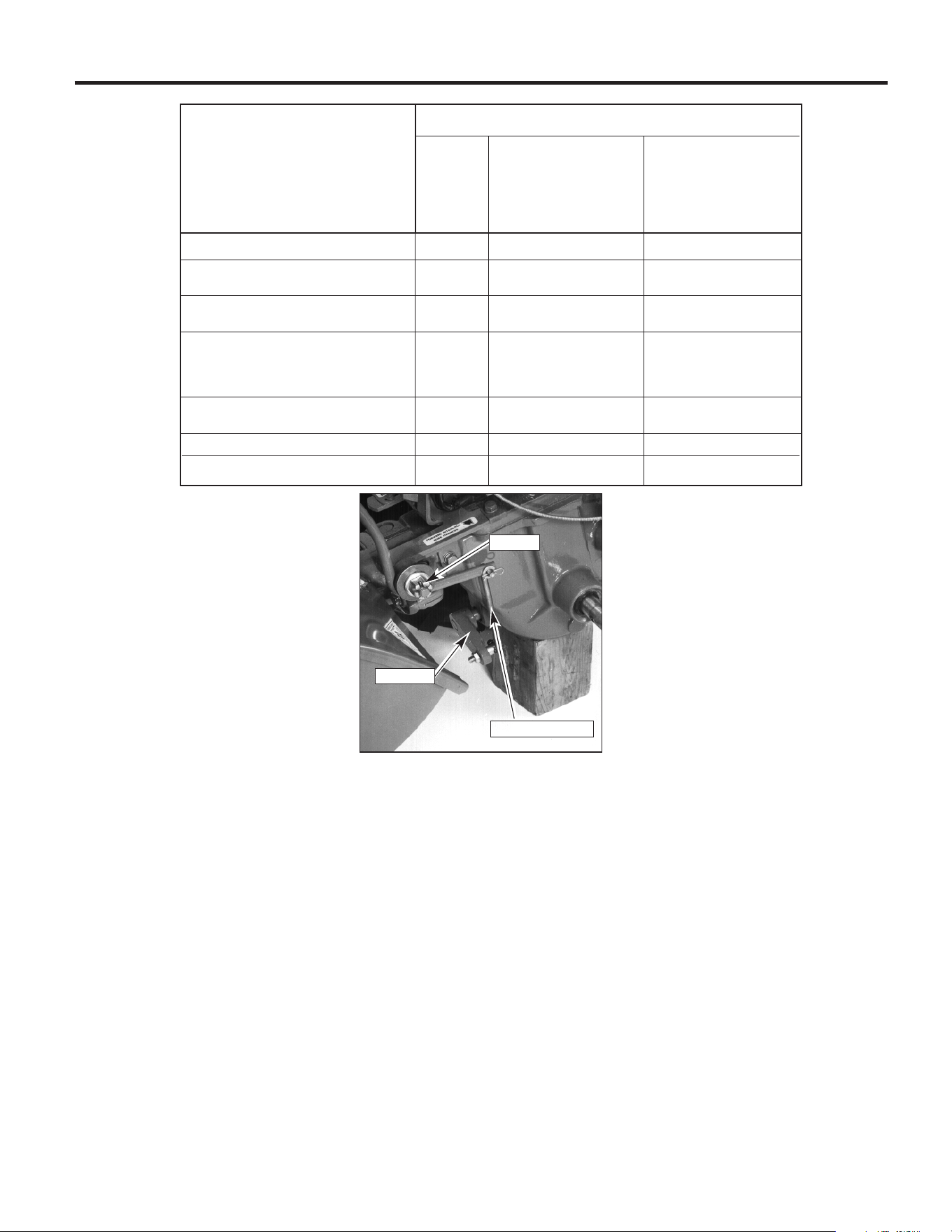
Appendix A: Troubleshooting
CHECK OR TEST
(Check or test in sequence shown
until problem is resolved.)
Throttle Lever in START position X
Wheels/Tines/PTO Drive Lever
in NEUTRAL position X
Forward Interlock Wire Harness
connector securely mated X X
Forward Interlock Levers not being
squeezed prior to shifting Wheels/
Tines/PTO Drive Lever to X
FORWARD position
Visually inspect for bare, broken
or disconnected wires X X
Check handlebar wire harness X X
Check transmission wire harness X X
PROBLEM
Troubleshooting Procedures
1 Wheels/Tines/PTO Drive Lever:
A. Lever does not stay in FORWARD–
• Drive belt may be too tight. Raise belt
adjustment block a little (Sect. 5).
• Clutch pawl spring at end of lever may be
overstretched. Install new spring.
B. Lever hard to shift into REVERSE–
• Check reverse disc for wear (Sect. 5).
• Check adjustment of reverse disc and/or
reverse spring and plunger assy. (Sect. 5).
• Clean and re-lubricate motor mount bars,
belt adjustment block and linkages on lever
(Sect. 5).
C. Tiller stays in REVERSE when lever is
released–
• Lubricate motor mount bars, belt adjust-
ment block and linkages on lever (Sect. 5).
• Check adjustment of reverse spring and
plunger (Sect. 5). If problem persists,
contact Technical Service Department.
D. Lever sticks in FORWARD–
• Lubricate motor mount bars, belt adjust-
ment block, and linkages on lever (Sect. 5).
If problem continues, contact the Technical
Service Department.
E. Lever hard to shift into FORWARD–
• Follow advice for Problem 1-D. Also check
for possible bent motor mount bar that could
be binding in engine mount holes.
2 Wheel Speed Lever:
A. Lever hard to shift, or sticks in FAST or
SLOW wheel gear positions–
• Lubricate eccentric lever at rear of power
unit transmission (Figure 5-43). If rust is
present, use penetrating oil and work
eccentric lever back and forth by hand.
• Lubricate linkage to Wheel Speed Lever to
eccentric lever (Figure 5-43).
• Clutch inside transmission may be binding.
Disconnect linkage from eccentric lever and
work eccentric lever by hand. If difficult or
impossible to move, it may be due to a
damaged keyway on the wheel shaft.
Contact Technical Service Department.
• Lubricate washers and castle nut on pivot
of lever. If necessary, remove roll pin and
back nut off 1/6th turn. Replace roll pin and
test the movement.
• Apply grease to zerk fitting (if so equipped)
with grease gun until grease appears around
washers.
B. Lever shifts into FAST wheel gear, but
not into SLOW wheel gear–
• Connecting rod at end of lever might be
backwards, or bent in toward transmission
housing and hitting it. Other shifting linkage
might be bent. Straighten or replace linkage
(Figure 5-43).
• Clutch inside transmission may be binding
(Problem 2-A).
C. Lever moves freely, but won’t shift in or
out of gear–
• Eccentric shifting pin inside transmission
may be broken (rare) or worn. Disconnect
linkage from eccentric lever and try moving
eccentric lever by hand (Figure 5-43). If
lever moves easily, contact the Technical
Service Department.
3 Wheels and Tines Won’t Turn:
• Review operation of controls (Sect. 3 & 4).
• Check condition and adjustment of drive
belt and reverse disc (Sect. 5).
• Mounting bolt for transmission drive pulley
may be loose. (See Figure 5-1). If so, drive
belt or reverse disc will turn pulley, but
pulley won’t turn main drive shaft.
• Worm gears that drive wheel and tiller
shafts may be worn.
4 Wheels Turn, But Tines Won’t:
• Tines/PTO Clutch Lever must be in ENGAGE
position (Sect. 3).
• Tines/PTO Clutch Lever may need adjust-
ment.
• Key for dog clutch on tine attachment main
drive shaft may be missing, broken.
• Worm gears that drive the tine shaft may
be worn.
Figure 5-43: Check connecting rod,
shifting linkage and eccentric lever.
Connecting Rod
Linkage
Eccentric
Engine
won’t start
Engine shuts off when
Wheels/Tines/PTO Drive
Lever is shifted into
FORWARD
Engine does not shut off
when Forward Interlock
Levers are released while
Wheels/Tines/PTO Drive
Lever is in FORWARD
41

• Hardware holding tine holders to tine shaft
may be missing or broken. To check,
remove holders (Sect. 5).
• Key for bronze worm gear on tine attach-
ment main drive shaft may be missing or
broken.
5 Tines Turn, But Wheels Won’t:
• Check operation of Wheel Speed Lever
(Problem 2).
• Hi-Pro key inside wheel clutch may be
missing, broken. If so, clutch will not turn
wheel shaft.
• FAST and SLOW speed wheel gears may
be worn. If only one gear is worn, there will
only be one wheel speed.
• Worm gear that drives pinion shaft and
pinion gears may be worn.
• FAST and SLOW speed pinion gears may
be worn. If only one gear is worn, there will
only be one wheel speed.
• Drive “dogs” on sides of wheel clutch may
be worn or broken. If only one side of clutch
is affected, there will only be one wheel
speed.
6 Wheels And Tines Turn On Top Of
Ground, But Stop Or Hesitate In Soil:
• Drive belt may be loose (Sect. 5).
• Mounting bolt for transmission drive pulley
may be loose (Figure 5-1).
7 Tiller Jumps While Tilling:
• Depth Regulator Lever set too deep for soil
conditions. Use a shallower setting.
• Engine throttle speed too fast.
• Tiller wheel speed too fast for soil condi-
tions. Change to LOW belt range or SLOW
wheel speed.
8 Depth Regulator Lever
Difficult To Move:
• Lubricate spring assembly and depth
adjustment bar (Sect. 5).
• Check for bent depth adjustment bar.
9 Wheel And Shaft Move
Out To One Side:
• Snap ring on wheel shaft may be
dislodged. Raise wheels off ground and
check for back and forth play in shaft. If
there is play, one or both snap rings is loose.
10 Tiller Pulls To One Side:
• Check tire pressure (Sect. 5).
11 Tine Holder Bolt
Breaks Or Loosens:
• Earlier models have tine holder keys.
Check that keys are in keyways of tine shaft.
Without key in holder, left-side tine bolt will
tighten and break; right-side bolt will loosen
(Sect. 5).
12 Poor Traction:
• Bar tread tires, tire chains, or wheel
weights may be needed.
13 Gear Oil Leak From Power Unit Or Tine
Attachment Transmissions:
• See Section 5.
14 Engine Lacks Power:
• *Air cleaner restricted with dirt and/or oil.
• Spark plug wire loose or damaged. Spark
plug worn or fouled.
• Engine under excessive work load. Use
SLOW wheel speed and LOW belt range.
• *Throttle cable may be loose or misad-
justed.
• Verify that engine isn’t running with choke
partially engaged.
• *Check Carburetor adjustment.
• *Engine overheating. Check oil level and
clean cooling fins. Oil may be very dirty. Let
hot engine cool before restarting.
• *Dirt or water in fuel or fuel system.
• Engine crankcase low in oil, or overfilled
with oil. Check and adjust level.
• *Low engine compression.
15 Engine Difficult To Start:
• Wheels/Tines/PTO Drive Lever not in
NEUTRAL position.
• Fuel tank low or empty.
• *Dirt or water in fuel or fuel system.
• *Fuel line is restricted.
• *Choke control not set properly.
• *Spark plug worn or fouled (weak spark).
• *Air cleaner restricted with dirt and/or oil.
• *Throttle cable adjustment.
• Engine throttle lever not free to move
through its full operating range.
• Throttle wire and its linkage are binding, or
are bent and not free to move.
• Low engine compression.
16 Engine Won’t Start:
• See Troubleshooting the Forward Interlock
Safety System in Section 5.
• Wheels/Tines/PTO Drive Lever not in
NEUTRAL position.
• Fuel tank low or empty. Or fuel line
restricted or clogged.
• *Choke control improperly set.
• *Water or dirt in fuel, and /or fuel system.
• *Spark plug fouled or worn. Spark plug
wire loose or damaged.
• *Carburetor may need adjustment.
• *Air filter clogged with oil or dirt.
• Carburetor float faulty (or float valve
leaking)– if so, tap side of bowl lightly with
handle of screwdriver (or similar object).
• Stale fuel clogs carburetor, and valves.
Drain old fuel and add new fuel.
• *Fuel tank shut-off valve (if so equipped)
not in fully Open position.
• On Briggs & Stratton engine, On/Off switch
not in ON position.
Electric Start Engines Only:
• Electrical connections loose or shorted to
metal frames, brackets or covers (Sect. 5).
• Battery discharged (Sect. 5).
• Electric starter motor faulty.
17 Engine Shuts Off When Wheels/
Tines/PTO Drive Lever Is In Forward:
• See Troubleshooting the Forward Interlock
Safety System in Section 5.
• Short in key switch or key switch wire
harness.
• Check starter motor mounting bolts for
looseness. Have Authorized Engine Service
Dealer inspect the starter motor.
• Check oil level for correct amount.
18 Engine Overheats
• Clean the engine cooling fins, shroud and
covers (Sect. 5).
• Check for broken flywheel fins (under
engine shroud). See Authorized Engine
Dealer.
19 Engine Runs Erratically:
• Water or dirt in gasoline or carburetor.
• Carburetor may need adjustment. See
Engine Owner’s Manual.
• *Spark plug fouled or dirty. Spark plug
wire loose or damaged.
• *Loose or cracked carburetor.
• Governor linkage not adjusted properly or
binding. See Authorized Engine Service
Dealer. Don’t attempt to repair by yourself.
• Check pan gasket, engine seals and drain
plugs for leaks. See your Authorized Engine
Service Dealer.
20 Engine Runs Well,
But Labors Under Tiller Load
• *Check governor linkage for freedom of
movement.
• Check throttle setting and carburetor
adjustment. See Engine Owner’s Manual.
• Tilling depth is possibly too deep. To
correct, lower the depth regulator lever.
• Possible worn tiller worm gear or loose
drive shaft.
21 Key Switch Will Not
Start The Engine
• Check battery terminals for corrosion
(Sect. 5).
• Discharged battery (Sect. 5).
• Defective solenoid.
*See Engine Owner’s Manual or contact an authorized engine dealer for information.
Appendix A: Troubleshooting
42

43
Troy-Bilt
®
PTO Log Splitter
290-258-081
The Troy-Bilt
®
PTO Log Splitter provides
you with a convenient and easy means of
splitting about a half a cord of wood per
hour when working alone. When
connected to the PTO Power Unit, the
tiller’s engine runs the splitter’s hydraulic
pump, providing you with 13 tons of
steady, unhurried and predictable splitting
force.
As an added benefit, the power-driven
mobility provided by the PTO Power Unit
allows you to move the splitter to and
from your wood pile, over to a neighbor’s
place, or along the woodpile to a fresh
supply of logs.
Features include a 15 second splitting
cycle; can handle log sizes up to 26" long;
a two-stage hydraulic pump that automat-
ically shifts into low gear to provide four-
times greater pressure when needed;
slim-cut wedge design for splitting green,
stringy wood; and an auto-control valve
for automatic return stroke.
Dozer/Snow Blade Attachment
290-259-081
In the winter, moves up to one foot of
light snow (or 6"-to-8" of heavy snow); at
other times use it to move or spread
sand, gravel, loose dirt, grain, sawdust,
etc. Attaches easily to the front of the
Wrap-Around Bumper Guard. Set the
blade to several angles. Weighs 41-lbs.;
measures 15" x 32".
Row Marker Attachment
290-257-081
Do you like very straight, even, neat rows
in your garden? If so, the Row Marker is
a must attachment. Hooks quickly to the
Hiller/Furrower attachment– eliminates
the need for string, stakes, measuring
tape, etc. You’ll like the straight rows it
helps you make if you lay out furrows, dig
compost trenches, or make raised beds.
The Row Marker extends from 28"-to-
49
3
⁄
4", letting you vary the width between
rows to suit the crop you’re planting.
V-Sweep Cultivator
290-260-081
The V-Sweep Cultivator is a specialized
tool designed for between-row crop culti-
vation. Instead of stirring the soil, it
slices through just below the surface to
eliminate practically any weeds in its path.
The Sweep mounts easily to the optional
Tow Hitch Attachment at the rear of the
PTO Power Unit. The blade is made of
high carbon, heat treated steel and
measures 2" wide (overall wing span is
20").
The unique way the Sweep works,
skimming along just underneath the soil’s
surface without turning the soil over,
makes this the ideal tool for use in dry,
dusty conditions where it is important to
keep soil disturbance to a minimum.
And, because of its 20" wide cutting path,
it does an effective cultivation job at a fast
speed.
The Sweep’s natural shallow cultivation
helps to prevent weed seeds from being
brought to the soil’s surface. This
shallow cultivation feature also means
there’s less chance of damaging the roots
of your vegetables. For deeper or more
shallow cultivating, the blade depth can
be changed with a simple adjustment..
Wheel Weights
290-266-081
Help increase traction by putting extra
weight directly on the wheels. They
reduce bucking and jumping when deep-
tilling in heavy soil. They’re shipped
empty– fill them with material like
concrete, sand, gravel, etc. They bolt
directly to the tiller wheels.
Wrap-Around Bumper Guard
290-255-081
Order this Bumper Guard by itself or
receive it as one of the components if you
order the combination Dozer/ Snow Blade
attachment. Protects the engine from
damage by wrapping around and protect-
ing many of the engine components. 1"
diameter, high-strength steel tubing.
Hiller/Furrower Attachment
290-250-081
The most popular attachment because it
does so many jobs. Mounts to the rear of
the depth regulator bracket. Furrower
blade easily makes plant rows, trenches,
ditches to 8" deep. When hiller wings are
attached to furrower blade, attachment
makes hilled rows and raised bed
gardens. Converts from a furrower to a
hiller and back again, in seconds, without
tools.
Appendix B: Attachments & Accessories
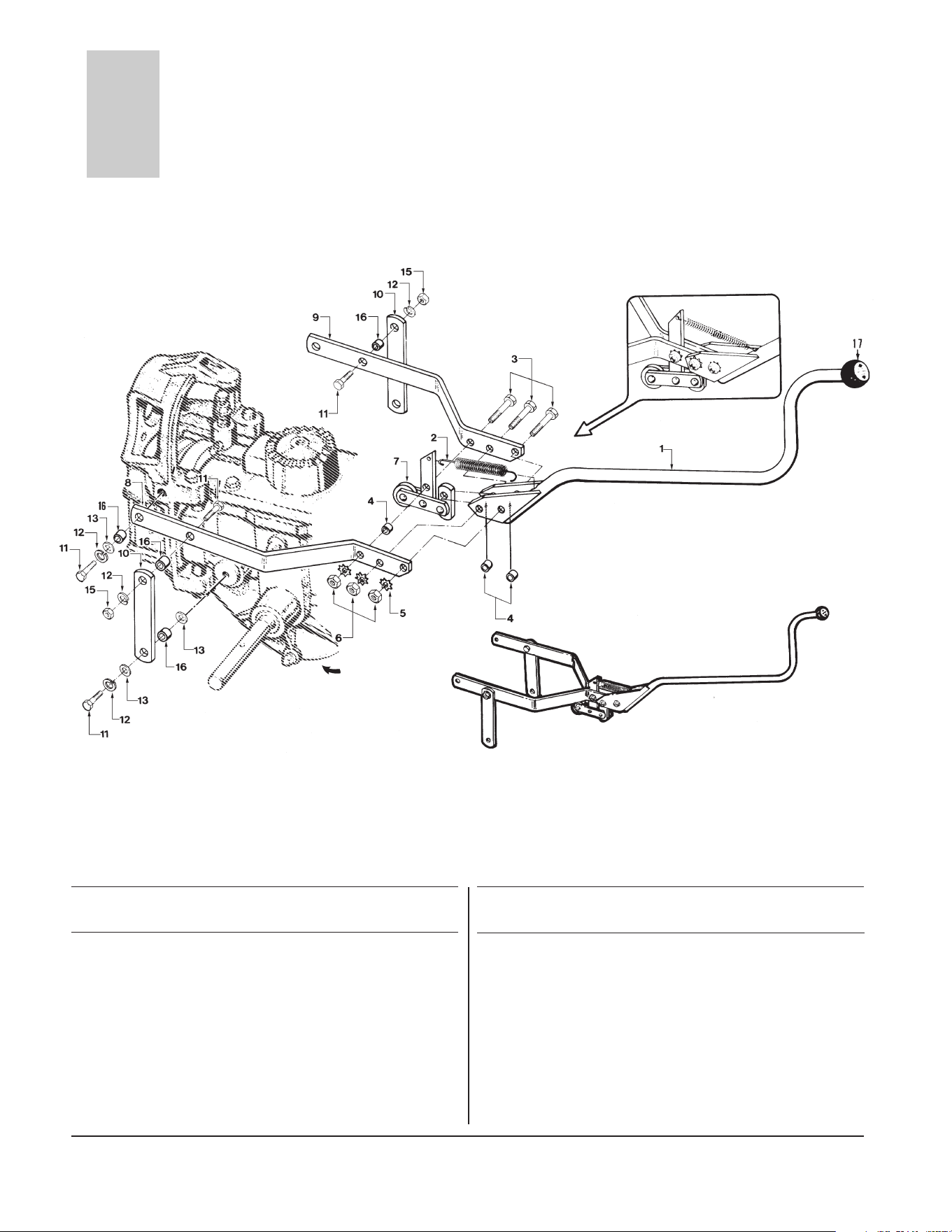
44
REF PART
No. No. DESCRIPTION QTY.
REF PART
No. No. DESCRIPTION QTY.
1 647-04006 Lever Assembly–Wheels/Tines/
PTO Drive (Includes Ref. 17)......... 1
2 1908156 Spring–clutch pawl........................ 1
3 710-0805 Bolt–hex hd., 5/16-18 x 1-1/2"....... 3
4 GW-2447 Bushing–3/8" ................................. 3
5 1177548 Lockwasher–external tooth, 5/16" . 3
6 712-0267 Nut–hex, 5/16"-18.......................... 3
7 1916265 Roller Assembly ............................ 1
8 GW-2165-1 Yoke–left side................................ 1
9 GW-2165-2 Yoke–right side.............................. 1
10 GW-2164 Link–yoke pivot, left & right,
6-7/8" long ................................. 2
11 710-0514 Bolt–hex hd., 3/8-16 x 1" ............... 6
12 736-0169 Lockwasher–spring lock, 3/8"........ 6
13 736-3050 Washer–flat, 3/8", S.A.E................. 6
15 712-0798 Nut–hex, 3/8"-16............................ 2
16 1113-1 Bushing–spacer, 19/64" (.300") ..... 6
17 GW-2595 Knob.............................................. 1
See Page 50
Section
6
Parts List
WHEELS/TINES/PTO DRIVE LEVER & YOKE ASSEMBLY
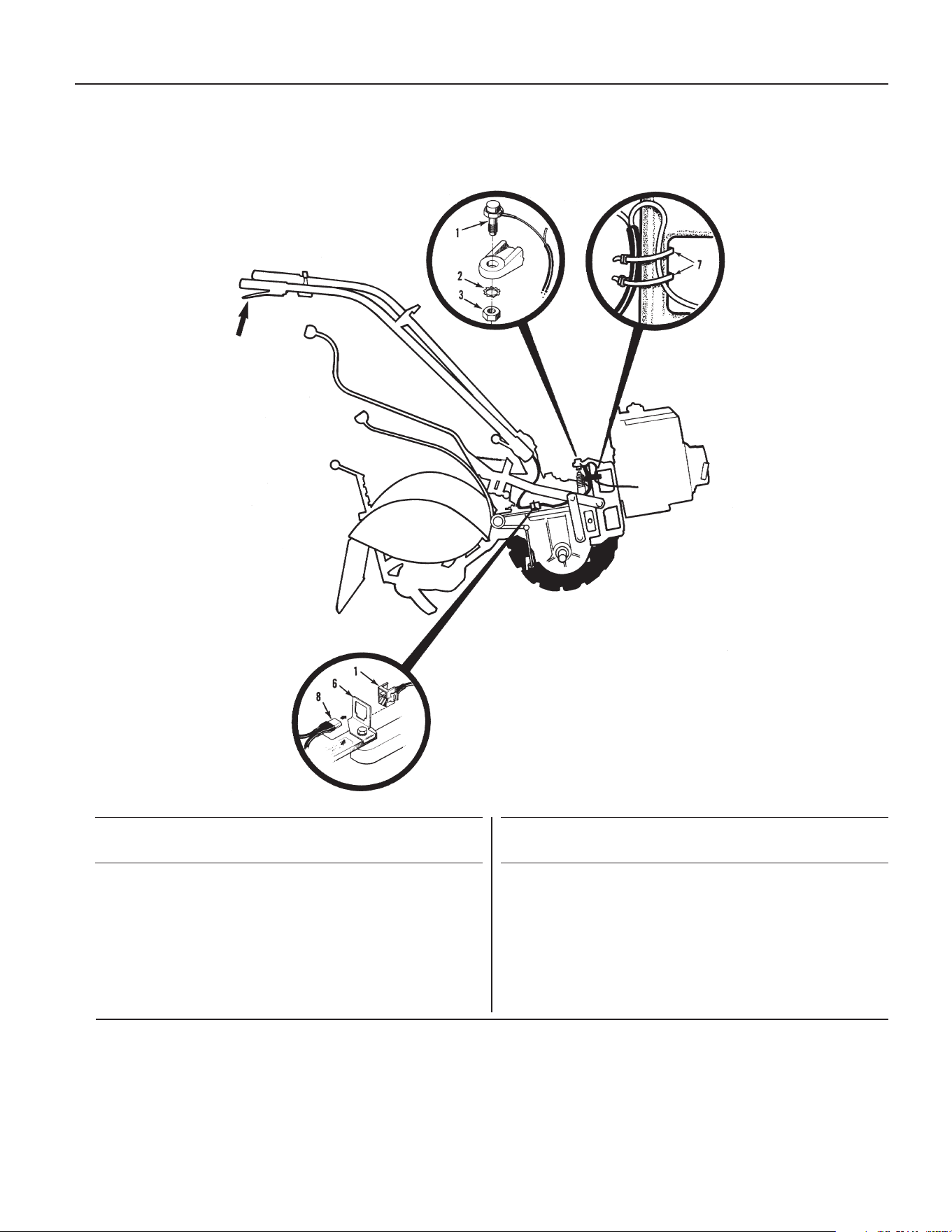
REF PART
No. No. DESCRIPTION QTY.
REF PART
No. No. DESCRIPTION QTY.
1 629-04017 Engine Wire Harness Assy–forward
interlock system (Incl. one red
and one black wire, plug con-
nector, neutral switch and PVC
tubing. Parts not available
separately................................. 1
2 GW-9971 Lockwasher–external tooth, 7/16" ......1
3 1186246 Nut–hex, 7/16"-20 ....................... 1
6 GW-9205 Clip–for plug connector............... 1
7 725-0157 Tie–plastic ................................... 2
8 GW-2551 Handlebar Wire Harness Assy–
(see page 46, Ref. No. 20) ....... 1
FORWARD INTERLOCK SYSTEM
See Page 46
MODELS 682J. E686N & E682L
Parts List
45
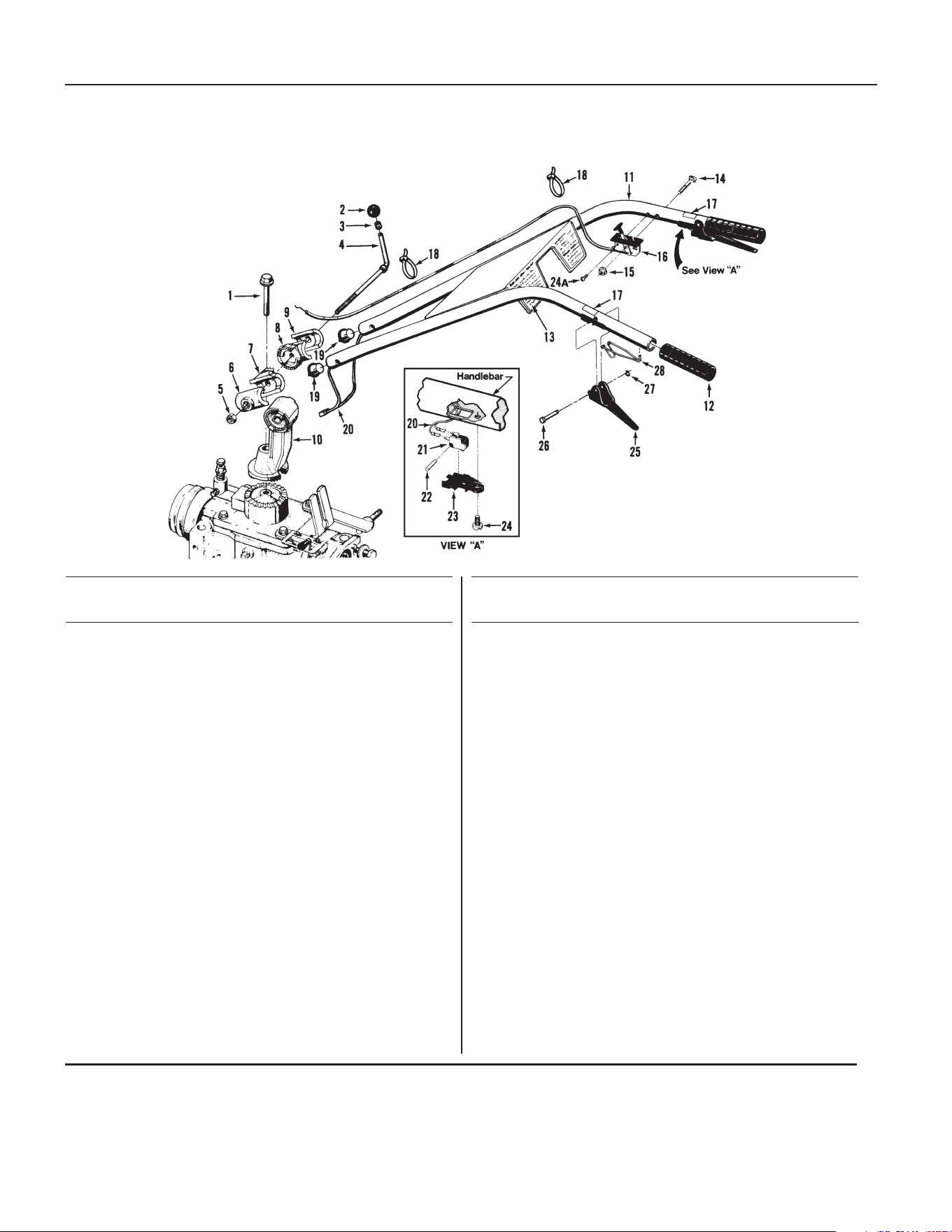
Parts List
MODELS 682J. E686N & E682L
REF PART
No. No. DESCRIPTION QTY.
REF PART
No. No. DESCRIPTION QTY.
1 GW-9548 Bolt–Hex hd., flanged self-locking
Grade 5, 1/2-13 x 3-1/2" ............ 1
2 GW-9119 Knob–handlebar height adjustment 1
3 GW-9120 Ring–retaining (tolerance ring)...... 1
4 GW-2657 Stud–handlebar height adjustment 1
5 1186233 Nut–hex, 1/2"-13............................ 1
6 GW-1021-1 Clamp–left, handlebar height
adjustment ................................. 1
7 GW-2542-1 Ratchet–left, handlebar height
adjustment ................................. 1
8 GW-2542-2 Ratchet–right, handlebar height
adjustment ................................. 1
9 1901784 Clamp–right, handlebar height
adjustment ................................. 1
10 GW-2534A Base–handlebar mounting............. 1
11 GW-2717 Handlebars .................................... 1
12 GW-9125 Grip–handlebars ............................ 2
13 777I22026 Decal–Control panel ...................... 1
14 1918111 Bolt–curved hd, GR5, 1/4-20 x 2" .. 1
15 1186389 Nut–hex, flanged self-locking, whiz
lock, 1/4"-20............................... 1
16 1909286 Throttle Control & Cable ................ 1
17 777I20946 Decal–Forward Interlock Lever ...... 2
18 725-0157 Tie–plastic ..................................... 2
19 GW-9219 Plug–wire harness retainer............ 2
20 GW-2551 Handlebar Wire Harness Assy–
forward interlock system............ 1
21 GW-9250 Handlebar Switch–forward
interlock system......................... 2
22 GW-9385 Lock Pin–handlebar switch............ 2
23 GW-2543 Switch Housing–handlebar switch. 2
— GW-2563 Switch Assembly ........................... 1
(Includes Ref. 21-23)
24 1186009 Screw–pan head, 10-24 x 1/2",
thread-forming........................... 2
24A GW-9733 Screw–phillips head, 10-32 x 1/2",
thread-forming........................... 1
25 786-04003 Lever–Operator Presence Control.. 2
26 GW-9199 Pivot Pin–forward interlock lever... 2
27 GW-9514 Retaining Ring–klip ring–forward
interlock lever............................. 2
28 GW-9387 Return Spring–fwd interlock lever . 2
– 777D06526 Label – Troy-Bilt Horse.................. 1
– 777D06527 Label – Troy-Bilt Horse “Big Red” .1
HANDLEBAR ASSEMBLY
46
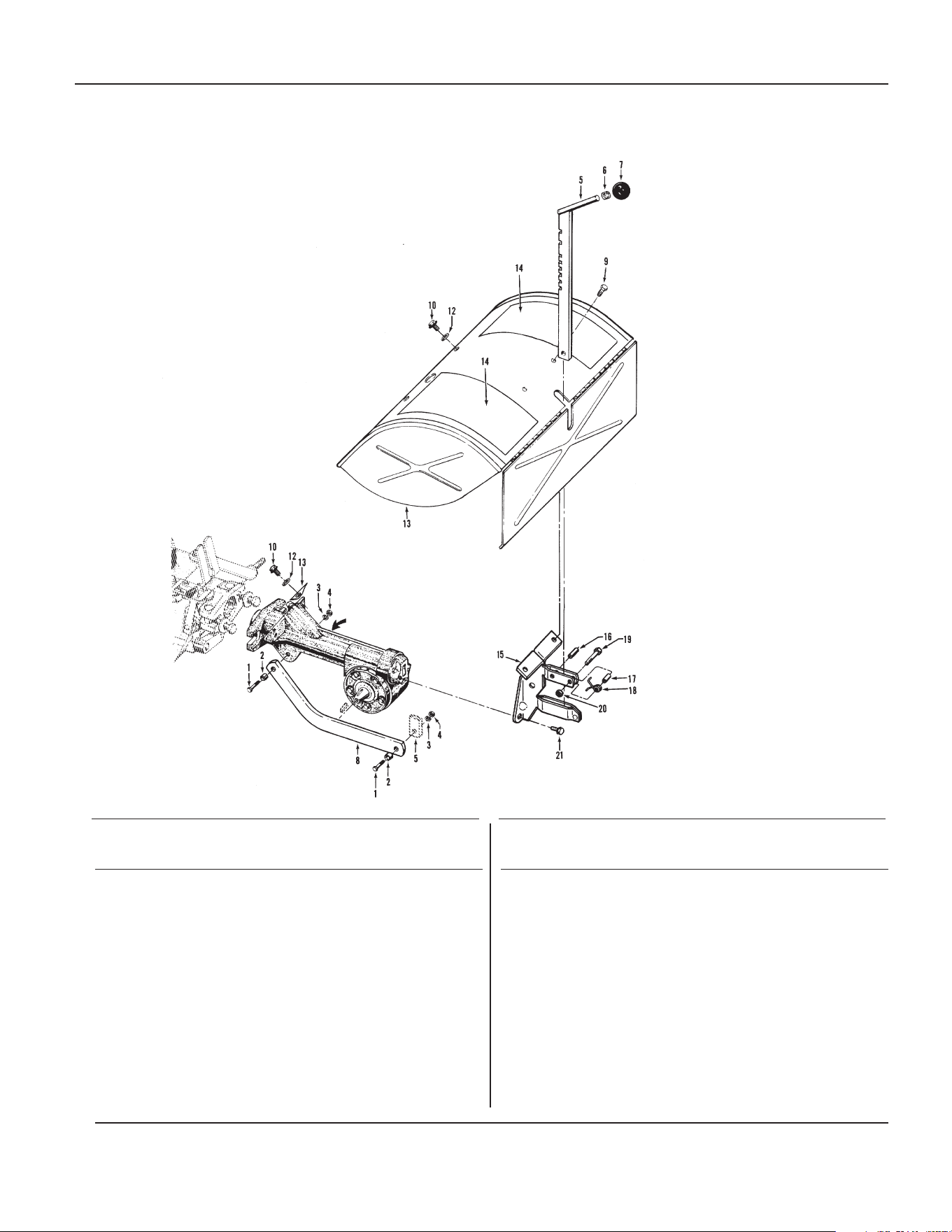
1 710-3005 Bolt–hex hd., 3/8-16 x 1-1/4" ........ 2
2 GW-1113-1 Bushing–19/64" (.300" lg.) ............ 2
3 736-0169 Lockwasher–spring lock, 3/8" ....... 2
4 712-3017 Nut–hex, 3/8"-16 ........................... 2
5 GW-20795 Bar–depth regulator ...................... 1
6 GW-9120 Ring–retaining .............................. 1
7 GW-9119 Knob–depth regulator ................... 1
8 GW-2121 Bar–drag, depth regulator ............. 1
9 710-0599 Screw–thread-forming,
1/4-20 x 1/2".............................. 2
10 1186329 Bolt–flanged hex hd.,
5/16-18 x 3/4"............................ 2
12 GW-9929 Washer–flat, 5/16"......................... 2
13 686-04027 Hood ............................................. 1
14 777I22027 Decal–hood, operating inst. (LH) .. 1
777S32049 Decal–hood, operating inst. (RH).. 1
15 GW-2525 Bracket.......................................... 1
16 1185469 Pin–roll (spirol) 1/4" x 1" ............... 1
17 GW-9534 Spacer........................................... 1
18 GW-9384 Spring ........................................... 1
19 710-0597 Bolt–hex hd., 1/4-20x1"................. 1
20 1110106 Locknut–1/4"-20 ........................... 1
21 710-04049 Bolt–flanged hex hd.,
5/16-18 x 5/8"............................ 2
REF PART
No. No. DESCRIPTION QTY.
REF PART
No. No. DESCRIPTION QTY.
DEPTH REGULATOR & TINE HOOD ASSEMBLIES
See Page 54
MODELS 682J. E686N & E682L
Parts List
47
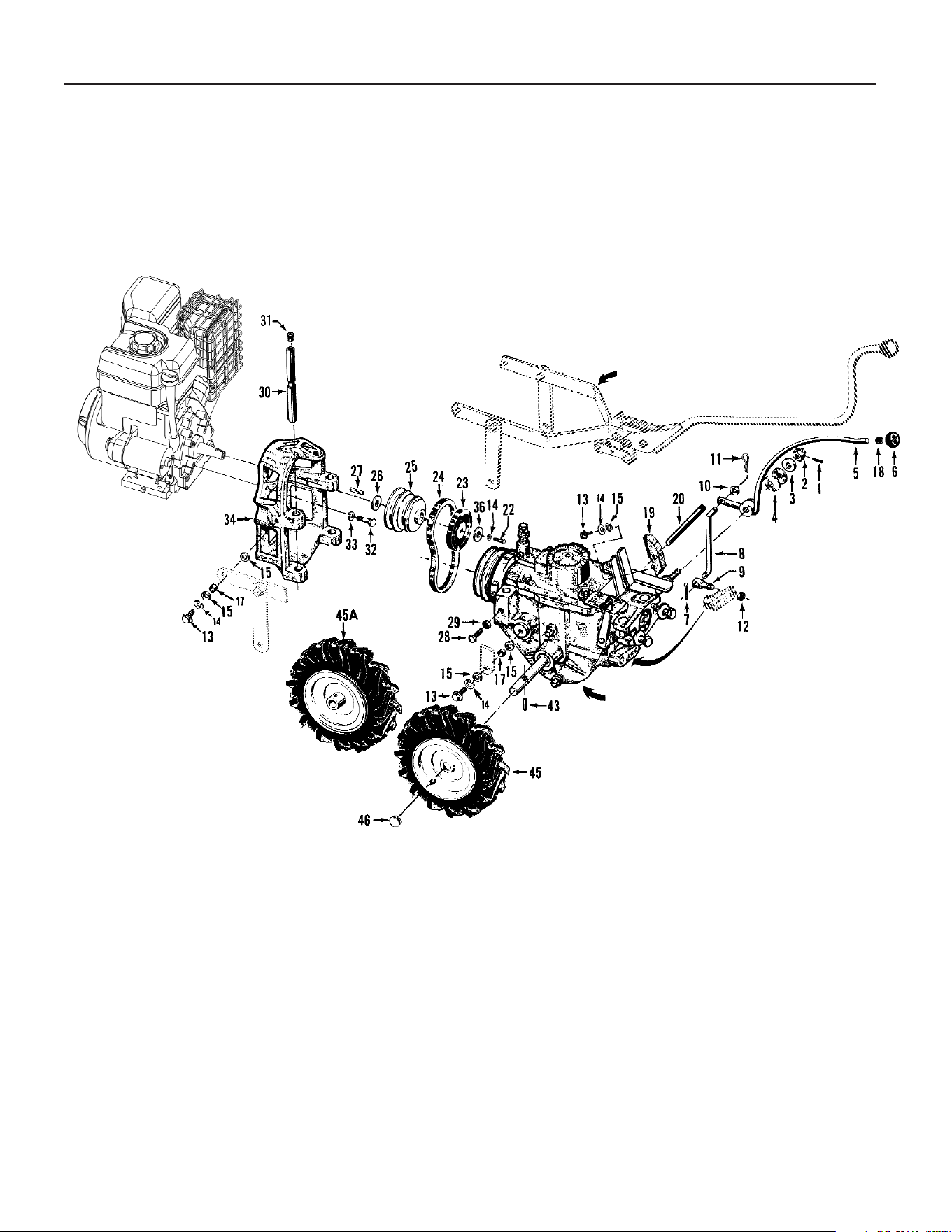
Parts List
MODELS 682J. E686N & E682L
WHEEL SPEED LEVER, BELT DRIVE SYSTEM, ENGINES, WHEELS
See Page 62
See Page 52
48

WHEEL SPEED LEVER
1 GW-9362 Pin–spring, 1/8"................................ 1
2 GW-9838 Nut–castle (slotted), 1/2"-20 ............ 1
3 GW-9934 Washer–shoulder, 1/2"..................... 1
4 GW-9932 Washer–disc spring ......................... 2
5 GW-2178 Lever–wheel speed shift................... 1
6 1902240 Knob–wheel speed shift lever........... 1
7 GW-9317 Pin–cotter, 3/32" x 1"........................ 1
8 GW-1231 Rod–connecting rod, wheel speed
shift lever...................................... 1
9 GW-1033 Swivel–connecting rod..................... 1
10 736-0275 Washer–flat, 5/16", S.A.E. ................ 1
11 GW-9338 Pin–hair cotter.................................. 1
12 712-0158 Locknut–hex hd., 5/16"-18 ............... 1
13 710-0514 Bolt–flanged hex hd., 3/8-16 x 1" ..... 5
14 736-0169 Lockwasher–spring lock, 3/8" .......... 5
15 736-3050 Washer–flat, 3/8", S.A.E. .................. 8
17 GW-1113-1 Bushing–spacer, 19/64" (.300"lg.).... 4
18 GW-9120 Ring–retaining (tolerance ring) ........ 1
BELT DRIVE SYSTEM
19 GW-2102 Block– belt adjustment, 3-7/8" ......... 1
20 GW-2100 Rod– belt adjust., 7" with
measuring gauge .......................... 1
21 777I20942 Decal– engine stabilization ............... 1
22 1100012 Bolt–hex hd., 3/8-24 x 1-1/2" ........... 1
23 GW-2111 Disc–reverse .................................... 1
24 GW-9245 Belt–forward drive (no substitute
due to extra strength required) ..... 1
25 GW-1483 Pulley–engine power take off ........... 1
26 GW-1138-1 Shim–engine pulley, 1/16" As Req'd
26 GW-1138-2 Shim–as above, 1/32" As Req'd
27 GW-9303 Key–engine pulley, 3/16"sq. x 2-1/2" 1
ENGINES AND ENGINE MOUNT
28 710-0376 Bolt–hex hd., 5/16-18 x 1", Grade 5.. .... 2
29 712-3010 Nut, hex, 5/16-18 .............................. 1
30 GW-1034 Bar–engine mounting....................... 2
31 GW-9147 Plug–thread protector, red plastic.... 2
32 GW-9572 Bolt–hex hd., 5/16-24 x 1-1/8" ......... 4
33 736-0119 Lockwasher–spring lock, 5/16" ........ 4
34 GW-2553 Mount– engine to tiller ..................... 1
35 * Briggs & Stratton Engine–
Recoil or electric start. (Electric
start requires key switch
starting system.) .......................... 1
36 736-3052 Washer, flat, .406 x 1.0 x .105......... 1
– 777S30647 Decal–hot surface warning .............. 1
WHEEL & TIRE ASSEMBLIES
43 1915072 Pin– roll, 5/16" x 1-1/2".................... 2
45 1915056 **Wheel & Tire Assy– bar tread,
left side, 4:80 x 8" tubeless tire
with valve stem, on one-piece
steel wheel. .................................. 1
45A 1915057 **Wheel & Tire Assy–bar tread,
right side. Same as above but
for right side of tiller..................... 1
46 1902020 Cap–wheel hub ................................ 2
REF PART
No. No. DESCRIPTION QTY.
REF PART
No. No. DESCRIPTION QTY.
* Contact an authorized engine dealer, Troy-Bilt dealer or the Factory for replacement engine
information.
Contact an authorized engine dealer for engine service or parts. Refer to the engine name-
plate for engine model and type information.
** For correct traction and directional control, Bar Tread Tires should be mounted on the
tiller so the closed end of the “V” in the tire tread on top of the tire faces forward.
MODELS 682J. E686N & E682L
Parts List
49
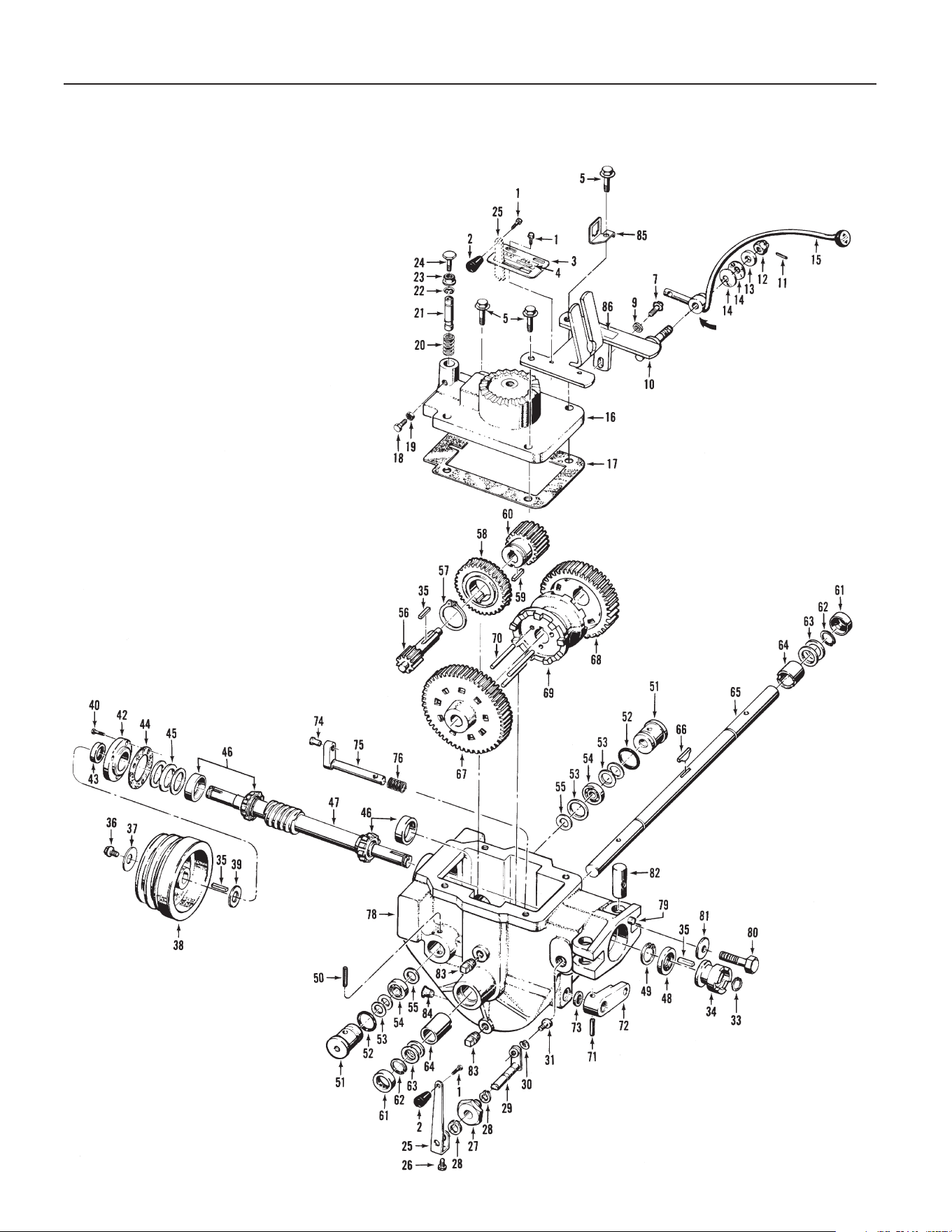
POWER UNIT TRANSMISSION ASSEMBLIES
See Page 50
,16A
Parts List
MODELS 682J. E686N & E682L
50

REF PART
No. No. DESCRIPTION QTY.
REF PART
No. No. DESCRIPTION QTY.
TRANSMISSION COVER & SHIFT LEVER
BRACKET ASSEMBLIES
1 1186299 Bolt–hex hd., #10-32 x 3/8",
self-locking flange ..................... 3
2 GW-9463 Knob–tines/PTO clutch lever,
tapered, plastic .......................... 1
3 GW-2124 Detent Plate–tines/PTO clutch lever 1
4 777I20945 Decal–operating instructions,
detent plate................................ 1
5 1186349 Bolt–flanged hex hd.,
3/8-16 x 1-1/2" .......................... 4
7 1186329 Bolt–flanged hex hd.,
5/16-18 x 3/4", Grade 5 ............ 1
9 736-0275 Washer–flat, 5/16", S.A.E. ............. 1
10 GW-2149 Bracket–shift levers....................... 1
11 GW-9362 Pin–spring, 1/8" ............................ 1
12 GW-9838 Nut–castle (slotted), 1/2"-20, call
Tech Service for tightening
instructions. ............................ 1
13 GW-9934 Washer–shoulder, 1/2" ................. 1
14 GW-9932 Washer–disc spring ...................... 2
15 GW-2178 Lever–wheel speed shift................ 1
16 GW-2523 Cover–power unit transmission .... 1
17 GW-1123 Gasket–transmission cover........... 1
18 710-0376 Bolt–hex hd., 5/16-18 x 1", Grade 5,
(
remove with care) ................... 1
19 712-0267 Nut–hex, 5/16"-18 ......................... 1
20 1901439 Spring–neutral plunger (remove
with care).................................. 1
21 GW-1035-1 Plunger–neutral (
remove with care)1
22 1901440 Clip Ring–retains neutral plunger.. 1
23 1186393 Nut–hex, flange locknut, 3/8"-16 ... 1
24 1902004 Bolt–hex hd., 3/8-16x1-1/2",
threaded full length.................... 1
TINES/PTO CLUTCH LEVER ASSEMBLY
25 786-04002 Lever–eccentric, tines/PTO clutch. 1
26 710-3013 Bolt–hex hd., 1/4-20 x 1/2" ........... 1
27 GW-2123 Bushing–tines/PTO clutch lever
eccentric shaft ........................... 1
28 GW-9516 Retaining Ring–(snap ring),
external...................................... 2
29 GW-2461 Eccentric–shaft, tines/PTO clutch
lever........................................... 1
30 GW-9911 Lockwasher–hi-collar, 1/4"............ 1
31 GW-9672 Screw–socket hd., 1/4-20 x 3/8" ... 1
DRIVE SHAFT ASSEMBLY
33 716-0101 Retaining Ring–external................ 1
34 1909139 Dog Clutch–power unit ................. 1
35 GW-9301 Key–3/16 sq. x 1" .......................... 3
36 1100004 Bolt–hex hd., 5/16-24 x 3/4", self-
locking flange, Grade 5.............. 1
37 GW-9944 Washer–disc spring (concave)...... 1
38 GW-2107 Pulley–transmission drive, cast iron 1
39 GW-50027 Washer–flat, hardened shoulder
1-1/4"......................................... 1
40 1186310 Bolt–hex hd., 1/4-20 x 3/4", front
bearing cap................................ 3
42 718-04007 Cap–front bearing ......................... 1
43 1983632 Seal–oil, front bearing cap ............ 1
44 GW-1124-2 Gasket–front bearing cap .............. 1
45 GW-1224-1 Shim–front bearing cap, .
010" thick ..............................As Req'd
45 GW-1224-2 Shim–as above, .030"...............As Req'd
45 GW-1224-3 Shim–as above, .005"...............As Req'd
45 GW-1224-4 Shim–as above, .062"...............As Req'd
46 GW-1714 Bearing & Race
(incl. one bearing GW-9400
and one cup (race) GW-9401) ... 2
47 GW-2655 Shaft–main drive, power unit ........ 1
48 721-04030 Seal–oil, drive shaft, rear .............. 1
49 GW-9517 Retaining Ring–(snap ring), internal........1
PINION SHAFT ASSEMBLY
50 715-0121 Pin–roll (spirol), 1/4 x 2"............... 2
51 718-04006 Plug–retaining, pinion bearing ...... 2
52 GW-9604 O-Ring–retaining plug................... 2
53 GW-1132-1 Shim–retaining plug, 1-1/64" inner
dia., .033" thick (on right side
only one GW-1132-1 shim is also
used between bearing and washer,
Ref. No.’s 54 & 55).................... As
Req'd
53 GW-1132-2 Shim–same as GW-1132-1, .062". As
Req’d
53 GW-1132-3 Shim–same as GW-1132-1, .010" As
Req'd
54 GW-9404 Bearing–ball, pinion shaft ............. 2
55 GW-1126 Washer–pinion shaft ..................... 2
56 GW-1222 Stem Pinion–slow speed gear &
shaft .......................................... 1
57 GW-9502 Ring–retaining, external ................ 1
58 GW-2656 Worm Gear–bronze, wheel drive... 1
59 GW-9300 Key–3/16" x 5/8"............................ 1
60 GW-1233 Gear–fast speed pinion ................. 1
(continued on page 55)
MODELS 682J. E686N & E682L
Parts List
51
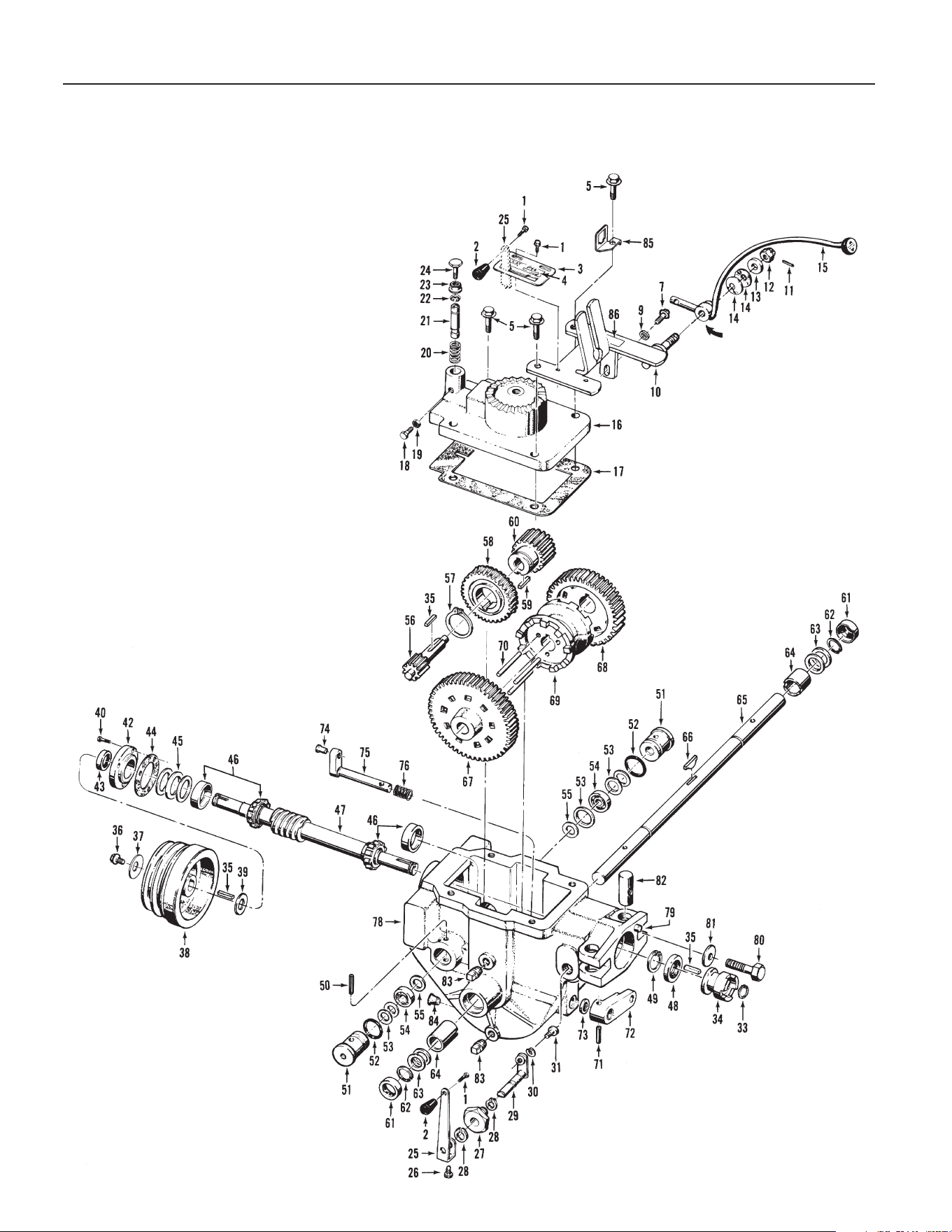
POWER UNIT TRANSMISSION ASSEMBLIES
(Continued from page 53)
52
See Page 50
Parts List
MODELS 682J & E682L

REF PART
No. No. DESCRIPTION QTY.
REF PART
No. No. DESCRIPTION QTY.
(continued from page 53)
WHEEL SHAFT ASSEMBLY
61 721-04031 Seal–oil, wheel shaft ..................... 2
62 1909950 Retaining ring–external ................. 2
63 GW-1166-1 Shim–wheel shaft, 1-1/64" inner
dia., .062" thick.......................... As
Req’d
63 GW-1166-2 Shim–as above, .030" thick ....... As
Req’d
63 GW-1166-3 Shim–as above, .015" thick ........ As
Req’d
63 GW-1166-4 Shim–as above, .010" thick ........ As
Req’d
63 GW-1166-5 Shim–same as above, .005" thick As
Req’d
64 GW-1086 Bushing–bronze, wheel shaft
bearing ...................................... 2
65 611-04025 Shaft–wheel, 15-5/8"...................1
66 GW-9357 Key–Hi Pro, 1/4" x 1-3/4"............... 1
67 GW-1223 Gear–slow speed, wheel drive....... 1
68 GW-1232 Gear–fast speed, wheel drive ........ 1
69 GW-1237 Dog Clutch–wheel drive ................ 1
70 GW-1112 Pin–clutch guide, 1/4" diameter .... 3
ECCENTRIC SHAFT ASSEMBLY
71 1911372 Pin–roll, 3/16" x 1-1/4" (spirol) ..... 1
72 619-04000 Lever–eccentric, wheel speed
shifting ...................................... 1
73 721-04034 Seal–oil, eccentric shaft ................ 1
74 GW-1442 Pin–eccentric shaft, wheel speed
shifting ...................................... 1
75 611-04003 Eccentric Shaft–wheel speed
shifting ...................................... 1
76 GW-1441 Spring–eccentric shaft .................. 1
TRANSMISSION HOUSING
78 GW-2109 Housing–power unit transmission
(Empty housing without covers,
shafts, gears, seals, etc.)........... 1
79 GW-9359 Pin–alignment............................... 1
MISCELLANEOUS PARTS
80 1100067 Bolt–hex hd., 1/2-13 x 2" Grade 5 . 2
81 GW-9928 Washer–disc spring (concave),
domed side faces bolt head ....... 2
82 GW-2126 Post–with threaded hole for Ref.
No. 80........................................ 2
83 1105620 Plug–pipe, 1/4".............................. 2
84 GW-9122 Plug–red plastic, thread protector. 1
85 GW-9205 Clip–forward interlock system plug
connector (see page 47)............ 1
86 777I20944 Decal–forward interlock wire
harness...................................... 1
TRANSMISSION ASSEMBLY
— 618-04004 Transmission –power unit
(Does NOT include Ref. 35-39. Does
NOT include Shift Lever and Bracket
Assemblies, Ref. 3, 4, 10, 15, 85, 86,
etc.) ........................................... 1
MODELS 682J & E682L
Parts List
53
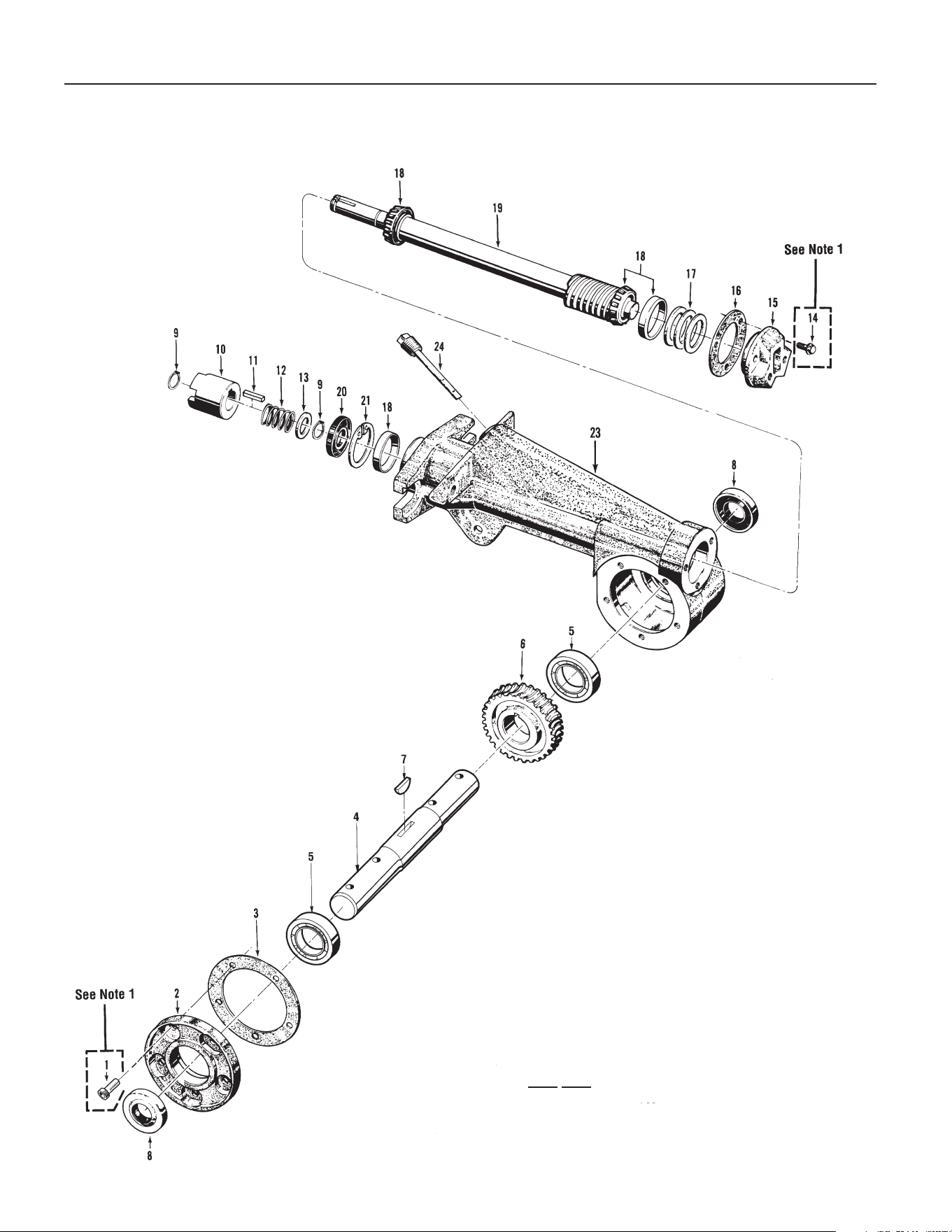
TILLER ATTACHMENT TRANSMISSION ASSEMBLIES
NOTE 1: THESE SCREWS HAVE A SPECIAL SEALING DESIGN
THAT CAN NOT BE REUSED WITHOUT RISKING THE
LOSS OF TRANSMISSION OIL. IF THESE SCREWS
ARE LOOSENED OR REMOVED, THEY MUST BE
REPLACED WITH NEW HARDWARE.
Parts List
MODELS 682J & E682L
54

1 1915068 Screw–self-sealing,1/4"-20 x 5/8" 5
2 GW-20873 Cover–tiller housing ..................... 1
3 GW-1129-1 Gasket–tiller housing cover, .010". As
thick...........................................Req’d
3 GW-1129-2 Gasket–same as above, .030" As
thick...........................................Req'd
4 711-04082 Shaft–tiller tine.............................. 1
5 741-3037 Ball Bearing................................... 2
6 1901976 Worm Gear–bronze, tiller tine
shaft .......................................... 1
7 GW-1104 Key–tiller tine shaft, woodruff key. 1
8 721-04035 Seal–oil, tiller tine shaft................. 2
TILLER DRIVE SHAFT ASSEMBLY
9 716-0101 Retaining Ring–external................ 2
10 1909138 Dog Clutch–tiller drive shaft.......... 1
11 GW-9301 Key–3/16" x 1"............................... 1
12 GW-2127 Spring–dog clutch......................... 1
13 GW-1138-1 Shim–dog clutch, 1/16"(.62") thick.. 1
14 1915069 Screw–self-sealing,1/4"-20 x 7/8" 3
15 GW-1115 Cap–rear bearing........................... 1
16 GW-1124-2 Gasket–rear bearing cap ............... 1
17 GW-1224-1 Shim–front bearing cap, .010" As
thick...........................................Req'd
17 GW-1224-2 Shim–same as above, .030" As
thick...........................................Req'd
17 GW-1224-3 Shim–same as above, .005" As
thick...........................................Req'd
17 GW-1224-4 Shim–same as above, .062" As
thick...........................................Req'd
18 GW-1714 Bearing & Race ............................. 2
(incl. one bearing GW-9400
and one cup (race) GW-9401)
19 GW-2653 Shaft–main tiller drive................... 1
20 721-04030 Seal–oil, drive shaft, front ............. 1
21 GW-9517 Retaining Ring–internal................. 1
TRANSMISSION HOUSING AND DIPSTICK
23 1901971 Housing–tiller attachment (Empty
housing without shafts, gears, seals,
dipstick, etc.) ................................ 1
24 1909157 Dipstick–oil, tiller attachment........ 1
TRANSMISSION ASSEMBLY
— 618-04003 Transmission –Tiller
(Includes Ref. 1-24) .................. 1
REF PART
No. No. DESCRIPTION QTY.
REF PART
No. No. DESCRIPTION QTY.
MODELS 682J & E682L
Parts List
55
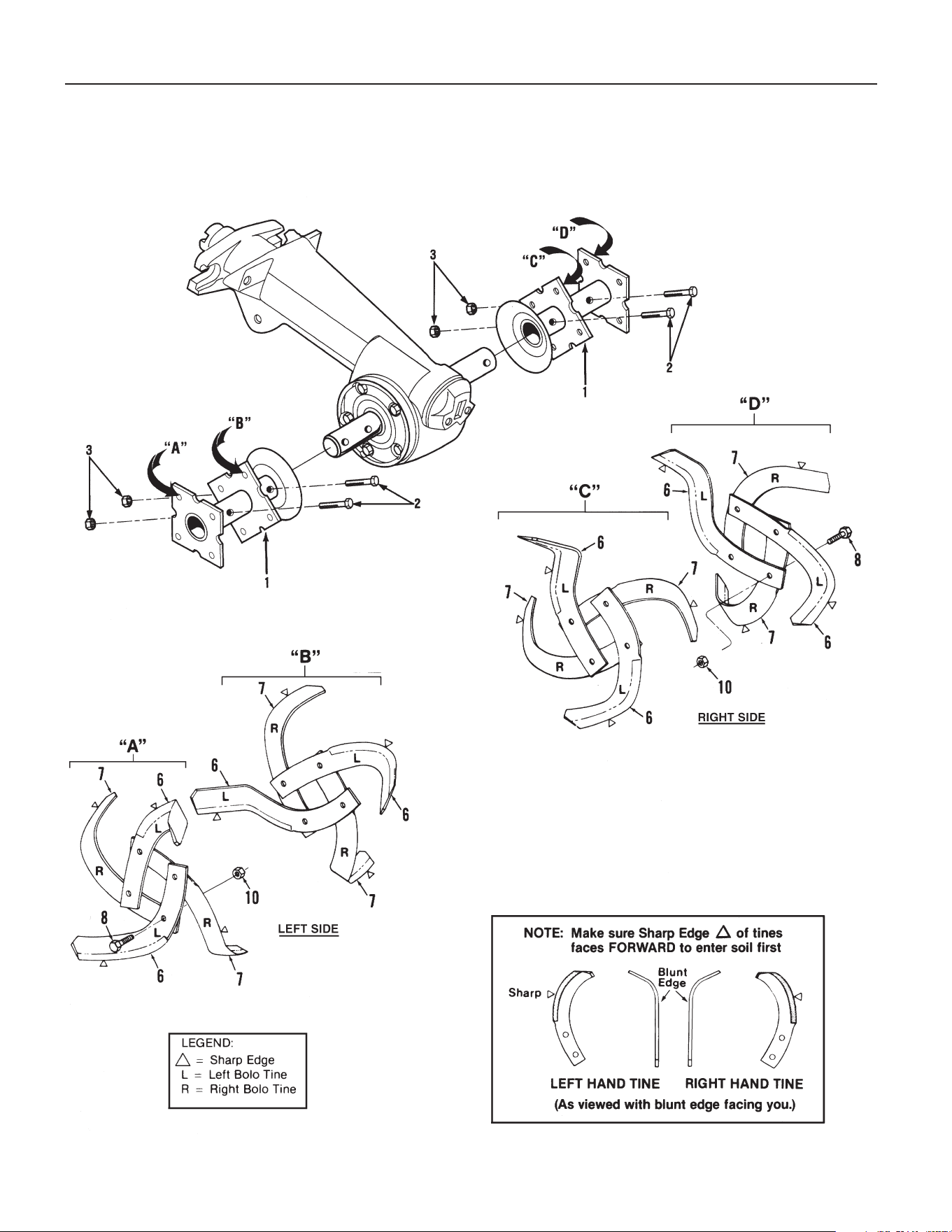
BOLO TINE ASSEMBLIES
Parts List
MODELS 682J & E682L
56

STANDARD TILLING TINES
1 1901975 Tine Holder–welded steel, fits
left or right sides...................... 2
2 710-3096 Bolt–hex hd., 3/8-16 x 2" ............. 4
3 712-3000 Locknut–hex, 3/8"-16
6 GW-1270-1A Bolo Tine–single, left hand. Used
on left and right side tine assy.
Tine is stamped either “EL" or
“AL". (incl Ref 8 & 10, two each) 8
7 GW-1270-2A Bolo Tine–single, right hand. Used
on left and right side tine assy.
Tine is stamped either “ER" or
“AR” (incl Ref 8 & 10, two each) 8
8 710-3005 Bolt–hex hd., 3/8-16 x 1" ............. 16
10 712-0375 Locknut–hex, 3/8"-16 .................. 20
--- 290-253-081 Tine Replacement Kit–unassembled
(Incl. eight each of Ref. No.’s 6,
and 7, sixteen each of Ref. No.'s
8 and 10). Includes easy-to-
follow installation instruction. DOES
NOT INCLUDE tine holders, holder
mounting hardware, or tine
shaft keys................................. 1
CUSTOM TILLING TINES
Special hard-faced, high-chrome carbon alloy tines that are
thicker than standard Bolo Tines. These tines better resist the
abrasive action of rocky, gritty or sandy soil as compared to
standard Bolo Tines, and are especially suited for custom
tilling or market gardening.
--- GW-10802 Custom Tilling Tine Kit–(Incl.
eight each of Part GW-2475-1
and GW-2475-2 tines and sixteen
each of Ref. No.’s 8 and 10...... 1
--- GW-2475-1 Bolo Tine, Custom Tilling–single,
left hand................................... 8
--- GW-2475-2 Bolo Tine, Custom Tilling–single,
right hand ................................ 8
REF PART
No. No. DESCRIPTION QTY.
REF PART
No. No. DESCRIPTION QTY.
MODELS 682J & E682L
Parts List
57
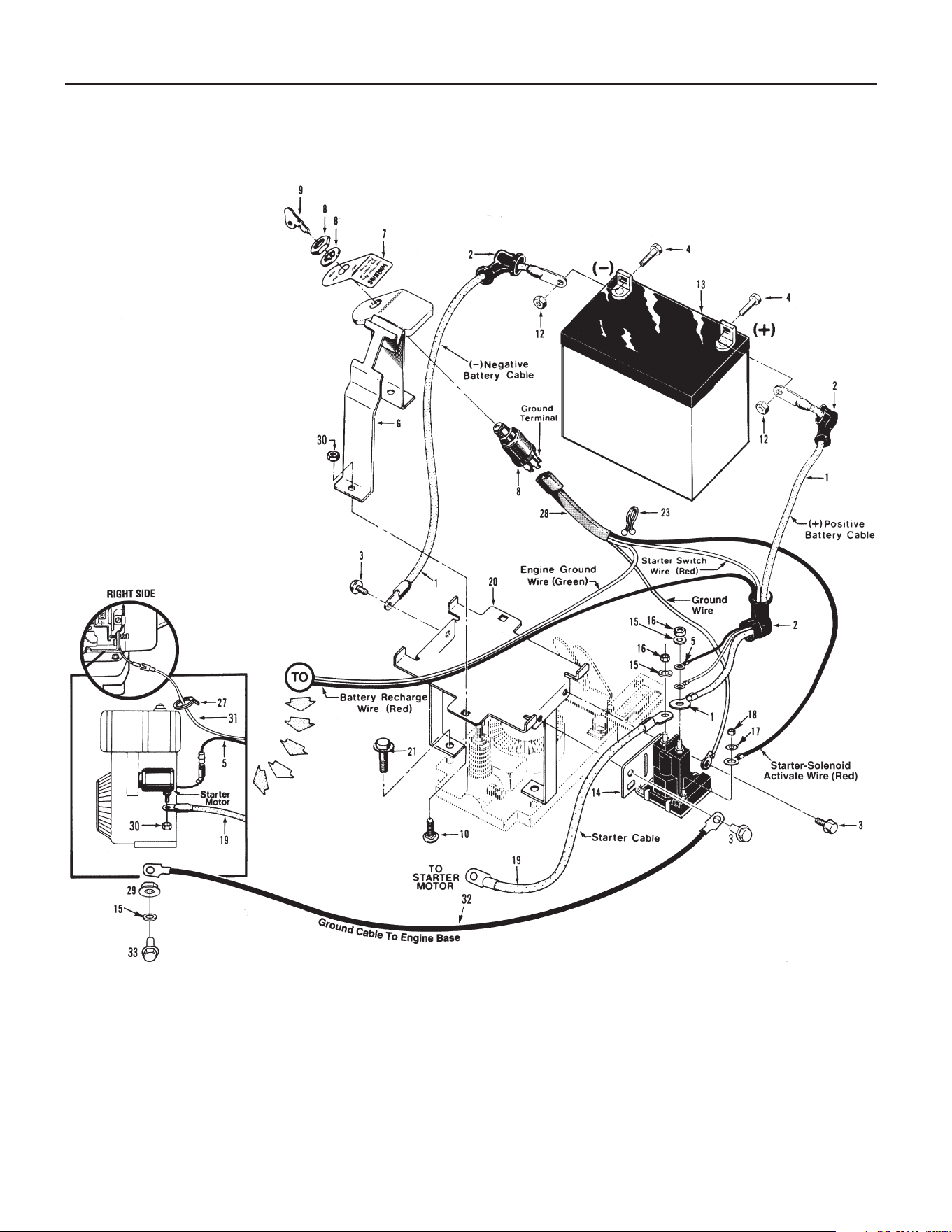
Parts List
MODELS E686N & E682L
ELECTRIC START SYSTEM
58

MODELS E686N & E682L
Parts List
1 GW-96515 Cable–battery, positive and negative
terminals.................................. 2
2 GW-97020 Boot–terminal insulating ............. 3
3 GW-9552 Screw–self-threading,
1/4-20 x 1/2" ............................ 3
4 1186309 Bolt–hex hd., 1/4-20 x 5/8" .......... 2
5 1901894 Wire–recharge (red) .................... 1
6 GW-2614 Battery Hold-down Clamp–with
attached Key Switch Plate ........ 1
7 777S30648 Decal–ignition switch instruc....... 1
8 725-0267A Key Switch–includes two
ignition keys (Ref. No. 9), one
lockwasher, and one mounting
nut (lock-washer and nut not
available separately)................. 1
9 725-0201 Key–ignition, one pair.................. 1
10 1186073 Bolt–carriage, 1/4-20 x 1-1/4" ..... 2
11 1100241 Lockwasher–spring lock, 1/4"...... 2
12 712-3006 Nut–hex, 1/4"-20 ......................... 2
13 725-1706 Battery–12 volt, 270 CCA................ 1
14 GW-96514 Solenoid–starter, includes nuts and
washers for cables and wires... 1
15 736-0119 Lockwasher–5/16" ....................... 3
16 1186211 Nut–hex, 5/16"-24 ....................... 2
17 736-0147 Lockwasher–external tooth, #10.. 1
18 GW-9853 Nut–hex, #10-32,......................... 1
19 GW-96510 Cable–solenoid to starter motor .. 1
20 GW-2557 Battery Bracket ............................ 1
21 1186349 Bolt–flanged hex hd.,
3/8-16 x 1-1/2"......................... 2
23 GW-9265 Tie–plastic, wire retaining............ 1
27 725-0157 Tie–plastic ................................... 2
28 1908118 Wire Harness & Connecting
Terminal Assembly .................. 1
29 712-3010 Nut–flange lock, 5/16"-18 ............ 1
30 1186389 Locknut–hex, 1/4"-20 .................. 3
31 629-04018 Ground Wire Assembly................ 1
32 1901202 Cable–ground, solenoid to engine
block ........................................ 1
33 710-3180 Bolt–flange lock, 5/16-18 x 1"...... 1
REF PART
No. No. DESCRIPTION QTY.
REF PART
No. No. DESCRIPTION QTY.
59
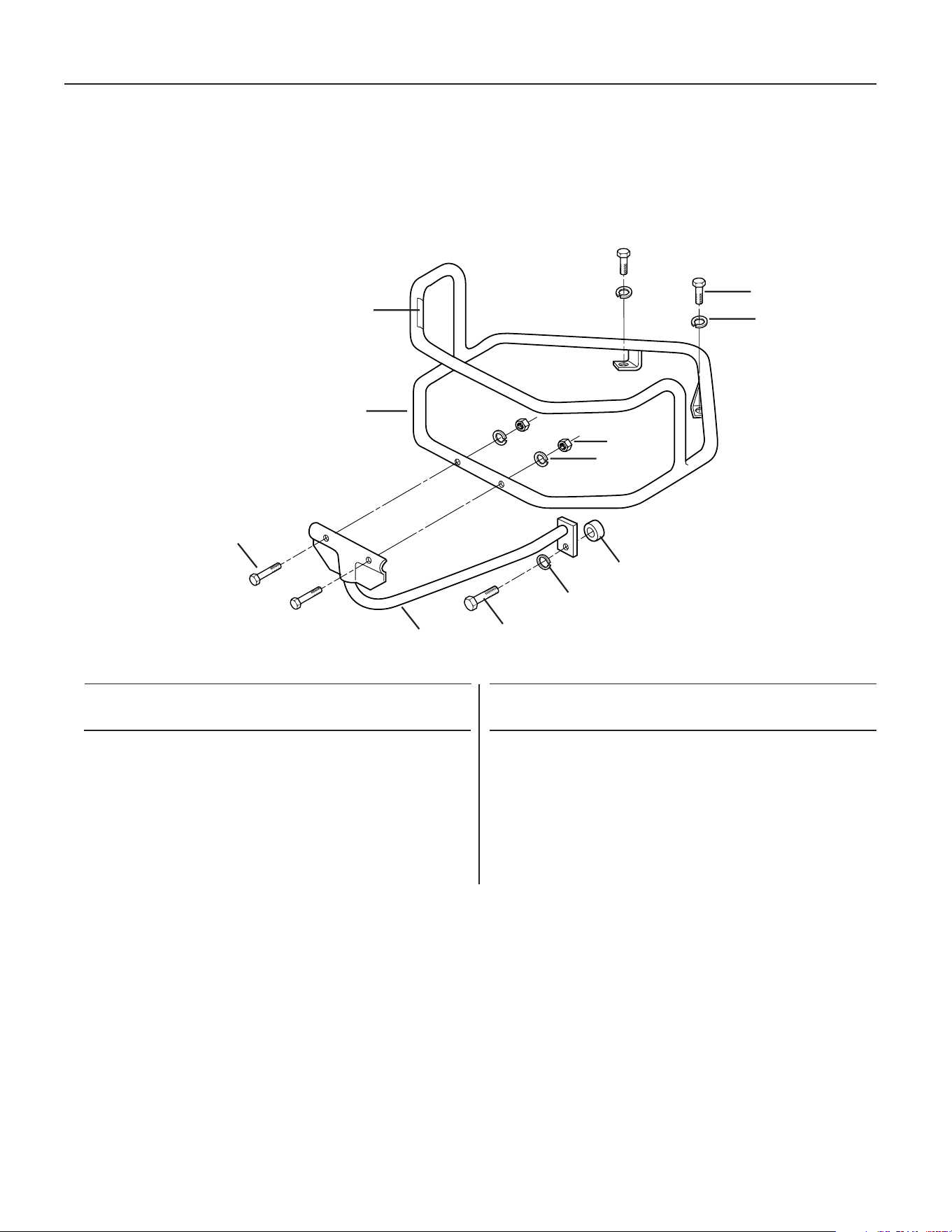
BUMPER ATTACHMENT
--- 290-255-081 Bumper Attachment. Includes
Ref. Nos. 1 through 11) ........... 1
1 1910730 Brace - bumper bottom ............... 1
2 710-3181 Bolt - hex hd., 1/2-13 x 1-1/2" ..... 1
3 736-0921 Lockwasher - spring lock, 1/2" .... 1
4 1909748 Spacer, 1/2" ................................. 1
5 710-0805 Bolt - hex hd., 5/16-18 x 1-1/2" ... 2
6 736-0119 Lockwasher - spring lock, 5/16" .. 2
7 712-3010 Nut - hex, 5/16"-18 ...................... 2
8 1910731 Bumper wraparound.................... 1
9 710-0514 Bolt - hex hd., 3/8-16 x 1"............ 2
10 736-0169 Lockwasher - spring lock, 3/8" .... 2
11 777S30653 Decal - for bumper ...................... 1
REF PART
No. No. DESCRIPTION QTY.
REF PART
No. No. DESCRIPTION QTY.
1
5
8
11
2
7
9
10
6
3
4
Parts List
MODELS 682J & E682L
60

Notes
61

Notes

Notes

TROY-BILT TILLER LIFETIME LIMITED WARRANTY
WHAT PRODUCT All Troy-Bilt branded rear tine walk-behind tillers with gear drive transmissions.
IS COVERED This warranty begins on the date of purchase and is warranted by Troy-Bilt LLC for the life
of the tiller, to the original purchaser only.
WHAT IS COVERED Troy-Bilt LLC will, at its option, repair or replace any part found to be defective in material
BY THIS WARRANTY or workmanship without charge for parts and labor.
This limited lifetime warranty also applies to non-powered attachments and accessories. Powered
attachments and accessories are warranted separately by their manufacturers. Refer to the applicable
manufacturer’s warranty on these items for terms and conditions.
WHAT IS NOT This warranty does not apply to parts that have been damaged by accident, alteration,
COVERED BY THIS misuse, abuse, neglect, improper maintenance, vandalism, theft, fire, water, or damage
WARRANTY because of peril or other natural disaster.
The following items are not covered after the first year of this residential use limited warranty: belts,
batteries, bushings, seals, tines, tires, wheels, paint, appearance items, and similar items that are
normally replaced through periodic maintenance.
Charges for pick-up, delivery, and service calls are not covered by this warranty.
Service completed by someone other than an authorized service dealer is not covered by this warranty.
Parts that are not genuine Troy-Bilt LLC service parts are not covered by this warranty.
The engine is warranted separately by the engine manufacturer. Refer to the engine manufacturer’s
warranty for terms and conditions.
LIMITED If used for commercial, institutional, industrial, rental, or demonstrator purposes, the
COMMERCIAL warranty on the tiller is limited in duration to 90 days from the date of purchase.
USE WARRANTY
This warranty does not apply to parts that have been damaged by accident, alteration, misuse, abuse,
neglect, improper maintenance, vandalism, theft, fire, water, or damage because of peril or other natural
disaster.
HOW TO OBTAIN Warranty service is available,
with proof of purchase, through your local authorized
SERVICE service dealer. To locate a dealer in your area, consult your Yellow Pages, or contact Troy-Bilt LLC at
P.O. Box 361131, Cleveland, Ohio 44136-0019, 1-866-840-6483, or log on to our Web site at
www.troybilt.com.
The provisions set forth in this warranty provide the sole and exclusive remedy arising from the sale. Troy-Bilt LLC shall
not be liable for any incidental or consequential damage or expense of any kind, including but not limited to cost of
equipment rental, loss of profits, or costs of hiring services to perform tasks normally performed by the equipment.
Any implied warranties, including any implied warranty of merchantability or fitness for a particular purpose, shall be limited in
duration to the period of ownership by the original purchaser (and a maximum of 90 days from the date of sale if the tiller is
purchased for commercial or other non-residential use).
Some states do not allow the exclusion or limitation of incidental or consequential damages, or limitations on how long an
implied warranty lasts, so the above exclusions or limitations may not apply to you.
This limited warranty gives you specific legal rights, and you may also have other rights which vary from state to state.
For customer assistance, contact your nearest authorized dealer, or contact us at:
TROY-BILT LLC, P.O. Box 361131, Cleveland, Ohio 44136-0019, 1-866-840-6483