MONSTRO 8K VV | V7.3
RED.COM
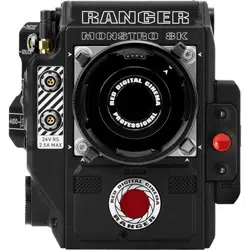
RED RANGER MONSTRO
OPERATION GUIDE

Table of Contents 2
Disclaimer 4
Copyright Notice 4
Trademark Disclaimer 4
Translation Disclaimer 4
Compliance Statements 4
Safety Instructions 6
Battery Storage and Handling 7
Shipping Disclaimer 8
CHAPTER 1: Product Introduction 9
R3D File Format and REDCODE 10
Shoot For Video and Stills 10
Post Production 11
Post Production with REDCINE-X PRO 11
HDRX and MAGIC MOTION 12
Additional Resources 12
CHAPTER 2: Camera System Components 13
RED RANGER MONSTRO Camera Body 13
RED MINI-MAG System 23
Power Components 24
Displays and Electronic Viewfinders 25
LCD/EVF Adaptors 29
Camera Control Devices 31
Lens Mounts 32
Interchangeable OLPFs 32
Rails, Mounts, Tactical Gear, and Cables 33
CHAPTER 3: Basic Operations 34
Power Operations 34
Configure Your Camera 36
Shim the RED RANGER Shimmed PL Mount 38
Interchangeable OLPF System 40
Use a Tripod or Monopod 41
Video Monitor Outputs 42
Record 43
CHAPTER 4: Basic Menus and Controls 45
GUI Menu Introduction 45
Upper Status Row (Basic Menu) 46
Live Action Area
48
Lower Status Row 49
Navigation Controls 55
COPYR IGH T © 2019 RED.C OM, LLC 955- 0184_V7.3, REV-A | 2
RED RANGER MONSTRO OPERATION GUIDE
TABLE OF CONTENTS
CHAPTER 5: Advanced Menus 61
Access the Advanced Menus 61
Image Menu 61
Monitoring Menu 69
Overlays Menu 74
Power Menu 83
Playback 85
Media Menu 90
Presets Menu 91
Settings Menu 94
CHAPTER 6: Sensor Calibration 136
When to Calibrate Sensor 136
Calibrate Sensor: Manual Calibration 137
Calibrate Sensor: Auto Calibration 138
Calibration Map Naming Conventions 139
Calibration Management 139
Calibration Map Actions 139
Export and Import Calibration Maps 140
CHAPTER 7: Audio System 141
Audio Overview 141
Set Up Audio 141
Control 142
Mix 143
Audio Output Options 143
Audio Meter (VU Meter) 143
Audio During Playback 144
Record Audio in Varispeed Mode 144
CHAPTER 8: Timecode, Genlock, Multi-
Camera Setup 147
Timecode 147
Genlock 149
Master/Slave Operation 150
Set Up Stereo/3D Configuration 155
Camera Array 156
Compatible Timecode Devices 157
Compatible Genlock Devices 157
CHAPTER 9: Upgrade Camera Firmware 158
Verify Current Camera Firmware
158
Upgrade Camera Firmware 158

CHAPTER 10: Camera System
Maintenance 160
Camera Body and Accessory Exterior
Surfaces 160
Clean EVF Screen 161
Clean LCD Screens 161
Water Damage 162
CHAPTER 11: Troubleshoot Your Camera 163
Perform a Stress Test 163
General Troubleshooting 163
Error Messages 170
APPENDIX A: Technical Specifications 174
RED RANGER MONSTRO Technical
Specifications 174
APPENDIX B: Mechanical Drawings 176
RED RANGER MONSTRO with V-Lock 176
RED RANGER MONSTRO with Gold Mount 182
APPENDIX C: Input/Output Connectors 188
Record/Monitor Out Ports 190
Communication Ports 192
Audio Ports 196
Power Ports 197
APPENDIX D: Lens Mounts and Lenses 199
Lens Mounts 199
Lenses 201
APPENDIX E: Default Key Functions 203
Default Keys 203
APPENDIX F: Menu Map 205
COPYR IGH T © 2019 RED.COM, LLC 955-0184_V7.3, REV-A
| 3
RED RANGER MONSTRO OPERATION GUIDE

DISCLAIMER
RED
®
has made every effort to provide clear and accurate information
in this document, which is provided solely for the user’s information.
While thought to be accurate, the information in this document is
provided strictly “as is” and RED will not be held responsible for issues
arising from typographical errors or user’s interpretation of the
language used herein that is different from that intended by RED. All
safety and general information is subject to change as a result of
changes in local, federal or other applicable laws.
RED reserves the right to revise this document and make changes
from time to time in the content hereof without obligation to notify any
person of such revisions or changes. In no event shall RED, its
employees or authorized agents be liable to you for any damages or
losses, direct or indirect, arising from the use of any technical or
operational information contained in this document.
This document was generated on 12/19/2019. To see earlier versions
of this document, submit a Support ticket at
https://support.red.com.
For comments or questions about content in this document, send a
detailed email to OpsGuides@red.com.
COPYRIGHT NOTICE
COPYRIGHT© 2019 RED.COM, LLC.
All trademarks, trade names, logos, icons, images, written material,
code, and product names used in association with the accompanying
product are the copyrights, trademarks, or other intellectual property
owned and controlled exclusively by RED.COM, LLC. For a
comprehensive list, see
www.red.com/trademarks.
TRADEMARK DISCLAIMER
All other company, brand, and product names are trademarks or
registered trademarks of their respective holders. RED has no
affiliation to, is not associated with or sponsored by, and has no
express rights in third-party trademarks. Adobe and Adobe Premiere
Pro are registered trademarks of Adobe Systems Incorporated. AJA is
a registered trademark of AJA Video Systems, Inc. Cooke and S4/i are
registered trademarks of Cooke Optics Limited. DaVinci is a registered
trademark of Blackmagic Design in the U.S. and other countries.
Distagon, Makro-Planar, and Otus are registered trademarks of Carl
Zeiss AG. Fujinon is a registered trademark of FUJIFILM
CORPORATION. HDMI is a registered trademark of HDMI Licensing
LLC in the United States and other countries. Leica is a registered
trademark of Leica Microsystems. Loctite is a registered trademark of
Henkel AG & Company KGaA. Nikkor and Nikon are registered
trademarks of Nikon Corporation. Canon is a registered trademark of
Canon, U.S.A. Apple, Macintosh, Final Cut Pro, and QuickTime are
registered trademarks of Apple Inc. in the U.S. and other countries.
Windex is a registered trademark of S. C. Johnson & Son, Inc.
Windows is a registered trademark of Microsoft Corporation. LEMO is
a registered trademark of LEMO USA. Sony is a registered trademark
of Sony Corporation. TORX is a registered trademark of Acument
Intellectual Properties, LLC in the United States or other countries.
IOS is a registered trademark of Cisco in the U.S. and other countries.
Avid is a registered trademark of Avid Technology, Inc. DaVinci
Resolve is a registered trademark of Blackmagic Design in the U.S.
and other countries. EDIUS Pro is a registered trademark of Grass
Valley. Vegas Pro is a registered trademark of Sony Creative
Software. IDX is a registered trademark of IDX Company, Ltd.
COPYR IGH T © 2019 RED.COM, LLC 955-0184_V7.3, R EV- A
| 4
RED RANGER MONSTRO OPERATION GUIDE
TRANSLATION DISCLAIMER
This document was originally prepared in English, and any translations
are provided for convenience only. While reasonable efforts were
made to provide accurate translations, RED will not be held
responsible for any errors, omissions, or ambiguities.
COMPLIANCE STATEMENTS
INDUSTRIAL CANADA EMISSION COMPLIANCE STATEMENTS
This device complies with Industry Canada license- exempt RSS
standards RSS 139 and RSS 210. Operation is subject to the following
two conditions: (1) this device may not cause interference, and (2) this
device must accept any interference, including interference that may
cause undesired operation of the device. This Class A digital
apparatus complies with Canadian ICES-003.
Le présent appareil est conforme aux CNR d’Industrie Canada
applicables aux appareils radio exempts de licence. L’exploitation est
autorisée aux deux conditions suivantes : (1) l’appareil ne doit pas
produire de brouillage, et (2) l’utilisateur de l’appareil doit accepter tout
brouillage radioélectrique subi, même si le brouillage est susceptible
d’en compromettre le fonctionnement. Cet appareil numérique de la
classe [A] est conforme à la norme NMB-003 du Canada.
CAN ICES-3 (A)/NMB-3(A)
FEDERAL COMMUNICATIONS COMMISSION (FCC)
STATEMENTS
This equipment has been tested and found to
comply with the limits for a Class A digital
device, pursuant to part 15 of the FCC Rules.
These limits are designed to provide
reasonable protection against harmful
interference in a commercial environment.
This equipment generates, uses, and can
radiate radio frequency energy and, if not installed and used in
accordance with the instructions, may cause harmful interference to
radio communications. Operation of this equipment in a residential
area is likely to cause harmful interference in which case the user will
be required to correct the interference at his own expense. However,
there is no guarantee that interference will not occur in a particular
installation. If this equipment does cause harmful interference to radio
or television reception, which can be determined by turning the
equipment off and on, the user is encouraged to try to correct the
interference by one or more of the following measures:
Reorient or relocate the receiving antenna.
Increase the separation between the equipment and receiver.
Connect the equipment into an outlet on a circuit different from
that to which the receiver is connected.
Consult the dealer or an experienced radio/TV technician for help.
In order to maintain compliance with FCC regulations, shielded cables
must be used with this equipment. Operation with non- approved
equipment or unshielded cables is likely to result in interference to
radio and TV reception. The user is cautioned that changes and
modifications made to the equipment without the approval of
manufacturer could void the users authority to operate this equipment.
CAUTION: Exposure to Radio Frequency
Radiation. The device shall be used in such a
manner that the potential for human contact is
minimized. This equipment complies with FCC
radiation exposure limits set forth for an
uncontrolled environment. This equipment should
be installed and operated with a minimum distance
of 20 cm between the radiator and your body.
CAUTION: If the device is changed or modified
without permission from RED, the user may void
his or her authority to operate the equipment.
NOTE: This device complies with Part 15 of the FCC Rules.
Operations subjected to the following two conditions (1) this device
may not cause harmful interference, and (2) this device must accept
any interference received, including that may cause undesirable
interference.
AUSTRALIA AND NEW ZEALAND STATEMENTS
RED declares that the radio equipment described in this document
comply with the following international standards.
IEC 62368-1 – Product Safety
ETSI EN 300 328 – Technical requirement for radio equipment
RED declares digital devices described in this document comply with
the following Australian and New Zealand standards.
AS/NZS CISPR 32 Electromagnetic Compatibility
AS/NZS 61000.3.2 –Harmonic Current Emissions
AS/NZS 61000.3.3 –Voltage Changes, Voltage Fluctuations and
Flicker
JAPAN STATEMENTS
This is a Class A product based on the standard of
the Voluntary Control Council for Interference
(VCCI). If this equipment is used in a domestic
environment, radio interference may occur, in
which case the user may be required to take
corrective actions.
COPYR IGH T © 2019 R ED.COM, LLC 955-0184_V7.3, REV- A | 5
RED RANGER MONSTRO OPERATION GUIDE
GITEKI CERTIFICATION
This equipment contains specified radio equipment that has been
certified to the Technical Regulation Conformity Certification under the
Radio Law.
EUROPEAN UNION COMPLIANCE STATEMENTS
RED declares that the radio equipment
described in this document comply with the
EMC Directive (2014/30/EU) and the Low
Voltage Directive (2014/35/EU) issued by the
Commission of the European Community.
Compliance with this directive implies conformity to the following
European Norms (in brackets are the equivalent international
standards).
EN 62368-1 (IEC 62368-1) – Product Safety
ETSI EN 300 328 Technical requirement for radio equipment
ETSI EN 301 489 General EMC requirements for radio equipment
EN 55032 (CISPR 32) Electromagnetic Compatibility
EN 55024 (CISPR 24) Immunity Characteristics
EN 61000-3-2 (IEC 61000-3-2) Harmonic Current Emissions
EN 61000-3-3 (IEC 61000-3-3) Voltage changes, voltage
fluctuations and flicker
WASTE ELECTRICAL AND ELECTRONIC EQUIPMENT (WEEE)
The Waste Electrical and Electronic
Equipment (WEEE) mark applies only to
countries within the European Union (EU)
and Norway. This symbol on the product and
accompanying documents means that used
electrical and electronic products should not
be mixed with general household waste. For
proper treatment, recovery and recycling,
please take this product to designated
collection points where it will be accepted
free of charge. Alternatively, in some
countries you may be able to return your
products to your local retailer upon purchase of an equivalent new
product.
Disposing of this product correctly will help save valuable resources
and prevent any potential negative effects on human health and the
environment, which could otherwise arise from inappropriate waste
handling. Please contact your local authority for further details of your
nearest designated collection point. Penalties may be applicable for
incorrect disposal of this waste, in accordance with you national
legislation.
For business users in the European Union, if you wish to discard
electrical and electronic equipment, please contact your dealer or
supplier for further information.
RESPONSIBLE PARTY
RED Digital Cinema
34 Parker
Irvine, CA 92618
USA
COPYR IGH T © 2019 R ED.COM, LLC 955-0184_V7.3, REV- A
| 6
RED RANGER MONSTRO OPERATION GUIDE
SAFETY INSTRUCTIONS
DO NOT use the camera or accessories near water. Avoid
exposing your camera to moisture. The unit is not waterproof, so
contact with water could cause permanent damage to the unit as
well as electric shock and serious injury to the user. DO NOT use
the camera in the rain or under other conditions with high moisture
without appropriate protection, and immediately remove power
source if camera or accessories are exposed to moisture.
WARNING: To reduce the risk of fire or electric
shock, do not expose the camera to rain or
moisture.
DO NOT expose the camera to laser beams, as laser beams may
damage the sensor.
DO NOT expose your camera to excessive vibration or impact
(shock). Be careful not to drop your camera. Internal mechanisms
may be damaged by severe shock. Mechanical alignment of optical
elements may be affected by excessive vibration.
ELECTROMAGNETIC INTERFERENCE: The use of devices
using radio or other communication waves may result in the
malfunction or interference with the unit and/or with audio and
video signals.
Clean only using a dry cloth. When cleaning your camera,
remember that it is not waterproof and moisture can damage
electronic circuitry. DO NOT rinse or immerse any element of the
camera, lens or other accessory, keep them dry at all times. DO
NOT use soaps, detergents, ammonia, alkaline cleaners, and
abrasive cleaning compounds or solvents. These substances may
damage lens coatings and electronic circuitry.
Maintain sufficient ventilation—DO NOT block any ventilation
openings or obstruct cooling fan airflow.
CAUTION: Proper camera ventilation requires a
minimum 0.5" (1.25 cm) clearance between the
camera ventilation openings and external
surfaces. Verify that objects that can block the fan
intake and exhaust ports do not impede airflow.
Failure to permit adequate airflow may result in
overheating of the camera, degraded operation
and in extreme situations, damage to the camera.
DO NOT operate or store near any heat sources such as
radiators, heat registers, stoves, or any other apparatus that
produce heat. Store in a protected, level and ventilated place.
Avoid exposure to temperature extremes, damp, severe vibration,
strong magnetic fields, direct sunlight or local heat sources during
storage. Remove any batteries from the camera before storage.
Recommended storage and usage temperatures for your camera,
lenses and other accessories are:
Operating range: 0°C to 40°C (32°F to 104°F)
Storage range: –20°C to 50°C (–4°F to 122°F)
If there are any performance issues with your camera or
accessories when operating within this temperature range, submit
a Support ticket at https://support.red.com.
Lens mounts are NOT HOT SWAPPABLE, meaning you cannot
remove or install these items while the camera is turned on.
Before installing or removing these items, you MUST turn off the
camera. Failure to do so may result in damage to the item or
camera that is not covered under warranty.
DO NOT bypass the third prong of the grounding-type plug on the
power cord of the included power adaptor. A grounding-type plug
has two blades and a third “grounding” prong. The third prong is
provided for your safety. A grounding-type plug shall be connected
to an outlet with a protective earthen connection. If the grounding-
type plug does not fit into your outlet, do not attempt to modify the
plug or outlet, consult a qualified electrician.
Protect all power cords from being pinched, walked on or driven
over by a vehicle. Replace any power cords suspected of
sustaining damage due to crushing or other forms physical
damage.
Products marked with this symbol are class 2
devices. These devices are not provided with a
grounding type plug.
CAUTION: The power cord plug for the included
power adaptor is used as the power disconnect.
To disconnect all power from the power adaptor,
unplug the power cord plug from the wall outlet.
During use, the power cord plug should remain
easily accessible at all times.
Lithium-ion batteries may be subject to special handling
requirements pursuant to federal and local laws. Refer to specific
shipping instructions included with your battery regarding proper
transport of your battery. Do not handle your battery if it is
damaged or leaking. Disposal of batteries must be in accordance
with local environmental regulations. For example, California law
requires that all rechargeable batteries must be recycled by an
authorized recycle center. Storing batteries fully charged or in high
temperature conditions may permanently reduce the life of the
battery. Available battery capacity may also be temporarily
lessened after storage in low temperature conditions.
COPYR IGH T © 2019 R ED.COM, LLC 955-0184_V7.3, REV- A
| 7
RED RANGER MONSTRO OPERATION GUIDE
WARNING: DO NOT expose the battery to
excessive heat.
WARNING: Danger of explosion if an incorrect
battery is charged with the RED Charger or is
used to power the camera and accessories.
Replace only with the same or equivalent type
battery.
CAUTION: Refer all service and repair to qualified
RED service personnel. To reduce the risk of
electric shock, and damage to the camera or
accessories, DO NOT attempt to perform any
servicing other than any procedures that are
recommended in the operating instructions.
INDOOR USE ONLY: This device is designed
for use indoors only.
BATTERY STORAGE AND HANDLING
WARNING: Failure to read, understand, and
follow these instructions may result in overheating,
chemical leakage, smoke emission, fire, or other
potentially harmful results.
Always follow proper battery handling and storage practices.
Improper handling and/or failure to abide by proper storage
instructions may cause permanent damage to batteries, or
degrade battery charge holding capacity. Improper handling
practices or failure to comply with instructions may also put you at
risk.
Lithium-Ion batteries, like the REDVOLT
®
, REDVOLT-V,
REDVOLT XL, and RED BRICK
®
, self-discharge over time. When
storing for long periods of time, store batteries separately from the
camera or charger and remember to charge batteries to a
capacity level of 40% to 60%. If batteries will be stored for long
periods of time, RED recommends that you check the charge level
at least once every six (6) months, and recharge batteries to a
capacity level of 40% to 60%.
When not in use, remove the battery from the camera or charger
and store the battery in a cool, dry place. Avoid extreme hot
temperatures (such as inside a hot car), corrosive gas, and direct
sunlight. The optimal storage temperature for batteries is between
–20°C to 20°C (–4°F to 68°F).
WARNING: Batteries stored in a discharged state
for long periods of time may self- discharge and
lose the ability to hold a charge.
WARNING: If recharging operation fails to
complete even when a specified recharging time
has elapsed, immediately stop further recharging.
DO NOT store batteries in a fully charged state for extended DO
NOT store batteries in a fully charged state for extended periods
of time.
DO NOT store batteries in a fully discharged state for extended
periods of time.
DO NOT store batteries in the camera or in a charger for
extended periods of time.
DO NOT use batteries for purposes other than their intended use.
DO NOT store batteries in extreme hot or cold temperatures.
DO NOT store batteries in direct sunlight.
DO NOT use third-party chargers with your RED batteries.
DO NOT disassemble or modify the battery.
DO NOT overcharge batteries. Overcharging may increase
internal temperature beyond the recommended limits and cause
permanent damage to the battery.
DO NOT connect the positive (+) and negative (–) terminals to a
metal object such as a wire.
DO NOT transport or store the battery together with metal objects
such as jewelry, hairpins, etc. as they may generate heat if they
come into contact with the battery.
DO NOT discard the battery into fire or heat.
DO NOT store, use, or recharge the battery near a heat source
such as a fire or a heater.
DO NOT allow the battery to get wet.
DO NOT pierce the battery with pointed or other sharp objects.
DO NOT step on, throw, or strike the battery with a hammer.
DO NOT use a battery that appears to be deformed or damaged.
DO NOT directly solder the battery.
DO NOT put the battery into a microwave oven or a pressurized
container.
DO NOT use or subject the battery to intense sunlight or hot
temperatures such as in a car in hot weather.
DO NOT use it in a location where static electricity may be present.
DO NOT exceed the recharging temperature range of 0˚C to
40˚C (32˚F to 104˚F).
RED recommends that you only use RED chargers to recharge
RED batteries.
Store the battery in a location where children cannot reach it.
If the battery leaks or gives off a bad odor, discontinue use
immediately.
If the battery gives off an odor, generates heat, becomes
discolored or deformed, or in any way appears abnormal during
use, recharging or storage, immediately remove it from the
equipment or battery charger and discontinue use.
If electrolyte begins leaking from the battery and comes into
contact with your skin or clothing, immediately wash it away with
running water. Failure to do this may result in skin inflammation.
If the battery leaks and the electrolyte reaches the eyes, do not
rub them. Instead, rinse the eyes with clean running water and
COPYR IGH T © 2019 R ED.COM, LLC 955-0184_V7.3, REV- A | 8
RED RANGER MONSTRO OPERATION GUIDE
immediately seek medical attention. Failure to do this may result in
eye injury.
If you find discoloration, a bad odor due to leakage, overheating
and/or other irregularities when using the battery for the first time,
submit a Support ticket at https://support.red.com.
NOTE: For more information regarding RED
battery charging and instructions for care, refer to
our Terms and Conditions.
SHIPPING DISCLAIMER
Shipment of Lithium Ion cells and batteries is subject to national and
international shipping requirements. A Class 9 Certified shipper is
required to transport these products within the United States.
REDVOLT, REDVOLT-V, REDVOLT XL, and RED BRICK batteries
are considered Dangerous Goods. Other products such as REDVOLT
AA and RED Li 7.2V batteries may also be classified as Dangerous
Goods when purchased in bulk. Applicable laws prohibit the shipping of
batteries that are physically damaged. We urge you to look into the
formal rules and regulations of shipping Class 9 Dangerous Goods
prior to preparing your shipment. For more information on these
regulations, visit
www.iata.org and www.dot.gov.
For more information, see our FAQs for Dangerous Goods
(Regulated Items).
COPYR IGH T © 2019 R ED.COM, LLC 955- 0184_V7.3, REV-A | 9
RED RANGER MONSTRO OPERATION GUIDE
CHAPTER 1:
PRODUCT INTRODUCTION
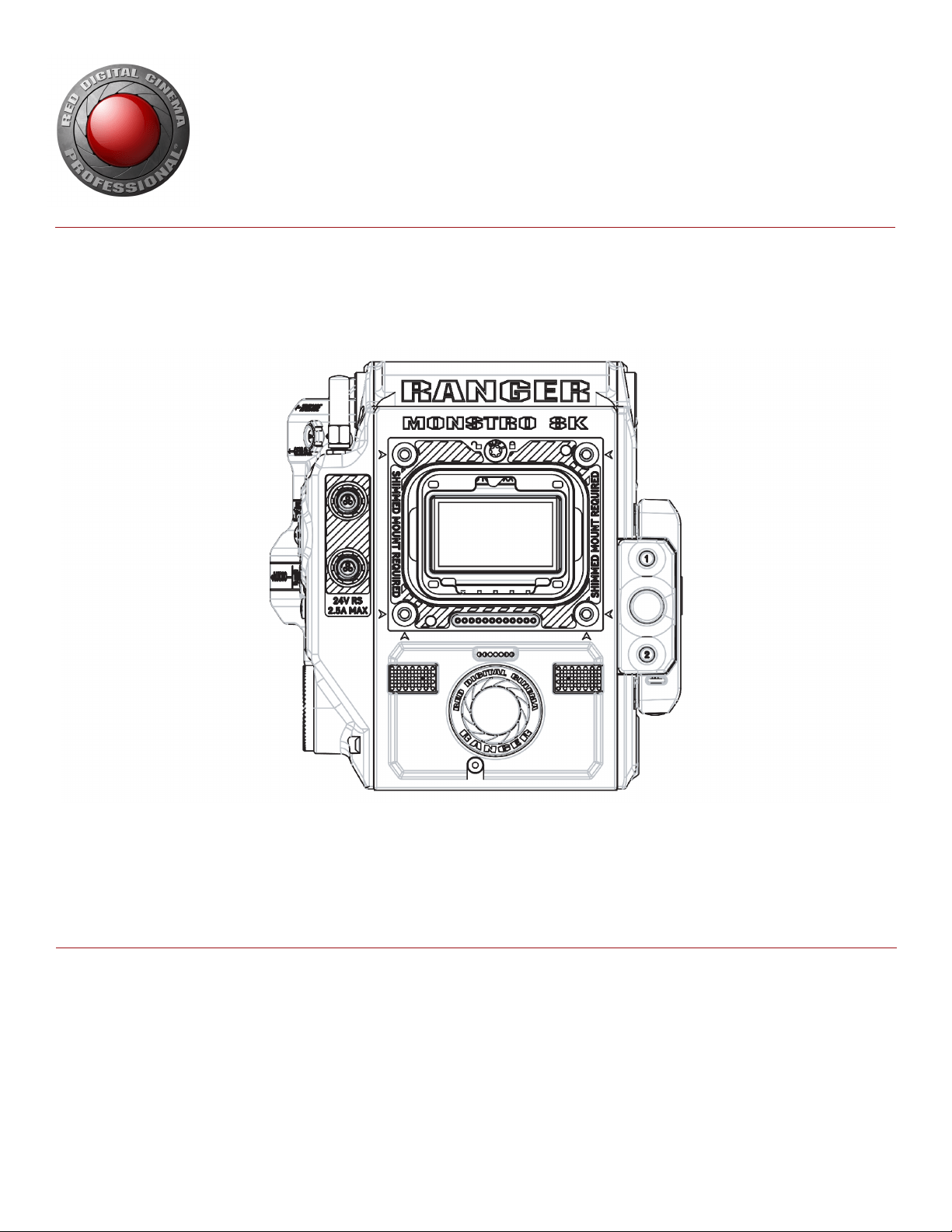
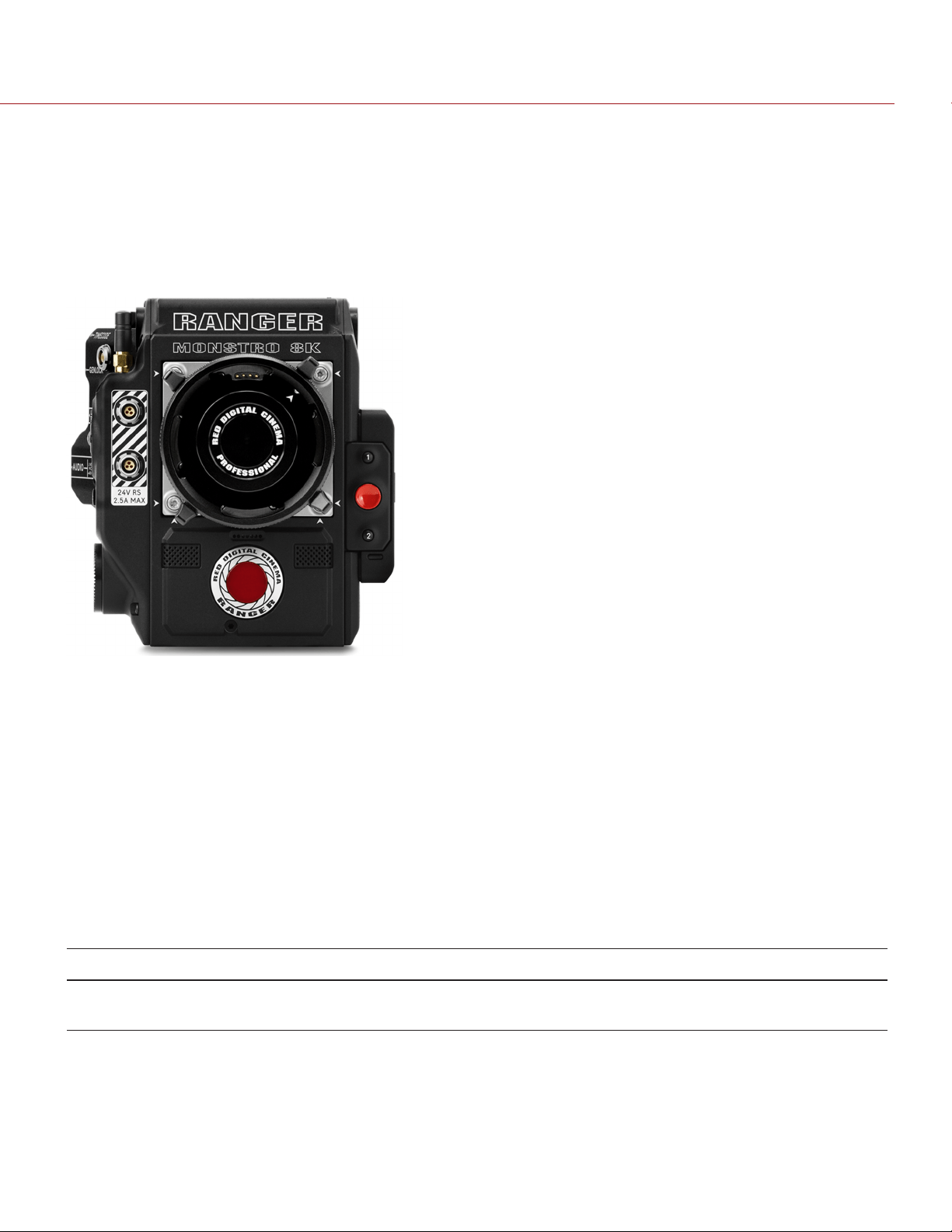
Figure: RED RANGER MONSTRO
RED RANGER MONSTRO is an integrated Large Format 8K camera system offering an all-in-one system for top-tier
production use. It features all of the benefits of the MONSTRO 8K VV sensor within a compact and less complex
platform for filmmakers. Features like integrated I/O’s, 24V power out, shimmed PL Mount, and improved thermal
performance offer unmatched versatility as well as peace of mind in challenging shooting environments.
RED RANGER MONSTRO is capable of handling the rigorous strain and robust power needs of high-end studio
productions. RED RANGER MONSTRO supports wide input voltage (11.5V to 32V), offers independent SDI and AUX
power outputs, and features an integrated XLR audio input. The camera also boasts a larger fan for quieter and more
efficient temperature management. RED RANGER MONSTRO is available in two configurations, supporting either V-
Lock or Gold Mount batteries.
This section introduces the imaging capabilities and advanced features of the camera system.
This guide is for the following cameras only:
SENSOR TYPE CAMERA
MONSTRO 8K VV RED RANGER MONSTRO 8K VV (V-Lock)
RED RANGER MONSTRO 8K VV (Gold Mount)

R3D FILE FORMAT AND REDCODE
All videos and frames are recorded to the R3D
®
file format. The R3D file format was developed by RED to provide an
efficient and manageable RAW video data format that promotes advanced post production editing capabilities. In the
R3D file format, the digital image received from the sensor is formatted as a pixel-defect corrected (but in all other
aspects unprocessed) 16-bit per pixel RAW data frame. Each RAW frame, or sequence of RAW frames in a clip, is
compressed using a proprietary wavelet based REDCODE
®
RAW compression, then stored to a RED MINI-MAG
®
.
RAW data is recorded independently of any RGB domain color processing such as ISO, White Balance, or other RGB
color space settings. Instead, color parameters are saved as reference metadata; that is, color is not burned into the
recorded RAW data. This recording technique promotes flexibility in RGB color processing, which can be deferred to post
production or adjusted in the field, without affecting the recorded RAW data image quality or dynamic range.
REDCODE is a visually lossless, wavelet-based compression codec that reduces R3D RAW files into a manageable
size, allowing longer recording times on media. The ability to compress RAW data is one of the significant technologies
that RED has brought to the industry.
For more information, see the
DSMC Media Operation Guide, available at www.red.com/downloads.
NOTE: REDCINE-X PRO
®
can create and export .RMD “Look” files which may then be imported as camera monitor
path color processing presets. This information is stored as reference metadata, so that these color processing choices
can be the default values used in post production. For more information, go to "Looks" on page 92.
SHOOT FOR VIDEO AND STILLS
High resolution video, such as the digital footage captured by the camera, has surpassed the detail necessary to produce
professional full-sized prints. Because of the ability to record at high frame rates and resolution, the camera is ideally
suited to capture video and still images, simultaneously.
The camera is equipped with a Stills mode that makes it easier to capture stunning images. With presets optimized for
stills and Swipe-Up Shortcuts for the RED Touch display, switching from Motion mode to Stills mode is seamless. Using
REDCINE-X PRO, or other editing applications supporting the RED SDK, you can pull full resolution still images from
R3D files.
COPYR IGH T © 2019 R ED.COM, LLC 955- 0184_V7.3, REV-A
| 10
RED RANGER MONSTRO OPERATION GUIDE
POST PRODUCTION
NOTE: Third-party applications may have limited compatibility with R3D files. Third-party developers must use the most
recent R3D SDK to offer compatibility with the latest RED firmware.
Many non-linear editing systems (NLEs) can open and edit RED footage. Each NLE version may have specific
compatibility requirements, such as camera firmware version or camera type. Before shooting, check all compatibility
requirements.
The following programs can be used to open and/or edit R3D files:
REDCINE-X PRO: RED's proprietary NLE. Download REDCINE-X PRO for Windows or REDCINE-X PRO for Mac
from www.red.com/downloads.
Adobe Photoshop: Can open .R3D files. Requires you to download the RED Adobe Photoshop Installer for
Windows or RED Adobe Photoshop Installer for Mac from www.red.com/downloads.
Adobe Premiere Pro: For more information on compatibility, go to the RED Support site at https://support.red.com.
Avid Media Composer
DaVinci Resolve
Edius Pro
Final Cut Pro 7: Requires you to download the RED Apple Workflow Installer from www.red.com/downloads.
Final Cut Pro X: Requires you to download the RED Apple Workflow Installer from www.red.com/downloads.
Vegas Pro
POST PRODUCTION WITH REDCINE-X PRO
REDCINE-X PRO is a professional one-light coloring toolset, equipped with an integrated timeline and a post effects
software collection that provides the ideal environment to review recorded footage, edit metadata, organize projects, and
prepare your R3D files. Use either REDCINE-X PRO or a compatible third-party non-linear editing (NLE) application to
edit R3D files.
RED TETHER, included in REDCINE-X PRO, allows you to record footage from your camera directly to a computer or
an external drive. Using tethering bypasses the need to record to an SSD and offload to a computer later, saving you
time. The latest version of
REDCINE-X PRO for Windows, REDCINE-X PRO for Mac, and the REDCINE-X PRO
Operation Guide are available for download at RED Downloads at www.red.com/downloads.
NOTE: RED TETHER is included in REDCINE-X PRO build 35 or later.
COPYR IGH T © 2019 R ED.COM, LLC 955- 0184_V7.3, REV-A
| 11
RED RANGER MONSTRO OPERATION GUIDE
HDRX AND MAGIC MOTION
HDRX
HDRX
®
extends dynamic range up to six (6) stops by simultaneously capturing two (2) images of identical resolution and
frame rate. The first image is a normally exposed track (A-track), while the second is an underexposed track (X-track)
with an exposure value that reflects the additional stops of highlight protection. These tracks are “motion-conjoined”
during recording, leaving no time gap between the two (2) exposures. This is different from traditional alternating
exposures, which have small gaps between tracks, producing unwanted motion tracks.
MAGIC MOTION
MAGIC MOTION is a post production method that combines two (2) HDRX tracks to create an image with both natural
motion blur (from the A-track) and sharper reference (the X-track). MAGIC MOTION produces an image with an
extraordinary dynamic range that is not available with any other motion capture camera.
Shooting at 24 fps with a 180° (1/48 sec) shutter on traditional film or digital cameras produces motion blur throughout,
which is not the way the human eye observes motion. For example, ask someone to swing their arm. What you would
observe in a traditional recording of this action is constant motion blur until the arm stops. However, what your eye sees
is both motion blur and a sharper reference of the arm throughout the motion path. MAGIC MOTION creates an image
that matches the natural motion observed by the human eye.
ADDITIONAL RESOURCES
The following resources offer additional information about RED, the DSMC system, and the RED community:
RED.com: Check the official RED website for the latest information about RED products.
RED Learn Articles: RED offers in-depth technical articles about RED cameras, post-production, and digital
cinematography.
RED Downloads: Go to RED Downloads to download the latest firmware, operation guides, and post-production
software.
DSMC Toolkit: Go to RED Downloads to find the DSMC Toolkit, which offers many helpful tools and resources to
customize and improve your camera workflow.
RED Support: Check the RED SUPPORT site for FAQs, or to file a support ticket.
In-Camera Help: Select the Help button on an in-camera screen to open up the help for that screen.
REDUSER: Discuss all things RED on the REDUSER third-party forum.
COPYR IGH T © 2019 R ED.COM, LLC 955- 0184_V7.3, REV-A
| 12
RED RANGER MONSTRO OPERATION GUIDE
COPYR IGH T © 2019 R ED.COM, LLC 955- 0184_V7.3, REV-A | 13
RED RANGER MONSTRO OPERATION GUIDE
CHAPTER 2:
CAMERA SYSTEM
COMPONENTS
NOTE: Lens mounts are NOT HOT SWAPPABLE, meaning you cannot remove or install these items while the camera
is turned on. Before installing or removing these items, you MUST turn off the camera. Failure to do so may result in
damage to the item or camera that is not covered under warranty.
NOTE: Availability of components listed in this chapter is subject to change at any time.
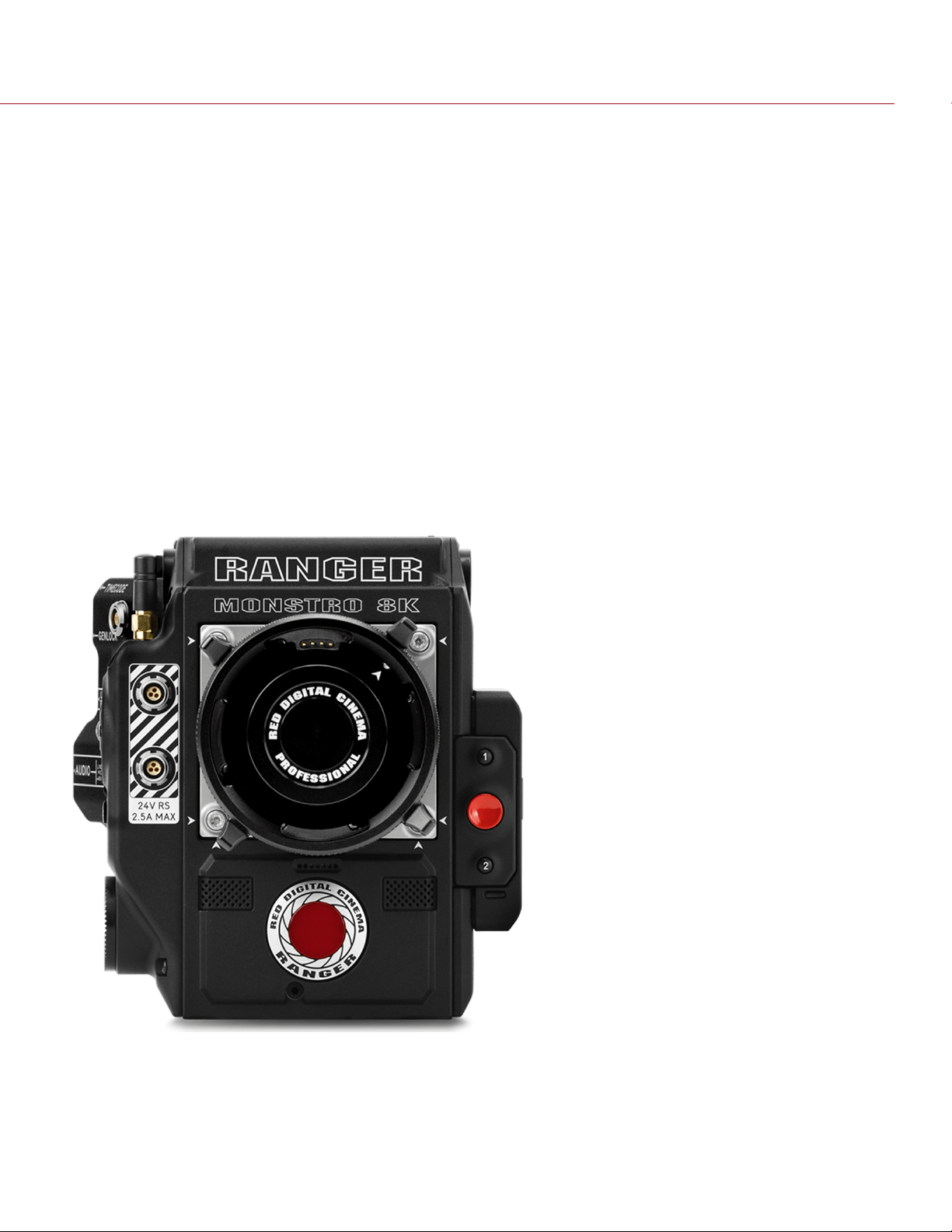
RED RANGER MONSTRO CAMERA BODY
This section describes the controls, buttons, and features on the RED RANGER MONSTRO camera body. For
information on the input/output connectors, go to
"Input/Output Connectors" on page 188.
Figure: Camera Body Controls and Features
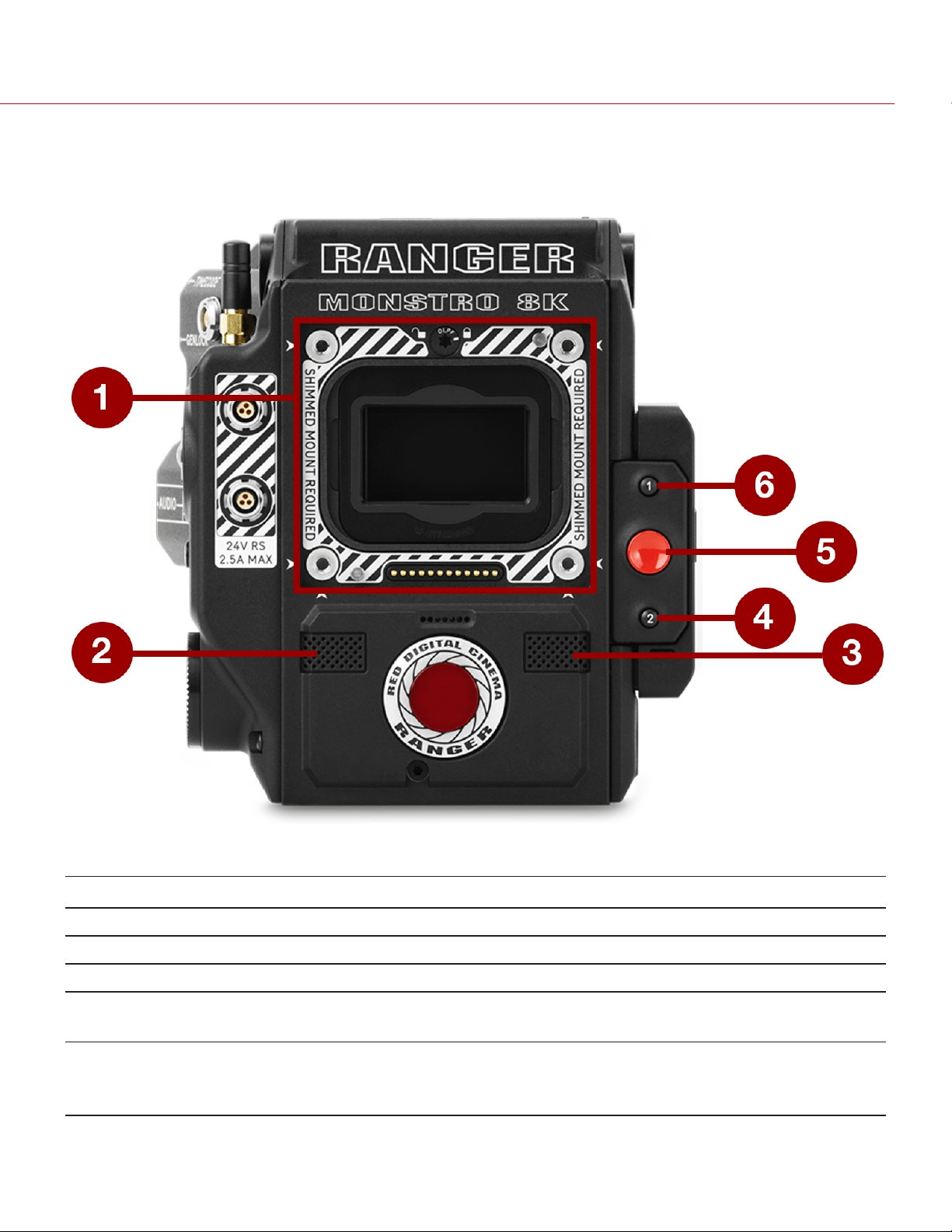
CAMERA BODY CONTROLS AND FEATURES
CAMERA FRONT
Figure: Camera Body Controls and Features
# ITEM DESCRIPTION
1 Lens mount area Attach lens mount
2 Mic 1 Left audio channels: Ch1 and Ch3. Go to
"Audio System" on page 141
3 Mic 2 Right audio channels: Ch2 and Ch4. Go to "Audio System" on page 141
4 User Key 2 Programmable key
User Key 1 + 2 Press: Eject Media
5 REC Button Programmable key
Full Press: Record Toggle
Half Press: AF Start
COPYR IGH T © 2019 R ED.COM, LLC 955- 0184_V7.3, REV-A | 14
RED RANGER MONSTRO OPERATION GUIDE
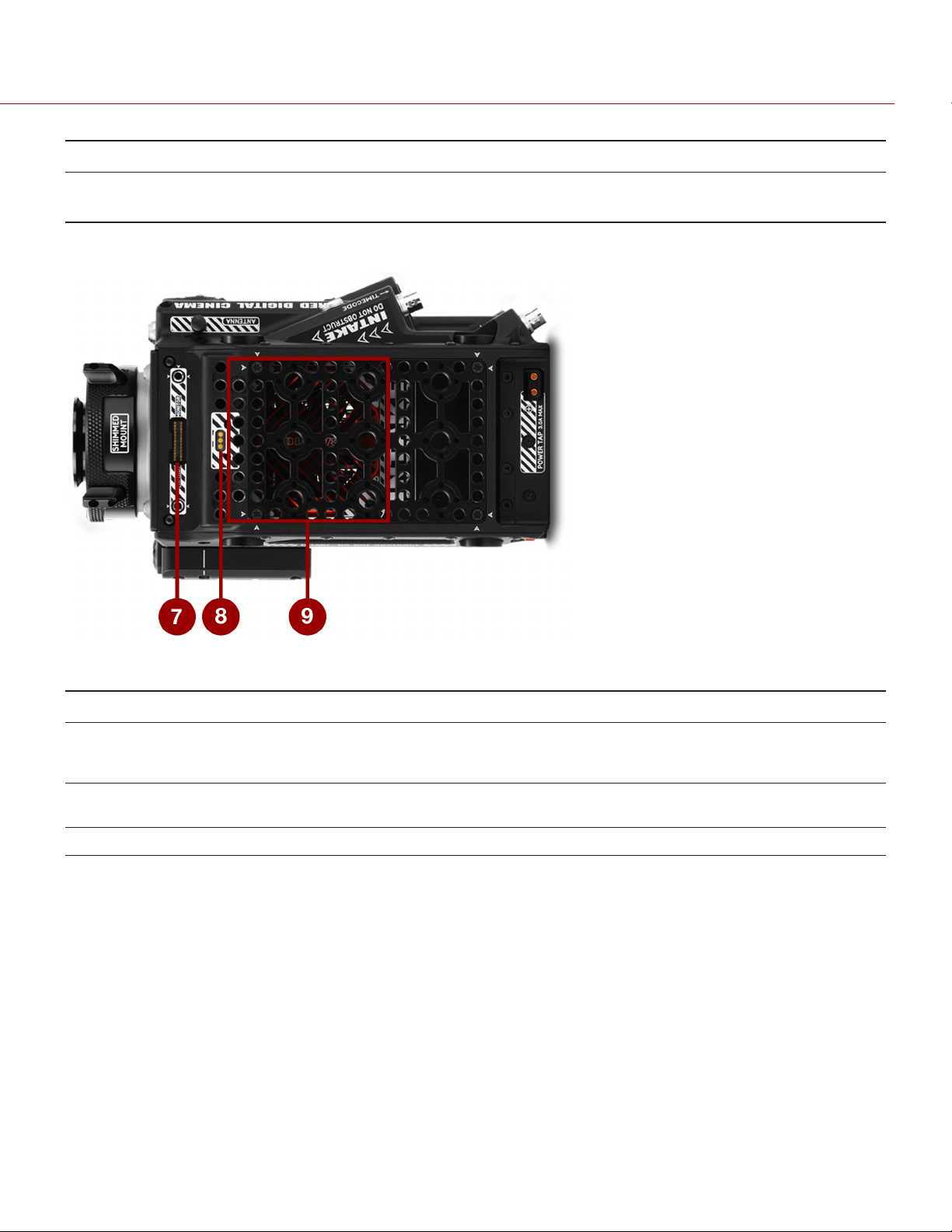
# ITEM DESCRIPTION
6 User Key 1 Programmable key
User Key 1 + 2 Press: Eject Media
CAMERA TOP
Figure: Camera Body Controls and Features
# ITEM DESCRIPTION
7 Primary
EVF/LCD
Port
Mount a DSMC2 RED Touch LCD, LCD/EVF Adaptor A, or LCD/EVF Adaptor D
8 Top Handle
Port
Mount the DSMC2 Top Handle or DSMC2 Outrigger Handle. This is the only mounting option for the
DSMC2 Top Handle or DSMC2 Outrigger Handle (it cannot be attached backward)
9 Fan intake DO NOT block fan intake when the camera is on
COPYR IGH T © 2019 R ED.COM, LLC 955- 0184_V7.3, REV-A | 15
RED RANGER MONSTRO OPERATION GUIDE
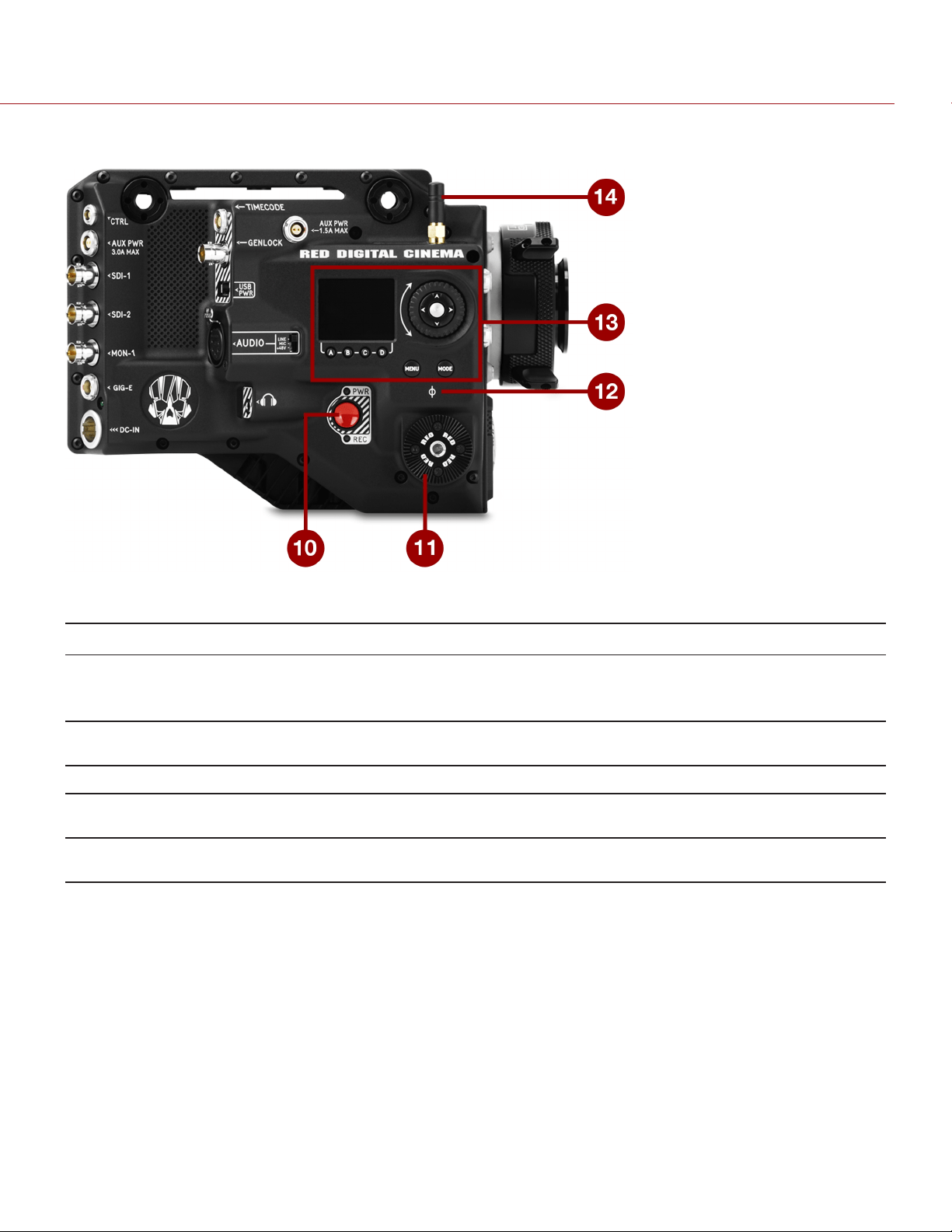
CAMERA LEFT
Figure: Camera Body Controls and Features
# ITEM DESCRIPTION
10 PWR/REC button Fully press and hold the
PWR/REC key for two (2) seconds to turn on/off.
When the camera is on, fully press and then release the PWR/REC key to toggle record
start/stop.
11 Industry-standard
rosette
Features an M6 threaded hole in the center; use with cages or accessories that feature rosette-
based mounting systems
12 Focal plane marks Marks align with the sensor plane; pull focus from these marks.
13 Side LCD and
Navigation
Go to "Side LCD and Navigation" on page 58
14 Wireless (802.11g)
antenna
Uses standard female SMA connector; can be replaced with taller SMA connector antennas
COPYR IGH T © 2019 R ED.COM, LLC 955- 0184_V7.3, REV-A | 16
RED RANGER MONSTRO OPERATION GUIDE
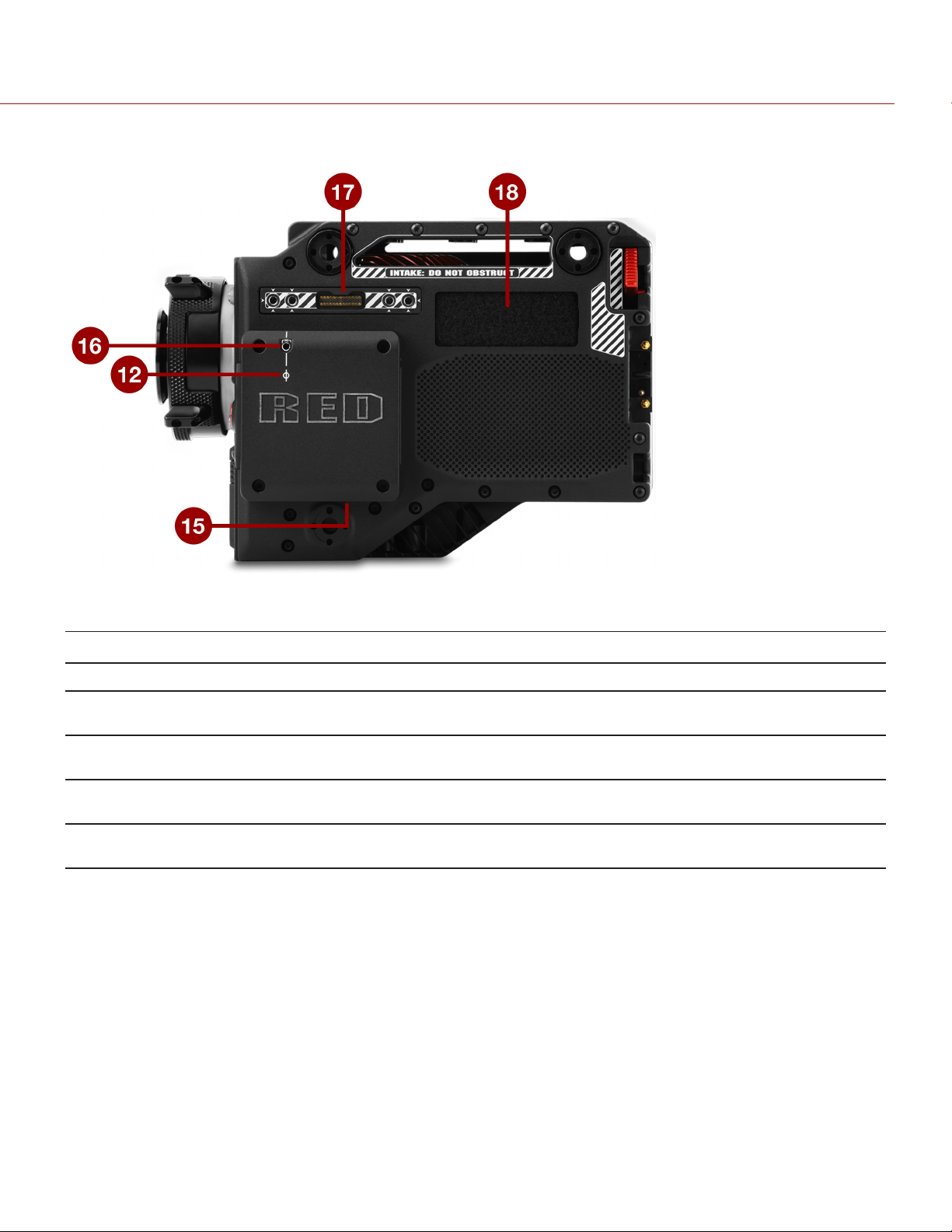
CAMERA RIGHT
Figure: Camera Body Controls and Features
# ITEM DESCRIPTION
12 Focal plane marks Marks align with the sensor plane; pull focus from these marks.
15 Focus Hook Screw
Storage Location
1
Store the focus hook screw
16 Focus Hook
Mounting Point
1
Mount the focus hook
17 Secondary
EVF/LCD Port
Mount a DSMC2 RED Touch LCD or LCD/EVF Adaptor D. The secondary LCD/EVF port and a
MON-1 port cannot be used at the same time. Go to
"Monitor Preferences" on page 69
18 Hook and loop
patch
Rectangle of hook and loop material for attaching labels
1. Install only the focus hook screw to this mounting point. Damage to the media bay or other components of the camera system caused by
installing other devices is not covered under warranty.
COPYR IGH T © 2019 R ED.COM, LLC 955- 0184_V7.3, REV-A
| 17
RED RANGER MONSTRO OPERATION GUIDE
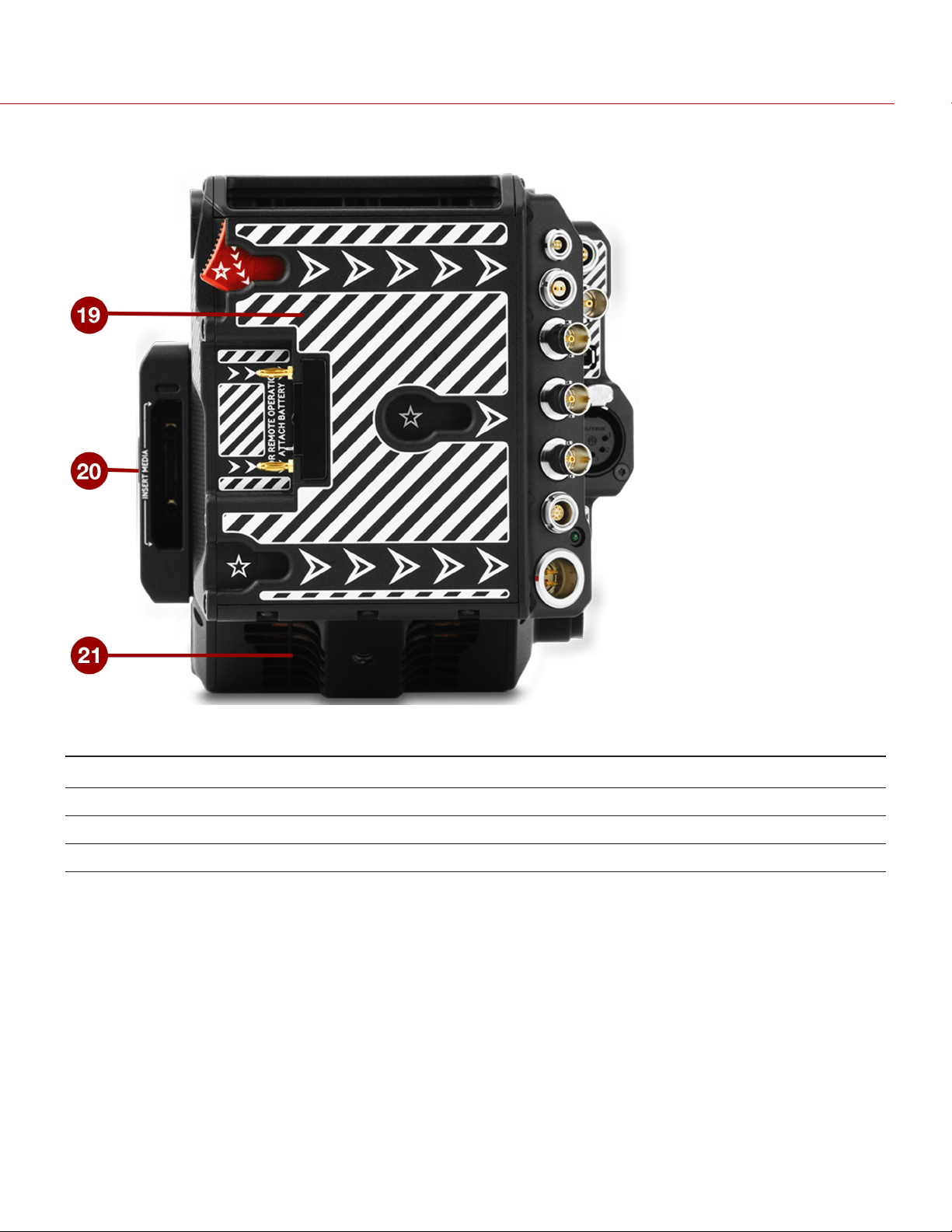
CAMERA BACK
Figure: Camera Body Controls and Features (shown with gold mount)
# ITEM DESCRIPTION
19 Battery mount Depending on the RED RANGER type, you can attach either a gold mount battery or a v-lock battery
20 Media mount Mount RED MINI-MAG media
21 Fan exhaust DO NOT block fan exhaust when the camera is on
COPYR IGH T © 2019 R ED.COM, LLC 955- 0184_V7.3, REV-A | 18
RED RANGER MONSTRO OPERATION GUIDE
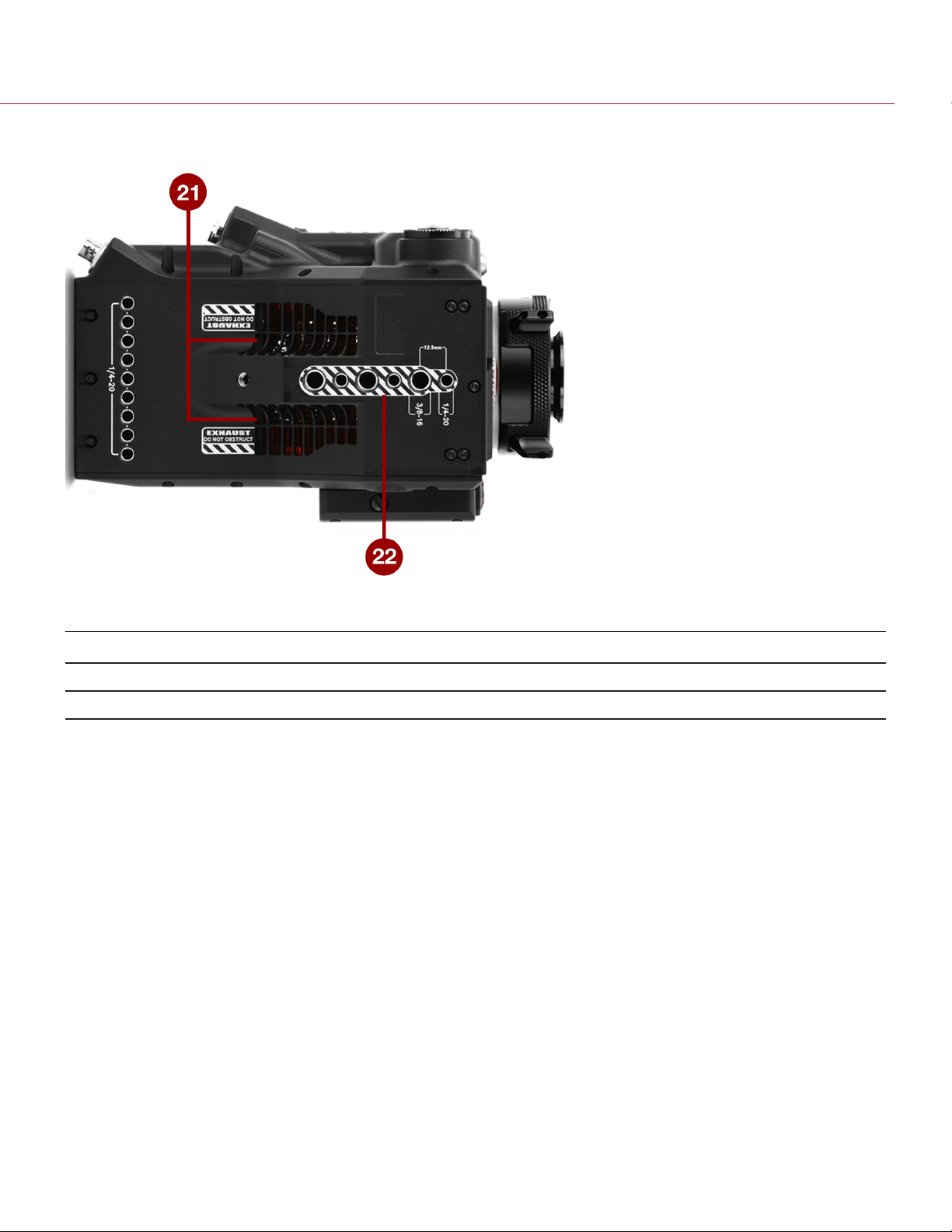
CAMERA BOTTOM
Figure: Camera Body Controls and Features
# ITEM LOCATION DESCRIPTION
21 Fan exhaust Back/Bottom DO NOT block fan exhaust when the camera is on
22 Mounting Points Bottom Mount plates, tripods, monopods, etc.
COPYR IGH T © 2019 R ED.COM, LLC 955- 0184_V7.3, REV-A | 19
RED RANGER MONSTRO OPERATION GUIDE
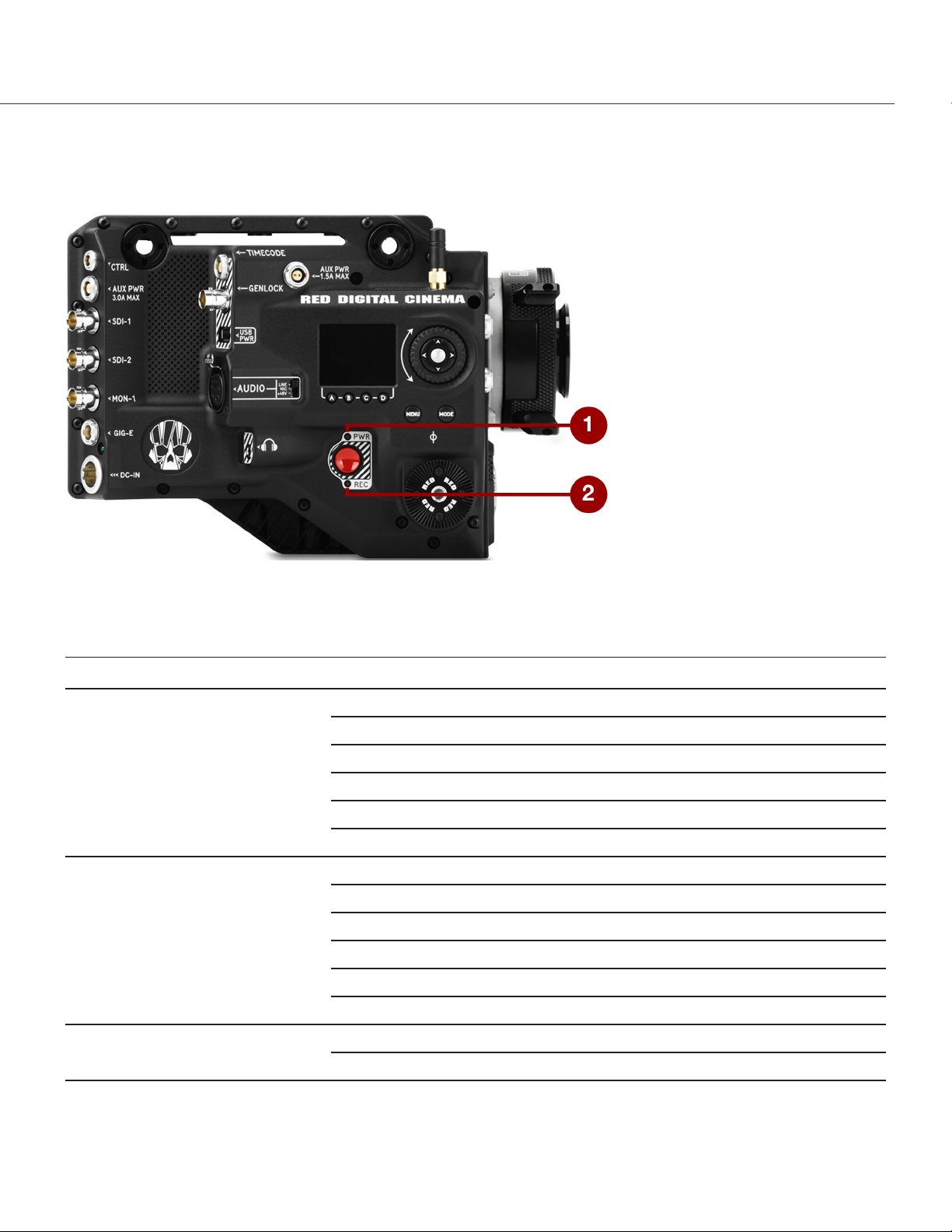
CAMERA BODY LEDS
LEFT SIDE LEDS
Figure: RED RANGER LEDs, Left Side
NOTE: When the camera is powered only by battery and not AC power, the Power Status LED (PWR) does not turn on.
To check the battery charge level, press the button on the battery.
# LED COLOR/FLASHING DESCRIPTION
1 Power Status LED (PWR) Off Camera off
Green Camera on
Amber flashing Camera on; 5 to 10 min of battery time available
Amber Camera booting
Red flashing Camera on; < 5 min of battery time available
Red Camera shutting down
2 Record Status LED (REC) Off No media present
Green Ready to record
Amber Finalizing
Red flashing (slow) Media mounted; > 5% and ≤ 10% of media available
Red flashing (fast) Media mounted; ≤ 5% of media available
Red Recording
N/A Power Status LED (PWR)
and Record Status LED (REC)
Both green flashing Firmware update in progress
Both red flashing Firmware update error
COPYR IGH T © 2019 R ED.COM, LLC 955- 0184_V7.3, REV-A | 20
RED RANGER MONSTRO OPERATION GUIDE
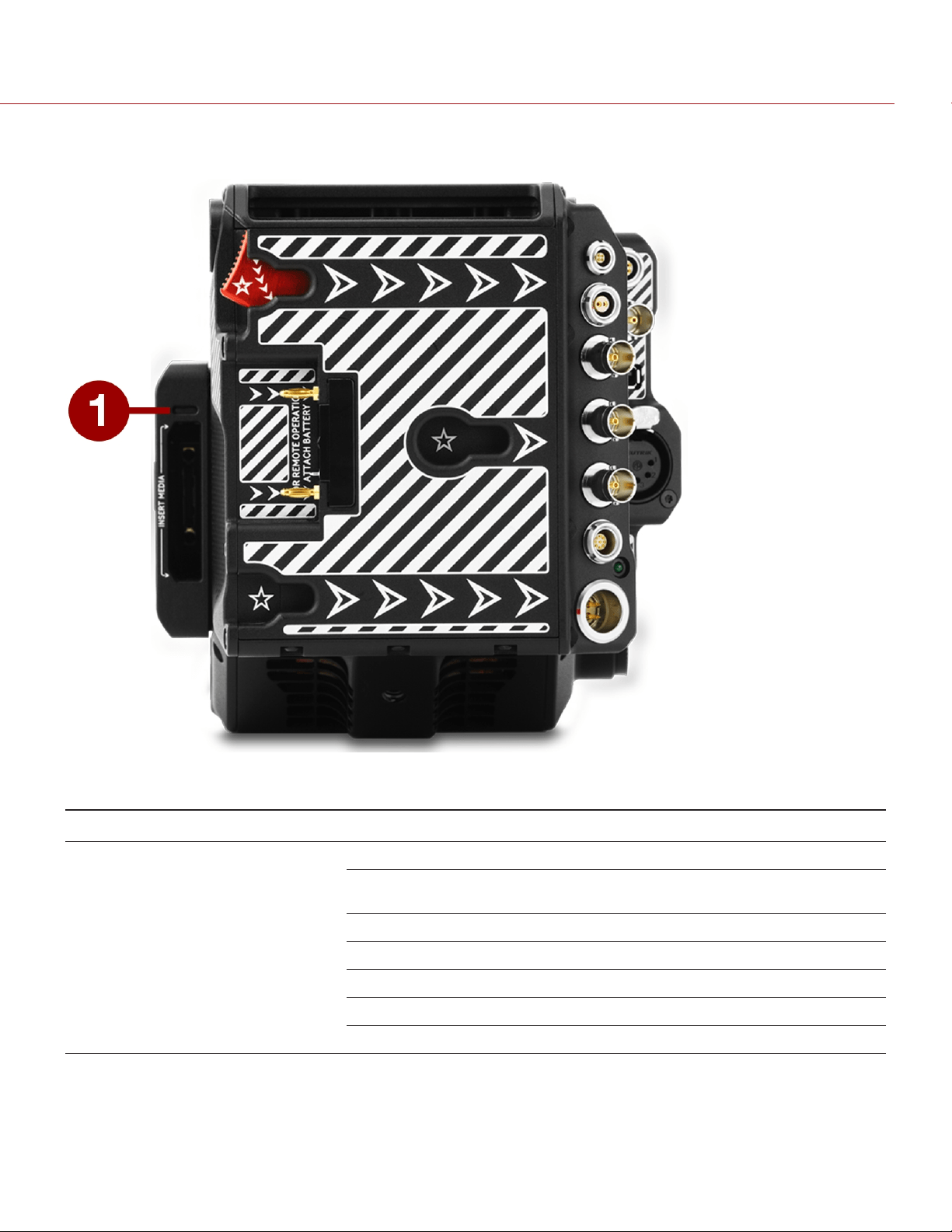
MEDIA BAY LED
Figure: Media Bay LED
# LED COLOR/FLASHING DESCRIPTION
1 Media Status LED (Back of media
bay)
Off No media mounted
Green Preview; media mounted; > 10% of media space
available
Amber Record finalizing or playback mode
Amber flashing (slow) Formatting media
Red flashing (slow) Media mounted; > 5% and ≤ 10% of media available
Red flashing (fast) Media mounted; ≤ 5% of media available
Red Recording; media mounted; > 10% of media available
COPYR IGH T © 2019 R ED.COM, LLC 955- 0184_V7.3, REV-A | 21
RED RANGER MONSTRO OPERATION GUIDE
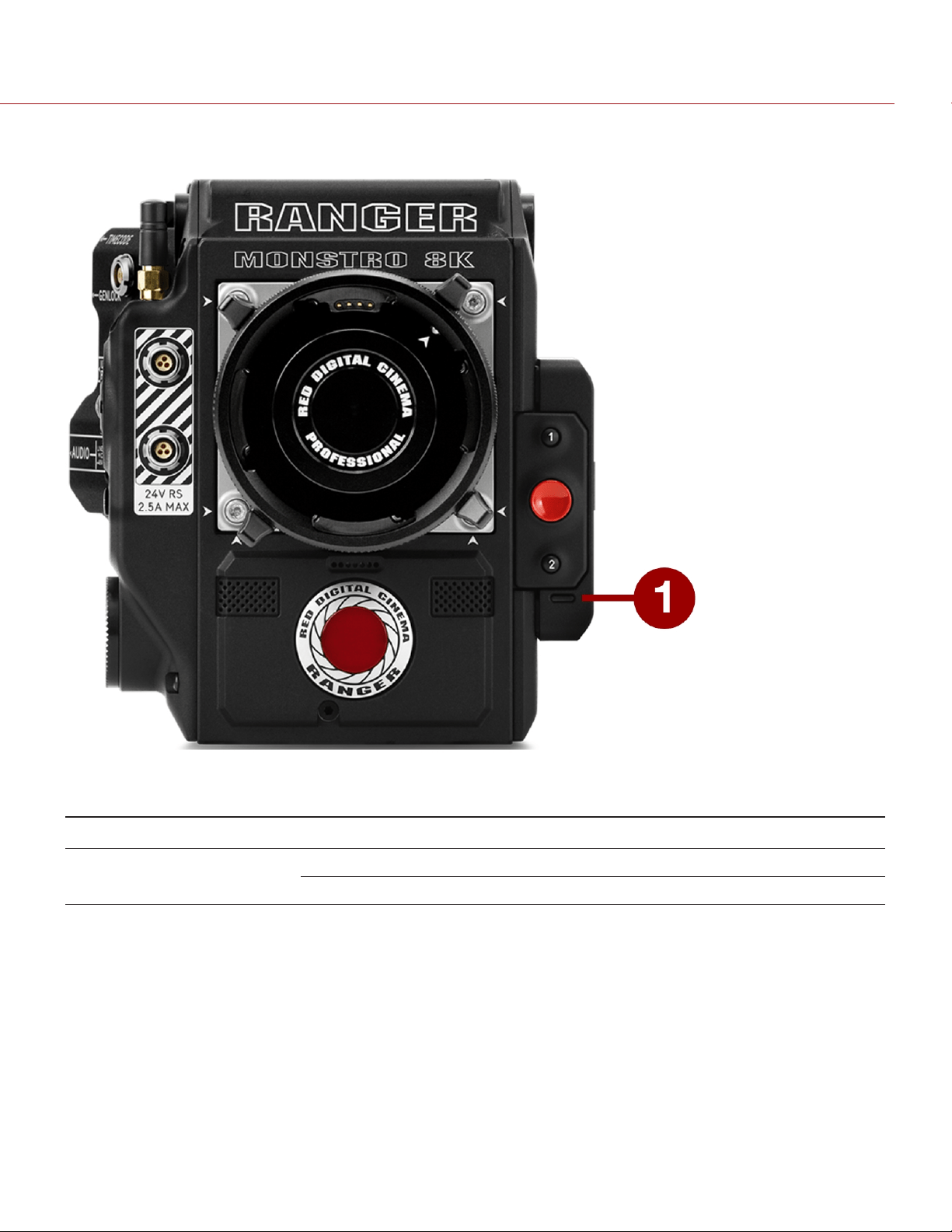
REC LED
Figure: REC LED
# LED COLOR/FLASHING DESCRIPTION
1 Record Status LED
1
Off Not recording, or media not mounted
Red Recording
1. For more information on how to enable/disable this LED, go to "Indicator" on page 114. If media is not mounted, this LED is off.
COPYR IGH T © 2019 R ED.COM, LLC 955- 0184_V7.3, REV-A
| 22
RED RANGER MONSTRO OPERATION GUIDE
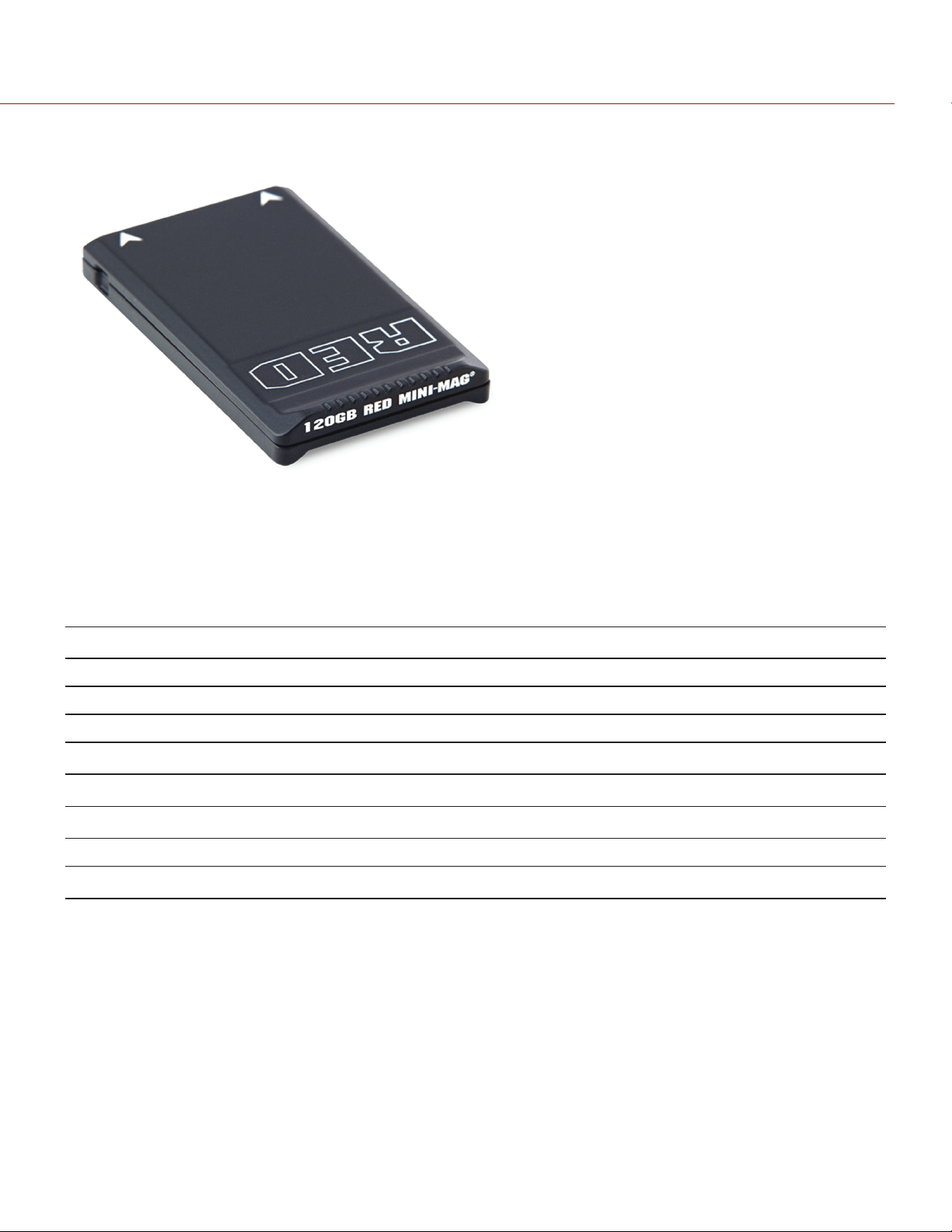
RED MINI-MAG SYSTEM
Figure: RED MINI-MAG (120GB)
NOTE: For more information, see the DSMC Media Operation Guide, available at www.red.com/downloads.
RED MINI-MAG
®
SSDs deliver fast and reliable recording options for your camera. A RED STATION
®
enables you to
connect media to your computer for offloading and editing.
RED offers the following RED MINI-MAG SSDs:
ITEM PART NUMBER
RED MINI-MAG (120GB) 750-0075
RED MINI-MAG (240GB) 750-0082
RED MINI-MAG (480GB) 750-0090
RED MINI-MAG (512GB) V4
1
750-0078
RED MINI-MAG (512GB) V5
1
750-0078
RED MINI-MAG (512GB) V6
1
750-0078
RED MINI-MAG (960GB) 750-0087
RED MINI-MAG (1TB)
2
750-0081
1. To see the Model number, go to Menu > Media > Device.
2. The RED MINI-MAG 1TB can take up to 20 seconds to mount to a computer or a camera.
COPYR IGH T © 2019 R ED.COM, LLC 955- 0184_V7.3, REV-A
| 23
RED RANGER MONSTRO OPERATION GUIDE

POWER COMPONENTS
The following RED batteries, battery chargers, and power cables are compatible with the RED RANGER:
ITEM PART NUMBER NOTES
REDVOLT-V 740-0043 For use with V-Lock
RED BRICK 740-0002 For use with V-Lock
RED RANGER AC Power
Adaptor 270W
740-0048 Power adaptor for AC power; 3-pin female XLR
3-PIN XLR-TO-4-PIN 2B
POWER CABLE (10')
790-0665 Connects the DC-IN port to the RED RANGER AC Power Adaptor or
third-party 24/28V output power, such as Anton Bauer VCLX or Bebob
Cube 1200 batteries
COPYR IGH T © 2019 R ED.COM, LLC 955- 0184_V7.3, REV-A | 24
RED RANGER MONSTRO OPERATION GUIDE

DISPLAYS AND ELECTRONIC VIEWFINDERS
RED offers the following displays and electronic viewfinders (EVFs):
NOTE: RED offers multiple mounting solutions for each camera type.
ITEM RESOLUTION TILT
1
SWIVEL
1
PART NUMBER
DSMC2 RED Touch 7.0" LCD (Woven CF) 1920 x 1136 Total: 180°
Forward: 90°
Backward: 90°
Total: 360°
CW: 180°
CCW: 180°
730-0018
DSMC2 RED Touch 7.0" LCD (Aluminum) 1920 x 1136 Total: 180°
Forward: 90°
Backward: 90°
Total: 360°
CW: 180°
CCW: 180°
730-0024
DSMC2 RED Touch 4.7" LCD 1280 x 720 Total: 240°
Forward: 90°
Backward: 150°
No swivel 730-0019
RED Touch 5.0" LCD
2
800 x 400 Total: 270°
Forward: 180°
Backward: 90°
Total: 360°
CW: 180°
CCW: 180°
730-0008
RED Touch 7.0" LCD
2
1920 x 1136 Total: 180°
Forward: 90°
Backward: 90°
Total: 360°
CW: 180°
CCW: 180°
730-0007
RED Touch 9.0" LCD
2
1280 x 768 Total: 270°
Forward: 180°
Backward: 90°
Total: 360°
CW: 180°
CCW: 180°
730-0011
RED Pro LCD 7"
2
1024 x 600 No tilt No swivel 730-0009
RED Pro Touch 7.0" LCD
2
1920 × 1136 No tilt No swivel 730-0025
DSMC2 Touch 7.0" Ultra-Brite LCD
2, 3
1920 x 1200 No tilt No swivel 730-0026
DSMC2 Touch 7.0" Ultra-Brite LCD (Direct Mount)
3
1920 x 1200 Total: 180°
Forward: 90°
Backward: 90°
Total: 360°
CW: 180°
CCW: 180°
730-0028
DSMC2 RED EVF (OLED)
2
1920 x 1080 N/A N/A 730-0021
BOMB EVF
®
(LCOS)
2
1280 x 784 N/A N/A 730-0004
BOMB EVF (OLED)
2
1280 x 1024 N/A N/A 730-0010
1. Approximate measurements.
2. Using this display with RED RANGER requires a DSMC2 LCD/EVF Adaptor A or DSMC2 LCD/EVF Adaptor D.
3. The DSMC2 Touch 7.0" Ultra-Brite LCD requires that your camera is on firmware v7.2 or later.
COPYR IGH T © 2019 R ED.COM, LLC 955- 0184_V7.3, REV-A
| 25
RED RANGER MONSTRO OPERATION GUIDE

RED LCDS
RED displays provide important camera parameters on the graphical user interface (GUI) and offer a variety of monitor
viewing options. RED touchscreen displays enable you to use gestures to navigate menus and adjust camera
parameters. RED displays feature 8-bit RGB, 4:4:4 progressive scan, providing up to 16.7 million colors and up to 70%
NTSC color gamut (83% coverage for the DSMC2 Touch 7.0" Ultra-Brite LCD).
LCD PRECAUTIONS
WARNING: DO NOT use a RED display as a handle to lift or carry the camera. Damage to a RED display or other
components of the camera system caused by using the display as a handle are not covered under warranty.
WARNING: DO NOT use the threaded holes in the RED Touch LCD base to mount the display to the camera. Damage
to a RED display or other components of the camera system caused by using these threaded holes is not covered under
warranty.
WARNING: DO NOT try to turn an LCD past its tilt or swivel range. Damage to a RED display or other camera
components caused by excessive force is not covered under warranty. For more information on the tilt and swivel range
for each display, go to "Displays and Electronic Viewfinders" on the previous page.
COPYR IGH T © 2019 R ED.COM, LLC 955- 0184_V7.3, REV-A
| 26
RED RANGER MONSTRO OPERATION GUIDE
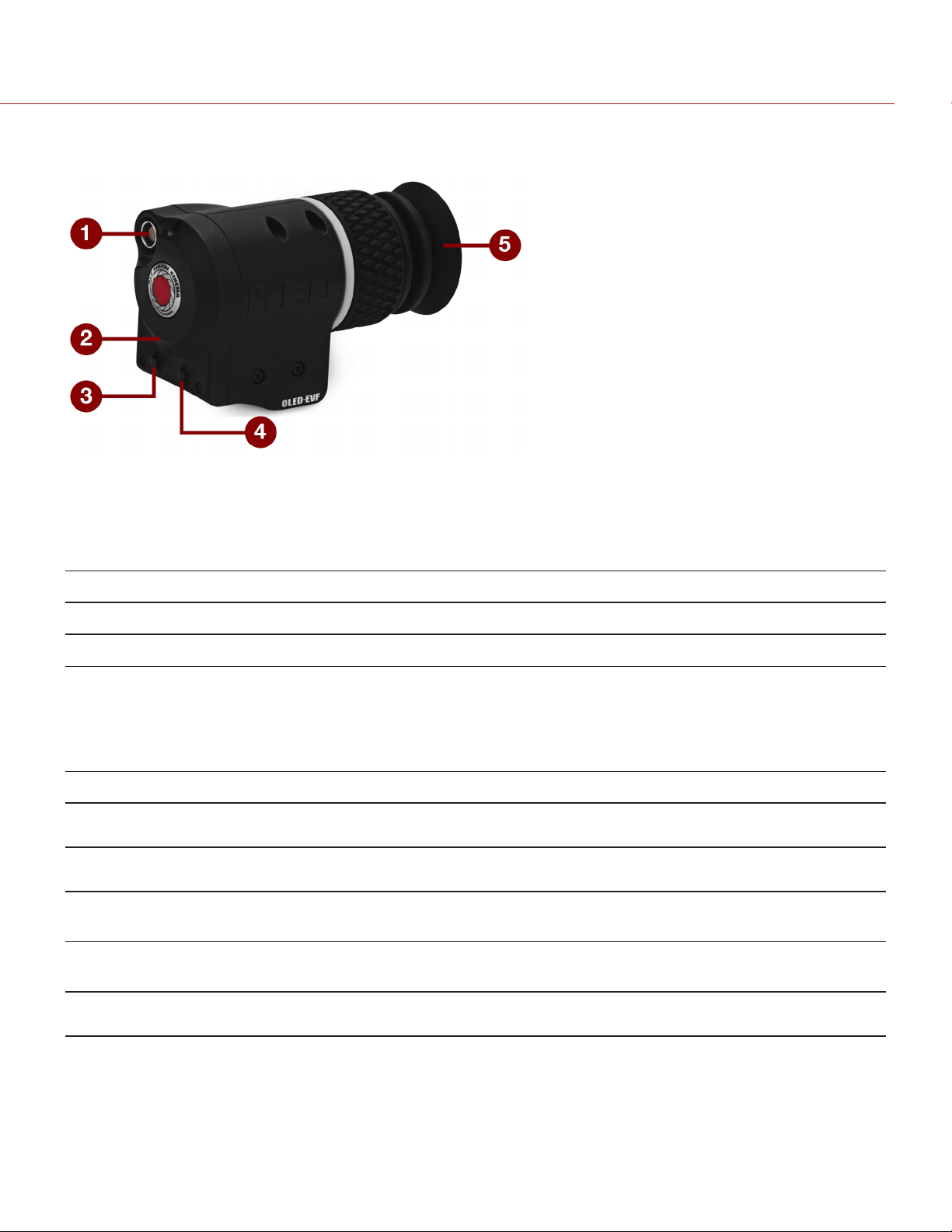
BOMB EVFS
Figure: BOMB EVF (OLED)
The BOMB EVF (LCOS) and BOMB EVF (OLED) deliver specialized viewing solutions for the camera. The BOMB EVF
(LCOS) is a high-definition, lightweight, and low-profile viewfinder. The BOMB EVF (OLED) uses OLED technology,
providing deeper blacks and more color accurate images.
ITEM CONTRAST RATIO DIOPTER RANGE
BOMB EVF (LCOS)
1
1000:1 typical 2.0 to –5.0.1
BOMB EVF (OLED)
1
>10,000:1 typical 2.0 to –5.0.1
1. Using these displays with a DSMC2 camera requires a DSMC2 LCD/EVF Adaptor A.
WARNING: DO NOT point the BOMB EVF (OLED) eyepiece at direct sunlight. Continued exposure to direct sunlight
may damage the EVF. Point the eyepiece away from sunlight when not in use. Damage to the BOMB EVF (OLED)
caused by continued exposure to direct sunlight is not covered under warranty.
# FEATURE DESCRIPTION
1 EVF Connector Custom digital video and power interconnection between the camera and RED EVF; Pinout not
published
2 EVF Tally LED When enabled, the LED illuminates red when recording; For more information, go to
"Indicator" on
page 114
3 Key 1 Programmable key
Magnify: Toggle
4 Key 2 Programmable key
Exposure Check: Toggle
5 Eyepiece
Heater
The integrated eyepiece heater automatically heats the eyepiece when the EVF detects a low ambient
temperature
COPYR IGH T © 2019 R ED.COM, LLC 955- 0184_V7.3, REV-A | 27
RED RANGER MONSTRO OPERATION GUIDE
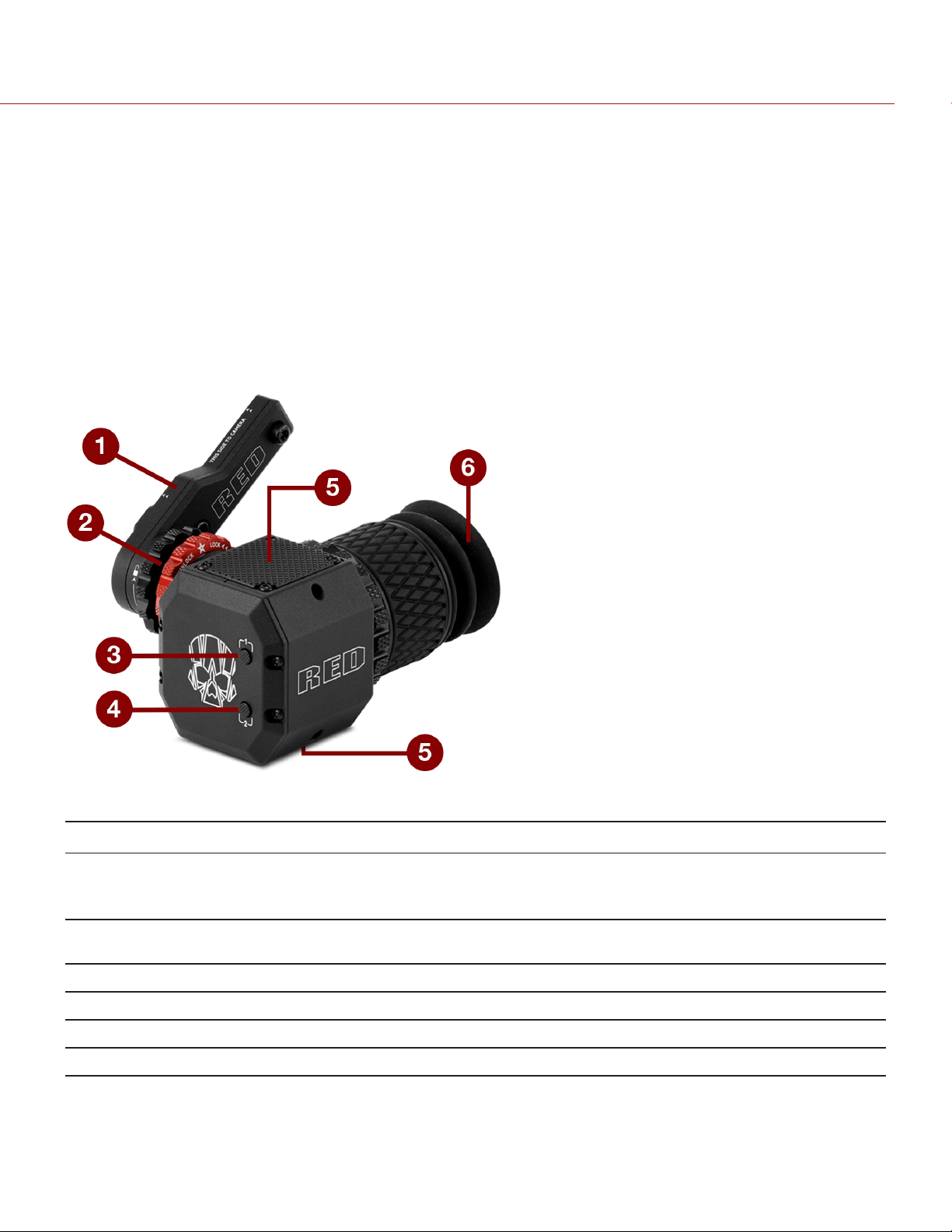
DSMC2 RED EVF
The DSMC2 RED EVF (OLED) is a high definition electronic viewfinder designed as the ideal single-viewer monitoring
solution. Featuring the latest OLED technology, this EVF provides an unmatched personal viewing experience with a
1080p OLED micro-display, and improved color accuracy with 30-bit RGB color represenation. View and monitor your
RED footage as it is intended with truer colors and deeper blacks in a larger field of view.
RED offers multiple mounting solutions for each camera type.
WARNING: DO NOT point the DSMC2 RED EVF (OLED) eyepiece at direct sunlight. Continued exposure to direct
sunlight may damage the EVF. Point the eyepiece away from sunlight when not in use. Damage to the DSMC2 RED
EVF (OLED) caused by continued exposure to direct sunlight is not covered under warranty.
NOTE: DO NOT overtighten the black tension ring on the EVF connector. The EVF is designed to allow rotation even
when the tension ring is fully engaged.
Figure: DSMC2 RED EVF
# FEATURE DESCRIPTION
1 DSMC2 RED EVF
Mount
The DSMC2 RED EVF Mount.
DO NOT overtighten the black tension ring on the EVF connector. The EVF is designed to allow
rotation even when the tension ring is fully engaged.
2 EVF Connector
1
Custom digital video and power interconnection between the EVF and other RED devices;
Pinout not published; compatible with standard RED LCD/EVF cables.
3 Key 1 Programmable key: Magnify: Toggle
4 Key 2 Programmable key: Exposure Check: Toggle
5 Mounting Point Mounting point for the DSMC2 RED EVF Mounting Plate
6 Modular Optical Block Fully coated with a > 32° field of view
1. Not visible. Shown with the DSMC2 RED EVF Mount attached.
COPYR IGH T © 2019 R ED.COM, LLC 955- 0184_V7.3, REV-A | 28
RED RANGER MONSTRO OPERATION GUIDE
LCD/EVF ADAPTORS
The LCD/EVF adaptors enable you to use legacy RED displays (which feature LCD/EVF connectors) with the RED
RANGER (which features pogo LCD/EVF connectors). For more information on available displays, go to
"Displays and
Electronic Viewfinders" on page 25.
ITEM PART NUMBER
DSMC2 LCD/EVF Adaptor A 720-0037
DSMC2 LCD/EVF Adaptor B 720-0038
DSMC2 LCD/EVF Adaptor D 105-2119
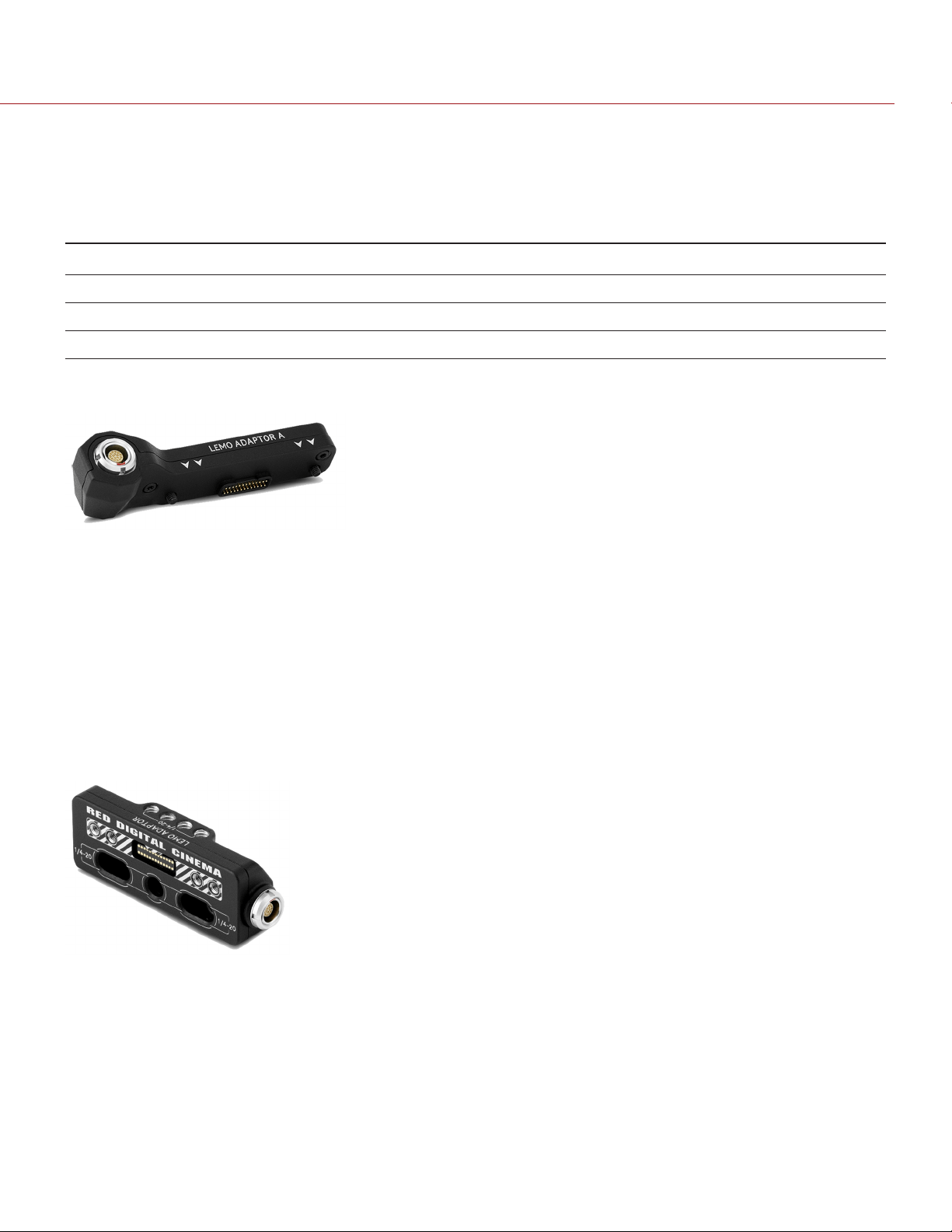
LCD/EVF ADAPTOR A
Figure: DSMC2 LCD/EVF Adaptor A
The DSMC2 LCD/EVF Adaptor A makes your existing RED Touch, RED PRO, and RED PRO Touch displays, as well
as RED EVFs, fully compatible with the RED RANGER. The DSMC2 LCD/EVF Adaptor A converts the pogo
connection on the RED RANGER to a 16-Pin 1B LCD/EVF port. The DSMC2 LCD/EVF Adaptor A is designed to attach
to the primary (top) EVF/LCD port on the RED RANGER.
When used along with the DSMC2 LCD/EVF Adaptor B, this adaptor enables you to mount a DSMC2 RED Touch LCD
away from the camera—to a NOGA arm or other stable mounting point.
The DSMC2 LCD/EVF Adaptor A is compatible with the BOMB EVF, (LCOS) and (OLED) models, or later.
LCD/EVF ADAPTOR B
Figure: DSMC2 LCD/EVF Adaptor B
The DSMC2 LCD/EVF Adaptor B converts the display signal from a pogo connection to a 16-Pin 1B LCD/EVF port.
When used along with the DSMC2 LCD/EVF Adaptor A or DSMC2 LCD/EVF Adaptor D, this adaptor enables you to
mount a DSMC2 RED Touch LCD away from the camera—to a NOGA arm or other stable mounting point.
COPYR IGH T © 2019 R ED.COM, LLC 955- 0184_V7.3, REV-A
| 29
RED RANGER MONSTRO OPERATION GUIDE
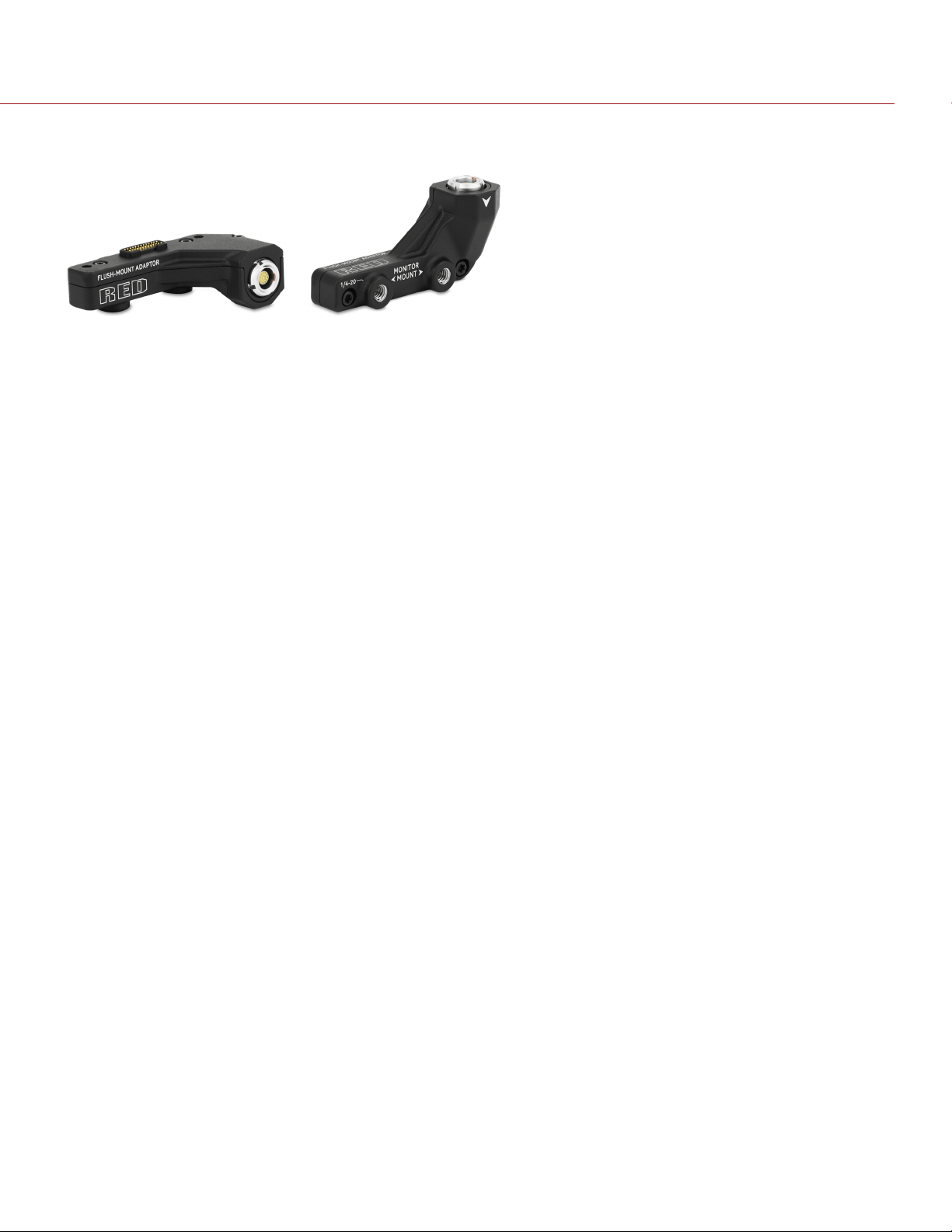
DSMC2 LCD/EVF ADAPTOR D
Figure: DSMC2 LCD/EVF Adaptor D
Similar to the DSMC2 LCD/EVF Adaptor A, the DSMC2 LCD/EVF Adaptor D converts the pogo connection on the RED
RANGER to a 16-Pin 1B LCD/EVF port. The DSMC2 LCD/EVF Adaptor D is designed to attach to the primary (top), or
the secondary (side) EVF/LCD port on the RED RANGER.
When used along with the DSMC2 LCD/EVF Adaptor B, this adaptor enables you to mount a DSMC2 RED Touch LCD
away from the camera—to a NOGA arm or other stable mounting point.
The DSMC2 LCD/EVF Adaptor D is compatible with the BOMB EVF, (LCOS) and (OLED) models, or later.
COPYR IGH T © 2019 R ED.COM, LLC 955- 0184_V7.3, REV-A
| 30
RED RANGER MONSTRO OPERATION GUIDE
CAMERA CONTROL DEVICES
This section describes the camera control devices that offer Record Start/Stop buttons:
ITEM PART NUMBER
DSMC2 Top Handle 720-0035
DSMC2 Outrigger Handle 720-0044
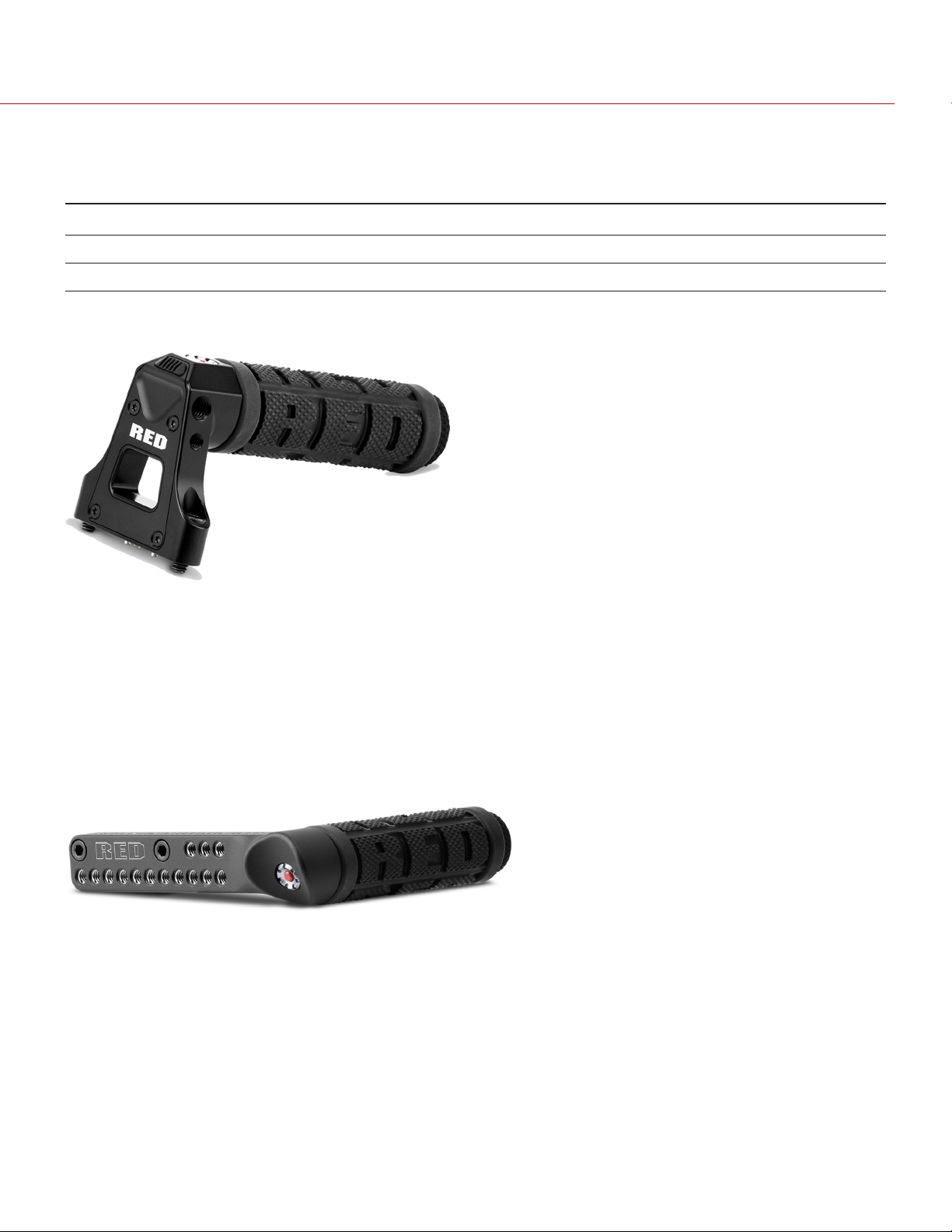
DSMC2 TOP HANDLE
Figure: DSMC2 Top Handle
Ergonomic and intuitive, the DSMC2 Top Handle was engineered entirely around the most important action for any
shooter—the record button. This intelligent top handle puts a new Record Start/Stop button at your fingertips, using built-in
integrated circuitry.
The DSMC2 Top Handle mounts directly to the 1/4-20 mounting points on the top of the camera. With a rubberized grip
and new trigger design—the DSMC2 Top Handle offers the ideal handle and shooting method for your camera.
DSMC2 OUTRIGGER HANDLE
Figure: DSMC2 Outrigger Handle
The DSMC2 Outrigger Handle offers a low profile side handle—designed with an ergonomic molded grip and integrated
Record Start/Stop button. Mounted to the Top Handle Port on your camera, the DSMC2 Outrigger Handle provides
comfort and stability, as well as additional 1/4-20 mounting points for your peripheral camera components. The built-in
Record button puts Start/Stop functionality right at your fingertips—so you are always ready to capture the perfect shot.
The DSMC2 Outrigger Handle is ideal for shooters who use one hand on the handle, for grip and record button access,
and the other for lens adjustments or support.
COPYR IGH T © 2019 R ED.COM, LLC 955- 0184_V7.3, REV-A
| 31
RED RANGER MONSTRO OPERATION GUIDE

LENS MOUNTS
RED recommends only using the RED RANGER Shimmed PL Mount with the RED RANGER. Other RED lens mounts
are mechanically compatible, but may cause focus accuracy issues.
ITEM PART NUMBER
RED RANGER Shimmed PL Mount 725-0046
INTERCHANGEABLE OLPFS
The camera system includes intelligent, interchangeable optical low pass filters (OLPFs). The camera automatically
recognizes the OLPF type installed, eliminating the need to configure OLPF settings in the camera menu.
RED offers the following modular VV interchangeable OLPFs:
ITEM PART NUMBER
DSMC2 VV Standard OLPF 790-0558
DSMC2 VV Skin Tone-Highlight OLPF 790-0559
DSMC2 VV Low Light Optimized OLPF 790-0560
DSMC2 VV H
2
O OLPF 790-0601
COPYR IGH T © 2019 R ED.COM, LLC 955- 0184_V7.3, REV-A | 32
RED RANGER MONSTRO OPERATION GUIDE
RAILS, MOUNTS, TACTICAL GEAR, AND CABLES
RED offers a wide variety of support gear, mounting platforms, cables, accessories, and other equipment. For more
information, visit the
RED Store at www.red.com/store.
MAXIMUM SUPPORTED WEIGHTS
The table below lists the maximum weight each handle can support in specific configurations. Damage to handles or
other components of the camera system caused by using a handle to lift more than the specified weight is not covered
under warranty.
ITEM PART # CONFIGURATION MAX WEIGHT
DSMC2 Universal Handle 790-0523 Attached directly to the camera body 30 lbs
Production Handle 105-2120 One riser attached to a plate; handle extension attached 40 lbs
Two risers attached to a plate; handle extension attached 80 lbs
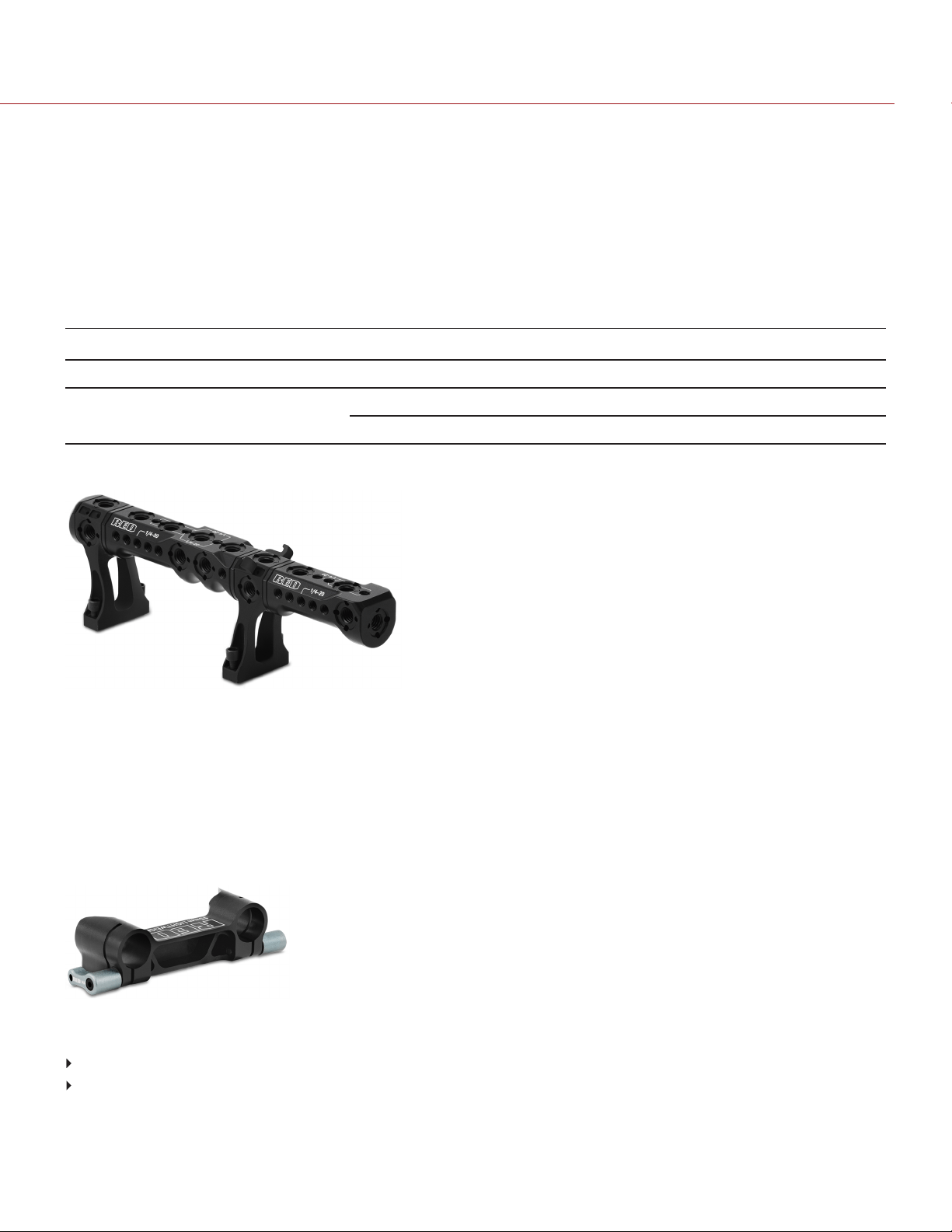
PRODUCTION HANDLE
Figure: Production Handle
The modular design of the Production Handle provides a configurable, rugged handle with an array of 1/4-20 and 3/8-16
mounting points for industry-standard accessories. It can be set up in a compact or extended configuration to suit various
shooting needs.
The Production Handle ships with a focus hook, which can be mounted on the handle in two separate mounting points
(one for DSMC2 cameras, and another for RED RANGER cameras).
15MM LIGHTWEIGHT ROD SUPPORT
Figure: 15mm Lightweight Rod Supports
The 15mm Lightweight Rod Supports (P/N 105-2151) are designed for the following types of camera setups:
Configurations with top-mounted rods (which can support EVF mounts and top-mounted lens motors)
Compact camera configurations in which bottom-mounted rods are not desired
COPYR IGH T © 2019 R ED.COM, LLC 955- 0184_V7.3, REV-A | 33
RED RANGER MONSTRO OPERATION GUIDE

COPYR IGH T © 2019 R ED.COM, LLC 955- 0184_V7.3, REV-A | 34
RED RANGER MONSTRO OPERATION GUIDE
CHAPTER 3:
BASIC OPERATIONS
POWER OPERATIONS
This section describes the basic power operations of the camera system.
NOTE: Lens mounts are NOT HOT SWAPPABLE, meaning you cannot remove or install these items while the camera
is turned on. Before installing or removing these items, you MUST turn off the camera. Failure to do so may result in
damage to the item or camera that is not covered under warranty.
WARNING: While third-party batteries may be mechanically compatible with the camera system, the manufacturer is
responsible for the performance and stability of third-party options, not RED
®
. Damage to the camera system or third-
party devices caused by using third-party power options is not covered under warranty. The camera may be unable to
determine and display the voltage or remaining battery capacity of third-party power options.
POWER PRIORITY
When multiple power sources are connected to the camera, power consumption is prioritized in this sequence:
1. Any power supply connected to the DC IN port
2. Rear battery
POWER CONSUMPTION
The camera draws approximately 4.2 A (63 W) when configured with the DSMC2 RED Touch 7.0" LCD and RED MINI-
MAG
®
512GB.
Under typical conditions batteries provide the following operating time:
REDVOLT-V: Powers the camera and accessories for approximately 24 minutes.
RED BRICK: Powers the camera and accessories for approximately 96 minutes.
POWER STATUS
The power status of the current primary power source displays in the Lower Status Row of the graphical user interface
(GUI). Navigate to the Power In menu at
Menu > Power > Power In for the status of all connected power sources. For
more information, go to "Power Menu" on page 83.
APPROVED EXTERNAL DC POWER
The camera accepts input voltages of 11.5 V DC to 32 V DC, and can draw a maximum current of 14A. The camera can
be powered continuously by connecting one (1) of the following to the DC IN port on the camera:
XLR DC power source: Use the 3-PIN XLR-TO-4-PIN 2B POWER CABLE (10') to connect the DC-IN port to third-
party 24/28V output power, such as Anton Bauer VCLX or Bebob Cube 1200 batteries

TURN ON THE CAMERA
NOTE: If you have just turned off the camera, wait at least three (3) seconds before turning the camera back on.
1. Attach a power source to the camera.
2. Press and release the PWR/REC key on the right side of the camera.
The Power Status LED illuminates amber as the camera turns on.
The Power Status LED illuminates green to confirm that the camera is turned on and ready to use.
TURN OFF THE CAMERA
Use one of the following methods to turn off the camera:
Go to Menu > Power and select Shutdown.
Press and hold PWR/REC until the Shutting Down... notification shows on the display.
NOTE: The camera turns off automatically if the supply voltage drops to 11.5 V.
COPYR IGH T © 2019 R ED.COM, LLC 955- 0184_V7.3, REV-A
| 35
RED RANGER MONSTRO OPERATION GUIDE

CONFIGURE YOUR CAMERA
This section describes common options for configuring your camera system.
DSMC2 TOP HANDLE AND DSMC2 OUTRIGGER HANDLE:
INSTALL/REMOVE
INSTALL THE DSMC2 TOP HANDLE OR DSMC2 OUTRIGGER HANDLE
WARNING: Before installing or removing this item, you MUST turn off the camera.
REQUIRED TOOL(S): 3/16" hex key
1. Turn off the camera.
2. Position the DSMC2 Top Handle or DSMC2 Outrigger Handle on top of the camera, aligning the connector on the
bottom of the handle with the connector on top of the camera.
3. Tighten the two (2) captive screws approximately two (2) turns each using a 3/16" hex key. DO NOT FULLY
TIGHTEN.
4. Fully tighten the two (2) screws using a 3/16" hex key.
WARNING: DO NOT OVERTIGHTEN.
REMOVE THE DSMC2 TOP HANDLE OR DSMC2 OUTRIGGER HANDLE
WARNING: Before installing or removing this item, you MUST turn off the camera.
REQUIRED TOOL(S): 3/16" hex key
1. Turn off the camera.
2. Loosen the two (2) captive screws using a 3/16" hex key.
3. Remove the DSMC2 Top Handle or DSMC2 Outrigger Handle from the camera.
COPYR IGH T © 2019 R ED.COM, LLC 955- 0184_V7.3, REV-A
| 36
RED RANGER MONSTRO OPERATION GUIDE
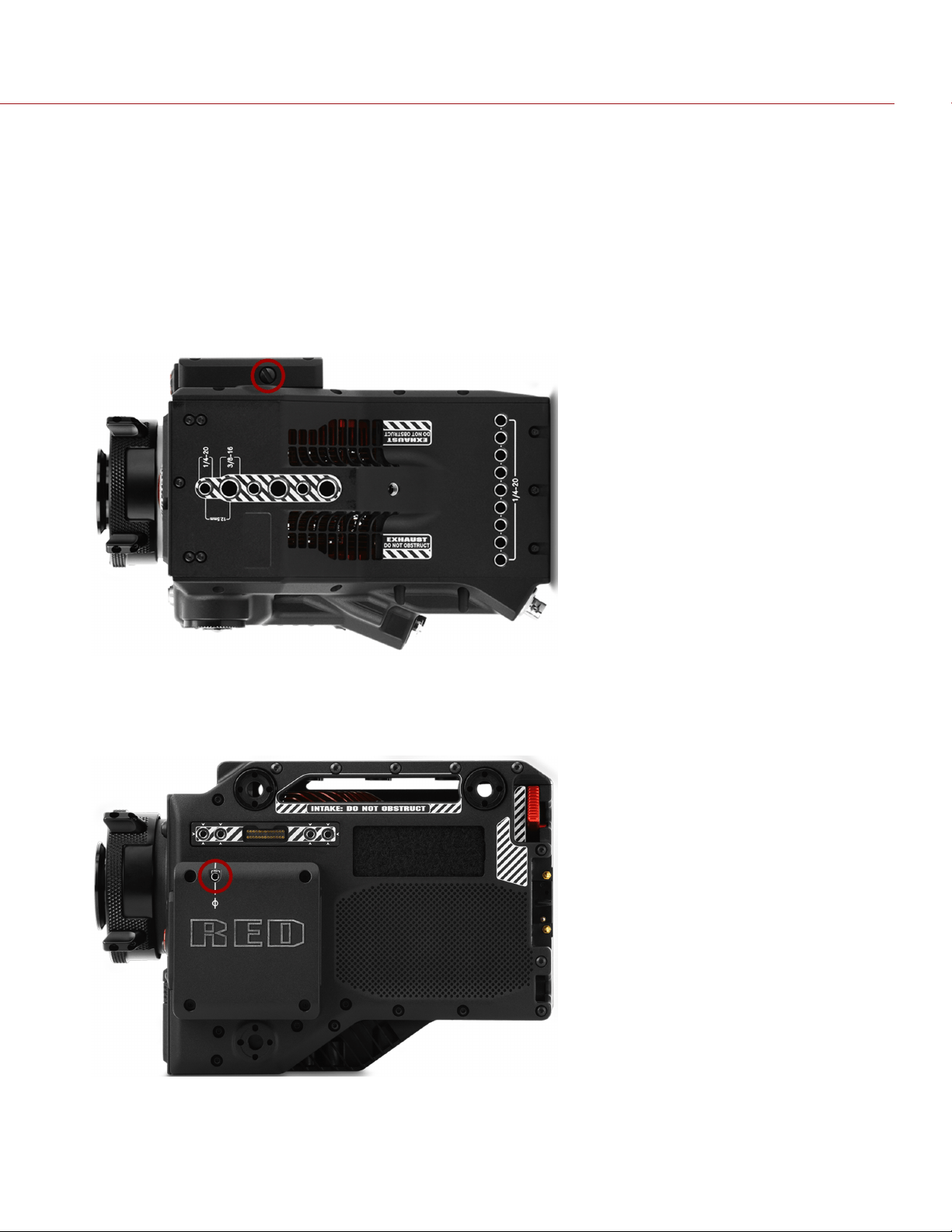
INSTALL THE FOCUS HOOK SCREW
The camera comes with a screw stored in the bottom of the media bay, called the focus hook screw. You can install this
screw in the Focus Hook Mounting point (along the sensor plane), and then pull focus from that location. You can either
attach measuring tape directly to the screw, or you can install a hook to the screw, and attach the measuring tape to the
hook.
To install the focus hook screw, follow the instructions below:
REQUIRED TOOL(S): Slotted screwdriver
1. Remove the focus hook screw from the Focus Hook Screw Storage Location on the media bay using a slotted
screwdriver.
Figure: Focus Hook Screw Storage Location
2. Tighten the focus hook screw into the Focus Hook Mounting Point on the media bay using a slotted screwdriver.
WARNING: DO NOT OVERTIGHTEN.
Figure: Focus Hook Mounting Point
COPYR IGH T © 2019 R ED.COM, LLC 955- 0184_V7.3, REV-A | 37
RED RANGER MONSTRO OPERATION GUIDE

SHIM THE RED RANGER SHIMMED PL MOUNT
The RED RANGER Shimmed PL Mount is shimmed in the factory to align to the RED RANGER it is packaged with. To
shim a RED RANGER Shimmed PL Mount, use a DENZ
®
Flange Depth Controller (FDC), or similar tool, to measure
the Flange Focal Distance (FFD).
The following shims are provided with each RED RANGER PL Mount Shim Pack:
SHIM SPECIFICATIONS
PART NUMBER MICRONS INCHES
125-4660-001 13 .0005
125-4660-002 19 .00075
125-4660-003 25 .0010
125-4660-004 50 .0020
125-4660-005 75 .0030
SHIM OFFSET STACK TABLE
The table below shows the offsets (as measured in microns) created by using different combinations of shims. Shimming
requires no more than one (1) of each size shim and no more than three (3) total shims.
OFFSET WITHOUT SHIMS SHIM 1 SHIM 2 SHIM 3 SHIM TOTAL OFFSET AFTER SHIMS
50 50 — — 50 0
55 50 — — 50 5
60 50 13 — 63 –3
65 50 13 — 63 2
70 50 19 — 69 1
75 75 — — 75 0
80 75 — — 75 5
85 75 13 — 88 –3
90 75 13 — 88 2
95 75 19 — 94 1
100 75 25 — 100 0
105 75 25 — 100 5
110 75 25 13 113 –3
115 75 25 13 113 2
120 75 25 19 119 1
125 75 50 — 125 0
130 75 50 — 125 5
135 75 50 13 138 –3
COPYR IGH T © 2019 R ED.COM, LLC 955- 0184_V7.3, REV-A | 38
RED RANGER MONSTRO OPERATION GUIDE
OFFSET WITHOUT SHIMS SHIM 1 SHIM 2 SHIM 3 SHIM TOTAL OFFSET AFTER SHIMS
140 75 50 13 138 2
145 75 50 19 144 1
150 75 50 25 150 0
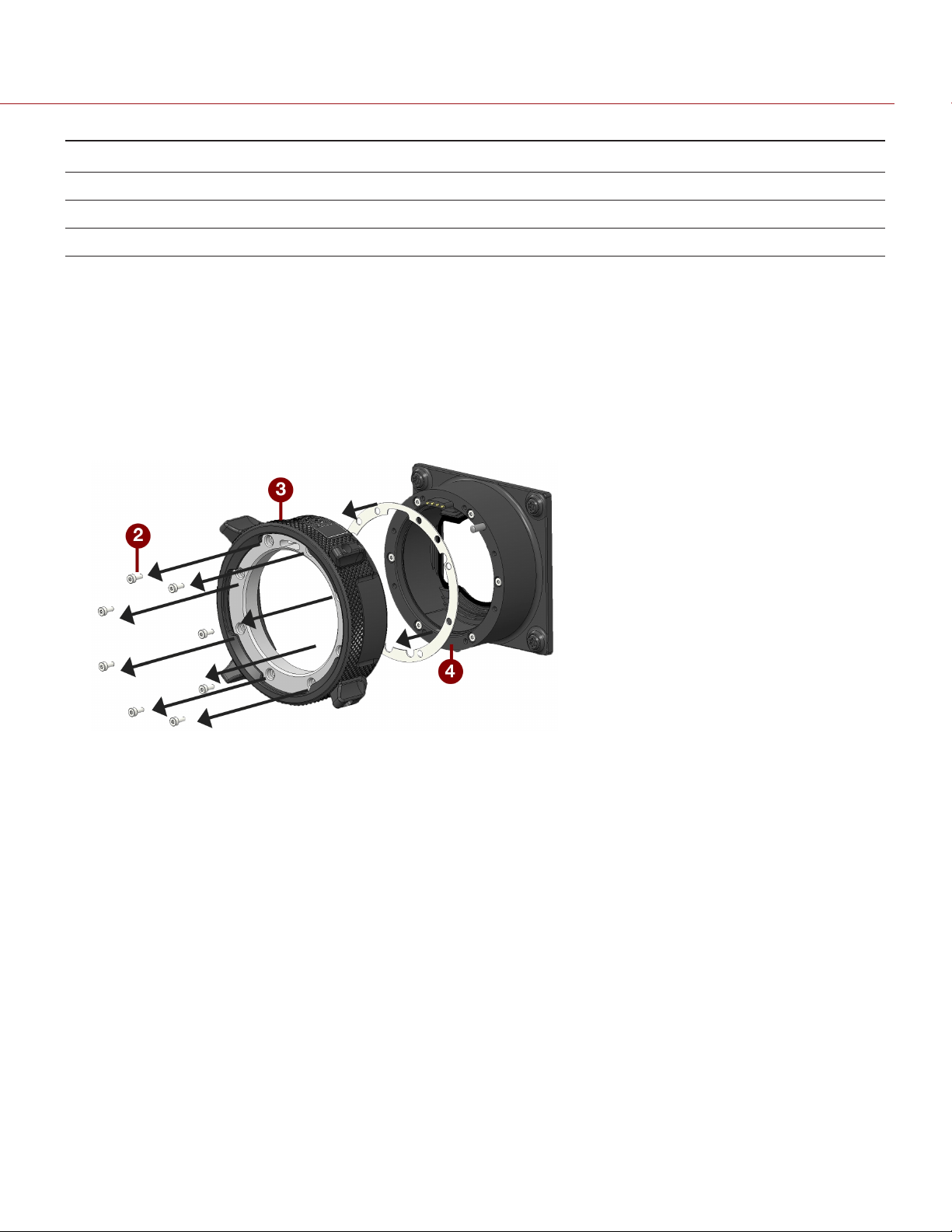
INSTALL SHIMS
REQUIRED TOOL(S): T6 TORX screwdriver, DENZ FDC (or similar tool), LOCTITE
®
222
1. Turn off the camera.
2. Use a T6 TORX driver to remove the eight (8) screws on the lock ring assembly from the PL base.
3. Remove the lock ring assembly.
4. Add or remove the correct amount of provided shims measured with the DENZ FDC to the lock ring assembly. Add
the thinnest shims first, and then add the thicker ones, so that the thicker shims hold the thinner shims in place.
Figure: Shim Installation
5. Place the lock ring assembly back onto the PL base.
6. Place a small amount of LOCTITE 222 on each of the eight (8) leading threads.
7. Replace and loosely tighten the eight (8) M2x6 mm screws in a cross pattern ("X" pattern) using a T6 TORX driver.
WARNING: DO NOT FULLY TIGHTEN
8. Tighten the eight (8) screws evenly in a cross pattern ("X" pattern) using a T6 TORX driver to 30 in-oz, or damage
may occur.
WARNING: DO NOT OVERTIGHTEN.
COPYR IGH T © 2019 R ED.COM, LLC 955- 0184_V7.3, REV-A
| 39
RED RANGER MONSTRO OPERATION GUIDE

INTERCHANGEABLE OLPF SYSTEM
WARNING: Read these instructions carefully and in their entirety before removing or installing an OLPF. Damage to the
OLPF module, camera, or sensor due to improper handling or use is not covered under warranty.
WARNING: Once an interchangeable OLPF is removed from the camera, the sensor is exposed. Improper handling of
the OLPF modules or camera during this procedure may compromise the installation or cause irreparable damage to your
camera or sensor.
WARNING: DO NOT allow any dirt or debris to enter the optical cavity.
WARNING: Use only VV OLPFs. DO NOT use other OLPFs.
SWAP AN INTERCHANGEABLE OLPF
REQUIRED TOOL(S): T20 TORX driver
1. Turn off the camera.
2. Remove any cables or accessories that may interfere with operations.
3. Loosen and remove the four (4) M4x0.7 x 8 mm lens mount screws in a cross pattern (“X” pattern) using a T20 TORX
driver.
NOTE: Some lens mounts have captive screws that are not removable.
NOTE: Screw removal may require a large handle T20 TORX driver and additional leverage.
4. Remove the lens mount.
5. Use a damp, lint-free cloth to gently wipe down the area around the lens mount and OLPF module. Remove as much
dust and debris as possible.
6. Use a T20 TORX driver to turn the OLPF lock on the camera counter-clockwise by a third turn to the Unlock position.
DO NOT turn the indicator mark past the Unlock icon.
WARNING: DO NOT OVERTIGHTEN.
7. Remove the OLPF module and place it in its protective case.
8. Use an LED light to ensure that the optical cavity is clean and free from dust or debris.
9. Ensure the new OLPF module is clean and free of debris.
10. Install the new OLPF module straight into the optical cavity, keeping the front face of the OLPF module parallel to the
front of the camera.
NOTE: Inserting the OLPF module at an angle may cause it to not seat properly.
11. Use a T20 TORX driver to turn the OLPF lock on the camera clockwise by a third turn to the Lock position. DO NOT
turn the indicator mark past the Lock icon.
WARNING: DO NOT OVERTIGHTEN.
NOTE: If the lock does not turn easily, gently press down on the OLPF module while turning the lock.
12. Replace the lens mount.
13. Replace and loosely tighten the four (4) M4x0.7 x 8 mm lens mount screws in a cross pattern (“X” pattern) using a
T20 TORX driver. DO NOT FULLY TIGHTEN.
NOTE: Some lens mounts have captive screws that are not removable.
14. Fully tighten the four (4) lens mount screws in a cross pattern (“X” pattern) using a T20 TORX driver. DO NOT
exceed 350 in-oz, or damage may occur.
WARNING: DO NOT OVERTIGHTEN.
COPYR IGH T © 2019 R ED.COM, LLC 955- 0184_V7.3, REV-A | 40
RED RANGER MONSTRO OPERATION GUIDE

USE A TRIPOD OR MONOPOD
This section describes the camera mounting points and mounting equipment for use with a tripod or monopod. The
camera is equipped three (3) 3/8-16 mounting holes and three (3) 1/4-20 mounting holes on the bottom of the camera.
These mounting points are designed for use with a variety of mounting plates and hardware, to support tripods and other
support systems.
WARNING: Ensure that the tripod, monopod, or support system is designed and rated to handle the weight of your
camera configuration. RED is not responsible for any damage caused by using a tripod, monopod, mount, or support
system that does not provide sufficient support.
WARNING: DO NOT use excessive force to mount a support accessory, as this may damage the screw threading.
RED offers the following products for use with tripods and other support systems:
Item Part Number
Mounting Plate (DSMC) 790-0094
DSMC Quick Release Platform Pack 790-0183
Quick Release Platform Pack (Bolt-On) 790-0078
Quick Release Platform (Dovetail) 790-0079
Quick Release Platform (Mini) 790-0390
Dovetail Mounting Plate (Long) 790-0083
Dovetail Mounting Plate (Short) 790-0084
For more information, visit the RED store at www.red.com/store.
COPYR IGH T © 2019 R ED.COM, LLC 955- 0184_V7.3, REV-A
| 41
RED RANGER MONSTRO OPERATION GUIDE
VIDEO MONITOR OUTPUTS
The monitoring path converts RAW sensor data to a white balanced 12-bit depth 1920 x 1080 pixel RGB 4:4:4 video
signal. The signal may be modified using ISO, White Balance, or other RGB color space adjustments. The signal is then
scaled and gamma-corrected to provide monitor outputs at 10-bit depth in 4:2:2 YCC or 8-bit depth in 4:4:4 RGB.
The camera offers the following monitor outputs:
EVF/LCD: Supports a RED EVF or LCD display.
HD-SDI: Provides a 720p or 1080p output suitable for monitoring or recording to an external VTR or DDR device. It
may be configured for 10-bit LIN (VIDEO) or 10-bit LOG (FILM) encoded data.
VIDEO MONITOR CATEGORIES
Video monitor outputs are separated into three (3) categories:
VIEWFINDER: The Upper Status Row, Live Action Area, and Lower Status Row display. Default output is the
EVF/LCD connector located on top of the camera. If an EVF or LCD is not connected, you can transfer the
VIEWFINDER output to the SDI output.
PROGRAM/Clean: None of the graphic overlays display.
PREVIEW: The Live Action Area and associated graphic overlays display.
For more information about changing the video monitor category of your monitor, go to "Monitor Mode" on page 69.
COPYR IGH T © 2019 R ED.COM, LLC 955- 0184_V7.3, REV-A
| 42
RED RANGER MONSTRO OPERATION GUIDE

RECORD
Perform one of the following actions to begin recording:
Press PWR/REC on the camera.
Press START/STOP on the DSMC2 Top Handle or DSMC2 Outrigger Handle.
Trigger start/stop with a compatible third-party trigger.
Double-tap the right 25% on an attached touchscreen display (when enabled).
NOTE: To enable Double-Tap Right 25% to Record, go "Advanced" on page 72.
RECORD VIA HD-SDI
NOTE: Audio is not embedded in the MON-1 signal.
This section describes how to record via HD-SDI through simultaneous record (recording to an SSD and an external
recorder at the same time) or external record only.
SIMULTANEOUS RECORD
NOTE: The secondary LCD/EVF port and a MON-1 port cannot be used at the same time. Go to "Monitor Preferences"
on page 69.
You can record simultaneously to an external recorder and a RED SSD. To record simultaneously, follow the instructions
below:
1. Connect the camera to an external recorder with an HD-SDI cable.
2. Ensure that a formatted SSD is inserted in the camera.
3. Set up the HD-SDI output:
A. Go to Menu > Monitoring > Monitors and select a monitor.
B. Select Clean from the Mode drop-down menu (otherwise the external recorder records the overlay).
C. Select the output resolution from the Resolution drop-down menu.
NOTE: The HD-SDI maximum resolution is 1080p. For more information, go to "Record/Monitor Out Ports" on
page 190.
4. Disable all False Colors (otherwise the external recorder records the False Colors). For more information, go to
"Tools" on page 74.
5. If monitoring audio via a third-party monitor that supports audio, set up the monitor mix:
A. Go to Menu > Settings > Audio > Mix > Monitor Mix.
B. Adjust the input channels.
6. Go to Menu > Settings > Recording > Mode.
7. Select Local from the Storage drop-down menu.
8. Begin recording.
COPYR IGH T © 2019 R ED.COM, LLC 955- 0184_V7.3, REV-A
| 43
RED RANGER MONSTRO OPERATION GUIDE

EXTERNAL RECORD
NOTE: The secondary LCD/EVF port and a MON-1 port cannot be used at the same time. Go to "Monitor Preferences"
on page 69.
You can record to an external recorder without recording to an SSD. To record to an external device only, follow the
instructions below:
1. Connect the camera to an external recorder with an HD-SDI cable.
2. Ensure the SSD is ejected.
3. Set up the HD-SDI output:
A. Go to Menu > Monitoring > Monitors and select a monitor.
B. Select Clean from the Mode drop-down menu (otherwise the external recorder records the overlay).
C. Select the output resolution from the Resolution drop-down menu.
NOTE: The HD-SDI maximum resolution is 1080p. For more information, go to "Record/Monitor Out Ports" on
page 190.
4. Disable all False Colors (otherwise the external recorder records the False Colors). For more information, go to
"Tools" on page 74.
5. If monitoring audio via a third-party monitor that supports audio, set up the monitor mix:
A. Go to Menu > Settings > Audio > Mix > Monitor Mix.
B. Adjust the input channels.
6. Go to Menu > Settings > Recording > Mode.
7. Select External from the Storage drop-down menu.
8. Begin recording.
COPYR IGH T © 2019 R ED.COM, LLC 955- 0184_V7.3, REV-A
| 44
RED RANGER MONSTRO OPERATION GUIDE
COPYR IGH T © 2019 R ED.COM, LLC 955- 0184_V7.3, REV-A | 45
RED RANGER MONSTRO OPERATION GUIDE
CHAPTER 4:
BASIC MENUS AND CONTROLS
GUI MENU INTRODUCTION
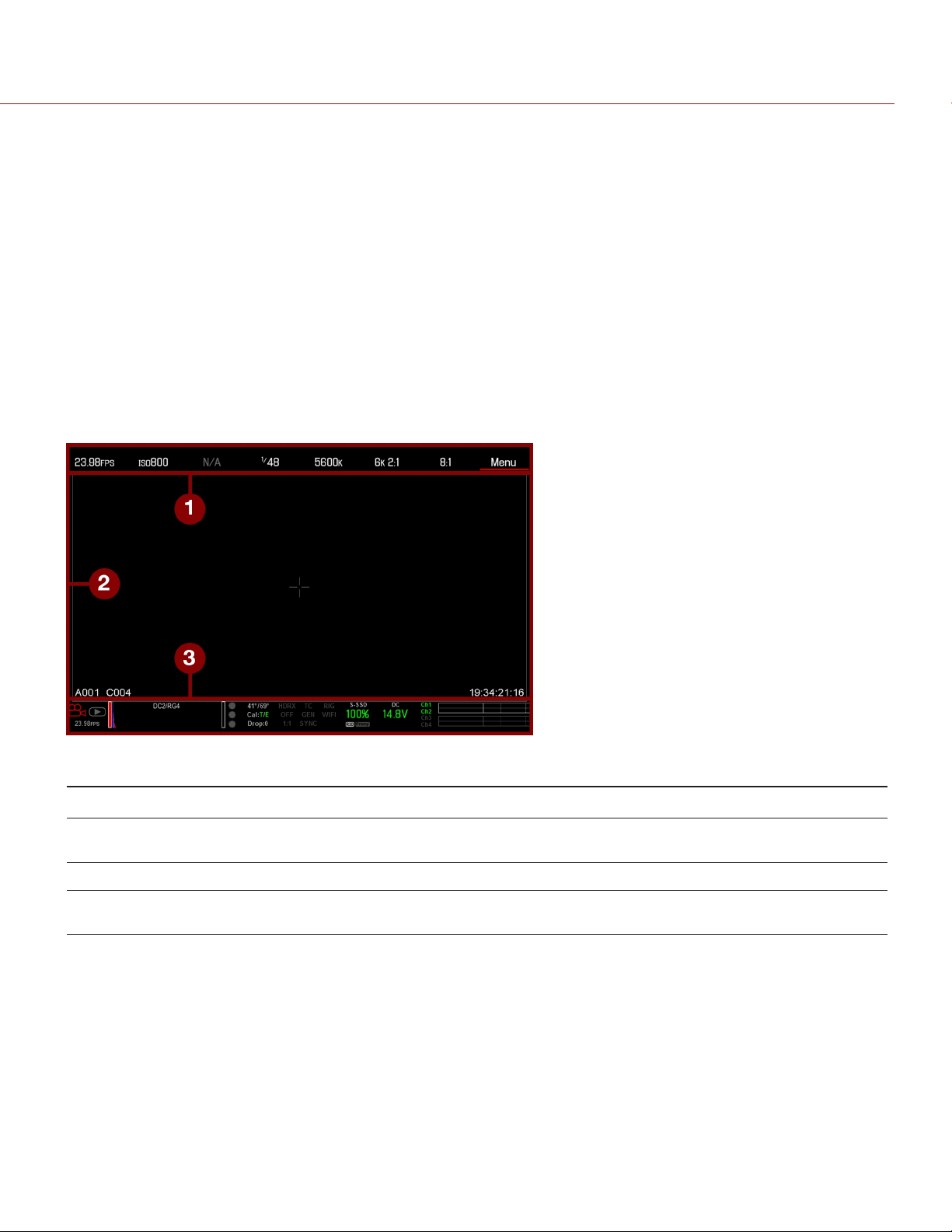
This section describes the structure and layout of the graphical user interface (GUI) that overlays the video monitor
signal. Advanced GUI menu controls enable convenient access to menus, overlays, and other critical camera
information. Functionality varies based on monitor output type and firmware version. The GUI menu is organized in the
following way:
By three (3) sections:
Figure: GUI Control Menu
# ITEM DESCRIPTION
1 Upper Status Row
(Basic Menu)
Easy access to primary camera capture parameters. Go to
"Upper Status Row (Basic Menu)" on
the next page.
2 Live Action Area Live camera recording view, overlays, guides, and more. Go to "Live Action Area" on page 48.
3 Lower Status Row Critical camera parameters, record/playback modes, media and power status, and audio meter.
Go to "Lower Status Row" on page 49.
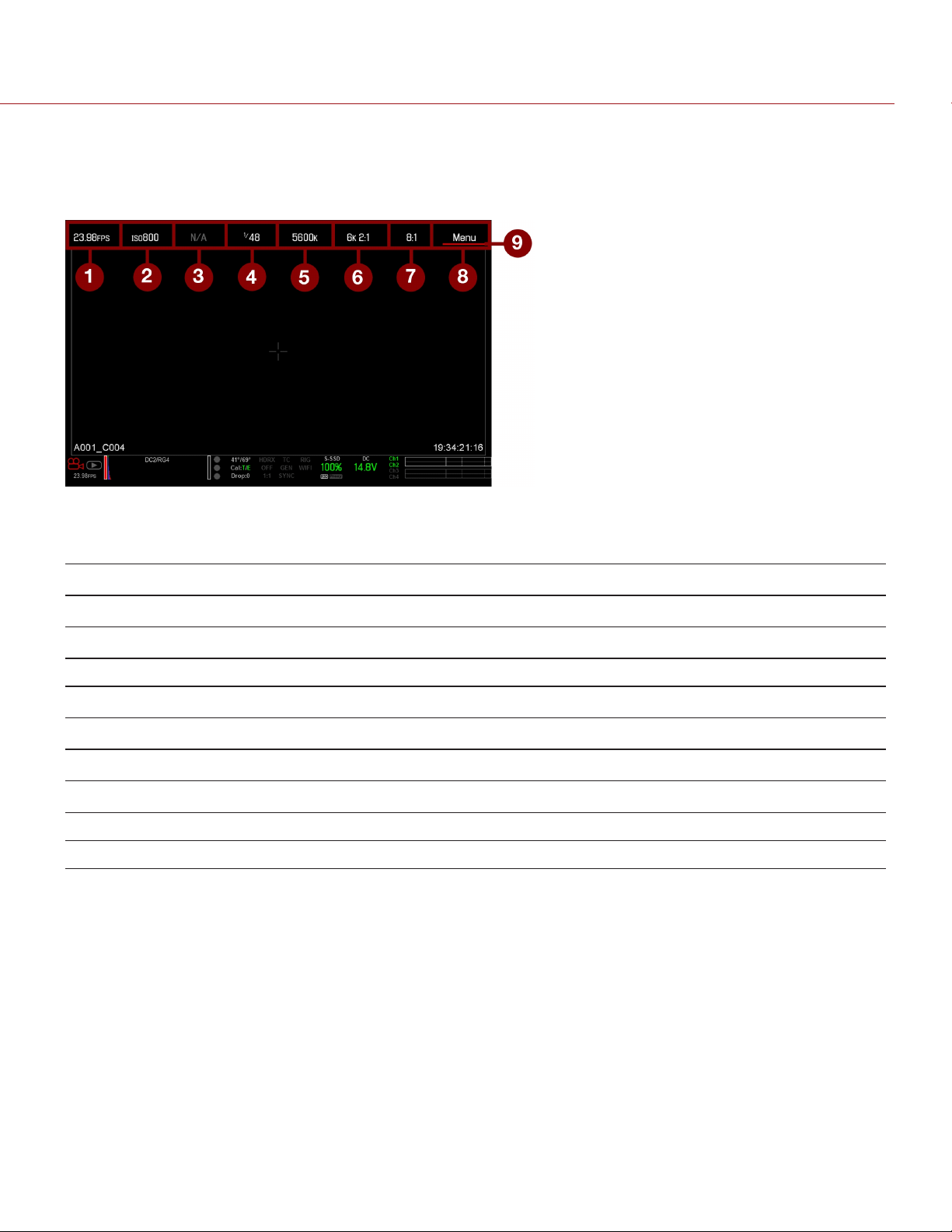
UPPER STATUS ROW (BASIC MENU)
The Upper Status Row displays basic project parameters. The currently selected parameter in the Upper Status Row is
underlined with a red bar. The Upper Status Row is also known as the Basic Menu.
Figure: Upper Status Row
The Upper Status Row includes the following GUI elements:
# ITEM DESCRIPTION DETAILS
1 Frame Rate (fps) Recording frame rate
"Frame Rate" on page 94
2 ISO Camera sensitivity
"ISO" on page 66
3 Aperture Lens aperture (F stop) information "Aperture" on the next page
4 Exposure (Shutter) Integration time or shutter angle
"Exposure/Shutter" on page 95
5 Color Temperature White balance and Tint
"White Balance" on page 64
6 Resolution Record resolution
"Format" on page 97
7 REDCODE
®
REDCODE compression setting
"REDCODE" on the next page
8 Menu Access advanced settings "Advanced Menus" on page 61
9 Cursor Indicates currently selected Upper Status Row element N/A
ACCESS ADVANCED MENUS
For every Upper Status Row item, you can select the
Advanced... button to access the related menu in the Advanced
Menus.
For example, select Advanced... in the Frame Rate menu to open Menu > Settings > Project > Frame Rate.
For more information about Advanced Menus, go "Advanced Menus" on page 61.
COPYR IGH T © 2019 R ED.COM, LLC 955- 0184_V7.3, REV-A
| 46
RED RANGER MONSTRO OPERATION GUIDE
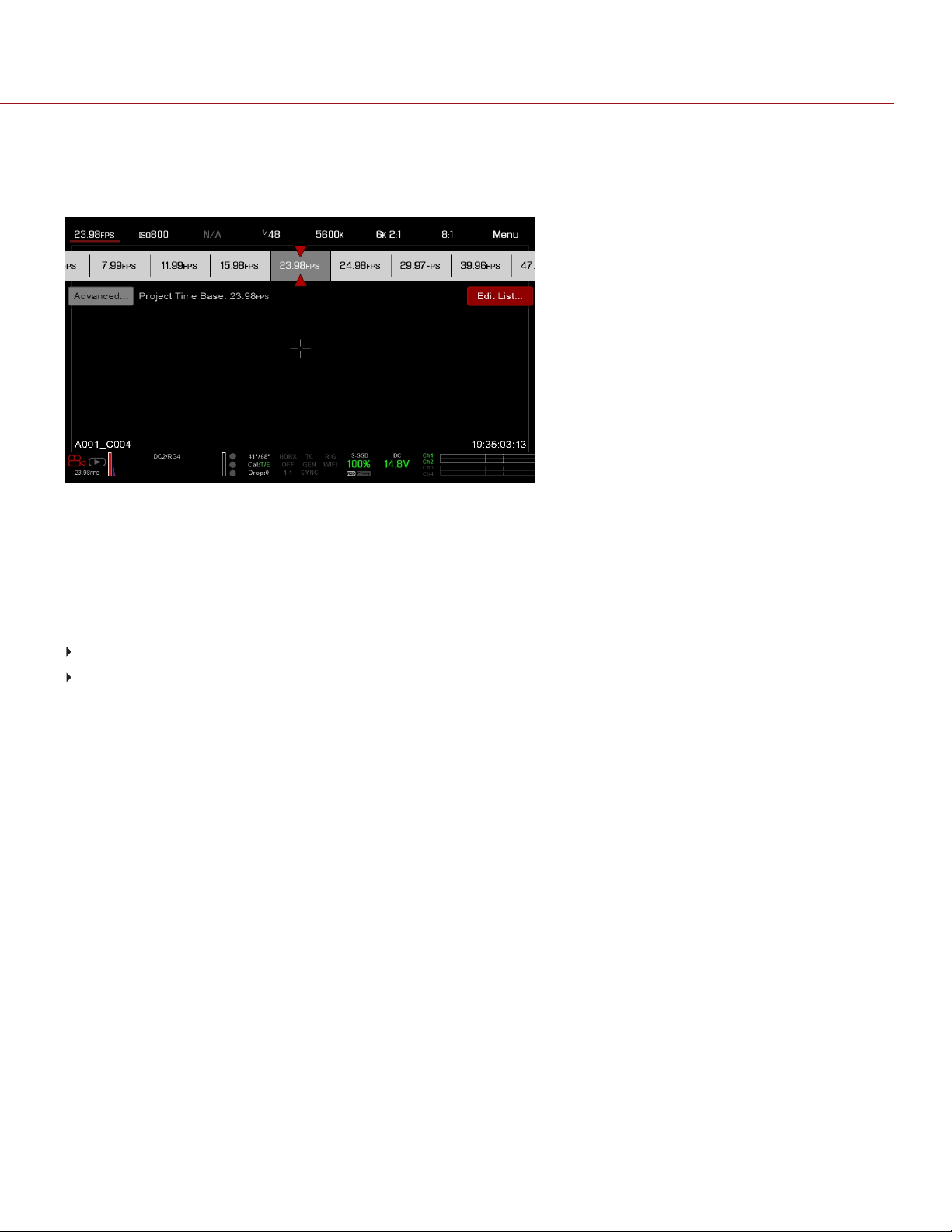
FEATURE: EDIT LIST
Select the
Edit List... button in the Upper Status Row menus to change the values that display for each setting. For
example, if you open the Frame Rate menu and select Edit List..., the camera lets you add or remove values.
Figure: Select "Edit List..." Button
APERTURE
The aperture (also known as the T stop or F stop) parameter displays when a compatible mount and lens are installed.
The aperture controls the depth of field of the image and, in combination with the shutter speed/angle setting, controls the
amount of light that reaches the sensor (exposure).
Increasing the aperture to a higher number increases the depth of field, but reduces the exposure (brightness).
Decreasing the aperture to a lower number decreases the depth of field, but increases the exposure (brightness).
RED DSMC PL MOUNT INSTALLED
The current aperture of the attached lens displays when a DSMC
®
PL mount is installed and a supported lens equipped
with Cooke
®
S4/i
®
system is attached.
Select the
Advanced... button to access the Menu > Settings > Setup > Lens screen. For more information, go to
"Lens" on page 129.
REDCODE
Select the target REDCODE compression ratio for your project.
If the camera is able to achieve the target compression ratio, the compression ratio displays in white. If the camera is
unable to achieve the target compression ratio, the compression ratio displays in yellow, and the camera uses the next
possible compression ratio.
The current compression ratio is automatically recalculated when changes are made to the project resolution, aspect
ratio, anamorphic setting, frame rate, HDRX
®
mode, media, or the target REDCODE compression ratio.
The RECODE compression affects the overall quality of the footage. A lower compression (for example: 2:1) increases
the quality of the footage, while a higher compression (for example: 22:1) lowers the quality.
REDCODE range is 2:1 to 22:1. Default is 8:1.
For maximum available REDCODE values, see the
DSMC Media Operation Guide at www.red.com/downloads.
COPYR IGH T © 2019 R ED.COM, LLC 955- 0184_V7.3, REV-A | 47
RED RANGER MONSTRO OPERATION GUIDE
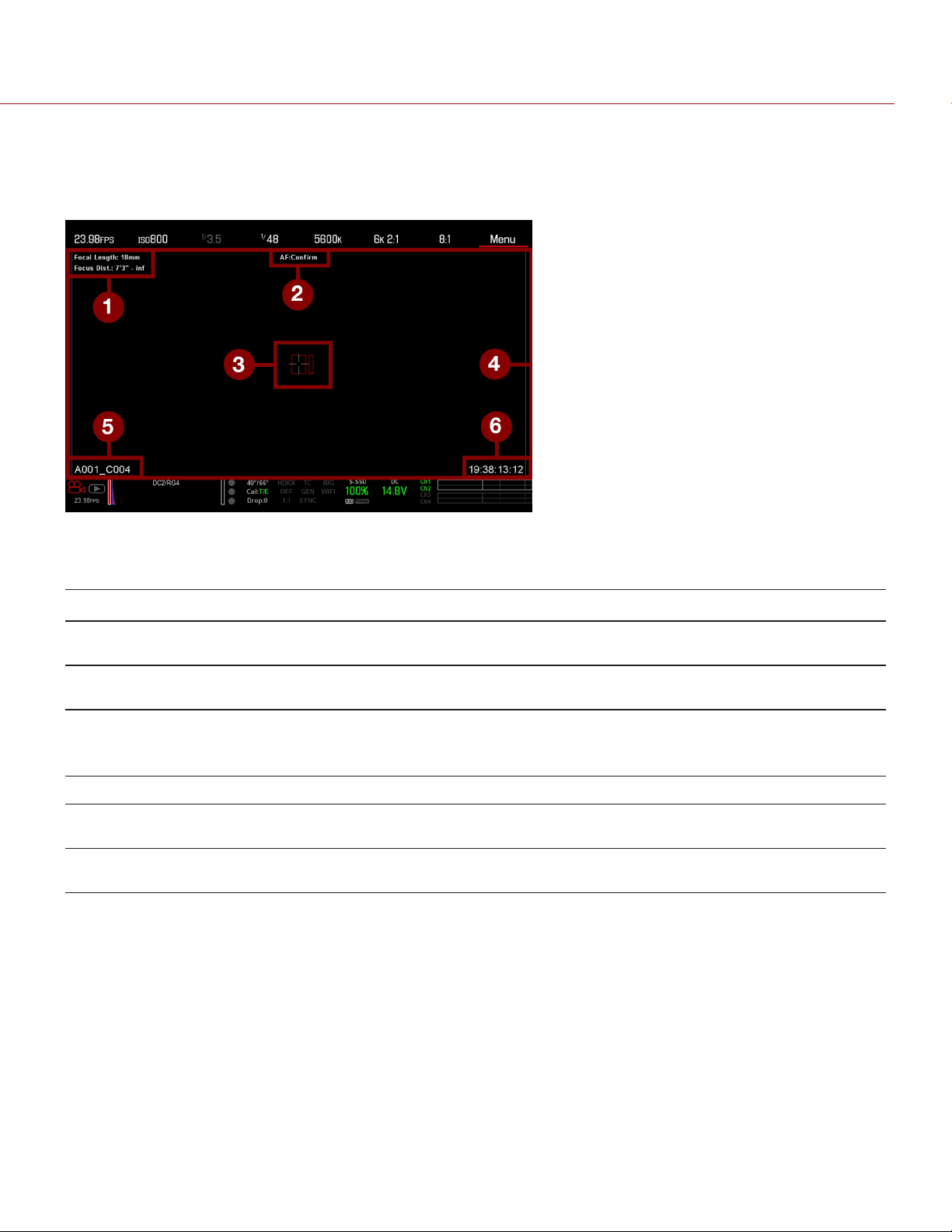
LIVE ACTION AREA
The Live Action Area contains the recorded image area, Look Around area, and various overlays. The color of each
overlay can be customized to maximize the contrast between the guide(s) and scene being captured.
Figure: Live Action Area
The Live Action Area includes the following GUI elements:
# ITEM DESCRIPTION DETAILS
1 Lens Information Lens information when using supported lenses
"Lens Information"
below
2 AF Status Currently selected auto focus mode "Focus Menu" on
page 116
3 Center Crosshair and Spot
Focus Guide
Crosshair: Center of selected guide
Reference guides: Safe Action/Safe Title, Picture Center, Grid
Overlay
"General Tab" on
page 80
4 Frame Guides Record or sensor projection area "Guides" on page 79
5 Clip Filename Filename of the clip being recorded, or filename of the next clip
to be recorded
N/A
6 Timecode Value Current timecode value
"Timecode" on
page 147
LENS INFORMATION
This section describes the lens information displays when a supported lens is attached.
PL LENSES
Displays the focal length and focal distance when a DSMC PL mount is installed and a lens with the Cooke S4/i system
(or equivalent) is attached. For more information, go to
"Lens" on page 129.
COPYR IGH T © 2019 R ED.COM, LLC 955- 0184_V7.3, REV-A
| 48
RED RANGER MONSTRO OPERATION GUIDE
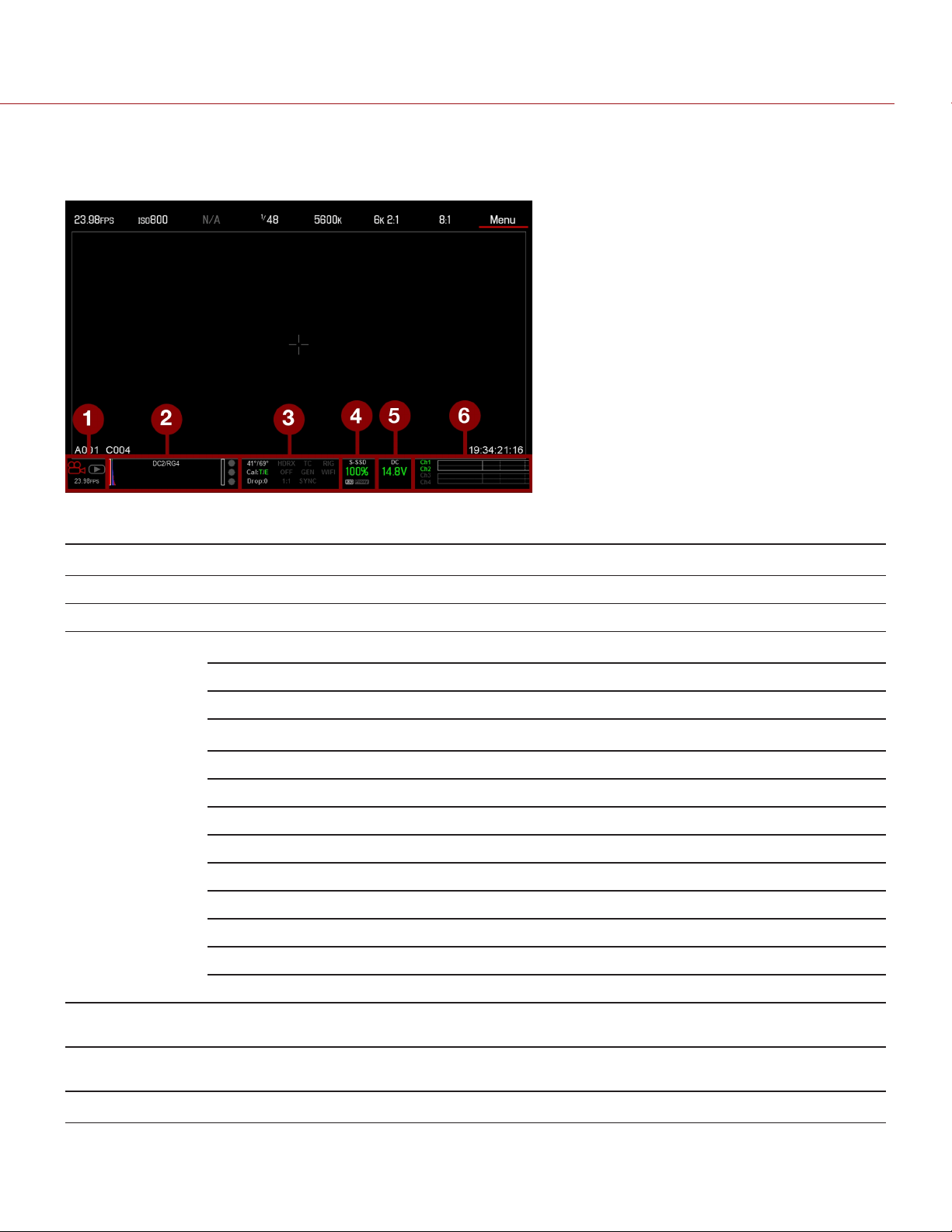
LOWER STATUS ROW
The Lower Status Row provides access to key system information and camera values.
Figure: Lower Status Row
# ITEM SUB-ITEM/DESCRIPTION DETAILS
1 Camera Mode Swipe up to toggle Motion/Stills/Playback modes
"Camera Mode" on the next page
2 Histogram Histogram; tap to open the Tools menu "Histogram" on page 52
3 Project Status
Indicators
Tap to open the Project Status menu
"Project Status" on page 133
Camera sensor and core temperature "Sensor Calibration" on page 136
Cal: T/E "CAL: T/E Indicator" on page 53
HDRX
®
: Displays when HDRX mode is on "HDRX Menu" on page 115
False Color Mode: Displays modes "False Color Modes" on page 74
Magnify mode "Display Modes: Magnify" on page 76
Timecode "TC Indicator" on page 53
Genlock "GEN Indicator" on page 53
Sync "SYNC Indicator" on page 53
RM "RM (Remote) Indicator" on page 53
LAN "LAN Indicator" on page 54
RIG: Indicates 3D rig metadata is present N/A
WIFI: Indicates wireless connection "WiFi Indicator" on page 54
4 Media Status Media location and remaining capacity; tap to open the
Media Menu
"Media Menu" on page 90
5 Power Status DC voltage or remaining battery capacity; tap to open the
Power menu
"Power Status" on page 54
6 Audio Meter Audio input and volume; tap to open the Audio menu
"Audio Meter (VU Meter)" on page 143
COPYR IGH T © 2019 R ED.COM, LLC 955- 0184_V7.3, REV-A | 49
RED RANGER MONSTRO OPERATION GUIDE
CAMERA MODE
The Camera Mode allows you to seamlessly toggle between Motion mode, Stills mode, and Playback. To select a
camera mode, select the
Camera Mode icon in the Lower Status Bar, swipe up, and select a camera mode.
NOTE: Setting adjustments made in Stills mode do not affect the settings in Motion mode, and vice versa.
You can select the following camera modes:
"Motion Mode" below
"Stills Mode" on the next page
"Playback " on page 85
MOTION MODE
Motion mode optimizes your camera settings for capturing motion. This mode defaults the camera to Continuous Record.
Motion mode includes the following features:
Motion recording modes:
"Continuous Record" on page 103
"Internal Timelapse Timer" on page 103
"Frame Trigger" on page 104
"Speed Ramp Mode" on page 104
"REDCODE Burst" on page 105
Swipe-Up Shortcuts
Camera Mode
False Color
Status
Media
Power
Audio
Default Motion Preset (RED)
NOTE: For more information, go to "Swipe-Up Menu" on page 57.
COPYR IGH T © 2019 R ED.COM, LLC 955- 0184_V7.3, REV-A
| 50
RED RANGER MONSTRO OPERATION GUIDE
STILLS MODE
Stills mode optimizes your camera settings for capturing stills. Stills mode includes the following features:
Stills recording modes:
"Multi-Shot" on page 106
"Motion + Stills" on page 107
Swipe-Up Shortcuts:
False Color
Status
Media
Power
Auto Focus
Auto Exposure
Record Mode
Default Stills Preset (RED)
For more information, go to "Swipe-Up Menu" on page 57.
COPYR IGH T © 2019 R ED.COM, LLC 955- 0184_V7.3, REV-A
| 51
RED RANGER MONSTRO OPERATION GUIDE
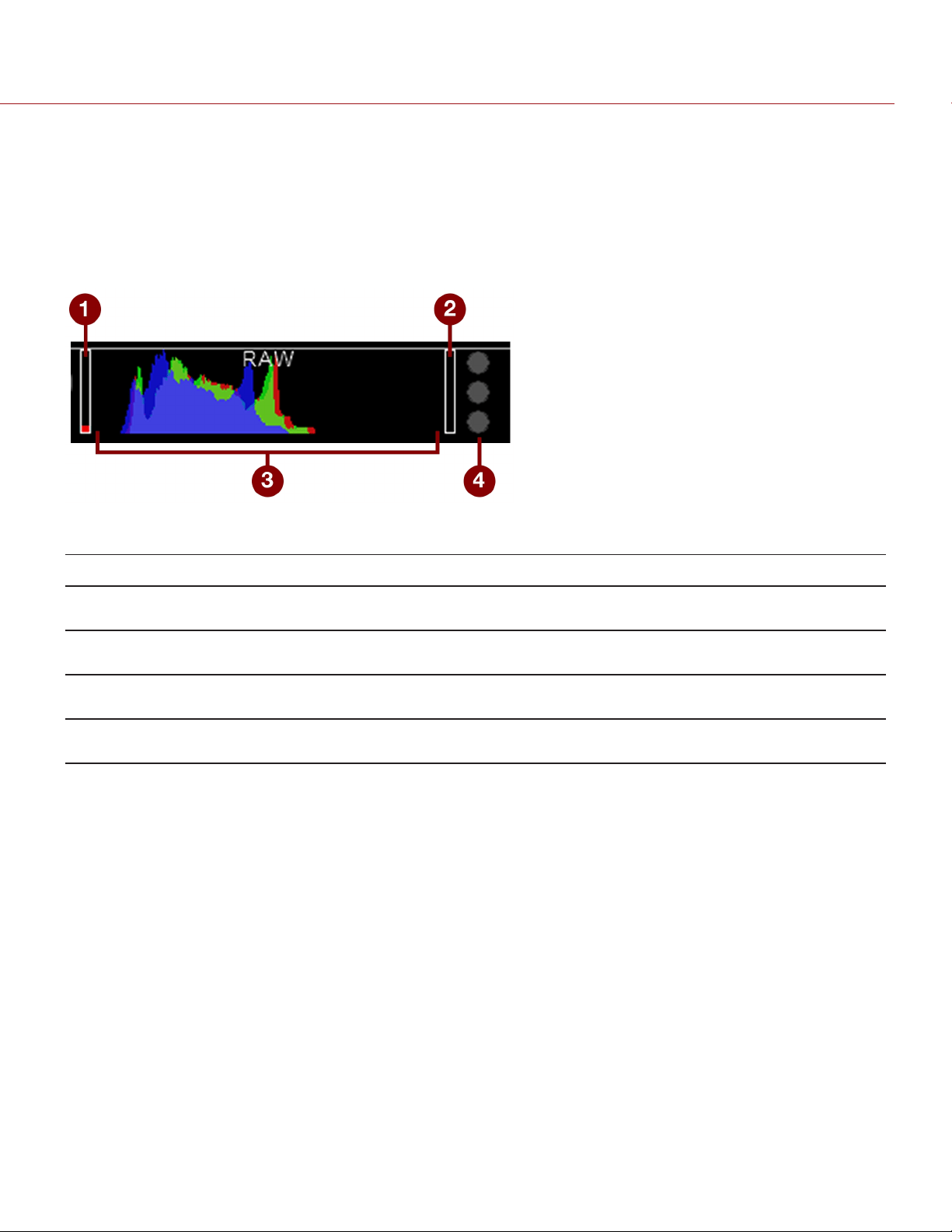
HISTOGRAM
NOTE: The sharpness setting affects the Histogram, RAW Level Bars, and RAW Clip Meter. For more information, go to
"Output Sharpness" on page 72.
This section describes the elements that comprise the Histogram section in the Lower Status Row. This section of the
GUI helps ensure that recorded footage is properly exposed.
Tap the Histogram in the Lower Status Row to access the Tools menu. For more information, go to "Tools" on page 74.
Figure: Histogram (Exposure)
# ITEM DESCRIPTION
1 RAW Level
Bar (left)
1
Also known as a “goal post”. Displays the amount of pixels in the image that are underexposed (noise)
2 RAW Level
Bar (right)
1
Also known as a “goal post”. Displays the amount of pixels in the image that are overexposed (clipping)
3 RGB
Histogram
Provides a visual representation of exposure and sensor data levels for red, green, and blue channels;
meter is affected by White Balance, ISO, and VIEW/LOOK settings
4 RAW Clip
Meter
Also known as “traffic lights”. Provides a visual representation of exposure and sensor data levels for red,
green, and blue channels; Circles (traffic lights) will light up when clipping occurs
1. The RAW Level Bars represent 1/4 of the total pixels in the image, and illustrate the number of pixels that are noisy or clipped in relation to the
total number of pixels. For example, if the left RAW Level Bar is 1/8 of the total height, that means that approximately 1/32 of the total pixels in
the total image are at an exposure level that is at risk of displaying noise when pushed to higher ISO or FLUT
®
values in post production.
PROJECT STATUS INDICATORS
This section describes the colors and behavior of the Project Status indicators in the Lower Status Row. Tap the Project
Status indicators in the Lower Status Row to access the Project Status menu. For more information, go to
"Project
Status" on page 133.
COPYR IGH T © 2019 R ED.COM, LLC 955- 0184_V7.3, REV-A
| 52
RED RANGER MONSTRO OPERATION GUIDE
CAL: T/E INDICATOR
The CAL: T/E indicator shows changes to temperature (T) or exposure (E) in relation to the active calibration map. If the
temperature or exposure change significantly, calibrate the sensor at the desired temperature and exposure. Failure to
properly calibrate the sensor may reduce image quality.
Green: Sensor temperature or exposure are properly calibrated for current settings.
Yellow: Slight change in sensor temperature or exposure.
Red: Significant change in sensor temperature or exposure.
The – and + indicate whether the sensor temperature or exposure has decreased or increased, respectively.
NOTE: T and E indicators change colors independently of each other.
TC INDICATOR
The TC indicator shows the current timecode status.
Grey: No analog timecode is detected.
Red: Analog timecode is detected but not enabled.
Green: Analog timecode is used to jam the time of day timecode.
For more information, go to "Timecode, Genlock, Multi-Camera Setup" on page 147.
GEN INDICATOR
The GEN indicator shows the current genlock status.
Grey: No genlock signal is detected, or the signal cannot cross-lock to project (24.00 fps vs. 23.98 fps).
Red: During process of sync, or genlock is lost while recording.
Green: A genlock signal matching the current HD-SDI monitor rate is locked.
Yellow: Timing is cross-locked to compatible but not matching monitor rate. For example, genlock is 24.00 fps, and
HD-SDI monitor rate is 25.00 fps.
NOTE: When the GEN indicator is yellow, DO NOT perform 3D operation. This warns that genlock source settings and
camera settings are not aligned, so phasing of the sync between cameras is not guaranteed.
For more information, go to "Timecode, Genlock, Multi-Camera Setup" on page 147.
SYNC INDICATOR
The SYNC indicator shows the current sensor sync status, based on genlock.
Grey: The sensor sync mode is not set to genlock.
Red: The sensor sync mode is set to genlock, but is not locked to a genlock signal. This may occur if genlock or
sensor sync is lost while recording.
Green: The sensor sync mode and HD-SDI monitor rate are locked to a compatible genlock signal.
For more information, go to "Timecode, Genlock, Multi-Camera Setup" on page 147.
RM (REMOTE) INDICATOR
The RM indicator displays if the camera is linked to a third-party remote application, such as foolcontrol.
COPYR IGH T © 2019 R ED.COM, LLC 955- 0184_V7.3, REV-A
| 53
RED RANGER MONSTRO OPERATION GUIDE
LAN INDICATOR
The LAN indicator shows the current status of an external LAN connection through the Gig-E port.
Grey: External control of the camera is not enabled.
Green: Ethernet is enabled.
WIFI INDICATOR
The WiFi indicator shows the wireless connectivity status.
Grey: Wireless is disabled.
Yellow: Wireless is not connected.
Green: Wireless is enabled.
For more information, go to "Wireless Connection" on page 122.
POWER STATUS
The Power Status element displays the current supply voltage or remaining battery capacity. Tap the Power Status
element to access the Power menu. For more information, go to
"Power Menu" on page 83.
DC IN SUPPLY VOLTAGE
When powering the camera via DC power, the current voltage displays. When powering the camera using batteries, the
remaining battery capacity displays. The remaining capacity is indicated by the following colors:
Green: 12.0 V and up
Yellow: 11.8 V to 11.9 V
Red: 11.6 V to 11.7 V
NOTE: The camera turns off automatically if the supply voltage drops to 11.5 V.
When using a RED battery, the power status displays the location of the power source and the remaining battery
capacity. When using a RED BRICK battery connected to DC IN, the power status displays BRICK and the remaining
battery capacity.
The color of the displayed battery capacity represents the amount of time remaining:
Green: >10 minutes
Yellow: 5 to 10 minutes
Red: <5 minutes
COPYR IGH T © 2019 R ED.COM, LLC 955- 0184_V7.3, REV-A
| 54
RED RANGER MONSTRO OPERATION GUIDE
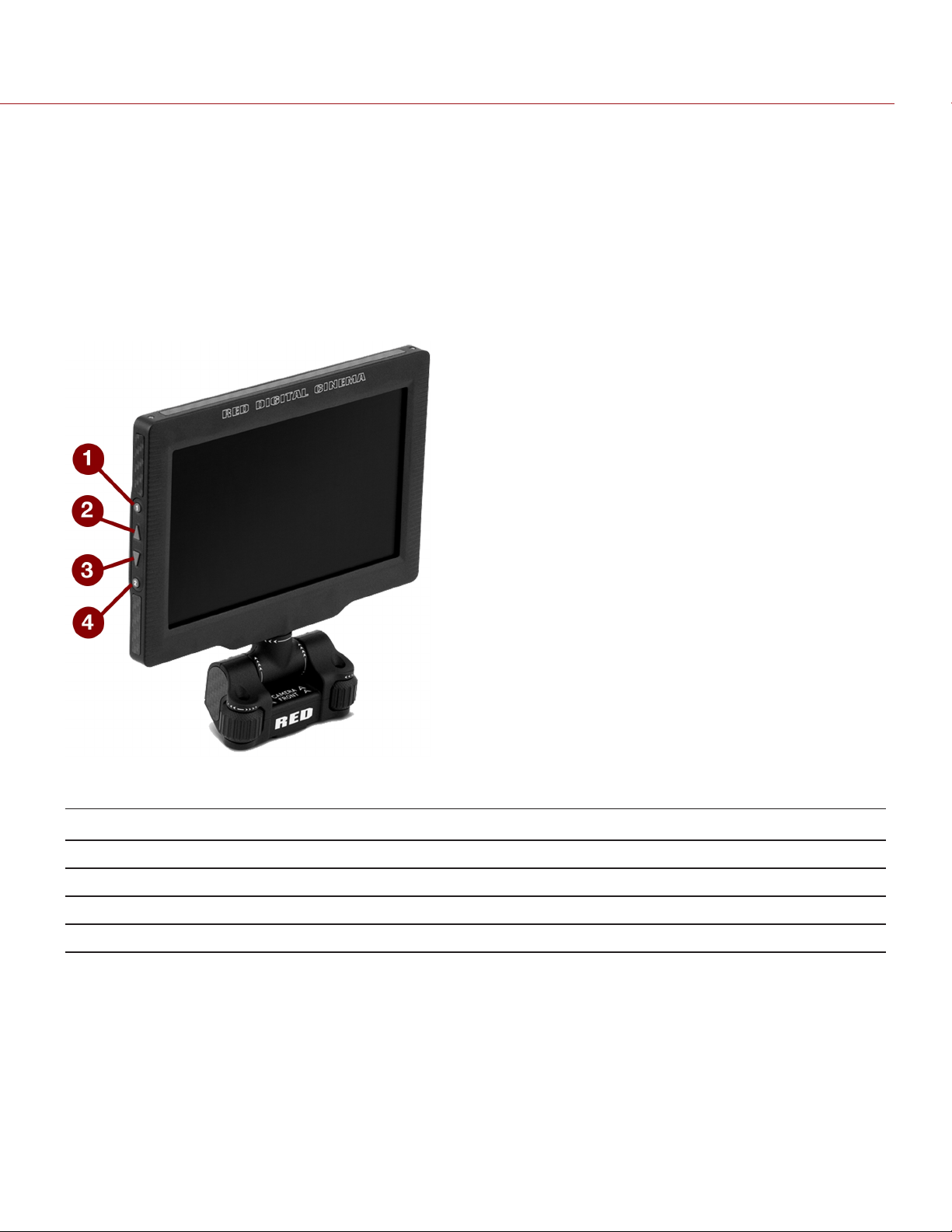
NAVIGATION CONTROLS
This section describes basic controls for navigating the camera menus.
TOUCHSCREEN NAVIGATION
You can control certain settings and navigate the camera menu using buttons and gestures on the RED Touch displays.
RED TOUCH DISPLAY BUTTONS
RED Touch displays offer intuitive menu control and four (4) programmable buttons.
Figure: DSMC2 RED Touch 7.0" LCD
# RED TOUCH BUTTON DESCRIPTION
1 User Key 1 Magnify: Toggle
2 Up Button Increase display brightness
3 Down Button Decrease display brightness
4 User Key 2 Toggle Exposure Mode on/off
NOTE: RED Touch display keys are programmable. For more information, go to "Key Mapping" on page 120.
COPYR IGH T © 2019 R ED.COM, LLC 955- 0184_V7.3, REV-A
| 55
RED RANGER MONSTRO OPERATION GUIDE
RED TOUCH DISPLAY GESTURES
Navigate the menus using a touchscreen by using the following gestures:
Tap: Tap has many functions:
Tap to select a Basic Menu, submenu, or button.
If a menu is open, tap anywhere outside the menu to save any changes and close the menu.
Tap the right or left regions of the touchscreen to access the programmable soft keys.
Swipe: Swipe to select different values in spinners or drop-down menus. For more information, go to "Swipe-Up
Menu" on the next page.
Double-Tap: If the monitor is in Clean mode, changes to Overlay mode.
Hold: Tap and hold an icon to bring up an advanced interface display.
Pinch: Move two (2) fingers apart/together to increase/decrease the size of the image. By default, this gesture is
disabled.
COPYR IGH T © 2019 R ED.COM, LLC 955- 0184_V7.3, REV-A
| 56
RED RANGER MONSTRO OPERATION GUIDE
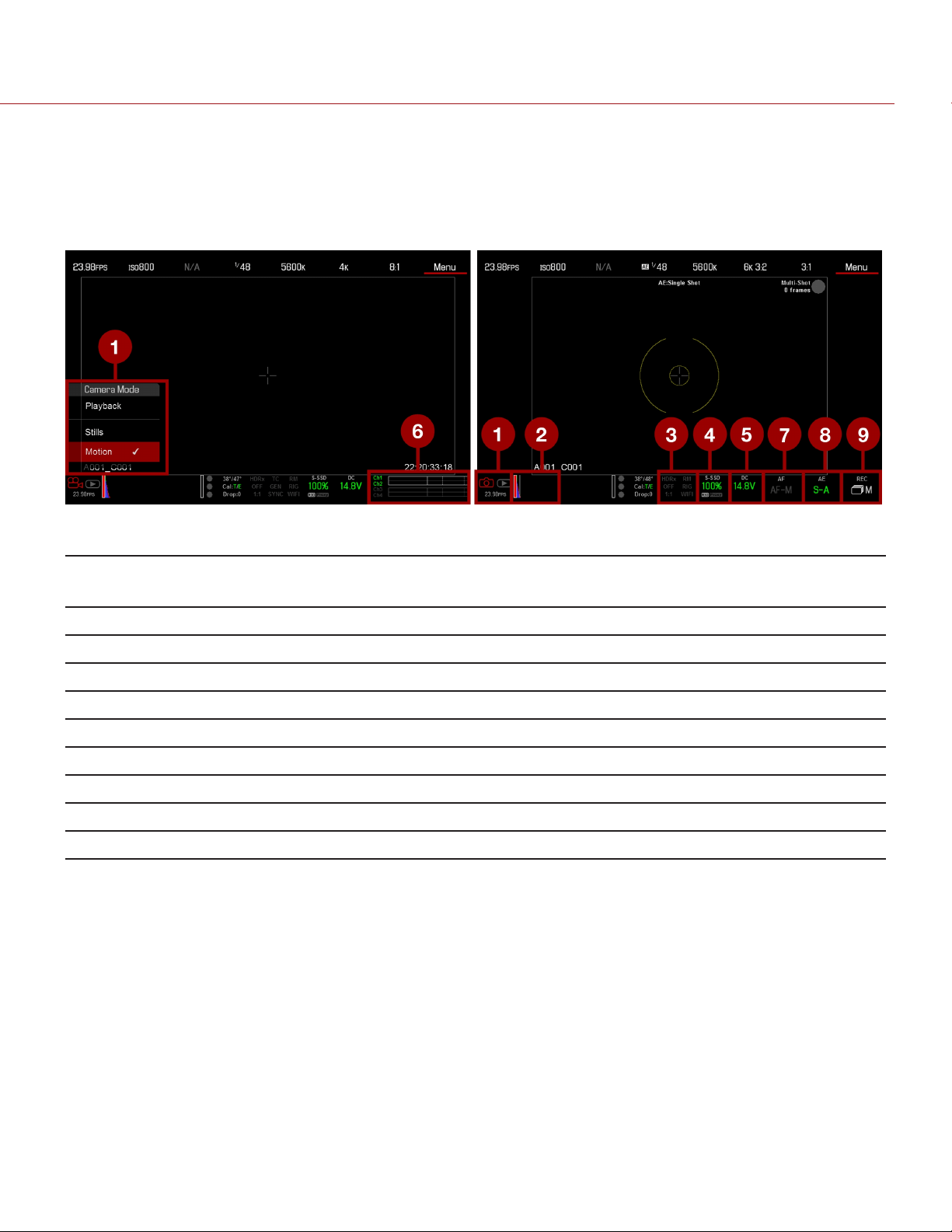
SWIPE-UP MENU
The Swipe-Up Menu is available in the Lower Status Row on RED Touch displays and provides Swipe-Up Shortcuts for
Motion mode, Stills mode, and Playback. For example, select the
Camera Mode icon in the Lower Status Bar, swipe
up, and select a Camera Mode. For more information about Stills mode and Motion mode, go to "Camera Mode" on
page 50.
Figure: Swipe Up Menu
# SWIPE-UP
SHORTCUT
DESCRIPTION MODE
1 Camera Mode Select Playback, Motion, or Stills Motion, Stills
2 False Color Select a false color mode; go to
"False Color Modes" on page 74 Motion, Stills
3 Status View detailed status information Motion, Stills
4 Media View as Percentage or Time Remaining, eject media, view clip thumbnails Motion, Stills
5 Power View as Percentage, Time Remaining, or Voltage Motion, Stills
6 Audio Select Audio settings Motion
7 Auto Focus Set Zone, Size, and Mode Stills
8 Auto Exposure Set Exp Comp, Speed, Metering, Priority, and Mode Stills
9 Record Mode Select Multi-Shot or Motion + Stills Stills
COPYR IGH T © 2019 R ED.COM, LLC 955- 0184_V7.3, REV-A | 57
RED RANGER MONSTRO OPERATION GUIDE
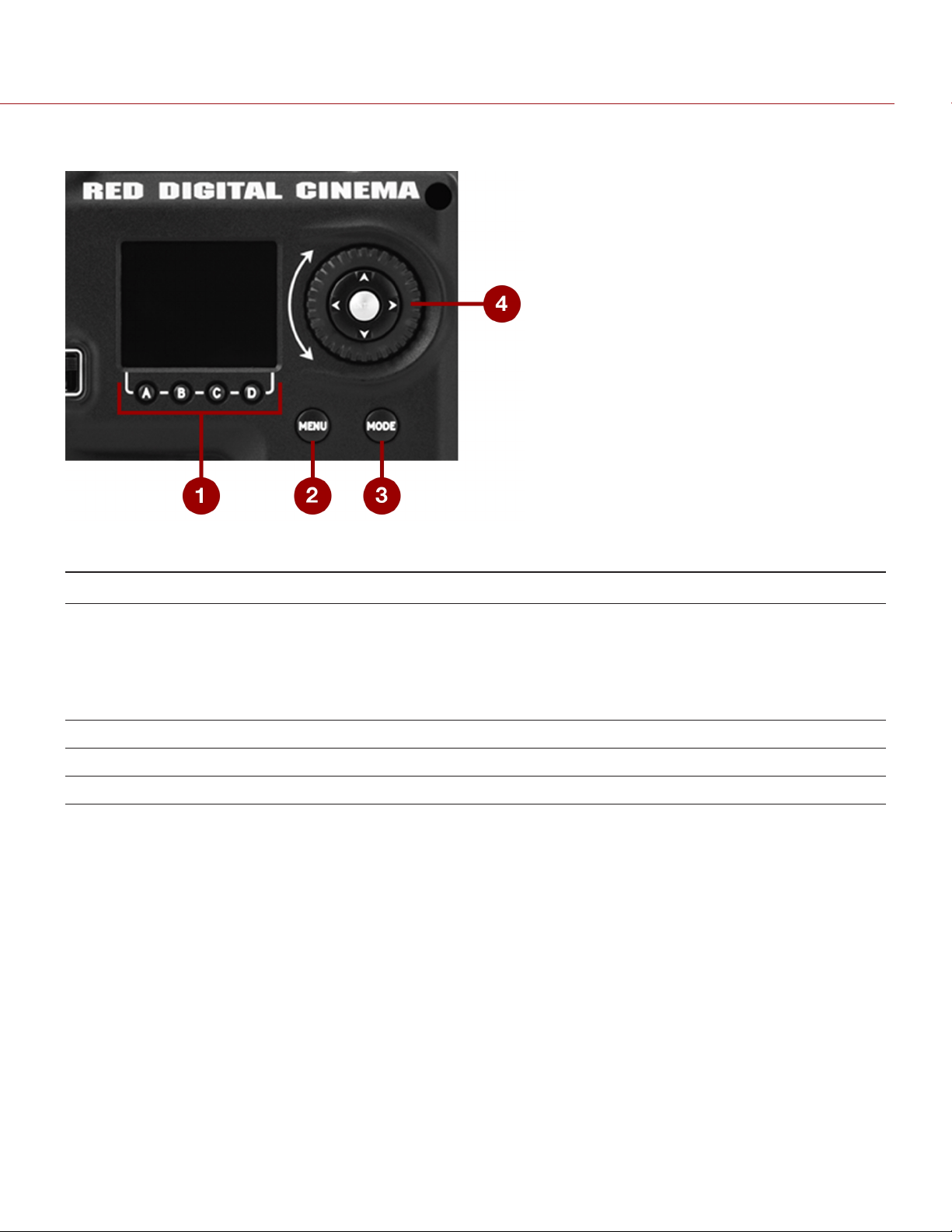
SIDE LCD AND NAVIGATION
Figure: Side LCD and Navigation
# CONTROL/ITEM DESCRIPTION
1 User Keys (A–D)
1
A: Cycle Auto-Focus Mode
B: Auto White Balance
C: Toggle: Magnify
D: Toggle Exposure Mode
A + D: Lock/unlock side buttons to prevent inadvertent menu changes
2 MENU Button Access menus or exit currently selected menu
3 MODE Button Toggle between Remote and Local Modes
4 Navigation Group Navigate menus and menu items; Go to "Navigation Group" on the next page
1. Press User Keys A + D simultaneously to lock/unlock Side LCD buttons to prevent inadvertent menu changes.
COPYR IGH T © 2019 R ED.COM, LLC 955- 0184_V7.3, REV-A
| 58
RED RANGER MONSTRO OPERATION GUIDE
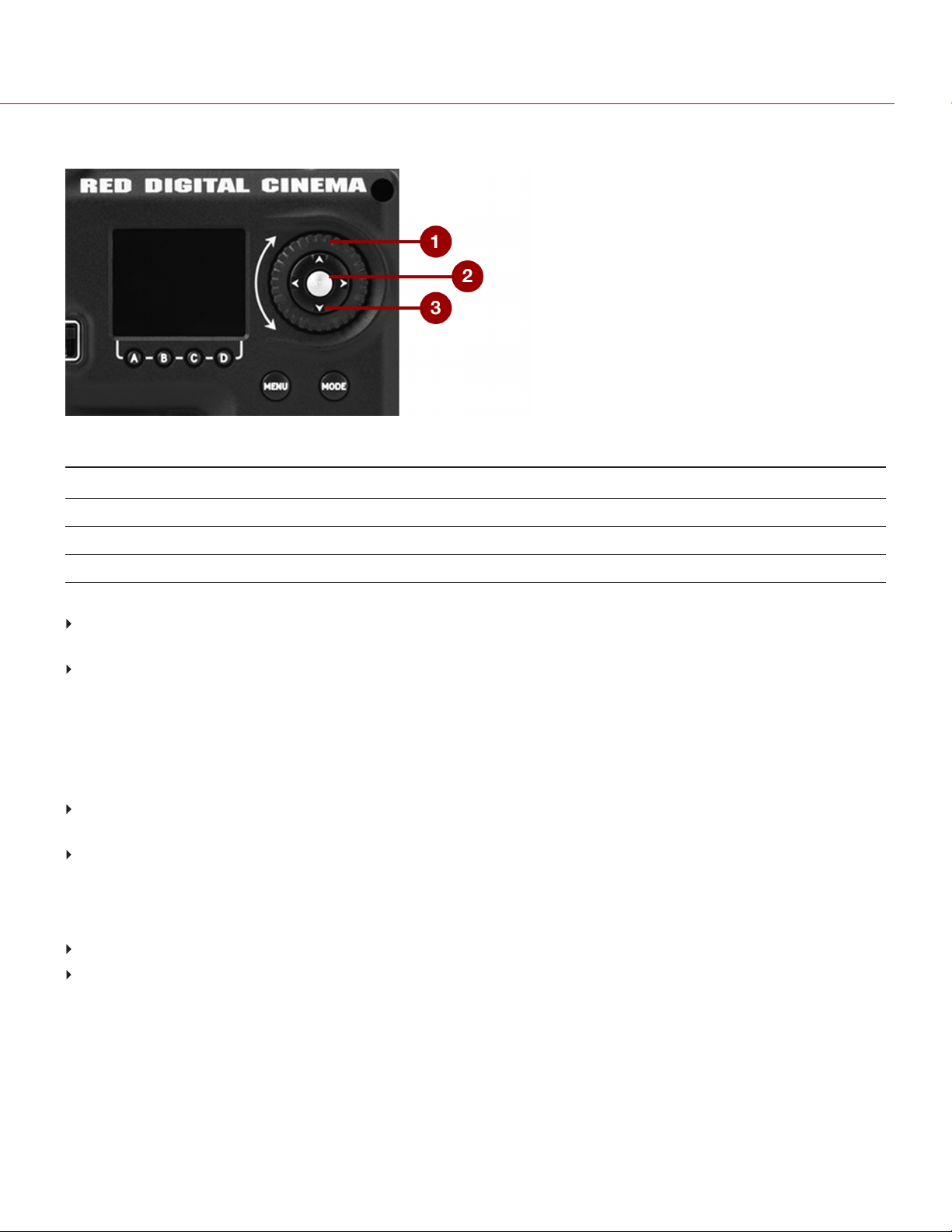
NAVIGATION GROUP
Figure: Navigation Group
# NAVIGATION GROUP ELEMENT DESCRIPTION
1 Scroll Wheel Select and adjust the value of a selected setting
2 ENTER key Press
ENTER to confirm a setting or access the selected menu
3 Directional Keys Navigate menus and menu items
Navigate the menus using the following controls:
Press ENTER to open the menu, then rotate the Scroll Wheel clockwise to move right, counterclockwise to move
left to highlight the desired menu or parameter. Press ENTER to select.
Press the Up Directional Key to open the related Advanced Settings menu, if one (1) is available.
OPERATION MODES
The Side LCD display reflects the currently selected mode. Use the
Scroll Wheel and Directional Keys to navigate
menus. Press MENU to access the Advanced Menu.
Press MODE to toggle between the following modes:
Remote Mode: Navigate with the Side LCD controls, using an attached LCD, EVF, or other monitor as a reference.
The Side LCD displays the primary control screen.
Local Mode: Navigate using the Side LCD controls and display. User Keys A-D are inactive.
KEY LOCK/UNLOCK
Lock the keys on the Side LCD to prevent inadvertent button presses and menu changes.
Lock: Press A + D simultaneously.
Unlock: Press A + D simultaneously. Alternatively, press and hold ENTER while keys are locked.
COPYR IGH T © 2019 R ED.COM, LLC 955- 0184_V7.3, REV-A
| 59
RED RANGER MONSTRO OPERATION GUIDE
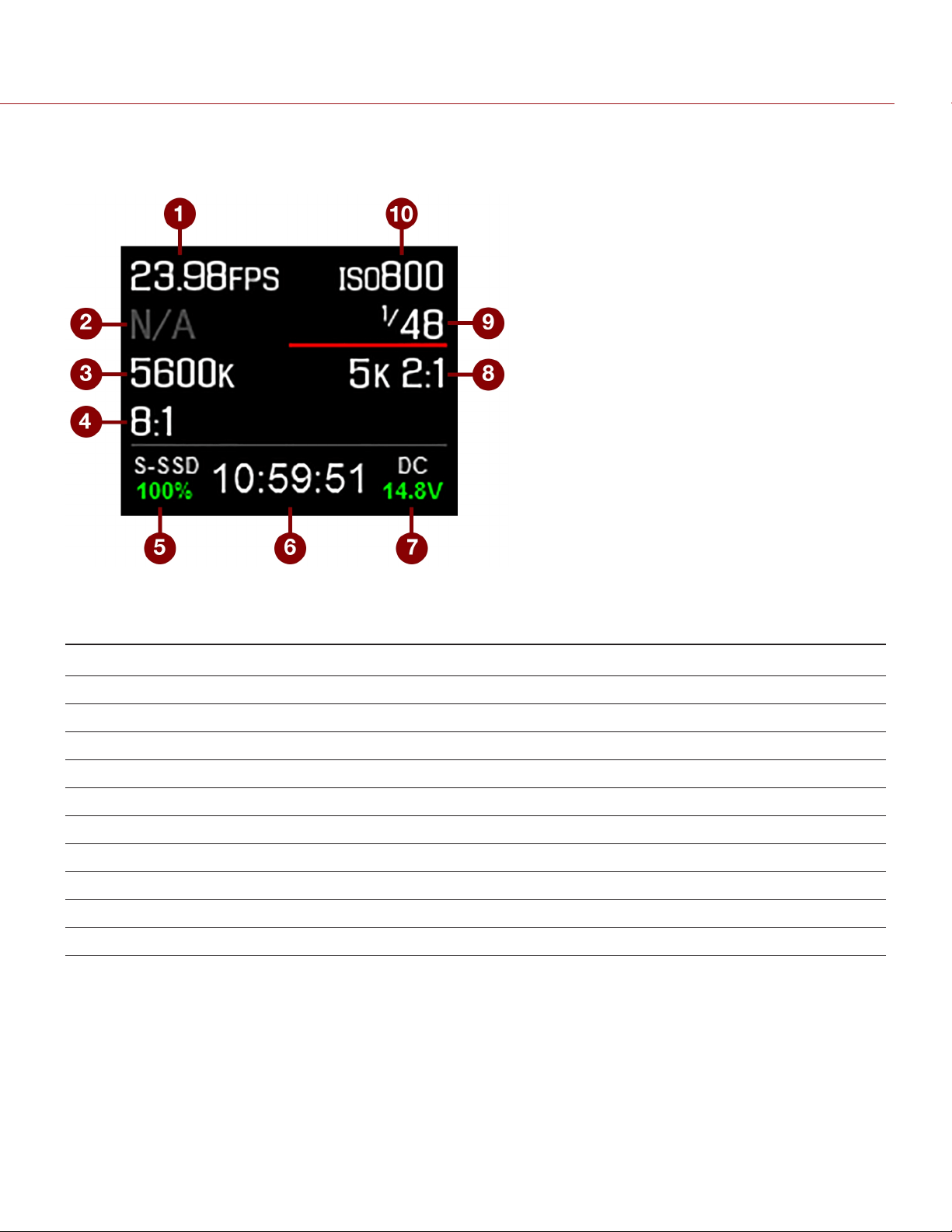
SIDE LCD DISPLAY
The Side LCD display provides basic camera parameters during operation.
Figure: Side LCD (Local Mode)
The Side LCD displays the following camera parameters:
# ITEM DESCRIPTION
1 Frame Rate Current Recording Frame Rate
2 Lens Information Displays aperture if a supported Cooke lens is attached
3 White Balance Color temperature
4 REDCODE REDCODE compression setting
5 Media Status Displays media location and remaining media capacity
6 Timecode Current timecode value
7 Power Status DC supply voltage or % of remaining battery capacity
8 Resolution Recording resolution
9 Shutter Speed Integration time or shutter angle
10 ISO Camera sensor sensitivity
COPYR IGH T © 2019 R ED.COM, LLC 955- 0184_V7.3, REV-A | 60
RED RANGER MONSTRO OPERATION GUIDE
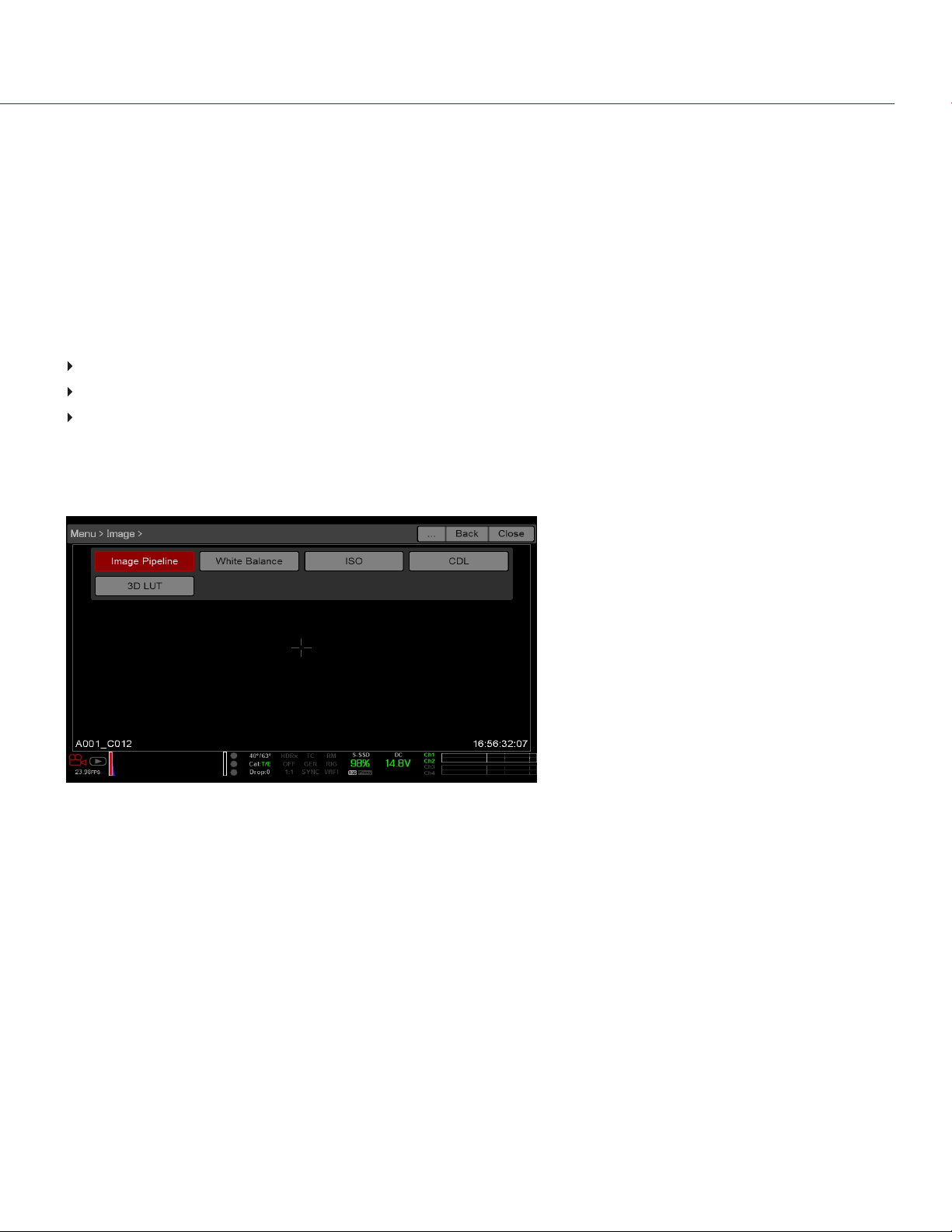
COPYR IGH T © 2019 R ED.COM, LLC 955- 0184_V7.3, REV-A | 61
RED RANGER MONSTRO OPERATION GUIDE
CHAPTER 5:
ADVANCED MENUS
ACCESS THE ADVANCED MENUS
To access the Advanced menus, perform one of the following:
Tap the Menu button on the side of the camera.
Tap the Menu icon on the touchscreen.
Open any menu in the Upper Status Row, and then select the Advanced... button.
NOTE: Some menus are only available if certain hardware is present.
IMAGE MENU
Figure: Image Menu
The Image menu includes tools that control how the image appears, including Color Space and Gamma Curve.
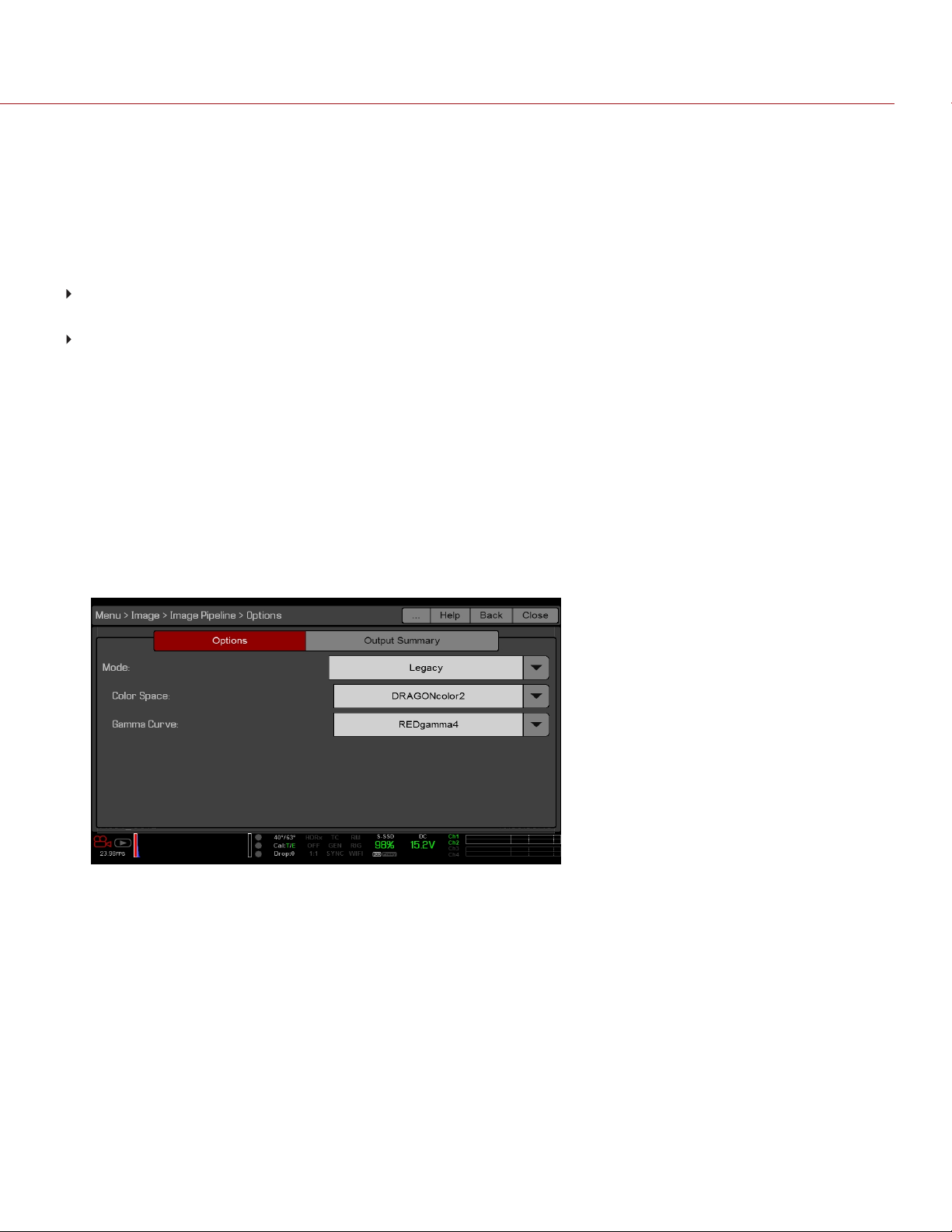
IMAGE PIPELINE
To set up the image pipeline, go to
Menu > Image > Image Pipeline.
IMAGE PIPELINE MODE OPTIONS
The camera offers two (2) different ways to process your image. Each mode changes which sub-menus are available in
the Image menu.
Legacy: In Legacy mode, the camera provides the same color options that firmware v6.3 did. Enables the Color,
Gain, Curves, and LGG menus.
IPP2: Image Processing Pipeline 2 (IPP2) is the new image processing pipeline, which is available starting with
firmware v6.4. In IPP2, the camera applies REDWideGamutRGB, which is a color space designed to encompass all
colors a RED camera can generate without clipping. The camera then encodes the image using Log3G10, a gamma
curve that prevents clipping. Using this color space and gamma curve allows you to grade and make color
adjustments in post production, instead of in-camera. Selecting IPP2 enables the CDL menu, and hides the Color,
Gain, Curves, and LGG menus (since those are used for grading).
LEGACY MODE
To use Legacy mode, follow the instructions below:
1. Go to
Menu > Image > Image Pipeline > Options.
2. Select Legacy from the Mode drop-down menu.
3. Select OK.
Figure: Legacy Mode
4. Select a color space from the Color Space drop-down menu.
5. Select a gamma curve from the Gamma Curve drop-down menu.
6. If you want to apply a 3D LUT, go to "3D LUT" on page 68.
COPYR IGH T © 2019 R ED.COM, LLC 955- 0184_V7.3, REV-A
| 62
RED RANGER MONSTRO OPERATION GUIDE
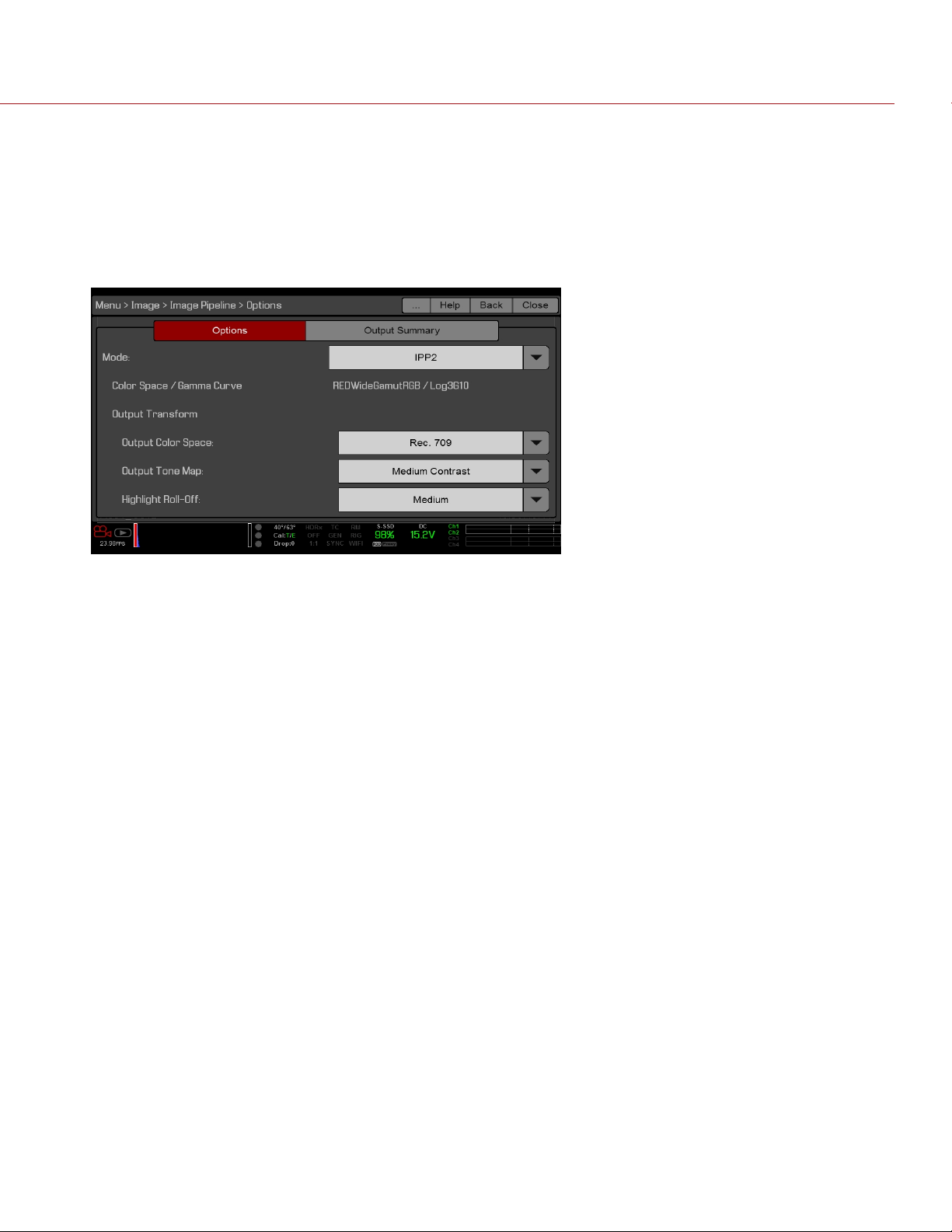
IPP2 MODE
To use IPP2 mode, follow the instructions below:
1. Go to
Menu > Image > Image Pipeline > Options.
2. Select IPP2 from the Mode drop-down menu. With IPP2, the Color Space and Gamma Curve are always
REDWideGamutRGB and Log3G10, respectively.
3. Select OK.
Figure: IPP2 Mode
4. If you want to apply a 3D LUT, go to "3D LUT" on page 68.
5. Select a color space from the Output Color Space drop-down menu.
6. Select a contrast setting from the Output Tone Map drop-down menu.
7. Select a highlight option from the Highlight Roll-Off drop-down menu.
COPYR IGH T © 2019 R ED.COM, LLC 955- 0184_V7.3, REV-A
| 63
RED RANGER MONSTRO OPERATION GUIDE
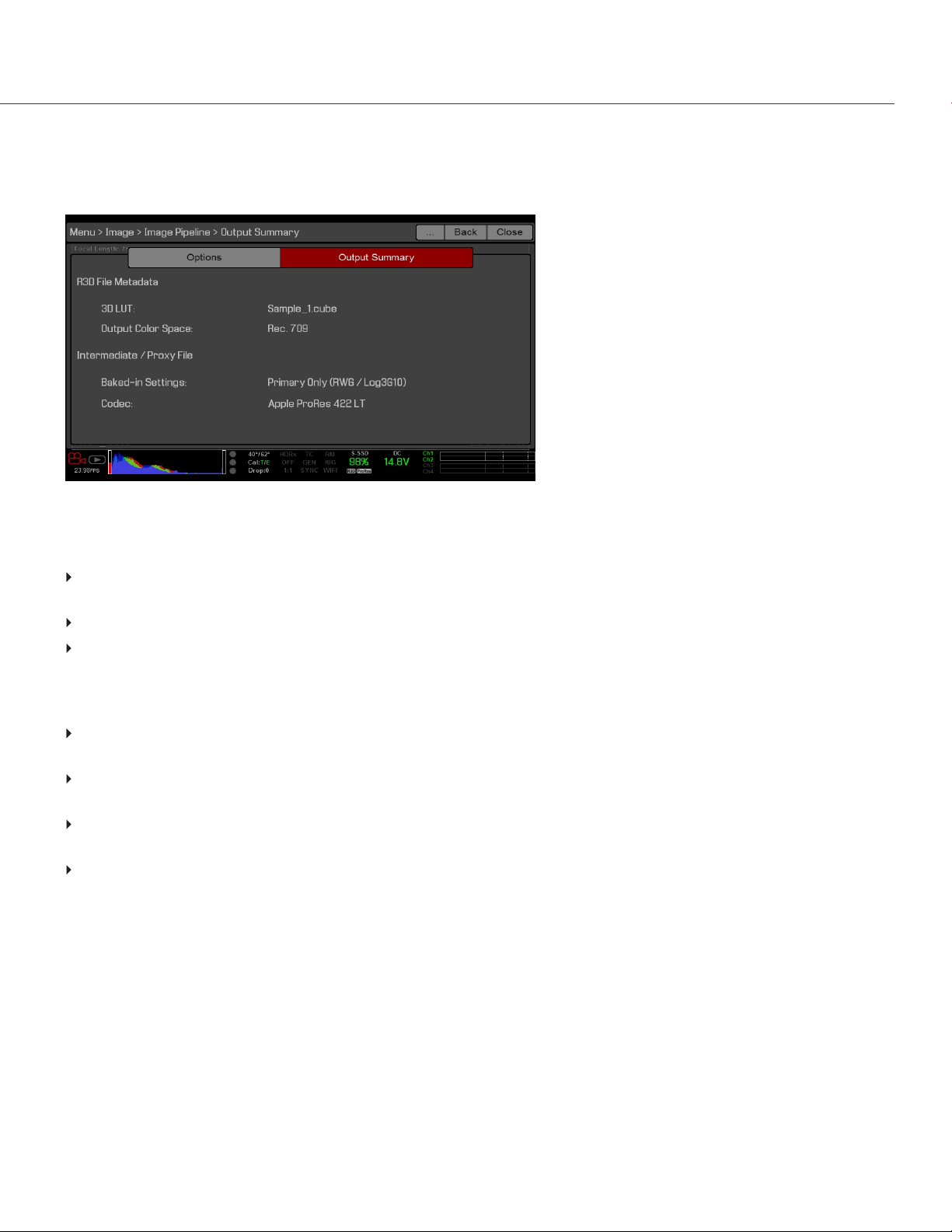
OUTPUT SUMMARY
The Output Summary menu is an information-only menu that displays what image information is applied to the R3D files
and proxy files. To view the output summary, go to
Menu > Image > Image Pipeline > Output Summary.
Figure: Image Menu
R3D FILE METADATA
N/A : Displays if the camera is not set to record R3D files. To enable/disable recording to R3D, go to "Select Record
File Format" on page 112.
3D LUT: The name of the 3D LUT applied to the file. If no LUT is applied, the screen displays [NONE].
Output Color Space: Applicable to IPP2 mode only. The name of the output color space selected on the Options
tab.
INTERMEDIATE / PROXY FILE
N/A: Displays if the camera is not set to record Apple
®
ProRes files or Avid DNxHD/HR files. To enable/disable
recording to these files, go to "Select Record File Format" on page 112.
Color Space / Gamma Curve: Applicable to Legacy mode only. The color space and gamma curve applied to the
file.
Baked-in Settings: Applicable to IPP2 mode only. The image settings that are irreversibly encoded (baked) into the
recorded file. To select these settings, go to "Select Record File Format" on page 112.
Codec: The selected codec. To select a codec, go to "Select Record File Format" on page 112.
WHITE BALANCE
Select a color temperature. The range is 1700 to 10,000 KELVIN, and the default is 5600 KELVIN.
TINT
Color temperature calculations assume a pure light source that may not be true in the specific scene the camera is
imaging. To compensate for any residual colorcast, the Tint parameter adjusts the RGB color balance with a
compensating magenta-green color component. Tint range is –100 to 100, with a default of 0.000.
The Tint value displays as a rounded number in the Upper Status Row.
NOTE: Selecting Auto White Balance calculates a new Tint value. The value does not change if you adjust the color
temperature manually. Selecting a preset resets the Tint to 0.000.
COPYR IGH T © 2019 R ED.COM, LLC 955- 0184_V7.3, REV-A | 64
RED RANGER MONSTRO OPERATION GUIDE
PRESETS
Each preset has 0.000 Tint. Available preset options are:
Incandescent: 2800 K
Tungsten: 3200 K
Fluorescent: 4500 K
Flash: 5500 K
Daylight: 5600 K
Cloudy: 7500 K
Shade: 9000 K
AUTO WHITE BALANCE
Auto white balance analyzes the central 25% of the image visible in the monitor to calculate a color temperature that will
render a white object as white.
To use auto white balance, follow the instructions below:
1. Place a white or grey object under the ambient light.
2. Go to
Menu > Image > White Balance.
3. Select Auto White Balance.
COPYR IGH T © 2019 R ED.COM, LLC 955- 0184_V7.3, REV-A
| 65
RED RANGER MONSTRO OPERATION GUIDE

ISO MENU
To select an ISO setting, go to
Menu > Image > ISO.
ISO
NOTE: To see the full range of ISO ratings, select ISO in the Upper Status Row, select Edit List, and select Custom.
Select the camera ISO rating. The sensitivity value increments in 1/3 stops. When the ISO rating is adjusted, the camera
logs the change as metadata and the monitor path reacts accordingly. Higher ISO values lead to brighter images in the
monitor path, and vice versa.
RED recommends setting the ISO to the default, then adjusting the aperture, lighting, and ND filters to match. The ISO
can later be adjusted around one (1) stop for fine-tuning.
Range is ISO 250 to 12,800. Default is ISO 800.
FLUT
NOTE: This feature is only available in Legacy mode. For more information, go to "Image Pipeline" on page 62.
Floating Point Lookup Table (FLUT) is an exposure control exclusive to RED. FLUT works like a traditional ISO setting,
but can be fine-tuned in post production to any level of exposure precision. FLUT automatically protects highlights and
shadows, even when changed substantially.
The FLUT setting is expressed in terms of relative exposure value (EV), where each unit represents a 1-stop change in
midtone exposure level. Range is –8.0 to 8.0. Default is 0.0.
SHADOW
NOTE: This feature is only available in Legacy mode. For more information, go to "Image Pipeline" on page 62.
Shadow adjusts the toe value of the FLUT (the tone near black). Increasing the Shadow value raises the video level of
near blacks. Lowering the Shadow value crushes the video level of near blacks. Range is –2.0 to 2.0. Default is 0.0.
EXPOSURE ADJUST
NOTE: This feature is only available in IPP2 mode. For more information, go to "Image Pipeline" on page 62.
Exposure Adjust (called FLUT in firmware v6.3 and earlier) works like a traditional ISO setting, but can be fine-tuned in
post production to any level of exposure precision. Exposure Adjust automatically protects highlights and shadows, even
when changed substantially.
The Exposure Adjust setting is expressed in terms of relative exposure value (EV), where each unit represents a 1-stop
change in midtone exposure level. Range is –8.0 to 8.0. Default is 0.0.
ISO CALIBRATION
RED cameras with HELIUM
®
, MONSTRO
®
, and GEMINI
®
sensors have an ISO calibration that better matches a light
meter and improves overall exposure quality. RED cameras with HELIUM, MONSTRO, and GEMINI sensors therefore
depict a one stop brighter image compared to prior sensors (when set to an otherwise identical ISO, T-stop, and shutter
speed). ISO 400 now appears as bright as ISO 800 did before, for example.
To match exposure between cameras with HELIUM, MONSTRO, and GEMINI sensors and RED cameras that DO NOT
have those sensors, either reduce your camera’s ISO speed by 1 stop compared to the other camera, or deselect the
Menu > Image > ISO > Use updated ISO calibration check box.
As usual, RED recommends using ISO 800 as a starting point for exposure, then adjusting the T-stop and lighting or ND
filters to match.
COPYR IGH T © 2019 R ED.COM, LLC 955- 0184_V7.3, REV-A
| 66
RED RANGER MONSTRO OPERATION GUIDE
CDL
NOTE: This menu is only available in IPP2 mode. For more information, go to "Image Pipeline" on page 62.
American Society of Cinematographers Color Decision List (ASC CDL) controls are a standardized, camera-agnostic
way to adjust the look of your images. Color corrections made with a device can therefore be applied or modified by other
devices, even if such devices are from different manufacturers and use different standards.
Use the CDL menu to set up:
Slope
Power
Offset
Saturation
MANAGE CDLS
Use the CDLs menu to apply and import/export CDLs.
CDLs can be stored on the camera or transferred to SSD to be shared with other cameras. When exporting CDLs from
camera to an SSD, the CDLs are saved to a folder on the SSD called “cdls”. When importing CDLs from an SSD to
camera, the CDLs must be stored on the SSD in a folder called “cdls”.
Apply: Apply the selected CDL.
Create: Create a new CDL using the current settings.
Delete: Delete the selected CDL.
: Export selected CDL from camera to SSD.
All: Export all CDLs from camera to SSD.
: Import selected CDL from SSD to camera.
All: Import all CDLs from SSD to camera.
COLOR
NOTE: This menu is only available in Legacy mode. For more information, go to "Image Pipeline" on page 62.
Saturation: Adjusts color saturation. Range is 0.0 (monochrome) to 4.0 (super color). Default is 1.0.
Contrast: Adjusts the overall contrast of the image. Range is –1.0 (flat) to 1.0 (max contrast). Default is 0.0.
Brightness: Adjusts brightness without crushing highlights. Available range is –10.0 to 10.0. Default is 0.0.
Exp Comp: Adjusts exposure compensation. Available range is –7.0 to 7.0. Default is 0.0.
GAIN
NOTE: This menu is only available in Legacy mode. For more information, go to "Image Pipeline" on page 62.
Adjust the red channel, blue channel, and green channel individually. The range for each is 0.0 (none of the color) to 10.0,
and the default for each is 1.0.
CURVES
NOTE: This menu is only available in Legacy mode. For more information, go to "Image Pipeline" on page 62.
Define the individual curves for the luma, red, green, and blue channels. You can only adjust one (1) curve at a time.
Select
Reset Curve to reset a curve.
COPYR IGH T © 2019 R ED.COM, LLC 955- 0184_V7.3, REV-A | 67
RED RANGER MONSTRO OPERATION GUIDE
LGG (LIFT, GAMMA, GAIN)
NOTE: This menu is only available in Legacy mode. For more information, go to "Image Pipeline" on page 62.
Adjust the lift, gamma, and gain for the red channel, blue channel, and green channel individually.
3D LUT
Use the 3D LUT menu to apply and manage LUTs.
SELECT LUT
If you are recording to a 2K Apple ProRes or 2K Avid DNxHD/HR codec while the camera is in IPP2 mode, you can
chose to irreversibly encode (bake) the 3D LUT into the recorded file. For more information, go to
"Select Record File
Format" on page 112.
When you apply a 3D LUT to a monitor, the name of the 3D LUT displays in the lower left corner of the Live Action area
for that monitor. The Display Preset feature controls which Color Space / Gamma Curve pairing and/or 3D LUT is applied
to the monitor. For more information, go to "Display Preset" on page 70.
NOTE: The 3D LUT indicator is part of the default "Standard (RED)" overlay, which you can override by selecting or
creating a different overlay. For more information, go to "Custom Overlays" on page 81.
To apply a 3D LUT, follow the instructions below:
1. Go to Menu > Image > 3D LUT.
2. Select a LUT from the Creative 3D LUT drop-down menu.
3. Select OK.
EXPORT/IMPORT LUTS
To export and import 3D LUTs, go to
Menu > Image > 3DLUT > Import/Export.
3D LUTs can be stored on the camera or transferred to SSD to be shared with other cameras. When exporting 3D LUTs
from camera to an SSD, the 3D LUTs are saved to a folder on the SSD called “luts”. When importing 3D LUTs from an
SSD to camera, the 3D LUTs must be stored on the SSD in a folder called “luts”.
: Export selected 3D LUT from camera to SSD.
All: Export all 3D LUTs from camera to SSD.
: Import selected 3D LUT from SSD to camera.
All: Import all 3D LUTs from SSD to camera.
COPYR IGH T © 2019 R ED.COM, LLC 955- 0184_V7.3, REV-A
| 68
RED RANGER MONSTRO OPERATION GUIDE
MONITORING MENU
The Monitoring menu includes tools that control different monitor outputs, Look Around, and overlays.
MONITORS
To set up monitor preferences, go to
Menu > Monitoring > Monitors and select the monitor whose preferences you
want to change. You can set up preferences for each of the following monitors:
LCD Top
EVF Top
LCD Left
EVF Left
MON-1
SDI-1/2
To see what monitor preferences are available, go to "Monitor Preferences" below.
MONITOR PREFERENCES
Set up the preferences for the selected monitor. Some options are only available with specific monitors.
NOTE: While some changes take effect immediately, others take effect when you close the menu.
LCD/EVF LEFT / MON-1 SELECT
NOTE: This setting is available for LCD Left, EVF Left, and MON-1.
Select to enable either the secondary LCD/EVF port on the camera or the MON-1 port. The secondary LCD/EVF port
and the MON-1 port cannot be used at the same time.
MONITOR MODE
Select an option for the
Mode setting, which determines the elements displayed on the monitor:
Clean: Only the video displays. The Upper Status Row, Lower Status Row, and overlays do not display.
Overlay: The overlay displays. Overlays include the Upper Status Row and the Lower Status Row.
Mirror: The monitor mirrors another screen at the same resolution. You cannot mirror a screen that is set to Clean.
The Mirror option is available based on the settings of the other attached monitors, and includes the name of the
monitor that can be mirrored.
NOTE: You can set a maximum of four (4) monitors to Overlay at a time. To assign additional monitors to Overlay, mirror
a monitor with the same resolution that is set to Overlay.
NOTE: When two (2) touchscreens are attached to the camera with the same resolution and one (1) is currently the
control surface, set the other to mirror it and give the effect of having two (2) control surfaces.
OVERLAY
Select which overlay shows on top of the video. RED
®
provides preset overlays, which have “(RED)” in the overlay
name. Create custom overlays in the Overlay tab. For more information, go to
"Custom Overlays" on page 81.
COPYR IGH T © 2019 R ED.COM, LLC 955- 0184_V7.3, REV-A
| 69
RED RANGER MONSTRO OPERATION GUIDE

RESOLUTION
Select the output resolution for monitors (you cannot select a resolution for LCDs and EVFs, since the resolution is
determined automatically). For more information about available HD-SDI resolutions, go to
"Record/Monitor Out Ports" on
page 190.
FREQUENCY
Determines the monitor frequency. Available frequencies depend on the selected monitor. The LCD resolution defaults to
60.00 Hz, which is the optimal refresh rate for the RED LCDs.
For HD-SDI monitors, the frequency depends on the project time base. For more information, go
"Record/Monitor Out
Ports" on page 190.
HD-SDI Auto: Sets the frequency equal to the Project Time Base, except when the Project Time Base is 47.95/48 fps.
When the Project Time Base is 47.95/48 fps, the frequency is half that rate (23.98/24 Hz).
DISPLAY PRESET
Select the Color Space and Gamma Curve combination for the monitor. For more information, go to
"Image Pipeline" on
page 62.
TOOLS
Enables the false color modes on the monitor. For more information, go to
"False Color Modes" on page 74.
FLIP VIDEO
NOTE: This setting is NOT available on the DSMC2 RED Touch 4.7" LCD, DSMC2 RED Touch 7.0" LCD, RED Touch
7.0" LCD, RED Pro Touch 7.0" LCD, and DSMC2 Touch 7.0" Ultra-Brite LCD.
Flip footage horizontally, so that it is upside down. This setting only affects the monitor, and does not affect captured
footage.
FRAMED OVERLAY
The video display is scaled down on the monitor so that the overlay items fit outside of the video area rather than over it.
This setting only affects the monitor, and does not affect captured footage.
AUTO HIDE MENUS
Hides the Upper Status Row and Lower Status Row. When this option is disabled, the video is scaled so that the menus
are not overlaid on the video. When this option is enabled, the video is not scaled. This option creates a control surface
on a monitor without scaling the video. This setting only affects the monitor, and does not affect captured footage.
To toggle display/hide the menus when Auto Hide Menus is enabled, perform either of the following actions:
Press the Menu button.
Tap the touchscreen.
NOTE: Enabling this option on a non-control surface results in the menus never displaying on that monitor.
COPYR IGH T © 2019 R ED.COM, LLC 955- 0184_V7.3, REV-A
| 70
RED RANGER MONSTRO OPERATION GUIDE
FLIP/MIRROR
NOTE: This setting is ONLY available on the DSMC2 RED Touch 4.7" LCD, DSMC2 RED Touch 7.0" LCD, RED
Touch 7.0" LCD, RED Pro Touch 7.0" LCD, and DSMC2 Touch 7.0" Ultra-Brite LCD.
Mirror and flip (invert) the graphical user interface (GUI) and footage, effectively rotating the entire displayed image 180°.
Use this setting when mounting a monitor or the entire camera rig upside down. This setting only affects the monitor, and
does not affect captured footage.
UI FLIP/MIRROR
NOTE: This setting is NOT available on the DSMC2 RED Touch 4.7" LCD, DSMC2 RED Touch 7.0" LCD, RED Touch
7.0" LCD, RED Pro Touch 7.0" LCD, and DSMC2 Touch 7.0" Ultra-Brite LCD.
Flip the GUI vertically and mirror horizontally (not rotated). Use this setting when mounting a monitor upside down. This
setting only affects the monitor, and does not affect captured footage.
BRIGHTNESS
Control the brightness of each LCD and EVF. Move to the right for a brighter display; move to the left for a dimmer
display.
PRIORITY
The camera can only have one (1) control monitor for interacting with camera settings. The Priority tab determines the
order in which a monitor becomes the control monitor. If you plan on removing or adding monitors during a shoot, set up
the priority list ahead of time.
For a monitor to become the control monitor, the following must occur:
The monitor must be set to Overlay mode in the Monitor Control menu.
Each monitor that has higher priority on the list must be either detached or not set to Overlay mode.
TEST SIGNAL
Use the Test Signal menu to replace the video monitor outputs with one of the following video test patterns:
Chip Chart
SMPTE Bars
Luma
NOTE: Test signals are not recordable; they are provided to help align external HD-SDI monitors.
AUDIO TONE
To apply an audio tone, follow the instructions below:
1. Go to
Menu > Monitoring > Test Signals.
2. Toggle Tone On/Off.
COPYR IGH T © 2019 R ED.COM, LLC 955- 0184_V7.3, REV-A
| 71
RED RANGER MONSTRO OPERATION GUIDE
LOOK AROUND
To enable Look Around, go to
Menu > Monitoring > Look Around.
When Look Around is enabled, the Frame Guide and recording area are scaled down on the display so that you can see
what images will enter the recording area.
To assign a Shading overlay to the Look Around area (the area outside of the recording area), go to "General Tab" on
page 80.
Look Around limits the available frame rates. At high resolutions, the recording area on the display shows the full sensor
area or full sensor height, so there is no extra room for Look Around.
Look Around may affect the recorded file:
R3D: Only the area inside the frame is recorded; the Look Around area is NOT recorded.
Apple ProRes: The full image is recorded, including the Look Around area.
Avid DNxHD/HR: The full image is recorded, including the Look Around area.
ADVANCED
Provides access to additional monitor settings.
VIDEO
SMALL DIALOGS ON 9" LCD
The dialogs on the RED Touch 9.0" LCD are smaller than the default dialogs.
ALLOW REDUCED JUDDER PREVIEW
Reduced Judder Preview allows the camera to preview images at a refresh rate that is twice the project time base. For
example, if the project time base is 23.98 FPS or 24.00 FPS, enabling Reduced Judder Preview causes the LCD or EVF
to have a refresh rate of 48 Hz (50 Hz).
You cannot use Reduced Judder Preview when:
Varispeed is enabled.
Speed Ramp mode is enabled.
Genlock is enabled.
The shutter angle is 180° or greater.
NOTE: When you disable Reduced Judder Preview mode, the image on the EVF may be disrupted for up to three (3)
seconds.
GLOBAL FLIP/MIRROR
Applies Flip/Mirror to all monitors. For more information, go to "Flip/Mirror" on the previous page.
OUTPUT SHARPNESS
Control the sharpness of each monitor output. Move to the left for a sharper image; move to the right for a less sharp
image.
NOTE: The sharpness setting affects the Histogram, RAW Level Bars, RAW Clip Meter, and false color modes. For
more information, go to "Histogram" on page 52 and "False Color Modes" on page 74.
NOTE: The camera applies the sharpness setting to recorded proxy files.
COPYR IGH T © 2019 R ED.COM, LLC 955- 0184_V7.3, REV-A | 72
RED RANGER MONSTRO OPERATION GUIDE
AUTO FOCUS PEAKING
When Auto Focus Peaking mode is enabled (either Focus or Edge), the camera automatically goes onto Focus Peaking
mode when you manually adjust the focus via the lens.
Off: The camera does not automatically go into Focus Peaking mode.
Focus: The camera automatically goes into Focus Peaking mode when you manually adjust the focus via the lens.
Emphasizes contrast and edges in the image without changing brightness or image content making it easier to judge
focus.
Edge: The camera automatically goes into Focus Peaking mode when you manually adjust the focus via the lens.
Shows the edges/outlines of objects that are in focus.
TOUCH
Lock Touchscreen: Touchscreen control is locked. To unlock, tap the screen and follow the on-screen instructions.
Pinch to Magnify: Move two (2) fingers apart or together to toggle Magnify. For more information, go to "Display
Modes: Magnify" on page 76.
Double Tap Right to Record: Double-tap the right 25% of the video area on the LCD to toggle record.
Double Tap Left to AF: Double-tap the left 25% of the video area on the LCD to start autofocus when compatible
lenses are used.
GENLOCK OFFSET
Offset the video of the HD-SDI out to align it with the genlock signal:
Negative offset: Advances the video, so the video reaches the switcher earlier than it would otherwise.
Positive offset: Delays the video, so the video reaches the switcher later than it would otherwise.
COPYR IGH T © 2019 R ED.COM, LLC 955- 0184_V7.3, REV-A
| 73
RED RANGER MONSTRO OPERATION GUIDE
OVERLAYS MENU
The Overlays menu includes settings that display on top of the monitor image.
TOOLS
The Tools menu provides access to false color and display modes.
For more information, see the
Exposure with RED Cameras: False Color & Zebra Tools article , available at
www.red.com/learn/red-101/exposure-false-color-zebra-tools.
FALSE COLOR MODES
False color modes include:
"False Color Modes: Off" below
"False Color Modes: Exposure" on the next page
"False Color Modes: Video" on the next page
"False Color Modes: Focus" on the next page
"False Color Modes: Edge" on the next page
"False Color Modes: Peaking" on page 76
"False Color Modes: Gio Scope" on page 76
NOTE: Only monitors with the Tools check box selected in the Monitor Control menu show the false colors. For more
information, go to "Tools" on page 70.
NOTE: The sharpness setting affects the false color modes. For more information, go to "Output Sharpness" on page 72.
NOTE: False color modes affect video recorded through HD-SDI to an external recorder if the Tools check box is
selected in the Monitor Control menu. When recording through HD-SDI, use false color modes only to help configure
project settings, and then disable the mode before recording.
NOTE: Since the 3D LUT modifes the data displayed for the exposure tools, you cannot use the exposure tools with a
3D LUT.
DISPLAY MODES
Display modes include:
"Display Modes: Magnify" on page 76
"Display Modes: Log View" on page 77
"Display Modes: RAW" on page 77
"Display Modes: Horizon" on page 77
"Display Modes: Zebras" on page 78
FALSE COLOR MODES: OFF
To disable all false color modes, go to
Menu > Overlays > Tools > False Color and select Off from the False Color
drop-down menu.
COPYR IGH T © 2019 R ED.COM, LLC 955- 0184_V7.3, REV-A
| 74
RED RANGER MONSTRO OPERATION GUIDE
FALSE COLOR MODES: EXPOSURE
To enable, go to
Menu > Overlays > Tools > False Color and select Exposure from the False Color drop-down menu.
The Exposure tool displays a color overlay on top of a desaturated image that allows you to check for proper exposure.
When enabled, the “E√” indicator displays in the Lower Status Row.
The Exposure meter colors indicate the following information:
Purple: Underexposed; indicates sensor exposure levels that may be noisy if gained up in post production.
Green: IRE 41–48; based on the RGB levels of the video out signal and not the RAW data.
Red: Overexposed; indicates sensor exposure levels that are clipping.
Purple (underexposure) and red (overexposure) are based on RAW data and show areas that are clipping or close to
clipping. The RGB settings DO NOT affect the Exposure indicators.
FALSE COLOR MODES: VIDEO
To enable, go to
Menu > Overlays > Tools > False Color and select Video from the False Color drop-down menu.
The Video tool displays a color overlay that indicates the video level of the RGB monitor path (calibrated to the SMPTE
test signal). When enabled, the “V√” indicator displays in the Lower Status Row.
Colors are based on the RGB levels of the video out signal (that is, the “cooked” look, and not RAW data). The RGB
settings affect the Video indicators.
The Video indicators represent the following IRE values (at all other values, the desaturated image represents the
luminance value of the ISO adjusted image):
Purple: IRE 0–4
Blue: IRE 5
Teal: IRE 10–12
Green: IRE 41–48
Pink: IRE 61–70
Straw: IRE 92–93
Yellow: IRE 94–95
Orange: IRE 96–98
Red: IRE 99–100
FALSE COLOR MODES: FOCUS
To enable, go to
Menu > Overlays > Tools > False Color and select Focus from the False Color drop-down menu.
The Focus tool emphasizes contrast and edges in the image without changing brightness or image content making it
easier to judge focus. Adjust zoom and focus to easily see which objects are coming into focus.
When enabled, the “F√” indicator displays in the Lower Status Row.
FALSE COLOR MODES: EDGE
To enable, go to
Menu > Overlays > Tools > False Color and select Edge from the False Color drop-down menu.
Shows the edges/outlines of objects that are in focus. When enabled, the “F√” indicator displays in the Lower Status
Row.
NOTE: The Edge setting may interfere with recordings done via HD-SDI in Clean mode.
COPYR IGH T © 2019 R ED.COM, LLC 955- 0184_V7.3, REV-A | 75
RED RANGER MONSTRO OPERATION GUIDE
FALSE COLOR MODES: PEAKING
To enable, go to
Menu > Overlays > Tools > False Color and select Peaking from the False Color drop-down menu.
The Focus Peaking tool displays a red overlay on top of in-focus edges. Select a Peaking Level of 1 to 10 (weak to
strong). The RGB settings affect the indicators.
The Focus Peaking indicators are applied after the image is scaled to a monitor, so the indicators may look different on
different monitors.
When enabled, the “P√” indicator displays in the Lower Status Row.
FALSE COLOR MODES: GIO SCOPE
To enable, go to
Menu > Overlays > Tools > False Color and select Gio Scope from the False Color drop-down
menu.
Displays a color overlay on top of a desaturated image, identifying 16 increments within the dynamic range of the sensor.
When enabled, the “G√” indicator displays in the Lower Status Row. The Gio Scope indicators are based on RAW data.
The RGB settings (color temperature, ISO, LGG, etc.) DO NOT affect the indicators.
Each number indicates a different increment of dynamic range.
10: Represents mid-grey.
16: Represents the top increment, and is broken up into 1/8th sub-increments to show highlight roll-off. Each 1/8th
increment is represented by a different shade of red, ranging from light red (less light) to dark red (most light).
DISPLAY MODES: MAGNIFY
To enable, go to
Menu > Overlays > Tools and select Magnify.
The Magnify tool displays the central region of the sensor in 1:1 pixel resolution on an attached monitor. When enabled,
the 1:1 text in the Lower Status Row turns green, and the AF Window and the magnified region display. The AF Window
determines the center point of the magnified region. If the lens or lens mount is not capable of autofocus with the
camera, use Confirm mode to turn on the AF Window. Sharpening is disabled when Magnify mode is enabled. The
camera automatically exits Magnify mode when recording begins.
The Magnify tool magnifies a 1920 x 1020 region, centered on a 1920 x 1080 display. If the resolution is lower than 1920
x 1020, the image border cannot be magnified. Use the following equations to determine the area of the image border that
will not be magnified:
Border width: (1920 – W) / 2
Border height: (1020 – H) / 2
NOTE: Frame rate and resolution cannot be modified in Magnify mode.
COPYR IGH T © 2019 R ED.COM, LLC 955- 0184_V7.3, REV-A
| 76
RED RANGER MONSTRO OPERATION GUIDE
DISPLAY MODES: RAW
NOTE: RAW is only available in Legacy mode. For more information, go to "Image Pipeline" on page 62.
To enable, go to Menu > Overlays > Tools and select RAW.
When enabled, the camera displays images unaffected by the RGB settings (color temperature, ISO, LGG, etc.). RAW
affects the video recorded via HD-SDI to an external recorder. RAW image parameters DO NOT affect image metadata;
the parameters only affect the monitor output.
The RAW image parameters are:
Color Space: DRAGONcolor2
Gamma Space: REDgamma4
White Balance: 5600K
ISO: 800 ISO
Tint: 0 Tint
NOTE: In RAW mode, the following controls are disabled on all cameras: color temperature, tint, saturation, RGB gains,
ISO, contrast, brightness, shadow, FLUT
®
, exposure compensation, LGG controls, RGB curves, and luma curve.
DISPLAY MODES: LOG VIEW
NOTE: Log View is only available in IPP2 mode. For more information, go to "Image Pipeline" on page 62.
To enable, go to Menu > Overlays > Tools and select Log View.
When enabled, the camera displays images in REDWideGamutRGB and Log3G10 that are only affected by the ISO,
Exposure Adjust, Color Temperature, and Tint settings. This allows you to quickly see ungraded footage that remains
unaffected by creative decisions such as the choice of 3D LUT or CDL. Log View affects the video recorded via HD-SDI
to an external recorder, but does not affect the R3D file itself.
DISPLAY MODES: HORIZON
To enable, go to
Menu > Overlays > Tools and select Horizon.
Displays an overlay that provides a reference to the position of the horizon. The Horizon overlay consists of two (2) short
side-bars that are always horizontally centered on the monitor, and a single longer horizon-line that adjusts to the horizon
based on the orientation of the camera.
The side-bars are green if the pitch is within +/– 1° of the calibrated zero position, otherwise they are red. The horizon-line
is green if the roll is within +/– 1° of the calibrated zero position, otherwise it is red.
To add numerical values for the pitch and roll to the Horizon overlay, follow the instructions below:
1. Go to Menu > Overlays > Custom.
2. Select Create..., Clone..., or Edit..., respectively, for the desired overlay action.
3. Select a location on the interface to add the numerical data for the Horizon overlay.
4. Select Motion: Gyro Data (GYRO) from the Item drop-down menu.
5. Select the desired text size.
6. Select Add.
7. Select Save.
8. Apply the custom overlay to a monitor. For more information, go to "Monitor Preferences" on page 69.
NOTE: The internal gyroscope and accelerometer must be calibrated for the Horizon overlay to function properly. For
more information, go to "Gyroscope and Accelerometer Calibration" on page 131.
COPYR IGH T © 2019 R ED.COM, LLC 955- 0184_V7.3, REV-A | 77
RED RANGER MONSTRO OPERATION GUIDE

DISPLAY MODES: ZEBRAS
Use Zebra mode to enable and adjust the upper and lower values for two (2) independent zebra indicators. Use Zebra 1
for highlight exposure, and use Zebra 2 for mid-tones or shadows. Zebras are visible in Magnify mode and are disabled
by default.
The camera offers two (2) zebra types:
Video: IRE-based mode; evaluates based on the current ISO and Look settings, and not the RAW image.
RAW: Evaluates based on the RAW image.
For more information, see the Exposure with RED Cameras: False Color & Zebra Tools article , available at
www.red.com/learn/red-101/exposure-false-color-zebra-tools.
ENABLE ZEBRA INDICATORS
1. Go to
Menu > Overlays > Tools and select Zebras.
2. Select a Zebra:
Zebra 1:
Video: Areas of the image exposed within the IRE range are indicated by red diagonal lines at –45°. Default is
98 to 100 IRE.
RAW: Areas of the image exposed within the range of stops are highlighted. Default is 15.80 to 16.00 stops.
Zebra 2:
Video: Areas of the image exposed within the IRE range are indicated by green diagonal lines at 45°. Default
is 41 to 48 IRE.
RAW: Areas of the image exposed within the range of stops are highlighted. Default is 0.00 to 4.00 stops.
3. If you selected RAW, select how you want the RAW areas to look by setting up the Raw Style options (fill and
color).
COPYR IGH T © 2019 R ED.COM, LLC 955- 0184_V7.3, REV-A
| 78
RED RANGER MONSTRO OPERATION GUIDE

CAMERA AND LENS STATUS
To set up what camera and lens info displays as part of the overlay, go to
Menu > Overlays > Status.
CAMERA STATUS OVERLAYS
EXPOSURE
Shutter Speed: Displays the exposure time in seconds (1/xx sec). When you change the frame rate in this mode,
the shutter speed stays the same, but the shutter angle changes.
Shutter Angle: Displays the exposure as an angle (1° to 360°). When you change the frame rate in this mode, the
shutter angle stays the same, but the shutter speed changes. (Default)
POWER
Current Batt %: Displays the remaining percentage of active battery. (Default)
Total Time: Displays the total run-time left of battery power, taking into account all available batteries.
Voltage: Displays the voltage.
VU METER
Input: Displays levels of audio inputs (pre-mixer). (Default)
Output: Displays levels of audio outputs (post-mixer).
HISTOGRAM
RGB: Displays red, green, and blue channels on histogram. (Default)
Luma: Displays luma channel on histogram.
MEDIA
Percentage: Displays media space remaining as a percentage.
Time Remaining: Displays media space remaining as time in hours and minutes (HHH:MM). (Default)
LENS STATUS OVERLAYS
APERTURE INCREMENTS
1/4 Stop: Aperture increments in 1/4 stops.
1/3 Stop: Aperture increments in 1/3 stops. (Default)
FOCUS DISTANCE
Metric: Displays lens focus distances in meters.
Imperial: Displays lens focus distances in feet and inches. (Default)
GUIDES
Use the Guides menu to configure the Frame Guide, Action Guide, and Title Guide.
COPYR IGH T © 2019 R ED.COM, LLC 955- 0184_V7.3, REV-A | 79
RED RANGER MONSTRO OPERATION GUIDE
MODE
Off: Disable all guides.
Full: Guide has the same aspect ratio as the record format.
4:3, 16:9, 1.85:1, 1.9:1, 2.4:1: Guide has the selected aspect ratio.
User: Select an aspect ratio from the drop-down menu that displays when you select this option.
Absolute: Guide is defined by absolute pixel dimensions rather than aspect ratio and scale. When you select
Absolute, the Width/Height fields replace the Scale field.
SCALE
Percentage to scale guide from its maximum possible size. Available range is 0 to 100%.
WIDTH/HEIGHT
The Width/Height fields replace the Scale field when you select Absolute from the Mode drop-down menu. Select the
values for the width and height of the guide in pixels.
OFFSET X/Y
Percentage to offset guide from its default centered position. Available range is –100 to 100%.
100%: Right-aligned (for X offset) and bottom-aligned (for Y offset).
-100%: Left-aligned (for X offset) and top-aligned (for Y offset).
APPEARANCE
Line Style: Select one of the following line styles: Solid, Dashed, or Bracket.
Color: Select the color that has the highest contrast to the scene. The default is White.
Opacity: Set the guide opacity. Available options are 25%, 50%, 75% and 100%.
RELATIVE TO FRAME GUIDE
Select the
Relative to Frame Guide check box to size and position the guide relative to (and have it bounded by) the
Frame Guide instead of the record format.
NOTE: The Relative to Frame Guide check box is available on the Action Guide and Title Guide tabs.
GENERAL TAB
Enable/Disable and select the location (Relative To), color, and opacity of the following elements:
Center: The center crosshair. You can select the following shapes: Cross (crosshair), Small Dot, Medium Dot.
Grid: Rule-of-thirds grid.
Shading: The shaded region outside of the area of interest.
COPYR IGH T © 2019 R ED.COM, LLC 955- 0184_V7.3, REV-A
| 80
RED RANGER MONSTRO OPERATION GUIDE
CUSTOM OVERLAYS
Create custom overlays that include specific items. Overlays can be stored on the camera or transferred to SSD to be
shared with other cameras.
Camera: Overlays saved internally on the camera display in the Overlay drop-down menu on the Monitor Control >
Monitor tab.
Media: Overlays saved to an SSD can be found at On Media: \overlays:.
NOTE: Overlays that end with (RED) are provided by default and cannot be edited, deleted, or exported.
OVERLAY ACTIONS
Create...: Create a new custom overlay using a blank overlay template in the Overlay Editor.
Clone...: Create a new custom overlay using the selected camera overlay as a template in the Overlay Editor.
Edit...: Edit the selected camera overlay in the Overlay Editor.
Delete: Delete the selected camera overlay.
EXPORT AND IMPORT OVERLAYS
: Export selected overlay from camera to SSD.
All: Export all overlays from camera to SSD.
: Import selected overlay from SSD to camera.
All: Import all overlays from SSD to camera.
COPYR IGH T © 2019 R ED.COM, LLC 955- 0184_V7.3, REV-A
| 81
RED RANGER MONSTRO OPERATION GUIDE
CREATE AND EDIT OVERLAYS
1. Go to
Menu > Overlays > Custom.
2. Select Create, or select an existing overlay and select Clone or Edit.
3. If creating a new overlay, enter a name for the overlay and select OK.
4. Select any of the following check boxes to add the corresponding guides to the overlay:
Frame Guide
Action Guide
Title Guide
5. Select a button on the matrix to add a user interface element to that position on the matrix.
By default, the Magnify indicator (MI) is on the top left, the Record indicator (REC) is on the top right, the Clip Name
(CLIP) is on the bottom left, and the Timecode (TC) is on the bottom right.
Selecting one (1) of the buttons opens a new dialog that lets you choose a user interface element.
6. Select the Item that you want to add.
7. Select the Size of the item.
8. If adding a Custom Label (LBL), enter the Custom Text for that item.
9. Select Add to return to the previous screen.
10. Add all of the items to the overlay.
11. Select Create or Save.
The new overlay displays in the Camera list.
NOTE: Except for the Custom Label (LBL), you can only add each element once. If you add an element you have
already added to the overlay, the element moves to the new position.
COPYR IGH T © 2019 R ED.COM, LLC 955- 0184_V7.3, REV-A
| 82
RED RANGER MONSTRO OPERATION GUIDE
POWER MENU
The Power menu displays the power status of all attached power sources and allows you to turn off the camera.
To access the Power Menu, go to
Menu > Power.
POWER IN
The power status displays for all attached power devices. The menu displays the voltage of the source or the relative
percentage of the power left, as well as the time left, if applicable.
LOW VOLTAGE WARNING
When the Low Voltage Warning is enabled and the incoming voltage is less than the level you select, the camera shows
a warning message and the Power Status indicator in the Lower Status Row turns red. This warning gives you the
opportunity to change the battery or prepare for the camera to lose power. The warning continues to show until the
incoming voltage is equal to or higher than the level you select.
RED does not recommend a specific voltage threshold, since that depends on the power draw of the attached
accessories.
To enable the Low Voltage warning, follow the instructions below:
1. Go to
Menu > Power.
2. Select the Low Voltage Warning check box.
3. Select the voltage level threshold. The camera warns you when the incoming voltage is less than this level.
POWER OUT
The Power Out menu shows the status of the power out ports on the camera. The statuses are:
N/A: The device is not present.
OK: The power out port is functional.
FAULT: A short or overcurrent tripped the electronic fuse. Remove the device that is connected to the port, as it may
be drawing too much power. Select RESET to clear the fault.
COPYR IGH T © 2019 R ED.COM, LLC 955- 0184_V7.3, REV-A
| 83
RED RANGER MONSTRO OPERATION GUIDE
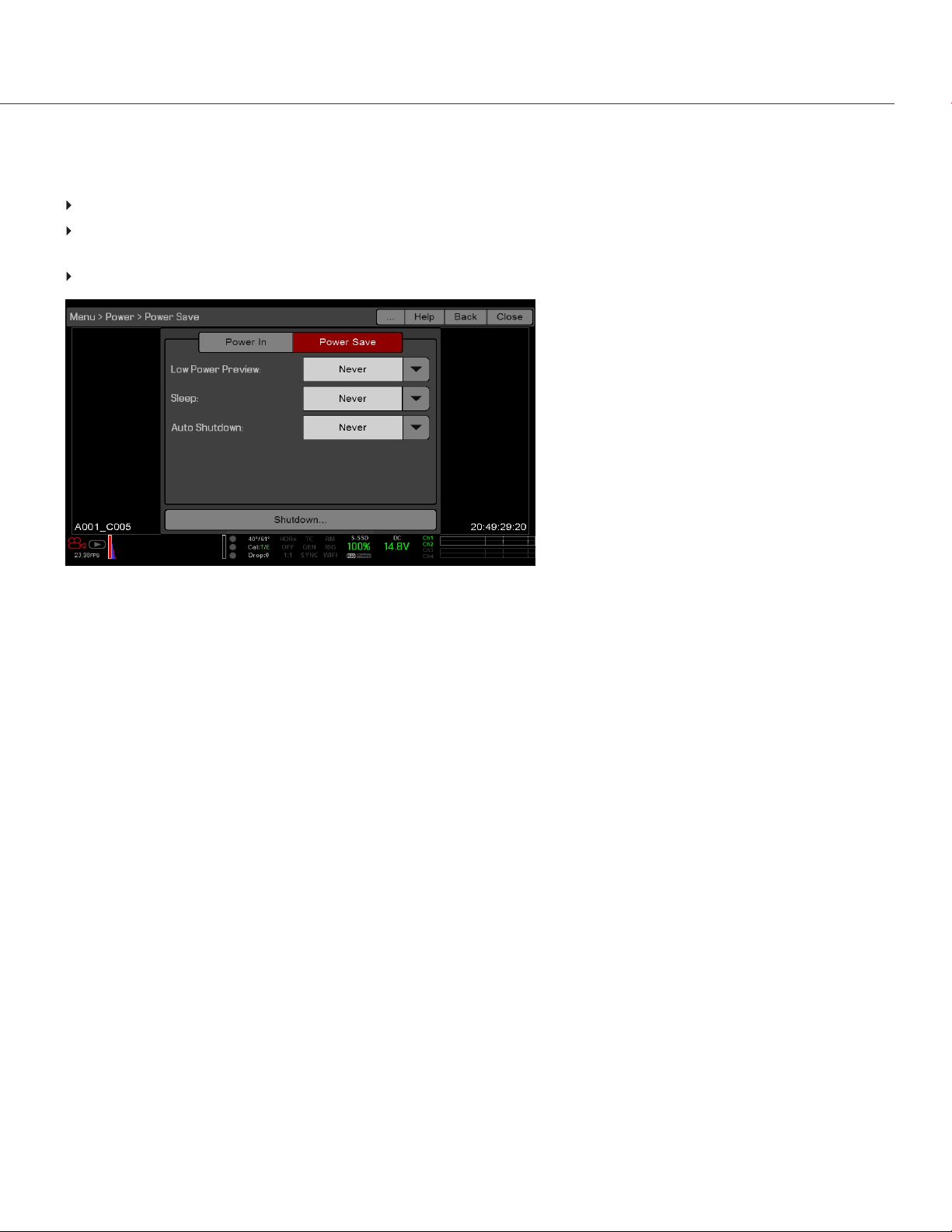
POWER SAVE
You can select the following power saving options (the default for each is Never):
Low Power Preview: The camera uses a lower amount of power after the specified period of inactivity.
Sleep: All monitors turn off and keys do not perform mapped actions after the specified period of inactivity. Tap the
touchscreen or press a key to exit Sleep mode.
Auto Shutdown: The camera turns off after the specified period of inactivity.
Figure: Power Save
SHUTDOWN
Shutdown controls are interlocked to prevent the camera from being accidentally turned off. For more information about
different ways to turn off your camera, go to
"Turn Off the Camera" on page 35.
1. Go to Menu > Power.
2. Select Shutdown.
The Shutting Down... message displays and the camera turns off.
COPYR IGH T © 2019 R ED.COM, LLC 955- 0184_V7.3, REV-A
| 84
RED RANGER MONSTRO OPERATION GUIDE

PLAYBACK
To view clips from the SSD:
Go to Menu > Playback.
Press the Record/Playback toggle in the lower left corner of the touchscreen.
NOTE: The camera uses RGB color space in Playback mode by default, regardless of settings in Record mode. To
playback clips in RAW mode, enable to RAW mode. For more information, go to "Tools" on page 74.
PLAYBACK MENUS
In Playback mode, the menu is pared-down, so you cannot access all menus. Some menus offer different options.
MEDIA
Includes the Playlist menu, which lists all available clips on the attached SSD. You can perform the following actions:
: Move selected clip to the Play List.
All : Move all clips to the Play List.
RECORD (EXIT)
Select
Record to exit Playback mode. You can also press any button mapped to Record to exit Playback mode.
PLAYBACK STATUS BAR
Displays the progress of the clip during playback. When using the touchscreen, swipe your finger right and left to fast-
forward and rewind the clip, respectively.
COPYR IGH T © 2019 R ED.COM, LLC 955- 0184_V7.3, REV-A | 85
RED RANGER MONSTRO OPERATION GUIDE
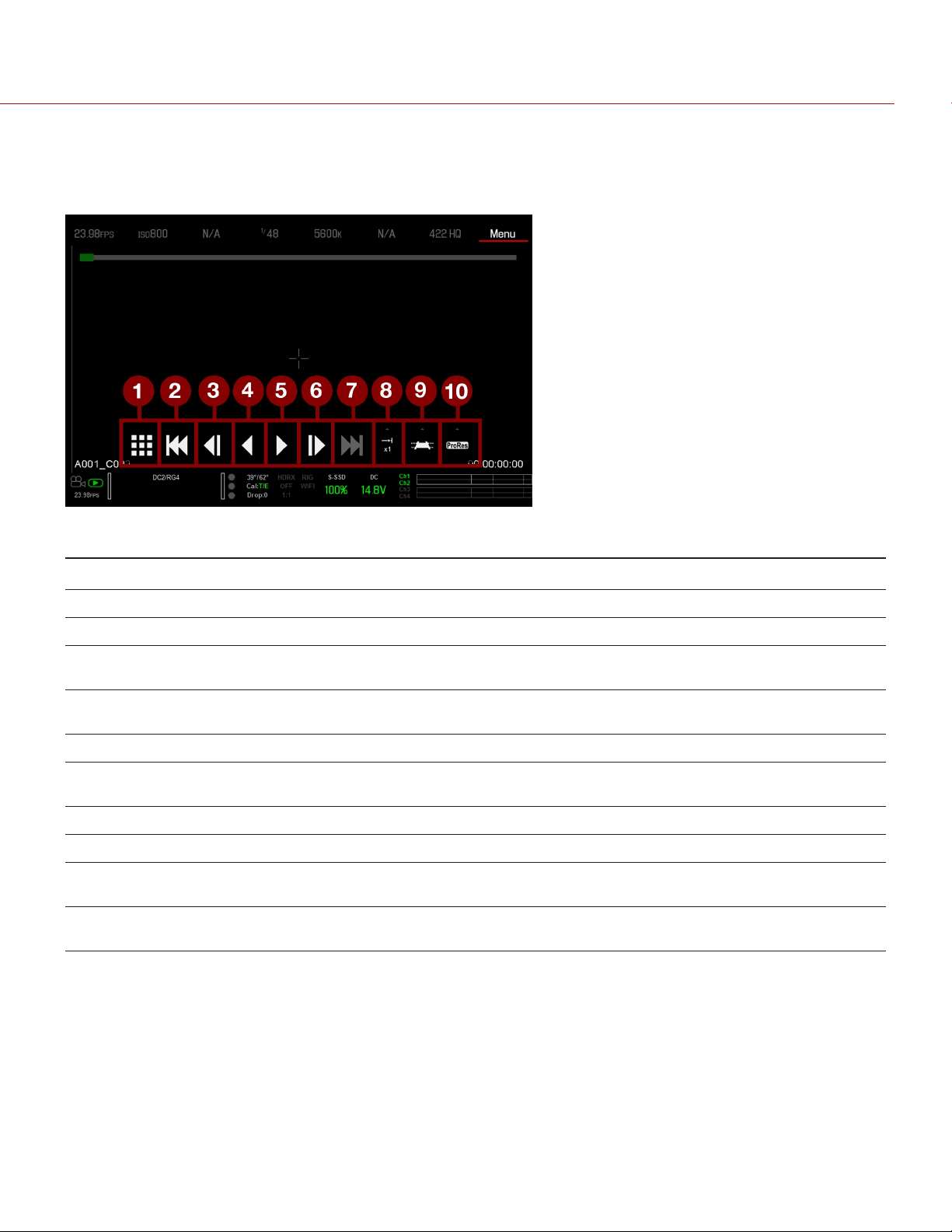
PLAYBACK CONTROLS
GENERAL PLAYBACK CONTROLS
Figure: Playback Controls
# CONTROL DESCRIPTION
1 Clips View clips as thumbnails
2 Load Previous Clip Loads the previous clip in the playlist.
3 Frame-by-Frame
Reverse
Moves through the clip frame-by-frame in reverse.
4 Reverse Play/Pause
toggle
Plays clip in reverse, and toggles between play and pause.
5 Play/Pause toggle Toggles between play and pause.
6 Frame-by-Frame
Forward
Moves through the clip frame-by-frame.
7 Load Next Clip Loads the next clip in the playlist.
8 Play Options Displays the following subset of options: Play Once, Loop, Loop Playlist, and Playback Speed.
9 Marker Options Displays the following subset of options: In Point, Remove In/Out Point, Out Point, Previous
Marker, and Next Marker.
10 Apple ProRes
Playback
Displays the following subset of options: R3D and ProRes
COPYR IGH T © 2019 R ED.COM, LLC 955- 0184_V7.3, REV-A | 86
RED RANGER MONSTRO OPERATION GUIDE
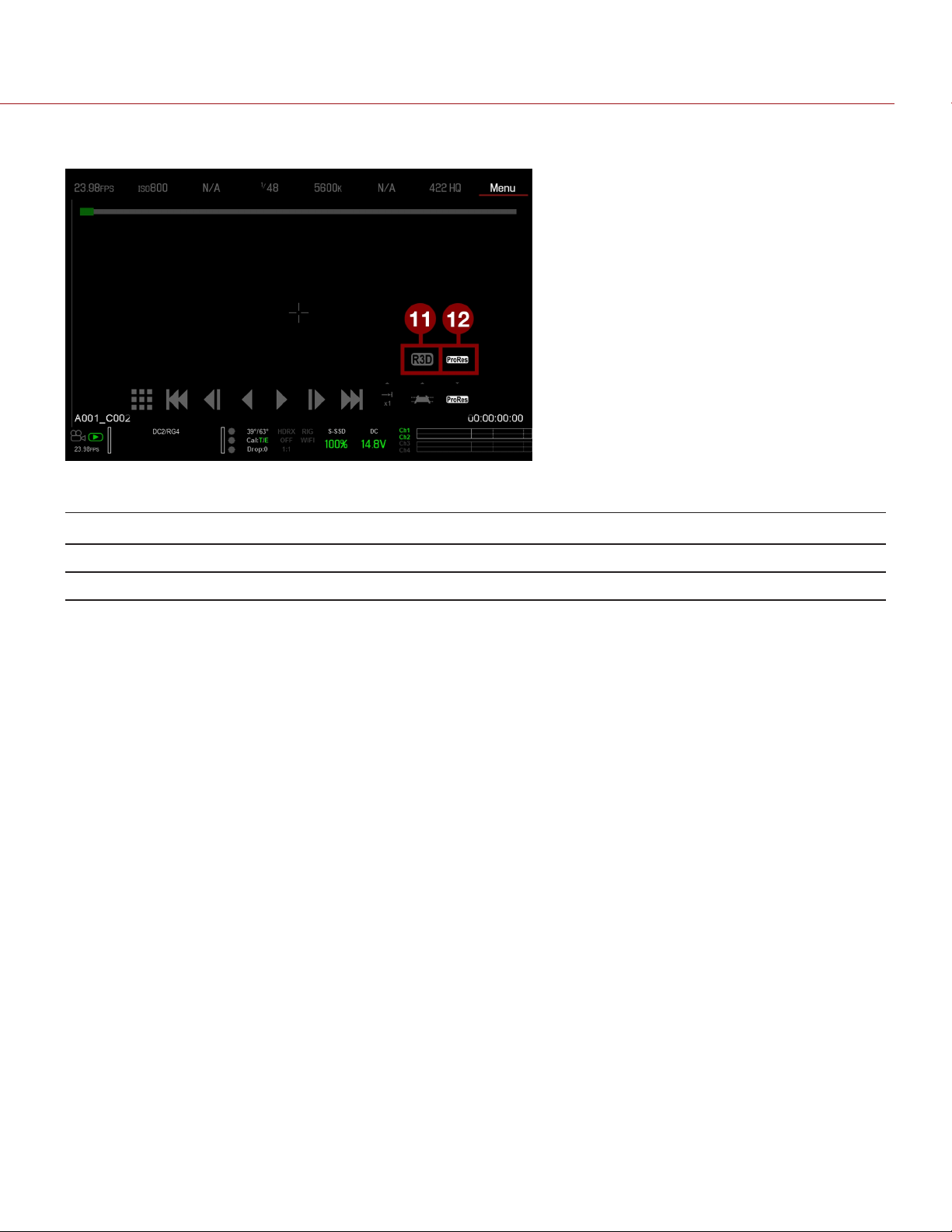
PLAYBACK FILE TYPE
Figure: Playback Controls
# CONTROL DESCRIPTION
11 R3D Playback Plays the R3D clip.
12 ProRes Plays the Apple ProRes clip.
COPYR IGH T © 2019 R ED.COM, LLC 955- 0184_V7.3, REV-A | 87
RED RANGER MONSTRO OPERATION GUIDE
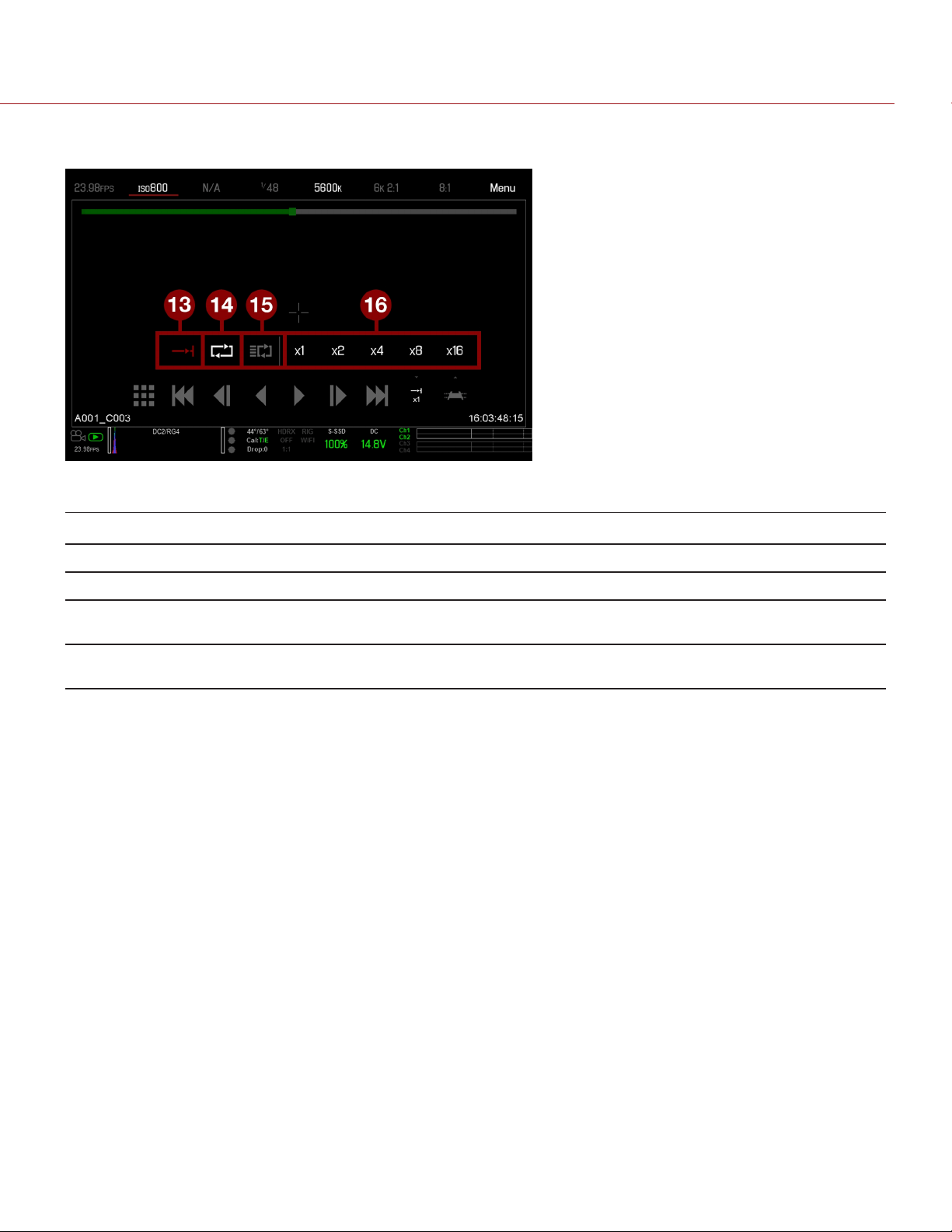
PLAYBACK SPEED AND LOOPING
Figure: Playback Controls
# CONTROL DESCRIPTION
13 Play Once Plays clip to the end, and does not repeat the clip.
14 Loop Plays the clip on a loop.
15 Loop Playlist Loops all clips in the playlist. To create a playlist, go to
Menu > Media > Playlist, and move clips to the
Play List field.
16 Playback
Speed
Option to select x1, x2, x4, x8, or x16 playback speed.
COPYR IGH T © 2019 R ED.COM, LLC 955- 0184_V7.3, REV-A | 88
RED RANGER MONSTRO OPERATION GUIDE
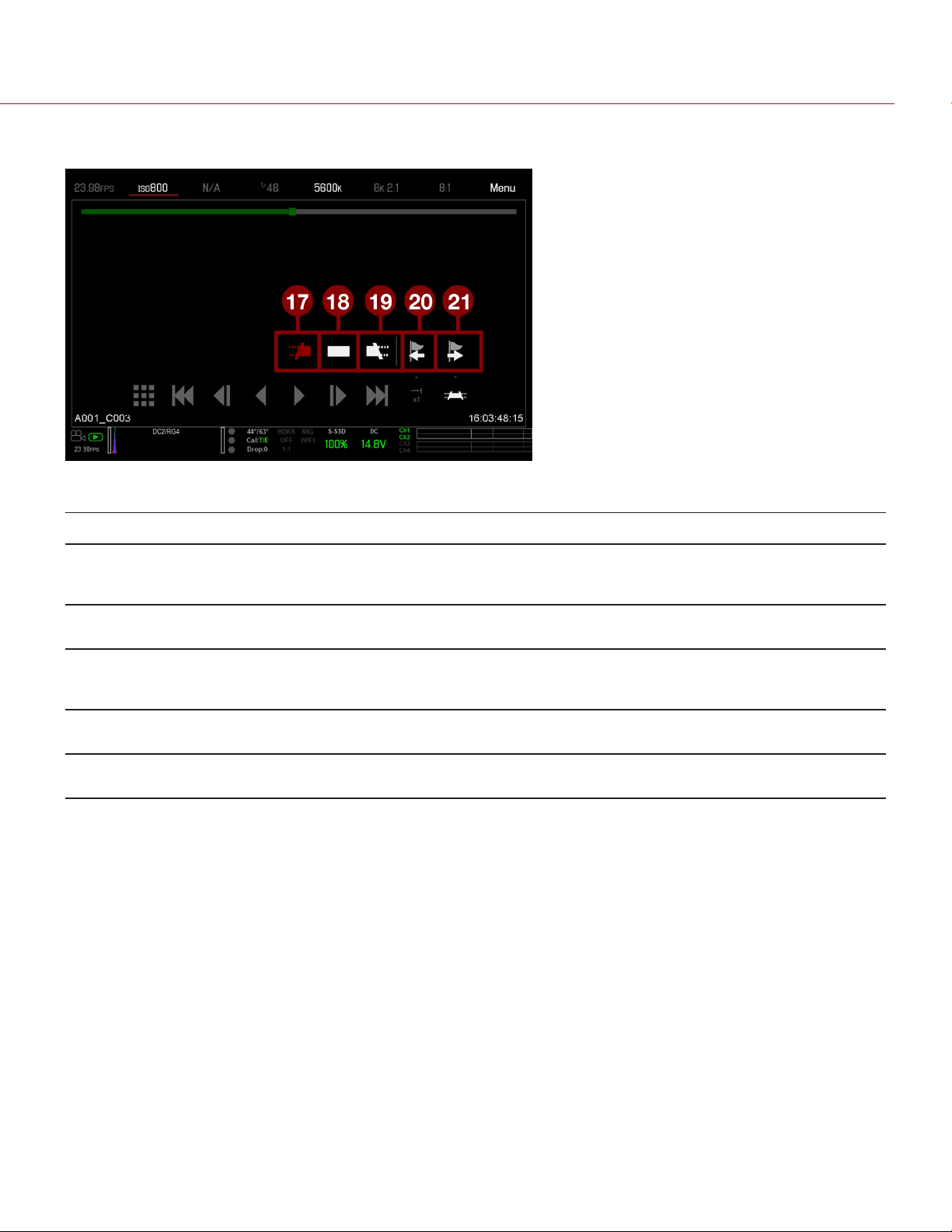
PLAYBACK MARKERS
Figure: Playback Controls
# CONTROL DESCRIPTION
17 In Point Sets a red In Point marker in the Playback Status Bar. Use an In Point marker in conjunction with an Out
Point marker to play only a certain portion of a clip. The In/Out Point markers help when the clip is long
and you want to focus on a particular segment.
18 Remove
In/Out Point
Removes the In/Out Point markers and skips to the end of the clip.
19 Out Point Sets a red Out Point marker in the Playback Status Bar. Use an Out Point marker in conjunction with an In
Point marker to play only a certain portion of a clip. The In/Out Point markers help when the clip is long
and you want to focus on a particular segment.
20 Previous
Marker
Goes to the previous marked frame, which displays as a red line in the Playback Status Bar. Disabled
when there are no marked frames.
21 Next Marker Goes to the next marked frame, which displays as a red line in the Playback Status Bar. Disabled when
there are no marked frames.
COPYR IGH T © 2019 R ED.COM, LLC 955- 0184_V7.3, REV-A | 89
RED RANGER MONSTRO OPERATION GUIDE
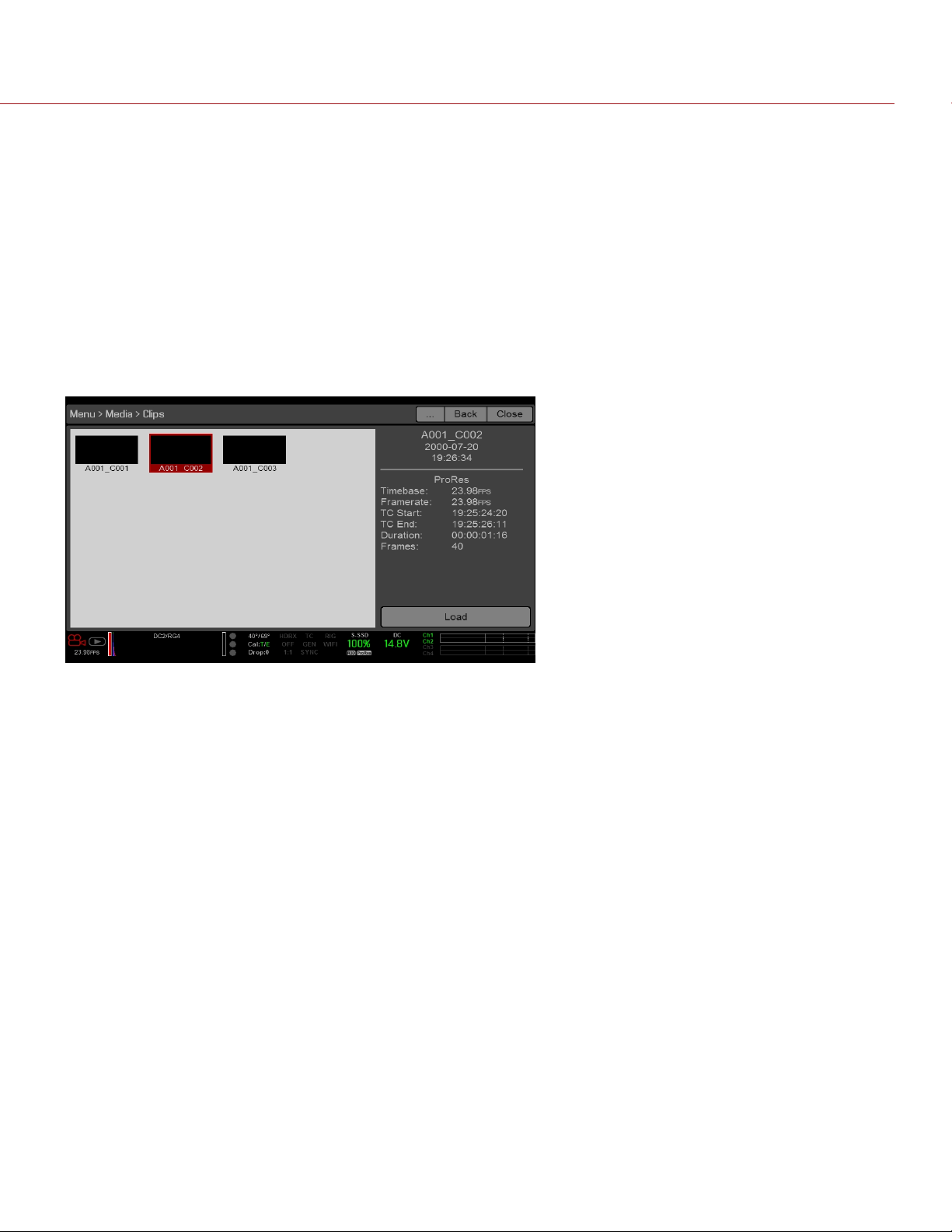
MEDIA MENU
The Media Menu allows you to format and eject an SSD and to view and load clips on the SSD.
For more information about using media, see the
DSMC Media Operation Guide, available at www.red.com/downloads.
DEVICE
Format and eject (unmount) the SSD.
To see information about the SSD in the camera, select
More Info....
CLIPS
View and load clips on the SSD in thumbnail view.
Figure: Clips Menu
COPYR IGH T © 2019 R ED.COM, LLC 955- 0184_V7.3, REV-A | 90
RED RANGER MONSTRO OPERATION GUIDE
PRESETS MENU
The camera has the following presets:
Camera Presets: These store and recall camera setup information, such as in-camera Looks, key mappings, I/O
configurations, and more. The camera has a number of factory-installed presets.
Looks: These allow you to save the specific color, image, white balance, and detail settings to be used for other
projects. Looks that are generated in-camera display on the Camera Presets tab. Looks that are generated in
REDCINE-X PRO and are imported to the camera display on the Looks tab.
Auto Presets: These allow you to specify pre-selected presets for Startup, Preview, Motion, Stills, and Playback.
You can create custom presets and Looks. Presets and Looks can be stored on the camera or transferred to SSD, so
that you can build a library of presets and Looks, or quickly copy presets and Looks from one camera to another via
SSD.
Camera: Presets or Looks that are saved internally on the camera.
Media: Presets or Looks that are on the SSD in the path shown (for example, On Media: \presets:).
CAMERA PRESETS
NOTE: You cannot update, delete, or export factory-installed presets, which end with "(RED)".
PRESETS ACTIONS
Apply: Apply the selected preset.
Create...: Create a new preset using the current settings.
Update...: Update the selected preset by allowing the parameter set to be modified and all the values to be updated
to their current in-camera values.
Clone...: Create a new preset using the selected preset as a template.
Delete: Delete the selected preset.
EXPORT AND IMPORT PRESETS
Presets can be stored on the camera or transferred to SSD to be shared with other cameras. When exporting presets
from camera to an SSD, the presets are saved to a folder on the SSD called “Presets”. When importing presets from an
SSD to camera, the presets must be stored on the SSD in a folder called “Presets”.
: Export selected preset from camera to SSD.
All: Export all presets from camera to SSD.
: Import selected preset from SSD to camera.
All: Import all presets from SSD to camera.
COPYR IGH T © 2019 R ED.COM, LLC 955- 0184_V7.3, REV-A
| 91
RED RANGER MONSTRO OPERATION GUIDE
CREATE PRESETS
1. Set up the camera how you want the preset to be configured. For example, if you want to create a preset specifically
for your zebra indicators, first configure the zebras the exact way that you want them to be in the preset.
2. Go to
Menu > Presets > Camera Presets.
3. Select Create, or select an existing preset and select Clone or Update.
4. If creating a new preset, enter a name for the preset and select OK.
5. Select the following tabs to display different sets of preset options: Display, Key, Look, Project, and System.
6. Select the following:
: Add selected setting to the preset.
All: Add all settings to the preset.
X: Remove selected setting from the preset.
7. Select Create.
The preset is saved and stored in the camera.
LOOKS
A Look is made up of the following settings: Color, Gain, FLUT, Sharpness, Curves, Color Space, Gamma, Color
Temperature, and LGG (Lift, Gamma, Gain). These settings are configured either in-camera or in REDCINE-X PRO
®
.
CREATE AND MANAGE IN-CAMERA LOOKS
Create in-camera looks in the
Menu > Presets > Camera Presets tab. Modify and manage the in-camera Looks the
same way as any other presets created in the Camera Presets tab. For more information, go to "Camera Presets" on the
previous page.
IMPORT LOOKS FROM REDCINE-X PRO
1. While your SSD is mounted to your computer, create a folder on the SSD called
Looks.
2. Save your RMD files (that have been exported from REDCINE-X PRO) to the Looks folder on the SSD.
3. Eject the SSD from your computer.
4. Mount the SSD to your camera.
5. Go to Presets > Looks.
6. Select one (1) of the following:
: Import selected Look from SSD to camera.
All: Import all Looks from SSD to camera.
For more information, see the REDCINE- X PRO: Saving Looks to Camera video tutorial , available at
www.red.com/learn/workflow/redcine-x-saving-looks-camera.
COPYR IGH T © 2019 R ED.COM, LLC 955- 0184_V7.3, REV-A
| 92
RED RANGER MONSTRO OPERATION GUIDE
MANAGE IMPORTED LOOKS
Manage Looks imported from REDCINE-X PRO in the
Presets > Looks tab. When exporting Looks from camera to
SSD, the Looks are saved to a folder on the SSD called “Looks”.
You can perform the following actions with imported Looks:
: Export selected Looks from camera to SSD.
All: Export all Looks from camera to SSD.
Apply: Apply the selected Look.
Delete: Delete the selected Look.
AUTO PRESETS
Startup: The selected preset is applied every time the camera is turned on.
Motion: The selected preset is applied every time Motion mode is enabled.
Stills: The selected preset is applied every time Stills mode is enabled.
Playback: The selected preset is applied every time the camera enters Playback mode.
COPYR IGH T © 2019 R ED.COM, LLC 955- 0184_V7.3, REV-A
| 93
RED RANGER MONSTRO OPERATION GUIDE
SETTINGS MENU
PROJECT
The Project menu includes settings that define the recorded file, including recording frame rate, exposure, and format.
FRAME RATE
RECORDING FRAME RATE
Select the recording frame rate (also referred to as the capture frame rate). The recording frame rate is the number of
frames per second (fps) that are recorded. The recording frame rate is different from the project time base, which is the
rate at which the footage will be played back.
The default recording frame rate is 23.98 fps. If you change the project time base, the recording frame rate automatically
changes its value to match the project time base.
The maximum frame rate for each format is determined by several factors, including project time base, REDCODE, and
Look Around.
PROJECT TIME BASE
Select the project time base. The project time base is the rate at which the footage will be played back. The project time
base displays in the lower left corner of the display.
The following project time bases are available:
23.98 fps (Default)
24.00 fps
25.00 fps
29.97 fps
30.00 fps
47.95 fps
48.00 fps
50.00 fps
59.94 fps
60.00 fps
VARISPEED
When a recording frame rate other than the current project time base is selected, the fps text turns yellow and the word
Varispeed replaces the Audio Meter in the lower right corner of the display.
Starting with firmware v6.4, the camera supports recording audio in Varispeed mode. For more information, go to
"Record
Audio in Varispeed Mode" on page 144.
COPYR IGH T © 2019 R ED.COM, LLC 955- 0184_V7.3, REV-A
| 94
RED RANGER MONSTRO OPERATION GUIDE

EXPOSURE/SHUTTER
Select the exposure (shutter speed / shutter angle) of each frame. You can change exposure while recording.
Decreasing shutter speed increases the amount of time that light hits the sensor, which increases exposure and motion
blur of moving objects. Increasing shutter speed decreases the amount of time that light hits the sensor, which
decreases exposure and motion blur of moving objects.
The Upper Status Row displays the exposure as either shutter speed or shutter angle. For more information, go to
"Exposure" on page 79.
If the camera is able to achieve the target exposure, the exposure value displays in white. If the camera is unable to
achieve the target exposure, the exposure value displays in yellow, and the camera uses the closest available exposure.
NOTE: If using speed ramp mode, select an exposure that is valid for each ramp target frame rate. If the camera ramps
to a frame rate that is incompatible with the current exposure, the exposure changes to the longest exposure possible for
the frame rate. For more information, go to "Speed Ramp Mode" on page 104.
NOTE: You cannot change the exposure when HDR is enabled.
INTEGRATION TIME
Enter the exposure value as a shutter speed (1/xx sec).
The slowest shutter speed is 1/(recording frame rate). For example, if the recording frame rate is 24 fps, the slowest
available shutter speed is 1/24 sec. The fastest shutter speed is 1/131,579 sec. The default shutter speed is 1/48 sec.
SHUTTER ANGLE
Enter the exposure value as a shutter angle (xx°). The shutter angle range is 1.000° to 360.000°. The default shutter
angle is 180.000°.
EXPOSURE CONVERSIONS
The table below lists common shutter speed and shutter angle equivalents. The calculations in the table use a recording
frame rate of 24 fps.
SHUTTER SPEED (1/XX SEC) SHUTTER ANGLE (°) SHUTTER SPEED (1/XX SEC) SHUTTER ANGLE (°)
1/32 270 1/120 72
1/48 180 1/192 45
1/50 172.8 1/384 22.5
1/60 144 1/696 12.4
1/96 90 1/1000 8.6
CONVERT SHUTTER SPEED TO SHUTTER ANGLE
Shutter Angle = (Shutter Speed x Frame Rate x 360)
Example: (1/48 x 24 x 360) = 180
CONVERT SHUTTER ANGLE TO SHUTTER SPEED
Shutter Speed = 1/(Frame Rate x 360/Angle)
Example: 1/(24 x 360/180) = 1/48
COPYR IGH T © 2019 R ED.COM, LLC 955- 0184_V7.3, REV-A
| 95
RED RANGER MONSTRO OPERATION GUIDE
TIMECODE
RED cameras use non-drop frame timecode. For more information about timecode, go to
"Timecode, Genlock, Multi-
Camera Setup" on page 147.
TIMECODE DISPLAY MODE
Time of Day (TOD): Displays the time of day (HH:MM:SS:FF). TOD timecode runs continuously and is not affected
by recording.
Edge: Edge timecode is continuous between clips, meaning that when recording starts, timecode begins. and when
recording stops, timecode stops. By default, Edge timecode default begins at 01:00:00:00, but can be configured in
the Media menu when formatting an SSD.
TIMECODE SOURCE
RTC: Uses the internal Real Time Clock as the timecode counter source.
External: Uses the timecode from an external device connected to the timecode connector on the camera.
SLATE
Use the Slate menu to add metadata to clips. After configuring the following fields, the information populates in the Media
menu when formatting media:
Camera ID
Camera Position
NOTE: The scene name is limited to eight (8) characters.
AUTO-INCREMENT TAKE
To automatically increment the take number when the camera stops recording, follow the instructions below:
1. Go to
Menu > Settings > Project > Slate > Scene.
2. Enter a name in the Scene box.
3. Enter a value in the Take box.
AUTO SLATE
Frame values for
Auto Head Frames and Auto Tail Frames on the Auto Slate tab, these values only show in-camera.
The Auto Head Frames and Auto Tail Frames metadata values are currently disabled in REDCINE-X PRO.
COPYR IGH T © 2019 R ED.COM, LLC 955- 0184_V7.3, REV-A
| 96
RED RANGER MONSTRO OPERATION GUIDE

FORMAT
To access the Format menu, go to
Menu > Settings > Project > Format.
The available aspect ratios are determined by the selected resolution.
After selecting format settings, select Set Format.
When you lower the resolution on a camera, only a portion of the sensor is used. The camera does not downscale from
full format when recording RAW.
RED RANGER MONSTRO FORMATS
The table below describes the formats for RED RANGER MONSTRO.
The table below omits rows for the anamorphic formats, since the pixel dimensions for each anamorphic format and the
corresponding non-anamorphic format are the same. For more information, go to
"Anamorphic" on page 101.
Using a 6:5 aspect ratio at 2x anamorphic gives you a 2.4:1 aspect ratio.
RESOLUTION DIMENSION (PIXELS) DIMENSIONS (MM)
WIDTH HEIGHT WIDTH HEIGHT DIAGONAL
8K FF 8192 4320 41.0 21.6 46.3
8K 2:1 8192 4096 41.0 20.5 45.8
8K 2.4:1 (WS) 8192 3456 41.0 17.3 44.5
8K 16:9 (HD) 7680 4320 38.4 21.6 44.1
8K 14:9 6720 4320 33.6 21.6 39.9
8K 3:2 6480 4320 32.4 21.6 38.9
8K 6:5 5184 4320 25.9 21.6 33.7
8K 8:9 3840 4320 19.2 21.6 28.9
8K 4:1 8192 2048 41.0 10.2 42.2
8K 8:1 8192 1024 41.0 5.1 41.3
7.5K FF 7680 4080 38.4 20.4 43.5
7.5K 2:1 7680 3840 38.4 19.2 42.9
7.5K 2.4:1 (WS) 7680 3240 38.4 16.2 41.7
7.5K 16:9 (HD) 7296 4104 36.5 20.5 41.9
7.5K 4:1 7680 1920 38.4 9.6 39.6
7.5K 8:1 7680 960 38.4 4.8 38.7
7K FF 7168 3780 35.8 18.9 40.5
7K 2:1 7168 3584 35.8 17.9 40.1
7K 2.4:1 (WS) 7168 3024 35.8 15.1 38.9
7K 16:9 (HD) 6720 3780 33.6 18.9 38.6
7K 8:9 3360 3780 16.80 18.90 25.29
7K 6:5 4536 3780 22.7 18.9 29.5
COPYR IGH T © 2019 R ED.COM, LLC 955- 0184_V7.3, REV-A | 97
RED RANGER MONSTRO OPERATION GUIDE

RESOLUTION DIMENSION (PIXELS) DIMENSIONS (MM)
WIDTH HEIGHT WIDTH HEIGHT DIAGONAL
7K 4:1 7168 1792 35.8 9.0 36.9
7K 8:1 7168 896 35.8 4.5 36.1
6.5K FF 6656 3536 33.3 17.7 37.7
6.5K 2:1 6656 3328 33.3 16.6 37.2
6.5K 2.4:1 (WS) 6656 2808 33.3 14.0 36.1
6.5K 16:9 (HD) 6144 3456 30.7 17.3 35.2
6.5K 4:1 6656 1664 33.3 8.3 34.3
6.5K 8:1 6656 832 33.3 4.2 33.5
6K FF 6144 3240 30.7 16.2 34.7
6K 2:1 6144 3072 30.7 15.4 34.3
6K 2.4:1 (WS) 6144 2592 30.7 13.0 33.
6K 16:9 (HD) 5760 3240 28.8 16.2 33.0
6K 3:2 5760 3840 28.8 19.2 34.6
6K 4:3 5760 4320 28.8 21.6 36.0
6K 8:9 2880 3240 14.40 16.20 21.67
6K 6:5 3888 3240 19.4 16.2 25.3
6K 4:1 6144 1536 30.7 7.7 31.7
6K 8:1 6144 768 30.7 3.8 31.0
5.5K FF 5632 2948 28.2 14.7 31.8
5.5K 2:1 5632 2816 28.2 14.1 31.5
5.5K 2.4:1 (WS) 5632 2376 28.2 11.9 30.6
5.5K 16:9 (HD) 5376 3024 26.9 15.1 30.8
5.5K 4:1 5632 1408 28.2 7.0 29.0
5.5K 8:1 5632 704 28.2 3.5 28.4
5K FF 5120 2700 25.6 13.5 29.0
5K 2:1 5120 2560 25.6 12.8 28.6
5K 2.4:1 (WS) 5120 2160 25.6 10.8 27.8
5K 16:9 (HD) 4800 2700 24.0 13.5 27.5
5K 4:3 5120 3840 25.60 19.20 32.00
5K 8:9 2400 2700 12.00 13.50 18.06
5K 6:5 3240 2700 16.2 13.5 21.1
5K 4:1 5120 1280 25.6 6.4 26.4
5K 8:1 5120 640 25.6 3.2 25.8
COPYR IGH T © 2019 R ED.COM, LLC 955- 0184_V7.3, REV-A | 98
RED RANGER MONSTRO OPERATION GUIDE

RESOLUTION DIMENSION (PIXELS) DIMENSIONS (MM)
WIDTH HEIGHT WIDTH HEIGHT DIAGONAL
4.5K FF 4608 2412 23.0 12.1 26.0
4.5K 2:1 4608 2304 23.0 11.5 25.8
4.5K 2.4:1 (WS) 4608 1944 23.0 9.7 25.0
4.5K 16:9 (HD) 4224 2376 21.1 11.9 24.2
4.5K 3:2 4320 2880 21.6 14.4 26.0
4.5K 4:3 4320 3240 21.6 16.2 27.0
4.5K 5:4 4320 3456 21.6 17.3 27.7
4.5K 4:1 4608 1152 23.0 5.8 23.7
4.5K 8:1 4608 576 23.0 2.9 23.2
4K FF 4096 2160 20.5 10.8 23.2
4K 2:1 4096 2048 20.5 10.2 22.9
4K 2.4:1 (WS) 4096 1728 20.5 8.6 22.2
4K 16:9 (HD) 3840 2160 19.2 10.8 22.0
4K 3:2 3840 2560 19.2 12.8 23.1
4K 4:3 3840 2880 19.2 14.4 24.0
4K 5:4 3840 3072 19.2 15.4 24.6
4K 8:9 1920 2160 9.60 10.80 14.45
4K 6:5 2592 2160 13.0 10.8 16.9
4K 4:1 4096 1024 20.5 5.1 21.1
4K 8:1 4096 512 20.5 2.6 20.6
4K 1:1 4320 4320 21.6 21.6 30.5
3.5K FF 3584 1876 17.9 9.4 20.2
3.5K 2:1 3584 1792 17.9 9.0 20.0
3.5K 2.4:1 (WS) 3584 1512 17.9 7.6 19.4
3.5K 16:9 (HD) 3456 1944 17.3 9.7 19.8
3.5K 3:2 3360 2240 16.8 11.2 20.2
3.5K 4:3 3360 2520 16.8 12.6 21.0
3.5K 5:4 3360 2688 16.8 13.4 21.5
3.5K 4:1 3584 896 17.9 4.5 18.5
3.5K 8:1 3584 448 17.9 2.2 18.1
3K FF 3072 1620 15.4 8.1 17.4
3K 2:1 3072 1536 15.4 7.7 17.2
3K 2.4:1 (WS) 3072 1296 15.4 6.5 16.7
COPYR IGH T © 2019 R ED.COM, LLC 955- 0184_V7.3, REV-A | 99
RED RANGER MONSTRO OPERATION GUIDE

RESOLUTION DIMENSION (PIXELS) DIMENSIONS (MM)
WIDTH HEIGHT WIDTH HEIGHT DIAGONAL
3K 16:9 (HD) 2880 1620 14.4 8.1 16.5
3K 3:2 2880 1920 14.4 9.6 17.3
3K 4:3 2880 2160 14.4 10.8 18.0
3K 5:4 2880 2304 14.4 11.5 18.4
3K 6:5 1944 1620 9.7 8.1 12.7
3K 4:1 3072 768 15.4 3.8 15.8
3K 8:1 3072 384 15.4 1.9 15.5
2.5K FF 2560 1340 12.8 6.7 14.4
2.5K 2:1 2560 1280 12.8 6.4 14.3
2.5K 2.4:1 (WS) 2560 1080 12.8 5.4 13.9
2.5K 16:9 (HD) 2304 1296 11.5 6.5 13.2
2.5K 3:2 2400 1600 12.0 8.0 14.4
2.5K 4:3 2400 1800 12.0 9.0 15.0
2.5K 5:4 2400 1920 12.0 9.6 15.4
2.5K 4:1 2560 640 12.8 3.2 13.2
2.5K 8:1 2560 320 12.8 1.6 12.9
2K FF 2048 1080 10.2 5.4 11.6
2K 2:1 2048 1024 10.2 5.1 11.4
2K 2.4:1 (WS) 2048 864 10.2 4.3 11.1
2K 16:9 (HD) 1920 1080 9.6 5.4 11.0
2K 3:2 1920 1280 9.6 6.4 11.5
2K 4:3 1920 1440 9.6 7.2 12.0
2K 5:4 1920 1536 9.6 7.7 12.3
2K 6:5 1296 1080 6.5 5.4 8.4
2K 4:1 2048 512 10.2 2.6 10.6
2K 8:1 2048 256 10.2 1.3 10.3
COPYR IGH T © 2019 R ED.COM, LLC 955- 0184_V7.3, REV-A | 100
RED RANGER MONSTRO OPERATION GUIDE

ANAMORPHIC
Select an
Anamorphic setting, if applicable. The anamorphic setting de-squeezes the image on the monitor and marks
the footage as anamorphic in the clip metadata. When you open the clip in REDCINE-X PRO, the program automatically
de-squeezes the image. The available anamorphic settings depend on your camera type.
The camera supports anamorphic 1.3x and 2x with each format.
The camera also supports anamorphic 1.25x for 6K full format and 8K full format.
DE-SQUEEZED RESOLUTION AND DE-SQUEEZED ASPECT RATIO
When you enable anamorphic, both the actual format and the de-squeezed format display at the bottom of the Format
menu. To view the actual format and the de-squeezed format, go to
Menu > Settings > Project > Format > Format.
When anamorphic is enabled, the camera does not crop the sensor image, so the recorded image has the same
resolution and dimensions as the corresponding non-anamorphic format.
After de-squeezing the footage in post production, the resulting footage has a different format than the original recorded
image. The format of the de-squeezed footage is the second format (resolution and aspect ratio) that displays on the
Format menu.
Since the camera does not crop the image, you will have additional horizontal area to frame the image. Then, crop or
scale the footage to the intended aspect ratio.
SHORT-CUT TO INDUSTRY-STANDARD ANAMORPHIC FORMATS
To quickly access industry-standard anamorphic formats, go to
Menu > Settings > Project > Format > Anamorphic.
The Anamorphic tab is a short-cut to all of the industry-standard anamorphic formats, so that you can easily select the
most common anamorphic formats.
The Anamorphic tab lists the anamorphic formats for every format with a 6:5, 5:4, or 4:3 aspect ratio.
NOTE: The Anamorphic tab only lists industry-standard anamorphic formats. To access all of the anamorphic and non-
anamorphic formats, go to Menu > Settings > Project > Format > Format.
COPYR IGH T © 2019 R ED.COM, LLC 955- 0184_V7.3, REV-A
| 101
RED RANGER MONSTRO OPERATION GUIDE
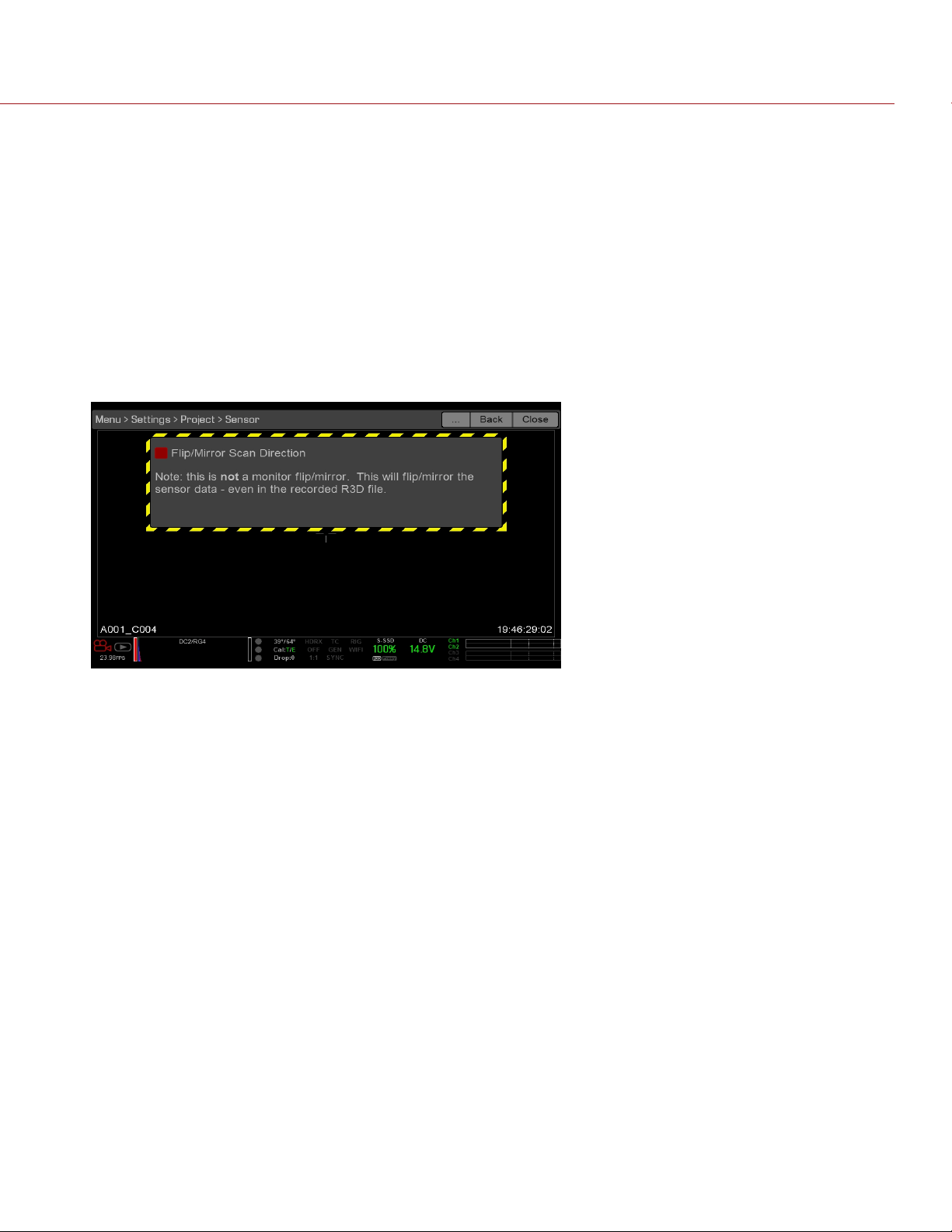
SENSOR (FLIP/MIRROR SCAN DIRECTION)
The Flip/Mirror Scan Direction feature rotates the image 180°, both on the monitor and in the recorded R3D file. Normally,
the sensor scans the image from the top to the bottom. When the Flip/Mirror Scan Direction feature is enabled, the
sensor scan direction reverses, and the sensor scans the image from the bottom to the top.
The Flip/Mirror Scan Direction feature is intended for multi-camera arrays when all sensors are synchronized, and at least
one (1) camera is mounted upside-down. Using this feature is helpful for matching the line scan direction for the cameras
in the array.
To enable the Flip/Mirror Scan Direction feature, follow the instructions below:
1. Go to
Menu > Settings > Project > Sensor.
2. Select the Flip/Mirror Scan Direction check box.
The camera rotates the image 180° on the monitor and in the recorded R3D file.
Figure: Flip/Mirror Scan Direction
COPYR IGH T © 2019 R ED.COM, LLC 955- 0184_V7.3, REV-A | 102
RED RANGER MONSTRO OPERATION GUIDE

RECORDING
The Recording menu includes: Mode, Codec, Frame Processing, Pre-Record, and Indicator.
MODE
You can select the following recording modes: Continuous Record, Internal Timelapse Timer, Frame Trigger, REDCODE
Burst, Speed Ramp Mode, Multi-Shot, and Motion + Stills.
NOTE: Audio is recorded only in Continuous Record and Motion + Stills modes.
STORAGE
You can select the following storage locations:
Local: Stores footage directly to an SSD
Network: Stores footage to a network
External: Stores footage to an external device
NOTE: HDRX is disabled in Network Storage mode.
NOTE: In External storage, you can only select Continuous Record and Motion + Stills recording modes.
CONTINUOUS RECORD
NOTE: This mode is not available in Stills mode.
Continuous Record is the “normal” recording mode. The camera continuously records frames at the current recording
frame rate. You can limit each recording to a specific amount of frames using the Limit Recording to setting.
INTERNAL TIMELAPSE TIMER
NOTE: This mode is not available in Stills mode.
NOTE: Audio is not recorded in Internal Timelapse Timer mode.
In Internal Timelapse Timer mode, the camera records a specified number of frames at a specified interval. The current
recording frame rate determines the timing of the frames per pulse.
For example, in Internal Timelapse Timer mode, you can choose to record a total amount of 1000 frames, and take 1
frame every 4.67 seconds. After recording 1000 frames (which takes 4,670.00 seconds), the recording process stops.
To use Internal Timelapse Timer mode, follow the instructions below:
1. Go to Menu > Settings > Recording > Mode.
2. Select Internal Timelapse Timer from the Mode drop-down menu.
3. Use the Limit Recording to fields to set the recording to end at a predefined frame limit (optional).
4. Select the number of frames to be captured in the Record field.
5. Select the time interval from the Interval field (range is 1–3,599 sec). The Interval setting specifies the frequency at
which the frame or group of frames is captured.
6. Close the menu.
7. Start recording to start the interval.
The overlay displays the number of frames recorded out of the total amount of frames.
COPYR IGH T © 2019 R ED.COM, LLC 955- 0184_V7.3, REV-A
| 103
RED RANGER MONSTRO OPERATION GUIDE
FRAME TRIGGER
NOTE: This mode is not available in Stills mode.
NOTE: Audio is not recorded in Frame Trigger mode.
In Frame Trigger mode, the camera records the specified number of frames for each external trigger. This mode limits the
REDCODE based on sustainable record rates.
To use Frame Trigger mode, follow the instructions below:
1. Go to Menu > Settings > Recording > Mode.
2. Select Frame Trigger from the Mode drop-down menu.
3. Use the Limit Recording to fields to set the recording to end at a predefined frame limit (optional).
4. Select a Pre Count and Post Count. For more information, go to "Pre Count and Post Count" on the next page.
5. Close the menu.
6. Start recording.
The overlay displays the number of frames recorded out of the total amount of frames.
SPEED RAMP MODE
NOTE: This mode is not available in Stills mode.
NOTE: Audio is not recorded in Speed Ramp mode.
Speed Ramp mode lets you program the current recording frame rate to transition to different recording frame rates during
recording.
1. Go to Menu > Settings > Recording > Mode.
2. Select Speed Ramp Mode from the Mode drop-down menu.
3. Use the Limit Recording to fields to set the recording to end at a predefined frame limit (optional).
4. Select a ramp target:
Ramp A/B/C/D: Each ramp target is tied to a specific Target/Duration combination.
Ramp Reset: Ramp to the starting frame rate with the specified Duration.
5. Set the Target frame rate.
6. Set the Duration, which is how long it takes to transition from the current frame rate to the target frame rate.
7. Go to Menu > Settings > Setup > Keys and program a key to one of the following functions:
Record: Start Speed Ramp A/B/C/D
Record: Start Speed Ramp Reset
8. Start recording.
9. To start speed ramp, press the key that you have mapped to start the speed ramp.
The frame rate transitions to the target frame rate during the duration you set up.
NOTE: If using speed ramp mode, select an exposure that is valid for each ramp target frame rate. If the camera
ramps to a frame rate that is incompatible with the current exposure, the exposure changes to the longest exposure
possible for the frame rate.
COPYR IGH T © 2019 R ED.COM, LLC 955- 0184_V7.3, REV-A
| 104
RED RANGER MONSTRO OPERATION GUIDE
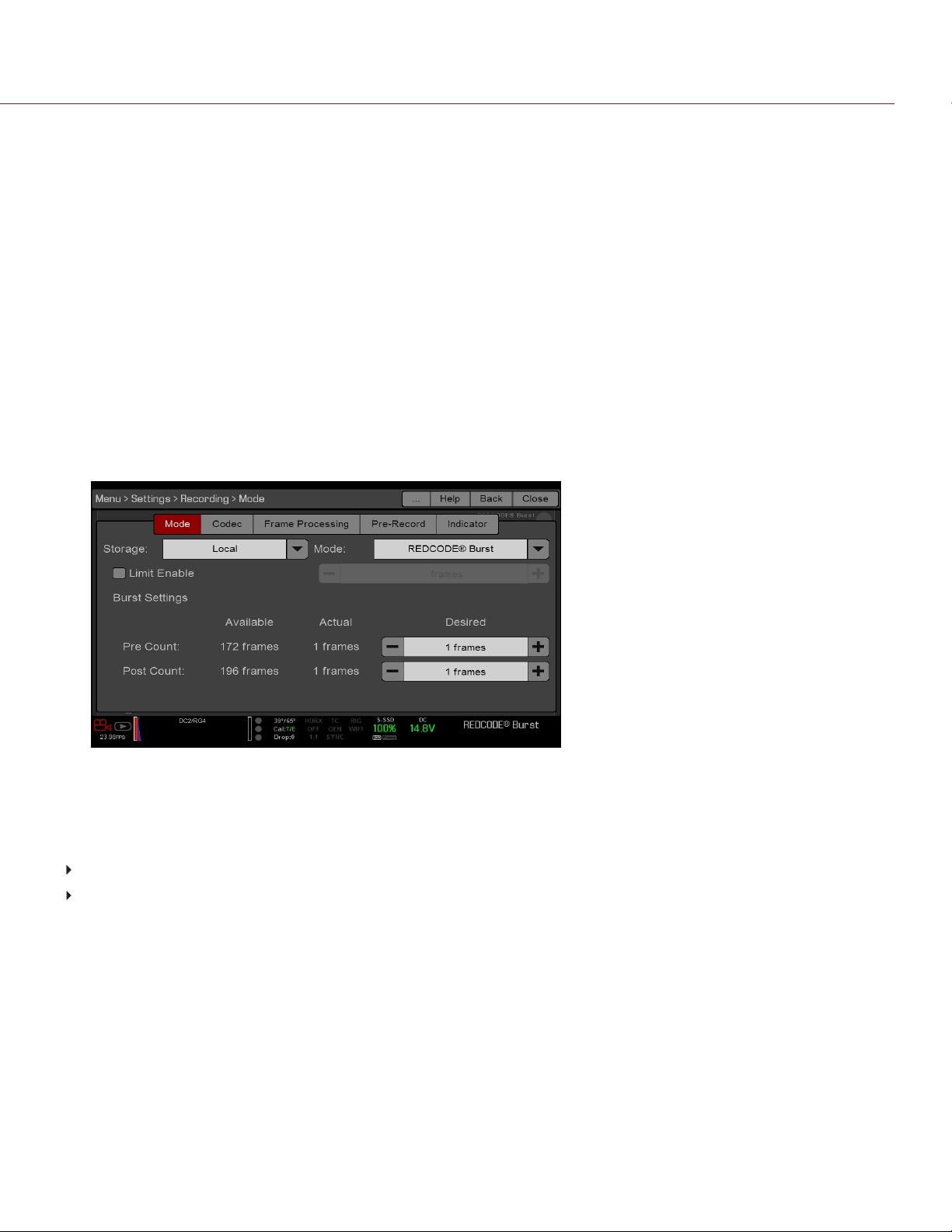
REDCODE BURST
NOTE: This mode is not available in Stills mode.
NOTE: Audio is not recorded in REDCODE Burst mode.
In REDCODE Burst mode, the camera can record at a lower compression (REDCODE) for the specified amount of
frames. When REDCODE Burst mode is enabled and recording starts, the camera captures a “burst” of frames at the
lower REDCODE, and then continues to record at the next available REDCODE. To add more bursts to clips during
recording, press any key mapped to “Record: Mark Frame”.
To use REDCODE Burst mode, follow the instructions below:
1. Go to Menu > Settings > Recording > Mode.
2. Select REDCODE Burst from the Mode drop-down menu.
3. Use the Limit Recording to fields to set the recording to end at a predefined frame limit (optional).
4. Select a Pre Count and Post Count. For more information, go to "Pre Count and Post Count" below.
5. Close the menu.
6. Start recording.
Figure: REDCODE Burst
PRE COUNT AND POST COUNT
When Frame Trigger or Burst mode is enabled, select the number of frames for the Pre Count and Post Count:
Pre Count: The camera captures the frame cache from the time preceding the marker.
Post Count: The camera captures the remaining frame cache after the marker.
The maximum frame counts are listed in the Available column, and are based on format and REDCODE.
COPYR IGH T © 2019 R ED.COM, LLC 955- 0184_V7.3, REV-A
| 105
RED RANGER MONSTRO OPERATION GUIDE

MULTI-SHOT
NOTE: The camera does not sync timecode in Multi-Shot mode.
NOTE: This mode is available in Motion mode, but is only recommended in Stills mode.
NOTE: Audio is not recorded in Multi-Shot mode.
Multi-Shot mode removes restrictions on Recording Frame Rate and REDCODE, allowing you to shoot at a high
resolution, high frame rate, and low compression. These restrictions are removed because the camera records first to the
camera’s memory, and then offloads (while recording) to SSD after the camera’s buffer fills up. Since the camera records
only as fast as the buffer can transfer data, frames are dropped from the clip.
Multi-Shot mode has two sub-modes:
Basic Multi-Shot mode
Advanced Multi-Shot mode
BASIC MULTI-SHOT MODE
In Basic Multi-Shot mode, you can record a one-frame clip by pressing a Record key, or you can continuously record
frames by holding a Record key. This mode is the easiest way to shoot stills, but there is some latency (about 700
milliseconds) when you press Record.
This mode only involves the Record key on the media bay.
Pressing the PWR/REC key on the camera initiates Advanced Multi-Shot mode.
To use Basic Multi-Shot mode, perform one of the following:
Press a Record key to record a one-frame clip.
Press and hold a Record key to start a new clip and continuously add frames to that clip. Release the Record key to
stop adding frames and end the clip.
ADVANCED MULTI-SHOT MODE
In this mode, the camera is continuously recording, but is not saving frames. This eliminates the delay you get in Basic
Multi-Shot mode. Since the camera is continuously recording, the camera requires the same amount of power it does
during Continuous Record (as opposed to Preview mode). Unlike Basic mode, all frames are added to one (1) clip,
instead of to separate clips.
To use Advanced Multi-Shot mode, follow the instructions below:
1. Press the PWR/REC key on the camera to start a new clip. This initial press adds one (1) frame to the clip.
2. Press the Record key on the media bay to add frames to the clip:
Press a Record key once to add a few frames to the clip. (The number of frames varies, and depends on the
buffer.)
Press and hold a Record key to continuously add frames; release the Record key to stop adding frames.
3. Press the PWR/REC key on the camera to end the clip.
NOTE: You cannot shut down the camera until you end the clip.
COPYR IGH T © 2019 R ED.COM, LLC 955- 0184_V7.3, REV-A
| 106
RED RANGER MONSTRO OPERATION GUIDE

ENABLE MULTI-SHOT MODE
To enable Multi-Shot mode, follow the instructions below:
1. Set the camera to Stills mode. For more information, go to "Camera Mode" on page 50.
2. Go to Menu > Settings > Recording > Mode.
3. Select Multi-Shot from the Mode drop-down menu.
4. Use the Limit Recording to fields to set the recording to end at a predefined frame limit (optional).
5. Close the menu.
MOTION + STILLS
NOTE: This mode is available in Motion mode, but is only recommended in Stills mode.
Motion + Stills mode is identical to Continuous Record, except that when you initiate recording by pressing the
PWR/REC key on the camera, all other Record keys mark frames for the duration of the clip. (If you initiate recording by
pressing any other Record key, you can press any key mapped to “Record: Mark Frame” to mark stills.)
To use Motion + Stills mode, follow the instructions below:
1. Set the camera to Stills mode. For more information, go to "Camera Mode" on page 50.
2. Go to Menu > Settings > Recording > Mode.
3. Select Motion + Stills from the Mode drop-down menu.
4. Use the Limit Recording to fields to set the recording to end at a predefined frame limit (optional).
5. Close the menu.
6. Press the PWR/REC key on the camera to start recording.
7. Press the Record key on the media bay to mark a frame.
8. Press the PWR/REC key on the camera to stop recording.
COPYR IGH T © 2019 R ED.COM, LLC 955- 0184_V7.3, REV-A
| 107
RED RANGER MONSTRO OPERATION GUIDE

APPLE PRORES INFORMATION
By default, the camera records all videos and stills in the REDCODE RAW file format (records R3D files). You also
have the option to record Apple ProRes files. This section provides general information about recording Apple ProRes
files with the camera:
NOTE: If Look Around is enabled, the Look Around area is recorded in the Apple ProRes file.
Selecting a Recording Frame Rate that is not supported by Apple ProRes has the following effects:
2K Apple ProRes over 120 FPS: The QuickTime file will be sub-sampled.
4K Apple ProRes over 60 FPS: Apple ProRes is disabled.
4K Apple ProRes + R3D over 29.97 FPS: Apple ProRes is disabled.
The camera cannot record Apple ProRes when Pre-Record is enabled.
The camera can record Apple ProRes only when either of the following recording modes is enabled:
Continuous Record
Motion + Stills
Recording 4K Apple ProRes is only available:
When recording to Apple ProRes only
When recording to the following codecs:
Apple ProRes 422
Apple ProRes 422 HQ
Apple ProRes 422 LT
If HDRX
®
is enabled, only the selected monitor track is recorded to the QuickTime files. For more information, go to
"HDRX Menu" on page 115.
RED recommends performing a Secure Format before recording Apple ProRes. For more information, see the DSMC
Media Operation Guide, available at www.red.com/downloads.
QuickTime files have the same metadata that is in the REDCODE RAW files. The metadata is per clip, and not per
frame. At this time, there is no tool for extracting that metadata from the QuickTime files.
You can select any resolution. When recording Apple ProRes, the camera scales that format to the Resolution (2K)
selected in the Codec menu. The field of view is maintained in the QuickTime file; the image is not cropped.
If recording 4K Apple ProRes and the Resolution is less than 4K, the image is scaled to 2K.
For more information about Apple ProRes, including the data rates for each codec, see the Apple Support site.
To record Apple ProRes files, go to "Select Record File Format" on page 112.
APPLE PRORES DESCRIPTION
The table below describes each supported Apple ProRes codec.
NAME CHROMA SAMPLING
ProRes 422 HQ YCbCr 4:2:2
ProRes 422 YCbCr 4:2:2
ProRes 422 LT YCbCr 4:2:2
ProRes 4444 XQ YCbCr 4:4:4
ProRes 4444 YCbCr 4:4:4
COPYR IGH T © 2019 R ED.COM, LLC 955- 0184_V7.3, REV-A | 108
RED RANGER MONSTRO OPERATION GUIDE
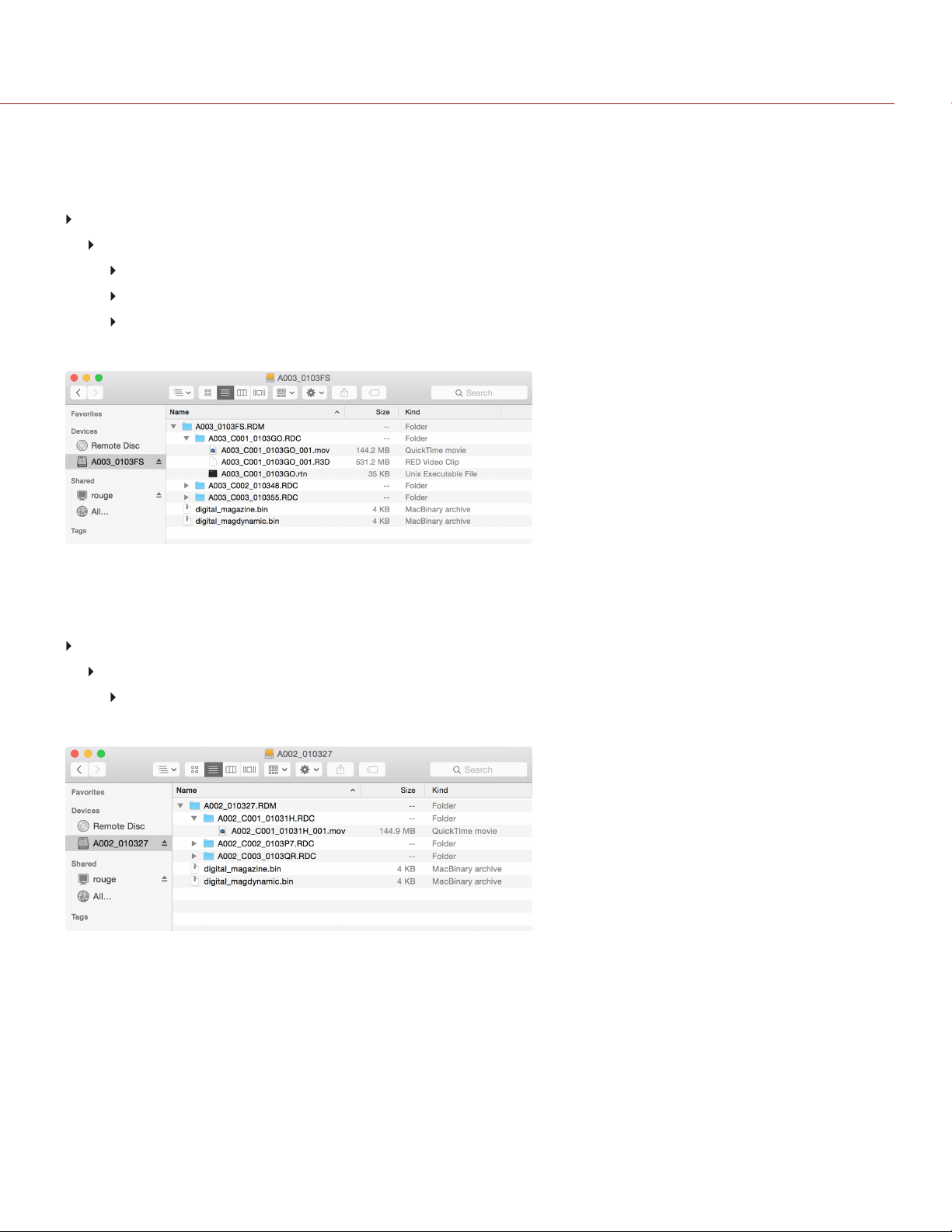
FILE STRUCTURE OF RECORDED APPLE PRORES FILES
When recording R3D + Apple ProRes, this is the file structure of the recorded files on the SSD (when the SSD is
formatted as FAT32):
.RDM Folder
.RDC Folder
.mov
.R3D
.rtn (RED Thumbnail file)
NOTE: The camera creates multiple .mov files, similar to how the camera creates multiple R3D files.
Figure: File Structure: R3D + Apple ProRes
When recording Apple ProRes only, this is the file structure of the recorded files on the SSD (when the SSD is formatted
as FAT32):
.RDM Folder
.RDC Folder
.mov
NOTE: The camera creates multiple .mov files, similar to how the camera creates multiple R3D files.
Figure: File Structure: Apple ProRes
COPYR IGH T © 2019 R ED.COM, LLC 955- 0184_V7.3, REV-A | 109
RED RANGER MONSTRO OPERATION GUIDE

AVID DNXHD AND AVID DNXHR INFORMATION
By default, the camera records all videos and stills in the REDCODE RAW file format (records R3D files). You also
have the option to record to Avid DNxHD and Avid DNxHR (records .mxf files). This section provides general
information about recording Avid DNxHD/HR with the camera:
NOTE: If Look Around is enabled, the Look Around area is recorded in the Avid DNxHD/HR file.
NOTE: Enabling Look Around effects the aspect ratio of the scaled file, regardless of the recorded area.
Selecting a Recording Frame Rate that is not supported by Avid DNxHD/HR causes the codec file to be sub-
sampled to half of the selected Recording Frame Rate.
The camera cannot record Avid DNxHD/HR when Pre-Record is enabled.
The camera can record Avid DNxHD/HR only when either of the following recording modes is enabled:
Continuous Record
Motion + Stills
If HDRX
®
is enabled, only the selected monitor track is recorded to the Avid DNxHD/HR file. For more information,
go to "HDRX Menu" on page 115
RED recommends performing a Secure Format before recording Avid DNxHD/HR. For more information, see the
DSMC Media Operation Guide, available at www.red.com/downloads.
The .mxf files have the same metadata that is in the REDCODE RAW files. The metadata is per clip, and not per
frame. At this time, there is no tool for extracting that metadata from the .mxf files.
You can select any resolution. When recording Avid DNxHD/HR, the camera scales that format to the Resolution (2K
or 4K) selected in the Codec menu. The field of view is maintained in Avid DNxHD/HR; the image is not cropped.
If recording 4K Avid DNxHD/HR and the Resolution is less than 4K, the image is scaled to 2K.
For more information about Avid DNxHD/HR, see the Avid site.
To record Avid DNxHD/HR, go to "Select Record File Format" on page 112.
AVID DNXHD AND AVID DNXHR DESCRIPTION
The table below describes each Avid DNxHD/HR codec.
NAME CODEC ID MAXIMUM BITS COLOR
DNxHR HQX 1271 12 bit YCbCr 4:2:2
DNxHR HQ 1272 8 bit YCbCr 4:2:2
DNxHR SQ 1273 8 bit YCbCr 4:2:2
DNxHR 444 1270 12 bit RGB 4:4:4
DNxHD 444 1256 10 bit RGB 4:4:4
DNxHD HQX 1235 10 bit YCbCr 4:2:2
DNxHD HQ 1238 8 bit YCbCr 4:2:2
DNxHD SQ 1237 8 bit YCbCr 4:2:2
COPYR IGH T © 2019 R ED.COM, LLC 955- 0184_V7.3, REV-A | 110
RED RANGER MONSTRO OPERATION GUIDE
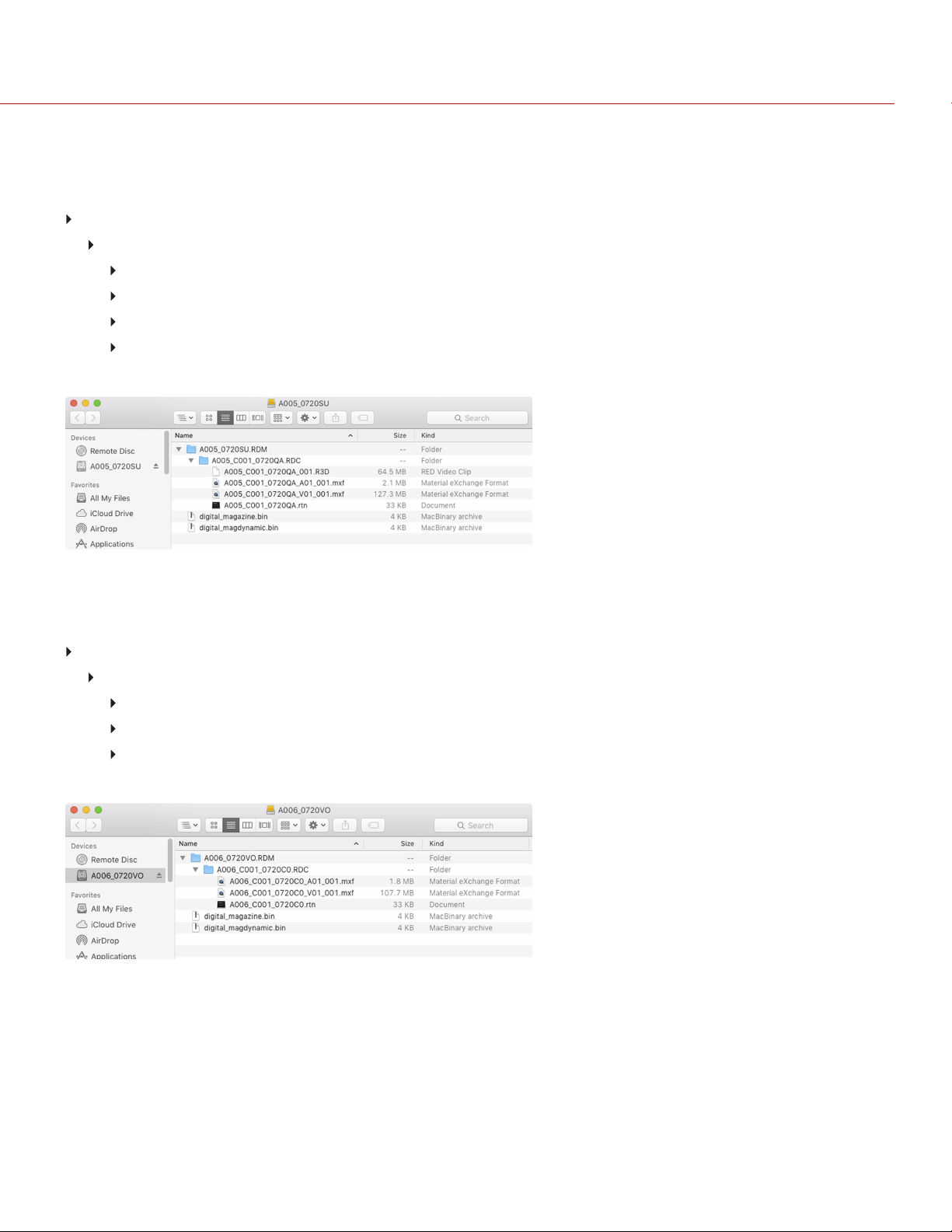
FILE STRUCTURE OF RECORDED AVID CODEC FILES
When recording R3D + Avid DNxHD/HR, this is the file structure of the recorded files on the SSD (when the SSD is
formatted as FAT32):
.RDM Folder
.RDC Folder
.R3D
.mxf (audio file, marked with an “A”)
.mxf (video file, marked with a “V”)
.rtn (RED Thumbnail file)
NOTE: The camera creates multiple .mxf files, similar to how the camera creates multiple R3D files.
Figure: File Structure: R3D + DNxHD/HR
When recording Avid DNxHD/HR only, this is the file structure of the recorded files on the SSD (when the SSD is
formatted as FAT32):
.RDM Folder
.RDC Folder
.mxf (audio file, marked with an “A”)
.mxf (video file, marked with a “V”)
.rtn (RED Thumbnail file)
NOTE: The camera creates multiple files, similar to how the camera creates multiple R3D files.
Figure: File Structure: R3D + DNxHD/HR
COPYR IGH T © 2019 R ED.COM, LLC 955- 0184_V7.3, REV-A | 111
RED RANGER MONSTRO OPERATION GUIDE
SELECT RECORD FILE FORMAT
NOTE: For more information on which codecs your camera offers, go to "Technical Specifications" on page 174.
To select what file formats to record to, follow the instructions below.
1. Go to Menu > Settings > Recording > Codec.
2. Select the file format(s) you want to record to from the Record File Format drop-down menu:
R3D
R3D + Apple ProRes
R3D + Avid DNxHD/HR
Apple ProRes
Avid DNxHD/HR
The selected file format displays in the Lower Status Row.
3. R3D: Select a target REDCODE compression ratio from the REDCODE menu. For more information, go to
"REDCODE" on page 47.
4. Apple ProRes or Avid DNxHD/HR: Select a resolution from the Resolution drop-down menu.
5. Apple ProRes or Avid DNxHD/HR: Select a codec from the Record Video Codec drop-down menu.
6. Apple ProRes or Avid DNxHD/HR: If the camera is in IPP2 mode, select an option from the Baked-in Settings
drop-down menu. This determines which image settings are irreversibly encoded (baked) as image data in the
recorded file. For more information on the options in this menu, go to "Baked-In Settings" below.
NOTE: Although the "All Image Settings" is an option when 4K is selected within the Resolution drop-down menu,
this option can only be applied with 2K output. If 4K and "All Image Settings" are selected at the same time, the
Baked-in Settings turns red and yellow as a warning, and the settings are NOT applied.
BAKED-IN SETTINGS
If the camera is in IPP2 mode and you are recording to a 2K Apple ProRes or 2K Avid DNxHD/HR codec, you can
irreversibly encode (bake) certain image settings into the recorded file. To bake in settings, select one of the following
options from the
Baked-in Settings drop-down menu:
Primary Only: Only bakes the ISO, Color Temperature, Tint, and Exposure Adjust settings into the recorded file.
Does NOT bake in the 3D LUT and other image settings.
All Image Settings: Bakes all image settings into the recorded file, including the Primary Raw Development, Grading,
and Output Transform stages. This includes the 3D LUT, CDLs, and output color space. For more information on the
different IPP2 stages, see the IPP2: Image Pipeline Stages white paper at www.red.com/downloads. With the All
Image Settings option, you can select either SDR or HDR to control the tone curve for standard dynamic range
(SDR) or high dynamic range (HDR) output.
COPYR IGH T © 2019 R ED.COM, LLC 955- 0184_V7.3, REV-A
| 112
RED RANGER MONSTRO OPERATION GUIDE

FRAME PROCESSING
NOTE: Frame processing is not supported in Speed Ramp Mode. For more information, go to "Speed Ramp Mode" on
page 104.
NOTE: For cameras with the MONSTRO sensor, frame processing is disabled for formats larger than 7680 x 4320.
Frame processing allows for the combination of multiple captured frames into one recorded frame. The combination
occurs before the resulting frame is encoded. You can select the following frame processing settings: No Frame
Processing, Frame Summing, Frame Averaging.
When in Frame Summing mode or Frame Averaging mode, the current integration time is applied to each frame. This
means if the integration time is not the entire frame time (or 360°) there are gaps between the images used to create the
combined frame. This may lead to unexpected motion artifacts.
The effect of frame processing is only visible during record. In Frame Summing mode, this means the exposure changes
between preview and record. Experiment with the exposure and frame processing settings to achieve the effect you
want.
NO FRAME PROCESSING
Normal frame processing mode. The Frames to Process selection does not affect recording.
FRAME SUMMING
Frame Summing combines the specified number of frames into one frame, and adds together the exposure time for each
of the original frames. The resulting frame has an effective integration time that is equal to the current integration time
multiplied by the number of frames.
For example, if you select 16 as the Frames to Process value, and set exposure to 1/48 sec, the resulting image has an
effective integration time of 1/3 sec (16 x 1/48).
Frame summing results in a final image that is brighter and possibly blurrier than any of the original frames, so you can
use frame summing to achieve the effect of long-exposure.
FRAME AVERAGING
Frame Averaging combines the specified number of frames into one frame, and averages the exposure time for each of
the original frames. The resulting frame has an effective integration time that is equal to the current integration time.
For example, if you select 2 as the Frames to Process value, and set exposure to 1/48 sec, the resulting image still has
the exposure value of 1/48 sec, along with the effect of long-exposure.
You can use frame averaging to achieve the effect of long-exposure along with the benefits of reduced noise. However,
frame averaging does affect motion blur characteristics.
NOTE: For RED cameras with 8K sensors, a maximum of 2 frames can be averaged.
COPYR IGH T © 2019 R ED.COM, LLC 955- 0184_V7.3, REV-A
| 113
RED RANGER MONSTRO OPERATION GUIDE
PRE-RECORD
To set up Pre-Record, go to
Menu > Settings > Recording > Pre-Record.
When enabled, the Pre-Record setting continuously captures a cache of footage before recording starts. Select to have 4
to 30 seconds (incremented at two second intervals) of pre-record time added to the actual footage. When Pre-Record is
enabled, you will not miss the start of a shot by being a little slow on the trigger.
Pre-Record Duration: Select the pre-record time.
Always trigger Pre-Record before recording: When selected, Pre-Record always starts when recording starts:
Press PWR/REC to activate Pre-Record.
Press PWR/REC a second time to start recording.
Press PWR/REC a third time to stop recording.
Trigger Pre-Record Now: When selected, the Pre-Record menu closes and Pre-Record mode starts.
NOTE: Always perform a Secure Format before using Pre-Record. A Secure Format restores the SSD back to factory
out-of-box settings, and optimizes the SSD for Pre-Record.
NOTE: Pre-Record puts your SSD in a state of constant record. As with any SSD technology, continuously writing data
over an extended period of time will impact the lifespan of the media.
NOTE: Audio is not recorded when Pre-Record is enabled.
NOTE: To use Pre-Record only for specific situations, map Pre-Record to a key (Menu > Settings > Setup > Keys >
Record: Start Pre-Record). For more information, go to "Keys" on page 120.
INDICATOR
Enable Sounds: Select this check box to enable sounds. Then select sounds for the following actions:
Record Start
Record Stop
Tag Still Frame
EVF Tally Light: Enable the EVF Record Tally LED on the EVF to illuminate red when recording.
SSD Tally Light: Enable the Record Tally LED on the media bay to illuminate red when recording.
COPYR IGH T © 2019 R ED.COM, LLC 955- 0184_V7.3, REV-A
| 114
RED RANGER MONSTRO OPERATION GUIDE
HDRX MENU
NOTE: HDRX mode cannot be modified when test signals are enabled.
NOTE: You cannot change the exposure when HDRX is enabled.
In HDRx mode, the camera records two (2) exposures within the interval that it would usually record only one (1). The
primary exposure is normal, and uses the standard aperture and shutter settings (the “A track”). The secondary exposure
is typically for highlight protection, and uses an adjustable shutter speed that is 2 to 6 stops faster (the “X track”). Since
the camera captures twice the usual amount of frames, the maximum available recording frame rate is halved and the
REDCODE compression options are limited.
For more information, see the High Dynamic Range Video with HDRX article, available at www.red.com/learn/red-
101/hdrx-high-dynamic-range-video.
HDRX RESTRICTIONS
You cannot use HDRX mode when:
A Sensor Sync Mode (Genlock) is enabled.
Speed Ramp mode is enabled.
A Frame Processing mode (Frame Summing or Frame Averaging) is enabled.
Network Storage mode is enabled.
ENABLE HDRX
By default HDRX is disabled, and the HDRX indicator in the Lower Status Row is grey.
To enable HDRX, follow the instructions below:
1. Go to
Menu > Settings > HDRX.
2. Select HDRX.
The HDRX text in the Lower Status Row turns white.
3. Select the number of Factors. The range is 1 to 6, and the default is 2.
4. Select which track you want the display to show:
A Track: This track shows the video with the selected aperture and exposure settings applied.
X Track: This track shows the video with the additional stops applied.
COPYR IGH T © 2019 R ED.COM, LLC 955- 0184_V7.3, REV-A
| 115
RED RANGER MONSTRO OPERATION GUIDE

FOCUS MENU
To access the Focus menu, go to
Menu > Settings > Focus.
The Focus menu includes: Mode and Rack.
MODE TAB
Use the Mode tab to select a focus setting. To set up focus, follow the instructions below:
1. Go to
Menu > Settings > Focus > Mode.
2. Select a mode from the Mode drop-down menu. For more information, go to "Mode" below.
3. Select a zone/target from the Zone drop-down menu. For more information, go to "Zone/Target" below.
4. If using Spot, select a size from the Size drop-down menu. For more information, go to "Size" below.
5. Select a confirm style from the Confirm menu. For more information, go to "Confirm Style" below.
MODE
Select an option from the
Mode drop-down menu:
Manual: Enables manual focus. Disables all other settings in the Focus menu.
Confirm: Enables a focus target, which changes color to indicate if the subject in the target is in focus. After
selecting Confirm, set up the target type (zone), size, and confirm style. Inadequate lighting and/or contrast may
decrease the performance of Confirm mode.
ZONE/TARGET
Select an option from the
Zone drop-down menu:
Center: A large square centered in the recording area.
Spot: A small target for precise focus that you can move around the recording area. Select a size for the target from
the Size drop-down menu. For information on how to move the Spot target, go to "Move the Spot Focus Target" on
the next page.
SIZE
Select a size for the Spot target from the
Size drop-down menu.
CONFIRM STYLE
Select a confirm style from the
Confirm Style drop-down menu.
STYLE DESCRIPTION OBJECT IN FOCUS OBJECT OUT OF FOCUS
None Square target Target is yellow or green Target is red
Circle Yellow circle around a
square target
Target is yellow or green; circle is almost the
same size as the square
Target is red; circle gets bigger
Bar Bar target Target is yellow or green; vertical bar on the
right side is filled up
Target is red; vertical bar on the left
side is almost empty
Pie Pie target Target is yellow or green; line around the curve
is filled up
Target is red; line around the curve is
almost empty
COPYR IGH T © 2019 R ED.COM, LLC 955- 0184_V7.3, REV-A | 116
RED RANGER MONSTRO OPERATION GUIDE
TARGET COLOR
Both the Center and Spot targets change color to indicate if the objects in the target are in focus.
Blue: Camera is focusing
Red: Objects are out of focus
Yellow: Objects are almost in focus
Green: Objects are in focus
MOVE THE SPOT FOCUS TARGET
Move the Spot target with a touchscreen:
Tap and hold the touchscreen on the location where you want to relocate the Spot target.
Tap and hold the touchscreen where the Spot target currently is, and drag the Spot target.
COPYR IGH T © 2019 R ED.COM, LLC 955- 0184_V7.3, REV-A
| 117
RED RANGER MONSTRO OPERATION GUIDE
EXPOSURE ASSIST MENU
To access the Exposure Assist menu, go to
Menu > Settings > Exposure Assist.
The Exposure Assist menu provides access to settings for the Auto Exposure (AE) feature. The AE feature maintains a
constant image brightness, even if the actual scene brightness changes.
The AE feature is different than traditional AE, in that RED AE only controls the amount of light that hits the sensor,
either by adjusting aperture or exposure. RED AE analyzes RAW data before the ISO curve, and ensures that the sensor
matches the user-selected brightness.
AUTO EXPOSURE MODES
The Exposure Assist modes determine when the AE tools go into effect:
Off: The AE tools are not enabled.
Single Shot: Map one of the following actions to trigger the AE tools:
AE: Start
AE/AF: Start
Continuous in Preview: The AE tools are enabled in preview only.
Continuous in Preview/Record: The AE tools are enabled in both preview and record.
NOTE: In Stills mode, AE/AF: Start is mapped to Record Half Press by default. For more information, go to "Default Key
Functions" on page 203.
EXPOSURE PRIORITY
Manual: You have full control of aperture and shutter. (Default)
Auto: The camera sets the aperture and shutter to meet the selected exposure.
Av (Aperture Value): You set the aperture, and then the camera sets the shutter to meet the selected exposure.
Tv (Time Value): You set the shutter, and then the camera sets the aperture to meet the selected exposure.
EXP COMP AND EV SHIFT
Use the
Exp Comp (Exposure Compensation) slider and the EV Shift setting to adjust the brightness of the image. The
default setting of zero (0) attempts to match the average brightness on an 18% grey-target. When AE is enabled, the
target and current measured brightness for the selected metering area display in the histogram as a grey and white line,
respectively.
You can also map these actions to user keys:
AE: Decrease EV Offset: Reduces the EV Offset in increments of 0.2.
AE: Increase EV Offset: Increases the EV Offset in increments of 0.2.
METERING MODE
Metering determines the area of the sensor that is used for brightness evaluation:
Spot: Weights the measurement to the center 5% of the sensor, approximately.
Center: Weights the measurement to the center 25% of the sensor, approximately.
Average: Averages the entire image area of the sensor.
COPYR IGH T © 2019 R ED.COM, LLC 955- 0184_V7.3, REV-A
| 118
RED RANGER MONSTRO OPERATION GUIDE

SPEED
The Speed setting determines how quickly the algorithm adapts to changing light.
Slow: Settings adapt in small steps. Use this setting for fewer and gradual adjustments.
Normal: Settings adapt in medium steps.
Fast: Settings adapt in large steps.
SELECTION
The Selection setting determines which values the algorithm uses. This enables you to modify the list of values so that
the algorithm selects only specific parameters. Use
Free Value Selection to improve accuracy.
For example, you can modify the aperture list to include f/2.8 and f/5.6. If Free Value Selection is enabled, the algorithm
only selects aperture parameters between f/2.8 and f/5.6. This setting limits the range of focal depth.
AE INDICATORS
When the AE feature is able to match the sensor brightness, the overlay turns yellow. If the brightness fluctuates more
than half of a stop, the overlay turns red.
When AE is enabled, the “AE” indicator displays before the aperture and exposure parameters in the Upper Status Row.
The user-selected brightness and current measured brightness display in the histogram as grey and white lines,
respectively.
AE LIMITS
All limits, includes custom modifications made to available menu items, are taken into account when AE is active. For
example, if you modify the available list of exposure values, only those values are considered.
COPYR IGH T © 2019 R ED.COM, LLC 955- 0184_V7.3, REV-A | 119
RED RANGER MONSTRO OPERATION GUIDE
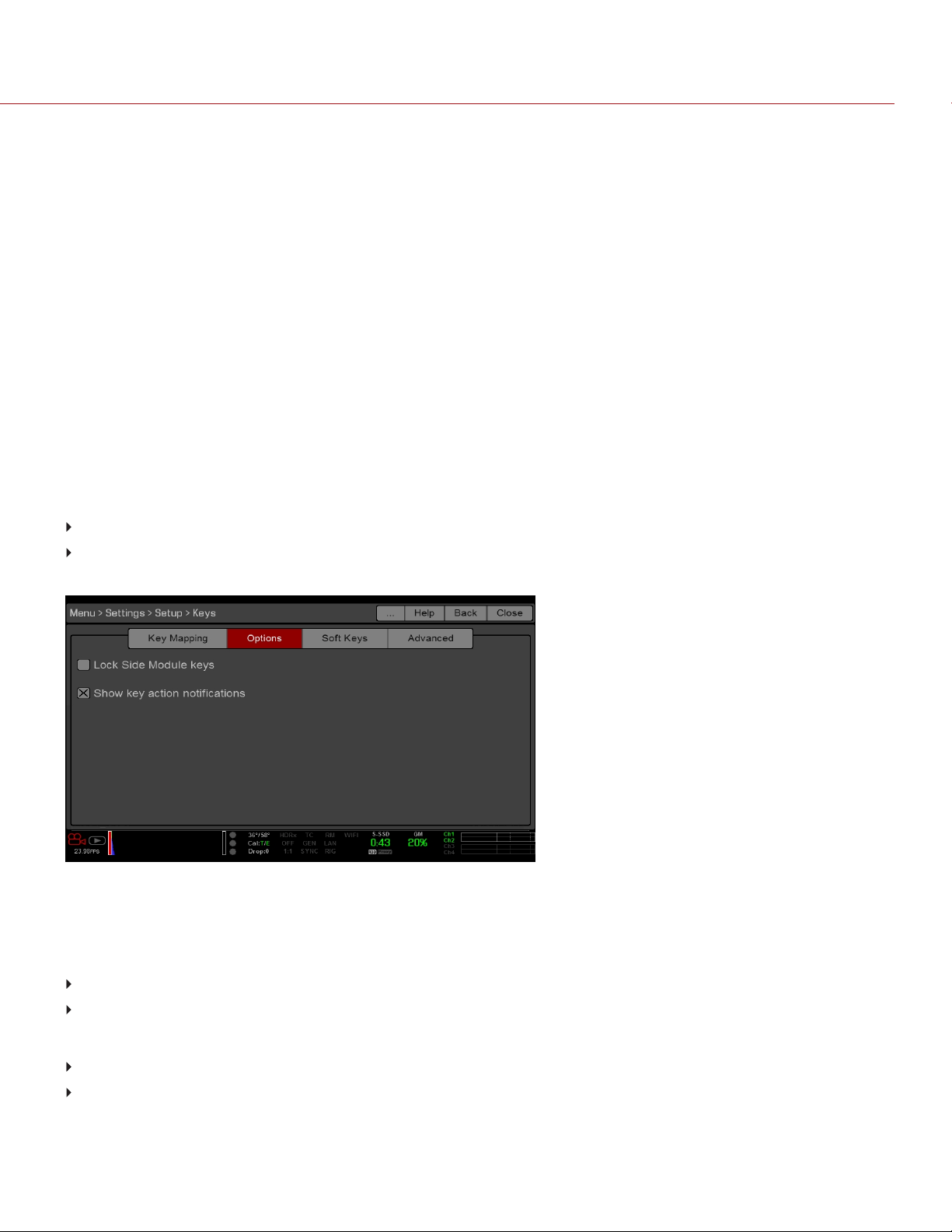
SETUP
The Setup menu includes: Keys, Date/Time, Communication, GPIO/Sync, Fan Control, Lens, and Motor Control.
KEYS
Map keys to often-used actions to easily control the camera. For a full list of the default key mappings, go to
"Default
Key Functions" on page 203.
KEY MAPPING
To map or remap a user key:
1. Press the user key that you want to map.
2. Select an action from the
Press (or CCW) drop-down menu that you want to map to the user key.
3. To un-map a key, select -Key Disabled- from the drop-down menu.
4. If you want, map a Release or (CW) action to the key.
A Release action occurs when a pressed key is released.
OPTIONS
Lock Side Module keys
Show key action notifications: A notification displays on the bottom of the display when you perform an action
mapped to a key.
Figure: Key Options
SOFT KEYS
The following sets of soft keys are available on the touchscreen:
A, B, C, D: Left side of the touchscreen
1, 2, 3, 4: Right side of the touchscreen
To map or remap a soft key, select an action from the drop-down menu next to the key you want to map.
Enable Soft Keys on touchscreen: Tap the left or right side of the touchscreen to show the soft keys.
Show key actions as labels: When the soft keys display, the number/letter of the key and the key action display.
COPYR IGH T © 2019 R ED.COM, LLC 955- 0184_V7.3, REV-A | 120
RED RANGER MONSTRO OPERATION GUIDE
ADVANCED
Use the Advanced tab to map any key, even if the key is not currently accessible.
WARNING: It is possible to remap the navigation keys using this tab. However, if you do not have a touchscreen
attached, it is possible to lock out control. Be careful when remapping navigation keys.
DATE/TIME
Use the Date/Time menu to reset the internal clock of the camera. The time and date are timestamps on R3D
®
files
when recording to an SSD. The camera uses the 24-hour clock convention (military time). For example, enter 2:35 p.m.
as 14:35:00.
The date and time are saved when you close the Date/Time menu.
COMMUNICATION
Use the Communication menu to allow one (1) or more cameras to communicate with each other or external devices.
You can use the serial port or a direct Ethernet cable to connect two (2) cameras, or one (1) camera and one (1) external
device. If the camera is connected via Ethernet to a hub or router, multiple cameras and devices can communicate with
each other.
For example, on a multi-rig 3D shoot, you can send commands to an individual camera (Example: Set CAM_A_L to 1/48
exposure), to a group of cameras (Example: Set 3DRIG_A to 48 fps), or to all cameras (Example: Start Recording on all
cameras).
CAMERA
To access the Camera menu, go to
Menu > Settings > Setup > Communication.
Use the Camera menu to set up a unique identifier for your camera (or a group of cameras). All command filtering
happens on the receiver side of the communication link. Use camera names and group names to address commands to
a specific camera or group of networked cameras.
Camera ID: Enter a unique camera name to use in network communications. The field is limited to eight (8)
characters.
Group ID: Enter a group name to identify the camera as a member of a group of devices. The field is limited to eight
(8) characters, and the default name is DEFAULT.
Target: Specify which devices the camera can send commands to:
All: The camera can send commands to all devices on the network.
None: The camera can only receive commands. The camera cannot send commands.
Custom: The camera can send commands to a specific camera/device (enter the name of the camera/device in
the Target ID text box) or a specific group (enter the name of the group in the Target ID text box). The
camera/group name must match the name entered in the Camera/Group field of the target device(s).
COPYR IGH T © 2019 R ED.COM, LLC 955- 0184_V7.3, REV-A
| 121
RED RANGER MONSTRO OPERATION GUIDE
SERIAL
To access the Serial menu, go to
Menu > Settings > Setup > Communication > Serial.
The camera can communicate to external devices via the CTRL and the GIG-E connectors (camera-to- camera
communication is possible only via GIG-E).
Select one of the following protocols from the Serial Protocol drop-down menu:
None (Default)
Element Technica
3ality SPC 7XXX
RED Command Protocol
ETHERNET
To set up the Ethernet settings, go to
Menu > Settings > Setup > Communication > Ethernet.
Each camera or device requires a unique IP address. For camera-to-camera communication via Ethernet, both cameras
need to be in the same sub-net (have the same netmask address) and have the same gateway address.
Enable DHCP: Enables DHCP. If a DHCP-server is available in the communications network, the camera obtains
an IP address, netmask address, and gateway address automatically from the DHCP server. You cannot manually
enter anything in the IP Address, Netmask, and Gateway fields when this check box is selected.
Enable Camera to Camera: A change to settings on this camera is sent to other cameras via the network as a SET
command (as UDP packets). The SET command then sets the property on other cameras. If this camera receives a
SET command, the camera does not send the command to other cameras/devices.
Enable External Control: This camera can be controlled via TCP/IP from an external device.
WIRELESS CONNECTION
The camera offers a wireless (802.11g) connection that provides communication support for third-party applications. The
camera uses the RED Command Protocol (R.C.P.) to communicate information between the camera and an application.
As with all wireless devices, the communication range may be affected by the environment and any radio frequency (RF)
interference that may be present. The wireless frequency is 2.4 GHz. For optimal performance, do not obstruct the
antenna with any accessory, mounting plate, or mounting rail.
There are two (2) ways to connect the camera to a device:
Ad-Hoc mode: The camera and your device connect to each other.
Infrastructure mode: The camera and your device both connect to an access point, and communicate through that
wireless network.
NOTE: To connect the camera to an app, the app must have been programmed using the R.C.P. SDK, which is
available through the R.C.P. Development Kit.
COPYR IGH T © 2019 R ED.COM, LLC 955- 0184_V7.3, REV-A
| 122
RED RANGER MONSTRO OPERATION GUIDE
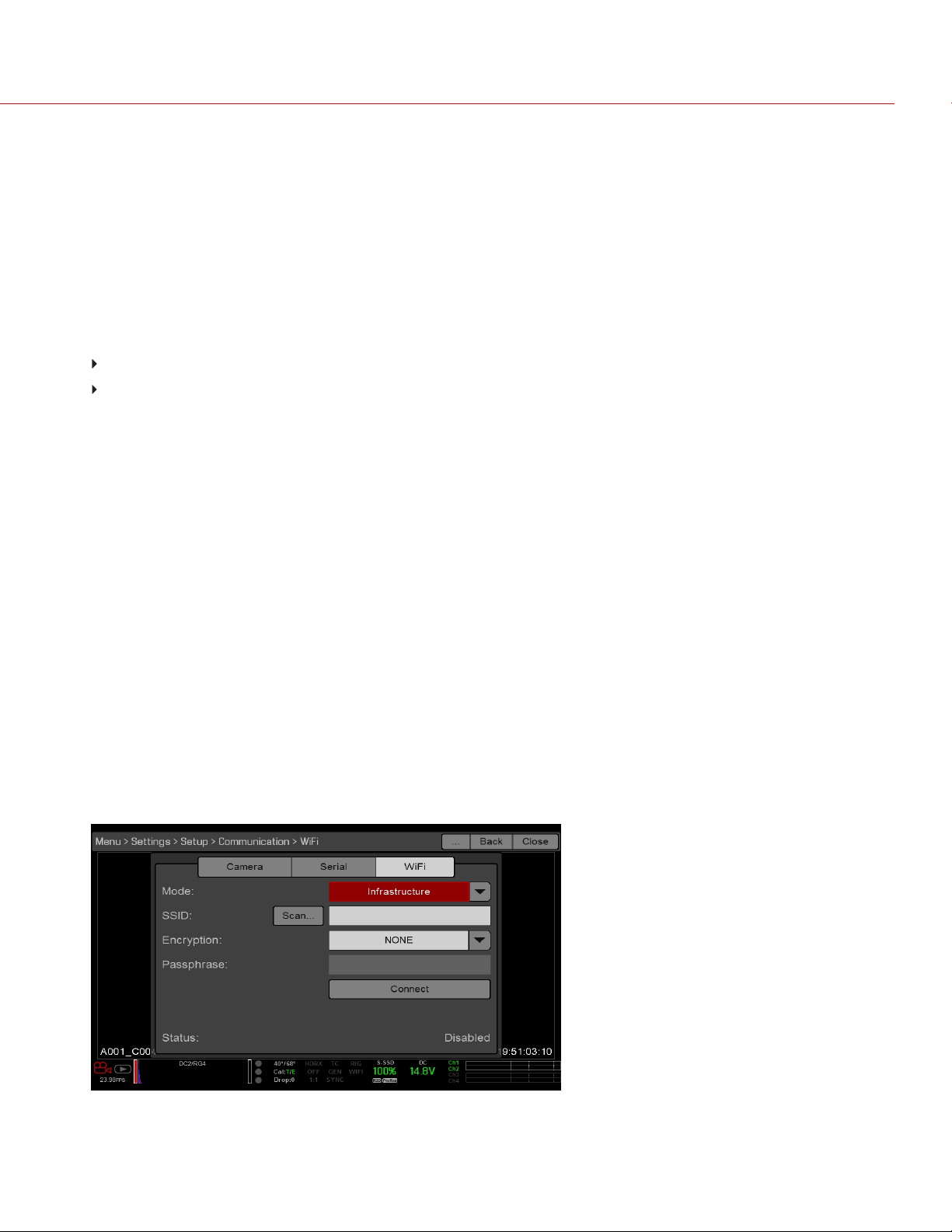
CONNECT WIRELESSLY TO A DEVICE VIA AD-HOC MODE
In Ad-Hoc mode, the camera and your device connect to each other. To connect the camera to your device via an ad-hoc
network, follow the instructions below:
1. Go to Menu > Settings > Setup > Communication.
2. Select the WiFi tab.
3. Select Ad-Hoc from the Mode menu.
4. Select a wireless channel from the Channel drop-down menu. The default is Ch1, and you can select one out of 11
channels.
5. Select a security option from the Encryption drop-down menu:
NONE: The connection will be unsecured.
WPA2: The connection will be encrypted via WPA2.
6. If you selected WPA2 as the encryption option, type the passphrase that will be required to access the network.
7. Close the WiFi screen.
8. Connect your device to the ad-hoc network created by the camera. The steps in this procedure depend on what type
of device and operating system you are using. For example, if you are connecting an iOS device, go to Settings >
Wi-Fi > Devices, and select the camera name.
The camera name displays on the WiFi screen in-camera. The camera and your device are now connected.
NOTE: If you created a passphrase for the network, you will need to enter that passphrase.
CONNECT WIRELESSLY TO A DEVICE VIA INFRASTRUCTURE MODE
In Infrastructure mode, the camera and your device both connect to an access point, and communicate through that
wireless network. The camera can connect to access points that are not encrypted, use WPA encryption, or use WPA2
encryption. To connect the camera to your device via an existing wireless network, follow the instructions below:
1. Connect your device to a wireless network. The access point for the network must have DHCP enabled.
2. Make sure that you know the name and password for the network, since you will need that information to connect the
camera to the same network.
3. Go to Menu > Settings > Setup > Communication.
4. Select the WiFi tab.
5. Select Infrastructure from the Mode menu.
Figure: WiFi Menu
COPYR IGH T © 2019 R ED.COM, LLC 955- 0184_V7.3, REV-A | 123
RED RANGER MONSTRO OPERATION GUIDE
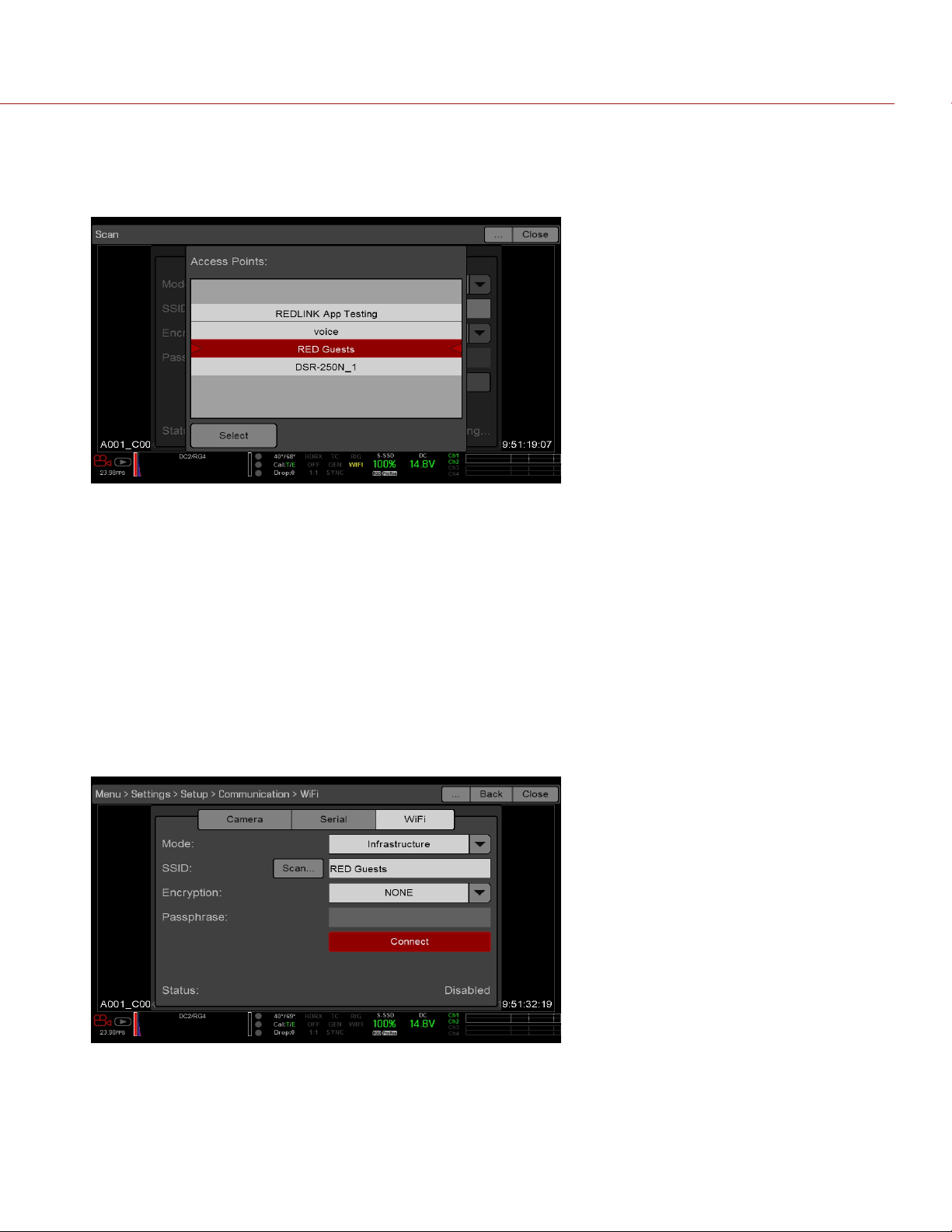
6. Select Scan to search for available wireless networks.
The available wireless networks (access points) display.
7. Highlight the wireless network that your device is connected to and select Select.
Figure: Select Wireless Network
8. If you select an encrypted network, follow the instructions below to enter the passphrase for the network:
A. Select a security option from the Encryption drop-down menu.
B. Tap or select the Passphrase text box.
C. Type the passphrase to access the network.
D. Select OK.
9. To enable/disable DHCP, select IP Config and set up the IP settings. For more information on configuring DHCP
and IP settings, go to "Ethernet" on page 122.
10. Select Connect at the bottom of the WiFi screen.
The IP address of the access point displays at the bottom of the WiFi screen after the camera connects to the
access point.
Figure: Select Connect
COPYR IGH T © 2019 R ED.COM, LLC 955- 0184_V7.3, REV-A | 124
RED RANGER MONSTRO OPERATION GUIDE
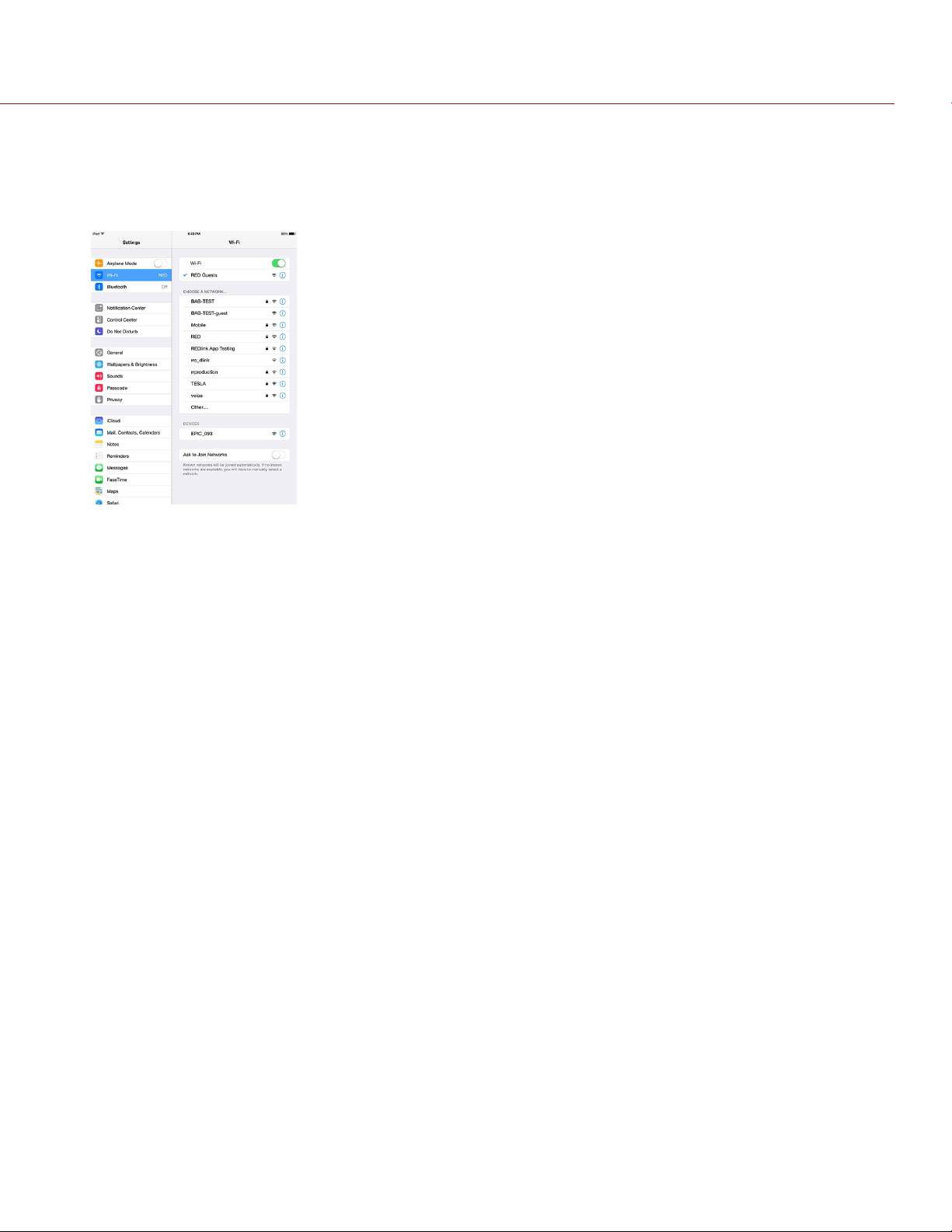
11. Connect your device to the same wireless network that the camera is connected to. The steps in this procedure
depend on what type of device and operating system you are using. For example, if you are connecting an iOS
device, go to Settings > Wi-Fi, and select the wireless network.
The camera and your device are now connected.
Figure: Connect to Network
12. To ensure that your app can communicate with the camera, ensure that there is a way to connect your app to a
specific camera. Since there may be multiple cameras in the area, select your specific camera in the app itself.
COPYR IGH T © 2019 R ED.COM, LLC 955- 0184_V7.3, REV-A
| 125
RED RANGER MONSTRO OPERATION GUIDE
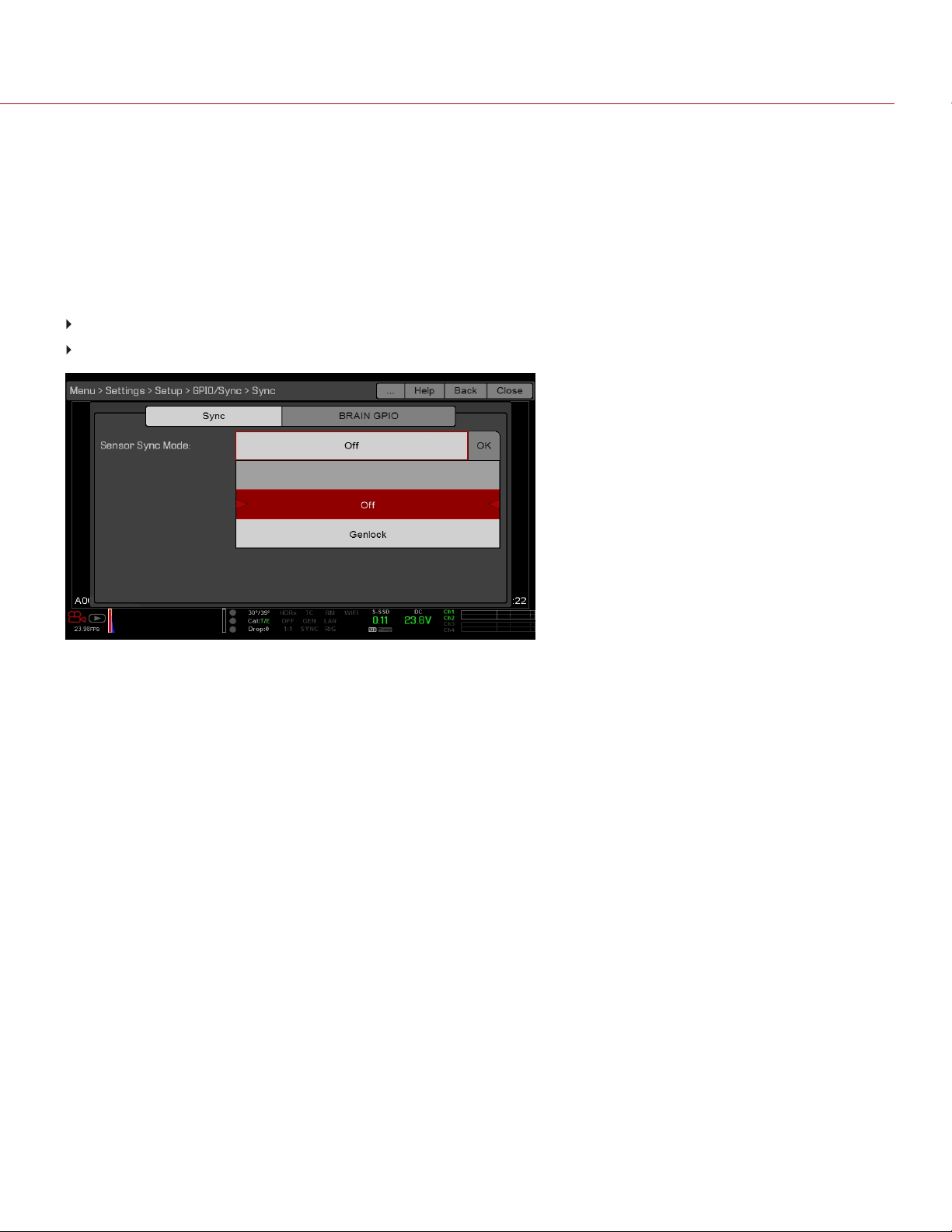
GPIO SYNC
SYNC
Use the Sync menu to set up genlock. For more information, go to
"Timecode, Genlock, Multi-Camera Setup" on
page 147.
SENSOR SYNC MODE
Sensor Sync Mode allows the shutter timing (scan start) to sync to an external signal.
Off: Sensor runs at the current recording frame rate. This is the default option.
Genlock: Sensor synchronizes with the incoming compatible genlock signal.
Figure: Sync Menu
COPYR IGH T © 2019 R ED.COM, LLC 955- 0184_V7.3, REV-A | 126
RED RANGER MONSTRO OPERATION GUIDE
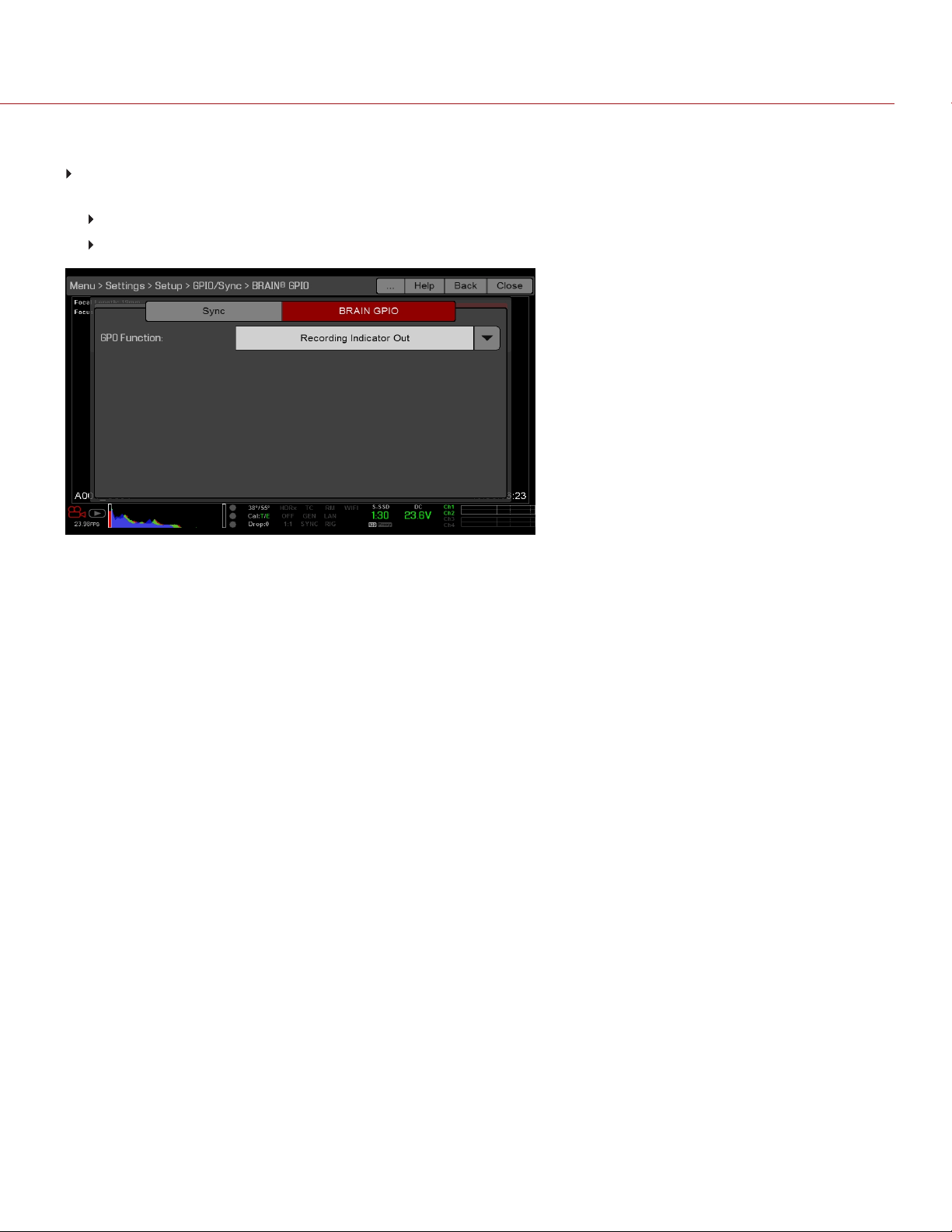
BRAIN GPIO
GPO Function (Camera Output): Select an option to configure the output for devices connected to the CTRL
connector on the camera:
Sync Out: Provides an output sync signal to act as a shutter start tally.
Recording Indicator Out: Provides a signal when recording is in process.
Figure: BRAIN GPIO Menu
GEN AND SYNC STATUS INDICATORS
The Lower Status Row of the camera display has GEN and SYNC indicators, which change color based on the current
genlock and sync statuses. For more information, go to
"Project Status Indicators" on page 52.
COPYR IGH T © 2019 R ED.COM, LLC 955- 0184_V7.3, REV-A
| 127
RED RANGER MONSTRO OPERATION GUIDE

FAN AND TEMPERATURE MANAGEMENT
To select a fan control mode, go to
Menu > Settings > Setup > Fan Control.
The camera is controlled by complex thermal algorithms to ensure that the sensor and camera operate at safe
temperatures. Each fan control mode affects the sensor temperature, sensor warm-up time, fan speed, and resulting fan
noise.
When selecting a fan mode, first take into consideration how each fan mode behaves, and then select a fan mode that
fits the needs of your project.
Regardless of sensor type and fan mode, you will get the best image quality by calibrating the sensor at the temperature
that you want to use for your shoot.
FAN CONTROL MODES
Select a fan control mode.
NOTE: After selecting a new fan setting, run the camera until the core temperature stabilizes, and then calibrate the
sensor.
NOTE: Manual mode requires that you actively manage the sensor temperature, because this mode focuses on
controlling fan speed and does not target a narrow sensor temperature range. Use the T/E status indicators as guides for
proper temperature calibration.
NOTE: Maximum speeds are intended as target speeds only; actual fan speeds may be higher at times due to long
recording times or high ambient temperatures.
ADAPTIVE (TARGET TEMPERATURE)
Select a Target Temperature and the fans self- adjust to maintain the selected temperature. The default Target
Temperature is 39°C. After the camera reaches the Target Temperature, and if the ambient temperature remains
constant, Adaptive mode results in a consistent fan speed and fan noise over time.
Targeting a higher temperature raises the sensor temperature, lengthens the sensor warm-up time, and lowers the fan
speed. Targeting a lower temperature lowers the sensor temperature, shortens the sensor warm-up time, and increases
the fan speed.
NOTE: The intent of Target Temperature is to set the sensor temperature so that you can then create a calibration map
for that temperature.
NOTE: When the camera turns on, the Target Temperature is the temperature of the current calibration map, regardless
of what the Target Temperature was before you turned off the camera. Setting a calibration map also overrides the Target
Temperature. For more information, go to "Sensor Calibration" on page 136.
QUIET
Quiet is the default mode for the camera.
The fans self-adjust to maintain the lowest possible noise level in record and standby mode while still cooling the
camera.
MANUAL
Select a speed for the fans in both record and standby modes. The fans self-adjust to maintain the selected speeds. The
default Maximum Record Speed is 50% and the default Maximum Preview Speed is 75%. The range for both Maximum
Record Speed and Maximum Preview Speed is 20–100%.
POST RECORD DELAY
Select the amount of time that it takes for the fan to switch from record to preview mode.
COPYR IGH T © 2019 R ED.COM, LLC 955- 0184_V7.3, REV-A | 128
RED RANGER MONSTRO OPERATION GUIDE
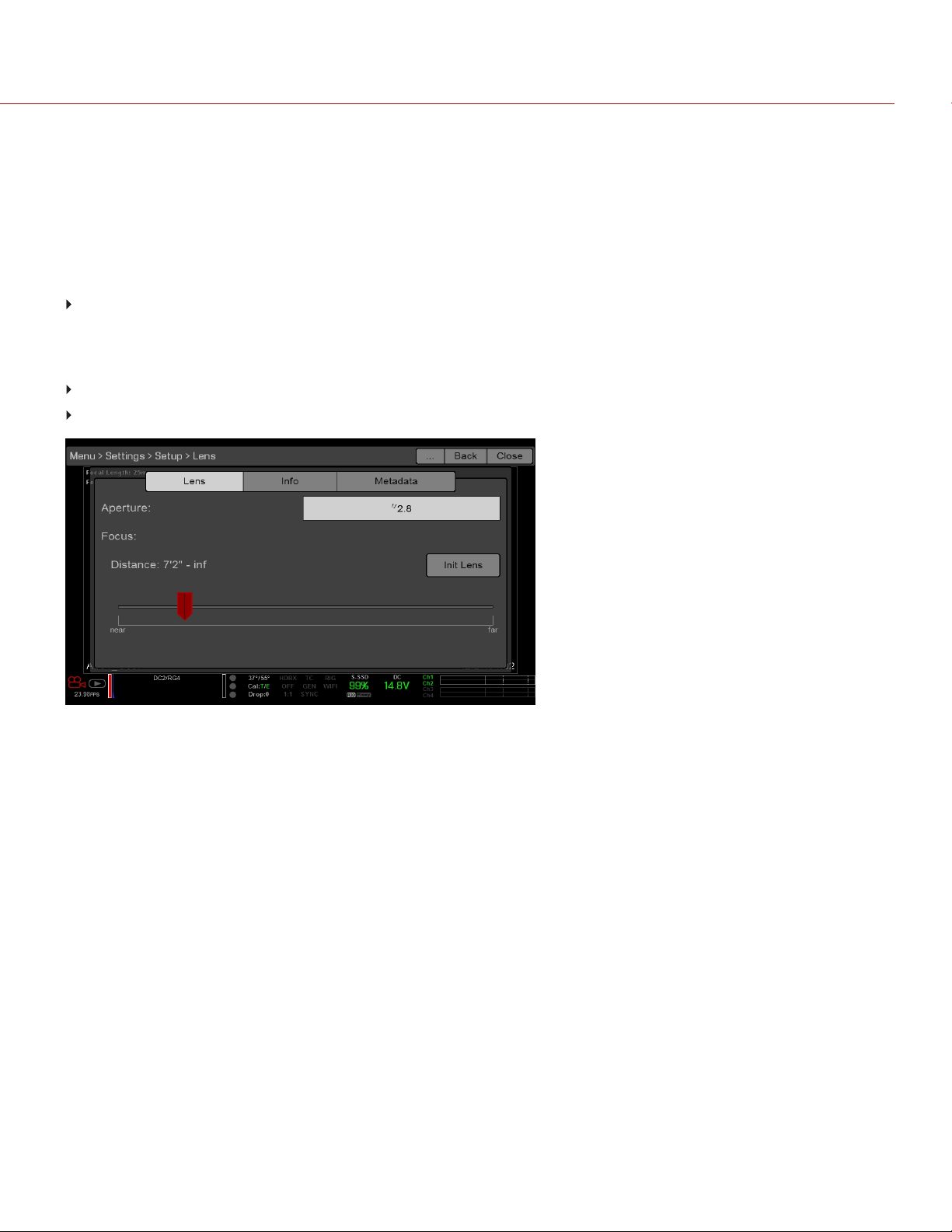
LENS
To access the Lens menu, go to
Menu > Settings > Setup > Lens.
LENS TAB
The options displayed on the Lens tab change based on the attached lens mount.
PL MOUNT
Enable Power to Lens: Ensures that the camera powers the lens via the lens mount. This feature is enabled by
default, but the camera saves the last selected setting. Deselect when using a Fujinon
®
T2.9 Cabrio Premier PL lens.
If you disable this feature for the Fujinon Cabrio, re-enable it when using other lenses. For more information, go to
"Fujinon T2.9 Cabrio Premier PL Lenses" on page 202.
Auto-Detect PL Lenses: By default, this feature is enabled.
Detect Lens: Detects a lens, if one is attached.
Figure: Lens Menu
COPYR IGH T © 2019 R ED.COM, LLC 955- 0184_V7.3, REV-A | 129
RED RANGER MONSTRO OPERATION GUIDE
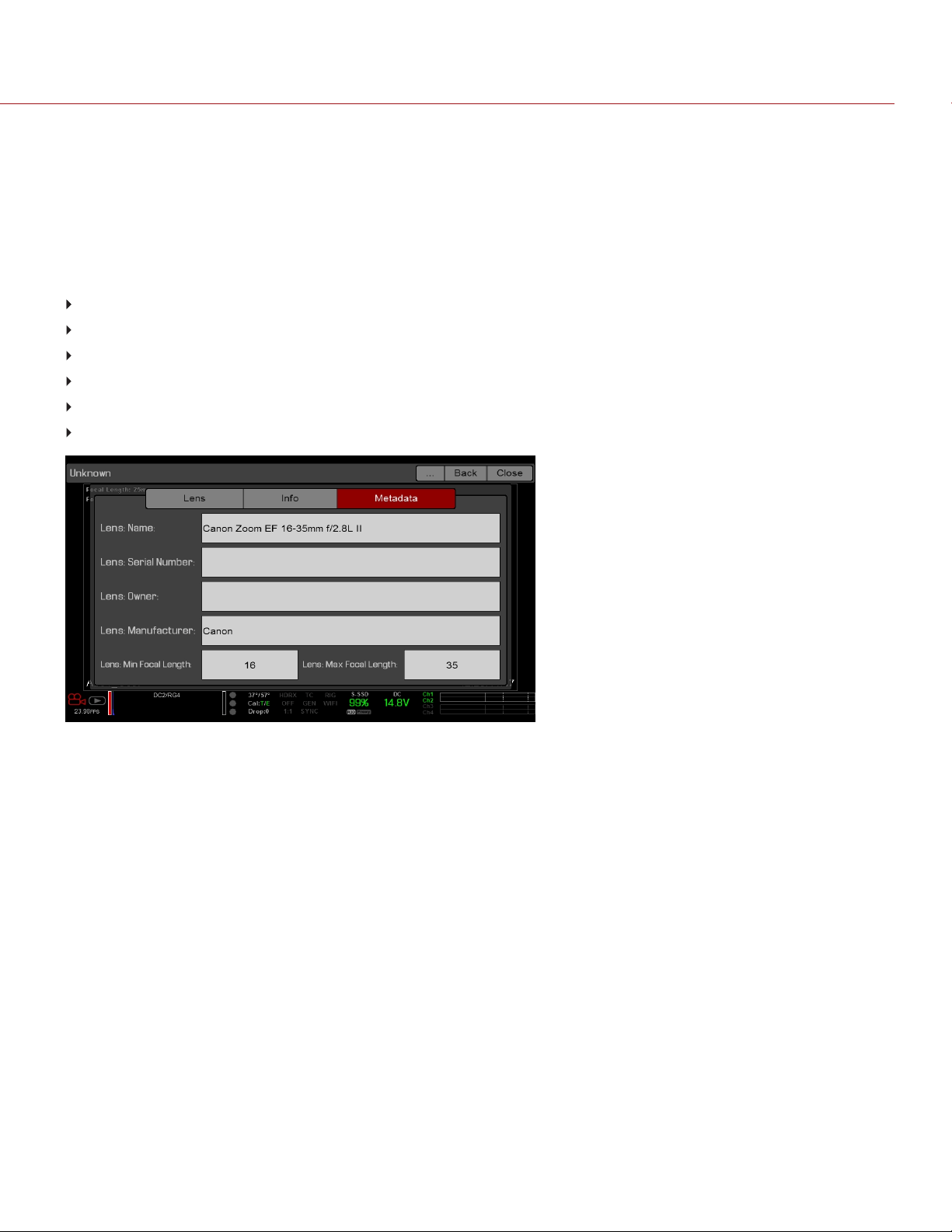
LENS INFO TAB
The Info tab displays the attached lens mount and lens information.
LENS METADATA TAB
If a supported lens is attached, the camera autopopulates some Lens Metadata fields. You can also manually edit the
Lens Metadata fields to describe the attached lens. The information is stored in the clip metadata. The Lens Metadata
fields are:
Lens Name
Lens Serial Number
Lens Owner
Lens Manufacturer
Lens Min Focal Length
Lens Max Focal Length
Figure: Metadata
COPYR IGH T © 2019 R ED.COM, LLC 955- 0184_V7.3, REV-A | 130
RED RANGER MONSTRO OPERATION GUIDE
MAINTENANCE
The Maintenance menu includes: Save Log, Upgrade, Calibrate, Self-Test, Restore System, Rediscover, System
Status, and OLPF.
SAVE A LOG FILE
A log file is a detailed text file of the processes and operations performed by the camera. If you contact support, you may
be asked to send a log file.
To save a log file, follow the instructions below:
1. Ensure that an SSD is properly mounted to the camera.
2. Go to
Menu > Settings > Maintenance.
3. Select Save Log.
The log file is saved as a *.txt file in the SSD root directory.
For more information about RED support or to create a support ticket, go to https://support.red.com.
NOTE: The camera automatically saves a log file when it is turned off properly and an SSD is mounted.
UPGRADE
To access the Upgrade menu, go to
Menu > Settings > Maintenance > Upgrade.
You can check for upgrades for the following items:
Camera: Go to "Upgrade Camera Firmware" on page 158.
Media: For more information on the media upgrade procedure, see the DSMC Media Operation Guide, available at
www.red.com/downloads.
CALIBRATE
The Calibrate menu includes:
Sensor: For more information, go to "Sensor Calibration" on page 136.
Gyro/Acc: For more information, go to "Gyroscope and Accelerometer Calibration" below.
GYROSCOPE AND ACCELEROMETER CALIBRATION
The internal three-axis gyroscope and three-axis accelerometer need to be calibrated for the Horizon overlay to function
properly. The Gyro/Acc calibration file is stored in the flash memory of the camera, so you DO NOT need to recalibrate
after restoring the camera or upgrading firmware. For more information, go to
"Display Modes: Horizon" on page 77.
To calibrate the Horizon overlay, follow the instructions below:
1. Turn on the camera and place it on a level surface.
2. Wait for the camera core temperature to reach room temperature.
3. Go to Menu > Settings > Maintenance > Calibrate > Gyro/Acc and select Low Temperature Calibration.
4. After the calibration finishes, wait for the camera core temperature to reach maximum operating temperature.
5. When the camera reaches maximum operating temperature, select High Temperature Calibration.
COPYR IGH T © 2019 R ED.COM, LLC 955- 0184_V7.3, REV-A
| 131
RED RANGER MONSTRO OPERATION GUIDE
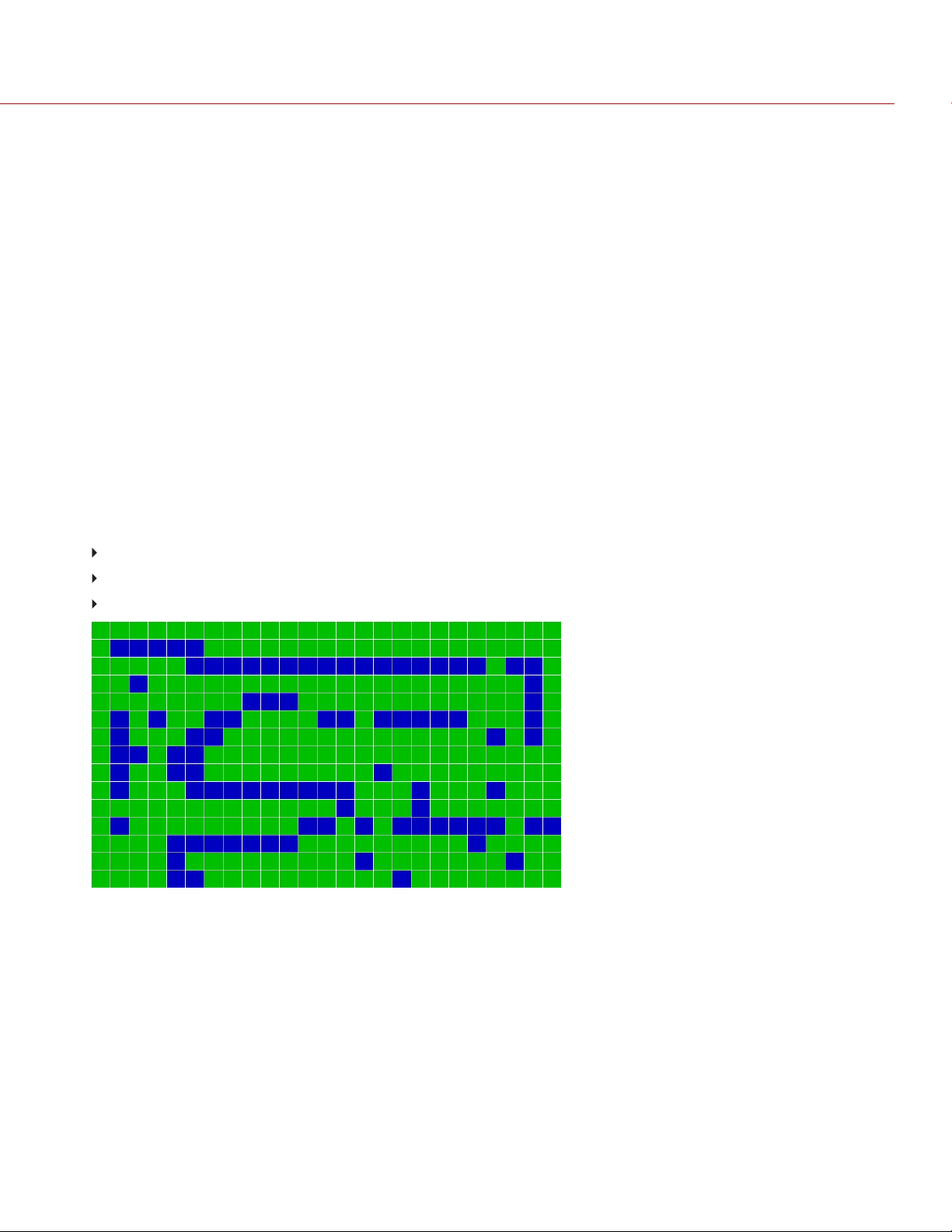
SELF-TEST
The Self-Test menu includes: Enable/Disable Sensor Test Pattern and Touchscreen.
ENABLE/DISABLE SENSOR TEST PATTERN
The Sensor Test Pattern is used during manufacturing and stress testing. For more information, go to
"Perform a Stress
Test" on page 163. The Sensor Test Pattern is a white screen with vertical lines.
To enable/disable the sensor test pattern, go to Menu > Settings > Maintenance > Self- Test > Enable/Disable
Sensor Test Pattern.
TOUCHSCREEN
To perform a touchscreen self-test, follow the instructions below:
1. Go to
Menu > Settings > Maintenance > Self-Test.
2. Select Touchscreen.
A grid of green squares displays on the touchscreen.
3. Touch each box with your finger.
Each green box turns blue.
4. To exit the self-test, perform one (1) of the following actions:
Touch all of the boxes, so that they are all blue.
Press and hold the touchscreen.
Press the Enter or Menu button on the side of the camera.
Figure: Self-Test Menu
COPYR IGH T © 2019 R ED.COM, LLC 955- 0184_V7.3, REV-A | 132
RED RANGER MONSTRO OPERATION GUIDE

RESTORE SYSTEM
Restore System offers two (2) types of restores: Reset Defaults and Wipe Camera.
RESET DEFAULTS
Reset Defaults changes all settings to the factory default values. To perform a Reset Defaults, follow the instructions
below:
1. Go to
Menu > Settings > Maintenance > Restore System.
2. Select Reset Defaults.
3. Select YES on the screen that asks you to confirm the action.
The camera turns off.
4. Turn on the camera.
WIPE CAMERA
Wipe Camera deletes all user settings, including: looks, calibration files, overlays, and presets. Wipe Camera restores all
factory defaults.
1. Go to
Menu > Settings > Maintenance > Restore System.
2. Select Wipe Camera.
3. Select YES on the screen that asks you to confirm the action.
The camera turns off.
4. Turn on the camera.
REDISCOVER (HARDWARE REDISCOVER)
Rediscovers all hardware and caches the data for future boot cycles. Performs a Hardware Rediscover when an
attached device or lens mount is not functioning correctly.
To perform a Hardware Rediscover, follow the instructions below:
1. Go to
Menu > Settings > Maintenance.
2. Select Rediscover.
3. Select Yes on the screen that asks you to confirm the Hardware Rediscover.
The camera turns off.
4. Turn on the camera.
SYSTEM STATUS
The System Status menu displays key project and system information.
PROJECT STATUS
Displays the current camera and project settings. Includes the following tabs: File Format, Recording, ProRes,
DNxHD/HR, Image, Other.
ATTACHED MODULES
Lists the attached lens mount.
This screen does not list attached displays and lenses.
COPYR IGH T © 2019 R ED.COM, LLC 955- 0184_V7.3, REV-A
| 133
RED RANGER MONSTRO OPERATION GUIDE
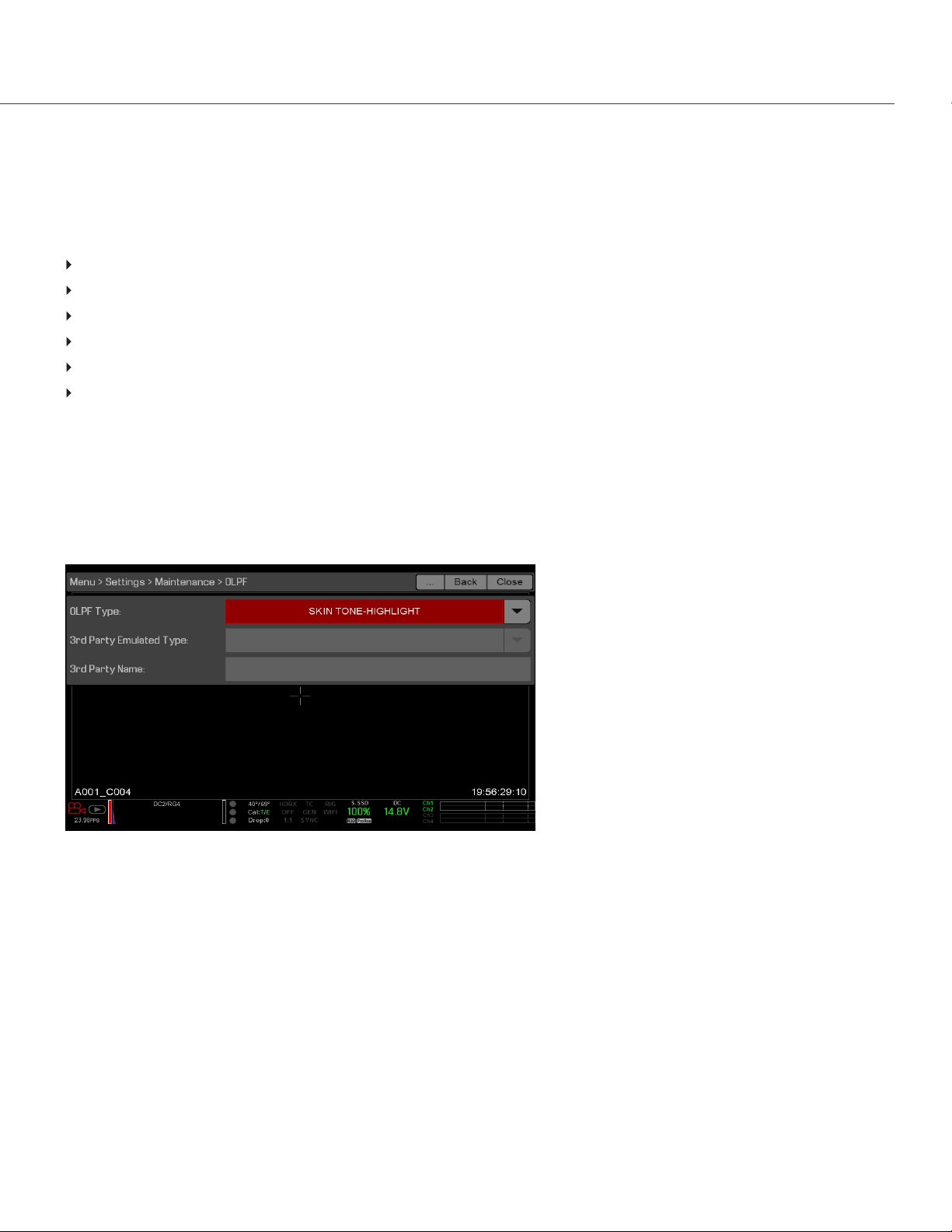
RCP CONNECTIONS
Lists any RCP clients the camera is connected to.
CAMERA INFO
Displays the following camera information:
Type: Camera type and sensor type.
Firmware Version: Current firmware version.
PIN: The personal identification number that is specific to your camera.
SVN Revision: The current firmware number.
Runtime: The number of hours that the camera has been turned on.
Name: Sensor type.
OLPF
RED offers multiple optical low-pass filters (OLPFs). Each OLPF optimizes certain characteristics to take full advantage
and control of each shooting environment. The camera checks the OLPF type, and adjusts the color science based on
the selected OLPF.
To view your OLPF type, go to
Menu > Settings > Maintenance > OLPF. The OLPF that is installed in your camera
displays in the OLPF Type field.
Figure: OLPF Menu
COPYR IGH T © 2019 R ED.COM, LLC 955- 0184_V7.3, REV-A | 134
RED RANGER MONSTRO OPERATION GUIDE

THIRD-PARTY OLPFS
WARNING: RED does not guarantee that third-party OLPFs will work as intended. Any damage caused by using a third-
party OLPF, or any undesirable effects to the footage caused by using a third-party OLPF, is not covered under any RED
warranty. If you have any questions or support issues with a third-party OLPF, contact the OLPF’s manufacturer.
If you are using a third-party OLPF, follow the instructions below to set up the OLPF:
1. Install the OLPF. For more information, go to "Swap an Interchangeable OLPF" on page 40.
2. Go to Menu > Settings > Maintenance > OLPF.
3. Select an option from the 3rd Party Emulated Type drop-down menu. This menu lists the RED OLPFs that are
available for the camera. The camera will simulate the color science based on the RED OLPF that you select. RED
DOES NOT guarantee that the third-party OLPF and the camera’s color science will match.
4. Enter a name for the OLPF in the 3rd Party Name field. The name that you enter is for metadata purposes; the
name has no effect on the color science.
COPYR IGH T © 2019 R ED.COM, LLC 955- 0184_V7.3, REV-A
| 135
RED RANGER MONSTRO OPERATION GUIDE
COPYR IGH T © 2019 R ED.COM, LLC 955- 0184_V7.3, REV-A | 136
RED RANGER MONSTRO OPERATION GUIDE
CHAPTER 6:
SENSOR CALIBRATION
Sensor calibration, also known as black shading, is a process during which the camera optimizes image quality by
ensuring that pixel sensitivity remains consistent throughout the sensor. Calibrating the sensor generates a calibration
map based on system and environment settings. After calibration, the sensor shows a uniform noise profile over the
whole area without any falloffs on any side.
The camera offers two (2) ways to calibrate the sensor:
Manual Calibration: RED recommends using Manual Calibration for the HELIUM 8K S35, MONSTRO 8K VV, and
GEMINI 5K S35 sensors. For more information, go to "Calibrate Sensor: Manual Calibration" on the next page.
Auto Calibration: For more information, go to "Calibrate Sensor: Auto Calibration" on page 138.
For more information, see the Sensor Calibration Methods article.
NOTE: Calibration maps are still available after performing a system restore.
WHEN TO CALIBRATE SENSOR
Calibration is required:
After an extreme change in temperature (+/– 30°F or +/–15°C) from the current calibration map.
After an extreme change in exposure time (+/– 1/2 sec) from the current calibration map.
If either the T or E in the CAL: T/E indicator is not green.
After each firmware upgrade.
To check the temperature/exposure of the current calibration file, go to Menu > Settings > Maintenance > System
Status > Project Status.
CALIBRATE SENSOR: MANUAL CALIBRATION
The camera offers two (2) ways to calibrate the sensor: Manual Calibration and Auto Calibration. This section describes
how to calibrate the sensor with Manual Calibration.
When you start a Manual Calibration, the camera calibrates the sensor at the current exposure and temperature setting.
You will need to re-calibrate the sensor after extreme changes in exposure and temperature. The Manual Calibration
process takes several minutes.
MANUAL CALIBRATION PROCEDURE
To perform a Manual Calibration, follow the instructions below:
1. Ensure that the camera reaches the temperature that you want to use for your shoot.
2. Set the exposure to the exposure that you want to use for your shoot.
3. Ensure that the sensor is as dark as possible.
Preferably, take off the lens, and install the front body cap.
If you cannot take off the lens, put a lens cap on the lens. (Not all lens caps completely block IR. Lens caps are
made to protect the lens, not necessarily to block light.)
If possible, use a dark room.
Just closing the aperture is NOT sufficient.
4. Go to Menu > Settings > Maintenance > Calibrate > Sensor > Create > Manual.
5. Select how many calibration maps that you want to create from the Number of captures drop-down menu. You can
create up to four (4) calibration maps at a time.
6. Select the exposure that you want for each calibration map from the Capture drop-down menus.
7. Select Start Captures.
8. Select OK on the dialog box that opens. The system initializes and then makes multiple passes through the following
phases of the calibration:
Capturing
Analyzing
Erasing
Programming
9. When the Calibration Successful dialog displays, select OK to complete the process.
The new calibration map is automatically selected.
COPYR IGH T © 2019 R ED.COM, LLC 955- 0184_V7.3, REV-A
| 137
RED RANGER MONSTRO OPERATION GUIDE
CALIBRATE SENSOR: AUTO CALIBRATION
NOTE: The camera cannot export calibration maps created by Auto Calibration.
The camera offers two (2) ways to calibrate the sensor: Manual Calibration and Auto Calibration. This section describes
how to calibrate the sensor with Auto Calibration.
When you start an Auto Calibration, the camera calibrates the sensor at 16 exposure settings, and uses that data to build
a calibration curve. Afterward, the sensor is calibrated for each exposure along the calibration curve, so you do not need
to re-calibrate every time you change the exposure.
The calibration process does not factor in multiple temperatures, so you will need to re-calibrate the sensor after extreme
changes in temperature.
This process can take up to 1 hour.
AUTO CALIBRATION PROCEDURE
To perform an Auto Calibration, follow the instructions below:
1. Ensure that the camera reaches the temperature that you want to use for your shoot.
2. Ensure that the sensor is as dark as possible.
Preferably, take off the lens, and install the front body cap.
If you cannot take off the lens, put a lens cap on the lens. (Not all lens caps completely block IR. Lens caps are
made to protect the lens, not necessarily to block light.)
If possible, use a dark room.
Just closing the aperture is NOT sufficient.
3. Ensure a properly formatted SSD is attached to the camera.
4. Go to Menu > Settings > Maintenance > Calibrate > Sensor > Create > Auto.
5. Select OK on the dialog box that opens. The system initializes and then makes multiple passes through the
calibration phases.
6. When the Calibration Successful dialog displays, select OK to complete the process.
NOTE: When you change the exposure setting, the E indicator turns yellow and it may take up to 8 seconds for the
calibration map to load.
COPYR IGH T © 2019 R ED.COM, LLC 955- 0184_V7.3, REV-A
| 138
RED RANGER MONSTRO OPERATION GUIDE

CALIBRATION MAP NAMING CONVENTIONS
Each calibration map has a unique name that uses the format described in the table below:
NAME DESCRIPTION EXAMPLE
Exposure Current exposure; to set exposure, go to
"Exposure/Shutter" on page 95
If the calibration map was created using Auto Calibration, then "auto" displays instead of an
exposure setting
48
auto
Sensor
Temperature
Sensor temperature (Celsius); in the Lower Status Row, this is the number to the left of the
forward slash (Temp: 32/35)
32C
Year Year that the calibration map is created (yyyy) 2014
Month Month that the calibration map is created (mm) 01
Day Day that the calibration map is created (dd) 28
Letters
Two random alphanumeric characters generated by the camera to prevent any possibility
of duplicate names being created
LQ
For example, a set of calibration maps may look like this:
auto_39C_200001030O
48_39C_20000103NB
24_37C_20160105AT
NOTE: If you mount an SSD with calibration files to your computer, each calibration map displays as a sub-folder in a
folder called Calibration. To save a calibration map to your hard drive, copy the entire sub-folder to your drive.
CALIBRATION MANAGEMENT
To apply, export, and import calibration maps, go to
Menu > Settings > Maintenance > Calibrate > Sensor.
In Camera: The calibration maps that are saved internally on the camera:
Factory: This is the calibration map generated during the manufacturing process. (Default)
All other: The user-created calibration maps.
Media: The calibration maps that are on the SSD in the path shown (for example, S-SSD\calibration).
CALIBRATION MAP ACTIONS
NOTE: You cannot delete or rename the factory map.
Apply: Apply the selected calibration map (if the calibration map is on the SSD, the camera applies the map
temporarily, and does not import it into the camera).
Create: Create a calibration map. For more information, go to "Calibrate Sensor: Manual Calibration" on page 137 and
"Calibrate Sensor: Auto Calibration" on the previous page.
Delete: Delete the selected camera calibration map.
Rename: Rename the selected calibration map.
COPYR IGH T © 2019 R ED.COM, LLC 955- 0184_V7.3, REV-A
| 139
RED RANGER MONSTRO OPERATION GUIDE
EXPORT AND IMPORT CALIBRATION MAPS
NOTE: The camera cannot export calibration maps created by Auto Calibration.
Calibration maps can be stored on the camera or transferred to SSD. You can also build a library of calibration maps to
use in different settings. A camera only imports calibration maps that it created. Calibration maps cannot be shared
between cameras.
: Export selected calibration map from camera to SSD.
All: Export all files from camera to SSD.
: Import selected calibration map from SSD to camera. This overwrites the user HS calibration map.
All: Import all files from SSD to camera.
COPYR IGH T © 2019 R ED.COM, LLC 955- 0184_V7.3, REV-A
| 140
RED RANGER MONSTRO OPERATION GUIDE
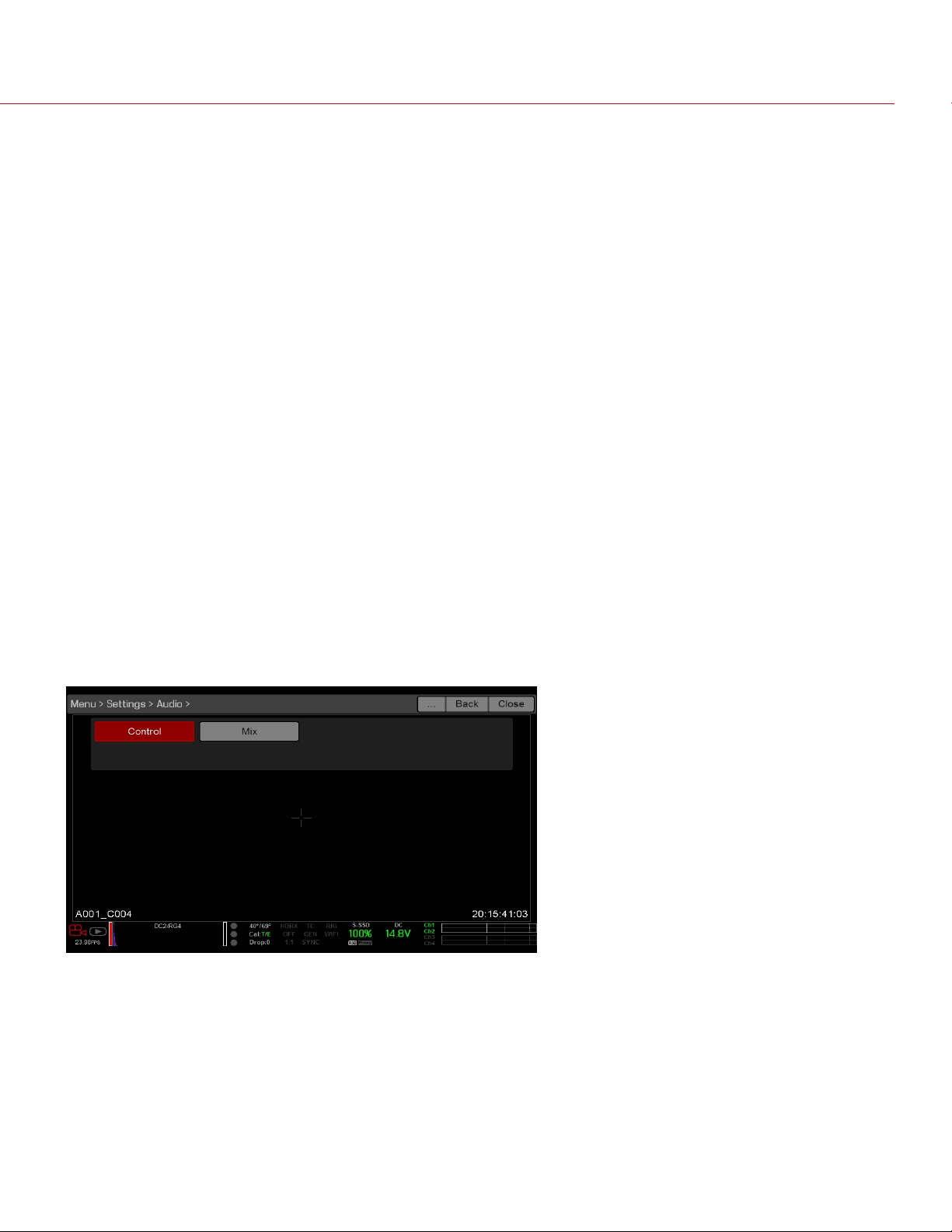
COPYR IGH T © 2019 R ED.COM, LLC 955- 0184_V7.3, REV-A | 141
RED RANGER MONSTRO OPERATION GUIDE
CHAPTER 7:
AUDIO SYSTEM
AUDIO OVERVIEW
The camera has two (2) integrated dual channel digital stereo microphones that record uncompressed audio at 24-bit 48
kHz. These microphones offer you the ability to capture scratch-track audio.
The camera features a built-in headphone jack, so you can hear the audio during playback via headphones. Together, the
integrated microphones and headphone jack offer an audio solution for run-and-gun shoots.
Additionally, the camera has one full-size XLR audio jack for recording line level and microphone level audio.
The camera can record up to four (4) discrete stereo channels of uncompressed 24-bit, 48 kHz audio.
Input signals are routed via a high-quality pre-amplifier to achieve the desired recording levels and maximize dynamic
range.
Audio data is synchronized with video and timecode and embedded in the R3D
®
file. You can export audio data from
REDCINE-X PRO
®
as separate audio files.
Audio is also embedded in any HD-SDI output connected to the camera (except the MON-1 signal).
SET UP AUDIO
To set up audio, go to
Menu > Settings > Audio. To adjust the input, pre-amplifier, and headphone settings, select
Control. To adjust the mix settings, select Mix.
Figure: Audio Menu
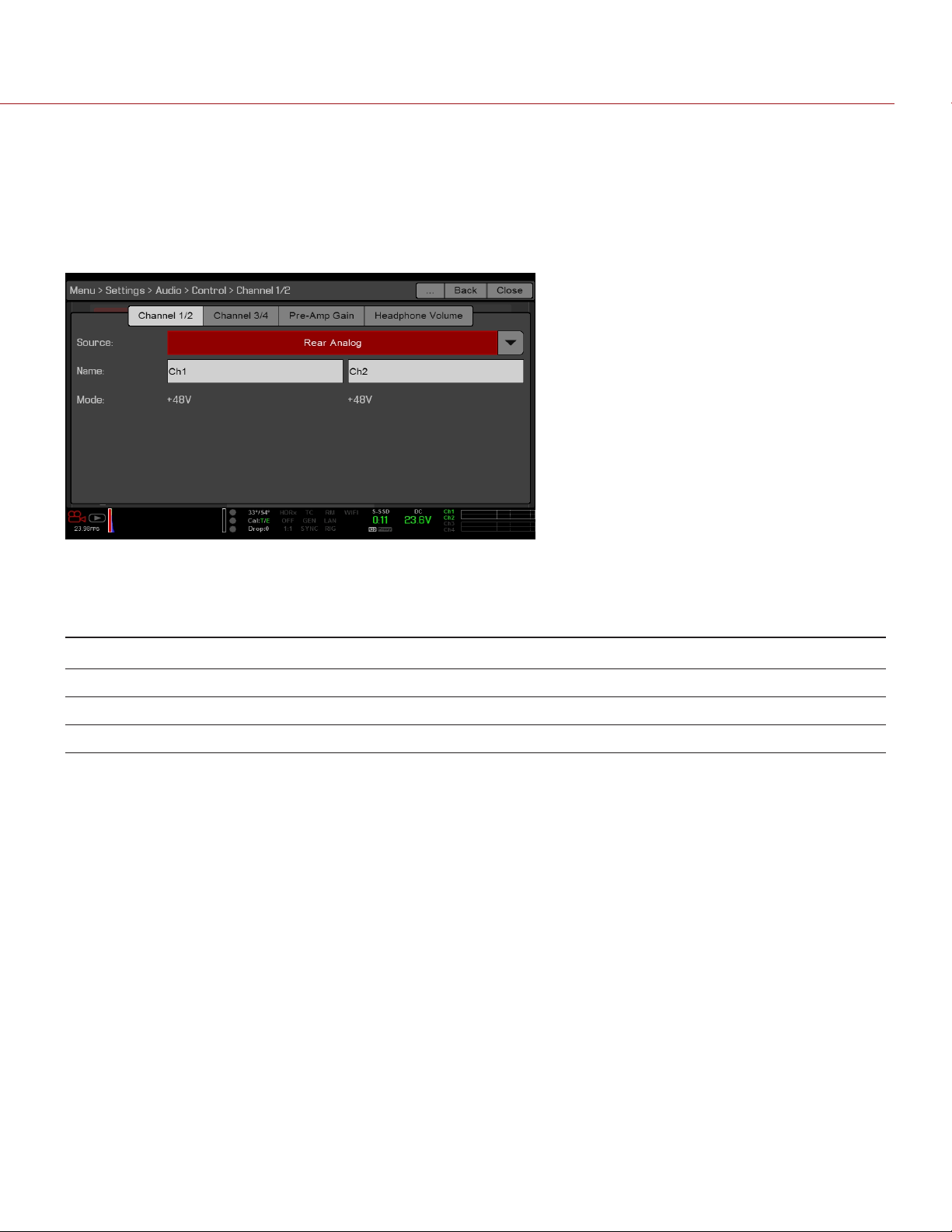
CONTROL
To adjust the input, pre-amplifier, and headphone settings, select
Control.
CHANNEL 1/2 AND CHANNEL 3/4
To set up Channel 1/2 and 3/4, go to
Menu > Settings > Audio > Control.
Figure: Channel Setup
SOURCE
SOURCE NAME CHANNEL PAIRS CONNECTORS
None N/A N/A
Camera Internal Ch1/Ch2, Ch3/Ch4 Mic 1, Mic 2
Rear Analog Ch1/Ch2, Ch3/Ch4 AUDIO (full-size XLR)
NAME
You can rename each audio channel. The default names are Ch1, Ch2, Ch3, and Ch4. The channel names display in the
Audio Meter, but are not included in the clip metadata.
MODE
When Rear Analog is selected, the Mode (Line, Mic, or +48V) displays for the incoming audio signal.
PHANTOM POWER
The 5-pin XLR connector provides +48 V phantom phantom power.
Enable phantom power (via the switch adjacent to the XLR port) after a microphone is connected. Disable phantom
power (by switching to Line or Mic) before removing the microphone.
COPYR IGH T © 2019 R ED.COM, LLC 955- 0184_V7.3, REV-A | 142
RED RANGER MONSTRO OPERATION GUIDE

PRE-AMP GAIN
Pre-amp gain range is 0 dB to 55 dB. Default is 0 dB.
To adjust amplification levels, follow the instructions below:
1. Go to
Menu > Settings > Audio > Control > Pre-Amp Gain.
2. Move the Pre-Amp (pre-amplifier) sliders up and down to adjust the amplification levels.
3. To link the amplification for each channel, select Link.
HEADPHONE VOLUME
Headphone volume range is –54 dB to 0 dB. Default is 0 dB.
CHANGE HEADPHONE VOLUME
1. Go to
Menu > Settings > Audio > Control > Headphone Volume.
2. Move the Left and Right sliders up and down to adjust the volume.
3. To toggle mute/unmute, select Mute.
4. To link the volume for Left and Right, select Link.
MIX
The camera features a digital audio mixer that controls the volume and stereo settings for each input channel. The mixer
affects audio monitoring (such as headphones) and audio recorded to external devices. The mixer DOES NOT affect
audio embedded in the R3D file. To access mix settings, go to
Menu > Settings > Audio > Mix.
The range for each channel is 0% to 100%. The default for each active channel is 100%.
The digital mixer normalizes each output to prevent the output from exceeding the signal range. For example, if you pass
Channel 1 to an output at 100%, and then mix Channel 2 into the same output, the level of Channel 1 decreases to 50%.
Assign each audio channel to the Left, Middle, or Right side of the stereo mix. Move the sliders up and down to adjust
the volume.
You can control the volume and stereo for each audio monitoring option:
Headphone Mix: Headphones plugged into the camera.
Monitor Mix: External HD-SDI monitors that support audio.
AUDIO OUTPUT OPTIONS
One (1) 2-channel headphone output. For maximum quality, use high impedance headphones.
HD-SDI monitor: Output two (2) channels of 24-bit 48 kHz uncompressed, embedded digital audio. Select and mix
the stereo channels in the Monitor Mix menu at Menu > Settings > Audio > Mix > Monitor Mix. To monitor or HD-
SDI, the third-party monitor must support audio.
AUDIO METER (VU METER)
The Audio Meter displays at the bottom-right corner of the viewfinder, and displays either the incoming audio channels
(default), or the outgoing audio (mixes). For more information, go to
"VU Meter" on page 79.
COPYR IGH T © 2019 R ED.COM, LLC 955- 0184_V7.3, REV-A
| 143
RED RANGER MONSTRO OPERATION GUIDE
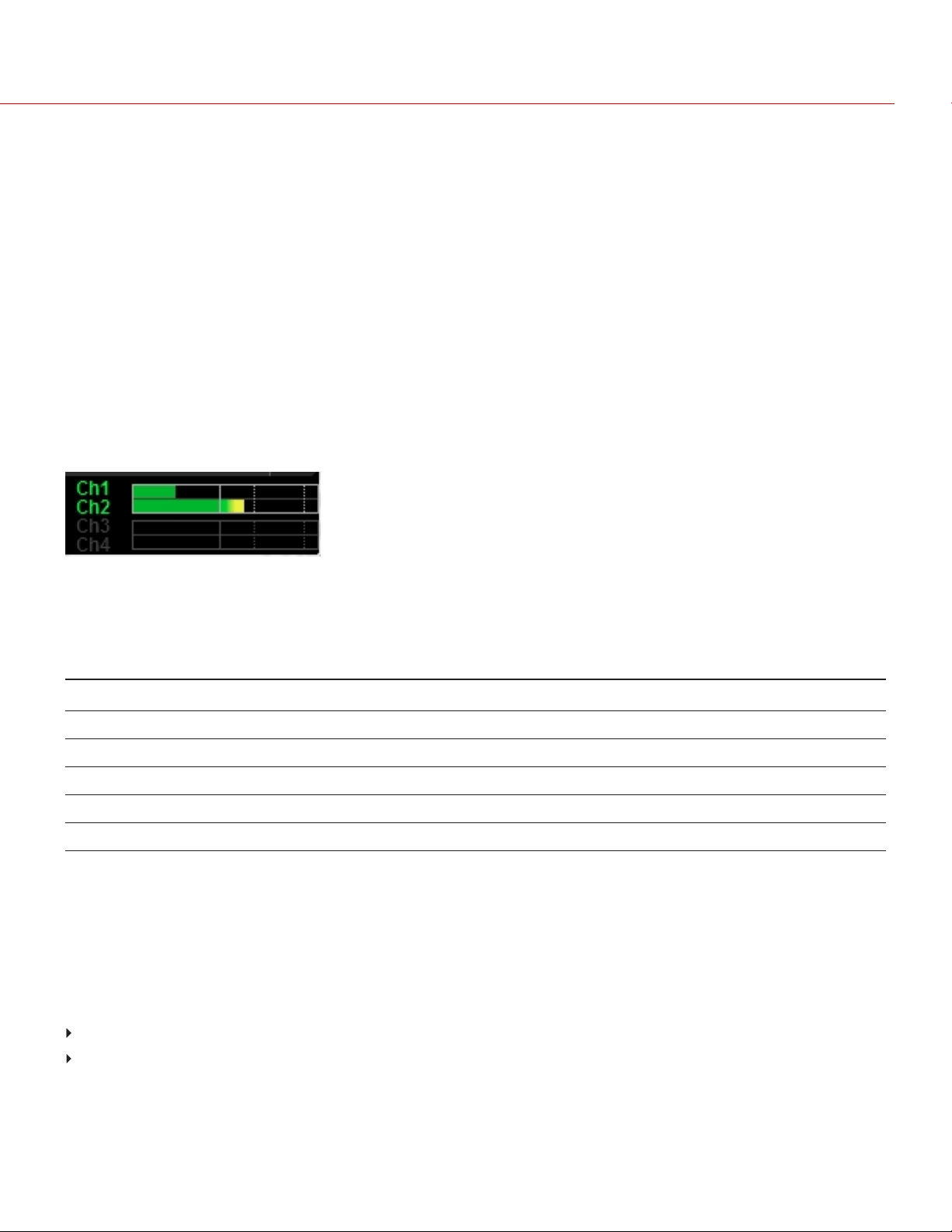
INCOMING AUDIO CHANNELS
When you select Input as the VU Meter Source, the Audio Meter displays the incoming audio channels (default). For
more information, go to
"VU Meter" on page 79. Channel 1 and Channel 2 are the default channels, correlating with the
MIC-1 and MIC-2 inputs on the camera. Channel 3 and Channel 4 are greyed out unless the camera detects audio input.
The channel names selected in the Audio menu determine the channel names displayed in the Audio Meter.
The Audio Meter shows the incoming audio signal when a source is selected, even if the channel is not recorded. When
a channel is recorded, the channel indicator left of the Audio Meter is green.
OUTGOING AUDIO
When you select Output as the VU Meter Source, the Audio Meter displays the Headphone Mix, Audio Out Mix, and
Monitor Mix levels. For more information, go to
"VU Meter" on page 79.
When recording to an external device, use the Output levels to help accurately monitor recorded audio.
AUDIO METER LEVELS
Figure: Audio Meter
The camera updates the Audio Meter 12 times per second with the maximum signal from the last 1/12 of a second
period. The range of the Audio Meter is –52 dBFS to 0 dBFS.
The lines and colors indicate danger of clipping, as described in the table below:
LINE DBFS COLOR DESCRIPTION
First line (far left border; solid) –52 dBFS Green Audio is not clipping
Second line (solid) –20 dBFS Green Audio is not clipping
Third line (dashed) –12 dBFS Yellow Audio close to clipping
Fourth line (dashed) –2 dBFS Red Audio is clipping
Fifth line (far right border; solid) 0 dBFS Red Audio is clipping (if signal exceeds –1 dBFS, the whole bar is red)
NOTE: In the American broadcast and post production systems, –20 dBFS roughly corresponds to 0 VU and 4 dBu. In a
digital system, dBu is an approximation; the correct unit for digital audio levels is dBFS.
AUDIO DURING PLAYBACK
The camera plays all recorded channels during playback(via headphones and HD-SDI monitors), and automatically
unmutes any muted audio outputs.
To access audio settings during playback, go to
Menu > Settings > Audio and select the following tabs:
Control
Mix
RECORD AUDIO IN VARISPEED MODE
The camera supports recording audio in Varispeed mode when all of the following criteria is met:
COPYR IGH T © 2019 R ED.COM, LLC 955- 0184_V7.3, REV-A | 144
RED RANGER MONSTRO OPERATION GUIDE
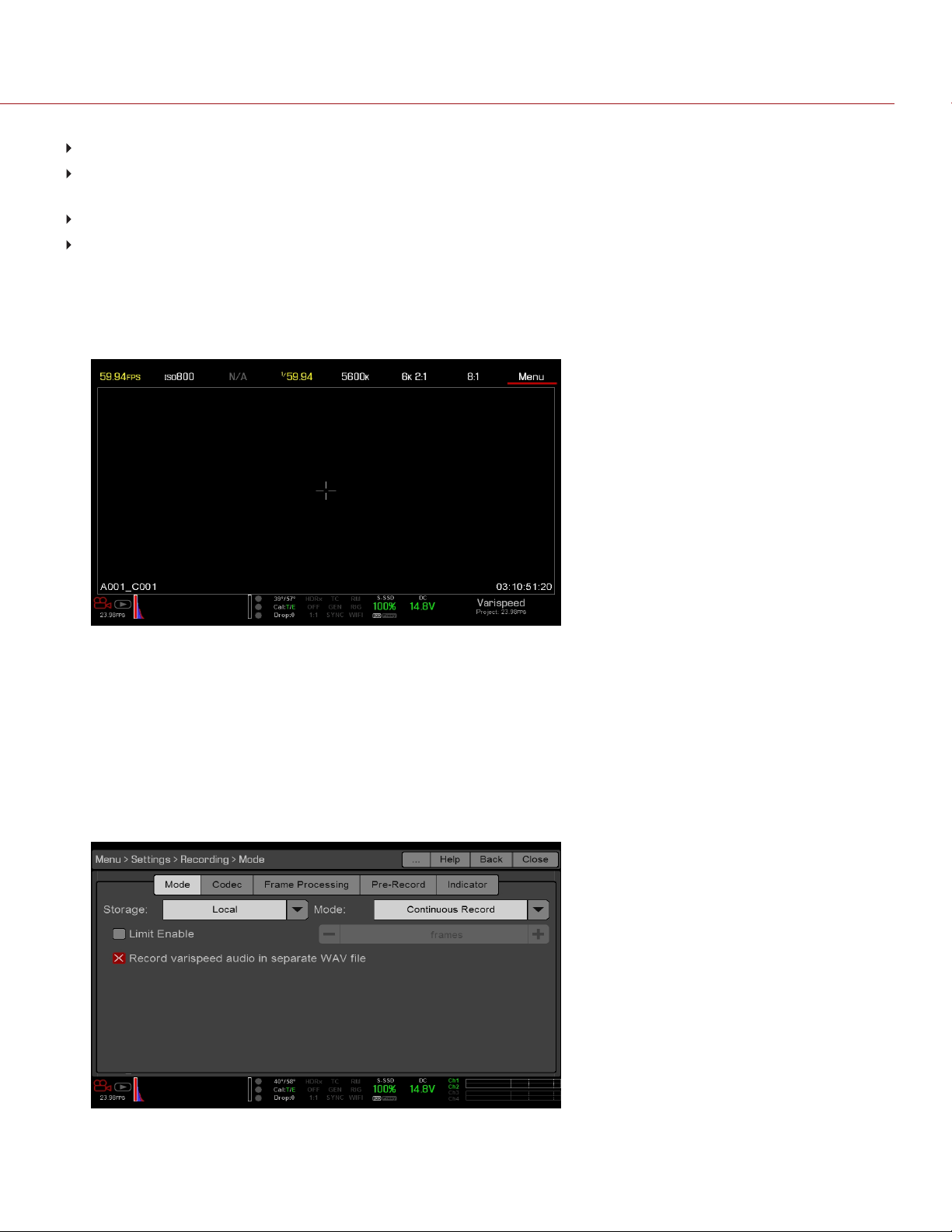
The Recording Frame Rate is higher than the Project Time Base
The Recording Storage is set to Local, and the Recording mode is set to Continuous Record (Menu > Settings >
Recording > Mode)
The Record varispeed audio in a separate WAV file check box is selected (Menu > Settings > Recording > Mode)
The Record File Format includes R3D (Menu > Settings > Recording > Codec)
To record audio in Varispeed mode, follow the instructions below:
1. Set the Recording Frame Rate to a higher rate than the Project Time Base. The camera cannot record audio when
the Recording Frame Rate is lower than the Project Time Base. For more information, go to "Frame Rate" on
page 94.
Figure: Enable Varispeed
2. Go to Menu > Settings > Recording > Mode.
3. Select Local from the Storage drop-down menu.
4. Select Continuous Record from the Mode drop-down menu.
5. Select the Record varispeed audio in a separate WAV file check box. This option is available only when the
Recording Frame Rate is higher than the Project Time Base.
The Audio Meters display in the Lower Status Row. For more information, go to "Audio Meter (VU Meter)" on
page 143.
Figure: Record Varispeed Audio
COPYR IGH T © 2019 R ED.COM, LLC 955- 0184_V7.3, REV-A | 145
RED RANGER MONSTRO OPERATION GUIDE
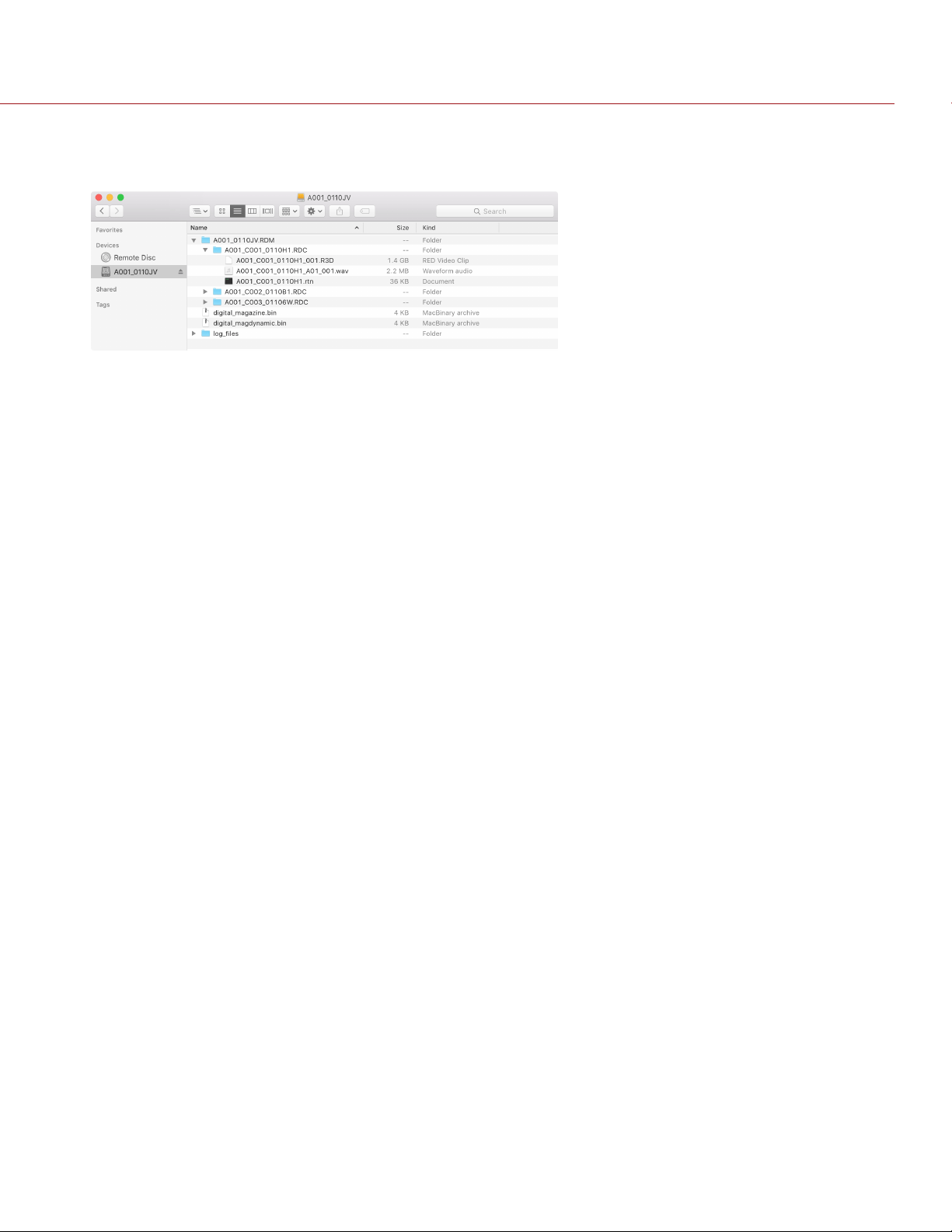
6. Record.
7. When you mount the SSD to a computer, a WAV file displays in the RDC folder.
Figure: WAV File in RDC Folder
COPYR IGH T © 2019 R ED.COM, LLC 955- 0184_V7.3, REV-A | 146
RED RANGER MONSTRO OPERATION GUIDE
COPYR IGH T © 2019 R ED.COM, LLC 955- 0184_V7.3, REV-A | 147
RED RANGER MONSTRO OPERATION GUIDE
CHAPTER 8:
TIMECODE, GENLOCK, MULTI-
CAMERA SETUP
This chapter describes timecode, genlock, and multi-camera operations such as 3D and array setup.
TIMECODE
Timecode is a numeric sequence based on SMPTE 12M that aids in the management and synchronization of footage and
audio. Timecode is embedded in recorded RAW files, QuickTime
®
files (if recording an Apple
®
ProRes codec), and MXF
files (if recording an Avid
®
codec) as metadata and in HANC metadata provided by the HD-SDI monitor output. The
camera can generate timecode on its own or can receive and sync to timecode generated by an external source. RED
cameras use non-drop frame timecode.
Timecode displays in the lower right corner of the Live Action Area on the graphical user interface (GUI) and is embedded
as metadata. Timecode is represented as an eight (8) digit sequence (HH:MM:SS:FF), where:
HH: Hours
MM: Minutes
SS: Seconds
FF: Frames
NOTE: Timecode is most accurate and effective when coupled with genlock. For more information, go to "Genlock" on
page 149.
NOTE: For more information on HANC metadata, see HD- SDI HANC Metadata Information , available at
www.red.com/developers.
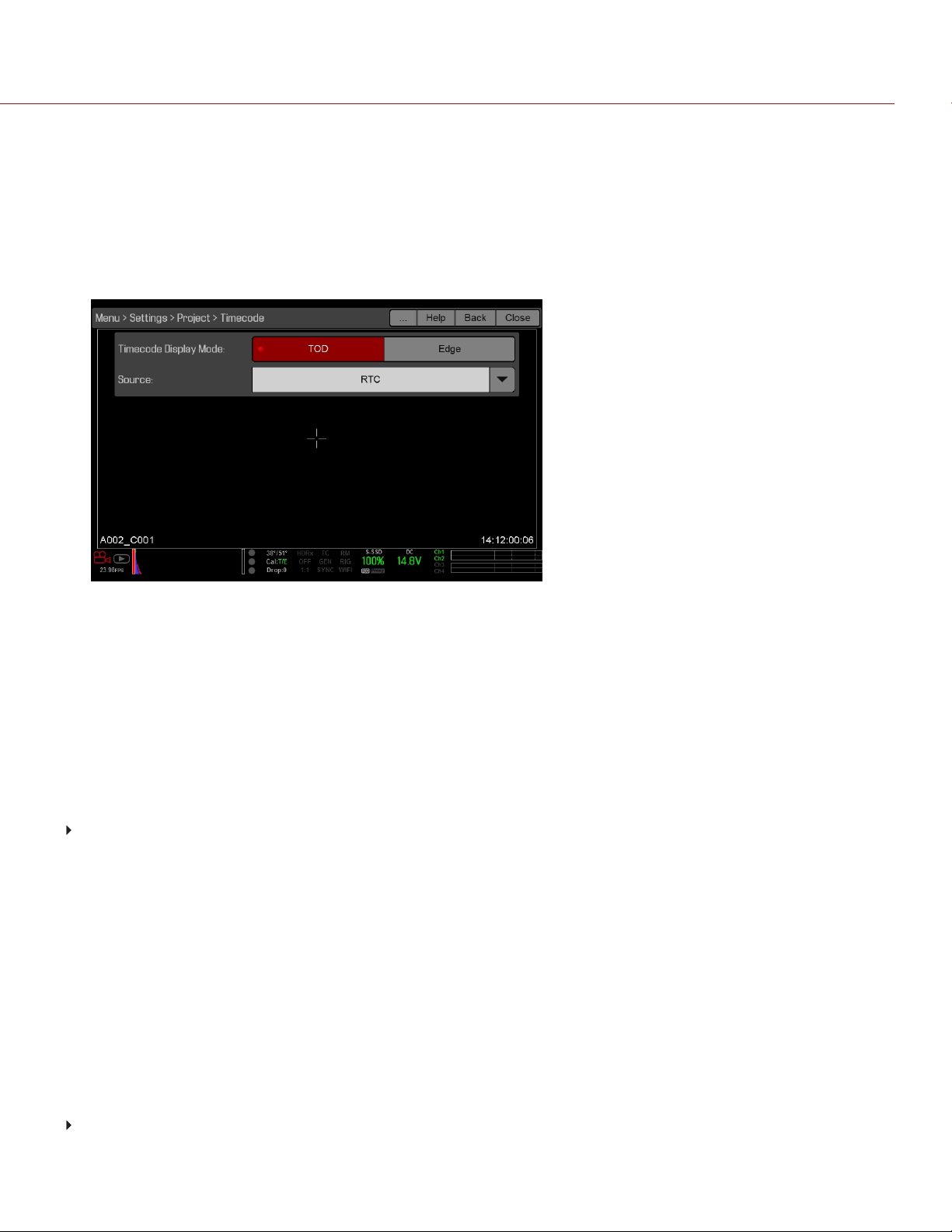
SET UP INTERNAL TIMECODE
To set up and adjust timecode generated by the camera, follow the instructions below:
1. Go to
Menu > Settings > Project > Timecode.
2. Select the desired Timecode Display mode.
3. Set Source to RTC.
The TC indicator in the Lower Status Row remains grey when internal timecode is enabled.
Figure: Timecode
OUTPUT TIMECODE
To output a timecode signal to an external device or slaved camera, follow the instructions below:
1. Follow the instructions in
"Set Up Internal Timecode" above to set up internal timecode.
2. Connect the camera to another device using the PRO I/O TIMECODE CABLE (3').
A. Connect the other connector to an external device or camera.
REQUIRED CABLE
790-0212: PRO I/O TIMECODE CABLE (3')
INPUT EXTERNAL TIMECODE
To input timecode generated by an external device, follow the instructions below:
1. Connect the external timecode device to the
TIMECODE port on the camera by using a 75 ohm BNC cable.
2. Go to Menu > Settings > Project > Timecode.
3. Select the desired Timecode Display Mode.
4. Set Source to External.
The TC indicator in the Lower Status Row turns green when an external timecode source is locked.
NOTE: When an external source is selected but not present, timecode displays User Provided settings.
REQUIRED CABLE
790-0212: PRO I/O TIMECODE CABLE (3')
COPYR IGH T © 2019 R ED.COM, LLC 955- 0184_V7.3, REV-A | 148
RED RANGER MONSTRO OPERATION GUIDE

GENLOCK
Generator locking (genlock) is a tri-level signal used to synchronize video and audio systems. Genlock is based on
SMPTE 296M and 274M. There are two (2) important genlock sync modes:
Monitor Sync
Sensor Sync
MONITOR SYNC
Monitor Sync occurs when an incoming genlock signal is compatible with the monitor output frequency. Monitor Sync is
achievable even if the camera is using another form of synchronization to sync the camera sensor.
1. Connect the
GENLOCK port on the camera to the device using a 75 ohm BNC cable.
2. Set up the frequency for the HD-SDI output (select Auto to automatically match the HD-SDI output to the current
Project Time Base). For more information, go to "Frequency" on page 70.
Monitor Sync is achieved automatically when an incoming genlock signal is compatible with the monitor output
frequency. When Monitor Sync is achieved, the GEN indicator in the Lower Status Row illuminates green.
REQUIRED CABLE
75 ohm BNC cable (such as the RED HD-SDI Cable, P/N 790-0341)
SENSOR SYNC
NOTE: HDRX
®
is not available when Genlock Sensor Sync is enabled.
Sensor Sync is achieved when an incoming genlock signal is compatible with the monitor output frequency, project time
base, and recording frame rate. In Sensor Sync mode, sensor timing is locked to the genlock signal. Sensor Sync
requires the following synchronized settings:
SETTING MENU LOCATION PATH
Genlock signal frequency N/A; external genlock device
HD-SDI monitor output frequency Menu > Monitoring > Monitors > select monitor
Project Time Base Menu > Settings > Project > Frame Rate
Recording Frame Rate Menu > Settings > Project > Frame Rate
SET UP SENSOR SYNC MODE
To set up and enable Sensor Sync Mode, follow the instructions below:
1. Ensure that the Project Time Base and Recording Frame Rate will be compatible with the incoming genlock signal.
2. Connect the
GENLOCK port on the camera to the device using a 75 ohm BNC cable.
3. Go to Menu > Settings > Setup > GPIO/Sync > Sync.
4. Select Genlock from the Sensor Sync Mode drop-down menu.
5. Set up the frequency for the HD-SDI output (select Auto to automatically match the HD-SDI output to the current
Project Time Base). For more information, go to "Frequency" on page 70.
The GEN indicator in the Lower Status Row turns green when a compatible genlock signal is present and genlock is
enabled. The SYNC indicator in the Lower Status Row turns green when Sensor Sync is achieved.
COPYR IGH T © 2019 R ED.COM, LLC 955- 0184_V7.3, REV-A
| 149
RED RANGER MONSTRO OPERATION GUIDE
REQUIRED CABLE
75 ohm BNC cable (such as the RED HD-SDI Cable, P/N 790-0341)
MASTER/SLAVE OPERATION
NOTE: The Master camera controls metadata and basic camera parameters of the Slave cameras. Any other setting
changes required by the Slave cameras must be made before recording.
This section describes operation in Master/Slave configuration and clip naming conventions for clips recorded on those
cameras. Master/Slave is the most common configuration for Stereo/3D productions.
When cameras are operated in Master/Slave configuration, you can perform the following operations:
Power: Turn off the Master camera to turn off both cameras.
Record: Press the PWR/REC key on the Master camera to start/stop recording on both cameras.
Change settings: Change settings on the Master camera, to change settings on the Slave camera.
For a Master/Slave configuration to function, the cameras must have the same:
Firmware version
Project time base
Recording frame rate
Sensor
NOTE: You can Master/Slave the RED RANGER to the DSMC2 cameras when they have matching sensor types.
COPYR IGH T © 2019 R ED.COM, LLC 955- 0184_V7.3, REV-A
| 150
RED RANGER MONSTRO OPERATION GUIDE
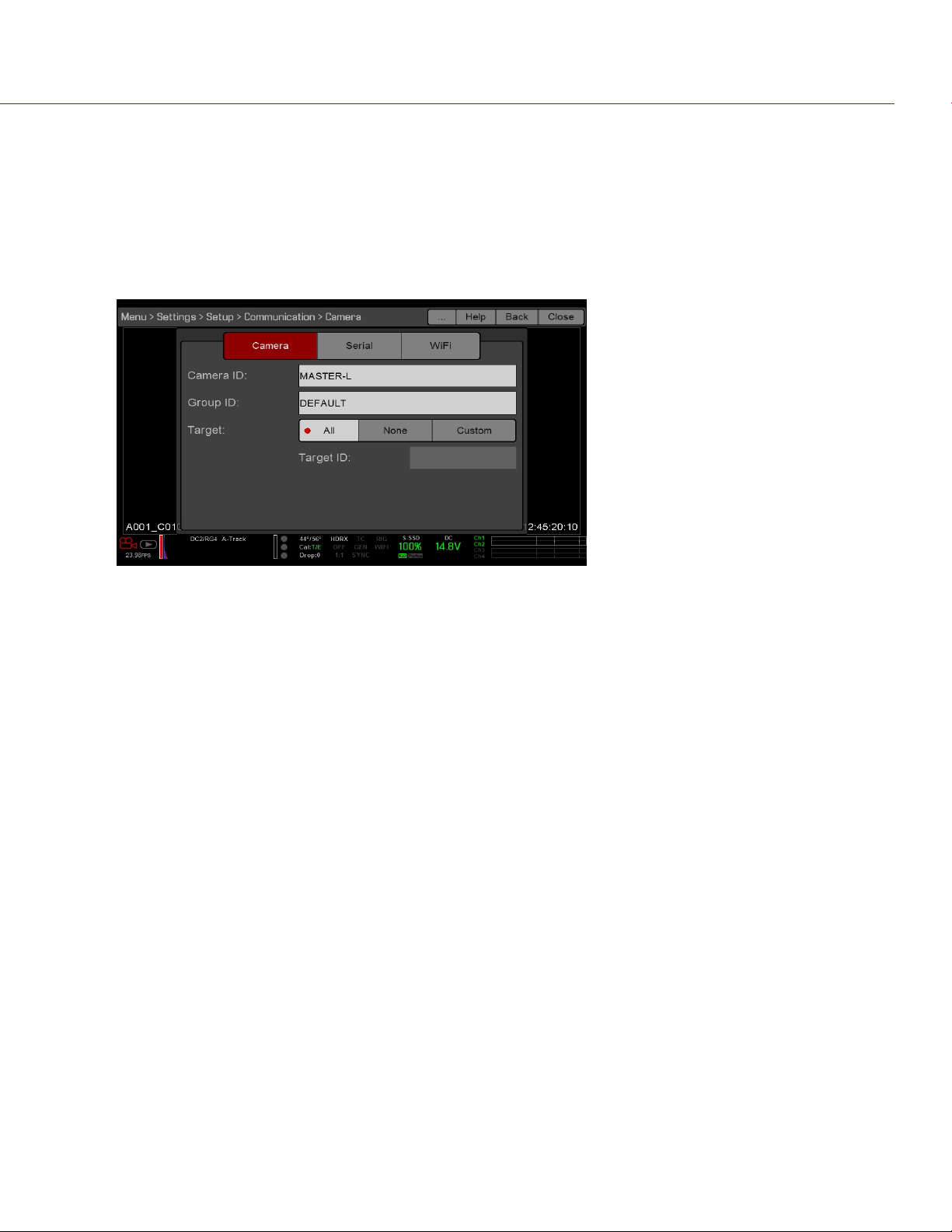
SET UP MASTER/SLAVE OPERATION
1. Connect the
GIG-E port on one camera to the GIG-E port on the other camera using the Master/Slave Gig-E Cable.
2. On the Master camera, follow the instructions below:
A. Go to Menu > Settings > Setup > Communication.
B. Type a name for the camera (Example: CAM A, LEFT, MASTER, etc) in the Camera ID field.
C. Set Target to All.
Figure: Master Settings
D. Go to Menu > Settings > Setup > Communication and select the Ethernet tab.
E. Select the Camera to Camera the check box.
COPYR IGH T © 2019 R ED.COM, LLC 955- 0184_V7.3, REV-A
| 151
RED RANGER MONSTRO OPERATION GUIDE
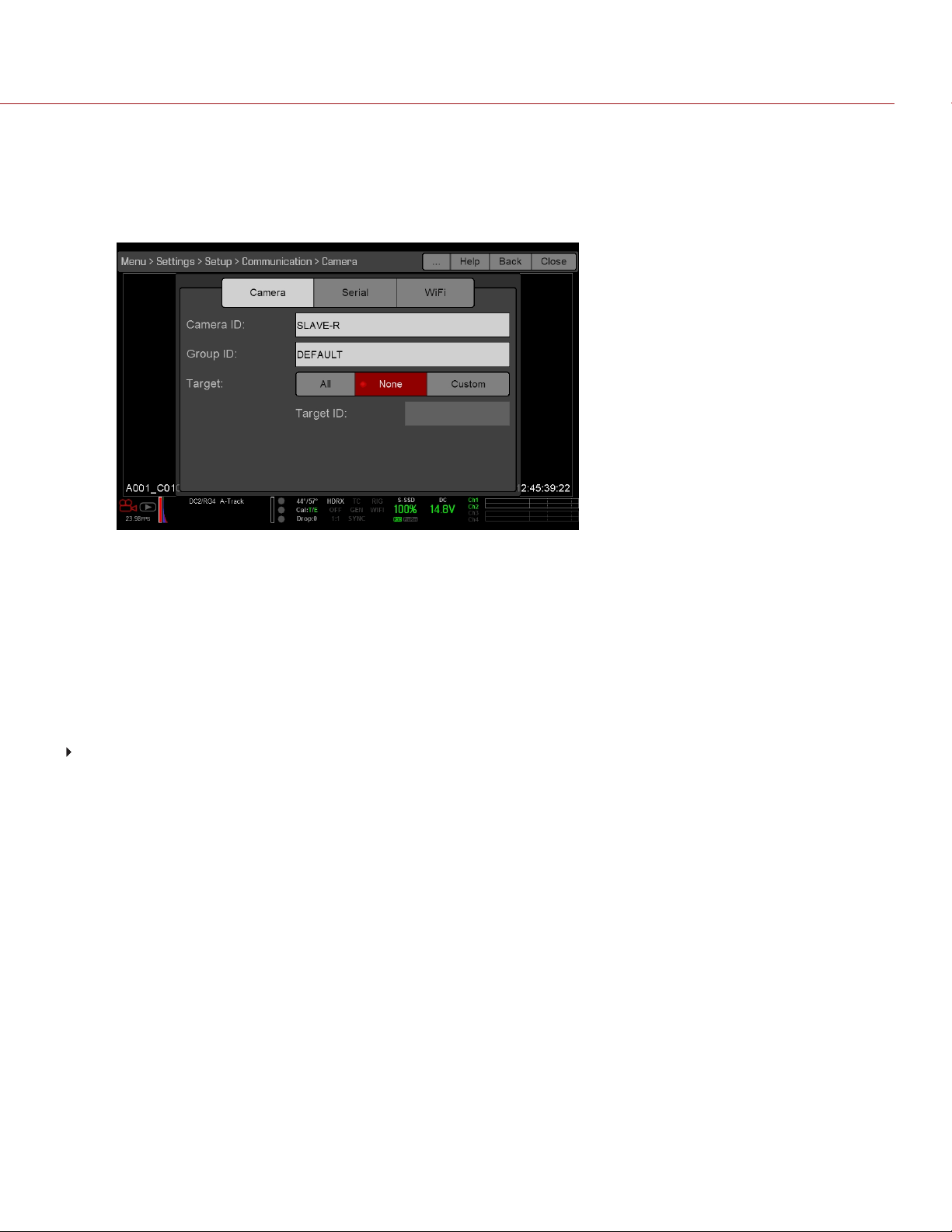
3. On the Slave camera(s), follow the instructions below:
A. Go to Menu > Settings > Setup > Communication.
B. Type a name for the camera (Example: CAM B, RIGHT, SLAVE, etc) in the Camera ID field.
C. Set Target to None.
Figure: Slave Settings
D. Go to Menu > Settings > Setup > Communication and select the Ethernet tab.
E. Select the Camera to Camera check box.
The LAN indicator in the Lower Status Row illuminates green.
NOTE: Cameras can also be set up in a Master/Master configuration. To set up Master/Master, set Target to All on
both cameras, allowing either camera to make changes and control record start/stop.
REQUIRED CABLE
790-0163: Master/Slave Gig-E Cable (4')
COPYR IGH T © 2019 R ED.COM, LLC 955- 0184_V7.3, REV-A
| 152
RED RANGER MONSTRO OPERATION GUIDE
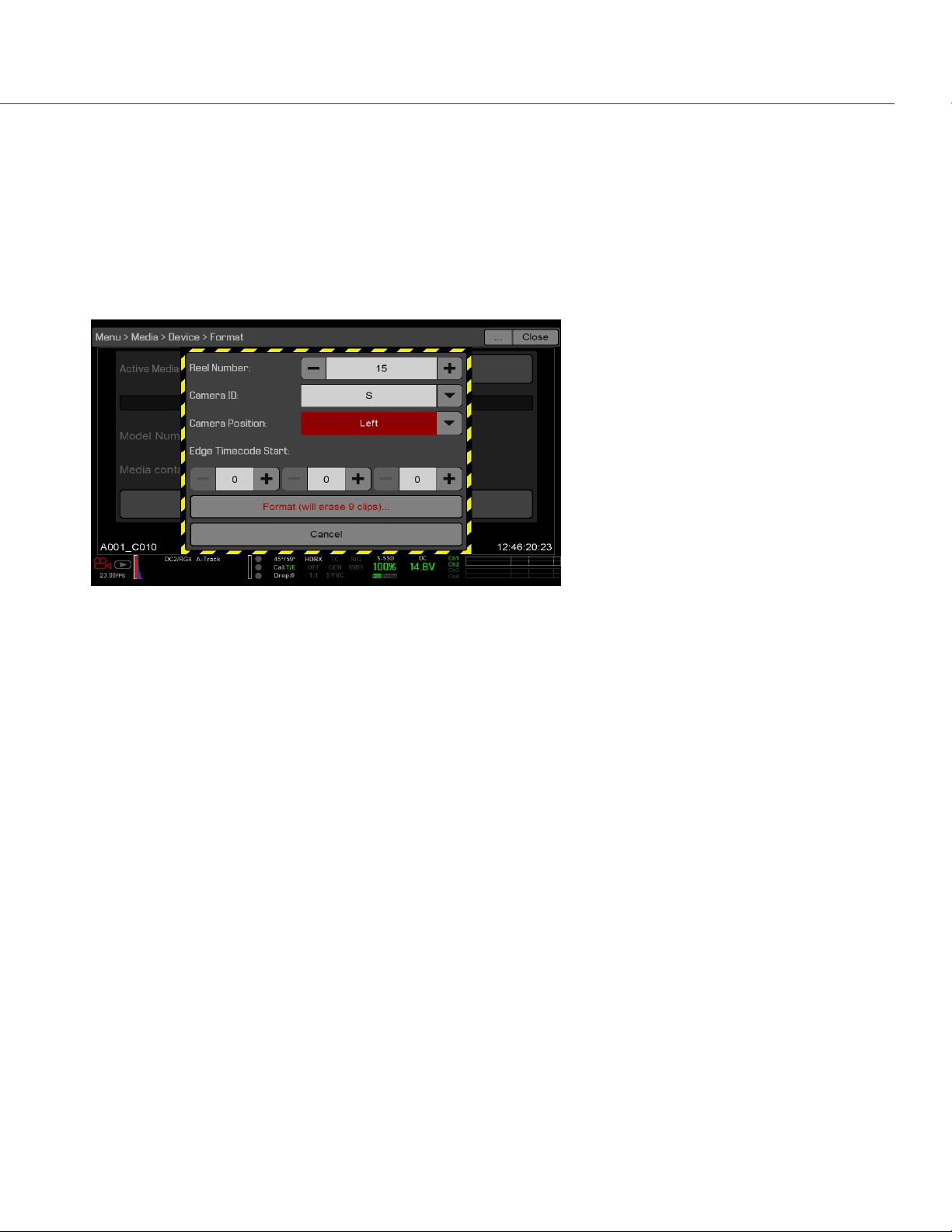
SET REEL NUMBER, CAMERA ID, AND CAMERA POSITION
NOTE: Camera ID and Camera Position settings can also be found at Menu > Settings > Project > Slate > Camera.
To prepare media and slate settings for a Master/Slave or Stereo/3D production, follow the instructions below:
1. On both Master and Slave cameras, go to Menu > Media > Device and select Format Media....
2. On both Master and Slave cameras, select the desired Reel Number and Camera ID settings. The Reel Number
and Camera ID settings on both cameras should match.
3. On the Master camera, change the Camera Position to Left, representing “left eye”.
Figure: Master Settings
4. On the Slave camera, change the Camera Position to Right, representing “right eye”.
5. On both cameras, select Format... to format media and set the Reel Number, Camera ID, and Camera Position
settings.
COPYR IGH T © 2019 R ED.COM, LLC 955- 0184_V7.3, REV-A
| 153
RED RANGER MONSTRO OPERATION GUIDE

MULTI-CAMERA CLIP NAMING CONVENTIONS
This section describes automatic camera-generated clip naming conventions based on slate settings. Cameras use the
Reel No, Cam ID, and Cam Pos settings to generate a custom clip name.
For example, if you have two (2) cameras in Master/Slave configuration and format media on both cameras with the
following settings:
CAMERA REEL NUMBER CAMERA ID CAMERA POSITION
Master 1 S Left
Slave 1 S Right
The first clip recorded by this Master/Slave camera configuration is:
Master: S001_L001_0503B6.R3D
Slave: S001_R001_0503R7.R3D
NOTE: B6 and R7 are examples of camera-generated wildcard characters.
NOTE: If both cameras have a Camera Position of Left, the recorded clips will have the same filename structure, with
the exception of the camera-generated wildcard characters. For example:
Master: A001_C001_0503B6.R3D
Slave: A001_C001_0503R7.R3D
NOTE: Reel Number, Camera ID, and Camera Position can be set when formatting media.
COPYR IGH T © 2019 R ED.COM, LLC 955- 0184_V7.3, REV-A
| 154
RED RANGER MONSTRO OPERATION GUIDE

SET UP STEREO/3D CONFIGURATION
This section describes basic procedures for connecting two (2) cameras in a Master/Slave configuration for 3D operation.
NOTE: When providing the signals to a Stereo Image Processor (SiP) for verifying 3D alignment, set the HD-SDI
monitor output on both cameras to have the same overlay configuration.
NOTE: For genlock to function correctly, the cameras must be on the same firmware version, and must be using the
same project time base and recording frame rate.
To set up a Stereo/3D setup, follow the instructions below.
1. On both cameras, set the project time base and recording frame rate.
2. On both cameras, follow the instructions in "Sensor Sync" on page 149 to achieve Sensor Sync genlock status.
The GEN and SYNC indicators in the Lower Status Row illuminate green.
3. Follow the instructions in "Set Up Master/Slave Operation" on page 151 to set Master and Slave camera settings.
4. On both cameras, follow the instructions in "Set Reel Number, Camera ID, and Camera Position" on page 153 to set
up media and camera settings.
REQUIRED CABLES
Use one (1) per camera:
75 ohm BNC cable (such as the RED HD-SDI Cable, P/N 790-0341)
Use one (1) per setup:
790-0163: Master/Slave Gig-E Cable (4')
COPYR IGH T © 2019 R ED.COM, LLC 955- 0184_V7.3, REV-A
| 155
RED RANGER MONSTRO OPERATION GUIDE
CAMERA ARRAY
SET UP A CAMERA ARRAY
NOTE: For genlock to function correctly, the cameras must be on the same firmware version, and must be using the
same project time base and recording frame rate.
NOTE: To operate a camera array setup from a Windows
®
computer or workstation, you need one of several
applications provided by RED
®
or third-party developers.
You can sync more than two (2) cameras for applications and productions that require a camera array. To set up a
camera array, you need a 1000Base-T gigabit Ethernet router.
For more information on camera control, see the R.C.P.™ SDK, available at www.red.com/developers.
To set up a camera array, follow the instructions below:
1. On each camera, go to Menu > Settings > Setup > Communication and set the following:
A. On the Camera tab, set Target to All.
B. On the Camera tab, enter a matching name in the Group ID field. All cameras must have the same Group ID
name.
C. On the Ethernet tab, select the DHCP, Camera to Camera, and External Control check boxes.
2. Follow the instructions in "Sensor Sync" on page 149 to connect each camera to the genlock device.
The GEN and SYNC indicators in the Lower Status Row illuminate green.
3. Follow the instructions in "Set Up Master/Slave Operation" on page 151 to set Master and Slave camera settings.
Instead of using the Master/Slave Gig-E Cable, connect each camera to the router using a 9-Pin 0B GIG-E-To-
CAT5E Ethernet Cable.
A. Connect the LCD/EVF connector to the GIG-E port on the camera.
B. Connect the Ethernet connector to the router.
4. On each camera, follow the instructions in "Set Reel Number, Camera ID, and Camera Position" on page 153 to
prepare media and camera settings.
REQUIRED CABLES
Use one (1) per camera:
790-0154, 790-0643: 3BNC-to-00 Sync Cable
75 ohm BNC cable (such as the RED HD-SDI Cable, P/N 790-0341)
Use one (1) of the following per setup:
790-0159: RED GIG-E Straight-to-CAT5E Ethernet Cable (9')
790-0557, 790-0655: RED GIG-E Right-to-CAT5E Ethernet Cable (9')
COPYR IGH T © 2019 R ED.COM, LLC 955- 0184_V7.3, REV-A
| 156
RED RANGER MONSTRO OPERATION GUIDE
COMPATIBLE TIMECODE DEVICES
The following timecode devices are compatible with the camera. Additional timecode devices may be compatible, but
have not yet been tested by RED.
Ambient ACL 202CT
Ambient LOCKIT ACL 203
Ambient ACL 204
Ambient ACC 501 Clockit Controller
Ambient ACD-301 Lockit Slate
Denecke SB-3 Syncbox Time-Code Generator
Sound Devices 788T
Sound Devices 744
Sound Devices PIX-240
Zaxcom Nomad 12
Zaxcom ZFR100
Zaxcom ZFR200
COMPATIBLE GENLOCK DEVICES
The following genlock devices are compatible with the camera. Additional genlock devices may be compatible, but have
not yet been tested by RED.
AJA
®
GEN10 HD/SD/AES Sync Generator with Universal Power Supply
Ambient ACL 202CT
Ambient ACL 203
Ambient ACL 204
Denecke SB-T
Evertz Master Clock 5600MSC
NOTE: Ensure that your genlock device provides a full-strength genlock signal to each camera. Splitting a genlock signal
weakens it, which may compromise the sync between cameras.
COPYR IGH T © 2019 R ED.COM, LLC 955- 0184_V7.3, REV-A
| 157
RED RANGER MONSTRO OPERATION GUIDE

COPYR IGH T © 2019 R ED.COM, LLC 955- 0184_V7.3, REV-A | 158
RED RANGER MONSTRO OPERATION GUIDE
CHAPTER 9:
UPGRADE CAMERA FIRMWARE
Your camera functionality may be upgraded by installing the latest firmware. Make a habit of frequently visiting RED
Downloads at www.red.com/downloads to check for new versions of camera firmware, updated operation guides, and
post production software.
VERIFY CURRENT CAMERA FIRMWARE
To see the firmware version that is currently installed on your camera, go to
Menu > Settings > Maintenance > System
Status > Camera Info. A higher number reflects a later release.
UPGRADE CAMERA FIRMWARE
Install the most recent firmware. Unless otherwise specified in the release notes, you do not need to upgrade to any
firmware in between your current version and the most recent version available online.
NOTE: You must calibrate the sensor after upgrading the camera. For more information, go to "Sensor Calibration" on
page 136.
NOTE: Preset, Look, and Custom Overlay files are preserved across upgrades to v6.2.3 or later.
NOTE: On Mac
®
computers with REDCINE-X PRO
®
installed, RED Watchdog mounts the SSD as Read-Only by
default, which means that you are unable to write files (including firmware upgrade files) to the SSD. Change the Mount
preference to Read-Write before attempting to copy firmware to the SSD.
1. Connect an SSD (RED MINI-MAG
®
) to your computer.
2. Download the most recent firmware for your camera from RED Downloads at www.red.com/downloads.
3. Unzip the firmware zip file.
4. Copy the force_upgrade folder and its contents to the top level of the SSD directory.
5. Eject or unmount the SSD, and then remove the SSD.
6. Ensure that the camera is turned off.
7. Insert the SSD with the force_upgrade folder into your camera.

8. Turn on the camera.
The upgrade runs automatically.
During upgrade, the fans run at high speed and the PWR and REC LEDs flash green. After approximately 15
seconds, the LEDs stop flashing and the camera turns off. Nothing displays on the external monitors during the
upgrade.
9. After the camera turns off, remove the SSD and wait 10 seconds.
10. Turn on the camera.
The camera may take 30 seconds or longer to upgrade all of the attached RED devices. During this time the PWR
and REC LEDs flash green and nothing displays on the external monitors.
11. If this is your first time upgrading firmware, a pop-up menu opens with the Software License Agreement (SLA). Select
Agree. If you do not agree to the SLA, the camera cannot be used. The SLA continues to display until it is accepted.
12. Verify that the firmware version listed matches the firmware version that you downloaded. For more information, go to
"Verify Current Camera Firmware" on the previous page.
13. Reformat the SSD before recording.
COPYR IGH T © 2019 R ED.COM, LLC 955- 0184_V7.3, REV-A
| 159
RED RANGER MONSTRO OPERATION GUIDE

COPYR IGH T © 2019 R ED.COM, LLC 955- 0184_V7.3, REV-A | 160
RED RANGER MONSTRO OPERATION GUIDE
CHAPTER 10:
CAMERA SYSTEM
MAINTENANCE
All products are designed for rugged durability, but precision instruments demand proper care. Follow the instructions in
this chapter to clean, maintain, and store your devices.
WARNING: DO NOT rinse or immerse the camera or other accessories in water. Keep dry at all times.
WARNING: DO NOT use soaps, detergents, ammonia, acetone, alkaline cleaners, abrasive cleaning compounds, or
solvents. These substances may damage lens coatings and electronic circuitry.
WARNING: DO NOT use an excess of cleaning solution.
WARNING: DO NOT reuse swabs or wipes.
WARNING: DO NOT attempt to clean the sensor or optical cavity for any reason. If the sensor becomes dirty, submit a
Support ticket at https://support.red.com.
WARNING: DO NOT attempt to modify, dismantle, or open the camera, lens, or other accessory as doing so may
expose you to electric shock and serious injury. There are no user-serviceable parts inside. Alteration or repairs made to
the camera, lens, or other accessory, except by a RED
®
authorized service facility, voids all warranties.
WARNING: Use caution with compressed air and gas dusters, since the high pressure, oily residue, cold air,
particulates, and moisture may cause damage. You may use a filtered, non-residue gas duster to clean non-critical areas,
such as around the fans and other recesses on the exterior of the camera. Damage to the camera or other components
of the camera system caused by using compressed air or gas dusters is not covered under warranty.
WARNING: DO NOT use compressed air and gas dusters on the sensor or on any optics.
WARNING: DO NOT use compressed air and gas dusters on or around the integrated microphones on the front of the
camera.
CAMERA BODY AND ACCESSORY EXTERIOR
SURFACES
Use a filtered, non-residue gas duster to clean non-critical areas, such as around the fans and other recesses on the
exterior of the camera.
Clean with a dry lint-free cloth. When cleaning your camera and accessories, remember that the devices are not
waterproof and moisture can damage electronic circuitry.
STORAGE
RED recommends that you store the camera and accessories in the water-resistant cases available in the
RED Store at
www.red.com/store. These cases feature laser-cut foam to keep the camera and accessories secure.
WARNING: DO NOT store the camera or accessories in any place with extreme temperatures, direct sunlight, high
humidity, severe vibration, or strong magnetic fields.
CLEAN EVF SCREEN
NOTE: This section describes only how to clean the screen on the DSMC2
®
RED EVF, and not how to clean the entire
device.
This section explains how to clean the screen on the DSMC2 RED EVF. The screen is accessed by removing the
DSMC2 RED EVF Modular Optical Block.
Use an ionized rubber air bulb to clean the screen on the DSMC2 RED EVF. If there are still particles on the screen after
using an air bulb, gently wipe the screen with a rolled-up, particulate-free, non-abrasive optical-grade wipe.
NOTE: Cleaning the screen without first removing solid particles increases the risk of scratching the screen. As with
many screens, any type of physical contact with the screen may scratch the surface.
PROHIBITED EVF SCREEN CLEANERS
DO NOT use any of the items listed below to clean the screen on the DSMC2 RED EVF. These products have not been
tested on RED products and may cause damage or streaking.
Compressed air
Gas dusters
Solvents
Rubbing alcohol
Isopropyl alcohol
Windex
®
Third-party cleaning kits
Pre-packaged lens cleaner containing any additives, such as detergent, anti-static compounds, or fragrance
RED Microfiber Bag
WARNING: Damage to any screens or other components of the camera system caused by using prohibited cleaners is
not covered under warranty.
CLEAN LCD SCREENS
NOTE: This section describes only how to clean the screen on each specified device, and not how to clean the entire
device.
This section explains how to clean the screens on the following devices:
RED PRO LCD
RED Touch LCD
RED PRO Touch LCD
Camera Side LCD
COPYR IGH T © 2019 R ED.COM, LLC 955- 0184_V7.3, REV-A
| 161
RED RANGER MONSTRO OPERATION GUIDE
APPROVED LCD SCREEN CLEANERS
Use only the following products to clean LCD screens:
Ionized rubber air bulb
Delkin Devices Sensor Solution
®
Lens swabs
Dry optical wipes
RED Microfiber Bag
NOTE: Before cleaning the screen with swabs or wipes and a cleaning solution, ALWAYS use an ionized rubber air bulb
to remove any solid particles. Cleaning the screen without removing solid particles increases the risk of scratching the
screen.
PROHIBITED LCD SCREEN CLEANERS
DO NOT use any of the items listed below to clean LCD screens. These products have not been tested on RED
products and may cause damage or streaking.
Compressed air
Gas dusters
Solvents
Rubbing alcohol
Isopropyl alcohol
Windex
Pancro Professional Lens Cleaner (or equivalent)
Third-party cleaning kits
Pre-packaged lens cleaner containing any additives, such as detergent, anti-static compounds, or fragrance
WARNING: Damage to any screens or other components of the camera system caused by using prohibited cleaners is
not covered under warranty.
SCREEN STORAGE
Store any RED device with a screen in a RED Microfiber bag. Storing devices in a RED Microfiber bag preserves the
superior quality of the specialized AR and AS coatings on the LCDs.
Hand wash and air-dry the RED Microfiber bag regularly.
WATER DAMAGE
When your device comes in contact with water, or when you suspect water damage, submit a Support ticket at
https://support.red.com immediately.
WARNING: DO NOT attempt to power any device that may have water damage.
WARNING: DO NOT place the device in a container of rice, silica gel, or desiccant packets in an attempt to dry the
device.
COPYR IGH T © 2019 R ED.COM, LLC 955- 0184_V7.3, REV-A
| 162
RED RANGER MONSTRO OPERATION GUIDE
COPYR IGH T © 2019 R ED.COM, LLC 955- 0184_V7.3, REV-A | 163
RED RANGER MONSTRO OPERATION GUIDE
CHAPTER 11:
TROUBLESHOOT YOUR CAMERA
PERFORM A STRESS TEST
Perform a stress test before important projects to ensure the reliability and stability of your gear. A stress test subjects
your camera system and equipment to the increased stress of prolonged operation. If any components are developing
issues, this test will help identify those problems before you have an equipment failure during a major shoot.
1. Configure your camera.
2. Calibrate the sensor. For more information, go to
"Sensor Calibration" on page 136.
3. Enable the Sensor Test Pattern. For more information, go to "Enable/Disable Sensor Test Pattern" on page 132.
4. Select the desired resolution.
5. Select the highest available frame rate.
6. Perform a secure format of the SSD.
7. Record a full SSD of footage.
8. Perform a secure format of the SSD.
9. Repeat Step 6 to Step 8 to test multiple SSDs.
10. If any errors occur, save a log file and submit a Support ticket at https://support.red.com.
NOTE: Problems or dropped frames found during the stress test display as “Errors” in the bottom of the user interface.
GENERAL TROUBLESHOOTING
FIRMWARE DOES NOT UPGRADE
SYMPTOM
During an attempt to upgrade firmware, the PWR and REC LEDs flash red.
After an attempt to upgrade firmware, the firmware version does not change.
POTENTIAL RESOLUTIONS
After downloading the firmware upgrade file, ensure that you unzip the file before saving it to the SSD.
Ensure that the “force_upgrade” folder is saved to the top level of the SSD, and not to a subfolder.
GENERAL: LENS MOUNT NOT FUNCTIONING
SYMPTOM
The lens mount is not functioning correctly, or is not communicating with the camera.
POTENTIAL RESOLUTIONS
Perform a Hardware Rediscover. For more information, go to "Rediscover (Hardware Rediscover)" on page 133.
Upgrade your camera firmware. For more information, go to "Upgrade Camera Firmware" on page 158.
Reset your camera’s default settings. For more information, go to "Reset Defaults" on page 133.
CAMERA DOES NOT RECOGNIZE LENS
SYMPTOM
The camera does not recognize the attached lens.
POTENTIAL RESOLUTIONS
Ensure that the lens is compatible. For more information, go to "Lenses" on page 201.
If using a PL lens, ensure that the camera is providing power to the lens: go to Menu > Settings > Setup > Lens
and select the Enable Power to Lens check box.
Detect the lens: go to Menu > Settings > Setup > Lens and select Detect Lens.
Perform a Hardware Rediscover. For more information, go to "Rediscover (Hardware Rediscover)" on page 133.
CAMERA DISPLAYS N/A FOR APERTURE
SYMPTOM
The camera displays N/A for aperture when a lens is attached.
POTENTIAL RESOLUTIONS
Ensure that your lens is completely locked in place.
Remove your lens mount. Check the connection points for damage or debris. Install your lens mount.
Perform a Hardware Rediscover. For more information, go to "Rediscover (Hardware Rediscover)" on page 133.
Re-install your camera firmware.
If your camera is on beta firmware, downgrade to the release build.
If you are using a DSMC PL mount, go to Menu > Settings > Setup > Lens and ensure that power is enabled.
NOTE: Some lenses do not display the aperture information because they are incompatible. Some PL lenses do not have
i-technology data.
CANNOT SEE MENUS ON LCD TOUCHSCREEN
SYMPTOM
The LCD touchscreen does not display menus.
POTENTIAL RESOLUTION
Double-tap the LCD touchscreen to exit Clean mode.
COPYR IGH T © 2019 R ED.COM, LLC 955- 0184_V7.3, REV-A | 164
RED RANGER MONSTRO OPERATION GUIDE

SCREEN FREEZES OR DOES NOT DISPLAY
SYMPTOM
The screen freezes or does not display.
POTENTIAL RESOLUTION
Perform a Hard Restore. For more information, go to "Perform a Hard Restore" on page 167.
INTERMITTENT MOTION JITTER
SYMPTOM
A slight, intermittent motion jitter displays on the monitor.
POTENTIAL RESOLUTIONS
If you calibrate the sensor using the Auto Calibration method, the calibration map updates in the background when
camera settings change. The update may cause slight, intermittent motion jitter to the image on the monitor. The jitter
characteristic only displays in live preview, and does not affect recorded footage. For more information on sensor
calibration, go to "Sensor Calibration" on page 136.
LCD FLICKER
SYMPTOM
The LCD or monitor is flickering.
POTENTIAL RESOLUTIONS
Set the LCD frequency to 60 Hz. For more information, go to "Frequency" on page 70.
Use a different cable.
Ensure cables are properly attached.
LCD BLANK AT STARTUP
SYMPTOM
When you turn on the camera, the LCD does not show any image.
POTENTIAL RESOLUTIONS
Turn off the camera. Wait at least three (3) seconds, and then turn the camera back on.
COPYR IGH T © 2019 R ED.COM, LLC 955- 0184_V7.3, REV-A
| 165
RED RANGER MONSTRO OPERATION GUIDE
CANNOT USE TOUCHSCREEN
SYMPTOM
Cannot control the camera via the touchscreen or the Side LCD.
POTENTIAL RESOLUTIONS
Perform a Hard Restore. For more information, go to "Perform a Hard Restore" on the next page.
If you are using an external monitor, enable menus on the monitors and control the camera via the Side LCD:
Connect an SSD (RED MINI-MAG
®
) to your computer.
On the SSD, create a new folder, and name it force_preset.
Download the DSMC Toolkit from www.red.com/downloads.
Open the Preset_Files folder.
Open the folder that corresponds to the firmware version you are using.
Save the appropriate enable_menus file to the force_preset folder on your SSD.
Eject or unmount the SSD, and then remove the SSD.
Ensure that the camera is turned off.
Insert the SSD into your camera.
Turn on the camera. The camera automatically applies the preset.
NOTE: On Mac
®
computers with REDCINE-X PRO
®
installed, RED
®
Watchdog mounts the SSD as Read-Only by
default, which means that you are unable to write files (including firmware upgrade files) to the SSD. Change the Mount
preference to Read-Write before attempting to copy firmware to the SSD.
TIGHTEN DC IN CONNECTOR
SYMPTOM
The DC IN connector nut is loose.
POTENTIAL RESOLUTIONS
Tighten the loose DC IN connector nut using a pair of heavy duty strong point tweezers.
WARNING: DO NOT OVERTIGHTEN.
Optional: Add a small amount of Loctite
®
222 (low strength thread locker) to the threads of the DC IN connector nut
to prevent the connector from becoming loose again.
CAMERA DOES NOT TURN ON
SYMPTOM
The camera does not turn on (does not boot up), even when powered.
POTENTIAL RESOLUTIONS
Remove all accessories and power the camera using the power adaptor.
Perform a Hard Restore. For more information, go to "Perform a Hard Restore" on the next page.
Remove all accessories and power the camera using the power adaptor.
COPYR IGH T © 2019 R ED.COM, LLC 955- 0184_V7.3, REV-A | 166
RED RANGER MONSTRO OPERATION GUIDE
PERFORM A HARD RESTORE
A common way to resolve camera firmware issues is to perform a Hard Restore. A Hard Restore functions like a
System Restore in that it changes all settings to the factory default values.
To perform a Hard Restore, follow the instructions below:
1. With the camera turned off, hold the
PWR/REC key on the camera for 20 seconds or until the fans turn at a high
speed.
2. Release the PWR/REC key.
The screen displays correctly.
NOTE: User key settings reset as well as any other changes from the default settings.
IMAGE APPEARS GRAINY
SYMPTOM
Image or footage appears grainy.
POTENTIAL RESOLUTIONS
Calibrate the sensor before recording additional clips. For more information, go to "Sensor Calibration" on page 136.
Check the histogram to ensure proper exposure. Noise occurs if an image is overexposed or underexposed.
Use the lowest REDCODE
®
compression possible for the settings you have selected.
Use a higher resolution.
Use Adaptive fan mode to regulate the camera temperature. Noise occurs when the temperature from the applied
calibration map is not in sync.
BLACK AND WHITE IMAGE
SYMPTOM
The display shows that an image is in black and white, and the menus are still in color.
POTENTIAL RESOLUTIONS
Check the Color Saturation setting. If the Saturation setting is set to a low value, change the Saturation to a higher
value.
Reset your camera’s default settings. For more information, go to "Reset Defaults" on page 133.
INCORRECT COLOR TEMPERATURE
SYMPTOM
The camera color temperature is off and the image looks warmer or cooler than normal.
POTENTIAL RESOLUTIONS
Perform an auto white-balance. For more information, go to "White Balance" on page 64.
Calibrate the sensor. For more information, go to "Sensor Calibration" on page 136.
COPYR IGH T © 2019 R ED.COM, LLC 955- 0184_V7.3, REV-A
| 167
RED RANGER MONSTRO OPERATION GUIDE
TIMECODE OR GENLOCK DOES NOT FUNCTION
SYMPTOM
The SYNC, GEN, and/or TC light is red, yellow, or greyed out.
POTENTIAL RESOLUTIONS
Ensure that your timecode or genlock device is compatible. For more information, go to "Compatible Timecode
Devices" on page 157 and "Compatible Genlock Devices" on page 157.
Use a different cable.
Ensure that your timecode or genlock device settings match your project settings.
Ensure that your timecode or genlock device is set to the correct source. For more information, go to "Timecode" on
page 147 and "Genlock" on page 149.
Ensure that your Sensor Sync Mode is set to Genlock. For more information, go to "Sensor Sync" on page 149.
Set the ACN (Ambient Clockit Network) to Off.
CAMERA DOES NOT RECOGNIZE OLPF
SYMPTOM
Your camera does not recognize the OLPF.
POTENTIAL RESOLUTIONS
Reinstall the OLPF. For more information, go to "Swap an Interchangeable OLPF" on page 40.
Install a different OLPF.
If your camera still does not recognize the OLPF, submit a Technical Support request at https://support.red.com.
POSSIBLE HOT PIXEL
SYMPTOM
Your camera displays a possible hot pixel.
EXPLANATION
There may not be an issue with the pixel itself. The sensor can display a hot pixel when the sensor calibration is
outdated. Current camera settings and temperature can affect pixel calibration.
POTENTIAL RESOLUTIONS
Delete all user-generated calibration files and recalibrate the sensor. For more information, go to "Sensor Calibration"
on page 136.
Upgrade your camera firmware. For more information, go to "Upgrade Camera Firmware" on page 158.
Reset your camera’s default settings. For more information, go to "Reset Defaults" on page 133.
Check your footage on a computer to confirm that the hot pixel is from the camera sensor, not your display monitor.
If you determine that the camera sensor has a hot pixel, use the Pixel Masking tool in REDCINE-X PRO to remove
the hot pixel until the issue gets resolved. For more information, see the REDCINE-X PRO Operation Guide,
available at
www.red.com/downloads.
COPYR IGH T © 2019 R ED.COM, LLC 955- 0184_V7.3, REV-A | 168
RED RANGER MONSTRO OPERATION GUIDE

NO MON-1 SIGNAL
SYMPTOM
The MON-1 port does not output a signal.
EXPLANATION
The secondary LCD/EVF port (on the side of the camera) and the MON-1 port cannot be used at the same time. For
more information, go to "Monitor Preferences" on page 69.
POTENTIAL RESOLUTIONS
If an LCD or EVF is connected to the secondary LCD/EVF port (on the side of the camera), remove the LCD or EVF.
Ensure that HD-SDI monitoring/recording is set up correctly. For more information, go to "Record" on page 43.
COPYR IGH T © 2019 R ED.COM, LLC 955- 0184_V7.3, REV-A
| 169
RED RANGER MONSTRO OPERATION GUIDE
ERROR MESSAGES
“CRITICAL FAILURE” OR “SERIOUS ERROR” MESSAGES
SYMPTOM
When you upgrade or turn on the camera, the display shows a message with the phrase “Critical Failure” or “Serious
Error”.
POTENTIAL RESOLUTIONS
Update the camera firmware to the latest release build available for download at www.red.com/downloads.
Submit a Support ticket at https://support.red.com. Include the following with the request:
Log file. For more information, go to "Save a Log File" on page 131.
List of devices, lens, and third-party accessories that were attached when the error occurred.
Method for powering the camera when the error occurred (include battery types, power devices, and power
cables).
PRESET COULD NOT BE APPLIED
SYMPTOM
The display shows the following message: “Preset Could Not Be Applied”.
POTENTIAL RESOLUTION
Turn off the camera, power it back up, and attempt to apply the preset that failed.
CANNOT CONTROL CAMERA EXTERNALLY
SYMPTOM
The camera displays the message “For reliable external control over Ethernet your camera’s hardware may need to be
upgraded. Please contact your Bomb Squad representative”.
POTENTIAL RESOLUTIONS
If you see this message, submit a Support ticket at https://support.red.com to have your hardware upgraded. You will not
be able to control the camera externally until the hardware is upgraded.
COPYR IGH T © 2019 R ED.COM, LLC 955- 0184_V7.3, REV-A
| 170
RED RANGER MONSTRO OPERATION GUIDE
ERROR 0X00000020 OR ERROR 0X20
SYMPTOM
The display shows one of the following messages:
Error 0x00000020. Please save log and send to RED Support.
ERROR 0x20. Media integrity error. Please secure format the SSD. If the issue persists, save log file and contact
RED Support with the log file, method of powering camera, and camera configuration.
POTENTIAL RESOLUTIONS
Perform a secure format of the SSD. For more information, see the DSMC Media Operation Guide, available at
www.red.com/downloads.
Update the camera firmware to the latest release build available for download at www.red.com/downloads.
Submit a Support ticket at https://support.red.com. Include the following with the request:
Log file. For more information, go to "Save a Log File" on page 131.
List of devices, lens, and third-party accessories that were attached when the error occurred.
Method for powering the camera when the error occurred (include battery types, power devices, and power
cables).
ERROR 0X01D
SYMPTOM
The display shows the following message: "ERROR 0x01D. Possible hardware error. Please save log file and contact
RED Support with the log file and camera configuration."
POTENTIAL RESOLUTIONS
Submit a Support ticket at https://support.red.com. Include the following with the request:
Log file. For more information, go to "Save a Log File" on page 131.
List of devices, lens, and third-party accessories that were attached when the error occurred.
Method for powering the camera when the error occurred (include battery types, power devices, and power cables).
COPYR IGH T © 2019 R ED.COM, LLC 955- 0184_V7.3, REV-A
| 171
RED RANGER MONSTRO OPERATION GUIDE
ERROR 0X11D
SYMPTOM
The display shows the following message: "Media integrity error. Please secure format the SSD. If the issue persists,
save log file and contact RED Support with the log file, method of powering camera, and camera configuration."
POTENTIAL RESOLUTIONS
Perform a secure format of the SSD. For more information, see the DSMC Media Operation Guide, available at
www.red.com/downloads.
Update the camera firmware to the latest release build available for download at www.red.com/downloads.
Submit a Support ticket at https://support.red.com. Include the following with the request:
Log file. For more information, go to "Save a Log File" on page 131.
List of devices, lens, and third-party accessories that were attached when the error occurred.
Method for powering the camera when the error occurred (include battery types, power devices, and power
cables).
CAMERA KEEPS PROMPTING BLACK SHADE MESSAGE
SYMPTOM
Your camera keeps prompting you to black shade the camera.
POTENTIAL RESOLUTIONS
Ensure that you complete the sensor calibration process. For more information, go to "Sensor Calibration" on
page 136.
Go to Menu > Settings > Maintenance > Calibrate and select user1 Calibration Map. Click Set.
Go to Menu > Settings > Maintenance > Calibrate and delete all user-created calibration maps. Then reset your
camera’s default settings. For more information, go to "Reset Defaults" on page 133.
COPYR IGH T © 2019 R ED.COM, LLC 955- 0184_V7.3, REV-A
| 172
RED RANGER MONSTRO OPERATION GUIDE

AUDIO BUFFER OVERFLOW WARNING
SYMPTOM
The error message "Audio Buffer Overflow" displays.
POTENTIAL RESOLUTIONS
Update the camera firmware to the latest release build available for download at www.red.com/downloads.
Perform a secure format of the SSD. For more information, see the DSMC Media Operation Guide, available at
www.red.com/downloads.
IMPORTANT: Ensure that data is backed up before formatting the media, since formatting erases all data on the
SSD.
Submit a Support ticket at https://support.red.com. Include the following with the request:
Log file. For more information, go to "Save a Log File" on page 131.
List of devices, lens, and third-party accessories that were attached when the error occurred.
Method for powering the camera when the error occurred (include battery types, power devices, and power
cables).
List of file formats you were recording to before the error occurred (R3D, Apple ProRes, Avid DNxHD/HR).
PROXY BUFFER OVERFLOW WARNING
SYMPTOM
The error message "Proxy Buffer Overflow" displays.
POTENTIAL RESOLUTIONS
Update the camera firmware to the latest release build available for download at www.red.com/downloads.
Select a different recording file format and/or resolution from the Codec menu. For more information, go to "Select
Record File Format" on page 112
Submit a Support ticket at https://support.red.com. Include the following with the request:
Log file. For more information, go to "Save a Log File" on page 131.
List of devices, lens, and third-party accessories that were attached when the error occurred.
Method for powering the camera when the error occurred (include battery types, power devices, and power
cables).
List of file formats you were recording to before the error occurred (R3D, Apple ProRes, Avid DNxHD/HR).
COPYR IGH T © 2019 R ED.COM, LLC 955- 0184_V7.3, REV-A
| 173
RED RANGER MONSTRO OPERATION GUIDE

COPYR IGH T © 2019 R ED.COM, LLC 955- 0184_V7.3, REV-A | 174
RED RANGER MONSTRO OPERATION GUIDE
APPENDIX A:
TECHNICAL SPECIFICATIONS
RED RANGER MONSTRO TECHNICAL SPECIFICATIONS
RED RANGER MONSTRO
SPECIFICATION DESCRIPTION
Sensor Type MONSTRO
®
35.4 Megapixel CMOS
Effective Pixels 8192 x 4320
Sensor Size 40.96 mm x 21.60 mm (Diagonal: 46.31 mm)
Dynamic Range 17+ stops
Max Data Rates Up to 300 MB/s using RED MINI-MAG
®
(480GB, 512GB, 960GB & 1TB)
Up to 225 MB/s using RED MINI-MAG (120GB & 240GB)
Max Frame Rates
1
60 fps at 8K Full Format (8192 x 4320), 75 fps at 8K 2.4:1 (8192 x 3456)
60 fps at 7K Full Format (7168 x 3780), 75 fps at 7K 2.4:1 (7168 x 3024)
75 fps at 6K Full Format (6144 x 3240), 100 fps at 6K 2.4:1 (6144 x 2592)
96 fps at 5K Full Format (5120 x 2700), 120 fps at 5K 2.4:1 (5120 x 2160)
120 fps at 4K Full Format (4096 x 2160), 150 fps at 4K 2.4:1 (4096 x 1728)
150 fps at 3K Full Format (3072 x 1620), 200 fps at 3K 2.4:1 (3072 x 1296)
240 fps at 2K Full Format (2048 x 1080), 300 fps at 2K 2.4:1 (2048 x 864)
Playback Frame
Rates (Project
Time Base)
23.98, 24, 25, 29.97, 30, 47.95, 48, 50, 59.94, 60 fps, all resolutions
Best Available
REDCODE
®
Settings
1
5:1 REDCODE at 8K Full Format (8192 x 4320) and 24 fps
12:1 REDCODE at 8K Full Format (8192 x 4320) and 60 fps
2:1 REDCODE at 4K Full Format (4096 x 2160) and 24 fps
3:1 REDCODE at 4K Full Format (4096 x 2160) and 60 fps
REDCODE RAW
Acquisition
Formats
2
8K Full Format (8192 x 4320), 2:1, 2.4:1, 16:9, 14:9, 8:9, 3:2, 6:5, 4:1, 8:1, and Ana 2x, 1.3x, 1.25x
7K Full Format (7168 x 3780), 2:1, 2.4:1, 16:9, 8:9, 6:5, 4:1, 8:1, and Ana 2x, 1.3x
6K Full Format (6144 x 3240), 2:1, 2.4:1, 16:9, 8:9, 3:2, 4:3, 6:5, 4:1, 8:1, and Ana 2x, 1.3x, 1.25x
5K Full Format (5120 x 2700), 2:1, 2.4:1, 16:9, 8:9, 4:3, 6:5, 4:1, 8:1, and Ana 2x, 1.3x
4K Full Format (4096 x 2160), 2:1, 2.4:1, 16:9, 8:9, 3:2, 4:3, 5:4, 6:5, 4:1, 8:1, 1:1, and Ana 2x, 1.3x
3K Full Format (3072 x 1620), 2:1, 2.4:1, 16:9, 3:2, 4:3, 5:4, 6:5, 4:1, 8:1, and Ana 2x, 1.3x
2K Full Format (2048 x 1080), 2:1, 2.4:1, 16:9, 3:2, 4:3, 5:4, 6:5, 4:1, 8:1, and Ana 2x, 1.3x
Apple
®
ProRes ProRes 422 HQ, ProRes 422 and ProRes 422 LT at 4K (4096 × 2160) up to 30 fps
ProRes 4444 XQ and ProRes 4444 at 2K (2048 × 1080) up to 120 fps
ProRes 422 HQ, ProRes 422 and ProRes 422 LT at 2K (2048 × 1080) up to 120 fps

RED RANGER MONSTRO
SPECIFICATION DESCRIPTION
Avid
®
Codecs DNxHR HQX at 4K (4096 × 2160) 12-bit up to 30 fps
DNxHR HQ and SQ at 4K (4096 × 2160) 8-bit up to 30 fps
DNxHR 444 at 2K (2048 × 1080) 12-bit up to 120 fps
DNxHR HQ and SQ at 2K (2048 × 1080) 8-bit up to 120 fps
DNxHD 444 and HQX (1920 × 1080) 10-bit up to 120 fps
DNxHD HQ and SQ (1920 × 1080) 8-bit up to 120 fps
Construction Aluminum Alloy
Weight 7.30 lbs (with Integrated Media Bay, PL Mount, and Gold Mount)
7.50 lbs (with Integrated Media Bay, PL Mount, and V-Lock)
Operating
Temperature
0˚C to 40˚C (32˚F to 104˚F)
Storage
Temperature
–20˚C to 50˚C (–4˚F to 122˚F)
Relative Humidity 0% to 85% non-condensing
Color
Management
Supports 33×33×33, 32×32×32, 26×26×26, and 17×17×17 3D LUTs
Variable number of 3D LUT outputs
User programmable shaper 1D LUTs
Tetrahedral interpolation, 16-bit processing
Audio Integrated dual channel digital stereo microphones, uncompressed, 24-bit 48 kHz
Integrated dual channel 5-pin XLR, uncompressed, 24-bit 48 kHz
Remote Control External R.C.P. WiFi antenna with SMA connector
Ethernet, RS232, and GPI Trigger
Monitor Outputs 3G-SDI (HD-SDI) and MON-1
1080p RGB or 4:2:2, 720p RGB or 4:2:2
SMPTE Timecode, HANC Metadata, 24-bit 48 kHz Audio
Monitor Options DSMC2 Touch 7.0" Ultra-Brite LCD (Direct Mount), DSMC2 RED
®
Touch 4.7" LCD, DSMC2 RED Touch
7.0" LCD, and DSMC2 RED EVF (OLED) with cable-free connection.
RED Touch 9.0" LCD, RED Touch 7.0" LCD, RED Touch 5.0" LCD, RED PRO 7" LCD, DSMC2 Touch
7.0" Ultra-Brite LCD, BOMB EVF (OLED) and BOMB EVF (LCOS) compatible with DSMC2 LCD/EVF
Adaptor A or DSMC2 LCD/EVF Adaptor D, and LCD/EVF cable.
REDCINE-X PRO
Delivery Formats
4K: DPX, TIFF, OpenEXR (.RED via RRencode plugin)
2K: DPX, TIFF, OpenEXR (.RED via RRencode plugin)
1080p RGB 4:2:2, 720p 4:2:2 : QuickTime
®
, JPEG, Avid AAF, MXF
1080p 4:2:0, 720p 4:2:0 : H.264, .MP4
Video Editing
Software
Compatibility
3
Adobe
®
Premiere
®
Pro, Avid Media Composer
®
, DaVinci Resolve
®
, Edius Pro
®
, Final Cut Pro
®
, Vegas
Pro
®
1. REDCODE values and max frame rates may vary based on selected acquisition format, aspect ratio, project time base, Look Around setting,
and SSD. For more information, see the DSMC Media Operation Guide at www.red.com/downloads.
2. For more information on available acquisition formats, see the DSMC Media Operation Guide at www.red.com/downloads.
3. Third-party non-linear editing (NLE) applications may have limited compatibility with R3D files.
COPYR IGH T © 2019 R ED.COM, LLC 955- 0184_V7.3, REV-A | 175
RED RANGER MONSTRO OPERATION GUIDE
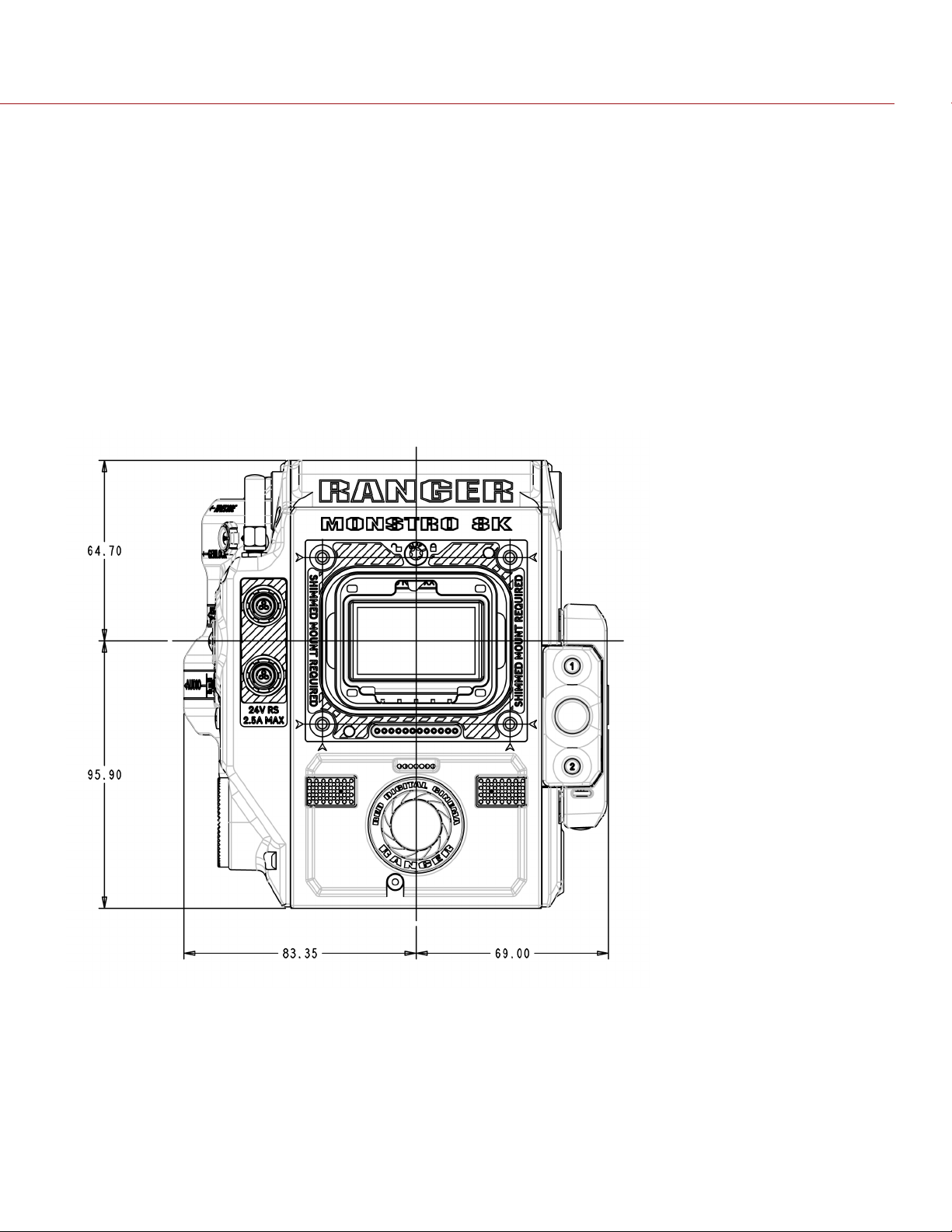
COPYR IGH T © 2019 R ED.COM, LLC 955- 0184_V7.3, REV-A | 176
RED RANGER MONSTRO OPERATION GUIDE
APPENDIX B:
MECHANICAL DRAWINGS
RED RANGER MONSTRO WITH V-LOCK
NOTE: Dimensions are shown in mm.
The optical axis height of the camera is 95.90 mm.
FRONT VIEW
Figure: Camera Front View
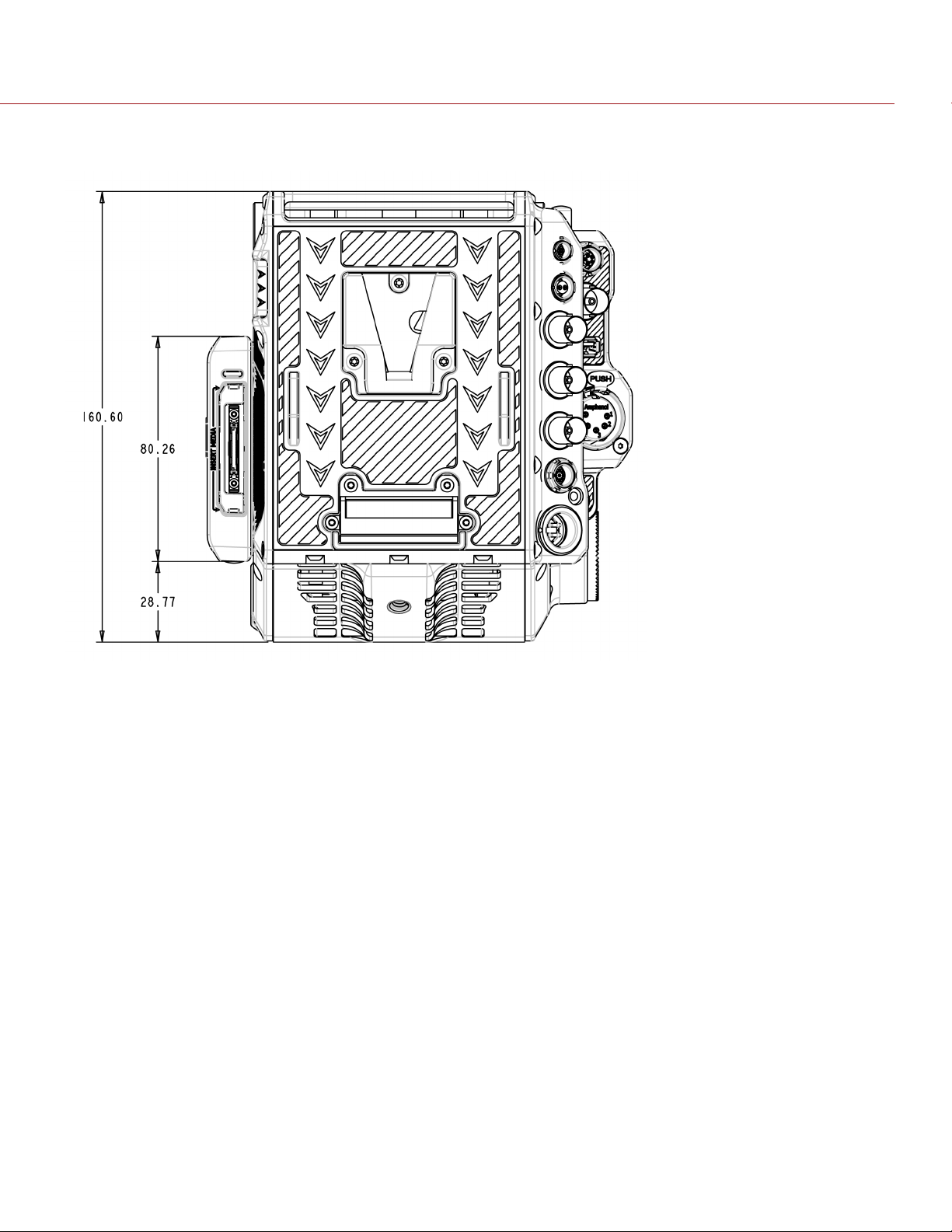
BACK VIEW
Figure: Camera Back View
COPYR IGH T © 2019 R ED.COM, LLC 955- 0184_V7.3, REV-A | 177
RED RANGER MONSTRO OPERATION GUIDE
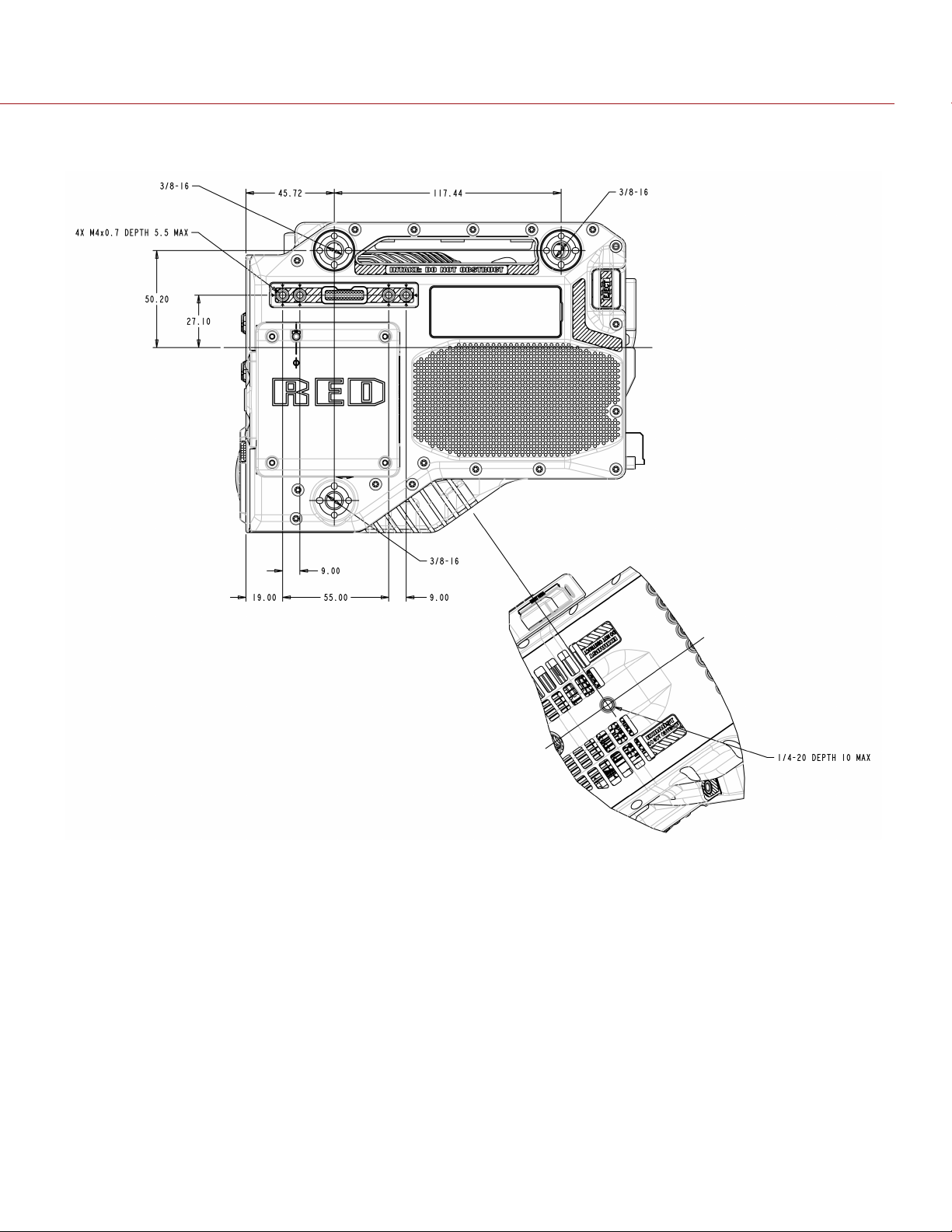
SIDE VIEW (RIGHT)
Figure: Camera Side View (Right)
COPYR IGH T © 2019 R ED.COM, LLC 955- 0184_V7.3, REV-A | 178
RED RANGER MONSTRO OPERATION GUIDE
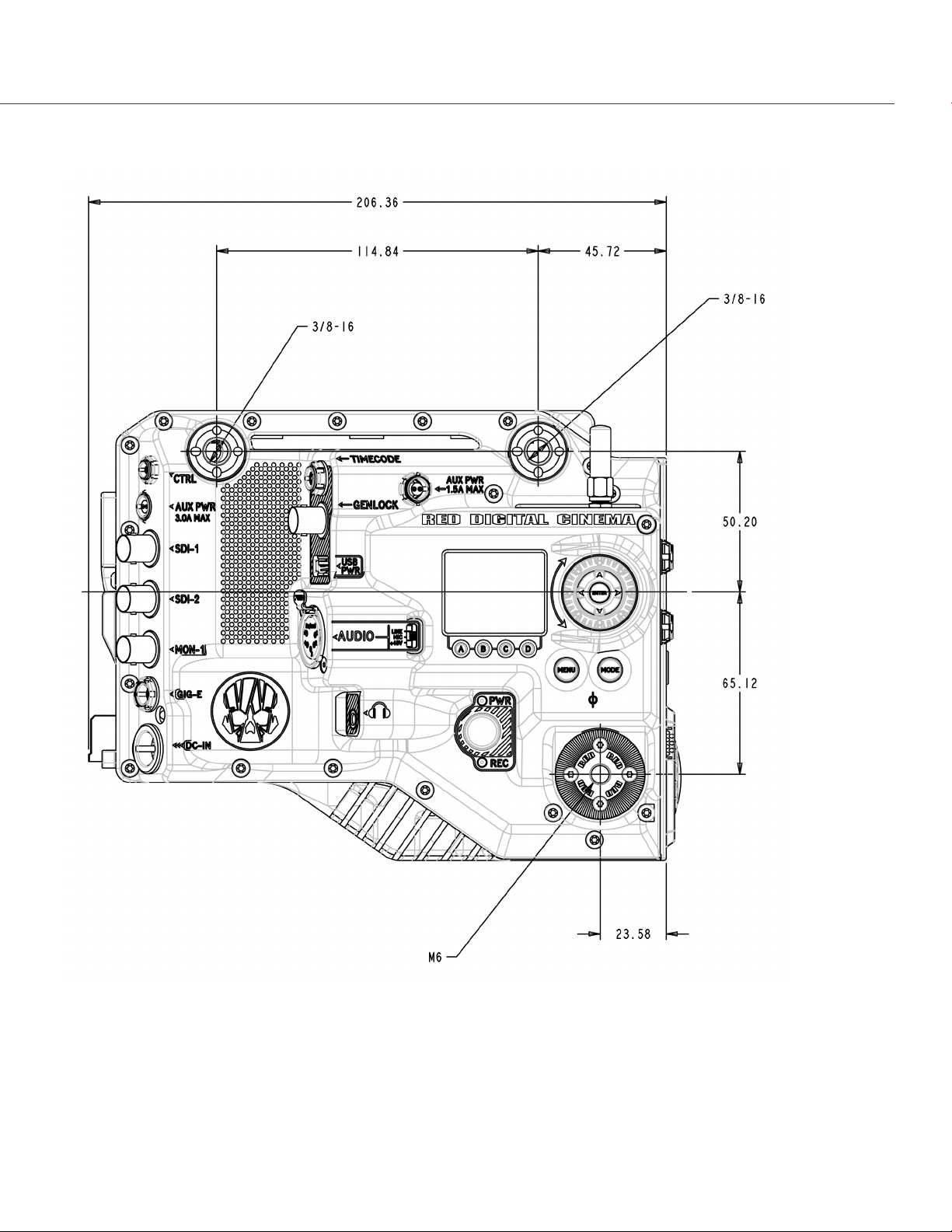
SIDE VIEW (LEFT)
Figure: Camera Side View (Left)
COPYR IGH T © 2019 R ED.COM, LLC 955- 0184_V7.3, REV-A | 179
RED RANGER MONSTRO OPERATION GUIDE
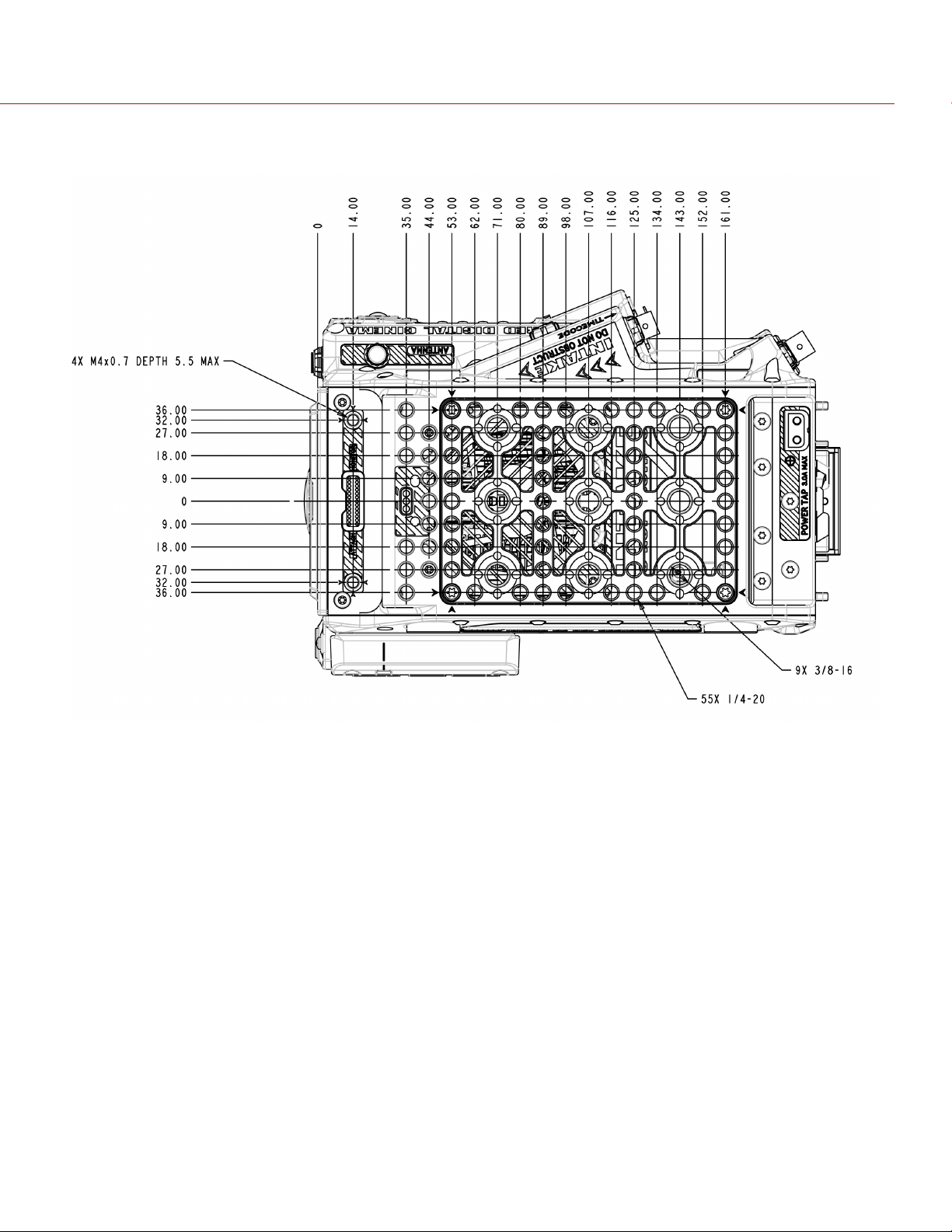
TOP VIEW
Figure: Camera Top View
COPYR IGH T © 2019 R ED.COM, LLC 955- 0184_V7.3, REV-A | 180
RED RANGER MONSTRO OPERATION GUIDE
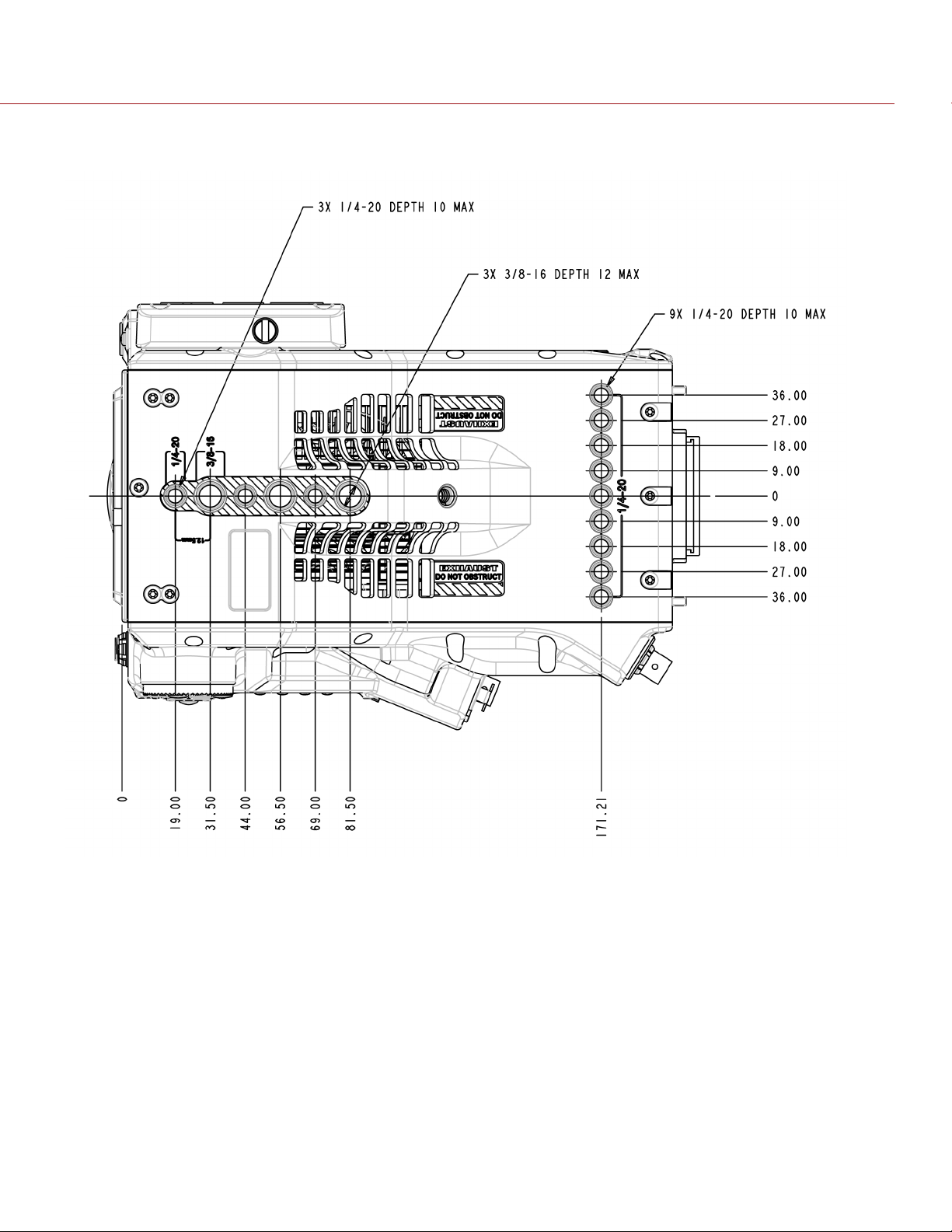
BOTTOM VIEW
Figure: Camera Bottom View
COPYR IGH T © 2019 R ED.COM, LLC 955- 0184_V7.3, REV-A | 181
RED RANGER MONSTRO OPERATION GUIDE
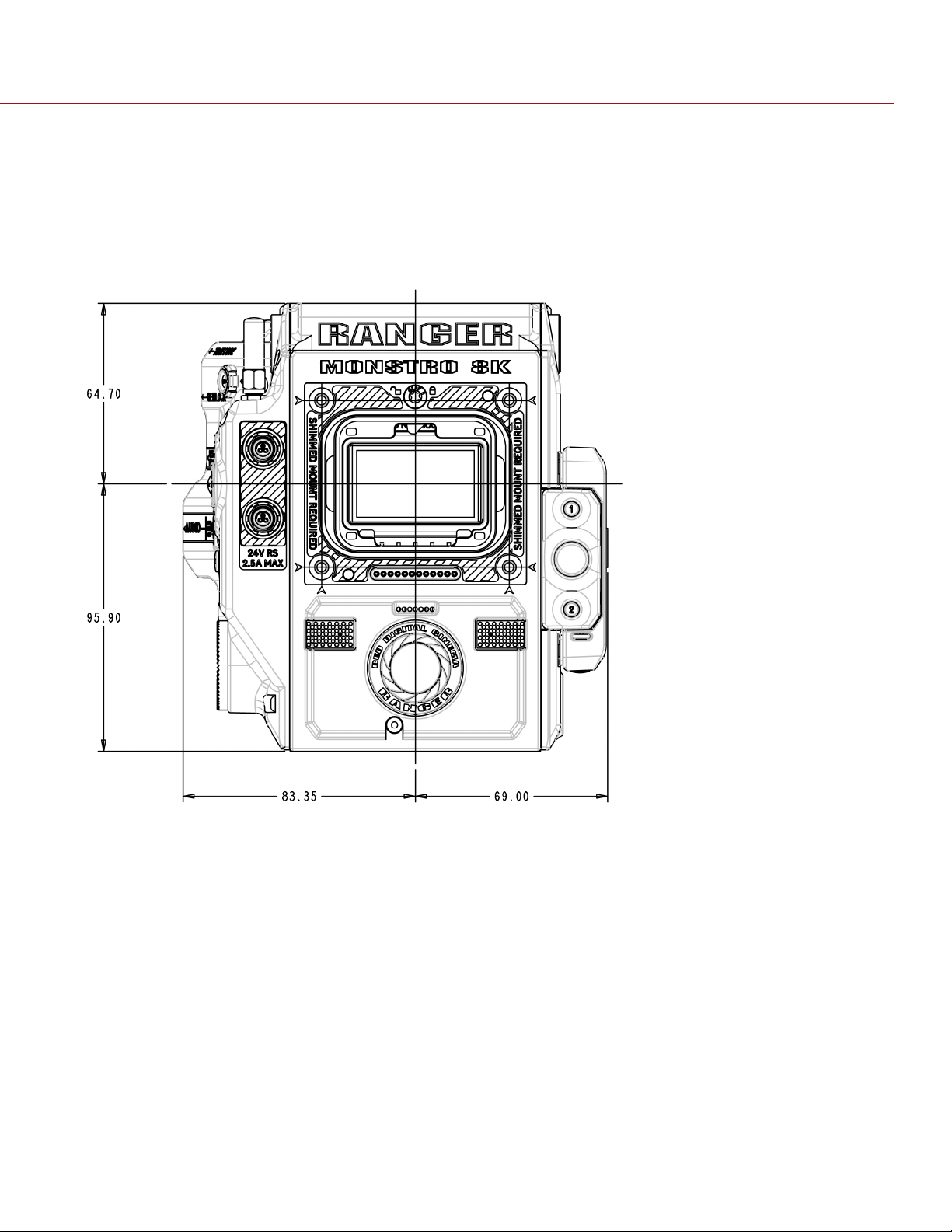
RED RANGER MONSTRO WITH GOLD MOUNT
NOTE: Dimensions are shown in mm.
The optical axis height of the camera is 95.90 mm.
FRONT VIEW
Figure: Camera Front View
COPYR IGH T © 2019 R ED.COM, LLC 955- 0184_V7.3, REV-A | 182
RED RANGER MONSTRO OPERATION GUIDE
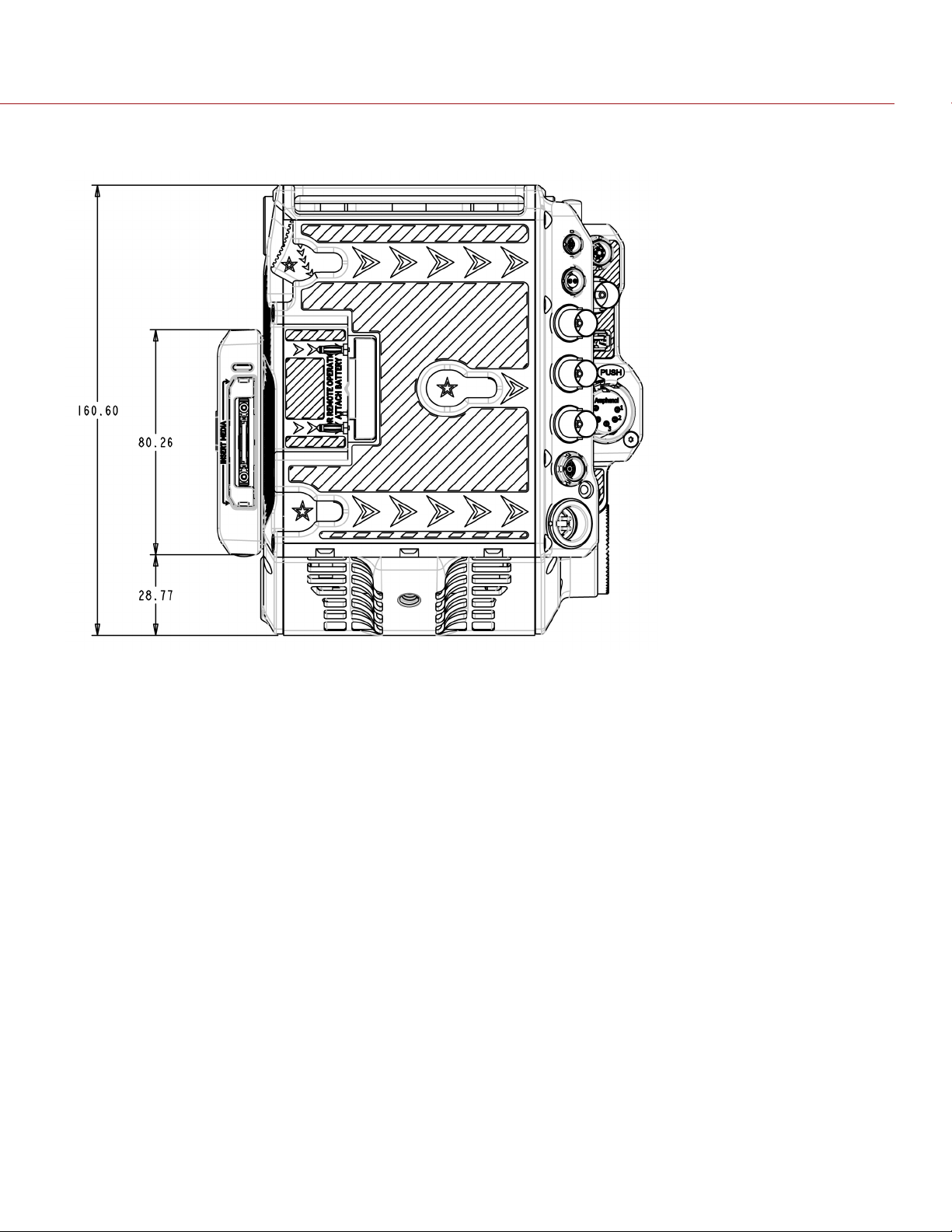
BACK VIEW
Figure: Camera Back View
COPYR IGH T © 2019 R ED.COM, LLC 955- 0184_V7.3, REV-A | 183
RED RANGER MONSTRO OPERATION GUIDE
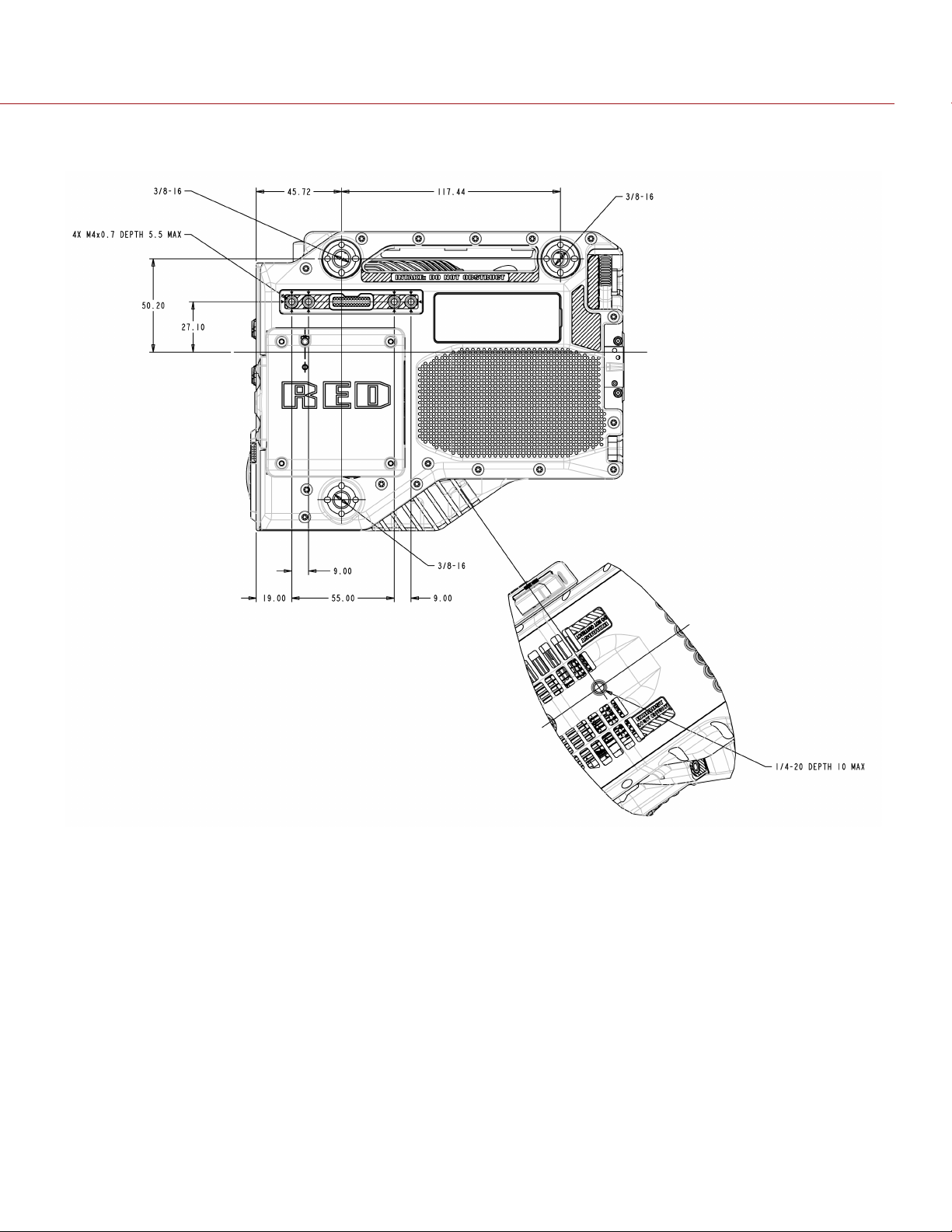
SIDE VIEW (RIGHT)
Figure: Camera Side View (Right)
COPYR IGH T © 2019 R ED.COM, LLC 955- 0184_V7.3, REV-A | 184
RED RANGER MONSTRO OPERATION GUIDE
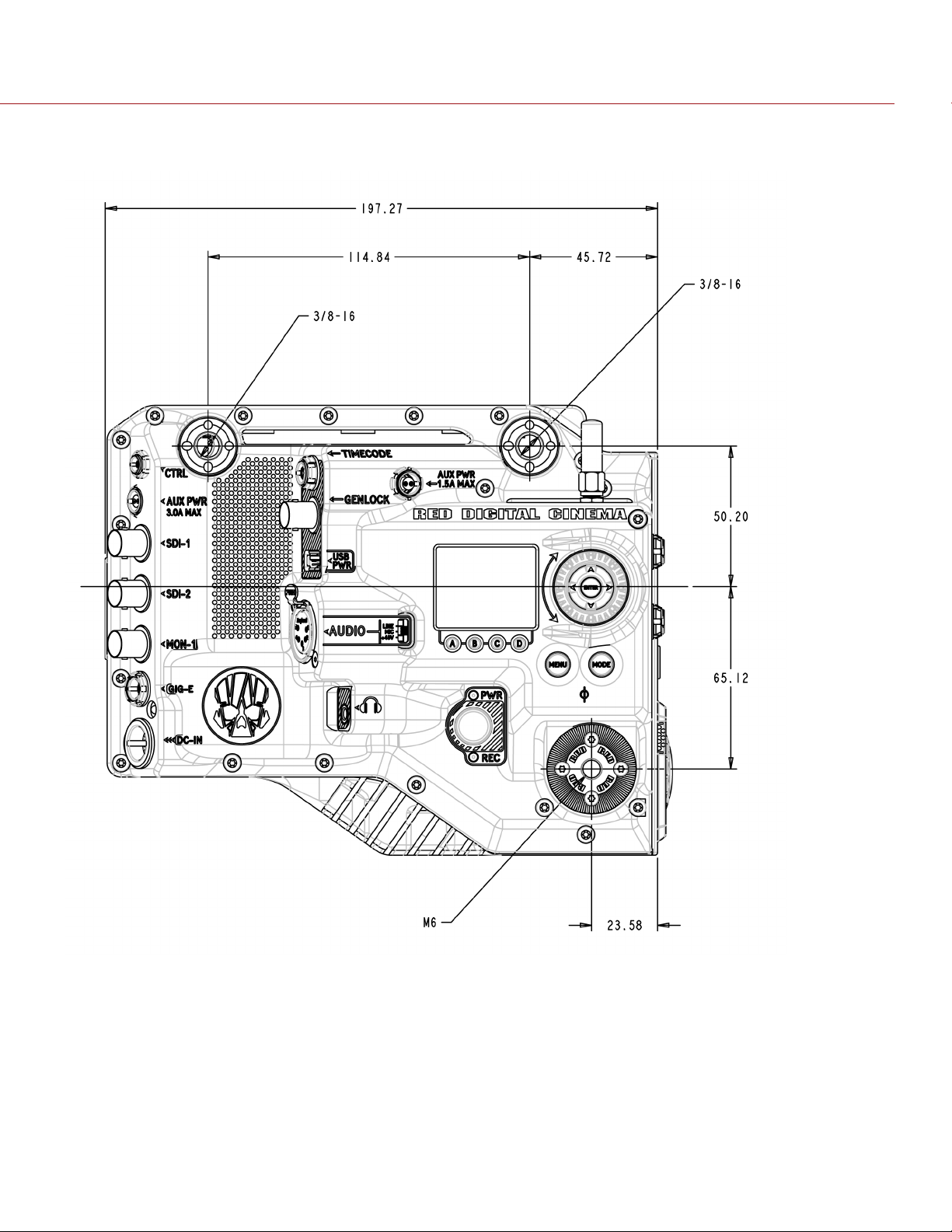
SIDE VIEW (LEFT)
Figure: Camera Side View (Left)
COPYR IGH T © 2019 R ED.COM, LLC 955- 0184_V7.3, REV-A | 185
RED RANGER MONSTRO OPERATION GUIDE
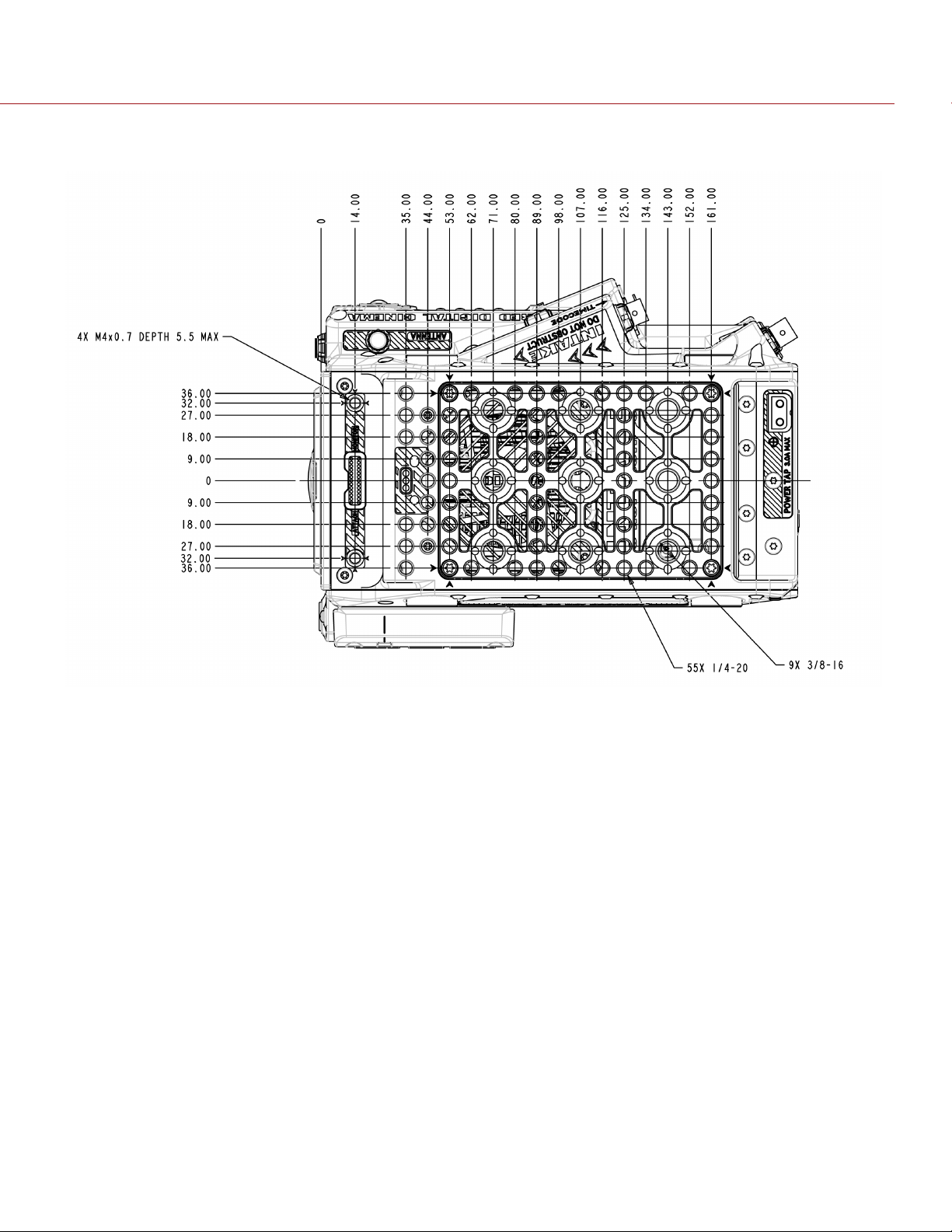
TOP VIEW
Figure: Camera Top View
COPYR IGH T © 2019 R ED.COM, LLC 955- 0184_V7.3, REV-A | 186
RED RANGER MONSTRO OPERATION GUIDE
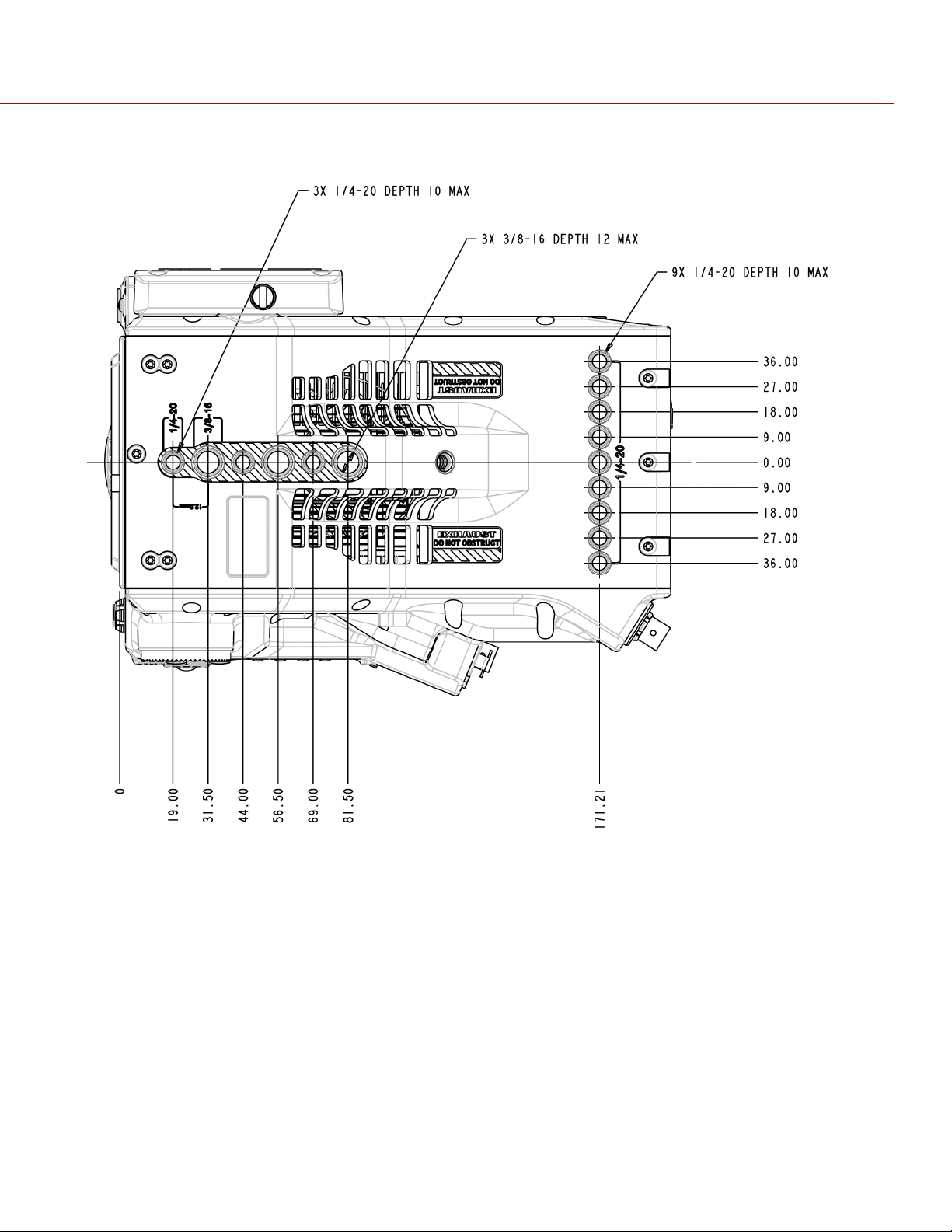
BOTTOM VIEW
Figure: Camera Bottom View
COPYR IGH T © 2019 R ED.COM, LLC 955- 0184_V7.3, REV-A | 187
RED RANGER MONSTRO OPERATION GUIDE
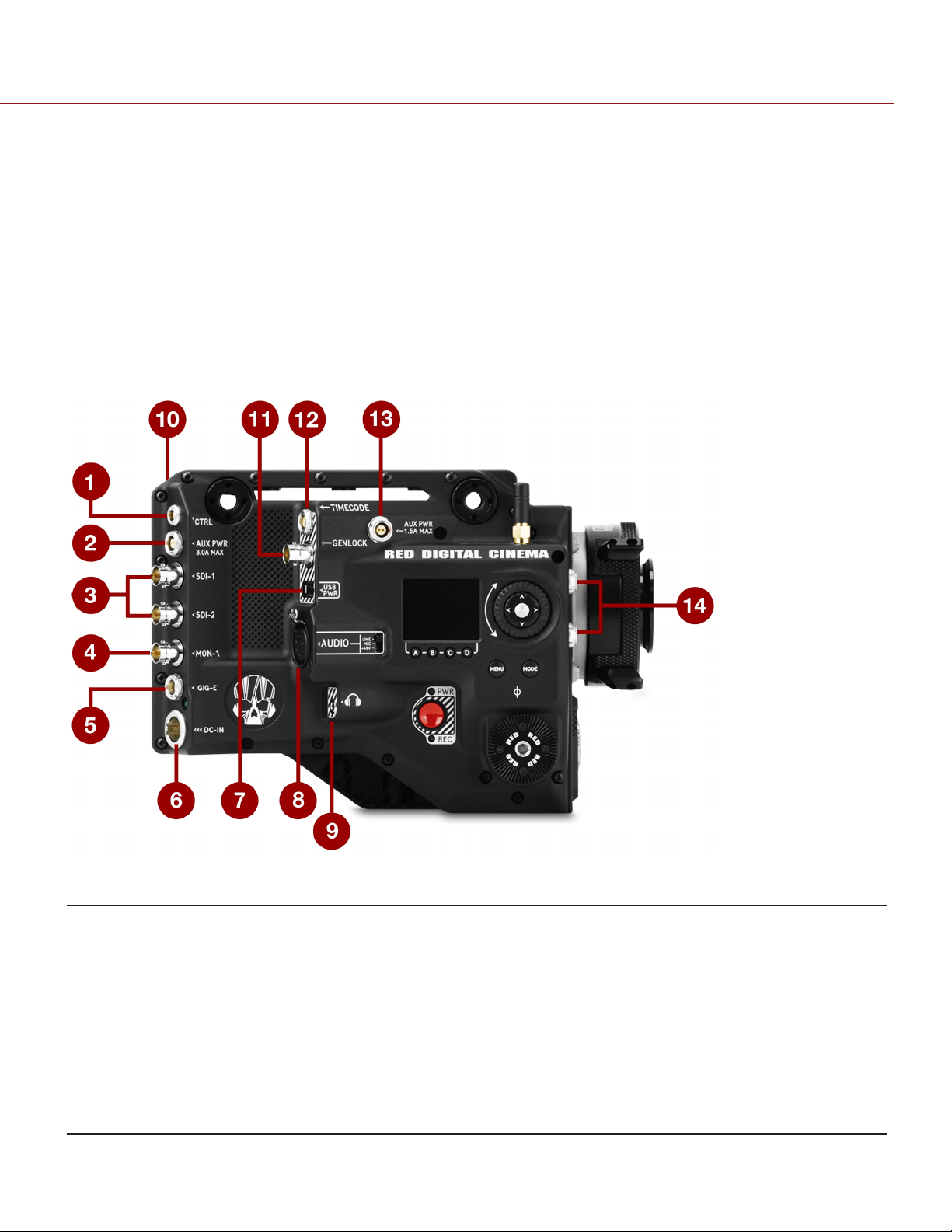
COPYR IGH T © 2019 R ED.COM, LLC 955- 0184_V7.3, REV-A | 188
RED RANGER MONSTRO OPERATION GUIDE
APPENDIX C:
INPUT/OUTPUT CONNECTORS
This appendix provides pinout information for the input/output connectors on the camera.
NOTE: When connecting a cable to a connector, align the key and red marker on the cable connector with the
corresponding key and marker on the device connection.
NOTE: Connector diagram images are for reference only. Diagrams are not to scale.
Figure: RED RANGER I/O
# CONNECTOR CONNECTOR TYPE DETAILS
1 CTRL 4-pin 00B
"CTRL (RS232 Control)" on page 192
2 AUX PWR, 3.0A MAX 2-Pin 0B "AUX Power 2-Pin 0B, 3.0A" on page 197
3 SDI 1 and 2 BNC "3G-SDI (HD-SDI) Out" on page 190
4 MON-1 BNC "MON-1" on page 191
5 GIG-E 9-pin 0B "GIG-E (Ethernet)" on page 194
6 DC IN 4-pin 2B "DC IN (Power Input)" on page 197
7 USB USB 2.0 Type A (power only) "USB Power" on page 198

# CONNECTOR CONNECTOR TYPE DETAILS
8 AUDIO 5-pin XLR
"Audio" on page 196
9 Headphone Jack 3.5mm stereo "Headphone" on page 196
10 POWER TAP P-Tap 2-pin Female "AUX Power (P-Tap)" on page 198
11 GENLOCK BNC "Genlock" on page 192
12 TIMECODE 5-Pin 0B "Timecode" on page 193
13 AUX PWR, 1.5A MAX 2-Pin 0B "AUX Power 2-Pin 0B, 1.5A" on page 198
14 24V RS 1 and 2 3-pin Fischer "24V RS" on page 195
COPYR IGH T © 2019 R ED.COM, LLC 955- 0184_V7.3, REV-A
| 189
RED RANGER MONSTRO OPERATION GUIDE

RECORD/MONITOR OUT PORTS
3G-SDI (HD-SDI) OUT
SDI-1 and SDI-2 output a cloned 3G-SDI signal.
A standard 75 ohm BNC connector provides the following output:
Legal range of HD-SDI signals
Broadcast specification 3G-SDI (HD-SDI) video output (default mode is Clean)
Two (2) channels of embedded audio
Time of Day and Edge timecode
Record Tally flag
Clip name information (as SMPTE RP-188 VITC2 HANC metadata)
The 3G-SDI (HD-SDI) output provides the formats described in the table below:
3G-SDI (HD-SDI) OUTPUT FORMATS
1
VIDEO FEED
2
FREQUENCY (HZ)
3
SMPTE STANDARD
720p 23.98, 24.00, 25.00, 29.97, 30.00, 50.00, 59.94 SMPTE ST 292-1 (1.485 Gbps)
1080p 10-bit 4:2:2 23.98, 24.00, 25.00, 29.97, 30.00 SMPTE ST 292 (1.485 Gbps)
1080p 10-bit 4:2:2 50.00, 59.94, 60.00 3G-SDI
SMPTE ST 424 (2.970 Gbps)
SMPTE ST 425 (2.970 Gbps)
1. Ensure that you select a frequency supported by your monitor.
2. The output is progressive scan (p); it does not support progressive segmented frame (PsF) or interlaced (i) scan formats.
3. The frequency options depend on project time base. If you have a non-drop frame project time base (such as 24.00), you can select only non-
drop frame frequencies. If you have a drop frame project time base (such as 23.98), you can select only drop frame frequencies.
75 OHM BNC CONNECTOR
PIN SIGNAL DESCRIPTION DIRECTION
Center 3G-SDI SMPTE ST 424 Out
Shield/Screen GROUND Camera ground N/A
COMPATIBLE CABLE
790-0341: RED
®
HD-SDI Cable (6')
COPYR IGH T © 2019 R ED.COM, LLC 955- 0184_V7.3, REV-A
| 190
RED RANGER MONSTRO OPERATION GUIDE

MON-1
The MON-1 port provides an additional monitor feed that is separate from the SDI-1 and SDI-2 cloned feeds.
The MON-1 output provides the formats described in the table below:
MON-1 OUTPUT FORMATS
1
VIDEO FEED
2
FREQUENCY (HZ)
3
720p 50.00, 60.00
1080p 24.00, 25.00, 30.00, 50.00, 60.00
1. Ensure that you select a frequency supported by your monitor.
2. The output is progressive scan (p); it does not support progressive segmented frame (PsF) or interlaced (i) scan formats.
3. Supports only non-drop frame frequencies.
75 OHM BNC CONNECTOR
PIN SIGNAL DESCRIPTION DIRECTION
Center
SDI SDI out
Out
Shield/Screen GROUND Camera ground N/A
COPYR IGH T © 2019 R ED.COM, LLC 955- 0184_V7.3, REV-A | 191
RED RANGER MONSTRO OPERATION GUIDE

COMMUNICATION PORTS
CTRL (RS232 CONTROL)
The 4-Pin 00B CTRL Connector supports RS232 remote control for 3D camera communication and third-party metadata
ingest applications. For more information, go to
"BRAIN GPIO" on page 127.
The General Purpose Out (GPO) tally presents 3.3 V at a maximum of 0.04 A between pins 1 and 3. When used as a
record tally, the rising edge of the pulse indicates start of record, falling edge represents end of record.
For more information about controlling the camera via RS232, download the R.C.P.™ SDK , available at
www.red.com/developers.
Figure: Front Face of the CTRL (RS232) Connector (Looking at the Camera)
4-PIN 00B CTRL CONNECTOR
PIN SIGNAL DESCRIPTION DIRECTION
1 GROUND Common ground N/A
2 232 RX RS232 RX In
3 SS/GPO Shutter sync/general purpose output Out
4 232 TX RS232 TX Out
NOTE: Mating connector is FGG.00.304.CLAD.
COMPATIBLE CABLES
790-0154, 790-0643: 3BNC-to-00 Sync Cable
790-0187, 790-0648: 4-Pin 00B-to-Flying Lead
White: Ground
Yellow: RS232 RX
Blue: Shutter/sync, general purpose output
Red: RS232 TX
Black: Shield
790-0415: RED Start/Stop Cable (14-Pin 1B to SYNC, CTRL, BNC)
GENLOCK
The 75 ohm BNC connector accepts incoming sync and genlock signals.
75 OHM BNC CONNECTOR
PIN SIGNAL DESCRIPTION DIRECTION
Center SYNC SMPTE ST 274
RS 170A Tri-Level Sync
In
Shield/Screen GROUND Camera ground N/A
COPYR IGH T © 2019 R ED.COM, LLC 955- 0184_V7.3, REV-A | 192
RED RANGER MONSTRO OPERATION GUIDE

TIMECODE
The LEMO EAG.0B.305.CLN connector supports SMPTE timecode input and output. Pins 2 and 3 can be used together
to receive a balance SMPTE 12M serial timecode input. Pin 2 can be used by itself (leave pin 3 open) to receive a single-
ended SMPTE 12M serial timecode input. Pin 5 is a timecode output.
Figure: Front Face of Timecode (LEMO EAG.0B.305.CLN) Connector (Looking at the Camera)
LEMO EAG.0B.305.CLN CONNECTOR
PIN SIGNAL DESCRIPTION DIRECTION
1 GROUND Camera Ground N/A
2 TIMECODE IN(S) Timecode input - SMPTE single ended In
3 N/A No connection (NC) N/A
4 +5 V OUT +5 V out, 200 mA max Out
5 TIMECODE OUT SMPTE 12 M Timecode output Out
NOTE: Mating connector is FHG.0B.305.CLAD.
COMPATIBLE CABLE
790-0212: Pro I/O Time Code Cable 3'
COPYR IGH T © 2019 R ED.COM, LLC 955- 0184_V7.3, REV-A
| 193
RED RANGER MONSTRO OPERATION GUIDE

GIG-E (ETHERNET)
The GIG-E 9-pin 0B connector provides a 1000BASE-T (IEEE 802.3ab) gigabit Ethernet connection for remote camera
setup, master/slave camera communication, and external metadata ingest. Since the GIG-E connector does not support
slower speeds (10BASE-T and 100BASE-T), ensure that any device you connect to supports 1000BASE-T.
Figure: Front Face of the GIG-E Connector (Looking at the Camera)
9-PIN 0B GIG-E CONNECTOR
PIN SIGNAL DESCRIPTION DIRECTION
1 BI_DC+ Data pair C+ N/A
2 BI_DC- Data pair C- N/A
3 BI_DD+ Data pair D+ N/A
4 BI_DD- Data pair D- N/A
5 BI_DA- Data pair A- N/A
6 BI_DA+ Data pair A+ N/A
7 BI_DB+ Data pair B+ N/A
8 BI_DB- Data pair B- N/A
9 N/A Do not connect N/A
NOTE: Mating connector is FGG.0B.309.CLAD.
COMPATIBLE CABLES
790-0159: RED GIG-E Straight-to-CAT5E Ethernet Cable (9')
790-0557, 790-0655: RED GIG-E Right-to-CAT5E Ethernet Cable (9')
790-0163: Master/Slave Gig-E Cable (4')
COPYR IGH T © 2019 R ED.COM, LLC 955- 0184_V7.3, REV-A
| 194
RED RANGER MONSTRO OPERATION GUIDE
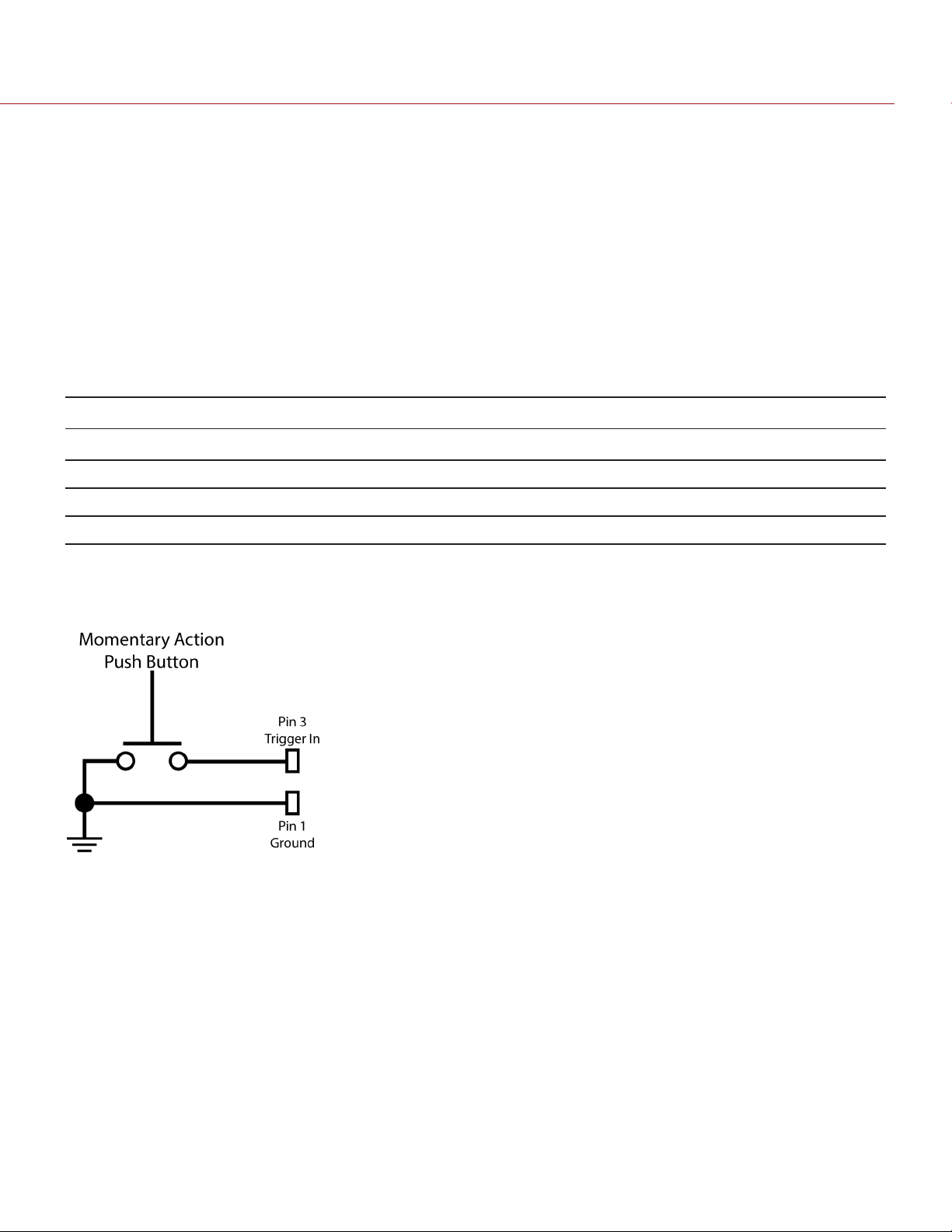
24V RS
The two (2) Fischer 3-pin 102 connectors supply a combined 24V power out at a maximum sustained current draw of
2.5A. Each connector also includes a run/stop (R/S) trigger input. To operate the contact closure style trigger, short Pin 3
(R/S) to Pin 1 (ground).
When the camera is powered by an on-board battery or DC-IN with less than 24V input, the connector output is 24V
(regulated). When the camera is powered by DC-IN with more than 24V input, the connector output matches the camera
input voltage.
WARNING: DO NOT apply voltage to Pin 3 (R/S).
Figure: 24V RS (Looking at the Connector)
FISCHER 3-PIN CONNECTOR
PIN SIGNAL DESCRIPTION DIRECTION
1 GROUND Common ground N/A
2 +24 V OUT +24 V out, 2.5A max (shared between the connectors) Out
3 R/S Active Low to start/stop record (3.3V pull up) In
CONTACT CLOSURE STYLE TRIGGER BUTTON CIRCUIT (24V RS)
The diagram below shows the contact closure style trigger button circuit on the 24V RS connector.
Figure: Contact Closure Style Trigger Button Circuit Diagram (24V RS)
COPYR IGH T © 2019 R ED.COM, LLC 955- 0184_V7.3, REV-A | 195
RED RANGER MONSTRO OPERATION GUIDE

AUDIO PORTS
AUDIO
The 5-pin XLR connector provides input for two (2) audio channels. Use the adjacent Audio switch to set the audio
channels to line in (Line), Microphone level in (Mic), or microphone level in with 48 V 10mA phantom power (+48V). The
switch controls both channels together; the channels cannot be controlled independently.
Figure: Front Face of Audio Input (5-Pin XLR) Connector (Looking at the Camera)
5-PIN XLR CONNECTOR
PIN SIGNAL DESCRIPTION DIRECTION
1 GROUND Camera ground N/A
2 CH1_P Channel 1 (left), positive voltage In
3 CH1_N Channel 1 (left), negative voltage In
4 CH2_P Channel 2 (right), positive voltage In
5 CH2_N Channel 2 (right), negative voltage In
HEADPHONE
The 3.5mm stereo jack provides two (2) channels of audio for monitoring. For maximum quality, use high impedance
headphones.
HEADPHONE JACK
PIN SIGNAL DESCRIPTION DIRECTION
TIP LEFT Left channel audio Out
RING RIGHT Right channel audio Out
SLEEVE GND Camera ground N/A
COPYR IGH T © 2019 R ED.COM, LLC 955- 0184_V7.3, REV-A | 196
RED RANGER MONSTRO OPERATION GUIDE

POWER PORTS
DC IN (POWER INPUT)
The 4-Pin 2B connector accepts DC input power from 11.5 V DC to 32 V DC. A built-in power conditioner protects
against reverse-polarity connections, electrostatic discharge (ESD), undervoltage, overvoltage, and overcurrent.
Figure: Front Face of the DC IN Power Input Connector (Looking at the Camera)
4-PIN 2B DC INPUT CONNECTOR
PIN SIGNAL DESCRIPTION
1 N/A No connection (NC)
2 N/A No connection (NC)
3 VIN Power input, +11.5 to +32 V DC
4 GROUND Power return (camera ground)
NOTE: The mating connector is FGJ.2B.304.CLLD62Z (LEMO).
COMPATIBLE CABLES
790-0665: 3-PIN XLR-TO-4-PIN 2B POWER CABLE (10')
AUX POWER 2-PIN 0B, 3.0A
The 2-Pin 0B connector (LEMO EEG.0B.302.CLL) supplies unregulated (+) 11.5 to 17 VDC battery pass-through power.
The maximum sustained current draw is 3.0A.
Figure: Front Face of Connector (Looking at the Camera)
LEMO EEG.0B.302.CLL CONNECTOR
PIN SIGNAL DESCRIPTION DIRECTION
1 GROUND Common ground N/A
2 +11.5 to +17 VDC +11.5 to 17 VDC unregulated battery pass-through power Out
NOTE: Mating connector is FGG.00.302.CLAD35Z.
COMPATIBLE CABLE
790-0410: RED W.M.D. Power Cable 2-Pin 1B to 2-Pin 0B (18")
COPYR IGH T © 2019 R ED.COM, LLC 955- 0184_V7.3, REV-A
| 197
RED RANGER MONSTRO OPERATION GUIDE

AUX POWER 2-PIN 0B, 1.5A
The 2-Pin 0B connector (LEMO EEG.0B.302.CLL) supplies unregulated (+) 11.5 to 17 VDC battery pass-through power.
The maximum sustained current draw is 1.5A.
Figure: Front Face of AUX PWR Connector (Looking at the Camera)
LEMO EEG.0B.302.CLL CONNECTOR
PIN SIGNAL DESCRIPTION DIRECTION
1 GROUND Common ground N/A
2 +11.5 to +17 VDC +11.5 to 17 VDC unregulated battery pass-through power Out
NOTE: Mating connector is FGG.00.302.CLAD35Z.
COMPATIBLE CABLE
790-0410: RED W.M.D. Power Cable 2-Pin 1B to 2-Pin 0B (18")
USB POWER
The USB power out connector supplies 5 V of power. The maximum sustained current draw is 1.5A.
NOTE: The USB connector only offers power out, and does NOT support USB communication.
AUX POWER (P-TAP)
Figure: P-Tap Connector (Looking at Camera)
The AUX power out connector features an industry-standard P-Tap connector and supplies conditioned VBATT at a
maximum of 3.0A of power.
2-PIN P-TAP CONNECTOR
PIN SIGNAL DESCRIPTION DIRECTION
1 GROUND Common ground N/A
2 +11.5 to +17 VDC +11.5 to 17 VDC unregulated battery pass-through power Out
COPYR IGH T © 2019 R ED.COM, LLC 955- 0184_V7.3, REV-A | 198
RED RANGER MONSTRO OPERATION GUIDE

COPYR IGH T © 2019 R ED.COM, LLC 955- 0184_V7.3, REV-A | 199
RED RANGER MONSTRO OPERATION GUIDE
APPENDIX D:
LENS MOUNTS AND LENSES
LENS MOUNTS
This section describes camera lens mounts. Camera mounts may be configured with 19mm rods to accommodate most
cinematography lenses, matte boxes, and follow focus systems.
RED recommends only using the RED RANGER Shimmed PL Mount with the RED RANGER. Other RED lens mounts
are mechanically compatible, but may cause focus accuracy issues.
WARNING: All lenses are hot swappable. However, lens mounts are NOT HOT SWAPPABLE, meaning you cannot
remove or install lens mounts while the camera is turned on. Before installing or removing lens mounts, you MUST turn
off the camera. Failure to do so may result in damage to the lens mounts or camera that is not covered under warranty.
REMOVE A LENS MOUNT
NOTE: You can change lens mounts in the field. However, RED
®
recommends that you change lens mounts only in a
dust-free environment.
REQUIRED TOOL(S): T20 TORX
®
driver
1. Turn off the camera.
2. Attach the camera to a stable platform or position the camera on a clean and level work surface so that the lens
mount screws are accessible.
3. Remove the lens and any devices, cables, or other accessories that might interfere with removing the lens mount.
4. Depending on the lens mount, you may need to turn the locking ring slightly counter-clockwise so that you can
access the lens mount screws.
5. Loosen and remove the four (4) M4x0.7 x 8 mm lens mount screws in a cross pattern (“X” pattern) using a T20 TORX
driver.
NOTE: Some lens mounts have captive screws that are not removable.
NOTE: Screw removal may require a large handle T20 TORX driver and additional leverage.
6. Remove the lens mount from the camera.

INSTALL A LENS MOUNT
NOTE: You can change lens mounts in the field. However, RED recommends that you change lens mounts only in a
dust-free environment.
REQUIRED TOOL(S): T20 TORX driver
1. Ensure that the camera is turned off and remove any accessories or cables that may interfere with installation.
2. Inspect the gold electrical contact pins on the front of the camera and the gold contact pads on the rear of the lens
mount to ensure that they are free of any contamination.
3. Align the lens mount on the front of the camera. The camera connection pins must align with the lens mount pins.
4. Depending on the lens, you may need to turn the locking ring slightly counter-clockwise so that you can access the
lens mount screws.
5. Replace and loosely tighten the four (4) M4x0.7 x 8 mm lens mount screws in a cross pattern (“X” pattern) using a
T20 TORX driver.
WARNING: DO NOT FULLY TIGHTEN.
NOTE: Some lens mounts have captive screws that are not removable.
6. Tighten the four (4) lens mount screws evenly in a cross pattern (“X” pattern) using a T20 TORX driver. DO NOT
exceed 350 in-oz, or damage may occur.
WARNING: DO NOT OVERTIGHTEN.
7. After installation, a hardware rediscover or firmware upgrade may be required. To perform a hardware rediscover, go
to Menu > Settings > Maintenance > Rediscover. A system reboot is required after a hardware rediscover.
NOTE: If you need to replace any screws, submit a Support ticket at https://support.red.com.
COPYR IGH T © 2019 R ED.COM, LLC 955- 0184_V7.3, REV-A
| 200
RED RANGER MONSTRO OPERATION GUIDE

LENSES
This section describes lenses that are compatible with the RED RANGER Shimmed PL Mount. Other lenses and lens
mounts may be used with the RED RANGER, but may cause focus accuracy issues.
To avoid vignetting, use standard full frame PL mount lenses.
NOTE: Lenses are hot swappable.
LENS WEIGHT AND LENS SUPPORT
Use a lens support system when mounting heavy or long lenses to your camera.
When mounting a heavy or long lens, ensure that the full weight of the lens is never directly on the camera or lens
mount. Mount the lens to the support system first, and then carefully mount the lens to the camera.
WARNING: Failure to use lens supports appropriate for the lens and camera setup may lead to damage of the camera
and lens mount. Any damage caused by not using a lens support system is not covered under warranty.
POSITIVE LOCK (PL) LENSES
This section describes the appropriate method for attaching and detaching PL lenses. For more information, refer to the
original manufacturer’s instructions. This section also lists lenses supported by the camera PL mounts.
WARNING: ALWAYS protect your equipment, when it is not in use, by replacing lens caps and mount caps.
ATTACH PL LENSES
1. Rotate the locking ring counter-clockwise to release the camera mount cap.
2. Remove the rear lens cap and the camera mount cap.
3. Align the key and contact pads (if present) on the PL lens with the key and connector pins on the camera PL mount.
4. Insert the lens into the camera PL mount.
5. Rotate the locking ring clockwise to secure the lens in place.
DETACH PL LENSES
1. Rotate the locking ring counter-clockwise to release the PL lens.
2. Remove the PL lens from the camera PL mount.
3. Replace the rear lens cap and camera mount cap when the lens is not in use.
CAMERA PL MOUNT SUPPORTED LENSES
The RED PL lens mount is compatible with most standard PL mount cinema lenses and devices.
WARNING: Using a non-standard PL mount lens or device with a camera PL mount may damage the camera and lens
mount. Any damage caused by not using a standard PL mount lens or device is not covered under warranty.
COPYR IGH T © 2019 R ED.COM, LLC 955- 0184_V7.3, REV-A
| 201
RED RANGER MONSTRO OPERATION GUIDE
FUJINON T2.9 CABRIO PREMIER PL LENSES
NOTE: The VTR switch on the lens is mapped to Record: Toggle by default. The VTR switch can be mapped to another
key.
NOTE: Fujinon lenses running older versions of lens firmware might not send correct data to the camera.
The following Fujinon
®
T2.9 Cabrio Premier PL lenses are compatible with all camera PL mounts, but must be powered
externally and configured a specific way:
Fujinon 14-35mm T2.9 Cabrio Premier PL
Fujinon 19-90mm T2.9 Cabrio Premier PL
To set up the Fujinon T2.9 Cabrio Premier PL lenses, follow the instructions below. Refer to the manufacturer’s operation
manual for detailed information about setting up and using the lens.
1. Attach the lens to the camera PL mount.
2. Ensure that the lens has lens firmware v6.4 or later (to check version in the camera, go to Menu > Settings > Setup
> Lens > Lens Info). Contact the manufacturer for lens firmware.
3. On the lens, set the Camera Communication switch to On.
4. On the lens, set the LDS, /i Select switch to Off.
5. Connect an external power source to the lens.
6. In the camera, to Menu > Settings > Setup > Lens.
7. Deselect the Enable Power to Lens check box.
NOTE: This option is only available when a camera PL mount is attached to the camera.
8. The lens should be successfully connected. However, if lens data does not display within 10 seconds, go to Menu >
Settings > Setup > Lens and select Detect Lens.
CANON PL MOUNT LENSES
The following Canon PL mount lenses are compatible with all camera PL mounts, but must be configured a specific way:
Canon CN7x17 KAS S Cine-Servo 17-120mm T2.95
Canon CN20x50 IAS H Cine-Servo 50-1000mm
Requirements for using these Canon PL mount lenses:
The lens requires lens firmware v6.4 or later; contact the manufacturer for lens firmware.
In the camera, go to Menu > Settings > Setup > Lens, and select the Enable Power to Lens check box.
RED recommends using an external battery for the lens, since the lens mount provides a limited supply of power to
the lens.
COPYR IGH T © 2019 R ED.COM, LLC 955- 0184_V7.3, REV-A
| 202
RED RANGER MONSTRO OPERATION GUIDE

COPYR IGH T © 2019 R ED.COM, LLC 955- 0184_V7.3, REV-A | 203
RED RANGER MONSTRO OPERATION GUIDE
APPENDIX E:
DEFAULT KEY FUNCTIONS
DEFAULT KEYS
ITEM KEY FUNCTION
Camera BRAIN
®
Record Full Press Record: Toggle
GPI In High Record: Start
GPI In Low Record: Stop
Media Bay (Side SSD) Record Full Press Record: Toggle/Multi-Shot Start
Record Full Release Record: Multi-Shot Stop
Record Half Press AF: Start
User 1+2 Press Eject Media
LCD (Primary and Secondary) Up Press Br. Up (Increase Brightness)
Down Press Br. Down (Decrease Brightness)
User 1 Press Magnify: Toggle
User 2 Press Exposure Check: Toggle
User 1+2 Press LCD: Toggle Lock
EVF (Primary and Secondary) User 1 Press Magnify: Toggle
User 2 Press Exposure Check: Toggle
RANGER Side LCD and Navigation User A Press Cycle Auto-Focus Mode
User B Press Auto White Balance
User C Press Toggle: Magnify
User D Press Exposure Check: Toggle
User A+D Press Lock/unlock side buttons to prevent inadvertent menu changes
Nav Menu Press Navigation: Menu
Nav North Press Navigation: Up
Nav South Press Navigation: Down
Nav East Press Navigation: Right
Nav West Press Navigation: Left
Nav Enter Press Navigation: Select
Rotary CW Navigation: CW
Rotary CCW Navigation: CCW

ITEM KEY FUNCTION
DSMC2 Top Handle Record Full Press Record: Toggle/Multi-Shot Start
Record Full Release Record: Multi-Shot Stop
DSMC2 Outrigger Handle Record Full Press Record: Toggle/Multi-Shot Start
Record Full Release Record: Multi-Shot Stop
1. The Focus Control Wheel is NOT programmable; it cannot be mapped to another function.
COPYR IGH T © 2019 R ED.COM, LLC 955- 0184_V7.3, REV-A
| 204
RED RANGER MONSTRO OPERATION GUIDE
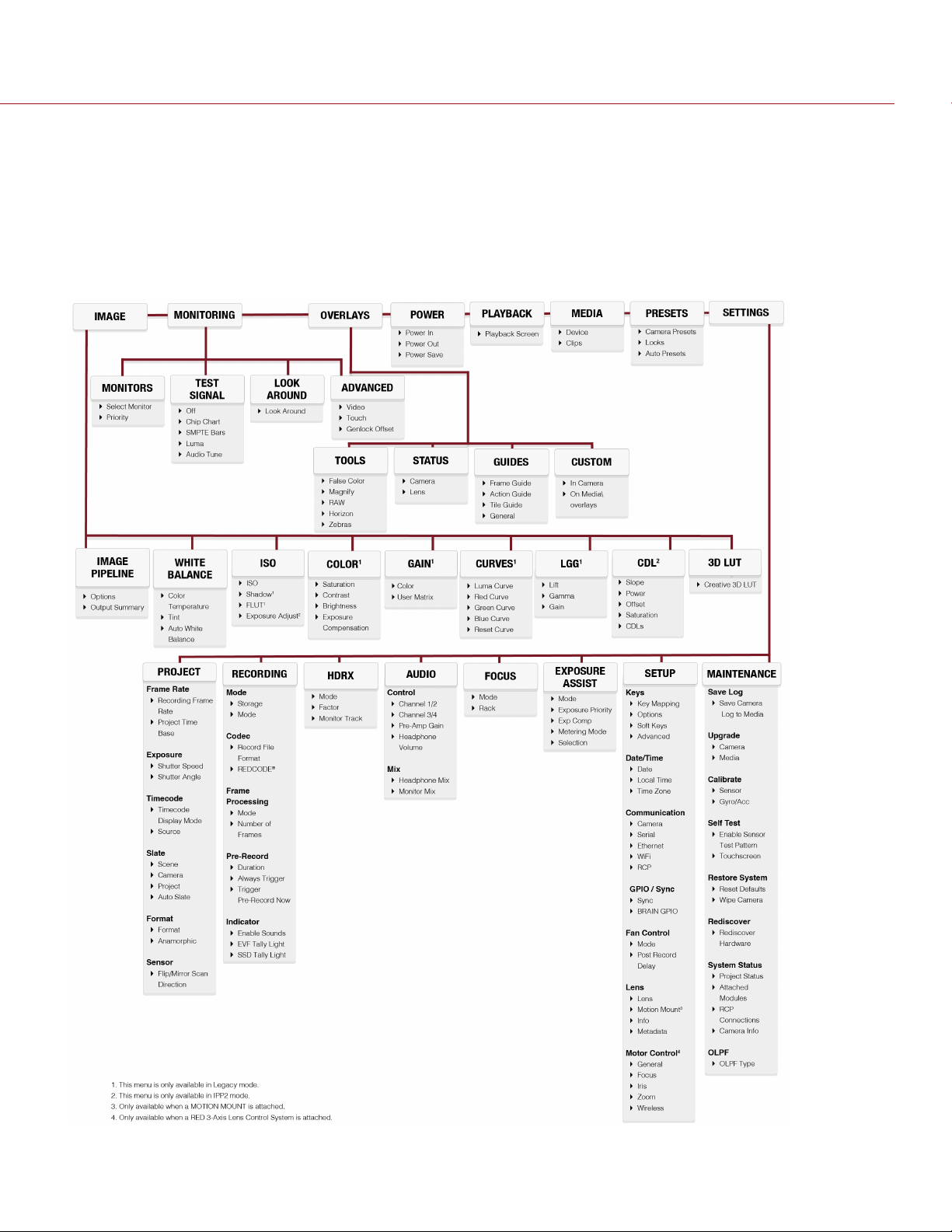
COPYR IGH T © 2019 R ED.COM, LLC 955- 0184_V7.3, REV-A | 205
RED RANGER MONSTRO OPERATION GUIDE
APPENDIX F:
MENU MAP