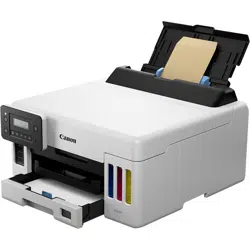

GX5000 series
Online Manual
English

Contents
Using Online Manual. . . . . . . . . . . . . . . . . . . . . . . . . . . . . . . . . . . . . . . . . . . . . . . 8
Symbols Used in This Document. . . . . . . . . . . . . . . . . . . . . . . . . . . . . . . . . . . . . . . . . . . . . 9
Touch-enabled Device Users (Windows). . . . . . . . . . . . . . . . . . . . . . . . . . . . . . . . . . . . . . 10
Trademarks and Licenses. . . . . . . . . . . . . . . . . . . . . . . . . . . . . . . . . . . . . . . . . . . . . . . . . 11
Printing Network Settings. . . . . . . . . . . . . . . . . . . . . . . . . . . . . . . . . . . . . . . . . . . . . . . . . . . . . . . . 30
Default Network Settings. . . . . . . . . . . . . . . . . . . . . . . . . . . . . . . . . . . . . . . . . . . . . . . . . . . . . . . . . 36
Connecting with Wireless Direct. . . . . . . . . . . . . . . . . . . . . . . . . . . . . . . . . . . . . . . . . . . . . . . . . . . 38
Switching Printer's Connection to Network or Terminal Devices. . . . . . . . . . . . . . . . . . . . . . . . . . . . . . . 43
Easy Understanding Network Connections. . . . . . . . . . . . . . . . . . . . . . . . . . . . . 45
Restrictions. . . . . . . . . . . . . . . . . . . . . . . . . . . . . . . . . . . . . . . . . . . . . . . . . . . . . . . . . . . . . 48
Network Connection Tips (Windows/macOS). . . . . . . . . . . . . . . . . . . . . . . . . . . . . . . . . . . 50
Detect Same Printer Name. . . . . . . . . . . . . . . . . . . . . . . . . . . . . . . . . . . . . . . . . . . . . . . . . . . . . . . . . . . 51
Switching Printer's Connection to Network or Terminal Devices. . . . . . . . . . . . . . . . . . . . . . . . . . . . . . . 43
Setting Up IEEE802.1X/EAP (WPA/WPA2 Enterprise). . . . . . . . . . . . . . . . . . . . . . . . . . . . . . . . . . . . . . 54
Wi-Fi Connection Assistant (macOS). . . . . . . . . . . . . . . . . . . . . . . . . . . . . . . . . . . . . . . . . 58
Wi-Fi Connection Assistant. . . . . . . . . . . . . . . . . . . . . . . . . . . . . . . . . . . . . . . . . . . . . . . . . . . . . . . . . . . 59
Starting Up Wi-Fi Connection Assistant. . . . . . . . . . . . . . . . . . . . . . . . . . . . . . . . . . . . . . . . . . . . . . . . . . 60
Diagnosing and Repairing Network Settings. . . . . . . . . . . . . . . . . . . . . . . . . . . . . . . . . . . . . . . . . . . . . . 61
List of Models Which Does Not Support Diagnosis and Repair Function. . . . . . . . . . . . . . . . . . . . . . . . 62
Handling Paper, Ink Tanks, etc.. . . . . . . . . . . . . . . . . . . . . . . . . . . . . . . . . . . . . 63
Loading Paper. . . . . . . . . . . . . . . . . . . . . . . . . . . . . . . . . . . . . . . . . . . . . . . . . . . . . . . . . . 64
Paper Sources. . . . . . . . . . . . . . . . . . . . . . . . . . . . . . . . . . . . . . . . . . . . . . . . . . . . . . . . . . . . . . . . . . . . . 65
Loading Photo Paper / Plain Paper in Rear Tray. . . . . . . . . . . . . . . . . . . . . . . . . . . . . . . . . . . . . . . . . . . 66
Loading Plain Paper in Cassette. . . . . . . . . . . . . . . . . . . . . . . . . . . . . . . . . . . . . . . . . . . . . . . . . . . . . . . 71
Loading Envelopes in Rear Tray. . . . . . . . . . . . . . . . . . . . . . . . . . . . . . . . . . . . . . . . . . . . . . . . . . . . . . . 76
Refilling Ink Tanks. . . . . . . . . . . . . . . . . . . . . . . . . . . . . . . . . . . . . . . . . . . . . . . . . . . . . . . 80
Refilling Ink Tanks. . . . . . . . . . . . . . . . . . . . . . . . . . . . . . . . . . . . . . . . . . . . . . . . . . . . . . . . . . . . . . . . . . 81
Checking Ink Level. . . . . . . . . . . . . . . . . . . . . . . . . . . . . . . . . . . . . . . . . . . . . . . . . . . . . . . . . . . . . . . . . . 87
Ink Tips. . . . . . . . . . . . . . . . . . . . . . . . . . . . . . . . . . . . . . . . . . . . . . . . . . . . . . . . . . . . . . . . . . . . . . . . . . 88
If Printing Is Faint or Uneven. . . . . . . . . . . . . . . . . . . . . . . . . . . . . . . . . . . . . . . . . . . . . . . 89
Maintenance Procedure. . . . . . . . . . . . . . . . . . . . . . . . . . . . . . . . . . . . . . . . . . . . . . . . . . . . . . . . . . . . . . 90

Printing the Nozzle Check Pattern. . . . . . . . . . . . . . . . . . . . . . . . . . . . . . . . . . . . . . . . . . . . . . . . . . . . . . 93
Examining the Nozzle Check Pattern. . . . . . . . . . . . . . . . . . . . . . . . . . . . . . . . . . . . . . . . . . . . . . . . . . . 94
Cleaning the Print Head. . . . . . . . . . . . . . . . . . . . . . . . . . . . . . . . . . . . . . . . . . . . . . . . . . . . . . . . . . . . . . 95
Deep Print Head Cleaning. . . . . . . . . . . . . . . . . . . . . . . . . . . . . . . . . . . . . . . . . . . . . . . . . . . . . . . . . . . . 96
Aligning the Print Head. . . . . . . . . . . . . . . . . . . . . . . . . . . . . . . . . . . . . . . . . . . . . . . . . . . . . . . . . . . . . . 97
Performing Maintenance Functions from Your Computer (macOS). . . . . . . . . . . . . . . . . . 98
Opening Remote UI for Maintenance. . . . . . . . . . . . . . . . . . . . . . . . . . . . . . . . . . . . . . . . . . . . . . . . . . . 99
Cleaning the Print Heads. . . . . . . . . . . . . . . . . . . . . . . . . . . . . . . . . . . . . . . . . . . . . . . . . . . . . . . . . . . . 100
Adjusting Print Head Position. . . . . . . . . . . . . . . . . . . . . . . . . . . . . . . . . . . . . . . . . . . . . . . . . . . . . . . . 103
Cleaning. . . . . . . . . . . . . . . . . . . . . . . . . . . . . . . . . . . . . . . . . . . . . . . . . . . . . . . . . . . . . . 104
Cleaning Paper Feed Rollers. . . . . . . . . . . . . . . . . . . . . . . . . . . . . . . . . . . . . . . . . . . . . . . . . . . . . . . . . 105
Cleaning Inside the Printer (Bottom Plate Cleaning). . . . . . . . . . . . . . . . . . . . . . . . . . . . . . . . . . . . . . . 107
Replacing Maintenance Cartridge. . . . . . . . . . . . . . . . . . . . . . . . . . . . . . . . . . . . . . . . . . 110
Checking Maintenance Cartridge Status on LCD. . . . . . . . . . . . . . . . . . . . . . . . . . . . . . . 114
Overview. . . . . . . . . . . . . . . . . . . . . . . . . . . . . . . . . . . . . . . . . . . . . . . . . . . . . . 115
Safety. . . . . . . . . . . . . . . . . . . . . . . . . . . . . . . . . . . . . . . . . . . . . . . . . . . . . . . . . . . . . . . . 116
Safety Precautions. . . . . . . . . . . . . . . . . . . . . . . . . . . . . . . . . . . . . . . . . . . . . . . . . . . . . . . . . . . . . . . . . 117
Regulatory Information. . . . . . . . . . . . . . . . . . . . . . . . . . . . . . . . . . . . . . . . . . . . . . . . . . . . . . . . . . . . . . 120
WEEE. . . . . . . . . . . . . . . . . . . . . . . . . . . . . . . . . . . . . . . . . . . . . . . . . . . . . . . . . . . . . . . . . . . . . . . . . . 122
Handling Precautions. . . . . . . . . . . . . . . . . . . . . . . . . . . . . . . . . . . . . . . . . . . . . . . . . . . . 135
Legal Restrictions on Printing. . . . . . . . . . . . . . . . . . . . . . . . . . . . . . . . . . . . . . . . . . . . . . . . . . . . . . . . 136
Printer Handling Precautions. . . . . . . . . . . . . . . . . . . . . . . . . . . . . . . . . . . . . . . . . . . . . . . . . . . . . . . . . 137
Transporting Your Printer. . . . . . . . . . . . . . . . . . . . . . . . . . . . . . . . . . . . . . . . . . . . . . . . . . . . . . . . . . . . 138
When Repairing, Lending, or Disposing of the Printer. . . . . . . . . . . . . . . . . . . . . . . . . . . . . . . . . . . . . . 141
Keeping Print Quality High. . . . . . . . . . . . . . . . . . . . . . . . . . . . . . . . . . . . . . . . . . . . . . . . . . . . . . . . . . . 142
Main Components and Their Use. . . . . . . . . . . . . . . . . . . . . . . . . . . . . . . . . . . . . . . . . . . 143
Main Components. . . . . . . . . . . . . . . . . . . . . . . . . . . . . . . . . . . . . . . . . . . . . . . . . . . . . . . . . . . . . . . . . 144
Front View. . . . . . . . . . . . . . . . . . . . . . . . . . . . . . . . . . . . . . . . . . . . . . . . . . . . . . . . . . . . . . . . . . . 145
Rear View. . . . . . . . . . . . . . . . . . . . . . . . . . . . . . . . . . . . . . . . . . . . . . . . . . . . . . . . . . . . . . . . . . . 146
Inside View. . . . . . . . . . . . . . . . . . . . . . . . . . . . . . . . . . . . . . . . . . . . . . . . . . . . . . . . . . . . . . . . . . 147
Operation Panel. . . . . . . . . . . . . . . . . . . . . . . . . . . . . . . . . . . . . . . . . . . . . . . . . . . . . . . . . . . . . . . 149
Power Supply. . . . . . . . . . . . . . . . . . . . . . . . . . . . . . . . . . . . . . . . . . . . . . . . . . . . . . . . . . . . . . . . . . . . . 150
Checking that Power Is On. . . . . . . . . . . . . . . . . . . . . . . . . . . . . . . . . . . . . . . . . . . . . . . . . . . . . . 151

Turning the Printer On and Off. . . . . . . . . . . . . . . . . . . . . . . . . . . . . . . . . . . . . . . . . . . . . . . . . . . 152
Checking the Power Plug/Power Cord. . . . . . . . . . . . . . . . . . . . . . . . . . . . . . . . . . . . . . . . . . . . . 154
Unplugging the Printer. . . . . . . . . . . . . . . . . . . . . . . . . . . . . . . . . . . . . . . . . . . . . . . . . . . . . . . . . . 155
LCD and Operation Panel. . . . . . . . . . . . . . . . . . . . . . . . . . . . . . . . . . . . . . . . . . . . . . . . . . . . . . . . . . . 156
Entering Numbers, Letters, and Symbols. . . . . . . . . . . . . . . . . . . . . . . . . . . . . . . . . . . . . . . . . . . . . . . 158
Changing Settings. . . . . . . . . . . . . . . . . . . . . . . . . . . . . . . . . . . . . . . . . . . . . . . . . . . . . . 159
Changing Printer Settings from Your Computer (macOS). . . . . . . . . . . . . . . . . . . . . . . . . . . . . . . . . . . 160
Managing the Printer Power. . . . . . . . . . . . . . . . . . . . . . . . . . . . . . . . . . . . . . . . . . . . . . . . . . . . . 161
Changing the Printer Operation Mode. . . . . . . . . . . . . . . . . . . . . . . . . . . . . . . . . . . . . . . . . . . . . . 162
Changing Settings from Operation Panel. . . . . . . . . . . . . . . . . . . . . . . . . . . . . . . . . . . . . . . . . . . . . . . 163
Changing Settings from Operation Panel. . . . . . . . . . . . . . . . . . . . . . . . . . . . . . . . . . . . . . . . . . . 164
Setting Items on Operation Panel. . . . . . . . . . . . . . . . . . . . . . . . . . . . . . . . . . . . . . . . . . . . . . . . . 165
Print settings. . . . . . . . . . . . . . . . . . . . . . . . . . . . . . . . . . . . . . . . . . . . . . . . . . . . . . . . . . . . . . . . . 166
LAN settings. . . . . . . . . . . . . . . . . . . . . . . . . . . . . . . . . . . . . . . . . . . . . . . . . . . . . . . . . . . . . . . . . 167
Other dev. settings. . . . . . . . . . . . . . . . . . . . . . . . . . . . . . . . . . . . . . . . . . . . . . . . . . . . . . . . . . . . . 171
Language selection. . . . . . . . . . . . . . . . . . . . . . . . . . . . . . . . . . . . . . . . . . . . . . . . . . . . . . . . . . . . 173
Firmware update. . . . . . . . . . . . . . . . . . . . . . . . . . . . . . . . . . . . . . . . . . . . . . . . . . . . . . . . . . . . . . 174
Admin pwd. settings. . . . . . . . . . . . . . . . . . . . . . . . . . . . . . . . . . . . . . . . . . . . . . . . . . . . . . . . . . . . 175
Reset setting. . . . . . . . . . . . . . . . . . . . . . . . . . . . . . . . . . . . . . . . . . . . . . . . . . . . . . . . . . . . . . . . . 177
Feed settings. . . . . . . . . . . . . . . . . . . . . . . . . . . . . . . . . . . . . . . . . . . . . . . . . . . . . . . . . . . . . . . . . 178
Ink level monitor. . . . . . . . . . . . . . . . . . . . . . . . . . . . . . . . . . . . . . . . . . . . . . . . . . . . . . . . . . . . . . . 179
ECO settings. . . . . . . . . . . . . . . . . . . . . . . . . . . . . . . . . . . . . . . . . . . . . . . . . . . . . . . . . . . . . . . . . 180
Quiet setting. . . . . . . . . . . . . . . . . . . . . . . . . . . . . . . . . . . . . . . . . . . . . . . . . . . . . . . . . . . . . . . . . . 182
System information. . . . . . . . . . . . . . . . . . . . . . . . . . . . . . . . . . . . . . . . . . . . . . . . . . . . . . . . . . . . 183
Checking the Total Number of Uses of Printer. . . . . . . . . . . . . . . . . . . . . . . . . . . . . . . . . . . . . . . 184
Specifications. . . . . . . . . . . . . . . . . . . . . . . . . . . . . . . . . . . . . . . . . . . . . . . . . . . . . . . . . . 185
Information about Paper. . . . . . . . . . . . . . . . . . . . . . . . . . . . . . . . . . . . . . . . . . 188
Supported Media Types. . . . . . . . . . . . . . . . . . . . . . . . . . . . . . . . . . . . . . . . . . . . . . . . . . 189
Paper Load Limit. . . . . . . . . . . . . . . . . . . . . . . . . . . . . . . . . . . . . . . . . . . . . . . . . . . . . . . . . . . . . . . . . . 192
Unsupported Media Types. . . . . . . . . . . . . . . . . . . . . . . . . . . . . . . . . . . . . . . . . . . . . . . . 194
Handling Paper. . . . . . . . . . . . . . . . . . . . . . . . . . . . . . . . . . . . . . . . . . . . . . . . . . . . . . . . . 195
Economy Mode. . . . . . . . . . . . . . . . . . . . . . . . . . . . . . . . . . . . . . . . . . . . . . . . . 196
Printing. . . . . . . . . . . . . . . . . . . . . . . . . . . . . . . . . . . . . . . . . . . . . . . . . . . . . . . 197

Printing from Computer. . . . . . . . . . . . . . . . . . . . . . . . . . . . . . . . . . . . . . . . . . . . . . . . . . . 198
Printing from Application Software (macOS AirPrint). . . . . . . . . . . . . . . . . . . . . . . . . . . . . . . . . . . . . . . 199
Printing. . . . . . . . . . . . . . . . . . . . . . . . . . . . . . . . . . . . . . . . . . . . . . . . . . . . . . . . . . . . . . . . . . . . . . 200
Printing on Postcards. . . . . . . . . . . . . . . . . . . . . . . . . . . . . . . . . . . . . . . . . . . . . . . . . . . . . . . . . . . 203
Adding Printer. . . . . . . . . . . . . . . . . . . . . . . . . . . . . . . . . . . . . . . . . . . . . . . . . . . . . . . . . . . . . . . . 205
How to Open Printer Settings Screen. . . . . . . . . . . . . . . . . . . . . . . . . . . . . . . . . . . . . . . . . . . . . . 206
Displaying the Printing Status Screen. . . . . . . . . . . . . . . . . . . . . . . . . . . . . . . . . . . . . . . . . . . . . . 207
Deleting the Undesired Print Job. . . . . . . . . . . . . . . . . . . . . . . . . . . . . . . . . . . . . . . . . . . . . . . . . . 208
Removing Printer That Is No Longer Required from List of Printers. . . . . . . . . . . . . . . . . . . . . . . 209
Printing Using Canon Application Software. . . . . . . . . . . . . . . . . . . . . . . . . . . . . . . . . . . . . . . . . . . . . . 210
Printing from Smartphone/Tablet. . . . . . . . . . . . . . . . . . . . . . . . . . . . . . . . . . . . . . . . . . . 211
Paper Settings. . . . . . . . . . . . . . . . . . . . . . . . . . . . . . . . . . . . . . . . . . . . . . . . . . . . . . . . . 212
Frequently Asked Questions. . . . . . . . . . . . . . . . . . . . . . . . . . . . . . . . . . . . . . . 215
Network FAQ. . . . . . . . . . . . . . . . . . . . . . . . . . . . . . . . . . . . . . . . . . . . . . . . . . . . . . . . . . 218
Network Communication Problems. . . . . . . . . . . . . . . . . . . . . . . . . . . . . . . . . . . . . . . . . 221
Cannot Find Printer on Network (Windows/macOS). . . . . . . . . . . . . . . . . . . . . . . . . . . . . . . . . . . . . . . 222
Cannot Find Printer on Network. . . . . . . . . . . . . . . . . . . . . . . . . . . . . . . . . . . . . . . . . . . . . . . . . . 223
Cannot Proceed Beyond Printer Connection Screen (Cannot Find Printer Connected via USB). 227
Wireless Router Problems. . . . . . . . . . . . . . . . . . . . . . . . . . . . . . . . . . . . . . . . . . . . . . . . . . . . . . . . . . . 229
Network Key (Password) Unknown. . . . . . . . . . . . . . . . . . . . . . . . . . . . . . . . . . . . . . . . . . . . . . . . 230
Printer Cannot Be Used After Replacing Wireless Router or Changed Router Settings. . . . . . . . 232
Printer Settings/Smartphone/Tablet Troubles for Network. . . . . . . . . . . . . . . . . . . . . . . . . . . . . . . . . . 234
Solve Network Troubles with The Printer's Diagnostic Functions. . . . . . . . . . . . . . . . . . . . . . . . . 235
Checking Network Information of Printer. . . . . . . . . . . . . . . . . . . . . . . . . . . . . . . . . . . . . . . . . . . . 242
Restoring Printer's LAN Settings to Defaults. . . . . . . . . . . . . . . . . . . . . . . . . . . . . . . . . . . . . . . . . 245
Problems While Printing (Scanning) from Smartphone/Tablet. . . . . . . . . . . . . . . . . . . . . 246
Cannot Print (Scan) from Smartphone/Tablet. . . . . . . . . . . . . . . . . . . . . . . . . . . . . . . . . . . . . . . . . . . . 247
Printing Problems. . . . . . . . . . . . . . . . . . . . . . . . . . . . . . . . . . . . . . . . . . . . . . . . . . . . . . . 251
Printer Does Not Print. . . . . . . . . . . . . . . . . . . . . . . . . . . . . . . . . . . . . . . . . . . . . . . . . . . . . . . . . . . . . . 252
Printer Does Not Pick Up or Feed the Paper/"No Paper" Error. . . . . . . . . . . . . . . . . . . . . . . . . . . . . . . 255
Printout (Copy) Results Are Unsatisfactory. . . . . . . . . . . . . . . . . . . . . . . . . . . . . . . . . . . . . . . . . . . . . . 258
Ink Does Not Come Out/Blurry or Fuzzy/Inaccurate or Bleeding Colors/Streaks. . . . . . . . . . . . . 261
Printed in Black and White. . . . . . . . . . . . . . . . . . . . . . . . . . . . . . . . . . . . . . . . . . . . . . . . . . . . . . . 263

Lines Are Misaligned/Distorted. . . . . . . . . . . . . . . . . . . . . . . . . . . . . . . . . . . . . . . . . . . . . . . . . . . 264
Paper Is Smudged/Printed Surface Is Scratched/Ink Blots/Paper Curl. . . . . . . . . . . . . . . . . . . . . 265
Mechanical Problems. . . . . . . . . . . . . . . . . . . . . . . . . . . . . . . . . . . . . . . . . . . . . . . . . . . . 268
Printer Does Not Turn On. . . . . . . . . . . . . . . . . . . . . . . . . . . . . . . . . . . . . . . . . . . . . . . . . . . . . . . . . . . 269
Printer Turns Off Unexpectedly or Repeatedly. . . . . . . . . . . . . . . . . . . . . . . . . . . . . . . . . . . . . . . . . . . 270
USB Connection Problems. . . . . . . . . . . . . . . . . . . . . . . . . . . . . . . . . . . . . . . . . . . . . . . . . . . . . . . . . . 271
Wrong Language Appears in LCD. . . . . . . . . . . . . . . . . . . . . . . . . . . . . . . . . . . . . . . . . . . . . . . . . . . . . 273
Installation and Download Problems. . . . . . . . . . . . . . . . . . . . . . . . . . . . . . . . . . . . . . . . 274
Failed to MP Drivers (Printer Driver) Installation (Windows). . . . . . . . . . . . . . . . . . . . . . . . . . . . . . . . . 275
Updating MP Drivers (Printer Driver) in Network Environment (Windows). . . . . . . . . . . . . . . . . . . . . . 276
Errors and Messages. . . . . . . . . . . . . . . . . . . . . . . . . . . . . . . . . . . . . . . . . . . . . . . . . . . . 277
Four-Digit Alphanumeric Code Is Displayed on LCD. . . . . . . . . . . . . . . . . . . . . . . . . . . . . . . . . . . . . . . 278
When Error Occurred. . . . . . . . . . . . . . . . . . . . . . . . . . . . . . . . . . . . . . . . . . . . . . . . . . . . . . . . . . . . . . . 279
Message Is Displayed. . . . . . . . . . . . . . . . . . . . . . . . . . . . . . . . . . . . . . . . . . . . . . . . . . . . . . . . . . . . . . 280
Repairing Your Printer. . . . . . . . . . . . . . . . . . . . . . . . . . . . . . . . . . . . . . . . . . . . . . . . . . . 283
List of Support Codes for Printer Errors. . . . . . . . . . . . . . . . . . . . . . . . . . . . . . 287
What to Do When Paper Is Jammed. . . . . . . . . . . . . . . . . . . . . . . . . . . . . . . . . . . . . . . . 289
Removing Jammed Paper inside Printer. . . . . . . . . . . . . . . . . . . . . . . . . . . . . . . . . . . . . . . . . . . . . . . . 293
Removing Jammed Paper from Rear Side. . . . . . . . . . . . . . . . . . . . . . . . . . . . . . . . . . . . . . . . . . . . . . 297
1000. . . . . . . . . . . . . . . . . . . . . . . . . . . . . . . . . . . . . . . . . . . . . . . . . . . . . . . . . . . . . . . . . 303
1003. . . . . . . . . . . . . . . . . . . . . . . . . . . . . . . . . . . . . . . . . . . . . . . . . . . . . . . . . . . . . . . . . 304
1070. . . . . . . . . . . . . . . . . . . . . . . . . . . . . . . . . . . . . . . . . . . . . . . . . . . . . . . . . . . . . . . . . 305
1200. . . . . . . . . . . . . . . . . . . . . . . . . . . . . . . . . . . . . . . . . . . . . . . . . . . . . . . . . . . . . . . . . 306
1401. . . . . . . . . . . . . . . . . . . . . . . . . . . . . . . . . . . . . . . . . . . . . . . . . . . . . . . . . . . . . . . . . 307
1496. . . . . . . . . . . . . . . . . . . . . . . . . . . . . . . . . . . . . . . . . . . . . . . . . . . . . . . . . . . . . . . . . 308
1723. . . . . . . . . . . . . . . . . . . . . . . . . . . . . . . . . . . . . . . . . . . . . . . . . . . . . . . . . . . . . . . . . 309
1724. . . . . . . . . . . . . . . . . . . . . . . . . . . . . . . . . . . . . . . . . . . . . . . . . . . . . . . . . . . . . . . . . 310
1725. . . . . . . . . . . . . . . . . . . . . . . . . . . . . . . . . . . . . . . . . . . . . . . . . . . . . . . . . . . . . . . . . 311
1726. . . . . . . . . . . . . . . . . . . . . . . . . . . . . . . . . . . . . . . . . . . . . . . . . . . . . . . . . . . . . . . . . 312
1727. . . . . . . . . . . . . . . . . . . . . . . . . . . . . . . . . . . . . . . . . . . . . . . . . . . . . . . . . . . . . . . . . 313
Shipping Tape etc. Are Still Attached (1890). . . . . . . . . . . . . . . . . . . . . . . . . . . . . . . . . . 314
2110. . . . . . . . . . . . . . . . . . . . . . . . . . . . . . . . . . . . . . . . . . . . . . . . . . . . . . . . . . . . . . . . . 315

2113. . . . . . . . . . . . . . . . . . . . . . . . . . . . . . . . . . . . . . . . . . . . . . . . . . . . . . . . . . . . . . . . . 317
2114. . . . . . . . . . . . . . . . . . . . . . . . . . . . . . . . . . . . . . . . . . . . . . . . . . . . . . . . . . . . . . . . . 319
2200. . . . . . . . . . . . . . . . . . . . . . . . . . . . . . . . . . . . . . . . . . . . . . . . . . . . . . . . . . . . . . . . . 321
3252. . . . . . . . . . . . . . . . . . . . . . . . . . . . . . . . . . . . . . . . . . . . . . . . . . . . . . . . . . . . . . . . . 322
4103. . . . . . . . . . . . . . . . . . . . . . . . . . . . . . . . . . . . . . . . . . . . . . . . . . . . . . . . . . . . . . . . . 323
5100. . . . . . . . . . . . . . . . . . . . . . . . . . . . . . . . . . . . . . . . . . . . . . . . . . . . . . . . . . . . . . . . . 324
5200. . . . . . . . . . . . . . . . . . . . . . . . . . . . . . . . . . . . . . . . . . . . . . . . . . . . . . . . . . . . . . . . . 325


Symbols Used in This Document
Warning
Instructions that, if ignored, could result in death, serious personal injury, or property damage caused by
incorrect operation of the equipment. These must be observed for safe operation.
Caution
Instructions that, if ignored, could result in personal injury or property damage caused by incorrect
operation of the equipment. These must be observed for safe operation.
Important
Instructions including important information that must be observed to avoid damage and injury or
improper use of the product. Be sure to read these instructions.
Note
Instructions including notes for operation and additional explanations.
Basics
Instructions explaining basic operations of your product.
Note
• Icons may vary depending on your product.
9

Touch-enabled Device Users (Windows)
For touch actions, you need to replace "right-click" in this document with the action set on the operating
system. For example, if the action is set to "press and hold" on your operating system, replace "right-click"
with "press and hold."
10

Trademarks and Licenses
• Microsoft is a registered trademark of Microsoft Corporation.
• Windows is a trademark or registered trademark of Microsoft Corporation in the U.S. and/or other
countries.
• Windows Vista is a trademark or registered trademark of Microsoft Corporation in the U.S. and/or other
countries.
• Microsoft Edge is a trademark or registered trademark of Microsoft Corporation in the U.S. and/or other
countries.
• Internet Explorer is a trademark or registered trademark of Microsoft Corporation in the U.S. and/or
other countries.
• Mac, Mac OS, macOS, OS X, AirPort, App Store, AirPrint, the AirPrint logo, Safari, Bonjour, iPad, iPad
Air, iPad mini, iPadOS, iPhone and iPod touch are trademarks of Apple Inc., registered in the U.S. and
other countries.
• IOS is a trademark or registered trademark of Cisco in the U.S. and other countries and is used under
license.
• Google Cloud Print, Google Chrome, Chrome OS, Chromebook, Android, Google Drive, Google Apps
and Google Analytics are either registered trademarks or trademarks of Google Inc. Google Play and
Google Play Logo are trademarks of Google LLC.
• Adobe, Acrobat, Flash, Photoshop, Photoshop Elements, Lightroom, Adobe RGB and Adobe RGB
(1998) are either registered trademarks or trademarks of Adobe Systems Incorporated in the United
States and/or other countries.
• Bluetooth is a trademark of Bluetooth SIG, Inc., U.S.A. and licensed to Canon Inc.
• Autodesk and AutoCAD are registered trademarks or trademarks of Autodesk, Inc., and/or its
subsidiaries and/or affiliates in the USA and/or other countries.
• QR Code is a registered trademark of DENSO WAVE INCORPORATED in Japan and in other
countries.
• USB Type-C™ is a trademark of USB Implementers Forum.
• The Mopria® word mark and the Mopria® Logo are registered and/or unregistered trademarks of Mopria
Alliance, Inc. in the United States and other countries. Unauthorized use is strictly prohibited.
• HP-GL and HP-GL/2 are either registered trademarks or trademarks of Hewlett Packard Company in the
U.S. and/or other countries.
Note
• The formal name of Windows Vista is Microsoft Windows Vista operating system.
Copyright (c) 2003-2015 Apple Inc. All rights reserved.
Redistribution and use in source and binary forms, with or without modification, are permitted provided
that the following conditions are met:
1. Redistributions of source code must retain the above copyright notice, this list of conditions and the
following disclaimer.
2. Redistributions in binary form must reproduce the above copyright notice, this list of conditions and
the following disclaimer in the documentation and/or other materials provided with the distribution.
3. Neither the name of Apple Inc. ("Apple") nor the names of its contributors may be used to endorse or
promote products derived from this software without specific prior written permission.
11

THIS SOFTWARE IS PROVIDED BY APPLE AND ITS CONTRIBUTORS "AS IS" AND ANY EXPRESS
OR IMPLIED WARRANTIES, INCLUDING, BUT NOT LIMITED TO, THE IMPLIED WARRANTIES
OF MERCHANTABILITY AND FITNESS FOR A PARTICULAR PURPOSE ARE DISCLAIMED. IN
NO EVENT SHALL APPLE OR ITS CONTRIBUTORS BE LIABLE FOR ANY DIRECT, INDIRECT,
INCIDENTAL, SPECIAL, EXEMPLARY, OR CONSEQUENTIAL DAMAGES (INCLUDING, BUT NOT
LIMITED TO, PROCUREMENT OF SUBSTITUTE GOODS OR SERVICES; LOSS OF USE, DATA,
OR PROFITS; OR BUSINESS INTERRUPTION) HOWEVER CAUSED AND ON ANY THEORY OF
LIABILITY, WHETHER IN CONTRACT, STRICT LIABILITY, OR TORT (INCLUDING NEGLIGENCE OR
OTHERWISE) ARISING IN ANY WAY OUT OF THE USE OF THIS SOFTWARE, EVEN IF ADVISED OF
THE POSSIBILITY OF SUCH DAMAGE.
Apache License
Version 2.0, January 2004
http://www.apache.org/licenses/
TERMS AND CONDITIONS FOR USE, REPRODUCTION, AND DISTRIBUTION
1. Definitions.1.
"License" shall mean the terms and conditions for use, reproduction, and distribution as defined by
Sections 1 through 9 of this document.
"Licensor" shall mean the copyright owner or entity authorized by the copyright owner that is granting
the License.
"Legal Entity" shall mean the union of the acting entity and all other entities that control, are controlled
by, or are under common control with that entity. For the purposes of this definition, "control" means
(i) the power, direct or indirect, to cause the direction or management of such entity, whether by
contract or otherwise, or (ii) ownership of fifty percent (50%) or more of the outstanding shares, or (iii)
beneficial ownership of such entity.
"You" (or "Your") shall mean an individual or Legal Entity exercising permissions granted by this
License.
"Source" form shall mean the preferred form for making modifications, including but not limited to
software source code, documentation source, and configuration files.
"Object" form shall mean any form resulting from mechanical transformation or translation of a Source
form, including but not limited to compiled object code, generated documentation, and conversions to
other media types.
"Work" shall mean the work of authorship, whether in Source or Object form, made available under
the License, as indicated by a copyright notice that is included in or attached to the work (an example
is provided in the Appendix below).
"Derivative Works" shall mean any work, whether in Source or Object form, that is based on (or
derived from) the Work and for which the editorial revisions, annotations, elaborations, or other
modifications represent, as a whole, an original work of authorship. For the purposes of this License,
Derivative Works shall not include works that remain separable from, or merely link (or bind by name)
to the interfaces of, the Work and Derivative Works thereof.
"Contribution" shall mean any work of authorship, including the original version of the Work
and any modifications or additions to that Work or Derivative Works thereof, that is intentionally
submitted to Licensor for inclusion in the Work by the copyright owner or by an individual or
12

Legal Entity authorized to submit on behalf of the copyright owner. For the purposes of this
definition, "submitted" means any form of electronic, verbal, or written communication sent to the
Licensor or its representatives, including but not limited to communication on electronic mailing lists,
source code control systems, and issue tracking systems that are managed by, or on behalf of,
the Licensor for the purpose of discussing and improving the Work, but excluding communication
that is conspicuously marked or otherwise designated in writing by the copyright owner as "Not a
Contribution."
"Contributor" shall mean Licensor and any individual or Legal Entity on behalf of whom a Contribution
has been received by Licensor and subsequently incorporated within the Work.
2. Grant of Copyright License. Subject to the terms and conditions of this License, each Contributor
hereby grants to You a perpetual, worldwide, non-exclusive, no-charge, royalty-free, irrevocable
copyright license to reproduce, prepare Derivative Works of, publicly display, publicly perform,
sublicense, and distribute the Work and such Derivative Works in Source or Object form.
3. Grant of Patent License. Subject to the terms and conditions of this License, each Contributor hereby
grants to You a perpetual, worldwide, non-exclusive, no-charge, royalty-free, irrevocable (except
as stated in this section) patent license to make, have made, use, offer to sell, sell, import, and
otherwise transfer the Work, where such license applies only to those patent claims licensable by
such Contributor that are necessarily infringed by their Contribution(s) alone or by combination of
their Contribution(s) with the Work to which such Contribution(s) was submitted. If You institute
patent litigation against any entity (including a cross-claim or counterclaim in a lawsuit) alleging that
the Work or a Contribution incorporated within the Work constitutes direct or contributory patent
infringement, then any patent licenses granted to You under this License for that Work shall terminate
as of the date such litigation is filed.
4. Redistribution. You may reproduce and distribute copies of the Work or Derivative Works thereof in4.
any medium, with or without modifications, and in Source or Object form, provided that You meet the
following conditions:
1. You must give any other recipients of the Work or Derivative Works a copy of this License; and
2. You must cause any modified files to carry prominent notices stating that You changed the files;
and
3. You must retain, in the Source form of any Derivative Works that You distribute, all copyright,
patent, trademark, and attribution notices from the Source form of the Work, excluding those
notices that do not pertain to any part of the Derivative Works; and
4. If the Work includes a "NOTICE" text file as part of its distribution, then any Derivative Works4.
that You distribute must include a readable copy of the attribution notices contained within such
NOTICE file, excluding those notices that do not pertain to any part of the Derivative Works, in
at least one of the following places: within a NOTICE text file distributed as part of the Derivative
Works; within the Source form or documentation, if provided along with the Derivative Works;
or, within a display generated by the Derivative Works, if and wherever such third-party notices
normally appear. The contents of the NOTICE file are for informational purposes only and do not
modify the License. You may add Your own attribution notices within Derivative Works that You
distribute, alongside or as an addendum to the NOTICE text from the Work, provided that such
additional attribution notices cannot be construed as modifying the License.
You may add Your own copyright statement to Your modifications and may provide additional or
different license terms and conditions for use, reproduction, or distribution of Your modifications,
or for any such Derivative Works as a whole, provided Your use, reproduction, and distribution of
the Work otherwise complies with the conditions stated in this License.
13

5. Submission of Contributions. Unless You explicitly state otherwise, any Contribution intentionally
submitted for inclusion in the Work by You to the Licensor shall be under the terms and conditions
of this License, without any additional terms or conditions. Notwithstanding the above, nothing herein
shall supersede or modify the terms of any separate license agreement you may have executed with
Licensor regarding such Contributions.
6. Trademarks. This License does not grant permission to use the trade names, trademarks, service
marks, or product names of the Licensor, except as required for reasonable and customary use in
describing the origin of the Work and reproducing the content of the NOTICE file.
7. Disclaimer of Warranty. Unless required by applicable law or agreed to in writing, Licensor provides
the Work (and each Contributor provides its Contributions) on an "AS IS" BASIS, WITHOUT
WARRANTIES OR CONDITIONS OF ANY KIND, either express or implied, including, without
limitation, any warranties or conditions of TITLE, NON-INFRINGEMENT, MERCHANTABILITY,
or FITNESS FOR A PARTICULAR PURPOSE. You are solely responsible for determining the
appropriateness of using or redistributing the Work and assume any risks associated with Your
exercise of permissions under this License.
8. Limitation of Liability. In no event and under no legal theory, whether in tort (including negligence),
contract, or otherwise, unless required by applicable law (such as deliberate and grossly negligent
acts) or agreed to in writing, shall any Contributor be liable to You for damages, including any direct,
indirect, special, incidental, or consequential damages of any character arising as a result of this
License or out of the use or inability to use the Work (including but not limited to damages for loss of
goodwill, work stoppage, computer failure or malfunction, or any and all other commercial damages
or losses), even if such Contributor has been advised of the possibility of such damages.
9. Accepting Warranty or Additional Liability. While redistributing the Work or Derivative Works thereof,
You may choose to offer, and charge a fee for, acceptance of support, warranty, indemnity, or other
liability obligations and/or rights consistent with this License. However, in accepting such obligations,
You may act only on Your own behalf and on Your sole responsibility, not on behalf of any other
Contributor, and only if You agree to indemnify, defend, and hold each Contributor harmless for any
liability incurred by, or claims asserted against, such Contributor by reason of your accepting any
such warranty or additional liability.
END OF TERMS AND CONDITIONS
---- Part 1: CMU/UCD copyright notice: (BSD like) -----
Copyright 1989, 1991, 1992 by Carnegie Mellon University
Derivative Work - 1996, 1998-2000
Copyright 1996, 1998-2000 The Regents of the University of California
All Rights Reserved
Permission to use, copy, modify and distribute this software and its documentation for any purpose and
without fee is hereby granted, provided that the above copyright notice appears in all copies and that both
that copyright notice and this permission notice appear in supporting documentation, and that the name of
CMU and The Regents of the University of California not be used in advertising or publicity pertaining to
distribution of the software without specific written permission.
CMU AND THE REGENTS OF THE UNIVERSITY OF CALIFORNIA DISCLAIM ALL WARRANTIES
WITH REGARD TO THIS SOFTWARE, INCLUDING ALL IMPLIED WARRANTIES OF
MERCHANTABILITY AND FITNESS. IN NO EVENT SHALL CMU OR THE REGENTS OF THE
UNIVERSITY OF CALIFORNIA BE LIABLE FOR ANY SPECIAL, INDIRECT OR CONSEQUENTIAL
14

DAMAGES OR ANY DAMAGES WHATSOEVER RESULTING FROM THE LOSS OF USE, DATA OR
PROFITS, WHETHER IN AN ACTION OF CONTRACT, NEGLIGENCE OR OTHER TORTIOUS ACTION,
ARISING OUT OF OR IN CONNECTION WITH THE USE OR PERFORMANCE OF THIS SOFTWARE.
---- Part 2: Networks Associates Technology, Inc copyright notice (BSD) -----
Copyright (c) 2001-2003, Networks Associates Technology, Inc
All rights reserved.
Redistribution and use in source and binary forms, with or without modification, are permitted provided
that the following conditions are met:
* Redistributions of source code must retain the above copyright notice, this list of conditions and the
following disclaimer.
* Redistributions in binary form must reproduce the above copyright notice, this list of conditions and the
following disclaimer in the documentation and/or other materials provided with the distribution.
* Neither the name of the Networks Associates Technology, Inc nor the names of its contributors may be
used to endorse or promote products derived from this software without specific prior written permission.
THIS SOFTWARE IS PROVIDED BY THE COPYRIGHT HOLDERS AND CONTRIBUTORS ``AS
IS'' AND ANY EXPRESS OR IMPLIED WARRANTIES, INCLUDING, BUT NOT LIMITED TO, THE
IMPLIED WARRANTIES OF MERCHANTABILITY AND FITNESS FOR A PARTICULAR PURPOSE
ARE DISCLAIMED. IN NO EVENT SHALL THE COPYRIGHT HOLDERS OR CONTRIBUTORS BE
LIABLE FOR ANY DIRECT, INDIRECT, INCIDENTAL, SPECIAL, EXEMPLARY, OR CONSEQUENTIAL
DAMAGES (INCLUDING, BUT NOT LIMITED TO, PROCUREMENT OF SUBSTITUTE GOODS OR
SERVICES; LOSS OF USE, DATA, OR PROFITS; OR BUSINESS INTERRUPTION) HOWEVER
CAUSED AND ON ANY THEORY OF LIABILITY, WHETHER IN CONTRACT, STRICT LIABILITY, OR
TORT (INCLUDING NEGLIGENCE OR OTHERWISE) ARISING IN ANY WAY OUT OF THE USE OF
THIS SOFTWARE, EVEN IF ADVISED OF THE POSSIBILITY OF SUCH DAMAGE.
---- Part 3: Cambridge Broadband Ltd. copyright notice (BSD) -----
Portions of this code are copyright (c) 2001-2003, Cambridge Broadband Ltd.
All rights reserved.
Redistribution and use in source and binary forms, with or without modification, are permitted provided
that the following conditions are met:
* Redistributions of source code must retain the above copyright notice, this list of conditions and the
following disclaimer.
* Redistributions in binary form must reproduce the above copyright notice, this list of conditions and the
following disclaimer in the documentation and/or other materials provided with the distribution.
* The name of Cambridge Broadband Ltd. may not be used to endorse or promote products derived from
this software without specific prior written permission.
THIS SOFTWARE IS PROVIDED BY THE COPYRIGHT HOLDER ``AS IS'' AND ANY EXPRESS
OR IMPLIED WARRANTIES, INCLUDING, BUT NOT LIMITED TO, THE IMPLIED WARRANTIES OF
MERCHANTABILITY AND FITNESS FOR A PARTICULAR PURPOSE ARE DISCLAIMED. IN NO
EVENT SHALL THE COPYRIGHT HOLDER BE LIABLE FOR ANY DIRECT, INDIRECT, INCIDENTAL,
SPECIAL, EXEMPLARY, OR CONSEQUENTIAL DAMAGES (INCLUDING, BUT NOT LIMITED TO,
PROCUREMENT OF SUBSTITUTE GOODS OR SERVICES; LOSS OF USE, DATA, OR PROFITS; OR
15

BUSINESS INTERRUPTION) HOWEVER CAUSED AND ON ANY THEORY OF LIABILITY, WHETHER
IN CONTRACT, STRICT LIABILITY, OR TORT (INCLUDING NEGLIGENCE OR OTHERWISE) ARISING
IN ANY WAY OUT OF THE USE OF THIS SOFTWARE, EVEN IF ADVISED OF THE POSSIBILITY OF
SUCH DAMAGE.
---- Part 4: Sun Microsystems, Inc. copyright notice (BSD) -----
Copyright c 2003 Sun Microsystems, Inc., 4150 Network Circle, Santa Clara, California 95054, U.S.A. All
rights reserved.
Use is subject to license terms below.
This distribution may include materials developed by third parties.
Sun, Sun Microsystems, the Sun logo and Solaris are trademarks or registered trademarks of Sun
Microsystems, Inc. in the U.S. and other countries.
Redistribution and use in source and binary forms, with or without modification, are permitted provided
that the following conditions are met:
* Redistributions of source code must retain the above copyright notice, this list of conditions and the
following disclaimer.
* Redistributions in binary form must reproduce the above copyright notice, this list of conditions and the
following disclaimer in the documentation and/or other materials provided with the distribution.
* Neither the name of the Sun Microsystems, Inc. nor the names of its contributors may be used to
endorse or promote products derived from this software without specific prior written permission.
THIS SOFTWARE IS PROVIDED BY THE COPYRIGHT HOLDERS AND CONTRIBUTORS ``AS
IS'' AND ANY EXPRESS OR IMPLIED WARRANTIES, INCLUDING, BUT NOT LIMITED TO, THE
IMPLIED WARRANTIES OF MERCHANTABILITY AND FITNESS FOR A PARTICULAR PURPOSE
ARE DISCLAIMED. IN NO EVENT SHALL THE COPYRIGHT HOLDERS OR CONTRIBUTORS BE
LIABLE FOR ANY DIRECT, INDIRECT, INCIDENTAL, SPECIAL, EXEMPLARY, OR CONSEQUENTIAL
DAMAGES (INCLUDING, BUT NOT LIMITED TO, PROCUREMENT OF SUBSTITUTE GOODS OR
SERVICES; LOSS OF USE, DATA, OR PROFITS; OR BUSINESS INTERRUPTION) HOWEVER
CAUSED AND ON ANY THEORY OF LIABILITY, WHETHER IN CONTRACT, STRICT LIABILITY, OR
TORT (INCLUDING NEGLIGENCE OR OTHERWISE) ARISING IN ANY WAY OUT OF THE USE OF
THIS SOFTWARE, EVEN IF ADVISED OF THE POSSIBILITY OF SUCH DAMAGE.
---- Part 5: Sparta, Inc copyright notice (BSD) -----
Copyright (c) 2003-2012, Sparta, Inc
All rights reserved.
Redistribution and use in source and binary forms, with or without modification, are permitted provided
that the following conditions are met:
* Redistributions of source code must retain the above copyright notice, this list of conditions and the
following disclaimer.
* Redistributions in binary form must reproduce the above copyright notice, this list of conditions and the
following disclaimer in the documentation and/or other materials provided with the distribution.
* Neither the name of Sparta, Inc nor the names of its contributors may be used to endorse or promote
products derived from this software without specific prior written permission.
16

THIS SOFTWARE IS PROVIDED BY THE COPYRIGHT HOLDERS AND CONTRIBUTORS ``AS
IS'' AND ANY EXPRESS OR IMPLIED WARRANTIES, INCLUDING, BUT NOT LIMITED TO, THE
IMPLIED WARRANTIES OF MERCHANTABILITY AND FITNESS FOR A PARTICULAR PURPOSE
ARE DISCLAIMED. IN NO EVENT SHALL THE COPYRIGHT HOLDERS OR CONTRIBUTORS BE
LIABLE FOR ANY DIRECT, INDIRECT, INCIDENTAL, SPECIAL, EXEMPLARY, OR CONSEQUENTIAL
DAMAGES (INCLUDING, BUT NOT LIMITED TO, PROCUREMENT OF SUBSTITUTE GOODS OR
SERVICES; LOSS OF USE, DATA, OR PROFITS; OR BUSINESS INTERRUPTION) HOWEVER
CAUSED AND ON ANY THEORY OF LIABILITY, WHETHER IN CONTRACT, STRICT LIABILITY, OR
TORT (INCLUDING NEGLIGENCE OR OTHERWISE) ARISING IN ANY WAY OUT OF THE USE OF
THIS SOFTWARE, EVEN IF ADVISED OF THE POSSIBILITY OF SUCH DAMAGE.
---- Part 6: Cisco/BUPTNIC copyright notice (BSD) -----
Copyright (c) 2004, Cisco, Inc and Information Network Center of Beijing University of Posts and
Telecommunications.
All rights reserved.
Redistribution and use in source and binary forms, with or without modification, are permitted provided
that the following conditions are met:
* Redistributions of source code must retain the above copyright notice, this list of conditions and the
following disclaimer.
* Redistributions in binary form must reproduce the above copyright notice, this list of conditions and the
following disclaimer in the documentation and/or other materials provided with the distribution.
* Neither the name of Cisco, Inc, Beijing University of Posts and Telecommunications, nor the names of
their contributors may be used to endorse or promote products derived from this software without specific
prior written permission.
THIS SOFTWARE IS PROVIDED BY THE COPYRIGHT HOLDERS AND CONTRIBUTORS ``AS
IS'' AND ANY EXPRESS OR IMPLIED WARRANTIES, INCLUDING, BUT NOT LIMITED TO, THE
IMPLIED WARRANTIES OF MERCHANTABILITY AND FITNESS FOR A PARTICULAR PURPOSE
ARE DISCLAIMED. IN NO EVENT SHALL THE COPYRIGHT HOLDERS OR CONTRIBUTORS BE
LIABLE FOR ANY DIRECT, INDIRECT, INCIDENTAL, SPECIAL, EXEMPLARY, OR CONSEQUENTIAL
DAMAGES (INCLUDING, BUT NOT LIMITED TO, PROCUREMENT OF SUBSTITUTE GOODS OR
SERVICES; LOSS OF USE, DATA, OR PROFITS; OR BUSINESS INTERRUPTION) HOWEVER
CAUSED AND ON ANY THEORY OF LIABILITY, WHETHER IN CONTRACT, STRICT LIABILITY, OR
TORT (INCLUDING NEGLIGENCE OR OTHERWISE) ARISING IN ANY WAY OUT OF THE USE OF
THIS SOFTWARE, EVEN IF ADVISED OF THE POSSIBILITY OF SUCH DAMAGE.
---- Part 7: Fabasoft R&D Software GmbH & Co KG copyright notice (BSD) -----
Copyright (c) Fabasoft R&D Software GmbH & Co KG, 2003 [email protected]
Author: Bernhard Penz <[email protected]>
Redistribution and use in source and binary forms, with or without modification, are permitted provided
that the following conditions are met:
* Redistributions of source code must retain the above copyright notice, this list of conditions and the
following disclaimer.
17

* Redistributions in binary form must reproduce the above copyright notice, this list of conditions and the
following disclaimer in the documentation and/or other materials provided with the distribution.
* The name of Fabasoft R&D Software GmbH & Co KG or any of its subsidiaries, brand or product names
may not be used to endorse or promote products derived from this software without specific prior written
permission.
THIS SOFTWARE IS PROVIDED BY THE COPYRIGHT HOLDER ``AS IS'' AND ANY EXPRESS
OR IMPLIED WARRANTIES, INCLUDING, BUT NOT LIMITED TO, THE IMPLIED WARRANTIES OF
MERCHANTABILITY AND FITNESS FOR A PARTICULAR PURPOSE ARE DISCLAIMED. IN NO
EVENT SHALL THE COPYRIGHT HOLDER BE LIABLE FOR ANY DIRECT, INDIRECT, INCIDENTAL,
SPECIAL, EXEMPLARY, OR CONSEQUENTIAL DAMAGES (INCLUDING, BUT NOT LIMITED TO,
PROCUREMENT OF SUBSTITUTE GOODS OR SERVICES; LOSS OF USE, DATA, OR PROFITS; OR
BUSINESS INTERRUPTION) HOWEVER CAUSED AND ON ANY THEORY OF LIABILITY, WHETHER
IN CONTRACT, STRICT LIABILITY, OR TORT (INCLUDING NEGLIGENCE OR OTHERWISE) ARISING
IN ANY WAY OUT OF THE USE OF THIS SOFTWARE, EVEN IF ADVISED OF THE POSSIBILITY OF
SUCH DAMAGE.
---- Part 8: Apple Inc. copyright notice (BSD) -----
Copyright (c) 2007 Apple Inc. All rights reserved.
Redistribution and use in source and binary forms, with or without modification, are permitted provided
that the following conditions are met:
1. Redistributions of source code must retain the above copyright notice, this list of conditions and the
following disclaimer.
2. Redistributions in binary form must reproduce the above copyright notice, this list of conditions and
the following disclaimer in the documentation and/or other materials provided with the distribution.
3. Neither the name of Apple Inc. ("Apple") nor the names of its contributors may be used to endorse or
promote products derived from this software without specific prior written permission.
THIS SOFTWARE IS PROVIDED BY APPLE AND ITS CONTRIBUTORS "AS IS" AND ANY EXPRESS
OR IMPLIED WARRANTIES, INCLUDING, BUT NOT LIMITED TO, THE IMPLIED WARRANTIES
OF MERCHANTABILITY AND FITNESS FOR A PARTICULAR PURPOSE ARE DISCLAIMED. IN
NO EVENT SHALL APPLE OR ITS CONTRIBUTORS BE LIABLE FOR ANY DIRECT, INDIRECT,
INCIDENTAL, SPECIAL, EXEMPLARY, OR CONSEQUENTIAL DAMAGES (INCLUDING, BUT NOT
LIMITED TO, PROCUREMENT OF SUBSTITUTE GOODS OR SERVICES; LOSS OF USE, DATA,
OR PROFITS; OR BUSINESS INTERRUPTION) HOWEVER CAUSED AND ON ANY THEORY OF
LIABILITY, WHETHER IN CONTRACT, STRICT LIABILITY, OR TORT (INCLUDING NEGLIGENCE OR
OTHERWISE) ARISING IN ANY WAY OUT OF THE USE OF THIS SOFTWARE, EVEN IF ADVISED OF
THE POSSIBILITY OF SUCH DAMAGE.
---- Part 9: ScienceLogic, LLC copyright notice (BSD) -----
Copyright (c) 2009, ScienceLogic, LLC
All rights reserved.
Redistribution and use in source and binary forms, with or without modification, are permitted provided
that the following conditions are met:
18

* Redistributions of source code must retain the above copyright notice, this list of conditions and the
following disclaimer.
* Redistributions in binary form must reproduce the above copyright notice, this list of conditions and the
following disclaimer in the documentation and/or other materials provided with the distribution.
* Neither the name of ScienceLogic, LLC nor the names of its contributors may be used to endorse or
promote products derived from this software without specific prior written permission.
THIS SOFTWARE IS PROVIDED BY THE COPYRIGHT HOLDERS AND CONTRIBUTORS "AS
IS" AND ANY EXPRESS OR IMPLIED WARRANTIES, INCLUDING, BUT NOT LIMITED TO, THE
IMPLIED WARRANTIES OF MERCHANTABILITY AND FITNESS FOR A PARTICULAR PURPOSE
ARE DISCLAIMED. IN NO EVENT SHALL THE COPYRIGHT HOLDERS OR CONTRIBUTORS BE
LIABLE FOR ANY DIRECT, INDIRECT, INCIDENTAL, SPECIAL, EXEMPLARY, OR CONSEQUENTIAL
DAMAGES (INCLUDING, BUT NOT LIMITED TO, PROCUREMENT OF SUBSTITUTE GOODS OR
SERVICES; LOSS OF USE, DATA, OR PROFITS; OR BUSINESS INTERRUPTION) HOWEVER
CAUSED AND ON ANY THEORY OF LIABILITY, WHETHER IN CONTRACT, STRICT LIABILITY, OR
TORT (INCLUDING NEGLIGENCE OR OTHERWISE) ARISING IN ANY WAY OUT OF THE USE OF
THIS SOFTWARE, EVEN IF ADVISED OF THE POSSIBILITY OF SUCH DAMAGE.
LEADTOOLS
Copyright (C) 1991-2009 LEAD Technologies, Inc.
CMap Resources
-----------------------------------------------------------
Copyright 1990-2009 Adobe Systems Incorporated.
All rights reserved.
Copyright 1990-2010 Adobe Systems Incorporated.
All rights reserved.
Redistribution and use in source and binary forms, with or
without modification, are permitted provided that the
following conditions are met:
Redistributions of source code must retain the above
copyright notice, this list of conditions and the following
disclaimer.
Redistributions in binary form must reproduce the above
copyright notice, this list of conditions and the following
disclaimer in the documentation and/or other materials
provided with the distribution.
Neither the name of Adobe Systems Incorporated nor the names
of its contributors may be used to endorse or promote
products derived from this software without specific prior
written permission.
THIS SOFTWARE IS PROVIDED BY THE COPYRIGHT HOLDERS AND
CONTRIBUTORS "AS IS" AND ANY EXPRESS OR IMPLIED WARRANTIES,
INCLUDING, BUT NOT LIMITED TO, THE IMPLIED WARRANTIES OF
MERCHANTABILITY AND FITNESS FOR A PARTICULAR PURPOSE ARE
19

DISCLAIMED. IN NO EVENT SHALL THE COPYRIGHT HOLDER OR
CONTRIBUTORS BE LIABLE FOR ANY DIRECT, INDIRECT, INCIDENTAL,
SPECIAL, EXEMPLARY, OR CONSEQUENTIAL DAMAGES (INCLUDING, BUT
NOT LIMITED TO, PROCUREMENT OF SUBSTITUTE GOODS OR SERVICES;
LOSS OF USE, DATA, OR PROFITS; OR BUSINESS INTERRUPTION)
HOWEVER CAUSED AND ON ANY THEORY OF LIABILITY, WHETHER IN
CONTRACT, STRICT LIABILITY, OR TORT (INCLUDING NEGLIGENCE OR
OTHERWISE) ARISING IN ANY WAY OUT OF THE USE OF THIS
SOFTWARE, EVEN IF ADVISED OF THE POSSIBILITY OF SUCH DAMAGE.
-----------------------------------------------------------
MIT License
Copyright (c) 1998, 1999, 2000 Thai Open Source Software Center Ltd
Permission is hereby granted, free of charge, to any person obtaining a copy of this software and
associated documentation files (the "Software"), to deal in the Software without restriction, including
without limitation the rights to use, copy, modify, merge, publish, distribute, sublicense, and/or sell copies
of the Software, and to permit persons to whom the Software is furnished to do so, subject to the following
conditions:
The above copyright notice and this permission notice shall be included in all copies or substantial
portions of the Software.
THE SOFTWARE IS PROVIDED "AS IS", WITHOUT WARRANTY OF ANY KIND, EXPRESS OR
IMPLIED, INCLUDING BUT NOT LIMITED TO THE WARRANTIES OF MERCHANTABILITY, FITNESS
FOR A PARTICULAR PURPOSE AND NONINFRINGEMENT. IN NO EVENT SHALL THE AUTHORS
OR COPYRIGHT HOLDERS BE LIABLE FOR ANY CLAIM, DAMAGES OR OTHER LIABILITY,
WHETHER IN AN ACTION OF CONTRACT, TORT OR OTHERWISE, ARISING FROM, OUT OF OR
IN CONNECTION WITH THE SOFTWARE OR THE USE OR OTHER DEALINGS IN THE SOFTWARE.
Copyright 2000 Computing Research Labs, New Mexico State University
Copyright 2001-2015 Francesco Zappa Nardelli
Permission is hereby granted, free of charge, to any person obtaining a copy of this software and
associated documentation files (the "Software"), to deal in the Software without restriction, including
without limitation the rights to use, copy, modify, merge, publish, distribute, sublicense, and/or sell copies
of the Software, and to permit persons to whom the Software is furnished to do so, subject to the following
conditions:
The above copyright notice and this permission notice shall be included in all copies or substantial
portions of the Software.
THE SOFTWARE IS PROVIDED "AS IS", WITHOUT WARRANTY OF ANY KIND, EXPRESS OR
IMPLIED, INCLUDING BUT NOT LIMITED TO THE WARRANTIES OF MERCHANTABILITY, FITNESS
FOR A PARTICULAR PURPOSE AND NONINFRINGEMENT. IN NO EVENT SHALL THE COMPUTING
RESEARCH LAB OR NEW MEXICO STATE UNIVERSITY BE LIABLE FOR ANY CLAIM, DAMAGES
OR OTHER LIABILITY, WHETHER IN AN ACTION OF CONTRACT, TORT OR OTHERWISE, ARISING
FROM, OUT OF OR IN CONNECTION WITH THE SOFTWARE OR THE USE OR OTHER DEALINGS IN
THE SOFTWARE.
20

Written by Joel Sherrill <[email protected]>.
COPYRIGHT (c) 1989-2000.
On-Line Applications Research Corporation (OAR).
Permission to use, copy, modify, and distribute this software for any purpose without fee is hereby
granted, provided that this entire notice is included in all copies of any software which is or includes a
copy or modification of this software.
THIS SOFTWARE IS BEING PROVIDED "AS IS", WITHOUT ANY EXPRESS OR IMPLIED WARRANTY.
IN PARTICULAR, THE AUTHOR MAKES NO REPRESENTATION OR WARRANTY OF ANY KIND
CONCERNING THE MERCHANTABILITY OF THIS SOFTWARE OR ITS FITNESS FOR ANY
PARTICULAR PURPOSE.
(1) Red Hat Incorporated
Copyright (c) 1994-2009 Red Hat, Inc. All rights reserved.
This copyrighted material is made available to anyone wishing to use, modify, copy, or redistribute it
subject to the terms and conditions of the BSD License. This program is distributed in the hope that it
will be useful, but WITHOUT ANY WARRANTY expressed or implied, including the implied warranties of
MERCHANTABILITY or FITNESS FOR A PARTICULAR PURPOSE. A copy of this license is available at
http://www.opensource.org/licenses. Any Red Hat trademarks that are incorporated in the source code or
documentation are not subject to the BSD License and may only be used or replicated with the express
permission of Red Hat, Inc.
(2) University of California, Berkeley
Copyright (c) 1981-2000 The Regents of the University of California.
All rights reserved.
Redistribution and use in source and binary forms, with or without modification, are permitted provided
that the following conditions are met:
* Redistributions of source code must retain the above copyright notice, this list of conditions and the
following disclaimer.
* Redistributions in binary form must reproduce the above copyright notice, this list of conditions and the
following disclaimer in the documentation and/or other materials provided with the distribution.
* Neither the name of the University nor the names of its contributors may be used to endorse or promote
products derived from this software without specific prior written permission.
THIS SOFTWARE IS PROVIDED BY THE COPYRIGHT HOLDERS AND CONTRIBUTORS "AS
IS" AND ANY EXPRESS OR IMPLIED WARRANTIES, INCLUDING, BUT NOT LIMITED TO, THE
IMPLIED WARRANTIES OF MERCHANTABILITY AND FITNESS FOR A PARTICULAR PURPOSE ARE
DISCLAIMED. IN NO EVENT SHALL THE COPYRIGHT OWNER OR CONTRIBUTORS BE LIABLE FOR
ANY DIRECT, INDIRECT, INCIDENTAL, SPECIAL, EXEMPLARY, OR CONSEQUENTIAL DAMAGES
(INCLUDING, BUT NOT LIMITED TO, PROCUREMENT OF SUBSTITUTE GOODS OR SERVICES;
LOSS OF USE, DATA, OR PROFITS; OR BUSINESS INTERRUPTION) HOWEVER CAUSED AND ON
ANY THEORY OF LIABILITY, WHETHER IN CONTRACT, STRICT LIABILITY, OR TORT (INCLUDING
NEGLIGENCE OR OTHERWISE) ARISING IN ANY WAY OUT OF THE USE OF THIS SOFTWARE,
EVEN IF ADVISED OF THE POSSIBILITY OF SUCH DAMAGE.
The FreeType Project LICENSE
21

----------------------------
2006-Jan-27
Copyright 1996-2002, 2006 by
David Turner, Robert Wilhelm, and Werner Lemberg
Introduction
============
The FreeType Project is distributed in several archive packages; some of them may contain, in addition to
the FreeType font engine, various tools and contributions which rely on, or relate to, the FreeType Project.
This license applies to all files found in such packages, and which do not fall under their own explicit
license. The license affects thus the FreeType font engine, the test programs, documentation and
makefiles, at the very least.
This license was inspired by the BSD, Artistic, and IJG (Independent JPEG Group) licenses, which
all encourage inclusion and use of free software in commercial and freeware products alike. As a
consequence, its main points are that:
o We don't promise that this software works. However, we will be interested in any kind of bug reports.
(`as is' distribution)
o You can use this software for whatever you want, in parts or full form, without having to pay us.
(`royalty-free' usage)
o You may not pretend that you wrote this software. If you use it, or only parts of it, in a program, you
must acknowledge somewhere in your documentation that you have used the FreeType code. (`credits')
We specifically permit and encourage the inclusion of this software, with or without modifications, in
commercial products.
We disclaim all warranties covering The FreeType Project and assume no liability related to The FreeType
Project.
Finally, many people asked us for a preferred form for a credit/disclaimer to use in compliance with this
license. We thus encourage you to use the following text:
"""
Portions of this software are copyright © <year> The FreeType
Project (www.freetype.org). All rights reserved.
"""
Please replace <year> with the value from the FreeType version you actually use.
Legal Terms
===========
0. Definitions
--------------
Throughout this license, the terms `package', `FreeType Project', and `FreeType archive' refer to the set
of files originally distributed by the authors (David Turner, Robert Wilhelm, and Werner Lemberg) as the
`FreeType Project', be they named as alpha, beta or final release.
22

`You' refers to the licensee, or person using the project, where `using' is a generic term including
compiling the project's source code as well as linking it to form a `program' or `executable'.
This program is referred to as `a program using the FreeType engine'.
This license applies to all files distributed in the original FreeType Project, including all source code,
binaries and documentation, unless otherwise stated in the file in its original, unmodified form as
distributed in the original archive.
If you are unsure whether or not a particular file is covered by this license, you must contact us to verify
this.
The FreeType Project is copyright (C) 1996-2000 by David Turner, Robert Wilhelm, and Werner Lemberg.
All rights reserved except as specified below.
1. No Warranty
--------------
THE FREETYPE PROJECT IS PROVIDED `AS IS' WITHOUT WARRANTY OF ANY KIND, EITHER
EXPRESS OR IMPLIED, INCLUDING, BUT NOT LIMITED TO, WARRANTIES OF MERCHANTABILITY
AND FITNESS FOR A PARTICULAR PURPOSE. IN NO EVENT WILL ANY OF THE AUTHORS OR
COPYRIGHT HOLDERS BE LIABLE FOR ANY DAMAGES CAUSED BY THE USE OR THE INABILITY
TO USE, OF THE FREETYPE PROJECT.
2. Redistribution
-----------------
This license grants a worldwide, royalty-free, perpetual and irrevocable right and license to use, execute,
perform, compile, display, copy, create derivative works of, distribute and sublicense the FreeType Project
(in both source and object code forms) and derivative works thereof for any purpose; and to authorize
others to exercise some or all of the rights granted herein, subject to the following conditions:
o Redistribution of source code must retain this license file (`FTL.TXT') unaltered; any additions, deletions
or changes to the original files must be clearly indicated in accompanying documentation. The copyright
notices of the unaltered, original files must be preserved in all copies of source files.
o Redistribution in binary form must provide a disclaimer that states that the software is based in part of
the work of the FreeType Team, in the distribution documentation. We also encourage you to put an URL
to the FreeType web page in your documentation, though this isn't mandatory.
These conditions apply to any software derived from or based on the FreeType Project, not just the
unmodified files. If you use our work, you must acknowledge us. However, no fee need be paid to us.
3. Advertising
--------------
Neither the FreeType authors and contributors nor you shall use the name of the other for commercial,
advertising, or promotional purposes without specific prior written permission.
We suggest, but do not require, that you use one or more of the following phrases to refer to this software
in your documentation or advertising materials: `FreeType Project', `FreeType Engine', `FreeType library',
or `FreeType Distribution'.
As you have not signed this license, you are not required to accept it. However, as the FreeType Project
is copyrighted material, only this license, or another one contracted with the authors, grants you the right
to use, distribute, and modify it.
23

Therefore, by using, distributing, or modifying the FreeType Project, you indicate that you understand and
accept all the terms of this license.
4. Contacts
-----------
There are two mailing lists related to FreeType:
Discusses general use and applications of FreeType, as well as future and wanted additions to the library
and distribution.
If you are looking for support, start in this list if you haven't found anything to help you in the
documentation.
Discusses bugs, as well as engine internals, design issues, specific licenses, porting, etc.
Our home page can be found at
http://www.freetype.org
--- end of FTL.TXT ---
The TWAIN Toolkit is distributed as is. The developer and distributors of the TWAIN Toolkit expressly
disclaim all implied, express or statutory warranties including, without limitation, the implied warranties
of merchantability, noninfringement of third party rights and fitness for a particular purpose. Neither the
developers nor the distributors will be liable for damages, whether direct, indirect, special, incidental, or
consequential, as a result of the reproduction, modification, distribution or other use of the TWAIN Toolkit.
JSON for Modern C++
Copyright (c) 2013-2017 Niels Lohmann
Permission is hereby granted, free of charge, to any person obtaining a copy of this software and
associated documentation files (the "Software"), to deal in the Software without restriction, including
without limitation the rights to use, copy, modify, merge, publish, distribute, sublicense, and/or sell copies
of the Software, and to permit persons to whom the Software is furnished to do so, subject to the following
conditions:
The above copyright notice and this permission notice shall be included in all copies or substantial
portions of the Software.
THE SOFTWARE IS PROVIDED "AS IS", WITHOUT WARRANTY OF ANY KIND, EXPRESS OR
IMPLIED, INCLUDING BUT NOT LIMITED TO THE WARRANTIES OF MERCHANTABILITY, FITNESS
FOR A PARTICULAR PURPOSE AND NONINFRINGEMENT. IN NO EVENT SHALL THE AUTHORS
OR COPYRIGHT HOLDERS BE LIABLE FOR ANY CLAIM, DAMAGES OR OTHER LIABILITY,
WHETHER IN AN ACTION OF CONTRACT, TORT OR OTHERWISE, ARISING FROM, OUT OF OR
IN CONNECTION WITH THE SOFTWARE OR THE USE OR OTHER DEALINGS IN THE SOFTWARE.
Copyright (c) 2011 - 2015 ARM LIMITED
All rights reserved.
24

Redistribution and use in source and binary forms, with or without modification, are permitted provided
that the following conditions are met:
- Redistributions of source code must retain the above copyright notice, this list of conditions and the
following disclaimer.
- Redistributions in binary form must reproduce the above copyright notice, this list of conditions and the
following disclaimer in the documentation and/or other materials provided with the distribution.
- Neither the name of ARM nor the names of its contributors may be used to endorse or promote products
derived from this software without specific prior written permission.
THIS SOFTWARE IS PROVIDED BY THE COPYRIGHT HOLDERS AND CONTRIBUTORS "AS
IS" AND ANY EXPRESS OR IMPLIED WARRANTIES, INCLUDING, BUT NOT LIMITED TO, THE
IMPLIED WARRANTIES OF MERCHANTABILITY AND FITNESS FOR A PARTICULAR PURPOSE ARE
DISCLAIMED. IN NO EVENT SHALL COPYRIGHT HOLDERS AND CONTRIBUTORS BE LIABLE FOR
ANY DIRECT, INDIRECT, INCIDENTAL, SPECIAL, EXEMPLARY, OR CONSEQUENTIAL DAMAGES
(INCLUDING, BUT NOT LIMITED TO, PROCUREMENT OF SUBSTITUTE GOODS OR SERVICES;
LOSS OF USE, DATA, OR PROFITS; OR BUSINESS INTERRUPTION) HOWEVER CAUSED AND ON
ANY THEORY OF LIABILITY, WHETHER IN CONTRACT, STRICT LIABILITY, OR TORT (INCLUDING
NEGLIGENCE OR OTHERWISE) ARISING IN ANY WAY OUT OF THE USE OF THIS SOFTWARE,
EVEN IF ADVISED OF THE POSSIBILITY OF SUCH DAMAGE.
Copyright (c) 2014, Kenneth MacKay
All rights reserved.
Redistribution and use in source and binary forms, with or without modification, are permitted provided
that the following conditions are met:
* Redistributions of source code must retain the above copyright notice, this list of conditions and the
following disclaimer.
* Redistributions in binary form must reproduce the above copyright notice, this list of conditions and the
following disclaimer in the documentation and/or other materials provided with the distribution.
THIS SOFTWARE IS PROVIDED BY THE COPYRIGHT HOLDERS AND CONTRIBUTORS "AS
IS" AND ANY EXPRESS OR IMPLIED WARRANTIES, INCLUDING, BUT NOT LIMITED TO, THE
IMPLIED WARRANTIES OF MERCHANTABILITY AND FITNESS FOR A PARTICULAR PURPOSE
ARE DISCLAIMED. IN NO EVENT SHALL THE COPYRIGHT HOLDER OR CONTRIBUTORS BE
LIABLE FOR ANY DIRECT, INDIRECT, INCIDENTAL, SPECIAL, EXEMPLARY, OR CONSEQUENTIAL
DAMAGES (INCLUDING, BUT NOT LIMITED TO, PROCUREMENT OF SUBSTITUTE GOODS OR
SERVICES; LOSS OF USE, DATA, OR PROFITS; OR BUSINESS INTERRUPTION) HOWEVER
CAUSED AND ON ANY THEORY OF LIABILITY, WHETHER IN CONTRACT, STRICT LIABILITY, OR
TORT (INCLUDING NEGLIGENCE OR OTHERWISE) ARISING IN ANY WAY OUT OF THE USE OF
THIS SOFTWARE, EVEN IF ADVISED OF THE POSSIBILITY OF SUCH DAMAGE.
Copyright (c) 2006, CRYPTOGAMS by <[email protected]> All rights reserved.
Redistribution and use in source and binary forms, with or without modification, are permitted provided
that the following conditions are met:
* Redistributions of source code must retain copyright notices, this list of conditions and the following
disclaimer.
25

* Redistributions in binary form must reproduce the above copyright notice, this list of conditions and the
following disclaimer in the documentation and/or other materials provided with the distribution.
* Neither the name of the CRYPTOGAMS nor the names of its copyright holder and contributors may be
used to endorse or promote products derived from this software without specific prior written permission.
ALTERNATIVELY, provided that this notice is retained in full, this product may be distributed under the
terms of the GNU General Public License (GPL), in which case the provisions of the GPL apply INSTEAD
OF those given above.
THIS SOFTWARE IS PROVIDED BY THE COPYRIGHT HOLDER AND CONTRIBUTORS "AS IS"
AND ANY EXPRESS OR IMPLIED WARRANTIES, INCLUDING, BUT NOT LIMITED TO, THE
IMPLIED WARRANTIES OF MERCHANTABILITY AND FITNESS FOR A PARTICULAR PURPOSE ARE
DISCLAIMED. IN NO EVENT SHALL THE COPYRIGHT OWNER OR CONTRIBUTORS BE LIABLE FOR
ANY DIRECT, INDIRECT, INCIDENTAL, SPECIAL, EXEMPLARY, OR CONSEQUENTIAL DAMAGES
(INCLUDING, BUT NOT LIMITED TO, PROCUREMENT OF SUBSTITUTE GOODS OR SERVICES;
LOSS OF USE, DATA, OR PROFITS; OR BUSINESS INTERRUPTION) HOWEVER CAUSED AND ON
ANY THEORY OF LIABILITY, WHETHER IN CONTRACT, STRICT LIABILITY, OR TORT (INCLUDING
NEGLIGENCE OR OTHERWISE) ARISING IN ANY WAY OUT OF THE USE OF THIS SOFTWARE,
EVEN IF ADVISED OF THE POSSIBILITY OF SUCH DAMAGE.
ISC License
Copyright (c) 2013-2017
Frank Denis <j at pureftpd dot org>
Permission to use, copy, modify, and/or distribute this software for any purpose with or without fee is
hereby granted, provided that the above copyright notice and this permission notice appear in all copies.
THE SOFTWARE IS PROVIDED "AS IS" AND THE AUTHOR DISCLAIMS ALL WARRANTIES WITH
REGARD TO THIS SOFTWARE INCLUDING ALL IMPLIED WARRANTIES OF MERCHANTABILITY
AND FITNESS. IN NO EVENT SHALL THE AUTHOR BE LIABLE FOR ANY SPECIAL, DIRECT,
INDIRECT, OR CONSEQUENTIAL DAMAGES OR ANY DAMAGES WHATSOEVER RESULTING FROM
LOSS OF USE, DATA OR PROFITS, WHETHER IN AN ACTION OF CONTRACT, NEGLIGENCE
OR OTHER TORTIOUS ACTION, ARISING OUT OF OR IN CONNECTION WITH THE USE OR
PERFORMANCE OF THIS SOFTWARE.
Copyright (c) 2008 The NetBSD Foundation, Inc.
All rights reserved.
This code is derived from software contributed to The NetBSD Foundation
by Lennart Augustsson ([email protected]) at
Carlstedt Research & Technology.
Redistribution and use in source and binary forms, with or without
modification, are permitted provided that the following conditions
are met:
1. Redistributions of source code must retain the above copyright
notice, this list of conditions and the following disclaimer.
26

2. Redistributions in binary form must reproduce the above copyright
notice, this list of conditions and the following disclaimer in the
documentation and/or other materials provided with the distribution.
THIS SOFTWARE IS PROVIDED BY THE NETBSD FOUNDATION, INC. AND CONTRIBUTORS
``AS IS'' AND ANY EXPRESS OR IMPLIED WARRANTIES, INCLUDING, BUT NOT LIMITED
TO, THE IMPLIED WARRANTIES OF MERCHANTABILITY AND FITNESS FOR A PARTICULAR
PURPOSE ARE DISCLAIMED. IN NO EVENT SHALL THE FOUNDATION OR CONTRIBUTORS
BE LIABLE FOR ANY DIRECT, INDIRECT, INCIDENTAL, SPECIAL, EXEMPLARY, OR
CONSEQUENTIAL DAMAGES (INCLUDING, BUT NOT LIMITED TO, PROCUREMENT OF
SUBSTITUTE GOODS OR SERVICES; LOSS OF USE, DATA, OR PROFITS; OR BUSINESS
INTERRUPTION) HOWEVER CAUSED AND ON ANY THEORY OF LIABILITY, WHETHER IN
CONTRACT, STRICT LIABILITY, OR TORT (INCLUDING NEGLIGENCE OR OTHERWISE)
ARISING IN ANY WAY OUT OF THE USE OF THIS SOFTWARE, EVEN IF ADVISED OF THE
POSSIBILITY OF SUCH DAMAGE.
Copyright (c) 2000 Intel Corporation
All rights reserved.
Redistribution and use in source and binary forms, with or without
modification, are permitted provided that the following conditions are met:
* Redistributions of source code must retain the above copyright notice,
this list of conditions and the following disclaimer.
* Redistributions in binary form must reproduce the above copyright notice,
this list of conditions and the following disclaimer in the documentation
and/or other materials provided with the distribution.
* Neither name of Intel Corporation nor the names of its contributors
may be used to endorse or promote products derived from this software
without specific prior written permission.
THIS SOFTWARE IS PROVIDED BY THE COPYRIGHT HOLDERS AND CONTRIBUTORS
"AS IS" AND ANY EXPRESS OR IMPLIED WARRANTIES, INCLUDING, BUT NOT
LIMITED TO, THE IMPLIED WARRANTIES OF MERCHANTABILITY AND FITNESS FOR
A PARTICULAR PURPOSE ARE DISCLAIMED. IN NO EVENT SHALL INTEL OR
CONTRIBUTORS BE LIABLE FOR ANY DIRECT, INDIRECT, INCIDENTAL, SPECIAL,
EXEMPLARY, OR CONSEQUENTIAL DAMAGES (INCLUDING, BUT NOT LIMITED TO,
PROCUREMENT OF SUBSTITUTE GOODS OR SERVICES; LOSS OF USE, DATA, OR
PROFITS; OR BUSINESS INTERRUPTION) HOWEVER CAUSED AND ON ANY THEORY
OF LIABILITY, WHETHER IN CONTRACT, STRICT LIABILITY, OR TORT (INCLUDING
NEGLIGENCE OR OTHERWISE) ARISING IN ANY WAY OUT OF THE USE OF THIS
SOFTWARE, EVEN IF ADVISED OF THE POSSIBILITY OF SUCH DAMAGE.
Lua
Copyright © 1994–2014 Lua.org, PUC-Rio.
Permission is hereby granted, free of charge, to any person obtaining a copy of this software and
associated
documentation files (the "Software"), to deal in the Software without restriction, including without limitation
27

the
rights to use, copy, modify, merge, publish, distribute, sublicense, and/or sell copies of the Software, and
to
permit persons to whom the Software is furnished to do so, subject to the following conditions:
The above copyright notice and this permission notice shall be included in all copies or substantial
portions of
the Software.
THE SOFTWARE IS PROVIDED "AS IS", WITHOUT WARRANTY OF ANY KIND, EXPRESS OR
IMPLIED,
INCLUDING BUT NOT LIMITED TO THE WARRANTIES OF MERCHANTABILITY, FITNESS FOR A
PARTICULAR PURPOSE AND NONINFRINGEMENT. IN NO EVENT SHALL THE AUTHORS OR
COPYRIGHT HOLDERS BE LIABLE FOR ANY CLAIM, DAMAGES OR OTHER LIABILITY, WHETHER
IN AN
ACTION OF CONTRACT, TORT OR OTHERWISE, ARISING FROM, OUT OF OR IN CONNECTION
WITH
THE SOFTWARE OR THE USE OR OTHER DEALINGS IN THE SOFTWARE.
LuaSocket
LuaSocket 2.0.2 license
Copyright © 2004-2007 Diego Nehab
Permission is hereby granted, free of charge, to any person obtaining a
copy of this software and associated documentation files (the "Software"),
to deal in the Software without restriction, including without limitation
the rights to use, copy, modify, merge, publish, distribute, sublicense,
and/or sell copies of the Software, and to permit persons to whom the
Software is furnished to do so, subject to the following conditions:
The above copyright notice and this permission notice shall be included in
all copies or substantial portions of the Software.
THE SOFTWARE IS PROVIDED "AS IS", WITHOUT WARRANTY OF ANY KIND, EXPRESS OR
IMPLIED, INCLUDING BUT NOT LIMITED TO THE WARRANTIES OF MERCHANTABILITY,
FITNESS FOR A PARTICULAR PURPOSE AND NONINFRINGEMENT. IN NO EVENT SHALL THE
AUTHORS OR COPYRIGHT HOLDERS BE LIABLE FOR ANY CLAIM, DAMAGES OR OTHER
LIABILITY, WHETHER IN AN ACTION OF CONTRACT, TORT OR OTHERWISE, ARISING
FROM, OUT OF OR IN CONNECTION WITH THE SOFTWARE OR THE USE OR OTHER
DEALINGS IN THE SOFTWARE.
LuneScript
Copyright (c) 2018 ifritJP
Permission is hereby granted, free of charge, to any person obtaining a copy
of this software and associated documentation files (the "Software"), to deal
in the Software without restriction, including without limitation the rights
to use, copy, modify, merge, publish, distribute, sublicense, and/or sell
copies of the Software, and to permit persons to whom the Software is
furnished to do so, subject to the following conditions:
28

The above copyright notice and this permission notice shall be included in all
copies or substantial portions of the Software.
THE SOFTWARE IS PROVIDED "AS IS", WITHOUT WARRANTY OF ANY KIND, EXPRESS OR
IMPLIED, INCLUDING BUT NOT LIMITED TO THE WARRANTIES OF MERCHANTABILITY,
FITNESS FOR A PARTICULAR PURPOSE AND NONINFRINGEMENT. IN NO EVENT SHALL THE
AUTHORS OR COPYRIGHT HOLDERS BE LIABLE FOR ANY CLAIM, DAMAGES OR OTHER
LIABILITY, WHETHER IN AN ACTION OF CONTRACT, TORT OR OTHERWISE, ARISING FROM,
OUT OF OR IN CONNECTION WITH THE SOFTWARE OR THE USE OR OTHER DEALINGS IN THE
SOFTWARE.
The following applies only to products supporting Wi-Fi.
(c) 2009-2013 by Jeff Mott. All rights reserved.
Redistribution and use in source and binary forms, with or without modification, are permitted provided
that the following conditions are met:
* Redistributions of source code must retain the above copyright notice, this list of conditions, and the
following disclaimer.
* Redistributions in binary form must reproduce the above copyright notice, this list of conditions, and the
following disclaimer in the documentation or other materials provided with the distribution.
* Neither the name CryptoJS nor the names of its contributors may be used to endorse or promote
products derived from this software without specific prior written permission.
THIS SOFTWARE IS PROVIDED BY THE COPYRIGHT HOLDERS AND CONTRIBUTORS "AS
IS," AND ANY EXPRESS OR IMPLIED WARRANTIES, INCLUDING, BUT NOT LIMITED TO, THE
IMPLIED WARRANTIES OF MERCHANTABILITY AND FITNESS FOR A PARTICULAR PURPOSE,
ARE DISCLAIMED. IN NO EVENT SHALL THE COPYRIGHT HOLDER OR CONTRIBUTORS BE
LIABLE FOR ANY DIRECT, INDIRECT, INCIDENTAL, SPECIAL, EXEMPLARY, OR CONSEQUENTIAL
DAMAGES (INCLUDING, BUT NOT LIMITED TO, PROCUREMENT OF SUBSTITUTE GOODS OR
SERVICES; LOSS OF USE, DATA, OR PROFITS; OR BUSINESS INTERRUPTION) HOWEVER
CAUSED AND ON ANY THEORY OF LIABILITY, WHETHER IN CONTRACT, STRICT LIABILITY, OR
TORT (INCLUDING NEGLIGENCE OR OTHERWISE) ARISING IN ANY WAY OUT OF THE USE OF
THIS SOFTWARE, EVEN IF ADVISED OF THE POSSIBILITY OF SUCH DAMAGE.
29
Printing Network Settings
Use the operation panel to print the printer's current network settings.
Important
• The network settings printout contains important information about your network. Handle it with care.•
1.
Check that printer is turned on.
1.
2.
Load three or more sheets of A4 or Letter-sized plain paper.
2.
3.
Press Setup button.
3.
The Setup menu screen appears.
4.
Select Device settings and press OK button.
4.
5. Select LAN settings and press OK button.5.
6. Select Print LAN details and press OK button.6.
The printer starts printing the network setting information.
The following information on the printer's network setting is printed out. (Some setting values are not
displayed depending on the printer settings.)
Item Num-
ber
Item Description Setting
1 Product Information Product information –
1-1 Product Name Product name XXXXXXXX
1-2 ROM Version ROM version XXXXXXXX
1-3 Serial Number Serial number XXXXXXXX
2 Network Diagnostics Network diagnostics –
2-1 Diagnostic Result Diagnostic result XXXXXXXX
2-2 Result Codes Result codes XXXXXXXX
2-3 Result Code Details Result code details See Solve Network Troubles with The Printer's Diagnostic
Functions to check details on the diagnostic result and re-
sult codes.
3 Wireless LAN Wireless LAN Enable/Disable
3-2 Infrastructure Infrastructure Enable/Disable
3-2-1 Signal Strength Signal strength 0 to 100 [%]
30
3-2-2 Link Quality Link quality 0 to 100 [%]
3-2-3 Frequency Frequency XX (GHz)
3-2-4 MAC Address MAC address XX:XX:XX:XX:XX:XX
3-2-5 Connection Connection status Active/Inactive
3-2-6 SSID SSID Wireless LAN network name (SSID)
3-2-7 Channel Channel XXX (1 to 13, 36, 40, 44, 48, 52, 56, 60, 64, 100, 104, 108,
112, 116, 120, 124, 128, 132, 136, 140, 149, 153, 157, 161,
165)
3-2-8 Encryption Encryption method none/TKIP/AES
3-2-10 Authentication Authentication method none/auto/open/shared/WPA-PSK/WPA2-PSK
3-2-11 TCP/IPv4 TCP/IPv4 Enable/Disable
3-2-12 IP Address IP address XXX.XXX.XXX.XXX
3-2-13 Subnet Mask Subnet mask XXX.XXX.XXX.XXX
3-2-14 Default Gateway Default gateway XXX.XXX.XXX.XXX
3-2-15 TCP/IPv6 TCP/IPv6 Enable/Disable
3-2-16 Link Local Address Link local address XXXX:XXXX:XXXX:XXXX
XXXX:XXXX:XXXX:XXXX
3-2-17 Link Local Prefix
Length
Link local prefix length XXX
3-2-18 Stateless Address1 Stateless address 1 XXXX:XXXX:XXXX:XXXX
XXXX:XXXX:XXXX:XXXX
3-2-19 Stateless Prefix
Length1
Stateless prefix length
1
XXX
3-2-20 Stateless Address2 Stateless address 2 XXXX:XXXX:XXXX:XXXX
XXXX:XXXX:XXXX:XXXX
3-2-21 Stateless Prefix
Length2
Stateless prefix length
2
XXX
3-2-22 Stateless Address3 Stateless address 3 XXXX:XXXX:XXXX:XXXX
XXXX:XXXX:XXXX:XXXX
3-2-23 Stateless Prefix
Length3
Stateless prefix length
3
XXX
3-2-24 Stateless Address4 Stateless address 4 XXXX:XXXX:XXXX:XXXX
XXXX:XXXX:XXXX:XXXX
31
3-2-25 Stateless Prefix
Length4
Stateless prefix length
4
XXX
3-2-26 Default Gateway1 Default gateway 1 XXXX:XXXX:XXXX:XXXX
XXXX:XXXX:XXXX:XXXX
3-2-27 Default Gateway2 Default gateway 2 XXXX:XXXX:XXXX:XXXX
XXXX:XXXX:XXXX:XXXX
3-2-28 Default Gateway3 Default gateway 3 XXXX:XXXX:XXXX:XXXX
XXXX:XXXX:XXXX:XXXX
3-2-29 Default Gateway4 Default gateway 4 XXXX:XXXX:XXXX:XXXX
XXXX:XXXX:XXXX:XXXX
3-2-33 IPsec IPsec setting Active/Inactive
3-2-34 Security Protocol Security method ESP/ESP & AH/AH/Blank (Not selected)
3-2-35 Wireless LAN DRX Discontinuous recep-
tion (wireless LAN)
Enable/Disable
3-3 Wireless Direct/Access
Point Mode
Operation mode for
Wireless Direct
Enable/Disable
3-3-1 MAC Address MAC address XX:XX:XX:XX:XX:XX
3-3-2 Connection Connection status Active/Inactive
3-3-3 SSID SSID Wireless Direct network name (SSID)
3-3-4 Password Password Wireless Direct password
3-3-5 Channel Channel 3
3-3-6 Encryption Encryption method AES
3-3-7 Authentication Authentication method WPA2-PSK
3-3-8 TCP/IPv4 TCP/IPv4 Enable/Disable
3-3-9 IP Address IP address XXX.XXX.XXX.XXX
3-3-10 Subnet Mask Subnet mask XXX.XXX.XXX.XXX
3-3-11 Default Gateway Default gateway XXX.XXX.XXX.XXX
3-3-12 TCP/IPv6 TCP/IPv6 Enable/Disable
3-3-13 Link Local Address Link local address XXXX:XXXX:XXXX:XXXX
XXXX:XXXX:XXXX:XXXX
3-3-14 Link Local Prefix
Length
Link local prefix length XXX
32
3-3-15 IPsec IPsec setting Active/Inactive
3-3-16 Security Protocol Security method ESP/ESP & AH/AH/Blank (Not selected)
3-3-17 Wireless LAN DRX Discontinuous recep-
tion (wireless direct)
Enable/Disable
4 Wired LAN Wired LAN Enable/Disable
4-1 MAC Address MAC address XX:XX:XX:XX:XX:XX
4-2 Connection Wired LAN status Active/Inactive
4-3 TCP/IPv4 TCP/IPv4 Enable/Disable
4-4 IP Address IP address XXX.XXX.XXX.XXX
4-5 Subnet Mask Subnet mask XXX.XXX.XXX.XXX
4-6 Default Gateway Default gateway XXX.XXX.XXX.XXX
4-7 TCP/IPv6 TCP/IPv6 Enable/Disable
4-8 Link Local Address Link local address XXXX:XXXX:XXXX:XXXX
XXXX:XXXX:XXXX:XXXX
4-9 Link Local Prefix
Length
Link local prefix length XXX
4-10 Stateless Address1 Stateless address 1 XXXX:XXXX:XXXX:XXXX
XXXX:XXXX:XXXX:XXXX
4-11 Stateless Prefix
Length1
Stateless prefix length
1
XXX
4-12 Stateless Address2 Stateless address 2 XXXX:XXXX:XXXX:XXXX
XXXX:XXXX:XXXX:XXXX
4-13 Stateless Prefix
Length2
Stateless prefix length
2
XXX
4-14 Stateless Address3 Stateless address 3 XXXX:XXXX:XXXX:XXXX
XXXX:XXXX:XXXX:XXXX
4-15 Stateless Prefix
Length3
Stateless prefix length
3
XXX
4-16 Stateless Address4 Stateless address 4 XXXX:XXXX:XXXX:XXXX
XXXX:XXXX:XXXX:XXXX
4-17 Stateless Prefix
Length4
Stateless prefix length
4
XXX
4-18 Default Gateway1 Default gateway 1 XXXX:XXXX:XXXX:XXXX
33
XXXX:XXXX:XXXX:XXXX
4-19 Default Gateway2 Default gateway 2 XXXX:XXXX:XXXX:XXXX
XXXX:XXXX:XXXX:XXXX
4-20 Default Gateway3 Default gateway 3 XXXX:XXXX:XXXX:XXXX
XXXX:XXXX:XXXX:XXXX
4-21 Default Gateway4 Default gateway 4 XXXX:XXXX:XXXX:XXXX
XXXX:XXXX:XXXX:XXXX
4-25 IPsec IPsec setting Active/Inactive
4-26 Security Protocol Security method ESP/ESP & AH/AH/Blank (Not selected)
4-27 Wired LAN DRX Discontinuous recep-
tion (wired LAN)
Enable/Disable
5 Other Settings Other settings –
5-1 Printer Name Printer name Printer name
5-2 Wireless Direct Dev-
Name
Device name for wire-
less direct
Device name for wireless direct
5-4 WSD Printing WSD printing setting Enable/Disable
5-5 WSD Timeout Timeout 1/5/10/15/20 [min]
5-6 LPD Printing LPD printing setting Enable/Disable
5-7 RAW Printing RAW printing setting Enable/Disable
5-9 Bonjour Bonjour setting Enable/Disable
5-10 Bonjour Service Name Bonjour service name Bonjour service name
5-11 LLMNR LLMNR setting Enable/Disable
5-12 SNMP SNMP setting Enable/Disable
5-14 DNS Server Obtain DNS server ad-
dress automatically
Auto/Manual
5-15 Primary Server Primary server address XXX.XXX.XXX.XXX
5-16 Secondary Server Secondary server ad-
dress
XXX.XXX.XXX.XXX
5-17 Proxy Server Proxy server setting Enable/Disable
5-18 Proxy Address Proxy address XXXXXXXXXXXXXXXXXXXX
5-19 Proxy Port Proxy port specification 1 to 65535
34

5-20 Cert. Fingerprt(SHA-1) Certificate finger-
print(SHA-1)
xxxxxxxx xxxxxxxx xxxxxxxx
xxxxxxxx xxxxxxxx
5-21 Cert. Fin-
gerprt(SHA-256)
Certificate finger-
print(SHA-256)
xxxxxxxx xxxxxxxx xxxxxxxx xxxxxxxx
xxxxxxxx xxxxxxxx xxxxxxxx xxxxxxxx
("XX" represents alphanumeric characters.)
35
Default Network Settings
LAN Connection Defaults
Item Default
Enab./dis. wired LAN Disable
Network name (SSID) BJNPSETUP
Wi-Fi security Disable
IP address (IPv4) Auto setup
IP address (IPv6) Auto setup
Set printer name* XXXXXXXXXXXX
Enable/disable IPv6 Enable
Enable/disable WSD Enable
Timeout setting (WSD) 15 minutes
Enab./disab. Bonjour Enable
Service name Canon GX5000 series
LPR setting Enable
RAW protocol Enable
LLMNR Enable
DRX setting (Wi-Fi) Enable
DRX setting (Wired LAN) Enable
("XX" represents alphanumeric characters.)
* Default value depends on printer. To check value, use operation panel.
LAN settings
Wireless Direct Defaults
Item Default
WL Direct net.(SSID) DIRECT-abXX-GX5000series *1
Password YYYYYYYYYY *2
Security method WPA2-PSK (AES)
Confirm request Displayed
36

*1 "ab" is specified at random and "XX" represents last two digits of printer's MAC address. (The value is
specified when the printer is turned on for the first time.)
*2 The password is specified automatically when the printer is turned on for the first time.
37

Connecting with Wireless Direct
You can connect devices (e.g. computer, smartphone, or tablet) to the printer by two methods below.
• Wireless connection (connecting devices via a wireless router)•
• Direct wireless connection (connecting devices directly without a wireless router)•
This section describes Wireless Direct, which allows you to print by connecting the devices to the printer
directly.
• Connecting•
1. Enable Wireless Direct for printer
2. Connecting a smartphone/tablet/computer to the printer
• Changing settings•
Changing Wireless Direct Setting
Important
• You can connect up to 5 devices to the printer at the same time with Wireless Direct.•
• Check the usage restrictions and connect the printer to the Wireless Direct.•
Restrictions
• Some printers support IEEE802.1X/EAP (WPA/WPA2 Enterprise). If you enable Wireless Direct while•
IEEE802.1X/EAP (WPA/WPA2 Enterprise) is enabled, IEEE802.1X/EAP (WPA/WPA2 Enterprise) is
disabled.
When IEEE802.1X/EAP (WPA/WPA2 Enterprise) is enabled, enable Administrator mode so that the
Wireless Direct settings cannot be changed.
Enable Wireless Direct for printer
1.
Make sure the printer is turned on.
1.
2. Press Setup button once or twice.2.
The Setup menu screen appears.
3.
Select Device settings and press the OK button.
3.
4.
Select LAN settings and press the OK button.
4.
5.
Select Wireless Direct and press the OK button.
5.
6.
Select Switch WL Direct and press the OK button.
6.
7.
Check displayed message, select Yes and press the OK button.
7.
The Wireless Direct is enabled and a device can be connected to the printer wirelessly.
38

Note
• After completing the settings, you can check the Network name(SSID), Security protocol, and•
WL Direct net.(SSID) by pressing button.
• When displaying the Security protocol, a screen appears asking whether to display the•
password at the same time. To display the password, select Yes. To not display the password,
select No.
•
The password is required when connecting a device to the printer. Depending on the device you
•
are using, no password is required.
•
When you connect a Wi-Fi Direct compatible device to the printer, select the printer name from
•
your device.
•
To change the identifier (SSID) and the password, see below.
•
Changing Wireless Direct Setting
Connecting a smartphone/tablet/computer to the printer
1.
Enable Wi-Fi function on smartphone/tablet/computer.
1.
Enable Wi-Fi in the Settings menu on your smartphone/tablet/computer.
For instructions on enabling the Wi-Fi function, refer to the instruction manual for your smartphone/
tablet/computer.
2. Select "DIRECT-XXXX-GX5000series" ("X" represents alphanumeric characters) from list2.
on your smartphone/tablet/computer.
Note
• If "DIRECT-XXXX-GX5000series" does not appear on the list, Wireless Direct is not enabled.•
See Changing Printer Setting to Use Wireless Direct to enable Wireless Direct.
3. Enter Password on smartphone/tablet/computer.3.
The smartphone/tablet/computer is connected to the printer.
Note
•
Check the password for the Wireless Direct.
•
Check by one of the following methods.
Print the network settings.
Printing Network Settings
•
Depending on the device you are using, entering the password is required to connect a device
•
to the printer via Wi-Fi. Enter the password specified for the printer.
•
If the printer is set to display a confirmation screen in Confirm request of Changing
•
Wireless Direct Setting, when the wireless direct compatible device connects to the printer,
a confirmation screen asking for permission to connect is displayed on the printer LCD.
39

Make sure the name on the LCD is the same as that of your wireless communication device
and select Yes.
You can print from your smartphone or tablet by installing Canon PRINT Inkjet/SELPHY. Download it from
App Store and Google Play.
For iOS device
For Android device
Changing Wireless Direct Setting
Change the settings for the Wireless Direct following the procedure below.
Note
• To change the Wireless Direct settings, you need to enable Wireless Direct in advance.•
Enable Wireless Direct for printer
1.
Make sure the printer is turned on.
1.
2. Press Setup button once or twice.2.
The Setup menu screen appears.
3. Select Device settings and press the OK button.3.
4. Select LAN settings and press the OK button.4.
5. Select Wireless Direct and press the OK button.5.
6.
Select a setting item.
6.
Press button to switch the desired setting item.
• Change name (SSID)•
Change the identifier (SSID) for Wireless Direct.
The identifier (SSID) is the printer's name (device name) displayed on a Wi-Fi Direct compatible
device.
Follow the procedure below to change the identifier (SSID).
◦
To set manually
◦
1.
Select Manual setup and press the OK button.
1.
2.
Press the OK button to enter / edit.
2.
Press button to enter each character and press OK button.
Press the Setup button to change the type of characters to enter (uppercase /
lowercase, numbers, symbols).
One character can be erased by pressing the Back button.
40

3. Confirm the input contents and press and hold OK button.3.
4. Check displayed message, select Yes and press the OK button.4.
5.
Check displayed message, press the OK button.
5.
◦ To set automatically◦
1. Select Auto update and press OK button.1.
2.
Select Yes and press OK button.
2.
Note
• After completing the settings, you can check the Network name(SSID), Security
•
protocol, and WL Direct net.(SSID) by pressing button.
•
When displaying the Security protocol, a screen appears asking whether to
•
display the password at the same time. To display the password, select Yes. To
not display the password, select No.
•
Change password
•
Change the password for Wireless Direct.
◦ To set manually.◦
1.
Select Manual setup and press the OK button.
1.
2. Enter the new password (10 characters).2.
Press button to enter each character and press OK button.
Press the Setup button to change the type of characters to enter (uppercase /
lowercase, numbers).
One character can be erased by pressing the Back button.
3. Confirm the input contents and press and hold OK button.3.
4.
Check displayed message, select Yes and press the OK button.
4.
◦ To set automatically◦
1. Select Auto update and press OK button.1.
2. Select Yes and press OK button.2.
Note
•
After completing the settings, you can check the Network name(SSID), Security
•
protocol, and WL Direct net.(SSID) by pressing button.
•
When displaying the Security protocol, a screen appears asking whether to
•
display the password at the same time. To display the password, select Yes. To
not display the password, select No.
•
Confirm request
•
Change the confirmation screen setting when a Wi-Fi Direct compatible device is connecting to
the printer.
If you want the printer to display the screen to inform you a Wi-Fi Direct compatible device is
connecting to the printer, select Yes and press the OK button.
41

Important
• To prevent an unauthorized access, we recommend you should select the setting to display•
the confirmation screen.
Note
• If you change the Wireless Direct setting of the printer, also change the wireless router setting of the•
device.
42

Switching Printer's Connection to Network or Terminal Devices
Check the following items when connecting a newly added computer to the LAN environment to the printer,
changing the connection method from USB to LAN, or changing the wireless LAN (Wi-Fi) connection
method.
Connects to Another Computer via LAN/Changes from USB to LAN Connection
Switching LAN Connection Method
Reconfiguration Method of Wi-Fi Connection
Connects to Another Computer via LAN/Changes from USB to LAN
Connection
To connect an additional computer to the printer via LAN, or to change from USB to LAN connection, refer
to Setup Guide to setup.
Switching LAN Connection Method
If you want to switch the connection method (wired LAN or Wi-Fi) when the printer is used with a LAN
connection, check the following item.
• For Windows:•
◦ Refer to Setup Guide to setup.
◦ Enable Wi-Fi (Windows) or wired LAN on the printer's operation panel, and then configure the◦
settings in the Network Settings screen of Wi-Fi Connection Assistant.
For details on the configuration, see the following.
Performing/Changing Wi-Fi Settings
Performing/Changing Wired LAN Connection (Ethernet Cable) Settings
• For macOS:•
◦ Refer to Setup Guide to setup.
Reconfiguration Method of Wi-Fi Connection
• If you want to switch to Wireless Direct when using the printer with a 2.4 GHz or 5 GHz Wi-Fi•
connection:
Wireless Direct connection is available. At 2.4 GHz, Wireless Direct connection and Wi-Fi connection
can be used together. At 5 GHz, only Wireless Direct (the last connection you set up) is enabled.
Connecting with Wireless Direct
• If you want to switch to a 5 GHz Wi-Fi connection when using the printer with Wireless Direct:•
◦ For Windows:◦
Refer to Changing the Connection Mode in Setup Guide.
43

◦ For macOS:◦
Refer to Changing the Connection Mode in Setup Guide.
44
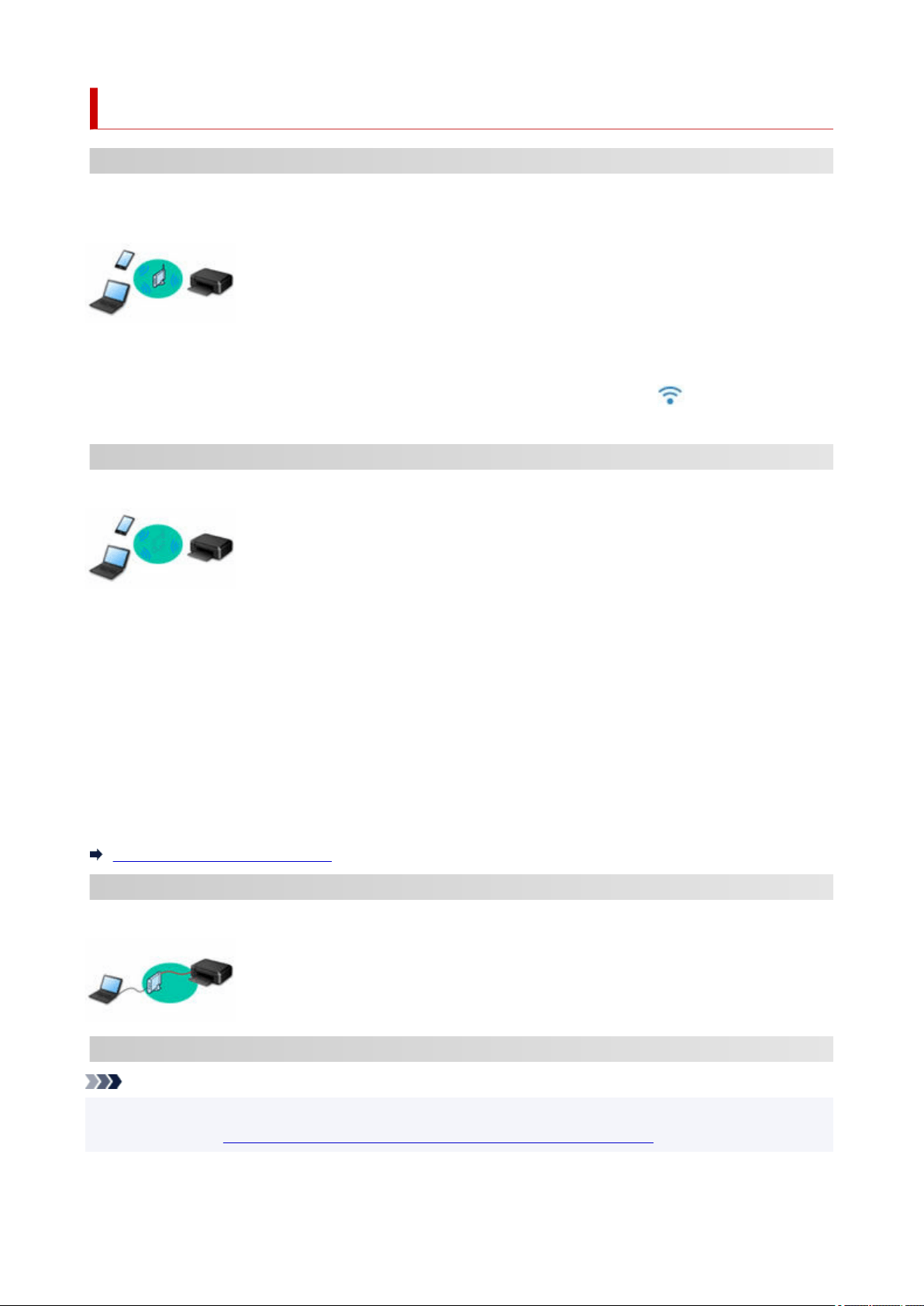
Easy Understanding Network Connections
What is Wireless Connection
Connect the printer and devices (e.g. computer/smartphone/tablet) using a wireless router.
If you have a wireless router, we recommend you use one for wireless connection.
• Connection methods vary depending on the wireless router type.
• You can change network settings such as the network name (SSID) and security protocol on the printer.
• When the connection between a device and a wireless router is completed and (Wi-Fi icon) is
displayed in the device's screen, you can connect the device to the printer using the wireless router.
What is Wireless Direct Connection
Connect the printer and devices (e.g. computer/smartphone/tablet) without using a wireless router.
• While you are using the printer with Wireless Direct, Internet connection from the printer becomes
unavailable. In that case, web services for the printer cannot be used.
• If you connect a device connected to the Internet via a wireless router to the printer that is in the
Wireless Direct, the connection between the device and wireless router will be disabled. In that case,
the connection of the device may switch to a mobile data connection automatically depending on your
device. Transmission fees for connecting to the Internet using a mobile data connection apply.
• In the Wireless Direct, you can connect up to five devices at the same time. If you try to connect a sixth
device while five devices are already connected, an error will appear. If an error appears, disconnect a
device you do not use and configure settings again.
• Network settings such as the network name (SSID) and security protocol are specified automatically.
Connecting with Wireless Direct
What is Wired Connection
Connect the printer and hub/router using a LAN cable. Prepare a LAN cable.
USB Connection (Reference)
Note
• You can connect the printer and computer using a USB cable (USB connection). Prepare a USB cable.
For details, see Switching Printer's Connection to Network or Terminal Devices.
45

Network Connection Settings/Setup
Perform connection setup for the printer and computer/smartphone/tablet.
For more on setup procedure, see the web page.
Connecting with Wireless Direct
Connecting with Wireless Direct
Changing Network Settings
See below for changing connection settings for the printer and computer/smartphone/tablet.
• To change network connection method:
Switching Printer's Connection to Network or Terminal Devices
Changing the Connection Mode
• To add computer/smartphone/tablet to the printer:
Switching Printer's Connection to Network or Terminal Devices
Wi-Fi Connection Assistant
Wi-Fi Connection Assistant checks or diagnoses the settings of the printer and those of computer and
restores the status of them if anything is wrong with network connection. Select either link below to download
Wi-Fi Connection Assistant.
Checking Printer Connection Status Using Wi-Fi Connection Assistant
• Performing/Changing Network Settings (Windows)•
For Windows, you can perform network settings using Wi-Fi Connection Assistant.
Wi-Fi Connection Assistant (Windows)
• Diagnosing and Repairing Network Settings (Windows/macOS)•
You can diagnose or repair network settings using Wi-Fi Connection Assistant.
◦ For Windows:◦
Wi-Fi Connection Assistant (Windows)
◦ For macOS:◦
Wi-Fi Connection Assistant (macOS)
Network Connection Tips
See below for tips on using the printer via network connection.
Network Connection Tips (Windows/macOS)
Handling Printer Configuration Using the Web Browser
Countermeasures against Unauthorized Access
Troubleshooting
See Network FAQ for troubleshooting on network connection.
Notice/Restriction
See below for details.
• Restrictions on network settings:
46


Restrictions
When connecting another device while a device (such as a computer) is already connected to the printer,
connect it using the same connection method as the connected device.
If you connect using a different connection method, the connection to the device in use will be disabled.
Connection Using a Wired Network cannot be performed on printers that do not support a wired connection.
Connect via wireless router
• You cannot establish a printer with wireless and wired connections at the same time.
• Make sure your device and the wireless router are connected. For details on checking these settings,
see the manual supplied with the wireless router or contact its manufacturer.
As for a device already connected to the printer without using a wireless router, reconnect it via a
wireless router.
• Configuration, router functions, setup procedures and security settings of wireless routers vary
depending on the system environment. For details, see the manual for your wireless router or contact
its manufacturer.
• Depending on your country or region, this printer does not support wireless networking standards
using the 5 GHz band.
• If your device is set to the "IEEE802.11n only" mode, TKIP cannot be used as a security protocol.
Change the setting to something other than "IEEE802.11n only."
The connection between your device and the wireless router will be temporarily disabled while the
setting is changed. Do not proceed to the next screen of this guide until setup is complete.
• When connecting to Wi-Fi outdoors, do not connect to a 5 GHz network (SSID).
The 5 GHz band available for use with the printer includes the channels that are allowed for indoor
use only, depending on your country or region.
For details on the 5 GHz network (SSID) of your wireless router, see the manual supplied with the
wireless router, or contact its manufacturer.
• For office use, consult your network administrator.
• Note that if you connect to a network with no security protection, your personal information could be
disclosed to a third party.
Wireless Direct
Important
• If a device is connected to the Internet via a wireless router, and you then connect it to a printer•
in Wireless Direct mode, the existing connection between the device and wireless router will be
disabled. In that case, the connection of the device may switch to a mobile data connection
automatically depending on your device. When you connect to the Internet using a mobile data
connection, charges may apply depending on your contract.
When you connect a device and the printer using Wireless Direct, the connection information will
be saved to Wi-Fi settings. The device may be connected to the printer automatically even after
disconnecting it or connecting it to another wireless router.
To prevent automatic connection to the printer in Wireless Direct mode, change the connection
mode after using the printer, or set not to connect automatically in the Wi-Fi settings of the
48

device.
For details on changing the settings of your device, see the manual supplied with the device or
contact its manufacturer.
• If you connect a device and the printer using Wireless Direct, Internet connection may become
unavailable depending on your environment. In that case, web services for the printer cannot be used.
• In Wireless Direct mode, you can connect up to five devices at the same time. If you try to connect a
sixth device while five devices are already connected, an error will appear.
If an error appears, disconnect a device that does not use the printer, and then redo the settings.
• Devices connected to the printer using Wireless Direct cannot communicate with each other.
• Firmware updates for the printer may not be available while using Wireless Direct.
• When a device has been connected to the printer without using a wireless router and you want to set
it up again using the same connection method, disconnect it first. Disable the connection between the
device and printer in the Wi-Fi setting screen.
Connection Using a Wired Network
• You cannot establish a printer with wireless and wired connections at the same time.
• When using a router, connect the printer and computer to the LAN side (same network segment).
49


Detect Same Printer Name
When the printer is detected during setup, plural printers with the same name may appear on the results
screen.
Select a printer with checking the printer settings against those on detection result screen.
• For Windows:•
Check the printer's MAC address or serial to select the correct printer from the results.
• For macOS:•
The printer names appear with the MAC address added at the end or as the printer name specified by
Bonjour.
Check identifiers such as the MAC address, the printer name specified by Bonjour, and the printer's
serial number to select the printer from among those that appear.
Note
• Serial number may not appear on result screen.
To check the printer's MAC address and the serial number, print out the network settings information.
Printing Network Settings
Note
• Some models allow you to check the serial number on the LCD.•
System information
51

Switching Printer's Connection to Network or Terminal Devices
Check the following items when connecting a newly added computer to the LAN environment to the printer,
changing the connection method from USB to LAN, or changing the wireless LAN (Wi-Fi) connection
method.
Connects to Another Computer via LAN/Changes from USB to LAN Connection
Switching LAN Connection Method
Reconfiguration Method of Wi-Fi Connection
Connects to Another Computer via LAN/Changes from USB to LAN
Connection
To connect an additional computer to the printer via LAN, or to change from USB to LAN connection, refer
to Setup Guide to setup.
Switching LAN Connection Method
If you want to switch the connection method (wired LAN or Wi-Fi) when the printer is used with a LAN
connection, check the following item.
• For Windows:•
◦ Refer to Setup Guide to setup.
◦ Enable Wi-Fi (Windows) or wired LAN on the printer's operation panel, and then configure the◦
settings in the Network Settings screen of Wi-Fi Connection Assistant.
For details on the configuration, see the following.
Performing/Changing Wi-Fi Settings
Performing/Changing Wired LAN Connection (Ethernet Cable) Settings
• For macOS:•
◦ Refer to Setup Guide to setup.
Reconfiguration Method of Wi-Fi Connection
• If you want to switch to Wireless Direct when using the printer with a 2.4 GHz or 5 GHz Wi-Fi•
connection:
Wireless Direct connection is available. At 2.4 GHz, Wireless Direct connection and Wi-Fi connection
can be used together. At 5 GHz, only Wireless Direct (the last connection you set up) is enabled.
Connecting with Wireless Direct
• If you want to switch to a 5 GHz Wi-Fi connection when using the printer with Wireless Direct:•
◦ For Windows:◦
Refer to Changing the Connection Mode in Setup Guide.
52

◦ For macOS:◦
Refer to Changing the Connection Mode in Setup Guide.
53

Setting Up IEEE802.1X/EAP (WPA/WPA2 Enterprise)
Overview
If you are using a switch/access point (authenticator) with IEEE802.1X/EAP, you can connect this printer
to a wired LAN or Wi-Fi.
Note
• The information on this page is intended for network administrators.•
Setup Flow
1.
Prepare the equipment.
1.
•
IEEE802.1X/EAP compliant switch/access point (Authenticator)
•
•
Authentication (Radius) server
•
2.
Configure settings for the authentication (Radius) server and authenticator.
2.
Set up the authentication (Radius) server and authenticator in advance.
Note
• For the settings of the authentication (Radius) server and IEEE802.1X/EAP switch/access point•
(Authenticator), refer to the respective instruction manuals.
3. Configure Remote UI.3.
Remote UI is used to configure printer security settings.
See below for an overview of Remote UI.
Configuration Changes / Display Printer Status Using Web Browser
This web page will guide you through the configuration using Wireless Direct.
Refer to the following to connect via Wireless Direct.
Connecting with Wireless Direct
Important
•
When setting using the wired LAN or infrastructure (wireless connection), configure the network
•
settings so that you can temporarily connect to the network in the respective mode.
•
There is IEEE802.1X/EAP settings in the security item of the Remote UI menu.
•
4.
On Remote UI, select Security > IEEE802.1X/EAP settings.
4.
5.
Select Authentication.
5.
•
Login name (up to 96 characters)
•
54

The login name to connect to the authentication server.
Important
• If you select Verify Authentication Server Name, you must set the authentication server•
name.
•
If you select Verify authentication server certificates, you must register the certificate
•
authority (CA) certificate in advance.
6.
Select Authentication.
6.
Select PEAP, EAP-TTLS or EAP-TLS.
7.
Set Authentication.
7.
Set the data required for PEAP, EAP-TTLS, or EAP-TLS authentication.
You must have a certificate authority (CA) certificate registered to verify certificates sent from the
authentication server (server certificates).
• PEAP:•
Set the user name and password that will be used for client authentication.
Normally, select Verify authentication server certificates.
• EAP-TLS:•
You must have a client authentication certificate registered.
Normally, select Verify authentication server certificates.
•
EAP-TTLS:
•
Select MSCHAPv2 or PAP as the authentication protocol.
Set the user name and password that will be used for client authentication.
8. Save your settings.8.
Select OK to save the IEEE802.1X/EAP settings.
9.
Register the certificate authority (CA) certificate.
9.
Select CA certificate > Upload CA certificate and upload (register) the CA certificate (X.509 DER
format).
A maximum of five certificates can be registered.
10.
Register key and certificate.
10.
When EAP-TLS is selected:
Select Key and certificate settings > Upload key and certificate and upload (register) the client
certificate (X.509 DER format).
55

Note
• If you choose PEAP or EAP-TTLS, you do not need to do this.•
11. Set up Weak encryption restriction.11.
Select Restrict.
12. Set up Weak certificate restriction.12.
Select Restrict.
13.
Select Enable/disable IEEE802.1X/EAP to enable IEEE802.1X/EAP
13.
Select OK and save the settings to enable IEEE802.1X/EAP.
Note
•
You can enable or disable IEEE802.1X/EAP on the operation panel.
•
Note that the advanced IEEE802.1X/EAP settings are not available on the operation panel.
14. Connect to IEEE802.1X/EAP switch (Authenticator) or IEEE802.1X/EAP access point.14.
When IEEE802.1X/EAP is enabled, it is possible to search for SSIDs of IEEE802.1X/EAP access
points in Manual setup on the operation panel.
Select the SSID of the IEEE802.1X/EAP access point to connect.
For a wired LAN, connect the LAN cable to the IEEE802.1X/EAP switch.
If You Cannot Connect
If you are unable to connect to the IEEE802.1X/EAP switch (Authenticator) or access point, please redo
the settings from step 3 above.
Important
• Wireless Direct is disabled when you connect to an IEEE802.1X/EAP access point. When using•
the Remote UI, enable Wireless Direct from the operation panel settings and connect again using
Wireless Direct.
Note
• From the Setup menu screen, select Device settings > LAN settings > Wi-Fi > Manual setup >•
IEEE802.1X/EAP > Latest auth. result to help troubleshoot.
1. Check that the wireless router is turned on is displayed when the switch/access point may not1.
be turned on.
2. If the error cannot be identified, such as multiple problems occurring, An error has occurred is2.
displayed.
3. If a connection processing problem or encryption-authentication mismatch is detected, Failed to3.
connect to the wireless router <See manual> is displayed.
56

4. If you see a message other than the above, follow the instructions.4.
57


Wi-Fi Connection Assistant
If anything is wrong with connection, Wi-Fi Connection Assistant diagnoses the settings of the printer and
those of computer on which it is installed. In addition, Wi-Fi Connection Assistant restores the status of the
printer and computer.
Important
• To use the printer over LAN, make sure you have the equipment necessary for the connection type,
such as a wireless router or a LAN cable.
• When you install Wi-Fi Connection Assistant, disable block function of firewall.
59
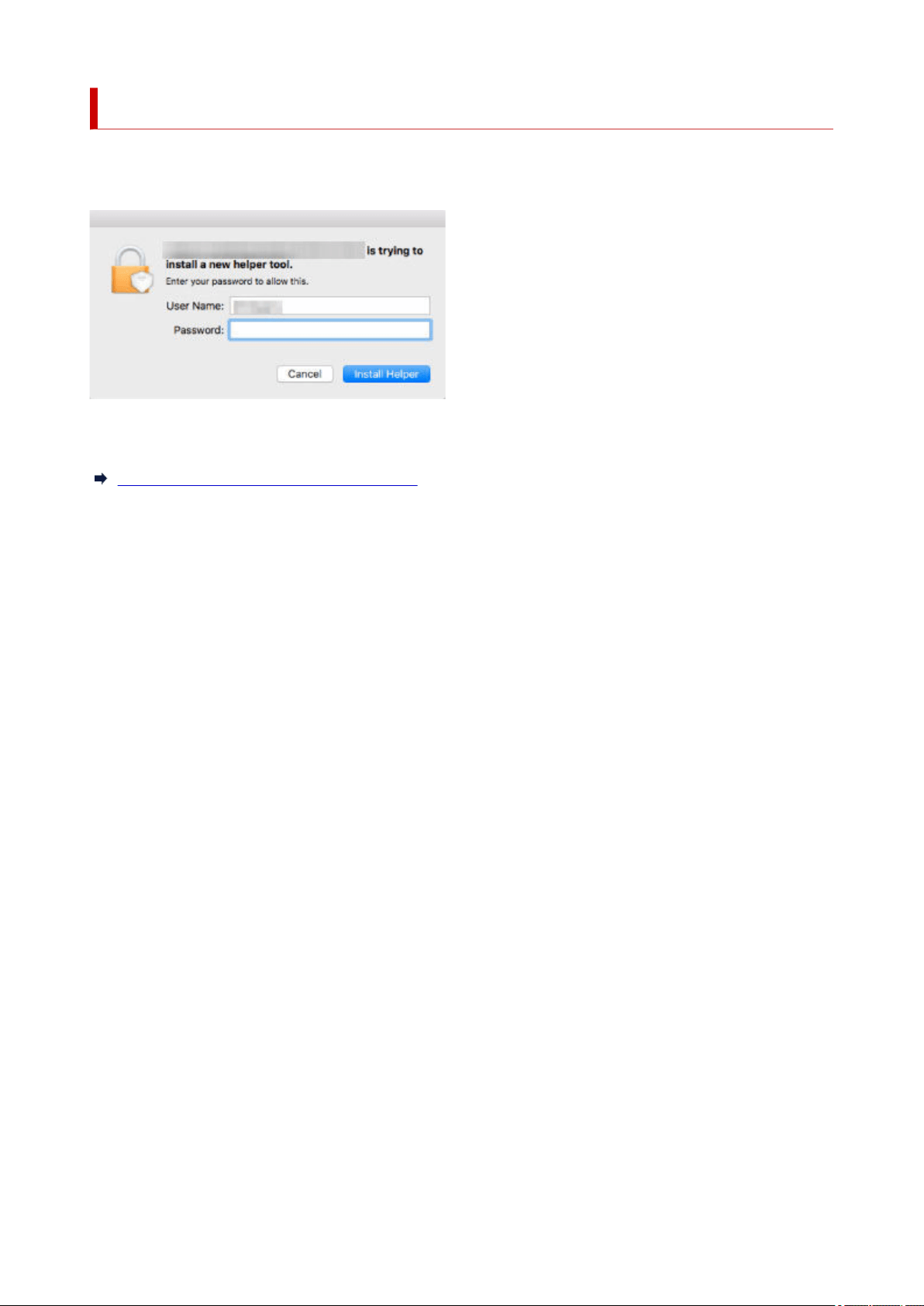
Starting Up Wi-Fi Connection Assistant
Start up Launchpad, select Canon Utilities, and then select Wi-Fi Connection Assistant.
When you start up Wi-Fi Connection Assistant, the screen below appears.
Enter the password specified for your computer and select Install Helper. Wi-Fi Connection Assistant starts
diagnosis and repair of network.
Diagnosing and Repairing Network Settings
60

Diagnosing and Repairing Network Settings
Wi-Fi Connection Assistant diagnoses and repairs computer settings or connection between the computer
and printer when a problem (e.g. cannot print from a printer on the network) occurs.
Important
• Some models do not support diagnosis and repair function.•
For details:
List of Models Which Does Not Support Diagnosis and Repair Function
Wi-Fi Connection Assistant starts checking the computer settings when it starts up. Perform operations
following the instructions on the screen.
Note
• This function checks the following items:
whether the computer is connected to the router
whether the printer can be detected on the network
whether the signal strength or communication level is sufficient (when using Wi-Fi)
whether the printer port setting matches with the network setting
61

List of Models Which Does Not Support Diagnosis and Repair
Function
The following models does not support "Diagnose and Repair" function of Wi-Fi Connection Assistant.
• G4000 series
• PRO-500 series
• PRO-1000 series
• MB2100 series
• MB2700 series
• MB5100 series
• MB5400 series
• iB4000 series
• PRO-520
• PRO-540
• PRO-560
• PRO-540S
• PRO-560S
• PRO-2000
• PRO-4000
• PRO-6000
• PRO-4000S
• PRO-6000S
• TS9000 series
• TS8000 series
• TS6000 series
• TS5000 series
• MG3000 series
• E470 series
62


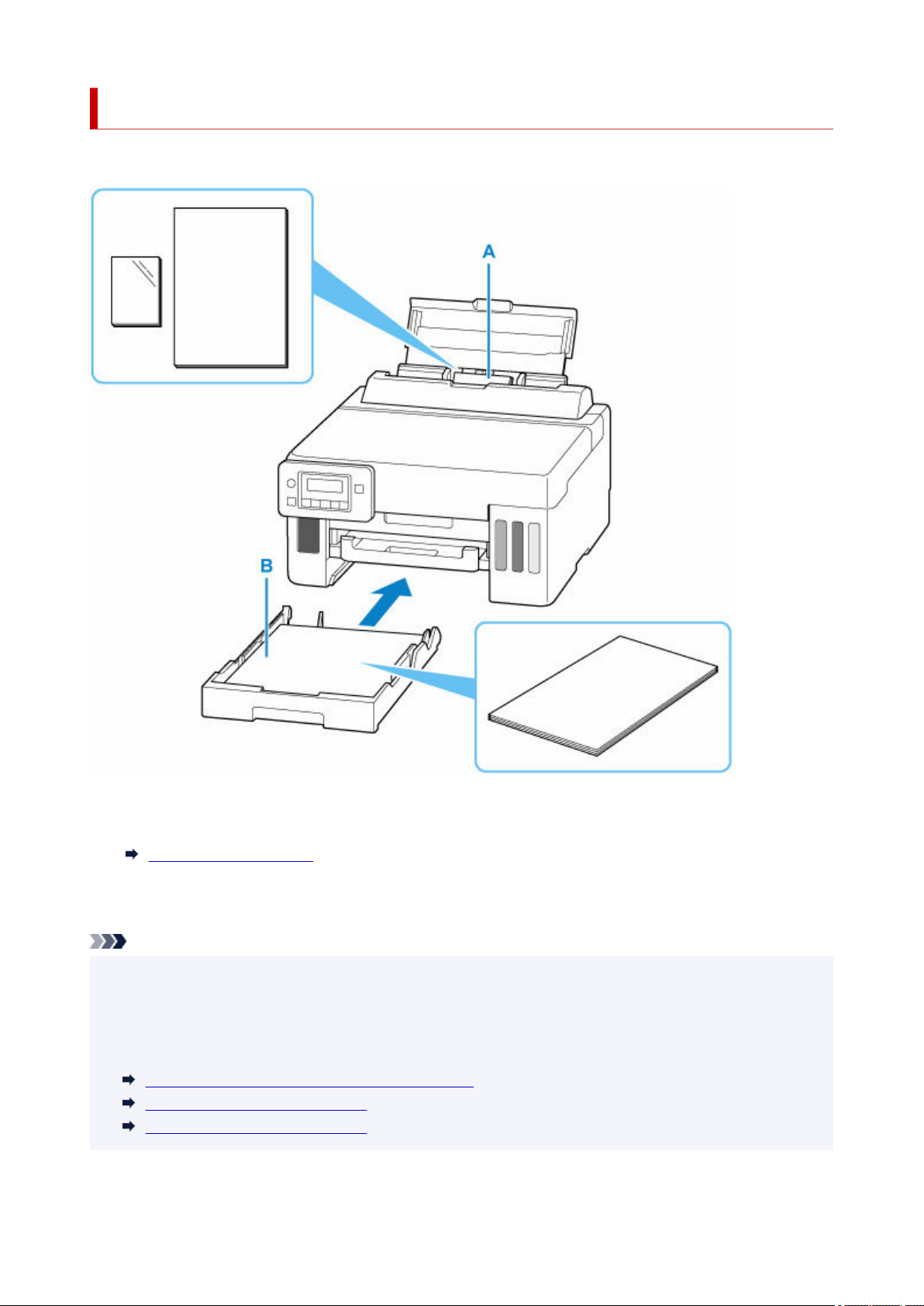
Paper Sources
The printer has two paper sources for feeding paper, the rear tray (A) and cassette (B).
Rear tray
You can load all supported paper such as photo paper and plain paper on the rear tray.
Supported Media Types
Cassette
You can load A4, B5, A5, Letter-sized or Executive plain paper in the cassette.
Note
• When printing, select the correct page size and media type. If you select the wrong page size or media•
type, the printer may feed paper from the wrong paper source or may not print with the proper print
quality.
For details on how to load paper in each paper source, see below.
Loading Photo Paper / Plain Paper in Rear Tray
Loading Plain Paper in Cassette
Loading Envelopes in Rear Tray
65
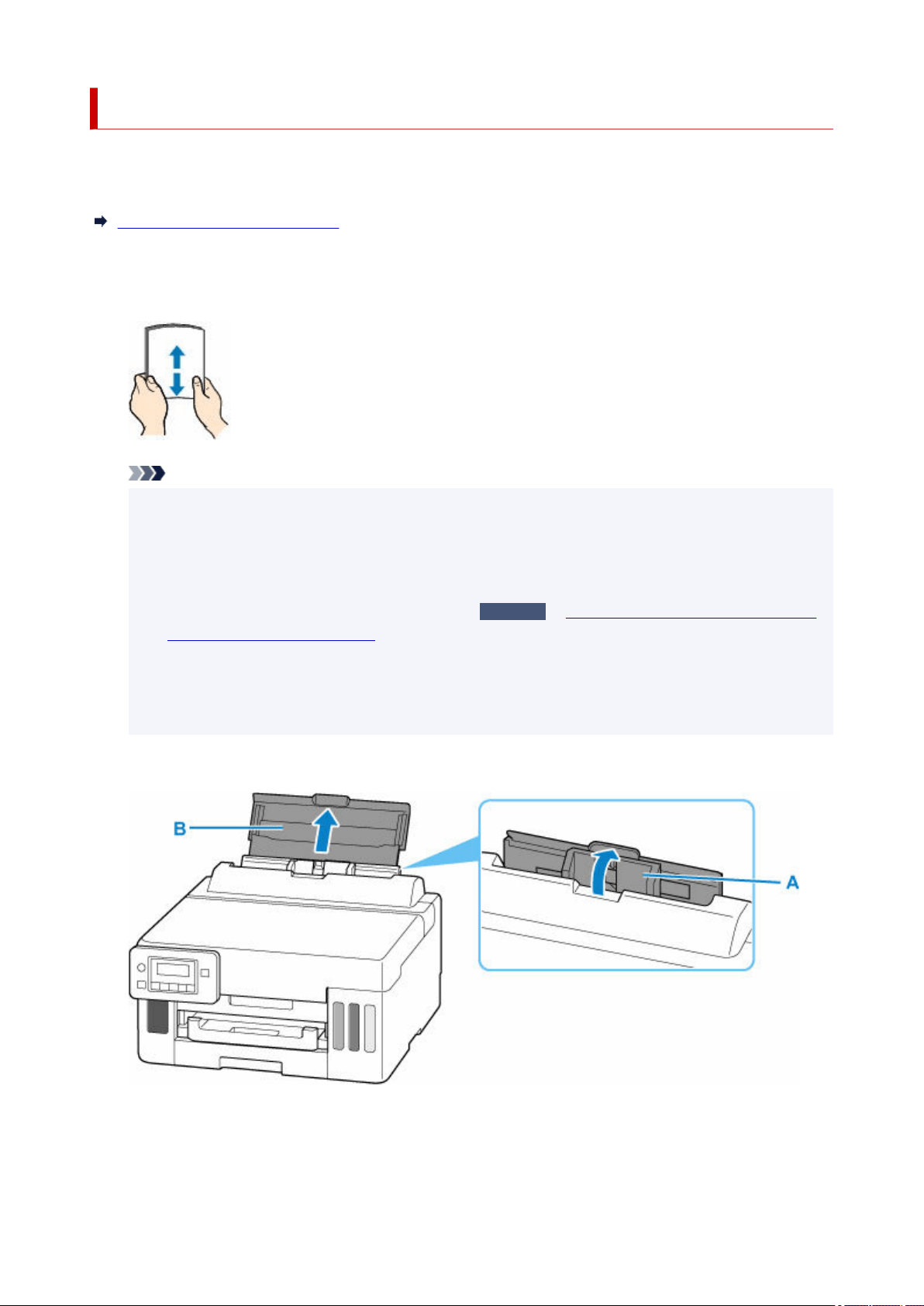
Loading Photo Paper / Plain Paper in Rear Tray
You can load photo paper or plain paper.
You can also load envelopes on the rear tray.
Loading Envelopes in Rear Tray
1. Prepare paper.1.
Align the edges of paper. If paper is curled, flatten it.
Note
• Align the edges of paper neatly before loading. Loading paper without aligning the edges may•
cause paper jams.
• If paper is curled, hold the curled corners and gently bend them in the opposite direction until the•
paper becomes completely flat.
For details on how to flatten curled paper, see
Check3
in Paper Is Smudged/Printed Surface Is
Scratched/Ink Blots/Paper Curl.
• When using Photo Paper Plus Semi-gloss SG-201, even if the sheet is curled, load one sheet at a•
time as it is. If you roll up this paper to flatten, this may cause cracks on the surface of the paper
and reduce the print quality.
2.
Open the rear tray cover (A) and then pull up the paper support (B).
2.
66
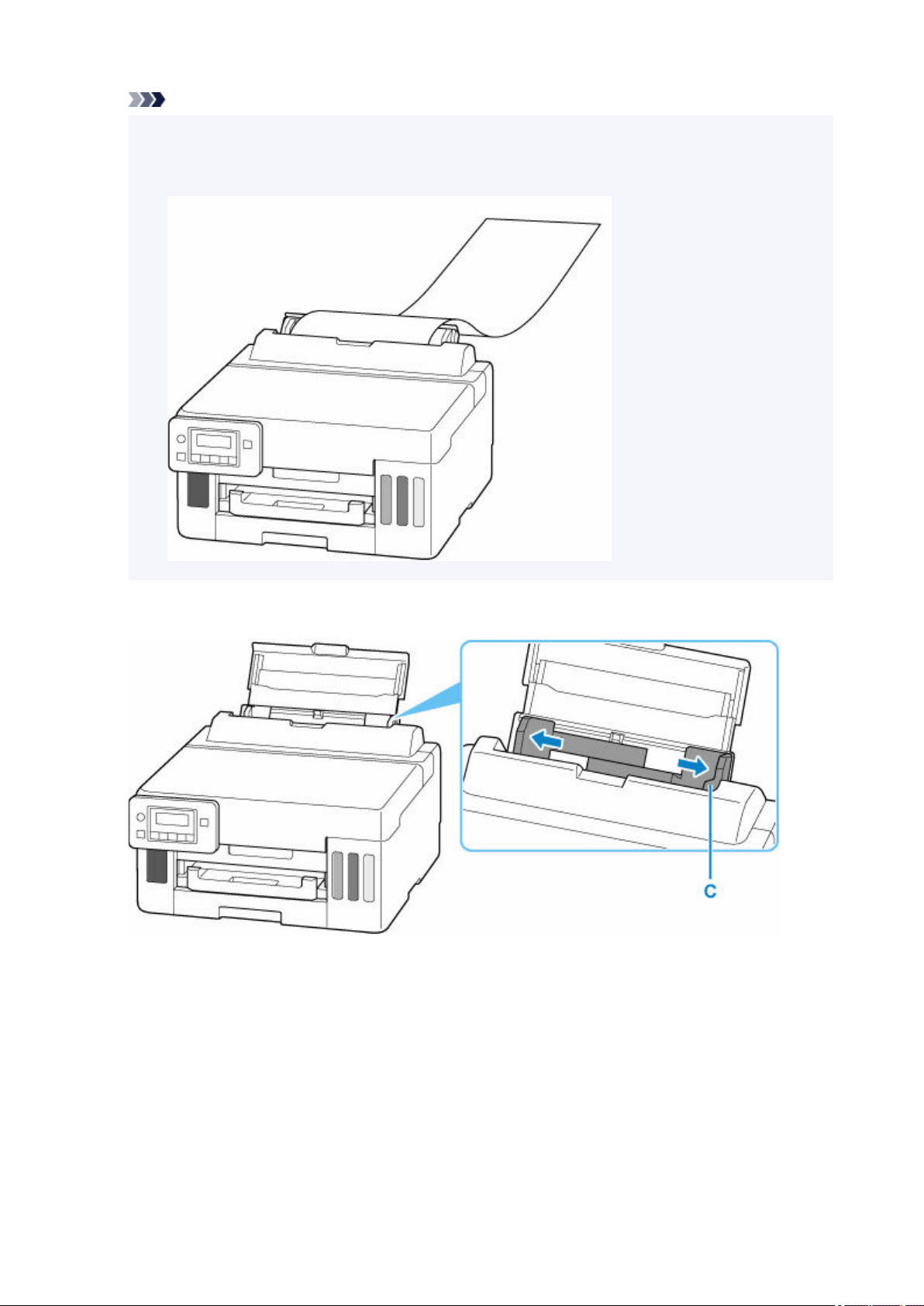
Note
• Load long-length paper without pulling out the paper support. Depending on the weight of the•
paper, the leading edge may rise and printing may be shifted. Make sure that the leading edge of
the paper does not rise, such as by holding the part that protrudes from the rear tray.
3.
Slide right paper guide (C) to open both paper guides.
3.
4.
Load paper stack in portrait orientation WITH PRINT SIDE FACING UP.
4.
After loading paper on the rear tray, the paper information registration screen for the rear tray appears
on the LCD.
67
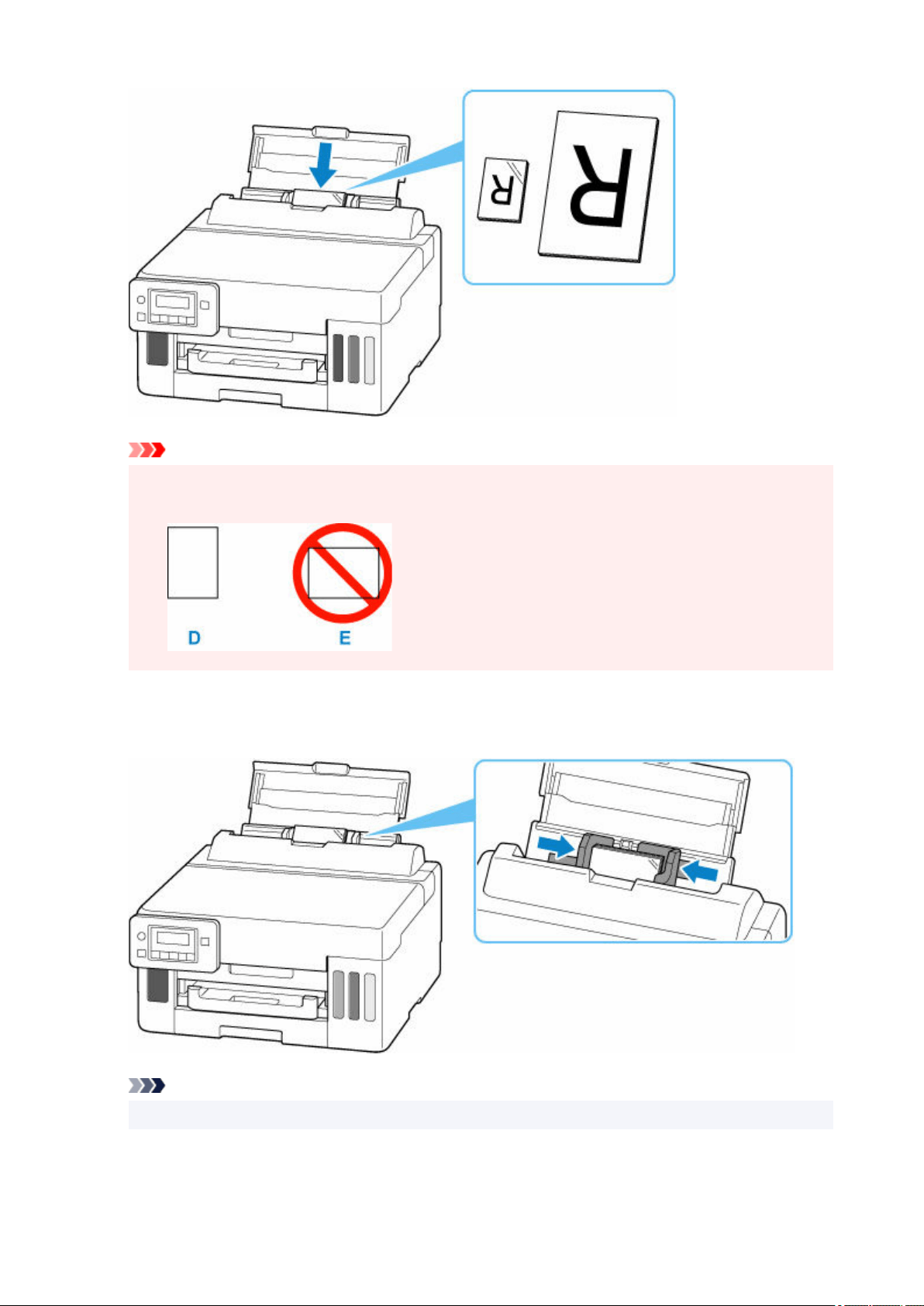
Important
•
Always load paper in portrait orientation (D). Loading paper in landscape orientation (E) can
•
cause paper jams.
5.
Slide right paper guide to align with both sides of paper stack.
5.
Do not slide the paper guides too hard against the paper. The paper may not be fed properly.
Note
•
Do not load sheets of paper higher than the load limit mark (F).
•
68
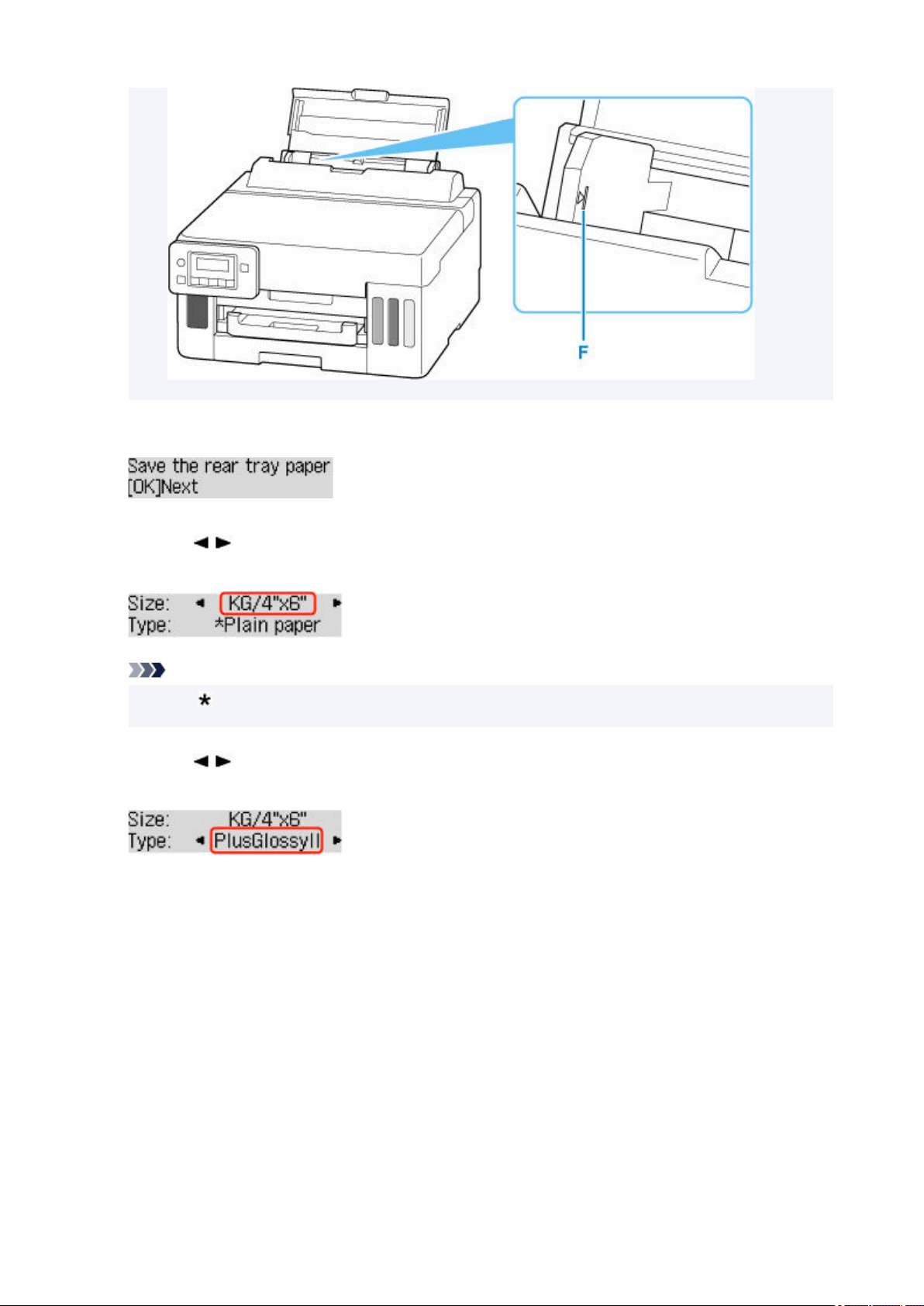
6.
Press the OK button.
6.
7. Use the button to select the size of the loaded paper on the rear tray, then press the7.
OK button.
Note
• The (asterisk) on the LCD indicates the current setting.•
8. Use the button to select the type of the loaded paper on the rear tray, then press the8.
OK button.
9.
Pull out a paper output tray (G).
9.
69
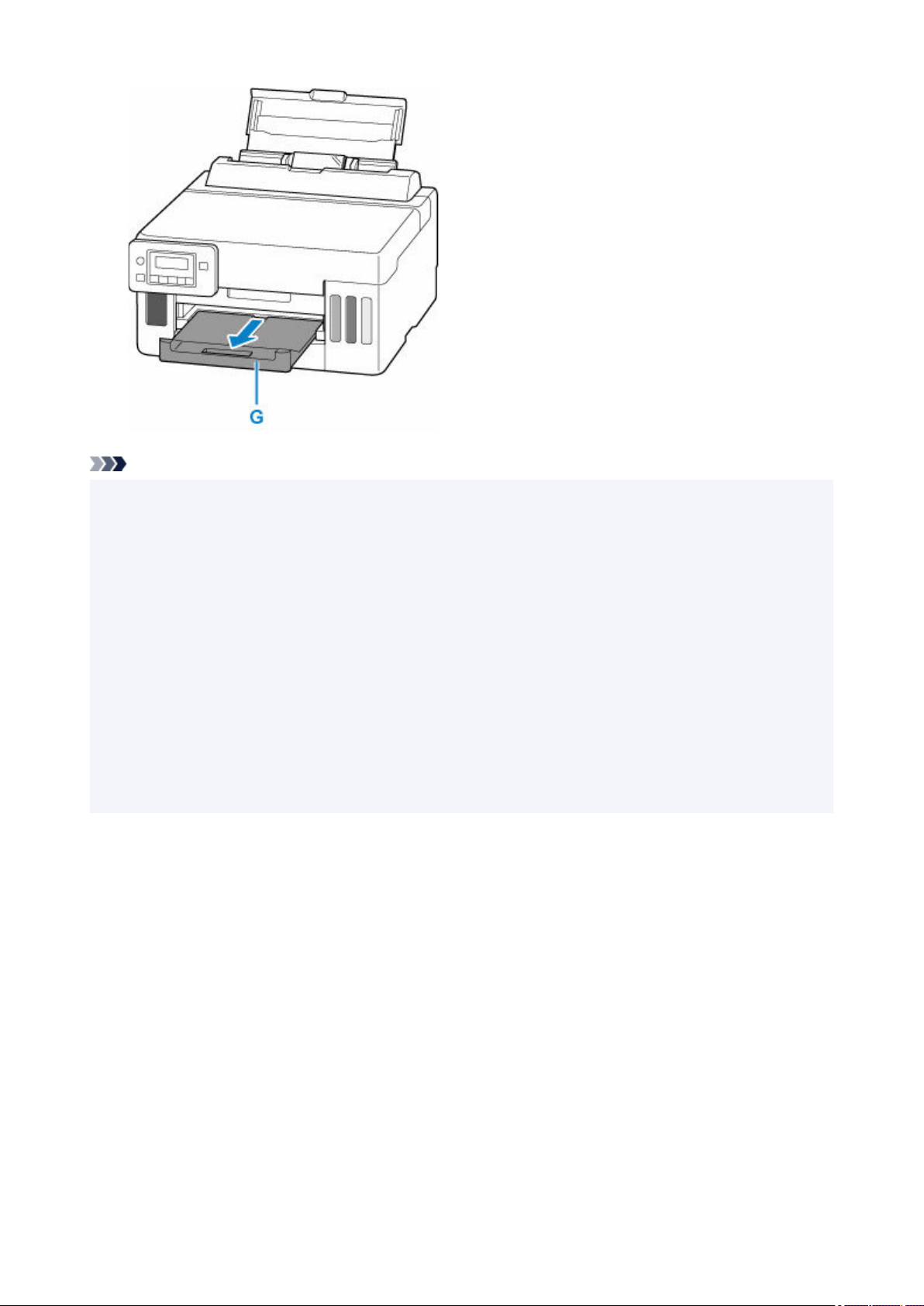
Note
• There are various types of paper, such as paper with a special surface coating for printing photos at•
optimal quality and paper suitable for documents. Each media type has specific preset settings (how ink
is used and sprayed, distance from nozzles, etc.), that allow you to print to that type with optimal image
quality. The wrong paper settings may cause poor printout color quality or scratches on the printed
surface. If you notice blurring or uneven colors, increase the print quality setting and try printing again.
• To prevent incorrect printing, this printer has a function that detects whether the settings for the paper•
loaded on the rear tray matches the paper settings. Before printing, make print settings in accordance
with the paper settings. When this function is enabled, an error message is displayed if these settings
do not match to prevent incorrect printing. When this error message is displayed, check and correct the
paper settings.
• When printing on long-length paper, support the output paper with your hands or use the printer in a•
place where the paper does not fall. If the paper falls, the printed side may become dirty or scratched.
Also, when supporting the paper with hands, be sure not to pull the paper forcefully while printing.
70
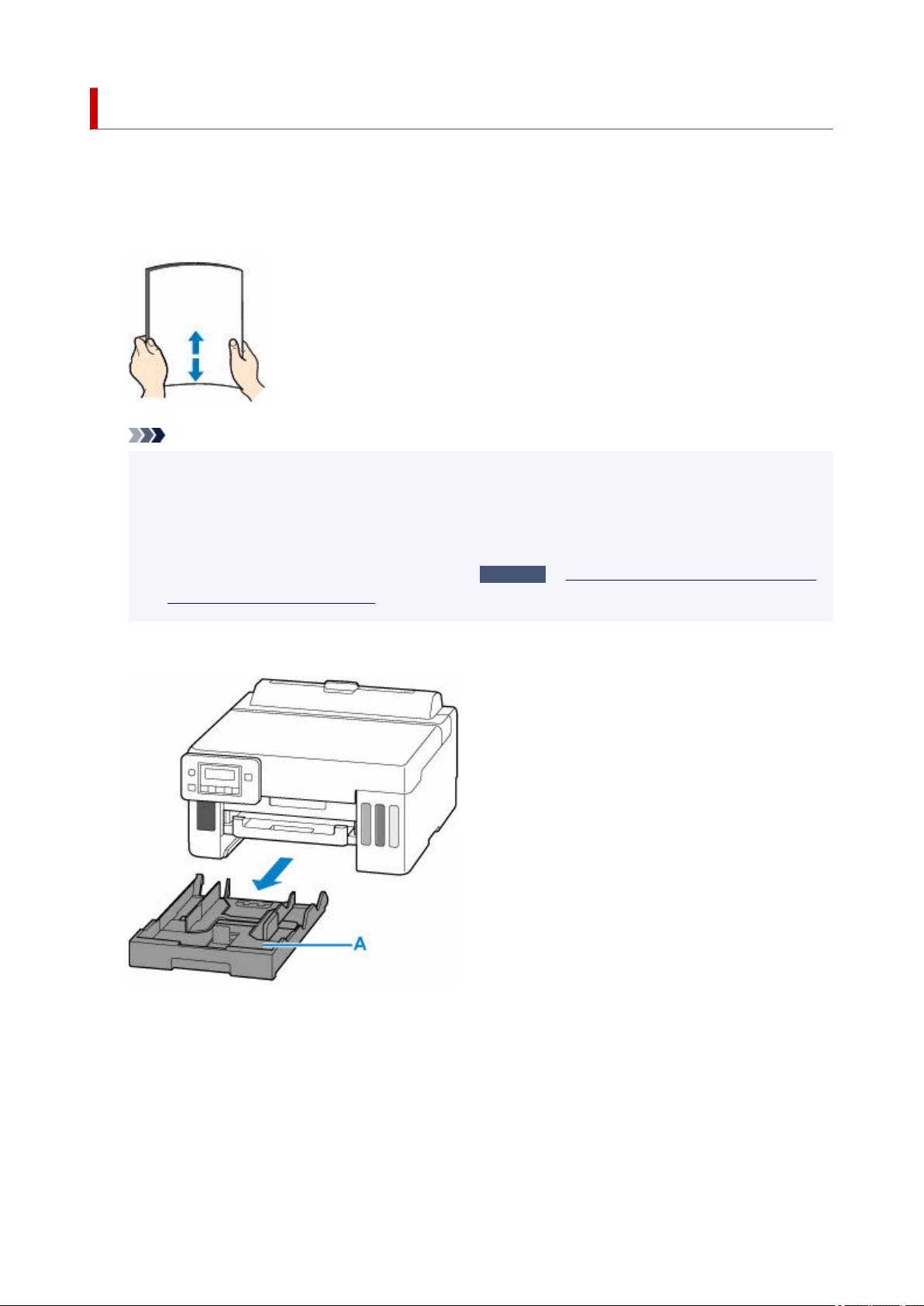
Loading Plain Paper in Cassette
You can load A4, B5, A5, Letter-sized or Executive plain paper in the cassette.
1. Prepare paper.1.
Align the edges of paper. If paper is curled, flatten it.
Note
•
Align the edges of paper neatly before loading. Loading paper without aligning the edges may
•
cause paper jams.
• If paper is curled, hold the curled corners and gently bend them in the opposite direction until the•
paper becomes completely flat.
For details on how to flatten curled paper, see
Check3
in Paper Is Smudged/Printed Surface Is
Scratched/Ink Blots/Paper Curl.
2.
Pull out the cassette (A) from the printer.
2.
3.
Slide paper guides (B) in front and (C) on right to open guides.
3.
4.
Load paper stack in portrait orientation WITH PRINT SIDE FACING DOWN, and place it in
4.
center of cassette.
71
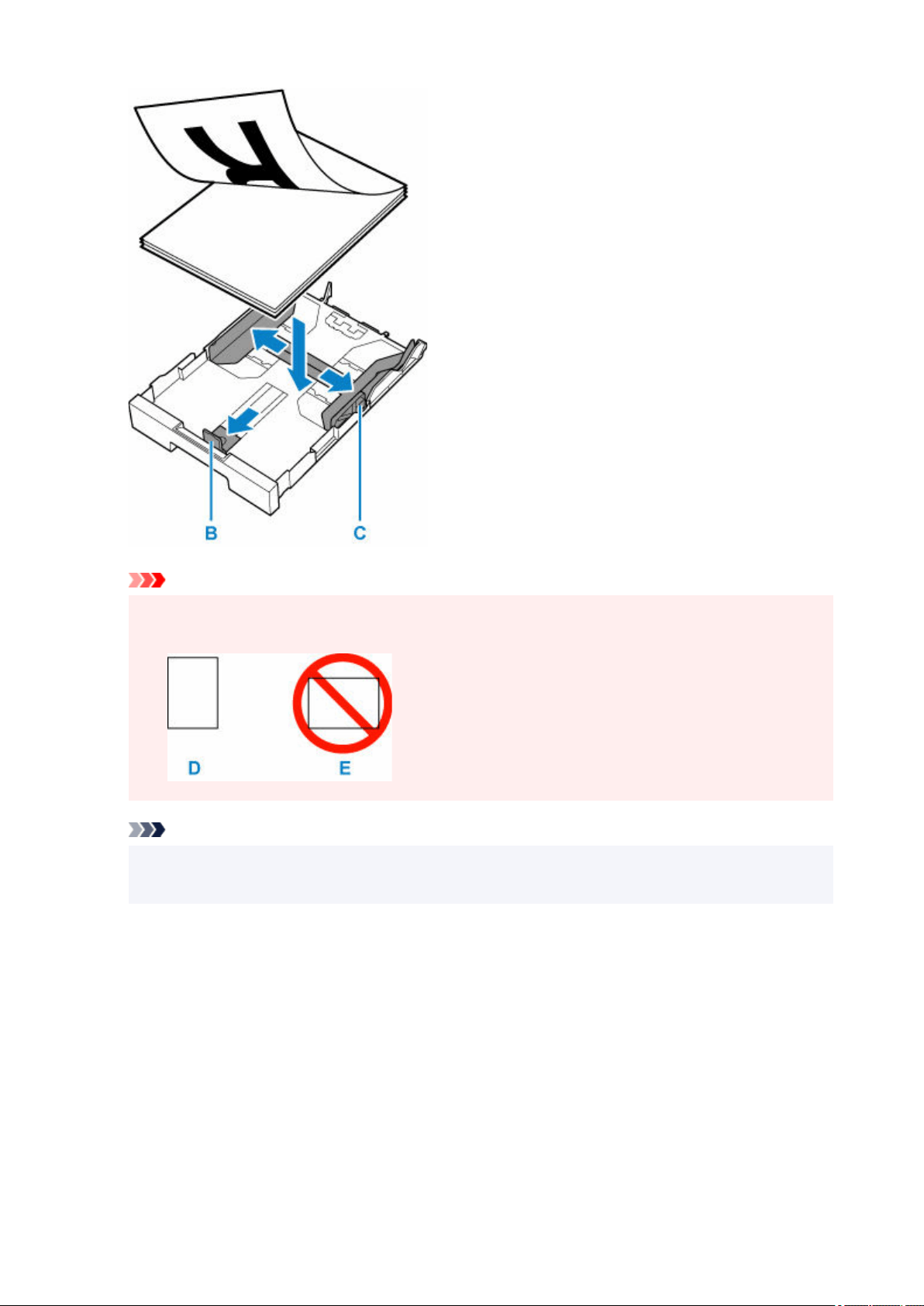
Important
• Always load paper in portrait orientation (D). Loading paper in landscape orientation (E) can•
cause paper jams.
Note
• Align the paper stack with the edge of the cassette as shown in the figure below.•
If the paper stack is in contact with the protrusion (F), the paper may not be fed properly.
72
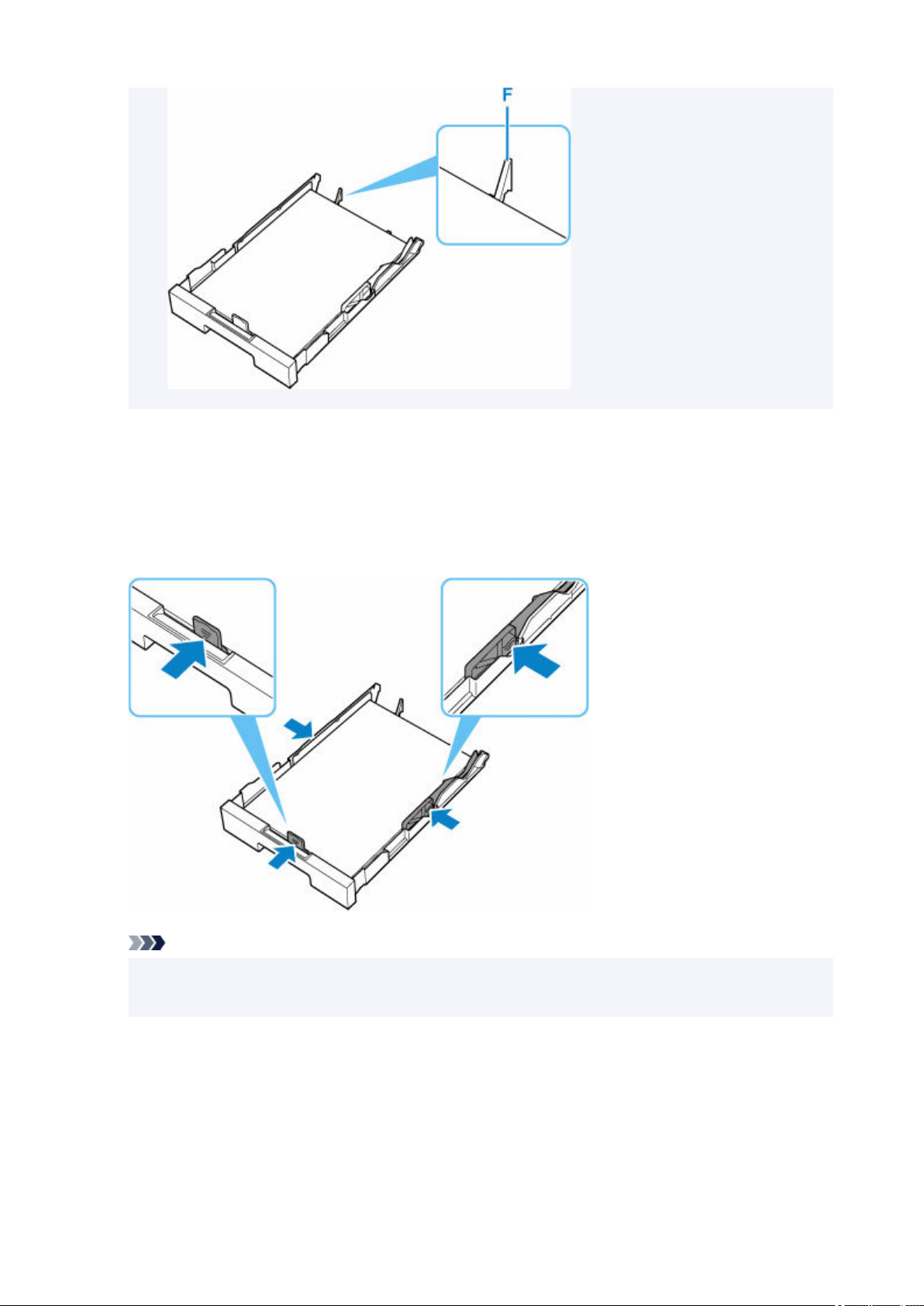
5.
Slide front paper guide to align it with paper stack.
5.
Align paper guide with where it clicks into place.
6. Slide right paper guide to align it with paper stack.6.
Do not slide the paper guide too hard against the paper. The paper may not be fed properly.
Note
•
Do not load sheets of paper higher than the load limit mark (G).
•
•
Keep the paper stack height below the tabs (H) of the paper guides.
•
73
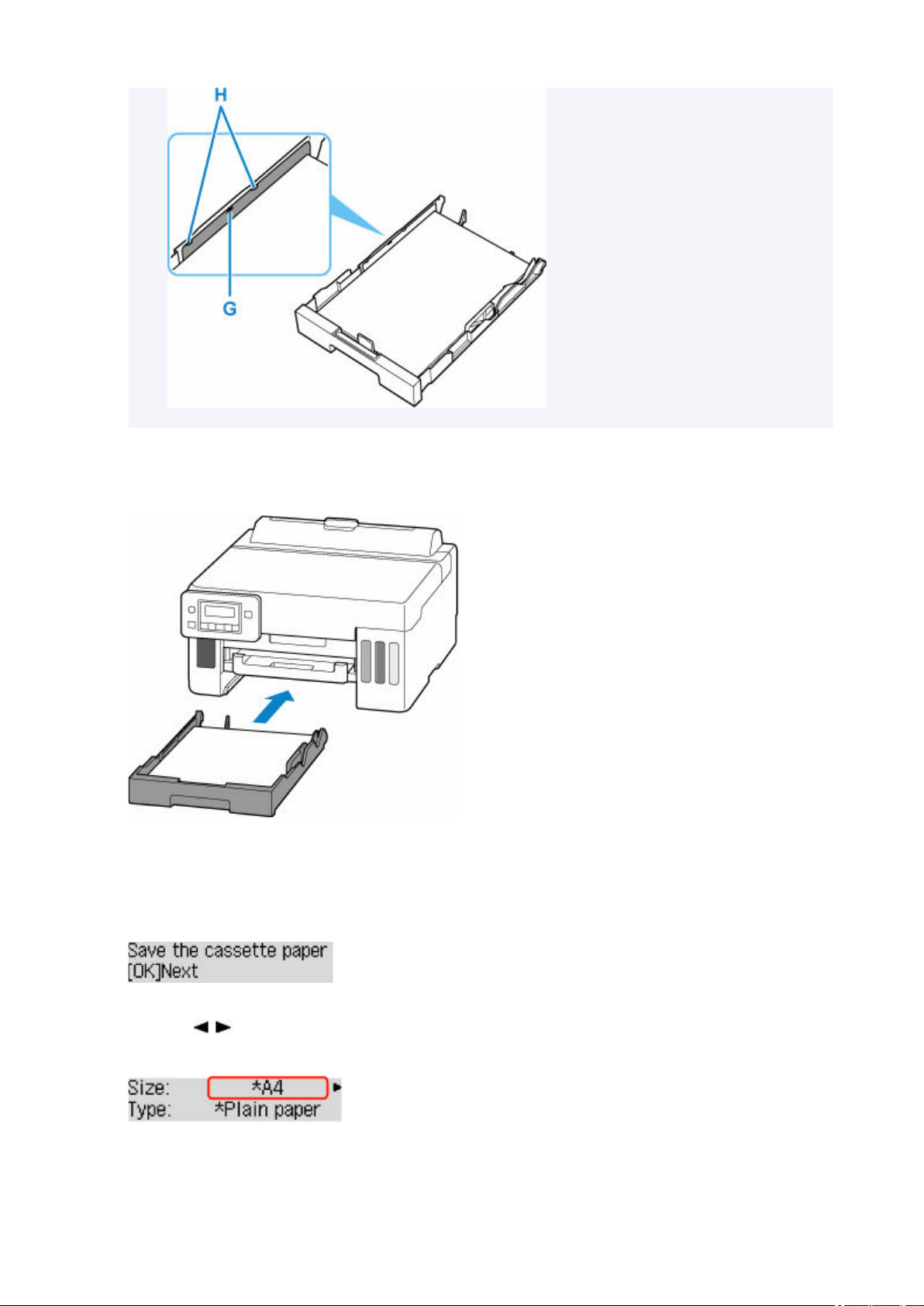
7.
Insert cassette into printer.
7.
Push the cassette into the printer until it stops.
After inserting the cassette into the printer, the paper information registration screen for the cassette
appears on the LCD.
8.
Press the OK button.
8.
9.
Use the button to select the size of the loaded paper in the cassette, then press the
9.
OK button.
74
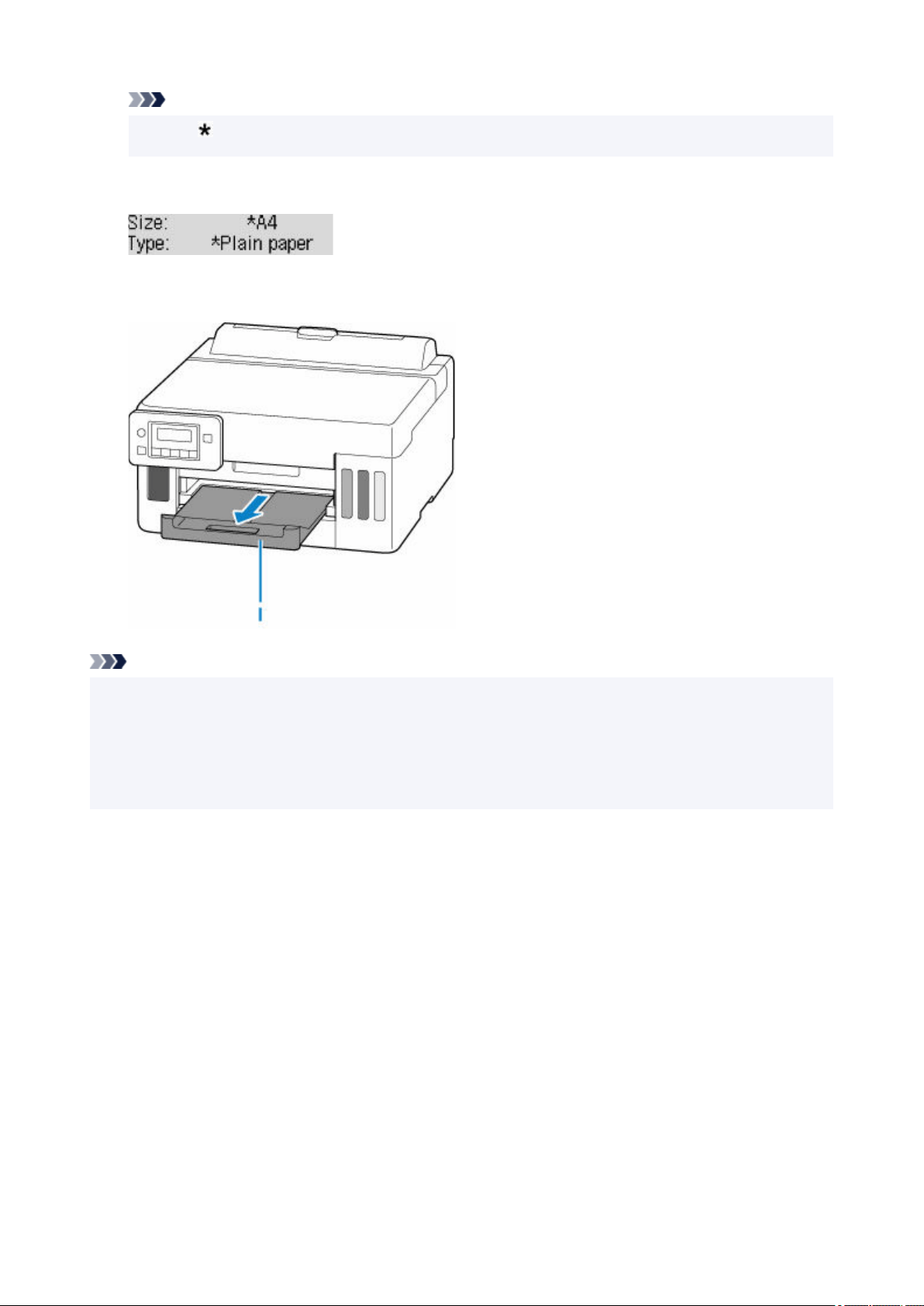
Note
• The (asterisk) on the LCD indicates the current setting.•
10. Check media type and press OK button.10.
11.
Pull out a paper output tray (I).
11.
Note
• To prevent incorrect printing, this printer has a function that detects whether the settings for the paper•
loaded in the cassette matches the paper settings. Before printing, make print settings in accordance
with the paper settings. When this function is enabled, an error message is displayed if these settings
do not match to prevent incorrect printing. When this error message is displayed, check and correct the
paper settings.
75
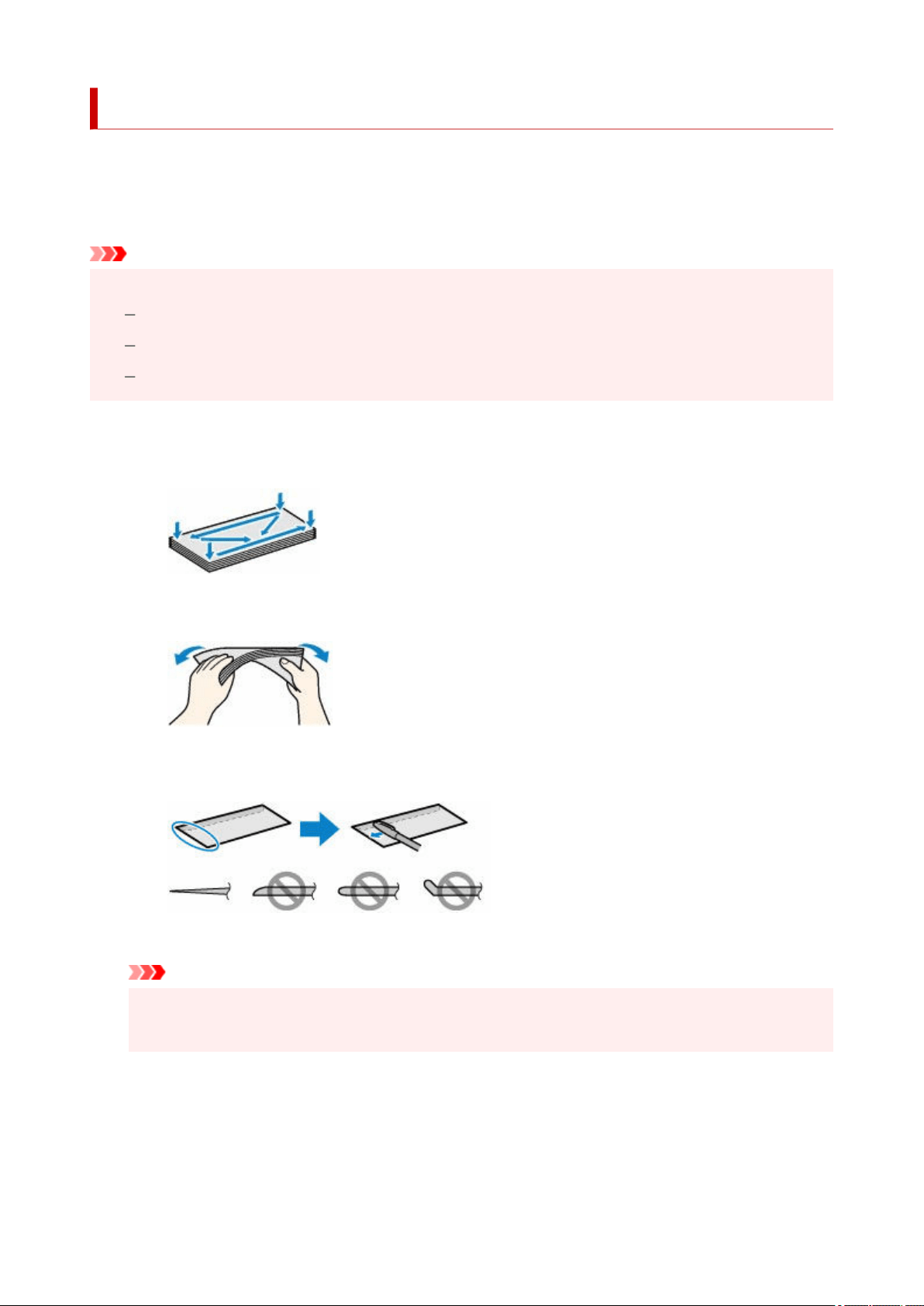
Loading Envelopes in Rear Tray
You can load envelopes on the rear tray.
The address is automatically rotated and printed according to the envelope's direction by specifying with the
printer driver properly.
Important
• Do not use the following envelopes. They could jam in the printer or cause the printer to malfunction.•
Envelopes with an embossed or treated surface
Envelopes with a double flap
Envelopes whose gummed flaps are already moistened and adhesive
1.
Prepare envelopes.
1.
•
Press down on all four corners and edges of the envelopes to flatten them.
•
• If the envelopes are curled, hold the opposite corners and gently twist them in the opposite•
direction.
• If the corner of the envelope flap is folded, flatten it.•
• Use a pen to press the leading edge in the inserting direction flat and sharpen the crease.•
The figures above show a side view of the leading edge of the envelope.
Important
•
The envelopes may jam in the printer if they are not flat or the edges are not aligned. Make sure
•
that no curl or puff exceeds 0.12 in. (3 mm).
2.
Open the rear tray cover (A) and then pull up the paper support (B).
2.
76
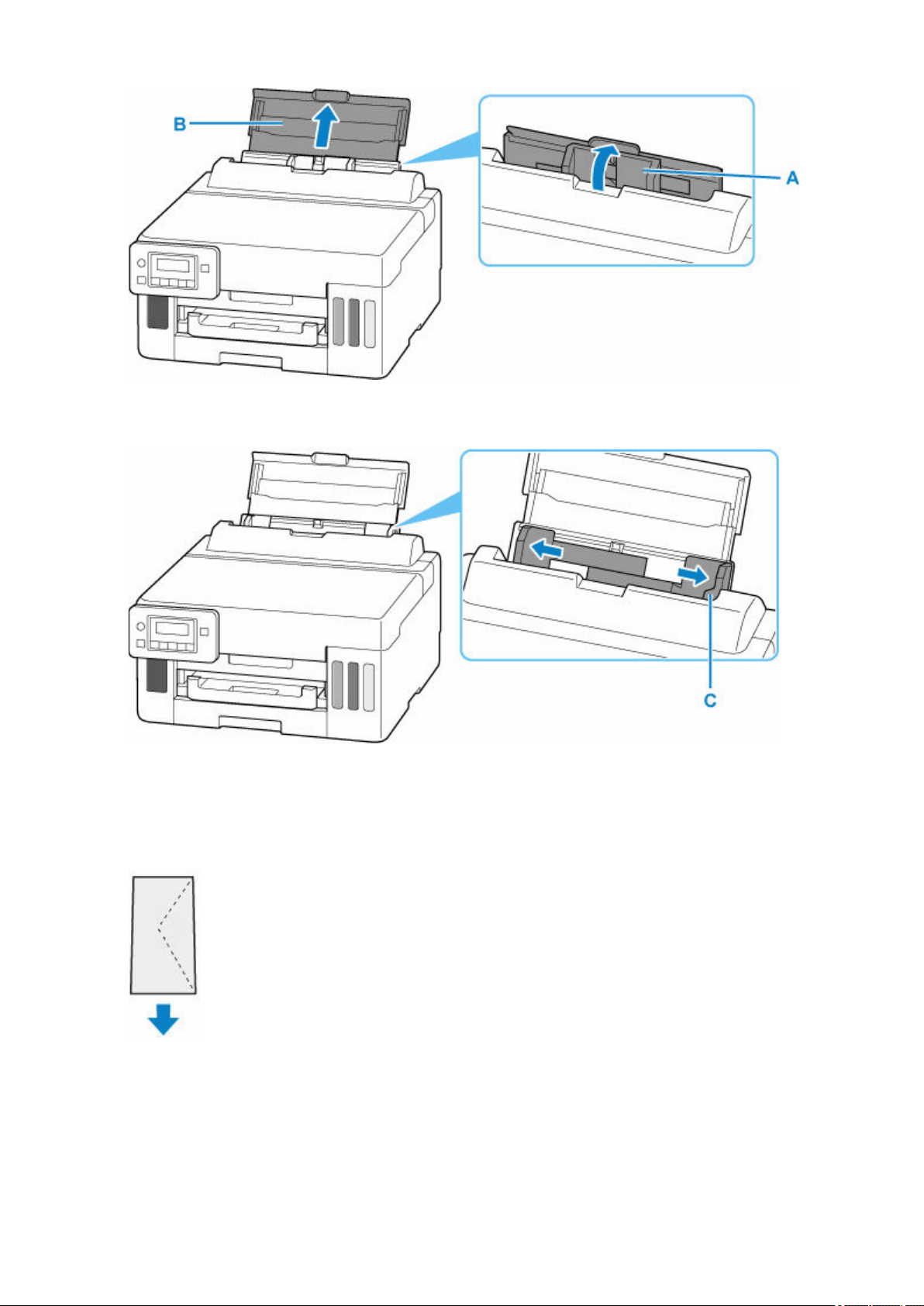
3.
Slide right paper guide (C) to open both paper guides.
3.
4. Load envelopes in portrait orientation WITH PRINT SIDE FACING UP.4.
Up to 10 envelopes can be loaded at once.
Fold flap of the envelope and load the envelope in portrait orientation with the address side facing up.
After loading envelopes on the rear tray, the paper information registration screen for the rear tray
appears on the LCD.
5.
Slide right paper guide to align with both sides of envelopes.
5.
Do not slide the paper guides too hard against the envelopes. The envelopes may not be fed properly.
77
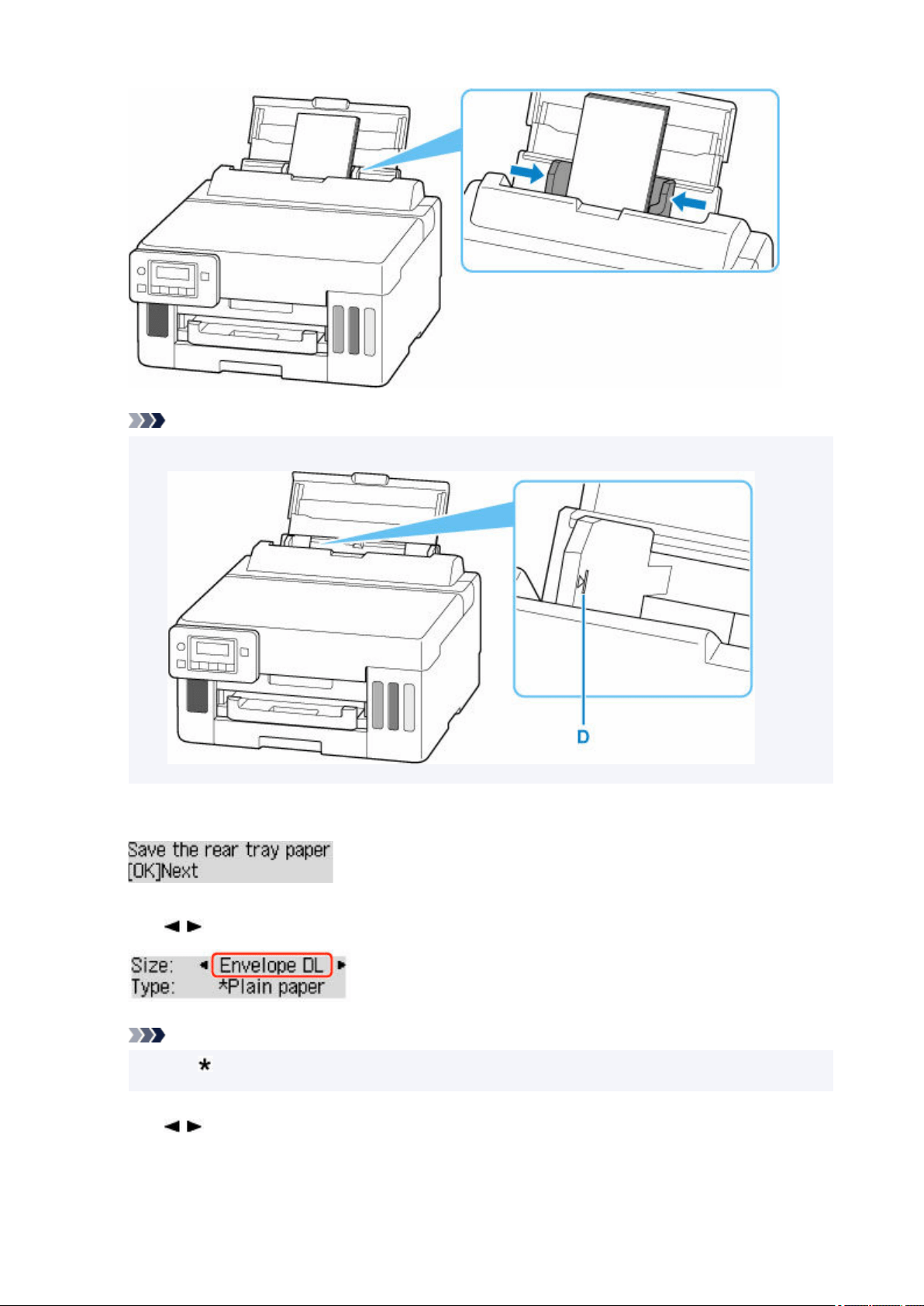
Note
•
Do not load envelopes higher than the load limit mark (D).
•
6.
Press the OK button.
6.
7.
Use button to select size of loaded envelopes on rear tray and press OK button.
7.
Note
•
The (asterisk) on the LCD indicates the current setting.
•
8.
Use button to select Envelope and press OK button.
8.
78
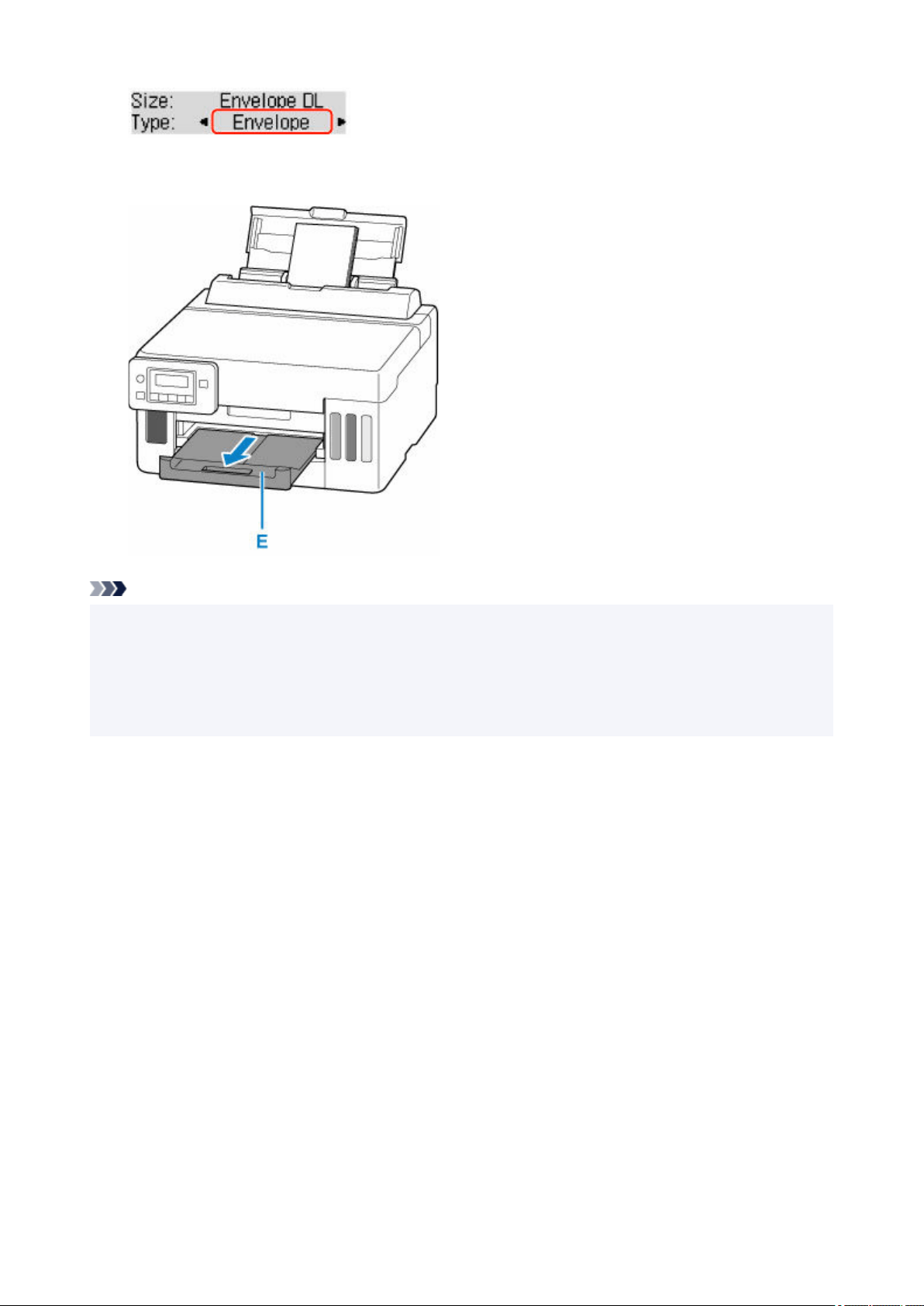
9. Pull out a paper output tray (E).9.
Note
• To prevent incorrect printing, this printer has a function that detects whether the settings for the paper•
loaded on the rear tray matches the paper settings. Before printing, make print settings in accordance
with the paper settings. When this function is enabled, an error message is displayed if these settings
do not match to prevent incorrect printing. When this error message is displayed, check and correct the
paper settings.
79

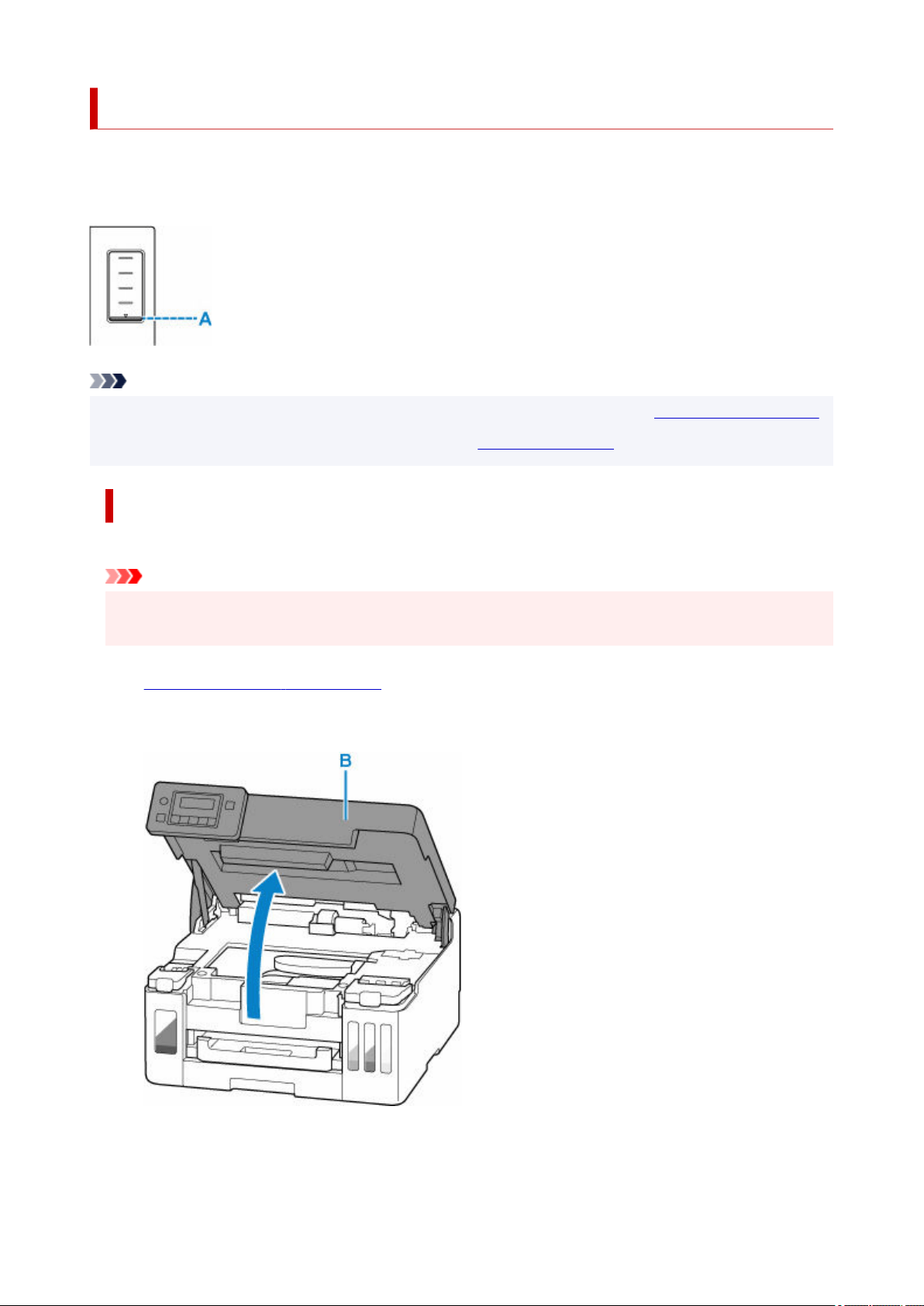
Refilling Ink Tanks
When remaining ink cautions or errors occur, the message will appear on the LCD to inform you of the error.
In this state, the printer cannot print. Check the remaining ink level with the ink tank indicator on the front of
the printer. If the ink level is near the lower limit line (A), refill the ink tank.
Note
• If print results become faint or streaks appear despite sufficient ink levels, see Maintenance Procedure.•
• For precautionary notes on handling ink bottles, see Notes on ink bottles.•
Refilling Procedure
When you refill ink tanks, follow the steps below.
Important
• Please ensure the printer remains flat after initial setup and is NOT turned upside down or on its side,
as ink in the printer may leak.
1.
Check that printer is turned on.
1.
2.
Open the top cover (B).
2.
81
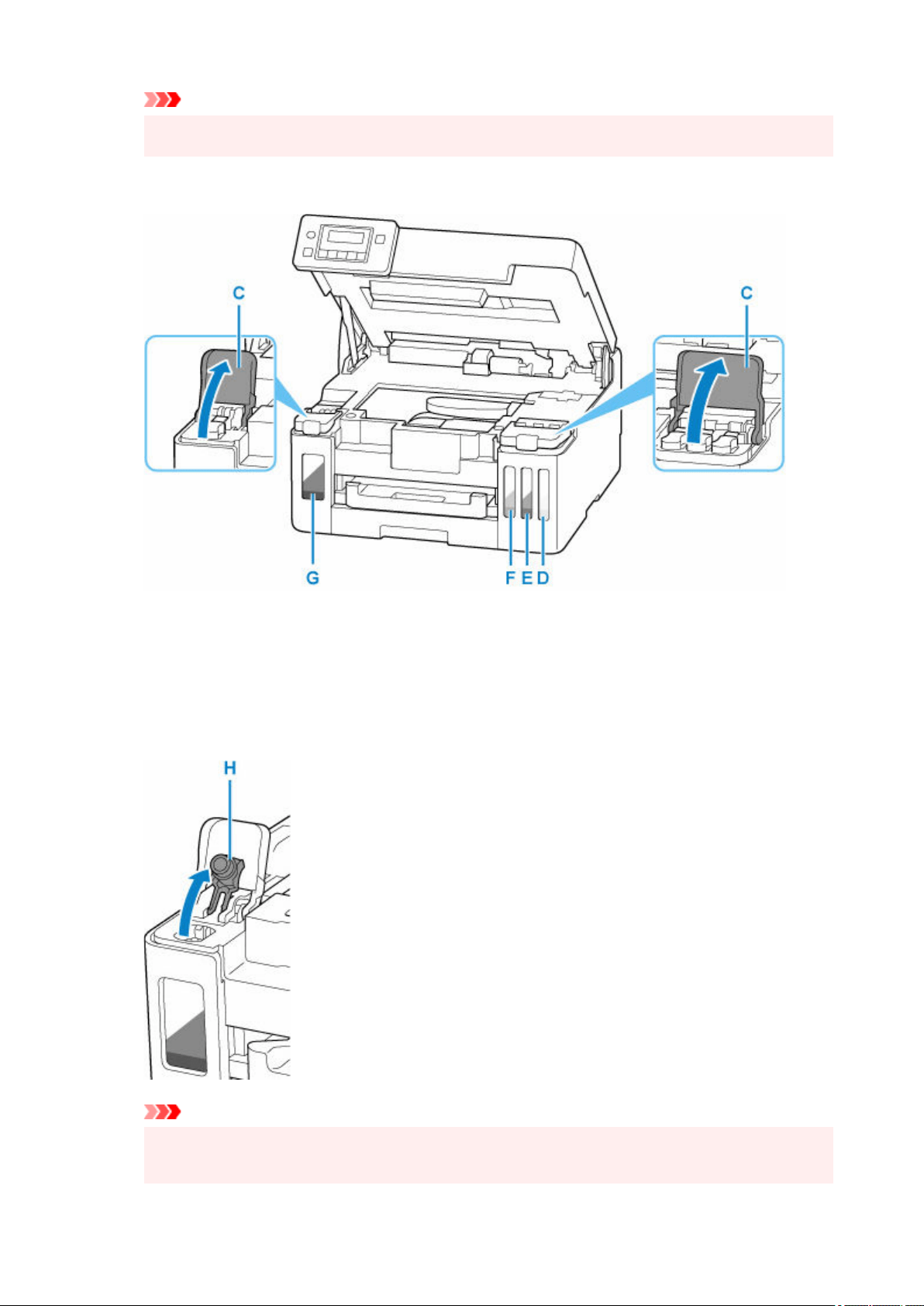
Important
• Do not touch tubes or other parts inside the printer. This can cause trouble with the printer.•
3. Open the ink tank cover (C) of the ink tank to be refilled.3.
D: Yellow
E: Magenta
F: Cyan
G: Black
4. Open the tank cap (H).4.
Important
•
Carefully open the tank cap of the ink tank. Ink on the inside of the tank cap may spatter when
opening it.
82
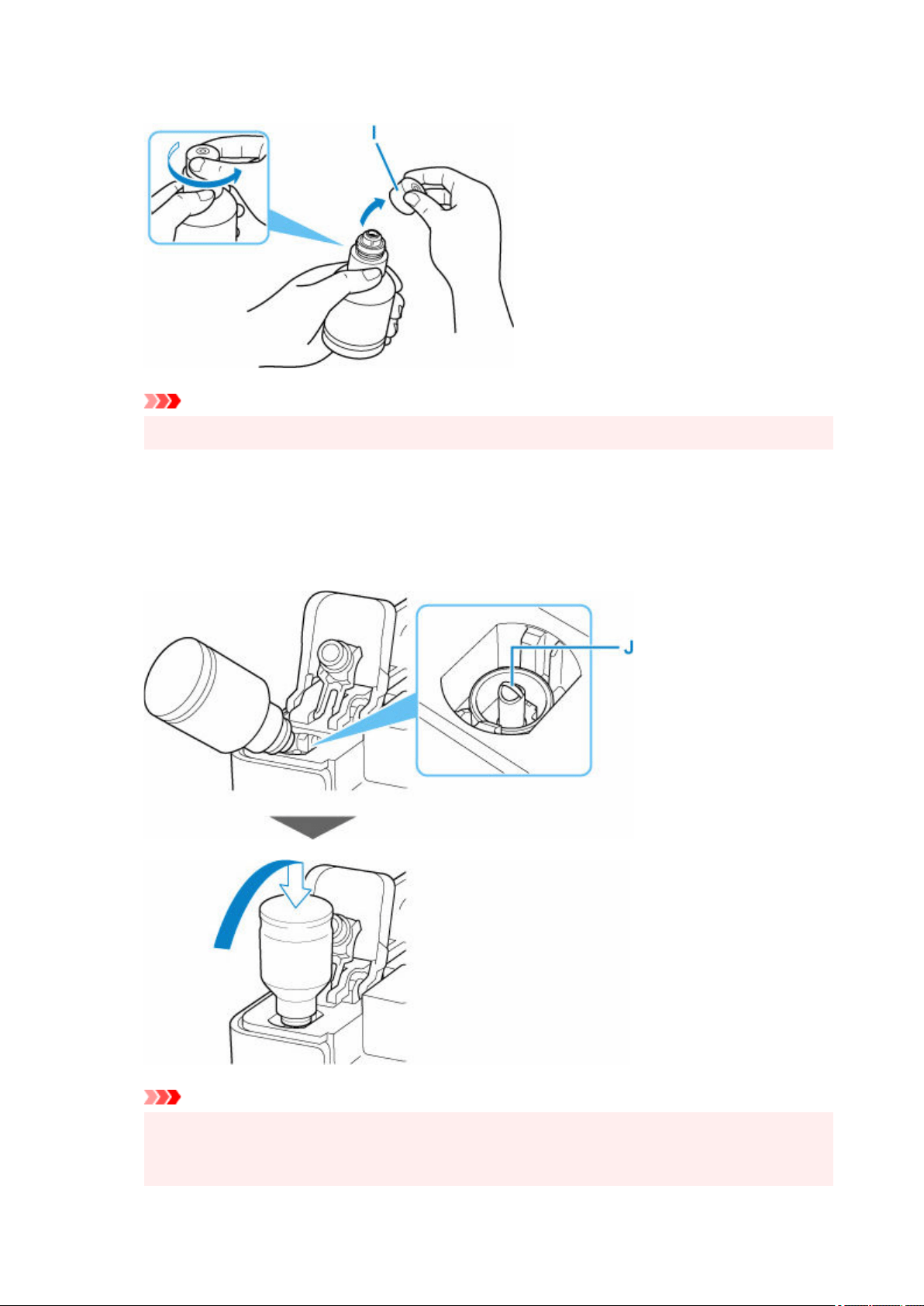
5. Hold the ink bottle upright and gently twist the bottle cap (I) to remove.5.
Important
•
Do not shake the ink bottle. Ink may spatter when opening the cap.
6.
Refill the ink tank.
6.
Aligning the ink bottle's tip with the ink tank's inlet (J), slowly stand the bottle upside down, and push
the bottle into the inlet.
The ink tank is refilled. Support the bottle with your hand so that it does not fall.
Important
•
Make sure that each color of ink tanks is filled with corresponding color of ink bottles.
•
If ink is not injected into the ink tank, slowly remove and insert the ink bottle.
•
Make sure to refill the ink tank with ink up to the upper limit line (K) on the ink tank.
•
83
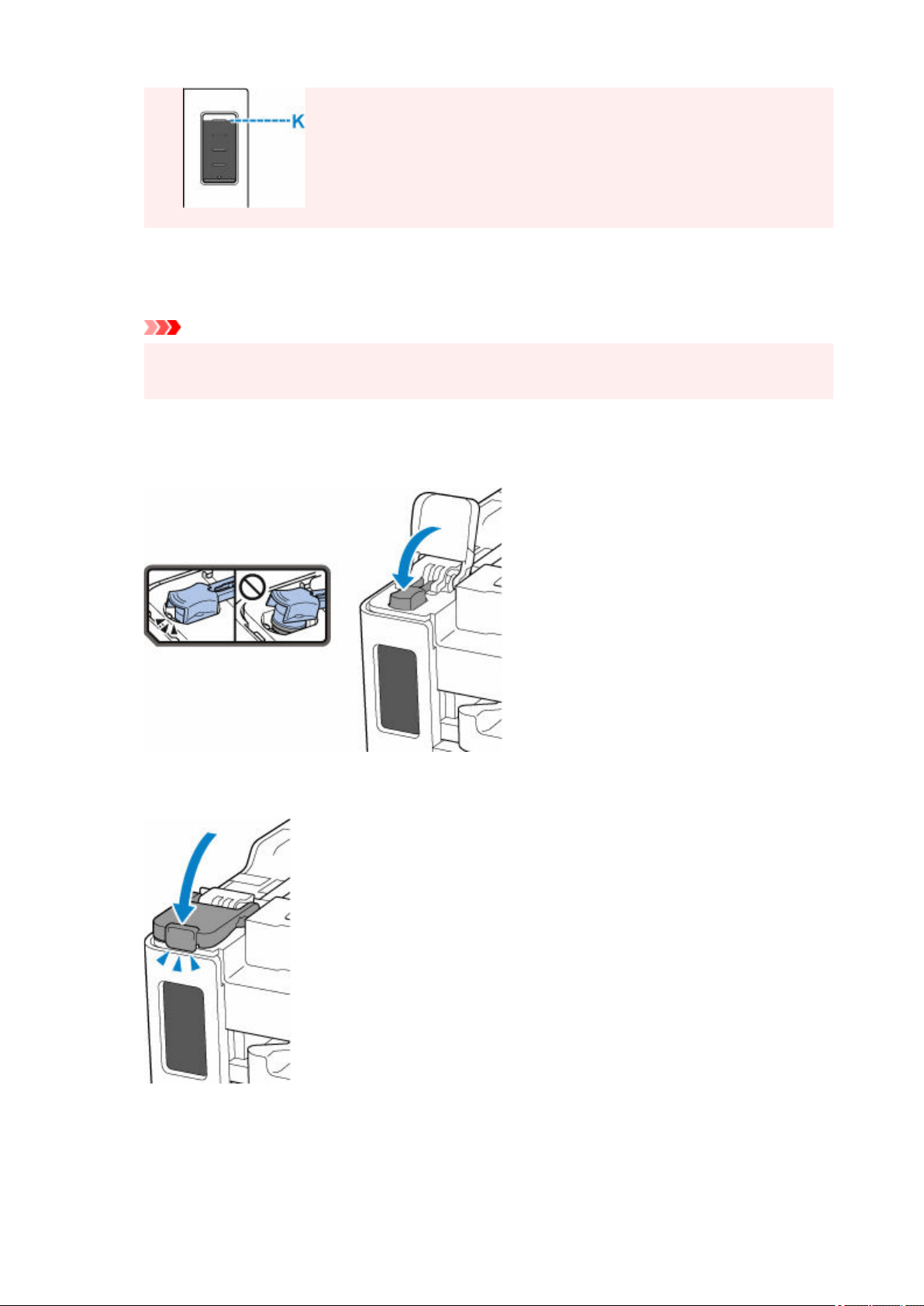
7. Once ink reaches the upper limit line, remove the ink bottle from the inlet.7.
Hold up the ink bottle slightly and remove the bottle from the inlet while slowly tilting it.
Important
•
Do not leave ink bottles in ink tanks.
•
Close the bottle cap of the ink bottle completely and store the ink bottle upright.
8.
Close the tank cap of the ink tank.
8.
Make sure the tank cap is completely inserted.
9.
Close the ink tank cover completely.
9.
10.
Close the top cover.
10.
To close the top cover, hold it up once, then take it down gently.
84
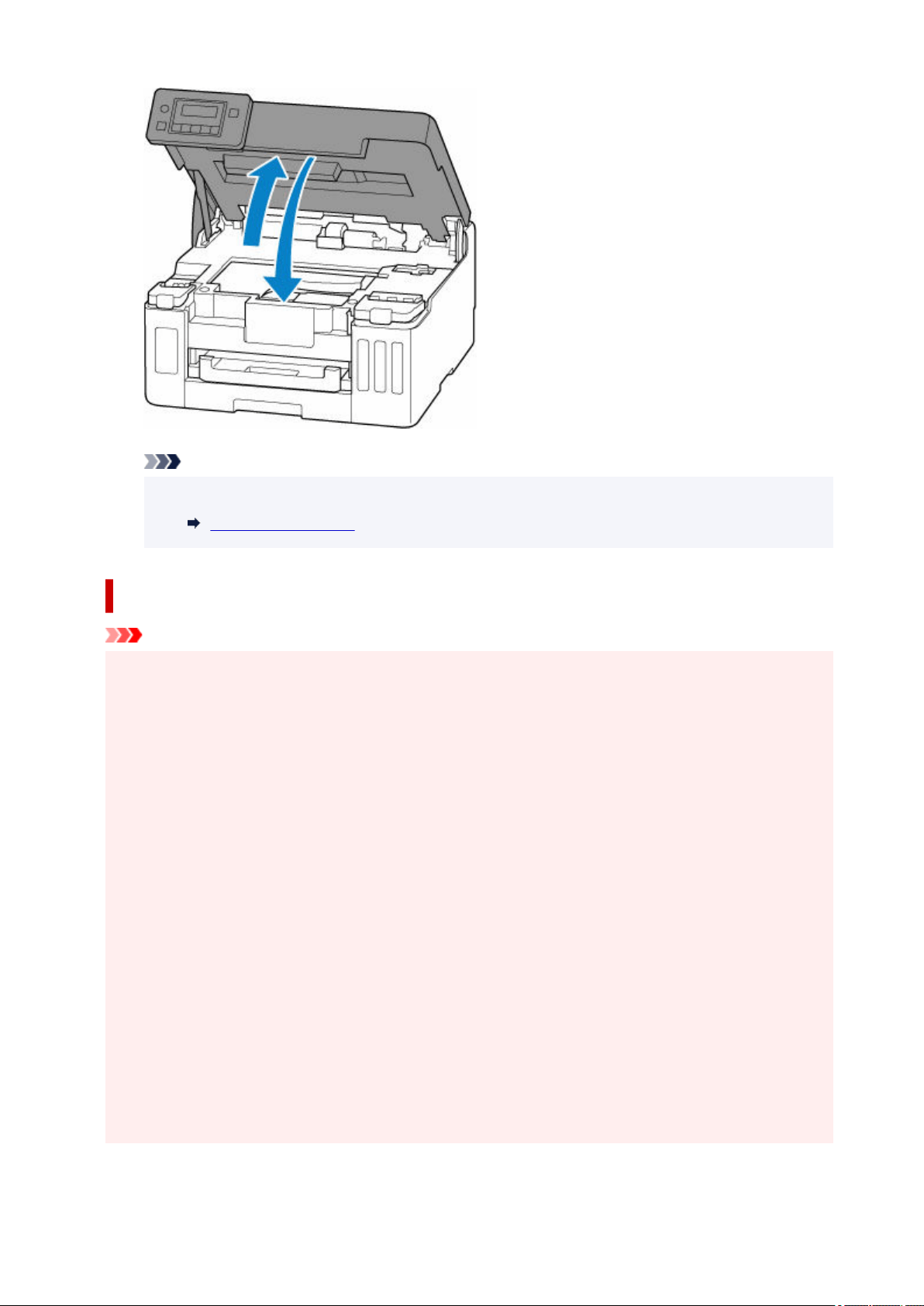
Note
•
If the error message appears on the LCD after the top cover is closed, take appropriate action.
•
When Error Occurred
Notes on ink bottles
Important
• Keep out of reach of children.
• Do not drink ink.
• If ink is accidentally licked or swallowed, rinse out your mouth or drink one or two glasses of water
and obtain medical advice immediately. If ink gets into your eyes, flush them with water right away,
and obtain medical advice immediately.
• If ink gets on your skin, wash the area with soap and water immediately. If irritation to your skin
persists, obtain medical advice immediately.
• When you store ink bottles, close bottle caps completely and place bottles in standing position. If the
ink bottles are laid down, ink may leak.
•
When refilling ink tanks, take sufficient care to prevent ink from spattering onto surroundings.
• Ink may stain clothes or other belongings permanently. Washing may not remove ink stains.
• Do not use ink bottles and ink contained therein except to refill tanks of printers specified by Canon.
• Do not leave ink bottles in areas exposed to high temperature, such as near fire or a heater or in a
car. Bottles may warp and cause ink leakage or ink may become poor quality.
• Do not subject ink bottles to impacts. Ink bottles may be damaged or bottle caps may come off by
such impact, and ink may leak.
• Do not transfer ink to other containers. This may result in accidental ingestion, inappropriate use, or
poor ink quality.
• Do not mix ink with water or other ink. This may damage the printer.
• Once an ink bottle has been opened, do not leave it with bottle cap off. Ink will dry out, possibly
preventing proper operation of the printer when an ink tank is refilled using this bottle.
85

• To obtain optimum print quality, we recommend to refill the ink tank with ink up to the upper limit line•
at least once a year.
Note
• Color ink may be consumed even when printing a black-and-white document or when black-and-•
white printing is specified. Every ink is also consumed in the standard cleaning and deep cleaning of
the print head, which may be necessary to maintain the performance of the printer.
When ink runs low, promptly refill it.
Ink Tips
86
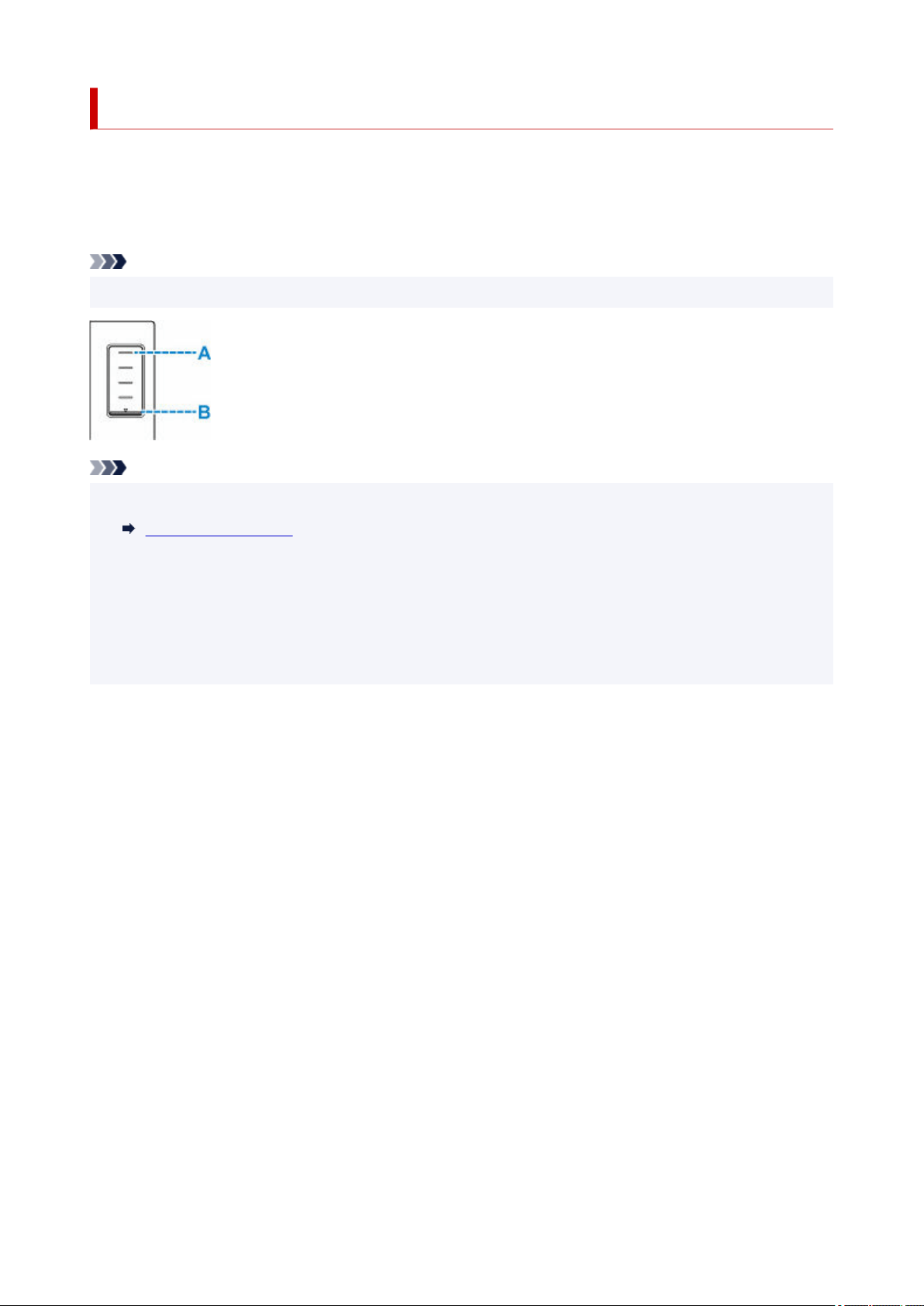
Checking Ink Level
Check ink level with the ink tank indicator on the front of the printer.
When ink reaches the upper limit line (A), ink is full.
When ink is near the lower limit line (B), ink is running low. Refill the ink tank.
Note
• To check the remaining ink level, visually inspect the remaining ink in the ink tank.
Note
• If a remaining ink error occurs, the error message appears on the LCD.•
When Error Occurred
• To ensure you receive premium print quality and to help protect your print head, a certain amount of ink•
remains in the ink tank when the printer indicates to refill the ink tank. The estimated page yields of the
ink bottle do not include this amount.
• Ink flows from the ink tanks to the inside of the printer. Ink may seem to run out fast due to this•
procedure when you start using the printer or after transporting it.
87

Ink Tips
How is ink used for various purposes other than printing?
Ink may be used for purposes other than printing.
During initial setup, some of the ink from the bundled ink bottles is used to fill the print head's nozzles to
ensure the printer is print-ready.
Therefore, the page yield of the initial bundled set of ink bottles is lower than that of the subsequent sets
of bottles.
To keep printer's performance, Canon printer performs cleaning automatically according to its condition.
When the printer performs cleaning, a small amount of ink is consumed. In this case, all colors of ink may
be consumed.
[Cleaning function]
The cleaning function helps the printer to suck air bubbles or ink itself from the nozzle and thus prevents
print quality degradation or nozzle clogging.
Important
• The used ink is ejected into the maintenance cartridge. When the maintenance cartridge becomes•
full, replacement is necessary. If the displayed message indicates that the maintenance cartridge is
nearly full, promptly obtain a new one.
Replacing Maintenance Cartridge
Does black-and-white printing use color ink?
Black-and-white printing may use ink other than black ink depending on the type of printing paper or the
settings of the printer driver. So, color ink is consumed even when printing in black-and-white.
Similarly, color inks are also consumed along with black ink during print head cleaning when Black is
specified for cleaning.
88

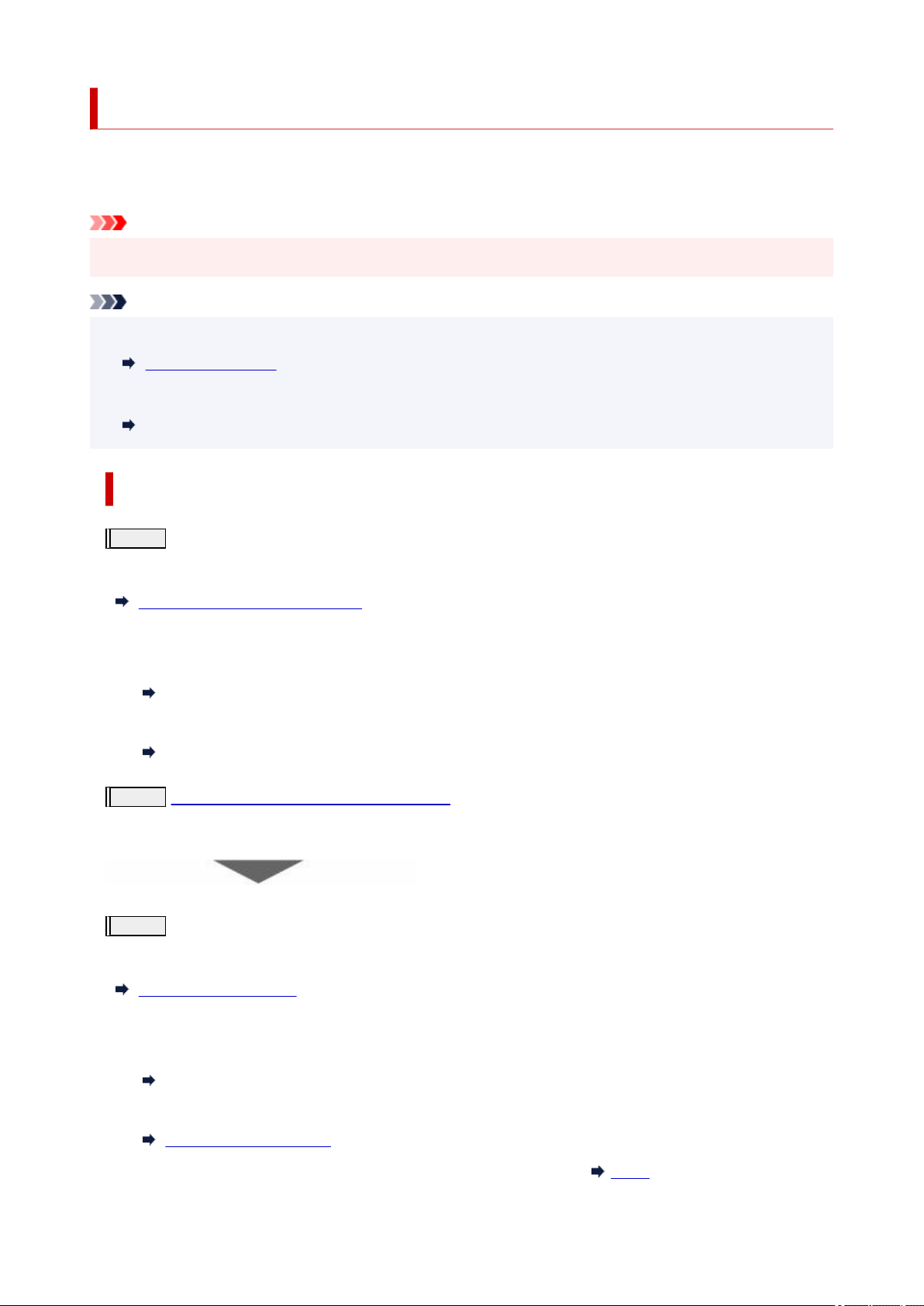
Maintenance Procedure
If print results are blurred, colors are not printed correctly, or print results are unsatisfactory (e.g. misaligned
printed ruled lines), perform the maintenance procedure below.
Important
• Do not rinse or wipe the print head. This can cause trouble with the print head.•
Note
• Check if ink remains in the ink tanks.•
Checking Ink Level
• For Windows, increasing the print quality in the printer driver settings may improve the print result.•
Changing the Print Quality and Correcting Image Data
When the Print Results Are Blurred or Uneven:
Step1
Print the nozzle check pattern.
From the printer
Printing the Nozzle Check Pattern
From the computer
•
For Windows:
•
Printing a Nozzle Check Pattern
•
For macOS:
•
Printing a Nozzle Check Pattern
Step2
Examine the nozzle check pattern.
If there are missing lines or horizontal streaks in the pattern:
Step3
Clean the print head.
From the printer
Cleaning the Print Head
From the computer
• For Windows:•
Cleaning the Print Heads
•
For macOS:
•
Cleaning the Print Heads
After cleaning the print head, print and examine the nozzle check pattern:
Step1
90

If the problem is not resolved after performing from step 1 to step 3 twice:
Step4
Clean the print head deeply.
From the printer
Deep Print Head Cleaning
From the computer
•
For Windows:
•
Cleaning the Print Heads
•
For macOS:
•
Cleaning the Print Heads
After deep print head cleaning, print and examine the nozzle check pattern: Step1
When you have performed the procedure until step 4 and the problem has not been resolved, turn off the
power and clean the print head deeply again after 24 hours.
If the problem is still not resolved, perform ink flush.
Ink flush consumes a great amount of ink. Frequent ink flush can rapidly consume ink, so perform ink flush
only when necessary.
Important
•
If ink flush is performed when the remaining ink level is insufficient, it may cause a failure. Be sure to
•
check the remaining ink level before performing ink flush.
From the printer
How to Perform Ink Flush
From the computer
Ink Flush
If the symptom still persists, the print head may be defective. Contact your nearest Canon service center to
request a repair.
When the Print Results Are Not Even such as the Ruled Lines Are
Misaligned:
Step
Align the print head.
From the printer
Aligning the Print Head
From the computer
•
For Windows:
•
Adjusting Print Head Position Automatically
• For macOS:•
91

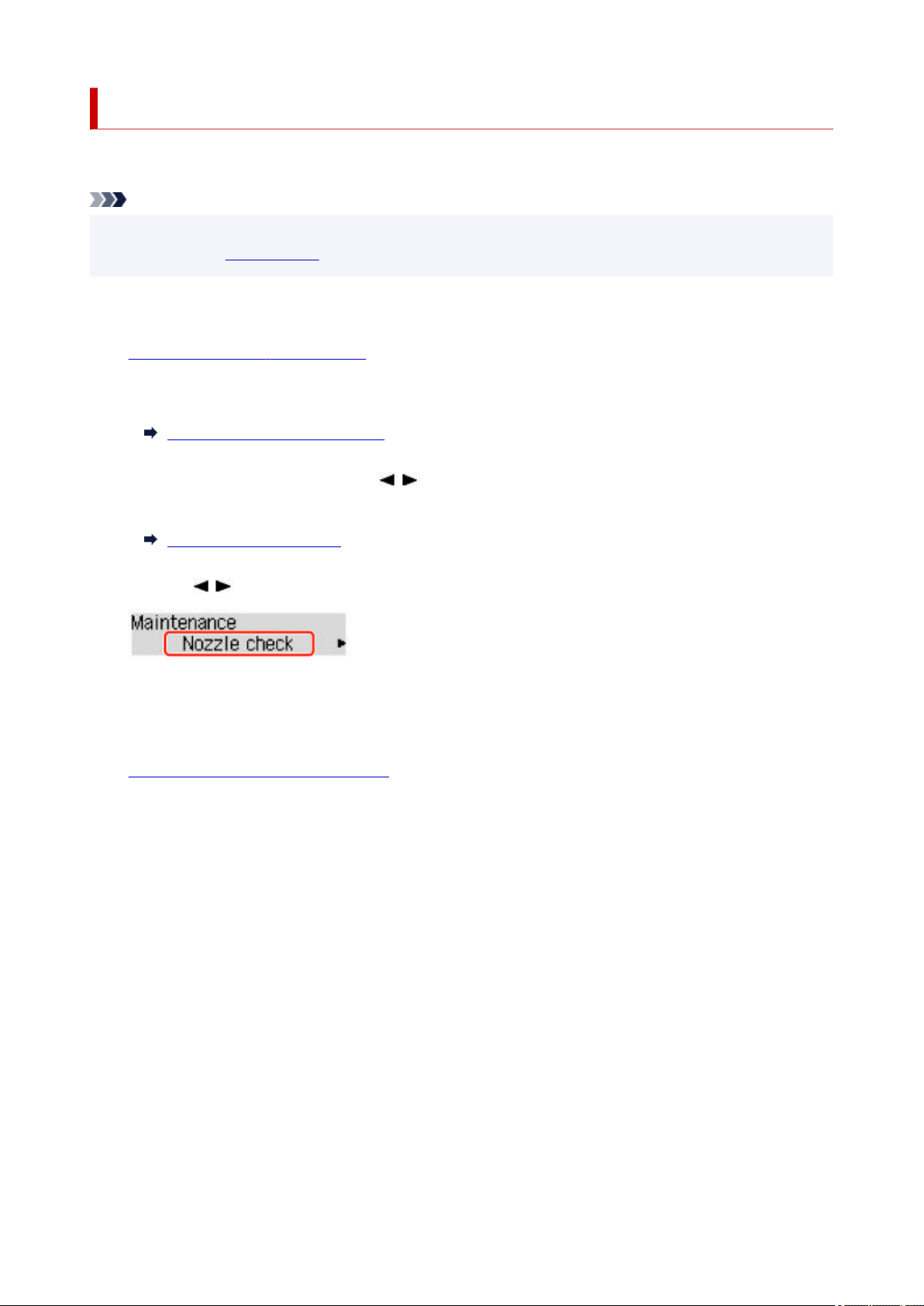
Printing the Nozzle Check Pattern
Print the nozzle check pattern to determine whether the ink ejects properly from the print head nozzle.
Note
• If the remaining ink level is low, the nozzle check pattern will not be printed correctly. If the remaining•
ink level is low, refill ink tanks.
You need to prepare: a sheet of A4 or Letter-sized plain paper
1.
Check that printer is turned on.
1.
2.
Load a sheet of A4 or Letter-sized plain paper in the cassette.
2.
Loading Plain Paper in Cassette
3.
Press the Setup button, use the button to select Maintenance, and press the OK
3.
button.
LCD and Operation Panel
4. Use the button to select Nozzle check and press the OK button.4.
The nozzle check pattern will be printed.
Do not perform any other operations until the printer completes the printing of the nozzle check pattern.
5. Examine the nozzle check pattern.5.
93
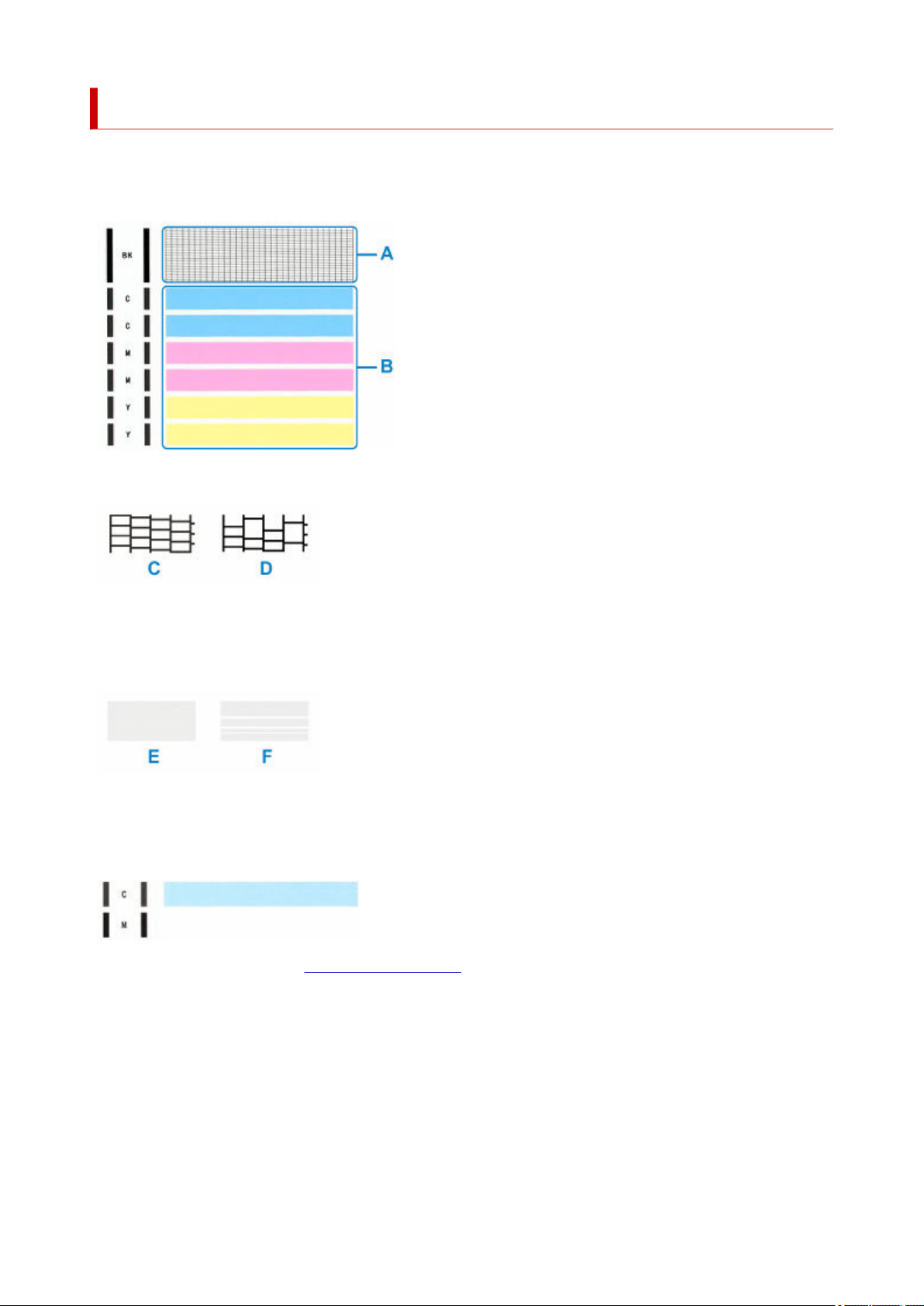
Examining the Nozzle Check Pattern
Examine the nozzle check pattern, and clean the print head if necessary.
Check if there are missing lines in the pattern A or horizontal streaks in the pattern B.
If there are missing lines in the pattern A:
C: Good
D: Bad (lines are missing)
If there are horizontal streaks in the pattern B:
E: Good
F: Bad (horizontal streaks are present)
If any color in the pattern A or the pattern B is not printed:
(Example: Magenta pattern is not printed)
If one of the above is applied, cleaning the print head is required.
94
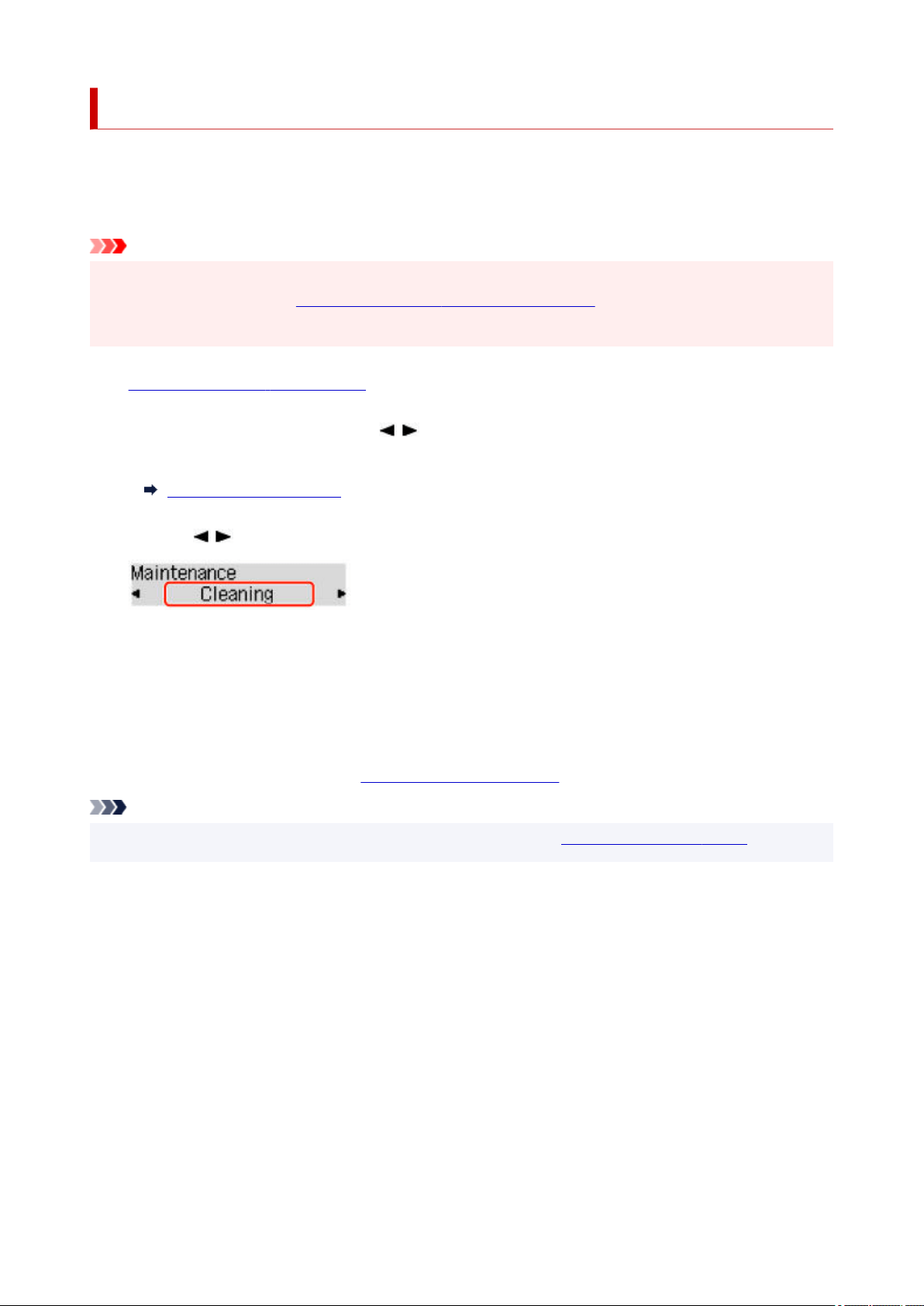
Cleaning the Print Head
Clean the print head if lines are missing or if horizontal streaks are present in the printed nozzle check
pattern. Cleaning unclogs the nozzles and restores the print head condition. Cleaning the print head
consumes ink, so clean the print head only when necessary.
Important
• When performing the print head cleaning, check the free space in the maintenance cartridge. If there•
is not enough free space, replace with the new maintenance cartridge. In the case of shortage of free
space in the maintenance cartridge, a message is displayed and the cleaning cannot be performed.
1.
Check that printer is turned on.
1.
2.
Press the Setup button, use the button to select Maintenance, and press the OK
2.
button.
LCD and Operation Panel
3. Use the button to select Cleaning and then press the OK button.3.
The printer starts cleaning the print head.
Do not perform any other operations until the printer completes the cleaning of the print head. This takes
about 1 to 2 minutes.
4.
Check the print head condition.
4.
To check the print head condition, print the nozzle check pattern.
Note
• If the problem is not resolved after cleaning the print head twice, clean the print head deeply.•
95
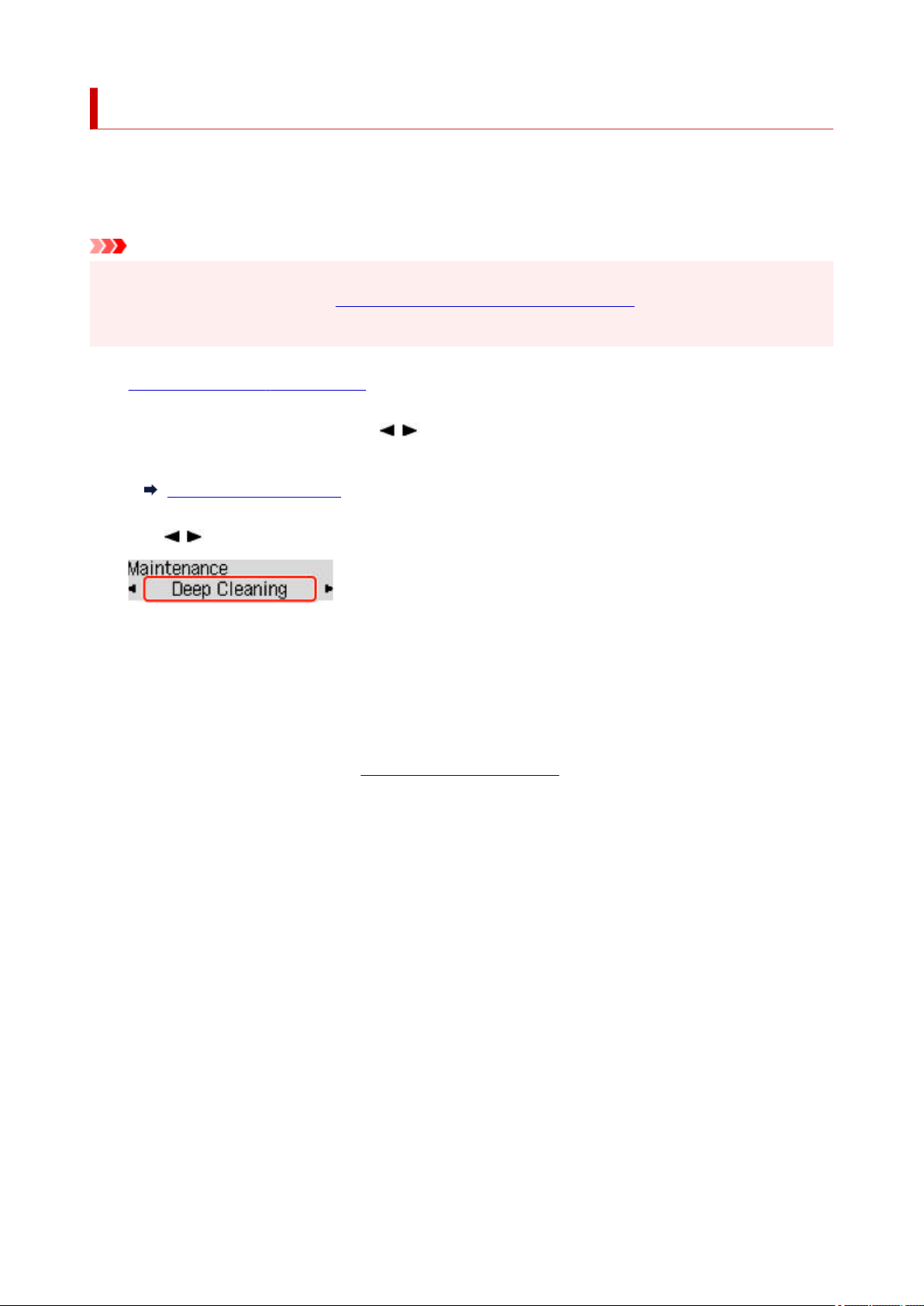
Deep Print Head Cleaning
If print quality does not improve by the standard cleaning of the print head, clean the print head deeply.
Cleaning the print head deeply consumes more ink than the standard cleaning of the print head, so clean
the print head deeply only when necessary.
Important
• When performing the print head deep cleaning, check the free space in the maintenance cartridge. If•
there is not enough free space, replace with the new maintenance cartridge. In the case of shortage of
free space in the maintenance cartridge, a message is displayed and the cleaning cannot be performed.
1.
Check that printer is turned on.
1.
2.
Press the Setup button, use the button to select Maintenance, and press the OK
2.
button.
LCD and Operation Panel
3. Use button to select Deep Cleaning and press OK button.3.
The printer starts cleaning the print head deeply.
Do not perform any other operations until the printer completes the deep cleaning of the print head. This
takes about 2 minutes.
4.
Check the print head condition.
4.
To check the print head condition, print the nozzle check pattern.
If the problem is not resolved, turn off the power and clean the print head deeply again after 24 hours.
96
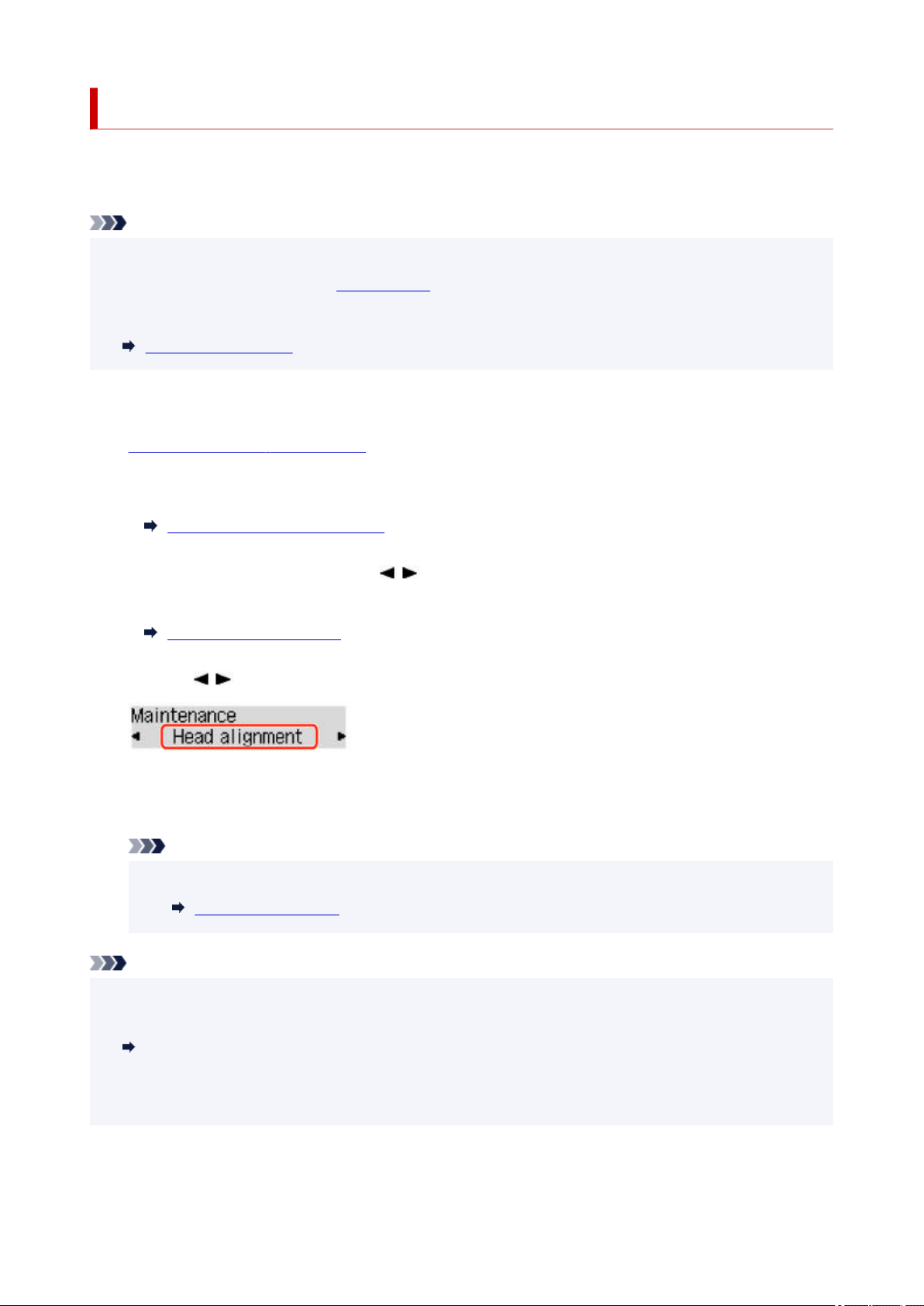
Aligning the Print Head
If printed ruled lines are misaligned or print results are otherwise unsatisfactory, adjust the print head
position.
Note
• If the remaining ink level is low, the print head alignment sheet will not be printed correctly.•
If the remaining ink level is low, refill ink tanks.
• If ink runs out as the print head alignment sheet is printed, an error message appears on the LCD.•
When Error Occurred
You need to prepare: a sheet of A4 or Letter-sized plain paper
1.
Check that printer is turned on.
1.
2.
Load a sheet of A4 or Letter-sized plain paper on the cassette.
2.
Loading Plain Paper in Cassette
3.
Press the Setup button, use the button to select Maintenance, and press the OK
3.
button.
LCD and Operation Panel
4. Use the button to select Head alignment and then press the OK button.4.
The print head alignment sheet is printed, and the print head is aligned automatically.
This takes about 1 to 2 minutes.
Note
•
If automatic print head alignment fails, an error message appears on the LCD.
•
When Error Occurred
Note
• For Windows, when the print results are still not satisfactory after adjusting the print head position as•
described above, adjust the print head position manually from the computer.
Adjusting Print Head Position Manually
• To print and check the current head position adjustment values, select Print align value on the•
Maintenance screen.
97


Opening Remote UI for Maintenance
You can perform maintenance of printer and change the settings from a Remote UI.
The following is the procedure to open a Remote UI.
1. Open System Preferences, and select Printers & Scanners1.
2.
Select your model from the printer list, and click Options & Supplies...
2.
3.
Click Show Printer Webpage... in General tab
3.
Remote UI starts.
Note
•
The password may have to be entered after Remote UI starts. In such a case, enter the password
and click OK. In case you do not know the password, see "Passwords and cookies."
Related Topics
Cleaning the Print Heads
Adjusting Print Head Position
Printing a Nozzle Check Pattern
Managing the Printer Power
Changing the Printer Operation Mode
Reducing the Printer Noise
99

Cleaning the Print Heads
The print head Cleaning and Deep Cleaning functions allow you to clear up clogged print head nozzles.
Perform print head Cleaning if printing results are not satisfactory or if a specific color fails to print, even
though there is enough ink.
Furthermore, if the situation does not improve even after performing Deep Cleaning, perform Ink Flush.
Before performing any operation, confirm that the maintenance cartridge has enough available space.
Cleaning
1.
Select Utilities from Remote UI
1.
2.
Click Cleaning
2.
Before performing Cleaning, check that the printer power is on.
Check the following. Then, if necessary, perform Cleaning.
•
Is there ink remaining?
3. Perform Cleaning3.
Click Yes.
Print head Cleaning starts.
4. Complete Cleaning4.
Next, the message for Nozzle Check pattern printing is displayed.
5. Check the results5.
To check whether the print quality has improved, click Yes. To cancel the check process, click No.
If cleaning the head once does not resolve the print head problem, clean it once more.
Important
• Cleaning consumes a small amount of ink.
Cleaning the print head frequently will rapidly deplete your printer's ink supply. Perform Cleaning only
when necessary.
Deep Cleaning
Deep Cleaning is more thorough than Cleaning. Perform Deep Cleaning when two Cleaning attempts do
not resolve the print head problem.
1.
Select Utilities from Remote UI
1.
2.
Click Deep Cleaning
2.
Before performing Deep Cleaning, check that the printer power is on.
Check the following. Then, if necessary, perform Deep Cleaning.
100

• Is there ink remaining?
3. Perform Deep Cleaning3.
Click Yes.
Print head Deep Cleaning starts.
4. Complete Deep Cleaning4.
Next, the message for Nozzle Check pattern printing is displayed.
5.
Check the results
5.
To check whether the print quality has improved, click Yes. To cancel the check process, click No.
Important
• Deep Cleaning consumes a larger amount of ink than Cleaning.
Cleaning the print head frequently will rapidly deplete your printer's ink supply. Perform Deep
Cleaning only when necessary.
• If print results do not improve even after performing Deep Cleaning, turn off the power, wait 24 hours
without pulling out the power plug, and then perform Deep Cleaning again. If print results still do not
improve, perform Ink Flush.
Ink Flush uses a large volume of ink.
Ink Flush
Perform Ink Flush if the print results do not improve even after Deep Cleaning is performed.
1. Select Utilities from Remote UI1.
2. Click Ink Flush2.
Select the ink group for which Ink Flush is to be performed.
Before performing Ink Flush, check that the printer power is on.
Check the following. Then, if necessary, perform Ink Flush.
•
Is there ink remaining?
3.
Perform Ink Flush
3.
Click Yes.
Ink Flush starts.
4.
Complete Ink Flush
4.
Next, the message for Nozzle Check pattern printing is displayed.
5.
Check the results
5.
To check whether the print quality has improved, click Yes. To cancel the check process, click No.
101

Important
• Ink Flush consumes an extremely large amount of ink.
Performing Ink Flush frequently will rapidly deplete your printer's ink supply. Therefore, perform Ink
Flush only when necessary.
• If Ink Flush is run when the remaining ink level is insufficient, it may cause a failure.
Note
• If there is no sign of improvement after performing Ink Flush, the ink may have run out or the
print head may be worn. For details on possible solutions, see "Ink Does Not Come Out/Blurry or
Fuzzy/Inaccurate or Bleeding Colors/Streaks."
Related Topic
Printing a Nozzle Check Pattern
102

Adjusting Print Head Position
Any error in the print head installation position can cause color and line shifts. Adjusting the print head
position improves print results.
Print Head Alignment - Auto
1.
Select Utilities from Remote UI
1.
2.
Click Print Head Alignment - Auto
2.
A message appears.
3.
Load paper in printer
3.
Load one sheet of A4 size or Letter size plain paper into the cassette.
4.
Run head position adjustment
4.
Check that the printer power is on, and then click Yes.
Head alignment starts. Proceed with the operations in accordance with the messages on the screen.
Important
• Do not open the top cover while printing is in progress; otherwise, printing will stop.
Note
• You can print and check the current settings by clicking on Print the head alignment value.
103


Cleaning Paper Feed Rollers
If a paper feed roller is dirty or paper powder is attached to it, paper may not be fed properly. In this case,
perform Roller Cleaning. Cleaning will cause wear on rollers, so perform this only when necessary.
You need to prepare: three sheets of A4 or Letter-sized plain paper
1. Check that printer is turned on.1.
2.
Remove any paper from paper source to be used for cleaning.
2.
3.
Press the Setup button, use the button to select Maintenance, and press the OK
3.
button.
LCD and Operation Panel
4.
Use button to select Roller Cleaning and press the OK button.
4.
5. Use button to select paper source (Rear tray or Cassette) to use for cleaning and5.
press the OK button.
The paper feed rollers will rotate as they are cleaned without paper.
6. Make sure paper feed rollers have stopped rotating, and then load three sheets of A4 or6.
Letter-sized plain paper in paper source selected in step 5.
Loading Photo Paper / Plain Paper in Rear Tray
Loading Plain Paper in Cassette
7.
Press the OK button.
7.
The printer starts cleaning. The cleaning will be complete when the paper is ejected.
If the problem is still not resolved with the operation described above, follow the operation below.
1. Turn off the power and then unplug the power cord.1.
2. While rotating the paper feed roller (A) located inside the rear tray more than two full turns, wipe it with a2.
well wrung out damp cloth.
Do not touch the roller with your fingers. Paper feeding performance may be degraded.
105
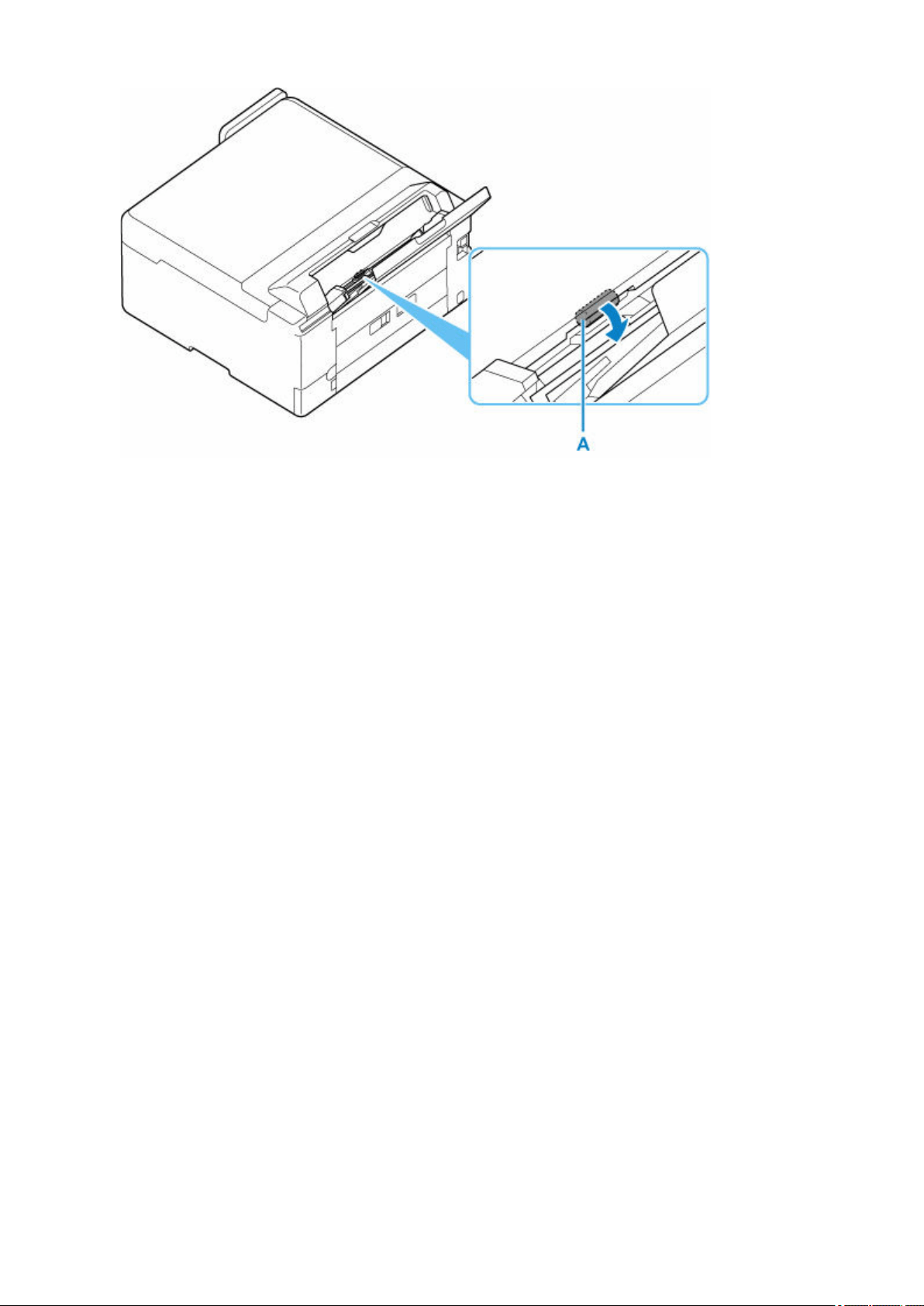
3. Turn on the power, then clean the paper feed rollers again.3.
If the problem is not resolved after cleaning, contact your nearest Canon service center to request a repair.
106
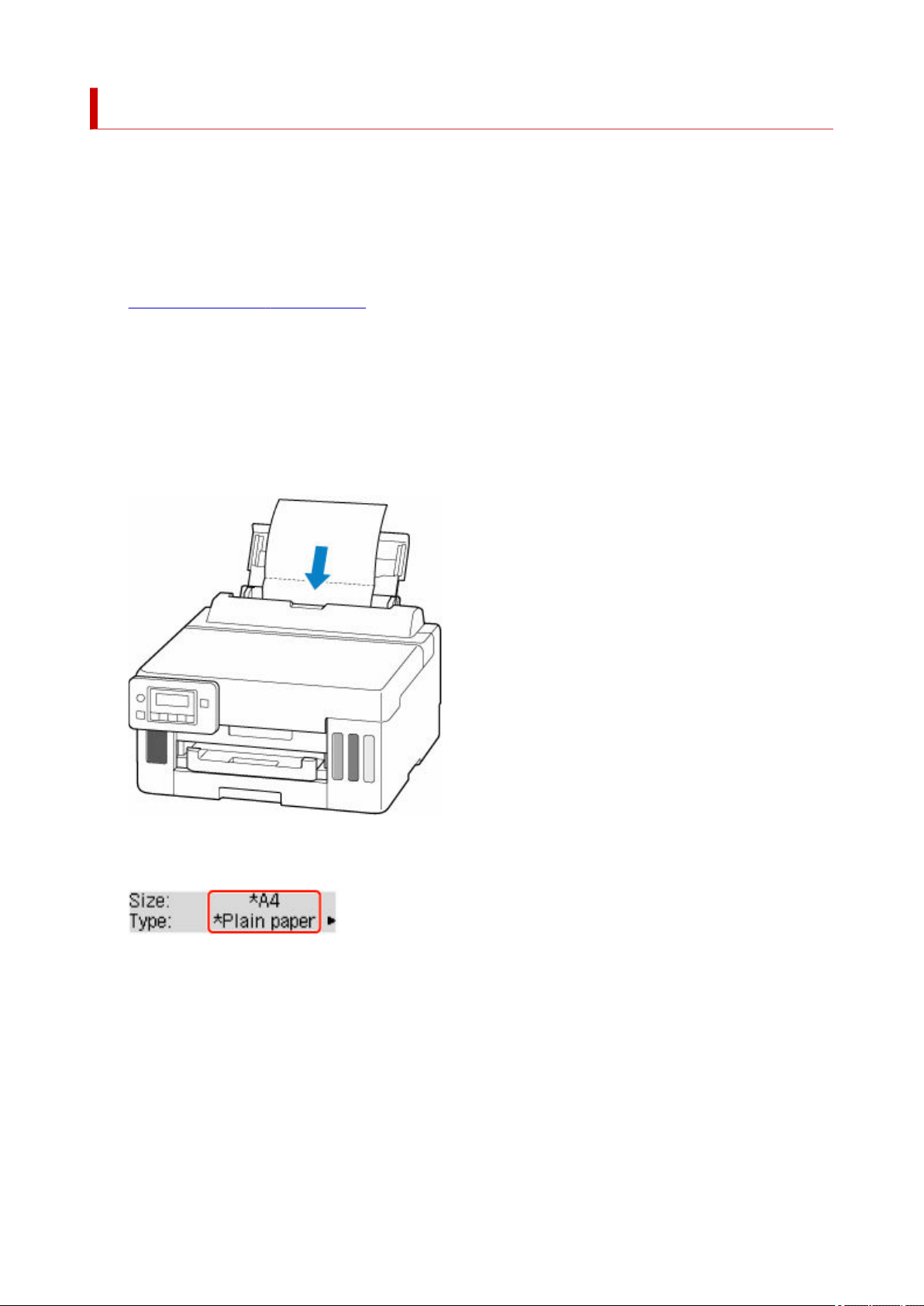
Cleaning Inside the Printer (Bottom Plate Cleaning)
Remove stains from the inside of the printer. If the inside of the printer becomes dirty, printed paper may get
dirty, so we recommend performing cleaning regularly.
You need to prepare: a sheet of A4 or Letter-sized plain paper*
* Be sure to use a new piece of paper.
1.
Check that printer is turned on.
1.
2.
Remove any paper from the rear tray.
2.
3.
Fold a single sheet of A4 or Letter-sized plain paper in half widthwise, then unfold the
3.
paper.
4.
Load only this sheet of paper on the rear tray with the open side facing you.
4.
After loading paper on the rear tray, the paper information registration screen for the rear tray appears
on the LCD. Select A4 or Letter for Size: and Plain paper for Type:.
5.
Pull out paper output tray (A).
5.
107
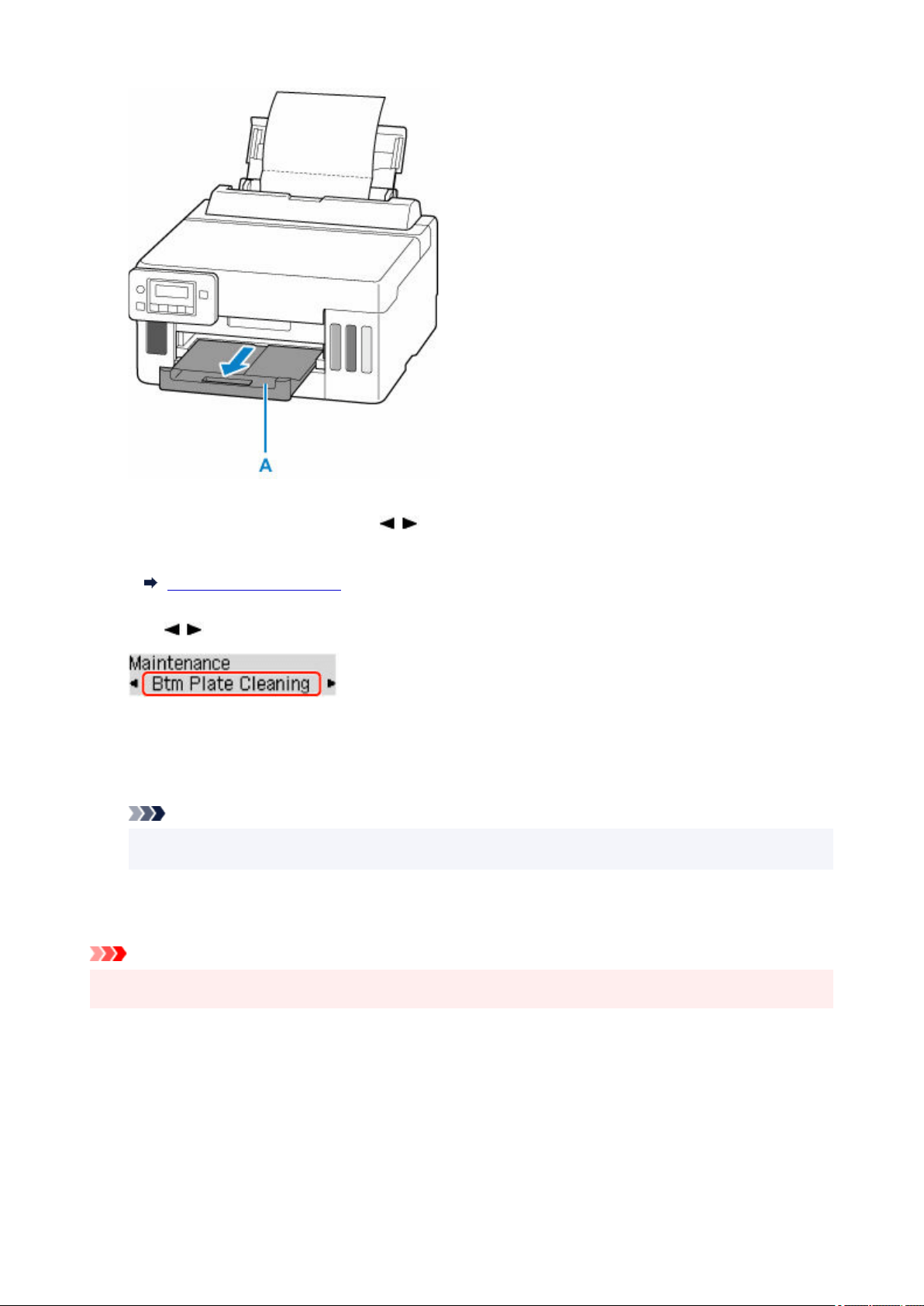
6.
Press the Setup button, use the button to select Maintenance, and press the OK
6.
button.
LCD and Operation Panel
7. Use button to select Btm Plate Cleaning and press OK button.7.
The paper cleans the inside of the printer as it feeds through the printer.
Check the folded parts of the ejected paper. If they are smudged with ink, perform Bottom Plate Cleaning
again.
Note
• When performing Bottom Plate Cleaning again, be sure to use a new piece of paper.•
If the problem is not resolved after performing cleaning again, the protrusions inside the printer may be
stained. Wipe off any ink from the protrusions using a cotton swab or the like.
Important
• Before cleaning the printer, turn it off and unplug it.•
108
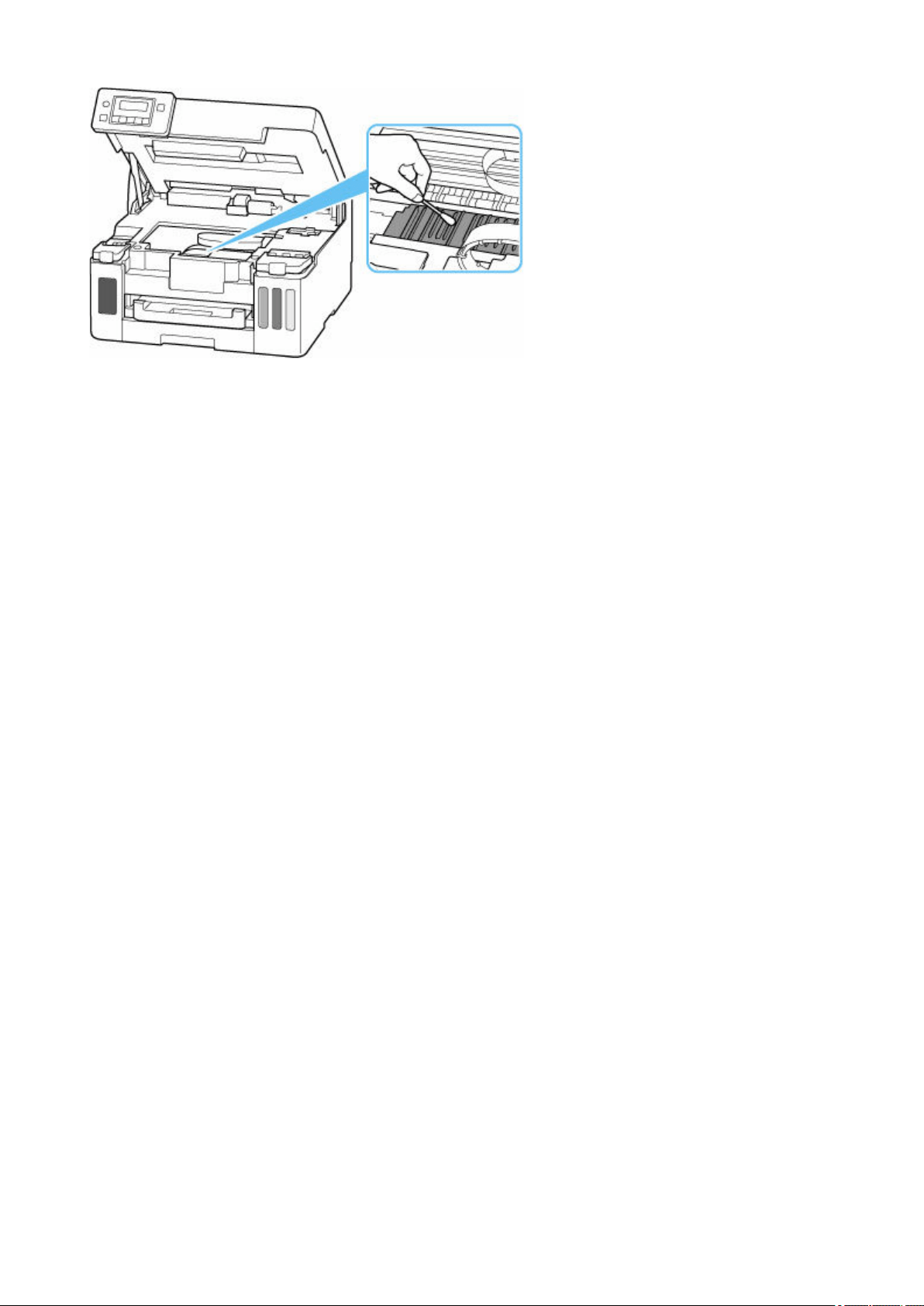
109
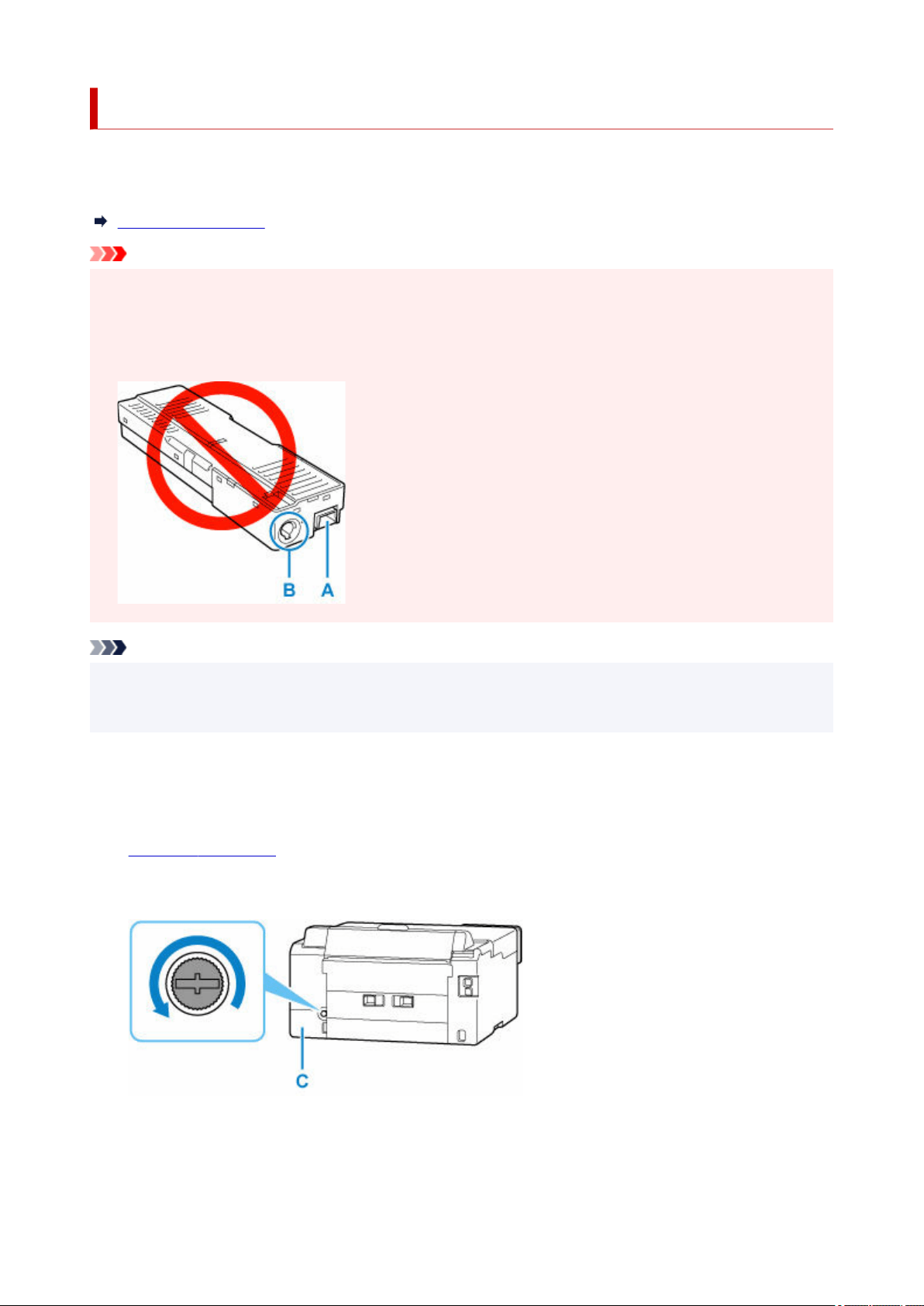
Replacing Maintenance Cartridge
In case of cautions or errors concerning the maintenance cartridge, an error message will appear on the
LCD to inform you of the error. Take appropriate action as prompted by the message.
When Error Occurred
Important
• If the displayed message indicates that the maintenance cartridge is nearly full, promptly obtain a new•
one. If the maintenance cartridge becomes full, an error message is displayed and the printer stops
working until it is replaced with a new one.
• Do not touch the terminal (A) or opening (B) of the maintenance cartridge.•
Note
• When purchasing a new maintenance cartridge, order the following cartridge number.•
Maintenance Cartridge MC-G01
1. Prepare a new maintenance cartridge.1.
Remove the maintenance cartridge and the attached plastic bag from the package.
2.
Turn the printer off.
2.
3.
Remove the coin screw from the maintenance cover (C).
3.
4.
Remove the maintenance cover.
4.
Put your finger on the hole of the maintenance cover and remove it.
110
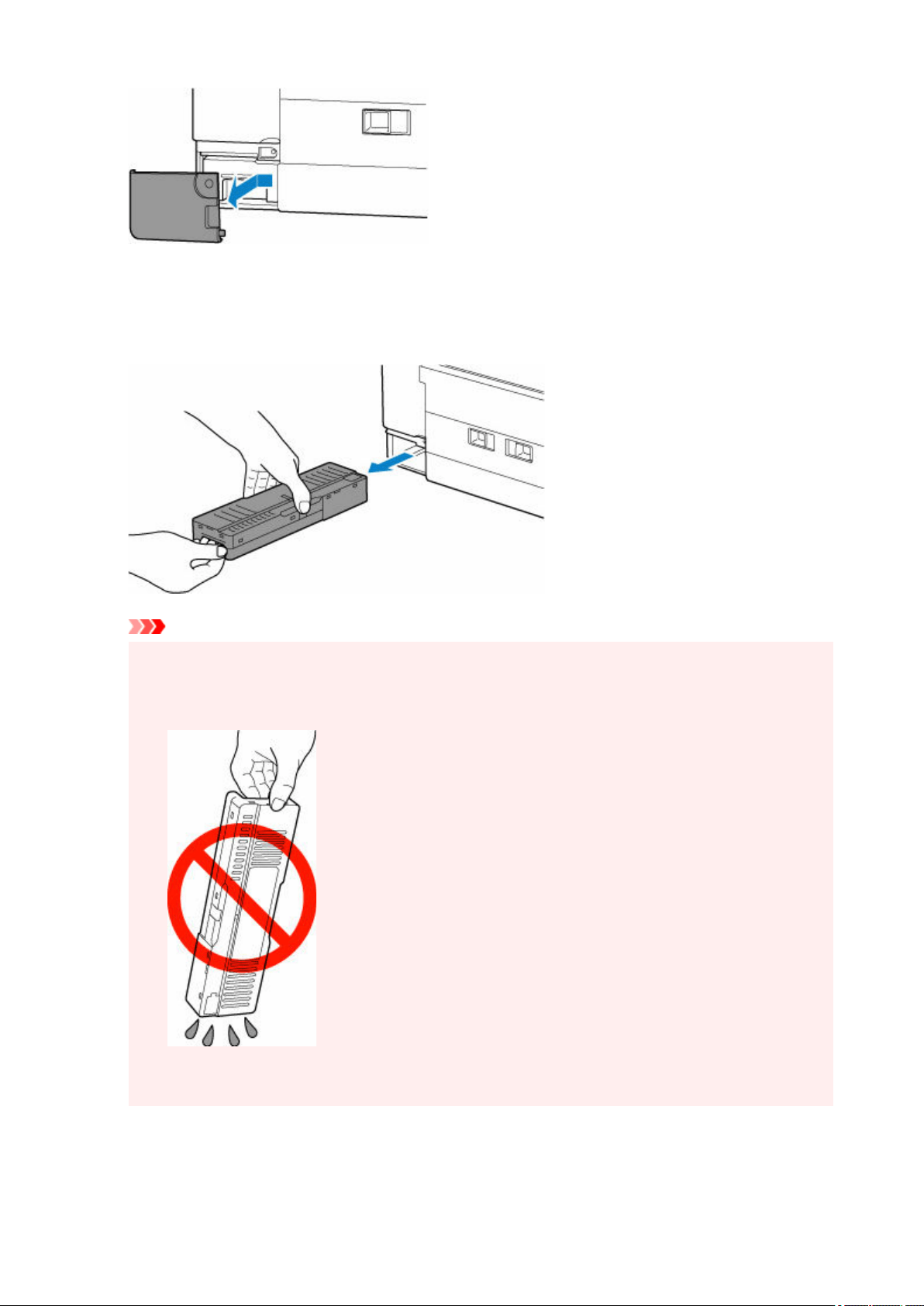
5.
Pull out the maintenance cartridge.
5.
Hold the upper portion of the maintenance cartridge with your hands so that its bottom does not touch
the floor or desk.
Important
• Be careful not to drop or place the removed maintenance cartridge on a desk or something. Dirt•
on the bottom may adhere to it or the ink inside may be scattered.
• Do not turn the removed maintenance cartridge upside down to prevent leakage of ink.•
•
Put the used one immediately into the plastic bag attached to the new maintenance cartridge and
•
seal the bag by tying the opening tightly to prevent the ink from leaking.
111
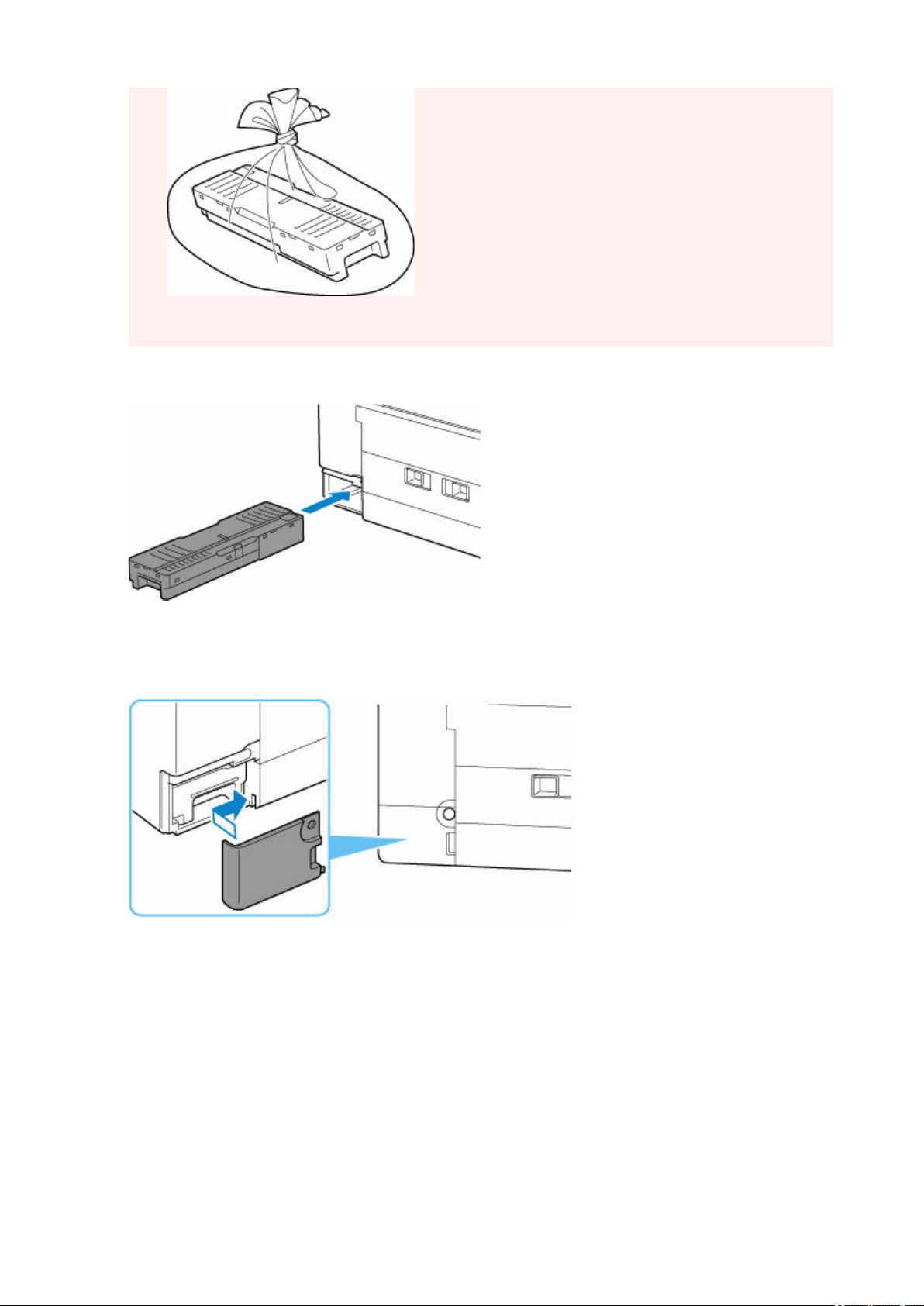
• Do not put your hands inside the printer, as ink may adhere to your hands.
•
6.
Insert the new maintenance cartridge straight until it stops.
6.
7.
Attach the maintenance cover.
7.
Align the tab on the back of the maintenance cover with the hole on the printer and close it.
8.
Secure with the coin screw.
8.
112

113
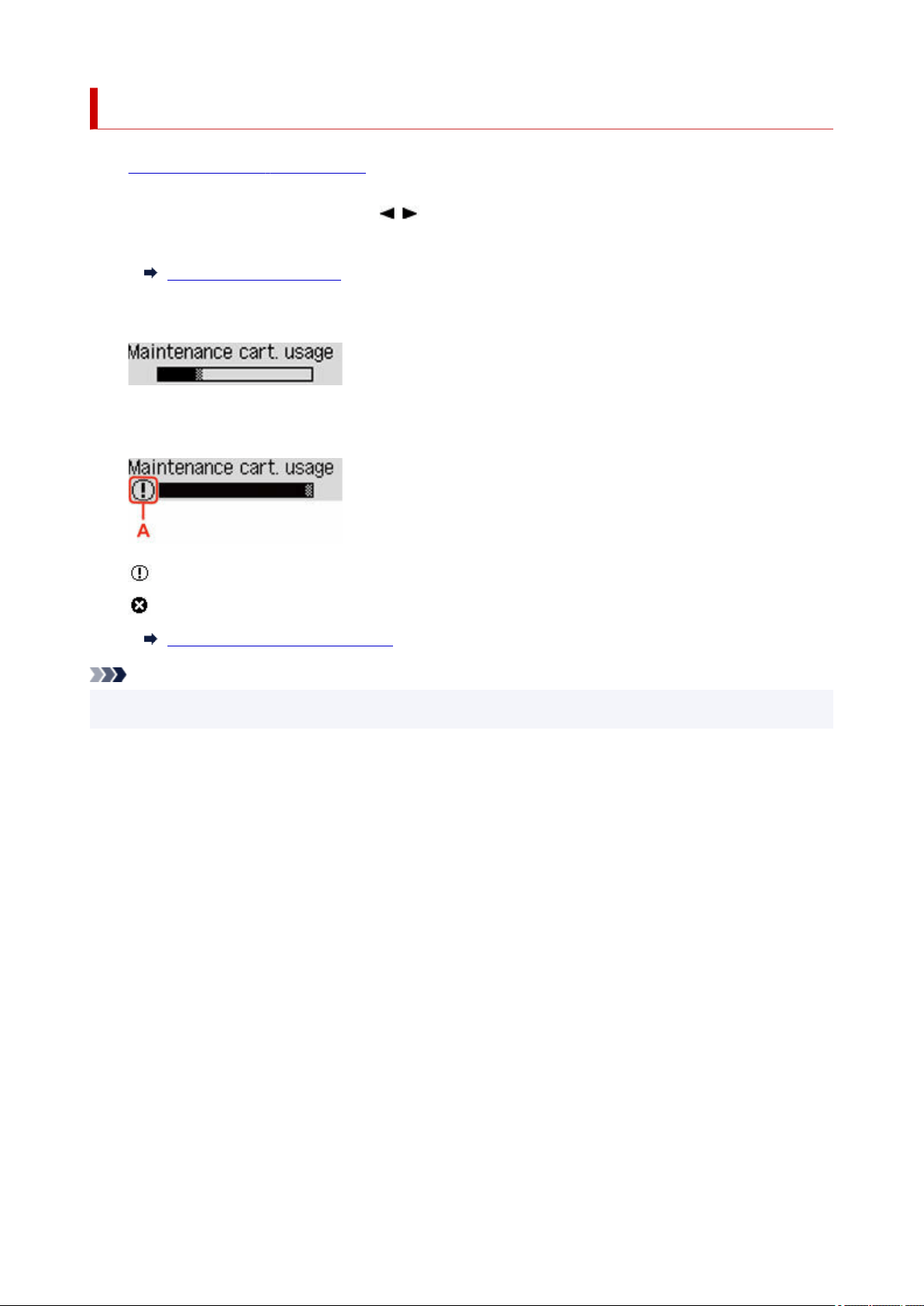
Checking Maintenance Cartridge Status on LCD
1. Check that printer is turned on.1.
2.
Press the Setup button, use the button to select M'ntenance cart info, and press the
2.
OK button.
LCD and Operation Panel
3.
Check the maintenance cartridge status.
3.
A symbol appears in the area A if there is any information about the used space of the maintenance
cartridge.
The maintenance cartridge is almost full. Prepare a new maintenance cartridge.
The maintenance cartridge is full. Replace the maintenance cartridge.
Replacing Maintenance Cartridge
Note
• The above screen shows estimated used space.•
114

Overview
Safety
Safety Precautions
Regulatory Information
WEEE
Handling Precautions
Canceling Print Jobs
Legal Restrictions on Printing
Printer Handling Precautions
Transporting Your Printer
When Repairing, Lending, or Disposing of the Printer
Keeping Print Quality High
Main Components and Their Use
Main Components
Power Supply
LCD and Operation Panel
Entering Numbers, Letters, and Symbols
Changing Settings
Changing Printer Settings from Your Computer (Windows)
Changing Printer Settings from Your Computer (macOS)
Changing Settings from Operation Panel
Specifications
115


Safety Precautions
Safety Precautions
• This manual contains important notices and safety precautions about your printer.•
Do not use the printer in ways other than described in the accompanying manuals, as this may result
in fire, electric shock or other unexpected accidents.
Safety standard marks and declarations are only valid for the supported voltages and frequencies in
the applicable countries or regions.
Warning
• Users with cardiac pacemakers:•
This product emits a low-level magnetic flux. If you feel abnormalities, please move away from the
product and consult your doctor.
• Do not use the printer in the following cases:•
Stop use immediately, unplug the printer and call your local service representative to request repair.
Metal objects or liquids are spilt inside the printer.
The printer emits smoke, strange odors, or makes unusual noises.
The power cord or plug overheat or are broken, bent or damaged in any way.
• Failure to adhere to the following may result in fire, electric shock, or injury:
Do not place product close to the flammable solvents such as alcohol or thinner.
Do not open or modify the printer.
Use only the power cord/cables that came with your printer. Do not use these cables with other
devices.
Do not plug in to voltages or frequencies other than those specified.
Plug the power cord into the socket completely.
Do not plug in or unplug the power cord with wet hands.
Do not damage the power cord or other cables by twisting, bundling, tying, pulling or excessively
bending them.
Do not place heavy objects on the power cord.
Do not connect multiple power cords to a single electrical outlet. Do not use multiple extension
cords.
Do not leave the printer plugged in during lightning storms.
Always unplug the power cord and cables when cleaning. Do not use flammable sprays or liquids
such as alcohol or thinners for cleaning.
Unplug the power cord once a month to check that it is not overheating, rusted, bent, scratched,
split, or otherwise damaged.
Caution
•
Do not put your hands inside the printer while printing.
•
Do not touch the metal parts of the print head immediately after printing.
•
Do not touch moving parts indicated by the sticker shown here. Some models may not have these
parts.
117
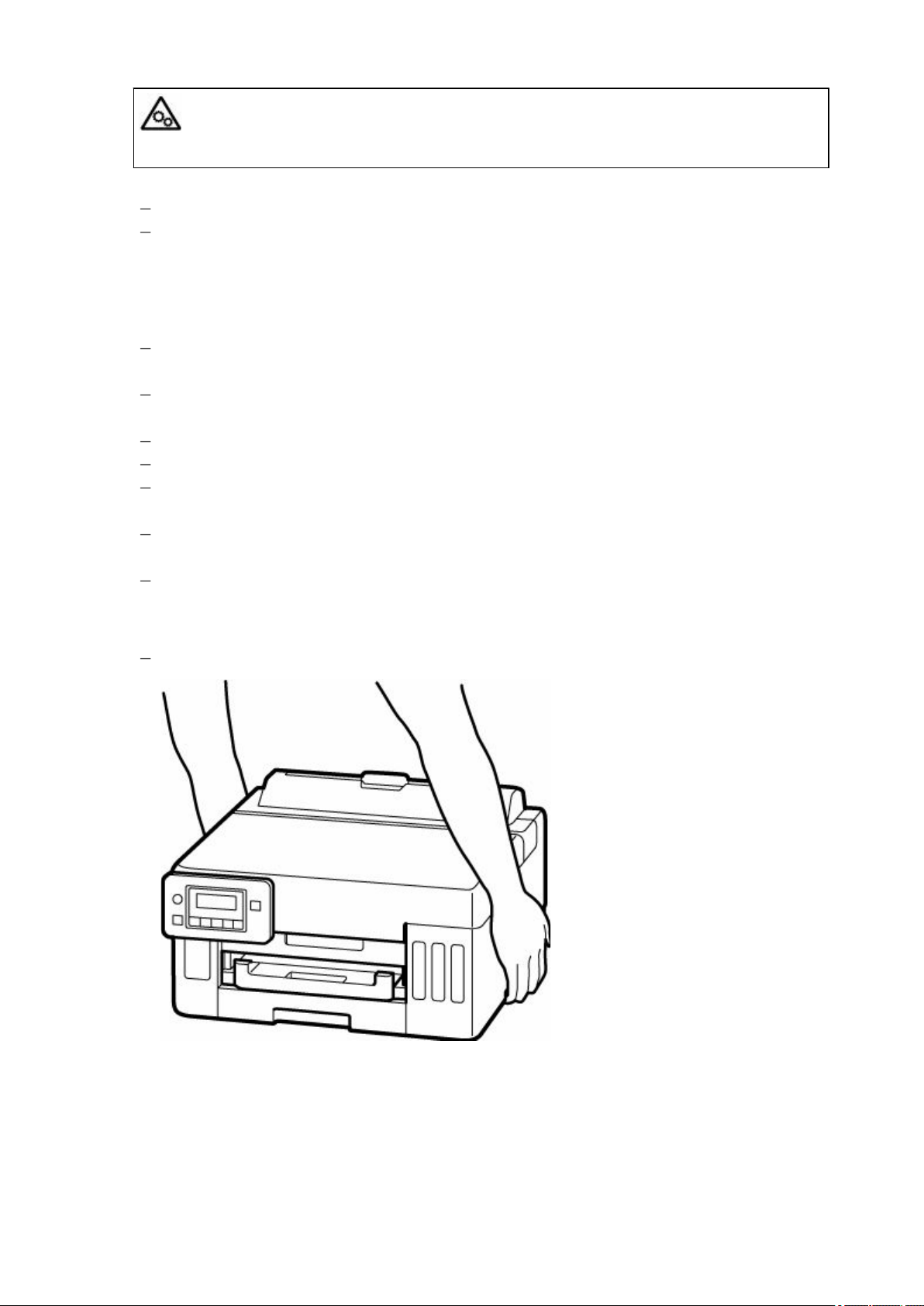
Moving parts
Keep body parts away from moving parts. Keep body parts out of the motion path.
• Ink bottles
Keep out of reach of children.
Do not drink ink.
If ink is accidentally licked or swallowed, rinse out your mouth or drink one or two glasses of
water and obtain medical advice immediately.
If ink gets into your eyes, flush them with water right away, and obtain medical advice
immediately.
If ink gets on your skin, wash the area with soap and water immediately. If irritation to your skin
persists, obtain medical advice immediately.
When you store ink bottles, close bottle caps completely and place bottles in standing position. If
the ink bottles are laid down, ink may leak.
When refilling ink tanks, take sufficient care to prevent ink from spattering onto surroundings.
Ink may stain clothes or other belongings permanently. Washing may not remove ink stains.
Do not leave ink bottles in areas exposed to high temperature, such as near fire or a heater or in
a car. Bottles may warp and cause ink leakage or ink may become poor quality.
Do not subject ink bottles to impacts. Ink bottles may be damaged or bottle caps may come off by
such impact, and ink may leak.
Do not transfer ink to other containers. This may result in accidental ingestion, inappropriate use,
or poor ink quality.
• Moving the printer
Hold the printer by its sides and carry it with both hands.
118
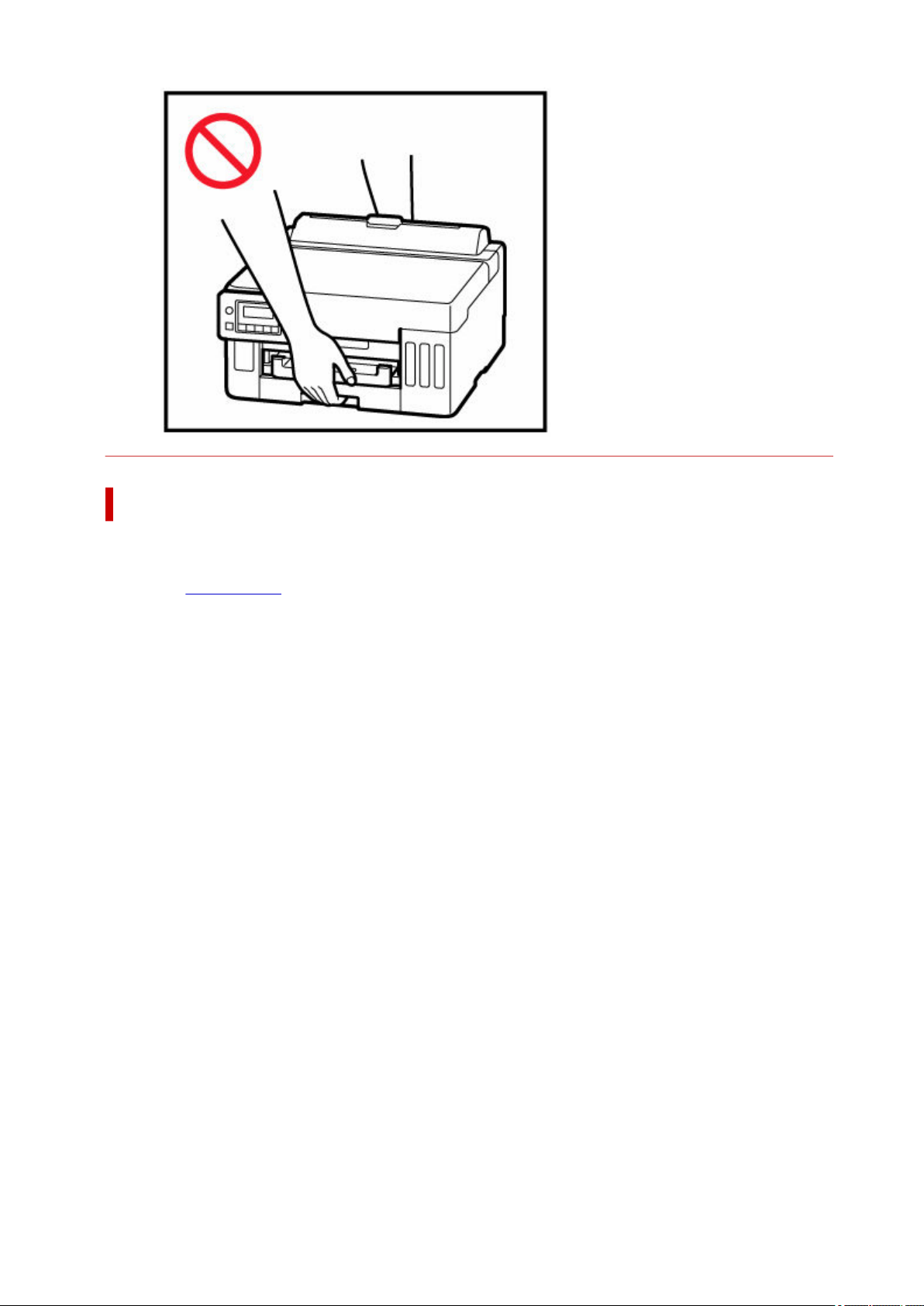
General Notices
Choosing a Location
Refer to "Specifications" in the Online manual for details on operating environment.
• Do not install the printer in a location that is unstable or subject to excessive vibration.
• Do not install the printer in locations that get very hot (direct sunlight, or close to a heating source),
very humid or dusty locations, or outdoors.
• Do not place the printer on a thick rug or carpet.
• Do not place the printer flush against a wall.
Power Supply
• Keep the area around the power outlet clear at all times so you can easily unplug the power cord if
necessary.
• Never remove the plug by pulling on the cord.
General Notices
• Do not tilt the printer, stand it on end, or turn it upside down. This may cause ink to leak.
• Do not place anything on top of the printer. Be especially careful to avoid metal objects such as
paper clips and staples, and containers holding flammable liquids such as alcohol or thinner.
• Modifying or dismantling the print head or ink bottles, such as by putting holes in them, could cause
the ink to leak out and cause a malfunction. We recommend that you do not modify or dismantle
them.
• Do not put the print head or ink bottles into a fire.
119

Regulatory Information
Users in the U.S.A.
FCC Notice (U.S.A. Only)
For 120V, 60Hz model
Model Number: K10551 (Contains FCC Approved WLAN Module K30374)
This device complies with Part 15 of the FCC Rules. Operation is subject to the following two conditions:
(1) This device may not cause harmful interference, and (2) this device must accept any interference
received, including interference that may cause undesired operation.
Note: This equipment has been tested and found to comply with the limits for a Class B digital device,
pursuant to Part 15 of the FCC Rules. These limits are designed to provide reasonable protection against
harmful interference in a residential installation. This equipment generates, uses and can radiate radio
frequency energy and, if not installed and used in accordance with the instructions, may cause harmful
interference to radio communications.
However, there is no guarantee that interference will not occur in a particular installation. If this equipment
does cause harmful interference to radio or television reception, which can be determined by turning the
equipment off and on, the user is encouraged to try to correct the interference by one or more of the
following measures:
• Reorient or relocate the receiving antenna.
• Increase the separation between the equipment and receiver.
• Connect the equipment into an outlet on a circuit different from that to which the receiver is
connected.
• Consult the dealer or an experienced radio/TV technician for help.
Use of a shielded cable is required to comply with Class B limits in Subpart B of Part 15 of the FCC Rules.
Do not make any changes or modifications to the equipment unless otherwise specified in the manual. If
such changes or modifications should be made, you could be required to stop operation of the equipment.
Changes or modifications not expressly approved by the party responsible for compliance could void the
user's authority to operate equipment.
This transmitter must not be co-located or operating in conjunction with any other antenna or transmitter.
The equipment complies with FCC radiation exposure limits for at uncontrolled equipment. This
equipment should be installed and operated with minimum distance at least 20cm between the radiator
and persons body (excluding extremities: hands, wrists, feet and ankles) and must not be colocated or
operated with any other antenna or transmitter.
Canon U.S.A., Inc.
One Canon Park
Melville, New York 11747
1-800-652-2666
Interference
Do not use the printer around medical equipment or other electronic devices. Signals from the printer may
interfere with the correct operation of these devices.
120

Users in Australia
5150 - 5350MHz band is indoor use only.
In Australia, use on channels 120-128 are prohibited in 5GHz Wireless LAN band.
Users in New Zealand
5150 - 5250MHz band is indoor use only.
121
WEEE
Only for the United Kingdom
These symbols indicate that this product is not to be disposed of with your household waste, according
to the UK Waste Electrical and Electronic Equipment Regulations and the UK Batteries and Accumulators
Regulations. If a chemical symbol is printed beneath the symbol shown above, in accordance with the
UK Batteries and Accumulators Regulations, this indicates that a heavy metal (Hg = Mercury, Cd =
Cadmium, Pb = Lead) is present in this battery or accumulator at a concentration above an applicable
threshold specified in the UK Batteries and Accumulators Regulations. This product should be handed
over to a designated collection point, e.g., on an authorized one-for-one basis when you buy a new similar
product or to an authorized collection site for recycling waste electrical and electronic equipment (EEE)
and batteries and accumulators. Improper handling of this type of waste could have a possible impact on
the environment and human health due to potentially hazardous substances that are generally associated
with EEE. Your cooperation in the correct disposal of this product will contribute to the effective usage of
natural resources. For more information about the recycling of this product, please contact your local city
office, waste authority, approved scheme or your household waste disposal service or visit www.canon-
europe.com/sustainability/approach/.
Only for European Union and EEA (Norway, Iceland and Liechtenstein)
These symbols indicate that this product is not to be disposed of with your household waste, according
to the WEEE Directive (2012/19/EU), the Battery Directive (2006/66/EC) and/or national legislation
implementing those Directives. If a chemical symbol is printed beneath the symbol shown above,
in accordance with the Battery Directive, this indicates that a heavy metal (Hg = Mercury, Cd =
Cadmium, Pb = Lead) is present in this battery or accumulator at a concentration above an applicable
threshold specified in the Battery Directive. This product should be handed over to a designated
collection point, e.g., on an authorized one-for-one basis when you buy a new similar product or to an
authorized collection site for recycling waste electrical and electronic equipment (EEE) and batteries and
accumulators. Improper handling of this type of waste could have a possible impact on the environment
and human health due to potentially hazardous substances that are generally associated with EEE.
Your cooperation in the correct disposal of this product will contribute to the effective usage of natural
resources. For more information about the recycling of this product, please contact your local city
office, waste authority, approved scheme or your household waste disposal service or visit www.canon-
europe.com/weee, or www.canon-europe.com/battery.
122
Nur für Europäische Union und EWR (Norwegen, Island und
Liechtenstein)
Diese Symbole weisen darauf hin, dass dieses Produkt gemäß WEEE-Richtlinie (2012/19/EU; Richtlinie
über Elektro- und Elektronik-Altgeräte), Batterien-Richtlinie (2006/66/EG) und nationalen Gesetzen
zur Umsetzung dieser Richtlinien nicht über den Hausmüll entsorgt werden darf. Falls sich unter
dem oben abgebildeten Symbol ein chemisches Symbol befindet, bedeutet dies gemäß der Batterien-
Richtlinie, dass in dieser Batterie oder diesem Akkumulator ein Schwermetall (Hg = Quecksilber, Cd =
Cadmium, Pb = Blei) in einer Konzentration vorhanden ist, die über einem in der Batterien-Richtlinie
angegebenen Grenzwert liegt. Dieses Produkt muss bei einer dafür vorgesehenen Sammelstelle
abgegeben werden. Dies kann z. B. durch Rückgabe beim Kauf eines neuen ähnlichen Produkts
oder durch Abgabe bei einer autorisierten Sammelstelle für die Wiederaufbereitung von Elektro- und
Elektronik-Altgeräten sowie Batterien und Akkumulatoren geschehen. Der unsachgemäße Umgang
mit Altgeräten kann aufgrund potenziell gefährlicher Stoffe, die generell mit Elektro- und Elektronik-
Altgeräten in Verbindung stehen, negative Auswirkungen auf die Umwelt und die menschliche Gesundheit
haben. Durch Ihre Mitarbeit bei der umweltgerechten Entsorgung dieses Produkts tragen Sie zu einer
effektiven Nutzung natürlicher Ressourcen bei. Um weitere Informationen über die Wiederverwertung
dieses Produkts zu erhalten, wenden Sie sich an Ihre Stadtverwaltung, den öffentlich-rechtlichen
Entsorgungsträger, eine autorisierte Stelle für die Entsorgung von Elektro- und Elektronik-Altgeräten
oder Ihr örtliches Entsorgungsunternehmen oder besuchen Sie www.canon-europe.com/weee, oder
www.canon-europe.com/battery.
Union Européenne, Norvège, Islande et Liechtenstein uniquement.
Ces symboles indiquent que ce produit ne doit pas être mis au rebut avec les ordures ménagères, comme
le spécifient la Directive européenne DEEE (2012/19/UE), la Directive européenne relative à l'élimination
des piles et des accumulateurs usagés (2006/66/CE) et les lois en vigueur dans votre pays appliquant
ces directives. Si un symbole de toxicité chimique est imprimé sous le symbole illustré ci-dessus
conformément à la Directive relative aux piles et aux accumulateurs, il indique la présence d'un métal
lourd (Hg = mercure, Cd = cadmium, Pb = plomb) dans la pile ou l'accumulateur à une concentration
supérieure au seuil applicable spécifié par la Directive. Ce produit doit être confié au distributeur à
chaque fois que vous achetez un produit neuf similaire, ou à un point de collecte mis en place par les
collectivités locales pour le recyclage des Déchets des Équipements Électriques et Électroniques (DEEE).
Le traitement inapproprié de ce type de déchet risque d'avoir des répercussions sur l'environnement
et la santé humaine, du fait de la présence de substances potentiellement dangereuses généralement
associées aux équipements électriques et électroniques. Votre entière coopération dans le cadre de
la mise au rebut correcte de ce produit favorisera une meilleure utilisation des ressources naturelles.
Pour plus d'informations sur le recyclage de ce produit, contactez vos services municipaux, votre éco-
123
organisme ou les autorités locales compétentes, ou consultez le site www.canon-europe.com/weee, ou
www.canon-europe.com/battery.
Uitsluitend bestemd voor de Europese Unie en EER (Noorwegen,
IJsland en Liechtenstein)
Met deze symbolen wordt aangegeven dat dit product in overeenstemming met de AEEA-richtlijn
(2012/19/EU), de richtlijn 2006/66/EG betreffende batterijen en accu's en/of de plaatselijk geldende
wetgeving waarin deze richtlijnen zijn geïmplementeerd, niet bij het normale huisvuil mag worden
weggegooid. Indien onder het hierboven getoonde symbool een chemisch symbool gedrukt staat, geeft
dit in overeenstemming met de richtlijn betreffende batterijen en accu's aan dat deze batterij of accu een
zwaar metaal bevat (Hg = kwik, Cd = cadmium, Pb = lood) waarvan de concentratie de toepasselijke
drempelwaarde in overeenstemming met de genoemde richtlijn overschrijdt. Dit product dient te worden
ingeleverd bij een hiervoor aangewezen inzamelpunt, bijv. door dit in te leveren bij een hiertoe erkend
verkooppunt bij aankoop van een gelijksoortig product, of bij een officiële inzameldienst voor de recycling
van elektrische en elektronische apparatuur (EEA) en batterijen en accu's. Door de potentieel gevaarlijke
stoffen die gewoonlijk gepaard gaan met EEA, kan onjuiste verwerking van dit type afval mogelijk
nadelige gevolgen hebben voor het milieu en de menselijke gezondheid. Uw medewerking bij het op
juiste wijze weggooien van dit product draagt bij tot effectief gebruik van natuurlijke hulpbronnen. Voor
verdere informatie over recycling van dit product kunt u contact opnemen met uw plaatselijke gemeente,
afvaldienst, officiële dienst voor klein chemisch afval of afvalstortplaats, of kunt u terecht op www.canon-
europe.com/weee, of www.canon-europe.com/battery.
Sólo para la Unión Europea y el Área Económica Europea (Noruega,
Islandia y Liechtenstein)
Estos iconos indican que este producto no debe desecharse con los residuos domésticos de acuerdo
con la Directiva sobre RAEE (2012/19/UE) y la Directiva sobre Pilas y Acumuladores (2006/66/CE) y/o la
legislación nacional. Si aparece un símbolo químico bajo este icono, de acuerdo con la Directiva sobre
Pilas y Acumuladores, significa que la pila o el acumulador contiene metales pesados (Hg = Mercurio,
Cd = Cadmio, Pb = Plomo) en una concentración superior al límite especificado en dicha directiva.
Este producto deberá entregarse en un punto de recogida designado, por ejemplo, entregándolo en
el lugar de venta al adquirir un producto nuevo similar o en un centro autorizado para la recogida de
residuos de aparatos eléctricos y electrónicos (RAEE), baterías y acumuladores. La gestión incorrecta
de este tipo de residuos puede afectar al medio ambiente y a la salud humana debido a las sustancias
potencialmente nocivas que suelen contener estos aparatos. Su cooperación en la correcta eliminación
de este producto contribuirá al correcto aprovechamiento de los recursos naturales. Los usuarios tienen
derecho a devolver pilas, acumuladores o baterías usados sin coste alguno. El precio de venta de pilas,
acumuladores y baterías incluye el coste de la gestión medioambiental de su desecho, y no es necesario
124
mostrar la cuantía de dicho coste en la información y la factura suministradas a los usuarios finales. Si
desea más información sobre el reciclado de este producto, póngase en contacto con su municipio, el
servicio o el organismo encargado de la gestión de residuos domésticos o visite www.canon-europe.com/
weee, o www.canon-europe.com/battery.
Només per a la Unió Europea i a l’Espai Econòmic Europeu (Noruega,
Islàndia i Liechtenstein)
Aquests símbols indican que aquest producte no s’ha de llençar amb les escombraries de la llar,
d’acord amb la RAEE (2012/19/UE), la Directiva relativa a piles i acumuladors (2006/66/CE) i la
legislació nacional que implementi aquestes directives. Si al costat d’aquest símbol hi apareix imprès
un símbol químic, segons especifica la Directiva relativa a piles i acumuladors, significa que la bateria o
l’acumulador conté un metall pesant (Hg = mercuri, Cd = cadmi, Pb = plom) en una concentració superior
al límit aplicable especificat en la Directiva. Aquest producte s’hauria de lliurar en un dels punts de
recollida designats, com per exemple, intercanviant un per un en comprar un producte similar o lliurant-lo
en un lloc de recollida autoritzat per al reciclatge de residus d’aparells elèctrics i electrònics (RAEE) i
piles i acumuladors. La manipulació inadequada d’aquest tipus de residus podria tenir un impacte negatiu
en l’entorn i en la salut humana, a causa de les substàncies potencialment perilloses que normalment
estan associades a l'RAEE. La vostra cooperació a l’hora de rebutjar correctament aquest producte
contribuirà a la utilització efectiva dels recursos naturals. Els usuaris tenen dret a retornar les bateries o
els acumuladors usats sense cap càrrec. El preu de venda de les bateries i els acumuladors inclou el cost
de la gestió ambiental dels residus i no es necessari mostrar l’import d’aquest cost en aquest fullet o en la
factura que es lliuri a l’usuari final. Per a més informació sobre el reciclatge d’aquest producte, contacteu
amb l’oficina municipal, les autoritats encarregades dels residus, el pla de residus homologat o el servei
de recollida d’escombraries domèstiques de la vostra localitat o visiteu www.canon-europe.com/weee, o
www.canon-europe.com/battery.
Solo per Unione Europea e SEE (Norvegia, Islanda e Liechtenstein)
Questi simboli indicano che il prodotto non può essere smaltito con i rifiuti domestici, ai sensi della
Direttiva RAEE (2012/19/UE), della Direttiva sulle Batterie (2006/66/CE) e/o delle leggi nazionali che
attuano tali Direttive. Se sotto il simbolo indicato sopra è riportato un simbolo chimico, in osservanza
della Direttiva sulle batterie, tale simbolo indica la presenza di un metallo pesante (Hg = Mercurio, Cd
= Cadmio, Pb = Piombo) nella batteria o nell'accumulatore con un livello di concentrazione superiore
a una soglia applicabile specificata nella Direttiva sulle batterie. Il prodotto deve essere conferito a
un punto di raccolta designato, ad esempio il rivenditore in caso di acquisto di un nuovo prodotto
simile oppure un centro di raccolta autorizzato per il riciclaggio di rifiuti di apparecchiature elettriche
ed elettroniche (RAEE) nonché di batterie e accumulatori. Un trattamento improprio di questo tipo di
rifiuti può avere conseguenze negative sull'ambiente e sulla salute umana a causa delle sostanze
125
potenzialmente nocive solitamente contenute in tali rifiuti. La collaborazione dell'utente per il corretto
smaltimento di questo prodotto contribuirà a un utilizzo efficace delle risorse naturali ed eviterà di
incorrere in sanzioni amministrative ai sensi dell'art. 255 e successivi del Decreto Legislativo n. 152/06.
Per ulteriori informazioni sul riciclaggio di questo prodotto, contattare le autorità locali, l'ente responsabile
della raccolta dei rifiuti, un rivenditore autorizzato o il servizio di raccolta dei rifiuti domestici, oppure
visitare il sito www.canon-europe.com/weee, o www.canon-europe.com/battery.
Apenas para a União Europeia e AEE (Noruega, Islândia e
Liechtenstein)
Estes símbolos indicam que este produto não deve ser eliminado juntamente com o seu lixo doméstico,
segundo a Diretiva REEE de 2012/19/UE, a Diretiva de Baterias (2006/66/CE) e/ou a sua legislação
nacional que transponha estas Diretivas. Se houver um símbolo químico impresso como mostrado
abaixo, de acordo com a Diretiva de Baterias, isto indica que um metal pesado (Hg = Mercúrio, Cd =
Cádmio, Pb = Chumbo) está presente nesta pilha ou acumulador, numa concentração acima de um limite
aplicável especificado na Diretiva. Este produto deve ser entregue num ponto de recolha designado, por
exemplo num local autorizado de troca quando compra um equipamento novo idêntico, ou num local
de recolha autorizado para reciclar equipamento elétrico e eletrónico (EEE) em fim de vida, bem como
pilhas e baterias. O tratamento inadequado deste tipo de resíduos pode ter um impacto negativo no
ambiente e na saúde humana, devido a substâncias potencialmente perigosas que estão associadas
com equipamentos do tipo EEE. A sua cooperação no tratamento correto deste produto irá contribuir
para a utilização mais eficaz dos recursos naturais. Para obter mais informações acerca de como
reciclar este produto, por favor contacte as suas autoridades locais responsáveis pela matéria, serviço
de recolha aprovado para pilhas e baterias ou serviço de recolha de resíduos sólidos domésticos da sua
municipalidade, ou visite www.canon-europe.com/weee, ou www.canon-europe.com/battery.
Gælder kun i Europæiske Union og EØS (Norge, Island og
Liechtenstein)
Disse symboler betyder, at produktet ikke må bortskaffes sammen med dagrenovation i henhold til
WEEE-direktivet (2012/19/EU), batteridirektivet (2006/66/EF) og/eller den lokale lovgivning, som disse
direktiver er gennemført i. Hvis der i overensstemmelse med batteridirektivet er trykt et kemisk symbol
under det symbol, der er vist ovenfor, betyder det, at batteriet eller akkumulatoren indeholder tungmetaller
(Hg = kviksølv, Cd = cadmium, Pb = bly) i en koncentration, som ligger over de grænseværdier,
der er beskrevet i batteridirektivet. Produktet skal afleveres på et godkendt indsamlingssted, f.eks. i
overensstemmelse med en godkendt én-til-én-procedure, når du indkøber et nyt tilsvarende produkt,
eller på et godkendt indsamlingssted for elektronikaffald samt for batterier og akkumulatorer. Forkert
håndtering af denne type affald kan medføre negative konsekvenser for miljøet og menneskers
helbred på grund af de potentielt sundhedsskadelige stoffer, der generelt kan forefindes i elektrisk og
126
elektronisk udstyr. Når du foretager korrekt bortskaffelse af produktet, bidrager du til effektiv brug af
naturressourcerne. Kontakt din kommune, den lokale affaldsmyndighed, det lokale affaldsanlæg, eller
besøg www.canon-europe.com/weee, eller www.canon-europe.com/battery for at få flere oplysninger om
genbrug af dette produkt.
Μόνο για την Ευρωπαϊκή Ένωση και τον ΕΟΧ (Νορβηγία, Ισλανδία και
Λιχτενστάιν)
Αυτά τα σύμβολα υποδεικνύουν ότι αυτό το προϊόν δεν πρέπει να απορρίπτεται μαζί με τα οικιακά
απορρίμματα, σύμφωνα με την Οδηγία για τα Απόβλητα Ηλεκτρικού και Ηλεκτρονικού Εξοπλισμού
(ΑΗΗΕ) (2012/19/ΕΕ), την Οδηγία για τις Ηλεκτρικές Στήλες (2006/66/ΕΚ) ή/και την εθνική νομοθεσία
που εφαρμόζει τις Οδηγίες εκείνες. Εάν κάποιο χημικό σύμβολο είναι τυπωμένο κάτω από το σύμβολο
που φαίνεται παραπάνω, σύμφωνα με την Οδηγία για τις Ηλεκτρικές Στήλες, υποδηλώνει ότι κάποιο βαρύ
μέταλλο (Hg = Υδράργυρος, Cd = Κάδμιο, Pb = Μόλυβδος) υπάρχει στην μπαταρία ή τον συσσωρευτή σε
συγκέντρωση μεγαλύτερη από το ισχύον επίπεδο που καθορίζεται στην Οδηγία για τις Ηλεκτρικές Στήλες.
Αυτό το προϊόν πρέπει να παραδίδεται σε καθορισμένο σημείο συλλογής, π.χ. σε μια εξουσιοδοτημένη
βάση ανταλλαγής όταν αγοράζετε ένα νέο παρόμοιο προϊόν ή σε μια εξουσιοδοτημένη θέση συλλογής για
την ανακύκλωση των αποβλήτων ηλεκτρικού και ηλεκτρονικού εξοπλισμού (ΗΗE) και των ηλεκτρικών
στηλών και συσσωρευτών. Ο ακατάλληλος χειρισμός αυτού του τύπου αποβλήτων μπορεί να έχει
αρνητικό αντίκτυπο στο περιβάλλον και την υγεία του ανθρώπου, λόγω δυνητικά επικίνδυνων ουσιών
που γενικά συνδέονται με τον ΗΗΕ. Η συνεργασία σας για τη σωστή απόρριψη αυτού του προϊόντος θα
συμβάλει στην αποτελεσματική χρήση των φυσικών πόρων. Για περισσότερες πληροφορίες σχετικά με
ανακύκλωση αυτού του προϊόντος, επικοινωνήστε με το τοπικό γραφείο της πόλης σας, την υπηρεσία
απορριμμάτων, το εγκεκριμένο σχήμα ή την υπηρεσία απόρριψης οικιακών αποβλήτων ή επισκεφθείτε τη
διεύθυνση www.canon-europe.com/weee ή www.canon-europe.com/battery.
Gjelder kun den europeiske union og EØS (Norge, Island og
Liechtenstein)
Disse symbolene indikerer at dette produktet ikke skal kastes sammen med husholdningsavfall, i
henhold til WEEE-direktivet (2012/19/EU), batteridirektivet (2006/66/EF) og/eller nasjonal lov som har
implementert disse direktivene. Hvis et kjemisk symbol vises under symbolet vist ovenfor, i samsvar
med batteridirektivet, indikerer dette at et tungmetall (Hg = kvikksølv, Cd = kadmium, Pb = bly) finnes
i batteriet eller akkumulatoren i en konsentrasjon over en gjeldende øvre grense som er spesifisert i
batteridirektivet. Produktet må leveres til et dertil egnet innsamlingspunkt, det vil si på en autorisert
en-til-en-basis når en kjøper et nytt lignende produkt, eller til et autorisert innsamlingssted for resirkulering
av avfall fra elektrisk og elektronisk utstyr (EE-utstyr) og batterier og akkumulatorer. Feil håndtering
av denne typen avfall kan være miljø- og helseskadelig på grunn av potensielt skadelige stoffer som
ofte brukes i EE-utstyr. Din innsats for korrekt avhending av produktet vil bidra til effektiv bruk av
127
naturressurser. Du kan få mer informasjon om resirkulering av dette produktet ved å kontakte lokale
myndigheter, avfallsadministrasjonen, et godkjent program eller husholdningens renovasjonsselskap, eller
gå til www.canon-europe.com/weee, eller www.canon-europe.com/battery.
Vain Euroopan unionin sekä ETA:n (Norja, Islanti ja Liechtenstein)
alueelle.
Nämä tunnukset osoittavat, että sähkö- ja elektroniikkalaiteromua koskeva direktiivi (SER-direktiivi,
2012/19/EU), paristoista ja akuista annettu direktiivi (2006/66/EY) sekä kansallinen lainsäädäntö kieltävät
tuotteen hävittämisen talousjätteen mukana. Jos yllä olevan symbolin alapuolelle on paristodirektiivin
mukaisesti painettu kemiallisen aineen tunnus, kyseinen paristo tai akku sisältää raskasmetalleja (Hg
= elohopea, Cd = kadmium, Pb = lyijy) enemmän kuin paristodirektiivin salliman määrän. Tuote on
vietävä asianmukaiseen keräyspisteeseen, esimerkiksi kodinkoneliikkeeseen uutta vastaavaa tuotetta
ostettaessa tai viralliseen sähkö- ja elektroniikkalaiteromun tai paristojen ja akkujen keräyspisteeseen.
Sähkö- ja elektroniikkalaiteromun virheellinen käsittely voi vahingoittaa ympäristöä ja ihmisten terveyttä,
koska laitteet saattavat sisältää ympäristölle ja terveydelle haitallisia aineita. Tuotteen asianmukainen
hävittäminen säästää myös luonnonvaroja. Jos haluat lisätietoja tämän tuotteen kierrätyksestä, ota
yhteys kunnan jätehuoltoviranomaisiin tai käyttämääsi jätehuoltoyhtiöön tai käy osoitteessa www.canon-
europe.com/weee, tai www.canon-europe.com/battery.
Endast för Europeiska unionen och EES (Norge, Island och
Liechtenstein)
De här symbolerna visar att produkten inte får sorteras och slängas som hushållsavfall enligt WEEE-
direktivet (2012/19/EU), batteridirektivet (2006/66/EG) och/eller nationell lagstiftning som implementerar
dessa direktiv. Om en kemisk symbol förekommer under ovanstående symbol innebär detta enligt
Batteridirektivet att en tungmetall (Hg = Kvicksilver, Cd = Kadmium, Pb = Bly) förekommer i batteriet
eller ackumulatorn med en koncentration som överstiger tillämplig gräns som anges i Batteridirektivet.
Produkten ska lämnas in på en avsedd insamlingsplats, t.ex. på en återvinningsstation auktoriserad
att hantera elektrisk och elektronisk utrustning (EE-utrustning) samt batterier och ackumulatorer eller
hos handlare som är auktoriserade att byta in varor då nya, motsvarande köps (en mot en). Olämplig
hantering av avfall av den här typen kan ha negativ inverkan på miljön och människors hälsa på grund
av de potentiellt farliga ämnen som kan återfinnas i elektrisk och elektronisk utrustning. Din medverkan
till en korrekt avfallshantering av produkten bidrar till effektiv användning av naturresurserna. Om du vill
ha mer information om var du kan lämna in den här produkten, kontakta ditt lokala kommunkontor, berörd
myndighet eller företag för avfallshantering eller se www.canon-europe.com/weee, eller www.canon-
europe.com/battery.
128
Pouze Evropská unie a EHP (Norsko, Island a Lichtenštejnsko)
Tento symbol znamená, že podle směrnice OEEZ (2012/19/EU), směrnice o bateriích (2006/66/ES) a/
nebo podle vnitrostátních právních prováděcích předpisů k těmto směrnicím nemá být tento výrobek
likvidován s odpadem z domácností. Je-li v souladu s požadavky směrnice o bateriích vytištěna pod výše
uvedeným symbolem chemická značka, udává, že tato baterie nebo akumulátor obsahuje těžké kovy (Hg
= rtuť, Cd = kadmium, Pb = olovo) v koncentraci vyšší, než je příslušná hodnota předepsaná směrnicí.
Tento výrobek má být vrácen do určeného sběrného místa, např. v rámci autorizovaného systému
odběru jednoho výrobku za jeden nově prodaný podobný výrobek, nebo do autorizovaného sběrného
místa pro recyklaci odpadních elektrických a elektronických zařízení (OEEZ), baterií a akumulátorů.
Nevhodné nakládání s tímto druhem odpadu by mohlo mít negativní dopad na životní prostředí a
lidské zdraví, protože elektrická a elektronická zařízení zpravidla obsahují potenciálně nebezpečné
látky. Vaše spolupráce na správné likvidaci tohoto výrobku napomůže efektivnímu využívání přírodních
zdrojů. Chcete-li získat podrobné informace týkající se recyklace tohoto výrobku, obraťte se prosím
na místní úřad, orgán pro nakládání s odpady, schválený systém nakládání s odpady či společnost
zajišťující likvidaci domovního odpadu, nebo navštivte webové stránky www.canon-europe.com/weee
nebo www.canon-europe.com/battery.
Csak az Európai Unió és az EGT (Norvégia, Izland és Liechtenstein)
országaiban
Ezek a szimbólumok azt jelzik, hogy a termék hulladékkezelése a háztartási hulladéktól különválasztva,
az elektromos és elektronikus berendezések hulladékairól (WEEE) szóló (2012/19/EU) irányelvnek és az
elemekről és akkumulátorokról, valamint a hulladék elemekről és akkumulátorokról szóló (2006/66/EK)
irányelvnek megfelelően és/vagy ezen irányelveknek megfelelő helyi előírások szerint történik.
Amennyiben a fent feltüntetett szimbólum alatt egy vegyjel is szerepel, az elemekről és akkumulátorokról
szóló irányelvben foglaltak értelmében ez azt jelzi, hogy az elem vagy az akkumulátor az irányelvben
meghatározott határértéknél nagyobb mennyiségben tartalmaz nehézfémet (Hg = higany, Cd = kadmium,
Pb = ólom). E terméket az arra kijelölt gyűjtőhelyre kell juttatni – pl. hasonló termék vásárlásakor
a régi becserélésére vonatkozó hivatalos program keretében, vagy az elektromos és elektronikus
berendezések (EEE) hulladékainak gyűjtésére, valamint a hulladék elemek és hulladék akkumulátorok
gyűjtésére kijelölt hivatalos gyűjtőhelyre. Az ilyen jellegű hulladékok nem előírásszerű kezelése az
elektromos és elektronikus berendezésekhez (EEE) általánosan kapcsolható potenciálisan veszélyes
anyagok révén hatással lehet a környezetre és az egészségre. E termék megfelelő leselejtezésével
Ön is hozzájárul a természeti források hatékony használatához. A termék újrahasznosítását illetően
informálódjon a helyi polgármesteri hivatalnál, a helyi közterület-fenntartó vállalatnál, a hivatalos
hulladéklerakó telephelyen vagy a háztartási hulladék begyűjtését végző szolgáltatónál, illetve látogasson
el a www.canon-europe.com/weee, vagy www.canon-europe.com/battery internetes oldalra.
129
Tylko dla krajów Unii Europejskiej oraz EOG (Norwegia, Islandia i
Liechtenstein)
Te symbole oznaczają, że produktu nie należy wyrzucać razem z odpadami gospodarstwa domowego,
zgodnie z dyrektywą WEEE w sprawie zużytego sprzętu elektrycznego i elektronicznego (2012/19/UE)
lub dyrektywą w sprawie baterii (2006/66/WE) bądź przepisami krajowymi wdrażającymi te dyrektywy.
Jeśli pod powyższym symbolem znajduje się symbol chemiczny, zgodnie z dyrektywą w sprawie
baterii oznacza to, że bateria lub akumulator zawiera metal ciężki (Hg = rtęć, Cd = kadm, Pb
= ołów) w stężeniu przekraczającym odpowiedni poziom określony w dyrektywie w sprawie baterii.
Użytkownicy baterii i akumulatorów mają obowiązek korzystać z dostępnego programu zwrotu, recyklingu
i utylizacji baterii oraz akumulatorów. Niewłaściwe postępowanie z tego typu odpadami może mieć
wpływ na środowisko i zdrowie ludzi ze względu na substancje potencjalnie niebezpieczne, związane
ze zużytym sprzętem elektrycznym i elektronicznym. Państwa współpraca w zakresie właściwej utylizacji
tego produktu przyczyni się do efektywnego wykorzystania zasobów naturalnych. W celu uzyskania
informacji o sposobie recyklingu tego produktu prosimy o kontakt z właściwym urzędem miejskim
lub zakładem gospodarki komunalnej bądź zapraszamy na stronę www.canon-europe.com/weee, lub
www.canon-europe.com/battery.
Platí len pre štáty Európskej únie a EHP (Nórsko, Island a
Lichtenštajnsko)
Tieto symboly označujú, že podľa Smernice o odpade z elektrických a elektronických zariadení (OEEZ)
2012/19/EÚ, Smernice o batériách (2006/66/ES) a podľa platnej legislatívy Slovenskej republiky sa tento
produkt nesmie likvidovať spolu s komunálnym odpadom. Ak je chemická značka vytlačená pod vyššie
uvedeným symbolom, znamená to, že táto batéria alebo akumulátor obsahuje ťažký kov (Hg = ortuť,
Cd = kadmium, Pb = olovo) v koncentrácii vyššej, ako je príslušná povolená hodnota stanovená v
Smernici o batériách. Produkt je potrebné odovzdať do určenej zberne, napr. prostredníctvom výmeny
za kúpu nového podobného produktu, alebo na autorizované zberné miesto, ktoré spracúva odpad z
elektrických a elektronických zariadení (EEZ), batérií a akumulátorov. Nesprávna manipulácia s takýmto
typom odpadu môže mať negatívny vplyv na životné prostredie a ľudské zdravie, pretože elektrické
a elektronické zariadenia obsahujú potenciálne nebezpečné látky. Spoluprácou na správnej likvidácii
tohto produktu prispejete k účinnému využívaniu prírodných zdrojov. Ďalšie informácie o recyklácii tohto
produktu získate od miestneho úradu, úradu životného prostredia, zo schváleného plánu OEEZ alebo od
spoločnosti, ktorá zaisťuje likvidáciu komunálneho odpadu. Viac informácií nájdete aj na webovej stránke:
www.canon-europe.com/weee, alebo www.canon-europe.com/battery.
130
Üksnes Euroopa Liit ja EMP (Norra, Island ja Liechtenstein)
Antud sümbolid viitavad sellele, et vastavalt elektri- ja elektroonikaseadmete jäätmeid käsitlevale
direktiivile (2012/19/EL), patareisid ja akusid ning patarei- ja akujäätmeid käsitlevale direktiivile
(2006/66/EÜ) ja/või nimetatud direktiive rakendavatele riiklikele õigusaktidele ei või seda toodet koos
olmejäätmetega ära visata. Kui keemiline sümbol on trükitud eespool toodud sümboli alla, siis tähendab
see, et antud patareis või akus leiduva raskemetalli (Hg = elavhõbe, Cd = kaadmium, Pb = plii)
kontsentratsioonitase on kõrgem kui patareisid ja akusid ning patarei- ja akujäätmeid käsitlevas
direktiivis sätestatud piirmäär. Antud tootest tekkinud jäätmed tuleb anda vastavasse kogumispunkti,
nt müügipunkti, mis on volitatud üks ühe vastu vahetama, kui ostate uue sarnase toote, või
vastavasse elektri- ja lektroonikaseadmete jäätmete ning patareide ja akude ümbertöötlemiseks mõeldud
kogumispunkti. Antud liiki jäätmete vale käitlemine võib kahjustada keskkonda ja inimeste tervist elektri-
ja elektroonikajäätmetes tavaliselt leiduvate potentsiaalselt ohtlike ainete tõttu. Antud tootest tekkinud
jäätmete nõuetekohase kõrvaldamisega aitate kasutada loodusvarasid efektiivselt. Täiendava teabe
saamiseks elektri- ja elektroonikaseadmetest tekkinud jäätmete ning patarei- ja akujäätmete tagastamise
ja ümbertöötlemise kohta võtke ühendust kohaliku omavalitsusega, asjakohase valitsusasutusega,
asjakohase tootjavastutusorganisatsiooniga või olmejäätmete käitlejaga. Lisateavet leitate ka Interneti-
leheküljelt www.canon-europe.com/weee või www.canon-europe.com/battery.
Tikai Eiropas Savienībai un EEZ (Norvēģijai, Islandei un Lihtenšteinai)
Šie simboli norāda, ka atbilstoši ES Direktīvai (2012/19/ES) par elektrisko un elektronisko iekārtu
atkritumiem (EEIA), Direktīvai (2006/66/EK) par baterijām un akumulatoriem, un akumulatoru atkritumiem,
ar ko atceļ Direktīvu 91/157/EEK, un vietējiem tiesību aktiem šo izstrādājumu nedrīkst izmest kopā
ar sadzīves atkritumiem. Ja zem iepriekš norādītā simbola ir uzdrukāts ķīmiskais simbols, saskaņā ar
direktīvu par baterijām un akumulatoriem tas nozīmē, ka šīs baterijas vai akumulatori satur smagos
metālus (Hg = dzīvsudrabs, Cd = kadmijs, Pb = svins) un to koncentrācijas līmenis pārsniedz direktīvā
par baterijām un akumulatoriem minēto piemērojamo slieksni. Šis izstrādājums ir jānodod piemērotā
savākšanas vietā, piemēram, apstiprinātā veikalā, kur iegādājaties līdzīgu jaunu produktu un atstājat
veco, vai apstiprinātā vietā izlietotu elektrisko un elektronisko iekārtu un bateriju un akumulatoru
pārstrādei. Nepareiza šāda veida atkritumu apsaimniekošana var apdraudēt vidi un cilvēka veselību
tādu iespējami bīstamu vielu dēļ, kas parasti ir elektriskajās un elektroniskajās iekārtās. Jūsu atbalsts
pareizā šāda veida atkritumu apsaimniekošanā sekmēs efektīvu dabas resursu izmantošanu. Lai saņemtu
pilnīgāku informāciju par šāda veida izstrādājumu nodošanu otrreizējai pārstrādei, sazinieties ar vietējo
pašvaldību, atkritumu savākšanas atbildīgo dienestu, pilnvaroto organizāciju vai iestādi, kas veic sadzīves
atkritumu apsaimniekošanu, vai apmeklējiet tīmekļa vietni www.canon-europe.com/weee, vai www.canon-
europe.com/battery.
131
Tik Europos Sąjungai ir EEE (Norvegijai, Islandijai ir Lichtenšteinui)
Šie simboliai reiškia, kad šio gaminio negalima išmesti į buitines atliekas, kaip reikalaujama WEEE
Direktyvoje (2012/19/ES) ir Baterijų direktyvoje (2006/66/EB) ir (ar) jūsų šalies nacionaliniuose
įstatymuose, kuriais šios Direktyvos yra įgyvendinamos. Jeigu cheminio ženklo simbolis yra nurodytas
žemiau šio ženklo, tai reiškia, kad vadovaujantis Baterijų direktyvą, baterijų ar akumuliatorių sudėtyje
yra sunkiųjų metalų (Hg = gyvsidabrio, Cd = kadmio, Pb = švino), kurių koncentracija viršija Baterijų
direktyvoje nurodytas leistinas ribas. Šį gaminį reikia pristatyti į specialųjį surinkimo punktą, pavyzdžiui,
mainais, kai jūs perkate naują panašų gaminį, arba į specialiąją surinkimo vietą, kurioje perdirbamos
elektrinės ir elektroninės įrangos atliekos bei naudotos baterijos ir akumuliatoriai. Dėl netinkamo šio
tipo atliekų tvarkymo gali nukentėti aplinka ir iškilti grėsmė žmogaus sveikatai dėl galimai kenksmingų
medžiagų, iš esmės susijusių su elektrine ir elektronine įranga. Bendradarbiaudami ir teisingai
utilizuodami šiuos gaminius, jūs padėsite efektyviai naudoti gamtinius išteklius. Daugiau informacijos
apie gaminio perdirbimą jums gali suteikti vietinis biuras, atliekų tvarkymo bendrovė, sertifikuoti organai
ar buitinių atliekų surinkimo įmonės. Taip pat siūloma apsilankyti interneto svetainėje www.canon-
europe.com/weee, arba www.canon-europe.com/battery.
Samo za Evropsko unijo in EGP (Norveška, Islandija in Lihtenštajn)
Ti simboli pomenijo, da tega izdelka skladno z Direktivo OEEO (2012/19/EU), Direktivo 2006/66/ES in/ali
nacionalno zakonodajo, ki uvaja ti direktivi, ne smete odlagati z nesortiranimi gospodinjskimi odpadki.
Če je pod zgoraj prikazanim simbolom natisnjen kemijski simbol, to v skladu z Direktivo pomeni, da je
v tej bateriji ali akumulatorju prisotna težka kovina (Hg = živo srebro, Cd = kadmij, Pb = svinec), in
sicer v koncentraciji, ki je nad relevantno mejno vrednostjo, določeno v Direktivi. Ta izdelek je potrebno
odnesti na izbrano zbirno mesto, t. j. pooblaščeno trgovino, kjer ob nakupu novega (podobnega) izdelka
vrnete starega, ali na pooblaščeno zbirno mesto za ponovno uporabo odpadne električne in elektronske
opreme (EEO) ter baterij in akumulatorjev. Neustrezno ravnanje s to vrsto odpadkov lahko negativno
vpliva na okolje in človeško zdravje zaradi potencialno nevarnih snovi, ki so pogosto povezane z EEO.
Vaše sodelovanje pri pravilnem odlaganju tega izdelka predstavlja pomemben prispevek k smotrni izrabi
naravnih virov. Za več informacij o ponovni uporabi tega izdelka se obrnite na lokalen mestni urad,
pristojno službo za odpadke, predstavnika pooblaščenega programa za obdelavo odpadkov ali na lokalno
komunalo. Lahko pa tudi obiščete našo spletno stran www.canon-europe.com/weee, ali www.canon-
europe.com/battery.
132
Само за Европейския съюз и ЕИП (Норвегия, Исландия и
Лихтенщайн)
Тези символи показват, че този продукт не трябва да се изхвърля заедно с битовите отпадъци
съгласно Директивата за ИУЕЕО (2012/19/ЕC), Директивата за батерии (2006/66/ЕО) и/или Вашето
национално законодателство, прилагащо тези Директиви. Ако под показания горе символ е
отпечатан символ за химически елемент, съгласно разпоредбите на Директивата за батерии,
този втори символ означава наличието на тежък метал (Hg = живак, Cd = кадмий, Pb = олово)
в батерията или акумулатора в концентрация над указаната граница за съответния елемент в
Директивата. Този продукт трябва да бъде предаден в предназначен за целта пункт за събиране,
например на база размяна, когато купувате нов подобен продукт, или в одобрен събирателен
пункт за рециклиране на излязло от употреба електрическо и електронно оборудване (ИУЕЕО),
батерии и акумулатори. Неправилното третиране на този тип отпадъци може да доведе до
евентуални отрицателни последствия за околната среда и човешкото здраве поради потенциално
опасните вещества, които обикновено са свързани с ЕЕО. В същото време Вашето съдействие за
правилното изхвърляне на този продукт ще допринесе за ефективното използване на природните
ресурси. За повече информация относно това къде можете да предадете за рециклиране на
този продукт, моля свържете се с Вашите местни власти, с органа, отговорен за отпадъците, с
одобрената система за ИУЕЕО или с Вашата местна служба за битови отпадъци, или посетете
www.canon-europe.com/weee, или www.canon-europe.com/battery.
Doar pentru Uniunea Europeană şi EEA (Norvegia, Islanda şi
Liechtenstein)
Aceste simboluri indică faptul că acest produs nu trebuie aruncat împreună cu deşeurile menajere, în
conformitate cu Directiva DEEE (2012/19/UE), Directiva referitoare la baterii (2006/66/CE) şi/sau legile
dvs. naţionale ce implementează aceste Directive. Dacă un simbol chimic este imprimat sub simbolul de
mai sus, în conformitate cu Directiva referitoare la baterii, acest simbol indică prezenţa în baterie sau
acumulator a unui metal greu (Hg = Mercur, Cd = Cadmiu, Pb = Plumb) într-o concentraţie mai mare
decât pragul admis specificat în Directiva referitoare la baterii. Acest produs trebuie înmânat punctului de
colectare adecvat, ex: printr-un schimb autorizat unu la unu atunci când cumpăraţi un produs nou similar
sau la un loc de colectare autorizat pentru reciclarea reziduurilor de echipament electric şi electronic
(EEE) şi baterii şi acumulatori. Administrarea neadecvată a acestui tip de deşeuri, ar putea avea un
impact asupra mediului şi asupra sănătăţii umane datorită substanţelor cu potenţial de risc care sunt în
general asociate cu EEE. Cooperarea dvs. în direcţia reciclării corecte a acestui produs va contribui la
o utilizare eficientă a resurselor naturale. Pentru mai multe informaţii despre reciclarea acestui produs,
vă rugăm să contactaţi biroul dvs. local, autorităţile responsabile cu deşeurile, schema aprobată sau
serviciul dvs. responsabil cu deşeurile menajere sau vizitaţi-ne la www.canon-europe.com/weee, sau
www.canon-europe.com/battery.
133
Samo za Europsku uniju i EEA (Norveška, Island i Lihtenštajn)
Oznaka pokazuje da se ovaj proizvod ne smije odlagati s komunalnim i ostalim vrstama otpada, u skladu
s direktivom WEEE (2012/19/EC), Direktivom o baterijama (2006/66/EC) i Pravilnikom o gospodarenju
otpadnim baterijama i akumulatorima te Pravilnikom o gospodarenju otpadnim električnim i elektroničkim
uređajima i opremom. Ako je ispod prethodno prikazane oznake otisnut kemijski simbol, u skladu s
Direktivom o baterijama, to znači da se u ovoj bateriji ili akumulatoru nalazi teški metal (Hg = živa, Cd
= kadmij, Pb = olovo) i da je njegova koncentracija iznad razine propisane u Direktivi o baterijama. Ovaj
bi proizvod trebalo predati ovlašenom skupljaču EE otpada ili prodavatelju koji je dužan preuzeti otpadni
proizvod po sistemu jedan za jedan, ukoliko isti odgovara vrsti te je obavljao primarne funkcije kao i
isporučena EE oprema. Otpadne baterije i akumulatori predaju se ovlaštenom skupljaču otpadnih baterija
ili akumulatora ili prodavatelju bez naknade i obveze kupnje za krajnjeg korisnika. Neodgovarajuće
rukovanje ovom vrstom otpada može utjecati na okoliš i ljudsko zdravlje zbog potencijalno opasnih
supstanci koje se najčešće nalaze na takvim mjestima. Vaša suradnja u pravilnom zbrinjavanju ovog
proizvoda pridonijet će djelotvornom iskorištavanju prirodnih resursa. Dodatne informacije o recikliranju
ovog proizvoda zatražite od svog lokalnog gradskog ureda, službe za zbrinjavanje otpada, odobrenog
programa ili komunalne službe za uklanjanje otpada ili pak na stranicama www.canon-europe.com/weee
ili www.canon-europe.com/battery.
Korisnici u Srbiji
Ovaj simbol označava da ovaj proizvod ne sme da se odlaže sa ostalim kućnim otpadom, u skladu sa
WEEE Direktivom (2012/19/EU), Direktivom o baterijama (2006/66/EC) i nacionalnim zakonima. Ukoliko
je ispod gore navedenog simbola odštampan hemijski simbol, u skladu sa Direktivom o baterijama, ovaj
simbol označava da su u ovoj bateriji ili akumulatoru prisutni teški metali (Hg – živa, Cd – kadmijum, Pb -
olovo) u koncentracijama koje premašuju prihvatljivi prag naveden u Direktivi o baterijama. Ovaj proizvod
treba predati određenom centru za prikupljanje, npr. po principu „jedan-za-jedan“ kada kupujete sličan
novi proizvod, ili ovlašćenom centru za prikupljanje za reciklažu istrošene električne i elektronske opreme
(EEE), baterija i akumulatora. Nepravilno rukovanje ovom vrstom otpada može imati negativne posledice
po životnu sredinu i ljudsko zdravlje usled potencijalno opasnih materijala koji se uglavnom vezuju za
EEE. Vaša saradnja na ispravnom odlaganju ovog proizvoda će doprineti efikasnom korišćenju prirodnih
resursa. Više informacija o tome kako možete da reciklirate ovaj proizvod potražite od lokalnih gradskih
vlasti, komunalne službe, odobrenog plana reciklaže ili servisa za odlaganje kućnog otpada, ili posetite
stranicu www.canon-europe.com/weee, ili www.canon-europe.com/battery.
134


Legal Restrictions on Printing
Printing or modifying printed copies of the following may be punishable under law.
This list is non-exhaustive. When in doubt, check with a local legal representative.
• Paper money•
• Money orders•
• Certificates of deposit•
• Postage stamps (canceled or uncanceled)•
• Identification badges or insignia•
• Selective service or draft papers•
• Checks or drafts issued by governmental agencies•
• Motor vehicle licenses and certificates of title•
• Traveler's checks•
• Food stamps•
• Passports•
• Immigration papers•
• Internal revenue stamps (canceled or uncanceled)•
• Bonds or other certificates of indebtedness•
• Stock certificates•
• Copyrighted works or works of art, without the owner's consent•
136
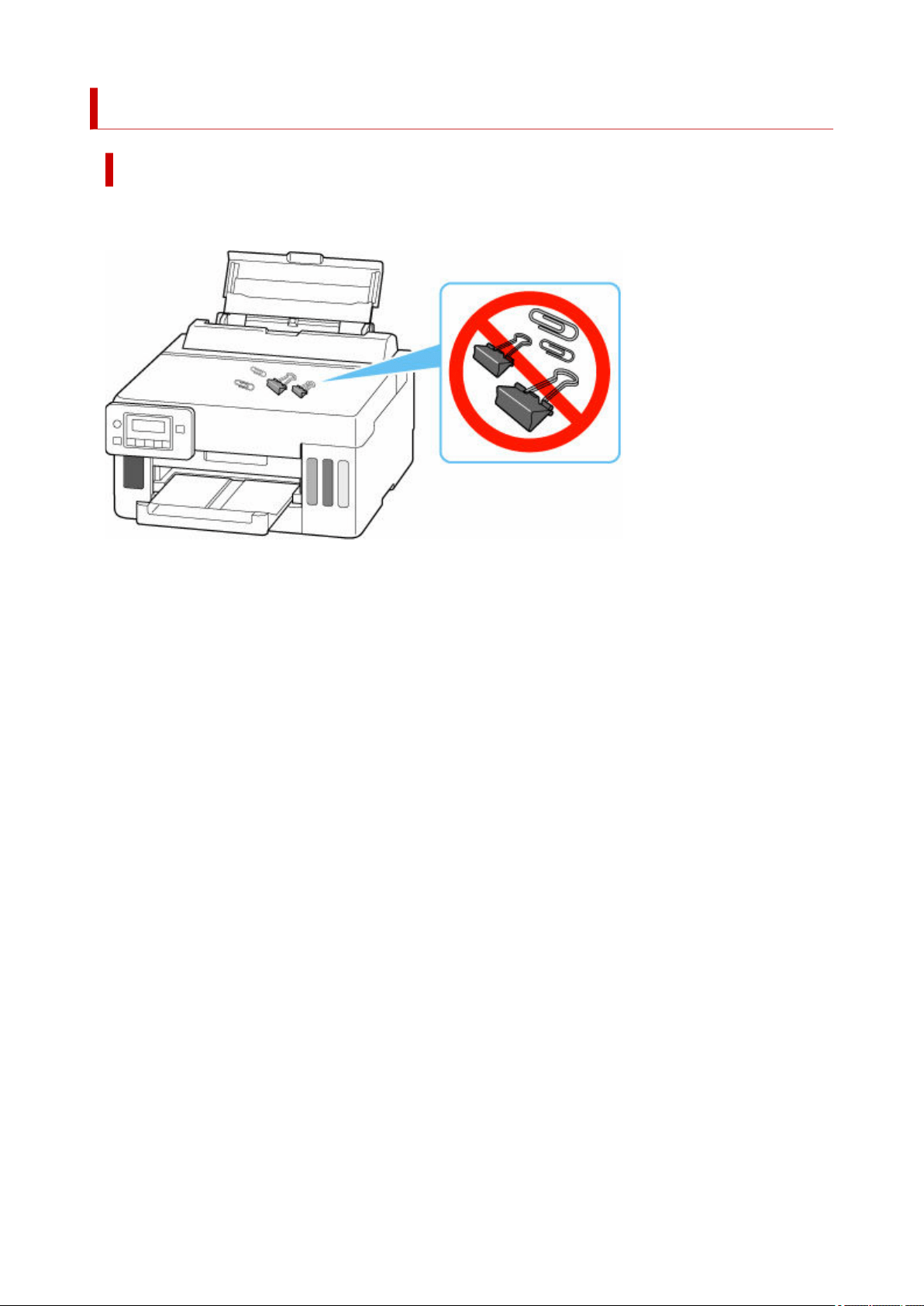
Printer Handling Precautions
Do not place any object on the top cover!
Do not place any object on the top cover. It will fall into the rear tray when the top cover is opened and
cause the printer to malfunction. Also, place the printer where objects will not fall on it.
137
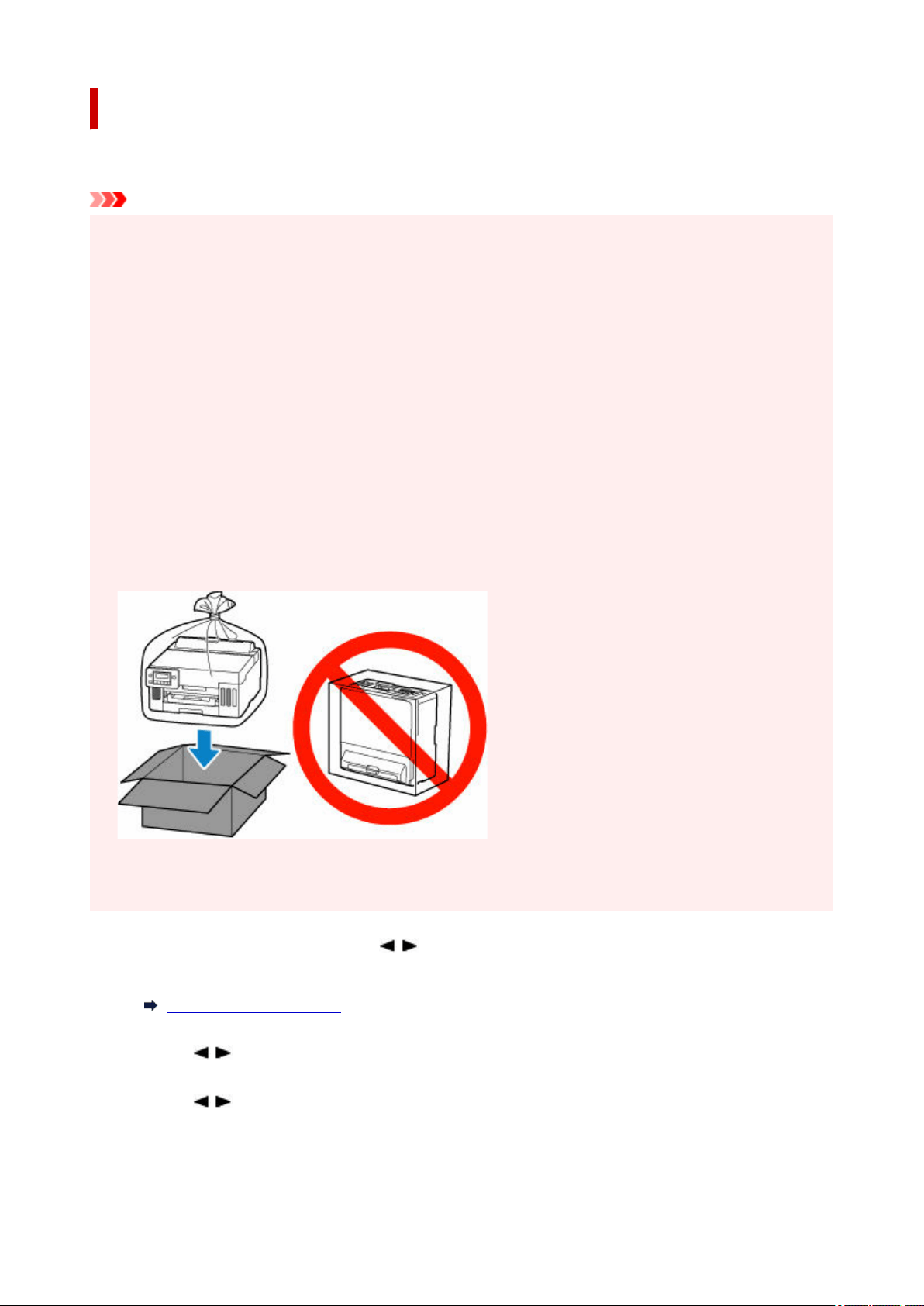
Transporting Your Printer
When relocating the printer for changing your living place, make sure of the following.
Important
• You cannot take ink out of ink tanks.•
• Check if the tank cap is completely inserted. If the ink tank cover is not completely closed, insert the•
tank cap properly.
• Prepare for transporting the printer with the print head attached. This allows the printer to automatically•
cap the print head, thus preventing it from drying.
• Do not remove the print head. Ink may leak.•
• If ink stains the inside of the printer, wipe them using a soft cloth dampened with water.•
• When transporting the printer, pack the printer in a plastic bag so that ink does not leak.•
• Pack the printer in a sturdy box so that it is placed with its bottom facing down, using sufficient•
protective material to ensure safe transport.
• Do not tilt the printer. Ink may leak.•
• When a shipping agent is handling transport of the printer, have its box marked "THIS SIDE UP" to•
keep the printer with its bottom facing down. Mark also with "FRAGILE" or "HANDLE WITH CARE".
• Please handle with care and ensure the box remains flat and NOT turned upside down or on its side, as•
the printer may be damaged and ink in the printer may leak.
1.
Press the Setup button, use the button to select Maintenance, and press the OK
1.
button.
LCD and Operation Panel
2.
Use the button to select Transport mode and press the OK button.
2.
3.
Use the button to select Yes and press the OK button.
3.
The mode is shifted to the transfer mode.
When it is completed, the power is turned off automatically.
138
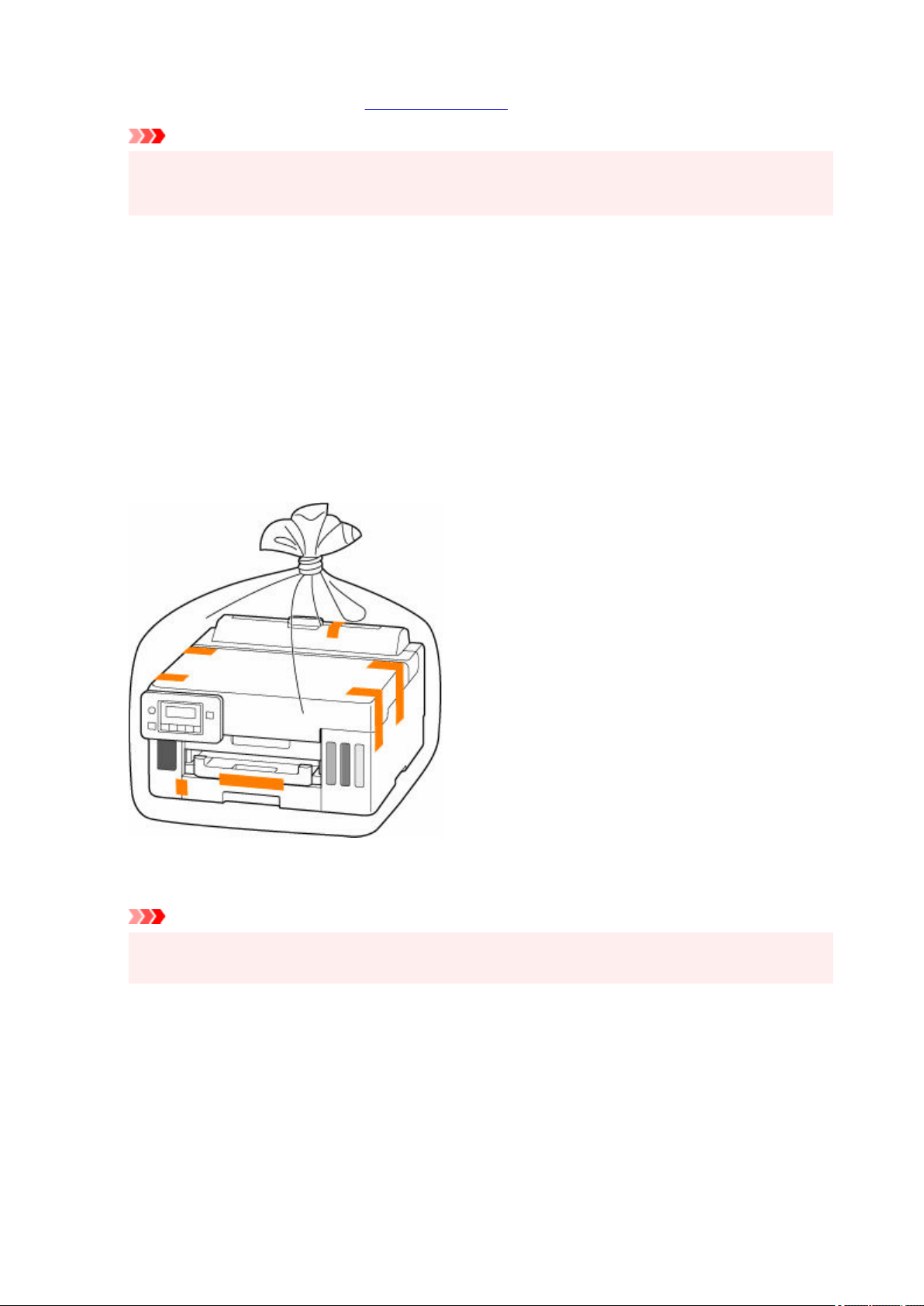
4. Check that ON lamp is off and unplug power cord.4.
Important
• Do not unplug the printer while the ON lamp is lit or flashing, as it may cause malfunction or•
damage to the printer, making the printer unable to print.
5. Close the paper output tray.5.
6.
Retract paper support, then close the rear tray cover.
6.
7.
Unplug the printer cable from the computer and from the printer, then unplug the power
7.
cord from the printer.
8.
Use adhesive tape to secure all the covers on the printer to keep them from opening during
8.
transportation. Then pack the printer in the plastic bag.
Close and seal the opening of the bag with an object such as tape so as not to leak ink.
9.
Attach the protective material to the printer when packing the printer in the box.
9.
Important
•
We recommend to hold and carry out this printer as shown in the figure below. If you hold the
•
cassette, it may fall out of the printer.
139

140

When Repairing, Lending, or Disposing of the Printer
If you have entered personal data, passwords and/or other security settings on the printer, such information
may be stored in the printer.
When sending the printer for repair, lending or transferring the printer to another person, or disposing of the
printer, please be sure to follow the steps below in order to delete such information and prevent third parties
from accessing it.
• Press the Setup button, select Device settings > Reset setting > All data, and then select Yes.•
141

Keeping Print Quality High
The key to printing with the optimal printing quality is to prevent the print head from drying or clogging.
Always observe the following rules for optimal printing quality.
Note
• Depending on the type of paper, ink may blur if you trace the printed area with a highlight pen or•
paint-stick, or bleed if water or sweat comes in contact with the printed area.
Never unplug the power cord until the power is turned off!
If you press the ON button to turn off the power, the printer caps the print head (nozzles) automatically to
prevent from drying. If you unplug the power cord from the wall outlet before the ON lamp is turned off, the
print head will not be capped properly and this will cause drying or clogging.
When unplugging the power cord, check that the ON lamp is not lit.
Print periodically!
Just as the tip of a felt pen becomes dry and unusable if it has not been used for a long time, even if it is
capped, the print head too, may become dried or clogged if the printer has not been used for a long time.
We recommend you to use the printer at least once a month.
142


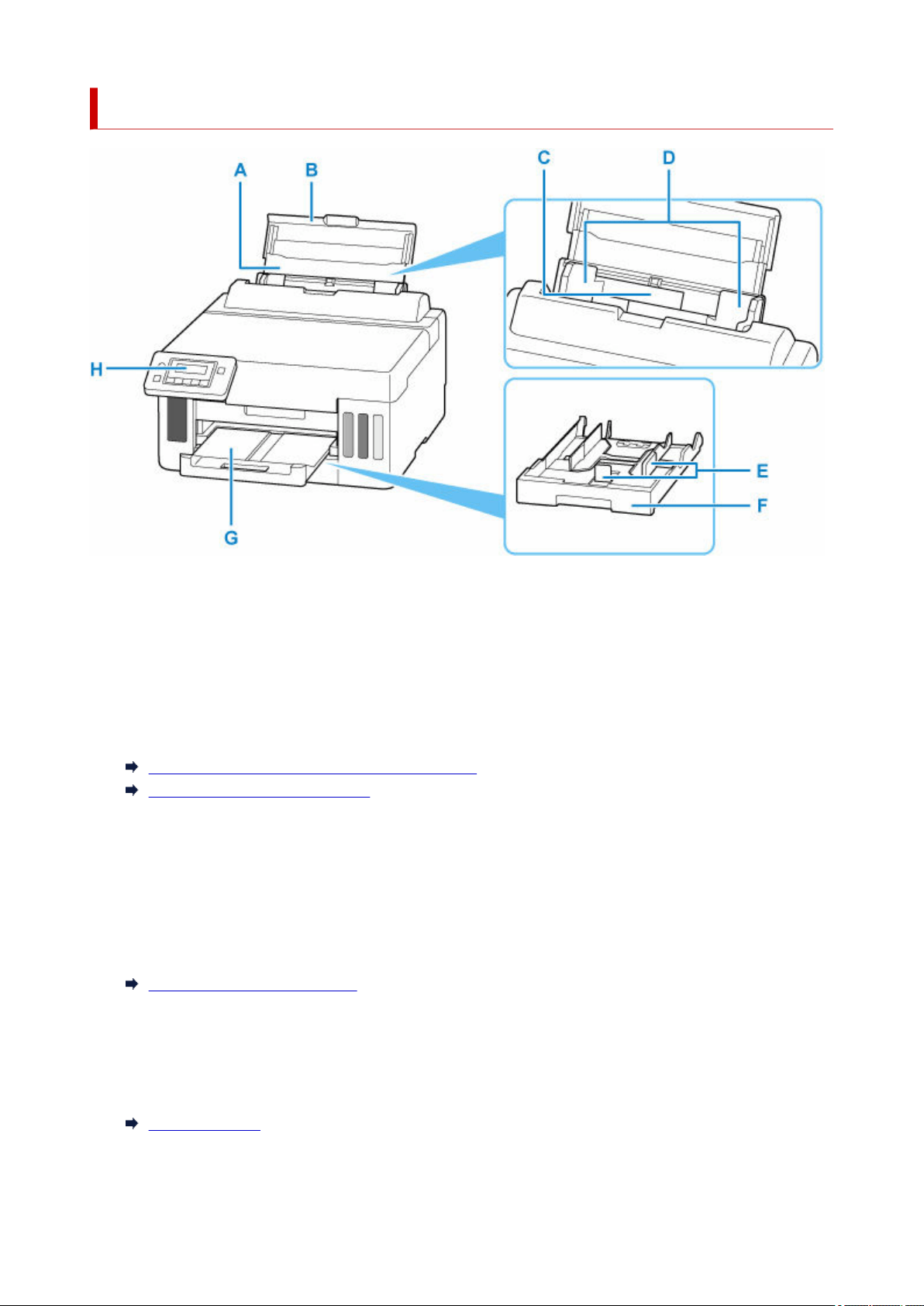
Front View
A: Paper Support
Extend to load paper in the rear tray.
B: Rear Tray Cover
Open to load paper in the rear tray.
C: Rear Tray
Two or more sheets of the same size and type of paper can be loaded at the same time, and fed
automatically one sheet at a time.
Loading Photo Paper / Plain Paper in Rear Tray
Loading Envelopes in Rear Tray
D: Paper Guides
Align with both sides of the paper stack.
E: Paper Guides
Align with right/left/front sides of the paper stack.
F: Cassette
Load A4, B5, A5, Letter-sized or Executive plain paper into the cassette, and insert it into the printer.
Loading Paper in the Cassette
G: Paper Output Tray
Printed paper is ejected. Pull out it before printing.
H: Operation Panel
Use to change the settings of the printer or to operate it.
Operation Panel
145
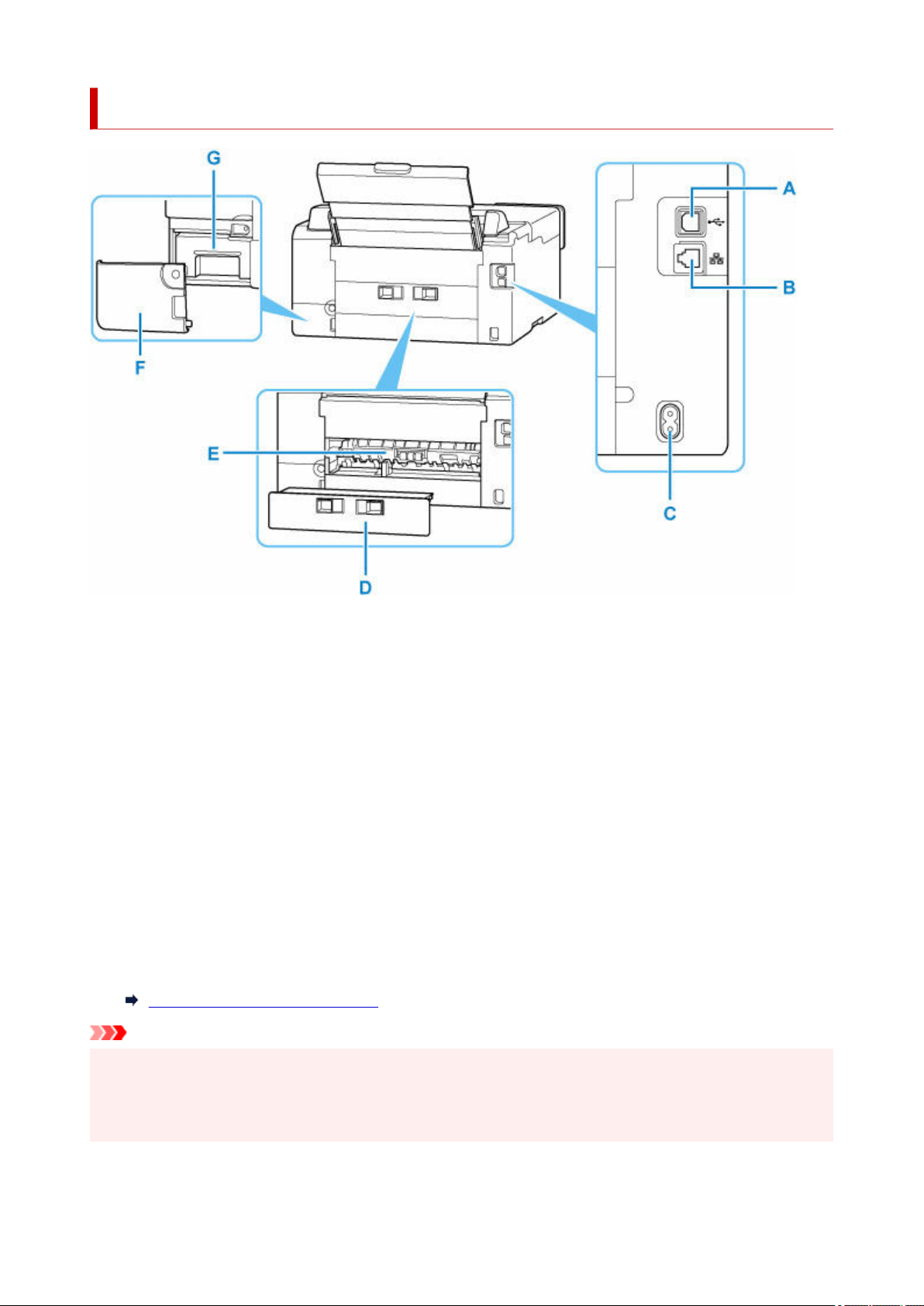
Rear View
A: USB Port
Plug in the USB cable to connect the printer with a computer.
B: Wired LAN Connector
Plug in the LAN cable to connect the printer to a LAN.
C: Power Cord Connector
Plug in the supplied power cord.
D: Rear Cover
Detach when removing jammed paper.
E: Transport Unit
Open when removing jammed paper.
F: Maintenance Cover
Remove when replacing the maintenance cartridge.
G: Maintenance Cartridge
Absorbs ink used for cleaning.
Replacing Maintenance Cartridge
Important
• Do not touch the metal casing.•
• Do not plug in or unplug the USB cable or LAN cable while the printer is printing with the computer. This•
can cause trouble.
146
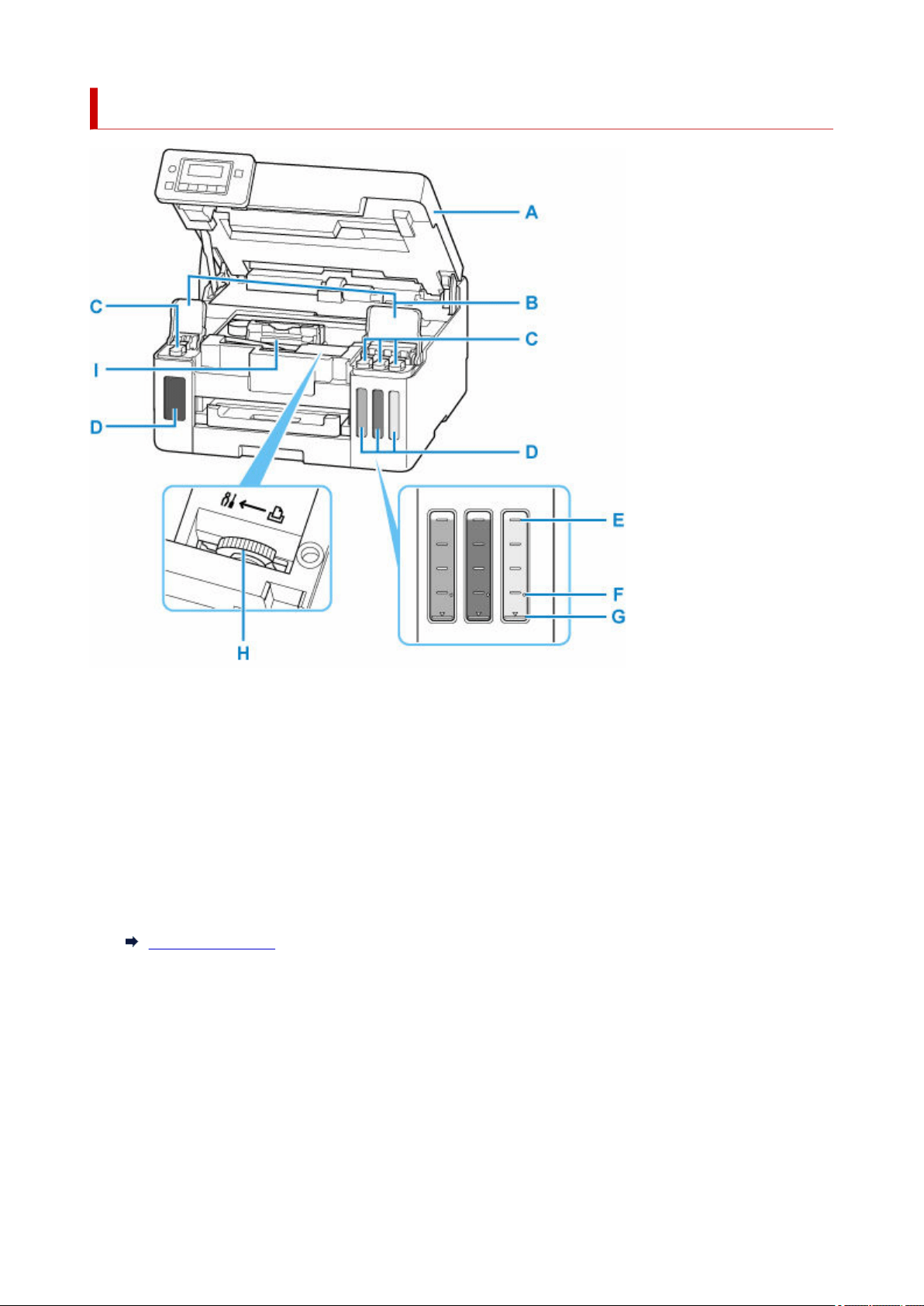
Inside View
A: Top Cover
Open to refill ink tanks and to remove jammed paper.
B: Ink Tank Covers
Open to refill ink tanks.
C: Tank Caps
Open to refill ink tanks.
D: Ink Tanks
The black ink tank is on the left, and the color ink tanks (cyan, magenta, and yellow) are on the right.
If any ink levels are low, refill the low tanks.
Refilling Ink Tanks
E: Upper Limit Line
Indicates the maximum capacity of the ink.
F: Single Dot
Indicates the amount of ink required when performing ink flush.
G: Lower Limit Line
Indicates the lower limit of the sufficient amount of ink to print. Refill the ink tank before the amount of
ink is below this line.
H: Ink Valve Lever
Operate when transporting a printer.
147

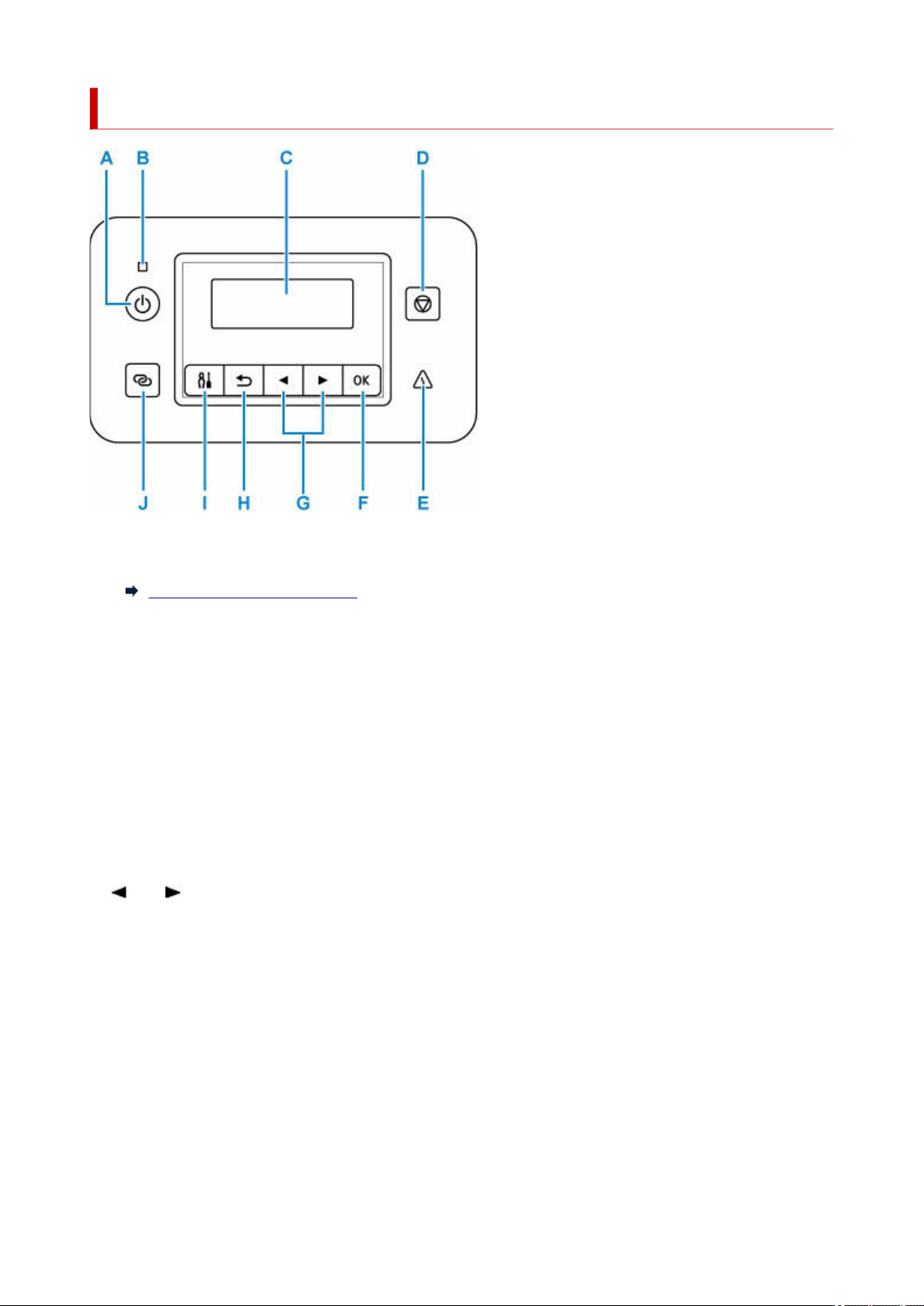
Operation Panel
A: ON button
Turns the power on or off.
Turning the Printer On and Off
B: ON lamp
Lights after flashing when the power is turned on.
C: LCD (Liquid Crystal Display)
Displays messages, menu items, and the operational status.
D: Stop button
Cancels operation when printing is in progress or when selecting a menu item.
E: Alarm lamp
Lights or flashes when an error occurs.
F: OK button
Finalizes your selection of items. Also used to resolve errors.
G: and buttons
Used to select a setting item. These buttons are also used for entering characters.
H: Back button
Returns the LCD to the previous screen.
I: Setup button
Displays the Setup menu screen. With this menu, you can perform printer maintenance and change
printer settings. Also used for selecting the input mode.
J: Wireless connect button
To set wireless router information in the printer directly from a smartphone or other such device (without
having to do any procedures at the router), hold down this button.
149

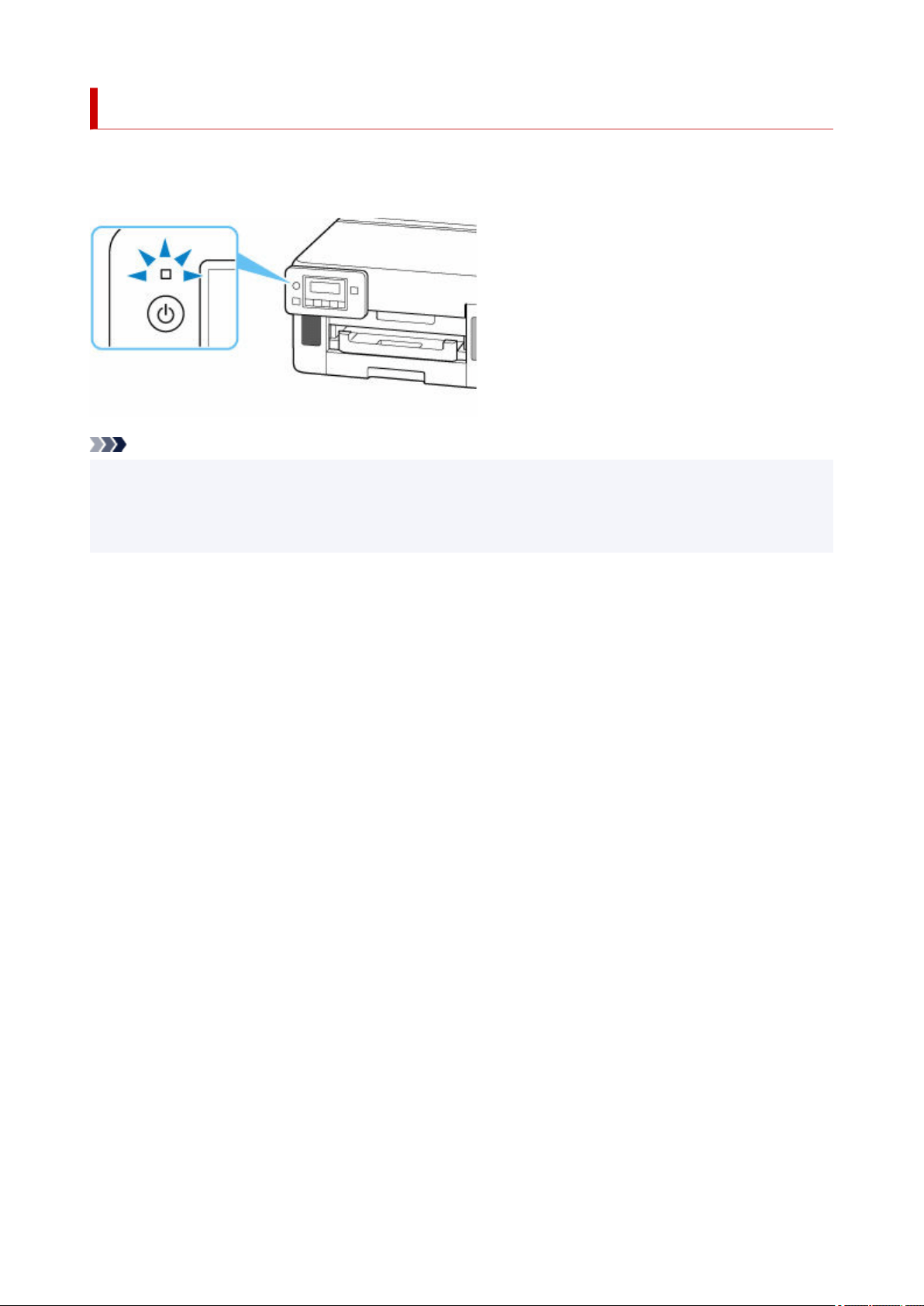
Checking that Power Is On
The ON lamp is lit when the printer is turned on.
Even if the LCD is off, if the ON lamp is lit, the printer is on.
Note
• It may take a while for the printer to start printing immediately after you turn on the printer.•
• The LCD will turn off if the printer is not operated for about 5 minutes. To restore the display, press any•
button or perform the print operation.
151
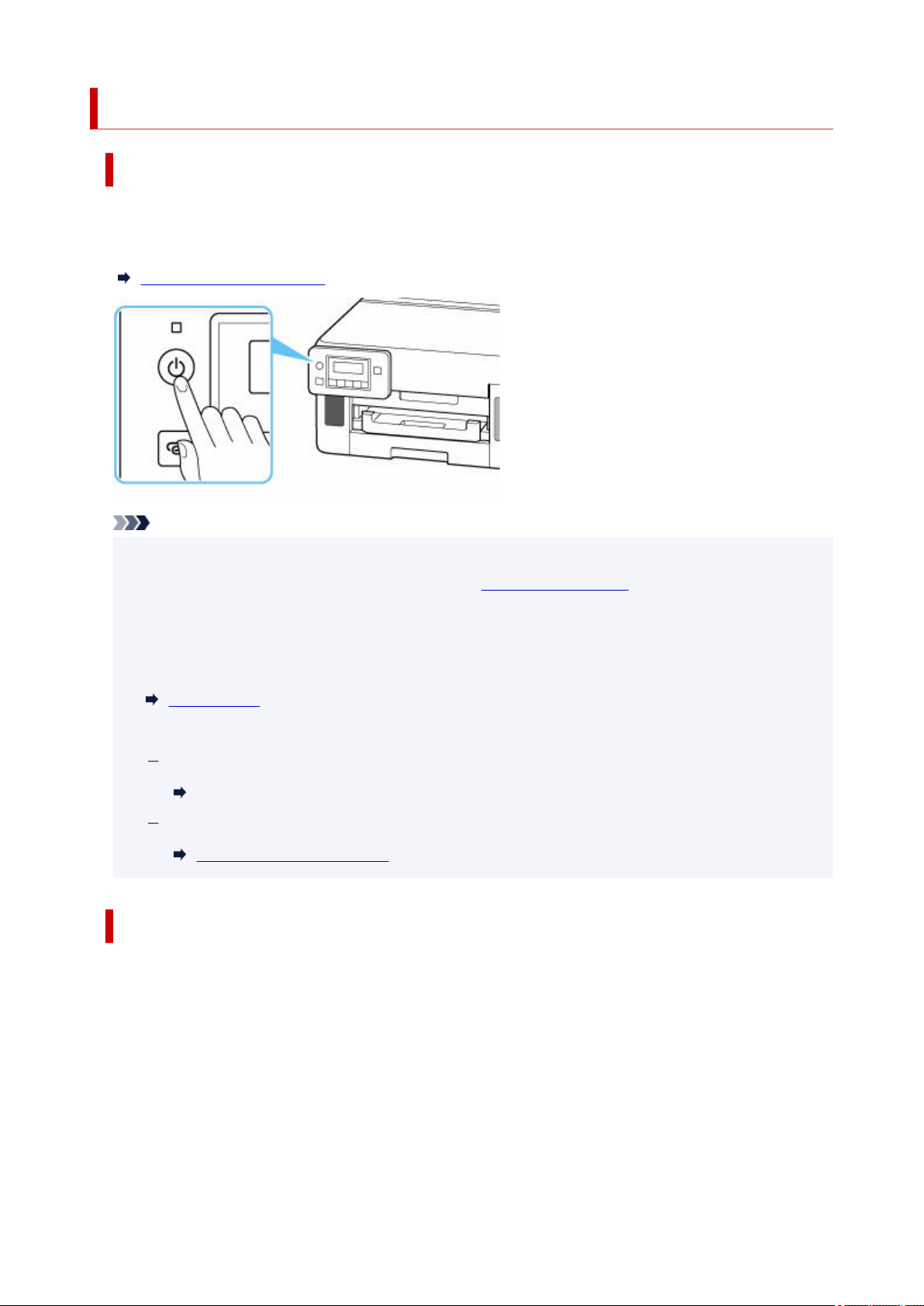
Turning the Printer On and Off
Turning on the printer
Press the ON button to turn on the printer.
The ON lamp flashes and then remains lit.
Checking that Power Is On
Note
• It may take a while for the printer to start printing immediately after you turn on the printer.•
• If an error message is displayed on the LCD, see When Error Occurred.•
• You can set the printer to automatically turn on when a print operation is performed from a computer•
connected by USB cable or via network. This feature is set to off by default.
From the printer
ECO settings
From the computer
For Windows:
Managing the Printer Power
For macOS:
Managing the Printer Power
Turning off the printer
Press the ON button to turn off the printer.
When the ON lamp stops flashing, the printer is turned off.
152
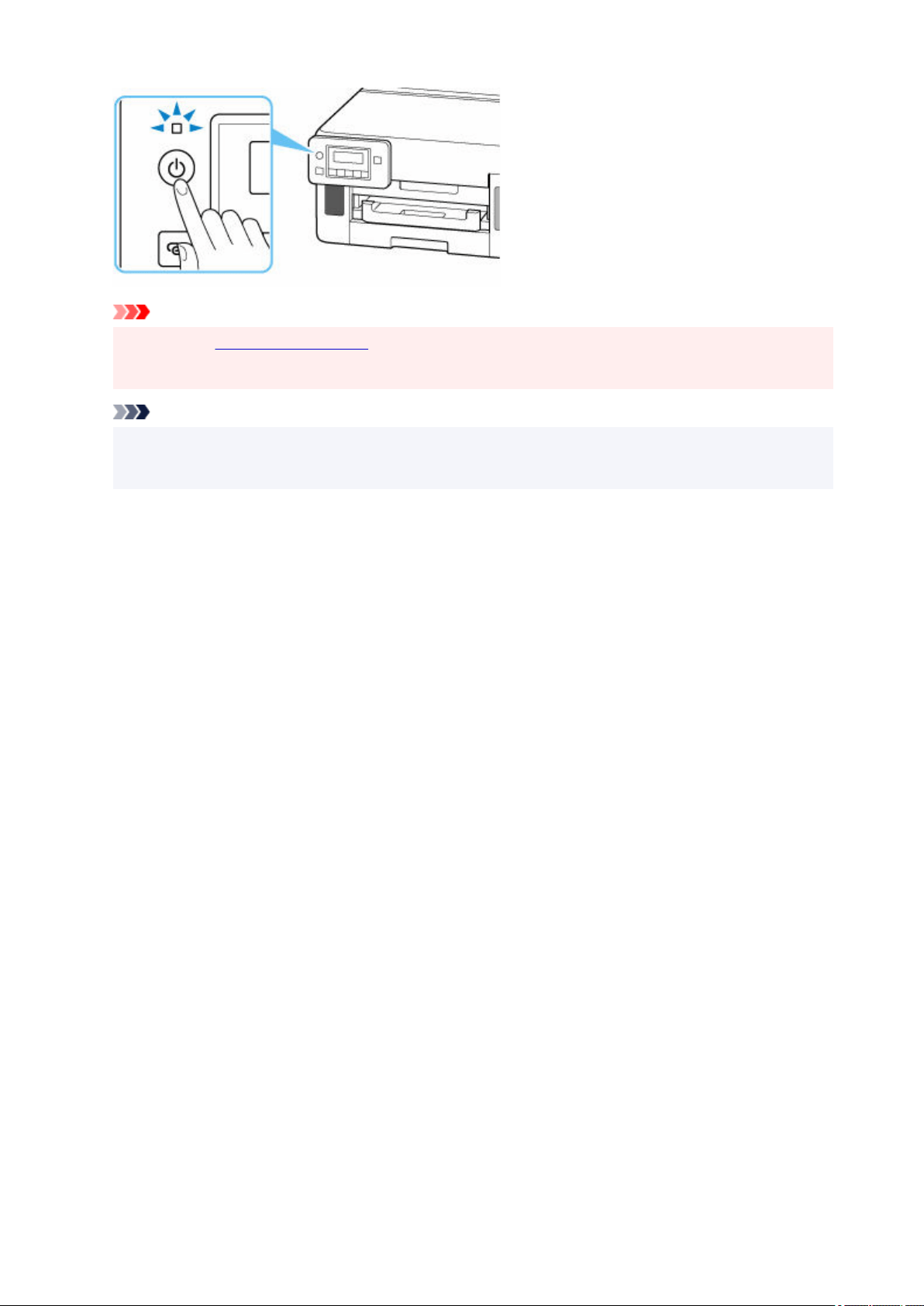
Important
• When you unplug the power cord after turning off the printer, be sure to confirm that the ON lamp is•
off.
Note
• You can set the printer to automatically turn off when no operations are performed or no print jobs•
are sent to the printer for a certain interval. This feature is set to on by default.
153

Checking the Power Plug/Power Cord
Unplug the power cord once a month to confirm that the power plug/power cord does not have anything
unusual described below.
• The power plug/power cord is hot.•
• The power plug/power cord is rusty.•
• The power plug/power cord is bent.•
• The power plug/power cord is worn.•
• The power plug/power cord is split.•
Caution
• If you find anything unusual with the power plug/power cord described above, unplug the power cord•
and call for service. Using the printer with one of the unusual conditions above may cause a fire or an
electric shock.
154
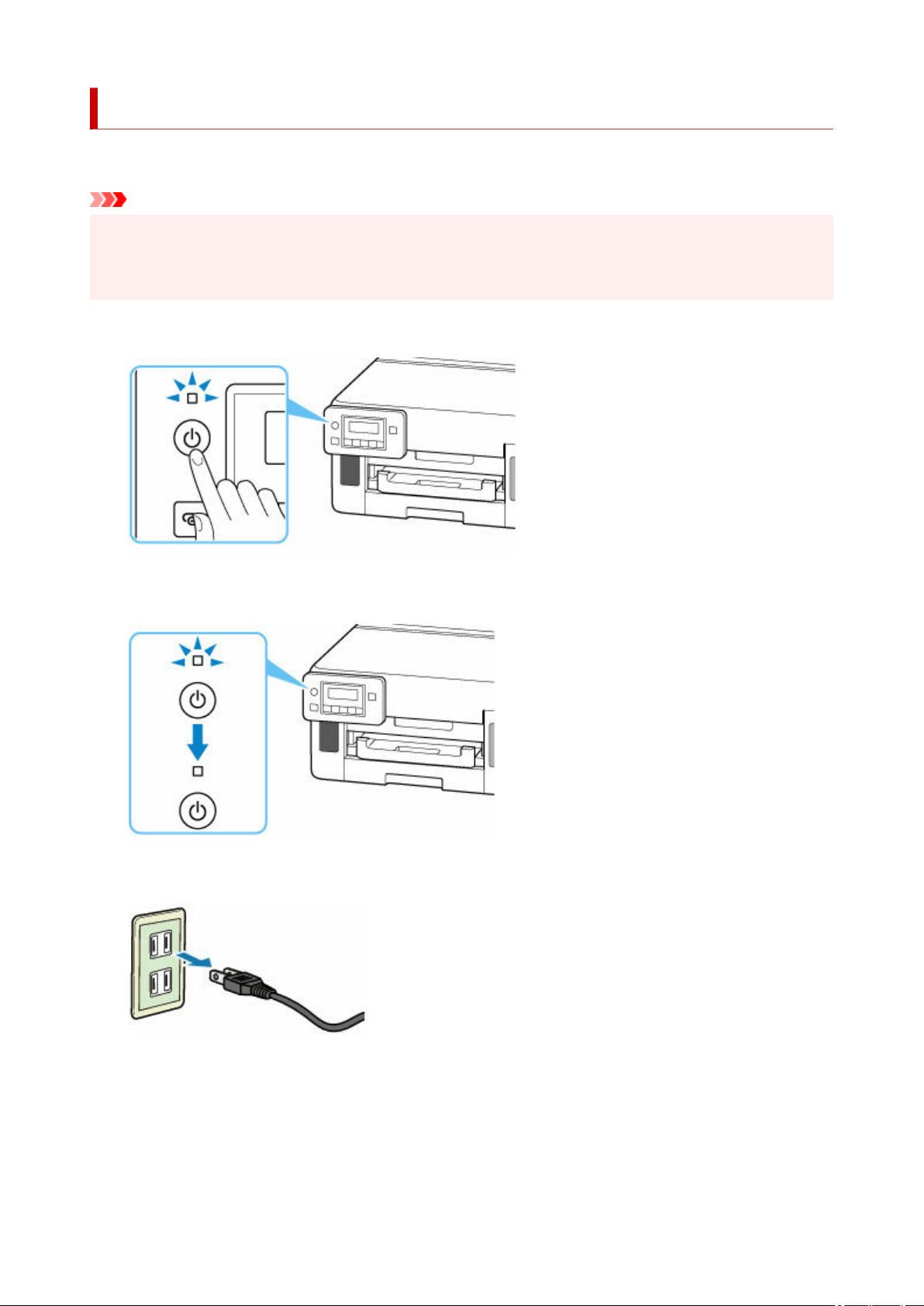
Unplugging the Printer
To unplug the power cord, follow the procedure below.
Important
• When you unplug the power cord, press the ON button, then confirm that the ON lamp is off.•
Unplugging the power cord while the ON lamp is lit or flashing may cause drying or clogging of the
print head and print quality may be reduced.
1.
Press the ON button to turn the printer off.
1.
2. Confirm that the ON lamp is off.2.
3.
Unplug the power cord.
3.
The specification of the power cord differs depending on the country or region of use.
155
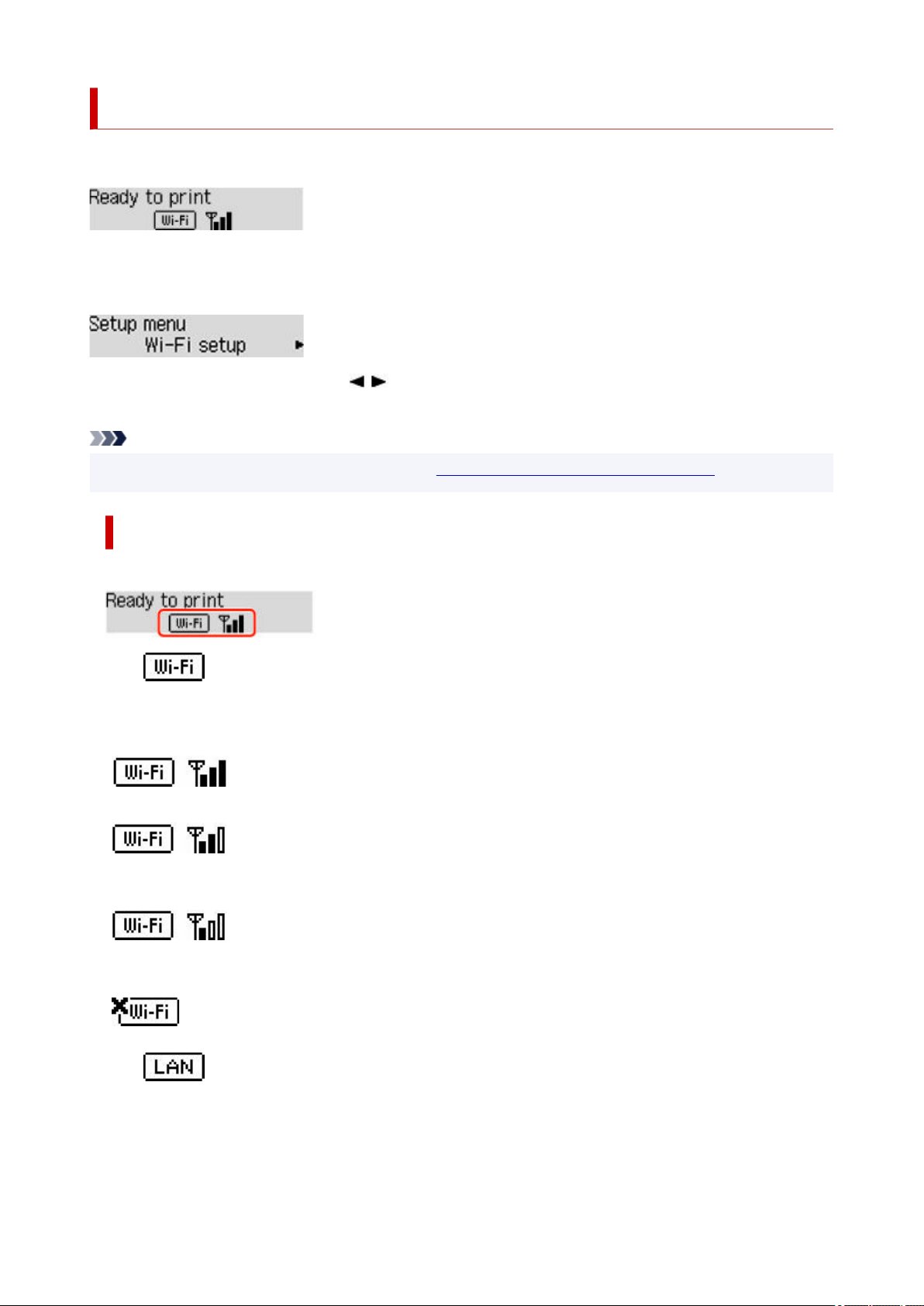
LCD and Operation Panel
The standby screen appears when the printer is turned on.
When the Setup button is pressed, the display switches to setup menu screen.
Setup
In a menu or settings screen, use the button to select an item or option, and then press the OK button
to proceed with the procedure.
Note
• For details on how to change settings, refer to Changing Settings from Operation Panel.•
Network Status Indication
Wi-Fi setting and the network status indicate by the icon in the standby screen.
If the icon appears on the standby screen, it indicates that Wi-Fi is enabled and the printer is
connected to the wireless router.
Depending on the signal state, the icon will change.
Signal strength: 81 % or more
You can use the printer over Wi-Fi without any problems.
Signal strength: 51 % or more
The problem such as the printer cannot print may occur according to the network status. We
recommend placing the printer near the wireless router.
Signal strength: 50 % or less
The problem such as the printer cannot print may occur. Place the printer near the wireless
router.
Wi-Fi is enabled but the printer is not connected to the wireless router.
If the icon appears on the LCD, it indicates that the wired LAN is enabled.
156

Note
• When Wi-Fi, wired LAN, or both are disabled, the icon, icon, or both are not•
displayed.
157
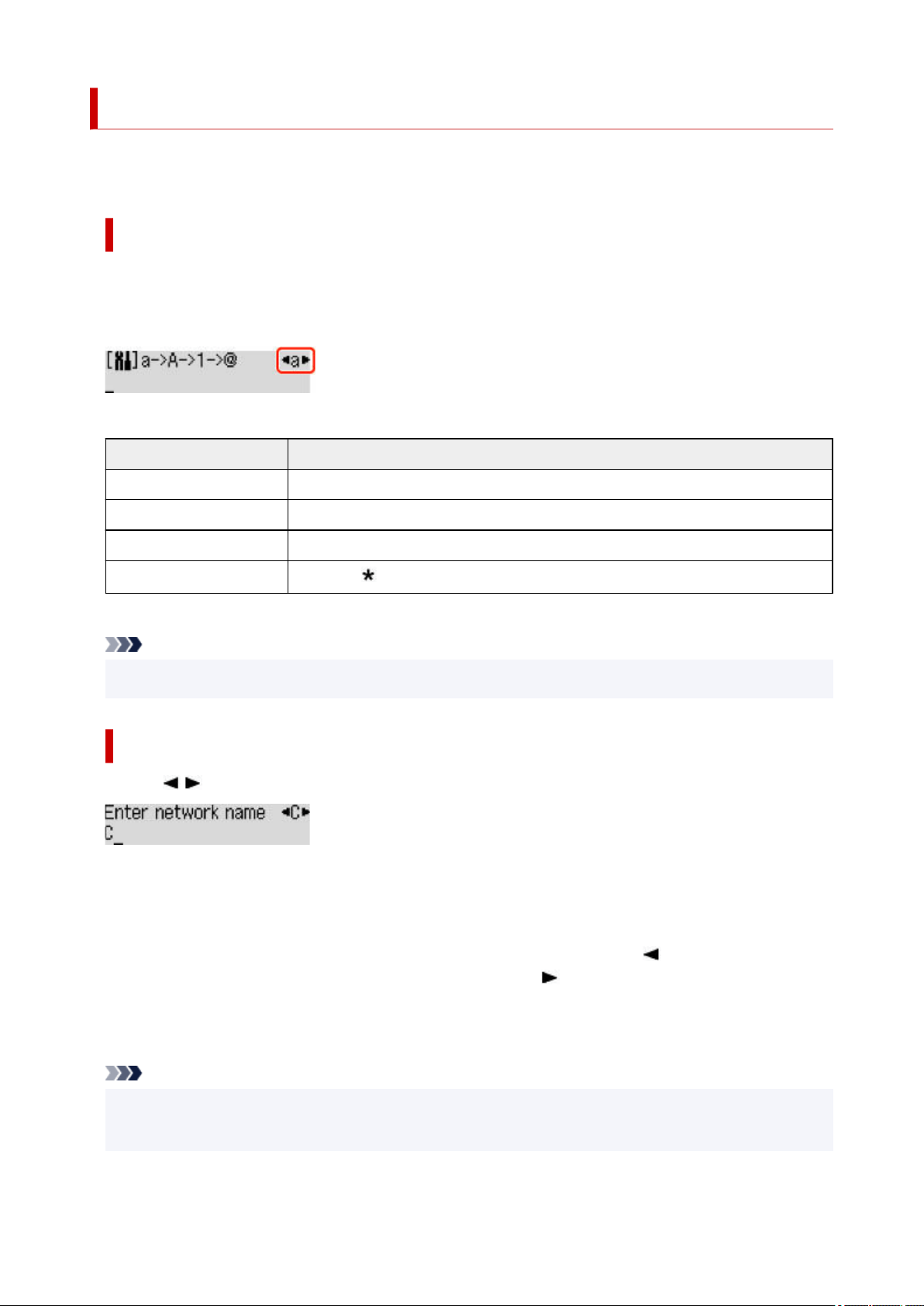
Entering Numbers, Letters, and Symbols
The buttons on the operation panel allow you to enter (or change) characters, numbers, or symbols when
setting up the network or making other settings.
Switching the Input Mode
The current input mode appears at the upper right corner of the LCD.
Pressing the Setup button on the operation panel toggles through the input modes in the order lowercase
> uppercase > numeric > symbols, showing the first available character.
The following shows available characters in each mode.
Mode Available characters
Lowercase abcdefghijklmnopqrstuvwxyzäöü SP
Uppercase ABCDEFGHIJKLMNOPQRSTUVWXYZÄÖÜ SP
Numeric 1234567890 SP
Symbols
. @ - _ SP # ! " , ; : ^ ` = / | ' ? $ % & + ( ) [ ] { } < > \
~
SP: Indicates a space.
Note
• Only the input modes or characters available for input appear in their respective screens.•
Entering Numbers, Letters, and Symbols
Use the button to select a character and press the OK button to input it.
When input of all characters is complete, hold down the OK button. When a confirmation message
appears, select Yes and press the OK button.
•
To insert a space
•
Switch to the lowercase, uppercase, or numeric mode, and then press the button once.
Alternatively switch to the symbol mode and then press the button four times.
•
To delete the last entered character
•
Press the Back button. You can only delete the last entered character.
Note
•
To terminate character entry, press the Stop button. When a confirmation message appears, select
•
Yes and press the OK button.
158



Managing the Printer Power
Printer power supply is operated from Remote UI.
Power control settings
Power control settings allow you to set Auto power off and Auto power on.
Auto power off is the function wherein the printer automatically turns itself off, when data is not sent or the
printer remains inactive for a certain period.
The Auto power on function automatically turns on the printer when data is received.
1.
Selecting Printer settings from Remote UI
1.
2.
Click Power control settings
2.
3.
Select Use auto power control, and then click OK
3.
4. Check the displayed message and click OK4.
5. Complete the following settings:5.
Auto power off
Specify the time from the list. Printer automatically turns itself off, when data is not sent within the
specified time or the printer has remained inactive.
Auto power on
When you check this check box, the printer automatically turns itself on when data is sent.
6. Apply the settings6.
Click OK.
The printer will operate with the changed settings hereafter.
161

Changing the Printer Operation Mode
If necessary, switch between various modes of printer operation.
1. Check whether the printer is on and select Printer settings from Remote UI1.
2.
If necessary, complete the following settings:
2.
Print settings - Prevent paper abrasion
The printer can increase the gap between the print head and the paper during high-density printing
to prevent paper abrasion.
Check this check box to prevent paper abrasion.
Custom settings - Detect paper setting mismatch
If the check box is deselected, at the time of printing from PC, you can continue to print without the
message display even if the paper settings set in the Print dialog differs from the paper information
registered to the printer.
Ink drying wait time
You can set the length of the printer rest time until printing of the next page begins. The wait time
becomes longer as the value set in the list increases, and shorter as the value decreases.
If the paper gets stained because the next page is ejected before the ink on the printed page dries,
increase the ink drying wait time.
3.
Apply the settings
3.
Click OK.
The printer operates with the modified settings hereafter.
162

Changing Settings from Operation Panel
Changing Settings from Operation Panel
Setting Items on Operation Panel
Print settings
LAN settings
Other dev. settings
Language selection
Firmware update
Admin pwd. settings
Reset setting
Feed settings
Ink level monitor
ECO settings
Quiet setting
System information
Checking the Total Number of Uses of Printer
163
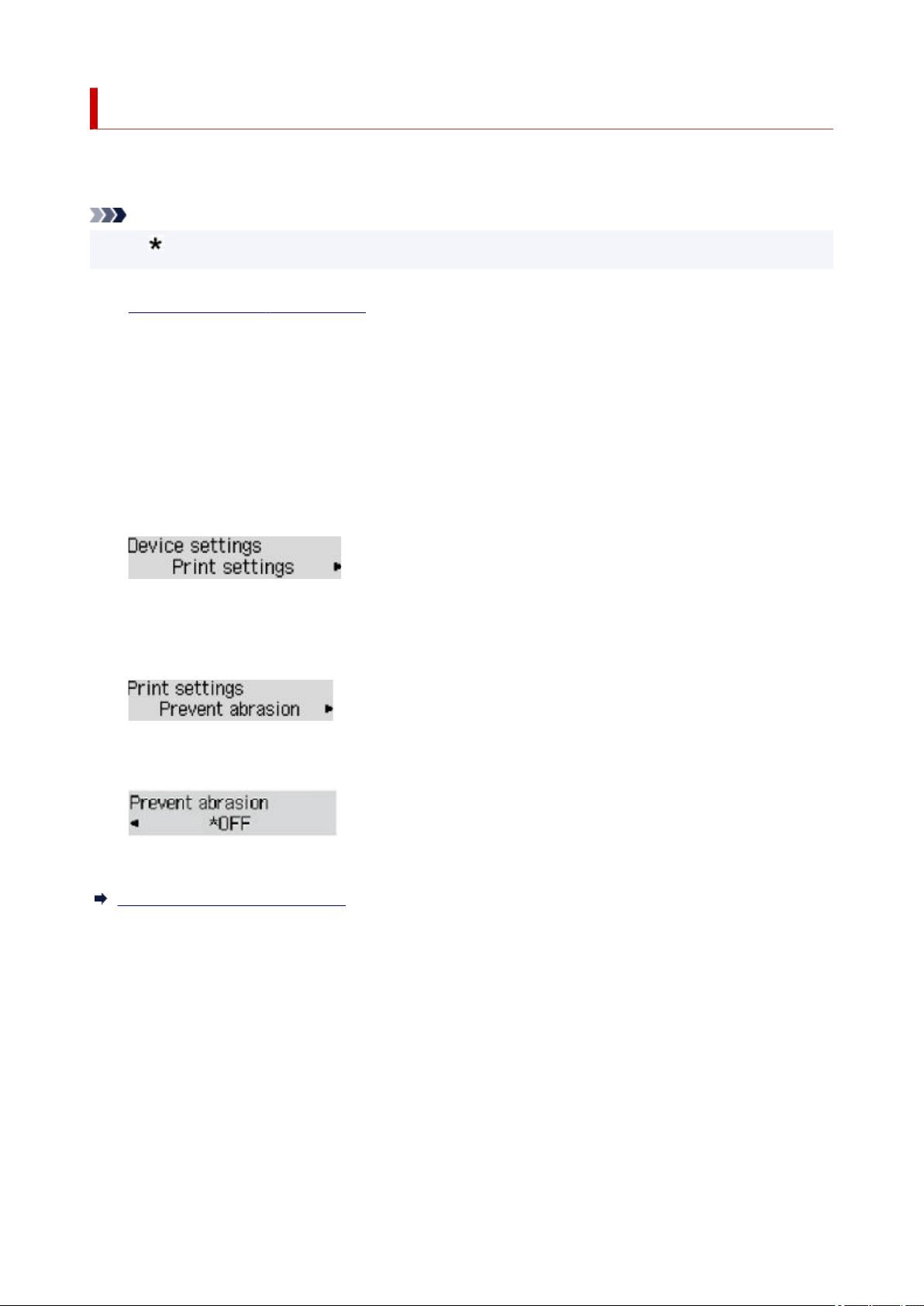
Changing Settings from Operation Panel
This section describes the procedure to change the settings, taking the steps to specify prevent abrasion as
an example.
Note
• The (asterisk) on the LCD indicates the current setting.•
1.
Check that printer is turned on.
1.
2.
Press the Setup button.
2.
The Setup menu screen is displayed.
3.
Select Device settings and then press the OK button.
3.
The Device settings screen is displayed.
4. Select a setting item to adjust and then press the OK button.4.
The setting screen for the selected item is displayed.
5.
Select a setting item and then press the OK button.
5.
6.
Select a setting to specify and then press the OK button.
6.
For more on setting items on the operation panel:
Setting Items on Operation Panel
164

Setting Items on Operation Panel
Note
• The administrator password may be required to change the settings of some setting items.•
Items for Printer
Other dev. settings
Language selection
ECO settings
Quiet setting
Items for Paper/Printing
Print settings
Feed settings
Items for Maintenance/Management
LAN settings
Firmware update
Admin pwd. settings
Reset setting
Ink level monitor
System information
Checking the Total Number of Uses of Printer
165

Print settings
Select this menu from Device settings in Setup menu.
• Prevent abrasion•
Use this setting only if the print surface becomes smudged.
Important
• Be sure to set this back to OFF after printing since it may result in lower printing speed or lower•
print quality.
• Paper print position•
Adjusts the print position when the left/right margins are not aligned.
You can adjust the left/right margins in increments of 0.004 in. (0.1 mm) between -0.12 in. (-3 mm) and
+0.12 in. (+3 mm) centered on the horizontal center of the paper.
Important
• When using A4/Letter sized paper, the amount of adjustment that can be made is limited. You•
cannot make adjustments greater than this limit.
• Plain paper target•
Select Text only or Text and photos for plain paper printing.
Note
• As print results, if you are conscious of unevenness or textures of granularity, select Text and•
photos.
166

LAN settings
Select this menu from Device settings in Setup menu.
Important
• The administrator password may be required to change the settings.•
Wi-Fi
Wireless Direct
Wired LAN
Print LAN details
Wi-Fi
• Wi-Fi enab./disable•
Enables or disables Wi-Fi.
• Wi-Fi setup•
Selects the setup method for Wi-Fi connection.
◦ Easy WL connect◦
Select if you specify the settings of the access point information to the printer directly from
a device (such as a smartphone) without operating the wireless router. Follow the on-screen
instructions of the connecting device for the setup procedure.
◦ Manual connect◦
Select when you perform settings for Wi-Fi manually using the operation panel of the printer.
◦ WPS (Push button)◦
Select when you perform settings for Wi-Fi using a wireless router supporting a Wi-Fi Protected
Setup (WPS) push button method. Follow the on-screen instructions during setup.
◦ Other setup◦
▪ Manual setup▪
Select when you perform settings for Wi-Fi manually.
▪
WPS (PIN code)
▪
Select when you perform settings for Wi-Fi using a wireless router supporting a Wi-Fi
Protected Setup (WPS) PIN code method. Follow the on-screen instructions during setup.
•
Manual setup
•
For details on each setting item:
Manual setup
167

Wireless Direct
• Switch WL Direct•
Enables/disables Wireless Direct.
• Change name (SSID)•
Changes the identifier (SSID/the printer's name displayed on a Wi-Fi Direct compatible device) for
Wireless Direct.
• Change password•
Changes the password for Wireless Direct.
• Confirm request•
Set whether the printer displays the confirmation screen when a Wi-Fi Direct compatible device is
connecting the printer.
• Manual setup•
For details on each setting item:
Manual setup
Wired LAN
• Enab./dis. wired LAN•
Enables or disables wired LAN.
• Manual setup•
For details on each setting item:
Manual setup
Print LAN details
You can print out the network settings of the printer such as its IP address and SSID.
For more information on the printer's network setting is printed out:
Printing Network Settings
Important
• The network settings printout contains important information about your network. Handle it with care.•
Manual setup
• Set printer name•
Specifies the printer name. You can use up to 15 characters for the name.
168

Note
• You cannot use the same printer name as that already used for other LAN connected devices.•
• You cannot use a hyphen for the initial or last character of the printer name.•
• TCP/IP settings•
Performs IPv4 or IPv6 setting.
• WSD setting•
Setting items when you use WSD (one of the network protocols supported in Windows).
◦ Enable/disable WSD◦
Selects whether WSD is enabled or disabled.
Note
• When this setting is enabled, the printer icon is displayed on the Network Explorer in•
Windows.
◦ Optimize WSD-In◦
Selecting Enable allows you to receive the WSD printing data faster.
◦ Timeout setting◦
Specifies the timeout length.
• Bonjour settings•
Setting items when you use Bonjour.
◦ Enab./disab. Bonjour◦
Selecting Enable allows you to use Bonjour to perform the network settings.
◦ Enter service name◦
Specifies the Bonjour service name. You can use up to 48 characters for the name.
Note
• You cannot use the same service name as that already used for other LAN connected•
devices.
• LPR setting•
Enables/disables the LPR setting.
• RAW protocol•
Enables/disables RAW printing.
• LLMNR•
Enables/disables LLMNR (Link-Local Multicast Name Resolution). Selecting Enable allows the printer
to detect printer's IP address from the printer name without a DNS server.
169

• IPP settings•
Selecting Enable allows you to print via the network with the IPP protocol.
• DRX setting•
Enables discontinuous reception (discontinuous data reception).
◦ Wi-Fi◦
Selecting Enable allows you to activate discontinuous reception when using Wi-Fi.
◦ Wired LAN◦
Selecting Enable allows you to activate discontinuous reception when the printer is connected
to a device compatible with wired LAN. Power consumption can be reduced by discontinuous
reception.
Note
• Depending on the router used, discontinuous reception may not be activated even though•
Enable is selected.
• Discontinuous reception is enabled only while the printer is on standby. (The LCD is in the screen•
saver mode.)
• IPsec settings•
Selecting Enable allows you to specify the IPsec settings.
• IEEE802.1X/EAP•
Setting item when you use IEEE802.1X/EAP (WPA/WPA2 Enterprise).
◦ Enable/disable◦
Enables/disables IEEE802.1X/EAP.
◦ EAP router search◦
Searches switch/access point of IEEE802.1X/EAP and display it.
◦ Latest auth. result◦
Displays the latest authentication result of IEEE802.1X/EAP setting.
170

Other dev. settings
Select this menu from Device settings in Setup menu.
Important
• The administrator password may be required to change the settings.•
• Date/time setting•
Sets the current date and time.
• Date display format•
Selects the date display format.
• DST setting•
Sets daylight saving time (summer time).
◦ Start date/time◦
Specifies the month/week/date/time of the start of daylight saving time (summer time).
◦ End date/time◦
Specifies the month/week/date/time of the end of daylight saving time (summer time).
• Time zone•
Specifies the time zone according to a country or region you live in.
Specifying the time zone to the printer allows you to display the correct time an e-mail was sent from the
main unit on your mail software.
• Sound control•
Selects the volume.
◦ Keypad volume◦
Selects the beep volume when pressing the buttons on the operation panel.
◦ Alarm volume◦
Selects the alarm volume.
• Key repeat•
Selecting ON lets you quickly display candidate numbers or characters by holding down the button
during character entry.
• Force ink selection•
You can specify the ink to use.
◦ All ink tanks◦
Use both color ink and black ink.
◦ Black only◦
Use only black ink.
171

Note
• When any of the inks reached the lower limit line, printing is disabled.•
• Fixed print quality•
Specifies print quality when printing on plain paper.
• Scrn. lock settings•
Lock the screen to prevent the panel operation by someone other than the administrator.
• Job history•
◦ Print job history◦
Prints the print job history.
◦ Restrict job history◦
This is the menu for the developer.
172

Language selection
Select this menu from Device settings in Setup menu.
Changes the language for LCD messages and menus.
Important
• The administrator password may be required to change the settings.•
Japanese / English / German / French / Italian / Spanish / Portuguese / Dutch / Danish / Norwegian /
Swedish / Finnish / Russian / Ukrainian / Polish / Czech / Slovene / Hungarian / Slovak / Croatian /
Romanian / Bulgarian / Turkish / Greek / Estonian / Latvian / Lithuanian / Simplified Chinese / Korean /
Traditional Chinese / Indonesian / Vietnamese
173

Firmware update
Select this menu from Device settings in Setup menu.
You can update the firmware of the printer, check the firmware version, or perform settings of a notification
screen, a DNS server and a proxy server.
Important
• The administrator password may be required to change the settings.•
• When you use this function, make sure the printer is connected to the internet.•
• Install update•
Performs the firmware update of the printer. Follow the on-screen instructions to perform update.
• Current version•
You can check the current firmware version.
• Update notification•
You can set the printer to display the firmware update information on the LCD when the firmware update
is available.
When Idle/Power off is selected, the printer informs you of the update during idle and the update
information also appears when you press the ON button.
• Auto update setting•
Select ON to automatically update the firmware to the latest version.
• DNS server setup•
Performs settings for a DNS server. Select Auto setup or Manual setup. If you select Manual setup,
follow the display on the LCD to perform settings.
• Proxy server setup•
Performs settings for a proxy server. Select Use or Do not use. If you select Use, follow the display on
the LCD to perform settings.
174

Admin pwd. settings
The administrator password can be set or canceled.
Important
• The administrator password of the printer is set by default. It is set in the serial number of the printer•
which consists of 9 characters (the first 4 characters are alphabet and the latter 5 characters are
number) and is indicated on the seal on the device.
• The administrator password may be required to change the settings.•
1.
Check that printer is turned on.
1.
2.
Press the Setup button.
2.
The Setup menu screen is displayed.
3.
Select Device settings and then press the OK button.
3.
4. Select Admin pwd. settings and then press the OK button.4.
5. Enter the administrator password.5.
When the administrator password is not set, proceed to step 7.
6. Select Change admin pwd. and then press the OK button.6.
When you do not set the administrator password, select Remove admin pwd.. Select Yes in the
displayed screen.
7. Select the effective range of the administrator password.7.
Remote UI and tools
To change the setting using the remote UI or a certain software, the administrator password needs
to be entered.
LCD, RMT UI, tools
To change the setting using the operation panel of this printer, remote UI or a certain software, the
administrator password needs to be entered.
8.
Enter the administrator password.
8.
Important
•
When changing the password, the character is limited as follows.
•
Set the password using 4 to 32 characters.
Only alphanumeric characters are available.
From a security point of view, it is recommended to set the password of 8 characters or more
in combination of alphanumeric characters.
175

9. Press the OK button.9.
10. Enter the administrator password again.10.
The administrator password is available.
176

Reset setting
Select this menu from Device settings in Setup menu.
You can set the settings back to the default.
Important
• The administrator password may be required to change the settings.•
• Web service setup•
Sets the Web service settings back to the default.
• LAN settings•
Sets the LAN settings back to the default.
• Setting data•
Sets the settings such as the paper size or media type back to the default.
• All data•
Sets all settings you made to the printer back to the default. The administrator password specified by
Remote UI or IJ Network Device Setup Utility reverts to the default setting.
Note
• You cannot set the following setting items back to the default:•
The language displayed on the LCD
The current position of the print head
The cumulative usage count of this product registered in Print usage stats.
CSR (Certificate Signing Request) for encryption method (SSL/TLS) setting
177

Feed settings
Select this menu from Setup menu.
Note
• By registering the paper size and the media type, the message can be displayed before printing starts•
when the paper size or the media type of the loaded paper differs from the paper settings.
For details:
Paper Settings
• Save paper info•
Registers the paper size and the media type you load on the rear tray and in the cassette.
• Det. paper mismatch•
If you select ON, the printer detects whether the paper size and the media type are identical with those
registered in Save paper info. If printing starts with the settings that do not match, an error message is
displayed on the LCD.
• Check paper on load•
If you select ON, the printer detects the paper replacement. When the paper information registration
screen is displayed after replacing paper, register the paper size and the media type.
178

Ink level monitor
Select this menu from Setup menu.
Important
• The administrator password may be required to change the settings.•
• Reset ink lev. count•
Resets the remaining ink count.
If you select Yes, you can reset the remaining ink count of all the ink tanks at once.
If you select No, you can specify the ink color and reset the remaining ink count in any ink tank.
Important
• After refilling the ink to the upper limit line of the ink tank, reset the remaining ink count.•
If the remaining ink count is reset when the ink tank is not full, the remaining ink level cannot be
detected properly.
179

ECO settings
This setting allows you to turn on/off the printer automatically to save electricity.
Important
• The administrator password may be required to change the settings.•
Turning off Printer Automatically
Turning on Printer Automatically
Turning off Printer Automatically
You can enable the printer to turn off automatically when no operation is made or no printing data is sent
to the printer for a specified period of time.
1.
Check that printer is turned on.
1.
2.
Press the Setup button.
2.
The Setup menu screen is displayed.
3. Select ECO settings and then press the OK button.3.
4. Select EnergySaveSettings and then press the OK button.4.
5. Select Auto power off and then press the OK button.5.
6.
Select a time to turn off the printer and then press the OK button.
6.
Turning on Printer Automatically
You can enable the printer to turn on automatically when printing data is sent to the printer.
1.
Check that printer is turned on.
1.
2.
Press the Setup button.
2.
The Setup menu screen is displayed.
3.
Select ECO settings and then press the OK button.
3.
4.
Select EnergySaveSettings and then press the OK button.
4.
5.
Select Auto power on and then press the OK button.
5.
180

6. Select ON and then press the OK button.6.
181

Quiet setting
Enables this function on the printer if you want to reduce the operating noise, such as when printing at night.
Important
• The administrator password may be required to change the settings.•
Follow the procedure below to perform setting.
1.
Check that printer is turned on.
1.
2.
Press the Setup button.
2.
The Setup menu screen is displayed.
3.
Select Quiet mode and then press the OK button.
3.
4.
Select ON or Specify hrs of use and press OK button.
4.
If you select Specify hrs of use, specify start time and end time.
Important
• Operating speed may be reduced compared to when OFF is selected.•
•
This function may not be so effective depending on the printer's setting. Furthermore, certain
•
noise, such as when the printer is preparing for printing, is not reduced.
182

System information
Select this menu from Setup menu.
• Current version•
Displays the current firmware version.
• Printer name•
Displays the printer name currently specified.
• Serial number•
Displays the printer serial number.
183

Checking the Total Number of Uses of Printer
The total number of uses of printer can be printed and checked.
1. Check that printer is turned on.1.
2.
Load A4 or Letter-sized plain paper.
2.
3.
Press the Setup button.
3.
The Setup menu screen is displayed.
4.
Select Print usage stats and then press the OK button.
4.
The total number of uses of printer is printed.
184

Specifications
General Specifications
Interface USB Port:
Hi-Speed USB *
Network Port:
Wired LAN: 100BASE-TX / 10BASE-T
Wi-Fi: IEEE802.11n / IEEE802.11g / IEEE802.11b / IEEE802.11a
* A computer that complies with Hi-Speed USB standard is required. Since the
Hi-Speed USB interface is fully upwardly compatible with USB 1.1, it can be
used at USB 1.1.
USB and the network can be used at the same time.
Wi-Fi and wired LAN cannot be used at the same time.
Operating environment Temperature: 41 to 95 °F (5 to 35 °C)
Humidity: 10 to 90 % RH (no condensation)
* The performance of the printer may be reduced under certain temperature
and humidity conditions.
Recommended conditions:
Temperature: 59 to 86 °F (15 to 30 °C)
Humidity: 10 to 80 % RH (no condensation)
* For the temperature and humidity conditions of papers such as photo paper,
refer to the paper's packaging or the supplied instructions.
Storage environment Temperature: 32 to 104 °F (0 to 40 °C)
Humidity: 5 to 95 % RH (no condensation)
Power supply AC 100-240 V, 50/60 Hz
(The supplied power cord is only for the country or region you purchased.)
Power consumption Printing: 20 W or less *1
Standby (minimum): 0.8 W or less *1*2
Standby (all ports connected): 1.4 W or less
OFF: 0.2 W or less
*1 USB connection to a PC
*2 The wait time for standby cannot be changed.
External dimensions (W x D x H) Approx. 15.8 x 16.4 x 9.4 in. (Approx. 399 x 416 x 238 mm)
* With the Cassette and trays retracted.
Weight Approx. 19.8 lb (Approx. 9.0 kg)
* With the Print Head installed.
185

Network Specifications
Communication protocol SNMP, HTTP, TCP/IP (IPv4/IPv6)
Wired LAN Supported Standards: IEEE802.3u (100BASE-TX) / IEEE802.3 (10BASE-T)
Transfer speed: 10 Mbps/100 Mbps (auto switching)
Security: IEEE802.1X (EAP-TLS/EAP-TTLS/PEAP)
Wi-Fi Supported Standards: IEEE802.11n / IEEE802.11g / IEEE802.11b /
IEEE802.11a
Frequency bandwidth: 2.4 GHz / 5 GHz
Channel:
2.4 GHz: 1-11 or 1-13
5 GHz: W52, W53, W56, W58
* Wireless Direct cannot be used in the 5GHz band.
* Frequency bandwidth and available channels differ depending on country or
region.
Communication distance: Indoors 164 feet/50 m
* Effective range varies depending on the installation environment and location.
Security:
WPA-PSK (TKIP/AES)
WPA2-PSK (TKIP/AES)
WPA-EAP (AES) *
WPA2-EAP (AES) *
* Compatible with IEEE802.1X (EAP-TLS/EAP-TTLS/PEAP)
Setup:
WPS (Push button configuration/PIN code method)
Easy wireless connect
Minimum System Requirements
Conform to the operating system's requirements when higher than those given here.
Windows
Operating System Windows 10, Windows 8.1, Windows 7 SP1
Note: Operation can only be guaranteed on a PC with pre-installed operating
system.
Printer driver and IJ Printer Assistant Tool support the following OS:
Windows Server 2008 R2 SP1, Windows Server 2012 R2, Windows Server
2016 and Windows Server 2019.
Amount of hard disk space re-
quired for installing the driver
1.5 GB or more
The necessary amount of hard disk space may be changed without notice.
186

macOS
Operating System macOS High Sierra 10.13.6 - macOS Big Sur 11
Other Supported OS
iOS, iPadOS, Android, Chrome OS
Some functions may not be available with the supported OS.
Refer to the Canon web site for details.
Information in this manual is subject to change without notice.
187


Supported Media Types
For best results, choose paper designed for how you are printing. A variety of paper for documents as well
as photos or illustrations is available from Canon. Use genuine Canon paper to print important photos, when
possible.
Media Types
Page Sizes
Paper Weight
Media Types
Genuine Canon paper
Note
• For warnings on use of the non-printable side, see each product's usage information.•
• Page sizes and media types differ depending on the country or region where the paper is sold. For•
details on page sizes and media types, access the Canon website.
• Genuine Canon paper is not available in some countries or regions. Note that in the United States,•
Canon paper is not sold by model number. Instead, purchase paper by name.
Paper for printing documents:
• Canon Red Label Superior <WOP111>•
• Canon Océ Office Colour Paper <SAT213>•
• High Resolution Paper <HR-101N>•
Paper for printing photos:
• Glossy Photo Paper "Everyday Use" <GP-501/GP-508>•
• Photo Paper Glossy <GP-701>•
• Photo Paper Plus Glossy II <PP-201/PP-208/PP-301>•
• Photo Paper Pro Luster <LU-101>•
• Photo Paper Plus Semi-gloss <SG-201>•
• Matte Photo Paper <MP-101>•
Paper for making original goods:
• Photo Stickers (16 stickers per sheet) <PS-108>•
• Photo Stickers (Free Cutting) <PS-208>•
• Photo Stickers (Variety Pack) <PS-808>•
• Restickable Photo Paper <RP-101>•
• Removable Photo Stickers <PS-308R>•
• Magnetic Photo Paper <MG-101/PS-508>•
• Light Fabric Iron-on Transfers <LF-101>•
189

• Double sided Matte Paper <MP-101D>•
Paper other than genuine Canon paper
• Plain Paper (including recycled paper)•
• Envelopes•
Paper Load Limit
Paper Settings on the Printer Driver and the Printer (Media Type) (Windows)
Page Sizes
You can use the following page sizes.
Note
• Page sizes and media types the printer supports differ depending on the OS you are using.•
Standard sizes:
• Letter•
• Legal•
• Executive•
• A6•
• A5•
• A4•
• B5•
• B-Oficio•
• M-Oficio•
• Foolscap•
• Legal(India)•
• KG/4"x6"(10x15)•
• 5"x7"(13x18cm)•
• 7"x10"(18x25cm)•
• 8"x10"(20x25cm)•
• L(89x127mm)•
• 2L(127x178mm)•
• Square 5"•
• Hagaki•
• Hagaki 2•
• Envelope Com 10•
• Envelope DL•
190

• Nagagata 3•
• Nagagata 4•
• Yougata 4•
• Yougata 6•
• Envelope C5•
• Envelope Monarch•
Special sizes
• Minimum size: 3.50 x 5.00 in. (89.0 x 127.0 mm)•
• Maximum size: 8.50 x 47.24 in. (216.0 x 1200.0 mm) *•
* When Height of Page Size is set to a value exceeding 26.61 in. (676 mm), Media Type is set to Plain
Paper.
Paper Weight
You can use paper in the following weight range.
• Plain paper: From 17 to 28 lb (64 to 105 g /m
2
)•
191
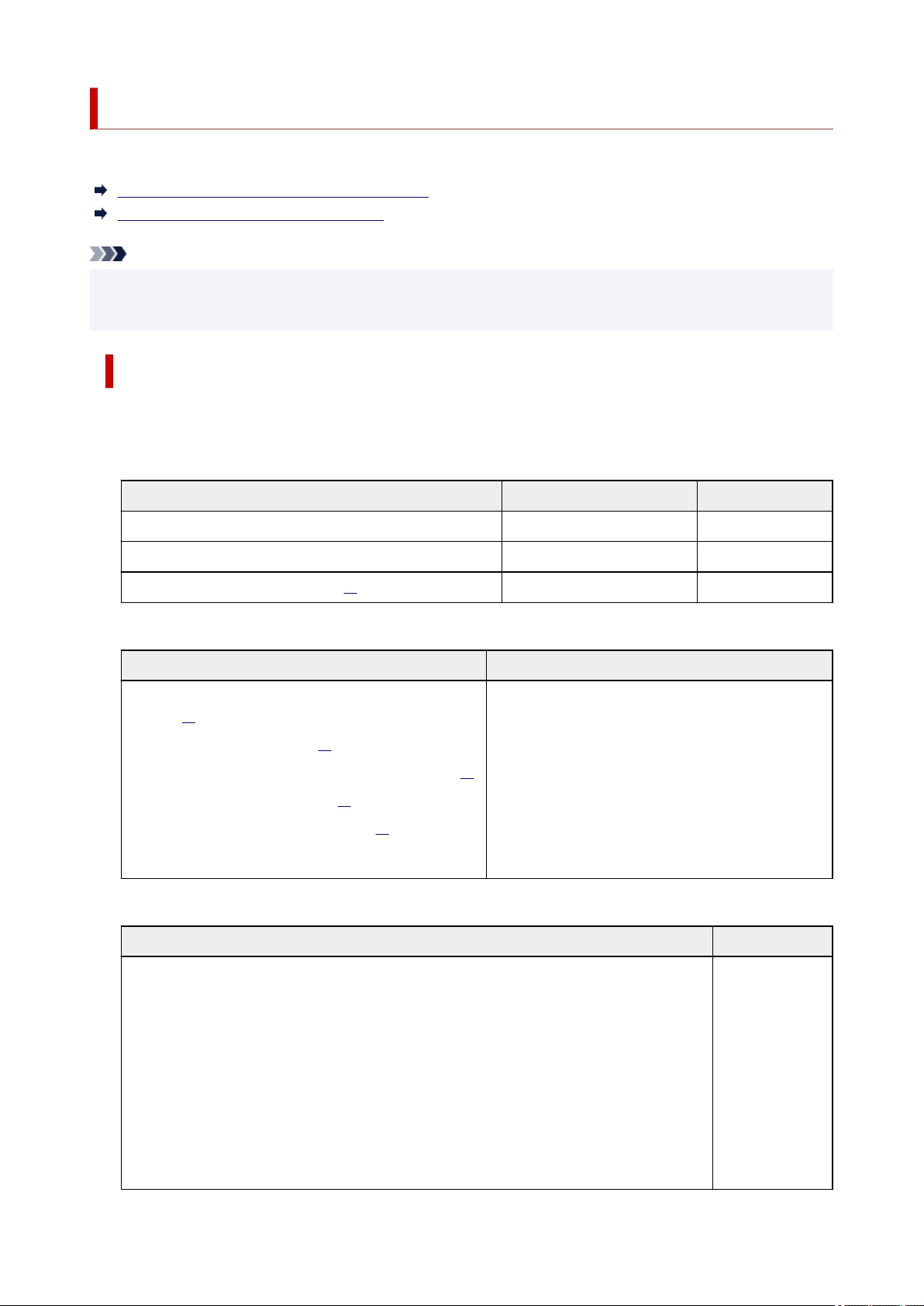
Paper Load Limit
This section shows the paper load limits of the rear tray, the cassette, and the paper output tray.
Paper Load Limits of Rear Tray and Cassette
Paper Load Limit of Paper Output Tray
Note
• Page sizes and media types differ depending on the country or region where the paper is sold. For•
details on page sizes and media types, access the Canon website.
Paper Load Limits of Rear Tray and Cassette
Genuine Canon Paper
Paper for printing documents:
Media Name <Model No.> Rear Tray Cassette
Canon Red Label Superior <WOP111> Approx. 100 sheets Approx. 250 sheets
Canon Océ Office Colour Paper <SAT213> Approx. 80 sheets Approx. 200 sheets
High Resolution Paper <HR-101N>*1 Approx. 80 sheets N/A
Paper for printing photos:
Media Name <Model No.> Rear Tray
Glossy Photo Paper "Everyday Use" <GP-501/
GP-508>*2
Photo Paper Glossy <GP-701>*2
Photo Paper Plus Glossy II <PP-201/PP-208/PP-301>*2
Photo Paper Pro Luster <LU-101>*2
Photo Paper Plus Semi-gloss <SG-201>*2
Matte Photo Paper <MP-101>
A4, Letter, 5"x7"(13x18cm), 8"x10"(20x25cm),
2L(127x178mm): 10 sheets
KG/4"x6"(10x15), L(89x127mm), Square 5", Hagaki:
20 sheets
Paper for making original goods:
Media Name <Model No.> Rear Tray
Photo Stickers (16 stickers per sheet) <PS-108>
Photo Stickers (Free Cutting) <PS-208>
Photo Stickers (Variety Pack) <PS-808>
Restickable Photo Paper <RP-101>
Removable Photo Stickers <PS-308R>
Magnetic Photo Paper <MG-101/PS-508>
Light Fabric Iron-on Transfers <LF-101>
Double sided Matte Paper <MP-101D>
1 sheet
192
Paper other than Genuine Canon Paper
Common Name Rear Tray Cassette
Plain Paper (including recycled paper)*1 Approx. 100 sheets (Legal,
B-Oficio, M-Oficio, Foolscap,
Legal(India): 10 sheets)
Approx. 250 sheets
Envelopes 10 envelopes N/A
*1 Normal feeding at maximum capacity may not be possible with some types of paper, or under very high
or low temperature or humidity. In this case, load half the amount of paper or less.
*2 Feeding from a loaded stack of paper may leave marks on the printed side or prevent efficient feeding.
In this case, load one sheet at a time.
Paper Load Limit of Paper Output Tray
Genuine Canon Paper
Paper for printing documents:
Media Name <Model No.> Paper Output Tray
Canon Red Label Superior <WOP111>
Canon Océ Office Colour Paper <SAT213>
Approx. 75 sheets
High Resolution Paper <HR-101N> Approx. 65 sheets
Paper other than Genuine Canon Paper
Common Name Paper Output Tray
Plain Paper (including recycled paper) Approx. 75 sheets (Legal: 10 sheets)
When continuing printing with paper other than the above, we recommend removing already printed paper
from the paper output tray to avoid smearing or discoloration.
193

Unsupported Media Types
Do not use the following types of paper. Using such paper will cause not only unsatisfactory results, but also
the printer to jam or malfunction.
• Folded, curled, or wrinkled paper•
• Damp paper•
• Paper thinner than a postcard, including plain paper or notepad paper cut to a small size (when printing•
on paper smaller than A5)
• Picture postcards•
• Postcards affixed with photos or stickers•
• Envelopes with a double flap•
• Envelopes with an embossed or treated surface•
• Envelopes whose gummed flaps are already moistened and adhesive•
• Any type of paper with holes•
• Paper that is not rectangular•
• Paper bound with staples or glue•
• Paper with an adhesive surface on the back such as label seal•
• Paper decorated with glitter, etc.•
194

Handling Paper
• Be careful not to rub or scratch the surfaces of any types of paper when handling.•
• Hold the paper as closely as possible to its edges and try not to touch the printing surface. The print•
quality may be degraded if the printing surface is smudged with sweat or oil that comes from your
hands.
• Do not touch the printed surface until the ink is dried. Even when the ink is dried, be careful not to touch•
the printed surface as much as possible when handling. Due to the nature of the pigment ink, the ink on
the printed surface may be removed when being rubbed or scratched.
• Take out only the necessary number of paper from the package, just before printing.•
• To avoid curling, when you do not print, put unused paper back into the package and keep it on a level•
surface. And also, store it avoiding heat, humidity, and direct sunlight.
195

Economy Mode
By setting Print Quality to Economy, the consumption of ink can be reduced. More printing is available
compared with when Print Quality is set to Standard.
• Number of printable sheets (A4 plain paper)•
Number of printable sheets per pigment black ink bottle
Standard mode: 6,000 sheets
Economy mode: 9,000 sheets
Number of printable sheets per pigment color ink bottle
Standard mode: 14,000 sheets
Economy mode: 21,000 sheets
• Measurement conditions•
◦ Measurement images:◦
Color printing: A4 color document ISO/IEC24712
◦ Measurement method:◦
Canon original
◦ Paper type:◦
Plain paper
◦ Print driver setting:◦
Setting to the default for plain paper (setting Print Quality to Economy).
*The number of printable sheets is calculated based on the ink bottle filled from the second time on, instead
of the ink bottle filled when the printer is used for the first time.
196
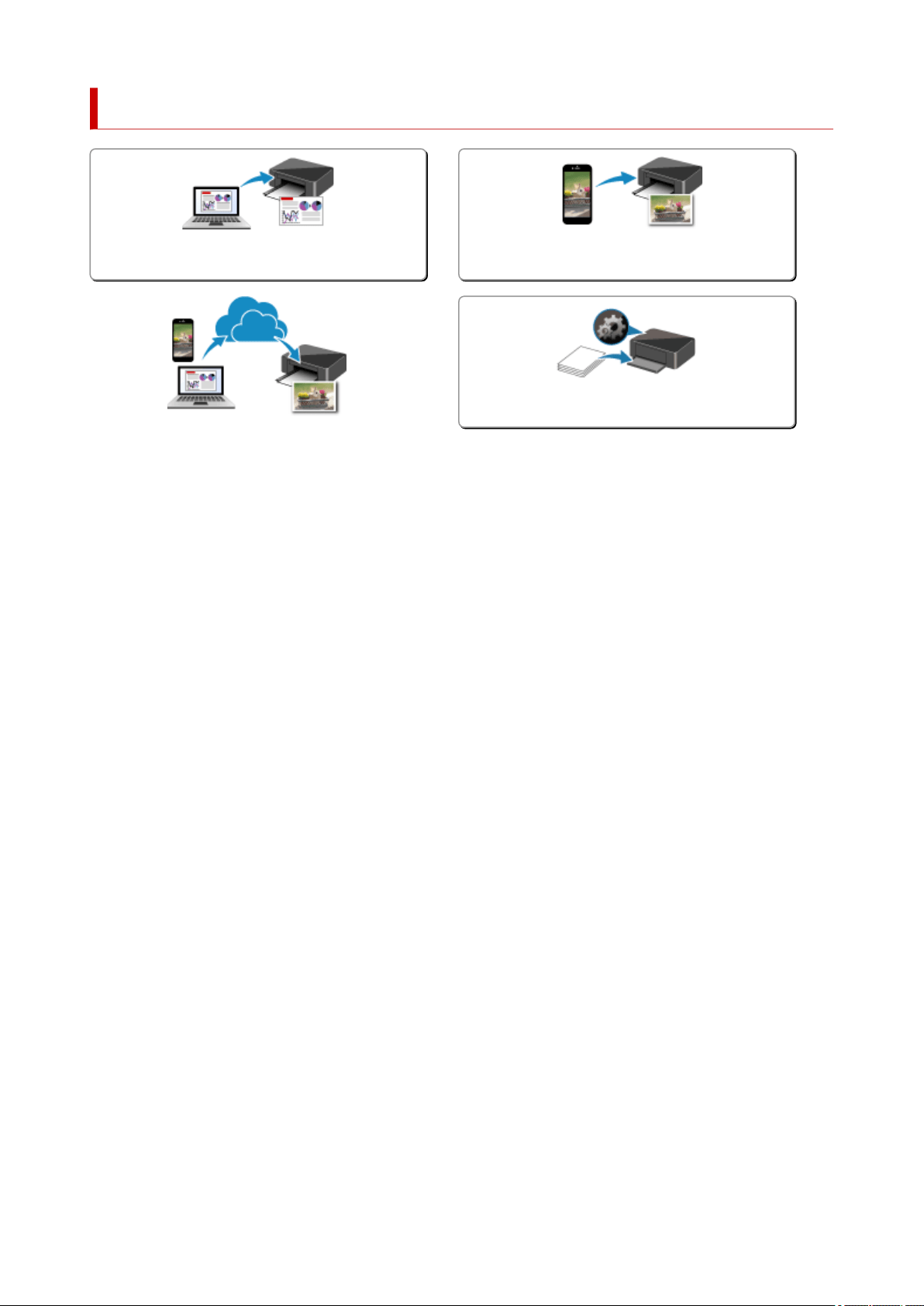



Printing
This printer is compatible with the macOS standard printing system (AirPrint).
You can start printing right away after connecting this printer to your Mac without installing any special
software.
Checking Your Environment
First, check your environment.
• AirPrint Operation Environment•
Mac running the latest version of OS
• Requirement•
The Mac and the printer must be connected by one of the following methods:
◦ Connected to the same network over a LAN
◦ Connected directly without wireless router (Direct Connection)
◦ Connected by USB
Print from a Mac
1. Check that printer is turned on1.
Note
• If Auto power on is enabled, printer automatically turns itself on when receiving a print job.
2. Load paper in printer2.
3. Select paper size and paper type from printer3.
Register the set paper size and paper type on the printer operation panel.
For instructions, see "
Paper Settings."
4. Start printing from your application software4.
The Print dialog opens.
5.
Select printer
5.
Select your model from the Printer list in the Print dialog.
200
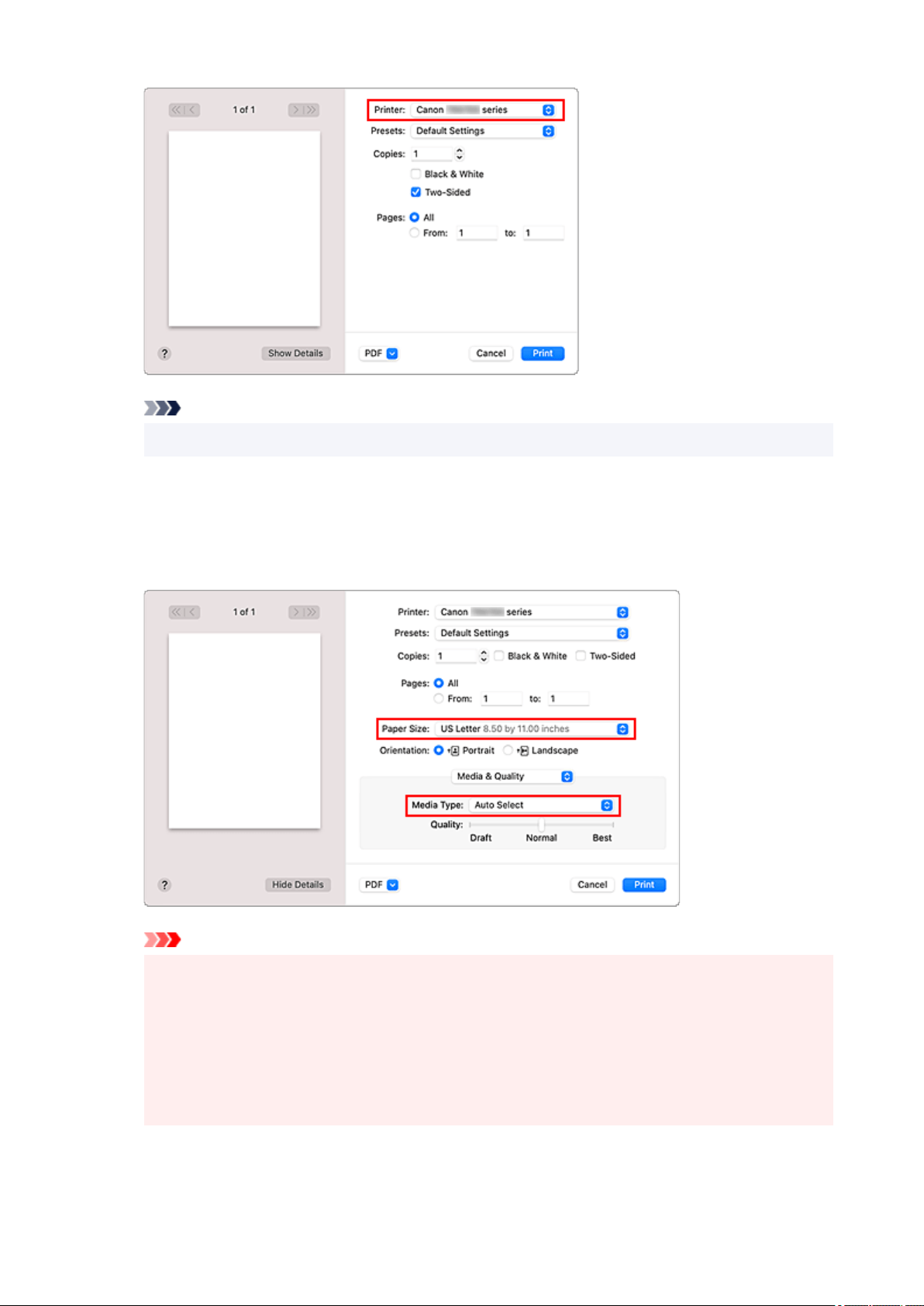
Note
•
Click Show Details to switch the setup window to the detailed display.
6.
Check print settings
6.
Set items such as Paper Size to the appropriate size, as well as Feed from and Media Type from
Media & Quality of the pop-up menu.
Remove the Two-Sided check mark if you are not printing on both sides of the paper.
Important
•
An error may occur if the paper size set in the print dialog is different from the paper size
registered on the printer. Select the correct items on the print dialog and the printer that
correspond to the paper being printed.
•
If you selected Auto Select in Feed from, the feed position will be different. Only A4, A5, JIS
B5, Executive, and US Letter plain paper can be fed from the cassette (main tray).
•
If printing paper such as photo paper and postcards that cannot be printed on both sides,
uncheck the Two-Sided checkbox.
201
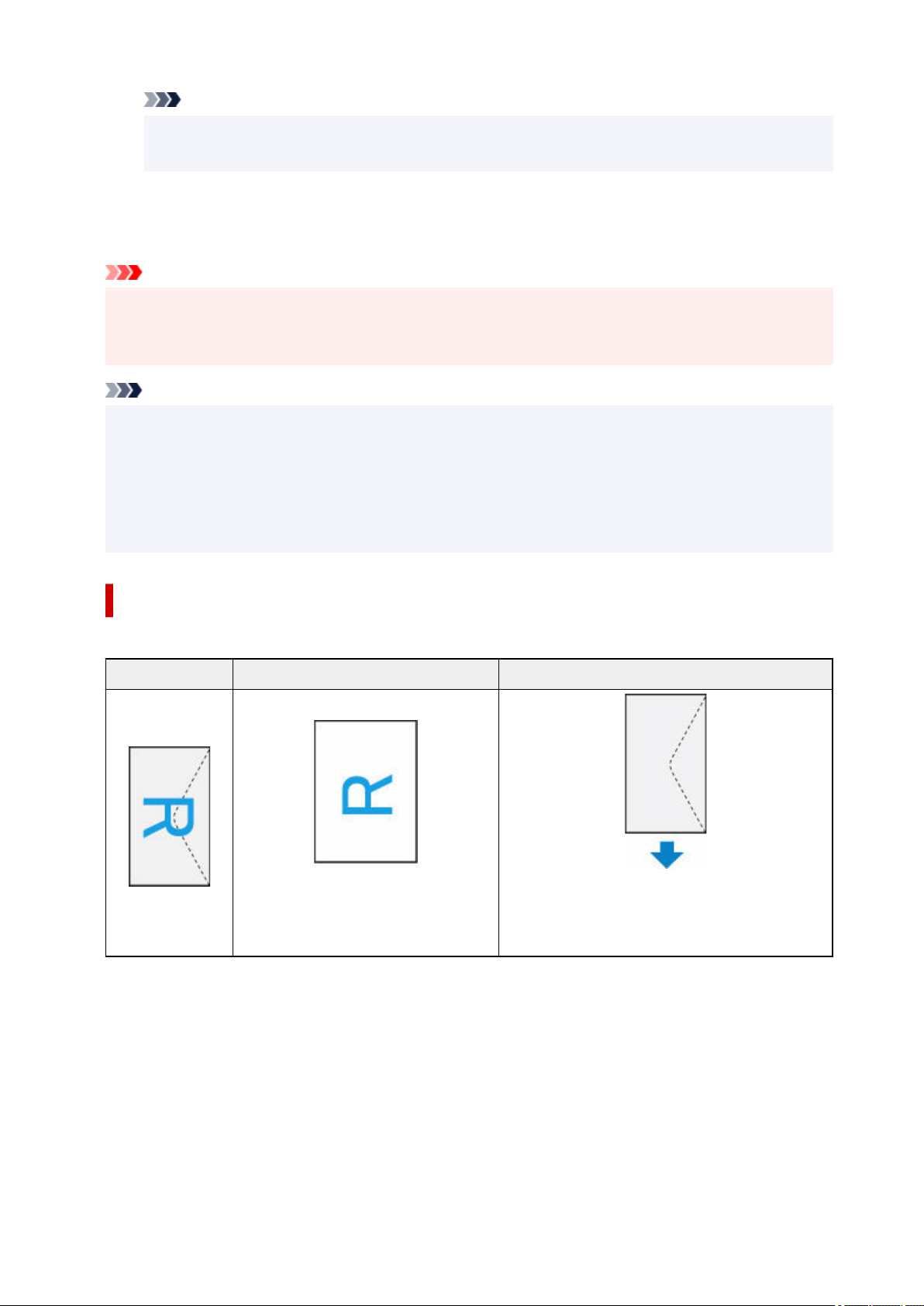
Note
• Use the Print dialog to set general print settings such as the layout and the print sequence.
For information about print settings, refer to macOS help.
7. Click Print7.
The printer prints according to the specified settings.
Important
• If you are performing large-format printing, make sure that there is plenty of remaining ink.
• If you set a custom paper size in Paper Size and set it to a length longer than the specified length,
the data will be printed with the "Media Type: Plain Paper, Print Quality: Standard" setting.
Note
• It can take the Wi-Fi a few minutes to get connected after the printer turns on. Print after checking
that the printer is connected to the network.
• You cannot print if Bonjour settings of printer are disabled. Check LAN settings of printer and enable
Bonjour settings.
•
Refer to "Cannot Print Using AirPrint" for printing problems.
•
The display of the settings screen may differ depending on the application software you are using.
Printing of Envelopes
For printing on the envelope from Mac, refer to the following.
Print result image Orientation of print data Orientation of loading envelope
The print data is rotated by 180 degrees
against the print result image.
Load the envelope in vertically with the address side
facing up so that the folded flap of the envelope will
be faced down on the right side.
202
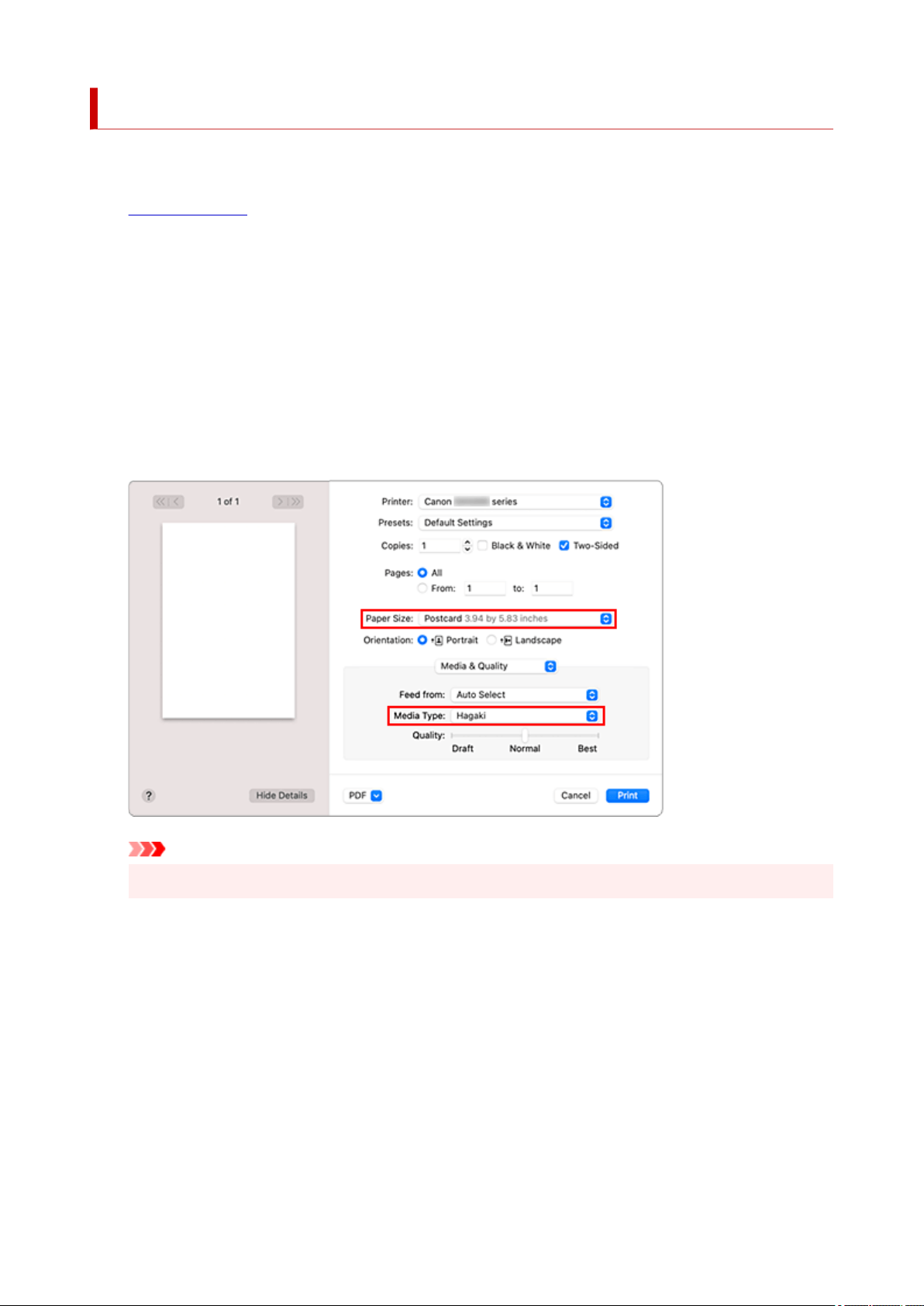
Printing on Postcards
This section describes the procedure for printing on postcards.
1. Load postcards in printer1.
2.
Select paper size and paper type from the printer
2.
Register Hagaki for paper size from the printer operation panel.
Also, register IJ Hagaki, Hagaki K, or Hagaki for paper type, according to your purpose. When you print
on the address side, register Hagaki.
3.
Select Paper Size and Media Type from the print dialog
3.
Select Postcard for Paper Size from the print dialog.
Select Hagaki, Hagaki (A), Hagaki K, Hagaki K (A), Ink Jet Hagaki, Ink Jet Hagaki (A), for Media
Type from the print dialog.
Important
•
This printer cannot print on postcards that have photos or stickers attached.
4.
Uncheck Two-Sided
4.
203
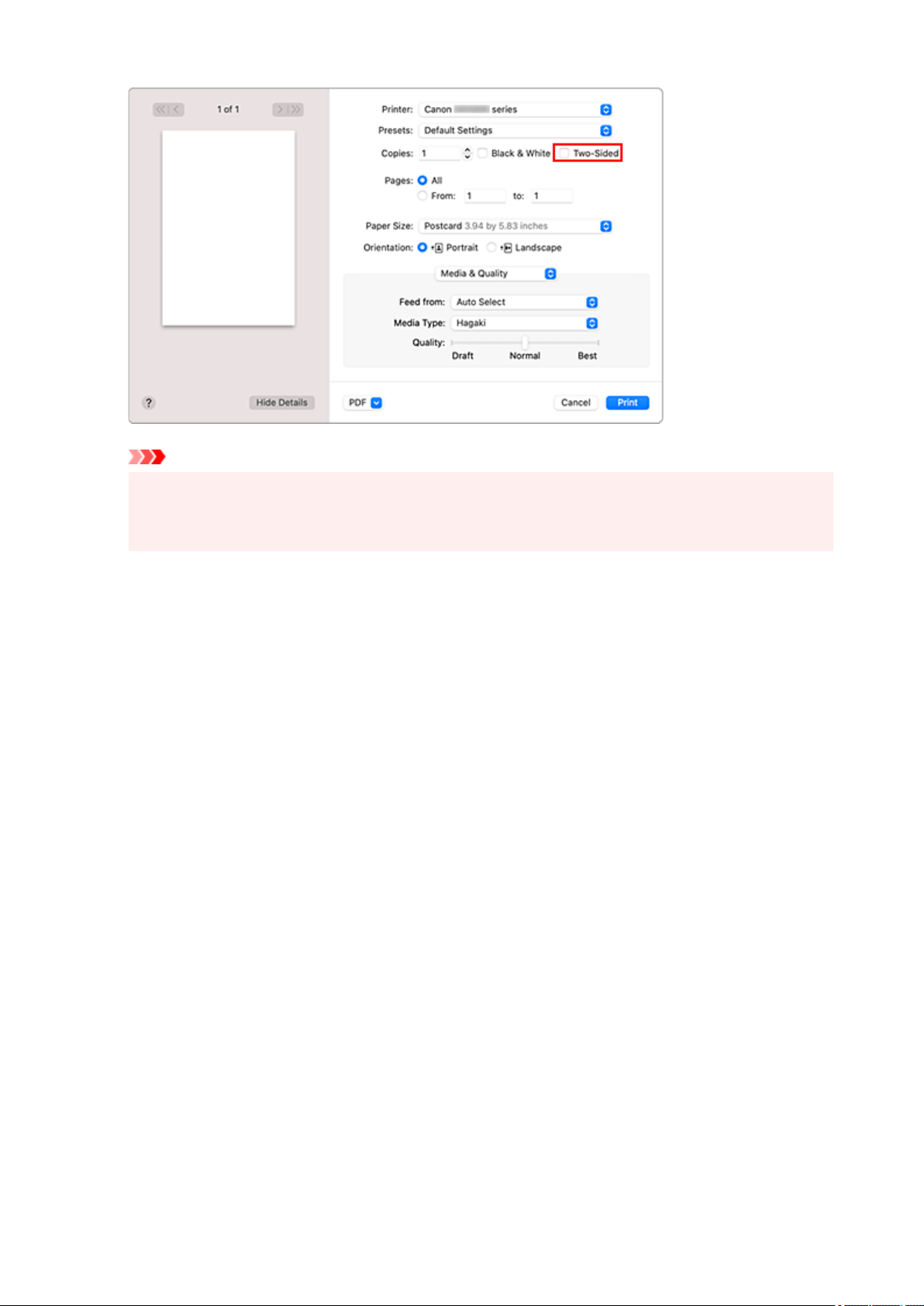
Important
•
Two-sided printing is not possible for postcards, so remove the Two-Sided check mark. If you
print with the Two-Sided check mark on, the printing result may not be as you intended.
•
You will get cleaner printing if you print the message side first and then print the address side.
5.
Click Print
5.
The printer prints according to the specified settings.
204

Adding Printer
This section describes the procedure for adding a printer to your Mac.
To re-add a printer that was deleted, open System Preferences -> Printers & Scanners, click + next to the
printer list, and then perform the procedure described below.
If your printer is connected via USB, and you connect the USB cable to a Mac, the printer is automatically
added. The below procedure is not necessary in this case.
1.
Check whether Default is selected in the displayed dialog
1.
Note
•
It may take a little time for your printer to appear.
2.
Select the printer
2.
Select the printer listed as Bonjour.
Note
•
Check the following if printer does not appear.
Printer is on
Firewall function of the security software is off
In case of Wi-Fi connection: Printer is either connected to the wireless router or directly
connected to the PC (Direct Connection)
In case of wired LAN connection: Printer is connected to the network device via LAN cable
3. Select your printer or Secure AirPrint from Use3.
4. Click Add4.
The printer is added to your Mac.
205

How to Open Printer Settings Screen
The settings screen of the printer can be displayed from your application software.
Opening the Page Setup Dialog
Use this procedure to set the page (paper) settings before printing.
1.
Select Page Setup... from the File menu of the application software
1.
The Page Setup dialog opens.
Opening the Print Dialog
Use this procedure to set the print settings before printing.
1.
Select Print... from the File menu of the application software
1.
The Print dialog opens.
206
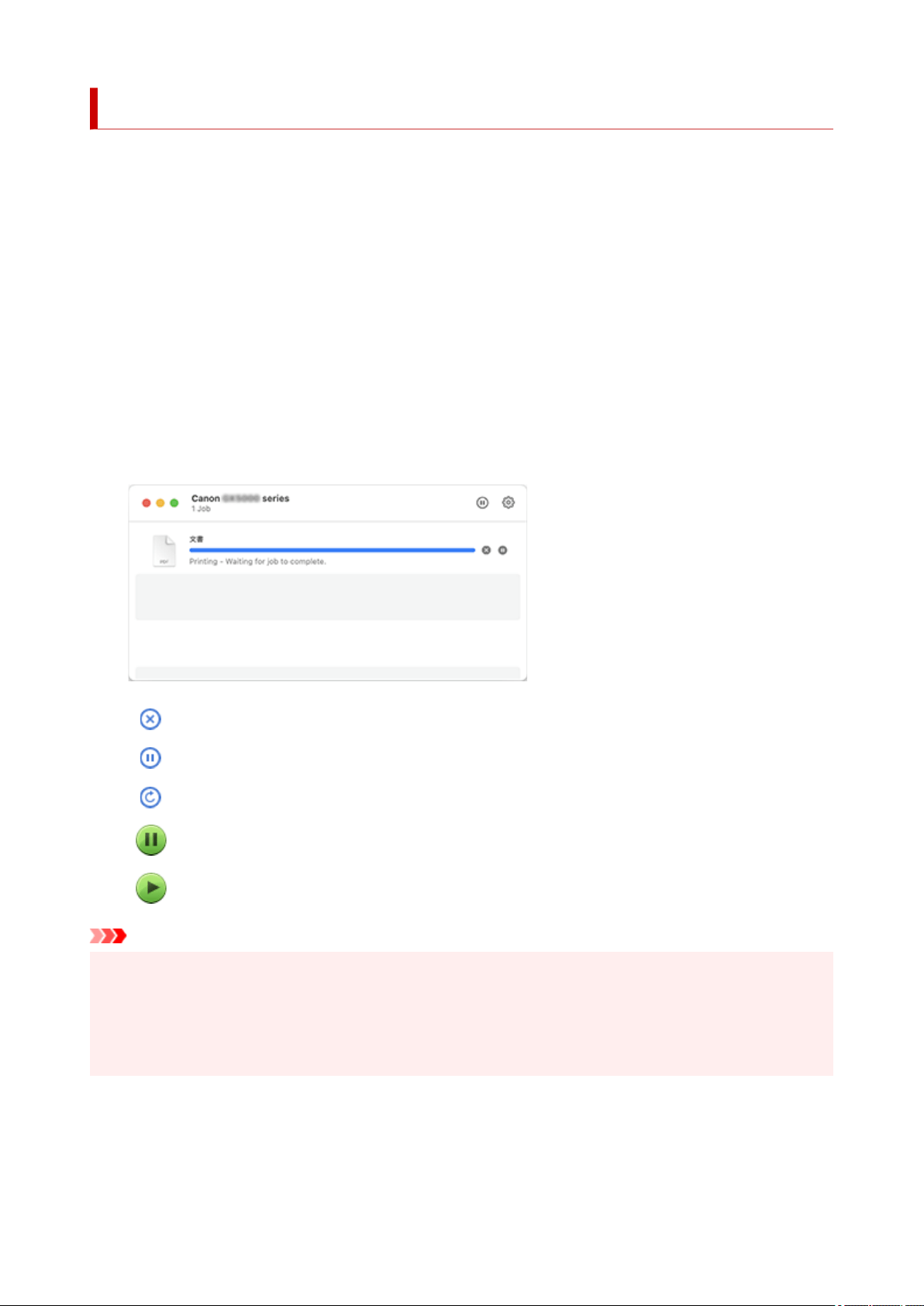
Displaying the Printing Status Screen
Check the print progress according to the following procedure:
1. Launch the printing status screen1.
•
If the print data has been sent to the printer
•
The printing status screen opens automatically. To display the printing status screen, click the
printer icon displayed on the Dock.
•
If the print data has not been sent to the printer
•
Open System Preferences, and select Printers & Scanners.
To display the printing status screen, select your printer model from the printer list, and then click
Open Print Queue....
2.
Check the printing status
2.
You can check the name of the file being printed or ready for being printed.
Deletes the specified print job.
Stops printing the specified document.
Resumes printing the specified document.
Stops printing all documents.
Displayed only when printing of all documents is being stopped, and resumes printing all documents.
Important
• If an error occurs, an error message will appear on the printing progress confirmation screen.
• The content of the error message may differ depending on the OS version.
• The printer part names in the error message may differ from what is listed in this manual.
• If the content of the error message is difficult to understand, check the error message displayed on the
printer operation panel.
207

Deleting the Undesired Print Job
If the printer does not start printing, canceled or failed print job data may be remaining.
Delete unnecessary print jobs from the print status check screen.
1. Open System Preferences, and select Printers & Scanners1.
2.
Select your model, and then click Open Print Queue...
2.
The print status check screen appears.
3.
Select the unnecessary print job and click (Delete)
3.
The selected print jobs will be deleted.
208

Removing Printer That Is No Longer Required from List of
Printers
The printer that is no longer in use can be removed from the list of printers.
Before removing the printer, remove the cable connecting the printer and PC.
You cannot remove the printer if you are not logged on as the administrator. For information about an
administrative user, see Users & Groups from System Preferences.
1.
Open System Preferences, and select Printers & Scanners
1.
2.
Delete printer from list of printers
2.
Select the printer you wish to remove from the list of printers and click -.
Click Delete Printer when the confirmation message appears.
209

Printing Using Canon Application Software
Easy-PhotoPrint Editor Guide
210

Printing from Smartphone/Tablet
Printing from iPhone/iPad/iPod touch (iOS)
Printing from Smartphone/Tablet (Android)
211
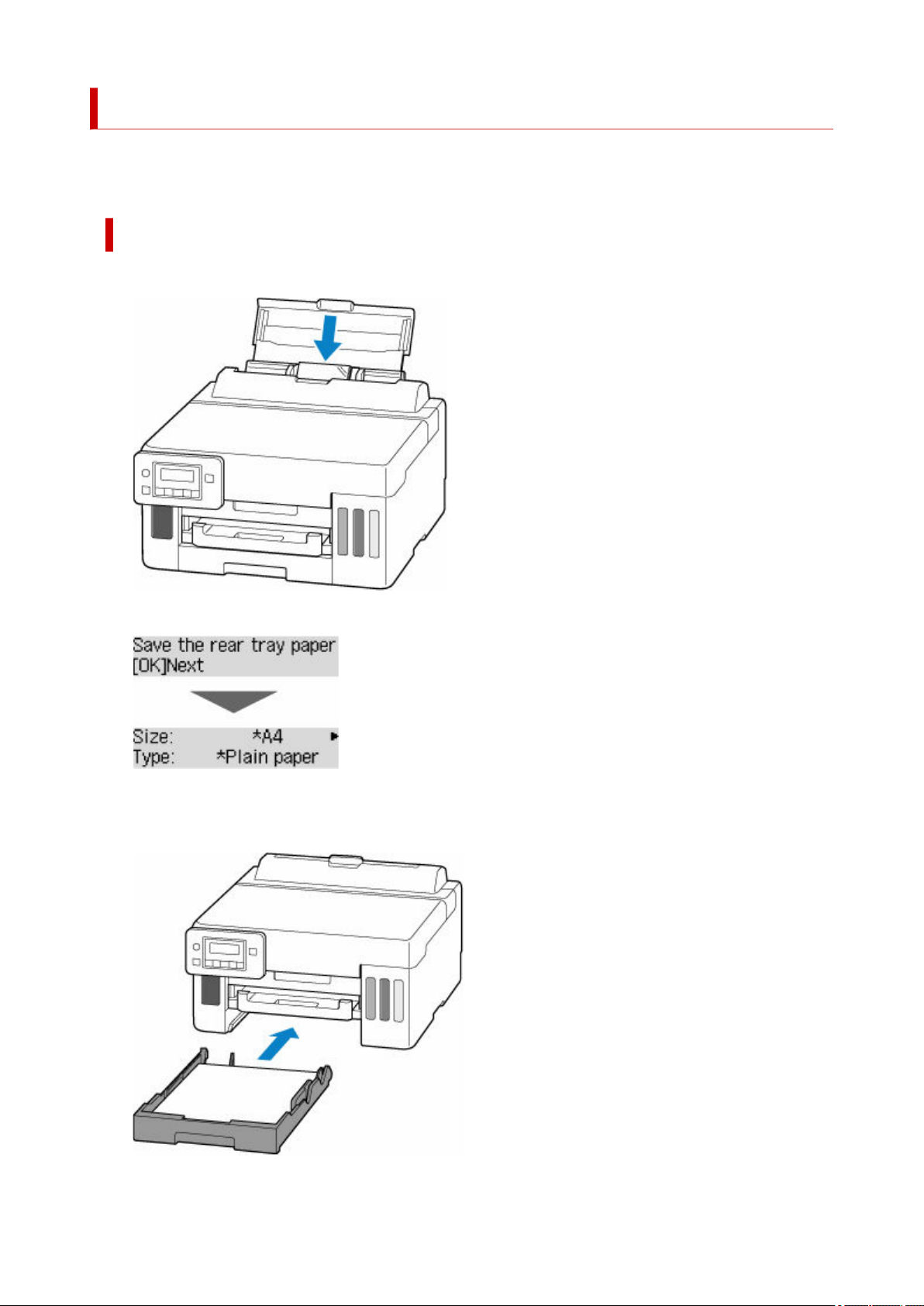
Paper Settings
By registering the paper size and the media type, the message is displayed before printing starts when the
paper size or the media type of the loaded paper differs from the paper settings.
After loading paper
•
When you loading paper in the rear tray
•
The screen to register the rear tray paper information is displayed.
Register the paper size and the media type according to the loaded paper.
• When you insert the cassette•
The screen to register the cassette paper information is displayed.
212
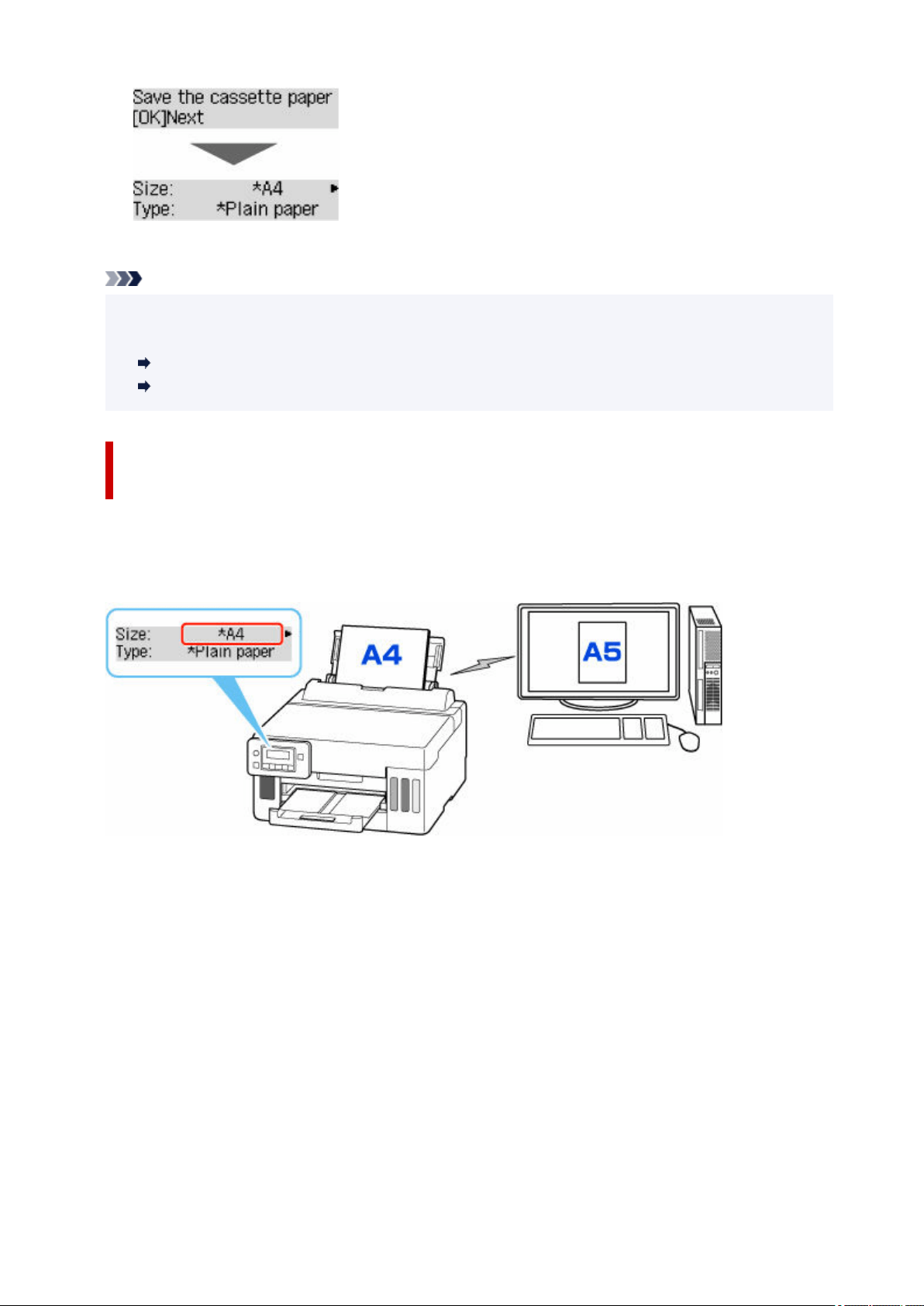
Register the page size according to the paper loaded in the cassette.
Note
• For more on the proper combination of paper settings you can specify by the printer driver for•
Windows and on the LCD:
Paper Settings on the Printer Driver and the Printer (Media Type)
Paper Settings on the Printer Driver and the Printer (Paper Size)
When the paper settings for printing are different from the paper
information registered to the printer
Ex:
• Paper settings for printing: A5•
• Paper information registered to the printer: A4•
When you start printing, a message is displayed.
Check the contents of the displayed message, press the OK button and then choose one of the following.
Print on set paper
Select if you want to print on the paper loaded without changing the paper settings.
For example, when the paper setting for printing is A5 and the paper information registered to the
printer is A4, the printer starts printing on the paper loaded in the rear tray or in the cassette without
changing the paper size setting for printing.
Replace the paper
Select if you want to print after replacing the paper of the rear tray or the cassette.
For example, when the paper size setting for printing is A5 and the paper information registered to
the printer is A4, you load A5 sized paper in the rear tray or in the cassette before you start printing.
213

The paper information registration screen is displayed after replacing the paper. Register the paper
information according to the paper that you loaded.
Cancel
Cancels printing.
Select when you change the paper settings specified for printing. Change the paper settings and try
printing again.
214
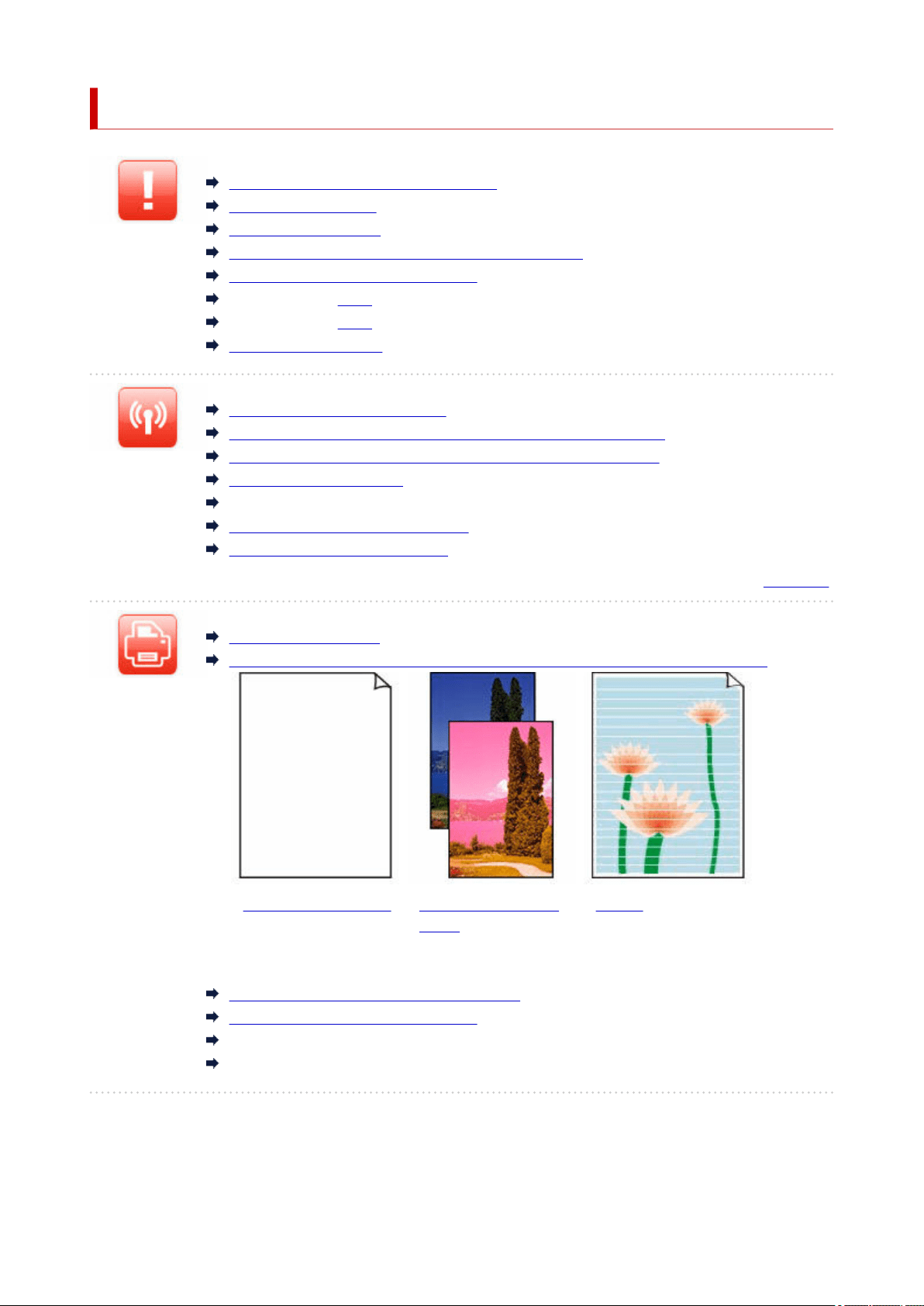
Error
List of Support Codes for Printer Errors
When Error Occurred
Message Is Displayed
Four-Digit Alphanumeric Code Is Displayed on LCD
What to Do When Paper Is Jammed
Support Code : 1000
Support Code : 1003
Repairing Your Printer
Network
Cannot Find Printer on Network (Windows/macOS)
Solve Network Troubles with The Printer's Diagnostic Functions
Switching Printer's Connection to Network or Terminal Devices
Printing Network Settings
Checking Status Code
Network Key (Password) Unknown
Connecting with Wireless Direct
For other questions about network, click here.
Print
Printer Does Not Print
Ink Does Not Come Out/Blurry or Fuzzy/Inaccurate or Bleeding Colors/Streaks
Ink Does Not Come Out
Inaccurate or Bleeding
Colors
Streaks
Printout (Copy) Results Are Unsatisfactory
What to Do When Paper Is Jammed
Default Printer Keeps Changing (Windows)
Cannot Print Using AirPrint
Frequently Asked Questions
215
Installation
Failed to MP Drivers (Printer Driver) Installation (Windows)
Updating MP Drivers (Printer Driver) in Network Environment (Windows)
Cannot Proceed Beyond Printer Connection Screen (Cannot Find Printer Connected
via USB)
Searching Printer by IP Address or Host Name During Setup
Setup Guide : Connect to Network
Switching Printer's Connection to Network or Terminal Devices
Solve Problems
Printer Does Not Work
Printer Does Not Turn On
Printer Turns Off Unexpectedly or Repeatedly
Wrong Language Appears in LCD
LCD Is Off
USB Connection Problems
Printer Does Not Print
Printing (Copying) Stops
Cannot Print Using AirPrint
Cannot Find Printer on Network (Windows/macOS)
What to Do When Paper Is Jammed
Printer Does Not Pick Up or Feed the Paper/"No Paper" Error
Automatic Duplex Printing Problems
Printout (Copy) Results Are Unsatisfactory
Cannot Print (Scan) from Smartphone/Tablet
Cannot Set Correctly (Network)
Cannot Find Printer on Network (Windows/macOS)
Solve Network Troubles with The Printer's Diagnostic Functions
Network Key (Password) Unknown
Cannot Remember Printer's Administrator Password
Printer Cannot Be Used After Replacing Wireless Router or Changed Router Settings
Message Appears on Computer During Setup
Checking Network Information of Printer
Restoring Printer's LAN Settings to Defaults
Cannot Set Correctly (Installation)
Failed to MP Drivers (Printer Driver) Installation (Windows)
Updating MP Drivers (Printer Driver) in Network Environment (Windows)
Error or Message Appears
When Error Occurred
Message Is Displayed
Four-Digit Alphanumeric Code Is Displayed on LCD
List of Support Codes for Printer Errors
216

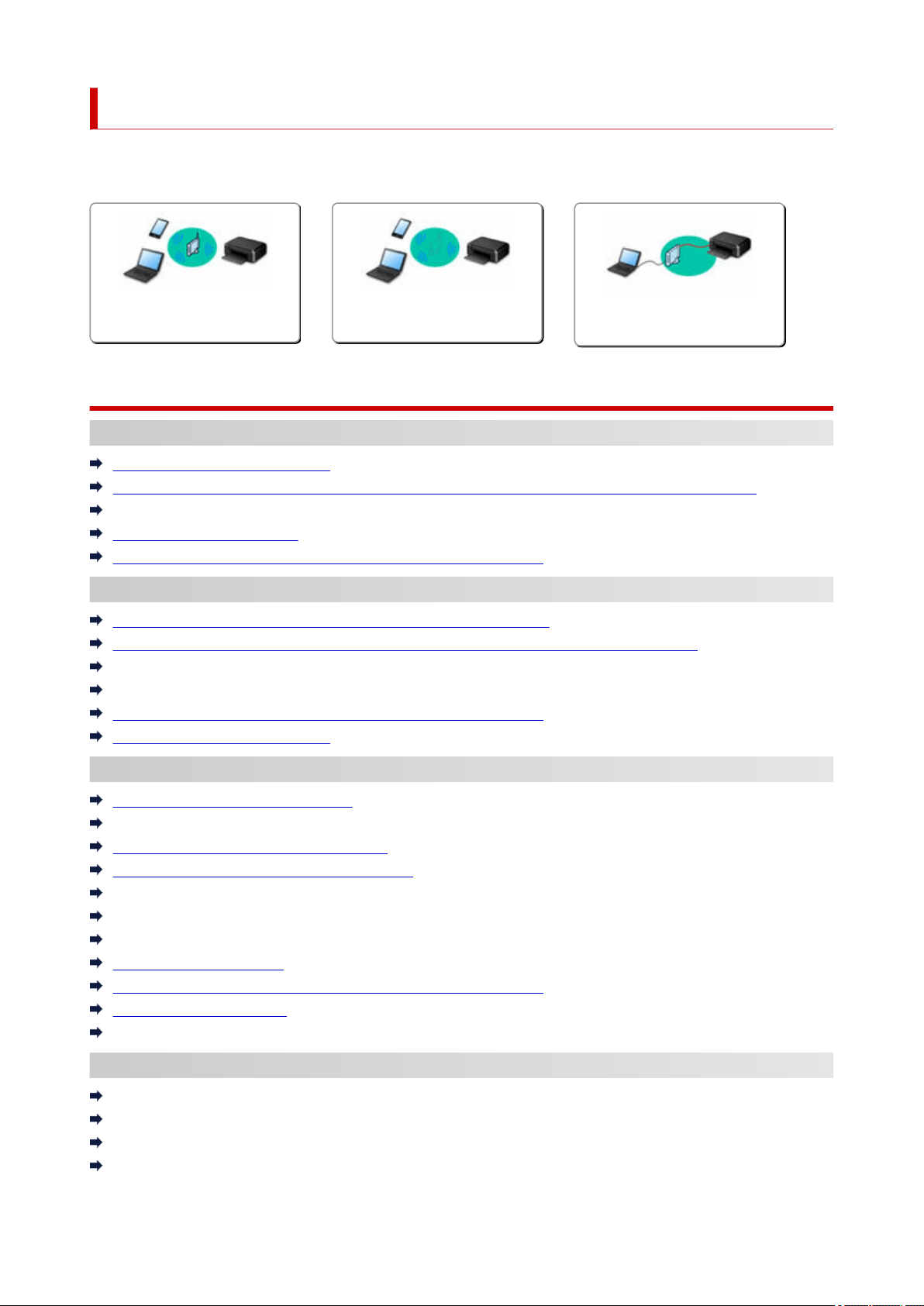
Network FAQ
Here are frequently asked questions on network. Select a connection method you are using, or you want to
use.
Wi-Fi
Wireless Direct
Wired LAN
Wi-Fi
Cannot Find Printer
Cannot Find Printer on Network (Windows/macOS)
Cannot Proceed Beyond Printer Connection Screen (Cannot Find Printer Connected via USB)
Searching Printer by IP Address or Host Name During Setup
Detect Same Printer Name
Switching Printer's Connection to Network or Terminal Devices
Cannot Print or Connect
Solve Network Troubles with The Printer's Diagnostic Functions
Printer Cannot Be Used After Replacing Wireless Router or Changed Router Settings
Connecting Printer and Wireless Router Using Easy Wireless (Easy WL) Connect
Cannot Connect Smartphone/Tablet to Wireless Router
Switching Printer's Connection to Network or Terminal Devices
Cannot Find Printer on Network (Windows/macOS)
LAN Setting Tips/Changing LAN Settings
Network Key (Password) Unknown
Cannot Remember Printer's Administrator Password
Checking Network Information of Printer
Restoring Printer's LAN Settings to Defaults
Checking Wireless Router SSID/Key
Checking Wireless Router Network Name (SSID) for Smartphone/Tablet
Privacy Separator/SSID Separator/Network Separation Function
Default Network Settings
Switching Printer's Connection to Network or Terminal Devices
Printing Network Settings
Checking Status Code
Printing (Scanning) from Smartphone/Tablet
Connecting Printer and Wireless Router Using Easy Wireless (Easy WL) Connect
Cannot Connect Smartphone/Tablet to Wireless Router
Checking Wireless Router Network Name (SSID) for Smartphone/Tablet
Setting Up Using Smartphone/Tablet
218

Cannot Print (Scan) from Smartphone/Tablet
Downloading Canon PRINT Inkjet/SELPHY
Problems while Using Printer
Message Appears on Computer During Setup
Cannot Find Printer on Network (Windows/macOS)
Wireless Direct
Cannot Print or Connect
Solve Network Troubles with The Printer's Diagnostic Functions
Cannot Find Printer on Network (Windows/macOS)
LAN Setting Tips/Changing LAN Settings
Network Key (Password) Unknown
Cannot Remember Printer's Administrator Password
Checking Network Information of Printer
Restoring Printer's LAN Settings to Defaults
Default Network Settings
Printing Network Settings
Switching Printer's Connection to Network or Terminal Devices
Checking Status Code
Printing (Scanning) from Smartphone/Tablet
Cannot Print (Scan) from Smartphone/Tablet
Downloading Canon PRINT Inkjet/SELPHY
Problems while Using Printer
Message Appears on Computer During Setup
Cannot Find Printer on Network (Windows/macOS)
Wired LAN
Cannot Find Printer
Searching Printer by IP Address or Host Name During Setup
Cannot Find Printer on Network (Windows/macOS)
Detect Same Printer Name
Cannot Print or Connect
Solve Network Troubles with The Printer's Diagnostic Functions
Cannot Find Printer on Network (Windows/macOS)
LAN Setting Tips/Changing LAN Settings
Cannot Remember Printer's Administrator Password
Checking Network Information of Printer
Restoring Printer's LAN Settings to Defaults
Default Network Settings
Switching Printer's Connection to Network or Terminal Devices
219




Cannot Find Printer on Network
In the following cases, set up the printer again.
• When you buy a new computer or wireless router•
• When you change the settings on your wireless router•
• When the connection method (Wi-Fi / USB) of the printer is changed•
• When you forget the administrator password of the printer•
From the Setup menu screen, select Device settings > Reset setting > All data to reset the
administrator password to the default setting, and then redo setup.
Reset setting
For more on the setup procedure, click here.
In Other Cases Than Above:
If the printer suddenly stops working, even though you have not changed the settings of the device or
network to which it is connected, or if you cannot find the printer during the setup process, check and
solve the problem, using Wi-Fi Connection Assistant. After the condition improves, redo the setup of the
printer.
Wi-Fi Connection Assistant is a powerful solution tool for network problems.
Step1
Check Basic Items for Network.
Step2
Solve Problems, Using Wi-Fi Connection Assistant.
Step3
If the Solution Tool Does Not Solve the Problem.
Step1 : Check Basic Items for Network.
Check1
Check power status.
Check your printer and the network device (wireless router, etc.) are turned on.
If you are in the process of setting up, interrupt it and check if the wireless router (modem) is turned on and then
check if the printer is turned on.
1. Check if network device such as router is turned on.1.
If network devices are not turned on, turn on the power. If the network devices are on, turn them off
and on again.
It may take a while for the network device to become ready for use once they are turned on.
Proceed once the network device such as router is ready for use.
2. Check if printer is turned on2.
If printer is not turned on, turn on the power. If the printer is on, turn it off and on again.
223

Proceed once you complete checking the power status above.
Check2
Check PC network connection.
If your computer and network devices (wireless router, etc.) are fully configured, your computer is ready to
connect to the network.
1.
Check the settings of the network device (wireless router, etc.).
1.
Connect to the Internet and see if you can browse any web page. If you cannot view web pages on
your computer, check wireless router network connection settings, such as IP address filtering, MAC
address filtering, and DHCP function.
To check the network name (SSID) of the wireless router the printer is connected to, print the network
settings.
Printing Network Settings
Note
•
Depending on the wireless router, note that different network name (SSID) is assigned for a
•
bandwidth (2.4 GHz or 5 GHz) or its usage (for PC or game machine), using alphanumeric
characters at the end of network name (SSID).
• For more on checking the settings of the wireless router, refer to the instruction manual•
supplied with the wireless router or contact the manufacturer.
If you use an encryption key, specify it for the network name (SSID) you are using. For details, see
Setting an Encryption Key.
2.
Check PC network connection.
2.
For the procedures, refer to the instruction manual supplied with the computer, or contact the
manufacturer.
Once you complete setting up the wireless router and your computer, configure the settings on your computer in
order to view web pages, using the information of the wireless router.
Proceed once you complete checking the network connection above.
Check3
Check printer's network settings.
For Wi-Fi
For Wired LAN
For Wi-Fi
Make sure icon is displayed on the LCD when Setup button is pressed once or twice.
If or icon is not displayed:
The printer is not set to use Wi-Fi.
From the Setup menu screen, select Device settings > LAN settings > Wi-Fi > Wi-Fi enab./disable in this
order and select Enable.
224

If icon is displayed:
icon indicates that the wireless router and the printer are not connected. Check the network settings of the
printer. Also, revisit the location of the wireless router and printer at the next check.
For Wired LAN
1. Check the power and LAN cable.1.
When the printer cannot be found on the setup screen, using LAN connection setup, make sure that
all the network devices are connected to the router and the hub via LAN cables and that all the
devices are turned on.
•
If LAN cable is not connected:
•
Connect the router, hub, computer and printer via LAN cables.
Make sure the printer is turned on.
Power Supply
Make sure the printer, the router and the hub are turned on.
•
If LAN cable is connected, and printer and network device are off:•
Turn on printer and network device.
• If LAN cable is connected, and printer and network device are on:•
Turn them off and on again.
Note
•
Some devices require a couple of minutes after being turned on to become ready for use.
•
Wait until all devices are ready before proceeding.
2.
Check printer's wired LAN settings.
2.
Make sure icon is displayed on the LCD when Setup button is pressed once or twice.
• If icon is not displayed:•
The printer is not set to use wired communication. Enable Wired LAN from the printer settings.
From the Setup menu screen, select Device settings > LAN settings > Wired LAN > Enab./
dis. wired LAN in this order and select Enable.
Check4
Check location of wireless router.
Make sure the printer is not placed too far away from the wireless router.
The printer can be up 50 m (164 ft.) from the wireless router indoors if unobstructed. Make sure the printer is
close enough to the wireless router to be used.
Place the printer and wireless router where there are no obstacles between them. Wireless communication
between different rooms or floors is generally poor. Wireless communication can be impeded by building
materials containing metal or concrete. If the printer cannot communicate with the computer over a Wi-Fi due
to a wall, place the printer and the computer in the same room.
225

In addition, if a device like a microwave oven that emits radio waves of the same frequency bandwidth as a
wireless router is nearby, it may cause interference. Place the wireless router as far away from interference
sources as possible.
Step2 : Solve Problems, Using Wi-Fi Connection Assistant.
Diagnose and repair the network connections using Wi-Fi Connection Assistant.
Download Wi-Fi Connection Assistant from the below page, and install it on your computer.
Checking Printer Connection Status Using Wi-Fi Connection Assistant
Refer to below in regard to starting up Wi-Fi Connection Assistant.
• For Windows:•
Starting Up Wi-Fi Connection Assistant
• For macOS:•
Starting Up Wi-Fi Connection Assistant
Step3 : If the Solution Tool Does Not Solve the Problem.
Check1
Make sure Enable bidirectional support is selected in Ports sheet of Printer
properties dialog box. (Windows)
If not, select it to enable the bidirectional support.
Check2
Make sure security software's firewall is off.
If your security software's firewall is on, a message may appear warning you that Canon software is attempting to
access the network. If this warning message appears, set security software to always allow access.
If you are using any programs that switch between network environments, check their settings. Some programs
use a firewall by default.
Check3
If printer is connected to AirPort Base Station via LAN, make sure you use
alphanumeric characters for network name (SSID). (macOS)
Check4
Solve network troubles with the printer's diagnostic functions.
See below.
Solve Network Troubles with The Printer's Diagnostic Functions
226
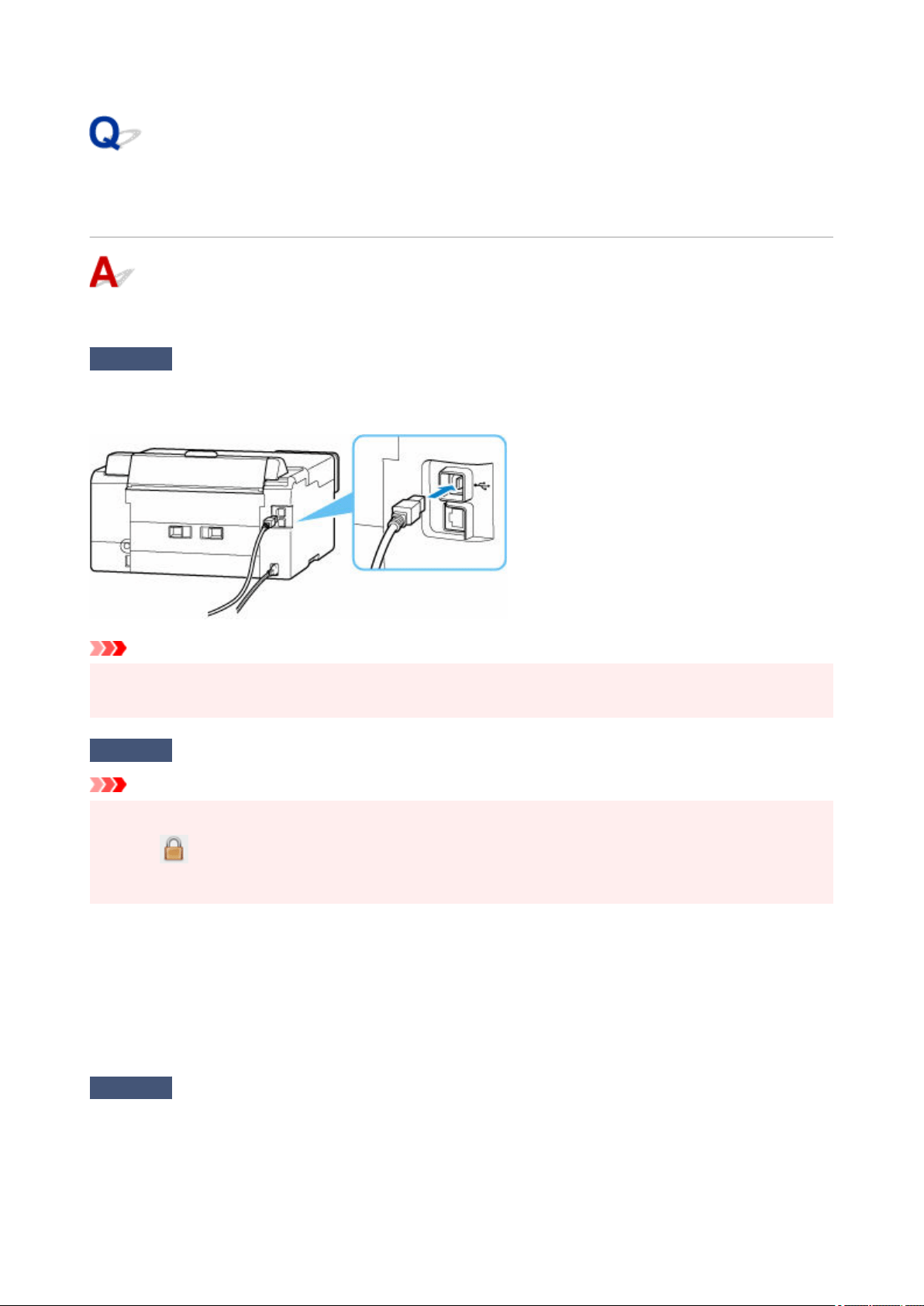
Cannot Proceed Beyond Printer Connection Screen (Cannot Find
Printer Connected via USB)
If you cannot proceed beyond the Printer Connection screen, check the following.
Check1
Make sure USB cable is securely plugged in to printer and computer.
Connect the printer and the computer using a USB cable as the illustration below. The USB port is located at the
back of the printer.
Important
•
Check the orientation of the "Type-B" connector and connect to the printer. For details, refer to the
instruction manual supplied with the USB cable.
Check2
Follow procedure below to connect printer and computer again.
Important
•
For macOS, make sure the lock icon is on the lower left of the Printers & Scanners screen.
•
If the icon (locked) is displayed, click the icon to unlock. (The administrator name and the password
are necessary to unlock.)
1. Unplug USB cable from printer and computer and connect it again.1.
2. Make sure no printer operation is in progress and turn off.2.
3.
Turn on printer.
3.
Check3
Follow the steps below to install MP Drivers (Printer Driver) again.
1. Download the latest MP Drivers (Printer Driver).1.
227

2. Turn off printer.2.
3. Restart computer.3.
After restarting, install the latest MP Drivers (Printer Driver) downloaded in step 1.
Important
•
When installing the MP Drivers (Printer Driver), make sure you select the correct printer name.
•
•
For Windows:
•
To restart your computer, choose Restart instead of Shut down.
228

Network Key (Password) Unknown
Use the Wi-Fi Connection Assistant to diagnose and repair network status.
Select the link below to download Wi-Fi Connection Assistant and install it.
Checking Printer Connection Status Using Wi-Fi Connection Assistant
See below for starting up Wi-Fi Connection Assistant
• For Windows:•
Starting Up Wi-Fi Connection Assistant
• For macOS:•
Starting Up Wi-Fi Connection Assistant
If the problem persists after diagnosis and repair with Wi-Fi Connection Assistant, check the following items.
WPA/WPA2 Key Set for Wireless Router Unknown, Cannot Connect
Setting an Encryption Key
WPA/WPA2 Key Set for Wireless Router Unknown, Cannot Connect
For more on setting up a wireless router, see the instruction manual provided with the wireless router or
contact its manufacturer. Make sure your computer can communicate with the wireless router.
Setting an Encryption Key
Select either WPA, WPA2, or WPA/WPA2.
Make sure your computer can communicate with the wireless router using the settings you have selected.
For more on setting up a wireless router, see the instruction manual provided with the wireless router or
contact its manufacturer.
• Using WPA/WPA2 (Windows)•
The authentication method, Wi-Fi password, and dynamic encryption type must be identical among
the wireless router, the printer, and your computer.
Enter the Wi-Fi password configured on the wireless router.
Either TKIP (basic encryption) or AES (secure encryption) is selected automatically as the dynamic
encryption method.
For details, see If WPA/WPA2 Details Screen Appears.
230

Note
• This printer supports WPA/WPA2-PSK (WPA/WPA2-Personal) and WPA2-PSK (WPA2-
Personal).
• Some printers support IEEE802.1X/EAP (WPA/WPA2 Enterprise). To configure•
IEEE802.1X/EAP (WPA/WPA2 Enterprise), you also need to configure the authentication
(Radius) server.
Contact the network administrator for more information.
• This web page contains information about several models. Depending on the specifications of the•
printer you are using, some of the features described (scanner/copy, etc.) may not apply.
For details about the functions of your printer, see Specifications.
231
Printer Cannot Be Used After Replacing Wireless Router or
Changed Router Settings
When you replace a wireless router, redo the network setup for the printer according to the replaced one.
Refer to Setup Guide to setup.
Note
• Wi-Fi Connection Assistant allows you to diagnose and repair the network status.•
Select the link below to download Wi-Fi Connection Assistant and install it.
Checking Printer Connection Status Using Wi-Fi Connection Assistant
See below for starting up Wi-Fi Connection Assistant.
For Windows:
Starting Up Wi-Fi Connection Assistant
For macOS:
Starting Up Wi-Fi Connection Assistant
If this does not solve the problem, see below.
Cannot Communicate with Printer After Enabling MAC/IP Address Filtering or Encryption Key on
Wireless Router
With Encryption On, Cannot Communicate with Printer After Changing Encryption Type at Wireless
Router
Cannot Communicate with Printer After Enabling MAC/IP Address
Filtering or Encryption Key on Wireless Router
Check1
Check wireless router setting.
To check the wireless router setting, see the instruction manual provided with the wireless router or contact its
manufacturer. Make sure the computer and the wireless router can communicate with each other under this
setting.
Check2
If filtering MAC addresses or IP addresses at wireless router, check that MAC
addresses or IP addresses for computer, network device, and printer are registered.
232
Check3
If using WPA/WPA2 key or a password, make sure encryption key for
computer, network device, and printer matches key set for wireless router.
The length or format of the Wi-Fi password and authentication method must be identical among the wireless
router, the printer, and your computer.
For details, see
Setting an Encryption Key.
Note
•
Some printers support IEEE802.1X/EAP (WPA/WPA2 Enterprise). To configure IEEE802.1X/EAP (WPA/
•
WPA2 Enterprise), you also need to configure the authentication (Radius) server.
Contact the network administrator for more information.
•
This web page contains information about several models. Depending on the specifications of the printer
•
you are using, some of the features described (scanner/copy, etc.) may not apply.
For details about the functions of your printer, see Specifications.
With Encryption On, Cannot Communicate with Printer After
Changing Encryption Type at Wireless Router
If you change the encryption type for the printer and it subsequently cannot communicate with the
computer, make sure the encryption type for the computer and the wireless router matches the type set
for the printer.
Cannot Communicate with Printer After Enabling MAC/IP Address Filtering or Encryption Key on
Wireless Router
233

Printer Settings/Smartphone/Tablet Troubles for Network
Solve Network Troubles with The Printer's Diagnostic Functions
Checking Network Information of Printer
Checking Status Code
Printing Network Settings
Restoring Printer's LAN Settings to Defaults
Default Network Settings
Connecting with Wireless Direct
234
Solve Network Troubles with The Printer's Diagnostic
Functions
Cannot Find Printer on Network/Cannot Print
Cannot Connect to Printer through Wireless Direct
Cannot Find Printer on Network/Cannot Print
Printing Out Network Settings Information:
Note
• [Wi-Fi] indicates descriptions related to Wi-Fi.•
[LAN] indicates descriptions related to wired LAN.
Follow the procedure below to print out the network settings information.
Step1
Check that printer and wireless router are turned on.
Turn the wireless router back on.
Wait about five minutes and then turn the printer back on.
Step2
Check your devices (e.g. computer/smartphone/tablet) are connected to
Internet.
Make sure that devices and the wireless router are connected to via Wi-Fi or wired LAN, and that the Internet
can be used without problems.
Step3
[Wi-Fi] Make sure the printer's Wi-Fi setting is enabled and the
icon is
displayed.
[LAN] Make sure the printer's wired LAN setting is enabled and the icon is
displayed.
Step4
[Wi-Fi] Move the printer and device (computer/smartphone/tablet) closer to the
wireless router.
Wireless communication quality deteriorates if the printer or devices are too far from the wireless router.
[LAN] Make sure the LAN cable is inserted.
Try reconnecting the LAN cable to the printer and wireless router.
Step5
Print out network settings information
Print out the network settings information on your printer.
Printing Network Settings
235

Note
• For troubleshooting IEEE802.1X/EAP (WPA/WPA2 Enterprise), refer to the following.•
Setting Up IEEE802.1X/EAP (WPA/WPA2 Enterprise)
Checking Printed Network Settings Information:
From the printed network settings information, check the entries in item "2-2"
C-0
[Wi-Fi][LAN] It is connected correctly. If, nevertheless, the printer is not found on the network or printing is
not possible, check the following items.
Note
• If codes other than "C-0" are displayed at the same time in the item "2-2" see also the•
correspondence of the other codes.
Check1
[Wi-Fi][LAN] Check that security software's firewall is off.
A message may appear warning you that Canon software is attempting to access the network. If this warning
message appears, set the security software to always allow access.
Quit the security software and make sure that the printer is recognized and ready to use. If so, the cause is
the firewall setting. Change the firewall settings so that the printer is recognized and ready to use. For details,
contact the manufacturer of the security software.
If you are using any programs that switch between network environments, check their settings. Some programs
use a firewall by default.
Check2
[Wi-Fi] Does network name (SSID) of printer match network name (SSID)
setting of wireless router that communicates?
Check the "3-2-6" item in the printed network settings information and the network name (SSID) of the wireless
router you want to connect to. If they are not matched, check the SSID and password of the wireless router you
want to connect to, and then setup manually.
Check3
[Wi-Fi] Is privacy separator, SSID separator, or Network separation function
enabled on wireless router?
If it is enabled, disable these functions before performing the setup. To check the settings of the wireless
router, refer to the instruction manual provided with it or contact its manufacturer.
Check4
[Wi-Fi][LAN] If MP Drivers (Printer Driver) are not installed, install them.
(Windows)
Click here and install the MP Drivers (Printer Driver).
C-1
[Wi-Fi] The printer's Wi-Fi setting is disabled. (You can also check if the Wi-Fi icon does not appear
on the printer's screen.)
Enable the Wi-Fi setting in the printer's settings screen.
236

[LAN] Wired LAN setting is disabled. (The icon representing the wired LAN is not displayed on the
LCD.)
Enable the wired LAN setting from the operation panel.
C-2
[LAN] Wired LAN setting is disabled. Make sure the printer and wireless router are connected via LAN
cable.
If the LAN cable is disconnected, connect it correctly.
If your LAN cable is connected to the WAN port of the wireless router, connect it to the LAN port of the
wireless router.
C-3
[Wi-Fi][LAN] No IP address is assigned. (You can also check that the item "3-2-12" in the printed network
settings information is blank.)
Check the following items.
Check1
[Wi-Fi][LAN] Is printer set to obtain an IP address automatically, or is wireless
router requesting manual addressing?
Refer to the wireless router's manual to enable DHCP (auto-acquisition) settings on the wireless router or to set
a valid IP address on the printer.
Check2
[Wi-Fi][LAN] When you set printer's IP address manually, correct IP address
may not be set.
Check the network name (SSID) and the password of the wireless router you want to connect to, the IP
address applicable range, and then enter the appropriate IP address on the printer side. If you are unsure, set
the printer's IP address to automatic (DHCP).
C-5
[Wi-Fi] Unable to connect to the specified network. Check the following items.
Check1
[Wi-Fi] Check status of printer and network device (e.g. wireless router) and
your computer/smartphone/tablet.
Communication with a wireless router must be tuned to either the 2.4 GHz or 5 GHz frequency band. The
network name (SSID) of the 2.4 GHz frequency band and the network name (SSID) of the 5 GHz frequency
band cannot be used in combination.
Check the network name (SSID) set for the printer, and match it with the network name (SSID) of the correct
frequency band of the Wi-Fi router.
Check2
[Wi-Fi] Password on your wireless router may not match password you
entered.
Passwords are case sensitive.
Enter the password correctly.
237

Check3
[Wi-Fi] Monitor signal status and move printer and wireless router as
necessary.
• Place the printer and wireless router where there are no obstacles between them. Wireless
communication between different rooms or floors is generally poor.
• Wireless communication can be impeded by building materials containing metal or concrete. If the printer
cannot communicate with the computer over a Wi-Fi due to a wall, place the printer and the computer in
the same room.
•
After changing the installation location, print out the network settings information again and check the
status of the signal. Compare with the value in section "3-2-1" in the printed network settings information
to determine the installation location.
Check4
[Wi-Fi] Check wireless channel number of Wi-Fi you are using on computer.
Make sure that the wireless channel number on the wireless router is included in the wireless channel number
you checked. If the wireless channel number set for the wireless router is not included, change the wireless
channel number of the wireless router.
Check5
[Wi-Fi] In case of Wi-Fi connection, check if computer that can be accessed
by wireless router is restricted.
The wireless router settings may be limiting the number of devices that can be connected at the same time.
Remove or relax the restrictions.
To check the settings of the wireless router, refer to the instruction manual provided with it or contact its
manufacturer.
Note
•
To check the MAC address or IP address of your computer, see Checking Computer IP Address or MAC
Address.
Check6
[Wi-Fi] If problem occurs only when wireless router is in energy-saving mode,
turn off energy-saving mode of wireless router.
If the problem seems to occur suddenly, it may be resolved by updating the wireless router firmware (e.g.
update interval of a key, problems of DHCP update interval, etc.). For details, refer to the wireless router's
instruction manual.
Check7
[Wi-Fi] If printer is connected to AirPort Base Station via LAN, make sure you
use alphanumeric characters for network name (SSID). (macOS)
C-4
[Wi-Fi][LAN] No default gateway is set.
When you set the IP address of the printer manually, enter a valid default gateway IP address. If you don't
know the default gateway, set the IP address to automatic.
C-7
[Wi-Fi] There may be a problem with the signal.
Check the following items.
238

Check
[Wi-Fi] Monitor signal status and move printer and wireless router as
necessary.
• Place the printer and wireless router where there are no obstacles between them. Wireless
communication between different rooms or floors is generally poor.
• Wireless communication can be impeded by building materials containing metal or concrete. If the printer
cannot communicate with the computer over a Wi-Fi due to a wall, place the printer and the computer in
the same room.
•
After changing the installation location, print out the network settings information again and check the
status of the signal. Compare with the value in section "3-2-1" in the printed network settings information
and place the printer in the location with a higher value.
Note
• In some cases, "C-7" and "C-9" are displayed at the same time. In that case, refer to both items.
C-8
[Wi-Fi] Too many clients are connected.
Wireless Direct does not allow more than 5 devices to be connected.
If you want to connect additional devices to the printer, unplug any devices that are not in use before
adding them.
C-9
[Wi-Fi] The noise level is high and does not differ from the signal level due to various devices other than
the printer.
• If devices (microwave oven, external hard disk drive, and other USB 3.0 devices) that emit radio waves
of the same frequency bandwidth as a wireless router is nearby, it may cause interference. Place the
printer and the wireless router as far away from interference sources as possible.
• After you change the location of the printer, check the signal quality. Compare the value of "3-2-2" in
the network settings information and place the printer in the location with a higher value.
Note
• In some cases, "C-7" and "C-9" are displayed at the same time. In that case, refer to both items.
C-10
[Wi-Fi] No IP address is assigned by the wireless router.
Check the following items.
Check1
[Wi-Fi] Password on your wireless router may not match password you
entered.
Passwords are case sensitive.
Enter the password correctly.
Check2
[Wi-Fi] Set up printer again and reconnect to Wi-Fi.
Check3
[Wi-Fi] Check DHCP on wireless router. If DHCP is off, set it on.
239
To check the settings of the wireless router, refer to the instruction manual provided with it or contact its
manufacturer.
C-11
[Wi-Fi] The network name (SSID) remains the default value (The network name (SSID) has not been set).
Check the network name (SSID) of the wireless router.
Verify the network name (SSID) and password of the wireless router you want to connect to, and then set it
up manually.
Note
• Wi-Fi Connection Assistant allows you to diagnose and repair the network status.•
Select the link below to download Wi-Fi Connection Assistant and install it.
Checking Printer Connection Status Using Wi-Fi Connection Assistant
See below for starting up Wi-Fi Connection Assistant.
For Windows:
Starting Up Wi-Fi Connection Assistant
For macOS:
Starting Up Wi-Fi Connection Assistant
Cannot Connect to Printer through Wireless Direct
Check1
Check power status of printer and other devices (e.g. computer/smartphone/
tablet).
Turn on the printer or devices.
If the power is already turned on, cycle the power switch.
Check2
Check settings of your device (e.g. computer/smartphone/tablet).
Make sure Wi-Fi is enabled on your device.
For details, refer to the device's instruction manual.
Check3
Print out network settings information.
See "Step1" to "Step5" in Cannot Find Printer on Network/Cannot Printing.
In the printed network settings information, check if the item "2-2" is not "C-8". If this is the case, the number of
connected printers is too many.
Wireless Direct does not allow more than 5 devices to be connected.
When you want to connect additional devices, disconnect any devices that are not in use before adding them.
240

Check4
Check that printer is selected as connection for various devices (e.g.
computer/smartphone/tablet).
Select the network name (SSID) for Wireless Direct specified for the printer as the connection destination for
devices.
Check the destination on your device.
For details, refer to your device's instruction manual or visit the manufacturer's website.
To check the network name (SSID) for Wireless Direct specified for the printer, display it using the operation
panel of the printer or print out the network settings information of the printer.
•
Display on the LCD.
•
LAN settings
•
Print the network settings.
•
Printing Network Settings
Check5
Check that Wireless Direct password set for printer is entered correctly.
To check the password specified for the printer, display it using the operation panel of the printer or print out
the network settings information of the printer.
•
Display on the LCD.
•
LAN settings
•
Print the network settings.
•
Printing Network Settings
Check6
Check that printer is not placed too far away from device.
If the distance between the printer and the device is too far, wireless communication becomes poor. Place the
printer and the device close to each other.
Note
• Wireless Direct is set to disabled when you connect to and use an EAP router. Also, if you set•
Wireless Direct to enable in this case, the wireless LAN (Wi-Fi) will be set to Disable.
• When using IEEE802.1X/EAP (WPA/WPA2 Enterprise), enable the Administrator mode so that the•
Wireless Direct settings cannot be changed.
• When using a 5 GHz infrastructure connection, the Wireless Direct setting is disabled.•
241
Checking Network Information of Printer
Checking Printer IP Address or MAC Address
Checking Computer IP Address or MAC Address
Checking Communication Between the Computer, the Printer, and the Wireless Router
Checking Network Setting Information
Checking Printer IP Address or MAC Address
To check the printer's IP Address or MAC address, print out the network settings information.
Printing Network Settings
For Windows, you can check the network setting information on the computer screen.
Canon Wi-Fi Connection Assistant Screen
Checking Computer IP Address or MAC Address
To check the IP Address or MAC address of your computer, follow the instructions below.
• For Windows:•
1. Select Command Prompt from Start.1.
2. Enter "ipconfig/all" and press Enter.2.
The IP address and MAC address of your computer appear. If your computer is not connected to a
network, the IP address does not appear.
• For macOS:•
1.
Select System Preferences from Apple menu, and then click Network.
1.
2.
Make sure network interface used by computer is selected, and then click Advanced.
2.
Make sure Wi-Fi is selected as network interface.
3.
Click TCP/IP to check the IP address, or click Hardware to check the MAC address.
3.
242

Checking Communication Between the Computer, the Printer, and the
Wireless Router
Perform a ping test to check if communication is taking place.
• For Windows:•
1.
Select Command Prompt from Start.
1.
2.
Type the ping command and press Enter.
2.
The ping command is as follows: ping XXX.XXX.XXX.XXX
"XXX.XXX.XXX.XXX" is the IP address of the target device.
If communication is taking place, a message like the one shown below appears.
Reply from XXX.XXX.XXX.XXX: bytes=32 time=10ms TTL=255
If Request timed out appears, communication is not taking place.
• For macOS:•
1.
Start Network Utility as shown below.
1.
Select Computer from Go menu of Finder, double-click Macintosh HD > System > Library >
CoreServices > Applications > Network Utility.
2.
Click Ping.
2.
3. Make sure Send only XX pings (XX are numbers) is selected.3.
4. Enter IP address of target printer or target wireless router in Enter the network4.
address to ping.
5.
Click Ping.
5.
"XXX.XXX.XXX.XXX" is the IP address of the target device.
A message such as the following appears.
64 bytes from XXX.XXX.XXX.XXX: icmp_seq=0 ttl=64 time=3.394 ms
64 bytes from XXX.XXX.XXX.XXX: icmp_seq=1 ttl=64 time=1.786 ms
64 bytes from XXX.XXX.XXX.XXX: icmp_seq=2 ttl=64 time=1.739 ms
--- XXX.XXX.XXX.XXX ping statistics ---
3 packets transmitted, 3 packets received, 0% packet loss
If "100% packet loss" appears, communication is not taking place. Otherwise, computer is
communicating with target device.
243


Restoring Printer's LAN Settings to Defaults
Important
• After initialization, all network connection information of the printer will be deleted, and printing over the•
network will no longer be possible. To use the printer over a network again after restoring printer's LAN
settings to defaults, refer to Setup Guide to redo setup.
Initialize the network setting using the printer's operation panel.
Reset setting
245

Cannot Print (Scan) from Smartphone/Tablet
If you cannot Print (Scan) from your smartphone/tablet, it is possible that your smartphone/tablet cannot
communicate with the printer.
Check the cause of your problem according to the connection method.
Cannot Communicate with Printer via Wi-Fi
Cannot Communicate with Printer while It Is in Wireless Direct
Note
• For problems on printing with other connection methods or more on performing settings of each•
connection method:
Using PIXMA/MAXIFY Cloud Link
Printing from iOS Device (AirPrint)
Cannot Communicate with Printer via Wi-Fi
If your smartphone/tablet cannot communicate with the printer, check the following.
Check1
Check power status of printer, network devices (e.g. wireless router), and
your smartphone/tablet.
•
Turn on the printer or your device.
•
If the power is already turned on, cycle the power switch.
•
It may be necessary to resolve wireless router problems (e.g. update interval of a key, problems of DHCP
update interval, energy saving mode) or to update the wireless router firmware.
For details, contact the manufacturer of your wireless router.
Check2
Check settings of your smartphone/tablet.
Make sure Wi-Fi is enabled on your device.
For details, refer to your device's instruction manual.
Check3
Is printer connected to wireless router?
•
Use the icon on the LCD to check the connection status between the printer and wireless router.
•
icon is displayed, when Setup button is pressed once or twice.
If the icon is not displayed, Wi-Fi is disabled. Turn on wireless communication on the printer.
•
Make sure the network settings of the printer (e.g. network name (SSID) or network key (password), etc.)
•
are identical with those of the wireless router.
To check the settings of the wireless router, refer to the instruction manual provided with it or contact its
manufacturer.
To check the current network settings of the printer, print out the network setting information of the
printer.
247

Printing Network Settings
Note
• If you have a computer, Wi-Fi Connection Assistant allows you to diagnose and repair the network•
status.
Select the link below to download Wi-Fi Connection Assistant and install it.
Checking Printer Connection Status Using Wi-Fi Connection Assistant
See below for starting up Wi-Fi Connection Assistant.
For Windows:
Starting Up Wi-Fi Connection Assistant
For macOS:
Starting Up Wi-Fi Connection Assistant
Check4
Are network settings of your smartphone/tablet identical with those of wireless
router?
Make sure the network settings of the printer (e.g. network name (SSID) or network key password) are
identical with those of the wireless router.
To check the settings of your smartphone/tablet, refer to the instruction manual provided with it.
If the network settings of your smartphone/tablet are not identical with those of the wireless router, change the
network settings of it to match with those of the wireless router.
Check5
Check that printer is not placed too far away from wireless router.
If the distance between the printer and wireless router is too far, wireless communication becomes poor. Place
the printer and wireless router close to each other.
Check6
Check that wireless signal is strong. Monitor signal status and move printer
and wireless router as necessary.
Place the printer and wireless router where there are no obstacles between them. Wireless communication
between different rooms or floors is generally poor. Wireless communication can be impeded by building
materials containing metal or concrete. If the printer cannot communicate with the computer over a Wi-Fi due
to a wall, place the printer and the computer in the same room.
In addition, if a device like a microwave oven that emits radio waves of the same frequency bandwidth as a
wireless router is nearby, it may cause interference. Place the wireless router as far away from interference
sources as possible.
Check the signal strength on the LCD.
LCD and Operation Panel
Cannot Communicate with Printer while It Is in Wireless Direct
248

If your smartphone/tablet cannot communicate with the printer in the Wireless Direct, check the following.
Check1
Check power status of printer and device (e.g. smartphone/tablet).
Turn on the printer or your device.
If the power is already turned on, cycle the power switch.
Check2
Is Wireless Direct enabled?
From the Setup menu screen, select Device settings > LAN settings > Wireless Direct > Switch WL
Direct in this order and select Yes.
Check3
Check settings of device (e.g. smartphone/tablet).
Make sure Wi-Fi is enabled on your device.
For details, refer to your device's instruction manual.
Check4
Check that printer is selected as connection for devices (e.g. smartphone/
tablet).
Select the network name (SSID) for Wireless Direct specified for the printer as the connection destination for
devices.
Check the destination on your device.
For details, refer to your device's instruction manual or visit the manufacturer's website.
To check the network name (SSID) for Wireless Direct specified for the printer, print out the network settings
information of the printer.
Printing Network Settings
Check5
Check that wireless direct password set for printer is entered correctly.
To check the password specified for the printer, print out the network settings information of the printer.
Printing Network Settings
Check6
Check that printer is not placed too far away from devices.
If the distance between the printer and devices is too far, wireless communication becomes poor. Place the
printer and devices close to each other.
Check7
Check that 5 devices are already connected.
Wireless Direct does not allow more than 5 devices to be connected.
Note
• Some printers support IEEE802.1X/EAP (WPA/WPA2 Enterprise). Note that when IEEE802.1X/EAP•
(WPA/WPA2 Enterprise) is set to Enable, Wireless Direct is set to Disable.
• This web page contains information about several models. Depending on the specifications of the•
printer you are using, some of the features described (scanner/copy, etc.) may not apply.
249


Printing Problems
Printer Does Not Print
Printer Does Not Pick Up or Feed the Paper/"No Paper" Error
Printout (Copy) Results Are Unsatisfactory
Automatic Duplex Printing Problems
Printing (Copying) Stops
Cannot Print Using AirPrint
Paper Does Not Feed from Paper Source Specified in Printer Driver (Windows)
Default Printer Keeps Changing (Windows)
251

Printer Does Not Print
Check1
Make sure printer is turned on.
If not, make sure the printer is securely plugged in and press ON button to turn on.
The ON lamp flashes while the printer is initializing. Wait until the ON lamp stops flashing and remains lit.
Note
•
If you are printing large data such as photos or other graphics, printing may take longer to start. The ON
•
lamp flashes while the computer is processing data and sending it to the printer. Wait until printing starts.
Check2
Make sure printer is properly connected to computer.
If you are using a USB cable, make sure it is securely connected to both the printer and the computer. When the
USB cable is securely plugged in, check the following:
•
If you are using a relay device such as a USB hub, disconnect it, connect the printer directly to the
•
computer, and retry the printing. If printing starts normally, there is a problem with the relay device. Contact
the vendor of the relay device.
•
There could also be a problem with the USB cable. Replace the USB cable and retry the printing.
•
If you use the printer with a network connection, make sure the printer is correctly set up for network use.
Cannot Find Printer on Network (Windows/macOS)
Note
•
Wi-Fi Connection Assistant allows you to diagnose and repair the network status.
•
Select the link below to download Wi-Fi Connection Assistant and install it.
Checking Printer Connection Status Using Wi-Fi Connection Assistant
See below for starting up Wi-Fi Connection Assistant.
For Windows:
Starting Up Wi-Fi Connection Assistant
For macOS:
Starting Up Wi-Fi Connection Assistant
Check3
Make sure paper settings match information set for rear tray or cassette.
If the paper settings do not match the information set for the rear tray or cassette, an error message appears on
the LCD. Follow the instructions on the LCD to solve the problem.
252

Note
•
You can select whether the message which prevents misprinting is displayed.
•
To change the message view setting when printing using the printer's operation panel:
Feed settings
To change the message view setting when printing using the printer driver:
Changing the Printer Operation Mode (Windows)
Changing the Printer Operation Mode (macOS)
Check4
If printing from a computer, delete unnecessary print jobs.
•
For Windows:
•
Deleting the Undesired Print Job
•
For macOS:
•
Deleting the Undesired Print Job
Check5
Is your printer's printer driver selected when printing?
The printer will not print properly if you are using a printer driver for a different printer.
•
For Windows:
•
Make sure "Canon XXX series" (where "XXX" is your printer's name) is selected in the Print dialog box.
Note
•
If multiple printers are registered to your computer, set your printer as default printer to make the one
•
selected by default.
Default Printer Keeps Changing (Windows)
•
For macOS:
•
Make sure your printer's name is selected in Printer in the Print dialog.
Note
• If multiple printers are registered to your computer, select Set as Default Printer from System•
Preferences > Printers & Scanners for a printer to make the one selected by default.
Check6
Are you trying to print a large data file? (Windows)
If you are trying to print a large data file, it takes a long time to start printing.
If the printer does not start printing after a certain period of time, select On for Prevention of Print Data Loss on
the Print Options dialog box.
For details, refer to Page Setup Tab Description.
Important
• Selecting On for Prevention of Print Data Loss may reduce print quality.•
253

• After printing is completed, select Off for Prevention of Print Data Loss.•
Check7
If printing from your computer, restart the computer.
Restart the computer and try printing again.
Important
• For Windows:
•
To restart your computer, choose Restart instead of Shut down.
254

Printer Does Not Pick Up or Feed the Paper/"No Paper" Error
Check1
Make sure paper is loaded in the specified cassette and rear tray.
Loading Paper
Check2
When loading paper, consider the following.
•
When loading two or more sheets of paper, align the edges of the sheets before loading the paper.
•
•
When loading two or more sheets of paper, make sure the paper stack does not exceed the paper load
•
limit.
However, paper may not feed correctly at the maximum capacity, depending on the type of paper or
environmental conditions (very high or low temperature and humidity). In such cases, reduce the amount of
paper you load at a time to less than half of the paper load limit.
•
Always load the paper in portrait orientation, regardless of the printing orientation.
•
•
When you load the paper on the rear tray, place the print side facing UP and align the right and left paper
•
guides with the paper stack.
Loading Paper
•
In the cassette, be sure to load only plain paper.
•
•
When you load the paper on the cassette, place the print side facing DOWN and align the right/left/front
•
paper guides with the paper stack.
Loading Paper
Check3
Is paper too thick or curled?
Unsupported Media Types
Check4
When loading envelopes, consider the following.
When printing on envelopes, see Loading Envelopes in Rear Tray, and prepare the envelopes before printing.
Once you have prepared the envelopes, load them in portrait orientation. If the envelopes are placed in
landscape orientation, they will not feed properly.
Check5
Make sure media type and paper size settings match with loaded paper.
Check6
Make sure that there are not any foreign objects in the rear tray.
If the paper tears in the rear tray, see
What to Do When Paper Is Jammed to remove it.
Remove any foreign objects from the rear tray.
If a foreign object is inside the rear tray, remove it according to the following procedure.
255
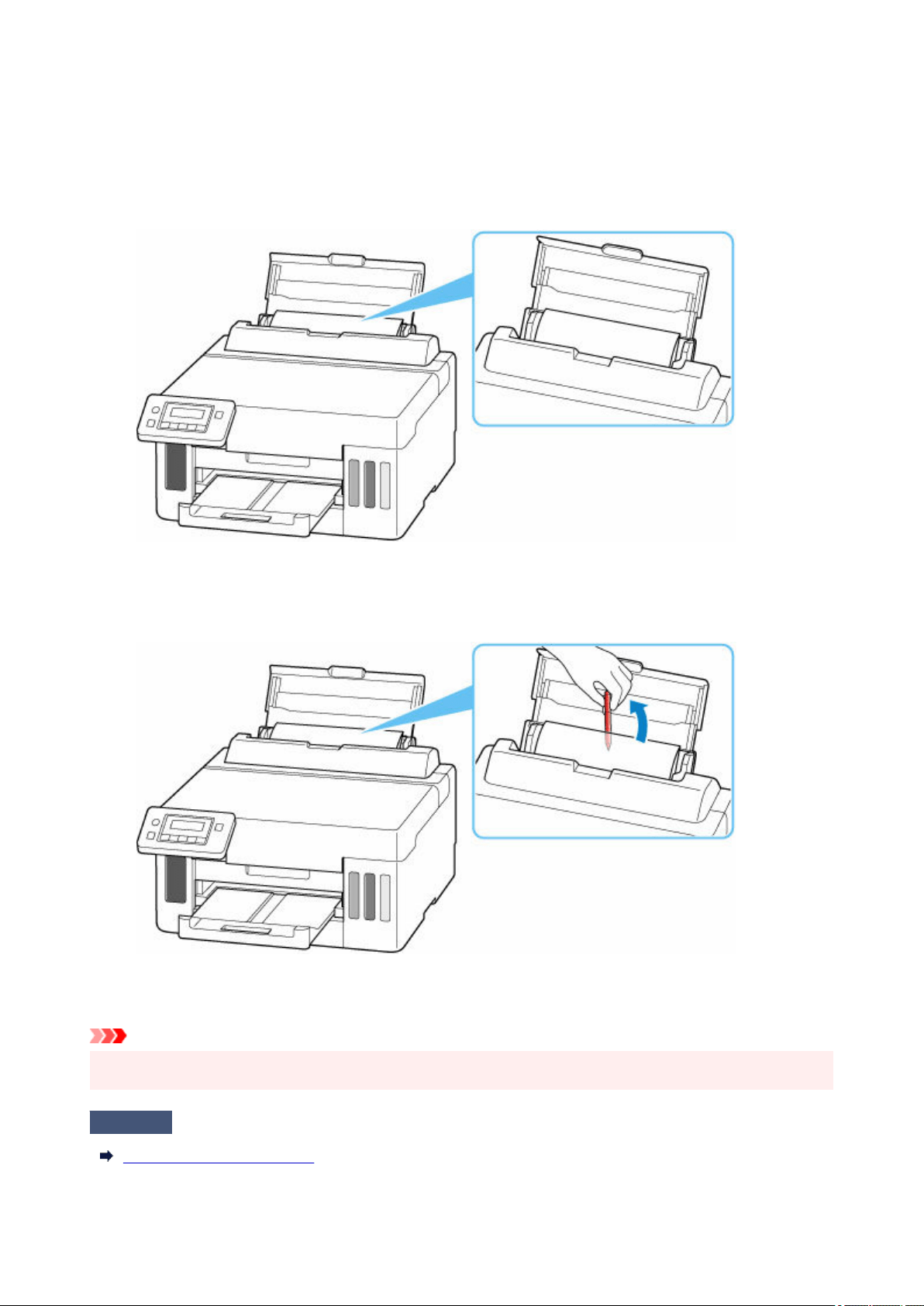
1. Turn off the power of the printer and disconnect the power plug from the outlet.1.
2. Fold one A4 sheet in half and insert it horizontally into the rear tray.2.
Insert the paper so that your hand does not directly touch the part in the center of the rear tray when
removing the foreign object.
3.
Remove foreign object by hand with paper inserted.
3.
Put your hand between the paper you inserted and the rear tray to remove the foreign object.
4. Remove the folded paper inserted in step 2.4.
Important
• Do not tilt the printer or do not it upside down. Doing so may cause the ink to leak.•
Check7
Clean Paper Feed Roller.
Cleaning Paper Feed Rollers
256

Note
•
Cleaning the paper feed roller abrades it, so do this only when necessary.
•
Check8
If two or more sheets of paper feed from cassette at once, clean inside of
cassette.
Cleaning Cassette Pads
Check9
Are transport unit and rear cover attached properly?
See Rear View for the positions of the transport unit and the rear cover.
If the measures above do not solve the problem, contact your nearest Canon service center to request a
repair.
Important
• Do not tilt the printer when moving it since the ink may leak out.
• When transporting the printer for repairing it, see Repairing Your Printer.
257

Printout (Copy) Results Are Unsatisfactory
If the print results are unsatisfactory due to white streaks, misaligned/distorted lines, or uneven colors, check
the paper and print quality settings first.
Check1
Do page size and media type settings match size and type of loaded paper?
If these settings do not match, it is not possible to obtain the proper result.
If you are printing a photograph or an illustration, an incorrect paper type setting may reduce the quality of the
printout color.
Also, if you print with an incorrect paper type setting, the printed surface may be scratched.
The method for checking the paper and print quality settings differs depending on what you are using your printer
for.
•
Printing from your computer
•
Check the settings using the printer driver.
Basic Printing Setup
•
Printing from your smartphone/tablet using Canon PRINT Inkjet/SELPHY
•
Check the settings on Canon PRINT Inkjet/SELPHY.
Print Photos from Your Smartphone
Check2
Make sure appropriate print quality is selected (see list above).
Select a print quality suited to the paper and to what you are printing. If you notice blurs or uneven colors,
increase the print quality setting and retry the printing.
Check3
If problem is not resolved, click on illustration that corresponds to problem.
258
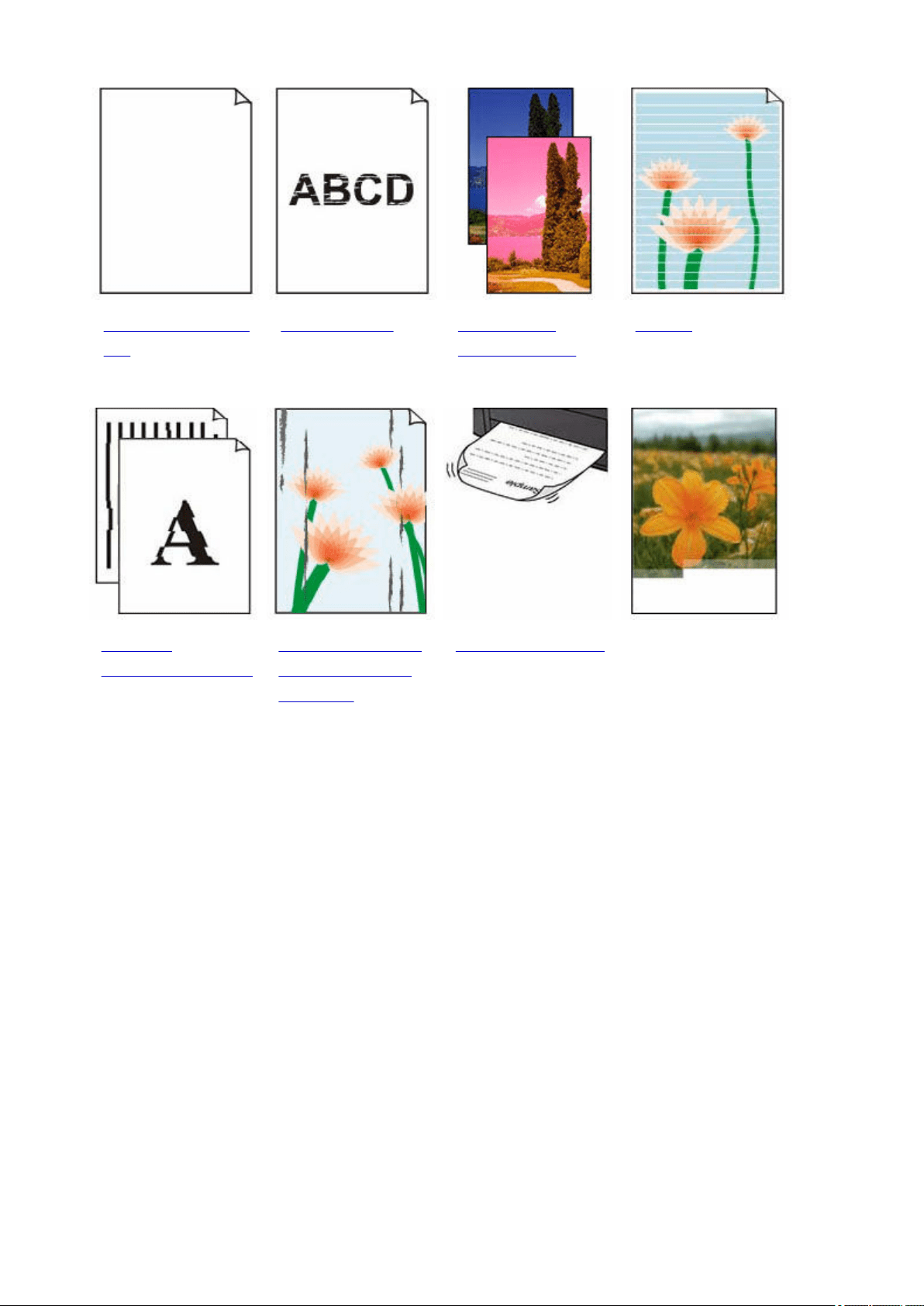
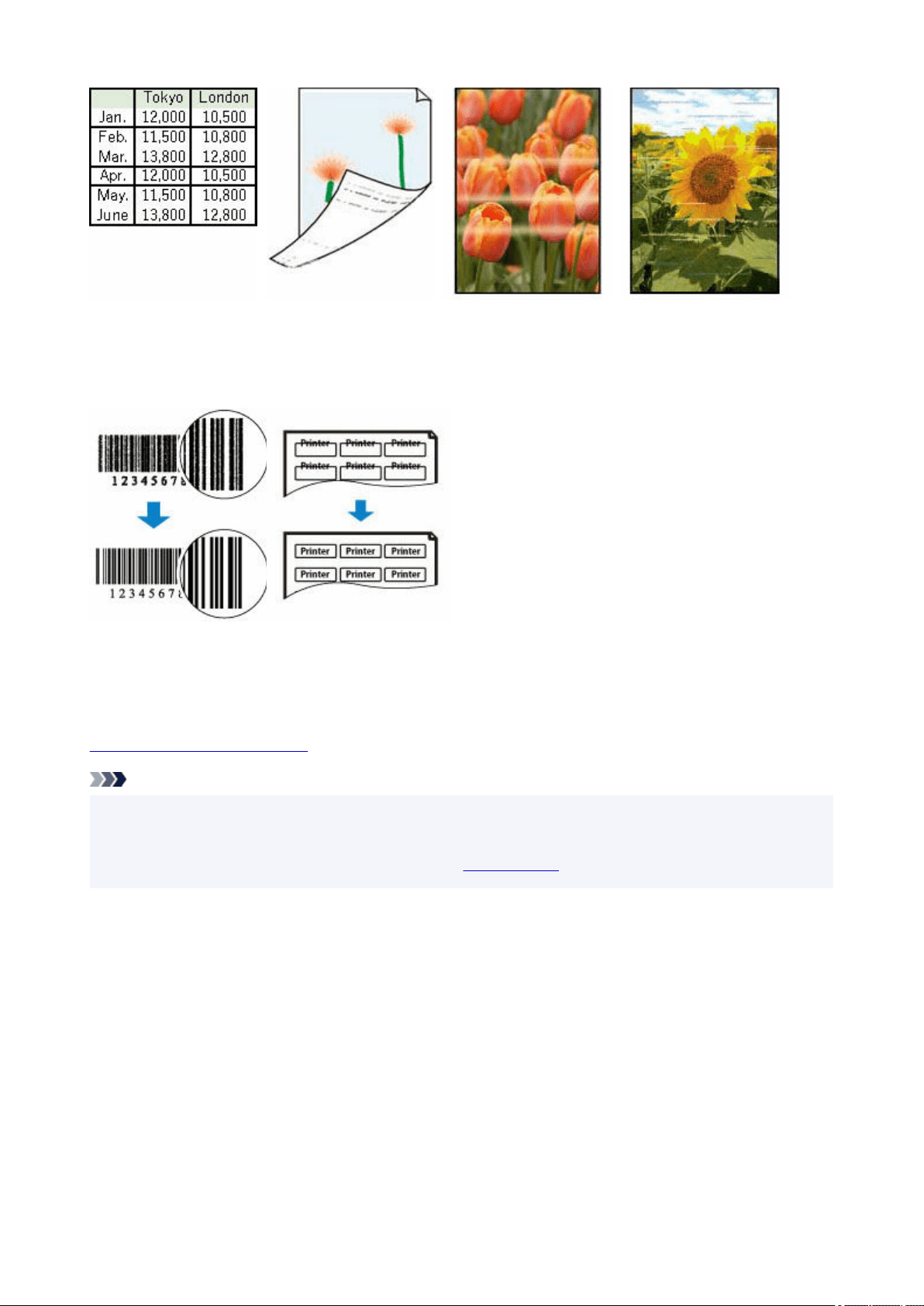
Lines Incomplete or
Missing (Windows)
Back of Paper Is
Smudged
Uneven Colors
Streaked Colors
Printed Barcodes
Are Not Recognized
The Print Position
Shifts
Printed in Black and White
Note
•
This web page contains information about several models. Depending on the specifications of the
•
printer you are using, some of the features described (scanner/copy, etc.) may not apply.
For details about the functions of your printer, see Specifications.
260
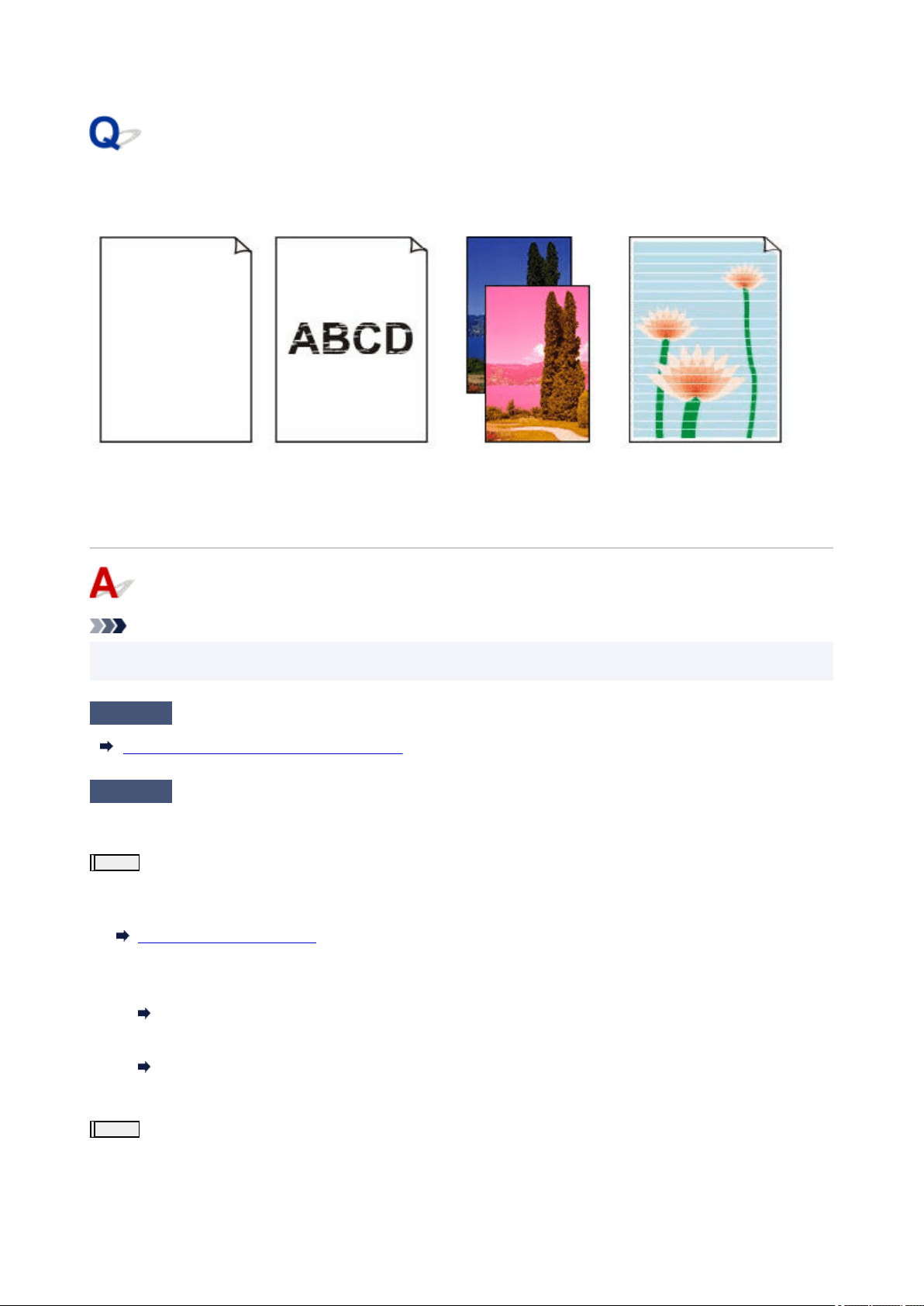
Ink Does Not Come Out/Blurry or Fuzzy/Inaccurate or Bleeding
Colors/Streaks
Ink Does Not Come Out
Blurry or Fuzzy
Inaccurate or Bleeding
Colors
Streaks
Note
• If printouts are blank, black does not print, is faint, or has a blue or red tint, refer to this web page.•
Check1
Check paper and print quality settings.
Printout (Copy) Results Are Unsatisfactory
Check2
Are the print head nozzles clogged?
Print the nozzle check pattern to determine whether the ink ejects properly from the print head nozzles.
Step1
Print the nozzle check pattern.
After printing the nozzle check pattern, examine the pattern.
•
From the printer
•
Printing the Nozzle Check Pattern
•
From the computer
•
◦
For Windows:
◦
Printing a Nozzle Check Pattern
◦
For macOS:
◦
Printing a Nozzle Check Pattern
If the pattern is not printed correctly, go to the next step.
Step2
Clean the print head.
After cleaning the print head, print the nozzle check pattern and check the result.
•
From the printer
•
261

Cleaning the Print Head
• From the computer•
◦ For Windows:◦
Clean the print head
◦ For macOS:◦
Clean the print head
If it still does not improve, go to the next step.
Step3
Clean the print head again.
After cleaning the print head again, print the nozzle check pattern and check the result.
If it still does not improve, go to the next step.
Step4
Clean the print head deeply.
After cleaning the print head deeply, print the nozzle check pattern and check the result.
•
From the printer
•
Deep Print Head Cleaning
• From the computer•
◦ For Windows:◦
Clean the print head deeply
◦
For macOS:
◦
Clean the print head deeply
If it does not improve, turn off the printer, wait for more than 24 hours without unplugging the power supply, and go to the next step.
Step5
Clean the print head deeply again.
After cleaning the print head deeply again, print the nozzle check pattern and check the result.
For details on printing the nozzle check pattern, print head cleaning, and print head deep cleaning, see If Printing
Is Faint or Uneven.
Check3
When using paper with one printable surface, check the correct printable side
of the paper.
Printing on the wrong side of such paper may cause unclear prints or prints with reduced quality.
When you load paper on the rear tray, load paper with the printable side facing up. When you load paper in the
cassette, load paper with the printable side facing down.
Refer to the instruction manual supplied with the paper for detailed information on the printable side.
Check4
If the ink still does not come out.
How to Perform Ink Flush
Note
•
Although some air may enter the ink tube, it is not a malfunction. No problem if the nozzle check pattern is
•
printed correctly.
262
Printed in Black and White
If the ink used by the printer is set to Black only, printouts from a computer etc. will be printed in black and
white.
To print in color, press the Setup button once or twice to display the Setup menu screen, select Device
settings > Other dev. settings, and set Force ink selection to All ink tanks.
Note
• If you print from the printer's operation panel, the printer prints in color, regardless of the ink settings
used by the printer.
263

Lines Are Misaligned/Distorted
Note
• For the case of misaligned or distortion, refer to this web page.•
Check1
Check paper and print quality settings.
Printout (Copy) Results Are Unsatisfactory
Check2
Perform print head alignment.
If printed lines are misaligned/distorted or print results are otherwise unsatisfactory, adjust the print head
position.
Aligning the Print Head
Note
•
If the problem is not resolved after performing the print head alignment, perform print head alignment
•
manually from your computer.
For Windows:
Adjusting Print Head Position Manually
Check3
Increase print quality and try printing again.
Increasing the print quality may improve the print result.
264
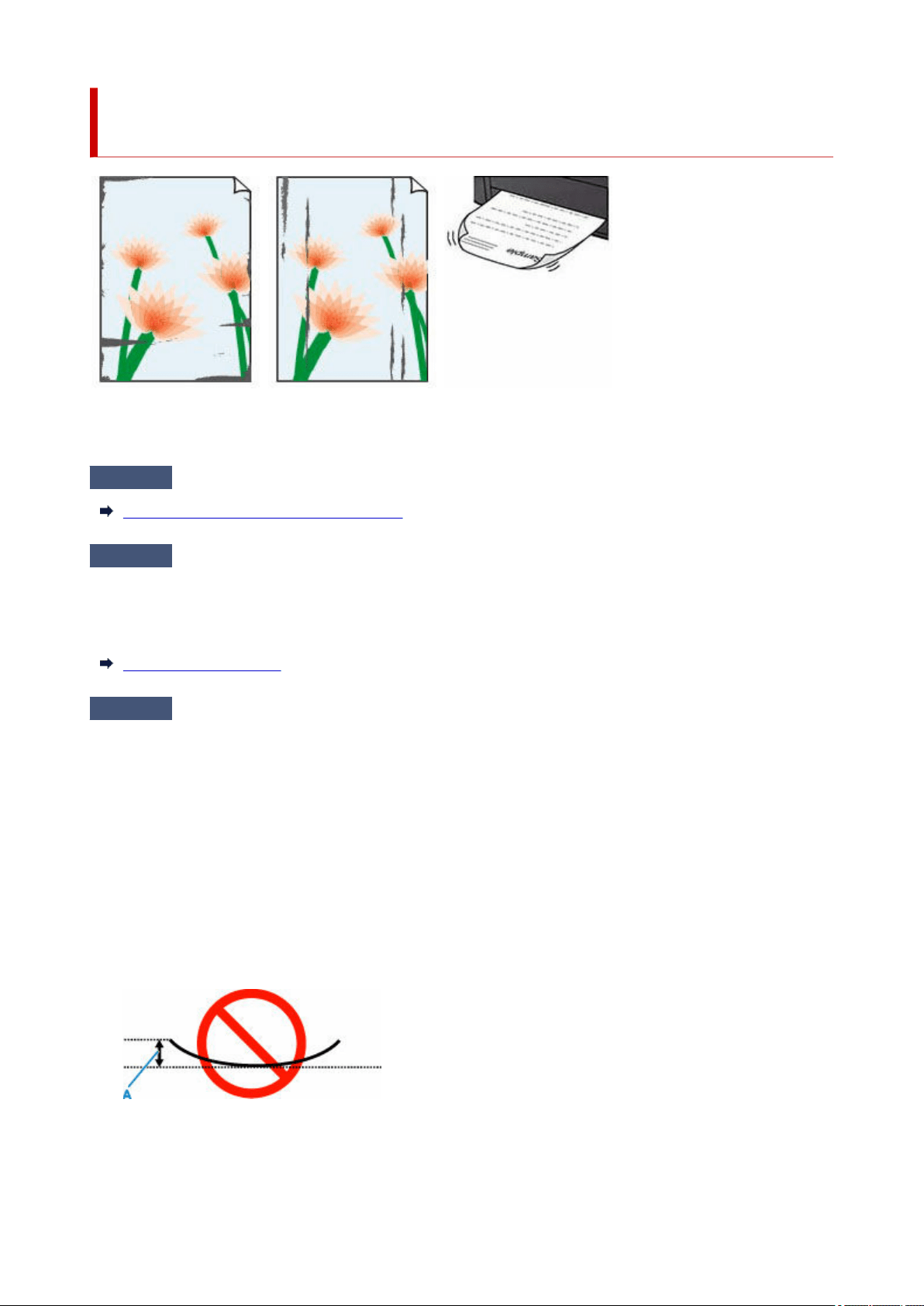
Paper Is Smudged/Printed Surface Is Scratched/Ink Blots/
Paper Curl
Check1
Check paper and print quality settings.
Printout (Copy) Results Are Unsatisfactory
Check2
Check paper type.
Make sure you are using the right paper for what you are printing. To print data with high color saturation such as
photographs or images with dark colors, we recommend that you use Photo Paper Plus Glossy II or other Canon
specialty paper.
Supported Media Types
Check3
Correct curl before loading paper.
When using Photo Paper Plus Semi-gloss, even if the sheet is curled, load one sheet at a time as it is. Rolling
this paper in the opposite direction to flatten it may crack the paper surface and reduce the print quality.
We recommend putting unused paper back into the package and storing it flat.
•
Plain Paper
•
Turn the paper over and reload it to print on the other side.
• Other Paper such as envelope•
If the paper corners curl more than 0.1 in. / 3 mm (A) in height, the paper may smudge or may not feed
properly. Follow the instructions below to correct the paper curl.
1. Roll up paper in opposite direction to paper curl as shown below.1.
265
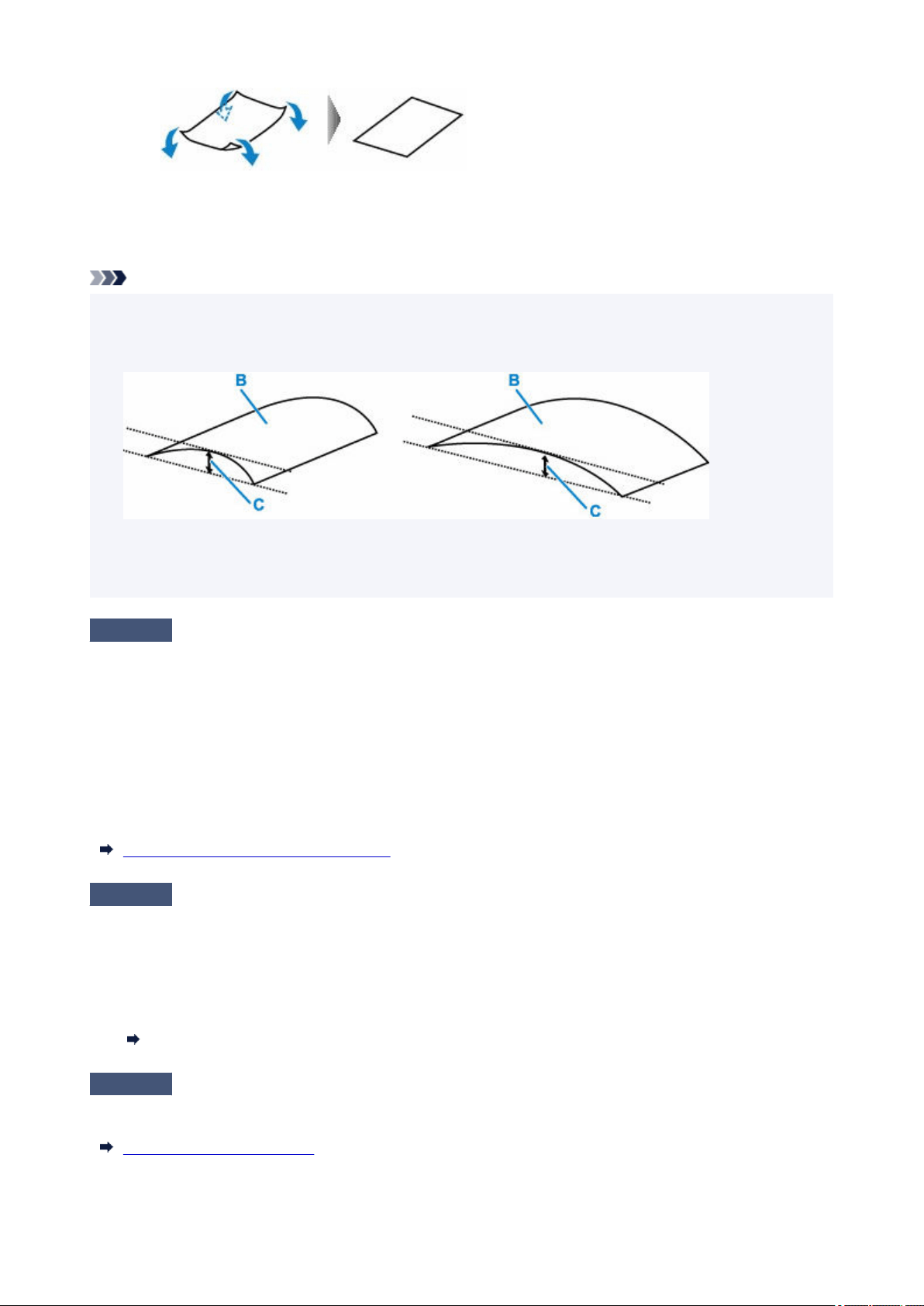
2. Check that paper is now flat.
2.
We recommend printing curl-corrected paper one sheet at a time.
Note
• Depending on paper type, the paper may smudge or may not feed properly even if it is not curled inward.•
Follow the instructions below to curl the paper outward up to 0.1 in. / 3 mm (C) in height before printing.
This may improve the print result.
(B) Print side
We recommend feeding paper that has been curled outward one sheet at a time.
Check4
Set printer to prevent paper abrasion.
Adjusting the setting to prevent paper abrasion will widen the clearance between the print head and the paper.
If you notice abrasion even with the media type set correctly to match the paper, set the printer to prevent paper
abrasion using the operation panel or the computer.
This may reduce the print speed.
* Once you have finished printing, undo this setting. Otherwise, it will apply to subsequent print jobs.
Press the Setup button and select Device settings > Print settings in this order, and then set Prevent
abrasion to ON.
Changing Settings from Operation Panel
Check5
If brightness is set low, increase brightness setting and try printing again.
If you are printing with a low brightness setting on plain paper, the paper may absorb too much ink and become
wavy, causing paper abrasion.
• Printing from your computer (Windows)•
Check the brightness setting in the printer driver.
Adjusting Brightness
Check6
Is paper feed roller dirty?
Clean paper feed roller.
Cleaning Paper Feed Rollers
266

Note
•
Cleaning the paper feed roller abrades it, so do this only when necessary.
•
Check7
Is inside of printer dirty?
During duplex printing, ink may stain the inside of the printer, smudging the printout.
Perform bottom plate cleaning to clean inside of printer.
Cleaning Inside the Printer (Bottom Plate Cleaning)
Note
• To prevent staining inside the printer, be sure to set the correct paper size.•
Check8
Set longer ink drying time.
This allows the printed surface to dry, preventing smudges and scratches.
•
For Windows:
•
Set the waiting time using Canon IJ Printer Assistant Tool.
Changing the Printer Operation Mode
•
For macOS:
•
Set the waiting time using Remote UI.
Opening Remote UI for Maintenance
267


Printer Does Not Turn On
Check1
Press ON button.
Power Supply
Check2
Make sure power plug is securely connected to printer, and then turn on again.
Check3
Unplug printer, leave it for at least 2 minutes, and then plug it back in and turn
on again.
If this does not solve the problem, contact your nearest Canon service center to request a repair.
269

Printer Turns Off Unexpectedly or Repeatedly
Check
If printer is set to turn off automatically after a certain time, disable this setting.
If you have set the printer to turn off automatically after a specified time, the power will shut off by itself once that
time has elapsed.
1. Check that printer is turned on.1.
2. Press the Setup button, use the button to select ECO settings, and press the OK2.
button.
LCD and Operation Panel
3.
Use the button to select EnergySaveSettings and then press the OK button.
3.
4.
Use the button to select Auto power off and then press the OK button.
4.
5.
Use the button to select OFF and then press the OK button.
5.
The setting to shut off the power automatically is disabled.
Note
•
You can use the scheduling function of the Remote UI to turn the printer on or off at a specified time.
270
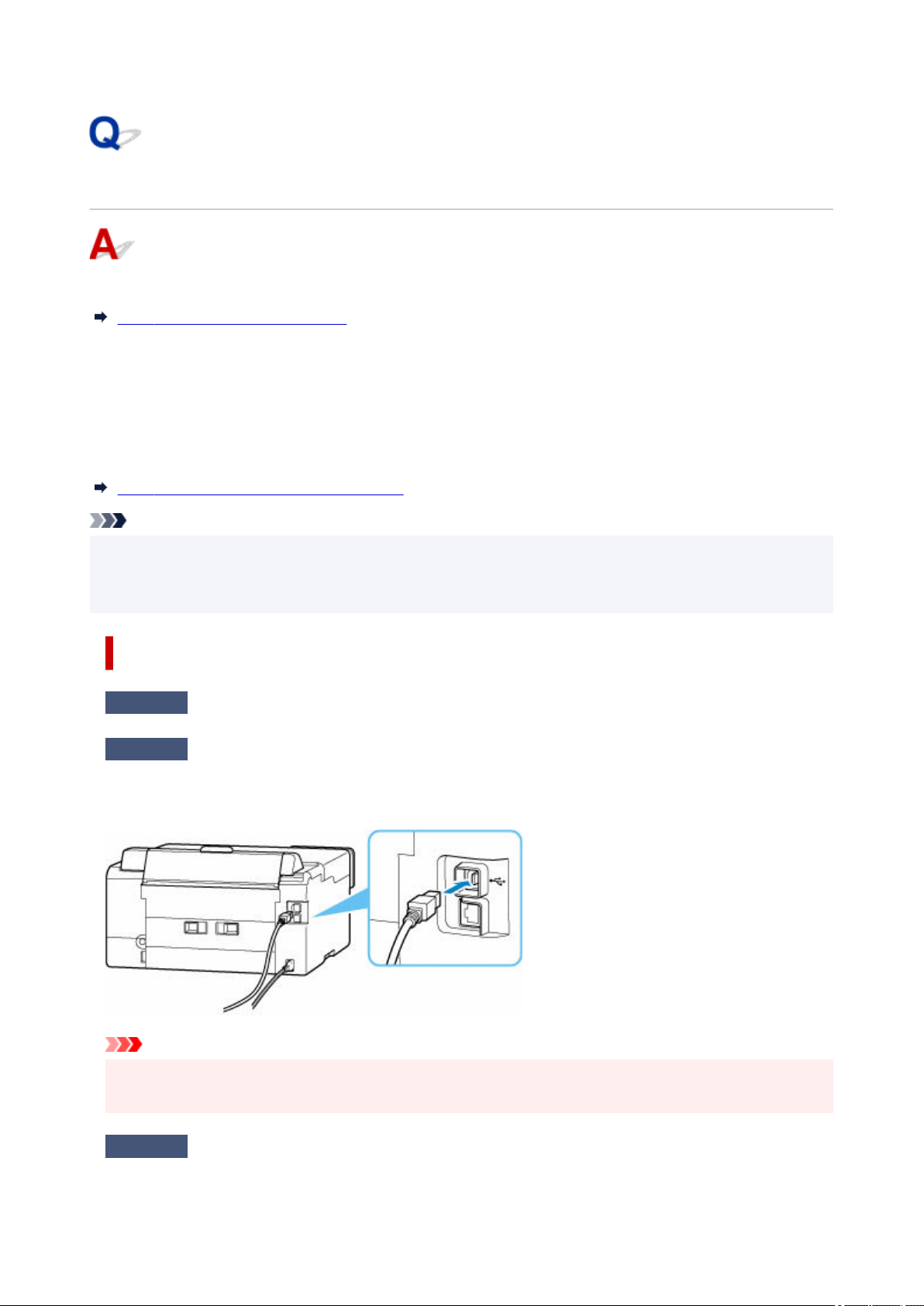
USB Connection Problems
If the printer connected to the computer via USB is not recognized, check the following items.
USB Connection Not Recognized
The following problems may occur even though the USB connection is recognized.
• Printing (scanning) is slow.
• Hi-Speed USB connection does not work.
• A message such as "This device can perform faster" appears. (Windows)
If the above is the case, check the following.
USB Connection Does Not Work Properly
Note
• If your system environment does not support Hi-Speed USB, the printer operates at the slower speed
of Full-Speed or Low-Speed. In this case, the printer works properly but printing (scanning) speed may
slow down due to the communication speed.
USB Connection Not Recognized
Check1
Check that printer is turned on.
Check2
Unplug the USB cable from the printer and the computer, and then connect it
again.
As the illustration below, the USB port is at the back of the printer.
Important
•
Check the orientation of the "Type-B" connector and connect to the printer. For details, refer to the
instruction manual supplied with the USB cable.
Check3
Check that Enable bidirectional support is selected in Ports sheet of
Printer properties dialog box. (Windows)
271

If not, select it to enable bidirectional support.
Opening Printer Driver's Setup Screen
USB Connection Does Not Work Properly
Check
Check following to make sure your system environment supports Hi-Speed
USB connection.
•
Does the USB port on your computer support Hi-Speed USB connection?•
•
Does the USB cable or the USB hub support Hi-Speed USB connection?
•
Be sure to use a certified Hi-Speed USB cable. We recommend that the USB cable be no longer than 10
feet / 3 meters or so.
•
Is the Hi-Speed USB driver working properly on your computer?
•
Make sure the latest Hi-Speed USB driver is working properly and install the latest version of the
Hi-Speed USB driver for your computer, if necessary.
Important
•
For more information, contact the manufacturer of your computer, USB cable, or USB hub.
•
272
Wrong Language Appears in LCD
Follow the instructions below to select your language.
1.
Press Setup button once or twice to display the Setup menu screen.
1.
2.
Press button 1 times and press OK button.
2.
3.
Press button 3 times and press OK button.
3.
4.
Use button to select language for LCD and press OK button.
4.
The desired language appears on the LCD.
273


Failed to MP Drivers (Printer Driver) Installation (Windows)
If the MP Drivers (Printer Driver) were not installed correctly, make sure that all Windows Updates have
been applied. If all Windows Updates have not been applied, apply all Windows Updates.
After confirming Windows Update, perform the following operations to install the MP Drivers (Printer
Driver).
1.
Open screen to uninstall MP Drivers (Printer Driver).
1.
For Windows 11:
Select Settings > Apps.
Select Apps & features.
For Windows 10:
Select Settings > Apps.
For Windows 8.1 / Windows 7:
Select Control Panel > Programs and Features.
2. Check if there is "Canon XXX series MP Drivers" or "Canon XXX series Printer Driver"2.
you want to install in list.
"XXX" is the model name.
3. If you find MP Drivers (Printer Driver) for printer you want to install, uninstall it.3.
If not found, proceed to the next step.
4.
Restart computer.
4.
After restarting, install the latest MP Drivers (Printer Driver).
Important
•
For Windows:
•
To restart your computer, choose Restart instead of Shut down.
275

Updating MP Drivers (Printer Driver) in Network Environment
(Windows)
Download the latest MP Drivers (Printer Driver) in advance.
Download the latest MP Drivers (Printer Driver) for your model on the download page of the Canon website.
After the download is completed, overwrite and install the new version of the MP Drivers (Printer Driver)
according to the specified installation procedure.
Note
• The network settings on the printer are not affected, so the printer can be used on the network without
redoing settings.
276


Four-Digit Alphanumeric Code Is Displayed on LCD
A message is displayed on the printer's LCD or your computer screen.
Some errors may display a four-digit alphanumeric code along with the error message. The characters
represent a "support code" (error number).
For details on each support code, see List of Support Codes for Printer Errors.
278
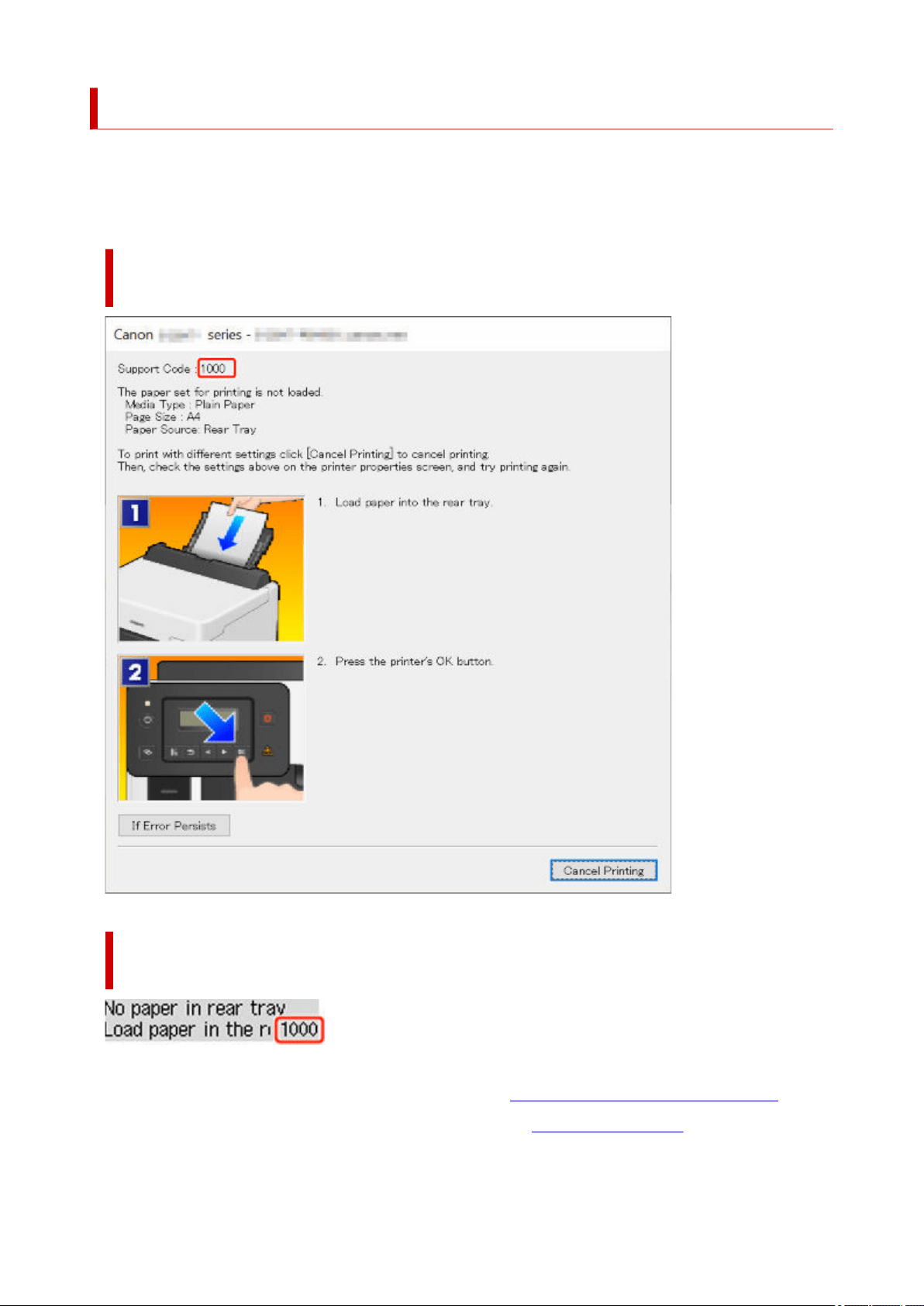
When Error Occurred
If an error occurs in printing, for example, if the paper runs out or jams, a troubleshooting message is
displayed automatically. For some errors, a support code (error number) is also displayed.
Take the appropriate action described in the message.
When a Support Code and a Message are displayed on the Computer
Screen (Windows):
When a Support Code and a Message are displayed on the Printer's
LCD:
For details on how to resolve errors with Support Codes, see List of Support Codes for Printer Errors.
For details on how to resolve errors without Support Codes, see Message Is Displayed.
279

Message Is Displayed
This section describes some of the messages.
If a message is displayed on the printer's LCD, see below.
Message Is Displayed on the Printer's LCD
If a message is displayed on the computer, see below.
Error Regarding Automatic Duplex Printing Is Displayed
Error Regarding Power Cord Being Unplugged Is Displayed (Windows)
Writing Error/Output Error/Communication Error (Windows)
Other Error Messages (Windows)
Message Is Displayed on Printer's LCD
Check the message and take appropriate action.
• Cannot connect to the server; try again•
The printer cannot connect to the server due to a communication error.
Press the printer's OK button to cancel the error and try again after a while.
Error Regarding Automatic Duplex Printing Is Displayed
Check
See Automatic Duplex Printing Problems and take the appropriate action.
Error Regarding Power Cord Being Unplugged Is Displayed (Windows)
The printer may have been unplugged while it was on.
Check the error message displayed on the computer and click OK.
The printer starts printing.
See
Unplugging the Printer to unplug the printer correctly.
Writing Error/Output Error/Communication Error (Windows)
Check1
If the ON lamp is off, make sure printer is plugged in and turn on.
The ON lamp flashes while the printer is initializing. Wait until the ON lamp stops flashing and remains lit.
Check2
Make sure printer is properly connected to computer.
If you are using a USB cable, make sure it is securely connected to both the printer and the computer. When
the USB cable is securely plugged in, check the following:
•
If you are using a relay device such as a USB hub, disconnect it, connect the printer directly to the
computer, and retry the printing. If printing starts normally, there is a problem with the relay device.
Contact the vendor of the relay device.
280

• There could also be a problem with the USB cable. Replace the USB cable and retry the printing.
If you use the printer over a LAN, make sure the printer is correctly set up for network use.
Check3
Make sure printer driver is installed correctly.
Uninstall the printer driver following the procedure described in Deleting the Unnecessary Printer Driver and
click here to reinstall it.
Check4
When printer is connected to your computer with a USB cable, check device
status from your computer.
Follow the procedure below to check the device status.
1. Select Control Panel > Hardware and Sound > Device Manager.1.
Note
•
If the User Account Control screen is displayed, select Continue.
2.
Open USB Printing Support Properties.
2.
Double-click Universal Serial Bus controllers and USB Printing Support.
Note
• If the USB Printing Support Properties screen is not displayed, make sure the printer is•
correctly connected to the computer.
Check2
Make sure printer is properly connected to computer.
3.
Click General tab and check for a device problem.
3.
If a device error is shown, see Windows Help to resolve it.
Other Error Messages (Windows)
Check
If an error message is displayed somewhere other than printer status monitor,
check the following:
• "Could not spool successfully due to insufficient disk space"•
Delete any unnecessary files to increase the amount of free space on the disk.
• "Could not spool successfully due to insufficient memory"•
Close other applications to increase the available memory.
If you still cannot print, restart your computer and retry the printing.
• "Printer driver could not be found"•
Uninstall the printer driver following the procedure described in Deleting the Unnecessary Printer Driver
and click here to reinstall it.
• "Could not print Application name - File name"•
281

Try printing again once the current job is complete.
282
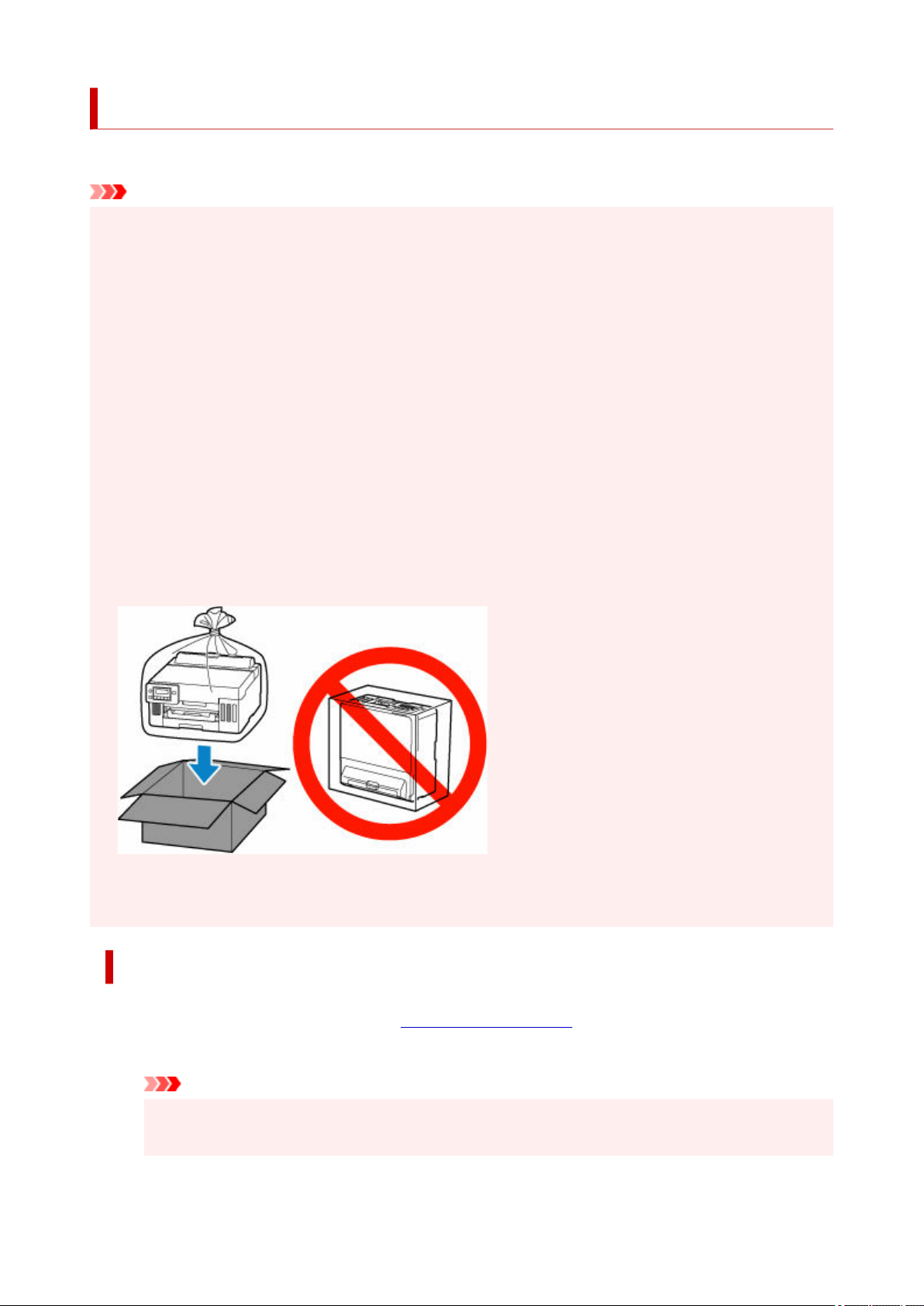
Repairing Your Printer
This section describes how to transport the printer for repairing it.
Important
• You cannot take ink out of ink tanks.•
• Make sure the tank caps of ink tanks are closed securely. If the tank caps are open, close the tank caps•
properly.
• Press the ON button to turn off the printer with the print heads installed. The printer protects the print•
heads by covering them automatically to prevent them from being dried.
• Do not remove the print heads. Ink may leak.•
• If the inside of the printer becomes dirty, clean with a soft cloth that gets wet with water and squeezed•
firmly.
• When transporting the printer, pack the printer in a plastic bag so that ink does not leak.•
• Pack the printer in a sturdy box so that it is placed with its bottom facing down, using sufficient•
protective material to ensure safe transport.
• Do not tilt the printer; otherwise, ink may leak.•
• When a shipping agent is handling transport of the printer, have its box marked "THIS SIDE UP" to•
keep the printer with its bottom facing down. Mark also with "FRAGILE" or "HANDLE WITH CARE".
• Please handle with care and ensure the box remains flat and NOT turned upside down or on its side, as•
the printer may be damaged and ink in the printer may leak.
Make Sure Ink Valve is Closed
1.
Make sure ON lamp is not lit and unplug the power cord.
1.
If the power is on, press the ON button to turn off the printer.
Important
•
Do not unplug the printer while the ON lamp is lit or flashing, as it may cause malfunction or
damage to the printer, making the printer unable to print.
283
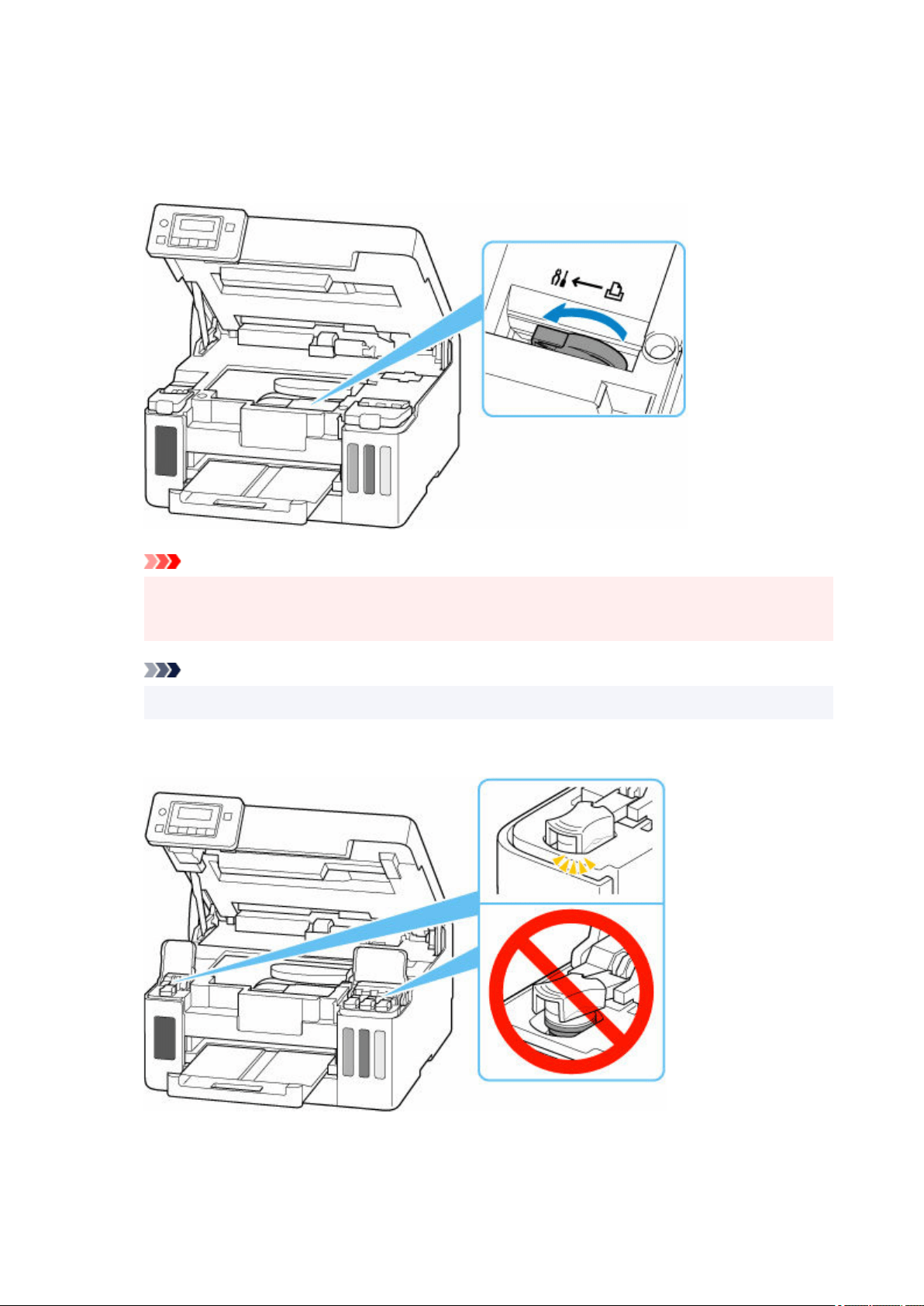
2. Open top cover.2.
3. Close ink valve.3.
Close the ink valve by tilting the ink valve lever tightly to the left.
Important
• If you pack the printer without closing the ink valve, ink may leak out. Be sure to close the ink•
valve before packing the printer.
Note
•
If the ink valve lever is already tilted to the left and the ink valve is closed, leave it in place.
4.
Make sure tank caps are closed securely.
4.
5.
Close top cover gently.
5.
284
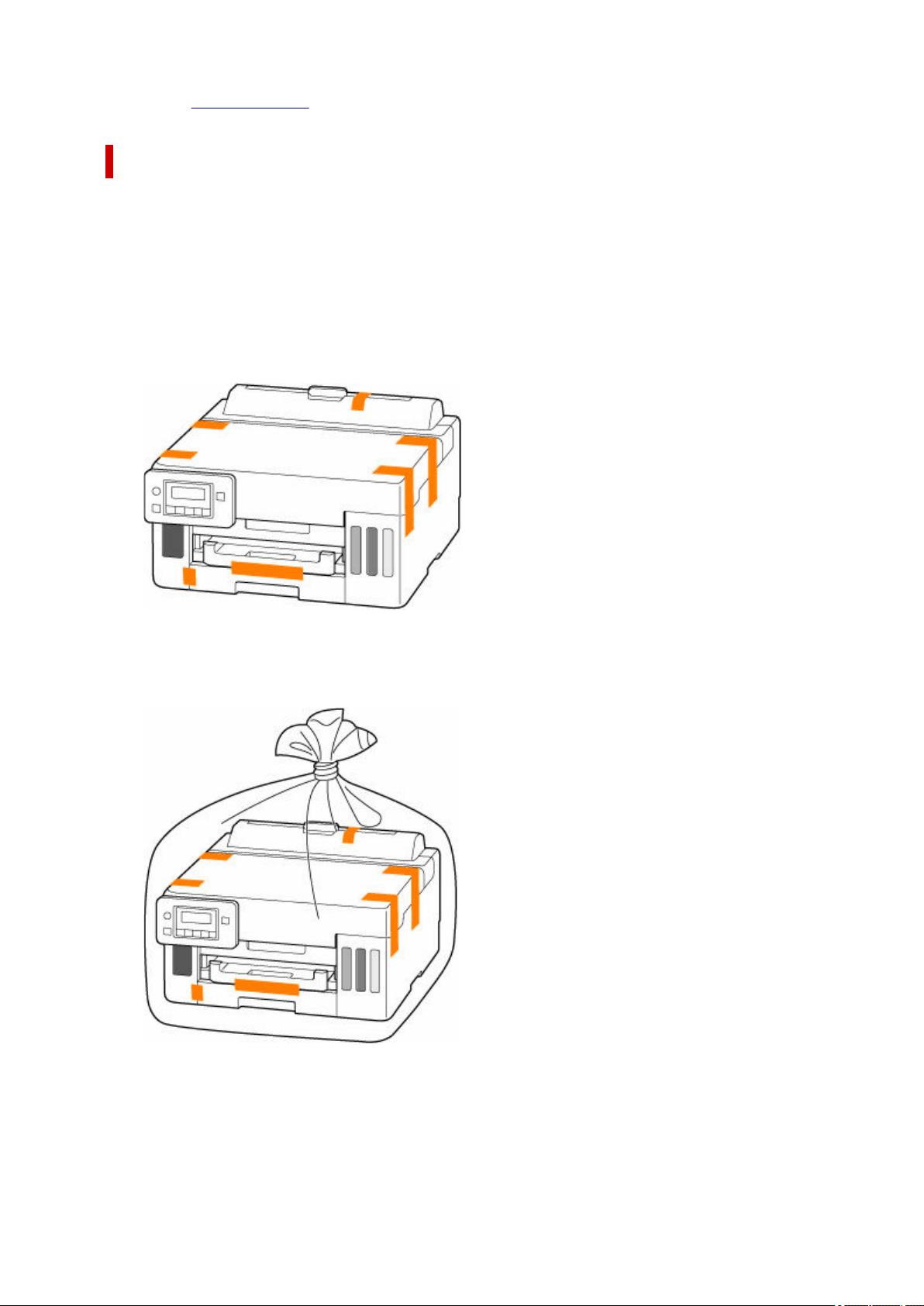
Go to Packing Printer.
Packing Printer
1.
Retract paper output tray.
1.
2. Retract paper support, and then close it.2.
3.
Unplug cable and power cord.
3.
4.
Use adhesive tape to secure all covers on the printer to keep them from opening.
4.
5. Pack printer in plastic bag.5.
Seal the mouth of the plastic bag with the tape or tie it tightly so that ink does not leak.
6.
Pack printer in box.
6.
Attach the protective material to the printer to pack it securely in the box.
285
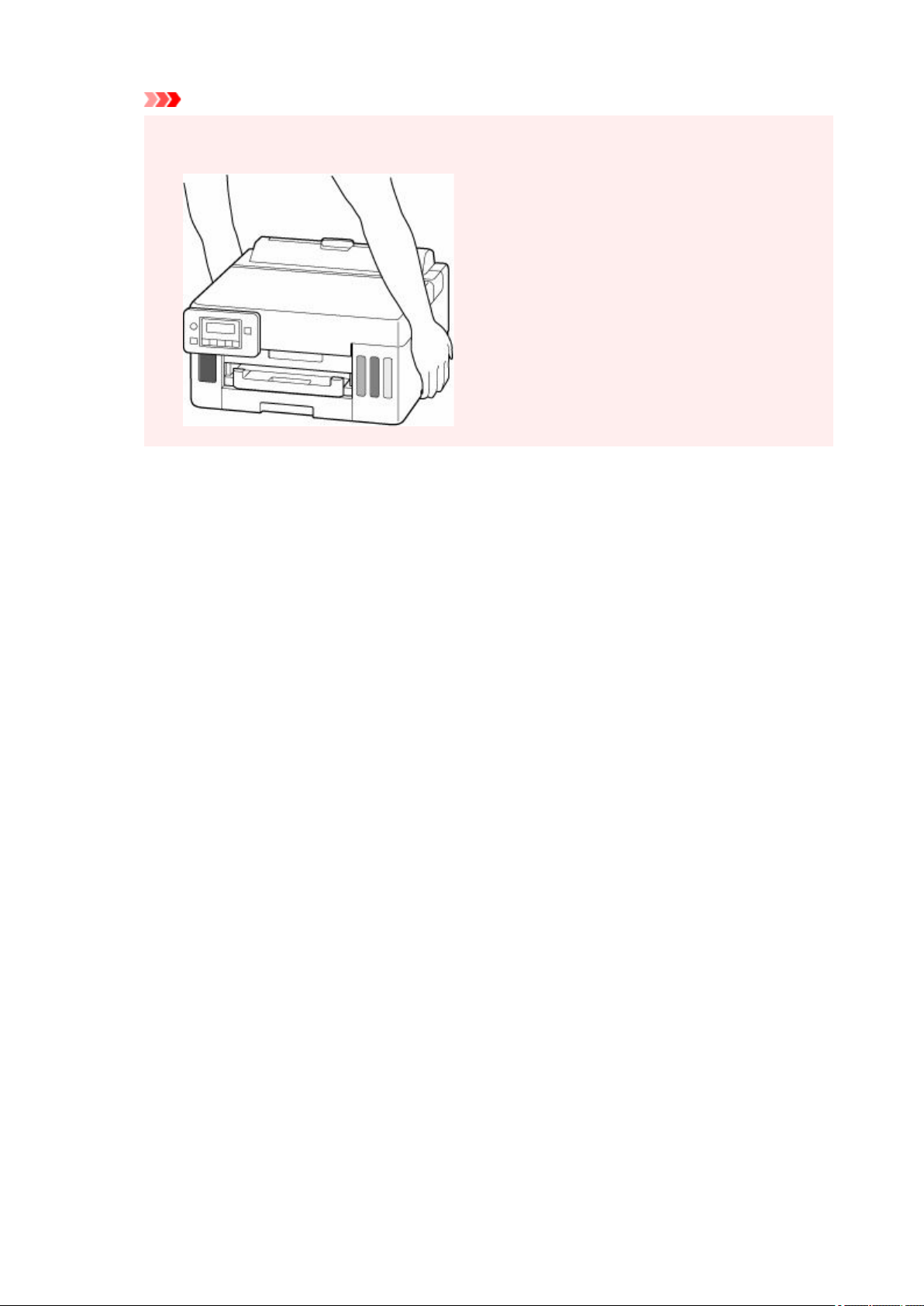
Important
• Carry the printer as shown in the illustration below. If you hold the cassette when carrying, the•
cassette may come off from the printer.
286

List of Support Codes for Printer Errors
Support codes are displayed on the printer's LCD and your computer screen when errors occur.
A "support code" is an error number, and is displayed along with an error message.
When an error occurs, check the support code and take the appropriate action in response.
Support Codes Displayed on Printer's LCD and Computer Screen
• 1000 to 1ZZZ•
1000 1003 1070 1200 1215 1262 1300 1303 1304 1309 1310 1313
1369 136A 1401 1403 1405 140B 1434 147C 147D 1496 15A1 15A2
1643 1723 1724 1725 1726 1727 1871 1890
• 2000 to 2ZZZ•
2110 2113 2114 2120 2123 21F0 2200 2500
• 3000 to 3ZZZ•
3252 3413 3440 3441 3442 3443 3444 3445 3446 3447
• 4000 to 4ZZZ•
4103 4104 495A
• 5000 to 5ZZZ•
5100 5200 5207 5400 5700 5C02 5C30
•
6000 to 6ZZZ
•
6000
6001
6004
6500
6700
6701
6800
6801
6830
6831
6832
6833
6900
6901
6902
6910
6920
6921
6930
6931
6932
6933
6940
6941
6942
6943
6944
6945
6946
6A80
6A81
6A83
6D01
•
7000 to 7ZZZ
•
7500
7600
7700
7800
287

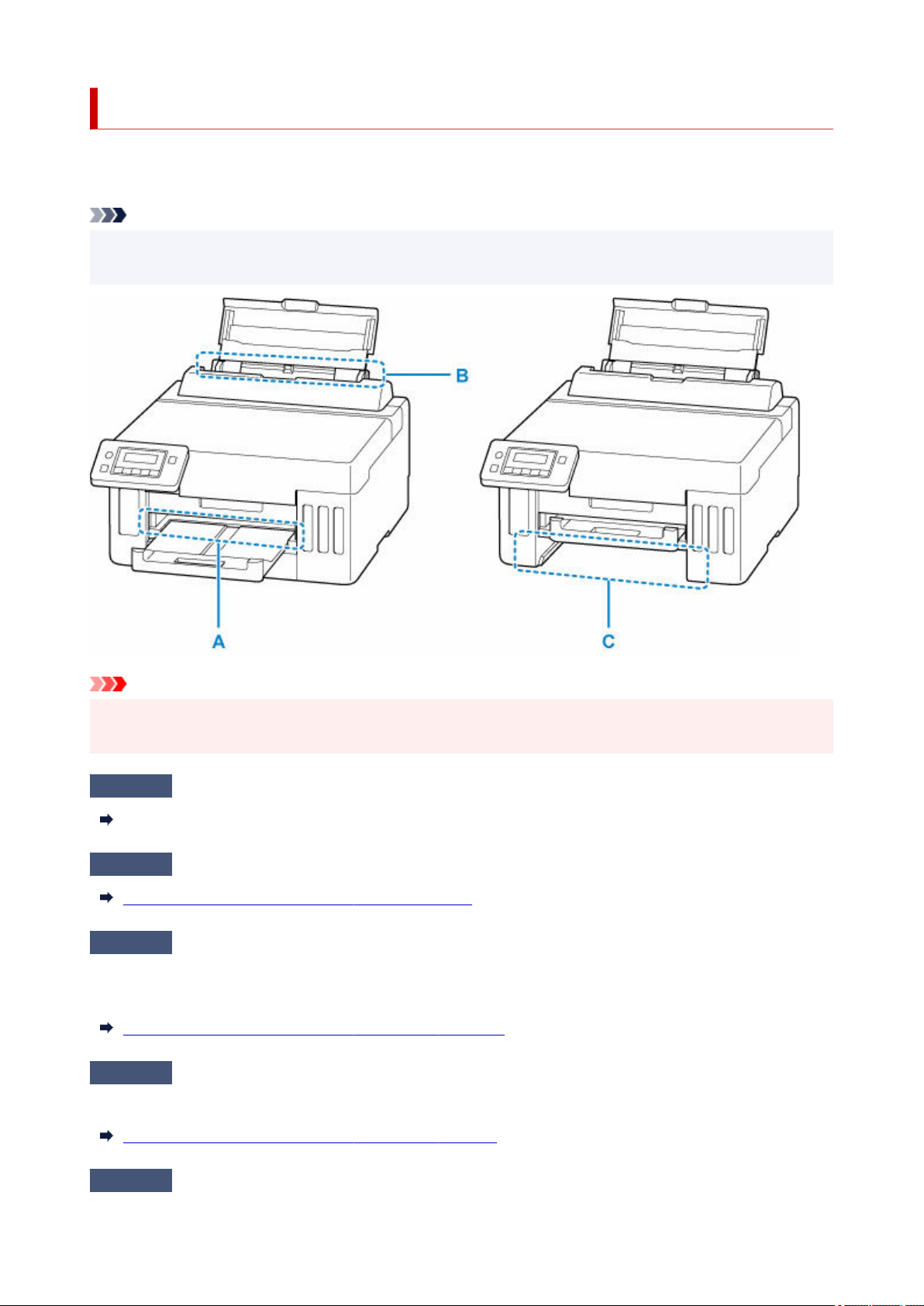
What to Do When Paper Is Jammed
If a paper jam occurs during printing (when the support code 1300/1303/1304/1313 is displayed), follow the
procedure below.
Note
• If the paper is not jammed (the support code is not displayed) and the paper is not fed normally, see
What to Do If Paper Is Not Fed Normally.
Important
• When checking the paper output slot / feed slot or removing any foreign objects, do not turn the printer
upside down or tilt it. The ink may leak out.
Check1
Did you try to print on a small paper size such as 4"x6" 10x15cm size?
What to Do When Small Paper Sizes Are Jammed
Check2
Is the jammed paper visible in the paper output slot (A)?
Removing Jammed Paper through Paper Output Slot
Check3
Is the jammed paper visible in the feed slot of the rear tray (B)?
Remove any paper other than the jammed paper on the rear tray, and then check if the jammed paper is visible
in the feed slot of the rear tray.
Removing Jammed Paper through Feed Slot of Rear Tray
Check4
Is the jammed paper visible in the feed slot of the cassette (C)?
Retract the paper output tray, and then check if the jammed paper is visible in the feed slot of the cassette.
Removing Jammed Paper through Feed Slot of Cassette
Check5
If the jammed paper is not visible in the paper output slot or the feed slot.
289
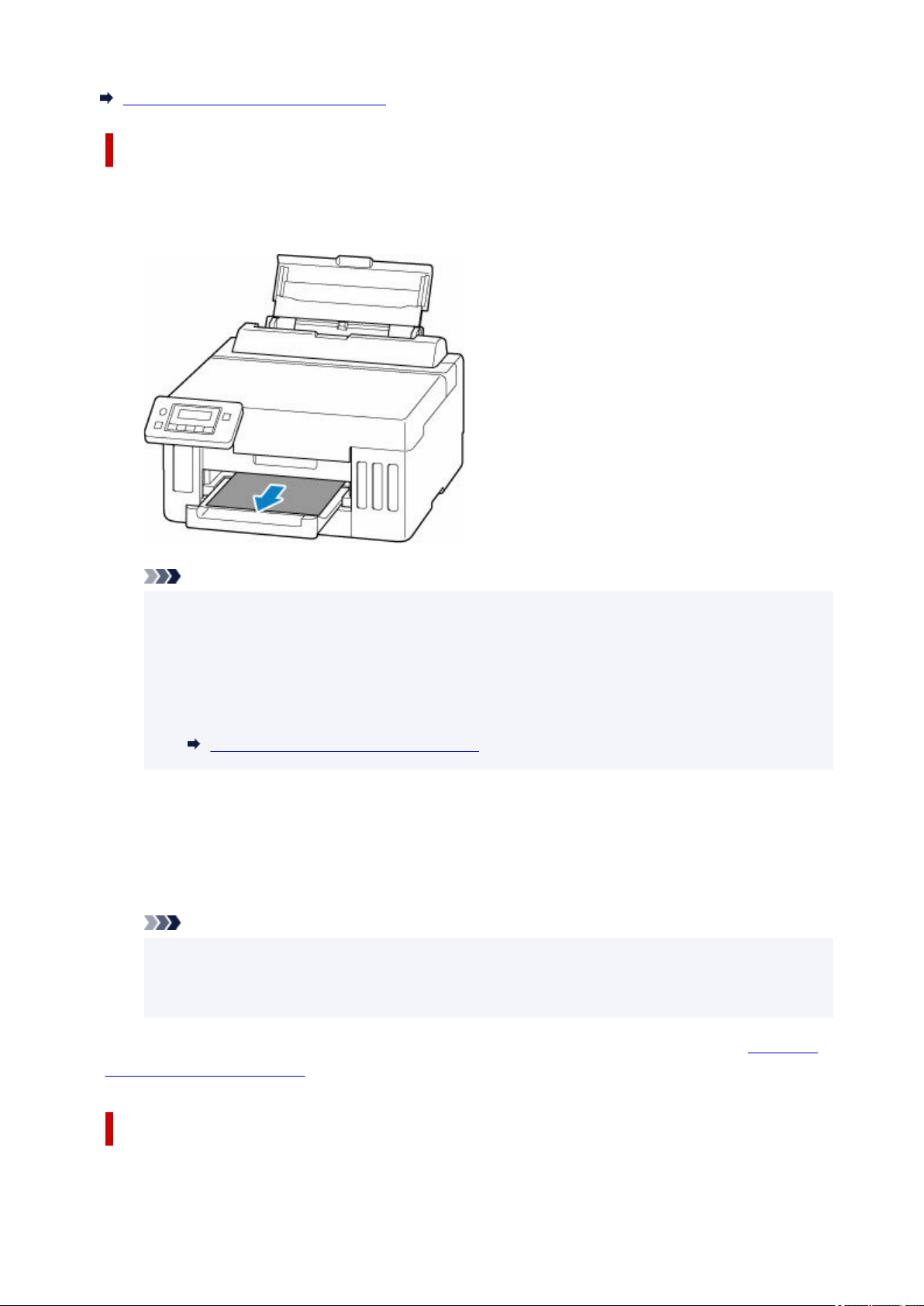
Removing Jammed Paper inside Printer
Removing Jammed Paper through Paper Output Slot
1. Hold jammed paper firmly with both hands and pull it out slowly.1.
Slowly pull out the paper so as not to tear it.
Note
• If you cannot pull out the paper, turn the printer back on without pulling forcibly. The paper may•
be ejected automatically.
Press the printer's Stop button to stop printing, and then turn off the printer.
•
If the paper cannot be pulled out or is torn, open the printer's top cover and remove jammed
•
paper inside the printer.
Removing Jammed Paper inside Printer
2. Press printer's OK button.2.
The printer resumes printing. Reprint the page you were printing if it was not printed properly due to
the paper jam.
If you turned off the printer in step 1, all jobs in the print queue are canceled. Redo the printing.
Note
•
When reloading the paper, make sure you are using suitable paper and loading it correctly.
•
We recommend using paper sizes other than A5 to print documents with photos or graphics. A5
paper may curl and jam as it leaves the printer.
If the measures above do not solve the problem, a bit of paper may remain in the printer. See
Removing
Jammed Paper inside Printer.
Removing Jammed Paper through Feed Slot of Rear Tray
1.
Hold jammed paper firmly with both hands and pull it out slowly.
1.
290
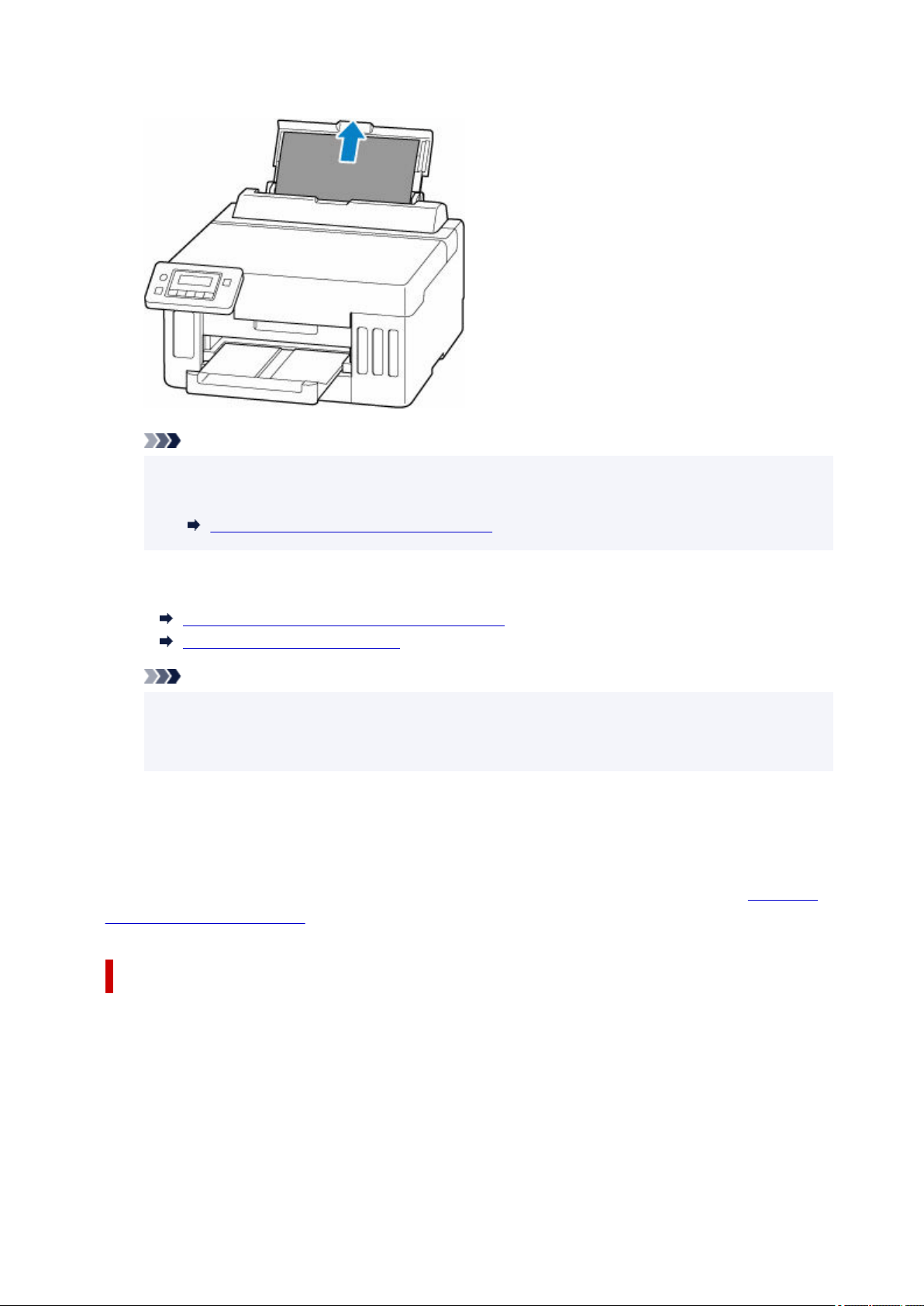
Slowly pull out the paper so as not to tear it.
Note
•
If the paper cannot be pulled out or is torn, refer to the following page to detach the transport
•
unit and then pull out the jammed paper from the feed slot of the rear tray.
Removing Jammed Paper from Rear Side
2. Load paper in rear tray.2.
Loading Photo Paper / Plain Paper in Rear Tray
Loading Envelopes in Rear Tray
Note
• Make sure you are using suitable paper and loading it correctly.
• We recommend using paper sizes other than A5 to print documents with photos or graphics. A5
paper may curl and jam as it leaves the printer.
3. Press printer's OK button.3.
The printer resumes printing. Reprint the page you were printing if it was not printed properly due to
the paper jam.
If the measures above do not solve the problem, a bit of paper may remain in the printer. See
Removing
Jammed Paper inside Printer.
Removing Jammed Paper through Feed Slot of Cassette
1.
Hold jammed paper firmly with both hands and pull it out slowly.
1.
Slowly pull out the paper so as not to tear it.
291
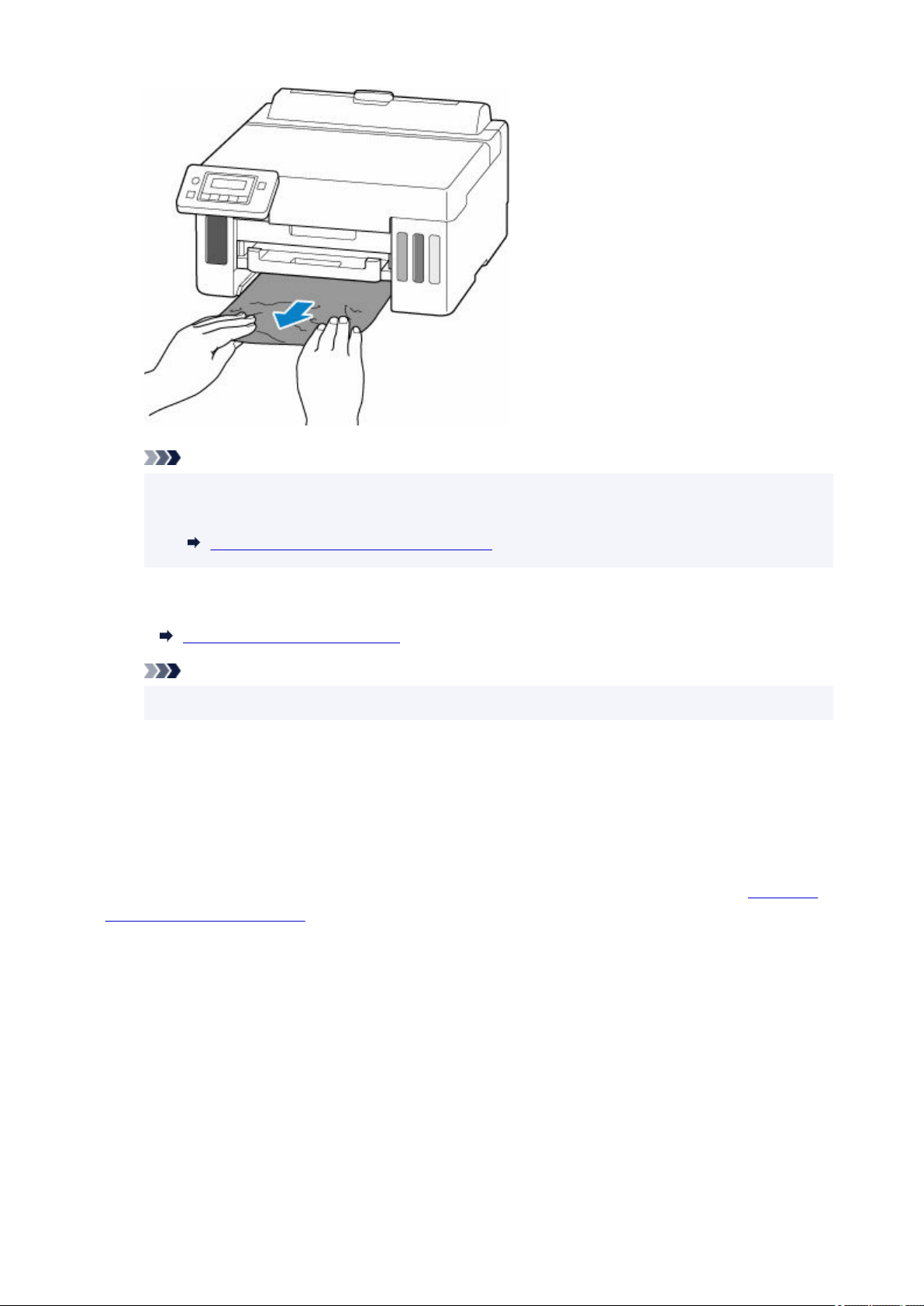
Note
•
If the paper cannot be pulled out or is torn, detach the rear cover and remove the jammed paper
•
from the rear side.
Removing Jammed Paper from Rear Side
2.
Load paper in cassette.
2.
Loading Plain Paper in Cassette
Note
• The loadable paper in the cassette is A4, Letter, A5, B5 or Executive size plain paper.
3. Pull out paper output tray.3.
4.
Press printer's OK button.
4.
The printer resumes printing. Reprint the page you were printing if it was not printed properly due to
the paper jam.
If the measures above do not solve the problem, a bit of paper may remain in the printer. See
Removing
Jammed Paper inside Printer.
292
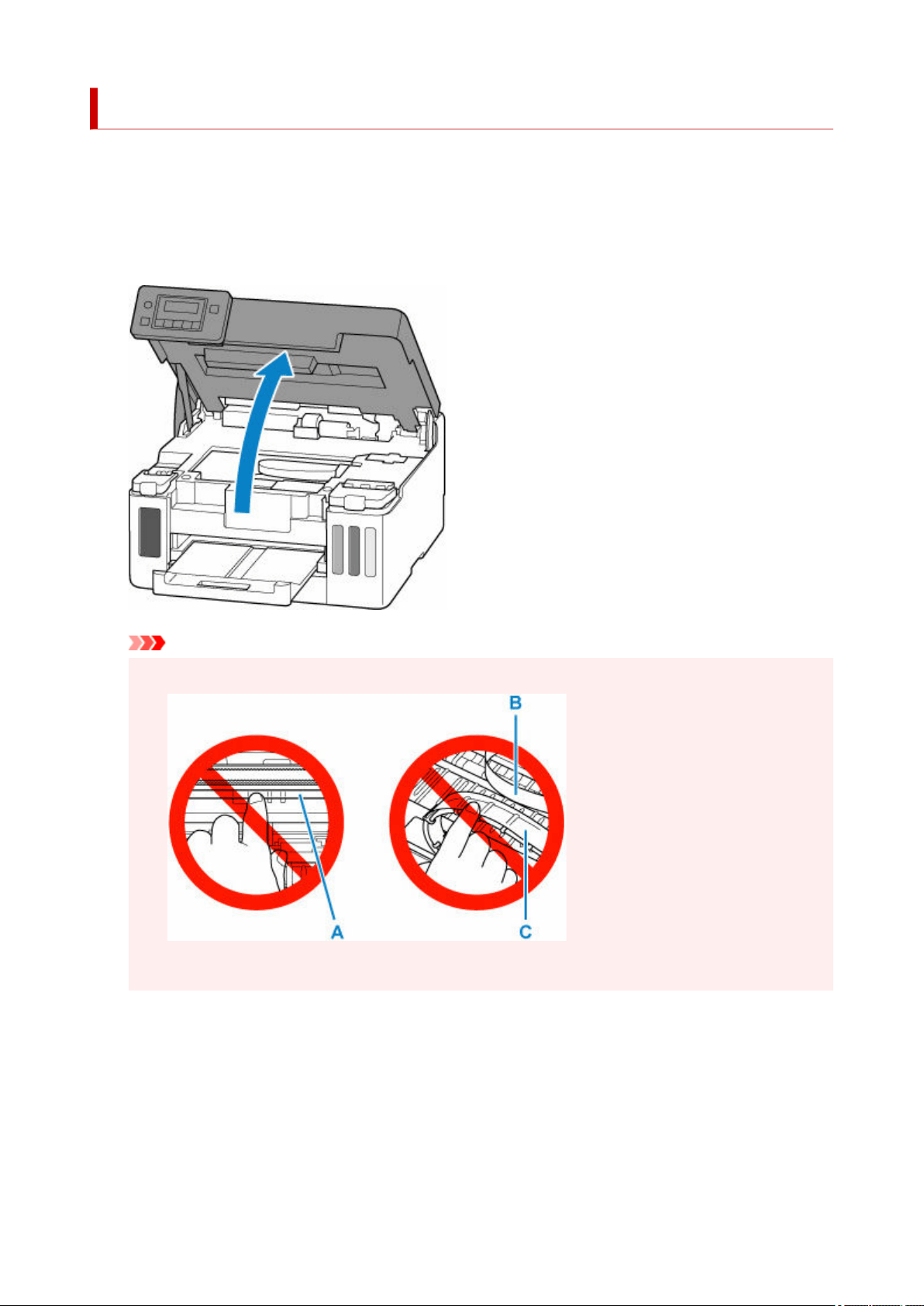
Removing Jammed Paper inside Printer
1. Press printer's Stop button.1.
2.
Turn off printer and unplug it.
2.
3. Open top cover.3.
Important
• Do not touch the clear film (A), white belt (B), or tubes (C).•
If you soil or scratch this part by touching it with paper or your hand, it could damage the printer.
4.
Check if jammed paper is under print head holder.
4.
If the jammed paper is under the print head holder, move the print head holder to the far right or left,
whichever makes it easier to remove the paper.
When moving the print head holder, hold the top of the print head holder and slide it slowly to the far
right or left.
293
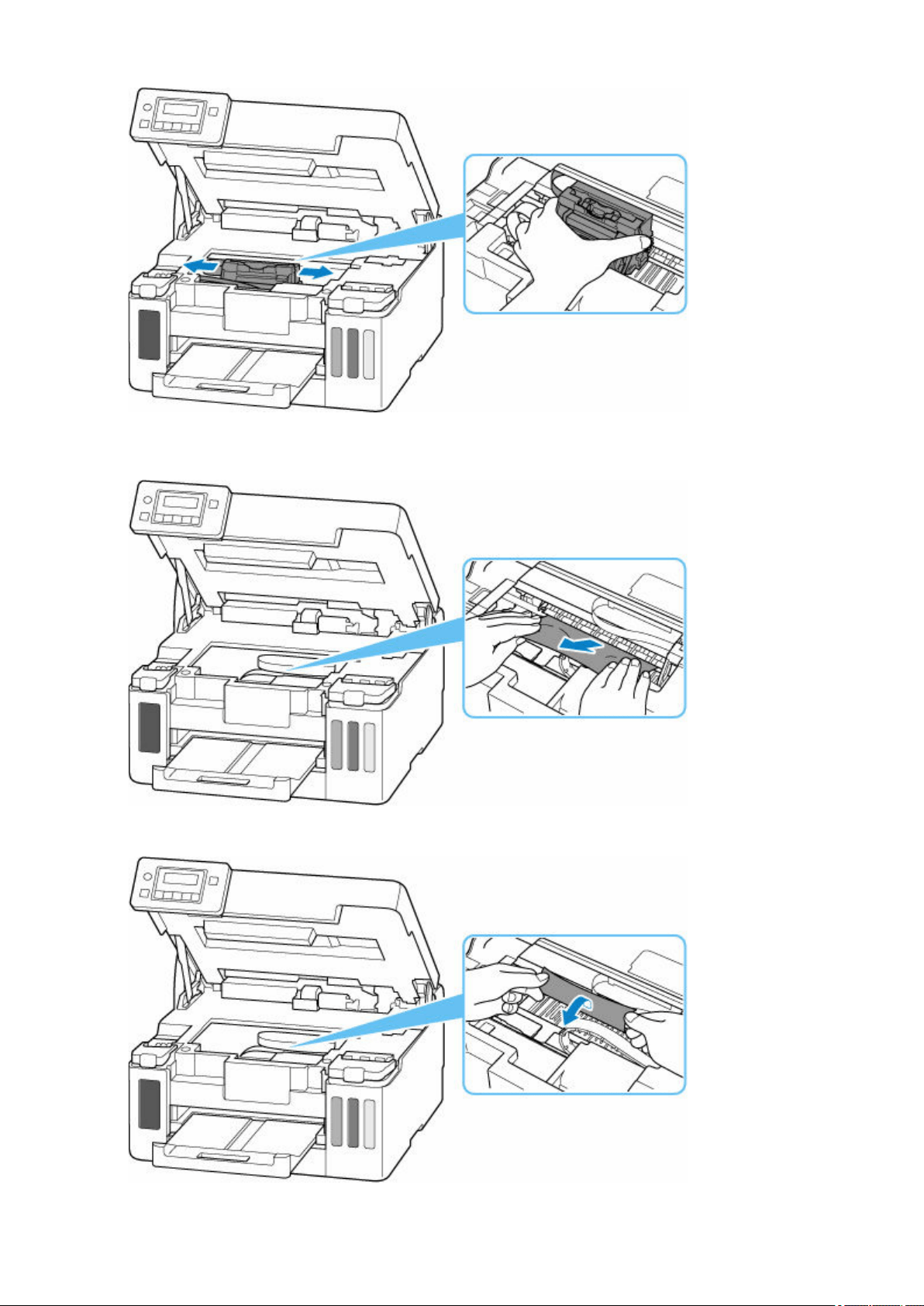
5.
Hold jammed paper firmly with both hands.
5.
If the paper is rolled up, pull it out and grasp the edges of the paper.
294
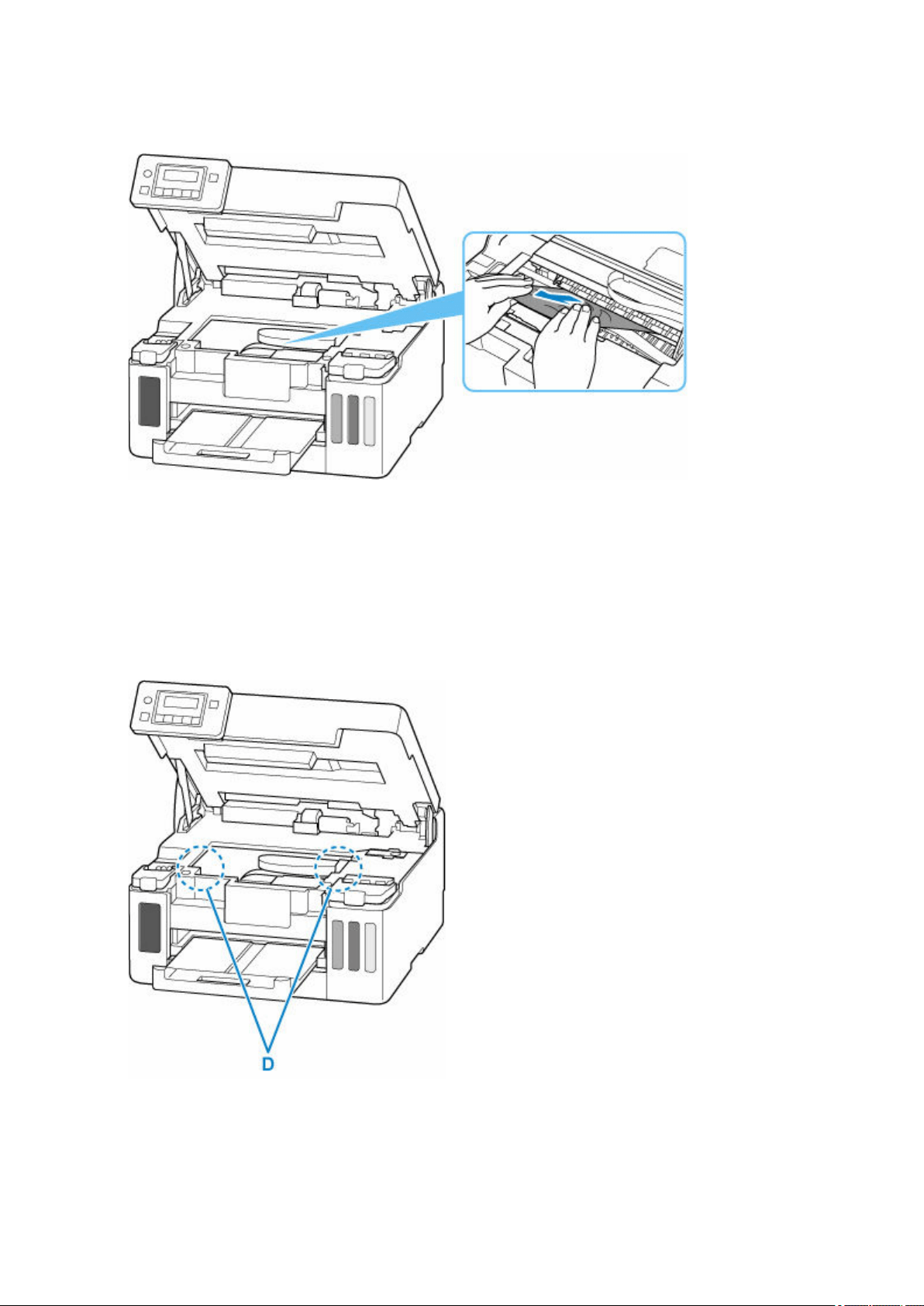
6. Slowly pull out jammed paper so as not to tear it.6.
Pull out the paper at an angle of about 45 degrees.
7.
Make sure all jammed paper is removed.
7.
If the paper tears when you pull out it, a bit of paper may remain in the printer. Check the following and
remove any remaining paper.
• Any paper left under the print head holder?
• Any small bits of paper left in the printer?
• Any paper left in the left and right empty spaces (D) in the printer?
8.
Close top cover.
8.
To close the top cover, hold it up once and then take it down gently.
295
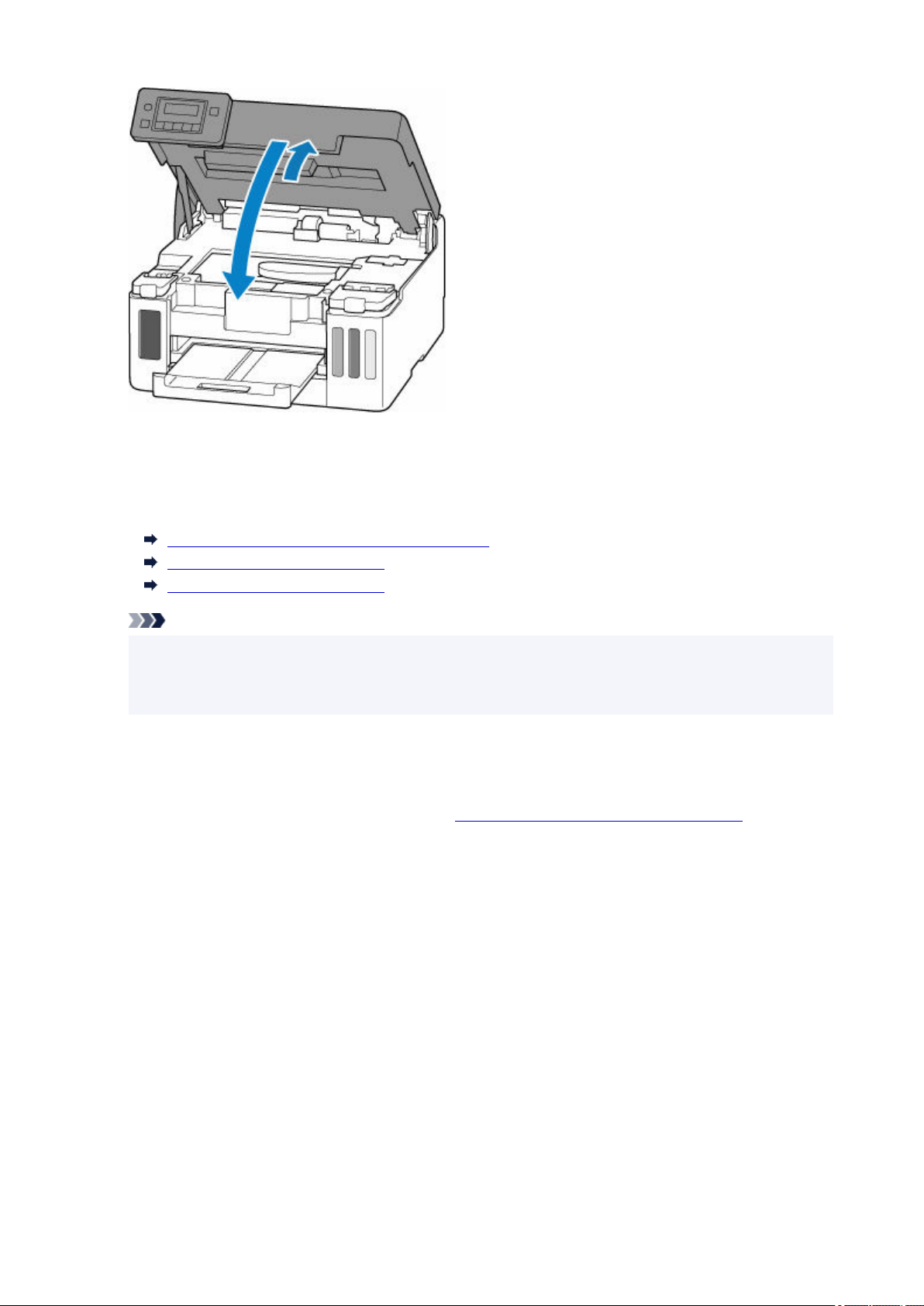
9.
Plug printer back in and turn printer back on.
9.
10.
Load paper.
10.
Loading Photo Paper / Plain Paper in Rear Tray
Loading Envelopes in Rear Tray
Loading Plain Paper in Cassette
Note
• Make sure you are using suitable paper and loading it correctly.
• We recommend using paper sizes other than A5 to print documents with photos or graphics. A5
paper may curl and jam as it leaves the printer.
11.
Redo printing.
11.
All jobs in the print queue are canceled. Redo the printing.
If the measures above do not solve the problem, see Removing Jammed Paper from Rear Side.
296
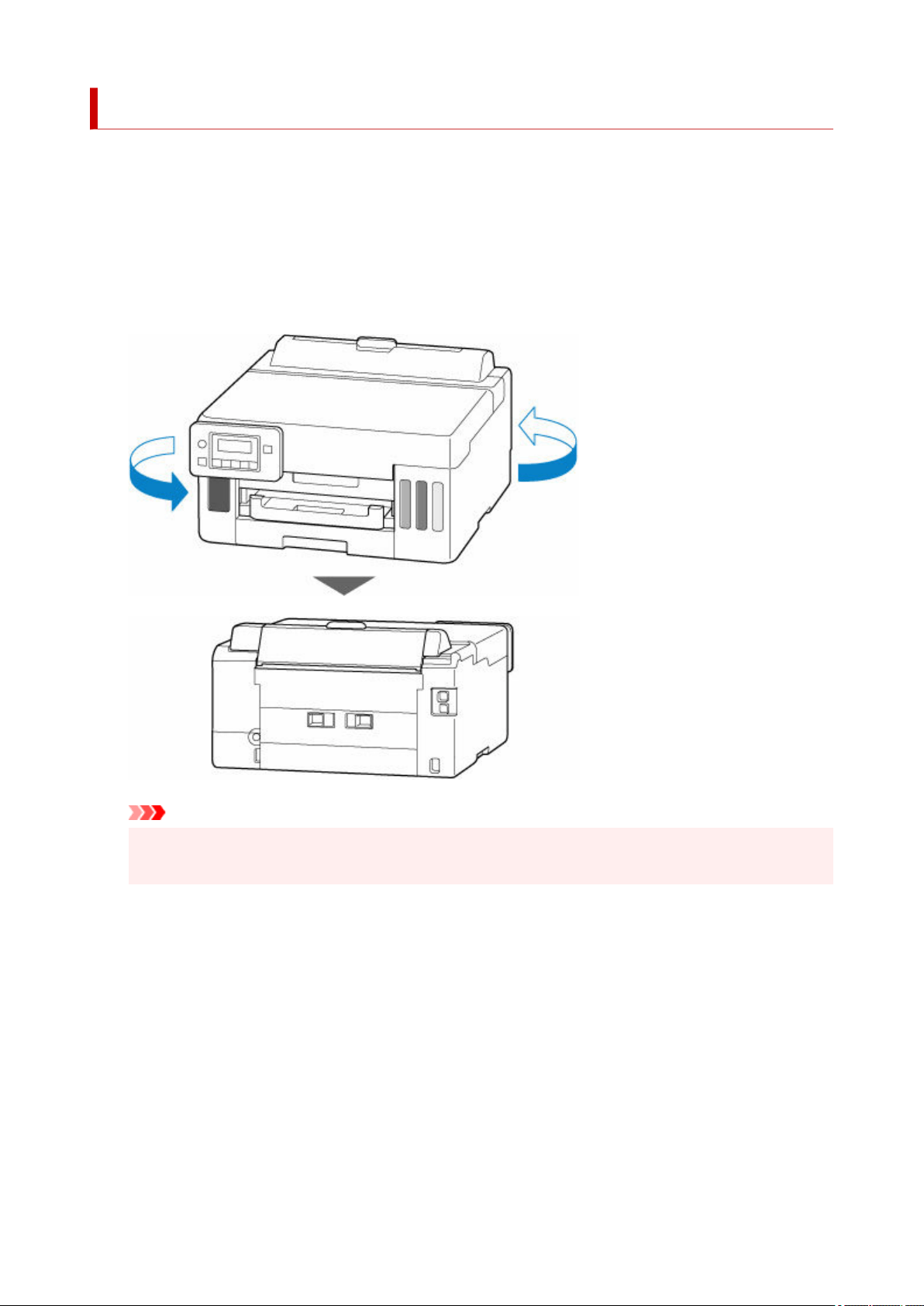
Removing Jammed Paper from Rear Side
1. Press printer's Stop button.1.
2.
Turn off printer and unplug it.
2.
3. Retract rear tray and paper output tray.3.
4.
Turn printer so that rear side of printer faces toward you.
4.
Important
• When changing the orientation of the printer, do not turn the printer upside down or tilt it. The ink
may leak out.
5.
Detach rear cover.
5.
Pull out the rear cover.
297
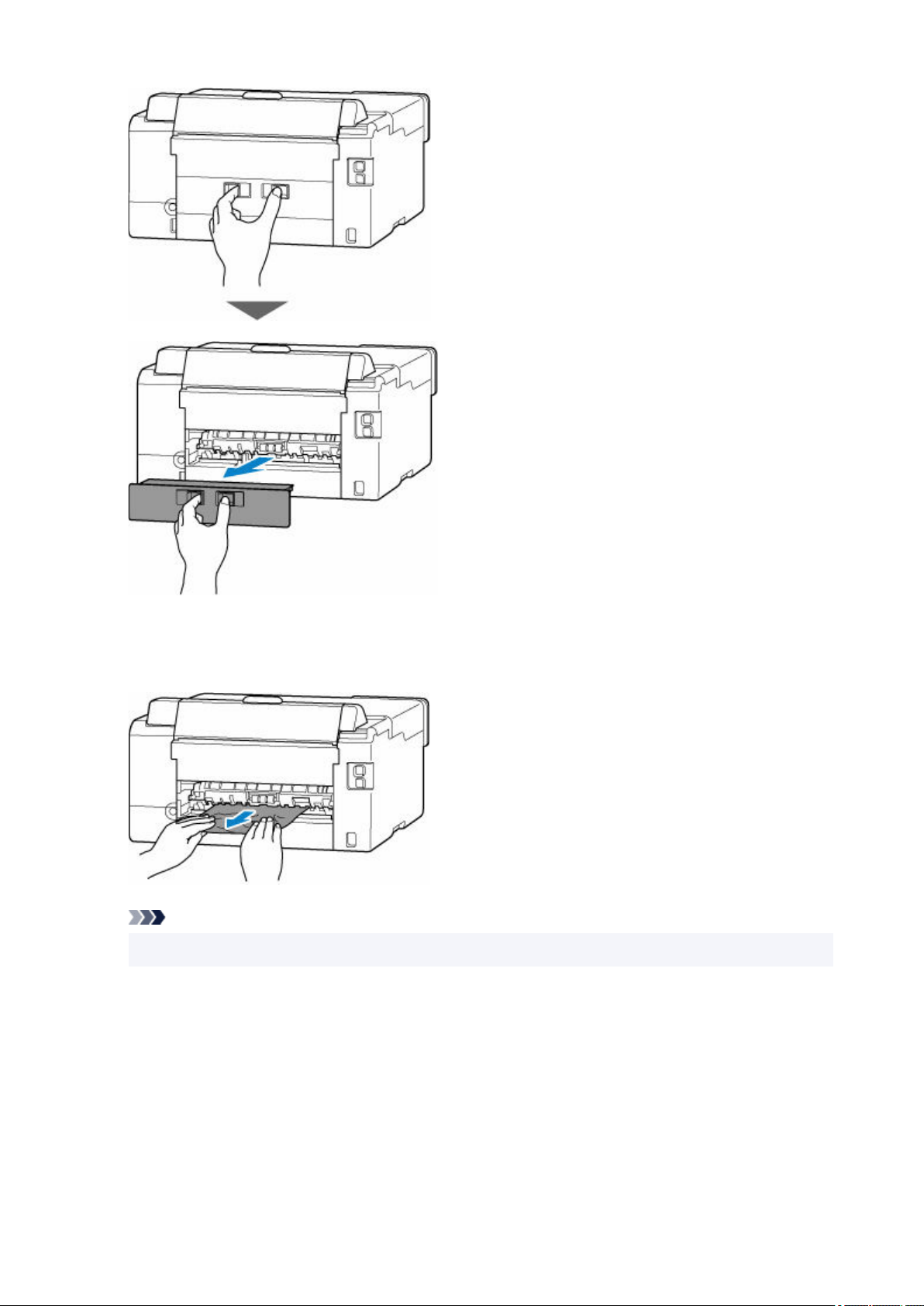
6. Hold jammed paper firmly with both hands and pull it out slowly.6.
If the paper is rolled up, pull it out and grasp the edges of the paper.
Note
•
Do not touch the inner parts of the printer.
If you are unable to remove the jammed paper, follow the steps below to detach the transport unit and
then remove the paper.
1. Detach transport unit.1.
Lift up the transport unit and pull it out.
298
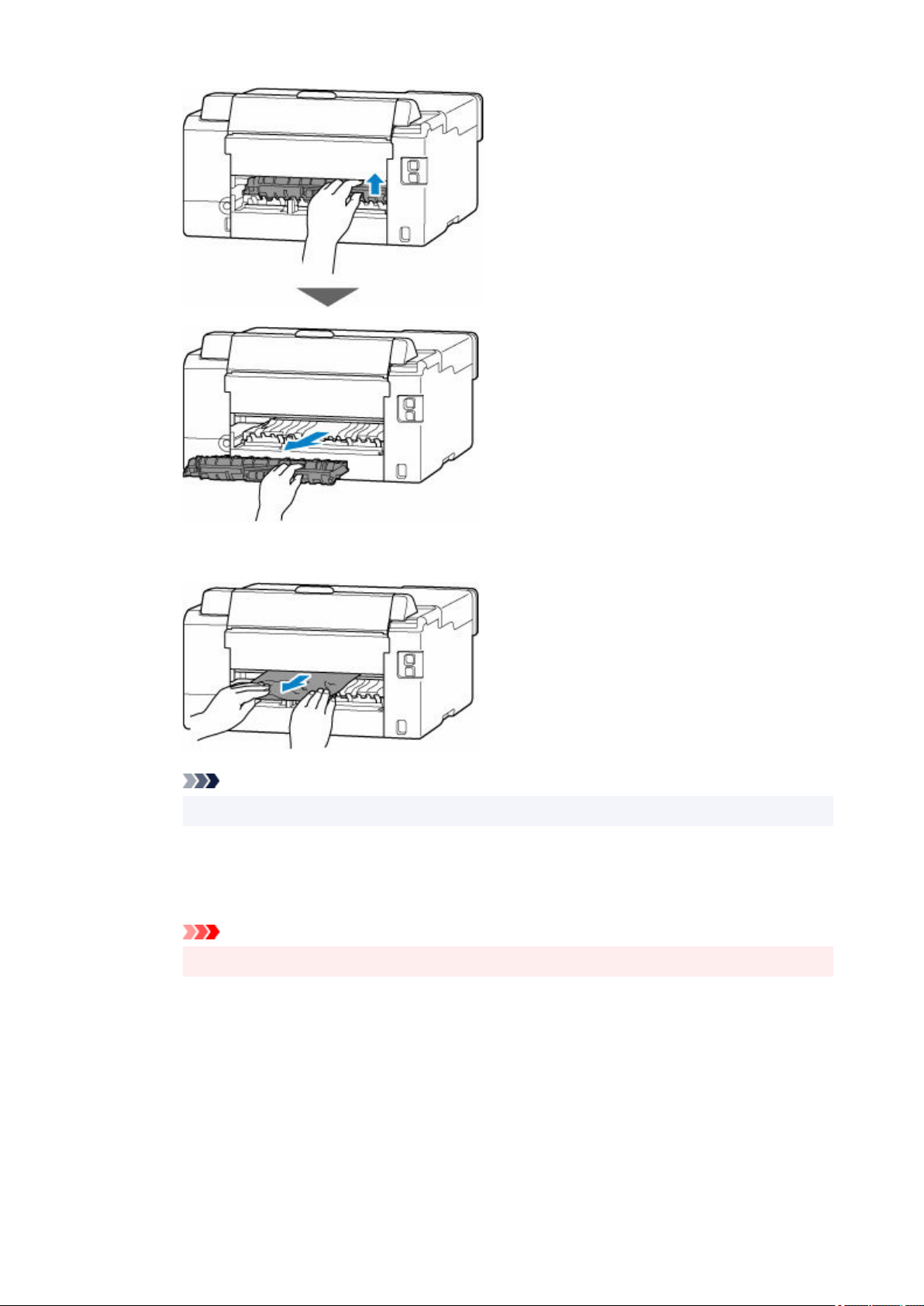
2. Slowly pull out jammed paper.2.
Note
•
Do not touch the inner parts of the printer.
3. Make sure all jammed paper is removed.3.
4. If parts (A) are raised, tip them toward you.4.
Important
•
If you replace the transport unit without lowering parts (A) toward you, it could damage the printer.
299
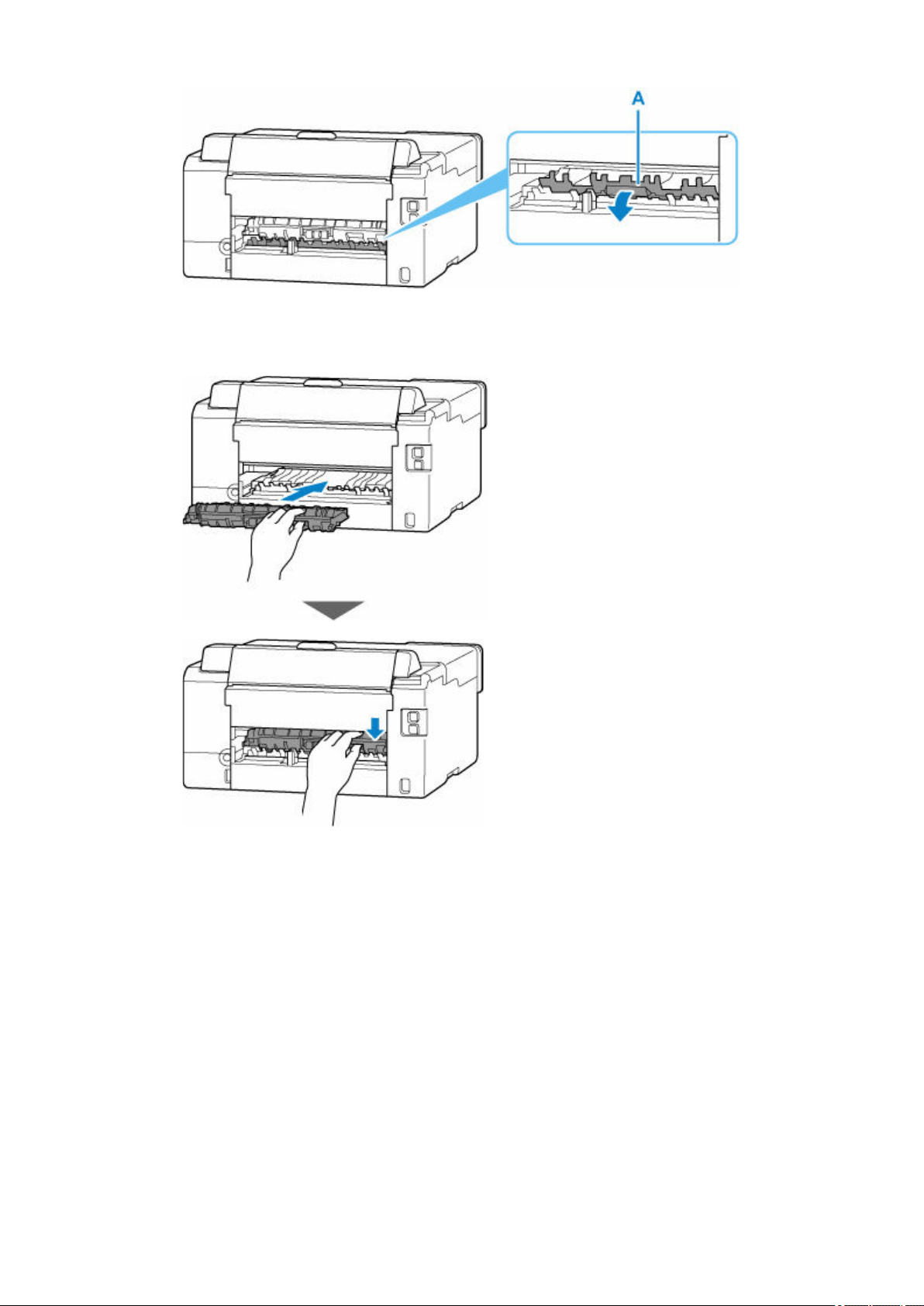
5. Replace transport unit.5.
Insert the transport unit slowly all the way into the back of the printer and take down the transport unit.
7. Attach rear cover.7.
Push in the rear cover until it is closed completely.
300
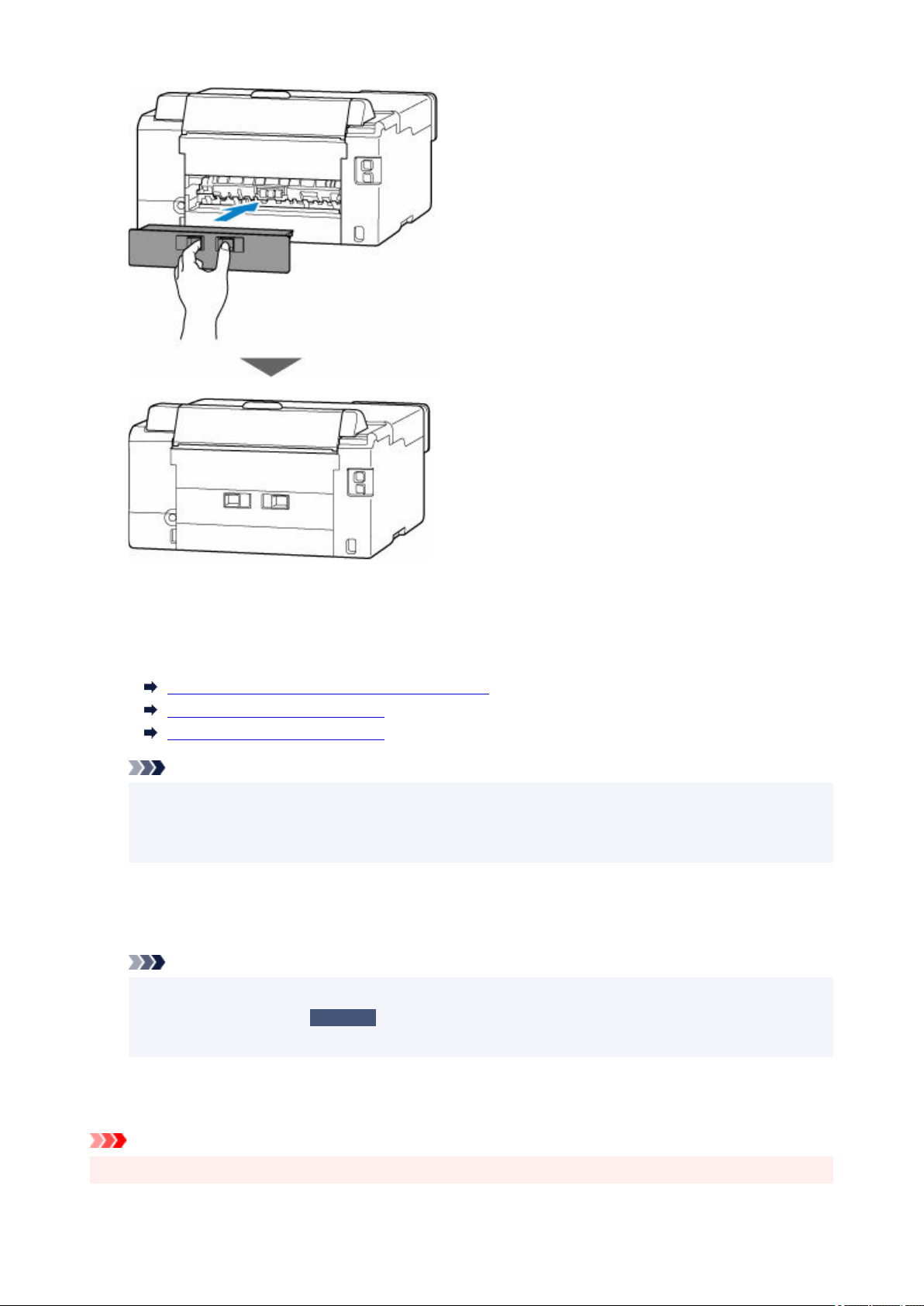
8. Plug printer back in and turn printer back on.8.
9. Load paper.9.
Loading Photo Paper / Plain Paper in Rear Tray
Loading Envelopes in Rear Tray
Loading Plain Paper in Cassette
Note
• Make sure you are using suitable paper and loading it correctly.
• We recommend using paper sizes other than A5 to print documents with photos or graphics. A5
paper may curl and jam as it leaves the printer.
10.
Redo printing.
10.
All jobs in the print queue are canceled. Redo the printing.
Note
•
If the 1300 error recurs, check the feed slot of the rear tray again. If a foreign object is inside
the rear tray, refer to
Check3
in What to Do If Paper Is Not Fed Normally and take appropriate
action.
If the measures above do not solve the problem, contact your nearest Canon service center to request a
repair.
Important
• Do not tilt the printer when moving it since the ink may leak out.
301


1000
Cause
Possible causes include the following.
• There is no paper in the rear tray.
• Paper is not loaded in the rear tray properly.
What to Do
Load paper in the rear tray correctly.
Loading Photo Paper / Plain Paper in Rear Tray
Loading Envelopes in Rear Tray
After loading the paper in the rear tray, follow the messages displayed on the printer's LCD.
303

1003
Cause
Possible causes include the following.
• There is no paper in the cassette.
• Paper is not loaded in the cassette properly.
What to Do
Load paper in the cassette correctly.
Loading Plain Paper in Cassette
After loading the paper in the cassette, follow the messages displayed on the printer's LCD.
Note
• This error may occur if the transport unit is not installed correctly. Refer to the following page to check•
the transport unit.
Removing Jammed Paper from Rear Side
304


1200
Cause
Top cover is open.
What to Do
Close the top cover and wait for a while.
Make sure to close the top cover after refilling ink or other operations.
306

1401
Cause
Print head may be damaged.
What to Do
Turn off the printer and turn it back on.
If this does not solve the problem, contact your nearest Canon service center to request a repair.
Important
• Do not tilt the printer when moving it since the ink may leak out.
• When transporting the printer for repairing it, see Repairing Your Printer.
307

1496
Cause
The maintenance cartridge cannot be recognized.
The maintenance cartridge may not be installed properly or may not be compatible with this printer.
What to Do
Turn off the printer, remove the maintenance cartridge, and then reinstall it correctly.
Refer to
Replacing Maintenance Cartridge for details on removing and installing the maintenance
cartridge.
308



1725
Cause
The maintenance cartridge cannot be recognized.
The maintenance cartridge may not be installed properly or may not be compatible with this printer.
What to Do
Turn off the printer, remove the maintenance cartridge, and then reinstall it correctly.
Refer to
Replacing Maintenance Cartridge for details on removing and installing the maintenance
cartridge.
311

1726
Cause
The maintenance cartridge is full.
What to Do
Replace the maintenance cartridge.
Replacing Maintenance Cartridge
The condition of the maintenance cartridge when this error is displayed will depend on where and how the
printer is used.
When this message is displayed, you must replace the maintenance cartridge.
312

1727
Cause
The maintenance cartridge is almost full.
What to Do
The printer will not be able to print with a full maintenance cartridge.
Press the printer's OK button to cancel the error and then prepare a new maintenance cartridge.
For details on the maintenance cartridge, see Replacing Maintenance Cartridge.
313
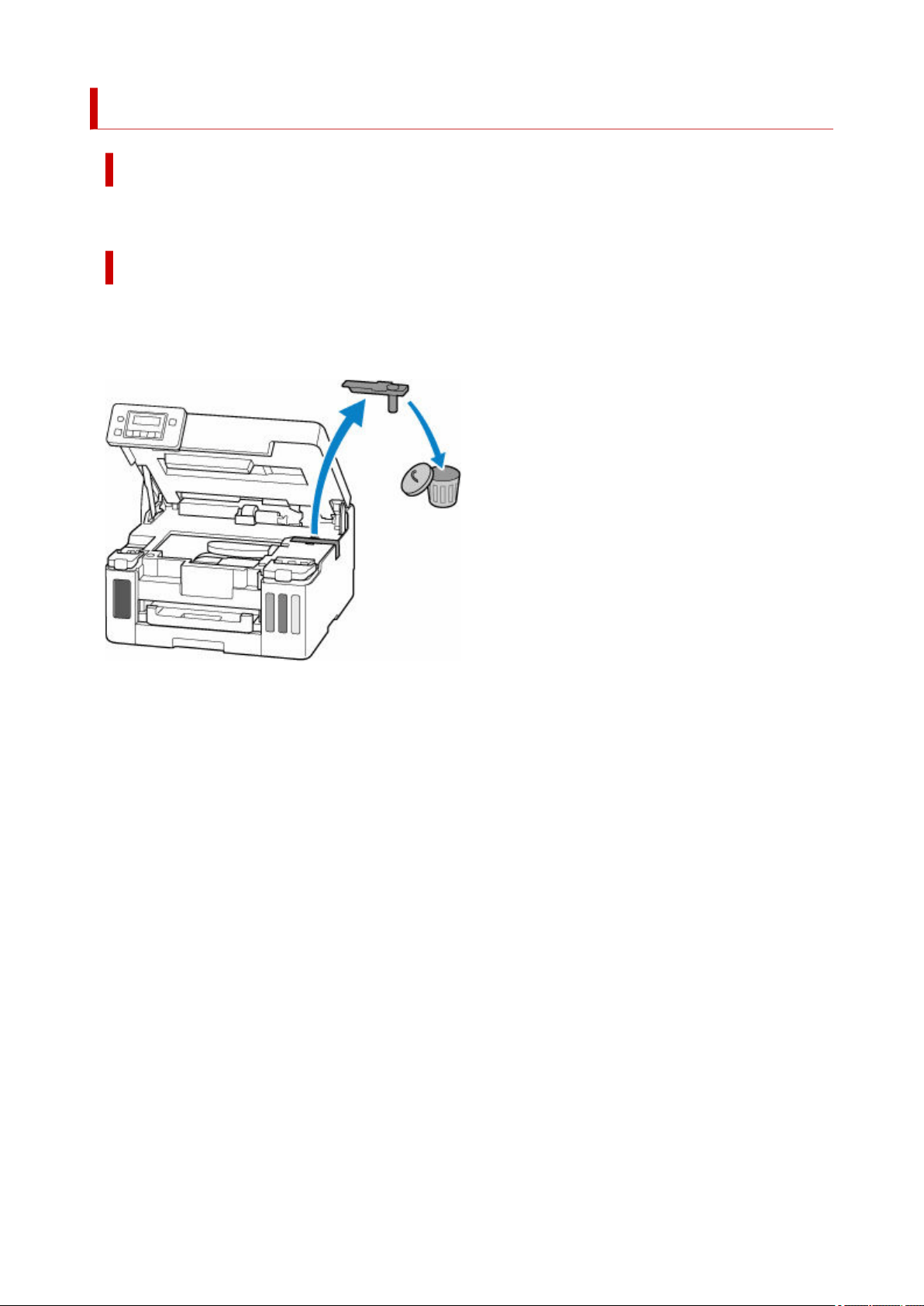
Shipping Tape etc. Are Still Attached (1890)
Cause
Shipping tape or protective material may still be attached to print head holder.
What to Do
Open the top cover and make sure that shipping tape and protective material have been removed from
the print head holder.
If the shipping tape or protective material is still there, remove it and close the top cover.
In the case of the first printer setup, click here, select your printer name on the page, and follow the
instructions.
314
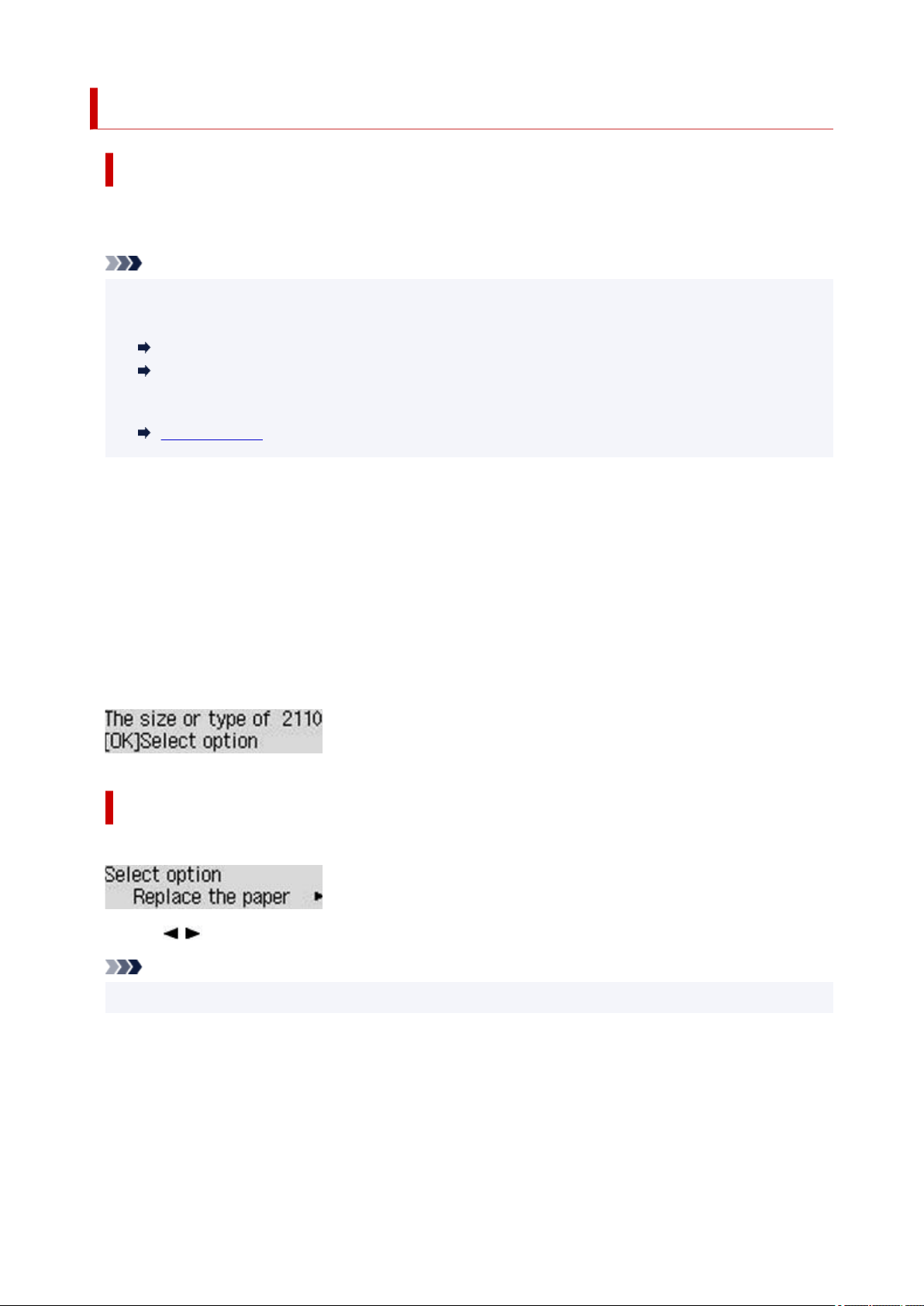
2110
Cause
Paper settings specified when printing do not match the paper information for the cassette registered on
the printer.
Note
• For the appropriate combination of the paper settings specified on the printer driver and the paper•
information registered on the printer, refer to the following.
Paper Settings on the Printer Driver and the Printer (Media Type) (Windows)
Paper Settings on the Printer Driver and the Printer (Paper Size) (Windows)
• For how to register paper information on the printer, refer to the following.•
Paper Settings
If the paper settings specified when printing differ from the paper information for the cassette registered
on the printer, the following message appears on the printer's LCD.
• Paper settings specified on the printer driver when printing:•
Paper size: A5
Media type: Plain paper
• Paper information for the cassette registered on the printer:•
Paper size: A4
Media type: Plain paper
What to Do
Press the printer's OK button to display the screen below.
Use the buttons to select the appropriate action and press the printer's OK button.
Note
• Depending on the settings, some of the options below may not be displayed.
Print on set paper
Select this option to print on the loaded paper with the paper settings specified when printing.
For example, when printing the paper size is specified as A5 and the paper information for the
cassette is registered as A4, select this option to print on A4 paper loaded in the cassette with the A5
setting.
315

Replace the paper
Select this option to print after changing the paper in the cassette.
For example, when printing the paper size is specified as A5 and the paper information for the
cassette is registered as A4, select this option to print after changing the paper in the cassette with
A5 paper.
After changing the paper and inserting the cassette, the paper information registration screen for the
cassette appears. Register the paper information on the printer according to the loaded paper.
Note
• For the appropriate combination of the paper settings specified on the printer driver and the•
paper information registered on the printer, refer to the following.
Paper Settings on the Printer Driver and the Printer (Media Type) (Windows)
Paper Settings on the Printer Driver and the Printer (Paper Size) (Windows)
Cancel
Cancels printing.
Select this option when you want to change the paper settings specified when printing. Change the
paper settings and try printing again.
Note
• You can configure the setting to hide the misprint prevention message. When set to hide the•
message, printing begins regardless of whether the paper settings specified when printing and the
paper information of the cassette registered on the printer match.
To change whether to display the misprint prevention message when printing without using the
printer driver:
Feed settings
To change whether to display the misprint prevention message when printing using the printer
driver:
Maintenance Tab Description (Windows)
Changing the Printer Operation Mode (macOS)
316
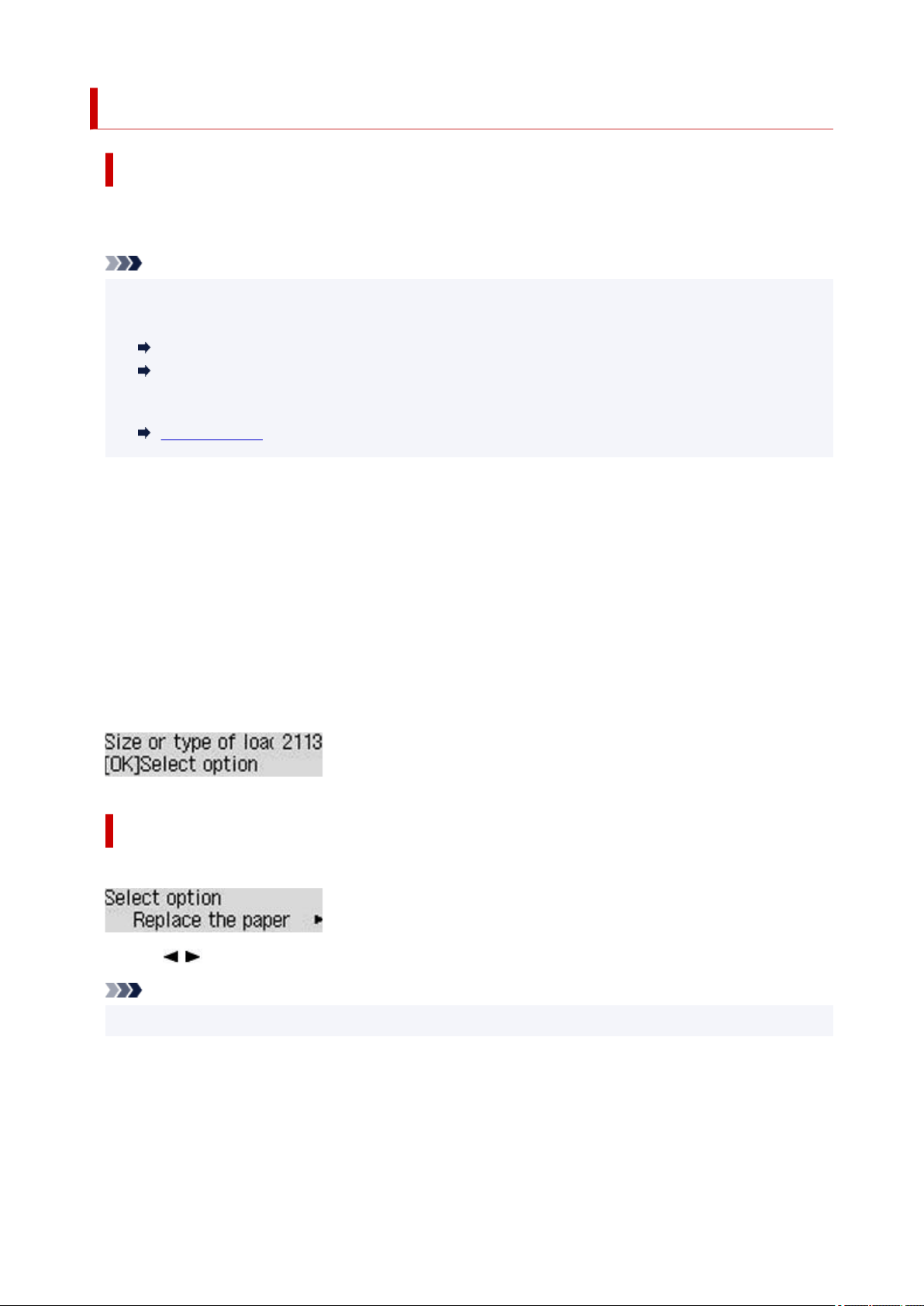
2113
Cause
Paper settings specified when printing do not match either the rear tray or the cassette paper information
registered on the printer.
Note
• For the appropriate combination of the paper settings specified on the printer driver and the paper•
information registered on the printer, refer to the following.
Paper Settings on the Printer Driver and the Printer (Media Type) (Windows)
Paper Settings on the Printer Driver and the Printer (Paper Size) (Windows)
• For how to register paper information on the printer, refer to the following.•
Paper Settings
If the paper source is set to be selected automatically and the paper settings specified when printing differ
from either the rear tray or the cassette paper information registered on the printer, the following message
appears on the printer's LCD.
• Paper settings specified on the printer driver when printing:•
Paper size: A5
Media type: Plain paper
• Paper information for the rear tray and the cassette registered on the printer:•
Paper size: A4
Media type: Plain paper
What to Do
Press the printer's OK button to display the screen below.
Use the buttons to select the appropriate action and press the printer's OK button.
Note
• Depending on the settings, some of the options below may not be displayed.
Print on set paper
Select this option to print on the loaded paper with the paper settings specified when printing.
For example, when printing the paper size is specified as A5 and both the paper information for the
rear tray and the paper information for the cassette are registered as A4, select this option to print on
A4 paper with the A5 setting.
317

Replace the paper
Select this option to print after changing the paper in the rear tray or the cassette.
For example, when printing the paper size is specified as A5 and both the paper information for the
rear tray and the paper information for the cassette are registered as A4, select this option to print
after changing the paper in the rear tray or the cassette with A5 paper.
After changing the paper, the paper information registration screen appears. Register the paper
information on the printer according to the loaded paper.
Note
• For the appropriate combination of the paper settings specified on the printer driver and the•
paper information registered on the printer, refer to the following.
Paper Settings on the Printer Driver and the Printer (Media Type) (Windows)
Paper Settings on the Printer Driver and the Printer (Paper Size) (Windows)
Cancel
Cancels printing.
Select this option when you want to change the paper settings specified when printing. Change the
paper settings and try printing again.
Note
• You can configure the setting to hide the misprint prevention message. When set to hide the•
message, printing begins regardless of whether the paper settings specified when printing match
the paper information of the rear tray or cassette registered on the printer.
To change whether to display the misprint prevention message when printing without using the
printer driver:
Feed settings
To change whether to display the misprint prevention message when printing using the printer
driver:
Maintenance Tab Description (Windows)
Changing the Printer Operation Mode (macOS)
318
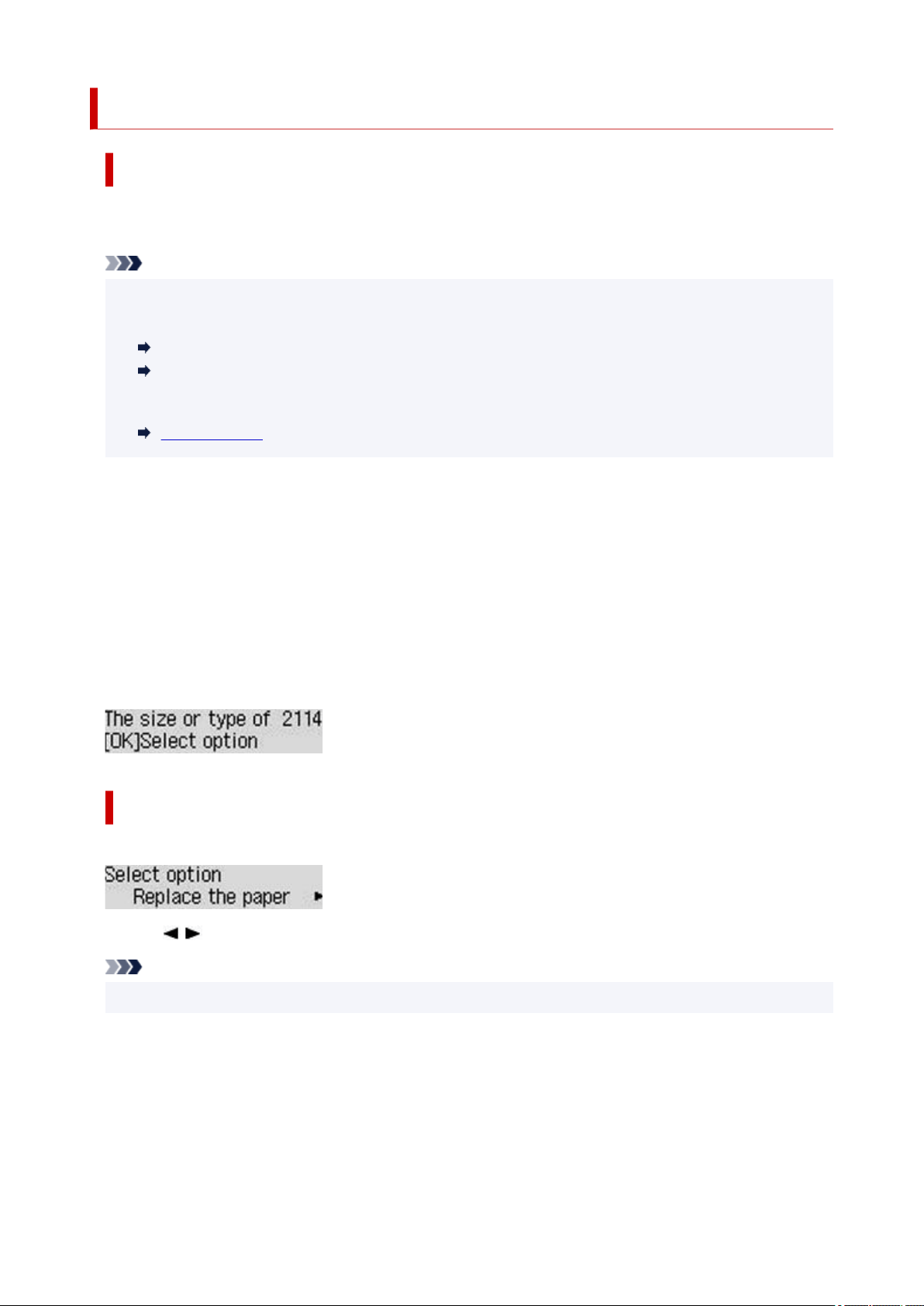
2114
Cause
Paper settings specified when printing do not match the paper information for the rear tray registered on
the printer.
Note
• For the appropriate combination of the paper settings specified on the printer driver and the paper•
information registered on the printer, refer to the following.
Paper Settings on the Printer Driver and the Printer (Media Type) (Windows)
Paper Settings on the Printer Driver and the Printer (Paper Size) (Windows)
• For how to register paper information on the printer, refer to the following.•
Paper Settings
If the paper settings specified when printing differ from the paper information for the rear tray registered
on the printer, the following message appears on the printer's LCD.
• Paper settings specified on the printer driver when printing:•
Paper size: A5
Media type: Plain paper
• Paper information for the rear tray registered on the printer:•
Paper size: A4
Media type: Plain paper
What to Do
Press the printer's OK button to display the screen below.
Use the buttons to select the appropriate action and press the printer's OK button.
Note
• Depending on the settings, some of the options below may not be displayed.
Print on set paper
Select this option to print on the loaded paper with the paper settings specified when printing.
For example, when printing the paper size is specified as A5 and the paper information for the rear
tray is registered as A4, select this option to print on A4 paper loaded in the rear tray with the A5
setting.
319

Replace the paper
Select this option to print after changing the paper in the rear tray.
For example, when printing the paper size is specified as A5 and the paper information for the rear
tray is registered as A4, select this option to print after changing the paper in the rear tray with A5
paper.
After changing the paper, the paper information registration screen for the rear tray appears. Register
the paper information on the printer according to the loaded paper.
Note
• For the appropriate combination of the paper settings specified on the printer driver and the•
paper information registered on the printer, refer to the following.
Paper Settings on the Printer Driver and the Printer (Media Type) (Windows)
Paper Settings on the Printer Driver and the Printer (Paper Size) (Windows)
Cancel
Cancels printing.
Select this option when you want to change the paper settings specified when printing. Change the
paper settings and try printing again.
Note
• You can configure the setting to hide the misprint prevention message. When set to hide the•
message, printing begins regardless of whether the paper settings specified when printing and the
paper information of the rear tray registered on the printer match.
To change whether to display the misprint prevention message when printing without using the
printer driver:
Feed settings
To change whether to display the misprint prevention message when printing using the printer
driver:
Maintenance Tab Description (Windows)
Changing the Printer Operation Mode (macOS)
320

2200
Cause
An internal part will need replacing soon.
What to Do
Press the printer's OK button to cancel the error.
You cannot replace the internal parts of the printer yourself. Contact your nearest Canon service center to
request a repair as soon as possible.
Important
• Do not tilt the printer when moving it since the ink may leak out.
• When transporting the printer for repair, see Repairing Your Printer.
321

3252
Cause
The maintenance cartridge is almost full.
What to Do
The printer will not be able to print with a full maintenance cartridge.
Press the printer's OK button to clear the error message.
322

4103
Cause
Cannot perform printing with current print settings.
What to Do
Press the printer's Stop button to cancel printing.
Change the print settings specified when printing and retry printing.
323
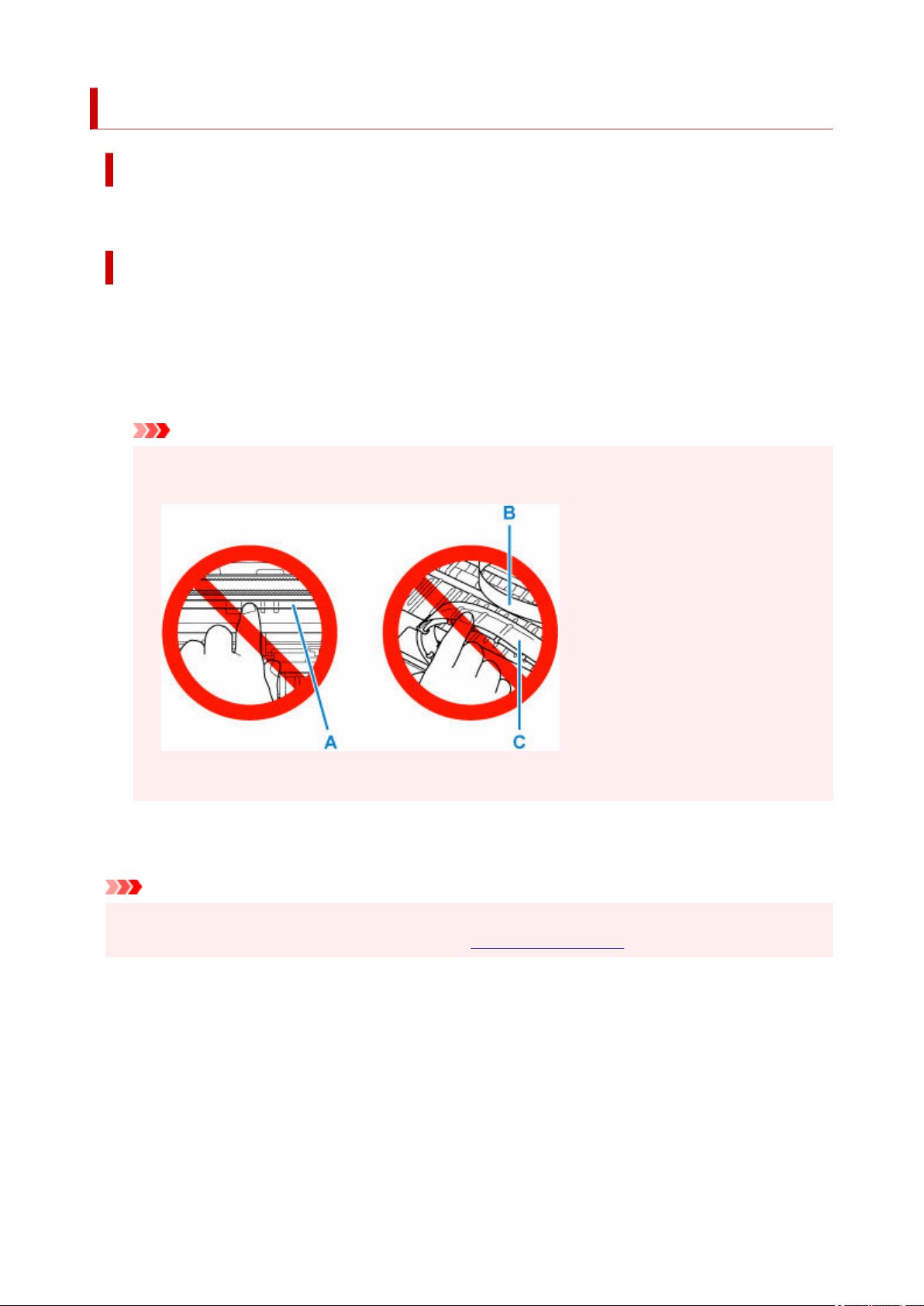
5100
Cause
Printer error has occurred.
What to Do
Cancel printing and turn off the printer.
Check the following:
• Make sure print head holder motion is not impeded by protective material, jammed paper, etc.•
Remove any impediment.
Important
• When clearing an impediment to print head holder motion, be careful not to touch clear film (A),•
white belt (B), or tubes (C).
If you soil or scratch this part by touching it with paper or your hand, it could damage the printer.
Turn the printer back on.
If this does not solve the problem, contact your nearest Canon service center to request a repair.
Important
• Do not tilt the printer when moving it since the ink may leak out.
• When transporting the printer for repairing it, see Repairing Your Printer.
324

5200
Cause
Printer error has occurred.
What to Do
1.
Turn off printer and unplug it.
1.
2.
Wait about 10 minutes and then plug in printer again and turn it back on.
2.
3.
Perform Ink Flush.
3.
Cleaning the Print Heads (Windows)
Cleaning the Print Heads (macOS)
How to Perform Ink Flush (From the printer's operation panel)
If the error recurs after taking the above actions, contact your nearest Canon service center to request a
repair.
Important
• Do not tilt the printer when moving it since the ink may leak out.
• When transporting the printer for repairing it, see Repairing Your Printer.
325
