
MANUEL DE L’UTILISATEUR
MACHINE À CAFÉ
MANUAL DE USO
CAFETERA
USER MANUAL
COFFEE MACHINE
ENFRES

We advise you to read this manual carefully, as it contains all the instructions for managing the appliance’s aesthetic and functional
qualities.
For further information on the product: www.smegusa.com
Nous conseillons de lire attentivement ce manuel, qui comprend toutes les indications pour maintenir inaltérées les qualités esthétiques
et fonctionnelles de l’appareil acheté.
Pour obtenir des informations supplémentaires sur le produit: www.smegusa.com
Aconsejamos leer atentamente este manual que contienen todas las indicaciones para mantener inalterada la calidad estética y
funcional del aparato adquirido.
Más información sobre el producto en: www.smegusa.com
“C”
20
23
23a
20a
“A”
4
5
30b
31a
29
31b
30a
39
38
19
9
20
25
27
21
22
1
2
10
3
23
18
16 13 141211
8
15 15
6
7
“B”
33
17
32
28
26
24
34b
34a
5
4
19
20

1 2 3
“D”
16 16 16
28
22b
22
“E”
24
41
22b
22
28
15 15
38
39
“G”
“I”
“F” “H”
“J”
42 42
22
34a
15
7
11
14
18a
18a
18b
21
22
32
20
31b
Important information for the user
Informations importantes pour l’utilisateur
Información importante para el usuario
Instructions / Instructions / Instrucciones
Description / Description / Descripción
Use / Utilisation / Uso
Cleaning and care / Nettoyage et entretien / Limpieza y cuidado
Safety instructions / Consignes de sécurité / Instrucciones de seguridad
Information / Informations / Información
Advice / Conseil / Recomendaciones
Scansiona il QR code per la Guida Rapida all’installazione e alla Manutenzione
Scan theQR code for the Installation and Maintenance Quick Start Guide
Escanea el código QR para la Guía rápida de instalación y mantenimiento

Il costruttore si riserva di apportare senza preavviso tutte le modifiche che riterrà utili al miglioramento dei propri
prodotti. Le illustrazioni e le descrizioni contenute in questo manuale non sono quindi impegnative ed hanno solo
valore indicativo.
The manufacturer reserves the right to make any changes deemed useful for improvement of its products without prior
notice. The illustrations and descriptions contained in this manual are therefore not binding and are merely indicative.
Le fabricant se réserve la faculté d’apporter, sans préavis, toutes les modifications qu’il jugera utiles pour
l’amélioration de ses produits. Les illustrations et les descriptions figurant dans ce manuel ne sont pas contraignantes et
n’ont qu’une valeur indicative.
Der Hersteller behält sich vor, ohne vorherige Benachrichtigung alle Änderungen vorzunehmen, die er zur
Verbesserung seiner Produkte für nützlich erachtet. Die in diesem Handbuch enthaltenen Illustrationen und
Beschreibungen sind daher unverbindlich und dienen nur zur Veranschaulichung.
De fabrikant behoudt zich het recht voor zonder waarschuwing alle wijzigingen aan te brengen die hij nodig acht om
zijn producten te verbeteren. De afbeeldingen en de beschrijvingen die aanwezig zijn in deze handleiding zijn niet
bindend, en hebben enkel een aanduidende waarde.
El fabricante se reserva el derecho a aportar sin aviso previo todas las modificaciones que considere útiles para la
mejora de sus propios productos. Las ilustraciones y las descripciones contenidas en este manual no comprometen,
por tanto, al fabricante y tienen un valor meramente indicativo.
O fabricante reserva-se o direito de efetuar, sem aviso prévio, qualquer modificação que vise o melhoramento dos
respetivos produtos. As ilustrações e descrições contidas neste manual, não são, por isso, vinculativas e possuem
apenas valor indicativo.
Tillverkaren förbehåller sig rätten att genomföra alla de ändringar som anses nödvändiga för att förbättra de egna
produkterna utan att meddela detta i förväg. De illustrationer och beskrivningar som finns i denna bruksanvisning är
vägledande och därmed inte bindande.
Производитель оставляет за собой право вносить без предупреждения все изменения, которые посчитает
полезными для улучшения собственной продукции. Рисунки и описания, содержащиеся в данном Руководстве
по эксплуатации, не имеют обязательств и имеют ознакомительный характер.
Producenten forbeholder sig retten til at foretage eventuelle ændringer, der anses for at være en forbedring af det
oprindelige produkt, uden forudgående varsel. Illustrationer og beskrivelser i denne betjeningsvejledning er derfor ikke
bindende og kun vejledende.
Producent zastrzega sobie prawo do nanoszenia, bez uprzedniego powiadomienia, wszelkich zmian, które uzna za
przydatne w celu ulepszania swoich produktów. Rysunki i opisy zawarte w niniejszej instrukcji nie są zobowiązujące i
mają charakter poglądowy.
Valmistaja pidättää itsellään oikeuden tehdä ohjeisiin mielestään tarpeellisia muutoksia ilman ennakkoilmoitusta. Tässä
oppaassa olevat kuvat ja piirrokset eivät näin ollen ole sitovia, vaan ne annetaan vain viitteellisessä mielessä.
Produsenten forbeholder seg rett til endringer på sine produkter grunnet tekniske fremskritt, uten forutgående varsel.
Illustrasjonene og beskrivelsene i denne bruksanvisningen er derfor ikke bindende og skal kun betraktes som
retningsgivende.
Il costruttore si riserva di apportare senza preavviso tutte le modifiche che riterrà utili al miglioramento dei propri
prodotti. Le illustrazioni e le descrizioni contenute in questo manuale non sono quindi impegnative ed hanno solo
valore indicativo.
The manufacturer reserves the right to make any changes deemed useful for improvement of its products without prior
notice. The illustrations and descriptions contained in this manual are therefore not binding and are merely indicative.
Le fabricant se réserve la faculté d’apporter, sans préavis, toutes les modifications qu’il jugera utiles pour
l’amélioration de ses produits. Les illustrations et les descriptions figurant dans ce manuel ne sont pas contraignantes et
n’ont qu’une valeur indicative.
Der Hersteller behält sich vor, ohne vorherige Benachrichtigung alle Änderungen vorzunehmen, die er zur
Verbesserung seiner Produkte für nützlich erachtet. Die in diesem Handbuch enthaltenen Illustrationen und
Beschreibungen sind daher unverbindlich und dienen nur zur Veranschaulichung.
De fabrikant behoudt zich het recht voor zonder waarschuwing alle wijzigingen aan te brengen die hij nodig acht om
zijn producten te verbeteren. De afbeeldingen en de beschrijvingen die aanwezig zijn in deze handleiding zijn niet
bindend, en hebben enkel een aanduidende waarde.
El fabricante se reserva el derecho a aportar sin aviso previo todas las modificaciones que considere útiles para la
mejora de sus propios productos. Las ilustraciones y las descripciones contenidas en este manual no comprometen,
por tanto, al fabricante y tienen un valor meramente indicativo.
O fabricante reserva-se o direito de efetuar, sem aviso prévio, qualquer modificação que vise o melhoramento dos
respetivos produtos. As ilustrações e descrições contidas neste manual, não são, por isso, vinculativas e possuem
apenas valor indicativo.
Tillverkaren förbehåller sig rätten att genomföra alla de ändringar som anses nödvändiga för att förbättra de egna
produkterna utan att meddela detta i förväg. De illustrationer och beskrivningar som finns i denna bruksanvisning är
vägledande och därmed inte bindande.
Производитель оставляет за собой право вносить без предупреждения все изменения, которые посчитает
полезными для улучшения собственной продукции. Рисунки и описания, содержащиеся в данном Руководстве
по эксплуатации, не имеют обязательств и имеют ознакомительный характер.
Producenten forbeholder sig retten til at foretage eventuelle ændringer, der anses for at være en forbedring af det
oprindelige produkt, uden forudgående varsel. Illustrationer og beskrivelser i denne betjeningsvejledning er derfor ikke
bindende og kun vejledende.
Producent zastrzega sobie prawo do nanoszenia, bez uprzedniego powiadomienia, wszelkich zmian, które uzna za
przydatne w celu ulepszania swoich produktów. Rysunki i opisy zawarte w niniejszej instrukcji nie są zobowiązujące i
mają charakter poglądowy.
Valmistaja pidättää itsellään oikeuden tehdä ohjeisiin mielestään tarpeellisia muutoksia ilman ennakkoilmoitusta. Tässä
oppaassa olevat kuvat ja piirrokset eivät näin ollen ole sitovia, vaan ne annetaan vain viitteellisessä mielessä.
Produsenten forbeholder seg rett til endringer på sine produkter grunnet tekniske fremskritt, uten forutgående varsel.
Illustrasjonene og beskrivelsene i denne bruksanvisningen er derfor ikke bindende og skal kun betraktes som
retningsgivende.
The manufacturer reserves the right to make any changes deemed useful for the improvement of its products without
priornotice. The illustrations and descriptions contained in this manual are therefore not binding and are merely indicative.
EN - 1
EN
IMPORTANT INSTRUCTIONS
Important instructions
WARNING:
If the instructions contained in this manual are not followed
precisely, re or explosion may result causing property damage, personal
injury or death.
READ AND SAVE THESE INSTRUCTIONS
Your safety and the safety of others are very important.
We have provided many important safety messages throughout this manual and on the ap-
pliance.
Read all the instructions before using the appliance and always obey all safety messages.
RECOGNIZE SAFETY INFORMATION
This is a safety alert symbol. This symbol alerts you to potential hazards that can result
in severe personal injury or death.
UNDERSTAND SIGNAL WORDS
A signal word - DANGER, WARNING or CAUTION - is used with the safety alert
symbol. DANGER denotes the most serious hazards. It means you could be killed or
seriously injured if you do not immediately follow the instructions.
WARNING means you could be killed or seriously injured if the instructions are
not followed. CAUTION indicates a potentially hazardous situation, which, if not
avoided, could result in minor to moderate injury.
• To reduce the risk of re or electric shock, do not remove the
cover (or back).
• No user-serviceable parts inside!
• Repair should be done by authorized service personnel only.
WARNING

EN - 2
ATTENTION
• This appliance is intended for use in the home only.
• Use this appliance only for its intended purpose. The manu-
facturer cannot be held liable for damage caused by improper
use of this appliance.
• This appliance complies with current safety regulations.
Improper use of this appliance can result in personal injury
and material damage.
• Read all the instructions before installing or using the appli-
ance for the rst time.
• Keep these operating instructions in a safe place and pass
them on to any future user.
The safety messages will inform you of potential hazards, on how to avoid the risk of injury
and what can occur if the instructions are not followed.
IMPORTANT: Observe all codes and ordinances in force.
WARNING: For your safety, the instructions contained in this manual must
be followed to minimize the risk of re or explosion and to prevent property
damage, personal injury or death.
Do not store or use gasoline or other ammable vapors, liquids or materials near this or
any other appliance.
NOTE: This appliance is NOT designed for installation in manufactured (mobile)
homes or in recreational vehicles (RVs).
NOTE:
GROUNDED PLUG (for product manufactured with a grounded plug)
As a safety feature, this product is equipped with grounded plug, which will only
t into a three-prong outlet. Do not attempt to bypass this safety feature. Improper
connection of the grounding conductor may result in the risk of electric shock.
Consult a qualied electrician if you have any doubts on whether the outlet is
properly grounded.
IMPORTANT INSTRUCTIONS

EN - 3
EN
1 Warnings
Follow all safety precautions to ensure safe
use of the appliance.
• Before using the appliance, read this user
manual carefully.
• Do not use the appliance outdoors.
• This appliance is for household use only.
• Do not use the appliance for other than its
intended use.
• Do not allow children to use the appliance.
• Children should not play with the appliance.
Keep the appliance out of the reach of
children.
• Keep the packaging material (plastic bags,
expanded polystyrene) out of the reach of
children.
• Close supervision is necessary when any
appliance is used by or near children.
• Turn off the appliance immediately after use.
• Do not leave the appliance unattended
while it is running.
• Disconnect the appliance from the wall
outlet before assembly, disassembly,
cleaning and after each use.
• To disconnect, turn any control to “off,” then
remove plug from wall outlet.
• Turn the appliance OFF, then unplug
from the outlet when not in use, before
assembling or disassembling parts and
IMPORTANT SAFEGUARDS
SAVE THESE INSTRUCTIONS
before cleaning. To unplug, grasp the plug
and pull from the outlet. Never pull from the
power cord.
• To protect against re, electrical shock
and personal injury, do not immerse the
appliance, the power cord or plug in water
or any other liquid.
• Do not touch the appliance or the plug with
wet hands.
• Never try to extinguish a ame/re with
water: turn off the appliance, unplug it from
the outlet and cover the ame with a lid or
a re blanket.
• Do not use the appliance if the power cord
or plug is damaged or if the appliance has
been dropped or damaged in any way.
• Do not let cord hang over edge of table or
counter, or touch hot surfaces.
• Do not operate any appliance with a
damaged cord or plug or after the appliance
malfunctions, or has been damaged in any
manner. Return appliance to an authorized
service facility for examination, repair or
adjustment.
• Make sure the power cord does not come
in contact with sharp edges.
• Do not pull on the cord to remove the plug
from the socket.
When using electrical appliances, basic safety precautions should
always be followed to reduce the risk of re, electric shock, and /
or injury to person including the following:
WARNING

EN - 4
• Do not place the appliance on or near
switched-on gas or electric burners, inside
an oven, or near heat sources.
• Do not touch hot surfaces. Use handles and
knobs.
• Do not place the appliance near faucets or
sinks.
• Never attempt to repair the appliance
yourself or without the help of a qualied
technician. Failing to do this will void the
warranty.
• In case of malfunction, have the appliance
repaired by a qualied technician.
• Do not make any changes to the appliance.
• Make sure that the power outlet used is
always freely accessible, because only
in this way can it be unplugged when
necessary.
• To remove the plug from the power outlet,
operate directly on the plug. Never pull the
cable, it could be damaged.
• If the appliance should break down, do not
attempt to repair it.
• Do not allow the power supply cable to
dangle over the edge of the table or other
surface or to touch hot surfaces.
• If the plug or power supply cable are
damaged, have them replaced exclusively
by the Technical After-sales centre, so as to
prevent all risks.
To avoid the risk of injury, do not open
the brew chamber during the brew
process.
• Check hopper for presence of foreign
objects before using.
For this appliance
• Only insert water into the appropriate tank.
Use fresh, clean water.
• The appliance shall not be placed in a
cabinet when in use.
• Allow to cool before putting on or taking off
parts, and before cleaning the appliance.
• The appliance generates heat and produces
hot water and steam during operation.
Avoid contact with boiling steam or water.
• Do not ll the water container beyond the
maximum limit indicated.
• Do not use without water in the tank or
without a tank.
• Only use the appliance indoors and at a
maximum altitude of 2000 meters.
• Use only coffee beans to obtain the powder,
do not put already ground coffee in the
coffee bean hopper.
• Use the device only to prepare coffee-
based drinks from grinding coffee beans
or to dispense hot water. Other uses are
improper.
• Use only original spare parts from the
manufacturer. The use of spare parts not
recommended by the manufacturer may
cause fire, electric shock or injury to
persons.
• Place the appliance on a at, dry surface.
• Avoid wetting or spraying liquid on the
appliance. In case of contact with liquid,
immediately unplug the cord from the
electrical outlet and dry thoroughly: Risk of
electric shock!
IMPORTANT SAFEGUARDS
SAVE THESE INSTRUCTIONS

EN - 5
EN
IMPORTANT SAFEGUARDS
SAVE THESE INSTRUCTIONS
• Scalding may occur if the lid is removed
during the brewing cycles.
• Do not use abrasive cleaners or sharp
objects to clean the appliance.
• The use of accessory attachments
not recommended by the appliance
manufacturer may result in re, electric
shock or injury to persons.
• Do not install the appliance in an environment
that is not suitable.
• Do not place the appliance on or in
proximity of electric or gas cookers, or in
a heated oven.
• This appliance is not intended for use by
persons (including children) with reduced
physical, sensory, or mental capabilities, or
lack of experience and knowledge, unless
they are closely supervised and instructed
concerning use of the appliance by a
person responsible for their safety. Children
should be supervised to ensure that they do
not play with the appliance.
• Avoid contacting moving parts. Do not
attempt to defeat any safety interlock
mechanisms.
• This appliance has important markings
on the plug blade. Contact a qualied
technician to replace the plug with a
suitable one if damaged.
• Connect the appliance only to a power
outlet installed perfectly.
Electrical Cord:
a) A short power-supply cord (or detachable
power-supply cord) is provided to reduce
risks resulting from becoming entangled in
or tripping over a longer cord.
b) Longer detachable power-supply cords or
extension cords are available and may be
used if care is exercised in their use.
c) If a long detachable power-supply cord or
extension cord is used:
1. The marked electrical rating of the
detachable power-supply cord or
extension cord should be at least as
great as the electrical rating of the
appliance;
2. If the appliance is of the grounded
type, the extension cord should be a
grounding-type 3-wire cord; and
3. The longer cord should be arranged so
that it will not drape over the counter top
or table top where it can be pulled on
by children or tripped over.
Connect the appliance
Make sure that the mains voltage corresponds
with that indicated on the data plate on the
bottom of the appliance.
Connect the appliance only to a power outlet
installed perfectly.
If the plug and power outlet are incompatible,
have the power outlet replaced with a suitable
type by qualied staff.
EN - 6
IMPORTANT INSTRUCTIONS
SAVE THESE INSTRUCTIONS
This user’s manual
This user’s manual is an integral part of
the appliance and must be kept intact and
available to the user throughout its life cycle.
Manufacturer’s liability
The manufacturer declines all liability for
damage undergone by persons and objects
due to:
• use of the appliance different from that
envisioned;
• user manual has not been read;
• tampering of individual parts of the
appliance;
• use of non-original spare parts;
• failure to comply with safety
recommendations.
Identication plate
The identification plate lists the technical
data, serial number and brand name. The
identication plate must never be removed.
Disposal
Power voltage
Risk of electric shock
• Unplug the appliance.
• Unplug the cord from the wall outlet.
• Old electrical equipment must not
be disposed of with household
waste! In accordance with the law in
force, electrical appliances at the end
of their life should be taken to separate
collection facilities for electrical and
electronic waste. This is so that valuable
materials from old appliances can be
recycled and the environment can be
protected. For more information, please
contact your local authorities or recycling
center employees.
Note that non-polluting and recyclable materials
are used for packaging the appliance.
• Dispose of the packaging materials at
appropriate differentiated waste collection
centers.
Plastic packaging
Risk of suffocation
• Do not leave the packaging or any part of
it unattended.
• Do not allow children to play with the plastic
packaging bags.

EN - 7
EN
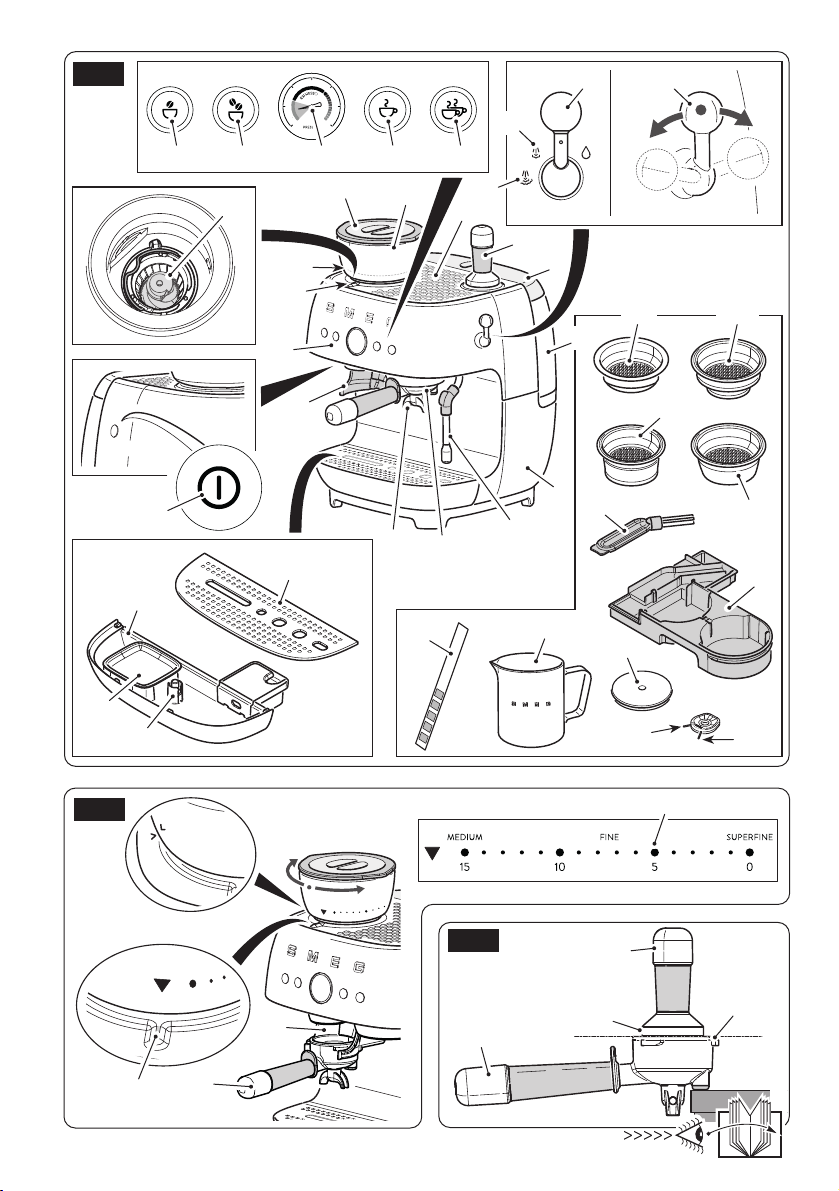
2 Description
of the appliance (Fig.A)
1 Machine body
2 Coffee bean container lid
3 Coffee bean container
4 Grinding levels
5 Grinding level indicator
6 Water tank lid
7 Water tank (2.6 l)
8 Cup shelf
9 ON/OFF button
10 Control panel
11 Grinding key for single espresso
12 Grinding key for double espresso
13 Dispensing key for single espresso
14 Dispensing key for double espresso
15 Steam/water lever
16 Manometer
17 Water hardness test strip
18 Conical grinders
19 Filter-holder support
20 Filter-holder
21 Dispensing unit
22 Steam/hot water wand
23 Tamper
24 Drip tray
25 Coffee grounds collection tray
26 Cup grill
27 Water level indicator
28 Stainless steel milk jug
29 Accessories drawer
30a Single pressurised lter
30b Double pressurised lter
31a Single non-pressurised lter
31b Double non-pressurised lter
32 Dispensing unit cleaning disk
33 Cleaning brush
34a Steam wand cleaning needle
34b Filter holes cleaning needle
3 Description of the parts/
accessories (Fig.A)
Accessories drawer (29)
The machine has housing for accessories not being
used, so that they are always available to the user.
• To access the accessories drawer, remove the
drip tray (24), and extract the drawer (29)
positioned inside the machine.
Filters
This machine has four lters; two non-pressurised
and two pressurised.
Non-pressurised lters (31a, 31b)
These lters allow various degrees of grinding,
dosing and tamping to be experimented, in
order to create a perfectly balanced espresso.
Pressurised lters (30a, 30b)
These lters facilitate and regulate pressure also
when grinding and dosing are not perfect.
Select the lter for one or two cups as required.
If non-pressurised lters are used and passage from
a single lter to a double one and vice versa, it
may be necessary to prepare a few coffees before
the ideal grinding and correct dose for pre-set
dispensing are obtained. For example, when very
ne grinding with non-pressurised lters is selected,
it may be necessary to increase the amount of
coffee ground to guarantee that the dose contained
in the lter is correct.
The machine is pre-set to dispense coffee with the
use of non-pressurised lters approximately in the
middle of the FINE level. Depending on preferred
use and the desired avour, adjust the grinding
neness by turning the coffee beans container
clockwise or anti-clockwise.
Description / Controls

EN - 8
Dispensing unit cleaning disk (32)
Silicone disk to be used to clean the dispensing unit.
Cleaning brush (33)
Use to clean the conical grinders (18).
Steam wand/filter holes cleaning
needles
It is made up from two needles with different
thickness: one for cleaning the steam wand hole
(34a) and the other for cleaning the holes in the
coffee lters (34b).
Water hardness test strip (17)
Use the strip supplied to detect the hardness of the
water used as indicated in the “Machine setting -
Water hardness” paragraph.
Milk jug (28)
Stainless steel milk jug.
Tamper (23)
Tamper with stainless steel disk with diameter of 58
mm to be used to press the ground coffee.
3.1 Description of controls
(Fig.A)
ON/OFF key (9)
Voltage is supplied to or removed from the machine
by pressing this button.
Grinding key for single espresso (11)
The key allows a pre-set quantity of coffee to be
ground for a single espresso.
Grinding key for double espresso (12)
The key allows a pre-set quantity of coffee to be
ground for a double espresso.
Dispensing key for single espresso (13)
The key allows a pre-set quantity for a single
espresso coffee to be dispensed.
Dispensing key for double espresso (14)
The key allows a pre-set quantity for two espresso
coffees to be dispensed.
Water/steam lever (15)
Turn the lever clockwise, in correspondence with
the “ ” icon to dispense hot water.
Turn the lever anti-clockwise to dispense steam.
Two steam intensities can be selected at will in
correspondence with the respective icons “ ” /
“ ”.
3.2 Alarms
The keys ash differently to indicate the relative
alarm.
Keys (11) and (12) ash quickly:
The coffee grinder has been used for too long and
the temperature block has activated or it is clogged.
Press one of the two ashing keys and wait for
cooling or disassemble the coffee grinder and clean
the tube from above.
Keys (11) and (12) ash simultaneously:
No coffee beans container (3) or coffee beans
container not introduced correctly alarm. Make
sure that the container is assembled correctly or
add coffee beans, if necessary.
Keys (13) and (14) ash in sequence:
The machine is reaching the correct temperature for
dispensing coffee. Wait for the two keys to have
a xed light and then select the desired beverage.
Keys (13) and (14) ash simultaneously:
No water tank (7) or tank not introduced correctly
or with insufcient water to dispense coffee alarm.
Check the correct introduction or add water if
necessary.
Use

EN - 9
EN
Key (14) with orange light:
The key has an orange light to indicate that a
descaling cycle is necessary.
To proceed, refer to the “Descaling” paragraph in
the Cleaning and maintenance paragraph.
To by-pass the procedure just press the key (14):
all keys have a xed light and the machine will be
ready for use.
In order not to change the avour of
the coffee and for correct operation
of the machine, it is advised to
perform the descaling cycle when
signalled by the machine.
If the descaling cycle is not
performed, the key (14) will light
up in orange at every switch-on
until the descaling cycle has been
carried out.
3.2 Before commissioning
(Fig. A and B)
• Unpack the appliance carefully and remove
all packaging materials.
• Use a damp cloth to clean all removable
components, such as the coffee bean
container (3), water tank (7), lids (6, 2),
coffee grounds collection tray (25), drip
tray (24), cup holder grill (26), lter-holder
(20), lters (30a, 30b, 31a, 31b), tamper
(23) and other accessories.
• Make sure that all components are
thoroughly dry before re-mounting them.
Do not use the coffee machine
without water in the tank or without
the water tank tted.
FAULT HAZARD!
The parts that may come into
contact with foodstuffs are made
using materials that comply with
the provisions of the legislation
in force.
• Introduce the beans container, making the
“ ”
arrow on the container match the on
the
“ ”
surface.
• Fix the container by turning it clockwise and
matching the closed arrow
“ ”
with the
grinding level indicator (5).
• Remove the red protective cap located on
the back of the machine, between the tank
(7) and the rear body of the machine (1).
4 Use
Before starting the coffee
machine, carefully read chapter
“1 Warnings” and the “Before
commissioning” paragraph.
4.1 Machine switch-on
• Make sure that the drip tray (24) complete
with cup grill (26) is correctly mounted at
switch-on and before all dispensing.
• Lift the tank cover (6) and pour fresh water
in the tank making sure not to exceed the
indicated ‘Max’ level and then re-mount the
lid (6).
• Lift the coffee bean container lid (2) and
introduce the coffee beans into the container
(3).
Use

EN - 10
• Switch the coffee machine on by pressing
the ON/OFF switch (9): the keys (13)
and (14) ash to indicate that the correct
temperature is being reached. The coffee
machine is ready for use as soon as all the
keys have a xed light.
4.2 Commissioning (Fig.A)
On commissioning it is
recommended to set the water
hardness as indicated in the
"Water hardness" paragraph.
On commissioning, the internal
circuits must be rinsed. Proceed as
described below.
- Switch the machine on as described in the
“Machine switch-on” paragraph.
• Attach the filter-holder (20) with non-
pressurised lter (31b) for double cup to
the dispensing unit (21).
• Position a container under the coffee
dispensing nozzles and press the key (14).
• Repeat this procedure 5 times.
• Position a container under the hot water/
steam wand (22).
• Turn the steam lever (15) in correspondence
with the
“ ”
icon and dispense water for
15 seconds and then take it back to the
central position to stop dispensing.
• Turn the steam lever (15) again in
correspondence with the
“ ” / “ ”
icons
and dispense steam into the container for
a few seconds and then take it back to the
central position to stop dispensing.
It is recommended to rinse the
internal circuits also when the
coffee machine has not been used
for a long period of time.
4.3 Grinding level regulation
(Fig. B)
Do not use green, caramelised or
candied coffee beans, as they may
stick to the coffee machine and ruin
it.
Grinding level should be regulated
when the machine is in use or at
the occasion of the rst use, when
the bean tank is completely empty;
turning the coffee bean container
(3) with the grinder at a standstill
and with the beans inside could
damage the grinding unit.
• To adjust the level of grinding, turn the
coffee beans container (3) clockwise or
anti-clockwise according to the neness
desired, positioning the scale (4) with the
grinding level present on the container
in correspondence with the indicator (5).
Turning the container (3) clockwise, grinding
will be ner, anti-clockwise makes grinding
coarser.
• Position the lter-holder (20) with relative
lter introduced onto the relevant support
(19) on the left and press the key relative
to desired grinding and check it is correct.
Use

EN - 11
EN
4.4 Preparing espresso coffee
(Fig.A, B, C, D)
For excellent coffee tasting, it is
recommended to pre-heat the cup
by rinsing them with hot water or
dispensing hot water into the cup
via the wand (22).
At every switch-on, it is advised to
rinse the circuits of the dispensing
unit (21) and of the lter-holder (20)
dispensing a double coffee without
the presence of coffee in the lter.
• Check the level of water in the tank (7) and,
if necessary, add water paying attention not
to exceed the “Max” level.
• Check that there are coffee beans in the
beans container (3).
• Select the lter (30a, 30b, 31a, 31b)
suitable for the type of dispensing necessary
and put it into the lter-holder (20) . For
more details regarding the different lters
supplied, see the “Description of the parts/
accessories” paragraph.
• Position the lter-holder (20) with relative
lter introduced onto the relevant support
(19).
• Press the key (11) to grind the dose for one
coffee or (12) to grind the dose for two
coffees.
• After grinding, position the lter-holder (20)
on a surface as shown in gure C.
• Distribute the ground coffee evenly and
press it using the tamper supplied (23). For
correct dosing of the coffee into the lter and
correct tamping, the upper edge (23a) of
the tamper must be aligned with the upper
edge (20a) of the lter-holder.
• Remove the excess ground coffee from the
lter-holder, attach it to the dispensing unit
(21) and then turn it anti-clockwise until it is
tight.
• Position the cup or cups under the lter-
holder nozzles (20).
• Select the desired beverage and press
the relative key (13 or 14). When the
quantity set is reached, dispensing will end
automatically. The manometer (16) allows
the user to check whether the coffee is
dispensed excellently as indicated in Fig.
D.
Coffee extracted correctly Fig.D1.
Coffee under-extracted Fig.D2.
Coffee over-extracted Fig.D3.
To avoid spraying, do not remove
the lter holder during dispensing:
wait for a few seconds after
dispensing has stopped.
BURNS HAZARD!
• After dispensing, remove and clean the
lter-holder by turning it clockwise.
After approx. 5 minutes of no use,
the machine goes into Energy
Saving function. The stand-by time
can be modied as indicate din the
"Auto power-off setting" paragraph.
Use
EN - 12
4.5 Dispensing steam and
preparing a cappuccino
(Fig.A and E)
• Two steam intensities can be selected (38
and 39).
• Make sure that the drip tray (24) is mounted
correctly.
• Put cold milk into the jug as desired up to
the spout of the same.
• Position the tip of the steam wand (22) in
correspondence with the relative hole (41),
and turn the lever to the
“ “
icon for a few
seconds to make any residual water escape
and then take it back to the vertical position.
• Using the rubber protection (22b) move
the steam wand (22) outwards, introduce
it into the jug (28) and tilt the latter slightly
as shown in gure E.
• Turn the lever (15) anti-clockwise to the
desired steam intensity.
• Once the desired temperature of the milk
has been reached, re-position the lever (15)
in the vertical position to interrupt the supply
of steam.
• Pour the frothy milk into the cups with the
previously-prepared espresso.
The result of milk frothiness can be
affected by the type of milk used
and the dexterity of the user.
To
obtain a good cappuccino, we
recommend using semi-skimmed
or full-fat milk at fridge temperature
(about 5°C).
• To make several cappuccinos,
rst prepare all the coffees and
then froth the milk for all of them
together.
• After heating the milk, dispense
steam for a few seconds,
• Clean the steam wand (22) after
every time it is used, to prevent
the deposit of milk residues or
clogging. For complete cleaning
of the steam wand, see the
“Cleaning and Maintenance”
paragraph.
4.6 Dispensing hot water
• Position a recipient under the steam wand
(22).
• Turn the lever (15) clockwise, in
correspondence with the
“ ”
icon to
dispense hot water.
• Stop dispensing by re-positioning the lever
(15) vertically.
4.7 Customisation of the
quantity
The amount of coffee ground and dispensed can
be customised for every function.
Press the key 11, 12, 13 or 14 for 3 seconds on
the basis of the function to be customised.
The selected key lights up ashing; if the ‘sound’
function is active, the machine emits a double
sound to signal the start of modication of the
pre-set program.
• When the desired quantity has been
reached, press the key selected again.
The key ashes 3 times and an acoustic
signal will indicate the memorisation of the
quantity.
Use
EN - 13
EN
To reset the manufacturer's original
settings, press the keys at the same
time for at least 10 seconds. All of
the keys ash at the same time and
the machine emits a single sound
indicating that factory settings have
been reset.
5 Machine settings
The programming menu can be used to set:
- Auto power-off time (Stand-by)
- Water hardness
- Coffee temperature
- Pre-brewing proles
To access the programming menu, press keys
(11) and (14) at the same time for 5 seconds.
All of the keys ash simultaneously.
• To make the settings relative to the auto
power-off times, press the key (11).
• To set the level of water hardness, press the
key (12).
• Press key (13) to set the extraction
temperature.
• To set the desired pre-brewing times, press
the key (14).
Auto power-off time
After approx. 5 minutes of no use, the machine
goes into Eco mode.
Proceed as follows to change this setting:
• Access the programming menu as indicated
previously.
• Press the key (11), it will ash 3 times to
indicate selection.
• The current setting is shown with the keys
switching on, as shown in the following
table:
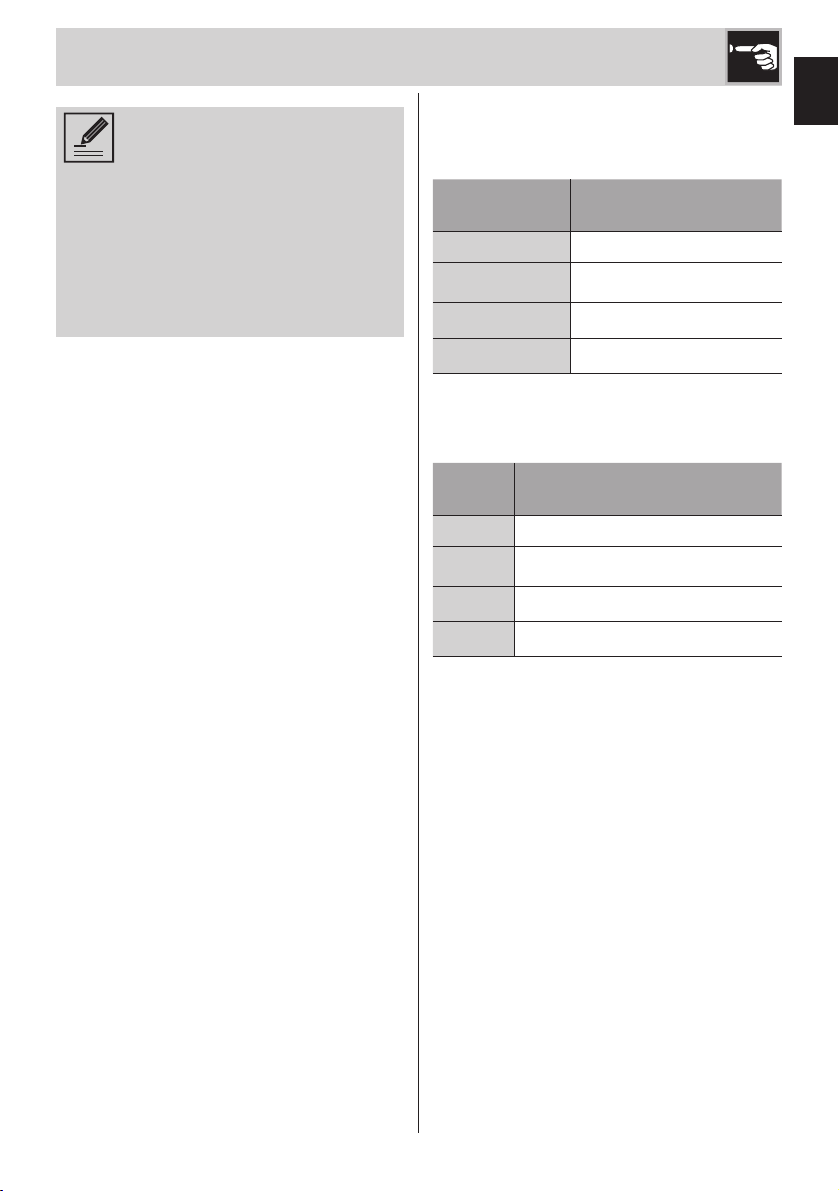
Key
Auto power-off time
set
11 Eco Mode (10 minutes)
11.12 30 minutes
11,12,13 40 minutes
11,12,13.14 60 minutes
• Press the key corresponding to the desired
setting to modify the time, as indicated in
the table.
Key
Auto power-off time to be
set
11 Eco Mode (10 minutes)
12 30 minutes
13 40 minutes
14 60 minutes
• The key selected will ash 3 times and a
sound will be emitted (if the acoustic signals
are active) to indicate the setting has been
saved.
Water hardness
The machine is factory set to “Very Hard Water
Level”. The machine can be set according to
the actual hardness of the water used, thus
making the requirement for descaling less
frequent.
If you don’t know the water hardness, use
the test strip supplied (17) and follow the
instructions below:
• Remove the reactive strip supplied (17) from
its packaging.
Use

EN - 14
• Fully submerge the strip in a glass of water
for about one second.
• Remove the strip from the water and shake
it slightly. Read the results after about one
minute.
• If 5 blue stripes appear on the strip, select
“light water” settings.
• If 1 or 2 pink stripes appear on the strip,
select the “medium water” setting.
• If 3 or 4 pink stripes appear on the strip,
select the “hard water” setting.
• If 5 pink stripes appear on the strip, select
the “very hard water” setting.
Proceed as follows to change the setting:
• Access the programming menu as indicated
previously.
• Press the key (12), it will ash 3 times to
indicate selection.
• The current setting is shown with the keys
switching on, as shown in the following
table:
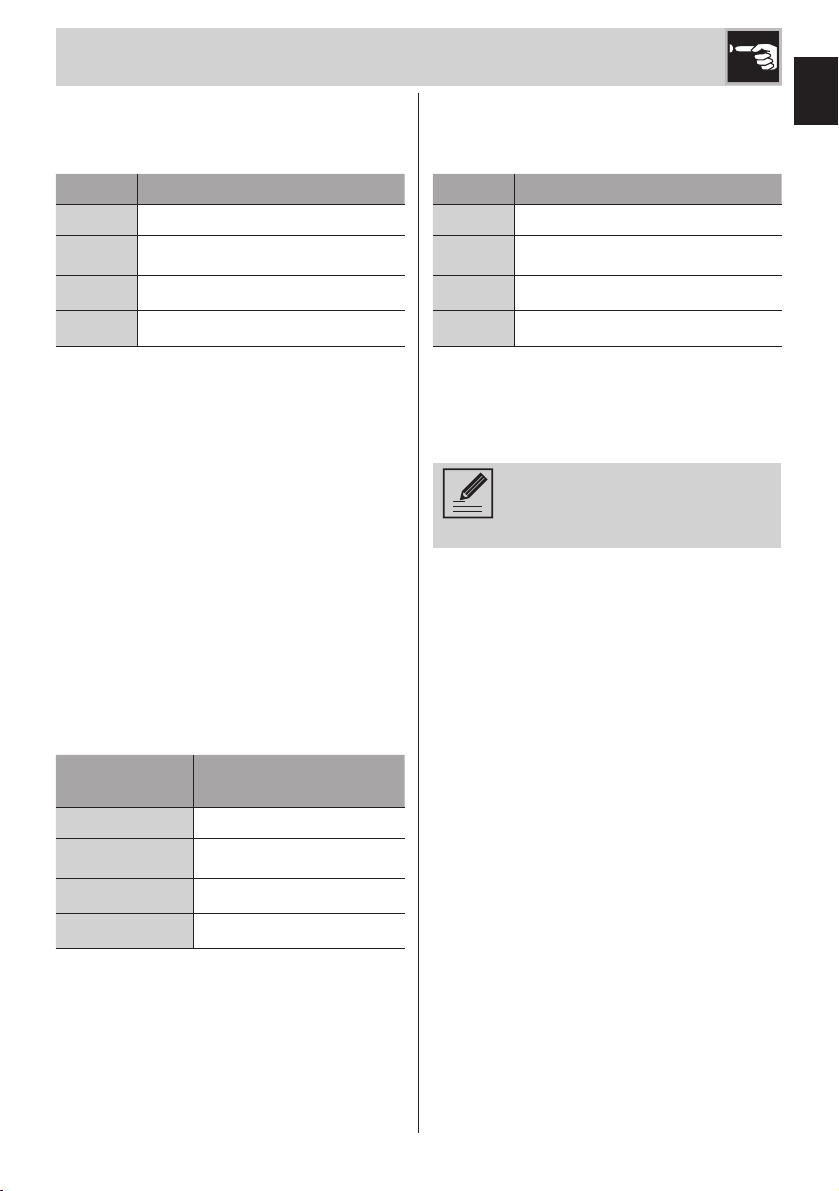
Key Water hardness set
11 Soft water
11.12 Medium water
11,12,13 Hard water
11,12,13.14 Very hard water
• Press the key corresponding to the desired
setting to modify the hardness, as indicated
in the table.
Key Water hardness to be set
11 Soft water
12 Medium water
13 Hard water
14 Very hard water
• The key selected will ash 3 times and a
sound will be emitted (if the acoustic signals
are active) to indicate the setting has been
saved.
Temperature of the coffee
The machine is pre-set to extract coffee at
an ideal temperature, which defines the
temperature in the cup.
Proceed as follows to change the setting:
• Access the programming menu as indicated
previously.
• Press the key (13), it will ash 3 times to
indicate selection.
• The current setting is shown with the keys
switching on, as shown in the following
table:
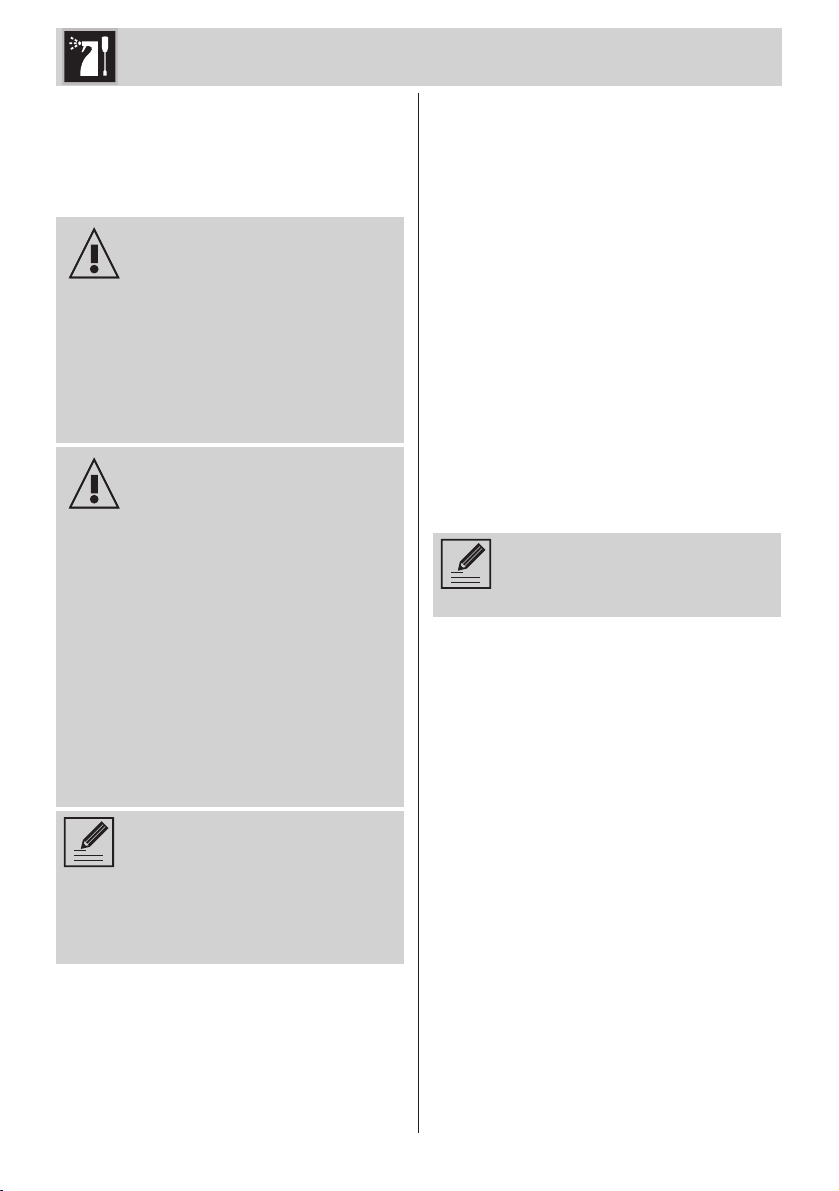
Key Temperature set
11 Low
11.12 Medium
11,12,13 Excellent
11,12,13,14 High
Use
EN - 15
EN
• Press the key corresponding to the desired
setting to modify the temperature, as
indicated in the table.
Key Temperature to set
11 Low
12 Medium
13 Excellent
14 High
• The key selected will ash 3 times and a
sound will be emitted (if the acoustic signals
are active) to indicate the setting has been
saved.
Pre-brewing proles
The machine is set with a standard pre-brewing
mode.
Proceed as follows to change this setting:
• Access the programming menu as indicated
previously.
• Press the key (14), it will ash 3 times to
indicate selection.
• The current setting is shown with the keys
switching on, as shown in the following
table:
Key
Set pre-brewing
prole
11 Short pre-brewing
11.12 Standard pre-brewing
11,12,13 Pulse pre-brewing
11,12,13,14 Constant pre-brewing
• Press the key corresponding to the desired
setting to modify the pre-brewing prole, as
indicated in the table.
Key Pre-brewing prole to set
11 Short pre-brewing
12 Standard pre-brewing
13 Pulse pre-brewing
14 Constant pre-brewing
• The key selected will ash 3 times and a
sound will be emitted (if the acoustic signals
are active) to indicate the setting has been
saved.
When using pressurised filters
(30a-30b), we suggest setting the
“Short pre-brewing” prole.
Acoustic signals
The machine is pre-set with acoustic signals
active. They can be deactivated by pressing
buttons (11) and (12) at the same time for 5
seconds.
Reset factory settings
To reset the factory settings, press keys (12)
and (13) simultaneously for 10 seconds.
Use
EN - 16
6 Cleaning and
maintenance
6.1 Warnings
Electrocution hazard.
• Remove the plug from the power
outlet before cleaning the coffee
machine.
• Never immerse the coffee
machine in water or other
liquids.
• Allow the coffee machine to cool
down before cleaning.
Risk of damage to the surfaces.
• Do not use steam jets to clean
the coffee machine.
• Do not use cleaning products
containing chlorine, ammonia
or bleach on parts with metal
surface nishes (e.g. anodised,
nickel or chrome-plated).
• Do not use abrasive or corrosive
detergents (e.g. powder
products, stain removers and
metallic scourers).
• Do not use rough or abrasive
materials or sharp metal
scrapers.
To make cleaning easier, it is
possible to scan the QR code
present on the base under the drip
tray, which links to a dedicated
web section on Installation and
Cleaning (g. J).
6.2 Cleaning the machine
body
To keep the external surfaces in good
condition, clean them regularly after all use
and when they have cooled down. Clean with
a soft, damp cloth.
6.3 General cleaning (Fig.A)
To ensure good machine operation, in addition
to excellent quality beverages, a few simple
daily cleaning operations are recommended,
such as cleaning the lter-holder (20) and
relative lter inside, the drip tray (24) and
coffee grounds collection tray (25).
It is also recommended that some specic
machine components
such as the water tank (7) and the coffee bean
container (3) are cleaned regularly.
Only the cup grill (26) and the jug
(28) are dishwasher safe.
Cleaning the lter-holder (20) and
lters (30a, 30b, 31a, 31b)
• Remove the lter from the lter-holder (20)
and rinse under running water.
• Dry the components thoroughly and re-
mount.
Cleaning the drip tray (24) and the
grounds collection tray (25)
The drip tray (24) is equipped with a red oat
(27) which projects from the cup holder grill
when the maximum liquid level is exceeded.
• Remove the cup grill (26), the tray (24) and
the coffee grounds collection tray (25).
• Empty and rinse under running water, use
neutral washing up liquid if necessary.
• Dry components and reassemble in the
machine.
Cleaning and maintenance

EN - 17
EN
Cleaning the coffee bean container
(3) and of the grounds (18) (Fig.A e F)
• Switch the machine on.
• Make sure the coffee bean container (3) is
empty and then press the key (12) to remove
any coffee residues from the grinder.
• Switch the machine off and remove the plug
from the outlet.
• Remove the coffee bean container (3) by
turning it anti-clockwise until the
“ ”
“
”
references are matched with the indicator
(5) and then lift it.
• Remove any coffee beans present in the
grinder using the cleaning brush (33)
supplied.
• Lift the handle (42) of the upper grinder
(18a) and turn it clockwise to remove it.
• Clean the upper grinder (18a) and the
lower grinder (18b) using the brush supplied
(33) if necessary.
•
Re-mount the upper grinder (18a) by matching
the two notches
“ ”
“ ”
and turn it anti-
clockwise to x it
“ ”” ”
.
• Clean the coffee beans container (3) using
a damp cloth and re-mount it by matching
the references
“ ”
“ ”
with the indicator
(5) and then turn it clockwise to attach it.
Thanks to the Twist & Lock system,
it is possible to remove the coffee
beans container (3) even if there
are coffee beans inside and just
clean the grinders (18).
Cleaning the water tank (7)
• Remove the tank lid (6) and remove the tank
from the machine using the relevant handle.
• Clean the tank under running water, dry it
externally and re-mount it.
Cleaning the steam wand (22) (Fig.H)
Clean the steam wand (22) immediately after
use.
• Position the tip of the steam wand on the
cup grill in correspondence with the relative
hole, turn the lever (15)
to the “ ” / “
”
icon for a few seconds to make any milk
remaining inside escape and then take it
back to the vertical position.
• Dry the steam wand (22) using a damp
cloth.
Let the steam wand cool down
before cleaning.
BURNS HAZARD!
• Check that the steam exit hole is not
blocked. In the case of any deposits, clean
the steam exit hole using the relevant needle
supplied (34a).
Cleaning the dispensing unit (20)
(Fig.G)
• Insert the non-pressurised lter for double
coffee (31b) into the lter-holder (20)
• Insert the cleaning disk (32) supplied and
a detergent capsule inside the lter (31b).
Use detergent capsules for
household coffee machines, which
can be found on the market.
• Attach the lter-holder (20) into the dispensing
unit (21) and position a container with
capacity of at least 500 ml under the lter-
holder nozzles.
• Fill the tank (7) with fresh water up to max.
• Hold keys (11) and (14) down for 5
seconds.
• Press the button (14) for 5 seconds to start
the dispensing unit cleaning cycle.
Cleaning and maintenance
EN - 18
Cleaning and maintenance
• The machine will proceed with pulse
dispensing to clean the dispensing unit (21)
. Overall, the operation takes approx. 10
minutes. The button (14) ashes indicating
that the procedure is in progress.
• At the end of the procedure all the keys will
light up with a xed light and the machine
will emit a double sound, if the acoustic
signals are active.
• Remove the lter-holder (20) and check that
the detergent has dissolved completely. If
this is not the case, repeat the operation.
• At the end, remove the lter-holder (20) and
the cleaning disk (32) inside.
• Before dispensing a coffee beverage,
attach the lter-holder (20) again with the
lter (31b) to the dispensing unit (21) and
press the button (14) to rinse the circuit.
6.4 Descaling (Fig.B-N)
Before performing the descaling
cycle, remove any water softener
lters present inside the tank (7).
Stay near the machine for the entire
duration of the descaling cycle
since you may be required to ll
the tank, for example.
The entire descaling and rinsing
cycle lasts approximately 40
minutes.
The coffee machine signals when it is
necessary to carry out a descaling cycle on
the basis of the water hardness set (For setting
of the water hardness, see the “Setting water
hardness” paragraph). If the button (14) lights
up with a xed orange light, it means that
a descaling cycle is necessary, so as not to
alter the taste of the coffee and damage the
machine. However, coffee, steam/hot water
can continue to be dispensed.
Proceed as follows to perform the descaling
cycle:
• Remove the lter-holder (20) from its seat
• Place a container with a capacity of at least
500 ml under the dispensing unit (21) and
another with a capacity of at least 800 ml
under the steam wand (22).
• Fill the tank (7) up to “MAX” with a solution
of water and descaler following the doses
recommended by the manufacturer.
• Press keys (11) and (14) simultaneously for
5 seconds to enter the programming menu.
• Turn the lever (15) anti-clockwise to the
steam intensity position.
• Buttons (11), (12) and (13) switch off, while
the button (14) ashes with an orange light.
• Press (14) to start the descaling cycle.
During the descaling cycle, the
machine will make a few pauses to
allow the descaler to act effectively
Wait for the end of the cycle.
• The descaling cycle ends when the button
(14) turns white.
• Remove the tank (7) and rinse it under
running water to remove any traces of
descaler.

EN - 19
EN
Cleaning and maintenance
• Re-mount the tank and ll it up to “MAX”
with clean water to perform the rinse cycle,
then press the key (14) to start this cycle.
The button (14) ashes.
• The rinse cycle ends when the key (14) lights
up with a xed white light.
• Re-position the lever (15) in the vertical
position. The machine is ready for use
again.
Personal injury hazard.
• The descaler contains acids that
can irritate the skin and eyes.
• Follow the manufacturer's
instructions and safety warnings
on the packet scrupulously in
the event of contact with skin or
eyes.
• Use descaler products
recommended by Smeg to
prevent damage to the coffee
machine.

EN - 20
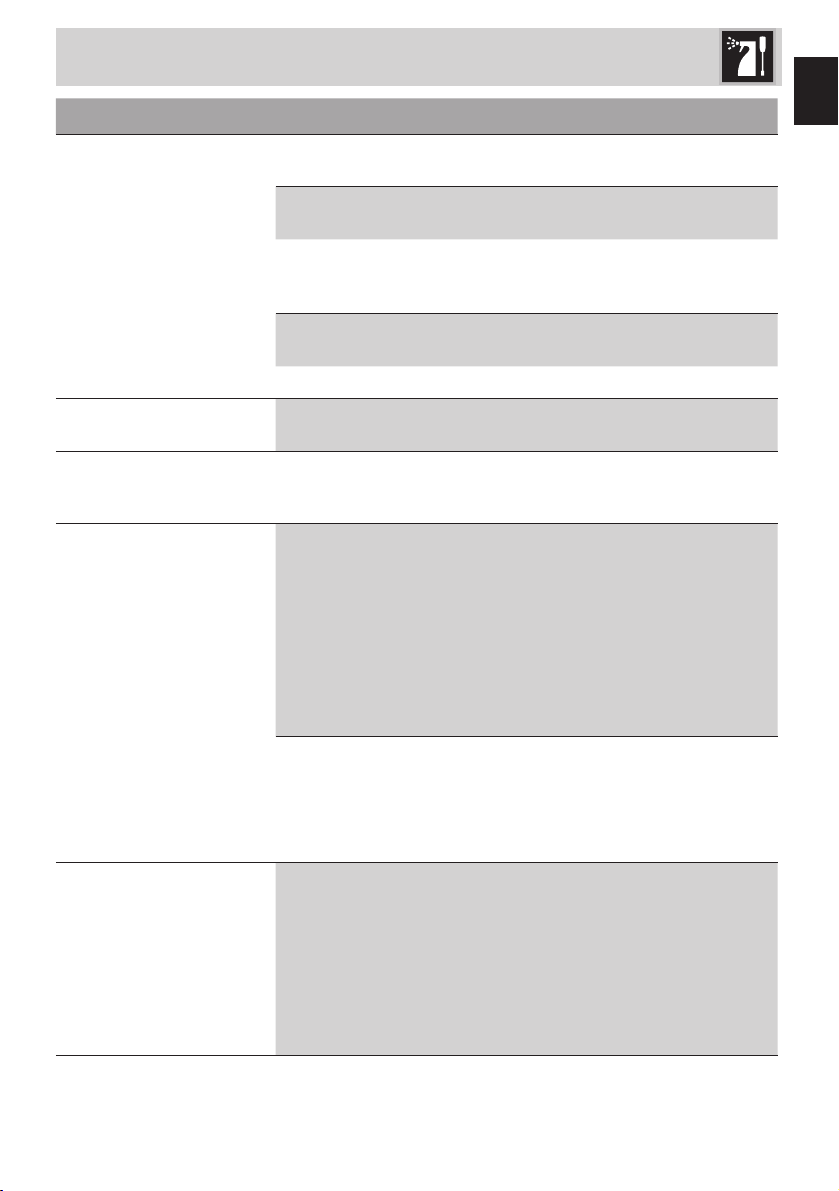
Problem Possible causes Solution
No coffee is dispensed
from the nozzles.
No water in the tank (7).
The keys (13-14) ash.
Fill the tank (7).
The lter holes (11-12-13-
14) are blocked.
Clean the lter (11-12-13-
14) with a brush or the pin
supplied.
The tank (7) is not inserted
correctly or is empty.
Insert the tank (7) correctly and
make sure it contains water.
Lime scale build-up.
Perform a descaling cycle.
The manometer indicates
an over-pressure.
Make the coffee again
introducing less powder or
coarser powder.
The ground coffee is too ne. Adjust grinding level to a thicker
level.
Excessive tamping. Use less coffee.
You are using too much
coffee.
Reduce the amount of coffee.
The coffee drips from
the lter-holder (20) and
not from the nozzles.
The lter-holder (20) is not
attached correctly or is
dirty.
Attach the lter-holder (20)
and rotate it fully home.
Clean the lter-holder (20).
The dispensing unit gasket
is worn.
Have it replaced at an
authorised After-sales Centre.
The nozzle holes are
blocked.
Clean the nozzle holes.
The lter holder (20) will
not attach to the coffee
machine.
The lter has been
overlled.
Check the amount of coffee
dosed.
The coffee machine
does not work and all
the LEDS ash.
Possible fault. Unplug the coffee machine
and contact an Authorised
After-sales Centre.
The coffee is light in colour
and comes out of the
nozzle quickly.
The ground coffee has not
been tamped sufciently.
Tamp the coffee harder.
There is insufcient ground
coffee.
Increase the amount.
The ground coffee is too
coarse.
Set grind to a ner level.
What to do if...
EN - 21
EN
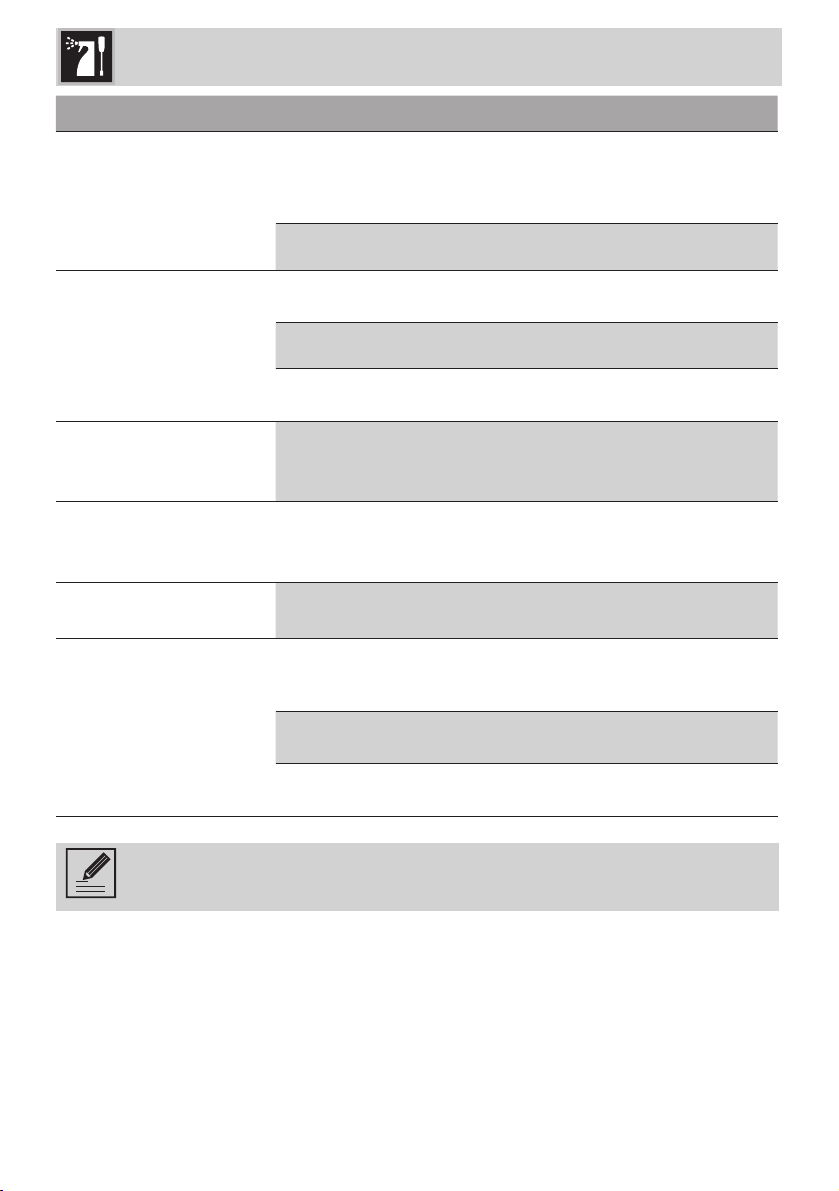
Problem Possible causes Solution
The coffee is dark in colour
and comes out of the
nozzle slowly.
The ground coffee has not
been tamped too hard.
Tamp the coffee with less
force.
There is too much ground
coffee.
Reduce the amount used.
The dispensing unit (20) or
the lter (
30a-30b-31a-
31b
) are clogged
.
Clean the dispensing unit
(20) and the lter (30a-30b-
31a-31b).
The ground coffee is too
ne.
Set grind to a coarser level.
Lime scale build-up. Perform a descaling cycle.
The keys (11) and (12)
ash for a few seconds.
No coffee beans container
(3).
Mount the container correctly
(3).
Keys (13) and (14) ash
simultaneously.
No water in the tank or no
tank inserted (7).
Make sure the tank (7) is
assembled correctly and verify
whether it contains water.
The coffee is not hot.
Machine not used for a
long period of time.
Increase the temperature
of the coffee from the
programming menu following
that indicated in the ”Setting
the coffee temperature”
paragraph.
Dispense hot water into the
same cup in which the coffee
will be prepared in order to
heat the cup.
The cups have not been
pre-heated.
Heat cups by rinsing them
with hot water (Note: the hot
water function can be used).
Insufcient frothing.
The steam wand is dirty. Thoroughly clean the steam
wand removing the steel
nozzle and following the
instructions in the manual.
Note: the quality of the froth
depends on the type of milk
used, its temperature and
the technique used/manual
dexterity.
What to do if...
EN - 22
Problem Possible causes Solution
The machine does not
dispense steam.
Keys (13) and (14) ash
in sequence. The machine
did not reach the steam
dispensing temperature.
Wait for the temperature to
be reached.
Lime scale build-up. Perform a descaling cycle.
The machine looses
water from the base.
Drip tray inserted
incorrectly.
Check and introduce it well.
Drip tray full. Empty the drip tray.
Water tank not introduced
correctly.
Introduce the tank into its seat
correctly.
The coffee bean
container cannot be re-
positioned,
Presence of coffee beans
on the grinder ring.
Clean the coffee bean
container using the relevant
cleaning brush supplied.
The coffee only escapes
from one of the two
nozzles.
The coffee is not pressed
well.
Check horizontal pressing is
performed.
The nozzles are
clogged.
The nozzles were not
cleaned after dispensing.
Clean the nozzles well.
The manometer does not
indicate the pressure.
Not enough coffee has
been inserted.
Increase the quantity of
coffee and repeat the
operation.
The coffee hasn't been
pressed enough.
Apply more force when using
the tamper.
Circuit problem. Contact an Authorised After-
sales Centre.
Contact local technical support if the problem is not solved or in case of other types
of faults.
What to do if...