
LAUNCH
i
Copyright Information
Copyright © 2023 by LAUNCH TECH. CO., LTD (also called LAUNCH for short).
All rights reserved. No part of this publication may be reproduced, stored in a
retrieval system, or transmitted in any form or by any means, electronic,
mechanical, photocopying, recording or otherwise, without the prior written
permission of LAUNCH.
Statement: LAUNCH owns the complete intellectual property rights for the
software used by this product. For any reverse engineering or cracking actions
against the software, LAUNCH will block the use of this product and reserve the
right to pursue their legal liabilities.
Disclaimer of Warranties and Limitation of Liabilities
All information, illustrations, and specifications in this manual are based on the
latest information available at the time of publication.
The right is reserved to make changes at any time without notice. We shall not
be liable for any direct, special, incidental, indirect damages or any economic
consequential damages (including the loss of profits) due to the use of the
document.

LAUNCH
ii
Using This Manual
This manual contains device usage instructions.
Some illustrations shown in this manual may contain modules and optional
equipment that are not included in your system.
The following conventions are used.
Bold Text
Bold text is used to highlight selectable items such as buttons and menu options.
Example:
Tap OK.
Notes and Important Messages
Notes
A NOTE provides helpful information such as additional explanations, tips, and
comments.
Example:
Note: Remember to remove the VCI connector from the vehicle’s DLC after use.
Warning
Warning indicates a hazardous situation which, if not avoided, could result in
minor or moderate injury to the operator or to bystanders.
Example:
Warning: Retrieving and using DTCs for troubleshooting vehicle operation is only
one part of an overall diagnostic strategy. Never replace a part based only on the DTC
definition. Each DTC has a set of testing procedures, instructions and flow charts that
must be followed to confirm the location of the problem. This information can be found
in the vehicle’s service manual.
Danger
Danger indicates an imminently or potentially hazardous situation which, if not
avoided, could result in death or serious injury to the operator or to bystanders.
Example:
Danger: If you must drive the vehicle in order to perform a troubleshooting
procedure, always have a second person help you. Trying to drive and operate the
diagnostic tool at the same time is dangerous, and could cause a serious traffic accident.

LAUNCH
iii
Illustrations
Illustrations used in this manual are samples, the actual testing screen may vary
for each vehicle being tested. Observe the menu titles and on-screen
instructions to make correct option selection.
Important Safety Precautions
To avoid personal injury, property damage, or accidental damage to the product,
read all of the information in this section before using the tool.
DANGER
• When an engine is operating, keep the service area well-ventilated or attach
a building exhaust removal system to the engine exhaust system. Engines
produce various poisonous compounds (hydrocarbon, carbon monoxide,
nitrogen oxides, etc.) that cause slower reaction time and result in death or
serious personal injury.
• Please use the included battery and power adaptor. Risk of explosion if the
battery is replaced with an incorrect type.
• DO NOT attempt to operate the tool while driving the vehicle. Have second
personal operate the tool. Any distraction may cause an accident.
WARNING
Always perform automotive testing in a safe environment.
Do not connect or disconnect any test equipment while the ignition is on or
the engine is running.
Before starting the engine, put the gear lever in the Neutral position (for
manual transmission) or in the Park (for automatic transmission) position to
avoid injury.
NEVER smoke or allow a spark or flame in vicinity of battery or engine. Do
not operate the tool in explosive atmospheres, such as in the presence of
flammable liquids, gases, or heavy dust.
Keep a fire extinguisher suitable for gasoline/chemical/electrical fires nearby.
Wear an ANSI-approved eye shield when testing or repairing vehicles.
Put blocks in front of the drive wheels and never leave the vehicle unattended
while testing.
Use extreme caution when working around the ignition coil, distributor cap,

LAUNCH
iv
ignition wires and spark plugs. These components create hazardous voltage
when the engine is running.
To avoid damaging the tool or generating false data, please make sure the
vehicle battery is fully charged and the connection to the vehicle DLC (Data
Link Connector) is clear and secure.
Automotive batteries contain sulfuric acid that is harmful to skin. In operation,
direct contact with the automotive batteries should be avoided. Keep the
ignition sources away from the battery at all times.
Keep the tool dry, clean, free from oil, water or grease. Use a mild detergent
on a clean cloth to clear the outside of the equipment when necessary.
Keep clothing, hair, hands, tools, test equipment, etc. away from all moving or
hot engine parts.
Store the tool and accessories in a locked area out of the reach of children.
Do not use the tool while standing in water.
Do not expose the tool or power adapter to rain or wet conditions. Water
entering the tool or power adaptor increases the risk of electric shock.
This tool is a sealed unit. There are no end-user serviceable parts inside. All
internal repairs must be done by an authorized repair facility or qualified
technician. If there is any inquiry, please contact the dealer.
Keep the tool far away from magnetic devices because its radiations can
damage the screen and erase the data stored on the tool.
Do not attempt to replace the internal rechargeable lithium battery. Contact
the dealer for factory replacement.
Do not disconnect battery or any wiring cables in the vehicle when the ignition
switch is on, as this could avoid damage to the sensors or the ECU.
Do not place any magnetic objects near the ECU. Disconnect the power
supply to the ECU before performing any welding operations on the vehicle.
Use extreme caution when performing any operations near the ECU or
sensors. Ground yourself when you disassemble PROM, otherwise ECU and
sensors can be damaged by static electricity.
When reconnecting the ECU harness connector, be sure it is attached firmly,
otherwise electronic elements, such as ICs inside the ECU, can be damaged.

LAUNCH
v
FCC Statement
FCC ID: XUJX431PROV5
Note: This equipment has been tested and found to comply with the limits for a
Class B digital device, pursuant to part 15 of the FCC Rules. These limits are
designed to provide reasonable protection against harmful interference in a
residential installation. This equipment generates, uses and can radiate radio
frequency energy and, if not installed and used in accordance with the
instructions, may cause harmful interference to radio communications. However,
there is no guarantee that interference will not occur in a particular installation. If
this equipment does cause harmful interference to radio or television reception,
which can be determined by turning the equipment off and on, the user is
encouraged to try to correct the interference by one or more of the following
measures:
- Reorient or relocate the receiving antenna.
- Increase the separation between the equipment and receiver.
- Connect the equipment into an outlet on a circuit different from that to which
the receiver is connected.
- Consult the dealer or an experienced radio/TV technician for help.
The device has been evaluated to meet general RF exposure requirement. The
highest reported SAR for stand-alone and simultaneous transmission exposure
conditions are below the maximum value. End-users must be informed of the
operating requirements for satisfying RF exposure compliance.
This device is in compliance with the essential requirements and other relevant
provisions of Radio Equipment Directive 2014/53/EU. The RF frequencies can
be used in Europe without restriction.

LAUNCH
vi
TABLE OF CONTENTS
1 Introduction ..................................................................................................1
1.1 Product Profile ........................................................................................ 1
1.2 Package List ........................................................................................... 2
1.3 Components & Controls ......................................................................... 4
1.3.1 Display Tablet .................................................................................. 4
1.3.2 VCI Connector ................................................................................ 5
1.4 Technical Parameters ............................................................................. 7
2 Initial Use ......................................................................................................8
2.1 Charging & Turning On ........................................................................... 8
2.2 Screen Layout ........................................................................................ 8
2.3 Basic Gestures ....................................................................................... 8
2.4 Change System Language ..................................................................... 9
2.5 Adjust Brightness ................................................................................... 9
2.6 Set Standby Time ................................................................................... 9
2.7 Network Setup ...................................................................................... 10
3 Getting Started ............................................................................................ 11
3.1 Register & Update ................................................................................ 11
3.2 Home Screen ....................................................................................... 13
4 Connections ................................................................................................ 15
4.1 Preparation ........................................................................................... 15
4.2 Vehicle Connection............................................................................... 15
5 Diagnosis .................................................................................................... 18
5.1 Intelligent Diagnose .............................................................................. 18
5.2 Local Diagnose ..................................................................................... 21
5.2.1 Health Report (Quick Test) ............................................................ 24
5.2.2 System Scan ................................................................................. 26
5.2.3 System Selection .......................................................................... 27
5.3 Diagnostic History................................................................................. 35

LAUNCH
vii
5.4 Feedback ............................................................................................. 35
6 Service (Reset) Function............................................................................ 37
6.1 Maintenance Light Reset (Oil Reset) .................................................... 37
6.2 Electronic Parking Brake Reset (BRAKE RESET) ................................ 37
6.3 Steering Angle Reset (SAS Reset) ....................................................... 37
6.4 ABS Bleeding ....................................................................................... 38
6.5 Crank Position Sensor Adaptive Learning (GEAR LEARN) .................. 38
6.6 Anti-theft Matching (IMMO)................................................................... 38
6.7 Injector Coding (INJECTOR) ................................................................ 38
6.8 Battery Matching (BAT. RESET) .......................................................... 39
6.9 DPF Regeneration (DPF REG.) ............................................................ 39
6.10 Throttle Matching (ELEC. THROTTLE RLRN) .................................... 39
6.11 Gearbox Matching (GEARBOX) ......................................................... 39
6.12 Headlight Matching (AFS RESET) ...................................................... 40
6.13 Sunroof Initialization (SUNROOF) ...................................................... 40
6.14 Suspension Level Calibration (SUS RESET) ...................................... 40
6.15 EGR Adaption .................................................................................... 40
6.16 Seats Calibration ................................................................................ 40
6.17 Tyre Reset .......................................................................................... 40
6.18 Coolant Bleed ..................................................................................... 40
6.19 AdBlue Reset (Diesel Engine Exhaust Gas Filter) .............................. 40
6.20 NOx Sensor Reset.............................................................................. 41
6.21 AC System Relearn/Initialization ........................................................ 41
6.22 High Voltage Battery Detection (HIGH VOLTAGE BATTERY) ........... 41
6.23 Windows Calibration ........................................................................... 41
6.24 Language Change .............................................................................. 41
6.25 A/F Reset ........................................................................................... 41
6.26 Transport Mode .................................................................................. 41
6.27 Stop/Start Reset ................................................................................. 41
6.28 Intelligent Cruise Control System Reset ............................................. 42

LAUNCH
viii
6.29 Engine Power Balance Monitoring ...................................................... 42
6.30 Gas Particulate Filter (GPF) Regeneration ......................................... 42
6.31 Motor Angle Calibration ...................................................................... 42
7 Software Update ......................................................................................... 43
7.1 Update Diagnostic Software & APP ...................................................... 43
7.2 Update Frequently Used software ........................................................ 44
7.3 Renew Subscription.............................................................................. 44
8 User Info ...................................................................................................... 46
8.1 My Report ............................................................................................. 46
8.2 VCI ....................................................................................................... 46
8.3 VCI Management ................................................................................. 46
8.4 Activate VCI.......................................................................................... 46
8.5 Firmware Fix......................................................................................... 46
8.6 My Order .............................................................................................. 47
8.7 Subscription Renewal Card .................................................................. 47
8.8 Profile ................................................................................................... 47
8.9 Change password................................................................................. 47
8.10 Settings .............................................................................................. 47
8.10.1 Units ............................................................................................ 47
8.10.2 Shop Information ......................................................................... 47
8.10.3 Printer Set ................................................................................... 47
8.10.4 Clear Cache ................................................................................ 48
8.10.5 About ........................................................................................... 48
8.10.6 Login/Logout ............................................................................... 48
8.11 Diagnostic Software Clear .................................................................. 48
9 Other Modules ............................................................................................ 49
9.1 Testable Models ................................................................................... 49
9.2 Tablet Setting ....................................................................................... 49
9.3 Files...................................................................................................... 49
9.4 System OTA Upgrade .......................................................................... 49

LAUNCH
ix
9.5 Recording Master ................................................................................. 49
9.6 Calculator ............................................................................................. 49
9.7 Browser ................................................................................................ 49
9.8 Gmail .................................................................................................... 50
9.9 Camera ................................................................................................ 50
9.10 Gallery ................................................................................................ 50
10 FAQ ............................................................................................................ 51

LAUNCH
1
1 Introduction
1.1 Product Profile
It inherits from LAUNCH’s advanced diagnosing technology and is characterized
by covering a wide range of vehicles, featuring powerful functions, and providing
precise test result.
Through simple wireless/wired communication between VCI (Vehicle
Communication Interface) device and the display tablet, it achieves full car
model and full system vehicle trouble diagnosis, which include Reading DTCs,
Clearing DTCs, Reading Data Stream, Actuation Test and Special Functions.
It has the following features:
Intelligent Diagnose: This module allows you to use the VIN information of the
currently identified vehicle to access its data (including vehicle information,
historical diagnostic records) from the cloud server to perform quick test,
eliminating guesswork and step-by-step manual menu selection.
Local Diagnose: Follow the on-screen prompts to start diagnostic session
step by step.
Service Function: It offers coding, reset, relearn and more service functions,
to help vehicles get back to functional status after repair or replacement.
Available tests vary by vehicle manufacturer, year, and model.
One-click Update: Lets you update your diagnostic software online.
Mall: Enables you to subscribe some extra software or service functions that
are not integrated in the tool online.
Diagnostic History: This function provides a quick access to the tested
vehicles and users can choose to view the test report or resume from the last
operation, without starting from scratch.
Feedback: Enables you to submit the vehicle issue to us for analysis and
troubleshooting.
Testable Models: Quick dial to view the vehicle models that the tool covers.
LAUNCH
2
1.2 Package List
The following packing list is for reference purpose only. For different destinations,
the accessories may vary. For details, please consult from the seller or check the
packing list supplied with this tool together.
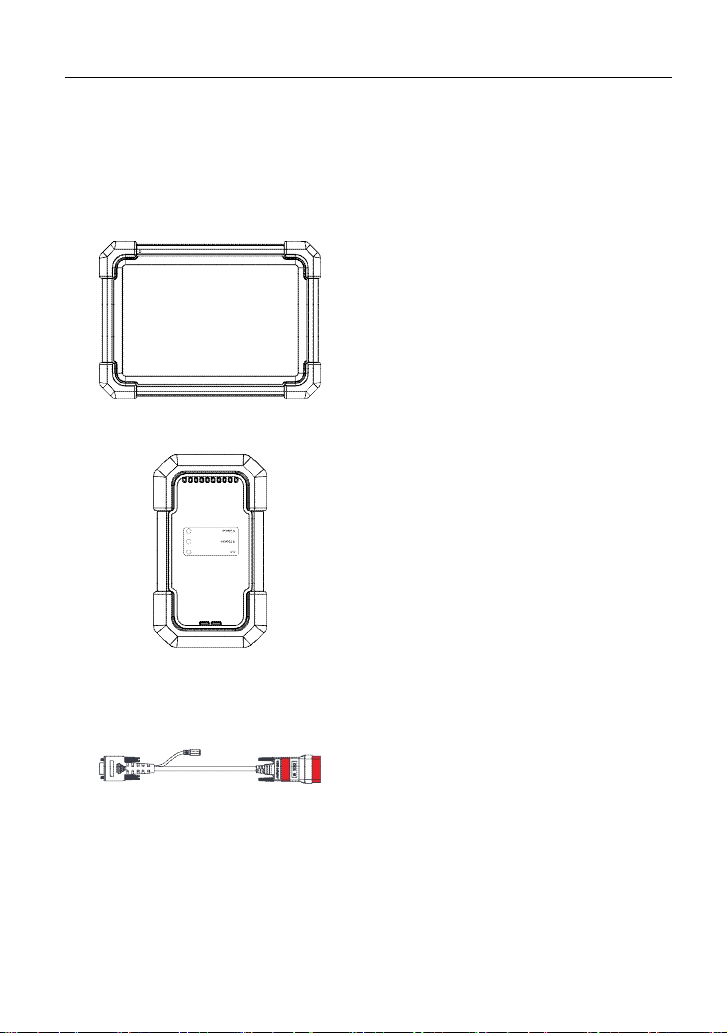
Display tablet x 1
Indicates the test result.
VCI connector x 1
A device for accessing vehicle live
data.
Diagnostic
cable
x 1
Connects the VCI connector to
vehicle’s OBD II diagnostic socket.
It can be separated into two parts:
HDB15F to HD15F data cable and
HD15M to OBD II adaptor.
LAUNCH
3
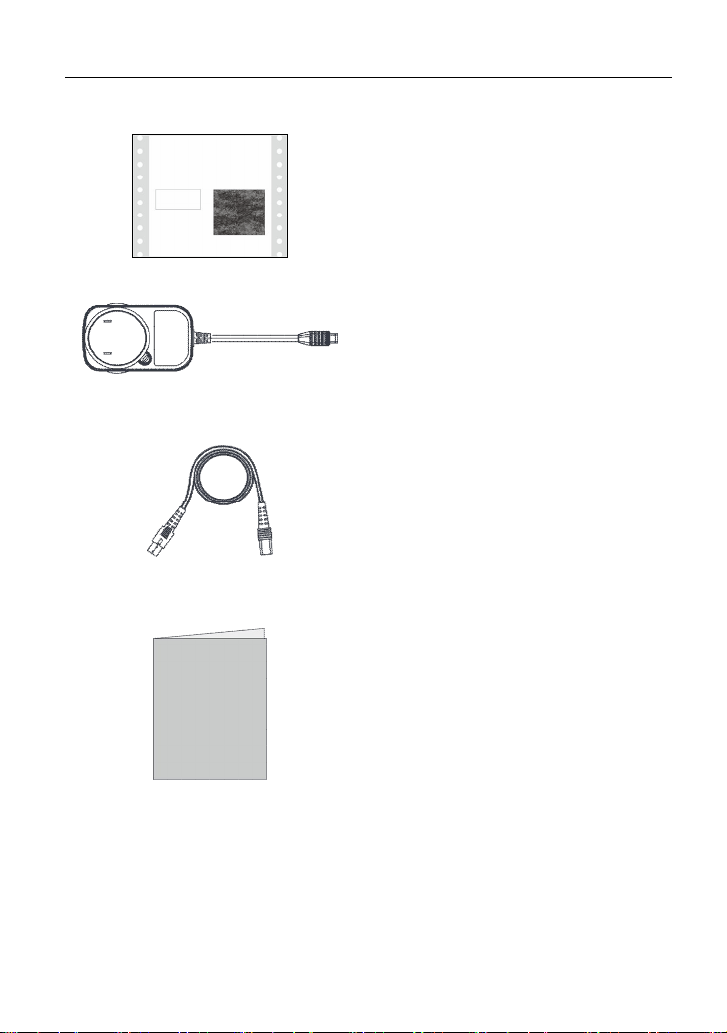
Password envelope x 1
A piece of paper bearing the product
Serial Number and Activation Code
for product registration.
Power adaptor x 1 + Switching
adaptors x 2
Charges the tablet via AC outlet.
Type
-
A to Type
-
C USB cable
x 1
• Connects the diagnostic tool to AC
outlet / PC for charging / data
exchange.
• Connects the VCI connector to the
diagnostic tool to perform vehicle
diagnosis.
Quick Start Guide x 1
LAUNCH
4
1.3 Components & Controls
There are two main components to the diagnostic system:
Display Tablet – the central processor and monitor for the system (See
Chapter 1.3.1).
VCI Device – the device for accessing vehicle data (See Chapter 1.3.2).
1.3.1 Display Tablet
The tablet acts as the central processing system, which is used to receive and
analyze the live vehicle data from the VCI device and then output the test result.
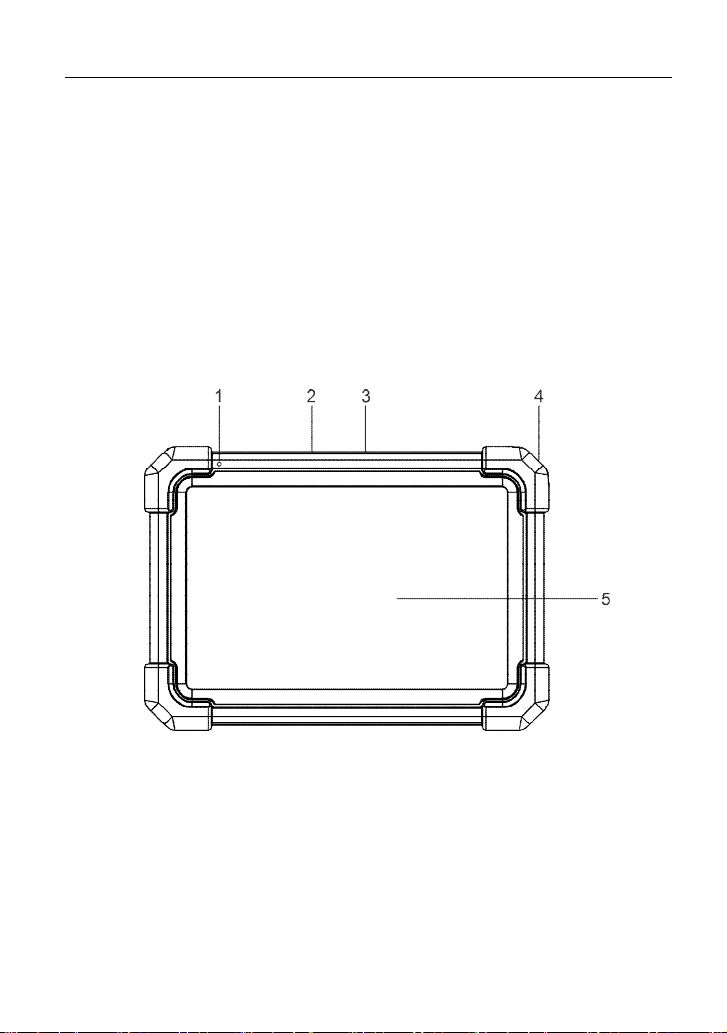
1. Microphone
2. Type-A USB Port
• Connect to the VCI connector to perform vehicle diagnosis via the USB cable.
• Connect to an external USB storage device for data exchange.
3. Type-C USB Port
• Connect to AC outlet for charging.
• Connect to PC for data exchange.
LAUNCH
5
4. POWER Key
• In Off mode, press it for 3 seconds to turn the tablet on.
• In On mode:
• Press it once to activate the LCD if the LCD is off. Press it once to turn off
the LCD if the LCD lights up.
• Press and hold it for 3 seconds to turn it off.
• Press and hold it for 8 seconds to perform forced shutdown.
5. LCD Screen
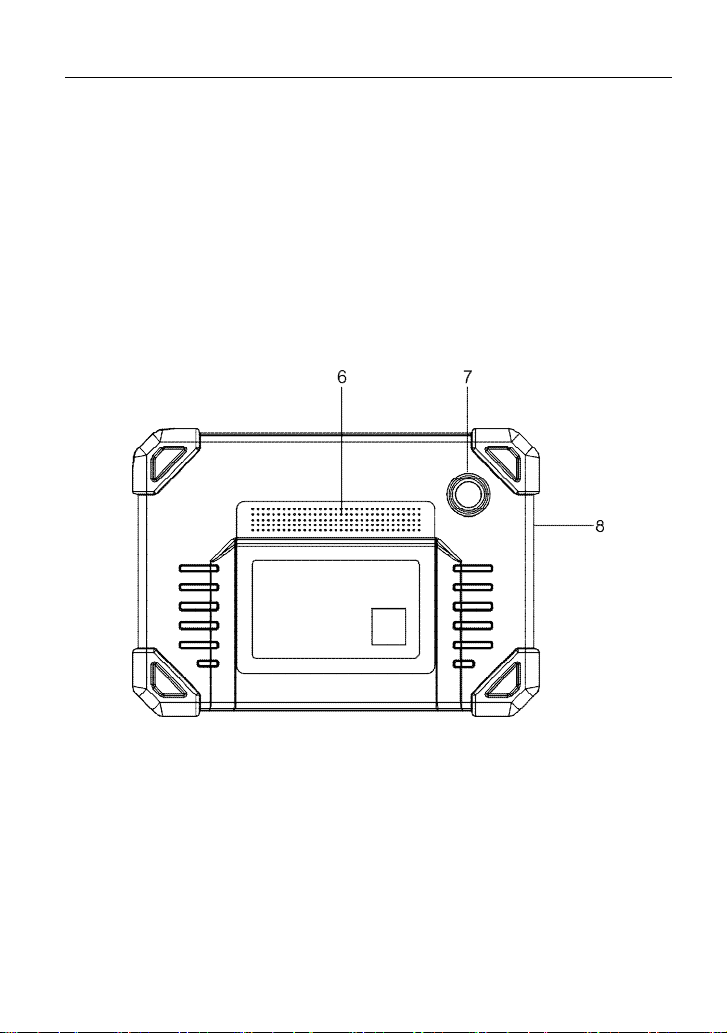
Indicate the test result.
6. Speakers
7. Rear Camera
8. Microphone
1.3.2 VCI Connector
The VCI connector works as a vehicle communication interface device, which is
used to connect to the vehicle’s DLC (Data Link Connector) socket via the
diagnostic cable to read the vehicle data and then send it to the tablet.
LAUNCH
6
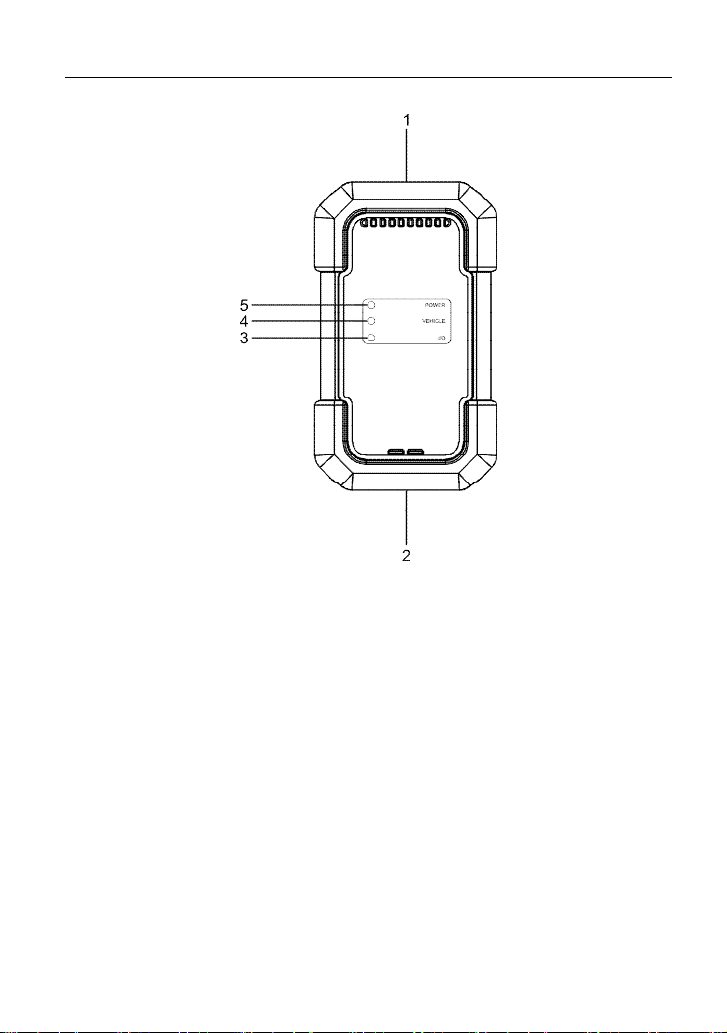
1. OBD-15 diagnostic connector
Connect on vehicle’s OBD II DLC via the diagnostic cable.
2. USB port
Connect the VCI to the tablet to perform vehicle diagnosis via USB cable.
3. I/O indicator
• Illuminates blue when the VCI is communicating with the tablet wirelessly.
• Illuminates red when the VCI is connected to the tablet via USB cable.
4. VEHICLE indicator
Illuminates green and flashes when the VCI is communicating with the vehicle.
5. POWER indicator
Illuminates solid red while the VCI is powered up.

LAUNCH
7
1.4 Technical Parameters
Display Tablet
Operating system: Android
Memory: 4GB
Storage: 64GB
Screen: 7 inch capacitive touch screen with a resolution of 1024 x 600 pixels
Camera: Rear-facing 8.0MP camera
Connectivity:
• Wi-Fi (802.11a/b/g/n/ac)
• Bluetooth
Working temperature: 0℃ ~ 50℃
Storage temperature: -20 ~ ℃ 70℃
VCI Connector
Working voltage: 9 ~18V
Power consumption: ≤2.0W
Dimension: 118.3mm*69.5mm*32mm
Working temperature: 0℃ ~ 50℃
Relative humidity: 20% ~ 90%
LAUNCH
8
2 Initial Use
2.1 Charging & Turning On
1. Use the included power adaptor to charge the tablet.
2. After charging is complete, press the POWER button to turn the tablet on.
The system starts initializing and then enters the home screen.
Note: If the battery remains unused for a long period of time or the battery is
completely discharged, it is normal that the tool will not power on while being charged.
Please charge it for a period of 5 minutes and then turn it on.
Warning: Please use the included power adaptor to charge your tool. No
responsibility can be assumed for any damage or loss caused as a result of using power
adaptors other than the one supplied.
Press the POWER button for 3 seconds, an option menu will pop up on the
screen. Tap Power off/Restart to turn it off/reboot it.
2.2 Screen Layout
There are five on-screen buttons available on the bottom of the screen.
Home: Navigates to the Android’s home screen.
Recent App: Views the running applications.
VCI Connection: Shows whether the VCI device is properly connected or
not. If displayed in green, it indicates the communication between the tablet and
the VCI is established.
Screenshot: Captures the current screen.
Back: Returns to the previous screen.
2.3 Basic Gestures
Single-tap: To select an item or launch a program.

LAUNCH
9
Double-tap: To zoom in so that the text on a webpage appears in a
column that fits your tablet’s screen.
Long press: Tap and hold on the current interface or area until a
contextual menu pops up on the screen, and then release it.
Slide: To jump to different pages.
2.4 Change System Language
The tool supports multiple system languages. To change the language of the
tool, please do the following:
1. On the home screen, tap Other Modules -> Settings -> System ->
Language & input -> Languages.
2. Tap Add a language, and then choose the desired language from the list.
3. Tap and hold the desired language and drag it to the top of the screen and
then release it, the system will change into the target language.
2.5 Adjust Brightness
Note: Reducing the brightness of the screen is helpful to conserve the battery
power.
1. On the home screen, tap Other Modules -> Settings -> Display ->
Brightness level.
2. Drag the slider to adjust it.
2.6 Set Standby Time
If no activities are made within the defined standby period, the screen will be
locked automatically and the system enters sleep mode to save power.
1. On the home screen, tap Other Modules -> Settings -> Display ->
Advanced -> Sleep.

LAUNCH
10
2. Choose the desired sleep time.
2.7 Network Setup
The tablet has built-in Wi-Fi that can be used to get online. Once you’re online,
you can register your tool, surf the Internet, get apps, and check for software
updates etc.
1. On the home screen, tap Other Modules -> Settings -> Network & Internet
-> WLAN.
2. Slide the Wi-Fi switch to ON, the tablet starts searching for available wireless
networks.
3. Select a wireless network,
If the chosen network is open, the tablet will connect automatically.
If the selected network is encrypted, a network password will need to be
entered.
4. When Connected appears, it indicates the Wi-Fi connection is complete.
Note: When Wi-Fi is not required, this should be disabled to conserve battery
power.
LAUNCH
11
3 Getting Started
For new users, you will need to experience a user registration process before
getting started.
3.1 Register & Update
Follow the steps below to sign in and update:
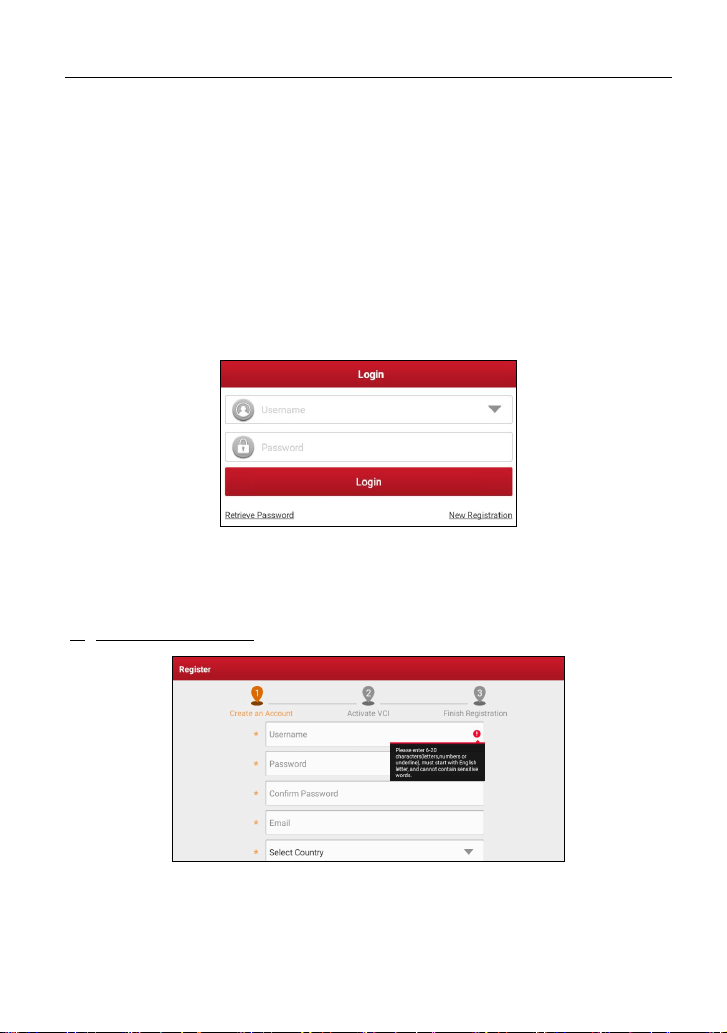
Tap Login on the upper right corner of the home screen, the following login
window will pop up.
(If you are a new user, follow A to proceed.)
(If you have registered to be a member, go to B to login the system directly.)
(In case you forgot password, refer to C to reset a new password.)
A. If you are a new user, tap New Registration to enter the sign-up page.
Fill in the information in each field (Items with * must be filled). After inputting,
tap Register, the following screen will appear:
LAUNCH
12
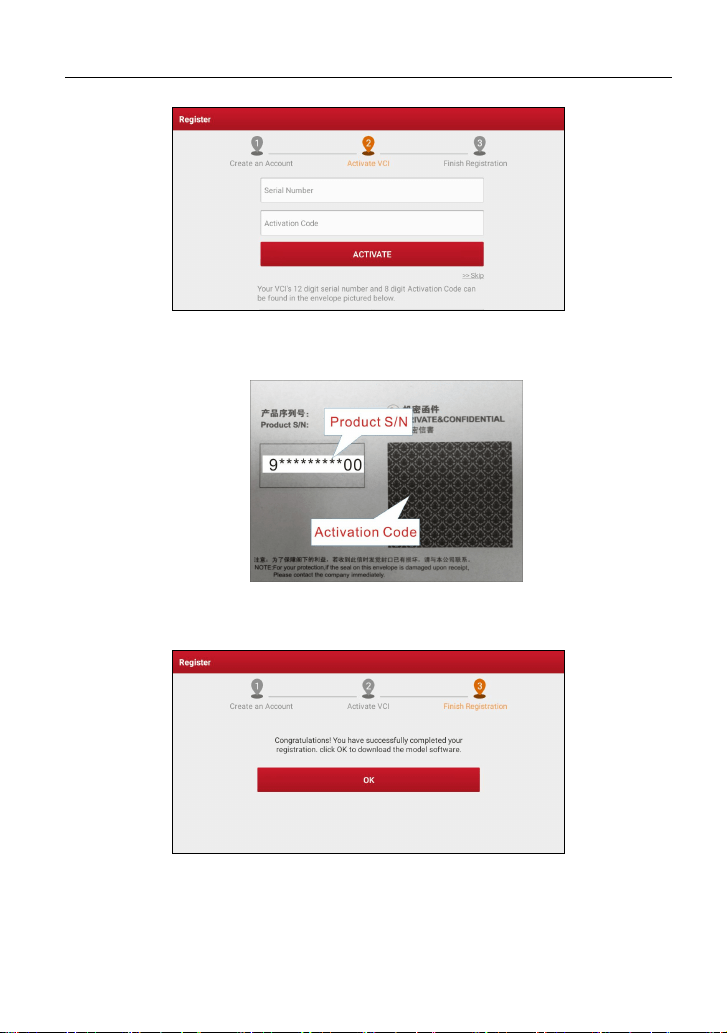
Input the 12-digit Product Serial Number and 8-digit Activation Code (can be
obtained from the password envelope), and then tap Activate.
Tap OK to navigate to the update center to update all available software. Refer
to Chapter 7 for detailed operations.
After the registration is successfully complete, the wireless communication
between the tablet and the VCI device is automatically established and user has
no need to configure it again.

LAUNCH
13
B. If you have registered to be a member, input your name and password, and
then tap Login to enter the main menu screen directly.
Note: The tablet has an auto-save function. Once the username and password are
correctly entered, the system will automatically store it. Next time you login the system,
you will not be asked to input the account manually.
C. If you forgot the password, tap Retrieve password and then follow
on-screen instructions to set a new password.
3.2 Home Screen
It mainly includes the following items:
Name
Description
Intelligent
Diagnose
• Obtain vehicle data from the cloud server to perform
quick test via reading VIN, to avoid various defects
resulting from step-by-step menu selection.
• Check the historical repair records online.
Local
Diagno
se
Diagnose a vehicle manually.
Software Update
Update vehicle diagnostic software and APK.
Diagnostic History
• Access the diagnostic reports from the previously
tested vehicles.
• Resume the previous operation without starting from
scratch.
Feedback
Feedback the recent 20 diagnostic logs for issue
analysis.
Service Function
It offers coding, reset, relearn and more service
functions, to help vehicles get back to functional status
after repair or replacement.
Mall
Subscribe some extra software or service functions that
are not included in the diagnostic tool online.
Maintenance
Abundant maintenance data are available, which helps

LAUNCH
14
repair professionals diagnose and repair vehicles
efficiently, accurately and profitably.
User Info
To manage VCI, my reports, change password,
configure Wi-Fi printer, make system settings and
logout etc.
Other Modules
Includes testable models, product manual, FAQ and
some commonly used system apps etc.
LAUNCH
15
4 Connections
4.1 Preparation
The vehicle ignition is turned on.
The vehicle battery voltage range is 11-14 volts.
The throttle is in the closed position.
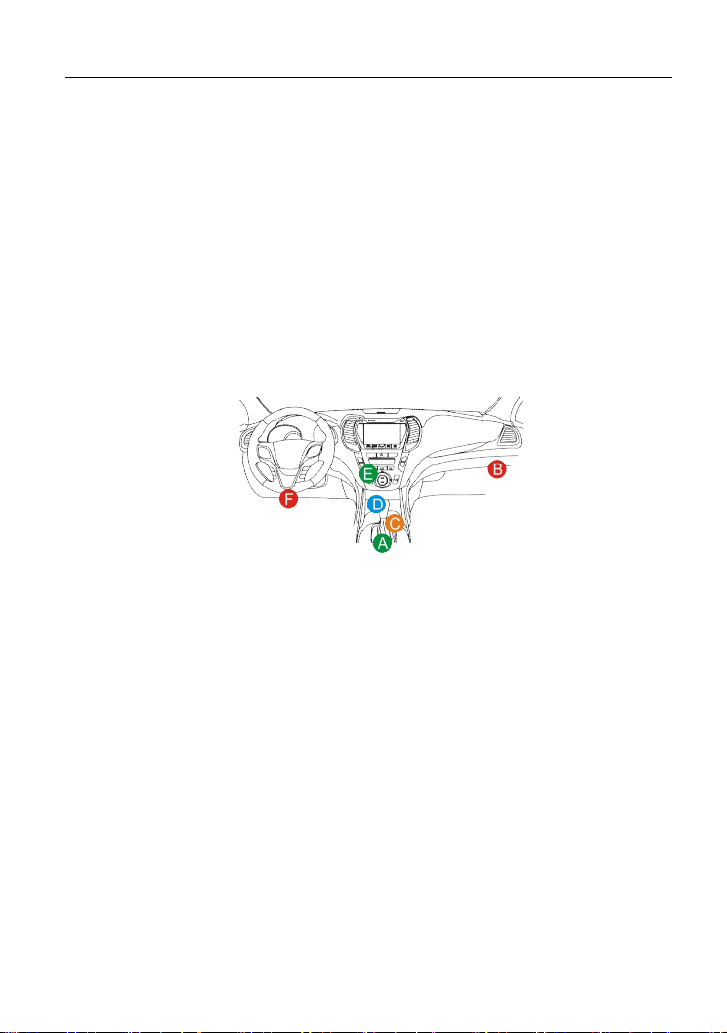
Find DLC location.
The DLC(Data Link Connector) is usually located 12 inches from the center of the
instrument panel, under or around the driver’s side for most vehicles. For some
vehicles with special designs, the DLC location may vary. Refer to the following
figure for location.
A. Opel, Volkswagen, Audi
B. Honda
C. Volkswagen
D. Opel, Volkswagen, Citroen
E. Changan
F. Hyundai, Daewoo, Kia, Honda, Toyota, Nissan, Mitsubishi, Renault, Opel, BMW,
Mercedes-Benz, Mazda, Volkswagen, Audi, GM, Chrysler, Peugeot, Regal, Beijing
Jeep, Citroen and other most popular models
If the DLC cannot be found, refer to the vehicle’s service manual for the location.
4.2 Vehicle Connection
The method used to connect the VCI device to a vehicle’s DLC depends on the
vehicle’s configuration as follows:
A vehicle equipped with an OBD II management system supplies both
LAUNCH
16
communication and 12V power through a standardized DLC.
A vehicle not equipped with an OBD II management system supplies
communication through a DLC connection, and in some cases supplies 12V
power through the cigarette lighter receptacle or a connection to the vehicle
battery.
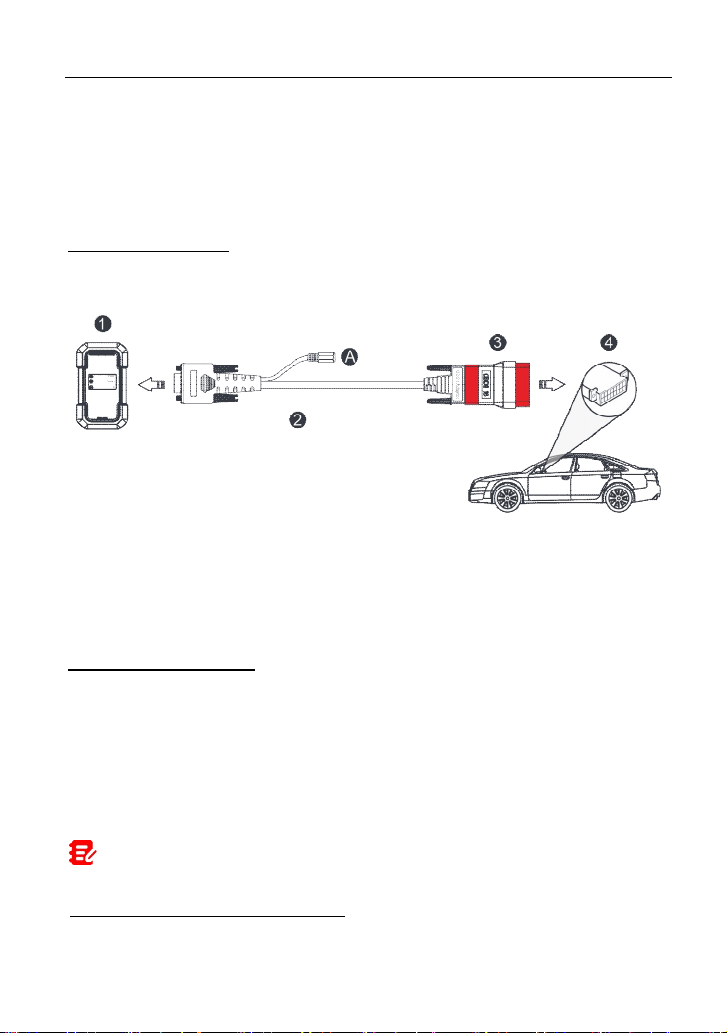
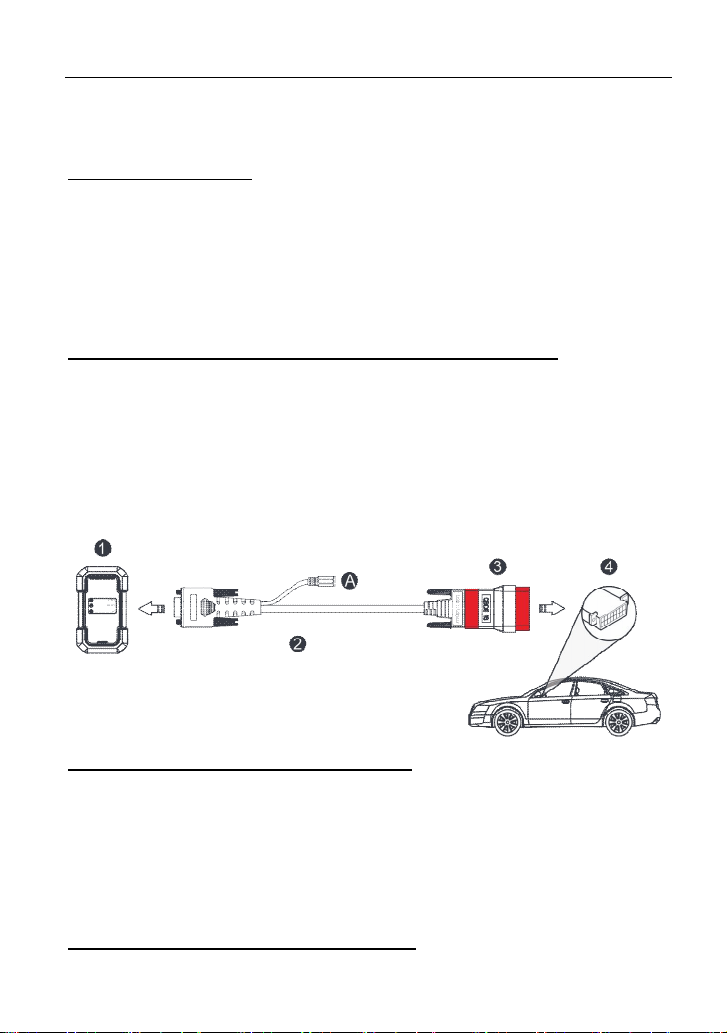
1. For OBDII vehicles, use the included diagnostic cable (HDB15F to HD15F
data cable + HD15M to OBD II adaptor) to connect the VCI to the vehicle’s DLC
port.
1. VCI
2. HDB15F to HD15F data cable
3. HD15M to OBD II adaptor
4. Vehicle’s DLC port
2. For non-OBDII vehicle, refer to the above figure to make connection.
1. Select the appropriate adaptor from the non-16pin adaptor kit (sold
separately) according to the vehicle’s DLC port type (4).
2. Loosen the captive screws of the HDB15F to HD15F data cable (2) and
disconnect the HD15M to OBD16 adaptor (3) from the data cable.
3. Connect the data cable (2) with the target adaptor on the above figure and
tighten the screws. Other steps shall also apply.
Note: If the pin of the DLC is damaged or has insufficient power, you can get
power via either of the following methods:
A. Battery Clamps Cable (not included):
Connect one end of the battery clamps cable to the power jack of the diagnostic cable,

LAUNCH
17
and the other end to the vehicle’s battery.
B. Cigarette Lighter Cable (not included):
Connect one end of the cigarette lighter cable to the power jack of the diagnostic cable,
and the other end to the cigarette lighter receptacle.
If you choose to perform vehicle diagnosis via data cable, connect one end of
the data cable into the VCI, and the other end into the USB port of the tablet.
LAUNCH
18
5 Diagnosis
5.1 Intelligent Diagnose
Through simple wireless communication between the display tablet and VCI,
you can easily get the VIN (Vehicle Identification Number) information of the
currently identified vehicle. Once the VIN is successfully identified, the system
will retrieve it from the remote server and then guide you to vehicle information
page without step-by-step manual menu selection.
The vehicle information page lists all historical diagnostic records of the vehicle,
which lets the technician have a total command of the vehicle faults. In addition,
a quick dial to local diagnose and diagnostic function are also available on this
page for reducing the roundabout time and increasing productivity.
Notes:
• Before using this function, please make sure the VCI is properly connected to the
vehicle’s DLC. For detailed connection, see Chapter 4.2 “Vehicle Connection”.
• A stable network connection is required for this function.
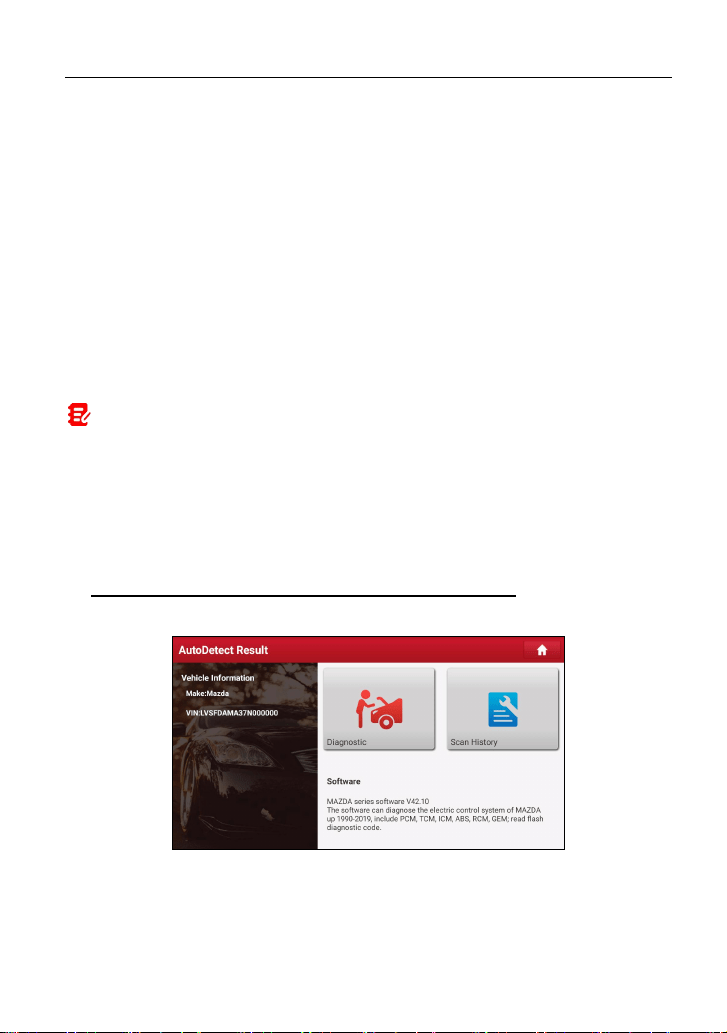
1. Tap Intelligent Diagnose on the Home screen to start pairing with the VCI.
2. After pairing is complete, the tablet starts reading the vehicle VIN.
A. If the VIN can be found from the remote server database, the following
screen will appear:
• Tap Diagnostic to start a new diagnostic session.
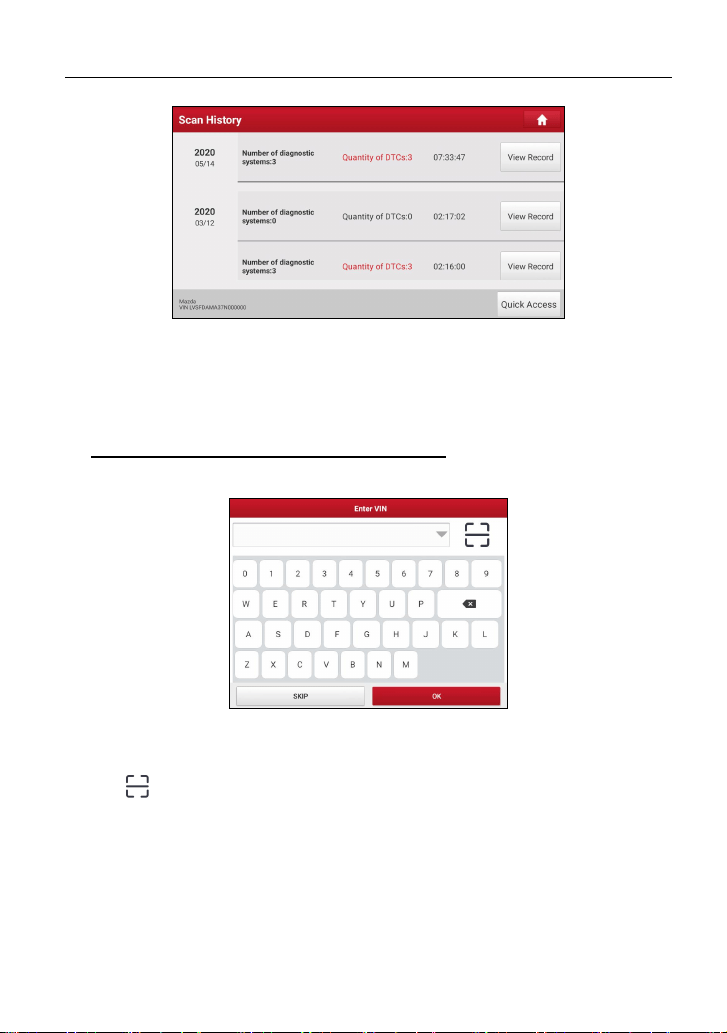
• Tap Scan History to view its historical repair record. If there are records
available, it will be listed on the screen in sequence of date. If no records
exist, the screen will show “No Record”.
LAUNCH
19
• Tap View Record to view the details of the current diagnostic report.
• To perform other functions, tap Quick access to directly go to the function
selection screen. Choose the desired one to start a new diagnostic
session.
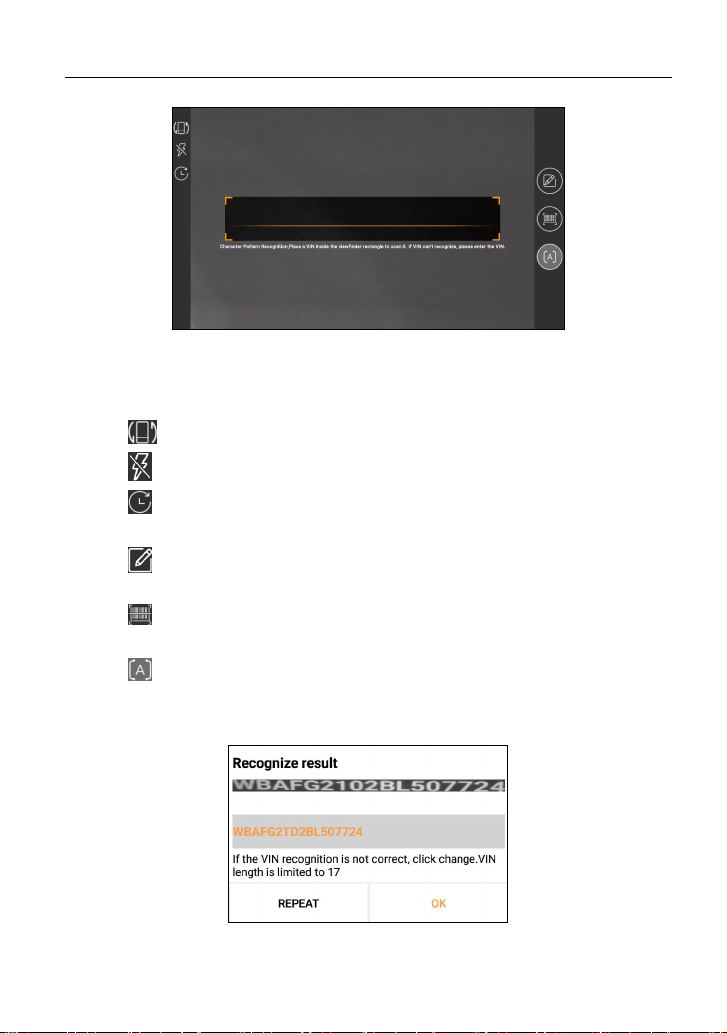
B. If the tablet failed to access the VIN information, the following screen will
appear:
• Tap the input field to directly, tap OK. If the VIN exists on the remote server,
the system will enter the diagnostic function selection screen.
• Tap to launch the VIN recognition module.
LAUNCH
20
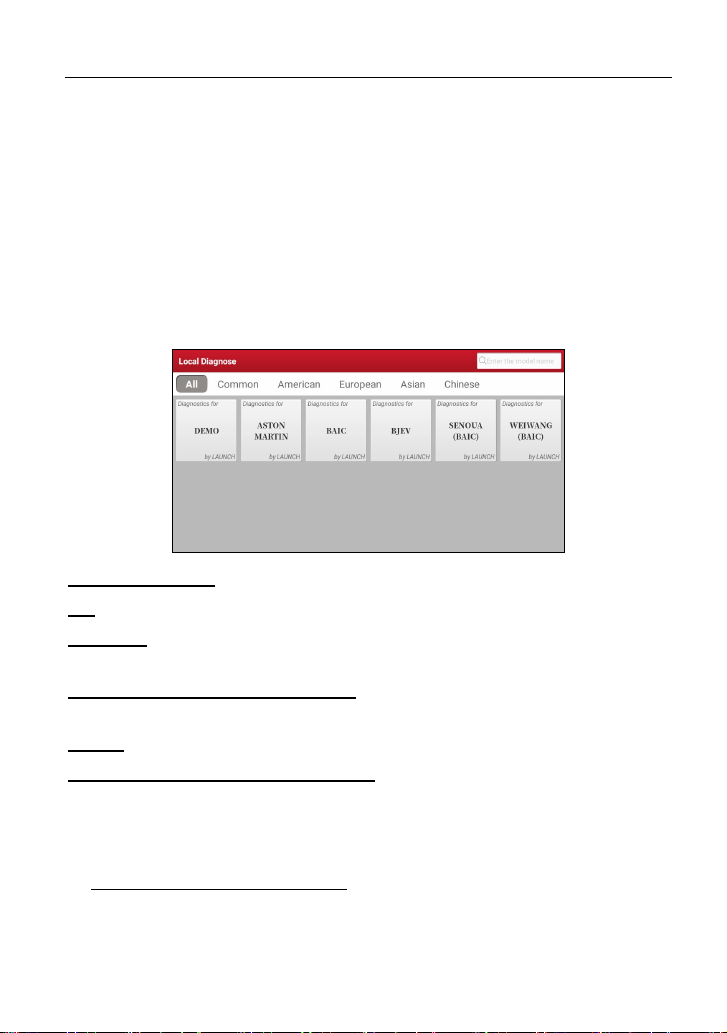
Place the VIN inside the viewfinder rectangle to scan it. The most recognizable
location for this number is in the top left corner on the vehicle’s dashboard. Other
locations include the driver’s door or post, and the firewall under the hood.
• Tap to switch the display mode of the screen.
• Tap to turn the camera flash on.
• Tap to choose it from the record list if the VIN of the vehicle has been
scanned before.
• Tap to input the VIN manually if the tablet has failed to identify the VIN of
the vehicle.
• Tap to scan the VIN barcode. If the VIN barcode cannot be recognized,
please manually input the VIN.
• Tap to scan the VIN character. If the VIN character cannot be
recognized, please manually input the VIN.
After scanning, the screen will automatically display the result.
• If the VIN scanned is incorrect, tap the result field to modify it and then tap
LAUNCH
21
OK.
• To scan it again, tap REPEAT.
If the VIN exists on the remote server, the system will enter the diagnostic
function selection screen.
5.2 Local Diagnose
In this mode, you need to execute the menu-driven command and then follow
the on-screen instruction to proceed.
Tap Local Diagnose to enter the vehicle selection page.
Function Buttons:
All: Tap to view all vehicle models that the tablet covers.
Common: Tap to create a commonly used diagnostic software list or delete
certain software from the list.
American/European/Asian/Chinese: Display all American/European/Asian/
Chinese vehicle brands only.
DEMO: A simulation program for training purpose only.
ASTON MARTIN and other brands: Enhanced diagnostic program with
manufacture proprietary information.
Take Demo (Version 15.32) as an example to demonstrate how to diagnose a
vehicle.
1). Select diagnostic software version: Tap DEMO to go to Step 2.

LAUNCH
22
On-screen Buttons:
Vehicle Coverage: Tap to view the vehicle models that the current diagnostic
software covers.
What’s new: Tap to view the optimized items and enhancements.
Introduction: Tap to check the software function list.
Note: Tap to read some precautions on using the current diagnostic software.
Search Bluetooth: Tap to search for the available VCI. After the VCI is
successfully activated, it will be bound to the user account and paired with the
tablet automatically.
Note: No Bluetooth connection is required for DEMO program.
OK: Tap to go to next step.
The diagnostics toolbar contains a number of buttons that allow you to print the
displayed data or make other controls. It is displayed on the upper right corner of
the screen and goes through the whole diagnostic session. Below provides a
brief description for the operations of the diagnostics toolbar buttons:
Home
:
Returns to Home screen.
Print: Tap to print the current screen. Before printing, you need to configure
the wireless printer. Refer to Chapter 8.10.3.
Exit: Exits the diagnostic application.
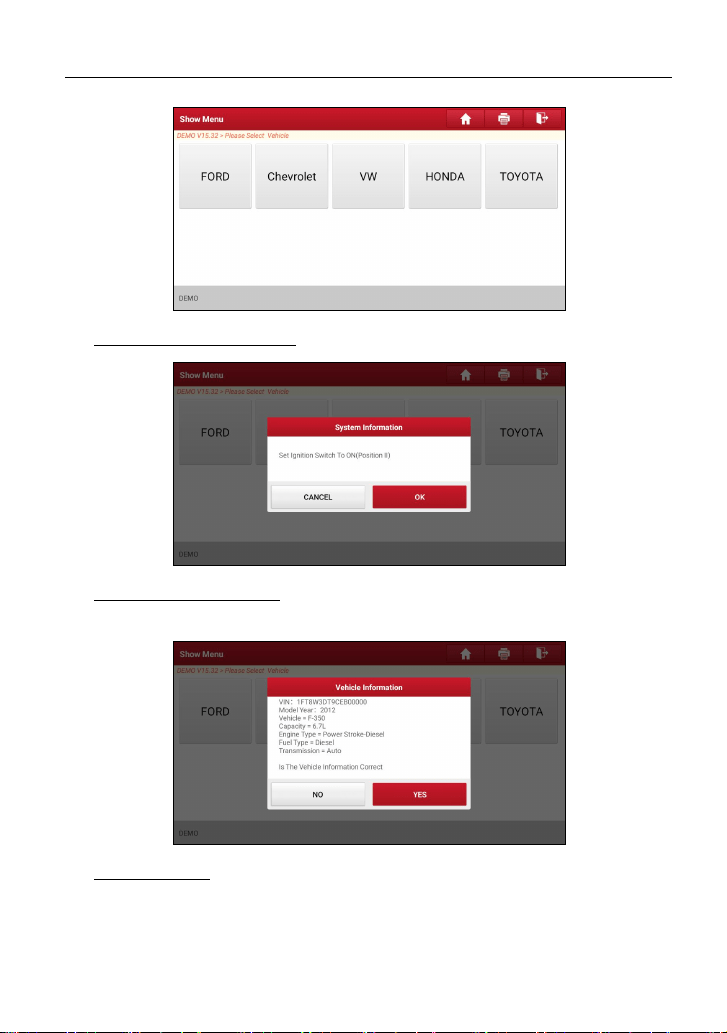
2). Select vehicle model (varies with different versions): Select the desired
vehicle model. Here we take Ford for example to demonstrate how to
diagnose a vehicle.
LAUNCH
23
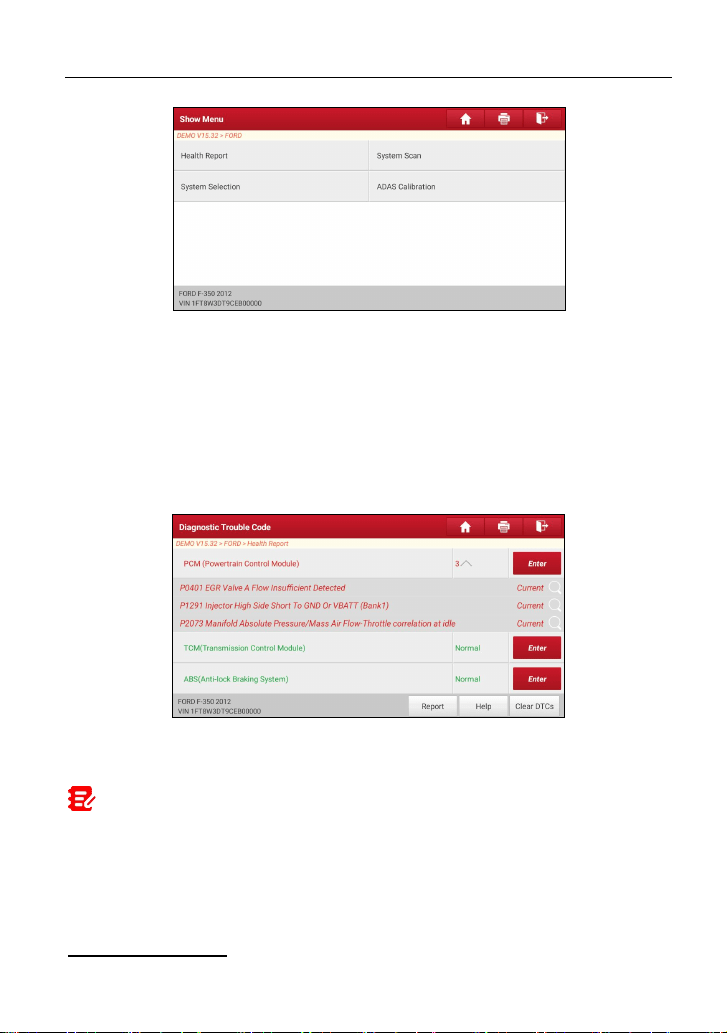
3). Turn the ignition key to ON: Set the ignition switch to on.
4). Read vehicle information: After reading the vehicle information, double check
if the vehicle information is correct or not. If yes, tap Yes to continue.
5). Select test item: Select the desired test item to proceed.
LAUNCH
24
5.2.1 Health Report (Quick Test)
This function varies from vehicle to vehicle. It enables you to quickly access all
the electronic control units of the vehicle and generate a detailed report about
vehicle health.
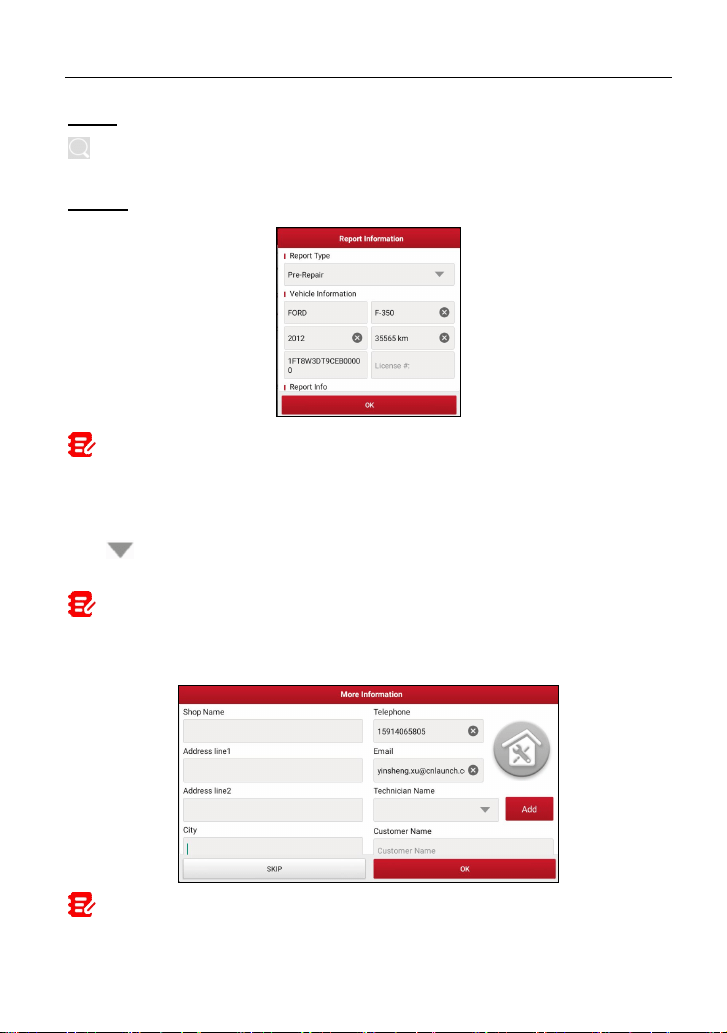
On the test item selection screen, tap Health Report and turn on the ignition
switch, the system will start scanning the ECUs. Once the scanning process is
complete, the following screen will appear:
The tested system with fault code appears in red and the system functioning
properly displays in black (normally).
Note: Diagnostic Trouble Codes or Fault Codes can be used to identify which
engine systems or components that are malfunctioning. Never replace a part based only
on the DTC definition. Retrieving and using DTCs for troubleshooting vehicle
operation is only one part of an overall diagnostic strategy. Follow testing procedures
(in vehicle’s service manual), instructions and flowcharts to confirm the locations of the
problem.
On-screen Buttons:
LAUNCH
25
Enter: Tap to enter the diagnostic function selection screen.
(Search): Highlight certain diagnostic trouble code and tap it to retrieve it in
the search engine.
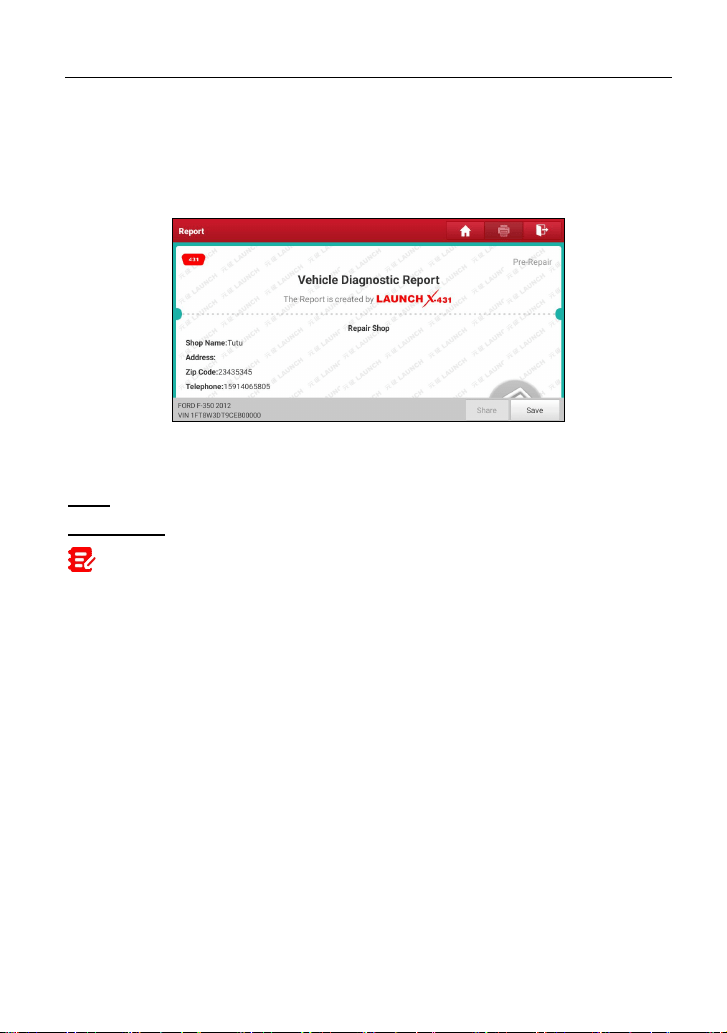
Report: Tap to save the diagnostic result as a health report.
Note: Diagnostic report is classified into three categories: Pre-Repair report,
Post-Repair report and Diagnostic Scan. No matter which type you saved the report as,
the report type will be appended as a tag on the upper right corner of the diagnostic
report for easier identification.
Tap to select the report type from the option list and input the required
information, and then tap OK.
Note: To facilitate the comparison of the pre-repair and post-repair reports and get
accurate test result, please make sure you saved the right type of the diagnostic report.
To save the report as a common diagnostic report, select Diagnostic Scan.
Note: For workshop information, tap the input box to enter it. Alternatively you
can also set it in User Info -> Settings -> Shop Information.
LAUNCH
26
Once you configured the information, it will be automatically generated every time you
saved the diagnostic report. All vehicle and workshop information will be appended as
tags on the diagnostic report.
To ignore the workshop information, tap Skip to go to the report details screen.
On the report details screen, tap Save to save it. All diagnostic reports are saved
in Report -> Health Report.
Help: Tap to view the help information of the selected DTC item.
Clear DTCs: Tap to clear the existing diagnostic trouble codes.
Note: Clearing DTCs does not fix the problem(s) that caused the code(s) to be set.
If proper repairs to correct the problem that caused the code(s) to be set are not made,
the code(s) will appear again and the check engine light will illuminate as soon as the
problem that cause the DTC to set manifests itself.
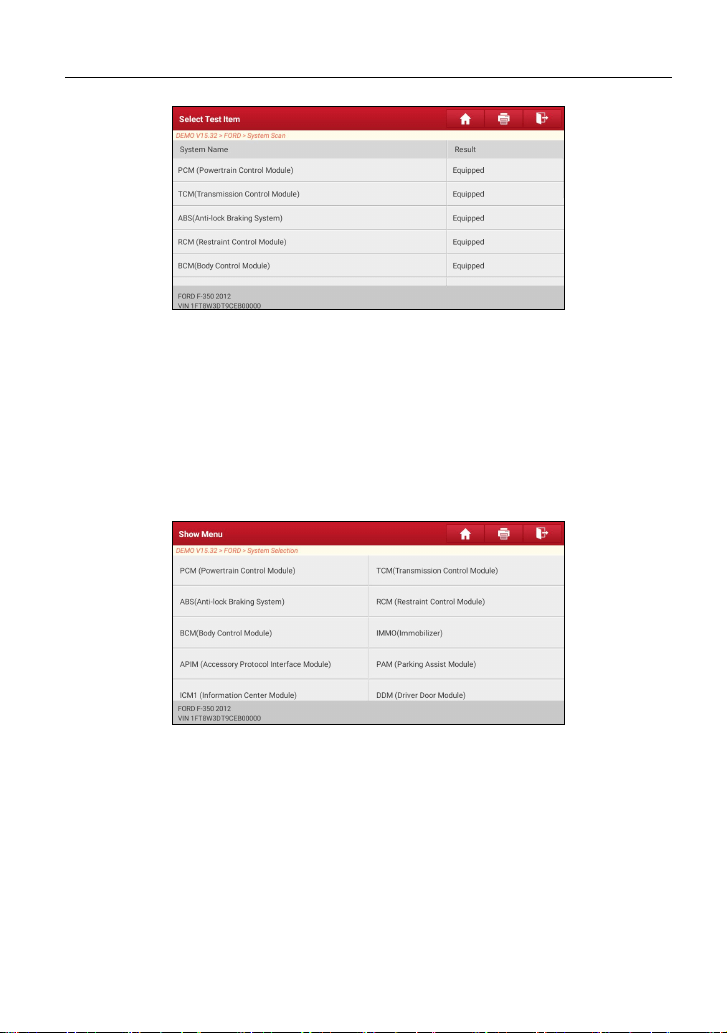
5.2.2 System Scan
This option allows you to quickly scan which systems are installed on the
vehicle.
On the test item selection screen, tap System Scan, the system start scanning
the systems. Once the scanning process is complete, the following screen will
appear.
LAUNCH
27
Tap the desired system to go to the diagnostic function selection screen. For
detailed operations on diagnostic function, please refer to Chapter 5.2.3.
5.2.3 System Selection
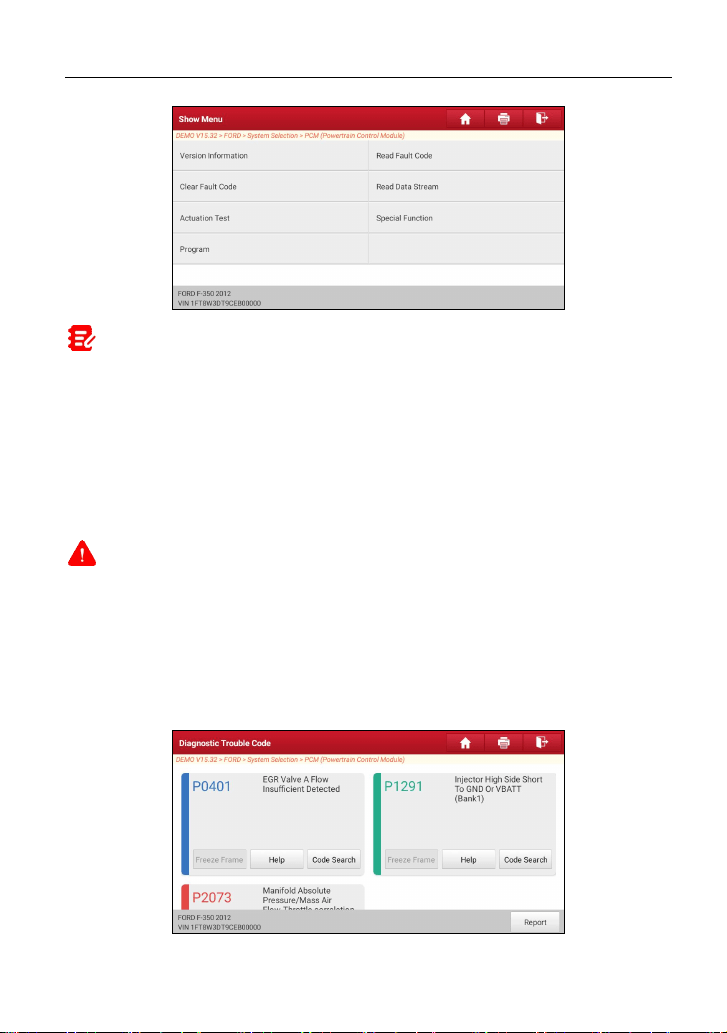
This option allows you to manually select the test system and function step by
step.
On the test item selection screen, tap System Selection, the screen displays as
follows:
Swipe the screen from the bottom to view the vehicle system on the next page.
Tap the target system (take PCM for example) to navigate to the diagnostic
function selection screen.
LAUNCH
28
Note: Different vehicle has different diagnostic menus.
A. Version Information
This function is used to read the version information of system mode, vehicle
VIN, software and ECU.
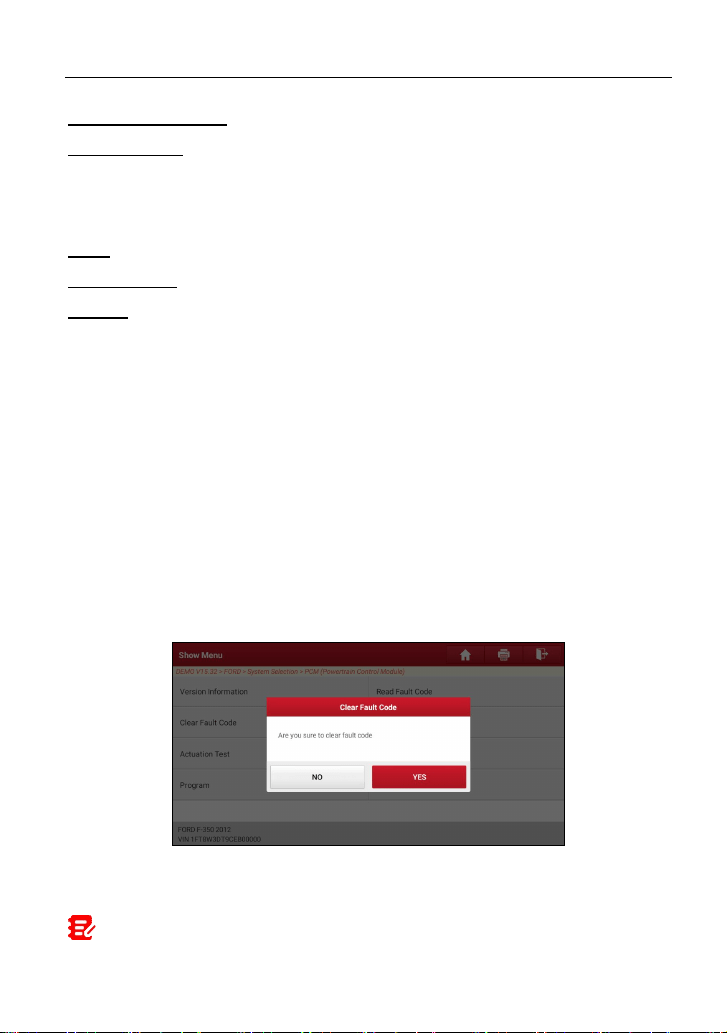
B. Read Fault Code
This function displays the detailed information of DTC records retrieved from the
vehicle’s control system.
Caution: Retrieving and using DTCs for troubleshooting vehicle operation is only
one part of an overall diagnostic strategy. Never replace a part based only on the DTC
definition. Each DTC has a set of testing procedures, instructions and flow charts that
must be followed to confirm the location of the problem. This information can be found
in the vehicle’s service manual.
On the diagnostic function selection screen, tap Read Fault Code, the screen
will display the diagnostic result.
LAUNCH
29
On-screen Buttons:
Freeze Frame: When an emission-related fault occurs, certain vehicle
conditions are recorded by the on-board computer. This information is referred
to as freeze frame data. Freeze frame data includes a snapshot of critical
parameter values at the time the DTC is set.
Help: Tap to view the help information.
Code Search: Tap to search for more information about the current DTC online.
Report: Tap to save the current data in text format. All reports are saved in User
Info -> My Report -> Diagnostic Report.
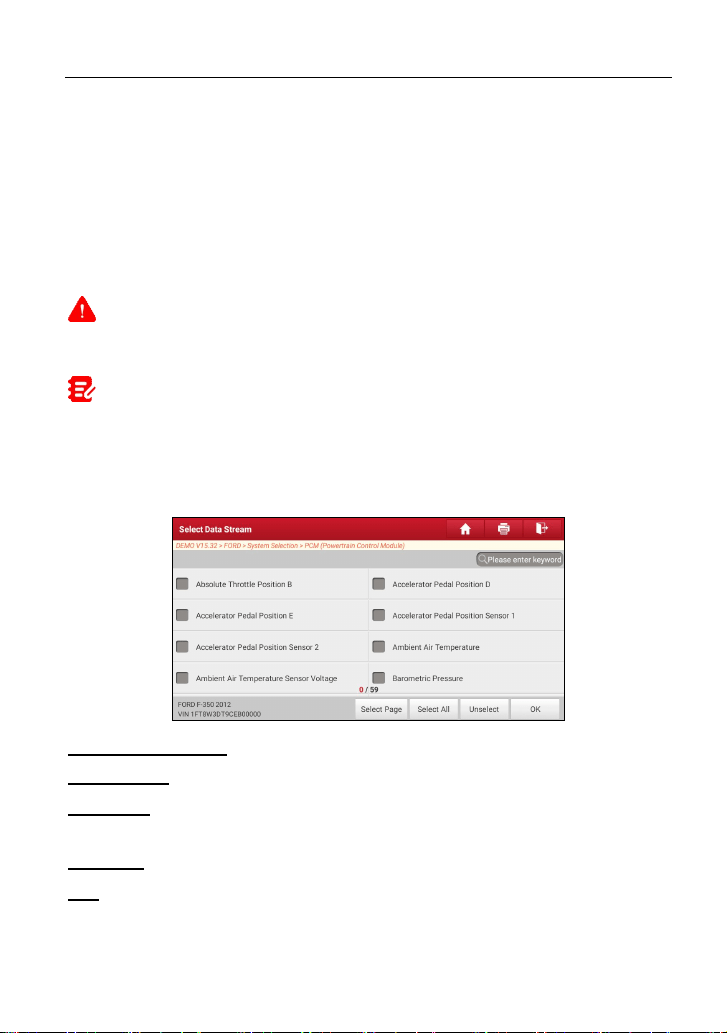
C. Clear Fault Code
This function enables you to erase the codes from the vehicle after reading the
retrieved codes from the vehicle and certain repairs have been carried out.
Before performing this function, make sure the vehicle’s ignition key is in the ON
position with the engine off.
Clearing DTCs does not fix the problem(s) that caused the code(s) to be set. If
proper repairs to correct the problem that caused the code(s) to be set are not
made, the code(s) will appear again and the check engine light will illuminate as
soon as the problem that cause the DTC to set manifests itself.
On the diagnostic function selection screen, tap Clear Fault Code, the following
screen will appear.
Tap YES, the system will automatically delete the currently existing trouble
code.
Note: After clearing, you should retrieve trouble codes once more or turn ignition
LAUNCH
30
on and retrieve codes again. If there are still some trouble codes in the system, please
troubleshoot the code using a factory diagnosis guide, then clear the code and recheck.
D. Read Data Stream
This option lets you view and capture (record) real-time Live Data. This data
including current operating status for parameters and/or sensor information can
provide insight on overall vehicle performance. It can also be used to guide
vehicle repair.
Caution: If you must drive the vehicle in order to perform a troubleshooting
procedure, ALWAYS have a second person help you. Trying to drive and operate the
diagnostic tool at the same time is dangerous, and could cause a serious traffic accident.
Note: The real time (Live Data) vehicle operating information (values/status) that
the on-board computer supplies to the tool for each sensor, actuator, switch, etc. is
called Parameter Identification Data (PID).
On the diagnostic function selection screen, tap Read Data Stream, the
following screen will appear.
On-screen Buttons:
Select Page: Tap to select all items of the current page.
Select All: Tap to select all items. To select certain data stream item, just check
the box before the item name.
Unselect: Tap to deselect all data stream items.
OK: Tap to confirm and jump to the next step.
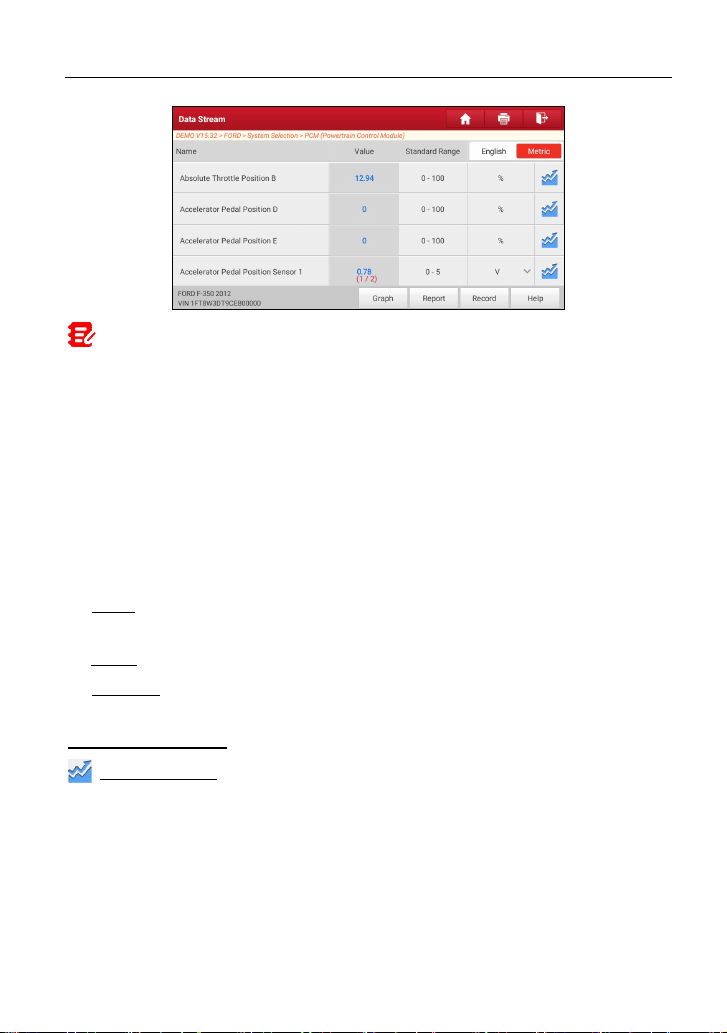
After selecting the desired items, tap OK to enter the data stream reading page.
LAUNCH
31
Notes:
1. Tap English or Metric to switch the measurement unit.
2. If the value of the data stream item is out of the range of the standard (reference)
value, the whole line will display in red. If it complies with the reference value, it
displays in blue (normal mode).
3. The indicator 1/X shown on the bottom of the screen stands for the current
page/total page number. Swipe the screen from the right/left to advance/return to the
next/previous page.
There are 3 types of display modes available for data viewing, allowing you to
view various types of parameters in the most suitable way.
Value – This is the default mode which displays the parameters in texts and
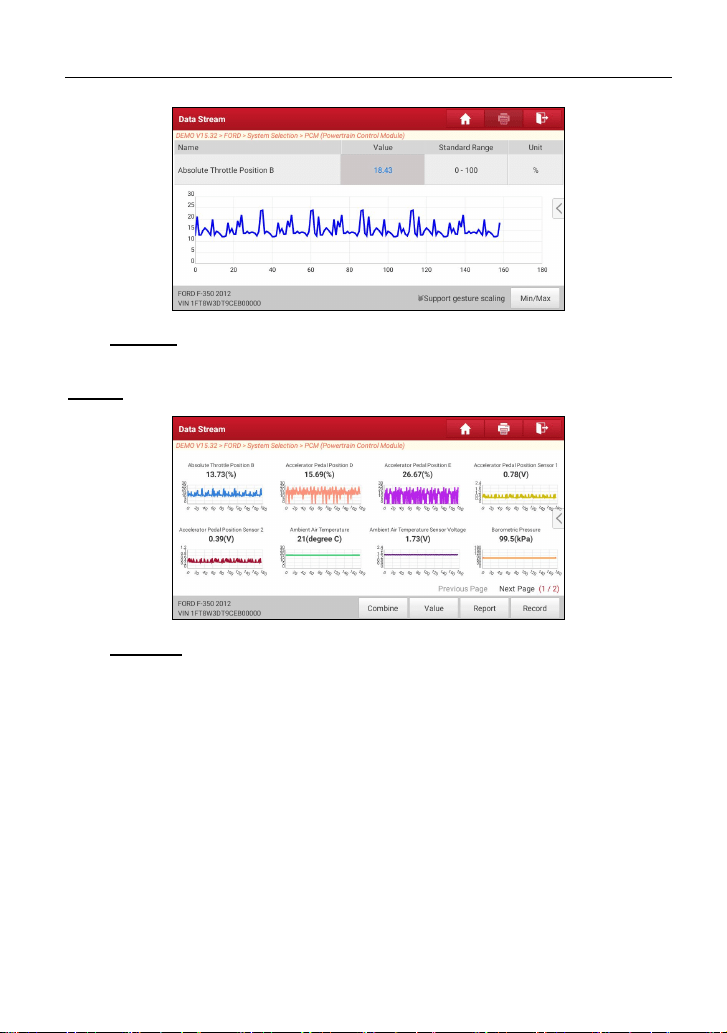
shows in list format.
Graph – Displays the parameters in waveform graphs.
Combine – This option is mostly used in graph merge status for data
comparison. In this case, different items are marked in different colors.
On-screen Buttons:
Graph(Single): Tap to view the parameter in waveform graph.
LAUNCH
32
• Min/Max: Tap to define the maximum / minimum value. Once the value
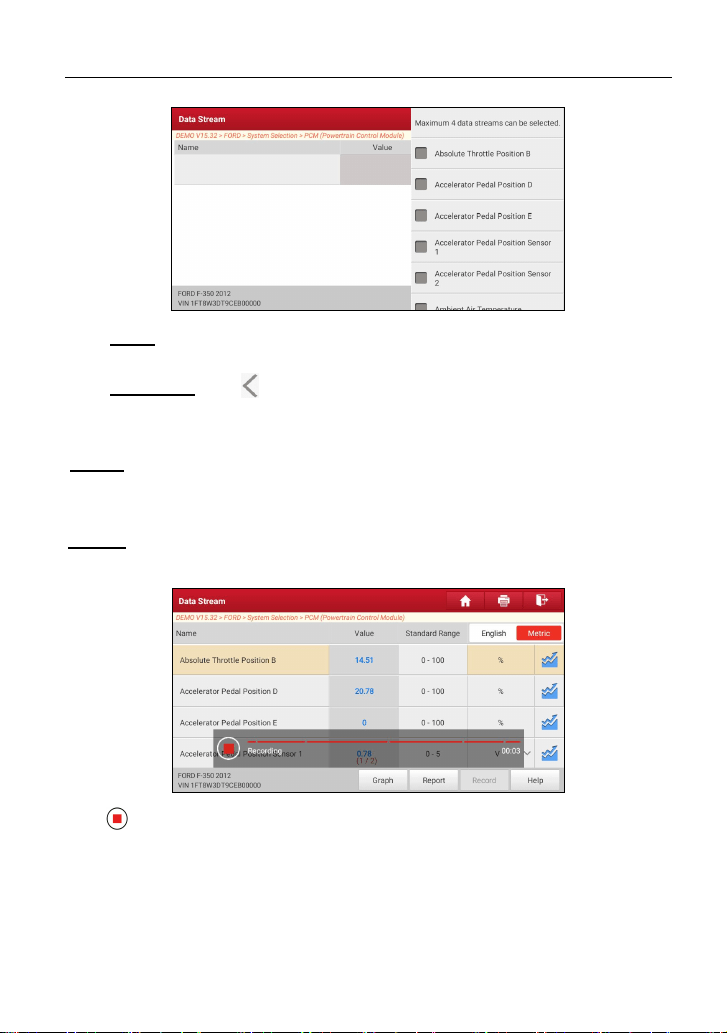
goes beyond the specified value, the system will alarm.
Graph: Tap to view the parameters in waveform graphs.
• Combine: This option is mostly used in graph merge status for data
comparison. In this case, different items are marked in different colors
(maximum 4 items can be displayed on the same screen simultaneously).
If the graph is more than one page, swipe the screen from the left to jump
to the next page.
LAUNCH
33
• Value: Switches the current graph display mode to the Value display
mode.
• Customize: Tap , a pull-down list of the data stream items appears on
the screen. Select / deselect the desired items, and then screen will
display / remove the waveforms corresponding to these items immediately.
Report: Tap to save the current data in text format. All reports are saved in User
Info -> My Report -> Diagnostic Report. For details on report operations,
please refer to Chapter 8.1.
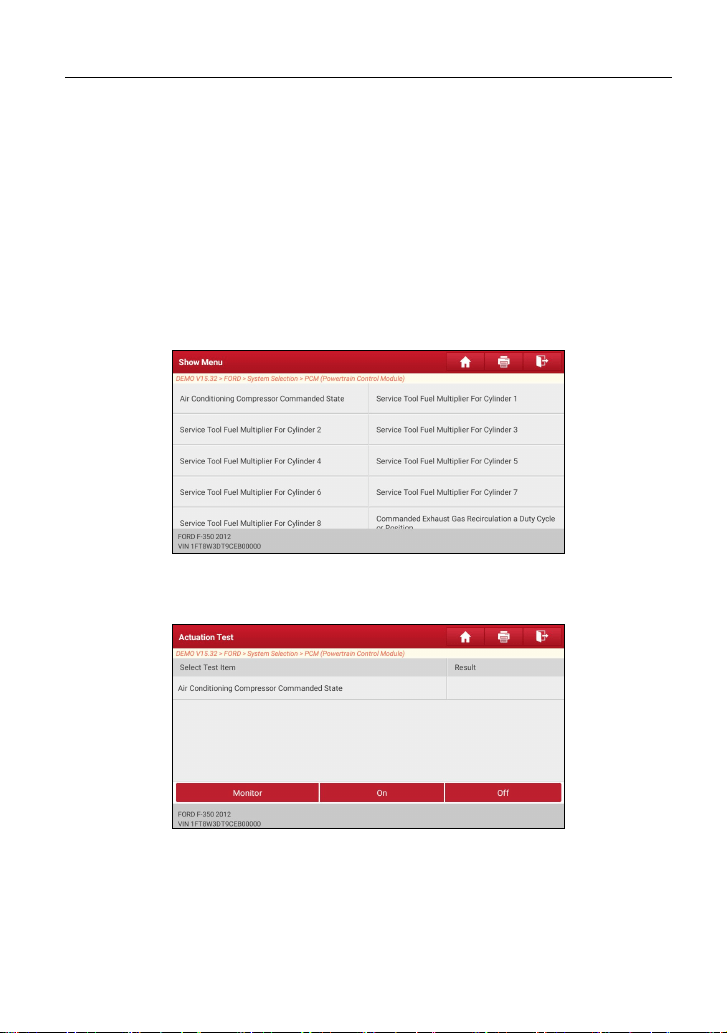
Record: Tap to start recording diagnostic data. Recorded live data can serve as
valuable information to help you in troubleshooting of vehicle problems.
Tap to end recording and save it. The saved file follows the naming rule: It
begins with vehicle type, and then the product S/N and ends with record starting
time (To differentiate between files, please configure the accurate system time).
All diagnostic records can be replayed from User Info -> My Report ->
Diagnostic Record.
LAUNCH
34
E. Actuation Test
This option is used to access vehicle-specific subsystem and component tests.
Available test vary by vehicle manufacturer, year, and model.
During the actuation test, the display tablet outputs commands to the ECU in
order to drive the actuators, and then determines the integrity of the system or
parts by reading the ECU data, or by monitoring the operation of the actuators,
such as switching an injector between two operating states.
On the diagnostic function selection screen, tap Actuation Test, the following
screen will appear:
Simply follow the on-screen instructions and make appropriate selections to
complete the test.
Each time when an operation is successfully executed, Completed displays.
LAUNCH
35
5.3 Diagnostic History
This function enables users to directly get access to the previously tested
vehicle’s diagnostic records in details, so users can resume from the last
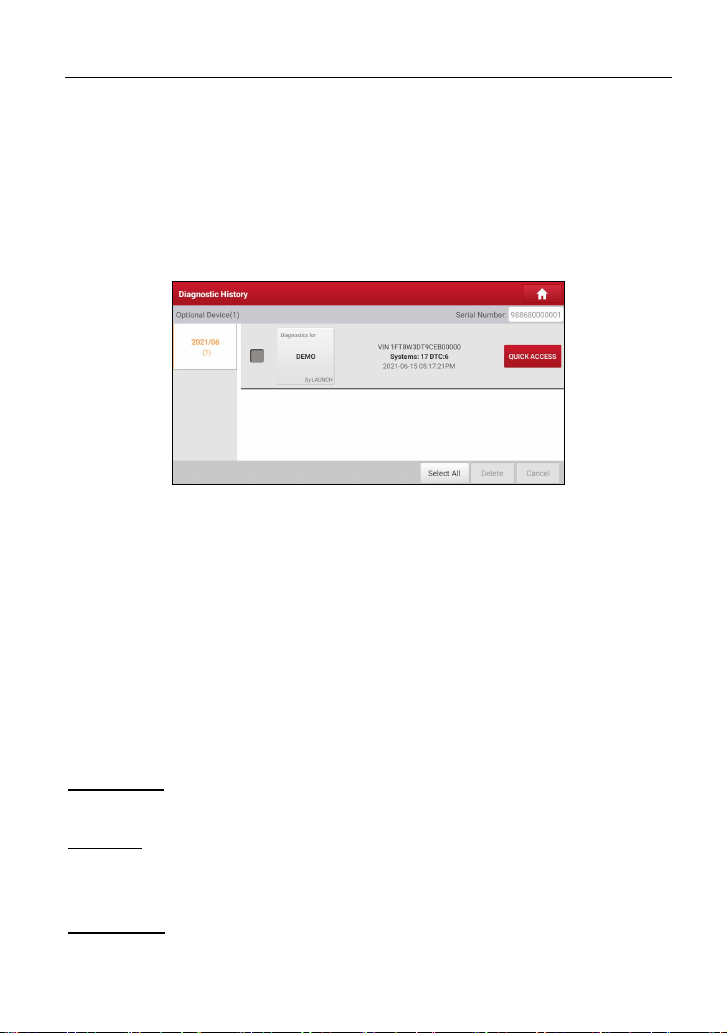
operation, without starting from scratch.
Tap Diagnostic History on the Home screen, all diagnostic records will be
listed on the screen in date sequence.
• Tap certain vehicle model to view the details of the last diagnostic report.
• To delete certain diagnostic history, select it and then tap Delete. To
delete all historical records, tap Select All and then tap Delete.
• Tap Quick access to directly navigate to the function selection page of
last diagnostic operation. Choose the desired option to proceed.
5.4 Feedback
This function enables you to feedback the diagnostic issues to us for analysis
and troubleshooting.
Tap Feedback, and tap OK to enter into the vehicle diagnostic record page.
A. Feedback
Tap the target vehicle to enter the feedback page.
B. History
Tap it to view the diagnostic feedback logs which are marked with different color
indicating the process status of the diagnostic feedback.
C. Offline list
Tap it to enter the diagnostic feedback offline list page. Once the tablet gets a

LAUNCH
36
stable network signal, it will be uploaded to the remote server automatically.

LAUNCH
37
6 Service (Reset) Function
It offers coding, reset, relearn and more service functions, to help vehicles get
back to functional status after repair or replacement. Available tests vary by
vehicle manufacturer, year, and model.
Due to continuing improvements, the available service functions are subject to
change at any time. To enjoy more service functions, you are suggested to
check for updates on a regular basis.
6.1 Maintenance Light Reset (Oil Reset)
This function enables you to reset the oil service for the engine oil life system,
which calculates an optimal oil life change interval depending on the vehicle
driving conditions and weather events.
It needs to be performed in the following cases:
1. If the service lamp is on, run car diagnostics first for troubleshooting. After
that, reset the driving mileage or driving time, so as to turn off the service
lamp and enable a new driving cycle.
2. If the service lamp is not on, but you have changed the engine oil or electric
appliances that monitor oil life, you need to reset the service lamp.
6.2 Electronic Parking Brake Reset (BRAKE RESET)
This function enables you to reset the brake pad after replacing the brake pad.
It needs to be performed in the following cases:
1. The brake pad and brake pad wear sensor are replaced.
2. The brake pad indicator lamp is on.
3. The brake pad sensor circuit is short, which is recovered.
4. The servo motor is replaced.
6.3 Steering Angle Reset (SAS Reset)
This function enables you to reset the steering angle, after replacing the steering
angle position sensor, replacing steering mechanical parts (such as steering
gearbox, steering column, end tie rod, steering knuckle), performing four-wheel
alignment, or recovering car body.
To reset the steering angle, first find the relative zero point position for the car to

LAUNCH
38
drive in straight line. Taking this position as reference, the ECU can calculate the
accurate angle for left and right steering.
6.4 ABS Bleeding
This function allows you to perform various bi-directional tests to check the
operating conditions of Anti-lock Braking System (ABS).
It needs to be performed in the following cases:
1. When the ABS contains air.
2. When the ABS computer, ABS pump, brake master cylinder, brake cylinder,
brake line, or brake fluid is replaced.
6.5 Crank Position Sensor Adaptive Learning (GEAR LEARN)
This function enables you to perform tooth learning for the car, to turn off the
MIL.
It needs to be performed in the following cases:
1. After the engine ECU, crankshaft position sensor, or crankshaft flywheel is
replaced.
2. The DTC ‘tooth not learned’ is present.
6.6 Anti-theft Matching (IMMO)
This function enables you to perform the anti-theft key matching function, so that
the immobilizer control system on the car identifies and authorizes remote
control keys to normally use the car.
It needs to be performed in the following cases:
When the ignition switch key, ignition switch, combined instrument panel, ECU,
BCM, or remote control battery is replaced.
6.7 Injector Coding (INJECTOR)
This function enables you to write injector actual code or rewrite code in the ECU
to the injector code of the corresponding cylinder, so as to more accurately
control or correct cylinder injection quantity.
It needs to be performed in the following cases:
After the ECU or injector is replaced.

LAUNCH
39
6.8 Battery Matching (BAT. RESET)
This function enables you to perform a resetting operation on the monitoring unit
of vehicle battery, in which the original low battery fault information will be
cleared and battery matching will be done.
It needs to be performed in the following cases:
1. The main battery is replaced.
2. The battery monitoring sensor is replaced.
6.9 DPF Regeneration (DPF REG.)
This function enables you to clear PM (Particulate Matter) from the DPF filter
through continuous combustion oxidation mode (such as high temperature
heating combustion, fuel additive or catalyst reduce PM ignition combustion) to
stabilize the filter performance.
It needs to be performed in the following cases:
1. The exhaust back pressure sensor is replaced.
2. The PM trap is removed or replaced.
3. The fuel additive nozzle is removed or replaced.
4. The catalytic oxidizer is removed or replaced.
5. The DPF regeneration MIL is on and maintenance is performed.
6. The DPF regeneration control module is replaced.
6.10 Throttle Matching (ELEC. THROTTLE RLRN)
This function enables you to make initial settings to throttle actuators and returns
the learned values stored on ECU to the default state. Doing so can accurately
control the actions of regulating throttle (or idle engine) to adjust the amount of
air intake.
6.11 Gearbox Matching (GEARBOX)
This function enables you to complete the gearbox self-learning to improve gear
shifting quality.
It needs to be performed in the following cases:
When the gearbox is disassembled or repaired.

LAUNCH
40
6.12 Headlight Matching (AFS RESET)
This function enables you to initialize the adaptive headlamp system.
6.13 Sunroof Initialization (SUNROOF)
This function enables you to set the sunroof lock off, closed when it rains, sliding
/ tilting sunroof memory function, temperature threshold outside the car etc.
6.14 Suspension Level Calibration (SUS RESET)
This function enables you to adjust the height of the body.
It needs to be performed in the following cases:
1. When replacing the body height sensor, or control module in the air
suspension system.
2. When the vehicle height is incorrect.
6.15 EGR Adaption
This function is used to learn the EGR (Exhaust Gas Recirculation) valve after it
is cleaned or replaced.
6.16 Seats Calibration
This function is applied to match the seats with memory function that are
replaced and repaired.
6.17 Tyre Reset
This function is used to set the size parameters of the modified or replaced tire.
6.18 Coolant Bleed
Use this function to activate the electronic water pump before venting the cooling
system.
6.19 AdBlue Reset (Diesel Engine Exhaust Gas Filter)
After the diesel exhaust treatment fluid (car urea) is replaced or filled up, urea
reset operation is required.

LAUNCH
41
6.20 NOx Sensor Reset
NOx sensor is a sensor used to detect the content of nitrogen oxides (NOx) in
engine exhaust. If the NOx fault is re-initialized and the NOx catalytic converter
is replaced, it is necessary to reset the catalytic converter learned value stored
in the engine ECU.
6.21 AC System Relearn/Initialization
AC system relearn/initialization must be performed when the vehicle AC ECU or
actuator is replaced or the ECU memory is lost.
6.22 High Voltage Battery Detection (HIGH VOLTAGE
BATTERY)
This function is used for high voltage battery diagnosis and status information
detection.
6.23 Windows Calibration
This function is used to perform door window matching to recover the ECU initial
memory, and recover the automatic ascending and descending function of
power window.
6.24 Language Change
This function is used to change system language of vehicle center console.
6.25 A/F Reset
This function is applied to set or learn air/fuel rate parameters.
6.26 Transport Mode
To lower vehicle power consumption, user may perform the following operations:
limit vehicle speed, not wake up the network for door open and disable remote
key etc. In this case, deactivating transport mode is needed to recover vehicle
being normal.
6.27 Stop/Start Reset
This function is used to open or close the automatic Start/Stop function via
setting the hidden function in ECU (The precondition is vehicle equipped with

LAUNCH
42
hidden function and hardware support).
6.28 Intelligent Cruise Control System Reset
This function is used to matching the intelligent cruise control module after it is
replaced or repaired.
6.29 Engine Power Balance Monitoring
This function is used to monitor crankshaft acceleration in the power stroke of
each cylinder, to determine the relative power provided by each cylinder.
6.30 Gas Particulate Filter (GPF) Regeneration
This function is used to perform the GPF replacement or regeneration after the
fuel consumption is increased and engine output power is reduced resulting
from a long time service of the GPF.
6.31 Motor Angle Calibration
This function is used to perform the motor angle calibration when the rotor
position detected by the motor angle position sensor is different from the actual
rotor field position.

LAUNCH
43
7 Software Update
This module enables you to update the diagnostic software & App and frequently
used software.
7.1 Update Diagnostic Software & APP
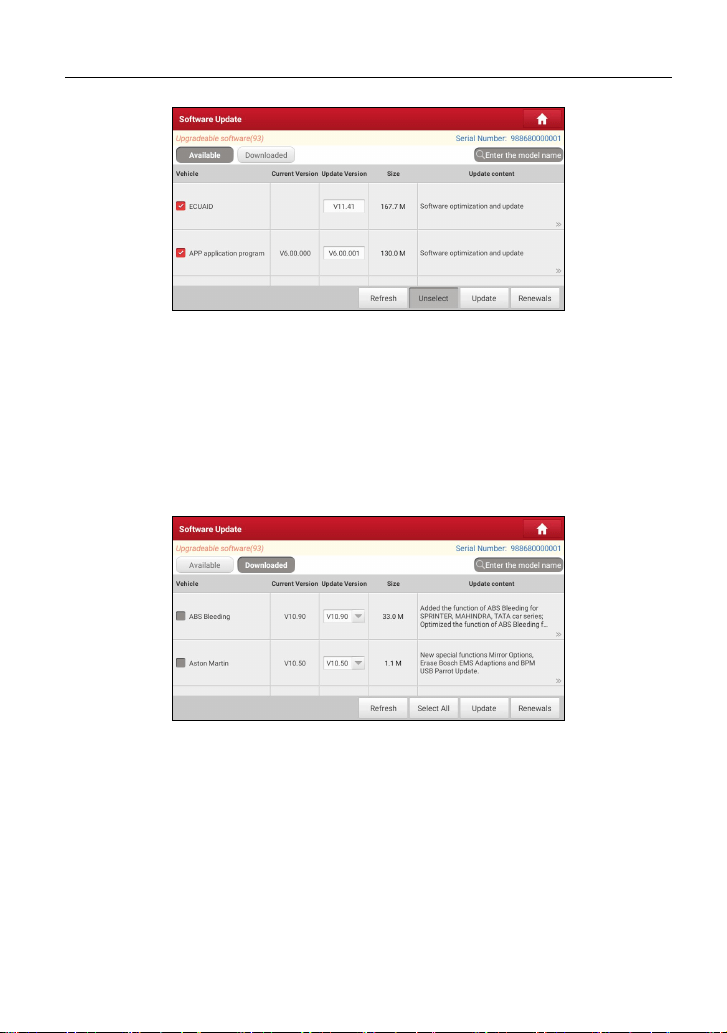
Go to Software Update on the Home screen and tap the Downloaded tab.
The Available tab displays a list of software that can be updated. Under it, all
software is categorized into three kinds:
• Common software: mainly includes some common apps that are associated
with the diagnostic app. The software of this kind always stays at the top of
the list, which can be deselected manually (excluding the system app, such
as firmware and ECU aid).
• Frequently used vehicle software: refers to the diagnostic software that is
frequently used, including the vehicle diagnostic software and Reset software.
It is generally displayed following the Common software list.
• Other vehicle software: refers to the diagnostic software that is rarely used
or never used. It is generally displayed following the Frequently used
software list.
1). If the user does not download any diagnostic software during the sign-up
process, all diagnostic software is selected by default. Tap Update to start
downloading.
2). If the user downloaded all/some vehicle software during the sign-up process
and had it serviced for a long period of time, only the frequently used
software is selected. Tap Update to start downloading. Other vehicle
software that is rarely used will also be listed under the Available tab, but it
is not selected at default.
LAUNCH
44
To download certain software that is not frequently used, check the box before
the vehicle model. Tap Update to start downloading.
Once download is finished, the software packages will be installed automatically.
7.2 Update Frequently Used software
If the user only intends to update the frequently used software, go to Software
Update and tap the Downloaded tab.
Tap Update to start downloading. Once download is finished, the software
packages will be installed automatically.
7.3 Renew Subscription
If the software subscription is due or expires, the system will prompt you to
renew your subscription.
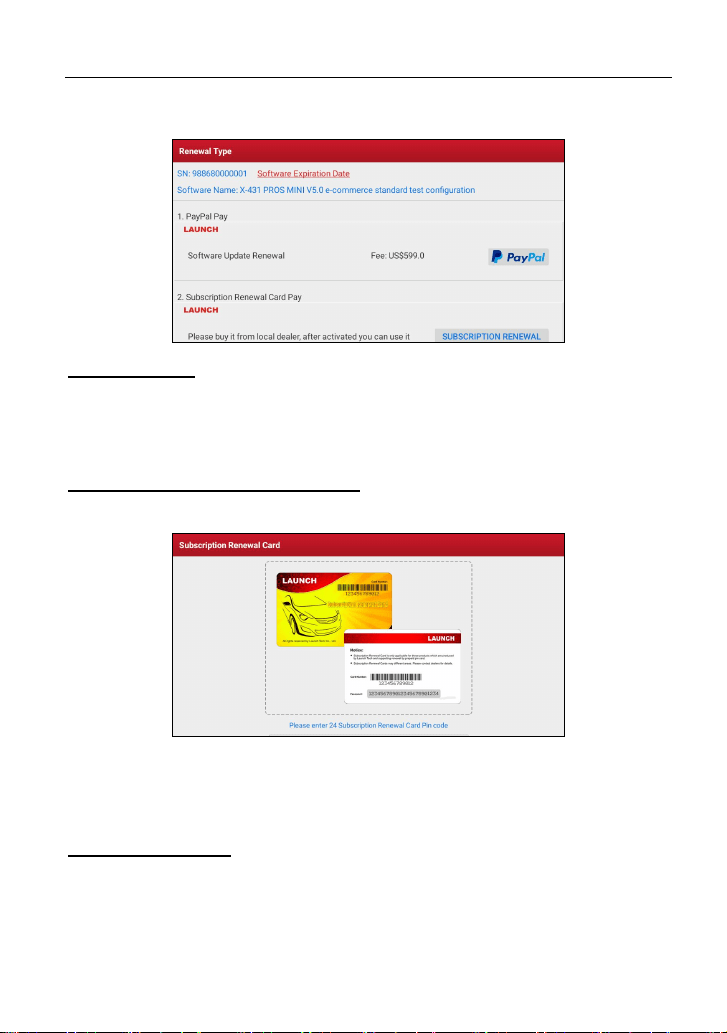
Tap Renewal on the bottom of the screen to enter the payment screen.
There are three ways available for you to make payment: PayPal, Subscription
Renewal Card (*need to buy it from the seller where you purchased the tool) and
LAUNCH
45
Credit Card.
1. Using PayPal
1. Select PayPal, and then follow the on-screen instructions to finish the
transaction.
2. After payment, go to update center to update the diagnostic software.
2. Using Subscription Renewal Card
1. Select Subscription Renewal Card.
2. Input the 24-digit pin code of Subscription Renewal Card and then tap Submit
to finish the renewal.
3. Go to update center to update the diagnostic software.
3. Using Credit Card
1. Select Credit Card, and then follow the on-screen instructions to finish the
transaction.
2. After payment, go to update center to update the diagnostic software.

LAUNCH
46
8 User Info
This function allows users to manage personal information and VCI.
8.1 My Report
This option is used to view, delete or share the saved reports.
Tap My Report, there are total 2 options available.
In case the DTC result is saved on Read Trouble Code page, the files will be
listed under Diagnostic Report tab.
If user records the running parameters while reading data stream, the tablet will
save the file which appears under Diagnostic Record tab.
8.2 VCI
This option allows you to manage all your activated VCI devices.
If several VCI devices are activated on this tool, a list of VCIs will be displayed
on the screen. Once you choose the VCI that belongs to other account, you
have to log out, and then input the right account to continue.
8.3 VCI Management
This option is used for the tablet to deactivate pairing up with the VCI device via
Bluetooth.
8.4 Activate VCI
This option lets you activate the VCI device in case you ignore the Activate VCI
step in process of the product sign-up.
Input the Serial Number and Activation Code, and then tap Activate to activate
the VCI.
8.5 Firmware Fix
This option is used to upgrade and fix diagnostic firmware. During fixing, please
do not cut power or switch to other interfaces.

LAUNCH
47
8.6 My Order
This option allows you to check the status of all your orders.
8.7 Subscription Renewal Card
This option is used to check the status of the subscription renewal card.
Input the 12-digit subscription renewal card number. Tap Search to get the
search result.
8.8 Profile
Use this option to view and configure personal information.
8.9 Change password
This option allows you to modify your login password.
8.10 Settings
This option enables you to make some in-app settings and view software version
information etc.
8.10.1 Units
This option is designed to configure the measurement unit. Metric System and
English System are available.
8.10.2 Shop Information
This option lets you define your shop information. It mainly includes Workshop,
Address, Telephone, Fax and License Plate.
Once you saved the shop information, it will be entered automatically in the Add
Information box every time you save the diagnostic report.
8.10.3 Printer Set
This option is designed to establish a wireless connection between the tablet
and the Wi-Fi printer (sold separately) while performing printing operations.
For more details on printer setting, refer to the User Manual of Wi-Fi printer.

LAUNCH
48
8.10.4 Clear Cache
This option allows you to clear the App cache. Clearing the cache will restart the
App.
8.10.5 About
This option allows you to check the software version information and disclaimer.
8.10.6 Login/Logout
To logout the current user ID, tap Logout.
To login the system again, tap Login.
8.11 Diagnostic Software Clear
This option allows you to hide/clear the diagnostic software that is not frequently
used.
Note: Removing software may completely delete the software from the tablet. If
some software is not used and the tablet runs out of space, you can use this feature to
remove it.

LAUNCH
49
9 Other Modules
9.1 Testable Models
This function allows you to check the vehicle models that the tool covers.
9.2 Tablet Setting
This function provides a quick dial to the Android’s system settings.
9.3 Files
This module is a very useful file & application manager, task killer and download
manager.
9.4 System OTA Upgrade
This function allows you to perform system update.
An Over-the-Air (OTA) update is the wireless delivery of new operating system,
software or data to tablets. Wireless carriers have traditionally used over-the-air
updates to deploy firmware and configure tablets for use on their network.
9.5 Recording Master
This module is a free and convenient application that allows you to take tablet
screen video capture of high quality, with or without sound.
9.6 Calculator
It is a simple-to-use and responsive app. All calculations are made on-the-fly as
you input new data.
9.7 Browser
This browser is a free cross-platform web browser. It has gained popularity
worldwide, featuring tools such as file downloads, password settings, and
bookmarks. Users can load several web pages or use a search engine to find
any topic on the internet.

LAUNCH
50
9.8 Gmail
It is an easy-to-use email app that saves you time and keeps your messages
safe. Get your emails instantly via push notifications, read and respond online &
offline, and find any email quickly.
9.9 Camera
This function allows you to take pictures or record videos with the device
camera.
9.10 Gallery
This function allows you to take new pictures and manage the picture library
(including screenshots).
LAUNCH
51
10 FAQ
1. How to save power?
• Please turn off the screen while the tool keeps idle.
• Set a shorter standby time.
• Decrease the brightness of the screen.
• If WLAN connection is not required, please turn it off.
• Disable GPS function if GPS service is not in use.
2. How to connect the non-OBD II vehicle diagnostic socket?
1) Select the appropriate adaptor from the non-16pin adaptor kit (sold
separately) according to the vehicle’s DLC port type (4).
2) Loosen the captive screws of the HDB15F to HD15F data cable (2) and
disconnect the HD15M to OBD16 adaptor (3) from the data cable.
3) Connect the data cable (2) with the target adaptor on the above figure and
tighten the screws. Other steps shall also apply.
4. Communication error with vehicle ECU?
Please confirm:
1. Whether the VCI is correctly connected.
2. Whether ignition switch is ON.
3. If all checks are normal, send vehicle year, make, model and VIN number to
us using Feedback feature.
5. Failed to enter into vehicle ECU system?

LAUNCH
52
Please confirm:
1. Whether the vehicle is equipped with this system.
2. Whether the VCI is correctly connected.
3. Whether ignition switch is ON.
4. If all checks are normal, send vehicle year, make, model and VIN number to
us using Feedback feature.
6. How to download the Diagnostic App after resetting the tablet?
*Note: Before registration, please make sure the network is properly connected.
After the tablet has been successfully reset, follow the steps below to download
the App:
1. Launch the browser and the default official Launch website opens (If a blank
page pops up, just type in www.x431.com in the input bar).
2. Tap Login, input the username and password and tap Log In.
3. Make sure that the serial number is correct, tap APP application program
and tap the Download icon to start downloading.
4. After the download is complete, follow the on-screen instructions to install it.
5. After installation, use the existing username and password to login and go to
update center to download the diagnostic software.
7. What to do if the language of vehicle diagnostic software does not
match the system language?
English is the default system language of the tool. After the system language is
set to the preference language, please go to the update center to download the
vehicle diagnostic software of the corresponding language.
If the downloaded diagnostic software is still displayed in English, it indicates
that the software of the current language is under development.
8. How to retrieve the login password?
Please follow below steps to proceed in case you forgot the login password:
1. Tap the application icon on the home screen to launch it.
2. Tap Login on the upper right corner of the screen.
3. Tap Retrieve password.

LAUNCH
53

LAUNCH
54
Warranty
This warranty is expressly limited to persons who purchase LAUNCH
®
products
for purposes of resale or use in the ordinary course of the buyer’s business.
LAUNCH
®
electronic product is warranted against defects in materials and
workmanship for one year (12 months) from date of delivery to the user.
This warranty does not cover any part that has been abused, altered, used for a
purpose other than for which it was intended, or used in a manner inconsistent
with instructions regarding use. The exclusive remedy for any automotive meter
found to be defective is repair or replacement, and LAUNCH shall not be liable
for any consequential or incidental damages.
Final determination of defects shall be made by LAUNCH in accordance with
stipulated procedures.
Order Information
Replaceable and optional parts can be ordered directly from your authorized tool
supplier. Your order should include the following information:
Quantity
Part number
Item description
Customer Service
If you have any questions on the operation of the unit, please contact the seller,
or customer service center:
Tel: 86-755-25938674
E-mail: DOD@cnlaunch.com