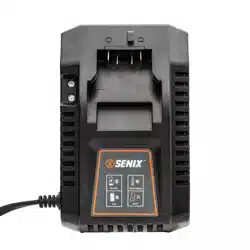
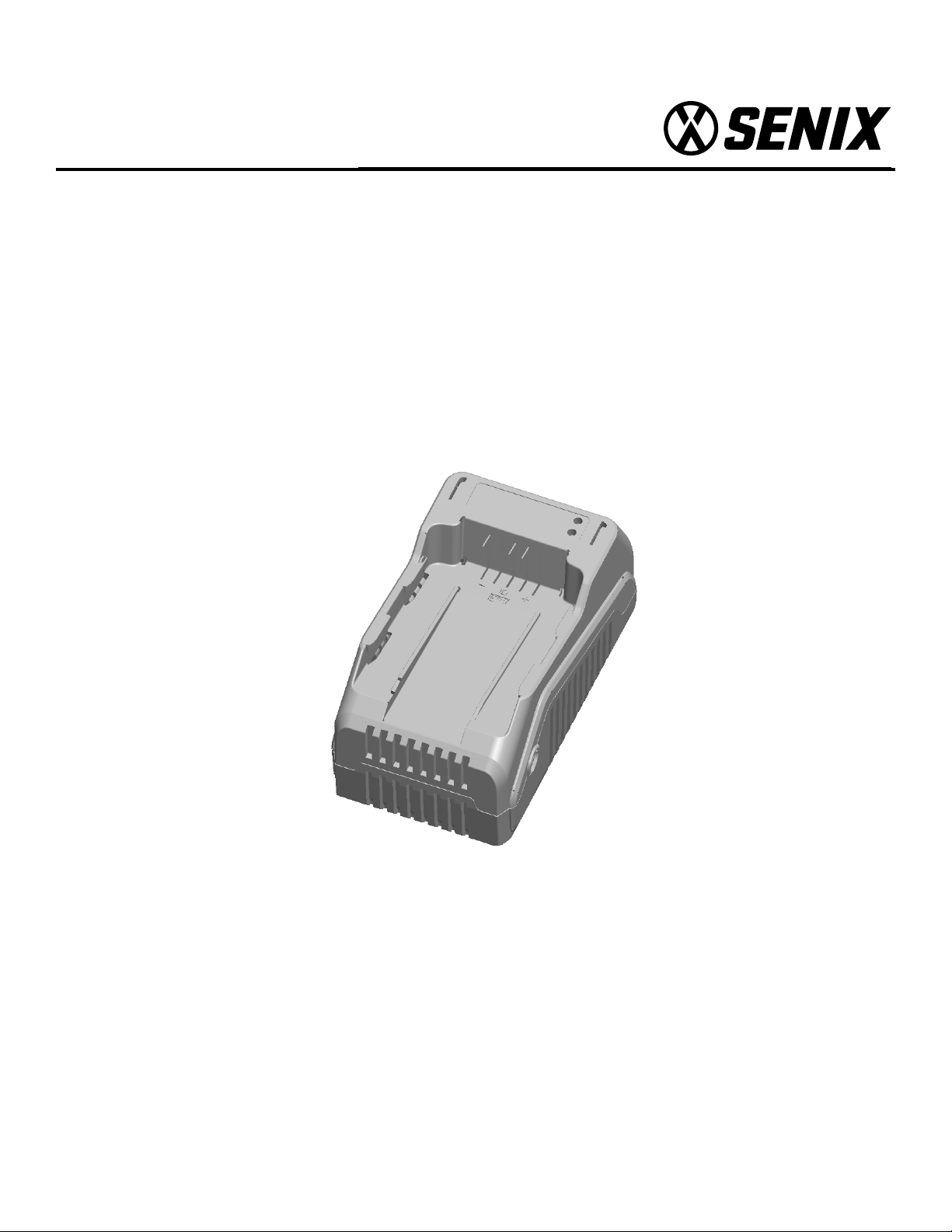
58V MAX LITHIUM ION
CHARGER
Operator’s manual
Model: CHX5
For customer support, please call 1-800-261-3981 or send email to:
SAVE THIS MANUAL FOR FUTURE REFERENCE.
1WWW.SENIXTOOLS.COM
SAFETY
TECHNICAL DATA
Model Number: CHX5
Battery: 58V Max Lithium Ion, 2.5 Ah
Compatible with: Battery Model B25X5
Charger Input: 120V AC, 60Hz, 145W
Charger Output: 58V DC, 2A
Product Dimensions: 200 x 115 x 80 mm
SAFETY
WARNING — To reduce the risk of injury, user must
read and understand operator’s manual.
Despite all the safety precautions, caution must always
be exercised when handling batteries. The following points
must be obeyed at all times to ensure safe use. Safe use
can only be guaranteed if undamaged cells are used.
Incorrect handling of the battery pack can cause
cell damage.
• Avoid dangerous environments: Do not charge the
battery pack in rain, snow or in damp or wet locations.
Do not use the battery pack or charger in the presence
of explosive atmospheres (gaseous fumes, dust or
ammable materials) because sparks may be generated
when inserting or removing the battery pack, which
could lead to a re.
• Charge in a well-ventilated area: Do not block the
charger vents. Keep them clear to allow for proper
ventilation. Do not allow smoking or open ames near a
charging battery pack. Vented gases may explode.
Note: The safe temperature range for the battery charging
is -4°F to 113°F (-20 °C to 45 °C). Do not charge the
battery outside in freezing weather; charge it at room
temperature.
• Maintain charger cord: When unplugging the charger,
pull the plug, not the cord, from the receptacle to reduce
the risk of damage to the electrical plug and cord. Never
carry the charger by its cord or yank it by the cord to
disconnect it from the receptacle. Keep the cord away
from heat, oil and sharp edges. Make sure the cord
will not be stepped on, tripped over or subjected to
damage or stress when the charger is in use. Do not
use the charger with a damaged cord or plug. Replace a
damaged charger immediately.
• Do not use an extension cord unless it is absolutely
necessary: Using the wrong, damaged or improperly
wired extension cord poses a risk of re and electric
shock. If an extension cord must be used, plug the
charger into a properly wired 16 gauge or larger
extension cord with the female plug matching the male
plug on the charger. Make sure that the extension cord
is in good electrical condition.
• Charger is rated for 120 volt AC only: The charger
must be plugged into an appropriate receptacle.
• Use only recommended attachments: Use of an
attachment not recommended or sold by Senix may
result in risk of re, electric shock or personal injury.
• Unplug charger when not in use: Make sure to
remove battery packs from unplugged chargers.
WARNING — To reduce the risk of electric shock,
always unplug the charger before
performing any cleaning or maintenance.
Do not allow water to ow into the
charger. Use a Ground Fault Circuit
Interrupter (GFCI) to reduce shock
hazards.
• Do not burn or incinerate battery packs: Battery
packs may explode, causing personal injury or damage.
Toxic fumes and materials are created when battery
packs are burned.
• Do not crush, drop or damage battery packs: Do not
use the battery pack or charger if they have sustained
a sharp blow, been dropped, run over or have been
damaged in any way (i.e. pierced with a nail, hit with a
hammer, stepped on, etc.).
• Do not disassemble: Incorrect reassembly may
pose a serious risk of electric shock, re or exposure
totoxic battery chemicals. If the battery or charger are
damaged, call Senix customer service at
1-800-261-3981 for assistance.
• Battery chemicals cause serious burns: Never let a
damaged battery pack contact the skin, eyes or mouth.
If a damaged battery pack leaks battery chemicals,
use rubber or neoprene gloves to safely dispose of it.
If skin is exposed to battery uids, wash the aected
area with soap and water and rinse with vinegar. If eyes
areexposed to battery chemicals, immediately ush
with water for 20 minutes and seek medical attention.
Remove and dispose of contaminated clothing.
!
!

2 WWW.SENIXTOOLS.COM
SAFETY
• Do not short circuit: A battery pack will short circuit if
a metal object makes a connection between the positive
and negative contacts on the battery pack. Do not place
a battery pack near anything that may cause a short
circuit, such as paper clips, coins, keys, screws, nails
and other metallic objects. A short-circuited battery pack
poses a risk of re and severe personal injury.
• Store your battery pack and charger in a cool, dry
place: Do not store the battery pack or charger where
temperatures may exceed 104 °F (40 °C), such as
in direct sunlight or inside a vehicle or metal building
during the summer.
ABOUT THE BATTERY
• The battery pack supplied with your cordless tool is only
partially charged. The battery pack has to be charged
completely before you use the tool for the rst time.
• For optimum battery performance, avoid low discharge
cycles by charging the battery pack frequently.
• Lithium-ion batteries are subject to a natural aging
process. The battery pack must be replaced at the latest
when its capacity falls to just 80% of its capacity when
new. Weakened cells in an aged battery pack are no
longer capable of meeting the high power requirements
needed for the proper operation of your tool, and
therefore pose a safety risk.
• Do not throw battery packs into an open re as this
poses a risk of explosion. Do not ignite the battery pack
or expose it to re.
• Do not exhaustively discharge batteries. Exhaustive
discharge will damage the battery cells. The most
common cause of exhaustive discharge is lengthy
storage or non-use of partially discharged batteries.
Stop working as soon as the performance of the
battery falls noticeably or the electronic protection
system triggers. Place the battery pack in storage
only after it has been fully charged.
• Protect batteries and the tool from overloads.
Overloads will quickly result in overheating and
cell damage inside the battery housing even if this
overheating is not apparent externally.
• Avoid damage and shocks. Immediately replace
batteries that have been dropped from a height of more
than one meter or those that have been exposed to
violent shocks, even if the housing of the battery pack
appears to be undamaged. The battery cells inside the
battery may have suered serious damage. In such
instances, please read the waste disposal information
for proper battery disposal.
• If the battery pack suers overloading and overheating,
the integrated protective cuto will switch o the
equipment for safety reasons.
• Use only original battery packs. The use of other
batteries poses a re risk and may result in injuries or
an explosion.
CHARGER
Protect the battery charger and its cord from damage.
Keep the charger and its cord away from heat, oil and
sharp edges. Electrical plugs must match the outlet. Never
modify the plug in any way. Do not use any adapter plugs
with grounded appliances. Unmodied plugs and matching
outlets will reduce the risk of electric shock.
Keep the battery charger, battery pack(s) and the cordless
tool out of the reach of children. Do not use the supplied
battery charger to charge other cordless tools. During
periods of heavy use, the battery pack will become warm.
Allow the battery pack to cool to room temperature before
inserting it into the charger to recharge.
Do not overcharge batteries. Do not exceed the maximum
charging times. These charging times only apply to
discharged batteries. Frequent insertion of a charged or
partially charged battery pack will result in overcharging
and cell damage. Do not leave battery in the charger for
days on end. Never use or charge a battery if you suspect
that it has been more than 12 months since the last time
they were charged. There is a high probability that the
battery pack has already suered dangerous damage
(exhaustive discharge). Do not use battery that have
been exposed to heat during the charging process, as the
battery cells may have suered dangerous damage. Do
not use battery that have suered curvature or deformation
during the charging process or those that exhibit other
atypical symptoms (gassing, hissing, cracking, etc.)
DISPOSAL
WARNING — Waste electrical products should not
be disposed of with household waste.
Please recycle where facilities exist.
Check with your local authority or retailer
for recycling advice.
Lithium-ion batteries must be disposed of at a hazardous
waste collection point or battery recycling location, NOT
with household waste.
!
3WWW.SENIXTOOLS.COM
ELECTRICAL INFORMATION
GROUNDING INSTRUCTIONS (For charger)
IN THE EVENT OF A MALFUNCTION OR BREAKDOWN,
grounding provides the path of least resistance for an
electric current and reduces the risk of electric shock. This
tool is equipped with an electric cord that has an equipment
grounding conductor and a grounding plug. The plug
MUST be plugged into a matching outlet that is properly
installed and grounded in accordance with ALL local codes
and ordinances.
DO NOT MODIFY THE PLUG PROVIDED. If it will not t
the outlet, have the proper outlet installed by alicensed
electrician.
IMPROPER CONNECTION of the equipment grounding
conductor can result in electric shock. The conductor with
the green insulation (with or without yellow stripes) is the
equipment grounding conductor. If repair or replacement of
the electric cord or plug is necessary, DO NOT connect the
equipment grounding conductor to a live terminal.
CHECK with a licensed electrician or service personnel
if you do not completely understand the grounding
instructions or whether the tool is properly grounded.
CAUTION: In all cases, make certain the outlet in
question is properly grounded. If you are
not sure, have a licensed electrician check
the outlet.
WARNING — This tool is for indoor use only. Do not
expose to rain or use in damp locations.
GUIDELINES FOR EXTENSION CORDS
Make sure your extension cord is in good condition. When
using an extension cord, be sure to use one heavy enough
to carry the current your product will draw. An undersized
cord will cause a drop in line voltage resulting in loss of
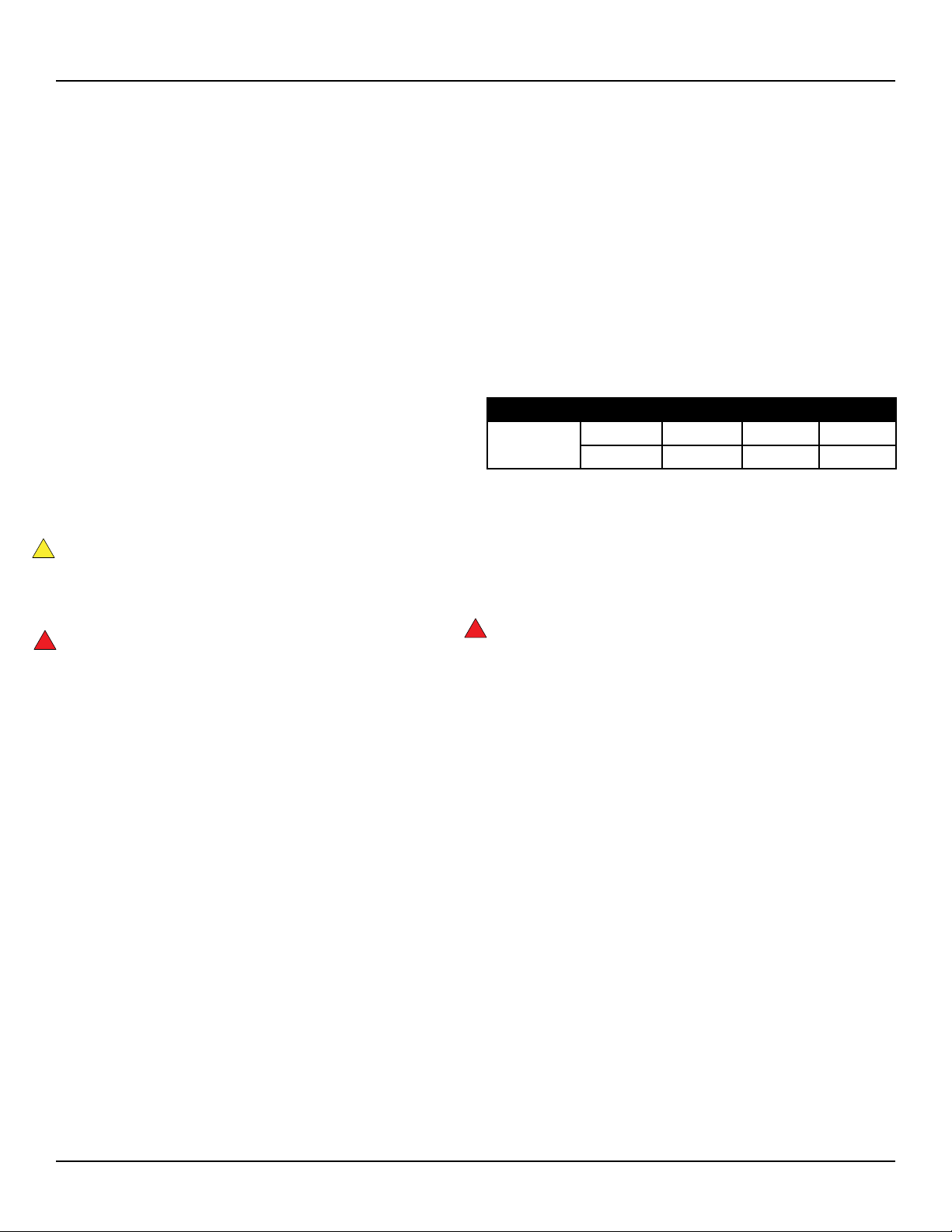
power and overheating. The table below shows the correct
size to be used according to cord length and nameplate
ampere rating. When in doubt, use a heavier cord. The
smaller the gauge number, the heavier the cord.
Make sure your extension cord is properly wired and in
good condition. Always replace a damaged extension cord
or have it repaired by a qualied person before using it.
Protect your extension cords from sharp objects, excessive
heat and damp/wet areas.
Amperage Required gauge for extension cords
2.5 A
25 ft. 50 ft. 100 ft. 150 ft.
18 gauge 16 gauge 14 gauge 12 gauge
Use a separate electrical circuit for your tools. This circuit
must not be less than a #12 wire and should be protected
with a 15 A time-delayed fuse. Before connecting the
motor to the power line, make sure the switch is in the OFF
position and the electric current is rated the same as the
current stamped on the motor nameplate. Running at a
lower voltage will damage the motor.
WARNING — This tool must be grounded while in
use to protect the operator from electric
shock.
!
!
!

4 WWW.SENIXTOOLS.COM
MAINTENANCE
MAINTENANCE
If you need to repair or replace the battery or charger,
contact Senix customer service at 1-800-261-3981.
CHARGER
• Keep the charger clean and clear of debris. Do not allow
foreign material to get into the recessed cavity or onto
the contacts. Wipe the charger clean with a dry cloth. Do
not use solvents or water, and do not place the charger
in wet conditions.
• Unplug the charger when there is no battery in it.
• Fully charge the battery before placing it in storage.
• Store the charger at normal room temperature. Do not
store it in excessive heat. Do not use the charger in
direct sunlight or in damp conditions. Do not charge
outside. Recharge at room temperature. If the battery is
hot, allow it to cool down before recharging.
BATTERY
• Make sure the battery is fully charged before storage in
order to maximize the life of the battery.
WARNING — Shorting the battery terminals together
may cause burns or a re.
• When battery pack is not in use, keep it away from other
metal objects like paper clips, coins, keys, nails, screws,
or other small metal objects that can make a connection
from one terminal to another.
• Do not store the battery pack on the tool.
• After charging, the battery pack may be stored in the
charger, as long as the charger is not plugged in.
!