1
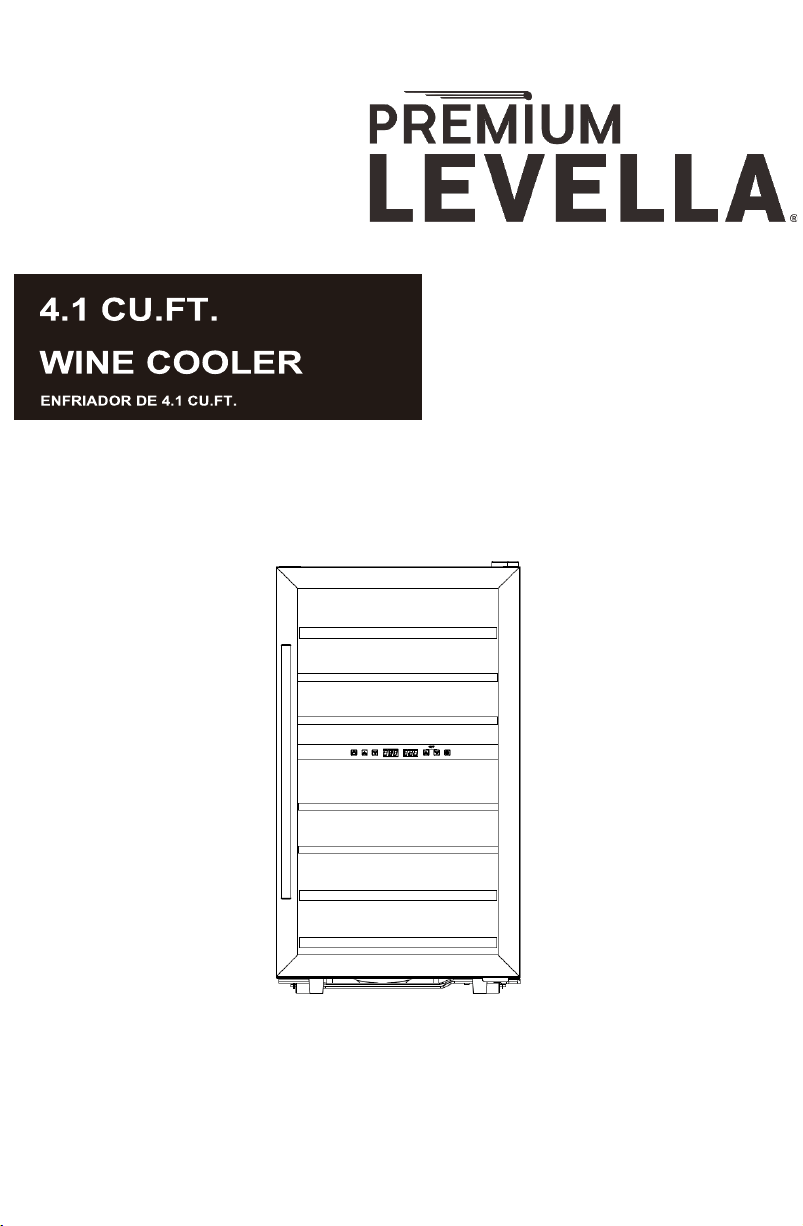
Model/Modelo: PWC436KS
USER MANUAL / MANUAL DE INSTRUCCIONES
Use and care manual. Important safeguards. This product is for domestic use only.
Manual de uso y cuidado. Precauciones importantes. Este producto es para uso dom
éstico unicamente.

2
CONTENIDO
1 Advertencias de seguridad
1.1 Advertencia ............................................................................................... 1-2
1.2 Significado de los símbolos de seguridad ................................................. 3
1.3 Advertencias de electricidad ...................................................................... 3
1.4 Advertencias de uso .................................................................................. 4
1.5 Advertencias relacionadas con la colocación de artículos ........................ 5
1.6 Advertencias de energía............................................................................ 5
1.7 Advertencias relacionadas con el desecho ............................................... 6
2 Uso correcto del enfriador
2.1 Componentes ........................................................................................... 7
2.2 Control de temperatura .................................................................................. 8
2.3 Ubicación .................................................................................................. 9
2.4 Inicio .......................................................................................................... 9
2.5 Arreglo de las botellas ............................................................................... 9
2.6 recomendaciones para el almacenamiento de vino ................................ 10
2.7 Temperaturas para servir vino ................................................................. 10
2.8 Consejos de ahorro de energía .............................................................. 10
3 Mantenimiento
3.1 Desconexión de refrigerador ..................................................................... 11
3.2 Si no va a usar el refrigerador ................................................................... 11
3.3 Limpieza .................................................................................................... 11
4 Resolución de problemas ............................................................................. 12
Estimado Cliente:
Gracias por comprar este refrigerador. Para asegurarse de obtener los
mejores resultados de su nuevo refrigerador, tómese el tiempo para leer las
sencillas instrucciones de este folleto. Asegúrese de que los materiales de
embalaje se eliminen de acuerdo con los requisitos medioambientales
vigentes. Cuando se deshaga de cualquier equipo de refrigeración, póngase
en contacto con el departamento de eliminación de residuos de su localidad
1
1 Advertencias de seguridad
1.1 Advertencia
Advertencia: riesgo de incendio / materiales inflamables
Este aparato está diseñado para ser utilizado en lugares domésticos y similares, como
áreas de cocina en tiendas, oficinas y otros entornos de trabajo: casas de campo y por
clientes en hoteles, moteles y otros entornos de tipo residencial; entornos de tipo bed and
breakfast, catering y aplicaciones similares no minoristas.
Este electrodoméstico no está diseñado para que lo utilicen personas (incluidos niños) con
capacidades físicas, sensoriales o mentales reducidas, o sin experiencia y conocimiento, a
menos que hayan recibido supervisión o instrucciones sobre el uso del electrodoméstico
por una persona responsable de su seguridad.
SI el cable de alimentación está dañado, debe ser reemplazado por el fabricante, su
agente de servicio o una persona calificada similar para evitar un peligro.
No almacene sustancias explosivas como latas de aerosol con un propulsor inflamable en
este aparato.
El aparato debe desenchufarse después de su uso y antes de realizar el mantenimiento
por parte del usuario en el aparato.
ADVERTENCIA: Mantenga las aberturas de ventilación libres de obstrucciones en el
gabinete del electrodoméstico o en la estructura incorporada.
ADVERTENCIA: No utilice dispositivos mecánicos u otros medios para acelerar el proceso
de descongelación, distintos de los recomendados por el fabricante.
ADVERTENCIA: No dañe el circuito refrigerante.
ADVERTENCIA: Deseche el refrigerador de acuerdo con las regulaciones locales, ya que
utiliza gas y refrigerante inflamables.
2
ADVERTENCIA: Al colocar el aparato, asegúrese de que el cable de alimentación no esté
atrapado o dañado.
ADVERTENCIA: No coloque varios enchufes portátiles o fuentes de alimentación
portátiles en la parte posterior del electrodoméstico.
No use cables de extensión o adaptadores sin conexión a tierra (dos clavijas).
PELIGRO: Riesgo de atrapamiento de niños. Antes de desechar su viejo refrigerador o
congelador:
-Retire las puertas,
-Deje los estantes en su lugar para que los niños no puedan entrar fácilmente.
El refrigerador debe estar desconectado de la fuente de suministro eléctrico antes de
intentar la instalación del accesorio.
El material de espuma refrigerante y ciclopentano utilizados para el aparato son
inflamables. Por tanto, cuando el aparato sea desechado, deberá mantenerse alejado de
cualquier fuente de fuego y ser recuperado por una empresa recuperadora especial con la
correspondiente calificación y no debe ser eliminado por combustión, para evitar daños al
medio ambiente o cualquier otro daño.
Los niños deben ser supervisados para asegurarse de que no jueguen con el aparato.
Este aparato puede ser utilizado por niños a partir de 8 años y personas con capacidades
físicas o mentales reducidas o sin experiencia y conocimiento si han recibido supervisión o
instrucciones sobre el uso del aparato de forma segura y comprenden los peligros
involucrados. Los niños no deben jugar con el aparato. Los niños no deben realizar la
limpieza y el mantenimiento del usuario sin supervisión. Los niños de 3 a 8 años pueden
cargar y descargar aparatos frigoríficos.
ADVERTENCIA: Para evitar un peligro debido a la inestabilidad del aparato, este debe
fijarse de acuerdo con las instrucciones.
ADVERTENCIA: Conecte únicamente al suministro de agua portátil. (Adecuado para
equipos con máquina de hacer hielo)
Para evitar que un niño quede atrapado, manténgalo fuera del alcance de los niños y no
en las proximidades del refrigerador. (Advertencia para productos con cerraduras).
3
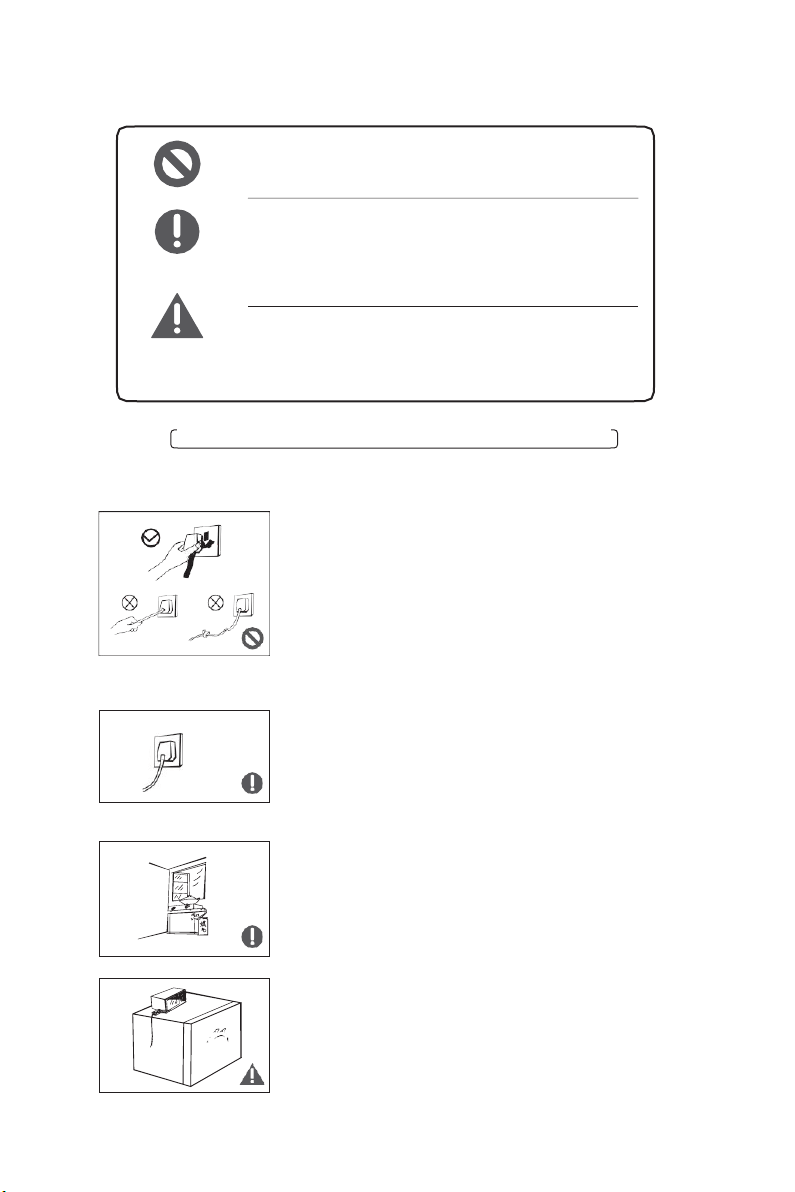
1.2 Significado de los símbolos de seguridad
Prohibido
Advertencia
Nota
Indica acciones prohibidas. El incumplimiento de las
instrucciones puede provocar daños en el producto o
poner en peligro la seguridad personal de los usuarios.
Indica reglas que deben seguirse y esos comportamientos
deben ejecutarse estrictamente de acuerdo con los requisitos
de operación. El incumplimiento de las instrucciones puede
provocar daños en el producto o poner en peligro la seguridad
personal de los usuarios.
Indica asuntos a los que hay que prestar atención, y
comportamientos que deben tenerse especialmente en
cuenta. Se necesitan las debidas precauciones o se
causarán lesiones leves o moderadas o daños al producto.
Este manual contiene mucha información de seguridad
importante que deben observar los usuarios.
1.3 Advertencias de electricidad
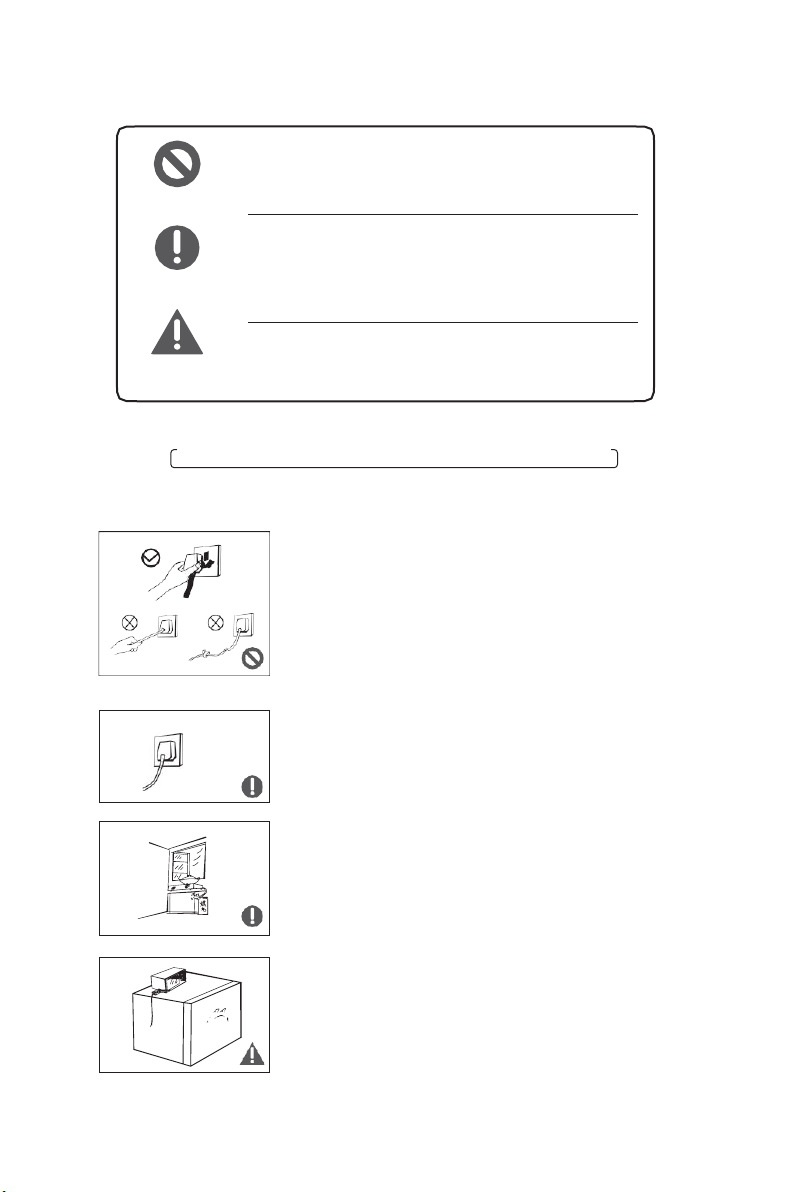
⚫ No tire del cable de alimentación cuando tire del enchufe de
alimentación del enfriador. Sujete firmemente el enchufe y extráigalo
directamente del enchufe.
⚫ No dañe el cable de alimentación bajo ninguna condición para
garantizar un uso seguro, no lo utilice cuando el cable de alimentación
esté dañado o el enchufe esté gastado.
⚫ Un cable de alimentación gastado o dañado debe reemplazarse en las
estaciones de mantenimiento autorizadas por el fabricante
.
⚫ El cable de alimentación debe estar en contacto firme con el enchufe o
de lo contrario podrían producirse incendios. Asegúrese de que el
electrodo de conexión a tierra de la toma de corriente esté equipado con
una línea de conexión a tierra fiable.
.
⚫ Cierre la válvula del gas que se escapa y luego abra las puertas y
ventanas en caso de que se produzca una fuga de gas u otros gases
inflamables. No desenchufe el enfriador y otros aparatos eléctricos
considerando que la chispa puede causar un incendio.
⚫ Para garantizar la seguridad, no se recomienda colocar enchufes,
reguladores, ollas arroceras, hornos microondas y otros
electrodomésticos en la parte superior del enfriador, los recomendados
por el fabricante no están incluidos. No utilice aparatos eléctricos en la
despensa de alimentos.
4
1.4 Advertencias de uso
⚫ No desmonte ni reconstruya arbitrariamente el enfriador, no dañe el
circuito de refrigerante; El mantenimiento del aparato debe ser
realizado por un especialista.
⚫ El fabricante, su departamento de mantenimiento o profesionales
relacionados deben reemplazar el cable de alimentación dañado para
evitar peligros
.
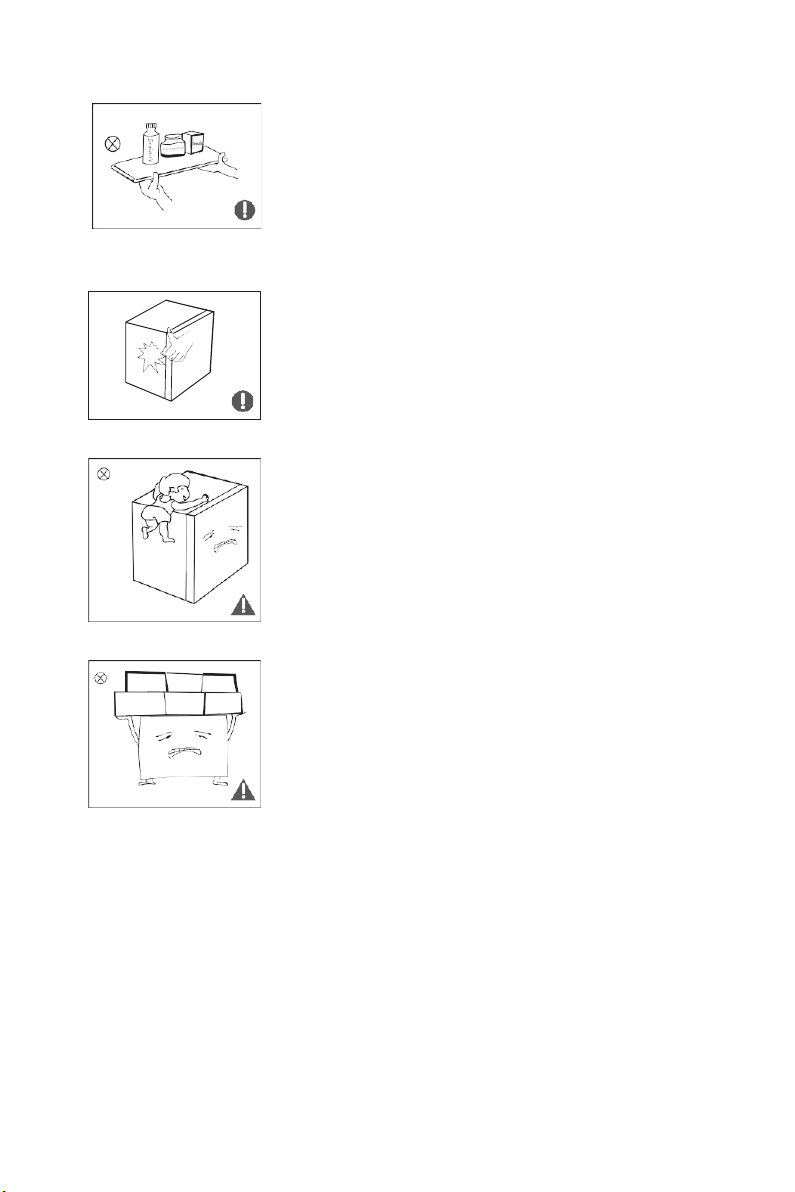
⚫ Los espacios entre la puerta del enfriador y el cuerpo del enfriador son
pequeños, tenga en cuenta que no debe poner la mano en estas áreas
para evitar que apriete el dedo. Tenga cuidado al cerrar o abrir la puerta
del enfriador para evitar la caída de artículos.
⚫ No entregue el empaque y otros componentes a los niños para que
jueguen. ¡Los empaques y la película de plástico pueden provocar asfixia!
No permita que los niños entren o se suban al enfriador para evitar que
queden encerrados en el enfriador o que resulten heridos por la caída del
enfriador.
⚫ No rocíe ni lave el enfriador; No coloque el enfriador en lugares húmedos
que sean fáciles de salpicar con agua para no afectar las propiedades de
aislamiento eléctrico del enfriador.
⚫ No utilice el cuerpo ni la puerta del refrigerador como pedal o soporte.
⚫ No coloque objetos pesados en la parte superior del enfriador, ya que
podrían caerse al abrir o cerrar la puerta y podrían producirse lesiones
accidentales.
⚫ Desconecte el enchufe en caso de corte de energía o para limpiar. No
conecte el enfriador a la fuente de alimentación dentro de los primeros
cinco minutos para evitar daños al compresor.

5
1.5 Advertencias relacionadas con la colocación de artículos
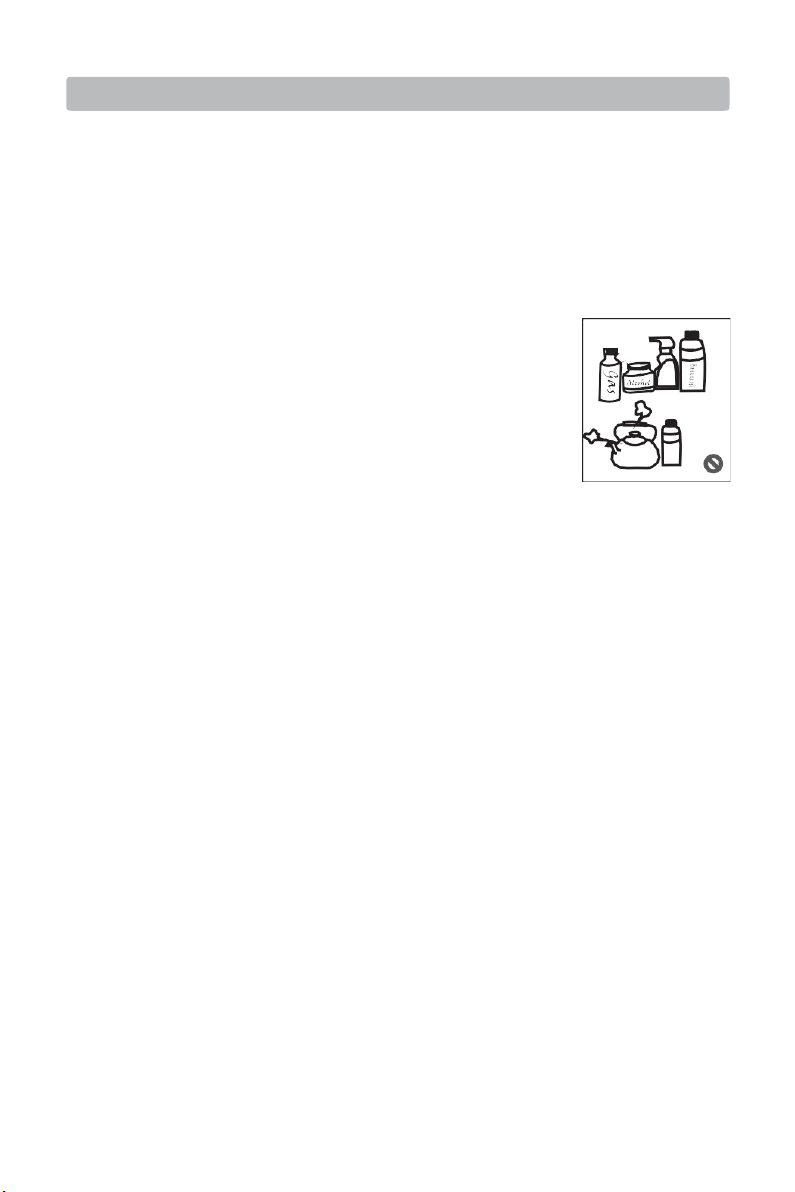
⚫ No coloque artículos inflamables, explosivos, volátiles o altamente
corrosivos en el enfriador para evitar daños al producto o accidentes
por incendio.
⚫ No coloque artículos inflamables cerca del enfriador para evitar
incendios.
.
⚫ Este producto es un refrigerador doméstico y este equipo solo se
puede utilizar para el almacenamiento de vino. De acuerdo con los
requisitos estándar, el enfriador doméstico no se debe utilizar para
otros fines, como el almacenamiento de sangre, medicamentos o
productos biológicos.
.
1.6 Advertencias de energía
1) Es posible que el enfriador no funcione de manera uniforme si se coloca durante un período
prolongado por debajo del extremo frío del rango de temperatura para el que está diseñado
el aparato.
2) No exceda el tiempo de almacenamiento recomendado por los productores de vino para
ningún tipo de vino.
3) Tome las precauciones necesarias para evitar un aumento indebido de la temperatura del
vino durante la descongelación de la nevera.
4) Un aumento de temperatura del vino durante la descongelación, el mantenimiento o la
limpieza manual podría acortar la vida útil del vino.
5) Para refrigeradores con puertas o tapas provistas de cerraduras y llaves, las llaves deben
mantenerse fuera del alcance de los niños y no en las proximidades del refrigerador, para
evitar que los niños se queden encerrados en el interior.
6
1.7 Advertencias relacionadas con el desecho
El refrigerante y el material espumoso de ciclopentano utilizado para el enfriador son inflamables. Por lo
tanto, cuando se desecha el enfriador, se debe mantener alejado de cualquier fuente de fuego y ser
recuperado por una empresa recuperadora especial con la correspondiente calificación que no sea
eliminada por combustión, para evitar daños al medio ambiente o cualquier otro daño.
Cuando se desecha el enfriador, desmonte las puertas y retire la junta de la puerta y los
estantes; Coloque las puertas y los estantes en un lugar adecuado, para evitar que los niños
queden atrapados.
Eliminación correcta de este producto:
Esta marca indica que este producto no debe desecharse con otros desechos domésticos. Para evitar
posibles daños al medio ambiente o la salud humana debido a la eliminación incontrolada de desechos,
recíclelos de manera responsable para promover la reutilización sostenible de los recursos materiales.
Para devolver su dispositivo usado, utilice los sistemas de devolución y recogida o póngase en contacto
con el minorista donde compró el producto. Pueden llevar este producto para un reciclaje seguro para el
medio ambiente.
.

7
2.1 Componentes
(La imagen de arriba es solo para referencia. La configuración real dependerá
del producto físico o declaración del distribuidor.)
1. La temperatura en el enfriador es 41-54 ° F / 5-12 ° C en la zona de
temperatura superior y 54-64 ° F / 12-18 ° C en la zona de temperatura
inferior, use solo para almacenar vino embotellado sin abrir (vino tinto, vino
blanco, vino rosado).
2. No coloque alimentos en el enfriador para evitar la contaminación
bacteriana.
3. Mantenga seco el interior del enfriador, beba vino embotellado durante el
período de validez.
2 Uso correcto del enfriador
Pies ajustables
Bisagra inferior
Puerta
Asa
Bisagra superior
Estante superior
Estante de madera
Caja de control
8
2.2 Control de temperatura
(La imagen de arriba es solo para referencia. La configuración real dependerá del producto
físico o declaración del distribuidor.)
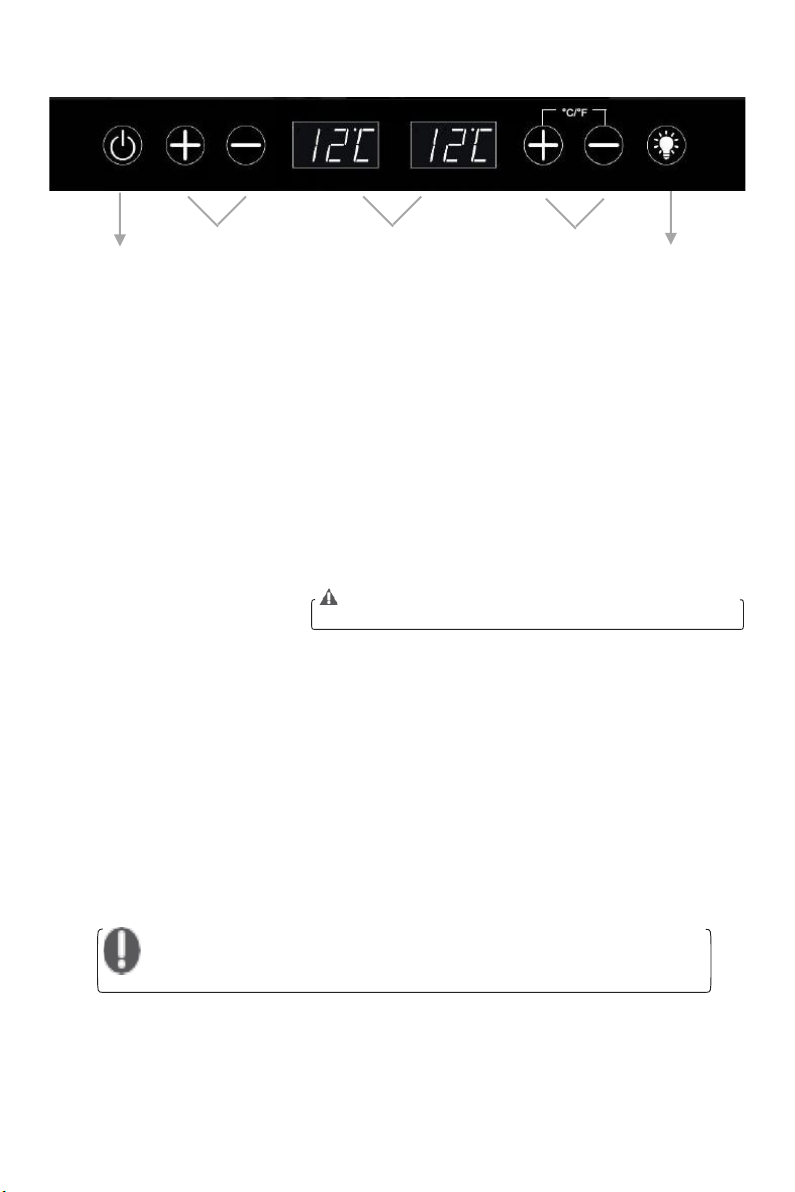
Panel de control
1.
Botón de encendido: mantenga pulsado este botón durante 3 segundos para encender o apagar el aparato.
2. Botones más y menos:
⚫ Controla la temperatura de la zona de temperatura superior
⚫ Use para configurar la temperatura deseada. Cada presión aumentará o disminuirá la
temperatura establecida en incrementos de 1 °
3. Pantalla: muestra la temperatura establecida
4. Botones más y menos:
⚫ Controla la temperatura de la zona de temperatura inferior
⚫ Use para configurar la temperatura deseada. Cada presión aumentará o disminuirá la
temperatura establecida en incrementos de 1 °.
⚫ Presione los botones más y menos al mismo tiempo para cambiar la escala de temperatura entre
Celsius y Fahrenheit.
5. Botón de luz: presione para encender o apagar la luz interior.
Rango de ajuste de la temperatura Celsius: 5-12 ° C, 12-18° C; rango de
ajuste de la temperatura Fahrenheit: 41-54°F, 54-64°F
Función Memoria
El enfriador tiene la función de memoria de apagado. Después de encender de nuevo, el enfriador funcionará de acuerdo
con la configuración antes del apagado.
Descongelación
Este aparato no requiere descongelación manual. Durante el funcionamiento del compresor, se acumulará hielo en la
placa del evaporador que se encuentra en la parte posterior del gabinete interior. Durante el ciclo de inactividad del
compresor, el hielo se derretirá, goteará y se acumulará en una bandeja sobre el compresor, donde el calor del compresor
evapora el agua. Si nota una acumulación excesiva de hielo en el evaporador, intente ajustar la temperatura un poco más
alta. Además, asegúrese de que la junta de la puerta selle bien.
Si la unidad está desenchufada, o se pierde la energía o se apaga, debe esperar
de 3 a 5 minutos antes de reiniciar la unidad. Si intenta reiniciar antes de este
tiempo de retraso, la unidad no arrancará. Cuando utilice la unidad por primera
vez o la reinicie después de haber estado apagada durante un tiempo
prolongado, podría haber una variación de algunos grados entre la temperatura
que seleccionó y la indicada en la lectura del LED. Esto es normal y se debe a la
duración del tiempo de activación. No debería haber ningún problema una vez
que la unidad ha estado funcionando durante algunas horas.
d
e
g
f
h
9
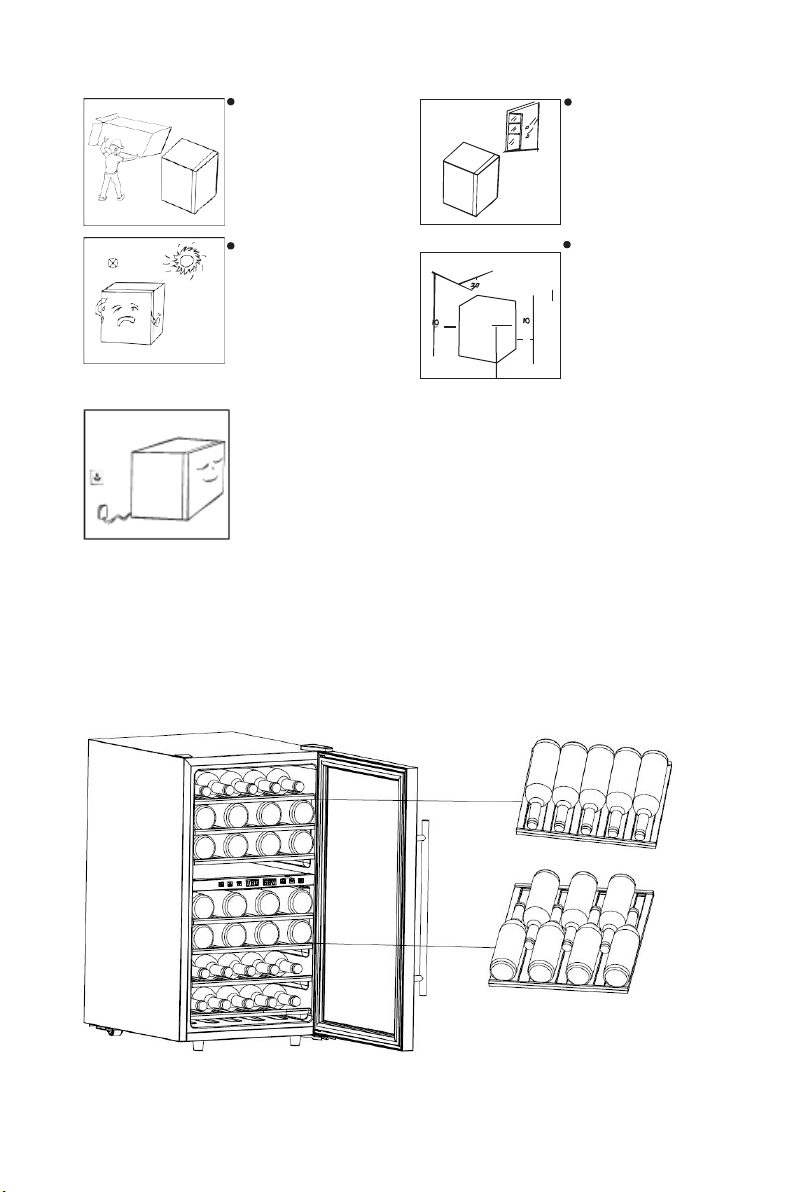
2.3 Ubicación
2.4 Inicio
Antes de usar el enfriador,
retire todos los materiales de
embalaje, incluidos las
almohadillas inferiores y la
espuma y las cintas dentro
del enfriador, retire la película
protectora de la puerta y el
cuerpo del enfriador.
.
Evite la luz solar directa y las
fuentes de calor como estufa,
radiador de calefacción, etc.
.
El enfriador debe
colocarse en un lugar
interior bien ventilado; el
suelo debe ser plano y
resistente (gire hacia la
izquierda o hacia la
derecha para ajustar las
patas para nivelar si es
inestable).
.
El espacio superior del
enfriador debe ser
superior a 30 cm y las
distancias desde ambos
lados y la parte trasera
deben ser de más de 10
cm para facilitar la
disipación del calor.
⚫ El enfriador debe permanecer en su lugar durante 2 horas antes de conectar
la energía cuando se enciende por primera vez.
⚫ Limpie la cámara interior antes de utilizarla por primera vez.
⚫ No conecte el enfriador a un enchufe y convertidor de ahorro de energía
electrónico que pueda convertir CC en CA (por ejemplo: sistema de energía
solar o red de barco).
⚫ Se generarán gotas de agua o escarcha en la parte trasera del enfriador
cuando el compresor esté funcionando. No es necesario limpiar la escarcha o
el agua ya que la parte posterior las eliminará automáticamente. El agua
descongelada se recogerá en el tanque de drenaje, luego entrará en la
bandeja de eliminación de agua sobre el compresor y se evaporará.
2.5 Arreglo de las botellas
⚫ No permita que las botellas toquen la parte trasera del enfriador para mantener una buena circulación de
aire en el enfriador.
⚫ El número de botellas mostrado aquí puede ser diferente al número de botellas en diferentes formas y
tamaños.
⚫ La capacidad de almacenamiento de botellas en el armario para vinos se basa en el siguiente tamaño de
botella marcado. Las botellas de mayor tamaño pueden tener un impacto en la capacidad de
almacenamiento.
(La imagen de arriba es solo para referencia. La configuración real dependerá del producto
físico o declaración del distribuidor.)
10
2.6
Recomendaciones para el almacenamiento de vinos
• No guarde vino embotellado dentro de la caja o estuche en el refrigerador.
• El corcho de la botella debe estar siempre en contacto con el vino al introducirlo en la nevera. No se permite el espacio de
aire entre el vino y el corcho.
• El estante para botellas de tipo abierto es útil, ya que no corta la circulación de aire. La humedad del aire que se
condensa en la botella se puede secar rápidamente.
• El vino debe retirarse de la hielera antes de beber: poner vino rosado en la mesa 2-5 horas antes de beber y vino tinto 4-5
horas, para que alcancen la temperatura adecuada para servir. El vino blanco, por el contrario, se puede servir
directamente en la mesa. El champán siempre se almacenará en la nevera y se sacará justo antes de beberlo.
• Tenga en cuenta que la temperatura del vino siempre es más baja que la temperatura ideal para servir, ya que la
temperatura aumentará inmediatamente de 1 a 2 ° C cuando se vierte en el vaso.
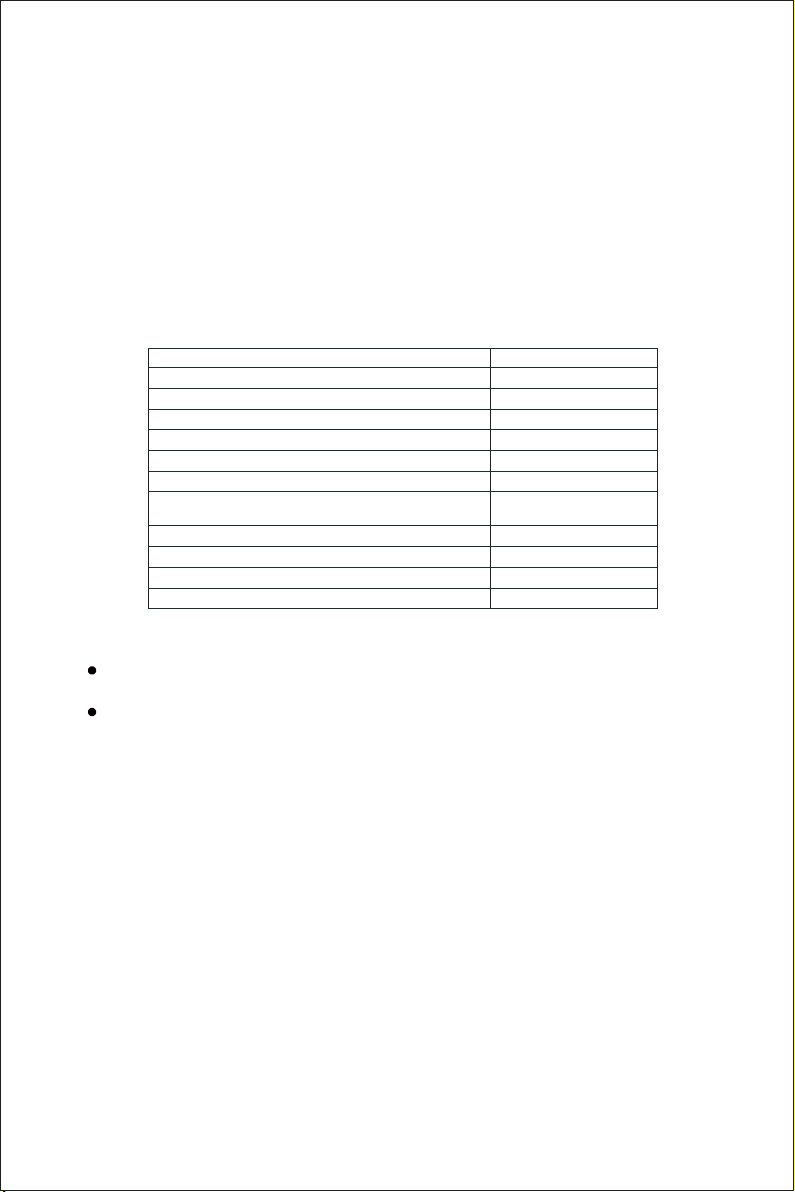
2.7
Temperatura
El sabor del vino depende de la temperatura adecuada de vertido; esto determina su sabor.
Sugerimos que la temperatura del vino alcance el siguiente grado al servir:
Tipo de vino
Temperatura de servido
Tinto burdeos
18°C
Vino seco de la familia Louis / Barolo
17°C
Rojo burdeos / tinto burdeos
16°C
Oporto
15°C
Tinto burdeos joven
14°C
Vino tinto joven
12°C
Beaujolais joven / todos los vinos
blancos con poca azúcar residual
11°C
Vinos blancos viejos / Chardonnay
10°C
Jerez
9°C
Vinos blancos jóvenes de vendimia tardía
8°C
Vinos blancos Loire / Entre-deux-Mers
7°C
2.8 Consejos de ahorro de energía
El enfriador debe colocarse en una habitación seca y ventilada. El enfriador no se debe colocar bajo la luz solar directa
o cerca de una fuente de calor (como un radiador, estufa, etc.). Se debe colocar una placa aislante adecuada si es
necesario.
Intente acortar el tiempo de apertura de la puerta del enfriador.
11
3 Mantenimiento
3.1 Desconexión del refrigerador
Desenchufe el enchufe de alimentación para desconectar el enfriador.
3.2 Si no va usar el refrigerador:
Si el enfriador no se va a utilizar durante mucho tiempo, por favor:
1 - Desenchufe el enfriador.
2 - Limpie el enfriador.
3 - Mantenga abierta la puerta del enfriador.
3.3 Limpieza
⚫ El polvo detrás del enfriador y en el suelo se debe
limpiar oportunamente para mejorar el enfriamiento y el
ahorro de energía.
⚫ Revise la junta de la puerta con regularidad para asegurarse
de que no haya residuos. Limpie la junta de la puerta con un
paño suave humedecido con agua jabonosa o detergente
diluido.
⚫ El interior del enfriador debe limpiarse con regularidad para
evitar olores.
⚫ Apague la alimentación antes de limpiar, retire las bebidas,
los estantes, etc.
⚫ Use un paño suave o una esponja para limpiar el interior del enfriador, con dos
cucharadas de bicarbonato de sodio y un litro de agua tibia. Luego enjuague con
agua y seque con un paño suave. Después de limpiar, abra la puerta y déjelo
secar naturalmente antes de encenderla.
⚫ Para áreas que son difíciles de limpiar en el enfriador (como sitios estrechos,
espacios o esquinas), se recomienda limpiarlos regularmente con un trapo
suave, cepillo suave, etc. y cuando sea necesario, combinarlos con algunas
herramientas auxiliares (como palos finos) para asegurar que no haya
contaminantes o acumulación de bacterias en estas áreas.
⚫ No use jabón, detergente, polvo para fregar, limpiador en aerosol, etc., ya que
pueden causar olores en el interior del enfriador o contaminar los alimentos.
⚫ Limpie los estantes con un paño suave humedecido con agua jabonosa o
detergente diluido. Luego enjuague con agua y seque con un paño suave o
seque naturalmente.
⚫ Limpie la superficie exterior del enfriador con un paño suave escurrido, séquelo
de forma natural, etc., y luego seque con un paño. No frote ni raye la superficie
de la puerta de vidrio para evitar que se rompa o raye.
⚫ No utilice cepillos duros, esponjas metálicas, cepillos de alambre, abrasivos
(como pastas de dientes), disolventes orgánicos (como alcohol, acetona, aceite
de plátano, etc.), agua hirviendo, elementos ácidos o alcalinos, que pueden
dañar el enfriador y su superficie interior. El agua hirviendo y los disolventes
orgánicos como el benceno pueden deformar o dañar las piezas de plástico.
⚫ No enjuague directamente con agua u otros líquidos durante la limpieza para
evitar cortocircuitos o afectar el aislamiento eléctrico después de la inmersión. El
agua no debe empapar los elementos de control de funcionamiento y el sistema
de iluminación de la puerta de vidrio.
Aviso:
No use detergente o solvente con arena o ácido.

12
4 Resolución de Problemas
El aparato no
funciona
El aparato no está enchufado.
El aparato no está encendido.
Verifique el voltaje de la instalación.
Compruebe si se ha fundido el disyuntor o el fusible
El aparato no enfría
lo suficiente
Verifique el ajuste de control de temperatura
Compruebe si la temperatura ambiente supera la
temperatura de funcionamiento del aparato.
La puerta se abre con demasiada frecuencia.
La puerta no está bien cerrada.
La puerta no se sella correctamente.
Espacio libre insuficiente alrededor del aparato.
El compresor
arranca y se detiene
con mucha
frecuencia
La temperatura exterior es alta.
Se ha colocado una gran cantidad de botellas en el
enfriador.
El aparato se abre con frecuencia.
La puerta no está bien cerrada.
El enfriador no se ha configurado correctamente
Las luces LED no
funcionan
El aparato no está enchufado
El fusible se ha fundido
Las luces LED están rotas
El interruptor de la luz está apagado
Vibración
Asegúrese de que el aparato esté nivelado
El aparato hace
mucho ruido
El ruido de traqueteo puede provenir del flujo del
refrigerante, lo cual es normal.
Al final de un ciclo de enfriamiento, puede
escuchar el ruido del agua circulando.
La expansión y contracción de las paredes
internas puede provocar un crujido.
El aparato no está nivelado
La Puerta no
Cierra bien
Compruebe si el ventilador está en buenas
condiciones.
El aparato no está nivelado
La junta de la puerta está sucia o dañada
Los estantes no están colocados correctamente.
Una parte del contenido impide que la puerta se cierre
,
13
CONTENTS
1 Safety warnings
1.1
Warning ............................................................................................... 14-15
1.2
Meaning of safety warning symbol .......................................................... 16
1.3
Electricity related warnings .................................................................... 16
1.4
Related warnings for use....................................................................... 17
1.5
Warnings related to placing items ......................................................... 18
1.6
Warnings for energy .............................................................................. 18
1.7 Warning related to disposal ................................................................... 19
2 Proper use of the cooler
2.1 Names of
components ........................................................................... 20
2.2
Temperature control .................................................................................... 21
2.3
Placement ............................................................................................... 22
2.4
Start to use .............................................................................................. 22
2.5
Bottles’ arrangement ............................................................................. 22
2.6
Practical skills for wine storage ............................................................... 23
2.7
Serving temperatures ............................................................................... 23
2.8 Energy
serving tips .................................................................................. 23
3 Maintenance of the cooler
3.1
Disconnection of the cooler ....................................................................... 24
3.2
Stop using the cooler................................................................................. 24
3.3
Cleaning the cooler ................................................................................... 24
4 Trouble shooting .......................................................................................... 25
Dear customer:
Thank you for purchasing this cooler. To ensure that you get the best results
from your new cooler, please take time to read through the simple instructions
in this booklet. Please ensure that the packing materials are disposed of in
accordance with the current environmental requirements. When disposing of
any cooler equipment please contact your local waste disposal department for
advice on safe disposal. This appliance must be only used for its intended
purpose.

14
1 Safety warnings
1.1 Warning
Warning: risk of fire / flammable materials
This appliance is intended to be used in household and similar places such as kitchen
areas in shops, offices, and other working environments, farmhouses and by clients in
hotels, motels and other residential type environments, bed and breakfast type
environments, catering and similar non-retail applications.
This appliance is not intended for use by persons (including children) with reduced
physical, sensory, or mental capabilities, or without experience and knowledge, unless
they have been given supervision or instruction concerning use of the appliance by a
person responsible for their safety.
IF the supply cord is damaged, it must be replaced by the manufacturer, its service agent
or a similarly qualified person in order to avoid a hazard.
DO not store explosive substances such as aerosol cans with a flammable propellant in
this appliance.
THE appliance has to be unplugged after use and before carrying out any user
maintenance.
WARNING: Keep ventilation openings clear of obstruction, in the appliance enclosure
or in the built-in structure.
WARNING: Do not use mechanical devices or other means to accelerate the
defrosting process, other than those recommended by the manufacturer.
WARNING: Do not damage the refrigerant circuit.
WARNING: Please discard the refrigerator according to local regulators for it uses
flammable gas and refrigerant.
15
WARNING: When positioning the appliance, ensure the supply cord is not trapped or
damaged.
WARNING: Do not locate multiple portable socket-outlets or portable power supplies
at the rear of the appliance.
DO not use extension cords or ungrounded (two prong) adapters.
DANGER: Risk of child entrapment. Before you throw away your old refrigerator or
freezer:
-Take off the doors,
-Leave the shelves in place so that children may not easily climb inside.
THE refrigerator must be disconnected from the source of electrical supply before
attempting the installation of any accessory.
REFRIGERANT and cyclopentane foaming material used for the appliance is
flammable. Therefore, when the appliance is discarded, it must be kept away from any fire
sources and be recovered by a special recovering company with corresponding
qualification other than be disposed by combustion, to prevent damage to the environment
or any other harm.
CHILDREN should be supervised to ensure that they do not play with the appliance.
THIS appliance can be used by children aged from 8 years and above and persons with
reduce physical sensory or mental capabilities or without experience and knowledge if they
have been given supervision or instruction concerning use of the appliance in a safe way
and understand the hazards involved. Children shall not play with the appliance. Cleaning
and user maintenance shall not be made by children without supervision. Children aged
from 3 to 8 years are allowed to load and unload refrigerating appliances.
WARNING: To avoid a hazard due to instability of the appliance, it must be fixed in
accordance with the instructions.
WARNING: Connect to portable water supply only. (Suitable for ice making machines)
TO Prevent children from being entrapped, keep out of reach of children and not in the
vicinity of the refrigerator (Suitable for products with locks).
16
1.2 Meaning of safety warning symbols
Prohibition
symbols
Warning
symbols
Note
symbols
These symbols indicate prohibited matters, and behaviors
that are forbidden. Non-compliance with the instructions
may result in product damages or endanger the personal
safety of users.
These symbols indicate matters that must be followed, and
behaviors that must be strictly executed in line with the
operation requirements. Non-compliance with the instructions
may result in product damages or endanger the personal
safety of users.
These symbols indicate matters to pay attention to, and
behaviors that shall be specially noted. Due precautions are
needed, or minor or moderate injuries or damages of the
product will be caused.
This manual contains lots of important safety information which
shall be observed by the users.
1.3 Electricity related warnings
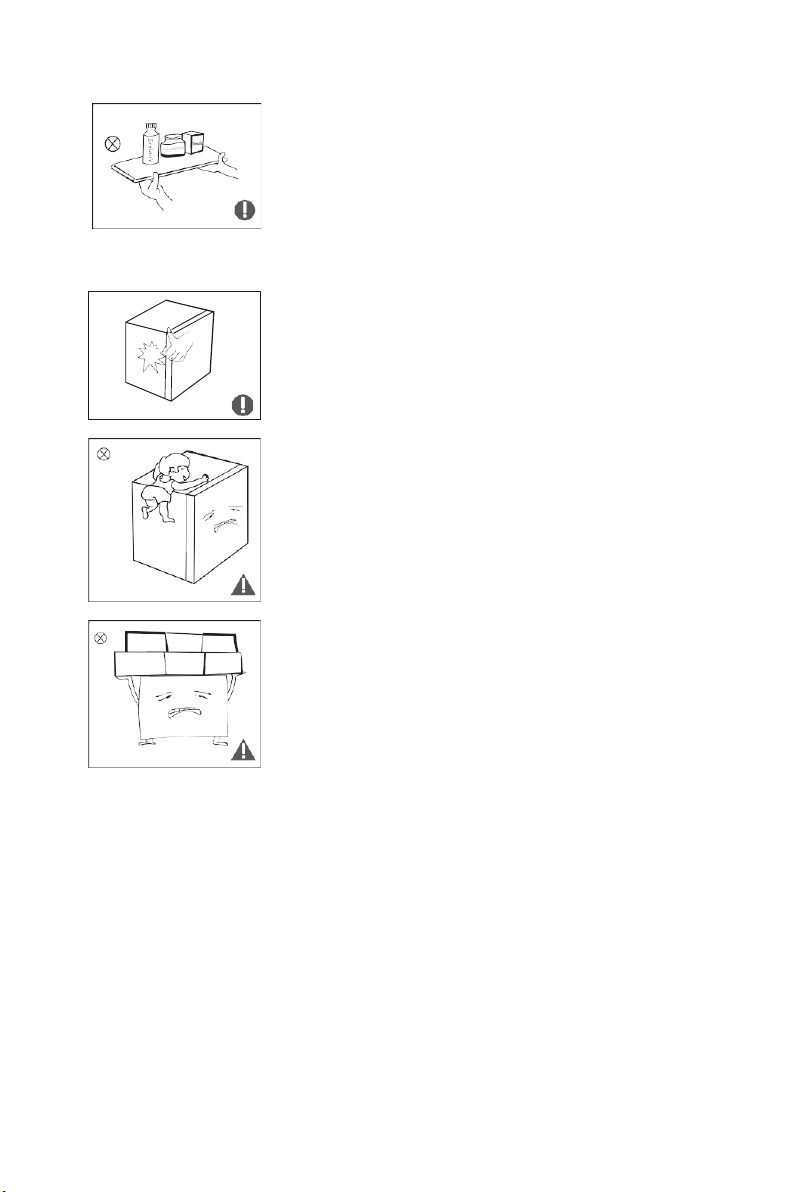
⚫ Do not pull the power cord when pulling the power plug of the cooler.
Please firm grasp the plug and pull out it from the socket directly.
⚫ Do not damage the power cord under any condition so as to ensure
safety use. Do not use when the power cord is damaged, or the plug is
worn.
⚫ Any worn or damaged power cord must be replaced in a manufacturer-
authorized maintenance location.
⚫ The power cord should be firmly in contact with the socket or else fires
might be caused. Please ensure that the grounding electrode of the
power socket is equipped with a reliable grounding line.
.
⚫ Please turn off the valve of the leaking gas and then open the doors and
windows in case of leakage of gas and other flammable gases. Do not
unplug the cooler or any other electrical appliances considering that a
spark may cause a fire.
⚫ To ensure safety, it is not recommended to place sockets, regulators,
rice cookers, microwave ovens or other appliances at the top of the
cooler, those recommended by the manufacturer are not included. Do
not use electrical appliances in the food pantry.
17
1.4 Use related warnings
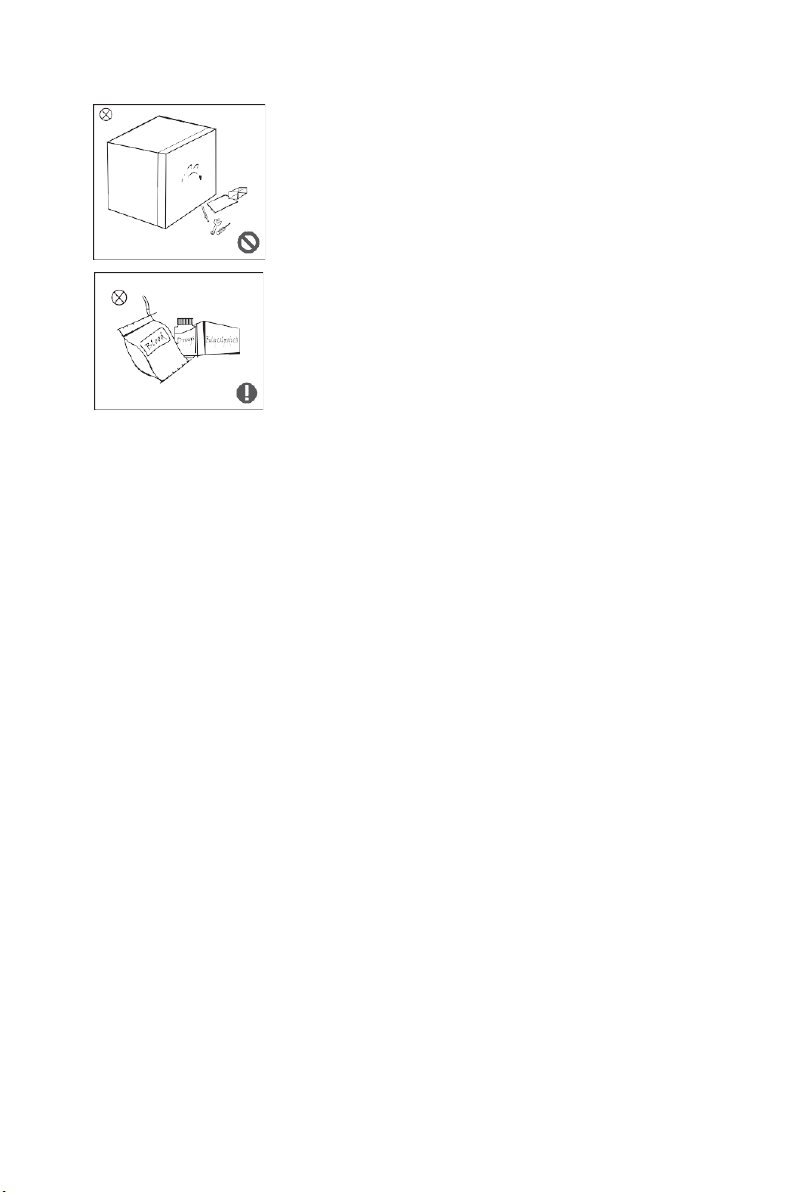
⚫ Do not arbitrarily disassemble or reconstruct the cooler, not damage
the refrigerant circuit; maintenance of the appliance must be conducted
by a specialist.
⚫ Damaged power cords must be replaced by the manufacturer, its
maintenance department, or related professionals in order to avoid
danger.
⚫ The gaps between cooler door and cooler body are small, do not put your
hand in these areas to prevent from squeezing the fingers. Please be
gentle when closing or opening the cooler door to avoid falling articles.
⚫ Do not give the package and other components to children to play. The
bending board and plastic film may lead to suffocation! Do not allow
children to enter or climb the cooler to prevent children from being trapped
inside the cooler or injuries from a falling cooler.
⚫ Do not spray or wash the cooler; do not put the cooler in moist places
where it is easy to be splashed with water so as not to affect the electrical
insulation properties of the cooler.
⚫ Do not use cooler body, cooler door, etc., as pedal or support.
⚫ Do not place heavy objects on top of the cooler considering that objects
may fall when opening or closing the door, and accidental injuries might
be caused.
⚫ Please pull out of the plug in case of power failure or cleaning. Do not
connect the cooler to the power supply within five minutes to prevent
damages to the compressor.
18
1.5 Warnings related to placing items
⚫ Do not put flammable, explosive, volatile or highly corrosive items in the
cooler to prevent damages to the product or fire accidents.
⚫ Do not place flammable items near the cooler to avoid fires.
.
⚫ This product is a household cooler and this equipment can only be
used for the storage of wine. According to the standard requirements,
household coolers shall not be used for other purposes, such as
storage of blood, drugs or biological products.
.
1.6 Warnings for energy
1) The cooler might not operate consistently when placed for an extended period of time
below the cold end of the range of temperature for which the cooler appliance is
designed.
2) Do not exceed the storage time(s) recommended by the wine manufacturers for any
kind of wine.
3) Take the precautions necessary to prevent an undue rise in the temperature of the
wine while defrosting the cooler.
4) A rise in temperature of the wine during manual defrosting, maintenance or cleaning,
could shorten the wine storage life.
5) For refrigerators with doors or lids fitted with locks and keys, the keys must be kept out of the
reach of children and not in the vicinity of the cooler appliance, in order to prevent children from
being locked inside.

19
1.7 Warnings related to disposal
Refrigerant and cyclopentane foaming material used for the cooler are flammable. Therefore, when the
cooler is scrapped, it must be kept away from any fire source and be recovered by a special recovering
company with corresponding qualification other than be disposed by combustion, so as to prevent
damage to the environment or any other harm.
When the cooler is scrapped, disassemble the doors, and remove gasket of door and shelves; put
the doors and shelves in a proper place, so as to prevent trapping of any child.
Correct disposal of this product:
This marking indicates that this product should not be disposed with other household waste. To prevent
possible harm to the environment or human health from uncontrolled waste disposal, recycle it responsibly
to promote the sustainable reuse of material resources. To return your used device, please use the local
return and collection systems or contact the retailer where the product was purchased. They can take this
product for environmentally safe recycling.
.

20
2.1 Names of components
(The picture above is only for reference. The actual configuration will depend on
the physical product or statement by the distributor.)
1. The temperature in the cooler is upper zone 41-54°F / 5-12°C, lower zone
54-64°F / 12-18°C, only used to store unopened bottled wine (red wine,
white wine, rose wine).
2. Do not place food in the cooler to prevent bacterial contamination.
3. Please keep the interior of the wine cabinet dry, please drink bottled wine
during the validity period.
2 Proper use of the cooler
Control box
Wooden shelf
Top shelf
Adjustable feet
Upper hinge
Handle
Door
Lower hinge
21
2.2 Temperature Control
(The picture above is only for reference. The actual configuration will depend on the
physical product or statement by the distributor.)
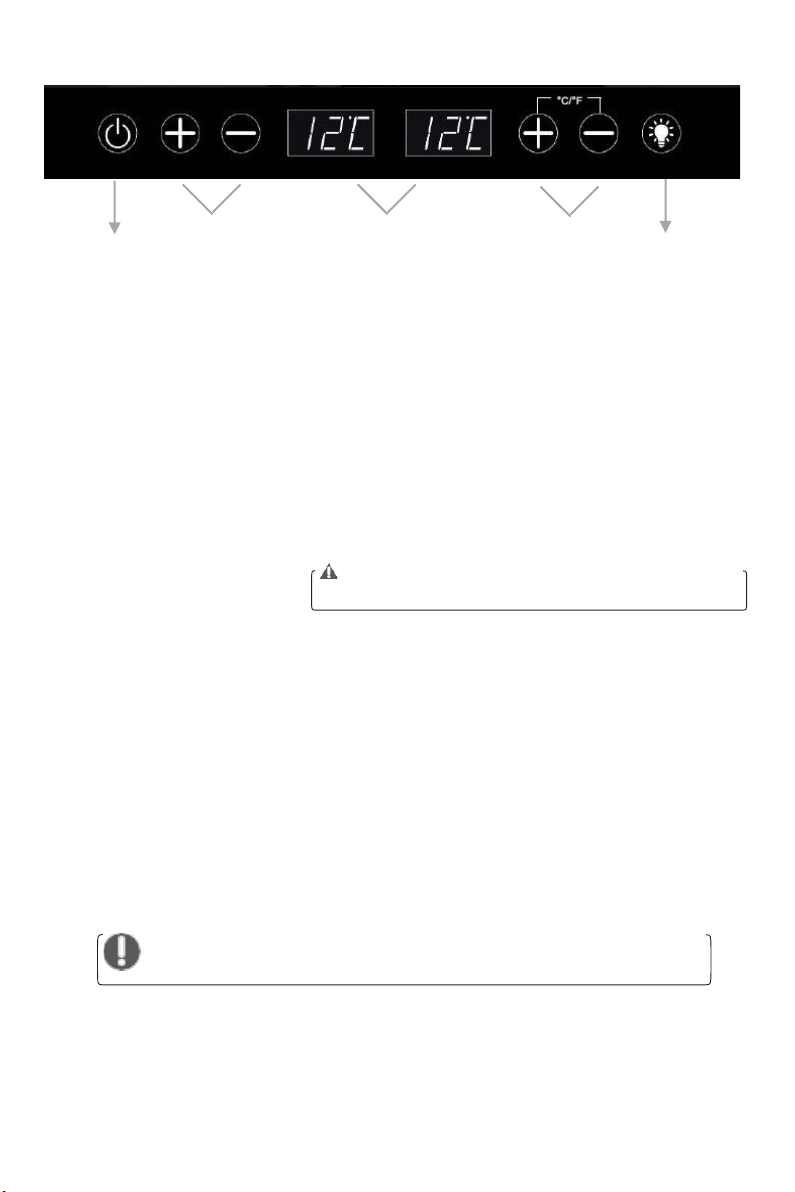
Control Panel
1. Power button: press and hold this button for 3 seconds to turn the appliance on or off.
2. Up and down buttons:
⚫ To set upper zone temperature
⚫ Use to set the desired temperature. Each press will increase or decrease the set temperature in
1° increments.
3. Display: shows the set temperature
4. Up and down buttons:
⚫ To set lower zone temperature
⚫ Use to set the desired temperature. Each press will increase or decrease the set temperature in
1° increments.
⚫ Press the up and down buttons at the same time to change temperature scale between Celsius
and Fahrenheit.
5. Light button: press to turn the interior light on or off.
Setting range of the Celsius temperature:upper zone 5-12°C, lower zone
12-18°C; setting range of the Fahrenheit temperature: upper zone 41-
54°F, lower zone 54-64°F
Memory Function
The cooler has the power off memory function. After power on again, the cooler will run according to the setting before the
power-off.
Defrosting
This appliance requires no manual defrosting. During the operation of the compressor, ice will build up on the evaporator
plate which is at the back of inner cabinet. During the compressor’s off-cycle, the ice will melt, drip down, and collect in a
tray above the compressor, where the compressor’s heat evaporates the water. If you notice excessive ice build-up on the
evaporator, try setting the temperature slightly higher. Also, be sure that the door gasket is sealing well.
If the unit is unplugged, or power is lost or turned off, you must wait 3 to 5 minutes
before restarting the unit. If you attempt to restart before this time delay, the unit
will not start. When you use the unit for the first time or restart the unit after it has
been shut off for a long time, there could be a few degrees variance between the
temperature you select and the one indicated on the LED readout. This is normal
and is due to the length of the activation time. There should not be a problem
once the unit has been running for a few hours.
d
e
g
f
h

22
2.3 Placement
2.4 Start to use
Before using the cooler,
remove all packing materials
including bottom cushions
and foam and tapes inside
the cooler, tear off the
protective film on the door
and the cooler body.
.
Avoid direct sunlight and heat
sources such as stove, heating
radiator, etc.
.
The cooler is placed in a
well-ventilated indoor
place; the ground shall
be flat, and sturdy
(rotate left or right to
adjust the feet for
leveling if unstable).
.
The top space of the
cooler shall be greater
than 30cm, and the
distances from both sides
and backside shall be
more than 10cm to
facilitate heat dissipation.
⚫ The cooler shall stay for 2 hours before connecting power when it is initially
started.
⚫ Clean up the inner chamber before putting into use the first time.
⚫ Do not connect the cooler to an electronic energy saving plug and converter
that can convert DC into AC (E.g.: solar energy system, ship grid).
⚫ Water drop or frost will be generated on the back side of cooler when the
compressor is running. Wiping out frost or water drop is not needed as the
back will wipe them out automatically. The defrosted water will be collected
into a drain tank, then inflow into the water disposal pan above the
compressor and vaporized.
2.5 Bottle arrangement
⚫ Do not let bottles touch the back side of cooler in order to maintain good air circulation in the cooler.
⚫ The bottle number shown here may be different from bottles in different shape and size.
⚫ The capacity for bottle storage in the wine cabinet is based on the following marked bottle size. Oversize
bottles may have impact on the cooler capacity.
(The picture above is only for reference. The actual configuration will depend on the
physical product or statement by the distributor.)
23
2.6 Practical skill for wine storage
2.6.1 Do not store bottled wine inside the box or case in the refrigerator.
2.6.2 The cork of the bottle shall always be in contact with the wine when putting it into the cooler. Air space is not allowed
between wine and cork.
2.6.3 Open-type bottle shelf is helpful, as it does not cut off air circulation. The air moisture that condensed on bottle can be
dried out swiftly.
2.6.4 The wine shall be removed from the cooler before drinking: put pink wine on the table 2-5 hours before drinking and red
wine 4-5 hours, so they can reach their suitable serving temperature. White wine, on the contrary, can be served right on
the table. Champagne shall always be stored in the cooler and taken out just before drinking.
2.6.5 Please notice that wine’s temperature is always lower than ideal serving temp, as the temperature will immediately rise 1
to 2°C when pouring into the tumbler.
2.7 Serving temperature
The wine’s taste depends on the right pouring temperature; therefore, it determines its flavor.
We suggest the wine’s temperature reaching the following degree when pouring:
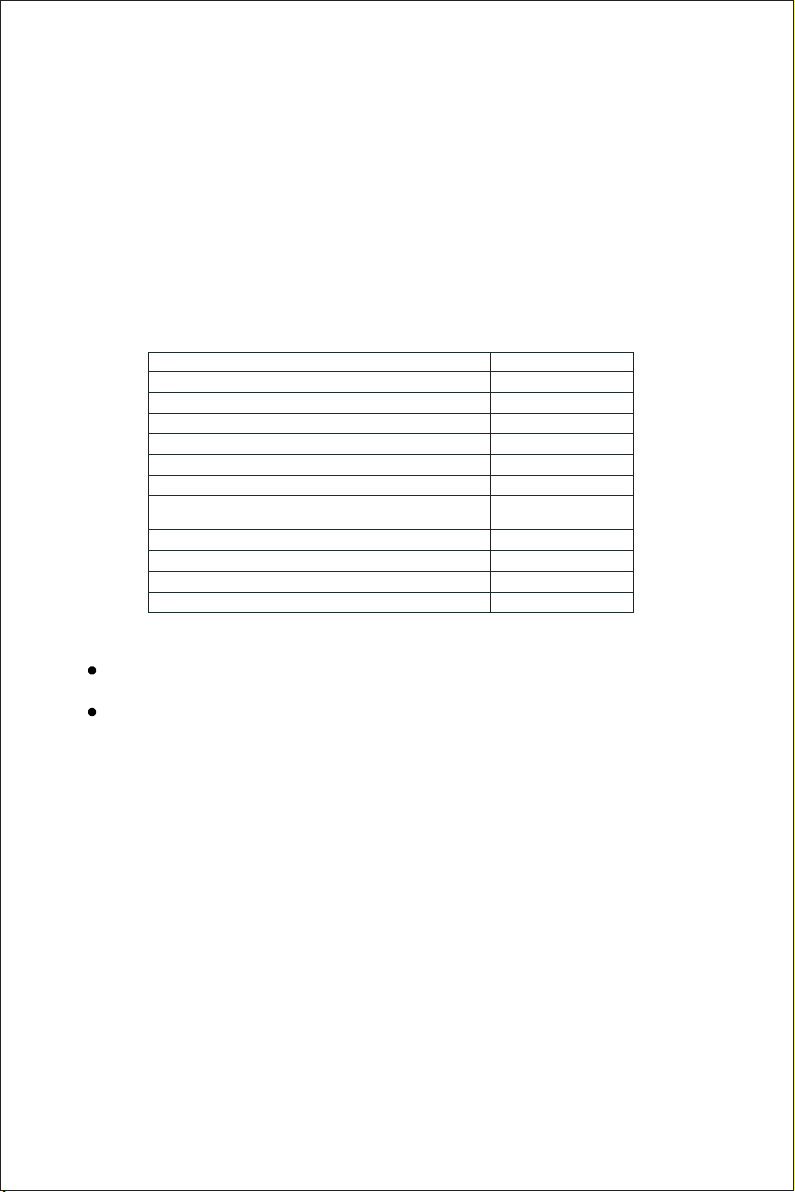
Wine Kind
Serving Temp
Bordeaux red
18°C
Louis Family dry wine/Barolo
17°C
Burgundy red/Bordeaux red
16°C
Port
15°C
Young Burgundy red
14°C
Young red wine
12°C
Young Beaujolais/all white wines
with little residual sugar
11°C
Old white wines/Chardonnay
10°C
Sherry
9°C
Young white wines from late vintage
8°C
White wines Loire/Entre-deux-Mers
7°C
2.8 Energy saving tips
The cooler shall be placed in a dry and ventilated room. The cooler cannot be put under direct
sunlight or next to heat sources (such as radiator, stove, etc.). A suitable insulation board shall be
applied if necessary.
Try to shorten opening time of cooler’s door.

24
3 Maintenance of the cooler
3.1 Disconnect the cooler
Unplug power plug to disconnect the cooler.
3.2 Stop using the cooler
If the cooler not going to be used for a long time, please:
1 - Unplug the cooler.
2 - Clean the cooler.
3 - Keep the cooler door open.
3.3
Clean the cooler
⚫ Dust behind the cooler and on the ground shall be timely
cleaned to improve the cooling effect and for energy
saving.
⚫ Check the door gasket regularly to make sure there are
no debris. Clean the door gasket with a soft cloth
dampened with soapy water or diluted detergent.
⚫ The interior of the cooler should be cleaned regularly to
avoid odors.
⚫ Please turn off the power before cleaning, remove drinks, shelves, etc.
⚫ Use a soft cloth or sponge to clean the inside of the cooler, with two tablespoons
of baking soda and a quart of warm water. Then rinse with water and dry with a
soft cloth. After cleaning, open the door and let it dry naturally before turning on
the power.
⚫ For areas that are difficult to clean in the cooler (such as narrow places, gaps or
corners), it is recommended to wipe them regularly with a soft rag, soft brush,
etc. and when necessary, combined with some auxiliary tools (such as thin
sticks) to ensure no contaminants or bacterial accumulation in these areas.
⚫ Do not use soap, detergent, scrub powder, spray cleaner, etc., as these may
cause odors in the interior of the cooler or contaminate food.
⚫ Clean the shelves with a soft cloth dampened with soapy water or diluted
detergent. Then rinse with water and dry with a soft cloth or dry naturally.
⚫ Wipe the outer surface of the cooler with a soft cloth that has been wrung out,
and dry naturally, etc., and then wipe dry. Do not rub or scratch the surface of
the glass door to prevent the door from being broken or scratched.
⚫ Do not use hard brushes, clean steel balls, wire brushes, abrasives (such as
toothpastes), organic solvents (such as alcohol, acetone, banana oil, etc.),
boiling water, acid, or alkaline items, which may damage the cooler surface and
interior. Boiling water and organic solvents such as benzene may deform or
damage plastic parts.
⚫ Do not rinse directly with water or other liquids during cleaning to avoid short
circuits or affect electrical insulation after immersion. Water should not soak the
operating control elements and lighting system on the glass door.
Notice:
Do not use detergent or solvent with sand or acid.
25
4 Trouble shooting
Appliance is not
running
Appliance is not cold
enough
The compressor
starts and stops
frequently
LED lights do not
operate
Vibration
The appliance makes
a lot of noise
The door does
not close
properly
Appliance is not plugged in.
Appliance is not turned on.
Check the voltage of the installation.
Check if the circuit breaker or the fuse has blown.
Check the temperature control setting.
Check if ambient temperature is beyond appliance
operating temperature.
The door is opened too frequently.
The door is not closed properly.
The door is not sealing properly.
Insufficient free space around the appliance.
The external temperature is high.
A large quantity of bottles has recently been put into
the cooler.
The appliance is opened frequently.
The door is not properly closed.
The cooler has not been correctly set.
The appliance is not plugged in.
The fuse has blown.
LED lights are broken.
The light switch is off.
Ensure that the appliance is level.
The ratting noise may come from the flow of the
refrigerant, which is normal.
At the end of a cooling cycle, you can hear the noise of
water circulating.
Expansion and contraction of the internal walls may cause
a cracking sound.
The appliance is not level.
Check if fan is in good condition.
The appliance is not level.
The door seal is dirty or damaged.
The shelves are not positioned correctly.
A part of the contents is preventing the door from
closing,
26