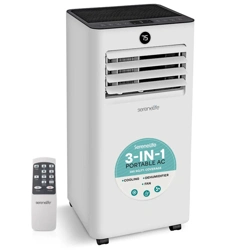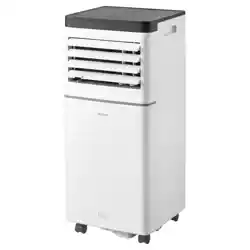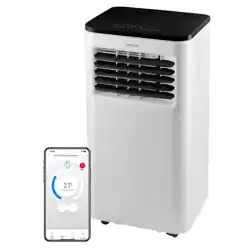

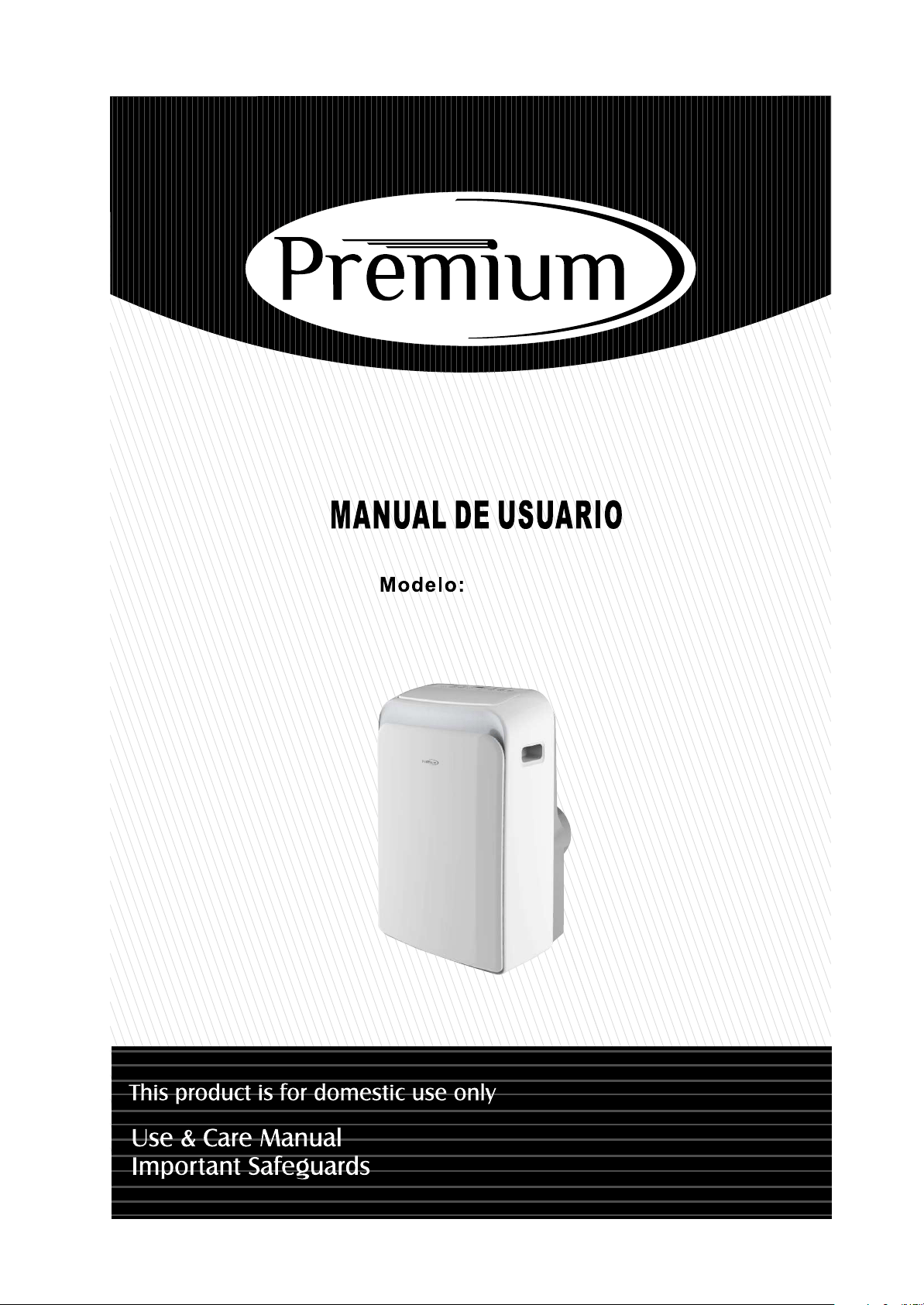
PPA1210M
AIR CONDITIONER PORTABLE
Inside you will find many helpful hints on how to use and maintain your air conditioner
properly. Just a little preventive care on your part can save you a great deal of time
and money over the life of your air conditioner. You'll find many answers to common
problems in the chart of troubleshooting tips. If you review o ur c hart o f T roubleshooting
Tips first, you may not need to call for service at all.
Read This Manual
CAUTION
This appliance can be used by children aged from 8 years and above and persons
with reduced physical, sensory or mental capabilities or lack of experience and
knowledge if they have been given supervision or instruction concerning use of the
appliance in a safe way and understand the hazards involved. Children shall not play
the appliance. Cleaning and user maintenance shall not be made by children without
supervision. ( be applicable for the European Countries )
This appliance is not intended for use by persons (including children) with reduced
physical ,sensory or mental capabilities or lack of experience and knowledge, unless
they have been given supervision or instruction concerning use of the appliance by a
person responsible for their safety. (be applicable for other countries except the
European Countries )
Children should be supervised to ensure that they do not play with the appliance.
If the supply cord is damaged, it must be replaced by the manufacturer, its service
agent or similarly qualified persons in order to avoid a hazard.
The appliance shall be installed in accordance with national wiring regulations.
Do not operate your air conditioner in a wet room such as a bathroom or laundry room.
The appliance with electric heater shall have at l east 1 m eter s pace t o t he c ombustible
materials.
Contact the authorised service technician for repair or maintenance of this unit.
Contact the authorised installer for installation of this unit.
!
CONTENTS
SOCIABLE REMARK
Sociable remark..................................................................................................................................2
1
SAFETY PRECAUTIONS
Safety rules .......................................................................................................................................3
Operating condition ...........................................................................................................................3
Electrical information .........................................................................................................................4
Accessories .......................................................................................................................................4
Names of parts...................................................................................................................................5
Electronic control operating instructions ...........................................................................................6
Operating instructions .......................................................................................................................7
Location ............................................................................................................................................9
Window kit installation ......................................................................................................................9
Exhaust hose installation ................................................................................................................12
Water drainage ................................................................................................................................13
Care and maintenance ....................................................................................................................14
Trouble shooting ..............................................................................................................................15
AIR CONDITIONER FEATURES
CARE AND MAINTENANCE
TROUBLESHOOTING TIPS
OPERATING INSTRUCTIONS
INSTALLATION INSTRUCTIONS
IDENTIFICATION OF PARTS
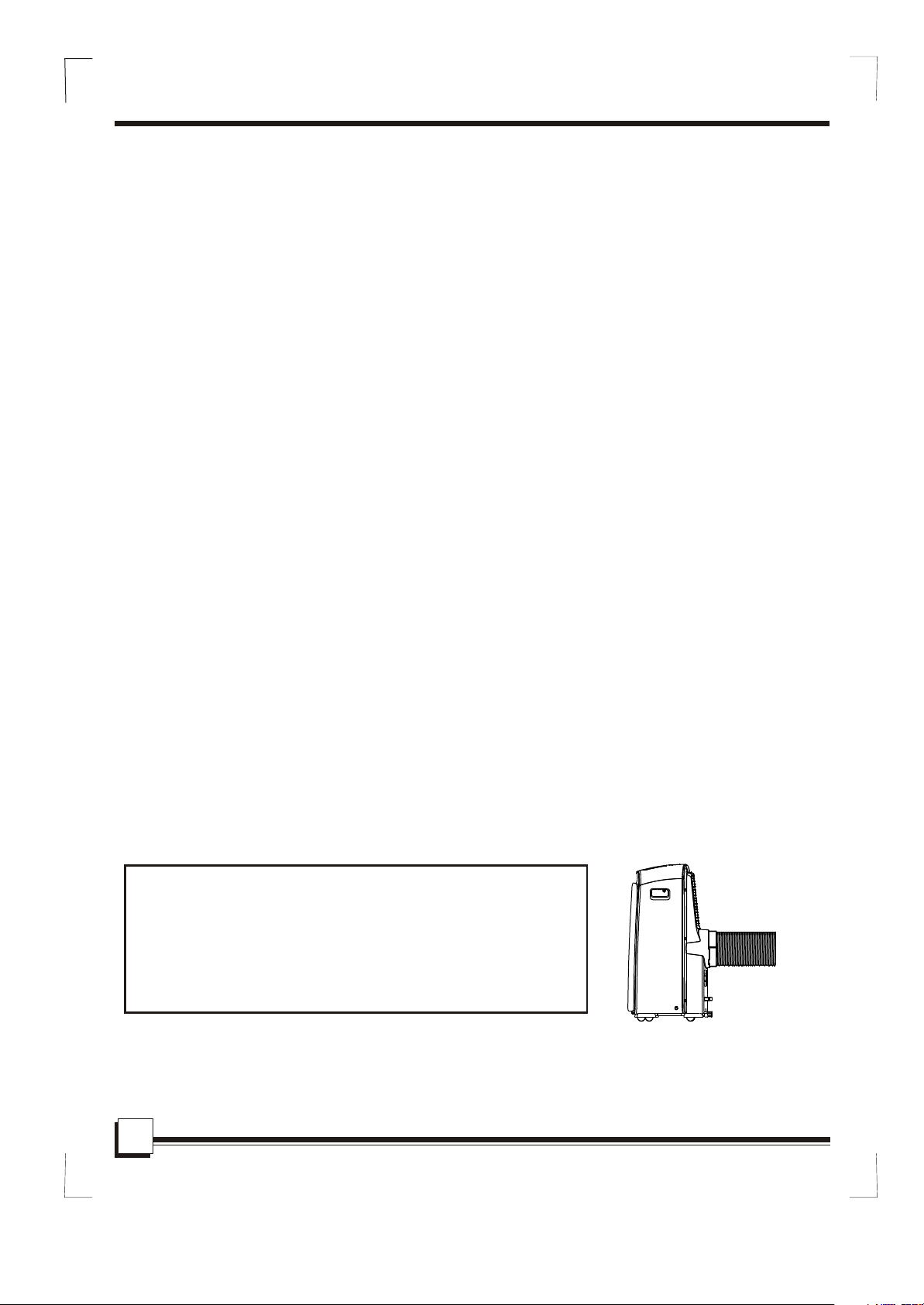
The rating data indicated on the energy label is based
on the testing condition of installing the un-extended
air exhaust duct without adaptor A & B (The duct and
the adaptor A & B are listed in the accessories chart
of the Instruction Manual). See the right figure.
NOTE
SOCIABLE REMARK
DISPOSAL: Do not dispose this product as unsorted municipal waste. Collection of
such waste separately for special treatment is necessary.
It is prohibited to dispose of this appliance in domestic household waste.
For disposal, there are several possibilities:
A) The municipality has established collection systems, where electronic waste can be
disposed of at least free of charge to the user.
B) When buying a new product, the retailer will take back the old product at least free
of charge.
C) The manufacture will take back the old appliance for disposal at least free of charge
to the user.
D) As old products contain valuable resources, they can be sold to scrap metal dealers.
Wild disposal of waste in forests and landscapes endangers your health when
hazardous substances leak into the ground-water and find their way into the food chain.
2
When using this air conditioner in the European countries, the following informa-
tion must be followed:
CAUTION:
This appliance is not intended for use by persons (including children) with
reduced physical,sensory or mental capabilities, or lack of experience and
knowledge, unless they have been given supervision or instruction concerning
use of the appliance by a person responsible for their safety.
Children should be supervised to ensure that they do not play with the appliance.
3
To prevent injury to the user or other people and property damage, the following instructions must be
followed. Incorrect operation due to ignoring of instructions may cause harm or damage.
Your air conditioner should be used in such a way
that it is protected from moisture. e.g. condensation,
splashed water, etc. Do not place or store your air
conditioner where it can fall or be pulled into water
or any other liquid. Unplug immediately.
Always transport your air conditioner in a vertical
position and stand on a stable, level surface during
use.
Turn off the product when not in use.
Always contact a qualified person to carry out
repairs. If the supply cord is damaged it must be
repaired by a qualified repairer.
Keep an air path of at least 30cm all around the
unit from walls, furniture and curtains.
If the air conditioner is knocked over during use,
turn off the unit and unplug from the mains supply
immediately.
SAFETY PRECAUTIONS
!
Always do this
Do not operate your air conditioner in a wet room
such as a bathroom or laundry room.
Do not touch the unit with wet or damp hands or
when barefoot.
Do not press the buttons on the control panel with
anything other than your fingers.
Do not remove any fixed covers. Never use this
appliance if it is not working properly, or if it has
been dropped or damaged.
Never use the plug to start and stop the unit.
Always use the switch on the control panel.
Do not cover or obsturct the inlet or outlet grilles.
Do not use hazardous chemicals to clean or come
into contact with the unit. Do not use the unit in the
presence of inflammable substances or vapour such
as alcohol, insecticides, petrol,etc.
Do not allow children to operate the unit
unsupervised.
Do not use this product for functions other than
those described in this instruction manual.
Never do this
Energy Save
Use the unit in the recommended room size.
Locate the unit where furniture cannot obstruct the air flow.
Keep blinds/curtains closed during the sunniest part of the day.
Keep the filters clean.
Keep doors and windows closed to keep cool air in and warm air out.
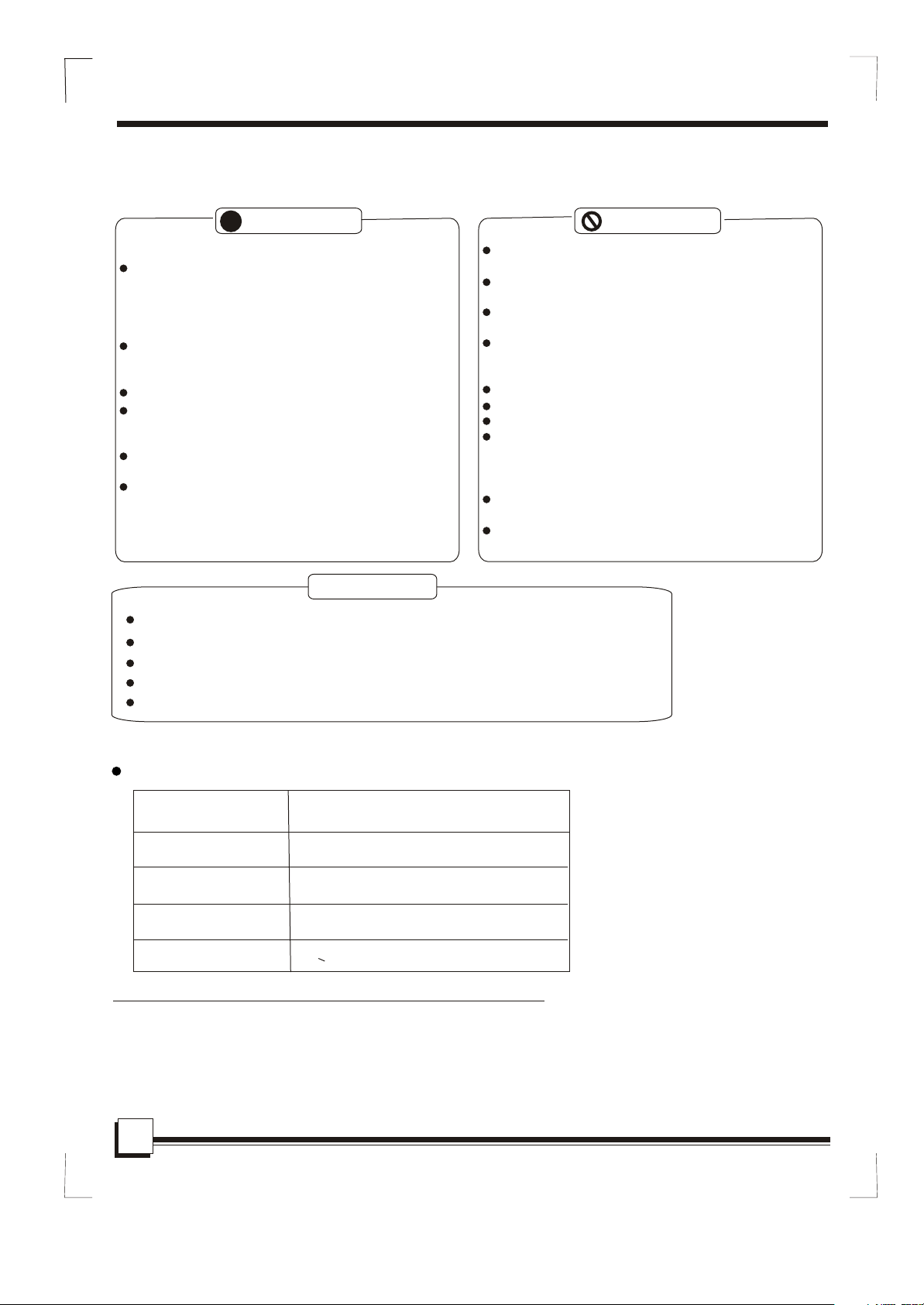
The air conditioner must be operated within the temperature range indicated below:
Operating condition
Safety rules
Suggested tools for window kit installation
1. Screwdriver(medium size Phillips)
2. Tape measure or ruler
3. Knife or scissors
4. Saw(In the event that the window kit needs to be cut down in size because
the window is too narrow for direct installation)
MODE ROOM TEMPERATURE
COOL
DRY
OO OO
17 C(62 F)~35 C(95 F)
OO OO
13 C(55 F)~35 C(95 F)
HEAT(heat pump type)
OO OO
5 C(41 F)~30 C(88 F)
HEAT(electrical heat type)
OO
<30 C/88 F
4
Be sure the electrical service is adequate for the model you have chosen. This information can be found
on the serial plate, which is located on the side of the cabinet and behind the grille.
Be sure the air conditioner is properly grounded. To minimize shock and fire hazards, proper grounding is
important. The power cord is equipped with a three-prong grounding plug for protection against shock
hazards.
Your air conditioner must be used in a properly grounded wall receptacle. If the wall receptacle you intend
to use is not adequately grounded or protected by a time delay fuse or circuit breaker, have a qualified
electrician install the proper receptacle.
Ensure the receptacle is accessible after the unit installation.
WARNING
For your safety
Do not store or use gasoline or other flammable vapors and liquids in the vicinity of this or any other
appliance.
Avoid fire hazard or electric shock. Do not use an extension cord or an adaptor plug. Do not remove
any prong from the power cord.
WARNING
Electrical Information
IDENTIFICATION OF PARTS
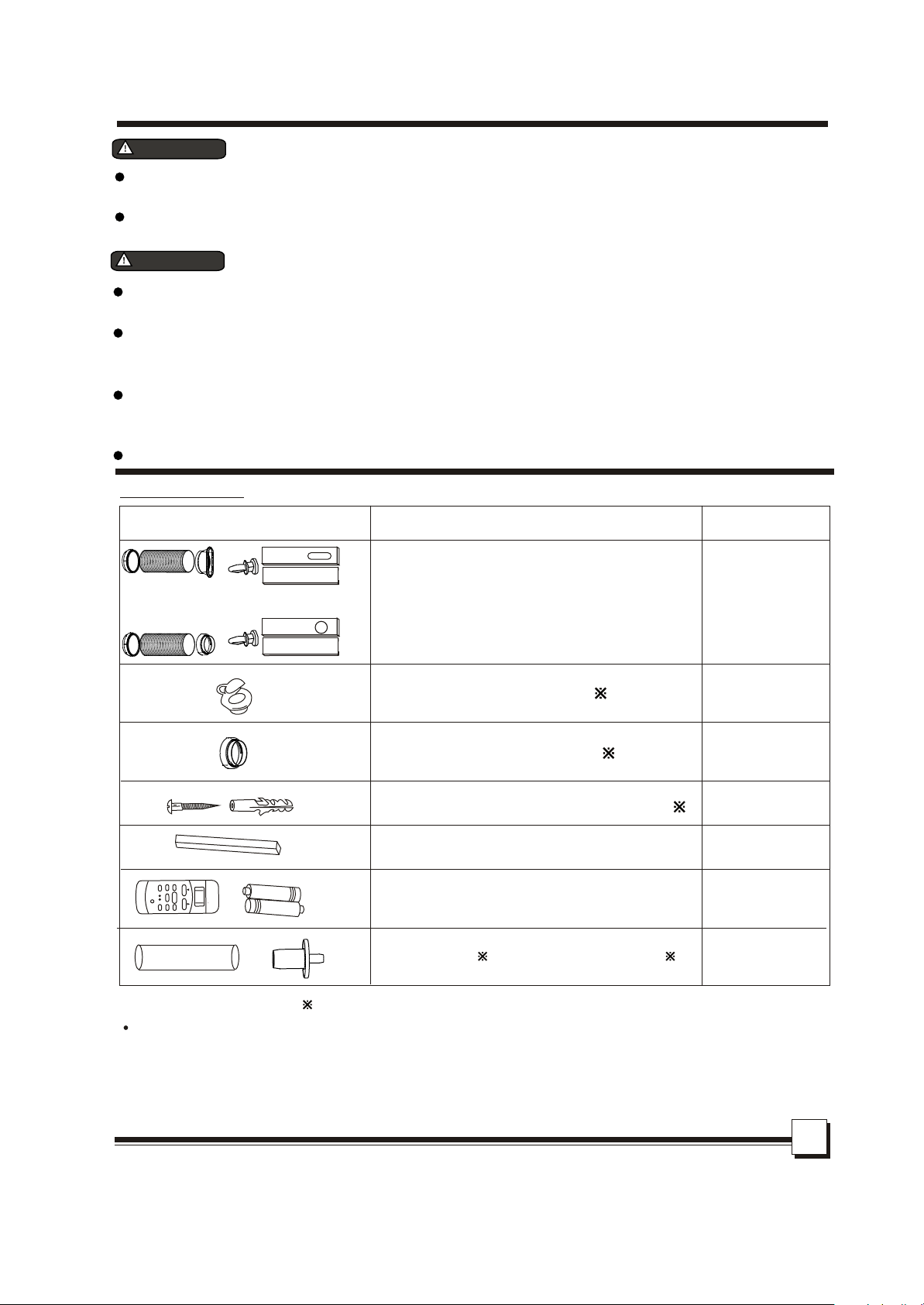
Accessories
Check all the accessories are included in the package and please refer to the installation instructions for
their usage.
PARTS :
PARTS NAME :
Exhaust hose and ApaptorI and Adaptor B
(flat mouth or round mouth :depending on models)
Wall Exhaust Adaptor A( )
Adaptor B(round mouth)( )
Expansion Plug and wooden screw( )
QUANTITY :
1 set
1 pc
1 pc
4/ pc
Window Slider Kit and bolt
Foam seal
3/pc
NOTE: Optional parts( ), some models without.
or
TEMP
AUTO
COOL
DRY
HEAT
FAN
HIGH
MED
LOW
MODE
FA
N SPEED
SWING
TIMER ON
ECONOMY
ON/O
FF
TIMER OFF
RESE
T LOCK
SET TEMPERATURE(
)
F
LED
DISPLAY
ION
Remote Controller and Battery
(For remote control models only)
1pc
Drain hose( ) and drain hose adaptor( )
1pc
All the illustrations in this manual are for explanation purpose only. Your air conditioner
may be slightly different. The actual shape shall prevail.
NOTE:
IDENTIFICATION OF PARTS
5
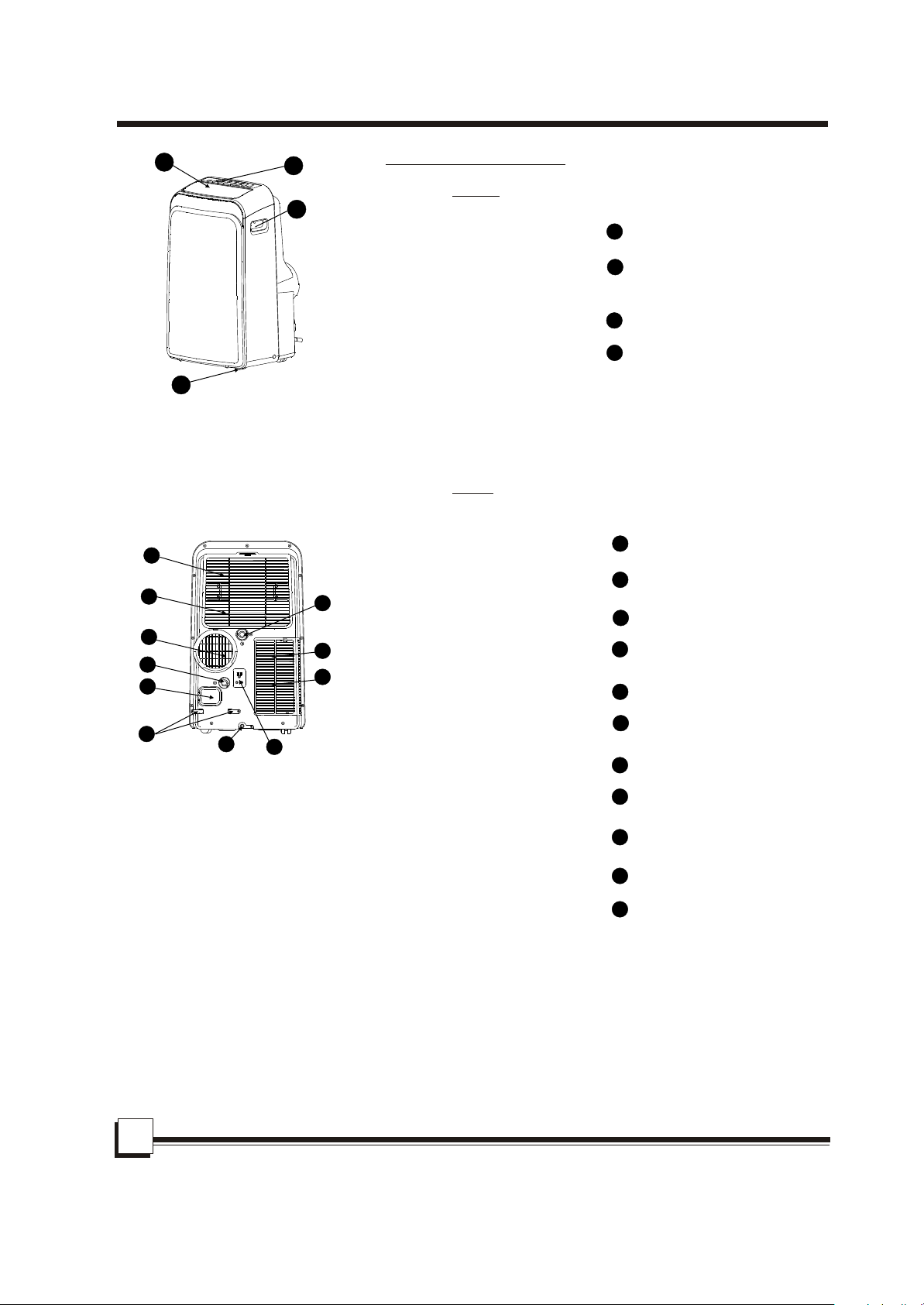
NAMES OF PARTS
Front
Rear
Operation panel
Horizontal louver blade
(swing automatically)
Caster
Carrying handle
(both sides)
3
1
2
3
4
6
7
8
9
10
11
Upper air intake
12
Fig.1
13
1
2
4
Fig.2
5
7
9
8
15
14
13
12
5
Upper air filter
(Behind the grille)
6
10
11
Air outlet
Drain outlet (only for Pump
heating model)
Power cord outlet
Power cord buckle (Used
only when storing the unit)
Bottom tray drain outlet
Power plug socket (Use
only when storing the unit)
Lower air filter
(Behind the grille)
14
Lower air intake
15
Drain outlet
6
AIR CONDITIONER FEATURES
Before you begin, thoroughly familiarize yourself with the control panel and remote controller
and all its functions, then follow the symbol for the functions you desire.
The unit can be controlled by the unit control panel alone or with the remote controller .
ELECTRONIC CONTROL OPERATING INSTRUCTIONS
Fig.3
NOTE: This manual does not include Remote Controller Operations, see the <<Remote
Controller Instruction>> packed with the unit for details.
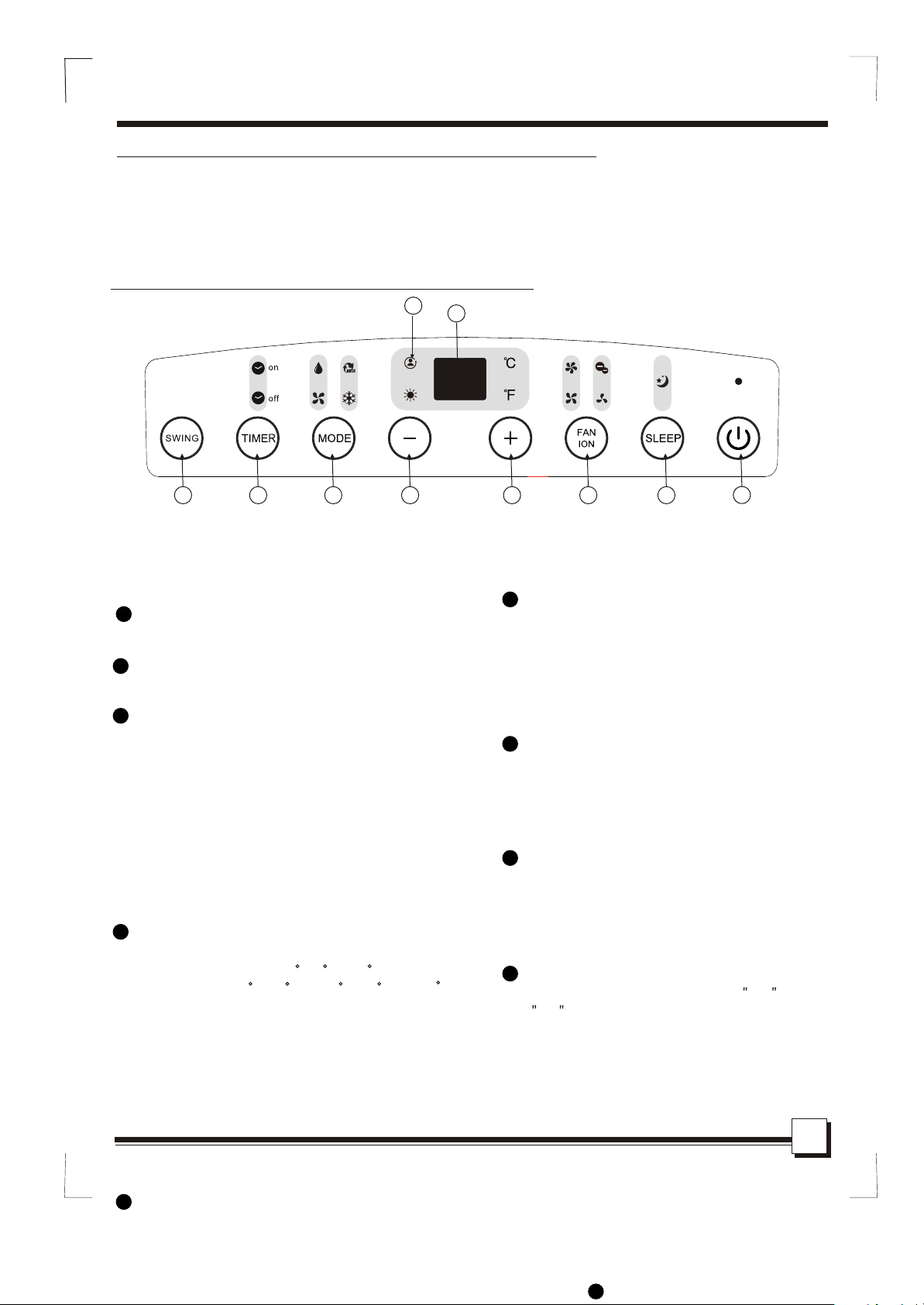
OPERATION PANEL OF THE AIR CONDITIONER
11
55
33
Used to initiate the SLEEP/ECO operation.
SLEEP/ECO button
Control the fan speed. Press to select the fan
speed in four steps-LOW, MED, HI and AUTO.
The fan speed indicator light illuminates under
different fan settings except AUTO speed. When
select AUTO fan speed, all the fan indicator lights
turn dark.
NOTE: Press this button for 3 seconds to initiate
ION feature.T
he ion generator is energized and will
help to remove pollen and impur ities from the air, and
trap them in the filter. Press it for 3 seconds again to
stop the ION feature.
FAN/ION button
11
22334444556677
88
(Optional)
99
(Optional)
(ION is Optional)
11
Selects the appropriate operating mode.
Each time you press the button, a mode
is selected in a sequence that goes from
AUTO, COOL, DRY, FAN and HEAT(cooling
only models without). The mode indicator
light illuminates under the different mode
settings.
MODE select button
Power switch on/off.
POWER button
22
66
TIMER button
Used to initiate the AUTO ON start time and
AUTO OFF stop time program, in conjuction
with the & buttons. The timer on/off
indicator light illuminates under the timer
on/off settings.
+
-
77
SWING button
(Applicable to the models with auto swing feature only)
Used to initiate the Auto swing feature.
When the operation is ON, press the
SWING button can stop the louver at
the desired angle.
(ION is optional)
77
O
Shows the set temperature in C
or
O
F and the Auto-timer settings.
While on DRY and FAN modes, it shows
the room temperature.
LED Display
88
NOTE: On some models SLEEP button is instead of ECO button.
44
Used to adjust (increasing/decreasing)
temperatures ettingsin 1 C /2F( or 1 F) inc rements
in a range of 17 C/62 F to 30 C/88 F (or 86 F)
or the TIMER setting in a range of 0~24hrs.
UP( ) and DOWN( ) button
NOTE: The control is capable of displaying
temperature in degrees Fahrenheit or degrees
Celsius. To convert from one to the other, press
and hold the Up and Down buttons at the same
time, for 3 seconds.
+
-
The temperature display (Fahrenheit or Celsius) can be
changed by pressing down the UP and DOWN buttons
on control panel Simultaneously.
7
OPERATING INSTRUCTIONS
Operating Instructions
- Press the "MODE" button until the "COOL"
indicator light comes on.
- Press the ADJUST buttons "+" or " - " to
select your desired room temperature. The
temperature can be set within a range of
OOOO O
17 C-30 C/62 F-88 F (or 86 F).
- Press the "FAN SPEED" button to choose the
fan speed.
- Press the "MODE" button until the "DRY"
indicator light comes on.
- Under this mode, you cannot select a fan
speed or adjust the temperature. The fan
motor operates at LOW speed.
- Keep windows and doors closed for the
best dehumidifying effect.
- Do not put the duct to window.
COOL operation
- Press the "MODE" button until the
"FAN " indicator light comes on.
- Press the "FAN SPEED" button to
choose the fan speed. The temperature
cannot be adjusted.
- Do not put the duct to window.
FAN operation
TIMER operation
- Press the "MODE" button until the "HEAT"
indicator light comes on.
- Press the ADJUST buttons "+" or " - " to
select your desired room temperature. The
temperature can be set within a range of
OOOO O
17 C-30 C/62 F-88 F (or 86 F).
- Press the "FAN SPEED" button to choose the
fan speed. For some models, the fan speed
can not be adjusted under HEAT mode.
HEAT operation(cooling only models without)
AUTO operation
- When you set the air conditioner in AUTO
mode, it will automatically select cooling,
heating(cooling only models without), or
fan only operation depending on what
temperature you have selected and the
room temperature.
- The air conditioner will control room
temperature automatically round the
temperature point set by you.
- Under AUTO mode, you can not
select the fan speed.
99
FOLLOW ME/TEMP SENSING feature(optional)
To activate the Follow Me/Temp Sensing
feature, point the remote control towards
the unit and press the Follow Me/Temp
Sensing button. T
If the unit does not receive
the Follow Me/Temp Sensing signal during
any 7 minutes interval, the unit will beep to
indicate the Follow Me/Temp Sensing mode
has ended.
he remote display is
actual temperature at its location. The
remote control will send this signal to the
air conditioner every 3 minutes interval
until press the Follow Me/Temp Sensing
button again.
NOTE:This feature can be activated from the
remote control ONLY. The remote control
servesas a remote thermostat allowing for the
precise temperature control at its location.
- When the unit is on, press the
Timer button will initiate the Auto-off
stop program, the TIMER OFF
indicator light illuminates. Press the
UP or down button to select the desired
time. Press the TIMER button again
within 5 seconds, the Auto-on start
program is initiated. And the TIMER
ON indicator light illuminates. Press
the up or down button to select the
desired Auto-on start time.
-
- Press or hold the UP or DOWN
button to change the Auto time by
0.5 hour increments, up to 10 hours,
then at 1 hour increments up to 24
hours. The control will count down
the time remaining until start.
- The system will automatically revert
back to display the previous temper-
ature setting if there is no operation
in a five seconds period.
When the unit is off, press the Timer
button to initiate the Auto-on start
program,press it again within five
seconds will initiate the Auto-off stop
program.
Error codes and protection code:
E1- Room temperature sensor error-
Unplug the unit and plug it back in.
If error repeats, call for service.
E2- Evaporator temperature sensor error-
Unplug the unit and plug it back in.
If error repeats, call for service.
E3- Condenser temperature sensor error-
Unplug the unit and plug it back in. If error
repeats, call for service (on some models).
E4- Display panel communication error-
Unplug the unit and plug it back in.
If error repeats, call for service.
P1- Bottom tray is full - Connect the
drain hose and drain the collected
water away. If protection repeats, call
for service.
8
OPERATING INSTRUCTIONS
Fig.4
Other features
After the unit has stopped, it can not be restarted
operation in the first 3 minutes. This is to protect
the unit. Operation will automatically start after
3 minutes.
Wait 3 minutes before resuming operation
If the unit breaks off unexpectedly due to the
power cut,it will restart with the previous
function setting automatically when the
power resumes.
Auto-Restart(on some models)
- Turning the unit ON or OFF at any
time or adjusting the timer setting
to 0.0 will cancel the Auto Start/
Stop timer program.
- When the malfunction (E1,E2,E3
or E4) occurs, the Auto Start/Stop
timed program will also be cancelled.
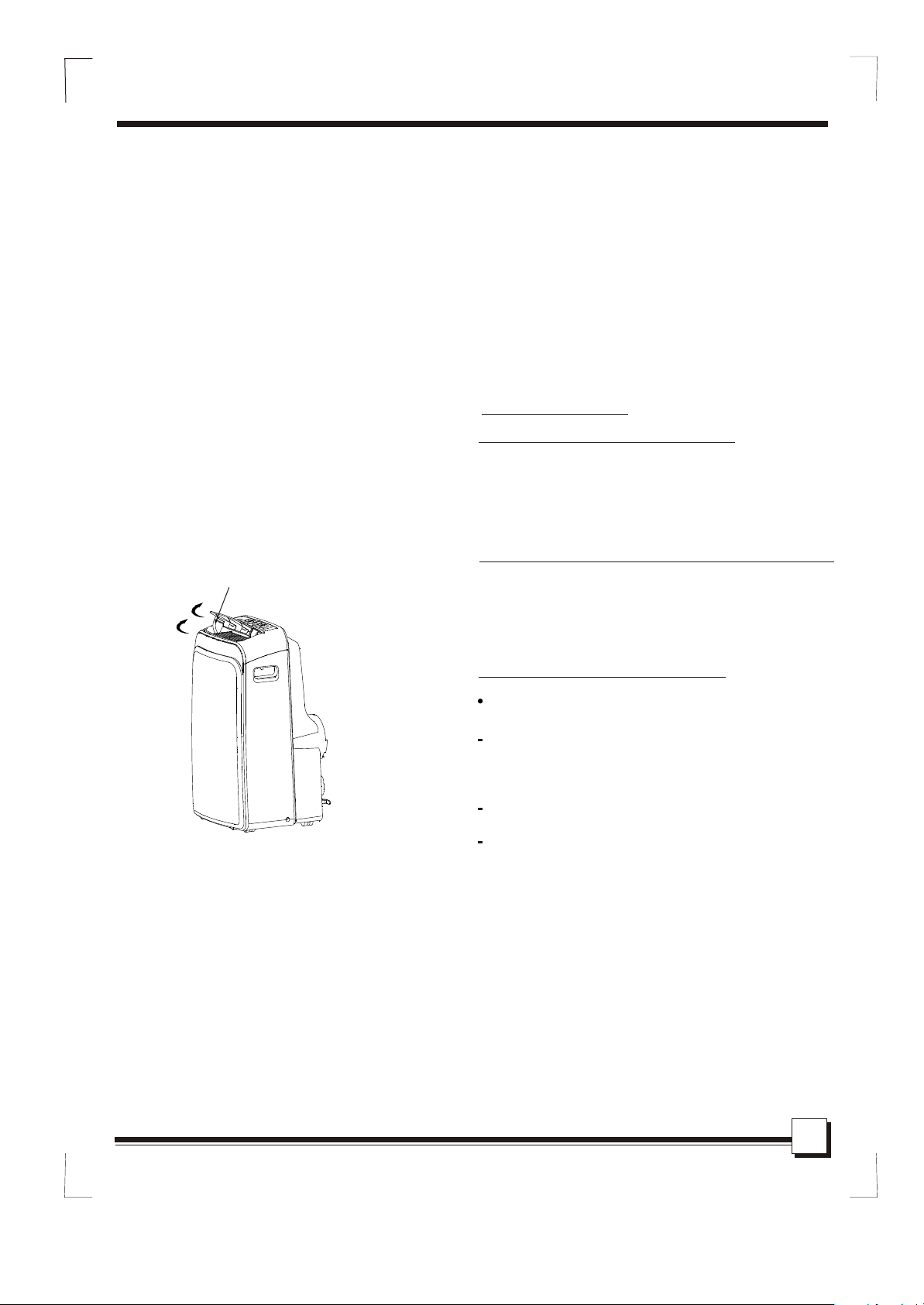
The louver can be adjusted automatically .
Adjust the air flow direction automatically
(Fig.4):
When the Power is ON, the louver opens fully.
Press the SWING button on the panel or
remote controller to initiate the Auto swing
feature.
The louver willl swing up and down
automatically.
Please do not adjust the louver manually.
Air flow direction adjustment
Swing automatically
SLEEP/ECO operation
Press this button, the selected temperature will
increase(cooling) or decrease(heating) by
OO O
1C/2 F(or 1 F) 30 minutes.The temperature will
then increase (cooling) or decrease (heating) by
OO O
another 1 C/2 F(or 1 F) after an additional 30
minutes. This new temperature will be maintained
for 7 hours before it returns to the originally
selected temperature. This ends the Sleep/Eco
mode and the unit will continue to operate as
originally programmed.
NOTE: This feature is unavailabe under FAN or
DRY mode.
INSTALLATION INSTRUCTIONS
Horizontal
window
Window Slider Kit
Minimum:67.5cm(2.22ft).
Maxmum:123cm(4.04ft).
Horizontal
window
Fig.6
Fig.7
Fig.5
Location
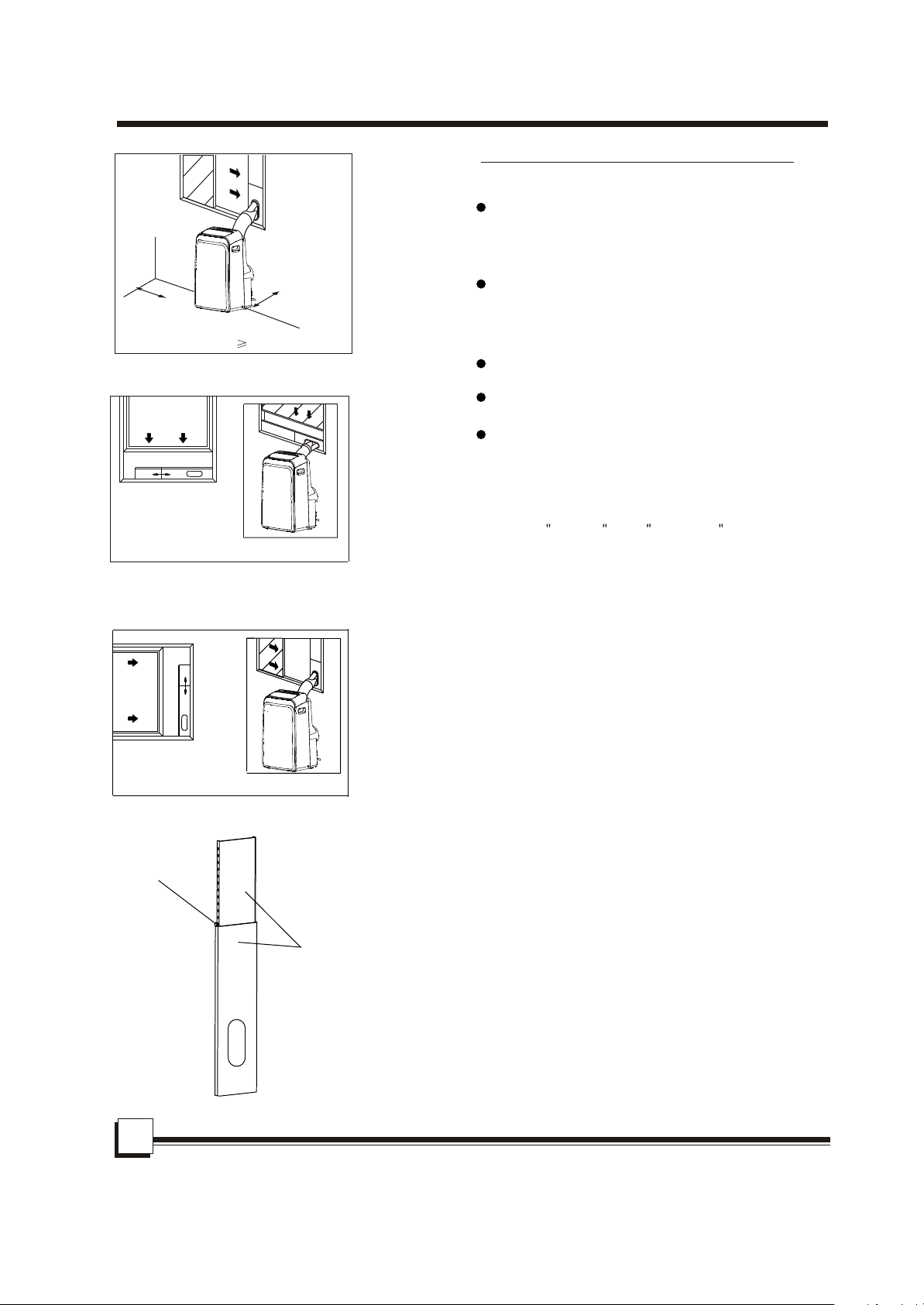
The air conditioner should be placed on a firm
foundation to minimize noise and virbration. For
safe and secure positioning, place the unit on a
smooth, level floor strong enough to support the unit.
The unit has casters to aid placement, but it should
only be rolled on smooth, flat surfaces. Use caution
when rolling on carpet surfaces. Do not attempt to
roll the unit over objects.
The unit must be placed within reach of a properly
rated grounded socket.
Never place any obstacles around the air inlet or
outlet of the unit.
Allow 30cm to 100cm of space from the wall with
for efficient air-conditioning.
Your window slider kit has been designed to fit most
standard Vertical and horizontal window
applications, However, it may be necessary for you to
improvise/modify some aspects of the installation
procedures for certain types of window. Please refer
to Fig. 6& Fig.7 for minimum and maximum window
openings.Window slider kit can be fixed with a bolt
(see Fig.7a).
Window slider kit Installation
Note: If the window opening is less than the mentioned
minimum length of the window slider kit, cut that one
with a hole in it short to fit for the window opening.
Do never cut out the hole in window slider kit.
B
A
INSTALLATION INSTRUCTIONS(optional)
9
bolt
Window slider kit
Fig.7a
A:30cm-100cm B: 30cm
Window Slider Kit
Minimum:67.5cm(2.22ft).
Maxmum:123cm(4.04ft).
INSTALLATION INSTRUCTIONS(optional)
10
Installation in a double-hung sash
window
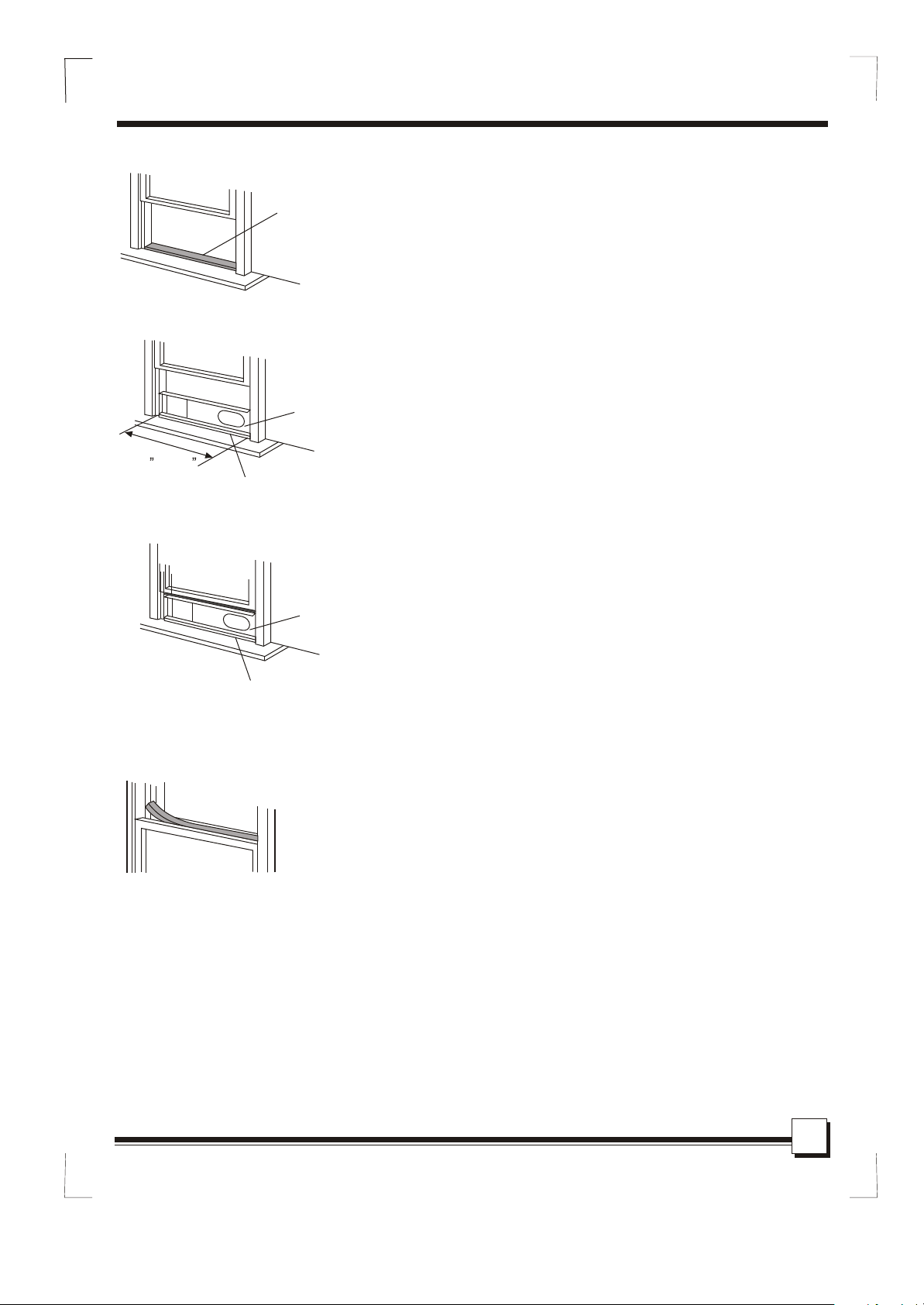
1. Cut the foam seal(adhesive type) to the proper length and
attach it to the window stool. Fig.8
2. Attach the window slider kit to the window stool. Adjust the
length of the window slider kit according to the width of
window, shorten the adjustable window kit if the width of
window is less than 26.5 inches
Open the window sash and place the window slider kit on
the window stool. Fig.9
3. Cut the foam seal(adhesive type) to the proper length
and attach it on the top of the window. Shown as in Fig.10
4. Close the window sash securely against the window.
5. Cut the foam seal to an appropriate length and seal the
open gap between the top window sash and outer window
sash. Shown as in Fig.11.
Foam seal A
(adhesive type)
Foam seal
Fig.8
Fig.9
Fig.10
Fig.11
Window kit
Window stool
Window kit
Window stool
26.5 ~ 48.0
INSTALLATION INSTRUCTIONS(optional)
11
Installation in a sliding sash window
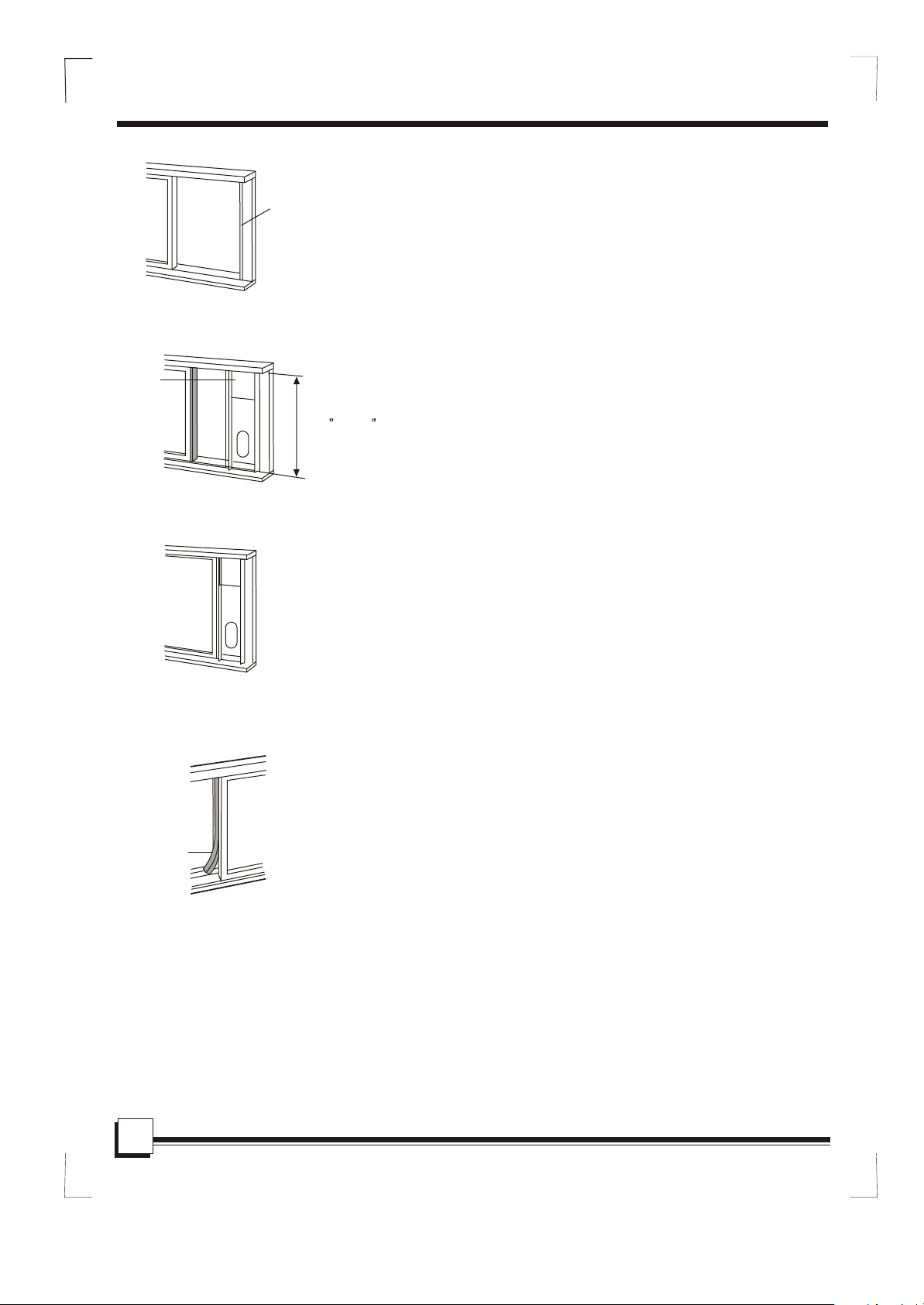
1. Cut the foam seal(adhesive type) to the proper length and
attach it to the window frame. See Fig.12.
2. Attach the window slider kit to the window stool. Adjust the
length of the window slider kit according to the width of
window, shorten the adjustable window kit if the width of
window is less than 26.5 inches.
Open the window sash and place the window slider kit on
the window stool. See Fig.13.
3. Cut the foam seal(adhesive type) to the proper length
and attach it on the top of the window. Shown as in Fig.14.
4. Close the sliding sash securely against the window.
5. Cut the foam seal to an appropriate length and sea the
open gap between the top window sash and outer window
sash. Shown as in Fig.15.
Foam seal
Foam seal A
(adhesive type)
Fig.12
Fig.13
Fig.14
Fig.15
Window
panel
NOTE:All the illustrations in this manual are for explanation
purpose only.Your unit may be slightly different. The
actual shape shall prevail.
26.5 ~ 48.0
INSTALLATION INSTRUCTIONS
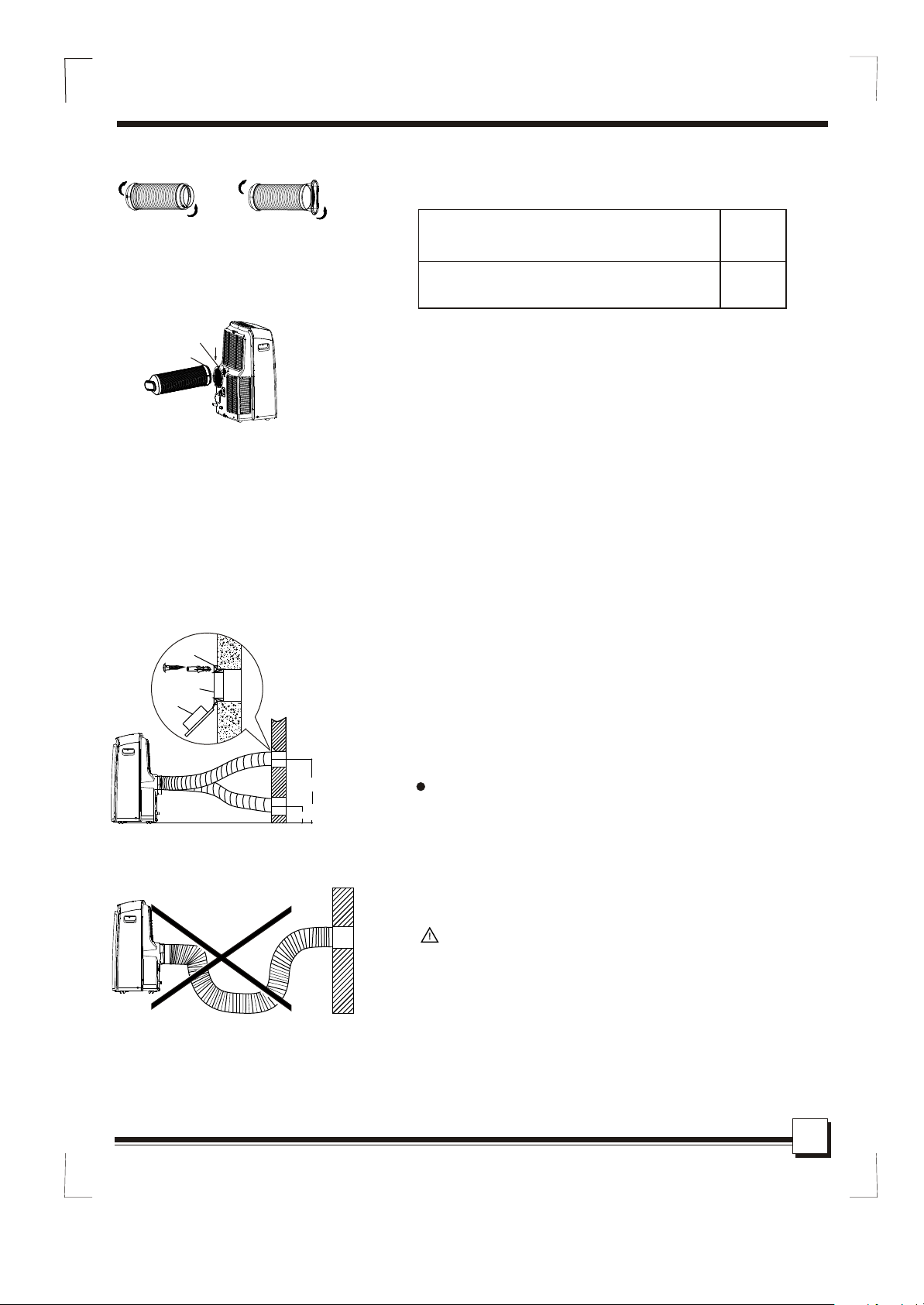
Exhaust hose installation:
The exhaust hose and adaptor must be installed or removed
in accordance with the usage mode.
The exhaust hose can be compressed or extended
moderately according to the installation requirement,
but it is desirable to keep the hose length to a minimum.
1. Install the adaptor B and adaptor I onto the exhaust hose as
shown in Fig.16a or Fig.16b. Refer to the previous pages for
window kit installation.
2. Resert the hook of the Exhaust hose into the hole seat of the
air outlet and slide down the Exhaust hose along the arrow
direction (See Fig.17) for installation.
IMPORTANT:
DO NOT OVER BEND THE EXHAUST HOSE (SEE Fig.19)
12
Fig.16a
Fig.17
Fig.19
The exhaust hose can be installed into the wall
(Not applicable to the units without adaptor A, expansion
plugs and wooden screws of Accessories ).
1. Prepare a hole in the wall. Install the wall Exhaust adaptor A
onto the wall(outside) by using 4 expansion plugs and
wooden screws, be sure to fix thoroughly. (See Fig.18)
2. Attach the Exhaust hose to wall Exhaust adaptor A.
Fig.18
max 120CM
min 30CM
Adaptor A
Expansion plug
position
Adaptor
cap
Note:
Cover the hole using the adaptor cap when not in use.
Fig.16b
COOL,HEAT(heat pump type) or AUTO
mode
FAN,DEHUMIDIIFY or HEAT(electrical heat type)
mode
Install
Remove
CAUTION:
Make sure that there is no obstacle around the air outlet of
the exhaust hose (in the range of 500mm) in order to the
exhaust system works properly.
Hole seat
Hook
INSTALLATION INSTRUCTIONS
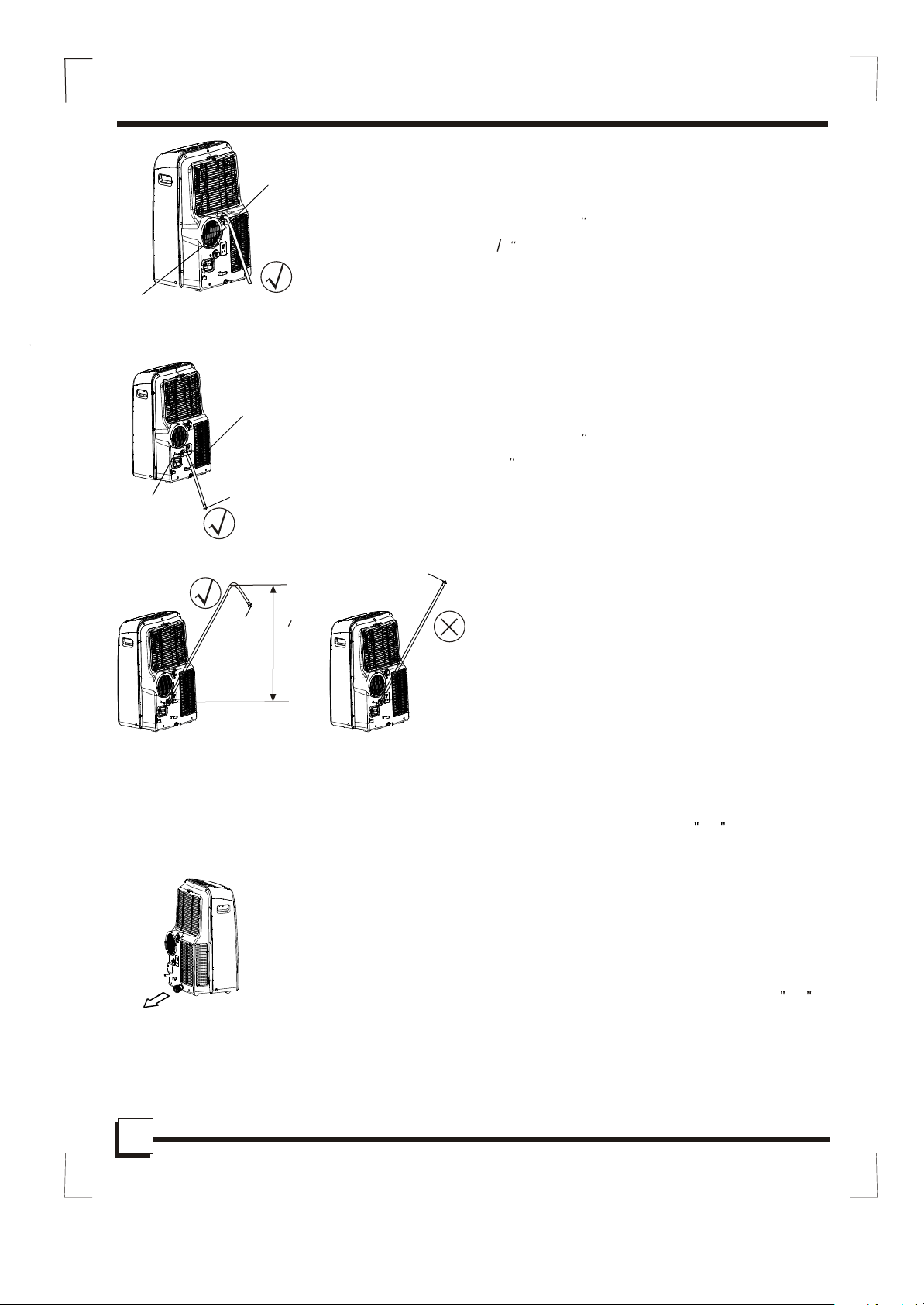
Water drainage:
- During dehumidifying modes, remove the upper
drain plug from the back of the unit, install the drain
connector(5/8 universal female mender) with
3 4 hose(locally purchased). For the models
without drain connector, just attach the drain
hose to the hole. Place the open end of the
hose directly over the drain area in your basement
floor. Please refer to Fig.20a.
- During heating pump mode, remove the lower drain
plug from the back of the unit, install the drain
connector(5/8 universal female mender) with
3/4 hose(locally purchased). For the models
without drain connector, just attach the drain
hose to the hole. Place the open end of the
hose adaptor directly over the drain area in your
basement floor. Please refer to Fig.20b.
- When the water level of the bottom tray reaches
a predetermined level,
Carefully move the unit to a drain location,
remove the bottom drain plug and let the
water drain away(Fig.22). Reinstall the bottom
drain plug and restart the machine until the P1
symbol disappears. If the error repeats, call for
service.
the unit beeps 8 times,
the digital display area shows P1 . At this time
the air conditioning/dehumidification process will
immediately stop. However, the fan motor will
continue to operate(this is normal).
Remove the
upper drain plug
Continuous
drain hose
Fig.20a
Fig.20b
13
Fig.22
NOTE: Be sure to reinstall the bottom drain plug
before using the unit.
Remove the
lower drain plug
Continuous
drain hose
drain hose
adaptor
NOTE:
Make sure the hose is secure so there are
no leaks.Direct the hose toward the drain,making
sure that there are no kinks that will stop the warter
flowing.Place the end of the hose into the drain and
make sure the end of the hose is down to let the
water flow smoothly.(See Fig.20a,20b,21a).Do
never let it up.(See Fig.21b).
Fig.21a Fig.21b
drain hose
adaptor
drain hose
adaptor
delivery lift <
1.8m
CARE AND MAINTENANCE
CARE AND MAINTENANCE
1) Be sure to unplug the unit before cleaning or servicing.
2) Do not use gasoline, thinner or other chemicals to clean
the unit.
3) Do not wash the unit directly under a tap or using a hose.
It may cause electrical danger.
4) If the power cord is damaged, it should be repaired by
manufacture or its agency.
IMPORTANT:
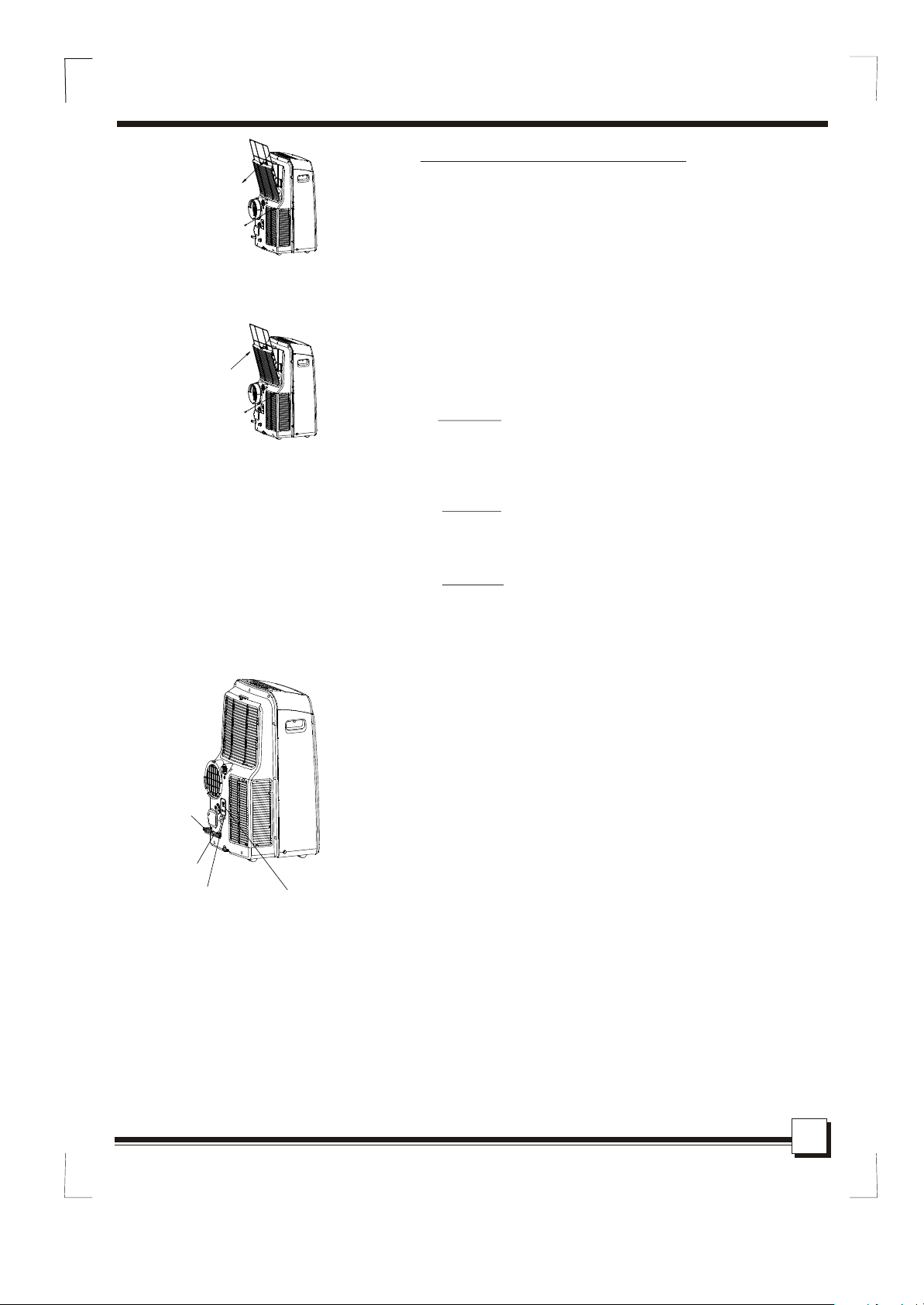
1. Air filter
2. Unit enclosure
- Use a lint-free cloth soaked with neutral detergent to clean
the unit enclosure. Finished by a dry clean cloth.
Fig.23
3. Unit idle for a long time
14
- Remove the rubber plug at the back of the unit and attach
a hose to drain outlet. Place the open end of the hose
directly over the drain area in your basement floor
(See Fig.20 & 21).
- Remove the plug from the bottom drain outlet, all the water
in the bottom tray would drain out (See Fig.22).
- Keep the appliance running on FAN mode for half a day in
a warm room to dry the appliance inside and prevent mold
forming.
- Stop the appliance and unplug it, wrapped the cord and
bundle it with the tape(Fig.25). Remove the batteries from
the remote controller.
- Clean the air filter and reinstall it.
Fig.24
Fig.25
Buckle
Power
cord
Upper filter
(take out)
Remove the
screw ,then
take the lower
filter out.
Upper filter
(install)
Install the lower
filter by using
the screw.
- Clean the air filter at least once every two weeks to prevent
inferior fan operation because of dust.
- Removal
This unit has two filters. Take the upper filter out along the
the arrow direction (Fig.23),then take the filter down.
Remove the lower filter by loosening the screw, taking out
the filter as shown in Fig.23.
- Cleaning
Wash the air filter by immersing it gently in warm water
OO
(about 40 C/104 F) with a neutral detergent. Rinse the filter
and dry it in a shady place.
- Mounting
Install the upper air filter after cleaning , and install the lower
filter by using the screw (see Fig.24).
Power plug
socket
Power plug
TROUBLESHOOTING TIPS
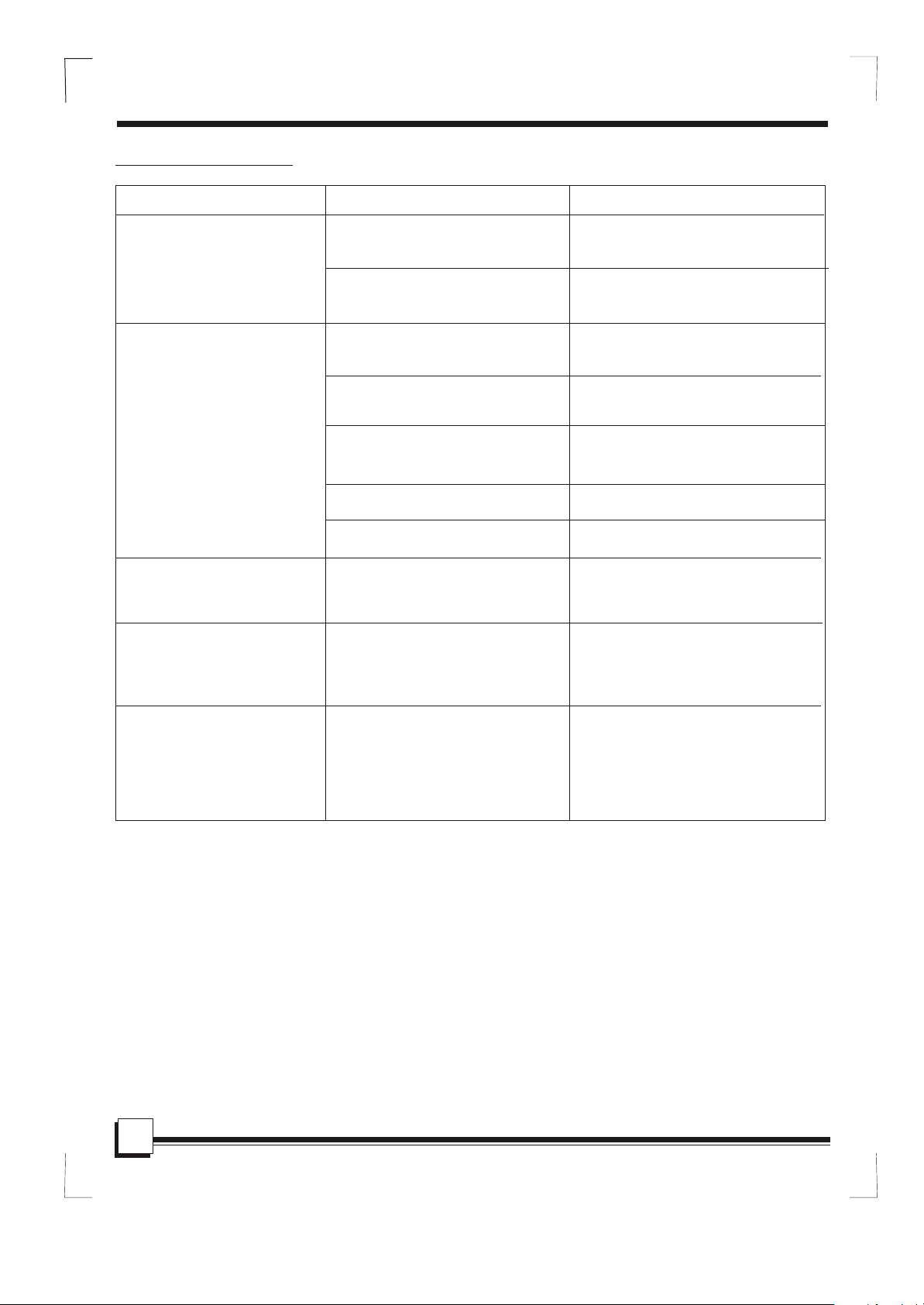
TROUBLE SHOOTING
1. Unit does not
Start when
Pressing on/off
Button
- P1 appears in the display window
Drain the water in the bottom tray.
TROUBLES
POSSIBLE CAUSES
SUGGEST REMEDIES
Reset the temperature.
Make sure all the windows and
doors are closed.
Remove the heat sources if possible.
Connect the duct and make
sure it can function properly.
Decrease the set temperature.
Clean the air filter.
- Room temperature is lower than
the set temperature.(Cooling mode)
- The windows or doors in the room
are not closed.
- There are heat sources inside the
room.
- Exhaust air duct is not connected or
blocked.
- Temperature setting is too high.
- Air filter is blocked by dust.
2. Not cool enough
Place the unit on a flat, level
ground if possible.
It is normal.
- The ground is not level or not flat
enough.
- The sound comes from the flowing
of the refrigerant inside the
air-conditioner.
4. Noisy or vibration
5. Gurgling sound
15
Switch on again after the unit
has cool down.
- The automatic over heat
protection function. When the
temperature at the air outlet
OO
exceed 70 C/158 F,th e de vice
will
st
op.
6. Power shut off at
Heating mode
PPA1210M
AIRE ACONDICIONADO PORTATIL
ÍNDICE
NOTA
Nota……………………………………………………………………………………………………..
MEDIDAS DE SEGURIDAD
Medidas de seguridad…………………………………………………………………………………
Condiciones de funcionamiento……………………………………………………………………...
Información de la parte eléctrica……………………………………………………………………..
IDENTIFICACIÓN DE LAS PARTES
Accesorios………………………………………………………………………………………………
Nombres de las partes………………………………………………………………………………...
CARACTERÍSTICAS DEL AIRE ACONDICIONADO
Instrucciones de manejo del control electrónico……………………………………………………
INSTRUCCIONES DE FUNCIOANAMIENTO
Instrucciones de funcionamiento……………………………………………………………………..
INSTRUCCIONES DE INSTALACIÓN
Ubicación……………………………………………………………………………………………….
Elementos para la instalación en la ventana.................…………………………………………..
Instalación de la manguera de escape……………………………………………………………...
Desagüe………………………………………………………………………………………………...
CUIDADO Y MANTENIMIENTO
Cuidado y mantenimiento……………………………………………………………………………..
CONSEJOS PARA LA SOLUCIÓN DE PROBLEMAS DE FUNCIONAMIENTO
Guía de solución de problemas de funcionamiento………………………………………………..
2
3
3
4
4
5
6
7
9
9
12
13
14
15
NOTA
Los datos de clasificación indicados en la etiqueta
de clasificación de energía se basa en la condición
de prueba de instalación conducto del escape sin
extender y sin adaptador A y B (El conducto y el
adaptador aparecen en el listado de la tabla de
accesorios del manual de instrucciones).
NOTA
Al utilizar este aire acondicionado en países europeos, se debe tener en
cuenta la siguiente información:
DESECHO
: No deseche este aire acondicionado en un relleno sanitario no
seleccionado. Es necesario tratar especialmente por separado dichos desechos.
Se prohíbe desechar este aire acondicionado en los vertederos de basura doméstica.
Para desecharlo, hay varias posibilidades:
A) El gobierno municipal ha establecido varios sistemas de recolección, en donde los
desechos electrónicos se puede desechar sin ningún cargo para el usuario.
B) Al comprar un nuevo aire acondicionado, el distribuidor recibirá de nuevo el aire
acondicionado sin costo alguno para el usuario.
C) El fabricante recibirá el aire acondicionado obsoleto para desecharlo sin ningún
costo para el usuario.
D) Debido a que el producto contiene recursos valiosos, se puede vender a los
comerciantes de chatarra.
Arrojar desechos en zonas verdes, bosques y zonas paisajísticas pone en peligro su
salud debido a que las sustancias peligrosas se filtran hacia las aguas subterráneas,
logrando así ingresar a la cadena alimenticia.
CUIDADO:
Este aire acondicionado no debe ser manejado por personas (incluyendo niños)
con discapacidad física, sensorias, mental o con falta de experiencia y
conocimiento, a menos que sean supervisados o hayan recibido instrucciones en
cuanto al uso del aire acondicionado por una persona que sea responsable de su
seguridad.
Se debe supervisar a los niños para asegurarse que no jueguen con el aire
acondicionado.
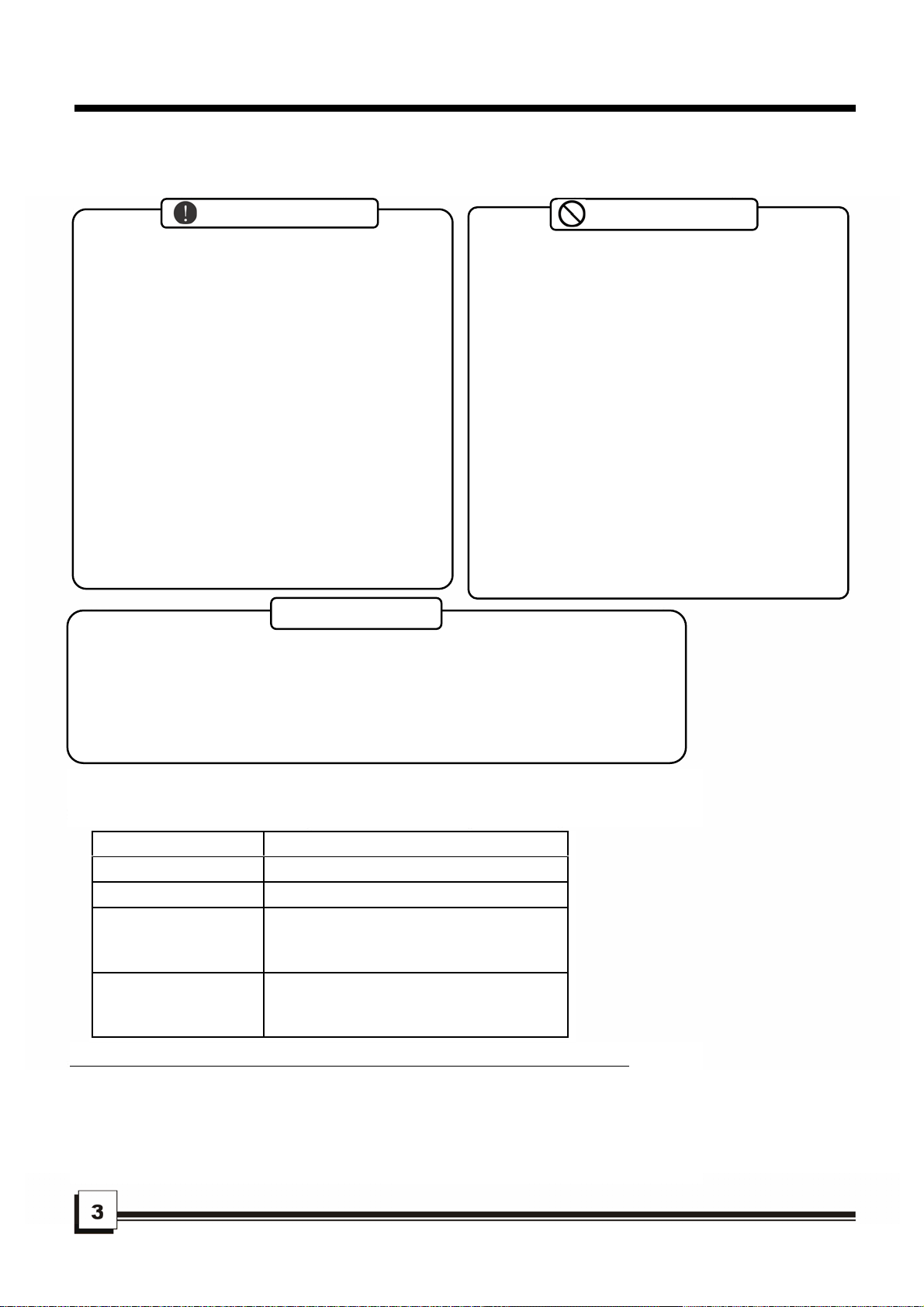
MEDIDAS DE SEGURIDAD
Medidas de seguridad
Para evitar que el usuario u otras personas sufran lesiones personales y daños en bienes, se debe cumplir las
siguientes instrucciones. El manejo inadecuado debido al pasar por alto las instrucciones puede causar daños.
Su aire acondicionado se debe utilizar de modo
que quede protegido de la humedad; por ejemplo,
condensación o salpicaduras de agua, etc. No
coloque ni guarde su aire acondicionado en
donde pueda caer en el agua o dentro de otro
líquido. Si sucede, desconéctelo inmediatamente.
Transporte siempre su aire acondicionado en
posición vertical y párelo sobre una superficie
estable y a nivel durante su utilización.
Apague el aire acondicionado cuando no lo esté
utilizando.
Deje un espacio libre, de al menos 30 cm.,
alrededor de las paredes de la unidad, muebles y
cortinas.
Si se golpea el aire acondicionado durante su
uso, apáguelo y desconéctelo inmediatamente del
suministro eléctrico.
Haga esto siempre.
No ponga en funcionamiento su aire
acondicionado en una habitación húmeda, como
un baño o cuarto de lavado.
No toque el aire acondicionado con las manos
húmedas o mojadas o descalzo.
No presione las teclas del panel de control con
algo que no sea sus dedos.
No retire ninguna cubierta fija. Nunca utilice este
aire acondicionado si no está funcionando bien o
ha sufrido una caída o está dañado.
Nunca utilice el enchufe para arranca y apagar el
aire acondicionado.
No cubra ni obstruya las parrillas de entrada y
salida de aire.
No utilice productos químicos peligrosos para
limpiar, ni permita que entren en contacto con el
aire acondicionado. No utilice el aire
acondicionado cerca de sustancias inflamables o
vapores de alcohol, insecticidas, etc.
No permita que los niños, sin supervisión,
manejen el aire acondicionado.
No utilice este aire acondicionado para funciones
diferentes a los descritos en este manual.
Nunca haga esto.
Utilice el aire acondicionado en una habitación con el tamaño recomendado.
Utilice el aire acondicionado en donde los muebles no obstruyan el flujo de
aire.
Mantenga las persianas/cortinas cerradas durante la parte más soleada del
día.
Mantenga limpios los filtros.
Mantenga las puertas y ventanas cerradas para mantener el aire frío adentro
y el aire caliente afuera.
Ahorro de energía
Condiciones de funcionamiento
El aire acondicionado se debe mantener en funcionamiento dentro de los niveles de temperatura
indicados a continuación.
FUNCIÓN TEMPERATURA AMBIENTE
FRÍO 17ºC(62ºF)-35ºC(95ºF)
SECO 13ºC(55ºF)-35ºC(95º)
CALEFACCIÓN
(Tipo bomba de
calor)
5ºC(41ºF)-30ºC(88ºF)
CALEFACCIÓN
(Tipo de calefacción
eléctrica)º
≤30ºC/88ºF
Herramientas sugeridas para la instalación en ventana
1. Atornillador (Phillips tamaño mediano)
2. Metro o regla
3. Cuchillo o tijeras
4. Mango cierra (en caso de que sea necesario cortar el conjunto de instalación en ventana
debido a que la ventana es demasiado pequeño para instalar directamente el aire
acondicionado).
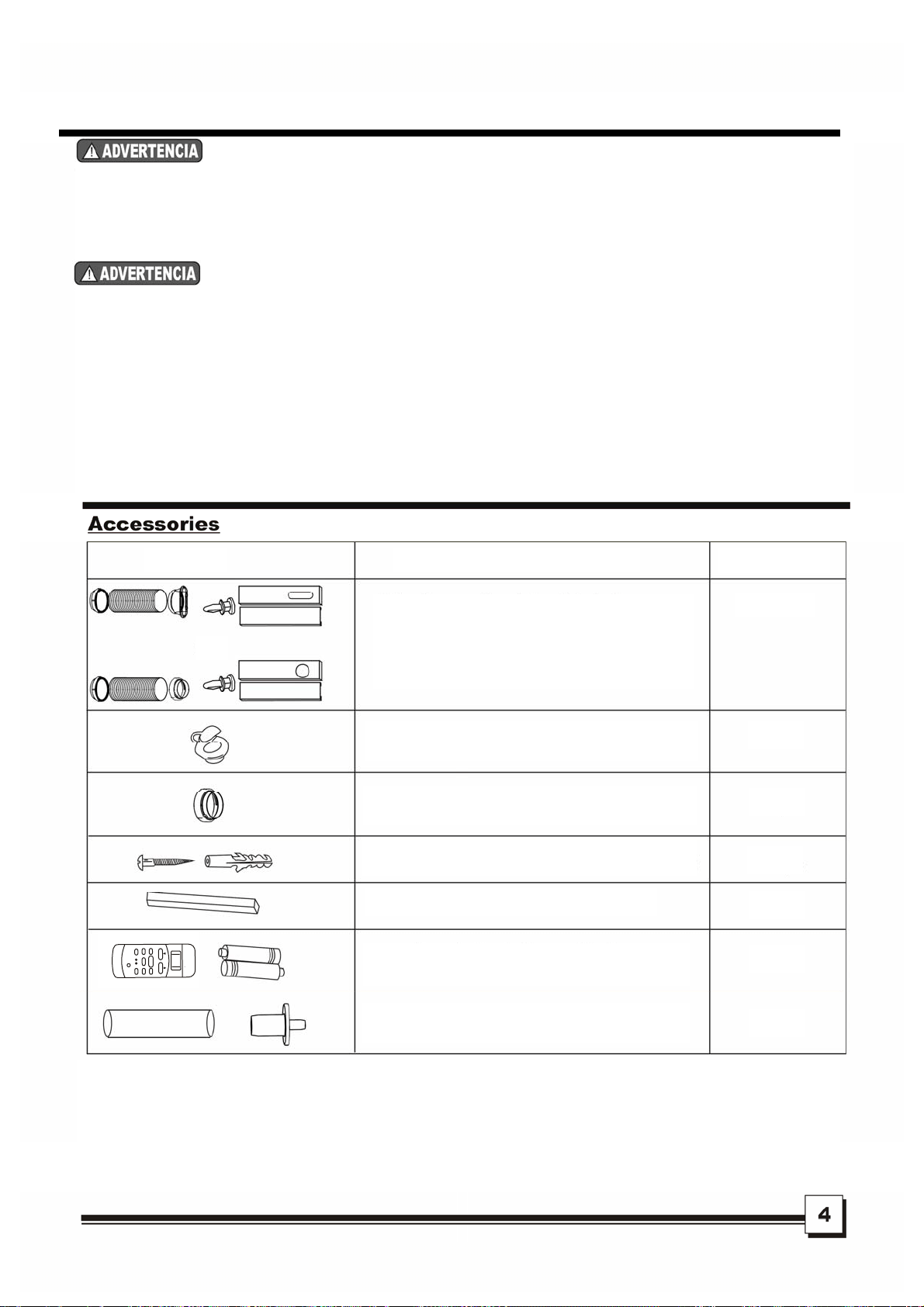
IDENTIFICACIÓN DE LAS PARTES
Por su seguridad
No almacene, ni utilice gasolina u otros vapores inflamables o líquidos, cerca del aire
acondicionado o cualquier otro aparato.
Evite el riesgo de electrocución. No utilice una extensión o enchufe adaptador. No retire ninguna
clavija del enchufe eléctrico.
Información eléctrica
Asegúrese que el mantenimiento eléctrico sea apropiado para el modelo que ha seleccionado.
Esta información se puede encontrar en la placa con serial, que está ubicada al lado del gabinete y
detrás de la parrilla.
Asegúrese de que el aire acondicionado tenga adecuadamente instalado el polo a tierra. Para
reducir el riesgo de electrocución e incendios, es importante que el polo a tierra esté bien
instalado. El cable eléctrico con un enchufe de tres clavijas con polo a tierra para protegerlo contra
la electrocución.
Su aire acondicionado se debe utilizar en un tomacorriente que tenga instalado el polo a tierra
adecuado. Si el tomacorriente que intenta utilizar no tiene adecuadamente instalado el polo a tierra
o protegido por un fusible de retardo o circuito de fusible (breaker), haga que un electricista
calificado instale el tomacorriente adecuado.
Asegúrese que el tomacorriente sea de fácil acceso después de instalar la unidad.
PARTES: NOMBRE DE LAS PARTES :
CANTIDAD:
Manguera de escapa y adaptador I y
adaptador B
(boca plana o redonda, dependiendo del
modelo)
Conjunto de ventana deslizante y perno
Adaptador del escape de pared A (※)
Adaptador B —boca redonda— (※)
Conector expansible y tarugo (※)
Empaque de espuma
Control remoto y pilas
(solo para el modelo con control remoto)
Manguera de desagüe y adaptador de la
manguera de desagüe (
※)
1 juego
1
4
1
3
1
1
NOTA: Partes opcionales (※), solo se encuentran en algunos modelos.
Verifique que todos los accesorios estén incluidos en la caja y véase las instrucciones de
instalación para su uso.
NOTA: Todas las ilustraciones contenidas en este manual son para fines explicativos. Su aire
acondicionado puede ser levemente diferente. Se deberá tomar como modelo la forma real.
“O”
TEMP
AUTO
COOL
DRY
HEAT
FAN
HIGH
MED
LOW
MODE
FA
N SPEED
SWING
TIMER ON
ECONOMY
ON/O
FF
TIMER OFF
RESE
T LOCK
SET TEM
PERATURE(
)
F
LED
DISPLAY
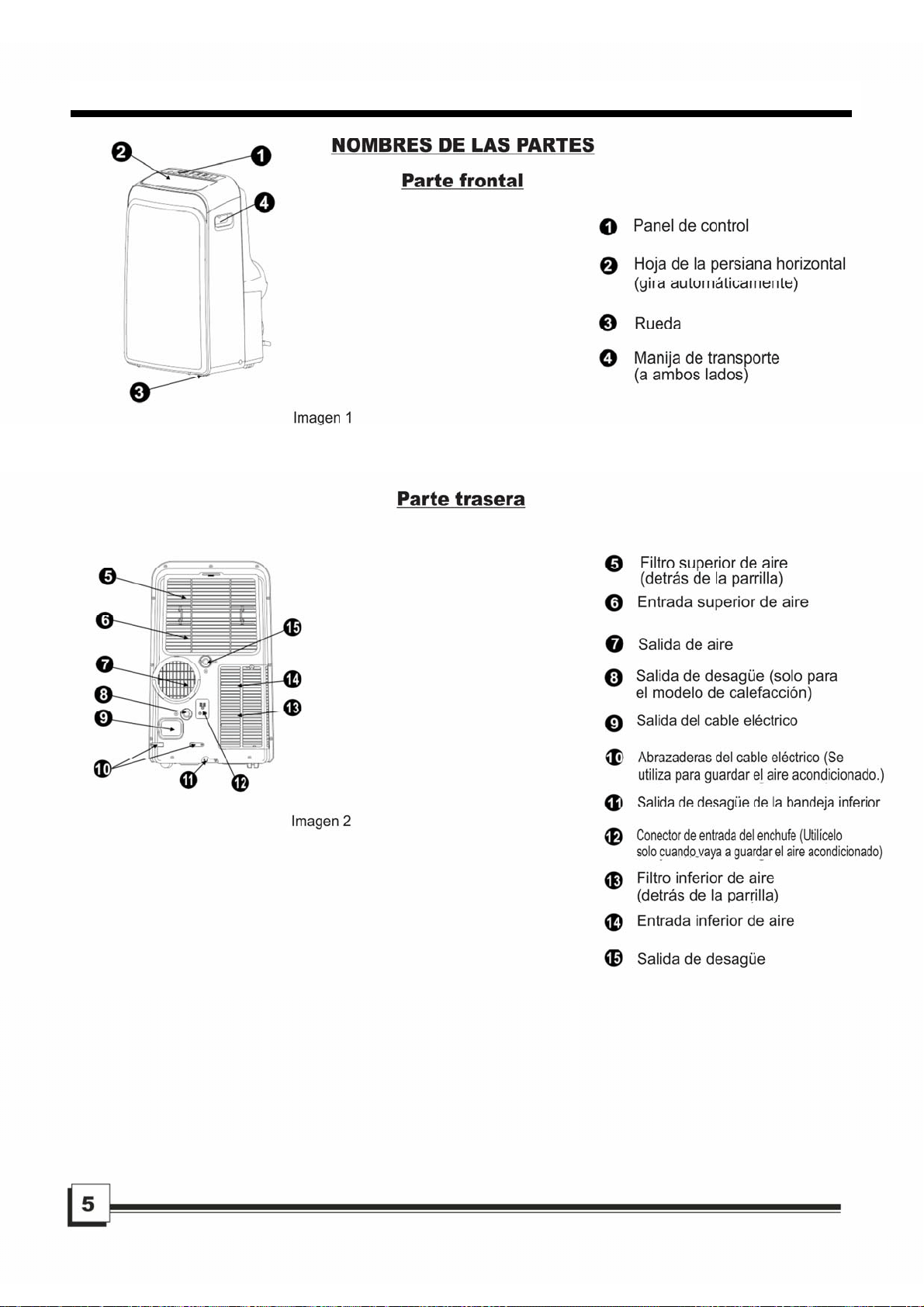
IDENTIFICACIÓN DE LAS PARTES
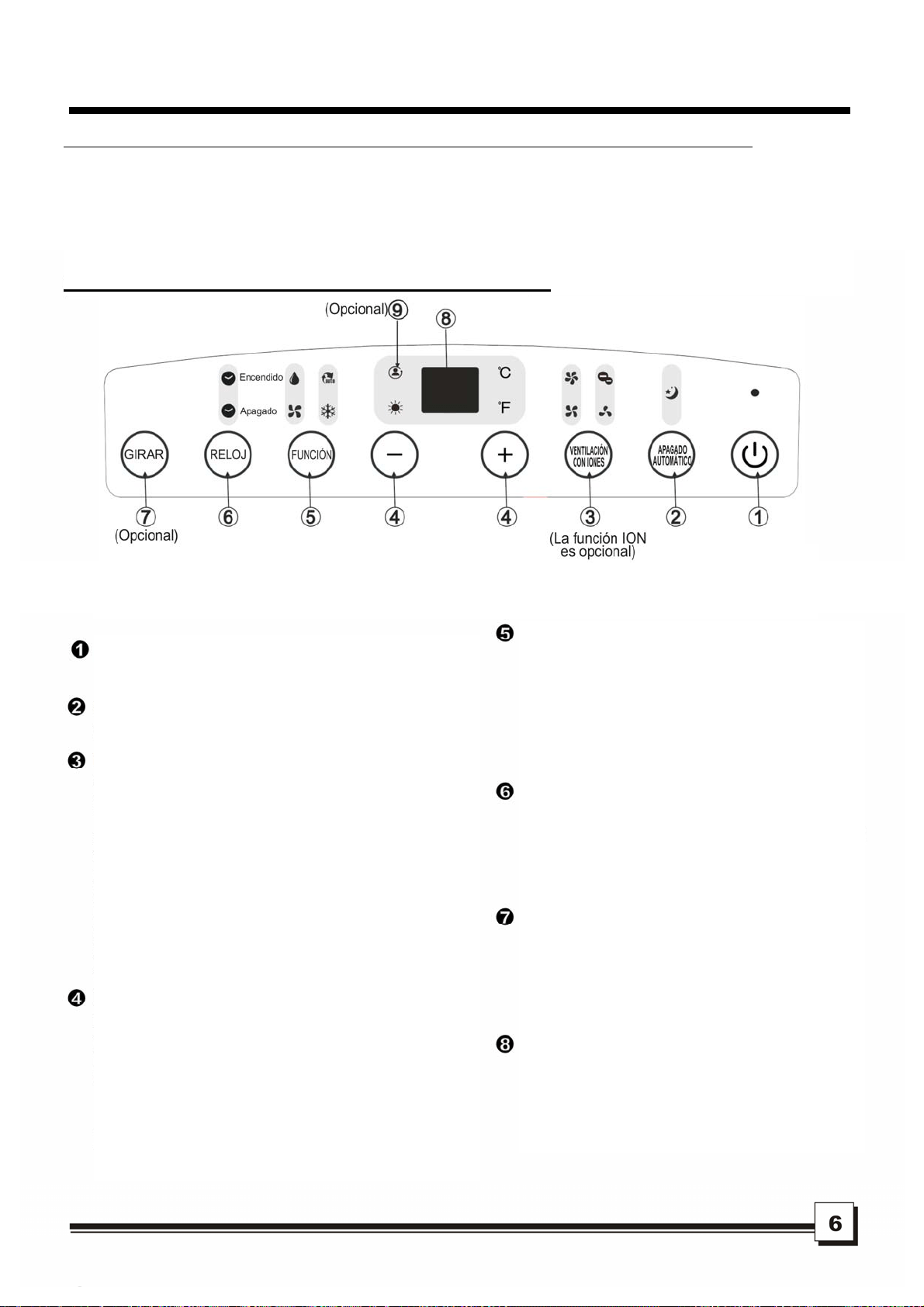
CARACTERÍSTICAS DEL AIRE ACONDICIONADO
INSTRUCCIONES DE MANEJO DE LOS CONTROLES ELECTRÓNICOS
Antes de comenzar, haga un reconocimiento minucioso del panel de control, el control remoto y todas
sus funciones, luego siga el símbolo para las funciones que desee.
El aire acondicionado se puede controlar solo con el panel de control o con el control remoto.
NOTA: Este manual no incluye el Manejo de las funciones del control remoto, véase
<<Instrucciones del control remoto>> empacado con el aire acondicionado, para más detalles.
PANEL DE CONTROL DEL AIRE ACONDICIONADO
NOTA: En algunos modelos la tecla APAGADO AUTOMÁTICO se utiliza en lugar de la
tecla ECO.
Imagen 3
Tecla ENCENDER/APAGAR
Interruptor para encender/apagar
Tecla APAGADO AUTOMÁTICO/ECO
Se utiliza para iniciar el funcionamiento de APAGADO
AUTO/ECO.
Tecla FAN/ION (La función ION es opcional)
Controla la velocidad del ventilador. Presiónela para
seleccionar la velocidad del ventilador en cuatro pasos:
BAJO, MEDIO, ALTO y AUTOMÁTICO. Se enciende la
señal indicadora de velocidad del ventilador en los
diversos ajustes de la velocidad del ventilador, excepto en
la velocidad AUTOMÁTICO. Al seleccionar la velocidad
automática, se apagan todas las señales indicadoras del
ventilador.
NOTA: Presione esta tecla durante 3 segundos para iniciar
la función ION. El generador de iones está energizado y
ayudará a eliminar el polen y las impurezas del aire y las
atrapará en el filtro. Presiónela durante 3 segundos, de
nuevo, para detener la función ION.
TECLA SUBIR ( + ) y BAJAR ( - )
Se utiliza para ajustar (aumentar/disminuir) los
ajustes de temperatura (se incrementa en 1ºC/2ºF) o
ajusta el RELOJ en un rango 17ºC (62ºF) hasta 30ºC
(88ºF) o se ajuste el RELOJ en un rango de 0-24
horas.
NOTA: El control puede Mostrar la temperatura en
grados Celsius o Fahrenheit. Para convertir de unos
a otros, presione sin soltar las teclas Subir y Bajar a
la vez durante 3 segundos.
Tecla seleccionar FUNCI
Ó
N
Selecciona la función de manejo apropiada.
Cada vez que se presione la tecla, se
selecciona una función en una secuencia que
va desde AUTOMÁTICO, VENTILACIÓN,
SECAR, VENTILADOR hasta
CALEFACCIÓN (no se encuentra en el
modelo para solo ventilación). Se enciende la
señal indicadora en los diferentes ajustes de
funciones.
Tecla RELOJ
Se utiliza para iniciar el tiempo de inicio
de ENCENDIDO AUTOMÁTICO, junto
con las teclas + y
‒. Se enciende la señal
indicadora en los ajustes
apagar/encender del reloj.
Tecla GIRAR
(Válido solo para los modelos con la función
“giro automático”).
Se utiliza para iniciar la función Giro
automático. Cuando la función seleccionada
sea ENCENDER, al presionar la tecla GIRAR
se puede detener la persiana en el ángulo
deseado.
Visualización LED (diodos luminosos)
Muestra el ajuste de temperatura en “ºC”
o “ºF” y los ajustes del Reloj automático.
Mientras que en las funciones SECAR y
VENTILADOR, muestra la temperatura
de la habitación.
INSTRUCCIONES DE MANEJO
Códigos de error y de protección:
E1- Error del sensor de temperatura de la habitación.
Desconecte el aire acondicionado y conéctelo de
nuevo. Si se repite el error, solicite el servicio
técnico.
E2- Error del sensor de temperatura del vaporizador.
Si se repite el error, solicite servicio técnico.
E3- Error del sensor de temperatura del condensador.
Desconecte el aire acondicionado y conéctelo de
nuevo. Si se repite el error, solicite servicio
técnico.
E4- Error de comunicación del panel de control.
Desconecte el aire acondicionado y conéctelo de
nuevo. Si se repite el error, solicite servicio
técnico.
P1- La bandeja del fondo está llena. Conecte la
manguera de desagüe y evacue el agua recogida.
Si se presenta de nuevo el código, solicite
servicio técnico.
Característica SÍGUEME/SENSOR DE
T
EMPERATURA (opcional)
NOTA: Esta función SOLO se puede activar
desde el control remoto. El control remoto
actúa como un termostato, permitiendo el
control preciso de la temperatura en su
ubicación.
Para activar la función Sígueme/Sensor de
temperatura, apunte con el control remoto hacia el
aire acondicionado y presione la tecla
Sígueme/Sensor de temperatura. La pantalla del
control remoto muestra la temperatura real en su
ubicación. El control remoto enviará esta señal al
aire acondicionado en intervalos de 3 minutos,
hasta que se presione de nuevo la tecla
Sígueme/Sensor de temperatura. Si el aire
acondicionado no recibe la señal de
Sígueme/Sensor de temperatura durante
cualquiera de los intervalos de 7 minutos, el aire
acondicionado emitirá una señal acústica para
indicar que la función Sígueme/Sensor de
temperatura ha terminado.
Instrucciones de manejo
Función VENTILACIÓN
- Presione la tecla “FUNCIÓN” hasta que se
encienda la señal indicadora de “VENTILACIÓN”.
- Presione las teclas AJUSTAR “+” ó “ - ” para
seleccionar la temperatura deseada. La
temperatura se puede ajustar en un nivel de 17ºC-
30ºC/62ºF-88ºF. .
- Presione la tecla “VELOCIDAD DEL
VENTILADOR” para seleccionar la velocidad del
ventilador.
Función CALEFACCIÓN (no se encuentra en
los modelos de solo ventilación)
-
Presione la tecla “FUNCIÓN” hasta que se encienda la
señal indicadora de “CALEFACCIÓN”.
- Presione las teclas AJUSTAR “+” ó “ - ” para seleccionar
la temperatura deseada de la habitación. La
temperatura se puede ajustar dentro del rango de 17ºC-
30ºC/62ºF-88ºF.
- Presione la tecla “VELOCIDAD DEL VENTILADOR”
para seleccionar la velocidad del ventilador. En algunos
modelos, no se puede ajustar la velocidad del ventilador
en la función CALEFACCIÓN.
- Presione la tecla “FUNCI
Ó
N” hasta que la
señal indicadora de “SECAR” se encienda.
- En esta función, no se puede seleccionar
una velocidad del ventilador o ajustar la
temperatura. El motor del ventilador
funciona a baja velocidad.
- Mantenga las ventanas y puertas cerradas
para lograr un mejor efecto de eliminación
de la humedad.
- No coloque el ducto (tubo) en la ventana.
Función AUTOMÁTICO
- Al ajustar el aire acondicionado en la
función AUTOMÁTICO, se seleccionará
automáticamente ventilación, calefacción
(no se encuentra en los modelos con solo
ventilación) o funcionamiento de la
ventilación, dependiendo de que
temperatura se ha seleccionado y la
temperatura de la habitación.
- El aire acondicionado controlará
automáticamente la temperatura de la
habitación cerca del punto de temperatura
ajustado por usted.
Función VENTILADOR
- Presione la tecla “FUNCIÓN” hasta que se
enciende la señal indicadora de
“VENTILADOR”.
- Presione la tecla “VELOCIDAD DEL
VENTILADOR” para seleccionar la
velocidad del ventilador. La temperatura no
se puede ajustar.
- No coloque el ducto en la ventana.
Función RELOJ
- Al encender este aire acondicionado, al
presionar la tecla Reloj se iniciará el
apagado automático del programa; se
enciende la señal indicadora de RELOJ
APAGADO. Presione la tecla SUBIR o
BAJAR para seleccionar el tiempo deseado.
A
l presionar de nuevo la tecla RELOJ dentro
de 5 segundos, se inicia el programa Inicio
de Reloj activado. Y se enciende el la señal
indicadora de RELOJ ACTIVADO. Presione
la tecla subir o bajar para seleccionar el
tiempo deseado de inicio de Encendido
automático.
- Cuando el aire acondicionado esté
apagado, presione la tecla Reloj para
arrancar el programa de Inicio de Encendido
automático; al presionarlo de nuevo durante
cinco segundos se iniciará el programa de
parada de Apagado automático.
- Presione o mantenga sostenida la tecla
SUBIR o BAJAR para cambiar el Tiempo
automático en incrementos de 0.5 horas,
hasta 10 horas, luego en incrementos de 1
hora hasta 24 horas.
- El sistema regresará automáticamente a la
temperatura anterior para ver el ajuste
anterior de temperatura, si no hay
funcionamiento en un periodo de cinco
segundos.
INSTRUCCIONES DE MANEJO
- Al ENCENDER o APAGAR el aire
acondicionado en cualquier tiempo o
ajustar el reloj en 0.0, se cancelará la
programación de Encendido
automático/Parar el reloj.
- Cuando aparezca un código de falla (E1,
E2, E3 o E4), también se cancelará el
programa de Encendido automático/Parar
reloj.
Función APAGADO AUTOMÁTICO/ECO
Al presionar esta tecla, la temperatura seleccionada
aumentará (ventilación) o disminuirá (calefacción)
1ºC/2ºF en 30 minutos. La temperatura aumentará
(calefacción) o disminuirá (ventilación) por otro
1ºC/2ºF, después de un tiempo adicional de 30
minutos. Esta temperatura nueva se mantendrá
durante 7 horas antes de regresar a la temperatura
seleccionada originalmente. Así se termina la función
Apagado automático/Eco y el aire acondicionado
continuará funcionando como se programó
inicialmente.
NOTA: Esta función está disponible en las funciones
VENTILADOR o SECAR.
Otras características
Reinicio automático (solo en algunos
modelos)
Si la unidad se apaga inesperadamente debido a un
apagón, se reiniciará automáticamente con la función
ajustada anteriormente, al regresar la electricidad.
Esperar 3 minutos antes de reiniciar el
funcionamiento
Después de que se ha detenido el aire
acondicionado, no se puede reiniciar el
funcionamiento hasta dentro de los 3 primeros
minutos. Esto es con el fin de proteger el aire
acondicionado. El funcionamiento se reanudará
automáticamente después de 3 minutos.
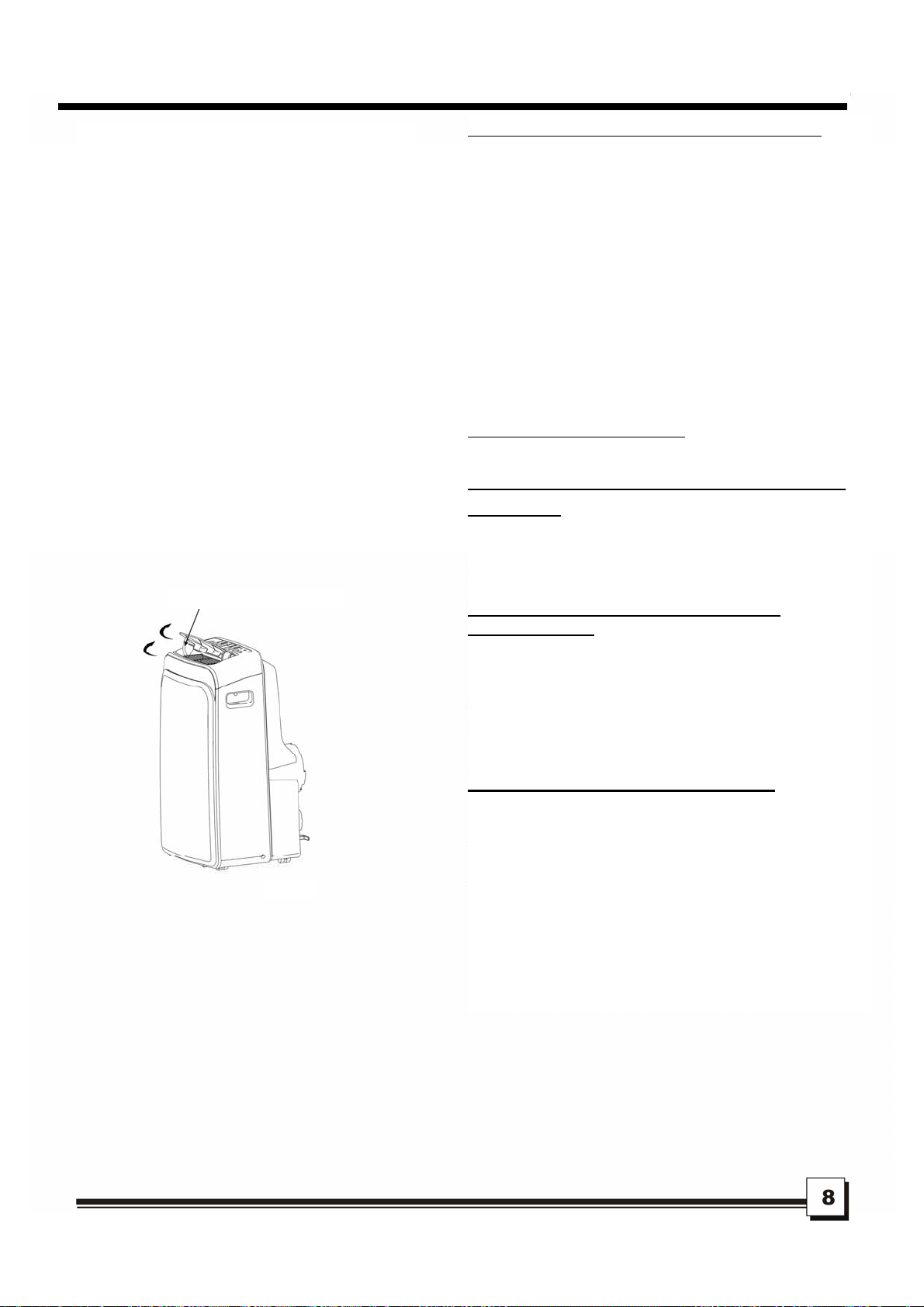
Como ajustar la dirección del flujo de aire
Las persianas se pueden ajustar automáticamente.
Como ajustar automáticamente la dirección del
flujo de aire (Imagen 4):
- Cuando hay paso de fluido eléctrico (ON), la persiana
se abre completamente. Presione la tecla GIRAR en el
panel de control o en el control remoto para iniciar la
función Girar automáticamente.
- La persiana girará hacia arriba y hacia abajo
automáticamente.
- No ajuste manualmente la persiana.
Gira automáticamente
Imagen 4
INSTRUCCIONES DE INSTALACIÓN (opcional)
INSTRUCCIONES DE INSTALACIÓN
Ubicación
El aire acondicionado se debe colocar sobre una
base firme para reducir el ruido y la vibración.
Para que quede instalado firmemente y seguro,
coloque el aire acondicionado sobre una
superficie suave y nivelada los suficientemente
resistente para sostener el aire acondicionado.
El aire acondicionado tiene ruedas para facilitar su
ubicación, pero solo se debe hacer rodar sobre
superficies suaves y planas. Tenga cuidado al
hacerlo rodar sobre superficies de alfombras o
tapetes. No intente hacer rodar el aire
acondicionado sobre objetos.
El aire acondicionado se debe colocar al alcance
de un tomacorriente que tenga polo a tierra
instalado correctamente.
Nunca coloque ningún obstáculo alrededor de la
entrada o salida de aire acondicionado.
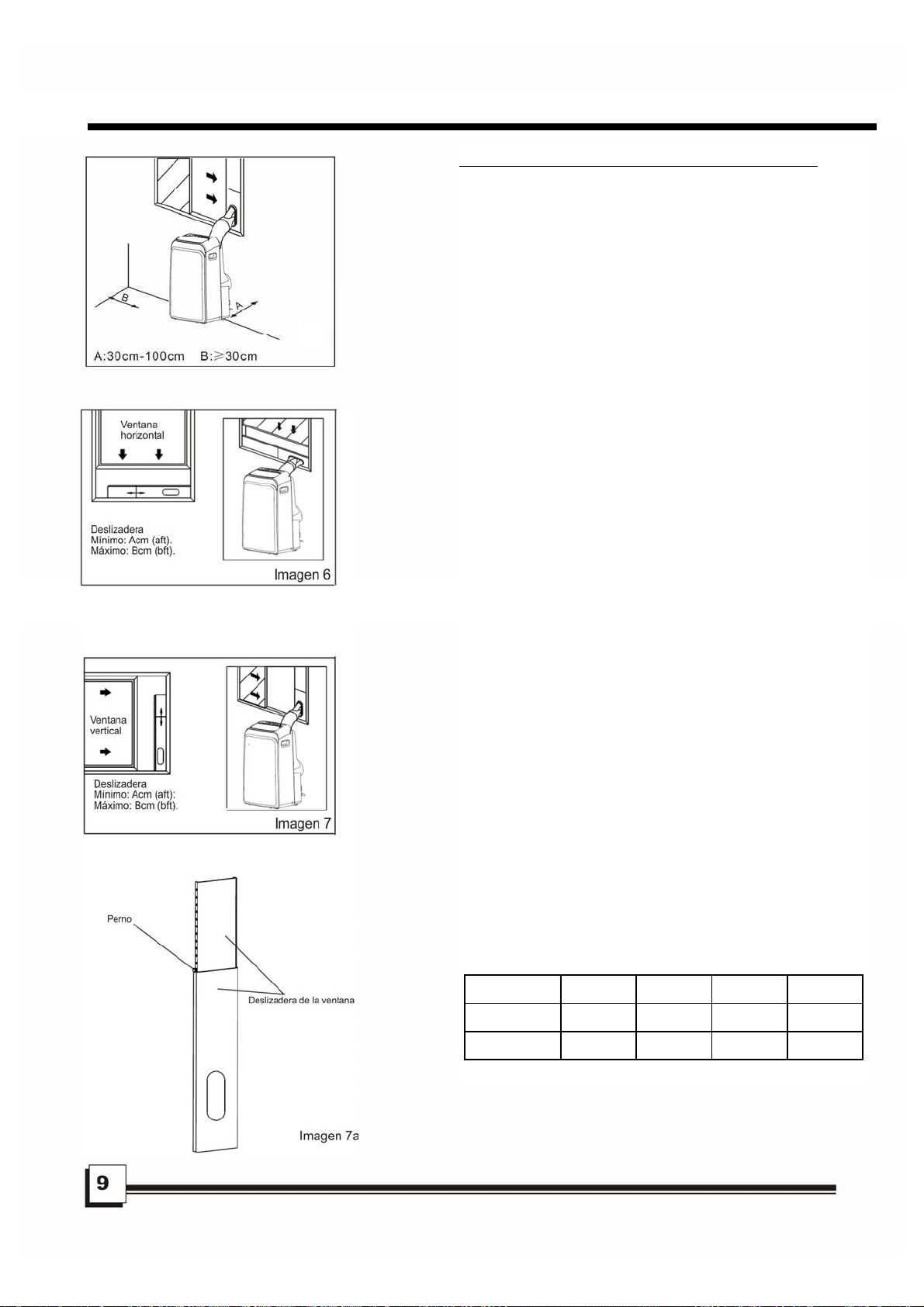
Deje un espacio de entre 30 a 100 cm. alrededor
de la pared para que el aire acondicionado
funcione eficientemente.
Como instalar la deslizadera para
ventana
La deslizadera para ventana ha sido diseñada
para ajustarse en la mayoría de ventanas
“verticales” y “horizontales” estándar. Sin
embargo, será necesario improvisar/modificar
algunos aspectos de los procedimientos de
instalación para ciertos tipos de ventanas. Véanse
las imágenes 6 y 7 para conocer la mínima y
máxima abertura de ventana. La deslizadera se
puede ajustar con un tornillo (véase la Imagen 7).
Nota: Si la abertura de la ventana es inferior a la
longitud mínima mencionada de la deslizadera
(riel) de la ventana, haga en ella un orificio lo
suficientemente pequeño para que se ajuste en la
abertura de la ventana. Nunca corte el orificio en
la deslizadera de la ventana.
A a B b
Tipo I 67.5 2.22 123 4.04
Tipo II 56.2 1.84 98.2 3.22
Imagen 5
INSTRUCCIONES DE INSTALACIÓN (opcional)
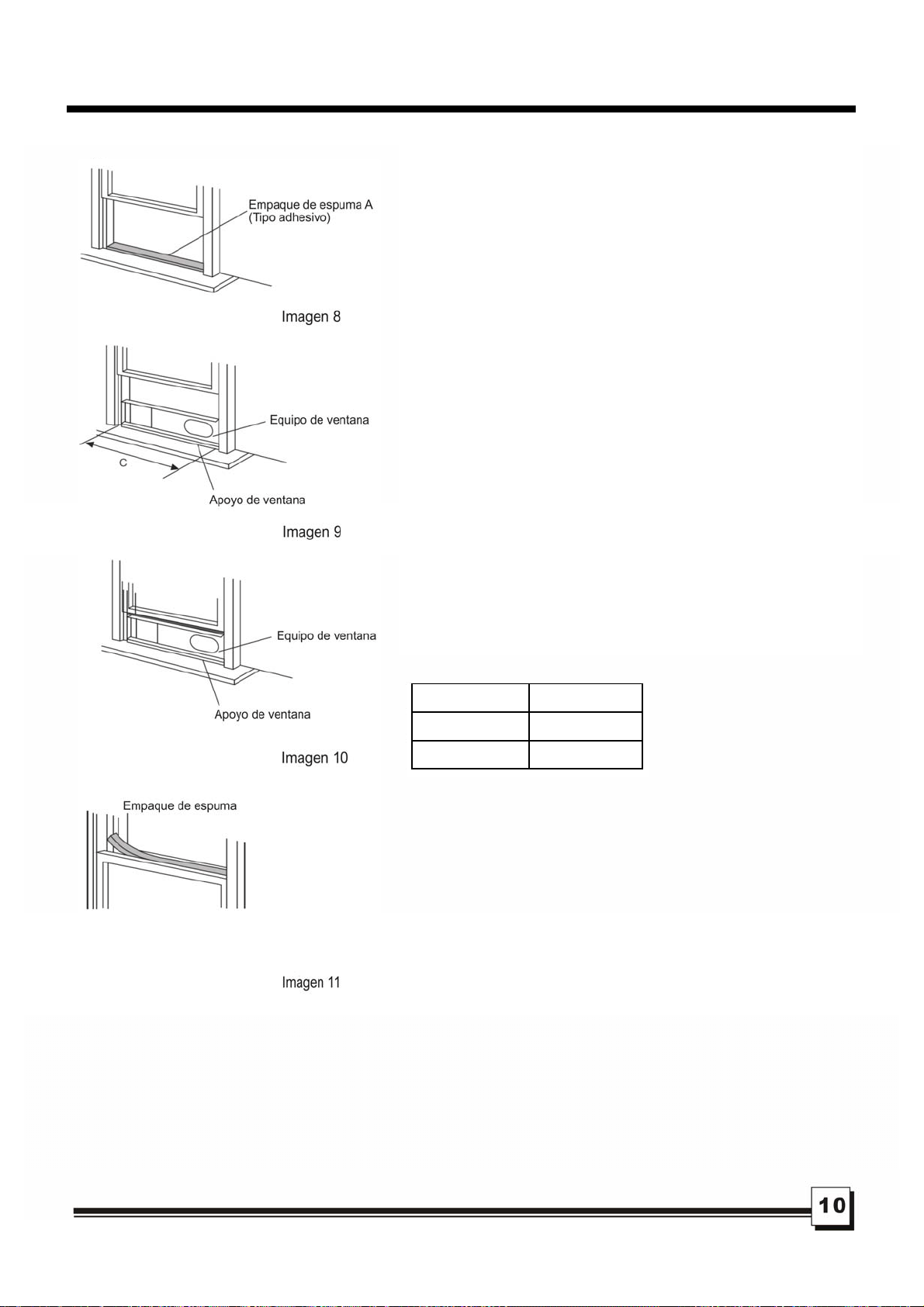
Instalación en una ventana de guillotina doble
1. Corte el empaque de espuma (tipo adhesivo) hasta lograr
la longitud adecuada y péguela en el apoyo de la ventana,
Imagen 8.
2. Instale la deslizadera de la ventana en el asiento de la
ventana. Ajuste la longitud de la deslizadera de ventana
según el ancho de la ventana, corte el conjunto ajustable
de ventana si el ancho es inferior a 26.5 (Tipo I) o 22.1
(Tipo II) pulgadas. Abra la guillotina de la ventana y
coloque la deslizadera de la ventana sobre el apoyo de la
ventana, Imagen 9.
3. Corte el empaque de espuma (tipo adhesivo) hasta el
tamaño adecuado y péguelo en la parte superior de la
ventana. Como se ve en la Imagen 10.
4. Cierre bien la guillotina de la ventana contra la ventana.
5. Corte el empaque de espuma hasta una longitud
apropiada y selle la brecha abierta entre la guillotina de la
parte superior de la ventana y la guillotina exterior de la
ventana. Véase la Imagen 11.
C
Tipo I
26.5”-48.0”
Tipo II
22.1”-38.6”
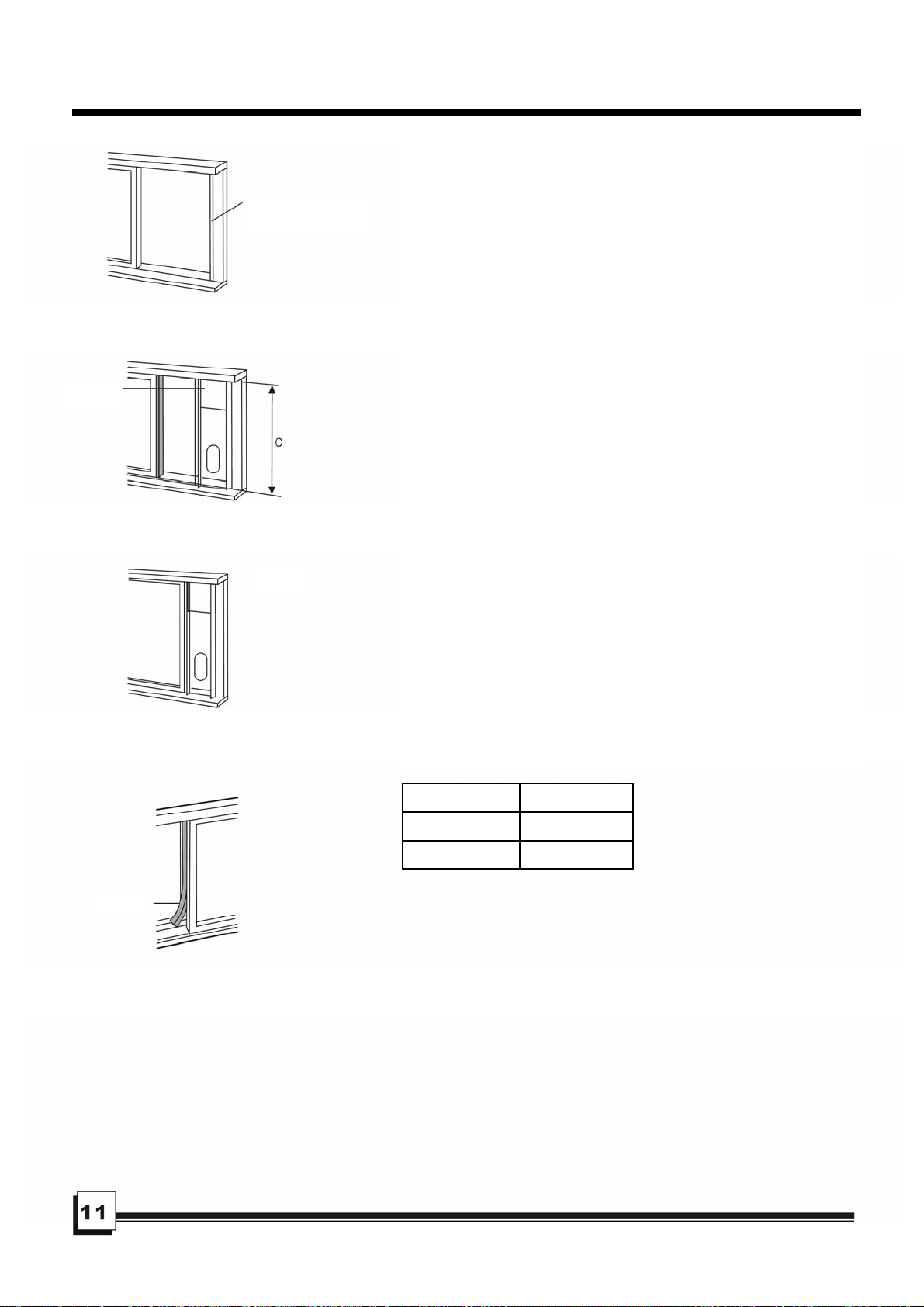
INSTRUCCIONES DE INSTALACIÓN (opcional)
Empaque de espuma A
(Tipo adhesivo)
Panel de
La ventana
Panel de
La ventana
Sello de
espuma
Imagen 12
Imagen 13
Imagen 14
Imagen 15
Instalación en una ventana con guillotina
deslizable
1. Corte el empaque de espuma (tipo adhesivo) al tamaño
adecuado y péguelo al marco de la ventana. Véase la
Imagen 12.
2. Pegue la deslizadera de la ventana en el apoyo de la
ventana. Ajuste la longitud de deslizadera de la ventana
según el ancho de la ventana; reduzca el tamaño de la
ventana ajustable si el ancho de la ventana es inferior a
26.5 (Tipo I) o 22.1 (Tipo II) pulgadas.
3. Corte el empaque de espuma (tipo adhesivo) hasta el
largo adecuado y péguelo a la parte superior de la
ventana. Véase la Imagen 14.
4. Cierre bien la guillotina contra la ventana.
5. Corte el empaque de espuma hasta una longitud
apropiada y selle la brecha que hay entre la guillotina
de la ventana superior y la guillotina de la ventana
exterior. Véase la Imagen 15.
NOTA: Todas las imágenes de este manual solo sirven
propósitos explicativos. Su aire acondicionado puede ser
levemente diferente. Se debe tomar como modelo el forma
real.
C
Tipo I
26.5”-48.0”
Tipo II
22.1”-38.6”
INSTRUCCIONES DE INSTALACIÓN
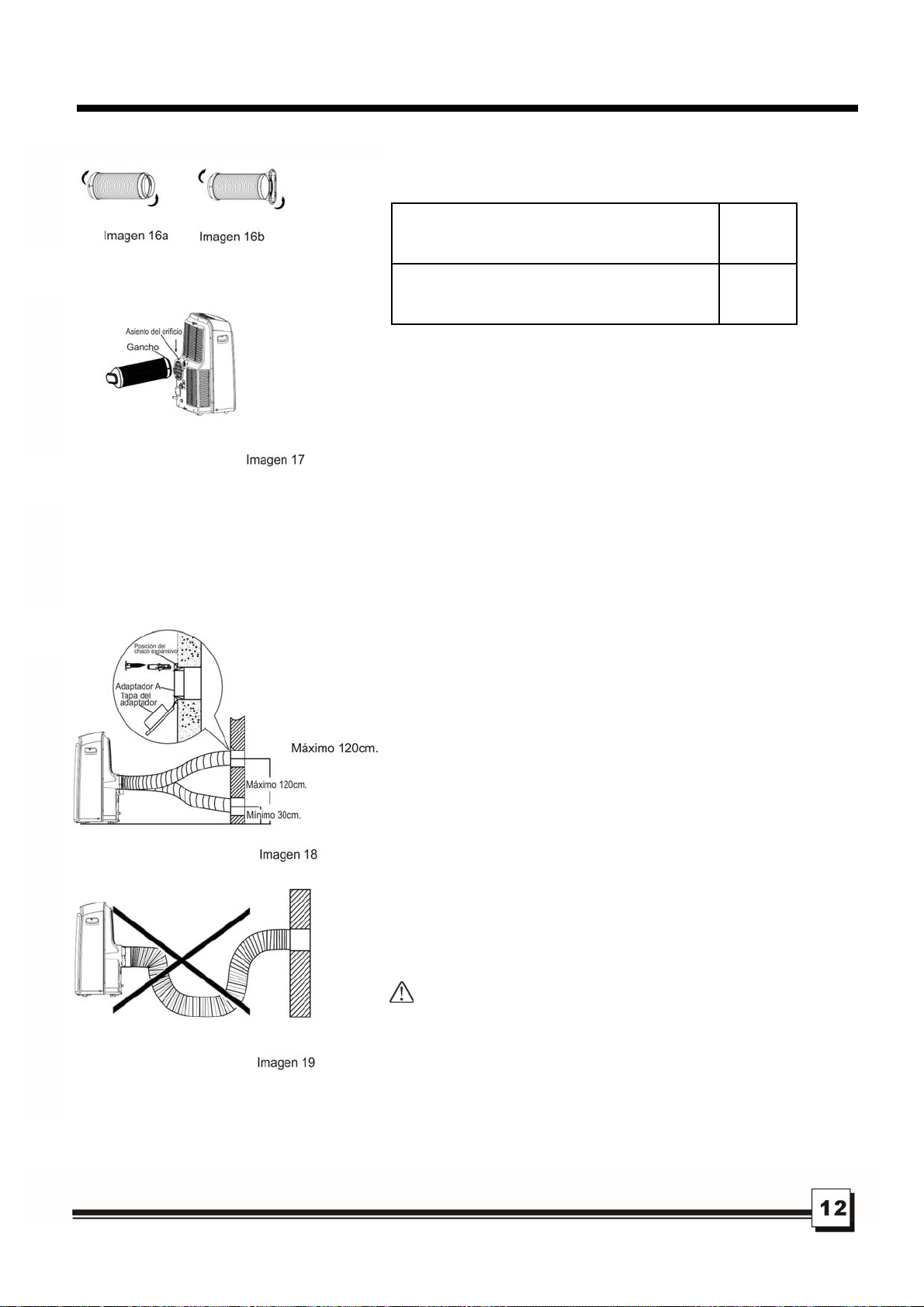
Como instalar la manguera de escape:
Se debe instalar o retirar la manguera de escape y el
adaptador según con la función de utilización.
Función VENTILACIÓN,
CALEFACCIÓN (tipo de bomba de
calefacción) o AUTOMÁTICO
Instalar
Función, VENTILACIÓN,
DESHUMIDIFACIÓN o CALEFACCIÓN
(Tipo de calefacción eléctrica)
Retirar
1
. Instale el adaptador B y el adaptador I en la manguera de escape
como se ve en la Imagen 16a o 16b. Véanse las páginas anteriores
para la instalación del equipo para ventana.
2
. Instale de nuevo el gancho de la Manguera de escape en el
asiento del agüero de la salida de aire y deslice hacia abajo la
Manguera de escape en el sentido de la dirección de la flecha,
para la instalación (véase la Imagen 17).
La manguera de escape se puede instalar en la pared
(No válido en las unidades sin adaptador A, conectores de
expansión y tarugos de madera de los accesorios).
1
. Perfore un orificio en la pared. Instale en la pared el Adaptador del
(parte externa), utilizando 4 conectores de expansión y tarugos;
asegúrese de apretarlos bien. (Véase la Imagen 18).
2
. Instale la Manguera de Escapa en la pared en el Adaptador de
escape A.
Nota:
Cubra la manguera utilizando la tapa del adaptador cuando
no esté en uso.
Se puede comprimir o estirar moderadamente la manguera de
escape según los requisitos de la instalación, pero se aconseja
mantener extendida la manguera a lo mínimo.
IMPORTANTE
NO DOBLE DEMASIADO LA MANGUERA DE ESCAPE (Véase
la Imagen 19).
CUIDADO
Asegúrese que no haya obstáculos alrededor de la salida
de aire de la Manguera de escape (en una distancia de
500 mm.), para que el sistema de escape funcione
adecuadamente.
INSTRUCCIONES DE INSTALACIÓN
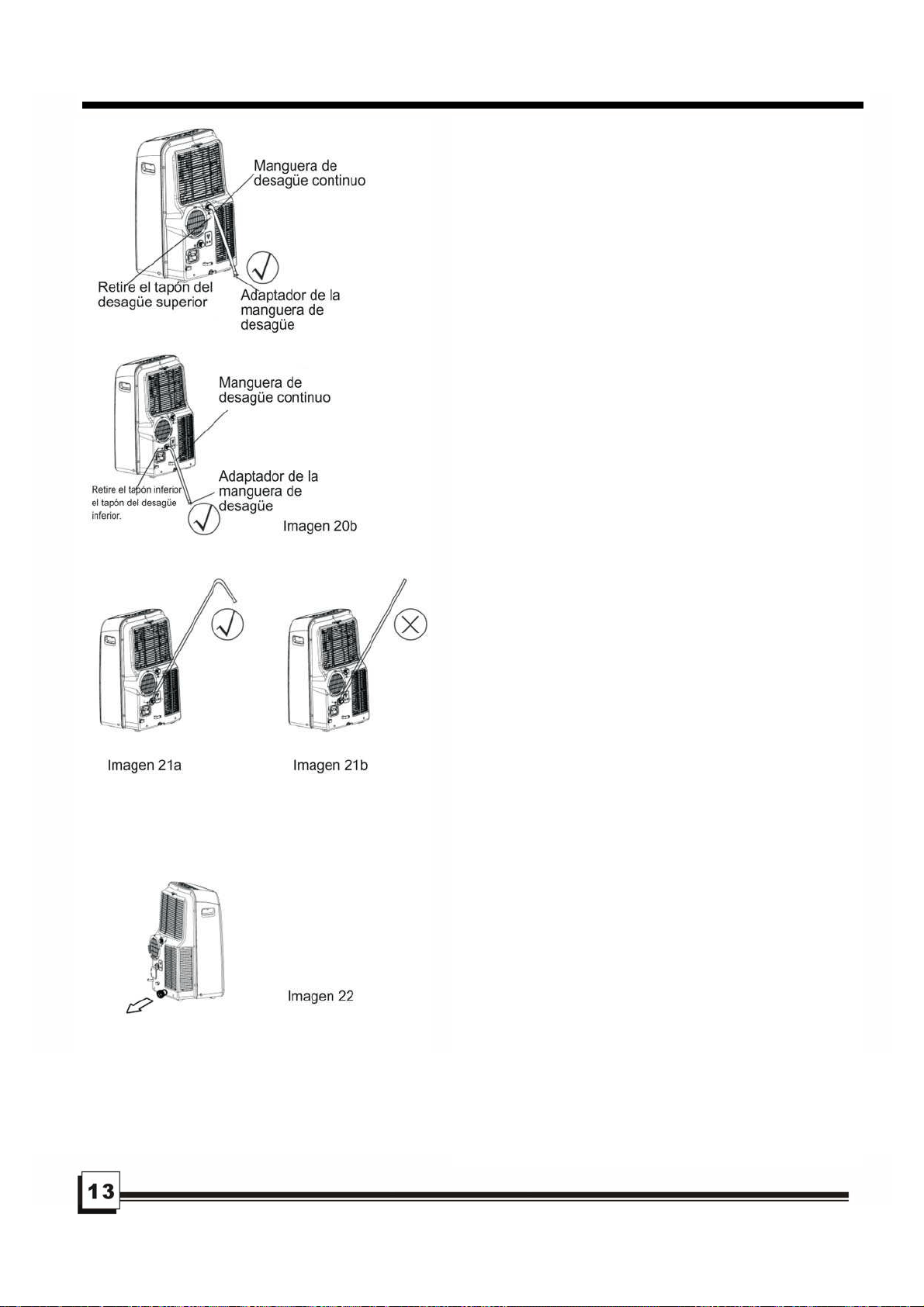
Desagüe:
- En las funciones de eliminación de humedad
(deshumidificación), retire el tapón de desagüe de
la parte posterior de la unidad; instale el conector
de desagüe (5/8 conector hembra universal de
5/8”), con manguera de 3/4" (comprado
localmente). En los modelos sin el conector de
desagüe, solo conecte la manguera de desagüe
en el agujero. Coloque el extremo abierto del
adaptador de manguera directamente sobre el
área de desagüe en el piso de la base. Véase la
Imagen 20a.
- En la función de la bomba de calefacción, retire el
conector del desagüe inferior de la parte posterior
de la unidad, instale el conector de desagüe (5/8
conector hembra universal de 5/8”), con manguera
de 3/4" (comprado localmente). En los modelos sin
conector de desagüe, solo instale la manguera de
desagüe directamente en el adaptador de
manguera. Coloque el extremo abierto del
adaptador de manguera directamente sobre el
área de desagüe en el piso de la base. Véase la
Imagen 20b.
NOTA: Asegúrese que la manguera esté bien
instalada para que no haya fugas. Oriente la
manguera hacia el desagüe, asegurándose que no
haya torceduras que impidan el flujo de agua.
Coloque el extremo de la manguera en el desagüe
y asegúrese que el extremo de la manguera esté
abajo para permitir que el agua fluya sin
obstrucciones (véase la Imagen 20a, 20b, 21a).
Nunca la levante (véase la Imagen 21b).
- Cuando el nivel de agua de la bandeja del fondo
llegue al nivel predeterminado, el aire
acondicionado emite una señal durante 8 veces.
En el área de la pantalla digital se ve la señal “P1”.
En este momento el proceso de producción de aire
acondicionado/deshumidificación se detendrá
inmediatamente. No obstante, el motor del
ventilador seguirá funcionando (esto es normal).
Mueva cuidadosamente el aire acondicionado a un
lugar para desaguarlo. Retire el tapón de desagüe
del fondo y deje drenar el agua (Imagen 22).
Coloque de nuevo el tapón de desagüe del fondo
y reinicie el aire acondicionado hasta que
desaparezca el código “P1”. Si se repite el error,
solicite servicio técnico.
NOTA: Asegúrese colocar de nuevo el tapón del
desagüe del fondo antes de utilizar el aire
acondicionado.
Imagen 20a
INSTRUCCIONES DE INSTALACIÓN
CUIDADO Y MANTENIMIENTO
IMPORTANTE:
1) Asegúrese de desconectar la unidad antes de limpiarla o realizar
mantenimiento.
2) No utilice gasolina, “thinner” u otros productos químicos para
limpiar el aire acondicionado.
3) No lave directamente el aire acondicionado bajo la llave o
utilizando una manguera. Se puede correr peligro de
electrocución.
4) Si se daña el cable eléctrico, lo debe reparar el fabricante o su
distribuidor.
1. Filtro de aire
- Limpie el filtro de aire al menos una vez cada dos semanas para
evitar el funcionamiento del ventilador inferior debido al polvo.
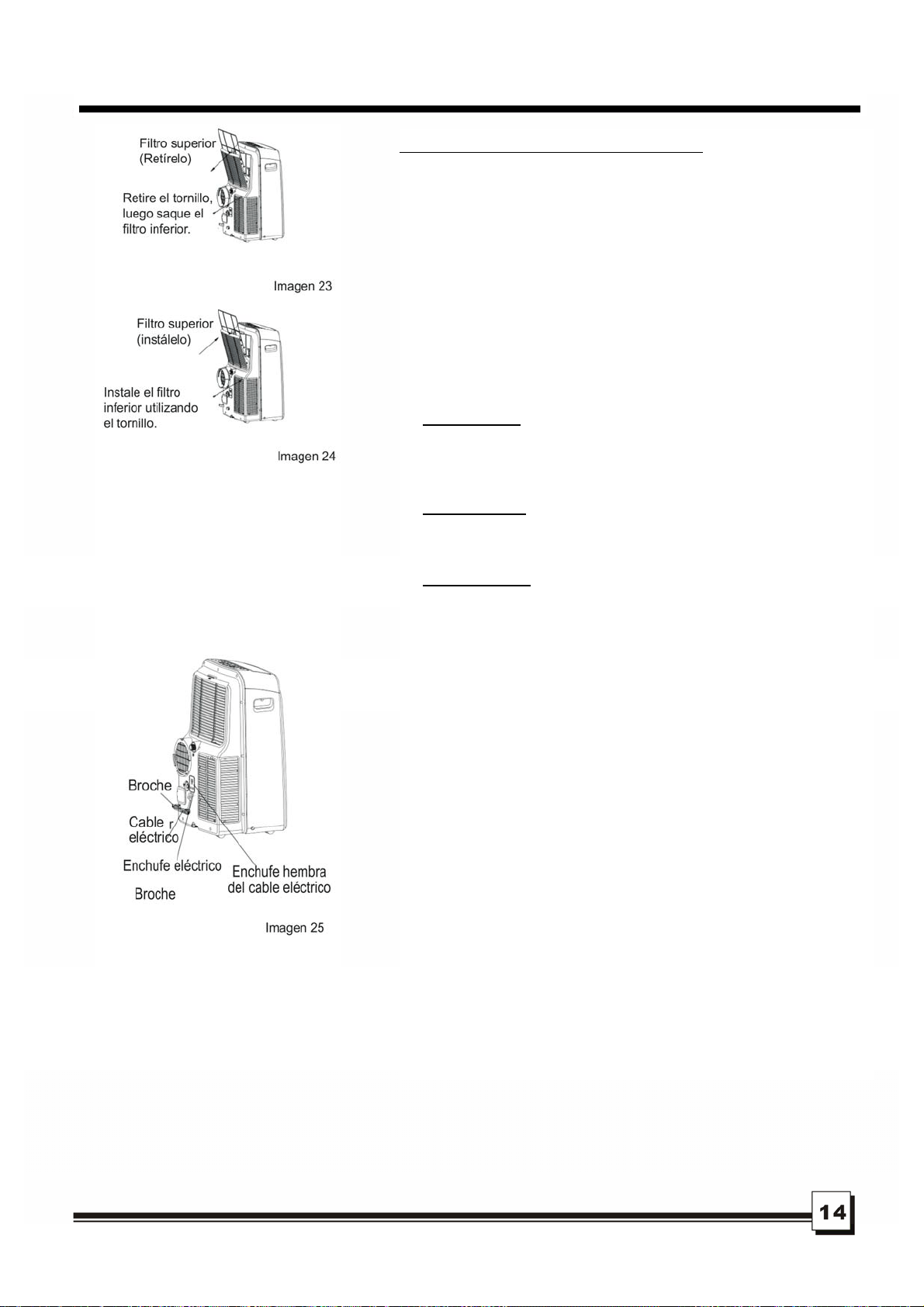
- Como retirarlo
Este aire acondicionado tiene dos filtros. Retire el filtro superior
en el sentido de la flecha (Imagen 23), luego bájelo.
Retire el filtro inferior aflojando el tornillo, retirando el filtro como
se ve en la Imagen 23.
- Como limpiarlo
Lave el filtro de aire sumergiéndolo suavemente en agua tibia
(aproximadamente a 40ºC/104ºC) con un jabón neutro.
Enjuáguelo y séquelo a la sombra.
- Como instalarlo
Instale el filtro superior de aire después de limpiarlo e instale el
filtro inferior utilizando el tornillo (véase la Imagen 24).
2. Carcasa del aire acondicionado
- Utilice un paño sin motas, remojado con un detergente neutro
para limpiar la carcasa, terminando el secado con un paño limpio
y seco.
3. Que hacer cuando no se va a utilizar el aire
acondicionado durante mucho tiempo
- Retire el tapón de caucho de la parte posterior del aire
acondicionado y conecte una manguera al desagüe. Coloque el
extremo abierto de la manguera directamente sobre el área de
desagüe en el piso de la base. (Véase la Imagen 22).
- Al retirar el tapón del fondo de la salida de desagüe del fondo, es
posible que se drene toda el agua de la bandeja del fondo (véase
la Imagen 22).
- Mantenga el aire acondicionado funcionando en la función
VENTILADOR durante medio día en una habitación cálida para
secar el interior del aire acondicionado y evitar la formación de
moho.
- Detenga el aire acondicionado y desconéctelo; envuelva el cable
y átelo con cinta (Imagen 25). Retire las pilas del control remoto.
- Limpie el filtro de aire y colóquelo de nuevo.
CONSEJOS PARA SOLUCIÓN DE PROBLEMAS DE FUNCIONAMIENTO
GUÍA DE SOLUCIÓN DE PROBLEMAS DE FUNCIONAMIENTO
FALLA POSIBLE CAUSA POSIBLE SOLUCIÓN
1. El código P1 aparece en la
pantalla.
Vacíe el agua que haya en la bandeja
del fondo.
1. El aire acondicionado no
arranca al presionar la tecla
Encender/Apagar
2. Le temperatura de cuarto es
inferior a la temperatura ajustada
(en la función ventilación)
Ajuste de nuevo la temperatura.
- Las ventanas o puertas de la
habitación no están cerradas.
Asegúrese que todas las ventanas y
puertas estén cerradas.
- Hay fuentes de calor dentro de la
habitación.
Retire las fuentes de calor si es
posible.
- El ducto de escape no está
conectado o está bloqueado.
Conecte el ducto y asegúrese que
puede funcionar correctamente.
2. No enfría lo suficiente
- El filtro de aire está bloqueado con
polvo.
Limpie el filtro de aire.
4. El aire acondicionado es
muy ruidoso o produce
vibración
- El suelo no está a nivel o no es lo
suficientemente plano.
Coloque el aire acondicionado sobre
una superficie plana y nivelada, tanto
como sea posible.
5. Hay sonido de gargareo
- El sonido viene del flujo del
refrigerante dentro del aire
acondicionado.
Es normal.
6. Se apaga en la función de
aire acondicionado
- Es la función de protección
automática contra recalentamiento.
Cuando la temperatura de la salida
de aire supera los 70ºC/158ºF, se
detendrá el aire acondicionado.
Después de que el aire acondicionado
se haya enfriado, enciéndalo de
nuevo.
Nota: Este aire acondicionado puede ser sometido a cambios continuos, sin previo
aviso, en sus especificaciones técnicas y funcionamiento. Por lo tanto, la
información consignada en este manual puede presentar cambios en relación a
características y funcionamiento
.