1
OPERATING
T21STK-2
INSTRUCTION

2
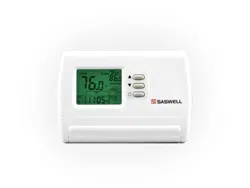
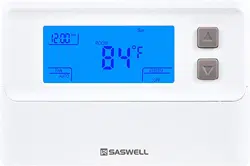
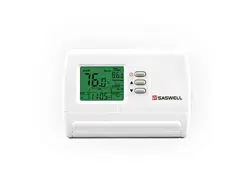
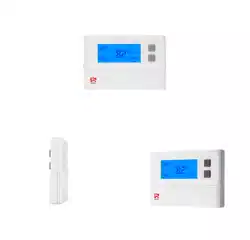
T21STK-2 SINGLE STAGE PROGRAMMABLE THERMOSTAT
1 Heat / 1 Cool single stage thermostat.
5+2 Programmable, Compatible with heat pump system
Installation and Operation Manual
Specification:--------------------------------------------------------------------------------
Power Supply: 20VAC-30VAC 50-60HZ or Battery powered.
Terminal Load: 1.0A per terminal, 3.0A maximum total load
Set Point Temperature Range: 45ºF to 90ºF (7ºC to 32ºC).
Accuracy: +/- 1ºF or +/- 0.5ºC.
Dimensions: 6.0” W X 4.7” H X 1.1” D
Color: White

3
FEATURES:---------------------------------------------------------------------------------
Large LCD display with backlight, continuous backlight option
Simultaneous heat and cool set point storage
Display of room temperature, set temperature and current time simultaneously
Fan switch with ON and AUTO
Permanent user setting retention during power loss. No batteries are required.
Operates from 24VAC, or from 2 size “AA” alkaline batteries
Optional temperature display of Fahrenheit or Celsius scale.
Air Filter change Indicator
Low Battery Indicator
Display temperature calibration.
Separate 5-day (weekday) and 2-day (Saturday/Sunday) programming with

4
four separate time/temperature periods per day.
Intelligent Recovery Option for optimizing comfort
IMPORTANT SAFETY INFORMATION-------------------------------------------
Always turn off power at the main power source by removing the fuse, or
switching the circuit breaker to the off position before installing, removing,
cleaning, or servicing this thermostat.
Read all of the information in this manual before installing this thermostat.
Use a professional contractor to install this thermostat.
This is a 24VAC low-voltage thermostat. DO NOT INSTALL ON VOLTAGES
HIGHER THAN 30 VAC.
ALL wiring must conform to local and national building and electrical codes
and ordinances.

5
Do not short (jumper) across terminals on the gas valve or at the system
control to test installation. This will damage the thermostat and void the
warranty.
Do not switch the system to cool if the temperature is below 50ºF (10ºC). This
can damage the air conditioning system and may cause personal injury.
Replace batteries when the battery icon indicates the low battery message.
Change the Air Filter when the Filter Change Icon begins blinking.
Use this thermostat only as described in this manual.
REMOVE THE OLD THERMOSTAT--------------------------------------------------------------------------
WARNING!: Electrical Shock Hazard
1. Turn off power at the main service panel by removing the fuse or switching the
appropriate circuit breaker to the OFF position before removing the existing
thermostat.

6
2. Turn off power to the heating and cooling system by removing the fuse or
switching the appropriate circuit breaker off.
3. Remove the cover of the old thermostat. This should expose the wires.
4. Label the existing wires from the existing thermostat before removing.
5. After labeling the wires, remove the wires from the wire terminals.
6. Remove the existing thermostat from the wall.
7. Refer to the following section for instructions on how to install this thermostat.

7
INSTALL THE THERMOSTAT---------------------------------------------------------------------------------
ATTACH THERMOSTAT BASE TO WALL PULL THE COVER OFF THE BASE.

8
WARNING!: Electrical Shock Hazard
Turn off power at the main service panel by removing the fuse or switching the
appropriate circuit breaker to the OFF position before removing the existing thermostat.
1. Turn off power to the heating and cooling system by removing the fuse or
switching the appropriate circuit breaker off.
2. Place the system switch (COOL/OFF/HEAT) in the OFF position.
3. Place the FAN (AUTO/ON) switch in the AUTO position.
4. Gently pull the cover straight off the base. (See figure 1.)
5. Put the thermostat base against the wall where you plan to mount it. (Be sure
the wires will feed through the wire opening in the base of the thermostat.)
6. Mark the placement of the mounting holes.
7. Move the base out of the way. Drill mounting holes. Use a hammer to tap in
the supplied anchors into the mounting holes.

9
8. Fasten the base loosely to the wall as shown in Figure 1, using two mounting
screws. Place a level against the bottom of the base and adjust until level,
then tighten the screws. (Leveling is for appearance only, and will not affect
thermostat operation.)
9. Insert stripped, labeled wires into matching wire terminals. See “Wiring
Diagrams”, Figure 2.
CAUTION: Be sure exposed portions of wires do not touch other wires.
10. Tighten screws on terminal block. Gently tug on each wire to be sure of
proper connection. Double check that each wire is connected to the proper
terminal.
CAUTION: Installing batteries backwards can damage the thermostat.

10
11. Install two fresh “AA” alkaline batteries in the battery compartment. Be sure
to match positive (+) ends of batteries with positive (+) battery terminals in the
battery compartment. (The thermostat will operate from 2 size “AA” alkaline
batteries or 24VAC power. When operated from 24VAC power, your thermostat will
maintain time and continuously display the temperature during a loss of AC power
with the batteries installed.)
12. Replace the cover on the thermostat by snapping it in place.
13. Turn on power to the system at the main service panel.
14. Test thermostat operation as described in the following section.
FAN OPTION SWITCH
Read the following information before setting the fan option switch (See figure 3). If you
are unsure of your application, contact a qualified service person.

11
This thermostat is configured from the factory to energize the fan on a call for heat. If
your system is an electric heat or heat pump that REQUIRES the thermostat to turn on
the fan on a call for heat, place the fan option switch in the ELEC position. If your system
does not require the thermostat to energize the fan on a call for heat such as fossil fuel
(gas, oil, etc.), forced air system as well as hydraulic heating systems, place the fan
option switch in the GAS position.
BATTERY OPERATION
The thermostat will operate from 2 size “AA” alkaline batteries or 24VAC power. When
operated from batteries, connection to the “C” (common) or (neutral) terminal is not
required.
NOTE: When operated from batteries (No “C” terminal connection), the LCD display
backlight options are limited to option 1 (disabled) or option 2 (30 second illumination
after each button press).
12
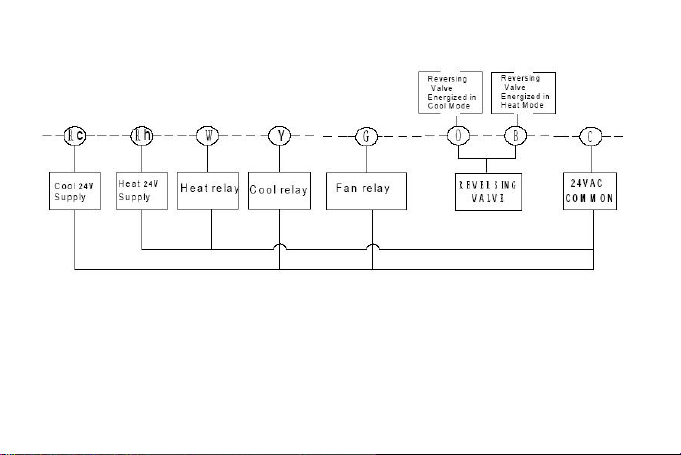
Wiring Diagrams
Figure 3, Typical wiring diagram for heat/cool,
5 wire two transformer system.
13
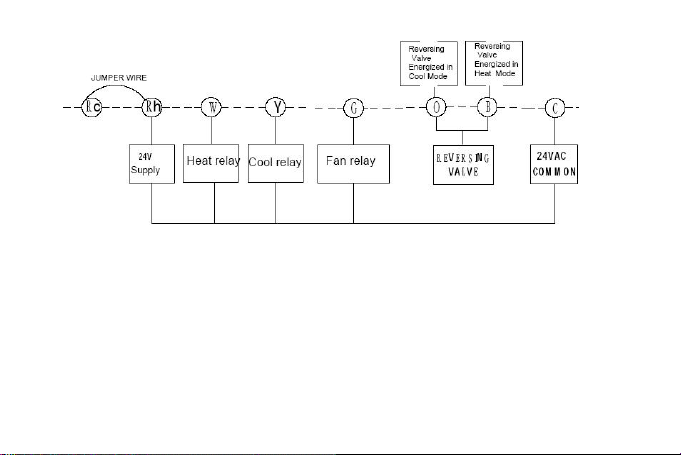
Figure 4, Typical wiring diagram for heat/cool,
4 wire, single transformer system
14
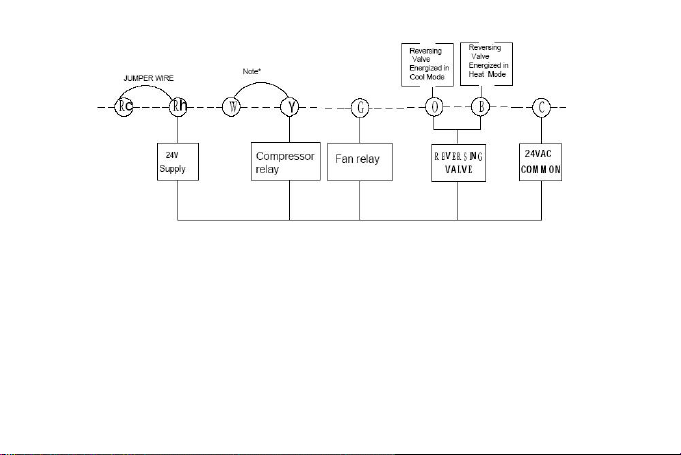
Note* Jumper required in heat pump mode.
Figure 5, Typical wiring diagram for heat pump
with reversing valve

15
CHECK THERMOSTAT OPERATION------------------------------------------------------------------
If at any time during testing your system does not operate properly, contact a qualified
service person.
Turn on power to the system.
Fan Operation
Move the system switch to the OFF position. If your system does not have a “G” (Fan)
terminal connection, skip to the Heating System.
1. Move the fan switch to the ON position. The blower should begin to operate.
2. Move the fan switch to the AUTO position. The blower should stop
immediately.
Heating System
1. Move the SYSTEM switch to the HEAT position. If the auxiliary heating
system has a standing pilot, be sure to light it.

16
2. When the (FA)st heating cycle rate is selected in the configuration
menu, (see configuration menu item 2), the thermostat will call for heat at
0.5ºF (0.5ºC) below set-point, and turn off at set point. When the (SL)ow
heating cycle rate is selected, the thermostat will call for heat at 1.5ºF (1.5ºC)
below set-point, and turn off at set-point. When the thermostat calls for heat,
the display will show Heat On. If the Heat On display is flashing, the
compressor lockout feature is operating in the heat pump mode. (Note: See
Configuration menu item 8).
Cooling System
CAUTION!: To prevent compressor and/or property damage, if the outdoor
temperature is below 50ºF (10ºC), DO NOT operate the cooling system.
1. Move the SYSTEM switch to the COOL position.

17
2. When the (FA)st cooling cycle rate is selected in the configuration
menu, (see configuration menu item 2), the thermostat will call for cooling at
0.5ºF (0.5ºC) above set-point, and turn off set point. When the (SL)ow cool
cycle rate is selected, the thermostat will call for cooling at 1.5ºF (1.5ºC) above
set-point, and turn off at set-point. When the thermostat calls for cooling, the
display will show COOL On. If the COOL On display is flashing, the
compressor lockout feature is operating. mode. (Note: See Configuration
menu item 8).
If all functions operate properly, the thermostat is installed correctly.
Replacing Batteries
If your thermostat was pre-installed, the batteries may be in place. If the
battery icon on the display is flashing, it indicates that the batteries need to
be replaced. When the thermostat is powered only by battery, the battery icon
will flash for approximately 2 months before the batteries are expected to

18
expire. Then the thermostat will cut power to the heating/cooling system.
Important: Replace the batteries when the low battery message flashes on
the display. This will keep the thermostat operating properly. With two “AA”
batteries installed, your thermostat will maintain time and continuously display
the temperature during a loss of AC power.
1. Place the COOL/OFF/HEAT switch in the OFF position.
2. Put the FAN AUTO/ON switch in the AUTO position.
3. Gently pull the cover straight off the base.
4. Install two “AA” alkaline batteries in the battery
compartment. Be sure to match the positive (+) ends of the
batteries with the positive terminals marked in the battery
compartment.

19
1. Configuration Menu
The configuration menu allows you to set certain thermostat operating
characteristics to your system or personal requirements. Move the SYSTEM
switch to the OFF position, then press and hold the PRGM and RUN buttons for
3 seconds to enter the configuration menu. The display will show the first item in
the configuration menu. Press the PRGM button to move to the next menu item,
or press TIME to return to a previous menu item. To revert to factory default
settings, press the RESET button (See Fig. 3). All user’s changed settings will
revert to factory default settings, including program settings. Use the ▲or▼
buttons to select. To exit the configuration menu and return to normal operation,
press the RUN button. If no buttons are pressed within 130 seconds, the
thermostat will exit the configuration menu.
The configuration menu chart summaries the configuration options. An
explanation of each option follows.

20

21
1. Select cooling cycle rate
The FA setting is used to produce shorter cooling cycles. The SL setting
produces a longer cooling cycle. Both settings produce very accurate
temperature control and can be set to your personal preference. FA cycles the
system at a 0.5ºF (0.5ºC) differential, and SL cycles the system at 1.5ºF
(1.5ºC).
2. Select heating cycle rate
The FA setting is used to produce shorter heating cycles. The SL setting
produces a longer heating cycle. Both settings produce very accurate
temperature control and can be set to your personal preference. FA cycles the
system at a 0.5ºF (0.5ºC) differential, and SL cycles the system at 1.5ºF
(1.5ºC).

22
3. Select system heating type
Users can select the system heating type according to their heating system.
Select 0 for gas, oil, or electric heating systems. Select 1 for a heat pump heating
system.
4. Select display backlight
The display backlight improves display contrast in low lighting conditions.
Select 1 for NO backlight display. Select 2 for the backlight to come on for
approximately 30 seconds when any button of the thermostat is touched.
Select 3 for the backlight to remain on continuously.
NOTE: When operated from batteries (No “C” terminal connection), the LCD
display backlight options are limited to option 1 (disabled) or option 2 (30
second illumination after each button press).

23
5. Select filter replacement run time
The thermostat will display the Filter Alarm after a set time of operation. This
is a reminder to change or clean your air filter. This time can be set from 0 to
12 months in 1 month increments. Selection of 00 WILL CANCEL THIS
FEATURE.
6. Select ºF or ºC readout
Changes the display readout to Centigrade or Fahrenheit as required.
7. Select temperature recalibration
This feature allows you to adjust the displayed room temperature up to 4º
higher or lower. Your thermostat can be accurately calibrated to match your
previous thermostat. The current or adjusted room temperature will be
displayed on the display.

24
8. Select compressor lockout delay
To protect the compressor from short cycling, you can select compressor
off-time cycle between 0 or 5 minutes. When the thermostat compressor time
delay occurs, the Cool On or Heat On display will flash during compressor
lockout.
9. Intelligent recovery
When selected (1), The thermostat will calculate how long it takes to
bring the room temperature up to the programmed set-point on the first
set-up period of the day, and activate the system earlier so that the
room temperature is at set-point at the set-up time.

25
THERMOSTAT OPERATION
1. Setting the thermostat
This thermostat is very easy to operate. Set the SYSTEM switch
to either HEAT or COOL, then press the ▲ or ▼ buttons until the
temperature you want to maintain is shown on the right side of the
display. If you want to turn the system off, just move the SYSTEM
switch to the OFF position and the FAN switch to the AUTO position.
2. Set current day and time
Press the TIME button. The hours display will begin to blink.
Press the ▲ or ▼ buttons until you reach the correct hour and AM/PM
designation. (AM begins at mid-night, and PM begins at noon).
Press the TIME button again. The minutes display will begin to blink.
Press the ▲ or ▼ buttons until you reach the correct minutes.
Press the TIME button again. The day of the week will begin to blink.

26
Press the ▲ or ▼ buttons until you reach the correct day of the week.
Press the TIME button again. The display will now indicate the correct time
and day of the week.
3. Filter timer
a) When in configuration the selections are in months, each month
selections are equal to 30 days.
b) Move the SYSTEM switch to the HEAT or COOL position, then
press and hold the ▲ and ▼ buttons for 5 seconds to review filter running
days.
To exit the review menu press the ▲ or ▼ buttons one time. Or If
no buttons are pressed within 15 seconds, the thermostat will exit the
configuration menu. In review mode, press and hold the ▲ and ▼ 15 sec. to
clean the filter warning. It will show “dEF” blink. To reset the filter
days – refer to configuration item 5 operation.

27
MANUAL OPERATION
1) Hold Temperature
With the SYSTEM switch set to HEAT or COOL, momentarily press the HOLD button.
HOLD will be displayed. Use the ▲ or ▼ buttons to adjust the temperature. The
thermostat will control the room temperature at the selected setting until you press the
RUN button to restart the program operation.
2) Temperature Override (When in the program RUN mode).
Press the ▲ or ▼ buttons to select the desired room temperature. The thermostat will
override the current programming and keep the Room temperature at the selected
temperature until the next program period begins. The thermostat will then revert back to
the program temperatures.

28
Planning your program
Note: The time of day clock MUST be set to the correct day and time in order for the
programmed times to be correct.
Look at the factory preprogrammed times and temperatures shown in the Factory default
program setting. If this program will suit your needs, simply press the RUN button to
begin running the factory preset program.
If you wish to change the preprogrammed time and temperature, follow these steps:
Determine the time periods and temperatures for your program. You must program four
periods for each day. However, you may use the same heating and cooling temperatures
for consecutive time periods. You can choose heating temperature, cooling temperature
and start time independently. (for example, you may select 5:00 am AND 70º F as the
weekday 1
st
period heating start time and temperature and also choose 7:00 AM and 76º
F as the weekday 1
st
period cooling start time and temperature.
Use the table below to plan your program time periods and the temperatures you want

29
during each period. Fill in the completed table to have a record of your program.
EXAMPLE:
Heating/Cooling Schedule Plan (Factory default program setting)

30
Heating/Cooling Schedule Plan
Enter the Heating Program
1) Move the SYSTEM switch to the HEAT position.
2) Press PRGM once. PRGM SETTING will display, and “MON TUE WED
THU FRI” (indicating weekday program) will appear in the display (flashing).
Also displayed are the current programmed start time for the 1
st
heating period
(flashing),and the currently programmed temperature.

31
3) Press the ▲ or ▼ buttons to select the desired 1
st
heating period start time.
The time will change in 15 minute increments. When your selected time is
displayed, press the TIME button to change to the temperature mode.
4) Press the ▲ or ▼ buttons to select the desired 1
st
heating period
temperature.
5) Press PRGM once. The currently programmed start time and set point for
the 2
nd
heating program will appear.
6) Repeat steps 3 and 4 to select the start time and heating temperature for
the 2
nd
heating program period.
7) Repeat steps 3 thru 5 for the 3
rd
and 4
th
heating program periods.
8) Press PRGM once. PRGM SETTING will display, and “SAT SUN”
indicating weekday program) will appear in the display (flashing). Also
displayed are the current programmed start time for the 1
st
heating period

32
(flashing),and the currently programmed temperature.
9) Repeat steps 3 thru 7 to complete Saturday and Sunday programming.
10) When you have completed entering your heating program, press RUN.
Thermostat Buttons and Switches
Enter the Cooling Program
Caution! If the outside temperature is below 50ºF; disconnect power to
the cooling system before programming. Energizing the air conditioner
compressor during cold weather may cause property damage.
1) Move the SYSTEM switch to the COOL position.
2) Follow “Enter the Heating Program” for entering your cooling program,
using your selected cooling times and temperatures.

33
Check your programming
Follow these steps to check your thermostat programming one final time
before beginning thermostat operation:
1) Move the SYSTEM switch to HEAT.
2) Press PRGM to view the 1
st
weekday heating period time and temperature.
Each time you press PRGM the next heating period time and temperature
will be displayed in sequence for weekday, then Saturday and Sunday
program periods (you may change any time or temperature during this
procedure).
3) Press RUN.
4) Move the SYSTEM switch to COOL.
5) Repeat step 2 to check the cooling program.

34
6) Move the SYSTEM switch to HEAT or COOL and press RUN to begin
program operation.
REVERT TO FACTORY DEFAULT PROGRAM SETTINGS
Press the RESET button. All user’s changed settings will revert to factory
default settings (Including configuration settings).
Troubleshooting--------------------------------------------------------------------------------
If a voltage spike or static discharge blanks out the display or causes erratic
thermostat operation, you can reset the thermostat by pressing the reset
button (See Figure 1). If the thermostat has power, and has been reset and still
does not function correctly, contact your heating/cooling service contractor

35
THERMOSTAT LCD DISPLAY
Figure 2

36
THERMOSTAT BUTTONS AND SWITCHES
Figure 3

37
Troubleshooting
If a voltage spike or static discharge blanks out the display or causes erratic operation,
you can reset the thermostat by pressing the reset button (see figure 1). If the thermostat
haw power, has been reset and still does not function correctly, contact your
heating/cooling service person or place

38

39

40

41