
User Manual
D7S Smart Diagnostic System
Shenzhen Xtooltech Intelligent Co., LTD

Please read this user manual carefully before using the Smart Diagnostic System, referred to as the
“Scan Tool” throughout this document. When reading the manual, please pay attention to the
words “Note” or “Caution”, and read them carefully for appropriate operation.
OPERATION INSTRUCTIONS
For safe operation, please follow the instructions below:
Keep the device away from heat or fumes when in use.
If the vehicle battery contains acid, please keep your hands and skin or fire sources away
from the battery during testing.
The exhaust gas of the vehicle contains harmful chemicals. Please ensure adequate
ventilation.
Do not touch the vehicle cooling system components or exhaust manifolds when the engine is
running due to the high temperatures reached.
Make sure the car is securely parked, Neutral is selected or the selector is at the P or N
position to prevent the vehicle from moving when the engine starts.
Make sure the (DLC) Diagnostic Link Connector is functioning properly before starting the
test to avoid damage to the Diagnostic Computer.
Do not switch off the power or unplug the connectors during testing.
Doing so may damage the ECU (Electronic Control Unit) and/or the Diagnostic Computer.
CAUTIONS!
Avoid shaking, dropping or dismantling the scan tool as it may damage the internal
components.
Use only your fingertips to touch the LCD screen. Hard or sharp objects may damage the
scan tool.
Do not use excessive force;
Do not expose the screen to strong sunlight for a long period.
Please keep the scan tool away from water and moisture.
Store and use the scan tool only within the temperature ranges identified in the Technical
Specifications section.
Keep the unit away from strong magnetic fields.
AFTERSALES-SERVICES
E-Mail: supporting@xtooltech.com
Tel: +86 755 21670995 or +86 755 86267858 (China)
Official Website: www.xtooltech.com

Catalogue
Operation Instructions
........................................................................................................................ 2
Cautions!
............................................................................................................................................. 2
1. General Introduction
.....................................................................................................................4
2. Diagnostics
..................................................................................................................................... 6
3. Special Functions
......................................................................................................................... 18
3.2 OIL RESET
........................................................................................................................ 21
3.3 EPB
.................................................................................................................................... 23
3.4 SAS
.................................................................................................................................... 25
3.5 BMS RESET
...................................................................................................................... 27
3.5 INJECTOR CODING
........................................................................................................ 28
3.7 DPF REGENERATION
.....................................................................................................31
3.8 TPMS RESET
.................................................................................................................... 34
4. Report
........................................................................................................................................... 38
5. Update & Factory Reset
..............................................................................................................4
1
6. Remote Assistance .....................................................................................................................43
7. Appendix....................................................................................................................................44
1. GENERAL INTRODUCTION
The XTOOL D7S smart diagnostic system (referred to as the “Scan Tool”) is an advanced
scanning tool based on the Android operating system. It supports multiple languages and is
suitable for different countries and regions. The advantage of this OBD-II (On-Board Diagnostics
version 2) scanner is its comprehensive functions and its ability to quickly provide the user with
more accurate diagnostic information.
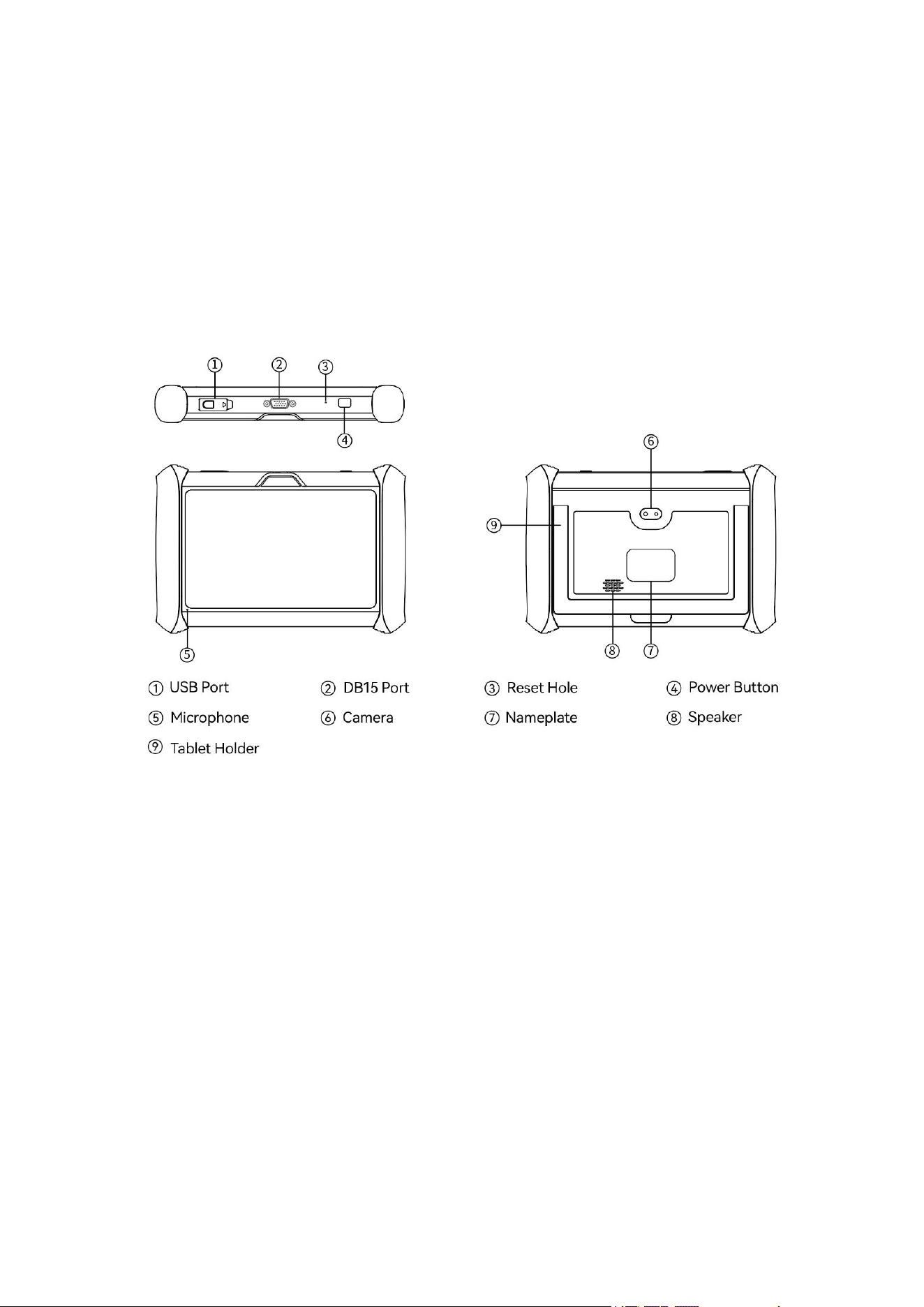
TABLET
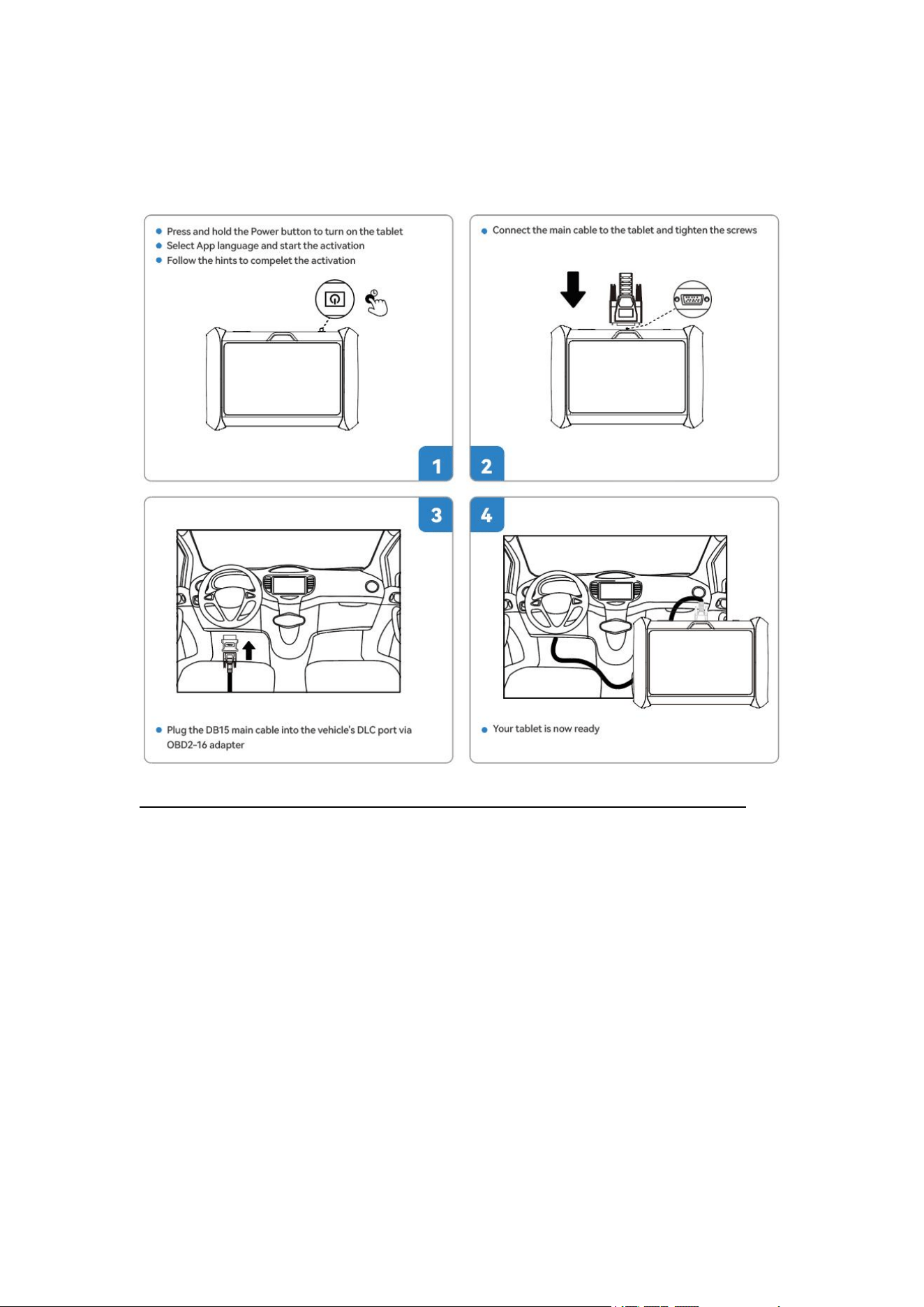
VEHICLE CONNECTION
Wired Connection
※
For models with DoIP protocol communication, please be sure the device is connected to vehicle by wire.

Precautions for Diagnosis
1. The voltage range on the car: +9~+36V DC;
2. When testing some special functions, the operator must operate according to the
prompts and meet the test conditions. For some models [special functions], the
conditions that need to be met are: engine water temperature 80 ℃~105 ℃, turn off
headlights and air conditioners, keep the accelerator pedal in the released position,
etc.;
3. The electronic control systems of different models are very complicated. If you
encounter situations where it is impossible to test or a large amount of test data is
abnormal, you can search for the ECU of the vehicle and select the menu for the
model on the ECU nameplate;
4. If the vehicle type or electronic control system to be tested is not found in the
diagnostic function, please upgrade the vehicle diagnostic software to the latest
version using the Updates menu or consult the XTOOL technical service department;
5. Only wiring harnesses provided by XTOOL and designed for the device are
permitted to be used with this device to avoid damage to the vehicle or the device;
6. When running a Diagnostics function, it is forbidden to shut down the device
directly. You should cancel the task before returning to the main interface and then
shutting down the device.
2. DIAGNOSTICS
The diagnostic application can read ECU information, read and clear DTC
(Diagnostic Trouble Codes) and check live data and freeze frame data. The Diagnostic
application can access the ECU of various vehicle control systems, including the
Engine, Transmission, Anti-lock Braking System (ABS), Airbag Safety Restraing
System (SRS), Electronic Parking Brake system (EPB) and perform many types of
actuation tests.
BEGINNING DIAGNOSTIC TESTING
After the tablet device is properly connected to the vehicle, you could start the vehicle
diagnosis.
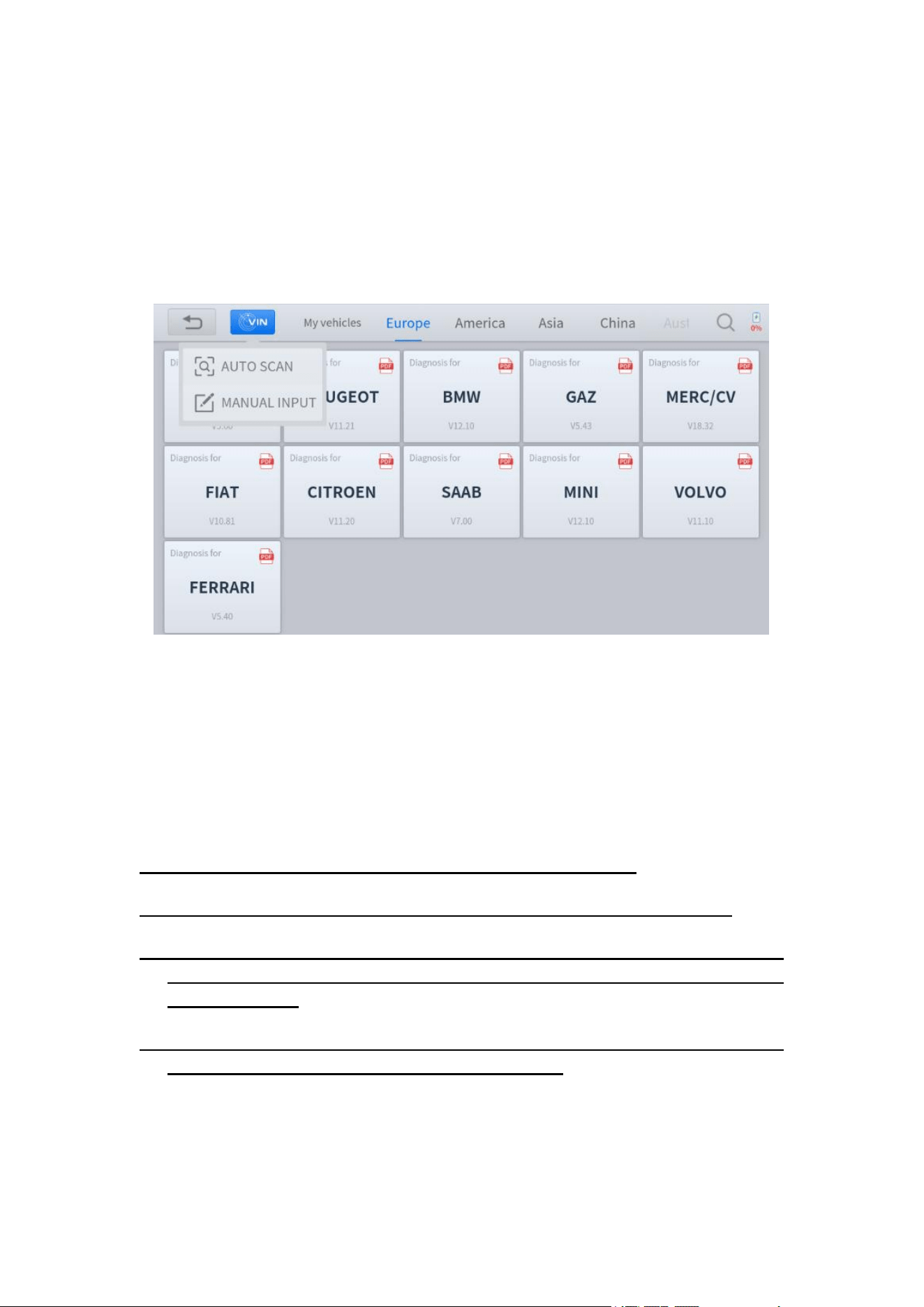
VEHICLE SELECTION
The scan tool supports the following 3 ways to access the smart diagnostics system.
AUTO SCAN
MANUAL INPUT
SELECT VEHICLE BY AREA
Click the VIN button in the upper left corner and then choose to enter the vehicle
diagnosis through either AUTO SCAN or MANUAL INPUT.
AUTO SCAN: It supports the automatic reading of vehicle VIN code. You also can
tap on the button “AUTO SCAN” on the diagnosis system entrance to use this
function. Please make sure that the car and the device are well connected before using
this function.
⚠
If your model is not recognized, please try the following steps:
① UPDATE all software, and check whether the APP is updated in [Settings]
② Please click Diagnosis on the main menu to enter the selection menu, manually
select the engine system to read the ECU information, and confirm whether the
VIN can be read.
③ Contact the XTOOL technical team to provide the VIN code to confirm whether
the model supports automatic identification of VIN.
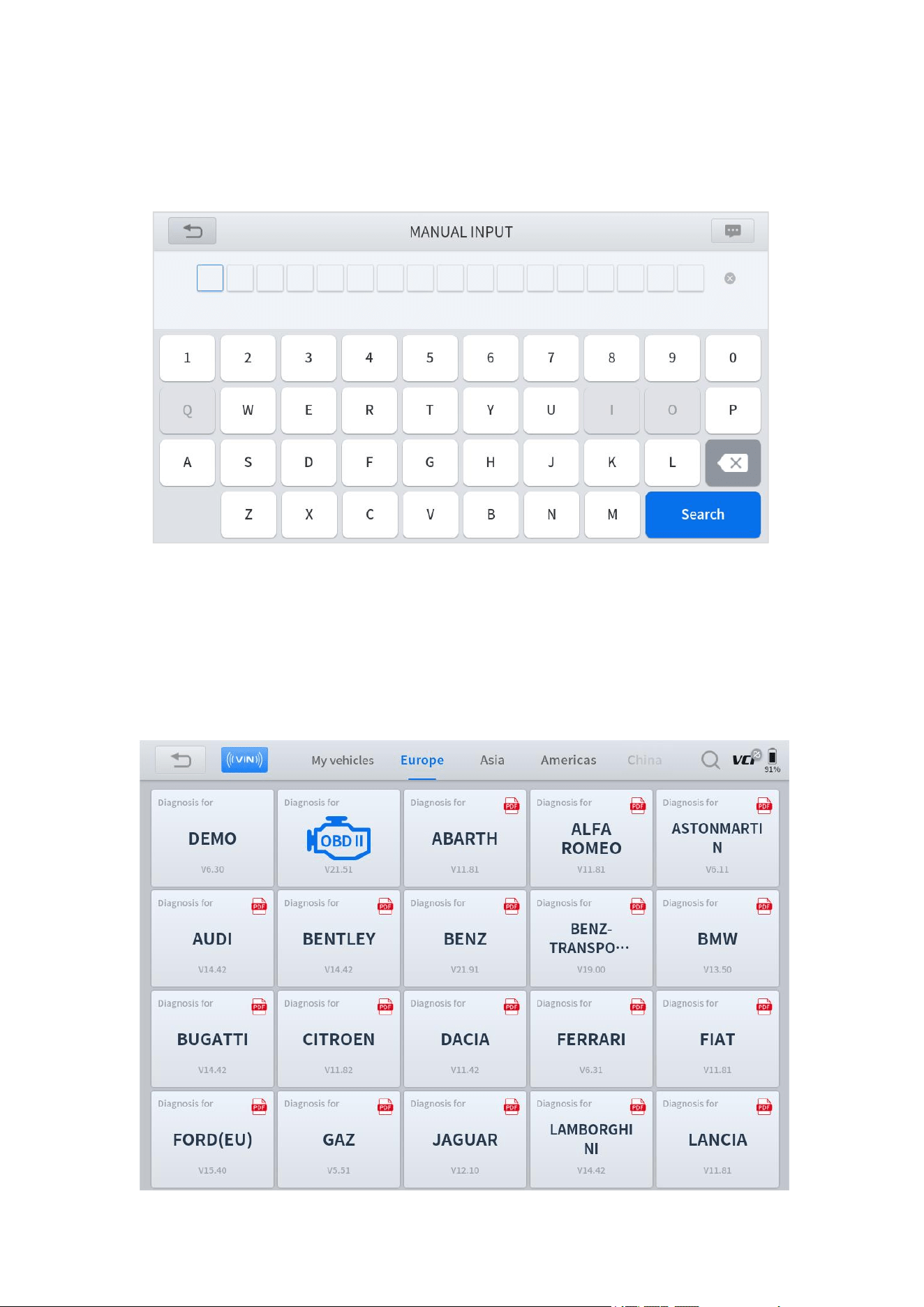
MANUAL ENTER: It supports manual input of car VIN code. When entering the
VIN code manually, make sure that the 17 characters entered are correct to ensure
accurate test results.
SELECT VEHICLE BY AREA
In addition to the above 3 methods, you can also choose a car brand by selecting the
appropriate region at the top of the screen. You can select the vehicle model that needs
to be diagnosed according to the area, as shown below:
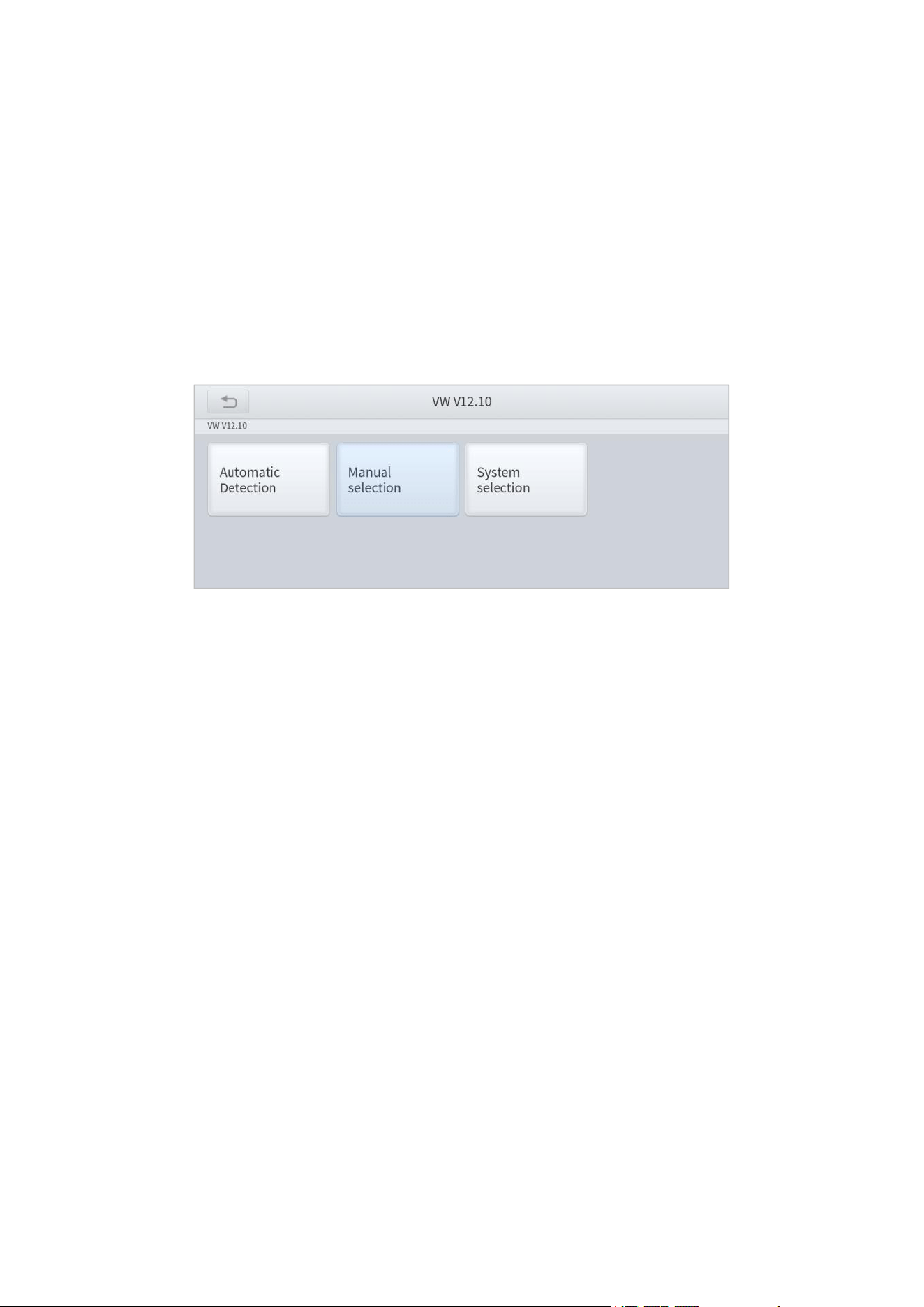
OBD-II supports reading the related fault codes of the Powertrain Control Module
(PCM).
DEMO: a demonstration program; Click this button to experience and learn the
operation processes of the diagnostic function.
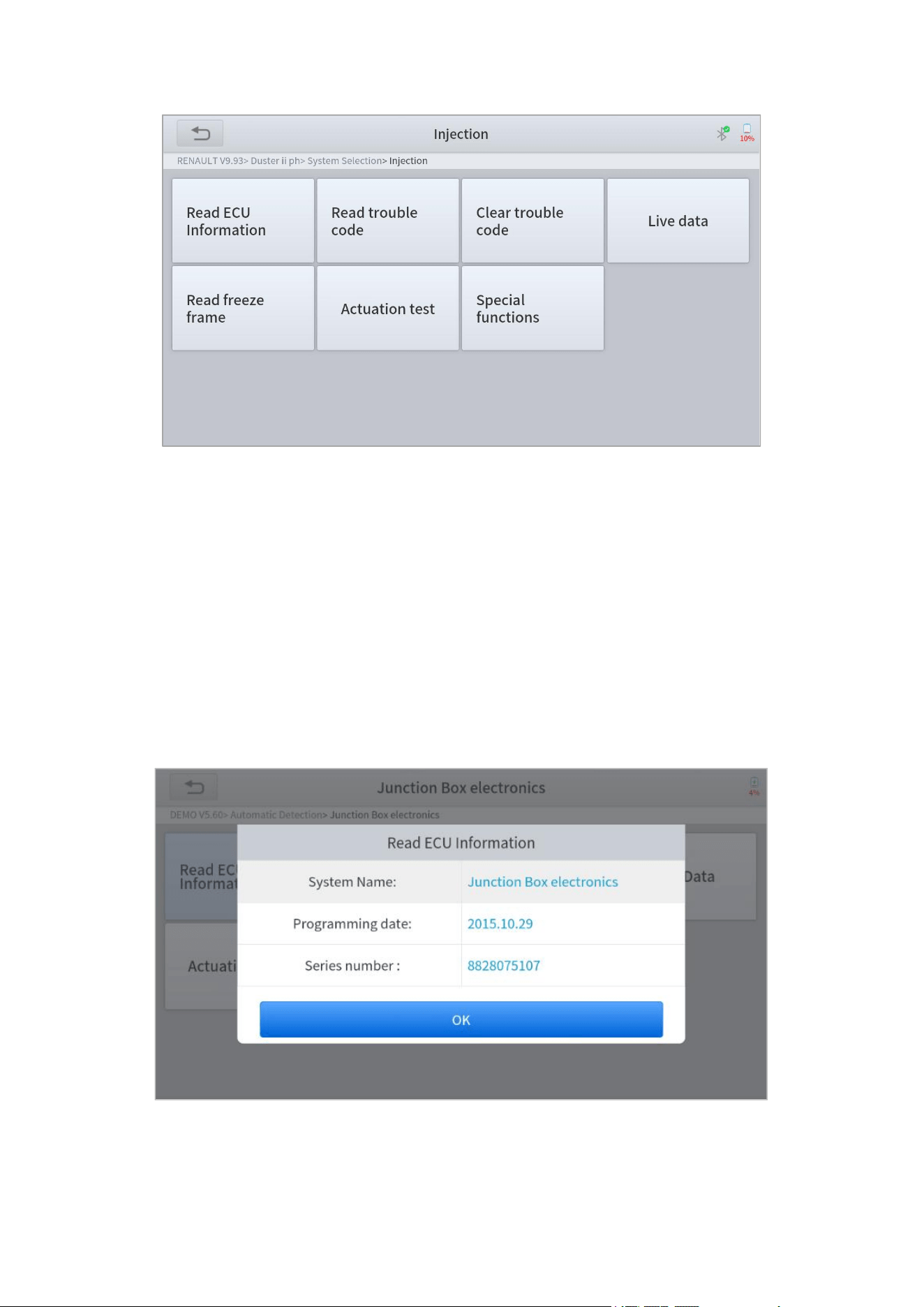
Some models provide multiple entry methods in the sub-menu, including:
Automatic Detection
Manual Selection
System Selection
Automatic Detection: Will automatically identify the vehicle's VIN code, and then
read the information of your target diagnostic object. If you choose "Manual
selection", then you can continue to select the vehicle brand, year, and model of the
vehicle in the sub-menu to diagnose the vehicle. Enter "System Selection", you can
also diagnose the vehicle according to the system according to your needs after
selecting the model.
DIAGNOSIS FUNCTIONS
Diagnostics functions supported by the scan tool are listed below:
Read ECU Information
Read/Clear Trouble Code
Read Live Data
Freeze Frame
Actuation Test (Bi-Directional Control)
Special functions
Read ECU Information
This function is to read ECU version information and is the equivalent of "System
Identification" or "System Information” in some electronic control systems.
These equivalent terms all refer to reading ECU-related software and hardware
versions, models and production date of diesel engines, part numbers, etc. This
information is helpful when recording maintenance records and ordering new parts.
Read Trouble Code
In the process of diagnosis, if the device shows “System is OK” or “No Trouble
Code”, it means there is no related trouble code stored in ECU or some troubles are
not under the control of ECU.
Most troubles are mechanical system troubles or executive circuit troubles. It is also
possible that the signal of a sensor may be inaccurate but within limits, which can be
examined using Live Data.
Clear Trouble Code
It allows for clearing current and historical trouble codes stored in the ECU memory,
under the premise that all the troubles have been resolved.
Some troubles are immediately detected by the ECU with the key in the run position
and without the engine running. Other troubles are not detected until very specific
test conditions are met such as engine coolant temperature within a range, speed
within a range for a duration of time, throttle percentage within a range, etc.
If the trouble codes are erased when the trouble remains unresolved, the trouble code
will reappear in the ECU the next time the ECU performs the specific diagnostic test
for that trouble.
If the trouble is resolved but there is a stored trouble code, sometimes the ECU will
detect the resolution and clear the trouble code or more likely, classify it as
“historical” trouble.
If the trouble is resolved and the user clears the trouble codes, the trouble history will
be cleared.
If the user intends to have another colleague or mechanic investigate the problem, it is
not recommended for the user to clear the trouble code since doing so may erase
information helpful to others who may investigate the issue.
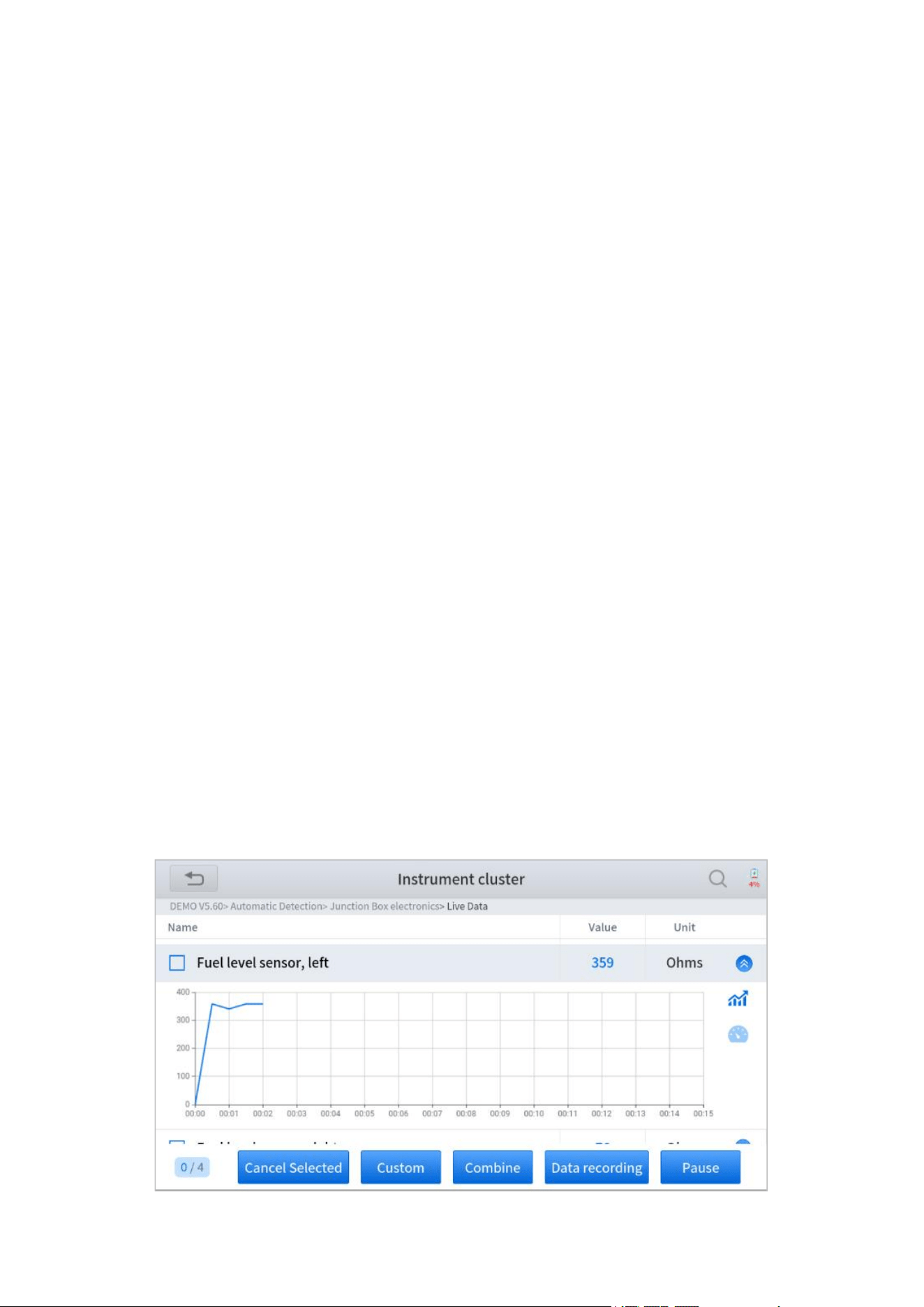
Read Live Data
Real-time information about various sensors is called “Live Data”. Live Data
includes parameter identifications (PIDs) of the running engine such as oil pressure,
temperature, engine speed, fuel oil temperature, coolant temperature, intake air
temperature, etc. Based on these parameters, we can predict directly where the
problem lies, which helps to narrow the scope of maintenance. For some vehicles,
during their actual operation, the problems such as performance characteristics or
sensitivity reduction, can be evaluated using live data.
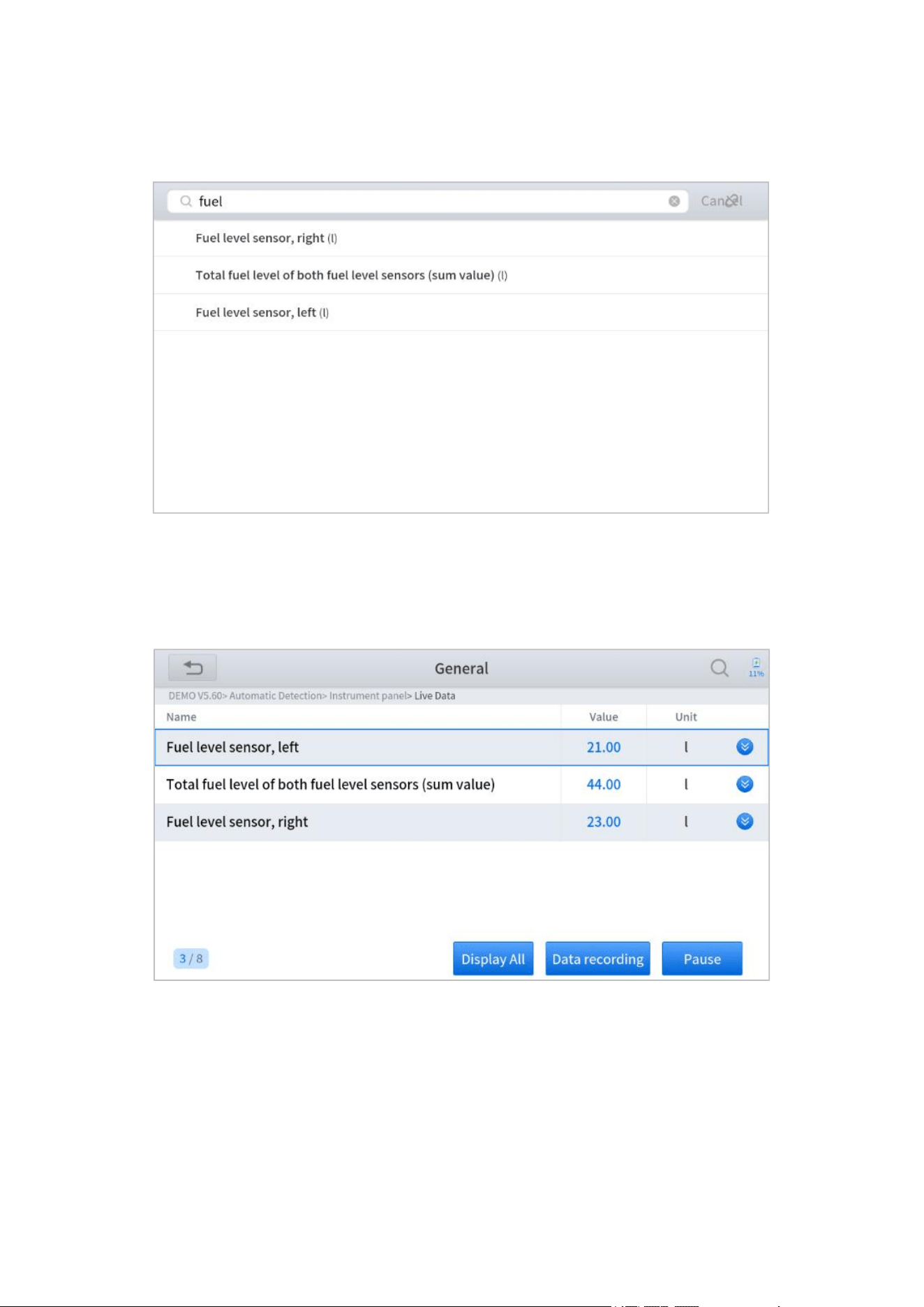
Click the magnifying glass on the top right, you can search for related PIDs based on
keywords
Custom
The scan tool includes support to select and show multiple PIDs. Click Display All to
display all PIDs
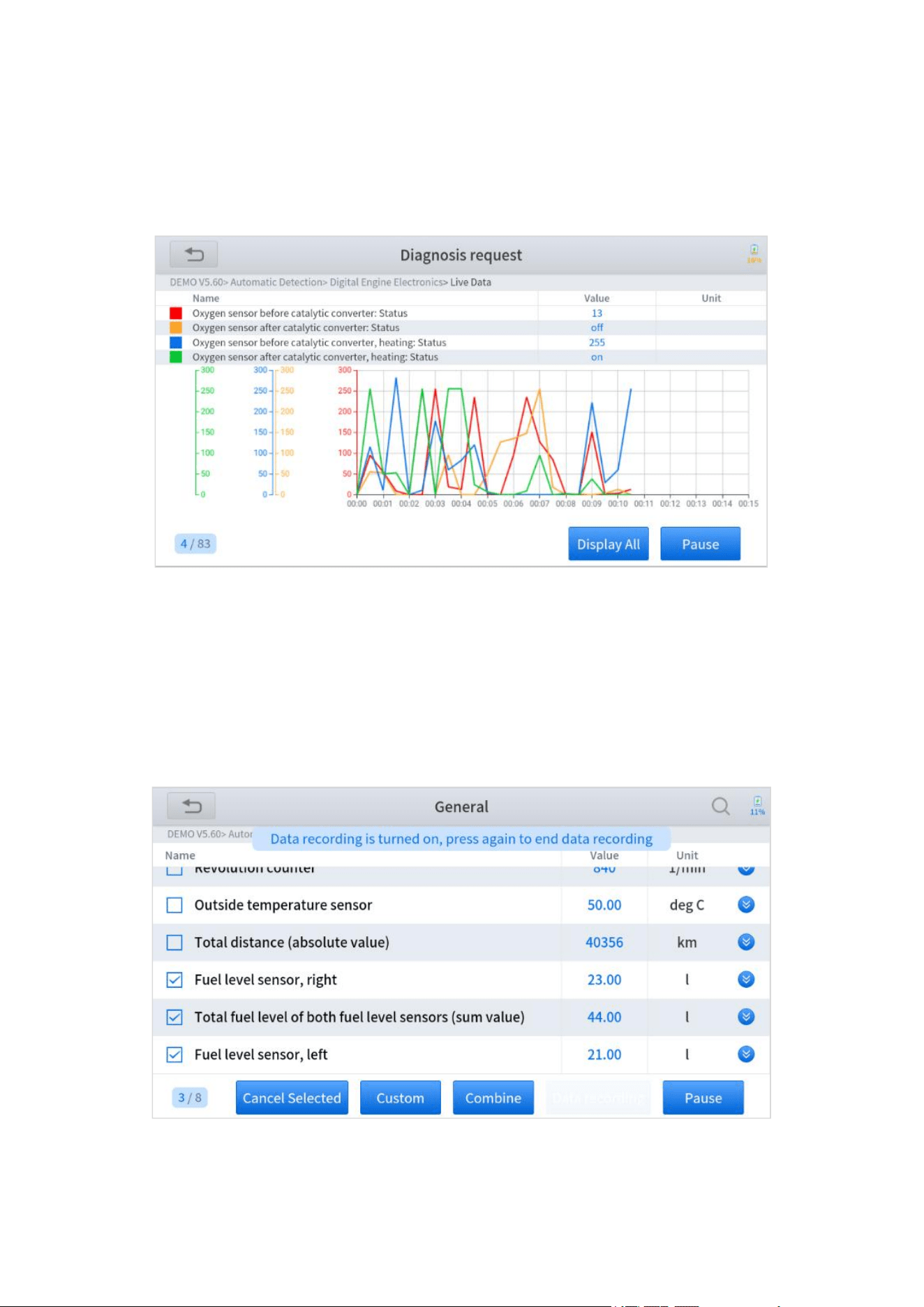
Combine
The scan tool includes support to select multiple PIDs and click Combine to combine
different graphs into one chart.
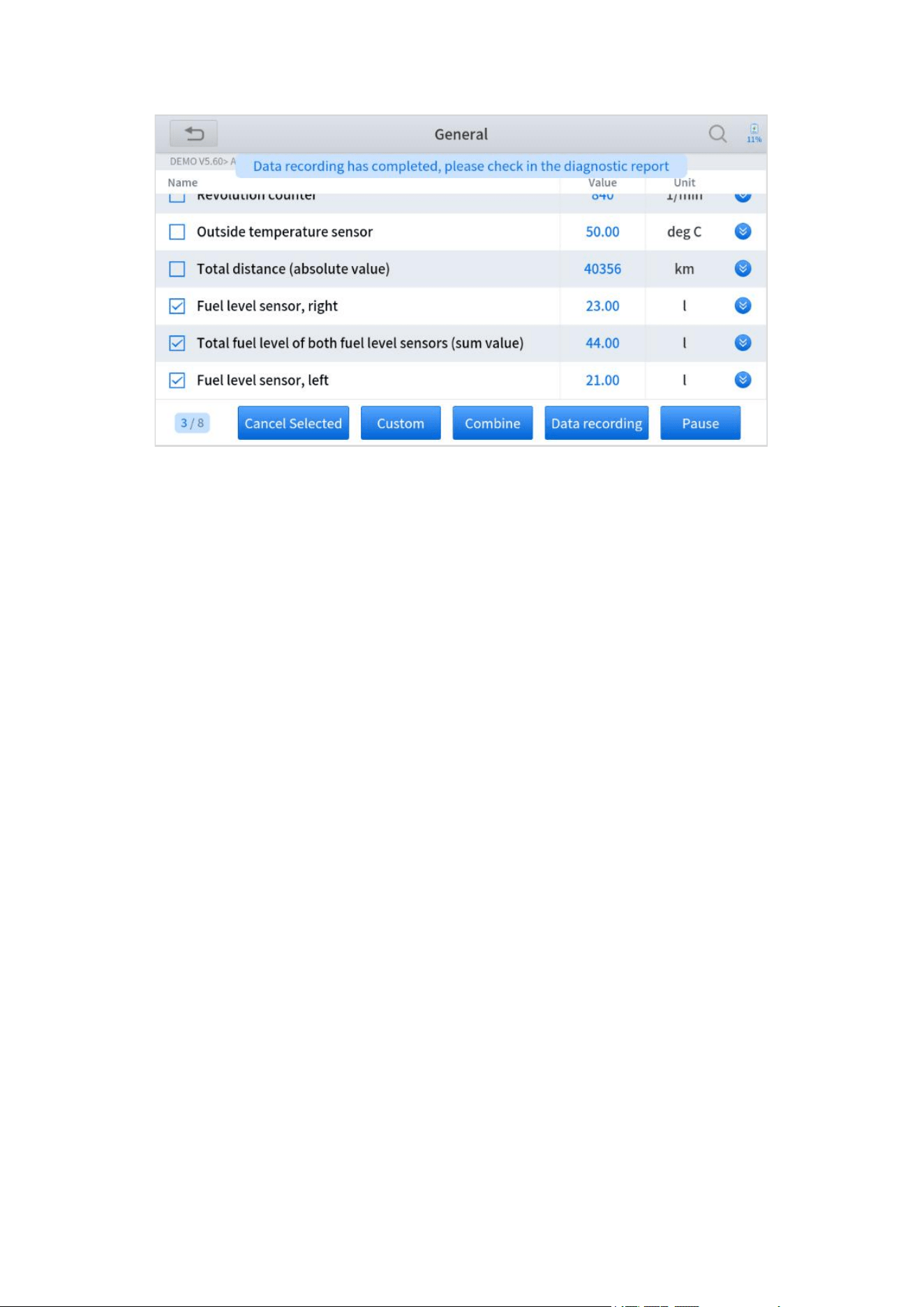
Data recording
The scan tool supports recording the current data values in the form of text. You can
view the recorded files in Reports->Data Replay.
Pause
Click this button to pause the recording timeline
Freeze Frame
When the signal of the sensor is abnormal, the ECU will save the data at that moment
of failure to form a freeze-frame. It is usually used to analyze the reasons that may
lead to component(?) failures.
The live data items supported by vehicles of different brands are not the same, so the
freeze frames displayed when diagnosing vehicles of different brands may also be
different. Some vehicles may not have the option of a freeze-frame which means that
the model does not support this function.
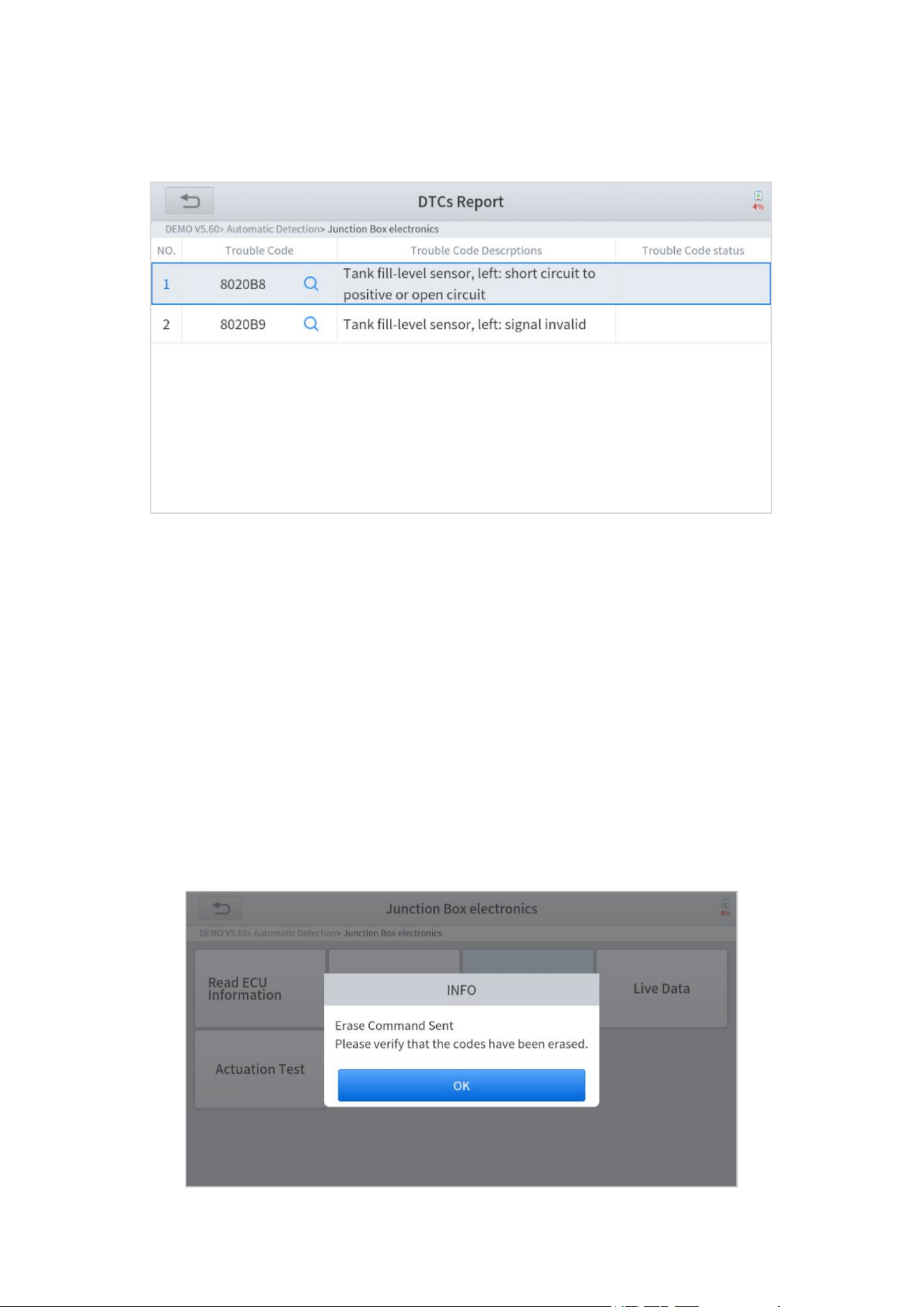
Take Renault Duster ii ph as an example:
After selecting the system to enter the lower freeze frame menu, the device will list all
the fault codes under the system.
Users can click on a fault code, such as DF1068 to view the freeze frame recorded by
the car when the fault code occurs, including context when the fault appeared, and
current context and additional data.
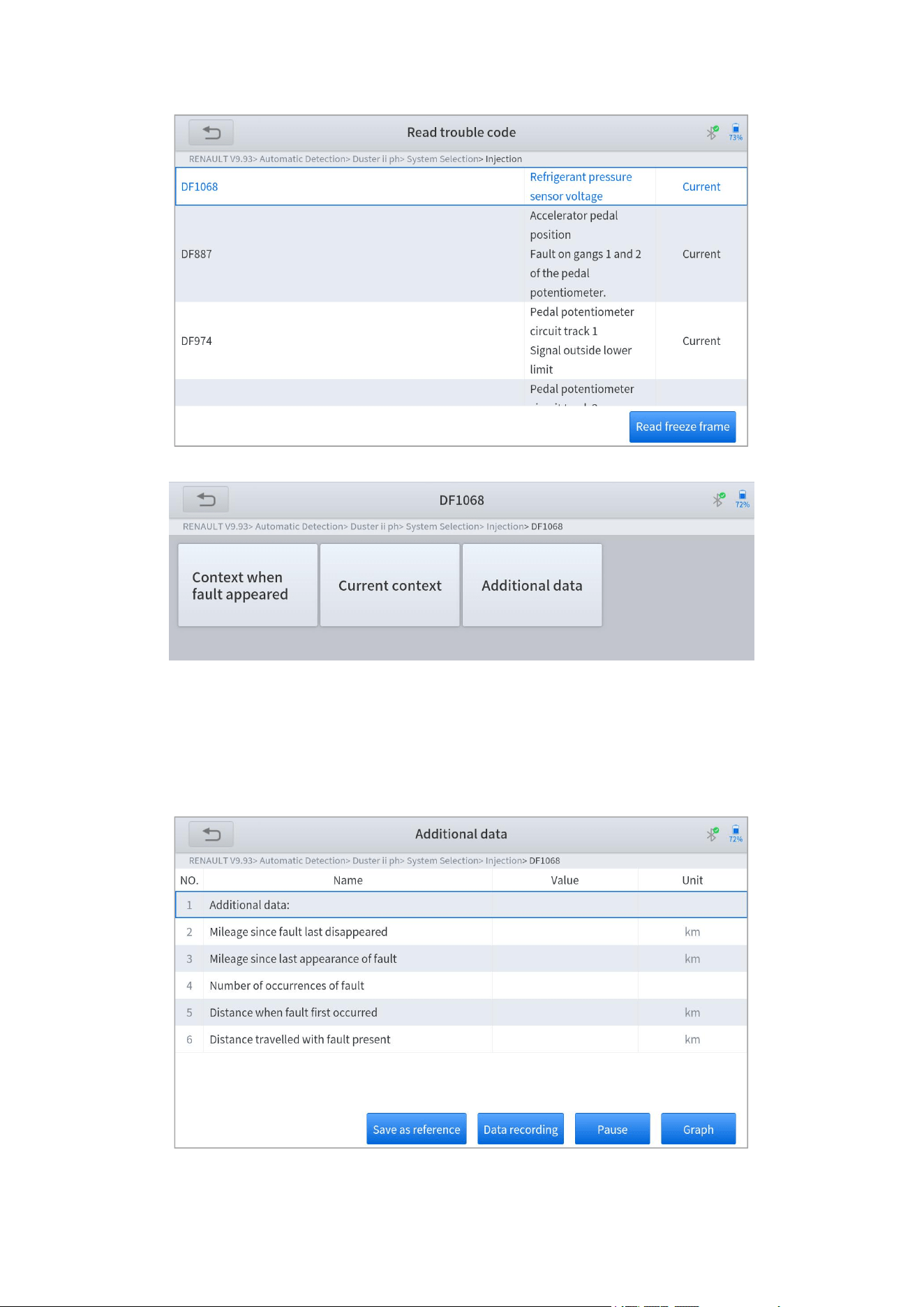
Context when fault appeared: record the live data when fault appeared to help the
user to know the vehicle status. *Some vehicles don't support this function; users will
get a prompt when they click the menu.
Current context: Displays the current live data stream associated with the DTC
Additional data: record other data related to the fault

Actuation test (Bi-directional control)
Actuation test, also known as bidirectional control, is a generic term used to describe
sending and receiving information between one device and another. This function is
used mainly to judge whether these actuating components of the engine are working
properly.
The vehicle engineers responsible for designing computer control systems
programmed them so a scan tool could request information or command a module to
perform specific tests and functions. Some manufacturers refer to bidirectional
controls as functional tests, actuator tests, inspection tests, system tests or the like.
Reinitialization and reprogramming also can be included in the list of bidirectional
controls.
This function allows the device to send information to and receive information from,
vehicle control modules. For example, in the case of OBD II generic information
Mode 1 (which relates to data parameters), the scan tool user initiates a request for
information from the powertrain control module (PCM), and the PCM responds by
sending the information back to the scan tool for display. Most enhanced scan tools
also can actuate relays, injectors and coils, perform system tests, etc. Users could
check the individual part to see what is working properly by actuation test.
Special functions
Usually, special functions provide various reset or re-learning functions menus for
most vehicle systems. You can easily and quickly solve some faults through special
functions for your car. After some functions are successfully executed, fault codes will
be generated, which need to be cleared manually after the car is running for a little
while which could include a single start of the engine or multiple warm up cycles.
And under each system, you can view the special features supported by that system.
Different models and systems often have different special functions. Even for the
same system of the same model, the years and ECU type may lead to different special
functions supported.
3. S
PECIAL
F
UNCTIONS
The D7S supports a lot of commonly used special reset functions, allowing you to
quickly access your vehicle system for various scheduled services, maintenance, and
reset performance. These functions often eliminate the need to reset codes after
resolving common problems. Since XTOOL is continuously developing, the manual
may not include all of the latest special functions that are available for download.
This user manual lists some of the commonly used special reset services for your
reference.
ABS BLEEDING
Anti-Lock Braking System keeps the tires from locking up immediately when there
are brakes. Keeping ABS in good condition can give full play to the effectiveness of
the brakes, shorten the braking time and distance, prevent the vehicle from skidding
and tailing during emergency braking, ensure good driving stability and steering
maneuverability, and avoid violent friction between the tires and the ground to reduce
tire wear. When the ABS contains air, the ABS bleeding function must be performed
to bleed the brake system to restore ABS brake sensitivity.
ABS Bleeding can be performed in the following cases:
replace the rear brake distributor pump or the front brake distributor pump. 2.
Severe brake fluid shortage.
change the brake fluid.
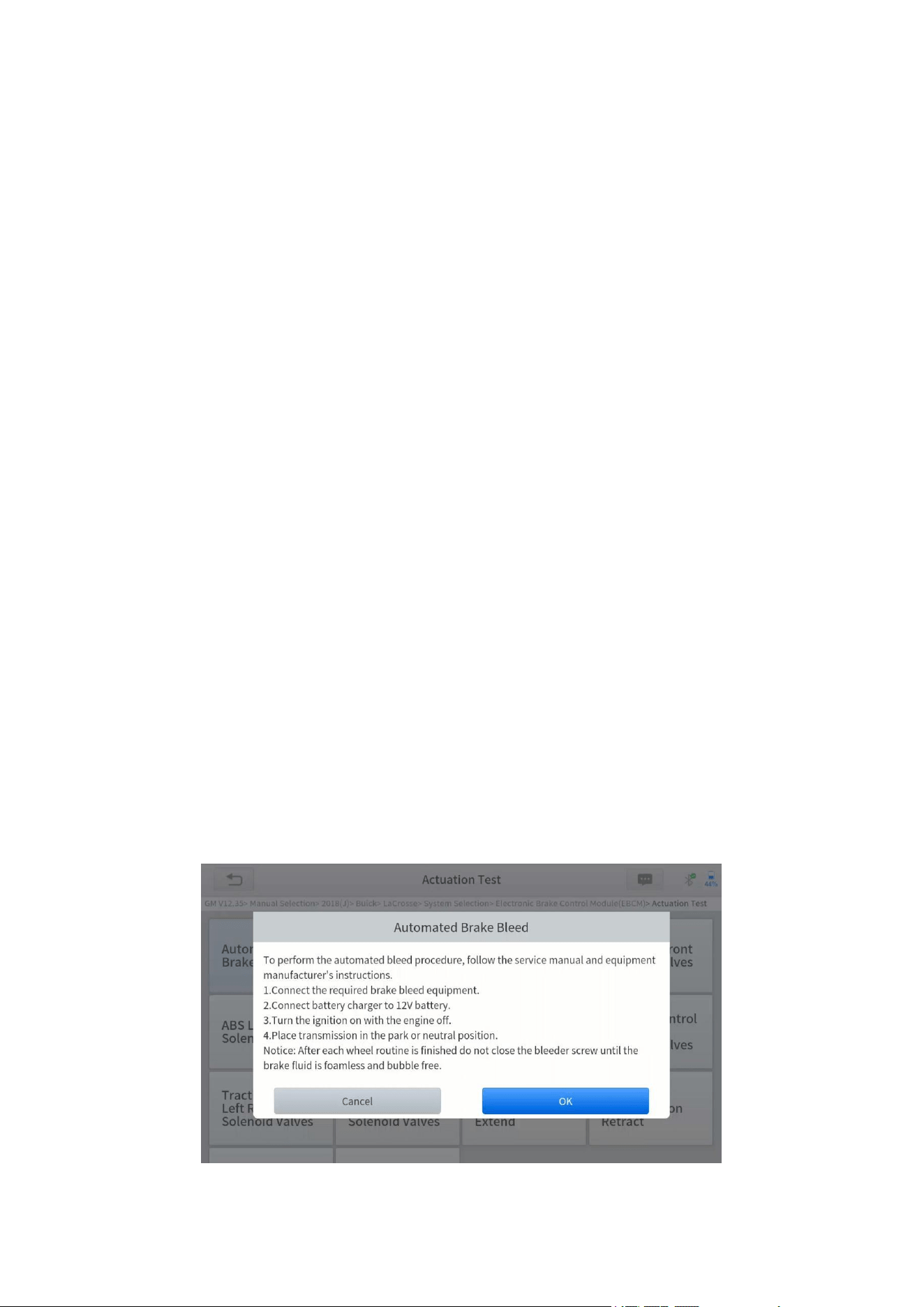
The operation guidelines of the ABS Bleeding function are shown as below:
1. Read the operating instructions and precautions that appear on the screen
carefully before performing the operation to ensure that the equipment and car are
in the correct condition.
2. Attach bleeder bottle to the left rear bleeder screw.
3. Open the left rear bleeder screw.
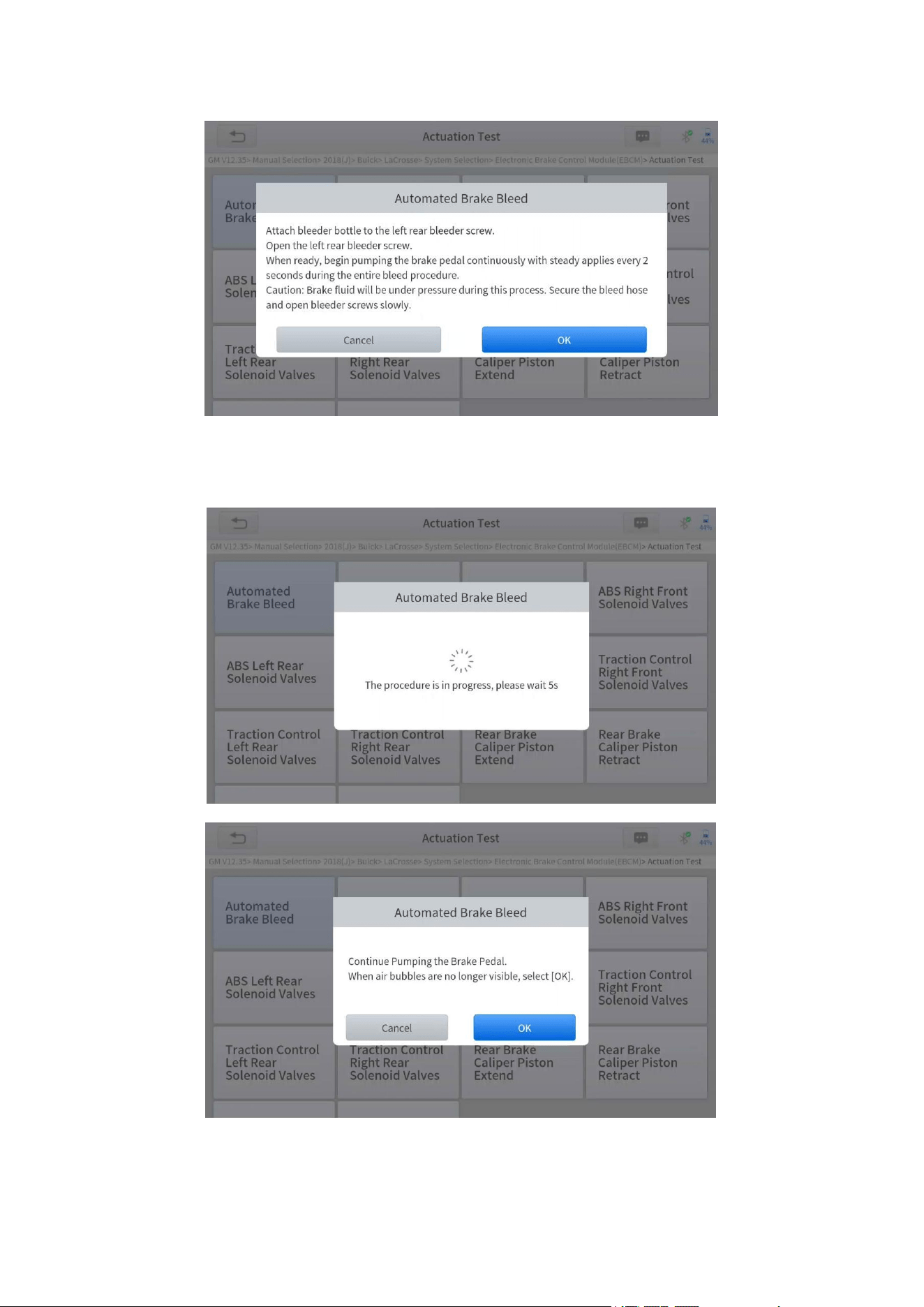
4. When ready, click
"
OK
"
to enter the bleed procedure, and pumping the brake
pedal continuously with steady applies every 2 seconds during the entire
procedure.
5. Continue pumping the brake pedal, when air bubbles are no longer visible, select
"
OK
"
to enter next bleed procedure for left front wheel.
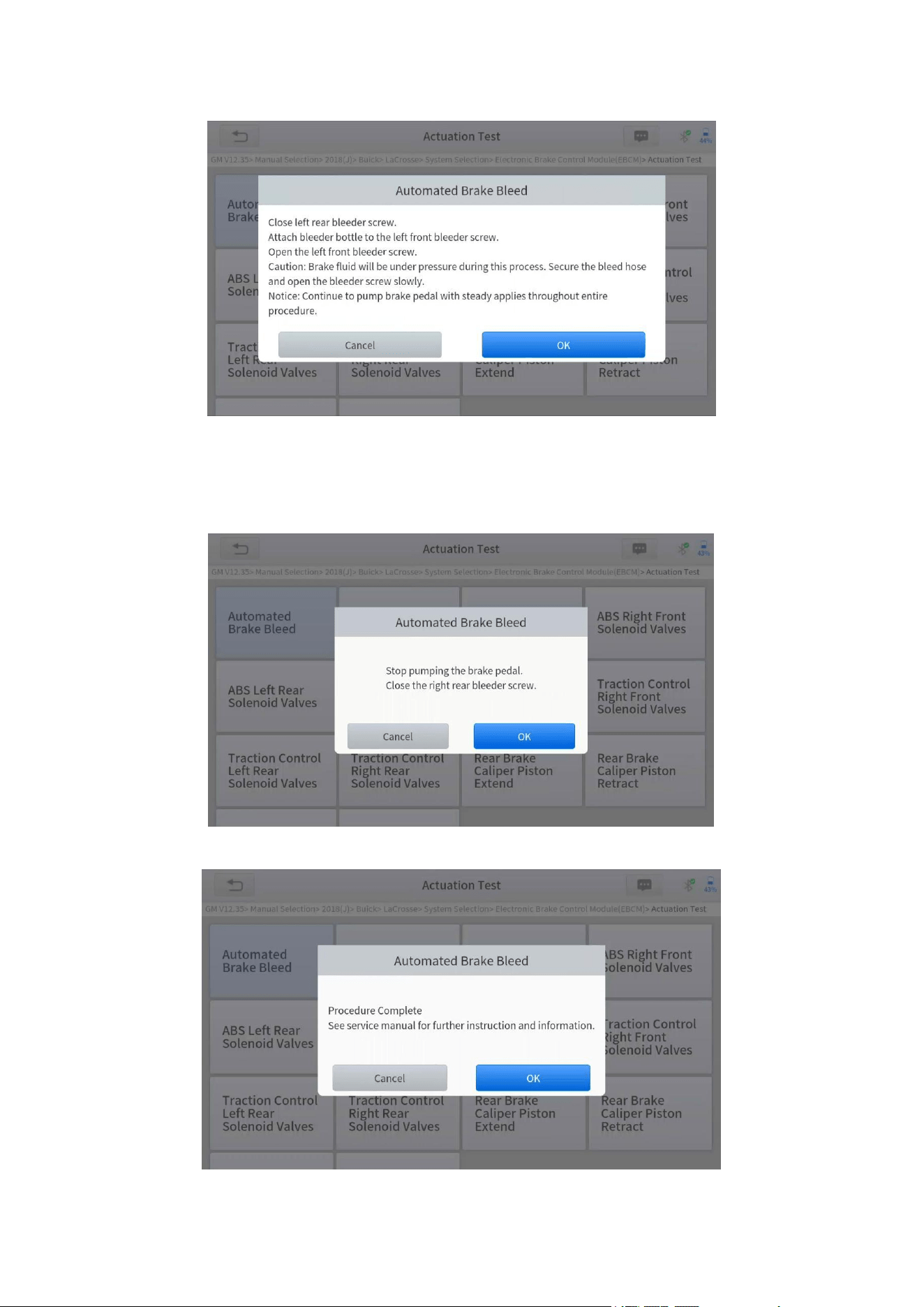
6. Repeat the operation 3 times to complete the bleed procedure for the left front
wheel, right front wheel and right rear wheel in turn.
7. Stop pumping the brake pedal, and close the right rear bleeder screw
.
8. Click
"
OK
"
to complete the entire bleed procedure
.
Caution
The ABS pump screw needs to be unscrewed
.
Brake fluid will be under pressure during this process. Secure the bleed hose and
open bleeder screws slowly
.
Some vehicles do not support automatic bleeding, but manually bleeding
.
3.2
OIL RESET
The scan tool can be used to reset the engine oil life system, which calculates the
optimum oil life change interval based on the vehicle’s driving conditions and climate.
The oil life reminder must be reset each time the oil is changed so that the system can
calculate when the next oil change is required.
This function can be performed in the following cases:
If the service lamp is on, you must provide service for the car. After service, you
need to reset the driving mileage or driving time so that the service lamp turns off
and the system enables the new service cycle.
After changing engine oil or electric appliances that monitor oil life, you need to
reset the service lamp.
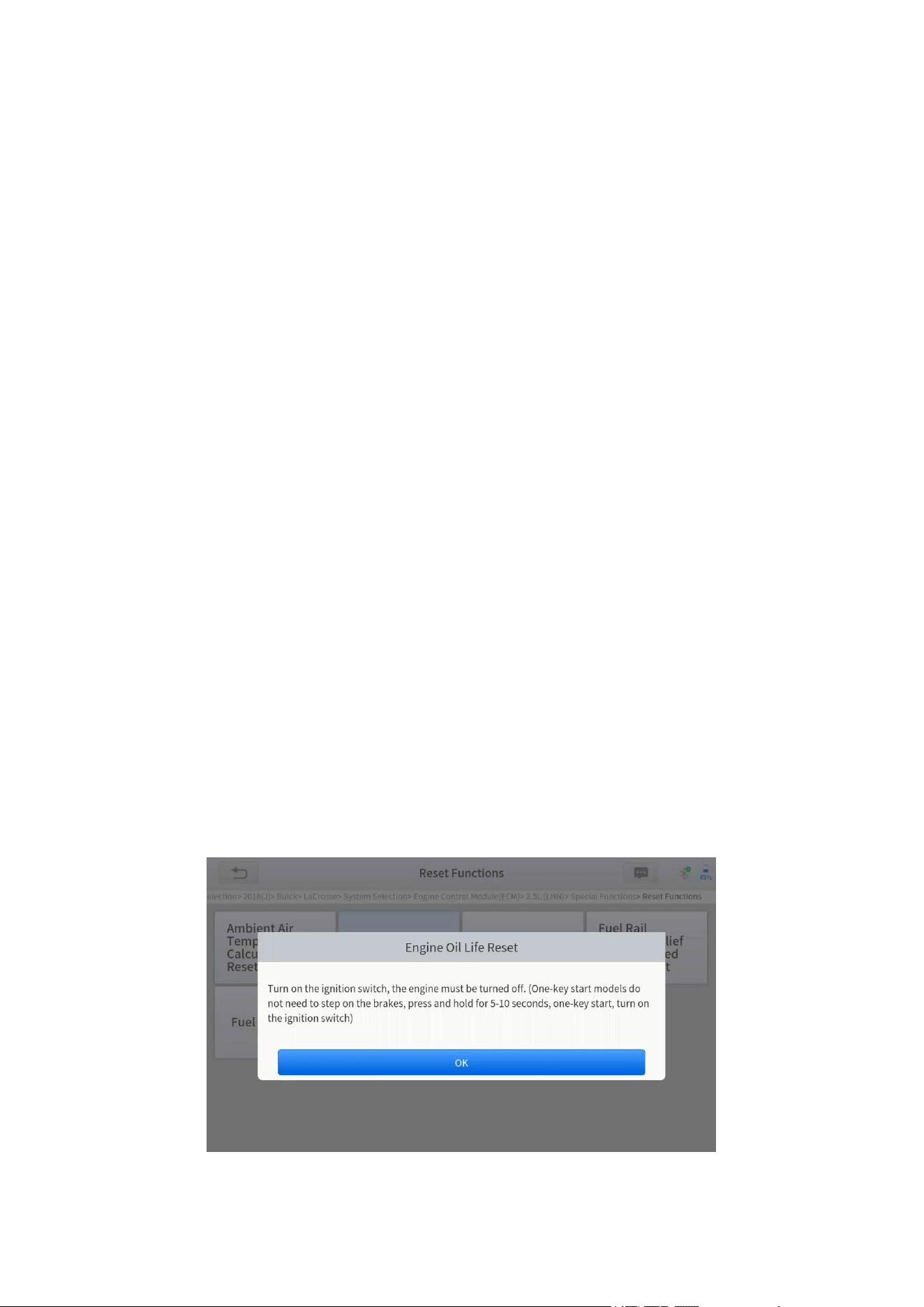
The operation guidelines of the Oil Reset function are shown as below:
1. Enter the Oil Reset menu and choose relevant models according to the vehicle
being tested.
2. Follow the instructions displayed that are specific to the vehicle and press OK
after completing the instructions shown.
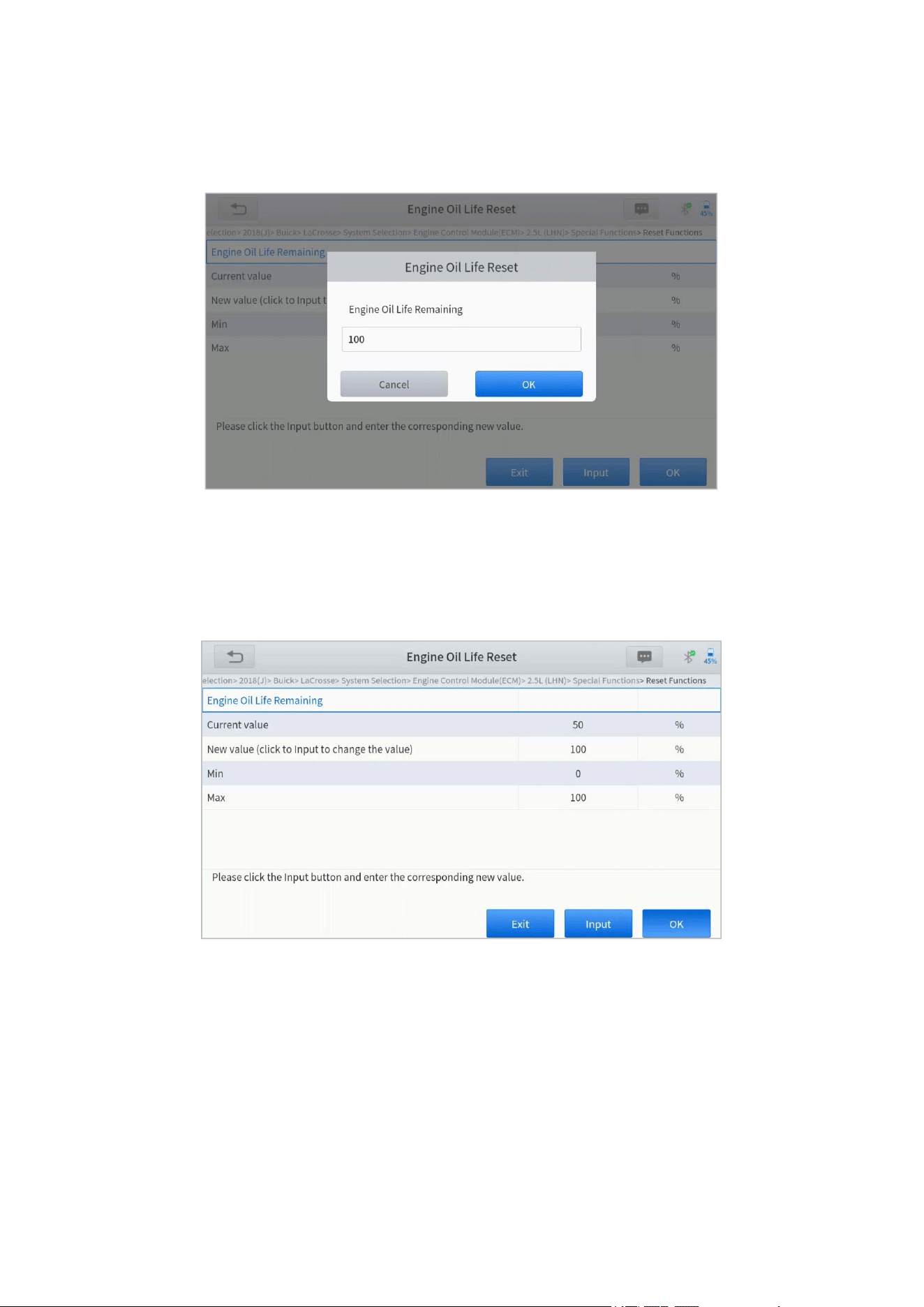
3. Enter Maintenance mileage reset menu.
4. Click INPUT and enter a reasonable value of remaining oil life and press OK.
5. Confirm the [New Value] you just entered, and then click OK at the bottom right
to complete the procedure.
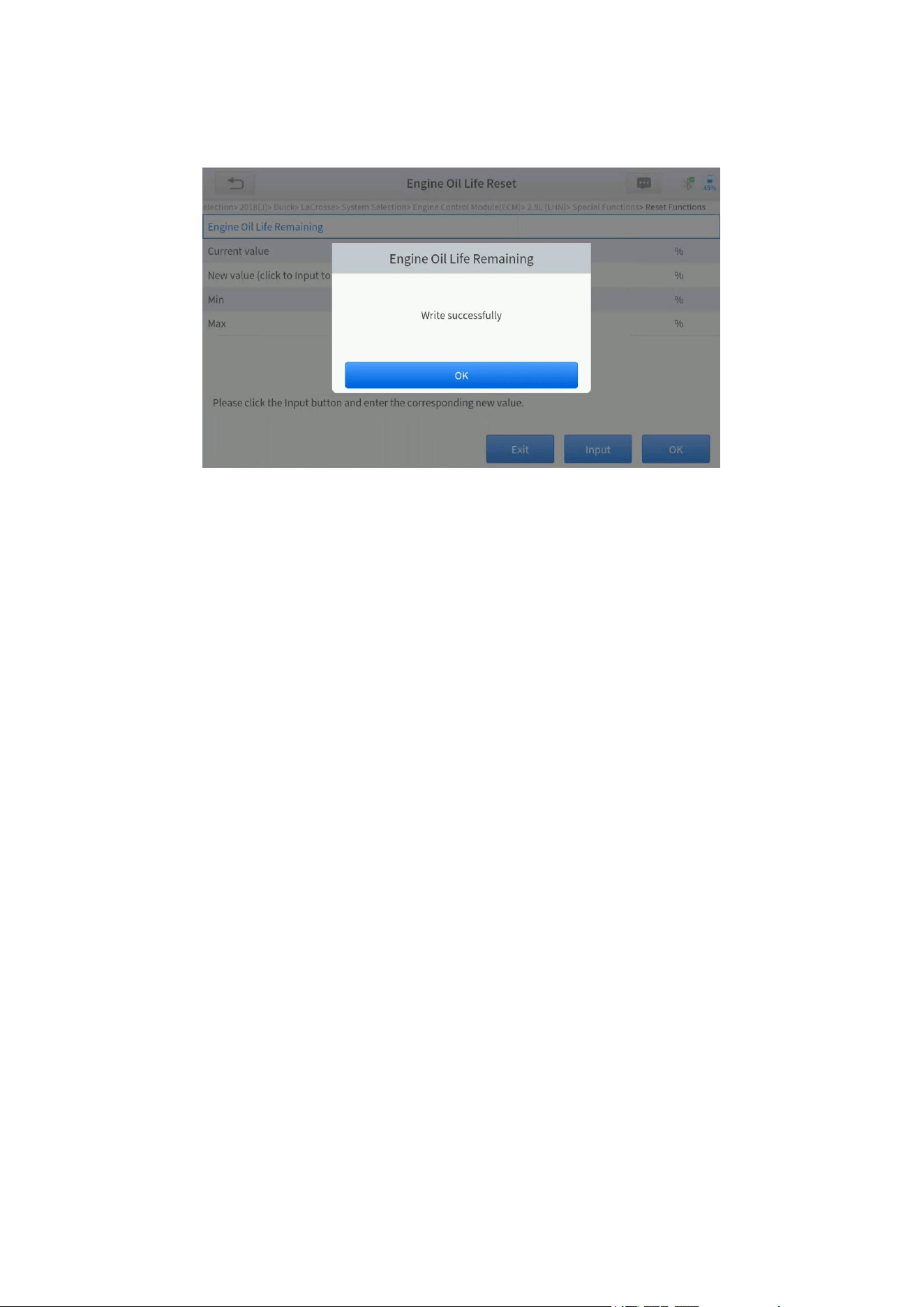
6. Message of ‘Write successfully’ displays when Oil Reset function has
successfully performed.
3.3
EPB
Electronic Parking Brake (EPB) System reset is a popular special function. You can
use this function to reset the electronic parking brake system and brake pads
(retraction, release of the brake pump), G-sensor and body angle calibration. This
function has multiple uses and can safely and effectively maintain the electronic brake
system. These applications include deactivating and activating brake control systems,
assisting in controlling brake fluid, applying and releasing brake pads, setting brakes
after replacing brake discs or brake pads, etc.
1. If the brake pad wears the brake pad sense line, the brake pad sense line will send
a signal to the onboard tablet asking for replacing the brake pad. After replacing
the brake pad, you must reset the brake pad to clear the trouble code. Otherwise,
the car continues to falsely notify the user that the brake pads are in need of
replacement.
2. Areset must be performed in the following cases:
The brake pad and brake pad wear sensor are replaced.
The brake pad indicator lamp is on.
The brake pad sensor circuit is shorted.
The servo motor is replaced.
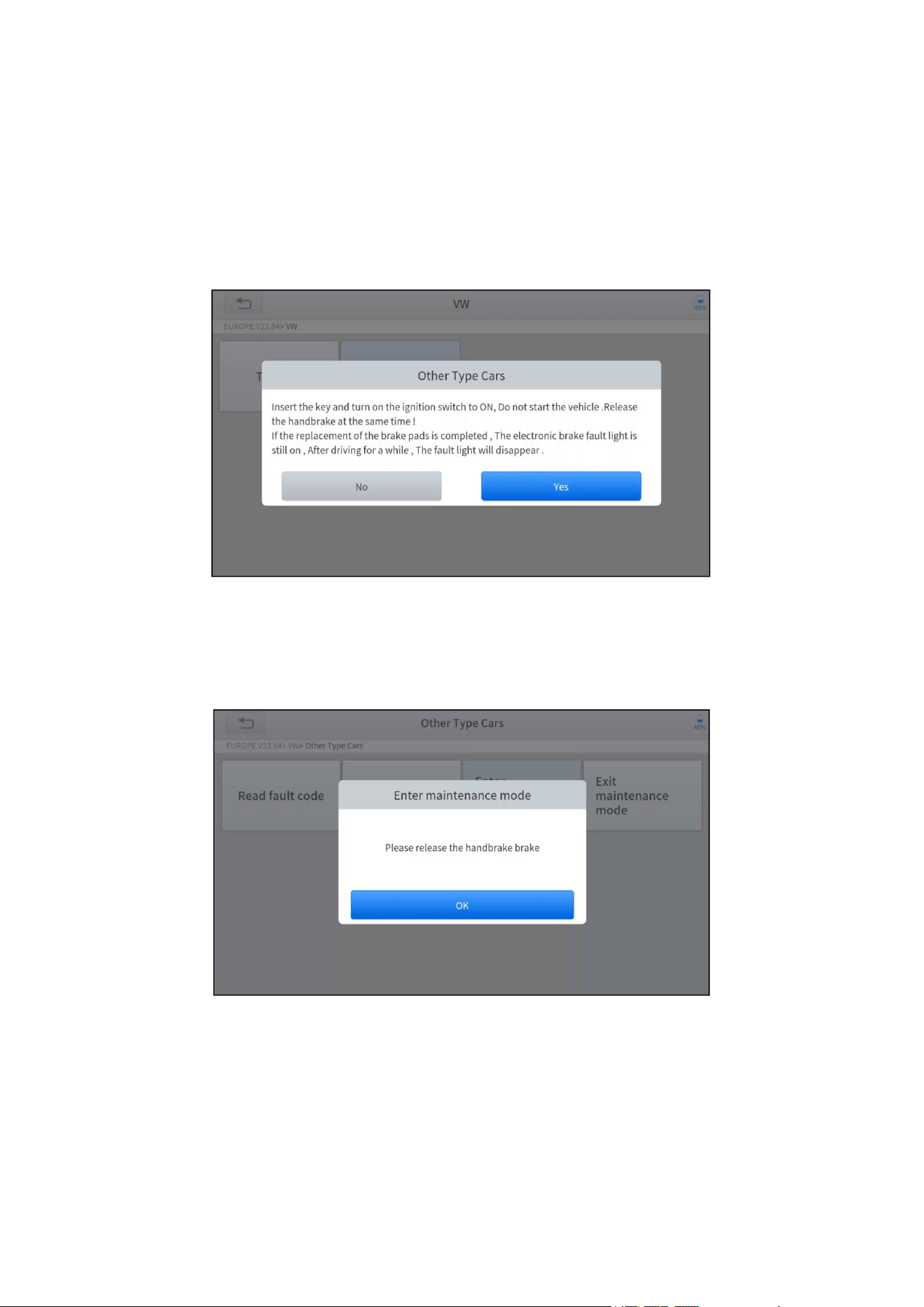
The operation guidelines of the EPB function are shown as below:
1. Enter the EPB menu and choose relevant models according to the vehicle being
tested.
2. Follow the instructions displayed and press YES after completing the
instructions shown.
3. Enter the Enter maintenance mode menu and release the handbrake brake. And
press OK after completing the instructions shown.
4. Wait until the message of ‘Successful operation’ popes up. And press OK to
exit the menu.
5. Enter the Exit maintenance mode menu and wait until the message of
"
Successful operation
"
popes up.
3.4 SAS
Steering Angle Sensors (SAS) System Calibration permanently stores the current
steering wheel position as the straight-ahead position in the SAS EEPROM. Therefore,
the front wheels and the steering wheel must be set exactly to the straight-ahead
position before calibration. In addition, the VIN is also read from the instrument cluster and
stored permanently in the SAS EEPROM. On successful completion of calibration, the SAS fault
codes will be automatically cleared.
To reset the steering angle, you need to first find the relative zero point position for the car to drive
in a straight line. Taking this position as a reference, the ECU can calculate the accurate angle for
left and right steering.
After replacing the steering angle position sensor, replacing steering mechanical parts (such as
steering gearbox, steering column, end tie rod, steering knuckle), performing four-wheel
alignment, or repairing the car body, you must reset the steering angle.
The operation guidelines of the SAS function are shown as below:
1. Enter the SAS menu and choose relevant models according to the vehicle being
tested.
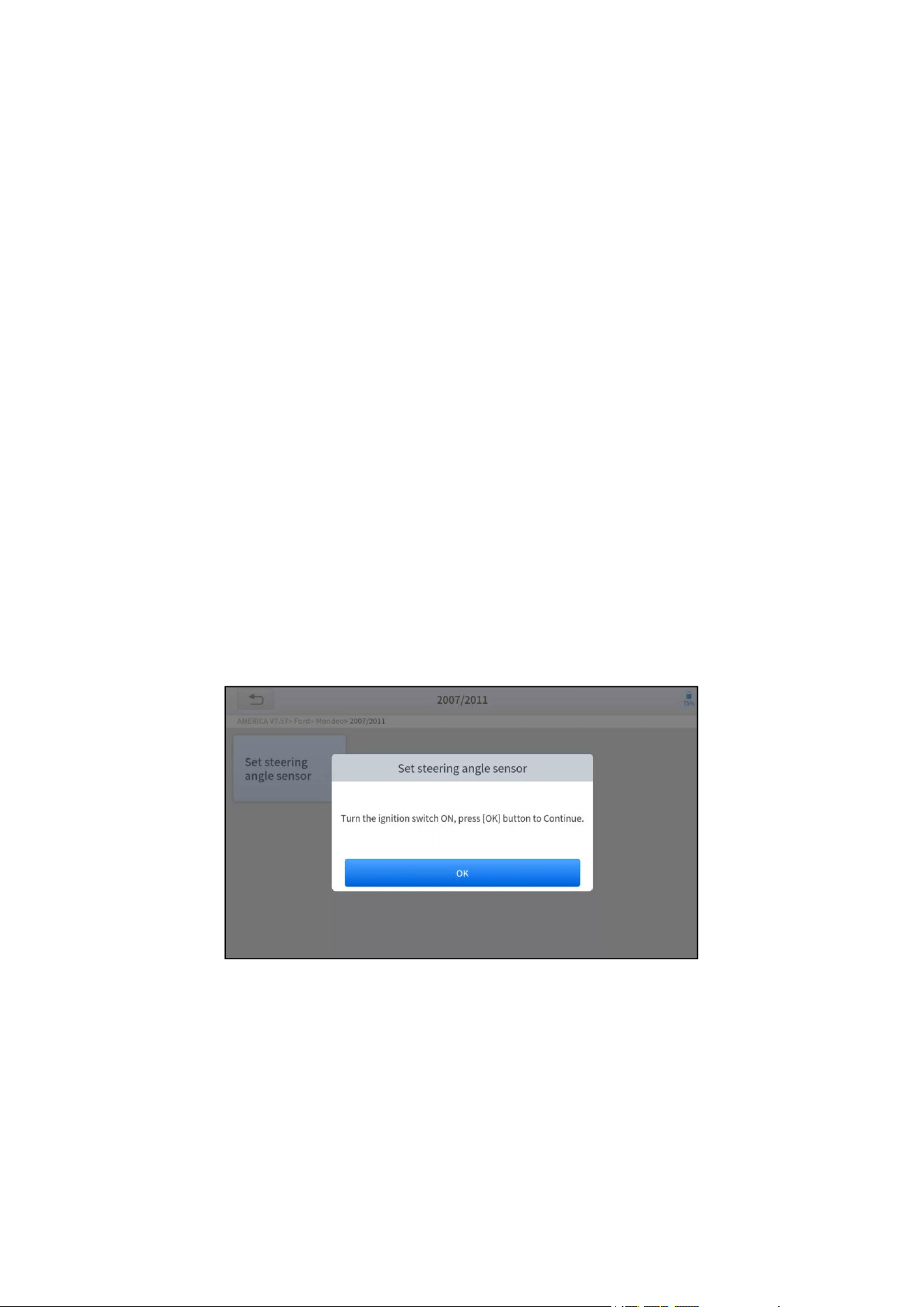
2. Enter the Set steering angle sensor menu and follow the instructions displayed.
3. Wait until the following instruction is displayed and press Yes after completing
the instructions shown.
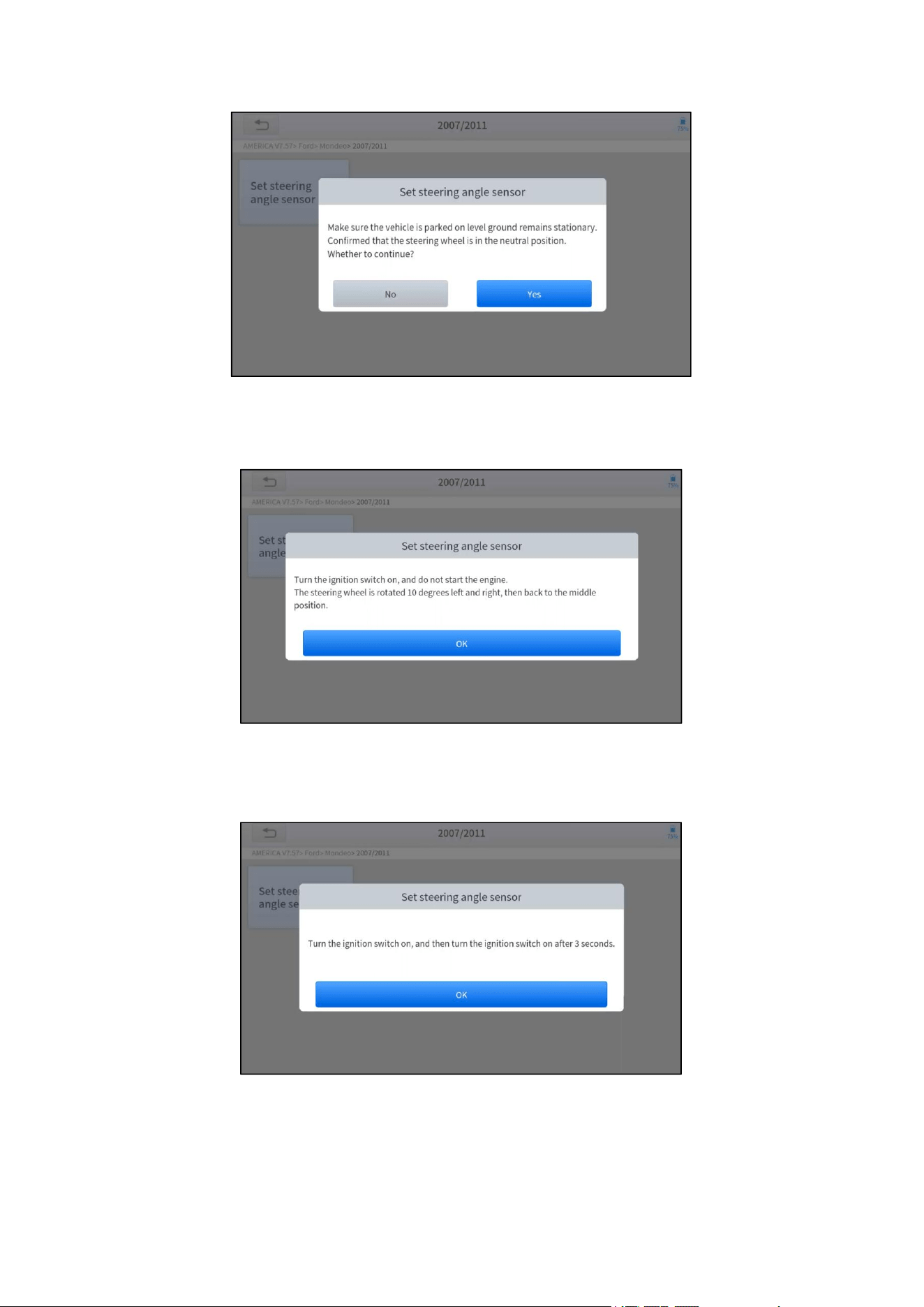
4. Follow the instructions displayed and press OK after completing the instructions
shown.
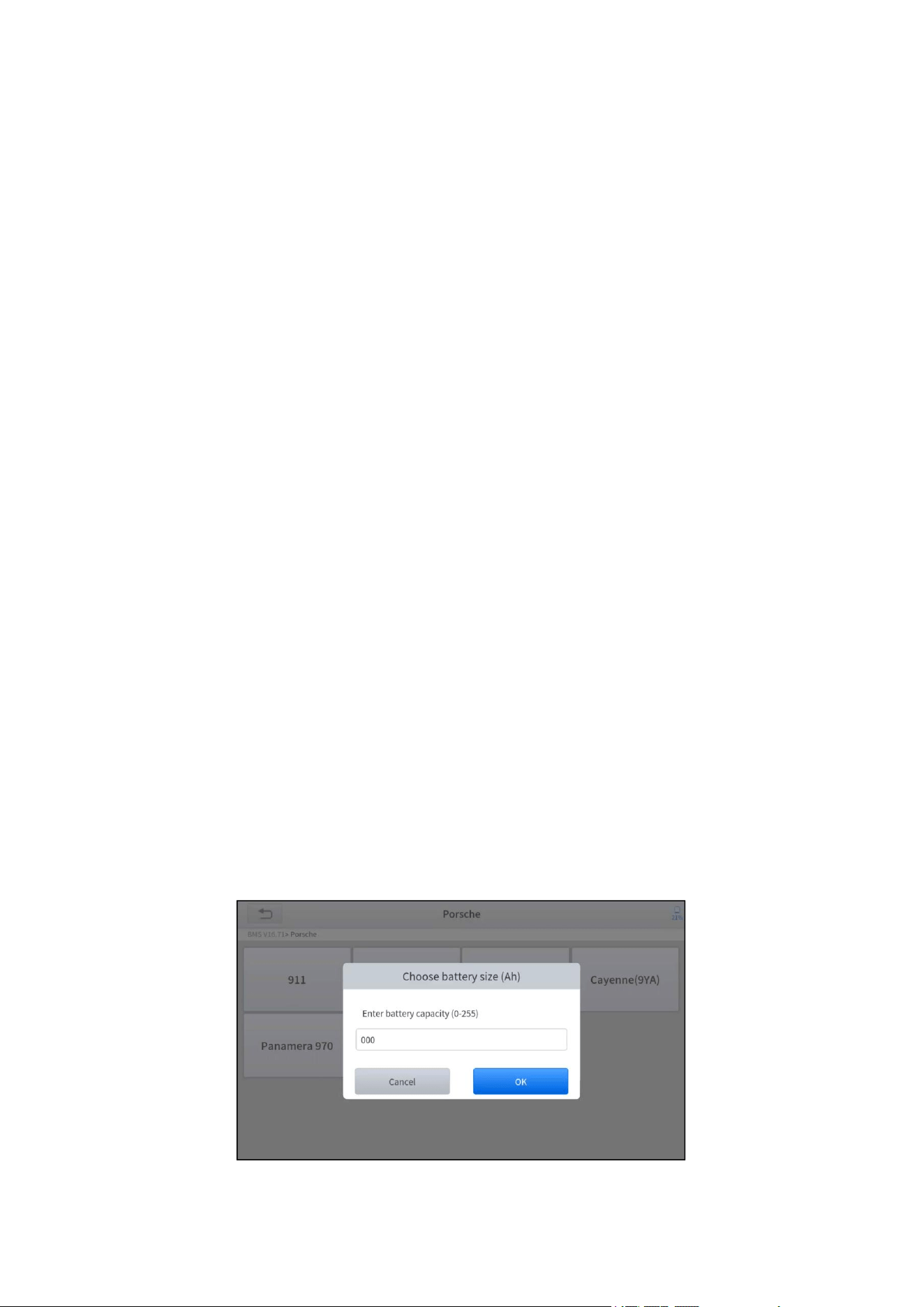
5. Wait until the following instruction is displayed and press OK after completing
the instructions shown.
1. Message of ‘Function execution is completed’ displayed when SAS reset
function has successfully completed.
3.5 BMS RESET
The Battery Management System (BMS) allows the scan tool to evaluate the battery
charge state, monitor the close-circuit current, register the battery replacement and
activate the rest state of the vehicle.
This function enables you to perform a resetting operation on the monitoring unit of
the vehicle battery, in which the original low battery fault information will be cleared
and battery matching will be performed.
Battery matching must be performed in the following cases:
The main battery is replaced. Battery matching must be performed to clear
original low battery information and prevent the related control module from
detecting false information. If the related control module detects false information,
it will invalidate some electric auxiliary functions, such as automatic start & stop
function, sunroof without one-key trigger function or power window without
automatic function.
Battery matching is performed to re-match the control module and motoring
sensor to detect battery power usage more accurately, which can avoid an error
message displayed on the instrument cluster.
The operation guidelines of the BMS Reset function are shown as below:
1. Enter the BMS Reset menu and choose relevant models according to the vehicle
being tested.
2. Turn on the ignition switch.
3. Press OK to continue the BMS function.
4. Enter battery capacity (within the given range) and press OK after the input.
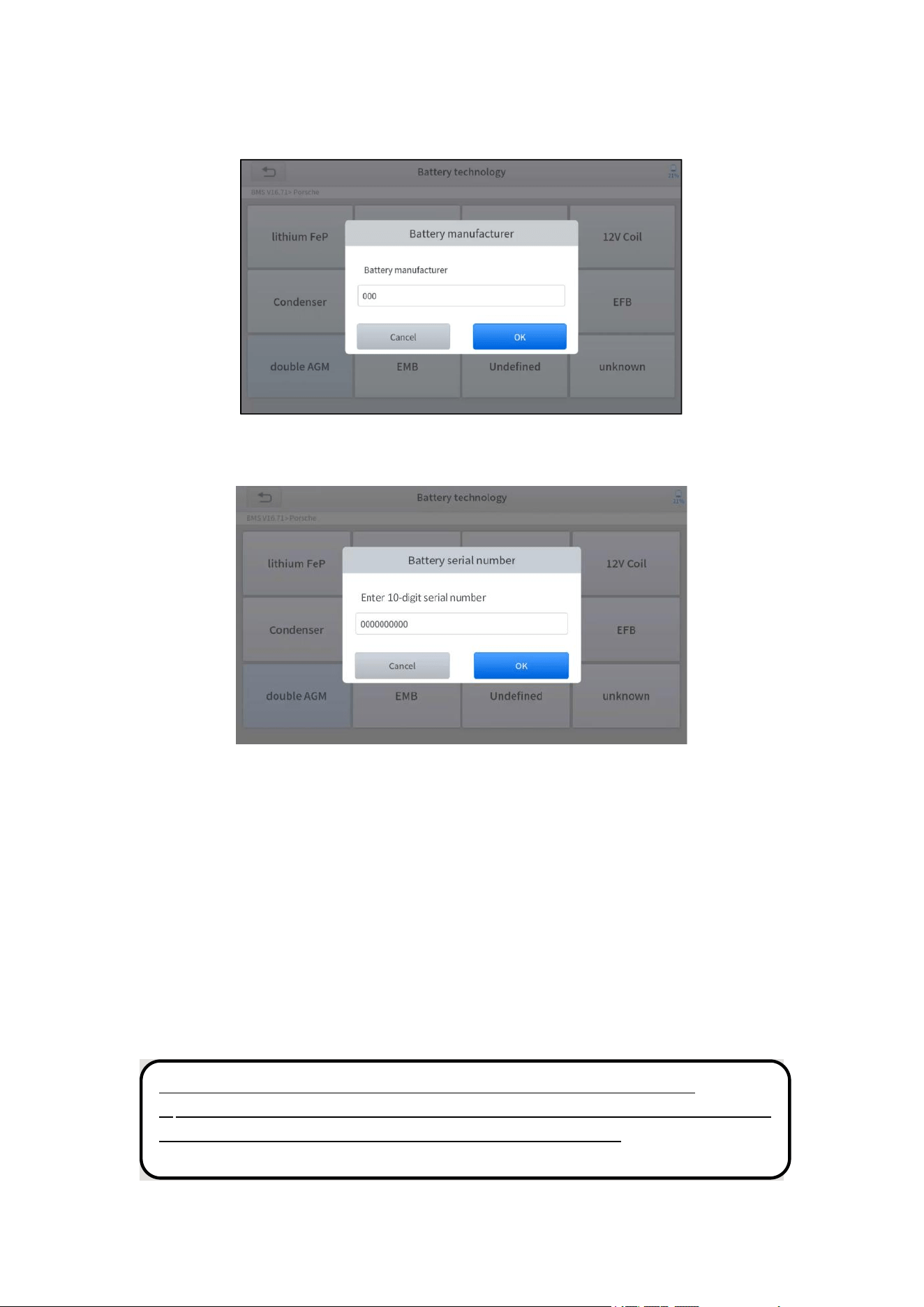
5. Enter the battery manufacturer and press OK after the input.
6. Enter the 10-digit battery serial number and press OK after the input.
3.6 INJECTOR CODING
This function can write the identification code of the fuel injector into the ECU so that
the ECU can recognize the new injector.
After the ECU or injector is replaced, the injector code of each cylinder must be
confirmed or re-coded so that the cylinder can better identify injectors to accurately
control fuel injection.
In general cases, there is no need to perform the coding matching function after cleaning;
The identification of the fuel injector includes its working accuracy value and type value. When
replacing an injector you need to find the corresponding model for replacement;
At present, mainstream cars support injector coding functions.
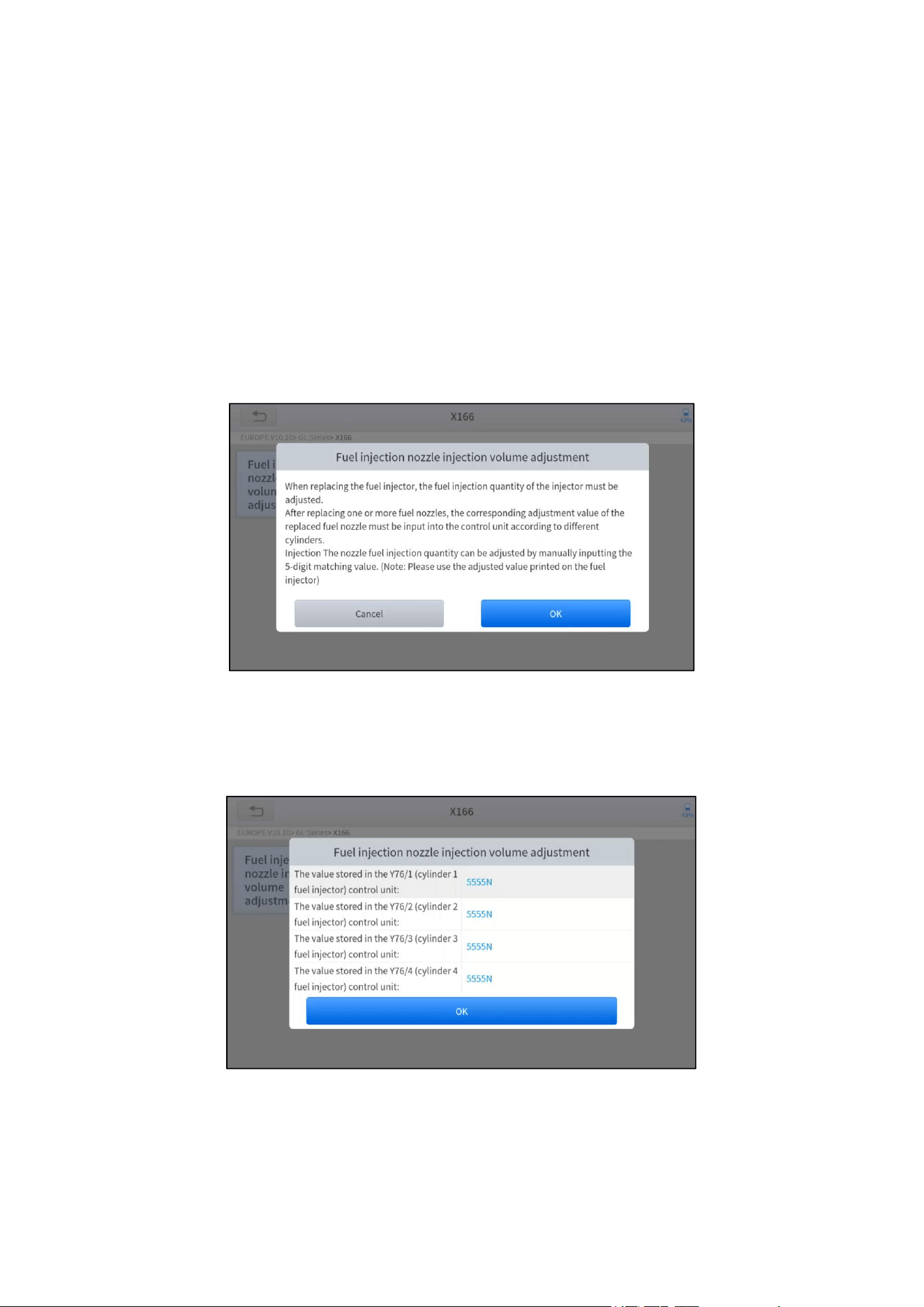
The operation guidelines of the Injector Coding function are shown as below:
1. Enter the Injector coding menu and choose relevant chassis models according to
the vehicle being tested.
2. Enter the Fuel injection nozzle injection volume adjustment menu.
3. Read the note displayed carefully and press OK after the reading.
4. Read and confirm the value stored in the cylinders.
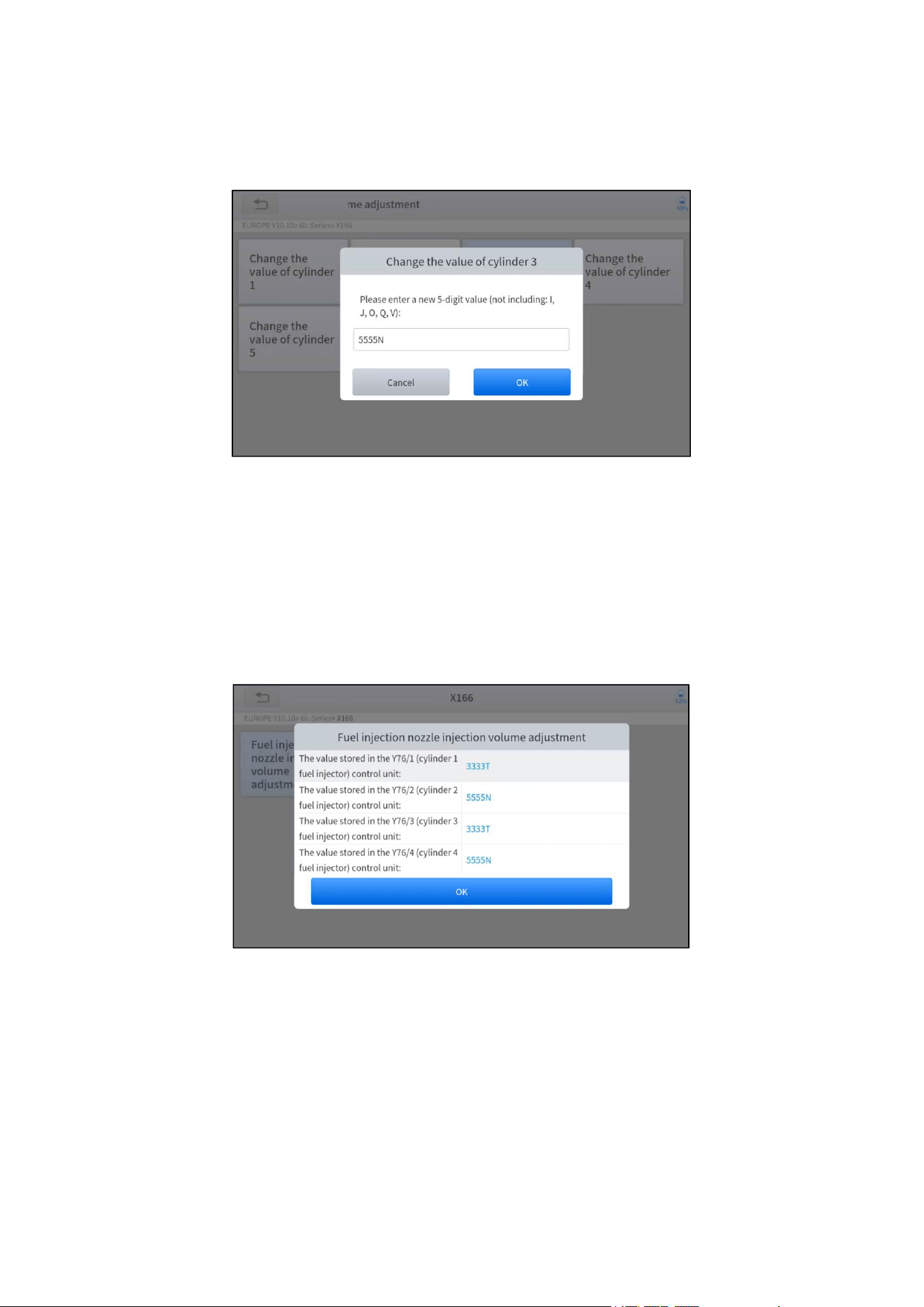
5. Enter the Change the value of cylinder menu of the replaced injector(s), enter
the new 5-digit value, and then press OK.
Wait until the message ‘Write successfully’ pops up.
6. Turn off the ignition switch.
7. Wait until the message asks you to turn on the ignition switch.
8. Re-enter the Fuel injection nozzle injection volume adjustment menu to check
whether the new value(s) are shown.

3.7 DPF REGENERATION
The Diesel Particle Filter (DPF) function manages DPF regeneration, DPF component
replacement teach-in, and DPF teach-in after replacing the ECM.
The ECM monitors driving style and selects a suitable time to employ regeneration.
Vehicles driven a lot at idling speed and low load will attempt to regenerate earlier
than vehicles driven more with higher load and speed. For regeneration to take place,
a prolonged high exhaust temperature must be obtained.
In the event of the car being driven in such ways that regeneration is not possible, i.e.,
frequent short journeys, a diagnostic trouble code will eventually be registered in
addition to the DPF light and “Check Engine” indicators displaying. A service
regeneration can be requested in the workshop using the diagnostic tool.
DPF regeneration is used to clear PM (Particulate Matter) from the DPF filter through
continuous combustion oxidation mode (such as high-temperature heating combustion,
fuel additive or catalyst reduce PM ignition combustion) to stabilize the filter
performance.
DPF regeneration may be performed in the following cases:
The exhaust back pressure sensor is replaced.
The PM trap is removed or replaced.
The fuel additive nozzle is removed or replaced.
The catalytic oxidizer is removed or replaced.
The DPF regeneration MIL is on and maintenance is performed.
The DPF regeneration control module is replaced.
The operation guidelines of the DPF function are shown as below:
1. Enter the DPF menu and choose relevant models according to the vehicle being
tested.
2. Enter the DPF regeneration menu.
3. Read carefully and complete the requisites listed before performing the DPF
regeneration function. Press OK after completing the instructions shown.
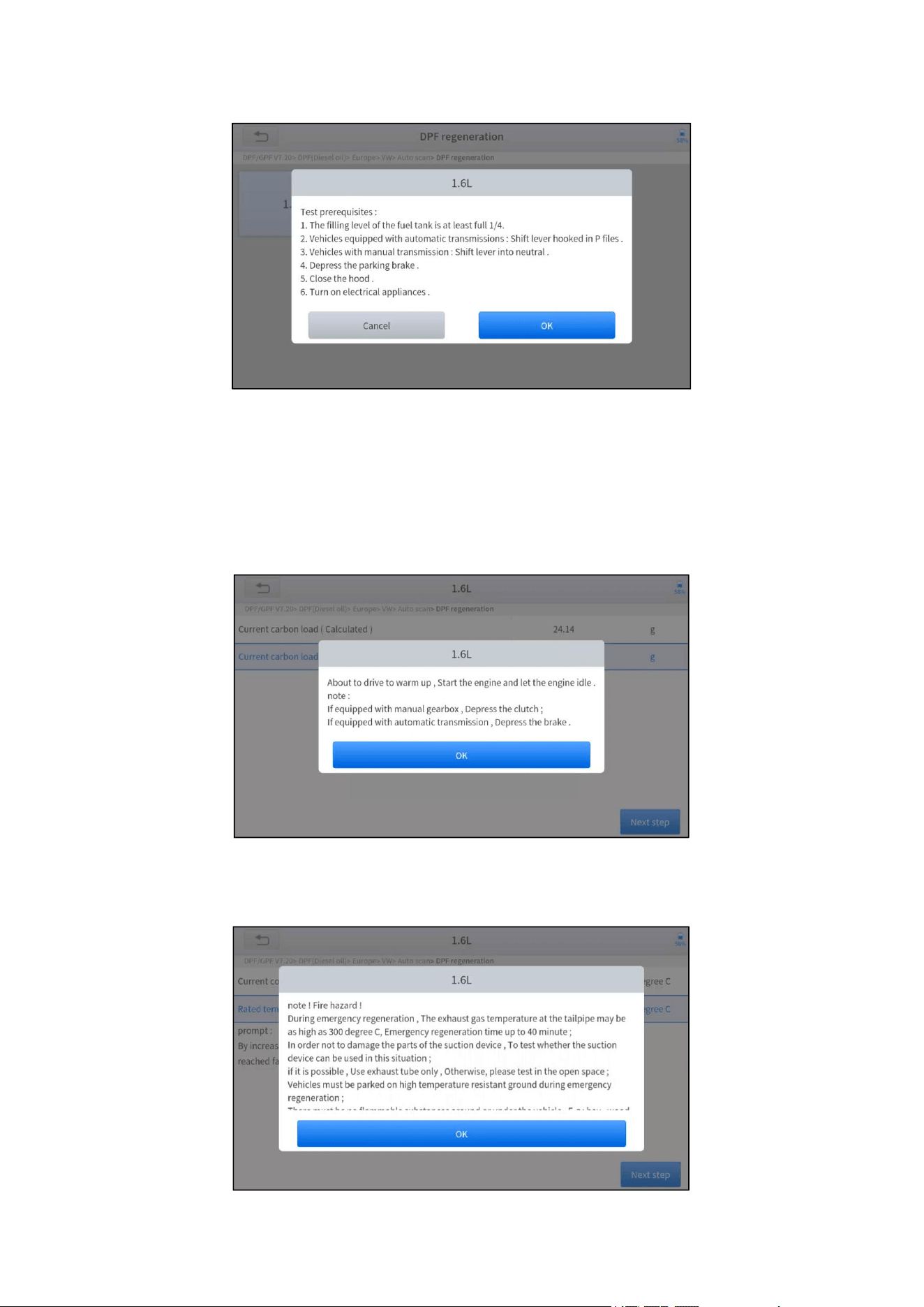
4. Read the fuel tank level and make sure that it fulfills the requirement displayed.
5. Read the carbon deposit load.
6. Choose the “drive to warm up” option and follow the instructions listed below.
Press OK after completing the instructions shown.
7. Read the instructions carefully and follow the instructions shown on the screen.
Press OK after completing the instructions shown.
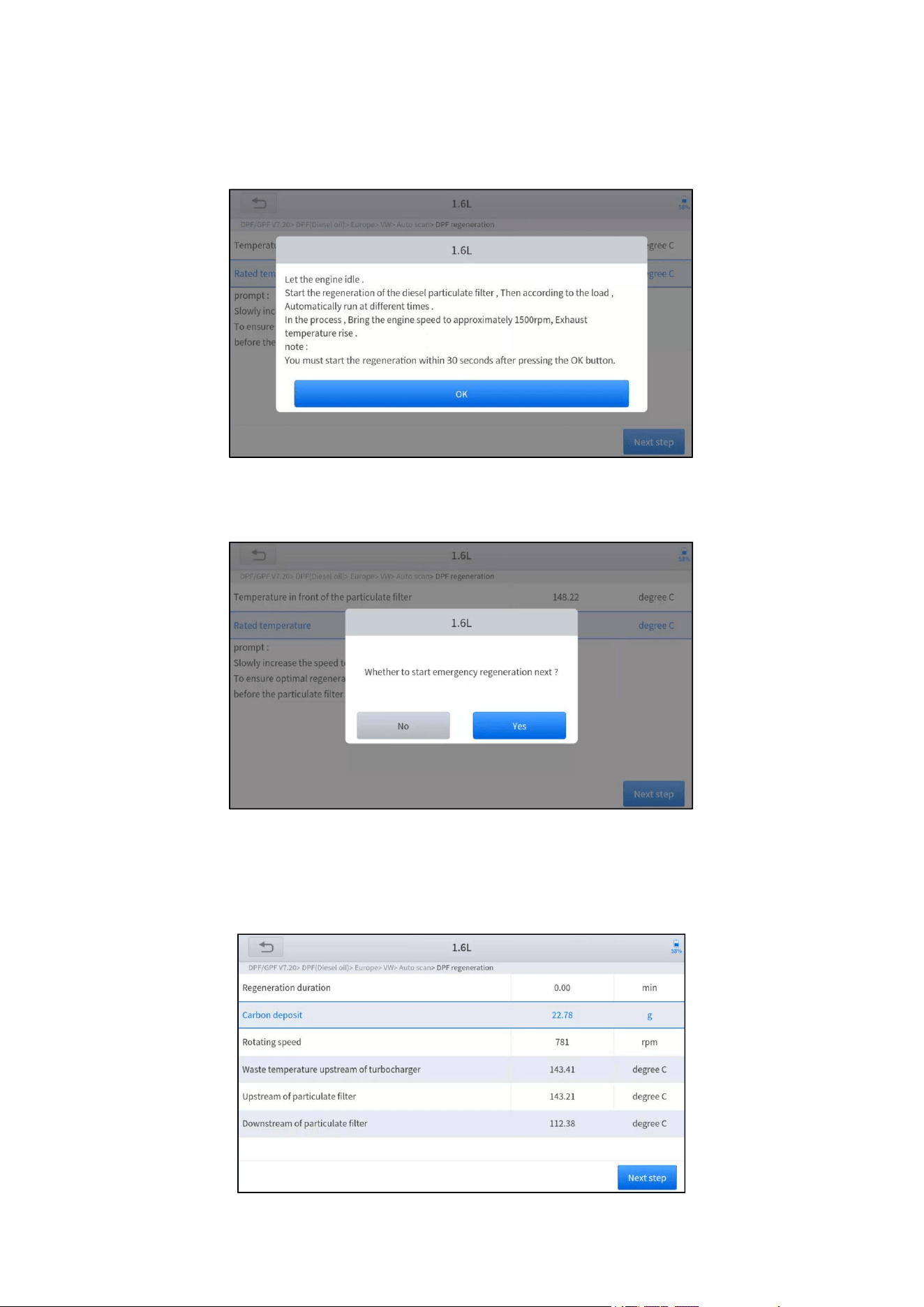
8. Follow the instructions displayed and press OK after completing the instructions
shown. IMPORTANT: Please pay attention to the Note.
9. Press the OK button to start the regeneration.
10. Wait for the value of carbon deposit to decrease until a message of ‘Emergency
regeneration has been completed’ pops up, this process may take up to 40
minutes.
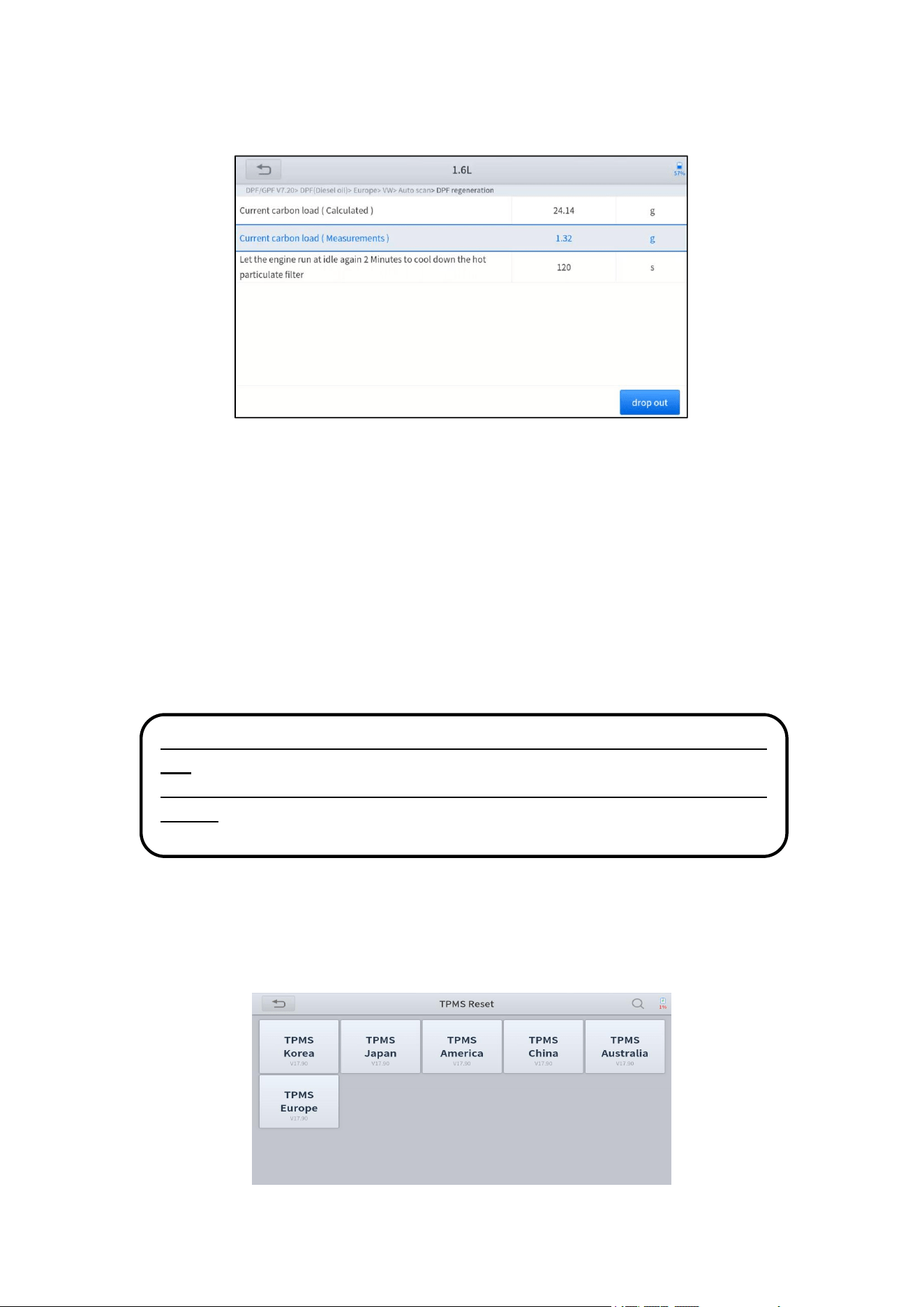
11. Wait for 2 minutes to let the particulate filter cool down.
12. Press drop out to exit the DPF function.
3.8 TPMS RESET
This function allows to perform the learning and matching and resetting functions of
the tire pressure sensor.
TPMS Reset may be performed in the following cases:
Tire replacement
After troubleshooting tire pressure related problems
Other causes of loss of signal from the tire pressure sensor
1. For tire pressure sensor matching, some vehicle models may need the TPMS activation
tool;
2. After learning process, you may need to run the car for some while before the fault light
goes off;
3. Tire pressure imbalance may also cause the tire pressure light;
Even for the same model, its tire pressure system may differ by the region where it is
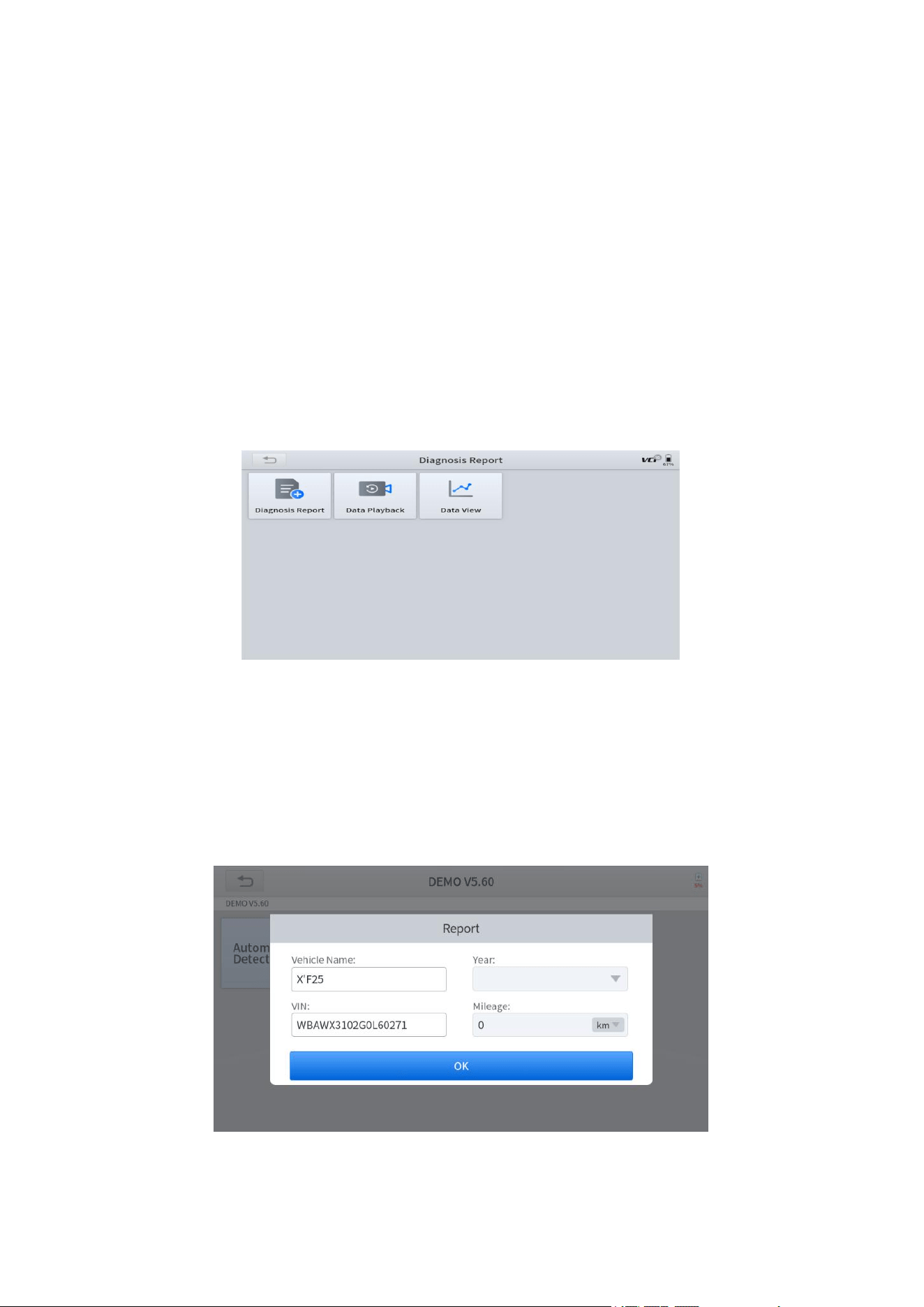
manufactured. Therefore, under the TPMS Reset function, we provide 6 menus for the
major automotive manufacturing regions, including Korea, Japan, USA, China,
Australia and Europe, as shown below.

And then please enter the sub-menu by the origin region of car make and select the
vehicle model you need
TPMS reset can be further divided into 4 methods, such as Automatic Relearn, Static
Relearn, Copy ID and OBD Relearn, which is depending on the specific model. Also,
even if the relearning methods are the same, the learning procedure may differ.
AUTOMATIC RELEARN
1. Install tire pressure sensor appropriately
2. Adjust all TPMS sensors to the standard value
3. Keep the vehicle at a complete standstill status for more than 20 minutes (with
the engine off and power off)
.
4. Drive at 30-100km/h for more than 15 minutes
.
5. The vehicle will automatically relearn the value, after that, the tire pressure
warning will disappear
.
6. If the relearn procedure fails, please repeat steps 2-5
.
STATIC RELEARN
1. Install all tire pressure sensors appropriately
.
2. Pull up the parking brake
.
3. Turn the ignition to ON/RUN with the engine off
.
4. Enter the tire pressure learning mode through the instrument panel on vehicle.
There will be the corresponding prompt, which are differ from different car make
and model, please subject to the vehicle manual or consult a professional)
5. Starting from the left front wheel (some models flash the turn signal at the
corresponding position), use the TPMS Activation Tool to activate the sensor, and
the vehicle will sound the horn or flash the turn signal at the corresponding
position after successful activation.
Note: The first sensor should be learned within 2 minutes, otherwise please repeat step 4

6. After the left front wheel sensor is successfully relearned. For the remaining,
please activate the remaining tire pressure sensors in the order of right front, right
rear and left rear. The prompt and activation success status are the same as step 5
Note: The remaining sensor learning needs to be completed within 3 minutes,
otherwise please repeat the relearn procedure from step 4!
7. Turn the vehicle off and power off. Adjust all sensors to the standard value.
8. Tire pressure warning light will disappear after success. If procedure fails, please
repeat steps 4-7
OBD RELEARN
1. A TPMS Activation Tool is needed
2. Install tire pressure sensor appropriately
3. Adjust all TPMS sensors to the standard value
4. Activate all sensors in the order of left front, right front, right rear, left rear
5. Connect TPMS Activation Tool to the OBD port of vehicle and perform the OBD
relearn function to write the sensor ID
6. Turn the ignition to ON/RUN, re-trigger all sensors in the order of left front, right
front, right rear, left rear
7. Keep the vehicle powered off for more than 25 minutes
8. Drive at 30-100km/h for more than 15 minutes. If relearn successful, the tire
pressure warning light will go off. Otherwise, please repeat steps 4-7
COPY ID RELEARN
Note: This learning method of the vehicle can only copy ID to the new sensor through the
following three methods to replace the original sensor, if the new sensor cannot change its own
ID, then the sensor can only be replaced by the OEM equipment!
Method 1:
1. Use a TPMS Activation Tool to activate the original sensor, copy the sensor ID to
the tire pressure activation device
2. And then program the copied ID into the new sensor through the TPMS
Activation Tool (The binary of ID format should be the same as the original
sensor)
3. Remove the original sensor that has been just copied the ID, install the new
sensor that has just been programmed, and put the tire back on
Method 2:
1. Use the TPMS Activation Tool to connect the vehicle OBD port, enter the tire
pressure system, copy the ID of the sensor to be replaced
2. And then program the copied ID into the new sensor through the TPMS
Activation Tool (The binary of ID format should be the same as the original
sensor)
3. Remove the original sensor that has been just copied the ID, install the new
sensor that has just been programmed, and put the tire back on
Method 3:

1. Remove the original sensor
2. Use the TPMS Activation Tool to copy the original sensor ID into the new sensor
manually (The binary of ID format should be the same as the original sensor)
3. Install the new sensor to the tire correctly, set the tire pressure to the standard
value, and put the tire back on the vehicle
Note
a) Tire pressure standard is usually displayed in these places:
Vehicle owner's manual
Label next to the driver's door (near the B-pillar)
Drawer next to the driver's seat of the vehicle
Fuel tank cap
b) This Scan Tool is not a replacement for the TPMS activation tool, and it only
provide TPMS Reset/Relearn function but activation of TPMS sensors. If
you need a professional TPMS activation tool, please consult your local dealer.
4. R
EPORT
Diagnostic Report is used for viewing and printing the saved files, such as Live Data,
Trouble codes or pictures generated in the process of diagnosis.
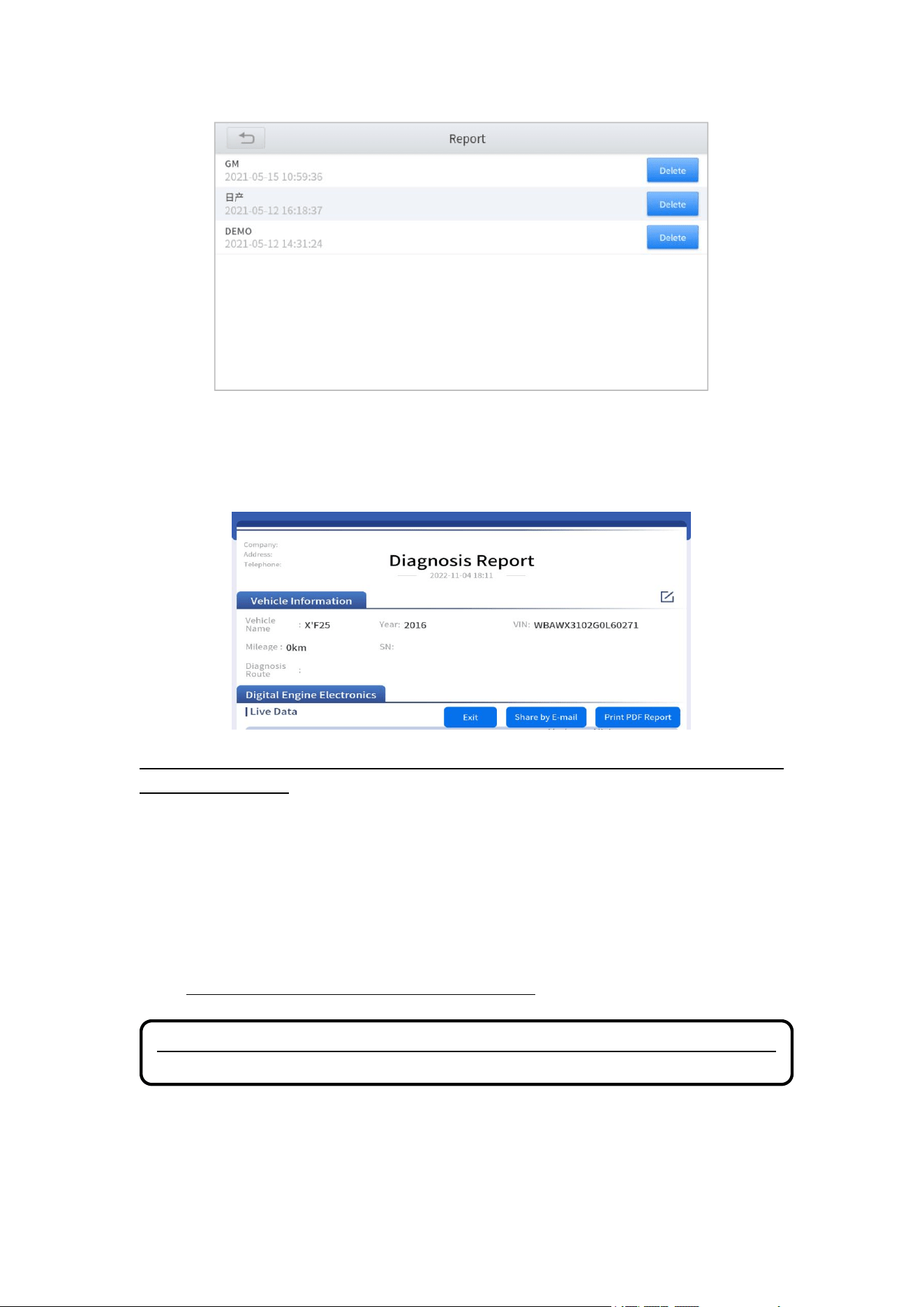
Users also can view a record of which cars have been previously tested. It includes 3
parts:
Diagnosis Report
Data Playback
Data View
REPORT
This feature provides a history of diagnostic reports, where you can view and delete
the vehicle's diagnostic reports according to your needs.
When you finish the diagnostics progress and exit the diagnostic application specific
to this vehicle, you will get a prompt of report regeneration.
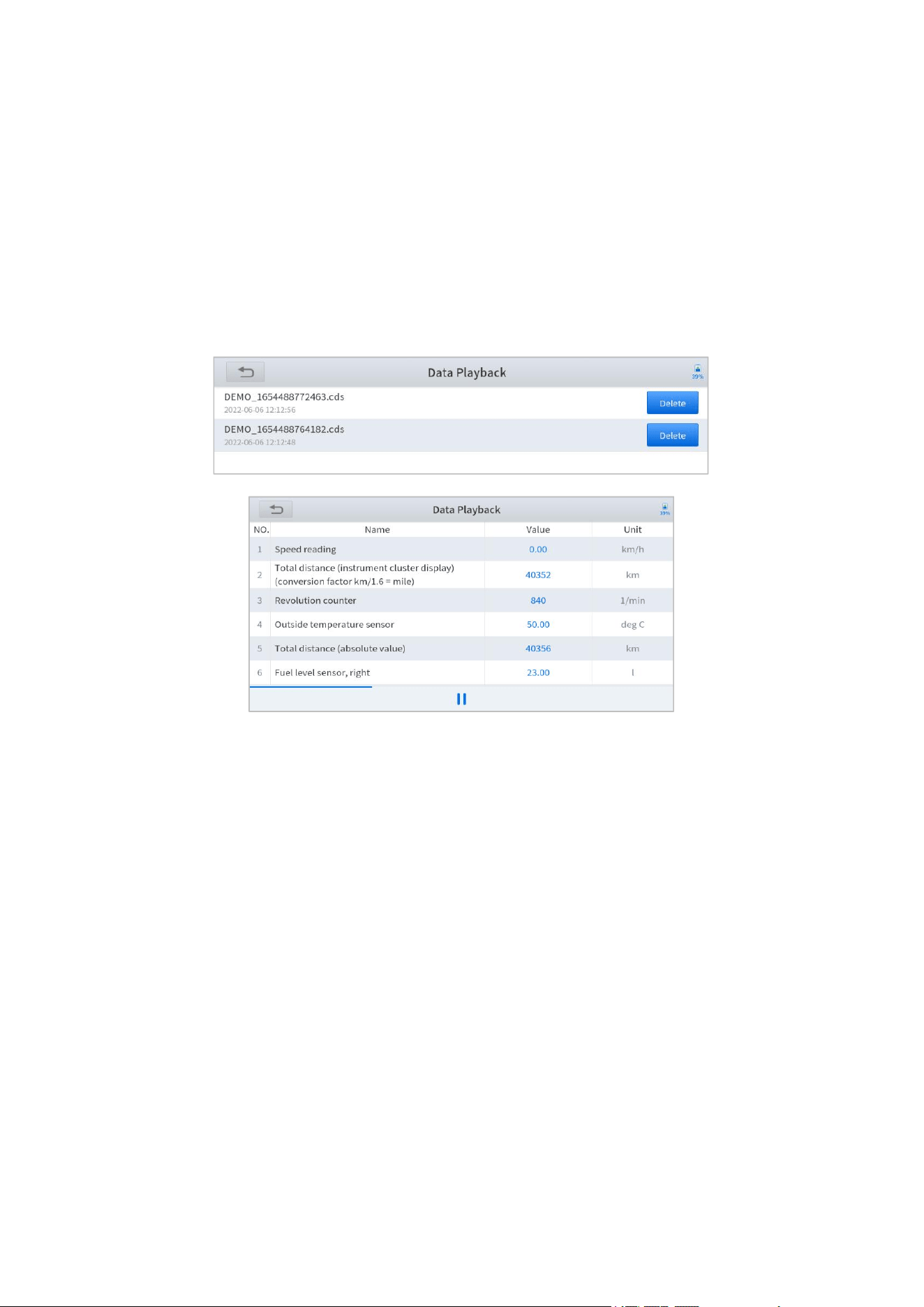
When you open the report, located in the header of the table is the workshop
information you filled in advance in the system setup, then the information of the
vehicle, as shown below:
Note: The vehicle information is allowed to edit by clicking the pen icon on the right side of the
picture shown above.
You also can click "Print PDF Report" at the bottom right corner to output the pdf
report. If you need to close the report tap on the button “Exit”.
Please follow the below steps to print your report▼
Step 1: Install an APP that can connect to your target printer. Add the printer and
input the IP address of the printer in the APP, or you can contact the XTOOL support
team (support1@xtooltech/ support2@xtooltech.com) for help.
⚠ The Scan tool doesn’t provide the printer driver software, please install a third part App
on the tablet if you need the print your Diagnostic report.
Step 2: On the Android main menu, go to Settings -> Printing-> Turn printer on.
Step 3: Report-> Choose report-> Print PDF Report-> Print
Step 4: Click the top-left corner of the screen and choose the printer previously added.
Then click the button on the right to print.
REPLAY
This function allows you to replay the living data recorded during the Diagnostic
process.
Before replaying the living data, please make sure you have recorded the live data
during the Diagnostic
Data View
Here to view the saved live data in different ways.

5. U
PDATE
& F
ACTORY
R
ESET
UPDATE
After activating the device, please update the software modules identified in the
"Updates" screen. The device will identify all currently available software packages,
and you can download them as needed. ALL software updates directly via the
Internet.
⚠ After contacting your XTOOL Support to change the language configuration, you need
to download all the software packages on the device again.
Cautions
When the subscription expires, the software has installed on your device itself still is
available, but all updates will be invalid. If you delete specific software due to the
personal operation, XTOOL is not responsible for supporting the restoration of the
software when the subscription expires.
To renew your subscription, please contact your local dealer, or contact XTOOL
technical support team directly.
FACTORY RESET
When you choose to restore factory settings in the Android OS system, the device will
automatically erase any custom settings and data, restart and then enter the factory
reset mode.
A factory reset is triggered by clicking the Settings mode from the main home page,
and then clicking on “Backup & reset”. Follow onscreen prompts to initiate the
factory reset process.
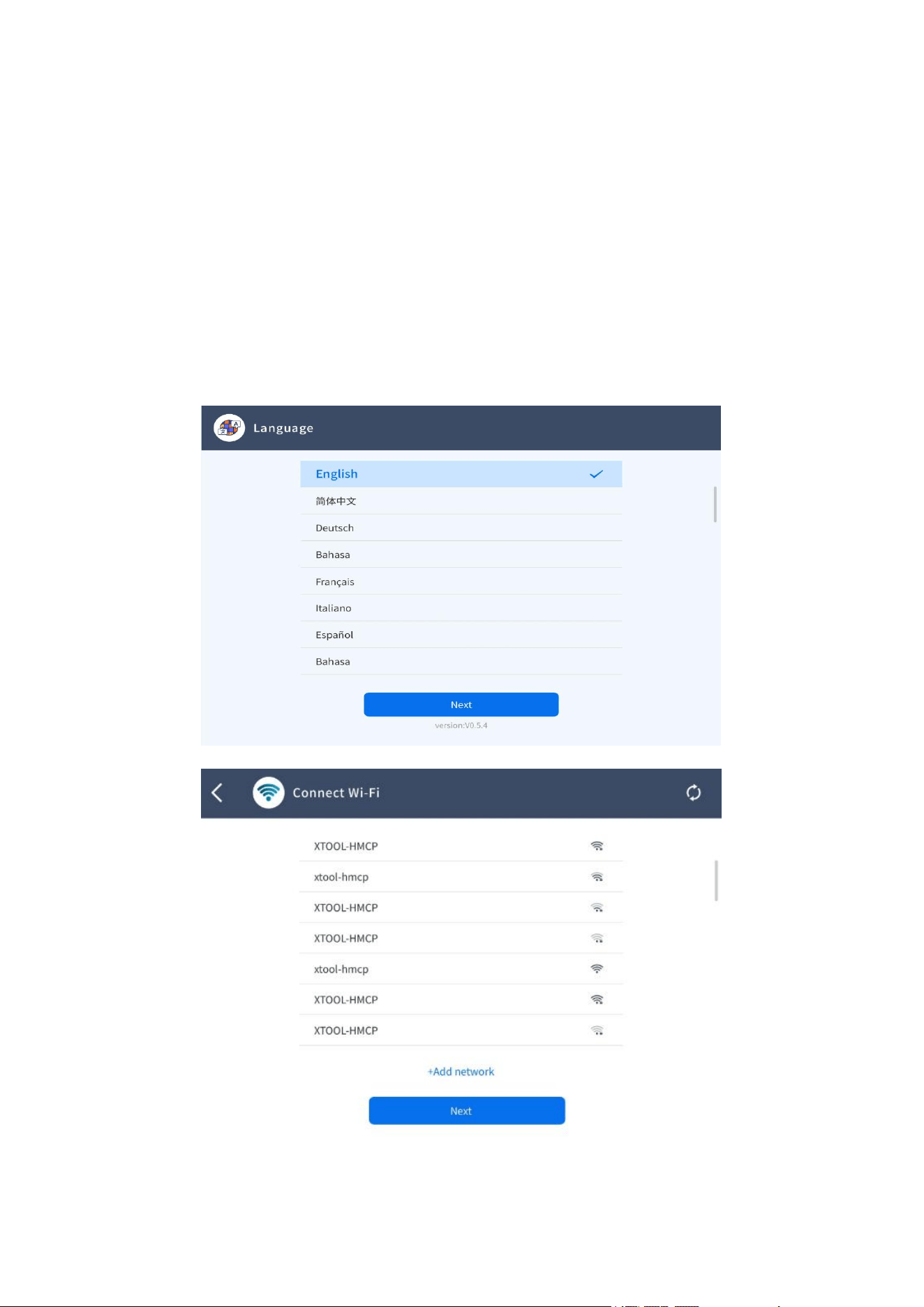
Once the scan tool resets to factory default settings it will start up and then you can
select the language in the following interface.
6. R
EMOTE
A
SSISTANCE
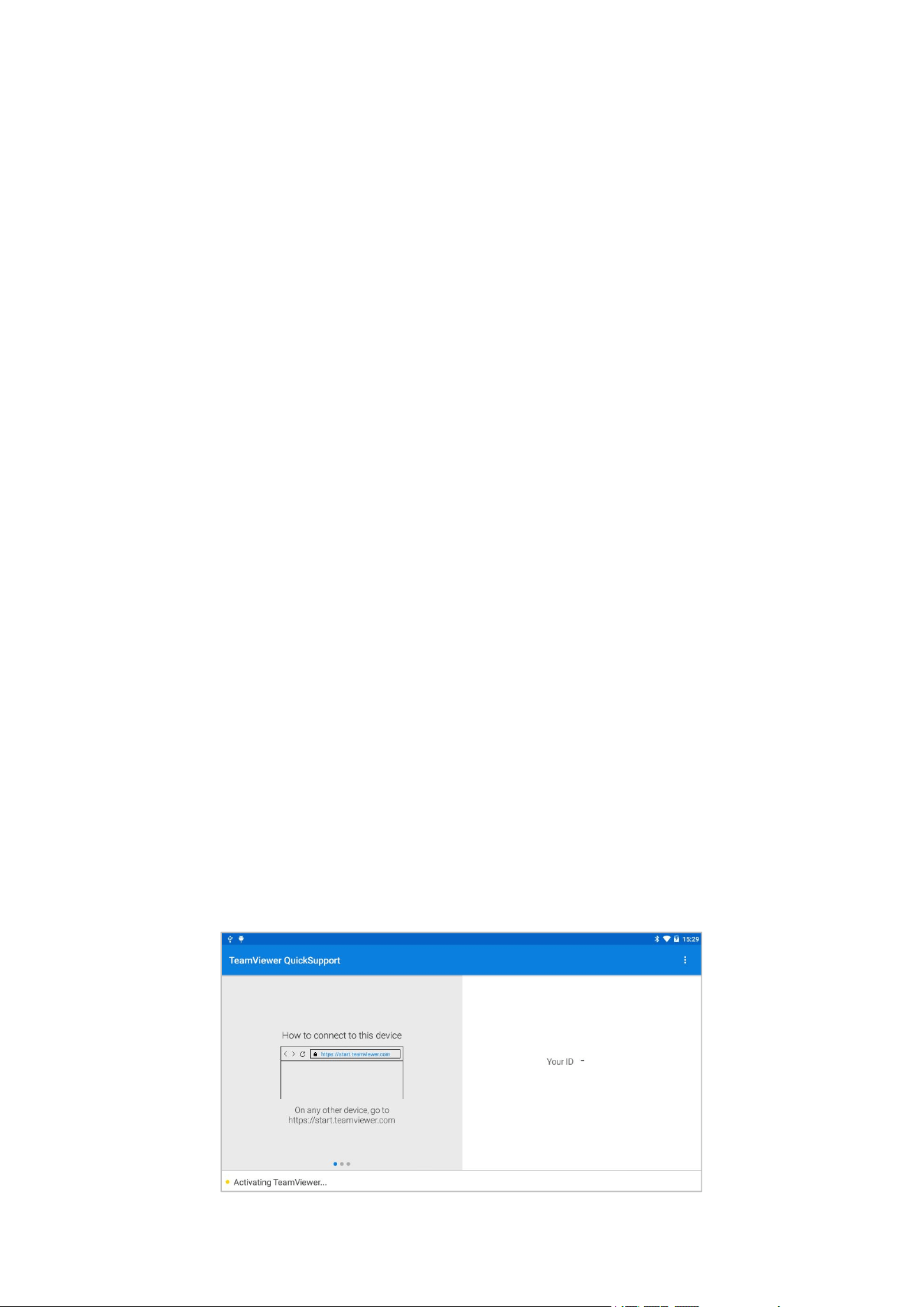
Tap on "Remote" to start the TeamViewer quick support program, which is a simple, fast, and
secure remote-control screen. You can use this application to enable someone else to use their
computer running TeamViewer software to control your tablet over the Internet. This feature is
frequently used by XTOOL's technical support centre when remotely helping customers with
technical support.
Computers and mobile devices running TeamViewer are identified by a globally unique ID. When
the remote application is started for the first time, the ID will be automatically generated
according to the hardware characteristics and will not be changed in the future. This TeamViewer
ID can individually access all TeamViewer clients.
Before launching the remote desktop application, make sure that the tablet is connected to the
Internet so that you can access the tablet to receive remote support from a third party. If you
encounter problems and are not able to solve them, you could open this application and ask for
remote assistance.
To obtain remote support from your partners or XTOOL AfterSalesService Center:
support1@xtooltech.com | support2@xtooltech.com
1. Turn on the power of the tablet.
2. Click Remote in the Diagnostic application. The TeamViewer screen is displayed, and the
device ID will be generated.
3. Your partner must install the remote-control software on their computer by downloading the
full version of the TeamViewer program (http://www.teamviewer.com) online, and then start the
software on their computer at the same time, to provide support and remote control of the tablet.
4. Provide your ID to the partner or XTOOL technician, and then wait for them to send you a
remote-control request.
5. A pop-up window will be displayed, asking you to permit the remote-control program to control
your device.
6. Click Allow to accept, or click Reject to reject.

7. A
PPENDIX
DTC STATUS DESCRIPTIONS
DTC Status
Descriptions
Suggestions
Current /Present
Current DTC’s are trouble codes that are stored in
the ECU when both continuous and non-continuous
(2 trip) monitors fail. Current DTC’s command the
MIL On the instant they are stored in the ECU.
Current DTC’s can be cleared using the
Clear DTC’s function of the Scantool,
or when the ECU monitor (2 trip
monitor) has ran and completed 40
consecutive trips without a fault.
History/Stored
History DTC’s are trouble codes stored in the ECU
when continuous and non-continuous monitors (2nd
trip) fail. History DTC’s set in conjunction with
Current DTC’s and are not cleared by the ECU
monitor. History DTC’s can only be cleared using
the Clear DTC function of the Scantool.
History DTC’s set in conjunction with
Current DTC’s and are not cleared by
the ECU monitor. History DTC’s can
only be cleared using the Clear DTC
function of the Scantool.
Pending
Pending codes are codes that prep themselves when
they determine a fault that engine cycle. They are
basically a preliminary investigation for your
engine. To simplify, a random malfunction can
occur during the current drive cycle but only happen
for a split second. This will cause the malfunction to
throw a “pending code”.
Typically pending codes are not to
severe but you shouldn’t ignore them
either, it can be cleared using the Clear
DTC’s function of the Scantool
Permanent
Permanent DTC’s are trouble codes that are stored
in the ECU when continuous and non-continuous
monitors fail. Permanent DTC’s are set in
conjunction with Current and History DTC’s.
Permanent DTC’s cannot be cleared
using the Clear DTC’s function on the
Scantool. Instead, Permanent DTC’s
are cleared when the ECU monitor
completes and passes three consecutive
trips.
For Volkswagen
Active/static
Active/Static means that the fault is happening at
the moment and can/should be take care of.
The fault cannot be cleared directly by
using the Clear DTC’s function of the
diagnostic tool and the internal fault of
the car must be eliminated manually
Passive/sporadic
It is a fault that has occurred in the past and can be
cleared by Scantool, and user should to check if the
DTC will appear again.
/