GEAppliances.com
4-a
C
|
O
Im
>
0
0
Safety Information ............ 2
Warranty ........................ 6
Assistance / Accessories ...... 7
Using The Oven
Oven Controls ...................... 8
Special Features ................. 10
Oven Racks ...................... 12
Aluminum Foil and Oven Liners... 13
Cooking Modes .................. 14
Cookware ........................ 15
Cooking Guide ................... 16
Care and Cleaning
Control Panel .................... 17
Oven Exterior .................... 17
Stainless Steel Surfaces .......... 1 7
Oven Interior ..................... 17
Oven Racks ...................... 18
Maintenance ..................... 19
Troubleshooting Tips ........ 22
PT7050 - 30" Single Wall Oven
PT9050 - 30" Single Wall Oven
PT7550 - 30" Double Wall Oven
PT9550 - 30" Double Wall Oven
For a Spanish version of this
manual visit our Website at
GEApp/iances.com.
Para consu/tar una version
en espaho/ de este manual
de instrucciones, visite
nuestro sitio de internet
GEApp/iances.com.
Write the model and serial
numbers here:
Model #
Serial #
You can find them on a label
on the side trim or on the front of
the (lower) oven behind the oven
door.
Printed on
Recycled Paper
Printed inthe United States 49-80727 03-14 GE
Z
©
m
tY
©
EL
Z
m
>..
t--,
o©
IMPORTANT SAFETY INFORMATION.
READALL INSTRUCTIONS BEFORE USING.
IA WARNING I
Read all safety instructions before using the product. Failure to follow these instructions may result in fire,
electrical shock, serious injury or death.
STATEOF CALIFORNIA PROPOSITION 65 WARNING
The California Safe Drinking Water and Toxic Enforcement Act requires the Governor of California to
publish a list of substances known to the state to cause cancer, birth defects or other reproductive harm,
and requires businesses to warn customers of potential exposure to such substances.
WARNING 1This product contains one or more chemical known to the State of California to
cause cancer, birth defects or other reproductive harm,
Self-clean ovens can cause low-level exposure to some of these substances, including carbon monoxide,
during the cleaning cycle. Exposure can be minimized by venting with an open window or using a
ventilation fan or hood.
l/k WARNING I GENERALSAFETYINSTRUCTIONS
[] Use this appliance only for its intended purpose
as described in this Owner's Manual.
[] Be sure your appliance is properly installed and
grounded by a qualified installer in accordance
with the provided installation instructions.
[] Do not attempt to repair or replace any part of
your oven unless it is specifically recommended
in this manual. All other servicing should be
transferred to a qualified technician.
[] Before performing any service, disconnect the
power supply at the household distribution panel
by removing the fuse or switching off the circuit
breaker.
[] Do not leave children alone--children should not
be left alone or unattended in an area where an
appliance is in use. They should never be allowed
to climb, sit or stand on any part of the appliance.
[]A CAUTION.Donotstoreitemsof
interest to children in cabinets above an oven
- children climbing on the oven to reach items
could be seriously injured.
[] Use only dry pot holders--moist or damp pot
holders on hot surfaces may result in burns from
steam. Do not let pot holders touch hot heating
elements. Do not use a towel or other bulky cloth
in place of pot holders.
[] Never use your appliance for warming or heating
the room.
[] Do not touch the heating elements or the interior
surface of the oven. These surfaces may be hot
enough to burn even though they are dark in
color. During and after use, do not touch, or let
clothing or other flammable materials contact any
interior area of the oven; allow sufficient time for
cooling first. Other surfaces of the appliance may
become hot enough to cause burns. Potentially
hot surfaces include the oven vent opening,
surfaces near the opening and crevices around
the oven door.
[] Do not heat unopened food containers. Pressure
could build up and the container could burst,
causing an injury.
[] Do not use any type of foil or liner to cover the
oven bottom or anywhere in the oven, except as
described in this manual. Oven liners can trap
heat or melt, resulting in damage to the product
and risk of shock, smoke or fire.
[] Avoid scratching or impacting glass doors or
control panels. Doing so may lead to glass
breakage. Do not cook on a product with broken
glass. Shock, fire or cuts may occur.
[] Cook meat and poultry thoroughly--meat to
at least an internal temperature of 160°F and
poultry to at least an internal temperature of
180°F. Cooking to these temperatures usually
protects against foodborne illness.
SAVETHESE INSTRUCTIONS
49 80727
iA WARNING i KEEPFLAMMABLEMATERIALSAWAYFROMTHEOVEN
l-- 1
Failure to do so may result in fire or personal injury°
[] Do not store or use flammable materials in or near
an oven, including paper, plastic, pot holders,
linens, wall coverings, curtains, drapes and gasoline
or other flammable vapors and liquids.
[] Never wear loose-fitting or hanging garments while
using the appliance. These garments may ignite if
they contact hot surfaces, causing severe burns.
[] Do not let cooking grease or other flammable
materials accumulate in or near the oven. Grease
in the oven or near the oven may ignite.
IIN THEEVENTOF A FIRE,TAKE THE FOLLOWING
STEPS TO PREVENTINJURY AND FIRESPREADING
IA, WARNING
r-'13
..-4
..<
m
Z
""i'!
©
n
©
Z
[] Do not use water on grease fires. Never pick up
a flaming pan.
[] If there is a fire in the oven during baking,
smother the fire by closing the oven door and
turning the oven off or by using a multi-purpose
dry chemical or foam-type fire extinguisher.
If there is a fire in the oven during self-clean, turn
the oven off and wait for the fire to go out. Do
not force the door open. Introduction of fresh air
at self-clean temperatures may lead to a burst
of flame from the oven. Failure to follow this
instruction may result in severe burns.
[A WARNING i OVENSAFETYINSTRUCTIONS
[] Stand away from the oven when opening the
oven door. Hot air or steam which escapes can
cause burns to hands, face and/or eyes.
[] Keep the oven vent unobstructed.
[] Keep the oven free from grease buildup. Grease
in the oven may ignite.
[] Place oven racks in desired location while oven is
cool. If rack must be moved while oven is hot, do not
let pot holder contact hot heating element in oven.
[] When using cooking or roasting bags in the
oven, follow the manufacturer's directions.
iA WARNING
[] Pulling out the standard racks to their stop-locks
or the extension rack to its fully open position is
a convenience in lifting heavy foods. It is also
a precaution against burns from touching hot
surfaces of the door or oven walls.
[] Do not leave items such as paper, cooking
utensils or food in the oven when not in use.
Items stored in an oven can ignite.
[] Never place cooking utensils, pizza or baking
stones, or any type of foil or liner on the oven
floor. These items can trap heat or melt, resulting
in damage to the product and risk of shock,
smoke or fire.
1SELF-CLEANINGOVEN SAFETYINSTRUCTIONS
The self-cleaning feature operates the oven at temperatures high enough to burn away food soils in the
oven. Follow these instructions for safe operation.
[] Do not touch oven surfaces during self-clean
operation. Keep children away from the oven
during self-cleaning. Failure to follow these
instructions may cause burns.
[] Before self-cleaning the oven, remove shiny
silver colored oven racks (on some models), the
probe, any aluminum foil, and any broiler pan,
grid, and other cookware. Only porcelain coated
oven racks may be left in the oven.
[] Before operating the self-clean cycle, wipe
grease and food soils from the oven. Excessive
amount of grease may ignite, leading to smoke
damage to your home.
[] If the self-cleaning mode malfunctions, turn the
oven off and disconnect the power supply. Have
it serviced by a qualified technician.
[] Do not clean the door gasket. The door gasket is
essential for a good seal. Care should be taken
not to rub, damage or move the gasket.
[] Do not use oven cleaners. No commercial oven
cleaner or oven liner protective coating of any kind
should be used in or around any part of the oven.
SAVETHESE INSTRUCTIONS
49 80727 3
Z
©
m
tY
©
EL
Z
m
>..
t--,
I..tJ
IMPORTANT SAFETYINFORMATION.
READALL INSTRUCTIONSBEFOREUSING.
The remote enable equipment installed on this oven
has been tested and found to comply with the limits
for a Class B digital device, pursuant to part 15 of
the FCC Rules, These limits are designed to:
(a) provide reasonable protection against harmful
interference in a residential installation, This
equipment generates, uses and can radiate radio
frequency energy and, if not installed and used
in accordance with the instructions, may cause
harmful interference to radio communications.
However, there is no guarantee that interference
will not occur in a particular installation. If this
equipment does cause harmful interference to radio
or television reception, which can be determined
by turning the equipment off and on, the user is
encouraged to try to correct the interference by one
or more of the following measures:
[] Reorient or relocate the receiving antenna.
[] Increase the separation between the equipment
and receiver,
[] Connect the equipment into an outlet on a
circuit different from that to which the receiver is
connected,
[] Consult the dealer or an experienced radio/TV
technician for help.
(b) accept any interference received, including
interference that may cause undesired operation of
the device.
Note that any changes or modifications to the
wireless communication device installed on this
oven that are not expressly approved by the
manufacturer could void the user's authority to
operate the equipment.
49 80727

Notes
49 80727 5
>.,
p-
Z
tY
tY
09
.. o
tu
O
v _
"50_
_-- 03
tt_
G) C
_o
o "o
tlJ
Thank You! ... for your purchase of a GE Brand appliance.
Register Your Appliance: Register your new appliance on-line at your convenience!
www.geappliances.com/service_and_support/register/
Timely product registration will allow for enhanced communication and prompt service under the terms of your warranty,
should the need arise. You may also mail in the pre-printed registration card included in the packing material.
GE Electric Range Warranty
GEAppliances.com
All warranty service is provided by our Factory Service Centers, or an authorized Customer Care ® technician•
Toschedule service on-line, visit us atwww.geappliances.com/service_and_support/, or call 800.GE.CARES
(800•432•2737)• Please have serial number and model number available when calling for service.
Servicing your appliance may require the use of the onboard data port for diagnostics• This gives a GE factory
service technician the ability to quickly diagnose any issues with your appliance and helps GE improve its products
by providing GE with information on your appliance. If you do not want your appliance data to be sent to GE, please
advise your technician not to submit the data to GE at the time of service•
For the period of one year from the date ofthe original purchase• GE will provide any part of the range which fails due
to a defect in materials or workmanship• During this limited one-year warranty, GE will also provide, free of charge, all
labor and in-home service to replace the defective part.
What GE will not cover:
[] Service trips to your home to teach you how to use
the product•
[] Improper installation, delivery or maintenance•
[] Failure of the product ifit is abused, misused,
modified or used for other than the intended purpose
or used commercially•
[] Replacement of house fuses or resetting of circuit
breakers.
[] Damage to the product caused by accident, fire,
floods or acts of God.
[] Incidental or consequential damage caused by
possible defects with this appliance.
[] Damage caused after delivery.
[] Product not accessible to provide required service.
[] Service to repair or replace lightbulbs, except for LED
lamps.
EXCLUSION OF IMPLIED WARRANTIES
Your sole and exclusive remedy is product repair as provided in this Limited Warranty. Any implied warranties,
including the implied warranties of merchantability or fitness for a particular purpose, are limited to one year or the
shortest period allowed by law•
This warranty is extended to the original purchaser and any succeeding owner for products purchased for home use
within the USA• If the product is located in an area where service by a GE Authorized Servicer is not available, you
may be responsible for a trip charge or you may be required to bring the product to an Authorized GE Service location
for service. InAlaska, the warranty excludes the cost of shipping or service calls to your home.
Some states do not allow the exclusion or limitation of incidental or consequential damages. This warranty gives you
specific legal rights, and you may also have other rights which vary from state to state. Toknow what your legal rights
are, consult your local or state consumer affairs office or your state's Attorney General.
Warrantor: General Electric Company. Louisville, KY 40225
Extended Warranties: Purchase a GE extended warranty and learn about special discounts that are available while
your warranty isstill in effect. You can purchase iton-line anytime
www.geappliances.com/service_and_support/shop-for-extended-service-plans.htm
or call 800•626•2224 during normal business hours. GE Consumer Home Services will still be there after your
warranty expires.
49 80727
Have a question or need assistance with your appliance?
Try the GE Appliances Website (www.geappliances.comlservice_and_supportl) 24 hours a day, any day of the
year! For greater convenience and faster service, you can now download Owner's Manuals, order parts or even
schedule service on-line.
Schedule Service: Expert GE repair service is only one
step away from your door. Get on-line and schedule your
service atwww.geappliances.com/service_and_support/
Or call 800.GE.CARES (800.432.2737) during normal
business hours.
Remote Connectivity: For assistance with oven wireless
network connectivity (for models with remote enable),
please call 1-800-220-6899.
Parts and Accessories: Individuals qualified to service
their own appliances can have parts or accessories sent
directly to their homes (VISA, MasterCard and Discover
cards are accepted).Order on-line today, 24 hours every
day or by phone at 800.626.2002 during normal business
hours.
Instructions contained in this manual cover procedures
to be performed by any user. Other servicing generally
should be referred to qualified service personnel. Caution
Accessories
Looking For Something More?
Of)
m
must be exercised, since improper servicing may cause :_
unsafe operation. Z
Real Life Design Studio: GE supports the Universal
Design concept of products, services and environments
that can be used by people of all ages, sizes and
capabilities. We recognize the need to design for a wide :_
range of physical and mental abilities and impairments.
Fordetails of GE's Universal Design applications, including
kitchen design ideas for people with disabilities, check out
our Website today. Forthe hearing impaired, please call
800.TDD.GEAC (800.833.4322).
¢/)
Contact Us: If you are not satisfied with the service you 0
receive from GE, contact us on our Website with all the
details including your phone number, or write to:
General Manager, Customer Relations
bO
GE Appliances, Appliance Park Louisville, KY 40225
GE offers a variety of accessories to improve your cooking and maintenance experiences!
To place an order visit us online at:
www.GEApplianceParts.com (U.S.) or _w.GEAppliances.ca (Canada)
or call 800.626.2002 (U.S.) 800.661.1616 (Canada)
The following products and more are available:
Accessories
Small Broiler Pan (8 ¾" x 1 _¼"x 13 ½ ")
Large* Broiler Pan (12 ¾ "x 1 _¼"x 16 ½ ")
XL** Broiler Pan (17 "x 1 _¼"x 19 1/4")
Parts
Oven racks
Oven elements
Light bulbs
Probe
WB48X10055 (US) 222D2097G001 (Canada)
WB48X10056 (US) 222D2097G002 (Canada)
WB48X10057 (US) Not available in Canada
Part numbers vary bymodel
Part numbers vary bymodel
Part numbers vary bymodel
Part numbers vary bymodel
Cleaning Supplies
CitruShine Stainless Steel Wipes WX10X10007
CeramaBryte Stainless SteelAppliance Cleaner PM10X311
Graphite Lubricant WB02T10303
*The large broiler pan does notfit in 20"/24" ranges.
**The XL broiler pan does not fit in 24" wail ovens, 27"drop ins or 20'724" ranges
How to Remove Protective Shipping Film and Packaging Tape
Carefully grasp a corner of the protective shipping film
with your fingers and slowly peel itfrom the appliance
surface. Do not use any sharp items to remove the film.
Remove all of the film before using the appliance for the
first time.
To assure no damage isdone to the finish of the
product, the safest way to remove the adhesive from
packaging tape on new appliances is an application of
a household liquid dishwashing detergent. Apply with a
soft cloth and allow to soak.
NOTE: The adhesive must be removed from all parts. It
cannot be removed if itis baked on.
49 80727 7
bO
O
4-=J
O
LP
r-
Q
>
O
©
_J
"T"
©
Z
m
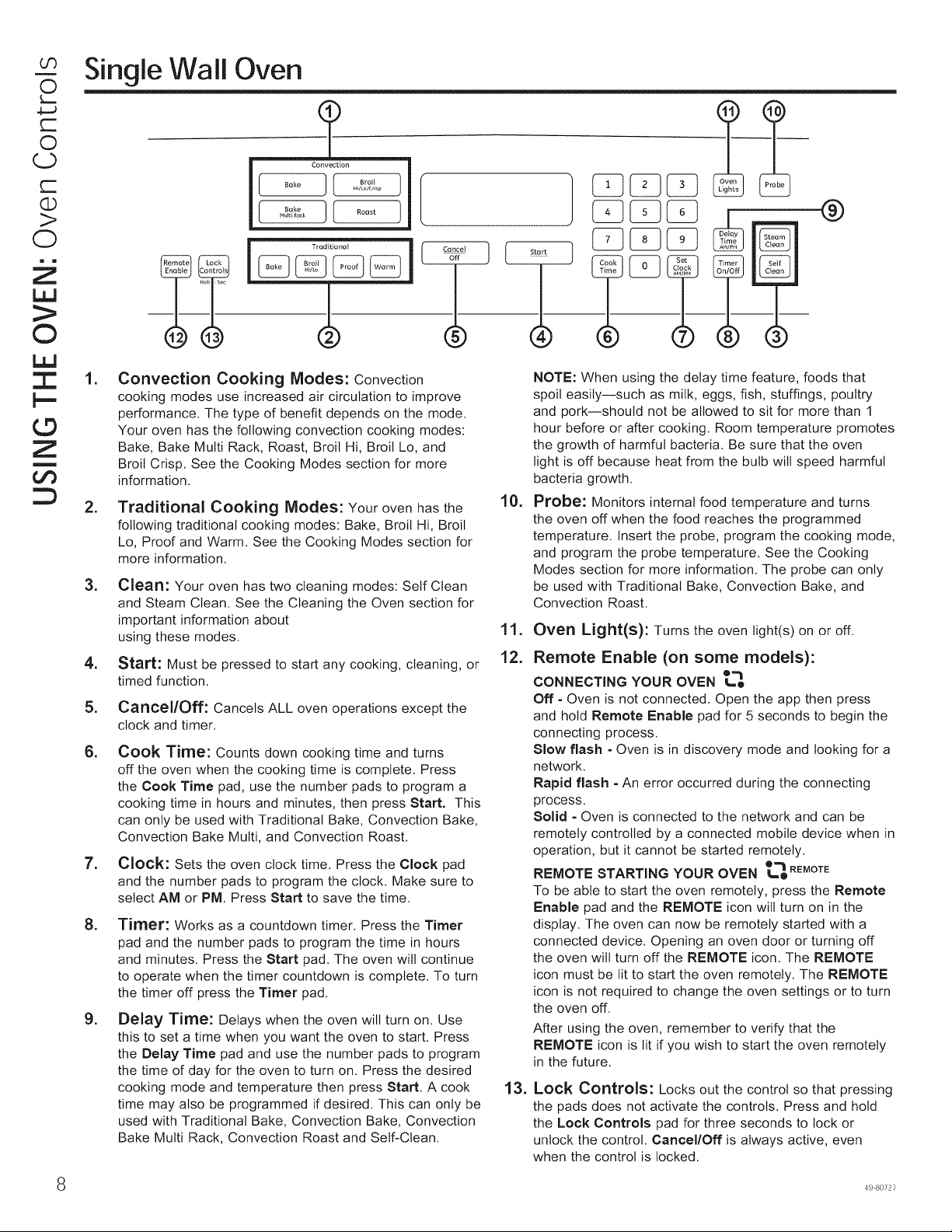
Single Wall Oven
t
Convection
Bake 1{ Roast 1
H_k_Rock
Traditional
®
=
=
=
=
5.
6.
=
=
=
Convection Cooking Modes: Convection
cooking modes use increased air circulation to improve
performance. The type of benefit depends on the mode.
Your oven has the following convection cooking modes:
Bake, Bake Multi Rack, Roast, Broil Hi, Broil Lo, and
Broil Crisp. See the Cooking Modes section for more
information.
Traditional Cooking Modes: Your oven has the
following traditional cooking modes: Bake, Broil Hi, Broil
Lo, Proof and Warm. See the Cooking Modes section for
more information.
Clean: Your oven has two cleaning modes: Self Clean
and Steam Clean. See the Cleaning the Oven section for
important information about
using these modes.
Start: Must be pressed to start any cooking, cleaning, or
timed function.
Cancel/Off: Cancels ALL oven operations except the
clock and timer.
Cook Time: Counts down cooking time and turns
off the oven when the cooking time is complete. Press
the Cook Time pad, use the number pads to program a
cooking time in hours and minutes, then press Start. This
can only be used with Traditional Bake, Convection Bake,
Convection Bake Multi, and Convection Roast.
Clock: Sets the oven clock time. Press the Clock pad
and the number pads to program the clock. Make sure to
select AM or PM. Press Start to save the time.
Timer: Works as a countdown timer. Press the Timer
pad and the number pads to program the time in hours
and minutes. Press the Start pad. The oven will continue
to operate when the timer countdown is complete. To turn
the timer off press the Timer pad.
Delay Time: Delays when the oven will turn on. Use
this to set a time when you want the oven to start. Press
the Delay Time pad and use the number pads to program
the time of day for the oven to turn on. Press the desired
cooking mode and temperature then press Start. A cook
time may also be programmed if desired. This can only be
used with Traditional Bake, Convection Bake, Convection
Bake Multi Rack, Convection Roast and Self-Clean.
10.
11.
12.
13.
NOTE: When using the delay time feature, foods that
spoil easily--such as milk, eggs, fish, stuffings, poultry
and pork--should not be allowed to sit for more than 1
hour before or after cooking. Room temperature promotes
the growth of harmful bacteria. Be sure that the oven
light is off because heat from the bulb will speed harmful
bacteria growth.
Probe: Monitors internal food temperature and turns
the oven off when the food reaches the programmed
temperature. Insert the probe, program the cooking mode,
and program the probe temperature. See the Cooking
Modes section for more information. The probe can only
be used with Traditional Bake, Convection Bake, and
Convection Roast.
Oven Light(s): Turns the oven light(s) on or off.
Remote Enable (on some models):
CONNECTING YOUR OVEN _,='=to
Off = Oven is not connected. Open the app then press
and hold Remote Enable pad for 5 seconds to begin the
connecting process.
Slow flash - Oven is in discovery mode and looking for a
network.
Rapid flash -An error occurred during the connecting
process.
Solid = Oven is connected to the network and can be
remotely controlled by a connected mobile device when in
operation, but it cannot be started remotely.
REMOTE STARTING YOUR OVEN _
REMOTE
To be able to start the oven remotely, press the Remote
Enable pad and the REMOTE icon will turn on in the
display. The oven can now be remotely started with a
connected device. Opening an oven door or turning off
the oven wilt turn off the REMOTE icon. The REMOTE
icon must be lit to start the oven remotely. The REMOTE
icon is not required to change the oven settings or to turn
the oven off.
After using the oven, remember to verify that the
REMOTE icon is lit if you wish to start the oven remotely
in the future.
Lock Controls: Locks out the control so that pressing
the pads does not activate the controls. Press and hold
the Lock Controls pad for three seconds to lock or
unlock the control. Cancel/Off is always active, even
when the control is locked.
8 49 80727
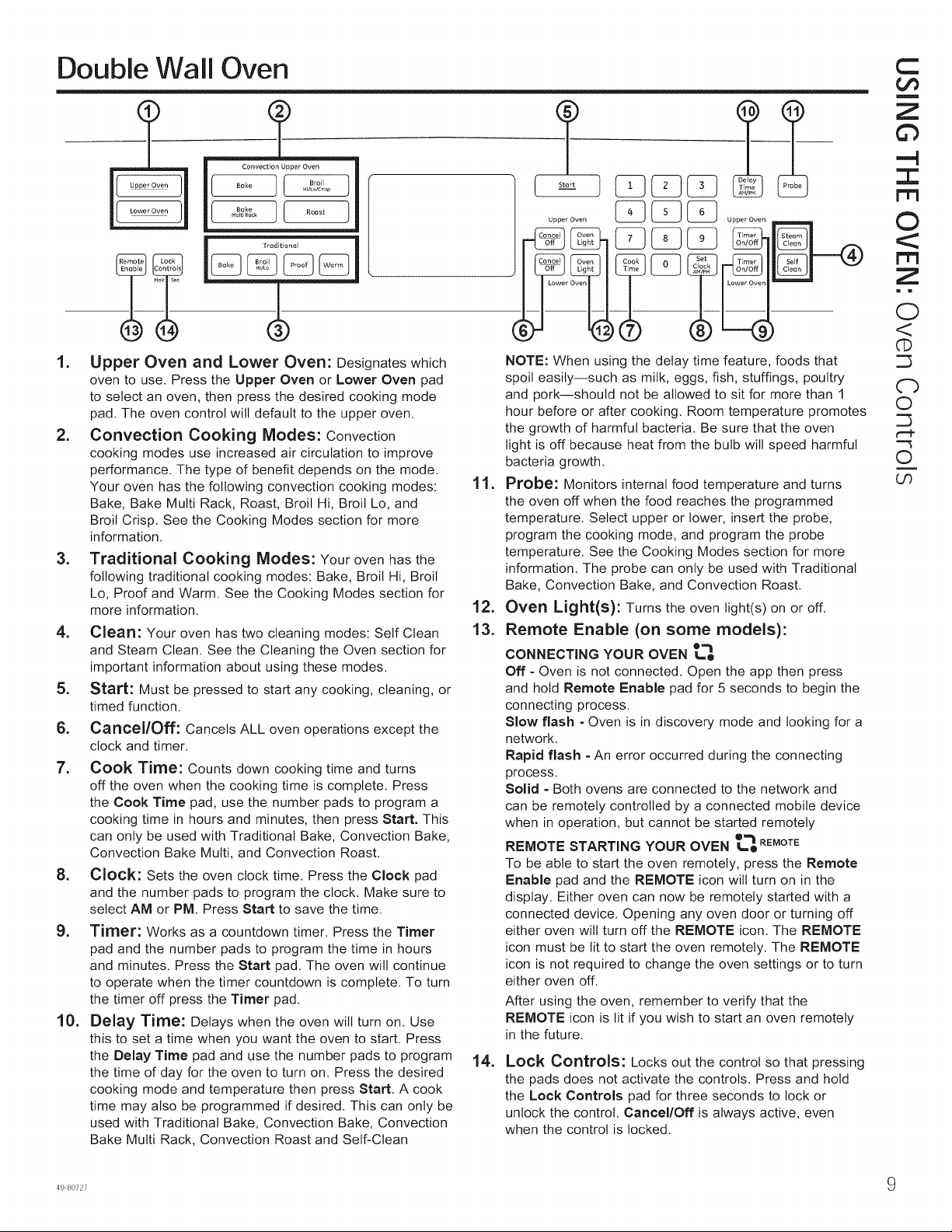
Double Wall Oven
Lo ero e,,Jl
Convection Upper Oven
0okoI ....0:,o ,s01
MukiRack
Upper Oven _ _ _ UpperOven
1. Upper Oven and Lower Oven: Designates which
oven to use. Press the Upper Oven or Lower Oven pad
to select an oven, then press the desired cooking mode
pad. The oven control will default to the upper oven.
2. Convection Cooking Modes: Convection
cooking modes use increased air circulation to improve
performance. The type of benefit depends on the mode.
Your oven has the following convection cooking modes: 1 1.
Bake, Bake Multi Rack, Roast, Broil Hi, Broil Lo, and
Broil Crisp. See the Cooking Modes section for more
information.
3. Traditional Cooking Modes: Your oven has the
following traditional cooking modes: Bake, Broil Hi, Broil
Lo, Proof and Warm. See the Cooking Modes section for
more information. 12.
4. Clean: Your oven has two cleaning modes: Self Clean 13.
and Steam Clean. See the Cleaning the Oven section for
important information about using these modes.
5. Start: Must be pressed to start any cooking, cleaning, or
timed function.
6. Cancel/Off: Cancels ALL oven operations except the
clock and timer.
7. Cook Time: Counts down cooking time and turns
off the oven when the cooking time is complete. Press
the Cook Time pad, use the number pads to program a
cooking time in hours and minutes, then press Start. This
can only be used with Traditional Bake, Convection Bake,
Convection Bake Multi, and Convection Roast.
8. Clock: Sets the oven clock time. Press the Clock pad
and the number pads to program the clock. Make sure to
select AM or PM. Press Start to save the time.
9. Timer: Works as a countdown timer. Press the Timer
pad and the number pads to program the time in hours
and minutes. Press the Start pad. The oven will continue
to operate when the timer countdown is complete. To turn
the timer off press the Timer pad.
10. Delay Time: Delays when the oven will turn on. Use
this to set a time when you want the oven to start. Press
the Delay Time pad and use the number pads to program 14.
the time of day for the oven to turn on. Press the desired
cooking mode and temperature then press Start. A cook
time may also be programmed if desired. This can only be
used with Traditional Bake, Convection Bake, Convection
Bake Multi Rack, Convection Roast and Self-Clean
NOTE: When using the delay time feature, foods that
spoil easily--such as milk, eggs, fish, stuffings, poultry
and pork--should not be allowed to sit for more than 1
hour before or after cooking. Room temperature promotes
the growth of harmful bacteria. Be sure that the oven
light is off because heat from the bulb will speed harmful
bacteria growth.
Probe: Monitors internal food temperature and turns
the oven off when the food reaches the programmed
temperature. Select upper or lower, insert the probe,
program the cooking mode, and program the probe
temperature. See the Cooking Modes section for more
information. The probe can only be used with Traditional
Bake, Convection Bake, and Convection Roast.
Oven Light(s): Turns the oven light(s) on or off.
Remote Enable (on some models):
CONNECTING YOUR OVEN _,_
Off - Oven is not connected. Open the app then press
and hold Remote Enable pad for 5 seconds to begin the
connecting process.
Slow flash - Oven is in discovery mode and looking for a
network.
Rapid flash -An error occurred during the connecting
process.
Solid - Both ovens are connected to the network and
can be remotely controlled by a connected mobile device
when in operation, but cannot be started remotely
REMOTE STARTING YOUR OVEN _,.."le
REMOTE
To be able to start the oven remotely, press the Remote
Enable pad and the REMOTE icon will turn on in the
display. Either oven can now be remotely started with a
connected device. Opening any oven door or turning off
either oven will turn off the REMOTE icon. The REMOTE
icon must be lit to start the oven remotely. The REMOTE
icon is not required to change the oven settings or to turn
either oven off.
After using the oven, remember to verify that the
REMOTE icon is lit if you wish to start an oven remotely
in the future.
Lock Controls: Locks out the control so that pressing
the pads does not activate the controls. Press and hold
the Lock Controls pad for three seconds to lock or
unlock the control. Cancel/Off is always active, even
when the control is locked.
C
Co
m
Z
Gb
,.-1
Z
©
Z
m m
O
<
(!:)
d'b
0
"-'3
O
i
Ch
49 80727 9
OO
Q
4---J
Q
L.L
n
LP
Q
CZ.
oO
LLJ
:>
©
I
©
Z
m
Special Features
There are numerous special features that are controlled using the number key pad.
[] Degree - Fahrenheit or Celsius temperature display
[] End tone- Cycle End Tone
[] Sound- Tone Volume
[] Setting- Clock Setting
[] Auto Recipe -Auto Recipe Conversion
(for Convection Baking)
[] 12hr shutoff- 12 Hour Shutoff
[] Sabbath- Sabbath mode
[] Temp Offset - Adjust the oven temperature
(Double ovens have upper and lower options)
[] Light Bar - Turns the light indicator on or off
[] Default - Reset control to factory settings
To change the Special Features settings follows these
guidelines.
Press and hold the Traditional Bake and Traditional
Broil pads for 3 seconds simultaneously.
When you enter the special features mode:
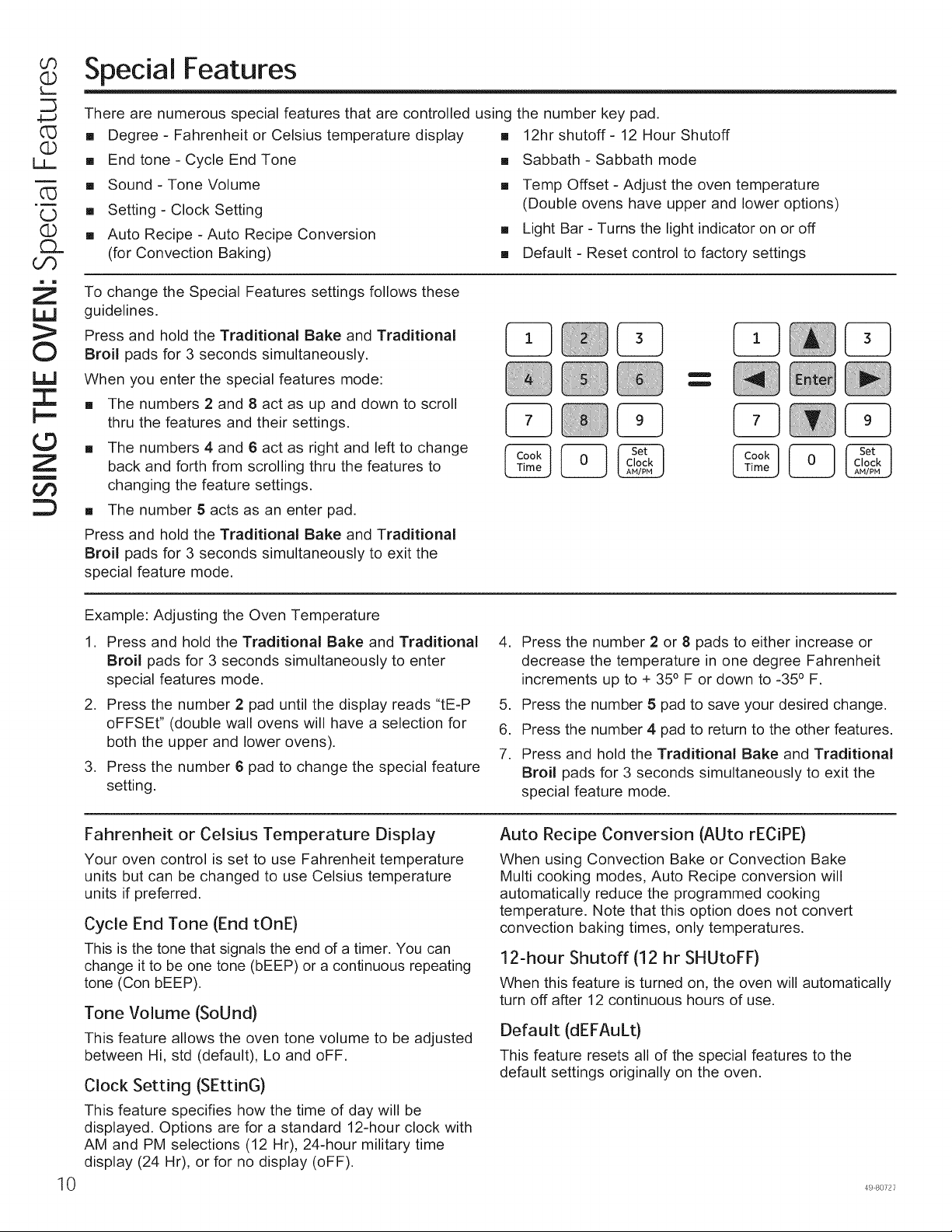
[] The numbers 2 and 8 act as up and down to scroll
thru the features and their settings.
[] The numbers 4 and 6 act as right and left to change
back and forth from scrolling thru the features to
changing the feature settings.
[] The number 5 acts as an enter pad.
Press and hold the Traditional Bake and Traditional
Broil pads for 3 seconds simultaneously to exit the
special feature mode.
Q
m
Example: Adjusting the Oven Temperature
1. Press and hold the Traditional Bake and Traditional
Broil pads for 3 seconds simultaneously to enter
special features mode.
2. Press the number 2 pad until the display reads "tE-P
oFFSEt" (double wall ovens will have a selection for
both the upper and lower ovens).
3. Press the number 6 pad to change the special feature
setting.
4. Press the number 2 or 8 pads to either increase or
decrease the temperature in one degree Fahrenheit
increments up to + 35° F or down to -35 ° F.
5. Press the number 5 pad to save your desired change.
6. Press the number 4 pad to return to the other features.
7. Press and hold the Traditional Bake and Traditional
Broil pads for 3 seconds simultaneously to exit the
special feature mode.
10
Fahrenheit or Celsius Temperature Display
Your oven control is set to use Fahrenheit temperature
units but can be changed to use Celsius temperature
units if preferred.
Cycle End Tone (End tOnE)
This isthe tone that signals the end of a timer. You can
change itto be one tone (bEEP) or a continuous repeating
tone (Con bEEP).
Tone Volume (SoUnd)
This feature allows the oven tone volume to be adjusted
between Hi, std (default), Lo and oFF.
Clock Setting (SEttinG)
This feature specifies how the time of day will be
displayed. Options are for a standard 12-hour clock with
AM and PM selections (12 Hr), 24-hour military time
display (24 Hr), or for no display (oFF).
Auto Recipe Conversion (AUto rECiPE)
When using Convection Bake or Convection Bake
Multi cooking modes, Auto Recipe conversion will
automatically reduce the programmed cooking
temperature. Note that this option does not convert
convection baking times, only temperatures.
12-hour Shutoff (12 hr SHUtoFF)
When this feature isturned on, the oven will automatically
turn off after 12 continuous hours of use.
Default (dEFAuLt)
This feature resets all of the special features to the
default settings originally on the oven.
49 80727
Special Features (cont.)
rl ust the Oven Temperature (tE-p oFFSEt)
pper and Lower on some models)
This feature allows the oven temperature to be adjusted
up to 35°F hotter or down to 35°F cooler. Use this
feature if you believe your oven temperature istoo hot
or too cold and wish to change it. For double oven
models the upper and lower ovens are adjusted
separately (UPPEr tE-P OFFSET and Lo-Er tE-P
oFFSEt). This adjustment affects Traditional Bake,
Convection Bake, and Convection Bake Multi Rack
modes.
Light Bar (LiGHt bAr) (on some models)
This feature uses a light bar between the door and the
control panel for easy visual indication of preheat and
cook time status. This feature can be turned on or off in
the special features of your oven. This feature works with
Convection Bake, Convection Bake Multi, Convection
Broil, Convection Roast, Traditional Bake, Traditional
Broil, Warm, Proof, Self Clean, Cook Time and Timer.
On a double wall oven the notification lighting indicates
the status of the upper oven only. Below is a description
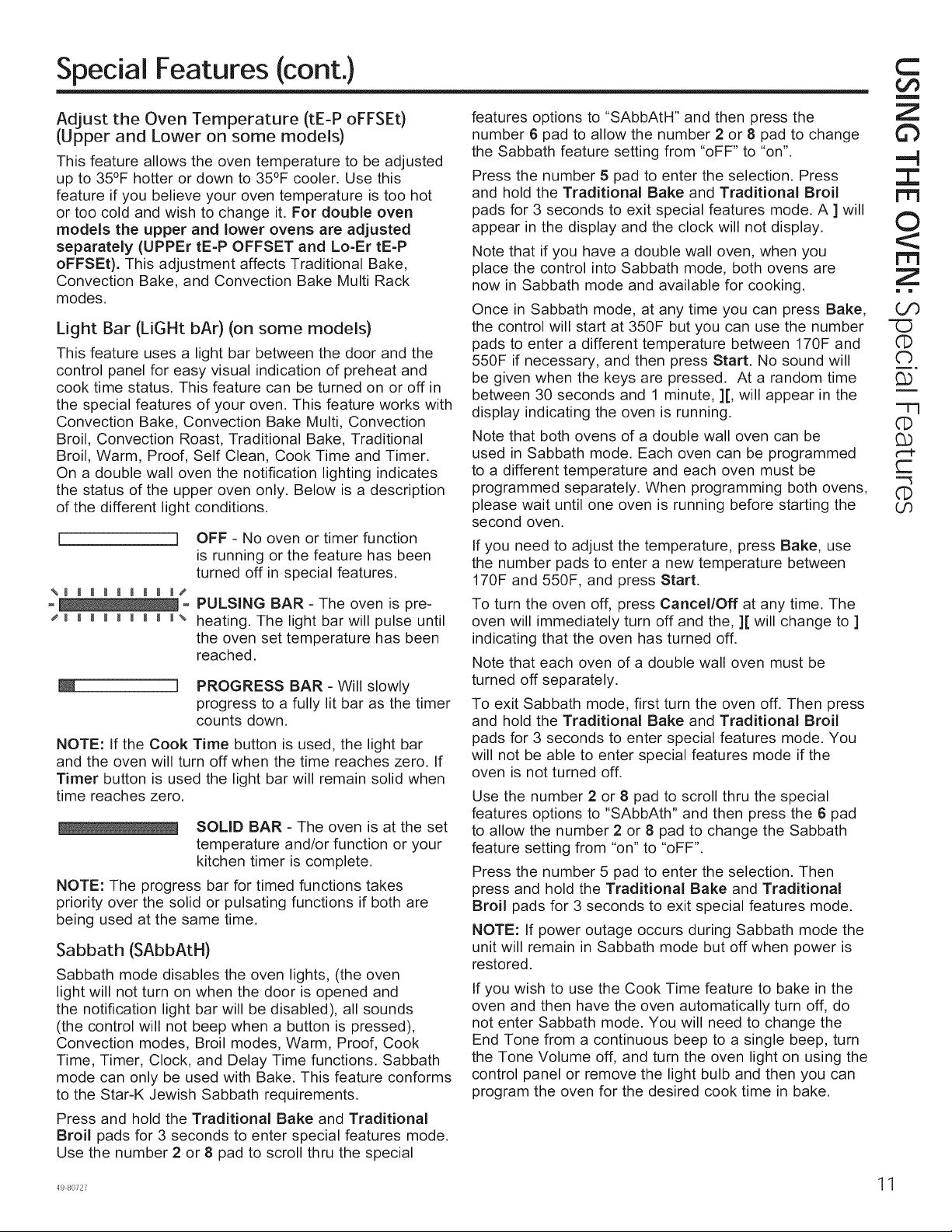
of the different light conditions.
I I
Jm m m W m m m m m%
OFF - No oven or timer function
is running or the feature has been
turned off in special features.
PULSING BAR - The oven is pre-
heating. The light bar will pulse until
the oven set temperature has been
reached.
W
PROGRESS BAR - Will slowly
progress to a fully lit bar as the timer
counts down.
NOTE: If the Cook Time button is used, the light bar
and the oven will turn off when the time reaches zero. If
Timer button is used the light bar will remain solid when
time reaches zero.
SOLID BAR - The oven is at the set
temperature and/or function or your
kitchen timer is complete.
NOTE: The progress bar for timed functions takes
priority over the solid or pulsating functions if both are
being used at the same time.
Sabbath (SAbbAtH)
Sabbath mode disables the oven lights, (the oven
light will not turn on when the door is opened and
the notification light bar will be disabled), all sounds
(the control will not beep when a button is pressed),
Convection modes, Broil modes, Warm, Proof, Cook
Time, Timer, Clock, and Delay Time functions. Sabbath
mode can only be used with Bake. This feature conforms
to the Star-K Jewish Sabbath requirements.
Press and hold the Traditional Bake and Traditional
Broil pads for 3 seconds to enter special features mode.
Use the number 2 or 8 pad to scroll thru the special
C
m
features options to "SAbbAtH" and then press the Z
number 6 pad to allow the number 2 or 8 pad to change
the Sabbath feature setting from "oFF" to "on". .._
Press the number 5 pad to enter the selection. Press
and hold the Traditional Bake and Traditional Broil
pads for 3 seconds to exit special features mode. A ] will
appear in the display and the clock will not display. 0
Note that if you have a double wall oven, when you
place the control into Sabbath mode, both ovens are
now in Sabbath mode and available for cooking..Z.
Once in Sabbath mode, at any time you can press Bake, C/3
the control will start at 350F but you can use the number
pads to enter a different temperature between 170F and CD
550F if necessary, and then press Start. No sound will O
be given when the keys are pressed. At a random time G)
between 30 seconds and 1 minute, ][, will appear in the m
display indicating the oven is running. -Tq
q)
Note that both ovens of a double wall oven can be G)
used in Sabbath mode. Each oven can be programmed r-'P
to a different temperature and each oven must be C:
"m
programmed separately. When programming both ovens, CD
please wait until one oven is running before starting the Lf)
second oven.
If you need to adjust the temperature, press Bake, use
the number pads to enter a new temperature between
170F and 550F, and press Start.
To turn the oven off, press Cancel/Off at any time. The
oven will immediately turn off and the, ][ will change to ]
indicating that the oven has turned off.
Note that each oven of a double wall oven must be
turned off separately.
To exit Sabbath mode, first turn the oven off. Then press
and hold the Traditional Bake and Traditional Broil
pads for 3 seconds to enter special features mode. You
will not be able to enter special features mode if the
oven is not turned off.
Use the number 2 or 8 pad to scroll thru the special
features options to "SAbbAth" and then press the 6 pad
to allow the number 2 or 8 pad to change the Sabbath
feature setting from "on" to "oFF".
Press the number 5 pad to enter the selection. Then
press and hold the Traditional Bake and Traditional
Broil pads for 3 seconds to exit special features mode.
NOTE: If power outage occurs during Sabbath mode the
unit will remain in Sabbath mode but off when power is
restored.
If you wish to use the Cook Time feature to bake in the
oven and then have the oven automatically turn off, do
not enter Sabbath mode. You will need to change the
End Tone from a continuous beep to a single beep, turn
the Tone Volume off, and turn the oven light on using the
control panel or remove the light bulb and then you can
program the oven for the desired cook time in bake.
O0
LP
63
rY
c-
O
>
O
©
LL!
I
©
Z
m
oO
Oven Racks
Your oven has six rack positions. Recommended rack
positions for various types of foods are provided in the
Cooking Guide. Adjusting rack position is one way to
impact cooking results. For example, ifyou would prefer
darker tops on cakes, muffins, or cookies, try moving
food one rack position higher. If you find foods are too
brown on top try moving them down next time.
When baking with multiple pans and on multiple racks,
ensure there is at least 1½" between pans to allow
sufficient space for air to flow.
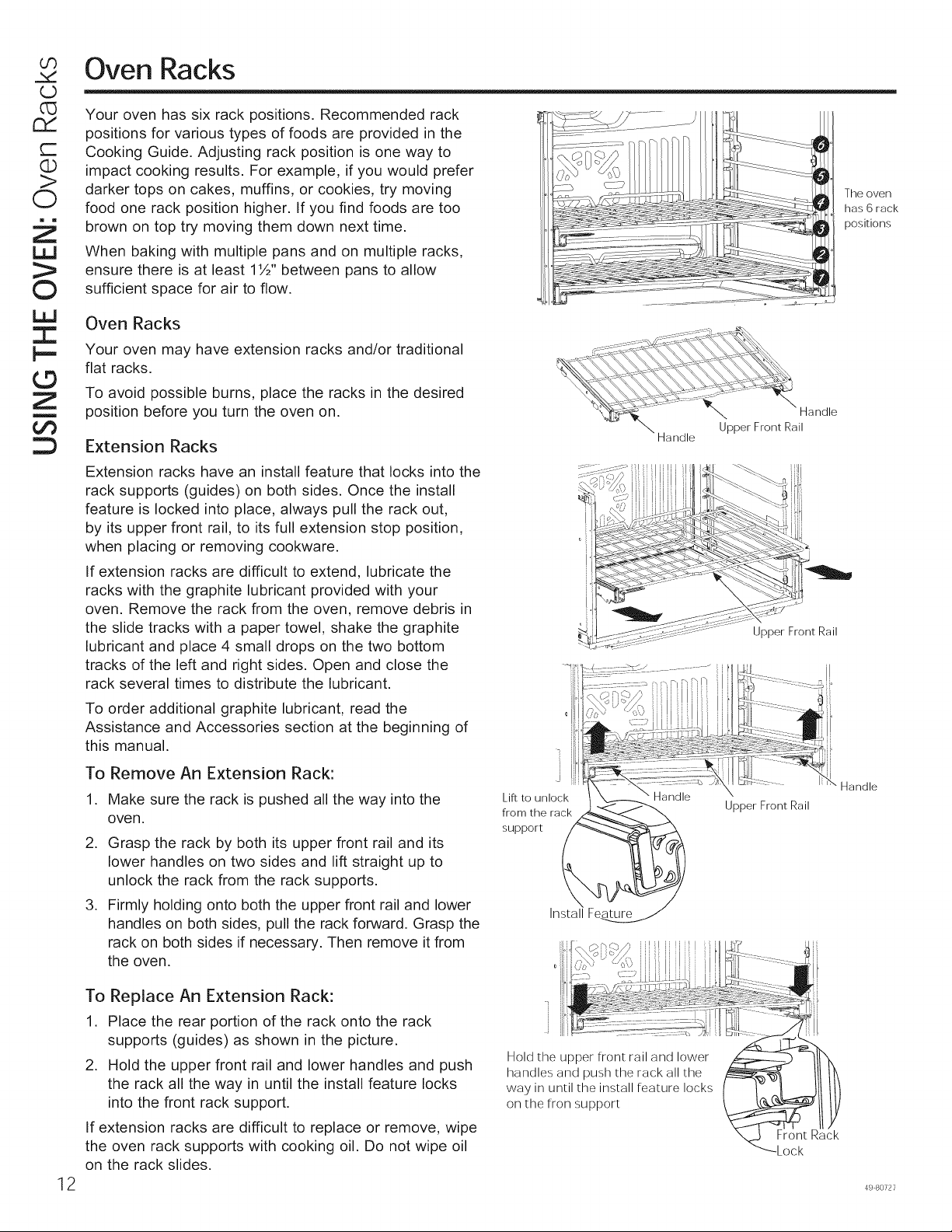
The oven
has 6 rack
positions
Oven Racks
Your oven may have extension racks and/or traditional
flat racks.
To avoid possible burns, place the racks in the desired
position before you turn the oven on.
Extension Racks
Extension racks have an install feature that locks into the
rack supports (guides) on both sides. Once the install
feature is locked into place, always pull the rack out,
by its upper front rail, to its full extension stop position,
when placing or removing cookware.
If extension racks are difficult to extend, lubricate the
racks with the graphite lubricant provided with your
oven. Remove the rack from the oven, remove debris in
the slide tracks with a paper towel, shake the graphite
lubricant and place 4 small drops on the two bottom
tracks of the left and right sides. Open and close the
rack several times to distribute the lubricant.
To order additional graphite lubricant, read the
Assistance and Accessories section at the beginning of
this manual.
To
1.
Remove An Extension Rack:
Make sure the rack is pushed all the way into the
oven.
2. Grasp the rack by both its upper front rail and its
lower handles on two sides and lift straight up to
unlock the rack from the rack supports.
3. Firmly holding onto both the upper front rail and lower
handles on both sides, pull the rack forward. Grasp the
rack on both sides if necessary. Then remove itfrom
the oven.
J
Lift to unlock
from the rack
support
Handle
ib_>i jiT I i ' £
InstallFeature
Upper Front Rail
Upper Front Rail
Handle
12
To Replace An Extension Rack:
1. Place the rear portion of the rack onto the rack
supports (guides) as shown in the picture.
2. Hold the upper front rail and lower handles and push
the rack all the way in until the install feature locks
into the front rack support.
If extension racks are difficult to replace or remove, wipe
the oven rack supports with cooking oil. Do not wipe oil
on the rack slides.
Hold the upper front rail and lower
handles and push the rack all the
way in until the install feature locks
on the fron support
Front Rack
49 80727
Oven Racks (cont.)
Traditional Flat Racks
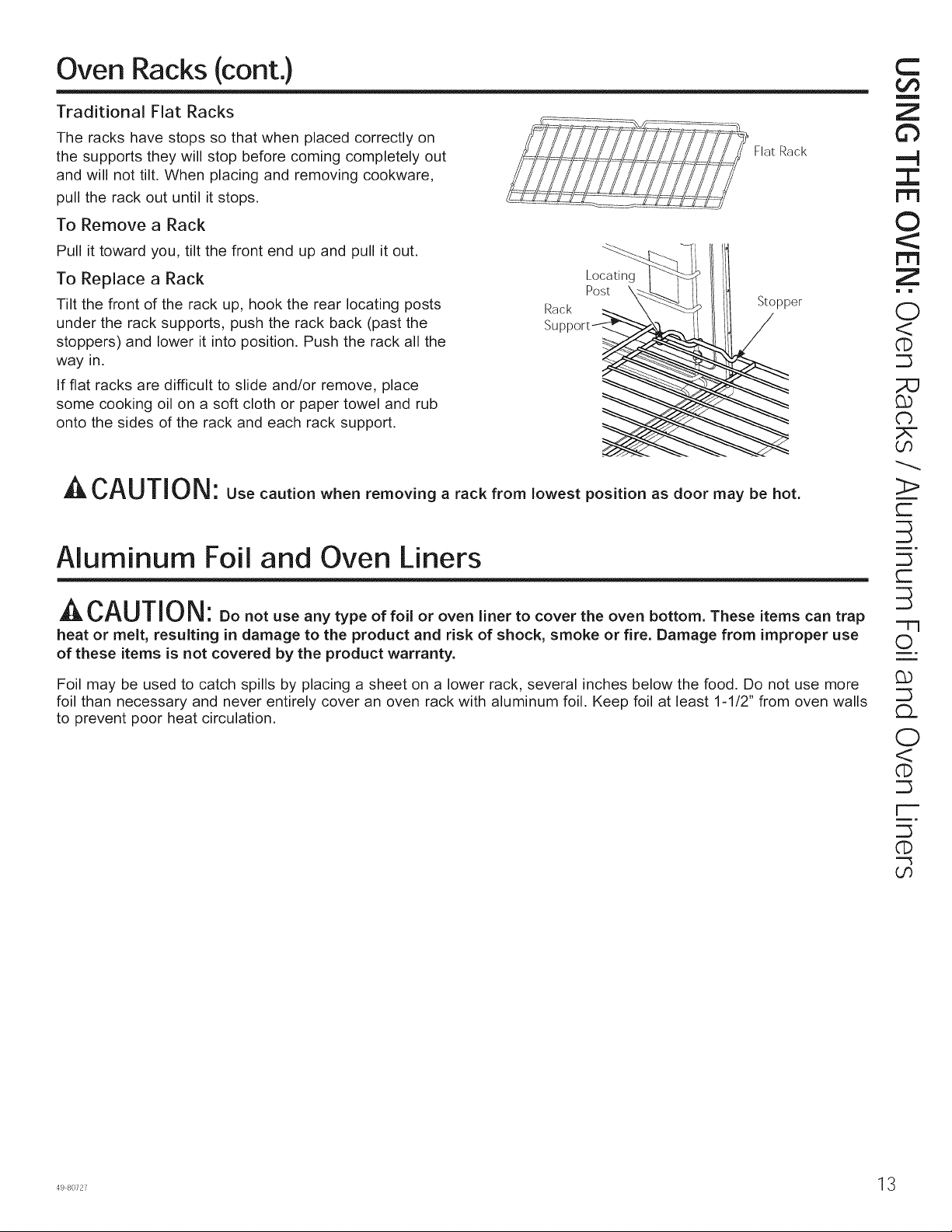
The racks have stops so that when placed correctly on
the supports they will stop before coming completely out
and will not tilt. When placing and removing cookware,
pull the rack out until it stops.
To Remove a Rack
Flat Rack
Pull it toward you, tilt the front end up and pull it out.
To Replace a Rack
Tilt the front of the rack up, hook the rear locating posts
under the rack supports, push the rack back (past the
stoppers) and lower it into position. Push the rack all the
way in.
If flat racks are difficult to slide and/or remove, place
some cooking oil on a soft cloth or paper towel and rub
onto the sides of the rack and each rack support.
Locating
Rack Post X_
Support_
Stopper
A CAUTION: Use caution when removing a rack from lowest position as door may be hot.
Aluminum Foil and Oven Liners
^,.,CAUTION: DonotuseanytypeoffoilorovenlinertocovertheovenbottomTheseitemscantrap
heat or melt, resulting in damage to the product and risk of shock, smoke or fire. Damage from improper use
of these items is not covered by the product warranty.
Foil may be used to catch spills by placing a sheet on a lower rack, several inches below the food. Do not use more
foil than necessary and never entirely cover an oven rack with aluminum foil. Keep foil at least 1-1/2" from oven walls
to prevent poor heat circulation.
C
m
Z
©
--4
I
O
FT'I
Z
i u
O
<
q:)
7O
GD
Cb
O0
:>
r--
r--
-1"3
O
£D
£z
O
<
q:)
r--
(l:)
"--I
O0
OO
(13
O
Z
CY)
t-
O
O
LD
LIJ
©
ill
3::
t.-,
©
Z
m
Cooking Modes
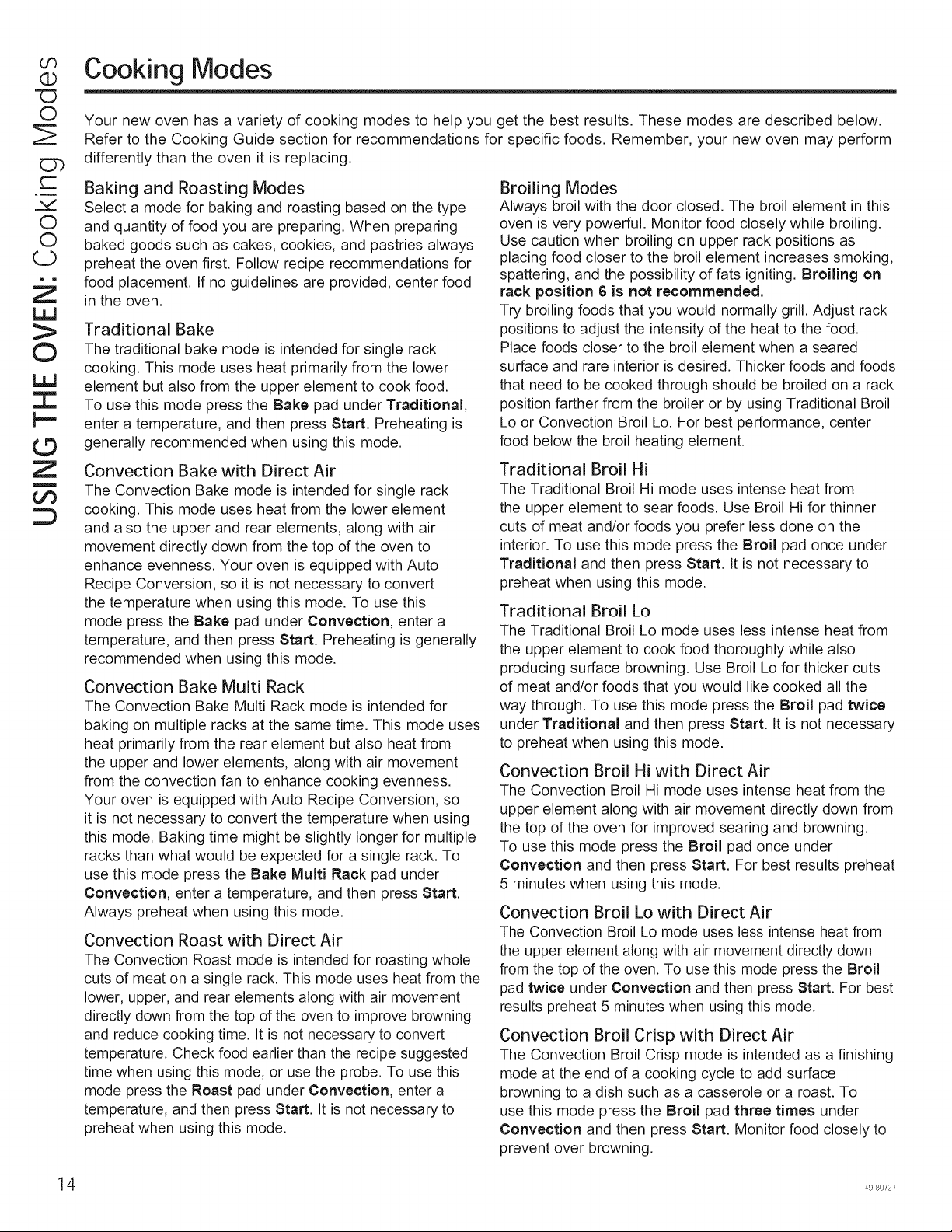
Your new oven has a variety of cooking modes to help you get the best results. These modes are described below.
Refer to the Cooking Guide section for recommendations for specific foods. Remember, your new oven may perform
differently than the oven it is replacing.
Baking and Roasting Modes
Select a mode for baking and roasting based on the type
and quantity offood you are preparing. When preparing
baked goods such as cakes, cookies, and pastries always
preheat the oven first. Follow recipe recommendations for
food placement. If no guidelines are provided, center food
in the oven.
Traditional Bake
The traditional bake mode is intended for single rack
cooking. This mode uses heat primarily from the lower
element but also from the upper element to cook food.
To use this mode press the Bake pad under Traditional,
enter a temperature, and then press Start. Preheating is
generally recommended when using this mode.
Convection Bake with Direct Air
The Convection Bake mode is intended for single rack
cooking. This mode uses heat from the lower element
and also the upper and rear elements, along with air
movement directly down from the top of the oven to
enhance evenness. Your oven is equipped with Auto
Recipe Conversion, so it is not necessary to convert
the temperature when using this mode. To use this
mode press the Bake pad under Convection, enter a
temperature, and then press Start. Preheating is generally
recommended when using this mode.
Convection Bake Multi Rack
The Convection Bake Multi Rack mode is intended for
baking on multiple racks atthe same time. This mode uses
heat primarily from the rear element but also heat from
the upper and lower elements, along with air movement
from the convection fan to enhance cooking evenness.
Your oven isequipped with Auto Recipe Conversion, so
it is not necessary to convert the temperature when using
this mode. Baking time might be slightly longer for multiple
racks than what would be expected for a single rack. To
use this mode press the Bake Multi Rack pad under
Convection, enter a temperature, and then press Start.
Always preheat when using this mode.
Convection Roast with Direct Air
The Convection Roast mode is intended for roasting whole
cuts of meat on a single rack.This mode uses heat from the
lower, upper, and rear elements along with air movement
directly down from the top of the oven to improve browning
and reduce cooking time. It is not necessary to convert
temperature. Check food earlier than the recipe suggested
time when using this mode, or usethe probe. To usethis
mode press the Roast pad under Convection, enter a
temperature, and then press Start. It is not necessary to
preheat when using this mode.
Broiling Modes
Always broil with the door closed. The broil element in this
oven is very powerful. Monitor food closely while broiling.
Use caution when broiling on upper rack positions as
placing food closer to the broil element increases smoking,
spattering, and the possibility of fats igniting. Broiling on
rack position 6 is not recommended.
Try broiling foods that you would normally grill. Adjust rack
positions to adjust the intensity of the heat to thefood.
Place foods closer to the broil element when a seared
surface and rare interior is desired. Thicker foods and foods
that need to be cooked through should be broiled on a rack
position farther from the broiler or by using Traditional Broil
Lo or Convection Broil Lo. For best performance, center
food below the broil heating element.
Traditional Broil Hi
The Traditional Broil Hi mode uses intense heat from
the upper element to sear foods. Use Broil Hi for thinner
cuts of meat and/or foods you prefer less done on the
interior. To use this mode press the Broil pad once under
Traditional and then press Start. It is not necessary to
preheat when using this mode.
Traditional Broil Lo
The Traditional Broil Lo mode uses less intense heat from
the upper element to cook food thoroughly while also
producing surface browning. Use Broil Lo for thicker cuts
of meat and/or foods that you would like cooked all the
way through. To use this mode press the Broil pad twice
under Traditional and then press Start. It is not necessary
to preheat when using this mode.
Convection Broil Hi with Direct Air
The Convection Broil Hi mode uses intense heat from the
upper element along with air movement directly down from
the top of the oven for improved searing and browning,
To use this mode press the Broil pad once under
Convection and then press Start. For best results preheat
5 minutes when using this mode.
Convection Broil Lo with Direct Air
The Convection Broil Lo mode uses less intense heatfrom
the upper element along with air movement directly down
from the top of the oven. To usethis mode press the Broil
pad twice under Convection and then press Start. For best
results preheat 5 minutes when usingthis mode.
Convection Broil Crisp with Direct Air
The Convection Broil Crisp mode isintended as a finishing
mode at the end of a cooking cycle to add surface
browning to a dish such as a casserole or a roast. To
use this mode press the Broil pad three times under
Convection and then press Start. Monitor food closely to
prevent over browning.
4 49 80727
Cooking Modes (Cont.)
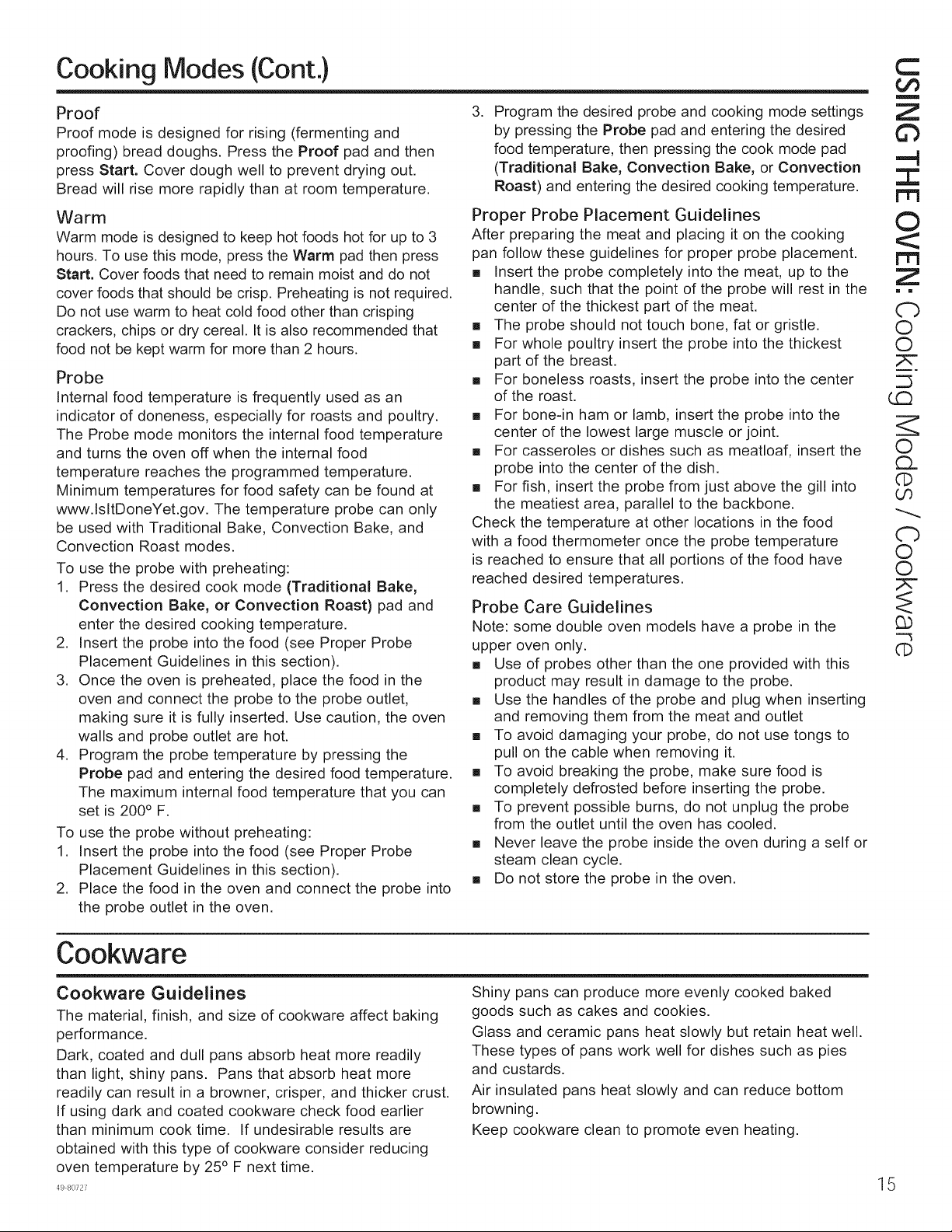
Proof
Proof mode is designed for rising (fermenting and
proofing) bread doughs. Press the Proof pad and then
press Start. Cover dough well to prevent drying out.
Bread will rise more rapidly than at room temperature.
Warm
Warm mode isdesigned to keep hot foods hotfor up to 3
hours. To use this mode, press the Warm pad then press
Start. Cover foods that need to remain moist and do not
cover foods that should be crisp. Preheating is not required.
Do not usewarm to heat cold food other than crisping
crackers, chips or dry cereal. It isalso recommended that
food not be kept warm for more than 2 hours.
Probe
Internal food temperature is frequently used as an
indicator of doneness, especially for roasts and poultry.
The Probe mode monitors the internal food temperature
and turns the oven off when the internal food
temperature reaches the programmed temperature.
Minimum temperatures for food safety can be found at
www.lsltDoneYet.gov. The temperature probe can only
be used with Traditional Bake, Convection Bake, and
Convection Roast modes.
To use the probe with preheating:
1. Press the desired cook mode (Traditional Bake,
Convection Bake, or Convection Roast) pad and
enter the desired cooking temperature.
2. Insert the probe into the food (see Proper Probe
Placement Guidelines in this section).
3. Once the oven is preheated, place the food in the
oven and connect the probe to the probe outlet,
making sure it is fully inserted. Use caution, the oven
walls and probe outlet are hot.
4. Program the probe temperature by pressing the
Probe pad and entering the desired food temperature.
The maximum internal food temperature that you can
set is 200° F.
To use the probe without preheating:
1. Insert the probe into the food (see Proper Probe
Placement Guidelines in this section).
2. Place the food in the oven and connect the probe into
the probe outlet in the oven.
.
Program the desired probe and cooking mode settings
by pressing the Probe pad and entering the desired
food temperature, then pressing the cook mode pad
(Traditional Bake, Convection Bake, or Convection
Roast) and entering the desired cooking temperature.
Proper Probe Placement Guidelines
After preparing the meat and placing it on the cooking
pan follow these guidelines for proper probe placement.
[] Insert the probe completely into the meat, up to the
handle, such that the point of the probe will rest in the
center of the thickest part of the meat.
[] The probe should not touch bone, fat or gristle.
[] For whole poultry insert the probe into the thickest
part of the breast.
[] For boneless roasts, insert the probe into the center
of the roast.
[] For bone-in ham or lamb, insert the probe into the
center of the lowest large muscle or joint.
[] For casseroles or dishes such as meatloaf, insert the
probe into the center of the dish.
[] For fish, insert the probe from just above the gill into
the meatiest area, parallel to the backbone.
Check the temperature at other locations in the food
with a food thermometer once the probe temperature
is reached to ensure that all portions of the food have
reached desired temperatures.
Probe Care Guidelines
Note: some double oven models have a probe in the
upper oven only.
[] Use of probes other than the one provided with this
product may result in damage to the probe.
[] Use the handles of the probe and plug when inserting
and removing them from the meat and outlet
[] To avoid damaging your probe, do not use tongs to
pull on the cable when removing it.
[] To avoid breaking the probe, make sure food is
completely defrosted before inserting the probe.
[] To prevent possible burns, do not unplug the probe
from the outlet until the oven has cooled.
[] Never leave the probe inside the oven during a self or
steam clean cycle.
[] Do not store the probe in the oven.
C
m
Z
©
I
©
m
Z
i m
C')
O
O
L£3
Z
O
CL
©
O0
Cb
O
O
G)
¢D
Cookware
Cookware Guidelines
The material, finish, and size of cookware affect baking
performance.
Dark, coated and dull pans absorb heat more readily
than light, shiny pans. Pans that absorb heat more
readily can result in a browner, crisper, and thicker crust.
If using dark and coated cookware check food earlier
than minimum cook time. If undesirable results are
obtained with this type of cookware consider reducing
oven temperature by 25° F next time.
49 80727
Shiny pans can produce more evenly cooked baked
goods such as cakes and cookies.
Glass and ceramic pans heat slowly but retain heat well.
These types of pans work well for dishes such as pies
and custards.
Air insulated pans heat slowly and can reduce bottom
browning.
Keep cookware clean to promote even heating.
15
Q
Co
Ch
r
O
O
LP
©
_J
"T"
p-
©
Z
m
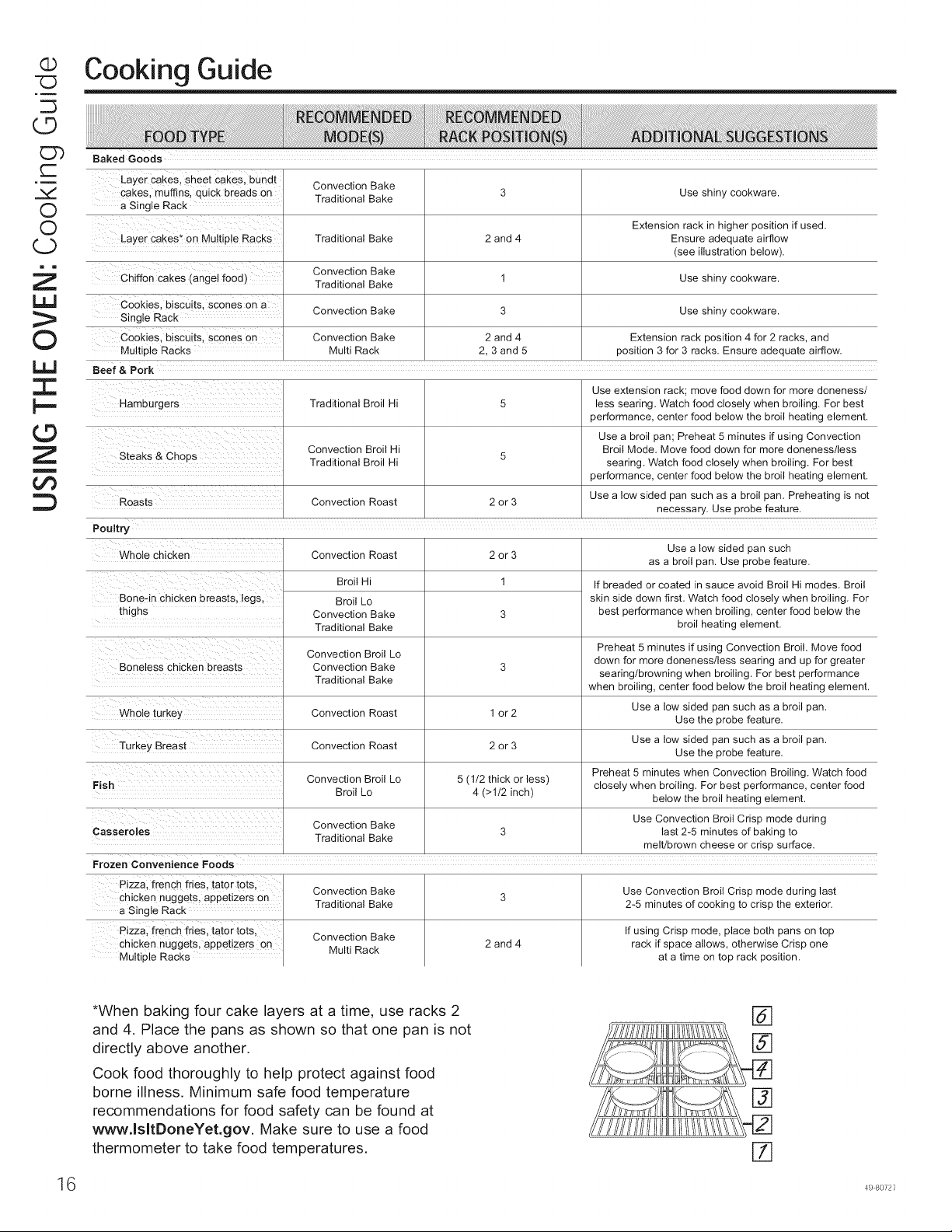
Cooking Guide
Baked Goods
Convection Bake
3 Use shiny cookware.
Traditional Bake
Layer cakes, sheet cakes, bundt
cakes, muffins, quick breads on
a Single Rack
Layer cakes* on Multiple Racks
Chiffon cakes (angel food)
Cookies, biscuits, scones on a
Single Rack
Cookies, biscuits, scones on
Multiple Racks
Beef & Pork
Steaks & Chops
Roasts
Poultry
Whole chicken
Bone-in chicken breasts, legs,
thighs
Boneless chicken breasts
Whole turkey
Turkey Breast
Fish
Casseroles
FrozeR Convenience Foods
Pizza, french fries, tater tots,
chicken nuggets, appetizers on
a Single Rack
Pizza, french fries, tator tots,
chicken nuggets appetzers on
Mut pe Racks
Traditional Bake
Convection Bake
Traditional Bake
Convection Bake
Convection Bake
Multi Rack
Traditional Broil Hi
Convection Broil Hi
Traditional Broil Hi
2and 4
1
3
2and 4
2, 3and 5
Convection Roast 2 or 3
Convection Roast
Broil Hi
Broil Lo
Convection Bake
Traditional Bake
Convection Broil Lo
Convection Bake
Traditional Bake
Convection Roast
Convection Roast
Convection Broil Lo
Broil Lo
Convection Bake
Traditional Bake
Convection Bake
Traditional Bake
Convection Bake
Multi Rack
2or3
1
3
1or2
2or3
5 (1/2 thick or less)
4 (>1/2 inch)
2and 4
Extension rack in higher position if used.
Ensure adequate airflow
(see illustration below).
Use shiny cookware.
Use shiny cookware.
Extension rack position 4 for 2 racks, and
position 3for 3 racks. Ensure adequate airflow.
Use extension rack; move food down for more doneness/
less searing. Watch food closely when broiling. For best
performance, center food below the broil heating element.
Use a broil pan; Preheat 5 minutes if using Convection
Broil Mode. Move food down for more doneness/less
searing. Watch food closely when broiling. For best
performance, center food below the broil heating element.
Use a low sided pan such as a broil pan. Preheating is not
necessary. Use probe feature.
Use a low sided pan such
as a broil pan. Use probe feature.
Ifbreaded or coated in sauce avoid Broil Hi modes. Broil
skin side down first. Watch food closely when broiling. For
best performance when broiling, center food below the
broil heating element.
Preheat 5 minutes if using Convection Broil. Move food
down for more doneness/less searing and up for greater
searing/browning when broiling. For best performance
when broiling, center food below the broil heating element.
Use a low sided pan such as a broil pan.
Use the probe feature.
Use a low sided pan such as a broil pan.
Use the probe feature.
Preheat 5 minutes when Convection Broiling. Watch food
closely when broiling. For best performance, center food
below the broil heating element.
Use Convection Broil Crisp mode during
last 2-5 minutes of baking to
melt/brown cheese or crisp surface.
Use Convection Broil Crisp mode during last
2-5 minutes of cooking to crisp the exterior.
Ifusing Crisp mode, place both pans on top
rack if space allows, otherwise Crisp one
at a time on top rack position.
*When baking four cake layers at a time, use racks 2
and 4. Place the pans as shown so that one pan is not
directly above another.
Cook food thoroughly to help protect against food
borne illness. Minimum safe food temperature
recommendations for food safety can be found at
www.lsltDoneYet.gov. Make sure to use a food
thermometer to take food temperatures.
%
16 49 80727
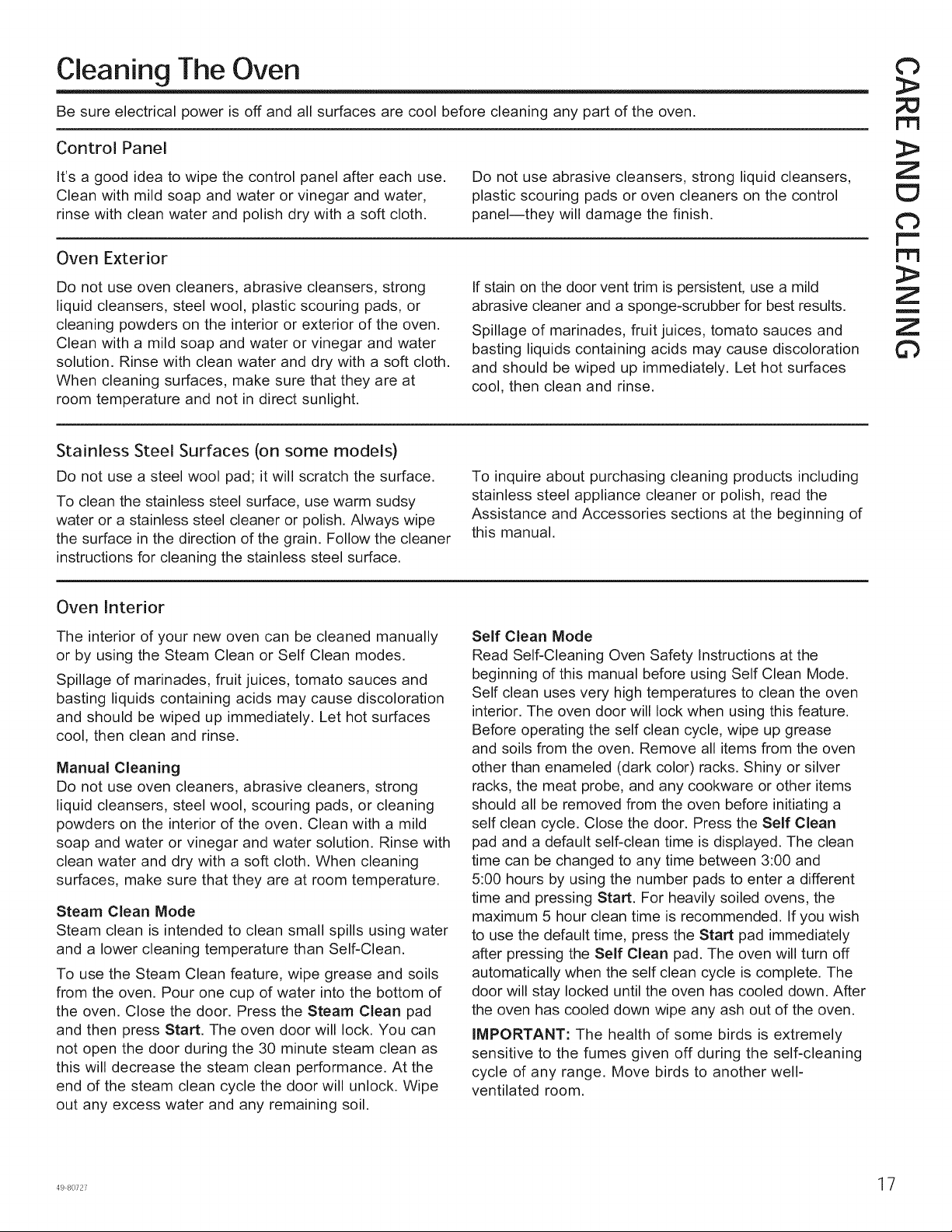
Cleaning The Oven
Be sure electrical power is off and all surfaces are cool before cleaning any part of the oven.
Control Panel
It's a good idea to wipe the control panel after each use.
Clean with mild soap and water or vinegar and water,
rinse with clean water and polish dry with a soft cloth.
Do not use abrasive cleansers, strong liquid cleansers,
plastic scouring pads or oven cleaners on the control
panel--they will damage the finish.
Oven Exterior
Do not use oven cleaners, abrasive cleansers, strong
liquid cleansers, steel wool, plastic scouring pads, or
cleaning powders on the interior or exterior of the oven.
Clean with a mild soap and water or vinegar and water
solution. Rinse with clean water and dry with a soft cloth.
When cleaning surfaces, make sure that they are at
room temperature and not in direct sunlight.
If stain on the door vent trim ispersistent, use a mild
abrasive cleaner and a sponge-scrubber for best results.
Spillage of marinades, fruit juices, tomato sauces and
basting liquids containing acids may cause discoloration
and should be wiped up immediately. Let hot surfaces
cool, then clean and rinse.
Cb
:1=,
rrl
Z
qb
tI
r_
Z
I
Z
©
Stainless Steel Surfaces (on some models)
Do not use a steel wool pad; it will scratch the surface.
To clean the stainless steel surface, use warm sudsy
water or a stainless steel cleaner or polish. Always wipe
the surface in the direction ofthe grain. Follow the cleaner
instructions for cleaning the stainless steel surface.
To inquire about purchasing cleaning products including
stainless steel appliance cleaner or polish, read the
Assistance and Accessories sections at the beginning of
this manual.
Oven Interior
The interior of your new oven can be cleaned manually
or by using the Steam Clean or Self Clean modes.
Spillage of marinades, fruit juices, tomato sauces and
basting liquids containing acids may cause discoloration
and should be wiped up immediately. Let hot surfaces
cool, then clean and rinse.
Manual Cleaning
Do not use oven cleaners, abrasive cleaners, strong
liquid cleansers, steel wool, scouring pads, or cleaning
powders on the interior of the oven. Clean with a mild
soap and water or vinegar and water solution. Rinse with
clean water and dry with a soft cloth. When cleaning
surfaces, make sure that they are at room temperature.
Steam Clean Mode
Steam clean is intended to clean small spills using water
and a lower cleaning temperature than Self-Clean.
To use the Steam Clean feature, wipe grease and soils
from the oven. Pour one cup of water into the bottom of
the oven. Close the door. Press the Steam Clean pad
and then press Start. The oven door will lock. You can
not open the door during the 30 minute steam clean as
this will decrease the steam clean performance. At the
end of the steam clean cycle the door will unlock. Wipe
out any excess water and any remaining soil.
Self Clean Mode
Read Self-Cleaning Oven Safety Instructions at the
beginning of this manual before using Self Clean Mode.
Self clean uses very high temperatures to clean the oven
interior. The oven door will lock when using this feature.
Before operating the self clean cycle, wipe up grease
and soils from the oven. Remove all items from the oven
other than enameled (dark color) racks. Shiny or silver
racks, the meat probe, and any cookware or other items
should all be removed from the oven before initiating a
self clean cycle. Close the door. Press the Self Clean
pad and a default self-clean time is displayed. The clean
time can be changed to any time between 3:00 and
5:00 hours by using the number pads to enter a different
time and pressing Start. For heavily soiled ovens, the
maximum 5 hour clean time is recommended. If you wish
to use the default time, press the Start pad immediately
after pressing the Self Clean pad. The oven will turn off
automatically when the self clean cycle is complete. The
door will stay locked until the oven has cooled down. After
the oven has cooled down wipe any ash out of the oven.
IMPORTANT: The health of some birds is extremely
sensitive to the fumes given off during the self-cleaning
cycle of any range. Move birds to another well-
ventilated room.
(.D
Z
m
Z
LL!
¢D
Z
LIJ
¢.3
Oven Racks
The racks that were provided with your oven (dark
enameled racks, not shiny) may remain in the oven
during the self-cleaning cycle without being damaged.
To manually clean racks, use warm, soapy water. Make
sure not to wash the rack slides on an extension rack.
If racks become more difficult to remove from the oven,
put some vegetable oil on a soft cloth or paper towel and
rub onto the oven rack supports. Do not wipe the oil on
an extension rack slide.
Periodically, after several self-clean cycles, the extension
rack slides may need to be lubricated using the graphite
lubricant shipped with your wall oven. To order additional
graphite lubricant read the Assistance and Accessories
sections at the beginning of this manual.
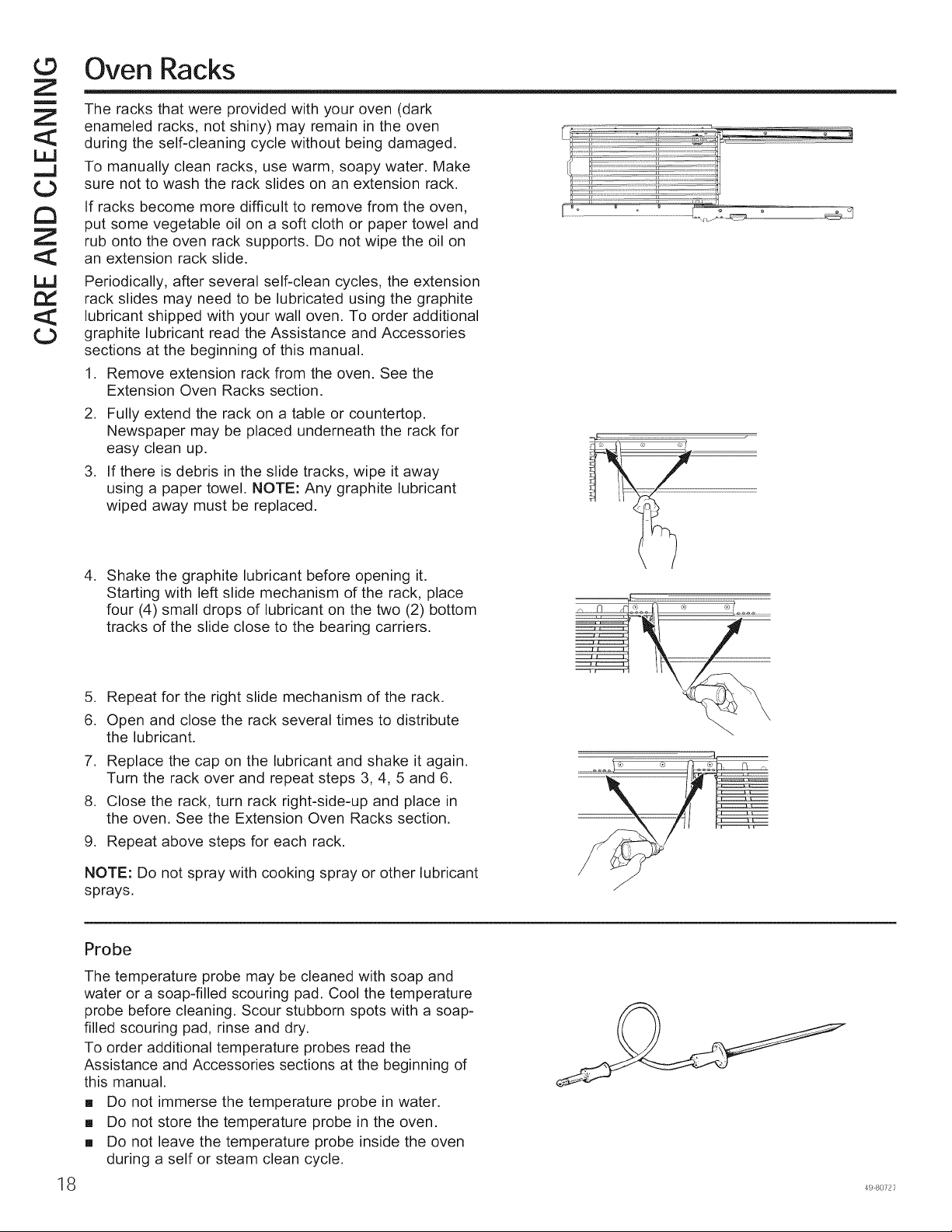
1. Remove extension rack from the oven. See the
Extension Oven Racks section.
2. Fully extend the rack on a table or countertop.
Newspaper may be placed underneath the rack for
easy clean up.
3. If there is debris in the slide tracks, wipe it away
using a paper towel. NOTE: Any graphite lubricant
wiped away must be replaced.
.
Shake the graphite lubricant before opening it.
Starting with left slide mechanism of the rack, place
four (4) small drops of lubricant on the two (2) bottom
tracks of the slide close to the bearing carriers.
___ _ .........................................................
5. Repeat for the right slide mechanism of the rack.
6. Open and close the rack several times to distribute
the lubricant.
7. Replace the cap on the lubricant and shake it again.
Turn the rack over and repeat steps 3, 4, 5 and 6.
8. Close the rack, turn rack right=side=up and place in
the oven. See the Extension Oven Racks section.
9. Repeat above steps for each rack.
NOTE: Do not spray with cooking spray or other lubricant
sprays.
Probe
The temperature probe may be cleaned with soap and
water or a soap-filled scouring pad. Cool the temperature
probe before cleaning. Scour stubborn spots with a soap-
filled scouring pad, rinse and dry.
To order additional temperature probes read the
Assistance and Accessories sections at the beginning of
this manual.
[] Do not immerse the temperature probe in water.
[] Do not store the temperature probe in the oven.
[] Do not leave the temperature probe inside the oven
during a self or steam clean cycle.
18 49 80727
Maintenance
Oven Light Replacement
WA. N i sH°cK °R BuRNHAZARD:Bef°rerep'acing°ven'`ghtbu'b'disc°nnectthee'ectrica'ING power to the oven at the main fuse or circuit breaker panel, Failure to do so may result in
electric shock or burn,
iA CAUTION i URN HAZARD: The glass cover and bulb should be removed when cool. Touching hot
glass with bare hands or a damp cloth can cause burns,
1. Disconnect power at the main fuse or circuit breaker
panel.
2. Remove oven racks.
3. Slide a flat blade screwdriver between the housing
and the glass light cover.
4. Support the glass light cover with two fingers to
prevent the cover from falling to the bottom of the
oven. Be careful not to chip the oven coating.
5. Gently twist the screwdriver blade to loosen the glass
light cover.
6. Remove the glass light cover.
7. Remove the bulb by firmly grasping and sliding the
bulb straight out until the two prongs have cleared the
ceramic holder.
8. Do not touch the glass of the new replacement bulb
with your fingers. It will cause the bulb to fail when it
lights. Grasp the replacement bulb with a clean towel
or facial tissue with the prongs facing down. Align the
two prongs in the ceramic holder, pressing gently until
the bulb is securely in the ceramic socket.
9. Slide the protective lens into the holder and push until
the clips snap into the housing.
10.Reconnect power.
¢b
Z
qb
r-Pi
Z
I
Z
©
Lift-Off Oven Door
The door isvery heavy. Be careful when removing and lifting the door.
Do not lift the door by the handle.
To remove the door:
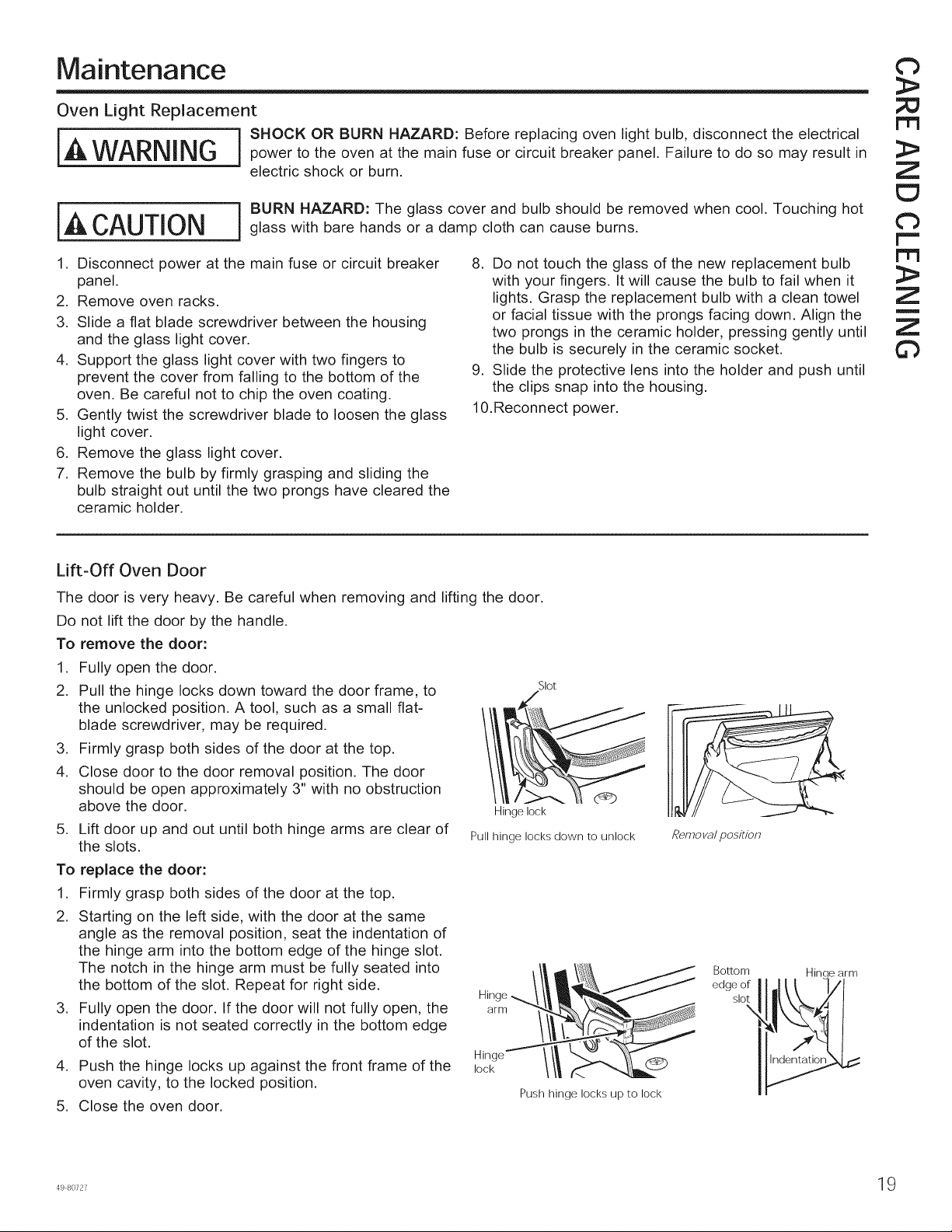
1. Fully open the door.
2. Pull the hinge locks down toward the door frame, to
the unlocked position. A tool, such as a small flat-
blade screwdriver, may be required.
3. Firmly grasp both sides of the door at the top.
4. Close door to the door removal position. The door
should be open approximately 3" with no obstruction
above the door.
Slot
5. Lift door up and out until both hinge arms are clear of
the slots.
To replace the door:
1. Firmly grasp both sides of the door at the top.
2. Starting on the left side, with the door at the same
angle as the removal position, seat the indentation of
the hinge arm into the bottom edge of the hinge slot.
The notch in the hinge arm must be fully seated into
the bottom of the slot. Repeat for right side.
3. Fully open the door. If the door will not fully open, the
indentation is not seated correctly in the bottom edge
of the slot.
4. Push the hinge locks up against the front frame of the
oven cavity, to the locked position.
5. Close the oven door.
d©
Hinge lock
Pull hinge locks down to unlock
Hinge
arm
Hinge
lock
Push hinge locks up to lock
Remova/ position
Bottom
edge of
slot
Hincbarm
49 80727 1 9

Notes
20 49 80727

Notes
¢13
m
k==
©
Z
m
k=.
©
©
3::
v)
LIJ
,_J
©
rv,
k==
Troubleshooting tips ... Before you call for service
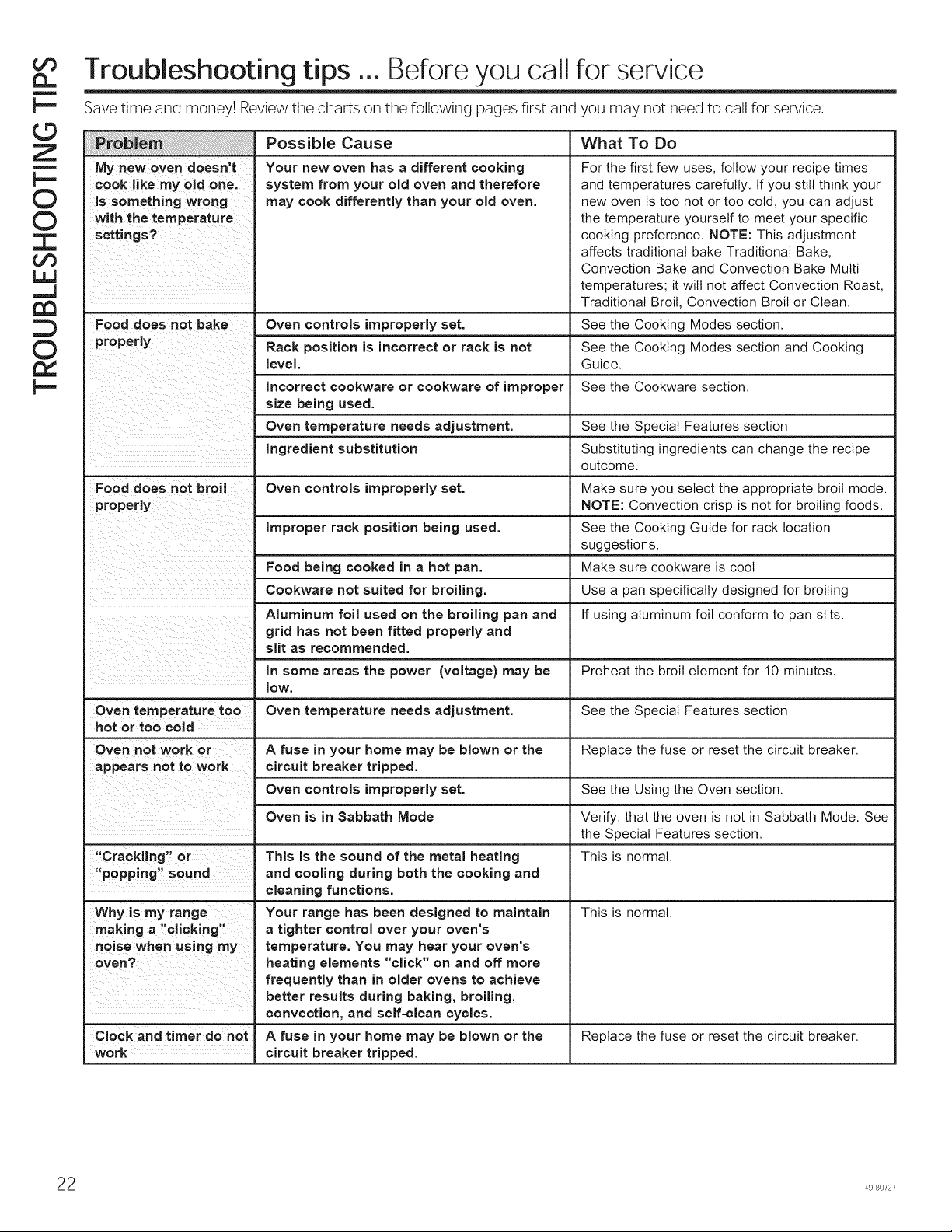
Save time and money! Review the charts on the following pages first and you may not need to call for service.
My new oven doesn't
cook like ray old one.
Is something wrong
with the temperature
Possible Cause What To Do
Your new oven has a different cooking
system from your old oven and therefore
may cook differently than your old oven.
For the first few uses, follow your recipe times
and temperatures carefully. If you still think your
new oven is too hot or too cold, you can adjust
the temperature yourself to meet your specific
cooking preference. NOTE: This adjustment
affects traditional bake Traditional Bake,
Convection Bake and Convection Bake Multi
temperatures; it will not affect Convection Roast,
Traditional Broil, Convection Broil or Clean.
See the Cooking Modes section.
See the Cooking Modes section and Cooking
Guide.
Food does not bake Oven controls improperly set.
Rack position is incorrect or rack is not
level.
Incorrect cookware or cookware of improper See the Cookware section.
size being used.
Oven temperature needs adjustment. See the Special Features section.
Ingredient substitution Substituting ingredients can change the recipe
outcome.
Food does not broil Oven controls improperly set. Make sure you select the appropriate broil mode.
properly NOTE: Convection crisp is not for broiling foods.
Improper rack position being used. See the Cooking Guide for rack location
suggestions.
Food being cooked in a hot pan. Make sure cookware is cool
Cookware not suited for broiling. Use a pan specifically designed for broiling
Aluminum foil used on the broiling pan and If using aluminum foil conform to pan slits.
grid has not been fitted properly and
slit as recommended.
In some areas the power (voltage) may be Preheat the broil element for 10 minutes.
low.
Oven temperature too Oven temperature needs adjustment. See the Special Features section.
hot or too cold
Oven not work or A fuse in your home may be blown or the Replace the fuse or reset the circuit breaker.
appears not to work , circuit breaker tripped.
Oven controls improperly set. See the Using the Oven section.
Oven is in Sabbath Mode Verify, that the oven is not in Sabbath Mode. See
the Special Features section.
"Crackling" or This is the sound of the metal heating This is normal.
"popping" sound and cooling during both the cooking and
cleaning functions.
This is normal.
Why is my range
making a "clicking"
noise when using my
oven?
Clock and timer do not
work
Your range has been designed to maintain
a tighter control over your oven's
temperature. You may hear your oven's
heating elements "click" on and off more
frequently than in older ovens to achieve
better results during baking, broiling,
convection, and self-clean cycles.
A fuse in your home may be blown or the
circuit breaker tripped.
Replace the fuse or reset the circuit breaker.
2 49 80727
Troubleshooting tips ... Before you call for service
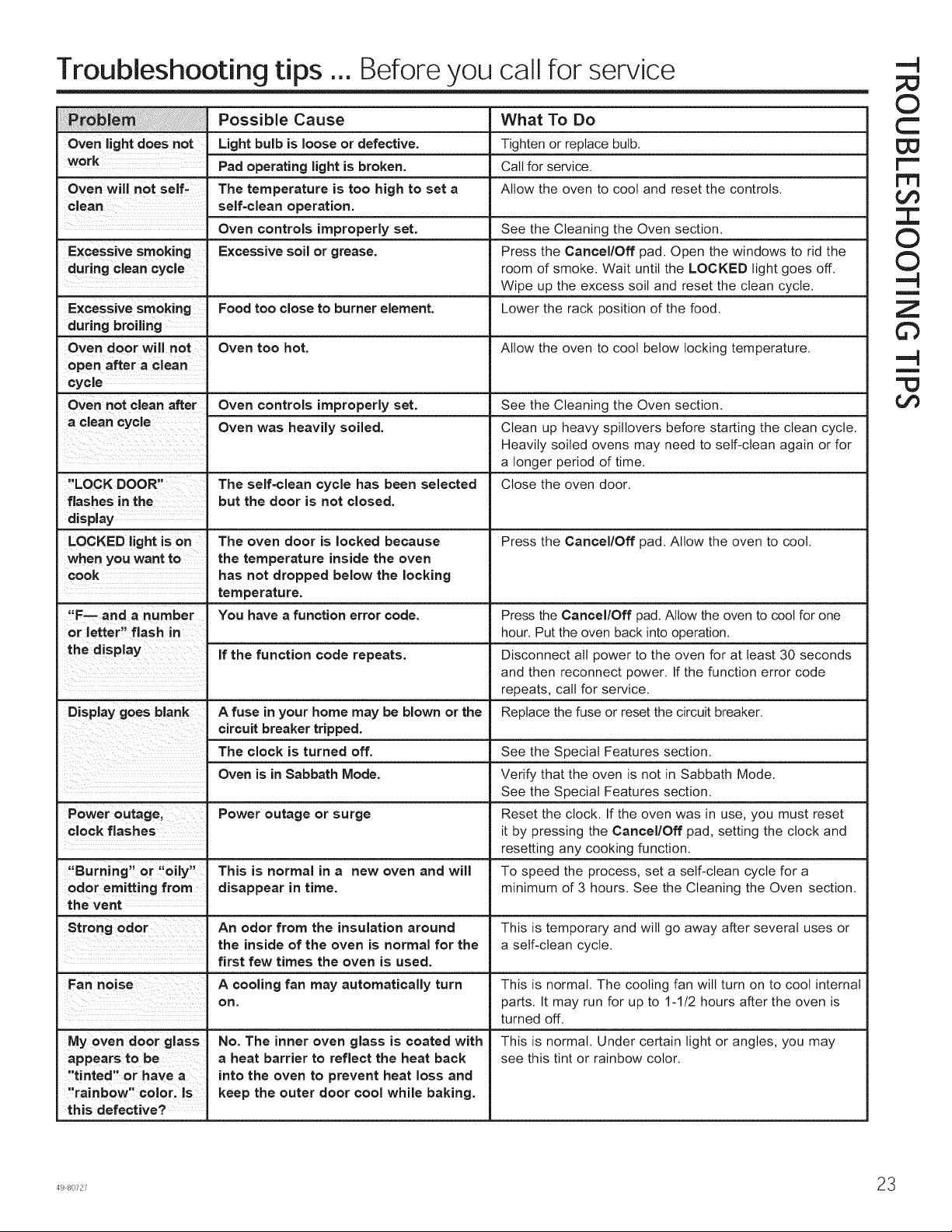
Oven light does not
work
Oven will not self=
clean
m
Excessive smoking
during clean cycle
Excessive smoking
during broiling
Oven door will not
open after a clean
cycle
Oven not clean after
"LOCK DOOR"
flashes in the
display
LOCKED light is on
when you want to
cook
"F-- and a number
or letter" flash in
the display
Display goes blank
Power outage,
cJock flashes
"Burn'nl g"or "O yil"
odor emitting from
the vent
Strong odor
My oven door glass
appears to be
Possible Cause
Light bulb is loose or defective.
Pad operating light isbroken.
The temperature is too high to set a
self=clean operation.
Oven controls improperly set.
Excessive soil or grease.
Food too close to burner element.
Oven too hot.
Oven controls improperly set.
Oven was heavily soiled.
The self=clean cycle has been selected
but the door is not closed.
The oven door is locked because
the temperature inside the oven
has not dropped below the locking
temperature.
You have afunction error code.
If the function code repeats.
A fuse in your home may be blown or the
circuit breaker tripped.
The clock is turned off.
Oven is in Sabbath Mode.
Power outage or surge
This is normal in a new oven and will
disappear in time.
An odor from the insulation around
the inside of the oven is normal for the
first few times the oven is used.
A cooling fan may automatically turn
on,
No. The inner oven glass is coated with
a heat barrier to reflect the heat back
What To Do
Tighten or replace bulb.
Callfor service.
Allow the oven to cool and reset the controls.
See the Cleaning the Oven section.
Press the Cancel/Off pad. Open the windows to rid the
room of smoke. Wait until the LOCKED light goes off.
Wipe up the excess soil and reset the clean cycle.
Lower the rack position of the food.
Allow the oven to cool below locking temperature.
See the Cleaning the Oven section.
Clean up heavy spiltovers before starting the clean cycle.
Heavily soiled ovens may need to self-clean again or for
a longer period of time.
Close the oven door.
Press the Cancel/Off pad. Allow the oven to cool.
Press the Cancel/Off pad. Allow the oven to cool for one
hour. Put the oven back into operation.
Disconnect all power to the oven for at least 30 seconds
and then reconnect power. Ifthe function error code
repeats, call for service.
Replace the fuse or reset the circuit breaker.
See the Special Features section.
Verify that the oven is not in Sabbath Mode.
See the Special Features section.
Reset the clock. Ifthe oven was in use, you must reset
it by pressing the Cancel/Off pad, setting the clock and
resetting any cooking function.
To speed the process, set a self-clean cycle for a
minimum of 3 hours. See the Cleaning the Oven section.
This is temporary and will go away after several uses or
a self-clean cycle.
This is normal. The cooling fan will turn on to coot internal
parts. It may run for up to 1-1/2 hours after the oven is
turned off.
This is normal. Under certain light or angles, you may
see this tint or rainbow color.
=
"tinted" or have a into the oven to prevent heat loss and
"rainbow" color, is keep the outer door cool while baking.
this defective?
©
C
O0
t==.
t=t3
GO
I
©
©
m
Z
©
m
=O
GO
¢Z3
m
©
Z
m
_==
O
O
:I:
¢/3
LLJ
,.=J
O
rv,
Troubleshooting tips ... Before you call for service
Possible Cause What To Do
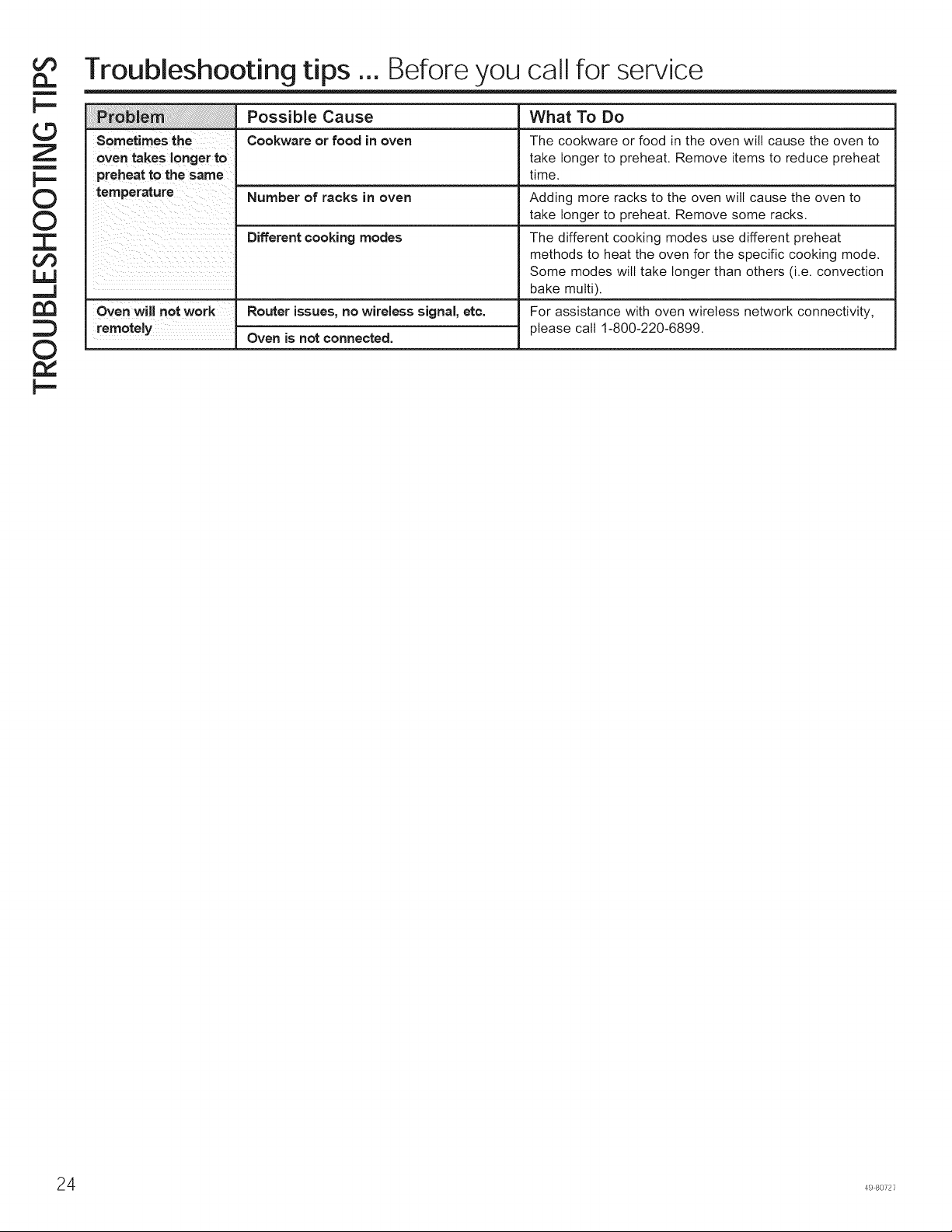
Sometimes the Cookware or food in oven The cookware or food in the oven will cause the oven to
oven takes longer to take longer to preheat. Remove items to reduce preheat
preheat to the same time.
temperature Number of racks in oven Adding more racks to the oven will cause the oven to
Different cooking modes
Oven will not work
remotely
Router issues, nowireless signal, etc.
Oven isnot connected.
take longer to preheat. Remove some racks.
The different cooking modes use different preheat
methods to heat the oven for the specific cooking mode.
Some modes will take longer than others (i.e. convection
bake multi).
For assistance with oven wireless network connectivity,
please call 1-800-220-6899.
4 49 80727
GEAppliances.com
O
O
L_
O
L_
O
t"
m
¢)
um
(D
"O
4..a
¢)
L_
um
d3
¢)
>
t-
O
¢.)
t"
O
O
,__¢
Informacion de Seguridad ...... 2
Garantia ........................... 6
Asistencia / Accesorios .......... 7
Uso del Homo
Controles del Horno .................. 8
Funciones Especiales ................ 10
Estantes del Homo .................. 12
Papel de Aluminio y Cobertores
del Homo ......................... 13
Modos de Coccion .................. 14
Utensilios ........................... 15
Guia de Coccion .................... 16
Cuidado y Limpieza
Panel de Control .................... 17
Exterior del Homo ................... 17
Superficies de Acero Inoxidable ...... 17
Interior del Homo ................... 17
Estantes del Homo .................. 18
Mantenimiento ...................... 19
Consejos para la
SoluciOn de Problemas ......... 22
Homo de Pared Simple PT7050 - 30"
Homo de Pared Simple PT9050 - 30"
Homo de Pared Doble PT7550 - 30"
Homo de Pared Doble PT9550 - 30"
Impreso en Estados Unidos
Escriba los nomeros de modelo y
de serie aqui:
N° de Modelo
N° de Serie
Los podra encontrar en una
etiqueta en el borde lateral o en el
frente del homo (inferior) detras de
la puerta del homo,
Impreso en
Papel Reciclado
49-80727 03-14 GE
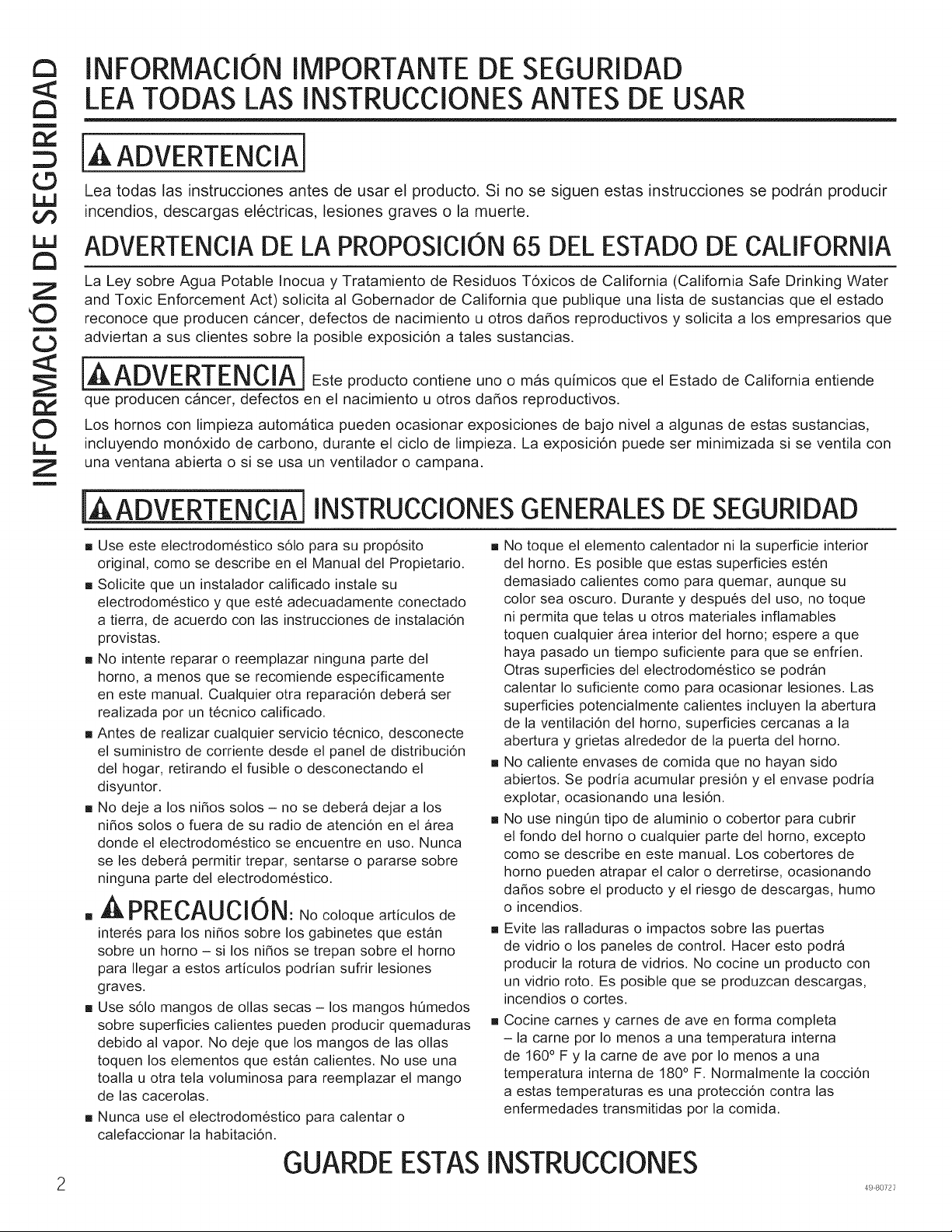
tm
tm
INFORMACION IMPORTANTE DESEGURIDAD
LEA TODAS LAS INSTRUCCIONES ANTES DE USAR
m
= IAADVERTENClA]
Lea todas las instrucciones antes de usar el product©. Si no se siguen estas instrucciones se podr_n producir
ELI
O_ incendios, descargas electricas, lesiones graves o la muerte.
ADVERTENCiA DE LA PROPOSICiON 65 DEL ESTADO DECALiFORNiA
Z
,©
m
©
Z
m
La Ley sobre Agua Potable Inocua y Tratamiento de Residuos T6xicos de California (California Safe Drinking Water
and Toxic Enforcement Act) solicita al Gobernador de California que publique una lista de sustancias que el estado
reconoce que producen cancer, defectos de nacimiento u otros da_os reproductivos y solicita a los empresarios que
adviertan a sus clientes sobre la posible exposici6n a tales sustancias.
I ADVERTENCIA 1Este producto contiene uno o mas quimicos que el Estado de California entiende
que producen cancer, defectos en el nacimiento u otros da_os reproductivos.
Los hornos con limpieza automatica pueden ocasionar exposiciones de bajo nivel a algunas de estas sustancias,
incluyendo mon6xido de carbono, durante el ciclo de limpieza. La exposici6n puede set minimizada si se ventila con
una ventana abierta o si se usa un ventilador o campana.
i ADVERTENCIA] INSTRUCCIONESGENERALESDE SEGURIDAD
-, Use este electrodom6stico s61o para su prop6sito
original, como se describe en el Manual del Propietario.
-, Solicite que un instalador calificado instale su
electrodomestico y que este adecuadamente conectado
a tierra, de acuerdo con las instrucciones de instalaci6n
provistas.
-, No intente reparar o reemplazar ninguna parte del
homo, a menos que se recomiende especificamente
en este manual. Cualquier otra reparaci6n debera ser
realizada por un tecnico calificado.
-, Antes de realizar cualquier servicio tecnico, desconecte
el suministro de corriente desde el panel de distribuci6n
del hogar, retirando el fusible o desconectando el
disyuntor.
,_No deje a los ni_os solos - no se debera dejar a los
ni_os solos o fuera de su radio de atenci6n en el area
donde el electrodomestico se encuentre en uso. Nunca
se les debera permitir trepar, sentarse o pararse sobre
ninguna parte del electrodomestico.
•_PRECAUCION: Nocoloque articulosde
interes para los niSos sobre los gabinetes que estan
sobre un homo - si los niSos se trepan sobre el homo
para Ilegar a estos articulos podrian sufrir lesiones
graves.
,_Use s61o mangos de ollas secas -los mangos hOmedos
sobre superficies calientes pueden producir quemaduras
debido al vapor. No deje que los mangos de las ollas
toquen los elementos que estan calientes. No use una
toalla u otra tela voluminosa para reemplazar el mango
de las cacerolas.
,_Nunca use el electrodomestico para calentar o
calefaccionar la habitaci6n.
,_No toque el elemento calentador ni la superficie interior
del homo. Es posible que estas superficies esten
demasiado calientes como para quemar, aunque su
color sea oscuro. Durante y despues del uso, no toque
ni permita que telas u otros materiales inflamables
toquen cualquier area interior del homo; espere a que
haya pasado un tiempo suficiente para que se enfrien.
Otras superficies del electrodomestico se podran
calentar Io suficiente como para ocasionar lesiones. Las
superficies potencialmente calientes incluyen la abertura
de la ventilaci6n del horno, superficies cercanas a la
abertura y grietas alrededor de la puerta del homo.
-, No caliente envases de comida que no hayan sido
abiertos. Se podria acumular presi6n y el envase podria
explotar, ocasionando una lesi6n.
-, No use ningOn tipo de aluminio o cobertor para cubrir
el fondo del homo o cualquier parte del homo, excepto
como se describe en este manual. Los cobertores de
homo pueden atrapar el calor o derretirse, ocasionando
da_os sobre el producto y el riesgo de descargas, humo
o incendios.
,_Evite las ralladuras o impactos sobre las puertas
de vidrio o los paneles de control. Hacer esto podra
producir la rotura de vidrios. No cocine un producto con
un vidrio roto. Es posible que se produzcan descargas,
incendios o cortes.
,_Cocine carnes y carnes de ave en forma completa
- la came por Io menos a una temperatura interna
de 1600 F y la came de ave pot Io menos a una
temperatura interna de 1800 F. Normalmente la cocci6n
a estas temperaturas es una protecci6n contra las
enfermedades transmitidas pot la comida.
GUARDE ESTASINSTRUCCIONES
49 80727
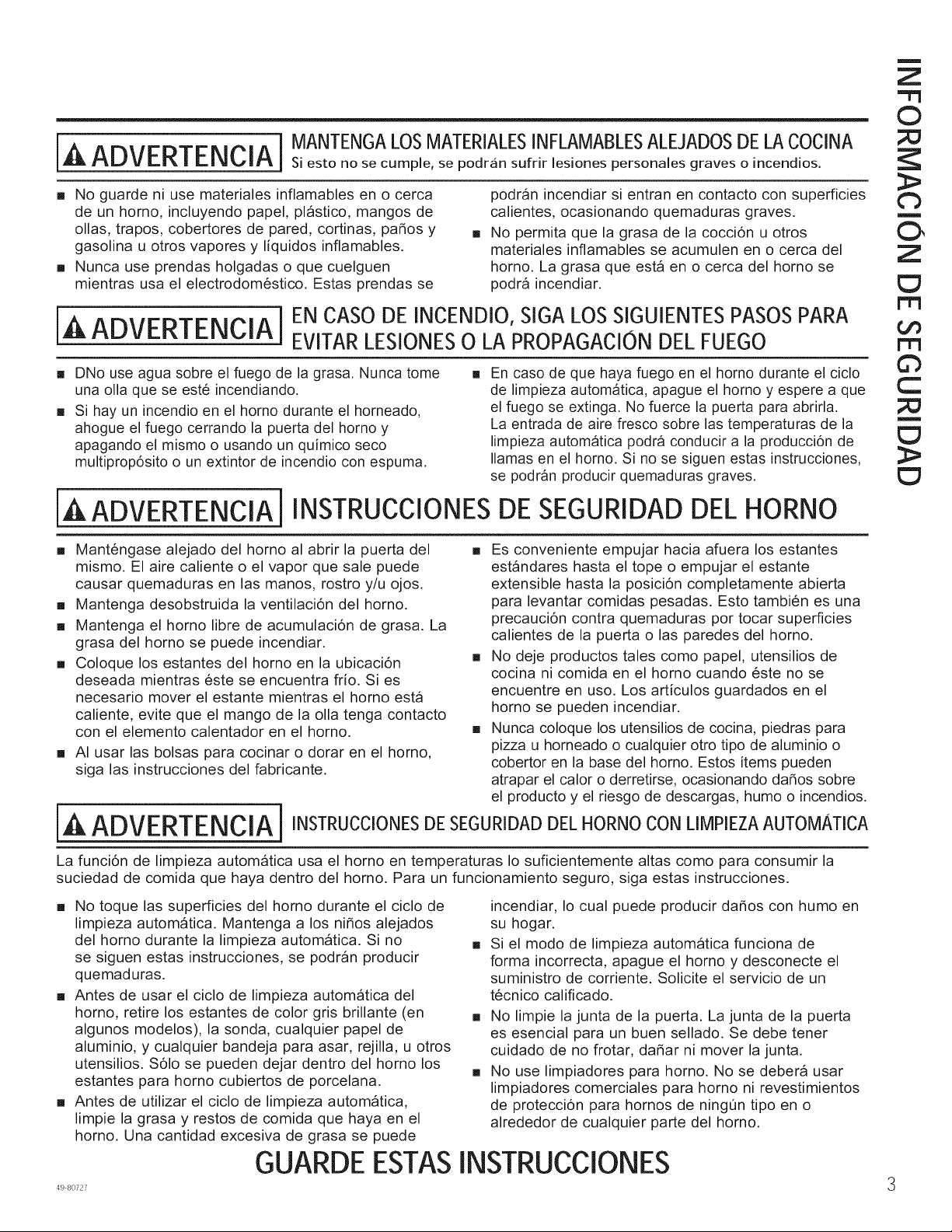
i'_, i MANTENGA LOSMATERIALESINFLAMABLESALEJADOSDE LA COCINA
ADVERTENCIA estooose cump,e,sepodran sufrir,esionespersona,esgraveso incendios.
[] No guarde ni use materiales inflamables en o cerca
de un horno, incluyendo papel, plastico, mangos de
ollas, trapos, cobertores de pared, cortinas, pahos y
gasolina u otros vapores y liquidos inflamables.
[] Nunca use prendas holgadas o que cuelguen
mientras usa el electrodom6stico. Estas prendas se
i,& ADVERTENCIAi
podran incendiar si entran en contacto con superficies
calientes, ocasionando quemaduras graves.
No permita que la grasa de la cocci6n u otros
materiales inflamables se acumulen en o cerca del
homo. La grasa que esta en o cerca del homo se
podra incendiar.
ENCASO DEINCENDIO, SIGA LOS SIGUIENTES PASOS PARA
EVITAR LESIONES O LA PROPAGACION DEL FUEGO
[]
[]
DNo use agua sobre el fuego de la grasa. Nunca tome
una olla que se est6 incendiando.
Si hay un incendio en el homo durante el horneado,
ahogue el fuego cerrando la puerta del homo y
apagando el mismo o usando un quimico seco
multiprop6sito o un extintor de incendio con espuma.
i-& ADVERTENCIAi
En caso de que haya fuego en el horno durante el ciclo
de limpieza autom&tica, apague el homo y espere a que
el fuego se extinga. No fuerce la puerta para abrirla.
La entrada de aire fresco sobre las temperaturas de la
limpieza autom&tica podr& conducir a la producci6n de
llamas en el homo. Si no se siguen estas instrucciones,
se podr&n producir quemaduras graves.
INSTRUCCIONESDE SEGURIDAD DEL HORNO
[] Mant6ngase alejado del horno al abrir la puerta del
mismo. El aire caliente o el vapor que sale puede
causar quemaduras en las manos, rostro y/u ojos.
[] Mantenga desobstruida la ventilaci6n del homo.
[] Mantenga el homo libre de acumulaci6n de grasa. La
grasa del homo se puede incendiar.
[] Coloque los estantes del homo en la ubicaci6n
deseada mientras 6ste se encuentra frio. Si es
necesario mover el estante mientras el homo esta
caliente, evite que el mango de la olla tenga contacto
con el elemento calentador en el homo.
[] AI usar las bolsas para cocinar o dorar en el homo,
siga las instrucciones del fabricante.
[] Es conveniente empujar hacia afuera los estantes
estandares hasta el tope o empujar el estante
extensible hasta la posici6n completamente abierta
para levantar comidas pesadas. Esto tambi6n es una
precauci6n contra quemaduras pot tocar superficies
calientes de la puerta o las paredes del homo.
[] No deje productos tales como papel, utensilios de
cocina ni comida en el homo cuando 6ste no se
encuentre en uso. Los articulos guardados en el
homo se pueden incendiar.
[] Nunca coloque los utensilios de cocina, piedras para
pizza u horneado o cualquier otro tipo de aluminio o
cobertor en la base del horno. Estos items pueden
atrapar el calor o derretirse, ocasionando dahos sobre
el producto y el riesgo de descargas, humo o incendios.
ADVERTENCIA iINSTRUCCIONES DE SEGURIDAD DEL HORNO CON LIMPIEZAAUTOMATICA
La funci6n de limpieza automatica usa el horno en temperaturas Io suficientemente altas como para consumir la
suciedad de comida que haya dentro del homo. Para un funcionamiento seguro, siga estas instrucciones.
[] No toque las superficies del horno durante el ciclo de
limpieza automatica. Mantenga a los nihos alejados
del homo durante la limpieza automatica. Si no
se siguen estas instrucciones, se podran producir
quemaduras.
[] Antes de usar el ciclo de limpieza automatica del
homo, retire los estantes de color gris brillante (en
algunos modelos), la sonda, cualquier papel de
aluminio, y cualquier bandeja para asar, rejilla, u otros
utensilios. S61o se pueden dejar dentro del homo los
estantes para homo cubiertos de porcelana.
[] Antes de utilizar el ciclo de limpieza automatica,
limpie la grasa y restos de comida que haya en el
homo. Una cantidad excesiva de grasa se puede
GUARDE ESTAS
incendiar, Iocual puede producir dahos con humo en
su hogar.
[] Si el modo de limpieza automatica funciona de
forma incorrecta, apague el homo y desconecte el
suministro de corriente. Solicite el servicio de un
t6cnico calificado.
[] No limpie la junta de la puerta. La junta de la puerta
es esencial para un buen sellado. Se debe tenet
cuidado de no frotar, dahar ni mover la junta.
[] No use limpiadores para homo. No se debera usar
limpiadores comerciales para homo ni revestimientos
de protecci6n para hornos de ningOn tipo en o
alrededor de cualquier parte del homo.
INSTRUCCIONES
49 80727
m
Z
'-'rl
©
db
m
©,
Z
¢3
I"1"1
Of}
I"1"1
©
C
m
¢3
r_
r_
m
r_
:D
©
LLI
I..l.J
Z
,©
m
¢.)
r_
©
I1
Z
m
INFORMACION IMPORTANTE DESEGURIDAD
LEA TODAS LAS INSTRUCCIONES ANTES DE USAR
El equip©de acceso remoto instalado en este homo rue
probado y cumple con los limites establecidos para un
dispositivo digital de clase B, seg_n la parte 15 de la
Normativa de la FCC. Estos limites fueron dise_ados para:
(a) brindar una protecci6n razonable contra interferencias
nocivas en una instalaci6n residencial. Este equip©
genera, usa y puede emitir energia de radiofrecuencia y,
si no se instala y utiliza de acuerdo con las instrucciones,
puede ocasionar interferencias perjudiciales en las
comunicaciones de radio. Sin embargo, no se garantiza
que no se presenten interferencias en una instalaci6n en
particular. Si el equip© provoca interferencias perjudiciales
para la recepci6n de radio o televisi6n, Iocual puede
comprobar encendiendo y apagando el equip©,se aconseja
al usuario que intente corregir la interferencia con una de
las siguientes medidas:
[] Reoriente o reubique la antena receptora.
[] Aumente la separaci6n entre el equip©y el receptor.
[] Conecte el equip© a un tomacorriente de un circuit©
diferente del tomacorriente al que se encuentra
conectado el receptor.
[] Para solicitar ayuda, consulte con el proveedor minorista
o a un tecnico experimentado de radio/TV.
(b) tolerar cualquier interferencia recibida, incluyendo las
interferencias que puedan provocar un funcionamiento no
deseado del dispositivo.
Observe que todos los cambios o modificaciones sobre
el dispositivo de comunicaci6n inalambrico instalado en
este homo que no esten expresamente aprobados por
el fabricante podrian anular la autoridad del usuario para
operar el equipamiento.
49 80727

Notas
49 80727 5
Z
tY
©
8,d
O
O 03
o° :_
0
0
o o
3_
_8
cro
n ,m
o r_
iGracias! ... por su compra de un electrodomestico de la Marca GE
Registre su I=lectrodomestico: iRegistre su electrodom6stico nuevo a trav6s de Internet, segQn su conveniencia!
www.geappliances.com/service_and_support/register/
Un registro puntuat de su producto permitir_ una mejor comunicaci6n y unservicio m_s puntual de acuerdo con los t6rminos de su
garantia, en caso de surgir la necesidad. Tambi6n puede enviar una carta en la tarjeta de inscripci6n pre-impresa que se incluye con
el material embalado.
Garantia de la Cocina Electrica de GE
GEAppliances.com
Todo el servicio de garantia es provisto por nuestros Centros de Servicio de Fabricaci6n, o un t6cnico autorizado de Servicio al
Ctiente (Customer Care®). Para programar una visita del servicio t6cnico a trav6s de Internet, visitenos en www.geapptiances.
com/service_and support/, o flame a1800.GE.CARES (800.432.2737). Cuando flame para solicitar el servicio, tenga los nQmeros
de serie y de modelo disponibles.
Para reatizar el servicio t6cnico de su electrodom6stico se podr_ requerir el uso de datos del puerto de abordaje para su
diagn6stico. Esto da al t6cnico del servicio de f_brica de GE la habilidad de diagnosticar de forma r_pida cualquier problema con
su electrodom_stico, y de ayudar a GE a mejorar sus productos al brindarle a GE la informaci6n sobre su electrodom6stico. Si no
desea que los datos de su electrodom_stico sean enviados a GE, solicitamos que le indique a su t_cnico no entregar los datos a
GE en el momento del servicio.
Durante el periodo de un ado desde la fecha original de compra. GE le brindar_ cuatquier parte de la cocina que fatle debido a
un defecto en los materiates o la fabricaci6n. Durante esta garantia limitada de un ado, GE tambi_n proveer_, sin costo, todo el
trabajo y el servicio en el hogar relacionado con el reemplazo de la parte que presente defectos.
Que no cubrir4 GE:
[] Viajes del t6cnico del servicio a su hogar para ense_arle
sobre c6mo usar el producto.
[] Instalaci6n, entrega o mantenimiento inadecuados.
[] Fatlas del producto en caso de abuso, mat uso, modificaci6n
o uso para prop6sitos diferentes at original o uso comerciat.
[] Reemptazo de fusibles de la casa o reinicio de disyuntores.
[] DaSos ocasionados sobre el producto por accidente,
incendio, inundaciones o cat_strofes naturates.
[] Da_os incidentales o consecuentes causados por posibtes
defectos sobre este producto.
[] Dado causado despu_s de ta entrega.
[] Producto no accesible para brindar el servicio requerido.
[] Solicite el servicio t_cnico para reparar o reemplazar las
I_mparas, excepto las I_mparas LED.
EXCLUSION DEGARANTJAS IMPLICITAS
Su Qnicay exclusiva attemativa es la reparaci6n del producto, como se indica en ta Garantia Limitada. Las garantias implicitas,
incluyendo garantias impticitas de comerciabilidad o conveniencia sobre un prop6sito particular, se limitan a un a_o oal periodo
m_s corto permitido por la tey.
Esta garantia se extiende al comprador original y a cuatquier due5o subsiguiente de productos comprados para uso hogarefio
dentro de EE.UU. Si el producto est_ en un _rea donde no se encuentra disponible un Proveedor Autorizado del Servicio T6cnico
de GE, usted ser_ responsable por el costo de un viaje o se podra requerir que traiga el producto a una ubicaci6n del Servicio
T_cnico de GE Autorizado para recibir el servicio. EnAlaska, la garantia excluye el costo de envio o Ilamadas del servicio a su
hogar.
Algunos estados no permiten la exclusi6n o limitaci6n de da_os fortuitos o consecuentes. Esta garantia le da derechos legates
especificos y es posible que tenga otros derechos legates que varian entre un estado y otro. Para conocer curies son sus
derechos legates, consulte a la oficina de asuntos del consumidor local o estatal o al Fiscal de su estado.
Garante: General Electric Company. Louisville, KY 40225
GarantJas Extendidas: Adquiera una garantia extendida de GE y aprenda sobre descuentos especiates que est_n disponibtes
mientras su garantia aQn est_ vigente. La puede adquirir en cuatquier momento a trav_s de Internet en
www.geapptiances.com/service_and_support/shop-for-extended-service-plans.htm
o llamando a1800.626.2224 durante el horario comerciat habitual. Los Servicios para el Consumidor Hogare_o de GE aQn estar_n
atli cuando su garantia caduque.
6 49 80727
/ Desea realizar una consulta o necesita ayuda con su electrodomestico?
iConsutte el Sitio Web de Electrodom6sticos de GE (www.geappliances.comlservice=and=supportl) durante las 24 horas,
cualquier dia del aft©! Para mayor conveniencia y un servicio m_s r_pido, ahora puede descargar el Manual del Propietado, orde-
nar piezas o incluso programar el servicio t6cnico a trav6s de Intemet.
Servicio Programado: El servicio de reparaci6n de expertos de
GE est_ as61o un paso de su puerta. Entre a Internet y programe
su servicio en www.geappliances.com/service and support/o
Ilame al 800.GE.CARES (800.432.2737) durante el horario de
atenci6n comercial.
Conectividad Remota: Para soticitar asistencia para la
conectividad de red inal_mbrica det homo (para modelos con
acceso remoto), por favor comuniquese al 800-220-6899.
Piezas y Aecesorios: Aquellas personas calificadas para
realizar el servicio t6cnico sobre sus propios electrodom6sticos
podr_n soticitar el envio de piezas o accesorios directamente
a sus hogares (se aceptan las tarjetas VISA; MasterCard y
Discover). Ordene a trav6s de Internet hoy, durante las 24
horas o en forma telef6nica at 800.626.2002 durante el horario
de atenci6n comercial.
Las instrucciones que figuran en este manual cubren los
procedimientos que ser_n realizados por cuatquier usuario.
Otros servicios t6cnicos generalmente deberian ser
derivados a personal catificado del servicio. Se deber_ tener
Accesorios
ZBusca Algo Mas?
cuidado, ya que una reparaci6n indebida podr_ hacer que el
funcionamiento no sea seguro.
Estudio de Dise_o de la Vida Real: GE apoya el concepto
de Disefio Universal en productos, servicios y ambientes que
pueden ser usados por personas de todas las edades, tamafios
y capacidades. Reconocemos ta necesidad de reatizar disefios
para una amplia gama de habilidades e incapacidades fisicas y
mentates. Para m_s detalles sobre las apticaciones de Disefio
Universal de GE, incluyendo ideas de disefio de cocinas para
personas con incapacidades, visite nuestro sitio web hoy. Sobre
casos de incapacidad auditiva, comuniquese al 800.TDD.GEAC
(800.833.4322).
Contactenos: Si no se encuentra satisfecho con el servicio
que recibi6 de GE, comuniquese con nosotros a trav6s de
nuestro sitio web con todos los detaltes, incluyendo su nQmero
telef6nico, o escriba a:
General Manager, Customer Relations
GE Appliances, Appliance Park Louisville, KY 40225
iGE ofrece una variedad de accesorios para mejorar sus experiencias de coccidn y mantenimiento!
Para reatizar una orden, visitenos a trav6s de Internet en:
www.GEApplianeeParts.eom (EE.UU.) o en www.GEAppliances.ca (Canada)
o Itame at 800.626.2002 (EE.UU.) 800.661.1616 (Canada)
Estos y otros productos est_n disponibtes:
Accesorios
Olla para Asar Pequefia (8 ¾" x 1¼" x 13 ½ ")
Otla para Asar Grande* (12 ¾ " x 1 ¼" x 16 ½ ")
Otla para Asar Extra Grande* (17 ¾ " x 1 ¼" x 19 ½ ")
Piezas
Estantes del horno
Etementos del homo
L_mparas de luz
Sonda
Suministros de Limpieza
Limpiadores de Acero Inoxidabte CitriShine
Limpiador de Etectrodom6sticos de Acero Inoxidabte CeramaBryte
Lubricante de Grafito
*La olla para asar grande no entra en cocinas de 20"/24".
**La olla XL no entra en hornos de pared de 24", empotrables de 27" o cocinas de 20"/24".
Como Retirar la Pelicula Protectora de Envio y la Cinta
Con cuidado tome un extremo de la pelicuta protectora de envio
con los dedos y lentamente retire la misma de la superficie del
electrodom6stico.
No utilice ning0n producto filoso para retirar la pelicula. Retire toda
la pelicula antes de usar el electrodom6stico por primera vez.
49 80727
WB48X10055 (EE.UU.) 222D2097G001 (Canada)
WB48X10056 (EE.UU.) 222D2097G002 (Canada)
WB48X10057 (EE.UU.) No disponibte en Canad_
Los nQmeros de pieza varian segQn el modelo
Los nQmeros de pieza varian segQn el modelo
Los nQmeros de pieza varian segQn el modelo
Los nOmeros de pieza varian segt]n el modelo
WX10X10007
PM10X311
WB02T10303
de Embalaje
Para asegurar que no haya dafios sobre el acabado del
product©, la forma m_s segura de retirar el adhesivo de la cinta
de embalaje en electrodom6sticos nuevos es apticando un
detergente liquid© hogarefio para lavar ptatos. Aplique con una
tela suave y deje que se seque.
NOTA: El adhesivo deber_ ser eliminado de todas las pares.
No se puede retirar si se hornea con 6ste dentro.
rj3
m
rj3
Z
¢3
m
('3
¢3
rj3
©
;;O
m
©
rj3
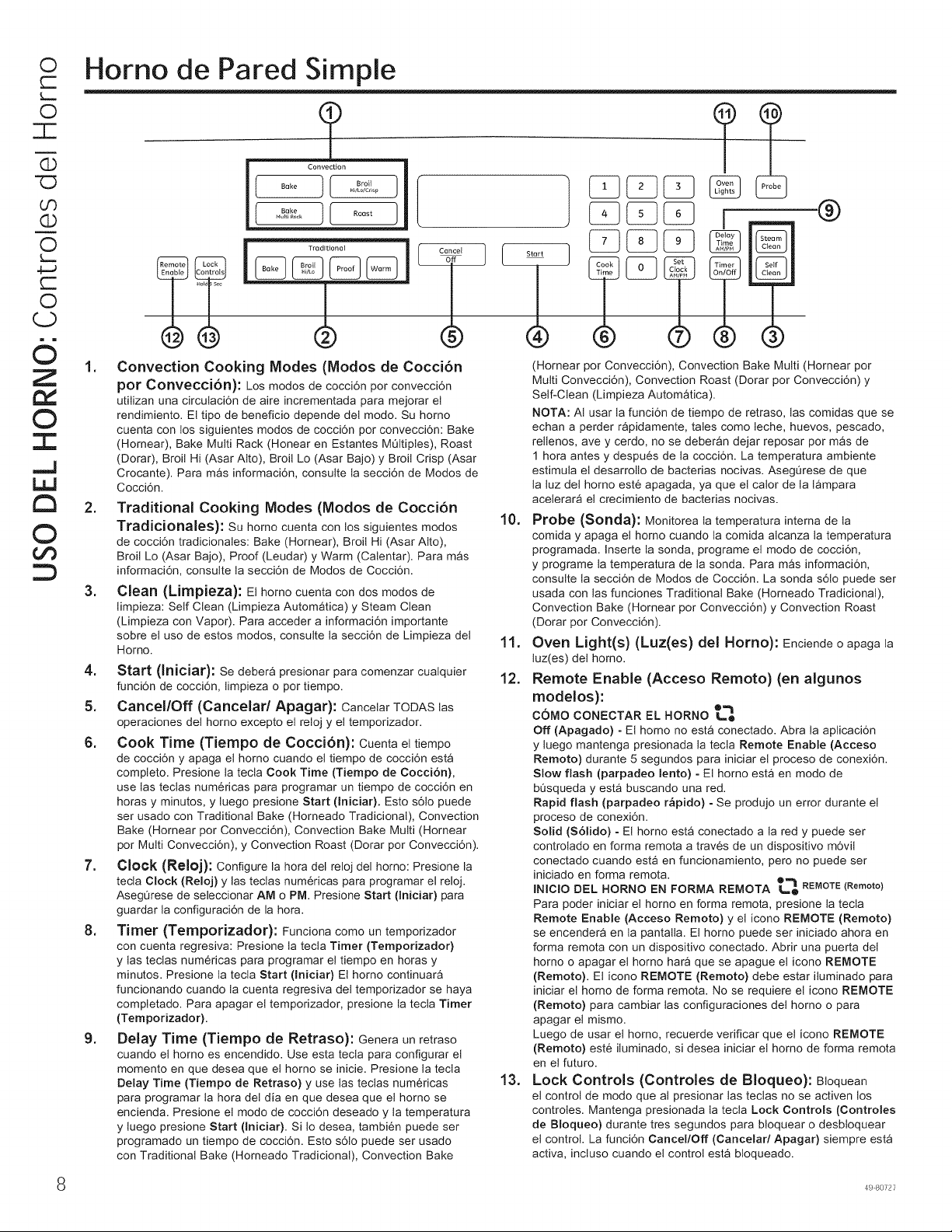
O
c-
O
-T-
m
Q
O0
Q
O
O
LP
d
Z
tY
©
-l-
,..J
_.J
tm
©
oO
Homo de Pared Simple
t
Convection
Bake/ Br°"1H_/LdCr_sp
Bake [ R.... 1
MumRack
Traditional
m
I
-0
1. Convection Cooking Modes (Modos de Cocci6n
pot Convecci6n): Los modes de cocci6n per convecci6n
utilizan una circulaci6n de aire incrementada para mejorar el
rendimiento. El tipo de beneficio depende del mode. Su homo
cuenta con los siguientes modes decocci6n per convecci6n: Bake
(Hornear), Bake Multi Rack (Honear en Estantes M_ltiples), Roast
(Dorar), Broil Hi (Asar Alto), Broil Lo (Asar Bale) y Broil Crisp (Asar
Crocante). Para mas informaci6n, consulte la secci6n de Modes de
Cocci6n.
2. Traditional Cooking Modes (Modos de Cocci6n
Tradicionales): Su homo cuenta con los siguientes modes
de cocci6n tradicionales: Bake (Hornear), Broil Hi (Asar Alto),
Broil Lo (Asar Bale), Proof (Leudar) y Warm (Caientar). Para mas
informaci6n, consuite la secci6n de Modes de Cocci6n.
3. Clean (LJmpieza): Ei homo cuenta con dos modos de
limpieza: Self Clean (Limpieza Automatica) y Steam Clean
(Limpieza con Vapor). Para acceder a informaci6n importante
sobre el use de estos modes, consulte la secci6n de Limpieza del
Homo.
4. Start (Iniciar): Se debera presionar para comenzar cualquier
funci6n de cocci6n, limpieza o per tiempo.
5. CancellOff (Cancelad Apagar): CancelarTODASlas
operaciones del homo excepto el reloj y el temporizador.
6. Cook Time (TJempo de Cocci6n): Cuentaeltiempo
de cocci6n y apaga el homo cuando el tiempo de cocci6n esta
completo. Presione la tecla Cook Time (Tiempo de Cocci6n),
use las teclas numedcas para programar un tiempo de cocci6n en
horas y minutos, y luego presione Start (Iniciar). Esto s61opuede
ser usado con Traditional Bake (Horneado Tradicional), Convection
Bake (Hornear per Convecci6n), Convection Bake Multi (Hornear
por Multi Convecci6n), y Convection Roast (Dorar per Convecci6n).
7. Clock (Reloj): Configure la hora del reloj del homo: Presione la
tecla Clock (Reloj) y las teclas numericas para programar el reloj.
AsegQrese de seleccionar AM o PM. Presione Start (Iniciar) para
guardar la configuraci6n de la hora.
8. Timer (TemporJzador): Funciona come un tempodzador
con cuenta regresiva: Presione la tecla Timer (Temponzador)
y las teclas numedcas para programar el tiempo en horas y
minutes. Presione la tecla Start (Iniciar) El homo continuara
funcionando cuando la cuenta regresiva del tempodzador se haya
completado. Para apagar el tempodzador, presione la tecla Timer
(TemporJzador).
9. Delay Time (Tiempo de Retraso): Genera unretraso
cuando el homo es encendido. Use esta tecla para configurar el
memento en que desea que el homo se inicie. Presione la tecla
Delay Time (Tiempo de Retraso) y use las teclas numedcas
para programar la hera del dia en que desea que el homo se
encienda. Presione el mode de cocci6n deseado y la temperatura
y luego presione Start (Jniciar). Si Io desea, tambi6n puede set
programado un tiempo de cocci6n. Esto s61opuede ser usado
con Traditional Bake (Horneado Tradicional), Convection Bake
(Hornear per Convecci6n), Convection Bake Multi (Hornear per
Multi Convecci6n), Convection Roast (Dorar per Convecci6n) y
Self-Clean (Limpieza Automatica).
NOTA: AI usar lafunci6n de tiempo de retraso, las comidas que se
echan a perder rapidamente, tales come leche, huevos, pescado,
rellenos, ave y cerdo, no se deberan dejar reposar per mas de
1 hera antes y despues de la cocci6n. La temperatura ambiente
estimula el desarrollo de bacterias nocivas. AsegQrese de que
la luz del homo este apagada, ya que el calor de la lampara
acelerara el crecimiento de bacterias nocivas.
10, Probe (Sonda): Monitorea la temperatura interna de la
comida y apaga el homo cuando la comida alcanza la temperatura
programada. Inserte la sonda, programe el modo de cocci6n,
y programe la temperatura de la sonda. Para mas informaci6n,
consulte la secci6n de Modes de Cocci6n. La sonda s61opuede ser
usada con las funciones Traditional Bake (Horneado Tradicional),
Convection Bake (Hornear per Convecci6n) y Convection Roast
(Dorar per Convecci6n).
11, Oven Light(s) (Luz(es) del Homo): Enciendeoapagala
luz(es) del homo.
12, Remote Enable (Acceso Remoto) (en algunos
modelos):
COMO CONECTAR EL HORNO _,='te
Off (Apagado) = E{ homo no esta conectado, Abra la apiicaci6n
y luego mantenga presionada la tecla Remote Enable (Acceso
Remoto) durante 5 segundos para iniciar el proceso de conexi6n.
Slow flash (parpadeo lento) =El homo esta en mode de
bQsqueda y esta buscando una red.
Rapid flash (parpadeo r_pido) -Se produjo un error durante el
proceso de conexi6n.
Solid (S61ido) - El homo esta conectado a la red y puede ser
controlado en forma remota atraves de un dispositivo m6vil
conectado cuando esta en funcionamiento, pero no puede ser
iniciado en forma remota.
INIClO DEL HORNO EN FORMA REMOTA L_ REMOTE(Remoto)
Para poder iniciar el horno en forma remota, presione la tecla
Remote Enable (Acceso Remoto) y el icono REMOTE (Remoto)
se encendera en la pantalla. El homo puede ser iniciado ahora en
forma remota con un dispositivo conectado. Abdr una puerta del
horno oapagar el homo hara que se apague el icono REMOTE
(Remoto). El icono REMOTE (Remoto) debe estar iluminado para
iniciar el homo de forma remota. No se requiere el icono REMOTE
(Remoto) para cambiar las configuraciones del homo o para
apagar el mismo.
Luego de usar el homo, recuerde vedficar que el icono REMOTE
(Remoto) este iluminado, si desea iniciar el homo de forma remota
en el future.
13. Lock Controls (Controles de Bloqueo): Bloquean
el control de modo que al presionar las teclas no se activen los
controles. Mantenga presionada la tecla Lock Controls (Controles
de BIoqueo) durante tres segundos para bloquear o desbioquear
el control. La funci6n Cancel/Off (Cancelad Apagar) siempre esta
activa, incluso cuando el control esta bloqueado.
8 49 80727
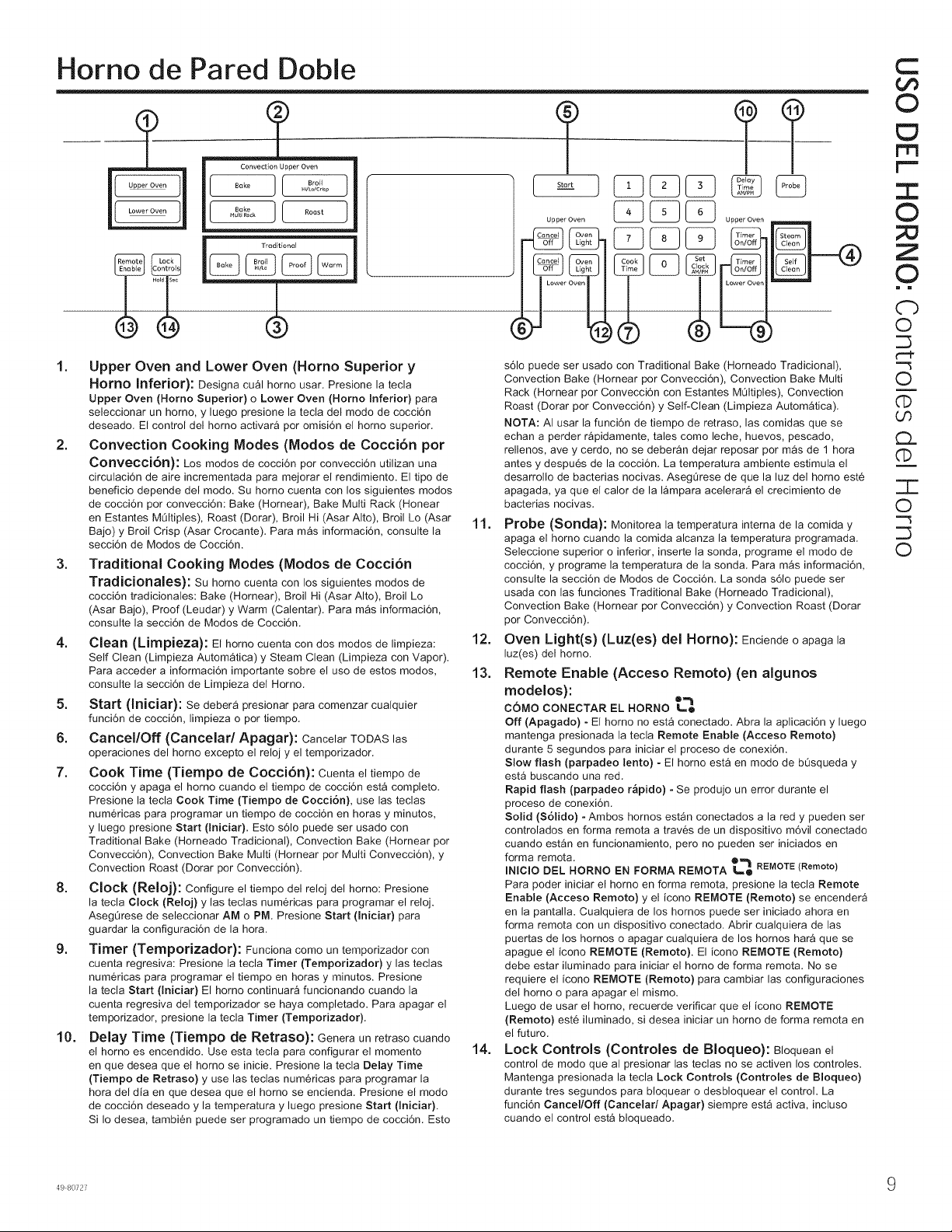
Homo de Pared Doble
Traditional
Upper Oven _tLower Ov_
1. Upper Oven and Lower Oven (Homo Superior y
Homo inferior): Designa cual homo usar. Presione la tecla
Upper Oven (Horn© Superior) o Lower Oven (Homo Inferior) para
seleccionar un homo, y luego presione la tecla del modo de cocci6n
deseado. El control del homo activara por omisi6n el horn© superior.
2. Convection Cooking Modes (Modos de Cocci6n pot
Convecci6n): Los modos de cocci6n por convecci6n utilizan una
circulaci6n de aire incrementada para mejorar el rendimiento. El tip© de
beneficio depende del modo. Su horn© cuenta con los siguientes modos
de cocci6n por convecci6n: Bake (Hornear), Bake Multi Rack (Honear
en Estantes MOltiples), Roast (Dorar), Broil Hi (Asar Alto), Broil L© (Asar
Bajo) y Broil Crisp (Asar Crocante). Para mas informaci6n, consulte la
secci6n de Modos de Cocci6n.
3. Traditional Cooking Modes (Modos de Cocci6n
Tradicionales): Su horn© cuenta con los siguientes modos de
cocci6n tradicionales: Bake (Hornear), Broil Hi (Asar Alto), Broil L©
(Asar Bajo), Proof (Leudar) y Warm (Calentar). Para mas informaci6n,
consulte la secci6n de Modos de Cocci6n.
4. Clean (Limpieza): El horn© cuenta con dos modos de limpieza:
Self Clean (Limpieza Automatica) y Steam Clean (Limpieza con Vapor).
Para acceder a informaci6n importante sobre el us© de estos modos,
consulte la secci6n de Limpieza del Horn©.
5. Start (Iniciar): Se debera presionar para comenzar cualquier
funci6n de cocci6n, limpieza o por tiempo.
6. Cancel/Off (Cancelar/Apagar): Cancelar TODAS las
operaciones del horn© except© el reloj y el temporizador.
7. Cook Time (Tiempo de Cocci6n): Cuenta el tiempode
cocci6n y apaga el homo cuando el tiempo de cocci6n esta completo.
Presione la tecla Cook Time (Tiempo de Cocci6n), use las teclas
numericas para programar un tiempo de cocci6n en horas y minutos,
y luego presione Start (Iniciar). Esto s61o puede ser usado con
Traditional Bake (Horneado Tradicional), Convection Bake (Hornear por
Convecci6n), Convection Bake Multi (Hornear pot Multi Convecci6n), y
Convection Roast (Dorar por Convecci6n).
8. Clock (Reloj): Configure el tiempo del reloj del homo: Presione
la tecla Clock (Reloj) y las teclas numericas para programar el reloj.
AsegOrese de seleccionar AM o PM. Presione Start (Iniciar) para
guardar la configuraci6n de la hora.
9. Timer (Temporizador): Funciona como un temporizador con
cuenta regresiva: Presione la tecla Timer (Temporizador) y las teclas
numericas para programar el tiempo en horas y minutos. Presione
la tecla Start (Iniciar) El horn© continuara funcionando cuando la
cuenta regresiva del temporizador se haya completado. Para apagar el
temporizador, presione la tecla Timer (Temporizador).
10. Delay Time (Tiempo de Retraso): Genera un retraso cuando
el homo es encendido. Use esta tecla para configurar el moment©
en que desea que el homo se inicie. Presione la tecla Delay Time
(Tiempo de Retraso) y use las teclas numericas para programar la
hora del dia en que desea que el homo se encienda. Presione el modo
de cocci6n deseado y la temperatura y luego presione Start (Iniciar).
Si Io desea, tambi6n puede ser programado un tiempo de cocci6n. Esto
s61o puede ser usado con Traditional Bake (Horneado Tradicional),
Convection Bake (Hornear pot Convecci6n), Convection Bake Multi
Rack (Hornear pot Convecci6n con Estantes MOltiples), Convection
Roast (Dorar por Convecci6n) y Self-Clean (Limpieza Automatica).
NOTA: AI usar la funci6n de tiempo de retraso, las comidas que se
echan a perder rapidamente, tales como leche, huevos, pescado,
rellenos, ave y cerdo, no se deberan dejar reposar por mas de 1 hora
antes y despu6s de la cocci6n. La temperatura ambiente estimula el
desarrollo de bacterias nocivas. AsegOrese de que la luz del homo est6
apagada, ya que el calor de la lampara acelerara el crecimiento de
bacterias nocivas.
11. Probe (Sonda): Monitorea la temperatura interna de la comida y
apaga el homo cuando la comida alcanza la temperatura programada.
Seleccione superior o inferior, inserte la sonda, programe el modo de
cocci6n, y programe la temperatura de la sonda. Para mas informaci6n,
consulte la secci6n de Modos de Cocci6n. La sonda s61o puede ser
usada con las funciones Traditional Bake (Horneado Tradicional),
Convection Bake (Hornear por Convecci6n) y Convection Roast (Dorar
por Convecci6n).
12. Oven Light(s) (Luz(es) del Homo): Enciendeo apagala
luz(es) del horn©.
13. Remote Enable (Acceso Rein©to) (en algunos
model©s):
COMO CONECTAR EL HORN© _.=_
Off (Apagado) - El homo no esta conectado. Abra la aplicaci6n y luego
mantenga presionada la tecla Remote Enable (Acceso Rein©to)
durante 5 segundos para iniciar el proceso de conexi6n.
Slow flash (parpadeo lento) - El homo esta en modo de bQsqueda y
esta buscando una red.
Rapid flash (parpadeo r_pido) - Se produjo un error durante el
proceso de conexi6n.
Solid (S61ido) - Ambos hornos estan conectados a la red y pueden ser
controlados en forma remota a trav6s de un dispositivo m6vil conectado
cuando est_n en funcionamiento, per© no pueden ser iniciados en
forma remota, o=,_
INICIO DEL HORN© EN FORMA REMOTA Lmo REMOTE(Rernoto)
Para poder iniciar el homo en forma remota, presione la tecla Remote
Enable (Acceso Rein©to) y el icon© REMOTE (Rein©to) se encendera
en la pantalla. Cualquiera de los hornos puede ser iniciado ahora en
forma remota con un dispositivo conectado. Abrir cualquiera de las
puertas de los hornos o apagar cualquiera de los hornos hara que se
apague el icon© REMOTE (Rein©to). El icon© REMOTE (Rein©to)
debe estar iluminado para iniciar el homo de forma remota. No se
requiere el icon© REMOTE (Rein©to) para cambiar las configuraciones
del homo o para apagar el mismo.
Luego de usar el homo, recuerde verificar que el icon© REMOTE
(Rein©to) est6 iluminado, si desea iniciar un horn© de forma remota en
el futuro.
14. Lock Controls (Controles de BIoqueo): Bloqueanel
control de modo que al presionar las teclas no se activen los controles.
Mantenga presionada la tecla Lock Controls (Controles de Bloqueo)
durante tres segundos para bloquear o desbloquear el control. La
funci6n Cancel/Off (Cancelar/Apagar) siempre est_ activa, incluso
cuando el control est_ bloqueado.
C
©
i=t3
t,=..
-t-
O
Z
©
= m
Cb
©
¢=P
=-3
©
U3
CL
=T=
©
=-3
©
49 80727 9
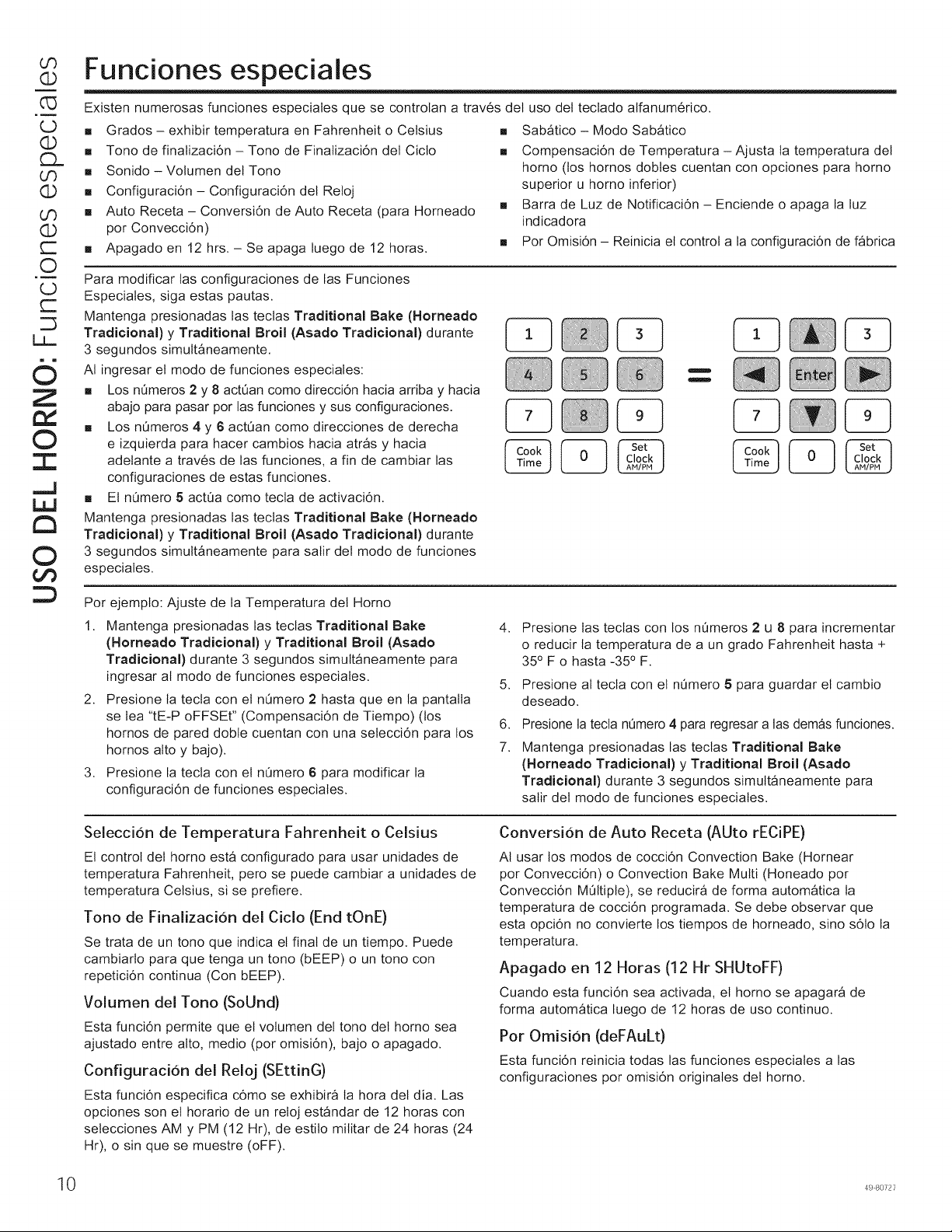
el3
(D
LP
(b
CX
el3
(D
el3
(1)
O
LP
C
LJ_
d
Z
r/
©
7"
.,.J
tm
©
oO
Funciones especiales
Existen numerosas funciones especiates que se controlan a trav6s del uso del teclado alfanum6rico.
[] Grados - exhibir temperatura en Fahrenheit o Celsius
[] Tono de finalizaci6n - Tono de Finatizaci6n del Ciclo
[] Sonido - Volumen del Tono
[] Configuraci6n - Configuraci6n del Reloj
[] Auto Receta - Conversi6n de Auto Receta (para Horneado
por Convecci6n)
[] Apagado en 12 hrs. - Se apaga luego de 12 horas.
[] Sab_tico - Modo Sab_tico
[] Compensaci6n de Temperatura - Ajusta la temperatura del
homo (los hornos dobles cuentan con opciones para homo
superior u homo inferior)
[] Barra de Luz de Notificaci6n - Enciende o apaga la luz
indicadora
[] Por Omisi6n - Reinicia el control a la configuraci6n de f_brica
Para modificar las configuraciones de las Funciones
Especiates, siga estas pautas.
Mantenga presionadas las teclas Traditional Bake (Horneado
Traditional) y Traditional Broil (Asado Tradieional) durante
3 segundos simult_neamente.
AI ingresar el modo de funciones especiales:
[] Los nOmeros 2 y 8 actOan como direcci6n hacia arriba y hacia
abajo para pasar por las funciones y sus configuraciones.
[] Los n0meros 4 y 6 act0an como direcciones de derecha
e izquierda para hacer cambios hacia atr_s y hacia
adelante a trav6s de las funciones, a fin de cambiar las
configuraciones de estas funciones.
[] El nOmero 5 actOa como tecla de activaci6n.
Mantenga presionadas las teclas Traditional Bake (Horneado
Traditional) y Traditional Broil (Asado Traditional) durante
3 segundos simult_neamente para satir del modo de funciones
especiates.
Q
m
Por ejemplo: Ajuste de la Temperatura del Homo
1. Mantenga presionadas las teclas Traditional Bake 4.
(Horneado Traditional) y Traditional Broil (Asado
Traditional) durante 3 segundos simult_neamente para
ingresar at modo de funciones especiales. 5.
2. Presione tatecla con el nQmero 2 hasta que en la pantatla
se tea "tE-P oFFSEt" (Compensaci6n de Tiempo) (los 6.
hornos de pared dobte cuentan con una selecci6n para los
hornos alto y bajo). 7.
3. Presione la tecla con el nQmero 6 para modificar la
configuraci6n de funciones especiates.
Presione las teclas con los n0meros 2 u 8 para incrementar
o reducir la temperatura de a un grado Fahrenheit hasta ÷
35° F o hasta -35 ° F.
Presione al tecla con el nOmero 5 para guardar el cambio
deseado.
Presione la tecla nOmero4 para regresar a las demas funciones.
Mantenga presionadas las teclas Traditional Bake
(Horneado Traditional) y Traditional Broil (Asado
Traditional) durante 3 segundos simutt_neamente para
satir del modo de funciones especiates.
Seleccion de Temperatura Fahrenheit o Celsius
El control del horno est_ configurado para usar unidades de
temperatura Fahrenheit, pero se puede cambiar a unidades de
temperatura Celsius, si se prefiere.
Tono de Finalizaci0n del Ciclo (End tOnE)
Se trata de un tono que indica el final de un tiempo. Puede
cambiarto para que tenga un tono (bEEP) o un tono con
repetici6n continua (Con bEEP).
Volumen del Tono (SoUnd)
Esta funci6n permite que el votumen del tono del homo sea
ajustado entre alto, medio (por omisi6n), bajo o apagado.
Configuraci6n del Reloj (SEttinG)
Esta funci6n especifica c6mo se exhibir_ la hora del dia. Las
opciones son el horario de un reloj est_ndar de 12 horas con
selecciones AM y PM (12 Hr), de estito mititar de 24 horas (24
Hr), o sin que se muestre (oFF).
Conversion de Auto Receta (AUto rECiPE)
AI usar los modos de cocci6n Convection Bake (Hornear
por Convecci6n) o Convection Bake Multi (Honeado por
Convecci6n MQItiple), se reducir_ de forma autom_tica la
temperatura de cocci6n programada. Se debe observar que
esta opci6n no convierte los tiempos de horneado, sino s61o la
temperatura.
Apagado en 12 Horas (12 Hr SHUtoFF)
Cuando esta funci6n sea activada, el homo se apagar_ de
forma autom_tica luego de 12 horas de uso continuo.
Por Omision (deFAuLt)
Esta funci6n reinicia todas las funciones especiales alas
configuraciones por omisi6n originates del horno.
10 49 80727
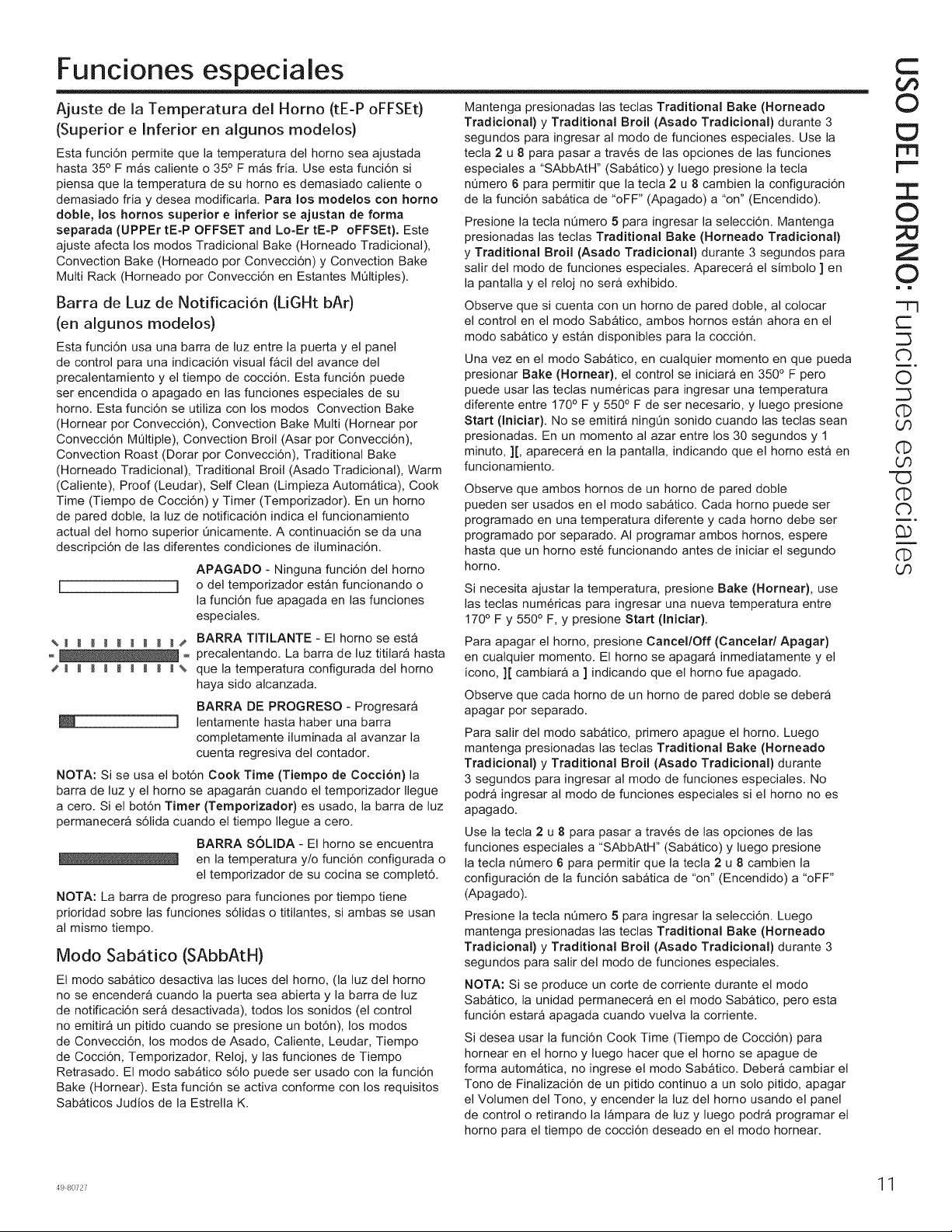
Funciones especiales
Ajuste de la Temperatura del Homo (tE-P oFFSEt)
(Superior e Inferior en algunos modelos)
Esta funci6n permite que la temperatura del homo sea ajustada
hasta 35 ° F mas caliente o 35° F mas fria. Use esta funci6n si
piensa que la temperatura de su homo es demasiado caliente o
demasiado fria y desea modificarla. Para los re©delos con homo
doble, los hornos superior e inferior se ajustan de forma
separada (UPPEr tE-P OFFSET and Lo-Er tE-P oFFSEt). Este
ajuste afecta los modos Tradicional Bake (Homeado Tradicional),
Convection Bake (Homeado por Convecci6n) y Convection Bake
Multi Rack (Homeado por Convecci6n en Estantes MOitiples).
Barra de Luz de Notificacion (LiGHt bar)
(en algunos model©s)
Esta funci6n usa una barra de luz entre la puerta y el panel
de control para una indicaci6n visual facil del avance del
precalentamiento y el tiempo de cocci6n. Esta funci6n puede
ser encendida o apagado en las funciones especiales de su
homo. Esta funci6n se utiliza con los re©dos Convection Bake
(Hornear por Convecci6n), Convection Bake Multi (Hornear por
Convecci6n MQItiple), Convection Broil (Asar por Convecci6n),
Convection Roast (Dorar por Convecci6n), Traditional Bake
(Horneado Tradicional), Traditional Broil (Asado Tradicional), Warm
(Caliente), Proof (Leudar), Self Clean (Limpieza Automatica), Cook
Time (Tiempo de Cocci6n) y Timer (Temporizador). En un homo
de pared doble, la luz de notificaci6n indica el funcionamiento
actual del homo superior Qnicamente. A continuaci6n se da una
descripci6n de las diferentes condiciones de iluminaci6n.
APAGADO - Ninguna funci6n del homo
L I o del temporizador estan funcionando o
la funci6n fue apagada en las funciones
especiales.
BARRA TmLANTE - El homo se esta
precalentando. La barra de luz titilara hasta
que la temperatura configurada del homo
haya sido alcanzada.
BARRA DE PROGRESO - Progresara
J lentamente hasta haber una barra
completamente iluminada al avanzar la
cuenta regresiva del contador.
NOTA: Si se usa el botdn Cook Time (TJempo de Cocci6n) la
barra de luz y el homo se apagaran cuando el temporizador Ilegue
a cero. Si el bot6n Timer (Temporizador) es usado, la barra de luz
permanecera s61ida cuando el tiempo Ilegue a cero.
BARRA SOLIDA - El homo se encuentra
en la temperatura y/o funci6n configurada o
el tempodzador de su cocina se complet6.
NOTA: La barra de progreso para funciones por tiempo tiene
prioridad sobre las funciones s61idas o titilantes, si ambas se usan
al raisin© tiempo.
Modo Sab4tico (SAbbAtH)
El modo sabatico desactiva las luces del homo, (la luz del homo
no se encendera cuando la puerta sea abierta y la barra de luz
de notificaci6n sera desactivada), todos los sonidos (el control
no emitira un pitido cuando se presione un botdn), los re©dos
de Convecci6n, los re©dos de Asado, Caliente, Leudar, Tiempo
de Cocci6n, TemporJzador, Reloj, y las funciones de Tiempo
Retrasado. El rood© sabatico s61o puede ser usado con la funci6n
Bake (Homear). Esta funci6n se activa conforme con los requisitos
Sabaticos Judios de la Estrella K.
Mantenga presionadas las teclas Traditional Bake (Horneado
Tradicional) y Traditional Broil (Asado Tradicional) durante 3
segundos para ingresar al rood© de funciones especiales. Use la
tecla 2 u 8 para pasar atrav6s de las opciones de las funciones
especiales a "SAbbAtH" (Sabatico) y luego presione la tecla
nOmero 6 para permitir que la tecla 2 u 8 cambien la configuraci6n
de la funci6n sabatica de "oFF" (Apagado) a "on" (Encendido).
Presione la tecla nOmero 5 para ingresar la selecci6n. Mantenga
presionadas las teclas Traditional Bake (Homeado Tradicional)
y Traditional Broil (Asado Tradicional) durante 3 segundos para
salir del modo de funciones especJales. Aparecera el simbolo ] en
la pantalla y el reloj no sera exhibido.
Observe que si cuenta con un homo de pared doble, al col©car
el control en el rood© Sabatico, ambos hornos estan ahora en el
rood© sabatico y estan disponibles para la cocci6n.
Una vez en el rood© Sabatico, en cualquier moment© en que pueda
presionar Bake (Hornear), el control se iniciara en 350 ° F per©
puede usar las teclas num@icas para ingresar una temperatura
diferente entre 170 ° F y 550 ° F de ser necesario, y luego presione
Start (Iniciar). No se emitira ningQn sonido cuando las teclas sean
presionadas. En un moment© al azar entre los 30 segundos y 1
minuto, ][, aparecera en la pantalla, indicando que el homo esta en
funcionamiento.
Observe que ambos hornos de un homo de pared doble
pueden ser usados en el modo sabatico. Cada homo puede ser
programado en una temperatura diferente y cada homo debe ser
programado por separado. AI programar ambos horn©s, espere
hasta que un homo est6 funcionando antes de iniciar el segundo
homo.
Si necesita ajustar la temperatura, presione Bake (Hornear), use
las teclas numericas para ingresar una nueva temperatura entre
170 ° F y 550 ° F, y presione Start (Iniciar).
Para apagar el homo, presione Cancel/Off (Cancelatl Apagar)
en cualquier moment©. El homo se apagara inmediatamente y el
icon©, ][ cambiara a ] indicando que el homo fue apagado.
Observe que cada homo de un homo de pared doble se debera
apagar por separado.
Para salir del rood© sabatico, primer© apague el homo. Luego
mantenga presionadas las teclas Traditional Bake (Horneado
Tradicional) y Traditional Broil (Asado Tradicional) durante
3 segundos para ingresar al modo de funciones especiales. No
podra ingresar al modo de funciones especiales si el homo no es
apagado.
Use la tecla 2 u8 para pasar a trav6s de las opciones de las
funciones especJales a "SAbbAtH" (Sabatico) y luego presione
la tecla nQmero 6 para permitir que la tecla 2 u 8 cambien la
configuraci6n de la funci6n sabatica de "on" (Encendido) a "oFF"
(Apagado).
Presione la tecla nQmero 5 para ingresar la selecci6n. Luego
mantenga presionadas las teclas Traditional Bake (Horneado
Tradicional) y Traditional Broil (Asado Tradicional) durante 3
segundos para salir del modo de funciones especiales.
NOTA: Si se produce un corte de corriente durante el modo
Sabatico, la unidad permanecera en el modo Sabatico, pero esta
funci6n estara apagada cuando vuelva la corriente.
Si desea usar la funci6n Cook Time (Tiempo de Cocci6n) para
homear en el homo y luego hacer que el homo se apague de
forma automatica, no ingrese el modo Sabatico. Debera cambiar el
Ton© de Finalizaci6n de un pitido continuo a un solo pitido, apagar
el Volumen del Ton©, y encender la luz del homo usando el panel
de control o retirando la lampara de luz y luego podra programar el
homo para el tiempo de cocci6n deseado en el modo hornear.
C
©
r"-
Z
©
Z
©
-1-1
r-
C)
0
Og
Og
©
("b
Og
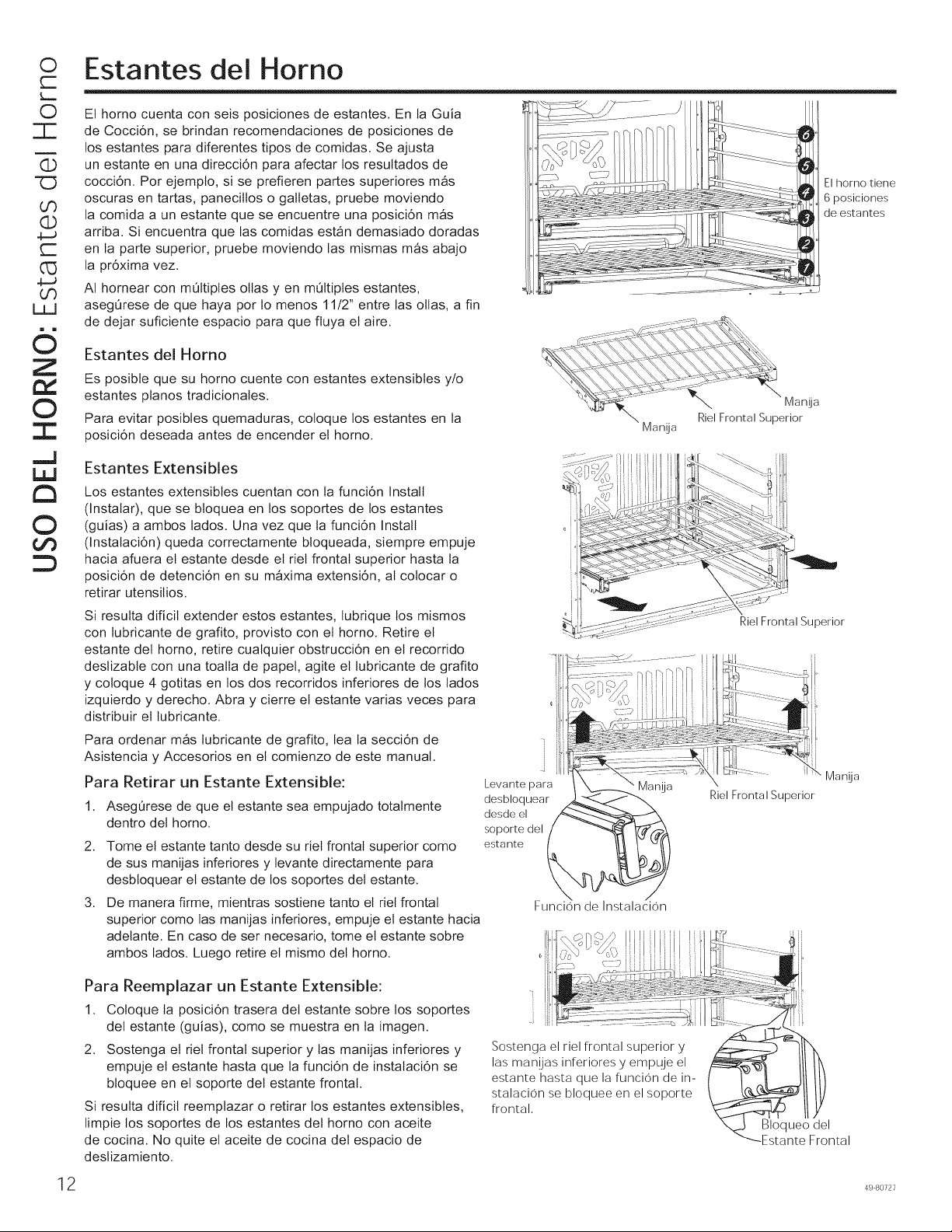
O
t-
O
::E
i
(1)
'o
Or)
(1)
r-
G3
4.M
GO
LLJ
d
Z
tY
©
--r.
,,,,J
tm
©
oO
Estantes del Horno
Et homo cuenta con seis posiciones de estantes. En la Guia
de Cocci6n, se brindan recomendaciones de posiciones de
los estantes para diferentes tipos de comidas. Se ajusta
un estante en una direccidn para afectar los resultados de
coccidn. Por ejempto, si se prefieren pares superiores m_s
oscuras en tartas, panecillos o galtetas, pruebe moviendo
la comida a un estante que se encuentre una posicidn m_s
arriba. Si encuentra que las comidas est_n demasiado doradas
en la parte superior, pruebe moviendo las mismas m_s abajo
la pr6xima vez.
AI homear con multiples otlas yen multiples estantes,
asegQrese de que haya por Io menos 11/2" entre las otlas, a fin
de dejar suficiente espacio para que fluya el aire.
Estantes del Horno
Es posible que su horno cuente con estantes extensibtes y/o
estantes ptanos tradicionales.
Para evitar posibtes quemaduras, cotoque los estantes en la
posici6n deseada antes de encender el horno.
Estantes Extensibles
Los estantes extensibles cuentan con la funci6n Install
(Instatar), que se btoquea en los soportes de los estantes
(guias) a ambos lados. Una vez que la funci6n Install
(Instalaci6n) queda correctamente bloqueada, siempre empuje
hacia afuera el estante desde el riel frontal superior hasta la
posici6n de detenci6n en su m_xima extensi6n, at colocar o
retirar utensilios.
Si resulta dificil extender estos estantes, lubrique los mismos
con lubricante de grafito, provisto con el horno. Retire el
estante del homo, retire cualquier obstrucci6n en el recorrido
deslizable con una toatta de papel, agite el lubricante de grafito
y coloque 4 gotitas en los dos recorridos inferiores de los lados
izquierdo y derecho. Abra y cierre el estante varias veces para
distribuir el tubricante.
Para ordenar m_s lubricante de grafito, lea la secci6n de
Asistencia y Accesorios en el comienzo de este manual.
Para Retirar un Estante Extensible:
1.
2.
3.
AsegOrese de que el estante sea empujado totalmente
dentro del horno.
Tome el estante tanto desde su riel frontal superior como
de sus manijas inferiores y levante directamente para
desbtoquear el estante de los soportes del estante.
De manera firme, mientras sostiene tanto el rielfrontal
superior como las manijas inferiores, empuje el estante hacia
adelante. En caso de ser necesario, tome el estante sobre
ambos lados. Luego retire el mismo del horno.
Para Reemplazar un Estante Extensible:
1. Coloque la posici6n trasera del estante sobre los soportes
del estante (guias), como se muestra en ta imagen.
2. Sostenga el riel frontal superior y las manijas inferiores y
empuje el estante hasta que la funci6n de instalaci6n se
bloquee en el soporte del estante frontal.
Si resulta dificil reemplazar o retirar los estantes extensibtes,
limpie los soportes de los estantes del homo con aceite
de cocina. No quite el aceite de cocina del espacio de
deslizamiento.
Levante para
desbloquear
desde el
soporte del
estante
Elhomo tiene
6 posiciones
de estantes
Manija
}
_. Riel Frontal Superior
Manija
Riel Frontal Superior
Funcion de Instalacion
Sostenga el riel frontal superior y
las man!jas inferiores y empLije el
estante hasta que la funcion de in-
stalacion se bloquee en el soporte
frontal,
Bloqueo del
Estante Frontal
]2 49 80727
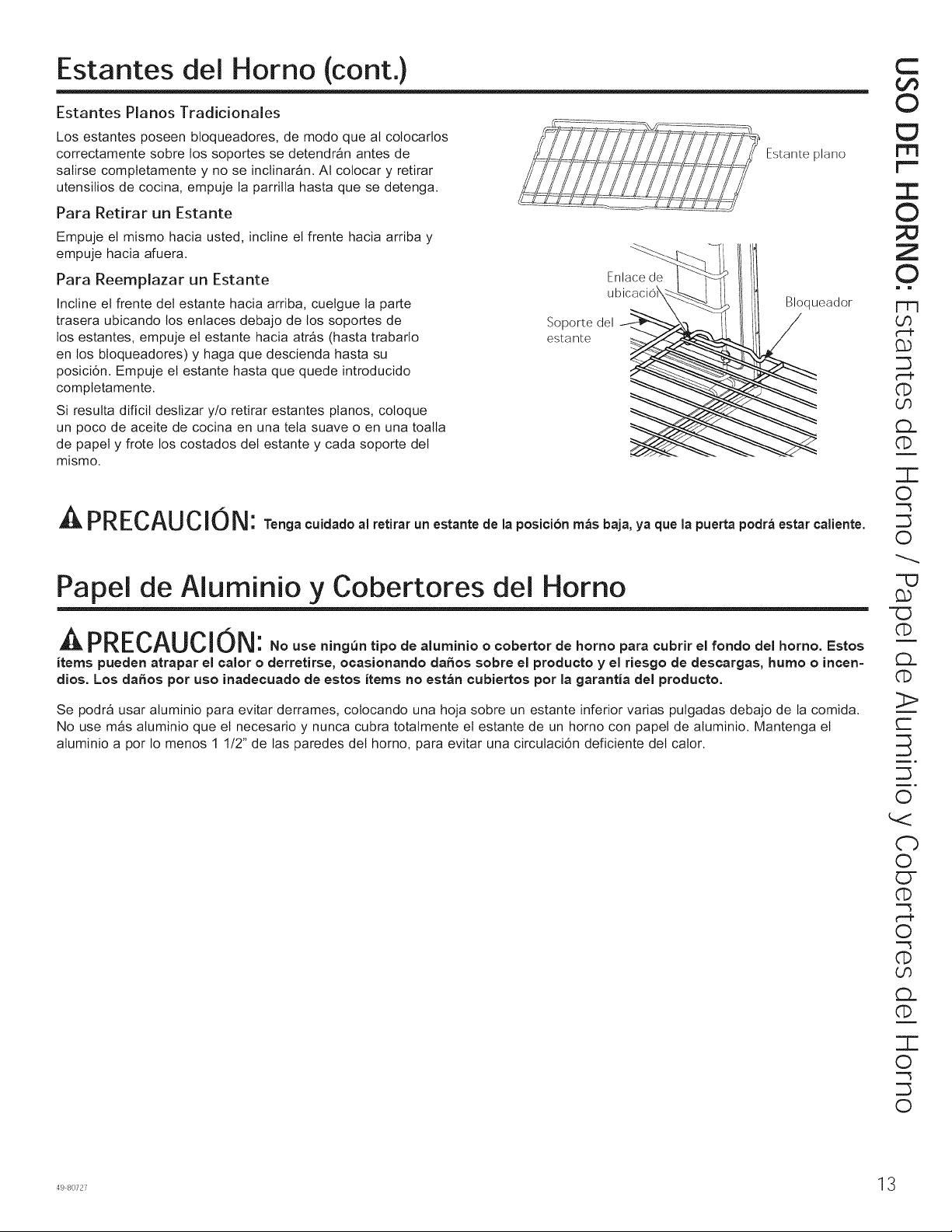
Estantes del Horno (cont.)
Estantes Pianos Tradicionales
Los estantes poseen bloqueadores, de mode que at colocarlos
correctamente sobre los soportes se detendr_n antes de
satirse comptetamente y no se inclinar_n. AI colocar y retirar
utensilios de cocina, empuje la parrilta hasta que se detenga.
Para Retirar un Estante
Estante piano
Empuje el mismo hacia usted, incline el frente hacia arriba y
empuje hacia afuera.
Para Reemplazar un Estante
Incline el frente del estante hacia arriba, cuelgue la parte
trasera ubicando los enlaces debajo de los soportes de
los estantes, empuje el estante hacia atr_s (hasta trabarlo
en los btoqueadores) y haga que descienda hasta su
posici6n. Empuje el estante hasta que quede introducido
comptetamente.
Si resulta dificil destizar y/o retirar estantes ptanos, coloque
un poco de aceite de cocina en una tela suave o en una toalta
de papel y frote los costados del estante y cada soporte del
mismo.
Enlace de
Soporte del
estante
Bloqueador
A PRECAUCION" Too_oo°idodool.ot,.o.uoos,o,,todoloposioioomasbojo,yoquolopuo.opodiaos,o.oo,ooto.
Papel de Aluminio y Cobertores del Homo
^,-,PREt_Al It_l f_RlILI_'_U_ | UI_I : No use ningun tipo de aluminio o ¢obertor de homo para oubrir el rondo del homo. Estos
items pueden atrapar el taler o derretirse, ocasionando daffos sobre el producto y el riesgo de descargas, humo o incen=
dies. Los daffos per use inadecuado de estos items no estan eubiertos per la garantia del producto.
Se podr_ usar aluminio para evitar derrames, colocando una hoja sobre un estante inferior varias pulgadas debajo de la comida.
No use m_s aluminio que el necesario y nunca cubra totalmente el estante de un homo con papel de aluminio. Mantenga el
atuminio a per Io menos 1 1/2" de las paredes del homo, para evitar una circulaci6n deficiente del cater.
C
Or)
O
_D
i'T'I
r'-
-T-
O
Z
O
= =
FTq
GO
r=-P
r'=k
q)
gf)
£)_
q)
i
=T-
O
--'3
O
=!:3
-O
q)
i
£)_
q)
:]>
i
r-
i.
i.
O
C)
O
CT
q)
--'3
r-'P
O
--'3
q)
gf)
£)_
q)
i
=T-
O
--'3
O
(-
'O
(D
L.)
O
L_)
Q
"Z:3
oO
O
O
Z
d
Z
r,/
©
"l-
.,.J
I,LI
tm
©
oO
Modos de CocciOn
Su nuevo homo posee una variedad de modos de cocci6n para que pueda obtener los mejores resultados. Estos modos se describen a
continuaci6n. Para acceder a recomendaciones para comidas especificas, consulte la secci6n de la Guia de Cocci6n. Recuerde que es
posible que su nuevo homo funcione de manera diferente que aquel que esta reemplazando.
Modos de Horneado y Dorado
Seleccione un modo para hornear y dorar basado en el tipo y
cantidad de comida que esta preparando. AI preparar comidas
horneadas tales como tartas, galletas y masas, siempre
precaliente el homo primero. Siga las recomendaciones de la
receta sobre la colocaci6n de la comida. Si no se brindan pautas,
centre la comida en el homo.
Horneado Tradicional
El modo de horneado tradicional esta pensado para la cocci6n en
un solo estante. Este modo usa el calor principalmente desde el
elemento inferior, pero tambien desde el elemento superior para
cocinar la comida. Para usar este modo, presione la tecla Bake
(Hornear) en Traditional (Traditional), ingrese una temperatura,
y luego presione Start (Iniciar). El precalentamiento generalmente
se recomienda al usar este modo.
Horneado por Conveccion con Aire Directo
El modo de horneado pot convecci6n esta pensado para la
cocci6n en un solo estante. Este modo utiliza el calor del elemento
inferior y tambien de los elementos superior y trasero, junto con
el movimiento de aire directamente descendente desde la parte
superior del homo, para que la coccion sea mas pareja. El homo
esta equipado con la funcion Auto Recipe Conversion (Conversion
de Receta Automatica); de modo que no es necesario convertir la
temperatura al usar este modo. Para usar este modo, presione la
tecla Bake (Hornear) en Convection (Convecci6n), ingrese una
temperatura, y luego presione Start (Iniciar). El precalentamiento
generalmente se recomienda al usar este modo.
Honeado pot Conveccion en Estantes ML)ltiples
El modo Convection Bake Multi Rack (Honeado por Convecci6n
en Estantes MQItiples) esta pensado para honear en
mQItiples estantes al mismo tiempo. Este modo utiliza el calor
principalmente desde el elemento trasero, pero tambien calienta
desde los elementos superior e inferior, junto con el movimiento
de aire desde el ventilador por convecci6n para mejorar una
cocci6n pareja. El homo esta equipado con la funci6n Auto Recipe
Conversion (Conversi6n de Receta Automatica); de modo que
no es necesario convertir la temperatura al usar este modo. Es
posible que el tiempo de horneado sea un poco mas prolongado
con estantes mQItiples, en comparaci6n con Io que se espera con
un solo estante. Para usar este modo, presione la tecla Bake
Multi Rack (Horneado en Estantes MUltiples) en Convection
(Convecci6n), ingrese una temperatura, y luego presione Start
(Iniciar). Siempre realice el precalentamiento al usar este modo.
Dorado por Conveccion con Aire Directo
El modo Convection Roast (Dorado pot Conveccidn) esta pensado
para dorar cortes enteros de came en un solo estante. Este
modo utiliza el calor de los elementos inferior, superior y trasero,
junto con el movimiento del aire directamente desde la parte
superior del homo, a fin de mejorar el dorado y reducir el tiempo
de cocci6n. No es necesario convertir la temperatura. Cuando
use este modo, o si usa la sonda, controle la comida antes que
el tiempo sugerido en la receta. Para usar este modo, presione la
tecla Roast (Dorar) en Convection (Convecci6n), ingrese una
temperatura, y luego presione Start (Iniciar). No es necesario
realizar el precalentamiento al usar este modo.
Modo para Asar
Siempre ase con la puerta cerrada. El elemento para asar en
el homo es muy potente. Monitoree la comida de cerca al asar.
Tenga cuidado al asar en posiciones de estantes superiores,
ya que colocar la comida mas cerca del elemento para asar
incrementa el humo, salpicaduras y la posibilidad de que se
incendien las grasas. No se recomienda asar en el estante de la
posici6n 6.
Intente asar las comidas que normalmente haria a la parrilla.
Ajuste las posiciones de los estantes para ajustar la intensidad del
calor a la comida. Coloque las comidas mas cerca del elemento
para asar, cuando se desee una superficie mas cocinada y un
interior poco cocido. Las comidas mas gruesas y las comidas cuyo
interior debe ser cocinado deberian ser asadas en un estante en
una posicidn alejada del usado para asar, o usando las funciones
Tradicional Broil Lo (Asado Tradicional Bajo) o Convection Broil Lo
(Asado pot Convecci6n Bajo). Para un mejor rendimiento, centre la
comida debajo del elemento calentador para asar.
Asado Tradicional Alto
El modo Traditional Broil Hi (Asado Tradicional Alto) usa calor
intenso del elemento superior para soasar las comidas. Use la
funci6n Broil Hi (Asado Alto) para cortes mas delgados de came
y/o comidas que prefiera que quedan menos cocinadas en su
interior. Para usar este modo, presione la tecla Broil (Asar) una
vez en Traditional (Traditional) y luego presione Start (Iniciar).
No es necesario realizar el precalentamiento al usar este modo.
Asado Tradicional Bajo
El modo Traditional Broil Lo (Asado Tradicional Bajo) usa menos
calor intenso del elemento superior para cocinar la comida
completamente mientras tambien se realiza el dorado superficial.
Use la funci6n Broil Lo (Asado Bajo) para cortes de came mas
gruesos y/o comidas que desee que queden completamente
cocinadas. Para usar este modo, presione la tecla Broil (Asar) dos
veces en Traditional (Traditional) y luego presione Start (Iniciar).
No es necesario realizar el precalentamiento al usar este modo.
Asado pot Conveccion Alto con Aire Directo
El mode Convection Broil Hi (Asado por Conveccidn Alto) usa
calor intenso desde el elemento superior, junto con el movimiento
del aire directamente desde la parte superior del homo para
mejorar la coccion y el dorado. Para usar este modo, presione
la tecla Broil (Asar) una vez en Convection (Convecci6n) y
luego presione Start (Iniciar). Para obtener mejores resultados,
precaliente durante 5 minutos al usar este modo.
Asado por Conveccion Bajo con Aire Directo
El modo Convection Broil Lo (Asado pot Conveccidn Bajo) usa
calor menos intenso desde el elemento superior, junto con el
movimiento del aire directamente desde la parte superior del
horno. Para usar este modo, presione la tecla Broil (Asar) dos
veces en Convection (Convecci6n) y luego presione Start
(Iniciar). Para obtener mejores resultados, precaliente durante 5
minutos al usar este modo.
Asado por Conveccion Crocante con Aire Directo
El modo Convection Broil Crisp (Asado por Convecci6n Crocante)
esta pensado como un modo de acabado al final del ciclo de
coccion, para agregar dorado superficial a un plato tal como una
cazuela o una barbacoa. Para usar este modo, presione la tecla
Broil (Asar) tres veces en Convection (Convecci6n) y luego
presione Start (Iniciar). Monitoree la comida de cerca para evitar
un dorado excesivo.
4 49 80727
Modos de CocciOn (Cont.)
Leudar
El modo Proof (Leudar) esta disefiado para elevar (fermentar y
leudar) masas de pan. Presione la tecla Proof (Leudar) y luego
presione Start (Iniciar). Cubra bien la masa para evitar que se
seque. El pan se elevara mas rapidamente que a temperatura
ambiente.
Calentar
El modo Warm (Calentar) esta disefiado para mantener comidas
calientes hasta durante 3 horas. Para usar este modo, presione la
tecla Warm (Caliente) y luego presione Start (Iniciar). Cubra las
comidas que necesitan mantener la humedad y no cubra aquellas
comidas que deberian quedar crocantes. No se requiere precalentar
las mismas. No use la funci6n Warm (Calentar) para calentar
comida fria, except© galletas crujientes, papas fritas o cereales
secos. Tambi6n se recomienda que la comida no se mantenga
caliente por mas de dos horas.
Sonda
La temperatura interna de la comida con frecuencia se usa corn©
indicador de que esta list& especialmente al dorar o preparar
came de ave. El modo Probe (Sonda) monitorea la temperatura
interna de la comida y apaga el homo cuando esta Oltima alcanza
la temperatura programada. Puede encontrar informaci6n sobre
las temperaturas minimas para una cocci6n segura en www.
IsltDoneYet.gov. La sonda de temperatura s61o puede ser usada
en los modos Tradicional Bake (Horneado Tradicional), Convection
Bake (Homeado por Convecci6n), y Convection Roast (Dorado por
Convecci6n).
Para usar la sonda con precalentamiento:
1. Presione la tecla del modo de cocci6n deseado (Horneado
Traditional, Horneado pot Convecci6n, o Dorado pot
Convecci6n) e ingrese la temperatura de cocci6n deseada.
2. lnserte la sonda en la comida (consulte las Pautas de
Ubicacion de la Sonda Apropiada en esta secci6n).
3. Una vez que el homo fue precalentado, coloque la comida
en el mismo y conecte la sonda en su correspondiente
tomacorriente, asegurandose de que est6 completamente
insertada. Tenga cuidado, ya que las paredes del homo y el
tomacorriente de la sonda estan calientes.
4. Programe la temperatura de la sonda presionando la tecla
Probe (Sonda) e ingresando la temperatura deseada para la
comida. La temperatura interna maxima de la comida que se
puede configurar es 200 ° F.
Para usar la sonda sin precalentamiento:
1. lnserte la sonda en la comida (consulte las Pautas de
Ubicaci6n de la Sonda Apropiada en esta secci6n).
2. Coloque la comida en el homo y conecte la sonda en su
correspondiente tomacorriente en el homo.
3.
Programe la configuracion deseada para la sonda y el modo
de cocci6n, presionando la tecla Probe (Sonda) e ingresando
la temperatura deseada para la comida, luego presione la
tecla de modo de cocci6n (Horneado Tradicional, Horneado
pot Convecci6n, o Dorado pot Convecci6n) e ingrese la
temperatura de cocci6n deseada.
Pautas para una Ubicacion Adecuada de la Sonda
Luego de preparar la comida y de col©carla en la olla de cocci6n,
siga estas pautas para una ubicaci6n adecuada de la sonda.
g Inserte la sonda completamente en la came, hasta apoyarse
en la manija, de modo que el punt© de la sonda descanse en
el centro de la parte mas gruesa de la comida.
[] No deberia tocar el hues©, la grasa ni el cartilago.
[] Para cocinar un ave entera, inserte la sonda en la parte mas
gruesa de la pechuga.
[] Para dorar sin hues©s, inserte la sonda en el centro del
dorado.
[] Para cocinar jam6n o corder© con hues©s, inserte la sonda en
el centro de la articulaci6n o del mQsculo mas bajo y largo.
[] Para preparar cazuelas o platos tales como pastel de came,
inserte la sonda en el centro del plato.
[] Para cocinar pescado, inserte la sonda just© arriba de la agalla
en la zona mas carnosa paralela a column&
Controle la temperatura en otras ubicaciones de la comida con un
term6metro de comidas, una vez que se Ilegue a la temperatura de
la sonda, a fin de asegurar que todas las porciones de la comida
hayan alcanzado las temperaturas deseadas.
Pautas para el Cuidado de la Sonda
Nota: algunos modelos con homo doble cuentan con una sonda
solo en el homo superior
[] Si se usa una sonda que no sea la provista con este product©,
se podran producir dafios sobre la sonda.
[] Use las manijas de la sonda al enchufar y desenchufar la
misma, luego de insertar o de retirar la sonda de la came o del
tomacorriente.
[] Para evitar dafios sobre la sonda, no use agarraderas para
empujar el cable al retirarlo.
[] Para evitar romper la sonda, asegOrese de que la comida haya
sido completamente descongelada antes de insertarla.
[] Para evitar posibles quemaduras, no desenchufe la sonda
del tomacorriente del homo hasta que este QItimo se haya
enfriado.
[] Nunca deje la sonda dentro del homo durante un ciclo de
limpieza automatica o de limpieza con vapor.
[] No guarde la sonda dentro del horn©.
Utensilios
C
©
"-1--
©
Z
©
= m
Z
O
Cz
O
gh
Cz
(!)
Cb
O
db
C)
5,
r-€
(!)
gh
O
gh
Pautas de Us© de Utensilios
El material, el acabado y el tamafio de los utensilios afectan el
horneado.
Las ollas oscuras, revestidas y opacas absorben el calor mas
rapidamente que las ollas claras y brillantes. AI usar ollas que
absorben el calor mas rapidamente, las comidas podran resultar
mas doradas, crocantes y con una capa mas gruesa.
Si utiliza utensilios oscuros y revestidos, controle la comida antes
del tiempo minim© de cocci6n. Si se obtienen resultados no
deseados con este tip© de utensilios, considere la posibilidad de
reducir la temperatura del homo en 25 ° F la proxima vez.
Las ollas brillantes pueden producir resultados de horneado mas
parejos en tortas y galletas.
49 80727
Las ollas de vidrio y ceramica calientan con lentitud, per© retienen
bien el calor.
Estos tipos de ollas funcionan bien con platos tales como tartas y
postres con natilla.
Las ollas con aislante de aire calientan lentamente y pueden
producir fondos dorados.
Mantenga los utensilios limpios para una cocci6n mas pareja.
15
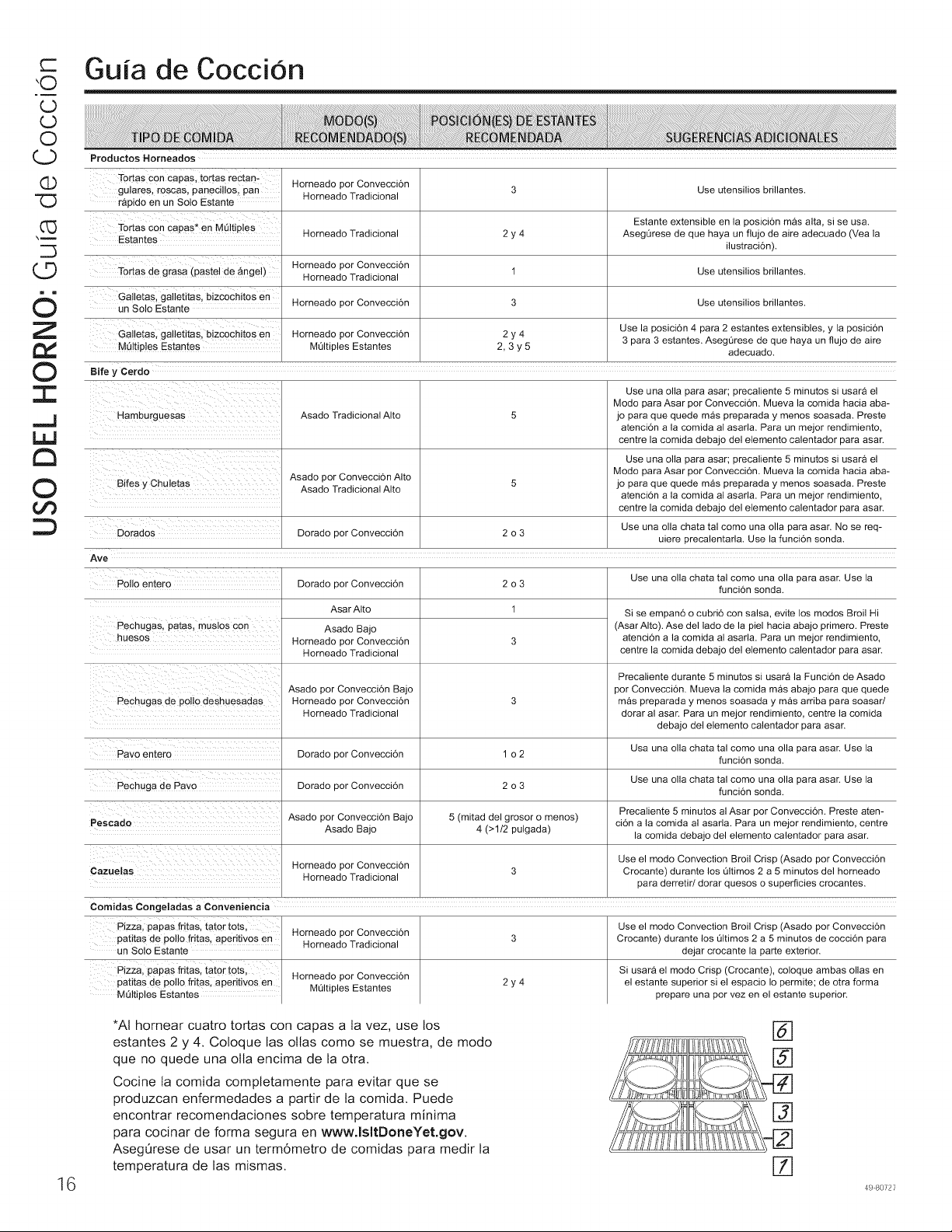
r-
'O
C)
C)
O
O
(1)
_u
O
d
Z
r,/
©
-r"
....J
U.J
tm
©
oO
16
Guia de Cocci6n
Productos Horneados
Tortas con capas, tortas rectan-
gulares, roscas, panecillos, pan
rapido en un Solo Estante
Tortas con capas* en MQItiples
Estantes
Tortas de grasa (pastel de &ngel)
Galletas, galletitas, bizcochitos en
un Solo Estante
Galletas, galletitas, bizcochitos en
MQItiples Estantes
Horneado per Convecci6n
Horneado Tradicional
Horneado Tradicional
3or Convecci6n
Horneado Tradicional
Horneado por Convecci6n
Horneado per Convecci6n
MQItiples Estantes
2y4
1
3
2y4
2,3y5
Bife y Cerdo
Bifes y Chuletas
Dorados
Asado Tradicional Alto
Asado per Convecci6n Alto
Asado Tradicional Alto
Dorado por Convecci6n
203
Ave
Polio entero Dorado por Convecci6n
Asar Alto
Pechugas, patas, muslos con Asado Bajo
huesos Horneado per Convecci6n
Horneado Tradicional
Asado per Convecci6n Bajo
Pechugas de polio deshuesadas Horneado per Convecci6n
Horneado Tradicional
Pavo entero Dorado por Conveccion
Pechuga de Pavo Dorado por Conveccion
Peacado Asado por Convecci6n Bajo
Asado Bajo
Horneado per Conveccion
Cazuelaa
Horneado Tradicional
2o3
1
3
Use utensilios brillantes.
Comidas Congeladas a ¢onveniencia
Pizza. papas fritas, tator tots,
patitas de polio fritas, aperitivos en
un Solo Estante
Pizza, papas fritas, tator tots,
patitas de polio fritas, aperitivos en
Mt_ltiples Estantes
Horneado por Convecci6n
Horneado Tradicional
Horneado per Convecci6n
MQItiplesEstantes
Estante extensible en la posici6n mas alta, si se usa.
Asegurese de que haya un fiujo de aire adecuado (Vea la
ilustraci6n).
*At homear cuatro tortas con capas a ta vez, use los
estantes 2 y 4. Coloque las ollas como se muestra, de modo
que no quede una olla encima de la otra.
Cocine ta comida completamente para evitar que se
produzcan enfermedades a partir de la comida. Puede
encontrar recomendaciones sobre temperatura minima
para cocinar de forma segura en www.lsltDoneYet.gov.
AsegOrese de usar un term6metro de comidas para medir la
temperatura de las mismas.
Use utensilios brillantes.
Use utensilios brillantes.
Use la posici6n 4 para 2 estantes extensibles, y la posici6n
3 para 3 estantes. Asegt]rese de que haya un flujo de aire
adecuado.
Use una ella para asar; precaliente 5 minutes si usara el
Mode para Asar per Convecci6n. Mueva la comida hacia aba-
jo para que quede mas preparada y menos soasada. Preste
atenci6n a la comida al asarla. Para un mejor rendimiento,
centre la comida debajo del elemento calentador para asar.
Use una ella para asar; precaliente 5 minutes si usara el
Mode para Asar per Convecci6n. Mueva la comida hacia aba-
jo para que quede mas preparada y menos soasada. Preste
atenci6n a la comida al asarla. Para un mejor rendimiento,
centre la comida debajo del elemento calentador para asar.
Use una ella chata tal come una ella para asar. No se req-
uiere precalentarla. Use la funci6n sonda.
Use una olla chata tal como una olla para asar. Use la
funci6n sonda.
Si se empan6 o cubri6 con salsa, evite los modes Broil Hi
(Asar Alto). Ase del lade de la piel hacia abajo primero. Preste
atenci6n a la comida al asarla. Para un mejor rendimiento,
centre la comida debajo del elemento calentador para asar.
Precaliente durante 5 minutes si usara la Funci6n de Asado
per Convecci6n. Mueva la comida mas abajo para que quede
mas preparada y menos soasada y mas arriba para soasar/
dorar al asar. Para un mejor rendimiento, centre la comida
debajo del elemento calentador para asar.
1 o 2 Usa una olla chata tal como una olla para asar. Use la
funci6n sonda.
2 o 3 Use una olla chata tal como una ella para asar. Use la
funci6n sonda.
5 (mitad del grosor o menos) Precaliente 5 minutes al Asar per Convecci6n. Preste aten-
ci6n a la comida al asarla. Para un mejor rendimiento, centre
4 (>1/2 pulgada) la comida debajo del elemento calentador para asar.
Use el mode Convection Broil Crisp (Asado per Convecci6n
3 Crocante) durante los Oltimos 2 a 5 minutes del horneado
para derretir/dorar quesos o superficies crocantes.
2y4
Use el mode Convection Broil Crisp (Asado per Convecci6n
Crocante) durante los t]ltimos 2 a 5 minutos de cocci6n para
dejar crocante la parte exterior.
Si usara el mode Crisp (Crocante), coloque ambas elias en
el estante superior si el espacio Io permite; de otra forma
prepare una por vez en el estante superior.
%
49 80727
Limpieza del Horno
AsegQrese de que la corriente el6ctrica est6 apagada y que todas las superficies est6n frias antes de limpiar cualquier parte del homo.
Panel de Control
Una buena idea es limpiar el panel de control luego de cada
uso. Limpie con un jab6n suave y agua o vinagre y agua,
enjuague con agua limpia y pula en seco con una tela suave.
No use limpiadores abrasivos, limpiadores tiquidos fuertes,
almohadiltas para fregar de pt_stico ni limpiadores de homo en
el panel de control; daffar_n el acabado.
Exterior del Homo
No use limpiadores de homo, limpiadores abrasivos,
limpiadores liquidos fuertes, estropajos de acero, almohadillas
para fregar de pl_stico, ni polvos limpiadores en el interior
o el exterior del horno. Limpie el mismo con agua y jab6n o
una soluci6n de vinagre y agua. Enjuague con agua timpia y
seque con una tela seca. AI limpiar supeficies, asegQrese de
que est6n a temperatura ambiente y fuera del contacto con
la tuz solar. Si tas manchas en el borde de la ventana de la
puerta son persistentes, use un limpiador abrasivo suave o
una esponja con estropajo para obtener un mejor resultado. Et
derrame de adobo, jugos de fruta, salsas de tomate y liquidos
para humedecer que contengan _cidos pueden ocasionar
descoloraci6n y se deber_n limpiar de inmediato. Deje que las
superficies catientes se enfrien, y luego limpie y enjuague.
Superficies de Acero Inoxidable (en algunos modelos)
No use virutas de acero; 6stas dafiar_n la superficie. Para
limpiar [a superficie de acero inoxidable, use agua tibia
con jab6n o un limpiador o pulictor para acero inoxictable.
Siempre limpie la superficie en la direcci6n ctelveteado. Siga
las instrucciones clel limpiador para limpiar la superficie de
acero inoxidabte. Para reatizar consultas sobre la adquisici6n
de productos, incluyendo limpiadores o pulidores para
electrodom6sticos de acero inoxidable, lea las secciones de
Asistencia y Accesorios, en el comienzo de este manual.
d3
C
m
>
0
,.<
t'-
r't3
Interior del Horno
El interior de su nuevo horno puede ser limpiado de forma
manual o utilizando los modos Steam Clean (Limpieza con
Vapor) o Self Clean (Limpieza Autom_tica).
El derrame de adobo, jugos de fruta, salsas de tomate y
liquidos para humedecer que contengan _cidos pueden
ocasionar descoloraci6n y se deber_n limpiar de inmediato.
Espere a que las superficies catientes se enfrien, y luego
limpie y enjuague.
Limpieza Manual
No use limpiadores de homo, limpiadores abrasivos,
limpiadores liquidos fuertes, estropajos de acero, atmohadiltas
para fregar, ni potvos limpiadores en el interior det horno.
Limpie el mismo con agua y jab6n o una soluci6n de vinagre
y agua. Enjuague con agua limpia y seque con una tela seca.
AI limpiar supeficies, asegQrese de que est6n a temperatura
ambiente y fuera del contacto con la luz solar.
Modo de Limpieza con Vapor
La limpieza con vapor est_ pensada para limpiar pequeffos
derrames usando agua y a una temperatura de timpieza m_s
baja que la funci6n Self-Clean (Limpieza Autom_tica).
Para usar la funci6n Steam Clean (Limpieza con Vapor), limpie
las grasas y suciedades del homo. Vierta una taza de agua en
la parte inferior del horno. Cierre la puerta. Presione ta tecla
Steam Clean (Limpieza con Vapor) y tuego presione Start
(Iniciar). La puerta del homo se trabar& No podr_ abrir la
puerta durante los 30 minutos de la limpieza con vapor, ya que
esto reducir_ su rendimiento. AI finatizar el ciclo de timpieza
al vapor, la puerta se destrabar& Limpie cualquier exceso de
agua y cuatquier suciedad que haya quedado.
Modo de Limpieza Automatica
Lea las Instrucciones de Seguridad del Homo con Limpieza
Autom_tica, en el comienzo de este manual antes de usar
el modo Self Clean (Limpieza Autom_tica). Este modo usa
temperaturas muy altas para [impiar el interior del horno.
Cuando use esta funcidn, la puerta del homo se trabar& Antes
de utilizar el ciclo de limpieza autom_tica, limpie la grasa
y restos de comida que haya en el horno. Retire todos los
articulos del homo, excepto los estantes esmaltados (color
oscuro). Los estantes brillantes ode plata, la sonda de carnes,
y cualquier utensilio u otros articulos deberian ser retirados del
horno antes de iniciar un ciclo de limpieza autom_tica. Cierre
la puerta. Presione la tecla Self Clean (Limpieza Automatica)
y se exhibir_ un tiempo de limpieza autom_tica por omisi6n.
El tiempo de limpieza puede ser modificado en cuatquier
momento entre las 3:00 y las 5:00 horas, usando tas teclas
num6ricas para ingresar un tiempo diferente y presionando
Start (Iniciar). Si desea usar el tiempo por omisi6n, presione
la tecla Start (Iniciar) inmediatamente luego de presionar la
tecla Self Clean (Limpieza Automatica) El homo se apagar_
de forma autom_tica cuando el ciclo de limpieza autom_tica
sea completado. La puerta permanecer_ bloqueada hasta
que el homo se haya enfriado. Una vez que et homo se haya
enfriado, limpie cuatquier ceniza que haya quedado en el
homo.
IMPORTANTE: Las emanaciones producidas por el ciclo
de autolimpieza de cualquier homo afectan la salud de
algunas aves de manera notoria. Procure Ilevar sus aves
a otra habitaci6n bien ventilada.
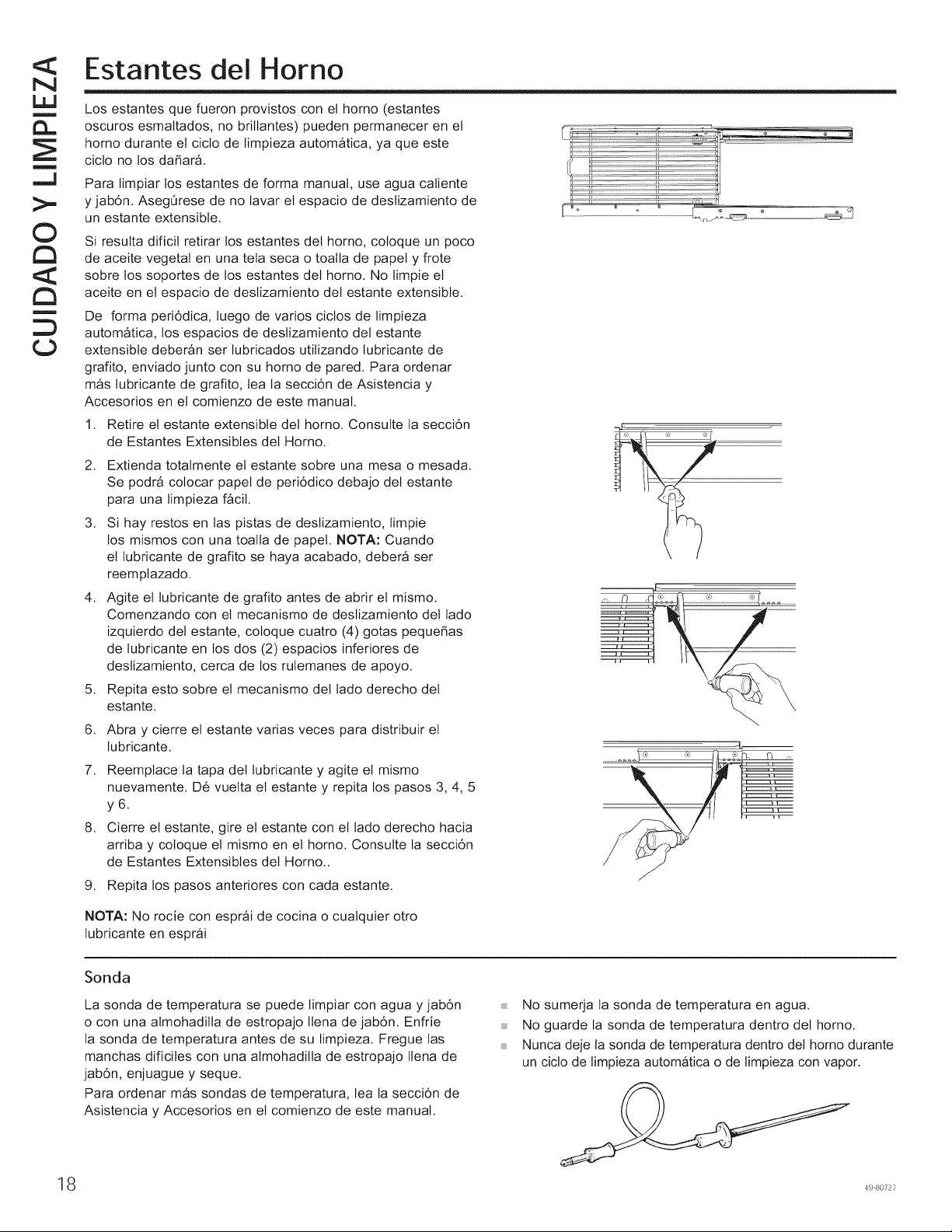
N
ill
m
m
©
tm
tm
m
r,D
Estantes del Horno
Los estantes que fueron provistos con el homo (estantes
oscuros esmaltados, no briltantes) pueden permanecer en el
homo durante et ciclo de limpieza autom_tica, ya que este
ciclo no los dadar_.
Para limpiar los estantes de forma manual, use agua catiente
y jab6n. AsegOrese de no lavar el espacio de deslizamiento de
un estante extensible.
Si resulta dificil retirar los estantes del homo, cotoque un poco
de aceite vegetal en una tela seca o toalla de papel y frote
sobre los soportes de los estantes del horno. No timpie el
aceite en el espacio de destizamiento del estante extensibte.
De forma peri6dica, luego de varios ciclos de limpieza
autom_tica, los espacios de deslizamiento del estante
extensibte deber_n ser lubricados utilizando lubricante de
grafito, enviado junto con su homo de pared. Para ordenar
m_s lubricante de grafito, lea la secci6n de Asistencia y
Accesorios en el comienzo de este manual.
1. Retire el estante extensibte del horno. Consulte la secci6n
de Estantes Extensibtes del Homo.
2. Extienda totalmente el estante sobre una mesa o mesada.
Se podr_ colocar papel de peri6dico debajo del estante
para una limpieza f_cil.
3. Si hay restos en las pistas de deslizamiento, limpie
los mismos con una toatla de papel. NOTA: Cuando
el tubricante de grafito se haya acabado, deber_ ser
reemptazado.
4. Agite el tubricante de grafito antes de abrir et mismo.
Comenzando con el mecanismo de deslizamiento del lado
izquierdo del estante, coloque cuatro (4) gotas pequefias
de lubricante en los dos (2) espacios inferiores de
destizamiento, cerca de los rulemanes de apoyo.
5. Repita esto sobre el mecanismo del lado derecho del
estante.
6. Abra y cierre el estante varias veces para distribuir el
lubricante.
7. Reemplace la tapa del lubricante y agite el mismo
nuevamente. D6 vuelta el estante y repita los pasos 3, 4, 5
y6.
8. Cierre el estante, gire el estante con el lado derecho hacia
arriba y cotoque el mismo en el homo. Consulte la secci6n
de Estantes Extensibles del Homo..
9. Repita los pasos anteriores con cada estante.
NOTA: No rocie con espr_i de cocina o cuatquier otro
lubricante en espr_i
Sonda
La sonda de temperatura se puede limpiar con agua y jab6n
o con una almohadilla de estropajo Ilena de jab6n. Enfrie
la sonda de temperatura antes de su limpieza. Fregue las
manchas dificiles con una almohadilla de estropajo Ilena de
jab6n, enjuague y seque.
Para ordenar m_s sondas de temperatura, lea la secci6n de
Asistencia y Accesorios en el comienzo de este manual.
iilii_
iilii_
iiiiiiii
No sumerja la sonda de temperatura en agua.
No guarde la sonda de temperatura dentro del horno.
Nunca deje la sonda de temperatura dentro del horno durante
un ciclo de limpieza automatica o de limpieza con vapor.
18 49 80727
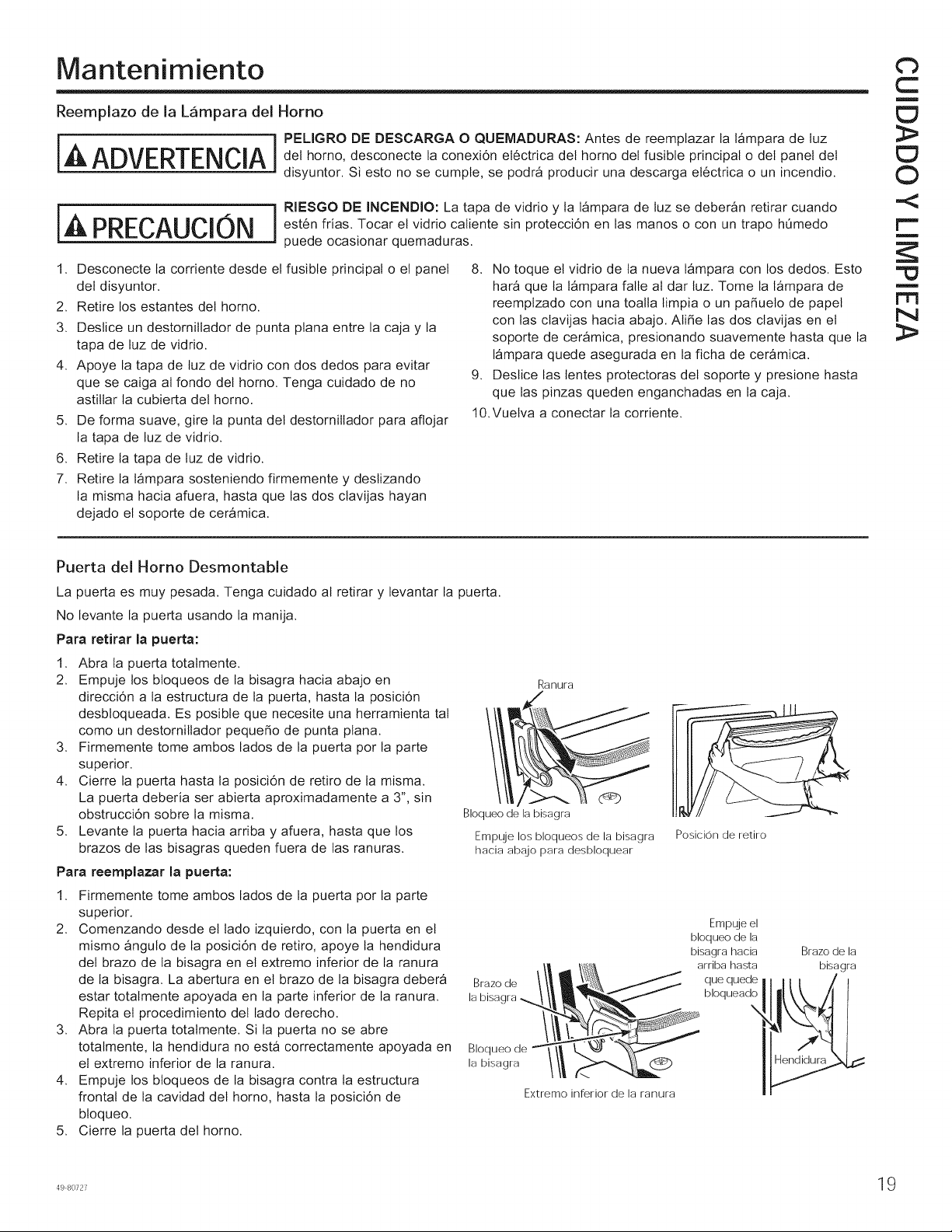
Mantenimiento
Reemplazo de la Lampara del Homo
iA ADVERTENCIAi "EL'G"ooEOESO'"G"OOOE"'O0'':Antesreemp'azar'a"mpara'uz
del homo, desconecte la conexi6n el6ctrica del homo del fusible principal o del panel del
disyuntor. Si esto no se cumple, se podr_ producir una descarga el6ctrica o un incendio.
IAJ--PRECAUCl0NJ]RIESGO DE INCENDIO: La tapa de vidrio y la I_mpara de luz se deber_n retirar cuando
est6n frias. Tocar el vidrio caliente sin protecci6n en las manos o con un trapo hOmedo
puede ocasionar quemaduras.
1. Desconecte la corriente desde el fusible principal o el panel
del disyuntor.
2. Retire los estantes del homo.
3. Deslice un destornitlador de punta ptana entre la caja y la
tapa de luz de vidrio.
4. Apoye la tapa de luz de vidrio con dos dedos para evitar
que se caiga al fondo del homo. Tenga cuidado de no
astillar la cubierta del homo.
5. De forma suave, gire la punta del destornillador para aflojar
la tapa de luz de vidrio.
6. Retire la tapa de luz de vidrio.
7. Retire la I_mpara sosteniendo firmemente y deslizando
la misma hacia afuera, hasta que las dos clavijas hayan
dejado el soporte de cer_mica.
8. No toque el vidrio de la nueva I_mpara con los dedos. Esto
har_ que la l_mpara fatle al dar tuz. Tome la I_mpara de
reemptzado con una toatta limpia o un pafiuelo de papel
con las clavijas hacia abajo. Alifie las dos clavijas en el
soporte de cer_mica, presionando suavemente hasta que la
I_mpara quede asegurada en la ficha de cer_mica.
9. Deslice las lentes protectoras del soporte y presione hasta
que las pinzas queden enganchadas en la caja.
10. Vuelva a conectar la corriente.
db
C
m
>
0
..<
rm
N
>
Puerta del Homo Desmontable
La puerta es muy pesada. Tenga cuidado at retirar y levantar la puerta.
No levante la puerta usando la manija.
Para retirar la puerta:
1. Abra la puerta totatmente.
2. Empuje los bloqueos de la bisagra hacia abajo en
direcci6n a la estructura de la puerta, hasta la posici6n
desbloqueada. Es posibte que necesite una herramienta tat
como un destorniltador pequefio de punta ptana.
3. Firmemente tome ambos lados de la puerta por la parte
superior.
4. Cierre la puerta hasta la posici6n de retiro de la misma.
La puerta deberia ser abierta aproximadamente a 3", sin
obstrucci6n sobre la misma.
5. Levante la puerta hacia arriba y afuera, hasta que los
brazos de las bisagras queden fuera de las ranuras.
Para reemplazar la puerta:
1. Firmemente tome ambos lados de la puerta por la parte
superior.
2. Comenzando desde el lado izquierdo, con la puerta en el
mismo _ngulo de la posici6n de retiro, apoye la hendidura
del brazo de la bisagra en el extremo inferior de la ranura
de la bisagra. La abertura en el brazo de la bisagra deber_ Brazode
estar totalmente apoyada en la parte inferior de la ranura, labisagra
Repita et procedimiento del lado derecho.
3. Abra ta puerta totatmente. Si la puerta no se abre
totalmente, la hendidura no est_ correctamente apoyada en
el extremo inferior de la ranura.
4. Empuje los btoqueos de la bisagra contra la estructura
frontal de la cavidad del homo, hasta la posici6n de
btoqueo.
5. Cierre la puerta del homo.
Ranura
d©
Bloqueo de la bisagra
EmpL_je los bloqueos de la bisagra
hacia abajo para desbloquear
Bloqueo de
la bisagra
Extremo inferior de la ranura
Posicion de retiro
Empuje el
bloqueo de la
bisagra hacia
arriba basra
que quede
bloqueado
Brazo de la
bisagra
49 80727 19

Notas
20 49 80727

Notas
oO
l,i
...J
O
tY
LI,J
tm
z
'O
m
¢D
_.J
O
oO
.,,J
tY
¢/3
O
"3
i,!
¢/3
Z
O
r,D
Consejos para la SoluciOn de Problemas... Antes de solicitar el servicio tecnico
iAhorre tiempo y dinero! Primero revise los cuadros que aparecen en las siguientes paginas / es posible que no necesite
solicitar reparaciones,
Qu_ Hacer
Mi homo nuevo nO
cocina como el anterior.
_Hay alg_n problema con
las configuraciones de
temperatura?
La comida no se hornea
de forma apropiada
La comida no asa de
forma apropiada
Causa Posible
Su homo nuevo cuenta con un sistema de cocci6n
diferente con relaci6n al anterior y, por lo tanto, es
posible que cocine de forma diferente.
Controles del homo conflgurados de forma
La posici6n del estante es incorrecta o el estante
no est_ nivelado.
Uso de una cacerola incorrecta o de una cacerola
de tamaSo incorrecto.
La temperatura del homo debe ser ajustada.
Sustituci6n de ingredientes
Controles del homo configurados de forma
incorrecta.
Se us6 una posici6n incorrecta del estante.
Se cocin6 comida en una olla caliente.
Utensilio de cocina inadecuado para asar.
El papel de aluminio usado para la olla y la rejilla
para asar no se ajust6 ni cort6 de forma apropiada,
segQn 1o recomendado.
En los primeros usos, use los tiempos y
temperaturas de su receta con cuidado. Si at_n
piensa que su homo nuevo cocina con demasiado
calor o demasiado fr{o, podr_ ajustar el termostato
usted mismo para aplicar su preferencia de
cocci6n especlfica. NOTA: Este ajuste afecta
las temperaturas de los modos Traditional Bake
(Horneado Tradicional), Convection Bake (Hornear
por Convecci6n) y Convection Bake Multi (Horneado
por Convecci6n M_ltiple); 6ste no afectar_ los
modos Convection Roast (Dorar por Convecci6n),
Traditional Broil (Asado Tradicional), Convection
Broil (Asar por Convecci6n) o Clean (Limpiar).
Consulte la secci6n Modos de Cocci6n.
SeConsulte la secci6n Modos de Cocci6n y la Guia
de Cocci6n.
Consulte la secci6n Utensilios.
Consulte la secci6n Funciones Especiales.
Sustituir ingredientes puede modificar el resultado de
la receta.
AsegOrese de seleccionar el modo correcto para
asar. NOTA: El modo para cocci6n crocante por
convecci6n no es para asar comidas.
Para acceder asugerencias de ubicaci6n de
estantes, consulte la Guia de Cocci6n.
AsegOrese de que el utensilio est6 frio
Use una olla espedficamente diseSada para asar
Si usar_ papel de aluminio, deber_ usarse conforme
con las aberturas de la olla.
En algunas &reas, es posibie que el nivel de Precaliente el elemento para asar durante 10
corriente (voltaje) sea bajo. minutos.
La temperatura del homo La temperatura del homo debe ser ajustada. Consulte la secci6n Funciones Especiales.
es demasiado caliente o
demasiado fria
El homo no funciona o Es posible que un fusible de su hogar se haya Reemplace el fusible o reinicie el disyuntor.
quemado o que el disyuntor se haya desconectado.
Controles del homo configurados de forma Consulte la secci6n Uso del Homo.
incorrecta.
El homo se encuentra en Sabbath Mode (Modo Verifique que el homo no est6 en Sabbath Mode
Sab&tico) (Modo Sabatico). Consulte la secci6n Funciones
Especiales.
Sonido de "chisporroteo" Esto es normal.
o "traqueo"
Esto es normal.
_Por qu_ la estufa hace
un sonido de "clic"
cuando uso el homo?
El reloj y el temporizador Reemplace el fusible o reinicie el disyuntor.
no funcionan
teste es el sonido de metal calent&ndose o
enfri&ndose durante las funciones de cocci6n y
limpieza..
Su estufa fue diseSada para mantener un control
m&s ajustado sobre la temperatura del horno.
Es posible que escuche que los elementos de
calentamiento del homo hagan sonidos de "clic"
con mayor frecuencia que con hornos m&s
antiguos para lograr mejores resultados durante
los ciclos de horneado, asado, convecci6n y
limpieza autom&tica.
Es posible que un fusible de su hogar se haya
quemado o que el disyuntor se haya desconectado.
2 49 80727
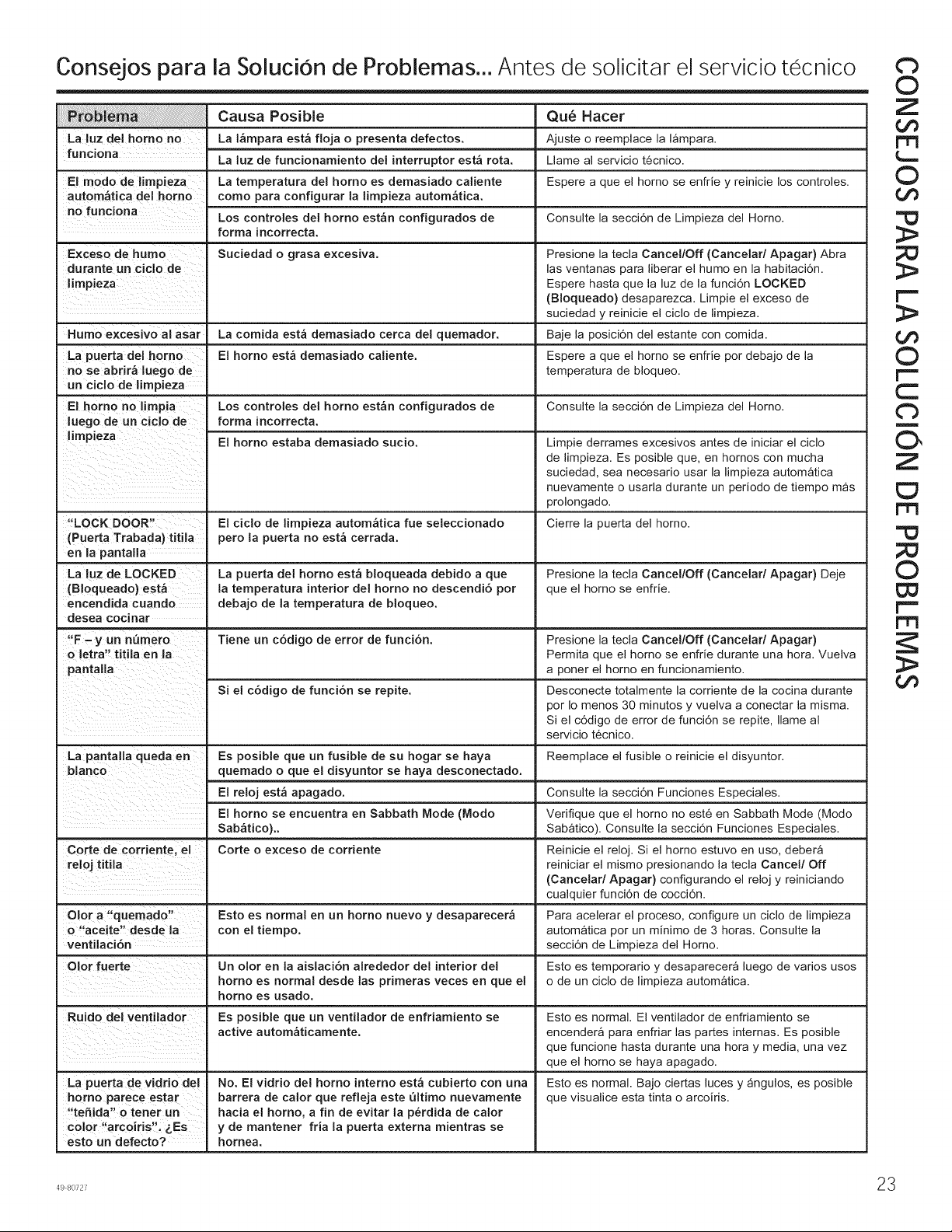
Consejos para la SoluciOn de Problemas... Antes de solicitar el servicio tecnico
Causa Posible Qu_ Hacer
La luz del homo no La l&mpara est& floja o presenta defectos. Ajuste o reemplace la lampara.
funciona
La luz de funcionamiento del interruptor est& rota. Llame al servicio tecnico.
El rood© de limpieza La temperatura del homo es demasiado caliente Espere a que el homo se enfrie y reinicie los controles.
autom_tica del homo corn© para configurar la limpieza autom&tica.
no funciona
Los controles del homo est&n configurados de Consulte la secci6n de Limpieza del Homo.
forma incorrecta.
E×ceso de hum© Suciedad o grasa excesiva. Presione la tecla Cancel/Off (Cancelar/Apagar) Abra
durante un ciclo de las ventanas para liberar el hum© en la habitaci6n.
Espere hasta que la luz de la funci6n LOCKED
(Bloqueado) desaparezca. Limpie el exceso de
suciedad y reinicie el ciclo de limpieza.
Hum© excesivo al asar La comida est& demasiado cerca del quemador. Baje la posici6n del estante con comida.
La puerta del homo El homo est& demasiado caliente. Espere a que el homo se enfrie por debajo de la
no se abrir_ luego de temperatura de bloqueo.
un ciclo de limpieza
El homo no limpia Los controles del homo est&n configurados de Consulte la secci6n de Limpieza del Homo.
luego de un ciclo de forma incorrecta.
limpieza
El homo estaba demasiado sucio. Limpie derrames excesivos antes de iniciar el cUo
de limpieza. Es posible que, en hornos con mucha
suciedad, sea necesario usar la limpieza automatica
nuevamente o usarla durante un period© de tiempo mas
prolongado.
"LOCK DOOR" El ciclo de limpieza autom&tica fue seleccionado Cierre la puerta del homo.
(Puerta Trabada) titila per© la puerta no est& cerrada.
en la pantalla
La luz de LOCKED La puerta del homo est_ bloqueada debido a que Presione la tecla Cancel/Off (Cancelar/Apagar) Deje
(Bloqueado) est& la temperatura interior del homo no descendi6 por que el homo se enfrie.
encendida cuando debajo de la temperatura de bloqueo.
desea cocinar
"F - y un n_mero Tiene un c6digo de error de funci6n. Presione la tecla Cancel/Off (Cancelar/Apagar)
o letra" titila en la Permita que el homo se enfrie durante una hora. Vuelva
a poner el homo en funcionamiento.
Si el c6digo de funci6n se repite. Desconecte totalmente la corriente de la cocina durante
por Iomenos 30 minutos y vuelva a conectar la misma.
Si el c6digo de error de funci6n se repite, Ilame al
servicio tecnico.
La pantalla queda en Es posible que un fusible de su hogar se haya Reemplace el fusible o reinicie el disyuntor.
blanc© quemado o que el disyuntor se haya desconectado.
El reloj est& apagado. Consulte la secci6n Funciones Especiales.
El homo se encuentra en Sabbath Mode (Modo Vedfique que el homo no este en Sabbath Mode (Modo
Sab&tico).. Sabatico). Consulte la secci6n Funciones Especiales.
Corte de corriente, el Corte o exceso de corriente Reinicie el reloj. Si el homo estuvo en us©, debera
re oj titila reiniciar el mismo presionando la tecla Cancel/Off
(Cancelar/Apagar) configurando el reloj y reiniciando
cualquier funci6n de cocci6n.
Clot a "quemado" Esto es normal en un homo nuevo y desaparecer& Para acelerar el proceso, configure un cUo de limpieza
o "aceite" desde la con el tiempo, automatica por un minim© de 3 horas. Consulte la
ventilaci6n secci6n de Limpieza del Homo.
Clot fuerte Un clot en la aislaci6n alrededor del interior del Esto es temporario y desaparecer_ luego de varios usos
homo es normal desde las primeras veces en que el o de un ciclo de limpieza automatica.
homo es usado.
Ruido del ventilador Es posible que un ventilador de enfriamiento se Esto es normal. El ventilador de enfriamiento se
active autom&ticamente, encendera para enfriar las partes intemas. Es posible
que funcione hasta durante una hora y media, una vez
que el homo se haya apagado.
La puerta de vidrio del No. El vidrio del homo intern© est& cubierto con una Esto es normal. Bajo ciertas luces y angulos, es posible
homo parece estar barrera de calor que refleja este _ltimo nuevamente que visualice esta tinta o arc©iris.
"te5ida" o tenet un hacia el homo, a fin de evitar la p_rdida de calor
color "arc©iris'. _Es y de mantener fria la puerta externa mientras se
esto un defect©? hornea.
d3
O
Z
O©
©
O©
r-"
¢/3
©
t,-=
C
('b
m
0,
Z
i=1'1
©
t==.
i=1'1
O©
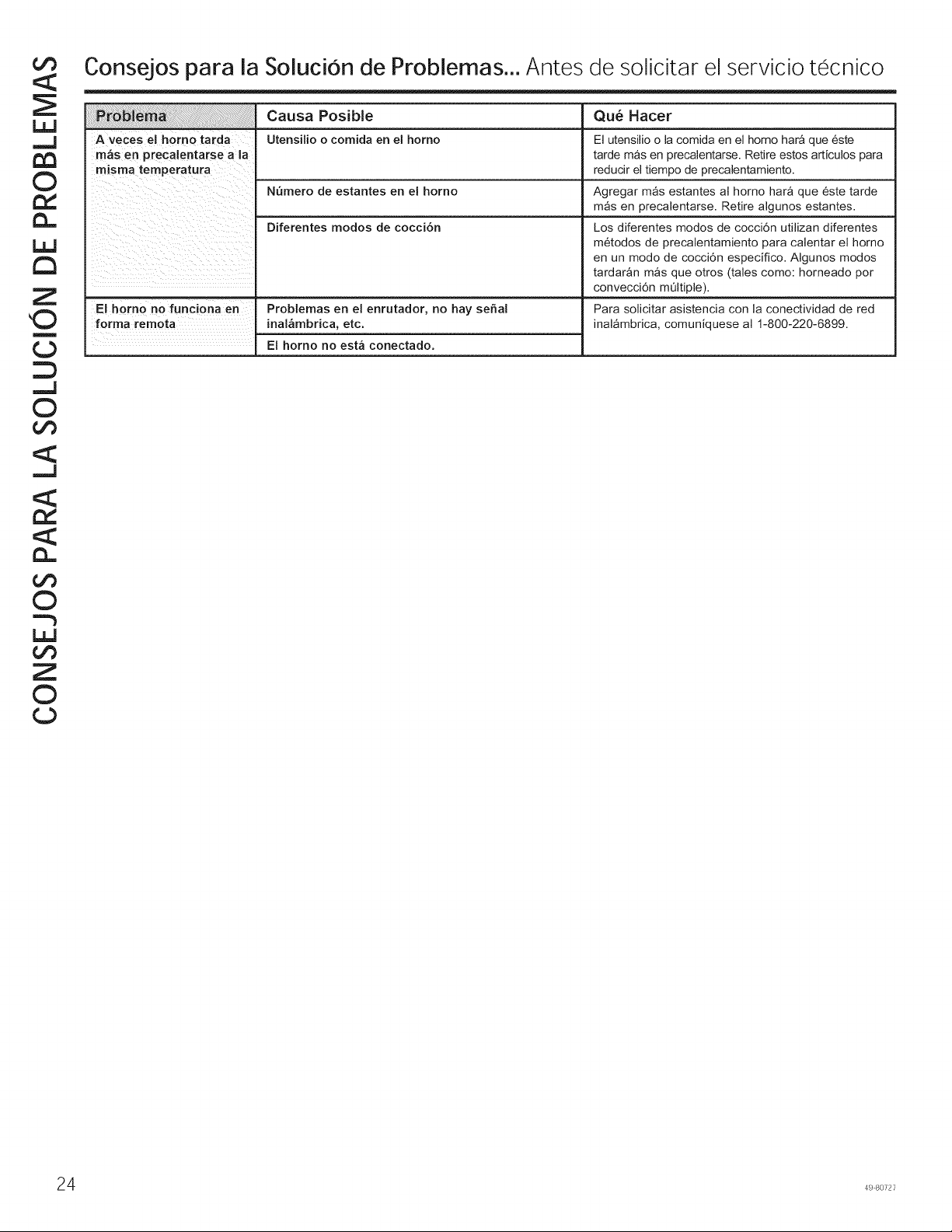
oO
lml
.,.,J
©
tY
t_L
_,J
tm
z
,0
m
¢D
.,,.J
©
.,,.J
tY
©
il!
¢/3
Z
©
r,D
Consejos para la SoluciOn de Problemas... Antes de solicitar el servicio tecnico
A veces el homo tarda
m_s en precalentarse a la
El homo no funciona en
forma remota
Causa Posible
Utensilio o comida en el homo
NQmero de estantes en el homo
Diferentes modos de cocci6n
Problemas en el enrutador, no hay seSal
inal&mbrica, etc.
El homo no est& conectado.
Qu_ Hacer
Elutensilio o lacomida en el homo har_ que 6ste
tarde mas en precalentarse. Retire estos art{culos para
reducir eltiempo deprecalentamiento.
Agregar mas estantes al homo har_ que 6ste tarde
mas en precalentarse. Retire algunos estantes.
Los diferentes modos de cocci6n utilizan diferentes
m6todos de precalentamiento para calentar el homo
en un modo de cocci6n especifico. AIgunos modos
tardar_n masque otros (tales como: horneado pot
convecci6n mQltiple).
Para solicitar asistencia con la conectividad de red
inal_mbrica, comuniquese al 1-800-220-6899.
4 49 80727

