OWNERS MANUAL
Product Support
Product Information, Application, Service Info & Warranty
Questions
Please email us at [email protected]
or call (800) 629-3325 Monday – Friday 6:00 am – 6:00 pm (PST)

2
TABLE OF CONTENTS
TABLE OF CONTENTS
FEATURES
SAFETY INFORMATION
COMPONENT IDENTIFICATION
PREPARING THE GENERATOR
STARTING THE GENERATOR GASOLINE
STARTING THE GENERATOR PROPANE
USING THE GENERATOR
WATTAGE REFERENCE CHART
MAINTENANCE
Service Schedule
Checking the Oil
Changing the Oil
Air Cleaner Maintenance
Fuel Filter Cup Cleaning
Spark Plug Maintenance
Emptying the Gas Tank
Storage and Transportation
GENERATOR SPECIFICATIONS
TROUBLESHOOTING
WHEEL KIT ASSEMBLY
SERVICE INFORMATION
Changing/Inspecting the Carbon Brush
Changing/Inspecting the AVR
Maintenance Log
Wiring Diagram
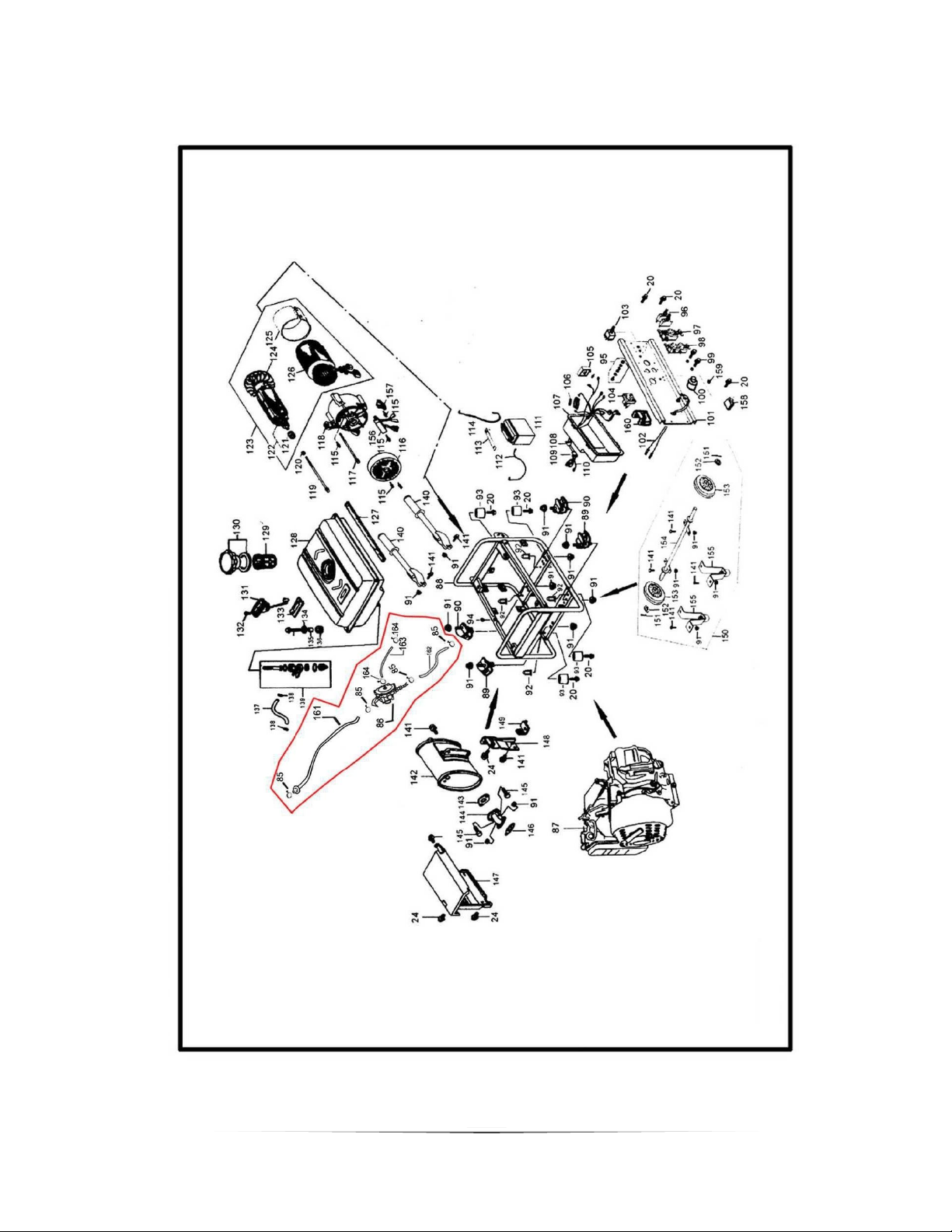
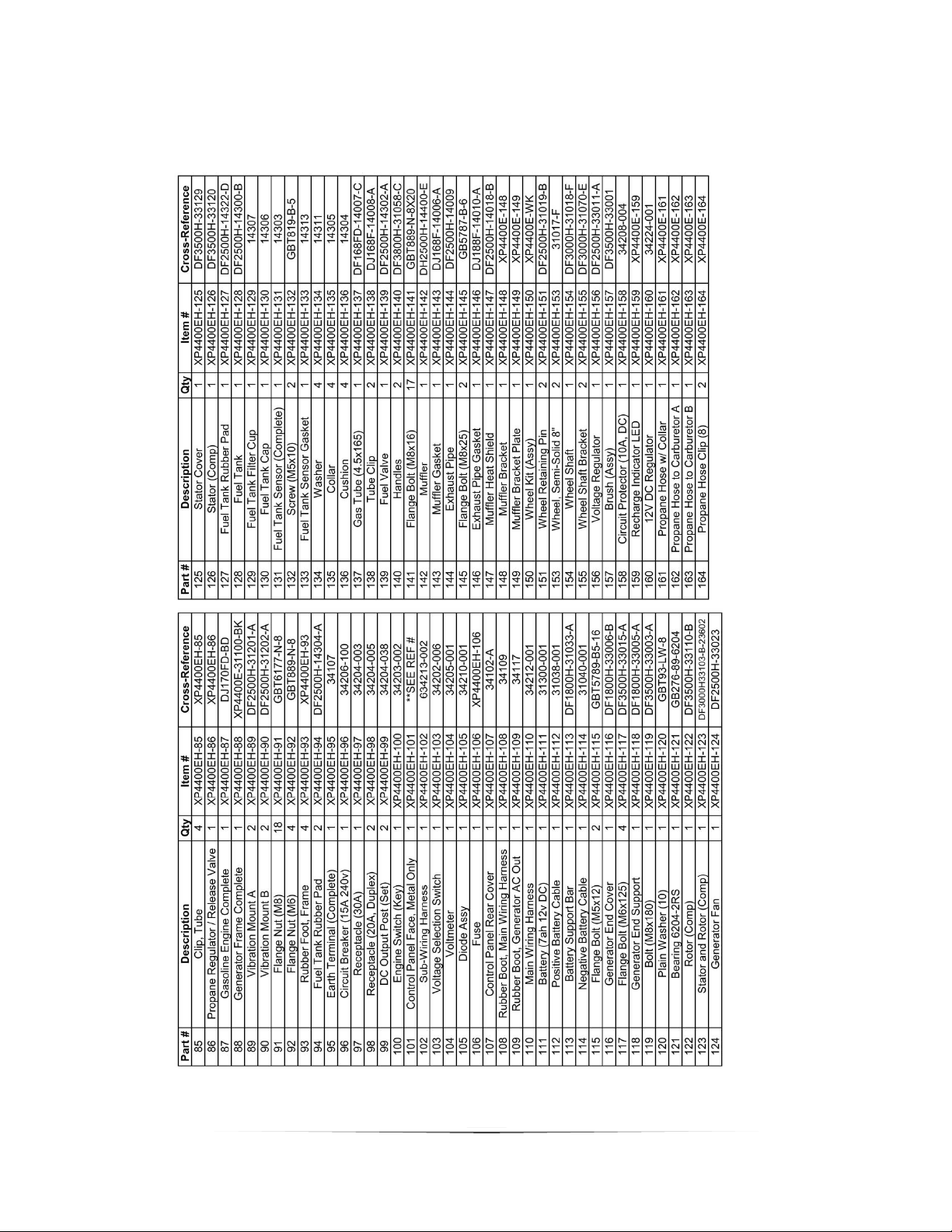
Parts Lists
2
3
4 - 6
7 - 9
9 - 12
13
14
15 - 18
16
19
20
21
22
22
23
23
24
25
26
27
28
29
30
31
32-35

3
FEATURES
Dual Fuel Option, LPG or Gasoline.
Durable 7.0 HP, Air Cooled Overhead Valve Engine.
Heavy Duty Steel Frame with Four Point Fully Isolated Motor Mounts for Smooth
and Quiet Operation.
Wheel and Handle Kit for Easy Transporting.
Full Power Panel with Engine Shutoff Switch, Volt Meter, Circuit Breaker, and
Power Outlets.
(2) Fully Protected 120V Outlets & (1) 120V/240V Twist-Lock Outlet.
8 Hour Run Time.
All Steel 4.0 Gal. Fuel Tank with EZ-Read Gauge.
Low Oil Shut-Off Protects Engine.
Super Quiet Muffler Reduces Engine Noise.
Meets EPA Emission Standards.
This manual provides information regarding the operation and maintenance of these
products. We have made every effort to ensure the accuracy of the information in this
manual. We reserve the right to change this product at any time without prior notice.
Notice Regarding Emissions
Engines that are certified to comply with U.S. EPA emission regulations for SORE
(Small off Road Equipment), are certified to operate on regular unleaded gasoline, and
may include the following emission control systems: (EM) Engine Modifications and
(TWC) Three-Way Catalyst (if so equipped).

4
GENERAL SAFETY PROCEDURES
Please familiarize yourself with the following safety symbols and words:
The safety alert symbol is used with one of the safety words (DANGER, CAUTION, or
WARNING) to alert you of hazards. Please pay attention to these hazard notices both in
this manual and on the generator.
DANGER: Indicates a hazard that will result in serious injury or death if instructions are
not followed.
WARNING: Indicates a strong possibility of causing serious injury or death if
instructions are not followed.
CAUTION: Indicates a possibility of personal injury or equipment damage if instructions
are not followed.
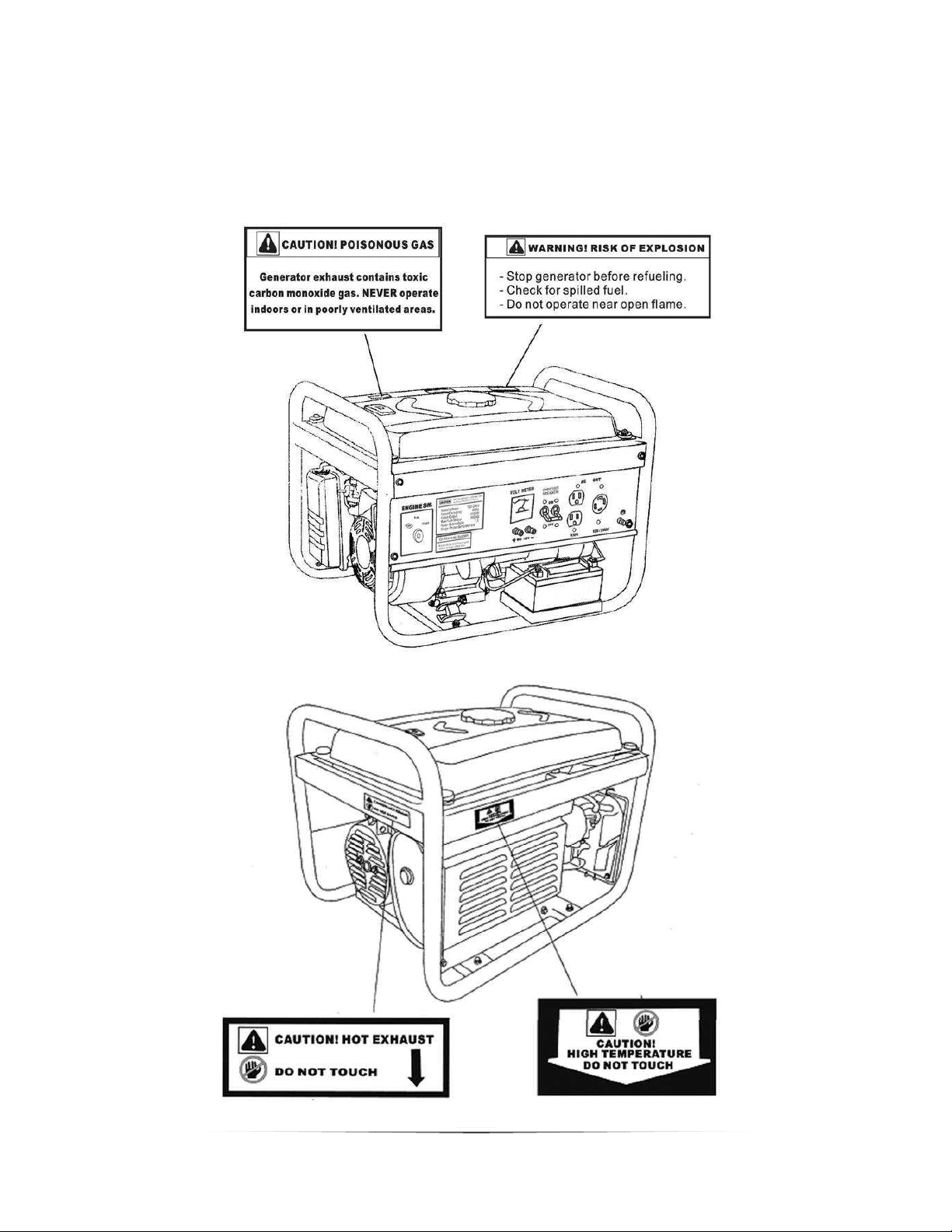
DANGER: This generator produces poisonous carbon monoxide gas when
running. This gas is both odorless and colorless. Even if you do not see or smell
gas, carbon monoxide may still be present. Breathing this poison can lead to
headaches, dizziness, drowsiness, and eventually death.
Use outdoors ONLY in non-confined areas.
Keep several feet of clearance on all sides to allow proper ventilation of
the generator.
WARNING: The exhaust from this product contains chemicals known to the
State of California to cause cancer, birth defects, or other reproductive harm.
WARNING: This generator may emit highly flammable and explosive gasoline
vapors, which can cause severe burns or even death. A nearby open flame can
lead to an explosion even if not directly in contact with gas.
Do not operate near an open flame.
Do not smoke near generator.
Always operate on a firm, level surface.
Always turn generator off before refueling. Allow generator to cool for at
least 2 minutes before removing fuel cap. Loosen cap slowly to relieve
pressure in tank.
Do not overfill gas tank. Gas may expand during operation. Do not fill to
the top of the tank.
Always check for spilled gas before operating.
Empty the gasoline tank before storing or transporting the generator.
Before transporting, turn fuel valve to the off position and disconnect the
spark plug.

5
GENERAL SAFETY PROCEDURES (Continued)
WARNING: This generator produces a powerful voltage, which can result in
electrocution.
ALWAYS ground the generator before using it (see the "Grounding the
Generator” portion of the "PREPARlNG THE GENERATOR FOR USE
section).
Generator should only be plugged into electrical devices, either directly or
with an extension cord. NEVER connect to a building electrical system
without a qualified electrician. Such connections must comply with local
electrical laws and codes. Failure to comply can create a backflow of
power, which may result in serious injury or death to utility workers.
Use a ground fault circuit interrupter (GFCI) in highly conductive areas
such as metal decking or steel work. GFCls are available in-line with some
extension cords.
Do not use uncovered in rainy or wet conditions.
Do not touch bare wires or receptacles (outlets).
Do not allow children or non-qualified persons to operate.
WARNING: This generator produces heat when running. Temperatures near
exhaust can exceed 150°F (65°C).
Do not touch hot surfaces. Pay attention to warning labels on the
generator denoting hot parts of the machine.
Allow generator to cool several minutes after use before touching engine
or areas which heat during use.
CAUTION: Misuse of this generator can damage it or shorten its life.
Use the generator only for its intended purposes.
Operate only on dry, level surfaces.
Allow generator to run for 3 - 5 minutes before connecting any electrical
devices.
Shut off and disconnect any malfunctioning devices from generator.
Do not exceed the Wattage capacity of the generator by plugging in more
electrical devices than the unit can handle (see "PRECAUTIONS-
OVERLOADING THE GENERATOR").
Do not turn on electrical devices until after they are connected to the
generator.
Turn off all connected electrical devices, and turn off the breaker, before
stopping the generator.
6
GENERAL SAFETY PROCEDURES (Continued)
In addition to the above safety notices, please familiarize yourself
with the safety and hazard markings on the generator.
7
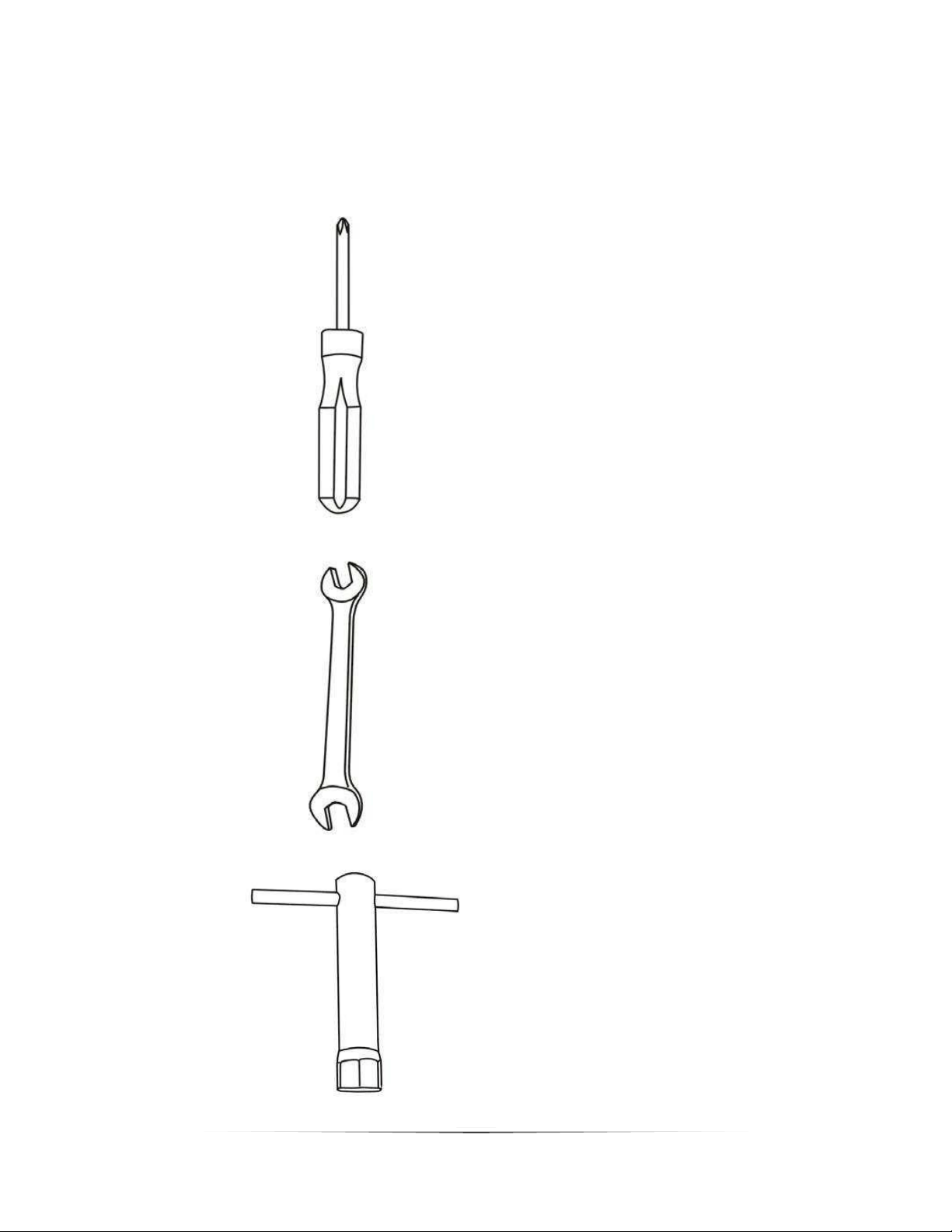
PACKAGE CONTENTS
Your generator comes with the items listed below. Please check to see that all of the
following items are included with your generator.
Screw driver
Spanner
Spark plug wrench
8
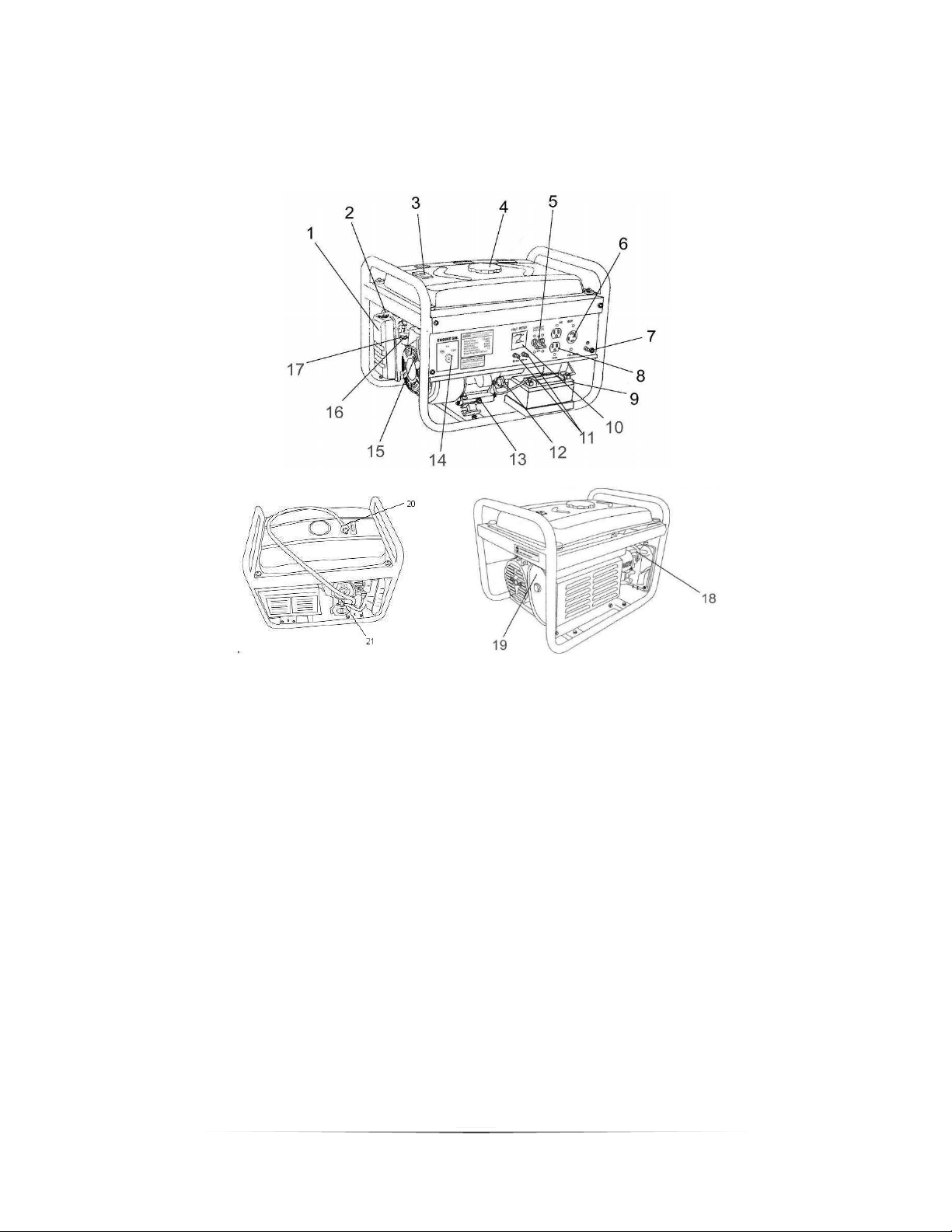
GENERATOR COMPONENTS
Please familiarize yourself with the locations and functions of the various components and
controls of your generator.
.
1. Air Cleaner - a removable, cleanable, oiled, sponge-like element that cleans the air
going into the engine.
2. Choke Lever - Allows the airflow into the carburetor to be restricted to assist in
starting the engine.
3. Fuel Gauge - Indicates the amount of fuel in the gasoline tank.
4. Fuel Cap - Allows access to fill the gasoline tank.
5. Circuit Breaker - Resettable switch that protects the generator from electrical
overload.
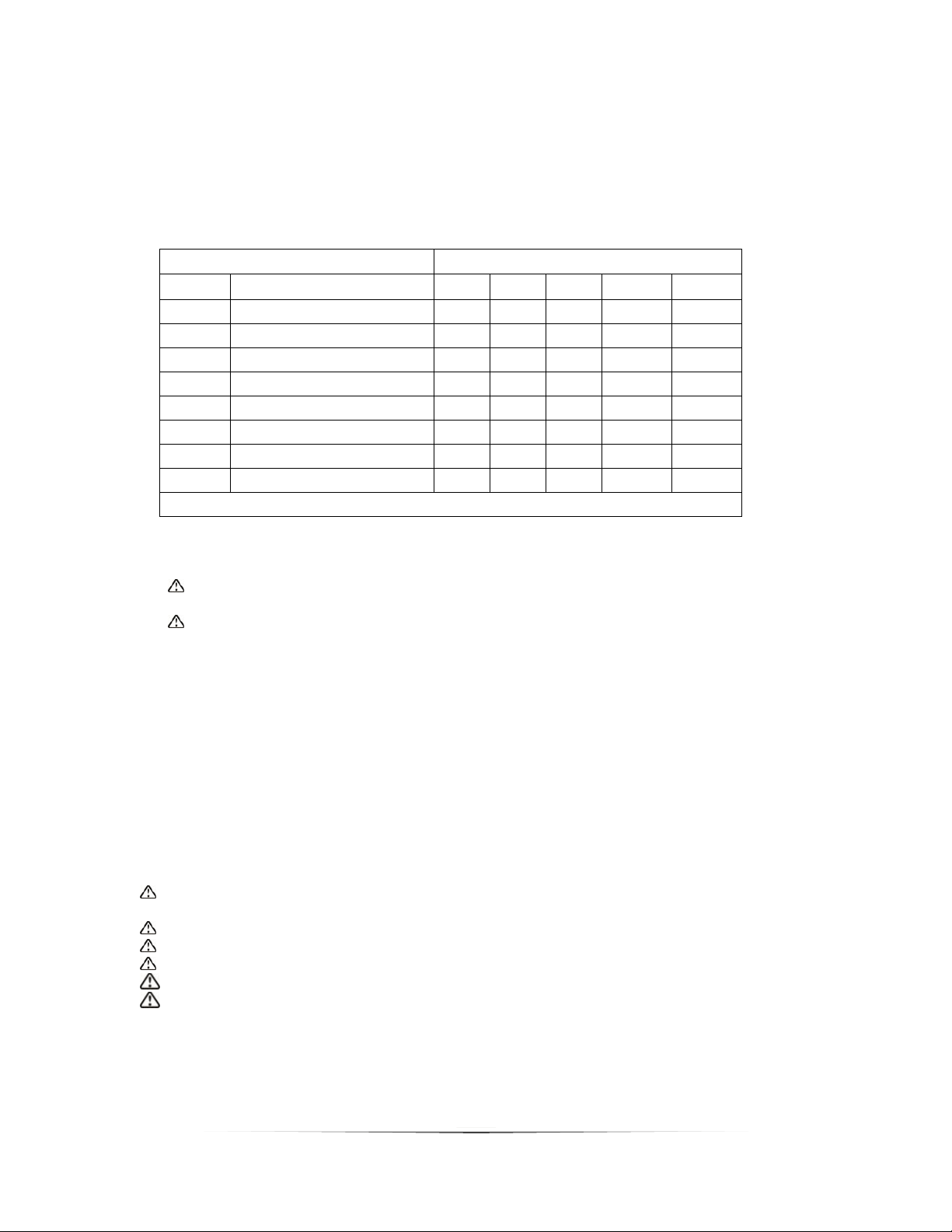
6. 120/240v 4-Prong Receptacle - Use to connect electrical devices that run 120 or
240 Volt, 60Hz, single phase, AC current (NEMA L14-30).
7. Ground Terminal - Connect a ground wire here to properly ground the generator.
8. 120v 3-Prong Receptacle - Use to connect electrical devices that run 120 Volt, 60
Hz, single phase, AC current (NEMA 5-20).
9. Battery - 12V DC 7ah Battery that powers the Electric Start System.
10. Volt Meter - Provides reading of voltage output.
11. 12v DC Charging Posts – DC Output for charging batteries or running small DC
powered items.
12. Oil Filler Cap - Use to add or check the oil.
13. Oil Fill and Dipstick - Use to add or check the oil.
14. Engine Switch – 3 Position Switch to “Start”, “Run”, or turn “Off” the generator.
15. Recoil Start – Easy Pull Recoil Start to start the engine without the electric start.
9
GENERATOR COMPONENTS (Continued)
16. Fuel Filter Cup - Traps dirt and water in gasoline before it enters the engine.
17. Fuel Valve - On/Off Valve that allows fuel into the engine.
18. Spark plug – Provides ignition to the engine.
19. Muffler – Reduces engine emissions and reduces noise.
20. Propane Tank Connector and Hose – Connects the LPG tank to the LPG
Regulator.
21. Propane Regulator and Pressure Release Valve - Provides a regulated LPG Fuel
supply to the engine. (Intended for use with a LPG Source of 10 PSI or more.)
PREPARING THE GENERATOR FOR USE
Using the Generator for the First Time
If you are using the generator for the first time, there are a few steps you must take to prepare
it for operation.
Step 1 - Add oil
The generator requires engine oil to operate properly. The generator, when new from the
package contains no oil in the crankcase. You must add the proper amount of oil before
operating the generator for the first time. This amount, which is equal to the oil capacity of the
engine crankcase can be found on the chart in figure 1. When filling the engine with oil in the
future, please refer to this chart.
Model Number
XP4400EH
Engine Oil Capacity
20 fl. Oz. (0.6L)
Figure 1 – Generator Oil Capacity
• Do not apply engine oil with
additives or 2-stroke gasoline
engine oil. They don’t have enough
lubrication, and may shorten the
engine's service life.
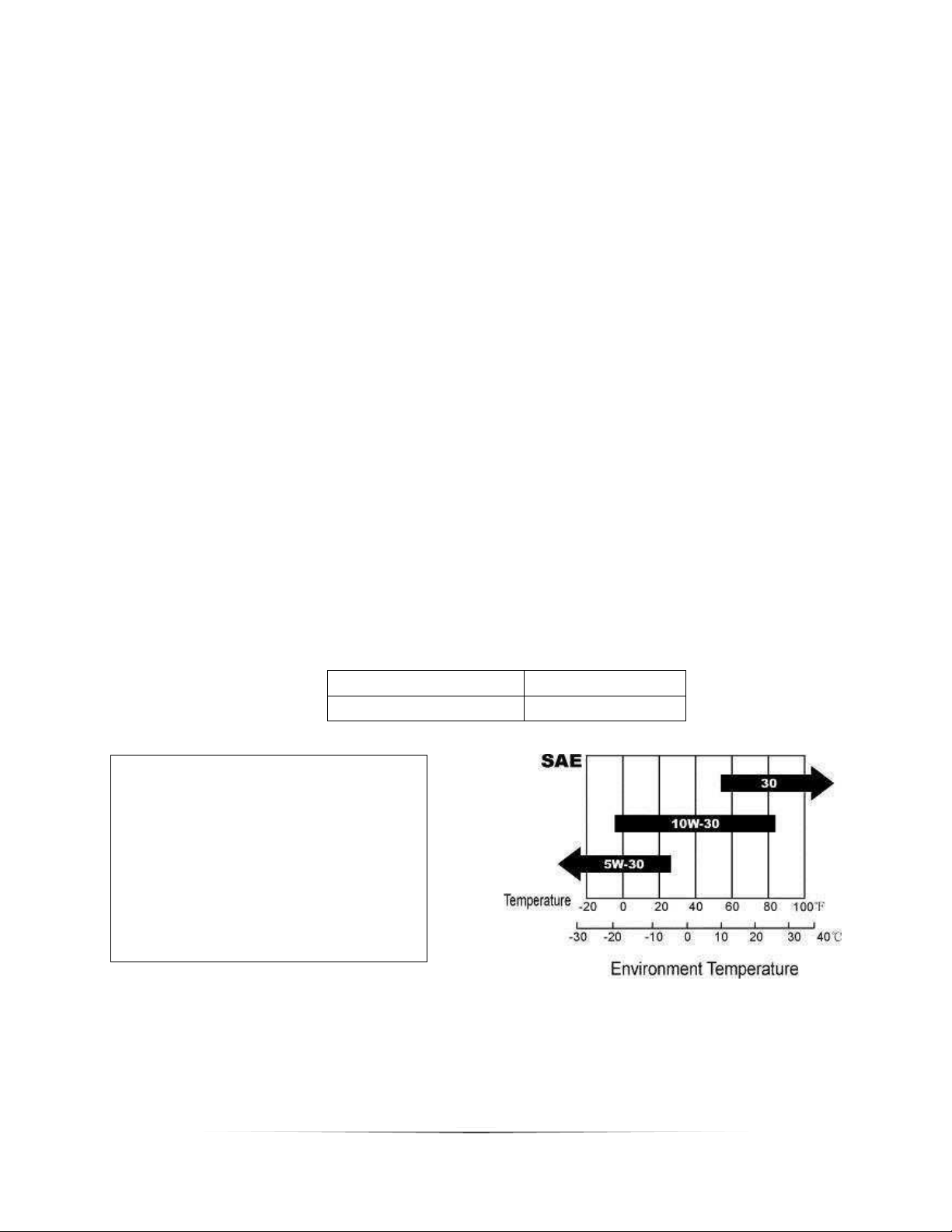
• Engine oil recommended: SAE
10W-30. Viscosity varies with regions
and temperatures. Choose your oil
viscosity using the chart to the right.
10
PREPARING THE GENERATOR FOR USE (Continued)
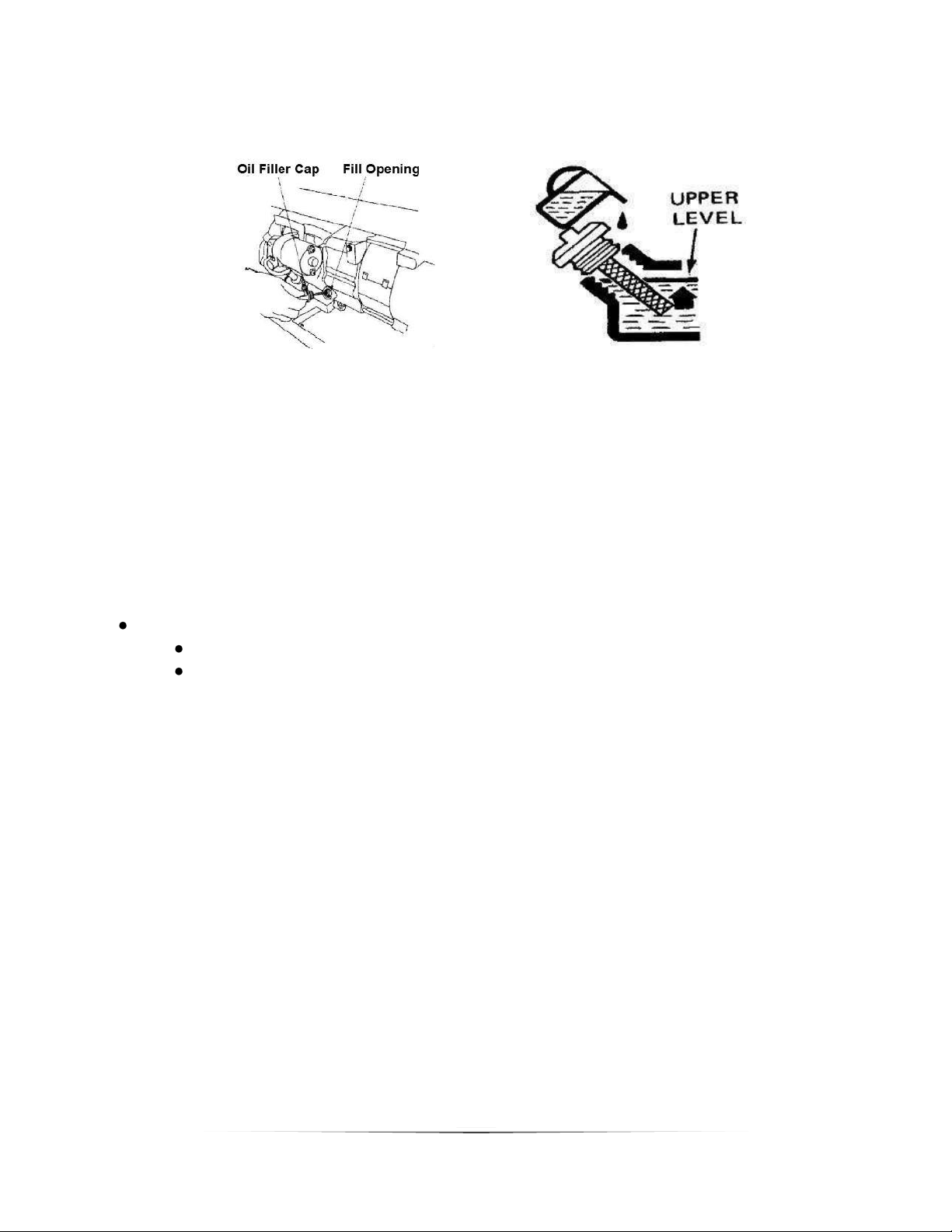
Figure 2 – Unscrewing the Oil Cap Figure 3 – Adding Oil
To add Oil, follow these steps:
1. Make sure the generator is on a level surface.
2. Unscrew the oil filler/dipstick cap from the engine as shown in figure 2.
3. Using a funnel, add the appropriate amount of oil, as found in figure 1, into
the crankcase. You will know the crankcase is full when the oil level has
reached the lower lip of the opening you have just poured the oil into. (see
figure 3.)
4. Replace oil filler cap.
Step 2 - Add Gasoline
WARNING: Gasoline and gas fumes are highly flammable.
Do not fill tank near an open flame.
Do not overfill. Always check for fuel spills.
To ensure that the generator runs smoothly use only FRESH, UNLEADED GAS WITH
AN OCTANE RATING OF 87 OR HIGHER.
To add gasoline:
1. Make sure the generator is on a level surface.
2. Unscrew gas cap and set aside (NOTE: the gas cap may be tight and hard to
unscrew).
3. Slowly add unleaded gasoline to the fuel tank. Be careful not to overfill. Please
refer to the chart in figure 4 to find the gas capacity of your generator model. The
fuel gauge on the top of the gas tank indicates how much gasoline is in the
generator gas tank.
NOTE: Gas can expand. Do not fill the gas tank to the very top.
4. Replace fuel cap and wipe up any spilled gasoline with a dry cloth.
11
PREPARING THE GENERATOR FOR USE (Continued)
IMPORTANT:
Never use an oil/gasoline mixture.
Never use old gas.
Avoid getting dirt or water in the fuel tank.
Gas can age in the tank and make it hard to start up the generator in the future.
Never store generator for extended periods of time with fuel in the tank.
Model #
XP4400EH
Gas Tank Capacity
3.96 US Gallons (15L)
Figure 4 - Gas Tank Capacity
Step 3 - Ground the Generator
WARNING: Failure to properly ground the generator can result in
electrocution.
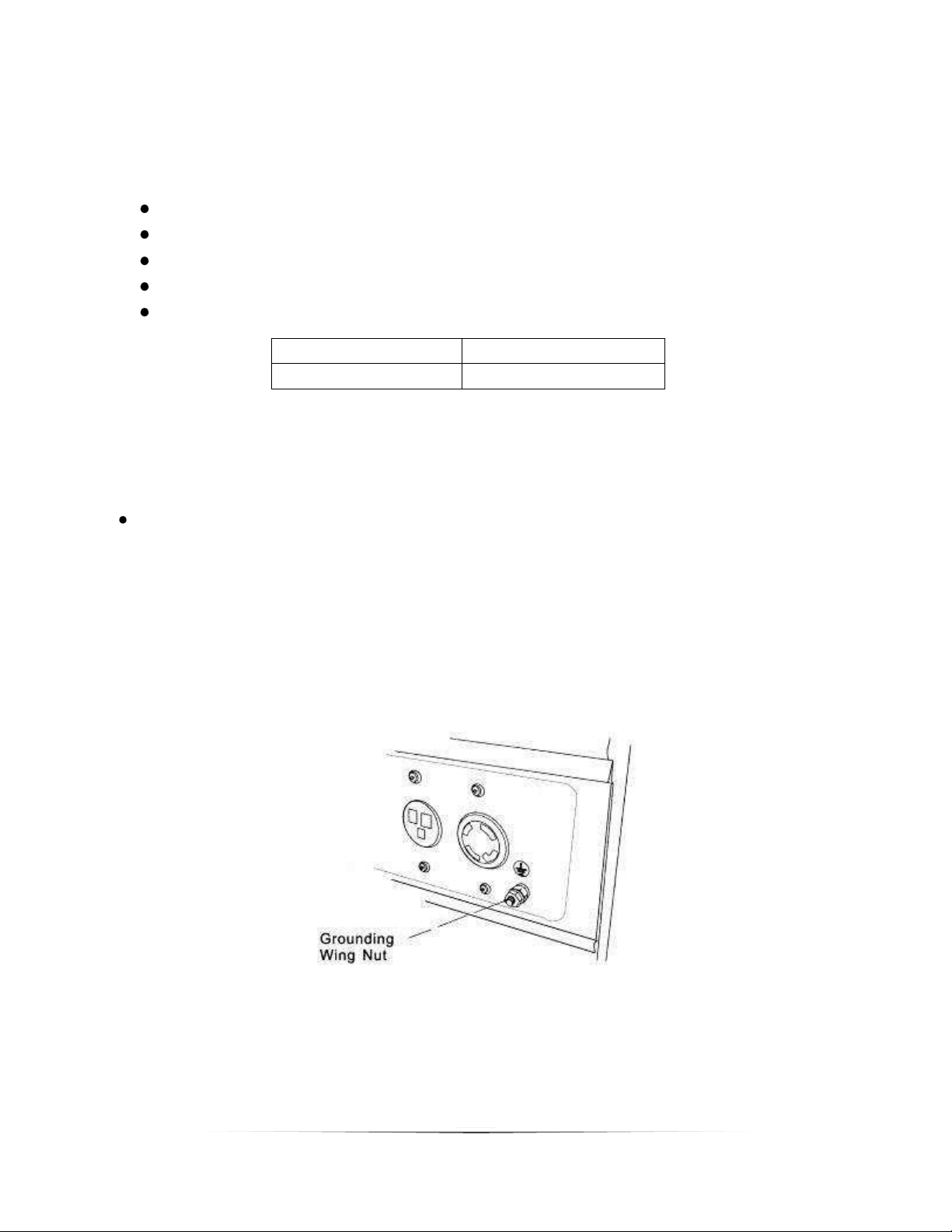
Ground the generator by tightening the grounding nut against grounding wire (see
figure 5). A generally acceptable grounding wire is a No. 12 AWG (American Wire
Gauge) stranded copper wire. This grounding wire should be connected at the other
end to a copper or brass-grounding rod that is driven into the earth. Grounding codes
can vary by location. Please contact a local electrician to check the grounding
regulations for your area.
Figure 5 - Attaching the Grounding Wire to the Generator

12
Subsequent Use of the Generator
If this is not your first time using the generator there are still steps you should take to
prepare it for operation.
IMPORTANT: At this point you should be familiar with the procedures described in the
first portion of this section entitled "Using the Generator for the First Time." If you have
not yet read this section, go back and read it now.
Step 1- Check the oil
The generator is equipped with an automatic shutoff to protect it from damage due to
low oil. Nonetheless, you should check the oil level of the engine before each use to
ensure that the engine crankcase has a sufficient amount.
To check the oil level:
1. Make sure the generator is on a level surface.
2. Unscrew the oil filler/dipstick cap.
3. With a dry cloth, wipe the oil off of the stick on the inside of the cap.
4. Insert the dipstick as if you were replacing the cap and then remove again. There
should now be oil on the stick. If there is no oil on the stick, or oil only at the very
end of the stick, you should add oil until the engine crankcase is filled (see
"Adding Oil" portion of the "Maintenance" section).
5. Be sure to replace the cap when finished checking oil.
NOTE: The oil capacity for your generator can be found in the "Specifications" section
of this manual.
Step 2 - Check the Gas Level
Before starting the generator, check to see that there is sufficient gasoline in the gas
tank. The fuel gauge on top of the generator will indicate the gas level in the tank. Add
gas if necessary according to the steps in the “Adding Gasoline" portion of the
"Maintenance" section.
WARNING: Gasoline and gasoline fumes are highly flammable.
Do not fill tank near an open flame.
Always allow engine to cool for several minutes before refueling.
Do not overfill (check the "Specifications" section for the tank capacity of
your generator).
Always check for fuel spills.
13
Starting the Generator: Gasoline
CAUTION:
LPG must be shut off when using gasoline!
Gasoline must be shut off when using LPG!
Disconnect all electrical loads from the generator before attempting to start!
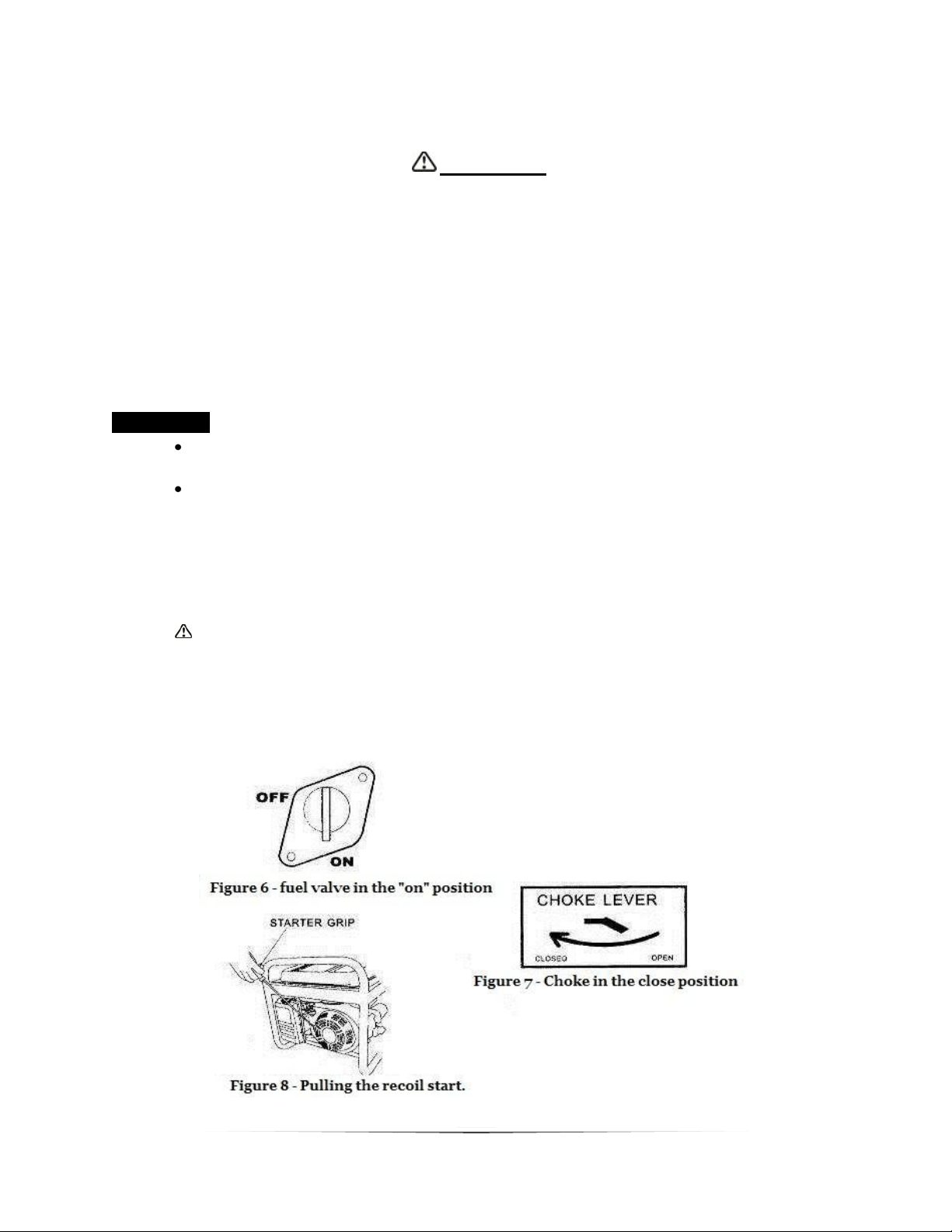
1. Make sure that the AC circuit breaker is in the OFF position. The generator may be hard
to start if a load is connected.
2. Turn the fuel valve lever to the ON position.
3. The choke will need to be closed, slide the choke lever out to the CLOSED position.
4. Turn the engine switch to the START position and hold it there for 5 seconds or until the
engine starts.
WARNING:
Operating the starter motor for more than 5 seconds can damage the motor. If the engine
fails to start, release the switch and wait 10 seconds before operating the starter again.
If the speed of the starter motor drops after a period of time, it is an indication that the
battery should be recharged.
5. When the engine starts, allow the engine switch to return to the ON position.
6. Push the choke to the OPEN position as the engine warms up.
Stopping the Engine
In an emergency:
To stop the engine in an emergency, move the engine switch to the OFF position.
In normal use:
1. Turn the AC circuit breaker to the OFF position. Disconnect any DC Load attached to
the DC Output on the front panel.
2. Turn the engine switch to the OFF position.
3. Turn the fuel valve lever to the OFF position.
14
Starting the Generator: Propane
CAUTION:
LPG must be shut off when using gasoline!
Gasoline must be shut off when using LPG!
Disconnect all electrical loads from the generator before attempting to start!
1. Make sure that the AC circuit breaker is in the OFF position. The generator may be hard to
start if a load is connected.
2. Turn the gasoline fuel valve to the "OFF" position.
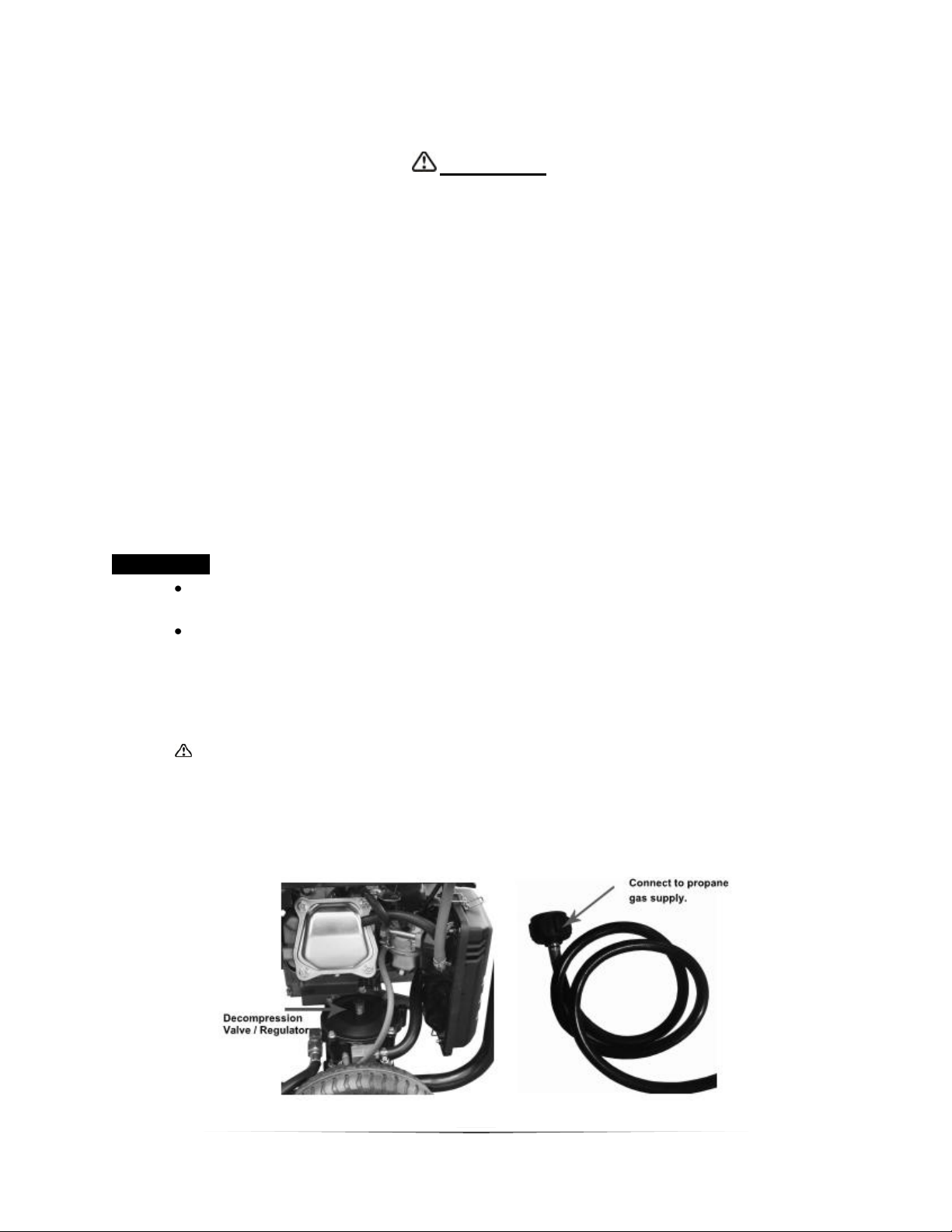
3. Connect the propane gas hose to the regulator/decompression valve.
4. Connect the propane collar to the gas supply and then turn on the propane gas supply.
5. Press the button on top of the pressure release valve down two or three times.
6. The choke operates differently on propane gas.
a. If the engine is warm (the unit was run recently) start with the choke half open.
i. Wait 30 seconds and then push the choke lever all the way to the "OPEN"
position.
b. If the engine is cold (the unit was not run recently) start with the choke "OPEN".
7. Turn the engine key switch to the START position and hold it there for 5 seconds, or until
the engine starts.
WARNING:
Operating the starter motor for more than 5 seconds can damage the motor. If the engine
fails to start, release the switch and wait 10 seconds before operating the starter again.
If the speed of the starter motor drops after a period of time, it is an indication that the
battery should be recharged.
8. When the engine starts, allow the engine switch to return to the ON position.
Stopping the Engine
In an emergency:
To stop the engine in an emergency, move the engine switch to the OFF position.
In normal use:
1. Turn the AC circuit breaker to the OFF position. Disconnect DC battery charging
cables.
2. Turn the engine switch to the OFF position.
3. Turn OFF the Propane Gas Supply.
15
Starting the Generator: Propane (Continued)
WARNING: WHEN USING THE GENERATOR WITH LPG
MAKE SURE THERE IS NO POSSIBLE IGNITION SOURCE CLOSE TO THE GENERATOR.
1. Before using, make sure all of the LPG connectors and hoses are well connected and
sealed.
2. Connect electrical devices to generator ONLY after the engine runs smoothly. (There
may be remnant gasoline in the carburetor; this can cause unsteady engine
performance for several minutes)
3. If the propane gas leaks, shut off the LPG supply first and then quickly unplug or turn off
any electrical devices powered by the unit.
4. When stopping the engine, unplug or turn off any electrical devices, turn off the Main
Circuit Breaker and then turn off the LPG Supply. After the engine has stopped turn the
KEY to ‘OFF" position.
Using the Generator
Once you have allowed the engine to run for several minutes, you may connect electrical
devices to the generator.
AC Usage
You may connect electrical devices running on AC current according to their wattage
requirements.
The chart in figure 9 shows the rated and surge wattage of your generator according to
its model number.
The rated wattage corresponds to the maximum wattage the generator can output on a
continuous basis.
The surge wattage corresponds to the maximum amount of power the generator can
output for a short period of time. Many electrical devices such as refrigerators require
short bursts of extra power, in addition the rated wattage listed by the device, to stop
and start their motors. The surge wattage ability of the generator covers this extra
power requirement.
Model Number
Rated (Running) Wattage
Surge (Peak) Wattage
XP4400EH
3500
4400
Figure 9 - Generator Wattage by Model Number
The total running wattage requirement of the electrical devices connected to the generator
should not exceed the rated wattage of the generator itself. To calculate the total wattage
requirement of the electrical devices you wish to connect, find the rated (or running) wattage
of each device. This number should be listed somewhere on the device or in its instruction
manual.
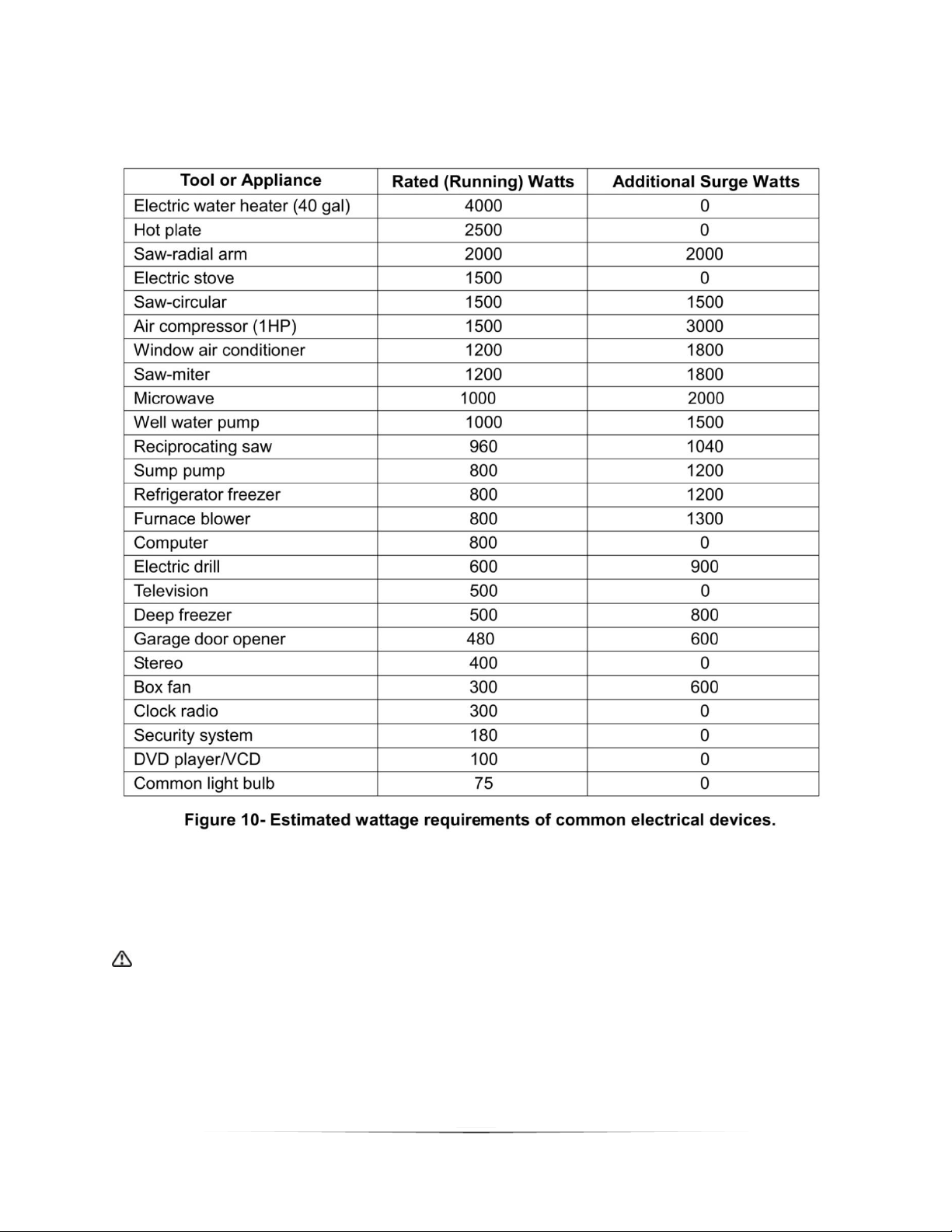
If you cannot find this wattage, you may calculate it by multiplying the Voltage requirement
by the Amperage drawn: Watts = Volts x Amps. If these specifications are not available you
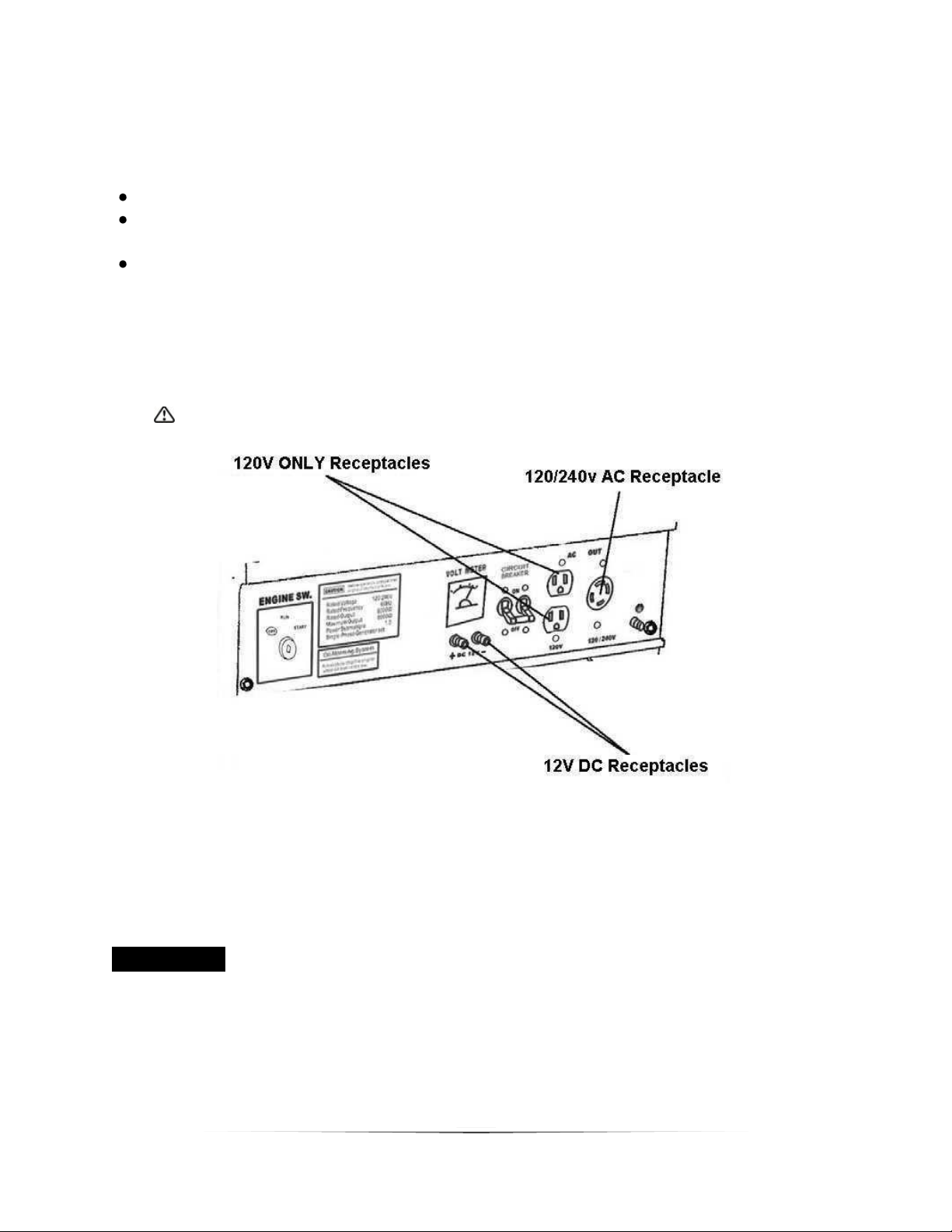
may estimate the Watts required by your device by using the chart in figure 10.
16
Using the Generator (Continued)
Once you have found the rated wattage requirement of each electrical device, add
these numbers to find the total rated wattage you wish to draw from the generator. If this
number exceeds the rated wattage of the generator, DO NOT connect all these devices.
Select a combination of electrical devices, which has a total rated wattage lower than or
equal to the rated wattage of the generator.
CAUTION - The generator can only run at its surge wattage capacity for a very
short time. Connect only electrical devices requiring a rated (running) wattage
equal to or less than the rated wattage of the generator. Never connect
devices requiring a rated wattage equal to the surge wattage of the generator.
NOTE: The above wattage figures are estimates only. Try to check the wattage listed on your
electrical devices before consulting this chart.
17
Connecting a Load to the Generator
NOTE: Be sure to attach devices to the correct receptacle (outlet).
120v devices can be directly connected to the 120v ONLY receptacles.
120v devices can be connected to the 120/240v receptacle using an appropriate
adapter.
240v devices can ONLY be connected the 240v receptacle.
1. Plug in each electrical device with the device turned off.
2. Switch the circuit breaker to the "ON" position.
3. Turn on the connected electrical devices in the order of the amount of power they
require beginning with the device with the highest rated Wattage requirement.
CAUTION: Do not connect 50Hz or 3-phase loads to the generator.
VOLTAGE SELECTOR SWITCH
The voltage selector switches the dual 120v AC windings of the generator to produce
"120V ONLY" or "120/240V". If a 240V appliance is connected to the 4-prong
receptacle, the switch must be in the "120/240V" position. If only 120V appliances are
being connected to the generator select the "120V ONLY" position to double the 120v
amperage.
WARNING:
Only change the Voltage Selector Switch with the main AC Circuit Breaker OFF.
The generator can be seriously damaged if the Voltage Selector Switch is
changed with the breaker ON.
18
Choosing the Right Power Cord
Long or thin cords can drain the power provided to an electrical device by the generator.
When using such cords, allow for a slightly higher rated wattage requirement for the
electrical device. See Figure 12 for recommended cords based on the power requirement of
the electrical device.
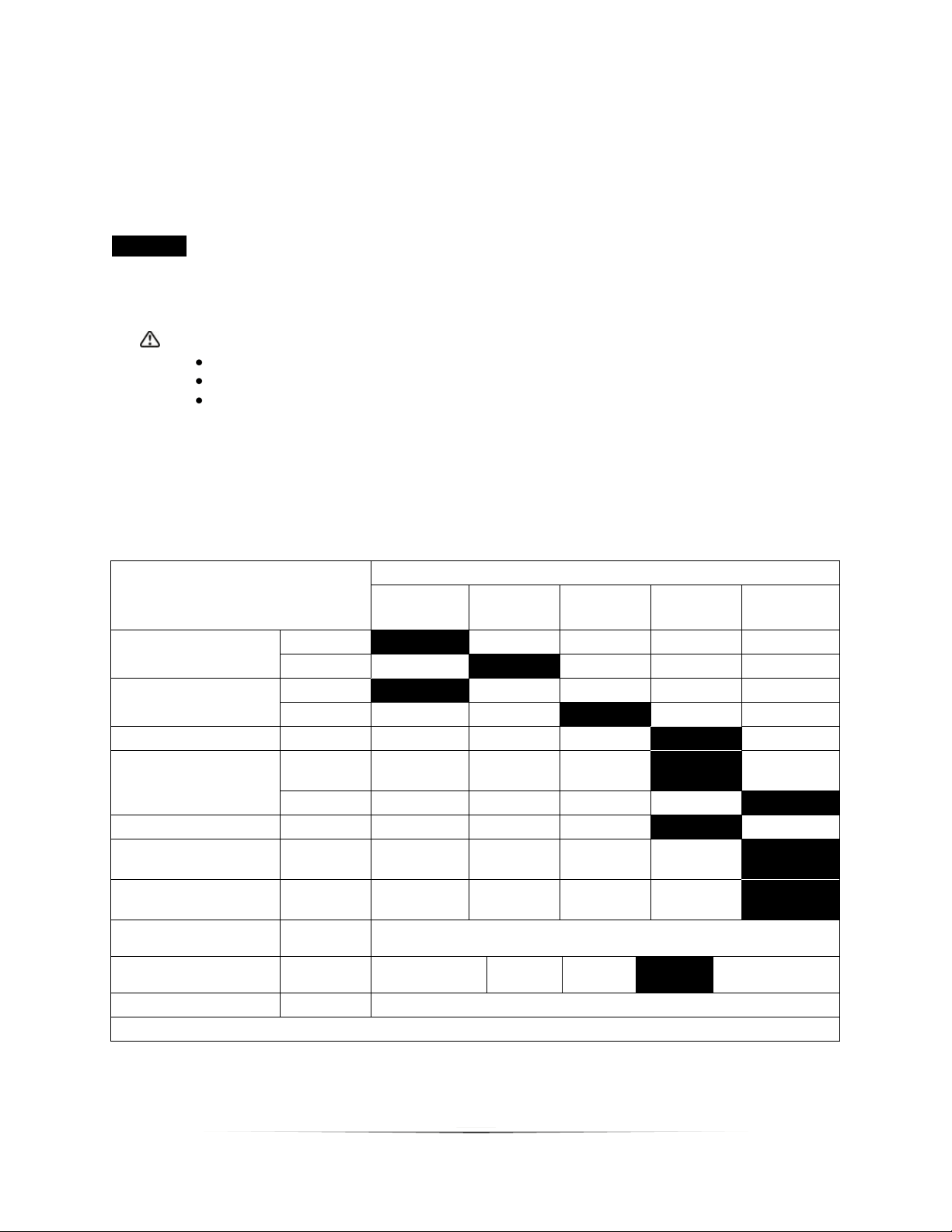
DEVICE REQUIREMENTS
WIRE GAUGE BY LENGTH (ft.)
AMPS
WATTS (120V/240V)
10
25
50
100
150
5
600/1200
18
16
14
12
10
10
1200/2400
16
14
12
10
8
15
1800/3600
14
12
10
8
6
20
2400/4800
12
10
8
6
4
25
3000/6000
10
8
6
4
4
30
3600/7200
8
6
4
4
NR
40
4800/9600
6
4
4
NR
NR
50
6000/1200
4
4
2
NR
NR
*NR = NOT RECOMMENDED
Figure 12 – Minimum Extension Cord Requirements
DC Usage
CAUTION: The DC receptacle is for recharging 12 Volt automotive-type batteries only.
Do not connect any other device to this receptacle.
CAUTION: Never try to jump start a car with your generator.
To connect a 12V battery to the DC battery charger on the front panel:
1. Connect one charging wire to the positive terminal on the battery and the other
charging wire to the negative terminal on the battery.
2. Connect the free end of the positive wire to the positive receptacle (outlet) on the
generator.
3. Start the generator.
4. Carefully connect the free end of the negative wire to the negative receptacle on the
generator.
5. When disconnecting, always disconnect the wires from the generator first to avoid a
spark.
DANGER: Stored batteries emit highly explosive hydrogen gas when charged. Batteries
also contain acid, which can cause severe chemical burns.
Do not allow open flames or cigarettes nearby for several minutes after charging a battery.
Always wear protective goggles and rubber gloves when charging a battery.
If battery acid gets on your skin, flush with water.
If battery acid gets in your eyes, flush with water and call a physician immediately.
If battery acid is swallowed, drink large quantities of milk and call a Physician immediately.
If your generator is the electric start model, once running, it will charge the battery on the
generator automatically. While charging, you can see the recharge indicator light lit, after
the battery is full, the light will turn off.
19
MAINTENANCE AND CARE
The Importance of Maintenance
Proper routine maintenance of your generator is essential for safe, economical, and
trouble-free operation. It will also help reduce air pollution.
Warning
Improper maintenance, or failure to correct a problem before operation, can cause a
malfunction in which you can be seriously injured or killed. Always follow the inspection
and maintenance recommendations and schedules in this instruction manual.
Maintenance Safety
Make sure the engine is off before you begin any maintenance or repairs.
Let the engine and exhaust system cool before touching.
To reduce the possibility of fire or explosion, be careful when working around
gasoline. Use only a nonflammable solvent, not gasoline, to clean parts. Keep
cigarettes, sparks, and flames away from all fuel related parts.
Maintenance Schedule
Remember that this schedule is based on the assumption that your machine will be
used for its designed purpose. Sustained high-load, high temperature operation, or use
in unusually wet or dusty conditions, will require more frequent service.
SERVICE
REGULAR SERVICE PERIOD
BEFORE
EACH USE
1 MO. OR
20 HRS.
3 MO. OR
50 HRS.
6 MO. OR
100 HRS.
12 MO. OR
300 HRS.
ENGINE OIL
CHECK
CHANGE
AIR CLEANER
CHECK
CHANGE
SEDIMENT CUP CLEAN
SPARK PLUG
CLEAN -
ADJUST
REPLACE
SPARK ARRESTER CLEAN
IDLE SPEED
CHECK-
ADJUST
VALVE CLEARANCE
CHECK-
ADJUST
COMBUSTION
CHAMBER
CLEAN 500 HRS.
FUEL TANK AND
FILTER
CLEAN
FUEL TUBE
CHECK
EVERY 24 MO. (REPLACE IF NECESSARY)
TO BE PERFORMED AT MONTH INDICATED OR HOUR INTERVAL WHICH EVER COMES FIRST
Figure 13 – Maintenance Schedule.
20
Checking the Oil
The generator is equipped with an automatic shutoff to protect it from running on low oil.
Nonetheless, you should check the oil level of the generator before each use to ensure
that the generator crankcase has a sufficient amount.
To check the oil level:
1. Make sure the generator is on a level surface.
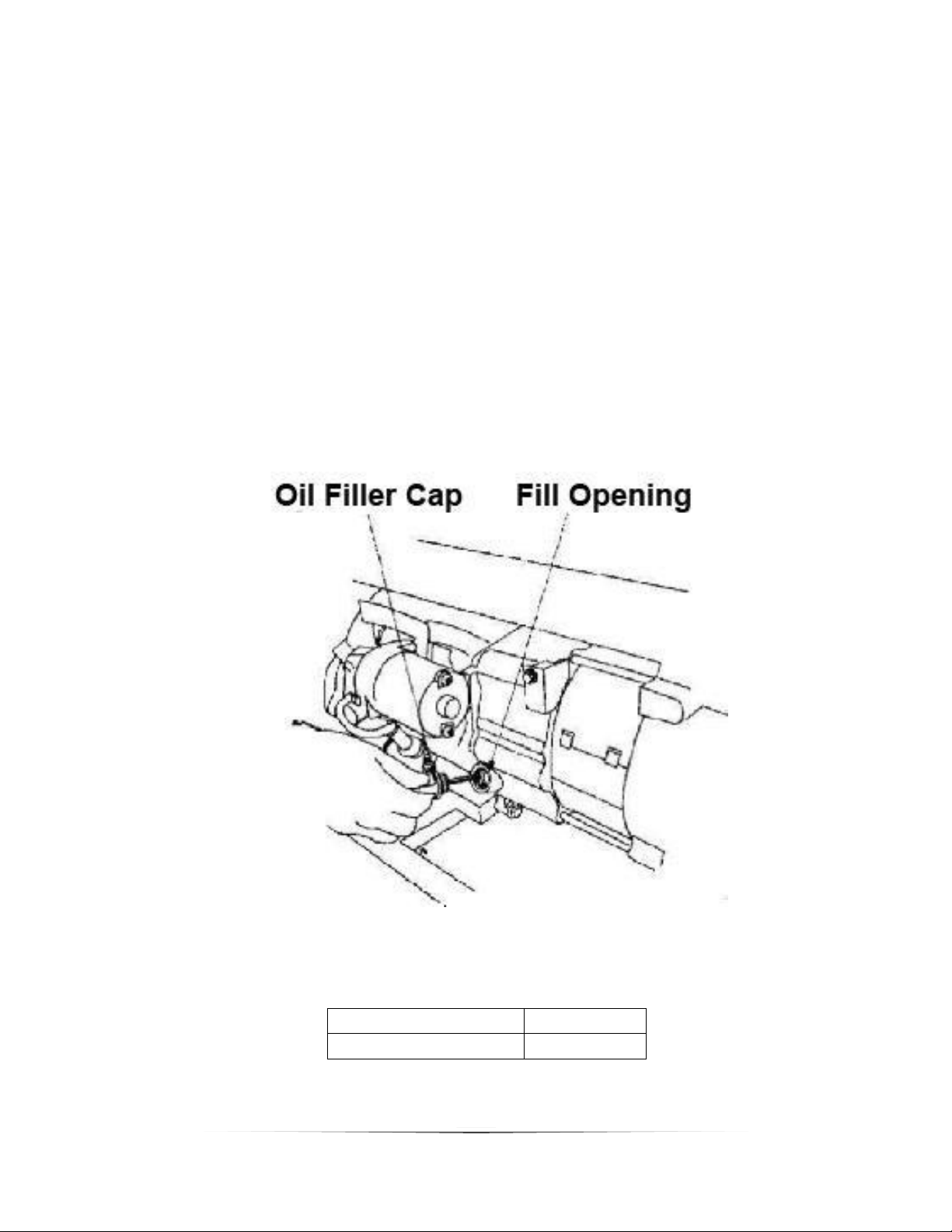
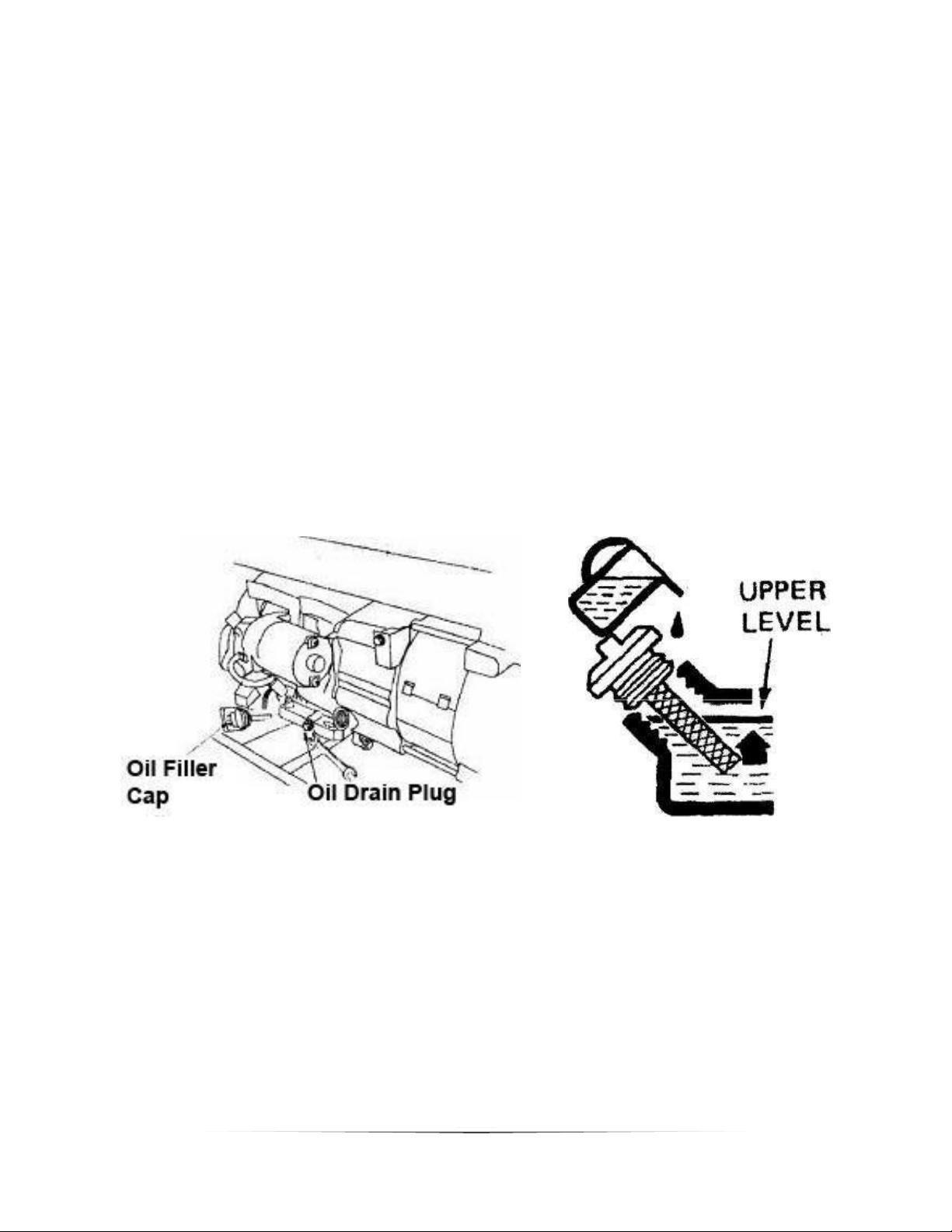
2. Unscrew the oil filler/dipstick cap (see figure 14).
3. With a dry cloth, wipe the oil off of the stick on the inside of the cap.
4. Insert the dipstick as if you were replacing the cap and then remove again. There
should now be oil on the stick. If there is no oil on the stick, or oil only at the very
end of the stick you should add oil until the engine crankcase is filled. See
"Changing/Adding Oil” in this section.
5. Be sure to replace cap when you are finished checking the oil.
You should check the oil level of your generator according to the maintenance schedule
in figure 13. When the oil level is low you will need to add oil until the level is sufficient
to run the generator. The oil capacity of your generator engine is listed in figure 15.
Model Number
XP4400EH
Engine Oil Capacity
20 fl. Oz.
Figure 15 – Generator Oil Capacity
21
Changing the Oil
It is only necessary to drain the oil from the crankcase, other than for regular oil
changes, if it has become contaminated with water or dirt. In this case, you can drain
the oil from the generator according to the following steps:
1. Place an approved oil disposal container underneath the generator to catch
the oil as it drains.
2. Using a 10 mm hex wrench, unscrew the oil drain plug, which is located on
the crankcase underneath the oil filler/dipstick cap (see figure 16). Allow all
the oil to drain from the generator.
3. Replace the oil drain plug and tighten with a 10 mm hex wrench.
To add oil to the crankcase, follow these steps:
1. Make sure the generator is on a level surface.
2. Unscrew the oil filler/dipstick cap from the engine as shown in figure 14 above.
3. Using a funnel, add motor oil to the crankcase. We recommend SAE 10W30
motor oil for general use. When full, the oil level should come close in the top of
the oil fill opening. (See figure 17).
Figure 16: Draining the Oil Figure 17: Adding Oil
22
Air Cleaner Maintenance
Routine maintenance of the air cleaner helps maintain proper airflow to the carburetor.
Occasionally check that the air cleaner is free of excessive dirt.
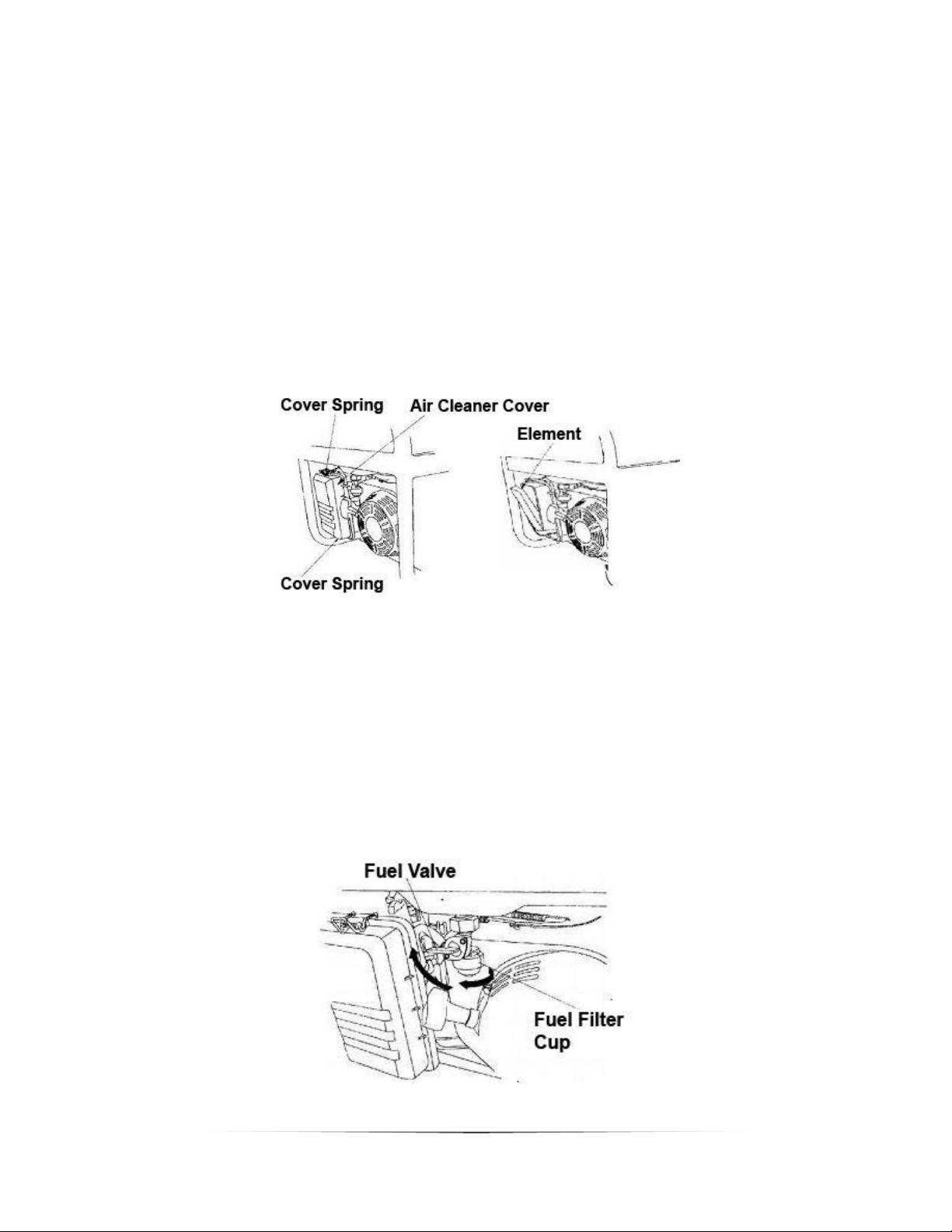
1. Unhinge the clasps at the top and bottom of the air cleaner cover (see
figure 18).
2. Remove the sponge-like elements from the casing.
3. Wipe the dirt from inside the empty air cleaner casing.
4. Wash the sponge-like elements in household dish detergent and warm water.
5. Allow the elements to dry completely.
6. Soak the dry elements in a small amount of engine oil. Ring out any excess oil.
7. Replace the sponge-like elements in the air cleaner casing and replace the
cover.
Figure 18 - Removing the Air Cleaner Casing.
Fuel Filter Cup Cleaning
The fuel filter cup is a small well underneath the fuel valve. It helps to trap dirt and water
that may be in your fuel tank before it can enter the engine.
To clean the fuel filter cup:
1. Turn the fuel valve to the “OFF” position.
2. Unscrew the fuel filter cup from the fuel valve using a wrench. Turn the valve
towards you to unscrew (see figure 19).
3. Clean the cup of all sediment using a rag or brush.
4. Reinstall the fuel filter cup.
Figure 19 – Removing the Fuel Filter Cup
23
Spark Plug Maintenance
The spark plug is important for proper engine operation. A good spark plug should be
intact, free of deposits, and properly gapped.
To inspect your spark plug:
1. Pull on the spark plug cap to remove it.
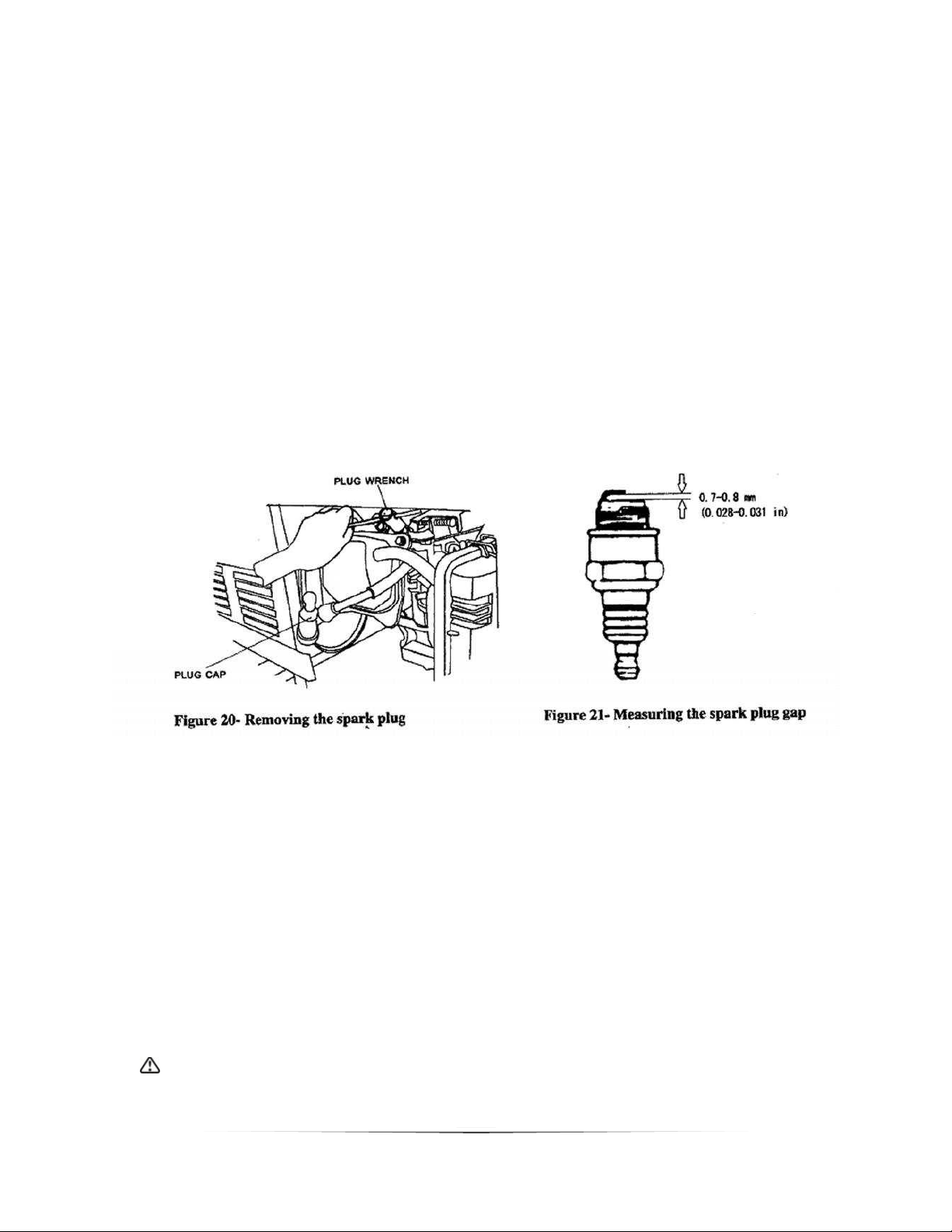
2. Unscrew the spark plug from the generator using the spark plug wrench included with
this product (see figure 20).
3. Visually inspect the spark plug. If it is cracked or chipped, discard and replace with a
new spark plug. We recommend using a F6RTC spark plug such as NGK BPR5ES.
4. Measure the plug gap with a gauge (see figure 21). The gap should be 0.7-0.8 mm
(0.028-0.031 in).
5. If you are re-using the spark plug, use a wire brush to clean any dirt from around the
spark plug base and then re-gap the spark plug.
6. Screw the spark plug back into its place on the generator using the spark plug wrench.
7. Replace the spark plug cap.
Emptying the Gas Tank
Before storing your generator for extended periods of time, you should drain your
generator of gasoline.
To drain the generator of gas:
1. Turn the fuel valve to the "OFF" position.
2. Remove the fuel filter cup (see "Removing the Fuel Filter Cup" earlier in this section.
3. Empty the fuel filter cup of any fuel.
4. With a receptacle underneath the generator to catch the gas, turn the fuel valve to the
"ON" position. Drain all the gas from the generator.
5. Turn the fuel valve to the "OFF" position.
6. Replace the fuel filter cup.
7. Store the emptied gasoline in a suitable place.
CAUTION: Do not store fuel from one season to another.

24
Storage and Transportation
CAUTION: Never place any type of storage cover on the generator while it
is still hot.
When transporting your generator:
Empty the gas tank (see "Emptying the Gas Tank" in the "Maintenance" section).
Disconnect the spark plug.
Do not obstruct any ventilation openings.
Keep the generator in a cool dry area.
When storing your generator:
If you plan on starting the unit again the same day:
1. Turn off the main breaker.
2. Allow the unit to run 3 - 5 minutes.
3. Turn off the key.
4. Store.
If you plan on starting the unit again within 30 days:
1. Turn off the main breaker.
2. Allow the unit to run 3 - 5 minutes.
3. Turn off the fuel valve.
4. Allow the unit to stall out.
5. Turn off the key.
6. Add fuel stabilizer to the gas remaining in the tank.
7. Store.
If you do not plan to start the unit for longer than 30 days:
1. Turn off the main breaker.
2. Allow the unit to run 3 - 5 minutes.
3. Turn off the fuel valve.
4. Allow the unit to stall out.
5. Turn off the key.
6. Drain the fuel tank (See "Emptying the Gas Tank" in the "Maintenance" section)
7. Drain the carburetor
a. Remove the drain bolt from the carburetor.
b. Drain the small amount of remaining fuel from the carburetor bowl.
8. Oil the cylinder
a. Remove the spark plug.
b. Put 2 tbsp. of 10w30 motor oil directly into the spark plug hole
c. Pull the recoil start one time.
d. Replace the plug.
9. Remove the battery and place on tender indoors.

25
Generator Specifications
AC Rated Wattage
3500W
AC Surge Wattage
4400W
AC Rated Voltage
120/240V
AC Rated Frequency
60 Hz
AC Phase
Single
DC Voltage
12V
DC Amperage
8.3A
Dimensions (in.)
Length
23.2
Width
17
Height
17
Engine Type
4-Stroke OHV Forced-Air
Ignition System
Non-Contact Transistor
Displacement
210cc
Starting Type
Electric
Fuel Tank Capacity
3.96 US Gal. (15L)
Oil Capacity
20 fl. oz. (0.6L)
Run Time @ 50% (Gasoline)
12 hr.
Run Time @ 50% (Propane)
16 hr. (5 Gallon)
Noise Level
<69db

26
Troubleshooting
Problem
Cause
Solution
Engine will not start
Engine Switch is "Off"
Set Engine Switch to "Run"
Fuel Valve is "Closed"
Turn Fuel Valve to "Open"
Choke is open.
Close the Choke
Engine is out of fuel.
Add Fuel
Fuel is old or
contaminated.
Change Fuel
Spark Plug is dirty.
Clean Spark Plug
Spark Plug is broken.
Replace Spark Plug
Generator is not level.
Move generator to a level
surface
Oil is low.
Add/Change oil
Engine runs, but there is no
electrical output.
Circuit Breaker is "Off"
Turn "On" Circuit Breaker
Wiring connection is bad.
Replace Extension Cord(s)
Device connected to
generator is
Malfunctioning.
Disconnect Malfunctioning
Device
Generator runs, but does not
support all electrical devices
connected.
Generator is overloaded.
Disconnect 1 or more items
to reduce the load
Device connected to
generator is bad.
Disconnect Malfunctioning
Device
Air Cleaner is Dirty.
Clean/Replace the Air Filter
27
Wheel Kit Assembly
The generator includes a wheel kit for easy transportation.
To install the wheel kit:
1. Please the generator on a flat, even surface. Temporarily place blocks under the
generator to easy assembly.
NOTE: DO NOT flip the generator upside down to install the wheel kit.
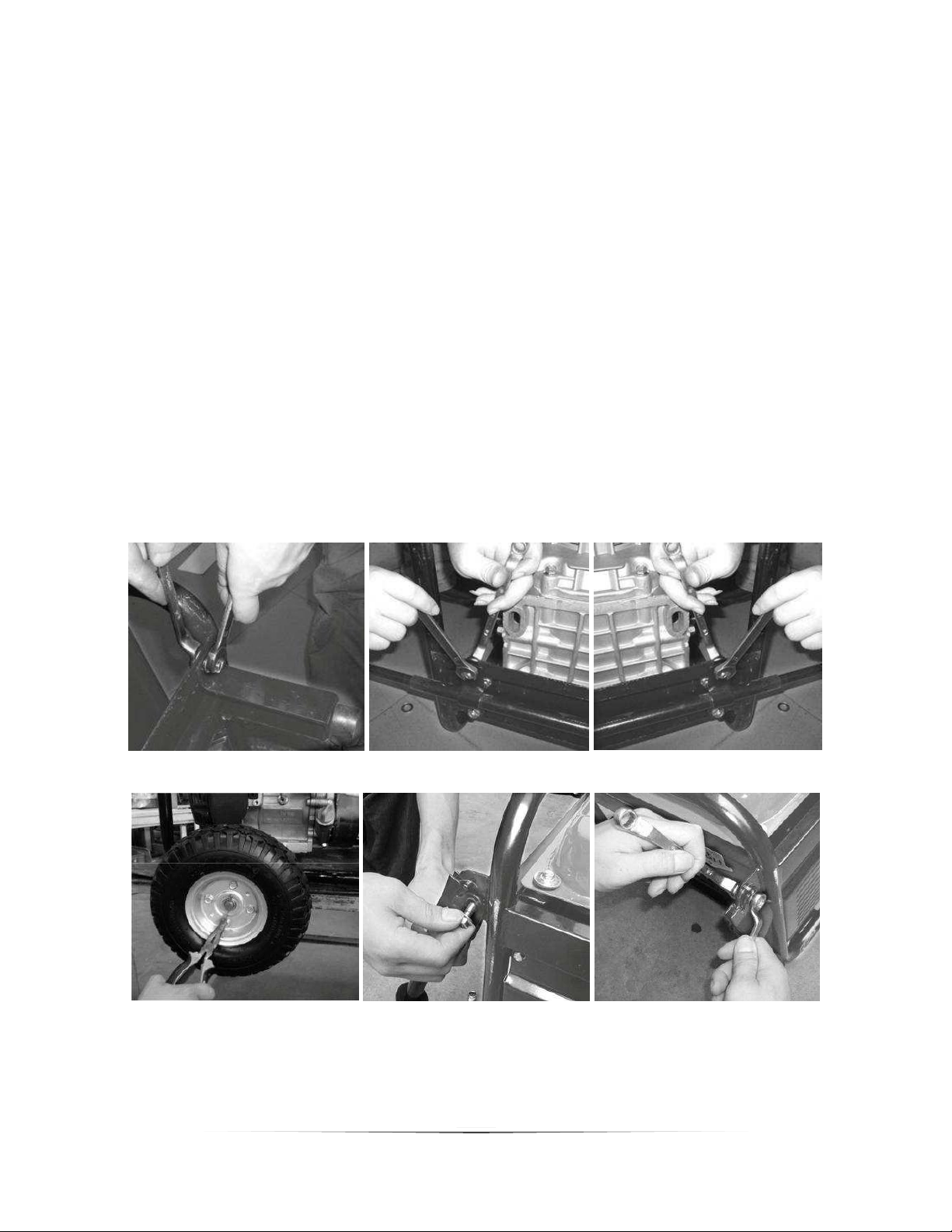
2. Secure the support legs to the frame with provided bolts and lock nuts.
(See figure 22)
3. Secure the axle bracket welded to axle the frame with the provided bolts and lock nuts.
(See figure 23)
4. Secure the loose axle bracket to the frame with the provided bolts and lock nuts.
(See figure 24)
5. Slide one wheel over each axle end and secure with the provided retaining pins.
(See Figures 25)
6. Attach the handles to the brackets on the frame using the provided bolts and nuts.
(See Figures 26 and 27)
7. Check that all fasteners are tight.
Figure 22 Figure 23 Figure 24
Figure 25 Figure 26 Figure 27
28
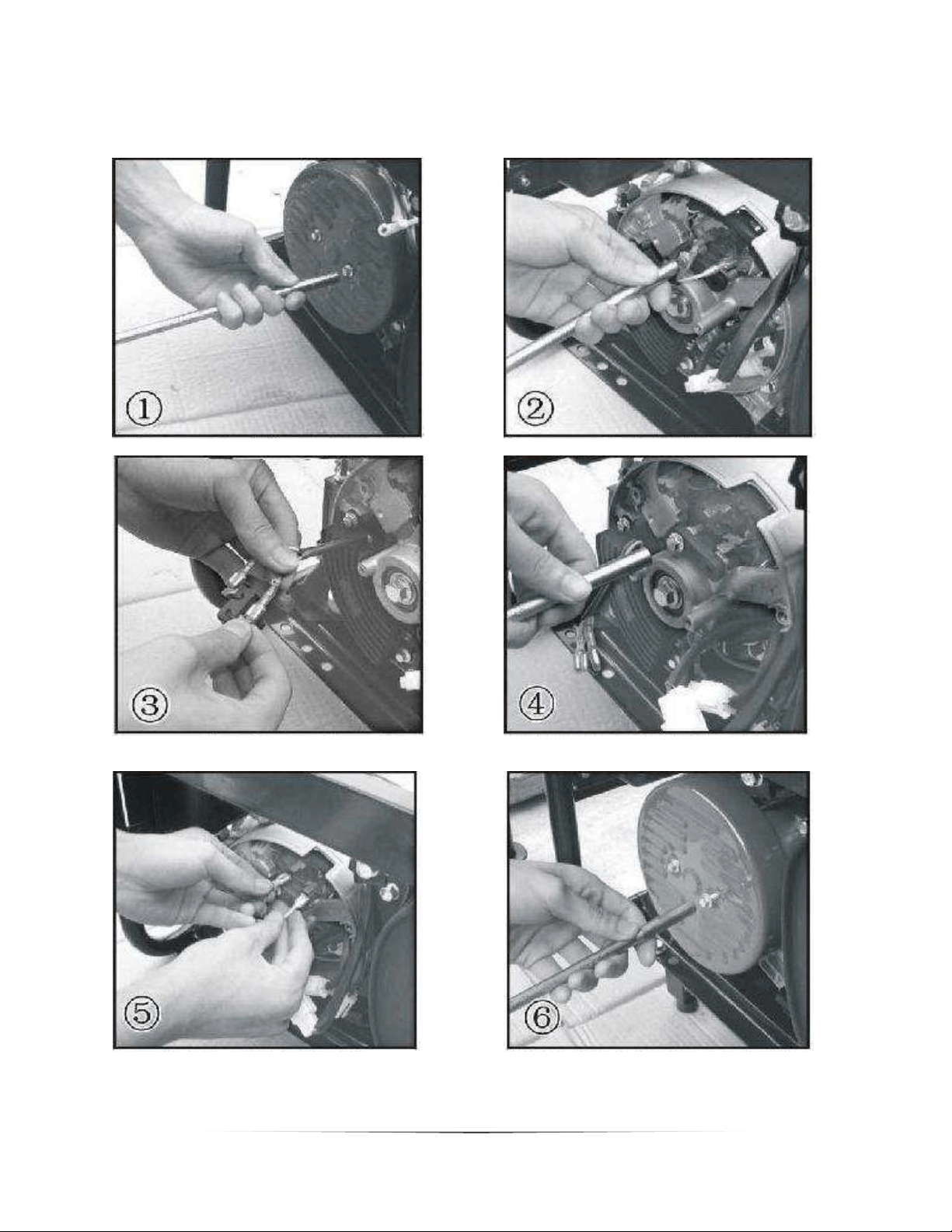
Changing/Inspecting the Carbon Brushes
Remove the 2 bolts on the generator cover.
Remove the 2 wires from the AVR on the
carbon brush.
Insert and connect the 2 wires from the
AVR, be sure to connect + and – correctly.
Remove the bolt holding the carbon brush.
Install a new carbon brush with bolt.
Replace the back cover of the generator and
secure with the 2 bolts.
29
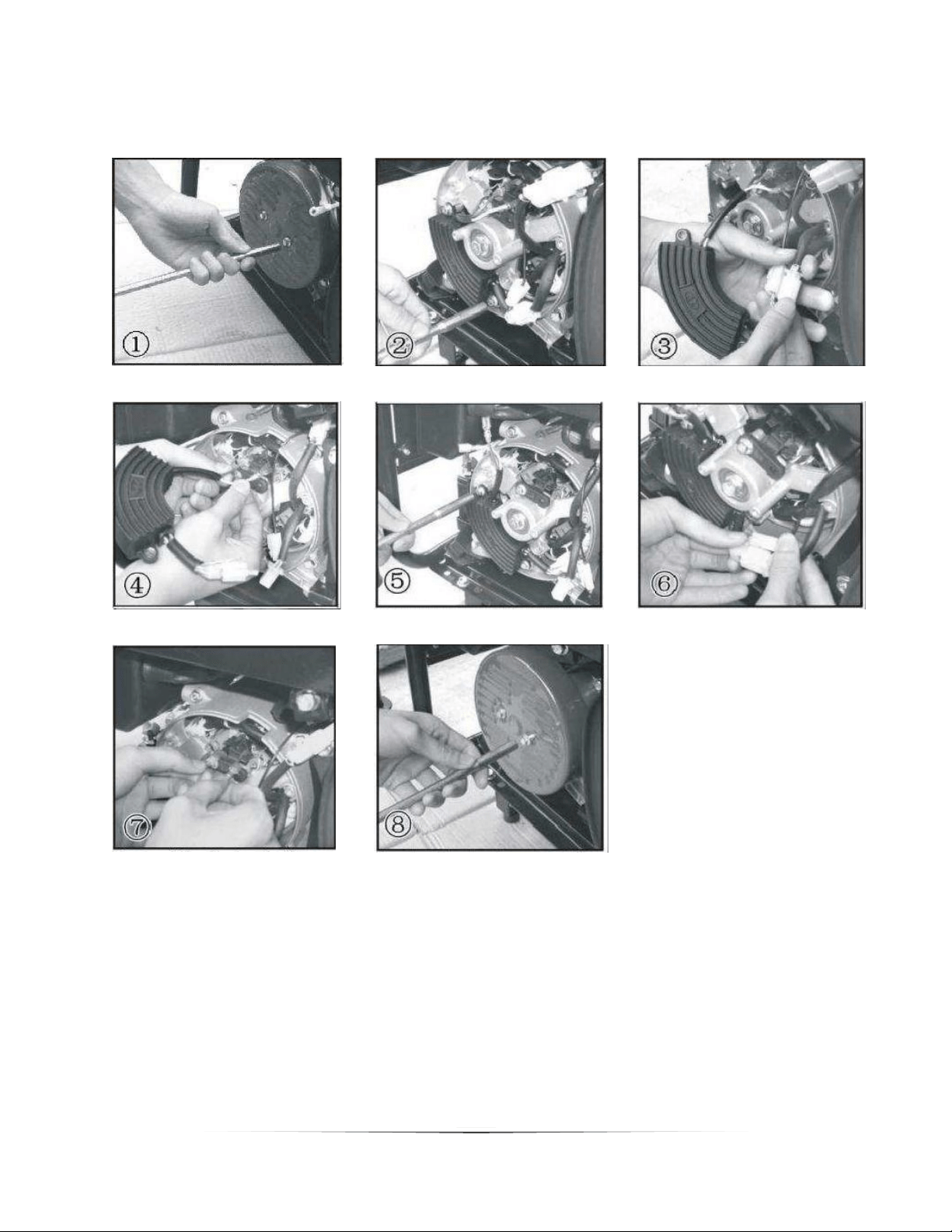
Changing/Inspecting the AVR
Remove the 2 bolts on the
generator cover.
Remove the 2 wires from the
AVR on the carbon brush.
Insert and connect the 2 wires
from the AVR, be sure to
connect + and – correctly
Remove the 2 bolts holding
the AVR.
Install the new AVR with the 2
bolts.
Replace the back cover of the
generator and secure with the
2 bolts.
Disconnect the wire clip.
Reconnect the wire clip.

30
Maintenance Log
MODEL: XP4400EH
Date
Generator Hrs.
Maintenance Performed
31
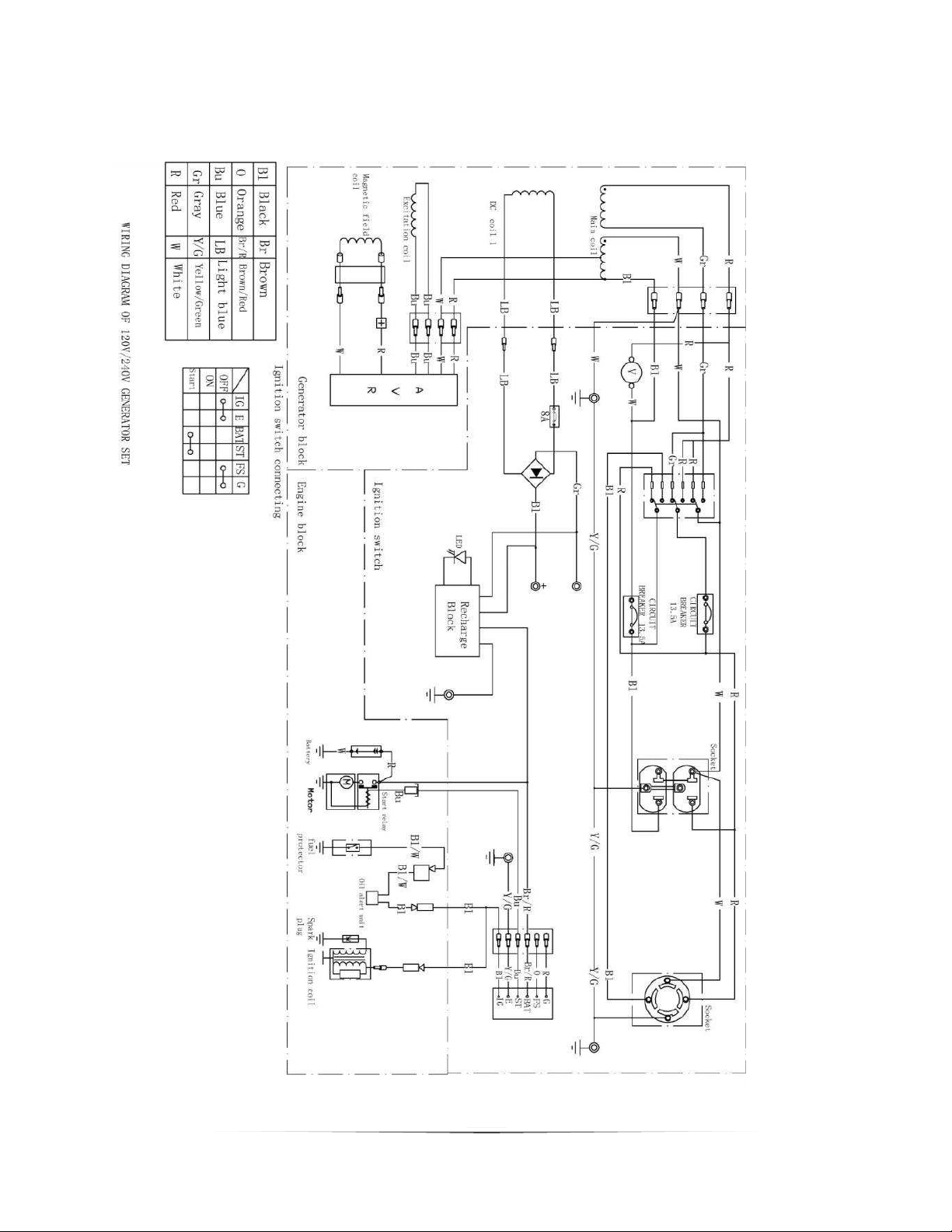
Wiring Diagram
32
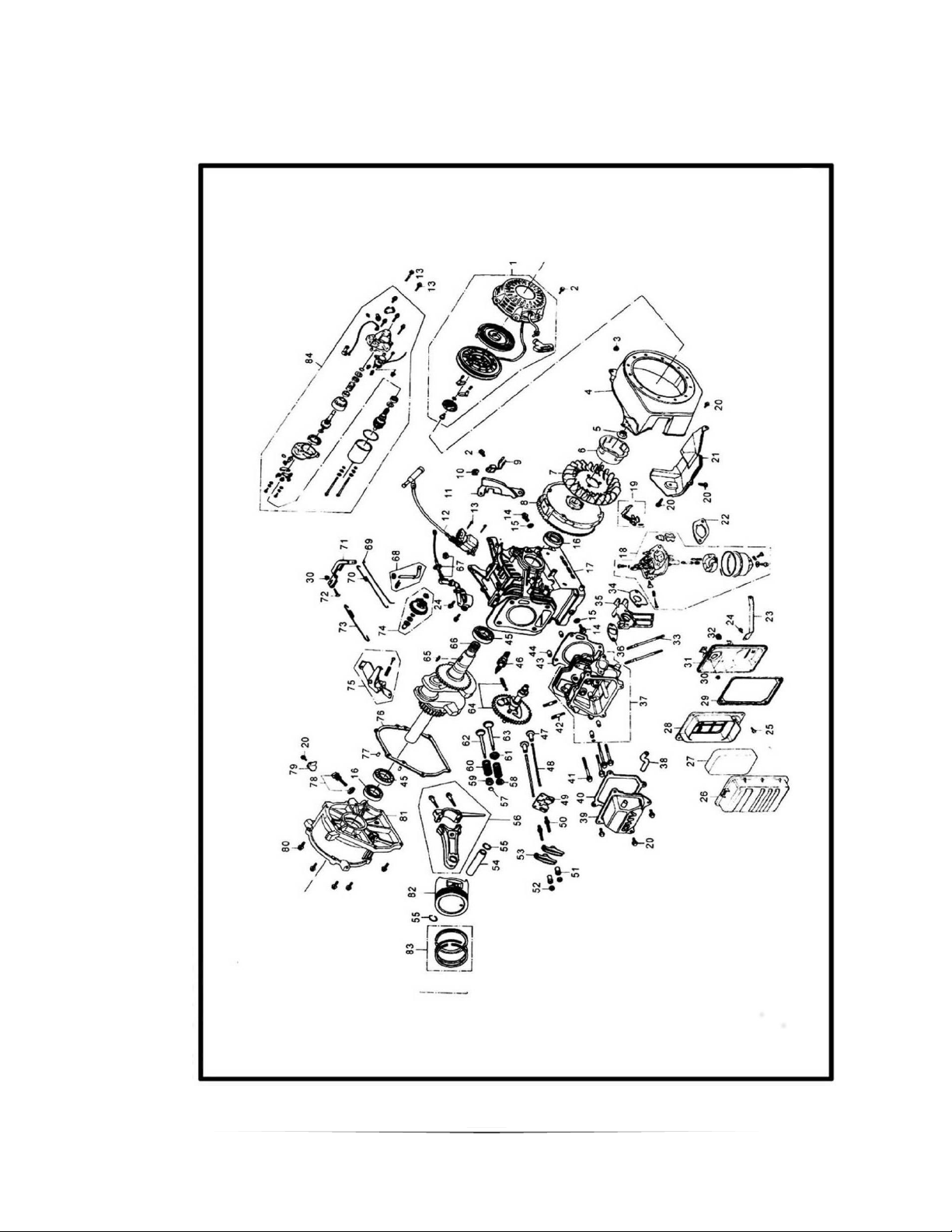
Engine Parts
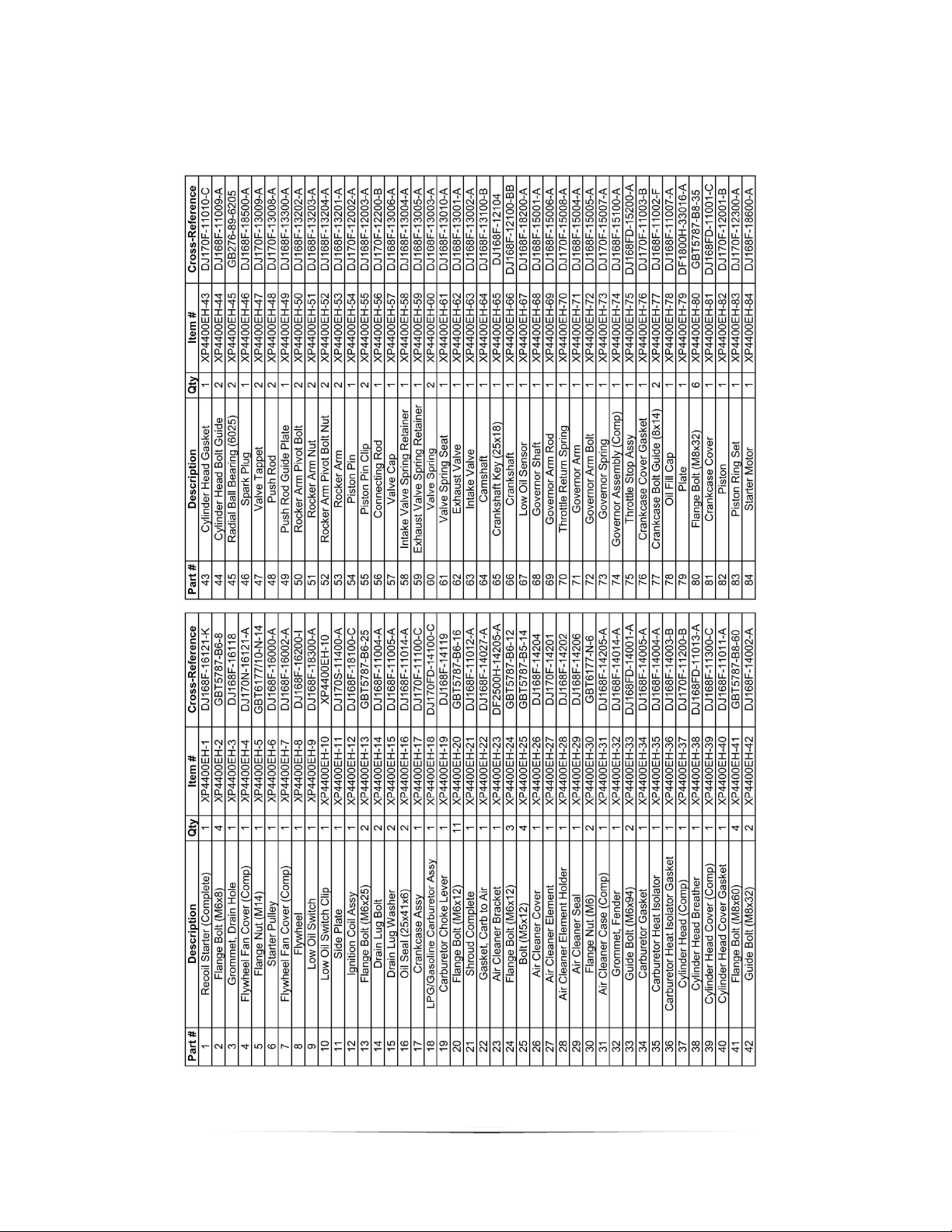
33
Engine Parts
34
Other Generator Parts
35
Other Generator Parts

36
Product
Support
Product Information, Application, Service Info & Warranty
Questions
Please email us at [email protected]
or call (800) 629-3325 Monday – Friday 6:00 am – 6:00 pm (PST)
