SERVICE MANUAL
E
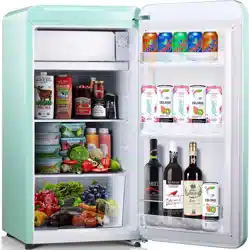
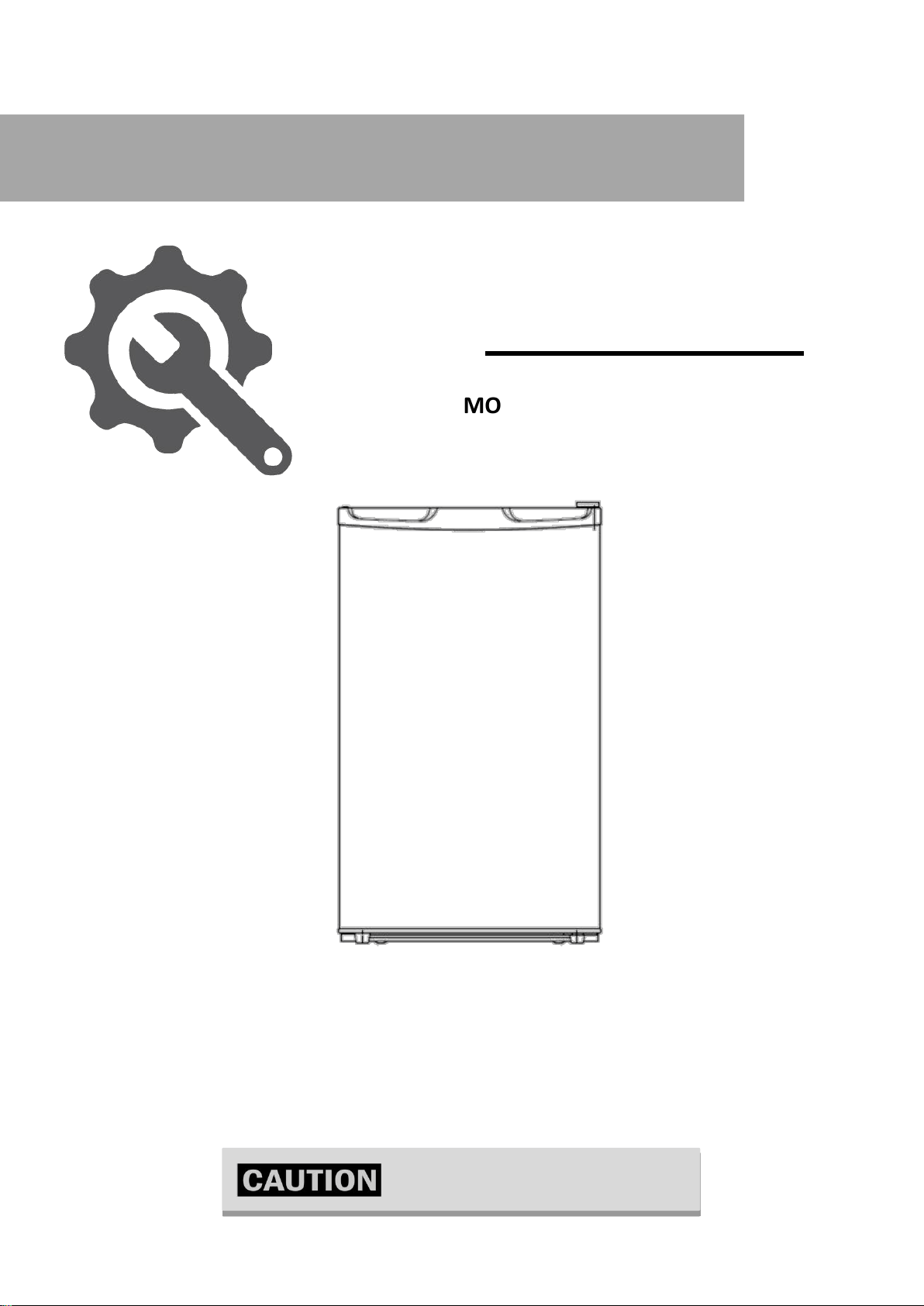
REFRIGERATOR
MODEL NO.: KS-48RHL / KS-91RHL
NOTE: This is one of the basic models. The shape and
specifications of refrigerator are subject to change.
DO NOT OPERATE MACHINE
UNDER REPAIR

Contents
Parts Description................................................................................................................................3
Circuit Diagram.................................................................................................................................3
Cooling Diagram...............................................................................................................................4
The Guide For Disassembly Common Parts Of Refrigerator………...............................................4
◆ The Instruction Of Replacing Thermostat...................................................................................4
◆ The Instruction Of Replacing Ptc Starting Relay And Overload Protector..................................5
Troubleshooting.................................................................................................................................6
◆ The Common Problem Judging Method......................................................................................6
◆ The Solution For The Common Problem.....................................................................................7
Note:...................................................................................................................................................9
3
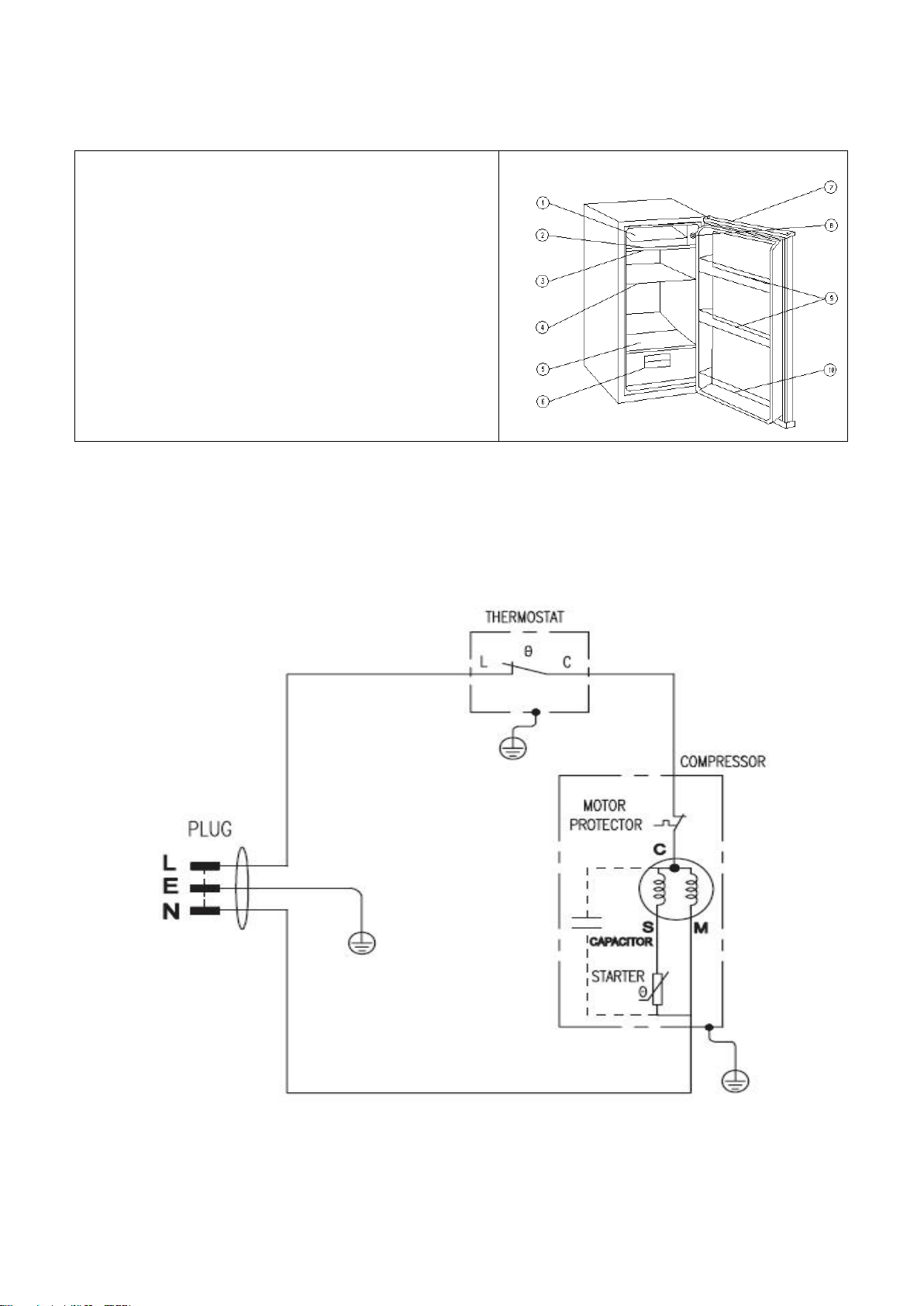
Parts Description
NOTE:
This figure is only a sketch of the refrigerator, and the
actual products may differ from it.
Circuit Diagram
1. Evaporator Door
2. Evaporator
3. Drip Tray
4. Accessories of Shelf
5. Crisper Cover
6. Crisper
7. Recessed Handle
8. Thermostat Knob
9. Door Shelf
10. Bottle Shelf
4
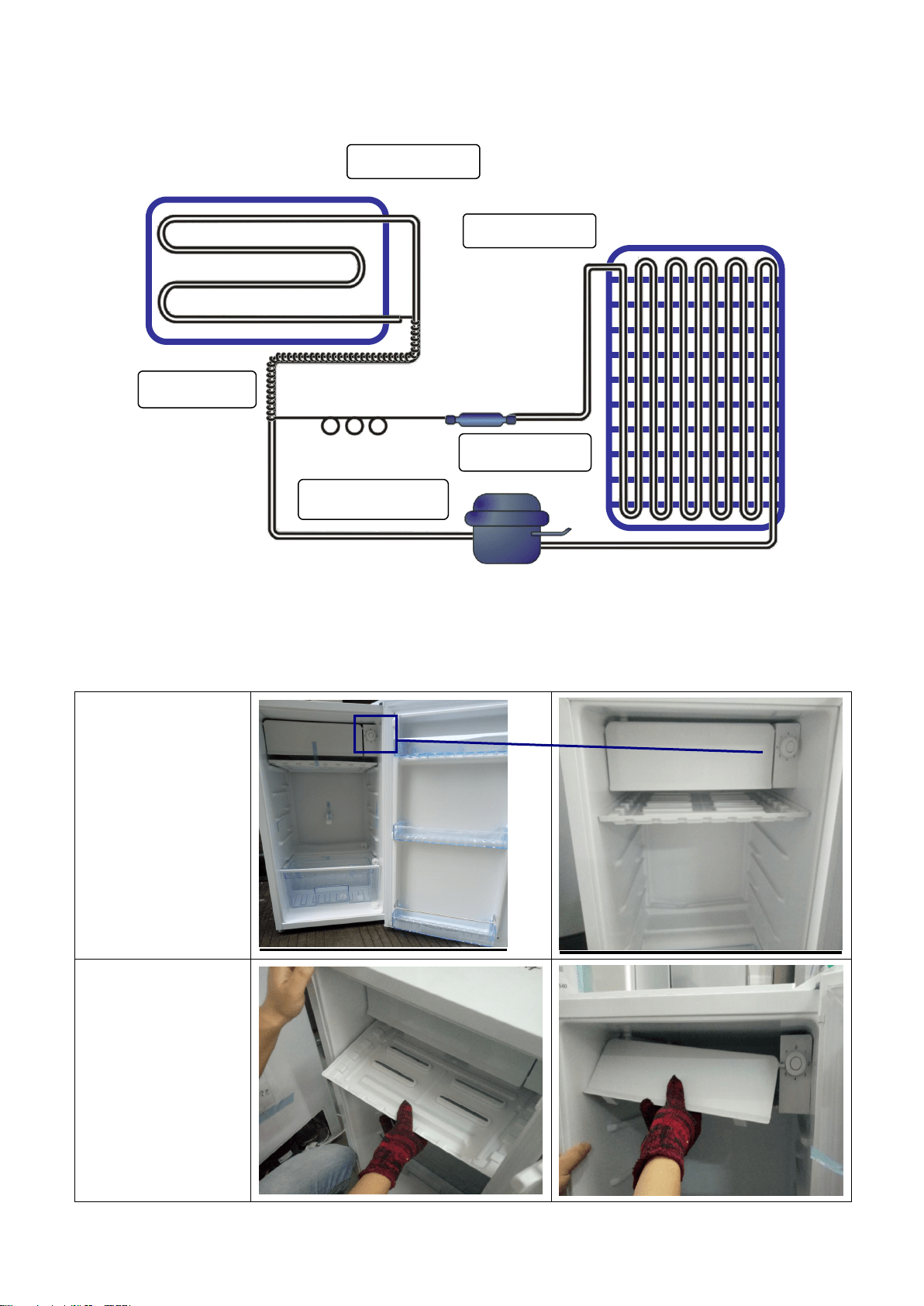
Cooling Diagram
Capillary
Compressor
Dry filter
Condenser
Evaporator
The Guide for Disassembly Common Parts of Refrigerator
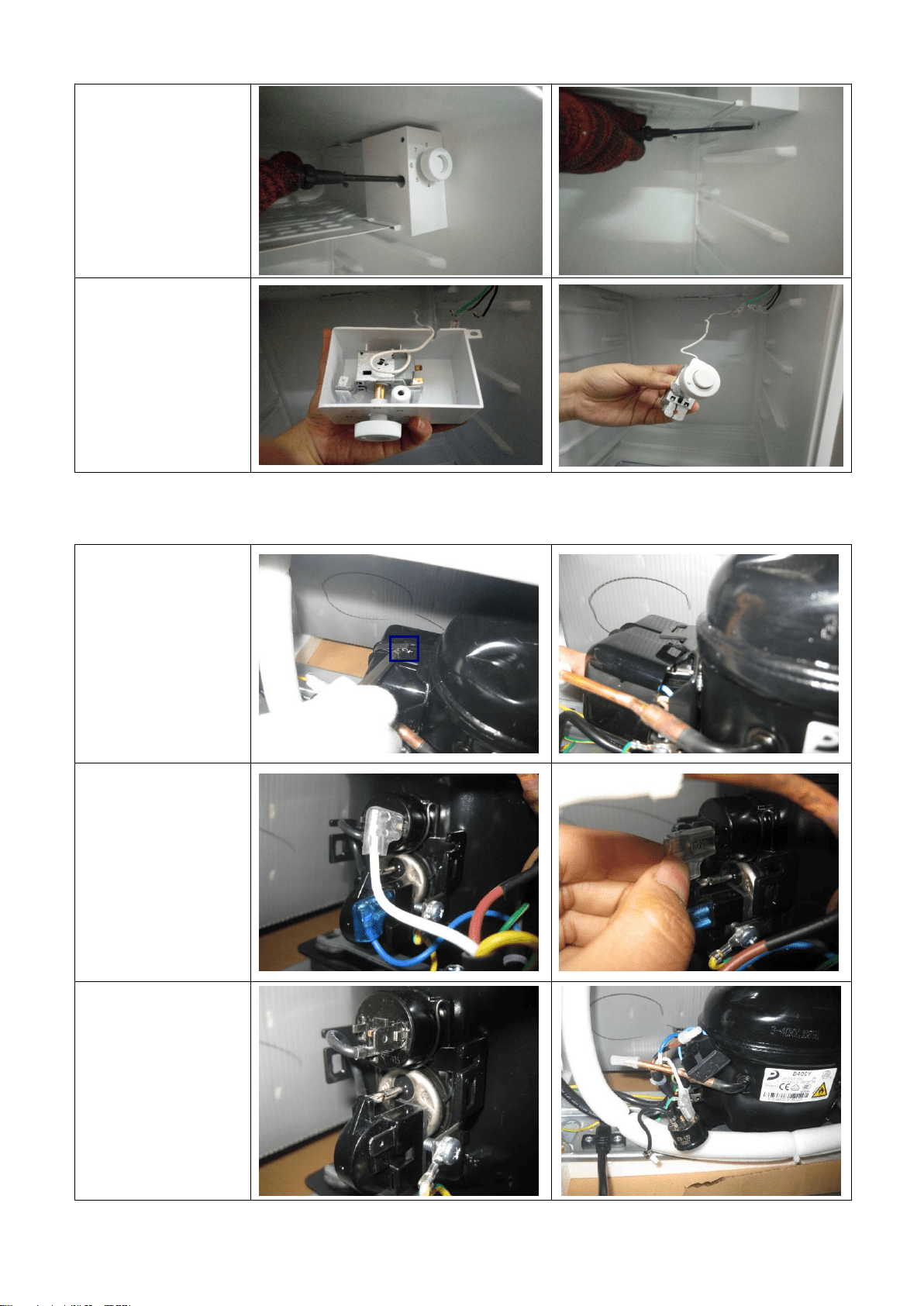
◆ The Instruction Of Replacing Thermostat
The location of the
thermostat
Disassembly the
small door then
remove the screws of
the thermostat box
5
Remove the screws
for taking the
evaporator off.
Unplug the
connecting wire, then
take out the
thermostat
◆
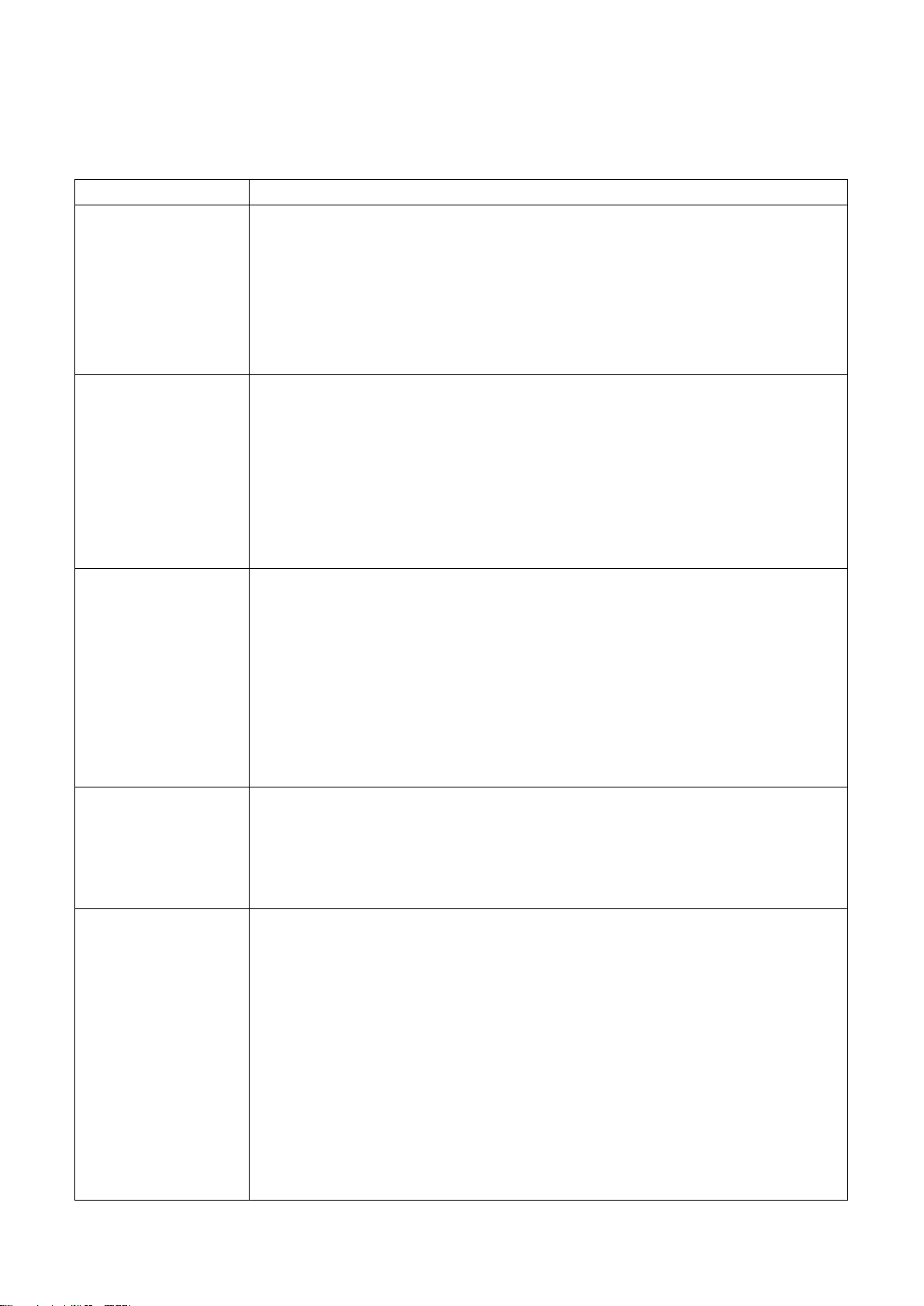
The Instruction Of Replacing Ptc Starting Relay And Overload Protector
Take down the
Spring tap and the
Cover.
Unplug the
connecting wires
Take out the PTC
Starting relay and
Overload protector
6
Troubleshooting
◆
The Judgement of the Common Problems
Problem
Cause
1. Refrigerator can’t
start
1.1 Is the power cord connected to the wall?
1.2 Is the power voltage too low?
1.3 Is the ambient temperature too low?
1.4 Is the circuit on power?
1.5 Is there any fault in the compressor?
1.6 Is the refrigeration system blocked by ice or dirt? Please stop the unit and
restart it 10 minutes later.
2. Weak cooling
effects
2.1 Is there any heat source around the refrigerator?
2.2 Is there enough space around the refrigerator for rejection of heat?
2.3 Is the setting of the temperature appropriate?
2.4 Is there too much food or overheating food in it?
2.5 Has the door been open too frequently?
2.6 Is the door completely closed?
2.7 Is the gasket be destroyed or distort?
2.8 Is the gas leaking?
3. The unit can not
stop running
3.1 Is there any heat source around the refrigerator?
3.2 Is there enough space around the refrigerator for rejection of heat?
3.3 Is the setting of the temperature appropriate?
3.4 Is there too much food or overheating food in it?
3.5 Has the door been open too frequently?
3.6 Is the door completely closed?
3.7 Is the gasket be destroyed or distort?
3.8 Is the thermostat in good operation?
3.9 Is the gas leaking?
4. Icing up in the
freezing chamber
4.1 Is the setting of the temperature appropriate?
4.2 Is there any multi-moisture food too close to the back wall of the refrigerator?
4.3 Is the ambient temperature too low?
4.4 Are the electric parts in good condition, especially the thermostat which will
keep the unit working continuously?
5. Abnormal noises
5.1 Is the refrigerator stably placed?
5.2 Does the refrigerator bump other objects?
5.3 If the internal accessory of the refrigerator is in the right place?
5.4 Does the water plate of the compressor fall off from the unit?
5.5 Does the tube of the refrigeration system bump each other?
5.6 The noise sounds like water flowing inside the refrigerator. In fact, it is normal,
which is caused the moment when the refrigerator starts and shuts-down;
Frost-dissolving causes this sound, too.
5.7 There will be a cracking sound in the cabinet when the cabinet or its
accessory is contracting or expanding, which is normal.
5.8 The motor operation sound in the compressor seems louder at night or when
it starts, which could also be caused by an uneven grounding. It’s a normal
7
phenomenon;
6. There is a peculiar
smell in the units
6.1 Is the food with special smell sealed tight?
6.2 Does it have long-stored food or degenerated food?
6.3 If the internal cabinet needs cleaning?
7. The forefront of
the middle cabinet
heats
7.1 As the fridge anti-condensation tube is placed here and cause the above
phenomenon, which is normal.
8. Refrigerator’s two
sides or the back heat
8.1 As the condensation tube is placed here and caused the above phenomenon,
which is normal.
9. The cabinet
surface condensation
9.1 Air humidity is too high.
◆ The solution for the common problem.
1.Cooling effect is not good enough
(Many reasons might cause bad cooling effect, as below:)
Reason
Analysis
Solutions
1. Gas Leakage
If some gas leaked, the unit will not work
well.
Phenomenon of failure:
A. Lower pressure of liquid cycle system
B. High temperature of copper tube of
discharging gas, hand feels very hot.
C. Too much noise, sounds like “ZZZZZ”,
comes from outlet of capillary.
D. The temperature falls down very slowly.
First find out the point of leaking
on tube, and then sealed it,
vacuuming it, finally recharge with
Gas.
Note:
If you find oil on somewhere, it is
possible that leakage point is
there.
2. The quantity of gas
is too much
If too much gas was charged into the cycle
system, the extra gas will occupy some
space of the evaporator and the heat
exchange.
Phenomenon of failure:
A.Higher pressure of liquid cycle system
than normal.
B.Higher temperature of the condenser.
C.Larger electric current of the compressor
D.There may be ice on the suction tube.
E. When gas is too much, some gas liquid
might goes back into and damage the
compressor.
First stop the unit for several
minutes, and then open the
charging tube, discharge all of
gas.
Change with a new filter, and then
recharge gas, finally seal the
system.
3. There is air in the
liquid cycle system
The air in system will cause lower efficiency
of cooling.
Phenomenon of failure:
A.Higher pressure of liquid cycle system
than normal, but the pressure is not over the
limit.
B.Higher temperature of discharging tube.
First stop the unit for several
minutes, and then open the
charging tube, discharge all of
gas.
Change with a new filter, and then
recharge gas, finally seal the
system.
8
C. Much noise
4.Low working
efficiency of
compressor
Generally when a compressor works for
many years, some parts of the compressor
will be worn, so that the compressor
discharge less gas out, the unit does not
work effectively.
Phenomenon of failure:
A.lower pressure of discharging, check the
pressure of system with pressure meter.
B.higher temperature of compressor
surface.
C. Cut off the discharging tube, and check if
the gas can be prevented coming out of the
tube when compressor is working.
Change with a new compressor.
5. There is something
that blocked the liquid
cycle system
Sometimes the filter of liquid cycle system
may be blocked by something, so that the
unit is not cold.
Phenomenon of failure:
A.lower pressure of discharging
B.lower temperature of discharging.
Change with a new filter
2.NO COOLING
(Popular failure reasons are below):
Reason
Analysis
Solutions:
1. Leakage of gas
Phenomenon of failure:
A. Leaking too fast
B. Leaking too slowly
C. No sound of flowing liquid
D. Cut off charging tube, no gas
goes out.
First find out the point of leaking on tube,
and then seal it, vacuum it, finally recharge
with gas.
Note:
If you find somewhere with oil , it is possible
where the leakage point is.
2.There is some thing
that blocked the liquid
cycle system
Ice blocking
sometimes because of unknown
reasons, water comes into liquid
cycle system, and the capillary will
be blocked by water after the unit
runs for period of time.
Phenomenon of failure:
The unit works well in the
inception, after a period of time
the ice appears in the capillary
and becomes more and more, till
blocks the hole of capillary
completely. In this moment, you
can find the ice on the evaporator
defrosts. The noise of liquid
flowing disappears. The pressure
of absorbing becomes negative.
First stop the unit for several minutes, and
then open charging tube, discharge all of
gas. Blow the cycle system with gas of
nitrogen, and then recharge Gas, finally
sealed the system.
9
The phenomenon above will
appear again and again.
The way to check ice blocking:
Warm the capillary with a hot
towel, after the ice is in the
capillary melting, you can hear a
sound of gas flowing from the
capillary abruptly. The pressure of
absorbing becomes higher. It is
Ice blocking.
There is offal blocking the capillary
Phenomenon of failure:
A. If the capillary is blocked by
something such as offal etc., the
sound of liquid flowing disappears.
B.The ice on the evaporator
defrosts.
C.The pressure of absorbing
becomes negative.
D.Higher temperature of
discharging tube.
E.The way to check offal blocking:
If you warm capillary with the way
of checking ice blocking, there is
no change. It must be offal
blocking.
First stop the unit for several minutes, and
then open charging tube, discharge all of
gas. Blow the cycle system with gas of
nitrogen. Change with a new capillary and
filter, and then recharge Gas, finally seal the
system.
COMPRESSOR NEVER STOPS:
Reason
Solution
1)The setting temperature is not reasonable.
Readjust the temperature setting.
2) The sensor is bad.
Replace the sensor.
3) Seal of door is damaged.
Replace the gasket
4) Too much food in the refrigerator
Please put the food properly.
5) Wind door is broken.
Replace wind door.
6) Fan motor is broken.
Replace fan motor
Note:
● Before doing these operations above, disconnect the main power supply. Failure to do so could result
in electrical shock or personal injury.
● In case of any detailed technical information, please check with the technical specifications.
Thank you for purchasing this product! If you have any questions about the product, such as
missing parts, damaged products, product assembling, and operation, please contact us via
Amazon Message or customer service number: 213-4467172 or 661-4358826.
IMPORTANT
Please call our customer service department for any consulting:
213-4467172
661-4358826
(8:30am - 5:30pm P.S.T.)
DATED PROOF OF PURCHASE IS REQUIRED FOR WARRANTY SERVICE.
AVIS
Veuillez appeler le service à la clientèle pour toutes questions au:
213-4467172
661-4358826
(8:30am - 5:30pm P.S.T.)
PREUVE D’ACHAT ORIGINALE REQUISE POUR SERVICE DE GARANTIE.
IMPORTANTE
Sólo hay que llamar nuestro departamento de servicio
al cliente en caso de tener preguntas o inquietudes:
213-4467172
661-4358826
(8:30am - 5:30pm P.S.T.)
SE REQUIERE PRUEBA DE COMPRA CON FECHA PARA SERVICIO BAJO
GARANTÍA.
Address: ROWAN ELECTRIC APPLIANCE LLC
28407 Ascent Way, Santa Clarita, CA 91350
