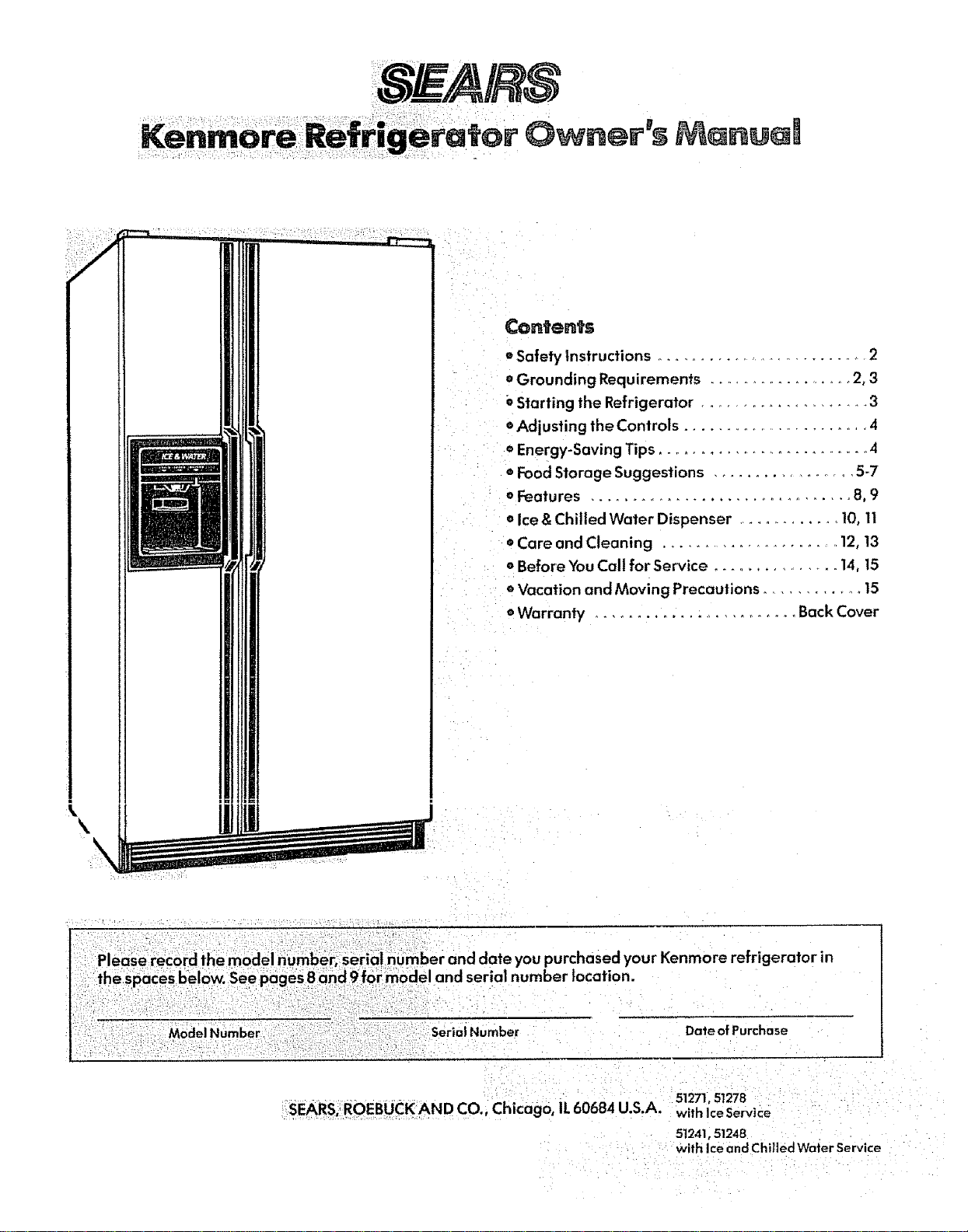
you purchased your Kenmore refrigerator in
model and serial number location.
/ Serial Number Date of Purchase
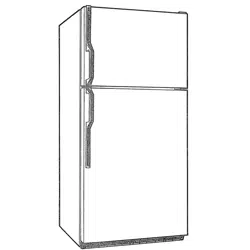
51271, 51278
SEARS,ROEBUCKAND CO., Chicago, 1L60684 U.S.A. withIceService
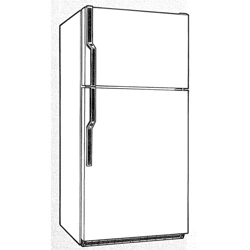
51241, 51248
with Ice and Chi|]ed Water Service
IMPORTANT SAFETY INSTRUCTIONS
Read aH ns ructlons before uslng
thls app fiance.
WARN|NG_ When using this appliance, always
exercise basic safety precautions, including the
following:
. Use this appliance only for its intended
purpose as described in this Owner's Manual°
• This refrigerator must be properly installed
in accordance with the Attention Installer
Instructions before it is used. See grounding
requirements below and on page 3_
• Never unplug your refrigerator by pulling on
the power cord. Always grip plug firmly and pull
straight out from the outlet.
o Repair or replace immediately all electric
service cords that have become frayed or
otherwise damaged. Do not use a cord that shows
cracks or abrasion damage along its length or at
either the plug or connector end.
• When moving your refrigerator away from
the wail, be careful not to roll over or damage
the power cord.
o After your refrigerator is in operation, do not
touch the cold surfaces, particularly when
hands are damp or wet. Skin may adhere to the
extremely cold surfaces_
o Do not place fingers or hands on the
automatic icemaking mechanism while the
refrigerator is plugged in. This will help protect
you from possible injury. It will also prevent
interference with the moving parts of the ejector
mechanism, or with the heating element that
releases the cubes,
o Do not store or use gasoline or other flammable
vapors and liquids in the vicinity of this or any
other appliance.
o Don't refreeze frozen foods which have
thawed completely. The United States Department of
Agriculture in Home and Garden Bulletin No. 69 says:
':.oYou may safely refreeze frozen foods that have
thawed if they still contain ice crystals or if they are
still cold--below 40°E
'_ Thawed ground meats, poultry or fish that have
any off-odor or off-color should not be refrozen and
should not be eaten, Thawed ice cream should be
discarded. If the odor or color of any food is poor
or questionable, get rid of it_The food may be
dangerous to eat.
"Even partial thawing and refreezing reduce the
eating quality of foods, particularly fruits, vegetables
and prepared foods_ The eating quality of red meats
is affected less than that of many other foods. Use
refrozen foods as soon as possible to save as much
of their eating quality as you can'.'
e If your old refrigerator is still around the
house but not in use, be sure to remove the
doors. This will reduce the possibility of danger
to children°
o Unplug your refrigerator:
A. Before making any repairs° Note: We strongly
recommend that any servicing be performed by a
qualified individual
B. Before cleaning r
C. Before replacing a burned-out light bulb, the
refrigerator should be unplugged in order to avoid
contact with a live wire filament. (A burned-out light
bulb may break when being replaced.)
Note: Moving control to OFF position cloes not
remove power to the light circuit.
SAVE THESEINSTRUCTIONS
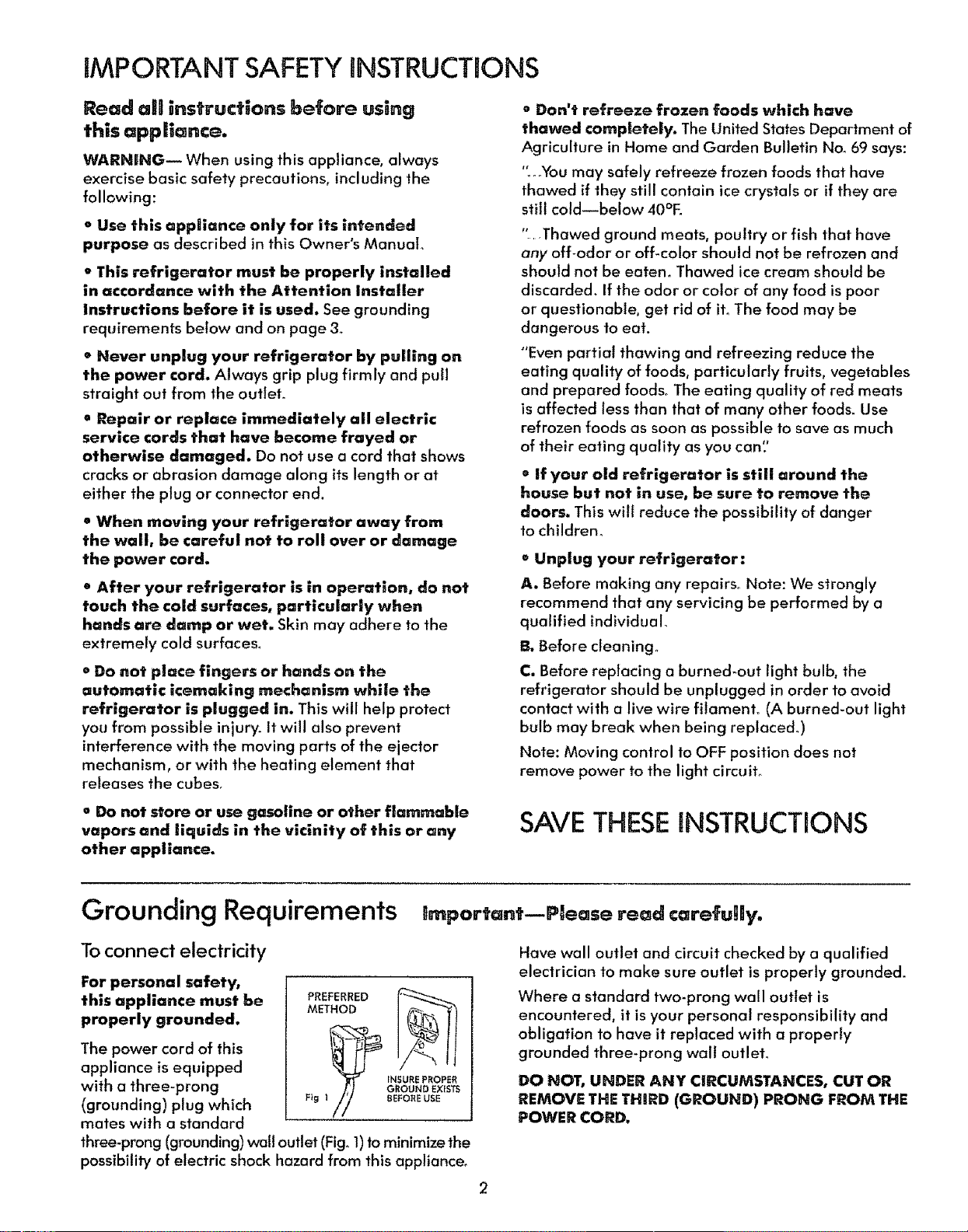
Grounding Requirements Important--P easerecsdcarefuffy.
Toconnect electricity
For personal safety,
this appliance must be
properly grounded.
The power cord of this
appliance is equipped
with a three-prong
(grounding) plug which
mates with a standard
PREFERRED _il
METHOD
_ ENSURE PROPER
GROUND EXISTS
F}g 1 L{EFOI(E USE
three-prong (grounding) wall outlet (Fig. 1)to minimize the
possibility of electric shock hazard from this apptiance_
Have wall outlet and circuit checked by a qualified
electrician to make sure outlet is properly grounded.
Where a standard two-prong wall outlet is
encountered, it is your personal responsibility and
obligation to have it replaced with a properly
grounded three-prong wall outlet.
DO NOT, UNDER ANY CIRCUMSTANCES, CUT OR
REMOVE THE THIRD (GROUND) PRONG FROM THE
POWER CORD.
Starting the Refrigerator
Use of adapter plug
Because of potential safety hazards under certain
conditions, we strongly recommend against use of
an adapter plug. However, if you still elect to use an
adapter, where local codes permit, a TEMPORARY
CONNECTION may be made to a properly grounded
two-prong wall outlet by use of a UL listed adapter
(Fig. 2) available at most local hardware stores.
The larger slot in the
adapter must be aligned
with the larger slot in the
wall outlet to provide
proper polarity in the
connection of the power
cord.
TEMPORARY METHOD
(ADAPTER PLUGS HOT
PERMITTED IN _NAOA) _ ". _'_
ALIGN LAffGE H_(_ I 1
PRONGSISLOTS _t,IIL_) _ I
Fig 2 y _ FIRM CONNECTIO/_
} I BEFORE USE
CAUTION: Attaching an adapter ground terminal
to the wall outlet cover screw does not ground the
appliance unless the cover screw is metal, and not
insulated, and the wall outlet is grounded through
the house wiring. You should have circuit checked
by a qualified electrician to make sure the outlet
is properly grounded.
When disconnecting the power cord from the
adapter, always hold the adapter with one hand.
If this isnot done, the adapter ground terminal is
very likely to break with repeated use.
Should the adapter ground terminal break,
DO NOT USE the appliance until a proper
ground has again been established.
Use of Extension Cords
Because of potential safety hazards under certain
conditions, we strongly recommend against the use
of an extension cord. However, if you still elect to use
an extension cord, it is absolutely necessary that it
be a UL listed 3-wire grounding type appliance
extension cord having a grounding type plug and
outlet and that the electrical rating of the cord be
I5 amperes (minimum) and 120 volts°
Electrical Requirements
The refrigerator should always be plugged into its
own individual electrical outlet--!15 volt, 60 Hertz,
single phase ACoThis is recommended for best
performance and to prevent overloading house
wiring circuits, which could cause a fire hazard
from overheating wires.
Location
• Install the refrigerator on a floor strong enough to
support it when it is fufly loaded..
= Do not install it where the temperature will go
below 60°1=.because it will not run often enough to
maintain proper temperatures.
o Do not install it next to your range, a heating vent
or where the sun will shine directly on ito
Clearances
Allow the following clearances for ease of installation,
proper air circulation, and plumbing and electrical
connections:
Sides ....5/8" Top .......1" Back ......I"
(If built-in, allow 7/8" at top for hinge covers.)
If refrigerator is against a wall on either side, allow
3/4" for door clearance.
Rollers
Adjustable rollers behind the base grille enable
you to move the refrigerator away from the wall for
cleaning. These rollers should be set so the refrigerator
rests firmly on the floor. Toassure that the doors will
close automatically from a halfway-open position,
there is a built-in tilt from the front to the back of the
cabinet, Side-by-side refrigerators also have specially
designed door hinges that lift both doors slightly
when opened, allowing the force of gravity to help
close them securely.
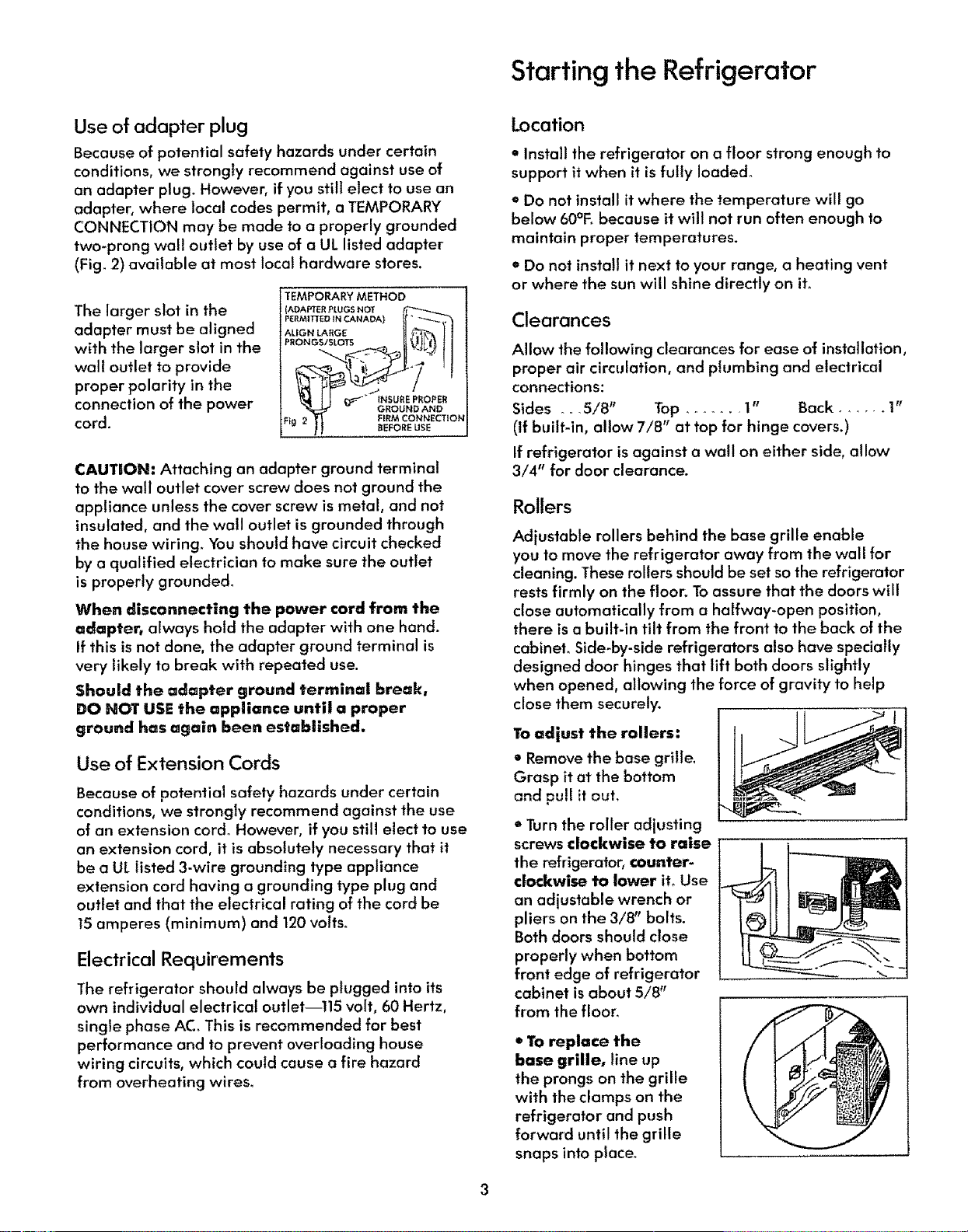
To adiust the rollers:
* Remove the base grille.
Grasp it at the bottom
and pu!! it out,
o Turn the roller adjusting
screws clockwise to raise
the refrigerator, counter-
clockwise to lower it_Use
an adjustable wrench or
pliers on the 3/8" bolts.
Both doors should close
properly when bottom
front edge of refrigerator
cabinet is about 5/8"
from the floor.
• To replace the
bose grille, line up
the prongs on the grille
with the clamps on the
refrigerator and push
forward until the grille
snaps into placeo
Adiusfing the Controls
COLDER NORM COLD
FREEZER CONTROL
OFF COLD NORM COLDER
FRESHFOODCONTROL
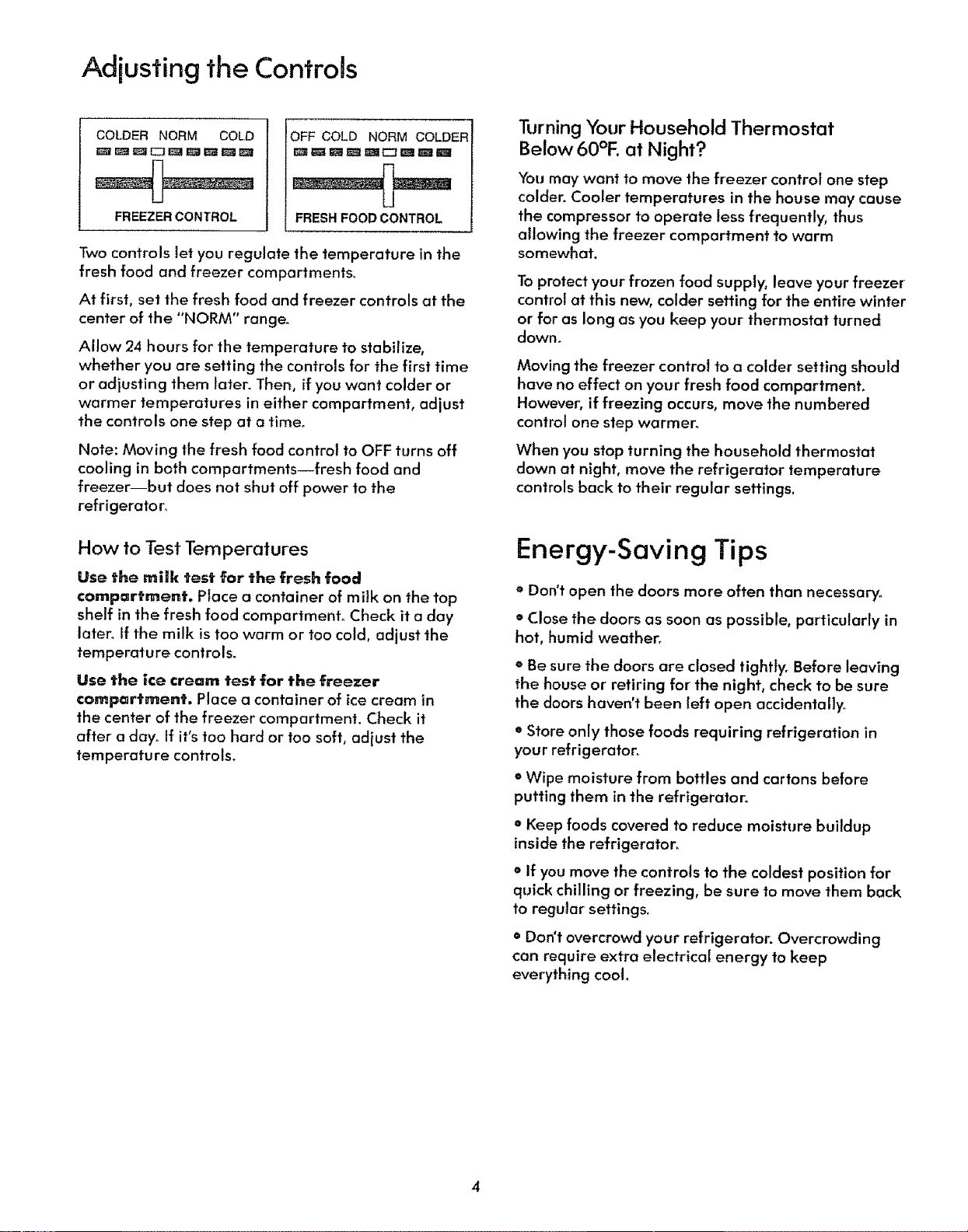
Two controls let you regulate the temperature in the
fresh food and freezer compartments.
At first, set the fresh food and freezer controls at the
center of the "NORM" range.
Allow 24 hours for the temperature to stabilize,
whether you are setting the controls for the first time
or adjusting them later. Then, if you want colder or
warmer temperatures in either compartment, adjust
the controls one step at a time_
Note: Moving the fresh food control to OFF turns off
cooling in both compartments--fresh food and
freezer--but does not shut off power to the
refrigerator.
How to Test Temperatures
Use the rnillk test for the fresh food
compartment. Place a container of milk on the top
shelf in the fresh food compartment. Check it a day
later° If the milk is too warm or too cold, adjust the
temperature controls.
Use the ice cream test for the freezer
compartment. Place a container of ice cream in
the center of the freezer compartment. Check it
after a day. If it's too hard or too soft, adjust the
temperature controls,
Turning Your Household Thermostat
Below 60°1=. at Night?
You may want to move the freezer control one step
colder. Cooler temperatures in the house may cause
the compressor to operate less frequently, thus
allowing the freezer compartment to warm
somewhat.
To protect your frozen food supply, leave your freezer
control at this new, colder setting for the entire winter
or for as long as you keep your thermostat turned
down.
Moving the freezer control to a colder setting should
have no effect on your fresh food compartment_
However, if freezing occurs, move the numbered
control one step warmer.
When you stop turning the household thermostat
down at night, move the refrigerator temperature
controls back to their regular settings.
Energy-Saving Tips
= Don't open the doors more often than necessary.
• Close the doors as soon as possible, particularly in
hot, humid weather.
• Be sure the doors are closed tightly. Before leaving
the house or retiring for the night, check to be sure
the doors haven't been left open accidentally.
• Store only those foods requiring refrigeration in
your refrigerator.
• Wipe moisture from bottles and cartons before
putting them in the refrigerator°
• Keep foods covered to reduce moisture buildup
inside the refrigerator,
• If you move the controls to the coldest position for
quick chilling or freezing, be sure to move them back
to regular settings.
=Don't overcrowd your refrigerator. Overcrowding
can require extra electrical energy to keep
everything cool
Food Storage Suggestions
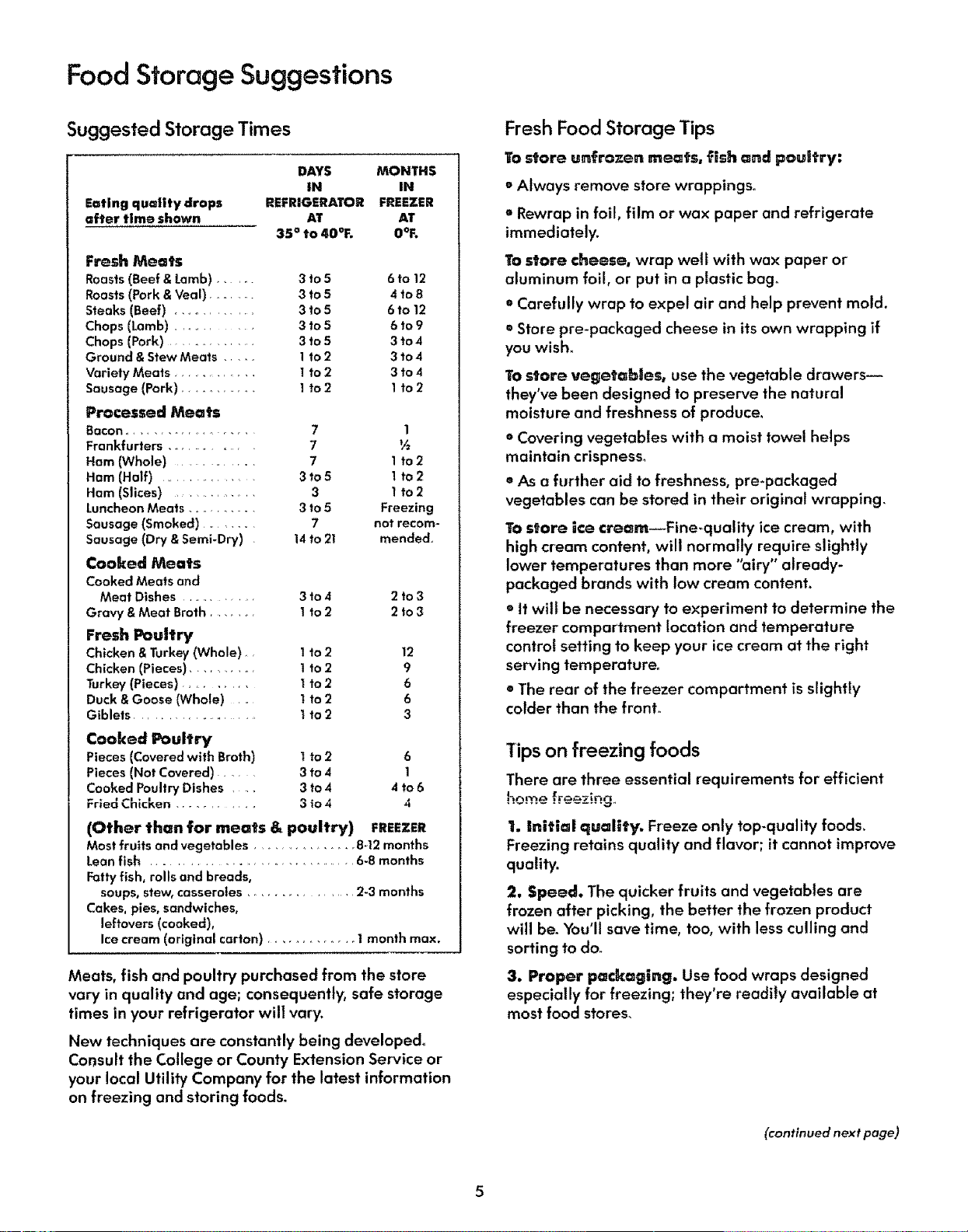
Suggested Storage Times
DAYS MONTHS
IN IN
Eating quality drops REFRIGERATOR FREEZER
after time shown AT AT
35 ° to 40°F. O°F.
Fresh Meats
Roasts (Beef g Lamb) ...... 3 to 5 6 to 12
Roasts (Pork & Veal) ....... 3 to S 4 to 8
Steaks (Beef) ............. 3 to S 6 to 12
Chops (Lamb) ........... 3 to 5 6 to 9
Chops (Pork) ............... 3 to 5 3 to 4
Ground 8, Stew Meats ..... 1 to 2 3 to 4
Variety Meats .............. 1 to 2 3 to 4
Sausage (Pork) ........... 1 to 2 1 to 2
Processed Meats
Bacon ................. 7 1
Frankfurters ............ 7 _/=
Ham (Whole) ............. 7 1 to 2
Ham (Half) .................. 3 to S 1 to 2
Ham (Slices) ............... 3 I to 2
Luncheon Meats .......... 3 to 5 Freezing
Sausage (Smoked) .......... 7 not recom-
Sausage (Dry & Semi_Dry) , 14 to 21 mended°
Cooked Meats
Cooked Meats and
Meat Dishes ........... 3 to 4 2 to 3
Gravy 8, Meat Broth ........ 1 to 2 2 to 3
Fresh Poultry
Chicken 8,Turkey (Whole) , I to 2 12
Chicken (Pieces) ......... I to 2 9
Turkey (Pieces) ............ I to 2 6
Duck 8' Goose (Whole) .... ! to 2 6
Giblets ................... 1 to 2 3
Cooked Poultry
Pieces (Covered with Broth) I to 2 6
Pieces (Not Covered) ...... 3 to 4 1
Cooked Poultry Dishes , __ 3 to 4 4 to 6
Fried Chicken ............ 3 io 4 4
(Other than for meats & poultry) FREEZER
Most fruits and vegetables .............. 8-12 months
Lean fish ................................ 6-8 months
Fatty fish, rolls and breads,
soups, stew, casseroles ............ 2-3 months
Cakes, pies, sandwiches,
leftovers (cooked),
Ice cream (original carton) ........... I month max.
Meats, fish and poultry purchased from the store
vary in quality and age; consequently, safe storage
times in your refrigerator will vary.
New techniques are constantly being developed,
Consult the College or County Extension Service or
your local Utility Company for the latest information
on freezing and storing foods.
Fresh Food Storage Tips
To store unfrozen me=is, f_sh and poultry:
Always remove store wrappings°
e Rewrap in foil, film or wax paper and refrigerate
immediately.
To store cheese, wrap well with wax paper or
aluminum foil, or put in a plastic bag,
• Carefully wrap to expel air and help prevent mold.
• Stere pro-packaged cheese in its own wrapping if
you wish_
To store roger=hies, use the vegetable drawers--
they've been designed to preserve the natural
moisture and freshness of produce,
oCovering vegetables with a moist towel helps
maintain crispness,
• As a further aid to freshness, pro-packaged
vegetables can be stored in their original wrapping,
3"ostore ice ere=m--Fine-quality ice cream, with
high cream content, will normally require slightly
lower temperatures than more "airy" already-
packaged brands with low cream content.
o It wilt be necessary to experiment to determine the
freezer compartment location and temperature
control setting to keep your ice cream at the right
serving femperatureo
• The rear of the freezer compartment is slightly
colder than the front_
Tips on freezing foods
There are three essential requirements for efficient
............... o"
1. Initial qu=llty. Freeze only top-quality foods,
Freezing retains quality and flavor; it cannot improve
quality.
2. Speed. The quicker fruits and vegetables are
frozen after picking, the better the frozen product
will be. You'll save time, too, with less culling and
sorting to do,
3. Proper packaging. Use food wraps designed
especially for freezing; they're readily available at
most food stores.
(continued next page)
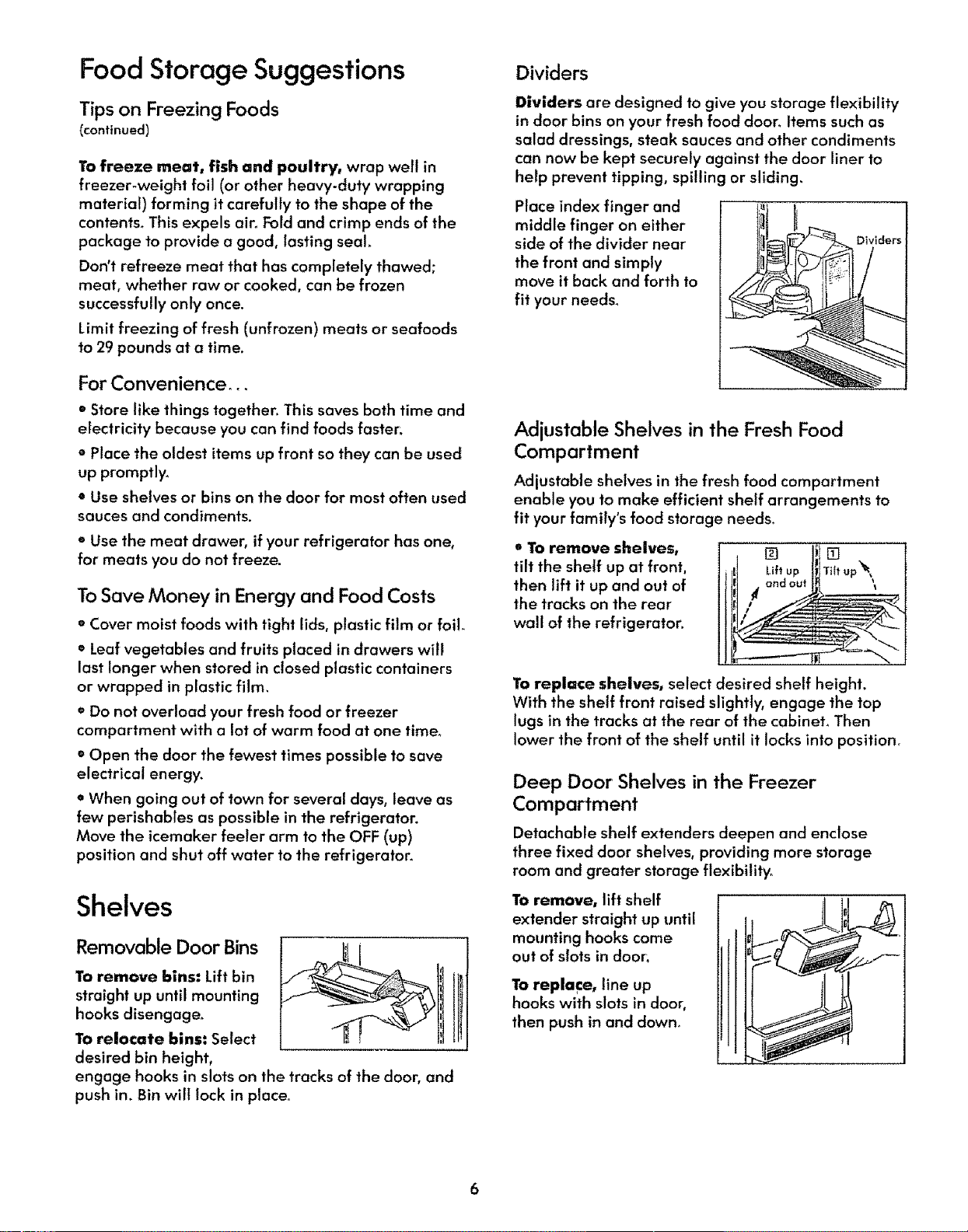
Food Storage Suggestions
Tips on Freezing Foods
(continued)
To freeze meat, fish and poultry, wrap well in
freezer-weight foil (or other heavy-duty wrapping
material) forming it carefully to the shape of the
contents. This expels air. Fold and crimp ends of the
package to provide a good, lasting seal.
Don't refreeze meat that has completely thawed;
meat, whether raw or cooked, can be frozen
successfully only once.
Limit freezing of fresh (unfrozen) meats or seafoods
to 29 pounds at a time.
For Convenience...
e Store like things together. This saves both time and
electricity because you can find foods faster.
o Place the oldest items up front so they can be used
up promptly.
• Use shelves or bins on the door for most often used
sauces and condiments,
• Use the meat drawer, if your refrigerator has one,
for meats you do not freeze.
To Save Money in Energy and Food Costs
o Cover moist foods with tight lids, plastic film or foil
o Leaf vegetables and fruits placed in drawers will
last longer when stored in closed plastic containers
or wrapped in plastic film,
• Do not overload your fresh food or freezer
compartment with a lot of warm food at one time.
• Open the door the fewest times possible to save
electrical energy.
• When going out of town for several days, leave as
few perishables as possible in the refrigerator.
Move the icemaker feeler arm to the OFF (up)
position and shut off water to the refrigerator.
Shelves
Removable Door Bins
To remove bins: Lift bin
straight up until mounting
hooks disengage°
To relocate bins: Select
desired bin height,
engage hooks in slots on the tracks of the door, and
push in. Bin will lock in place.
Dividers
Dividers are designed to give you storage flexibility
in door bins on your fresh food door. Items such as
salad dressings, steak sauces and other condiments
can now be kept securely against the door liner to
help prevent tipping, spilling or sliding,
Place index finger and
middle finger on either
side of the divider near
the front and simply
move it back and forth to
fit your needs.
Adjustable Shelves in the Fresh Food
Compartment
Adjustable shelves in the fresh food compartment
enable you to make efficient shelf arrangements to
fit your family's food storage needs.
• To remove shelves,
tilt the shelf up at front,
then lift it up and out of
the tracks on the rear
wall of the refrigerator.
To replace shelves, select desired shelf height.
With the shelf front raised slightly, engage the top
lugs in the tracks at the rear of the cabinet. Then
lower the front of the shelf until it locks into position.
Deep Door Shelves in the Freezer
Compartment
Detachable shelf extenders deepen and enclose
three fixed door shelves, providing more storage
room and greater storage flexibility.
TO remove, lift shelf
extender straight up until
mounting hooks come
out of slots in door.
To replace, line up
hooks with slots in door,
then push in and down°
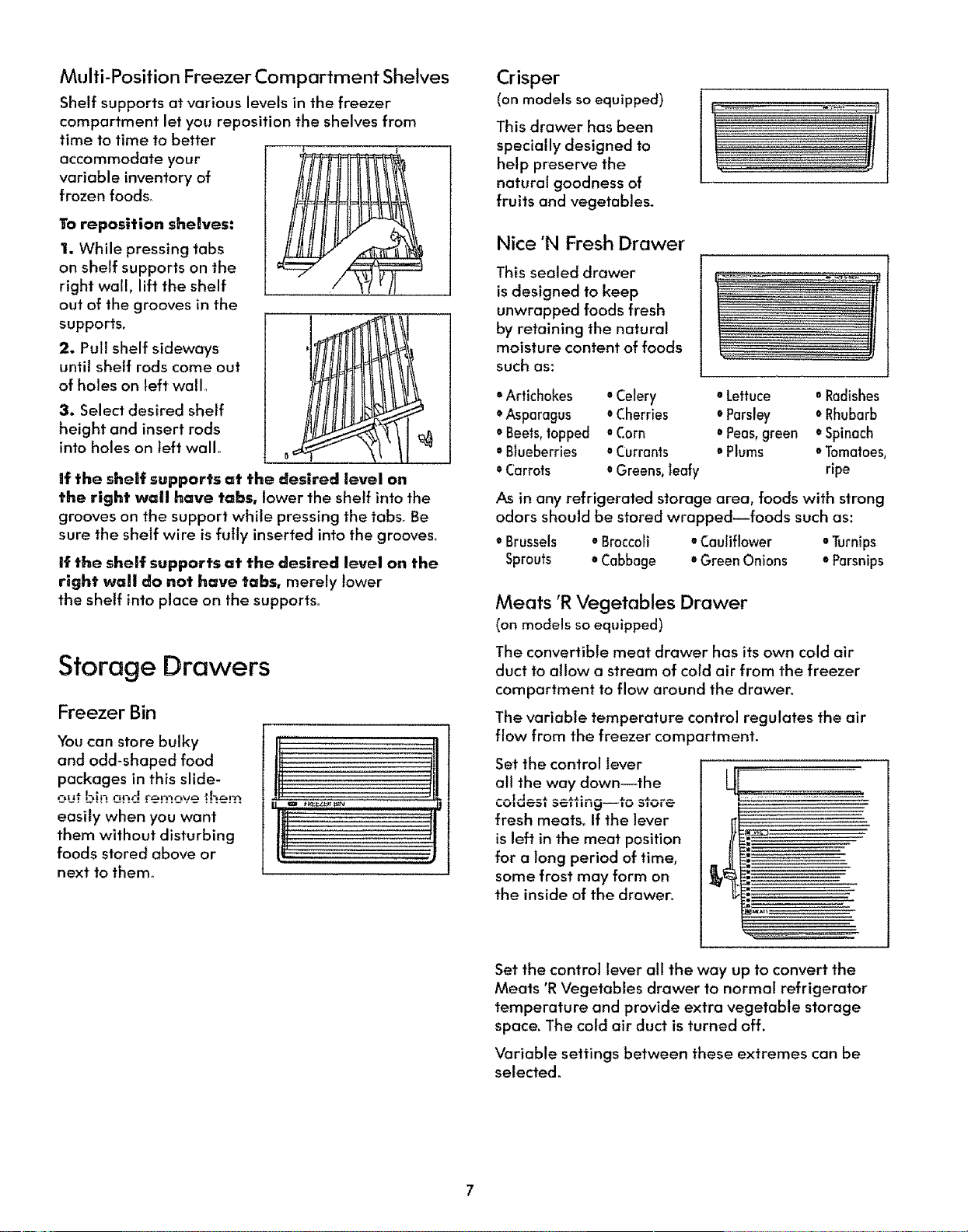
Multi-Position Freezer Compartment Shelves
Shelf supports at various levels in the freezer
compartment let you reposition the shelves from
time to time to better
accommodate your
variable inventory of
frozen foods°
To reposltlon shelves:
1. While pressing tabs
on shelf supports on the
right wal!, lift the shelf
out of the grooves in the
supports.
:2. Pull shelf sideways
until shelf rods come out
of holes on left wall
3. Select desired shelf
height and insert rods
into holes on left wallo
1
If the shelf supports at the desired level on
the right wall have tabs, lower the shelf into the
grooves on the support while pressing the tabs. Be
sure the shelf wire isfully inserted into the grooves.
If the shelf supports at the desired level on the
right wall do not have tabs, merely lower
the shelf into place on the supports°
Storage Drawers
Freezer Bin
You can store bulky
and odd-shaped food
packages in this slide-
out bin and remove +hem
easily when you want
them without disturbing
foods stored above or
next to them°
!!.... JJ
I+ tl
Crisper
(on models so equipped)
This drawer has been
specially designed to
help preserve the
natural goodness of
fruits and vegetables.
Nice 'N Fresh Drawer
This sealed drawer
is designed to keep
unwrapped foods fresh
by retaining the natural
moisture content of foods
such as:
* Artichokes 0Celery . Lettuce 0Radishes
+Asparagus 0Cherries * Parsley • Rhubarb
+Beets,10pped oC0rn 0 Peas,green oSpinach
, Blueberries 0Currants , Plums • Tomatoes,
Carrots * Greens,leafy ripe
As in any refrigerated storage area, foods with strong
odors should be stored wrapped--foods such as:
• Brussels • Broccoli +Cauliflower +Turnips
Sprouts +Cabbage • Green Onions ++Parsnips
Meats 'RVegetables Drawer
(on models so equipped)
The convertible meat drawer has its own cold air
duct to allow a stream of cold air from the freezer
compartment to flow around the drawer.
The variable temperature control regulates the air
flow from the freezer compartment.
Set the control lever
all the way down--the
fresh meats° If the lever
is left in the meat position
for a long period of time,
some frost may form on
the inside of the drawer.
LtI:_ r:
Set the control lever all the way up to convert the
Meats 'R Vegetables drawer to normal refrigerator
temperature and provide extra vegetable storage
space. The cold air duct is turned off.
Variable settings between these extremes can be
selected+
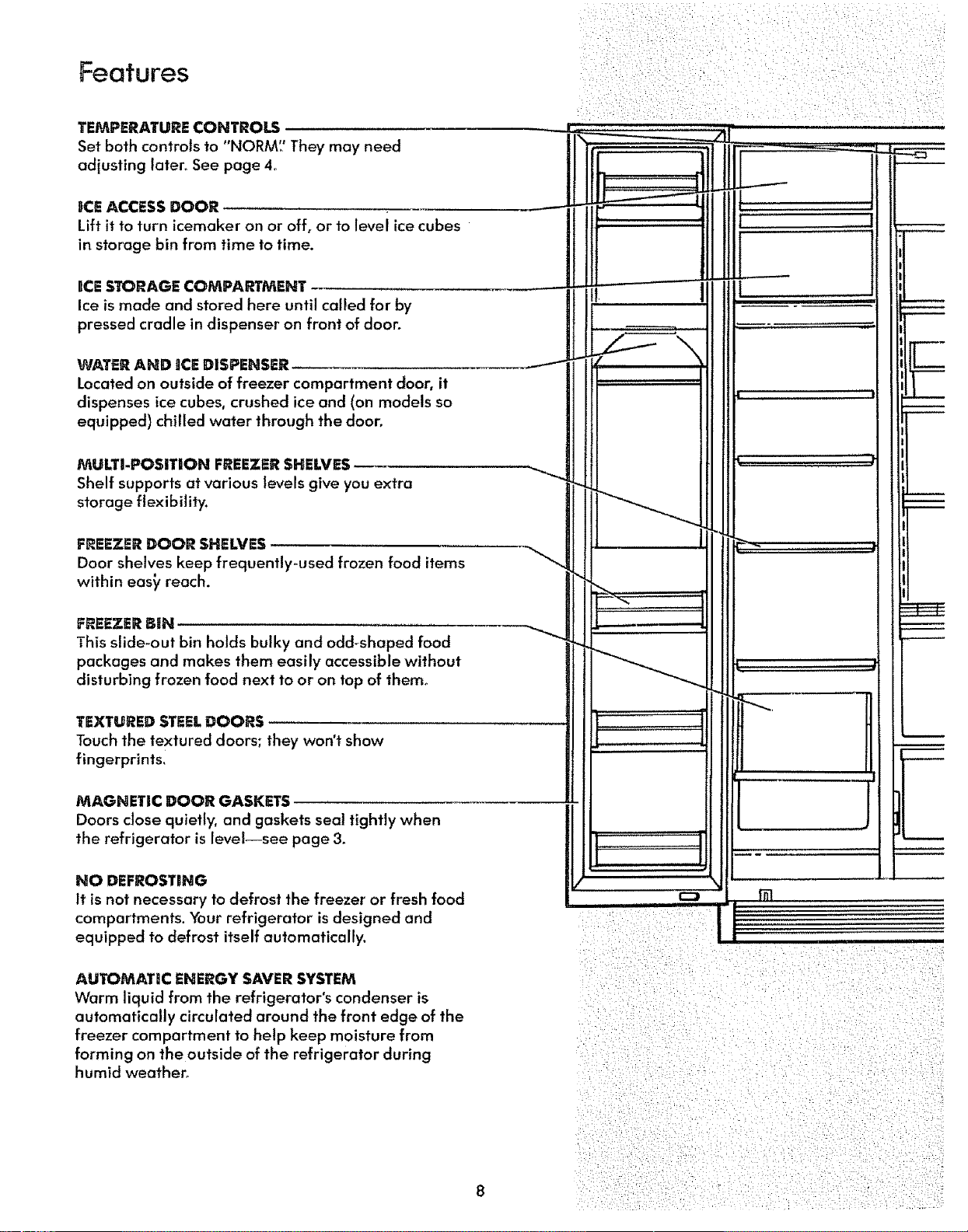
Features
TEMPERATURE CONTROLS
Set both controls to "NORM'/They may need
adjusting later. See page 4.
ICE ACCESS DOOR
Lift it to turn icemaker on or off, or to levei ice cubes
in storage bin from time to time.
ICE STORAGE COMPARTMENT
Ice is made and stored here until called for by
pressed cradle in dispenser on front of door.
WATER AND gCEDISPENSER
Located on outside of freezer compartment door, it
dispenses ice cubes, crushed ice and (on models so
equipped) chilled water through the door,
MULTI-POSITION FREEZER SHELVES
Shelf supports at various levels give you extra
storage flexibility.
FREEZER DOOR SHELVES
Door shelves keep frequently-used frozen food items
within eas_ reach.
FREEZER BIN
This slide-out bin holds bulky and odd-shaped food
packages and makes them easily accessible without
disturbing frozen food next to or on top of them_
TEXTURED STEELDOORS
Touch the textured doors; they won't show
fingerprintsl
MAGNETIC DOOR GASKETS
Doors close quietly, and gaskets sea! tightly when
the refrigerator is level--see page 3.
NO DEFROSTING
It is not necessary to defrost the freezer or fresh food
compartments. Your refrigerator is designed and
equipped to defrost itself automatically.
AUTOMATIC ENERGY SAVER SYSTEM
Warm liquid from the refrigerator's condenser is
automatically circulated around the front edge of the
freezer compartment to help keep moisture from
forming on the outside of the refrigerator during
humid weather,
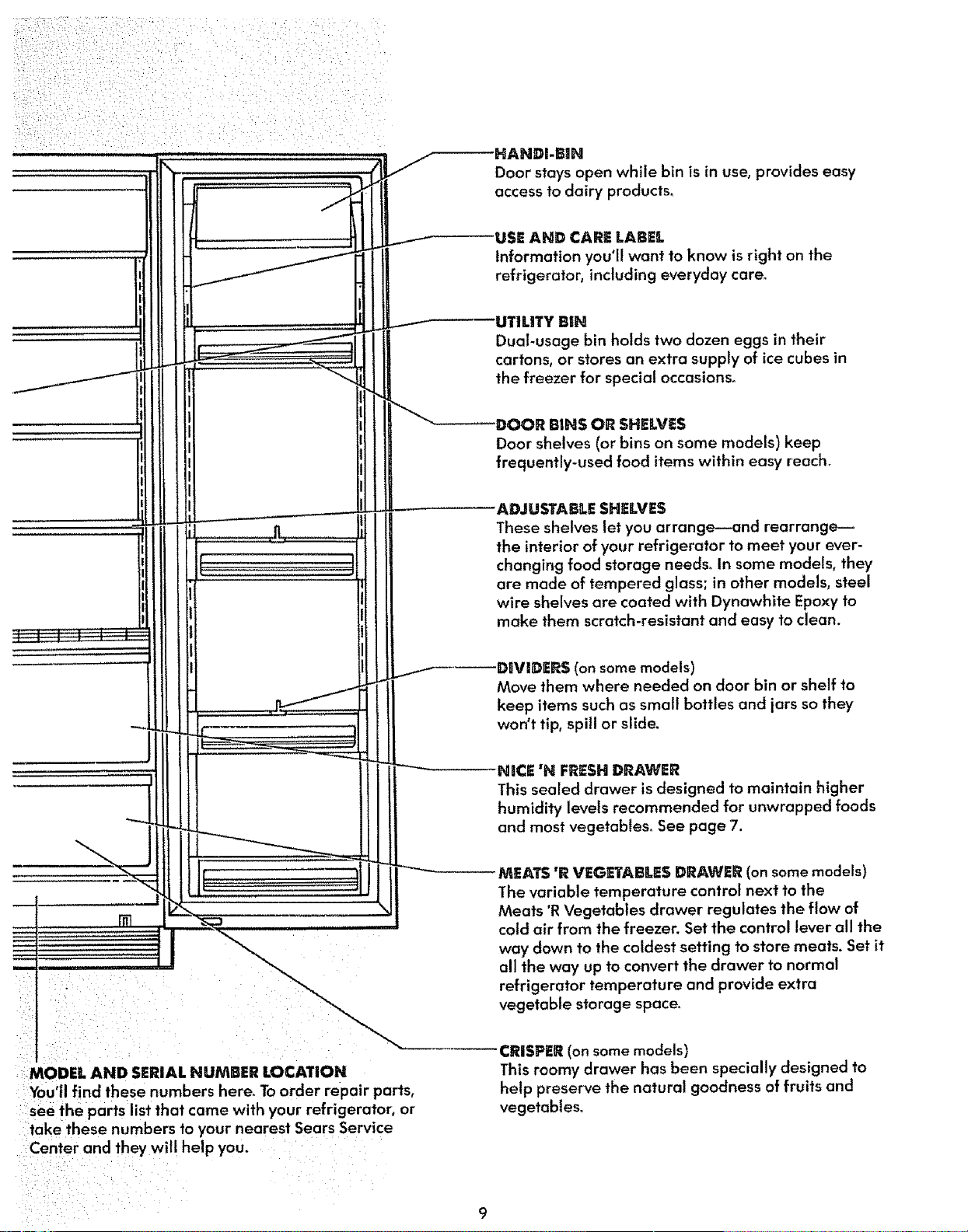
HANDI-BIN
Door stays open while bin is in use,provides easy
access to dairy products.
USE AND CARS LABEL
Information you'll want to know is right on the
refrigerator, including everyday care_
UTILITY BIN
Dual-usage bin holds two dozen eggs in their
cartons, or stores an extra supply of ice cubes in
the freezer for special occasions.
BINS OR SHELVES
Door shelves (or bins on some models) keep
frequently-used food items within easy reach.
ADJUSTABLE SHELVES
These shelves let you arrange--and rearrange---
the interior of your refrigerator to meet your ever-
changing food storage needs_ In some models, they
are made of tempered glass; in other models, steel
wire shelves are coated with Dynawhite Epoxy to
make them scratch-resistant and easy to clean.
'DgVIDERS (on some models)
Move them where needed on door bin or shelf to
keep items such as small bottles and jars so they
won't tip, spill or slide.
NICE 'N FRESH DRAWER
This sealed drawer is designed to maintain higher
humidity levels recommended for unwrapped foods
and most vegetables_ See page 7.
MEATS 'R VEG_TABILES DRAWl;R (on some models)
The variable temperature control next to the
Meats 'R Vegetables drawer regulates the flow of
cold air from the freezer. Set the control lever all the
way down to the coldest setting to store meats. Set it
all the way up to convert the drawer to normal
refrigerator temperature and provide extra
vegetable storage space_
MODEL AND SERIAL NUMBER LOCATION
You'll find these numbers here_ Toorder repair parts,
see the parts list that came with your refrigerator, or
take these numbers to your nearest Sears Service
Center and they will help you.
(on somemodels)
This roomy drawer has been specially designed to
help preserve the natural goodness of fruits and
vegetables.
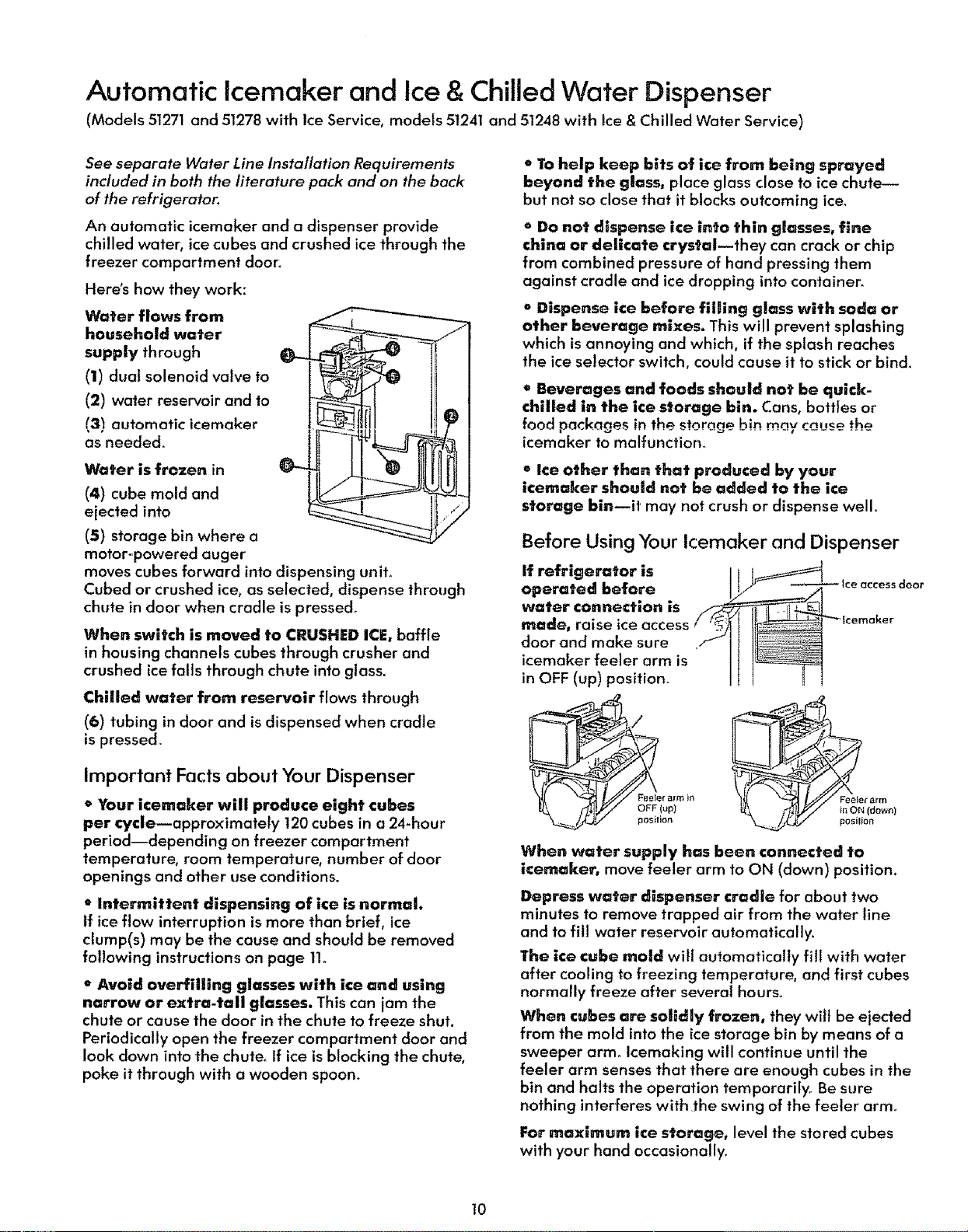
Automatic lcemaker and Ice & Chilled Water Dispenser
(Models 51271 and 51278 with Ice Service, models 51241 and 51248 with Ice & Chilled Water Service)
See separate Water Line Installation Requirements
included in both the literature pack and on the back
of the refrigerator.
An automatic icemaker and a dispenser provide
chilled water, ice cubes and crushed ice through the
freezer compartment door_
Here's how they work:
Water flows from
household water
supply through
(1) dual solenoid valve to
(2) water reservoir and to
(3) automatic icemaker
as needed.
Water is frozen in
(4) cube mold and
ejected into
(5) storage bin where a
motor-powered auger
moves cubes forward into dispensing unit.
Cubed or crushed ice, as selected, dispense through
chute in door when cradle is pressed°
When switch is moved to CRUSHED ICE, baffle
in housing channels cubes through crusher and
crushed ice falls through chute into glass.
Chilled water from reservoir flows through
(6) tubing in door and isdispensed when cradle
is pressed°
Important Facts about Your Dispenser
o Your icemaker will produce eight cubes
per cycle--approximately 120 cubes in a 24-hour
period--depending on freezer compartment
temperature, room temperature, number of door
openings and other use conditions.
• Intermittent dispensing of ice is normal.
If ice flow interruption is more than brief, ice
clump(s) may be the cause and should be removed
following instructions on page 11_
o Avoid overfilling glasses with ice and using
narrow or extra-tall glasses. This can jamthe
chute or cause the door in the chute to freeze shut.
Periodically open the freezer compartment door and
look down into the chute. If ice is blocking the chute,
poke it through with a wooden spoon.
• To help keep bits of ice from being sprayed
beyond the glass, place glass close to ice chute--
but not so close that it blocks outcoming ice.
o Do not dispense ice into thin glasses, fine
china or delicate crystal--they can crack or chip
from combined pressure of hand pressing them
against cradle and ice dropping into container.
o Dispense ice before filling glass with soda or
other beverage mixes. This will prevent splashing
which is annoying and which, if the splash reaches
the ice selector switch, could cause it to stick or bind.
* Beverages and foods should not be quick-
chilled in the ice storage bin. Cans, bottles or
food packages in the storage bin may cause the
icemaker to malfunction.
e Ice other than that produced by your
icemaker should not be added to the ice
storage bln--it may not crush or dispense well
Before Using Your Icemaker and Dispenser
If refrigerator is
operated before
water connection is
made, raiseiceaccess/r_..
door and make sure .,_
icemaker feeler arm is
in OFF (up) Josltion.
Fe_lef r_rrnin
OFF (up)
position
_|ce occess door
_Icemaker
_ r _b'rcl
When water supply has been connected to
icemaker, move feeler arm to ON (down) position.
Depress water d_spenser cradle for about two
minutes to remove trapped air from the water line
and to fitl water reservoir automatically.
The ice cube mold wilf automatically fill with water
after cooling to freezing temperature, and first cubes
normally freeze after several hours°
When cubes are solidly frozen, they wilt be ejected
from the mold into the ice storage bin by means of a
sweeper arm. Icemaking will continue until the
feeler arm senses that there are enough cubes in the
bin and halts the operation temporarily Be sure
nothing interferes with:the swing of the feeler arm°
For maximum ice storage, level the stored cubes
with your hand occasionally.
10
Once your icemaker is in operation, throw
away the first few batches of ice cubes. This will
flush away any impurities in the water liner Do the
same thing after vacations or long periods when ice
isn't used°
Discard the first six glassfuls of water in the
kitchen sink, This will eliminate the slight "plastic"
taste temporarily imparted to the water by the
water reservoir.
CAUTION: Under certain rare circumstances, ice
cubes may be discolored, usually appearing with
a green-bluish hue° This unusual discoloration is
apparently due to a combination of factors such as
certain characteristics of local waters, household
plumbing and the accumulation of copper salts in an
inactive water supply line that feeds the icemaker_
Continued consumption of such discolored ice cubes
may be injurious to health° If your ice cubes are
discolored, discard them and contact your Sears
Service Center,
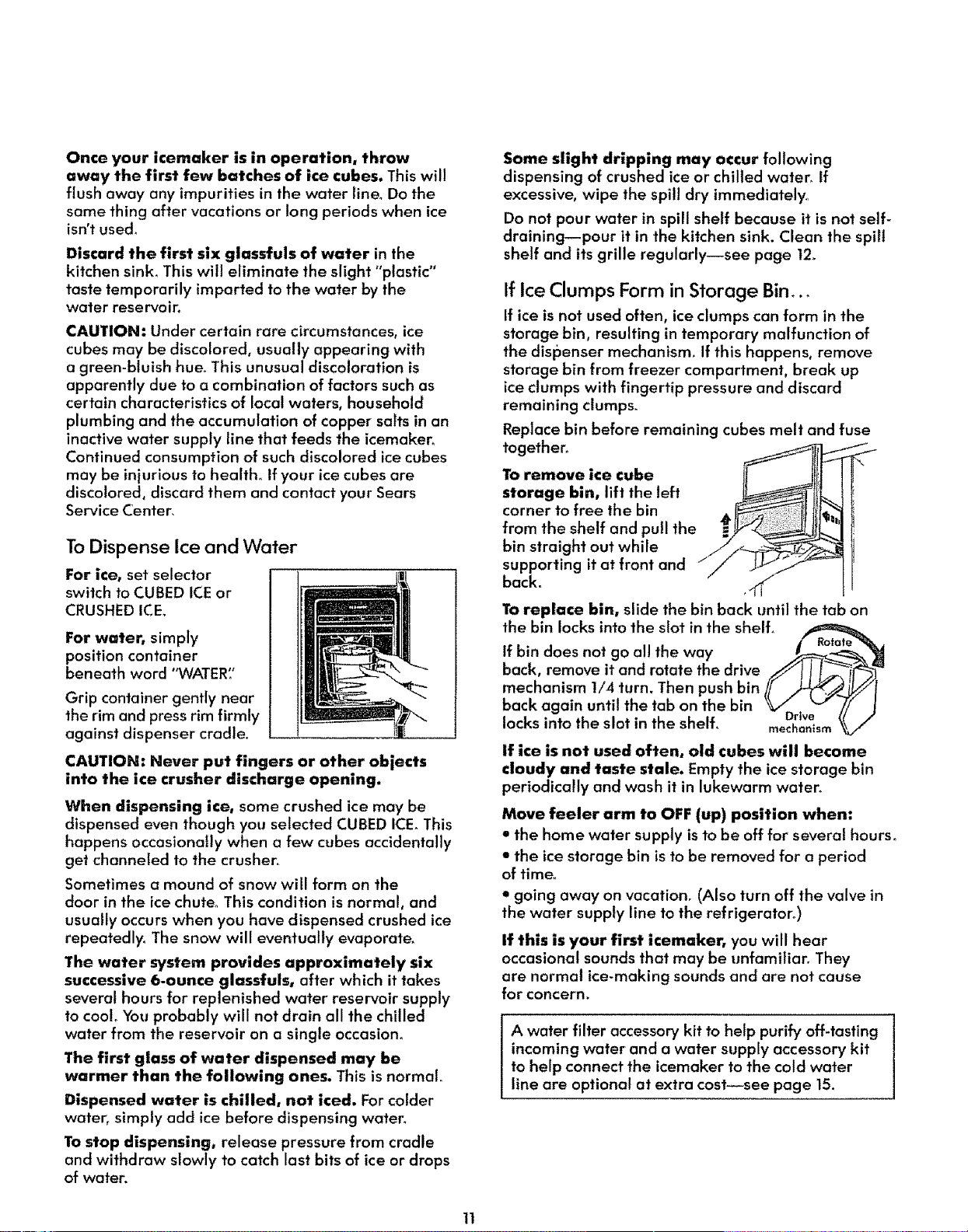
ToDispense Ice and Water
For ice, set selector
switch to CUBED ICEor
CRUSHED ICE.
For water, simply
position container
beneath word "WATER'.'
Grip container gently near
the rim and press rim firmly
against dispenser cradle.
CAUTION: Never put fingers or other objects
into the ice crusher discharge opening,
When dispensing ice, some crushed ice may be
dispensed even though you selected CUBED ICE. This
happens occasionally when a few cubes accidentally
get channeled to the crusher.
Sometimes a mound of snow will form on the
door in the ice chute. This condition is normal, and
usually occurs when you have dispensed crushed ice
repeatedly. The snow will eventually evaporate.
The water system provides approximately six
successive 6-ounce glassfuls, after which it takes
several hours for replenished water reservoir supply
to cool. You probably will not drain all the chilled
water from the reservoir on a single occasion.
The first glass of water dispensed may be
warmer than the following ones. This is norma!
Dispensed water is chilled, not iced. For colder
water, simply add ice before dispensing water.
To stop dispensing, release pressure from cradle
and withdraw slowly to catch last bits of ice or drops
of water.
Some slight dripping may occur following
dispensing of crushed ice or chilled water, If
excessive, wipe the spill dry immediately,
Do not pour water in spill shelf because it is not self-
draining--pour it in the kitchen sink. Clean the spitl
shelf and its grille regularly--see page t2_
If ice Clumps Form in Storage Bin...
If ice is not used often, ice clumps can form in the
storage bin, resulting in temporary malfunction of
the dispenser mechanism, If this happens, remove
storage bin from freezer compartment, break up
ice clumps with fingertip pressure and discard
remaining clumps.
Replace bin before remaining cubes melt and fuse
together.
To remove ice cube
storage bin, lift the left
corner to free the bin
from the shelf and pull the
bin straight out while /f
supporting it at front and /
back.
TOreplace bin, slide the bin back until the tab on
the bin locks into the slot in the shelf.
tf bin does not go all the way _-,,:_
back, remove it and rotate the drive /J't t I_'_ "_
mechanism !/4 turn. Then push bin/[ )_,_'/_I
back again until the tab on the bin _/_.,.."_// ]
locks into the slot in the shelf_ mecl_a_sm V
if ice is not used often, old cubes will become
cloudy and taste stale. Empty the ice storage bin
periodically and wash it in lukewarm water.
Move feeler arm to OFF (up) position when:
* the home water supply is to be off for several hours°
e the ice storage bin is to be removed for a period
of timer
* going away on vacation, (Also turn off the valve in
the water supply line to the refrigerator°)
If this is your first icemaker, you will hear
occasional sounds that may be unfamiliar, They
are normal ice-making sounds and are not cause
for concern.
I A water filter accessory kit to help purify off-tasting
incoming water and a water supply accessory kit
to help connect the icemaker to the cold water
line are optional at extra cost--see page 15.
1t
Care and Cleaning
Oulside
The water and ice dispenser spill shelf should be
wiped dry immediately to prevent spotting° Water
left on the shelf may leave deposits that you can
remove by soaking in undiluted vinegar° You can also
use a paste of non-precipitating water softener (such
as Calgon brand) and water, or one teaspoon of citric
acid powder per pint of hot tap water_ Soak until the
deposit disappears or becomes loose enough to rinse
away. Usually 30 minutes soaking time is adequate°
Avoid using wax on the spill shelf and trim.
The door handles and trim can be cleaned with
a cloth dampened with a solution of mild liquid
dishwashing detergent and water. Dry with a soft
cloth_ Don't use wax on the door hand;es and trim_
Keep the finish clean. Wipe with a clean cloth
lightly dampened with kitchen appliance wax or
mild liquid dishwashing detergent. Dry and polish
with a clean, soft cloth. Do not wipe the refrigerator
with a soiled dishwashlng cloth or wet towel These
may leave a residue that can harm the paint° Do not
use scouring pads, powdered cleaners, bleach or
cleaners containing bleach because these products
can scratch and weaken the paint finish.
Protect the palnt finish. The finish on the outside
of the refrigerator is a high quality, baked_on paint
finish. With proper care, it will stay new-looking and
rust-free for years. Apply a coat of kitchen/appliance
wax when the refrigerator is new and then at least
twice a year,
Inside
The fresh food and freezer compartment
interiors should be cleaned at least once a year°
Unplug the refrigerator before deaning_ If this is not
practica!, wring excess moisture out of sponge or cloth
when cleaning around switches, lights or controls_
Use warm water and baking soda solutlon--about a
tablespoon of baking soda to a quart of water_ This
both cleans and neutralizes odors_ Rinse thoroughly
with water and wipe dry°
Other parts of the refrigerator--including door
gaskets, meat and vegetable drawers, ice storage
bin and all plastic parts--can be cleaned the same
way. Do not use cleansing powders or other abrasive
cleaners. Door gaskets are factory-lubricated with
petroleum jelly on the hinge side° If the lubricant is
excessive, wipe it off but leave a thin film on the
gasket to help insure a proper hinge-side seal_ When
you clean the door gaskets, relubricate them°
Tohelp prevent odors, leave an open box of baking
soda in the rear of the refrigerator, on the top shelf°
12
Change the box every three months, In addition, put
an open box of baking soda in the freezer to absorb
stale freezer odors.
|
Do not wash any plastic parts from your |
refrigerator in your automatic dishwasher.
]
S_orage Drawers
Drawers at bottom of fresh food compartment will
stop before coming all the way out of refrigerator to
help prevent contents from spilling onto floor. The
drawers can be removed easily by tilting up slightly
and pulling past the "stop" location.
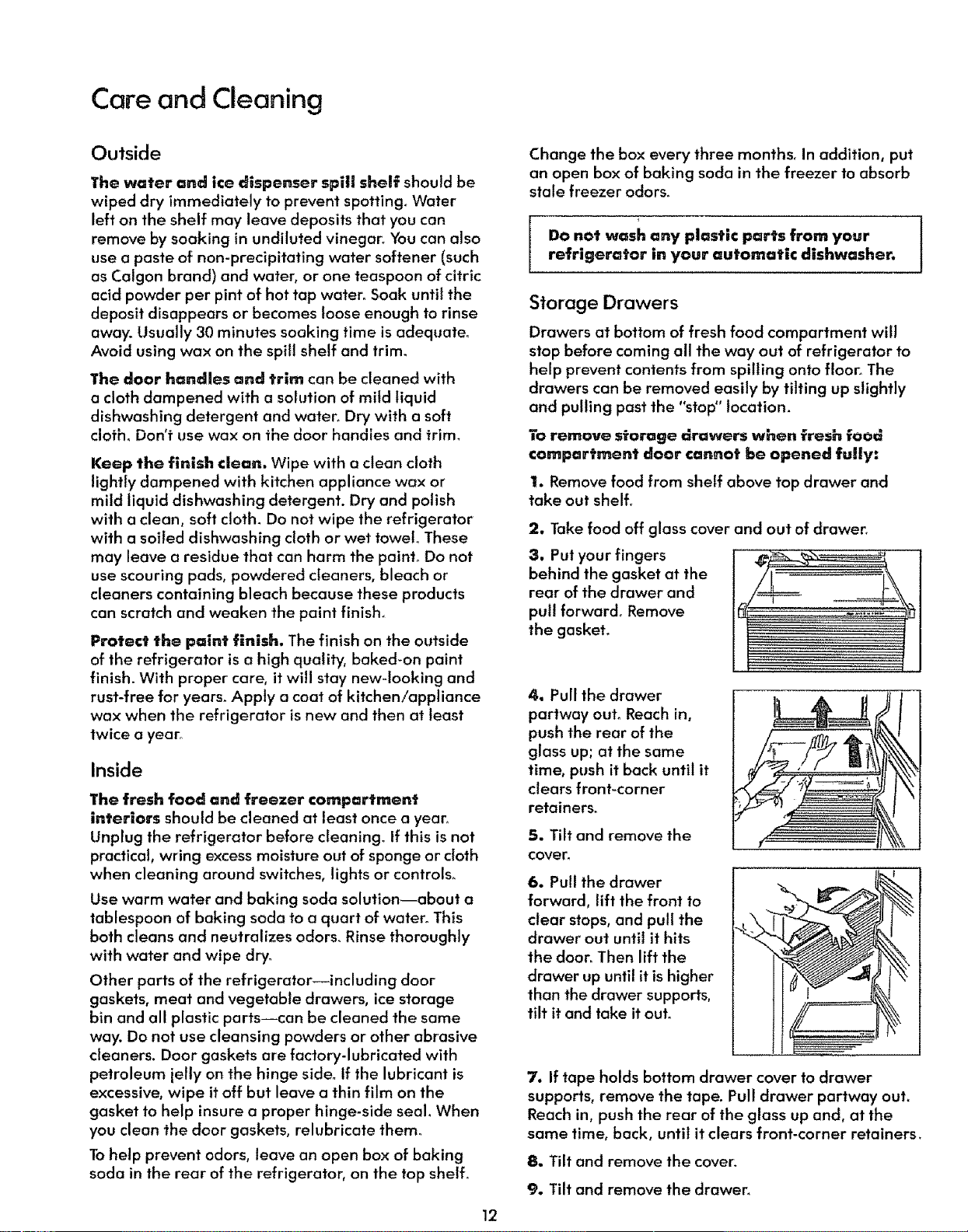
To remov_ s_orage drawers whe. fresh food
compartment door cannot be opened fully:
1. Remove food from shelf above top drawer and
take out shelf.
2. Take food off glass cover and out of drawer°
3. Put your fingers
behind the gasket at the
rear of the drawer and
pull forward_ Remove
the gasket.
4. Pull the drawer
partway out. Reach in,
push the rear of the
glass up: at the same
time, push it back until it
clears front-corner
retainers.
5. Tilt and remove the
cover_
6. Pull the drawer
forward, lift the front to
clear stops, and pull the
drawer out untii it hits
the door. Then lift the
drawer up until it is higher
than the drawer supports,
tilt it and take it out,
7. If tape holds bottom drawer cover to drawer
supports, remove the tape. Pull drawer partway out.
Reach in, push the rear of the glass up and, at the
same time, back, until it clears front-corner retainers.
8. Tilt and remove the cover.
9, Tilt and remove the drawer_
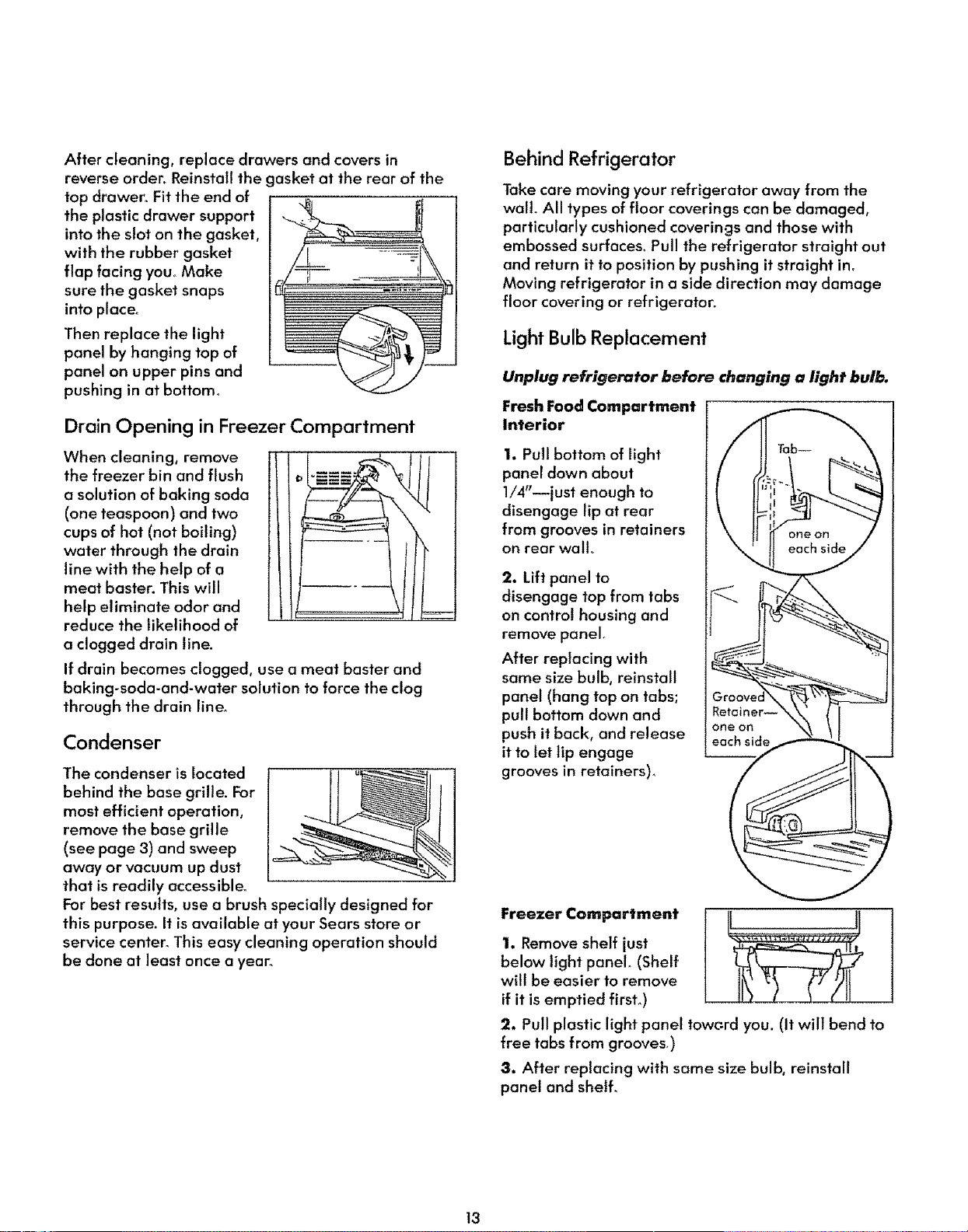
After cleaning, replace drawers and covers in
reverse order. Reinstall the gasket at the rear of the
top drawer. Fit the end of
the plastic drawer support
into the slot on the gasket,
with the rubber gasket
flap facing you, Make
sure the gasket snaps
into place.
Then replace the light
panel by hanging top of
panel on upper pins and
pushing in at bottom°
Drain Opening in Freezer Compartment
When cleaning, remove
the freezer bin and flush
a solution of baking soda
(one teaspoon) and two
cups of hot (not boiling)
water through the drain
line with the help of a
meat baster. This will
help eliminate odor and
reduce the likelihood of
a clogged drain line.
If drain becomes clogged, use a meat baster and
baking-soda-and-water solution to force the clog
through the drain lineo
Condenser
The condenser is located
behind the base grille. For
most efficient operation,
remove the base grille
(see page 3) and sweep
away or vacuum up dust
that is readily accessible_
For best results, use a brush specially designed for
this purpose. It is available at your Sears store or
service center. This easy cleaning operation should
be done at least once a year.
Behind Refrigerator
Take care moving your refrigerator away from the
wall. All types of floor coverings can be damaged,
particularly cushioned coverings and those with
embossed surfaces. Pull the refrigerator straight out
and return it to position by pushing it straight Jno
Moving refrigerator in a side direction may damage
floor covering or refrigerator.
Light Bulb Replacement
Unplug refrigerator before changing a light bulb.
Fresh Food Compartment
Interior
1. Pull bottom of light
panel down about
1M'--just enough to
disengage tip at rear
from grooves in retainers
on rear walt.
2. Lift panel to
disengage top from tabs
on control housing and
remove panel.
After replacing with
same size bulb, reinstall
panel (hang top on tabs;
pull bottom down and
push it back, and release
it to let lip engage
grooves in retainers)_
Freezer Compartment
1. Remove shelf just
below light panel (Shelf
will be easier to remove
if it is emptied first°)
2. PLsllplastic light panel towcordyou. (It will bend to
free tabs from grooves.)
3. After replacing with same size bulb, reinstall
panel and shelf.
t3
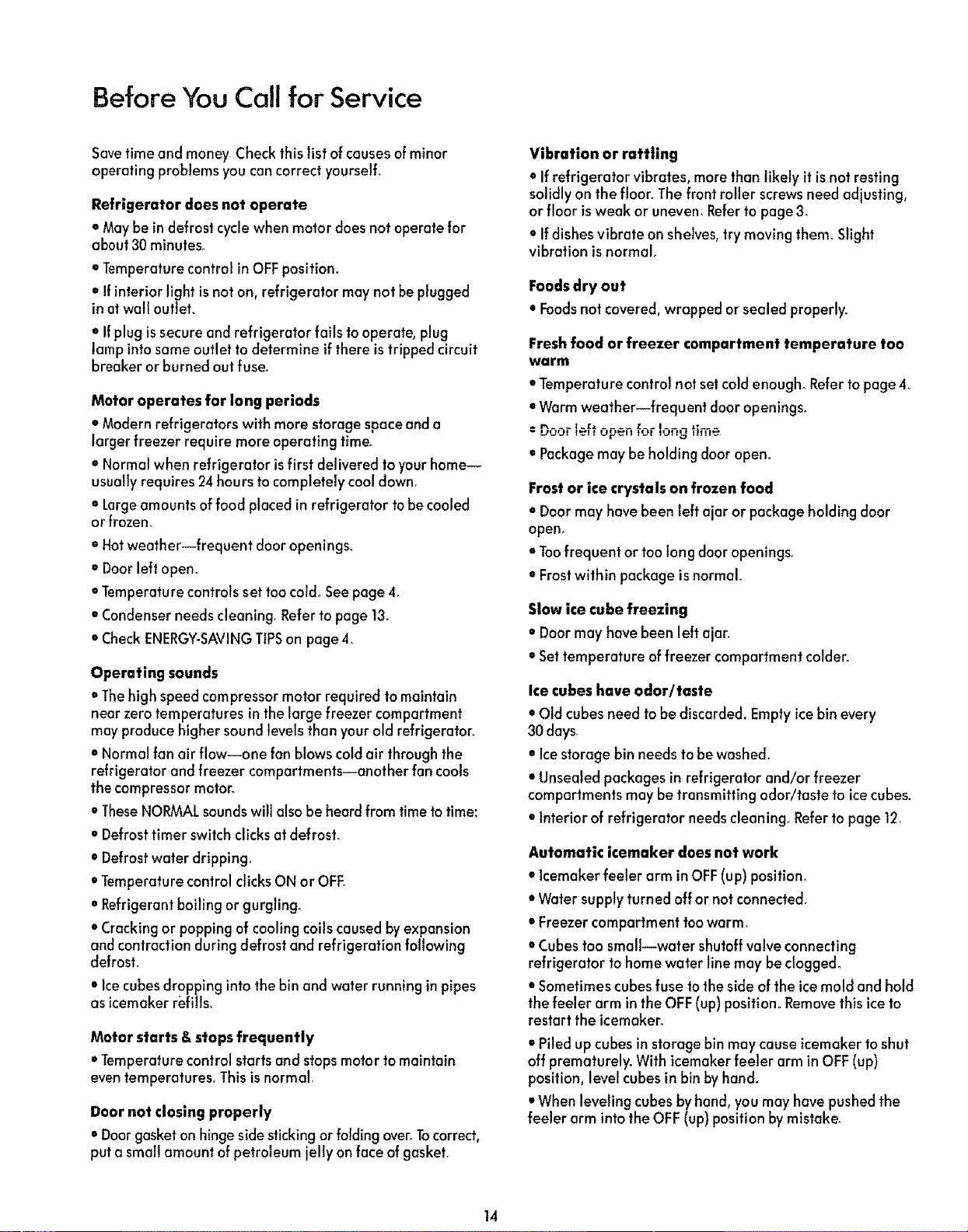
Before You Call for Service
Savetime and money Check this list of causes of minor
operating problems you can correct yourself.
Refrigerator does not operate
oMay be indefrostcycle when motordoesnot operatefor
about30 minutes°
• Temperature control in OFFposition.
• If interior light isnot on, refrigerator may not be plugged
in at wall outlet.
• If plug issecure and refrigerator fails tooperate, plug
lamp intosame outlet to determine if there istrippedcircuit
breakeror burned out fuse.
Motor operates for long periods
• Modernrefrigerators with more storagespace and a
larger freezer require more operating time,,
o Normal when refrigerator isfirst delivered to your home--
usuallyrequires 24 hours tocompletely cool down,
oLargeamounts offood placed in refrigerator tobecooled
or frozen,,
oHot weather--frequent door openings,
• Doorleftopen,
• Temperaturecontrols set toocoldoSeepage 4,
• Condenserneeds cleaning, Refer to page 13,
• CheckENERGY-SAVINGTIPSon page4,
Operating sounds
o Thehigh speed compressor motor required tomaintain
near zero temperatures in the large freezer compartment
may producehigher soundlevels than yourold refrigerator.
• Normal fan air flow--one fan blowscold air through the
refrigerator and freezer compartments--another fancools
the compressor motor.
• TheseNORMALsounds will also be heard from time to time:
o Defrost timer switch clicks at defrost°
• Defrost water dripping.
• Temperature control clicks ON or OFF
• Refrigerant boiling or gurgling,
• Crackingor poppingof cooling coils caused by expansion
and contraction during defrost and refrigeration following
defrost.
• Ice cubesdropping into the bin and water running in pipes
as icemaker refills.
Motor starts & stops frequently
* Temperaturecontrol starts and stopsmotor tomaintain
eventemperatures_Thisisnormal,
Door not closing properly
• Doorgasket on hingesidesticking or foldingove_Tocorrect,
put a small amount of petroleum jelly on face of gasket.
Vibration or rattling
• If refrigerator vibrates, more than likely it isnotresting
solidly on the floor.The frontroller screws need adiusting,
or floor isweak or unevem Referto page3_
• If dishesvibrate on shelves,try moving them_Slight
vibration isnormal
Foodsdry out
• Foodsnotcovered, wrapped or sealed properly.
Freshfood or freezer compartment temperature too
warm
• Temperature control not setcold enough° Refer topage 4°
• Warm weather--frequent dooropenings.
• Package may be holding door open°
Frost or ice crystals on frozen food
• Door may have been left ajar or package holding door
open°
gToofrequent or too long door openings,
• Frostwithin package is normal.
Slow ice cube freezing
• Doormay have been left ajar.
Settemperature of freezer compartment cotder.
ice cubes have odor/taste
• Old cubes need to bediscarded.Emptyicebin every
30 days,
• Icestorage bin needs to be washed.
• Unsealed packages in refrigerator and/or freezer
compartments may be transmitting odor/taste to icecubes.
• Interior of refrigerator needs cleaning° Referto page t2,
Automatic icemaker does not work
• tcemakerfeeler arm in OFF(up) positiom
• Water supplyturned off or not connected_
• Freezer compartment too warm_
• Cubestoo small--water shutoffvalve connecting
refrigerator to homewater line may beclogged°
• Sometimescubes fuse1othe side ofthe ice moldand hold
thefeeler arm inthe OFF(up) posltiomRemovethis iceto
restart the icemaker_
• Piled up cubes in storage bin may cause icemaker to shut
off prematurely.With icemakerfeeler arm in OFF (up)
position, level cubes in bin by hand.
• When leveling cubes by hand, you may have pushed the
feeler arm intotheOFF (up) position bymistake_
14
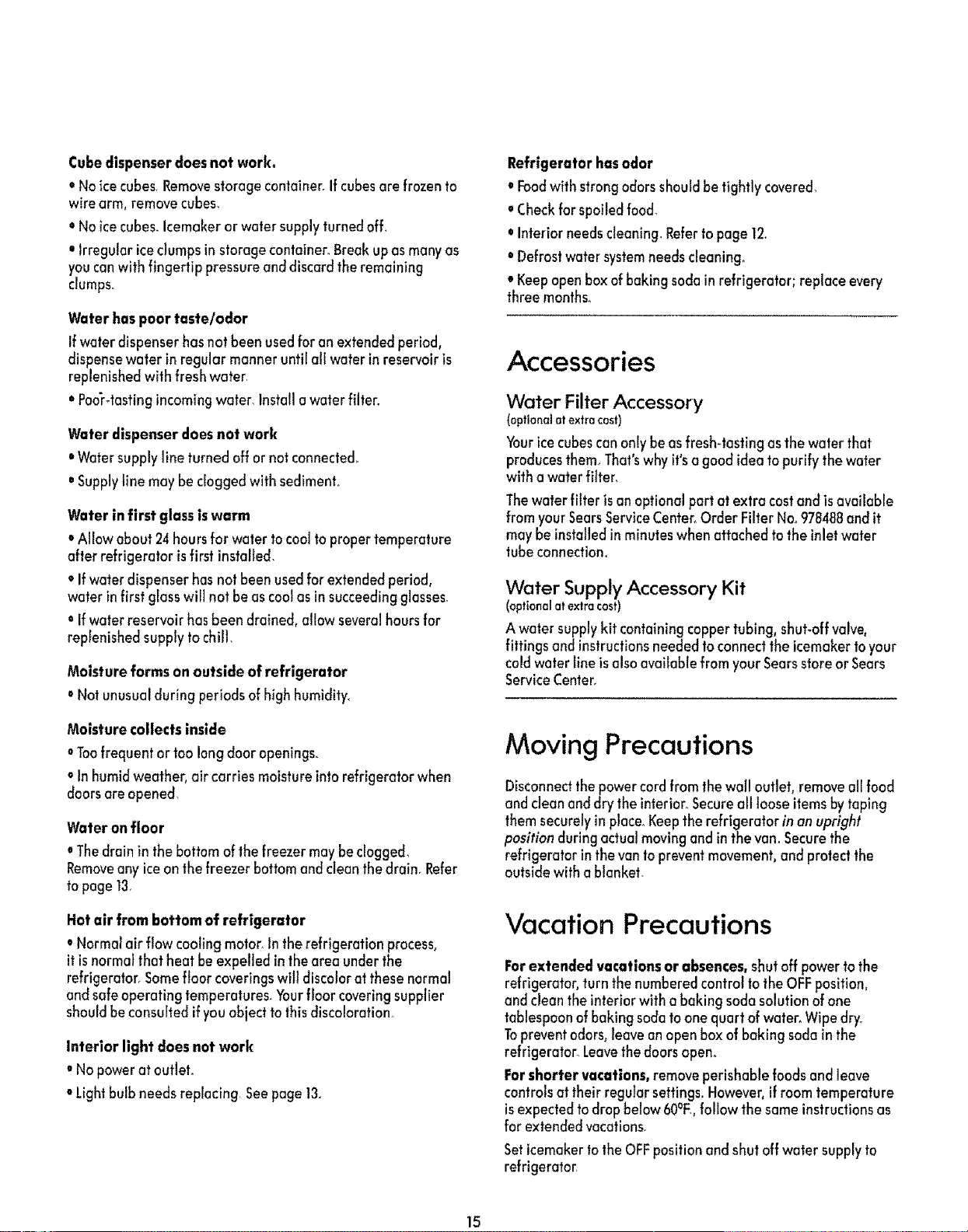
Cubedispenser doesnot work.
• Noice cubes.Removestorage container.If cubesare frozento
wire arm, remove cubes.
oNoicecubes.Icemaker or water supplyturned off.
• Irregular ice clumpsin storage container°Breakup asmanyas
youcanwith fingertippressure and discardthe remaining
clumps..
Water has poor taste/odor
If water dispenser hasnot beenusedforanextended period,
dispensewater in regular manner until all water in reservoir is
replenishedwith fresh waterr
, Poor-tastingincoming water, install a water filter.
Water dispenserdoes not work
* Watersupply line turned off or notconnecte&
, Supplyfine may beclogged with sediment.
Water in first glass iswarm
o Allow about 24 hoursfor water tocool toproper temperature
afterrefrigerator isfirstinstalled.
• Ifwater dispenserhasnotbeen usedforextended period,
water in first glass will not be ascoolas in succeedingglasses.
o If water reservoir hasbeen drained, allow severalhoursfor
replenished supply to chill.
Moisture forms on outside of refrigerator
o Notunusualduring periods of high humidity,
Moisture collects inside
• Toofrequentor too long door openings.
• Inhumidweather, air carries moisture into refrigerator when
doorsare opene&
Water onfloor
* Thedrainin thebottom ofthefreezer may beclogged,
Removeany iceon the freezer bottomandclean thedroin_Refer
topage 13.
Hot air from bottom of refrigerator
oNormalair flow cooling motor.Intherefrigeration process,
it isnormal that heat be expelled inthearea under the
refrigerator. Somefloor coveringswill discolor at thesenormal
and safe operating temperatures. Yourfloorcoveringsupplier
shouldbe consulted ifyou object to thisdiscoloration.
Interior light doesnot work
o Nopowerat outlet.
"Lightbulb needsreplacing. Seepage 13.
Refrigerator hasodor
• Foodwith strong odorsshould betightlycovered.
aCheckfor spoiledfood.
• Interiorneedscleaning. Refertopage12,
• Defrostwatersystemneedscleaning°
• Keepopenboxofbaking sodain refrigerator; replaceevery
three months_
Accessories
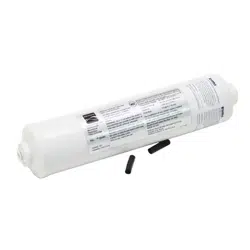
Wafer Filter Accessory
(optional at extra cost)
Youricecubescanonlybe asfresh4asfingasthewaterthat
producesthem_That'swhyit'sa goodidea topurifythewater
with a water fi]ter.
Thewater filteris an optional part at extra costandisavailable
fromyour SearsServiceCenter_Order FilterNo.978488andit
may be installed in minuteswhen attached tothe inlet water
tubeconnection.
Water Supply Accessory Kit
(optional at extra cost)
A water supplykit containing coppertubing, shut-offvalve,
fittingsand instructionsneededtoconnecttheicemakerto your
cold waterline isalsoavailable fromyour SearsstoreorSears
ServiceCenter.
Moving Precautions
Disconnectthepower cordfromthewal! outlet, remove allfood
and cleanand dry the interior, Secureall looseitems bytaping
themsecurelyinplace°Keeptherefrigerator in an upright
positionduring actual moving andin thevan. Securethe
refrigeratorinthe vanto preventmovement,and protectthe
outside with a blanket.
Vacation Precautions
Forextended vacationsor absences,shutoff power tothe
refrigerator, turnthenumberedcontrol tothe OFFposition,
and cleantheinteriorwitha bakingsodasolutionofone
tablespoonofbakingsodatoonequartofwater. Wipedry.
Topreventodors,leaveanopen boxofbaking sodain the
refrigerator. Leavethedoors open.
Forshorter vacations, removeperishablefoodsandleave
controlsat theirregular settings.However,ifroomtemperature
isexpectedtodropbelow 60°t:.followthesameinstructionsas
forextended vacations.
Seticemaker totheOFFposition and shut off water supplyto
refrigerator_
15
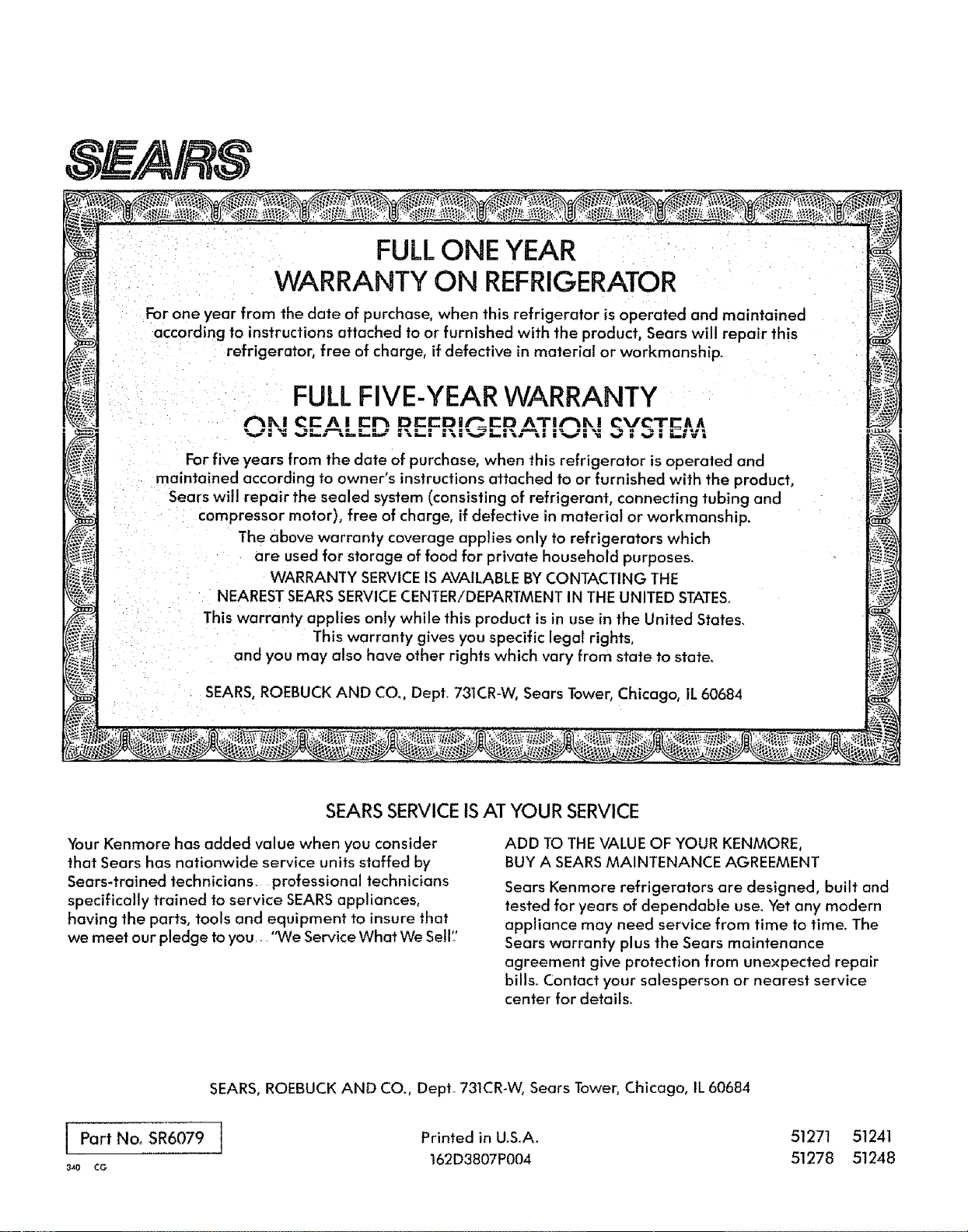
FULLONE YEAR
WARRANTY ON REFRIGERATOR
For one year from the date of purchase, when this refrigerator is operated and maintained
according to instructions attached to or furnished with the product, Sears wil! repair this
refrigerator, free of charge, if defective in material or workmanship.
FULLFIVE-YEAR WARRANTY
ON CCAI pr_ Dr'rDif"_-r'D ATI/'_kl CV_T_AA
For five years from the date of purchase, when this refrigerator is operated and
maintained according to owner's instructions attached to or furnished with the product,
Sears will repair the sealed system (consisting of refrigerant, connecting tubing and
compressor motor), free of charge, if defective in material or workmanship.
The above warranty coverage applies only to refrigerators which
are used for storage of food for private household purposes.
WARRANTY SERVICEISAVAILABLE BY CONTACTING THE
NEAREST SEARSSERVICECENTER/DEPARTMENT IN THE UNITED STATES°
This warranty applies only while this product is in use in the United States.
This warranty gives you specific legal rights,
and you may also have other rights which vary from state to state.
SEARS, ROEBUCK AND CO., Dept. 731CR-W, Sears Tower, Chicago, iL 60684
SEARS SERVICE IS AT YOUR SERVICE
Your Kenmore has added value when you consider
that Sears has nationwide service units staffed by
Sears-trained technicians., professional technicians
specifically trained to service SEARSappliances,
having the parts, tools and equipment to insure that
we meet our pledge to you.. '_JVeService What We Sell'.'
ADD TO THE VALUE OF YOUR KENMORE,
BUY A SEARSMAINTENANCE AGREEMENT
Sears Kenmore refrigerators are designed, built and
tested for years of dependable use. Yet any modern
appliance may need service from time to time. The
Sears warranty plus the Sears maintenance
agreement give protection from unexpected repair
bills. Contact your salesperson or nearest service
center for details..
SEARS, ROEBUCK AND CO., Depto 731CR-W0Sears Tower, Chicago, IL 60684
j Part No. SR6079 I
Printed in UoS°A.
[ J
3_0 co 162D3807P004
51271 51241
51278 51248