¢onten_s
o Safety Instructions ............................ 2
• Grounding Requirements ................ 2, 3
oStarting the Refrigerator .............. 3, 4
o Adjusting the Controls ..................... 4
o Energy Saver Switch ........................... 4
o Food Storage Suggestions ................. 4-6
o IceService..................................7
eFeatures ..............................8,9
o Energy-Saving Tips ....................... 10
o Care and Cleaning ..................... 10, 11
o Vacation and Moving Precautions ............. 11
o Before You Call for Service .................... 12
o Reversing Door Swing .................... 13-15
o Warranty ............................ Back Cover
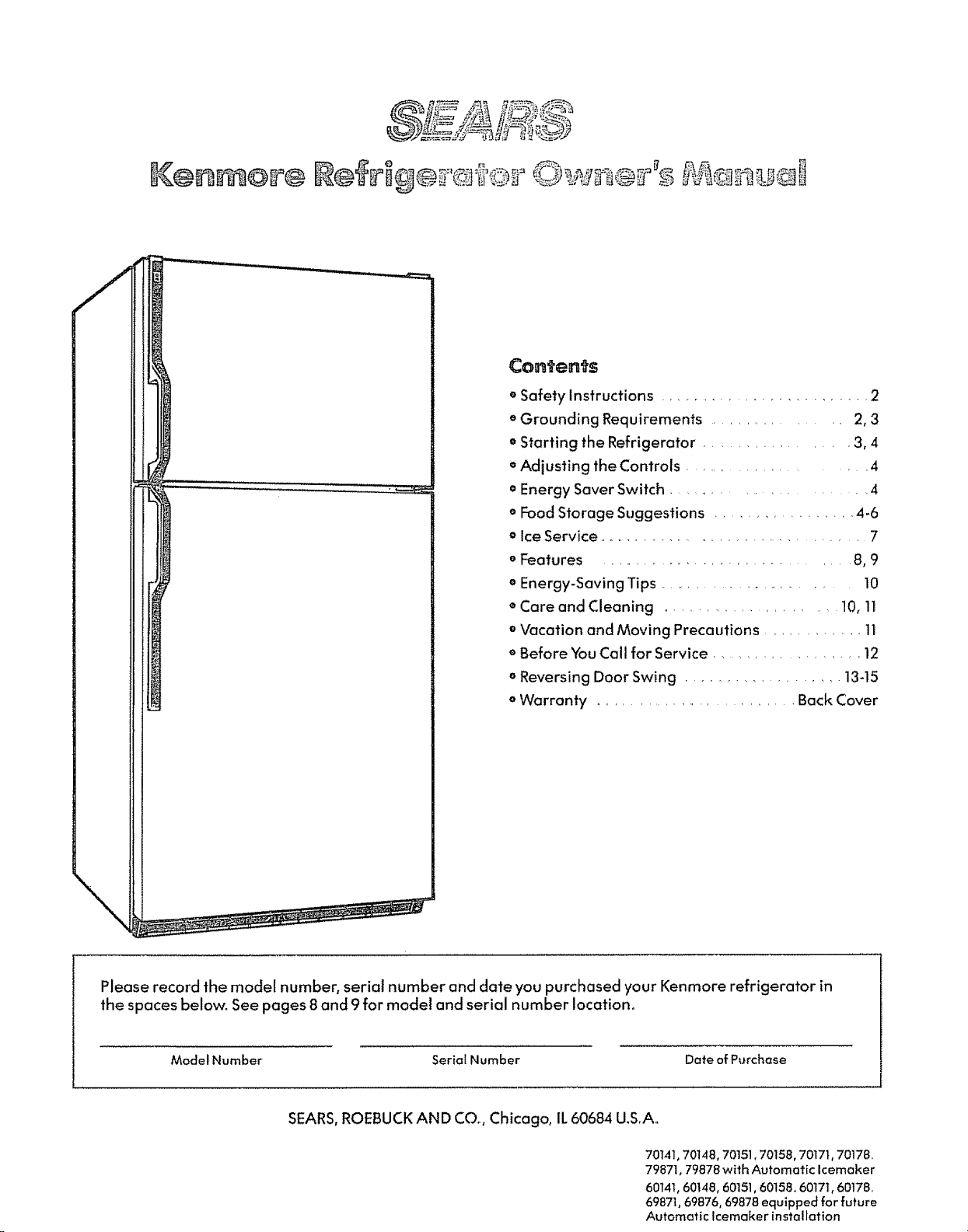
Please record the model number, serial number and date you purchased your Kenmore refrigerator in
the spaces below. See pages 8 and 9 for model and serial number location.
Model Number
Serio{ Number Date of Purchase
SEARS,ROEBUCK AND CO., Chicago, IL60684 U.S.A°
70141, 70148, 70t51_ 70158, 7017t, 70178.
79871, 79878 with Automatic Icemaker
60141, 60148, 60151, 60158.60171, 60178.
69871, 69876, 69878 equipped for future
Automatic Icemaker installation
SAFETY RUC1FBONS
Read aH instrucHons before uslng
this appUia.ce.
WARNING-- When using this appliance, always
exercise basic safety precautions, including the
following:
o Use this appliance only for its intended
purpose as described in this Owner's Manual.
o This refrigerator must be properly installed
in accordance with the Attention installer
instructions before it is used. See grounding
requirements below and on page 3o
e Never unplug your refrigerator by pulling on
the power cord. Always grip plug firmly and pull
straight out from the outlet
o Repair or replace immediately all electric
service cords that have become frayed or
otherwise damaged. Do not use a cord that shows
cracks or abrasion damage along its length or at
either the plug or connector end.
o When moving your refrigerator away from
the wall, be careful not to roll over or damage
the power cord.
" After your refrigerator is in operation, do not
touch the cold surfaces, particularly when
hands are damp or wet. Skin may adhere to the
extremely cold surfaces°
e If your refrigerator has an icemaker, do not
place fingers or hands on the automatic
icemaking mechanism while the refrigerator is
plugged in. This will help protect you from possible
injury° tt will also prevent interference with the
moving parts of the ejector mechanism, or with the
heating element that releases the cubes.
e Do not operate your refrigerator in the
presence of explosive fumes.
• Don't refreeze frozen foods which have
thawed completely. The United States Department of
Agriculture in Home and Garden Bulletin No. 69 says:
"_ You may safely refreeze frozen foods that have
thawed if they still contain ice crystals or if they are
still cold--below 40°Fo
",._Thawed ground meats, poultry or fish that have
any ofFodor or of Fcolor should not be refrozen and
should not be eaten_ Thawed ice cream should be
discarded. If the odor or color of any food is poor
or questionable, get rid of itoThe food may be
dangerous to eat°
"Even partial thawing and refreezing reduce the
eating quality of foods, particularly fruits, vegetables
and prepared foods. The eating quality of red meats
is affected less than that of many other foods_ Use
refrozen foods as soon as possible to save as much
of their eating quality as you can';
e if your old refrigerator is still around the
house but not in use, be sure to remove the
doors. This will reduce the possibility of danger
to children_
o Unplug your refrigerator:
A. Before making any repairs. Note: We strongly
recommend that any servicing be performed by a
qualified individual°
B. Before cleaning.
C. Before replacing a burned-out light bulb, the
refrigerator should be unplugged in order to avoid
contact with a live wire filament. (A burned-out light
bulb may break when being replaced,)
Note: Turning control to OFF position does not
remove power to the light circuit°
SAVETHESEINSTRUCTIONS
Grou, chng Requirements "_porgan#--Pnease rea_l carefu_my.
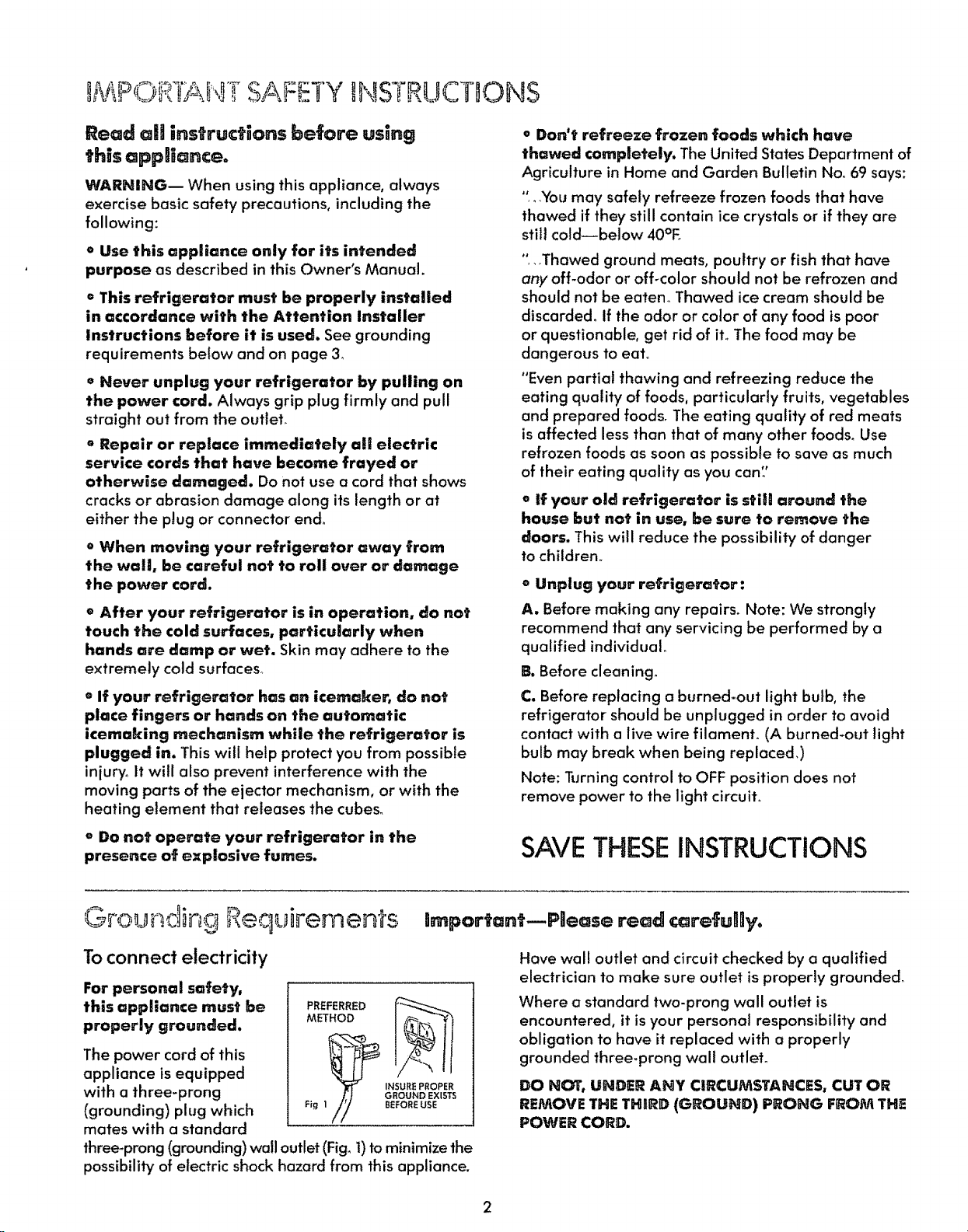
Toconnect electricity
For personal safety,
this appliance must be
properly grounded.
The power cord of this
appliance is equipped
with a three-prong
(grounding) plug which
mates with a standard
PREFERRED
METHOD
y INSURE PROPER
GROUND EXISTS
Fig BEFORE USE
three-prong (grounding) wall outlet (Fig_1)to minimize the
possibility of electric shock hazard from this appliance.
Have wall outlet and circuit checked by a qualified
electrician to make sure outlet is properly grounded_
Where a standard two-prong wall outlet is
encountered, it is your personal responsibility and
obligation to have it replaced with a properly
grounded three-prong wall outlet_
DO NOT, UNDER ANY CIRCUMSTANCES, CUT OR
REMOVE THE THSRD (GROUND) PRONG FROM THE
POWER CORD.
2
S ar ing the Refrigerator
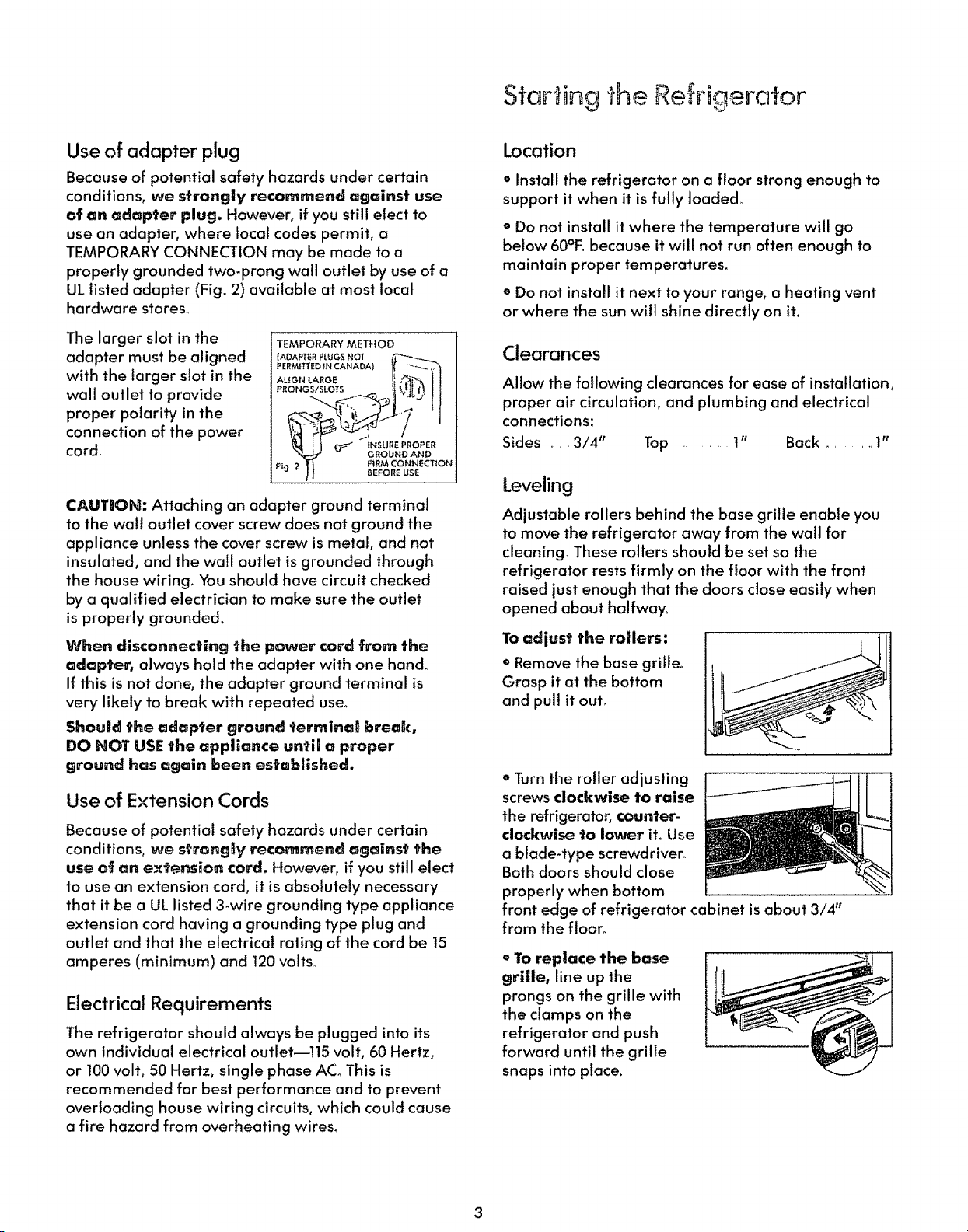
Use of adapter plug
Because of potential safety hazards under certain
conditions, we strongly recommend against use
of an adapter plug. However, if you still elect to
use an adapter, where local codes permit, a
TEMPORARY CONNECTION may be made to a
properly grounded two-prong wall outlet by use of a
UL listed adapter (Fig. 2) available at most local
hardware stores°
The larger slot in the
adapter must be aligned
with the larger slot in the
wall outlet to provide
proper polarity in the
connection of the power
cord,
TEMPORARY METHOD
(ADAPTI_ PLUGSNOT _'_-_.-._
ALIGN LARGE il'_ I I
PRONGS/SLOTS . _ _i Ir'_! I
y'r
I I _PP'_" _NSURE PROPER
_ GROUNDAND
Fig 2 _t FiRM CONNECT!ON
II BEFOREus_
CAUTION: Attaching an adapter ground terminal
to the wall outlet cover screw does not ground the
appliance unless the cover screw is metal, and not
insulated, and the wall outlet is grounded through
the house wiring. You should have circuit checked
by a qualified electrician to make sure the outlet
is properly grounded.
When disconnecting the power cord from the
adapter, always hold the adapter with one hand_
If this isnot done, the adapter ground terminal is
very likely to break with repeated use°
Should the adapter ground termina! break,
DO NOT USE the appliance until a proper
ground has again been esfrablished,
Use of Extension Cords
Because of potential safety hazards under certain
conditions, we s_rong_y recommend against the
use of an extension cord. However, if you still elect
1ouse an extension cord, it is absolutely necessary
that it be a UL listed 3-wire grounding type appliance
extension cord having a grounding type plug and
outlet and that the electrical rating of the cord be t5
amperes (minimum) and 120 volts,
Electrical Requirements
The refrigerator should always be plugged into its
own individual electrical outlet--ll5 volt, 60 Hertz,
or 100 volt, 50 Hertz, single phase AC_This is
recommended for best performance and to prevent
overloading house ,wiring circuits, which could cause
a fire hazard from overheating wires,
Location
• Install the refrigerator on a floor strong enough to
support it when it is fully loaded..
o Do not install it where the temperature will go
below 60°Fobecause it will not run often enough to
maintain proper temperatures.
o Do not install it next to your range, a heating vent
or where the sun will shine directly on it.
Clearances
Allow the following clearances for ease of installation,
proper air circulation, and plumbing and electrical
connections:
Sides .... 3/4" Top .......... 1" Back ...... 1"
Leveling
Adjustable rollers behind the base grille enable you
to move the refrigerator away from the wall for
cleaning. These rollers should be set so the
refrigerator rests firmly on the floor ,with the front
raised just enough that the doors close easily when
opened about halfway.,
To adjust the rollers:
o Remove the base grilte_
Grasp it at the bottom
and pull it out_
oTurn the roller adjusting
screws clockwise to raise
the refrigerator, counter-
clockwise to Mowerit0 Use
a blade-type screwdriver°
Both doors should close
properly when bottom
front edge of refrigerator cabinet is about 3/4"
from the floor°
oTo replace the base
grille, line up the
prongs on the grille with
the clamps on the
refrigerator and push
forward until the grille
snaps into place.
3
S ar me Refrigerator (continued)
COLDER
FREEZER COHTROL
.Q
9 iS COLDEST
FRESH FOOD CONTROL
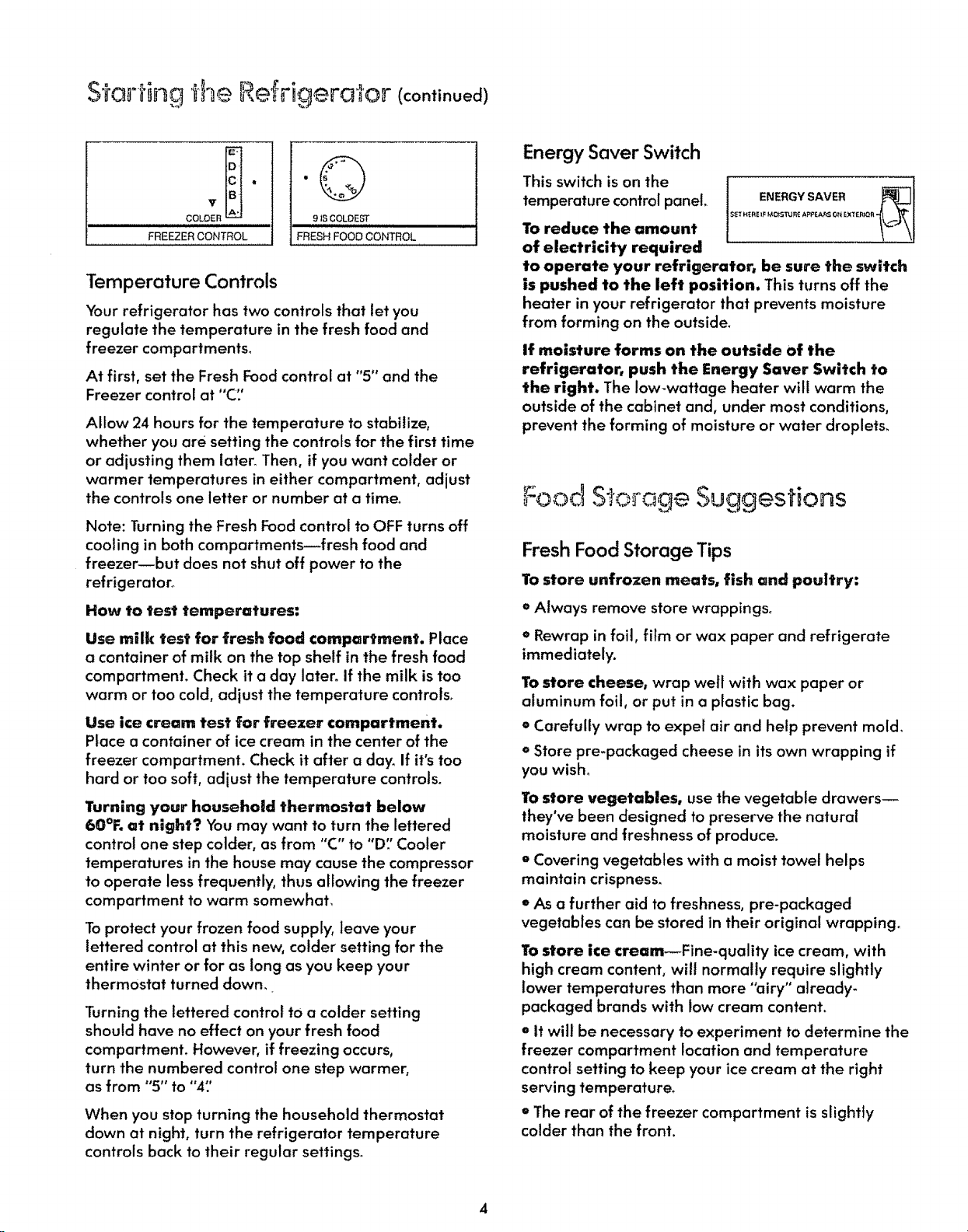
Temperature Controls
Your refrigerator has two controls that let you
regulate the temperature in the fresh food and
freezer compartments°
At first, set the Fresh Food control at "5" and the
Freezer control at "C'.'
Allow 24 hours for the temperature to stabilize,
whether you are setting the controls for the first time
or adjusting them later_ Then, if you want colder or
warmer temperatures in either compartment, adjust
the controls one letter or number at a time.
Note: Turning the Fresh Food control to OFF turns off
cooling in both compartments--fresh food and
freezerwbut does not shut off power to the
refrigerator°
How to test temperatures:
Use milk test for fresh food compartment. Place
a container of milk on the top shelf in the fresh food
compartment. Check it a day later° If the milk is too
warm or too cold, adjust the temperature controls.
Use ice cream test for freezer compartment.
Place a container of ice cream in the center of the
freezer compartment. Check it after a day. If it's too
hard or too soft, adjust the temperature controls.
Turning your household thermostat below
60°F. at night? You may want to turn the lettered
control one step colder, as from "C" to "D'J Cooler
temperatures in the house may cause the compressor
to operate less frequently, thus allowing the freezer
compartment to warm somewhat,
To protect your frozen food supply, leave your
lettered control at this new, colder setting for the
entire winter or for as long as you keep your
thermostat turned down.
Turning the lettered control to a colder setting
should have no effect on your fresh food
compartment. However, if freezing occurs,
turn the numbered control one step warmer,
as from "5" to "4"'
When you stop turning the household thermostat
down at night, turn the refrigerator temperature
controls back to their regular settings.
Energy Saver Switch
This switch is on the
temperature control panel, ENERGYSAVER
HI
To reduce the amount s_"_"_'_°_"_"_"_°"'_'°"tL_-J\l_'_'
of electricity required
to operate your refrigerator, be sure the switch
is pushed to the left position. This turns off the
heater in your refrigerator that prevents moisture
from forming on the outside.
If moisture forms on the outside of the
refrigerator, push the Energy Saver Switch to
the right. The low-wattage heater will warm the
outside of the cabinet and, under most conditions,
prevent the forming of moisture or water droplets.
Food S o *ageSuggestions
Fresh Food Storage Tips
To store unfrozen meats, fish and poultry:
= Always remove store wrappings.
o Rewrap in foil, film or wax paper and refrigerate
immediately.
To store cheese, wrap welt with wax paper or
aluminum foil, or put in a plastic bag.
• Carefully wrap to expel air and help prevent mold_
o Store pre-packaged cheese in its own wrapping if
you wish,
To store vegetables, use the vegetable drawers_
they've been designed to preserve the natural
moisture and freshness of produce.
o Covering vegetables with a moist towel helps
maintain crispness.
e As a further aid to freshness, pre-packaged
vegetables can be stored in their original wrapping°
To store ice cream_Fine-quality ice cream, with
high cream content, wil! normally require slightly
lower temperatures than more "airy" already-
packaged brands with low cream content.
o it will be necessary to experiment to determine the
freezer compartment location and temperature
control setting to keep your ice cream at the right
serving temperature.
e The rear of the freezer compartment is slightly
colder than the front.
4
Suggested Storage Times
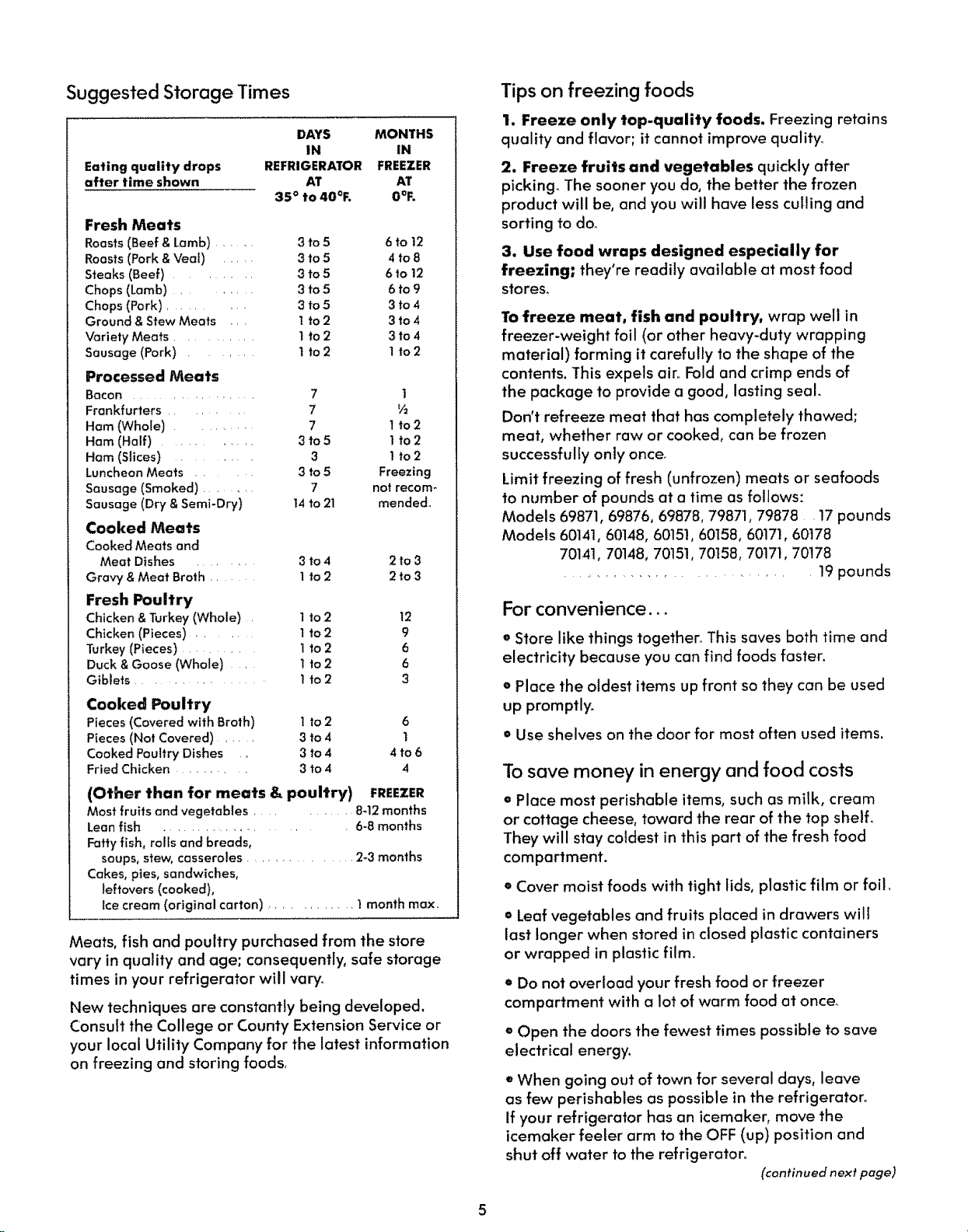
Eating quality drops
after time shown
DAYS MONTHS
tN IN
REFRIGERATOR FREEZER
AT AT
35 ° to 40°F. OaF.
Fresh Meats
Roasts (Beef 8,Lomb) ....... 3 to 5 6 to 12
Roasts(Pork&Veal) ..... 3 to5 4 to8
Steaks(Beef) ........ 3 to5 6to 12
Chops(Lamb) ........ 3 to5 6 to9
Chops(Pork)......... 3 to5 3 to4
Ground &StewMeats ,, _ I to2 3 to4
Variety Meats .......... 1 to 2 3 to 4
Sausage(Pork) ....... I to 2 1to2
processed Meats
Bacon .................. 7 t
Frankfurters ......... 7 ½
Ham (Whole) .......... 7 1 to 2
Ham (Half) ........... 3 to 5 1 to 2
Ham (Slices} ......... 3 I to 2
Luncheon Meats ...... 3 to 5 Freezing
Sausage(Smoked) ....... 7 not recom-
Sausage(Dry& Semi-Dry) 14 to 21 mended_
Cooked Meats
Cooked Meats and
Meat Dishes .... .... 3 tO 4
Gravy & Meat Broth ....... I to 2
Fresh Poultry
Chicken & Turkey (Whole) , 1 to 2
Chicken(Pieces)........ 1to 2
Turkey (Pieces) .......... _to 2
Duck & Goose (Whole) .... ] to 2
Giblets ................ } to 2
2to3
2t03
12
9
6
6
3
Cooked Poultry
Pieces (Covered with Broth) } to 2 6
Pieces (Not Covered) ..... 3 to 4 1
Cooked Poultry Dishes ,, 3 to 4 4 to 6
Fried Chicken .......... 3 to 4 4
(Other than for meats & poultry) FREEZER
Most fruits and vegetables ....... 8-12 months
Lean fish ..................... 6-8 months
Fattyfish,rolls and breads,
soups,stew,casseroles ................ 2-3months
Cakes, pies, sandwiches,
leftovers(cooked),
Icecream (original carton) ............ 1month max.
Meats, fish and poultry purchased from the store
vary in quality and age; consequently, safe storage
times in your refrigerator will vary.
New techniques are constantly being developed.
Consult the College or County Extension Service or
your local Utility Company for the latest information
on freezing and storing foods,
Tips on freezing foods
1. Freeze only top.quality foods. Freezing retains
quality and flavor; it cannot improve quality.
2. Freeze fruits and vegetables quickly after
picking_ The sooner you do, the better the frozen
product will be, and you wilt have less culling and
sorting to don
3. Use food wraps designed especially for
freezing; they're readily available at most food
stores.
To freeze meat, fish and poultry, wrap well in
freezer-weight foil (or other heavy-duty wrapping
material) forming it carefully to the shape of the
contents. This expels air Fold and crimp ends of
the package to provide a good, lasting seal
Don't refreeze meat that has completely thawed;
meat, whether raw or cooked, can be frozen
successfully only once.
Limit freezing of fresh (unfrozen) meats or seafoods
to number of pounds at a time as follows:
Models 69871, 69876, 69878, 79871, 79878 17 pounds
Models 60141,60148, 60151,60158, 60171,60178
70141,70148, 70151,70158, 70171, 70178
........................... 19 pounds
Forconvenience...
o Store like things together., This saves both time and
electricity because you can find foods faster.
o Place the oldest items up front so they can be used
up promptly.
o Use shelves on the door for most often used items.
To save money in energy and food costs
e Place most perishable items, such as milk, cream
or cottage cheese, toward the rear of the top shelf.
They will stay coldest in this part of the fresh food
compartment.
• Cover moist foods with tight lids, plastic film or foil,
e Leaf vegetables and fruits placed in drawers wilt
last longer when stored in closed plastic containers
or wrapped in plastic film.
• Do not overload your fresh food or freezer
compartment with a lot of warm food at once.
e Open the doors the fewest times possible to save
electrical energy,
e When going out of town for several days, leave
as few perishables as possible in the refrigerator°
If your refrigerator has an icemaker, move the
icemaker feeler arm to the OFF (up) position and
shut off water to the refrigerator°
(continued next page)
Shewes
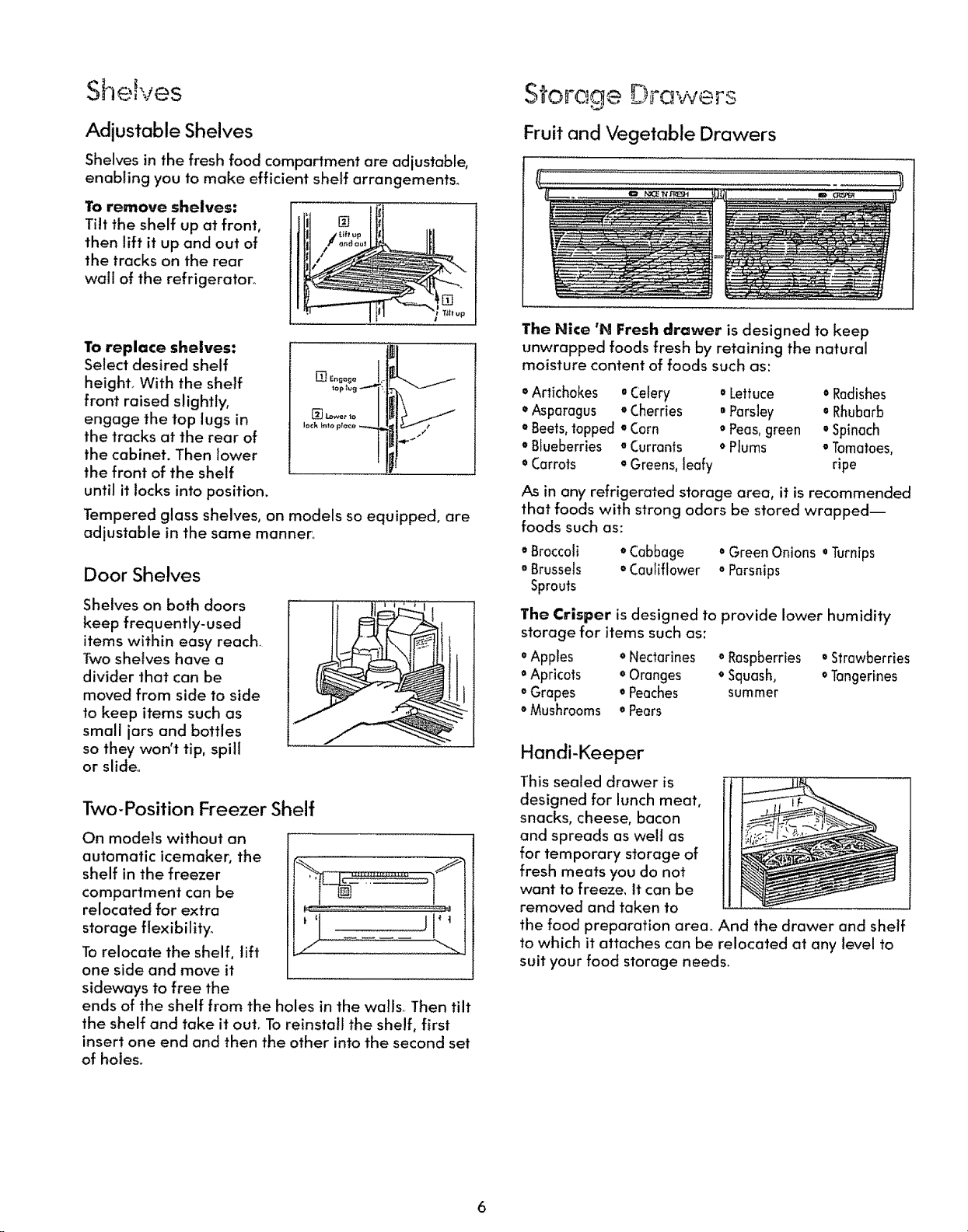
Adjustable Shelves
Shelves in the fresh food compartment are adjustable,
enabling you to make efficient sheff arrangements_
To remove shelves:
Tilt the shelf up at front,
then lift it up and out of
the tracks on the rear
wall of the refrigerator..
Storage D 'awers
Fruit and Vegetable Drawers
To replace shelves:
Select desired shelf
height. With the shelf
front raised slightly,
engage the top lugs in
the tracks at the rear of
the cabinet. Then lower
the front of the shelf
until it locks into position.
Tempered glass shelves, on models so equipped, are
adjustable in the same manner.,
Door Shelves
Shelves on both doors
keep frequently-used
items within easy reach.
Two shelves have a
divider that can be
moved from side to side
to keep items such as
small jars and bottles
so they won't tip, spill
or slide..
tI
Two- Position Freezer Shelf
On models without an
automatic icemaker, the
shelf in the freezer
compartment can be
relocated for extra
storage flexibility.
To relocate the shelf, lift
one side and move it
sideways to free the
ends of the shelf from the holes in the walls,. Then tilt
the shelf and take it out. To reinstall the shelf, first
insert one end and then the other into the second set
of holes.
The Nice 'N Fresh drawer is designed to keep
unwrapped foods fresh by retaining the natural
moisture content of foods such as:
• Artichokes oCelery • Lettuce oRadishes
Asparagus oCherries oParsley oRhubarb
e Beets,topped oCorn • Peas,green oSpinach
• Blueberries • Currants oPlums • Tomatoes,
o Carrots • Greens,leafy ripe
As in any refrigerated storage area, it is recommended
that foods with strong odors be stored wrapped--
foods such as:
eBroccoli
oBrussels
Sprouts
• Cabbage 0Green Onions oTurnips
Cauliflower oParsnips
The Crisper isdesigned to provide lower humidity
storage for items such as:
eApples oNectarines • Raspberries oStrawberries
• Apricots oOranges • Squash, oTangerines
• Grapes 0Peaches summer
oMushrooms 0Pears
Handi-Keeper
This sealed drawer is
designed for lunch meat,
snacks, cheese, bacon
and spreads as well as
for temporary storage of
fresh meats you do not
want to freeze, It can be
removed and taken to
the food preparation area_ And the drawer and shelf
to which it attaches can be relocated at any level to
suit your food storage needs_
6
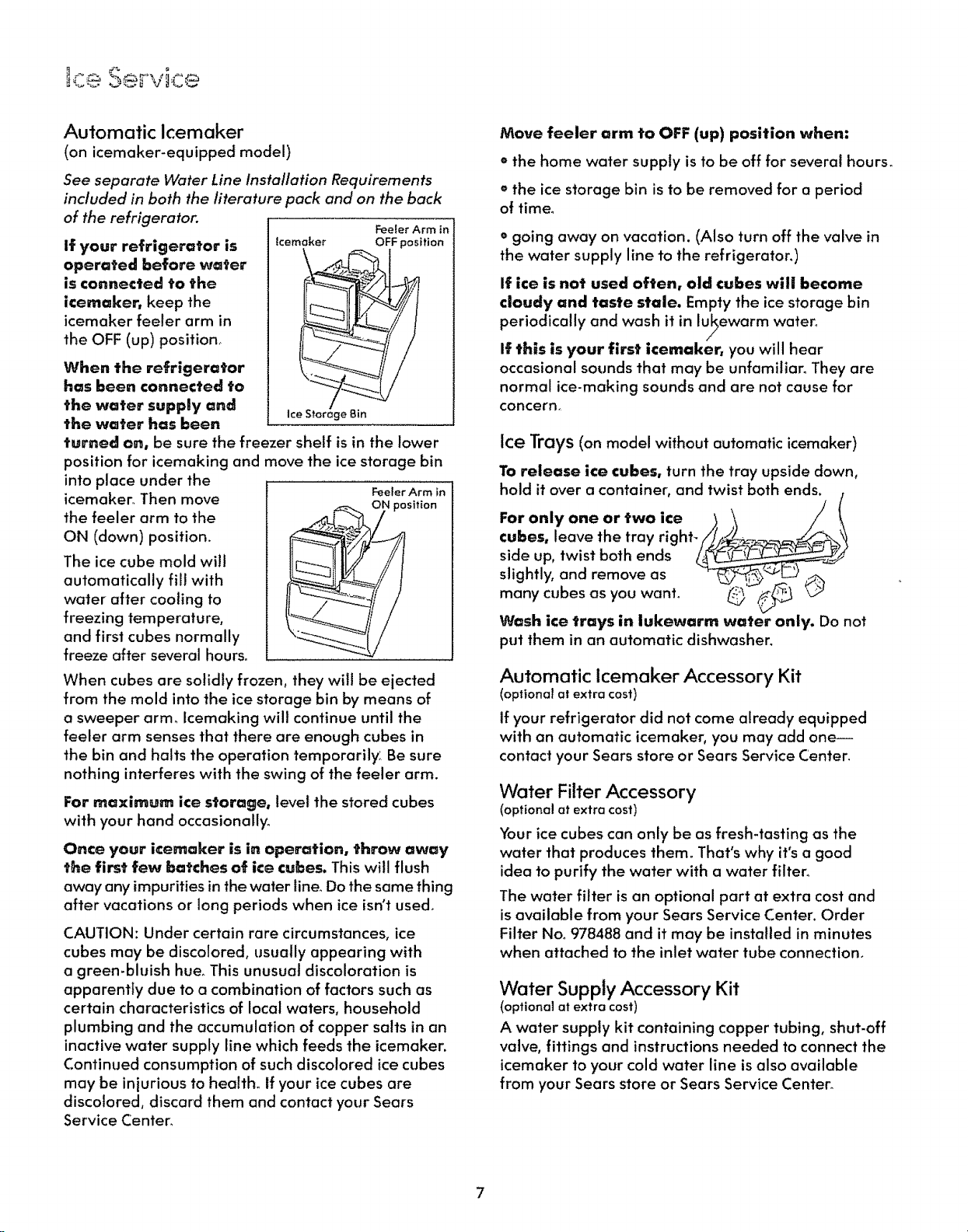
Automatic Icemaker
(on icemaker-equipped model)
See separate Water Line Installation Requirements
included in both the literature pack and on the back
of the refrigerator.
if your refrigerator is
operated before wa_er
is connected to the
icemaker, keep the
icemaker feeler arm in
the OFF (up) position_
When the refrigerator
has been connected to
the water supply and
the water has been
!cemaker
Feeler Arm in
OFF position
ice Storage Bin
turned on, be sure the freezer shelf is in the lower
position for icemaking and move the ice storage bin
into place under the
Feeler Arm in
icemoker_ Then move ¢position
the feelerarm tothe
ON (down) position.
The ice cube mold will
automatically fill with
water after cooling to
freezing temperature,
and first cubes normally
freeze after several hours.
When cubes are solidly frozen, they will be ejected
from the mold into the ice storage bin by means of
a sweeper arm_ Icemaking will continue until the
feeler arm senses that there are enough cubes in
the bin and halts the operation temporarily: Be sure
nothing interferes with the swing of the feeler arm.
For maximum ice storage, level the stored cubes
with your hand occasionally.
Once your icemaker is in operation, throw away
the first few batches of ice cubes. This will flush
away any impurities in the water line_ Do the same thing
after vacations or long periods when ice isn't used.
CAUTION: Under certain rare circumstances, ice
cubes may be discolored, usually appearing with
a green-bluish hue_ This unusual discoloration is
apparently due to a combination of factors such as
certain characteristics of local waters, household
plumbing and the accumulation of copper salts in an
inactive water supply line which feeds the icemaker.
Continued consumption of such discolored ice cubes
may be injurious to health. If your ice cubes are
discolored, discard them and contact your Sears
Service Center_
Move feeler arm to OFF (up) position when:
• the home water supply is to be off for several hours.
o the ice storage bin is to be removed for a period
of time°
o going away on vacation. (Also turn off the valve in
the water supply line to the refrigerator.)
If ice is not used often, old cubes will become
cloudy and taste stale. Empty the ice storage bin
periodically and wash it in lukewarm water°
/
If this is your first icemaker, you will hear
occasional sounds that may be unfamiliar. They are
normal ice-making sounds and are not cause for
concern_
Ice Trays (on model without automatic icemaker)
To release ice cubes, turn the tray upside down,
hold it over a container, and twist both ends.
For only one or two--ice _ \ / /
cubes, leave the tray right-/_!/_:____k_
side up, twist both ends _.__
slightly, and remove as __/_L_ _
many cubes as you want. _ _
Wash ice trays in lukewarm water only. Do not
put them in an automatic dishwasher.
Automatic Icemaker Accessory Kit
(optional at extra cost)
tf your refrigerator did not come already equipped
with an automatic icemaker, you may add one_
contact your Sears store or Sears Service Center.
Water Filter Accessory
(optional at extra cost)
Your ice cubes can only be as fresh-tasting as the
water that produces them. That's why it's a good
idea to purify the water with a water filter°
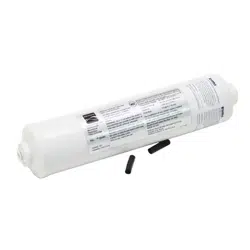
The water filter is an optional part at extra cost and
is available from your Sears Service Center. Order
Filter Noo978488 and it may be installed in minutes
when attached to the inlet water tube connection.
Water Supply Accessory Kit
(optional at extra cost)
A water supply kit containing copper tubing, shut-off
valve, fittings and instructions needed to connect the
icemaker to your cold water line is also available
from your Sears store or Sears Service Center_
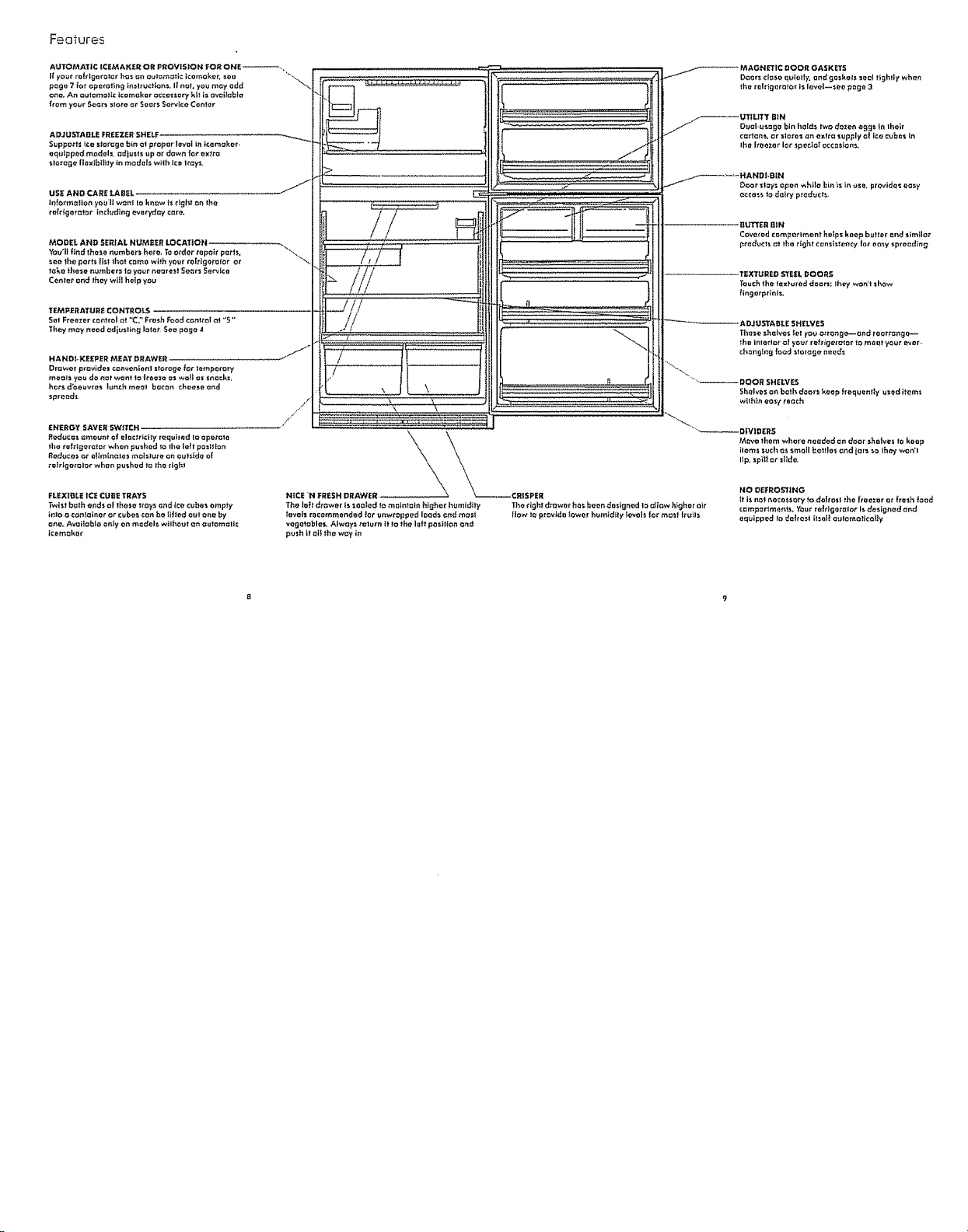
Features
FLEXfDLE 1CE CU_E TRAYS
Typist bet_ et_ds el those trays and i_e ¢_bas empty
h_o o container or cubo_ c_n b_ II_le_out on_ by
_ne. A_i_o_lo only on m_dol_ wtlhout an au{om_llC
icemokor
///
/
/
\
\
EnergyoSaving Tips
o Don't open the doors more often than necessary.
o Close the doors as soon as possible, particularly in
hot, humid weather.
o Keep the Energy Saver Switch in the left position
unless moisture forms on the cabinet in hat, humid
weather,
o Be sure the doors are closed tightly, Before leaving
the house or retiring for the night, check to be sure
the doors haven't been left open accidentally,
o Store only those foods requiring refrigeration in
your refrigerator.
oWipe moisture from bottles and cartons before
putting them in the refrigerator,
o Keep foods covered to reduce moisture buildup
inside the refrigeratoc
o If you turn the controls to the coldest position for
quick chilling or freezing, be sure to turn them back
to regular settings.
• Don't overcrowd your refrigerator. Overcrowding
can require extra electrical energy to keep
everything cool_
Care and Cleaning
Outside
The door handles and trim can be cleaned with
a cloth dampened with a solution of mild liquid
dishwashing detergent and water Dry with a soft
cloth, Don't wax handles or trim.
Keep the f_nish dean. Wipe with a clean cloth
lightly dampened with kitchen appliance wax or
mild liquid dishwashing detergent_ Dry and polish
with a clean, soft cloth_ Do not wipe the refrigerator
with a soiled dishwashing cloth or wet towel They
may leave a residue that can harm the paint_ Do not
use scouring pads, powdered cleaners, bleach or
cleaners containing bleach because these products
can scratch and weaken the paint finish°
Protect the paint finish. The outside of the
refrigerator has a high quality, baked-on paint finish.
With proper care, it will stay new-looking and rust-
free for years. Apply a coat of kitchen appliance wax
when the refrigerator is new and then at least twice
a year,
Inside
Clean the inside of the fresh food and free=er
compartments at least once a year. Unplug the
refrigerator before cleaning, If this is not practical,
wring excess moisture out of sponge or cloth when
cleaning around switches, lights or controls.
Use warm water and baking soda solution--about
a tablespoon of baking soda to a quart of water_ This
both cleans and neutralizes odors. Rinse thoroughly
with water and wipe dry.
Other parts of the refrigerator--including door
gaskets, vegetable drawers, ice trays and all plastic
parts--can be cleaned the same way_ Do not use
cleansing powders or other abrasive cleaners_
To help prevent odors, leave an open box of baking
soda in the rear of the refrigerator, on the top shell
Change the box every three months° Arropen box of
baking soda in the freezer will absorb stale odors,
t Do not wash any plastic parts from your I
I
refrigerator in your automatic dishwasher.
t
Behind Refrigerator
Care should be taken in moving your refrigerator
away from the wall. All types of floor coverings can
be damaged, particularly cushioned coverings and
those with embossed surfaces. Pull the refrigerator
straight out and return it to position by pushing it
straight in. Moving your refrigerator in a side
direction may result in damage to your floor
covering or refrigerator.
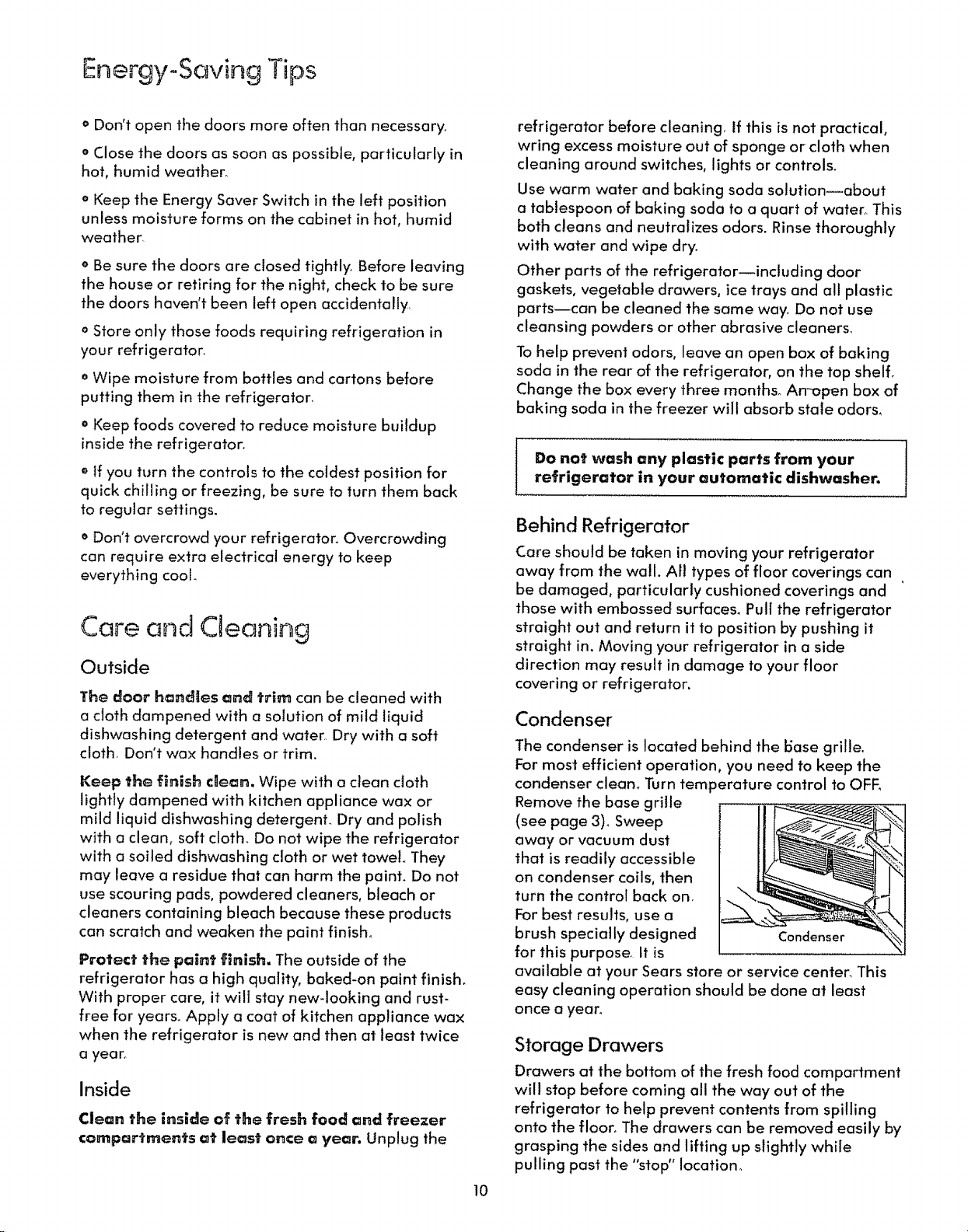
Condenser
The condenser is located behind the kiase grille°
For most efficient operation, you need to keep the
condenser cleam Turn temperature control to OFE
Remove the base grille
(see page 3)_ Sweep
away or vacuum dust
that is readily accessible
on condenser coils, then
turn the control back on_
For best results, use a
brush specially designed Condenser
for this purpose_ tt is
available at your Sears store or service center_ This
easy cleaning operation should be done at least
once a year_
Storage Drawers
Drawers at the bottom of the fresh food compartment
will stop before coming all the way out of the
refrigerator to help prevent contents from spilling
onto the floor. The drawers can be removed easily by
grasping the sides and lifting up slightly while
pulling past the "stop" Iocation_
10
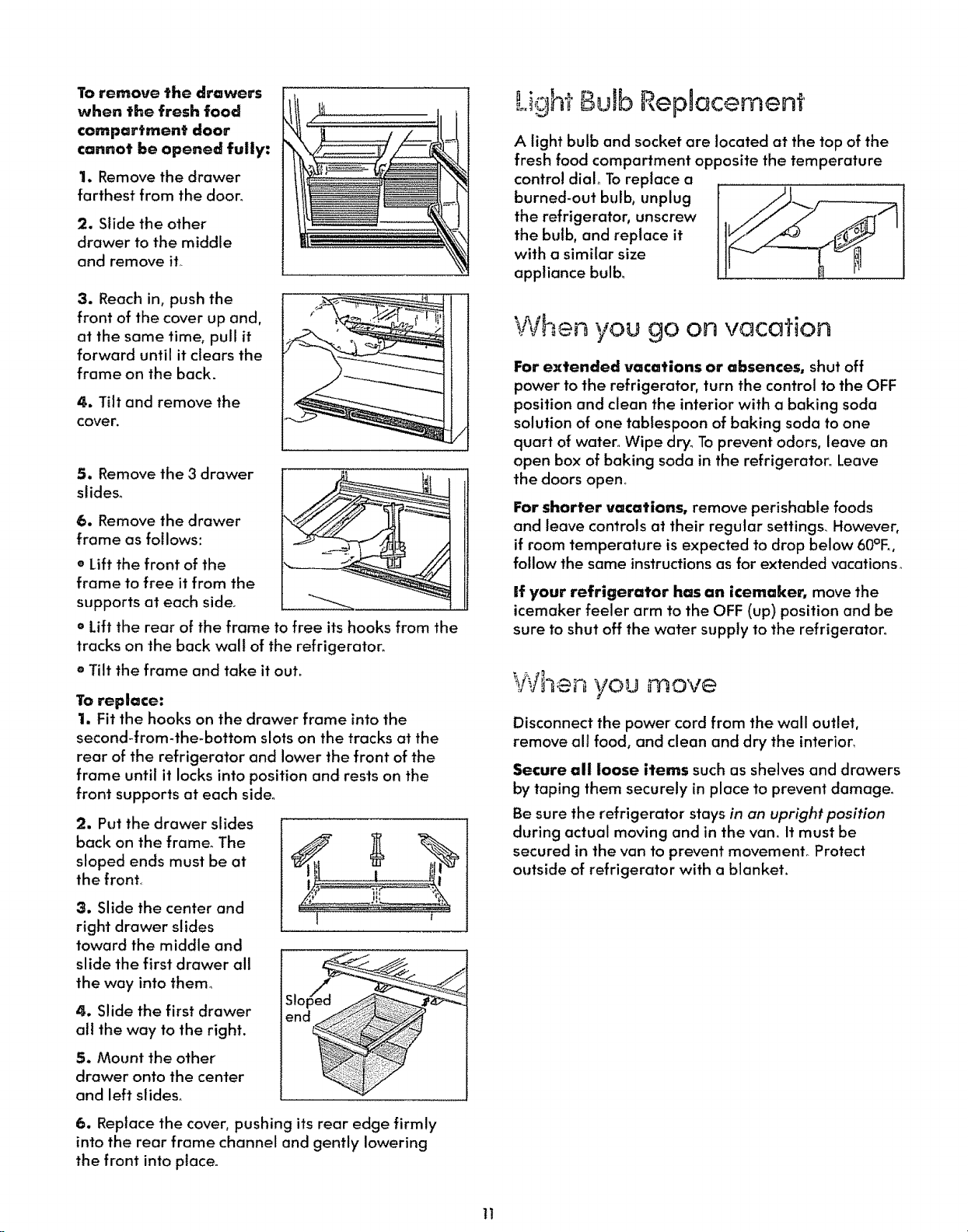
To remove the drawers
when the fresh food
compartment door
cannot be opened fully:
1. Remove the drawer
farthest from the door.
2. Slide the other
drawer to the middle
and remove iL
3. Reach in, push the
front of the cover up and,
at the same time, pull it
forward until it clears the
frame on the back.
4. Tilt and remove the
cover.
/
5. Remove the 3 drawer
slides°
6. Remove the drawer
frame as follows:
o Lift the front of the
frame to free it from the
supports at each side.
o Lift the rear of the frame to free its hooks from the
tracks on the back walt of the refrigerator.
o Tilt the frame and take it out.
To replace:
1. Fit the hooks on the drawer frame into the
second-from-the-bottom slots on the tracks at the
rear of the refrigerator and lower the front of the
frame until it locks into position and rests on the
front supports at each side°
2. Put the drawer slides
back on the frame. The
sloped ends must be at
the front.
3. Slide the center and
right drawer slides
toward the middle and
slide the first drawer all
the way into them°
4. Slide the first drawer
all the way to the right.
5. Mount the other
drawer onto the center
and left slides.
Slope_d
end
6. Replace the cover, pushing its rear edge firmly
into the rear frame channel and gently lowering
the front into place.
Light BuJbReplacement
A light bulb and socket are located at the top of the
fresh food compartment opposite the temperature
control dial_ To replace a
burned-out bulb0 unplug
the refrigerator, unscrew
the bulb, and replace it
with a similar size
appliance bulb.
When you go on vacation
For extended vacations or absences, shut off
power to the refrigerator, turn the control to the OFF
position and clean the interior with a baking soda
solution of one tablespoon of baking soda to one
quart of water Wipe dry. To prevent odors, leave an
open box of baking soda in the refrigerator° Leave
the doors open
For shorter vacotions, remove perishable foods
and leave controls at their regular settings_ However,
if room temperature is expected to drop below 60°F.
follow the same instructions as for extended vacations_
If your refrigerator has on icemoker, move the
icemaker feeler arm to the OFF (up) position and be
sure to shut off the water supply to the refrigerator°
When you move
Disconnect the power cord from the wall outlet,
remove all food, and clean and dry the interior_
Secure all loose items such as shelves and drawers
by taping them securely in place to prevent damager
Be sure the refrigerator stays in an upright position
during actual moving and in the van_ It must be
secured in the van to prevent movement_ Protect
outside of refrigerator with a blanket.
1t
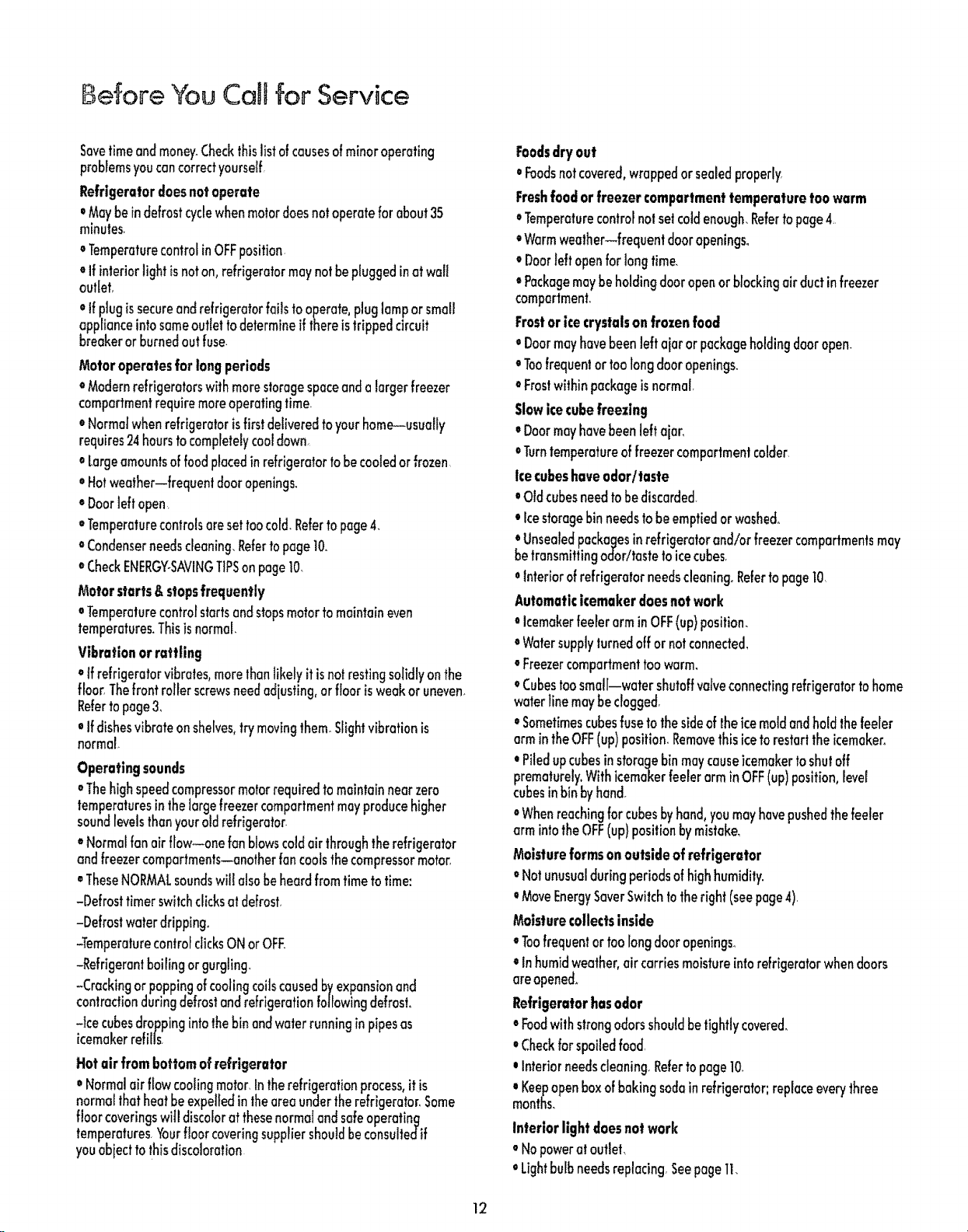
Before You CaNfor Service
Savetimeandmoney_Checkthislistofcausesofminoroperating
problemsyoucancorrectyourseff
Refrigerator doesnotoperate
eMaybeindefrostcyclewhenmotordoesnotoperateforabout35
minutes.
oTemperaturecontrolinOFFposition
oIf interiorlightisnoton,refrigeratormaynotbepluggedin atwalt
outlet,
• ffp_ugissecureandrefrigeratorfanstooperate,pluglamporsmall
applianceintosameoutlettodetermineif thereistrippedcircuit
breakeror burnedoutfuse
Motoroperatesfor tongperiods
• Modernrefrigeratorswithmorestoragespaceanda_argerfreezer
compartmentrequiremoreoperatingtime
•Normalwhenrefrigeratorisfirstdeliveredtoyourhome--usually
requires24hourstocompletelycooldown
oLargeamountsoffoodplacedin refrigeratortobecooledorfrozen
',Hotweather-frequentdooropenings.
eDoor)eftopen
• Temperaturecontrolsaresettoocold.Refertopage4.
oCondenserneedscleaning.Refertopage10.
• CheckENERGY-SAVINGTIPSonpage10.
Motor starts& stopsfrequently
•Temperaturecontrolstartsandstopsmotortomaintaineven
temperatures.Thisisnormaf.
Vibrationorrattling
• Ifrefrigeratorvibrates,morethanlikelyitisnotrestingsolidlyonthe
floor,Thefrontrollerscrewsneedadiusting,orfloorisweakor uneven.
Refertopage3,
'JIfdishesvibrateonshelves,try mo,_ingthem Stightvibrationis
normal.
Operatingsounds
oThehiqhspeedcompressormotorrequiredtomaintainnearzero
temperaturesinthelargefreezercompartmentmayproducehgher
soundlevelsthanyouroldrefrigerator
. Normat{onair flow--onefanblowscoldairthroughtherefrigerator
andfreezercompartments-anotherfancoolsthecompressormotor,
. TheseI'40RMALsoundswinalsobeheardfromtimetotime:
-Defrosttimerswitchclicksatdefrost,
-Defrostwaterdripping.
-TemperaturecontrolclicksONorOFF.
-Refrigerantboilingor gurgling.
-Crackingor poppingofcoolingcoilscausedbyexpansionand
contractionduringdefrostandrefrigerationfollowingdefrost,
-Ice cubesdroppingintolhebinandwaterrunningin pipesas
icemokerrefills,
Hotair from bottomofrefrigerator
oNormalair flowcoolingmotor,intherefrigerationprocess,it is
normalthatheatbeexpelledintheareaundertherefrigerator,Some
floorcoveringswilldiscoloratthesenormalandsafeoperating
temperatures,Yourfloorcoveringsuppliershouldbeconsultedif
youobjectto thisdiscobration
Foodsdry out
oFoodsnotcovered,wrappedor sealedproperly
Freshfoodorfreezercompartmenttemperature toowarm
oTemperaturecontroFnotsetcoldenough.Refertopage4.
*Warmweather-frequentdooropenings_
* Doorleftopenfor longtime.
, Packagemaybeholdingdooropenor blockingair ductinfreezer
compartment,
Frostoricecrystalsonfrozenfood
"Door mayhavebeenleftaiarorpackageholdingdooropen.
, Toofrequentor toofangdooropenings.
QFrostwithinpackageisnormal.
Slowicecubefreezing
*Doormayhavebeenleft ajar,
*Turntemperatureoffreezercompartmentcolder
Icecubeshaveodor/taste
oOldcubesneedtobediscarded.
* Icestoragebinneedstobeemptiedorwashed.
*Unsealedpackagesinrefrigeratorand/orfreezercompartmentsmay
betransmittingodor/tastetoicecubes,
oInteriorofrefrigeratorneedscleaning.Ratertopage10.
Automaticicemakerdoesnotwork
oIcemakerfee}orarminOFF(up)position.
oWatersupplyturnedoff or notconnected,
. Freezercompartmenttoowarm.
*Cubestoosmall-water shutoffvalveconnectingrefrigeratortohome
waterlinemaybeclogged.
oSometimescubesfusetothesideoftheicemoldandholdthefeeler
armintheOFF(up)position,Removethisicetorestarttheicemaker.
oPiledupcubesinstoragebinmaycauseicemakertoshutoff
prematu'rely,WithicemakerfeelerarminOFF(up)position,leve_
cubesinbinbyhand.
oWhenreachingforcubesbyhand,youmayhavepushedthefeeler
armintotheOFF(up)positionbymistoke_
Moistureformsonoutsideofrefrigerator
oNotunusualduringperiodsofhighhumidity,
oMoveEnergySaverSwitchtotheright(seepage.4),
Moisturecollectsinside
oToofrequentortoolongdooropenings_
*inhumidweather,aircarriesmoistureintorefrigeratorwhendoors
areopened_
Refrigeratorhasodor
oFoodwithstrongodorsshouldbetightlycovere&
oCheckforspoiledfood,
, Interiorneedscleaning.Refertopage10_
eKeepopenboxofbakingsodain refrigerator:replaceeverythree
months.
Interiorlightdoesnotwork
oNopoweratoutleL
aLightbulbneedsreplacing.Seepage11.
12
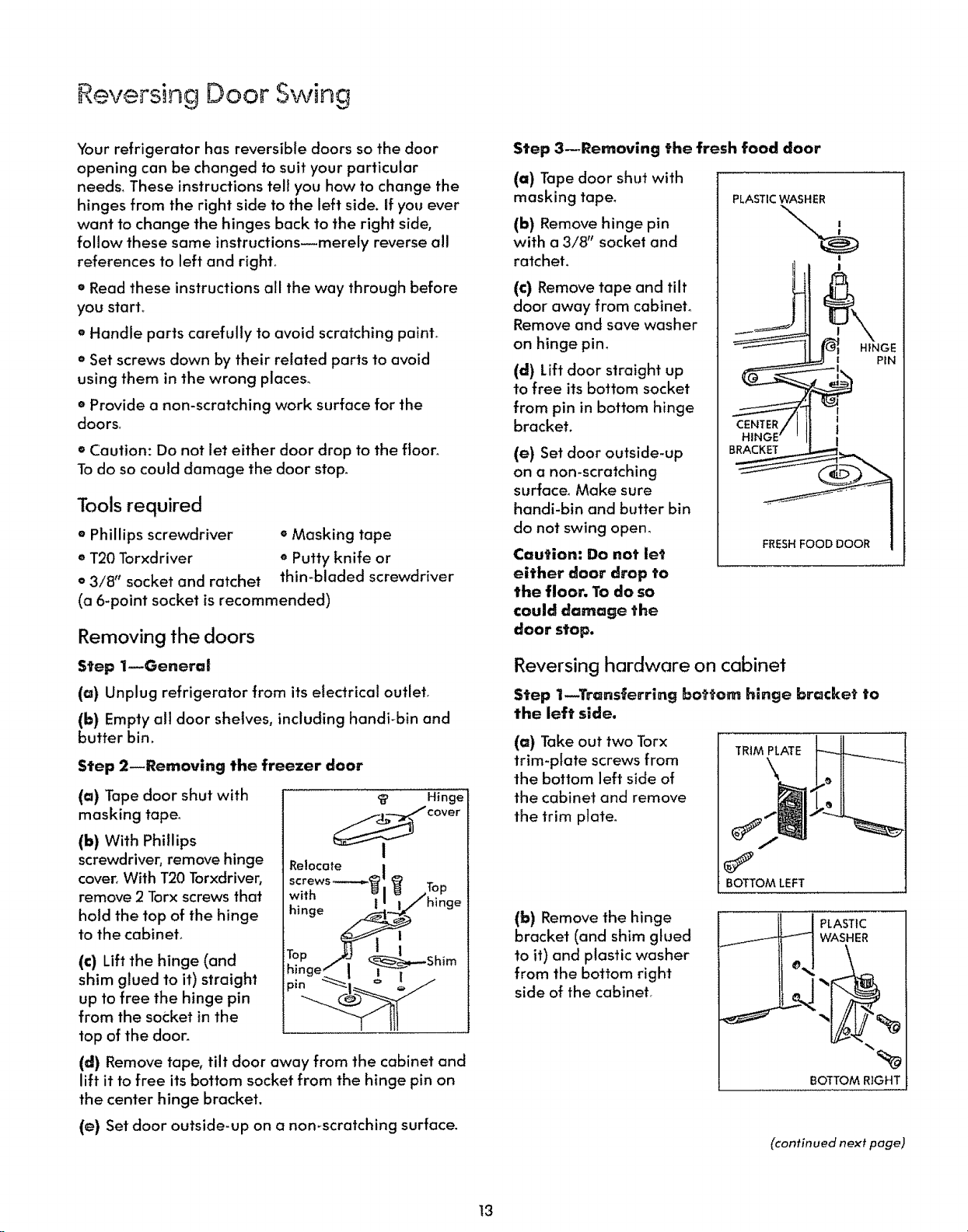
Reversing Door Swing
Your refrigerator has reversible doors so the door
opening can be changed to suit "four particular
needs, These instructions tell you how to change the
hinges from the right side to the left side. if you ever
want to change the hinges back to the right side,
follow these same instructions--merely reverse all
references to left and right°
o Read these instructions all the way through before
you start°
o Handle parts carefully to avoid scratching painL
o Set screws down by their related parts to avoid
using them in the wrong places°
e Provide a non-scratching work surface for the
doors,
o Caution: Do not let either door drop to the ftoor_
To do so could damage the door stop,
Tools required
• Phillips screwdriver • Masking tape
o T20 Torxdriver o Putty knife or
o 3/8" socket and ratchet thin.bladed screwdriver
(a 6-point socket is recommended)
Removing the doors
Stop 1--Genera!
(a) Unplug refrigerator from its electrical outlet°
(b) Empty all door shelves, including handi-bin and
butter bin.
Step 2JRemoving the freezer door
(a) Tape door shut with
masking taper
(b) With Phillips
screwdriver, remove hinge
cover. With T20 Torxdriver,
remove 2 Torx screws that
hold the top of the hinge
to the cabinet.
Hinge
Relocate
(c) Lift the hinge (and
shim glued to it) straight
up to free the hinge pin
from the socket in the
top of the door.
(d) Remove tape, tilt door away from the cabinet and
lift it to free its bottom socket from the hinge pin on
the center hinge bracket.
(o) Set door outside-up on a non-scratching surface.
Step 3--Removing the fresh food door
(a) Tape door shut with
masking tape,
(b) Remove hinge pin
with a 3/8" socket and
ratchet.
(c) Remove tape and tilt
door away from cabinet°
Remove and save washer
on hinge pin,
(d) Lift door straight up
to free its bottom socket
from pin in bottom hinge
bracket.
(e) Set door outside-up
on o non-scratching
surface° Make sure
handi-bin and butter bin
do not swing open_
Caution: Do not let
either door drop to
the floor. To do so
could damage the
door stop.
PLASTIC WASHER
H|NGE
[ PIN
I
I
i
BRACKET
FRESH FOOD DOOR
Reversing hardware on cabinet
Step l_Transferrlng bottom hinge bracket to
the left side.
(a) Take out two Torx
trim-plate screws from
the bottom left side of
the cabinet and remove
the trim plate.
TRIM PLATE
\
BOTTOM LEFT
(b) Remove the hinge
bracket (and shim glued
to it) and plastic washer
from the bottom right
side of the cabinet°
........ Jl J PLASTIC
_] WASHER
BOTTOM RIGHT
(continued next page)
13
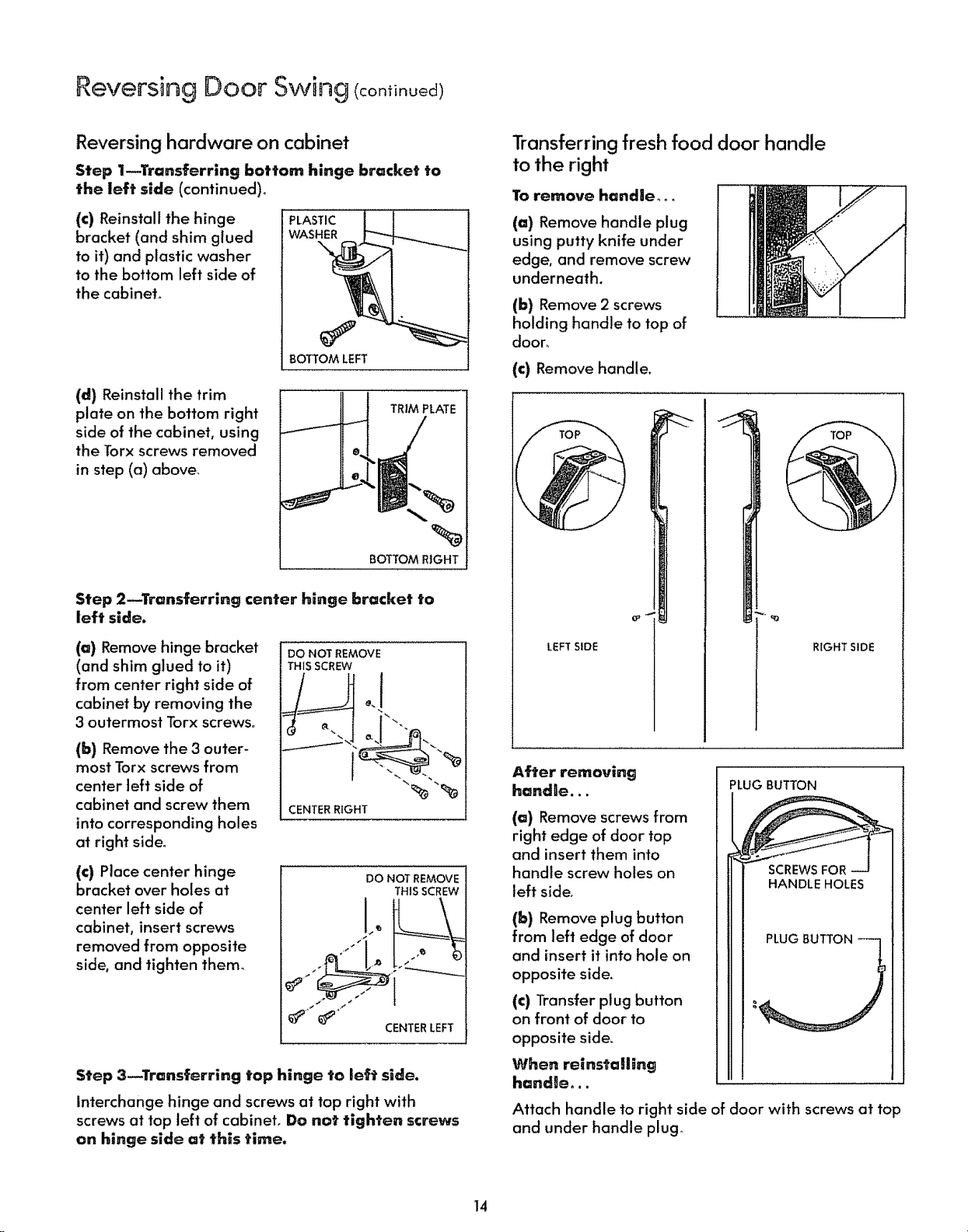
Reversing Door Swhqg(continued)
Reversing hardware on cabinet
Step 1--Transferring bottom hinge bracket to
the left side (continued)°
(c) Reinstall the hinge
bracket (and shim glued
to it) and plastic washer
to the bottom left side of
the cabinet_
PLASTIC j J
BOTTOM LEFT
(d) Reinstall the trim
plate on the bottom right
side of the cabinet, using
the Torx screws removed
in step (a) above_
TRIM PLATE
BOTTOM RIGHT
Step 2--Transferring center hinge bracket to
left side.
(a) Remove hinge bracket
(and shim glued to it)
from center right side of
cabinet by removing the
3 outermost Torx screws°
(b) Remove the 3 outer-
most Torx screws from
center left side of
cabinet and screw them
into corresponding holes
at right side_
(c) Place center hinge
bracket over holes at
center left side of
cabinet, insert screws
removed from opposite
side, and tighten them_
DO NOT REMOVE
THISSCREW
CENTER RIGHT
DO NOT REMOVE
THIS SCREW
CENTER LEFT
Step 3--Transferring top hinge to left side.
Interchange hinge and screws at top right with
screws at top left of cabinet. Do not tighten screws
on hinge side at this time.
Transferring fresh food door handle
to the right
To remove handle_ __
(a) Remove handle plug
using putty knife under
edge, and remove screw
underneath.
(b) Remove 2 screws
holding handle to top of
door_
(c) Remove handle.
LEFT SIDE
RIGHT SIDE
After removing
handBe...
(a) Remove screws from
right edge of door top
and insert them into
handle screw holes on
left side.
(b) Remove plug button
from left edge of door
and insert it into hole on
opposite side.
(€) Transfer plug button
on front of door to
opposite side.
When reinstalling
handge...
PLUG BUTTON
HANDLE HOLES
PLUG BUTTON
Attach handle to right side of door with screws at top
and under handle plug
14
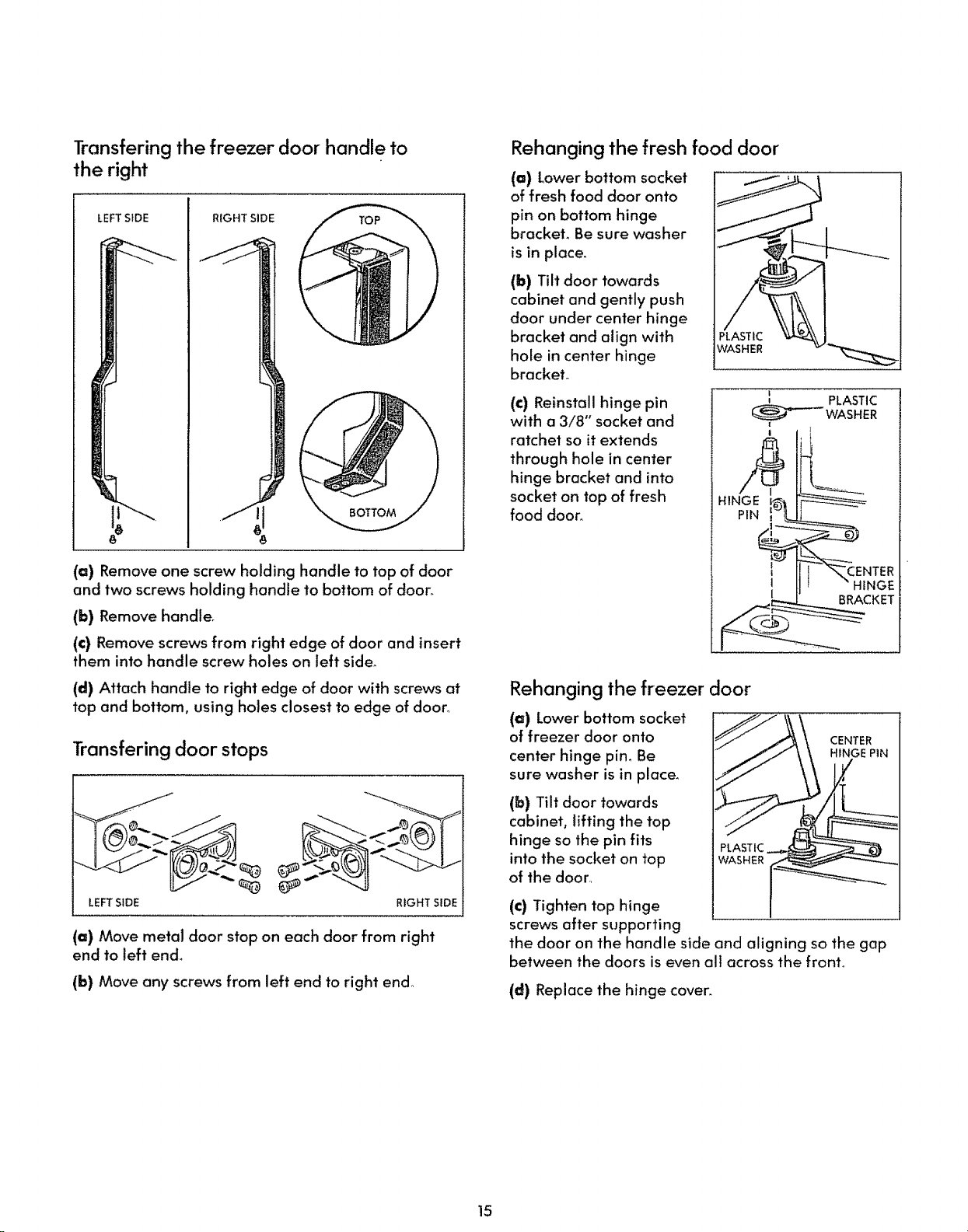
Transfering the freezer door handle to
the right
LEFT SIDE RIGHT SIDE
(a) Remove one screw holding handle to top of door
and two screws holding handle to bottom of door.
(b) Remove handle.
(c) Remove screws from right edge of door and insert
them into handle screw holes on left side.
(d) Attach handle to right edge of door with screws at
top and bottom, using holes closest to edge of door_
Transfering door stops
LEFT SIDE RIGHT SIDE
(a) /Vl,ove metal door stop on each door from right
end to left end.
(b) /V_oveany screws from left end to right end°
Rehanging the fresh food door
(a) Lower bottom socket
of fresh food door onto
pin on bottom hinge
bracket. Be sure washer
is in place.
(b) Tilt door towards
cabinet and gently push
door under center hinge
bracket and align with
hole in center hinge
bracket°
(c) Reinstall hinge pin
with a 3/8" socket and
ratchet so it extends
through hole in center
hinge bracket and into
socket on top of fresh
food door,
I
I PLASTIC
_--'-- WASHER
I
I
I
I
1
Rehanging the freezer door
(a) Lower bottom socket
of freezer door onto
center hinge pin, Be
sure washer is in place.
(b) Tilt door towards
cabinet, lifting the top
hinge so the pin fits
into the socket on top
of the door,,
(€) Tighten top hinge
screws after supporting
CENTER
HINGE PIN
the door on the handle side and aligning so the gap
between the doors is even all across the front°
(d) Replace the hinge coven
15
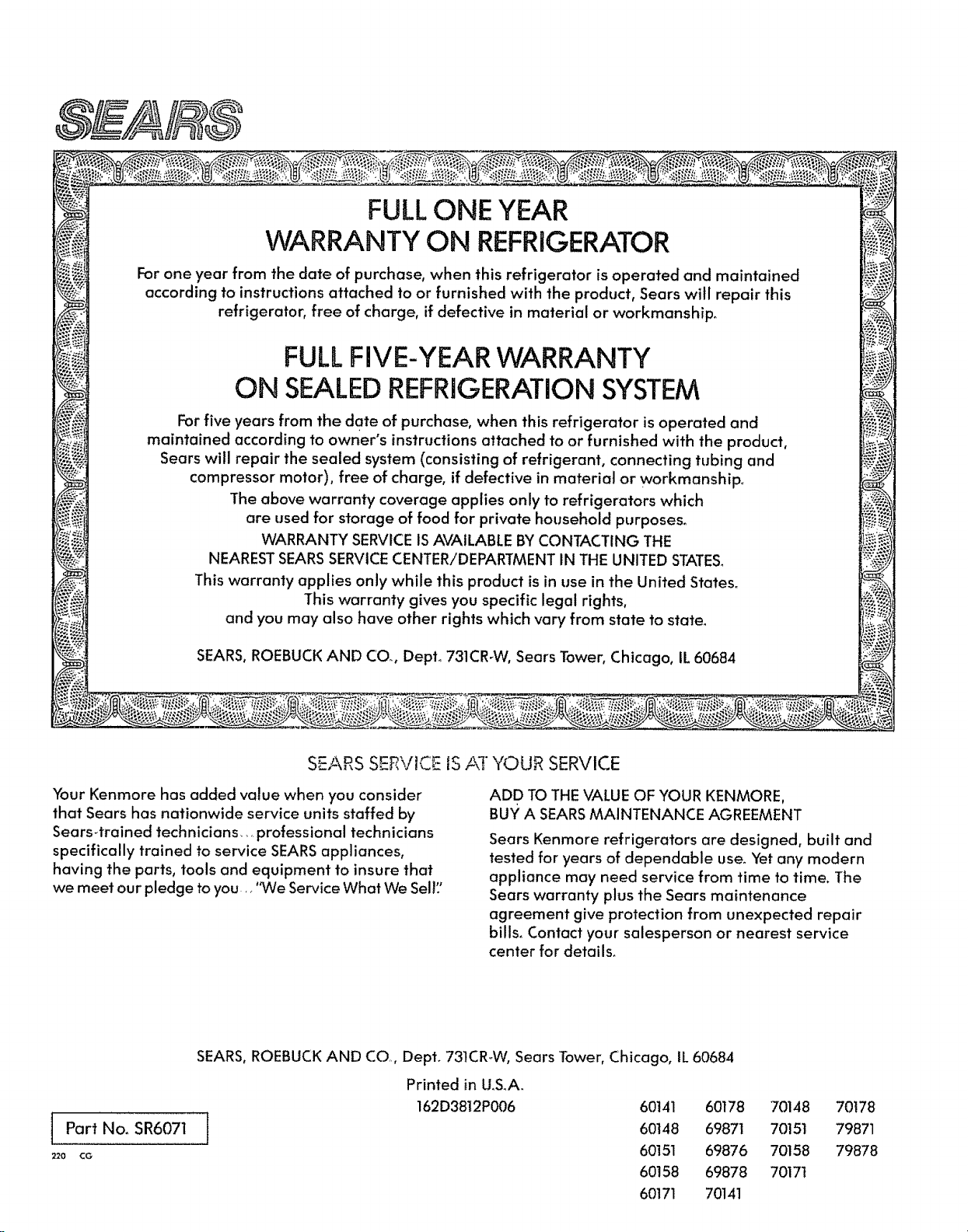
FULLONE YEAR
WARRANTY ON REFRIGERATOR
For one year from the date of purchase, when this refrigerator is operated and maintained
according to instructions attached to or furnished with the product, Sears will repair this
refrigerator, free of charge, if defective in material or workmanship.
FULLFIVE-YEAR WARRANTY
ON SEALED REFRiGERATiON SYSTEM
For five years from the date of purchase, when this refrigerator is operated and
maintained according to owner's instructions attached to or furnished with the product,
Sears will repair the sealed system (consisting of refrigerant, connecting tubing and
compressor motor), free of charge, if defective in material or workmanship_
The above ,warranty coverage applies only to refrigerators which
are used for storage of food for private household purposes.
WARRANTY SERVICE ISAVAILABLE BY CONTACTING THE
NEAREST SEARSSERVICECENTER/DEPARTMENT IN THE UNITED STATES_
This warranty applies only while this product is in use in the United States°
This warranty gives you specific legal rights,
and you may also have other rights which vary from state to state_
SEARS, ROEBUCK AND COn, Dept_ 731CR-W, Sears Tower, Chicago, IL 60684
SEARS SERVICE IS AT YOUR SERVICE
Your Kenmore has added value when you consider
that Sears has nationwide service units staffed by
Sears-trained technicians ....professional technicians
specifically trained to service SEARSappliances,
having the parts, tools and equipment to insure that
we meet our pledge to you.. "We Service What We Sell'.'
ADD TO THE VALUE OF YOUR KENMORE,
BUY A SEARSMAINTENANCE AGREEMENT
Sears Kenmore refrigerators are designed, built and
tested for years of dependable use. Yet any modern
appliance may need service from time to time. The
Sears warranty plus the Sears maintenance
agreement give protection from unexpected repair
bills. Contact your salesperson or nearest service
center for details_
Part No. SR6071
220 CG
SEARS, ROEBUCK AND CO.., Dept. 731CR-W, Sears Tower, Chicago, IL 60684
Printed in U_S_A.
162D3812P006 60141 60178 70148
60148 69871 70151
60151 69876 70158
60158 69878 70171
60171 70141
70178
79871
79878