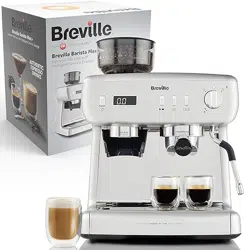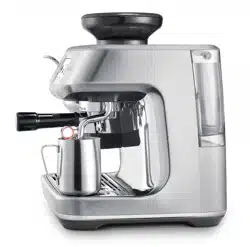
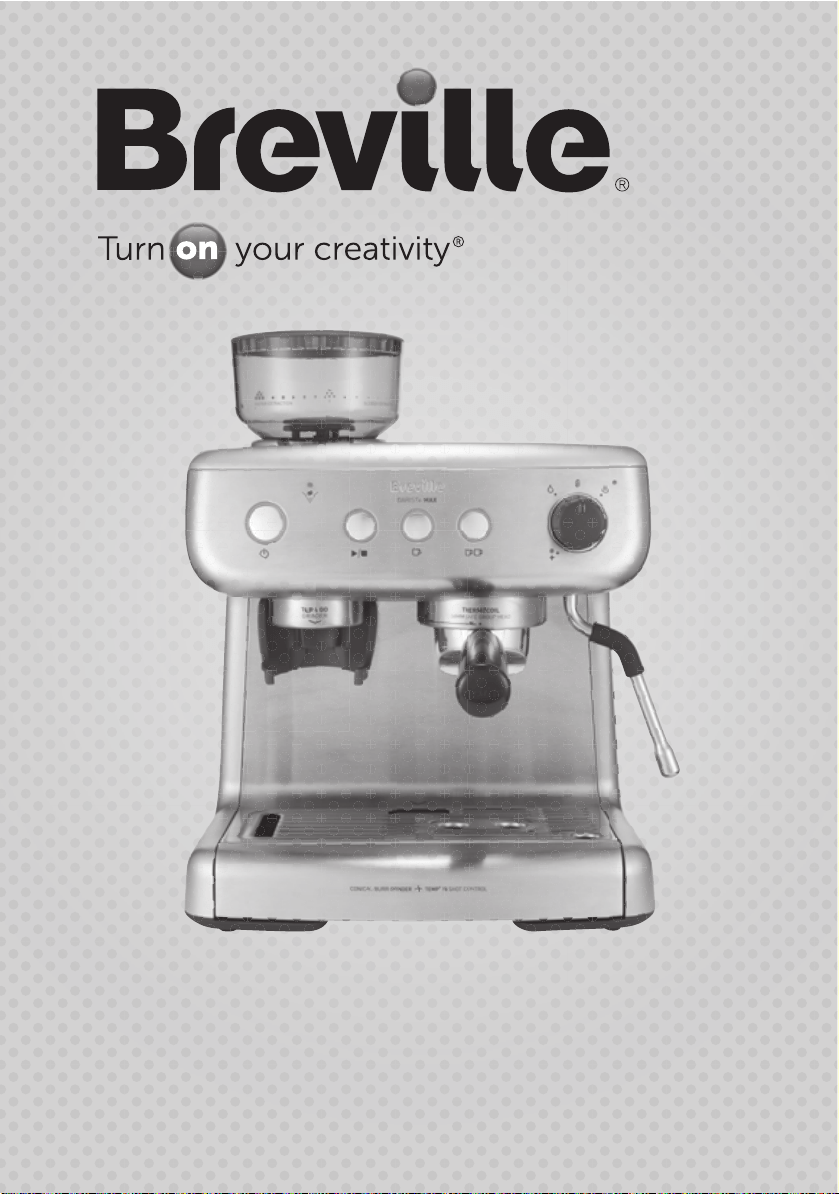
Barista Max Espresso Machine
With Integrated Grinder
VCF126

2
intended use. Injury could
occur from misuse.
• Do not immerse the
appliance or power cord
and plug in water or any
other liquid. Wash the
following 10 parts in warm
water with a mild detergent;
milk jug, drip tray grill,
one cup and two cup fi lter
baskets, group handle/
portafi lter, drip tray, tamper,
top burr, bean hopper and
water reservoir. Rinse and
dry each part thoroughly
before replacing. Wipe the
steam wand with a damp
cloth. See Care & Cleaning
section for full details.
• This appliance is intended
to be used in household
and similar applications
such as: staff kitchen areas
in shops, offi ces and other
working environments; farm
houses; by clients in hotels,
motels and other residential
type environments; bed and
breakfast type environments.
• This appliance can be used
by children aged 8 years
and above and persons with
reduced physical, sensory
or mental capabilities or lack
of experience if they have
been given supervision or
instruction concerning use
of the appliance in a safe
way and understand the
hazards involved. Cleaning
and maintenance shall
not be made by children
unless they are older than
BREVILLE’S SAFETY
PRECAUTIONS
SAFETY PRECAUTIONS FOR
YOUR BREVILLE ESPRESSO
MACHINE
• Read carefully and save all
the instructions provided
with an appliance.
• Do not remove the Group
Handle during the espresso
pour or water fl ow as the
unit is under pressure.
Removing the Group
Handle during either of
these operations can lead
to a scalding or injury.
• The Steam & Hot Water
Wand becomes very hot
during texturing milk and
water fl ow. This may cause
burns in case of contact,
therefore avoid any direct
contact with the wand.
• Always disconnect the plug
from the power outlet prior
to cleaning the espresso
machine or if there is any
problem during the coffee
making process.
• Do not place hands directly
under the steam, hot water
or espresso pour as this can
lead to a scalding or injury.
• The temperature of accessible
surfaces may be high when
the appliance is operating.
Even after use, the heating
element surface is subject to
residual heat after use.
• Do not use an appliance for
any purpose other than its

3
8 and supervised. Keep the
appliance and its cord out of
reach of children aged less
than 8 years. Children shall
not play with the appliance.
• Always place the unit on a
fl at, level surface.
• Do not operate without water
in reservoir. Fill reservoir with
only clean and cold water.
Observe the maximum fi lling
volume is 2 litres.
• Do not allow the Power Cord
to come into contact with
the hot parts of the espresso
machine, including the Cup
Warming Plate and the Steam
& Hot Water Wand.
• Do not operate this appliance
with a damaged cord or plug
or if the appliance has been
damaged in any manner. If
the supply cord is damaged
it must be replaced by the
manufacturer, its service
agent or similarly qualifi ed
persons in order to avoid a
hazard.
• Appliances are not intended
to be operated by means of
an external timer or separate
remote control system.
Breville is very safety
conscious when designing
and manufacturing consumer
products, but it is essential
that the product user also
exercise care when using an
electrical appliance. Listed
below are precautions which
are essential for the safe use
of an electrical appliance:
• Always turn the power off
at the power outlet before
you insert or remove a plug.
Remove by grasping the plug
- do not pull on the cord.
• Turn the power off and
remove the plug when the
appliance is not in use and
before cleaning.
• Always use your appliance
from a power outlet of the
voltage (A.C. only) marked
on the appliance.
• Never leave an appliance
unattended while in use.
• Do not use an appliance for
any purpose other than its
intended use.
• Do not place an appliance
on or near a hot gas fl ame,
electric element or on a
heated oven.
• Do not place on top of any
other appliance.
• Do not let the power cord of
an appliance hang over the
edge of a table or bench top
or touch any hot surface.
If you have any concerns
regarding the performance
and use of your appliance,
please visit the Breville
Website or contact Breville
Consumer Care - details are
on the back page. Ensure the
above safety precautions are
understood.
Do not use any accessory
not recommended by the
manufacturer as this may
result in injury or damage to
the appliance.
4
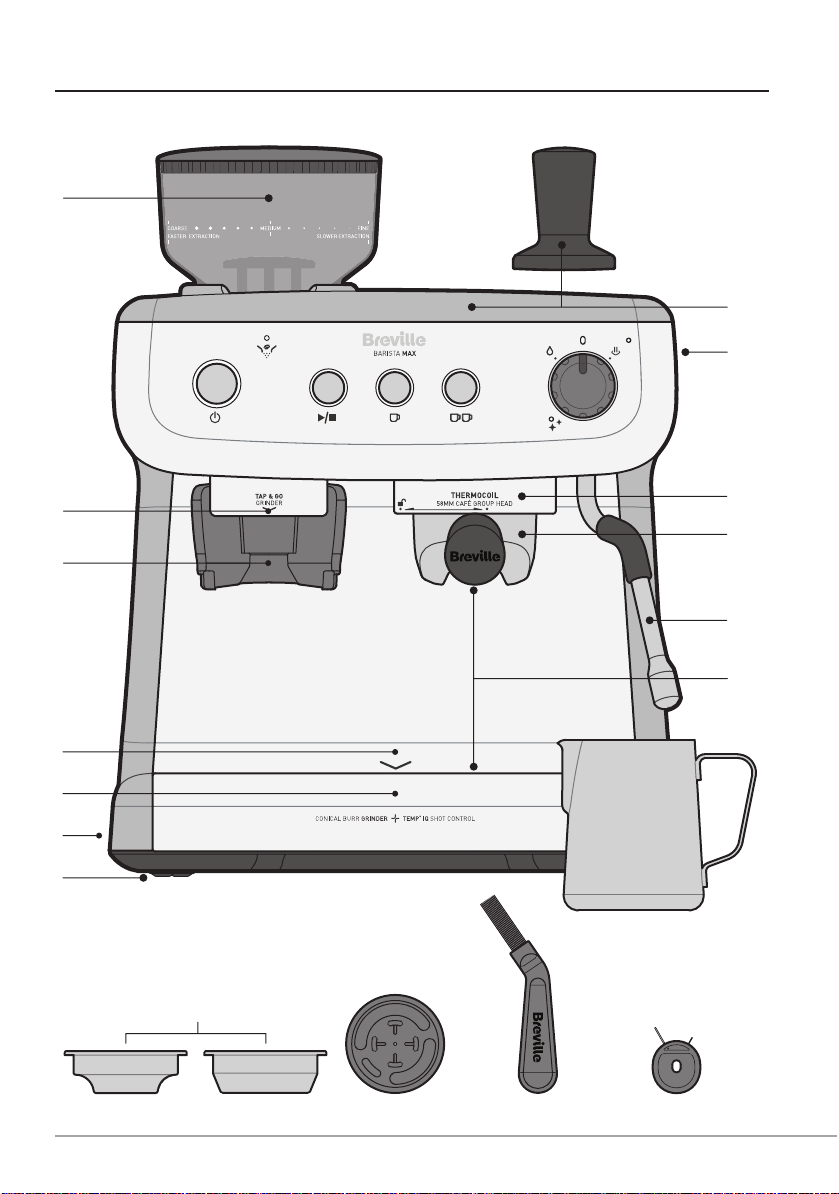
FEATURES OF YOUR BREVILLE BARISTA MAX
1422
20
18 16 12
10
8
D
I
S
C
F
O
R
C
L
E
A
N
I
N
G
T
A
B
L
E
T
U
S
E
T
H
I
S
S
I
D
E
U
P
Dual Wall
Filter Basket
Pin
A
C
B
E
D
F
G
M
J
K
L
H
I
Steam Wand
Tip Pin
58mm Tamper
460mL Milk Jug
Two CupOne Cup Cleaning PinCleaning BrushCleaning Disc
58mm Single Wall Filter Baskets

5
A. Removable Bean Hopper
The removable 250g capacity Bean
Hopper features 30 easily adjustable Grind
Settings. Turn the Hopper from coarse to
fine to adjust the Grind Setting & maximise
the taste of your espresso.
B. Illuminated Grind Area
LED illumination starts when grinding
begins. The coffee grinds are illuminated
as they are delivered directly into the Filter
Basket. The light automatically fades when
grinding is complete.
C. Tap & Go™ Grinding Cradle
The unique Tap & Go™ Grinding Cradle
holds the Group Handle to provide
seamless one-touch on-demand grinding.
This helps you to control the amount of
coffee grinds straight into the Filter Basket.
D. Accessories Storage Home
Area behind the Drip Tray, for storing the
One & Two Cup Filter Baskets, Cleaning
Disc, Cleaning Brush & Cleaning Pin.
E. Removable Drip Tray, Grill & Grind
Bin
Includes a Water Level Indicator which
floats through the Stainless Steel Grill to
indicate when the tray is full of water &
requires emptying.
A removable Grind Bin for collecting
overflowed coffee grinds, separate from
the water, is located in the Drip Tray.
Simply remove the Grind Bin & discard
grinds as required.
F. Cord Storage
Conveniently stow excess cord by pushing
the cord inside the machine to keep
benchtop tidy.
G. Non-slip Feet
The non-slip silicone feet ensure that
the Barista Max remains stable on the
benchtop during use.
H. Warming Plate with Tamper Home
Preheats cups & glasses which helps to
retain the essential characteristics of true
espresso aroma & a rich, sweet taste.
Tamper home located on the top of the
Warming Plate for convenient access &
storage.
I. Removable 2.8L Water Reservoir
Push back the lid & fill with cold water, or
remove the Water Reservoir by opening
the Lid, lifting upwards using the Handle
located inside.
J. Group Head - 58mm Commercial
Size
The wider size allows more even
extraction of the tamped coffee grinds.
K. Group Handle/ Portafi lter - 58mm
Commercial Size
The wider size ensures the coffee grinds
are more evenly spread, and easier to
tamp.
L. Steam & Hot Water Wand
Ball joint movement with silicone cover,
allows movement of the Steam Wand to
desired position without burning fingers.
M. Extra Tall Cup Height
A large 105mm space for extracting coffee
directly into tall mugs & glasses.
FEATURES OF YOUR BREVILLE BARISTA MAX
6
FEATURES OF YOUR BREVILLE BARISTA MAX
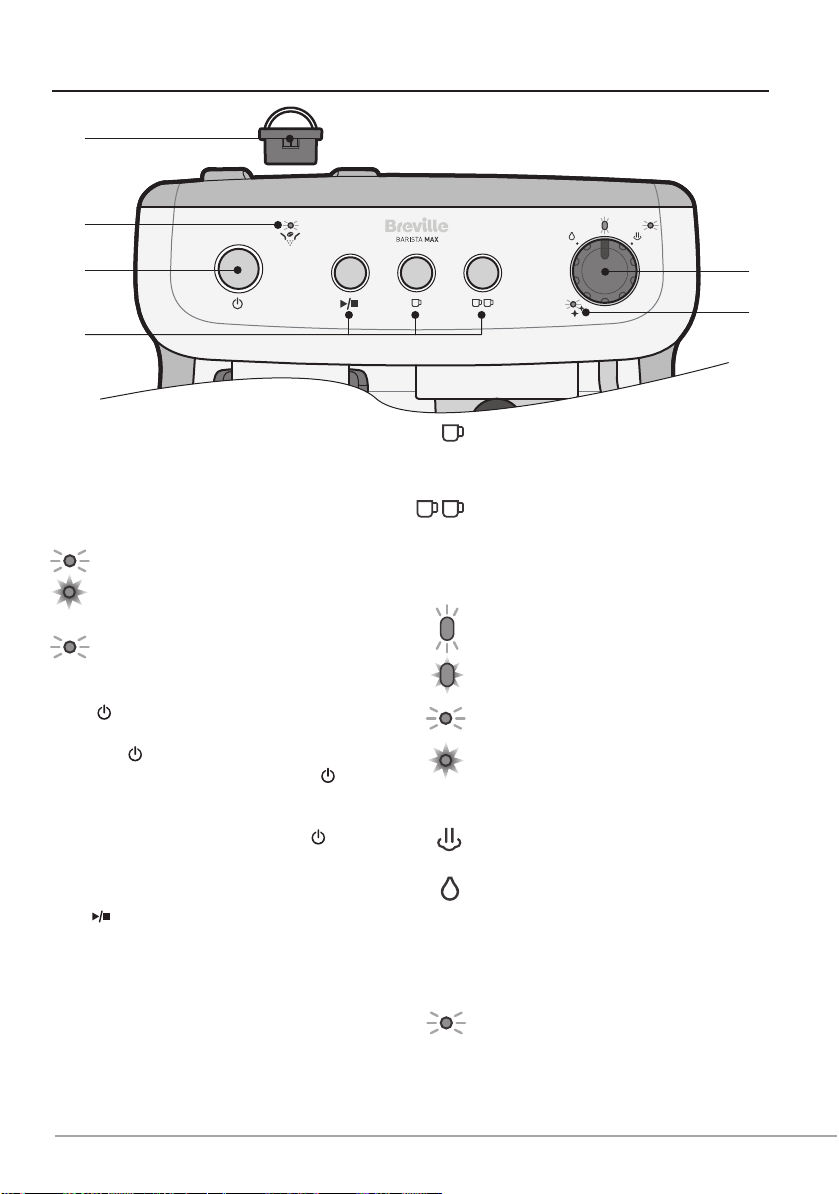
N. Removable Top Burr
Easily removable by lifting the Burr
handles when cleaning. (For more
information, see pages 28-29)
O. GRINDER Light
Fully illuminated white when ready.
Flashes whilst attempting to grind to
indicate the Hopper Gates are not
completely open.
Fully illuminated red when Grinder
Motor is in protection mode.
(For more information, see page 36)
P. Button & Light
Press button to turn on the machine.
The LIGHT will illuminate & pulse to
indicate it is heating up. The LIGHT
stays fully illuminated when ready. The
machine will automatically enter sleep
mode after 20 minutes, the LIGHT
will stop illuminating.
Q. Espresso Extraction Buttons
Button
Allows for shot volumes in addition to
one & two shot presets.
Press button to start extraction, when
desired pour volume is reached press
button again to stop.
Automatically stops after 200mL
ONE CUP Button
Pours 1 shot of espresso - 30mL
then automatically stops.
TWO CUP Button
Pours 2 shots of espresso - 60mL
then automatically stops.
R. DIAL Features & Lights
DIAL Light
Fully illuminated when ready.
Flashes when DIAL needs to be
returned to the vertical position.
Steam Light
Fully illuminated when ready to steam.
Flashes when warming up to
steam temperature & when cooling
down (purging water) to espresso
temperature.
STEAM
Use to heat & texture milk.
HOT WATER
Pours 200mL then automatically stops.
Use for long black coffee, hot drinks
such as tea, instant soups and to warm
cups prior to making espresso.
S. CLEAN Light
Fully illuminated blue when a cleaning
cycle for the Group Head & Shower
Head is required. (For Cleaning Cycle
information, see page 25)
BARISTA MAX
MANUAL SHOT
TAP & G O
GRINDER
CLEAN
GRINDER
P
R
S
O
N
Q
7
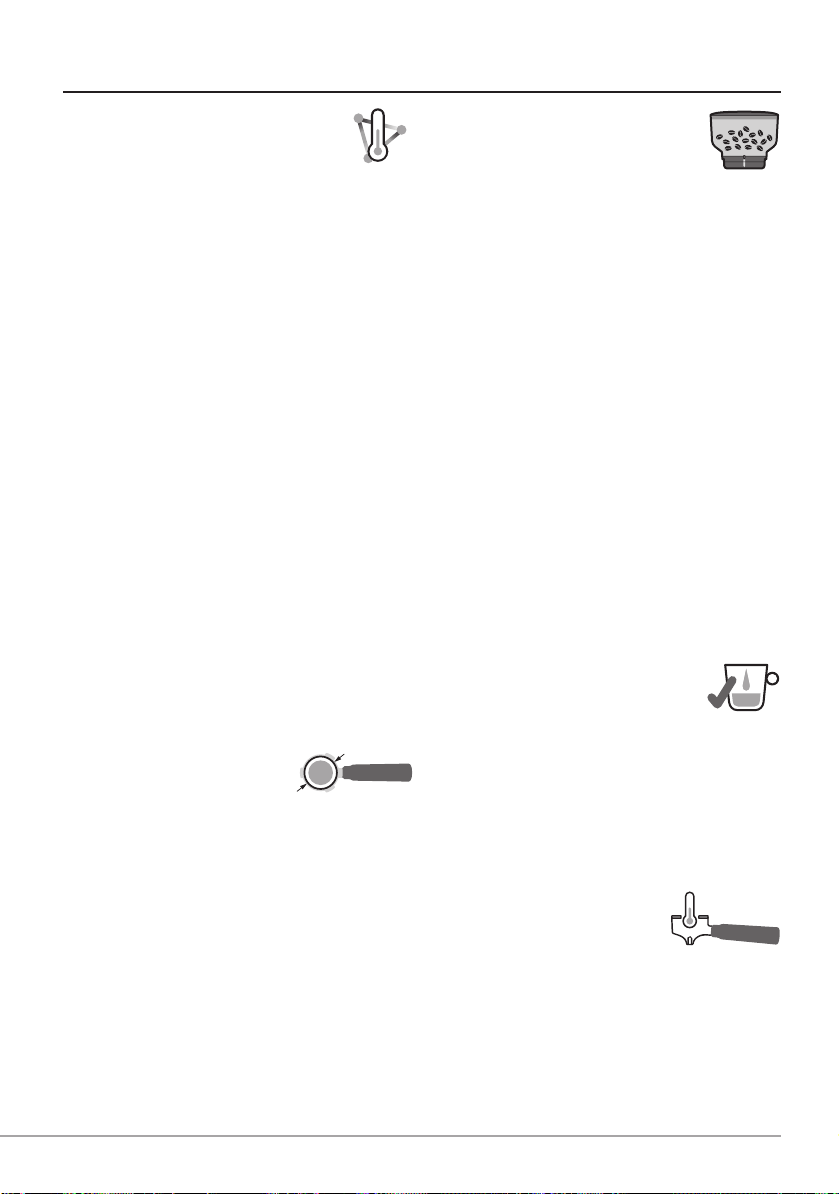
Temp° IQ Shot Control™
Optimum temperature
The Temp° IQ Shot Control™ is an
exclusive technology developed by Breville
for your Barista Max. This 3 way system
delivers the accurate & stable water
temperature that is needed for consistently
great tasting coffee.
• Thermoblock Technology
The Thermoblock ensures fast heat
up, and precise water temperature for
the best espresso extraction & milk
steaming. Only the required amount
of water is heated for speed and
effi ciency. The Thermoblock heats
water so that espresso extracts at 92°C
for the optimum extraction of oils from
the tamped coffee grinds. Temperatures
above or below will result in burnt/bitter
or weak tasting espresso.
• Advanced PID Controller
The PID monitors and controls the
Thermoblock to ensure water is always
delivered to tamped coffee grinds at the
precise temperature needed.
• Gentle Pre-infusion
Small amounts of water are gently
introduced onto the tamped coffee
grinds prior to the steady fl ow of water,
for a richer fl avoured espresso. (For
different Pre-infusion profi les, see page
23)
Café 58mm
Group Head & Handle
Extract the maximum amount of flavour
The Group Head and the Group Handle
are commercial sized, 58mm, just like local
café.
• The wider size ensures the coffee
grinds are more evenly spread in the
Filter Baskets. The coffee grinds are
easier to fi ll, tamp and remove after
use.
• The 58mm Group Handle allows a more
even extraction of the tamped coffee
grinds, resulting in a true café tasting
coffee.
Tap&Go™
Integrated Grinder
Easy on-demand grinding
experience
• Tap&Go™ Technology
The Tap&Go™ on-demand grinding
technology developed by Breville
delivers coffee grinds directly into the
Group Handle with one touch. Simply
push down on the Group Handle to
activate the Grinder.
• Conical Burr Grinder
The integrated Grinder offers all-in-one
grinding experience. The hardened
Stainless Steel Conical Burr achieves
consistent grind particle sizes, which
minimises heat transfer & reduces
friction due to its gentle & slow rotation.
• Bean Hopper
The 250g Hopper features anti-spill
gates which prevents coffee beans
from escaping onto the benchtop when
removing. The on-board Grinder offers
all-in-one grinding experience with
Grinder integrated in the Espresso
Machine.
Auto Shot & Customisable
Volumetric Control
Right quantity of espresso in your cup
• Auto Shot is the easiest way to create
a great espresso. Press the ONE or
TWO CUP BUTTONS to pour the right
amount.
• All Extraction Buttons can be
customised to deliver the shot volumes
preferred. For more information, see
pages 20-21.
Customisable
Extraction Temperature
Temperature just like you want
• The Barista Max allows water
temperature to be changed from the
recommended 92°C (in 2°C increments)
to cater for personal preferences. (For
more information, see page 22)
58
MORE DETAILS ABOUT YOUR BREVILLE BARISTA MAX
8
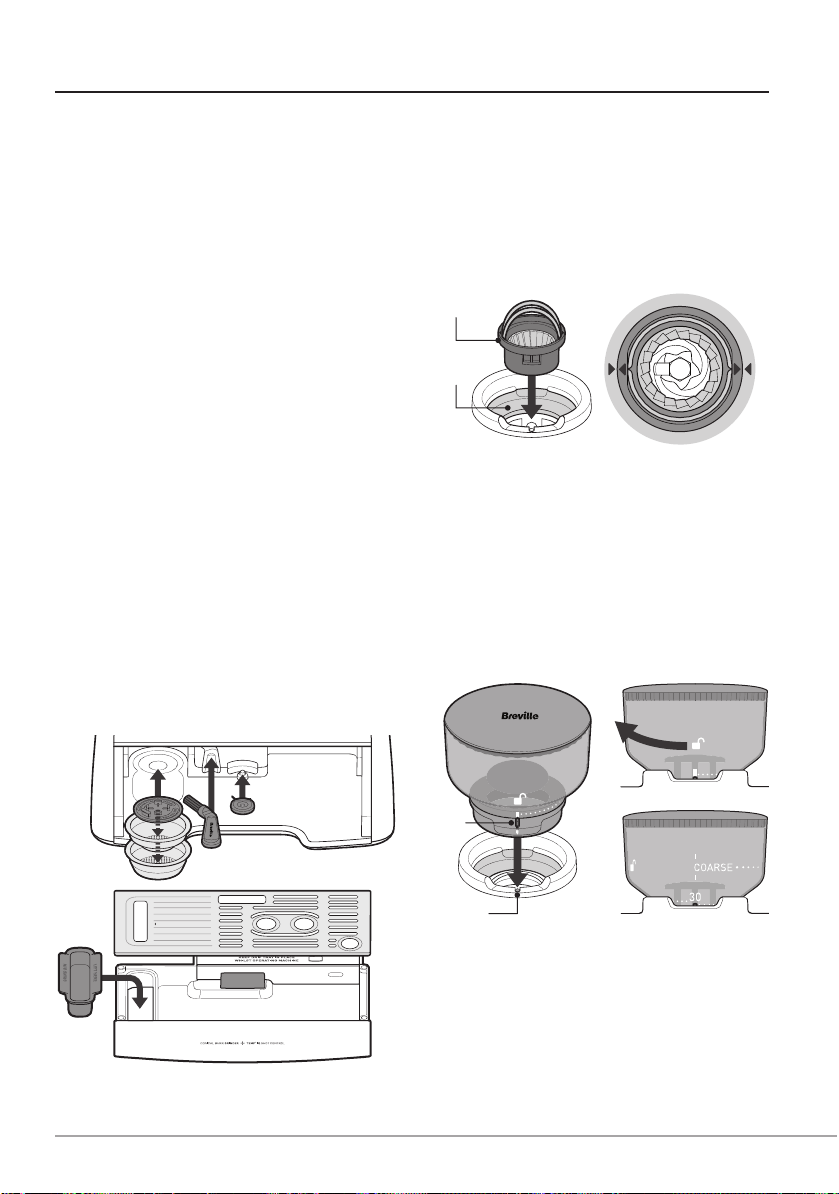
Step 1. Remove Packaging
- Ensure all packaging has been removed.
Important: Remove the red plug found at
the base of the Water Reservoir.
Step 2. Position Machine
- Ensure the machine is positioned onto a
dry, stable, flat & horizontal benchtop.
Step 3. Wash & Dry Parts
- Do not immerse appliance, power cord
and plug in water or any other liquid.
Wash the parts listed below in warm
water with a mild detergent:
Stainless Steel Milk Jug
Stainless Steel One Cup Filter Basket
Stainless Steel Two Cup Filter Basket
Hardened Stainless Steel Top Burr
Water Reservoir
Group Handle
Bean Hopper
Tamper
- Rinse & allow thorough air drying.
Step 4. Place Accessories
- Accessories Storage Home behind
the Drip Tray for the Cleaning Brush
& Cleaning Pin. On the left is storage
space for nesting the Cleaning Disc,
One & Two Cup Filter Baskets.
- Insert the Grind Bin in the space
provided on the left side of the Drip Tray.
- Place the Tamper in the detail
provided on the Warming Plate.
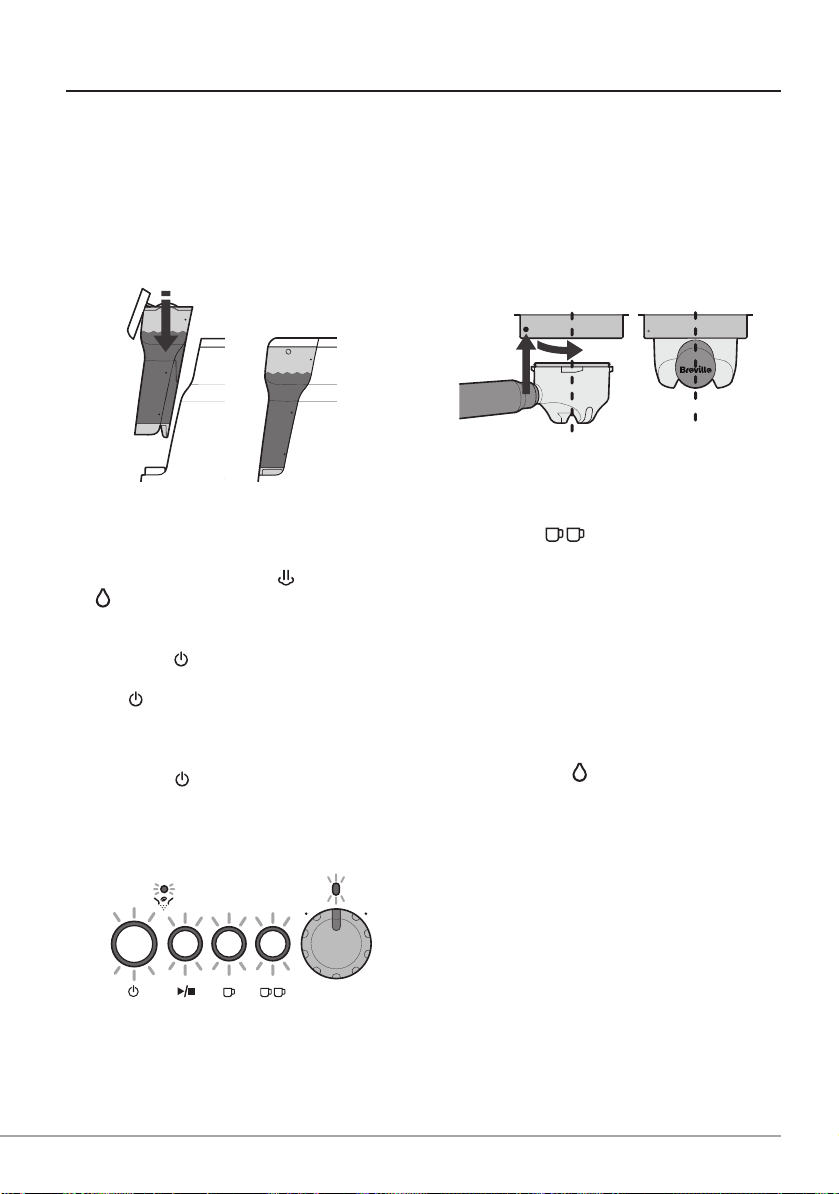
Step 5. Insert Parts into the Grinder
• Removable Top Burr
- Using the two handles insert the Top
Burr into the Grinder Collar.
- The arrows on the Top Burr should
align to arrows on the Grinder Collar.
- When correctly seated, the Top Burr
will be flush with the surface of the
Grinder Collar.
- Place handles down, one on each side.
• Removable Bean Hopper
- Align the Hopper Guide with the red
Grinder Interlock.
- Insert Bean Hopper into the Grinder Collar.
- Lightly pushing down, turn the Bean
Hopper in a clockwise direction to lock
the Hopper into place.
- This opens the Hopper Gates (to release
coffee beans onto the Burrs). At Grind
Setting 30, Hopper Gates are fully open.
- Continue to turn the Bean Hopper in
a clockwise direction to set the Grind
Setting.
- As a starting point for espresso extraction
try Grind Setting 20. (Further Grind
Setting adjustment might be required, see
information on pages 14-15).
- Fill the Bean Hopper with freshly
roasted coffee beans.
BEFORE FIRST USE OF THE BARISTA MAX
PLEASE EMPTY TRAY
WIPE COFFEE GRINDS
TOP BURR
GRINDER
COLLAR
GRINDER
INTERLOCK
HOPPER
GUIDE
2.TURN
3.HOPPER GATES OPEN
1. ALIGN
& INSERT
9
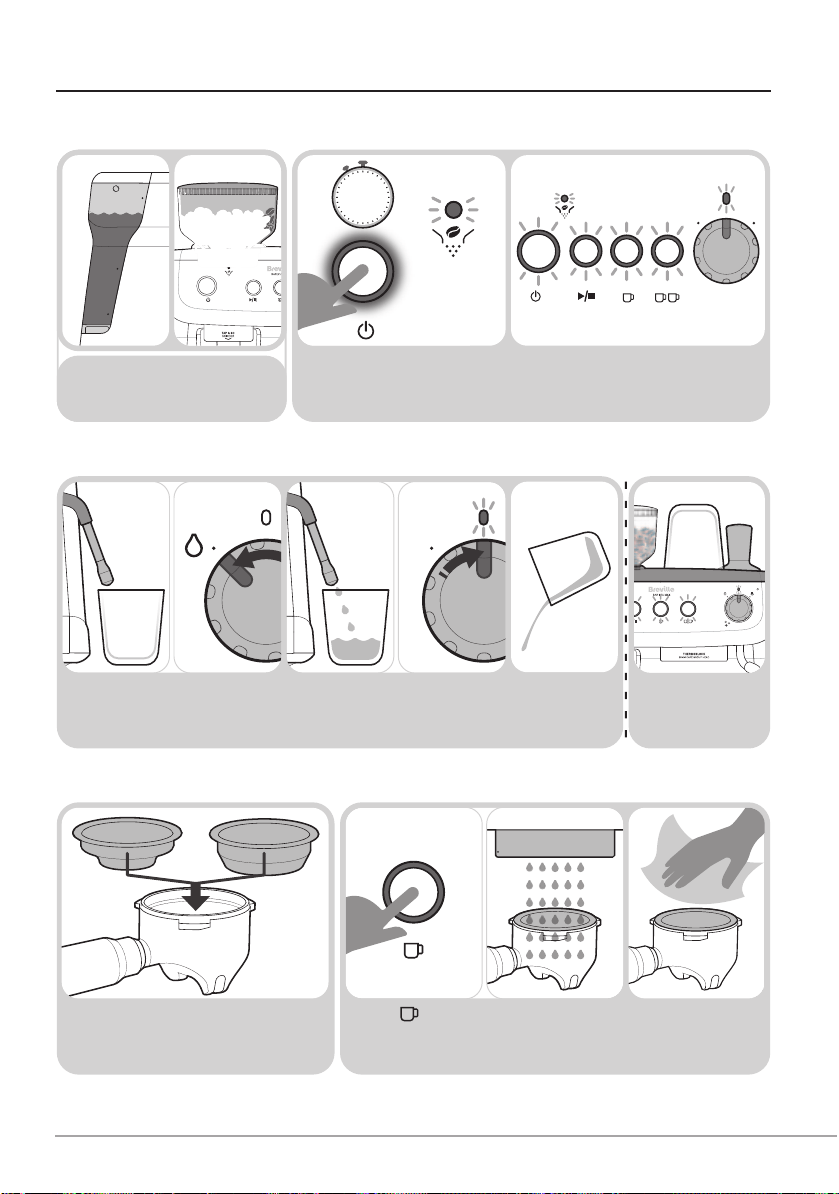
Step 6. Preparing to Prime Machine
Important: This priming step must be
completed prior to first use.
• Fill Water Reservoir
- Open the Lid and lift upwards using the
Handle inside.
- Fill with cold water from the tap.
- Insert the Water Reservoir into position
& close the Lid.
Note: Make sure that the Water Reservoir
is clean & free of any debris, as any fine
particles can block the water flow.
• Power
- Ensure that the Steam
& Hot Water
DIAL is in the vertical position.
- Insert the Power Plug into a 230-240V
AC power outlet & switch the power on.
- Press the BUTTON to turn on the
machine.
- The LIGHT will illuminate & pulse to
indicate the Thermoblock is heating up.
- The GRINDER LIGHT will be fully
illuminated from turn on.
- When the , EXTRACTION
BUTTONS & DIAL LIGHTS are all
fully illuminated, the machine is in the
READY state for EXTRACTION & DIAL
features.
• Insert Group Handle
- Insert the Two Cup Filter Basket in the
Group Handle.
- Align the Group Handle with the
'INSERT' position located on the left of
the Group Head.
- Insert the Group Handle flat against
the Group Head, then turn the Group
Handle right all the way to the centre
position.
Note: Turning the Group Handle to the
centre position might be tight for the first
few uses.
Step 7. Prime Espresso Machine
- Press the BUTTON & water
should start flowing from the Group
Head.
- Allow water to run through until it stops.
- The machine will return to the READY
state.
Note: For the first few seconds the
Pump will make a louder than usual
noise as it begins pumping the water
through.
- Position Steam Wand over the Drip
Tray.
- Turn DIAL to .
- Allow water to run through for 20 sec.
- Return DIAL to vertical position.
- The machine will return to the READY
state.
- Now the Espresso Machine should be
thoroughly primed.
- Wash Group Handle & Filter Basket in
warm water & dry before making your
first coffee.
- If water is not flowing from the Group
Head or Steam Wand, repeat Step 7.
- If water is still not running through,
contact Breville Customer Care. Details
are on the back page.
MAX
2.8L
1L
MIN
MAX
2.8L
1L
MIN
BEFORE FIRST USE OF THE BARISTA MAX
READY
THERMOBLOCK
58MM CAFÉ GROUP HEAD
CENTRE
INSERT
INSERT
2.TURN
1. ALIGN
& INSERT
10
INSERT
THERMOBLOCK
58MM CAFÉ GROUP HEAD
MAX
2.8L
1L
MIN
READY
ONE CUP
TWO CUP
OR
RETURN
1 Min
Heat Up
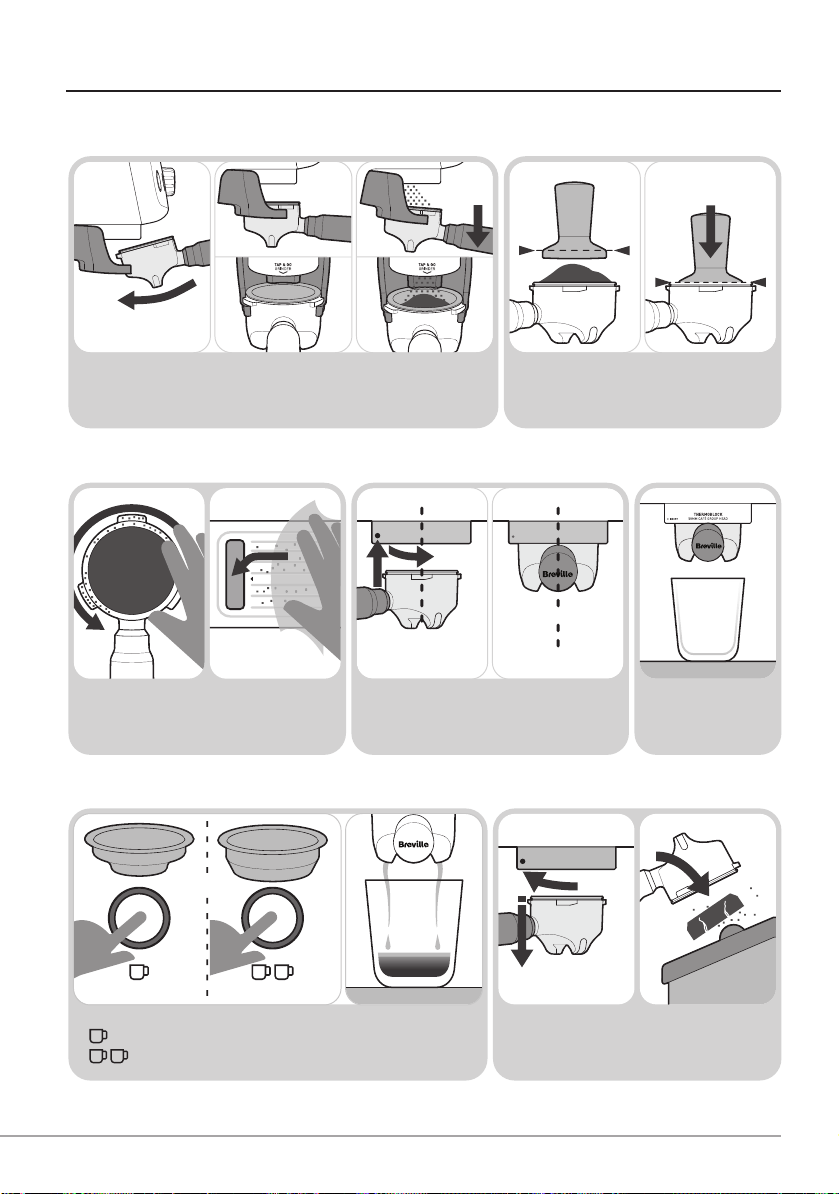
Quarter fi ll cup with hot water.
Return DIAL to vertical position.
Press
BUTTON.
Barista Tip: For best
espresso results, use fi ltered
water & freshly roasted
coffee beans.
Cup can be
warmed on the
top of the machine
when it is ON.
Place cup on benchtop and
position Steam Wand.
Turn DIAL to HOT WATER.
Select either:
- One Cup Filter Basket.
- Two Cup Filter Basket.
Press ON/OFF BUTTON, LIGHT
pulses
= heating up. GRINDER
LIGHT fully illuminated =
Grinder ready to use
.
Wipe Filter Basket
with a dry cloth.
Hold Group
Handle under
Group Head while
water fl ows.
ON/OFF, EXTRACTION BUTTONS
& DIAL LIGHTS all fully illuminated
= Espresso Machine ready to use.
1. Check Water & Beans 2. Start Up
3. Warm Cup - by Hot Water
Warming PlateOR by
4. Select Filter Baskets 5. Warm Group Head, Handle & Filter Basket
BARISTA MAX COFFEE MAKING GUIDE
Empty cup
after 20-30
sec.
11
TAMP FORCE
10-15Kg
TWO CUP
ONE CUP
OR
BANG
SLIDE IN
FROM ABOVE
WIPE COFFEE GRINDS
COFFEE GRINDS
INTO
GRIND BIN
INSERT
2. TURN
1. ALIGN
& INSERT
THERMOBLOCK
58MM CAFÉ GROUP HEAD
CENTRE
INSERT
INSERT
1. TURN
2. REMOVE
PUSH
DOWN
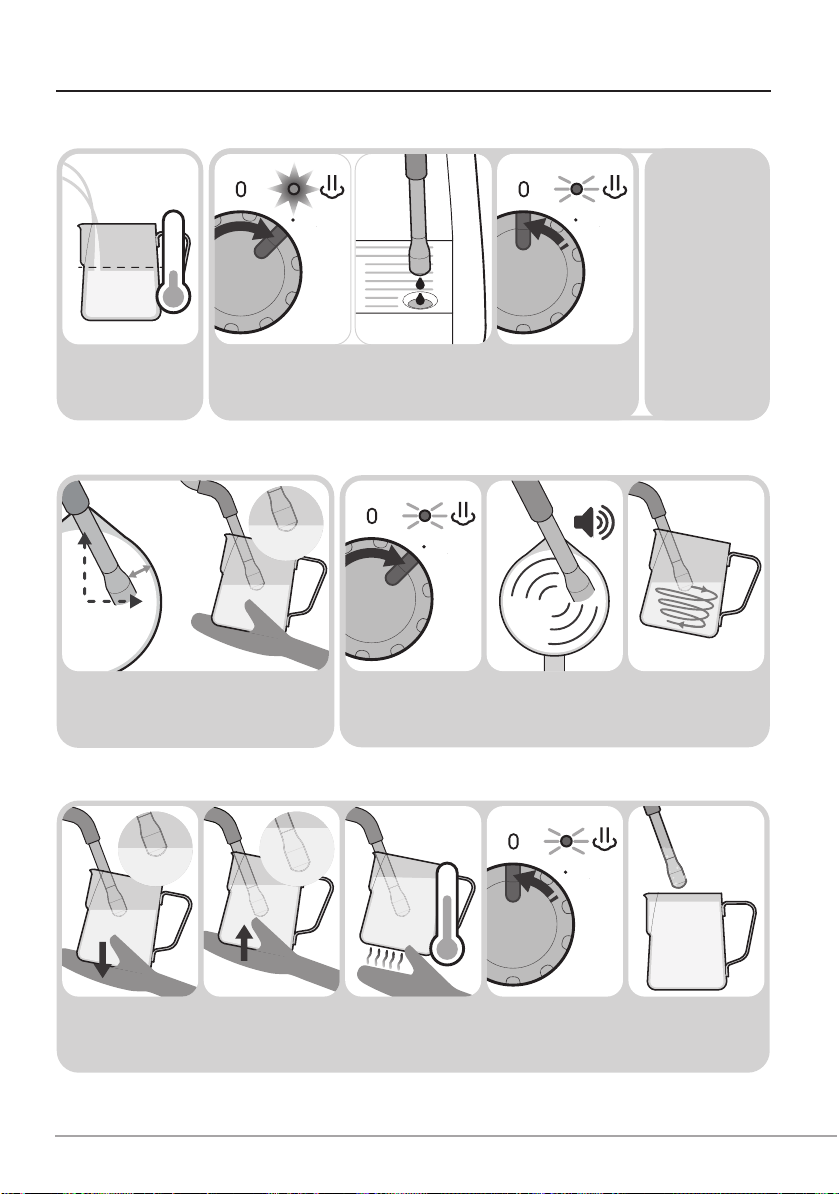
11. Espresso Extraction
Group Handle
should be in the
centre position.
BARISTA MAX COFFEE MAKING GUIDE
Keep Group
Handle fl at, align,
insert & turn into
Group Head.
Press either:
-
BUTTON = 30mL shot.
- BUTTON = 60mL shot.
- One Cup = 13-15g coffee grinds.
- Two Cup = 20-22g coffee grinds.
Evenly tamp (press) grinds to level
indicated.
Wipe away any
excess grinds to
clear edges.
Wipe fallen grinds
on the Drip Tray
into the Grind Bin.
Position cup on
Drip Tray, under
Group Handle.
Extraction
begins and will
automatically
stop.
6. Fill Coffee Grinds 7. Tamp
10. Position Cup
9. Insert Group Handle8. Wipe Excess Grinds
12. Remove Coffee Cake
Push down Group
Handle to grind
into Filter Basket.
Group Handle
will sit fl at,
unsupported, in the
Grinding Cradle.
Insert Group
Handle into
Grinding Cradle.
Remove spent
(used) coffee
cake from Group
Handle.
Turn Group
Handle and
remove from
Group Head.
12
RETURN
MAX
60-65°C60-65°C
PAUSE
FINGER
WIDTH
12
3
4°C
FILL
MAX
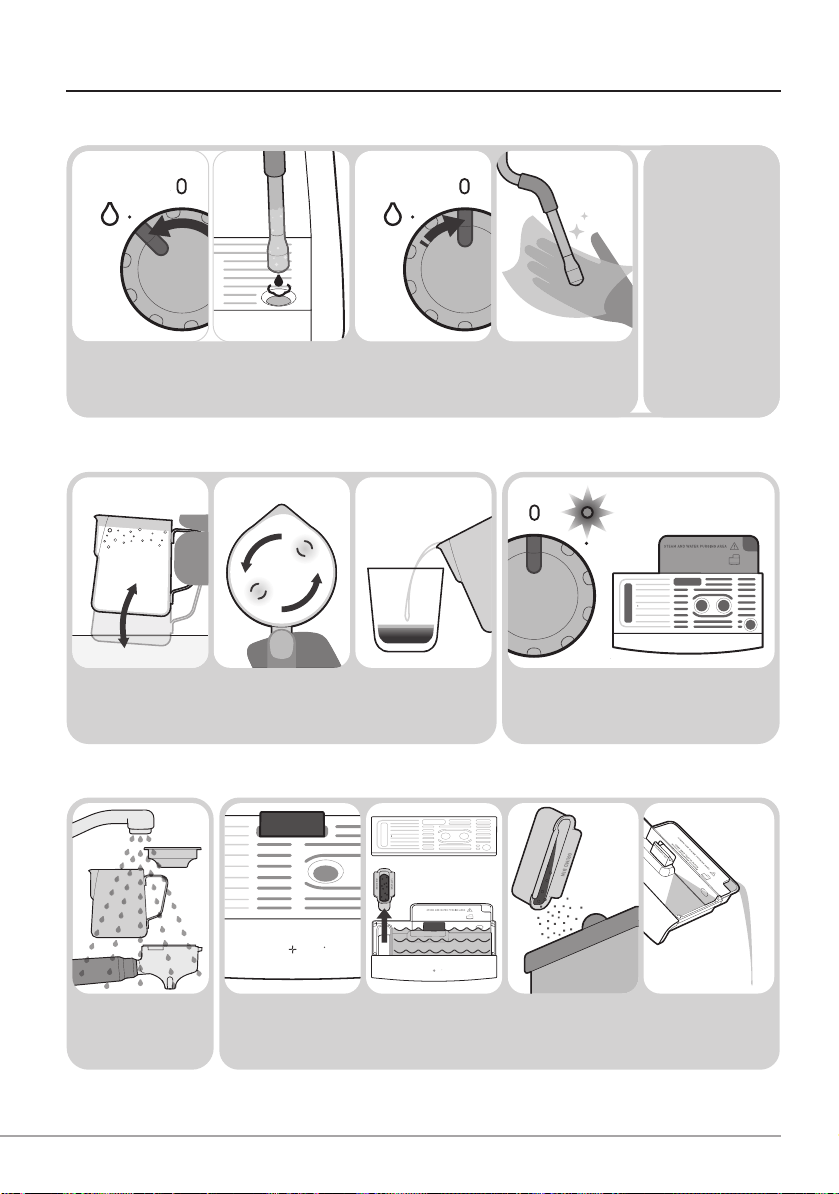
13. Prep Milk Jug 14. Before Texturing Milk
15. Position Steam Wand 16. Start Texturing Milk
17. Milk Texturing
Texturing makes
a smooth hissing
noise.
Check milk is
moving in a
whirlpool action.
Insert Steam Wand Arm at 12
o'clock. Tip at 3 o'clock, fi nger
width from edge and just below the
surface of the milk.
Some water
may come out of
the Steam Wand.
STEAM LIGHT is
ON = steam ready.
Pause steam by
returning DIAL.
Fill Jug with cold
milk just below the
bottom of the spout.
Turn DIAL to
STEAM. STEAM
LIGHT fl ashes =
heating up.
Barista Tip:
For best milk
texturing results,
ensure steam
has fi rst heated
up (STEAM
LIGHT fully ON).
You will hear the
Pump start.
Turn DIAL back to
STEAM position
to start texturing
milk.
Milk ready when
Milk Jug base is
too hot to touch
for 3 sec.
Return DIAL to
vertical position.
As milk level rises,
lower Jug to keep
Tip just below
surface.
When desired
microfoam achieved,
immerse Steam
Wand half way.
Remove Jug from
Steam Wand.
BARISTA MAX COFFEE MAKING GUIDE
13
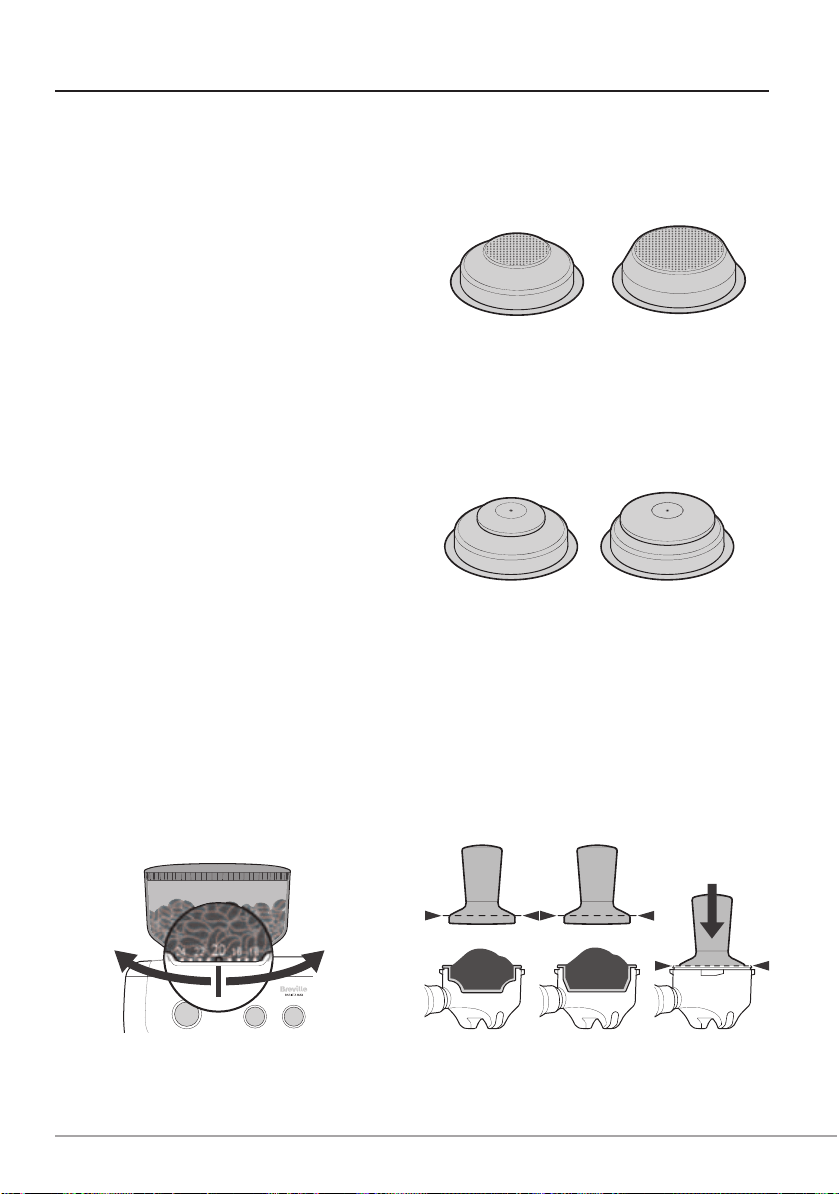
GRIND BIN
RETURN
WIPE COFFEE GRINDS
L BURR GRINDER TEMP IQ SHOT C
PLEASE EMPTY TRAY
CONICAL BURR GRINDER TEMP IQ SHOT CONTROL
KEEP DRIP TRAY IN PLACE
WHILST OPERATING MACHINE
PLEASE EMPTY TRAY
WIPE COFFEE GRINDS
KEEP IN PLACE
KEEP DRIP TRAY IN PLACE
WHILST OPERATING MACHINE
Empty coffee
grinds and wash
Grind Bin in
warm water.
BARISTA MAX COFFEE MAKING GUIDE
18. Purge & Clean Steam Wand
19. Milk Finishing Touches 20. Thermoblock Auto Purge
Pour milk in one
steady motion.
When cooling to espresso
temperature, STEAM LIGHT fl ashes
and water purges into Drip Tray.
Keep Drip Tray in place.
Tap Jug to
release larger air
bubbles.
Swirl Jug to blend
milk and create a
silky texture.
Return DIAL
to the vertical
position.
Wipe Steam
Wand & Tip with a
damp cloth.
Turn DIAL to HOT
WATER for 1-2
sec.
Milky water will
come out of
Steam Wand.
Barista Tip:
To keep optimum
Steam Wand
performance,
always purge &
clean the Steam
Wand after
texturing milk.
Check if Drip
Tray needs
emptying.
Remove Drip Tray
Grill and separate
Grind Bin from Drip
Tray.
Empty water from
Drip Tray and
wash in warm
water.
Wash parts with
warm water.
21. Wash Parts 22. Drip Tray Clean Up
14
1. Coffee Beans
For optimum flavour & extraction:
- Buy freshly roasted coffee beans in small
250g batches to reduce the storage time.
- Use within two weeks of opening.
- Store coffee beans in a dry, airtight
container. Place in a cool dark cupboard.
Important: Old coffee beans, no matter the
Grind Setting, will have a fast extraction
and will produce an under extracted tasting
espresso.
2. Grind Setting
You may need to vary the Grind Setting
when using different coffee beans and
depending on bean freshness. The range
of 30 Grind Settings allows for precision
adjustment, controlling the grind size
& ultimately the characteristics of the
resulting extraction.
It may take several incremental
adjustments before you reach your
optimum Grind Setting. Dial in Grind
Setting based on pour time & taste see
Espresso Extraction Guide.
Barista Tip:
After adjusting the Grind Setting it is
important to purge (for 1-2 sec) a small
amount of coffee grinds from the Grinder.
This removes the coffee grinds of the
previous Grind Setting; ensuring the next
espresso extraction is made entirely of the
coffee grinds from the new Grind Setting.
- Smaller number settings deliver finer
coffee grinds & a slower extraction.
- Larger number settings deliver coarser
coffee grinds & a faster extraction.
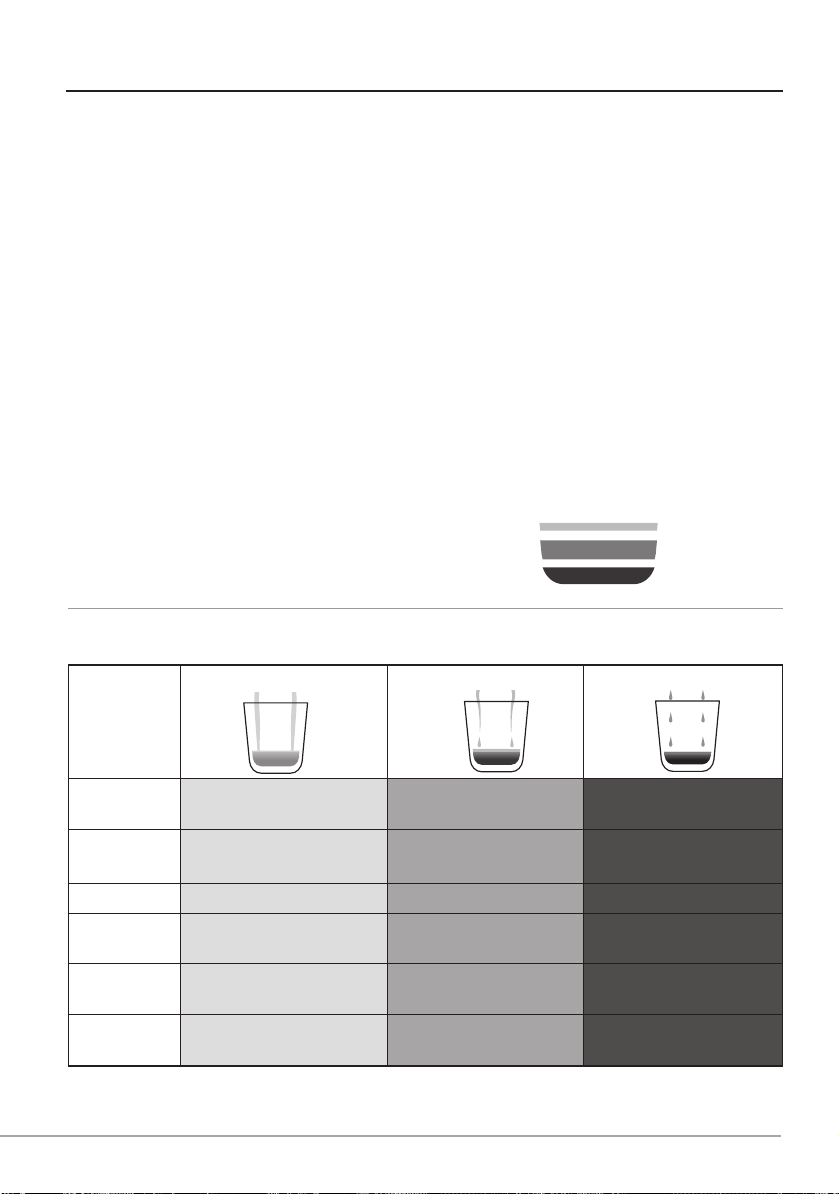
3. Filter Baskets
• Single Wall Filter Baskets
These work with freshly ground coffee
grinds and are supplied with the Barista
Max.
Note: Pre-ground coffee grinds are too
coarse to use with Single Wall Filter
Baskets.
• Dual Wall Filter Baskets
These work best with pre-ground coffee
grinds, but can also be used for freshly
ground coffee grinds.
These are available for purchase from
Breville. Details are on the back page.
4. Grind Dosage & Tamp Force
For best results, the amount of coffee
grinds used should remain consistent.
Note: It is normal for the correct dose of
coffee grinds to appear overfilled in the
Filter Basket before tamping.
Evenly tamp (press) coffee grinds to the
level indicated, with firm force 10-15kg.
TURN
CLOCKWISE
FOR
SLOWER
EXTRACTION
TURN
ANTI-CLOCKWISE
FOR
FASTER
EXTRACTION
1624 22
20
18
Tamp Force
10-15kg
Two Cup
20-22g
One Cup
13-15g
One Cup Two Cup
TIPS FOR GRINDING & TAMPING
www.Breville.co.uk
D
U
A
L
W
A
L
L
D
U
A
L
W
A
L
L
One Cup Two Cup
15
The way the espresso pours will tell you
everything.
1. Extraction Time
Extraction time is a good indicator of the
quality of the pour. The optimum time per
shot varies between types & freshness of
coffee beans. However, in general, the pour
time should be between 20-30 seconds for
both One & Two Cup shots.
2. Type of Extraction
• Optimum Extraction
A quality pour has a steady fl ow with
a consistency similar to that of warm
honey. The resulting crema is dark
golden. The sweetest fl avours & oils
have been extracted creating a rich
tasting espresso.
• Under Extraction
The pour is fast & light in colour, the
resulting crema is thin with a creamy
light brown colour which quickly
dissipates. This occurs when too little
of the essential oils, fl avours & colours
from the coffee grinds have been
extracted. This creates a sour tasting
espresso.
• Over Extraction
There may be no pour, or it may be
slow & drip throughout the entire pour.
The resulting crema is very dark. This
occurs when too much of the essential
oils, fl avours & colours from the coffee
grinds have been extracted. This
creates a bitter tasting espresso.
3. Look for Colour Change
The optimum shot contains 3 elements:
Heart: At the base - starts out dark
brown.
Body: Blends with the heart - becomes a
rich caramel with reddish reflections.
Crema: The layer on top of the body -
dark golden.
Crema -
Body -
Heart -
4. Espresso Extraction Guide
This guide will help to improve espresso extraction, to achieve great tasting coffee, every time.
UNDER EXTRACTION OPTIMUM EXTRACTION OVER EXTRACTION
Pour*^
Extraction too fast
Pours for under 15 sec
Steady-flow extraction
Pours for 20-30 sec
Extraction too slow
Pours for over 35 sec
Colour
Pale brown
Crema-light brown
Rich caramel
Crema-dark golden
Very dark brown
Crema-dark brown
Taste Sour, acidic, watery Rich, sweet, vibrant Bitter, dry, grainy
Grind Size^^
Too coarse
Use a finer grind
Just right
Too fine
Use a coarser grind
Dosage
Not enough grinds
Use more grinds
One Cup = 13-15g
Two Cup = 20-22g
Too many grinds
Use less grinds
Tamp
Not enough tamp force
Tamp firmer
Just right-firm force
10-15Kg of force
Too much tamp force
Tamp lighter
* If using pre-ground coffee grinds, use Dual Wall Filter Baskets.
^ Ensure coffee beans or pre-ground grinds are fresh.
^^ Old coffee beans no matter the Grind Setting will have a fast extraction and will produce an under extracted tasting espresso.
TIPS FOR PERFECT ESPRESSO EXTRACTION
16
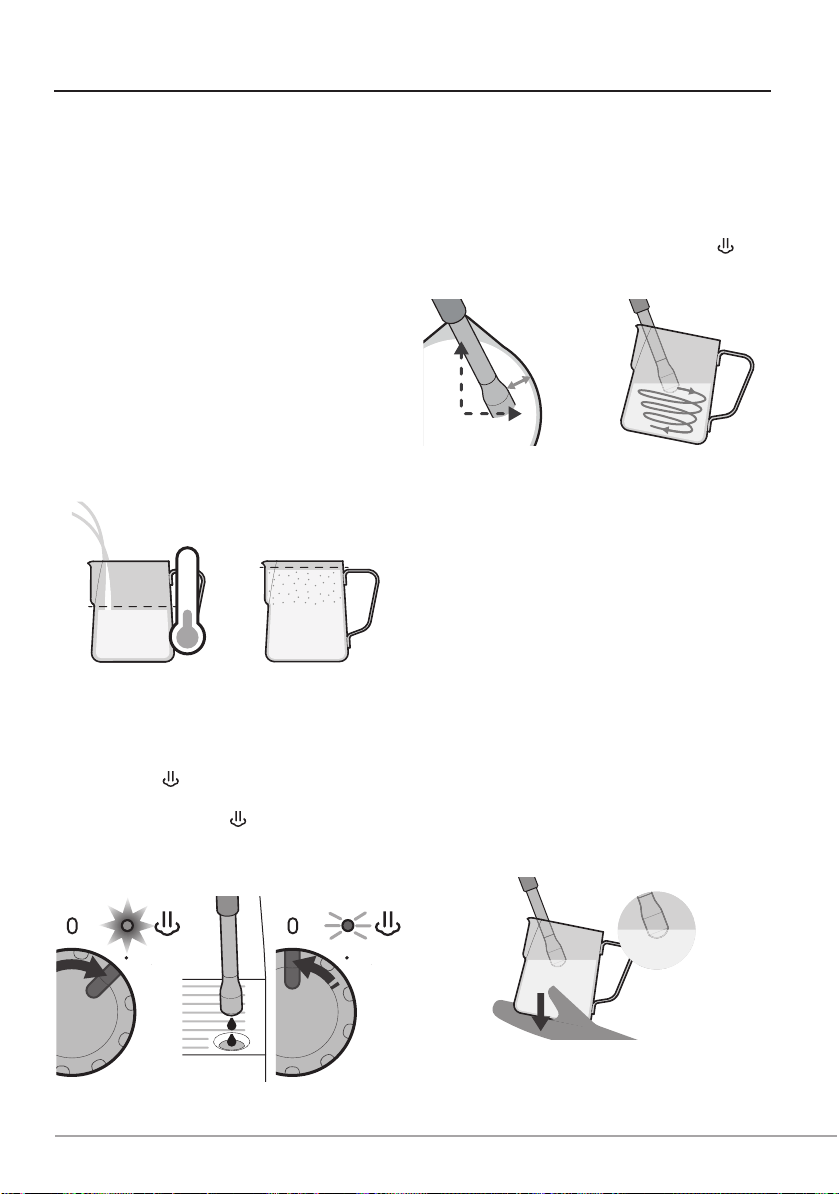
Milk texturing is the steaming of milk.
Key Elements of Textured Milk
Milk that has been textured correctly has
a thick, rich microfoam with a silky sheen.
Texturing involves both heating and
aerating milk using steam. Vital elements
include positioning of the Steam Wand,
when to adjust the Milk Jug position and
reaching the correct temperature. Use the
below steps to help you create café-style
microfoam.
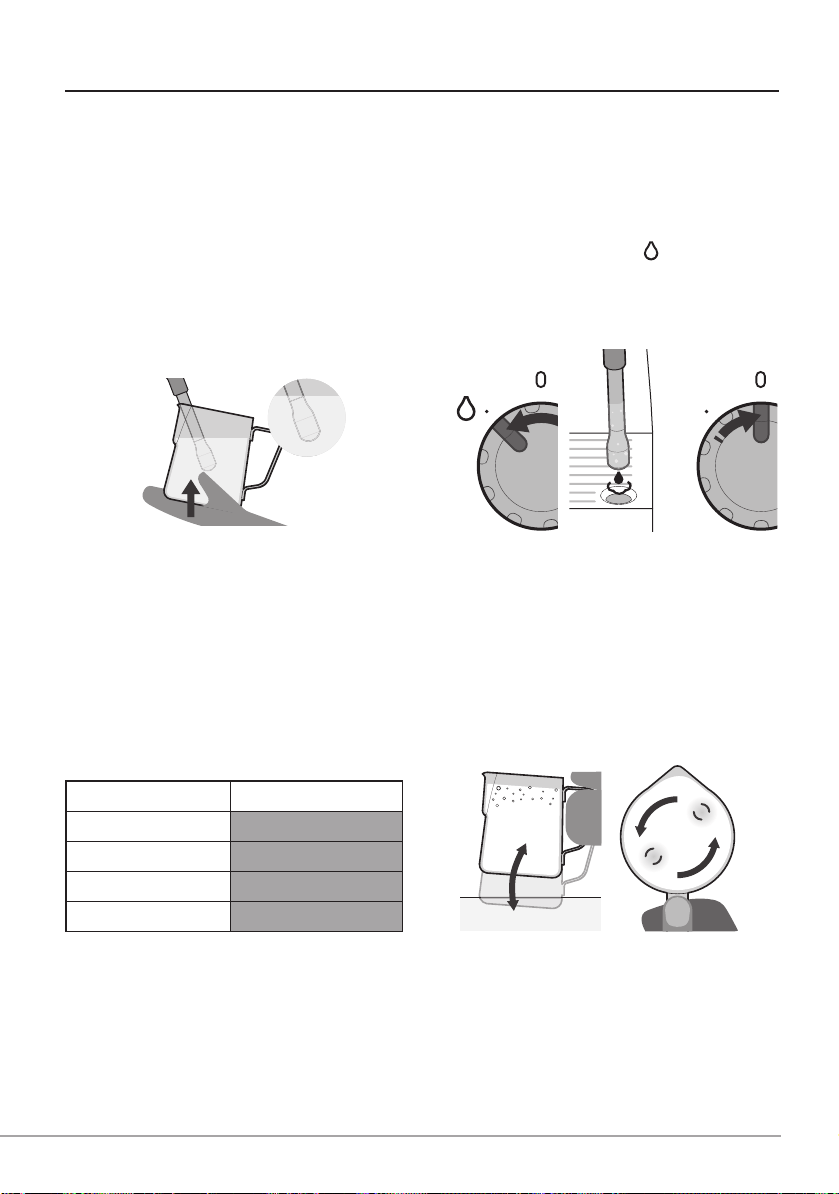
1. Fill Milk Jug
Add cold milk around 4°C into a chilled
clean Stainless Steel Jug.
Fill to the bottom of the spout.
Note: The volume of milk will increase or
’stretch’ during texturing, so don’t overfill
the Jug.
A larger capacity Milk Jug is available for
purchase from Breville. Details are on the
back page.
2. Steam Warm Up
Turn DIAL to
. For best milk texturing
results every time, allow steam to heat up.
Steam is ready when LIGHT is fully ON.
You will also hear the Pump start. Pause
steam by returning DIAL to the vertical
position.
3. Position
Place the Steam Wand Arm in the Jug spout
at the 12 o'clock position, with the Steam
Wand Tip in the milk at the 3 o'clock position,
a finger width away from the edge of the
Jug. Keep Steam Wand Tip just under the
surface of the milk. Turn DIAL back to
position to start texturing. A whirlpool action
should be created in the Jug.
4. Sound
How air is introduced to the milk
determines the consistency of the foam.
If large gulps of air are added to the
milk, the foam will have large bubbles.
Introducing air to the milk in a controlled,
gentle fashion indicated by a gentle hissing
sound, will ensure the milk has fine aerated
microfoam.
Barista Tip: Milk Texturing Sounds
• Gurgling - Tip not deep enough, raise Jug.
• Smooth Hissing - Just right for latte.
• Screeching - Tip too deep, lower Jug.
5. Keeping Steam Tip Position
As the steam heats & textures the milk,
the milk will stretch causing the level of
the milk in the Jug to rise. As this happens
follow the level of the milk by lowering the
Jug, keeping the Steam Wand Tip just
below the surface.
Note: Some adjustments to technique will
be required when using non-dairy milk.
PAUSE
FINGER
WIDTH
12
3
TIPS FOR MILK TEXTURING
FILL
MAX
4°C
FINISHED
MAX
17
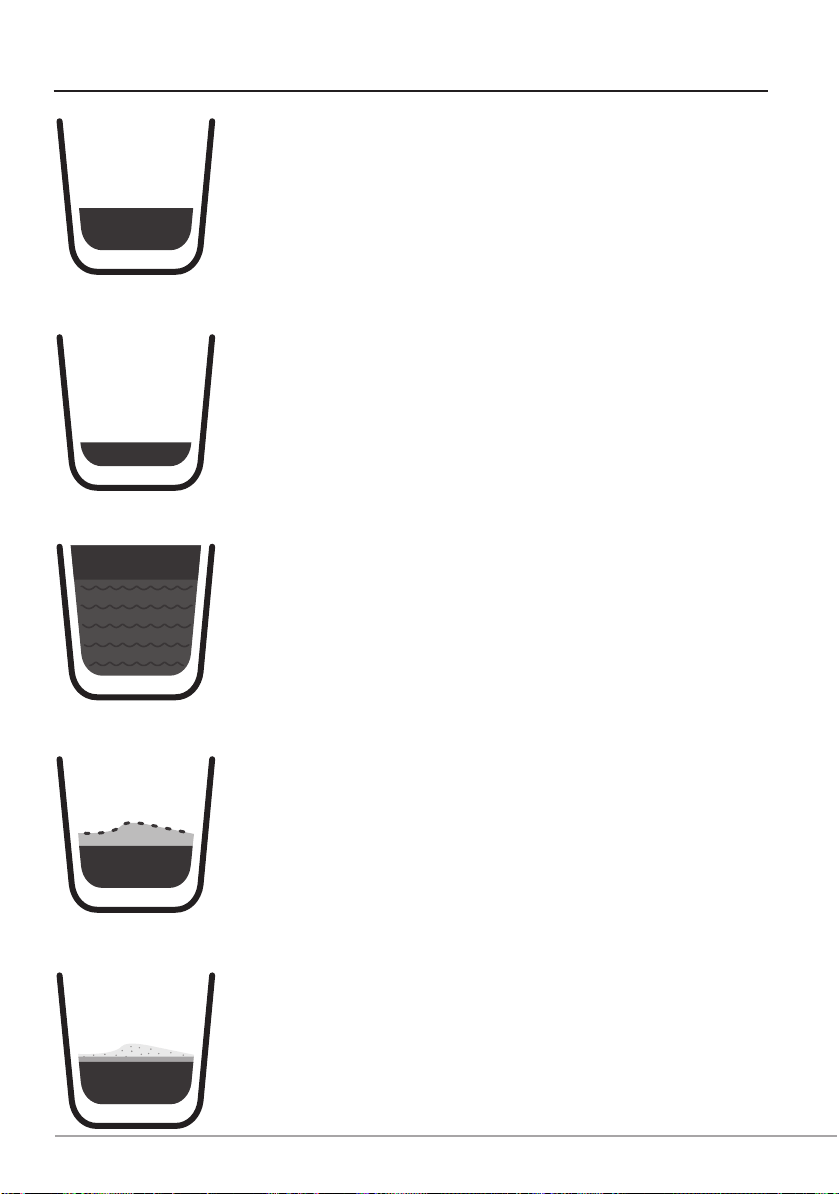
6. Amount of Foam
Create the amount of microfoam you
want. Cappuccinos traditionally have more
microfoam than flat whites.
(See Coffee Styles to Try, pages 18-19)
7. Immerse Tip
After creating the desired amount of foam,
immerse the Steam Wand half depth way
into the milk. This heats all the milk and
pulls in milk instead of air. This ensures the
milk & foam are blended together, making it
denser & smoother.
8. Correct Temperature
An indication of reaching correct milk
temperature is when the Milk Jug base
can only be touched comfortably for
approximately 3 seconds.
Barista Tip: Milk Temperature
• Under - If not heated long enough, it will
be warm with little texture.
• Optimum - See below table.
• Over - If heated for too long it will start to
boil around 72°C and will have a burnt
taste with all texture lost.
Note: Above recommendations might
vary from one milk brand to another and
depending on your taste preference.
9. Purging the Steam Wand
When correct milk temperature has been
reached, turn the DIAL to the vertical
position and remove the Jug from the
Steam Wand. Place Milk Jug to one side.
Place the Steam Wand over the Drip
Tray. Turn the DIAL to the
position for a
few seconds, then return the DIAL to the
vertical position. This will remove any milk
that has been sucked into the Steam Wand
Tip.
10. Wipe Steam Wand
Wipe the Steam Wand Arm & Tip with
a clean damp cloth to remove any milk
residue.
11. Tap & Swirl the Jug
Gently tapping the Jug on the benchtop
helps to release larger trapped air bubbles.
Swirling helps the milk & froth to combine
for an even consistency & a silky
appearance.
12. The Finishing Touches
Pour from the Milk Jug into your cup in one
steady motion.
Milk Temperature
Full & Skim 60-65°C
Almond 55-65°C
Soy 55-60°C
Coconut 65-70°C
RETURN
TIPS FOR MILK TEXTURING
www.breville.co.uk
18
COFFEE STYLES TO TRY
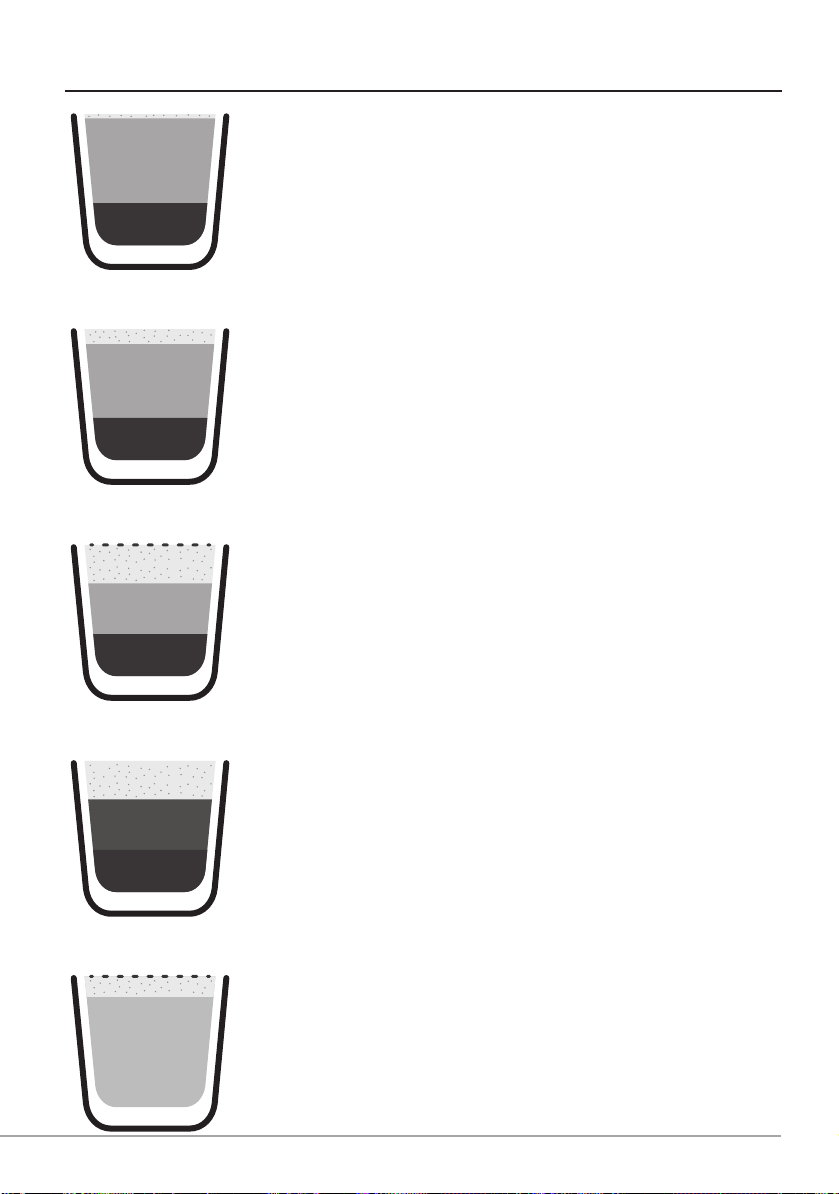
Espresso (Short Black)
Espresso is a concentrated, full bodied coffee with a stable layer
of crema on top. An espresso is the foundation of all café coffee.
• Espresso glass (90mL)
• Single or double shot of espresso (30mL-60mL)
Ristretto
A ristretto is an extremely short espresso, distinguished by its
intense flavour, aftertaste and its thin crema on top.
• Espresso cup (30mL)
• Half a single shot of espresso (15mL)
Long Black (Americano)
A standard espresso with hot water added. The hot water is
added first so that the crema is maintained.
• Cup (190mL)
• Hot Water (to preference)
• Single or double shot of espresso (30mL-60mL)
Con Panna
Con Panna, Italian for ‘with cream’, made up of an espresso
topped with lightly whipped cream. It can also be dusted with
cinnamon or drinking chocolate.
• Cup (190mL)
• Single or double shot of espresso (30mL-60mL)
• Lightly whipped cream - dusted cinnamon.
Macchiato
Macchiato, Italian for ‘to stain or mark’. Traditionally served as a
standard espresso with a dash of cold or textured milk & a small
dollop of textured foam into the middle of the crema.
• Espresso glass (90mL)
• Single or double shot of espresso (30mL-60mL)
• Dash of cold or textured milk & small dollop of textured foam.
19
COFFEE STYLES TO TRY
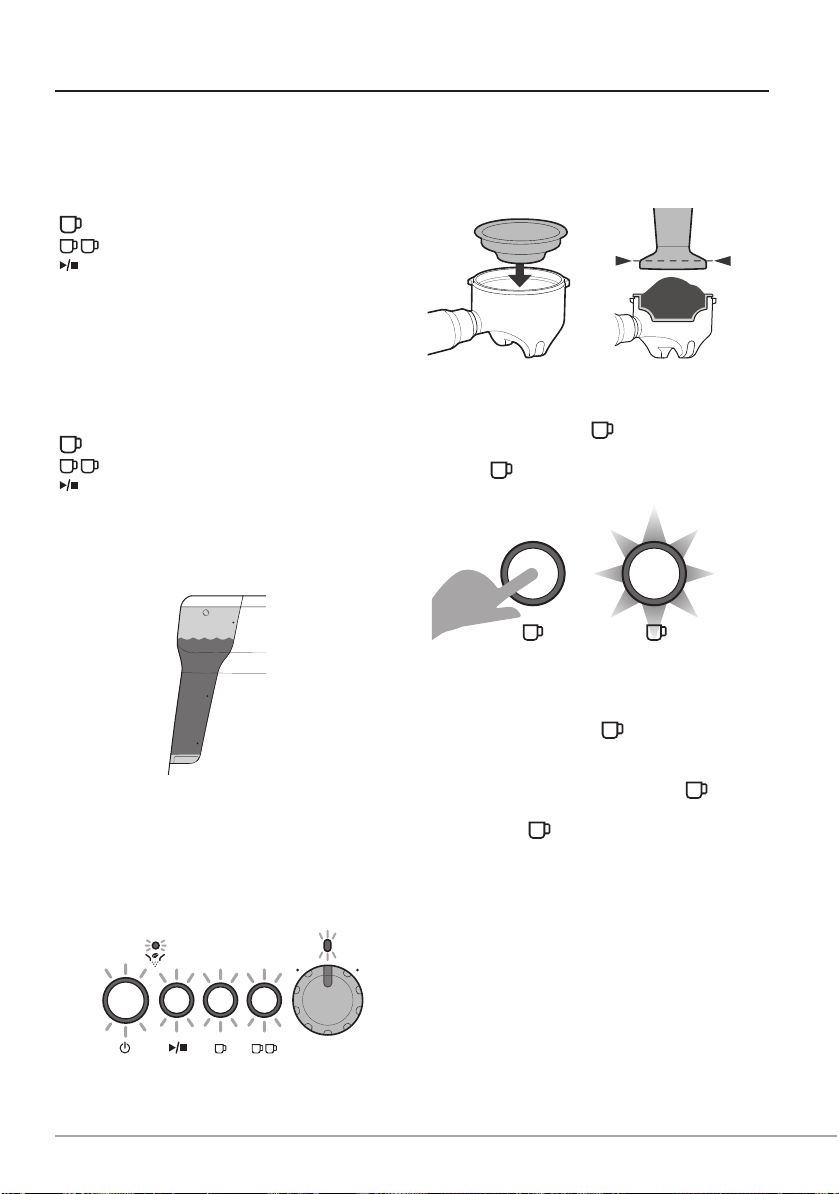
Flat White
An espresso with textured milk & a thin layer of textured foam
milk on top. The wider cup will create the slim layer of foam, the
signature of the flat white.
• Wide cup (190mL)
• Single or double shot of espresso (30mL-60mL)
• Textured milk & foam.
Latte
An espresso with textured milk & a finger width layer of textured
foam milk on top. The narrower cup will create the thicker layer
of foam.
• Glass or Cup (220mL)
• Single or double shot of espresso (30mL-60mL)
• Textured milk & foam.
Cappuccino
An espresso with ⅓ steamed textured milk, topped with ⅓
creamy foam & a dusting of chocolate.
• Cup (190-240mL)
• Single or double shot of espresso (30mL-60mL)
• ⅓ Textured milk, ⅓ textured foam - dusted with chocolate.
Mocha
Made in a similar way to a cappuccino but with the addition of
drinking chocolate. Simply stir the chocolate into the espresso
prior to adding the steamed textured milk & foam.
• Cup or tall glass (190-240mL)
• Single or double shot of espresso (30mL-60mL)
• Drinking chocolate (to preference)
• ⅓ Textured milk, ⅓ textured foam.
Babyccino
Steamed textured milk with a layer of foamed milk.
It can also be dusted with chocolate.
• Small cup (90mL)
• No shot of espresso
• Textured milk & textured foam - dusted with chocolate.
20
The Barista Max features Auto Shot
Volumetric Control.
It extracts just the right amount of
espresso then automatically stops.
- Pours 1 shot of espresso = 30mL
- Pours 2 shots of espresso = 60mL
- Pours up to = 200mL
At any point during espresso extraction
you can stop the pour by pressing the
same button again.
You can adjust the default shot volumes to
suit how you like your coffee.
Note: Maximum allowed shot volumes:
BUTTON 100mL
BUTTON 200mL
BUTTON 400mL
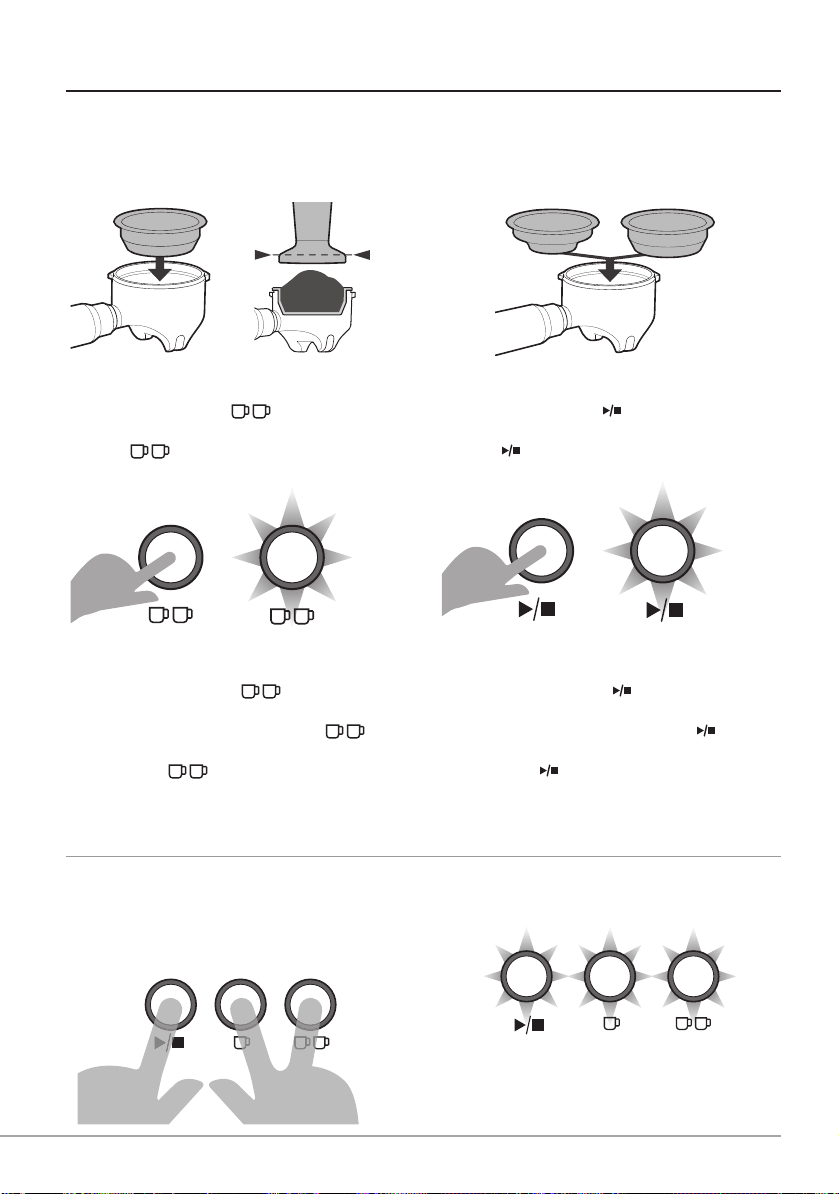
Preparing to Customise Shot Volume(s)
• Check Water Reservoir
- Ensure there is enough water in the
Reservoir.
• Check Power
Ensure that:
- The Power Plug is inserted into the
outlet & switched on.
- The DIAL is in the vertical position.
- The machine is on and in the READY
state.
Customise - One Cup Shot Volume
- Insert One Cup Filter Basket into the
Group Handle.
- Fill with coffee grinds then tamp.
- Insert Group Handle into the Group
Head.
- Press & hold the
BUTTON for 4
seconds.
- The LIGHT will fl ash to indicate it is
in custom mode.
- Espresso will start to pour.
- When you reach your desired 1 shot
volume, press the BUTTON.
- The espresso pour will stop.
- The machine will beep & the LIGHT
will stop fl ashing.
- The new espresso shot volume has
been saved.
- The machine will return to the READY
state.
PRESS & HOLD 4 SEC
CUSTOMISABLE - SHOT VOLUMES
MAX
2.8L
1L
MIN
ONE CUP
13-15g
READY
21
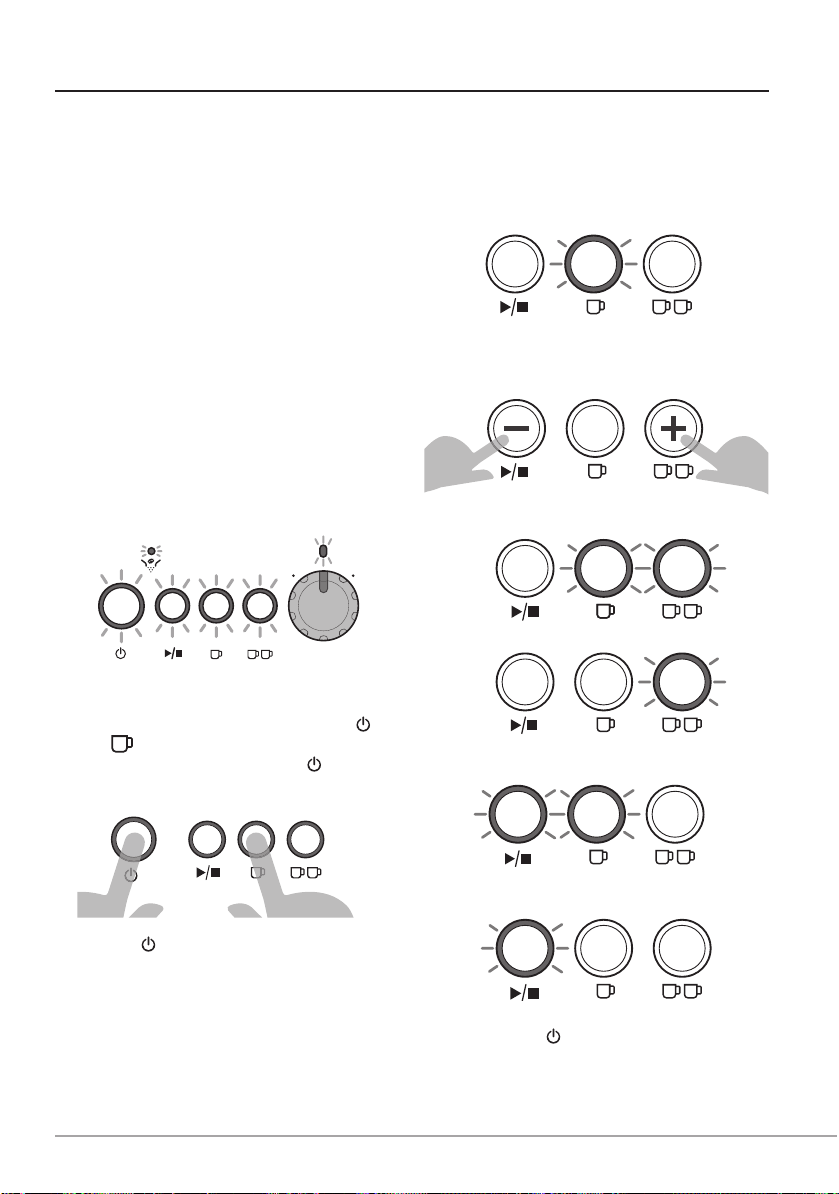
CUSTOMISABLE - SHOT VOLUMES
Customise - Two Cup Shot Volume
- Insert Two Cup Filter Basket into the
Group Handle.
- Fill with coffee grinds then tamp.
- Insert Group Handle into the Group
Head.
- Press & hold the
BUTTON for 4
seconds.
- The LIGHT will fl ash to indicate it
is custom mode.
- Espresso will start to pour.
- When you reach your desired 2 shots
volume, press the BUTTON.
- The espresso pour will stop.
- The machine will beep & the
LIGHT will stop fl ashing.
- The new espresso shot volume
has been saved.
- The machine will return to the READY
state.
Customise - Manual Shot Volume
- Insert your desired Filter Basket into
the Group Handle.
- Fill with coffee grinds then tamp.
- Insert Group Handle into the Group
Head.
- Press & hold the
BUTTON for 4
seconds.
- The LIGHT will fl ash to indicate it is
in custom mode.
- Espresso will start to pour.
- When you reach your desired shot
volume, press the BUTTON.
- The espresso pour will stop.
- The machine will beep & the LIGHT
will stop fl ashing.
- The new espresso volume has been
saved.
- The machine will return to the READY
state.
ONE CUP
OR
TWO CUP
PRESS & HOLD 4 SEC
PRESS & HOLD 4 SEC
TWO CUP
20-22g
Restore - All Default Shot Volumes
- Press & hold all 3 EXTRACTION
BUTTONS at the same time for 4
seconds.
- The machine will beep and all 3
EXTRACTION BUTTON LIGHTS will
fl ash together.
- The default espresso volumes have
been restored.
- The machine will return to the READY
state.
PRESS & HOLD TOGETHER 4 SEC
22
The Thermoblock heats water so that
espresso extracts at 92°C. For the best
tasting espresso, balancing bitterness and
acidity.
You can adjust the water temperature used
for espresso extraction, in 2°C increments
between 88°C - 96°C, to cater for different
types of roasted coffee beans and for
personal preference.
- Higher temperatures increase bitterness
and decrease acidity.
- Lower temperatures decrease bitterness
and increase acidity.
• Check Power
Ensure that:
- The Power Plug is inserted into the
outlet & switched on.
- The DIAL is in the vertical position.
- The machine is on and in the READY
state.
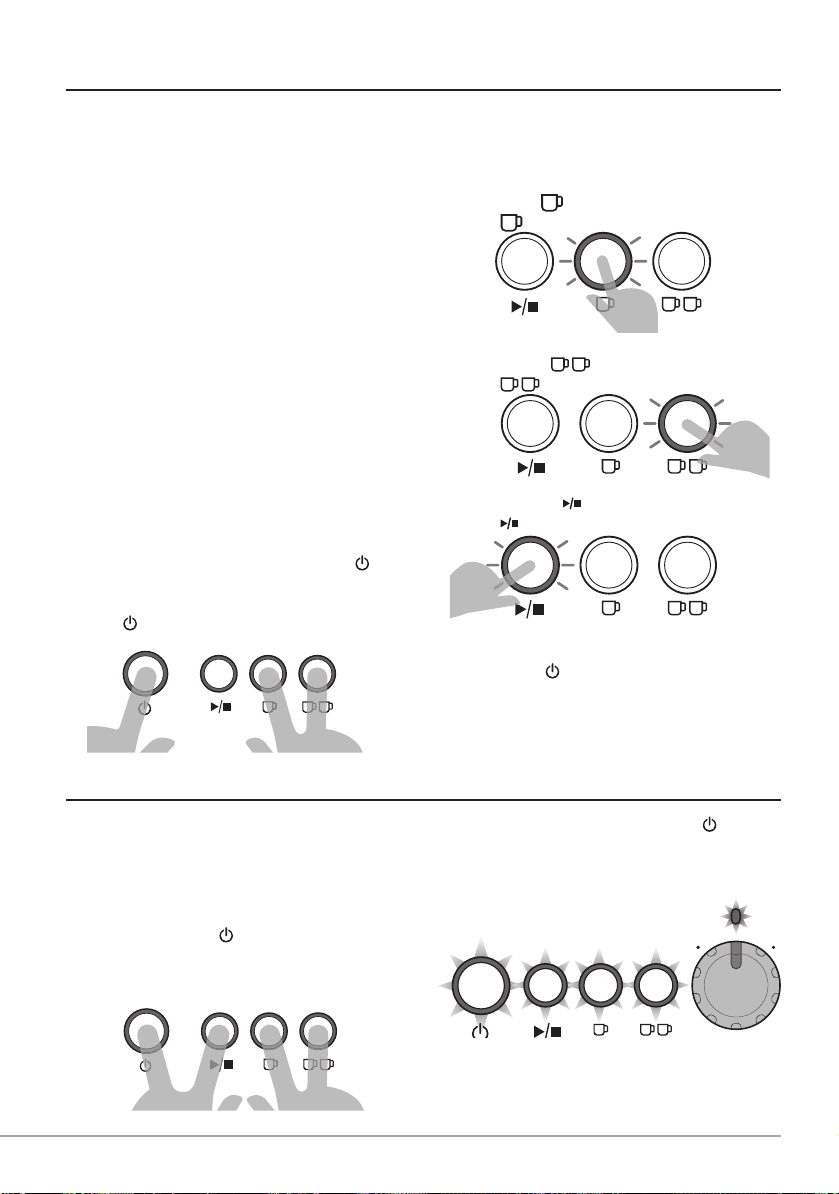
• Access Extraction Temperature
Custom Mode
- Simultaneously press & hold the
& BUTTONS for 4 seconds. The
machine will beep and the LIGHT
begins to fl ash.
Note: The LIGHT will continue to flash
to indicate you are in a custom mode.
Important: If no buttons are pressed
within 1 minute of entering a custom mode,
the machine will exit and go back to the
READY state.
• Adjusting Extraction Temperature
The combination of EXTRACTION
LIGHTS illuminated signals the
temperature selected. The default
setting is:
- 92°C = ONE CUP LIGHT illuminated.
- To adjust extraction temperature press:
- MANUAL SHOT BUTTON = minus
button.
- TWO CUP BUTTON = plus button.
- 94°C = ONE & TWO CUP LIGHTS
illuminated.
- 96°C = TWO CUP LIGHT illuminated.
- 90°C = MANUAL SHOT & TWO CUP
LIGHTS illuminated.
- 88°C = MANUAL SHOT LIGHT
illuminated.
• Confi rm Extraction Temperature
- Press the
BUTTON to save your
selection. The machine will beep &
exit the custom mode.
- The machine will return to the READY
state.
PRESS & HOLD TOGETHER 4 SEC
92°C
CUSTOMISABLE - EXTRACTION TEMPERATURE
READY
23
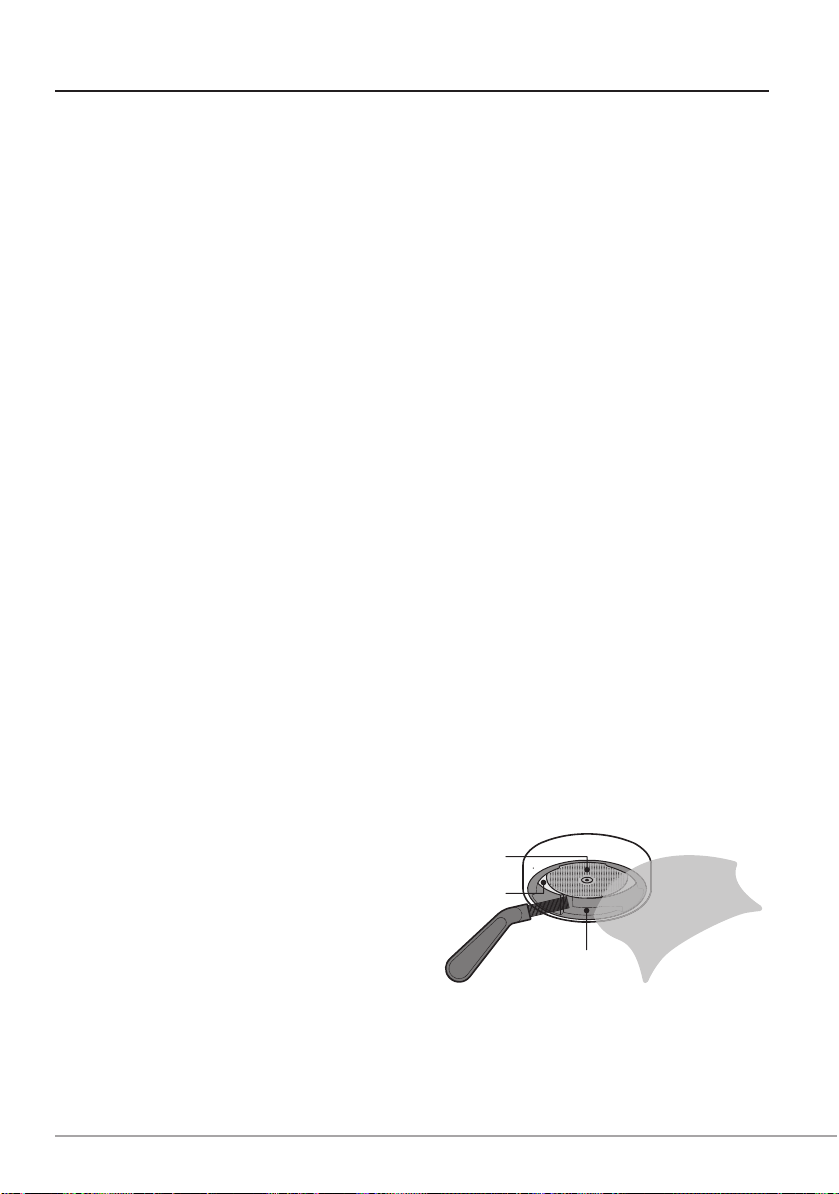
You can easily reset all settings to the
factory defaults.
Restore All Default Settings
- The machine is on and in the READY
state.
- Press & hold the
& all 3 EXTRACTION
BUTTONS at the same time for 4
seconds.
- The machine will beep and the
,
EXTRACTION BUTTONS & DIAL
LIGHTS will all flash together three
times.
- All default settings have been restored.
- The machine will return to the READY
state.
CUSTOMISABLE - EXTRACTION PRE-INFUSION PROFILE
RESTORE ALL DEFAULT SETTINGS
You can select from three Pre-infusion
Profiles to cater for personal preferences.
- Gentle Pre-infusion: Small defined
amounts of water are introduced into
the tamped coffee grinds, gently adding
moisture to bloom the coffee grinds in
preparation for a steady water flow. For
a balanced tasting espresso.This is the
default profile setting.
- Distinct Pre-infusion: A single distinct
dose of water is released into the
tamped coffee grinds, followed by a brief
rest period, then a steady water flow. For
a more bright tasting espresso.
- Constant Pre-infusion: Delivers a
constant, steady water flow from start
to finish. For a more sharp tasting
espresso.
• Access Pre-infusion Custom Mode
- The machine is ON and in the READY
state.
- Simultaneously press & hold the ,
ONE & TWO CUP BUTTONS for 4
seconds. The machine will beep and
the LIGHT begins to flash.
• Selecting Pre-infusion Profiles
The EXTRACTION LIGHT illuminated
signals the Pre-infusion Profile selected.
The default setting is:
- Gentle = BUTTON.
The LIGHT is illuminated.
- To select a Pre-infusion Profile press:
- Distinct = BUTTON.
The LIGHT will illuminate.
- Constant = BUTTON.
The LIGHT will illuminate.
• Confirm Pre-infusion Profile
- Press the BUTTON to save your
selection. The machine will beep & exit
the custom mode.
- The machine will return to the READY
state.
PRESS & HOLD TOGETHER 4 SEC
PRESS & HOLD TOGETHER 4 SEC
24
The espresso making process involves
extracting oils out of coffee grinds. Deposits
of grinds & oils build up over time, affecting
the taste of the coffee & operation of the
Espresso Machine.
Purging water through the Group Head &
Steam Wand, before & after making each
coffee, is the easiest way to keep your
Espresso Machine clean.
(See Coffee Making Guide pages 10-13)
Cleaning Accessories & Removable
Parts
- Do not immerse the appliance, power and
plug in water or any other liquid.
- Clean parts in warm water with a mild
detergent, rinse & dry.
Note: Do not use alkaline cleaning agents,
abrasives or metal scourers, as these will
scratch the surfaces of parts.
Dishwasher Safe parts:
- Stainless Steel Milk Jug
- Stainless Steel Drip Tray Grill
- Stainless Steel One Cup Filter Basket
- Stainless Steel Two Cup Filter Basket
- Cleaning Disc
Dishwasher Safe TOP SHELF ONLY parts:
- Hardened Stainless Steel Top Burr
- Grind Bin
NON Dishwasher Safe parts:
- Water Reservoir
- Group Handle / Portafilter
- Bean Hopper
- Drip Tray
- Tamper
- Cleaning Pin
- Cleaning Brush
Cleaning Warming Plate & Exterior
• When Required
Wipe over the machine with a soft
damp cloth with a mild detergent and
wipe dry.
CAUTION: To prevent damage to the
appliance do not use alkaline cleaning
agents, abrasives or metal scourers.
Cleaning Drip Tray & Grind Bin
• When Required
Empty if the red Water Level Indicator
appears through the Stainless Steel
Grill, otherwise water will overfl ow.
Note: Over time it is normal for the
inside of the Drip Tray & Grind Bin to be
stained by the oils in the coffee grinds.
• Weekly
Clean in warm water with a mild
detergent, rinse & dry.
Cleaning Group Handle & Filter Basket
• Every Time
Wash after each use by rinsing them
with warm water under the tap.
• Regular Intervals
In warm soapy water using a mild
detergent, rinse & dry.
Cleaning Shower & Group Head
• Every Time
Run water through before making an
espresso. (See Coffee Making Guide
pages 10)
• Weekly
- Purge water through the Group head
by pressing the ONE CUP BUTTON.
- Allow water to run through until it stops.
- With the Cleaning Brush remove any
coffee grinds from around the Group
Head inside rim and Silicone Seal.
Wipe the Shower Head with a damp
cloth.
Cleaning Tablet
Espresso Machine Cleaning Tablets can be
purchased online.
T
H
E
R
M
O
B
L
O
C
K
5
8
M
M
C
A
F
É
G
R
O
U
P
H
E
A
D
I
N
S
E
R
T
SHOWER
HEAD
GROUP HEAD
INSIDE RIM
SILICONE
SEAL
CARE & CLEANING - ESPRESSO MACHINE
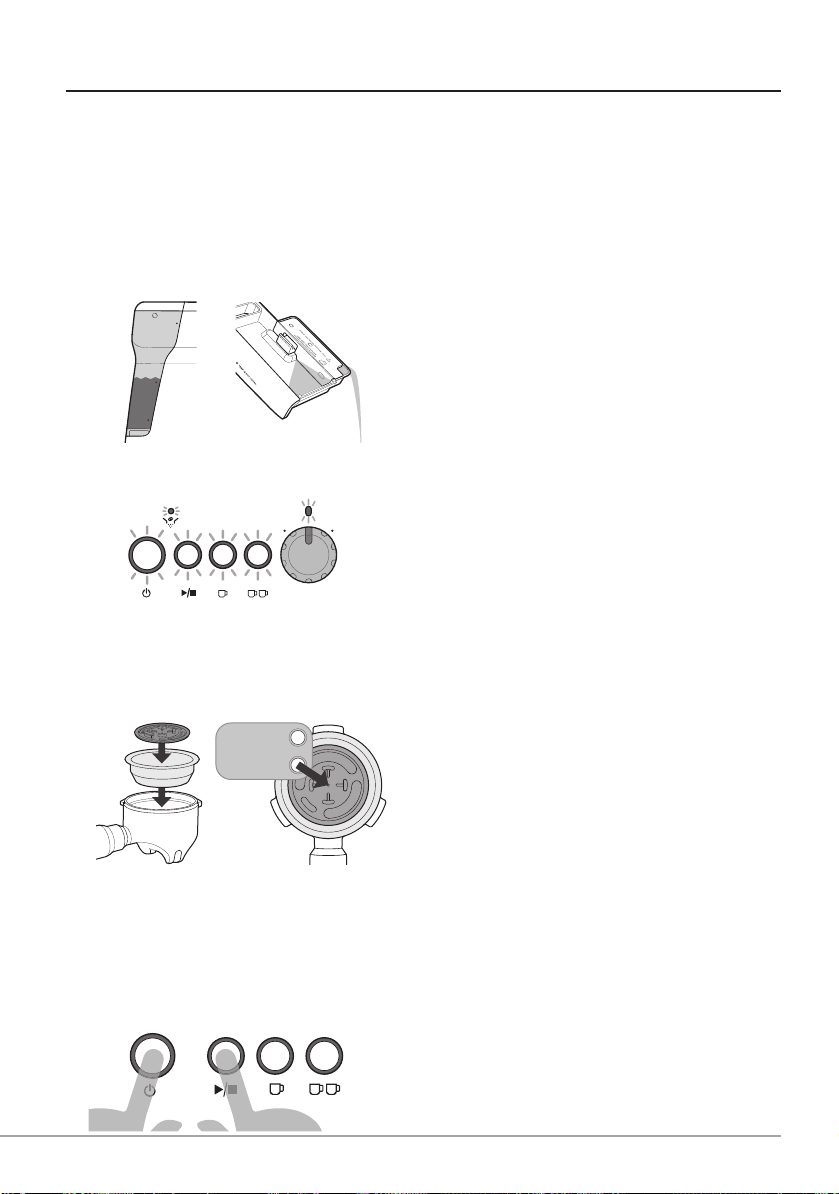
25
Cleaning Cycle
The CLEAN LIGHT will illuminate blue to
indicate a Cleaning Cycle is required.
The Cleaning Cycle takes approximately 7
minutes to complete.
• Preparing for Cleaning Cycle
- Ensure there is at least 1 Litre of water
in the Reservoir.
- Empty the Drip Tray & replace.
- The machine is on and in the READY
state.
- Place the Two Cup Filter Basket & the
Cleaning Disc into the Group Handle.
- Place one Cleaning Tablet in the
middle of the Cleaning Disc in the
space provided.
- Insert Group Handle into the Group
Head.
• Start the Cleaning Cycle
- Simultaneously press & hold the ON/
OFF & MANUAL SHOT BUTTONS for
4 seconds. The machine will beep and
the Cleaning Cycle will start.
Note: The Cleaning Cycle can be exited
at any point by pressing the ON/OFF
BUTTON.
- The ON/OFF & CLEAN LIGHTS will
flash during the cleaning cycle.
- Water will purge into the Drip Tray and
small amounts of water will pour from
the Group Handle spouts.
• Cleaning Cycle Complete
- The machine will beep and the ON/
OFF & CLEAN LIGHTS will stop
fl ashing.
- The machine will return to the READY
state.
- Remove the Group Handle from the
Group Head. Check tablet has been
dissolved.
Note: If the tablet has not been dissolved,
insert the Group Handle back into the
Group Head, empty the Drip Tray &
replace. Repeat the ‘Start the Cleaning
Cycle’ section.
• Cleaning Cycle Clean Up
- Purge the Group Head by pressing the
ONE CUP BUTTON and water should
fl ow.
- Allow water to run through until it
stops.
- Wash the Drip Tray, Group Handle &
Cleaning Disc in warm water with a
mild detergent, rinse & dry.
Group Head Silicone Seal
A Silicone Seal is located in the Group
Head and creates a seal against the Filter
Basket when making an espresso.
Important: When not being used, we
recommend not to leave the Group Handle
inserted into the Group Head, as this will
reduce the life of the Silicone Seal.
Over time this Seal loses its elasticity and
may require replacement. The seal may
need replacing when watery espresso
leaks from around the Group Handle during
extraction, or if the Group Handle is loose
when fully turned to the centre position.
Note: Contact Breville should you think
that the Group Head Seal needs replacing.
Do not attempt to change the Silicone Seal
without first consulting Breville.
CARE & CLEANING - ESPRESSO MACHINE
MAX
2.8L
1L
MIN
PRESS & HOLD TOGETHER 4 SEC
READY
D
I
S
C
F
O
R
C
L
E
A
N
I
N
G
T
A
B
L
E
T
U
S
E
T
H
I
S
S
I
D
E
U
P
ESPRESSO
MACHINE
CLEANING
TABLETS
26
Cleaning Steam Wand
• Every time
- After texturing milk purge the Steam
Wand by turning the DIAL to HOT
WATER for just 1-2 seconds.
- Wipe the Steam Wand with a damp cloth.
(See Coffee Making Guide page 13)
• 2-3 Months
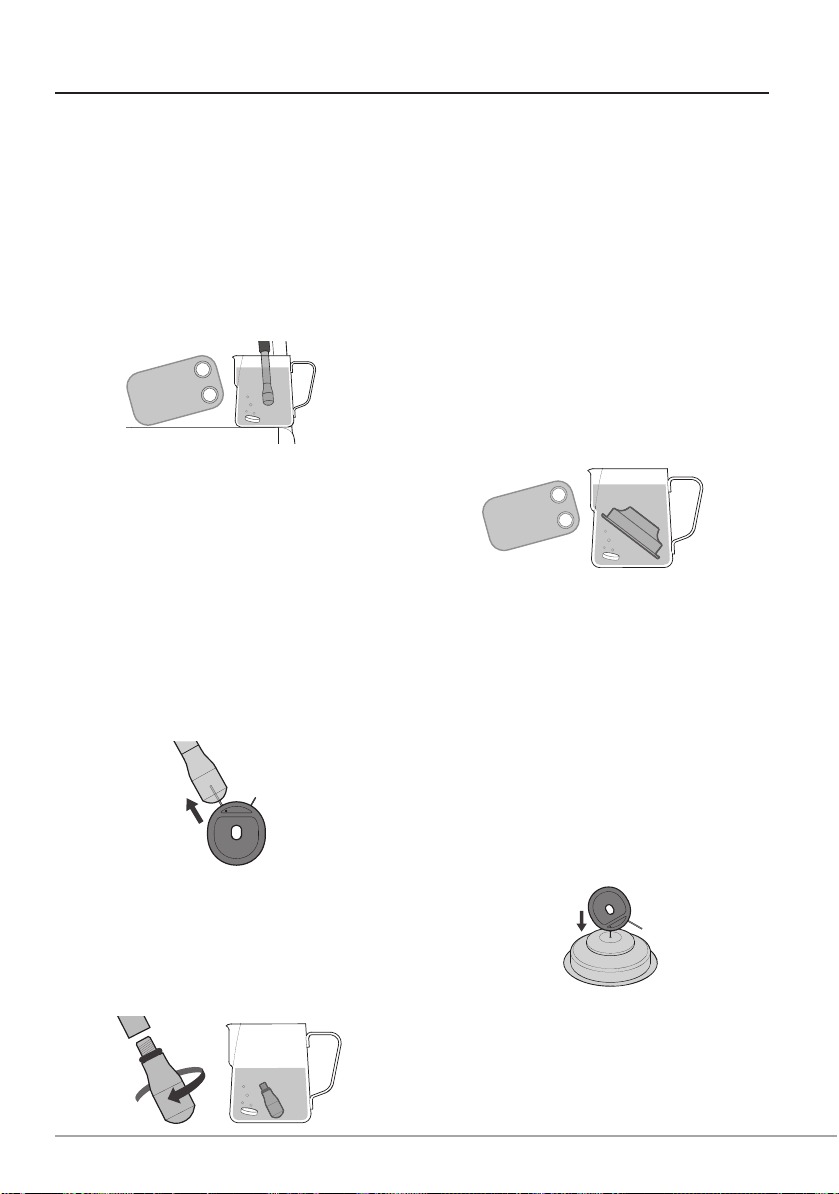
- Soak the Steam Wand overnight in
the Milk Jug with warm water & one
Cleaning Tablet.
- In the morning remove the Jug and
rinse ensuring that all traces of the
solution have been removed.
- Wipe Steam Wand with a damp cloth
ensuring that all traces of the cleaning
tablet have been removed.
- Run Hot Water through the Steam
Wand for 40 seconds.
• Unblocking Steam Wand
If the Steam Wand Tip becomes
clogged with milk residue:
- Insert the thicker 'STEAM' Cleaning
Pin up the Steam Wand Tip hole and
remove.
- Run Hot Water through the Steam
Wand for 40 seconds.
• Steam Wand Remains Blocked:
- Unscrew the Steam Wand Tip and
soak overnight in the Milk Jug with
warm water & one Breville Cleaning
Tablet.
- In the morning rinse the Jug & Steam
Wand Tip under running water
ensuring all traces of the cleaning
tablet have been removed.
- Use the thicker 'Steam' Cleaning Pin
to clean the Steam Wand Tip.
- Ensure red O-ring is present &
undamaged.
- Screw the Steam Wand Tip back into
the Steam Wand Arm.
- Run Hot Water through the Steam
Wand for 40 seconds.
Cleaning Filter Baskets
• 2-3 Months
- Soak the Filter Basket(s) overnight in
the Milk Jug with warm water & one
Cleaning Tablet.
- In the morning rinse the Jug & Filter
Basket(s) under running water
ensuring all traces of the cleaning
tablet have been removed.
- Place a Filter Basket into Group
Handle (without coffee grinds) and
insert into Group Head.
- Press the ONE CUP BUTTON.
- Allow water to run through until it stops.
• Unblocking Dual Wall Filter Baskets
If the Dual Wall Filter Basket (not
supplied with the Barista Max) becomes
clogged with coffee grinds:
- Insert the thinner 'FILTER' Cleaning
Pin in the exit hole and remove.
- Place Filter Basket into Group Handle
(without coffee grinds) and insert into
Group Head.
- Press the ONE CUP BUTTON.
- Allow water to run through until it stops.
- Repeat if needed.
CARE & CLEANING - ESPRESSO MACHINE
UNSCREW
D
U
A
L
W
A
L
L
FILTER
INSERT
ESPRESSO
MACHINE
CLEANING
TABLETS
STEAM
INSERT
ESPRESSO
MACHINE
CLEANING
TABLETS
27
Conical Burrs are used to grind coffee
beans to a suitable size for espresso
extraction. Deposits of grinds & oils build up
over time, affecting the taste of the espresso
& operation of the integrated Grinder.
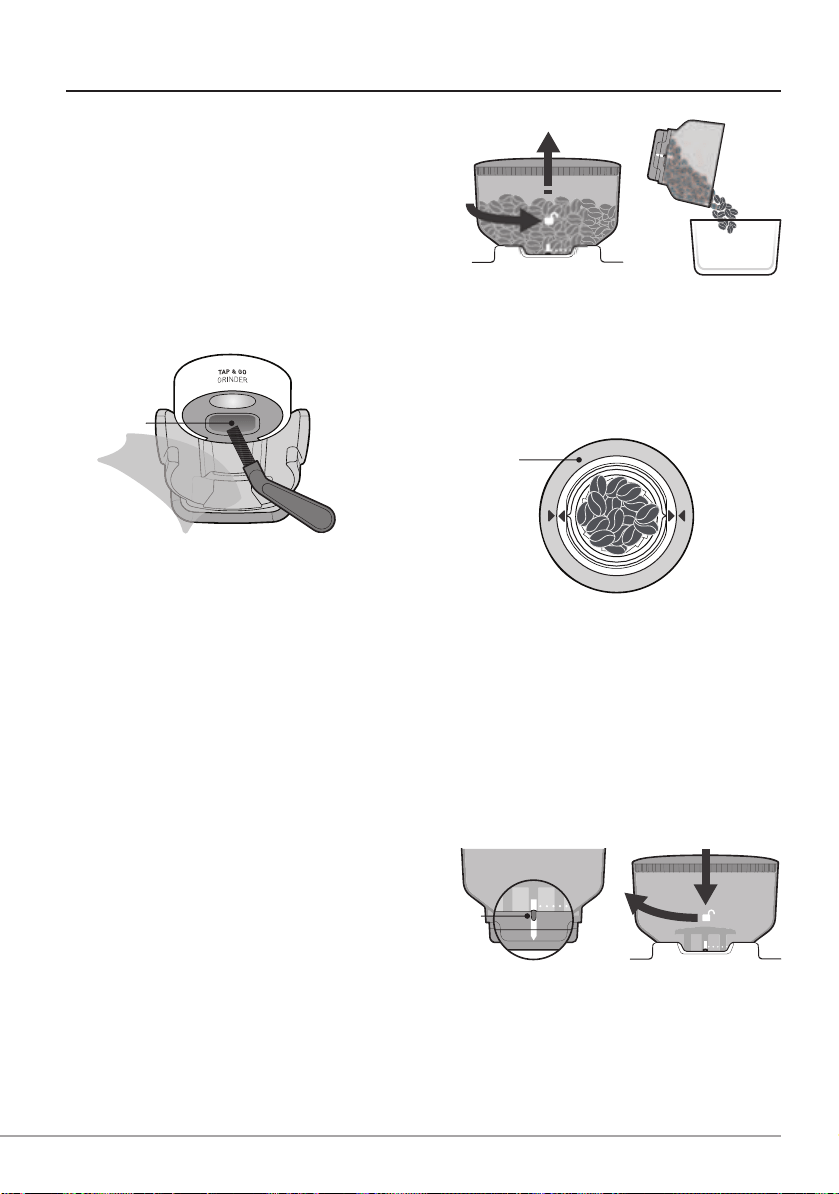
Cleaning Grinding Cradle & Grind Outlet
• Weekly
Remove any coffee grinds from the
Grinding Cradle & Grind Outlet with the
Cleaning Brush and wipe with a damp
cloth, wipe dry.
Cleaning the Bean Hopper
• 2-3 Months
If the Grinder is used frequently
(everyday), the Bean Hopper needs to
be cleaned to ensure best performance.
CAUTION: To prevent damage to the
appliance do not use alkaline cleaning
agents, abrasives or metal scourers.
WARNING: Do not immerse the machine
in water.
• Preparing to Clean Bean Hopper
- Turn off the machine, switch off &
unplug at power outlet.
- Make note of the current Grind Setting
(to use as the starting point after
cleaning).
• Remove and Clean Bean Hopper
- Turn Bean Hopper fully anti-clockwise,
to close the Hopper Gates and unlock
the Bean Hopper.
- Remove the Bean Hopper from
the Grinder Collar and store any
remaining beans in an airtight
container to preserve their freshness.
- Wash the Bean Hopper in warm soapy
water, then rinse & dry. Let the Bean
Hopper stand to allow thorough air
drying before replacing.
• Replace Bean Hopper
- Ensure the Grinder Collar is clear of
coffee beans or grinds.
Note: Coffee grinds caught under the Top
Burr may prevent the Bean Hopper from
seating correctly. If this happens grind off
excess coffee beans, see page 28.
- Ensure the Hopper Guide is aligned
with the vertical white lines on the
Hopper base.
- Align & insert the Bean Hopper into
the Grinder Collar and fi rmly pushing
down turn clockwise to lock into place
and open the Hopper Guide.
- Reset to the Grind Setting noted prior
to cleaning.
Note: After cleaning, the optimum Grind
Setting may have changed. To find the
optimum Grind Setting use the information
on pages 14-15.
CARE & CLEANING - GRINDER
GRINDER
OUTLET
1.TURN
AIR TIGHT
CONTAINER
2.REMOVE
CLEAR OF
COFFEE BEANS
& GRINDS
1. ALIGN & INSERT ALIGN HOPPER GUIDE
2.TURN
HOPPER
GUIDE
28
CARE & CLEANING - GRINDER
Cleaning & Unblocking Grinder Burrs,
Collar, Grind Chamber and Outlet
• 1-2 Months
If the Grinder is used frequently
(everyday), the Burrs need to be cleaned
to ensure best performance of the
integrated Grinder. Regular cleaning helps
the Burrs achieve consistent grinding
results, which is especially important
when grinding coffee beans for espresso.
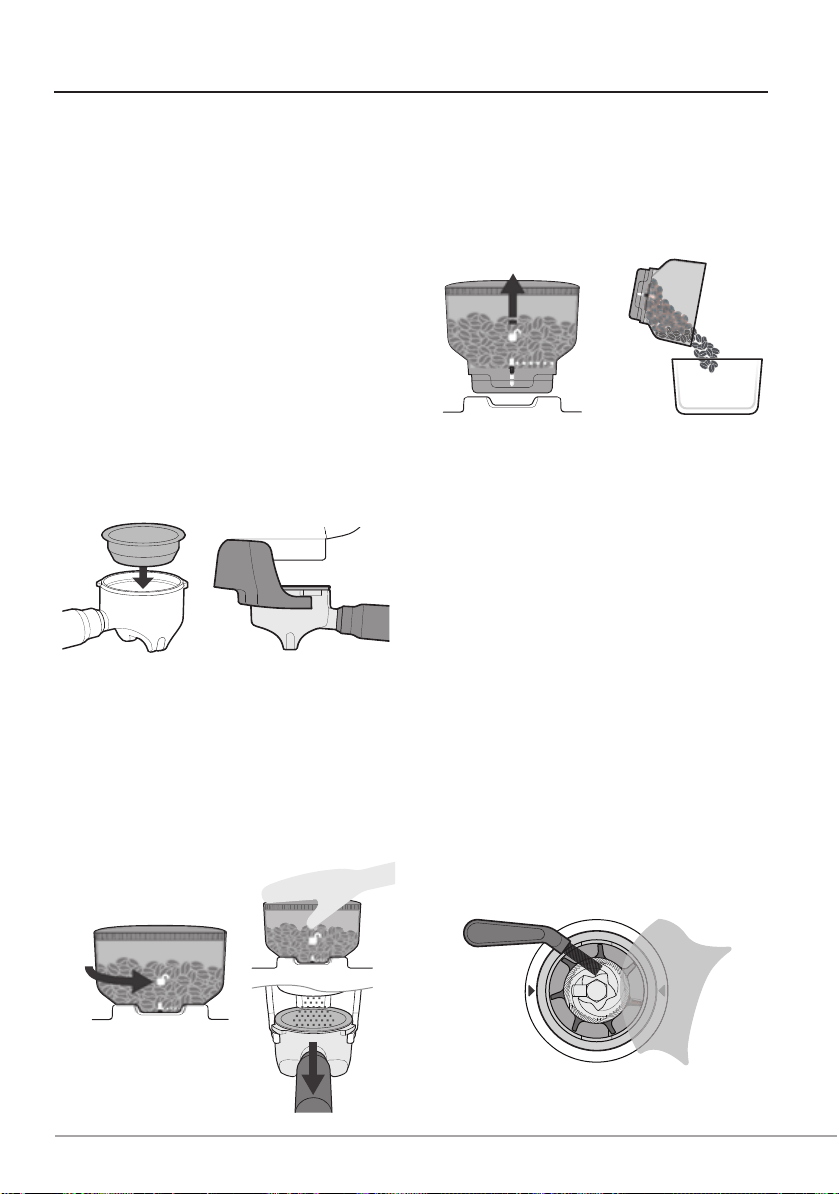
• Grind Off Excess Coffee Beans
- The machine is on and in the READY
state.
- Make note of the current Grind Setting
(to use as the starting point after
cleaning).
- Insert Two Cup Filter Basket into the
Group Handle.
- Insert Group Handle into Grinding
Cradle.
- Turn Bean Hopper fully anti-clockwise
to close the Hopper Gates and unlock
the Bean Hopper. The Bean Hopper
will pop up slightly.
- Place your hand on top of the Bean
Hopper and push down lightly. At
the same time push down the Group
Handle to activate the Grinder.
Continue grinding until no more coffee
grinds are emitted from the Grinder.
- Remove the Group Handle and
dispose of the waste grinds as these
will be too coarse for espresso coffee.
- Remove the Bean Hopper from
the Grinder Collar and store any
remaining coffee beans in an airtight
container to preserve their freshness.
• Preparing to Clean
- Turn off the machine, switch off &
unplug at power outlet.
CAUTION: Care should be taken when
cleaning Grinder Burrs as they are sharp.
• Cleaning Top Burr
- Fold the two handles up and lift the
Top Burr from the Grinder Collar.
- Wash the Top Burr in warm soapy
water with a mild detergent, rinse & dry.
Note: Spots & marks on the surface of the
Burrs are part of the hardening process (for
extra-long life). These marks do not affect
the performance of the Grinder or the taste
of the espresso.
• Cleaning & Unblocking Bottom Burr
and Grind Chamber
- Use the Cleaning Brush or a Vacuum
Cleaner to thoroughly clear the parts
and surfaces in the Grind Chamber of
fi ne coffee grinds. A damp cloth can
be used to wipe the inside of the Grind
Collar.
- Allow thorough air drying.
TURN
PUSH DOWN
PUSH DOWN GROUP HANDLE
AT THE SAME TIME
TWO CUP
AIR TIGHT
CONTAINER
REMOVE
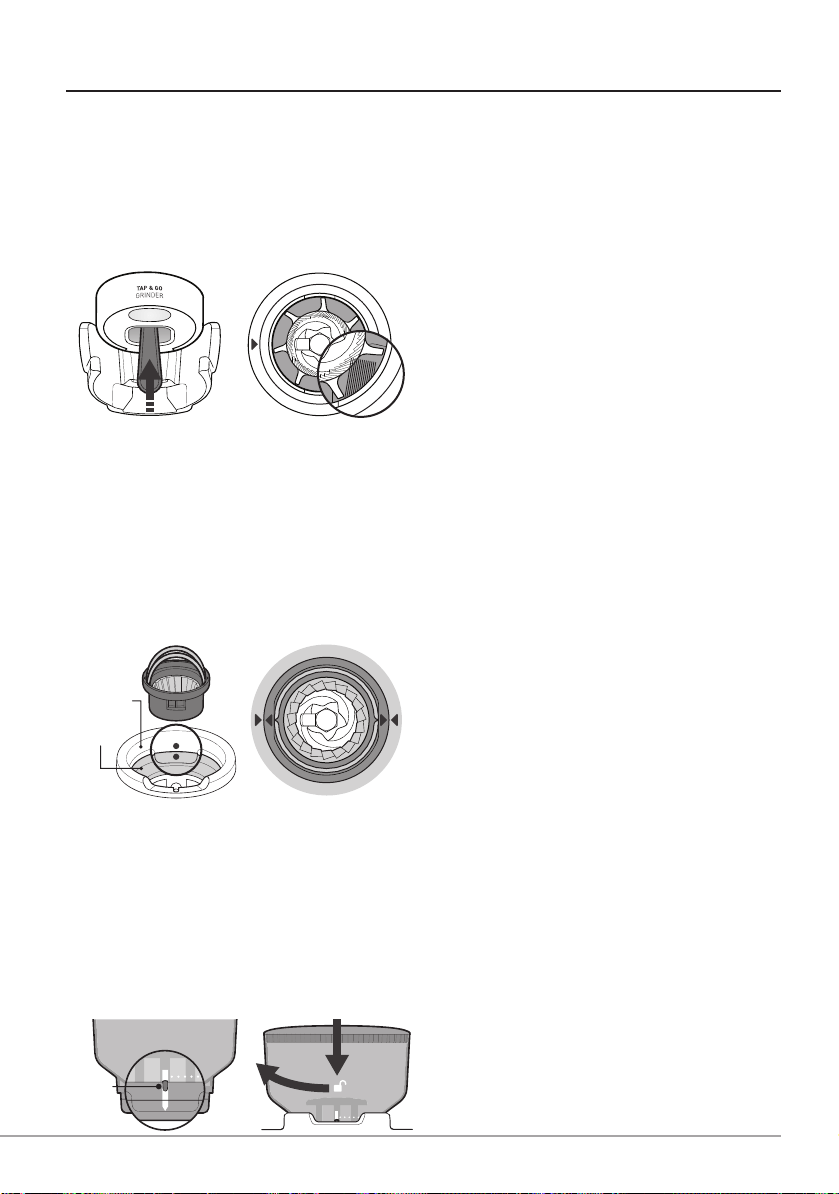
29
WARNING: Do not pour water or any other
liquid into the Grind Chamber.
• Cleaning & Unblocking Grind Outlet
- Feed the Cleaning Brush up into the
Grind Outlet from below, wiping &
brushing the inside surfaces.
- If the Grind Outlet is clear the bristles will
be visible inside the Grind Chamber.
• Replace Top Burr
- Ensure the dot on the Top Cover
aligns with the dot on the Grinder
Collar.
- Using the two handles insert the Top
Burr into the Grinder Collar.
- The arrows on the Top Burr should
align to arrows on the Grinder Collar.
- When correctly seated, the Top Burr
will be fl ush with the surface of the
Grinder Collar.
- Place handles down, one on each
side.
• Replace Bean Hopper
- Ensure the Hopper Guide is aligned
with the vertical white lines on the
Hopper base.
- Align & insert the Bean Hopper into
the Grinder Collar and fi rmly pushing
down turn clockwise to lock into place
and open the Hopper Guide.
- Reset to the Grinder Setting noted
prior to cleaning.
- Refi ll the Bean Hopper with coffee
beans.
Note: After cleaning, the optimum Grind
Setting may have changed. To find the
optimum Grind Setting use the information
on pages 14-15.
Adjusting Bottom Burr
The Conical Burrs are made of hardened
Stainless Steel for extra-long life. However,
after prolonged use, the Bottom Burr may
require adjustment to compensate for wear.
If the coffee grinds are too coarse when the
Grind Setting is below 2 and the espresso
is consistently under extracted, the Bottom
Burr may need adjusting.
Contact Breville (details are on the back
page) should you think that the Bottom Burr
needs adjustment.
Prior to contacting Breville Customer Care,
please ensure that you are using freshly
roasted beans and that the Top Burr is
seated correctly.
Important: Old coffee beans, no matter the
Grind Setting, will have a fast extraction
and will produce an under extracted tasting
espresso.
Important: If the Top Burr is not seated
correctly the Grinder will produce coarse
coffee grinds. Grind off excess coffee
beans and clean the Top Burr & Grind
Chamber.
Note: Breville Customer Care may
determine that Bottom Burr adjustment
shims are required. Do not attempt to add
shims without first consulting Breville.
CARE & CLEANING - GRINDER
TOP COVER
GRINDER
COLLAR
1. ALIGN & INSERT ALIGN HOPPER GUIDE
2.TURN
HOPPER
GUIDE
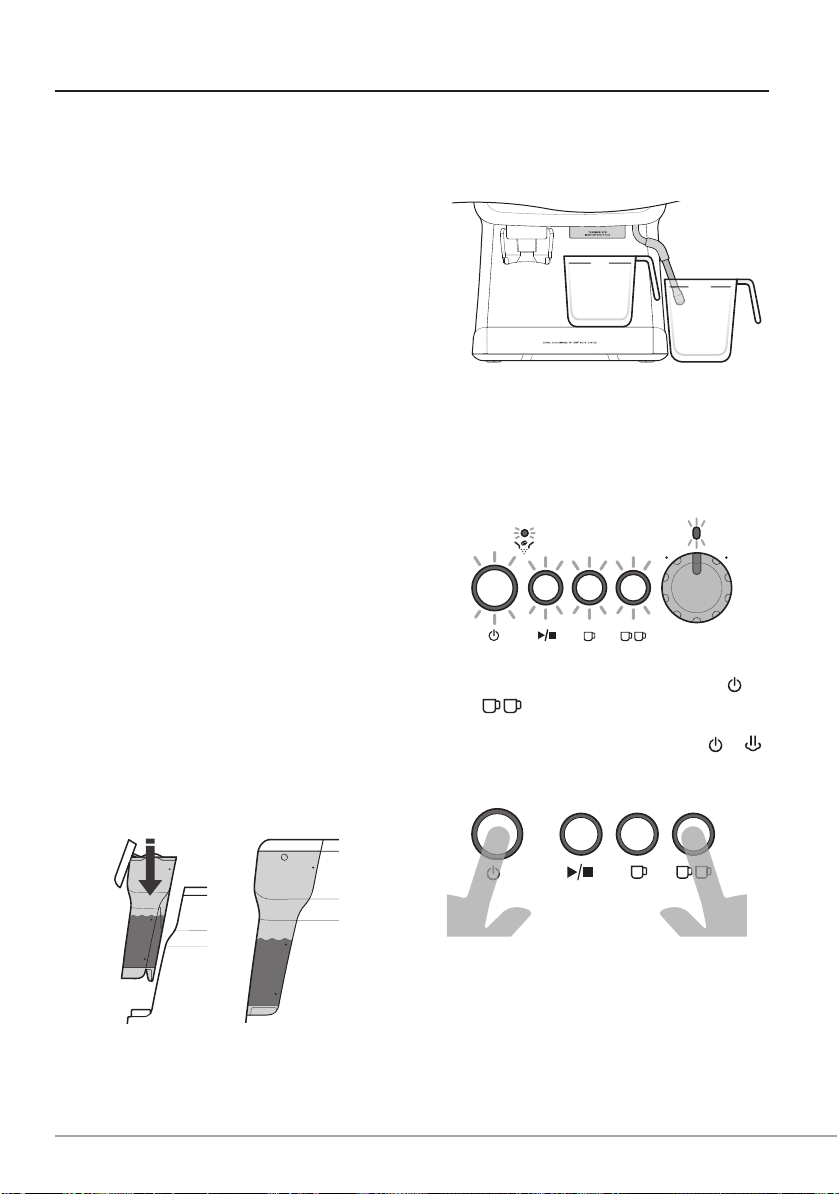
30
After continued use, your Espresso
Machine may develop a build-up of mineral
deposits and therefore require occasional
descaling.
We recommend descaling your Espresso
Machine every 4-6 months, although this
period will depend on the hardness of
water and frequency of use.
Descaling Solution
You have 2 options:
A. Espresso Machine Descaling Tablets.
or
B. White vinegar & warm water.
Descaling Cycle
The Descaling Cycle takes approximately
10 minutes to complete.
Important: If the Descaling Cycle is not
completed or stopped part way through
any of the Descaling Steps, then you will
need to start the Descaling Cycle again
from the beginning.
Preparing for Descaling Cycle
• Fill Water Reservoir with Solution
A. Fill Water Reservoir with 1 Litre of warm
water. Add one Descaling Tablet. Allow
tablet to fully dissolve.
or
B. In an empty Water Reservoir add 1½
tablespoons of white vinegar. Fill Water
Reservoir with 1 Litre of warm water.
Allow solution to mix thoroughly.
- Insert the Water Reservoir into position.
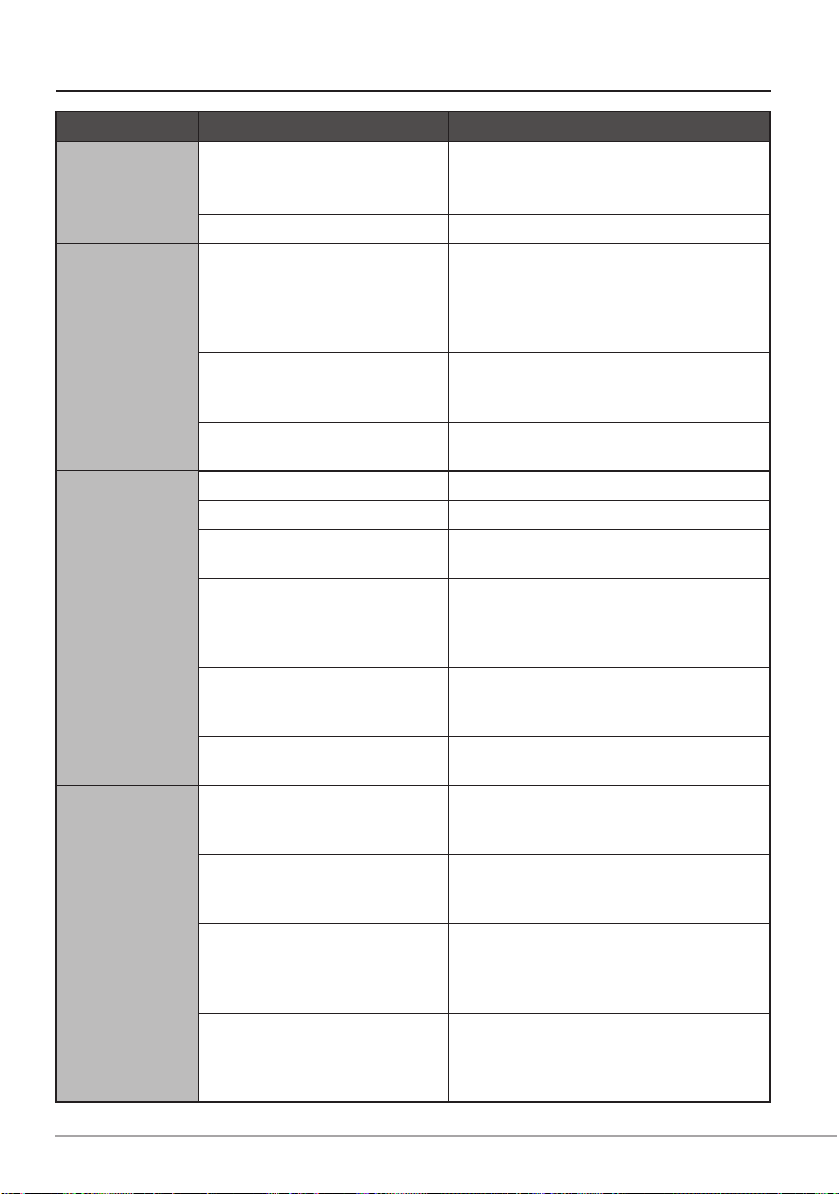
• Place Containers
- Place a 1 Litre container under Group
Head and another 1 Litre container
under the Steam Wand.
• Check Power
Ensure that:
- The Power Plug is inserted into the
outlet & switched on.
- The DIAL is in the vertical position.
- The machine is on and in the READY
state.
• Access the Descaling Cycle
- Simultaneously press & hold the
& BUTTONS for 4 seconds.
The machine will beep and a fl ashing
light combination between the &
LIGHTS begins.
DESCALING CYCLE - ESPRESSO MACHINE
PRESS & HOLD TOGETHER 4 SEC
MANUAL SHOT
TAP & GO
GRINDER
CLEAN
1L
1L
READY
MAX
2.8L
1L
MIN
MAX
2.8L
1L
MIN

31
Note: The LIGHT will continue to flash
until completion of the Descaling Cycle.
Important: If Descaling Step 1 is not
started within 1 minute of entering the
Descaling Cycle, the machine will exit
the Descaling Cycle and go back to the
READY state.
Important: The Descaling Cycle can
be exited at any point by pressing the
BUTTON.
Step 1. Start Descaling Cycle
- Turn the DIAL to the STEAM position.
- The STEAM LIGHT will now be fully
illuminated.
- The Pump will start and hot water will
run from the Group Head & Steam
Wand. Over a 2 minute period the
Pump will make different noises.
- When hot water has stopped being
released from the Group Head &
Steam Wand, this step is fi nished.
- To indicate the machine has fi nished
this step the machine will beep,
the STEAM LIGHT will stop being
illuminated and the DIAL LIGHT will
now start to fl ash.
- Turn the DIAL to the vertical position.
- The DIAL LIGHT will now be fully
illuminated.
- Move to Step 2.
Step 2. Preparing for Purge
Important: There is a maximum of 5
minutes allowed to complete this step
before the Descaling Cycle will exit.
- The Steam Wand & Group Head now
need to be purged clean with fresh
water to remove descaling solution.
• Rinse Water Reservoir
- Remove the Water Reservoir and
rinse thoroughly under running
water, ensuring that all traces of
the descaling solution have been
removed.
• Fill Water Reservoir
- Fill the Water Reservoir to the '1 Litre'
line with cold water from the tap and
insert into position.
• Empty Containers
- Empty water from the containers and
replace.
- Move to Step 3.
Step 3. Start Purge
- Turn the DIAL to the STEAM position.
- The STEAM LIGHT will now be fully
illuminated.
- The Pump will start and hot water will
run from the Group Head & Steam
Wand. Over a 2 minute period the
Pump will make different noises.
- When hot water has stopped being
released from the Group Head &
Steam Wand, the Descaling Cycle is
complete.
Descaling Cycle Complete
- To indicate the completion of the
Descaling Cycle the machine will beep
and the
LIGHT will stop fl ashing.
- The STEAM LIGHT will stop being
illuminated and the DIAL LIGHT will
now start to fl ash to prompt the return
of the DIAL to the vertical position.
- Turn the DIAL to the vertical position.
- The machine will return to the READY
state.
Descaling Cycle Clean Up
- Empty water from the containers and
clean, ensuring that all traces of the
descaling solution have been removed.
DESCALING CYCLE - ESPRESSO MACHINE
32
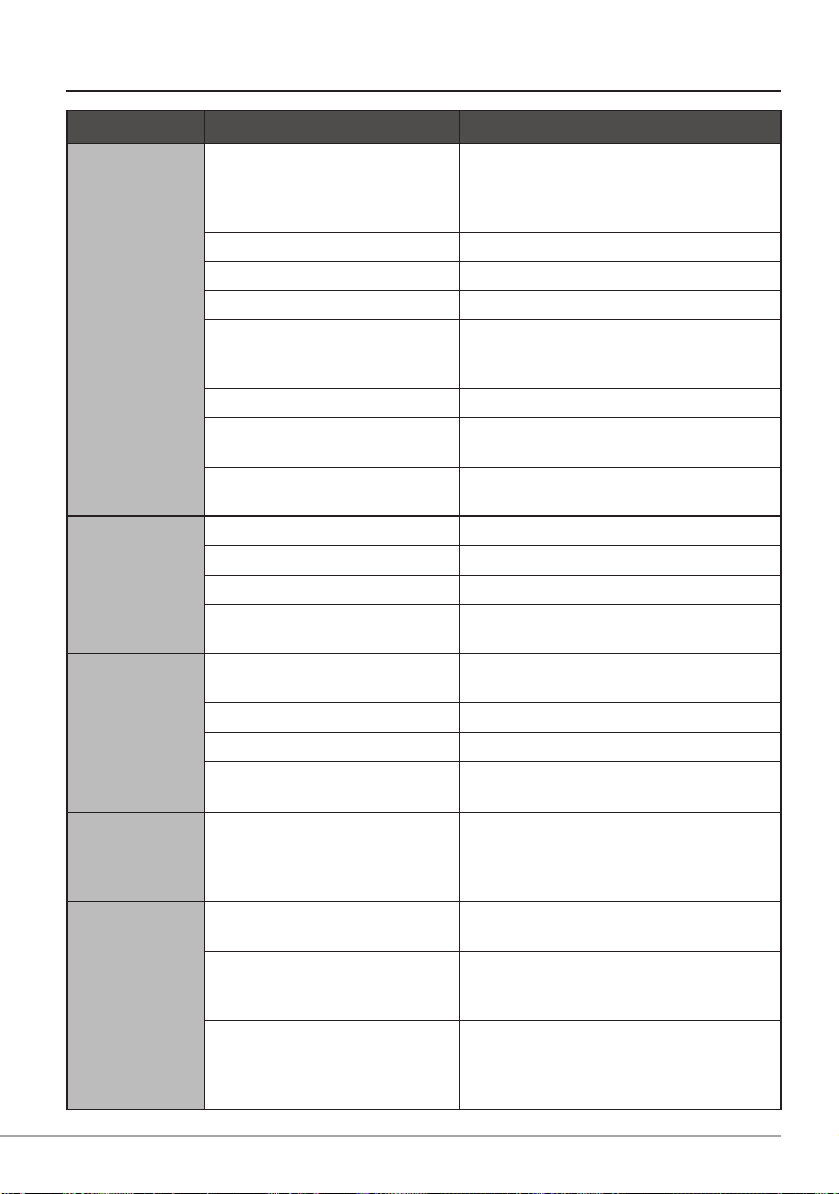
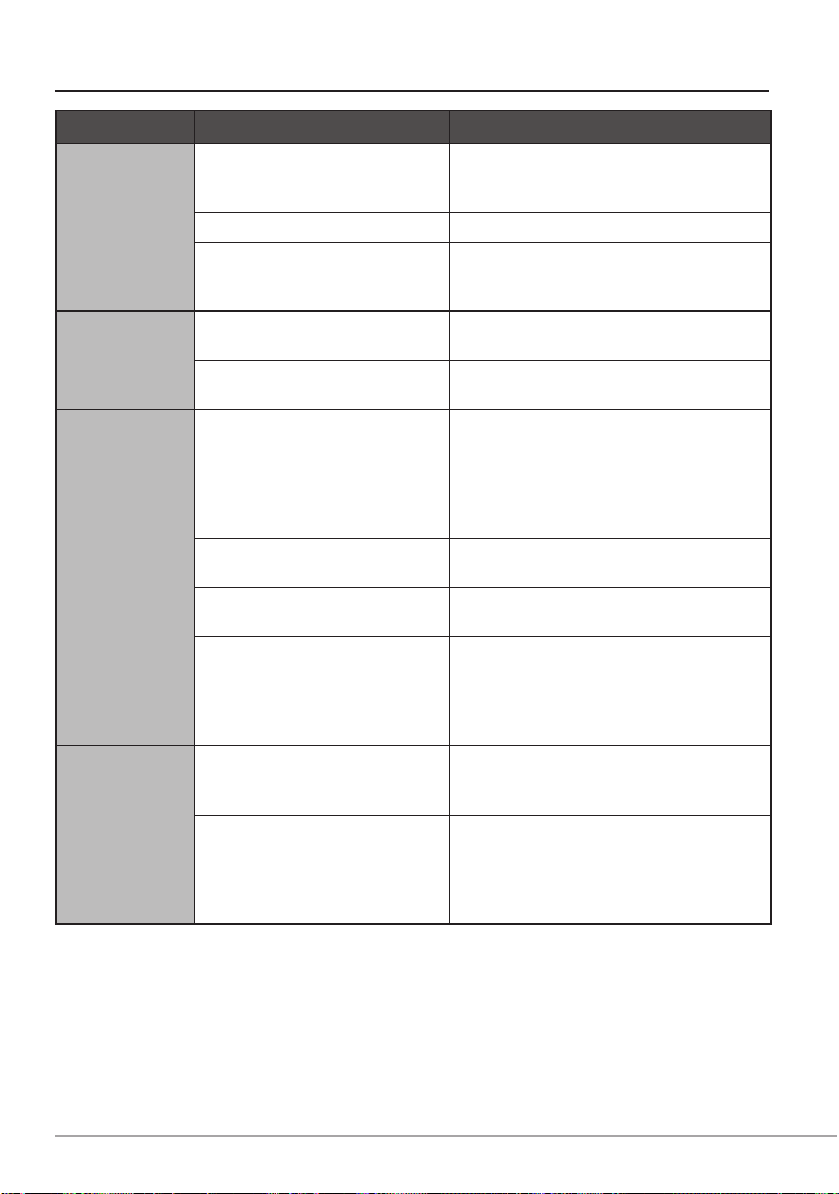
TROUBLESHOOTING GUIDE - ESPRESSO MACHINE
Problem Possible Cause What To Do
Group Handle
is tight to turn
in the Group
Head
The Group Head Silicone
Seal is new and needs
bedding in.
Keep using. This Seal will bed in
during the first few uses and become
easier to turn.
Too many coffee grinds used Fill with less coffee grinds.
Group Handle
is loose
or comes
off during
espresso
extraction
Group Handle is not attached
correctly or has not been
tightened sufficiently.
Ensure all three tabs of the Group
Handle are fully inserted into the
Group Head and rotated to the centre
position. See Coffee Making Guide,
page 11.
No Filter Basket inserted in
the Group Handle.
Ensure a Filter Basket is inserted into
the Group Handle before using in the
Group Head.
Group Head Silicone Seal is
damaged or worn.
See Care & Cleaning, page 25.
Contact Breville Customer Care.
Espresso
squirts or
trickles down
the side of
the Group
Head during
extraction
Coffee grind is too fine. Change to a coarser Grind Setting.
Too many coffee grinds used. Fill with less coffee grinds.
Coffee grinds tamped too
hard.
Apply less force during tamping.
Top edge of Filter Basket has
not been cleaned of loose
coffee grinds.
Wipe around top edge of the Filter
Basket before inserting into Group
Head. See Coffee Making Guide,
page 11.
Group Head inside rim,
Silicon Seal or Shower Head
is dirty.
Clean the parts with the Cleaning
Brush and damp cloth. See Care &
Cleaning, page 24.
Group Head Silicone Seal is
damaged or worn.
See Care & Cleaning, page 25.
Contact Breville Customer Care.
Espresso is too
cold
Coffee beans being stored in
the fridge or freezer.
Store coffee beans in a dry, airtight
container. Place in a cool dark
cupboard.
Custom extraction
temperature being used.
Use the default 92°C extraction
temperature. See Customisable -
Extraction Temperature, page 22
Cup or glass was cold prior
to espresso pour.
Pour hot water from the Steam
Wand into the cup before extracting
espresso. See Coffee Making Guide,
page 10.
Group Head or Handle not
warmed before use.
Hold the Group Handle under the
Group Head and press the ONE CUP
BUTTON. Allow water to run through.
See Coffee Making Guide, page 10.
33
TROUBLESHOOTING GUIDE - ESPRESSO MACHINE
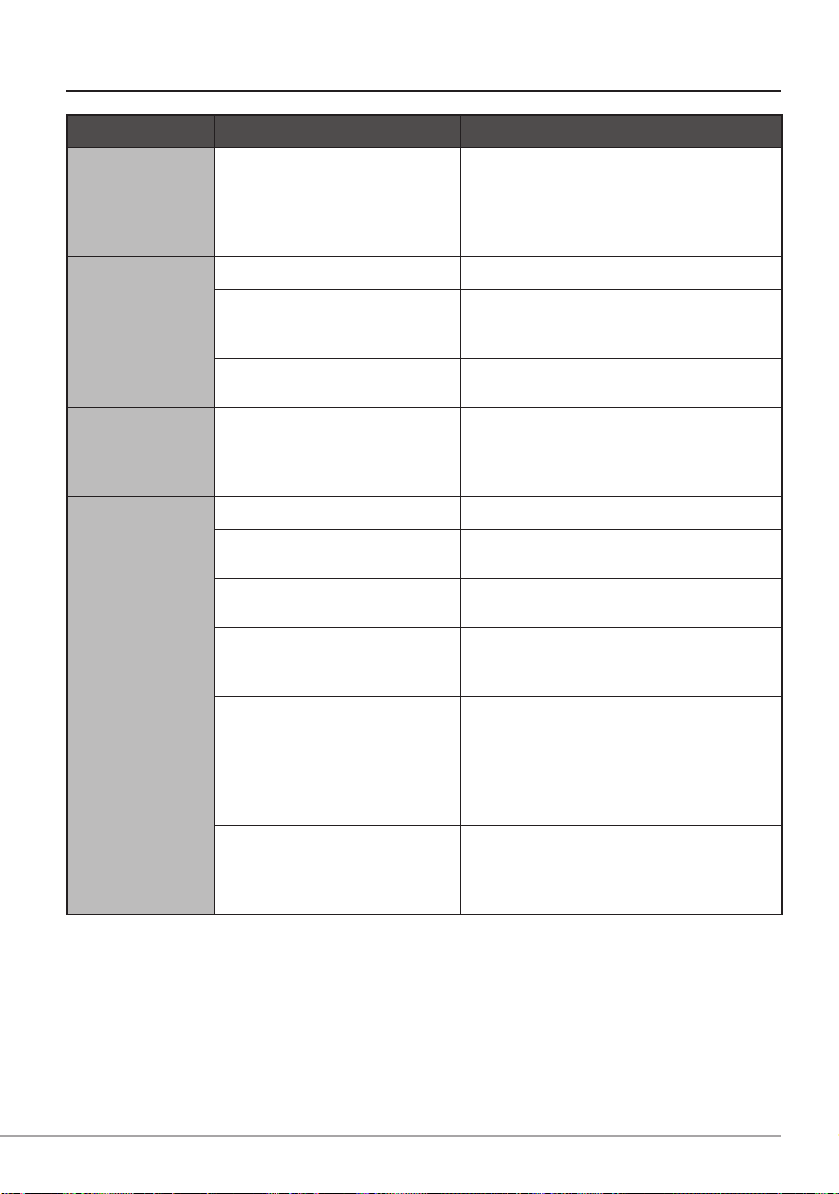
Problem Possible Cause What To Do
No espresso
pours
No water in the Water
Reservoir.
Fill reservoir with water. Prime water
through the Group Head, press the
ONE CUP BUTTON. Allow water to
run through.
Coffee grind is too fine. Change to a coarser Grind Setting.
Too many coffee grinds used. Fill with less coffee grinds.
Coffee grinds tamped too hard. Apply less force during tamping.
Custom shot volume being
used.
Reset to the default shot volumes.
See Customisable - Shot Volumes
Temperature, pages 20-21
The Filter Basket is blocked. See Care & Cleaning, pages 24 & 26.
Group Head is dirty. A Cleaning Cycle is required. See
Cleaning Cycle, page 25.
Group Head is blocked. A Descaling Cycle is required. See
Descaling Cycle, pages 30-31.
Espresso
pours out in
drips
(Over
Extracted)
Coffee grinds are too fine. Change to a coarser Grind Setting.
Too many coffee grinds used. Fill with less coffee grinds.
Coffee grinds tamped too hard. Apply less force during tamping.
Espresso Machine has scale
build up.
A Descaling Cycle is required. See
Descaling Cycle, pages 30-31.
Espresso
does not have
any crema, or
crema is thin
(Under
Extracted)
Coffee beans are old or dry. Use freshly roasted coffee beans. See
Tips for Grinding, page 14.
Coffee grinds too coarse. Change to a finer Grind Setting.
Not enough coffee grinds used. Fill with more coffee grinds.
Grinds not tamped
(compacted) enough.
Tamp more firmly. See Espresso
Extraction Guide section, page 15.
Espresso shot
volume too
much or too
little
Custom shot volumes being
used.
Restore to default shot volumes or
change your custom shot volume(s).
See Customisable - Shot Volumes,
page 21
Espresso
tastes bitter
Type of coffee beans being
used.
Try different brands of coffee beans.
Custom extraction
temperature being used.
Use the default 92°C extraction
temperature. See Customisable -
Extraction Temperature, page 22
Steam function has been
used just before extracting
espresso.
Allow time for water to purge the
Thermoblock and cool down before
extracting espresso. The STEAM
LIGHT should have finished flashing.
34
TROUBLESHOOTING GUIDE - ESPRESSO MACHINE
Problem Possible Cause What To Do
Spent (used)
coffee cake is
wet
A little water will remain on
top of the used coffee cake.
Rest Group Handle on the Drip
Tray for 5 sec to allow the water to
dissipate before disposing cake.
Too many coffee grinds used. Fill with less coffee grinds.
Dual Wall Filter Baskets being
used.
Dual Wall Filter Baskets will keep the
coffee cake wetter than Single Wall
Filter Baskets.
Espresso
pours into cup
unevenly
Uneven tamping. Ensure coffee grinds are tamped
evenly.
Obstruction in the Group
Head or Handle.
Check there is nothing obstructing the
Group Head or Handle & clean.
Pump makes
an unusual
noise
No water in the reservoir. Fill reservoir with water.
Let the machine return to the READY
state if it is cooling down after steam.
Prime water through the Group Head,
press the ONE CUP BUTTON. Allow
water to run through.
Water Reservoir is not
correctly positioned.
Insert the Water Reservoir into the
back of the unit.
Red Plug from the packaging
may still be inserted.
Remove the red packaging plug found
at the base of the Water Reservoir.
New Pre-infusion Profiles has
been selected.
Different Pre-infusion Profiles
make different noise at the start
of an espresso extraction. See
Customisable - Pre-infusion Profiles,
page 23.
Water around
Drip Tray area
or on benchtop
Water overflowing from Drip
Tray.
Empty if the red Water Level Indicator
appears through the Drip Tray
Stainless Steel Grill.
Drip Dray not present when
Thermoblock is auto purging.
Keep Drip Tray in place, when cooling
to espresso temperature. The STEAM
LIGHT flashes and water purges into
Drip Tray. See Coffee Making Guide,
page 13.
35
TROUBLESHOOTING GUIDE - ESPRESSO MACHINE
Problem Possible Cause What To Do
Milky coffee is
too cold
Milk may not be heated
enough.
Ensure that milk is heated properly
during texturing, but be sure not to
heat too much and boil the milk.
See Tip for Milk Texturing, pages
16-17.
No steam from
the Steam
Wand
Steam Wand Tip is blocked. See Care & Cleaning, page 26.
No water in the Water
Reservoir.
Fill reservoir with water. Run hot water
through the Steam Wand to ensure
water flows.
Espresso Machine has scale
build up.
A Descaling Cycle is required. See
Descaling Cycle, pages 30-31.
Steam Wand
making a
screeching
noise
Steam Wand Tip too deep. Lower Milk Jug. Ensure the Steam
Wand Tip is positioned correctly when
texturing. See Tip for Milk Texturing,
pages 16-17.
Not enough
foam when
texturing
Milk is not fresh. Ensure the milk being used is fresh.
Milk temperature is too
warm.
Ensure you start texturing with milk
that is around 4°C.
Type of Milk Jug being used. For best texturing results use a chilled
Stainless Steel Milk Jug.
Milk has been boiled. Start again with fresh, chilled milk.
Heat till the Milk Jug can only be held
for approximately 3 second, 60-65°C.
The milk is making bubbles
rather than microfoam.
Ensure the Steam Wand Tip is
positioned correctly when texturing.
Tap the Jug on the benchtop when
finished to release trapped air
bubbles. See Tip for Milk Texturing,
pages 16-17.
Milk is not taking in enough
air.
Keep the Steam Wand Tip just under
the surface of the milk. This will
help introduce air into the milk to
create microfoam.
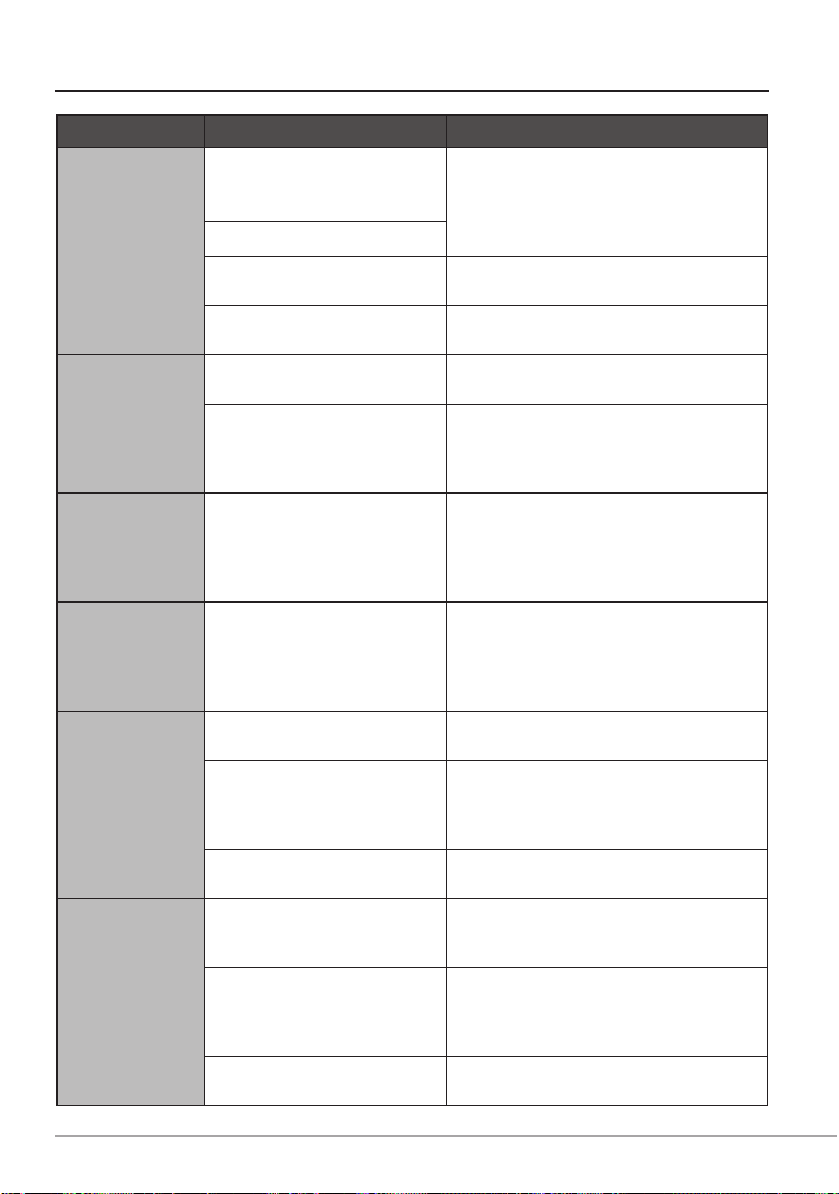
36
TROUBLESHOOTING GUIDE - GRINDER
Problem Possible Cause What To Do
Optimum Grind
Setting is
producing an
under extracted
espresso
New Burrs are bedding in.
This is normal for the first
few uses.
Turn the Bean Hopper clockwise
in small increments to a finer Grind
Setting to keep an optimum espresso
extraction. Use the information on
pages 14-15 to help.
Beans are losing freshness.
Not enough coffee grinds
used.
Fill with more coffee grinds.
Grinds not tamped
(compacted) enough.
Tamp more firmly. See Espresso
Extraction Guide section, page 15.
GRINDER
LIGHT does not
illuminate after
pressing ON/
OFF BUTTON
The machine is not plugged
into the power outlet.
Insert in the Power Plug into power
outlet & switch on.
The Bean Hopper is not
seated correctly & not
activating the red Interlock
Pin.
Turn the Bean Hopper in a clockwise
direction to lock into place. See Care
& Cleaning, page 29.
GRINDER
LIGHT flashes
when trying to
grind beans.
Hopper Gates are closed or
not fully open.
Turn the Bean Hopper in a clockwise
direction to a Grind Setting between
30-0 to fully open the Hopper Gates.
See Removable Bean Hopper
section, page 8.
GRINDER
LIGHT
illuminated red
Grinder Motor in protection
mode to prevent
overheating. Grinder has
been used for long periods
in a short space of time.
Leave the Grinder for 5 minutes.
The GRINDER LIGHT will illuminate
white to indicate normal use can be
resumed.
No coffee grinds
coming from the
Grinder Outlet
No coffee beans in the
Bean Hopper.
Fill the Bean Hopper with freshly
roasted coffee beans.
Hopper Gates are closed or
not fully open.
Turn the Bean Hopper in a clockwise
direction. At Grind Setting 30, Hopper
Gates are fully open. See Removable
Bean Hopper section, page 8.
The Grind Chamber or
Outlet is blocked.
Grinder needs cleaning. See Care &
Cleaning, pages 28-29.
Coffee grinds
are coarse
when on a fine
Grind Setting
Grind Setting not correct. Adjust the Grind Settings by turning
the Bean Hopper. See Tips for
Grinding, & Extraction, pages 14-15.
Top Burr not seated
correctly. Coffee beans or
grinds are caught around &
under the Top Burr.
Top Burr needs cleaning.
See Care & Cleaning, pages 28-29.
Bottom Burrs needs
adjusting.
See Adjusting the Bottom Burr section
on, page 29.
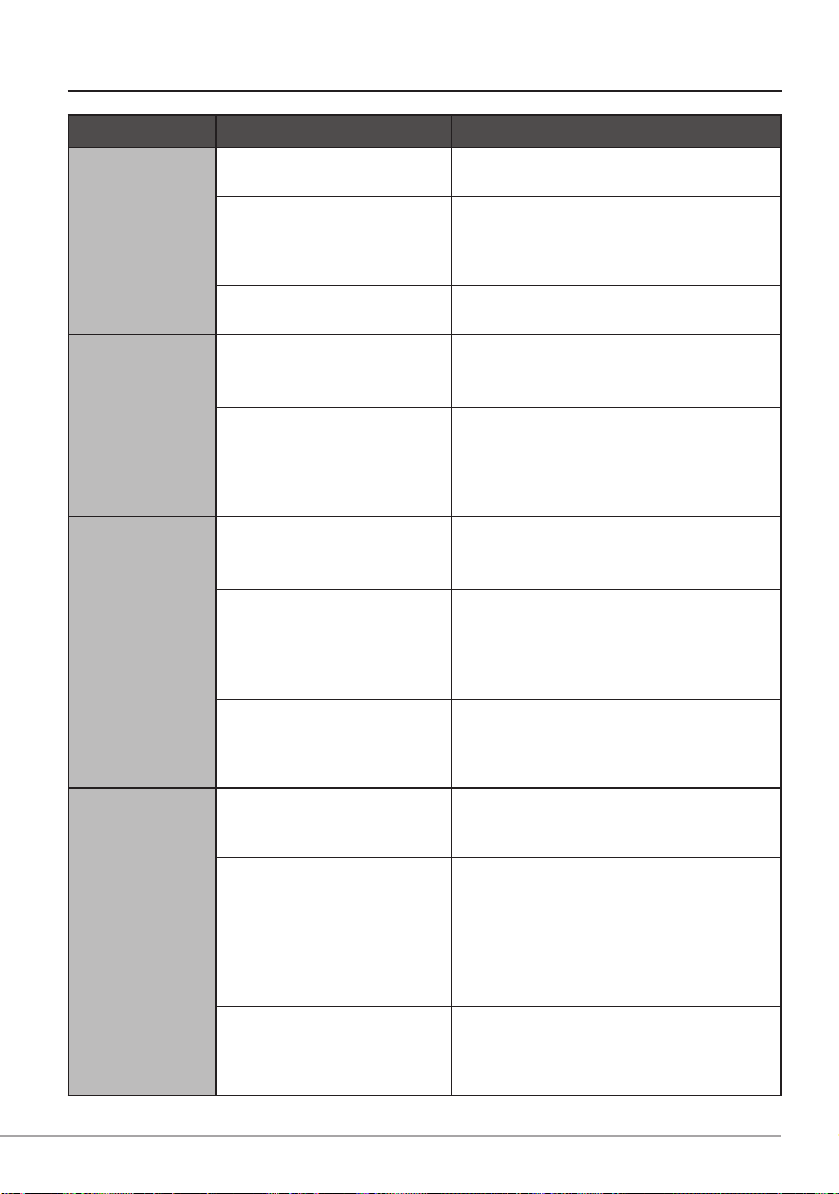
37
TROUBLESHOOTING GUIDE - GRINDER
Problem Possible Cause What To Do
Espresso is
under extracted
even with a fine
coffee grind
Not enough coffee grinds
used.
Fill with more coffee grinds.
Beans are too old. Use freshly roasted beans. Old coffee
beans, no matter the Grind Setting, will
have a fast extraction and will produce
an under extracted tasting espresso.
Bottom Burrs needs
adjusting.
See Adjusting the Bottom Burr section,
page 29.
Grind Setting
cannot be
adjusted
The Bean Hopper is not
seated correctly.
Remove the Bean Hopper & replace.
See Replace Bean Hopper section,
page 27.
Coffee beans or grinds are
caught around the Top Burr
or Grinder Collar.
Remove the Bean Hopper & Top Burr.
Use the Cleaning Brush or Vacuum
Cleaner as necessary to clear loose
coffee beans or grinds. See Replace
Bean Hopper section, page 27.
Bean Hopper
cannot be
locked into
position
Grinder Collar not aligned
to the Top Cover.
Ensure the dot on the Top Cover aligns
with the dot on the Grinder Collar. See
Replace Top Burr section, page 29
Coffee beans or grinds are
caught in the Top Burr or
Grinder Collar.
Remove the Bean Hopper & Top Burr.
Use the Cleaning Brush or Vacuum
Cleaner as necessary to clear loose
coffee beans or grinds. See Replace
Bean Hopper section, page 27.
The Top Burr is not seated
correctly.
Make sure the Top Burr is correctly
aligned and that the two handles are
placed one on each side. See Replace
Top Burr section, page 29.
Top Burr does
not sit in the
Grinder Collar
correctly
Grinder Collar not aligned
to the Top Cover.
Ensure the dot on the Top Cover aligns
with the dot on the Grinder Collar. See
Replace Top Burr section, page 29.
Coffee beans or grinds are
caught around & under the
Top Burr
Remove the Top Burr and replace
the Bean Hopper. Hold the Bean
Hopper down with your hand, do not
turn. Insert the Group Handle into the
Grinding Cradle and push down to
activate the Grinder. The coffee grinds
will fall out the Grind Outlet.
The Top Burr is not seated
correctly.
Make sure the Top Burr is correctly
aligned and that the two handles are
placed one on each side. See Replace
Top Burr section, page 29
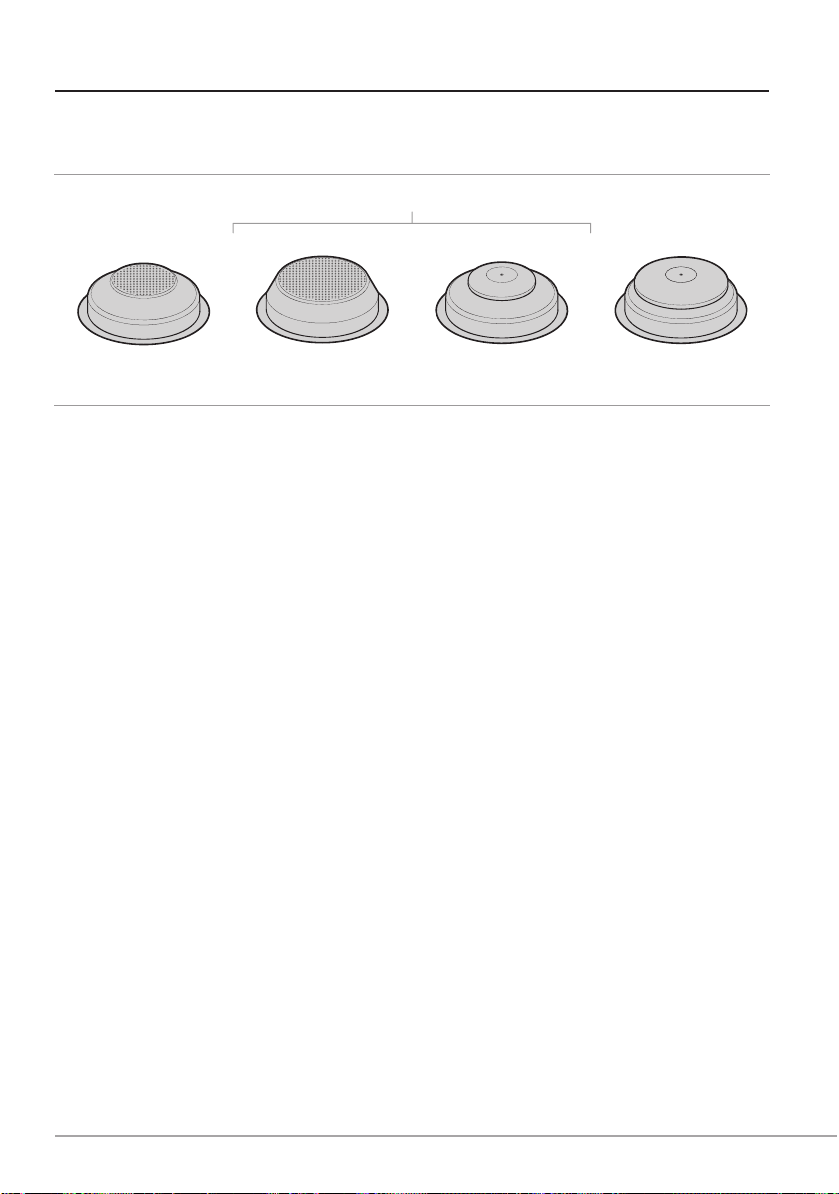
38
Contact Breville Customer care on:
0800 525 089
One Cup
VCF130
Single Wall
Two Cup
VCF131
Dual Wall
One Cup
VCF128
Two Cup
VCF129
58mm Filter Baskets
D
U
A
L
W
A
L
L
D
U
A
L
W
A
L
L
ACCESSORIES AVAILABLE FOR PURCHASE
Visit Breville website to see full Espresso Machine range & accessories available.
www.breville.co.uk
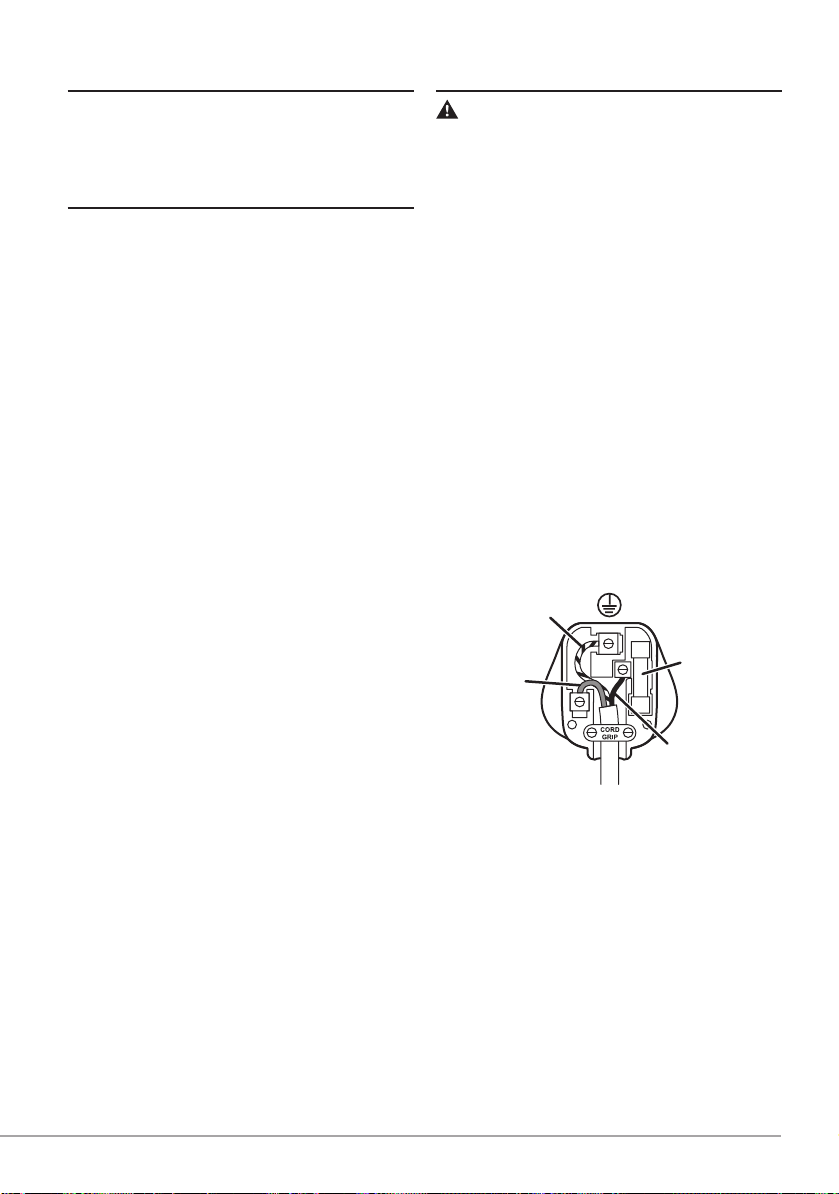
39
REPLACEMENT PARTS
For additional or replacement parts, please
visit www.breville.co.uk or call us on
0161 621 6900.
TROUBLESHOOTING
For troubleshooting and FAQs visit:
www.breville.co.uk/faqs
ELECTRICAL SAFETY
This appliance must be earthed.
If the plug is not suitable for the socket
outlets in your home, it can be removed
and replaced by a plug of the correct type.
If the fuse in a moulded plug needs to be
changed, the fuse cover must be refi tted.
The appliance must not be used without
the fuse cover fi tted.
If the plug is unsuitable, it should be
dismantled and removed from the supply
cord and an appropriate plug fi tted as
detailed. If you remove the plug it must not
be connected to a 13 amp socket and the
plug must be disposed of immediately.
If the terminals in the plug are not marked
or if you are unsure about the installation
of the plug please contact a qualifi ed
electrician.
Blue
(Neutral)
Brown
(Live)
13A Fuse
Green/Yellow
(Earth)
Plug should be ASTA approved to BS1363
Fuse should be ASTA approved to BS1362
Ensure that the outer sheath of
the cable is firmly held by the cord grip

40
AFTER SALES SERVICE
These appliances are built to the very
highest of standards. There are no user
serviceable parts. Follow these steps if the
unit fails to operate:
• Check the instructions have been
followed correctly.
• Check that the fuse has not blown.
• Check that the mains supply is
functional.
If the appliance will still not operate, return
the appliance to the place it was purchased
for a replacement. To return the appliance
to the Customer Service Department,
follow the steps below:
1. Pack it carefully (preferably in the
original carton). Ensure the unit is
clean.
2. Enclose your name and address and
quote the model number (located on
the rating label) on all correspondence.
3. Give the reason why you are returning it.
4. If within the guarantee period, state
when and where it was purchased
and include proof of purchase (e.g. till
receipt).
5. Send it to our Customer Service
Department at the address below:
Customer Service Department
Jarden Consumer Solutions (Europe) Limited
Middleton Road, Royton, Oldham
OL2 5LN, UK
Telephone: 0161 621 6900 Fax: 0161 626 0391
e-mail: [email protected]
GUARANTEE
Please keep your receipt as this will
be required for any claims under this
guarantee.
This appliance is guaranteed for 1 year
after your purchase as described in this
document.
During this guaranteed period, if in the
unlikely event the appliance no longer
functions due to a design or manufacturing
fault, please take it back to the place of
purchase, with your till receipt and a copy
of this guarantee.
The rights and benefi ts under this
guarantee are additional to your statutory
rights, which are not affected by this
guarantee. Only Jarden Consumer
Solutions (Europe) Limited (“JCS
(Europe)”) has the right to change these
terms.
JCS (Europe) undertakes within the
guarantee period to repair or replace the
appliance, or any part of appliance found
to be not working properly free of charge
provided that:
• you promptly notify the place of
purchase or JCS (Europe) of the
problem; and
• the appliance has not been altered
in any way or subjected to damage,
misuse, abuse, repair or alteration by a
person other than a person authorised
by JCS (Europe).
41
Faults that occur through, improper use,
damage, abuse, use with incorrect voltage,
acts of nature, events beyond the control
of JCS (Europe), repair or alteration by
a person other than a person authorised
by JCS (Europe) or failure to follow
instructions for use are not covered by this
guarantee. Additionally, normal wear and
tear, including, but not limited to, minor
disColouration and scratches are not
covered by this guarantee.
The rights under this guarantee shall only
apply to the original purchaser and shall
not extend to commercial or communal
use.
If your appliance includes a country-
specifi c guarantee or warranty insert
please refer to the terms and conditions of
such guarantee or warranty in place of this
guarantee or contact your local authorized
dealer for more information.
Waste electrical products should not be
disposed of with household waste. Please
recycle where facilities exist. E-mail us at
[email protected] for further
recycling and WEEE information.
Jarden Consumer Solutions (Europe) Limited
5400 Lakeside
Cheadle Royal Business Park
Cheadle
SK8 3GQ
UK

VCF126_19EM1 (UK) P.N. 199669
GCDS-BRE733405-JC
Jarden Consumer Solutions (Europe) Limited
Cheadle Royal Business Park, Cheadle, SK8 3GQ, United Kingdom
e-mail: [email protected]
Telephone: 0161 621 6900
For Customer Service details, please see the website.
www.breville.co.uk
© 2019 Jarden Consumer Solutions (Europe) Limited
All rights reserved. Imported and distributed by Jarden Consumer Solutions (Europe) Limited,
5400 Lakeside, Cheadle Royal Business Park, Cheadle, SK8 3GQ, United Kingdom.
Jarden Consumer Solutions (Europe) Limited is a subsidiary of Newell Brands Inc.
The product supplied may differ slightly from the one illustrated due to continuing product development.
Printed in China