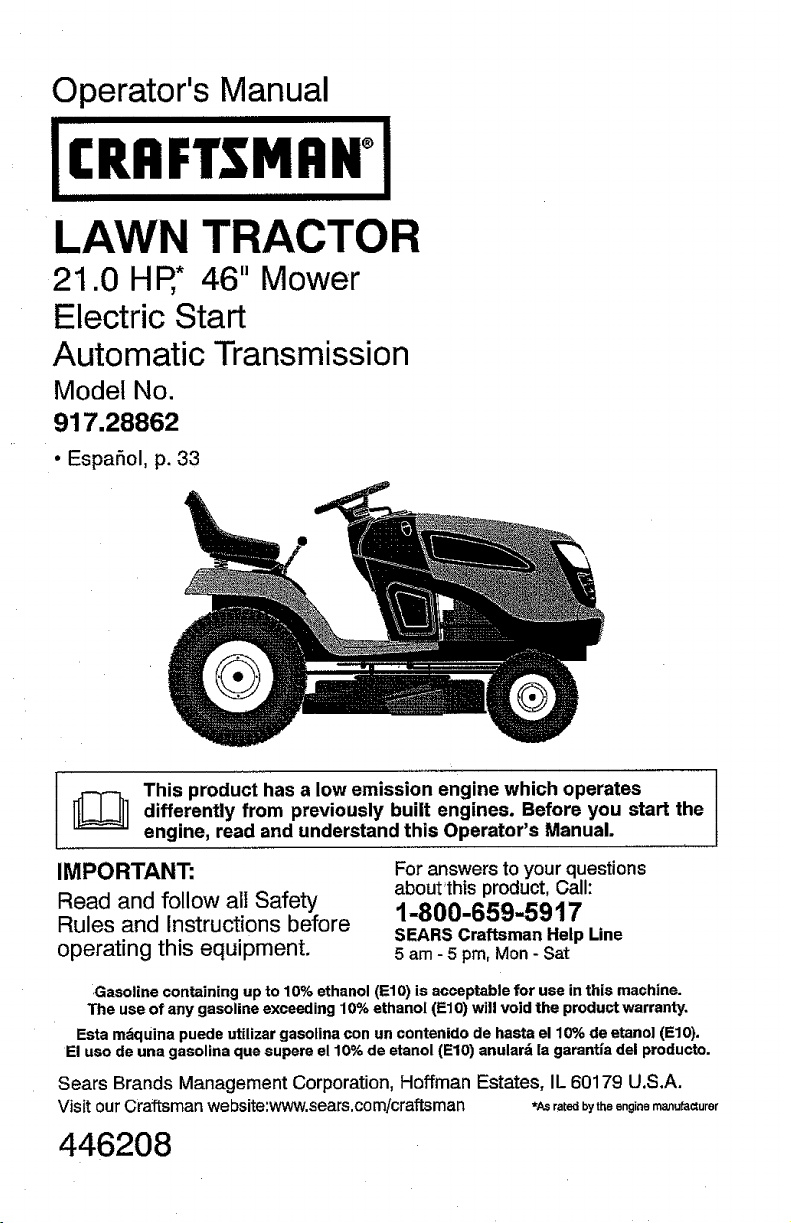
Operator's Manual
! RnFTSM.N°I
LAWN TRACTOR
21.0 HP,* 46" Mower
Electric Start
Automatic Transmission
Model No.
917.28862
• Espa_ol, p. 33
This product has a low emission engine which operates
from built Before start the
differently previously
engines.
you
engine, read and understand this Operator's Manual.
IMPORTANT:
Read and follow all Safety
Rules and Instructions before
operating this equipment.
For answers to your questions
aboutlhis product, Call:
1-800-659-5917
SEARS Craftsman Help Line
5 am - 5 pro, Mon- Sat
Gasoline containing up to 10% ethanol (EIO) is acceptable for use in this machine.
The use of any gasoline exceeding 10% ethanol (EIO) will void the product warrant,#.
Esta m_quina puede utilizer gasotlna con un contenido de haste el 10% de etanol (EIO).
El uso de una gasolina que supere el 10% de etanol (EIO) anulard [a garanUa del produoto.
Sears Brands Management Corporation, Hoffman Estates, IL 60179 U.S.A.
Visit our Craftsmanwebsite:www.sears.comicraftsman *As ratedbythe enginernanufae,urer
446208
Warranty .................................................. 2
Safety Rules ............................................ 3
Product Specifications ............................. 6
Assembly/Pre-Operation ......................... 7
Operation ................................................. 9
Maintenance Schedule .......................... ! 6
Maintenance .......................................... 16
Service and Adjustments ....................... 21
Storage .................................................. 27
Troubleshooting ..................................... 28
Sears Service ......................... Back Cover
Craftsman Riding Equipment Warranty
CRAFTSMAN FULL WARRANTY
FOR TWO YEARS from the date of purchase, aI] non-expendable parts of this riding equipment are
warranted against any defects in material or workmanship. A defective non-expendable part will
receive free in-home repair or replacement if repair is impossible.
FOR FIVE YEARS from the date of purchase, the frame and front axle of this riding equipment are
warranted against any defects in material or workmanship. A defective frame or front axle wUireceive
free in-home repair or replacement if repair is impossible.
FOR 90 DAYS from the date of purchase, the battery (an expendable part) of this riding equipment
is warranted against any defects in material or workmanship (our testing proves that it will not hold a
charge). A defective battery will receive free in-home replacement.
ADDITIONAL LIFETIME LIMITED WARRANTY on CAST IRON FRONT AXLE (if equipped)
FOR AS LONG AS IT IS USED bythe original owner after the frfth year from the date of purchase, the
cast iron front axle (if equipped) of this riding equipment is warranted against any defects in matedaI or
workmanship. With proof of purchase, a defective cast front axle wilI receive free in-home replacement.
WARRANTY SERVICE
For warranty coverage details to obtain free repair or replacement, call 1-800-659-5917 or visit the
web site: www.craftsman.com
In al! cases above, if part repair or replacement is impossible, the riding equipment wilI be replaced
free of charge with the same or an equivalent model.
All of the above warranty coverage is void if this riding equipment is ever used while providing
commercial services or if rented to another person.
This warranty covers ONLY. defects in material and workmanship. Warranty coverage does NOT
include:
• Expendable parts (except battery) that can wear out from normal use within the warranty period,
including but not limited to bEades,spark plugs, air cleaners, belts, and oil filters.
• Standard maintenance servicing, oiI changes, or tune-ups.
° Tire replacement or repair caused by punctures from outside objects, such as nails, thorns,
stumps, or glass.
• Tire or wheel replacement or repair resulting from normal wear, accident, or improper operation or
maintenance.
• Repairs necessary because of operator abuse, including but not limited to damage caused by
towing objects beyond the capability of the riding equipment, impacting objects that bend the
frame, axle assembiy or crankshaft, or over-speeding the engine.
- Repairs necessary because of operator negligence, including but not limited to, electrical and
mechanical damage caused by improper storage, failure to use the proper grade and amount
of engine oil, failure to keep the deck clear of flammable debris, or failure to maintain the riding
equipment according to the instructions contained in the operator's manual.
• Engine (fuel system) cleaning or repairs caused byfue[ determined to be contaminated or oxidized
(stale). In general, fuel should be used within 30 days of its purchase date.
• Normal deterioration and wear of the exterior finishes, or product label replacement.
This warranty gives you specific legal rights, and you may also have other rights which vary from
state to state.
Sears Brands Management Corporation, Hoffman Estates, IL 60179
2
_DANGER: This cutting machine is capable of amputating hands and feet and
throwing objects. Failure to observe the following safety instructions could result
in serious injury or death.
_kWARNING: In orderto preventacciden-
tat starting when setting up, transporting,
adjusting or making repairs, always discon-
nect spark plug wire and place wire where
it cannot contact spark plug.
A(_WARNING: Do not coast down a hillin
neutral, you may lose control of the tractor.
_,WARNING: Tow only the attachments
that are recommended by and comply with
specifications of the manufacturer of your
tractor. Use common sense when towing.
..... Operate only at the lowest possible speed
when on a slope. Too heavy of a load, while
on a slope, is dangerous. Tires can lose
traction with the ground and cause you to
lose control of your tractor.
_,WARNING: Engine exhaust, some of
its constituents, and certain vehicle compo-
nents contain or emit chemicals known to
the State of California to cause cancer and
birth defects or other reproductive harm.
• qkWAR NING: Battery posts,terminals and
related accessories contain lead and lead
compounds, chemicals knownto the State of
California to cause cancer and birth defects
or other reproductive harm. Wash hands
after handling.
I. GENERAL OPERATION
• Read, understand, and follow all instruc-
tions on the machine and inthe manual
before starting.
• Do not put hands or feet near rotating
parts or under the machine. Keep clear
of the discharge opening at atl times.
• Only allow responsible adults, who are
familiar with the instructions, to operate
the machine.
• Clear the area of objects such as rocks,
toys, wire, etc., which could be picked
up and thrown by the blades.
• Be sure the area is clear of bystanders
before operating. Stop machine ifanyone
enters the area.
• Never carry passengers.
• Do not mow inreverse unless absolutely
necessary. Always look downand behind
before and while backing.
• Never direct discharged materialtoward
anyone. Avoid discharging material
against a wall or obstruction. Material
may ricochet back toward the operator.
Stop the blades when crossing gravel
surfaces.
• Do not operate machine without the en-
tire grass catcher, discharge chute, or
other safetydevices inplace andworking.
• Slow down before turning.
o Never leave a running machine unat-
tended. Always turn off blades, set
parking brake, stop engine, and remove
keys before dismounting.
• Disengage blades when not mowing.
Shut off engine and wait for all parts to
come to a complete stop before cleaning
the machine, removingthe grass catcher,
or unclogging the discharge chute.
• Operate machine only indaylight or good
artificial light.
• Do not operate the machine while under
the influence of alcohol or drugs.
• Watch for traffic when operating near or
crossing roadways.
• Useextra care when Ioadingor unloading
the machine into a trailer or truck.
• AIwaysweareye protectionwhenoperat-
ing machine.
• Data indicates that operators, age 60
years and above, are involved ina large
percentage of riding mower-related inju-
ries. These operators should evaluate
their ability to operate the riding mower
safely enough to protectthemselves and
others from serious injury.
• Followthe manufacturer's recommenda-
tion for wheelweights or counterweights.
• Keep machine free of grass, leaves or
other debris build-up which can touch hot
exhaustt engine parts and burn. Do not
allow the mower to plow leaves or other
debris which can cause build-up to oc-
cur. Clean any oil or fuel spillage before
operating or storing the machine. Allow
machine to coot before storage.
!1.SLOPE OPERATION
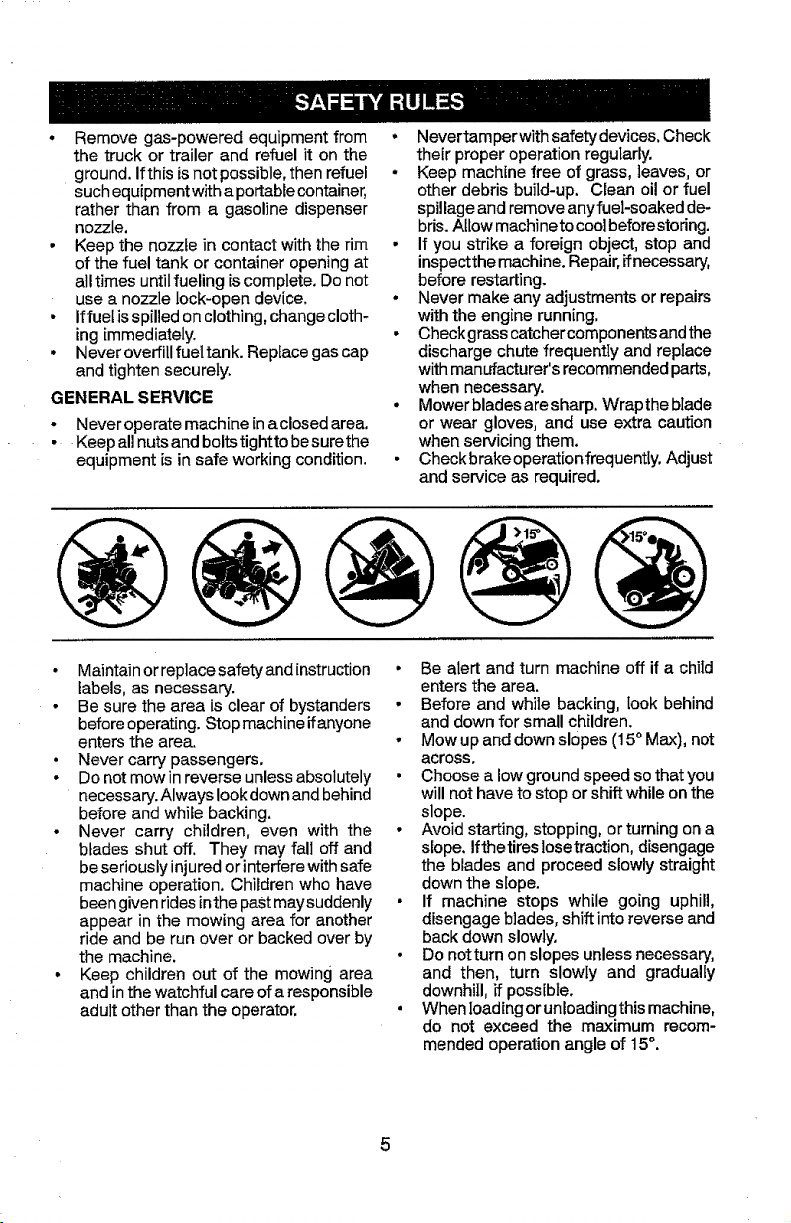
Slopes are a major factor related to loss of
control and tip-over accidents, which can
result in severe injury or death. Operation
on all slopes requires extra cautien, tf you
cannot back upthe slope or ifyou feel uneasy
on it, do not mow it.
- Mow up and down slopes, not across.
• Watch for holes, ruts, bumps, rocks, or
other hidden objects. Uneven terrain
could overturn the machine. Tall grass
can hide obstacles.
• Choose a low ground speed so that you
will not have to stop or shift while on the
slope.
Do not mow on wet grass. Tires may lose
traction,
Always keep the machine in gear when
going down slopes. Do notshiftto neutral
and coast downhill.
Avoid starting, stopping, or turning on a
slope. Ifthetireslosetraction, disengage
the blades and proceed slowly straight
down the slope.
- Keep all movement on the slopes slow
and gradual. Do not make sudden
changes in speed or direction, which
could cause the machine to roll over.
* Use extra care while operating machine
with grass catchers or other attachments;
they can affect the stability of the ma-
chine. Do no use on steep slopes.
• Do not try to stabilize the machine by
putting your foot on the ground,
. Do not mow near drop-offs, ditches,
or embankments, The machine could
suddenly roll over if a wheel is over the
edge or if the edge caves in.
Iil, CHILDREN
_WARNING: CHILDREN CAN BE INJURED
BY THIS EQUIPMENT. The American Acade-
my of Pediatrics recommends that children
be a minimum of 12 year of age before op-
erating a pedestrian controlled lawn mower
and a minimum of 16 years of age before
operating a riding lawn mower.
Tragic accidents can occur if the operator
is not alert to the presence of children.
Children are often attracted to the machine
and the mowing activity. Never assume
that children will remain where you last
saw them.
Q
• Keep children out of the mowing area
and inthe watchful care of a responsible
adult other than the operator,
• Be alert and turn machine off if a child
enters the area.
• Before and while backing, look behind
and down for small children.
• Never carry children, even withthe blades
shutoff. They mayfa!l off and be seriously
injured or interfere with safe machine
operation, Children who have beengiven
rides in the past may suddenly appear in
the mowing area for another ride and be
run over or backed over by the machine.
° Never allow children to operate the ma-
chine.
• Use extra care when approaching blind
corners, shrubs, trees, or other objects
that may block your view of a child.
IV. TOWING
- Tow only with a machine that has a hitch
designed for towing. Do notattach towed
equipment except at the hitch point.
° Followthe manufacturer's recommenda-
tion for weight limits for towed equipment
and towing on slopes.
• Never allow children or others in or on
towed equipment.
° Onslopes, theweightofthetowedequip-
ment may cause loss oftraction and loss
of control.
• Travel slowly and allow extra distance to
stop.
V. SERVICE
SAFE HANDLING OF GASOLINE
To avoid personal injury or property dam-
age, use extreme care in handling gasoline.
Gasoline is extremely flammable and the
vapors are explosive.
• Extinguish all cigarettes, cigars, pipes,
and other sources of ignition.
• Use only approved gasoline container.
• Never remove gas cap or add fuel with
the engine running. Allow engine to cool
before refueling.
• Never fuel the machine indoors.
• Neverstorethemachineorfuelcontainer
where there is an open flame, spark, or
pilot light such as on a water heater or
other appliances.
, Never fill containers inside a vehicle or
on a truck or trailer bed with plastic liner.
Always place containers on the ground
away from your vehicle when filling.
• Removegas-poweredequipmentfrom
thetruckortrailerandrefuelit onthe
ground.Ifthisisnotpossible,thenrefuel
suchequipmentwithaportablecontainer,
ratherthanfroma gasolinedispenser
nozzle.
• Keepthenozzleincontactwiththerim
ofthefueltankorcontaineropeningat
alltimesuntilfuelingiscomplete.Donot
useanozzlelock-opendevice.
• iffuefisspilledonclothing,changecloth-
ingimmediately.
• Never overfill fueltank. Replace gas cap
and tighten securely.
GENERAL SERVICE
- Never operate machine inaclosed area.
• Keep allnuts and bolts tightto besurethe
equipment is in safe working condition.
. Nevertamperwithsafetydevices, Check
their proper operation regularly.
• Keep machine free of grass, leaves, or
other debris build-up. Clean oil or fuel
spillage and remove any fuel-soaked de-
bris. Allow machineto cool beforestoring.
• If you strike a foreign object, stop and
inspectthe machine. Repair, ffnecessary,
before restarting.
• Never make any adjustments or repairs
with the engine running.
• Checkgrass catchercomponentsand the
discharge chute frequently and replace
with manufacturer's recommended parts,
when necessary.
• Mower blades aresharp. Wrap the blade
or wear gloves, and use extra caution
when servicing them.
• Checkbrakeoperationfrequently. Adjust
and service as required.
• Maintain or replace safety and instruction
labels, as necessary.
• Be sure the area is clear of bystanders
before operating. Stopmachine ffanyone
enters the area.
• Never carry passengers.
• Do not mow in reverse unless absolutely
necessary. Always look down and behind
before and while backing.
• Never carry children, even with the
blades shut off. They may fall off and
be seriously injured or interfere with safe
machine operation. Children who have
been given rides inthe pastmaysuddenly
appear in the mowing area for another
ride and be run over or backed over by
the machine,
• Keep children out of the mowing area
and inthe watchful care of a responsible
adult other than the operator.
• Be alert and turn machine off if a child
enters the area.
• Before and while backing, look behind
and down for small children.
• Mow up and down slopes (15°Max), not
across.
• Choose a low ground speed so that you
will not have to stop or shift while on the
slope.
• Avoid starting, stopping, or turning on a
slope. Ifthetires losetraction, disengage
the blades and proceed slowly straight
down the slope.
• If machine stops while going uphill,
disengage blades, shift into reverse and
back down slowly.
• Do notturn on slopes unless necessary',
and then, turn slowly and gradually
downhill, if possible.
• When loading or unloadingthis machine,
do not exceed the maximum recom-
mended operation angle of t5 °.

PRODUCT S PECIFICATIONS
Gasoline Capacity 3.0 Gailons/11,35 L
and type: Regular Unleaded
Oil Type: SAE30 (above 32°F/0°C)
(APh SG-SL) SAE 5W30 (below 32_F10°C)
Oit Capacity; W/Filter: 56 Oz.!! ,65 L
W/out Filter: 48 Oz./1,4 L
Spark Plug: Champion RC12YC
(Gap; .030"/0.76 mm)
Ground Speed Forward: 0 - 5.2/8,4
(Mph/Kph): Reverse: 0 - 2.9/4,7
Charging 3 Amps Battery
System: 5 Amps Headlights
Battery: Amp/Hr: 28
Min. CCA: 230
Case size: U1R
Blade Bolt Torque: 45-55 Ft, Lbs.i62-75 Nm
CONGRATULATIONS onyour purchase of
a new tractor. It has been designed, engi-
.... neeredand manutacturedto give you thebest
possible dependability and performance.
Should you experience any problemyou can-
not easily remedy, please contact a Sears or
other qualified service center. We have com-
petent, well-trained representatives and the
proper tools to service or repair this tractor,
Please read and retain this manual. The
instructions will enable you to assemble
and maintain your tractor properly. Always
observe the "SAFETY RULES".
CUSTOMER RESPONSIBILITIES
• Read and observe the safety rules.
• Follow a regularschedule in maintaining,
caring for and using your tractor.
• Follow instructions under "Maintenance"
and "Storage" sections of this manual.
• Wear proper Personal Protective Equip-
ment (PPE) while operating this machine,
including (at a minimum) sturdy footwear,
eye protection, and hearing protection. Do
notmowinshorts and/oropentoedfootwear.
• Always let someone knowyou are outside
mowing.
_WARNING: This tractor is equipped with
an internal combustion engine and should
not be used on or near any unimproved
forest-covered, brush-covered or grass-
covered land unless the engine's exhaust
system is equipped with a spark arrester
meeting applicable local or state laws (if
any), If a spark arrester is used, it should
be maintained in effective working order by
the operator.
Inthe state of Californiathe above is required
by law (Section 4442 of the California Public
Resources Code). Other states may have
similar laws. Federal laws apply on federal
lands. A spark arrester for the muffler is
availablethrough your nearest Sears service
center (See REPAIR PARTS manual).
REPAIR PROTECTION AGREEMENTS
Congratulations on making a smart pur-
chase. Your new Craftsman® product is
designed and manufactured for years of
dependable operation. But like all products,
it may require repair from time totime. That's
when having a Repair Protection Agreement
can save you money and aggravation.
Purchase a Repair Protection Agreement
now and protect yourseff from unexpected
hassle and expense.
Here's what's included in the Agreement:
• Expertservice byour 12,000professional
repair specialists.
• Unlimited service and no charg.efor parts
and labor on all covered repairs.
• Product replacement if your covered
product can't be fixed.
• Discount of 10% from regular price of
service and service-related parts not
covered bythe agreement;also, 10% off
regular price of preventive maintenance
check,
, Fast help by phone - phone support
from a Sears representative on products
requiring in-home repair,plusconvenient
repair scheduling,
Once you purchase theAgreement, asimpie
phone call is allthat ittakes for you to sched-
ule service. Youcan call anytime dayor night,
or schedule a service appointment online.
Sears has over 12,000 professional repair
specialists, who have access to over 4.5
million quality parts and accessories. That's
the kind of professionalism you can count on
to help.prolong the life of your new purchase
for years to come, Purchase your Repair
Protection Agreement today!
Some limitations and exclusions apply.
For prices and additional information call
1-800-827-6655.
SEARS INSTALLATION SERVICE
For Sears professional installation of home
appliances, garage door openers, water
heaters, and other major home items, inthe
U.S.A. call 1-800-4-MY-HOME®
6
,ll i
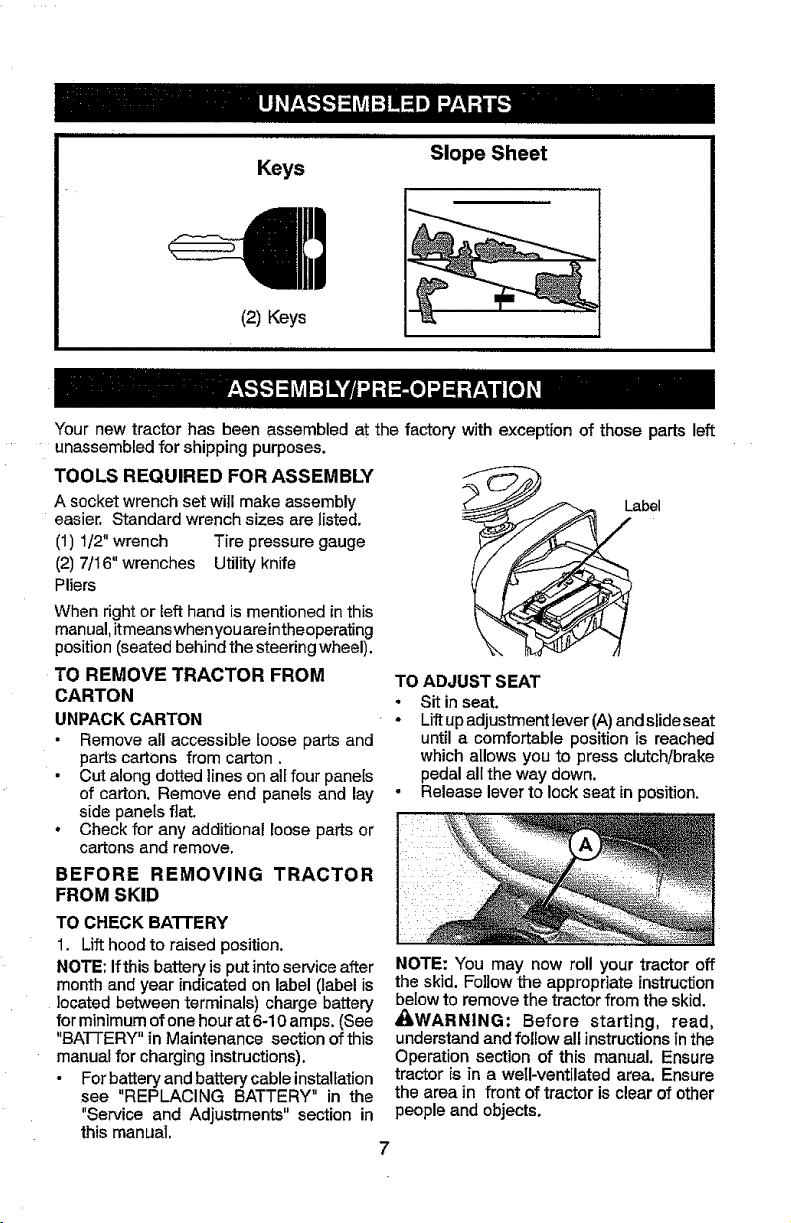
Slope Sheet
Keys
(2) Keys
lllllllllllll,lll ill illill
Your new tractor has been assembled at the factory with exception of those parts left
unassembled for shipping purposes.
TOOLS REQUIRED FOR ASSEMBLY
A socket wrench set will make assembly
easier. Standard wrench sizes are listed.
(1) 1/2" wrench Tire pressure gauge
(2) 7/16" wrenches Utility knife
Pliers
When right or left hand is mentioned in this
manual,itmeans when youare intheoperating
position (seated behind the steering wheel).
TO REMOVE TRACTOR FROM
CARTON
UNPACK CARTON
• Remove all accessible loose parts and
parts cartons from carton.
• Cut along dotted lines on all four panels
of carton. Remove end panels and lay
side panels flat.
, Check for any additional loose parts or
cartons and remove.
abel
TO ADJUST SEAT
• Sit in seat.
Lift up adjustment lever (A) and slide seat
until a comfortable position is reached
which allows you to press clutch!brake
pedal all the way down.
• Release lever to lock seat in position.
BEFORE REMOVING TRACTOR :: :_:
FROM SKID
TO CHECK BATTERY
1. Lift hood to raised position.
NOTE: Ifthis batteryis putinto service after
month and year indicated on label (label is
located between terminals) charge battery
for minimumof one hourat 6-10 amps. (See
"BATTERY" in Maintenance section of this
manual for charging instructions).
• Forbattery andbattery cable installation
see "REPLACING BATTERY" in the
"Service and Adjustments" section in
this manual
NOTE: You may now roll your tractor off
the skid. Follow the appropriate instruction
below to remove the tractorfrom the skid.
_WARNING: Before starting, read,
understand and follow all instructions in the
Operation section of this manual, Ensure
tractor is in a well-ventilated area. Ensure
the area in front of tractor is clear of other
people and objects.
7

TO ROLL TRACTOR OFF SKID (See
Operation section for location and
function of controls)
1. Raise attachment lift lever to its highest
position.
2. Release parking brake by depressing
clutch/brake pedal.
3. Place freewheel control in "transmission
disengaged position" (See "TO TRANS-
PORT"inOperation sectionofthis manual).
4. Roll tractor forward off skid.
5. Remove banding holding the deflector
shield up against tractor.
Continue with the instructionsthat follow.
CHECK TIRE PRESSURE
The tires on yourtractorwere overinflatedat
the factory for shipping purposes. Correct
tire pressure is important for best cutting
performance.
• Reduce tire pressure to PSI shown on
tires.
CHECK DECK LEVELNESS
For best cutting results, mower housing
should be properly leveled. See "TO LEVEL
MOWER" in the Service and Adjustments
section of this manual.
CHECK FOR PROPER POSITION OF
ALL BELTS
See the figures that are shown for replacing
motion and mower blade drive belts in the
Service andAdjustments section of this man-
ual. Verify that the belts are routed correctly,
CHECK BRAKE SYSTEM
After you learn how to operate your tractor,
check to see that the brake is operating
properly. See "TO CHECK BRAKE" in the
Service and Adjustments section of this
manual,
t_CHECKLIST
Before you operate your new tractor, we
wish to assure that you receive the best
performance and satisfaction from this
Quality Product.
Please review the following checklist:
All assembly instructions have been
completed.
I/" No remaining loose parts in carton.
_" Battery is properly prepared and charged.
J" Seat is adjusted comfortably and tight-
ened securely.
J" All tires are properly inflated. (For ship-
pingpurposes, thetires were ovednflated
at the factory).
_" Be sure mower deck is properly leveled
side-to-sideifront-to-rear for best cutting
results. (Tires must be properly inflated
for leveling).
J" Check mower and drive belts. Be sure
they are routed properly around pulleys
and inside all belt keepers.
J" Check wiring. See that all connections
are still secure and wires are properly
clamped.
v/ Before driving tractor, be sure freewheel
control is in "transmission engaged"
position (see "TO TRANSPORT" in the
Operation section of this manual),
Whilelearning howto useyour tractor, payex-
tra attention to the following important items:
_/" Engine oil is at proper level.
J" Fueltank is filled with fresh, clean, regular
unleaded gasoline.
J" Become familiar with all controls, their
location and function. Operate them
before you start the engine.
J' Be sure brake system is insafe operating
condition.
_" Be sure Operator Presence System and
Reverse Operation System (ROS) are
working properly (Seethe Operation and
Maintenance sections in this manual).
J" tt is important to purge the transmission
before operating your tractor for the
first time. Follow proper starting and
transmission purging instructions (See
"TO START ENGINE" and "PURGE
TRANSMISSION" in the Operation sec-
tion of this manual).
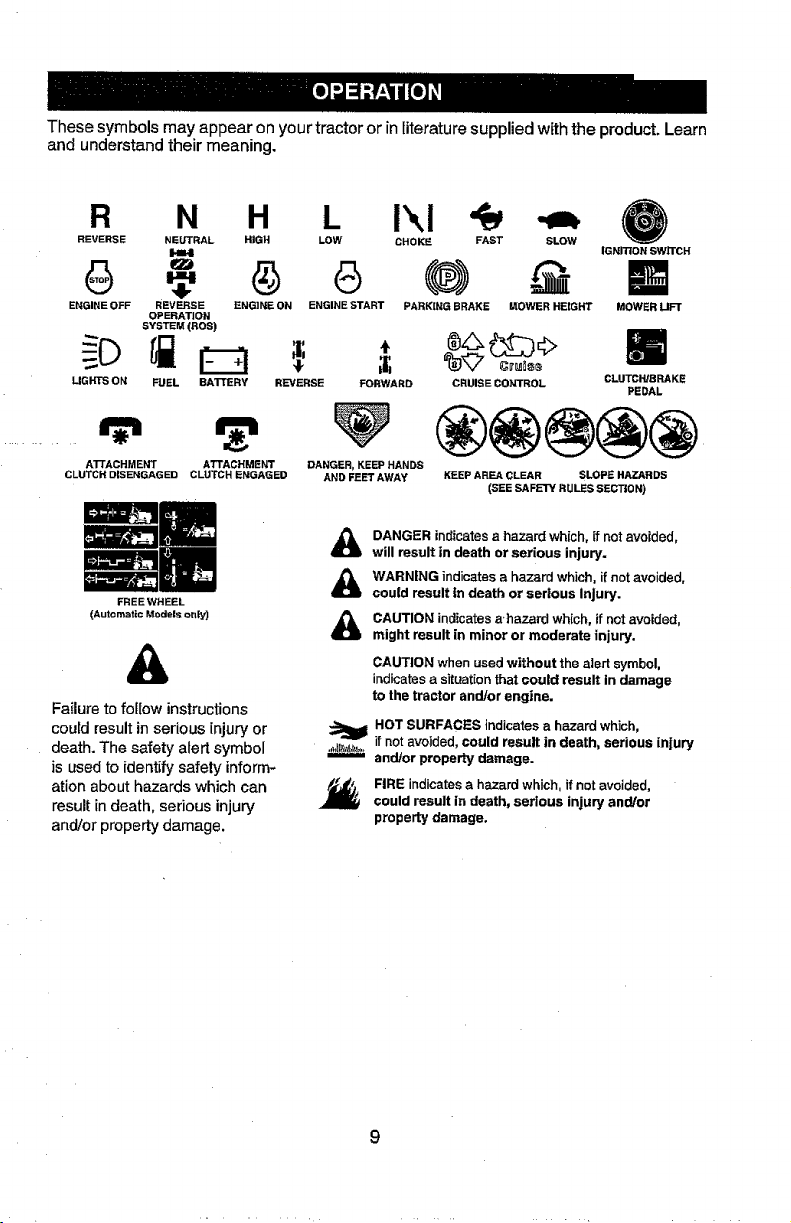
Thesesymbolsmayappearonyourtractororinliteraturesuppliedwiththeproduct,Learn
and understand their meaning,
R N H L
REVERSE NEUTRAL NIGH LOW
ENGINE OFF REVERSE ENGINE ON ENGINE START
OPERATION
SYSTEM (ROE)
I\!
CHOKE FAST
IGNmON Swi"rCH
PARKING BRAKE MOWER LIFT
LIGHTS ON FUEL SAVagERY REVERSE FORWARD
............
ATTACHMENT ATTACHMENT DANGER, KEEP HANDS
CLUTCH DISENGAGED CLUTCH ENGAGED AND FEET AWAY
FREE V_HEEL
(Automatic Models ortly}
&
SLOW
MOWER HEIGHT
Failure to follow instructions
could result in serious injury or
death. The safety alert symbol
is used to identify safety inform-
ation about hazards which can
result in death, serious injury
and/or property damage.
CRUISE CONTROL CLUTCHIB RAKE
PEDAL
KEEP AREA CLEAR SLOPE HAZARDS
(SEESAFETYRULESSECTION)
DANGER indicates a hazard which, if net avoided,
will result in death or serious injury.
_lb ARNING indicates a hazard which, if not avoided,
could result In death or serious injury.
CAUTlON indicates a, hazard which, tf not avoided,
might result in minor or moderate injury.
CAUTION when used without the a|srt symbol,
indicates a situation that could result in damage
to the tractor and/or engine.
HOT SURFACES indicates a hazard which
if not avoided could result in death, serious injury
and/or property damage.
FIRE indicates a haZard which, if nDt avoided,
could result in death, serious injury and/or
property damage.
KNOW YOUR TRACTOR
READ THIS MANUAL AND SAFETY RULES BEFORE OPERATING YOUR TRACTOR
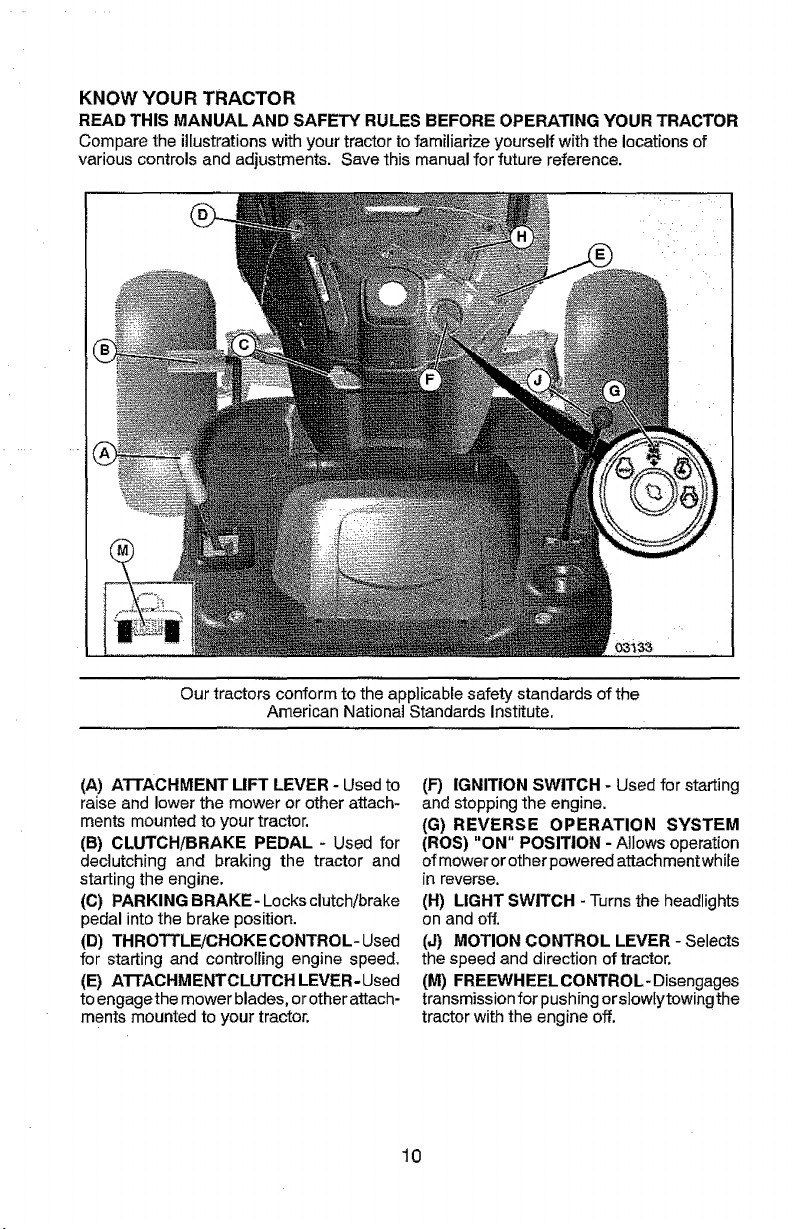
Compare the illustrationswith your tractor to familiarize yourself with the locations of
various controls and adjustments. Save this manual for future reference.
03t_
Our tractors conform to the applicable safety standards of the
American National Standards Institute,
(A) ATTACHMENT LIFT LEVER - Used to
raise and lower the mower or other attach-
ments mounted to your tractor.
(B) CLUTCH!BRAKE PEDAL - Used for
declutching and braking the tractor and
starting the engine.
(C) PARKING BRAKE- Locks clutch/brake
pedal into the brake position.
(D) THROTTLE/CHOKE CONTROL- Used
for starting and controrling engine speed.
(E) ATFACHM ENTCLUTOH LEVER- Used
to engagethe mower blades, or other attach-
ments mounted to your tractor.
(F) IGNITION SWITCH - Used for starting
and stopping the engine.
(G) REVERSE OPERATION SYSTEM
(ROS) "ON" POSITION - Allows operation
of mower or other powered attachment while
in reverse.
(H) LIGHT SWITCH - Turns the headlights
on and off.
(J) MOTION CONTROL LEVER - Selects
the speed and direction of tractor,
(M) FREEWHEEL CONTROL- Disengages
transmission for pushing or slowlytowing the
tractor with the engine off,
10
The operation of any tractor can result in foreign objects thrown into
the eyes, which can result in severe eye damage. Always wear safety
glasses or eye shields while operating your tractor or performing any
adjustments or repairs. We recommend standard safety glasses or a
wide vision safety mask worn over spectacles.
HOW TO USE YOUR TRACTOR
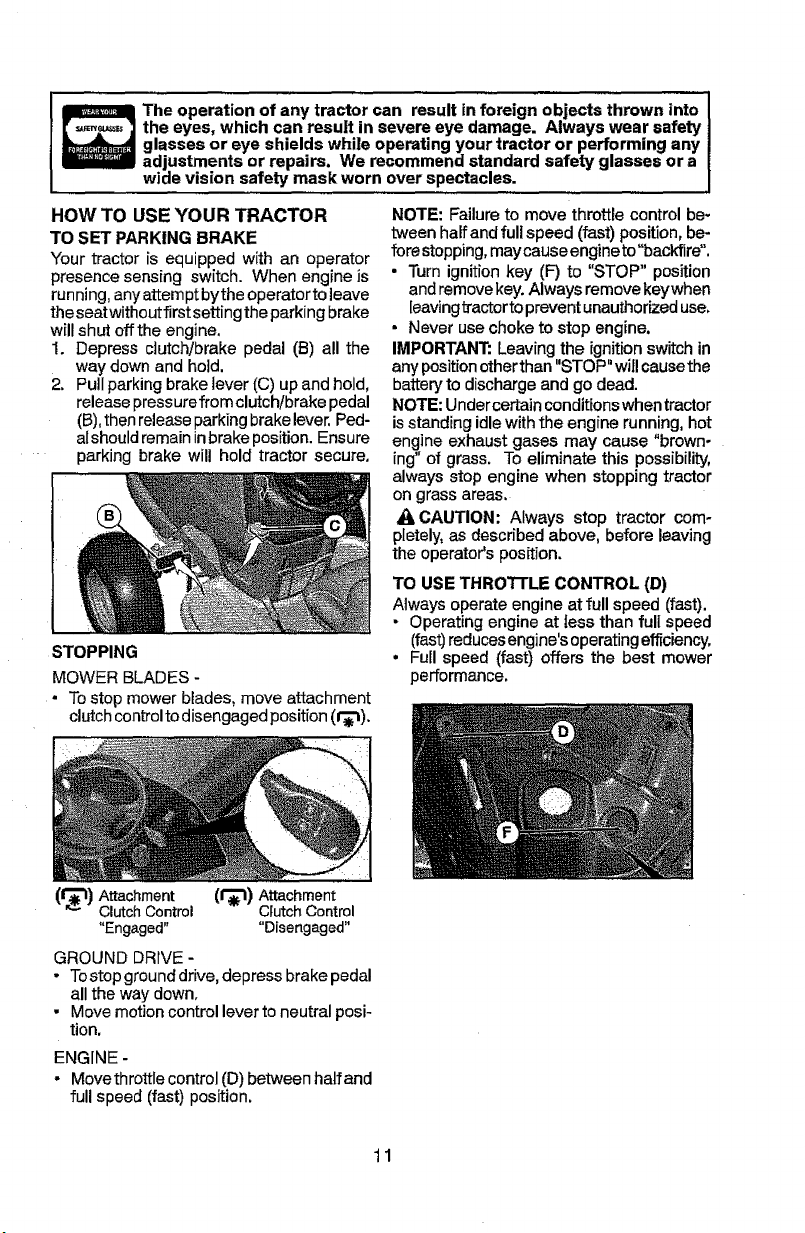
TO SET PARKING BRAKE
Your tractor is equipped with an operator
presence sensing switch. When engine is
running, any attempt bythe operator to leave
theseat withoutfirst setting the parking brake
will shut off the engine.
1. Depress clutch/brake pedal (B) all the
way down and hold.
2. Pull parkingbrake lever (C) up and hold,
release pressure from clutch/brake pedal
(B),then releaseparking brakelever. Ped-
alshould remain in brake position. Ensure
parking brake wil! hold tractor secure,
NOTE: Failure to move throttle control be-
tween half and full speed (fast) position,be-
fore stopping, maycause engine to"backfire".
• Turn ignition key (F) to "STOP" position
and remove key. Always remove keywhen
leavingtractor to prevent unauthorized use.
• Never use choke to stop engine.
IMPORTANT: Leaving the ignition switch in
any position otherthan "STOP" willcausethe
battery to discharge and go dead.
NOTE: Undercertain conditions when tractor
is standing idle with the engine running, hot
engine exhaust gases may cause "brown-
ing" of grass, To eliminate this possibility,
always stop engine when stopping tractor
on grass areas,
_CAUTION: Always stop tractor com-
pletely, as described above, before leaving
the operator's pos_ion.
STOPPING
MOWER BLADES -
• To stop mower blades, move attachment
clutch controlto disengaged position (t_).
TO USE THROTTLE CONTROL (D)
Always operate engine at full speed (fast).
• Operating engine at less than full speed
(fast)reducesengine's operating efficiency,
• Full speed (fast) offers the best mower
performance,
(1'_'1) Attachment {1"_) Attachment
Clutch Control Clutch Control
"Engaged .... Disengaged"
GROUND DRIVE -
• Tostop ground drive, depress brake pedal
all the way down,
• Move motion control lever to neutral posi-
tion,
ENGINE -
- Movethrottle control (D) between hatfand
full speed (fast) position,
11
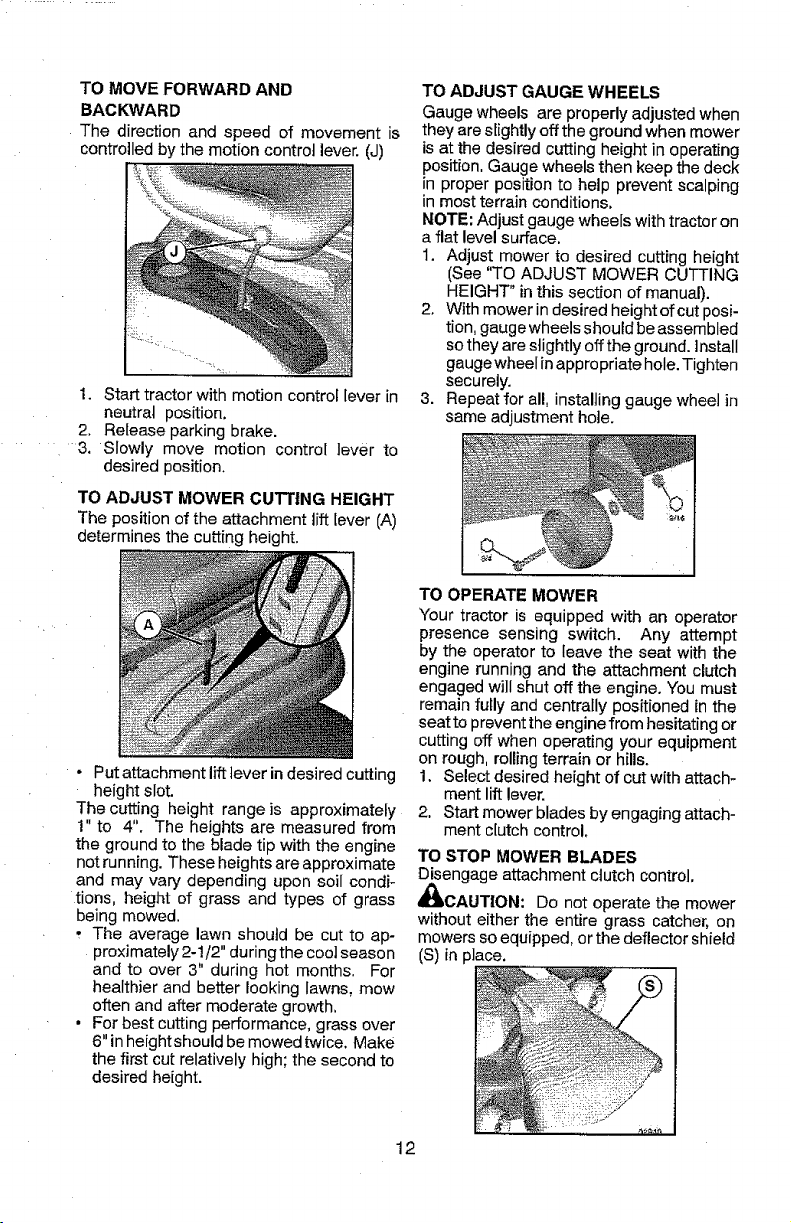
TO MOVE FORWARD AND
BACKWARD
The direction and speed of movement is
controlled by the motion control lever. (J)
1. Start tractor with motion control lever in
neutral position.
2. Release parking brake.
3. Slowly move motion control lever to
desired position.
TO ADJUST MOWER CUTTING HEIGHT
The position of the attachment liftlever (A)
determines the cutting height.
TO ADJUST GAUGE WHEELS
Gauge wheels are properlyadjustedwhen
they are slightly offthe ground when mower
is at the desired cutting height in operating
position. Gauge wheels then keep the deck
in proper position to help prevent scalping
in most terrain conditions,
NOTE: Adjust gauge wheels with tractor on
a flat level surface.
1. Adjust mower to desired cutting height
(See "TO ADJUST MOWER CUTTING
HEIGHT" inthis section of manual).
2. With mower in desired heightofcut posi-
tion, gauge wheels should be assembled
so they are slightly off the ground. Install
gauge wheel in appropriate hole.Tighten
securely.
3. Repeat for all, installing gauge wheel in
same adjustment hole.
• Put attachment lift lever in desired cutting
height slot.
The cutting height range is approximately
1" to 4". The heights are measured from
the ground to the blade tip with the engine
not running. These heights are approximate
and may vary, depending upon soil condi-
tions, height of grass and types of grass
being mowed.
The average lawn should be cut to ap-
proximately 2-!/2" during the cool season
and to over 3" during hot months. For
healthier and better looking lawns, mow
often and after moderate growth,
• For best cutting performance, grass over
6" in height should be mowed twice. Make
the first cut relatively high; the second to
desired height.
TO OPERATE MOWER
Your tractor is equipped with an operator
presence sensing switch. Any attempt
by the operator to leave the seat with the
engine running and the attachment clutch
engaged will shut off the engine. You must
remain fully and centrally positioned in the
seat to prevent the engine from hesitating or
cutting off when operating your equipment
on rough, rolling terrain or hills.
1. Select desired height of cut with attach-
ment lift lever.
2. Start mower blades by engaging attach-
ment clutch control.
TO STOP MOWER BLADES
Disengage attachment clutch control.
_IbCAUTION: Do not operate the mower
without either the entire grass catcher, on
mowers so equipped, or the deflector shield
(S) in place.
12
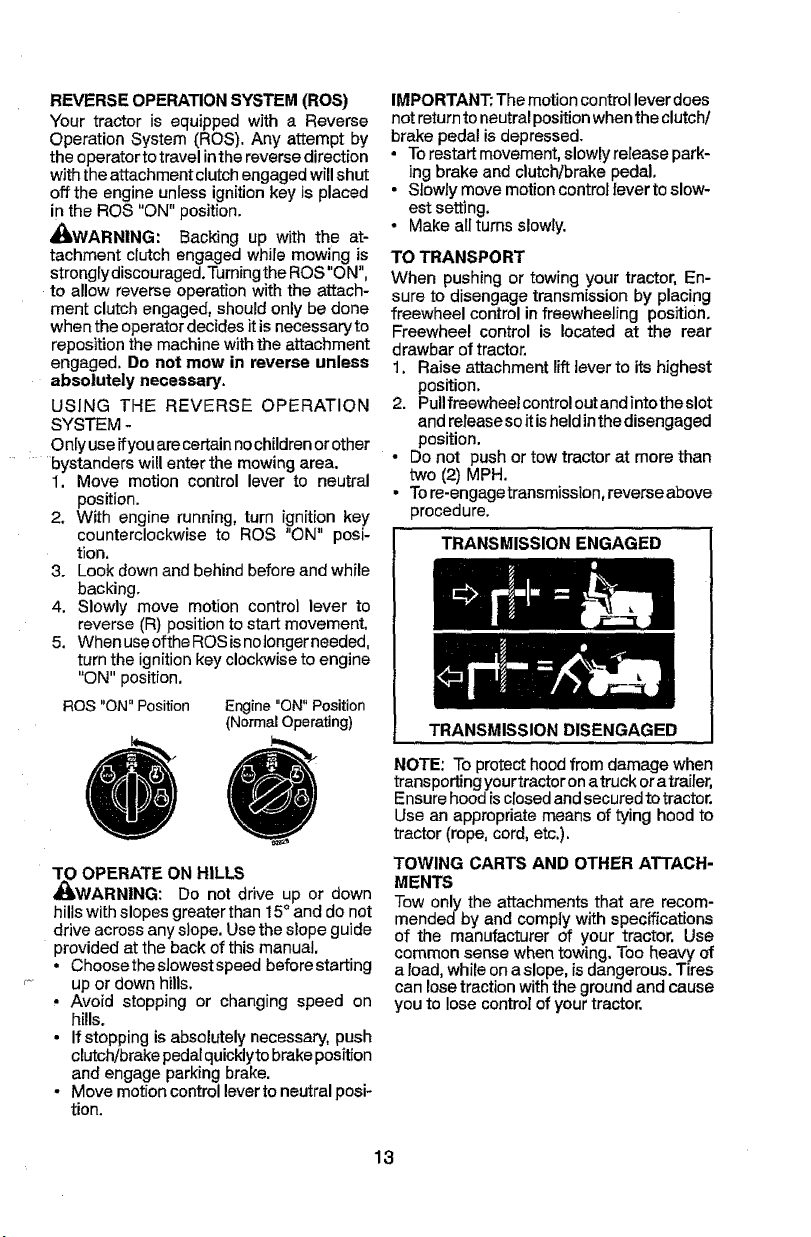
REVERSE OPERATION SYSTEM (ROS)
Your tractor is equipped with a Reverse
Operation System (ROS), Any attempt by
the operatorto travel inthereversedirection
withthe attachmentclutchengaged will shut
offthe engine unless ignitionkey is placed
in the ROS "ON" position.
,dI_WARNING: Backing up with the at-
tachment clutch engaged while mowing is
strong[ydiscouraged. Turningthe ROS"ON",
to allow reverse operation with the attach-
ment clutch engaged, should only be done
when the operator decides it is necessary to
reposition the machine with the attachment
engaged. Do not mow in reverse unless
absolutely necessary.
USING THE REVERSE OPERATION
SYSTEM -
Only use ifyou are certain nochildren orother
bystanders will enter the mowing area.
1. Move motion control lever to neutral
position.
2. With engine running, turn ignition key
counterclockwise to ROS "ON" posi-
tion.
3. Look down and behind before and while
backing.
4. Slowly move motion control lever to
reverse (R) position to start movement.
5. When useofthe ROSis notongerneeded,
turn the ignition key clockwise to engine
"ON" position.
ROS "ON" Position
Engine "ON" Position
(Normal Operating)
TO OPERATE ON HILI._
d_IbWARNING: Do not drive up or down
hills with slopes greater than 15° and do not
drive across any slope. Use the slope guide
provided at the back of this manual.
• Choose the slowest speed beforestarting
up or down hills.
, Avoid stopping or changing speed on
hills.
• If stopping is absolutely necessary, push
clutch/brake pedalquicklyto brakeposition
and engage parking brake.
• Move motion control leverto neutral posi-
tion.
IMPORTANT; The motion control leverdoes
not returnto neutral position whenthe clutch/
brake pedal is depressed.
• To restart movement, slow!y release park-
ing brake and clutch/brake pedal.
• Sfowly move motion control lever to slow-
est setting.
• Make all turns slowly.
TO TRANSPORT
When pushing or towing your tractor, En-
sure to disengage transmission by placing
freewheel control in freewheeling position.
Freewheel control is located at the rear
drawbar of tractor.
1. Raise attachment lift lever to its highest
position.
2. Pullfreewheel control out andinto the slot
and release so it is held inthe disengaged
position.
• Do not push or tow tractor at more than
two (2) MPH.
• To re-engage transmission, reverse above
procedure.
TRANSMISSION ENGAGED
TRANSMISSION DISENGAGED
NOTE: To protect hood from damage when
transporting yourtractor on atruck or atraiter,
Ensure hood is closedand secured to tractor.
Use an appropriate means of tying hood to
tractor (rope, cord, etc.).
TOWING CARTS AND OTHER ATTACH-
MENTS
Tow only the attachments that are recom-
mended by and comply with specifications
of the manufacturer of your tractor. Use
common sense when towing. Too heavy of
a load, while on a slope, is dangerous. Tires
can lose traction with the ground and cause
you to lose control of your tractor.
13
BEFORE STARTING THE ENGINE
CHECK ENGINE OIL LEVEL
The engine in your tractor has been shipped,
from the factory, already filled with summer
weight oil.
1. Check engine oil with tractor on level
ground.
2. Remove oil fill cap/dipstick and wipe
clean, reinsertthe dipstick and screw cap
tight, waitfor a few seconds, remove and
read oil level, tf necessary, add oil until
"FULL' mark on dipstick is reached. Do
not overfill,
• For cold weather operation you should
change oil for easier starting (See the oil
viscosity chart inthe Maintenance section
of this manual).
- Tochange engine oil, see the Maintenance
section in this manual.
ADD GASOLINE
........ _, Filt fuel tank to bottom offiller neck. Do not
overfill. Usefresh, clean, regutarunleaded
gasoline with a minimum of 87 octane,
(Use of leaded gasoline will increase
carbon and leadoxide deposits and reduce
valve life). Do not mix oil with gasoline.
Purchase fuelin quantitiesthatcan beused
within 30 days to ensure fuel freshness,
d_t,CAUTION: Wipe off anyspilled oil or fuel.
Do not store, spill or use gasoline near an
open flame.
IMPORTANT: When operating in tem-
peratures below 32°F(0°C), usefresh, clean
winter grade gasoline to help ensure "good
cold weather starting,
CAUTION: Alcohol blended fuels (called
gasohol or using ethanol or methanol) can
attract moisture which leads to separation
and formation ofacids during storage. Acidic
gas candamage thefuel system of an engine
while in storage. To avoid engine problems,
the fuel system should be emptied before
storage of 30 days or longer. Drain the gas
tank, start the engine andlet it run until the
fuel lines and carburetor are empty. Use fresh
fuel next season. See Storage Instructions
for additional information. Never use engine
orcarburetor cleaner products inthefueltank
or permanent damage may occur.
TO START ENGINE
When starting the engine for the first time or
if the engine has run out of fuel, it wilt take
extra cranking time to move fuel from the
tank to the engine,
1. Ensure freewheel control is in the trans-
mission engaged position.
2. Sit on seat in operating position, depress
clutch/brake pedal andset parking brake.
3. Place motion control lever in neutral
position,
4. Move attachment clutch to disengaged
position.
5. Move throttle control to choke position.
NOTE: Before starting, read the warm and
cold starting procedures below.
6. Insert key into ignition and turn key
clockwise to start position and release
key as soon as engine starts. Do not run
starter continuously for more than fifteen
seconds per minute, if the engine does
not start after several attempts, move
throttle control to fast position, wait a
few minutes and try again. If engine still
does not start, move the throttle control
back to the choke position and retry.
WARM WEATHER STARTING
(50°F/10°C and above)
7. When engine starts, move the throttle
control to the fast position.
• The attachments and ground drive can
now be used. Ifthe engine does not accept
the load, restart the engine and allow it to
warm up for one minute using the choke
as described above.
COLD WEATHER STARTING
(50°F/10°C and below)
7. When engine starts, leave throttle control
in choke position until engine warms up
and begins to run roughly. Once rough
running begins, immediately move the
throttle controltothe fast position. Engine
warm-up may take from several seconds
to several minutes (the colder the tem-
perature, the longer the warm-up). ,
AUTOMATIC TRANSMISSION WARM UP
Before driving the unit in cold weather, the
transmission should bewarmed upas fol!ows:
1, Ensure the tractor is on level ground.
2, Place the motion control lever in neutral.
Release the parking brake and let the
clutch/brake slowly return to operating
position.
3. AIIowone minutefor transmissiontowarm
up. This can be done during the engine
warm up period,
• The attachments can also be used dur-
ing the engine warm-up period after the
transmission has been warmed up.
NOTE: Ifata highaltitude (above 3000 feet)
or in cold temperatures (below 32°F/0°C)
the carburetor fuel mixture may need to be
adjusted for best engine performance (see
"TOADJUST CARBURETOR" inthe Service
and Adjustments section of this manual).
14
PURGE TRANSMISSION
_.CAUTION: Never engage or disengage
freewheel lever while the engine is running.
Toensure properoperationandperformance,
it is recommended that the transmission be
purged before operating tractor for the first
time. This procedure will remove anytrapped
air inside the transmission which may have
developed during shipping of your tractor.
IMPORTANT: Should your transmission
require removal for service or replacement,
it should bepurged after reinstallation before
operating the tractor.
t. Place tractor safely on a level surface -
that is clear of objects and open - with
engine off and parking brake set.
2. Disengage transmission by placing
freewheel control indisengaged position
(See "TO TRANSPORT" in this section
of manual).
3. Sitting in the tractor seat, start engine.
After the engine is running, move throttle
control to slow position. With motion
control lever in neutral position, slowly
disengage clutch/brake pedal.
_IbCAUTION: At any time, during step 4,
there may be movement of the drive wheels.
4. Move motion control lever to full forward
position and hold for five (5) seconds.
Move lever to full reverse position and
hold for five (5) seconds. Repeat this
procedure three (3) times.
5. Move motion control lever to neutral
position. Shutoff engine and set parking
brake.
6. Engage transmission by placing free-
wheel control in engaged position (See
"TO TRANSPORT" in this section of
manual).
7. Sitting in the tractor seat, start engine.
After the engine is running, move throttle
control to half (1/2) speed. With motion
control Fever in neutral position, slowly
disengage clutch!brake pedal.
8. Slowly move motioncontrol leverforward,
after the tractor moves approximately
five (5) feet, slowly move motion control
lever to reverse position.After the tractor
moves approximately five (5) feet return
the motion control lever to the neutral
position.Repeat this procedure with the
motion control lever three (3) times.
Your transmission is now purged and now
ready for normal operation.
MOWING TIPS
- Tire chains cannot be used when the
mower housing is attached to tractor.
• Mower should beproperly leveled for best
mowing performance. See "TO LEVEL
MOWER HOUSING" in the Service and
Adjustments section of this manual.
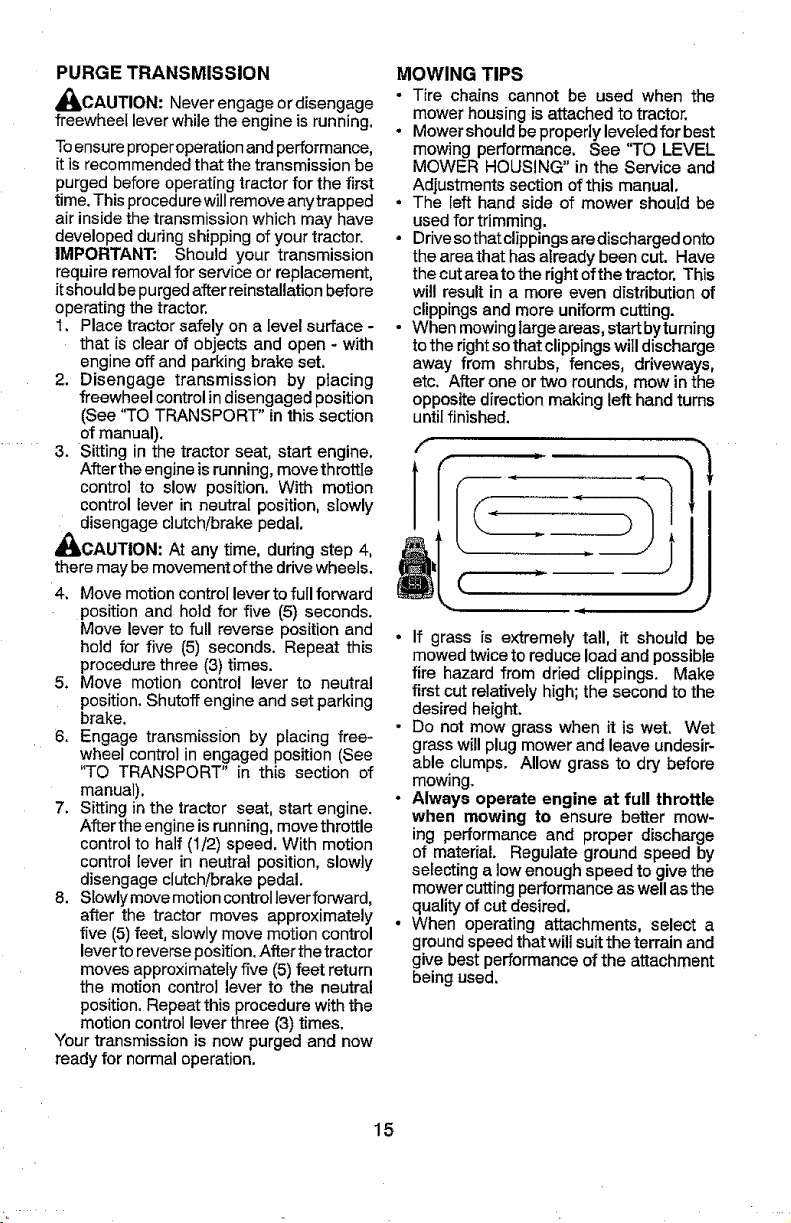
• The left hand side of mower shoutd be
used for trimming.
• Drive so that clippings aredischarged onto
the areathat has already been cut. Have
the cut areato the right ofthe tractor. This
will result in a more even distribution of
clippings and more uniform cutting.
• When mowing largeareas, start bytuming
to the right so that clippings witldischarge
away from shrubs, fences, driveways,
etc. After one or two rounds, mow in the
opposite direction making left hand turns
until finished.
,, ,
• If grass is extremely tall, it should be
mowed twice to reduce load and possible
fire hazard from dried clippings. Make
first cut relatively high; the second to the
desired height.
• Do not mow grass when it is wet. Wet
grass will plug mower and leave undesir-
able clumps. Allow grass to dry before
mowing.
. Always operate engine at full throttle
when mowing to ensure better mow-
ing performance and proper discharge
of material. Regulate ground speed by
selecting a low enough speed to give the
mowercuttingperformance as wellas the
quality of cut desired.
• When operating attachments, select a
ground speed thatwili suitthe terrainand
give best performance of the attachment
being used.
15
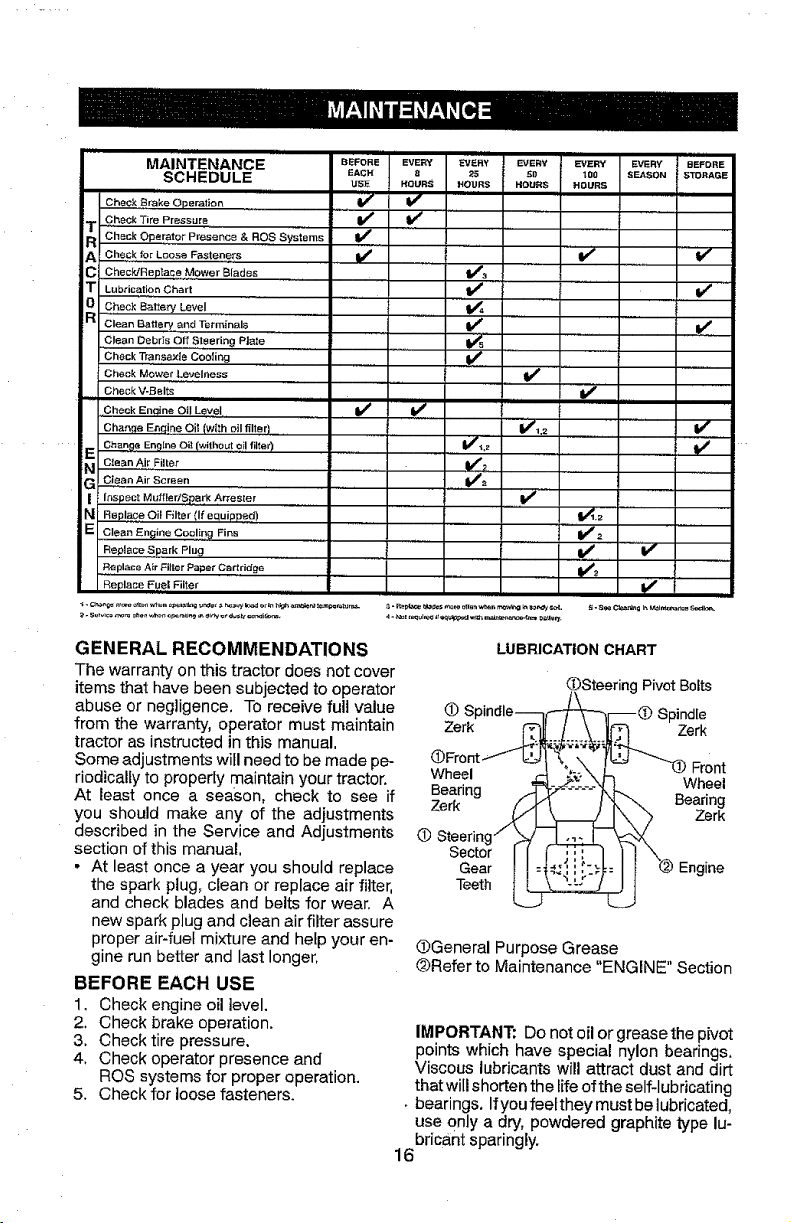
MAINTENANCE "
BEFORE EVERY _-'VERY" EVER"# ii ,,llll II
EV_ERY F*V_RY BEFORE
SCHEDULE EACH 8 _ _ _0o E_SON STORAGE
USE HOUR r_ HOURS HOURS HOURS
Check Brake Operation ..... _ _ '"' "
,,,,,C,heek Tire Pressure ,, V _ if "
T Check Operator Presence & ROS Systems if ,
A Check for L .... Fasteners V p ,if, .... V_
C Check/Replace Mower Blades I_'_ ....
T Lubrication Chart _ ..... if
0 Check Battery Level _ .....
R clean BattenandTerminals _ _
Clean Oebds Off St,Bering P|ate ..... _ .......
Check Tragsa_ie Cooling ......... 6f '.....
Check Mower Levelness ...... V _
Check V-Belts If' '
,llll ,ll =ill, i 1,11 H
Check Engine Oil DeveI If if
Cha_ee E_qine Oi (with oil f_Iter) ,, VI,_ V'
Ohan qe Engine Oit I'witheLtt ei! filter) Vr,;,_ t###
NE Ctean Ai[,,Filter V'_ ..........
G C!_aeAir Screen ..... I_
| IRspect MufflertSpark An'ester ..........
N R_(:ff Oil Filter (if equipped) _._,
E Clean Engine Coc!!ng Fins '" , ,,, 'V'= " '
Replace Spark Plug If,, , "if
,,Replace Air Filter Paper Cartridge 1_2
ReFlace Fuel Filter ....... V F
GENERAL RECOMMENDATIONS
The warranty on this tractor does not cover
items that have been subjected to operator
abuse or negligence. To receive full value
from the warranty, operator must maintain
tractor as instructed in this manual,
Some adjustments will need to be made pe-
riodically to proper[y maintain your tractor.
At least once a season, check to see if
you should make any of the adjustments
described in the Service and Adjustments
section of this manual,
• At least once a year you should replace
the spark plug, clean or replace air filter,
and check blades and belts for wear. A
new spark plug and clean air filter assure
proper air-fuef mixture and help your en-
gine run better and last longer.
BEFORE EACH USE
1. Check engine oil level.
2. Check brake operation.
3. Check tire pressure.
4. Check operator presence and
ROS systems for proper operation.
5. Check for loose fasteners.
LUBRICATION CHART
_)Steering Pivot Bolts
Zerk Zerk
Wheel Front
Bearing Wheel
Zerk Bearing
Zerk
Steerin(
Sector
Gear
Teeth
_General Purpose Grease
@Refer to Maintenance "ENGINE" Section
IMPORTANT: Do not oil or greasethe p_vot
points which have special nylon bearings,
Viscous lubricants will attract dust and dirt
that will shorten the life of the self-lubricating
• bearings. Ifyoufeetthey must belubricated,
use 0nly a dry, powdered graphite type lu-
bricant sparingly.
16
TRACTOR
Always observe safety ruleswhen performing
any maintenance.
BRAKE OPERATION
If tractor requires more than five (5) feet to
stop at highest speed in highest gear on a
level, dry concrete or paved surface, then
brake must be serviced. (See "TO CHECK
BRAKE" in the Service and Adjustments
section of this manual).
TIRES
• Maintain proper air pressure in all tires
(See the sides of tires for proper PSI).
• Keep tires free of gasoline, oil, or insect
control chemicals which can harm rubber,
. Avoid stumps, stones, deep ruts, sharp
objects and other hazards that may cause
tire damage,
NOTE: To seal tire punctures and prevent
.........flat tires due to slow leaks, tire sealant may
be purchased from your local parts dealer,
Tire sealant also prevents tire dry rot and
corrosion.
OPERATOR PRESENCE SYSTEM AND
REVERSE OPERATION SYSTEM (ROS)
Ensure operator presence and reverse
operation systems are working properly. If
your tractor does not function as described,
repair the problem immediately,
• The engine should not start unless the
brake pedal is fully depressed, and the
attachment clutch control is in the disen-
gaged position,
CHECK OPERATOR PRESENCE
SYSTEM
• When the engine is running, any attempt
by the operator to leave the seat without
first setting the parking brake should shut
off the engine.
• When the engine is running and the at-
tachment clutch is engaged, any attempt
by the operator to leave the seat should
shut offthe engine.
• The attachmentclutch should neveroper-
ate unless the operator is in the seat.
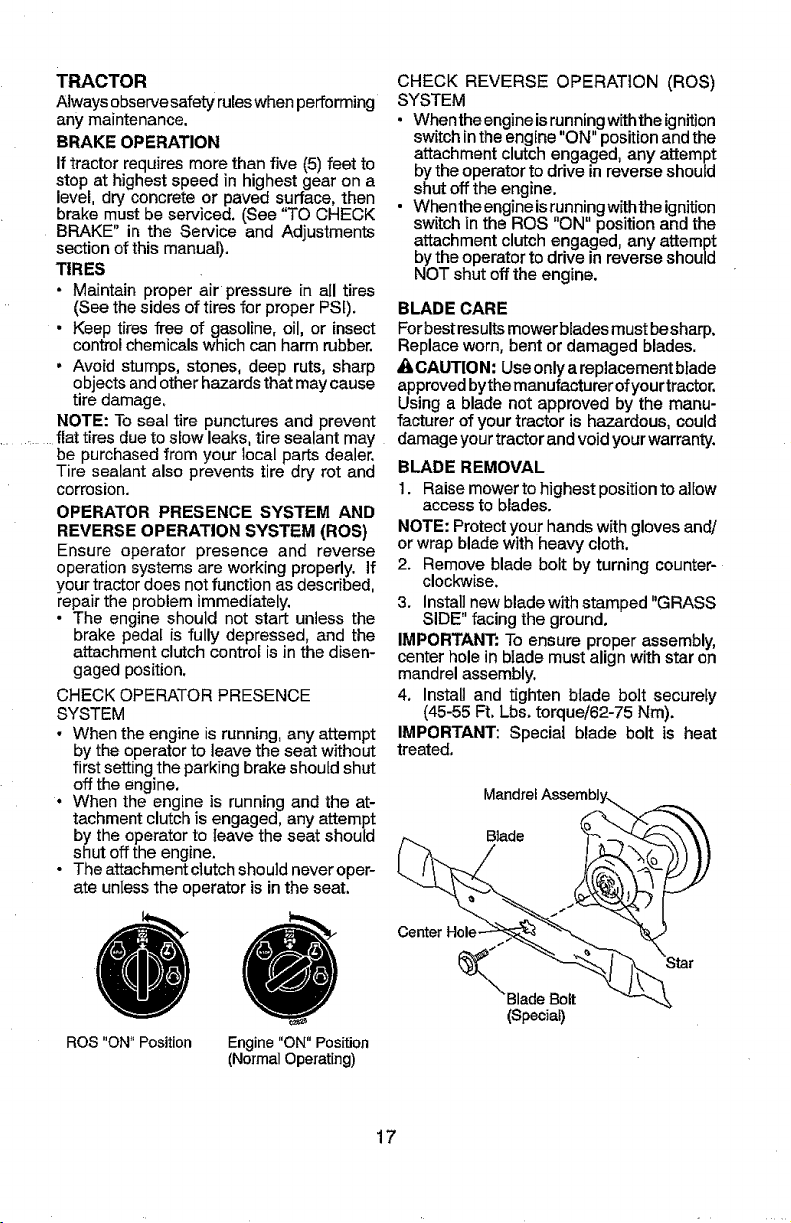
ROS "ON" Position Engine "ON" Position
(Normal Operating)
CHECK REVERSE OPERATION (ROS)
SYSTEM
• Whenthe engine is running withthe ignition
switch in the engine "ON" position and the
attachment clutch engaged, any attempt
by the operator to drive in reverse should
shut off the engine.
• Whenthe engine is running withthe ignition
switch in the ROS "ON" position and the
attachment clutch engaged, any attempt
by the operator to drive in reverse should
NOT shut off the engine.
BLADE CARE
Forbest results mower bladesmustbesharp,
Replace worn, bent or damaged blades.
ACAUTION: Use onlya replacement bfade
approved bythemanufacturer ofyourtractor,
Using a blade not approved by the manu-
facturer of your tractor is hazardous, could
damage yourtractorand void yourwarranty,
BLADE REMOVAL
1. Raise mowerto highestposition to allow
access to blades.
NOTE: Protect your hands with gloves and/
or wrap blade with heavy cloth,
2. Remove blade bolt by turning counter-
clockwise,
3. Install new blade with stamped "GRASS
SIDE" facing the ground.
IMPORTANT: To ensure proper assembly,
center hole in blade must align with star on
mandrel assembly,
4. Install and tighten blade bolt securely
(45-55 Ft. Lbs. torque/62-75 Nm).
IMPORTANT: Special blade bolt is heat
treated,
Center Hole-
_'Blade Bolt
(Special)
17
BATTERY
Your tractor has a battery charging system
which is sufficient for normal use. However,
periodic charging of the battery with an au-
tomotive charger will extend its life.
* Keep battery and terminals clean.
, Keep battery bolts tight.
- Keep small vent holes open.
• Recharge at 6-10 amperes for 1 hour.
NOTE: The original equipment battery on
your tractor is maintenance free, Do not
attempt to open or remove caps or covers.
Adding or checking level of electrolyte is
not necessary.
TO CLEAN BATTERY AND TERMINALS
Corrosion and dirt on the battery and termi-
nals can cause the battery to "leak" power.
I. Disconnect BLACK battery cable first
then RED battery cable and remove
battery from tractor.
2. Rinsethe batterywith plainwateranddry.
3, Clean terminals and battery cable ends
........ with wire brush until bright.
4. Coat terminals with grease or petreleum
jelly.
5, Reinstall battery (See "REPLACING
BATTERY" in the SERVICE AND AD-
JUSTMENTS section of this manual).
V-BELTS
CheckV-belts for deterioration andwear after
100 hours of operation and replace ifneces-
sary. The belts are not adjustable, Replace
belts if they begin to slip from wear,
TRANSAXLE COOLING
Thetransmissionfan and cooling fins should
be kept clean to ensure proper cooling.
Do not attempt to clean fan or transmission
while engine is running or while the trans-
mission is hot. To prevent possible damage
to seals, do not use high pressure water or
steam to clean transaxle.
• Inspect cooling fan to Ensure fan blades
are intact and clean,
• Inspect cootingfins for dirt, grass clippings
and other materials. Toprevent damage to
seals, do not use compressed air or high
pressure sprayer to clean cooling fins.
TRANSAXLE PUMP FLUID
The transax[e was sealed at the factory and
fluid maintenance is not required for the life
of the transaxie. Should the transaxte ever
leak or require servicing, contact your near-
est Sears or other qualified service center.
ENGINE
LUBRICATION
Only use high quality detergent oil ratedwith
API service classification SG-SL. Selectthe
oil's SAE viscosity grade according to your
expected operating temperature.
NOTE: Although multi-viscosity oils (5W30,
10W30 etc.) improve starting incold weather,
they will result in increased oil consumption
when used above 32°F/0°C. Check your
engine oil level more frequentlyto avoid pos-
sible engine damage from running lowon oil.
Change the oil after every 50 hours of opera-
tion or at least once a year if the tractor is
not used for 50 hours in one year.
Check the crankcase oil level before starting
the engine and after each eight (8) hours
of operation. Tighten oi! fill cap/dipstick
securely each time you Check the oil level.
TO CHANGE ENGINE OIL
Determine temperature range expected
before oil change. All oil must meet API
service classification SG-SL
• Be sure tractor is on level surface.
• Oil will drain more freely when warm.
• Catch oil in a suitable container.
1, Remove oil fill cap/dipstick, Be careful
notto allow dirt to enter the engine when
changing oil.
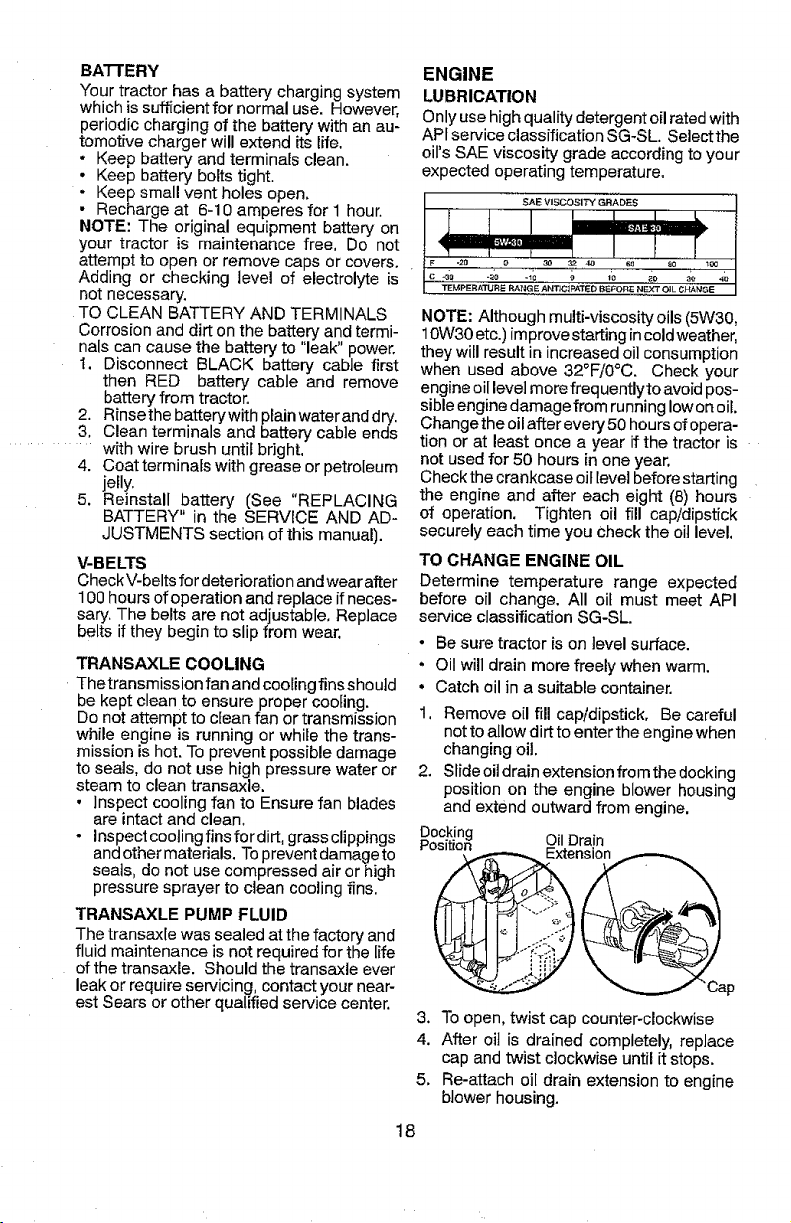
2. Sfide oil drain extension from the docking
position on the engine blower housing
and extend outward from engine.
Docking
osition Oil Drain
3, To open, twist cap counter-clockwise
4. After oil is drained completely, replace
cap and twist clockwise until it stops.
5. Re-attach oil drain extension to engine
blower housing.
18
6. Refillenginewithoilthroughoilfilldipstick
tube. Pour slowly. Do not overfill. Forap-
proximate capacity see "PRODUCT SP-
ECIFICATIONS" section of this manual.
7. Use gauge on oil fill cap/dipstick for
checking level. For accurate reading,
tighten dipstick cap securely onto the
tube before removing dipstick. Keep oil
at "FULl" line on dipstick. Tighten cap
onto the tube securely when finished.
ENGINE OIL FILTER
Replace the engine oil filter every season or
every other oil change if the tractor is used
more than 100 hours in one year.
AIR FILTER
Your engine will not run properly using a
dirty air filter. Service paper cartridge every
100 hours of operation or every season,
whichever occurs first.
Service air cleaner more often under dusty
conditions.
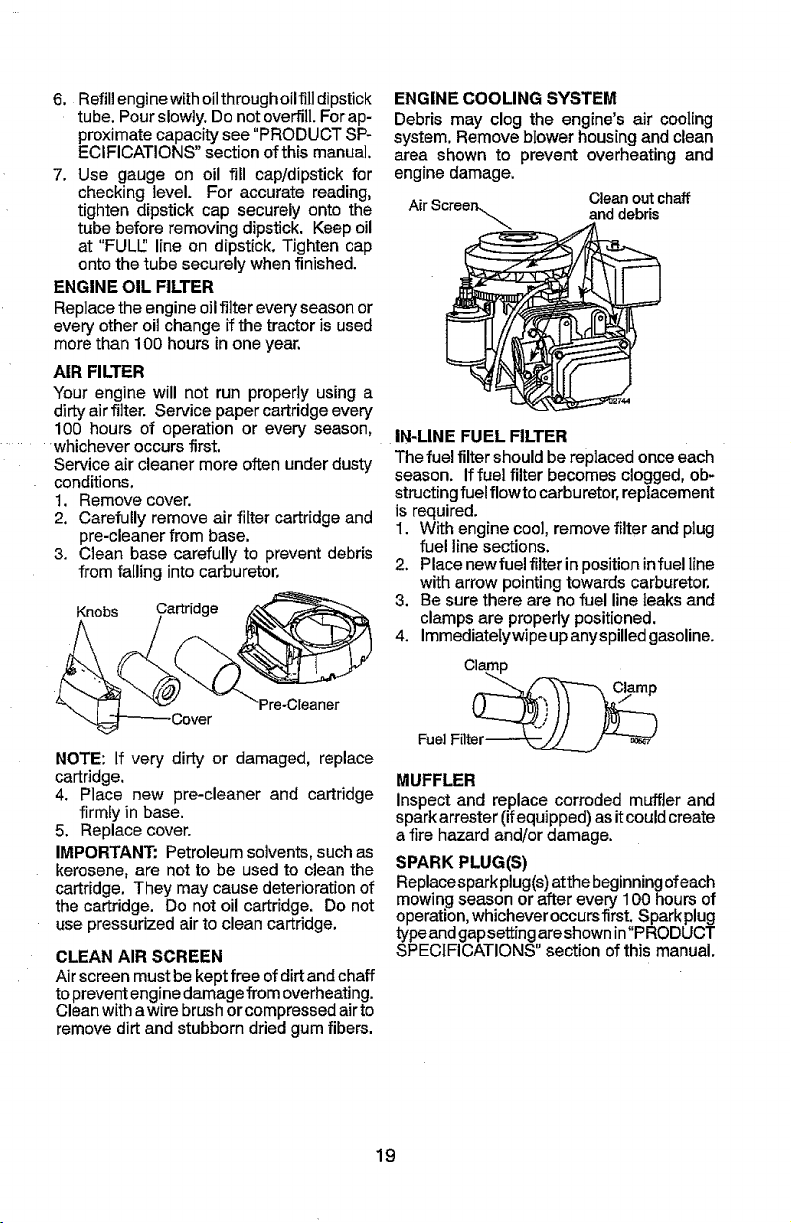
1. Remove cover.
2. Carefully remove air filter cartridge and
pre-cleaner from base.
3. Clean base carefully to prevent debris
from falling into carburetor.
Knobs Cartridge
NOTE: If very dirty or damaged, replace
cartridge.
4. Place new pre-cleaner and cartridge
firmly in base.
5. Replace cover.
IMPORTANT: Petroleum solvents, such as
kerosene, are not to be used to clean the
cartridge. They may cause deterioration of
the cartridge. Do not oil cartridge. Do not
use pressurized air to clean cartridge.
CLEAN AIR SCREEN
Air screen must be kept free of dirt and chaff
to prevent engine damage from overheating.
Clean with a wire brush or compressed air to
remove dirt and stubborn dried gum fibers.
ENGINE COOLING SYSTEM
Debris may clog the engine's air cooling
system. Remove blower housing and clean
area shown to prevent overheating and
engine damage.
Air Screer_ andOieandebris°utchaff
o
IN-LINE FUEL FILTER
The fuel filter should be replaced once each
season. If fuel filter becomes clogged, ob-
structing fuel flowto carburetor, replacement
is required.
1. With engine cool, remove filter and plug
fuel line sections.
2. Place new fuel filter in position infuel line
with arrow pointing towards carburetor.
3. Be sure there are no fuel line leaks and
clamps are properly positioned.
4. Immediatelywipeup anyspilled gasoline.
Clamp
Fuel Fil_
MUFFLER
inspect and replace corroded muffler and
spark arrester (if equipped) as itcould create
a fire hazard and/or damage.
SPARK PLUG(S)
Replacespark plug(s) atthe beginningofeach
mowing season or after every 100 hours of
operation, whicheveroccursfirst. Spark plug
typeand gapsetting areshown in"PRODUCT
SPECIFICATIONS" section of this manual.
19
CLEANING
• Clean engine, battery, seat, finish, etc,
of all foreign matter.
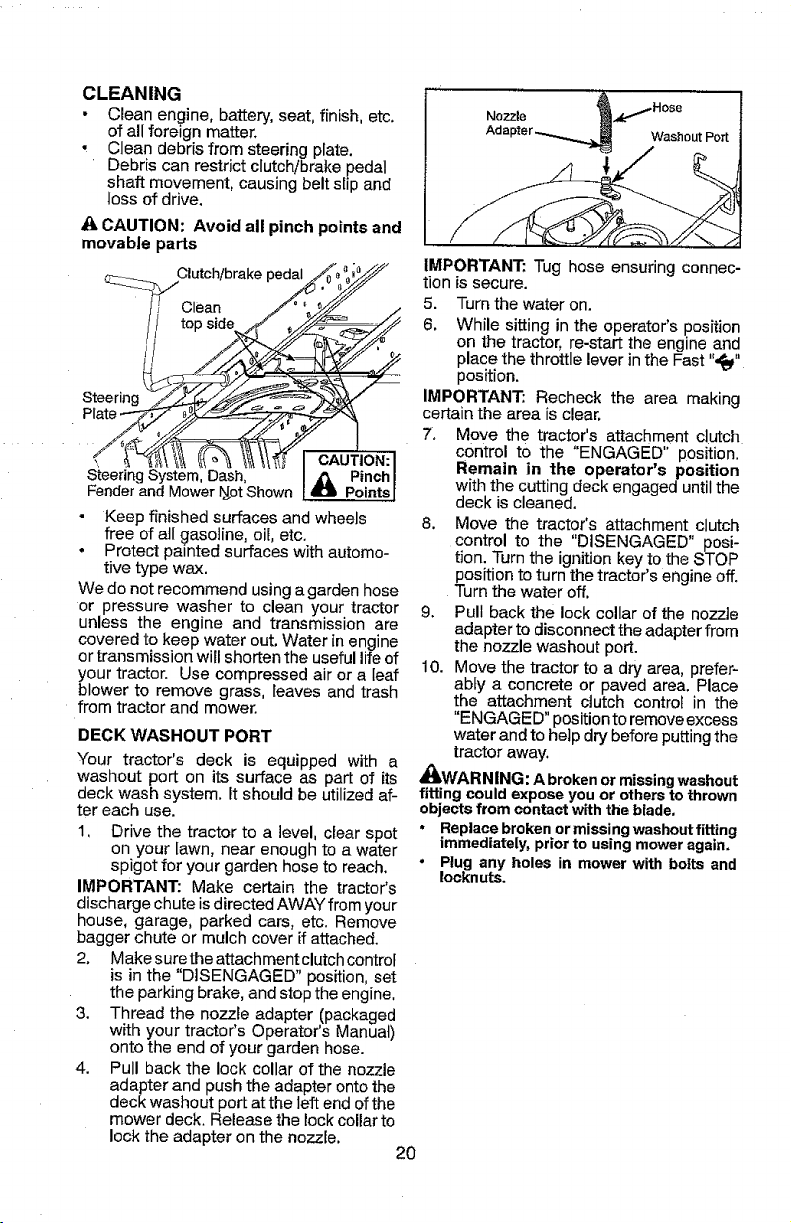
• Clean debris from steering plate.
Debris can restrict clutch/brake pedal
shaft movement, causing belt slip and
loss of drive.
,_ CAUTION: Avoid all pinch points and
movable parts
Clutch/brake pedal
Steering
,. CAUTION:
Steering System, Dash, A Pinch
Fender and Mower l_ot Shown _ Points
Keep finished surfaces and wheels
free of atl gasoline, oil, etc.
• Protect painted surfaces with automo-
tive type wax.
We do not recommend using a garden hose
or pressure washer to clean your tractor
unless the engine and transmission are
covered to keep water out. Water in engine
or transmission will shorten the useful life of
your tractor. Use compressed air or a leaf
blower to remove grass, leaves and trash
from tractor and mower.
DECK WASHOUT PORT
Your tractor's deck is equipped with a
washout port on its surface as part of its
deck wash system. It should be utilized af-
ter each use.
1, Drive the tractor to a level, clear spot
on your lawn, near enough to a water
spigot for your garden hose to reach,
IMPORTANT: Make certain the tractor's
discharge chute is directed AWAY from your
house, garage, parked cars, etc. Remove
bagger chute or mulch cover if attached.
2. Make sure the attachment clutch control
is in the "DISENGAGED" position, set
the parking brake, and stop the engine,
3. Thread the nozzle adapter (packaged
with your tractor's Operator's Manual)
onto the end of your garden hose.
4. Pull back the lock collar of the nozzle
adapter and push the adapter onto the
deck washout port at the left end of the
mower deck. Release the lock collar to
lock the adapter on the nozzle.
2O
IMPORTANT: Tug hose ensuring connec-
tion is secure.
5. Turn the water on.
6. While sitting in the operator's position
on the tractor, re-start the engine and
place the throttle lever in the Fast ",_"
position.
IMPORTANT: Recheck the area making
certain the area is clear,
7. Move the tractor's attachment clutch
control tO the "ENGAGED" position.
Remain in the operator's position
with the cutting deck engaged until the
deck is cleaned.
8. Move the tractor's attachment clutch
control to the "DISENGAGED" posi-
tion. Turn the ignition key to the STOP
position to turn the tractor's engine off.
Turn the water off.
9. Pull back the lock collar of the nozzle
adapter to disconnect the adapter from
the nozzle washout port.
10. Move the tractor to a dry area, prefer-
ably a concrete or paved area. Place
the attachment ciutch control in the
"ENGAGED" position to remove excess
water and to help dry before putting the
tractor away.
_&WARNING: A brokenor missingwashout
fittingcould exposeyou or othersto thrown
objectsfrom contactwith the blade,
• Replacebrokenor missing washoutfitting
immediately,priorto usingmoweragain.
• Plug any holes in mower with bolts and
Iocknuts.
WARNING:TOAVOIDSERIOUSINJURY,BEFOREPERFORMINGANY
SERVICEORADJUSTMENTS:
1. Depress clutch/brake pedal fully and set parking brake.
2. Place motion control lever in neutral position,
3. Place attachment clutch in "DISENGAGED" position.
4. Turn ignition key to "STOP" and remove key.
5. Ensure the blades and all moving parts have completely stopped.
6. Disconnect spark plug wire from spark plug and place wire where it cannot
come in contact with plug,
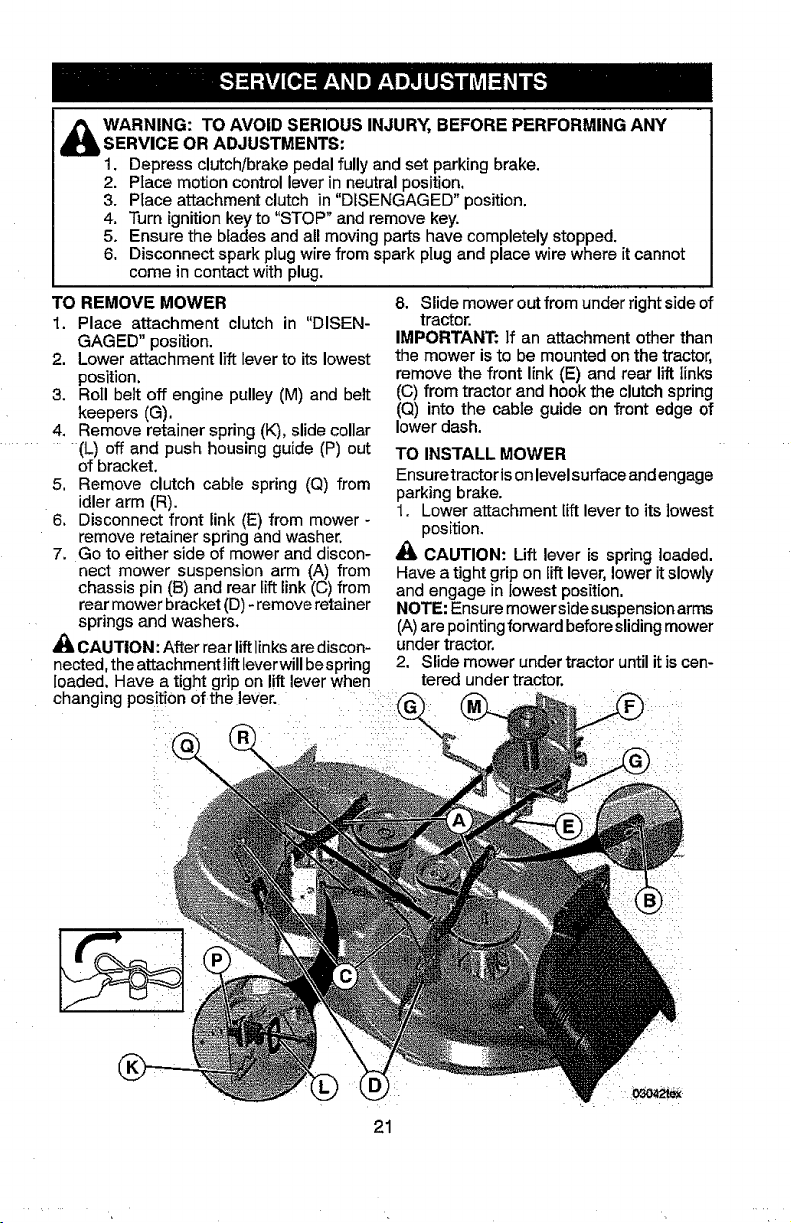
TO REMOVE MOWER
1. Place attachment clutch in "DISEN-
GAGED" position.
2. Lower attachment lift lever to its lowest
position,
3. Roll belt off engine pulley (M) and belt
keepers (G).
4, Remove retainer spring (K), slide collar
(L) off and push housing guide (P) out
of bracket,
5. Remove clutch cable spring (Q) from
idler arm (R).
6, Disconnect front link (E) from mower -
remove retainer spring and washer,
7. Go to either side of mower and discon-
nect mower suspension arm (A) from
chassis pin (B) and rear lift link (C) from
rear mower bracket (D) - remove retainer
springs and washers.
CAUTION: After rear lift linksare discon-
8. Slide mower out from under right side of
tractor.
IMPORTANT: If an attachment other than
the mower isto be mounted on the tractor,
remove the front link (E) and rear lift links
(C) from tractor and hook the clutch spring
(Q) into the cable guide on front edge of
lower dash.
nected, the attachment liftleverwill bespring
loaded, Have a tight grip on Ift lever when tered under tractor.
changing pos!ti0n of the lever, i i:i iii:(_
i .... i_/:
TO INSTALL MOWER
Ensuretractor is on level surface and engage
parking brake.
1. Lower attachment lift lever to its lowest
position.
CAUTION: Lift lever is spring loaded.
Have a tight grip on lift lever, lower it slowly
and engage in lowest position.
NOTE: Ensure mower sidesuspension arms
(A) are pointing forward before sliding mower
undertractor,
2. Slide mower under tractor until it is cen-
21
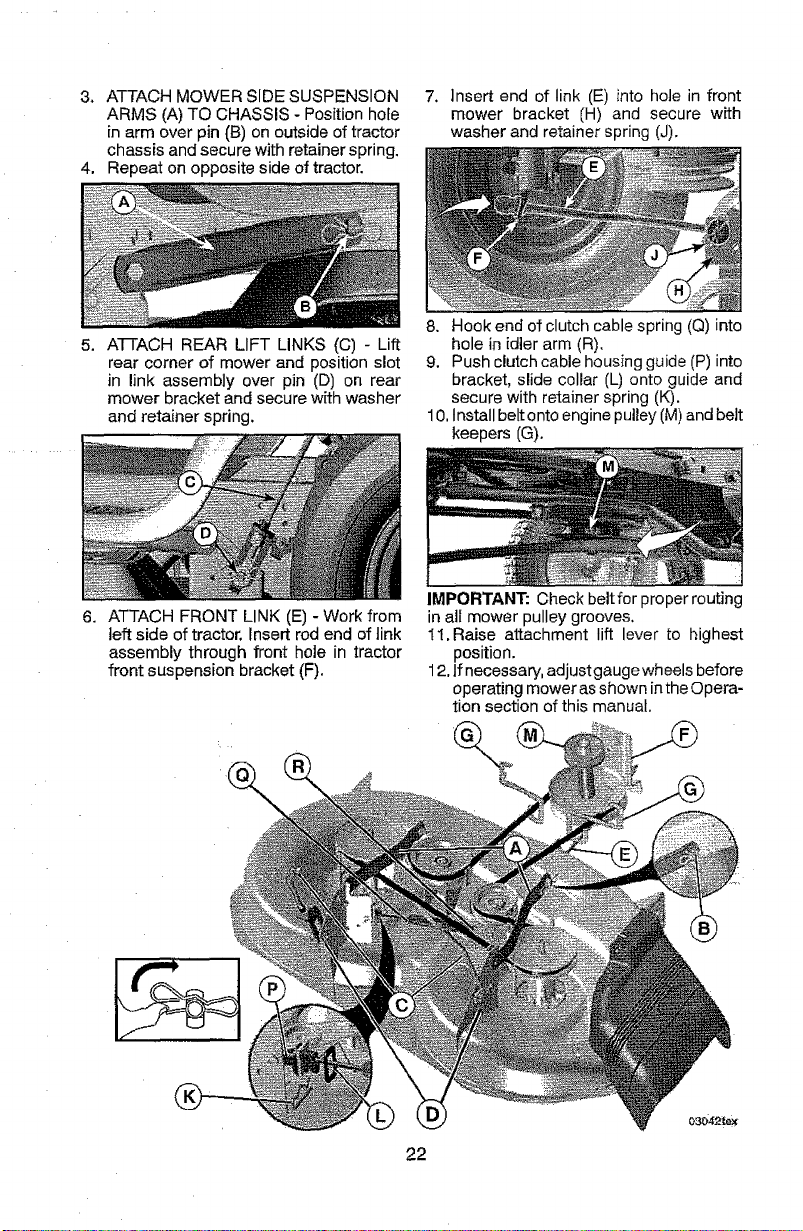
3. ATTACH MOWER SIDE SUSPENSION
ARMS (A) TO CHASSIS - Position hole
in arm over pin (B) on outside of tractor
chassis and secure with retainer spring.
4. Repeat on opposite side of tractor.
7, Insert end of link (E) into hole in front
mower bracket (H) and secure with
washer and retainer spring (J),
5. A-I-FACH REAR LIFT LINKS (C) - Lift
rear corner of mower and position slot
in link assembly over pin (D) on rear
mower bracket and secure with washer
and retainer spring,
8. Hook end of clutch cable spring (Q) into
hole in idler arm (R).
9. Push clutch cable housing guide (P) into
bracket, slide collar (L) onto guide and
secure with retainer spring (K).
10. Install belt onto engine pulley (M) and belt
keepers (G).
6,
ATTACH FRONT LINK (E) - Work from
left side of tractor, Insert rod end of link
assembly through front hole in tractor
front suspension bracket (F).
IMPORTANT: Check beltfor proper routing
in all mower pulley grooves,
_1.Raise attachment lift lever to highest
position.
12, If necessary, adjust gauge wheels before
operating mower as shown in the Opera-
tion section of this manual.
22
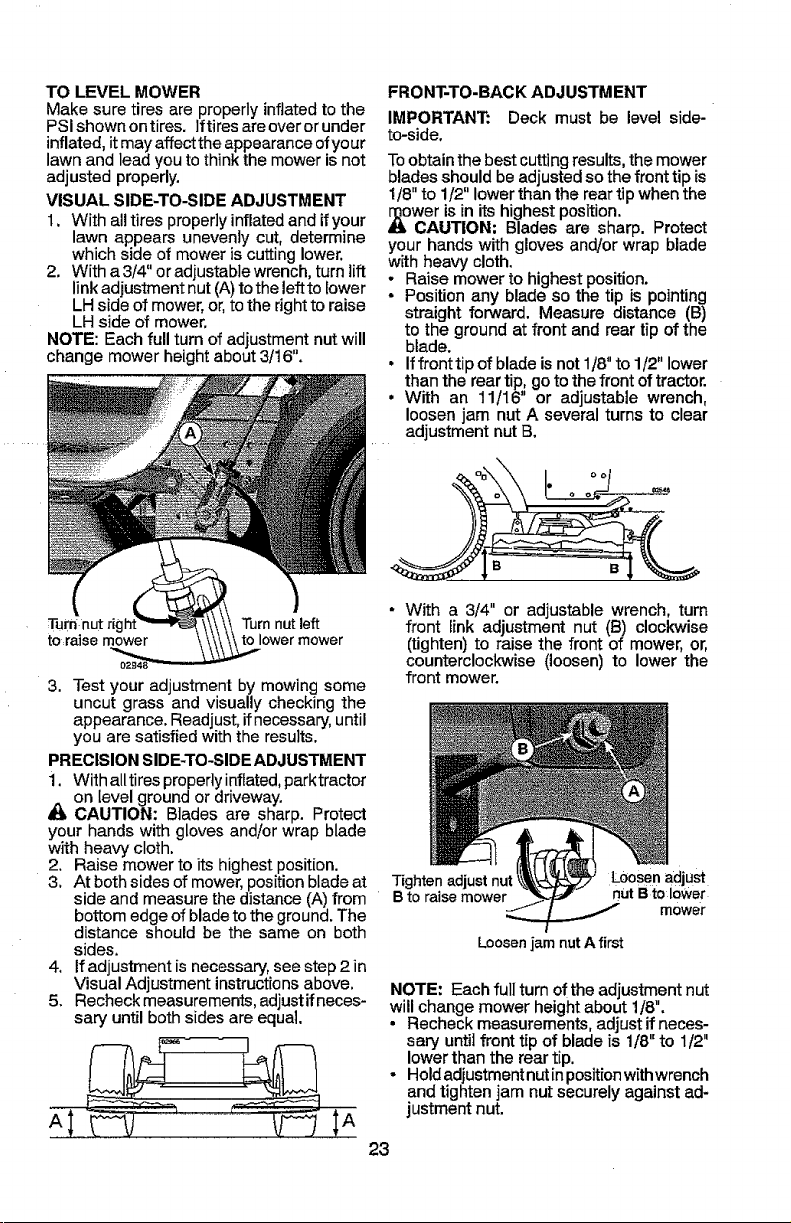
TO LEVEL MOWER
Make sure tires are properly inflatedto the
PSI shown ontires, lftires are over or under
inflated, it may affect the appearance ofyour
lawn and lead you to think the mower is not
adjusted properly.
VISUAL SIDE-TO-SIDE ADJUSTMENT
1. With all tiresproperly inflated and ifyour
lawn appears unevenly cut, determine
which side of mower is cutting lower.
2. With a3/4" oradjustablewrench, turn lift
link adjustment nut (A) to the left to lower
LH side of mower, or, to the right to raise
LH side of mower.
NOTE: Each full turn of adjustment nut will
change mower height about 3/16".
Turn nut dghl Turn nut left
to =raisemower to lower mower
3. Test your adjustment by mowing some
uncut grass and visually checking the
appearance. Readjust, ifnecessary, until
you are satisfied with the results.
PRECISION SIDE-TO-SIDE ADJUSTMENT
i. With alltires properly inflated,parktractor
on level ground or driveway.
_0LCAUTION: Blades are sharp. Protect
your hands with gloves and/or wrap blade
with heavy cloth.
2. Raise mower to its highest position.
3. At both sides of mower, position blade at
side and measure the distance (A) from
bottom edge of blade to the ground. The
distance should be the same on both
sides.
4. if adjustment is necessary, see step 2 in
Visual Adjustment instructions above.
5. Recheck measurements, adjust if neces-
sary until both sides are equal.
A] T-q] $A
23
FRONT-TO-BACK ADJUSTMENT
IMPORTANT: Deck must be level side-
to-side.
To obtainthe best cutting results, the mower
blades should be adjustedso the front tip is
1/8" to 1/2" lower than the rear tip when the
_bower is in its highest position.
CAUTION; Blades are sharp. Protect
your hands with gloves and/or wrap blade
with heavy cloth.
• Raise mower to highest position.
• Position any blade so the tip is pointing
straight forward. Measure distance (B)
to the ground at front and rear tip of the
blade.
• Iffronttip of blade is not 1/8" to 1/2" lower
than the rear tip,_go to the front of tractor.
• With an 11/16 or adjustable wrench,
loosen jam nut A several turns to clear
adjustment nut B.
• With a 3/4" or adjustable wrench, turn
front link adjustment nut (B) clockwise
(tighten) to raise the front of mower, or,
counterclockwise (loosen) to lower the
front mower.
Tighten adjust nut Loosen adjust
B to raise mower nut B to lower
mower
Loosen jam nut A first
NOTE: Each full turn of the adjustment nut
will change mower height about 1/8".
• Recheck measurements, adjust if neces-
sary until front tip of blade is 1/8" to 1/2"
lower than the rear tip.
o Hold adjustment nutinposition withwrench
and tighten jam nut securely against ad-
justment nut.
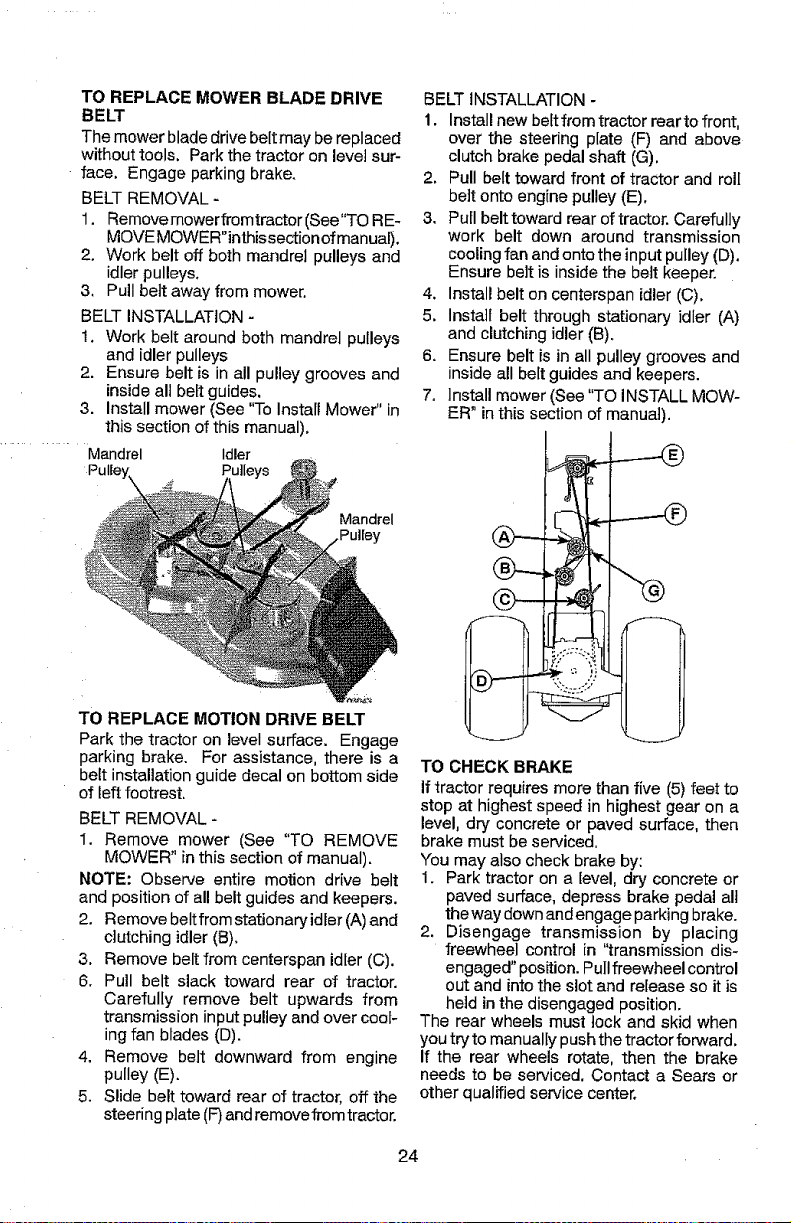
TO REPLACE MOWER BLADE DRIVE
BELT
The mower blade drive belt may be replaced
without tools. Park the tractor on level sur-
- face. Engage parking brake.
BELT REMOVAL-
1. Remove mowerfromtractor (See"TO RE-
MOVE MOWER"inthissectionofmanual),
2. Work belt off both mandrel pulleys and
idler pulleys.
3, Pull belt away from mower.
BELT INSTALLATION -
1. Work belt around both mandrel pulleys
and idler pulleys
2. Ensure belt is in all pulley grooves and
inside all belt guides,
3. Install mower (See "To Install Mower" in
this section of this manual).
............. Mandrel Idler
BELT INSTALLATION -
1. Installnew belt from tractor rear to front,
over the steering plate (F) and above
clutch brake pedal shaft (G).
2. Pull belt toward front of tractor and roll
belt onto engine pulley (E),
3. Pull belt toward rear of tractor. Carefully
work belt down around transmission
cooling fan and onto the input pulley (D).
Ensure belt is inside the belt keeper.
4. Install belt on centerspan idler (C).
5. Install belt through stationary idler (A)
and clutching idler (B).
6. Ensure belt is in all pulley grooves and
inside all belt guides and keepers.
7. Install mower (See "TO INSTALL MOW-
ER" in this section of manual).
Mandrel
TO REPLACE MOTION DRIVE BELT
Park the tractor on level surface. Engage
parking brake. For assistance, there is a
belt installation guide decal on bottom side
of teft footrest,
BELT REMOVAL -
I. Remove mower (See "TO REMOVE
MOWER" in this section of manual).
NOTE: Observe entire motion drive belt
and position of all belt guides and keepers.
2. Remove beltfrom stationaryid_er (A) and
clutching idler (B).
3. Remove belt from centerspan idler (C).
6. Pull belt slack toward rear of tractor.
Carefully remove belt upwards from
transmission input pulley and over cool-
ing fan blades (D).
4. Remove belt downward from engine
pulley (E).
5. Slide belt toward rear of tractor, off the
steering plate (F)and remove from tractor.
TO CHECK BRAKE
If tractor requires more than five (5) feet to
stop at highest speed in highest gear on a
level, dry concrete or paved surface, then
brake must be serviced,
You may also check brake by:
1. Park tractor on a level, dry concrete or
paved surface, depress brake pedal alt
the way downand engage parking brake.
2. Disengage transmission by placing
freewheel control in "transmission dis-
engaged" position. Pull freewheel control
out and into the slot and release so it is
held in the disengaged position.
The rear wheels must lock and skid when
you tryto manually push the tractor forward.
if the rear wheels rotate, then the brake
needs to be serviced. Contact a Sears or
other qualified service center.
24
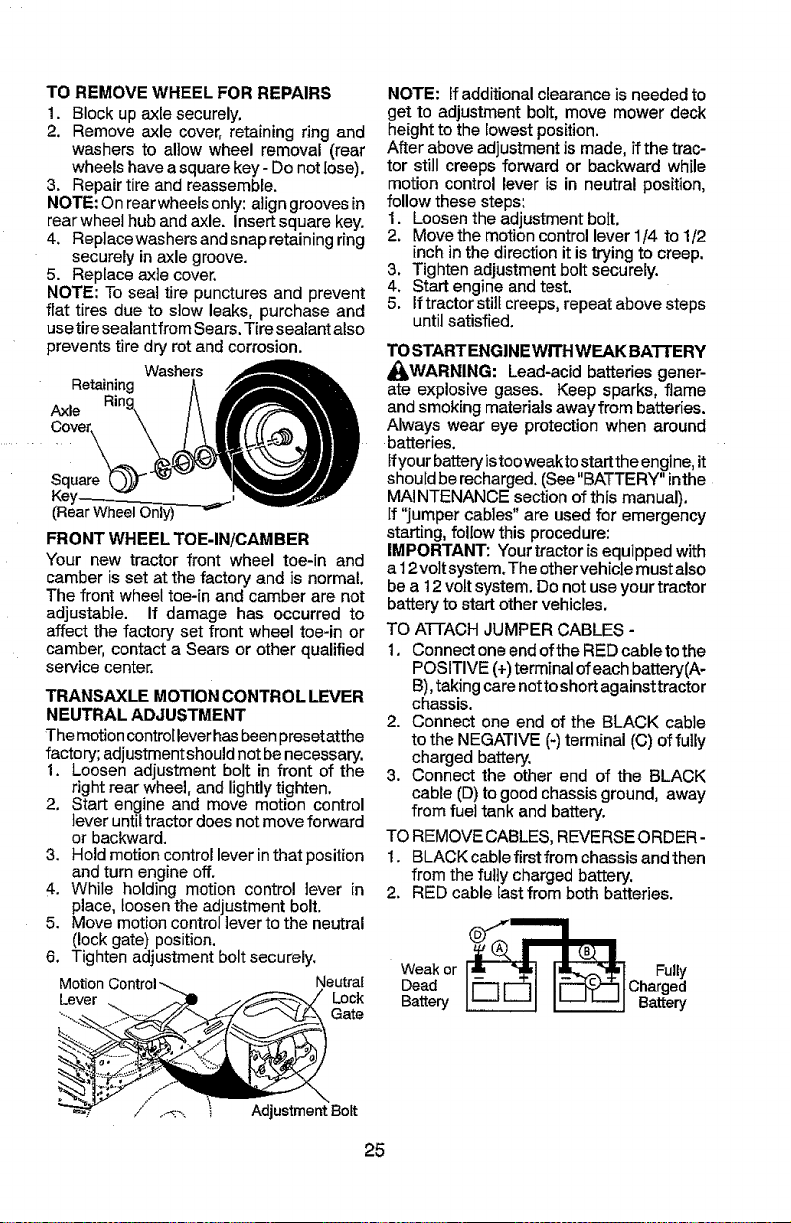
TO REMOVE WHEEL FOR REPAIRS
1. Block up axle securely.
2. Remove axle cover, retaining ring and
washers to aliow wheel removal (rear
wheels have a square key- Do not lose).
3. Repair tire and reassemble.
NOTE: On rearwheelsonly: aligngroovesin
rear wheel hub and axle. Insert square key.
4. Replace washers and snap retaining ring
securely in axle groove.
5. Replace axle cover,
NOTE: To seal tire punctures and prevent
flat tires due to stow leaks, purchase and
usetire sealantfrom Sears.Tire sealant also
prevents tire dry rot and corrosion.
Washers
Retaining
Axle
(RearWheelOnly)
FRONT WHEEL TOE-IN/CAMBER
Your new tractor front wheel toe-in and
camber is set at the factory and is normal.
The front wheel toe-in and camber are not
adjustable, if damage has occurred to
affect the factory set front wheel toe-in or
camber, contact a Sears or other qualified
service center.
TRANSAXLE MOTION CONTROL LEVER
NEUTRAL ADJUSTMENT
The motioncontrol leverhas been presetatthe
factory; adjustment should not be necessary.
1. Loosen adjustment bolt in front of the
right rear wheel, and lightly tighten.
2. Start engine and move motion control
lever until tractor does not move forward
or backward.
3. Hold motion control lever in that position
and turn engine off.
4. While holding motion control lever in
place, loosen the adjustment bolt.
5. Move motion control lever to the neutral
(lock gate) position.
6. Tighten adjustment bolt securely.
MotionControl---- Neutral
Lever _ _ /_., / Lock
__\1 Gate
_'Bolt
NOTE: If additionalclearance is needed to
get to adjustment bolt, move mower deck
height to the lowest position.
After above adjustment is made, if the trac-
tor still creeps forward or backward while
motion control lever is in neutral position,
follow these steps:
1. Loosen the adjustment bolt.
2. Move the motion control lever 1/4 to 1/2
inch inthe direction it is trying to creep.
3, Tighten adjustment bolt securely.
4. Start engine and test.
5. If tractor still creeps, repeat above steps
until satisfied.
TOSTART ENGINEWrrH WEAK BATTERY
_qlLWARNING: Lead-acid batteries gener-
ate explosive gases. Keep sparks, flame
and smoking materials away from batteries.
Always wear eye protectionwhen around
batteries,
Ifyourbatteryistooweakto starttheengine, it
should berecharged.(See"BATTERY" inthe
MAINTENANCE sectionof this manual).
If "jumper cables" are used for emergency
starting, follow this procedure:
IMPORTANT: Yourtractoris equipped with
a 12voltsystem. The othervehiclemustalso
be a t2 voltsystem. Do notuse your tractor
battery to start other vehicles.
TO ATTACH JUMPER CABLES -
1, Connect one end ofthe RED cableto the
POSITIVE (+) terminal ofeach battery(A-
B),taking care notto shortagainsttractor
chassis.
2. Connect one end of the BLACK cable
to the NEGATIVE (-) terminal (C) of fully
charged battery.
3. Connect the other end of the BLACK
cable (D) to good chassis ground, away
from fuel tank and battery.
TO REMOVE CABLES, REVERSE ORDER-
1. BLACK cable first from chassis and then
from the fully charged battery.
2. RED cable last from both batteries.
Weak or
Dead
Battery
25
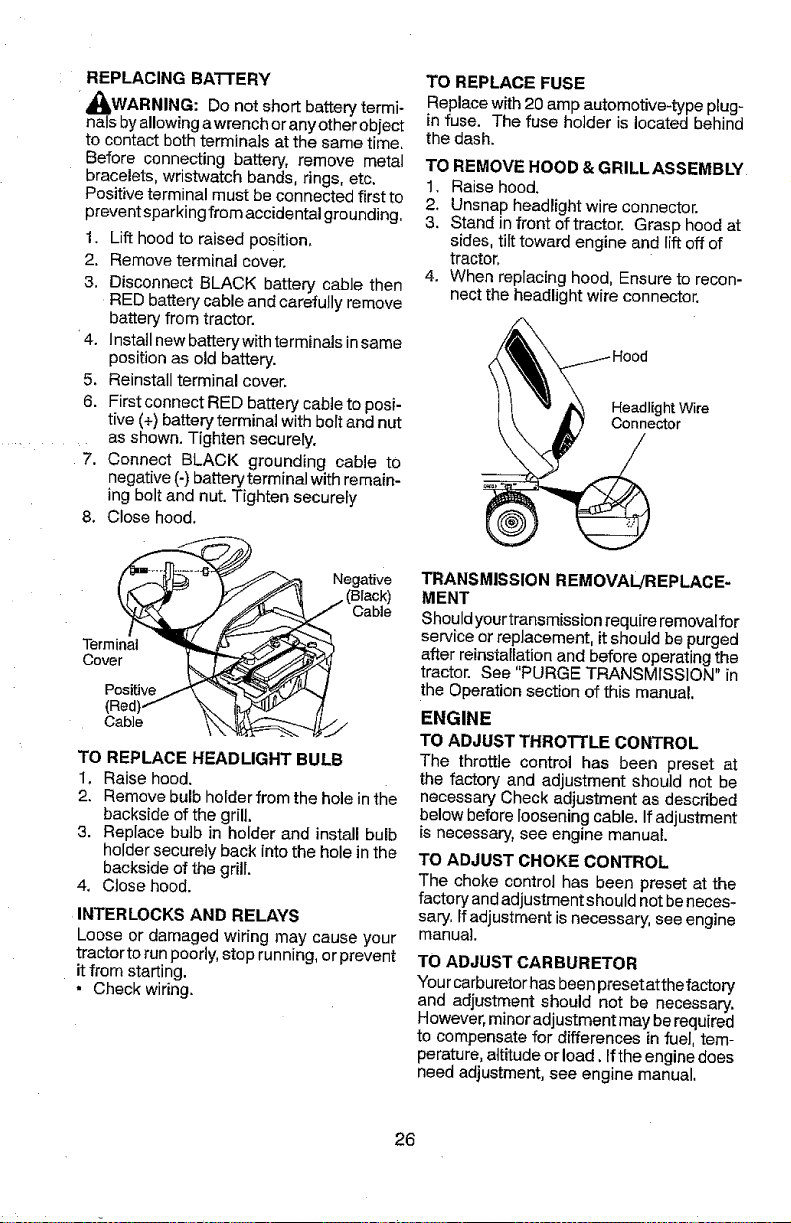
REPLACING BATTERY
_WARNING: Do not short battery termi-
nals by allowing a wrench or any other object
to contact both terminals at the same time.
Before connecting battery, remove metal
bracelets, wristwatch bands, rings, etc.
Positive terminal must be connected first to
preventsparking from accidental grounding.
1. Lift hood to raised POSition,
2. Remove terminal cover.
3. Disconnect BLACK battery cable then
RED battery cable and carefully remove
battery from tractor.
4. Installnewbatterywith terminals insame
position as old battery.
5. Reinstall terminal cover,
6. First connect RED battery cabie to posi-
tive (+) battery terminal with bolt and nut
as shown. Tighten securely.
Connect BLACK grounding cable to
negative (-) batteryterminal with remain-
ing bolt and nut. Tighten securely
8. Close hood,
..... /7.
TO REPLACE FUSE
Replace with 20 amp automotive-type plug-
in fuse. The fuse holder is located behind
the dash.
TO REMOVE HOOD & GRILLASSEMBLY
1, Raise hood.
2. Unsnap headlight wire connector.
3. Stand in front of tractor. Grasp hood at
sides, tilt toward engine and lift off of
tractor,
4. When replacing hood, Ensure to recon-
nect the headlight wire connector.
Headlight Wire
Connector
TO REPLACE HEADLIGHT BULB
I. Raise hood.
2. Remove bulb holder from the hole in the
backside of the grill.
3. Replace bulb in holder and install bulb
holder securely back into the hole in the
backside of the grill.
4. Close hood.
INTERLOCKS AND RELAYS
Loose or damaged wiring may cause your
tractor to run poorly, stop running, or prevent
it from starting.
• Check wiring.
TRANSMISSION REMOVAL/REPLACE-
MENT
Shouldyour transmission require removalfor
service or replacement, it should be purged
after reinstallation and before operating the
tractor. See "PURGE TRANSMISSION" in
the Operation section of this manual.
ENGINE
TO ADJUST THROTTLE CONTROL
The throttle control has been preset at
the factory and adjustment should not be
necessary Check adjustment as described
below before loosening cable. If adjustment
is necessary, see engine manual.
TO ADJUST CHOKE CONTROL
The choke control has been preset at the
factory and adjustment should notbe neces-
sary, If adjustment is necessary, see engine
manual
TO ADJUST CARBURETOR
Your carburetor hasbeen presetatthe factory
and adjustment should not be necessary.
However, minor adjustment may berequired
to compensate for differences in fuel, tem-
perature, altitude or load. Ifthe engine does
need adjustment, see engine manual,
26
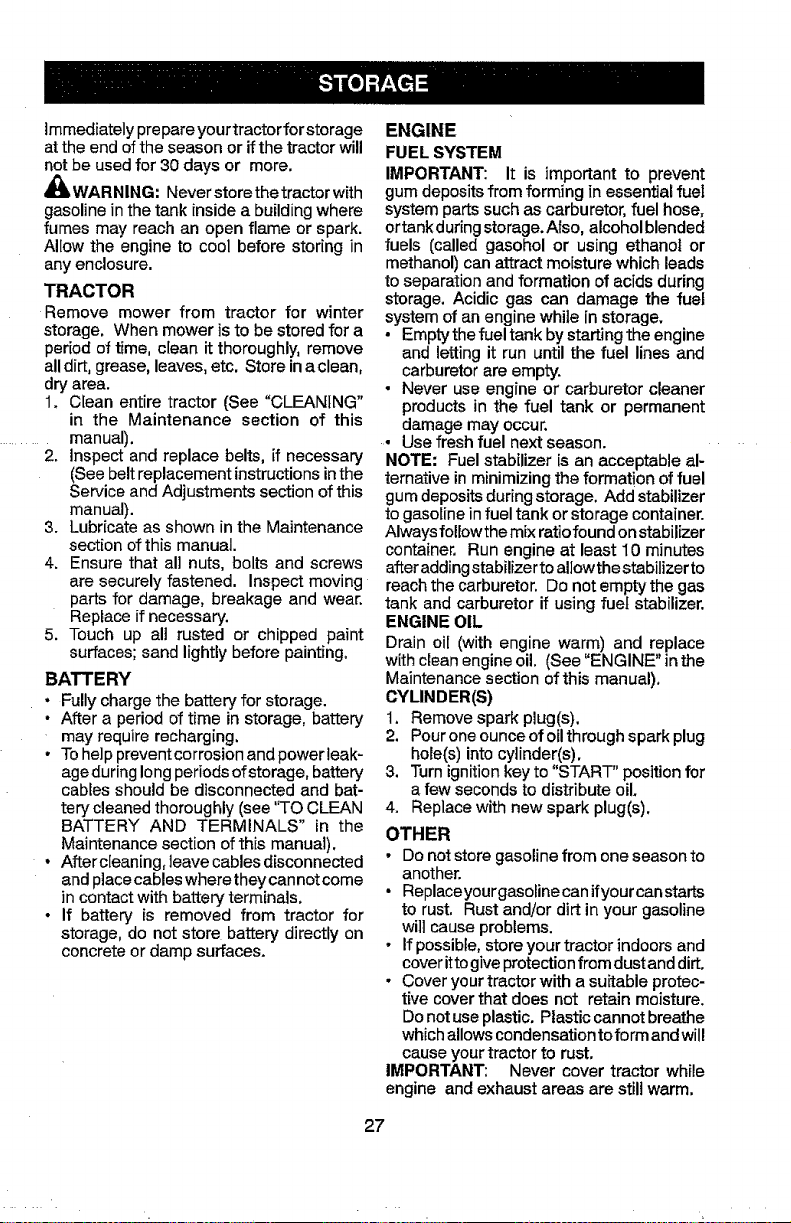
2.
immediatelyprepareyourtractorforstorage
attheendoftheseasonorifthetractorwill
not be used for 30 days or more.
_WARNING: Never store the tractor with
gasoline in the tank inside a building where
fumes may reach an open flame or spark.
Allow the engine to cool before storing in
any enclosure.
TRACTOR
Remove mower from tractor for winter
storage. When mower is to be stored for a
period of time, clean it thoroughly, remove
alldirt, grease, leaves, etc. Store in aclean,
dry area.
1. Clean entire tractor (See "CLEANING"
in the Maintenance section of this
manual).
Inspect and replace belts, if necessary
(See belt replacement instructions inthe
Service and Adjustments section of this
manual).
3. Lubricate as shown in the Maintenance
section of this manual.
4, Ensure that all nuts, bolts and screws
are securely fastened. Inspect moving
parts for damage, breakage and wear.
Replace if necessary.
5. Touch up all rusted or chipped paint
surfaces; sand lightly before painting.
BATTERY
• Fully charge the battery for storage.
• After a period of time in storage, battery
may require recharging.
• To help prevent corrosion and power leak-
age during long periods of storage, battery
cables should be disconnected and bat-
tery cleaned thoroughly (see "TO CLEAN
BATTERY AND TERMINALS" in the
Maintenance section of this manual),
• After cleaning, leave cables disconnected
and placecables where they cannot come
in contact with battery terminals.
• If battery is removed from tractor for
storage, do not store battery directly on
concrete or damp surfaces.
ENGINE
FUEL SYSTEM
IMPORTANT: It is important to prevent
gum deposits from forming in essential fuel
system parts such as carburetor, fuel hose,
ortank during storage. Also, alcohol blended
fuels (called gasohol or using ethanol or
methanol) can attract moisture which leads
to separation and formation of acids during
storage. Acidic gas can damage the fuel
system of an engine while in storage.
° Emptythefueltank by starting the engine
and letting it run until the fuel lines and
carburetor are empty.
• Never use engine or carburetor cleaner
productsin the fuel tank or permanent
damage may occur.
• Use fresh fuel next season.
NOTE: Fuel stabilizer is an acceptable al-
ternative in minimizing the formation of fuel
gum deposits during storage. Add stabilizer
to gasotine in fuel tank or storage container.
Always followthe mix ratiofound on stabilizer
container, Run engine at least 10 minutes
after addingstabilizer to allowthestabilizer to
reach the carburetor. Do not empty the gas
tank and carburetor if using fuet stabilizer.
ENGINE OIL
Drain oil (with engine warm) and replace
with clean engine oil. (See "ENGINE" in the
Maintenance section of this manual).
CYLINDER(S)
t. Remove spark plug(s).
2. Pour one ounce of oilthrough spark plug
hole(s) into cylinder(s).
3. Turn ignition key to "START" position for
a few seconds to distribute oil.
4. Replace with new spark plug(s).
OTHER
• Do not store gasoline from one season to
another.
• Replaceyourgasoline can ifyourcan starts
to rust, Rust and!or dirt in your gasoline
will cause problems.
• If possible, store your tractor indoors and
cover ittogive protection from dust and dirt.
• Cover your tractor with a suitable protec-
tive cover that does not retain moisture.
Do not use plastic. Plastic cannot breathe
which allows condensation toform and will
cause your tractor to rust.
IMPORTANT: Never cover tractor while
engine and exhaust areas are still warm.
27
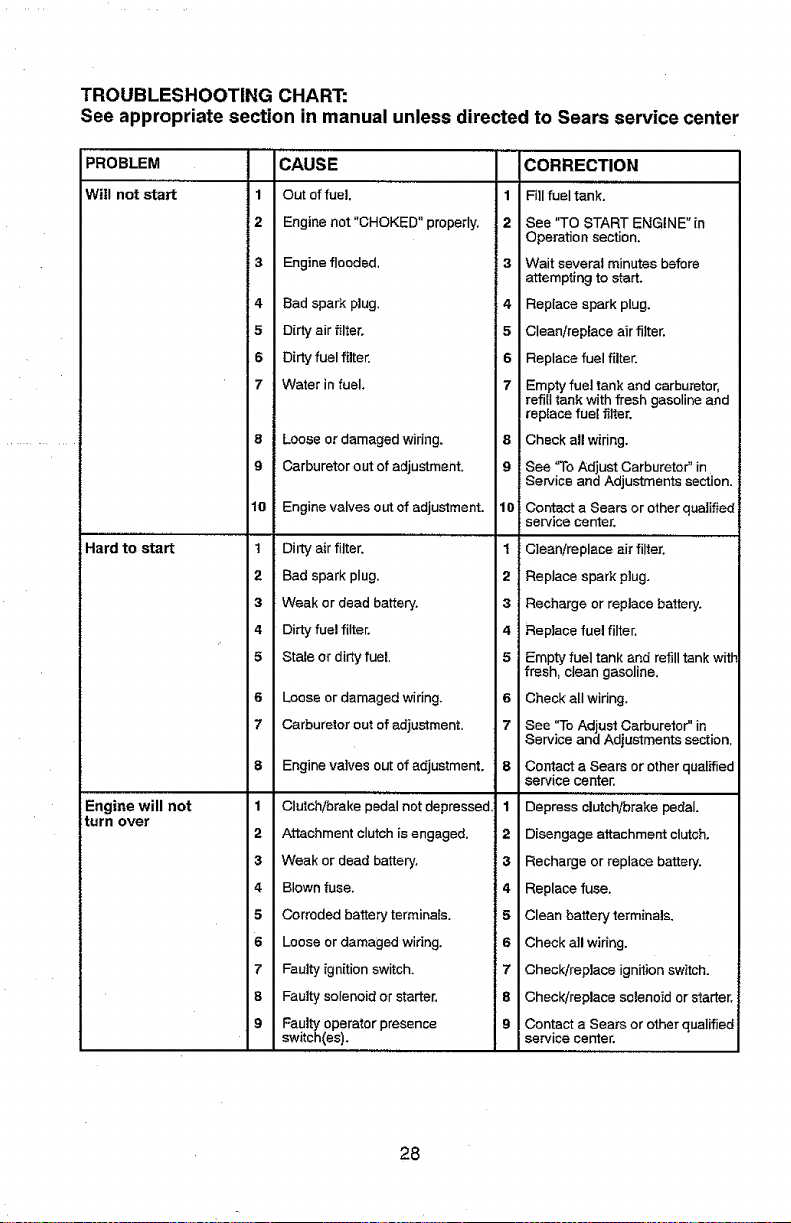
TROUBLESHOOTING CHART:
See appropriate section in manual unless directed to Sears service center
PROBLEM
Wi|l not start
Hard to start
Engine will not
turn over
JL
CAUSE CORRECTION
1 Out of fuel. 1 Fi]l fuel tank.
2 Engine not "CHOKED" properly. 2 See "TO START ENGINE" in
Operation section.
3 Engine flooded. 3 Wait several minutes before
attempting to start.
4 Bad spark plug. 4 Replace spark plug.
5 Dirty air filter. 5 Clean/replace air filter.
6 Dirty fuel filter. 6 Replace fuel filter.
7 Water in fuel. 7 Empty fue_ tank and carburetor.
refill tank with fresh gasoline and
replace fuel filter,
8 Loose or damaged wiring. 8 Check all wiring.
9 Carburetor out of adjustment. 9 See "To Adjust Carburetor" in
Service and Adjustments section.
IO Engine valves out of adjustment. 10 Contact a Sears or other qualified
service center.
t Dim/air filter, t Clean/replace air filter.
2 Bad spark plug. 2 Replace spark p]ug.
3 Weak or dead battery. 3 Recharge or replace battery.
4 Ditty fuel filter. 4 Replace fuel filter.
5 Stale or dirty fuel 5 Empty fuel tank and refill tank with
fresh, clean gasoline.
6 Loose or damaged wiring. 6 Check all widng.
7 Carburetor out of adjustment. 7 See "To Adjust Carburetor" in
Service and Adjustments section.
8 Engine valves out of adjustment. 8 Contact a Sears or other qualified
service center.
,,,,,,,,,, , .......
1 Clutch/brake pedal not depressed. 1 Depress clutch/brake pedal.
2 Attachment clutch is engaged. 2 Disengage attachment clutch.
3 Weak or dead battery. I 3 Recharge or replace battery.
4 Blown fuse. I 4 Replace fuse.
5 Corroded battery terminals. ! 5 Clean battery terminals.
6 Loose or damaged wiring. 6 Check all wiring.
7 Faulty ignition switch. 7 Check/replace ignition switch.
8 Faulty solenoid or starter. ' 8 Check/replace solenoid or starter.
9 Faulty operator presence 9 Contact a Sears or other qualified
switch(es), service center.
28
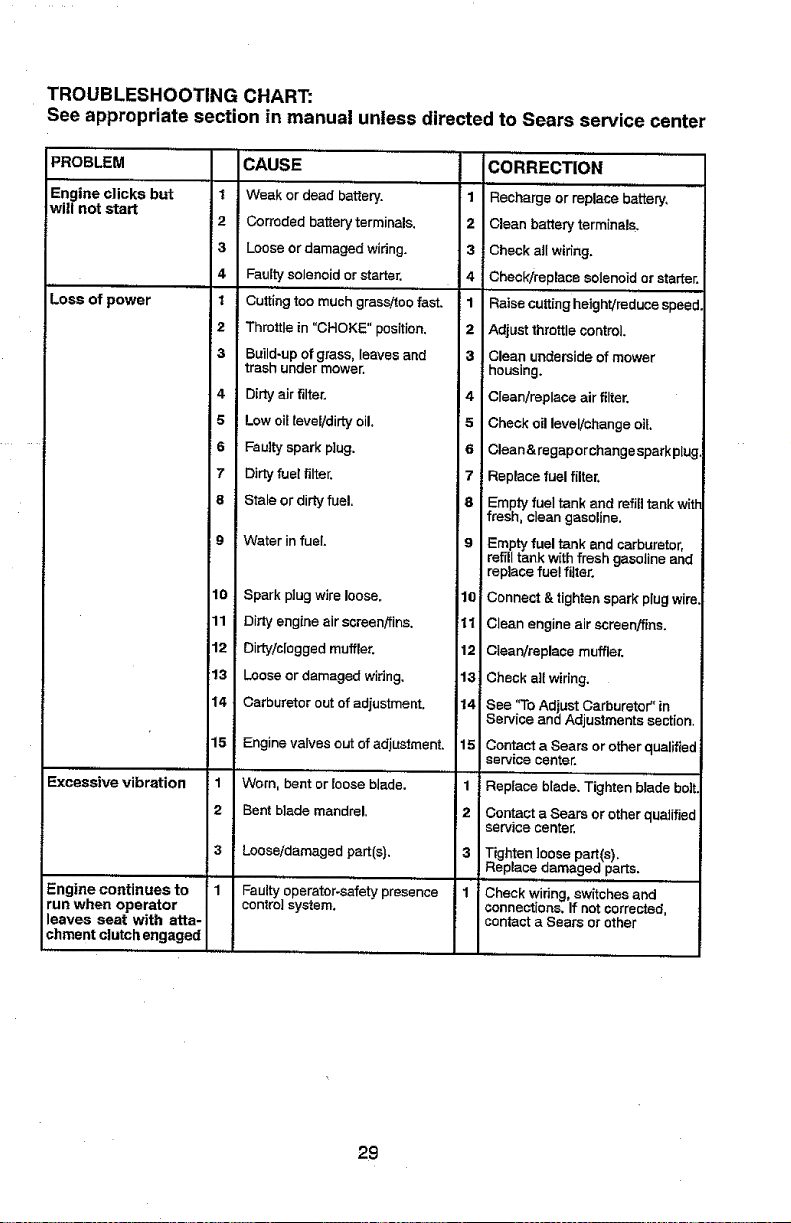
TROUBLESHOOTING CHART:
See appropriate section in manual unless directed to Sears service center
PROBLEM
will not start
Loss of power
Excessive vibration
CAUSE
I Weak or dead battePj. 1
2 Corroded battery terminals. 2
3 Loose or damaged wiring. 3
4 Faulty solenoid or starter. 4
1 Cutting too much grass/too fast.
2 Throttle in "CHOKE" position. 2
3 Build-up of grass, leaves and 3
trash under mower,
4 Di_y air fil_er. 4 !
5 Low oil level/dirty oil. 5
6 Faulty spark plug, 6
7 Dirty fuel filter. 7
8 Stale or dirty fuel. 8
9 Water in fuel. 9
10 Spark plug wire loose. 10
11 Dirly engine air screen/fins. 11
12 Dirty/clogged muffler. 12
13 Loose or damaged widng. 13
14 Carburetor out of adjustment. 14
15 Engine valves out of adjustment. 15
1 ' Worn, bent Or loose blade. 1
2 Bent blade mandrel. 2
3 Loose/damaged part(s). 3
11 Faulty operator-safety presence 1
control system,
iEngine continues to
run when operator
leaves seat with atta-
chment clutch engaged
CORRECTIO'
Clean battery terminals,
Check a|i wiring.
Check/replace solenoid or starter.
..................,, J ,................... ,,,
1 Raise cutting height/reduce speed
Adjust throttIe control
Clean underside of mower
housing,
C_ean/repIace air filter.
Check oil level/change oil.
Clean ®apor Change sparkp|ug
Replace fuel filter.
Empty fuel tank and refill tank witt-
fresh, clean gasoline.
Empty fuel tank and carburetor,
refill tank with fresh gasoline and
replace fuel filter.
Connect & tighten spark plug wire
Clean engine air screen/fins.
Clean/replace muffler,
Check all wiring,
See "To Adjust Carburetor' ' in
Service and Adjustments section.
Contact a Sears or other qualified
serrate center.
Replace blade. Tighten blade bolt
Contact a Sears or other qualified
service center,
Tighten loose part(s),
Replace damaged parts.
i,,,,,,,
Check wiring, switches and
connections, If not corrected,
contact a Sears or other
29
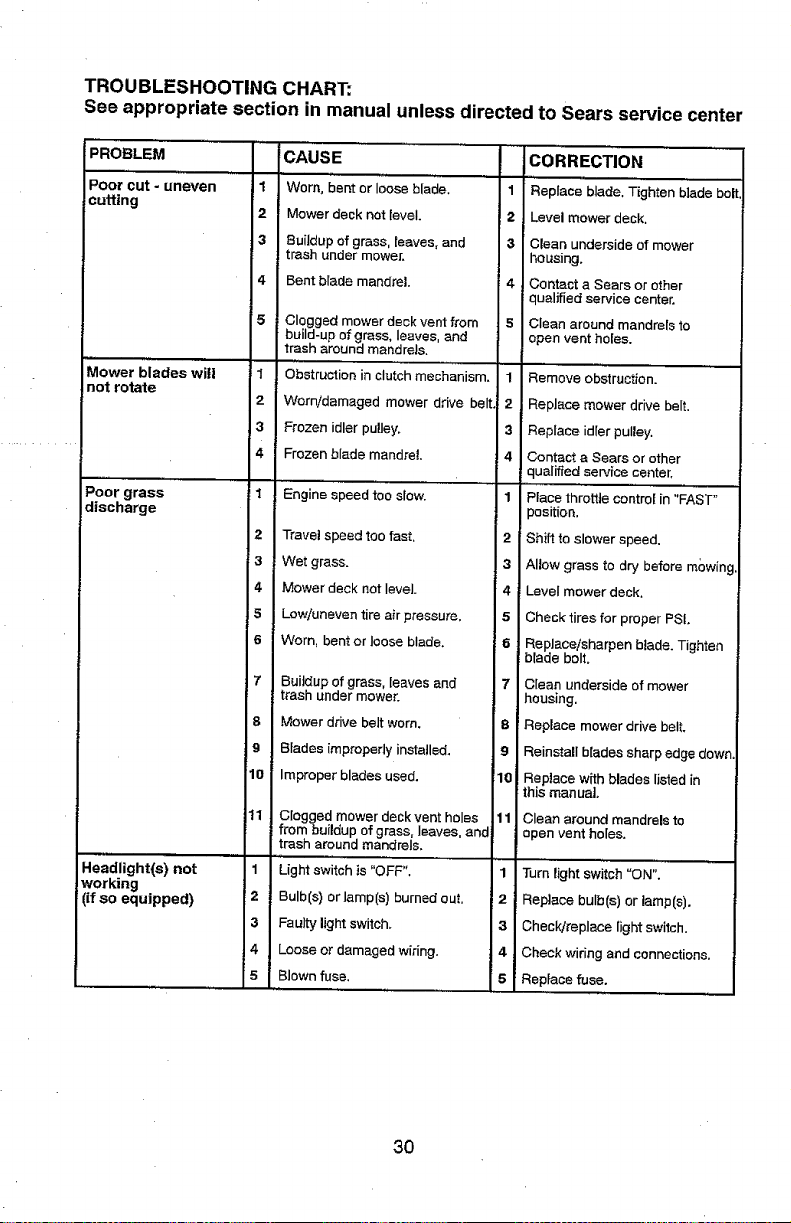
TROUBLESHOOTING CHART:
See appropriate section in manual unless directed to Sears service center
PROBLEM
Poor cut - uneven
cuffing
Mower blades will
not rotate
Poor grass
discharge
Headlight(s) not
working
(if so equipped)
CAUSE
1 Worn, bent or loose blade.
2 Mower deck not level.
3 Buildup of grass, leaves, and
trash under mower.
4 Bent b_ade mandrel
5 Clogged mower deck vent from
build-up of grass, leaves, and
trash around mandrels.
1 Obstruction in clutch mechanism.
2 Worn/damaged mower drive belt,
3 Frozen idler pulley.
4 Frozen blade mandre!.
1 Engine speed too slow.
2 Travel speed too fast.
3 Wet grass.
4 Mower deck not level.
5 Low/uneven tire air pressure.
6 Worn, bent or loose blade.
7 Buildup of grass, leaves and
trash under mower.
8 Mower drive belt worn.
9 Blades impropedy installed.
10 Improper blades used.
11 Clogged mower deckvent holes
from buildup of grass, leaves, and
trash around mandrels.
Light switch is "OFF".
2 Bulb(s) or lamp(s) burned out,
3 Faulty light switch.
4 Loose or damaged wiring.
5 Blown fuse,
CORRECTION
1 Replace blade. Tighten blade bok
2 Level mower deck.
3 Clean underside of mower
housing.
4. Contact a Sears o5 other
qualified service center.
5 Clean around mandrels to
open vent holes.
1 Remove obstruction.
! 2 Replace mower drive belt,
3 Replace idler pulley.
4 Contact a Sears or other
qualified service center.
1 Place throttle control in "FAST"
position,
2 Shift to slower speed.
L3 Allow grass to dry before mowing
4 Level mower deck.
5 Checktires for proper PSI.
I 6 Replace/sharpen blade. Tighten
blade bolt.
7 Clean underside of mower
housing,
8 Replace mower drive belt.
9 Reinstall blades sharp edge down
110 Replace with blades listed in
this manual
11 Clean around mandrels to
open vent holes.
1 Turn light switch "ON".
2 Replace bulb(s) or lamp(s).
3 Check/replace light switch.
4 Check wiring and connections,
5 Replace fuse.
3O
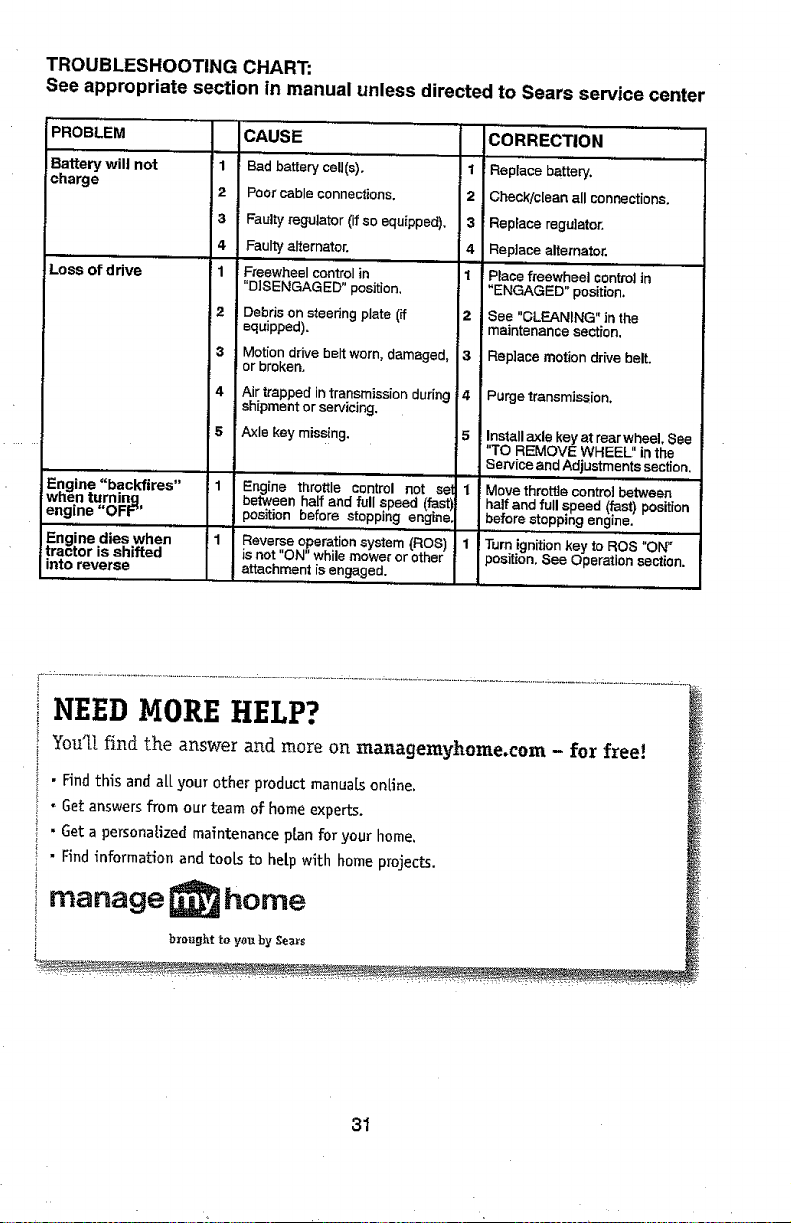
TROUBLESHOOTING CHART;
See appropriate section in manual unless directed to Sears service center
PROBLEM CAUSE
Battery will not ! 1 Badbattery cell(s).
charge
2 Poor cable connections.
CORRECTION
i Replace battery,
2 Check/clean all connections.
3 Faultyregulator (if so equipped), 3 Rep|ace reguiater.
4 Faulty alternator. 4 Replace alternator.
Loss of drive 1 Freewheel control in 1 Place freewheel control in
"DISENGAGED" position, "ENGAGED" position.
Engine "backfires"
when turning
engine "OFF"
Engine dies when
tractor is snl_tea
into reverse
i 2 i Debris on steering plate (ff 2 See "CLEANING" in the
equipped), maintenance section.
3 Motion drive belt worn, damaged, 3 Replace motion drive belt,
or broken,
_4
5
11
Air trapped in transmission during 4
shipment er servicing,
Axle key missing. 5
Engine throttle control not set 1
between half and fulI speed (fast)
position before stopping engine.
Reverse operation system (ROS) 1
is not "ON" while mower or ether
attachment is engaged.
Purge transmission.
Install axle key at rear wheel, See
"TO REMOVE WHEEL!' in the
Service and Adjustments section,
Move throttle control between
half and full speed (,fast) position
before stopping engine.
, ,,,, ,, ,,
Turn ignition key to ROS "ON"
position. See Operation section,
NEED MORE HELP?
You'll find the answer and more on managemyhome.com - for free!
• Find this and a[[ your other product manuals online.
- Get answers from our team of home experts.
• Get a personatized maintenance ptan for your home,
• Find infm'matlon and tools to hetp with home projects.
manage home
bmught to you by Sears
31
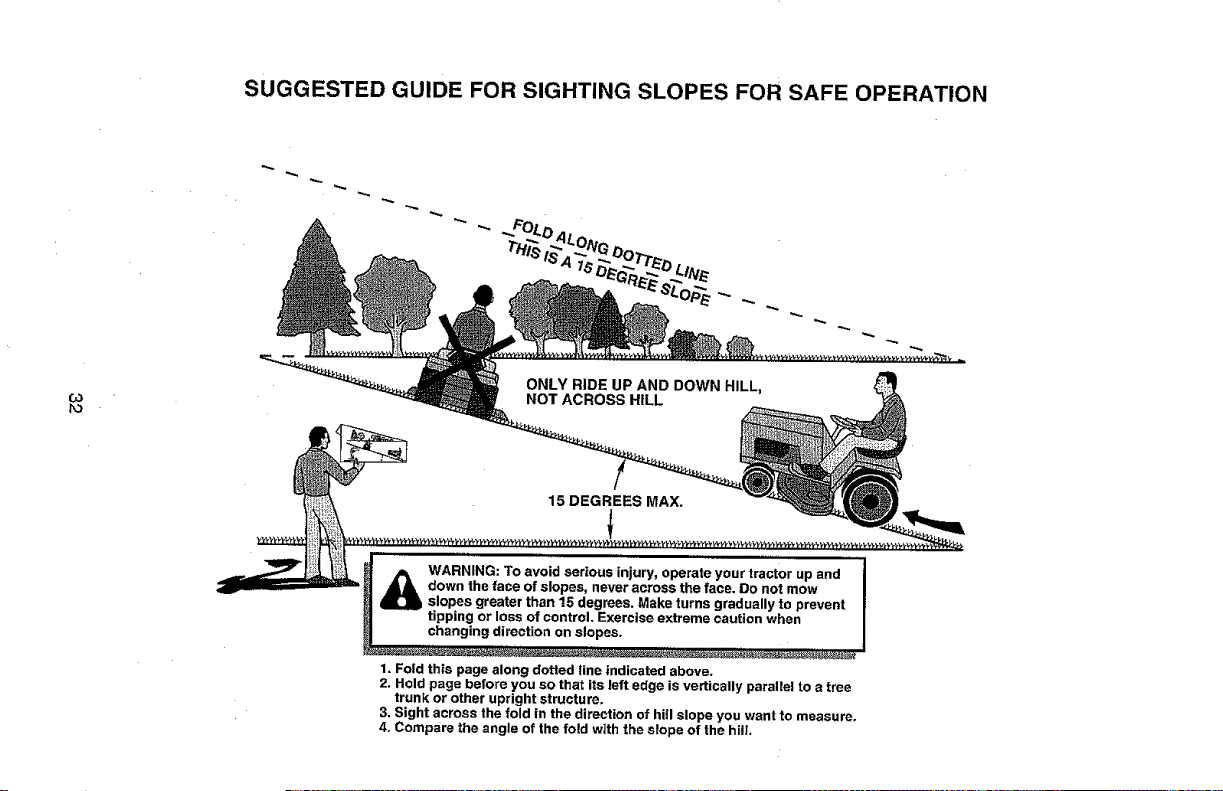
SUGGESTED GUIDE FOR SIGHTING SLOPES FOR SAFE OPERATION
ro
ONLY RIDE UP AND DOWN HILL,
NOT ACROSS HILL
15 DEGREES MAX.
1
_ ARNING: To avoid serious injury, operate your tractor up and
down the face of slopes, never across the face. Do not mow
slopes greater than 15 degrees. Make turns gradually to prevent
tipping or loss of control. Exercise extreme caution when
changing direction on slopes.
1. Fold this page along dotted line indicated above_
2. Hold page before you so that its left edge is vertically parallel to a tree
trunk or other upright structure.
3. Sight across the fold in the direction of hill slope you want to measure.
4. Compare the angle of the fold with the slope of the hill.
Garant[a..........................................................33
Reglas de Seguridad ......................................34
Especificacionesdel Producto ........................37
MontajeiPre Operaci6n ...................................38
Operaci6n .......................................................40
Mantenimiento ................................................47
Programa de Mantenimiento .......................... 47
Servicio y Ajustes ........................................... 52
Almacenamiento ............................................. 58
Identificaci6n de Problemas ........................... 59
Servioio Sears ............................. Contraportada
Garantla para equipos tractores Craftsman
GARANTiA COMPLETA DE CRAFTSMAN
PaR DOS AI;JOS desde Ia fecha de compra, todas las partes no sustituiblee de este equipo tractor estdn
garantizadas contra cualquier defecto de matedal o mane de obra. Una parte no sustituib[e defectuosa
recibird repsraci6n o reemplazo gratuito en casa si la reparaci6n es imposibfe.
PaR CINCO ANOS desde la fecha de compra, el bas6dor y el eje delantsro de este equipo tractor estdn
garanfizados contra cualquier defecto de material o mane de obra. Un bastider o eje deJantero defectuoso
....recibir& reparaci6n o reemplazo gratuito en casa si la reparaci6n es imposible.
DURANTE 90 DJAS desde la fecha de compra0 la bateda (una parts sustituible) de este equipo tractor
esl_ garantizada contra ¢ualquier defecto de material o mane de obra (nuestra prueba comprueba que no
contendr& carga). Una bateria defectuosa recibir_ un reempJazo gratuito en casa.
GARANTJA L|MITADA DE PaR VIDA ADIC|ONAL an el EJE DELANTERO DE HIERRO COLADO (el
est', provisto)
DURANTE EL TIEMPO EN QUE SE USE par el propietario original despu_s de] quints ass a partir de ta
fecha de compra, el eje delantero de hierro colado (si est_ provisto) de este equips tractos est& garantizado
contra cualquier defects de material o mane de obra. Con el comprobante de compra, un eje delantero de
hierro colado recibir& un reemplazo gratuito en casa.
SERVICIO DE GARANTIA
Para conocer los detalles de la cobertura de garantia para obtener una reparaci6n o reemplazo gratuito,
Ilame al 1-800-659-5917 6 visits el sitio web: www. craftsman.cam
En redes los cases anteriores, si el reemplazo as imposible, el equipo tractor serd sustituido sin cargo con
el rnismo modelo o unc equivalente.
Toda la cobertura de garantia anterior serd nula sieste equipo tractor se utiiiza alguna vez para brindar
servicios comerciates o si se alquifa a otra persona.
Esta garantfa cubre 0NICAMENTE defectos de materialy mane de obra. La cobertura dogarantia NO inctuye:
- Partes sustituibies (excepto la bateria) qua se puedan desgastar par el usa normal dentro del perlodo de
gamntia incluso, pere sin limitarse a, cuchilIas, bujfas, f_itros de airs, correas y filtros de aceite.
• Se_vicios de mantenimiento est_.ndar, cambios de aceite o afinaciones.
• Reemplazo o reparaci6n de neum_ticos par pinchazos causados par objetos externos coma clavos,
espinas, tocones o vidrios.
• Reemplazo o reparaci6n de neum=Sticos o ruedas per desgaste normal, accidentes o par operaci6n o
mantenimiento incerrectos.
• Reparaciones necesadas par abuse deI operador incluso, pete sin limitarse a, daSos causados par
remolcar objetos que superen la capacidad del equipe tractor, chocar contra objetos que doblen el
bastidor, el ensamble del eie o el cJgOet_al o sobrepasar la velocidad del motor.
• Reparaciones necesarias par negligencia del operador, incluso (pero sin Iimitarse a ello) daSos el6ctricos
y mec_nicas causades par el almacenamiento incorrecto, par no usar el grade y Ia cantJdad correctos de
aceite de motor, par no mantener del muelle tibre de residues inflamables o par no mantener el equips
tractor de acuerdo con las instrucciones que contiene el manual del operador.
• Limpieza o reparaciones del motor (sistema de combustible) cuando se determina que se us6
combustible contaminado y exidado (sarro). En general, el combustible debe usarse dentro de los 30
dias posteriores a su cempra.
• Deterioro y desgaste normal de Ice acabades eXterieres o sustituci6n de r6tulos de preductos.
Esta garantJa le otorga derechos legales especfficos, y usted tambi_n puede toner otres dereches que
var_an de un estado a otro.
Sears Brands Management CorPoration, Hoffman Estates, IL 60179
33
_,PELtGRO: Esta Maquina cortadora es capaz de amputar las manosy los pies y de lanzar
objetos, si no se observan tas instrucciones de seguridad siguientes se pueden producir
lesiones graves o la muerte.
_DVERTENCIA: Siempre desconec_e el alam-
bre de Ia bujia y p6ngalo donde no pueda entrar
en contacto con la buiia, para evitar el arranque
per accidente, durante la preparaci6n, el trans-
porte, el ajuste ocuando se hacen reparaciones.
_ADVERTENCIA: No avarice cuesta abajo a pun-
to muerto ya que podda perder el control deltractor.
_.ADVERTENCIA: Remolque sotamente tos
accesorios recomendados y conformes alas
caracteristicas indicadas per el fabricante de su
tractor, Tenga cuidado y prudencia al utilizar el
tractor. Cuando se encuentre en un declive, oper
utilizando exclusivamente la velocidad m&sbaja.
En case de un declive una carga excesiva po-
............ dda resultar peligrosa. Los neum&ticos pueden
perder ta tracciSn con el suelo y hacerle perder
el control de su tractor.
_d_.DVERTENOIA: El tube de escape del motor,
a{gunos de sus constituyentes y a!gunos com-
ponentes deI veh{culo contienen o desprenden
productos quimicos conocidos en el Estado de
California come causa de c&ncer y defectos al
nac,imiento u otros daSos reproductivos.
_,DVERTENCIA: Los bornes, terminales y ac-
cesorios relatives de la bateria contienen plorno
o compuestos de plomo, productos qufmicos
conocidos en et Estado de California come causa
de c&ncer y defectos at nacimiento u otrosdaSos
reproduotivos. Lavar las manes despu_s de
manipularlos.
i. FUNCIONAMIENTO GENERAL
• Leer,entender y seguir todas las instrucciones
sobre la m_.quina yen el manual antes de
empezar.
• No poner las manes o los pies cerca de partes
giratorias o debajo de ]a m_quina, mantener
siempre limpia la abertura de descarga.
• Permitir ei funcionamiento de la m_.quina sSIo
a adultos que tengan familiaridad con Ias
instruociones,
• Limpiar el __rea de objetos come piedras,
juguetes, cables, etc. que pueden ser recogi-
dos y disparados con las cuchillas.
• Asegurarse de que el &rea est_ libre de otras
personas antes de ponerla en marcha. Parar
]a m_.quina si alguien entra en el _rea,
• Nunca Jlevar pasajeros.
• No cortar marcha atr,_s al no ser absolu-
tamente necesario. Mirar siempre abajo y
delante mientras se precede atr&s.
• Nunca dirigir et matedai descargado hacia na-
die. Evitar descargar materiaJ contra paredes
u obstrucciones. El material podria rebotar
hacia el operador. Parar las cuchillas cuando
se pasan superficies de grava.
• No maneje la m&quina si no tiene la trampa
para c_sped completa, la canaieta de descarga
u otros dispositivos de seguridad en su tugar
yen funcionamiento.
• Ralentizar antes de girar.
• Nunca dejar una m_.quina encendida sin vigi-
lancia. Apagar siempre las cuchilias, porter el
freno de estacionamiento, parar el motor, y
quitar Ias llaves antes de ba}ar.
• Desenganche las hojas cuando no est6 cortan-
do cL=sped,Apague el motor y espere hasta que
todas Ias partes se detengan per complete an-
tes de limpJarIa m&quina, retirar Iatrampa para
c_sped o destapar la canaleta de descarga.
• Hacer funcionar ta m_.quina s61ocon ]a Iuzdel
dia o luz artificial buena.
• No hacer funcJonarla m&quina estando bajo
Josefectos de alcohol o droga,
• Porter atenciSn al tr&fico cuando se opera
cerca de calles o se cruzan,
• Poner la m_xima atencibn al cargar o descar-
gar la m&quina en una caravana o cami6n,
• Llevar siempre gafas de protecciSncuando se
hace funcionar la m&quina.
. Los dates lndican que los operadores a partir
de los 60 aSos est_.n afectados per un gran
porcentaje de heridas relativas a la conducciSn
deI cortac_sped. Estos operadores tenddan
que evatuar su habitidad de hacer funcionar
el cortac_sped de mode Io bastante seguro
para proteger a si misrnos y a otras personas
de heridas graves.
• Seguir Ias recomendaciones del fabrJcante
para los pesos y contrapesos de las ruedas.
• Mantener la m__quina libre de hierba, hojas u
otros escombros que pueden toear el tube de
escape/partes deI motor calientes y quemarse,
No permitir que et puente del cortac_sped
cargue hojas u otros residues que pueden
causar acumulaciones. Limpiar toda salpica-
dura de aceite o carburante antes de hacer
operaciones sobre la rn&quina o guardarla.
Dejarla enfriar antes de guardar{a.
IL FUNCIONAMIENTO EN PENDIENTES
Las pendientes son el mayor factor de accidentes
relatives a la p_rdida de control y vuelco, que
pueden causar severas heridas o muerte. EJfun-
cionamientoen pendientes requiere una atenci6n
extra, Si no es posible hacer marcha atr__sen una
pendiente o site sientes incomodo, no la cortes.
• Cortar hacJa arriba y abajo de una pendiente,
no de mode horizontaI,
• Porter atenciones a los hoyos, {as ra_ces, los
bultos, las piedras u otros objetos escondidos.
Et terreno irregular puede volcar ta m&quina.
La hierba atta puede esconder obst&ouIos.
34
. Escoger una velocidad de marcha baja de
modo que no sea necesario pararse ocambiar
estando en una pendiente.
• No cortar la hierba moiada. I_asruedas pueden
perder tracci6n.
Poner siempre una marcha cuando se est,.
en pendientes. No porter on punto muerto eir
cuesta abajo.
• Evitar arrancar, pararse o girar en una pendien-
te. Si las ruedas pierden tracc'_n, desconect=ar
tas cuohillas y proceder despacio coesta abajo
en la pendiente,
• Mantener todo los rnovimientos en 1as pen-
dientes lentos y gradual. No hater cambios
repentinos de velocidad o direcci6n, ya que
pueden causar el escape de Ia m&quina.
-Poner la m&xima atenci6n cuando la m_.quina
funciona con captadores de hierba u otros
dispositivos enganchados; pueden afectar ta
estabilidad de Ia m&quina. No usar en pendi-
entes empinados.
• No intentar estabilizar ta mn_;=quinaponiendo el
pie en el terreno.
• No cortar cerca de bajadas, cunetas y orillas.
Las m&quina puede votcarse improvisamente
si una rueda est_ en el borde o so hunde.
iii.NIITtOS
_ADVERTENOIA: LOS NI_JOS PUEDEN
SUFRIR DANOS CON EL U$O DE ESTE EQUI-
PO. La Academia Estadounidense de Pediatria
(American Academy of Pediatrics) recomienda
que s6Io se perrnita a nifios con una edad mini-
ma de 12 ahos manejar m_.quinas cortacL_sped
manuales, y aI menos de 16 afios para manejar
trac_ores cortac_sped.
Si el operador no pone atenci6n a la presencia
de los nifios pueden ocurrir acoidentes tr&gicos.
Los nifios a menudo esL&natraidos por la m&qui-
nay las actividad de cortar. No dar pot hecho
de que los nifios se queden adonde estaban la
01tima vez que los vistes.
• Mantener los nifios fuera del &rea de corte y
vigilados per un adulto responsable que no sea
el operador.
• F_staralerta y apagar la m&quina si un nifios
entra en el &rea.
• Antes y durante la marcha art&s, mirar adelante
y abajo para ver si hay nifios pequefios.
• Nunca Ilevar nifios, incluso si hay ]as cuchillas
apagadas. Podrian caer y herirse seriamente
o interferir con el funcionamiento seguro de Ia
rn&qu[na, los nifios que se han Ilevado prec*
edentemente pueden aparecer do prontoen el
_,rea de corte por otto paseo y ser attopellados
o tumbados por Ia m&quina.
• Nunca dejar que los nifios manipulen la m_-
quina.
• Tenet el m_Jmo cuidado cuando se acerca
a cantos ciegos, arbustos, &rboles u otros
objetos que pueden impedir la vista de nifios.
35
IV. REMOLQUE
• Remolcar s61ocon una m_quina que tenga un
gancho disefiado para remolcar. Enganchar el
equipo o remolcar s61o en el punto dispuesto
ai efecto.
• Seguir las recomendaciones del produCtor con
respecto a los llmitas del equipo por remolcar
y el remolque en pendientes,
• Nunca permitir que nifios u otras personas
est_n dentro del equipo pot remolcar.
• En pendientes, el peso del equipo rernolcado
puede causar la p_rdida de _'acci6n y la p_r-
dida de control.
• Viajar despacio y dejar m&s distancia para
frenar.
V. SERVlClO
MANIPULACK_N SEGURA DE LA GASOLINA
Para evitar heridas personales o da_os alas
cosas, poner e[ m_imo cuidado a la hora de
manipular la gasolina, La gasolina, es extrema-
mente inftamable y los vapores son explosives.
• Apagar todos los cigarriUos, cigarros, pipas y
otras fuentes de ignioi6n.
• Usar sblo contenedores para gasolina aproba-
dos.
. Nunca quitar el tap6n de la gaso]ina o afiadir
carburante con el motor on mareha, dejar
enfTiar el motor antes del abastecimiento de
la gasoIina.
• Nunca abastecer la m&quina al interior de un
local.
• Nunca guardar la m_.quina o el contenedor
de[ carburante donde haya una llama abierta,
chispas o una luz piloto como un calentador
de agua u otros dispositivos.
• Nunca Ilenar los contenedores aI interior de
un vehiculo o en una caravana o cami6n
recubiertos con un forro de pl_stico. Colocar
siempre los contenedores en el terreno lejos
del vehfculo cuando se est& tlenando.
• Quitar el equipo de gas det cami6n o caravana
y abastecer]o en el terreno. Si no es posible,
abastecer dicho equipo con uncontenedor por-
t&til, m_.sbien que de un surtidorde gasolina,
• Mantener la boqui]]a a contacto del borde
del depbsito de carburante o la abertura del
contenedor durante toda la operaci6n de
abasteeimiento. No utilizar un dispositivo con
boquitla cerrada-abierta.
• Si se vierte carburante sobre la ropa, cambi-
arse ta ropa inrnediatamente.
• Nunca lIenar el depbsito m&s de to debido.
Volver a colocar el tap6n del gas y cerrar de
modo ffrme.
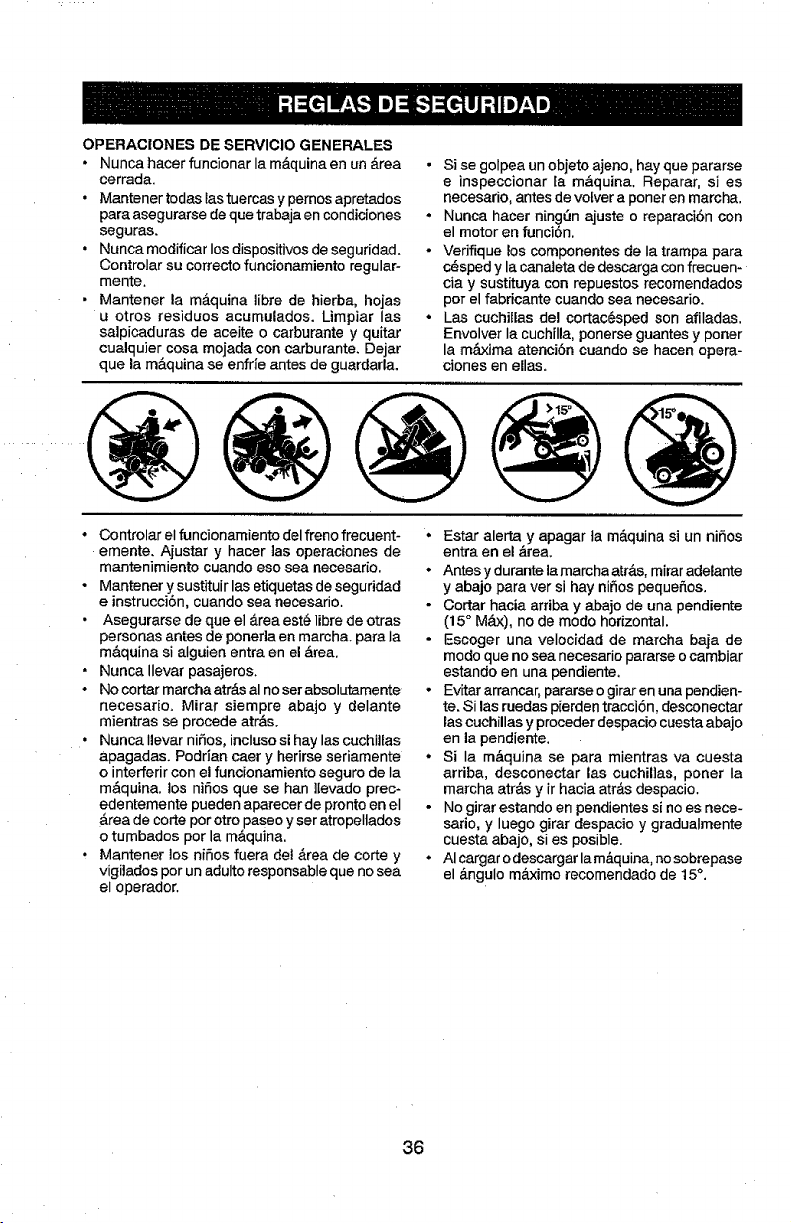
OPERACIONES DE SERVICIO GENERALES
• Nunca hacer funcionar la m&quina en un _rea
cerrada.
• Mantener todas las tuercas y pemos apretados
para asegurarse de que trabaja en condiciones
seguras.
• Nunca modificar los dispositivos de seguridad.
Controlar su correcto funcionamiento regular-
mente.
• Mantener la m&quina libre de hierba, hojas
u otros residues acumulados. Limpiar las
salpicaduras de aceite o carburante y quitar
cualquier cosa mojada con carburante. Dejar
que la m&quina se enfrie antes de guardarla.
• Si se golpea unobjeto ajeno, hay que pararse
e inspeccionar Ea rn&quina. Reparar, si es
necesario, antes de volver a poner en marcha,
• Nunca hacer ning_n ajuste o reparaci6n con
el motor en funci6n,
• Vedfique Eoscomponentes de Ia trampa para
c_sped y la canaJetade descarga con frecuen*
ciay sustituya con repuestos recomendados
per el fabricante cuando sea necesario.
• Las cuchiflas del cortac6sped son afiladas,
Envolver Ia cuchflla, ponerseguantes y porter
la m_xima atenei6n cuando se hacen opera-
ciones en elias.
• Controlar el funcionamiento del freno frecuent-
emente. Ajustar y hacer ]as operaciones de
mantenimiento cuando eso sea necesado,
• Mantener y sustituir las etiquetas de seguridad
e instrucci6n, cuando sea necesario.
• Asegurarse de que el &rea estL=libre de otras
personas antes de poneda en rnarcha, para Ja
m_,quina si alguien entra en el &tea,
• Nunca Ilevar pasajeros.
• No cortar marchaatr_Lsal no serabsolutamente
necesario. Mirar siempre abajo y delante
mientras se precede atr&s.
• Nunca IJevarnir_os, incluso si hay las cuchiJlas
apagadas. Podrian caer y herirse sedamente
o interferir con el funcionamiento seguro de la
m&quina, los nifios que se han llevado prec-
edentemente pueden aparecer de prontoen el
&rea de corte perotto paseo y ser atropellados
o tumbados per la m&quina,
• Mantener los nifies fuera de! &rea de corte y
vigilados per un adulto responsable que no sea
el operador.
• Estar alerta y apagar ta m&quina si un nir_os
entra en el &tea.
• Antes y durante la marcha art&s,mirar adelante
y abajo para ver si hay niSos peque_os.
• Cortar hacia arriba y abajo de una pendiente
(15° M,_x), no de mode horizontal.
• Escoger una velocidad de marcha baja de
mode que no sea necesario pararse o cambiar
estando en una pendiente.
• Evitar arrancar, pararse o giraren unapendien-
te. Si las ruedas pierden tracci6n, desconectar
las cuehillas y preceder despacio cuesta abajo
en la pendiente.
° Si la m&quina se para mientras va cuesta
arriba, desconectar las cuchillas, poner Ia
marcha atr&s y ir hacia atr&s despacio.
• No girar estando en pendientes si no es nece-
sario, y luego girar despacio y gradualmente
cuesta abajo, si es posible.
• AI cargar o descargarlam&quina, no sobrepase
el &ngulo m&ximo recomendado de 15°.
36
ESPECIFICACIONES DEL PRODUCTO
Capacidad y Tipo $.0 Galoneslll,35 L
de Gasolina: Regular Sin Plomo
Tipo de Aceite SAE 30 (eobre 32=F/0°O)
API: SG-SL): 8AESW30 (deabaio32°Ft0°C)
Capacidad de (;on Fittro: 56 Ozj1,65 L
Aceite: Sin Filtro. 48 Oz.!1,4 L
Bujia Champion RC12YG
(Aberlura: .030'=/0.76 mr;})
Velocidad de Marcha
Recarr'_o Adelante: 0 - 5.2/8,4
(Mph/Kph): Atr&s: 0 - 2.9/4,7
8istema de 3 Amps Batteria
Carga: 5 Amps !_uces
!Bateria: Amp/Hr: 28
Min. CCA: 230
Modelo TamaSo: U1R
Torsi6r_ deI Pemo 4S-55 Ft. Lbs./62-75 Nm
de ia Cuchilla:
...... FELICITACIONES per la compra de su tractor. Ha
side diseSado, plan_cadoy fabricado para darle Ia
mejot contiabilidad yel mejor rendimiento posible.
En el caso de que se encuentre con cuaIquier
problema que no pueda solucionar f_cilmente,
haga el favor de ponerse en contacto con un
centTo de servicio Sears o con un OtTOcentro de
servicio cualificado. Cuenta con representantes
bien capacitados y competentes y con las her-
ramientas adecuadas para darle servicio o para
reparar este tractor.
Haga el favor de leer y de guardar este manual.
Estas instruc-ciones Ie permitir_n montar y man-
tener su unidad en forma adecuada. Siempre
observe Ias "REGLAS DE SEGURIDAD/'
RESPONSABILIDADES DEL CLIENTE
• Lea y observe tasreglas de seguddad.
- Siga un programa regular de mantenimiento,
cuidado y uso de su tractor.
• Siga las instrucoiones descritas en ]as sec-
ciones "Mantenimiento" y 'Y_imacenamiento"
de este manual,
• Utitice prendas de seguridad adecuadas at
manejar la m&quina, incluidos (como m_nimo)
calzado de segur[dad, gafas protectorasy pro-
tecci6n auditiva. No utilice pantalones cortos
yio calzado abierto cuando corte la hierba.
• Informe siempre a alguien de que se dispone
a cortar la hierba en el exterior.
_DVERTENCIA: Este tTactor viene equipado
con un motor de combusti6n interna y no se debe
usar sobre, o cerca, de un terreno no desarrollado
cubierto de bosques, de arbustos o de c_sped,
o menos que el sistema de escape del motor
venga equipado con un amortiguador de chispas
que cumpla con Ias leyes locates o estatales (si
existen). Si se usa un amortiguadorde chispas,
el operador debe mantenerlo en condiciones de
trabajo eficientes.
En el estado de California, ]a [ey exige 1oanterior
(Secei6n 4442 del "California Public Resources
Code"). Otros estados pueden contar con otras
leyes parecidas, l.as leyes federales se aplican
en la tierras federales. Su centro de Servicio m&s
cercano tiene disponibIe amortiguadores de chis-
pas para el silenciador. (Yea la secci6n de Partes
de Repuesto en el manual Ingl@sdel duello.)
ACUERDOS DE PROTECCION PARA
LA REPARAC|6N
Congratulaciones pot su buena compra. Su
nuevo producto Craftsman® est,. disefiado y
fabricado para funcionar de modo fiable pot
muchos aries. Pete como todos los productos,
puede necesitar a[guna reparaci6n de tanto en
tanto. En este caso tener un Acuerdo de Protec-
ci6n para Ia Reparaci6n puede hacedes ahorrar
dtnero y fastidios.
Compre ahora un Acuerdo de Protecci6n para Ia
Reparaci6n y prot@gese de molestias y gastos
inesperados.
Un Acuerdo inciuye toe puntos s_guientes:
• Servicio experto de nuestros 12.000 espe-
cialistas profesionales en la reparaci6n.
• Servicto itimitado sin cargo alguno para
las partes y la mano de obra sobre todas las
reparaciones garantizadas.
• Sustituci6n del producto si su producto
garantizado no puede ser arreglado,
. Descuento de110% sobre el precio corriente
del servicio y de las partes relativasal servicio
no cubiertas pot el acuerdo; tambi_n el 10%
menos sobre el precio corriente de un control
de mantenimiento preventivo,
• Ayuda rdpida por teldfono -soporte telef6nk
co por parte de un representante Sears sobm
productosque requieren un arreg[o encasa, y
adem_s una programaci6n sobre los arreglos
m&s convenientes,
Cuando se ha comprado el Aeuerdo, basra con
una Uamadatelef6nica para programarel servicio,
Puede IIamar cuando quiera, dia y noche o fijar
en lfnea una cita para obtener el servicio, Sears
tiene m&s de 12.000 especialistas profesionates
en la reparaci6n, que tienen acceso amEs de
4,5 millones de partesy accesorios de calidad.
Este es el tipo de profesionalidad con que puede
contar pare ayudar a alargar la vida del pro-
ducto que acaba de comprar, pot muchos aSos,
iCompre hoy su Acuerdo de Protecci6n para la
Reparaci6n]
Se aplican algunas limitaciones y exclusiones,
Para conocer los precios y tener m_is lnfor-
maci6n, Ilame al 1-800-827-6655,
SERVICIO DE INSTALAClON SEARS
Pete ta instelaci6nprofesione/ Seers de apara-
tos de casa, puertasde garaje, calentadores de
agua y otTosimportantes articulos para Ia casa,
en U.S,A Ilamar a
1-800"A-MY-HOME®
37
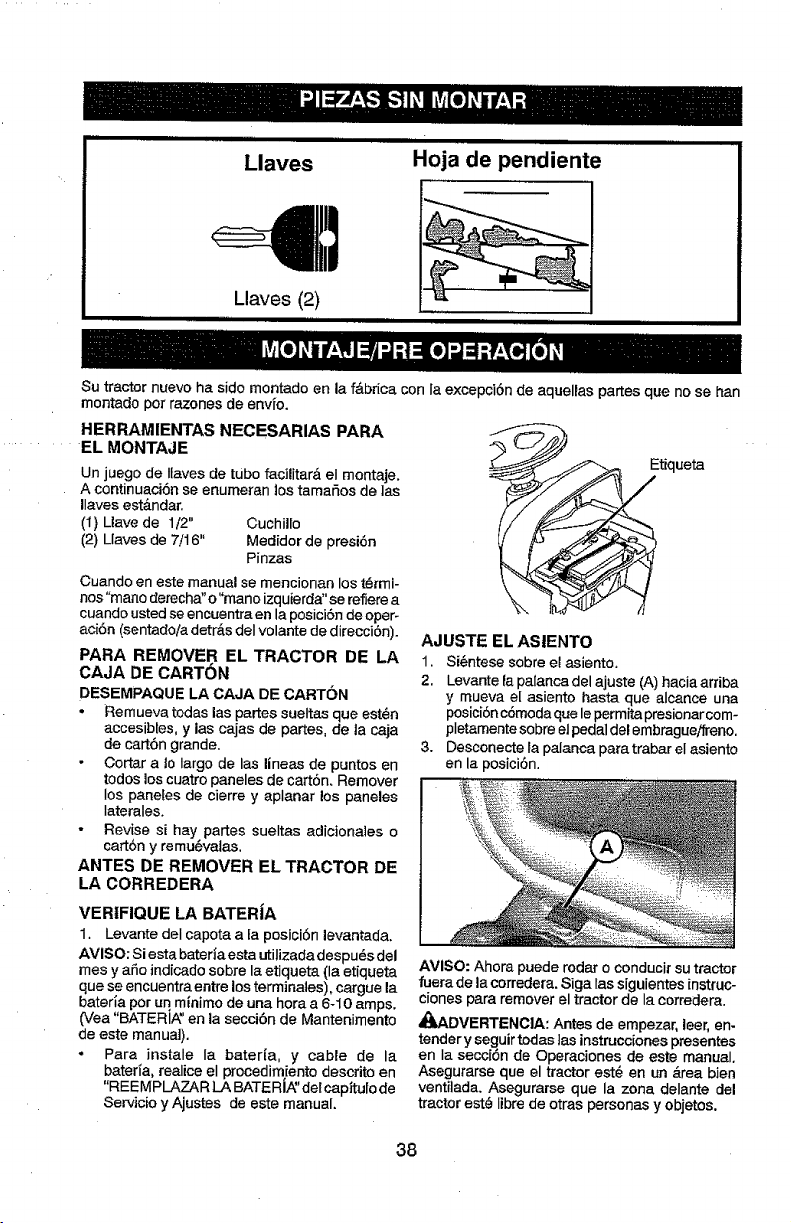
Llaves
Llaves (2)
Hoja de pendiente
Su tractor nuevo ha sido montado en la f&brica con Ia excepci6n de aquellas pares que no se han
montado pot razones de envfo.
HERRAMIENTAS NECESARIAS PARA
EL MONTAJE
Un juego de Ifaves de tubo facilitarA el montaje.
A continuaci6n se enumeran los tamaSos de las
Ilaves est&ndar.
(1) Uave de 1/2" Cuchillo
(2) Uaves de 7/16" Medidor de presi6n
Pinzas
Cuando en este manual se mencionan los t6rmi-
nos"mano derecha" o "rnano izquierda"se refierea
cuando usted se encuentra en la posici6n de oper-
aci6n (sentado/a detr_.sdeI volante de direcci6n).
PARA REMOVER EL TRACTOR DE LA
CAJA DE CARTON
DESEMPAQUE LA CAJA DE CARTON
• Remueva todas las partes sueltas que est_n
accesibles, y las cajas de partes, de la caja
de cart6n grande.
Cortar a to largo de las lineas de puntos en
todos los cuatro paneles de cart6n. Remover
los panefes de cierre y aplanar los paneles
Iaterales.
Revise si hay partes sueltas adicionales o
cart6n y remu6valas.
ANTES DE REMOVER EL TRACTOR DE
LA CORREDERA
AJUSTE EL ASIENTO
1. Si@ntesesobre el asiento,
2. Levante la paianca del ajuste (A) hacia arriba
y mueva e[ asiento hasta que alcance una
posici6nc6modaque lepermita presionarcom-
pletamentesobre el pedaldel embragueifreno.
3. Desconecte ta palanca paratrabar el asiento
en la posici6n.
VERtFIQUE LA BATERiA
1, Levante deI capota a la posici6n levantada,
AVISO: Siesta baterta esta utilizada despu6s del
rues y aSo indicado sobre la etiqueta (la etiqueta
que se encuentra entre losterminates), cargue la
bateria por un minimo de una hora a 6-10 amps.
(Vea "BATERiA_'en la secci@nde Mantenimento
de este manual),
• Para instale la bater[a, y cable de la
bateria, realice el procedim_ento desorito en
"REE MPLAZAR LA BATERI_' del capitulo de
Servicio y Ajustes de este manual.
AVISO: Ahora puede rodar o conducir su tractor
fuera de la corredera. Siga las siguientes instruc-
ciones para remover el tractor de Ia corredera.
_DVERTENCIA: Antes de empezar, leer, en-
tender y seguir todas las instrucciones presentes
en Ia seccibn de Operaciones de este manual.
Asegurarse que el tractor est@ en un _rea bien
ventilada. Asegurarse que la zona delante del
tractor est.@Iibre de otras personas y objetos.
38
PARA HACER RODAR EL TRACTOR
FUERA DE LA CORREDERA (Vea ia sec-
ci6n de la operaci6n para la localidad y
|a funcibn de los controles)
1. Apriete la manillade ]evantamiento del pist6n
y, levante Ia palanca de levantamiento del
accesorio a su posici6n mds alta.
2. Suelte el freno de estacionamiento presion-
ando el pedal del freno.
3. Ponga el control de Ia rueda libre en la
posict6n de giro libre para desenganchar la
transmisi6n. (Vea "PARA TRANSPORTAR"
en la secci6n de Operaci6n de este manual).
(Vea "PARA TRANSPORTAR" en la secci6n
de Operaci6n de este manual).
4. Haga rodar el tractor hacia delante fuera de
la corredera.
Gontinuar con las siguientes instrucciones.
REVISIC)N DE LA PRESION DE LAS
LLANTAS
Las llantas en su unidad fueron infladas de-
masiado en la _brica per razones de envio, La
........ presi6n de las Ilantas correctas es importante
para obtener el meier rendimiento en el corte,
• Reduzca la presi6n de los neum_.ticos a la PSI
que se indica en estos.
REVISION DE LA NIVELACI6N DEL
CON JUNTO
Para obtenerlos mejores resultadosen el corte, la
caja de la _agadoratiene clue estar nivelada en la
forma adecuada. Vea"PARA NIVELAR LA CAJA
DE LA SEGADORi_' en la secci6n de Servicio y
Ajustes de este manual.
REVISI6N DE LA POSICION ADECUADA
DE TODAS LAS CORREAS
Vea ias flguras que aparecen para cambiar las
correas de impufsi6n de ta cuchilla de ta sega-
dora y de movimiento en la secci6n de Servicio y
Ajustes de este manual. Verifique que ias correas
slgan su paso correcto.
REVISI(_N DEL SISTEMA DE FRENOS
Una vez que usted haya aprendido a manejar su
tractor, verifique que e] freno funcione correcta-
mente. Vet "PARA VERIFICAR $1 FUNCIONA
BEN EL FRENO" en el capftu]o de servicio y
ajustes de este manual.
LISTA DE REVISION
Antes de operar yde disfrutar de su tractor nuevo,
le deseamos que reciba el mejor rendimiento y la
mayor satisfaccion de este products de calidad.
Haga el favor de revisar la lista a continuacion:
_" Se han completado todas las instrucclones de
montaje.
J No quedan partes sueltas en fa caja de cad6n.
#f La bateria est6 preparada y cargada en forma
adecuada.
,/" Et asiento ha side ajustado en forma c6moda
y apretado en forma segura.
,/' Todas las Ilantas han side infladas en forma
adecuada. (Para fines de envio, las Ilantas se
infiaron demasiado en ta f&brica.)
JAseg0rese clue el conjunto segador est_
nivelado en forma adecuada, de lade a lade
y desde adelante hacia atrds, para obtener los
mejores resultados en e] corte. (I.as llantas
tienen que estar infladas en forma adecuada
para la nivelaciSn.)
_" Revise {as correas de impulsi6n y de la
segadora. Aseg_rese que recorran el paso
adecuado alrededor de ]as poleas y dentro
de todos los fijadores de las correas.
t/" Revise el alambrado. Fijese que todas las
conexiones todavia est_,nsegurasy que los
alambres est_n sujetos en forma adecuada.
,,/Antes de conducir el tractor, asegfirese clue
el control de rueda ]ibre este en la posictbn
de "transmisi6n enganchada" (Yea "PARA
TRANSPORTAR" en la secc{bn de la Oper-
aciSn de este manual).
AI mismo tiempo que aprende a come usar su
tractor, preste atencion extra a los puntos de
importancia que se presentan a continuacion:
•/' El aceite del motor 8ene que Iiegar al hive]
adecuado.
1/El estanque de combu_bletiene que estar lleno
con gasolina sin plomo regular, nueva y [impia.
ef Familiaricese con redes los controles - su
ubioaci6n y su funci6n, Op(,=relos antes de
hacer arrancar el motor.
Aseg_rese que el sistema de frenos est_ en
una condiciSn de operaci6n segura.
_" Asegurarse de que el Sistema de Preseneia
dei 0perador y et Sistema de Funcionamiento
AthOs (ROS) funcionan de mode adecuado
(Vet las Secciones de Funcionamiento y
Mantenimiento en este manual).
t/" Es importante purgar ta transmisi6n antes de
operar su tractor per Ia primera vez, Siga las
lnstrucciones adecuadas para el empiezo y
para purgar (Vea "PAPA EMPESAR EL _O-
TOR"y "PARA PURGAR LA TRANSMIStON"
en la secci6n de la Operaci6n de este manual.
39

Estos simbolos pueden aparecer sobre su tractor o en la Iiteratura proporcionada con el producto,
Aprenda y comprenda sus significados.
R N H L
MARCHA ATR h,S NEUTRO ALTO BAJO ESTRA_IGU- Rh.PIOO LENTO
LAGION
FRENODE ALTURADE LA LEVANTAMIENTO
ESTAGIONAM]ENTO SEGAOORA DE LA SEGADORA
ACCESORIODEL ACCESOR|ODEL
EMBRAGUE EMBRAGUE
ENGANCHADO DESENGANCHADO
RUEDA LIBRE
(So_amente pars los
modelos automatico)
ATRAS HAC)AADELANTE °RUCE"O DEEMBRAGUE
®@@@@
PEUGRO,GUARDELAS
MANESY LOS PIESLEJOS MANTENGAEL PELtGROSDE
AREADESPEJADA PENDIENTES
(Veala secc_bnd8 las regi_sdesegurLdad)
PELIGRO indica un peligro que, si no se evita,
provoca muerte o lesiones graves.
ADVERTENC|A indica un peligm que, si no se evita,
puede provocar muerte o lesiones graves.
PRECAUCION indies un peligro que, si no se evita,
puede provocar |esiones ligeras o moderadas.
&
No seguir ias siguientes instrucciones
puede provocar heridas o muerte. Los
simbo3os de arise de seguridadse utilizan
pars identificar informaciones de seguffdad
relativas a peligros que puedenprovocar Ia
muerte, heridas graves yio daffos a la
m#,quina.
PRECAUCION cuando se utiliza sin el s{mbolo de aviso,
indica una situaci6n que puede provocar daffos al
tractor yto al motor.
_='='='='='='='='=_SUPERFICIES CALIENTES indica un peligro que,
,_I_,_,,, si no se evffa, puede provocar la muerte, lesiones
graves ylo danos a la maquina.
FUEGO ir_dica un peligro que, si no se evita, puede
provocar Is muerte, lesiones graves y/o danos
a la mdquina.
4O
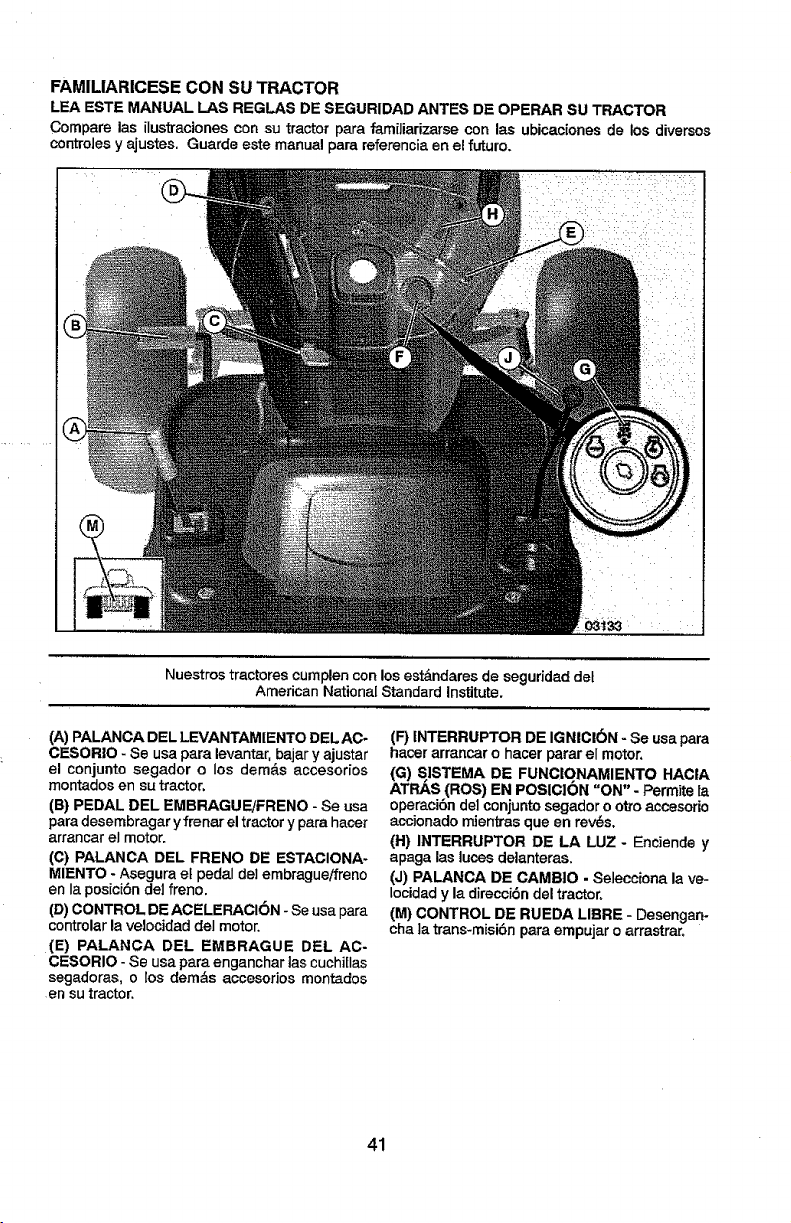
FAMIMARICESE CON SU TRACTOR
LEA ESTE MANUAL LAS REGLAS DE SEGURIDAD ANTES DE OPERAR SU TRACTOR
Compare las ilustracionescon su tractor para familiarizarse con las ubicaciones de los diversos
controles y ajustes. Guarde este manual para referencia en el futuro.
Nuestros tractores cumplen con los est&ndares de seguridad del
American National Standard Institute,
(A) PALANCA DEL LEVANTAMIENTO DEL AC-
CESORIO - Se usa para levantar, bajar y ajustar
el conjunto segador o los dem&s accesodos
montados en su tractor.
(B) PEDAL DEL EMBRAGUF./FRENO - Se usa
pare desembragar y frenar el tractor y para hacer
arrancar e] motor.
(C) PALANCA DEL FRENO DE ESTACIONA-
MIENTO - Asegura et pedal del embragueifreno
en la posici6n dei freno.
(D) CONTROL DE ACELERACION - Se usa para
controlarla velocidad deI motor.
(E) PALANCA DEL EMBRAGUE DEL AC-
CESORIO - Se usa para enganchar tas cuchi[las
segadoras, o los dem&s accesorios montados
en su tractor,
(F) INTERRUPTOR DE IGNICI6N - Se usa para
hacer arrancar o hater parar el motor,
((3) SISTEMA DE FUNCIONAMIENTO HAClA
ATP,AS (ROS) EN POSlCION "ON" - Permite la
operaci6n dei conjunto segador o otto accesorio
accionado mientras queen rev_s.
(H) INTERRUPTOR DE LA LUZ - Enciende y
apaga las luc_esdelanteras.
(J) PALANCA DE CAMBtO - Selecciona la ve-
Iocidady la direcci6n del tractor,
(M) CONTROL DE RUEDA LIBRE - Desengan-
cha la trans-misi6n para empujar o arrastrar,
41
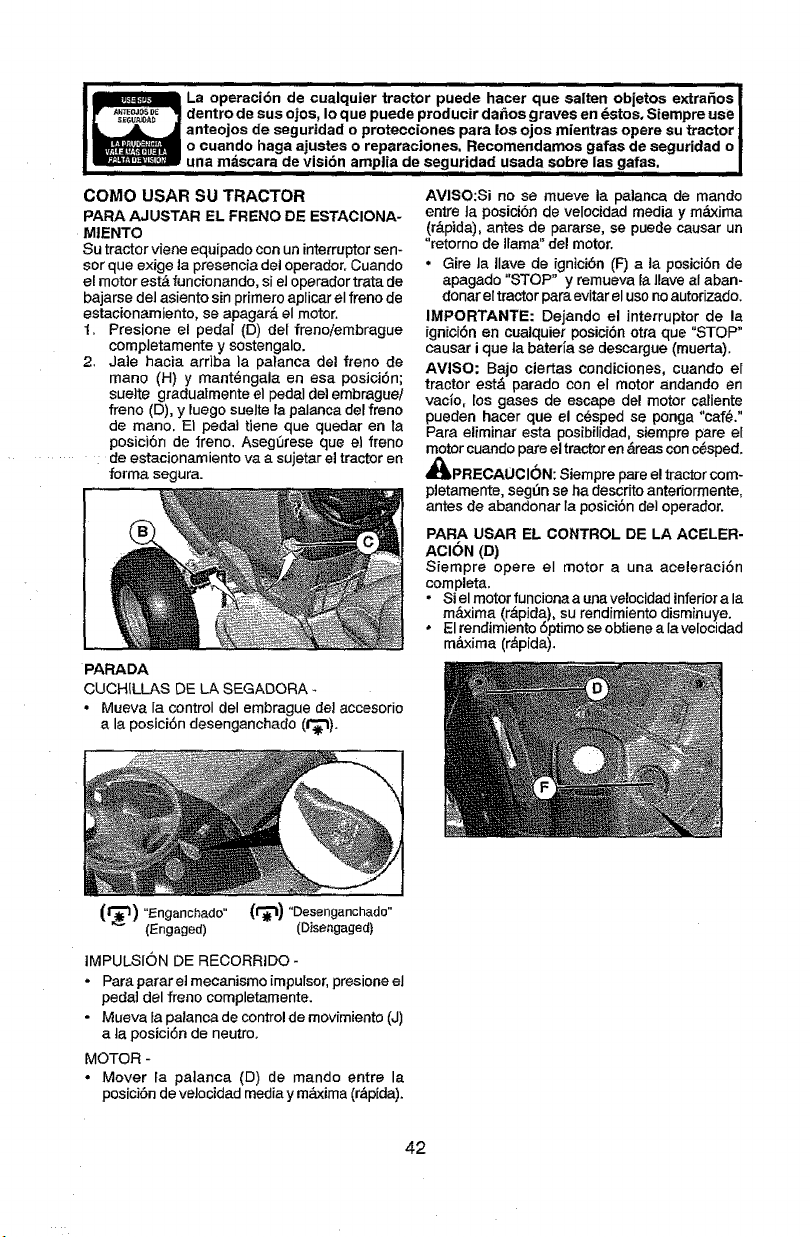
COMe USAR SU TRACTOR
PARA AJUSTAR EL FRENO DE ESTACIONA-
MtENTO
Su tractor viene equipado con un interruptersen-
sor que exige Japresencia del operador. Cuando
el motor es_ funcionando, si e] operador trata de
bajarse del asiento sin primero aplicar el freno de
estaoionamiento, ee apagar& el motor.
1, Presione el pedal (D) del frenoiembrague
compietamente y sostengalo.
2. Jale hacia arriba la palanca de! freno de
mane (H) y mant_ngala en esa posici6n;
suelte gradualmente el pedal de| embrague/
freno (D), y tuego suelte fa palanca del freno
de mane, El pedal tiene que quedar en la
posici6n de freno, AsegSrese que e) freno
........ : de estacionamiento va a sujetar el tractor en
forma segura.
PARADA
CUCHILLAS DE LA SEGADORA
• Mueva Ia control del embrague de] accesorio
a la posici6n desenganchado (1_"1).
AVISO:Si no se mueve la palanca de mando
entre la posici6n de velocidad media y m_ima
(r_.pida), antes de pamrse, se puede causar un
"retorno de llama"del motor.
• Gire Ja Ilave de ignici6n (F) a ta posici6n de
apagado "STOP" y remueva la JlaveaI aban-
donar el tractor para evitar el use noautorizado.
IMPORTANTE: Dejando el interrupter de la
ignici6n en cualquier posici6n otra que "STOP"
causar i que ta baterfa se descargue (muerta).
AVISO: Bajo ciertas condiciones, cuando el
tractor est_ parade con el motor andando en
vacio, los gases de escape der motor caliente
pueden hacer que el c_sped se ponga "oafS."
Para eliminar esta posibilidad, siempre pare el
motor cuando pare el tractor en &reas conc_sped.
_IbPRECAUCI()N: Siempre pare e! tractor com-
p]etamente, seg_n se ha descrito anteriormente,
antes de abandonar la posici6ndel eperador.
PARA USAR EL CONTROL DE LA ACELER-
ACION (D)
Siempre opere el motor a una aceleraciSn
completa.
• Si el motor funciona a una velocidad inferiora la
m_vJma (r&pida), su rendimiento disminuye.
• Elrendimiento 6primo se obtiene ala velocidad
m_ima (r_pida).
"Eogaoo,.do"(r ' )"Do.oogaoo,.do"
(Engaged) (Disengaged)
IMPULSION DE RECORRIDO -
- Para parar e] mecanismo impulsor, presione el
pedal del freno completamente.
• Mueva ia paianca de control de movimiento (J)
a Japosici6n de neutro.
MOTOR -
• Mover Fa patanca (D) de mando entre la
posici6nde ve]ocidad media y m_xima (r&pida).
42
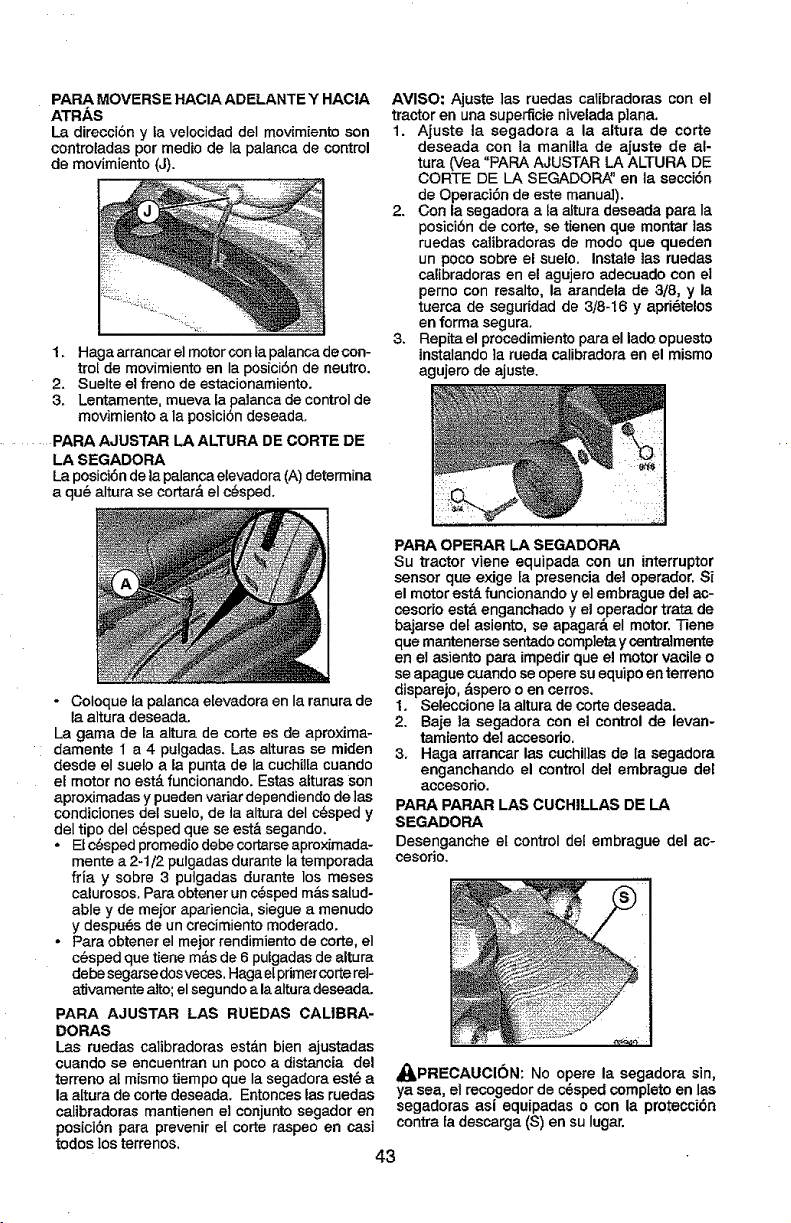
PAPA MOVERSE HACIA ADELANTE Y HACIA
ATRAS
La direcci6n y la velocidad dei movimiento son
controladas pot medio de Ia palanca de control
de movimiento (J).
1. Haga arrancar el motor con la palanca de con-
trol de movimiento en Ia posici6n de neutro.
2. Suelte el freno de estacionamiento.
3. Lentamente, mueva la palanca de control de
movimiento a la posici6n deseada.
.......... PARA AJUSTAR LA ALTURA DE CORTE DE
LA SEGADORA
La posici6nde la palanca elevadora (A)determina
a qu_ altura se cortar,_el c_sped.
AVISO: Ajuste ]as ruedas calibradoras con el
tractor en una superficie nivelada plana.
t. Ajuste la segadora a la altura de corte
deseada con la manilla de ajuste de al-
tura (Vea "PAPA AJUSTAR LA ALTURA DE
CORTE DE LA SEGADOR,at' en la seccibn
de Operacibn de este manual).
2. Con la segadora a fa altura deseada para la
posicibn de corte, se tienen que montar las
ruedas calibradoras de modo que queden
un poco sobre el suelo. Instale las ruedas
calibradoras en el agujero adecuado con et
perno con resalto, la arandela de 3/8, y la
tuerca de seguridad de 3/8-16 y apri6telos
en forma segura.
3. Rep_Lael procedimiento para el lado opuesto
instalando la rueda calibradora en el mismo
agujero de ajuste.
- Coloque la palanca etevadora en Ia ranura de
la altura deseada.
La gama de la altura de corte es de aproxima-
damente 1 a 4 pulgaclas. Las alturas se miden
desde el suelo a la punta de la cuchilfa cuando
el motor no est& funcionando. Estas alturas son
aproximaclas y pueden variar dependiendo de ]as
condiciones del suelo, de la altura del c_sped y
del tipo del c_sped que se est& segando,
• Elc_sped promedio debe cortarse aproximada-
mente a 2-1/2 pulgadas durante la temporada
ftia y sobre 3 putgadas durante los meses
calurosos. Para obtener un c&sped m&ssalud-
able y de mejor apariencia, siegue a menudo
y despu_s de un crecimiento moderado.
• F'ara obtener el mejor rendimiento de corte, el
c_sped que tiene m&s de 6 pulgadas de altura
debe segarse dos veces. Haga elprimer corte rel-
ativamente alto; el segundo a la altura deseada.
PARA AJUSTAR LAS RUEDAS CALIBRA-
DORAS
Las ruedas calibradoras est&n bien ajustadas
cuando se encuentran un poco a distancia del
terreno af mismo tiempo que Ia segadora est_ a
la attura de corte deseada. Entonces las ruedas
calibradoras mantienen el conjunto segador en
posicibn para prevenir el corte raspeo en casi
todos los terrenos.
PAPA OPEP_ARLA SEGADORA
Su tractor viene equipada con un interruptor
sensor que exige la presencia del operador. Si
el motor estb funcionando y e] embrague del ac-
cesorio estb enganchado y el operador trata de
bajarse det asiento, se apagarb,el motor. Tiene
que mantenerse sentadocompletay centralmente
en el asiento para impedir que el motor vacile o
se apague cuando se opere su equipo en terreno
disparejo, &spero o en cerros.
1. Seleccione la altura de cortedeseada.
2. Baje la segadora con el control de levan-
tam[ento del accesorio.
3. Haga arrancar las cuchil]asde la segadora
enganchando el control del embrague del
accesorio.
PAPA PARAR LAS CUCHILLAS DE LA
SEGADORA
Desenganche el control det embrague del ac-
cesorio.
_PRECAUCI6N: No opere la segadora sin,
ya sea, el recogedor de c6sped compIeto en las
segadoras asi equipadas o con la pmtecci6n
contm la descarga (S) en su Iugar.
43
FUNCIONAMIENTO ATRAS
Tu tractorest,, equipado con el Sistema de Fun-
cionamientoAtr_.s(ROS). Cualquier tentativa del
operador de viajar marcha atrds con el embrague
puesto apagar& el motora menos que ]a liave de
ignici6nse pongaen laposici6nde "ON" del ROS.
ATENCION: Ir marcha atrds con el embrague
puesto para cortar, no es recomendable. Po-
niendo el ROSen posici6n "ON", para permitir el
funcionamiento atr&s con el embrague puesto, se
tiene que hacer s6]o cuando el operador 1oconsi-
dera necesario para reposicionar la m&quina con
el dispositivo embragado. No siegue en rev_s a
menos que sea absolutamente necesario,
USAR EL SISTEMA DE FUNCIONAMIENTO
ATR#.S -
Utilice el tractor solamente si est_ seguro de que
no ingresar&n niSos n] otras personas o animales
al &tea deride se va a cortar el c_sped.
1. Mover la palanca de mando del movimiento
en la posici6n neutro.
2. Con el motor en marcha, girar ]a Ilave det in-
.......... terruptÙr de Ia ignici6nen el sentido inverseat
de las agujas deI reloj hasta la posici6n "ON".
3. Mire hacia abajo y hacia atr&s no s61oantes
de ir marcha art&s, sine mientras est_ yendo
marcha atr,_s.
4. Mover despacio la palanca de mando del
movimiento hacia {a posici6n atr&s (R) para
empezar el movimiento.
5. Cuando el use det ROSes m&s necesario, d_
vuelta a la tlave de ignici6n en el sentido de
las agujas deI reloj hasta la posici6n "ON".
PARA TRANSPORTAR
Cuando empuje o arrastre sutractor asegSrese de
desenganchar la transmisi6n poniendoel control
de la rueda }ibreen Ia posici6n de marcha de rue-
da libre. El control de marcha de rueda Iibre esta
situado en la barra de tracci6n trasera del tractor.
1. Levante la palanca de levantamiento del ac-
cesorio a su posici6n m&s alta.
2. Tire det mando de la rueda libre hacia afuera
y hacia abajo hasta que se coloque en la guia
y su@Ita[ode manera que se mantenga en la
posici6n de desenganchada.
• No empuje o arrastre el tractor a m&s de dos
(2) MPH.
Paravolver aaccionar latransmisi6n, invierta
este procedimiento.
Transmisibn Enganchada
Posic[6n ROS "ON" Motor en posici6n "ON"
PARA OPERAR EN CERROS
_ADVERTENCIA: No maneje hacia arriba o
hacia abajo encertes con pendientessuperioresa
t 5° y no maneje atravesando ninguna pendiente,
Utiliee la guia de la pendiente proporcionada en
{a parte posteriorade este manual,
• Escoja Ia valocidad rods lenta antes de arran-
oar hacia arriba o hacia abajo en certes.
- Evite parar o eambiar la velocidad en certes.
- Si es absolutamentenecesarioel parar,empuje
ei pedal det embrague/freno r&pidamente a
Ia posici6n de freno y enganche el freno de
estacionamiento.
° Mueva la palanca de control de movimiento a
Ia posici6nde neutro.
IMPORTANTE: La palanca de control de movi-
miento no vualve a la posici6nde neutToeuando
e] pedal del embrague/freno esta presionado.
• Para velvet a empezar con el movimiento,
suelte lentamente, el freno de estacionamiento
y e! pedal deI embragueifreno.
• Lentamente, mueva Ia palanca de control de
movimiento al ajuste m__slento.
Transmisibn Desenganchada
AVISO: Para proteger el capota contra e] daho
cuando transporte su tractor en un cami6n o re-
molcador, asegfirese que el capota est@cerrado
y asegurado al tractor. Use los medios apropia-
dos para amarrar el capota al tractor (cuerdas,
cordeles, etc,).
REMOLQUE DE CARRET|LLAS O OTROS
ACCESOR|OS
Remolque solamente los accesorios recomenda-
dos y especilicados per el fabricante del tractor.
Use sentido comSn cuado este remolcando. Las
cargas pesadas, cuando este yendo sobre una
pendiente, son peligrosas, las ]]antas pueden
pettier su traccio'n con el terreno y pueden oca-
sionar que pierda el control de su tractor.
ANTES DE HACER ARRANOAR EL MO-
TOR
REVISE EL NIVEL DE ACEITE DEL MOTOR
El motor en su tractor ha side enviado desde la
f_brica lleno con aceite de calidad para verano.
1. Revise el aceite de] motor con el tractor en
terreno nivelado.
2. Remueva la tapa/varilla indicadora de hive}de
relleno dal aceite y limpielas, vuelva a insertar
Ia varilla indicadorade nivel y aternille Iatapa
hasta que quede apretada, espere per unos
cuantos segundos, remuL=valay lea el hive]
del aceite. Si es necesario, agregue aceite
hasta que se haya alcanzado la marca [Ieno
(FULL) en la vari]la indicadorade niveI, No Io
Ilene demasiado.
. Para ]a operacibn en clima frio, debe cambiar
el aceite para poder arrancar m&s f_.cilmente
(Vea "Tabla de Viscosidad Del Aceite" en ]a
secci6n de Mantenimento de este manual).
° Para cambiar el aceite del motor, vea Ia secci6n
de Mantenimento en este manual
• Gire siempre Eentamente.
44
AGREGUE GASOLINA
• Llene el estanque de combustible. Llene
hasta la parte inferior del cuel]o de relleno del
estanque de gasolina. No !o Itene demasiado.
Use gasolina regular, sin plomo, nueva y lim-
pia con el m_nimo de 87 octanes. (El use de
gasoaina con plomo aumentard, tos dep6sitos
de 5xido de plomo y carbono y se reducird la
duraciSn de Ia v&lvu]a). No mezcie e] aceite
con la gasolina, Para asegurar que la gasolina
utilizadasea fresca compre estanques los cu-
ales puedan set uglizadosdurante los primeros
30 dias.
•(_PRECAUCi6N: Limpie e] aceite o et combus-
tible derramado. No almacene, derrame o use
gasolina cerca de una llama expuesta.
IMPORTANTE: Cuando se opere en temperatu-
ras per debajo de 32°F (0°C) use gasolina de
invierno Iimpia y nueva para auedar a asegurar
un buen arranque en clima frio.
PRECAUCI6N: Combustibles mezclados con
alcohol (conocidos come gasohol o el use de
etanol o metanol) pueden atraer ]a humedad,
la que conduce a JaseparaciSn y formaci6n de
dcidos durante et almacenamiento, La gasolina
acidica puede dafiar e] sistema del combustible
de un motor durante el almacenamiento. Para
evitar los prob[emas con el motor, se debe vaciar
el sistema de combustible antes de guardarlo per
un per[ode de 30 dias o re&s, Vacie el estanque
de combustible, haga arrancar el motor y h&galo
funcionar hasta que Taslineas del combustible y el
carburador queden vacios. La pr6xima temporada
use combustible nuevo. Vea las tnstrucciones
para el Almacenamiento para mgtsinformaciSn.
Nunca use productos de limpieza para e] motor o
para el carburador enel estanque del combustible
pues se pueden producir dafios permanentes.
PARA HACER ARRANCAR EL MOTOR
AI hacer arrancar el motor per la primera vez o si
se haacabadoel combustibledel motor, se necesi-
tar& tiempo para el arranque extra para mover el
combustible desde el estanque hasta el motor,
1. Aseg_rese que el control de rueda Iibre este
en la posici6n enganchada.
2. Si_ntase en el silJSn en la posiciSn de oper-
acidn, suelte el pedal deI freno y ponga el _'eno
de estacionamiento.
3. Ponga la paLanca de control de movimiento
en Faposici6n de neutro.
4. Muevael embrague del accesorio a Ia posicidn
desenganchado.
5. Mueva la palanca de control de la aceleracidn
a la posici6n de estrangulaciSn.
AVISO: Antes de arrancar, lea las instrucoio-
nes siguientes para et arranque en ciima frio y
templado,
6,
Inserte la ltave en ]a ignic[dn y gire la Ilaveen
e] sentido que giran las manillas del reloj a _a
posici6n de arranque start, y suelte la I]avetan
pronto come arranque el motor. No haga fun-
cionar el arrancador continuamente per m&s
de quince segundos per minute. $ie[ motor no
arranca despu_s de vados intentarlos,mueva
el control de ]a aceleraci6n a la posici6nde
r&pido,es.pereunos cuantos minutes y _ratede
nuevo. _i el motor sigue sin funcionar, mueva
e] control de la ace]eraci6n a la posiciSnde
estrangulaci6n y intente de nuevo.
ARRANQUE CON TiEMPO TEMPLADO
(50° F/10°C y rods)
7. Cuando arranque el motor, mueva el control
de la ace[eraci6n a Ia posiciSn de r&pido.
• Losaccesorios y ef embrague ahora pueden
ser utitizados. Si el moor no acepta esta
carga, vuelva a arrancar el motor para per-
mitirle que se calienteper un minute utilizan-
do el estrangulador come descdbido arriba.
ARRANQUE CON TIEMPO FRiO
(50° F/10°C y menos)
7. AI hater arrancar el motor, mantenga el
control de la aceleraci6n a la posici6n de es-
trangulaciSn hasta que el motor se caliente y
empieze funcionar maI. Una vez que empieze
a funcionar mal, mueva inmediatamente et
control de la aceleracibn a la posici6nrdpida.
El calentamiento del motor puede tomar a
partir de varies segundos a varies minutes
(cuanto m&s fria es latemperatura, m&s largo
es el calentamiento).
OALENTAMIENTO PARA LA TRANSMISiON
AUTOMATIOA
Antes de conducir la unidad en un tiempo frio, ta
transmisi6n debe ser calentada come las instruc-
clones siguientes:
1. Asegfirese que el tractor este situado en una
supefficie nivelacla.
2. Alivie el freno de estacionamiento y deie que
el freno vuelva a la posiciSn de operacldn,
3. Permita que la _ansmisi6n se calientedurante
un minute, Esto puede ser echo durante el
tiempo de calentamiento de[ motor,
• Los accesodos pueden ser utilizados du-
rante el periode del recalentamiento dei
motor despu_s que la transmisi6n halla
side ca[entada.
AVISO: Si se encuentra a mucha altura (sobre
3000 pies) o en ctima frio (per debajo de 32"F
[0"C]), la mezcla deI combustibledel carburador
debe ser ajustada para el meier rendimiento del
motor. (Vea "PARA AJUSTAR EL OARBURA-
DOR° en la secci6n de Servicio y Ajustes de este
manual).
45
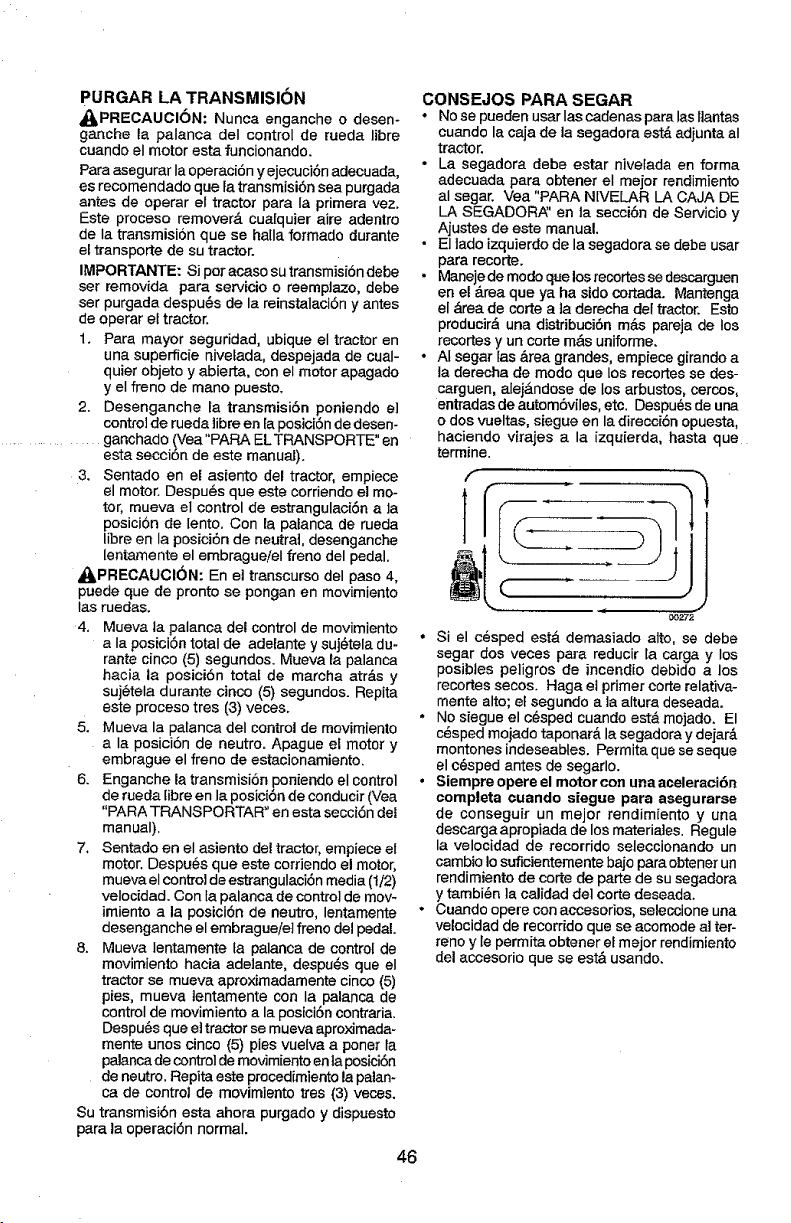
PURGAR LA TRANSMISION
_kPRECAUCI6N: Nunca enganche o desen-
ganche la palanca deI control de rueda libre
cuando el motor esta funcionando.
Para asegurar la operaci6n y ejecuci6n adecuada,
es recomendado que fatransmisi6n sea purgada
antes de operar el tractor para la primera vez.
Este proceso removerA cuaIquier aire adentro
de Ia transmision que se halla formado durante
el transporte de su tractor.
IMPORTANTE: Si pot acaso su transmisi6n debe
set removida para servicio o reemp]azo, debe
ser purgada despu_s de la reinstalaci6n y antes
de operar et tractor.
1. Para mayor seguridad, ubique el tractor en
una superficie nivefada, despejada de cuaI-
quiet objeto y abierta, con el motor apagado
y el freno de mano puesto.
Desenganche la transmisi6n poniendo el
control de rueda ]ibreen la posici6n de desen-
ganchado (Vea"PAPA ELTPANSPORTE" en
esta secci6n de este manual).
3. Sentado en el asiento del tractor, empiece
el motor. Despu@s que este corriendo el mo-
tor, mueva el control de estrangulac[6n a ]a
posici6n de lento. Con !a patanca de rueda
libre en Ia posici6n de neutral, desenganche
lentamente el embrague/el #eno del pedal.
_,PRECAUOI6N: En el transcurso del paso 4,
puede que de pronto se pongan en movimiento
Ias ruedas.
4. Mueva ta palanca dei control de movimiento
a Ia posici6n total de adelante y suj_tela du-
rante cinco (5) segundos. Mueva la palanca
hacia la posici6n tota[ de marcha atr&s y
suj@teladurante cinco (5) segundos. Repita
este proceso tres (3) veces.
5. Mueva la palanca del control de movimiento
a Ia posici6n de neutro. Apague el motor y
embrague el freno de estacionamiento.
6. Enganche la transmisi6n poniendo el control
de rueda [ibre en la posic{6n de conducir (Vea
"PARA TRANSPORTAR" en esta secci6n det
manual).
7, Sentado en el asiento del tractor, empiece el
motor. Despu@sque este cordendo el motor,
mueva eI control de est.rangulaci6nmedia (t/2)
velocidad. Con la palanca de control de mov-
imiento a la posici6n de neutro, lentamente
desenganche el embragueiet freno del peda!.
8. Mueva lentamente {a palanca de control de
movimiento hacia ade]ante, despu@s que el
tractor se mueva aproximadamente cinco (5)
pies, mueva lentamente con Ia palanca de
control de movimiento a la posicidn contraria,
Despu@sque el tractor se mueva aproxJmada-
monte unos cinco (5) pies vuelva a poner ta
palanca de control de movimiento en ta posicidn
de neLtro. Repita este procedimiento la palan-
ca de control de movimiento tres (3) veces.
Su transmisi6n esta ahora purgado y dispuesto
para la operaci6n normal.
46
CONSEJOS PARA SEGAR
• No se pueden usar Ias cadenas para lasIlantas
cuando la caja de la segadora estA adjunta aI
tractor.
• La segadora debe estar nivelada en forma
adecuada para obtener el mejor rendimiento
al segar. Vea "PARA NIVELAR LA CAJA DE
LA SEGADORi_' en la secci6n de Servicio y
Ajustes de este manual.
• El tado izquierdo de la segadora se debe usar
para recorte.
• Maneje de modo que los recortes se descarguen
en el Area que ya ha sido cortada. Mantenga
el Area de corte a ]a derecha del tractor. Esto
producirA una distribuci6n mAs pareja de los
recortes y un corte mAs uniforme.
• AI segar Ias Area grandes, empiece girando a
la derecha de modo que los recortes se des-
carguen, alejAndose de los arbustos, cercos,
entradas de autom6viles, etc. Despu6s de una
o dos vueltas, siegue en la direcci6n opuesta,
haciendo virajes a la [zquierda, hasta que
termine.
f
III
JJJ
O_272
° Si el c6sped estA demasiado alto, se debe
segar dos veces para reducir [a carga y los
posibles peligros de incendio debido a los
recortes secos. Haga el primer corte relativa-
mente alto; et segundo a la altura deseada.
° No siegue el c6sped cuando estA mojado. El
c6sped mojado taponarA la segadora y dejarA
rnontones indeseables. Permitaque seseque
el c@sped antes de segarlo.
• Siempre opere el motorcon una aceleraci6n
eompleta cuando s_egue para asegurarse
de conseguir un mejor rendimiento y una
descarga apropiada de los materia]es. Regule
la velocidad de recorrido seleccionando un
cambio Io suficientemente bajo para obtener un
rendimiento de corte de parte de su segadora
y tambi_n ]a calidad de] corte deseada.
° Cuando opere con accesorios, seleccione una
velocidad de recorrido que se acomode a] ter-
reno y Ie permita obtener el mejor rendimiento
del accesorio que se estA usando.
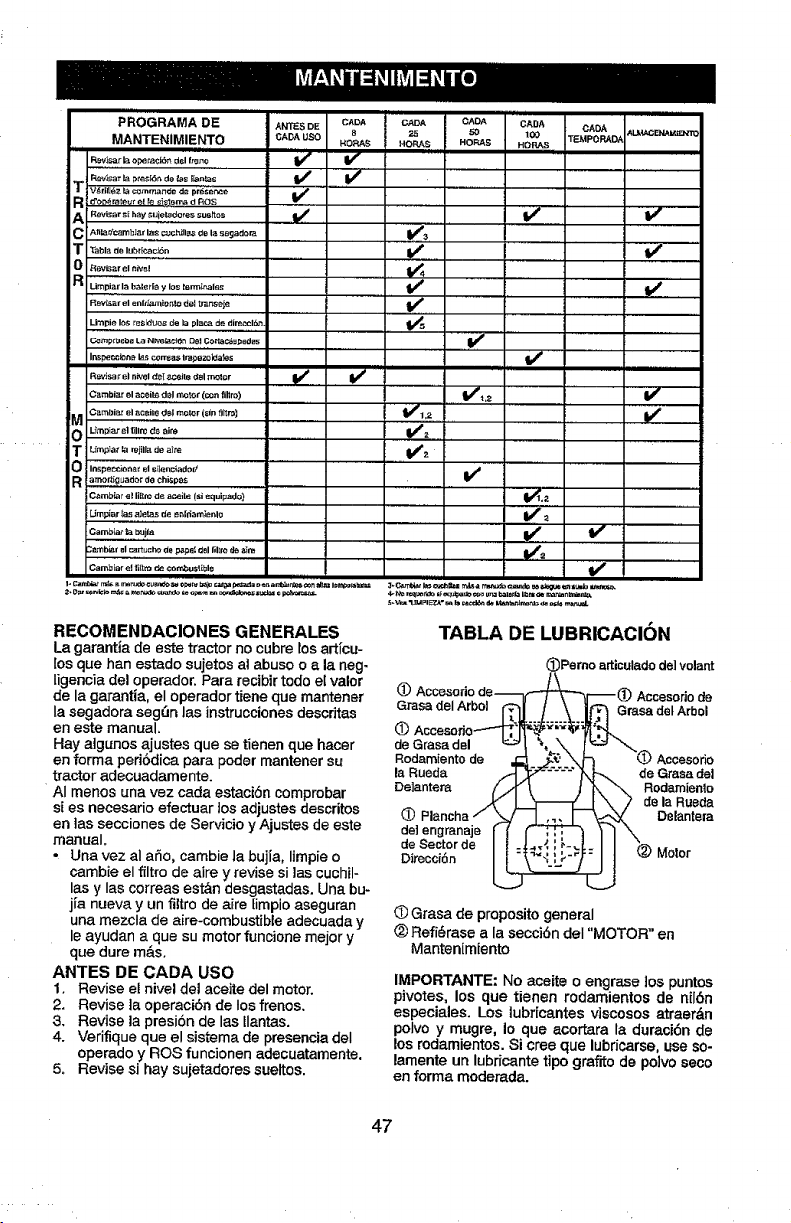
ANTES DE ....... _" 'PROGRAMADE cAc_ C_DA CAOA CAD_ CAOA
MANTENIMIENTO CADA U,,_,_,_,_,_,_,_,_,_8 25 50 100 T_t_IpoRAD A ALM_;ENAB,_,,m3
HOP.AS HORAS ,,u, HORAS HORAS
R_=__o_c_ d_,r,_' ' 'l/ V
V_d|J_Z b c_mrnande de p;'es'er',ce If ...............
R ffoD_ rste_r e[ f_ si_ema d ROS ......
"_,oo_,oy0.io*=J....... _oo V" t/" Iv"
C Afilartr..aJnbJ_t _,¢uch_l_ _e I_ segad_r_ Vf3
R Limpi_,rI'a b_4etia y los lerminales V _
Limpie I_s t=_ldt_os de _, pl_ de dimo_I_. _5
Revisar el n_I de_,,sceile _sl molar _d_,. , V _
O_mbi_,r el _;ei_ del,,m_tor,(c_n flltro) ...._#'t ,2
C_mbiar el _¢_ib_ dSt m_tor (sin fi_tro) _ll_l ,Z _/_
I_ k,m_ar el fJl,rod, ain)" ,.... _=' .....
T u_a_ rejilla de aTte V'2
O InspeCtor _1 si_n_ado[/ ..............
R amortig.uader_echisp_ V _
L_mpiartas a_et_s de eni_amier, lo ........ _
c=.b_,,,=,,,,=,i!,, , , e',, , V' .....
Cambiar e_ r_Itmde c_mbus_l_
v"
I II iiiii
RECOMENDACIONES GENERALE$
La garantia de este tractor no cubre los artfcu-
los que han estado sujetos al abuso o a la neg-
Iigencia del operador. Para recibir todo el valor
de la garantia, el operador tiene que mantener
la segadora seg(_n Jasinstrucciones descdtas
en este manual,
Hay algunos ajustes que se tienen que hater
en forma ped6dica para poder mantener su
_'actor adecuadamente.
AI menos una vez carla estaci6n comprobar
si es necesario efectuar los adjustes descritos
en las secciones de Servicio y Ajustes de este
manual.
- Una vez al aSo, cambie la bujJa, limpie o
cambie el filtro de aire y revise si las cuchil-
la_ y Ias correas est&n desgastadas. Una bu-
jia nueva y un filtro de aire limpio aseguran
una mezcla de aim-combustible adecuada y
le ayudan a que su motor funciene mejor y
que dure m&s.
ANTES DE CADA USO
1. Revise et nivel del aceite del motor.
2, Revise la operaci6n de los frenos.
3, Revise la presi6n de las Ilantas.
4. Verifique que el sistema de presencia deI
operado y ROS funcionen adecuatamente.
5. Revise si hay sujetadores sueltos.
TABLA DE LUBRICACION
OPemo a_ticuladode]volant
(_) Accesoriod_
GrasadeI Arbol Grasadet Arbol
de Grasa del
Rodamiento de Accesorio
la Rueda de Grasa del
Delantem Rodamiento
de la Rueda
O Plancha Delantera
de] engranaje
de Sector de _) Motor
Direcci6n
Grasa de propositogeneral
@ Refi_rase a la secci6n deI "MOTOR" en
Mantenimiento
IMPORTANTE: No aceite o engrase los puntos
pivotes, los que tJenen rodamientos de nil6n
especiales. Los lubricantes viscosos atraer_n
poIvo y mugre, Io que acortara la duraci6n de
los rodamientos. Si cree que lubricarse,use so-
lamente un lubricante tipo grafito de po]vo seco
en forma moderada.
47
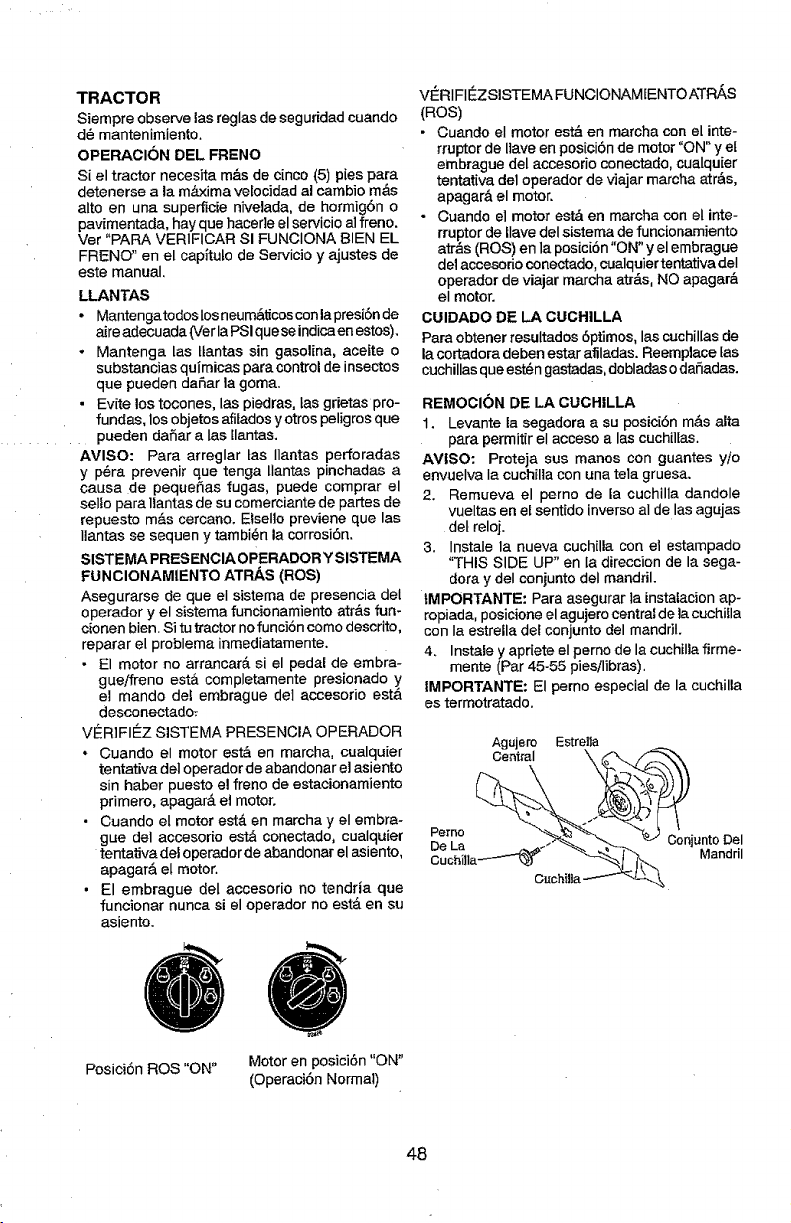
TRACTOR
Siempre observe las reglas de seguridad cuando
d@mantenimiento.
OPERACI(_N DEL FRENO
Si el tractor necesita m_s de cinco (5) pies para
detenerse a la m&_ima velocidad al cambio mAs
alto en una superficie nivelada, de hormig6n o
pavimentada, hay que hacede el servicio al freno.
Ver "PARA VERIFICAR SI FUNCIONA 81EN EL
FRENO" en el capitulo de Servicio y ajustes de
este manual.
LLANTAS
• Mantengatodos losneum_ticos con lapresi6n de
aJreadecuada (Verla PSIque se indicaen estos).
• Mantenga las ttantas sin gasolina, aceite o
substancias quimicas para control de insectos
que pueden daSar la goma.
• Evite los tocones, las piedras, tas grietas pro-
fundas, los objetos afifados y otros peligros que
....... pueden dafiar alas tlantas.
AVISO: Para arreglar tas Ilantas perforadas
y p_ra prevenir que tenga llantas pinchadas a
causa de pequeSas fugas, puede comprar el
selto para ]lantas de su comerciante de partes de
repuesto m&s cercano. Elselo previene que las
Ilantas se sequen y tambi@nla corrosi6n.
SlSTEMA PRESENCIA OPERADOR Y SlSTEMA
FUNCIONAMIENTO ATRAS (ROS)
Asegurarse de que el sistema de presencia del
operador y el sistema funcionamiento atr&s fun-
cionen bien. Si tu tractor no funci6n como deserito,
reparar el problema inmediatamente.
• El motor no arrancar& si el pedal de embra-
gue/freno est& completamente presionado y
el mando del embrague det accesorio estA
desconectado_
VI_R]FII_Z SISTEMA PRESENCIA OPERADOR
• Cuando el motor est,_ en marcha, cualquier
tentativa dei operador de abandonar e] asiento
sin haber puesto el freno de estacionamiento
primero, apagar& el motor.
• Cuando el motor est& en marcha y el embra-
gue del accesorio est_ conectado, cualquier
tenta_va del operador de abandonar el asiento,
apagarA el motor.
• El embrague del accesorio no tendria que
funcionar nunca si el operador no est& en su
asiento.
VERIFIE_ZSISTEMA FUNOIONAMIENTO ATR_,S
(ROS)
• Cuando el motor est& en marcha con eLinte-
rruptor de Haveen posici6nde motor "ON" y el
embrague del accesorio conectado, cualqu_er
tentativa de1operador de viajar marcha art&s,
apagar& el motor.
• Cuando el motor est& en marcha con el inte-
rruptorde Llavedel sistema de funcionamiento
atr_.s (ROS) en la posic[6n "ON" y el embrague
d elaccesodo conectado, cualquier tentativa deI
operader de viajar marcha atr_.s,NO apagar&
el motor.
CUIDADO DE LA CUCHILLA
Para obtener resultados 6ptimos, lae cuchil[as de
la cortadora deben estar aflladas. Reemplace las
cuchillas que est6n gastadas, dobladas o dafiadas.
REMOCION DE LA CUCHILLA
1. Levante la segadora a su posic[6n m&s alta
para permitir el aeceso alas cuchil[as.
AMtSO: Proteja sus manes con guantes yio
envuelva Ia cuchilia con una tela gruesa.
2. Remueva el perno de la cuchilla dandole
vueltas en el sentido inverso al de las agujas
det reloj.
3. Instale la nueva cuchilla con el estampado
"THIS SIDE UP" en la direccion de la sega-
dora y deI conjunto deI mandril.
IMPORTANTE: Para asegurar ta instalacionap-
ropiada, posicione el agujero central de la cuchitla
con Ia estrella del conjunto del mandril.
4. Instale y apdete el pernode la cuchiI]a firme-
mente (Par 45-55 pies/libra.s).
IMPORTANTE: El pemo especial de la cuchilla
es termotratado.
Agujero Estrella
Central
Pemo
De La _." Conjunto Del
Cuchilla__...----_ _ Mandril
Posici6n ROS "ON" Motor en posici6n "ON"
(Operaci6n Normal)
48
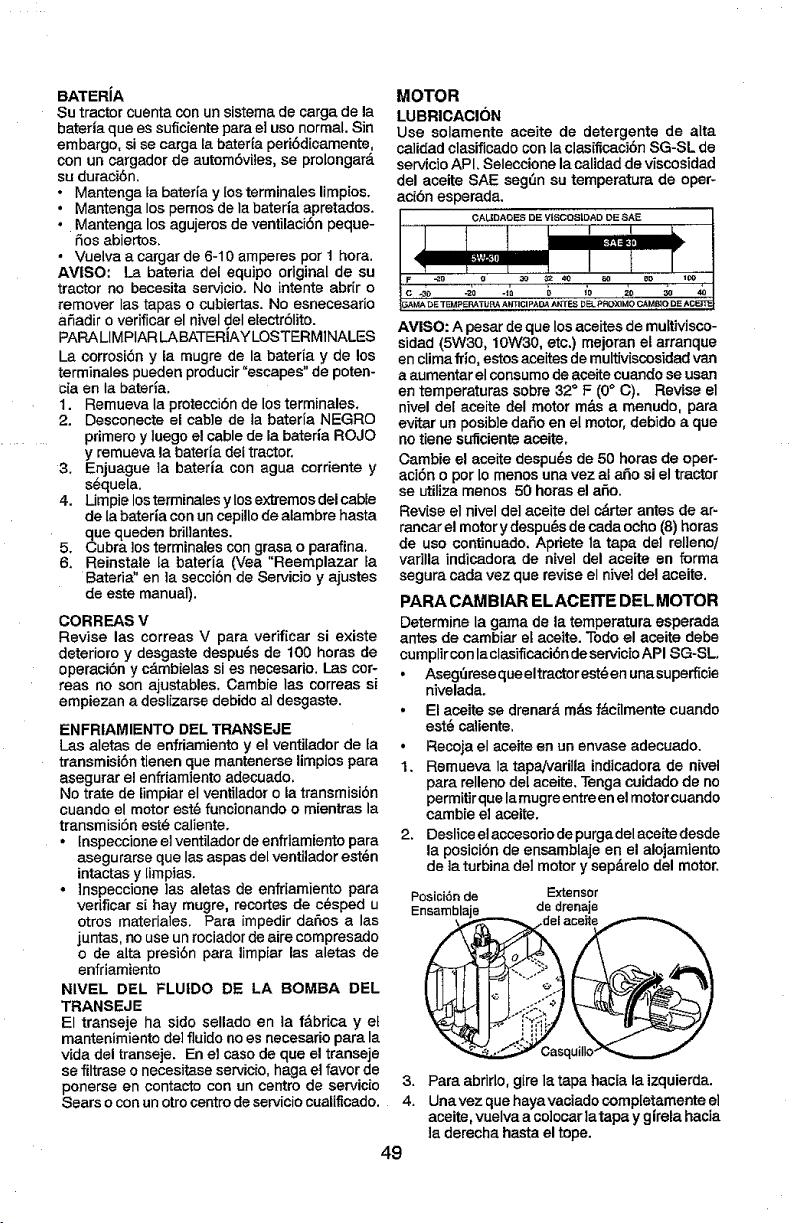
BATERiA
Su tractor cuenta con un sistema de carga de la
bateria que es sufic[ente para el uso normal. Sin
embargo, si se carga la baterfa peri6dicamente,
con un cargador de autom6viles, se prolongar_.
su duraci6n.
• Mantenga la bater_a y los terminales limpios.
• Mantenga los pemos de Ia bater|a apretados.
° Mantenga los agujeros de ventilaci6n peque-
_os abiertos.
• Vuelva acargar de 6-10 amperes por 1 hora.
AVISO; La bateria del equipo original de su
tractor no becesita servicio. No intente abrlr o
remover Ias tapas o cubiertas. No esnecesario
aSadir o verificar el nivel del electr6Iito.
PAPA LIMPIAR LABATERiAY LOSTERM1NALES
La cerrosi6n y la mugre de la bateria y de los
terminales pueden producir "escapes" de poten-
cia en Ia bater_a.
1. Remueva la protecci6nde los terminales.
2. Desconecte el cable de la bateria NEGRO
primero y luego e! cable de la baterla ROJO
y remueva la bateria del tractor.
3. Enjuague la bateria con agua corriente y
s_quela.
4. LJmpie los terminales y los extremos del cable
de Ia bateria con un cepillo de alarnbre hasta
clue queden brillantes.
5. Cubra los terminales con grasa o parafina.
6. Reinstale ia bateria (Vea "Reemplazar la
Bateria" en la secci6n de Servioio y ajustes
de este manual).
CORREAS V
Revise las correas V para verificar si existe
deterioro y desgaste despu_s de 100 horas de
operaci6n y c_.mbielas si es necesario. Las cot-
teas no son ajustables, Camb[e Ias correas si
empiezan a deslizarse debido aI desgaste.
ENFRtAMIENTO DEL TRANSEJE
Las aletas de enfriamiento y el ventiIador de fa
transmisi6n tienen que mantenerse limpios para
asegurar el enfriamiento adecuado,
No trate de limpiar el ventilador o la transmisi6n
cuando el motor est_ func]onando o mientras la
transmisi6n estL=caliente.
• fnspeccione el ventiladorde enfriamiento para
asegurarse que las aspas del ventiladorest_n
intactas y limpias.
• ]nspeccione ]as aletas de enfdamiento para
verificar si hay mugre, recortes de c_sped u
otros materiales. Para impedir dafios alas
juntas, no use un rociadorde aire compresado
o de alta presi6n para limpiar las aletas de
enfriamiento
NIVEL DEL FLUIDO DE LA BOMBA DEL
TRANSEJE
El transeje ha sido sellado en ta f&brica yet
mantenimiento del f]uido no es necesario para la
vida del transeje. En el caso de que el transeje
se filtrase o necesitase servicio, haga el favor de
ponerse en contacto con un centro de servicio
Sears o con unotro centro de servicio cualificado.
MOTOR
LUBRICACION
Use solamente aoeite de detergente de a|ta
calidad clasificado con la clasificaci6nSG-SL de
servicioAPI_Seleccione la calidad de viscosidad
del aceite SAE segfin su temperatura de oper-
acibn esperada,
CALIDAOES DE VISCOS[DAD DE SAE
49
AMISO: A pesar de que los aceites de multivisco-
sidad (5W30, 10W30, etc.) mejoran el arranque
en clima_io, estos aceites de multiviscosidad van
a aumentar el consumo de aceite cuando se usan
en temperaturas sobre 32° F (0° C). Revise el
nivel de[ aceite del motor m_s a menudo, para
ev_ar un posible dafio en el motor, debido a que
no tiene suflciente aceite,
Cambie el aceite despu_s de 50 horas de oper-
aci6n o por 1omenos una vez al aSo si el tractor
se utiliza menos 50 horas el afio,
Revise el nivel del aceite deI c_rter antes de ar-
rancar el motor y despu6s de cada ocho (8) horas
de uso continuado. Apriete la tapa del relleno!
vafilla indicadora de nivel del aceite en forma
segura cada vez que revise el nivel del aceite.
PARA CAMBIAR ELACEITE DEL MOTOR
Determine Ia gama de la temperatura esperada
antes de cambiar et aceite. Todo el aceite debe
cumplircon laclasificaci6ndeservicioAPI SG-SL,
° Asegdresequeeltractorest_en unasuperficie
nivelada.
• El aceite se drenar& m_s f&cilmente cuando
est@caliente.
• Recoja el aceite en un envase adecuado.
1. Remueva la tapa/varilla indicadora de nivel
para relleno del aceite. Tenga cuidado de no
permitirque lamugre entreen el motorcuando
camb[e el aceite.
2. Deslice el accesodo de purga del aceite desde
la posici6n de ensamblaje en el alojamiente
de la turbina del motor y sep&relo del motor.
3,
4.
PosiciSnde Extensor
Ensamblaje de drenaje
Para abdrlo, gire la tapa hacia la izquierda.
Unavez que haya vaciado completamente el
aceite, vuelva a co]ocarlatapa y glrela hacia
]a derecha hasta el tope.
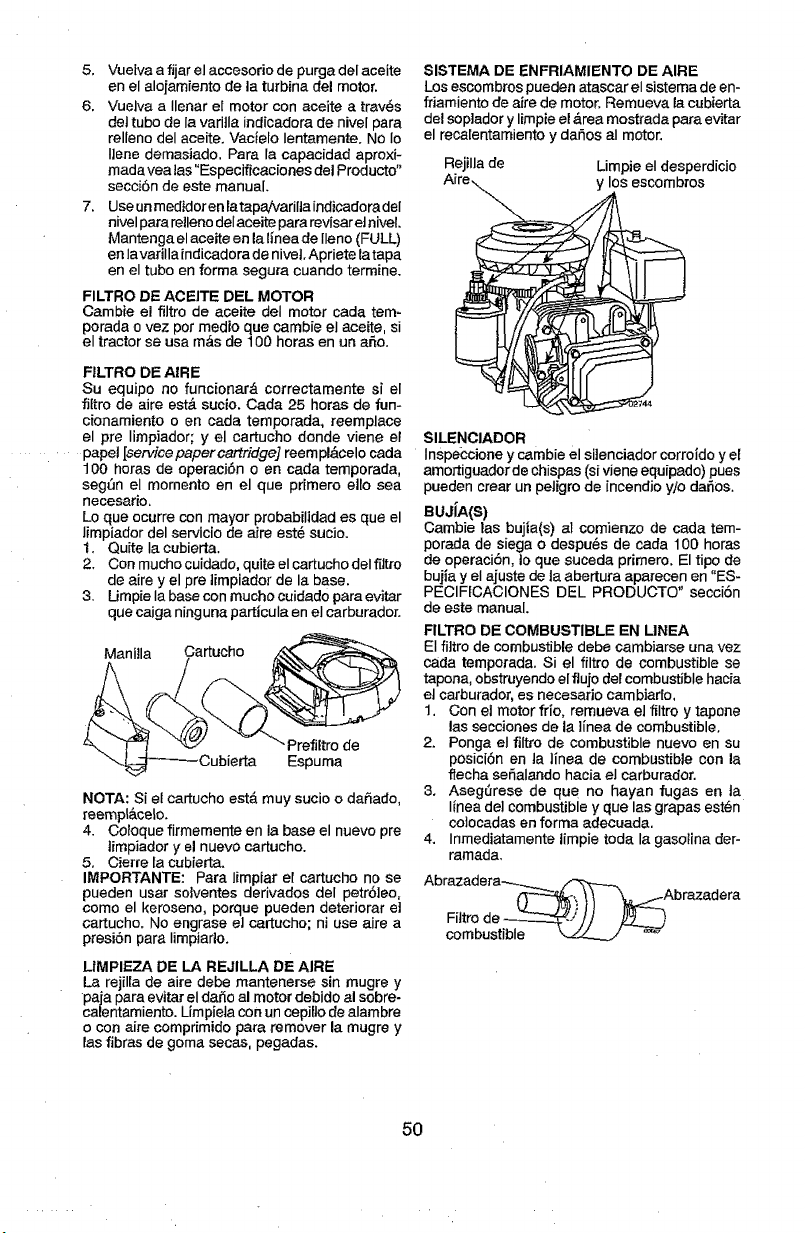
5. Vue[vaafijarelaccesoriodepurgadelaceite
en el alojamiento de Jaturbina del motor.
6. Vuelva a Ilenar e[ motor con aceite a tray, s
del tube de la vari_laindicadora de nivel pare
relleno del aceite. Vacielo Ientamenteo No lo
I]ene demasiado. Pare la capacidad aproxi-
mada Yeates "Especificaciones del Producto"
secci6n de este manual.
7. Use un medidor enlatapa/varilta indicadora del
nivel pare relleno delaceite pare revisareJniveL
Mantenga el aceite en la linea de lleno (FULL)
en Iavarilla indicadora de nivet. Apriete latapa
en el tube en forme segura cuando termine.
FILTRO DE ACEITE DEL MOTOR
Cambie el filtro de aceite del motor cada tern-
porade o vez per rnedio que cambie el aceite, si
el tractor se usa m_s de 100 horas en un afio.
FILTRO DE AIRE
Su equipo no funcionar__correctarnente si el
fittro de aire est_ sucio. Carla 25 horas de fun-
cionamiento o en cada temporada, reemplace
el pro Iimpiador; y el cartucho deride viene el
........ papel [service paper cartridge] reempkScelo cada
100 heros de operacidn o en carla temporada,
seg0n el memento en el que primero ello sea
neceserio,
Lo que ocurre con mayor probabilidad es que el
limpiadordel servicio de aire est6 sucio.
t. Quite Ia cubierta.
2. Con mucho cuidado, quite el cartucho deI filtro
de aire y el pre timpiador de la base.
3. Limpie la base con touche cuidado para evitar
que caiga ninguna particula en el carburador.
Manilla Cartucho
-Prefiltro de
Espuma
NOTA: Si et cartucho est,. muy sucio o dahado,
reempI_celo.
4. Coloque firmernente en la base el nuevo pro
timpiador y el nuevo cartucho.
5. Cierre fa cubierta.
IMPORTANTE: Pare limpiar el cartucho no se
pueden user solventes derivados del petr61eo,
come el kerosene, porque pueden deteriorar el
cartucho. No engrase el cartucho; ni use aire a
presi6n pare Iimptado.
LtMPIEZA DE LA REJILLA DE AIRE
La rejilla de aire debe mantenerse sin mugre y
paia para evitar el dafio al motor debido al sobre-
calentamiento. Limpielaconun cepi[Jode alarnbre
o con aire comprirnidopara remover la mugre y
_asfibres de 9oma secas, pegadas.
SISTEMA DE ENFRIAMIENTO DE AIRE
Losescombrospueden atescar el sistema de en-
friamiento de aire de motor. Remueva la cubierta
del sop]ador y limpie el ,_reamostrada pare evitar
el recalentamiento y defies al motor.
Rejiila de
Aire_
Limpie el desperdicio
y los escombros
SILENCIADOR
Inspeccione y carnbie el sitenciador corroido y e[
amortiguador de chispas (si viene equipado) pues
pueden crear un petigrode incendio y/o dafios.
BUJiA(S)
Cambie las bujia(s) al comienzo de cada tem-
porada de siega o despu_s de carla 100 horas
de operaci6n, io que suceda primero. El tipo de
bujia y el ajuste de la abertura aparecen en "ES-
PECIF[CACIONES DEL PRODUCTO" secci6n
de este manual.
FILTRO DE COMBUSTIBLE EN UNEA
El fi]tro de combustible debe cambiarse una vez
cada temporada. Si el filtro de combustible se
tapona, obstruyendoelflujo del combustible hacia
et carburador, es necesario cambiar[o,
1. Con el motor frio, remueva el filtro y tapone
las secciones de la ]inea de combustible.
2. Ponga el filtro de combustible nuevo en su
posici6n en Ja linea de combustible con la
flecha sefialando hacia el carburador.
3. AsegSrese de que no hayan fuges en ta
Iinea del combustible y que las grapes est_n
colocadas en forrna adecuada.
4. Inmediatamente limpie toda la gasoline tier-
ramada.
Abrazad era-_-.__ !_V--- _
__'_ y_ _,mcf Abrazadera
FiJtro de _." JJ ____
combustible _.J
50
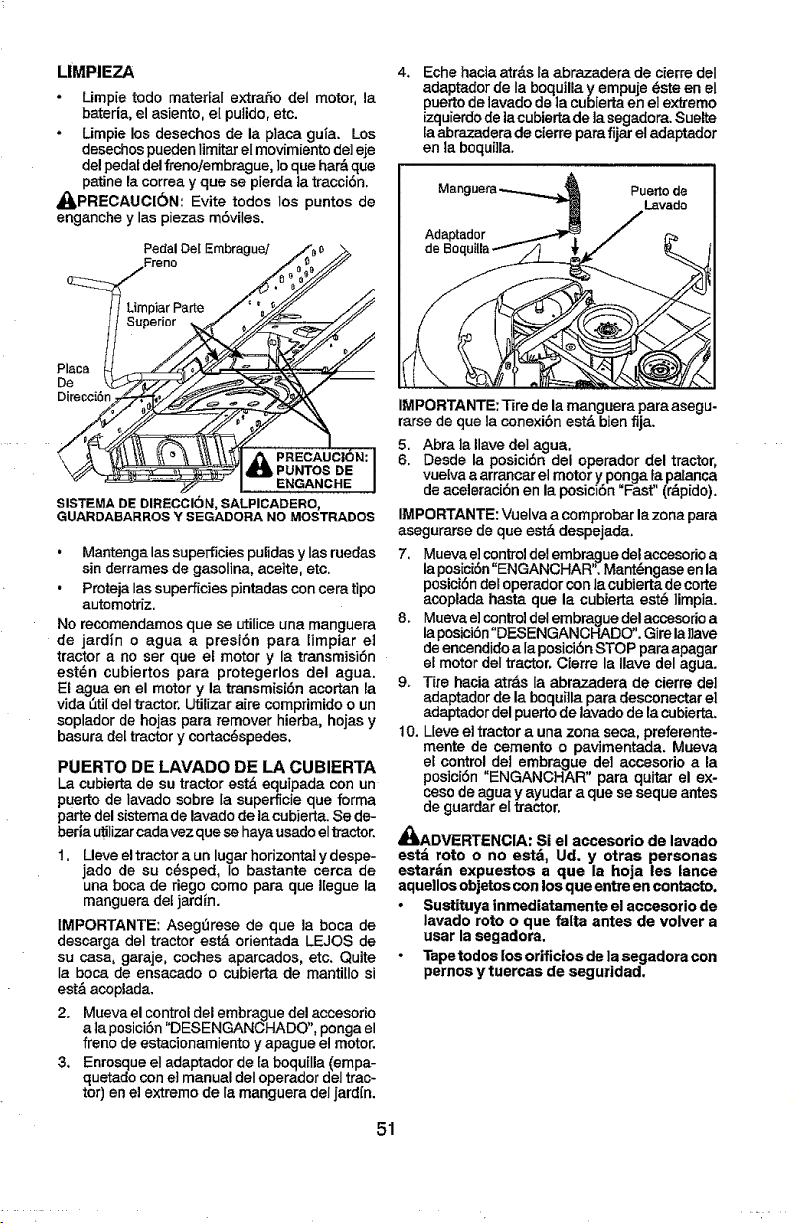
UMPIEZA
- Limpie todo material extrafio deI motor, la
bateria, el asiento, el pulido, etc.
- Umpie los desechos de la placa guia. Los
desechos pueden Iimitar el movimiento del eje
del pedal del freno!embrague, loque hard que
patJnela correa y que se pierda tatracci6n.
_kPRECAUCI6N: Evite todos los puntos de
enganche y las piezas m6viles.
PRECAUC|ON: I
PUNTOS DE
ENGANCHE
SISTEMA DE DIRECCI6N, SALPICADERO,
GUARDABARROS Y SEGADORA NO MOSTRADOS
• Mantenga las superficies pulidas y las ruedas
sin derrames de gasolina, aceite, etc.
• Proteja Ias superficies pintadas con cera tipo
automotriz.
No recomendamos que se utilice una manguera
de jardin o agua a presi6n para limpiar el
tractor a no ser que el motor y la transmisi6n
est_n cubiertos para protegerlos del agua.
El agua en el motor y la transmisidn acortan la
vida fti[ deI tractor. Utilizar aire comprimido o un
soplador de hojas para remover hierba, hojas y
basura del tractor y cortac_spedes.
PUERTO DE LAVADO DE LA CUBIERTA
La cubierta de su tractor est& equipada con un
puerto de lavado sobre la superficie que forma
parte del sistema de lavado de la cubierta. Se de-
beria ulJlizarcada vez que se haya usado eltractor.
1. Ueve el tractor a un lugar horizontaly despe-
jado de su cdsped, Io bastante cerca de
una boca de riego como para que i[egue la
rnanguera del jardln.
IMPORTANTE: Aseg_rese de que la boca de
descarga del tractor est_ orientada LEJOS de
su casa, garaje, coches aparcados, etc, Quite
la boca de ensacado o cubierta de mantillo si
est_ acoplada.
2. Muevael control del embrague del accesorio
a la posici6n ='DESENGANCHADO", ponga el
freno de estacionamiento y apague el motor.
3, Enrosque el adaptador de ta boquilla (empa-
quetado con et manual deI operador del trac-
tor) en el extremo de la manguera del jard[n.
51
4, Eche hacia atr_.s ta abrazadera de cierre deI
adaptador de la boquilla y empuje 6ste en el
puerto de lavado de la cubiertaen el extremo
izquierdo de ]a cubiertade la segadora. Suelte
la abrazadera de cierre para fijar el adaptador
en la boquilla.
Puerto de
Adaptador
IMPORTANTE; Tire de la manguera para asegu-
rarse de que la conexibn est& bien fija.
5. Abra la Ilave del agua,
6. Desde la posici6n del operador del tractor,
vuetva a arrancar el motor y ponga fa patanca
de acelerac[6n en la posici6n "Fast" (rdpido).
IMPORTANTE: Vuelva a comprobar la zona para
asegurarse de que est& despejada.
7, Mueva e] control del embrague del accesorio a
la posici6n"ENGANCHAR".Mant_ngase en la
posici6n deloperador con la cubierta de corte
acoplada hasta que la cubierta ast_ Iimpia.
8. Mueva e] control del embrague del accesorio a
la posici6n "DESENGANCHADO". Gire la ]lave
de encendidoa laposicibn STOP para apagar
ef motor deI tractor. Cierre la Ilave del agua.
9. Tire hacia atrds Ia abrazadera de cierre de]
adaptador de la boqui]la para desconectar el
adaptador del puerto de lavado de la cubierta.
10. LIeve el tractor a una zona seca, preferente-
mente de cemento o pavimentada. Mueva
el control deJ embrague del accesorio a la
posici6n "ENGANCHAR" para quitar el ex-
ceso de agua y ayudar a que se seque antes
de guardar el _actor.
_LADVERTENCIA: Si el accesorio de lavado
estd roto o no estd, Ud. y otras personas
estar_n expuestos a que la hoja los lance
aquellos objetos con los que entre en contacto.
- Sustituya inmediatamente el accesoriode
lavado roto o que falta antes de volver a
usar la segadora,
Tapetodos los orificios de la segadora con
pernos y tuercas de seguridad,
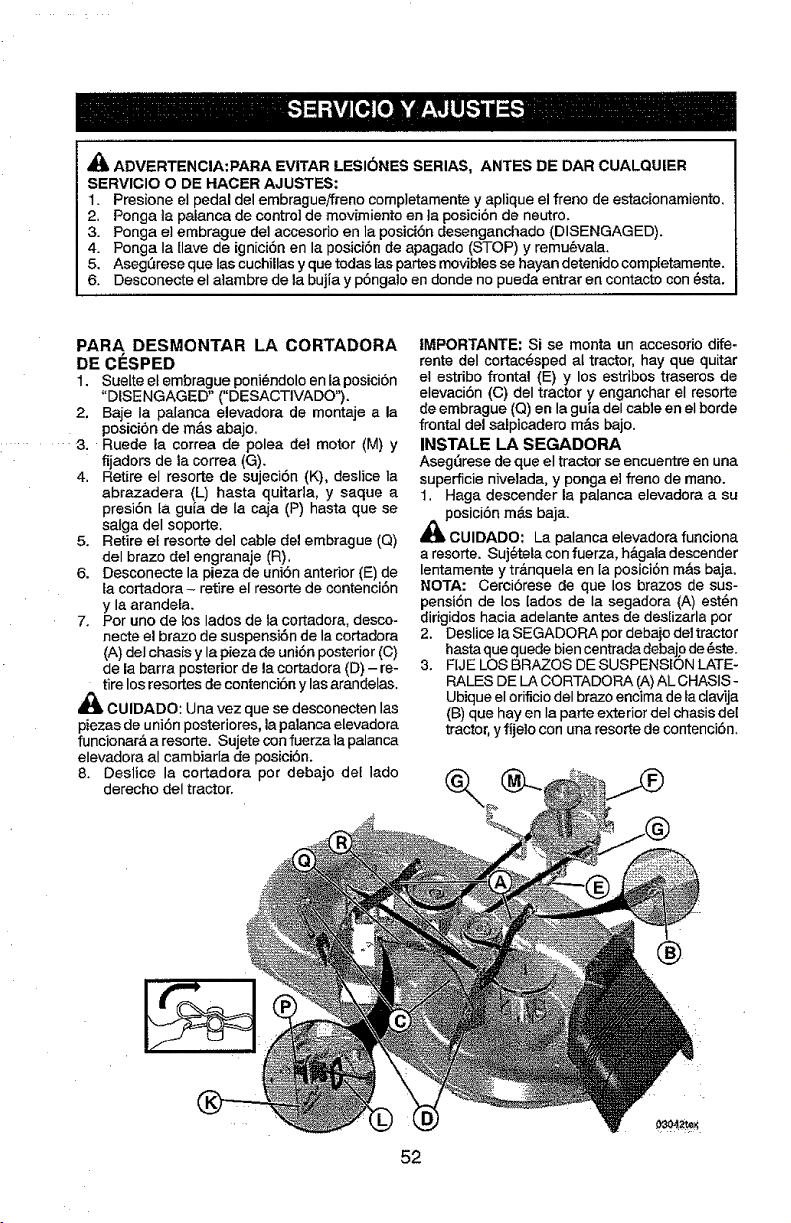
_t, ADVERTENCIA:PARA EVITAR LESI(_NES SERIAS, ANTES DE DAR CUALQUIER
SERVICIO O DE HACER AJUSTES:
1. Presione el pedal del embrague/freno compietamente y aplique el freno de estacionamiento,
2. Ponga ta palanca de control de movimiento en ]a posici6nde neutro.
3. Ponga el embrague del accesodo en la posici6n desenganchado (DISENGAGED).
4. Ponga la ilave de ignici6n en la posici6n de apagado (STOP) y remu6vala.
5. Aseg_rese que Ias cuchillas y que todas las partes movibles se hayan detenido completamente.
6. Desconecte el atambre de la bujia y p6ngato en donde no pueda entrar en contacto con _sta.
PARA DESMONTAR LA CORTADORA
DE CF-SPED
1. Suelte et embrague poni_ndoloen la posici6n
"DISENGAGED" ("DESACTIVADO").
2. Baje Ia palanca elevadora de montaje a la
posici6nde m&s abajo,
3. Ruede la correa de polea del motor (M) y
fijadors de la correa (G).
4, Retire el resorte de sujeci6n (K), deslice ]a
abrazadera (L) hasta quitada, y saque a
presi6n ta guia de la caja (P) hasta que se
salga deI soporte.
5. Retire et resorte del cable del embrague (Q)
deI braze de] engranaje (R),
6. Desconecte la pieza de uni6n anterior (E) de
ta cortadora - retire el resorte de contenci6n
y la arandeta.
7. Per uno de los Iados de la cortadora, desco-
necte el braze de suspensi6n de la cortadora
(A) deI chasis y la pieza de uni6n posterior (C)
de la barra posteriorde la cortadora (D) - re-
tire los resortes de contenci6n y las arandelas.
_lb CUIDADO: Una vez que se desconecten las
piezas de uni6n posteriores, la palanca elevadora
funcionar& a resorte. Sujete con fuerza ta palanca
elevadora al cambiarla de posici6n.
8. Deslice la cortadora per debajo del lade
derecho deI tractor.
tMPORTANTE-' Si se monta un accesorio dife-
rente deI cortac_.sped al tractor, hay que quitar
el estribo frontal (E) y los estribos traseros de
elevaci6n (C) deI tractor y enganchar el resorte
de embrague (Q) en la guia deI cable en el borde
frontal del salpicadero m&s bajo.
INSTALE LA SEGADORA
Aseg_rese de que el tractor se encuentre en una
superficie nivelada, y ponga el freno de mane,
1. Haga descender la palanca elevadora a su
_posici6n m_s baja.
CUIDADO: La palanca elevadora funciona
a resorte. Suj_tela confuerza, h__galadescender
lentamente y tr,_nquela en la posici6n m&s baja,
NOTA: Cerci6rese de que los brazes de sus-
pensi6n de los lades de Ia segadora (A) est_n
dirigides hacia adelante antes de desEizarlaper
2. Deslice la SEGADORA per debajo del tractor
hastaque quede biencentradadebajode _ste.
3. F[JE LOS BRAZES DE SUSPENSION LATE-
RALES DE LA CORTADORA (A)AL CHASIS-
Ubique el orificio deI braze encima de la clavija
(B) que hay en Ia parte exterior deI chasis del
tractor, y fijelo con una resorte de contenci6n.
%
52
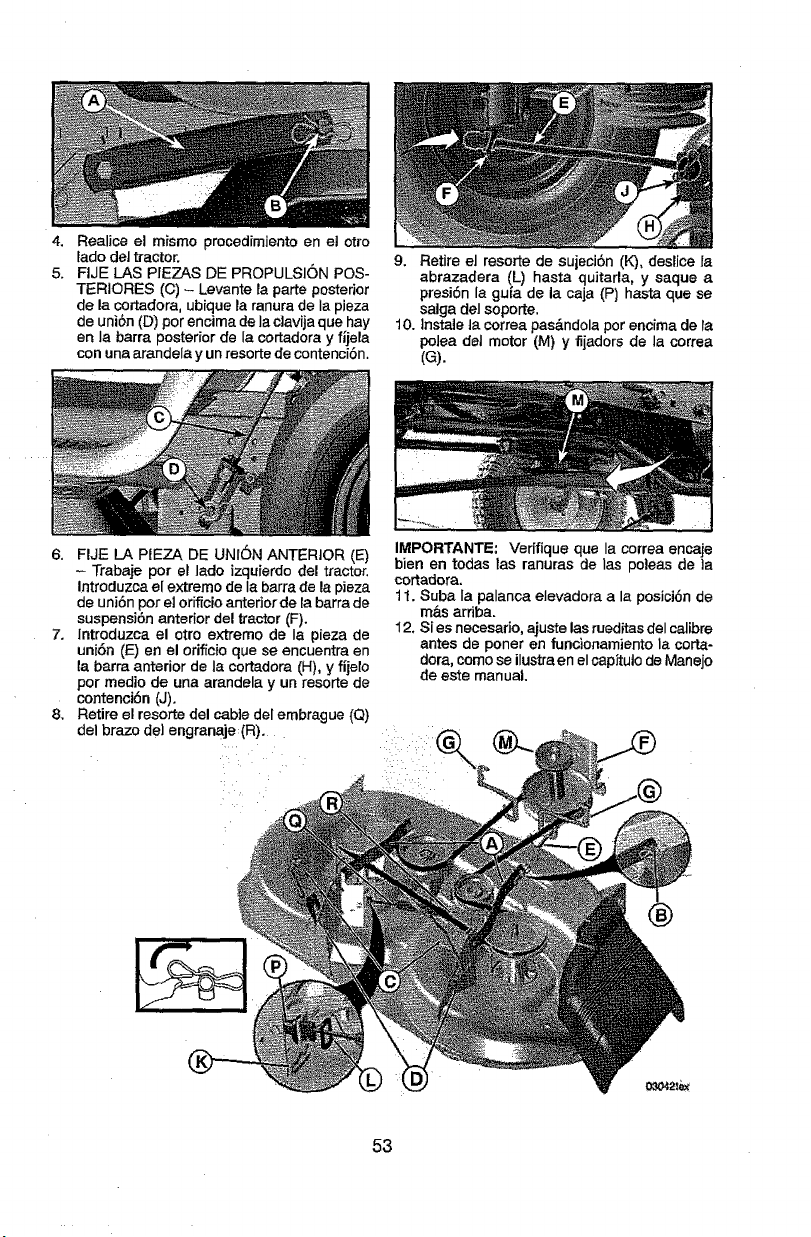
4_
5.
Realice el mismo procedirniento en el otto
Iado de] tractor.
FIJE LAS PfEZAS DE PROPULSION POS-
TERIORES (C) - Levante la parte posterior
de la cortadora, ubique la ranura de Ia pieza
de uniSn (D) por encima de la clavija que hay
en la barra posterior de Ia cortadora y fijera
con una arandela y un resorte de contencibn.
9. Retire el resorte de sujeci6n (K), deslice la
abrazadera (L) hasta quitarla, y saque a
presiSn la gufa de la caja (P) hasta que se
salga del soporte.
10. lnstale ta correa pas&ndolapor encima de ta
polea del motor (M) y fijadors de la correa
(G).
6. FIJE LA PIEZA DE UNI6N ANTERIOR (E)
Trabaje por el lado izquierdo del tractor.
Introduzca el extremo de Ia barra de la pieza
de uni6n pot el orificioantedor de ta barra de
suspensiSn anterior del tractor (F).
7. lntroduzca el otto extremo de Ia pieza de
uniSn (E) en el orificio que se encuentra en
la barra anterior de la cortadora (H), y fije{o
por med]o de una arandela y un resorte de
contenci6n (J).
8. Retire el resorte del cable del embrague (Q)
del brazo de] engranaje :(R).
IMPORTANTE: Vedfique que la correa encaje
bien en todas las ranuras de Ias po]eas de ]a
cortadora.
1 t. Suba Ia palanca elevadora a la posici6n de
robsarriba.
12, Si es necesario, ajuste lasrueditas del calibre
antes de poner en funcionamiento la corta-
dora, como se ilustra en el capitulo de Manejo
de este manual.
53
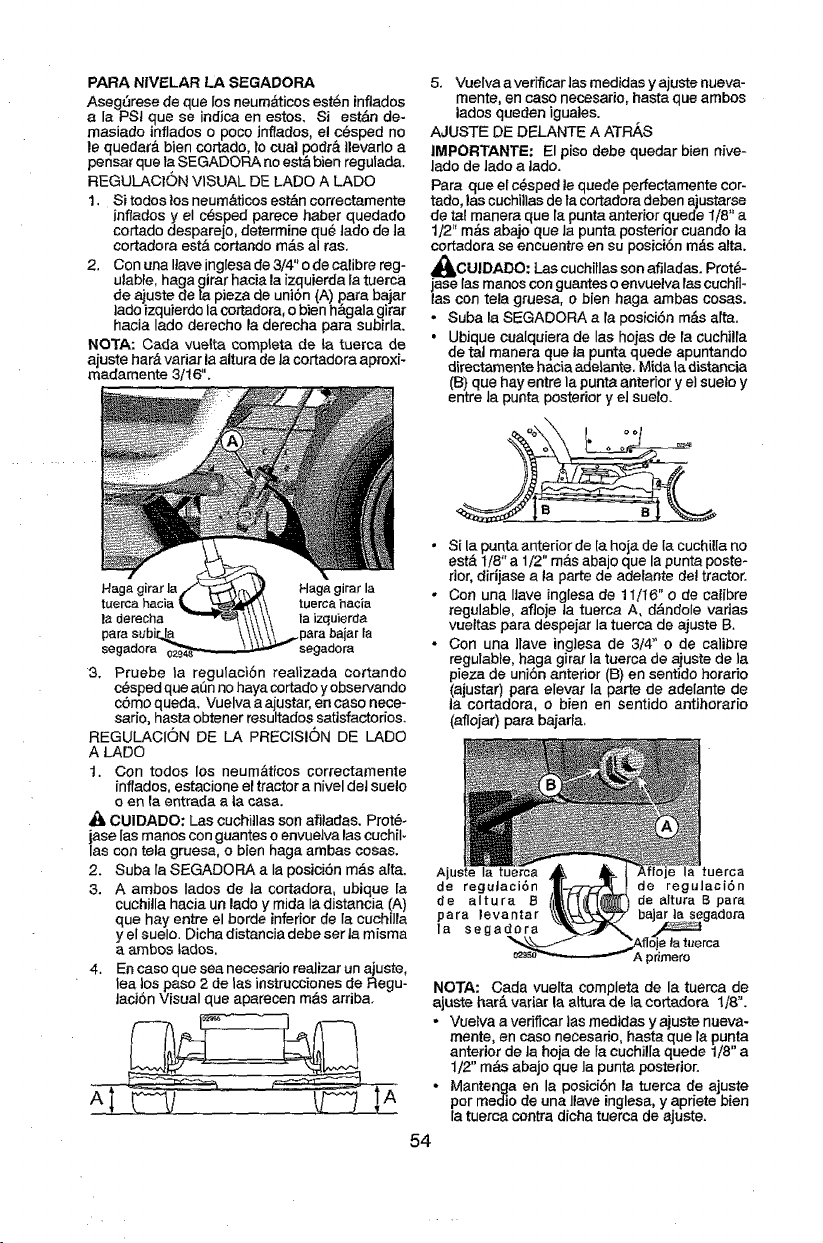
PARA NIVELAR LA SEGADORA
Aseg_rese de que los neurn_ticosest_n inflados
a la PSi que se indica en estos. Si est&n de-
rnasiado infJadoso poco Jnflados, el c_sped no
le quedar& bien cortado, to cual podr#, |levarlo a
pensar que la SEGADORA no est&bien regutada.
REGULACl(§N VISUAL DE LADe A LADe
1. Si todos los neurn&ticos est&n correctarnente
inftados y el c(_sped parece haber quedado
cortado desparejo, determine qu_ Jadede Ja
cortadora est& cortando rn&sal ras.
2. Con una llave inglesa de 3/4'_o de calibre reg-
ulable, haga gtrar hacia la izquierda fa tuerca
de ajuste de la pieza de uniSn (A) para bajar
lade izquierdola cortadora, o bien h_.galagirar
hacia lade derecho la derecha para subirla.
NOTA: Carla vuelta cornp]eta de la tuerca de
ajus_e bar& variar la altura de ]a cortadora aproxi-
madarnente 3/16".
5. Vuelvaaverificarlasmedidasyajustenueva-
rnente, en case necesario, hasta que arnbos
lades queden iguales.
AJUSTE DE DELANTE A ATRAS
IMPORTANTE: El piso debe quedar bien hive-
lade de Jadea tado.
Para que el c_sped le quede perfectamente cor-
tado, las cuchillas de la cortadora deben ajustarse
de tal rnanera que la punta anterior quede I/8" a
1/2" m_s abajo que la punta posteriorcuando la
cortadora se encuantre en su posici6n rn_s alta.
ja_CUIDADO. Las cuchiflas son afiladas. Prot#-
se las manes con gua_es o envuelva fa_scuchfI-
las con tela gruesa, o bien haga ambas cosas.
• Suba la SEGADORA a la posici6n rn_.salta.
• UbJque cualquiera de Ias hojas de la cuchi!fa
de tal rnanera que la punta quede apuntando
directamente hacia adelante. Mida la distancia
(B) que hay entre la punta anterior y el suelo y
entre la punta posterior y el suelo.
Haga girar la Haga girarla
tuerca hacia ! tuerca ilacia
la derecha la izquierda
_para baiar la
segadora segadora
3. Pruebe Ia regulaciSn reaIizada co_tando
cu_spedque a0n no haya cortado y observando
c6mo queda. Vuelva a ajustar, en case nece-
sario, hasta obtener resultados satisfactorios.
REGULACION DE LA PRECISION DE LADe
A LADe
1. Con lodes los neum&ticos correotamente
inffados, estacione el tractora nivel det sue!o
oen la entrada a la casa.
41_CUIDADO: Las cuchitlas son afiladas. Prot_-
jase [asmanes con guantes o envuelva las cuchiI-
las con tela gruesa, o bien haga ambas cosas.
2. Suba la SEGADORA a Ia posicibn m&s alta.
3. A arnbes Iados de ]a cortadora, ubique ta
cuchiJla hacia un lade y rnida Ia distancia (A)
que hay entre el borde inferiorde la cuchiira
y el suelo. Dicha distancia debe set ta rnisma
a arnbos tados.
4. En case que sea necesario realizar un ajuste,
lea los paso 2 de las instrucciones de Regu-
Jaci6nVisual que aparecen m&sarriba.
• Si la punta anterior de [a hoja de [a cuchil[a no
est&t/8" a 1/2" rn_s abajo que la punta poste-
rior, dirijase a la parte de adefante de! tractor.
- Con una IJaveinglesa de 11/16" o de calibre
regulable, afloje ta tuerca A, d&ndole varias
vuettas para despejar la tuerca de ajuste B.
• Con una ]lave inglesa de 3/4" o de calibre
regulabte, haga girar la tuerca de ajuste de la
pieza de uniSn anterior (B) en sentido horario
(ajustar) para elevar la parte de adelante de
la cortadora, o bien en sentido antihorario
(aflojar) para bajarla,
Aju_' e la tuerca
de reguJaci6n de regulaciSn
de altura B de altura B para
para levantar
la segadora
NOTA: Carla vuelta cornpleta de la tuerca de
ajuste hal& variar la altura de la cortadora 1/8".
• Vuelva a verificar las rnedidas y ajuste nueva-
rnente, en case necesario, hasta que la punta
anterior de Jahoia de ia cuchilla quede 1/8" a
1/2" rnzltsabajo que Ia punta posterior.
• Mantenga en la posici6n la tuerca de ajuste
per medio de una llave inglesa, y apriete bien
la tuerca contra dicha tuerca de ajuste.
54
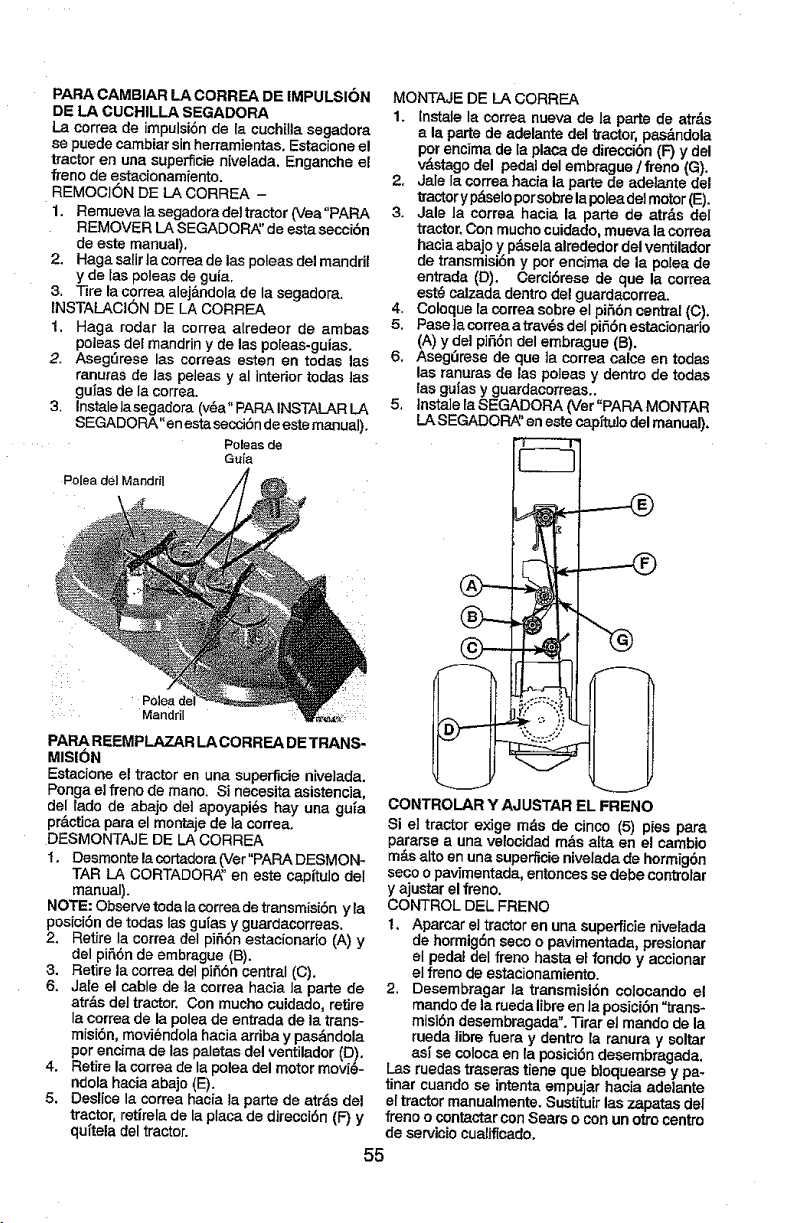
PARA CAMBIAR LA CORREA DE IMPULSI6N
DE LA CUCHILLA SEGADORA
La cortes de impulsi6n de [a cuohilla segadora
se puede cambiar sin herramientas, Estacione el
tractor en una superficie nivelada, Enganche el
freno de estacionamiento.
REMOCION DE LA CORREA -
1. Remuevala segadora del tractor (Vea"PARA
REMOVER LA SEGADORA_'de esta secci6n
de este manual),
2. Haga satir ]a correa de las peleas delmandril
y de Ias poleas de guia.
3. Tire la correa alej&ndola de Ia segadom.
INSTALACtON DE LA CORREA
1. Haga rodar ]a correa alredeor de ambas
poleas del mandrin y de las poleas-guias.
2. Aseg_rese las correas esten en todas 1as
ranuras de las peleas y el interior todas tas
guess de la correa.
3. Instale]asegadora (v6a"PARAINSTALARLA
SEGADORA"en esta secoi6nde este manual).
• Poteasde
Gufa
Poles del Mandril
MONTAJE DE LA CORREA
1. Instale Ia cortes nueva de Ia parle de atr_.s
a la parte de adelante del tractor, pas_.ndola
per encima de la placa de dimcci6n (F) y del
vdstago del pedal del embrague / freno (G).
2. JaIe la correa hacia la parts de adetante del
tractor yp&selo porsobrela poleadel motor (E).
3. Jale la correa ha€is la parte de atrds del
tractor. Con touche cuidado, mueva la cortes
hacia abajo y pdsela alrededor del ventilador
de transmisi6n y per encima de la poles de
entrada (D). Cemi6rese de que la oorrea
est6 calzada dentro del guardacorrea.
4. Coloque la _orrea sobre el pi56n central (C),
5. Pass ]a cortes a trav6s del pifi6n estacionado
(A) y del pi66n del embrague (B).
6. Asegdrese de qua la correa ealce en todas
las ranuras de las poleas y dentro de todas
ras gufas y guardacorreas..
5. Instale la SEGA,,,D_ORA(Ver "PARA MONTAR
LA SEGADOFI,_'en este capitulodel manual).
Mandril ....:
PAPA REEMPLAZAR LACORREA DETRANS-
MmSl6N
Estacione el tractor en una superficie niveIada.
Ponga el freno de mane. Si necesita asistencia,
del lade de abajo det apeyapi6s hay aria gula
pr&ctica pars el montaje de ]a cortes.
9ESMONTAJE DE LA CORREA
1. Desmonte la cortadora (Ver"PARA DESMON-
TAR LA CORTADOP_' en este capitulo deI
mmlual).
NOTE: Observe toda la oorrea de transmisi6n y la
posici6n de todas Ias guias y guardacorreas.
2. Retire Ia coffea deI pi66n estacionario (A) y
del pih6n de embrague (B).
3. Retire la correa del pi_6n central (C).
6. Jate el cable de la cortes hacks la parte de
atrds del tractor, Con touche cuidado, retire
la cortes de la polea de entTada de la trans-
misiOn, movi6ndola hacia arriba y pas&ndola
per encima de las paletas del ventilador (D).
4. Retire la correa de Ia poles del motor movie-
ndola hacia abajo (E).
5, Deslice la cortes hacia la parte de atr&s del
tractor, retirela de la placa de direool6n (F) y
quitela del tractor.
CONTROLAR Y AJUSTAR EL FRENO
Si el tractor exige rods de cinco (5) pies para
pararse a una velocidad rods alta en el cambio
m_s alto en una superficie nivelada de hormigOn
seco o pavimentada, entonces se debe controlar
y ajustar el freno,
CONTROL DEL FRENO
1, Aparcar el tractor en una superticie nivelada
de hormig6n seco o pavimentada, presionar
el pedal deI freno hasta el rondo y accionar
el freno de estacionamiento.
2, Desembragar }a transmtsi6n colocando el
mando de la rueda libra en la posici6n "trans-
misi6n desembragada". Tirar el mando de la
rueda libre fuera y dentro la ranura y soltar
asi se coloca en la posici6n desembragada.
Las ruedas traseras tiene qua bloquearse y pm
Unar cuando se intents empujar hacia adelante
el tractor manualmente. Sustituir las zapatas del
freno o oontactar con Sears o con un otto centre
de servicio cualfficado.
55
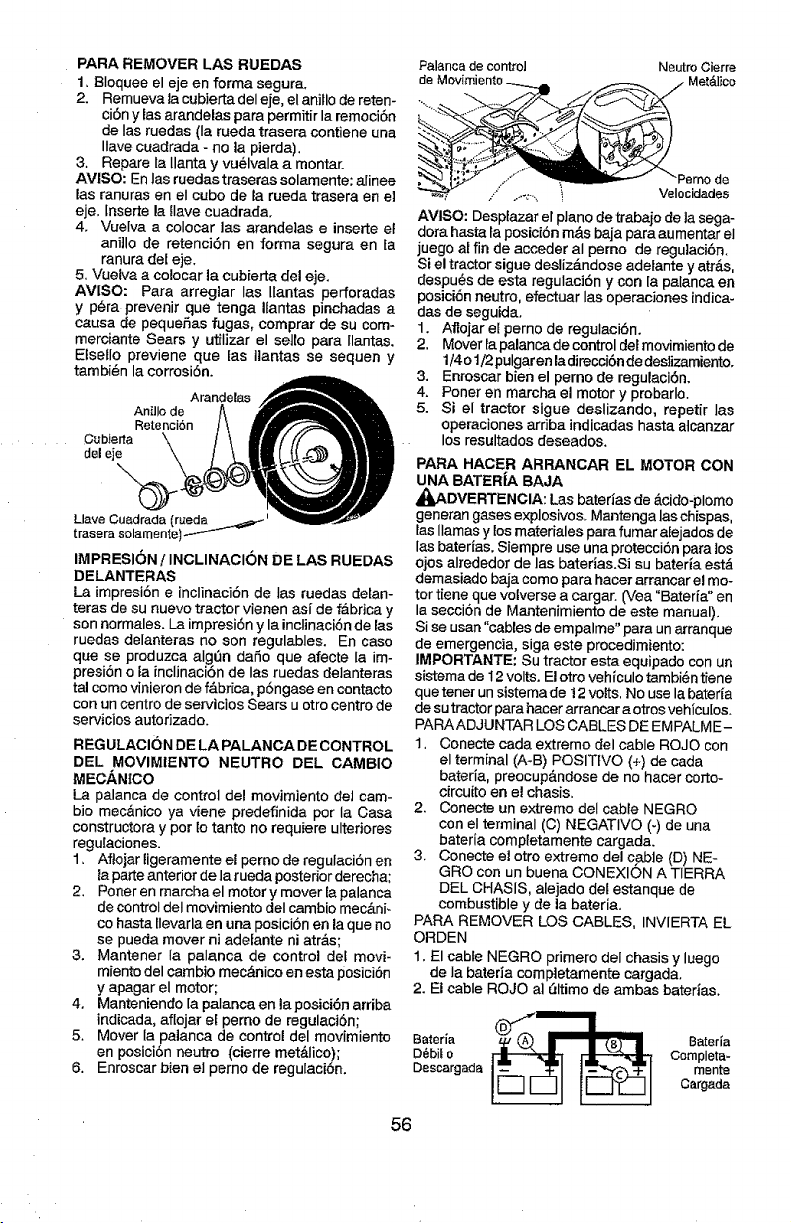
PARA REMOVER LAS RUEDAS
1, Btoquee eleje en forma segura.
2. Remueva la cubierta del eje, el anillo de reten-
ci6n y las arandelas para permitir la remoci6n
de Ias ruedas (Ia rueda trasera contiene una
Ilave cuadrada - no la pierda),
3. Repare ta llanta y vu_lvala a montar.
AVISO: En las ruedas traseras solamente: alinee
las ranuras en el cubo de la rueda trasera en el
eje. lnserte la tlave cuadrada.
4. Vuelva a colocar ]as arandelas e inserte et
anitlo de retenci6n en forma segura en [a
ranura det eje.
5, Vuelva a co!ocar la cubierta del eje.
AVISO: Para arreglar ias tlantas perforadas
y p_ra prevenir que tenga Ilantas pinchadas a
causa de pequeSas fugas, comprar de su com-
merciante Sears y utilJzar el setlo para llantas.
Elsetlo previene que tas Ilantas se sequen y
tambi_n ia corrosi6n.
Arandelas
Anillo de
Retenci6n
Cubierta
del eje
Uave Cuadrada(r__'
trasera solamentet
IMPRESlON / INCLINAOION DE LAS RUEDAS
DELANTERAS
La impresi6ne inclinaci6n de las ruedas detan-
teras de su nuevo tractor vienen asi de f_brica y
son normales. La impresibny la inclinaci6nde las
ruedas delanteras no son regulables. En caso
que se produzca alg_n da5o que afecte la im-
presi6n o ta inclinaci6n de Ias ruedas delanteras
tal como vinieron de f&brica, p6ngase en contacto
con un centro de servicios Sears u otro centro de
servicios autorizado.
REGULACION DE LA PALANCA DE CONTROL
DEL MOVIMIENTO NEUTRO DEL CAMBIO
MECANICO
La palanca de control del movimiento del cam-
bio mec_nico ya viene predefinida por la Casa
constructora y pot lo tanto no requiere ulteriores
regulaciones.
1, A_'toiarligeramente el pemo de regulaci6n err
la parte anterior dela rueda posteriorderecha;
2, Porter en marcha el motor y mover la palanca
de control del movimiento del cambio mec&ni-
co hasta flevarla en una posiclbn en la que no
se pueda mover ni adefante ni atr&s;
3. Mantener la palanca de control det movi-
miento del cambio mec&nico en esta posici6n
y apagar el motor;
4. Manteniendo [a palanca en la posici6n arriba
indicada, aflojar el pemo de regulaci6n;
5. Mover la palanca de control del movimiento
en posici6n neutro (cierre met&Iico);
6. Enroscar bien el pemo de regulaciOn.
Palanca de control Neutro Oierre
de t
•no de
....• Velocidades
AVISO: Desptazar el )lano de trabajo de Ia sega-
dora hasta fa posici6n m&s baja para aumentar el
juego al fin de acceder al pemo de regulaci6n,
Si el tractor sigue desliz_.ndose adelante y atr_.s,
despu@sde esta regulaci6n y con [a palanca en
posici6n neutro, efectuar las operaciones indica-
das de seguida.
1. Af_oiarel perno de regulaci6n.
2, Mover la palanca de control del movimiento de
1/4o 1/2 pulgaren ladirecci6n de deslizamiento.
3. Enroscar bien el perno de regulaci6n.
4. Poner en marcha el motor y probarlo.
5. Si el tractor sigue deslizando, repetir Ias
operaciones ardba indicadas hasta atcanzar
los resultados deseados.
PARA HACER ARRANCAR EL MOTOR CON
UNA BATER_ BAJA
_,DVERTENC|A: Las batefias de &cido-plomo
generangases explosivos. Mantenga las chispas,
fasllamas y los matedales para fumar alejados de
las baterias. Siempre use una protecci6n para los
ojos alrededor de Jasbatedas.Si su bateria est_
demasiado baja como para hacer arrancar elmo-
tor tiene que volverse a cargar. (Vea "Bateria" en
la secci6n de Mantenimiento de este manual).
Si se usan "cables de empalme" para un arranque
de emergencia, siga este procedimiento:
IMPORTANTE: Su tractor esta equipado con un
sistema de 12volts. Elotro vehlculo tambi@ntiene
que tenet un sistema de t2 vo[[s, No use la bateria
de su tractor para hacerarrancar a otros vehicu[os.
PARAADJUNTAR LOS CABLES DE EMPALME-
1. Conecte cada extrerno del cable ROJO con
el terminal (A-B) POSITtVO (+} de cada
bateria, preocup&ndose de no hacer corto-
circuito en el chasis.
2. Conecte un extremo deI cable NEGRO
con elterminal (C) NEGATIVO (-) de una
bateria compfetamente cargada.
3. Conecte el otro extremo del cable (D) NE-
GRO con un buena CONEXION A TIERRA
DEL CHASIS, alejado del estanque de
combustible y de la bateria.
PARA REMOVER LOS CABLES, INVIERTA EL
ORDEN
1. El cable NEGRO primero deI chasis y luego
de Ia bateda completamente cargada.
2. El cable ROJO al _ltimo de ambas baterias.
Bateria Bateria
D_bil o Completa-
Descargada mente
Cargada
56
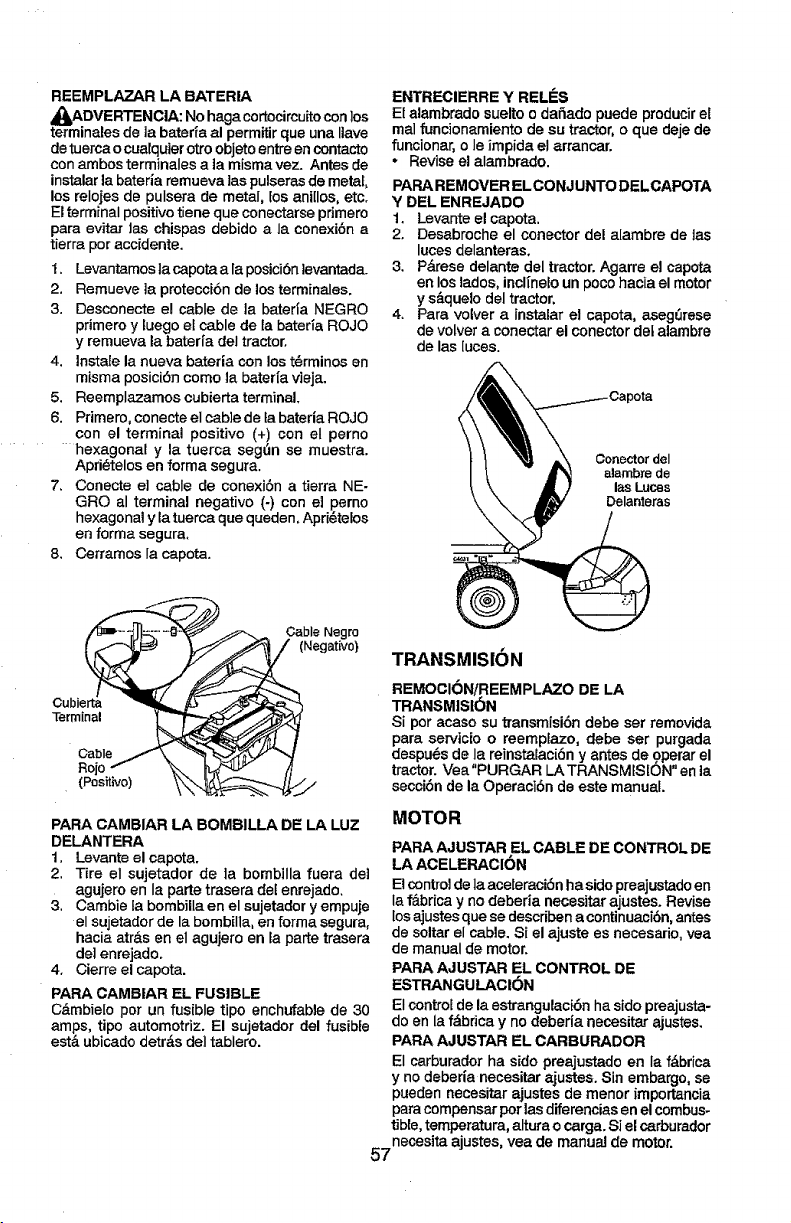
REEMPLAZAR LA BATERIA
_ADVERTENCIA: No haga cortocircuito conlos
terminales de la baterfa al permitir que una liave
de tuerca ocuatquierotto objeto entre en contacto
conambos terminales a la misrnavez. Antes de
instalarla bateria rernueva las pulseras de metal,
los relojes de pulsera de metal, los ani[Ios, etc.
El terminal positivetiene que conectarse pdmero
para evitar las chispas debido a la conexi6n a
tierra per accidente.
1. Levantarnosta capotaa la posiciSnlevantada.
2. Remueve la pmtecci6n de los terrninales.
3. Desconecte el cable de la bateda NEGRO
primero y tuego et cable de ta bateria ROJO
y remueva la bater[a del tractor.
4, Insta{e la nueva bateria con los t_rminos en
misma posiciSn come la bater[a vieja,
5, Reemplazamos cubierta terminal,
6. Primero, conecte el cable de tabateria ROJO
con el terminal positive (+) con el perno
hexagonal y la tuerca seg_n se muestra.
Apri_telos en forma segura.
7, Conecte e] cable de conexibn a tierra NE-
GRO al terminal negative (-) con el perno
hexagonal y la tuerca que queden, Apri_telos
en forma segura,
8, Cerrarnos Ia capota.
ENTREClERRE Y RELES
El alambrado suelto o dafiado puede producir el
real funcionamiento de su tractor,o que deje de
funcionar, o le impida el arrancar.
• Revise el alambrado.
PARA REMOVER EL CONJUNTO DELCAPOTA
Y DEL ENREJADO
1. Levante el capota.
2. Desabroche el conector del alambre de ]as
luces delanteras,
3. P&rese delante del tractor. Agarre el capota
en loslados, incl[nelo un poco hacia el motor
y s&quelo del tractor.
4. Para velvet a instalar el capota, a_seg_rese
de velvet a conectar el conector deLalambre
de las [uces.
_o/_a Cap°ta
hectordeI
arnbrede
TRANSMISlON
REMOCION/REEMPLAZO DE LA
TRANSMtSKSN
Si per acaso su transmisi6n debe set removida
para servicio o reemplazo, debe ser purgada
despu@sde la reinstaiaei6n y antes de operar el
tractor. Vea"PURGAR LATRANSMISION" en la
secci6n de la Operacibn de este manual.
PARA CAMBIAR LA BOMBILLA DE LA LUZ
DELANTERA
1. Levante el capota.
2. Tire el sujetador de la bombilla fuera de]
agujero en Ia parte trasera del enrejado,
3. Carnbie ta bornbilla en el sujetador y empuje
el sujetador de la bombilla, en forma segura,
hacia atr&s en el agujero en Eaparte trasera
de] enrejado,
4, Cierre el capota.
PARA CAMBtAR EL FUSIBLE
C&rnbie{o per un fusible tipo enchufable de 30
amps, tipo automotriz, El sujetador del fusible
est& ubicado detr&s del tablero.
MOTOR
PARA AJUSTAR EL CABLE DE CONTROL DE
LA ACELERACION
Elcontrol de la aceleraci6n ha side preajustadoen
la f&brica y no deberia necesitar ajustes. Revise
los ajustes que se describen a continuaci6n, antes
de soltar el cable, Si el ajuste es necesario, vea
de manual de motor.
PARA AJUSTAR EL CONTROL DE
ESTRANGULACION
El controtde la estrangulaci6n ha side preajusta-
do en la f&bdca y no deberia necesitar ajustes,
PARA AJUSTAR EL CARBURADOR
El carburador ha side preajustado en la f&brica
y no deberia necesitar ajustes. Sin embargo, se
pueden necesitar ajustes de rnenor importancia
paracompensar per las diferencias en el combus-
tible,temperatura,altura o carga. Si el carburador
necesita ajustes, yea de manual de motor.
57
3_
4.
Inmediatamente prepare su tractor para el al-
macenamiento a! final de la temporada o si el
tractor no se va a usar per 30 d{as o mas.
_IvADVERTENCIA: Nunca almacene el tractor
con gaso]ina en el estanque dentro de un edificio
en donde los gases pueden alcanzar una llama
expuesta o una chispa. Permita que el motor se
enfr{e antes de almacenado en cualquier recinto
privado.
TRACTOR
Cuando el tractor se va a almacenar per cierto
periodo de tiempo, limpieta cuidadosamente,
quite toda la mugre, Ia grasa, tas hojas, etc.
Gu&rdela en una &rea limpia y seca.
1. Limpie todo el tractor (vea "LIMPIE2_' en Ia
secci6n de Mantenimiento en este manual).
2. Inspeccione y cambie las correas, si es nec-
esario (yea las instrucciones para e{ cambio
de las correas en la secciSn de Servicio y
Ajustes de este manual).
Lubr{que!o, seg_n se muestra en la secci6n
de Mantenimiento de este manual.
AsegSrese que todas las tuercas, los pernos y
los tornillos est_n sujetados en forma segura.
lnspeccione las partes movibles para verificar
si hay daSo, rotura o desgaste. C&mbielas si
es necesario.
5. Retoque todas superficies pintadas oxidadas
o picadas; aplique lija antes de pintar.
BATER{A
• Cargue la bateria completamente antes de
guardarla.
° Despu_s de cierto periodo de tiempo en
almacenamiento, la bater_a puede necesitar
volver a cargarse.
• Para ayudar a evitar la corrosiSn y las fugas
de potencia durante largos periodos de alma-
cenamiento, se deben desconectar los cables
de ]a bater{a y se debe limpiar cuidadosamem
te (yea "PARA LIMPtAR LA BATERtA Y LOS
TERMINALES" en la secci6n de Mantenimien-
tode este manual).
- Despu_s de limpiarla, deje los cables
desconectados y pSngalos en deride no
puedan entrar en contacto con los terminales
de fa bater{a.
o Si se remueve Ia bataria del tractor para el
almacenamiento, no Ia guarde directarnente
sobre concrete o sobre superficies hQmedas.
MOTOR
SlSTEMA DE COMBUSTIBLE
IMPORTANTE: Es important evitar que se for-
man depositos de goma an partes fundamen-
tales del sistema de combus-tible tales come el
carburador, el fi}tro del combustible, la manguera
del combustibles mezclados con alcohot
(conocido come gasohoI o que tienen etanol o
metanol) pueden atraer humedad, Io que con-
duce a la separaci6n y a la formaciSn de acudos
durante etalmacenamiento. La gasolina acidica
puede da_ar el sistema de combustible de un
motor durante el periodo de almacenamiento.
° Vaciar el depSsito det carburante poniendo en
marcha e] motor y dej&ndolo funcionar hasta
gue el carburante termine el carburador est_
vac{o.
• Nunca use los productos para [impieza del
carburador o del motor en el estanque de
combustible pues se pueden producir daSos
permanentes.
° Use combustible nuevo la prSxima
temporada.
AMISO: El estabi[izador de combustible es una
alternativa aceptable para reducir a un ml'nimo
la formaciSn de dep6sitos de goma en e] com-
bustible durante el per{ode de almacenamientoo
Agregue estabilizador a ]a gasolina en el es-
tanque de combustible o en el envase para el
almacenamiento. Siempre siga la proporciSn de
mezcla que se encuentra en el envase de[ esta-
bilizador. Haga funcionar el motor per Io menos
10 minutes despu_s de agregar el estabilizador,
para permitir que _ste [legue al carburador. No
vaCiar la gasolina del estanque de gasolina y el
carburador si se est,. usando estabilizador de
combustible.
ACEITE DEL MOTOR
Drene el aceite (con el motor caliente) y c&mbielo
con aceite de motor limpio. (Vea "MOTOR" en la
secci6n de Mantenimiento" de este manual.)
CILINDRO(S)
1, Remueva la(s) bujia{s).
2. Vacie una onza de aceite a trav6s deI
agujere(s) de la bujia en el cilindro(s).
3. Gire la Ilave de ignioi6n a la pesici6n de '_r-
ranque" (Start), per unos cuantos segundos
para distribuir el aceite.
4. Cambie per bujia(s) nueva{s).
OTROS
• No guarde Is gasolina de una temporada a Ia
otra.
• Cambie el envase de la gaso}ina si se emp-
ieza a oxidar, La o×idaciSn yio la mugre en su
gasolina producir&n problemas.
° Si es pesible, guarde su unidad en un recinto
cerrado y eSbrala para protegerla contra el
polvo y la mugre.
• Cubra su unidad con un forte protector ad-
ecuado que no retenga la humedad. No use
pI&stico. El plAstico no puede respirar, Io que
permite la formaci6n de condensaci6n, Io que
producir_, la oxidaci6n de su unidad.
tMPORTANTE: Nunca cubra el tractor mientras
el motor y Ias areas de escape todavia estan
calientes.
58
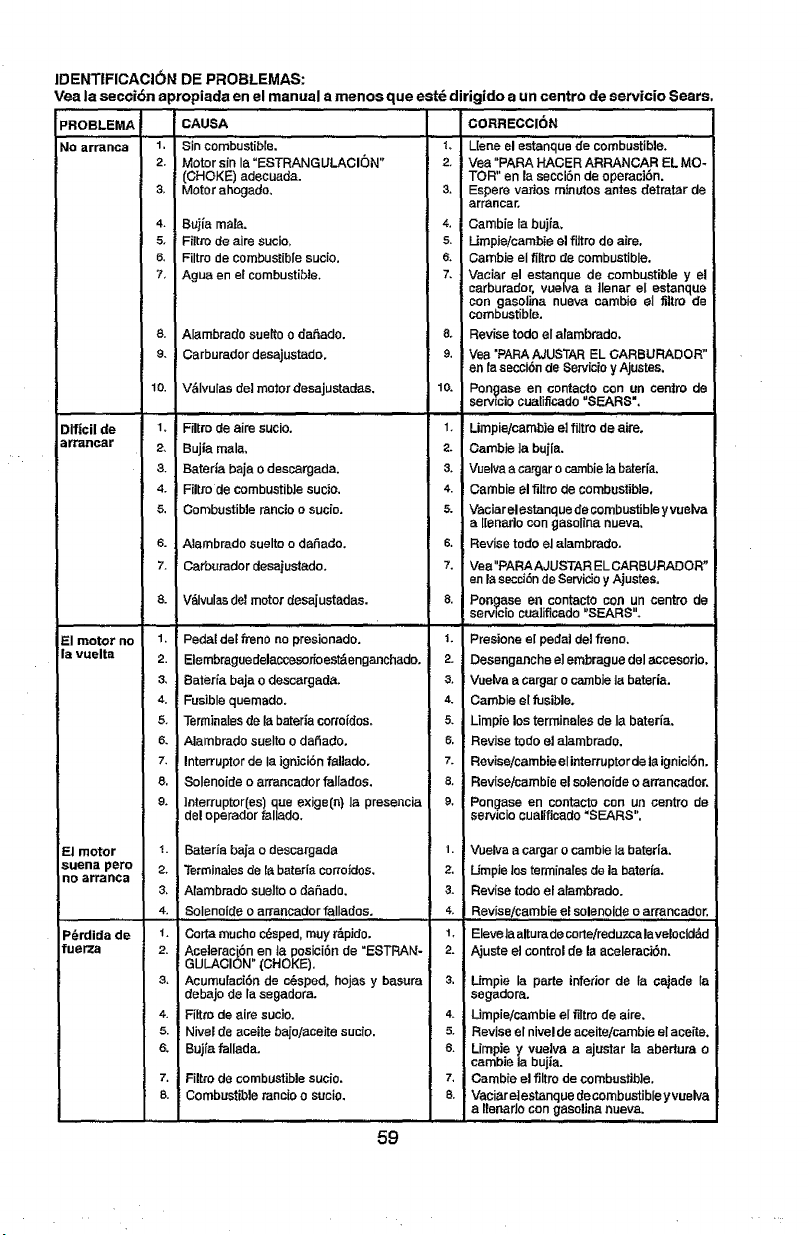
IDENTIFICACI(_N DE PROBLEMAS:
Vea la seccien apropiada en el manual a menos que est_ dirigido a un centre de servicio Sears.
PROBLEMA CAUSA CORRECCION
No arranca
DlfJcil de
arrancar
IEI motor no
la vuelta
1. Sin combustible.
2. Motor sin la =ESTRANGULACION"
(CHOKE) adecuada.
3, Motor ehogado,
4. Bui_a male.
5, Filtro de sire sucio.
6, Filtro de combustible suoio.
7, Ague en ef combustible.
8. Alambrado sueffo o da_ado,
9, Carburador desajustado,
lO. Vdlvulas de] motordesajustadas,
1, Filtro de a(re sucio.
2, Bujia male,
8. Bater{a baja 0 descargada.
4, Filtrode Combustiblesucio,
5. Combustible rancio o sudo,
6. Alambrado suelto o daSado.
7. Carburador desajustado,
8. V_lvulasde1motor desajuetadas.
1. Pedal de] freno no presionado,
2. Elembraguedelacceso_oest&enganchado,
3, 8atefia baja 0 descargada,
4. Fusible quemado.
5. Terminales de la bateda corrofdos.
6. Alambrado suelto 0 daSado,
7. Interruptorde Ia igniciSn fai]ado,
8. Solenoide o arrencador falIado8,
9. ]nterruptor(es) qua exige(n} la presencia
del operador fallado,
t. L[ene el estanque de combustible.
2. Vea "PARA HACER ARRANCAR EL MO-
TOR" en la secciSn de operacien.
3. Espere vados minutos antes detratar de
arrancer,
4, Cambis ia bujla,
5. LimpJeicambie el fiJtro de airs.
6. Gamble el fiitm de combustible.
7. Vaciar el estanque de combustible y el
carburador, vuelva a ]lenar el estanque
con gasoline nueva cambie el filtro de
combustible,
8. Revise todo el afambrado.
9. Vea "PARA AJUSTAREL GARBURADOR"
en faseccien de Sewicio yAjustes.
lo. Pond;lassen contacto con un centre de
serv_ciocualificado 'SEARS",
1. Umpielcambie el fiitm de sire,
2. Cambie ]a bujla,
3, Vuelva aca,rgar0 cambieIa hater(a.
4. Cambie el filtm de combustible,
5. Vaciar elestanque de combustibleyvuelva
a l[enado con gasoline nueva.
6. Revise todo el alambrado.
7. Vea "PARA AJUSTAR ELCAR BURADOR"
en la secciende Servic_oy Ajustes,
8. Pongase en contact<) con un centre de
servlcio cua]ificado"SEARS"÷
t. Presione el pedal del franc,
2. Desenganche eI embrague del accesorio,
.3. Vuelva a cargar o cambieta bateria.
4, Cambie el fusible.
5, Limpie los terminates de la bateda.
6. Revise todo el alambrado,
7. Revise/cambie elinterruptor de la igniciSn.
8. Revise/cambie el solenoids o arrancador.
9. Pon_ase en contacto con un centre de
setwcio cualificado =SEARS".
El motor
suena pero
no arranca
P_rdida de
fuerza
!. Bateda baja o descargada
2. Termina]esde [a bateria corroidos,
3, A[ambrado sue]to o daSado,
4. ,,,Solenoide 0 anrancador fallados_
1. Corta touche cesped, muy r_.pJdo.
2. Aceleracien en ta posicien de "ESTRAN-
GULACION" (CHOKE),
3. Acumu[acien de c_sped, hojas y basura
debajo de la segadora.
'_. FiLtrode sire sucio.
5. Nivel de aceite bajo!aceite sucio.
6. Bujfa fallada,
7. Filtro de combustible sucio.
8. Combustible rancio 0 sucio,
59
1. Vuelva a cargar o cambie Ia hater(a.
2. LJmpielosterminaies de le hater,s.
3. Revise todo el alambrado,
4. Reviseicambie e! solenoids 0 arrancador.
1. ' Elevelaalturadecorte/reduzcalavelocId_,d
2. Ajuste el control de la aceleraciSn.
3. Utopia la parte infm'ior de la c_ade la
segadora.
4. Umpie/cambie el filtm de airs.
5. Revise el nivel de aceiteicambie e( aceite.
6. _Limpie y vuelva a ajustar la abertura 0
cambie le bujia.
7. Cambie el filtro de combustible.
8. i Vaciarelestanque decombustibleyvuelva
a l[enarJo con gasoline aueva.
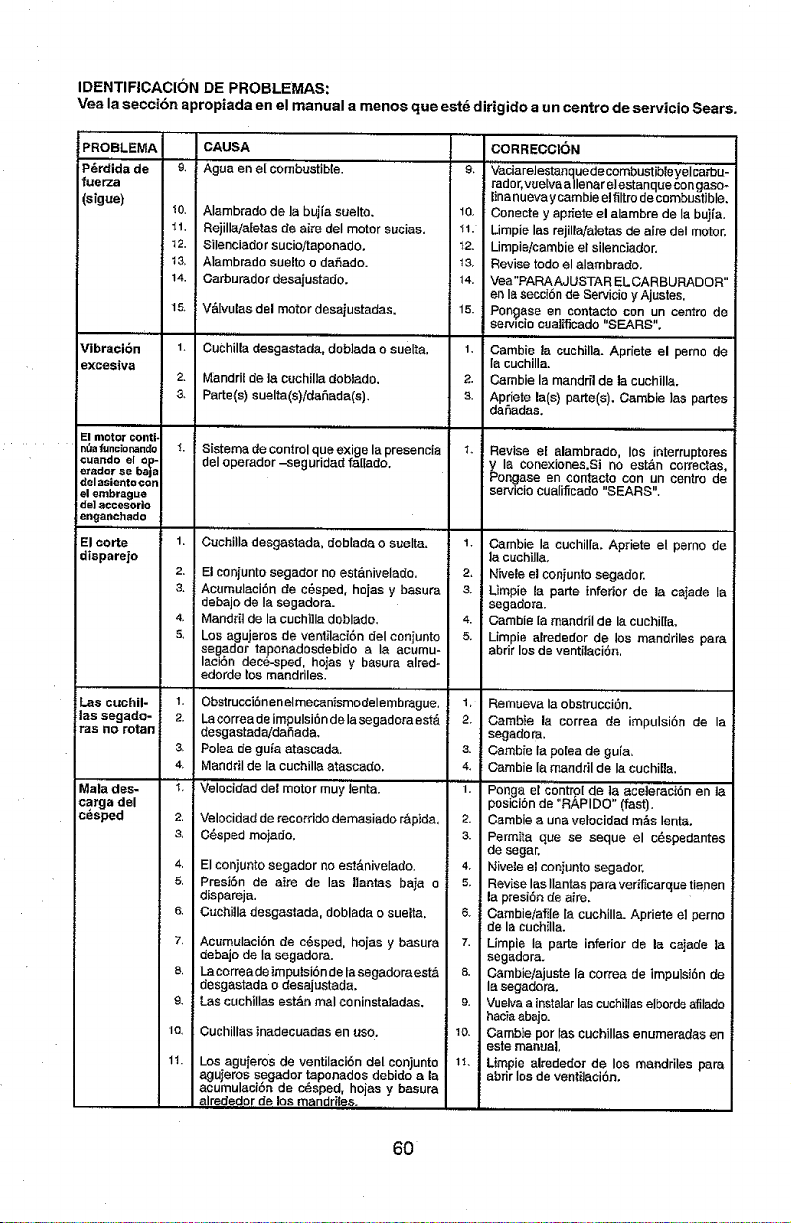
IDENTIFICACION DE PROBLEMAS:
Vea la secci6n apropiada en el manual a menos qua est_ dirigido a un centre de servicio Sears.
PROBLEMA CAUSA
P_rdida de _. Ague en e[ combustible.
fuerza
(sigue)
10. Alarnbrado de la buj{a suelto,
11. Rejilla!aletas de a{re deI motor sucias.
12. Silenciador susio/taponado,
13. A]ambrado suelto o da:Sado.
14. Garburador desajustado.
15. Va[vu{as del meter desajustadas.
Vlbra¢i6n 1.
excesiva
2.
&
El motor ¢ont|.
n_afuncior_n_
cuando el op-
erador so baja
del asiento con
el embrague
de] accesodo
enganchado
El carte
dispare|o
Las cuchil-
las segado-
ras no rotan
Mala des-
earga del
c_sped
,_,,,,,,,, , ,_,,,,,,,
Cuchilla desgastada, dob]ada o suelta.
Mandril de la cuchilla doblado,
Parte(s) suelta(s)/dahada(s).
CORRECC1ON
9_ Vaciarelestanqued ecombustibIe yeI carbu-
rador, vuelvaa llenar elestanque congaso_
line nueva y cambJe el filtro de combustible.
10, : Conecte y ap_ete el alambre de Ia buj{a.
! 1. Limpie las rejilla/a]etas de airs deI motor.
"_2. Limpis/cambie el silenciador.
13, Revise todo el alambrado.
14. Vea "PARAAJUSTAR EL CARBURADOR"
en Ia secci6n de Servicioy Ajustes.
15. Pongase en contacto con un centre de
servicio cualificado "SEARS",
1. Cambie la cuchilla. Apriete el perno de
la cuchilla.
2. Cambie la mandrB de la cuehilla,
s. Apriete la(s) parts(s). Cambie las partes
da_,adas,
Sistema de controlqua exige la presencia
deI operador --seguridad re[lade,
Revise s{ alambrade, los interruptores
y Ia conexiones.Si no est&n corfectas,
Pongase en contacto con un centre de
servicio cualificado "SEARS".
1,
2.
3.
4.
5,
"L
2.
3,
4.
5,
6.
7_
B,
9,
10,
11.
Cuchilla desgastada, dobIada o saelta,
El conjunto segador no est&nivelado,
Acumulaci6n de c6sped, hojas y basura
debaja de Ia segadora.
Mandtit de la cuchiIIa doblade.
Los agujeros de venfilaci6n deI coniunto
segador taponadosdebido ala acumu-
laci6n dec6-sped, hojas y basura alred-
edorde tes mandriles.
Obstrucci6n en elmecanismodelembrague.
La correa de impulsi6nde la segadora est&
desgastadaidafiada.
Poles de gufa atascada.
Mandril de Ia cuchilla atascado.
Veloc'idad del motor muy tenta.
Velocidad de recorrido demasiade r&pida.
C_sped mojado.
El con_unto 6egador no est&nivelado.
PresiSn de airs de las Ilanta6 baja o
dispareja.
Cuchilla desgastada, doblada o suetta,
Acumulaci6n de c_sped, hojas y basura
debajo de Is segadora.
La correa de impulsi6n de ta segadora est,,
desgastada o desajustada.
Las cuchilias est&n real eeninstaladas,
Cuchillas inadecuades en use,
Los agu{eros de ventilaci6n del conjunto
aguieros segador taponados debido ala
acumulaci6n de c_sped, hejas y basura
alrededor de los mandrileso ....
1. Cambie la cuchil[a, Apfiete el perno de
]a cuchiJla.
2, Nivele el conjunto segadar,
,3. Limpie la parte inferior de la caiade Ia
6egadora.
4. Cambie [a mandril de la cuchi[la,
5. Limpie alrededor de los manddles pars
abrir losde ventilaciSm
ii i
1, Remueva Ia obstrucci6n.
2. Gambie la correa de impulsi6n de la
segadora.
s. Cambie ia poles de gu{a,
4. Cambie la mandril de la cuchiila.
t". Ponga el c'ontrp[ de ]a aceleraci6n en la
posiciSn de "RAPIDO" (fast).
2. Cambie a una vetocidad m6s lenta,
3. Permita qua se seque el c_spedantes
de segar.
4, Nivete el con,_untosegador,
5. Revise las Ilantas pars verificarque tienan
la presi6n de airs,
6. Oambieiafile la cuchilla. Apriete el perno
i de la cuchilla.
7. Lirnpie Ia parts inferior de la cajade la
segadora.
a. Cambie/ajuste la cortes de impulsi6n de
Ia segadora,
a. Vuelvaa instalarlas cuchi]laselbotde afilade
hacfaabajo.
10. Cambie per fas cuchillas enumeradas en
este manual.
11, Limpie alrededor de los mandriles pars
abdr los de ventitaei6n,
6O
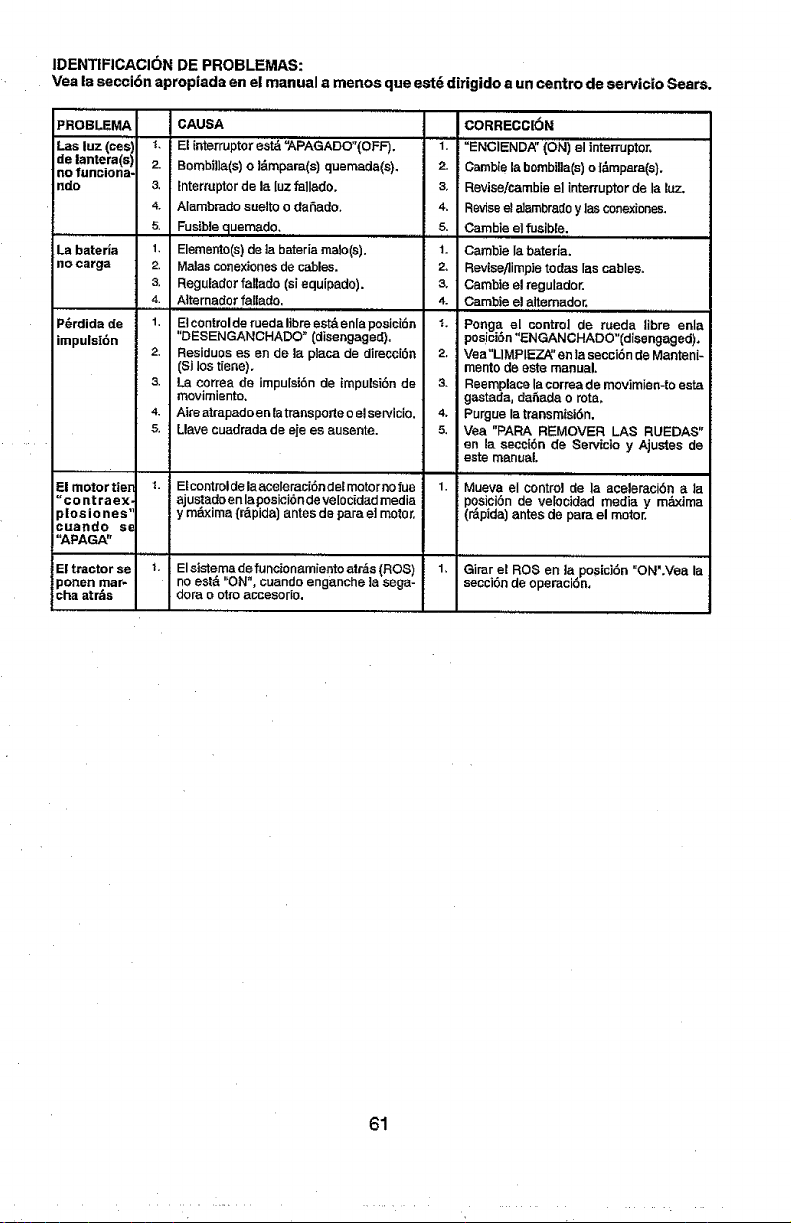
IDENTIFICACION DE PROBLEMAS:
Vea la secci6n apropiada en el manual a menos que est_ dirigido a un centre de servicio Sears.
PROBLEMA CAUSA
Las luz (¢es) t, El interrupter est&"AP'AGADO"(OFF), i'i"'
de |antera(s) 2. Bombilla(s) 0 I_.mpara(s) quemada(s). 2.
no funciona-
ndo 3. }nterruptor de la Iuzfallado. 3.
4. Alambmdo seelto 0 daSado. 4.
5. Fusible quemado, ,.......... 5;
La bateria 1. Elemento(s)de ]a bateria male(s), t.
no carga 2. Malas conexiones de cables. 2.
3. Regulador fallado (si equipado). 3.
4. Atternador fallado. 4.
....... ,,,,,,
P_rdida de 1. Et controlde rueda libra eat& enla posici6n _.
impulst6n "DESENGANOHADO" (disengaged).
2. Residuos as en de la piaca de direcci6a 2.
(Si los tiene),
3. La correa de impu[si6n de impulsiSn de 3.
mevimiento.
4. Aire atrapade an la transporte oel servicio. 4.
5. Llave cuadrada de eje es ausente. 5.
El motor tien
"contraex-
pies|ones"
¢uando se
"APAGA"
El tractor se
ponen mar-
€ha at r,_s
E[controlde la acelerasi6n del motor no rue 1.
ajustadoen la posici6nde vein cidad media
y m_c<ima{r&pida) antes de para el motor,
CORRECC[ON
"ENCIENDA" (ON) el interruptor_
Oambie la bombllla(s) o f_mpara(s).
Revise!eatable el interrupter de la laz.
Reviseel aJambradoylas conexiones.
Cambie el fusible.
Cambie la baterla,
Revise,qimpie todas las cables.
Cambte el regulador`
Cambie el a!,t,emador`
Ponga el control de reeda libra enla
poelciSn%NGANCHADO"(disengaged).
Vea "L1MPIEZA?en ]asecci6n de Manteni-
mento de este manual,
Reemplaca la eorrea de movimian-to esta
gastada, da_ada o rota,
Purgue la transmisiSn.
Yea "PARA REMOVER LAS RUEDAS"
en la secci6n de Servicio y Ajustes de
este manual.
i Mueva el control de ]a aceleraci6n a la
_,posiciSn de ve[ocidad media y m,_xima
(r_pida) antes de para el motor,
,, ,,,,,
El sistema de fu noionamiento atria (ROS)
no est_ "ON", cuando enganehe ]a sega-
dora n otto accesorie.
..... ,,,,,
1. Girar el RO$ en la posici6n "ON' Yea a
secci6n de operaclon.
61

62
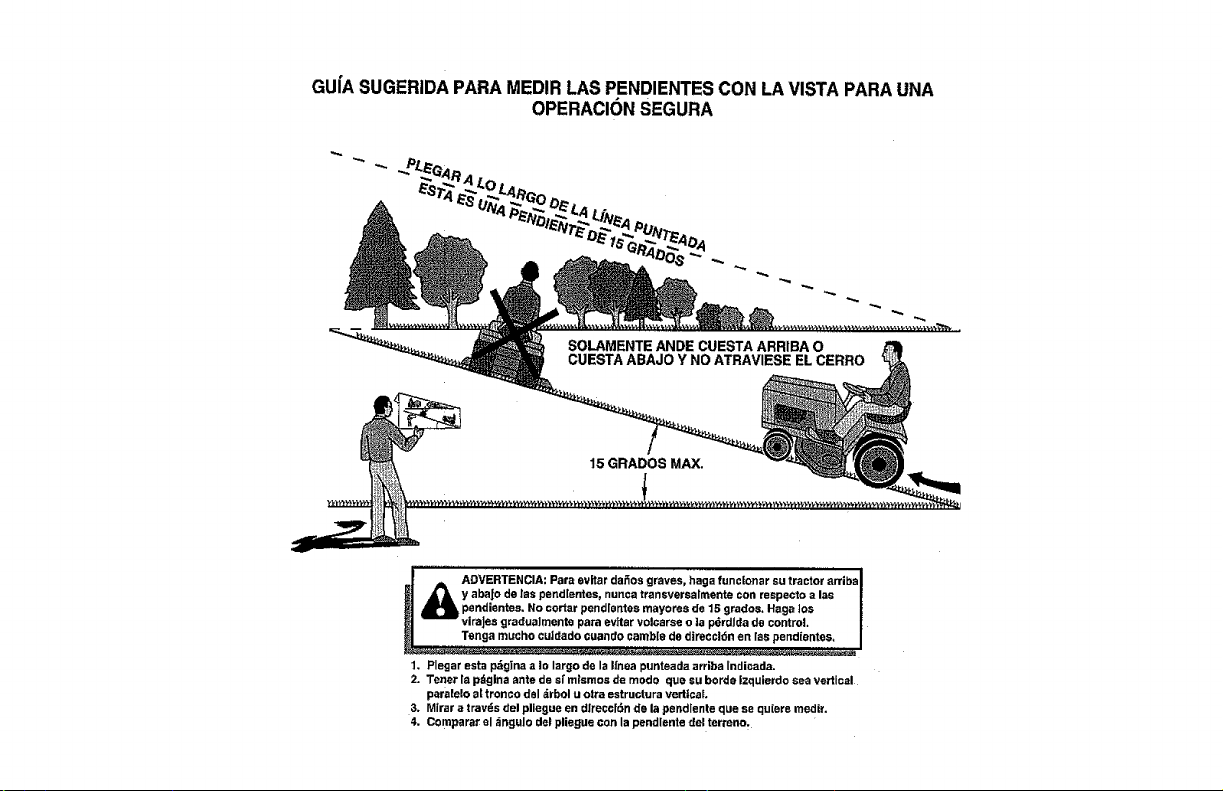
GUfASUGERIDAPARA MEDIR LAS PENDIENTESCONLA VISTA PARAUNA
OPERACIONSEGURA
_ DVERTENCIA: Para evltar da_os graves, haga funclonar su tractor arriba
y aba_o de |as penal|antes, nunca transversalmente con respects a las
pendientes. No cortar pend[sntes mayores de 15 grados. Haga los
viraJes gradua]mente pa_ ev]lar volcarse o ]a p_rdJda de control
Tangs mucho cu]dado cuando camb[a de direccl6n en ras pendisntes_
1, Plegar esta p_,glna a Io largo do la Ifnsa punteada arriba [ndicada.
2, Tenet la pdgina ante de sf m_smos de roods qua su horde Izquierdo sea vertical
paralelo at tronco dal drbol u ot_'a estructura vertical
3. Mirar a travds del pliegue en dJrecef6n de la penctiente qLle se quiere medir.
4. Comparar el dngulo del pliegue con la pend|ente de| terreno_

4
i NEED MORE HELP.:'
! You'll find the answe_ and _r_ore on managemyhome.com - for free!
! . Find this and a[[ your other product manuals online.
i * Getanswersfromour teamof homeexperts.
i "Geta personalizedmaintenancep{anforyourhome.
i "Findinformationandtoolstohelpw_thhomeprojeL-t£
} manage _ home
Your Home
For repair - in your home - of all major brand appliances,
lawn and garden equipment, or heating and cooling systems,
no matter who made it, no matter who sold itt
For the replacement parts, accessories and
owner's manuals that you need to do-it-yourself.
ForSears professional installation of home appliances
and items like garage door openers and water heaters,
1-800-4-MY-HOME ® Anytime,dayornight
(1-800--469-4663) (U,S,A.andCanada)
www.sears.com www.seats.ca
Our Home
For repair of carry-in products like vacuums, lawn equipment,
and electronics, call or go on-line for the nearest
Sears Parts and Repair Center,
t-800-488-'!222 Anytime, dayornight(U.S.A, only)
www.sears.com
To purchasea protection agreement (U,SA,)
or maintenance agreement (Canada) on a product serviced by Sears:
1-800-827-6655 (U.SA,) 1-800-36t-6665 (Canada)
Para pedirserviciode reparaci6n
a domidlio, y para ordenarpiezas:
1.888-SU.HOGAR®
(t-68_784-6427)
Au Canada poursauce en francis:
1-800-LB.FOYERec
_vw.sea rs.ca
09.12,11 BD
©Sea_ Brands,LLC
® Registerad Trademark t TM Trademark i sta Service Mark of Sears Staads, LLC
® Matca Regislmda ['tM Mama de F_b,ff;a / sMMarca de Serv_ciode 8ea_a Br'_ads,LLC
,_c Marqua de commerce / ao Marque d_pos6e de Sears Brands, LLC
Printed in the U.S.A.