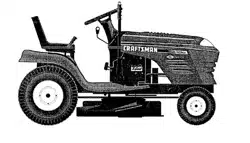
, _EA/,eS
®
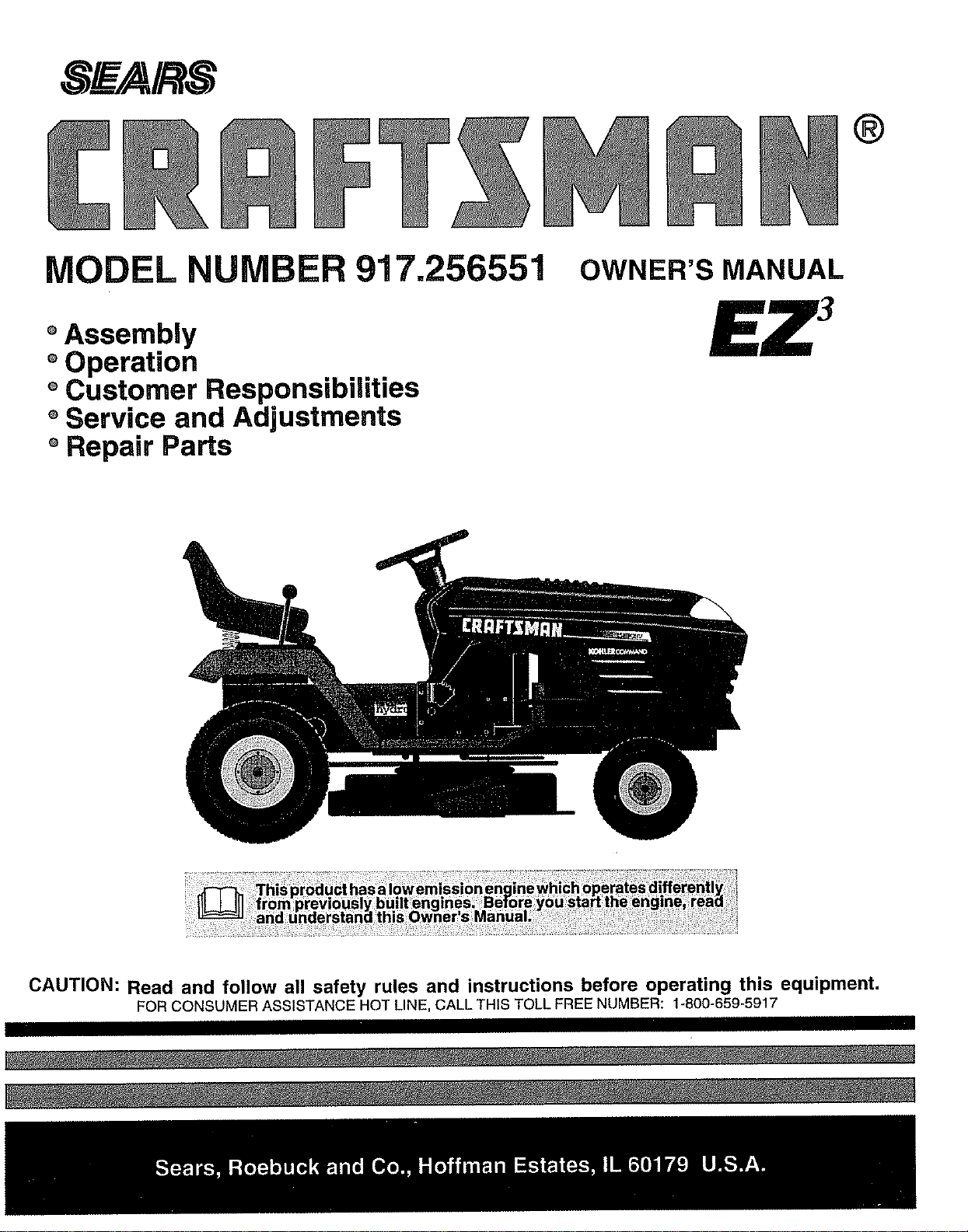
MODEL NUMBER 917.256551
oAssembly
oOperation
° Customer Responsibilities
° Service and Adjustments
° Repair Parts
OWNER'S MANUAL
CAUTION: Read and follow all safety rules and instructions before operating this equipment.
FOR CONSUMER ASSISTANCE HOT LINE, CALL THIS TOLL FREE NUMBER: 1-800-659-5917

SAFETY RULES
Safe Operation Practices for Ride-On Mowers
IMPORTANT: THIS CUTTING MACHINE IS CAPABLE OF AMPUTATING HANDS AND FEET AND THROWING OBJECTS.
FAILURE TO OBSERVE THE FOLLOWING SAFETY INSTRUCTIONS COULD RESULT IN SERIOUS INJURY OR DEATH,
L GENERAL OPERATION
Read, understand, and follow all instructions in the manual
and on the machine before starting.
Only allow responsible adults, who are familiar with the
instructions, to operate the machine
Clear the area of ob ects such as rocks, toys, wire, etc.,
wh ch could be p cked up and thrown by the bade
Be sure the area is clear ofother people befo re mowing Stop
machine if anyone enters the area.
Never carry passengers
Do not mow in reverse unless absolutely necessary Always
look down and behind before and while backing
Be aware of the mower discharge direction and do not point
it at anyone Do not operate the mower without either the
entire grass catcher or the guard in place
Slow down before turning
Never leave a running machine unattended. Always turn off
blades, set parking brake, stop engine, and remove keys
before dismounting
Turn off blades when not mowing
Stop engine before removing grass catcher or unclogging
chute.
Mow only in daylight or good artificial light
Do not operate the machine while under the influence of
alcohol or drugs
Watch for traffic when operating near or crossing roadways
Use extra care when loading or unloading the machine into
a trailer or truck.
IL SLOPE OPERATION
Slopes are a major factor related to loss-of-control and
tipover accidents, which can result in severe injury or'
death All slopes require extra caution. If you cannot back
up the slope or if you feel uneasy on it, do not mow iL
DO:
Mow up and down slopes, not across
Remove obstacles such as rocks, tree limbs, etc
Watch for holes, ruts, or bumps. Uneven terrain could
overturn the machine Tafl grass can hide obstacles
Use slow speed Choose a low gear so that you will not have
to stop or shift while on the slope
Follow the manufacturer's recommendations for wheel
weights or counterweights to improve stability
Use extra care with grass catchers or other attachments
These can change the stability of the machine,
Keep all movement on the slopes slowand gradual Do not
make sudden changes in speed or direction
Avoid starting or stopping on a slope. If tires lose traction,
disengage the blades and proceed slowly straight down the
slope
III. CHILDREN
Tragic accidents can occur ifthe operator is not alert to the
presence of children. Children are often attracted to the
machine and the mowing activity. Never' assume that
children will remain where you last saw them.
Keep children out of the mowing area and under the watchful
care of another responsible adult
Be alert and turn machine off if children enter the area
Before and when backing, look behind and down for small
children.
Never carry children. They may fall off and be seriously
injured or interfere with safe machine operation
Never allow children to operate the machine.
Use extra care when approaching blind corners, shrubs,
trees, or other objects that may obscure vision
IV. SERVICE
Use extra care inhandling gasoline and other fuels_ They are
flammable and vapors are explosive.
Use only an approved container.
Never remove gas cap or add fuel with the engine
running Allow engine to cool before refueling Do not
smoke
Never refuel the machine indoors
Never store the machine or fuel container inside where
there is an open flame, such as a water heater.
Never run a machine inside a closed area.
Keep nuts and bolts, especially blade attachment bolts, tight
and keep equipment in good condition
Never tamper with safety devices Check their proper
operation regularly.
Keep machine free of grass, leaves, or other debris build-up
Clean oil or fuel spillage Allow machine to cool before
storing
Stop and inspect the equipment if you strike an object
Repair, if necessary, before restarting
Never make adjustments or repairs with the engine running.
Grass catcher components are subject towear, damage, and
deterioration, which could expose moving parts or allow
ob ects to be thrown. Frequenfly check components and
rep ace w thmanufacturer's recommended pads, when nec-
essary
Mower blades are sharp and can cuL Wrap the blade(s) or
wear gloves, and usa extra caution when servicing them
Check brake operation frequently Adjust and service as
required.
&
Look for' this symbol to point out important
safety precautions° It means
CAUTIONlfl BECOME ALERTIf! YOUR
SAFETY IS INVOLVED.
DO NOT:
Do not turn on slopes unless necessary, and then, turn slowly
and gradually downhill, if possible
Donotmowneardrop-offs, ditches, orembankments The
mower could suddenly turn over if a wheel is over the edge
of a cliff or'ditch, or if an edge caves in
Do not mow on wet grass Reduced traction could cause
sliding
• Donettrytostabilizethamachinebyputtingyourfootonthe
gmund_
Do not use grass catcher on steep slopes
&
CAUTION:" Always disconnect spark plug
wire and place wire where it cannot contact
spark plug in order' to prevent accidental
starting when setting up, transporting,
adjusting or making repairs.
WARNING
The engine exhaust from this product contains
chemicals known to the State of California to
cause cancer, birth defects, or other reproduc-
tive harm.
2
CONGRATULATIONS on your purchase of a Sears
Tractor. It has been designed, engineered and manufac-
tured to give you the best possible dependability and
performance,,
Should you experience any problem you cannot easily
remedy, please contact your nearest Sears Authorized
Service Center/Department Department. We have com_
petent, well-trained technicians and the proper tools to
service or repair this tractor.
Please read and retain this manual. The instructions will
enable you to assemble and maintain your tractor properly.
Always observe the "SAFETY RULES".
MODEL
NUMBER 917.256551
SERIAL
NUMBER
DATE OF PURCHASE
THE MODEL AND SERIAL NUMBERS WILL BE FOUND
ON A PLATE UNDER THE SEAT.
YOU SHOULD RECORD BOTH SERIAL NUMBER AND
DATE OF PURCHASE AND KEEP IN A SAFE PLACE
FOR FUTURE REFERENCE.
MAeNTENANCE AGREEMENT
A Sears Maintenance Agreement is available on this prod-
uct. Contact your nearest Sears store for details,
CUSTOMER RESPONSRBBLITIES
Read and observe the safety rules.
Followa regutarschedule in maintaining, caring forand
using your tractor.
, Follow the instructions under"Customer Responsibili-
ties" and "Storage" sections of this owner's manual.
WARNING: This tractor is equipped with an internal
combustion engine and should net be used on or near any
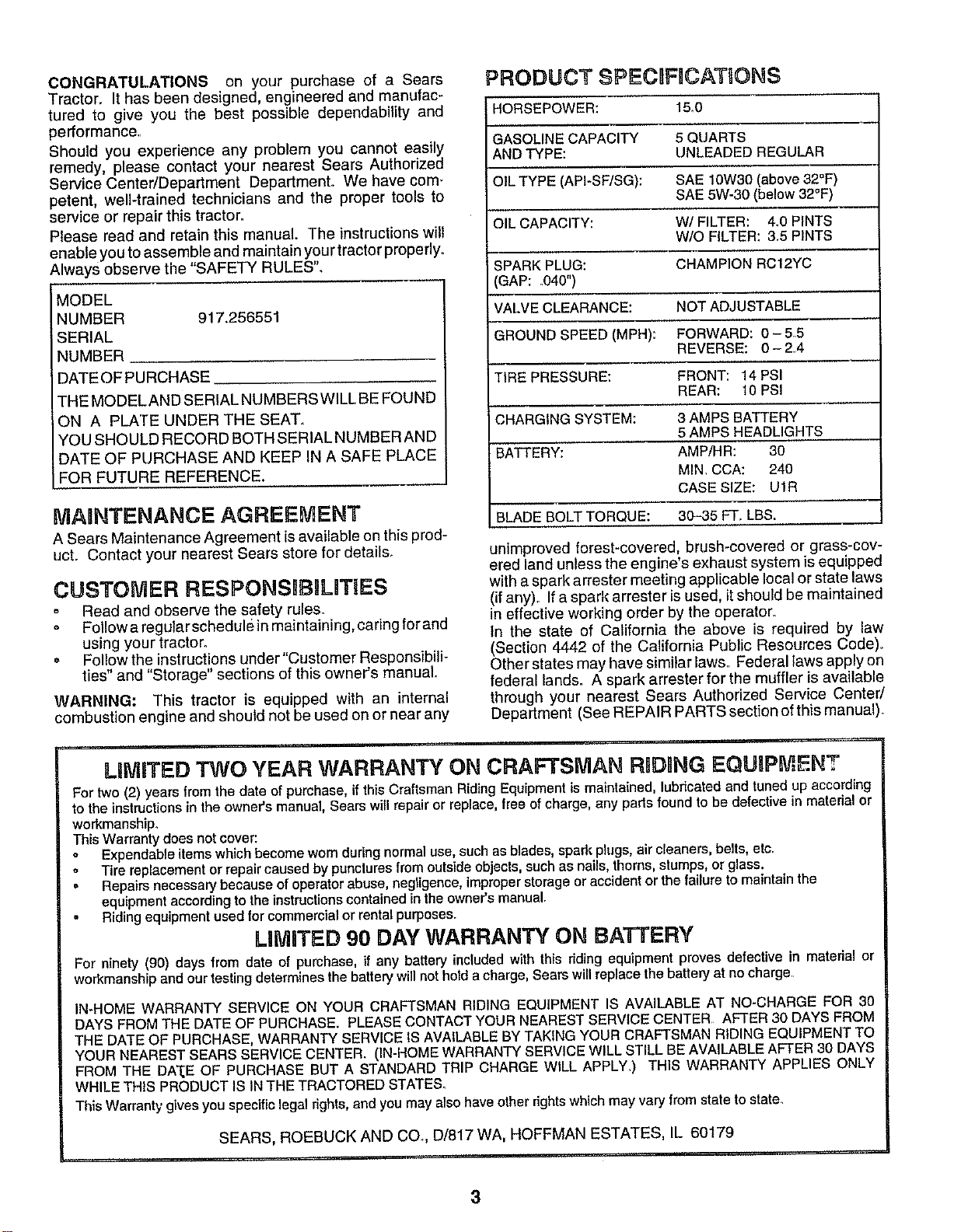
PRODUCT SPEC FICATgONS
HORSEPOWER: l&0
GASOLINE CAPACITY 5 QUARTS
AND TYPE: UNLEADED REGULAR
OIL TYPE (API-SF/SG): SAE 10W30 (above 32°F)
SAE 5W-30 (below 32°F)
OIL CAPACITY: W/FILTER: &0 P_NTS
W/O FILTER: 3.5 PINTS
SPARK PLUG: CHAMPION RC12YC
GAP: .040")
VALVE CLEARANCE: NOT ADJUSTABLE
GROUND SPEED (MPH): FORWARD: 0 - &5
REVERSE: 0-2.4
TIRE PRESSURE: FRONT: 14 PSI
REAR: 10 PSI
CHARGING SYSTEM: 3 AMPS BATTERY
5 AMPS HEADLIGHTS
BATTERY: AMP/HR: 30
MIN CCA: 240
CASE SIZE: U1R
BLADE BOLT TORQUE: 30-35 FT. LBS.
unimproved forest-covered, brush-covered or grass-cov-
ered land unless the engine's exhaust system is equipped
with aspark arrester meeting applicable local or state laws
(if any). If a spark arrester is used, it should be maintained
in effective working order by the operator.
In the state of California the above is required by law
(Section 4442 of the California Public Resources Code)°
Other states may have similar laws. Federal laws apply on
federal lands. A spark arrester for the muffler Jsavailable
through your nearest Sears Authorized Service Center/
Department (See REPAIR PARTS section of this manual).
UMaTED TWO YEAR WARRANTY ON CRAFTSMAN R DING EQUIPMENT
For two (2) years from the date of purchase, if this Craftsman Riding Equipment is maintained, lubricated and tuned up according
to the instructions in the owner's manual, Sears will repair or replace, free of charge, any parts found to be defective in material or
workmanship.
This Warranty does not cover:
° Expendable items which become wom during normal use, such as blades, spad( plugs, air cleaners, belts, etc.
Tire replacement or repair caused by punctures from outside objects, such as nails, thorns, stumps, or glass,
Repairs necessary because of operator abase, negligence, improper storage or accident or the failure to maintain the
equipment according to the instructionscontained in the owner's manual.
Riding equipment used for commercial or rental purposes.
L|iVlaTED 90 DAY WARRANTY ON BATTERY
For ninety (90) days from date of purchase, if any battery included with this riding equipment proves defective in material or
workmanship and our testing determines the battery will not hold a charge, Sears will replace the battery at no charge.
IN-HOME WARRANTY SERVICE ON YOUR CRAFTSMAN RIDING EQUIPMENT IS AVAILABLE AT NO-CHARGE FOR 30
DAYS FROM THE DATE OF PURCHASE. PLEASE CONTACT YOUR NEAREST SERVICE CENTER AFTER 30 DAYS FROM
THE DATE OF PURCHASE, WARRANTY SERVICE tS AVAILABLE BY TAKING YOUR CRAFTSMAN RIDING EQUIPMENT TO
YOUR NEAREST SEARS SERVICE CENTER. (IN-HOME WARRANTY SERVICE WILL STILL BE AVAILABLE AFTER 30 DAYS
FROM THE DA'_E OF PURCHASE BUT A STANDARD TRIP CHARGE WILL APPLY,) THIS WARRANTY APPLIES ONLY
WHILE THIS PRODUCT iS IN THE TRACTORED STATE&
This Warranty gives you specific legal rights, and you may also have other rights which may vary from state to state.
SEARS, ROEBUCK AND COo, D/817 WA, HOFFMAN ESTATES, IL 60179
i
3
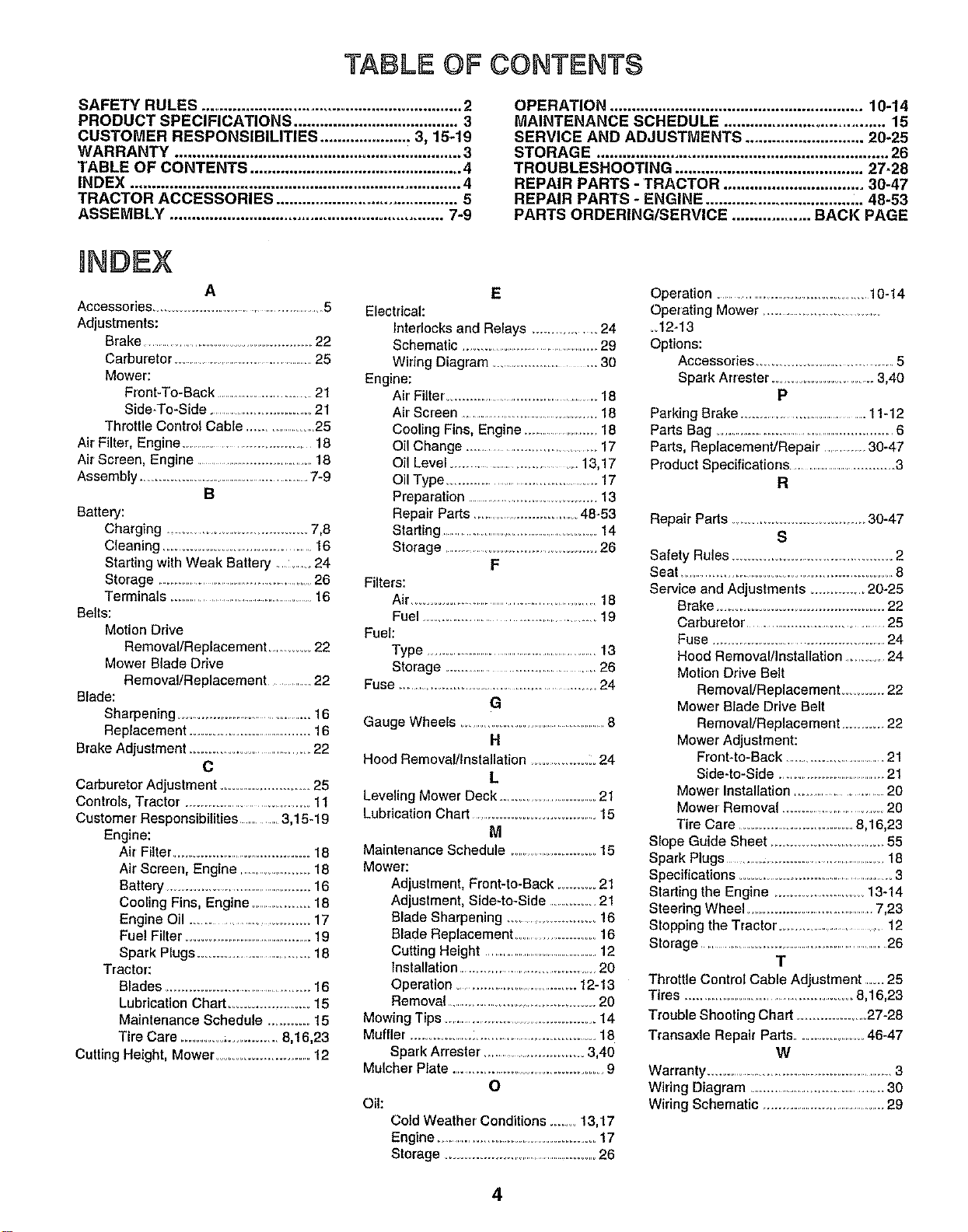
TABLE OF CONTENTS
SAFETY RULES ............................................................ 2
PRODUCT SPECIFICATIONS ...................................... 3
CUSTOMER RESPONSIBILITIES ..................... 3, 15-19
WARRANTY .................................................................. 3
TABLE OF CONTENTS ................................................. 4
INDEX ............................................................................ 4
TRACTOR ACCESSORIES .......................................... 5
ASSEMBLY ............................................................... 7-9
OPERATION .......................................................... 10-14
MAINTENANCE SCHEDULE ..................................... 15
SERVICE AND ADJUSTMENTS ........................... 20-25
STORAGE ................................................................... 26
TROUBLESHOOTING ........................................... 27-28
REPAIR PARTS - TRACTOR ................................ 30-47
REPAIR PARTS - ENGINE ................................. -, 48-53
PARTS ORDERING/SERVICE .................. BACK PAGE
INDEX
A
Accessories ........................................................5
Adjustments:
Brake ......................................................22
Carburetor .......................................................25
Mower:
Front-To-Back ......................................21
Side-To-Side ................................21
Throttle Control Cable ..........................25
Air Filter, Engine ................................................18
Air Screen, Engine ............................................18
Assembly ...........................................................7-9
B
Battery:
Charging .........................................7,8
Cleaning ......................................... 16
Starting with Weak Battery ..:.... 24
Storage ...........................................................26
Terminals .......................................................16
Belts:
Motion Drive
Removal/Replacement .................22
Mower Blade Ddve
Removal/Replacement .............22
Blade:
Sharpening .................................................16
Replacement ...........................................16
Brake Adjustment ....................................22
C
Carburetor Adjustment .................................25
Controls, Tractor ........................................11
Customer Responsibilities .............3,15-19
Engine:
Air Filter .....................................................18
Air Screen, Engine ............................18
Battery ...............................................16
Cooling Fins, Engine ................. 18
Engine Oil ............................... 17
Fue! Filter ..................................................19
Spark Plugs ..................................18
Tractor:
Blades ...........................................16
Lubrication Chart ..........................15
Maintenance Schedule ...............15
Tire Care ........... ............... 8,16,23
Cutting Height, Mower ..............................12
E
Electrical:
Interlocks and Relays ................. 24
Schematic ..................................................29
Wiring Diagram ...................................30
Engine:
Air Filter ..............................................................18
Air Screen .............................................18
Cooling Fins, Engine .........................18
Oil Change ...............................................17
Oil Level ...........................................13,17
Oil Type ....................................................17
Preparation ............................................13
Repair Parts .................................48-53
Starling ....................................................14
Storage ........................................... 26
F
Filters:
Air ...........................................................18
Fuel ............................................................19
Fuel:
Type ..........................................................13
Storage .....................................................26
Fuse ...........................................................................24
G
Gauge Wheels ...............................................8
H
Hood Removal/Installation ............... L 24
L
Leveling Mower Deck ..................................21
Lubrication Chart ........................................15
M
Maintenance Schedule ..............................15
Mower:
Adjustment, Front-to-Back ............21
Adjustment, Side-to-Side ..............21
Blade Sharpening ...............................16
Blade Replacement ....................... 16
Cutting Height ...........................................12
Installation ................................................20
Operation ........................................12-13
Removal .................................................20
Mowing Tips ................................................14
Muffler ................................................................18
Spark Arrester .........................................3,40
Mulcher Plate ................................................9
O
Oil:
Cold Weather Conditions ....... 13,17
Engine ....................................................17
Storage .....................................................26
Operation .............................................10-14
Operating Mower ..........................................
_.12-13
Options:
Accessodes ...........................................5
Spark Attester ........................... 3,40
P
Parking Brake ..............................................11-12
Parts Bag .........................................................................6
Parts, Replacement/Repair ...............30-47
Product Specifications ..............................................3
R
Repair Parts ...................................... 30-47
S
Safety Rules ...................................... 2
Seat .....................................................................8
Service and Adjustments ............... 20-25
Brake ............................................. 22
Carburetor ..................................................25
Fuse ........................................................24
Hood Removal/Installation ......... 24
Motion Drive Belt
Removal/Replacement ............ 22
Mower Blade Drive Belt
Removal/Replacemerrt ............ 22
Mower Adjustment:
Front-to-Back ....................................21
Side-to-Side ...............................................21
Mower Installation .......................... 20
Mower Removal .....................................20
Tire Care .........................................8,16,23
Slope Guide Sheet ................................ 55
Spark Plugs ......................................................18
Specifications ......................................................3
Starting the Engine ..............................13-14
Steering Wheel ............................................7,23
Stopping the Tractor ...................................12
Storage ..................................................................26
T
Throttle Control Cable Adjustment ..... 25
Tires .............................................................8,16,23
Trouble Shooting Chart .....................27-28
Transaxle Repair Parts ......................46-47
W
Warranty ..............................................................3
Wiring Diagram ....................................................30
Wiring Schematic .............................................29
4
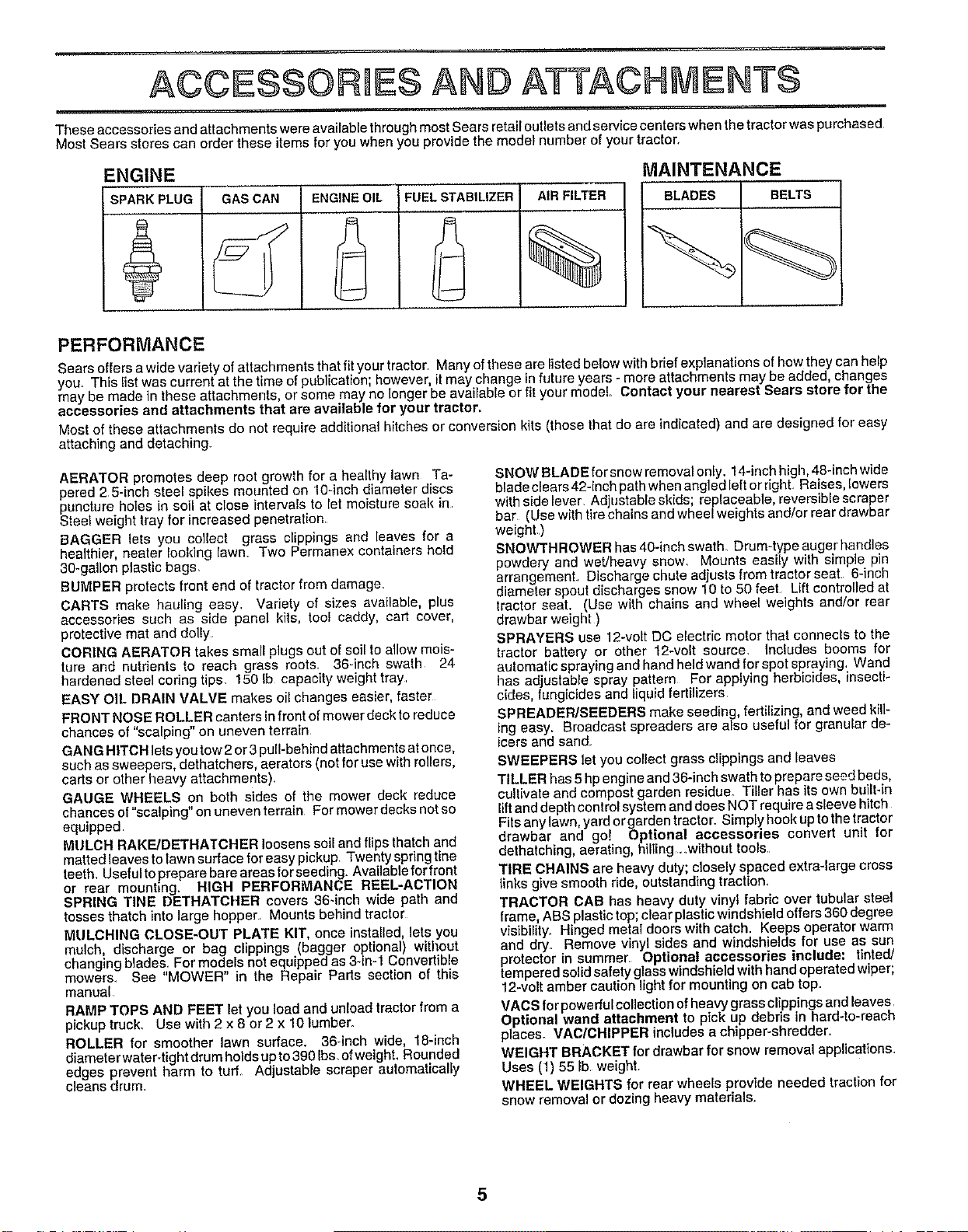
AOOESSORIF=S AND ATTACHMENTS
These accessories and attachments were available through most Sears retail outlets and service centers when the tractor was purchased
Most Sears stores can order these items for you when you provide the model number of your tractor.
ENGINE
SPARK PLUG GAS CAN
ENGINEOIL FUELSTABILIZER
AIR FILTER
%
MAINTENANCE
BLADES BELTS
PERFORMANCE
Sears offers aw de var e y of attachments that fit your tractor Many of these are listed below with brief explanations of how they can help
you Ths st was current at the time of publication however, it may change in future years - more attachments may be added, changes
may be made in these attachments, or some may no longer be available or fit your model. Contact your nearest Sears store for the
accessories and attachments that are available for your tractor.
Most of these attachments do not require additional hitches or conversion kits (those that do are indicated) and are designed for easy
attaching and detaching.
AERATOR promotes deep root growth for a healthy lawn Ta-
pered 2 5-inch steel spikes mounted on 10-inch diameter discs
puncture holes in soil at close intervals to let moisture soak in
Steel weight tray for increased penetration
BAGGER lets you collect grass clippings and leaves for a
healthier, heater looking lawn Two Permanex containers hold
30-gallon plastic bags,
BUMPER protects front end of tractor from damage
CARTS make hauling easy Variety of sizes available, plus
accessories such as side panel kits, tool caddy, cart cover,
protective mat and dolly
CORING AERATOR takes small plugs out of soil to allow mois-
ture and nutrients to reach grass root& 36-inch swath 24
hardened steel coring tips. 150 Ib capacity weight tray,
EASY OIL DRAIN VALVE makes oil changes easier, faster
FRONT NOSE ROLLER canters in front of mower deck to reduce
chances of "scalping" on uneven terrain
GANG HITCH letsyou tow 2or 3 pull-behind attachments atonce,
such as sweepers, dethatchers, aerators (not for use with rollers,
carts or other heavy attachments),
GAUGE WHEELS on both sides of the mower deck reduce
chances of"scalping" on uneven terrain For mower decks not so
equipped
MULCH RAKE/DETHATCHER loosens soil and flips thatch and
matted leaves to lawn surface for easy pickup Twenty spring tine
teeth. Useful to prepare bare areas for seeding. Available for front
or rear mounting. HIGH PERFORMANCE REEL-ACTION
SPRING TINE DETHATCHER covers 364nch wide path and
tosses thatch into large hopper Mounts behind tractor
MULCHING CLOSE-OUT PLATE KIT, once installed, lets you
much, dscharge or bag clippings (bagger optional) without
changing blades For models not equipped as 3*in-1 Convertible
mowers See "MOWER" in the Repair Parts section of this
manual
RAMP TOPS AND FEET let you load and unload tractor from a
pickup truck_ Use with 2 x 8 or 2 x 10 lumber.
ROLLER for smoother lawn surface. 36-inch wide, 18-inch
diameterwater4 ghtdrum holds upto 390 Ibs, ofweighL Rounded
edges prevent harm to turf+ Adjustable scraper automaticaly
cleans drum
SNOW BLADE for snow removal only. 14-inch high, 48-inch wide
bade clears 42-inch path when angled left or right Raises, lowers
with side lever Ad ustable skids; replaceable, reversible scraper
bar (Use with tire chains and wheel weigh s and/or rear drawbar
weight)
SNOWTH ROWER has 40-inch swath, Drum-type auger handles
powdery and wet/heavy snow_ Mounts easily with simple pin
arrangement Discharge chute adjusts from tractor seat 6-inch
diameter spout discharges snow 10 to 50 feet Lift controlled at
tractor seat. (Use with chains and wheel weights and/or rear
drawbar weight )
SPRAYERS use 12-volt DC electric motor that connects to the
tractor battery or other 12+volt source. Includes booms for
automa c spray ng and hand held wand for spot spraying, Wand
has ad ustable spray pattern For applying herbicides, insectF
cides, fungicides and quid fer ilizers
SPREADER/SEEDERS make seeding, fertilizing, and weed kill-
ing easy. Broadcast spreaders are also useful for granular de-
icers and sand.
SWEEPERS let you collect grass clippings and leaves
TILLER has 5 hp engine and 36-inch swath to prepare seed beds,
cultivate and compost garden residue Tiller has its owe built+in
liftand depth control system and does NOT require asleeve hitch
F s any awn yard or garden tractor+ Simply hook up tothe tractor
drawbar and clo_ Optional accessories convert unit for
dethatching, aeraiing, hilling +_without tools.
TIRE CHAINS are heavy duty; closely spaced extraqarge cross
links give smooth ride, outstanding traction_
TRACTOR CAB has heavy duty vinyl fabric over tubular steel
frame, ABS plastic top; clear plastic windshield offers 360 degree
visibility+ Hinged metal doors with catch. Keeps operator warm
and dry Remove vinyl sides and windshields for use as sun
protector in summer, Optional accessories include: tinted/
tempered solid safety glass windshield with hand operated wiper;
12-volt amber caution light for mounting on cab top+
VACS for powerful collectionofheavy grass clippings and leaves
Optional wand attachment to pick up debris in hard-to-reach
places, VAC/CHIPPER includes a chipper-shredder+
WEIGHT BRACKET for drawbar for snow removal applications
Uses (1) 55 Ib weight,
WHEEL WEIGHTS for rear wheels provide needed traction for
snow removal or dozing heavy materials.
5
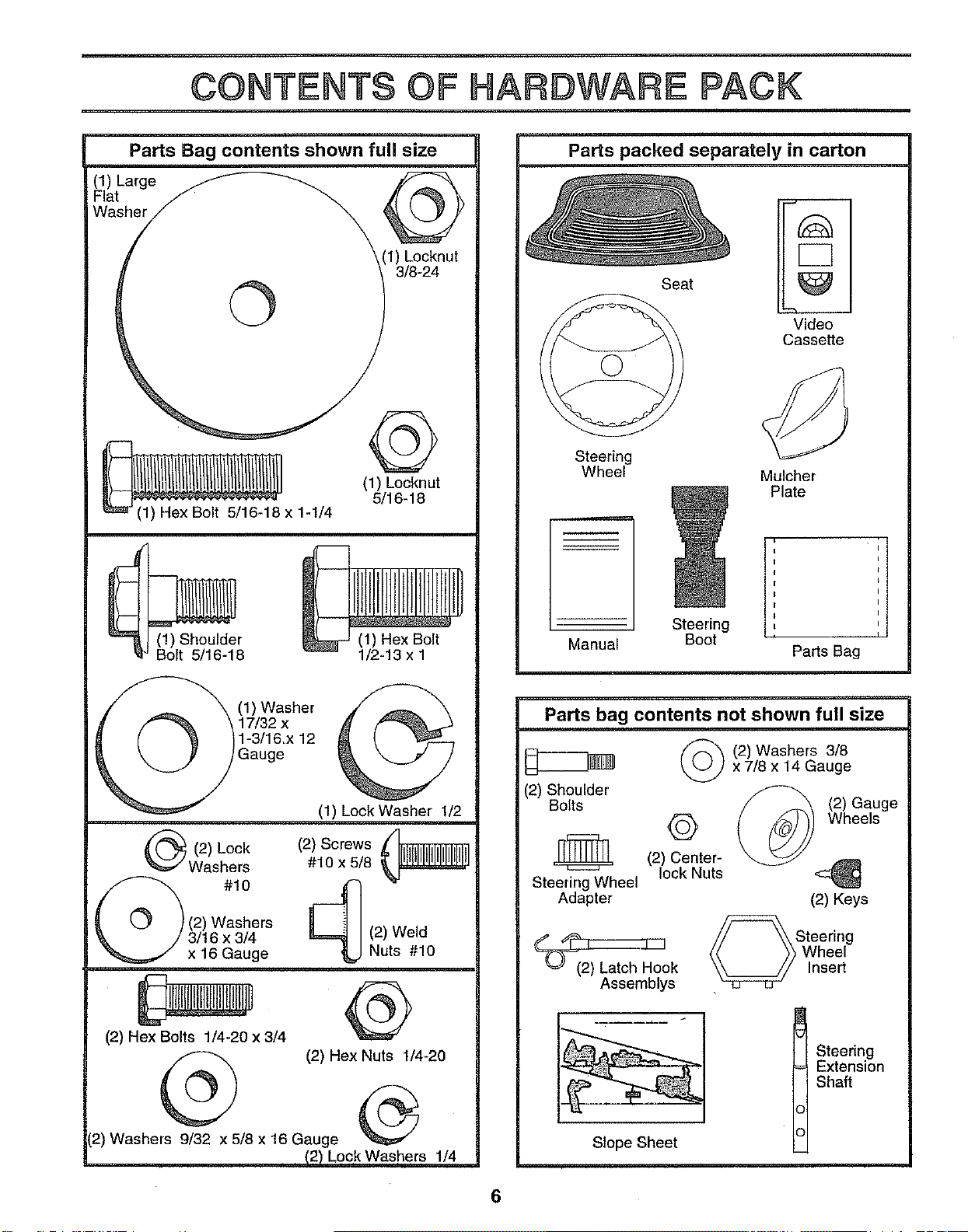
CONTENTS OF HARDWARE PACK
Parts Bag contents shown full size
(1) Large _
Flat _ _ ] _ '_
_f \(1 ) Locknut
q ! 3/8-24
, ©
_1(1) Shoulder
_" Bolt 5/16-18
(1) Hex Bolt
1/2_13 x 1
_(1) Washer
r _ \ 17/32 x
t ( _ 11-3/16_x 12
Gauge !
_=_/ (1) Lock Washer' 1/2
(2) Lock
Washers
#10
t (_ )(2) Washers
k / 3/16 x 3/4
x 16 Gauge
(2) Screws _]
#10 x 5/8 #
(2) Weld
Nuts #10
(2) Hex Bolts 1/4-20 x 3/4
(2) Hex Nuts 1/4_20
q ®
',2)Washers 9/32 x 518x 16 Gauge
, , (2) Loc,kWashers 1/4
Parts packed separately in carton
Seat
EC3
Video
Cassette
Steering
Wheel
Manual
Steering
Boot
Mulcher
Plate
• i
Parts Bag
Parts bag contents not shown full size
(2) Shoulder
Bolts
©
(2) Center-
lock Nuts
Steering Wheel
Adapter
_ok
Assemblys
Stope Sheet
(2) Washers 3/8
x 7/8 x 14 Gauge
(2) Gauge
Wheels
(2) Keys
,_Steering
heel
Insert
I Steering
Extension
Shaft
6
A$$E IBLY
Your new tractor has been assembled at the factory with exception of those parts left unassembled for shipping purposes.
To ensure safe and proper operation of your tractor all parts and hardware you assemble must be tightened securely_ Use
the correct tools as necessary to insure proper tightness°
TOOLS REQUIRED FOR ASSEMBLY
A socket wrench set will make assembly easier_ Standard
wrench sizes are listed.
(1) 5/16" wrench (1) 3/4" Socket w/drive rachet
(2) 7/16" wrenches Phillips Screwdriver
(1) 1/2" wrench Tire pressure gauge
(2) 9/16" wrench Utility knife
When right or left hand is mentioned in this manual, it
means when you are in the operating position (seated
behind the steering wheel).
TO REMOVE TRACTOR FROM CARTON
UNPACK CARTON
Remove all accessible loose parts and parts cartons
from carton (See page 6).
o Cut, from top to bottom, along lines on all four corners
of carton, and lay panels flaL
Check for any additional loose parts or cartons and
remove.
BEFORE ROLLING TRACT()R OFF SKmD
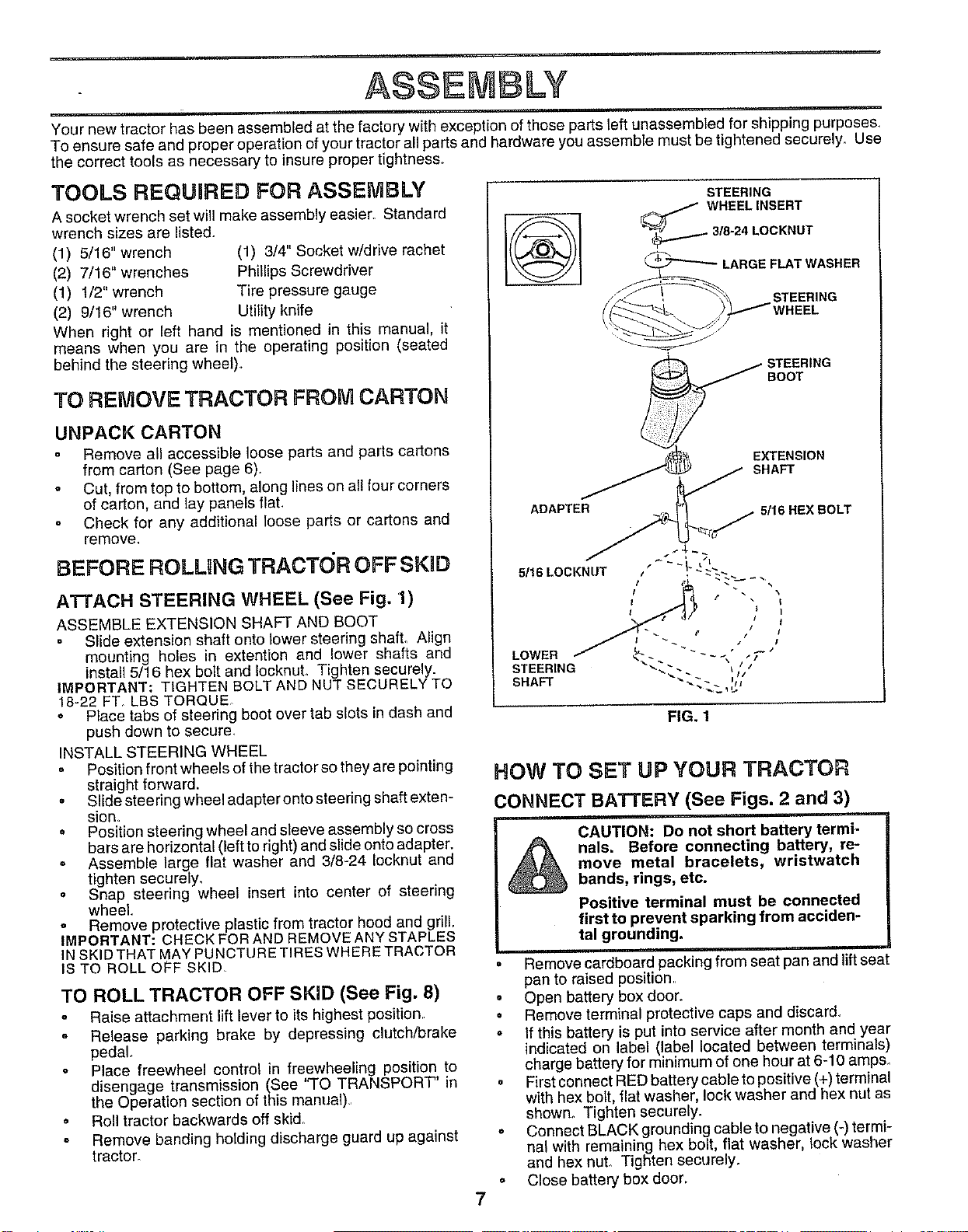
A3-rACH STEERING WHEEL (See Fig. 1)
ASSEMBLE EXTENSION SHAFT AND BOOT
Slide extension shaft onto lower steering shaft. Align
mounting holes in extention and lower shafts and
install 5/16 hex bolt and IocknuL Tighten securely.
IMPORTANT: TIGHTEN BOLT AND NUT SECURELY TO
18-22 FT_ LBS TORQUE
o Place tabs of steering boot over tab slots in dash and
push down to secure,
INSTALL STEERING WHEEL
Position front wheels of the tractor so they are pointing
straight forward,
= Slide steering wheel adapter onto steering shaft exten-
sion
o Position steering wheel and sleeve assembly so cross
bars are horizontal (left to right) and slide onto adapter.
° Assemble iarge flat washer and 3/8-24 Iocknut and
tighten securely.
• Snap steering wheel insert into center of steering
wheel
° Remove protective plastic from tractor hood and grill.
IMPORTANT: CHECK FOR AND REMOVE ANY STAPLES
IN SKID THAT MAY PUNCTURE TIRES WHERE TRACTOR
IS TO ROLL OFF SKID
TO ROLL TRACTOR OFF SKiD (See Fig. 8)
o Raise attachment lift lever to its highest position,
Release parking brake by depressing clutch/brake
pedal.
Place freewheel control in freewheeling position to
disengage transmission (See '_TO TRANSPORT" in
the Operation section of this manual),,
• Roll tractor backwards off skid.
Remove banding holding discharge guard up against
tractor.
STEERING
_ WHEELINSERT
f_,........_ 318-24 LOCI(NUT
STEERING
/ STEERING
BOOT
ff-,_; EXTENSION
J_ SHAFT
ADAPTER 5/16 REX BOLT
FIG. 1
7
HOW TO SET UP YOUR TRACTOR
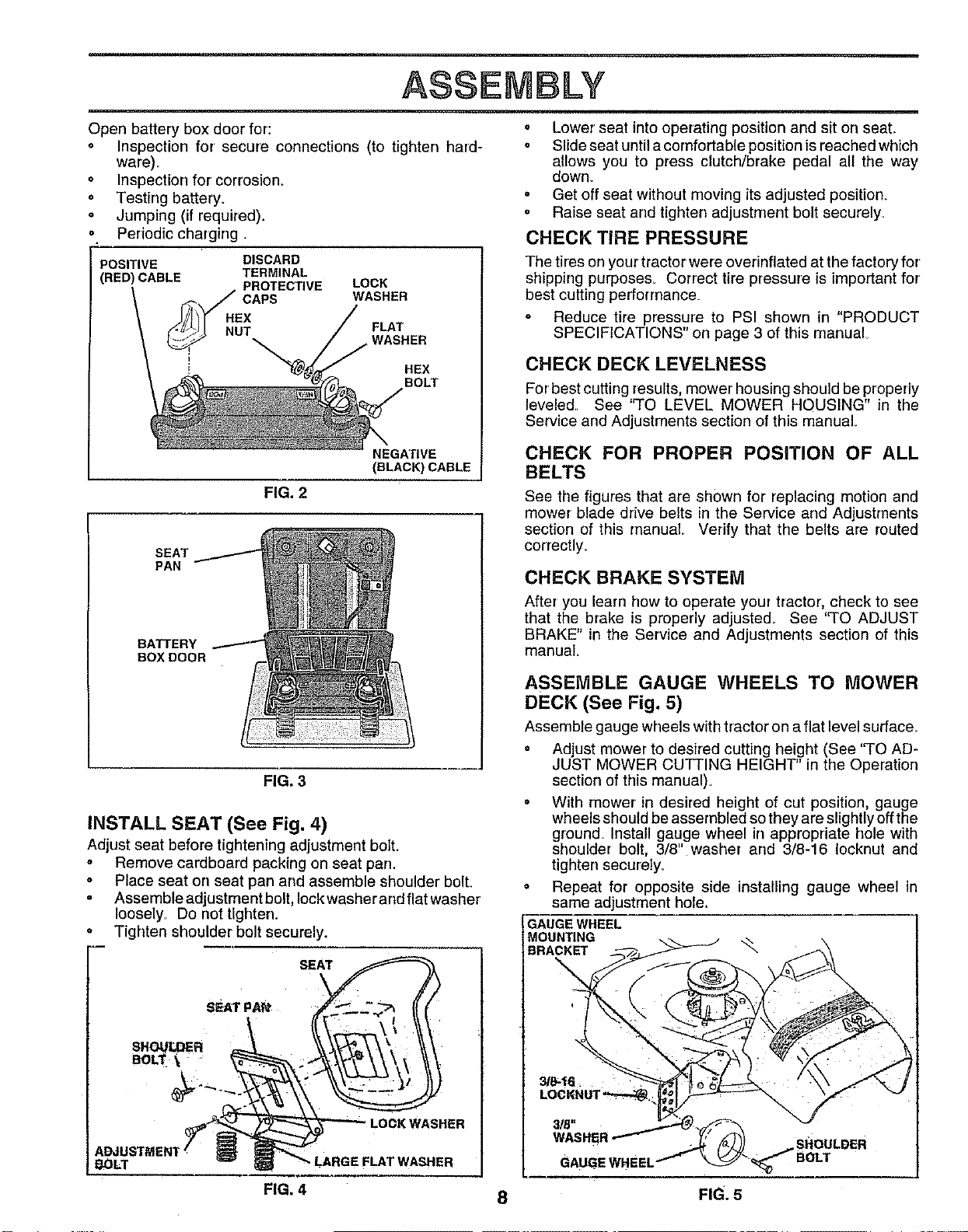
CONNECT BATTERY (See Figs. 2 and 3)
CAUTION: Do not short battery termi-
nals. Before connecting battery, re-
move metal bracelets, wristwatch
bands, rings, etc.
Positive terminal must be connected
first to prevent sparking from acciden-
tal grounding.
, m.i
Remove cardboard packing from seat pan and lift seat
pan to raised position,,
° Open battery box door.
• Remove terminal protective caps and discard.
o If this battery is put into service after month and year
fndicated on label (label located between terminate)
charge battery for minimum of one hour at 6-10 amps.
° First connect RED battery cable to positive (+) terminal
with hex bolt, fiat washer, lock washer and hex nut as
shown° Tighten securely.
° Connect BLACK grounding cable to negative (-) termi-
nal with remaining hex bolt, fiat washer, lock washer
and hex nut. Tighten securely.
= Close battery box door.
ASSEMBLY
o
o
Open battery box door for:
o Inspection for' secure connections (to tighten hard-
ware),
o Inspection for corrosion.
o Testing battery°
° Jumping (if required).
Periodic charging.
POSITIVE DISCARD
(RED) CABLE TERMINAL
PROTECTIV E LOCK
CAPS WASHER
H X
T FLAT
WASHER
i HEX
BOLT
NEGATIVE
(BLACK) CABLE
FIG. 2
SEAT
PAN
BATTERY
BOX DOOR
FIG. 3
INSTALL SEAT (See Fig. 4)
Adjust seat before tightening adjustment bolt.
• Remove cardboard packing on seat pan.
• Place seat on seat pan and assemble shoulder boll
Assemble adjustment bolt, lockwasher and flat washer
Ioosely_ Do not tighten.
o Tighten shoulder bolt securely.
SEAT
BOLT
Lower seat into operating position and sit on seal
Slide seat until a comfortable position is reached which
allows you to press clutch/brake pedal all the way
down,
Get off seat without moving its adjusted position,,
Raise seat arrd tighten adjustment bolt securely,
CHECK TIRE PRESSURE
The tires on your tractor were overinflated at the factory for
shipping purpose& Correct tire pressure is important for
best cutting performance
o Reduce tire pressure to PSI shown in "PRODUCT
SPECIFICATIONS" on page 3 of this manual
CHECK DECK LEVELNESS
For best cutting results, mower housing should be properly
leveled. See "TO LEVEL MOWER HOUSING" in the
Service and Adjustments section of this manual
CHECK FOR PROPER POSITION OF ALL
BELTS
See the figures that are shown for replacing motion and
mower blade drive belts in the Service and Adjustments
section of this rnanual. Verify that the belts are routed
correctly.
CHECK BRAKE SYSTEM
After you learn how to operate your tractor, check to see
that the brake is properly adjusted. See ''TO ADJUST
BRAKE" in the Service and Adjustments section of this
manual
ASSEMBLE GAUGE WHEELS TO MOWER
DECK (See Fig. 5)
Assemble gauge wheels with tractor on a flat level surface_
o Adjust mower to desired cutting height (See ''TO AD-
JUST MOWER CUTTING HEIGHT" in the Operation
section of this manual)_
° With mower in desired height of cut position, gauge
wheels should be assembled so they are slightly offthe
ground. Install gauge wheel in appropriate hole with
shoulder bolt, 3/8" washer and 3/8-16 Iocknut and
tighten securely_
o Repeat for opposite side installing gauge wheel in
same adjustment hole.
GAUGE WHEEL
MOUNTING
BRACKET
8
31B"
sHOULDER
GAUGE' BOLT
FIG. 5
ASSEMBLY
DEFLECTOR
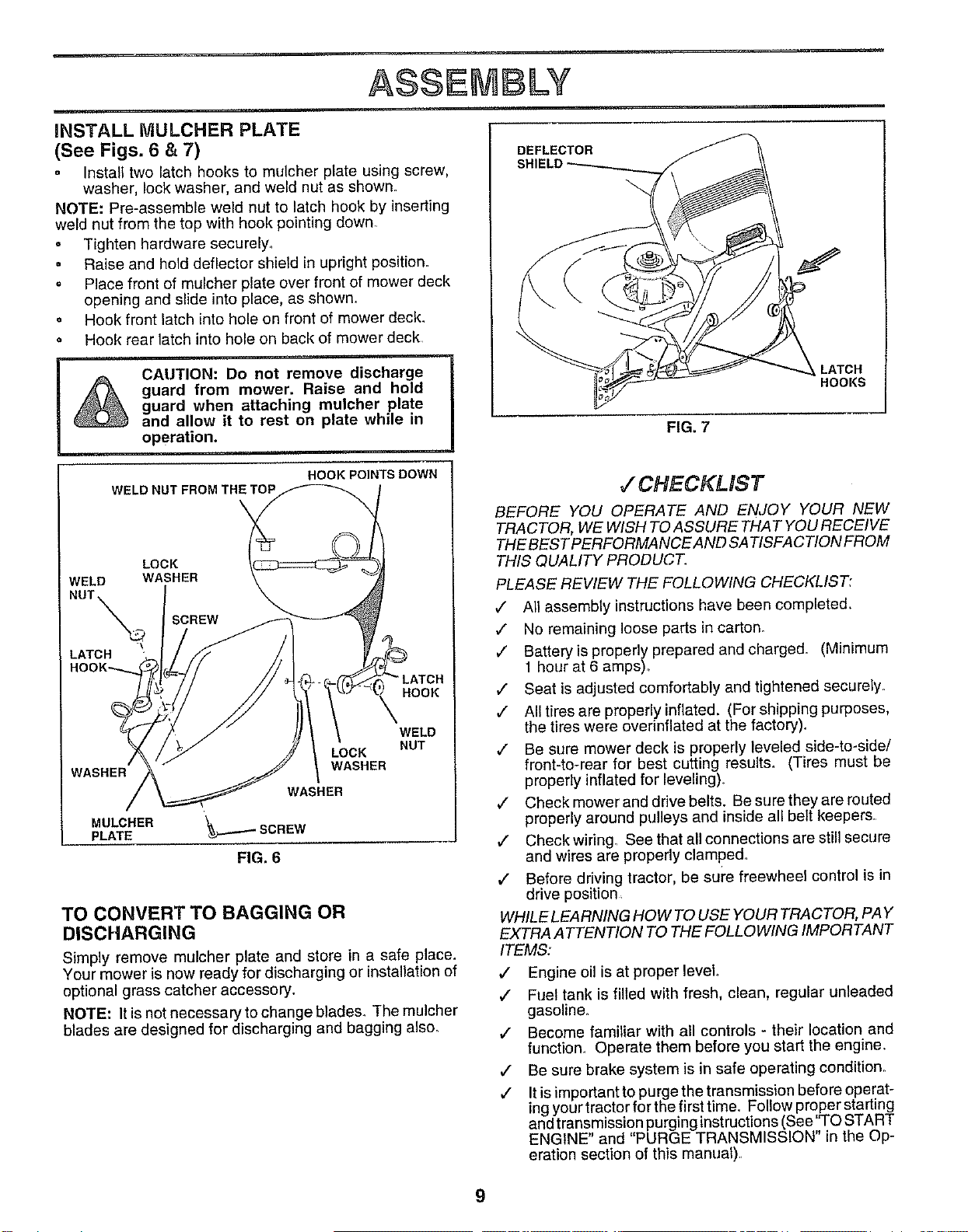
iNSTALL iVlULCHER PLATE
(See Figs. 6 & 7)
Install two latch hooks to mulcher plate using screw,
washer, lock washer, and weld nut as shown_
NOTE: Pre-assemble weld nut to latch hook by inserting
weld nut from the top with hook pointing down
o Tighten hardware securely.
• Raise and hold deflector shield in upright position.
. Place front of mulcher plate over front of mower deck
opening and slide into place, as shown.
• Hook front latch into hole on front of mower deck.
o Hook rear latch into hole on back of mower deck
CAUTION: Do not remove discharge
guard from mower. Raise and hold
guard when attaching mulcher plate
and allow it to rest on plate while in
operation.
FIG. 7
LATCH
HOOKS
WELD NUT FROM THE TOP
\
HOOK POINTS DOWN
LOCK
WELD WASHER
NUT%.., SCREW
LATCH
HOOK
LOCK
WASHER WASHER
WASHER
MULCHER _,_..-_SCREW
PLATE
FIG. 6
WELD
NUT
TO CONVERT TO BAGGING OR
DISCHARGING
Simply remove mulcher plate and store in a safe place.
Your mower is now ready for discharging or installation of
optional grass catcher accessory.
NOTE: It is not necessary to change blades. The mulcher
blades are designed for discharging and bagging also.
/CHECKLIST
BEFORE YOU OPERATE AND ENJOY YOUR NEW
TRA CTOR, WE WISH TO ASSURE THAT YOU RECEIVE
THE BEST PERFORMANCE AND SATISFACTION FROM
THIS QUALITY PRODUCT.
PLEASE REVIEW THE FOLLOWING CHECKLIST:
J All assembly instructions have been completed.
,/ No remaining loose parts in carton.
J Batteryis properly prepared and charged. (Minimum
1 hour at 6 amps)_
,/ Seat is adjusted comfortably and tightened securely.
,/ All tires are properly inflated. (For shipping purposes,
the tires were overinflated at the factory).
,/ Be sure mower deck is properly leveled side-to-side/
front-to-rear for best cutting results. (Tires must be
properly inflated for leveling)_
,/ Check mower and drive belts. Be sure they are routed
properly around pulleys and inside all belt keepers.
,/ Check wiring. See that all connections are still secure
and wires are properly clampe&
,/ Before driving tractor, be sure freewheel control is in
drive position,
WHILE LEARNING HOW TO USE YOUR TRACTOR, PAY
EXTRA ATTENTION TO THE FOLLOWING IMPORTANT
ITEMS:
J Engine oil is at proper level
,/ Fuel tank is filled with fresh, clean, regular unleaded
gasoline.
,/ Become familiar with all controls - their location and
function. Operate them before you start the engine_
,/ Be sure brake system is in safe operating condition.
,/ It s mportanttopurgethetransmissionbeforeoperat-
ingyour tractor for the first time.. Follow proper starting
and transmission purging instructions (See "TO START
ENGINE" and "PURGE TRANSMISSION" in the Op-
eration section of this manua0..
9
OPERATION
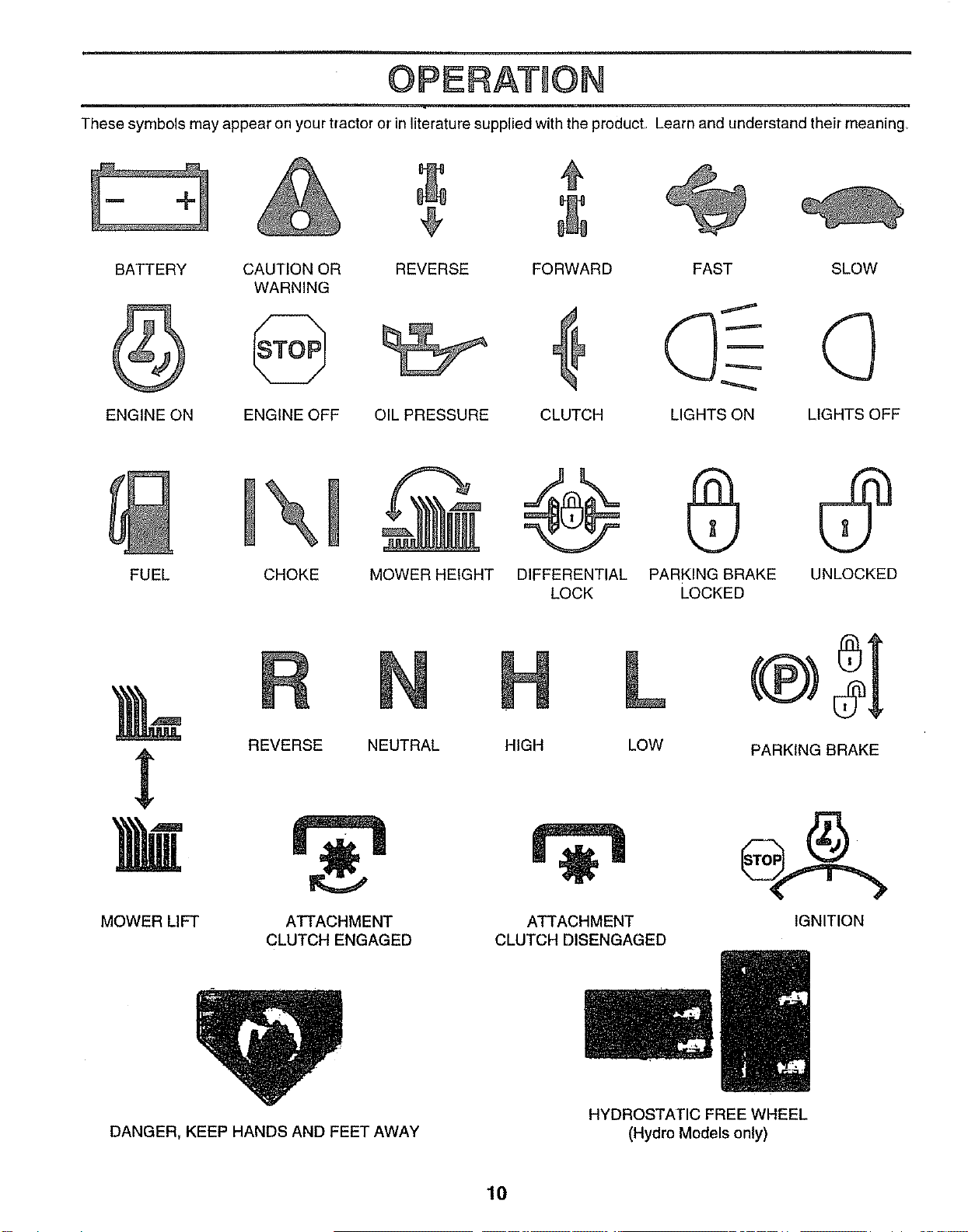
These symbols may appear on your tractor or'in literature supplied with the product, Learn and understand their meaning
BATTERY CAUTION OR REVERSE FORWARD FAST SLOW
WARNING
ENGINE ON ENGINE OFF OIL PRESSURE CLUTCH LIGHTS ON LIGHTS OFF
FUEL CHOKE MOWER HEIGHT DIFFERENTIAL PARKING BRAKE UNLOCKED
LOCK LOCKED
MOWER LIFT
REVERSE NEUTRAL
ATTACHMENT
CLUTCH ENGAGED
L
HIGH LOW
ATTACHMENT
CLUTCH DISENGAGED
®Sl
PARKING BRAKE
IGNITION
DANGER, KEEP HANDS AND FEET AWAY
HYDROSTATIC FREE WHEEL
(Hydro Models only)
10
OPERATION
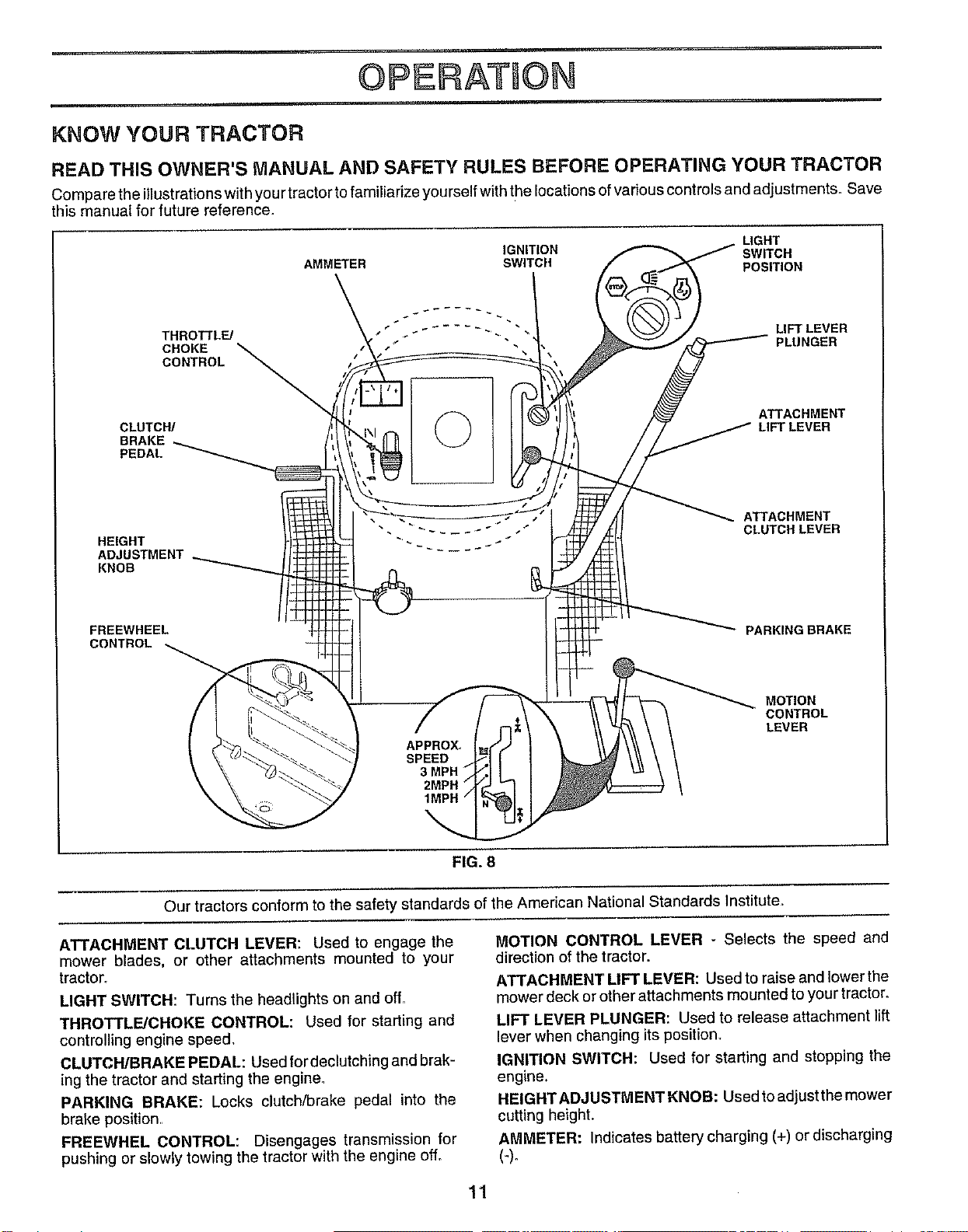
KNOW YOUR TRACTOR
READ THIS OWNER'S MANUAL AND SAFETY RULES BEFORE OPERATING YOUR TRACTOR
Compare the illustrationswithyour tractorto familiarize yourself withthe locationsofvarious controlsand adjustments. Save
this manual for future reference.
LIGHT
IGNITION SWITCH
AMMETER SWITCH POSITION
THROTTL_
CHOKE
CONTROL
LIFT LEVER
PLUNGER
CLUTCH/
BRAKE
PEDAL
ATi'ACHMENT
LIFT LEVER
HEIGHT
ADJUSTMENT
KNOB
ATTACHMENT
CLUTCH LEVER
FREEWHEEL
CONTROL
PARKING BRAKE
MOTION
CONTROL
LEVER
FIG. 8
Our tractors conform to the safety standards of the American National Standards Institute°
ATTACHMENT CLUTCH LEVER: Used to engage the
mower blades, or other attachments mounted to your
tractor°
LIGHT SWITCH: Turns the headlights on and ofL
THROTTLE/CHOKE CONTROL: Used for starting and
controlling engine speed.
CLUTCH/BRAKE PEDAL: Used fordeclutching and brak-
ingthe tractor and starting the engine.
PARKING BRAKE: Locks clutch/brake pedal into the
brake position.
FREEWHEL CONTROL: Disengages transmission for
pushing or slowly towing the tractor with the engine off.
MOTION CONTROL LEVER - Selects the speed and
direction of the tractor.
AI-rACHMENT LIFT LEVER: Used to raise and lower the
mower deck or other attachments mounted to yourtractor°
LIFT LEVER PLUNGER: Used to release attachment lift
lever when changing itsposition°
IGNITION SWITCH: Used for starting and stopping the
engine.
HEIGHT ADJUSTMENT KNOB: Used to adjust the mower
cutting height.
AMMETER: Indicates battery charging (+) or discharging
(-)o
11
OPERATION
The operation of any tractor can result in foreign objects thrown into the eyes, which can
result in severe eye damage. Always wear safety glasses or eye shields while operating your
n
tractor or performing any adjustments or repairs. We recommend a wide vision safety mask
over the spectacles or standard safety glasses.
HOW TO USE YOUR TRACTOR
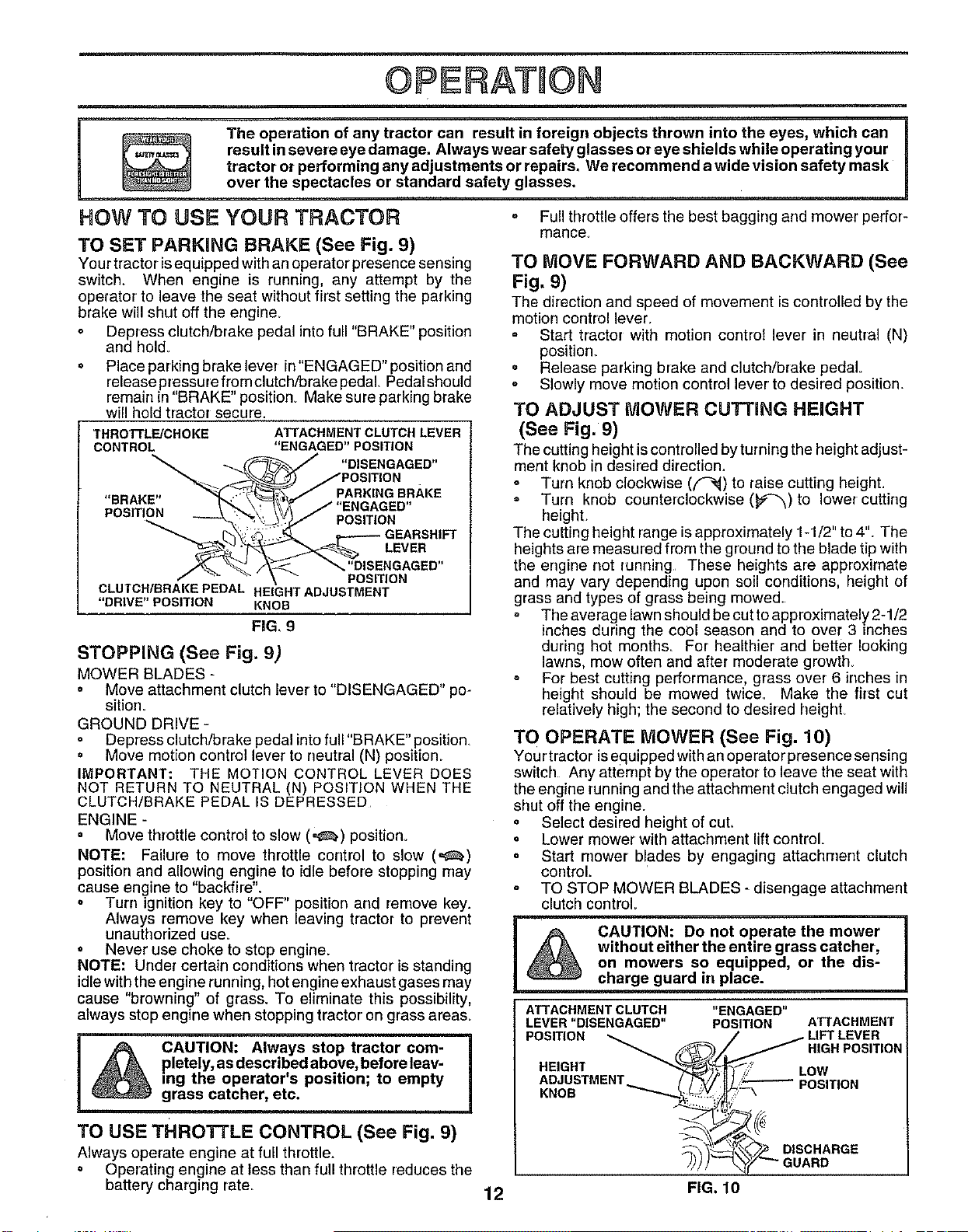
TO SET PARKING BRAKE (See Fig. 9)
Your tractorisequipped withan operator presence sensing
switch° When engine is running, any attempt by the
operator to leave the seat without first setting the parking
brake will shut offthe engine_
o Depress clutch/brake pedal into full "BRAKE" position
and hold,
o Place parking brake lever in"ENGAGED" position and
release pressure from clutch/brake pedal. Pedalshould
remain in "BRAKE" position Make sure parking brake
will hold tractor secure.
THROTTLE/CHOKE
CONTROL
"BRAKE" " _J_'_
POSITI_
ATTACHMENT CLUTCH LEVER
"ENGAGED" POSITION
"DISENGAGED"
/.osmoN
_/f PARKING BRAKE
/_ /"ENGAGED
h__.,_ POSITION
"]_._ _ GEARSHIFT
__r LEVER ,,
_''DISENGAGED
POSITION
CLUTCH/BRAKE PEDAL HEIGHT ADJUSTMENT
"DRIVE" POSITION KNOB
FIG, 9
STOPPING (See Fig. 9)
MOWER BLADES -
o Move attachment clutch lever to "DISENGAGED" po-
sition_
GROUND DRIVE -
= Depress clutch/brake pedal into full "BRAKE" position,
o Move motion control lever to neutral (N) position.
IMPORTANT: THE MOTION CONTROL LEVER DOES
NOT RETURN TO NEUTRAL (N) POSITION WHEN THE
CLUTCH/BRAKE PEDAL iS DEPRESSED
ENGINE -
= Move throttle control to slow (,,_) position.
NOTE: Failure to move throttle control to slow ('_)
position and allowing engine to idle before stopping may
cause engine to "backfire".
o Turn ignition key to "OFF" position and remove key.
Always remove key when leaving tractor to prevent
unauthorized use_
• Never use choke to stop engine.
NOTE: Under certain conditions when tractor is standing
idle with the engine running, hot engine exhaust gases may
cause "browning" of grass. To eliminate this possibility,
always stop engine when stopping tractor on grass areas.
]_ AUTION: Always stop tractor com- I
pletely, as described above, before leav-
ing the operator's position; to empty
grass catcher, etc.
TO USE THROTTLE CONTROL (See Fig. 9)
Always operate engine at full throttle.
° Operating engine at less than full throttle reduces the
battery charging rate
o Fu!l throttle offers the best bagging and mower perfor-
mance.
TO MOVE FORWARD AND BACKWARD (See
Fig. 9)
The direction and speed of movement iscontrolled by the
motion corrtrollever_
Start tractor with motion corrtrot lever in neutral (N)
position,,
o Release parking brake and clutch/brake pedal°
Slowly move motion control lever to desired position.
TO ADJUST MOWER CUTTING HEIGHT
(See Fig. 9)
The cuttingheight iscontrolled by turning the height adjust-
merit knob in desired direction.
o Turn knob clockwise (('_) to raise cutting height.
° Turn knob counterclockwise (I_) to lower cutting
height.
The cutting height range is approximately 1-1/2" to 4". The
heights are measured from the ground to the blade tip with
the engine not runnirrg These heights are approximate
and may vary depending upon soil conditions, height of
grass and types of grass being mowed
The average lawn should be cut to approximately 2-1/2
inches during the cool season and to over 3 inches
during hot months, For healthier and better looking
lawns, mow often arrd after moderate growth_
For best cutting performance, grass over 6 inches in
height should be mowed twice_ Make the first cut
relatively high; the second to desired height
TO OPERATE MOWER (See Fig. 10)
Yourtractor isequipped with an operator presence sensing
switch Any attempt by the operator to leave the seat with
the engine running and the attachment clutch engaged will
shut off the engine.
° Select desired height of cut,
o Lower mower with attachment lift control.
° Start mower blades by engaging attachmerrt clutch
control.
TO STOP MOWER BLADES - disengage attachment
clutch control
I
CAUTION: Do not operate the mower I
without either the entire grass catcher,
I
on mowers so equipped, or the dis-
charge guard in place.
ATTACHMENT CLUTCH "ENGAGED"
LEVER "DISENGAGED" POSITION ATTACHMENT
POSITION __X' j.. LIFT LEVER
/ HIGH POSITION
HEIGHT "''_ /'_r
ADJUSTMENT / l'q/[ _1 LOW
12 FIG. 10
-m÷,_
OPERATBON
TO OPERATE ON HILLS
hills with slopes greater than 150 and
do not drive across any slope.
= N=
o Choose the slowest speed before starting up or down
hilJs.
= Avoid stopping or changing speed on hills,
o If slowing is necessary, move throttle control lever to
slower position.
° If stopping is absolutely necessary, push clutch/brake
pedal quickly to brake position and engage parking
brake.
o Move motion control lever to neutral (N) position_
IMPORTANT: THE MOTION CONTROL LEVER DOES
NOT RETURN TO NEUTRAL (N) POSITION WHEN THE
CLUTCH/BRAKE PEDAL IS DEPRESSED
To restart movement, slowly release parking brake and
clutch/brake pedal
o Slowly move motion control laver to slowest setting.
Make all turns slowly.
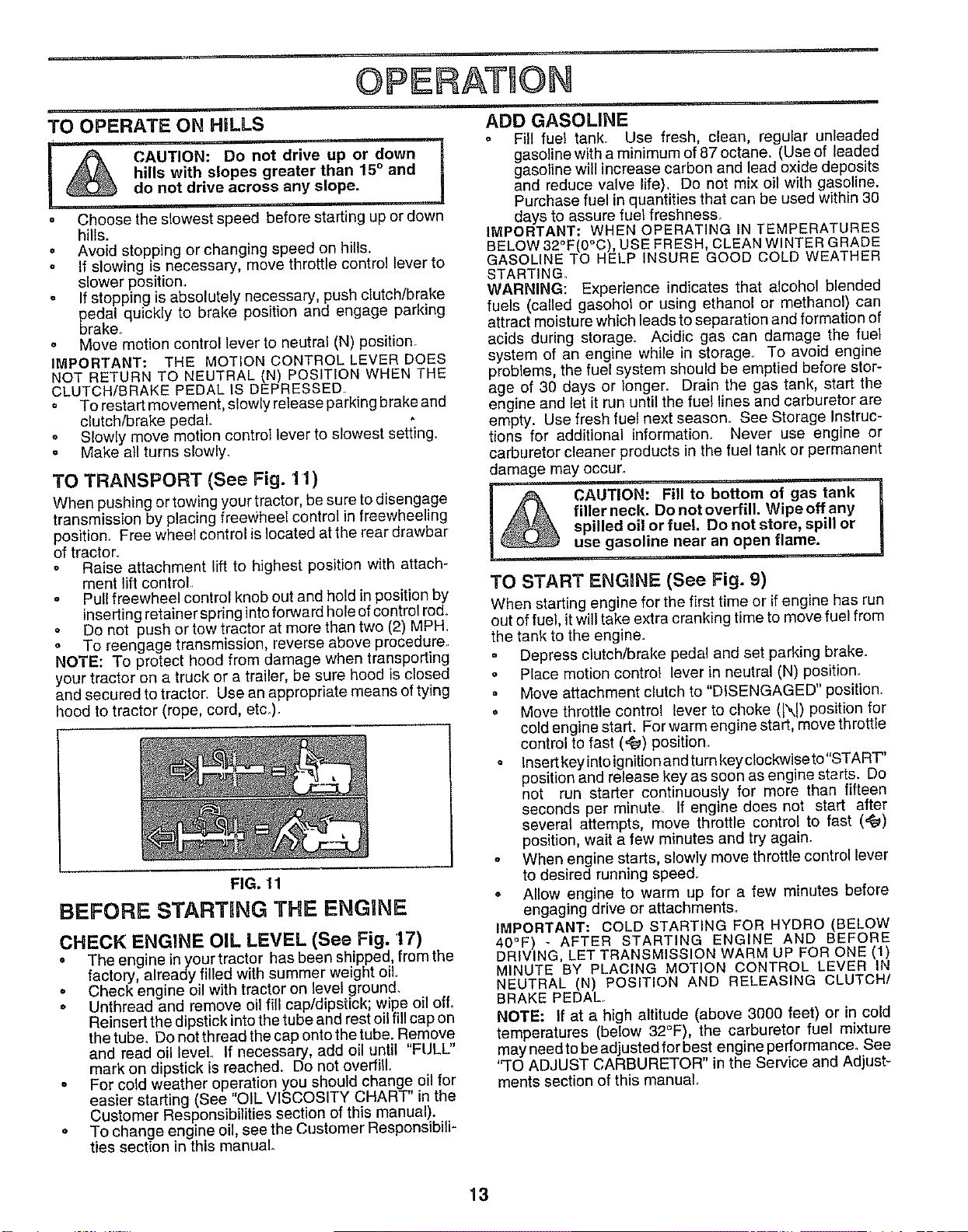
TO TRANSPORT (See Fig. 11)
When pushing or towing your tractor, be sure to disengage
transmission by placing freewheel control in freewheeling
position. Free wheel control is located at the rear drawbar
of tractor.
Raise attachment lift to highest position with attach-
ment liftcontrol.
° Pull freewheel control knob out and hold in position by
inserting retainer spring into forward hole of control rod.
Do not push or tow tractor at more than two (2) MPH.
• To reengage transmission, reverse above procedure.
NOTE: To protect hood from damage when transporting
your tractor on a truck or a trailer, be sure hood is closed
and secured to tractor. Use an appropriate means of tying
hood to tractor (rope, cord, etc.).
FIG. 11
BEFORE STARTRNG THE ENGBNE
CHECK ENGINE OIL LEVEL (See Fig. '17)
o The engine in yourtractor has been shipped, from the
factory, already filled with summer weight oil.,
° Check engine oil with tractor on level ground,
o Unthread and remove oil fill cap/dipstick; wipe oil off,
Reinsert the dipstick intothetube and restoil fillcap on
the tube, Do not thread thecap ontothe tube. Remove
and read oil level° If necessary add oil until "FULL"
mark on dipstick is reached. Do not overfil.
= For cold weather operation you should change oil for
easier starting (See OiL VISCOSITY CHART' in the
Customer Responsibilities section of this manual).
o To change engine oil, see the Customer Responsibili-
ties section in this manual.
ADD GASOLINE
Fill fuel tank. Use fresh, clean, regular unleaded
gasoline with a minimum of 87 octane. (Use of leaded
gasoline will increase carbon and lead oxide deposits
and reduce valve life). Do not mix oil with gasoline.
Purchase fuel in quantities that can be used within 30
days to assure fuel freshness_
IMPORTANT: WHEN OPERATING IN TEMPERATURES
BELOW 32°F(0°C), USE FRESH, CLEAN WINTER GRADE
GASOLINE TO HELP INSURE GOOD COLD WEATHER
STARTING
WARNING: Experience indicates that alcohol blended
fuels (called gasohol or using ethanol or methanol) can
attract moisture which leads to separation and formation of
acids during storage. Acidic gas can damage the fuel
system of an engine while in storage. To avoid engine
problems, the fuel system should be emptied before stor-
age of 30 days or longer, Drain the gas tank, start the
engine and let it run until the fuel lines and carburetor are
empty. Use fresh fuel next season_ See Storage Instruc-
tions for additional information. Never use engine or
carburetor cleaner products in the fuel tank or permanent
damage may occur..
I _ _ fillerneck. DonotoverfilL Wipeoffany |
_ _ spilled oil or fuel Do not store, spill or U
I_ use gasoline n_
TO START ENGINE (See Fig. 9)
When starting engine for the first time or if engine has run
out of fuel, it will take extra cranking time to move fuel from
the tank to the engine.
Depress clutch/brake pedal and set parking brake.
Place motion control lever in neutral (N) position.
Move attachment clutch to "DISENGAGED" position.
• Move throttle control lever to choke (N) position for
cold engine start. For warm engine start, move throttle
control to fast (,@) position.
o Insert keyinto ignition and turn keyclockwise to"START"
position and release key as soon as engine starts. Do
not run starter continuous!y for more than fifteen
seconds per minute If engtne does not start after
several attempts, move throttle control to fast (,ti_)
position, wait a few minutes and try again.
o When engine starts, slowly move throttle control lever
to desired running speed.
• Allow engine to warm up for a few minutes before
engaging drive or attachments.
IMPORTANT: COLD STARTING FOR HYDRO (BELOW
40 F) - AFTER STARTING ENGINE AND BEFORE
DRIVING, LET TRANSMISSION WARM UP FOR ONE (1)
MINUTE BY PLACING MOTION CONTROL LEVER IN
NEUTRAL(N) POSITION AND RELEASING CLUTCH/
BRAKE PEDAL.
NOTE: If at a high altitude (above 3000 feet) or in cold
temperatures (below 32°F), the carburetor fuel mixture
may need to be adjusted for best engine performance. See
'q'O ADJUST CARBURETOR" in the Service and Adjust-
merits section of this manual
13
OPERATOON
o
PURGE TRANSMISSION
_,_k AUTION: Never engage or disengage I
freewheel lever while the engine is run-
ning.
To ensure proper operation and performance, it isrecom-
mended that the transmission be purged before operating
tractor for the first time. This procedure will remove any
trapped air inside the transmission which may have devel-
oped during shipping of your tractor.
IMPORTANT; SHOULD YOUR TRANSMISSION REQUIRE
REMOVAL FOR SERVICE OR REPLACEMENT, IT
SHOULD BE PURGED AFTER REINSTALLATION
BEFORE OPERATING THE TRACTOR.
Place tractor safely on level surface withengine off and
parking brake set.
• Disengage transmission by placing freewheel control
in freewheeling position (See "TO TRANSPORT" in
this section of manual).
o Sitting in the tractor seat, start engine. After the engine
is running, move throttle control to slow 0 position.
With motion control lever in neutral (N) position, slowly
disengage clutch/brake pedal.
• Move motion control lever to full forward position and
hold for five (5) seconds. Move lever to full reverse
position and hold for five (5) seconds, Repeat this
procedure three (3) time&
NOTE; During this procedure there will be no rrrovernent of
drive wheels_ The air'is being removed from hydraulic drive
system.
o Move motion control lever to neutral (N) position. Shut-
off engine and set parking brake
o Engage transmission by placing freewheel control in
driving position (See "TO TRANSPORT" in this section
of manual).
o Sitting in the tractor seat, start engine, After the engine
is running, move throttle control to half (1/2) speed.
With motion control lever in neutral (N) position, slowly
disengage clutch/brake pedal,
° Slowly move motion control lever forward, after the
tractor moves approximately five (5) feet, slowly move
motion control lever to reverse position. After the
tractor moves approximately five (5) feet return the
motion control lever to the neutral (N) position. Repeat
this procedure with the motion control lever three (3)
times.
o Your tractor is now purged and now ready for normal
operation.
MOWING TIPS
o Tire chains cannot be used when the mower housing
is attached to tractor.
Mower should be properly leveled for best mowing
performance_ See ''TO LEVEL MOWER HOUSING" in
the Service and Adjustments section of this manual
° The left hand side of mower should be used for trim*
ming.
° Drive so that clippings are discharged onto the area
that has been cut. Have the cut area to the right of the
tractor. This will result in a more even distribution of
clippings and more uniform cutting.
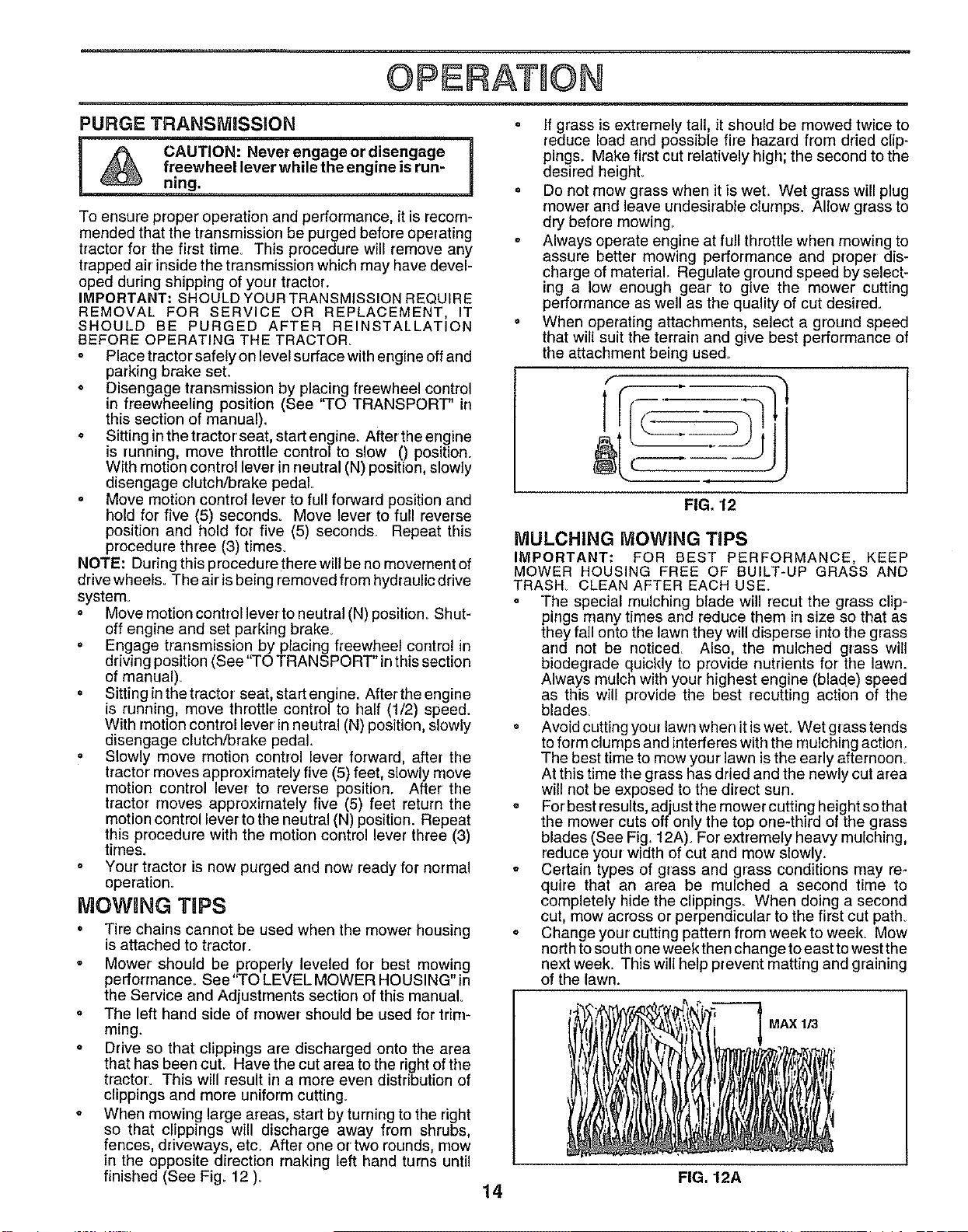
° When mowing large areas, start by turning to the right
so that clippings will discharge away from shrubs,
fences, driveways, etc. After one ortwo rounds, mow
in the opposite direction making left hand turns until
finished (See Fig. 12 ).
If grass is extremely tall, it should be mowed twice to
reduce load and possible fire hazard from dried clip-
pings. Make first cut relatively high; the second to the
desired heighL
. Do not mow grass when it is weL Wet grass will plug
mower and leave undesirable clumps. Allow grass to
dry before mowing.
° Always operate engine at full throttle when mowing to
assure better mowing performance and proper dis-
charge of material. Regulate ground speed by select-
ing a low enough gear to give the mower cutting
performance as well as the quality of cut desired,
• When operating attachments, select a ground speed
that will suit the terrain and give best performance of
the attachment being used.
FIG, 12
MULCHING MOWING TIPS
IMPORTANT: FOR BEST PERFORMANCE, KEEP
MOWER HOUSING FREE OF BUILT-UP GRASS AND
TRASH CLEAN AFTER EACH USE.
o The special mulching blade will recut the grass clip-
pings many times and reduce them in size so that as
they fall onto the lawn they will disperse into the grass
arrd not be noticed Also, the mulched grass will
biodegrade quickly to provide nutrients for the lawn.
Always mulch with your highest engine (blade) speed
as this will provide the best recutting action of the
blades,
• Avoid cutting your lawn whenitiswet, Wet grasstends
to form clumps and interferes with the mulching action,
The best time to mow your lawn is the early afternoon.
At this time the grass has dried and the newly cut area
will not be exposed to the direct sun.
° For best results, adjust the mower cutting height so that
the mower cuts off only the top one-third of the grass
blades (See Fig, 12A). For extremely heavy mulching,
reduce your width of cut and mow slowly.
= Certain types of grass and grass conditions may re-
quire that an area be mulched a second time to
completely hide the clippings. When doing a second
cut, mow across or perpendicular to the first cut path.
= Change your cutting pattern from week to week_ Mow
north to south one week then change to east to west the
next week. This will help prevent matting and graining
of the lawn.
MAX 1/3
FIG. 12A
14
., ¸¸¸¸llI
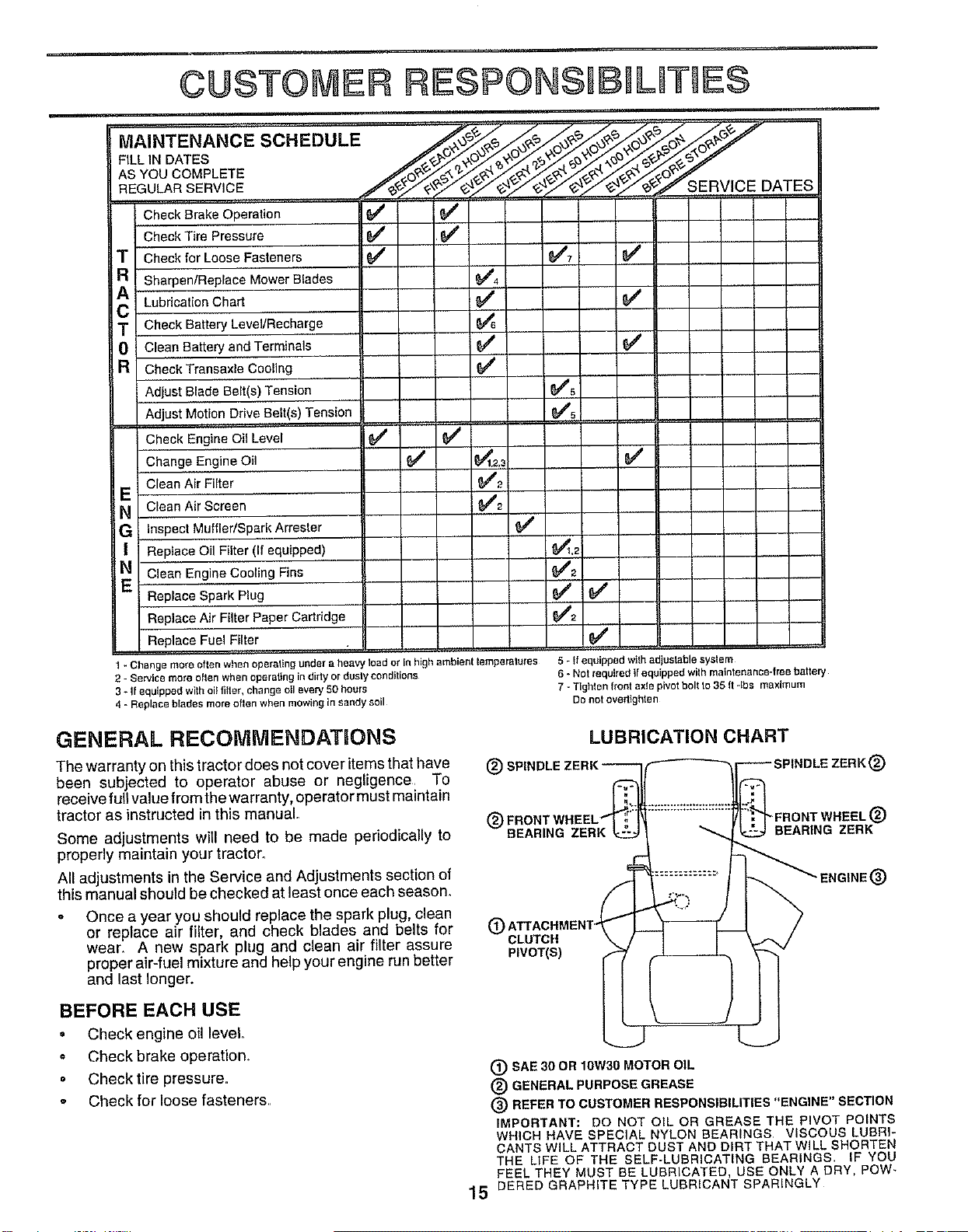
CUSTOMER RESPONSIBUL T ES
MAINTENANCE sCHEDULE '" _,_/_
FILL'NDATES
AS YOUCOMPLETE
REGU RBERV,CE
Check Brake Operation
CheckTirePressure
T Checkfor LooseFasteners
AR Sharpen/ReplaceMowerBlades
C LubricationChart
f CheckBatteryLevel/Recharge
0 CleanBatteryandTerminals
a CheckTransaxieCooling
AdjustBladeBelt(s)Tension
AdjustMotionDriveBelt(s)Tension
CheckEngineOil Level
ChangeEngineOil
CleanAir Filter
E clean AirScreen
G InspectMuffler/SparkArrester
N_ ReplaceOil Filter (If equipped)
E CleanEngineCootingFins
ReplaceSparkPlug
ReplaceAir FilterPaperCartridge
ReplaceFuelFilter
_4_'_yS ERVIC E DATES
ez
ez2
1 - Change mo_e often when opefaling under a heavy toad or in higharnbienl lemperalures
2 - Service more olten when operating in dirty or dusty conditions
3 - if equippert with oi!filter, change oil every 50 hours
q - Replace blades more orlon when mowing tn sandy soil
5 - ff equipped with adjustable syslem
6 * Not required if equipped with maintenance-free battery
7 - Tighlen front axle pivot bolt to 35 ftqbs maxfmum
Do not overttghten
GENERAL RECOMMENDATIONS
The warranty on this tractor does not cover itemsthat have
been subjected to operator abuse or negligence To
receive full value from thewarranty, operator must maintain
tractor as instructed in this manual
Some adjustments will need to be made periodically to
properly maintain your tractor.
All adjustments in the Service and Adjustments section of
this manual should be checked at least once each season.
®
® BEARING ZERK
o Once a year you should replace the spark plug, clean
or replace air filter, and check blades and belts for (D
wear. A new spark plug and clean air filter assure CLUTCH
proper air-fuel mixture and help your engine run better PIVOT(S)
and last longer.
LUBRICATION CHART
IDLE ZERK ®
BEFORE EACH USE
o Check engine oil revel
o Checkbrake operation.
= Check tire pressure.
° Check for loose fasteners,,
• FRONT WHEEL
BEARING ZERK
"ENGINE®
® SAE 30 OR 10W30 MOTOR OIL
® GENERAL PURPOSE GREASE
(_ REFER TO CUSTOMER RESPONSIBILITIES "ENGINE" SECTION
IMPORTANT= DO NOT OIL OR GREASE THE PIVOT POINTS
WHICH HAVE SPECIAL NYLON BEARINGS VISCOUS LUBRI-
CANTS WILL ATTRACT DUST AND DIRT THAT WILL SHORTEN
THE LIFE OF THE SELF-LUBRICATING BEARINGS. IF YOU
FEEL THEY MUST BE LUBRICATED, USE ONLY A DRY, POW-
15 DERED GRAPHITE TYPE LUBRICANT SPARINGLY
CUSTOMER RESPONSIBiLiTiES
TRACTOR TO SHARPEN BLADE (See Fig. 14)
Always observe safety rules when performing any mainte-
nance.
BRAKE OPERATION
Iftractor' requires more than six (6) feet stopping distance
at high speed in highest gear, then brake must be adjusted_
(See 'q'O ADJUST BRAKE" in the Service and Adjust-
ments section of this manual)_
TIRES
Maintain proper air pressure in all tires (See "PROD-
UCT SPECIFICATIONS" on page 3 of this manual)°
o Keep tires free of gasoline, oil, or insect control chemi-
cals which can harm rubber.
= Avoid stumps, stones, deep ruts, sharp objects and
other hazards that may cause tire damage.
Care should be taken to keep the blade balanced.. An
unbalanced blade will cause excessive vibration arid even-
tual damage to mower and engine.
o The blade can be sharpened with a file or on a grinding
wheel.. Do not attempt to sharpen while on the mower..
o To check blade balance, you will need a 5/8" diameter
steel bolt, pin, era cone balancer. (When using a cone
balancer, follow the instructions supplied with bal-
ancer).
Slide blade on to an unthreaded portion of the steel bolt
or pin and hold the bolt or pin parallel with the ground.
If blade is balanced, it should remain in a horizontal
position. If either end of the blade moves downward,
sharpen the heavy end until the blade is balanced.
NOTE: Do not use a nail for balancing blade. The lobes of
the center hole may appear to be centered, but are not..
BLADE CARE
For best results mower blades must be kept sharp. Re-
place bent or damaged blades.
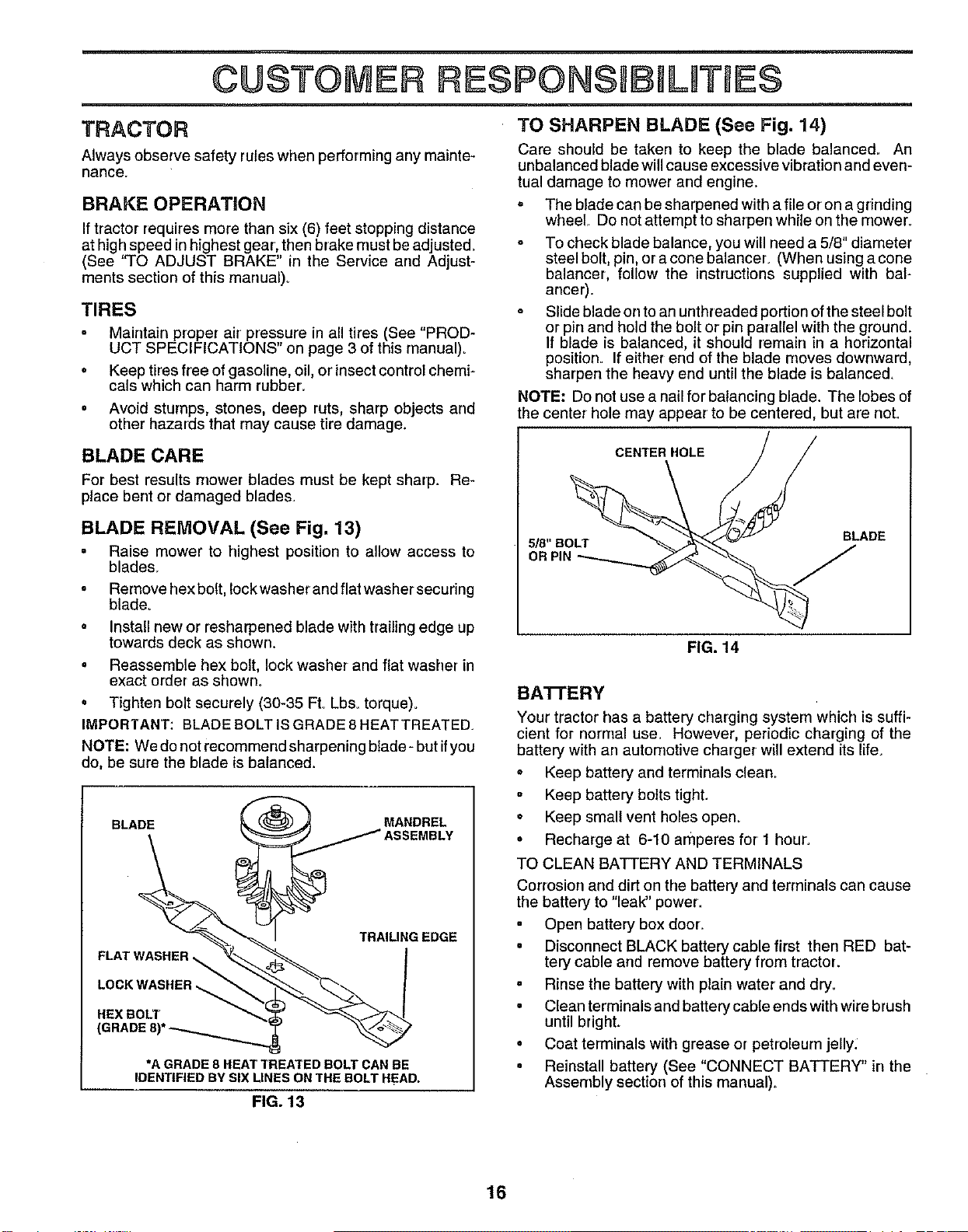
BLADE REMOVAL (See Fig. 13)
= Raise mower to highest position to allow access to
blades.
° Removehexbolt, lockwasherandflatwashersecufing
blade°
o Install new or iesharpened blade with trailing edge up
towards deck as shown.
° Reassemble hex bolt, lock washer and flat washer in
exact order as shown°
• Tighten bolt securely (30-35 FL Lbs. torque).
IMPORTANT: BLADE BOLT IS GRADE 8 HEATTREATED.
NOTE: We do not recommend sharpening blade - but ifyou
do, be sure the blade is balanced.
BLADE MANDREL
FLATWASHER_
LOCKWAS
TRAILING EDGE
HEXBOLT
(GRADE8
*A GRADE 8 HEAT TREATED BOLT CAN BE
IDENTIFIED BY SIX LINES ON THE BOLT HEAD.
FIG. 13
CENTER HOLE
BLADE
5/8" BOLT
oR
FIG. 14
BA'I-rERY
Your tractor has a battery charging system which is suffi-
cient for normal use. However, periodic charging of the
battery with an automotive charger will extend its life.
. Keep battery and terminals clean.
Keep battery bolts tight.
° Keep smallvent holes open.
• Recharge at 8-10 amperes for t hour.
TO CLEAN BATTERY AND TERMINALS
Corrosion and dirton the battery and terminals can cause
the battery to "leak" power.
Open battery box doon
o Disconnect BLACK battery cable first then RED bat-
tery cable and remove battery from tractor.
• Rinse the battery with plain water and dry.
o Clean terminals and battery cable ends with wire brush
until bright.
° Coat terminals with grease or petroleum jelly.
= Reinstall battery (See "CONNECT BATTERY" in the
Assembly section of this manual)..
16
CUSTOMER RESPONSBBILHTIE$
V-BELTS
Check V-belts for deterioration and wear after 100 hours of
operation and replace if necessary. The belts are not
adjustable. Replace belts if they begin to slip from wear,
TRANSAXLE COOLING
The fan and cooling fins of transmission should be kept
clean to assure proper cooling.,
Do not attempt to clean fan or transmission while engine is
running or while the transmission is hot.
o Inspect cooling fan to be sure fan blades are intactand
clean,
• Inspect cooling fins for dirt, grass clippings and other
materials. To prevent damage to seals, do not use
compressed air or high pressure sprayer to clean
cooling fins,
TRANSAXLE PUMP FLUID
The transaxle was sealed at the factory and fluid mainte-
nance isnot required for the life of the transaxle. Should the
transaxle ever leak or require servicing, contact your near-
est authorized service center/department,
ENGINE
LUBRICATION
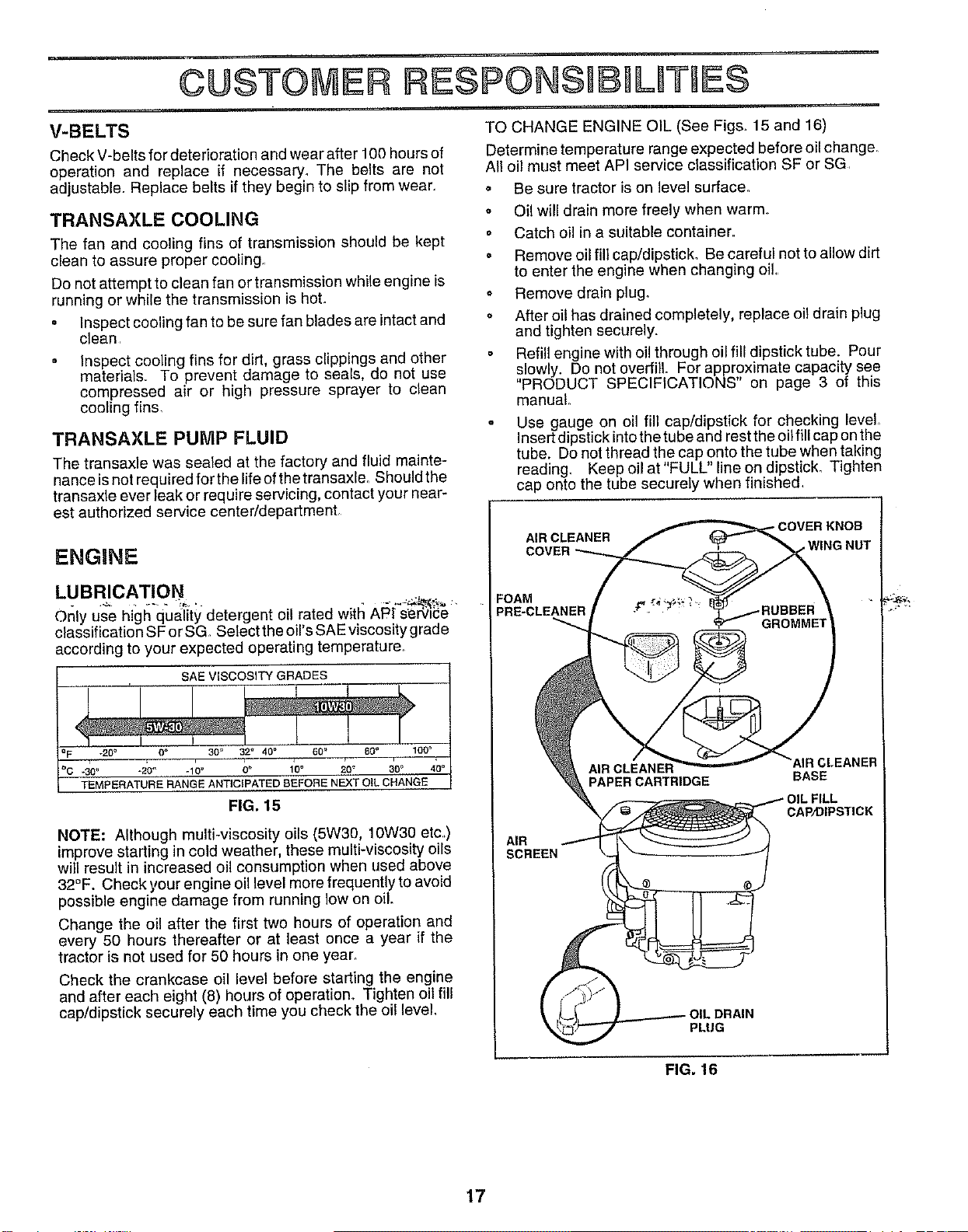
Only use high quality detergent oil rated w_thAPI ser_=de
classification SF or SG. Select the oil's SAE viscosity grade
according to your expected operating temperature.
SAE VISCOSITY GRADES
°F -20 ° 0 ° 30" 32 ° 40 ° 60 ° 80 = 100_
1_0°
i°C *30 _ _2 _ -10 ° 20 _ 3D° 40°
i TEMPERATURE RANGE ANTICIPATED BEFORE NEXT OIL CHANGE
FIG. 15
NOTE: Although multi-viscosity oils (5W30, 10W30 etc.,)
improve starting in cold weather, these multi-viscosity oils
will result in increased oil consumption when used above
32°F. Check your engine oil level more frequently to avoid
possible engine damage from running low on oil.
Change the oil after the first two hours of operation and
every 50 hours thereafter or at least once a year if the
tractor is not used for 50 hours in one year.
Check the crankcase oil level before starting the engine
and after each eight (8) hours of operation° Tighten oil fill
cap/dipstick securely each time you check the oit level
TO CHANGE ENGINE OIL (See Figs, 15 and 16)
Determine temperature range expected before oil change
All oil must meet API service classification SF or SG,
° Be sure tractor is on level surface.
o Oil will drain more freely when warm.
o Catch oil in a suitable container.
= Remove oil fill cap/dipstick_ Be careful not to allow dirt
to enter the engine when changing oil,,
o Remove drain plugo
o After oil has drained completely, replace oil drain plug
and tighten securely.
Refill engine with oil through oil fill dipstick tube. Pour
slowly. Do not overfill. For approximate capacity see
PRODUCT SPECIFICATIONS on page 3 of this
manual
Use gauge on oil fill cap/dipstick for checking level.
Insert dipstick into the tube and rest the oil fill cap onthe
tube. Do not thread the cap onto the tube when taking
reading_ Keep oil at"FULL" line on dipstick. Tighten
cap onto the tube securely when finished,
=1KNOB
AIR CLEANER
COVER , WING NUT
FOAM
PRE-CLEANER
AIR
SCREEN
PAPER CARTRIDGE
)RAIN
PLUG
BASE
L FILL
CAP/DIPSTICK
FIG. 16
17
CUSTOM RESPONSBBILITIES
CLEAN AIR SCREEN (See Fig. 16) CLEAN AIR iNTAKE/COOLING AREAS
Air screen must be kept free of dirt and chaff to prevent
engine damage from overheating_ Clean with a wire brush
or compressed air to remove dirt and stubborn dried gum
fiber&
AIR FILTER (See Fig. 16)
Your engine will not run properly using a dirty air filter_
Clean the foam pre-cleaner after every 25 hours of opera-
tion or every season. Service paper cartridge every 100
hours of operation or every season, whichever occurs firsL
Service air cleaner more often under' dusty conditions
o Remove knob and cover.
Remove wing nut and air cleaner from base..
TO SERVICE PRE-CLEANER
= Slide foam pre-cleaner off cartridge.
° Wash it in liquid detergent and water.
• Squeeze it dry in a clean cloth°
Saturate it in engine oil.. Wrap it in clean, absorbent
cloth and squeeze to remove excess oil,
TO SERVICE CARTRIDGE
o Gently tap the flat side of the paper cartridge to dis-
lodge dirt. Do not wash the paper cartridge or use
pressurized air, as this will damage the cartridge.
Replace a dirty, bent, or damaged cartridge.
o Reinstall the pre-cleaner (cleaned and oiled) over the
paper cartridge.
° Reassemble air cleaner, wing nut, cover and tighten
knob securely.
To insure proper cooling, make sure the grass screen,
cooling fins, and other external surfaces of the engine are
kept clean at all times..
Every 100 hours of operation (more often under extremely
dusty, dirty conditions), remove the blower housing and
other cooling shrouds. Clean the cooling fins and external
surfaces as necessary_ Make sure the cooling shrouds are
reinstalle&
NOTE: Operating the engine with a blocked grass screen,
dirty or plugged cooling fins, and/or cooling shrouds re-
moved will cause engine damage due to overheating.
MUFFLER
Inspect and replace corroded muffler and spark arrester (if
equipped) as it could create a fire hazard and/or damage.
SPARKPLUGS
Replace spark plugs at the beginning of each mowing
season or after every 100 hours of operation, whichever
occurs first. Spark plug type and gap setting are shown in
"PRODUCT SPECIFICATIONS" on page 3 of this manual.
18
CUSTOMER RESPON$ B LITUE$
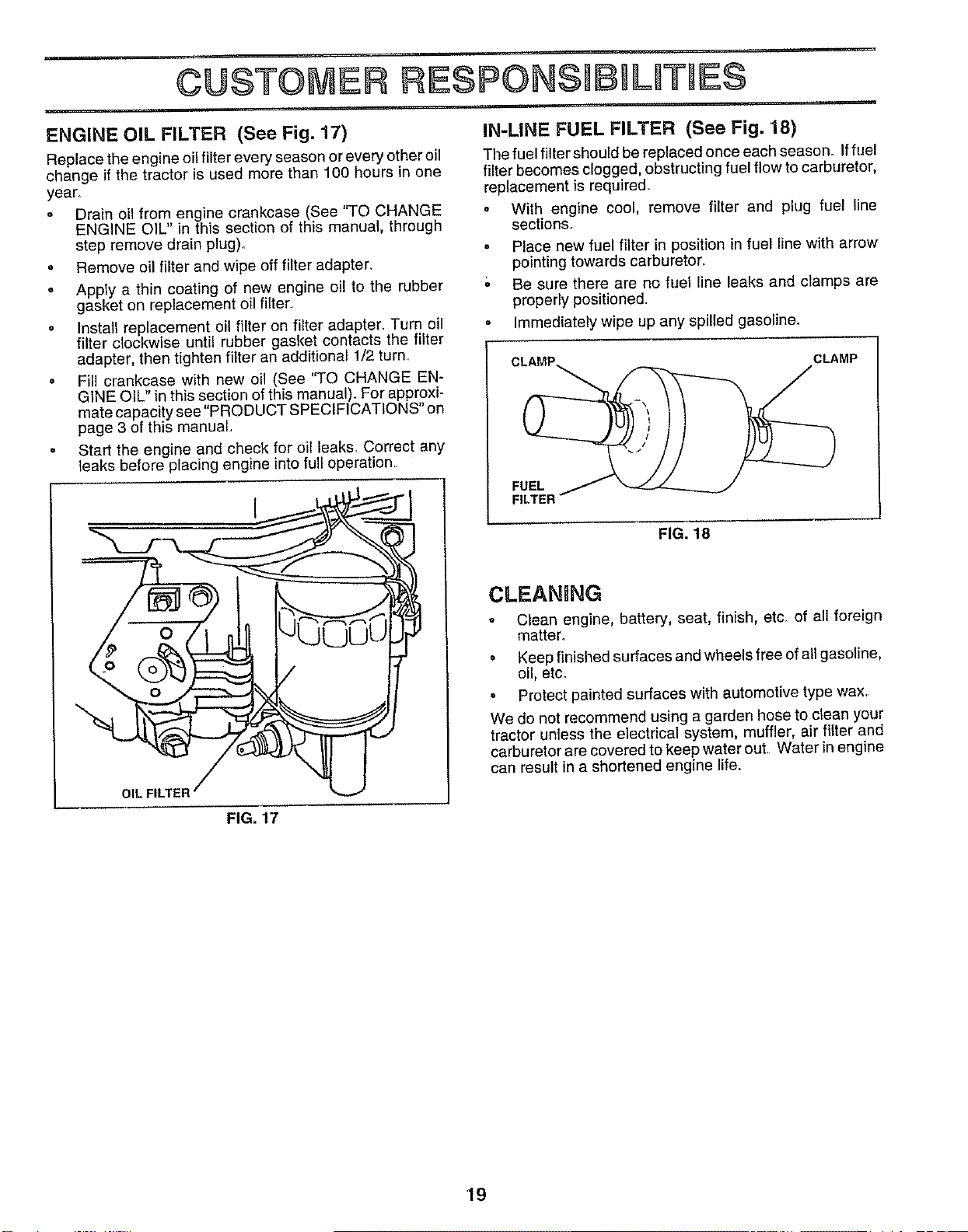
ENGINE OIL FILTER (See Fig. 17)
Replace the engine oil fitter every season or every other oil
change if the tractor is used more than 100 hours in one
year.
o Drain oil from engine crankcase (See "TO CHANGE
ENGINE OIL" in this section of this manual, through
step remove drain plug).
• Remove oil filter and wipe off filter adapter.
• Apply a thin coating of new engine oil to the rubber
gasket on replacement oil filter,
• Install replacement oil filter on filter adapter, Turn oil
filter clockwise until rubber gasket contacts the filter
adapter, then tighten filter an additional 1/2 turn,,
° Fill crankcase with new oil (See 'q'O CHANGE EN-
GINE OIL" in this section of this manual). For approxi-
mate capacity see "PRODUCT SPECIFICATIONS" on
page 3 of this manual,,
• Start the engine and check for oil leaks, Correct any
leaks before placing engine into full operation
IN-LINE FUEL FILTER (See Fig. 18)
The fuel filter shoutd be replaced once each season. If fuet
filter becomes clogged, obstructing fuel flow to carburetor,
replacement is required.
• With engine cool, remove filter and plug fuel line
sections.
• Place new fuel filter in position in fuel line with arrow
pointing towards carburetor.
Be sure there are no fuel line leaks and clamps are
properly positioned.
• Immediately wipe up any spilled gasoline.
CLAMP CLAMP
FUEL
FI
FIG. 18
CLEANnNG
Clean engine, battery, seat, finish, etc. of all foreign
matter.
° Keep finished surfaces and wheels free of all gasoline,
oil, etc
Protect painted surfaces with automotive type wax,
We do not recommend using a garden hose to dean your
tractor unless the electrical system, muffler, air filter and
carburetor are covered to keep water out, Water inengine
can result in a shortened engine life.
FIG. 17
19
CAUTION: BEFORE PERFORMING ANY SERVICE OR ADJUSTMENTS:
= Depress clutch/brake pedal fully and set parking brake.
° Place motion control lever in neutral (N) position.
= Place attachment clutch in "DISENGAGED" position.
o Turn ignition key "OFF" and remove key.
o Make sure the blades and all moving parts have completely stopped,
• Disconnect spark plug wire from spark plug and place wire where it cannot come in contact
with plug.
TRACTOR
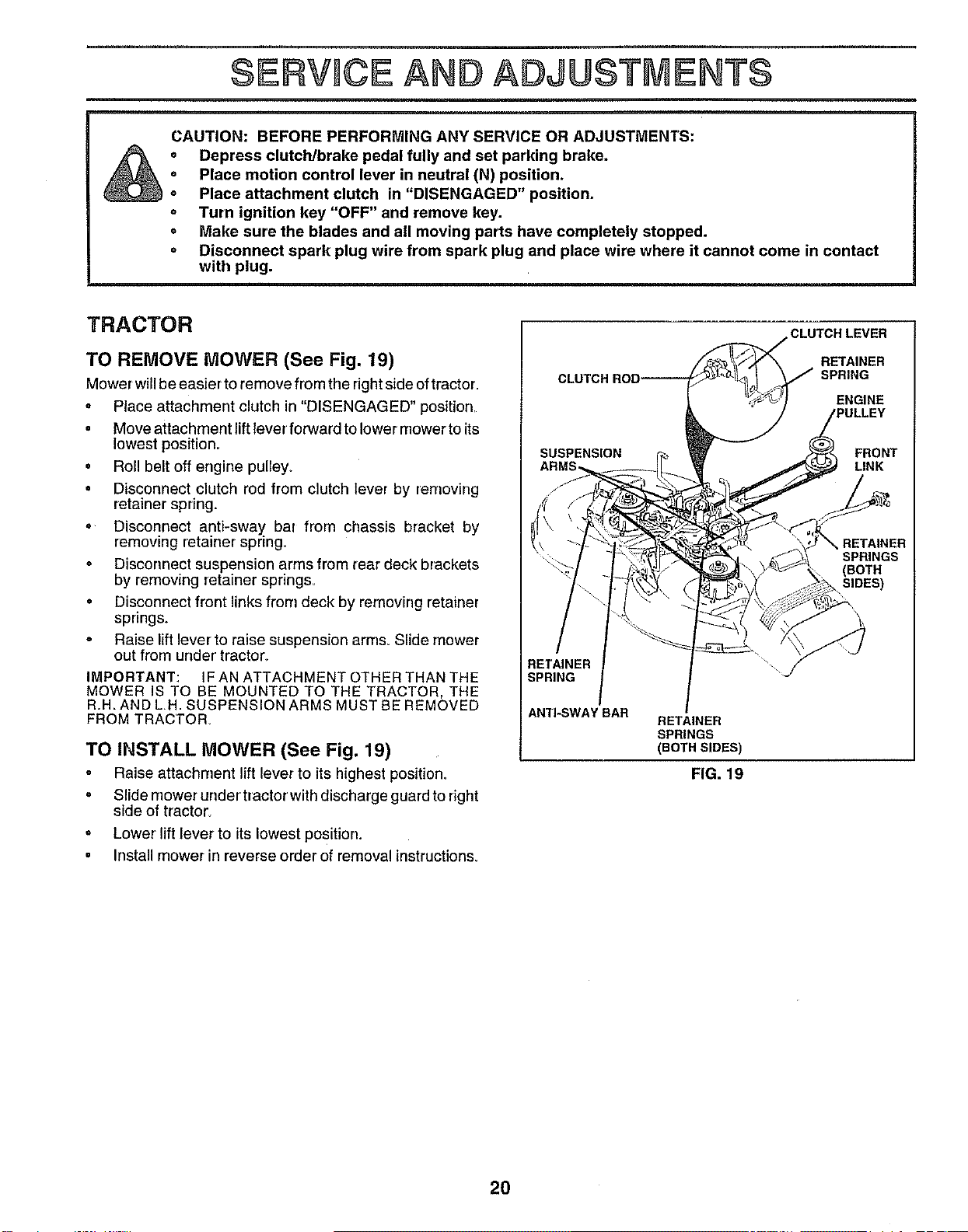
TO REMOVE MOWER (See Fig. 19)
Mower willbe easier toremove from the rightside oftractor.
o Place attachment clutch in "DISENGAGED" position.
• Move attachment lift lever forward tolower mower toits
lowest position.
• Roll belt off engine pulley°
• Disconnect clutch rod from clutch lever by removing
retainer spring.
, Disconnect anti-sway bar from chassis bracket by
removing retainer spring.
Disconnect suspension arms from rear deck brackets
by removing retainer springs.
, Disconnect front links from deck by removing retainer
springs.
Raise lift lever to raise suspension arms. Slide mower
out fmrn under tractor°
IMPORTANT: IF AN ATTACHMENT OTHER THAN THE
MOWER IS TO BE MOUNTED TO THE TRACTOR, THE
R.H.AND LH. SUSPENSION ARMS MUST BE REMOVED
FROM TRACTOR
TO INSTALL MOWER (See Fig. 19)
Raise attachment lift lever to its highest position_
• Slide mower under tractor with discharge guard to right
side of tractor°
• Lower lift lever to its lowest position.
• Install mower in reverse order of removal instructions.
CLUTCH LEVER
RETAINER
SPRING
ENGINE
SUSPENSION FRONT
LINK
RETAINER
SPRINGS
(BOTH
SIDES)
RETAINER
SPRING
ANTI-SWAY BAR
RETAINER
SPRINGS
(BOTH SIDES)
FIG. 19
2O
SERVnCE AND AOJUSTMENT$
TO LEVEL MOWER HOUSING
Adjust the mower _vhiletractor is parked on level ground or
driveway. Make sure tires are properly inflated (See
"PRODUCT SPECIFICATIONS" on page 3ofthis manual).
If tires are over or underinflated, you will not properly adjust
your mower.
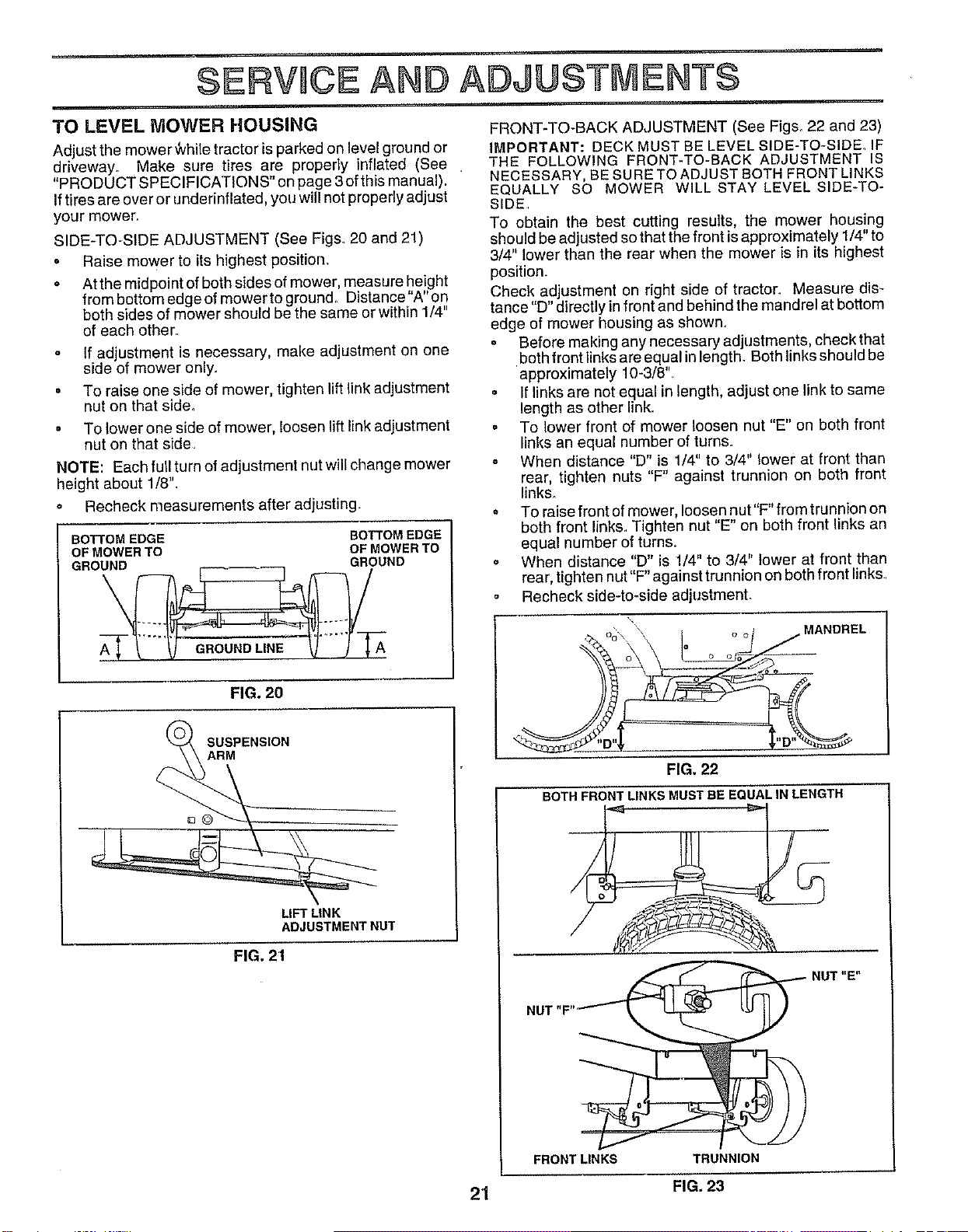
SIDE-TO-SIDE ADJUSTMENT (See Figs. 20 and 21)
• Raise mower to its highest position..
• At the midpoint of both sides of mower, measure height
from bottom edge of mower to ground. Distance"A" on
both sides of mower should be the same or within 1/4"
of each other.
If adjustment is necessary, make adjustment on one
side of mower only_
To raise one side of mower, tighten lift link adjustment
nut on that side_
To lower one side of mower, loosen lift link adjustment
nut on that side.
NOTE: Each full turn of adjustment nut will change mower
height about 1/8",
o Recheck measurements after adjusting
BOTTOM EDGE BOTTOM EDGE
OF MOWER TO OF MOWER TO
GROUND GROUND
FIG. 20
SUSPENSION
ARM
LIFT LINK
ADJUSTMENTNUT
FIG. 21
FRONT-TO-BACK ADJUSTMENT (See Figs. 22 and 23)
IMPORTANT: DECK MUST BE LEVEL SIDE-TO-SIDE. IF
THE FOLLOWING FRONT-TO-SACK ADJUSTMENT IS
NECESSARY, BE SURE TO ADJUST BOTH FRONT LINKS
EQUALLY SO MOWER WILL STAY LEVEL SIDE-TO-
SIDE
To obtain the best cutting results, the mower housing
should be adjusted so that the front isapproximately I/4" to
3/4" lower than the rear when the mower is in its highest
position.
Check adjustment on right side of tractor. Measure dis-
tance "D" directly infront and behind the mandrel at bottom
edge of mower housing as shown.
= Before making any necessary adjustments, check that
both front links are equal in length. Both links should be
approximately 10-3/8"
° If links are not equal in length, adjust one link to same
length as other link.
° To lower front of mower loosen nut "E" on both front
links an equal number of turns.
When distance "D" is 1/4" to 3/4" lower at front than
rear, tighten nuts "F" against trunnion on both front
links.
o To raise front of mower, loosen nut"F" from trunnion on
both front links.. Tighten nut "E" on both front links an
equal number of turns.
= When distance "D" is 1/4" to 3/4" lower at front than
rear, tighten nut "F" against trunnion on both front links.
Recheck side-to-side adjustment.
,3 %'_ "\ 'o o o t MANDREL
FIG. 22
BOTH FRONT LINKS MUST BE EQUAL IN LENGTH
NUT "F" _"_
FRONT LINKS TRUNNION
NUT"E"
2'1 FIG. 23
SERVICE AND ADJUSTMENTS
TO REPLACE MOWER BLADE DRIVE BELT
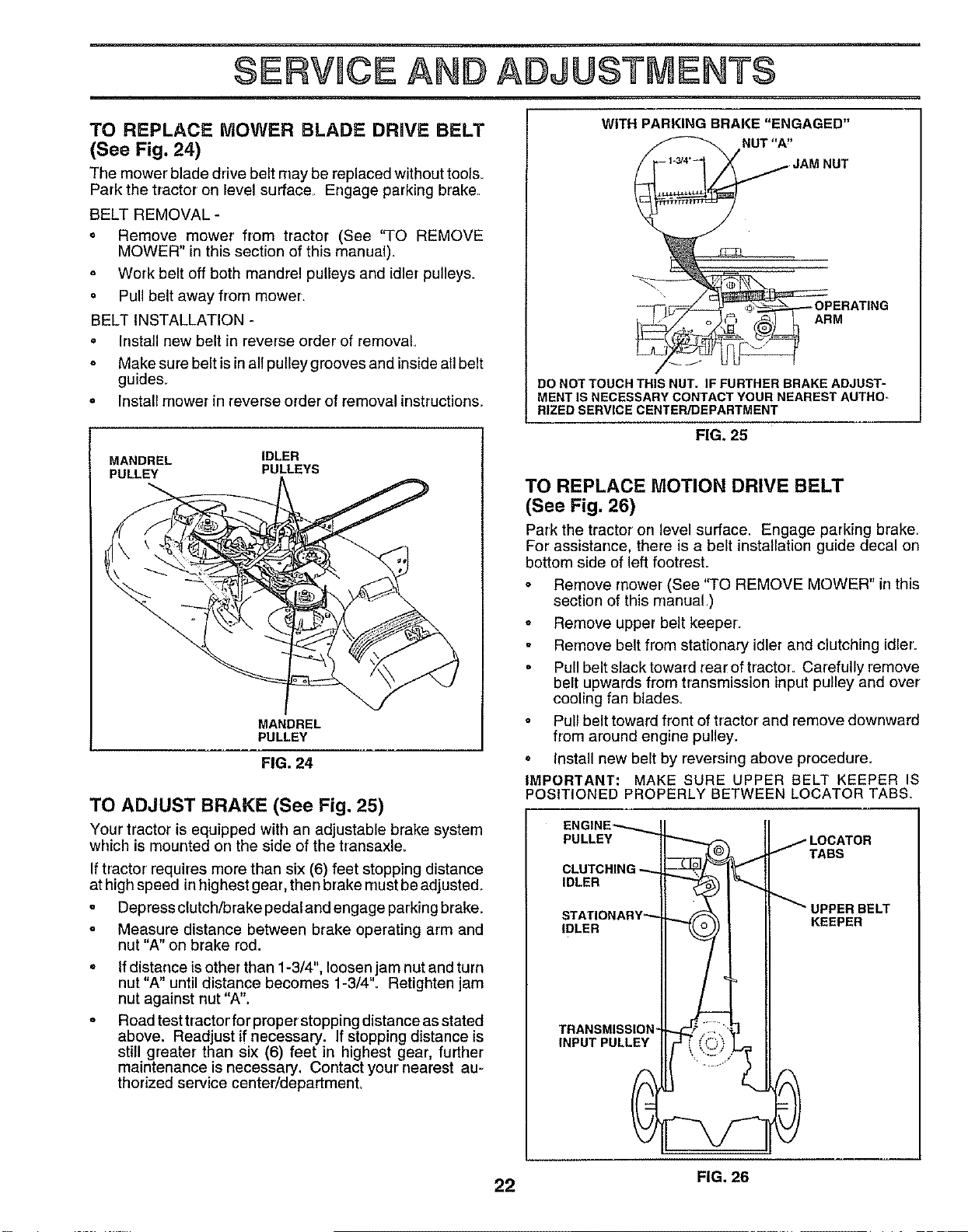
(See Fig. 24)
The mower blade drive belt may be replaced without tools.
Park the tractor on level surface.. Engage parking brake.
BELT REMOVAL -
o Remove mower from tractor (See 'q'O REMOVE
MOWER" in this section of this manual).
Work belt off both mandrel pulleys and idler pulleys.
• Pull belt away from mower.
BELT INSTALLATION -
= Install new belt in reverse order of removal
Make sure belt is inall pulley grooves and inside all belt
guides.
o Install rnower in reverse order of removal instructions_
MANDREL IDLER
PULLEY PULLEYS
MANDREL
PULLEY
FIG. 24
TO ADJUST BRAKE (See Fig. 25)
Your tractor is equipped with an adjustable brake system
which is mounted on the side ofthe transaxle,
If tractor requires more than six (6) feet stopping distance
at high speed in highest gear, then brake must be adjusted°
Depress clutch/brake pedal and engage parking brake_
• Measure distance between brake operating arm and
nut 'W' on brake rod.
@
o
Ifdistance is other than 1-3/4", loosen jam nut and turn
nut "A" until distance becomes 1-3/4'L Retighten jam
nut against nut "A".
Road test tractor for proper stopping distance as stated
above. Readjust if necessary. If stopping distance is
still greater than six (6) feet in highest gear, further
maintenance is necessary, Contact your' nearest au-
thorized service center/department,
WITH PARKING BRAKE "ENGAGED"
NUT"A!'
ARM
DO NOT TOUCH THIS NUT. IF FURTHER BRAKE ADJUST-
MENT IS NECESSARY CONTACT YOUR NEAREST AUTHO-
RIZED SERVICE CENTER/DEPARTMENT
FIG. 25
TO REPLACE MOTION DRIVE BELT
(See Fig. 26)
Park the tractor on level surface. Engage parking brake_
For assistance, there is a belt installation guide decal on
bottom side of left footresL
o Remove mower (See 'q'O REMOVE MOWER" in this
section of this manual.)
o Remove upper belt keeper.
Remove belt from stationary idler and clutching idler_
Pull belt slack toward rear of tractor. Carefully remove
belt upwards from transmission input pulley and over
cooling fan blades.
• Pull belt toward front of tractor and remove downward
from around engine pulley.
• Install new belt by reversing above procedure..
IMPORTANT: MAKE SURE UPPER BELT KEEPER IS
POSITIONED PROPERLY BETWEEN LOCATOR TABS.
PULLEyENO'NE tt----. IItLoOATOR
IDLERCLUTCHING"--_._ TABS
II I II UPPERBELT
STATIONARY"_- KEEPER
IDLER __-_ I
TRANSMISSION
INPUT PULLEY
22 FIG, 26
GERV ¢E ANg AgJUSTMENTG
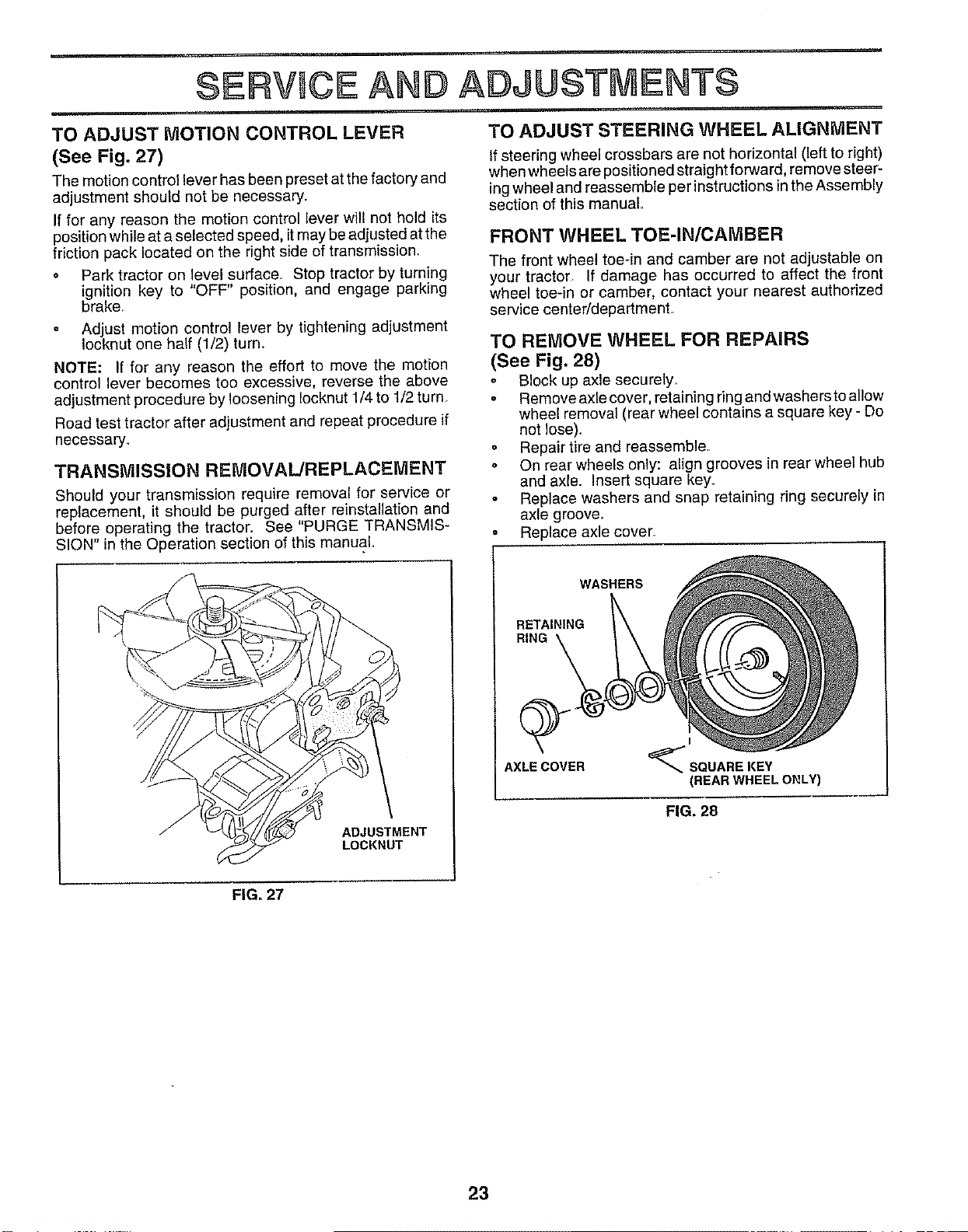
TO ADJUST MOTION CONTROL LEVER
(See Fig. 27)
The motion control lever has been preset at the factory and
adjustment should not be necessary.
If for any reason the motion control lever will not hold its
position while at a selected speed, it may be adjusted at the
friction pack located on the right side of transmission_
= Park tractor on level surface. Stop tractor by turning
ignition key to "OFF" position, and engage parking
brake.
° Adjust motion control lever by tightening adjustment
Iocknut one half (1/2) turn.
NOTE: If for any reason the effort to move the motion
control lever becomes too excessive, reverse the above
adjustment procedure by loosening Iocknut 1/4 to 1/2 turn.
Road test tractor after adjustment and repeat procedure if
necessary.
TRANSMISSION REMOVAL/REPLACEMENT
Should your transmission require removal for service or
replacement, it should be purged after reinstallation and
before operating the tractor. See "PURGE TRANSMIS-
SION" in the Operation section of this manual
ADJUSTMENT
LOCKNUT
TO ADJUST STEERING WHEEL ALIGNMENT
If steering wheel crossbars are not horizontal (leftto right)
whenwheels are positionedstraightforward, remove steer-
ing wheel and reassemble per instructions in the Assembly
section of this manual
FRONT WHEEL TOE-IN/CAIVIBER
The front wheel toe-in and camber are not adjustable on
your tractor If damage has occurred to affect the front
wheel toe-in or camber, contact your nearest authorized
service center/department.
TO REMOVE WHEEL FOR REPAIRS
(See Fig. 28)
Block up axle securely_
Remove axle cover, retaining ring and washers to allow
wheel removal (rear wheel contains a square key - Do
not lose).
• Repair tire and reassemble.
° On rear wheels only: align grooves in rear wheel hub
and axle. Insert square key.
Replace washers and snap retaining ring securely in
axle groove.
Replace axle cover_
WASHERS
RETAINING
RING
_XLECOVER
I
(REAR WHEEL ONLY)
FIG. 28
FIG. 27
23
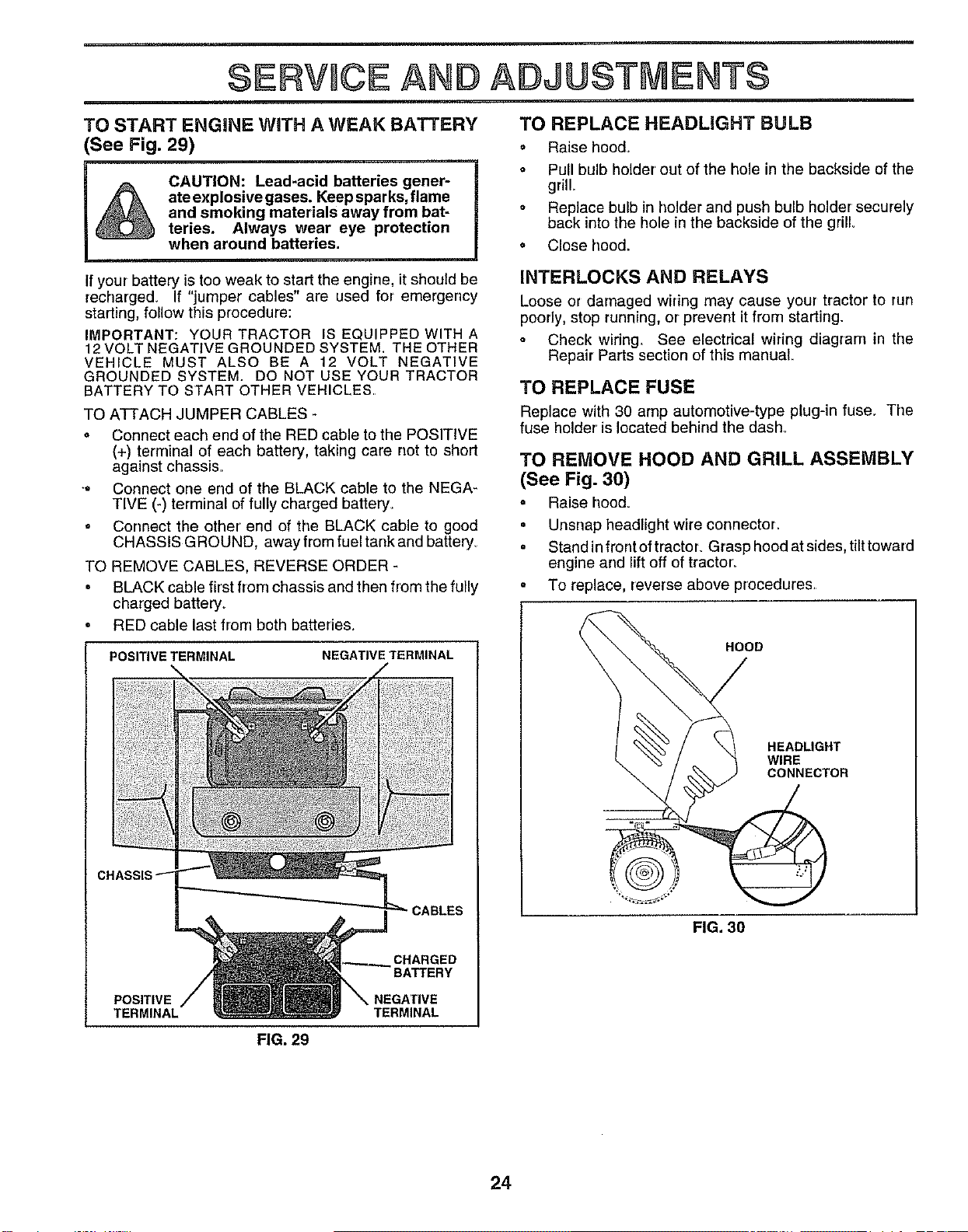
SERWCE AND ADJUSTMENTS
TO START ENGINE WiTH A WEAK BATTERY
See Fig. 29)
CAUTION: Lead-acid batteries gener-
ate explosive gases. Keep sparks, flame
and smoking materials away from bat=
teries. Always wear eye protection
when around batteries.
TO REPLACE HEADLIGHT BULB
o Raise hood.
° Pull bulb holder' out of the hole in the backside of the
grill
o Replace bulb in holder and push bulb holder securely
back intothe hole in the backside of the grill
o Close hood.
If your battery is too weak to start the engine, it should be
recharged. If "jumper cables" are used for emergency
starting, follow this procedure:
IMPORTANT: YOUR TRACTOR IS EQUIPPED WITH A
12 VOLT NEGATIVE GROUNDED SYSTEM. THE OTHER
VEHICLE MUST ALSO BE A 12 VOLT NEGATIVE
GROUNDED SYSTEM. DO NOT USE YOUR TRACTOR
BATTERY TO START OTHER VEHICLES
TO ATTACH JUMPER CABLES -
° Connect each end of the RED cable to the POSITIVE
(+) terminal of each battery, taking care not to short
against chassis,,
•. Connect one end of the BLACK cable to the NEGA-
TIVE (-) terminal of fully charged battery.
Connect the other' end of the BLACK cable to good
CHASSIS GROUND, away from fuel tank and battery.
TO REMOVE CABLES, REVERSE ORDER -
• BLACK cable first from chassis and then from the fully
charged battery°
. RED cable last from both batteries.
POSITIVE TERMINAL
NEGATIVE TERMINAL
CABLES
CHARGED
BATTERY
POSITIVE NEGATIVE
TERMINAL TERMINAL
INTERLOCKS AND RELAYS
Loose or damaged wiring may cause your tractor to run
poorly, stop running, or prevent it from starting.
Check wiring, See electrical wiring diagram in the
Repair Parts section of this manual
TO REPLACE FUSE
Replace with 30 amp automotive-type plug-in fuse, The
fuse holder is located behind the dash,
TO REMOVE HOOD AND GRILL ASSEMBLY
(See Fig. 30)
o Raise hood.
° Unsnap headlight wire connector.
o Stand infront oftractoL Grasp hood at sides, tilttoward
engine and lift off of tractorL
o To replace, reverse above procedures.
HOBO
\
K
\
HEADLIGHT
WIRE
CONNECTOR
FiG. 30
FIG. 29
24
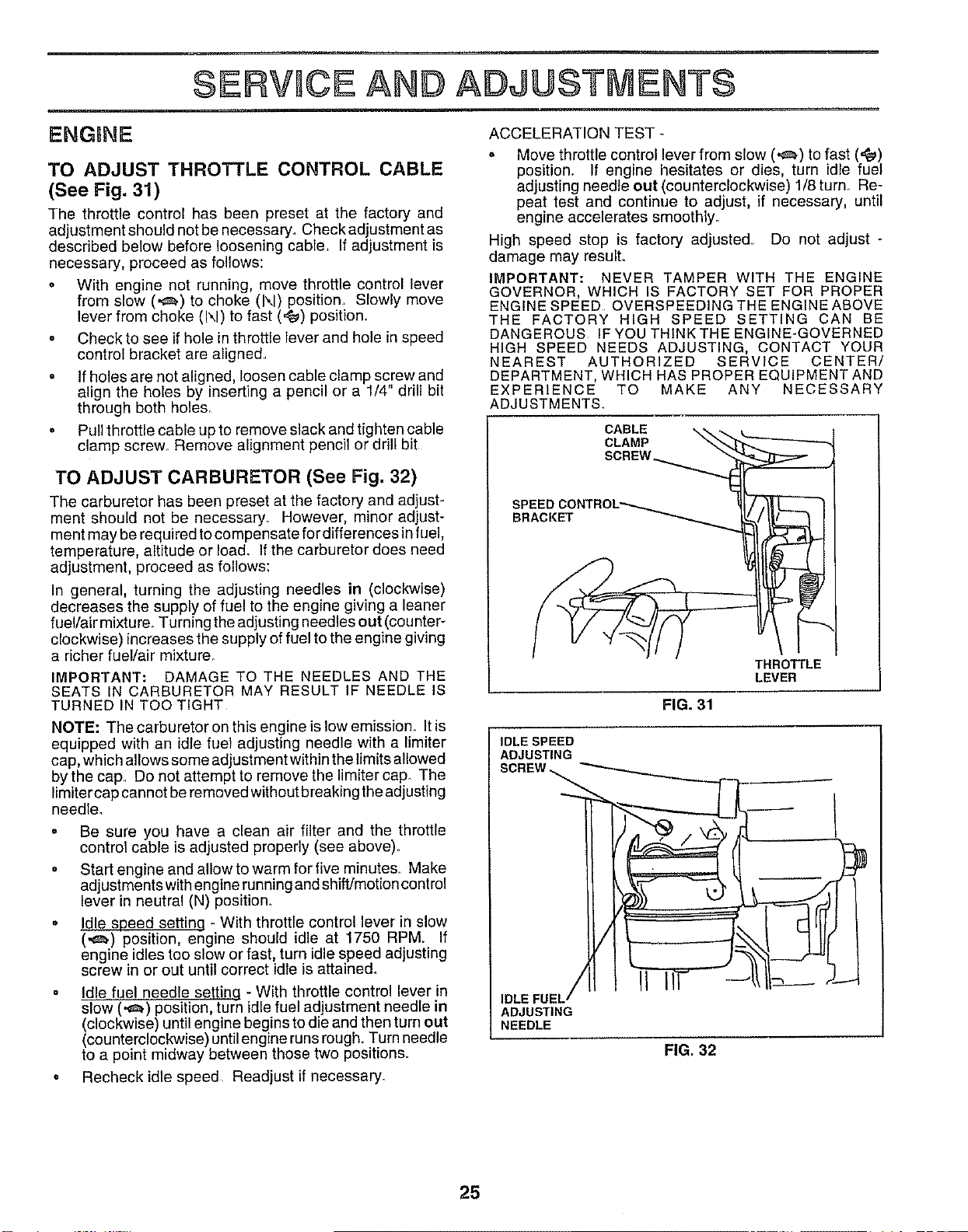
SERVICE AND A#JUSTMENTS
ENGBNE
TO ADJUST THROTTLE CONTROL CABLE
(See Fig. 31)
The throttle control has been preset at the factory and
adjustment should not be necessary. Check adjustment as
described below before loosening cable. If adjustment is
necessary, proceed as follows:
o With engine not running, move throttle control lever
from slow (,_) to choke (1\1) position. Slowly move
lever from choke (1\1)to fast (=_) position_
o Check to see if hole inthrottle lever and hole in speed
control bracket are aligned.
o If holes are not aligned, loosen cable clamp screw and
align the holes by inserting a pencil or a 1/4" drill bit
through both holes.
= Pull throttle cable up to remove slack and tighten cable
clamp screw. Remove alignment pencil or drill bit
TO ADJUST CARBURETOR (See Fig, 32)
The carburetor has been preset at the factory and adjust-
ment should not be necessary. However, minor adjust-
ment may be required tocompensate for differences in fuel,
temperature, altitude or load. If the carburetor does need
adjustment, proceed as follows:
In general, turning the adjusting needles in (clockwise)
decreases the supply of fuel to the engine giving a leaner
fuel/air mixture. Turning the adjusting needles out (counter-
clockwise) increases the supply of fuel to the engine giving
a richer fuel/air mixture_
IMPORTANT: DAMAGE TO THE NEEDLES AND THE
SEATS IN CARBURETOR MAY RESULT IF NEEDLE IS
TURNED IN TOO TIGHT
NOTE: The carburetor on this engine is low emission. It is
equipped with an idle fuel adjusting needle with a limiter
cap, which allows some adjustment within the limits allowed
by the cap. Do not attempt to remove the limiter cap. The
limitercap cannot beremoved without breaking the adjusting
needle°
Be sure you have a clean air filter and the throttle
control cable is adjusted properly (see above).
Start engine and allow to warm for five minutes. Make
adjustments with engine running and shift/motion control
lever in neutral (N) position_
Idle speed settinq - With throttle control lever in slow
(,_) position, engine should idle at 1750 RPM. If
engine idles too slow or fast, turn idlespeed adjusting
screw in or out until correct idle is attained.
Idle fuel needle settinq - With throttle control lever in
slow (,_) position, turn idlefuel adjustment needle in
(clockwise) until engine begins to die and then turn out
(counterclockwise) until engine runs rough. Turn needle
to a point midway between those two positions.
Recheck idle speed Readjust if necessary.
ACCELERATION TEST -
= Move throttle control lever from slow (._) to fast (,_)
position. If engine hesitates or dies, turn idle fuel
adjusting needle out (counterclockwise) 1/8 turn. Re-
peat test and continue to adjust, if necessary, until
engine accelerates smoothly.
High speed stop is factory adjusted. Do not adjust -
damage may resulL
IMPORTANT: NEVER TAMPER WITH THE ENGINE
GOVERNOR, WHICH IS FACTORY SET FOR PROPER
ENGINE SPEED OVERSPEEDINGTHEENGINEABOVE
THE FACTORY HIGH SPEED SETTING CAN BE
DANGEROUS IF YOU THINK THE ENGINE-GOVERNED
HIGH SPEED NEEDS ADJUSTING, CONTACT YOUR
NEAREST AUTHORIZED SERVICE CENTER/
DEPARTMENT, WHICH HAS PROPER EQUIPMENT AND
EXPERIENCE TO MAKE ANY NECESSARY
ADJUSTMENTS
CABLE "_
CLAMP
SCREW_
THROTTLE
LEVER
FIG. 31
IDLE SPEED
ADJUSTING
IDLE FUEL
ADJUSTING
NEEDLE
FIG. 32
25
STORAGE
Immediately prepare your tractor for storage at the end of
the season or if the tractor will not be used for 30 days or
nore.
CAUTION: Never store the tractor with
gasoline in the tank inside a building
where fumes may reach an open flame
or spark, Allow the engine to cool
before storing in any enclosure.
TRACTOR
Remove mower from tractor for winter storage. When
mower is to be stored for' a period of time, clean it thor-
oughly, remove all dirt, grease, leaves, etc. Store in a
clean, dry area_
o Clean entire tractor (See"CLEANING" in the Customer
Responsibilities section of this manual)_
• Inspect and replace belts, if necessary (See belt re-
placement instructionsin the Service and Adjustments
section of this manual).
o Lubricate as shown in the Customer Responsibilities
section of this manual
Be sure that all nuts, bolts and screws are securely
fastened° Inspect moving parts for damage, breakage
and wear Replace if necessary_
Touch up all rusted or chipped paint surfaces; sand
lightly before painting.
BATTERY
Fully charge the battery for storage.
After a period of time in storage, battery may require
recharging.
To help prevent corrosion and power leakage during
long periods of storage, battery cables should be
disconnected and battery cleaned thoroughly (see "TO
CLEAN BATTERY AND TERMINALS" in the Cus-
tomer Responsibilities section of this manual)_
After cleaning, leave cables disconnected and place
cables where they cannot come incontact with battery
terminals°
° Be sure battery drain tube is securely attached.
= If battery is removed from tractor for storage, do not
store battery directly on concrete or damp surfaces.
ENGnNE
FUEL SYSTEM
IMPORI"ANT: IT IS IMPORTANT TO PREVENT GUM
DEPOSITS FROM FORMING IN ESSENTIAL FUEL
SYSTEM PARTS SUCH AS CARBURETOR, FUEL FILTER,
FUEL HOSE, OR TANK DURING STORAGE. ALSO,
EXPERIENCE INDICATES THAT ALCOHOL BLENDED
FUELS (CALLED GASOHOL OR USING ETHANOL OR
METHANOL) CAN ATTRACT MOISTURE WHICH LEADS
TO SEPARATION AND FORMATION OF ACIDS DURING
STORAGE. ACIDIC GAS CAN DAMAGE THE FUEL
SYSTEM OF AN ENGINE WHILE IN STORAGE
Drain the fuel tank_
o Start the engine and let it run until the fuel lines and
carburetor are empty.
o Never use engine or carburetor cleaner productsinthe
fuel tank or permanent damage may occur.
o Use fresh fuel next season.
NOTE: Fuel stabilizer is an acceptable alternative in
minimizing the formation of fuel gum deposits during stor-
age. Add stabilizer to gasoline in fuel tank or storage
container. Always follow the mix ratio found on stabilizer
container. Run engine at least 10 minutes after adding
stabilizerto allowthe stabilizer to reach the carburetor. Do
not drain the gas tank and carburetor ifusing fuel stabilizer..
ENGINE OIL
Drain oil (with engine warm) and replace with clean engine
oil. (See "ENGINE" in the Customer Responsibilities
section of this manual).
CYLINDERS
= Remove spark plug(s).
o Pour one ounce of oil through spark plug hole(s) into
cylinder(s)
Turn ignitionkey to "START" position for afew seconds
to distribute oil
° Replace with new spark plug(s).
OTHER
o Do not store gasoline from one season to another.
° Replace your gasoline can if your can starts to rust.
Rust and/or dirt in your gasoline will cause problems..
° If possible, store your tractor indoors and cover it to
give protection frem dust and dirt.
° Cover your' tractor with a suitable protective cover that
does not retain moisture. Do not use plastic. Plastic
cannot breathe which allows condensation to form and
will cause your tractor to rust.
IMPORTANT: NEVER COVER TRACTOR WHILE ENGINE
AND EXHAUST AREAS ARE STILL WARM_
26
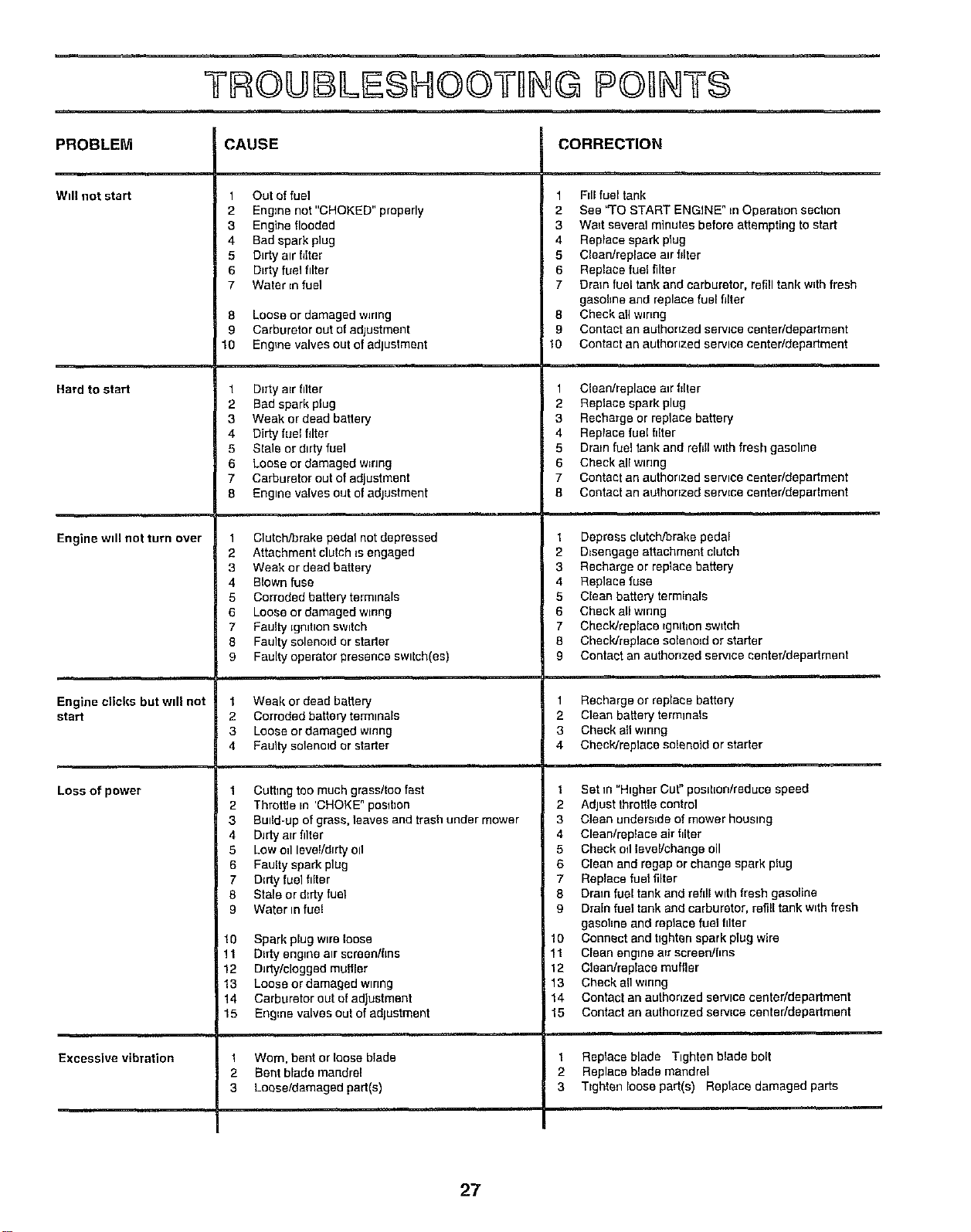
I[IIOLIIBLI!SHOOIIIIIQ 1011118
CAUSE CORRECTIONPROBLEM
Will not start
Hard to start
Engine will not turn over
Engine clicks but will not
start
Loss of power
Excessive vibration
1 Out of fuel
2 Eng=ne not "CHOKED" properly
3 Engine flooded
4 Bad spark plug
5 Dtrty air fitter
6 Dtrty fuel filter
7 Water _nfuel
8 Loose or damaged w=rmg
9 Carburetor out of adjustment
10 Engine valves out of adjustment
1 D=rtya=rfilter
2 Sad spark plug
3 Weak or dead battery
4 Dirty fuel filter
5 Stale or dtrty fuel
6 Loose or damaged wrong
7 Carburetor out of adjustment
8 Engtne valves out of adjustment
1 Clutch/brake pedal not depressed
2 Attachment clutch _sengaged
3 Week or dead battery
4 Blown fuse
5 Corroded battery terminals
6 Loose or damaged wrong
7 Faulty _gnttton swttch
8 Faulty solenotd or starter
9 Faulty operator presence swttch(es)
1 Weak or dead battery
2 Corroded battery termmals
3 Loose or damaged w[nng
4 Faulty sslenotd or starter
1 Cutttng too much grass/too fast
2 Throttle tn 'CHOKE" postlon
3 Buld-up of grass, leaves and trash under mower
4 Dirty a=r filter
5 Low od level/dirty oll
6 Faulty spark plug
7 DErty fuel filer
8 Stale or dirty fuel
9 Water m fuel
10 Spark plug wtre loose
1t Dkrty engtne atr screen/fins
12 Dirty/clogged mufiler
13 Loose ordamaged wtnng
14 Carburetor out af adjustment
15 Engine valves out of adjustment
I Worn, bent or lease blade
2 Bent blade mandrel
3 Loose/damaged part(s)
1 FII fuel tank
2 See 'q-O START ENGINE" =nOperalon section
3 Wad several minutes before attempting to start
4 Replace spark plug
5 Clean/replace atr filter
6 Replace fuel filter
7 Dram fuel tank and carburetor, refill tank w_th fresh
gasohne and replace fuel filter
8 Check all wrong
g Contact an authonzed service center/department
t0 Contact an authonzed service center/depattment
1 Clean/replace atr fdter
2 Replace spark plug
3 Recharge or replace battery
4 Replace fuel filer
5 Dram fuel tank and refil wlh fresh gasoltne
6 Check all wmng
7 Contact an authorized service center/department
8 Contact an authonzed servtce center/department
1 Depress clutch/brake pedal
2 Disengage attachment clutch
3 Recharge or replace battery
4 Replace fuse
5 Clean battery terminals
6 Check allwmng
7 Check/replace =gntt=onswlch
8 Check/replace soleno=d or starter
9 Contact an authonzed service center/department
1 Recharge or replace battery
2 Clean battery terminals
3 Check al wrong
4 ChecWreplace solenoid or starter
1 Set tn"Htgher Cut" post[on/reduce speed
2 Adjust throttle control
3 Clean underside of mower housing
4 Clean/replace air filter
5 Check ol level/change oil
6 Clean and regap or change spark plug
7 Replace fuel filter
8 Dratn fuel tank and refil wtth fresh gasolne
9 Drain fuel tank and carburetor, refill tank wlh fresh
gasoline and replace fuel htter
t 0 Connect and ttghten spark plug wire
11 Clean engtne atr screen/Ins
12 Clean/replace muffler
13 Check all wrong
14 Contact an authonzed service center/department
15 Contact an authorized serv=ce center/department
1 Replace blade Ttghten blade bolt
2 Replace blade mandrel
3 Ttghten loose part(s) Replace damaged parts
27
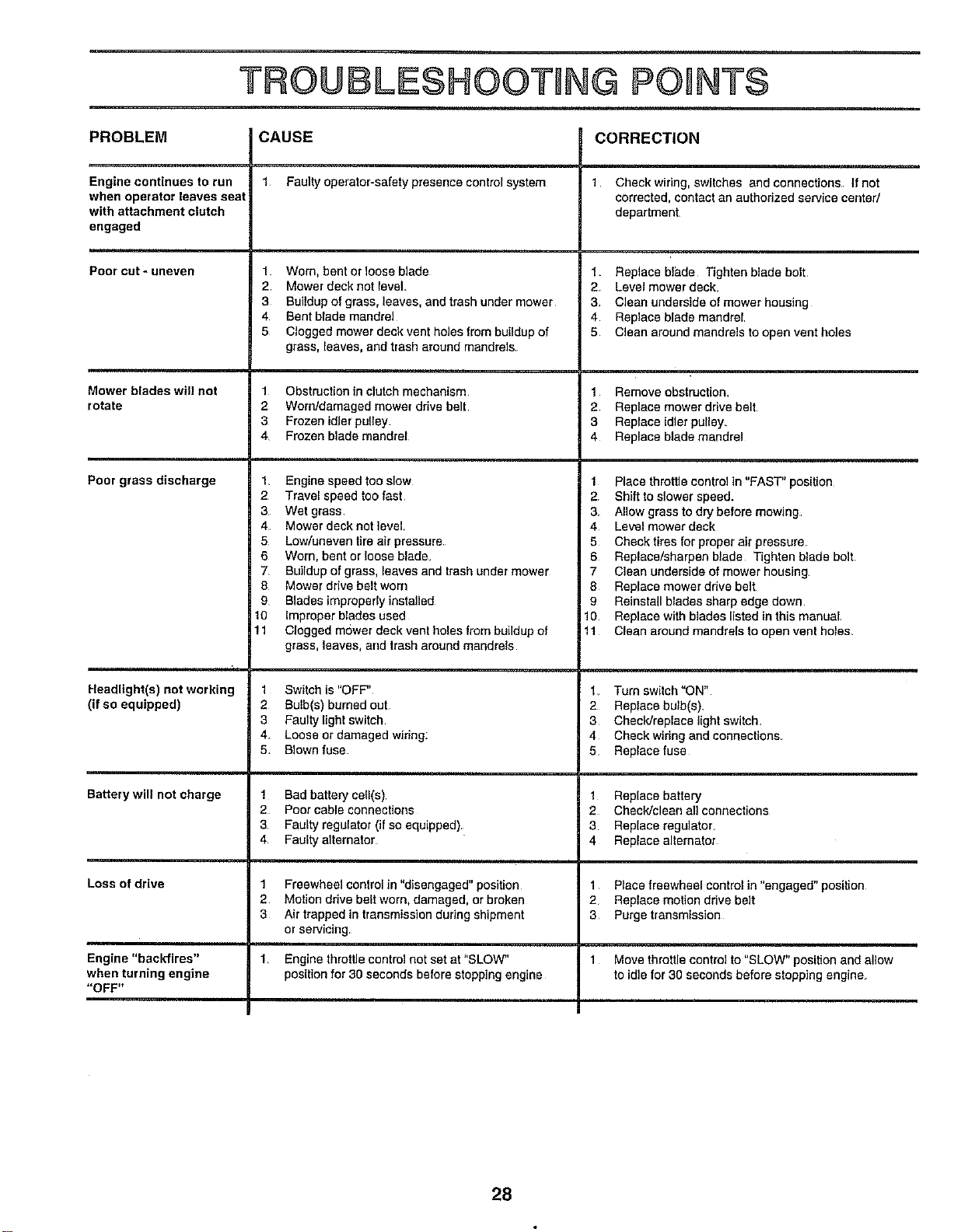
TROUILEIHOOTING POINTS
PROBLEM CAUSE CORRECTION
Engine continues to run
when operator leaves seat
with attachment clutch
engaged
Poorcut-uneven
Mower blades will not
rotate
Poor grass discharge
Headlight(s) not working
(if so equipped)
Battery wilt not charge
Loss of drive
Engine "backfires"
when turning engine
"OFF"
1 Faulty operator-safety presence control system
1 Worn, bent or loose blade
2 Mower deck not level
3 Buildup of grass, leaves, and trash under mower
4 Bent blade mandrel
5 Clogged mower deck vent holes from buildup of
grass, leaves, and trash around mandrels
Check wiring, switches and connections If not
corrected, contact an authorized service center/
department
1 Replace blade Tighten blade bolt
2 Level mower deck,
3 Clean uaderside of mower housing
4 Replace blade mandrel
5 Clean around mandrels to open vent holes
1 Obstruction in clutch mechanism
2 Worn/damaged mower drive belt
3 Frozen idler puley
4 Frozen blade mandrel
1, Engine speed too slow
2 Travel speed too fast
3 Wet grass
4 Mower deck not ]eve]
5 Low/uneven tire air pressure
6 Worn, bent or loose blad&
7 Buildup of grass, leaves and trash under mower
8 Mower drive belt worn
9 Blades improperly instaled
!0 Improper blades used
11 Clogged mower deck vent holes from buildup of
grass, leaves, arrd trash around mandrels
1 Remove obstruction.
2 Replace mower drive belt
3 Replace idler pulley
4 Replace blade mandrel
1 Place throttle control in "PAST" position
2 Shift to slower speed.
3 Allow grass to drybefore mowing
4 Level mower deck
5 Checktires for proper air pressure
6 Replace/sharpen blade Tighten blade bolt
7 Clean underside of mower housing
8 Replace mower drive belt
9 Reinstall blades sharp edge down
10 Replace with blades listed in this manual
11 Clean around mandrels to open vent holes
1 Switch is "OFF"
2 Bulb(s) burned out
3 Faulty rightswitch
4 Loose or damaged wiring:
5 Blown fuse
! Bad battery cel(s)
2 Poor cable connections
3 Faulty regulator (if so equipped)
4 Faulty alternator
1. Tern switch"ON"
2 Replace bulb(s).
3 Check/replace light switch
4 Check wiring and connections
5 Replace fuse
1 Replace battery
2 Check/clean all connections
3 Replace regulator
4 Replace alternator
1 Freewheel control in "disengaged" position
2 Motion drive belt worn, damaged, or broken
3 Air trapped in transmission during shipment
or servicing
Enginethrottlecontrol not set at "SLOW"
position for30 seconds before stopping engine
1 Place freewheel contro! in "engaged" position
2 Replace motion drive belt
3 Purge transmission
1 Move throttle control to "SLOW" posgion and allow
to idle for 30 seconds before stopping engine
28