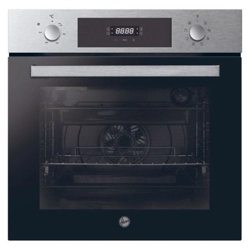
USER INSTRUCTIONS
OVENS
CANDY HOOVER GROUP S.R.L. • Via Comolli 16 • 20861 Brugherio (MB) Italy
EN
02
INSTRUCCIONES DE USO
HORNOS EMPOTRABLES
ES
16

Safety Indications
EN 02
• When you open the door after you have finished cooking, a few
drops of water may come out of the door. It depends on the type of
food you have cooked.
• During cooking, moisture may condense inside the oven cavity or
on the glass of the door. This is a normal condition. To reduce this
effect, wait 10-15 minutes after turning on the power before putting
food inside the oven. ln any case, the condensation disappears when
the oven reaches the cooking temperature.
• Cook the vegetables in a container with a lid instead of an open tray.
• Avoid leaving food inside the oven after cooking for more than
15/20 minutes.
• WARNING: the appliance and accessible parts become hot during
use. Be careful not to touch any hot parts.
• WARNING: the accessible parts can become hot when the grill is in
use. Children should be kept at a safe distance.
• WARNING: ensure that the appliance is switched off before
replacing the bulb, to avoid the possibility of electric shocks.
• WARNING: in order to avoid any danger caused by the accidental
resetting of the thermal interruption device, the appliance should
not be powered by an external switching device, such as a timer, or
be connected to a circuit that is regularly switched on and off.
• Children under 8 should be kept at a safe distance from the
appliance if not continuously supervised.
• Children should not play with the appliance.
• The appliance can be used by those aged 8 or over and by those
with limited physical, sensorial or mental capacities, without
experience or knowledge of the product, only if supervised or
provided with instruction as to the operation of the appliance, in a
safe way with awareness of the possible risks.
• Cleaning and maintenance should not be carried out by
unsupervised children.
• Do not use rough or abrasive materials or sharp metal scrapers to
clean the oven door glasses, as they can scratch the surface and

cause the glass to shatter.
• The oven must be switched off before removing the removable
parts. After cleaning, reassemble them according the instructions.
• Only use the meat probe recommended for this oven.
• Do not use a steam cleaner for cleaning operations.
• Connect a plug to the supply cable that is able to bear the voltage,
current and load indicated on the tag and having the earth contact.
The socket must be suitable for the load indicated on the tag and
must have ground contact connected and in operation. The earth
conductor is yellow-green in colour. This operation should be carried
out by a suitably qualified professional. ln case of incompatibility
between the socket and the appliance plug, ask a qualified
electrician to substitute the socket with another suitable type. The
plug and the socket must be conformed to the current norms of the
installation country. Connection to the power source can also be
made by placing an omnipolar breaker between the appliance and
the power source that can bear the maximum connected load and
that is in line with current legislation. The yellow-green earth cable
should not be interrupted by the breaker. The socket or omnipolar
breaker used for the connection should be easily accessible when the
appliance is installed.
• The disconnection may be achieved by having the plug accessible
or by incorporating a switch in the fixed wiring in accordance with the
wiring rules.
• lf the power cable is damaged, it should be substituted with a cable
or special bundle available from the manufacturer or by contacting
the customer service department. The type of power cable must be
H05V2V2-F. This operation should be carried out by a suitably
qualified professional. The earth conductor (yellow-green) must be
approximately 10 mm longer than the other conductors. For any
repairs, refer only to the Customer Care Department and request the
use of original spare parts.
• Failure to comply with the above can compromise the safety of the
EN 03

appliance and invalidate the guarantee.
• Any excess of spilled material should be removed before cleaning.
• A long power supply failure during an occurring cooking phase may
cause a malfunction of the monitor. ln this case contact customer
service.
• The appliance must not be installed behind a decorative door in
order to avoid overheating.
• When you place the shelf inside, make sure that the stop is directed
upwards and in the back of the cavity. The shelf must be inserted
completely into the cavity.
• WARNING: Do not line the oven walls with aluminium foil or single-
use protection available from stores. Aluminium foil or any other
protection, in direct contact with the hot enamel, risk melting and
deteriorating the enamel of the insides.
• WARNING: Never remove the oven door seal.
• CAUTION: Do not refill the cavity bottom with water during cooking
or when the oven is hot.
• No additional operation/setting is required in order to operate the
appliance at the rated frequencies
• WARNING: before initiating the automatic cleaning cycle:
- Clean the oven door;
- Remove large or coarse food residues from the inside of the oven
using a damp sponge. Do not use detergents;
- Remove all accessories and the sliding rack kit (where present); -Do
not place tea towels.
• ln ovens with meat probe it is necessary, before making the
cleaning cycle, close the hole with the nut provided. Always close the
hole with the nut when the meat probe is not used.
• During the pyrolytic cleaning process, surfaces can heat up more
than usual, children must therefore be kept at a safe distance.
EN 04

General Instructions
6
1.1 Safety indications
1.2 Electrical safety
1.3 Recommendations
1.4 Installation
1.5 Waste management
2.1 Overview
2.2 Accessories
2.3 First use
Product Description
8
3.1 Display description
3.2 Using the end of cooking timer
3.3 Cooking modes
Use of the Oven
9
4.1 General notes on cleaning
4.2 Maintenance
• Instruction for removal and cleaning
of the side racks
• Removal of the oven window
• Removal and cleaning of the glass
door
• Changing the bulb
4.3 Hydro Easy Clean Function
Oven Cleaning and Maintenance
12
5.1 F.A.Q.
Troubleshooting
15
Summary
EN 05
1. General Instructions
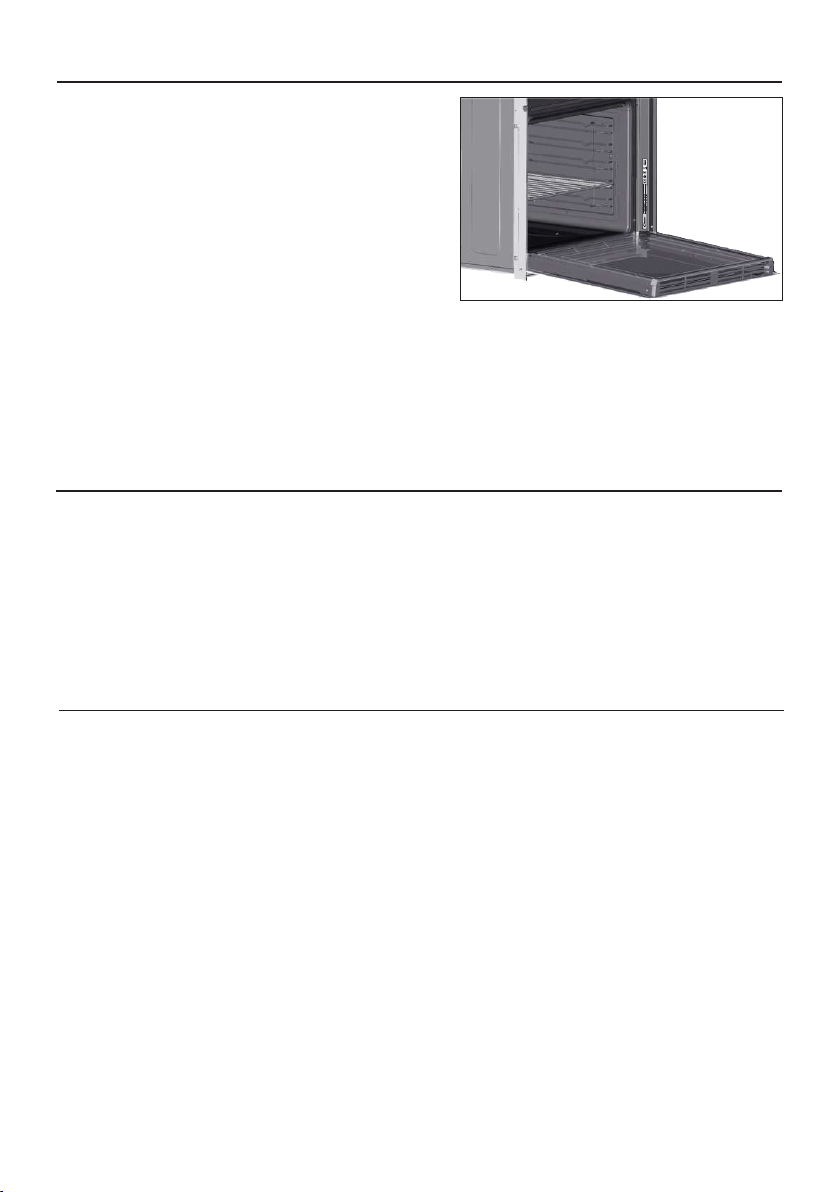
We thank you for choosing one of our products. For the
best results with your oven, you should read this
manual carefully and retain it for future reference.
Before installing the oven, take note of the serial
number so that you can give it to customer service staff
if any repairs are required. Having removed the oven
from its packaging, check that it has not been damaged
during transportation. If you have doubts, do not use
the oven and refer to a qualified technician for advice.
Keep all of the packaging material (plastic bags,
polystyrene, nails) out of the reach of children. When
the oven is switched on for the first time, strong
smelling smoke can develop, which is caused by the glue on the insulation panels surrounding the oven
heating for the first time. This is absolutely normal and, if it occurs, you should wait for the smoke to
dissipate before putting food in the oven. The manufacturer accepts no responsibility in cases where
the instructions contained in this document are not observed.
NOTE: the oven functions, properties and accessories cited in this manual will vary, depending on the
model you have purchased.
1.1 Safety Indications
Only use the oven for its intended purpose, that is only for the cooking of foods; any other use, for
example as a heat source, is considered improper and therefore dangerous. The manufacturer cannot
be held responsible for any damage resulting from improper, incorrect or unreasonable usage.
The use of any electrical appliance implies the observance of some fundamental rules:
- do not pull on the power cable to disconnect the plug from the socket;
- do not touch the appliance with wet or damp hands or feet;
- in general the use of adaptors, multiple sockets and extension cables is not recommended;
- in case of malfunction and/or poor operation, switch off the appliance and do not tamper with it.
1.2 Electrical Safety
ENSURE THAT AN ELECTRICIAN OR QUALIFIED TECHNICIAN MAKES THE ELECTRICAL CONNECTIONS.
The power supply to which the oven is connected must conform with the laws in force in the country of
installation. The manufacturer accepts no responsibility for any damage caused by the failure to observe
these instructions. The oven must be connected to an electrical supply with an earthed wall outlet or a
disconnector with multiple poles, depending on the laws in force in the country of installation. The
electrical supply should be protected with suitable fuses and the cables used must have a transverse
section that can ensure correct supply to the oven.
CONNECTION
The oven is supplied with a power cable that should only be connected to an electrical supply with 220-
240 Vac power between the phases or between the phase and neutral. Before the oven is connected to
the electrical supply, it is important to check:
- power voltage indicated on the gauge;
- the setting of the disconnector.
The grounding wire connected to the oven's earth terminal must be connected to the earth terminal of
the power supply.
WARNING
Before connecting the oven to the power supply, ask a qualified electrician to check the continuity of the
power supply's earth terminal. The manufacturer accepts no responsibility for any accidents or other
problems caused by failure to connect the oven to the earth terminal or by an earth connection that has
defective continuity.
EN 06
1.3 Recommendations
After each use of the oven, a minimum of cleaning will help keep the oven perfectly clean.
Do not line the oven walls with aluminium foil or single-use protection available from stores. Aluminium
foil or any other protection, in direct contact with the hot enamel, risks melting and deteriorating the
enamel of the insides. In order to prevent excessive dirtying of your oven and the resulting strong
smokey smells, we recommend not using the oven at very high temperature. It is better to extend the
cooking time and lower the temperature a little. In addition to the accessories supplied with the oven,
we advise you only use dishes and baking moulds resistant to very high temperatures.
1.4 Installation
The manufacturers have no obligation to carry this out. If the assistance of the manufacturer is required
to rectify faults arising from incorrect installation, this assistance is not covered by the guarantee. The
installation instructions for professionally qualified personnel must be followed. Incorrect installation
may cause harm or injury to people, animals or belongings. The manufacturer cannot be held
responsible for such harm or injury.
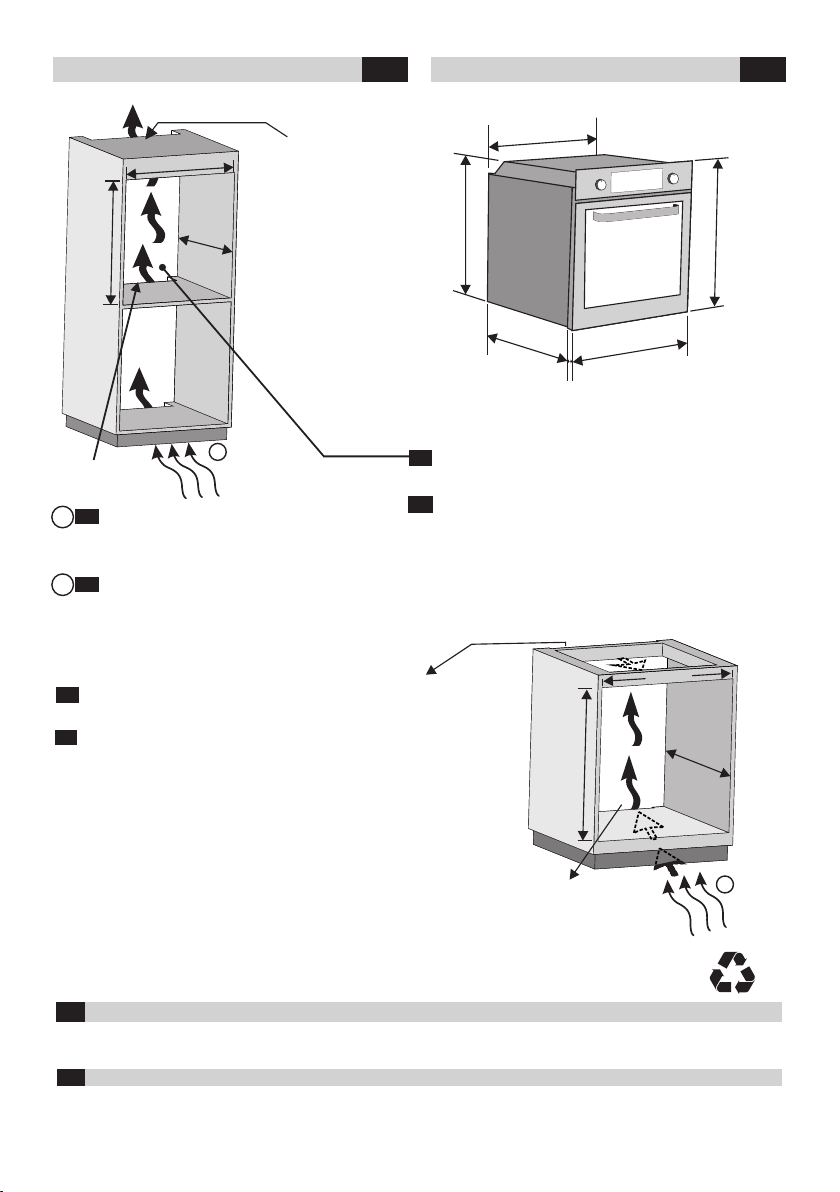
The oven can be located high in a column or under a worktop. Before fixing, you must ensure good
ventilation in the oven space to allow proper circulation of the fresh air required for cooling and
protecting the internal parts. Make the openings specified on last page according to the type of fitting.
NOTE: as the oven could require maintenance work, it is advisable to keep another wall socket available
so that the oven can be connected to this if it is removed from the space in which it is installed. The
power cable must only be substituted by technical service staff or by technicians with equivalent
qualifications.
1.5 Waste management and environmental protection
This appliance is labelled in accordance with European Directive 2012/19/EU regarding
electric and electronic appliances (WEEE). The WEEE contain both polluting substances
(that can have a negative effect on the environment) and base elements (that can be
reused). It is important that the WEEE undergo specific treatments to correctly remove and
dispose of the pollutants and recover all the materials. Individuals can play an important
role in ensuring that the WEEE do not become an environmental problem; it is essential to
follow a few basic rules:
- the WEEE should not be treated as domestic waste;
- the WEEE should be taken to dedicated collection areas managed by the town council or a registered
company.
In many countries, domestic collections may be available for large WEEEs. When you buy a new
appliance, the old one can be returned to the vendor who must accept it free of charge as a one-off, as
long as the appliance is of an equivalent type and has the same functions as the purchased appliance.
SAVING AND RESPECTING THE ENVIRONMENT
Where possible, avoid pre-heating the oven and always try to fill it. Open the oven door as infrequently
as possible, because heat from the cavity disperses every time it is opened. For a significant energy
saving, switch off the oven between 5 and 10 minutes before the planned end of the cooking time, and
use the residual heat that the oven continues to generate. Keep the seals clean and in order, to avoid any
heat dispersal outside of the cavity. If you have an electric contract with an hourly tariff, the "delayed
cooking" programme makes energy saving more simple, moving the cooking process to start at the
reduced tariff time slot.
EN 07
2. Product Description
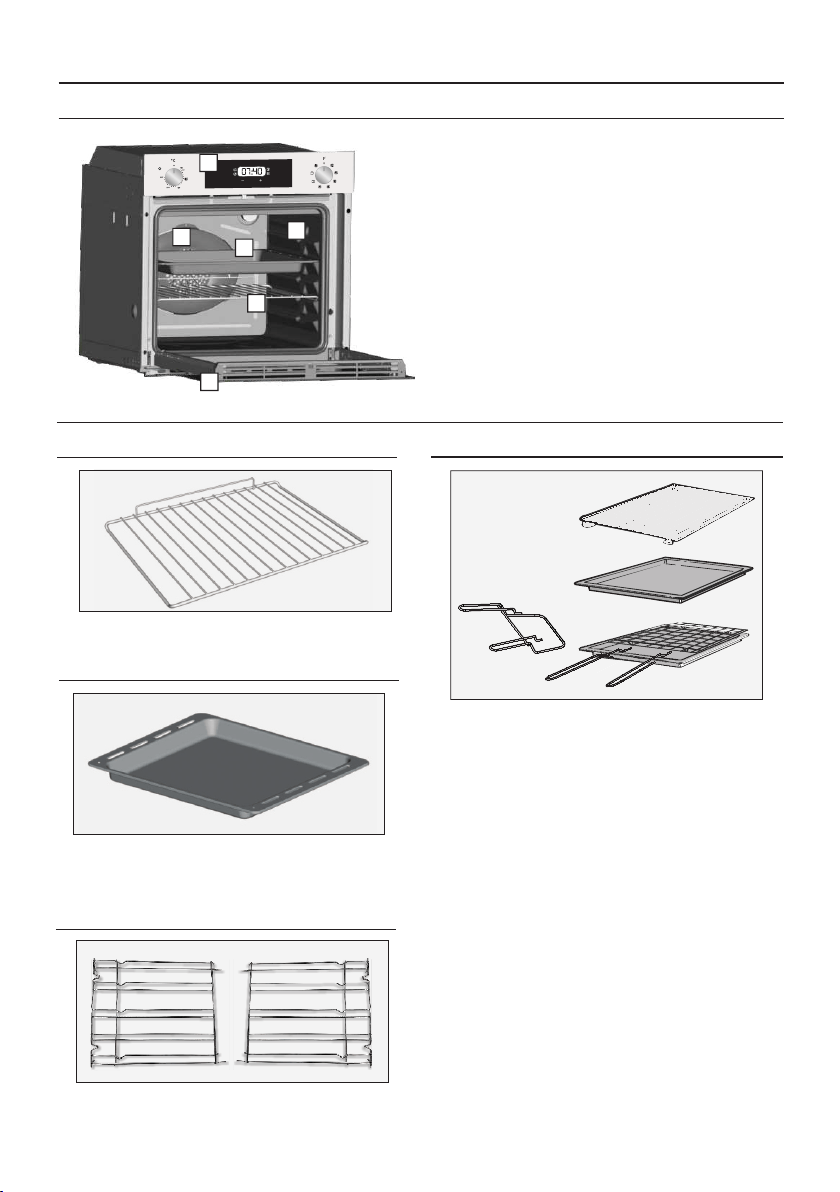
2.1 Overview
1. Control panel
2. Shelf positions
(lateral wire grid if included)
3. Metal grill
4. Drip pan
5. Fan (behind the steel plate)
6. Oven door
EN 08
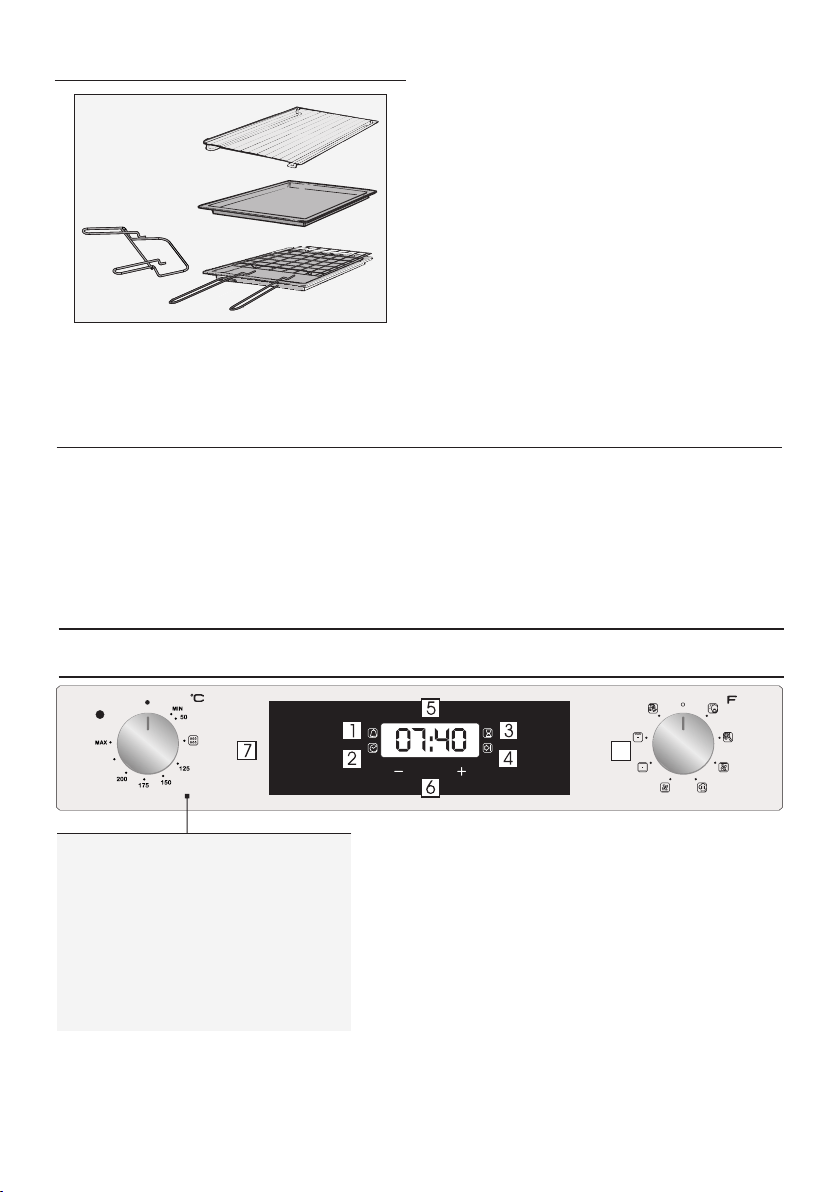
2.2 Accessories
Metal grill
1
Drip pan
2
Holds baking trays and plates.
Collects the residues that drip during the cooking
of foods on the grills.
Lateral wire grids
3
It located at both sides of the oven cavity.
It holds metal grills and drip pans.
4
Grill pan set
The simple shelf can take moulds and dishes.
The tray holder shelf is especially good for grilling things.
Use it with the drip tray.
The special profile of the shelves means they stay
horizontal even when pulled right out. There is no risk of
a dish sliding or spilling.
The drip tray catches the juices from grilled foods. It is
only used with the Grill, Rotisserie, or Fan Assisted Grill ;
remove it from the oven for other cooking methods.
Never use the drip tray as a roasting tray as this creates
smoke and fat will spatter your oven making it dirty.
The tray holder
The tray holder shelf is ideal for grilling. Use it in
conjunction with the drip tray. A handle is included to
assist in moving the both accessories safely. Do no leave
the handle inside the oven.
2
3
5
4
6
MENU
1
MENU
8
EN 09
3. Use of the Oven
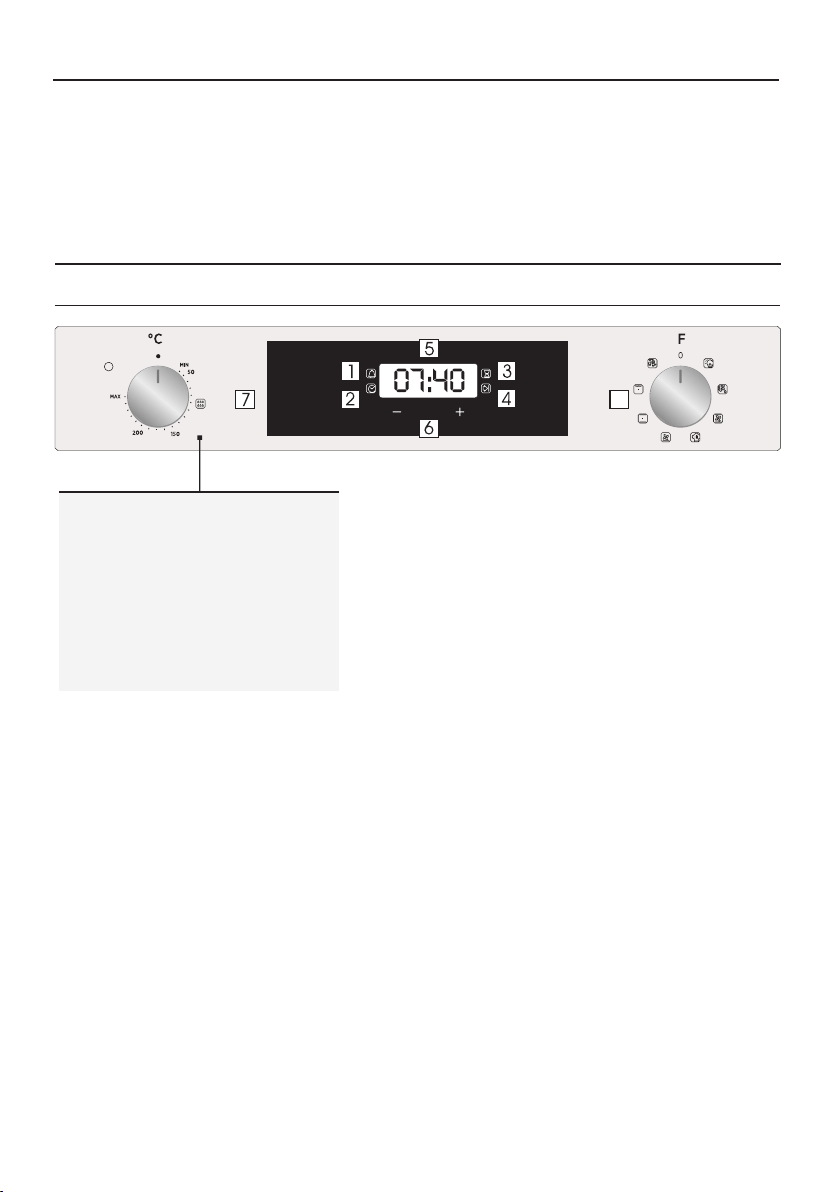
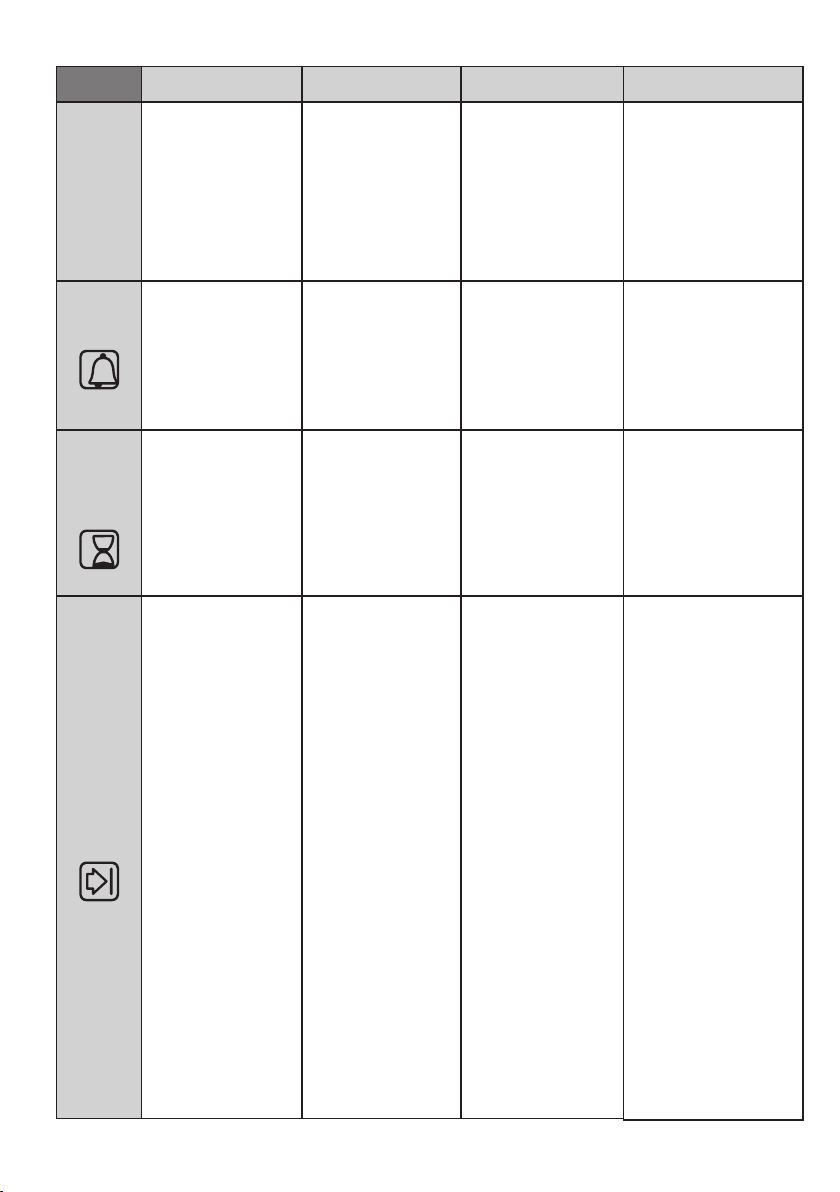
3.1 Display description
1. Minute minder
2. Clock setting
3. Cooking time
4. End of cooking
5. Temperature or clock display
6. LCD display adjustment controls
7. Thermostat selector knob
8. Function selector knob
WARNING : the first operation to carry out after the
oven has been installed or following the
interruption of power supply (this is recognizable
the display pulsating and showing 12:00 ) is setting
the correct time. This is achieved as follows.
•Push the central button.
•Set time with "-" "+" buttons.
•Release all buttons.
ATTENTION: The oven will only operate providing the
clock is set.
2.3 First Use
PRELIMINARY CLEANING
Clean the oven before using for the first time. Wipe over external surfaces with a damp soft cloth. Wash
all accessories and wipe inside the oven with a solution of hot water and washing up liquid. Set the
empty oven to the maximum temperature and leave on for about 1 hour, this will remove any lingering
smells of newness.
EN 10
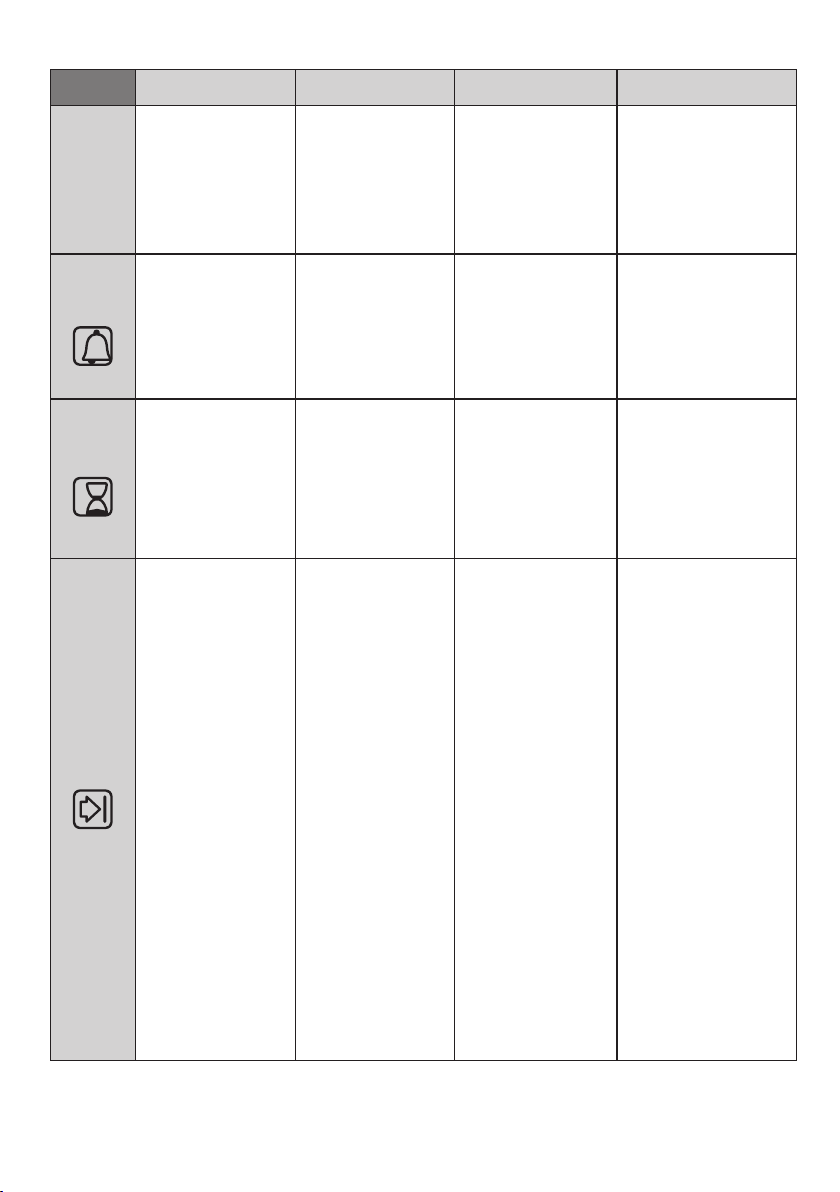
FUNCTIONHOW TO DEACTIVATEWHAT IT DOESWHY IT IS NEEDED HOW TO USE
KEY LOCK
MINUTE
MINDER
COOKING
TIME
END OF
COOKING
•Child Lock function is
activated by touching Set
(+) for a minimum of 5
seconds. From this
moment on all other
function are locked and
the display will flash
STOP and preset time
intermittently.
•Child Lock function is
deactivated by touching
touchpad Set (+) again for
a minimum of 5 seconds.
From this moment on all
functions are selectable
again.
•Push the central button
1 times
•Press the buttons "-"
"+"
to set the required time
•Release all the buttons
•When the set time as
elapsed an audible
alarm is activated (this
alarm will stop on its
own, however it can be
stopped immediately by
pressing the button)
SELECT.
•Sounds an alarm at the
end of the set time.
•
During the process, the
display shows the
remaining time.
•Allows to use the oven as
alarm clock (could be
activated either with
operating the oven or with
out operating the oven)
• Push the central button
2 times
• Press the buttons "-" or
"+"to set the lenght of
cooking required
• Release all buttons
• S et the cooki ng
function with the oven
function selector
• It allows to preset the
cooking time required for
the recipe chosen.
• To check how long is left
to run press the SELECT
button 2 Times.
• To alter/change the
preset time press SELECT
and "-" "+" buttons.
•
Push any button to
stop the signal. Push the
central button to return
to the clock
function.
•When the time is elapsed
the oven will switch off
automatically.
Should you wish to stop
cooking earlier either turn
the function selector to 0, or
set time to 0:00
(SELECT and "-" "+" buttons)
•At the time set, the
oven will switch off. To
switch off manually,
turn the oven function
selector to position O.
•Enables you to set the
end of cooking time
•To check the preset
time p
ush the central
button 3 times
•To modify the preset
time press buttons
SELECT + "-" "+"
•
Push the central button
3 times
•Press the
buttons "-" "+" to set the
time at which you wish
the oven to switch off
•Release the buttons
• Se t t h e co o ki n g
function with the oven
function selector.
•This function is typically
used with “cooking time”
function.
For example if the dish has
to be cooked for 45 minutes
and needs to be ready by
12:30, simply select the
required function, set the
cooking time to 45 minutes
and the end of cooking time
to 12:30.
•At the end of the cooking
set time, the oven will
switch off automatically and
an audible alarm will ring.
• Co o ki n g w il l st a rt
automatically at 11:45
(12:30 minus 45 mins) and
will continue until the pre-
set end-of-cooking-time,
when the oven will switch
itself off automatically.
WARNING.
If the END of cooking is
selected without setting the
length of cooking time, the
oven will start cooking
immediately and it will stop
at the END of cooking time
set.
T °C
default
180
210
210
230
T °C
range
50 ÷ MAX
50 ÷ MAX
50 ÷ MAX
50 ÷ MAX
Function
Dial
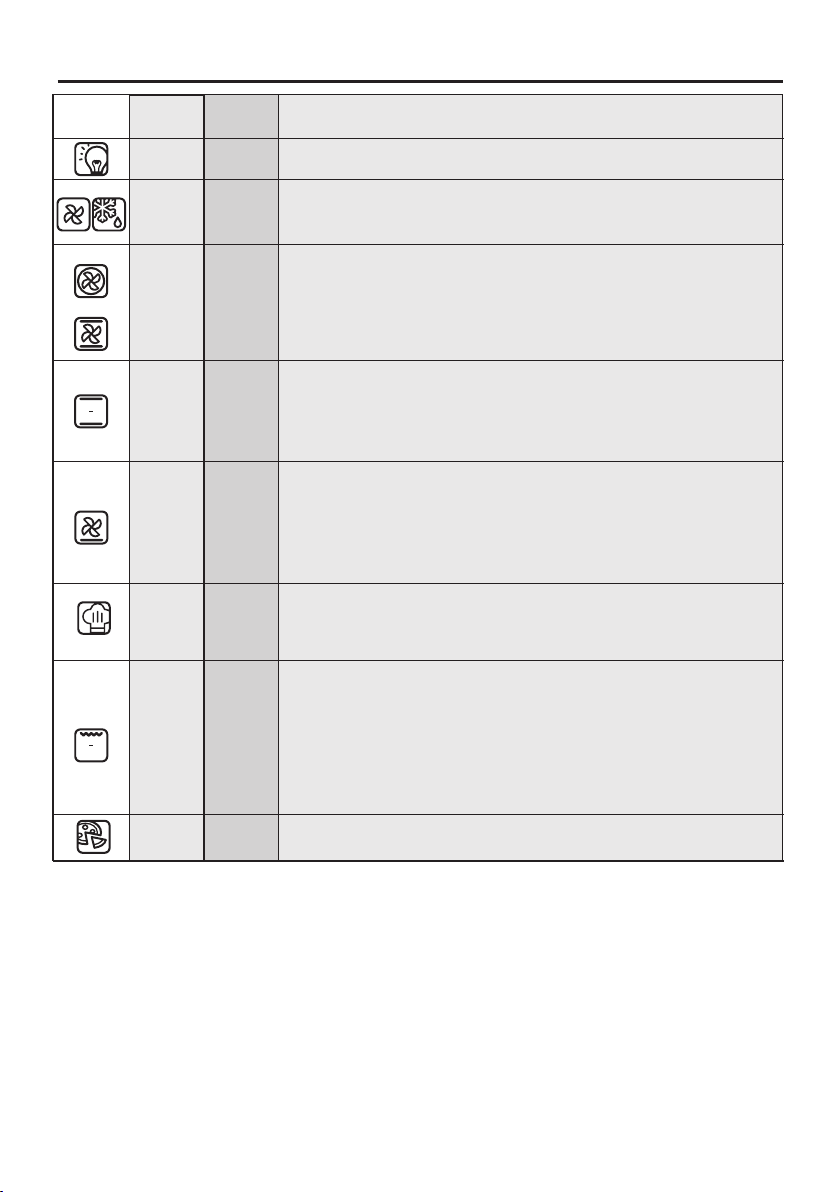
Function (Depends on the oven model)
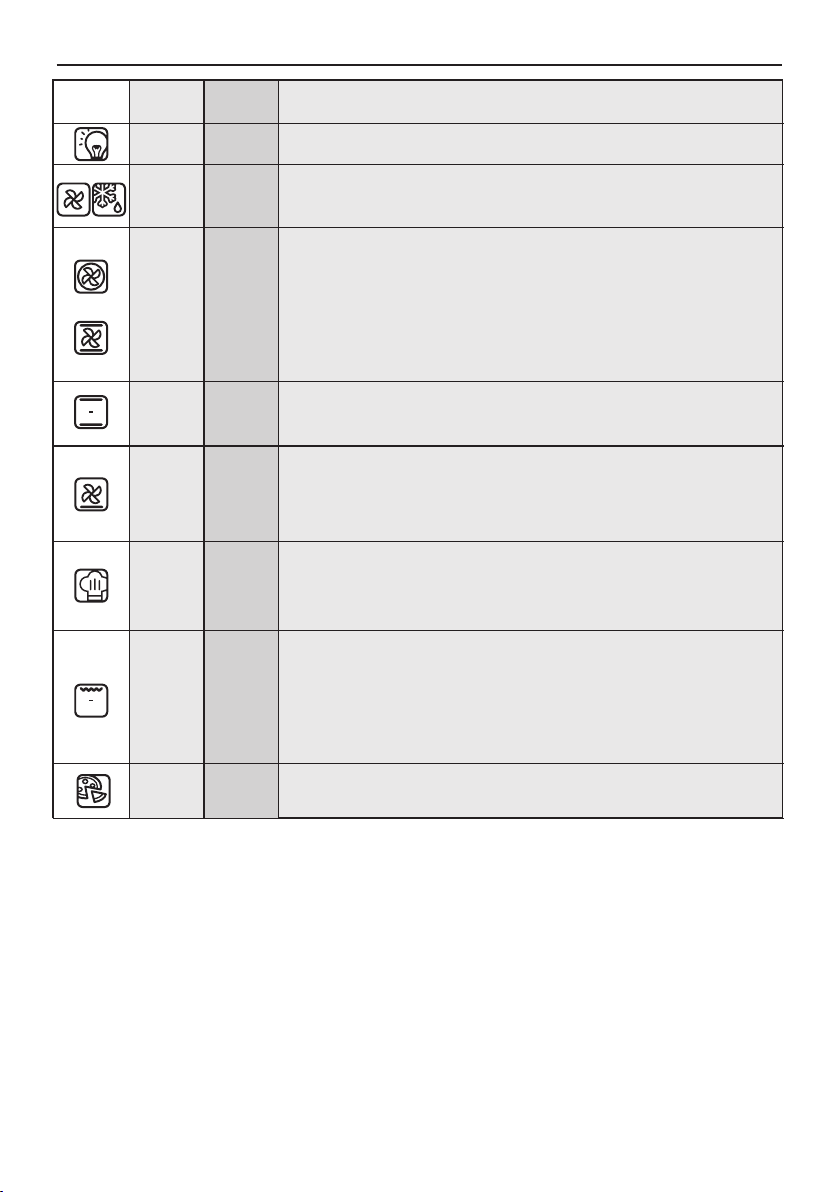
LAMP: Turns on the oven light.
GRILL: use the grill with the door closed.
The top heating element is used alone and you can adjust the temperature. Five
minutes preheating is required to get the elements red-hot. Success is guaranteed
for grills, kebabs and gratin dishes. White meats should be put at a distance from the
grill; the cooking time is longer, but the meat will be tastier. You can put red meats
and fish fillets on the shelf with the drip tray underneath. The oven has two grill
positions:
Grill: 1800 W Barbecue: 3000 W
MULTI-LEVEL: We recommend you use this method for poultry, pastries, fish
and vegetables. Heat penetrates into the food better and both the cooking and
preheating times are reduced. You can cook different foods at the same time
with or without the same preparation in one or more positions. This cooking
method gives even heat distribution and the smells are not mixed.
Allow about ten minutes extra when cooking foods at the same time.
DEFROST: When the dial is set to this position. The fan circulates air at room
temperature around the frozen food so that it defrosts in a few minutes
without the protein content of the food being changed or altered.
* Tested in accordance with the EN 60350-1 for the purpose of energy consumption declaration and energy class
3.3 Cooking Modes
BOTTOM HEATING + FAN: The bottom heating element is used with the fan
circulating the air inside the oven. This method is ideal for juicy fruit flans, tarts,
quiches and pâté.
It prevents food from drying and encourages rising in cakes, bread dough and
other bottom-cooked food.
Place the shelf in the bottom position.
EN 11
22050 ÷ MAX
CONVENTIONAL: Both top and bottom heating elements are used. Preheat
the oven for about ten minutes. This method is ideal for all traditional roasting
and baking. For seizing red meats, roast beef, leg of lamb, game, bread, foil
wrapped food (papillotes), flaky pastry. Place the food and its dish on a shelf in
mid position.
*
PIZZA: With this function hot air circulated in the oven to ensure perfect result
for dishes such as pizza or cake.
22050 ÷ MAX
*
19050 ÷ MAX
MASTER BAKE: This function allows to cook in a healthier way, by reducing the
amount of fat or oil required. The combination of heating elements with a
pulsating cycle of air ensures a perfect baking result.
EN 12
4. Oven cleaning and maintenance
4.1 General notes on cleaning
The lifecycle of the appliance can be extended through regular cleaning. Wait for the oven to cool before
carrying out manual cleaning operations. Never use abrasive detergents, steel wool or sharp objects for
cleaning, so as to not irreparably damage the enamelled parts. Use only water, soap or bleach-based
detergents (ammonia).
GLASS PARTS
It is advisable to clean the glass window with absorbent kitchen towel after every use of the oven. To remove
more obstinate stains, you can use a detergent-soaked sponge, well wrung out, and then rinse with water.
OVEN WINDOW SEAL
If dirty, the seal can be cleaned with a slightly damp sponge.
ACCESSORIES
Clean accessories with a wet, soapy sponge before rinsing and drying them: avoid using abrasive detergents.
DRIP PAN
After using the grill, remove the pan from the oven. Pour the hot fat into a container and wash the pan in hot
water, using a sponge and washing-up liquid.
If greasy residues remain, immerse the pan in water and detergent. Alternatively, you can wash the pan in the
dishwasher or use a commercial oven detergent. Never put a dirty pan back into the oven.
REMOVAL OF THE OVEN WINDOW
1. Open the front window.
2. Open the clamps of the hinge housing on the right and left side of the front window by pushing them
downwards.
3. Replace the window by carrying out the procedure in reverse.
4.2 Maintenance
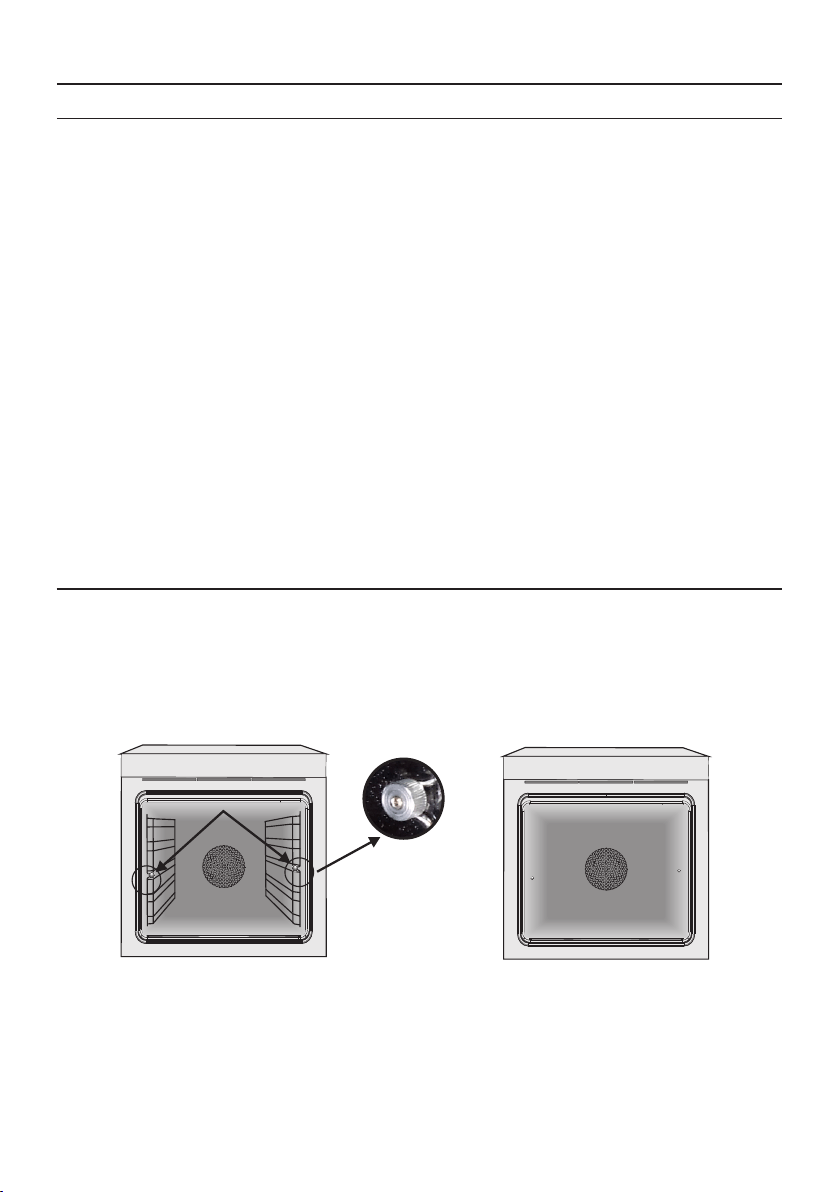
INSTRUCTİON FOR REMOVAL AND CLEANİNG OF THE SİDE RACKS
1. Unscrew the bolt in an anti-clockwise direction.
2. Remove the side racks by pulling them towards you.
3. Clean the side racks in a dishwasher or with a wet sponge and then dry them immediately.
4. Having cleaned the side racks, put them back in and reinsert the bolts, ensuring that they are fully
tightened.
A
300 ml
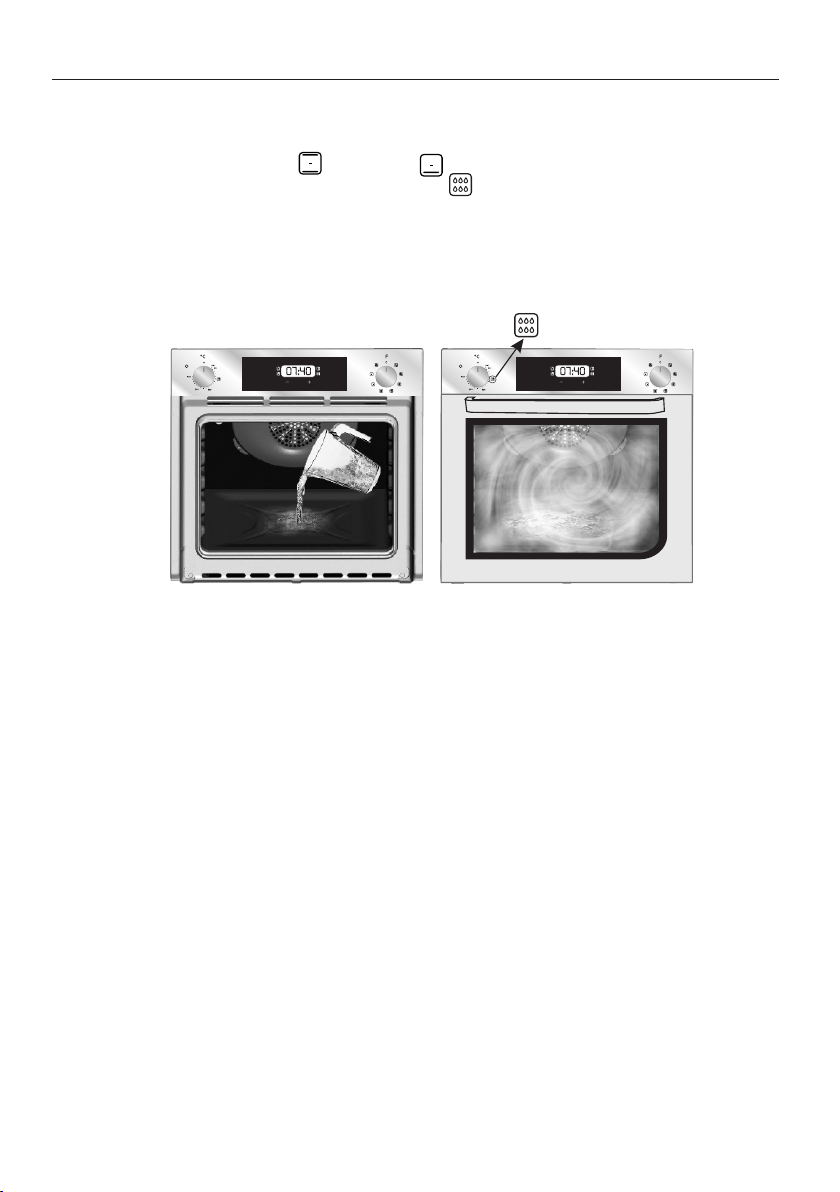
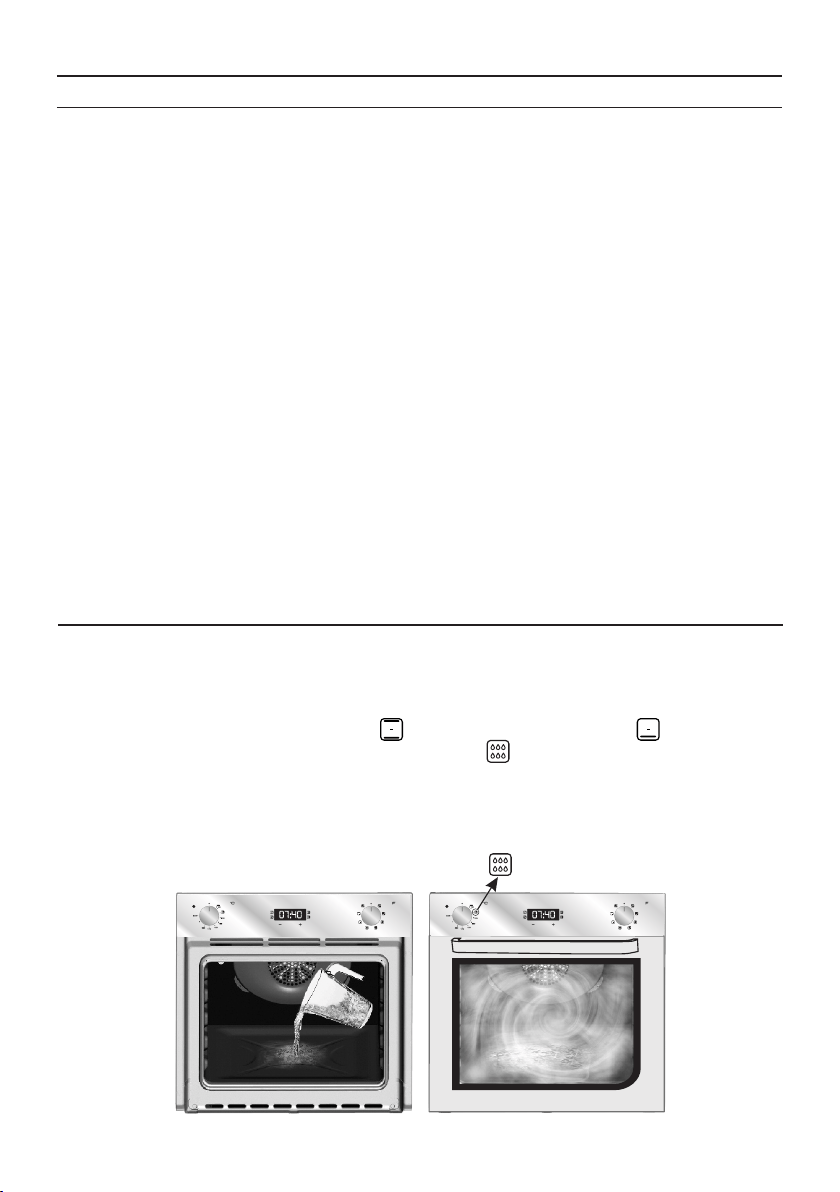
The HYDRO EASY CLEAN procedure uses steam to help remove remaining fat and food particles from
the oven.
1. Pour 300 ml of water into the HYDRO EASY CLEAN container at the bottom of the oven.
2. Set the oven function to Static ( ) or Bottom ( )heater
3. Set the temperature to the HYDRO EASY CLEAN icon
4. Allow the program to operate for 30 minutes.
5. After 30 minutes switch off the program and allow the oven to cool down.
6. When the appliance is cool, clean the inner surfaces of the oven with a cloth.
Warning
Make sure that the appliance is cool before you touch it. Care must be taken with all hot surfaces as there
is a risk of burns. Use distilled or drinkable water.
4.3 Hydro Easy Clean Function
EN 13
MENU MENU
LOW-E
1
2
3
1.
2.
3.
4.
5.
6.
7.
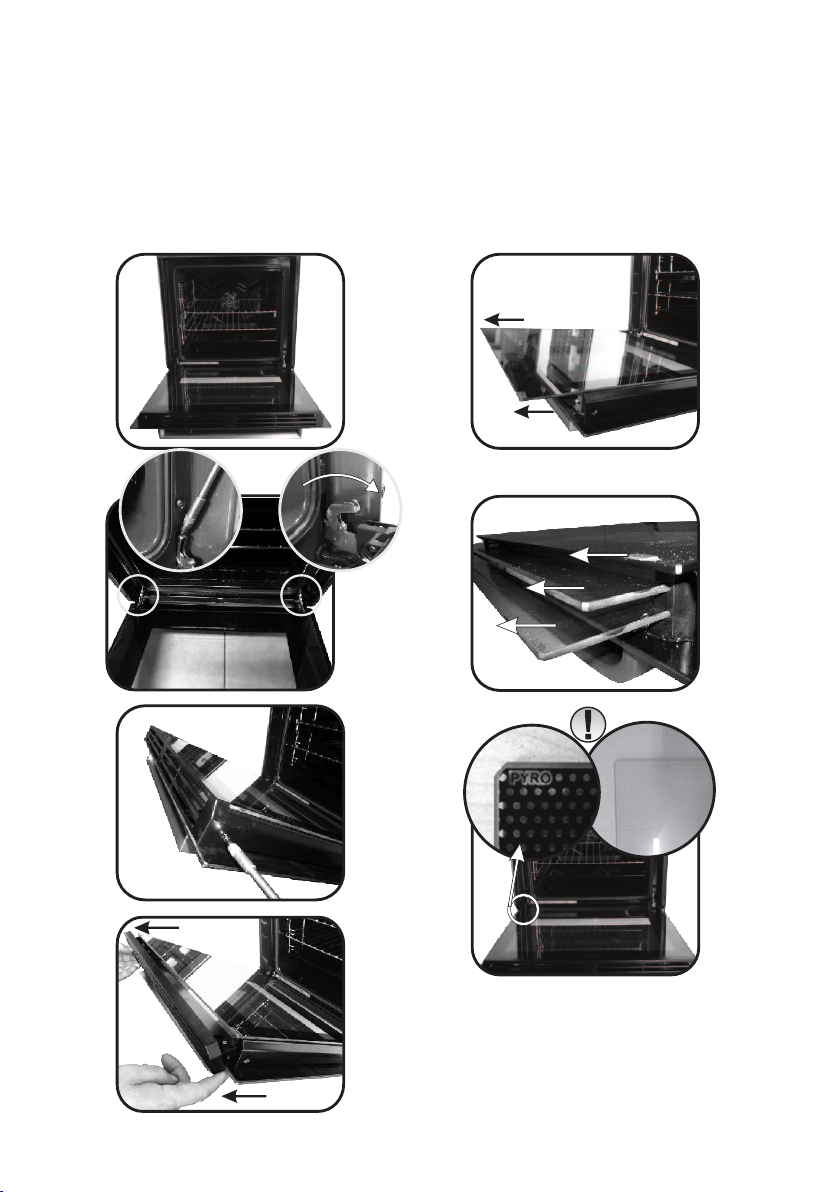
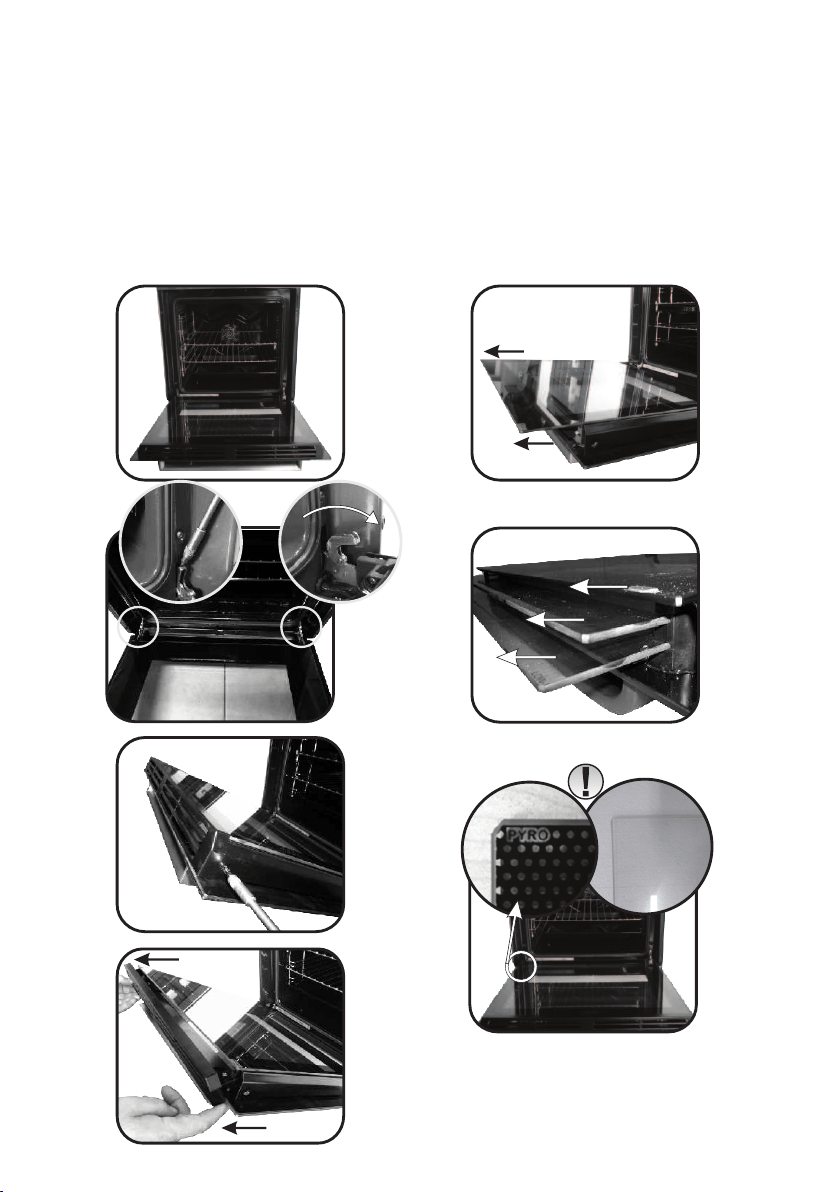
REMOVAL AND CLEANING OF THE GLASS DOOR
1. Open the oven door.
2.3.4. Lock the hinges, remove the screws and remove the upper metal cover by pulling it upwards.
5.6. Remove the glass, carefully extracting it from the oven door (NB: in pyrolytic ovens, also remove
the second and third glass (if present)).
7. At the end of cleaning or substitution, reassemble the parts in reverse order.
On all glass, the indication "Low-E" must be legible and positioned on the left side of the door, close to
the left-hand lateral hinge. In this way, the printed label of the first glass will be inside the door.
EN 14
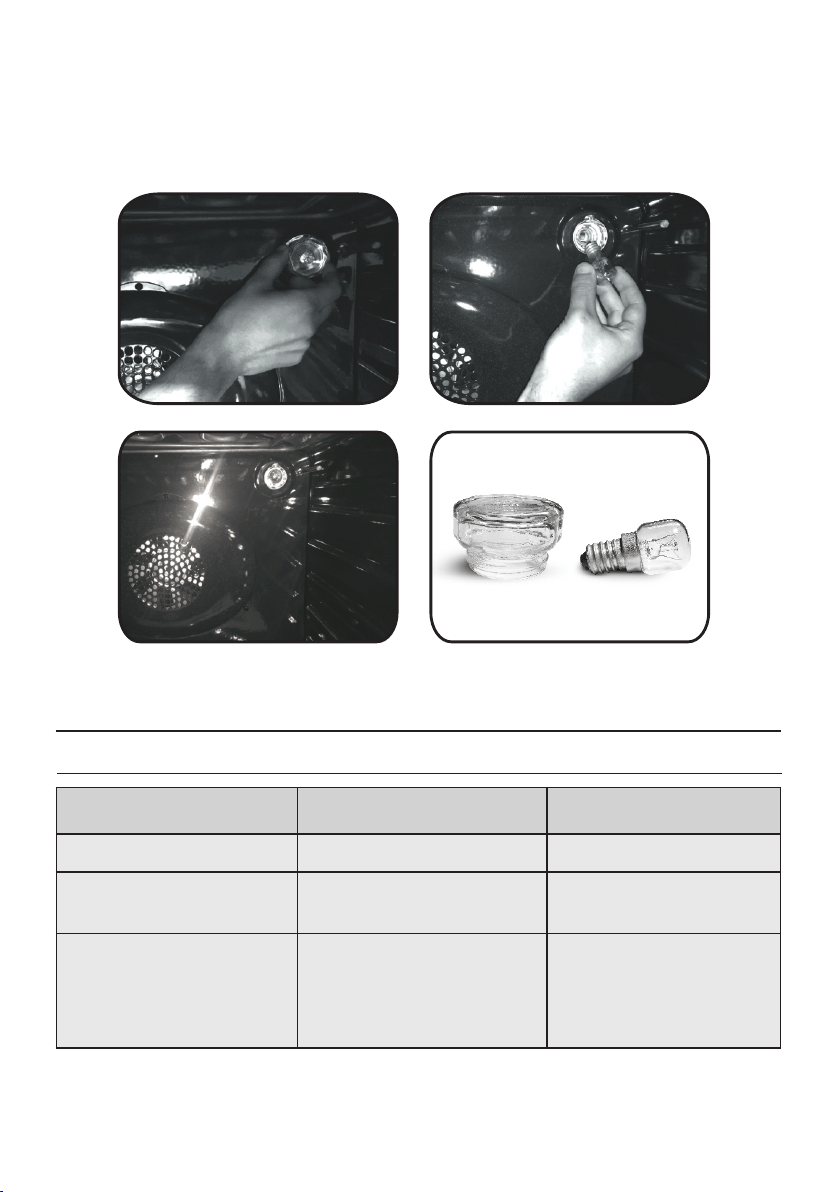
CHANGING THE BULB
1. Disconnect the oven from the mains supply.
2. Undo the glass cover, unscrew the bulb and replace it with a new bulb of the same type.
3. Once the defective bulb is replaced, replace the glass cover.
5. Troubleshooting
5.1 FAQ
PROBLEMPOSSIBLE CAUSE SOLUTION
The oven does not heat up
The clock is not setSet the clock
A cooking function and
temperature has not been set
Ensure that the necessary
settings are correct
The oven does not heat up
EN 15
Steam and condensation on
the user interface panel
Clean with a microfiber
cloth the user interface
panel to remove the
condensation layer
No reaction of the touch
user interface

Indicaciones de seguridad
• Durante la cocción, podría condensarse humedad dentro de la
cavidad del horno o en el cristal de la puerta. Esto es normal. Para
reducir este efecto, espere de 10 a 15 minutos antes de introducir
alimentos en el horno una vez que lo encienda. De todos modos, la
condensación desaparece cuando el horno alcanza la temperatura
de cocción.
• Para cocinar verduras, póngalas en un recipiente con una tapa en
lugar de utilizar una bandeja sin cubrir.
• Evite dejar los alimentos en el horno más de 15/20 minutos
después de cocinarlos.
• ATENCIÓN: el electrodoméstico y todas sus piezas se calientan
durante el uso. Tenga cuidado de no tocar las partes calientes.
• ATENCIÓN: las piezas accesibles pueden calentarse cuando el grill
está funcionando.
Mantenga el aparato fuera del alcance de los niños.
• ATENCIÓN: asegúrese de que el electrodoméstico esté apagado
antes de sustituir la bombilla para evitar la posibilidadde descargas
eléctricas.
• ATENCIÓN: con el fin de evitar cualquier peligro debido a un
restablecimiento accidental del dispositivo térmico de interrupción,
este aparato no debe recibir alimentación mediante dispositivos de
conmutación externos como temporizadores, ni conectarse a un
circuito regularmente alimentado o interrumpido por el servicio.
• Los niños menores de 8 años deben mantenerse a una distancia
segura del aparato si no son supervisados continuamente.
• Los niños no deben jugar con el electrodoméstico. Pueden utilizarlo
niños a partir de 8 años de edad y personas con facultades físicas,
sensoriales o mentales reducidas, o con falta de experiencia y
conocimiento, si lo emplean bajo supervisión o se les instruye acerca
de la seguridad del producto y entienden los riesgos que comporta.
• La limpieza y el mantenimiento no deben ser llevados a cabo por
ES 16

niños sin supervisión.
• No utilice materiales rugosos o abrasivos ni rasquetas metálicas
afiladas para limpiar las puertas de vidrio del horno, ya que pueden
rayar la superficie y agrietar el vidrio.
• Apague el horno antes de sacar las partes extraíbles.
• Después de la limpieza, vuelva a montarlas siguiendo las
instrucciones.
• Utilice únicamente la sonda térmica recomendada para este horno.
• No utilice limpiadores de vapor.
• Conecte un enchufe en el cable que transporta la tensión, la
corriente y la carga indicadas en la etiqueta y que tiene el contacto de
masa. La toma de corriente debe ser la adecuada para la carga
indicada en la etiqueta y debe funcionar correctamente. El
conductor de toma de tierra se caracteriza por los colores amarillo y
verde. Esta operación debe realizarla un profesional debidamente
cualificado. Si la toma de corriente es incompatible con el enchufe
del electrodoméstico, pida a un electricista profesional que sustituya
la toma por otra del tipo adecuado. El enchufe y la toma deben
cumplir las normas actuales del país donde se instala el
electrodoméstico.
Se puede efectuar también la conexión a la red interponiendo, entre
el aparato y la red, un interruptor omnipolar dimensionado a la carga
y conforme con la normativa vigente. El cable de tierra amarillo y
verde no debe interrumpirse con el interruptor. La toma o el
interruptor omnipolar usados para la conexión deben ser fácilmente
accesibles para el electrodoméstico instalado.
• La desconexión puede realizarse mediante el enchufe accesible o
mediante la incorporación de un interruptor en el cableado fijo con
arreglo a las normativas de cableado.
• Si el cable de alimentación está dañado, debe sustituirse por un
cable o un haz de cables especial comercializado por el fabricante;
ES 17

también puede ponerse en contacto con el departamento de
atención al cliente.
• El cable de alimentación debe ser de tipo H05V2V2-F.
• Esta operación debe realizarla un profesional debidamente
cualificado. El conductor de toma de tierra (amarillo y verde), debe
ser aproximadamente 10 mm más largo que los otros conductores.
Para cualquier reparación, diríjase únicamente a un centro de
asistencia técnica autorizado y solicite que se empleen recambios
originales.
• El incumplimiento de r las indicaciones anteriores puede poner en
peligro la seguridad del electrodoméstico y anular la garantía.
• Los excesos de material deben retirarse antes de limpiar.
• Una interrupción prolongada de la corriente durante una fase de
cocción puede causar una avería en el monitor. Póngase en contacto
con el servicio de atención al cliente si esto ocurre.
• El electrodoméstico no debe instalarse detrás de una puerta
decorativa para evitar que se caliente en exceso.
• Cuando coloque la bandeja interior, asegúrese de dirigir el tope
hacia arriba en la parte trasera de la cavidad. La bandeja debe
introducirse por completo en la cavidad
• ATENCIÓN: No forre las paredes del horno con aluminio u otras
protecciones comercializadas. El aluminio o los protectores podrían
derretirse al entrar en contacto directo con el esmalte caliente y
deteriorar el esmalte del interior.
• ATENCIÓN: No quite nunca la junta de estanqueidad de la puerta
del horno.
• ATENCIÓN: No llene el fondo del horno con agua durante la cocción
o cuando esté caliente.
• No es necesario llevar a cabo operaciones/configuraciones
adicionales para que el electrodoméstico funcione a las frecuencias
nominales.
ES 18

Resumen
Advertencias generales
20
1.1 Recomendaciones de seguridad
1.2 Seguridad eléctrica
1.3 Recomendaciones
1.4 Instalación
1.5 Gestión de residuos
2.1 Descripción general
2.2 Accesorios
2.3 Primer uso
Descripción del producto
22
3.1 Descripción de la pantalla
3.2 Modalidades de cocción
Utilización del horno
23
4.1 Notas genéricas de limpieza
4.2 Función Hydro Easy Clean
4.3 Mantenimiento
• Extracción y limpieza de las
resistencias
• Extracción de la puerta del horno
• Extracción y limpieza de la puerta
de vidrio
• Sustitución de la bombilla
Limpieza y mantenimiento
del horno
26
5.1 Preguntas más frecuentes
Solución de problemas
29
ES 19

1. Advertencias Generales
Le agradecemos que haya elegido uno de nuestros
productos. Para utilizar el horno de forma óptima es
aconsejable leer con atención este manual y
conservarlo para poder consultarlo en el futuro. Antes
de instalar el horno, anote el número de serie para
poder facilitárselo al personal del servicio de asistencia
técnica en caso de solicitar su intervención. Después de
extraer el horno del embalaje, compruebe que no haya
sufrido daño alguno durante el transporte. En caso de
duda, no utilice el horno y solicite la asistencia de un
técnico cualificado. Conserve todo el material de
embalaje (bolsitas de plástico, poliestireno, clavos)
fuera del alcance de los niños. La primera vez que se enciende el horno puede producirse un humo de
olor acre, causado por el primer calentamiento del adhesivo de los paneles de aislamiento que recubren
el horno: se trata de un fenómeno absolutamente normal y, en caso de que se produzca, será preciso
esperar a que cese el humo antes de introducir los alimentos. El fabricante declina toda responsabilidad
en caso de no observar las instrucciones contenidas en este documento.
NOTA: las funciones, las propiedades y los accesorios de los hornos citados en este manual pueden
variar según los modelos.
1.1 Recomendaciones de seguridad
Utilice el horno solo con el fin para el que se ha diseñado, es decir: únicamente para cocer alimentos;
cualquier otro uso, por ejemplo como fuente de calefacción, se considera impropio y por lo tanto
peligroso. El fabricante no puede ser considerado responsable de eventuales daños derivados de usos
impropios, erróneos o irracionales.
El uso de cualquier aparato eléctrico comporta la observación de una serie de reglas fundamentales:
- no tirar del cable de alimentación para desenchufar el conector de la toma de corriente;
- no tocar el aparato con las manos ni los pies mojados o húmedos;
- en general no es aconsejable usar adaptadores, regletas ni alargadores;
- en caso de avería o mal funcionamiento del aparato, apáguelo y no lo manipule.
1.2 Seguridad eléctrica
CONFÍE LA CONEXIÓN ELÉCTRICA A UN ELECTRICISTA O A UN TÉCNICO CUALIFICADO.
La red de alimentación a la que se conecte el horno debe cumplir la normativa vigente en el país de
instalación. El fabricante declina toda responsabilidad por eventuales daños derivados de no observar
dicha normativa. El horno debe conectarse a la red eléctrica mediante un enchufe de pared con toma de
tierra o mediante un seccionador con varios polos, según la normativa vigente en el país de instalación.
La red eléctrica debe estar protegida mediante fusibles adecuados y deben utilizarse cables con una
sección transversal idónea que garantice una correcta alimentación del horno.
CONEXIÓN
El horno se suministra con un cable de alimentación que debe conectarse únicamente a una red
eléctrica con una tensión de 220-240 V de CA entre fases o entre la fase y el neutro. Antes de conectar el
horno a la red eléctrica es imprescindible comprobar:
- la tensión de alimentación indicada por el medidor;
- la configuración del seccionador.
El hilo de toma de tierra conectado al terminal de tierra del horno debe estar conectado al terminal de
tierra de la red eléctrica.
ATENCIÓN
Antes de conectar el horno a la red eléctrica, confíe la comprobación de la continuidad de la toma de
tierra de la red eléctrica a un electricista cualificado. El fabricante no se hace responsable de eventuales
accidentes u otros problemas derivados de no conectar el horno a tierra o de conectarlo a una toma de
tierra con una continuidad defectuosa.
ES 20
1.3 Recomendaciones
Una limpieza mínima después de utilizar el horno ayudará a mantenerlo limpio durante más tiempo. No forrar
las paredes del horno con aluminio u otras protecciones disponibles en tiendas. El aluminio o los protectores,
en contacto directo con el esmalte caliente puede derretirse y deteriorar el esmalte del interior. Para evitar un
exceso de suciedad en el horno y que pueden derivar en olores y humo en exceso, recomendamos no utilizar
el horno a temperaturas muy elevadas. Es mejor ampliar el tiempo de cocción y bajar un poco la temperatura.
1.4 Instalación
No es obligación del fabricante instalar el horno. Si se requiere la ayuda del fabricante para subsanar fallos
derivados de una instalación incorrecta, dicha asistencia no la cubrirá la garantía.
Han de seguirse a rajatabla las instrucciones de instalación para personal cualificado. Una instalación
incorrecta puede provocar daños personales, materiales o en animales. El fabricante no se hace responsable
de esos posibles daños.
El horno se puede colocar encima, en una columna, o debajo de una encimera. Antes de fijar el horno hay que
asegurar una buena ventilación en el hueco donde se vaya a colocar y que el aire necesario para enfriar y
proteger las piezas internas circula sin problema. Realizar las aperturas especificadas en la última página
según el tipo de altura.
1.5 Gestión de residuos y respeto por el medio ambiente
Este aparato está certificado conforme a la directiva europea 2012/19/EU sobre aparatos
eléctricos y electrónicos (WEEE). Los dispositivos WEEE contienen sustancias contaminantes
(que pueden provocar consecuencias negativas en el medio ambiente) o componentes
básicos (que pueden reutilizarse). Es importante que dichos dispositivos estén sujetos a
tratamientos específicos para eliminar y desechar correctamente todos los contaminantes y
recuperar todos los materiales. Cada individuo puede desempeñar un papel importante a la
hora de asegurar que los dispositivos WEEE no se conviertan en un problema
medioambiental; es esencial seguir algunas reglas básicas:
- los dispositivos WEEE no deben tratarse como residuos domésticos;
- los dispositivos WEEE deben llevarse a los puntos de recogida específicos gestionados por el municipio o
por una sociedad registrada.
En muchos países, para los WEEE de grandes dimensiones, puede haber disponible un servicio de
recogida a domicilio. Cuando se compra un nuevo aparato, el viejo puede entregarse al vendedor, que
debe adquirirlo gratuitamente siempre que el aparato sea de tipo equivalente y tenga las mismas
funciones que el que se ha adquirido.
AHORRAR Y RESPETAR EL MEDIO AMBIENTE
Siempre que sea posible, evite precalentar el horno e intente utilizarlo siempre lleno. Abra la puerta del
horno lo menos posible, ya que se producen dispersiones de calor cada vez que se lleva a cabo esta
operación. Para ahorrar mucha energía basta apagar el horno de 5 a 10 minutos antes del fin del tiempo
de cocción planificado y servirse del calor que el horno continúa generando. Mantener las juntas limpias y
en buen estado para evitar posibles dispersiones de energía. Si se dispone de un contrato de energía
eléctrica por tarifa horaria, el programa de cocción retardada permitirá ahorrar más fácilmente
retrasando el encendido del horno hasta el horario de tarifa reducida.
NOTA: puesto que el horno podría requerir la intervención del servicio de asistencia, es aconsejable
prever la disponibilidad de otro enchufe de pared al que conectar el horno después de extraerlo del
espacio donde se ha instalado. El cable de alimentación debe sustituirse únicamente por personal de
asistencia técnica o por técnicos con una cualificación análoga.
Cuando se apaga el horno puede aparecer una luz de baja intensidad alrededor del interruptor general
situado en el centro. Esto puede evitarse poniendo el conector del revés o intercambiando los
terminales de alimentación.
ES 21
2. Descripción del producto
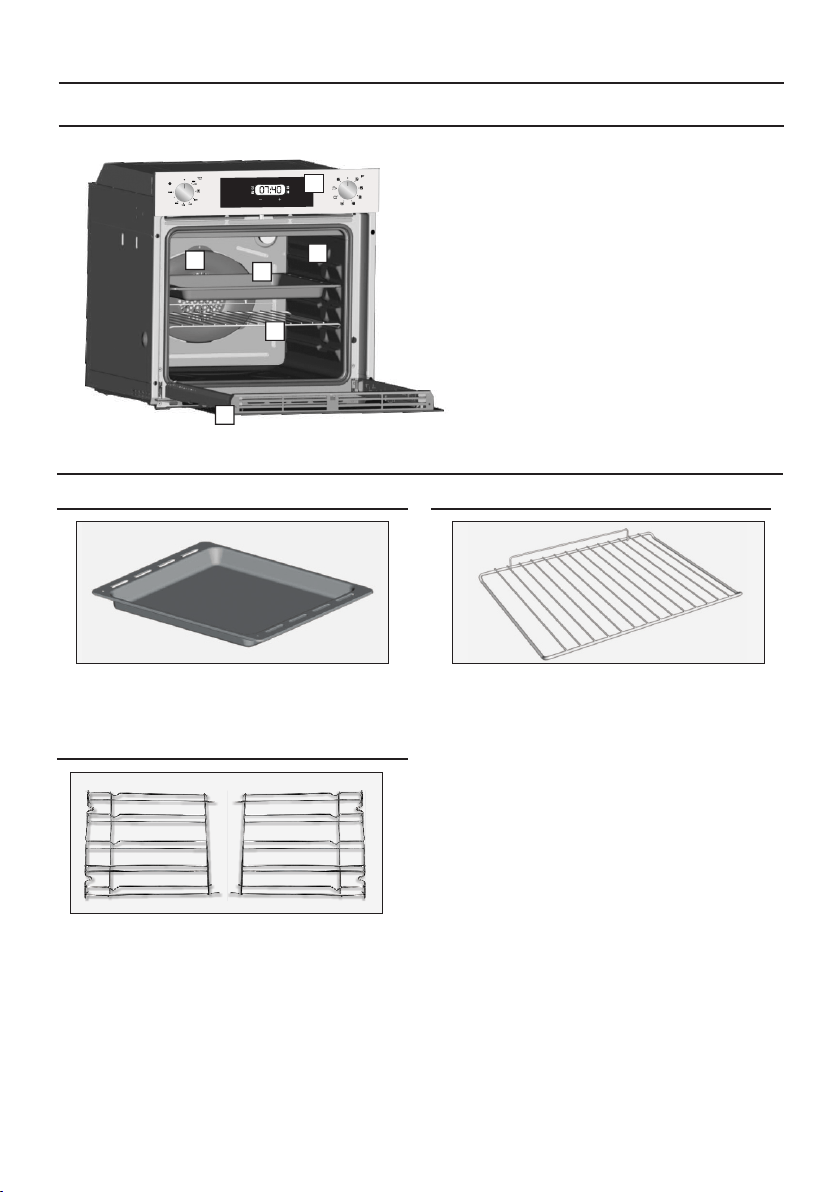
2.1 Descripción general
1. Panel de control
2. Posiciones de las bandejas
(y del soporte elevado si corresponde)
3. Rejilla metálica
4. Bandeja
5. Ventilador (detrás de la placa de acero)
6. Puerta del horno
2.2 Accesorios
1 Bandeja
Recoge los residuos que gotean durante la
cocción de alimentos con las resistencias.
2
3
5
4
6
1
MENU
1
Soportes laterales
2
Se encuentran en ambos lados del hueco del
horno. Sostienen las rejillas metálicas y las
bandejas graseras.
3 Rejilla metálica
Sostiene fuentes y platos.
ES 22
2.3 Primer uso
LIMPIEZA PRELIMINAR
Limpie el horno antes de utilizarlo por primera vez. Limpie las superficies externas con un paño suave
levemente humedecido.
Lave todos los accesorios y limpie el interior del horno con detergente lavavajillas y agua caliente.
Compruebe que el horno esté vacío, seleccione la temperatura máxima y déjelo encendido durante un
mínimo de una hora para eliminar todos los olores que suele haber presentes en los hornos nuevos.
3. Uso del horno
3.1 Descripción de la pantalla
MENU
8
ATENCIÓN: la primera operación que hay que
efectuar después de la instalación o después de
una interrupción de la corriente (este tipo de
situaciones se reconocen al observar que en la
pantalla de visualización parpadea la hora 12:00
) es el ajuste de la hora, como se indica a
continuación:
•Pulse el botón central 4 vez.
•Ajustar la hora con los botones "-" "+".
•Suelte las teclas.
ATENCIÓN: El horno funciona sólo si la hora está
programada.
1- Temporizador
2- Configuración del reloj
3- Tiempo de cocción
4- Fin de la cocción
5- Display para temperatura o tiempo
6- Teclas para pulsar
7- Selección de temperatura
8- Selección de función
ES 23
4
Juego de sartén para parrilla
El estante simple puede contener moldes y platos.
El estante del soporte de la bandeja es especialmente
bueno para asar cosas. Úselo con la bandeja de goteo.
El perfil especial de los estantes significa que permanecen
horizontales incluso cuando se extraen. No hay riesgo de
que un plato se resbale o se derrame.
La bandeja de goteo recoge los jugos de los alimentos a la
parrilla. Solo se usa con la parrilla, el asador o la parrilla
asistida por ventilador; retírelo del horno para otros
métodos de cocción.
Nunca use la bandeja de goteo como bandeja para asar, ya
que esto genera humo y la grasa salpicará su horno y lo
ensuciará.
El soporte de la bandeja
El estante del soporte de la bandeja es ideal para asar a la
parrilla. Úselo junto con la bandeja de goteo. Se incluye un
asa para ayudar a mover ambos accesorios de forma segura.
No deje el asa dentro del horno.
•Pulse el botón central
1 vez
•Pulse las teclas"-" "+"
para ajustar la duración
•Suelte las teclas
• Cuando transcurre el
tiempo seleccionado, el
funcionamiento se para
solo y avisa con una señal
acú st ica ( la s eñal
acústica se para sola;
interrumpirlo
inmediatamente pulse la
tecla SELECT
•Emite una señal acústica
finalizado el tiempo
establecido
•Durante el
funcionamiento, la
pantalla muestra el
tiempo restante.
•Emite una señal acústica
finalizado el tiempo
establecido
•Durante el
funcionamiento, la pantalla
muestra el tiempo restante.
•Pulse el botón central 2
veces
•Pulse las teclas "-" "+"
para el ajuste de la
duración
•Sue lte las te clas
•Seleccione la función
de cocción con el mando
selector de función.
•Permite seleccionar el
tiempo de cocción del
alimento introducido en
el horno.
•Para visualizar el tiempo
restante pulse la tecla
SELECT.
•Para modificar el tiempo
restante, pulse la tecla
SELECT+ "-" “+"
•Cuando transcurre el
tiempo seleccionado, el
horno se desconecta
solo; párelo antes de
s it u er el ma n do
selector de función en la
posición O ó ajuste a
0:00 el tiempo de la
cocción (teclas SELECT
"-" "+".
•Para detener la señal,
pulse cualquier tecla.
Pulse el botón central
para volver a la función
de reloj.
•A la hora seleccionada
el horno se
desconectará solo; si
desea interrumpirlo,
situer antes el mando
selector de función en la
posición O.
•Permite memorizar la
hora de fin de la cocción.
•Para visualizar la hora
rogramada, Pulse el
botón central 3 veces
•Para modificar la hora
programada, pulse las
teclas END +"-" "+"
•Pulse el botón central 3
veces
•Pulse las teclas "-" "+"
para ajustar la hora del
fin de cocción.
•Sue lte las te clas
•Seleccione la función
de cocción con el mando
selector de función.
Normalmente se utiliza esta
función con la finalidad de
DURACIÓN DE LA COCCIÓN
A modo de ejemplo: el
alimento debe cocinarse
durante 45 minutos y deseo
que esté listo para las 12:30;
en tal caso. Seleccione la
función de cocción deseada.
Ajuste el tiempo de la
cocción en 45 minutos ( "-"
"+") Ajuste el fin de la cocción
a las 12:20 h. ("-" "+" ).
•Cuando termina el tiempo
seleccionado, el horno se
desconecta automática-
mente y avisa emitiendo una
señal acústica.
La cocción comenzará auto-
máticamente a las11:45 h
(12:30, menos 45minutos), y
a la hora seleccionada como
fin de la cocción el horno se
desconectará automática-
mente.
ATENCIÓN: Si selecciona
únicamente el fin de
cocción sin el tiempo de
cocción, el horno se
conectará inmediatamente
y se desconectará a la hora
de fin de la cocción
seleccionada.
MODO DE
ACTIVACIÓN
MODO DE
DESCONEXIÓN
FUNCIONAMIENTOFINALIDAD
BLOQUEO
PARA
NIÑOS
Para desactivar la
función del “Bloqueo
para niños”, se debe
pulsar nuevamente “Set
(+)” durante un mínimo
de 5 segundos. A partir
de este momento, todas
las funciones están
disponibles.
Para activar la función del
“Bloqueo para niños”, se
debe pulsar “Set (+)”
durante un mínimo de 5
segundos, A partir de
este momento, todas las
demás funciones están
loqueadas El display
m ue str a ST O P y
s e le c c io n a r h o ra
alternativamente.
MINUTERO
DURACIÓN
DE LA
COCCIÓN
FIN DE LA
COCCIÓN
FUNCIÓN
ES 24
*
PIZZA : El calor envolvente en esta modalidad genera un ambiente similar al de
los hornos de leña de las pizzerías.
3.2 Modalidades de cocción
Mando
selector
FUNCIÓN ()dependiendo del modelo
T°C
establecida
Rango
de T°C
LAMPARA : Conecta la luz interior
DESCONGELACIÓN : Funcionamiento de la turbina de cocción que hace
circular el aire dentro del espacio del horno. Ideal para realizar una
descongelación previa a una cocción.
MULTINIVEL : Utilización simultánea de la resistencia inferior, superior y de la
turbina que hace circular el aire dentro del espacio del horno. Función
recomendada para las aves, la repostería, los pescados, las verduras... El calor
penetra mejor dentro del alimento a cocer reduciendo el tiempo de cocción,
así como el tiempo de precalentamiento. Se pueden realizar cocciones
combinadas con preparaciones idénticas o distintas en uno o dos niveles. Este
modo de cocción garantiza una distribución homogénea del calor y no mezcla
los olores. Para una cocción combinada se deben prever unos diez minutos
más.
CONVECCIÓN : Funcionan la resistencia inferior y la resistencia superior del
horno. Es la cocción tradicional, ideal para cocinar asados, caza, galletas,
manzanas al horno y para conseguir alimentos crujientes.
RESISTENCIA INFERIOR CIRCULANTE : Utilización de la resistencia inferior más
la turbina que hace circular el aire dentro del espacio del horno. Ideal para
hacer tartas de frutas jugosas, tortadas, quiches, pasteles. Evita que se sequen
los alimentos y favorece la subida de bizcochos, masa de pan y otras cocciones
realizadas por debajo. Coloque la rejilla en la ranura inferior.
MASTER BAKE: Esta función permite cocinar de forma más sana porque
reduce la cantidad de grasa y aceite que se necesita. La combinación de
elementos térmicos con un ciclo pulsatorio de aire garantiza un resultado de
cocción perfecto.
GRILL : El grill debe utilizarse con la puerta cerrada. Utilización de la resistencia
superior con posibilidad de ajustar la temperatura. Es necesario un
precalentamiento de 5 minutos para que la resistencia se ponga al rojo. Éxito
seguro con las parrilladas, las brochetas y los gratinados. Las carnes blancas
deben alejarse del grill, porque aunque así se alargará el tiempo de cocción, la
carne quedará más sabrosa. Las carnes rojas y los filetes de pescado se pueden
colocar encima de la rejilla colocando debajo la grasera.
* Probado de acuerdo con la norma EN 60350-1 para fines de declaración de consumo de energía y clase energética.
*
18050 - MAX
21050 - MAX
22050 - MAX
21050 - MAX
19050 - MAX
23050 - MAX
22050 - MAX
ES 25
300 ml
MENUMENU
4. Limpieza y mantenimiento del horno
4.1 Notas genéricas de limpieza
La vida útil del aparato se prolonga si se limpia a intervalos regulares. Espere a que el horno se enfríe
antes de llevar a cabo las operaciones de limpieza manuales. No utilice nunca detergentes abrasivos,
estropajos metálicos ni objetos puntiagudos para la limpieza con el fin de no dañar de forma irreparable
las piezas esmaltadas. Utilice únicamente agua, jabón o detergentes a base de amoniaco.
PIEZAS DE VIDRIO
Es aconsejable limpiar la puerta de vidrio con papel absorbente de cocina después de cada uso del
horno. Para eliminar las manchas más persistentes, se puede utilizar también una esponja empapada
en detergente bien escurrida y aclarar con agua.
JUNTA DE LA PUERTA DEL HORNO
Si se ensucia, la junta se puede limpiar con una esponja ligeramente húmeda.
ACCESORIOS
Limpie los accesorios con una esponja empapada en agua y jabón, escúrralos y séquelos: no utilice
detergentes abrasivos.
FUENTE DE GOTEO
Después de usar las resistencias, extraiga la fuente del horno. Vierta la grasa caliente en un recipiente y
lave la fuente con agua caliente utilizando una esponja y detergente lavavajillas.
Si quedan residuos grasos, sumerja la fuente en agua y detergente. También se puede lavar la fuente en
el lavavajillas o bien utilizar un detergente comercial para hornos. Nunca vuelva a introducir la fuente
sucia en el horno.
4.2 Función Hydro Easy Clean
El procedimiento de limpieza “HYDRO EASY CLEAN” utiliza vapor para facilitar la eliminación de grasa y
restos de alimentos del horno.
1- Introduzca 300 ml de agua destilada o potable en el contenedor de HYDRO EASY CLEAN del fondo del
horno.
2- Configure la función del horno en Estática ( ) o Calentamiento desde abajo ( ).
3- Configure la temperatura en el icono HYDRO EASY CLEAN ( ).
4- Deje el electrodoméstico en funcionamiento durante 30 minutos.
5- Desactive el aparato y deje que se enfríe. Una vez que el horno se haya enfriado.
6- Limpie la superficie interna del horno con un paño.
Atención: Asegúrese de que el horno esté frío antes de tocarlo: corre el riesgo de escaldarse.
ES 26
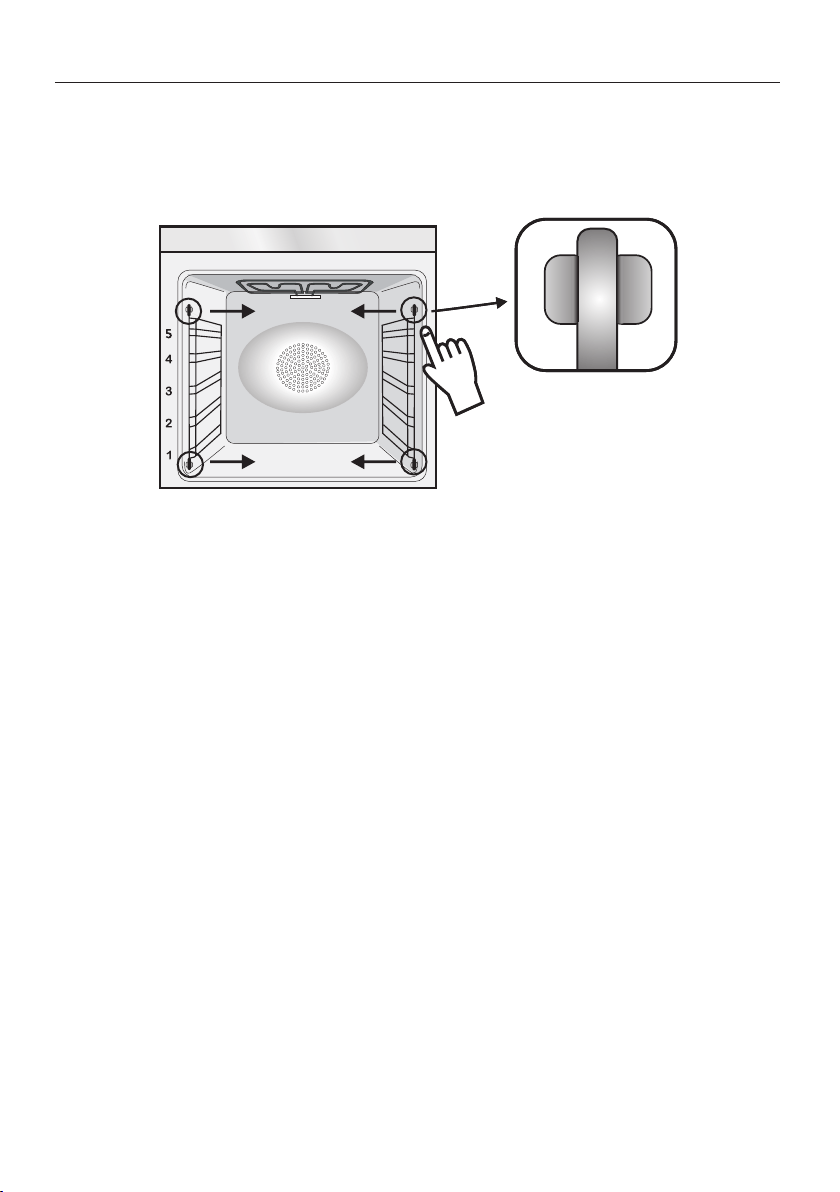
EXTRACCIÓN Y LIMPIEZA DE LOS BASTIDORES CABLEADOS
1- Retire las guías metálicas tirando de ellas en la dirección de las flechas (ver más abajo)
2- Para limpiar las guías metálicas, puede ponerlas en el lavavajillas o utilizar una esponja húmeda,
asegurándose siempre de que se sequen después.
3- Después del proceso de limpieza, monte las guías metálicas en orden inverso.
EXTRACCIÓN DE LA PUERTA DEL HORNO
1. Abra la puerta anterior.
2. Abra las pestañas de alojamiento de la bisagra por el lado derecho e izquierdo de la puerta anterior
presionándolas hacia abajo.
3. Vuelva a instalar la puerta llevando a cabo el procedimiento a la inversa.
4.3 Mantenimiento
ES 27
1
2
3
1.
2.
3.
4.
5.
6.
7.
EXTRACCIÓN Y LIMPIEZA DE LA PUERTA DE VIDRIO
1. Abra la puerta del horno.
2.3.4. Bloquee las bisagras, desenrosque los tornillos y extraiga la cubierta metálica superior tirando
hacia arriba.
5.6. Extraiga el vidrio con mucho cuidado de la contrapuerta del horno (N. B.: si se trata de un horno
pirolítico, extraiga también el segundo y el tercer vidrio si los hubiera).
7. Al término de la limpieza o sustitución, vuelva a ensamblar las piezas en el orden opuesto a la
extracción.
En todos los vidrios, la indicación ”Low-E” debe ser correctamente legible y estar ubicada a la izquierda
de la puerta, cerca de la bisagra lateral izquierda. De este modo, la etiqueta estampada en el primer
vidrio quedará por el interior de la puerta.
LOW-E
ES 28
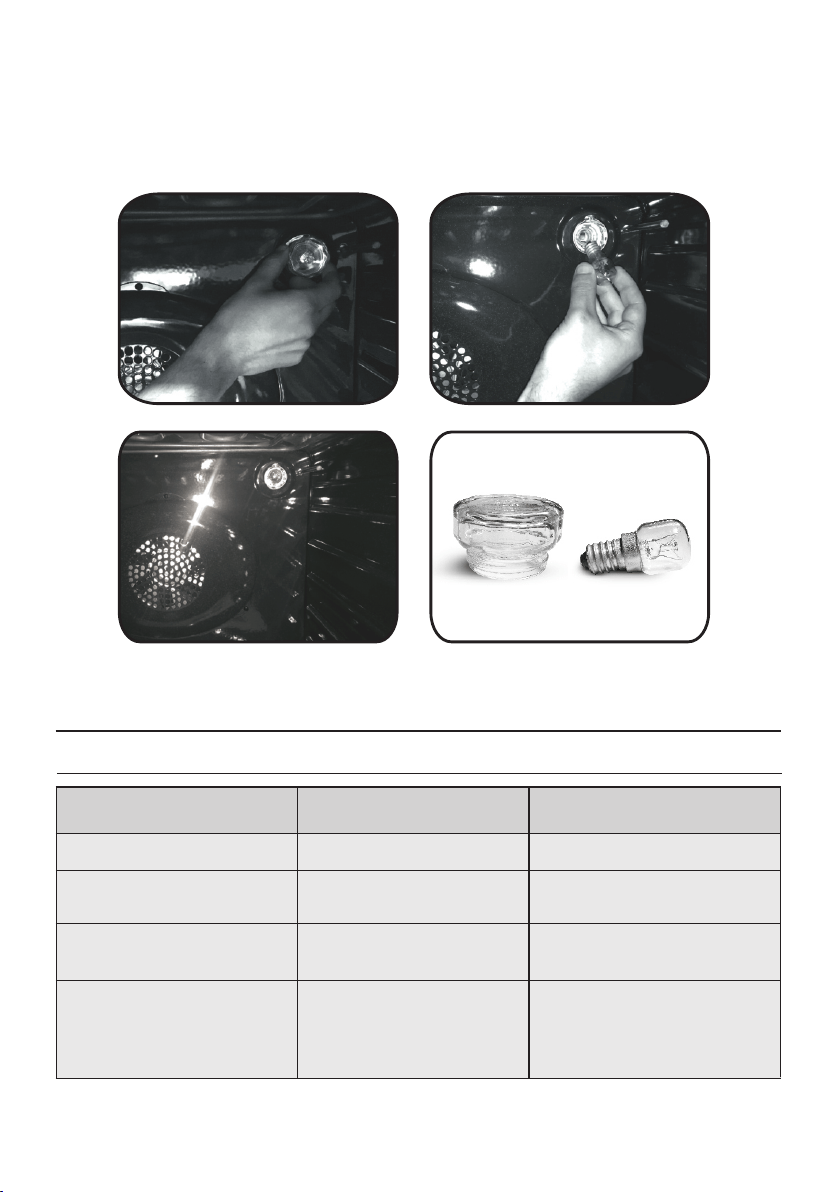
SUSTITUCIÓN DE LA BOMBILLA
1. Desenchufe el horno de la red eléctrica.
2. Suelte la cubierta de vidrio, desenrosque la bombilla y sustitúyala por una nueva del mismo modelo.
3. Una vez sustituida la bombilla defectuosa, vuelva a atornillar la cubierta de vidrio.
5. Solución de problemas
5.1 Preguntas más frecuentes
PROBLEMACAUSA POSIBLE SOLUCIÓN
El horno no se calienta
El reloj no está en horaConfigure el reloj
El bloqueo infantil está
activado
Los ajustes necesarios no
están configurados
Desactive el bloqueo infantil
Asegúrese de que los ajustes
necesarios sean correctos
El horno no se calienta
El horno no se calienta
Vapor y condensa en la
pantalla
Limpiar con un paño de
microfibra la pantalla para
quitar la capa condensación
No hay reacción cuando
se toca la pantalla
ES 29
70011729 • A5 • 03.2022 • REV.0
The manufacturer will not be responsible for any inaccuracy resulting from printing or transcript errors contained in this brochure. We
reserve the right to carry out modifications to products as required, including the interests of consumption, without prejudice to the
characteristics relating to safety or function.
INSTALLATION
EN
EN
If the furniture is coverage with a bottom at the back part,
provide an opening for the power supply cable.
If the oven does not have a cooling fan, create an opening
460 mm x 15 mm
EN
Opening / Apertura
560 mm x 45 mm
595 mm
595 mm
546 mm
22 mm
580 mm
560 mm
A
600 mm
560
mm
560
mm
560 mm
Opening / Apertura
460mm x 15 mm
560 mm x 45 mm
If the mounting of the plinth does not allow air
circulation, to obtain the maximum performance of
the oven it is necessary to create an opening of
500x10mm or the same surface in 5.000 mm2
EN
A
A
560 mm
590 mm
EN
Si el mueble tiene panel posterior, haga un orificio para el
cable de alimentación.
ES
Si el montaje del zócalo no permite la circulación de
aire, para obtener el máximo rendimiento del horno es
necesario crear una abertura de 500x10 mm o la misma
superficie en 5.000 mm².
ES
A
Si el horno no tiene ventilador de refrigeración, practique una
abertura. 460 mm x 15 mm
ES
ES
El fabricante no se responsabiliza de las inexactitudes debidas a fallos de impresión o transcripción contenidos en este folleto. Nos
reservamos el derecho a modificar los productos como sea necesario, incluidos los intereses de consumo, sin perjuicio de las
características relacionadas con la seguridad o su funcionamiento.
ES
INSTALACIÓN