Operating instructions
Heat pump tumble dryer
It is essential to read these operating instructions before installing
and using the appliance. This prevents both personal injury and
damage to the appliance.
en-AU, NZ M.-Nr. 12 222 640

Contents
2
Caring for the environment ............................................................................. 7
Warning and Safety instructions ..................................................................... 8
Operating the tumble dryer .............................................................................. 20
Control panel....................................................................................................... 20
Touch display and sensor controls...................................................................... 20
Main menu........................................................................................................... 21
Examples on how to operate the appliance........................................................ 22
Moving programmes ...................................................................................... 23
Before using for the first time .......................................................................... 25
Installation ........................................................................................................... 25
Downtime after installation............................................................................. 25
Miele@home ........................................................................................................ 25
Setting the language ........................................................................................... 26
Energy saving tips ............................................................................................. 29
Energy saving tips ............................................................................................... 29
Feedback............................................................................................................. 30
1. Notes on correct laundry care ..................................................................... 31
Points to note regarding washed laundry............................................................ 31
Preparing the laundry before drying.................................................................... 31
Drying .................................................................................................................. 32
Care symbols ................................................................................................. 32
Selecting the correct drying level................................................................... 32
2. Loading the tumble dryer ............................................................................. 33
Loading the laundry............................................................................................. 33
Checking the FragranceDos socket ............................................................... 33
3. Selecting a programme ................................................................................ 34
Switching on the tumble dryer ............................................................................ 34
Selecting a programme ....................................................................................... 34
4. Selecting programme settings..................................................................... 35
Selecting the drying level .................................................................................... 35
Selecting Extras................................................................................................... 36
5. Starting the programme ............................................................................... 37
Starting a programme ......................................................................................... 37
6. End of programme - unloading the drum.................................................... 38
At the end of the programme .............................................................................. 38
Removing the laundry ......................................................................................... 38

Contents
3
Programme chart .............................................................................................. 39
Extras.................................................................................................................. 46
DryFresh .............................................................................................................. 46
PowerFresh.......................................................................................................... 46
DryCare40 .......................................................................................................... 47
Gentle tumble...................................................................................................... 47
Quick ................................................................................................................... 47
ECO ..................................................................................................................... 47
Freshen up........................................................................................................... 47
Drying programme overview - Extras.................................................................. 48
Wash2Dry....................................................................................................
49
Requirements for use .......................................................................................... 49
Selecting the Wash2Dry function ................................................................
49
Favourite programmes...................................................................................... 50
Creating a Favourite programme......................................................................... 50
Option 1.......................................................................................................... 50
Option 2.......................................................................................................... 50
Entering a name ............................................................................................. 50
Changing a Favourite programme.................................................................. 50
Drying assistant................................................................................................. 51
Timer................................................................................................................... 52
Setting the timer.................................................................................................. 52
Changing the timer.............................................................................................. 52
Deleting the timer ................................................................................................ 52
Starting the timer................................................................................................. 52
SmartStart ........................................................................................................... 53
Setting the timeframe..................................................................................... 53
Changing the programme sequence............................................................... 54
Adding or removing laundry ................................................................................ 54
Condensed water container ............................................................................. 55
Emptying the condensed water container .......................................................... 55
Filling the condensed water container ................................................................ 56

Contents
4
Fragrance flacon................................................................................................ 57
FragranceDos ...................................................................................................... 57
Removing the protective seal from the fragrance flacon..................................... 57
Inserting the fragrance flacon.............................................................................. 58
Opening the fragrance flacon.............................................................................. 59
Closing the fragrance flacon ............................................................................... 59
Removing/replacing the fragrance flacon ........................................................... 60
Cleaning and care ............................................................................................. 61
Fluff filters............................................................................................................ 61
Removing the fragrance flacon ...................................................................... 61
Removing visible fluff ..................................................................................... 61
Cleaning the fluff filters and air flow openings thoroughly ............................. 62
Cleaning the fluff filters with water................................................................. 63
Cleaning the plinth filter....................................................................................... 64
Removing the plinth filter ............................................................................... 64
Cleaning the plinth filter ................................................................................. 65
Cleaning the plinth filter flap........................................................................... 67
Cleaning the dryer ............................................................................................... 67
Problem solving guide ...................................................................................... 68
Fault messages shown in the display when a programme is cancelled ............. 68
Messages in the display...................................................................................... 70
Unsatisfactory drying results............................................................................... 71
The drying process takes a long time. ................................................................ 72
General problems with the tumble dryer ............................................................. 73
Replacing the plinth filter..................................................................................... 75
Regenerating the plinth filter ............................................................................... 77
Checking the heat exchanger.............................................................................. 77
Cleaning the fluff filter in the condensed water container................................... 78
Replacing the condensed water spray jet ........................................................... 79
Service................................................................................................................ 80
Contact in case of fault ....................................................................................... 80
Optional accessories........................................................................................... 80
Warranty .............................................................................................................. 80

Contents
5
Installation.......................................................................................................... 81
Front view............................................................................................................ 81
Rear view............................................................................................................. 82
Transporting the tumble dryer ............................................................................. 82
Transporting the tumble dryer to its installation site ...................................... 82
Installation ........................................................................................................... 83
Levelling the dryer .......................................................................................... 83
Downtime after installation............................................................................. 84
Ventilation....................................................................................................... 84
Before moving the tumble dryer again (e.g. when moving house)................. 84
Additional installation requirements .................................................................... 85
Externally draining condensed water .................................................................. 86
Installation conditions requiring a non-return valve ....................................... 86
Arranging the drain hose ................................................................................ 87
Examples........................................................................................................ 87
Changing the door hinging.................................................................................. 89
Changing the hinging over ............................................................................. 89
Refitting .......................................................................................................... 94
Electrical connection ........................................................................................... 95
Technical data.................................................................................................... 96
Consumption data............................................................................................. 97

Contents
6
Settings .............................................................................................................. 98
Calling up settings............................................................................................... 98
Operation/Display ............................................................................................ 99
Language .................................................................................................... 99
Code............................................................................................................... 99
Clock display.................................................................................................. 99
Consumption.................................................................................................. 99
Memory .......................................................................................................... 100
Volume ........................................................................................................... 100
Behaviour finish tone...................................................................................... 100
Display brightness.......................................................................................... 100
Wash2Dry....................................................................................................... 100
Display switch-off status................................................................................ 101
Network ............................................................................................................... 102
Miele@home................................................................................................... 102
SmartGrid....................................................................................................... 103
Remote control............................................................................................... 103
RemoteUpdate............................................................................................... 104
Programme sequence ......................................................................................... 105
Anti-crease ..................................................................................................... 105
Cooling down temperature............................................................................. 105
Drying levels ................................................................................................... 105
Appliance parameters ......................................................................................... 106
Airways indicator............................................................................................ 106
Conductivity ................................................................................................... 106
Operating hours.............................................................................................. 107
Factory default ............................................................................................... 107
Legal information............................................................................................ 107
Caring for the environment
7
Disposal of the packing
material
The transport and protective packaging
has been selected from materials which
are environmentally friendly for
disposal, and can normally be recycled.
Recycling the packaging reduces the
use of raw materials in the
manufacturing process and also
reduces the amount of waste in landfill
sites. Ensure that any plastic
wrappings, bags etc. are disposed of
safely and kept out of the reach of
babies and young children. Danger of
suffocation.
Disposing of your old
appliance
Electrical and electronic appliances
often contain valuable materials. They
also contain specific materials,
compounds and components, which
were essential for their correct function
and safety. These could be hazardous
to human health and to the environment
if disposed of with your domestic waste
or if handled incorrectly. Please do not,
therefore, dispose of your old appliance
with your household waste.
Please dispose of it at your local
community waste collection / recycling
centre for electrical and electronic
appliances. You are also responsible for
deleting any personal data that may be
stored on the appliance prior to
disposal. Please ensure that your old
appliance poses no risk to children
while being stored prior to disposal.

Warning and Safety instructions
8
It is essential to read these instructions.
This tumble dryer complies with all current local and national
safety requirements. However, inappropriate use can lead to
personal injury and damage to property.
Read the operating instructions carefully before using the tumble
dryer. They contain important information on safety, installation,
use and maintenance of the appliance. This prevents both
personal injury and damage to the tumble dryer.
In accordance with standard IEC60335-1, Miele expressly and
strongly advises that you read and follow the instructions in
“Installation”, as well as in the “Warning and Safety instructions”.
Miele cannot be held liable for injury or damage caused by non-
compliance with these instructions.
Keep these operating instructions in a safe place and pass them
on to any future owner.

Warning and Safety instructions
9
Correct application
This tumble dryer is designed for domestic use and for use in
similar environments by guests in hotel or motel rooms, bed &
breakfasts and other typical living quarters. This does not include
common/shared facilities or commercial facilities within hotels,
motels or bed & breakfasts.
This tumble dryer is not suitable for outdoor use.
It must only be used to dry items which have been washed in a
water solution and which are marked on the manufacturer's care
label as being suitable for tumble drying. If using dry cleaning kits,
do so at your own risk, and follow the instructions provided on the
packaging.
Any other applications may be dangerous. Miele cannot be held
liable for damage resulting from incorrect or improper use or
operation.
This appliance is not intended for use by persons (including
children) with reduced physical, sensory or mental capabilities, or
lack of experience or knowledge, unless they are supervised whilst
using it or have been shown how to use it by a person responsible
for their safety.

Warning and Safety instructions
10
Safety with children
Young children must not be allowed to use this appliance.
Older children may only use the appliance when its operation has
been clearly explained to them and they are able to use it safely,
recognising the dangers of misuse.
Children must not be allowed to clean or maintain the tumble
dryer unsupervised.
Please supervise children in the vicinity of the tumble dryer and do
not let them play with it.

Warning and Safety instructions
11
Technical safety
Before setting up the tumble dryer, check it for any externally
visible damage.
Do not install or use a damaged tumble dryer.
Before connecting the tumble dryer, ensure that the connection
data on the data plate (fuse rating, voltage and frequency) matches
the mains electricity supply. If in any doubt, consult a qualified
electrician.
Temporary or permanent operation with a self-sufficient or non-
mains synchronous energy supply system (e.g. isolated networks,
back-up systems) is possible. A requirement for the operation is that
the energy supply system complies with all current local and national
requirements that apply to stand-alone, solar and/or battery
systems.
The protective measures provided in the installation and in this Miele
product must also be assured in their function and operation in
isolated operation or in non-mains synchronous operation, or
replaced with equivalent measures in the installation.
The electrical safety of this tumble dryer can only be guaranteed
when correctly earthed. It is essential that this standard safety
requirement is met. If in any doubt, please have the household wiring
system tested by a qualified electrician. Miele cannot be held liable
for the consequences of an inadequate earthing system (e.g. electric
shock).
Do not connect the tumble dryer to the mains electricity supply by
an extension lead. Extension leads do not guarantee the required
safety of the appliance (e.g. danger of overheating).
If the connection cable is faulty, it must only be replaced by a
Miele authorised technician to protect the user from danger.

Warning and Safety instructions
12
Unauthorised repairs could result in unforeseen dangers for the
user, for which Miele cannot accept liability. Repairs should only be
undertaken by a Miele authorised service technician, otherwise any
subsequent damage will not be covered by the warranty.
Faulty components must only be replaced by genuine Miele spare
parts. Miele can only guarantee the safety of the appliance when
Miele replacement parts are used.
In the event of a fault or for cleaning purposes, the tumble dryer is
only completely isolated from the electricity supply when:
- it is switched off at the wall socket and the plug is withdrawn, or
- it is switched off at the mains circuit breaker.
This tumble dryer must not be installed and operated in mobile
installations (e.g. on a ship).
Do not make any alterations to the tumble dryer, unless authorised
to do so by Miele.
This tumble dryer is supplied with a special lamp to cope with
particular conditions (e.g. temperature, moisture, chemical
resistance, abrasion resistance and vibration). This special lamp
must only be used for the purpose for which it is intended. It is not
suitable for room lighting. Replacement lamps may only be replaced
by a Miele authorised technician.

Warning and Safety instructions
13
Heat pump technology and refrigerant:
The heat pump in this tumble dryer uses a gaseous refrigerant. The
refrigerant, which is brought to a higher temperature and liquefied by
condensing, is transferred in a closed circuit through the heat
exchanger unit where heat exchange takes place with the circulating
drying air.
Damage to the tumble dryer by switching it on too soon.
This can damage the heat pump.
After setting up the tumble dryer, wait for at least one hour before
switching it on.
- The humming noises caused by the heat pump during the drying
process are normal. They do not impair the efficient functioning of
the dryer.
- The refrigerant is not flammable or explosive.
Please observe the instructions in “Installation” and “Technical
data”.
The plug and socket must be accessible at all times in order to be
able to disconnect the tumble dryer from the power supply.
Do not block the gap between the bottom of the tumble dryer and
the floor with plinth facings, deep pile carpet etc. This would hinder a
sufficient flow of air to the tumble dryer.
Make sure the dryer door can be opened without hindrance after
installation.
In areas which may be subject to infestation by cockroaches or
other vermin, pay particular attention to keeping the appliance and
its surroundings in a clean condition at all times. Any damage which
may be caused by cockroaches or other vermin will not be covered
by the warranty.
Warning and Safety instructions
14
Correct use
Warning: Risk of fire / Flammable materials.
To avoid the possible danger of fire, please read these warnings
carefully.
A clogged filter is a fire hazard!
The fluff filter must be cleaned after every programme.
The maximum load for this tumble dryer is 9.0 kg (dry weight). See
the “Programme chart” for the maximum recommended loads for
individual programmes.
To prevent the risk of fire, do not connect the tumble dryer via a
controllable socket (e.g. a timer or a peak-load switch-off device).
If the drying programme is interrupted before the end of the cooling
down phase, this could cause the laundry to self-ignite.

Warning and Safety instructions
15
To prevent the risk of fire, the following textiles must not be dried
in this tumble dryer:
- Items which have not been washed.
- Items which have been cleaned using chemicals (e.g. professional
dry-cleaning agents).
- Items, such as workwear, which have not been thoroughly
cleaned and which are still soiled with grease, oil or other
desposits (such as cosmetics, lotions etc). If items have not been
thoroughly cleaned, there is a danger that these might ignite when
heated, even after they have been removed from the dryer at the
end of the programme.
- Items that have been soiled with substances such as cooking oil,
acetone, petrol, kerosene, spot removers, turpentine, waxes, wax
removers and other chemicals (e.g. mops and floor cloths).
- Items which have been splashed with hair lacquer, hair spray, nail
varnish remover or similar substances.
- Fabrics which contain a large proportion of rubber, foam rubber or
rubber-like materials. For example, products made from latex
foam rubber, shower caps, waterproof textiles, rubberised articles
and items of clothing and pillows with foam rubber filling.
- Damaged fabrics which contain padding or fillings (e.g. pillows,
jackets). When damaged, the filling can get out with the risk of it
igniting in the dryer.
When washing such heavily soiled items ensure that you use
sufficient detergent and select a high temperature. If in doubt,
wash the items several times.

Warning and Safety instructions
16
Oil-affected items can ignite spontaneously, especially when
exposed to heat sources such as in a tumble dryer.
The items become warm, causing an oxidation reaction in the oil.
Oxidation creates heat.
If the heat cannot escape, the items can become hot enough to
catch fire. Piling, stacking or storing oil-affected items can prevent
heat from escaping and so create a fire hazard.
If it is unavoidable that fabrics contaminated with vegetable or
cooking oil, or hair care products, are placed in a tumble dryer, they
should first be washed in hot water with extra detergent - this will
reduce, but not eliminate, the hazard.
Remove all items from pockets (e.g. lighters, matches).
Warning: Ensure that you always wait until the end of the
programme before removing the laundry. If the drying programme is
stopped prematurely, remove the laundry immediately and hang it up
or spread it out to cool it down.
Fabric softener and similar products must be used according to
the instructions on the manufacturer's packaging.
In many programmes, the heating phase is followed by a cooling
down phase to ensure that the items are not too hot to handle when
you remove them (this also avoids the danger of the laundry self-
igniting). The programme is not finished until the cooling down phase
has been completed.
As soon as the programme has finished, remove all laundry from the
drum.
Do not let anyone sit or lean on the door, as this can cause the
tumble dryer to tip up.
Always close the door after use. This way you will avoid the
danger of:
- children climbing onto or into the dryer or hiding things in it.
- pets or other small animals climbing into it.

Warning and Safety instructions
17
The tumble dryer must not be used
- without the fluff filters in place or with damaged fluff filters.
- without the plinth filter in place or with a damaged plinth filter.
This would cause an excessive build-up of fluff which in turn would
cause a fault.
The fluff filters must be cleaned after every drying cycle.
Fluff must not be allowed to accumulate around the tumble dryer.
The fluff filters and the plinth filter must be thoroughly dried after
cleaning. Do not replace them if they are damp or wet. Damp or wet
filters could cause operational faults.
Do not install the tumble dryer in a room where there is a risk of
frost occurring. At temperatures around freezing point the tumble
dryer may not be able to operate properly. There is a risk of damage
if the condensed water is allowed to freeze in the pump and hoses.
If the water is drained externally through the drain hose instead of
being collected in the condensed water container, make sure the
drain hose is securely attached if you hang it in a laundry tub to
avoid the hose slipping and the water causing damage.
Condensed water is not drinking water.
It can cause health problems in both people and animals.
Always keep the area around the tumble dryer free of dust and
fluff.
Dust drawn into the tumble dryer can cause blockages in the heat
exchanger over time.
The tumble dryer must not be hosed down.

Warning and Safety instructions
18
Using a fragrance flacon (optional accessory)
Only use genuine Miele original fragrance flacons.
The fragrance flacon must be stored in its packaging so please
make sure you retain this.
Caution. The fragrance can run out of the flacon. Make sure that
you always keep the flacon, or the fluff filter with the flacon inserted
in it, upright when carrying and do not tip it or place it down on any
surface.
Use an absorbent cloth immediately to wipe up any fragrance
which has run out of the flacon onto the floor, the dryer or any dryer
components (e.g. the fluff filter).
If fragrance which has run out of a flacon should come in contact
with the skin - wash the skin thoroughly with soap and water; come
in contact with the eyes - rinse the eyes with clean water for at least
15minutes; be swallowed - rinse out the mouth thoroughly with
clean water. Seek medical advice in the case of contact with the
eyes or if fragrance has been swallowed.
If fragrance which has run out of a flacon comes in contact with
clothing, change the clothing immediately. Wash the clothing or any
cloths used for mopping up fragrance thoroughly with plenty of
water and detergent.
There is the risk of fire or damage to the tumble dryer if the
following instructions are not observed:
- Never refill a flacon with fragrance.
- Never use a faulty fragrance flacon.
Dispose of an empty fragrance flacon with the household waste
and never use it for any other purpose.
Please also observe the information supplied with the fragrance
flacon.

Warning and Safety instructions
19
Accessories
Only use genuine Miele spare parts and accessories with this
appliance. If spare parts or accessories from other manufacturers
are used, this will invalidate the warranty, and Miele cannot accept
liability.
A Miele tumble dryer can be stacked on top of a Miele washing
machine using the appropriate stacking kit (available as an optional
accessory). Please make sure you order the correct one for the Miele
washing machine and Miele tumble dryer.
Miele cannot be held liable for damage caused by non-
compliance with these Warning and Safety instructions.
Operating the tumble dryer
20
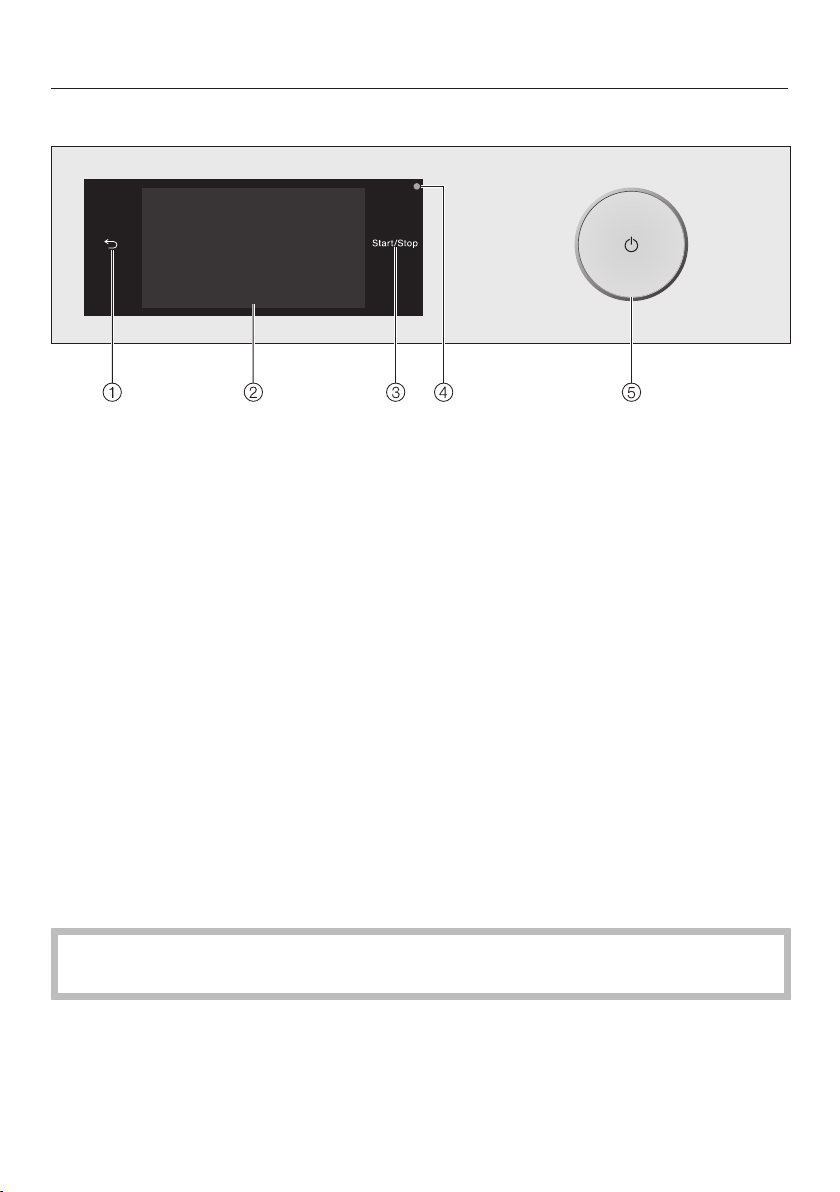
Control panel
a
sensor
Takes you back one level in the menu.
b
Touch display
c
Start/Stop sensor
Touching the Start/Stop sensor starts the selected programme or cancels a
programme that has already started. The sensor flashes slowly as soon as it is
possible for a programme to be started and then lights up constantly after the
programme has started.
d
Optical interface
For service technicians.
e
sensor
For switching the tumble dryer on and off. The tumble dryer switches off
automatically to save energy. This occurs 15 minutes after the end of the
programme/Anti-crease phase, or after being switched on if no further selection
is made.
Touch display and sensor controls
The and Start/Stop sensors and the sensors in the display react to fingertip
contact.
The touch display can be scratched by pointed or sharp objects, e.g. pens.
Only touch the display with your fingertips.

Operating the tumble dryer
21
Main menu
After switching on the tumble dryer, the
main menu will appear in the display.
You can access all important sub-
menus from the main menu.
Touch the sensor at any time to
return to the main menu. Values that
have not yet been confirmed are not
saved when you return to the main
menu.
11:02
Programmes Favourites Wash2Dry
Help
Main menu page 1
You can scroll to the second page of
the main menu by swiping your finger
across the display.
11:02
Drying
assistant
Settings
Help
MobileStart
Main menu page 2
The symbol next to the time of day is
displayed when the tumble dryer is
connected to a network.
Programmes
For selecting drying programmes.
Favourites
You can save up to 12 of your own
customised drying programmes (see
“Favourite programmes”).
Wash2Dry
A drying programme tailored to the
laundry is set in conjunction with the
connected washing machine.
Useful tip: The Wash2Dry function can
only be used if the tumbler dryer is
connected to a network.
MobileStart
With MobileStart you can operate your
tumble dryer remotely with the Miele
App.
TheRemote control setting must be
switched on.
Touch theMobileStart sensor and follow
the instructions in the display.
Drying assistant
The Drying assistant guides you step by
step so that you can select the
optimum drying programme for your
laundry (see “Drying assistant”).
Settings
You can alter the tumble dryer's
electronics to suit changing
requirements in the Settings menu (see
“Settings”).

Operating the tumble dryer
22
Examples on how to operate
the appliance
Selection lists
Programmes menu
11:02
0:00
0:00
0:00 0:00
h
h
h
h
Programmes
Cottons
DelicatesCottons
Minimum iron
Help
You can scroll to the right or the left by
swiping your finger across the screen.
To do this, place your finger on the
touch display and swipe it in the
direction you want.
The orange bar under the pictures
shows that there are further options to
choose from.
Touch a programme name to select the
drying programme.
The display will change to the standard
menu for that programme.
Extras menu
11:02
OK
Extras
Gentle tumble
PowerFresh
DryFresh DryCare 40
You can scroll to the right or the left by
swiping your finger across the screen.
Place your finger on the touch display
and swipe it in the direction you want.
The orange bar under the pictures
shows that there are further options to
choose from.
To select an Extra, touch the
corresponding sensor.
The selected Extra will be highlighted in
orange.
To deselect the Extra, simply touch the
corresponding sensor again.
Touch the OK sensor to activate the
highlighted Extra.

Operating the tumble dryer
23
Moving programmes
You can move the programmes around
in the menu to change the order in
which they are displayed.
11:02
0:00
0:00
0:00 0:00
h
h
h
h
Programmes
Cottons
DelicatesCottons
Minimum iron
Help
Place your finger on the programme
you wish to move until a border is
displayed around it.
To move the programme, swipe your
finger in the required direction.
Remove your finger when the
programme reaches the new location.
The programme has moved.
Setting numerical values
You can set numerical values in some
menus.
OK
12 00
11 59
10 58
13 01
14 02
Clock display
Enter the numbers by swiping upwards
or downwards. Place your finger on the
number that you want to change and
move your finger in the direction you
want. Use the OK sensor to accept all
set numerical values.
Useful tip: Briefly touching an orange
number between the two lines will bring
up the numerical keypad. Once a valid
number has been entered, the OK
sensor will be highlighted green.

Operating the tumble dryer
24
Pull-down menu
The pull-down menu can be used to
display information, e.g. about a drying
programme.
11:02
2:35
Overview
Cottons
h
Timer Save
Drying level
Normal
Extras
not selected
Touch the top edge of the screen in the
middle and drag down with your finger.
Help display
With some menus Help appears along
the bottom line of the display.
Touch the Helpsensor to display the
text.
Touch the Closesensor to return to
the previous screen.
Exiting a menu
Touch the sensor to return to the
previous screen.
Entries made before this which have not
been confirmed withOK will not be
saved.
Before using for the first time
25
Installation
Before using the appliance for the
first time, check that you have
followed all the instructions under
“Installation”.
Read these operating instructions,
paying particular attention to the
information provided under
“Installation”.
Removing the protective foil and
advertising stickers
Remove:
- the protective foil from the door (if
present).
- any advertising stickers from the front
and the lid.
Please do not remove any labels
(e.g. the data plate) which are visible
when you open the door.
Downtime after installation
Damage to the tumble dryer by
switching it on too soon.
This can damage the heat pump.
After setting up the tumble dryer,
wait for at least one hour before
switching it on.
Miele@home
Your tumble dryer is equipped with an
integrated Wi-Fi module.
In order to use it you need:
- a Wi-Fi network
- the Miele App
- a Miele user account. The user
account can be created via the Miele
App.
The Miele App will guide you as you
connect your tumble dryer to your
home Wi-Fi network.
Once your tumble dryer is connected to
your Wi-Fi network, you can use the
App, for example, to carry out the
following activities:
- Operate the tumble dryer remotely
- Call up information on the operating
status of your appliance
- Call up information on the
programme sequence of your tumble
dryer
Connecting your tumble dryer to your
Wi-Fi network will increase energy
consumption, even when the tumble
dryer is switched off.
Before installing the tumble dryer in
its final location, ensure the signal
strength of your Wi-Fi network is
sufficient.
Before using for the first time
26
Availability of the Wi-Fi connection
The Wi-Fi connection shares a
frequency range with other appliances
(including microwave ovens and remote
control toys). This may result in
sporadic or even complete connection
failures. Therefore, a constant
availability of featured functions cannot
be guaranteed.
Miele@home availability
The ability to use the Miele App
depends on the availability of the
Miele@home service in your country.
The Miele@home service is not
available in every country.
For information about availability,
please visit www.miele.com.
Miele App
You can download the Miele App from
the Apple App Store
®
or the Google
Play Store™ free of charge (only
functional in selected countries).
Switching on the tumble dryer
Press the sensor.
The welcome screen will light up.
The display will guide you step by step
through the initial commissioning
process.
Setting the language
You will be asked to select the language
you require for the display. It is possible
to change the language at any time via
the Settings menu.
english (AU)
english (CA)
english (GB)
english (US)
Language
deutsch
dansk
Scroll to the left or the right until the
language you want appears.
Touch the sensor for the language
you want.
The selected language will be
highlighted in orange and the display
will change to the next setting.

Before using for the first time
27
Setting up Miele@home
Skip
Continue
Set up “Miele@home”?
To set up Miele@home now: touch
the Continue sensor.
Useful tip: To postpone set-up until
later: touch the Skip sensor. The
following message will then appear in
the display:
It is possible to set up later in “Settings” /
“Miele@home”.
Confirm with OK.
Via WPS Via App
Which connection method do you
want to use?
Select the connection method you
wish to use.
You will then be guided by the display
and the Miele App.
You will require a WPS-compatible
router for the Via WPSconnection type.
Activate the WPS function on your
router within 2minutes.
Setting the clock format
The time of day can be displayed as a
24-hour or 12-hour clock.
Select the clock format you want and
confirm this with the OK sensor.
The display will change to the next
setting.
Setting the time of day
This message only appears if the
tumble dryer has not yet been
connected to a Wi-Fi network.
The time of day is set automatically if
connection is established with a Wi-Fi
network.
OK
12 00
11 59
10 58
13 01
14 02
Clock display
Place your finger on the number that
you want to change and move your
finger in the direction you want.
Confirm with the OK sensor.
Further information will appear in the
display.

Before using for the first time
28
Continuing setup
Refer to “1. Notes on correct laundry
care”.
You can then load the tumble dryer
and select a programme as described
in “2. Loading the tumble dryer” and
“3. Selecting a programme”.
The initial commissioning process is
completed when a programme lasting
longer than one hour has been carried
out in full.

Energy saving tips
29
Energy saving tips
This dryer with heat-pump technology
is designed for energy-saving drying
cycles. You can save even more
energy with the following measures,
because the drying time is not
extended unnecessarily.
- Make sure your laundry is spun at the
maximum spin speed before drying.
The higher the spin speed, the
greater the savings that can be made
in energy and time during drying, e.g.
approx. 20% energy can be saved if
spinning laundry at 1600rpm instead
of 1000rpm.
- Use the maximum load quantity for
the drying programme being used.
This will mean that the energy
consumption for the amount of
laundry is the most economical.
- Make sure that the room temperature
is not too high. If there are other heat
producing appliances in the room in
which the dryer is located, make sure
the room is well ventilated and switch
the other appliances off, if possible.
- Clean the fluff filters in the door
opening after every drying cycle.
Please refer to “Cleaning and care” for
information on cleaning the fluff filters
and the plinth filter.
- If possible, make use of time-
variable, low-cost electricity tariffs.
Ask your energy supplier for
information. Your tumble dryer’s timer
is helpful in this regard as you can
select when during the next 24hours
you want the drying process to start
automatically.
Energy saving tips
30
Feedback
You can view information about the
energy consumption of your tumble
dryer in the pull-down menu.
The following information will appear in
the display:
- An estimate of the energy
consumption before the programme
starts.
- The actual energy consumption
during the programme or at the end
of the programme.
11:02
2:35
Overview
Cottons
h
Timer Save
Drying level
Normal
Extras
not selected
Open the pull-down menu.
1. Estimate
The estimated energy consumption
will be displayed as a bar chart before
the start of the programme.
Energy consumption
–– ––––––––
The more bars visible, the higher the
energy consumption.
The estimate will vary depending on the
drying programme, the drying level and
any Extras selected.
2. Actual consumption
The actual energy consumption and
the costs can be viewed during the
programme or at the end of the
programme.
If the energy consumption is too low to
be measured, <0.1kWh and Cost 0.00
will be displayed. See “Settings -
Consumption” for more detailed
information on costs.
The consumption and cost will alter as
the programme progresses.
At the end of the programme, before
opening the door, you can also call up
the filter soiling level as a %.
Filter soiling
0% = Light
50% = Normal
100% = Heavy
With increased soiling, the programme
duration is extended, which increases
energy consumption.
If the door is opened or the appliance
has switched off automatically at the
end of the programme, the data will
revert to the estimated consumption.
Useful tip: You can view the
consumption data for the last drying
programme and for total consumption
(see “Settings - Consumption”).

1. Notes on correct laundry care
31
Points to note regarding
washed laundry
- When washing very heavily soiled
items, ensure that you use sufficient
detergent and select a high
temperature. If in doubt, wash the
items several times.
- Do not put soaking wet items into the
tumble dryer. Make sure your laundry
is thoroughly spun before drying. The
higher the spin speed, the greater the
savings that can be made in energy
and time during drying.
- New dark coloured garments should
be washed and dried separately from
light coloured garments to avoid the
risk of colours running and
discolouring other garments or even
plastic components in the dryer. Dark
coloured fibres can also settle on
light coloured garments and vice
versa.
- Starched laundry can be dried in the
tumble dryer. To achieve the usual
finish, double the amount of starch
should be used.
Preparing the laundry before
drying
Damage due to foreign objects
which were not removed from the
laundry.
Foreign objects can melt, burn, or
explode.
Ensure that any foreign objects, e.g.
detergent dispensing balls, lighters,
etc. have been removed from the
laundry.
Risk of fire due to incorrect use
and operation.
The laundry can burn and destroy
the dryer and the surroundings.
See “Warning and Safety
instructions” for further information.
- Sort the laundry according to the type
of fibre and weave, size, garment
care label symbol and the drying level
required.
- Check seams and stitching to ensure
that padding and linings are intact.
This way you will avoid the danger of
fillings coming out. These could catch
fire when being dried.
- Untangle the laundry.
- Tie together textile belts and apron
ties.
- Fasten duvet covers and pillow cases
to prevent small items from being
rolled up inside them.
- Fasten hooks and eyes.
- Leave jackets open and undo any
long zips so that textiles dry evenly.
- Sew in or remove loosened
underwiring from bras.
- Reduce the size of the load. Minimum
iron fabric tends to crease more the
larger the load. This is particularly the
case for garments made from very
fine weave fabric, such as shirts or
blouses.

1. Notes on correct laundry care
32
Drying
Useful tip: See the “Programme chart”,
which contains everything you need to
know about programmes and load
sizes.
- Always observe the maximum
recommended load for each
programme. This will mean that the
energy consumption for the amount
of laundry is the most economical.
- Down-filled garments have linings
which have a tendency to shrink,
depending on the quality of the item.
Only use the Pre-ironing programme
for these textiles.
- Pure linen should only be tumble
dried if it is specified as suitable on
the care label. The surface of the
fabric may otherwise become rough.
Only use the Pre-ironing programme
for these textiles.
- Woollens and wool blends are
susceptible to becoming matted or
shrinking. Only use the Woollens
handcare programme for these
textiles.
- Loopknit garments (e.g. T-Shirts,
underwear) have a tendency to shrink
after the first wash. To prevent further
shrinkage, avoid overdrying loopknit
fabrics. If possible, choose a slightly
bigger size when buying garments
made from loopknit fabrics.
- If the fabrics are heat-sensitive or
susceptible to creasing, reduce the
load size. You should also select the
Gentle tumble Extra and, for
particularly delicate textiles, the
DryCare40 Extra.
Care symbols
Drying
Temperature
Normal or higher
Reduced*
Do not tumble dry
* Recommendation: select DryCare40 or
Gentletumble
Ironing
Temperature
hot, medium, lower
Do not iron
Selecting the correct drying level
- HygieneDry for special hygiene
requirements when drying resilient
fabrics
- Extra dry for multi-layered and very
thick fabrics.
- Normalplus for all fabrics that are to
be put away immediately.
- Normal for textiles that can shrink, or
for light cotton or jersey textiles.
- Hand iron or Machine iron for fabrics
that are going to be pressed or ironed
after drying.
Useful tip: You can customise the
drying levels (to be damper or drier) for
the Cottons, Minimum iron and
Automatic programmes. For further
information, see “Settings – Programme
sequence”.
2. Loading the tumble dryer
33
Loading the laundry
Textiles may be damaged.
Before loading, read chapter “1.
Notes on correct laundry care” first.
Open the door.
Remove any items that have been left
inside the drum.
Unfold the laundry and load loosely
into the drum.
Do not overload the drum. Doing so
will cause unnecessary wear and tear
to the laundry and affect the drying
result. It is also likely to cause more
creasing.
Laundry items may be damaged if
they get trapped by the door.
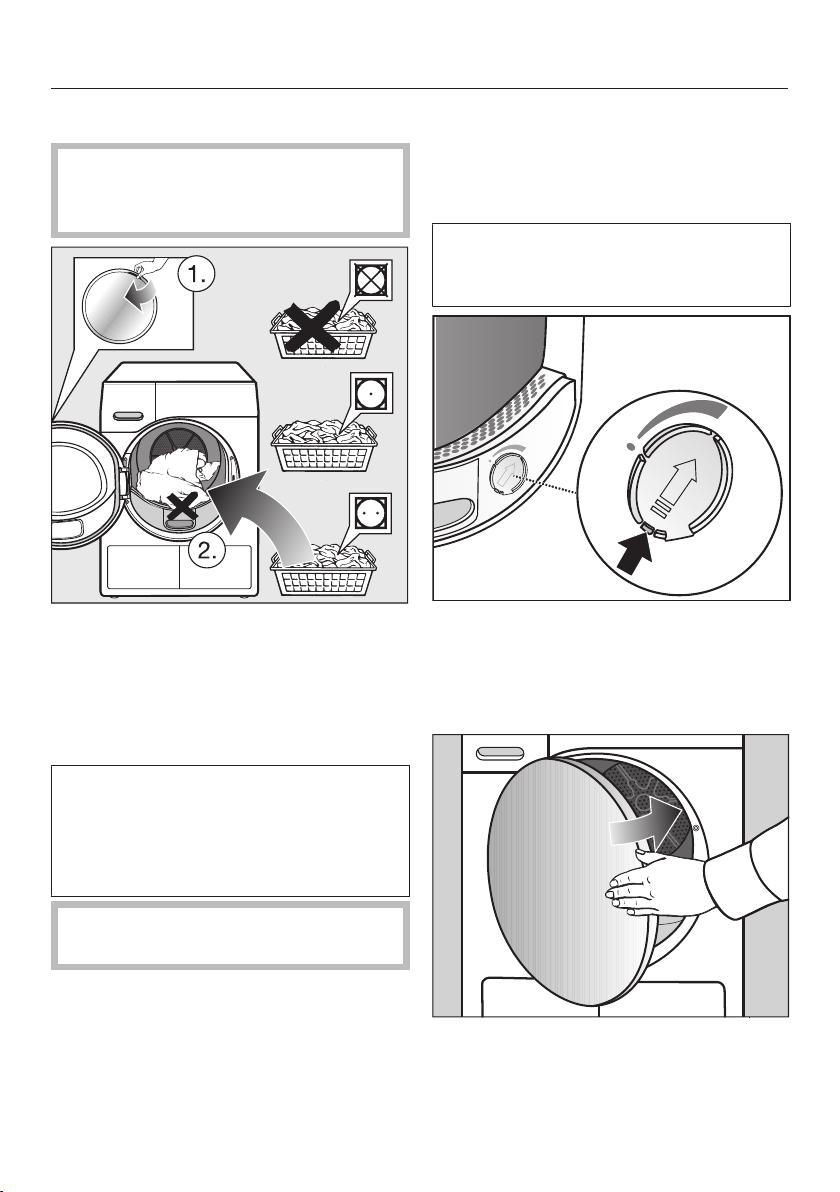
Checking the FragranceDos socket
If you are not using a fragrance flacon,
check that the 2 FragranceDos sockets
are closed.
See the section “Fragrance flacon” for
information on how to use fragrance
flacons.
Push the tab down completely (see
arrow) so that the socket is closed.
Otherwise, fluff will accumulate here.
Closing the door
Shut the door with a gentle swing.

3. Selecting a programme
34
Switching on the tumble dryer
To switch on, press the sensor.
Useful tip: The condensed water can
be recycled when certain programmes
are used.
See “Condensed water container –
Filling the condensed water container”.
To find out when the condensed water
can be used as part of certain
programmes, see the “Programme
chart” and “Extras”.
Selecting a programme
There are different ways to select a
programme:
Touch the Programmes sensor.
11:02
0:00
0:00
0:00 0:00
h
h
h
h
Programmes
Cottons
DelicatesCottons
Minimum iron
Help
Scroll to the right of the display until
the programme you want appears.
Touch the sensor for that programme.
The display will change to show the
Overview menu.
11:02
2:35
Overview
Cottons
h
Timer Save
Drying level
Normal
Extras
not selected
Useful tip: In the pull-down menu, you
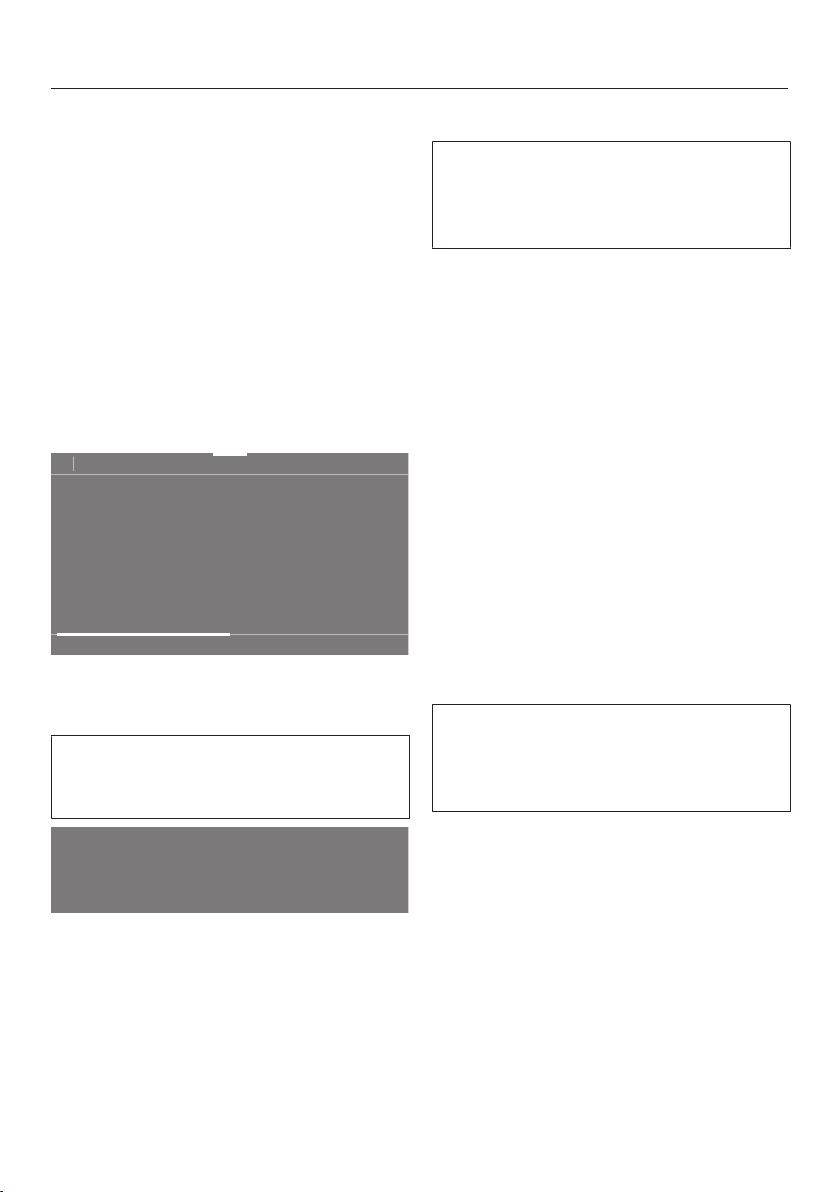
can display the maximum
recommended load for the selected
programme.
There are 4 further ways of selecting a
programme.
1. The Wash2Dry function
2. Favourites
3. Drying assistant
4. MobileStart

4. Selecting programme settings
35
Selecting the drying level
Check the “Programme chart” to see
which programme you can select a
drying level for and which drying level
meets your requirements.
11:02
2:35
Overview
Cottons
h
Timer Save
Drying level
Normal
Extras
not selected
Touch the Drying levelsensor.
11:02
Drying level
Machine iron Hand iron
Normal plus
Hand iron Normal Extra dry
Scroll in the display until the drying
level you want appears.
Touch the sensor for the drying level.
HygieneDry drying level
Useful tip: The HygieneDry drying level
can be selected for some programmes.
Specific hygiene requirements for
robust garments with the care
symbol are met.
HygieneDry dries items at a temperature
that is constant over an extended
period of time (extended temperature
holding time). This kills off micro-
organisms (such as germs or dust
mites) and reduces allergens in the
laundry.
Useful tip: Reduce the load size for the
corresponding programme to half the
maximum load size specified in these
operating instructions.
Temperature holding time
- An estimated programme running
time is displayed at the start of a
programme for which the HygieneDry
drying level has been selected.
- The programme completes the
normal drying process for laundry
care first. The drying time counts
down to 0minutes. Then the
temperature holding time starts.
- At the start of the temperature
holding time, the remaining
programme running time is extended
by 85minutes to produce a hygienic
drying result.
A programme for which the
HygieneDry drying level has been
selected should not be interrupted,
as this would prevent the micro-
organisms from being killed off.
Do not cancel the drying programme.

4. Selecting programme settings
36
Selecting the running time for
timed programmes
You can change the duration in 10-
minute increments.
Programmes:
Cool air: 20min – 1:00h
Warm air: 20min – 2:00h
Basket programme: 40min – 2:30h
11:02
0:20
Overview
Timed drying Warm air
h
Timer Save
Extras
not selected
h
Duration
0:20
Touch the Duration sensor (only
necessary in Warm air programme).
OK
00 20
02
Reset
Duration
40
01 30
02 40
5001
11:02
h
Place your finger on the number that
you want to change and move your
finger in the desired direction.
- Warm air
Confirm with the OK sensor.
Touch the Start/Stop sensor.
- Cool air, Basket programme
Touch the Start/Stop sensor.
The programme will start.
Selecting Extras
See “Extras” to find out which
programmes allow you to select an
Extra and which Extra is appropriate for
your needs.
11:02
2:35
Overview
Cottons
h
Timer Save
Drying level
Normal
Extras
not selected
Touch the Extrassensor.
11:02
OK
Extras
Gentle tumble
PowerFresh
DryFresh DryCare 40
Touch the sensor for the Extra you
want.
Useful tip: Touching the sensor for an
Extra again allows you to deselect it.
Scroll through the display to see more
Extras.
Confirm with the OK sensor.
The symbol for the selected Extra is
displayed.

5. Starting the programme
37
Starting a programme
The programme can be started when
the Start/Stop sensor is flashing on and
off.
Touch the Start/Stop sensor.
The Start/Stop sensor lights up
constantly.
11:02 Status
Cottons
Time left
Machine iron
PerfectDry
h1:42
Add laundry
Drying and the programme duration
remaining will light up in the display.
The laundry is cooled down shortly
before the end of the programme.
Useful tip: In the pull-down menu you
can view the selected drying level or
duration and the energy consumption.
The PerfectDry display will only light up
with programmes with selectable drying
levels:
- Hollow dot after a programme has
started
The drying level reached will still be
shown later on.
- Solid dot when the drying level is
reached
PerfectDry measures the residual
moisture of the laundry. In programmes
with selectable drying levels, PerfectDry
dries the laundry precisely, although the
result is also influenced by the calcium
content of the water. PerfectDry
continually adapts, constantly
increasing the accuracy of the time left.
If you place very few items in the
tumble dryer or load it with dry laundry,
this will be sensed by the empty drum
detection feature. The automatic load
recognition function will restrict the
running time of the selected programme
once it has started and will continue to
dry or air your laundry or textiles in a
gentle manner.
Laundry items and fabrics can wear
out unnecessarily.
Avoid over-drying laundry and
garments.
Energy savings
After 10minutes, the indicators dim and
the Start/Stop sensor starts flashing.
Touch the Start/Stop sensor to switch
the indicators on again (this does not
have any effect on a running
programme).
The drum lighting switches off once the
programme has started.
Adding laundry
You can add laundry after the
programme has started.
Follow the instructions in the sections
“Changing the programme sequence”
and “Adding or removing laundry”.
6. End of programme - unloading the drum
38
At the end of the programme
The programme is finished when Finish/
Anti-crease appears in the display. The
Start/Stop sensor will no longer light up.
The dryer will switch off automatically
15minutes after the end of the Anti-
crease phase (or 15minutes after the
programme with programmes without
an Anti-crease phase).
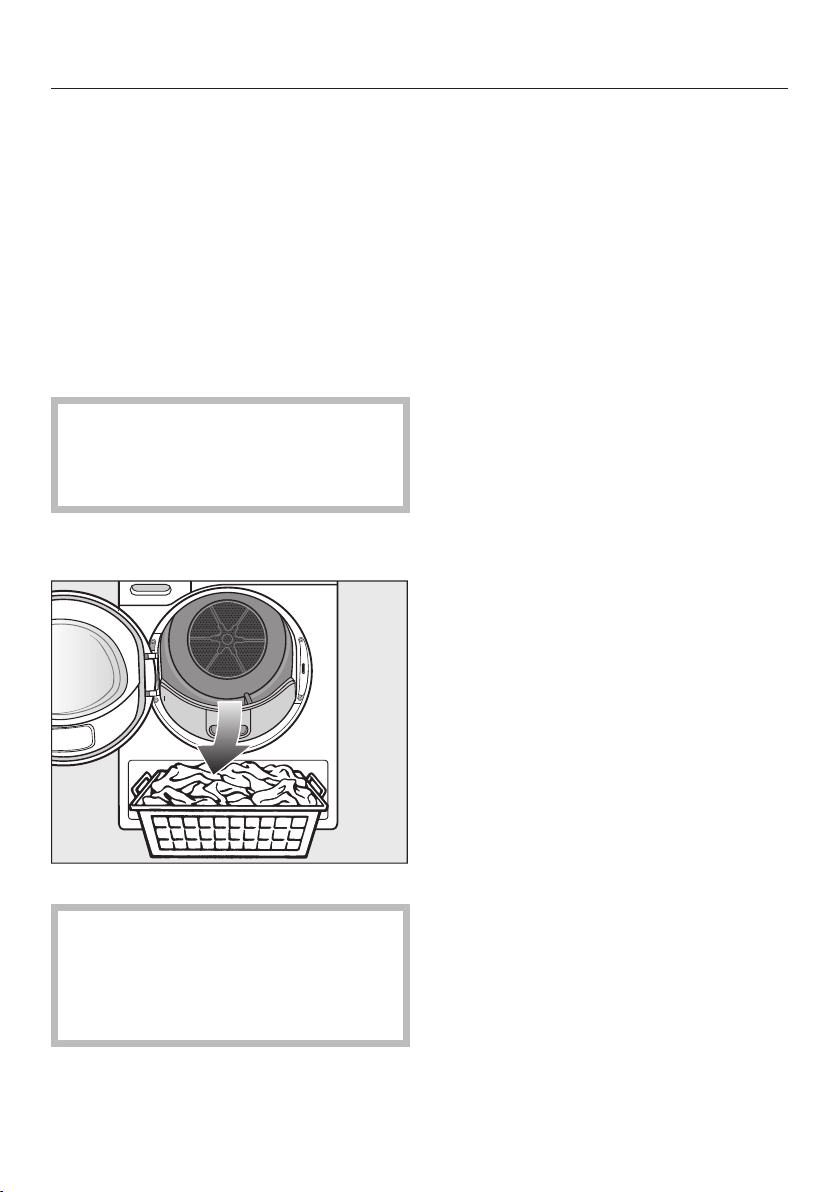
Removing the laundry
Only open the door when the drying
process has finished. Otherwise, the
laundry will not be properly dried and
cooled down.
Pull the door open at the side with
the orange marker.
Remove the laundry.
Always remove all items from the
drum.
Items left in the dryer could be
damaged by overdrying when the
dryer is used the next time.
Press the sensor to switch the
tumble dryer off.
Remove the fluff from the two fluff
filters in the door opening (see
“Cleaning and care - Fluff filters”).
Shut the door with a gentle swing.
Empty the condensed water
container.
We recommend that you drain the
condensed water externally through the
drain hose when drying a full load using
the Cottons and Cottons
programmes. This will avoid having to
empty the condensed water container
during the programme.
Drum lighting
When you open the door of the tumble
dryer, the drum is illuminated along with
the area immediately in front of the
dryer. This prevents you from
accidentally leaving behind any items in
the drum or in your laundry basket.
The drum lighting will go out
automatically to save energy.
Useful tip: To switch the lighting on
again, open the pull-down menu from
the overview menu and then touch the
sensor.
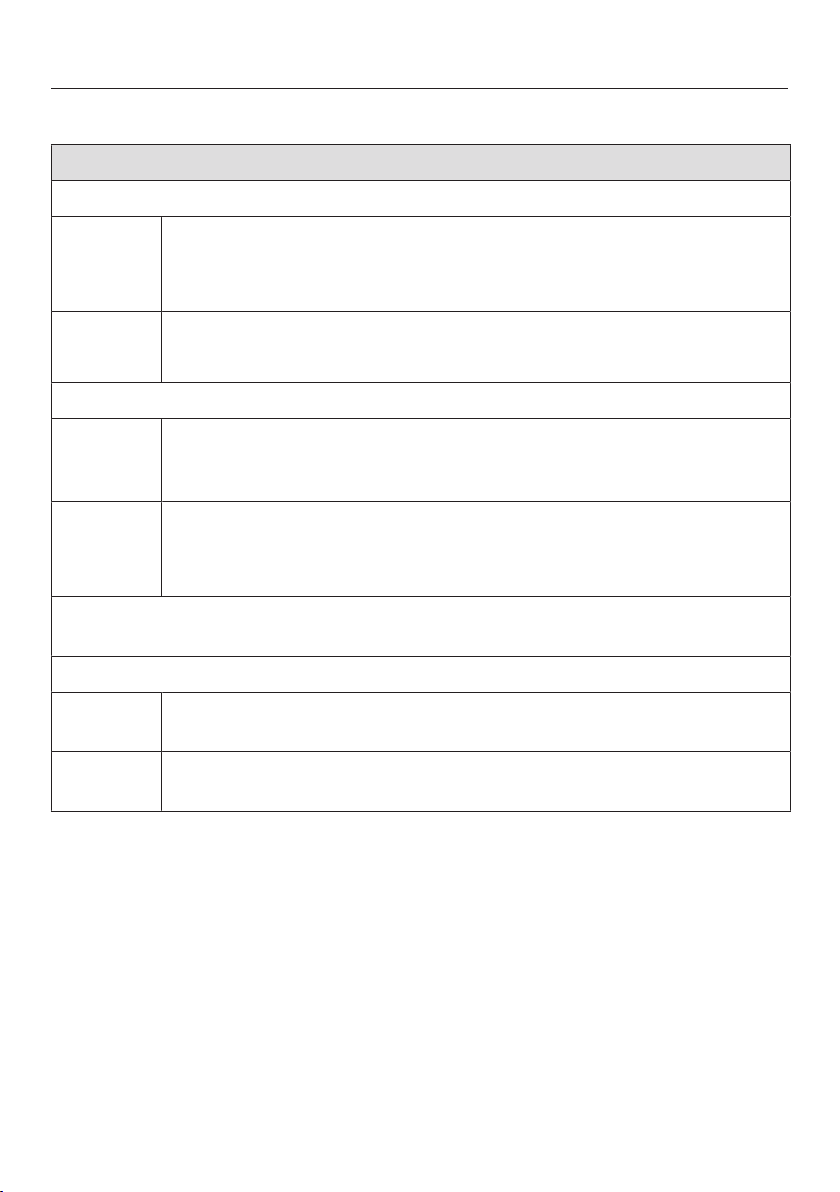
Programme chart
39
All weights marked with * are based on the weight of dry laundry.
Cottons Max. load 9.0 kg*
HygieneDry
Items - Cottons and linen fabric which will be in direct contact with the
skin, e.g. underwear, baby clothes, bed linen, towelling.
- Other hard-wearing fabrics with special hygiene requirements.
Tip - Use for special hygiene requirements.
- Reduce to half the maximum load amount.
Extradry, Normalplus, Normal
Items Single and multi-layered cotton fabrics. For example: towelling,
jerseywear, T-shirts, underwear, baby clothes, workwear, covers,
aprons, jackets, bathrobes, and flannelette bed linen.
Tip - Select Extra dry for multi-layered and very thick fabrics.
- Do not use Extra dry for jersey fabrics (e.g. T-shirts, underwear,
baby clothes), as they have a tendency to shrink.
Set programme Cottons Extra dry for testing in accordance with
AS/NZS 2442.1 & AS/NZS 2442.2.
Hand iron , Hand iron , Machine iron
Items Cotton or linen fabric requiring further processing. For example: ta-
ble linen, bed linen, or starched laundry.
Tip Roll up laundry that you want to machine iron to prevent it from
drying out until you are ready for ironing.
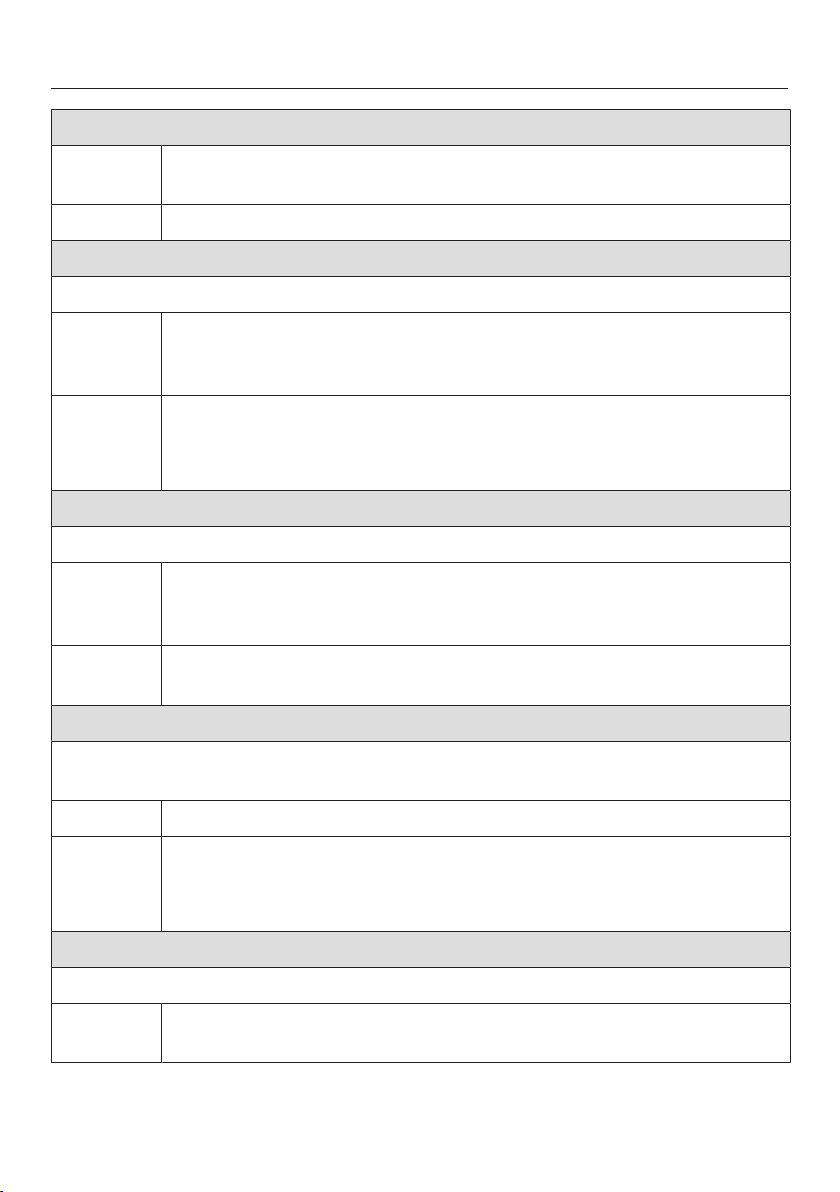
Programme chart
40
Cottons Max. load 9.0 kg*
Items Cotton items such as those described under Cottons Normal with
normal residual moisture.
Notes Items are dried to a Normal level only.
Minimum iron Max. load 4 kg*
HygieneDry, Normalplus, Normal, Hand iron, Hand iron
Items Minimum iron items made of cotton, synthetic, or mixed fibre. For
example: workwear, overalls, pullovers, dresses, trousers, table linen
and leggings.
Tip - Use HygieneDry for hard-wearing fabrics with special hygiene
requirements.
- Reduce to half the maximum load amount.
Delicates Max. load 2.5 kg*
Normal, Hand iron, Hand iron
Items Delicate items with the symbol on the care label made of
synthetic fibre, mixed fibre, rayon, and easy care cotton. For
example: shirts, blouses, lingerie, and appliquéd garments.
Tip The load should be reduced further for a particularly crease-free
drying result.
Bed linen Max. load 4 kg*
HygieneDry, Extra dry, Normalplus, Normal, Hand iron, Hand iron,
Machine iron
Items Bed linen, pillowcases.
Tip - Use HygieneDry for hard-wearing fabrics with special hygiene
requirements.
- Reduce to half the maximum load amount.
Automatic Max. load5kg*
Normalplus, Normal, Hand iron, Hand iron
Items Mixed loads of garments suitable for the Cottons and Minimum iron
programmes.
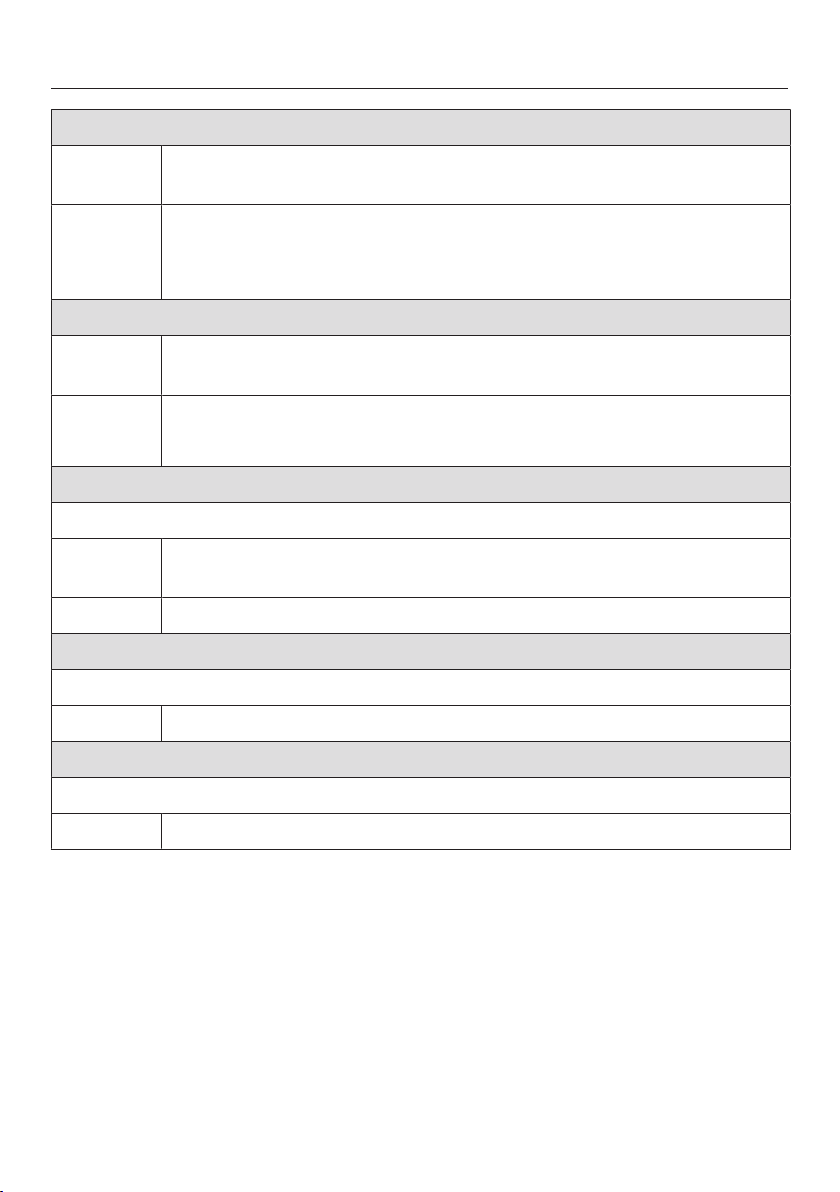
Programme chart
41
Woollens handcare Max. load2.0kg*
Items Woollen garments and fabric containing wool blends, e.g. pullovers,
cardigans, stockings.
Notes - Wool and wool blend items are only fluffed up; they are not dried
completely.
- Remove garments as soon as the programme has finished.
Silks handcare Max. load1.0kg*
Items Silk garments which are suitable for drying in a tumble dryer, e.g.
blouses and shirts.
Notes - This programme reduces creasing. Items are not dried completely.
- Remove garments as soon as the programme has finished.
Express Max. load 4 kg*
Extra dry, Normalplus, Normal, Hand iron, Hand iron, Machine iron
Items Fabrics with the symbol that are suitable for the Cottons
programme.
Notes The programme duration is shorter.
Shirts Max. load 2 kg*
Normalplus, Normal, Hand iron, Hand iron
Items Shirts and blouses.
Denim Max. load 3 kg*
Normalplus, Normal, Hand iron, Hand iron
Items Denim garments, e.g. jackets, jeans, shirts, and skirts.
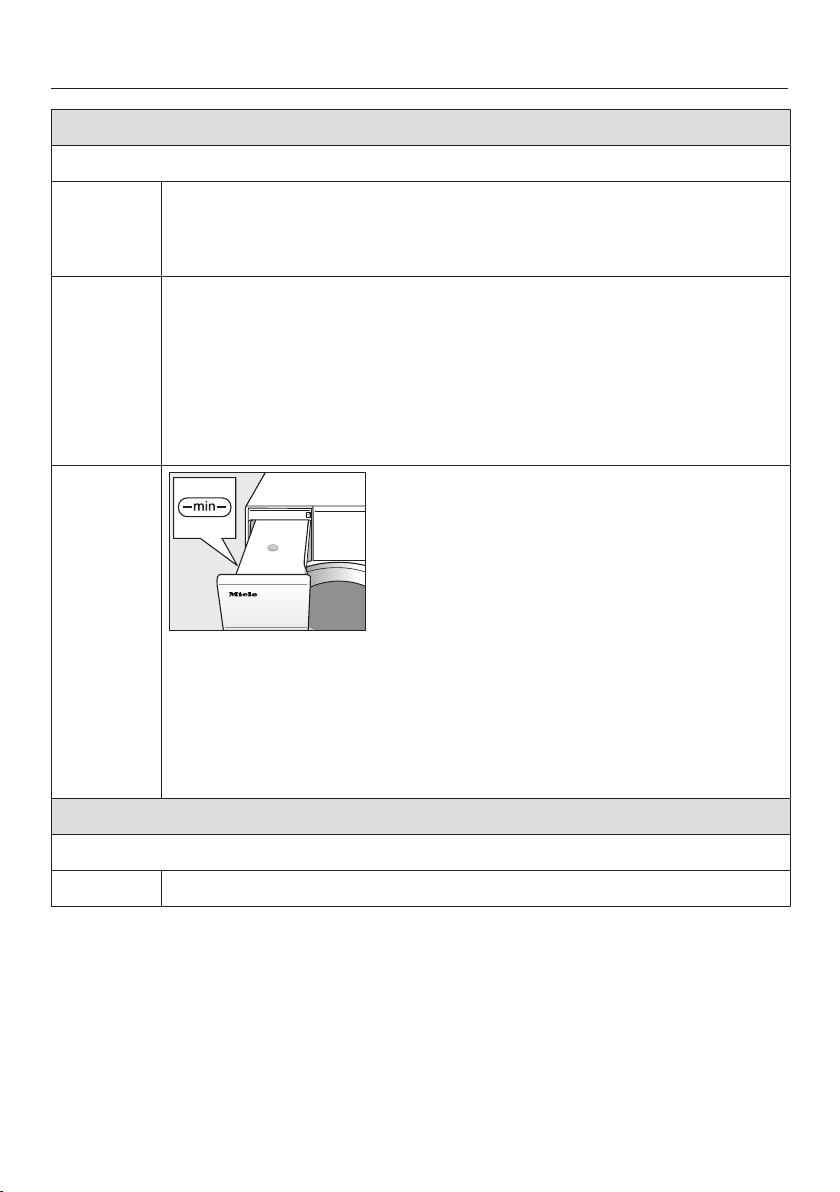
Programme chart
42
Steam care Max. load 1 kg*
Normal, Hand iron
Items - Cotton and linen fabric.
- Minimum iron items made of cotton, synthetic or mixed fibre. For
example: cotton trousers, jackets, anoraks, and shirts.
Tip - For dampening items before ironing.
- For smoothing items that are creased.
- Select Hand iron if the items are to be ironed after drying.
- This programme is also used to freshen up fabrics. To enhance the
effect, you can use the DryFresh fragrance flacon (optional
accessory).
Notes
- At the beginning of the programme, the condensed water
collected in the condensed water container is sprayed into the
drum via a spray jet. The condensed water container must
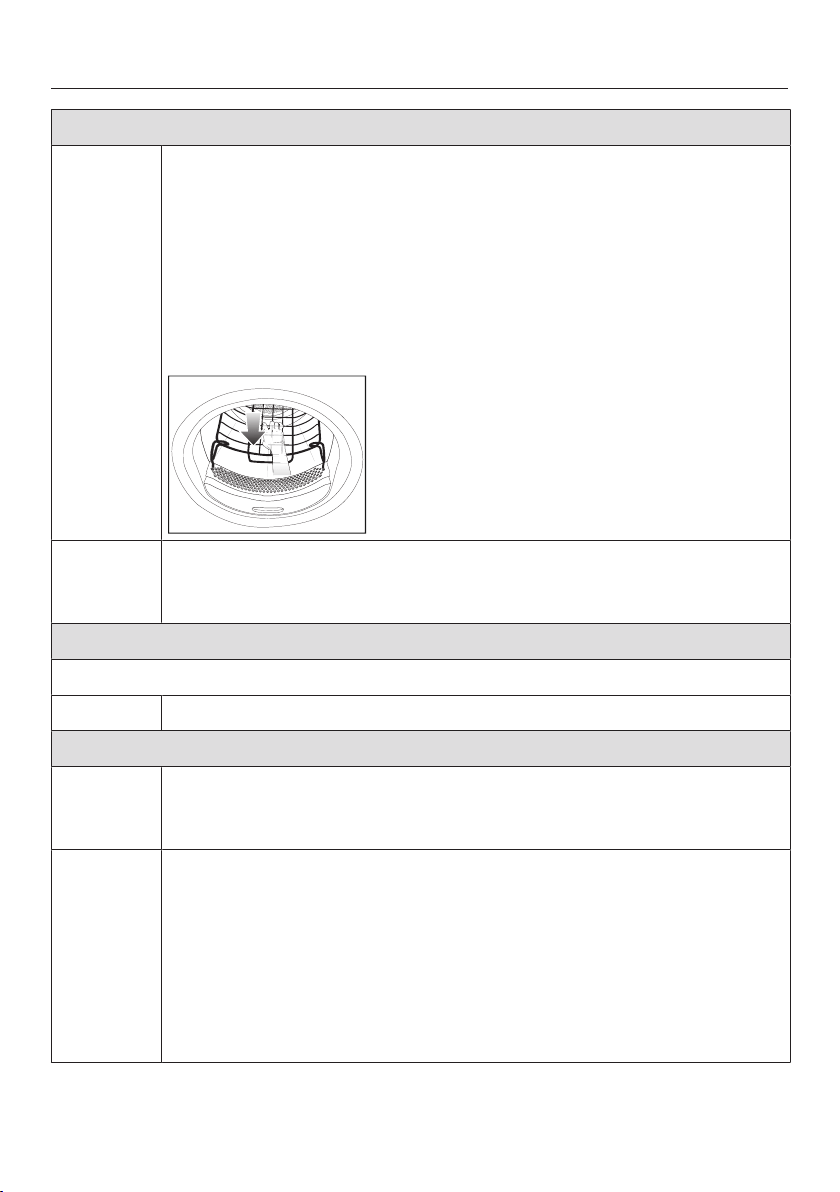
therefore be filled with water to at least the ―min― mark.
- You may hear a humming noise when the water is sprayed into the
drum.
Sportswear Max. load 3 kg*
Normalplus, Normal, Hand iron, Hand iron
Items Sportswear which is suitable for drying in a tumble dryer.
Programme chart
43
Basket programme Max. load for basket 3.5 kg
Notes - This programme may only be used with the Miele tumble dryer
basket TRK555 (optional accessory) fitted.
- It is essential to observe the operating instructions for the drying
basket.
- Make sure that no sleeves, straps, belt straps and boot legs (for
example) come into contact with the tumble dryer drum or drum
ribs. When the drum rotates, the laundry can become knotted,
causing damage to the dryer basket and tumble dryer.
Fabric
type/Items
Use this programme to dry or air items which are suitable for drying
in a tumble dryer but which are not suitable for drying using
mechanical action.
Outerwear Max. load 2.5 kg*
Normal, Hand iron
Items Outerwear which is suitable for drying in a tumble dryer.
Proofing Max. load 2.5 kg*
Items Fabrics suitable for tumble drying, e.g. microfibre fabrics, skiwear,
outerwear, fine, close-weave cotton garments (poplin), and
tablecloths.
Notes - This programme only dries to the Normal level.
- This programme includes a proofing fixing phase.
- Only use proofing agents which are stated by the manufacturer as
being "suitable for use on membrane textiles". These agents
contain fluorochemical compounds.
- Do not dry items which have been treated with proofing agents
containing paraffin. Fire hazard!
Programme chart
44
Warm air Max. load 9.0 kg*
Items - Multi-layered fabrics whose layers have different drying
characteristics, e.g. jackets, pillows, sleeping bags and other
bulky items.
- For drying individual items, e.g. bath towels, bathing suits, tea
towels and small loads.
Tip Do not select the longest drying time to start with. Check the items
as you are drying them to find the optimal time.
Cool air Max. load 9.0 kg*
Items Any item which only needs airing.
Standard pillows
Large pillows
1-2 pillows 40x80cm or
1 pillow 80 x 80 cm
HygieneDry, Normal
Items Pillows suitable for drying in a tumble dryer, with feather, down or
synthetic fillings.
Tip HygieneDry for special hygiene requirements.
Notes - Feathers are a natural product and may develop odours when
exposed to heat. Allow bedding to air outside the dryer after
drying.
- Pillows can still feel damp after being dried. You can use this
programme several times until the pillow feels dry.
Cottons hygiene Max. load 4 kg*
HygieneDry
Items Cottons and linen fabric which will be in direct contact with the skin,
e.g. underwear, baby clothes, bed linen, towelling.
Notes - For hard-wearing fabrics with special hygiene requirements.
- In this programme, the items will be dried with a temperature that
is constant over an extended period. This temperature holding
time kills off micro-organisms such as germs or dust mites and
reduces allergens in the laundry. Therefore, this programme
should not be interrupted as this would prevent the micro-
organisms from being killed off.

Programme chart
45
Extra quiet Max. load 9.0 kg*
Normal plus, Normal, Hand iron , Hand iron , Machine iron
Items Mixed loads of garments suitable for the Cottons and Minimum iron
programmes.
Tip Use to reduce the noise of the tumble dryer during quiet times.
Pre-ironing Max. load 1 kg*
Normal, Hand iron
Items - Cotton and linen fabrics.
- Minimum iron items made of cotton, synthetic or mixed fibre. For
example: cotton trousers, jackets, anoraks, and shirts.
Tip - This programme smoothes out creasing caused during the spin
cycle in the washing machine.
- This programme is also suitable for dry fabrics.
- Remove garments as soon as the programme has finished.
Extras
46
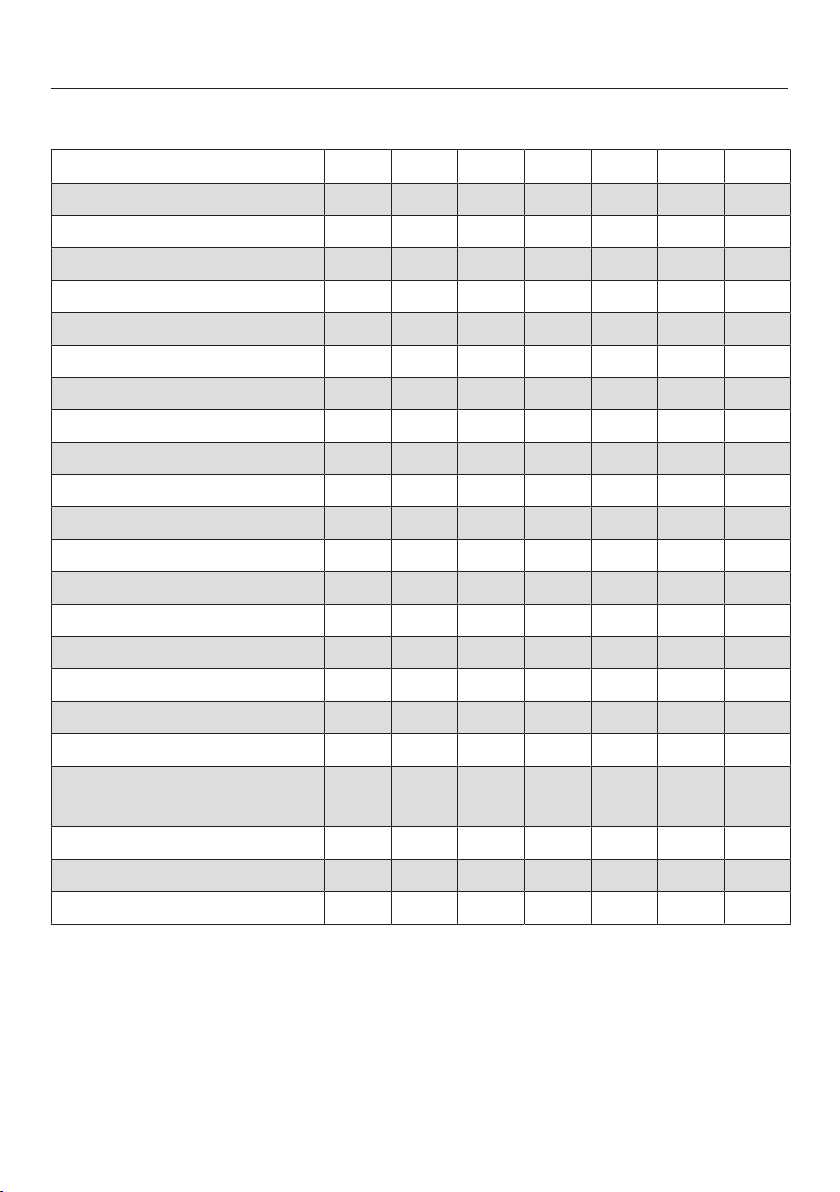
The drying programmes can be
supplemented with various Extras. The
table lists the selection options.
DryFresh
The Normal drying level can be used to
freshen up clothing that is clean and dry
without wetting it.
The function is slightly less effective
when used with fabrics made of
synthetic fibres.
Useful tip: To enhance the effect, you
can also use the DryFresh fragrance
flacon (optional accessory). Reduce the
size of the load.
DryFresh is not available for all drying
levels.
PowerFresh
This option can be used to freshen up
clothing that is clean and dry by using
steam.
The fabrics are moistened
automatically. As the item is dried, the
heat from the generated water vapour is
transferred directly to the item so that
odour molecules in the fabric can be
freed more easily.
The function is slightly less effective
when used with fabrics made of
synthetic fibres.
Reduce the size of the load to 1kg.
PowerFresh is not available for all
drying levels.
Useful tip: To enhance the effect even
further, you can also use the DryFresh
fragrance flacon (optional accessory).
Condensed water from the condensed
water container is sprayed into the
drum. The condensed water container
must therefore be filled to at least the
―min― mark.
Fill the condensed water container.
See “Condensed water container –
Filling the condensed water container”.

Extras
47
DryCare40
This option dries fabrics gently by using
a particularly low temperature.
It can be used for all fabrics that are
free of wool and are washable at
temperatures of 40°C and above.
In order to achieve an optimal drying
result, please note:
For the respective programme, reduce
the maximum load size specified in
these operating instructions by half.
Exceptions: you must reduce
programmes with a maximum load
size of 9kg to 4kg.
DryCare40 is not available for all drying
levels.
Gentle tumble
The items are dried at a gentle
temperature.
Suitable for all items with the symbol,
e.g. those made from acrylic.
The programme duration is extended.
Quick
Robust garments with the care
symbol can be dried with a reduced
drying time.
The compressor power is increased,
which gives rise to more operating
noise (buzzing/humming).
ECO
The compressor power is reduced
which saves energy. This causes the
programme duration to increase.
Freshen up
Odours are reduced in clean clothing.
The textiles are aired to the Normal
drying level.
The function is slightly less effective
when used with fabrics made of
synthetic fibres.
Useful tip: Dampen the clothing and
use a fragrance flacon to enhance the
freshening effect.
Extras
48
Drying programme overview - Extras
Cottons – – – – – – –
Cottons X X X X X X X
Minimum iron X X X X X X X
Delicates – – – – – –
Bed linen – – – – – – –
Automatic X X X X X X –
Woollens handcare – – – – – – –
Silks handcare – – – – – –
Express – – – – – – –
Shirts X X X X X X X
Denim X X X X X X X
Steam care – – – – – – –
Sportswear – – X X X X –
Basket programme – – – – – – –
Outerwear – – X X – – –
Proofing – – – – – – –
Timed drying Warm air – – X X – – –
Timed drying Cool air – – – – – – –
Standard pillows
Large pillows
– – – – – – –
Cottons hygiene – – – – – – –
Extra quiet – – – – – – –
Pre-ironing – – – – – –
The Extras cannot be combined with one another.
=
=
=
=
DryFresh
PowerFresh
DryCare 40
Gentle tumble
=
=
=
Quick
Eco
Freshen up
X
–
=
=
=
can be selected
cannot be selected
activated automatically

Wash2Dry
49
Once the wash programme has
completely finished, the Miele washing
machine transfers the programme
data via the router to which the
networked tumble dryer is also
connected, as well as transferring it to
the Miele Cloud.
The tumble dryer automatically sets a
drying programme tailored to the
laundry based on the transferred
programme data.
All you need to do is start the drying
programme once you have loaded the
tumble dryer. No further programme
settings are required on the tumble
dryer.
The drying programme must be
started within 24 hours of the end of
the wash programme. The data will be
kept available for the tumble dryer
during this period, but will be
overwritten when a new wash
programme ends.
Useful tip: Do not disconnect the
tumble dryer from the network. The
programme data transferred by the
washing machine will be received by
the tumble dryer as soon as you select
Wash2Dry.
If you have disconnected the appliance
from the network beforehand, this will
cause a delay in receiving the data.
Requirements for use
In order to use the Wash2Dry function,
the Miele washing machine and
tumble dryer must be networked using
Miele@home services.
Useful tip: Set up Miele@home as
described in “Before using for the first
time”.
Selecting the
Wash2Dry function
Please wait lights up in the display of
the tumble dryer while the wash
programme is running.
Once the washing machine programme
has completely finished, the drying
programme tailored to the laundry will
be displayed.
After the wash programme has
ended, place the clean laundry in the
tumble dryer and close the door.
To start the programme, all you need
to do is press the Start/Stopsensor
on the tumble dryer.
The programme will not start on this
tumble dryer after washing delicate
textiles (e.g. curtains) in special wash
programmes.

Favourite programmes
50
Creating a Favourite
programme
You can save your own customised
programmes under names of your
choice.
There are two ways to create a
Favourite programme.
Option 1
The main menu must be visible in the
display. Touch the Favouritessensor.
The display will change to show the
Favourites menu.
Touch the Createsensor.
The display will change to show the
Create Favourites menu.
Select the required programme.
Select all the programme settings you
want.
Then select Save.
Enter a name.
Option 2
You can save a programme which has
been selected as a Favourite
programme before you start it.
Before the programme starts, touch
the Save sensor.
Enter a name.
If 12 Favourites have already been
saved, the Create or Save sensor
will not be visible. Delete an existing
Favourite if you wish to create a new
one.
Entering a name
It is best to select short, memorable
names.
Touch the letters or characters you
want.
Confirm with the Save sensor.
The programme will then be saved to
the Favourites programme list.
Changing a Favourite programme
You can rename, delete or move a
Favourite programme.
Select Favourites from the main menu.
Touch the Favourite programme that
you wish to change until the Context
menu opens.
Select Rename, Delete or Move.

Drying assistant
51
The Drying assistant helps you when
drying a wide variety of items. The
tumble dryer will use the list of items to
put together a suitable drying
programme.
Scroll to the second page in the main
menu.
Touch the Drying assistant sensor.
A list will open. The drying purpose is
grouped into different areas.
OK
Purpose
Drying
Proofing/
Reactivation
Smooth damp
items
Smooth dry
items
11:02
Useful tip: Touch the sensor to find
out more about each purpose.
Touch the sensor for the Purpose
which matches your drying
requirement.
A list of items will appear.
OK
Textiles
Shirts
Denim
T-shirts
Blouses
11:02
Touch the appropriate sensor for your
item of laundry.
The item selected will be highlighted
orange. You can select several items.
With some items, helpful information
will also appear in the display when
they are selected.
Confirm with the OK sensor.
Follow the instructions in the display.
A summary of the selected parameters
will then appear in the display.
Confirm with the OK sensor or select
Change if you would like to make any
changes.
The programme which has been
tailored to your laundry is ready to start.
Useful tip: You can add individual
programme settings, e.g. Extras before
you start the programme.

Timer
52
The timer can be used to set the time at
which a programme starts or finishes.
The programme start can be delayed by
up to 24hours.
Setting the timer
Touch the sensor.
Select the Finish at or Start at option.
Set the hours and the minutes and
confirm your entry with the OK
sensor.
Changing the timer
The selected times for the timer can be
changed before the programme starts.
Touch the or sensor.
Change the time set and confirm with
the OK sensor.
Deleting the timer
The selected time for the timer can be
deleted before the programme starts.
Touch the or sensor.
The selected time for the timer appears
in the display.
Touch the Delete sensor.
Confirm with the OK sensor.
The selected time for the timer is now
deleted.
Starting the timer
Touch the Start/Stop sensor.
The time until the programme starts will
appear in the display.
After the programme has started, the
selected time can only be changed or
cancelled by interrupting the
programme.
The programme can be started
immediately at any time.
Touch the Start immediately sensor.
Adding laundry during ongoing timer
period
Follow the instructions in the sections
"Changing the programme sequence"
and "Adding or removing laundry".
If a longer time is set for the timer, the
drum will rotate occasionally to
untangle the laundry. This is not a fault.

Timer
53
SmartStart
The SmartStart function (only available
in selected countries) lets you define a
time period during which your tumble
dryer will start automatically. The
appliance will start on receipt of a
signal, e.g. from your energy supplier,
that indicates that the electricity rate is
particularly economical.
This function is active when the
SmartGrid setting is switched on.
The timeframe can be defined between
1minute and 24hours. During this
period, the tumble dryer waits for the
signal from the energy supplier. If no
signal is sent during the defined period,
the tumble dryer starts the drying
programme.
Setting the timeframe
If you have activated the SmartGrid
function in the settings, SmartStart or
SmartFinish will appear in the display
instead of Start at or Finish at when
you touch the Timer sensor (see
“Settings – SmartGrid”).
The procedure for setting this is the
same as for setting the time for the
timer.
Set the time you want and confirm
with the OK sensor.
Touch the Start/Stop sensor to start
the drying programme with
SmartStart.
The selected programme will start
automatically, as soon as the energy
provider has sent the signal, or the
latest calculated start time has been
reached.
The procedure for changing or
deleting the SmartStartfunction is the
same as described in “Changing the
timer” and “Deleting the timer”.

Changing the programme sequence
54
Changing a programme after it
has started
You cannot change to another
programme once a programme has
started (this prevents unintentional
alterations).
You will need to cancel the current
programme before you can select a
new one.
Cancelling a programme
Touch the Start/Stop sensor.
The following appears in the display:
Cancel the programme?
Select yes.
The following appears in the display:
Programme cancelled
Open the door.
Selecting another programme
Close the door.
Select the required programme.
Touch the Start/Stop sensor.
Adding or removing laundry
You have forgotten an item of laundry,
but the programme has already started.
Touch the Add laundry sensor.
The following appears in the display:
Add laundry and The door can be opened..
The Start/Stop sensor flashes slowly.
Risk of burning when touching
hot laundry in the drum!
You could burn yourself.
Open the door.
Add or remove laundry.
Close the door.
Touch the Start/Stop sensor.
The programme will continue.
Exceptions to adding laundry
In some cases, e.g. during the cooling
phase or in the Proofing programme,
you cannot add laundry.
In exceptional cases, the door can be
opened while the programme is
running.
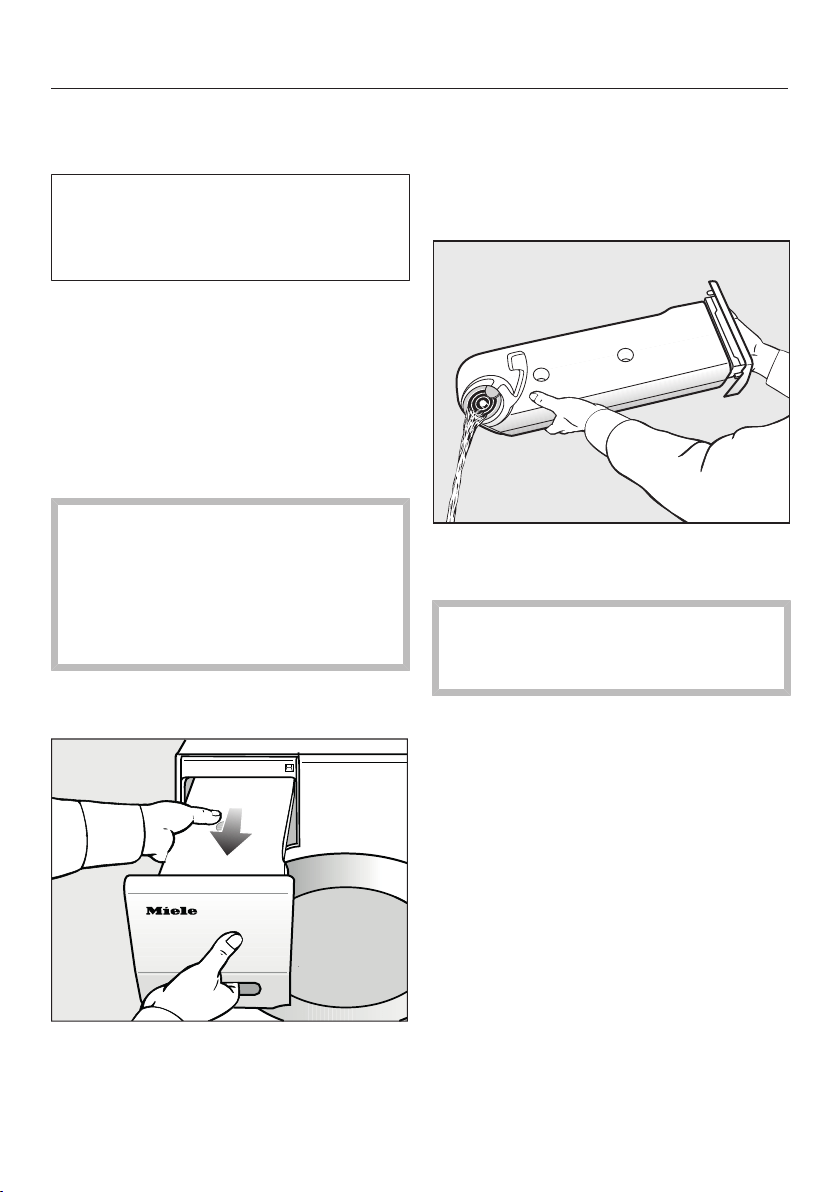
Condensed water container
55
Emptying the condensed water
container
The condensed water is collected in
the condensed water container.
Empty the condensed water container
after every drying programme.
When the maximum level in the
condensed water container is reached,
the following message will light up in
the display: Empty the container or check
the drain outlet
To clear the message, open and close
the door with the tumble dryer
switched on.
Damage to the door and the
fascia panel when removing the
condensed water container*.
The door and the fascia panel can
get damaged.
Always close the door completely.
*This does not apply to right-hand
hinged models.
Pull out the condensed water
container.
To prevent water running out, keep it
in a horizontal position when carrying
it. Hold the condensed water
container by the front panel and at
the back.
Empty the container.
Replace the container in the dryer.
Condensed water can cause health
problems in people and animals.
Do not drink condensed water.
Useful tip: When certain programmes
are being used, water is taken from the
condensed water container and
recycled. For this, the condensed water
container must be filled to a certain
level (see “Filling the condensed water
container”).
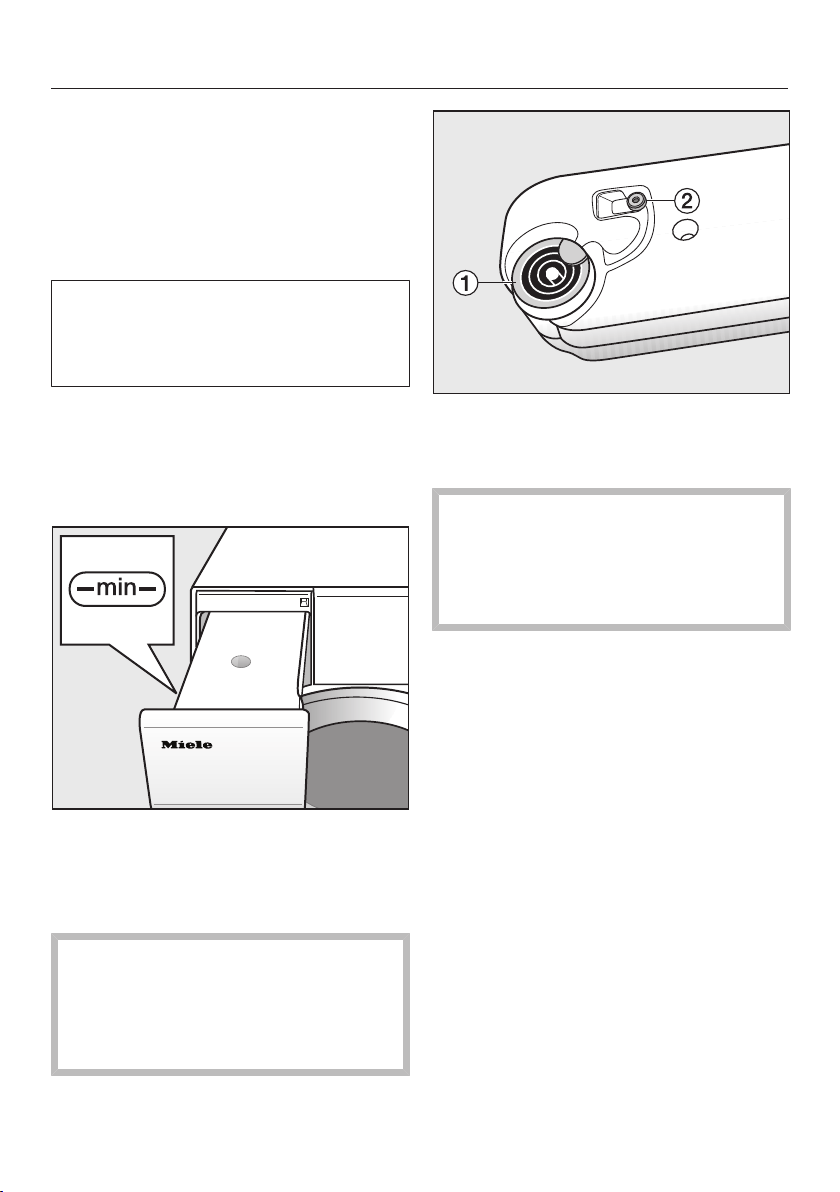
Condensed water container
56
Filling the condensed water
container
When certain programmes are being
used, condensed water generated
during drying is recycled and sprayed
into the drum via a spray nozzle.
The condensed water container must
therefore be filled to at least the
―min― mark. Otherwise, this could
cause a fault.
The ―min― mark is on the front left-
hand side of the container. If you have
set the appliance up so that condensed
water is drained away, the condensed
water container will be empty.
Check the fill level of the condensed
water container.
Only fill it with commercially available
condensed water (for ironing).
You should only use mains water in
exceptional circumstances.
If mains water is used frequently,
limescale can build up on the spray
jet in the door opening.
1 spout, 2 rubber seal
Pour the condensed water through
the rings on the spout 1.
The spray jet in the door opening
may clog.
Only fill with clean water. Do not add
fragrances, detergents or other
substances.
Cleaning the rubber seal
If mains water is used frequently,
limescale deposits can build up on the
rubber seal 2.
Use a damp cleaning cloth to
carefully remove any limescale
deposits from the rubber seal 2.
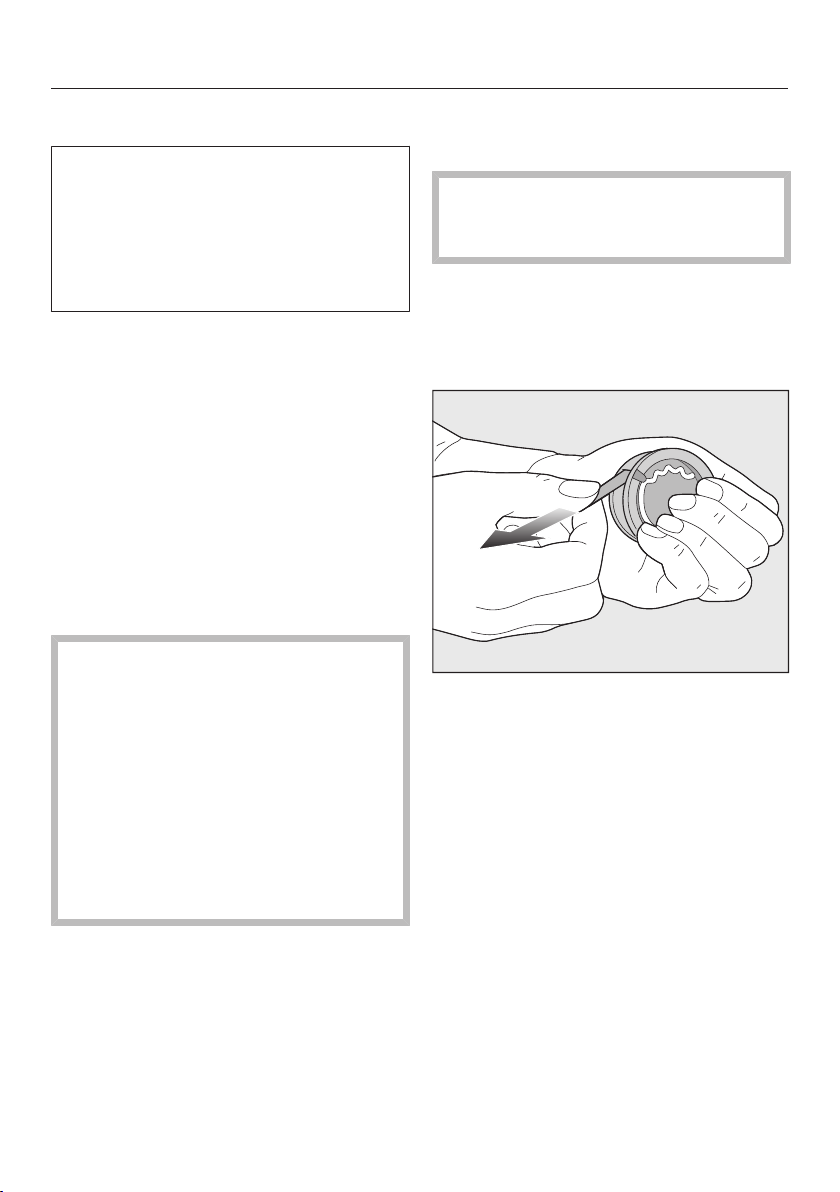
Fragrance flacon
57
FragranceDos
Fragrance flacons (optional
accessories) can be used to give your
laundry a pleasant scent.
This dryer has 2 places for inserting
fragrance flacons. This gives you a
choice of how to use them.
- You can use both positions if you
wish to change from one scent to
another. You can close the fragrance
flacon that you are not using.
- Use both positions if you want a more
intense scent of the same fragrance,
or if you wish to conveniently switch
between a scent for normal laundry
and DryFresh to freshen up your
laundry.
- Use one socket only if you only want
to use the one fragrance.
Risk of fire and harm to health if
fragrance flacons are used
incorrectly.
Leaked fragrance can be harmful to
your health if it comes into contact
with your body. Leaked fragrance
can cause a fire.
Before using a fragrance flacon,
please read "Warning and Safety
instructions - Using a fragrance
flacon (optional accessory)”.
Removing the protective seal
from the fragrance flacon
Only hold the fragrance flacon as
illustrated. Do not hold it at an angle
or tip it as the fragrance will leak out.
Take the fragrance flacon out of its
packaging.
Do not attempt to open the fragrance
flacon.
Hold the fragrance flacon securely so
that you do not open it by mistake.
Pull off the protective seal.
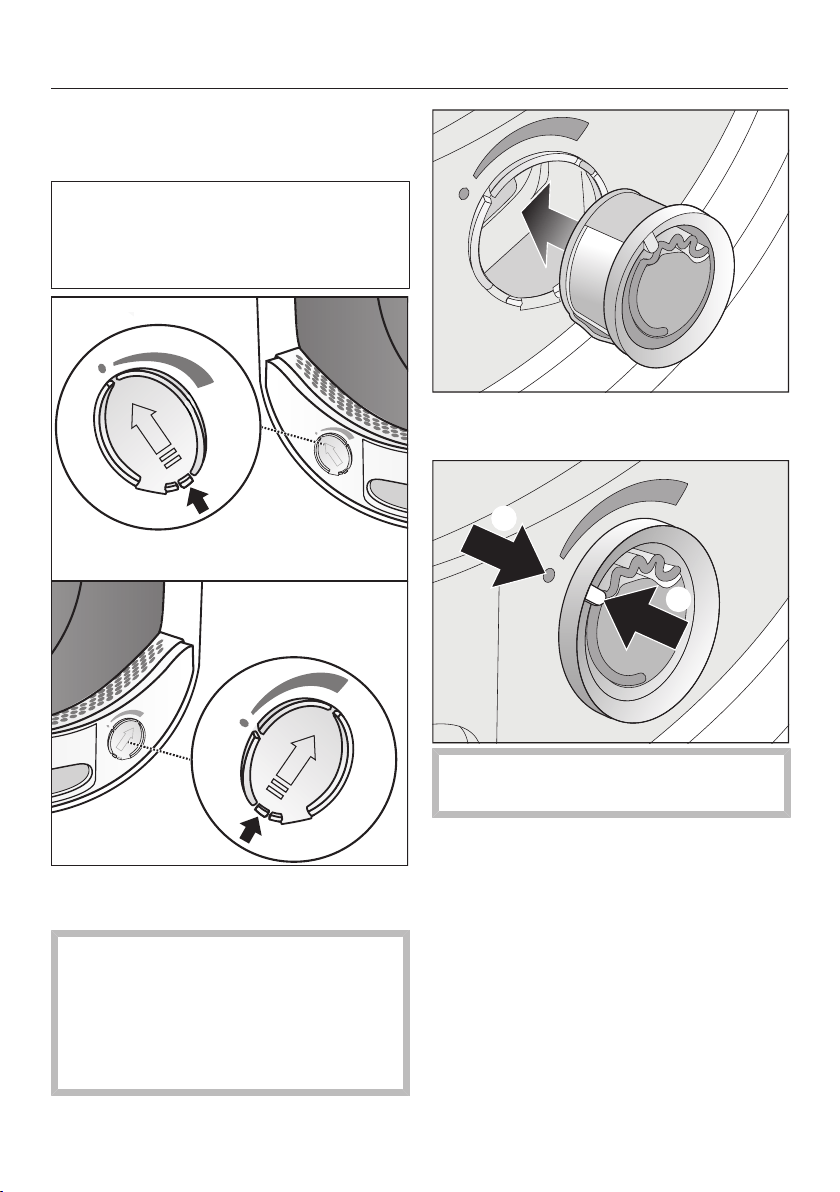
Fragrance flacon
58
Inserting the fragrance flacon
Open the door of the tumble dryer.
The fragrance flacon is inserted in the
upper fluff filter. It can be inserted on
the left or the right-hand side beside
the grip.
Open the cover using the tab until the
tab is right at the top as shown.
To prevent the accumulation of fluff,
the cover of the unused socket must
remain closed.
Push the tab of the cover to the
bottom (see dark arrow), until you
hear it click into position.
Insert the fragrance flacon in the
opening as far as it will go.
Markers and must line up with
each other.
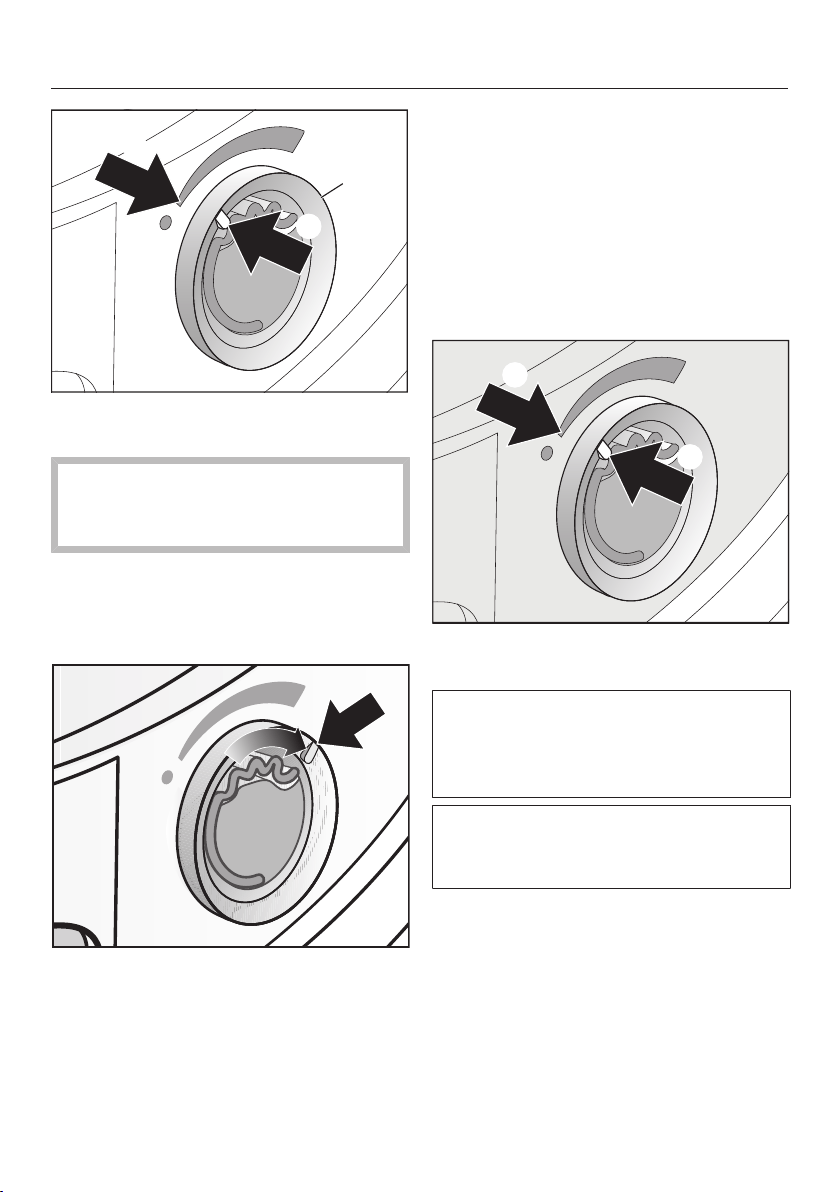
Fragrance flacon
59
Turn the outer ring clockwise a
little.
The fragrance flacon can slip out.
Turn the outer ring so that markers
and line up.
Opening the fragrance flacon
Before drying, you can select the
intensity of the fragrance.
Turn the outer ring clockwise: the
further you open the fragrance flacon,
the more intense the fragrance.
Damp laundry and longer drying
durations with sufficient heat transfer
are needed for the fragrance to be
released into the laundry effectively.
The fragrance will also be noticeable in
the room air during the process. The
Cool Air programme will not generally
apply fragrance.
Closing the fragrance flacon
After drying, the fragrance flacon should
be closed to prevent the fragrance from
escaping needlessly.
Turn the outer ring anti-clockwise
until marker b is in position _.
If you wish to dry laundry without
adding fragrance: remove the
fragrance flacon and store it in its
original packaging.
When the intensity of the fragrance is
no longer sufficient, replace the
fragrance flacon with a new one.
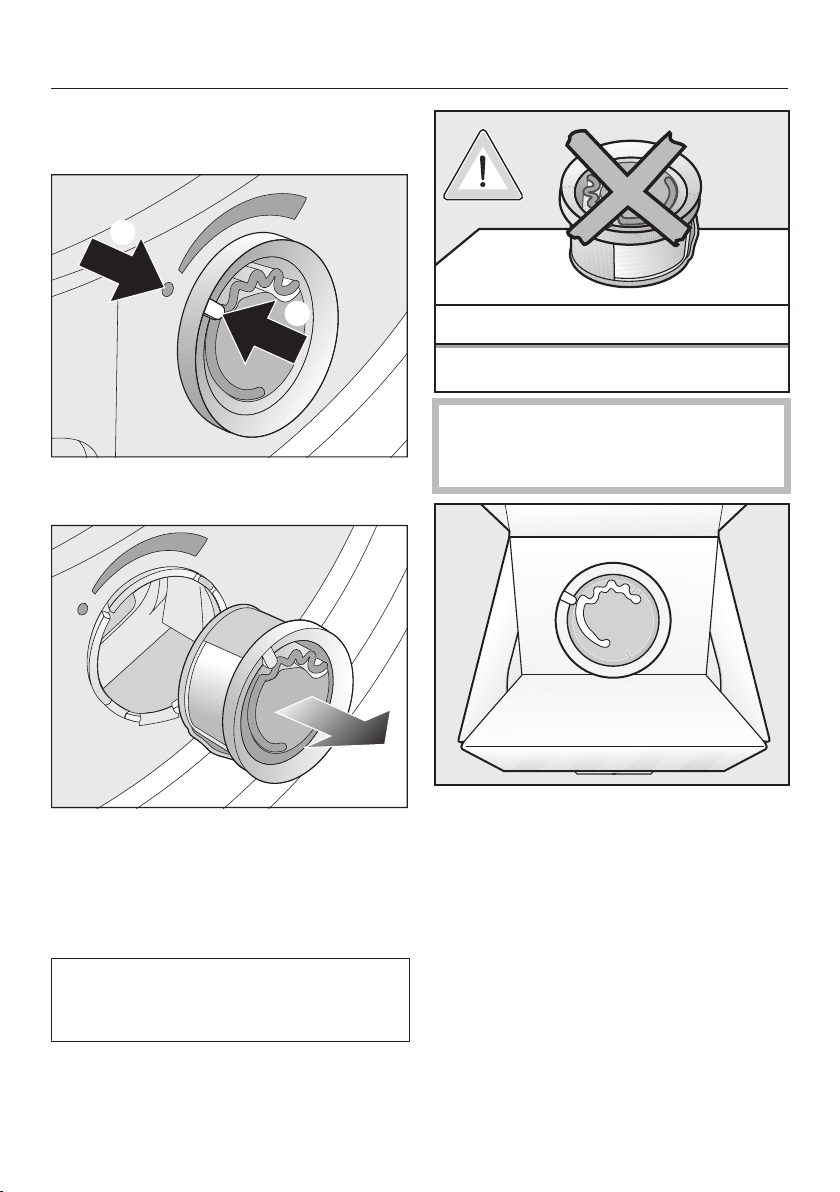
Fragrance flacon
60
Removing/replacing the
fragrance flacon
Turn the outer ring anti-clockwise
until markers a and b line up.
Replace the fragrance flacon with a
new one.
When not in use, you can store the
fragrance flacon in its original
packaging.
Fragrance flacons are available to
order from Miele or online at
www.miele-shop.com.
Fragrance can leak.
Do not lay the fragrance flacon
down.
- If you are keeping the fragrance
flacon in its original packaging, do
not store the packaging upright on its
edge or upside down. Otherwise, the
fragrance will leak out.
- Always store in a cool, dry place
away from direct sunlight.
- When purchasing new fragrance
flacons, only remove the protective
seal just before use.
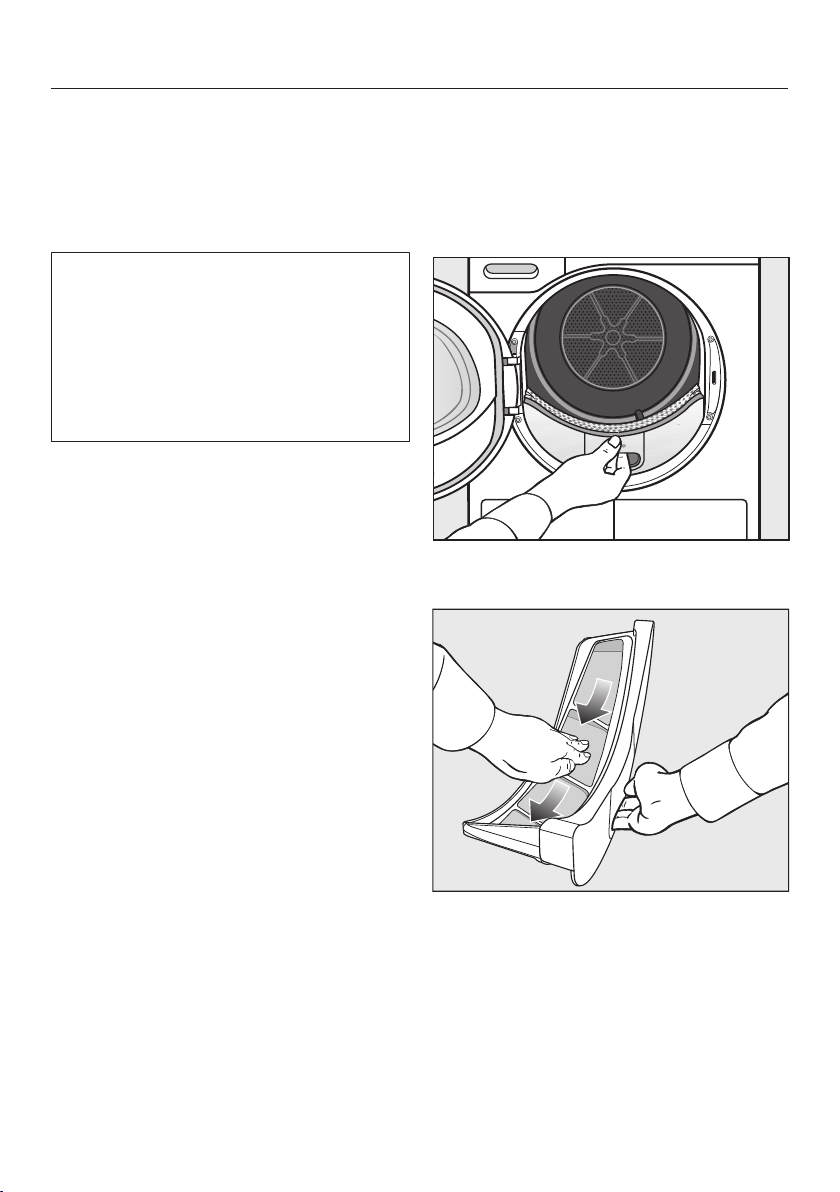
Cleaning and care
61
Fluff filters
This tumble dryer has 2 fluff filters in the
loading area of the door. Both fluff
filters trap fluff produced during the
drying process.
Clean the fluff filters after each drying
programme. This prevents an
extension of the programme duration.
Also clean the fluff filters when this
message lights up in the display: Clean
the fluff and plinth filters. See the operating
instruction manual for more information.
To clear the message, confirm with
OK.
Removing the fragrance flacon
The intensity of the fragrance will be
diminished if the fluff filters and the
plinth filter are not cleaned.
Remove the fragrance flacon. See
“Fragrance flacon - Removing/
replacing the fragrance flacon”.
Removing visible fluff
Useful tip: You can use a vacuum
cleaner so that you can remove the fluff
without touching it.
Open the door.
Pull the upper fluff filter forwards to
remove it.
Remove the fluff (see arrows).
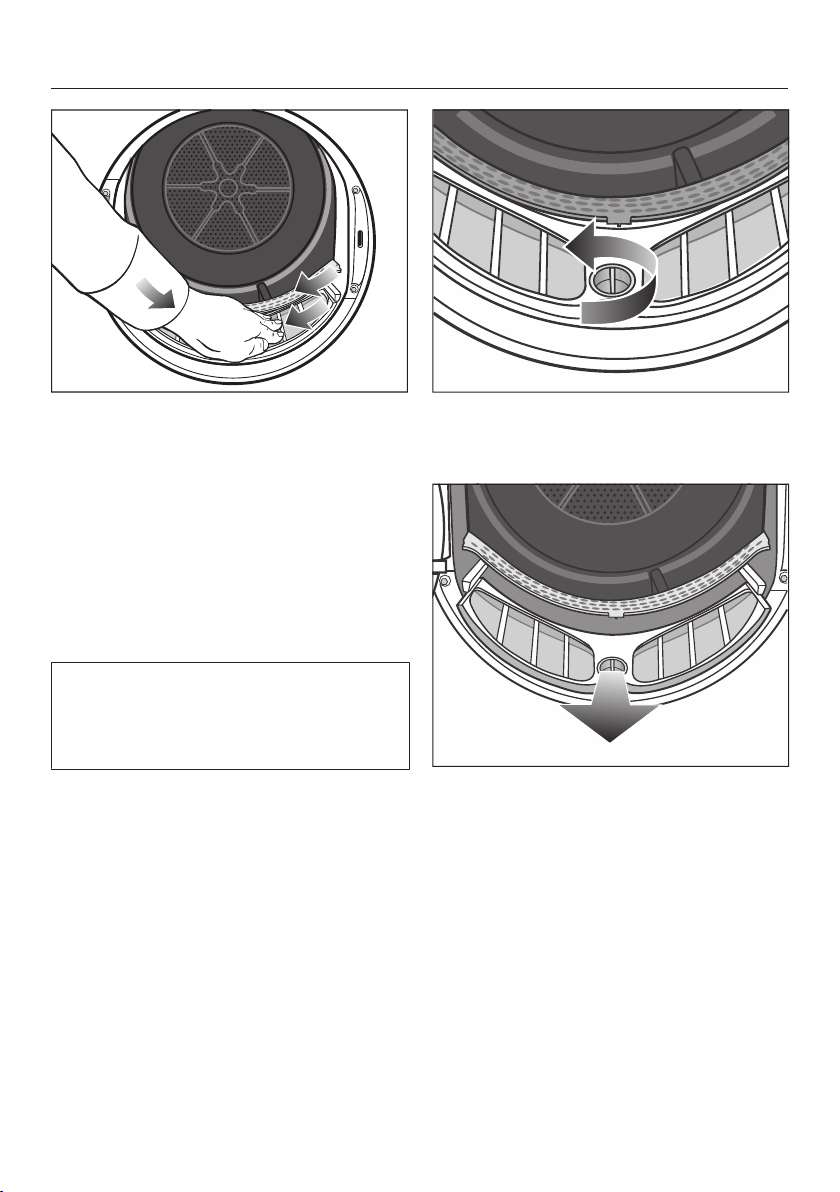
Cleaning and care
62
Remove the fluff from the filter
surface of all the fluff filters and the
perforated laundry deflector (see
arrows).
Push the upper fluff filter back until it
clicks into position.
Close the door.
Cleaning the fluff filters and air flow
openings thoroughly
If the drying duration has become
longer or the surface of the filters is
visibly compacted with fluff, you
should clean them thoroughly.
Remove the fragrance flacon. See
“Fragrance flacon-Removing/
replacing the fragrance flacon”.
Pull the upper fluff filter forwards to
remove it.
Turn the yellow dial on the lower fluff
filter in the direction of the arrow (until
you hear it click).
Hold the dial and pull the fluff filter
forwards to remove it.
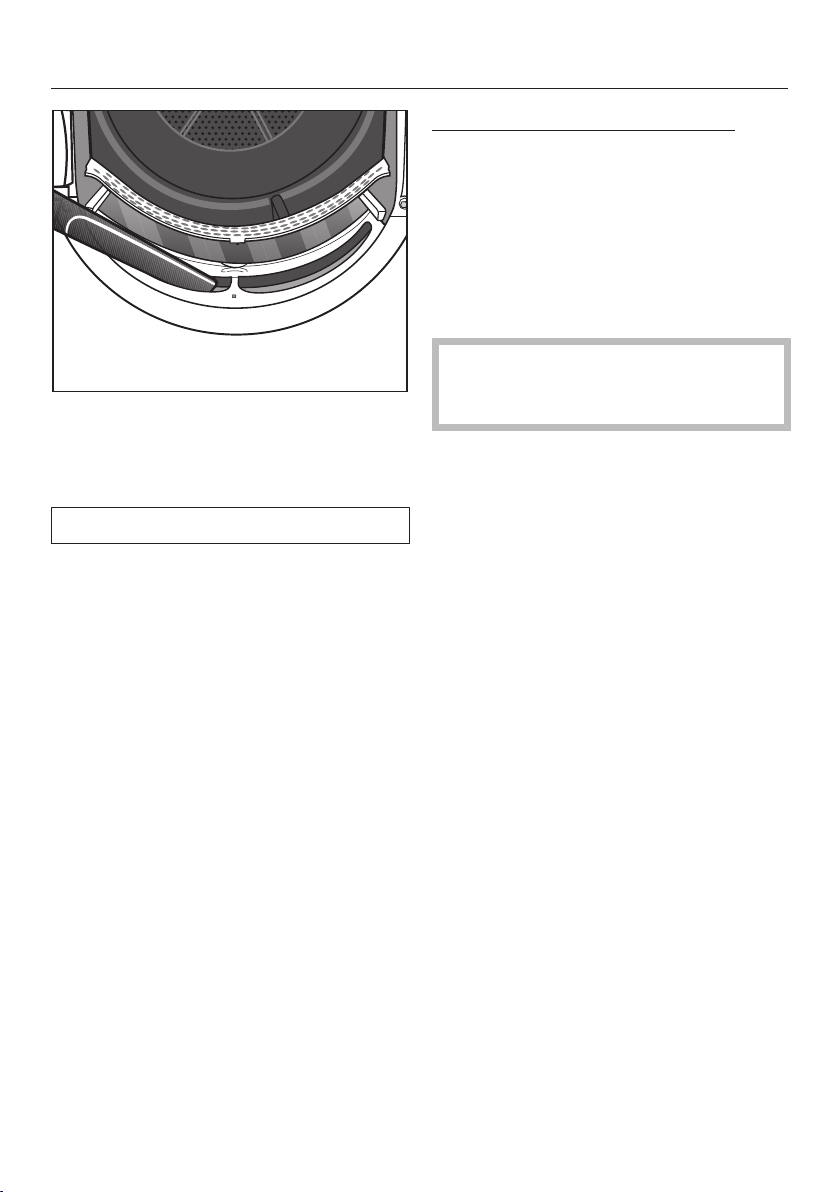
Cleaning and care
63
Use a vacuum cleaner with a long
crevice nozzle attached to remove
any visible fluff from the upper air
flow openings.
Finally, clean the fluff filters with water.
Cleaning the fluff filters with water
Wipe the smooth plastic surfaces of
the fluff filters with a damp cloth to
clean them.
Rinse the filters with warm running
water.
Shake the fluff filters thoroughly and
then dry them carefully.
Ensure the filters are dry before
replacing them. Wet filters could
cause operational faults.
Push the lower fluff filter in
completely and lock it with the yellow
dial.
Push the upper fluff filter in
completely.
Close the door.
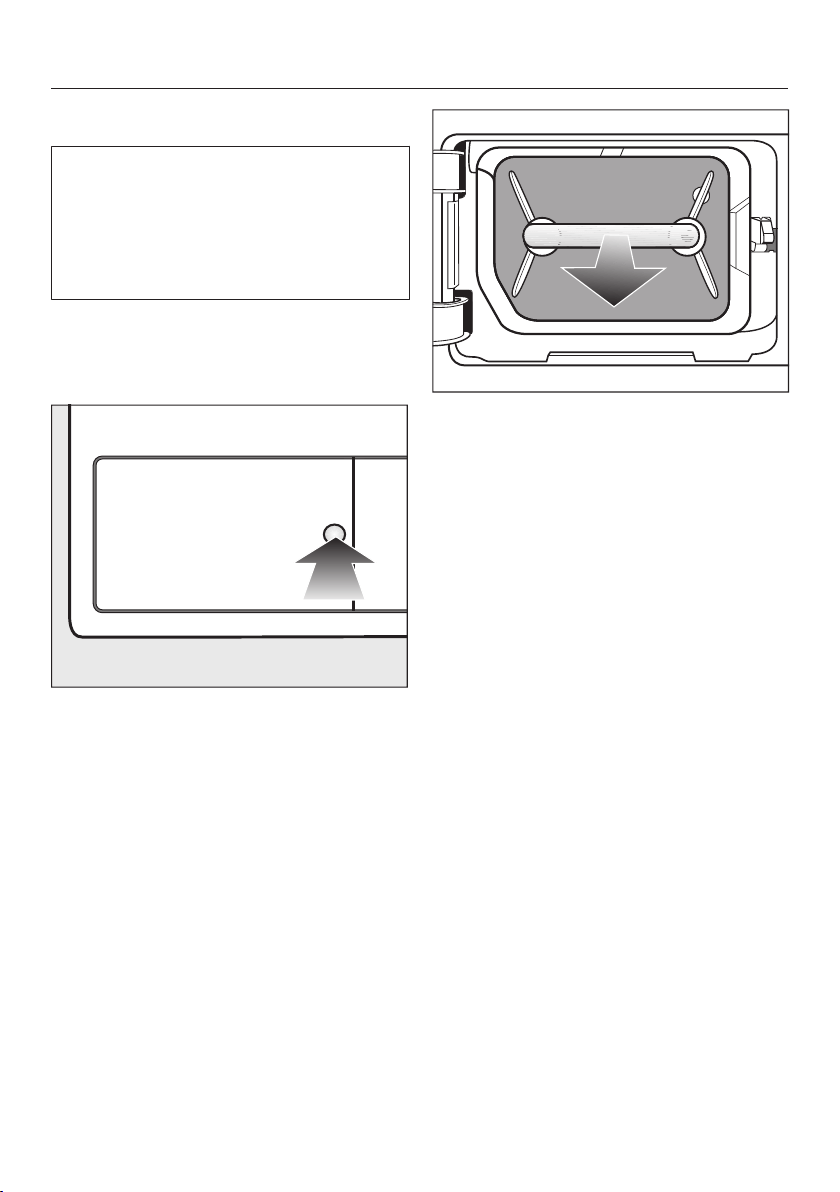
Cleaning and care
64
Cleaning the plinth filter
Clean the plinth filter when the
programme duration has been
extended or when this message
appears in the display: Clean the fluff
and plinth filters. See the operating
instruction manual for more information.
To clear the message, confirm with
OK.
Removing the plinth filter
Press the round, indented area on the
heat exchanger access panel to open
it.
The panel will spring open.
Pull the plinth filter out by the handle.
When the plinth filter is pulled out, the
right guide pin will slide out. The guide
pin prevents the flap from being closed
without the plinth filter in place.
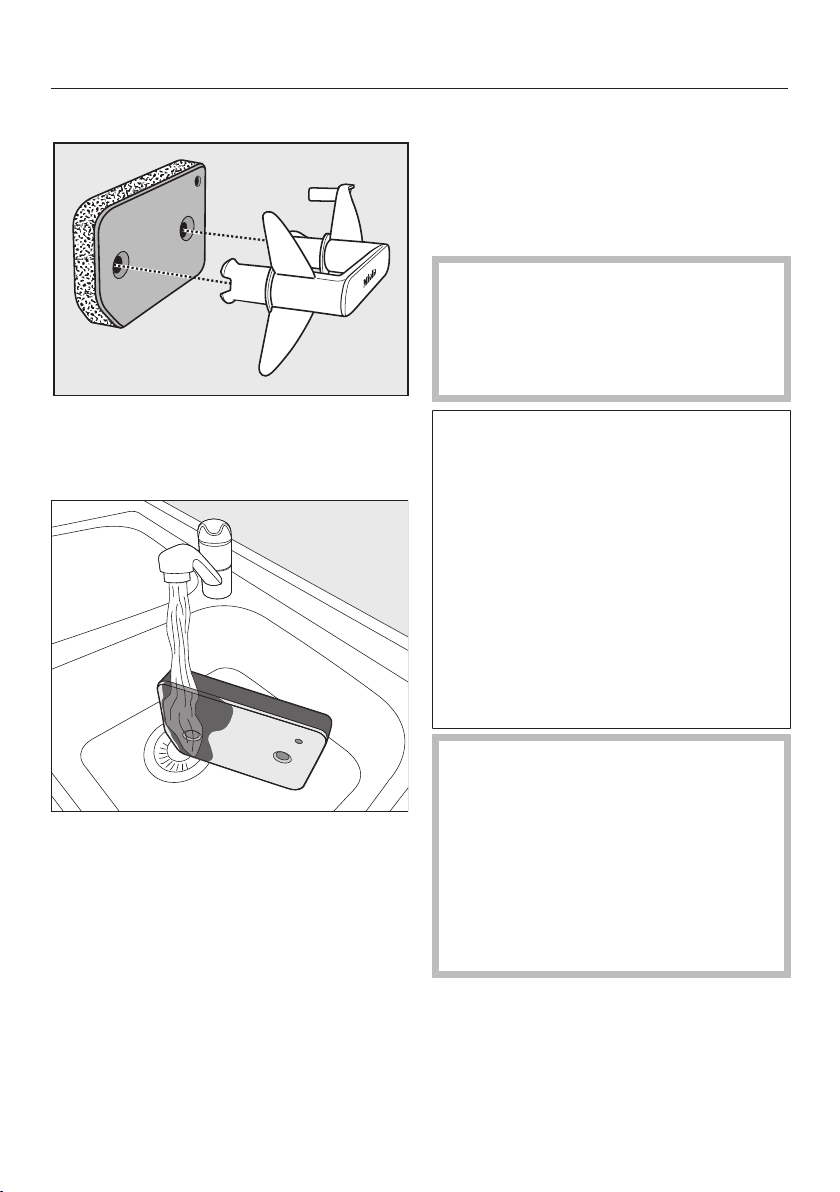
Cleaning and care
65
Cleaning the plinth filter
Pull the handle out of the plinth filter.
Clean the plinth filter gently and
thoroughly under running water.
Useful tip: In order to loosen any
residues from the surface of the plinth
filter, hold it upright and run the front of
it under water.
Squeeze the plinth filter carefully
several times as you rinse it.
Rinse and wash the entire plinth filter
until all visible residues have been
removed.
Gently squeeze out the plinth filter
until no more water comes out.
Useful tip: To absorb water, place the
damp plinth filter between two towels.
On a flat surface, repeatedly press
down gently on the plinth filter with a
flat hand. This will help the plinth filter
to dry faster.
The plinth filter must not be fitted
dripping wet.
Otherwise, this could cause a fault.
Carefully squeeze the water out of
the plinth filter.
If a drying programme is interrupted
with a fault message after the clean
plinth filter has been fitted, the plinth
filter was too wet when it was fitted.
Gently squeeze the water out of the
plinth filter again. Leave the plinth filter
to air-dry.
If a fault occurs again despite this, it
may be caused by stubborn residue
from washing substances. Reactivate
the plinth filter in the washing
machine. See “Problem solving guide
– Reactivating the plinth filter”.
Blockages caused by a
damaged or worn filter.
The heat exchanger becomes
blocked and damage may occur.
Check the plinth filter in accordance
with the descriptions in "Problem
solving guide - Replacing the plinth
filter". If necessary, replace the plinth
filter with a new one.
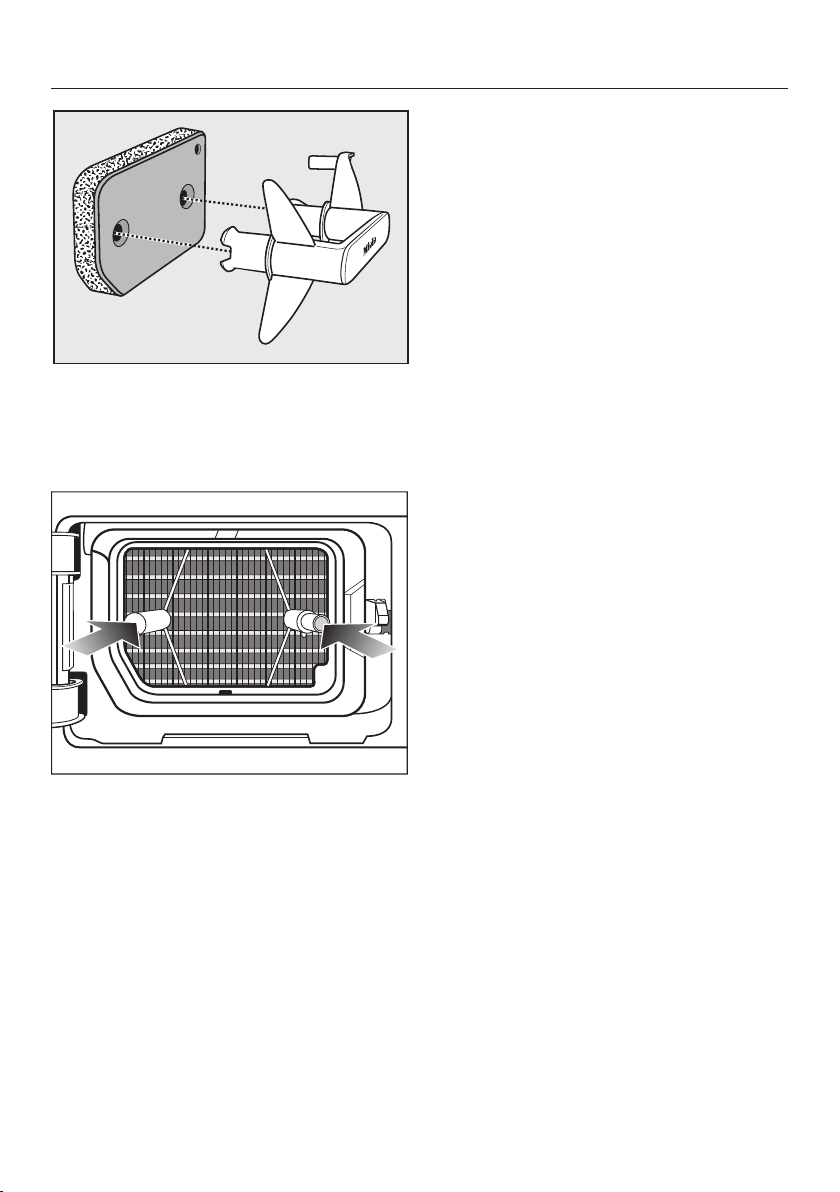
Cleaning and care
66
Use a damp cloth to remove any fluff
from the handle.
Fit the plinth filter back on the handle
the right way round.
Push the plinth filter in completely.
Insert the right guide pin at the same
time.
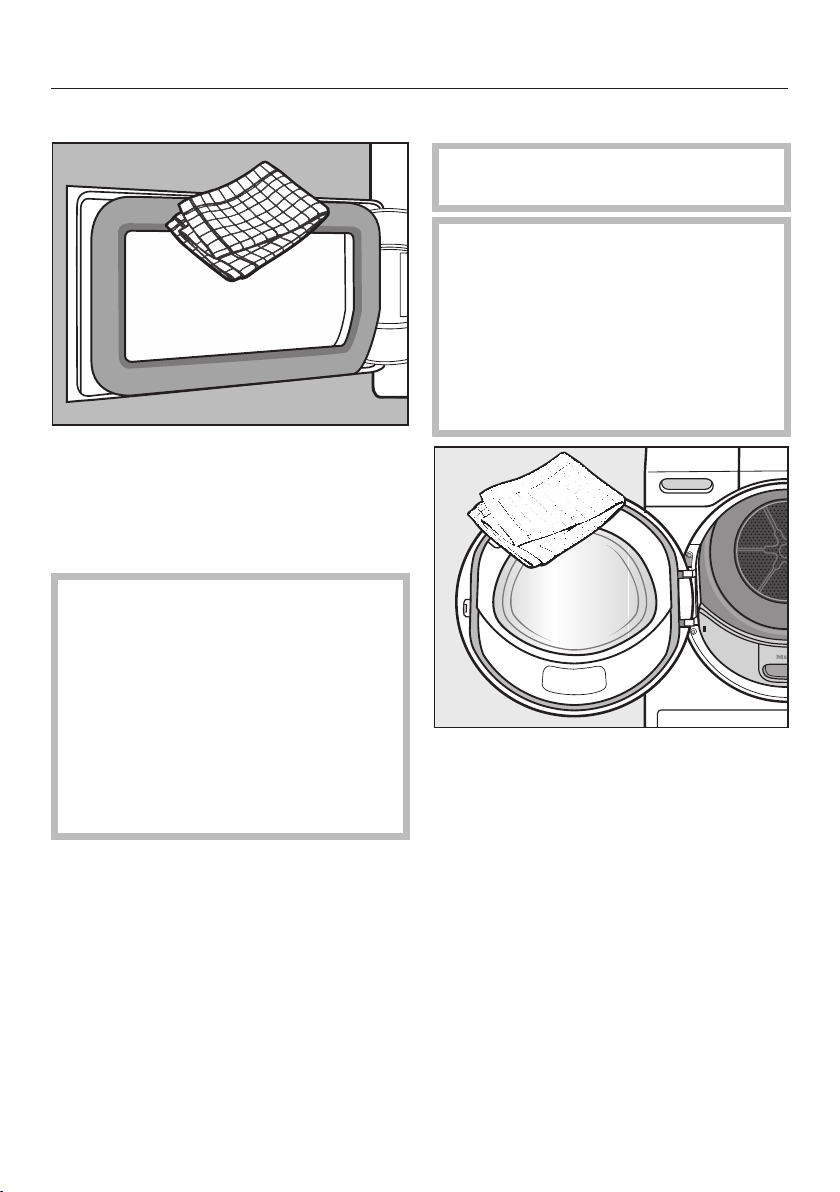
Cleaning and care
67
Cleaning the plinth filter flap
Use a damp cloth to remove any fluff.
Make sure that you do not damage
the rubber seal when doing this.
Close the heat exchanger access
panel.
Damage or ineffective drying
when drying without a plinth filter or
with the heat exchanger flap open.
An excessive accumulation of fluff
can damage the dryer in the long
term. If the system is not leak-proof,
this can lead to ineffective drying.
Only operate the dryer with the plinth
filter fitted correctly and the heat
exchanger access panel closed.
Cleaning the dryer
Disconnect the dryer from the
electricity supply.
Damage due to the use of
unsuitable care products.
Unsuitable care products could
damage plastic surfaces and other
parts.
Do not use solvents, abrasive
cleaners, glass cleaners or all-
purpose cleaners.
Clean the dryer and the seal on the
inside of the door only with a slightly
damp, soft cloth and mild detergent
or soapy water.
Dry all parts with a soft cloth.
Problem solving guide
68
Many malfunctions and minor faults that can occur in daily operation can be
corrected without contacting Miele. This will save you time and money because
you will not need a service call.
You can find information on how to remedy faults yourself at
www.miele.com.au/service or www.miele.co.nz/service.
Please note, however, that a call-out charge will be applied to unnecessary service
visits where the problem could have been rectified as described in these operating
instructions.
Fault messages shown in the display when a programme is
cancelled
Message Possible cause and remedy
Empty the container
or check the drain
outlet
The condensed water container is full or there is a
kink in the drain hose.
Open and close the door with the tumble dryer
switched on to clear the message. Or switch the
tumble dryer off and then on again.
Empty the condensed water container.
Check the drain hose.
Obstruction
detected. Untangle
laundry and restart.
The laundry is unevenly distributed or has rolled up.
Open the door and loosen the laundry. If
necessary, take out some of the laundry.
Switch the dryer off and back on.
Start a programme.
Fault F. If restart
fails, call Service.
There is no obvious cause.
Switch the dryer off and back on.
Start a programme.
If the programme terminates again with the same
fault message, then there is a fault. Contact Miele.
Problem solving guide
69
Message Possible cause and remedy
Clean the fluff filter.
Check the airways.
The system is clogged by fluff or detergent residues.
To deactivate the message, confirm with OK.
Clean the fluff filters and the plinth filter.
– Please see “Cleaning and care” for notes on
cleaning.
– If the fluff filters and the plinth filter are
damaged or out of shape, or if they cannot be
cleaned, they must be replaced.
– If the fault message is displayed again after
cleaning, this could be due to one of the causes
listed below.
The plinth filter was too wet when it was fitted.
Carefully squeeze the water out of the plinth filter.
Leave the plinth filter to air-dry.
There is still underlying residue in the plinth filter that
could not be removed.
Check the plinth filter. Follow the instructions in
“Problem solving guide – Replacing the plinth
filter”.
If the plinth filter is not damaged or out of shape,
you can reactivate it in a washing machine. See
“Problem solving guide – Regenerating the plinth
filter”.
The heat exchanger is clogged.
Check the heat exchanger. See “Problem solving
guide – Checking the heat exchanger”.

Problem solving guide
70
Messages in the display
Message Possible cause and remedy
000 Access via a code has been activated.
Enter the code and confirm the entry. Deactivate
the code if you do not wish this message to
appear in the display the next time the machine is
switched on.
Finish/Cooling down The laundry is cooled down at the end of the
programme.
Either remove the laundry and spread it out to cool
down or leave it in the tumble dryer to cool down
during the cooling phase.
Clean the fluff and
plinth filters. See the
operating instruction
manual for more
information.
The tumble dryer is not working correctly or
economically. Possible causes could be clogging
caused by fluff or detergent residues.
To deactivate the message, confirm with OK.
Please see "Cleaning and care" for notes on
cleaning.
Clean the fluff filters.
Also check the plinth filter and clean it if
necessary.
You can influence when the Clean the fluff and plinth
filters. See the operating instruction manual for more
information. message lights up.
Follow the instructions in "Settings - Airways
indicator".
Fill the condensate
container with water
The condensed water container is empty. When
certain programmes are being used, water is taken
from the condensed water container and recycled.
To deactivate the message, confirm with OK.
Fill the condensed water container to at least the
―min―mark.
Please open and
close the door
After selecting the Steam care programme, you are
alerted to load laundry.
Load the laundry in the drum.

Problem solving guide
71
Unsatisfactory drying results
Problem Possible cause and remedy
The DryCare40 Extra is
not drying the laundry
sufficiently.
The room in which the tumble dryer is located is too
warm. This has caused the DryCare process to finish
prematurely.
Ventilate the room thoroughly.
To fully dry the laundry, select Warm air with the
DryCare40 Extra.
The laundry is not
sufficiently dry.
The load consisted of different types of fabric.
Finish drying using the Warm air programme.
Select a more suitable programme next time.
Tip: You can alter the residual moisture level for some
programmes. See “Settings - Drying levels”.
Laundry or feather filled
pillows smell after
drying.
The laundry was washed with insufficient detergent.
Feathers are a natural product and this is quite
normal.
Laundry: use sufficient detergent next time.
Pillows: take out of the tumble dryer and aerate.
Use a fragrance flacon (available as an optional
accessory).
Items made of synthetic
fibres are charged with
static electricity after
drying.
Synthetic fibres tend to attract static charge.
Static charge can be reduced by adding a fabric
softener to the final rinse in the washing
programme.
There is a build-up of
fluff.
Fluff is principally the result of friction when garments
are being worn and to some extent when they are
being washed. Machine drying hardly causes any
fluff to form.
Fluff is collected by the fluff filters and the plinth filter
and can be removed easily.
See “Cleaning and care”.

Problem solving guide
72
The drying process takes a long time.
Problem Possible cause and remedy
The drying process
goes on for too long or
even switches off.*
The room in which the tumble dryer is located is too
warm.
Ventilate the room thoroughly.
Detergent residues, hair and fine fluff can clog the
filters.
Clean the fluff filters and the plinth filter.
Remove visible fluff from the heat exchanger.
The laundry is unevenly distributed or has rolled up.
The tumble dryer has been overloaded.
Untangle the laundry and remove a few items, if
necessary.
Start a programme.
The cool air intake (bottom right grille) is blocked.
Move any objects, such as a laundry basket, away
from the dryer.
The laundry is too damp.
Spin the laundry using a higher spin speed in the
washing machine.
Metallic components, e.g. zippers, have prevented
the dryer from registering the correct moisture level.
Open the zippers next time.
If the problem recurs, dry these items using the
Warm air timed drying programme.
* Switch the tumble dryer off and on again before starting a new programme.
Problem solving guide
73
General problems with the tumble dryer
Problem Possible cause and remedy
You can hear buzzing or
humming operating
noises.
The compressor (heat pump) is operating. Or you
have selected a programme which sprays
condensed water into the drum.
No action is required. These noises are quite
normal and can be heard when the compressor
or the condensed water pump is operating.
There is no fault.
A programme cannot be
started.
There is no obvious cause.
Connect the tumble dryer to the mains electricity
supply
Turn on the tumble dryer.
Close the door.
Check whether the mains fuse has tripped.
Has there been a power cut? When power is
restored, any previously running programme will
restart automatically.
When the DryFresh,
PowerFresh or
DryCare40 Extras are
selected, the drying
level “jumps back” to a
different one.
The drying level you selected previously cannot be
combined with the Extra. The closest possible
drying level is selected automatically.
The display is dark and
the Start/Stop sensor is
flashing slowly.
The display has switched off automatically to save
energy (Standby mode).
The drum will rotate from time to time when the dryer
is in the Anti-crease phase.
Touch any sensor. This switches Standby off.
The dryer is switched
off at the end of the
programme.
The tumble dryer switches off automatically. This is
not a fault, but a normal function.
The display is in a
different language.
A different language has been selected in “Settings -
Language ”.
Set the language you want. The flag symbol serves
as a guide.
Problem solving guide
74
Problem Possible cause and remedy
The interior drum
lighting does not come
on.
To save energy, the drum lighting goes out
automatically after a set time and after the
programme starts.
Switch the dryer off and then on again.
To switch the drum lighting on, open the door of
the tumble dryer.
The drum lighting is faulty.
The drum lighting is designed to last a long time and
should not normally need to be replaced.
If you have tried the remedies above but the drum
lighting still does not come on, please contact
Miele.
The spray jet for
spraying condensed
water into the drum is
insufficient.
When certain programmes are being used, water is
taken from the condensed water container and
sprayed into the drum. The spray jet can sometimes
stop working.
The fluff filter in the condensed water container is
clogged.
Clean the fluff filter in the condensed water
container. See “Cleaning the fluff filter in the
condensed water container” in this section.
The spray jet in the door opening is heavily calcified.
Replace the spray jet. See “Replacing the
condensed water spray jet” in this section.
Only use condensed water. Do not use tap water.
Tap water leads to limescale deposits in the long run.
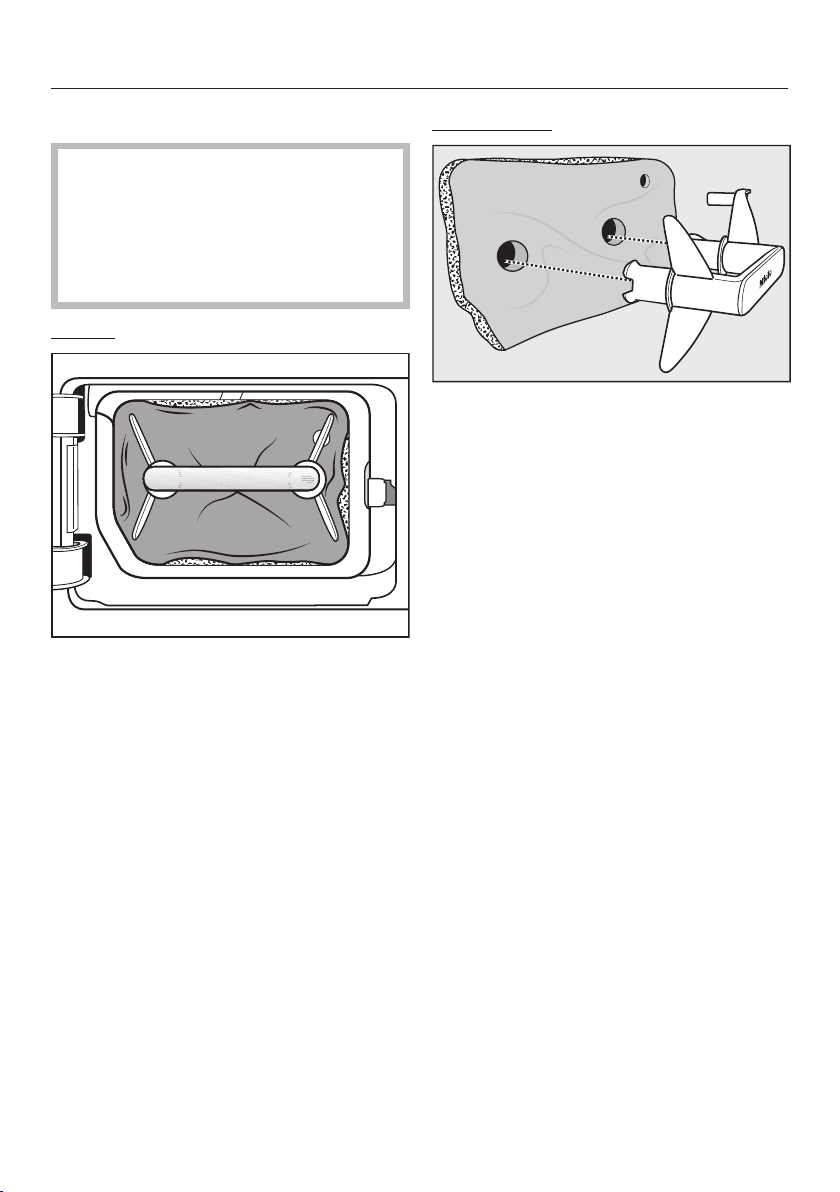
Problem solving guide
75
Replacing the plinth filter
The heat exchanger can clog up.
Replace the plinth filter immediately
(replacement filters are available as
an optional accessory) if you see the
following signs of wear before or
after cleaning.
Poor fit
The edges of the plinth filter do not sit
properly and the filter is deformed. Fluff
will blow into the heat exchanger
unfiltered through edges that do not sit
properly. This will eventually cause
obstruction in the heat exchanger.
Deformations
Deformations indicate that the filter has
become worn.
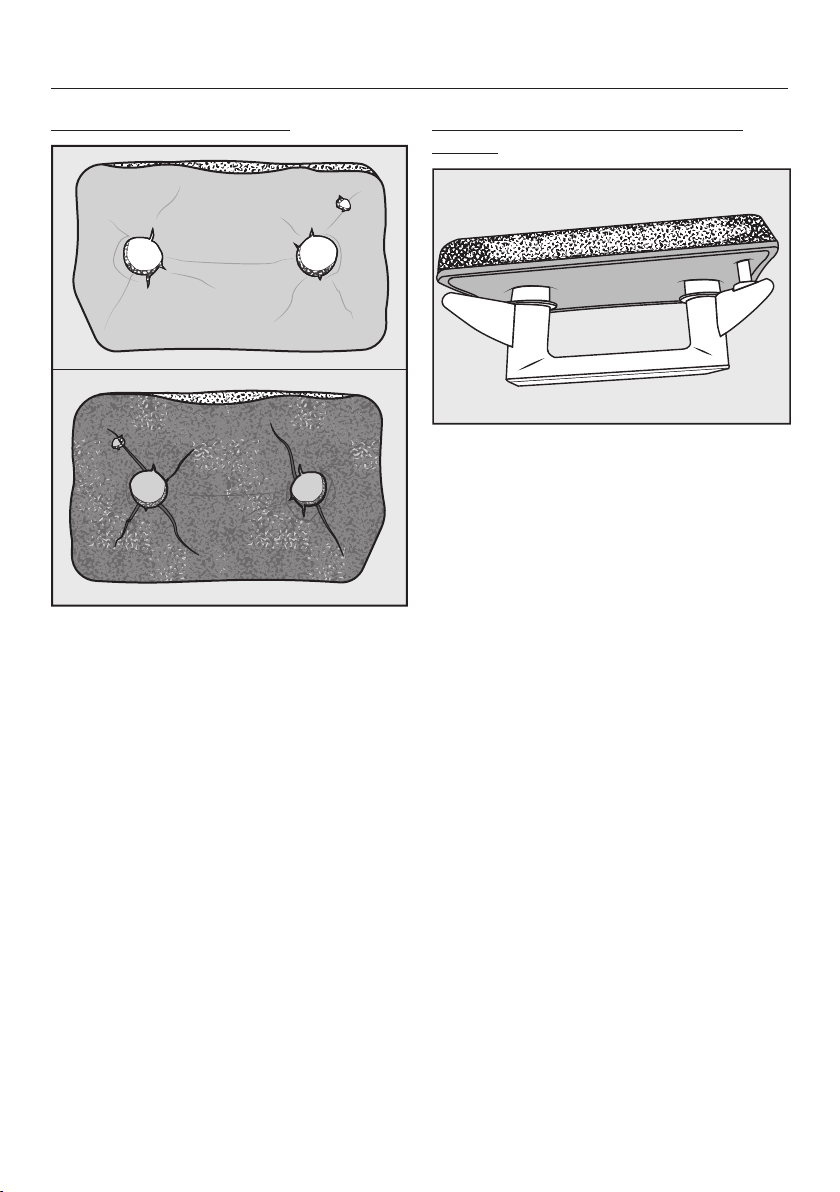
Problem solving guide
76
Cracks, tears, indentations
Fluff will blow into the heat exchanger
unfiltered through cracks and tears and
will cause obstruction. This will
eventually cause obstruction in the heat
exchanger.
White residues or residues of other
colours
Residues arise from laundry fibres and
residual detergent components. They
can be found on the front and side
edges of the plinth filter. In extreme
cases, they can form stubborn crusts.
Residues are a sign that the filter no
longer has a snug fit at the sides, even
if it appears to be perfect.
Fluff is getting in unfiltered at the edges.
Regenerate the plinth filter (see
"Problem solving guide - Regenerating
the plinth filter"). If the plinth filter shows
these residues again soon, the plinth
filter must be replaced.
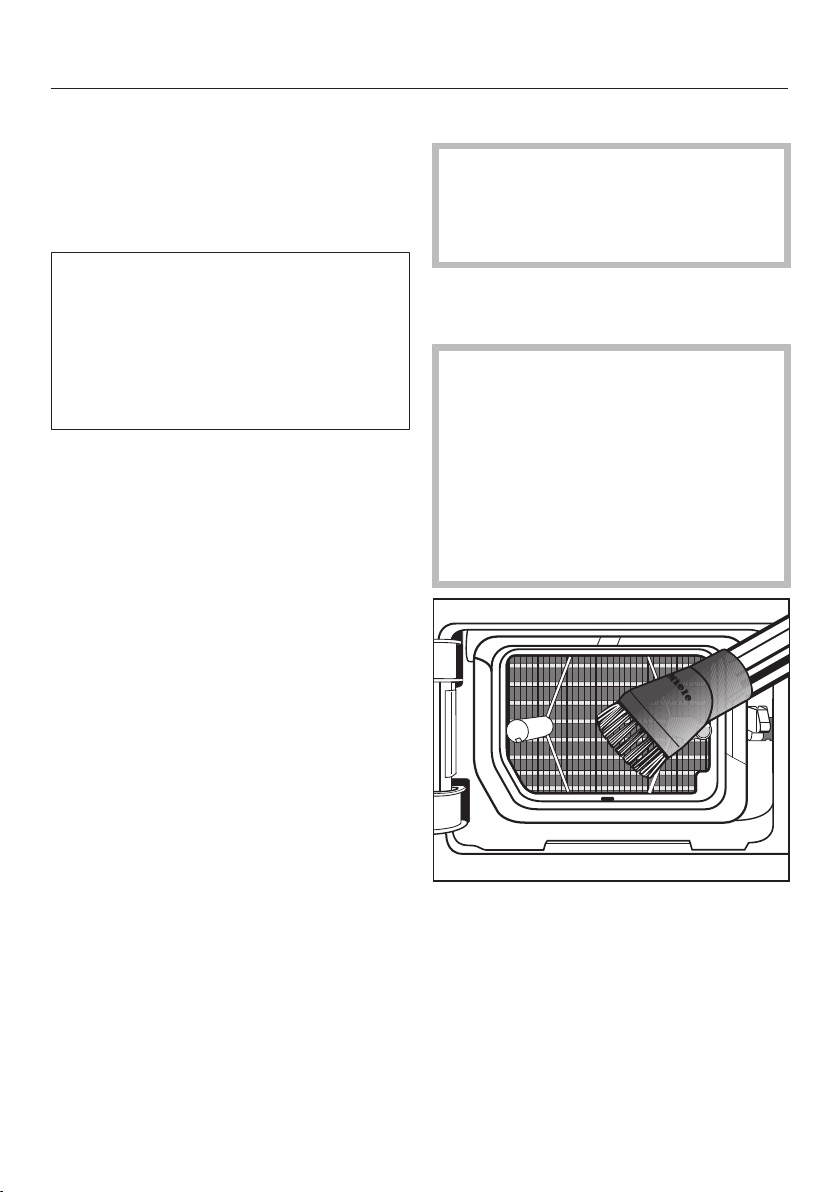
Problem solving guide
77
Regenerating the plinth filter
You can regenerate one or more dirty
plinth filters in the washing machine.
The plinth filter will be ready for use
again.
Before regenerating it, check whether
the plinth filter is still in good
condition. Check the plinth filter in
accordance with the descriptions in
"Problem solving guide - Replacing
the plinth filter". If the plinth filter is
worn, replace it.
Wash one or more plinth filters
separately without garments. Do not
add laundry detergent.
Select a short wash programme with
a maximum temperature of 40°C and
a maximum spin speed of 600 rpm.
After washing and spinning, you can
refit the plinth filter.
Checking the heat exchanger
Risk of injury from sharp cooling
fins.
You could cut yourself.
Do not touch the cooling fins.
Look to see if fluff has accumulated.
If fluff is present, it must be removed.
Damage due to incorrect
cleaning of the heat exchanger.
The tumble dryer will not dry if the
cooling fins are damaged or bent.
Clean using a vacuum cleaner with a
dusting brush attached. Only pass
the vacuum cleaner dusting brush
over the fins lightly, without applying
any pressure.
Carefully vacuum up any fluff and
residues.
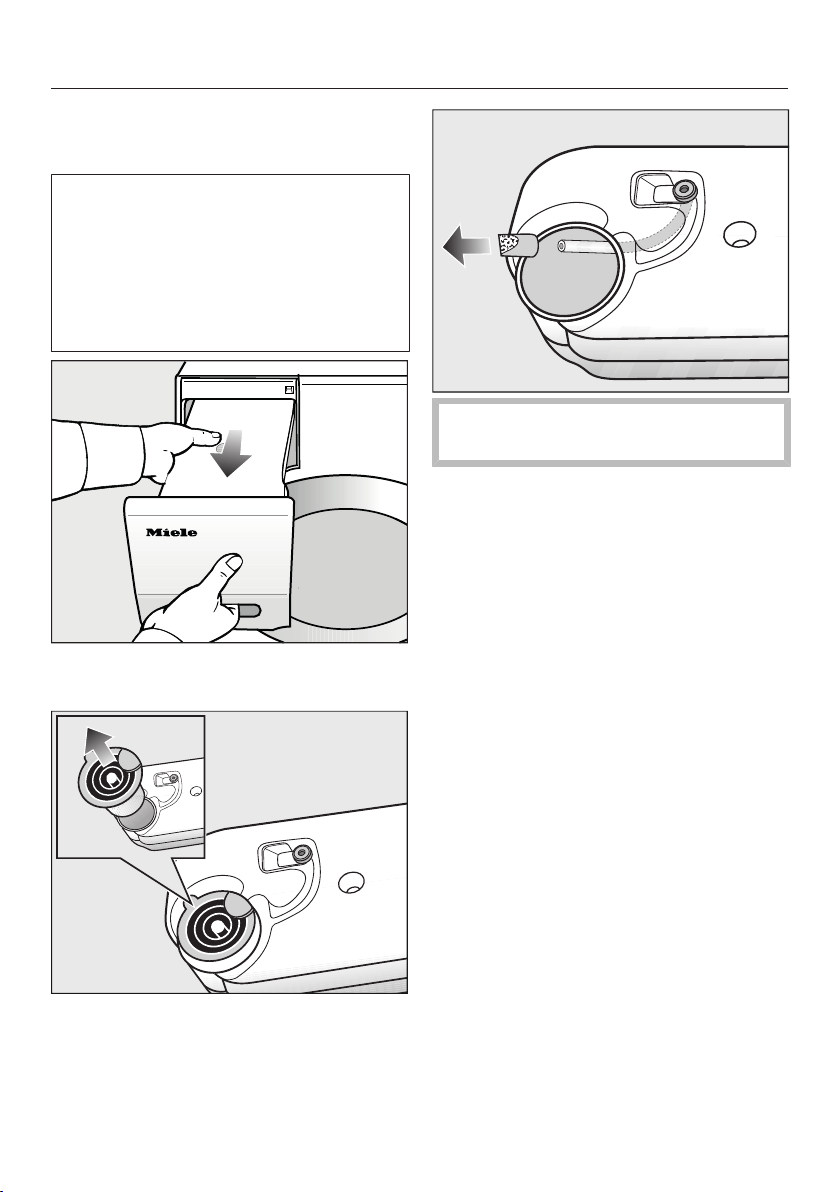
Problem solving guide
78
Cleaning the fluff filter in the
condensed water container
When certain programmes are being
used, water is taken from the
condensed water container and
sprayed into the drum. The spray jet
can sometimes stop working. The fluff
filter in the condensed water container
is clogged.
Pull out the condensed water
container.
Reach under the side lug on the
spout with your finger.
Pull out the spout.
Be careful not to tug on the hose to
avoid detaching it.
Guide the end of the hose through
the opening.
Hold it securely with one hand.
Use your other hand to pull the fluff
filter off the hose.
Rinse the fluff filter with a jet of water
until all the fluff has been removed.
Attach the clean fluff filter to the end
of the hose.
Now feed the hose back into the
condensed water container.
Refit the spout in the condensed
water container ensuring that it is
positioned correctly. Please refer to
the image.
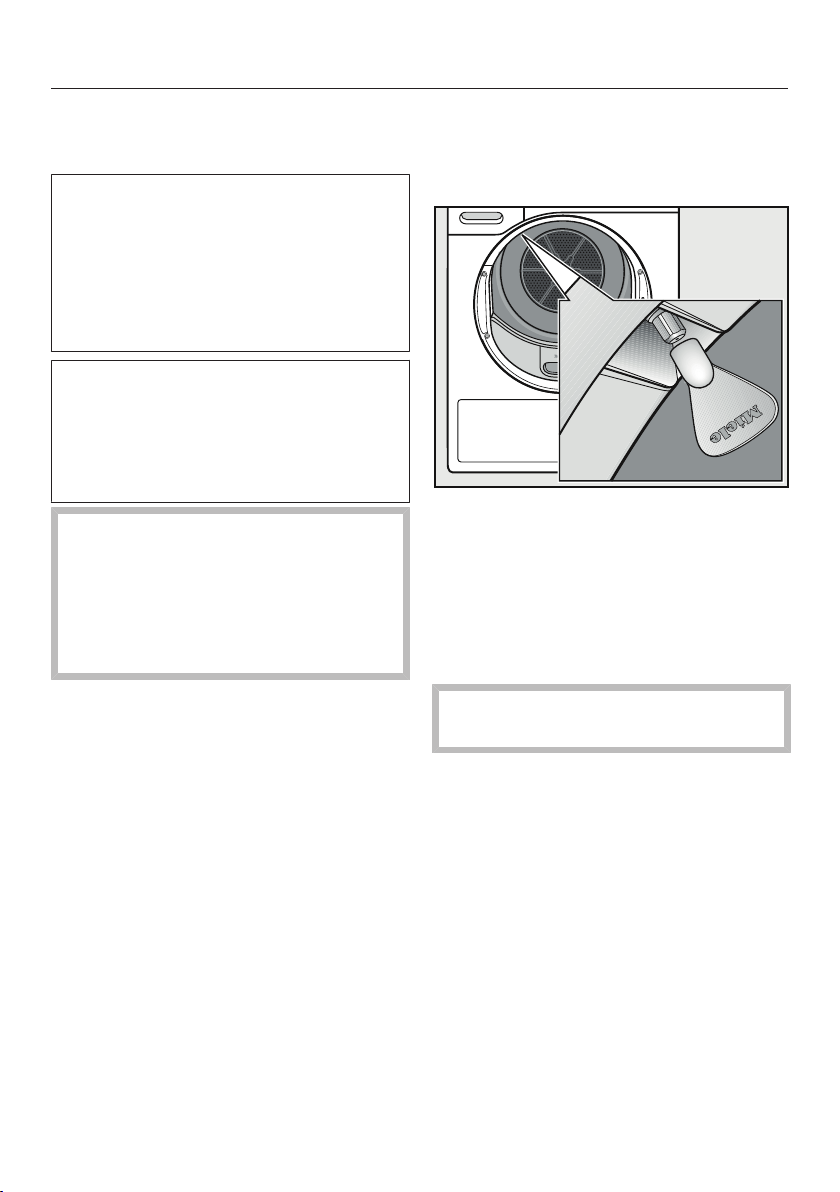
Problem solving guide
79
Replacing the condensed
water spray jet
When certain programmes are being
used, water is taken from the
condensed water container and
sprayed into the drum. The spray jet
can sometimes stop working.
Limescale deposits have built up on
the spray jet.
Remove the spray jet and replace with
a new one (optional accessory).
You can only replace the spray jet
using a special tool. The special tool is
supplied with the new spray jet.
Using the wrong tool can cause
damage.
It can damage the spray jet or the
tumble dryer.
Only use the tool supplied. Do not
use any other tool.
Open the tumble dryer door.
The spray jet is located in the top left of
the door opening.
Attach the tool to the spray jet.
Turn the tool anti-clockwise to
unscrew the spray jet.
Insert the new spray jet in the tool.
Turn the tool clockwise to screw the
spray jet securely in position.
The tumble dryer must not be
operated without the spray jet fitted.
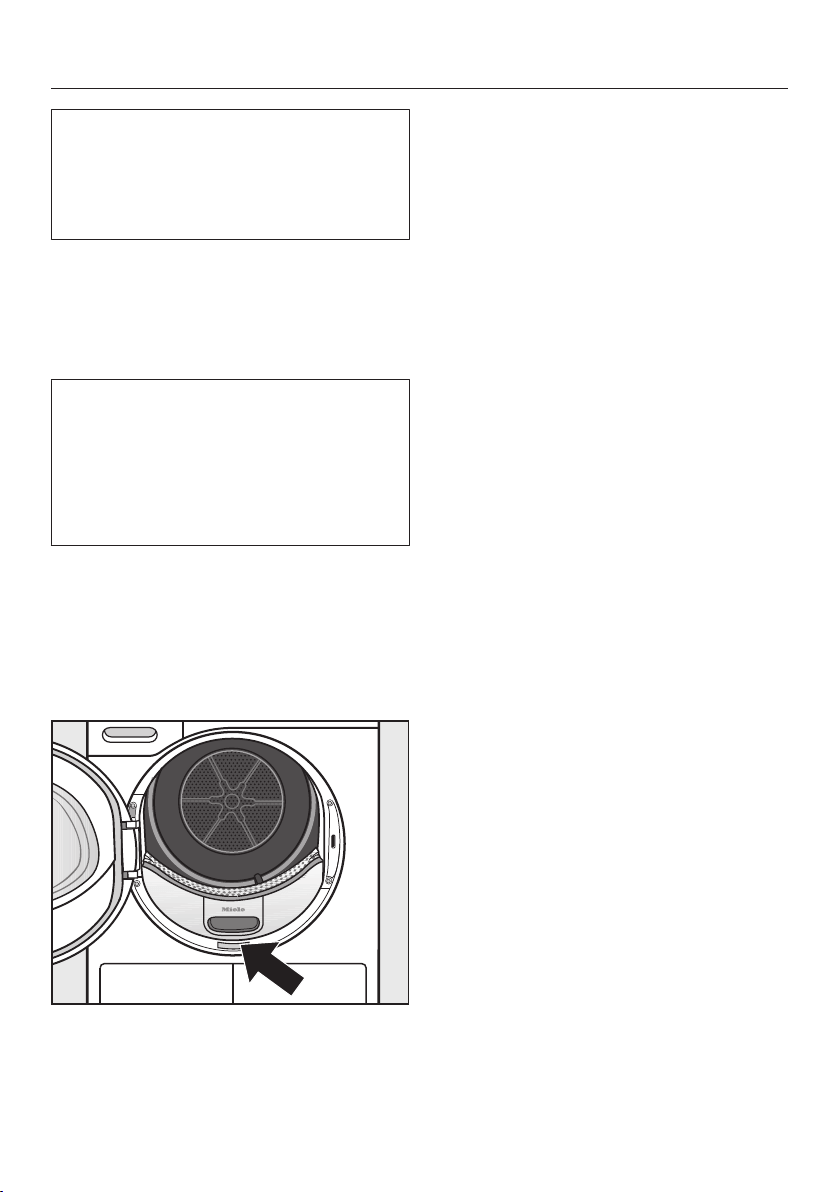
Service
80
You can find information on how to
remedy faults yourself and about
Miele spare parts at
www.miele.com.au/service or
www.miele.co.nz/service.
Contact in case of fault
In the event of any faults which you
cannot remedy yourself, please contact
Miele.
You can book a Miele customer
service call-out online at
www.miele.com.au/service or
www.miele.co.nz/service.
Contact information for Miele can be
found at the end of this booklet.
Please quote the model and serial
number of your appliance when
contacting Miele. This information can
be found on the data plate.
The data plate is visible when the door
is open.
Optional accessories
Optional accessories for this tumble
dryer are available from Miele (see
contact details at the back of these
instructions).
You also can order these and other
useful products from the Miele online
shop.
Drying basket
The drying basket is suspended in the
drum and does not rotate with the
drum. This enables items which must
not be subjected to mechanical action
to be dried or aired.
Fragrance flacon
Fragrance flacons can be used in your
tumble dryer to add a pleasant
fragrance to your laundry.
Warranty
The manufacturer's warranty for this
appliance is 2years.
For further information, please refer to
your warranty booklet.
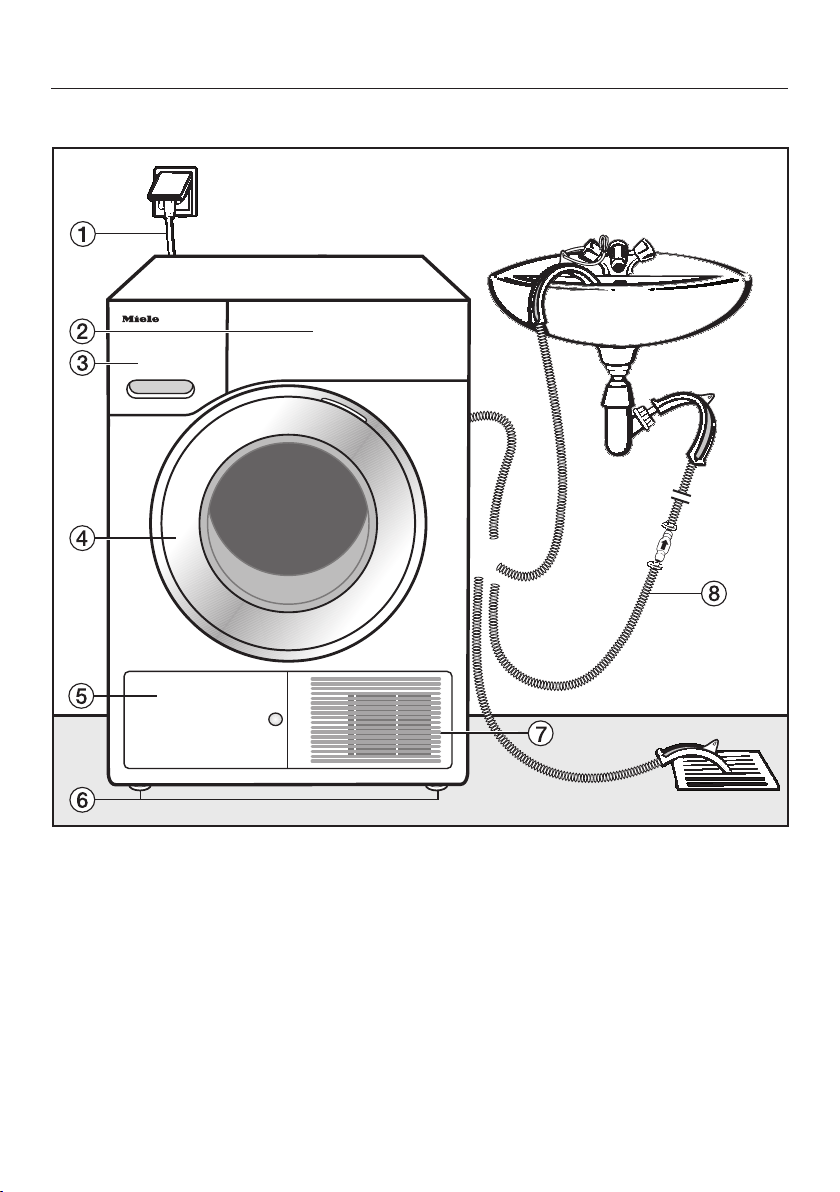
Installation
*INSTALLATION*
81
Front view
a
Mains connection cable
b
Control panel
c
Condensed water container
d
Door
e
Plinth filter access panel
f
4height-adjustable feet
g
Cooling air grille
h
Drain hose for condensed water
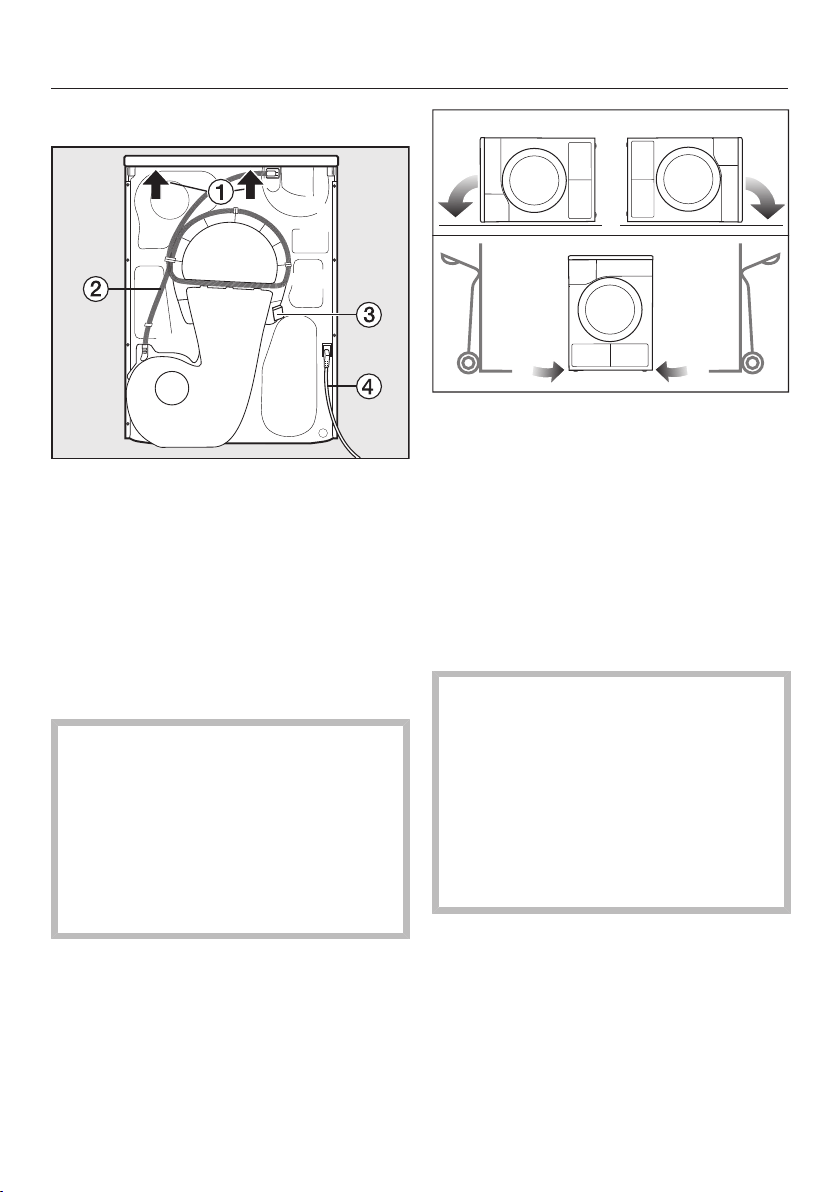
Installation
*INSTALLATION*
82
Rear view
a
Protruding lid for holding when
moving the machine
b
Drain hose for condensed water
c
Hook for winding the mains
connection cable around during
transport
d
Mains connection cable
Transporting the tumble dryer
Danger of injury to people and
damage to property caused by
moving the appliance incorrectly.
If the tumble dryer tips over, there is
a danger of injury to people and
damage to property.
Ensure that the tumble dryer is stable
during transportation.
If the tumble dryer is being
transported horizontally, it must only
be tipped onto its left or right side.
If the tumble dryer is being
transported upright and you are using
a handcart or trolley, you must only
transport it with its left or right side
resting on the handcart or trolley.
Transporting the tumble dryer to its
installation site
Make sure the fixings at the back
of the lid are secure.
Otherwise there is a danger of the lid
being pulled off when carrying the
appliance.
Before carrying the appliance, check
that the lid is secure where it
protrudes at the back of the
appliance.
Carry the tumble dryer by the front
feet and by the lid where it protrudes
at the back of the appliance.
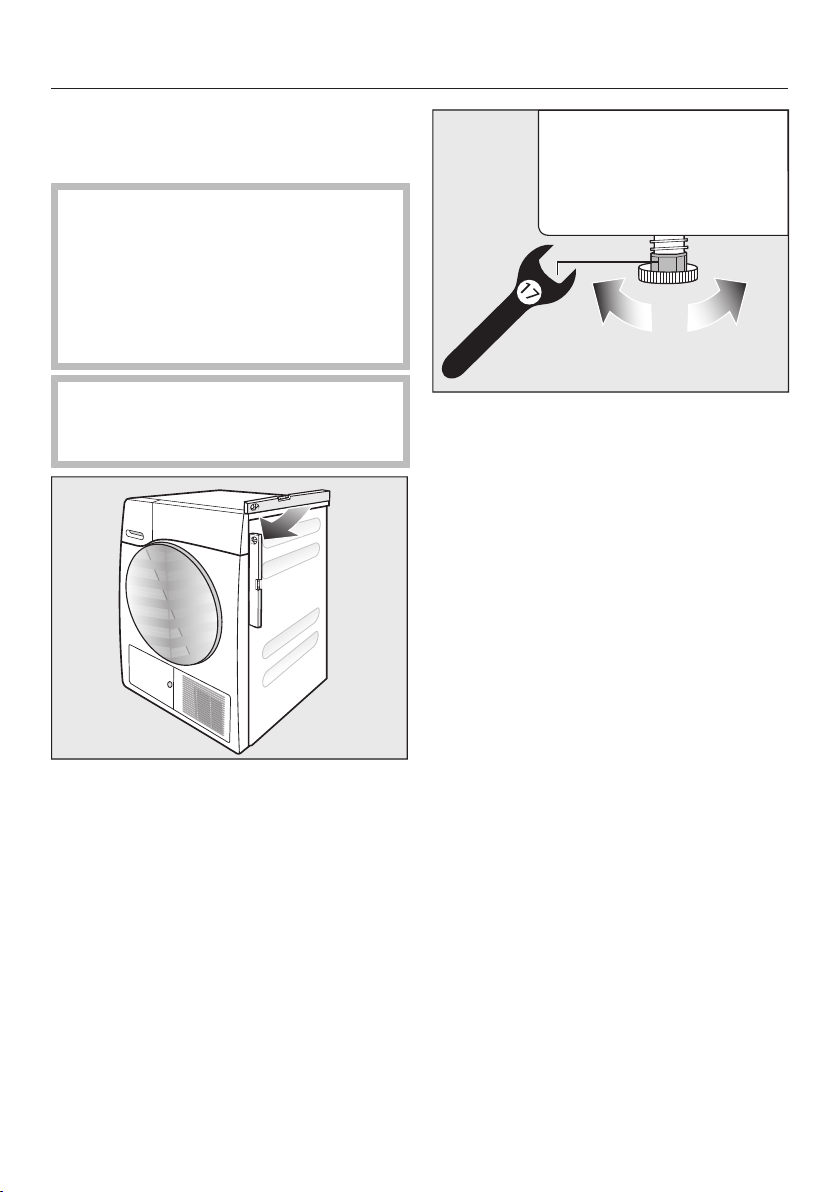
Installation
*INSTALLATION*
83
Installation
Levelling the dryer
The appliance must not be installed
behind a lockable door, a sliding
door or a door with a hinge on the
opposite side to that of the tumble
dyer, in such a way that a full
opening of the tumble dryer door is
restricted.
Make sure the dryer door can be
opened without hindrance after
installation.
To ensure proper operation, the tumble
dryer must stand perfectly level. The
screw feet on the tumble dryer can be
adjusted to compensate for unevenness
in the floor.
Turn the screw feet by hand or with a
flat open spanner.

Installation
*INSTALLATION*
84
Downtime after installation
Damage to the tumble dryer by
switching it on too soon.
This can damage the heat pump.
After setting up the tumble dryer,
wait for at least one hour before
switching it on.
Ventilation
The cool air intake at the front of the
tumble dryer must not be blocked or
covered. This would hinder a
sufficient intake of cool air for the
heat exchanger.
Do not block the gap between the
bottom of the tumble dryer and the
floor with plinth facings, deep pile
carpet etc. This would hinder a
sufficient flow of air to the tumble
dryer.
Adequate ventilation has to be
provided to avoid the backflow of
gases into the room from appliances
burning other fuels, including open
fires.
Air which is taken in to cool the heat
exchanger is then blown back out of the
dryer and warms up the air in the room.
Ensure sufficient ventilation of the
room, e.g. by opening a window. The
drying time will otherwise take longer
(higher energy requirement).
Before moving the tumble dryer
again (e.g. when moving house)
After each use a small quantity of
condensed water will collect in the area
of the pump. This water can run out if
the tumble dryer is tipped up when it is
being moved. Recommendation: Run
the Warm air programme for
approximately 1minute without a load
before moving the tumble dryer. Any
remaining condensed water will then be
fed into the condensed water container,
which can then be emptied, or can
drain out through the drain hose.

Installation
*INSTALLATION*
85
Additional installation
requirements
Suitable for pushing under a worktop
This tumble dryer is suitable for pushing
under a worktop.
Appliance defect due to a build-up of
heat.
Make sure there is adequate room
for warm air from the dryer to be
directed away.
- The appliance lid cannot be removed.
- The electrical socket must be located
in an accessible position near the
appliance.
- Drying durations may increase
slightly.
Optional accessories
– Washer-dryer stack
The tumble dryer can also be combined
with a Miele washing machine in a
washer-dryer stack. The appropriate
Miele washer-dryer stacking kit is
required.
– Plinth
The tumble dryer can be installed on a
plinth with drawer (please note the
plinth may not be available in all
countries).
The plinth must be purchased as a pair
and secured to the second plinth
supporting another tumble dryer or
washing machine.
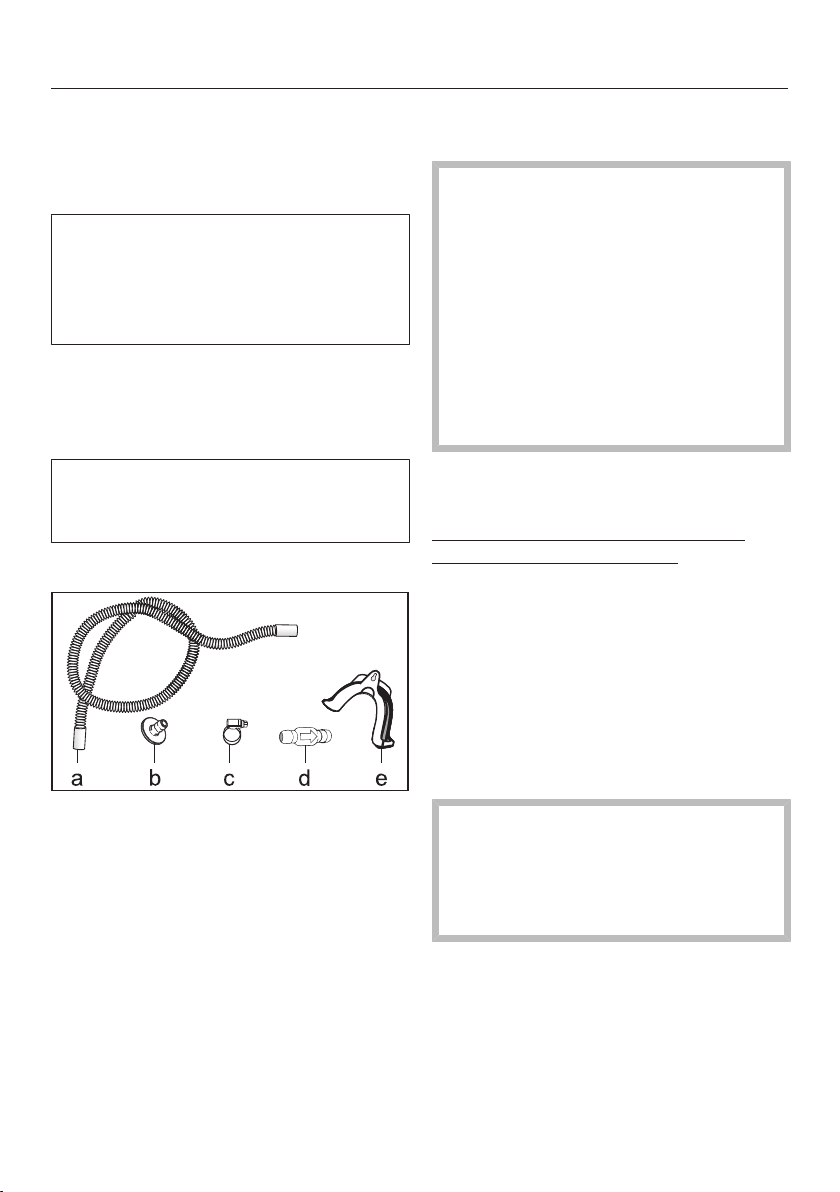
Installation
*INSTALLATION*
86
Externally draining condensed
water
Notes
When drying is in progress,
condensed water is pumped into the
condensed water container through
the drain hose which is located at the
back of the dryer.
The condensed water can also be
drained away via the drain hose. The
condensed water container will then not
need to be emptied.
Hose length: 1.49m
Maximum delivery head: 1.00m
Maximum drain hose length: 4.00m
Drainage accessories
- Supplied: adapter (b), hose clip (c),
hose holder (e);
- Available to purchase: “Non-return
valve” kit for connection to an
external water connection. Non-
return valve (d), hose extension (a)
and hose clips (c) are supplied with
the kit.
Installation conditions requiring a
non-return valve
Danger of condensed water
backflow.
Water could flow back into the
tumble dryer or be drawn into it.
Backflow water could damage the
tumble dryer and also the room in
which it is located.
The non-return valve should be used
if the end of the hose is immersed in
water, or if other water connections
are installed.
Maximum delivery head with non-return
valve fitted: 1.00m
Installation conditions requiring the
fitting of a non-return valve:
- Drainage into a laundry tub or floor
gully where the end of the hose is
immersed in water.
- Connection to a sink drain outlet.
- Connection to a drainage system
already in use by another appliance,
e.g. a dishwasher or washing
machine.
If the non-return valve is incorrectly
fitted the appliance will not drain.
The non-return valve has to be fitted
with the arrow on it pointing in the
direction of flow.
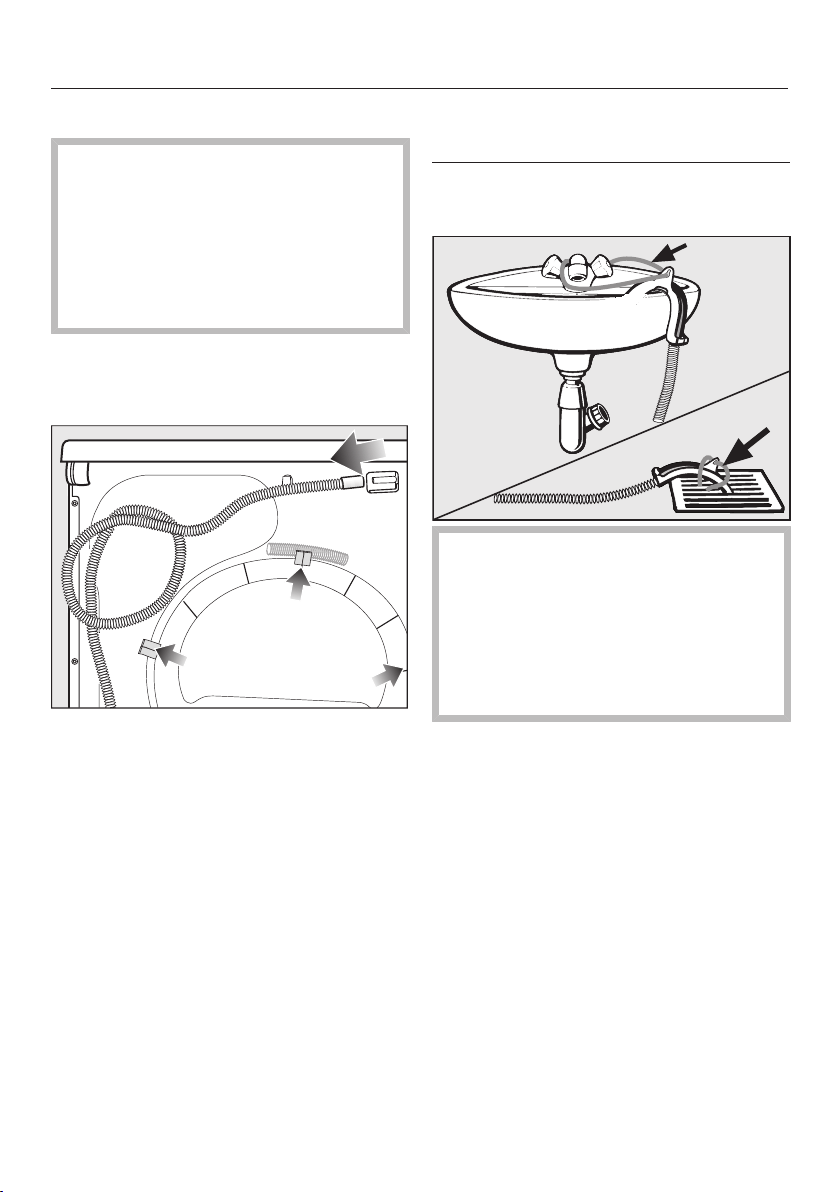
Installation
*INSTALLATION*
87
Arranging the drain hose
Damage to the drain hose
through incorrect handling.
The drain hose can suffer damage
and leak.
Do not pull on the drain hose and do
not stretch it or allow it to become
kinked.
There will be a small amount of residual
water left in the drain hose. Have a
container ready to collect this.
Pull the drain hose off its connection
(light arrow).
Pull the hose out of the holders (dark
arrows) and unwind it.
Allow any residual water to run into a
container.
Examples
Drainage into a laundry tub or floor gully
Use the hose holder to secure the drain
hose.
Risk of water damage.
Should the end of the hose come
loose, overflowing water can cause
damage.
Secure the drain hose carefully (e.g.,
by tying it) to make sure it cannot
slip.
The non-return valve can be fitted in the
end of the hose.
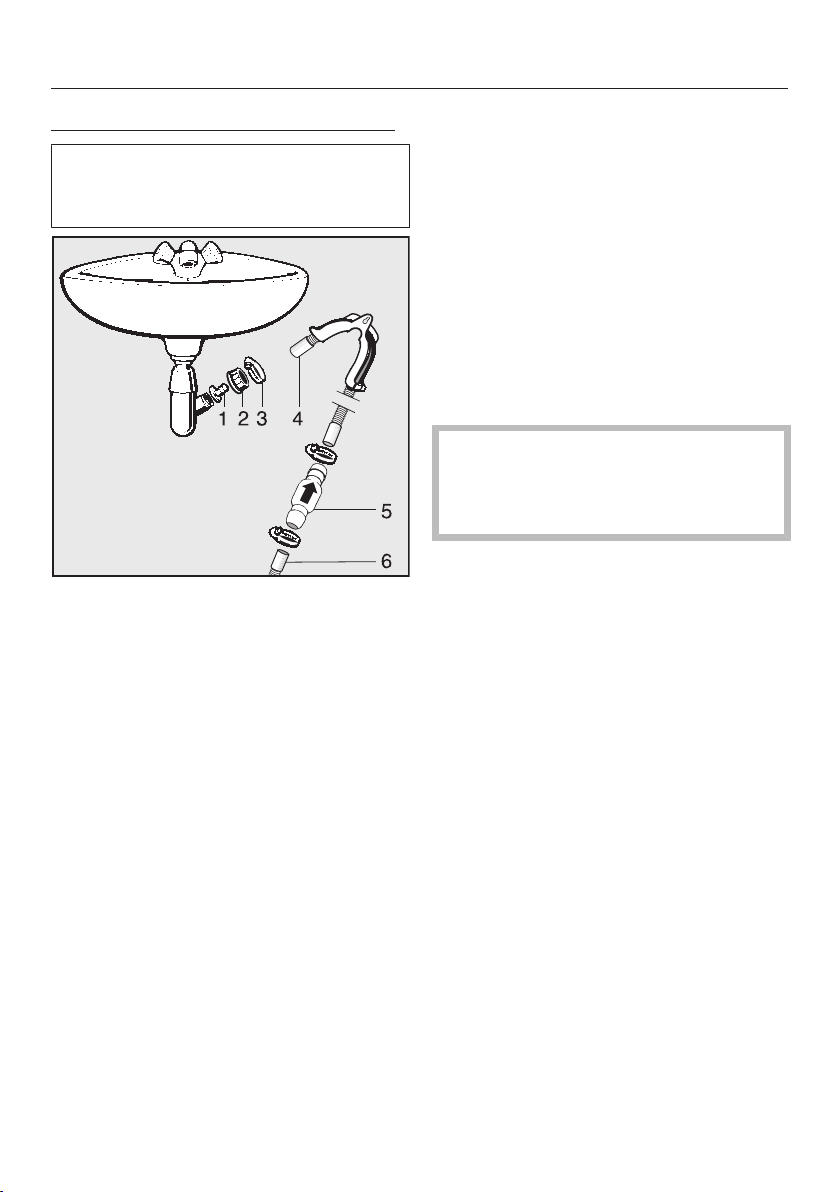
Installation
*INSTALLATION*
88
Direct connection to a sink drain outlet
Use the hose holder, the hose clips
and the non-return valve (available to
purchase).
1. Adapter
2. Nut
3. Hose clip
4. End of the hose (secured with the
hose holder)
5. Non-return valve
6. Tumble dryer drain hose
Fit the adapter 1 to the sink drain
outlet using the nut 2.
The nut is usually fitted with a washer
which must be removed.
Attach the end of the hose 4 to the
adapter 1.
Use the hose holder.
Use a screwdriver to tighten the hose
clip 3 up close to the nut.
Fit the non-return valve 5 to the
tumble dryer drain hose 6.
The non-return valve 5 has to be
fitted so that the arrow points in the
direction of flow (i.e. towards the
sink).
Secure the non-return valve using
hose clips.
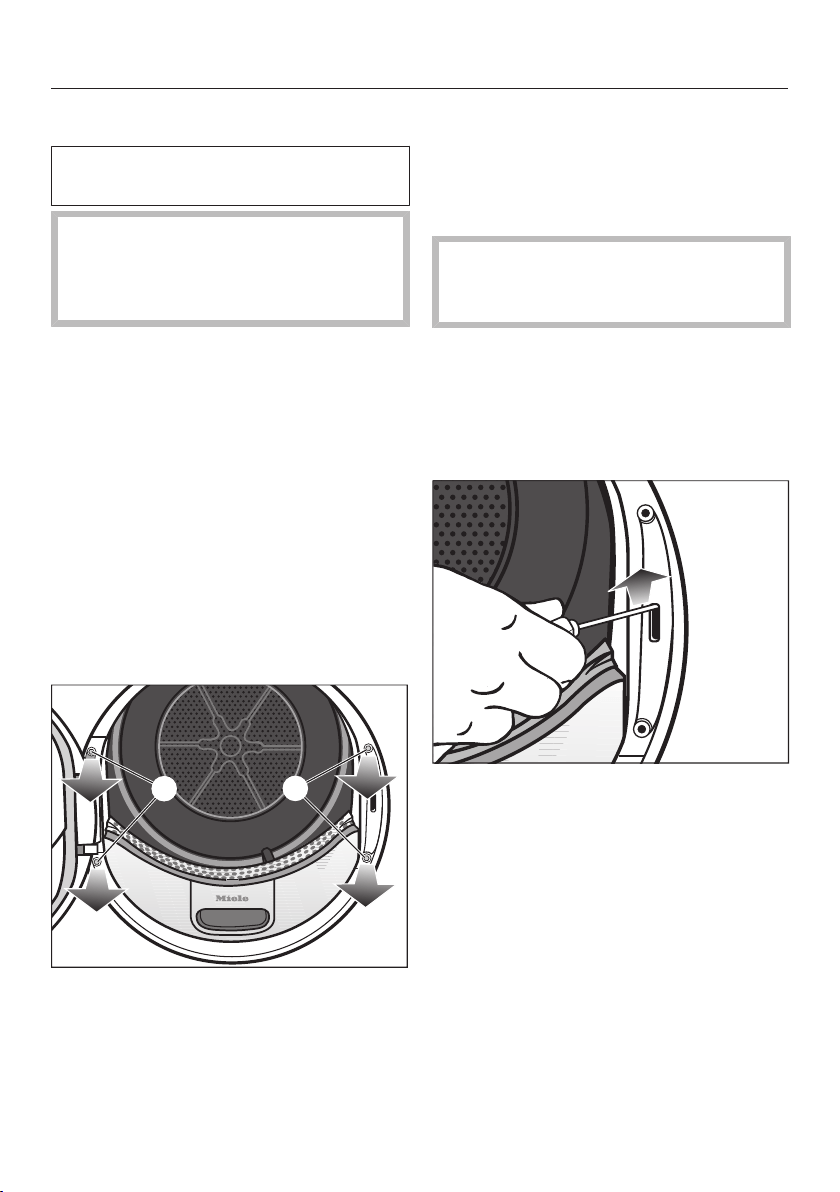
Installation
*INSTALLATION*
89
Changing the door hinging
You can change the door hinging on
this tumble dryer yourself.
For safety reasons, the tumble dryer
must be disconnected from the
electricity supply before changing
the door hinging.
You will need:
- a T20 and T30 Torx screwdriver
- a flat head screwdriver or pointed
pliers
- the lock catch cover supplied
- the door hinge cover supplied
- a soft surface (e.g. a tablecloth)
Changing the hinging over
1. Remove the door from the dryer
Open the door.
Use a T30 Torx screwdriver to
unscrew the two screws on the base
plate of the door hinge .
The door cannot fall off as it is held in
place by two pins.
Hold the door securely and pull it
forwards: to remove the door you will
need to pull the base plate of the
hinge with its two pins out of the
dryer.
To avoid scratching the door, place it
outer side downwards on a soft
surface (e.g. a tablecloth).
2. Change over the door lock on the
dryer
Use a T30 Torx screwdriver to
unscrew the two screws on the door
lock .
Use the screwdriver to press the door
lock upwards.
The door lock will spring out of its
position and can then be removed.
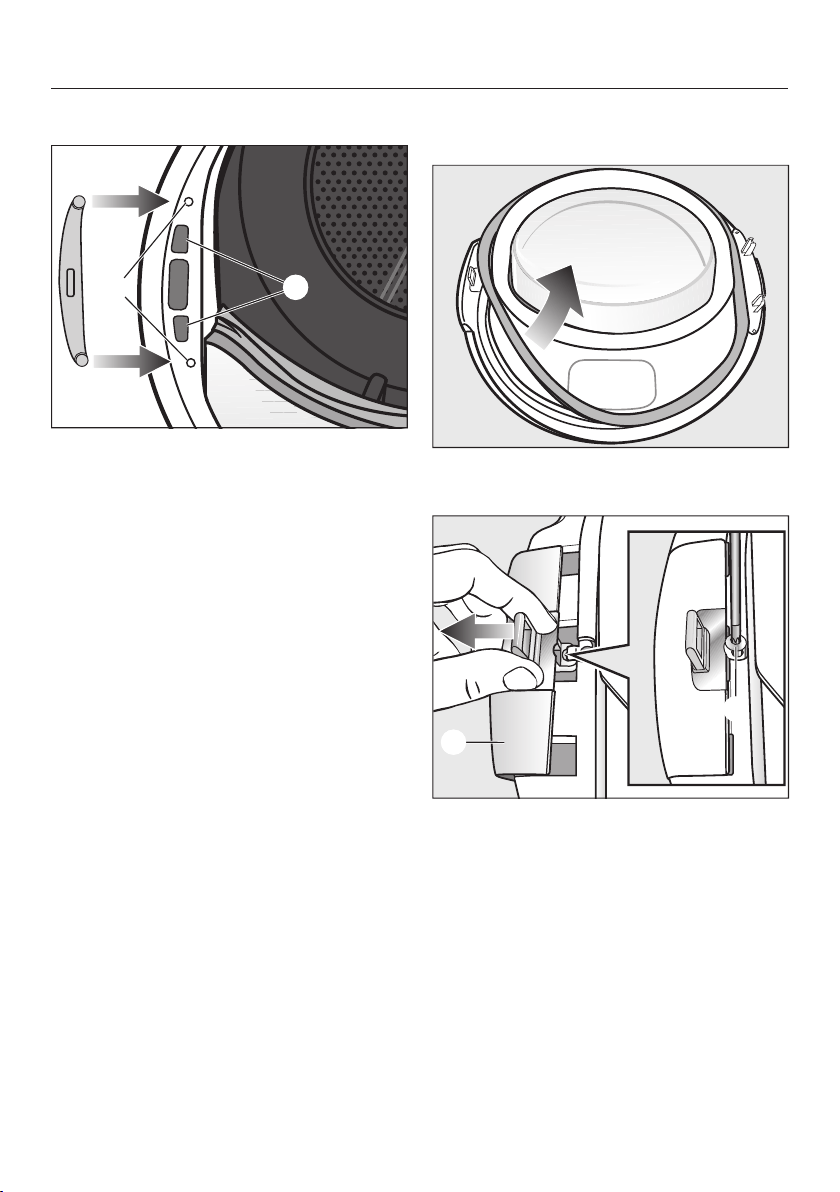
Installation
*INSTALLATION*
90
Turn the door lock through 180°.
Press the door lock into the openings
on the opposite side of the door
opening.
Adjust the position of the door lock
so that the screw holes line up with
those in the front panel of the dryer
.
Secure the door lock with the two
Torx screws.
3. Remove the lock catch from the
door
First take the rubber seal off the door
and place this to one side.
Use a T20 Torx screwdriver to remove
the screw on the lock catch.
Pull off the lock catch together with
the lock catch cover .
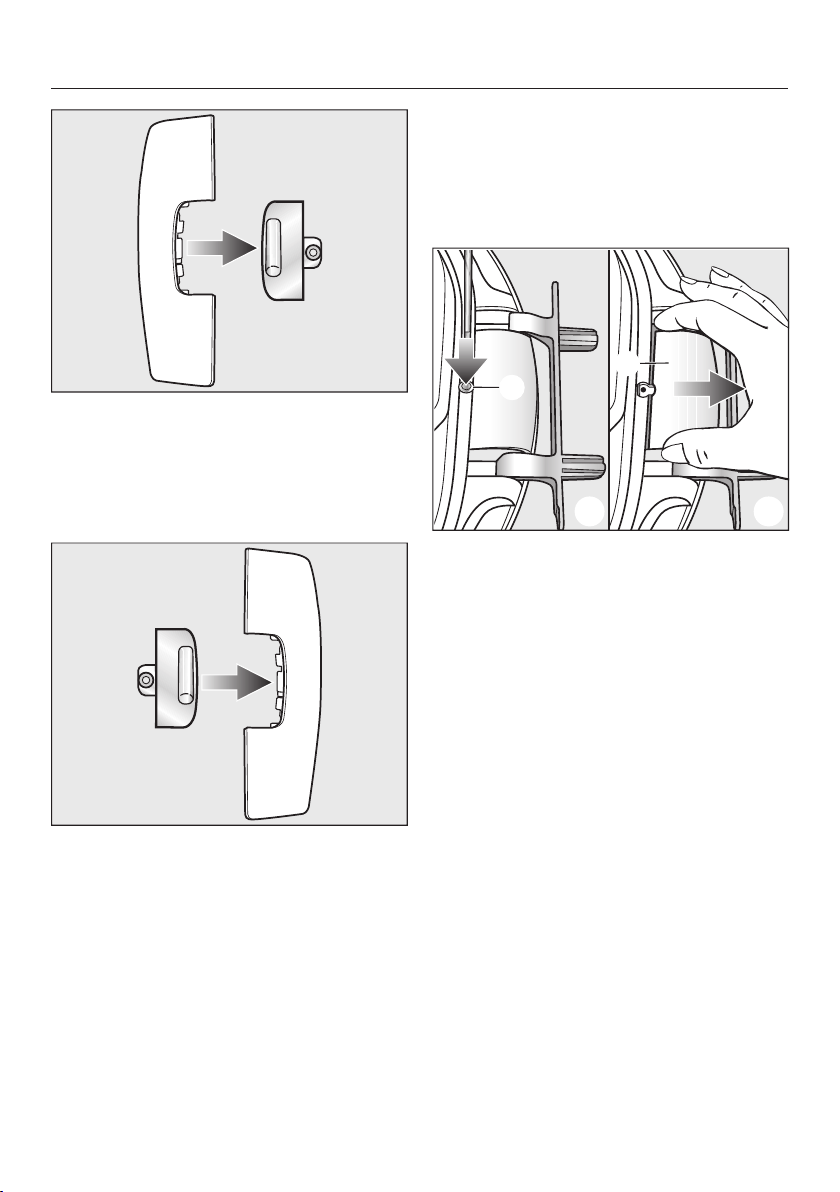
Installation
*INSTALLATION*
91
Remove the lock catch from the
cover.
This lock catch cover is no longer
needed. However, please keep it in a
safe place.
Insert the lock catch into the new
cover supplied with the dryer.
Place this new cover to one side for
now.
4. Dismantle the door hinge from the
door
The door hinge cover must be
unclipped from position and then
removed.
1. 2.
Use a screwdriver to press down
gently on position on the door
hinge cover.
Using a little force, pull out the door
hinge cover .
This door hinge cover is no longer
needed. However, please keep it in a
safe place.
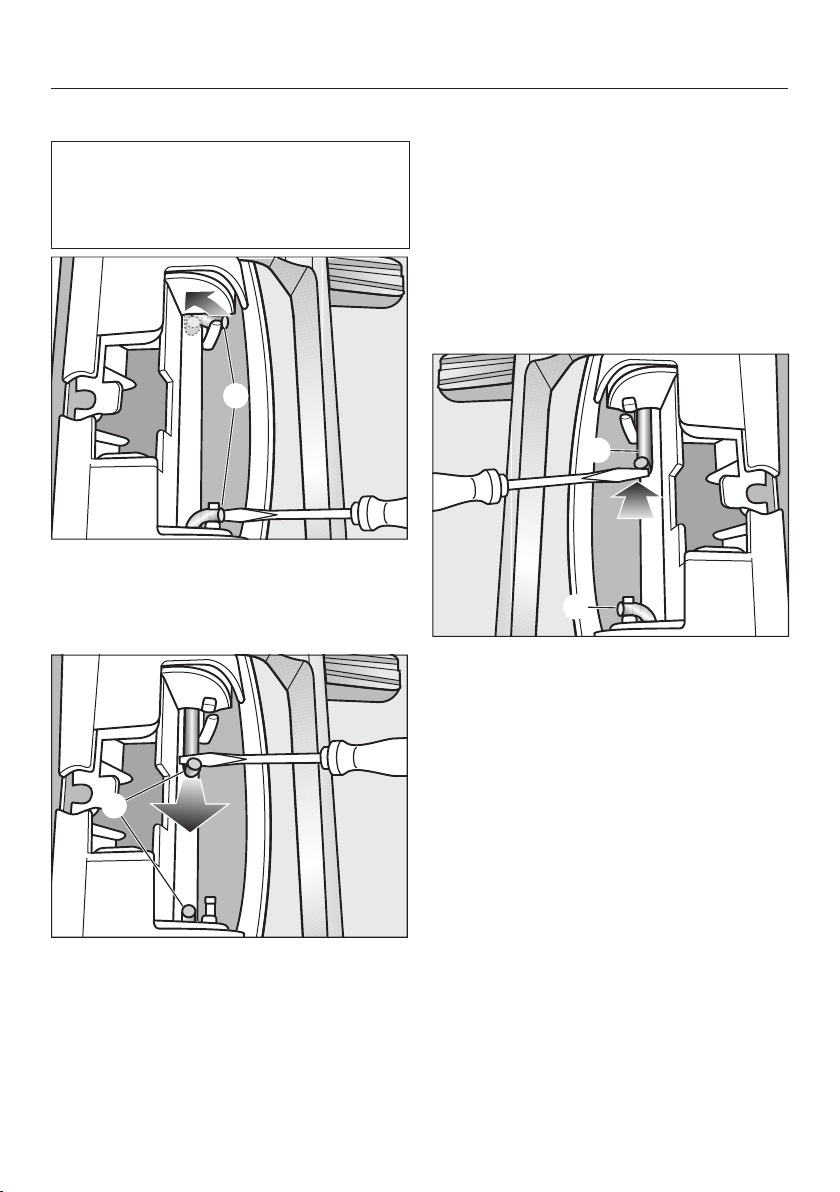
Installation
*INSTALLATION*
92
5. Change the door hinge on the door
The door hinge is secured to the door
with 2 angled rods. These rods need
to be removed with a screwdriver or
pointed pliers.
Insert the end of the screwdriver
blade under the rod and rotate it
so it is in an upright position. Do the
same to the other rod.
Use the screwdriver or pointed pliers
to guide first one then the other
rod to the middle until each can be
removed.
Useful tip: In some circumstances, the
rods can be difficult to dislodge.
Moving the screwdriver with a levering
action while pulling at the same time
may help to work the rods free.
Remove the door hinge and rotate it
180°.
Refit the door hinge on the opposite
side of the door.
Secure the door hinge with the two
rods .
Position the tip of the screwdriver
under the end of the rod and then
push it into its resting position.
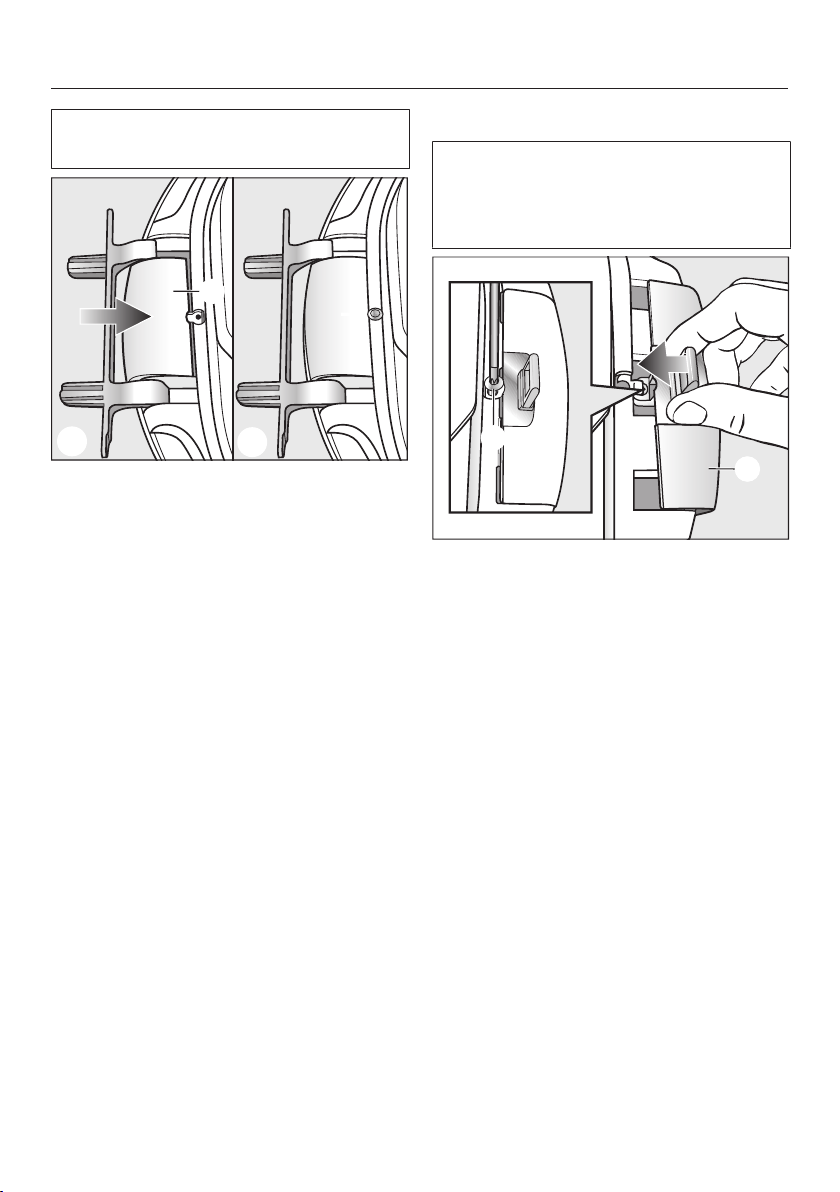
Installation
*INSTALLATION*
93
You now need the new door hinge
cover supplied with the tumble dryer.
1.
2.
Fit the new door hinge cover and
clip it into position.
6. Change the lock catch on the door
You now need the new lock catch
cover supplied with the dryer which
you have already fitted with the lock
catch.
Push the lock catch cover with its
lock catch into position.
Tighten the screw with a T20 Torx
screwdriver.
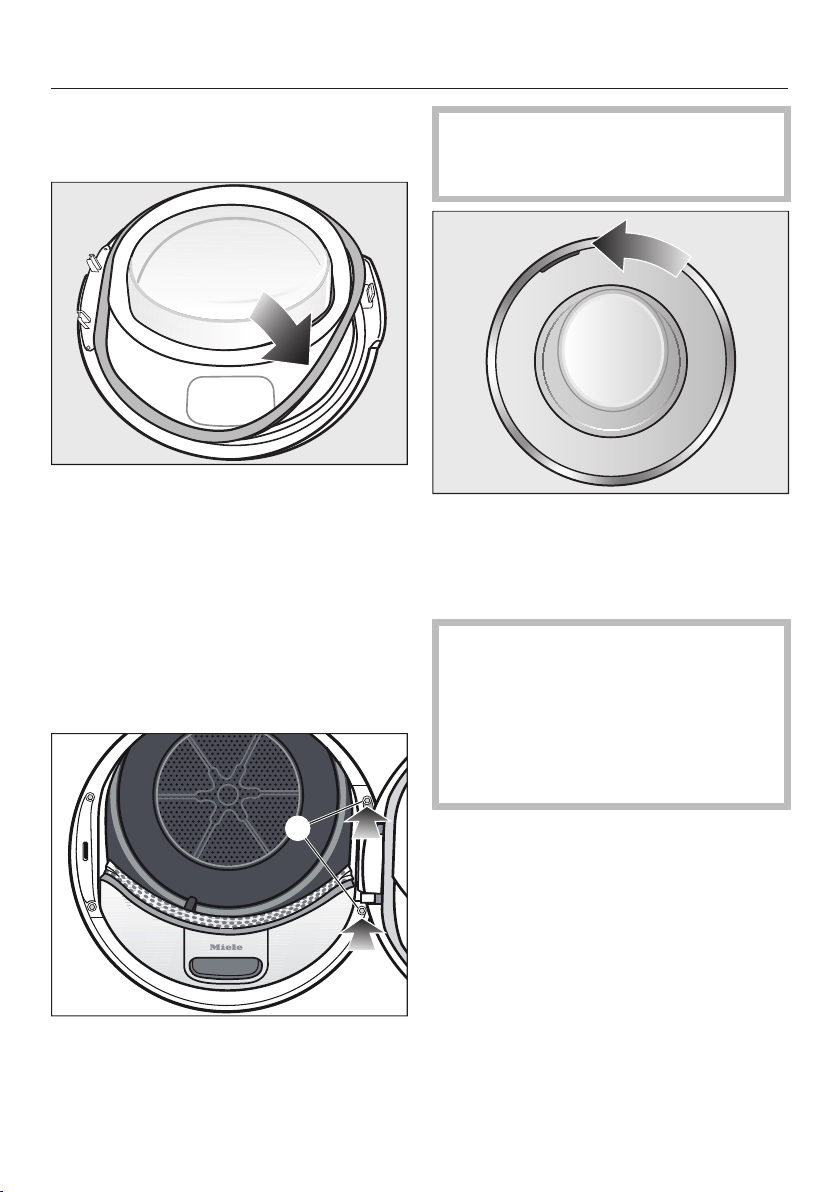
Installation
*INSTALLATION*
94
Refitting
7. Refit the door
Press the rubber seal back into the
groove on the door.
Position the door in front of the dryer.
Fit the base of the door hinge with its
two pins into the openings on the
dryer.
The base of the door hinge must be
flush with the front panel of the dryer.
The door cannot fall off in this position.
Screw the door securely to the dryer
at the base of the door hinge with
a T30 Torx screwdriver.
Now that you have changed the
door hinging, the door will open from
the opposite side.
Push the orange marker round to the
other side so that you will see at
which side to pull the door open.
Note
Please keep the lock catch and
door hinge covers which were no
longer needed in a safe place. These
will be required if, for example, you
move house and need to change the
door hinging back to its original
position.

Installation
*INSTALLATION*
95
Electrical connection
The tumble dryer is supplied with a
mains cable with moulded plug ready
for connection to a socket.
The socket should be easily accessible
after the tumble dryer has been
installed. If the socket is not easily
accessible, ensure that a suitable
means of disconnection is provided on
the installation side for each pole.
Risk of fire from overheating.
Connecting the tumble dryer to a
multi-socket plug adapter or to an
extension lead can overload the
cable.
For safety reasons, do not use an
extension cable or multi-socket
adapter.
All electrical work must be carried out
by a suitably qualified and competent
person in strict accordance with
national and local safety regulations.
For safety reasons, we recommend
using a suitable residual current device
(RCD) in the relevant electrical
installation for connecting the tumble
dryer.
If the mains connection cable is
damaged, it must only be replaced with
a specific mains connection cable of
the same type (available from Miele).
For safety reasons, such replacement
may only be carried out by a suitably
qualified and competent electrician or a
Miele authorised service technician, in
order to avoid a hazard.
The data plate indicates the nominal
power consumption and the connection
data. Compare this information with the
data of the on-site electrical
connection.
If in any doubt, consult a qualified
electrician.
Temporary or permanent operation with
a self-sufficient or non-mains
synchronous energy supply system
(e.g. isolated networks, back-up
systems) is possible. A requirement for
the operation is that the energy supply
system complies with all current local
and national requirements that apply to
stand-alone, solar and/or battery
systems.
The protective measures provided in
the domestic installation and in this
Miele product must also be assured in
their function and operation in isolated
operation or in non-mains synchronous
operation, or replaced with equivalent
measures in the installation.

Technical data
96
Height 850mm
Width 596mm
Depth 643mm
Depth with door open 1077mm
Suitable for pushing under a worktop Yes
Height for pushing under a worktop 850mm (+8/-2mm)
Width for pushing under a worktop 600 mm
Depth for pushing under a worktop 600 mm
Suitable for stacking Yes
Weight Approx. 62 kg
Drum volume 120l
Maximum capacity 9.0 kg (weight of dry laundry)
Capacity of condensed water container 4.8l
Drain hose length 1.49m
Maximum delivery head 1.00m
Maximum drain hose length 4.00m
Length of connection cable 2.00m
Voltage See data plate
Rated load See data plate
Fuse rating See data plate
Test certificates awarded See data plate
Energy consumption See “Consumption data”
LEDs Class 1
Frequency band 2.4000GHz–2.4835GHz
Maximum transmission power <100mW
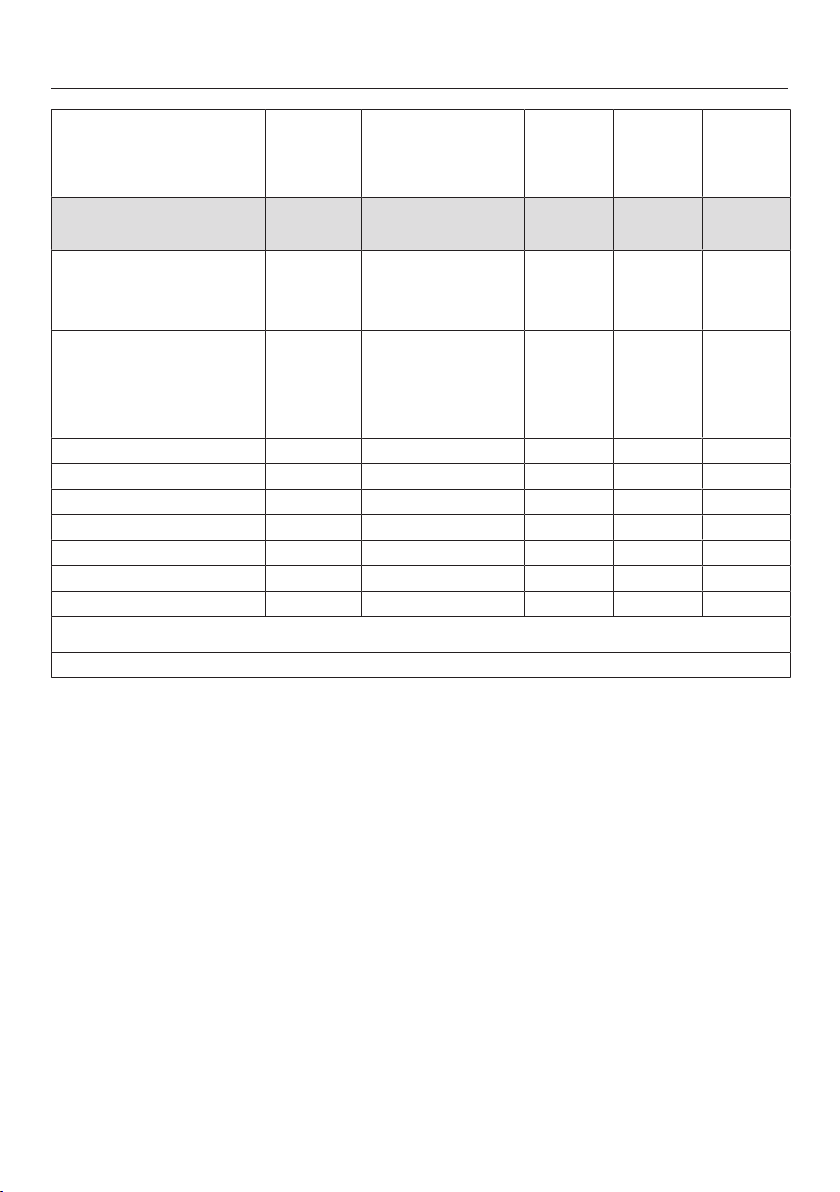
Consumption data
97
Load
1
Final spin speed in a
domestic washing
machine
Residual
moisture
Energy Duration
kg rpm % kWh min.
Cottons 9.0
4.5
1,000
1,000
60
60
1.47
0.78
220
131
Cottons Normal 9.0
9.0
9.0
1,200
1,400
1,600
53
50
44
1.30
1.25
1.10
199
189
168
Cottons Hand iron 9.0
9.0
9.0
9.0
1,000
1,200
1,400
1,600
60
53
50
44
1.16
1.00
0.95
0.80
176
154
144
122
Minimum iron Normal 4.0 1,200 40 0.50 65
Delicates Normal 2.5 800 50 0.55 70
Woollens handcare 2.0 1,000 50 0.02 5
Shirts Normal 2.0 600 60 0.45 60
Express Normal 4.0 1,000 60 0.80 80
Denim Normal 3.0 900 60 1.00 125
Proofing Normal 2.5 800 50 1.00 100
1
Weight of dry laundry
All data was calculated using EN 61121 unless otherwise stated.
Consumption data can vary from the nominal values given above depending on the size of the
load, types of textiles, residual moisture levels after spinning and fluctuations in the electricity
supply, or when water hardness levels differ from specified values.
Using the Cottons Normal programme is recommended for a mixed cotton load and is the programme
used in energy consumption tests according to AS/NZS 2442 (Refer to http://www.energyrating.gov.au
website for consumption data).
The consumption data displayed by the tumble dryer may differ from the consumption data listed in the
table. The differences are due to how data is calculated in the tumble dryer. For instance, when the
programme running time is calculated, it is influenced by the residual moisture and composition of the
laundry load, which – in turn – has an impact on the amount of energy required.

Settings
98
Settings can be altered to adapt the
electronics of the dryer to different
requirements.
Settings can be altered at any time.
Calling up settings
Switch the tumble dryer on.
Scroll to the second page in the main
menu.
Touch the Settings sensor.
Selecting settings
The settings are grouped into different
areas.
Select the required area.
Scroll through the list until the setting
you want appears.
Touch the sensor to edit the setting.
Editing settings
Change the value displayed and
confirm with OK.
or
Touch an option to select it.
An option which is selected will be
highlighted orange.
The option is saved. The display will
then switch to the Settings menu, or go
back to the previous menu level.
Exiting settings
Touch the sensor.
The display will then go back to the
previous menu level.
Touch the sensor.
The display will change to show the
main menu.
Settings
99
Operation/Display
Language
The display can be set to appear in
one of several different languages.
The flag after the word Language
(Sprache in German) acts as a guide in
case a language which is not
understood has been set.
The language selected is saved.
Code
The code prevents your machine
being used without your knowledge.
Options
- Activate
When the code has been activated,
you have to enter the code after
switching the dryer on. Otherwise the
dryer cannot be operated.
The factory default code is 250.
- Change
You can enter a code of your own.
If you forget the code, only a Miele
technician can unlock the tumble
dryer.
Make a note of your new code.
- Deactivate
For using the dryer without entering
the code. This only appears if the
code has been activated previously.
Clock display
After selecting the clock format, you
can set the time of day.
Options
- Clock format
For setting the clock format.
– 24 h (factory setting)
– 12 h
- Set
For setting the current time.
Consumption
You can display the total
consumption.
Options
- Previous programme
Energy consumption in the last
programme run
- Total consumption
Previous total consumption
- Set the cost
Cost, price perkWh
Settings
100
Memory
The dryer saves the settings that were
last selected for a drying programme
(drying level and/or Extras, or the
duration for some programmes).
The next time the programme is chosen
the saved settings will appear in the
display.
Options
- Off (factory default setting)
- On
Volume
The volume can be changed for the
buzzer that sounds when the dryer is
switched on and at the end of the
programme. The volume of the tone
that sounds when a sensor is touched
can also be changed.
Options
- Finish tone
- Keypad tone
- Welcome tone
The tones can be set to one of 7
different settings or switched off
altogether.
Behaviour finish tone
An audible tone sounds to let you
know the programme has finished.
You can decide how long the audible
tone should sound for.
Options
- Only 3 times after finish
The audible tone sounds 3 times at
the end of a programme:
- Up to 1 h after finish
The audible tone sounds at the end
of the programme until the tumble
dryer switches off automatically (for a
maximum of 1hour).
Display brightness
The brightness of the display can be
altered.
It can be set to one of 7 different
settings.
Factory setting: medium
Wash2Dry
You can deactivate the Wash2Dry
function.
Options
- On (factory default setting)
Wash2Dry is enabled and lights
up in the main menu.
- Off
Wash2Dry does not light up.

Settings
101
Display switch-off status
To save energy the display and sensor
controls will go out after 10 minutes
and the Start/Stop sensor will flash
slowly. You can change this automatic
switch-off function.
Options
- On
The display will go out (after
10minutes):
– if no programme selection is made
after switching the dryer on
– during the current programme
– after the end of a programme.
- On. Not in current prog.
(factory default setting)
The display will go out (as described
above), but will remain on while the
programme is running.
You can switch the display back on by
touching any sensor.

Settings
102
Network
Miele@home
Control the networking of your dryer
with your home Wi-Fi network.
The following points may appear in the
submenu:
Set up
This message only appears if the dryer
has not yet been connected to a Wi-Fi
network.
Please refer to “Before using for the first
time” for instructions on how to set up
the connection.
Activate
(visible if Miele@home is deactivated)
The Wi-Fi function is reactivated.
Deactivate
(visible if Miele@home is activated)
Miele@home remains set up, the Wi-Fi
function is switched off.
Connection status
(visible if Miele@home is activated)
The following values are displayed:
- the quality of the Wi-Fi reception
- the network name
- the IP address
Set up again
(visible if set up)
Resets the Wi-Fi login (network) to
immediately re-establish a new
connection.
Reset
(visible if set up)
- The Wi-Fi is switched off.
- The Wi-Fi connection will be reset to
the factory default setting.
The network configuration should be
reset whenever the dryer is being
disposed of or sold, or if a used dryer is
being put into operation. This is the only
way to ensure that all personal data has
been removed and, in the case of the
latter situation, the previous owner will
no longer be able to access the
appliance.
A new connection setup has to be
carried out in order to use the
Miele@home setting again.

Settings
103
SmartGrid
The SmartGrid setting (available
depending on country) is only visible if
the Miele@home setting is set up and
activated.
You can use this function to set your
tumble dryer to start automatically
based on an external signal within a
certain time period.
Activating SmartGrid gives the Timer
sensor a new function. Use the Timer
sensor to set SmartStart. The tumble
dryer will then start within the time
period specified by you when it receives
an external signal.
If a signal has not been received by the
latest start time set, the tumble dryer
will start automatically (see “Timer”).
SmartGrid is deactivated as standard.
Remote control
The Remote control setting (available
depending on country) is only visible if
the Miele@home setting is set up and
activated.
Once the Miele App has been installed
on your mobile device, you can check
the status of your tumble dryer from
anywhere and start it remotely. You
can also control it remotely via the
MobileStart programme.
You can switch off the Remote control
setting if you do not want to operate the
dryer with your mobile device.
If Remote control is not switched on, the
App can cause the programme to be
cancelled.
Use the Timer sensor to set a timeframe
within which you want to start the
tumble dryer and start the timer (see
“Timer/SmartStart”).
The tumble dryer will then start within
the specified timeframe when it receives
your signal.
If it has not received a start signal by
the latest start time set, the tumble
dryer will start automatically.
Remote control is activated as
standard.
Settings
104
RemoteUpdate
The RemoteUpdate function is used for
updating the software in your tumble
dryer.
RemoteUpdate is activated at the
factory.
If you do not install a RemoteUpdate,
you can continue to use your tumble
dryer in the usual way. However, Miele
recommends installing RemoteUpdates.
Activation
The RemoteUpdate menu option is
only displayed and can only be
selected if you have added your dryer
to your Wi-Fi network (see “Settings -
Miele@home”).
Miele’s RemoteUpdate function can
only be used if the tumble dryer is
connected to a Wi-Fi network and you
have an account in the Miele App. The
dryer must be registered in the App.
See the Miele App for terms and
conditions of use.
Some software updates can only be
carried out by Miele Service.
Running a RemoteUpdate
If a RemoteUpdate is available for your
dryer, it will be displayed automatically
for you.
You can choose to start the
RemoteUpdate immediately or wait until
later. If you select “Start later”, the
prompt to run the RemoteUpdate will
be displayed again the next time you
switch on the dryer.
The RemoteUpdate can take several
minutes.
Please note the following information
about the RemoteUpdate function:
- You will only receive a message when
a RemoteUpdate is available.
- Once a RemoteUpdate has been
installed, it cannot be undone.
- Do not switch off the dryer during a
RemoteUpdate. Otherwise, the
RemoteUpdate will be aborted and
will not be installed.

Settings
105
Programme sequence
Anti-crease
The Anti-crease function reduces
creasing after the end of the
programme.
The drum will continue to rotate for up
to 2hours after the drying cycle has
finished. This helps to reduce creasing.
Options
- Off
- 1 h
- 2 h (factory setting)
Cooling down temperature
The laundry will be cooled down
automatically before the end of the
programme. The automatic cooling
phase at the end of a programme can
be set to a cooler level for all drying
programmes. This extends the cooling
phase.
Options
The level is set in increments of 1°C.
- 55°C (factory setting)
- ...
- 40 °C
Drying levels
You can alter the drying levels for the
Cottons, Minimum iron and Automatic
programmes. The Cottons
programme will remain unchanged.
It can be set to one of 7 different
settings.
Factory setting: medium
Settings
106
Appliance parameters
Airways indicator
Fluff must be removed after every
drying programme. In addition, this
indicator will remind you to clean the
filters when a certain amount of fluff
has collected in them:
Clean the fluff and plinth filters. See the
operating instruction manual for more
information.
You can decide at what level of fluff
this reminder should be given.
Options
You will have an idea of how often this
should be done after a few drying
programmes.
- Off
The reminder does not appear.
However, if there is a very severe
blockage in the ducting, the
programme will be cancelled and the
fault message
Clean the fluff filter. Check the
airways. will appear in the display
regardless of this option.
- Heavy
The reminder only appears when
there is a heavy build-up of lint.
- Normal (factory default setting)
- Light
The reminder appears when there is
only a small build-up of fluff.
Conductivity
This setting is only relevant for regions
with very soft water.
Very soft water can result in
unsatisfactory drying results.
You should only select this setting if
the water used for washing the
laundry is extremely soft with a
conductivity reading (electrical
conductivity) of less than 150μS/cm.
Contact your local water authority for
the conductivity level of your mains
water supply.
Options
- Normal (factory default setting)
- Low <150mS (only for regions with
very soft water)

Settings
107
Operating hours
You can read off how many hours your
tumble dryer has been in operation for.
The time is displayed as the total
running time in hours.
Factory default
All settings exceptOperating hours are
reset to the factory default settings.
Options
Reset to factory settings?
- Yes
The settings are reset to the factory
default settings.
- No
The settings are not reset to the
factory default settings.
Legal information
Open source licences
You can view information here.
Copyright and licences for operating
and control software
For the purpose of operating and
controlling the appliance, Miele uses
proprietary or third-party software that
is not covered by open source licensing
terms. These items of software/software
components are protected by
copyright. The copyright powers of
Miele and third parties must be
respected.
In addition, the appliance contains
software components which are
distributed under open source licensing
terms. You can access these open
source components along with the
associated copyright notices, copies of
the valid licensing terms and any further
information in the appliance under the
menu option Settings| Appliance
parameters| Legal information| Open
source licences. The liability and warranty
arrangements for the open source
licences displayed at this location only
apply in relation to the respective rights
holders.

Settings
108
Copyright and licences for the
communication module
For the purpose of operating and
controlling the communication module,
Miele uses proprietary or third-party
software that is not covered by open
source licensing terms. These items of
software/software components are
protected by copyright. The copyright
powers of Miele and third parties must
be respected.
In addition, the communication module
contains software components which
are distributed under open source
licensing terms. The open source
components contained in the appliance
along with the corresponding copyright
notices, copies of the licensing terms
valid at the time, and any further
information can be accessed locally via
IP using a web browser (http://<IP
address>/Licenses), where <IP
address> is the IP address of the
appliance. The liability and warranty
arrangements for the open source
licences displayed in this location only
apply in relation to the respective rights
holders.



Miele Australia Pty. Ltd.
Miele New Zealand Limited
Miele Global Headquarters
Germany
Miele & Cie. KG
Carl-Miele-Straße 29
33332 Gütersloh
Federal Republic of Germany
IRD 98 463 631
8 College Hill
Freemans Bay, Auckland 1011
ACN 005 635 398
ABN 96 005 635 398
Level 4, 141 Camberwell Road
Hawthorn East, VIC 3123
0800 464 353 (0800 4 MIELE)
www.miele.co.nz
1300 464 353 (1300 4 MIELE)
www.miele.com.au

M.-Nr. 12 222 640 / 01en-AU, NZ
TWV 780 WP