X7501190601
© 11/2018 ECHO Inc.
Operator’s Manual
PB-2620
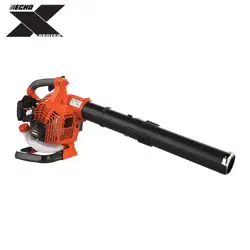
Power Blower
The engine exhaust from this product contains chemicals known
to the State of California to cause cancer, birth defects, or other
reproductive harm.
Read and understand all provided literature before use.
Failure to do so could result in serious injury.
This product complies with CAN ICES-2/NMB-2.

TABLE OF CONTENTS PB-2620
2 X7501190601
© 11/2018 ECHO Inc.
TABLE OF CONTENTS
Introduction ................................................................................................. 3
Servicing Information .................................................................................. 3
Parts/Serial Number............................................................................. 3
Service................................................................................................. 4
ECHO Consumer Product Support...................................................... 4
Product Registration ............................................................................ 4
Additional Literature............................................................................. 4
Safety.......................................................................................................... 4
Manual Safety Symbols and Important Information............................. 4
International Symbols .......................................................................... 5
Personal Condition and Safety Equipment .......................................... 7
Equipment.......................................................................................... 12
Emission Control (Exhaust & Evaporative) .............................................. 13
CARB And EPA Emissions Control Information ................................ 13
Description ................................................................................................ 14
Contents.................................................................................................... 15
Assembly................................................................................................... 16
Install Blower Pipes ........................................................................... 16
Remove Blower Pipes ....................................................................... 17
Operation .................................................................................................. 17
Fuel.................................................................................................... 18
Starting Cold Engine.......................................................................... 22
Starting Warm Engine........................................................................ 23
Stopping Engine ................................................................................ 25
Operating Blower ............................................................................... 25
Maintenance ............................................................................................. 27
Skill Levels ......................................................................................... 27
Maintenance Intervals........................................................................ 28
Air Filter ............................................................................................. 28
Fuel Filter........................................................................................... 29
Spark Plug ......................................................................................... 30
Cooling System.................................................................................. 30
Exhaust System................................................................................. 32
Carburetor Adjustment....................................................................... 32
Troubleshooting ........................................................................................ 34
Storage ..................................................................................................... 35
Long Term Storage (Over 30 Days)................................................... 35
Specifications............................................................................................ 37
Product Registration................................................................................. 38
PB-2620 INTRODUCTION
X7501190601 3
© 11/2018 ECHO Inc.
INTRODUCTION
Specifications, descriptions and illustrative material in this literature are as
accurate as known at the time of publication, but are subject to change
without notice. Illustrations may include optional equipment and
accessories, and may not include all standard equipment.
Read and understand all provided literature.
Literature contains specifications and
information for safety, operation,
maintenance, storage and assembly specific
to this product. Scan QR codes for more
information.
For additional literature, including safety manuals where applicable, or
questions regarding terms used in this manual, visit:
https://www.echo-usa.com/manuals
OR
https://www.shindaiwa-usa.com/manuals
SERVICING INFORMATION
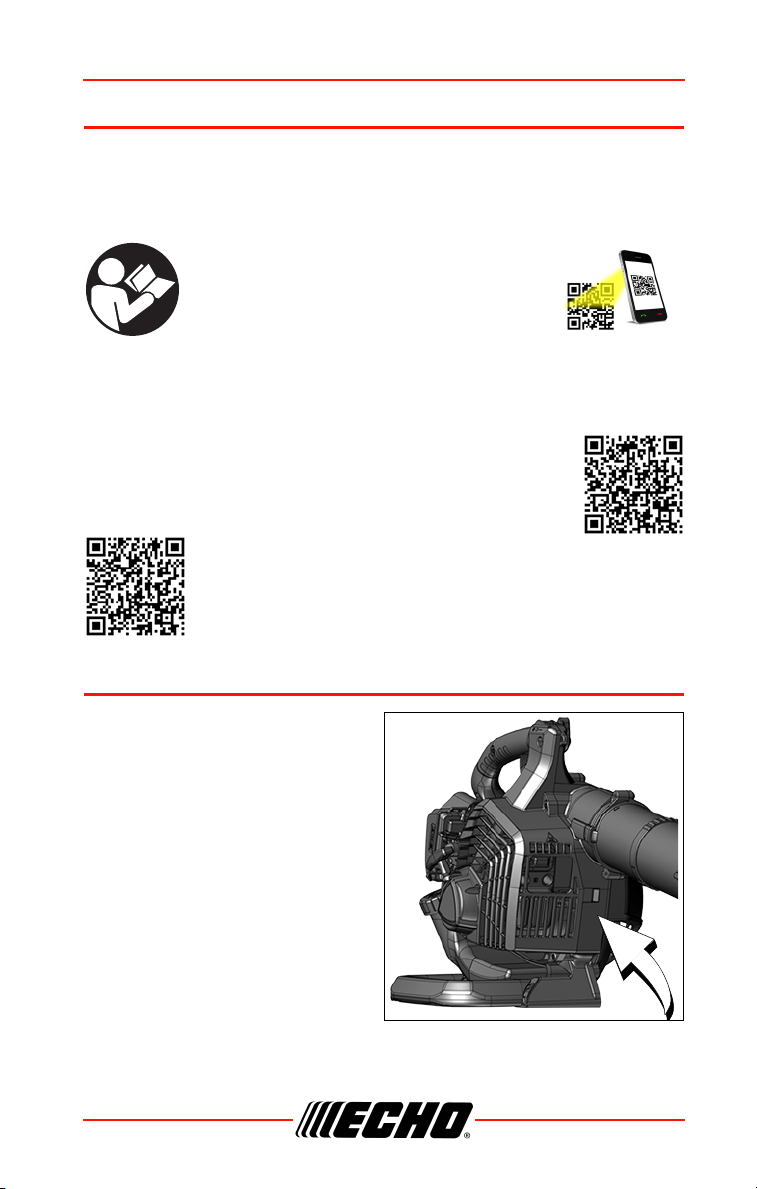
Parts/Serial Number
Genuine ECHO Parts and
Assemblies for your ECHO products
are available only from an
Authorized ECHO Dealer. When you
do need to buy parts always have
the Model Number and Serial
Number of the unit with you. For
future reference write them in the
space provided below.
Model No. _______________
Serial No. _______________

SAFETY PB-2620
4 X7501190601
© 11/2018 ECHO Inc.
Service
Service of this product during the warranty period must be performed by an
Authorized ECHO Service Dealer. For the name and address of the
Authorized ECHO Service Dealer nearest you, ask your retailer or call:
1-800-432-ECHO (3246). Dealer information is also available on our Web
Site www.echo-usa.com. When presenting your unit for Warranty service/
repairs, proof of purchase is required.
ECHO Consumer Product Support
If you require assistance or have questions concerning the application,
operation, or maintenance of this product, call the ECHO Consumer
Product Support Department at 1-800-673-1558 from 8:00 am to 5:00 pm
(Central Standard Time) Monday through Friday. Before calling, please
know the model and serial number of your unit.
Product Registration
Register your ECHO equipment on-line at www.echo-usa.com or by filling
out the product registration sheet included in this manual. Registering your
product confirms warranty coverage and provides a direct link to ECHO if
we find it necessary to contact you.
Additional Literature
In addition to finding information online, information is available from your
Authorized ECHO Service Dealer, or by contacting ECHO Inc., 400
Oakwood Road, Lake Zurich, IL 60047 (800-673-1558).
Safety Videos are available from your Authorized ECHO Service Dealer. A
$5.00 shipping charge is required for each video.
SAFETY
Manual Safety Symbols and Important Information
Throughout this manual and on the product itself, you will find safety alerts
and helpful, informational messages preceded by symbols or key words.
The following is an explanation of those symbols and key words and what
they mean to you.
PB-2620 SAFETY
X7501190601 5
© 11/2018 ECHO Inc.
The safety alert symbol accompanied by the word “DANGER”
calls attention to an act or condition which WILL lead to serious
personal injury or death if not avoided.
The safety alert symbol accompanied by the word “WARNING”
calls attention to an act or condition which CAN lead to serious
personal injury or death if not avoided.
The safety alert symbol accompanied by the word “CAUTION”
calls attention to an act or condition which may lead to minor or
moderate personal injury if not avoided.
The enclosed message provides information necessary for the
protection of the unit.
Note: This enclosed message provides tips for use, care and
maintenance of the unit.
CIRCLE AND SLASH SYMBOL
This symbol means the specific action shown is prohibited.
Ignoring these prohibitions can result in serious or fatal injury.
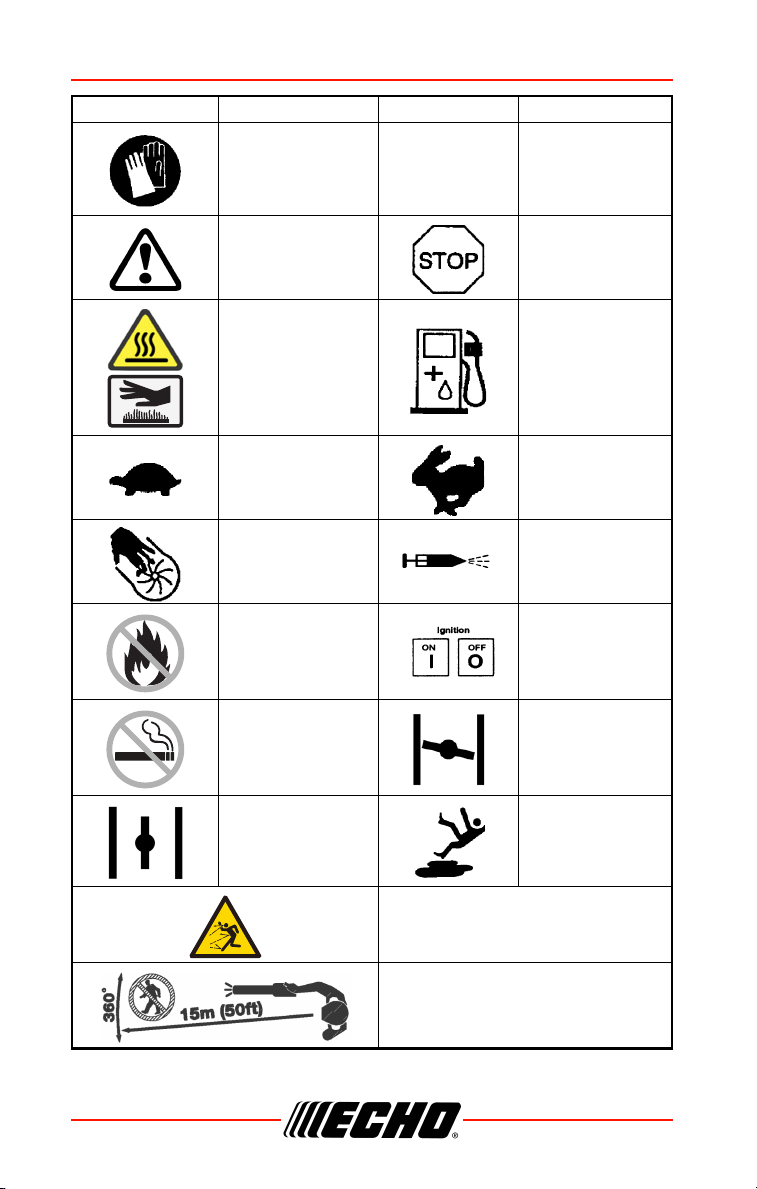
International Symbols
Symbol Description Symbol Description
Read and
Understand the
Operator’s Manual
Carburetor
Adjustment - High
Speed Mixture
Wear Eye, Ear and
Head Protection
Carburetor
Adjustment - Idle
Speed
H
T
SAFETY PB-2620
6 X7501190601
© 11/2018 ECHO Inc.
Wear Hand
Protection
Carburetor
Adjustment - Low
Speed Mixture
Safety/Alert Emergency Stop
Hot Surface
Fuel and Oil
Mixture
Idle speed Fast speed
Finger severing Primer Bulb
DO NOT Allow
Flames or Sparks
Near Fuel
Ignition
ON / OFF
DO NOT Smoke
Near Fuel
Choke Control
“COLD START”
Position (Choke
Closed)
Choke Control
“RUN” Position
(Choke Open)
Wear Slip
Resistant
Footwear
Beware of thrown objects
Keep Bystanders and Helpers
Away 15 m (50 ft.).
Symbol Description Symbol Description
L
PB-2620 SAFETY
X7501190601 7
© 11/2018 ECHO Inc.
Personal Condition and Safety Equipment
Cancer and Reproductive Harm
www.P65Warnings.ca.gov
The muffler or catalytic muffler and surrounding cover
may become extremely hot. Always keep clear of
exhaust and muffler area, otherwise serious personal
injury may occur.
Users of this product risk injury to themselves and others if the
unit is used improperly and/or safety precautions are not
followed. Proper clothing and safety gear must be worn when
operating unit.
Physical Condition
Your judgment and physical dexterity may not be good:
• If you are tired or sick
• If you are taking medication
• If you have taken alcohol or drugs

SAFETY PB-2620
8 X7501190601
© 11/2018 ECHO Inc.
Operate unit only if you are physically and mentally well.
Eye Protection
◆ Eye protection that meets ANSI Z87.1 or CE requirements
must be worn whenever you operate the unit.
◆ For additional safety, a full-face shield may be worn over
safety glasses or goggles to provide protection from sharp
branches or flying debris.
Hand Protection
Wear sturdy, no-slip, rubber work gloves to improve your grip on the
handles. Gloves also provide protection against cuts and scratches, cold
environments, and reduce the transmission of machine vibration to your
hands.
Hearing/Ear Protection
ECHO recommends wearing hearing protection whenever unit is used.
Breathing Protection
Operators who are sensitive to dust or other common airborne allergens
may need to wear a dust mask to prevent inhaling these materials while
operating unit. Dust masks can provide protection against dust, plant debris,
and other plant matter such as pollen. Make sure the mask does not impair
your vision, and replace the mask as needed to prevent air restrictions.
Proper Clothing
Wear snug-fitting, durable clothing:
• Pants should have long legs, shirts should have long sleeves.
• DO NOT WEAR SHORTS.
• DO NOT WEAR TIES, SCARVES, JEWELRY, or clothing with loose or
hanging items that could become entangled in moving parts or
surrounding growth.
• Keep clothing buttoned or zipped, and keep shirt tails tucked in.
Wear sturdy work shoes with nonskid rubber soles:
• DO NOT WEAR OPEN TOED SHOES.
• DO NOT OPERATE UNIT BAREFOOTED.
PB-2620 SAFETY
X7501190601 9
© 11/2018 ECHO Inc.
Keep long hair away from engine and air intake. Retain hair with cap or net.
Heavy protective clothing can increase operator fatigue, which may lead to
heat stroke. Schedule heavy work for early morning or late afternoon hours
when temperatures are cooler.
The components of this machine generate an electromagnetic
field during operation, which may interfere with some
pacemakers. To reduce the risk of serious or fatal injury,
persons with pacemakers should consult with their physician
and the pacemaker manufacturer before operating this
machine. In the absence of such information, ECHO
does not
recommend the use of this machine by anyone who has a
pacemaker.
Extended Operation / Extreme Conditions
Prolonged exposure to cold and/or vibration may result in
injury. Read and follow all safety and operation instructions to
minimize risk of injury. Failure to follow instructions may result
in painful wrist/hand/arm injuries.
It is believed that a condition called Raynaud’s Phenomenon, which affects
the fingers of certain individuals, may be brought about by exposure to
vibration and cold. Exposure to vibration and cold may cause tingling and
burning sensations, followed by loss of color and numbness in the fingers.
The following precautions are strongly recommended, because the
minimum exposure, which might trigger the ailment, is unknown.
• Keep your body warm, especially the head, neck, feet, ankles, hands, and
wrists.
• Maintain good blood circulation by performing vigorous arm exercises
during frequent work breaks, and also by not smoking.
• Limit the hours of operation. Try to fill each day with jobs where operating
the unit or other hand-held power equipment is not required.
• If you experience discomfort, redness, and swelling of the fingers followed
by whitening and loss of feeling, consult your physician before further
exposing yourself to cold and vibration.
SAFETY PB-2620
10 X7501190601
© 11/2018 ECHO Inc.
Repetitive Stress Injuries (RSI)
It is believed that overusing the
muscles and tendons of the fingers,
hands, arms, and shoulders may
cause soreness, swelling,
numbness, weakness, and extreme
pain in those areas. Certain
repetitive hand activities may put
you at a high risk for developing a
Repetitive Stress Injury (RSI). An
extreme RSI condition is Carpal
Tunnel Syndrome (CTS), which
could occur when your wrist swells
and squeezes a vital nerve that runs
through the area. Some believe that
prolonged exposure to vibration may
contribute to CTS. CTS can cause
severe pain for months or even
years.
To reduce the risk of RSI/CTS, do
the following:
• Avoid using your wrist in a bent, extended, or twisted position. Instead try
to maintain a straight wrist position. Also, when grasping, use your whole
hand, not just the thumb and index finger.
• Take periodic breaks to minimize repetition and rest your hands.
• Reduce the speed and force with which you do the repetitive movement.
• Do exercises to strengthen the hand and arm muscles.
• Immediately stop using all power equipment and consult a doctor if you
feel tingling, numbness, or pain in the fingers, hands, wrists, or arms. The
sooner RSI/CTS is diagnosed, the more likely permanent nerve and
muscle damage can be prevented.
All over head electrical conductors and communications wires
can have electricity flow with high voltages. This unit is not
insulated against electrical current. Never touch wires directly
or indirectly, otherwise serious injury or death may result.
PB-2620 SAFETY
X7501190601 11
© 11/2018 ECHO Inc.
Do not operate this product indoors or in inadequately
ventilated areas. Engine exhaust contains poisonous emissions
and can cause serious injury or death.
Read the Manual
• Provide all users of this equipment with the Operator’s Manual for instruc-
tions on Safe Operation.
Clear the Work Area
• Clear the area of children, bystanders, and pets. At a minimum, keep all
children, bystanders, and pets outside a 15 m (50 ft.) radius; outside the
15 m (50 ft.) zone, there is still a risk of injury from thrown objects.
Bystanders should be encouraged to wear eye protection. If you are
approached, stop the engine.
• Avoid blowing debris towards people, pets, open windows, or vehicles
when using unit.
• Review area to be cleared. Look for potential hazards such as stones or
metal objects.
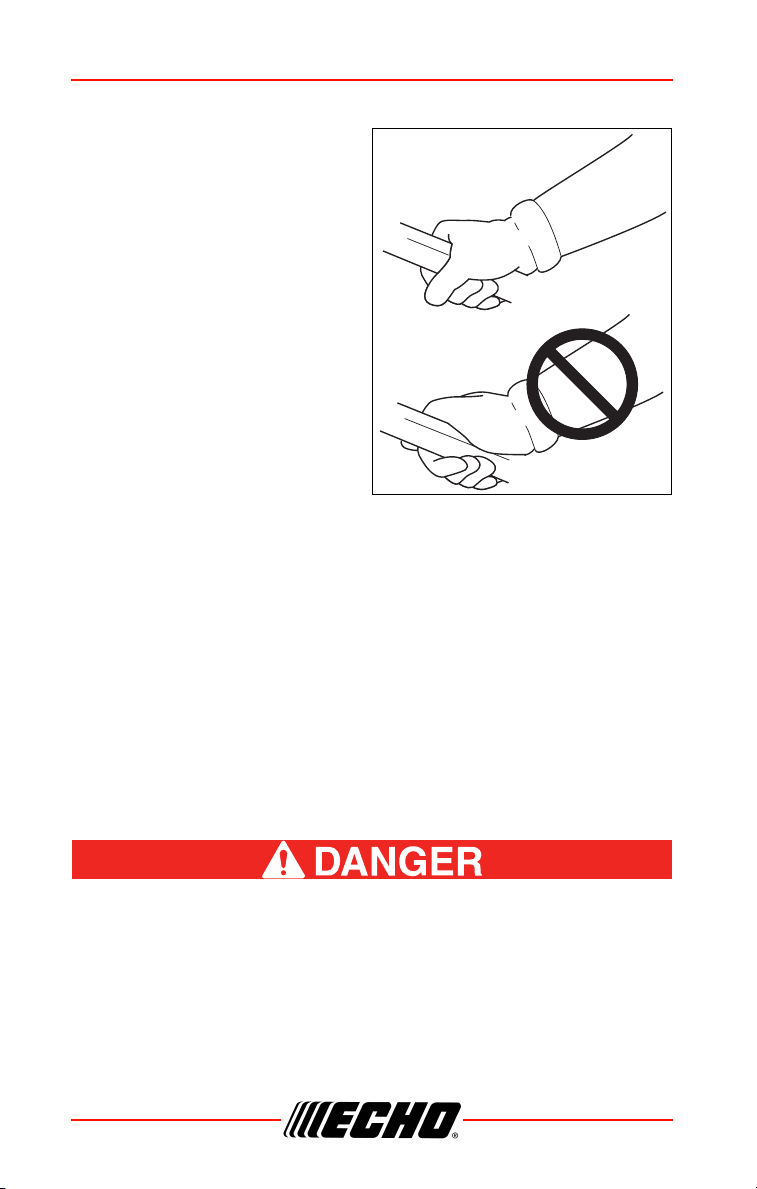
Keep a Firm Grip
• To prevent from dropping the unit, hold the handle in one hand, with
thumb and fingers encircling the handle.
Keep a Solid Stance
• Maintain footing and balance at all times. Do not stand on slippery,
uneven or unstable surfaces. Do not work in odd positions or on ladders.
Do not over reach.
Avoid Hot Surfaces
• Keep exhaust area clear of flammable debris.
Avoid contact during and immediately after
operation.
SAFETY PB-2620
12 X7501190601
© 11/2018 ECHO Inc.
Equipment
Use only approved attachments. Serious injury may result from
the use of a non-approved attachment combination. ECHO, INC.
will not be responsible for the failure of cutting devices,
attachments or accessories which have not been tested and
approved by ECHO. Read and comply with all safety
instructions listed in this manual.
◆ Check unit for loose/missing nuts, bolts, and screws.
Tighten and/or replace as needed.
◆ Do not use blower if any part is missing or damaged.
◆ Have repairs done only by an authorized service dealer.
Moving parts can amputate fingers or cause severe injuries.
Keep hands, clothing and loose objects away from all openings.
◆ ALWAYS stop engine, disconnect spark plug, and make
sure all moving parts have come to a complete stop before
removing obstructions, clearing debris, or servicing unit.
◆ DO NOT start or operate unit unless all guards and
protective covers are properly assembled to unit.
◆ NEVER reach into any opening while the engine is running.
Moving parts may not be visible through openings.
Periodically Check fuel system (fuel lines, vent, grommet, fuel
tank, and fuel cap) for leaks especially if the unit is dropped. If
damage or leaks are found, do not use unit, otherwise serious
personal injury or property damage may occur. Have unit
repaired by an authorized servicing dealer before using.
PB-2620 EMISSION CONTROL
X7501190601 13
© 11/2018 ECHO Inc.
EMISSION CONTROL (EXHAUST &
EVAPORATIVE)
CARB And EPA Emissions Control Information
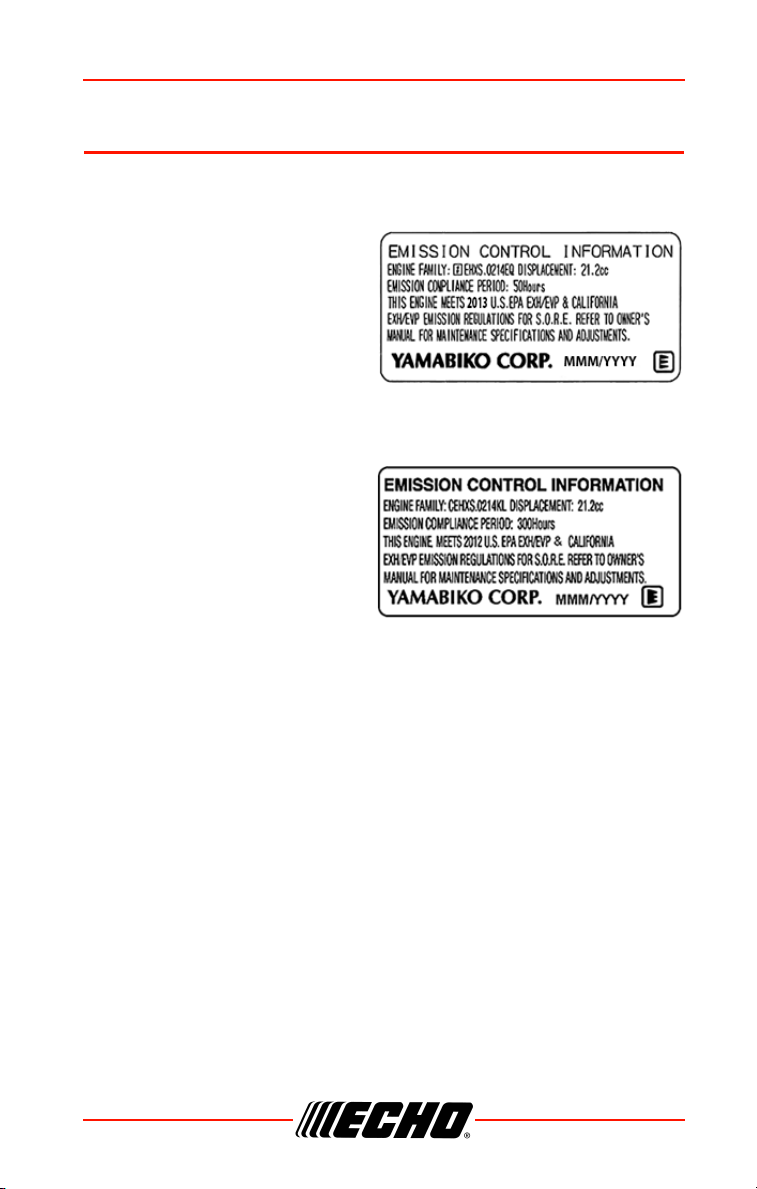
The emission control system for
the engine is EM (engine
modification) and, if the second to
last character of the Engine Family
on the Emission Control
Information label (sample below) is
“B”, “C”, “K”, or “T”, the emission
control system is EM and TWC (3-
way catalyst). The fuel tank/fuel
line emission control system is EVAP (evaporative emissions). Evaporative
emissions for California models are only applicable to fuel tanks.
An Emission Control Label is
located on the engine. (This is an
EXAMPLE ONLY, information on
label varies by engine FAMILY).
Product Emission Durability
(Emission Compliance
Period)
The 50 or 300 hour emission compliance period is the time span selected by
the manufacturer certifying the engine emissions output meets applicable
emissions regulations, provided that approved maintenance procedures are
followed as listed in the Maintenance Section of this manual.
DESCRIPTION PB-2620
14 X7501190601
© 11/2018 ECHO Inc.
DESCRIPTION
Locate the safety decal(s) on your unit. Make sure the decal(s) is legible and
that you understand and follow the instructions on it. If a decal cannot be
read, a new one can be ordered from your ECHO dealer. Safety label is for
example only. Your label my appear slightly different.
70dB(A)
per ANSI B175.2

PB-2620 CONTENTS
X7501190601 15
© 11/2018 ECHO Inc.
CONTENTS
The ECHO product you purchased has been factory pre-assembled for your
convenience. Due to packaging restrictions, some assembly may be
necessary.
After opening the carton, check for damage. Immediately notify your retailer
or ECHO Dealer of damaged or missing parts. Use the contents list to check
for missing parts.
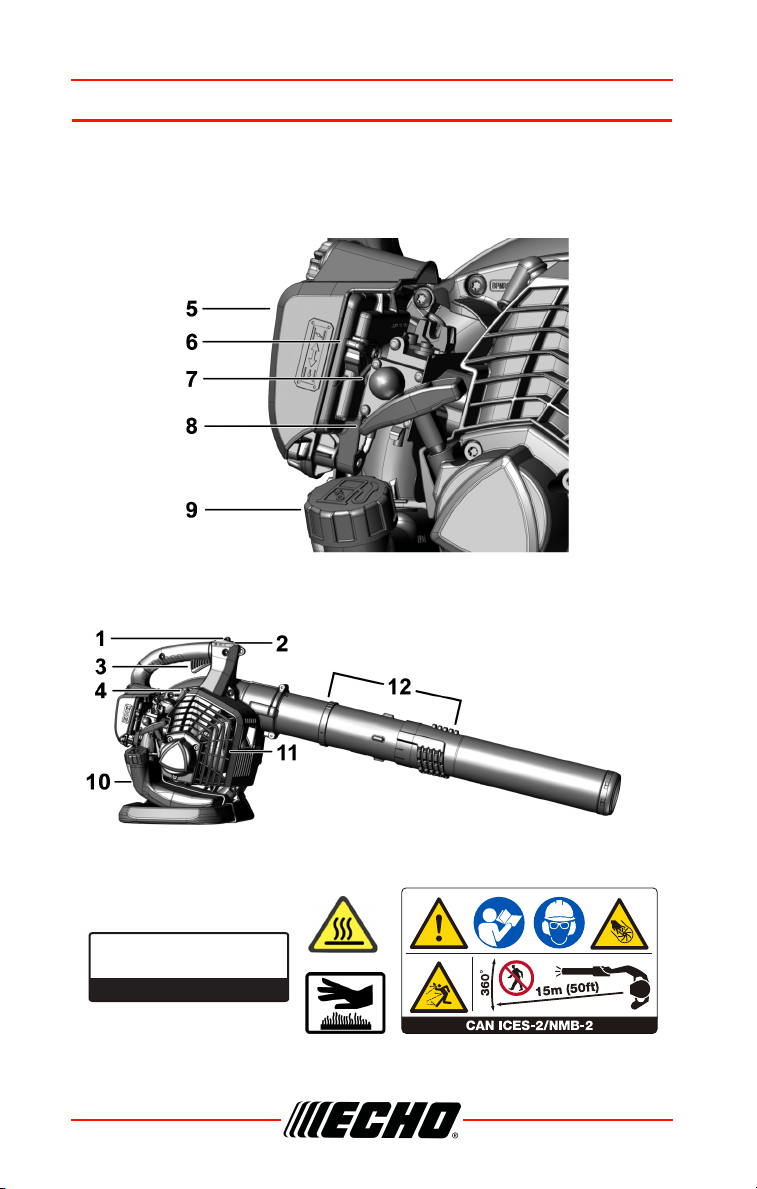
1. Throttle Position Lever
2. Stop Switch
3. Throttle Trigger
4. Spark Plug
5. Air Cleaner
6. Choke
7. Purge Bulb
8. Recoil Starter Handle
9. Fuel Tank Cap
10. Fuel Tank
11. Spark Arrestor Muffler Or Spark Arrestor Muffler With Catalyst
12. Blower Pipes
____1 Power Head
____3 Blower Pipe
____1 Warranty Statement
____1 Operator’s Manual
ASSEMBLY PB-2620
16 X7501190601
© 11/2018 ECHO Inc.
ASSEMBLY
Never perform maintenance or assembly procedures with
engine running or serious personal injury may result.
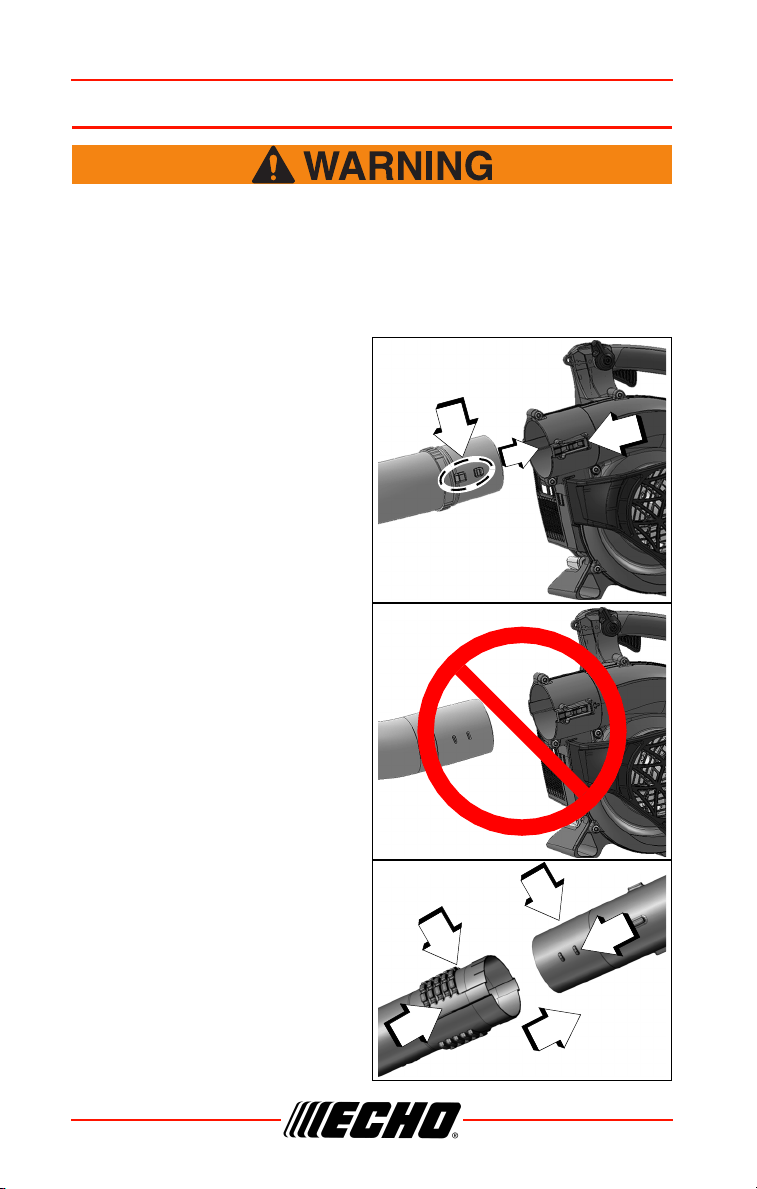
Install Blower Pipes
1. Stand unit upright on blower base.
2. Align locking ribs (A) on upper
blower pipe with pipe lock (B) in
fan case. Slide upper blower
pipe into fan case until a
clicking sound is heard.
Do not assemble the opposite
end of the upper blower pipe to
the fan case.
3. Align tabs (C) with grooves (D)
and slide lower blower pipe (E)
over upper pipe (F) until there is
light resistance. Do not force
the connection.
4. Hold upper pipe, and turn lower
pipe clockwise, engaging
positive locking channels until
connection is firm.
A
B
C
D
E
F
PB-2620 OPERATION
X7501190601 17
© 11/2018 ECHO Inc.
Note: Blower use will eventually loosen pipe connections. Exclusive
positive locking system allows pipes to be tightened. If
loosening occurs, remove pipe, and reinstall according to
instructions 3 and 4.
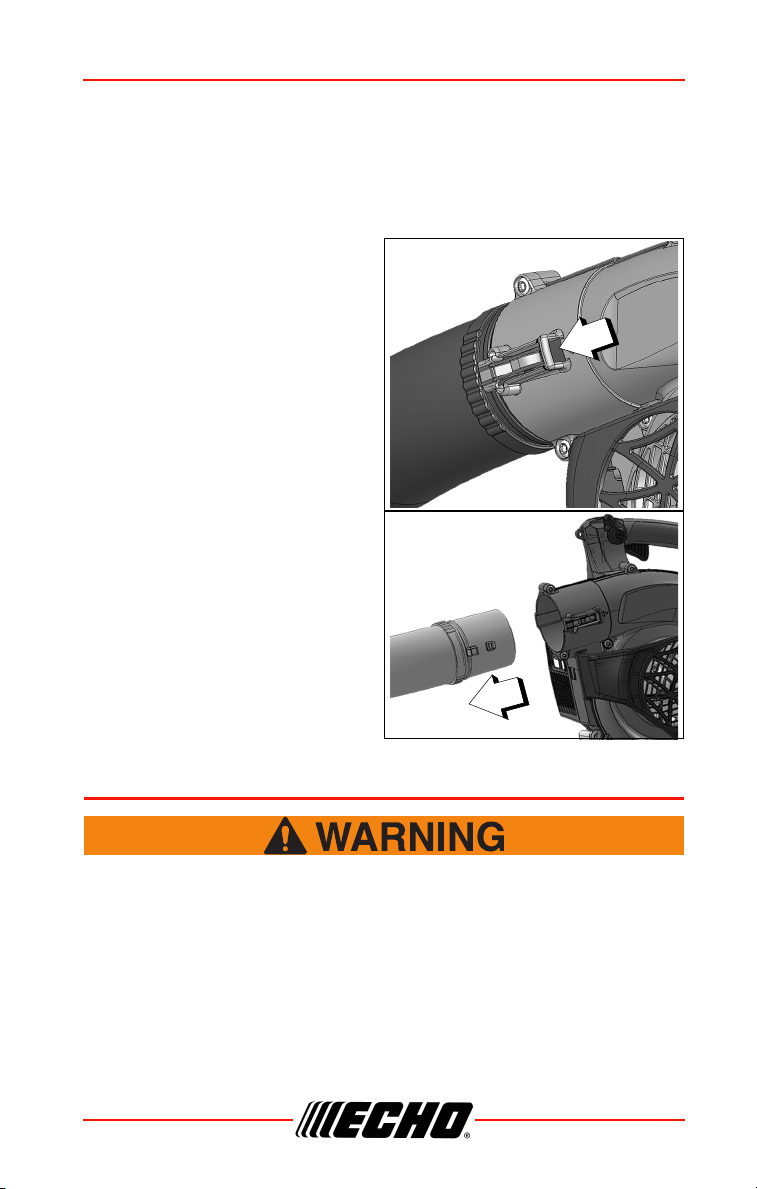
Remove Blower Pipes
1. Insert screwdriver into hole (G)
to release pipe lock.
2. Pull pipe out of fan case.
3. Remove screwdriver.
OPERATION
Moving parts can amputate fingers or cause severe injuries.
Keep hands, clothing and loose objects away from all openings.
Always stop engine, disconnect spark plug, and make sure all
moving parts have come to a complete stop before removing
obstructions, clearing debris, or servicing unit. Blower housing
may contain shredder blades and other sharp edges that can
cause serious injuries if touched, even if engine is off and
blades are not moving. Wear gloves to protect hands from sharp
edges and hot surfaces.
G
OPERATION PB-2620
18 X7501190601
© 11/2018 ECHO Inc.
Operation of this equipment may create sparks that can start
fires around dry vegetation. This unit is equipped with a spark
arrestor to prevent discharge of hot particles from the engine.
Contact local fire authorities for laws or regulations regarding
fire prevention requirements.
Engine exhaust IS HOT, and contains Carbon Monoxide (CO), a
poison gas. Breathing CO can cause unconsciousness, serious
injury, or death. Exhaust can cause serious burns. ALWAYS
position unit so that exhaust is directed away from your face
and body.
◆ Always maintain a direct, clear line of site to the unit and
the work being performed.
◆ Always be alert for changes in operation of unit.
◆ Always shut engine off before transporting unit to new
location.
Fuel
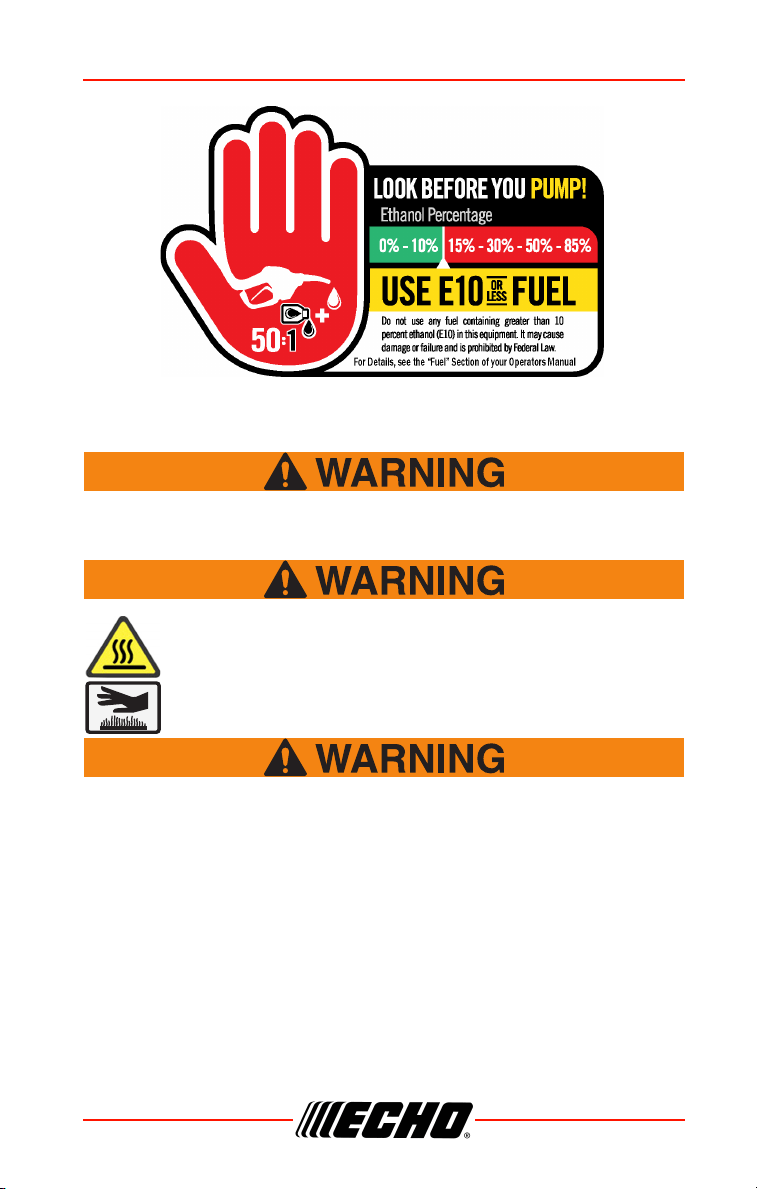
Diesel fuels and alternative fuels, such as E-15 (15% ethanol),
E
-85 (85% ethanol) or any fuels not meeting ECHO
requirements are NOT approved for use in ECHO 2-stroke
gasoline engines. Use of diesel or alternative fuels may cause
performance problems, loss of power, overheating, fuel vapor
lock, and unintended machine operation, including, but not
limited to, improper clutch engagement. Diesel or alternative
fuels may also cause premature deterioration of fuel lines,
gaskets, carburetors and other engine components.
PB-2620 OPERATION
X7501190601 19
© 11/2018 ECHO Inc.
Fuel Requirements
Gasoline - Use 89 Octane [R+M/2] (mid grade or higher) gasoline known to
be good quality. Gasoline may contain up to 10% Ethanol (grain alcohol) or
15% MTBE (methyl tertiary-butyl ether). Gasoline containing methanol
(wood alcohol) is NOT approved. Use of ECHO branded fuel is
recommended to extend engine life in all air-cooled 2-stroke and 2/4-stroke
hybrid engines.
Two Stroke Oil - A two-stroke engine oil, such as ECHO branded 2-stroke
oils, meeting ISO-L-EGD (ISO/CD 13738) and J.A.S.O.
FD Standards must
be used. ECHO branded 2-stroke oils meet these standards. Engine
problems due to inadequate lubrication caused by failure to use an ISO-L-
EGD (ISO/CD 13738) and J.A.S.O. M345-
FD certified oil will void the two-
stroke engine warranty.
2-Stroke engine oil contains petroleum distillates and other
additives that may be harmful if swallowed. Heated oil can
release vapors that can cause flash fire, or ignite with explosive
force. Read and follow the oil manufacturer’s instructions, and
observe all safety warnings and precautions for handling
flammable liquids. For more detailed safety and first aid
information, visit www.echo-usa.com for a copy of the Material
Safety Data Sheet.
◆ KEEP OUT OF REACH OF CHILDREN.
◆ If swallowed, do not induce vomiting. CALL PHYSICIAN OR
A POISON CONTROL CENTER IMMEDIATELY.
◆ WEAR SAFETY GLASSES when mixing or handling.
◆ AVOID repeated or prolonged skin contact
◆ AVOID inhaling oil mists or vapors.
ECHO branded 2-stroke oils may be mixed at 50:1 ratio for
application in all ECHO engines sold in the past regardless of ratio
specified in those manuals.
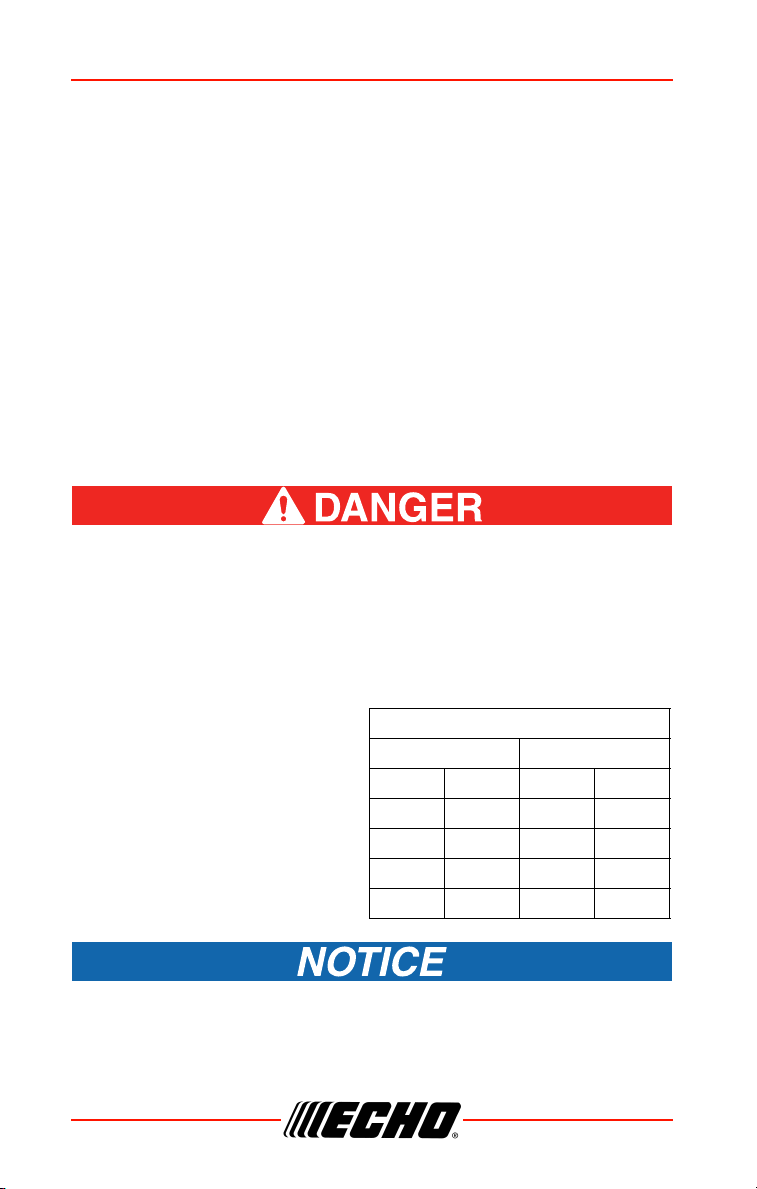
Handling Fuel
Fuel is VERY flammable. Use extreme care when mixing, storing
or handling, or serious personal injury may result.
OPERATION PB-2620
20 X7501190601
© 11/2018 ECHO Inc.
◆ Use an approved fuel container. Mark fuel containers as
containing 2-stroke mixture fuel.
◆ DO NOT smoke near fuel.
◆ DO NOT allow flames or sparks near fuel.
◆ Fuel tanks/cans may be under pressure. Always loosen
fuel caps slowly allowing pressure to equalize.
◆ NEVER refuel a unit when the engine is HOT or RUNNING!
◆ DO NOT fill fuel tanks indoors. ALWAYS fill fuel tanks
outdoors over bare ground.
◆ DO NOT overfill fuel tank. Wipe up spills immediately.
◆ Securely tighten fuel tank cap and close fuel container
after refueling.
◆ Inspect for fuel leakage. If fuel leakage is found, do not
start or operate unit until leakage is repaired.
◆ Move at least 3 m (10 ft.) from refueling location before
starting the engine.
Gasoline vapor is heavier than air, and can travel along the
ground to nearby sources of ignition such as electrical motors,
pilot lights, and hot or running engines. Vapors ignited by an
ignition source can flash back to the fuel container, resulting in
an explosion, fire, serious or fatal injuries, and extensive
property damage.
Mixing Instructions
1. Fill an approved fuel container
with half of the required
amount of gasoline.
2. Add the proper amount of
2-stroke oil to gasoline.
3. Close container and shake to
mix oil with gasoline.
4. Add remaining gasoline, close
fuel container, and remix.
Spilled fuel is a leading cause of hydrocarbon emissions. Some
states may require the use of automatic fuel shut-off containers to
reduce fuel spillage.
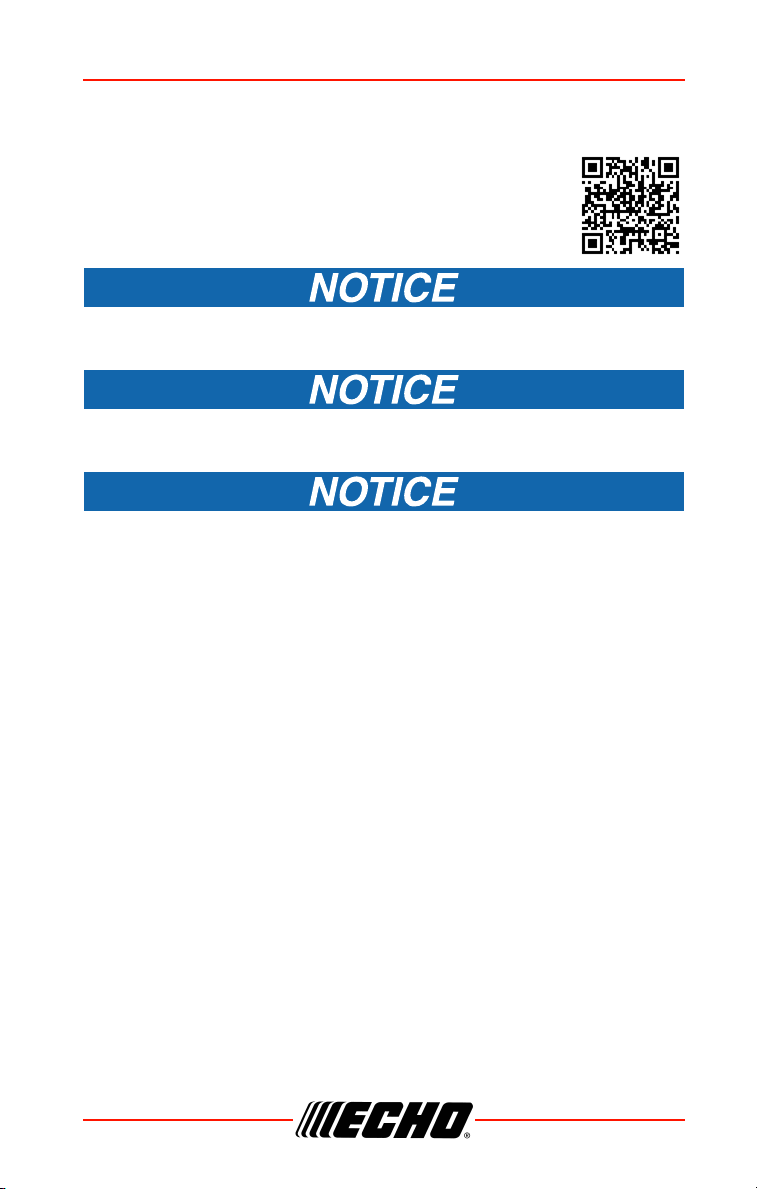
Fuel to Oil Mix – 50:1 Ratio
US Metric
Gas Oil Gas Oil
gal. fl.oz. L cc
12.65100
2 5.2 10 200
51325500
PB-2620 OPERATION
X7501190601 21
© 11/2018 ECHO Inc.
• Empty the fuel tank prior to storing the unit. Return unused fuel to an
approved fuel storage container.
Storage - Fuel storage laws vary by locality. Contact your
local government for the laws affecting your area. As a
precaution, store fuel in an approved, airtight container.
Store in a well-ventilated, unoccupied building, away from
sparks and flames.
Stored fuel ages. Do not mix more fuel than you expect to use in 30
days, 90 days when a fuel stabilizer is added.
Stored two-stroke fuel may separate. ALWAYS shake fuel container
thoroughly before each use.
Used oil and gasoline, and soiled towels are hazardous waste
materials. Disposal laws vary by locality.
OPERATION PB-2620
22 X7501190601
© 11/2018 ECHO Inc.
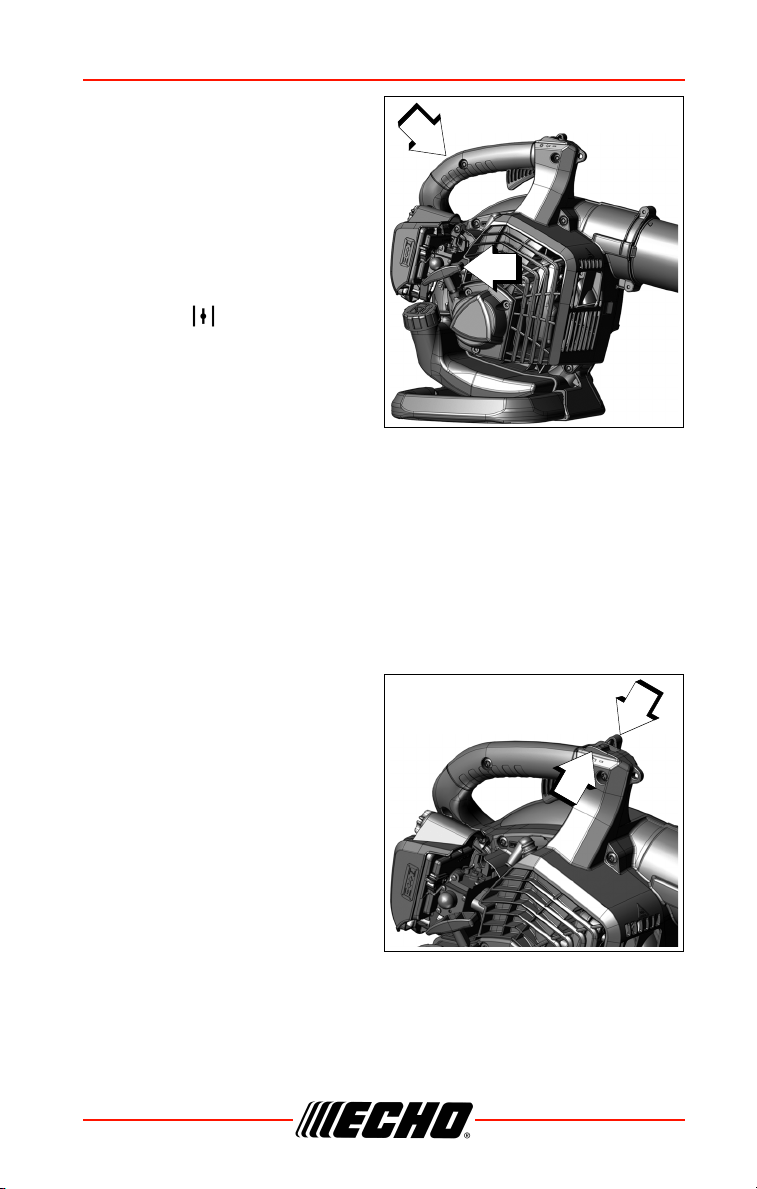
Starting Cold Engine
1. Stop Switch
Move stop switch (A) away from
the STOP position.
2. Throttle Position Lever
Move throttle position lever (B)
midway between idle and full
throttle positions.
3. Choke
Move choke (C) to COLD START
(
) (closed) position.
4. Purge Bulb
Pump purge bulb (D) until fuel is
visible and flows freely in the
clear fuel tank return line.
Recoil starter: Use short pulls - only 1/2 to 2/3 of rope for starting. Do
not allow the rope to snap back in. Always hold the unit firmly.
A
B
D
C
PB-2620 OPERATION
X7501190601 23
© 11/2018 ECHO Inc.
5. Recoil Starter
Place the unit on a flat, clear
area. Firmly grasp throttle
handle (E) with left hand and
rapidly pull recoil starter handle
(F) until engine fires, or
maximum 5 pulls.
6. Choke
Move choke lever (C) to RUN
position (
), and if necessary,
restart engine.
Note: If engine does not start
with choke in RUN
position after 5 pulls,
repeat instructions 3 - 6.
7. Throttle Trigger
After engine warm up, gradually depress throttle trigger to increase
engine RPM to operating speed.
Note: Allow engine to warm up 3 minutes before use.
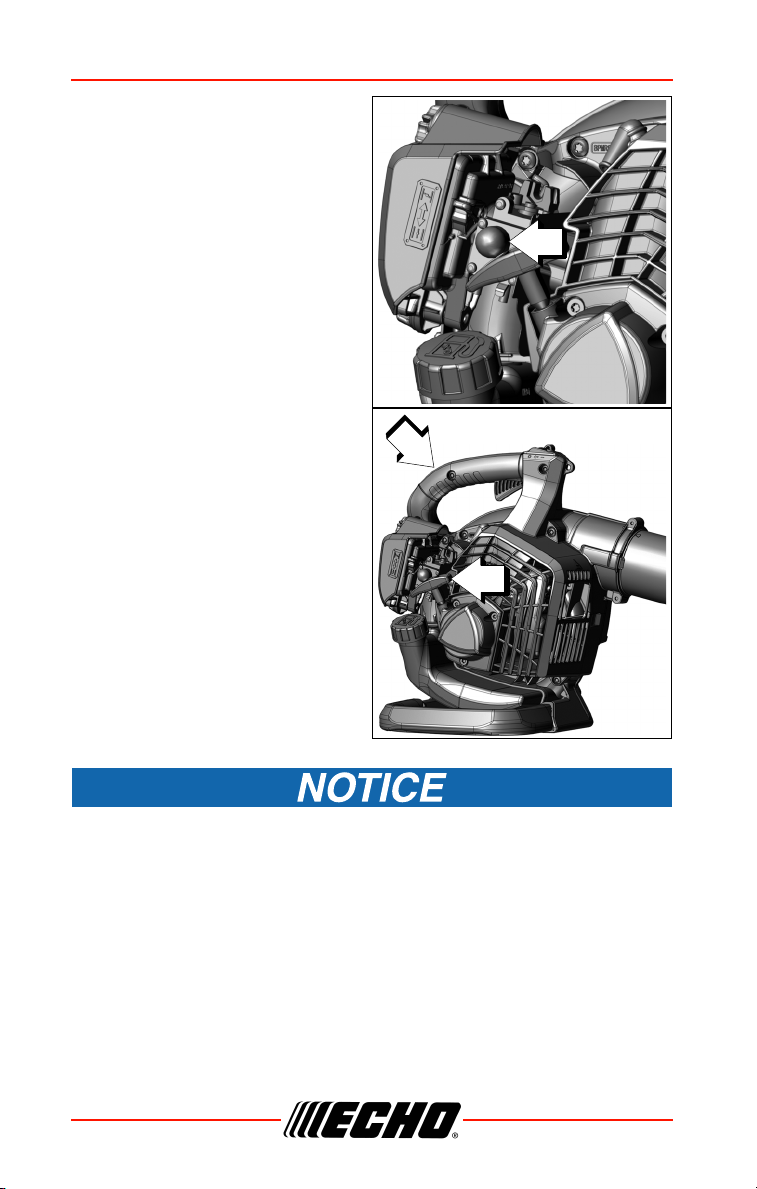
Starting Warm Engine
The starting procedure is the same as Cold Start except DO NOT close the
choke.
1. Stop Switch
Move stop switch (A) away from
the STOP position.
2. Throttle Position Lever
Move throttle position lever (B)
midway between idle and full
throttle positions.
E
F
A
B
OPERATION PB-2620
24 X7501190601
© 11/2018 ECHO Inc.
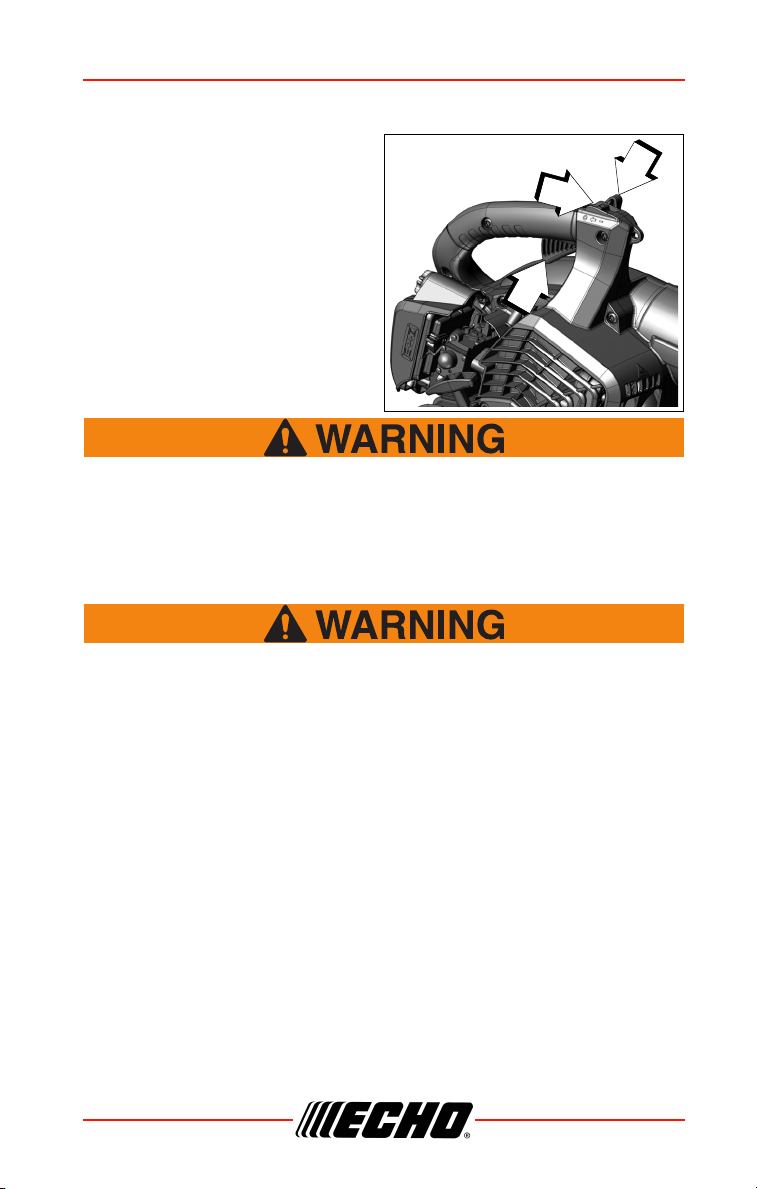
3. Purge Bulb
Pump purge bulb (C) until fuel is
visible and flows freely in the
clear fuel tank return line.
4. Recoil Starter
Place the unit on a flat, clear
area. Firmly grasp throttle
handle (D) with left hand and
rapidly pull recoil starter handle/
rope (E) until engine fires.
Recoil starter: Use short pulls - only 1/2 to 2/3 of rope for starting. Do
not allow the rope to snap back in. Always hold the unit firmly.
Note: If engine does not start after 5 pulls, use Cold Start
Procedure.
C
D
E
PB-2620 OPERATION
X7501190601 25
© 11/2018 ECHO Inc.
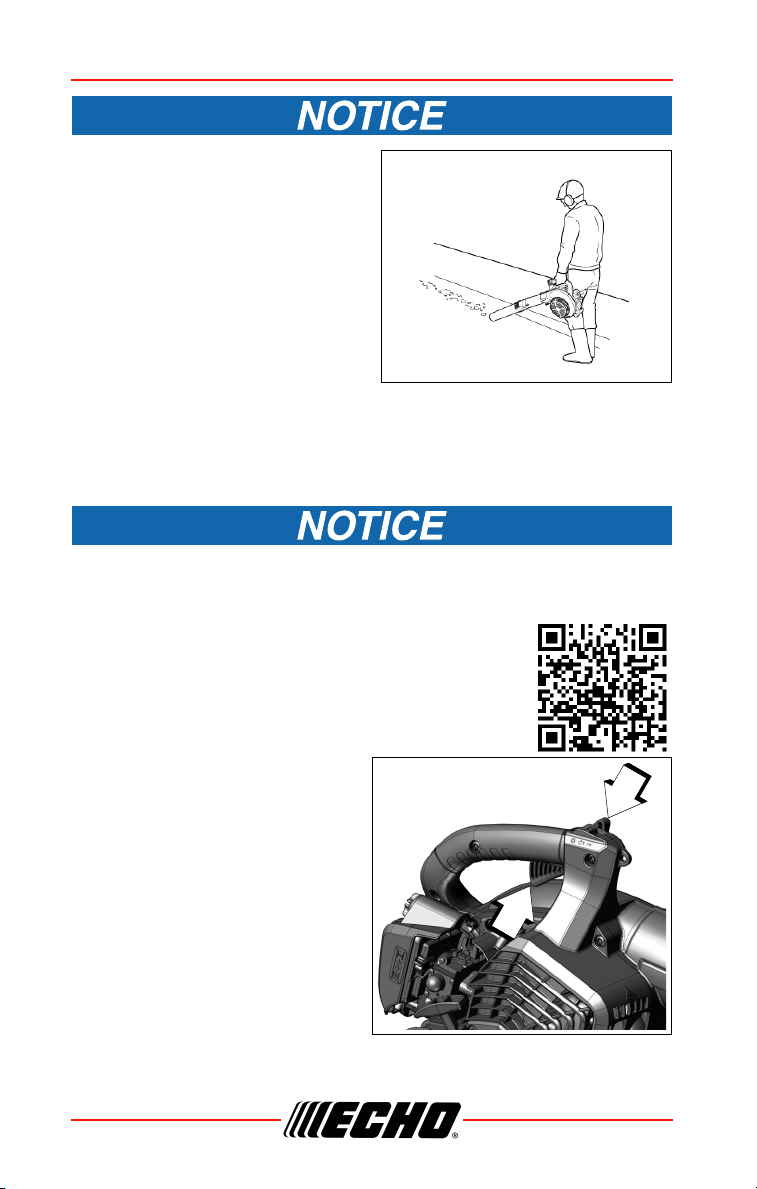
Stopping Engine
1. Throttle Trigger/Throttle
Position Lever
Release throttle trigger (A).
Move throttle position lever (B)
forward to idle position and allow
engine to return to idle before
shutting off engine.
2. Stop Switch
Move stop switch (C) to STOP
position.
If engine does not stop when stop switch is moved to STOP
position, close choke - COLD START position - to stall engine.
Have your dealer repair stop switch before using unit again.
Operating Blower
Always wear safety glasses, hearing protection and a face filter
mask or serious personal injury may result. Do not point the
blower pipe in the direction of people or pets.
A
B
C
OPERATION PB-2620
26 X7501190601
© 11/2018 ECHO Inc.
Use reduced speed only when
performing light-duty tasks or to
comply with local noise
regulations. Continuous low
speed operation may allow fuel/oil
residue to build-up on the piston
and cause rapid build-up of
carbon on the spark arrestor
screen, resulting in overheating
and engine damage. To reduce
harmful build-up, run engine at
wide open throttle for at least 5 minutes every hour, and inspect/clean
the spark arrestor screen after approximately 40 hours of operation.
Read the Safety Section carefully.
To avoid engine damage due to over-revving, do not block blower
pipe.
1. Use only during appropriate hours.
2. Allow the engine to warm up at a fast idle for a few
minutes.
3. Control engine speed with
throttle trigger (A), or for
continuous use, set engine
speed with throttle position
lever (B). Rotate throttle
position lever forward for lower
speed, back for higher speed.
4. Use lower speed to blow debris
from hard surfaces.
5. Additional speed may be
necessary to clean debris,
snow, etc. from lawns and
flowerbeds.
A
B

PB-2620 MAINTENANCE
X7501190601 27
© 11/2018 ECHO Inc.
Note: Never use a higher speed setting than necessary to perform a
task. Remember, the higher the engine speed, the louder the
blower noise. Minimize dust by using blower at lower speeds.
Keep debris on your property. Be Smart - be a good neighbor.
MAINTENANCE
Moving parts can amputate fingers or cause severe injuries.
Keep hands, clothing and loose objects away from all openings.
Always stop engine, disconnect spark plug, and make sure all
moving parts have come to a complete stop before removing
obstructions, clearing debris, or servicing unit. Allow unit to
cool before performing service. Wear gloves to protect hands
from sharp edges and hot surfaces.
Operating a poorly maintained unit can result in serious injuries
to operator or bystanders. Always follow all maintenance
instructions as written, otherwise serious personal injury may
result.
Your unit is designed to provide many hours of trouble free service. Regular
scheduled maintenance will help your unit achieve that goal. If you are
unsure or are not equipped with the necessary tools, we recommend that
you take your unit to a Servicing Dealer for maintenance. To help you decide
whether you want to DO-IT-YOURSELF or have the Dealer do it, each
maintenance task has been graded. If the task is not listed, see your Dealer
for repairs.
Skill Levels
Level 1 = Easy to do. Common tools may be required.
Level 2 = Moderate difficulty. Some specialized tools may be required.
Level 3 = See your dealer.
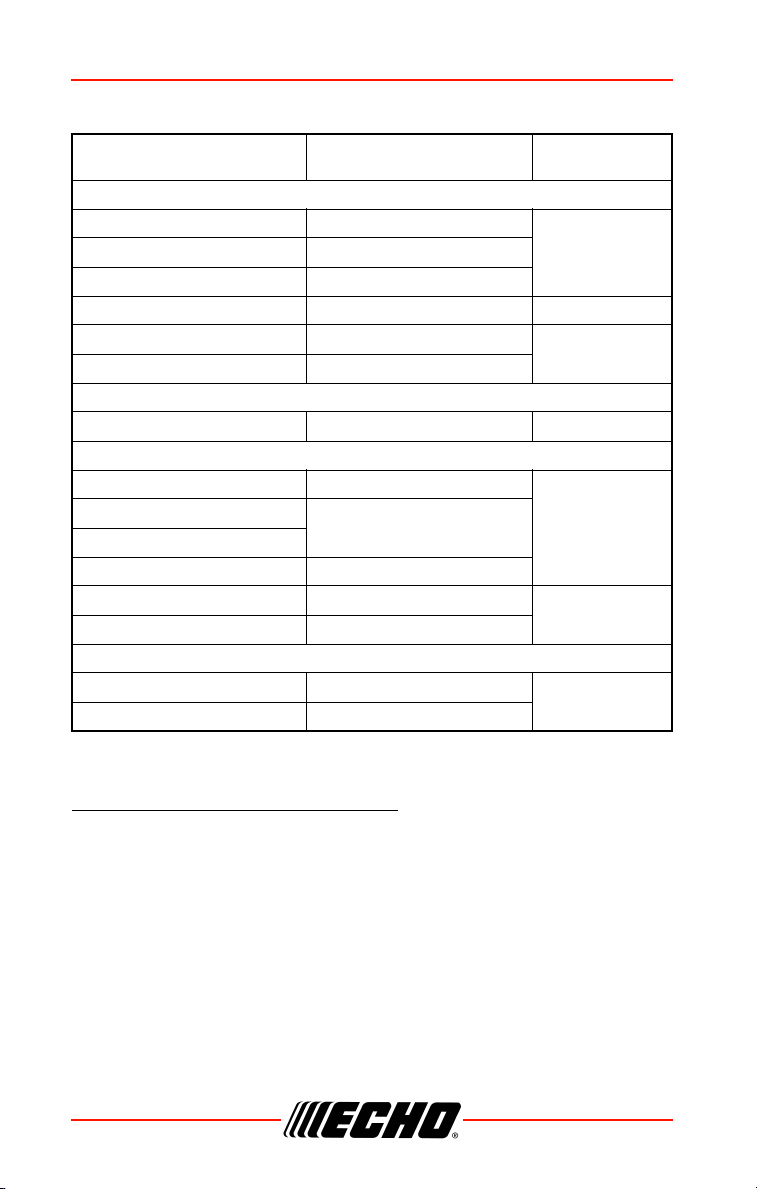
Click HERE or go to http://www.echo-usa.com/products/maintenance-kit
or
HERE https://www.shindaiwa-usa.com/you-can.aspx
For information about maintenance kits.
MAINTENANCE PB-2620
28 X7501190601
© 11/2018 ECHO Inc.
Maintenance Intervals
IMPORTANT NOTE - Time intervals shown are maximum. Actual use and
your experience will determine the frequency of required maintenance.
MAINTENANCE PROCEDURE NOTES:
1. Low evaporative fuel tanks DO NOT require regular maintenance to
maintain emission integrity.
2. See your dealer for maintenance.
3. Replacement is recommended based on the finding of damage or wear
during inspection.
Air Filter
Level 1.
COMPONENT/SYSTEM
MAINTENANCE
PROCEDURE
REQUIRED
SKILL LEVEL
Daily or Before Use
Air Filter
Inspect/Clean
3
1
Choke Shutter
Fuel System
Inspect
1
Cooling System
Clean 2
Recoil Starter Rope
Inspect/Clean
3
1
Screws/Nuts/Bolts
Inspect/Tighten/Replace
3
Every Refuel
Fuel System
Inspect
1
1
3 Months
Air Filter
Replace
3
1
Fuel Filter
Inspect
3
Fuel Cap Gasket
Spark Plug
Inspect/Clean/Replace
3
Muffler Spark Arrestor
Inspect/Clean
2
3
Cylinder Exhaust Port
Inspect/Clean/De-carbon
2
Yearly
Fuel Filter
Inspect/Replace
3
1
Fuel Cap Gasket
Replace
3
Parts Required: Tune-Up Kit
PB-2620 MAINTENANCE
X7501190601 29
© 11/2018 ECHO Inc.
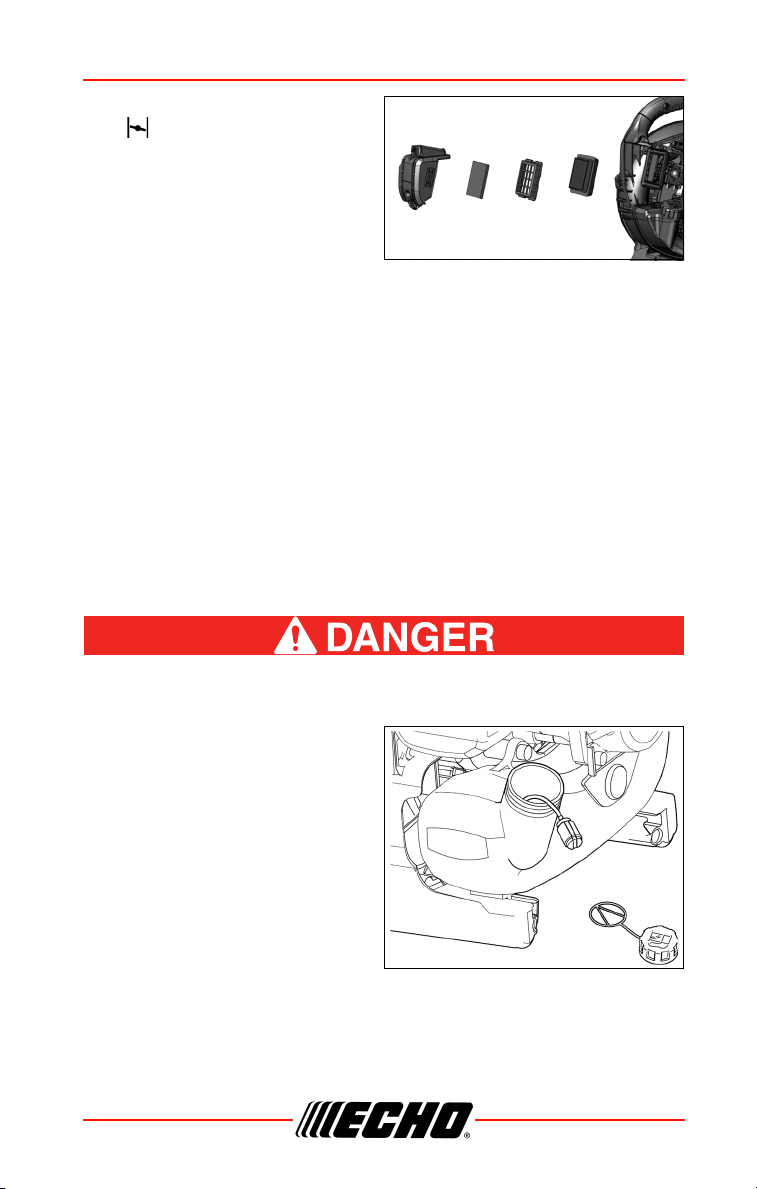
1. Close choke (COLD START
[
] position). This prevents
dirt from entering the carburetor
throat when the air filter is
removed. Brush accumulated
dirt from air cleaner area.
2. Remove air filter cover. Brush
dirt from inside cover.
3. Remove air filter and lightly brush debris from filter. Replace filter if it is
damaged, fuel soaked, very dirty, or the rubber sealing edges are
deformed. Clean the filter with a neutral detergent. Do not use solvents
for cleaning.
4. If filter can be reused, be certain:
• The entire frame of the filter is securely seated in the housing.
• It is installed with the original side out.
5. Install air filter cover.
Fuel Filter
Level 1.
Fuel is VERY flammable. Use extreme care when mixing, storing
or handling, or serious personal injury may result.
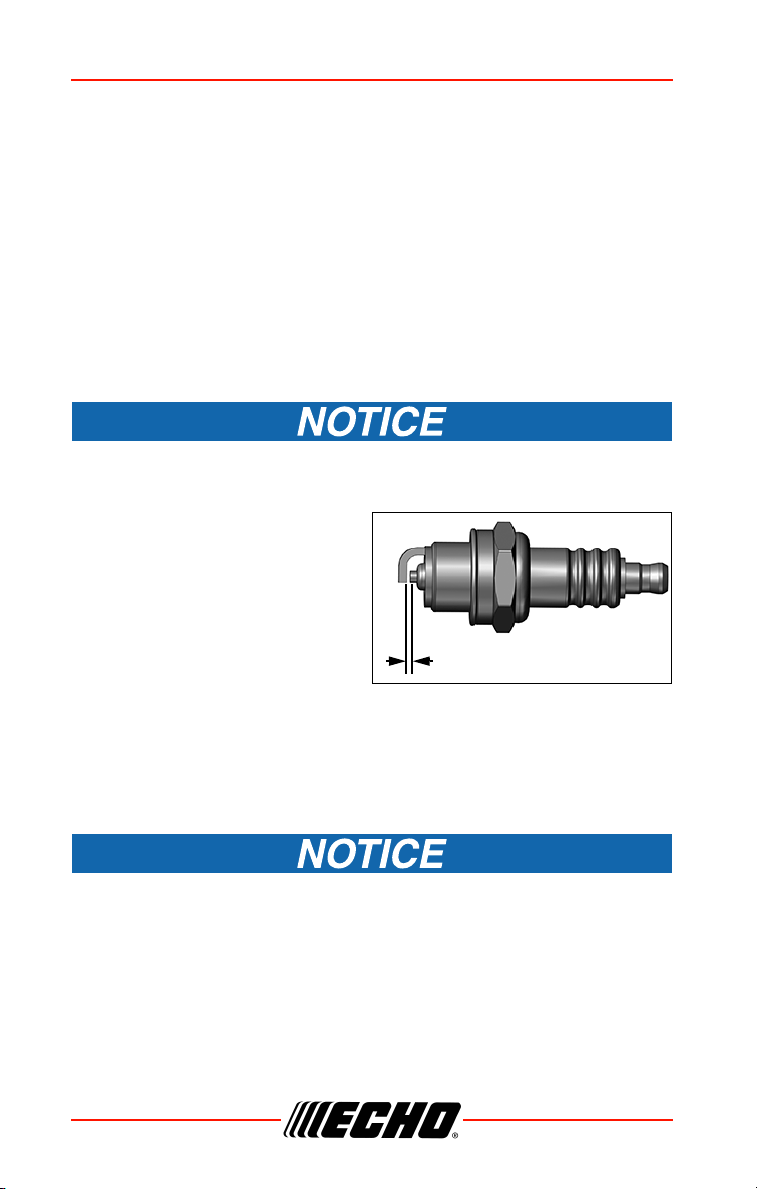
1. Use a clean rag to remove
loose dirt from around fuel cap
and empty fuel tank.
2. Pull the fuel line and filter from
the tank.
3. Remove the filter from the line
and install the new filter.
Parts Required: Tune-Up Kit
MAINTENANCE PB-2620
30 X7501190601
© 11/2018 ECHO Inc.
Note: Federal EPA regulations require all model year 2012 and later
gasoline powered engines produced for sale in the United
States to be equipped with a special low permeation fuel
supply hose between the carburetor and fuel tank. When
servicing model year 2012 and later equipment, only fuel
supply hoses certified by EPA can be used to replace the
original equipment supply hose. Fines up to $37,500 may be
enforced for using an un-certified replacement part.
Spark Plug
Level 2.
Use only NGK BPMR8Y spark plug otherwise severe engine damage
may occur.
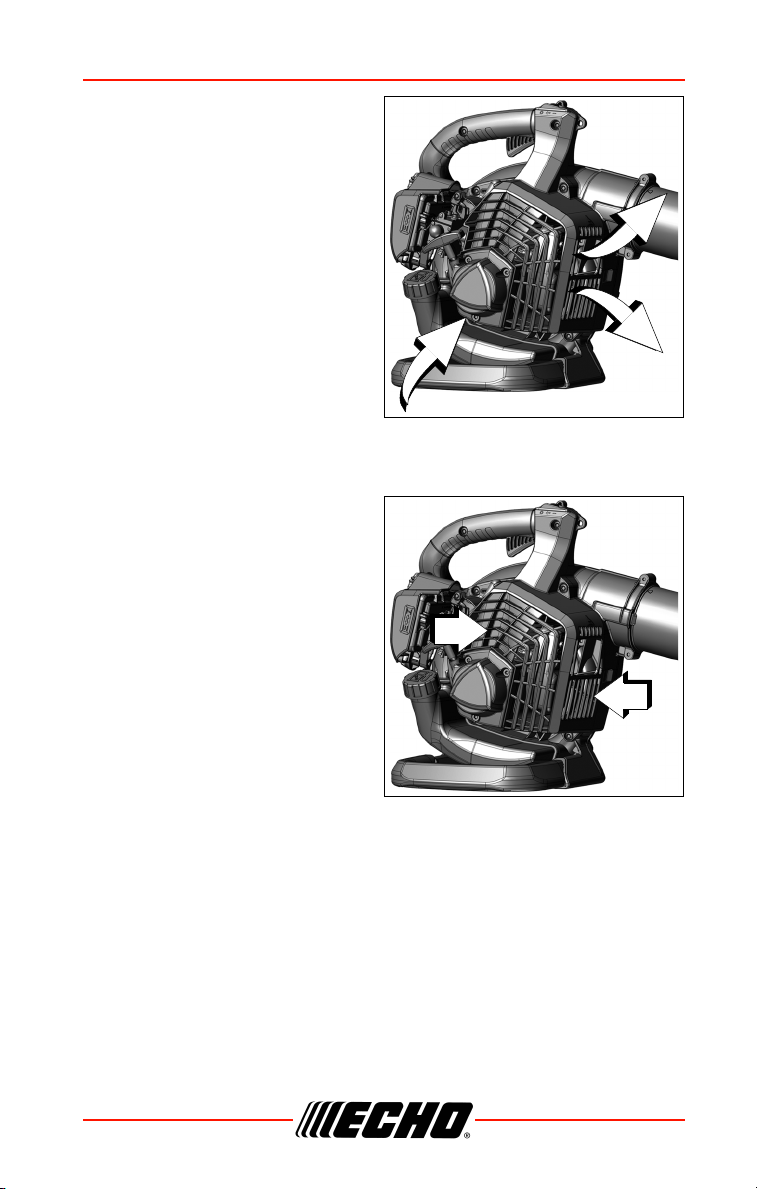
1. Remove spark plug and check
for fouling, worn and rounded
center electrode.
2. Clean the plug or replace with a
new one. DO NOT sand blast to
clean. Remaining sand will
damage engine.
3. Adjust spark plug gap by
bending outer electrode.
4. Tighten spark plug to 150-170 kgf • cm (130-150 in • lbf).
Cooling System
Level 2.
To maintain proper engine operating temperatures, cooling air must
pass freely through the cylinder fin area. This flow of air carries
combustion heat away from the engine.
Parts Required: Tune-Up Kit
0.65 mm (0.026 in.)
PB-2620 MAINTENANCE
X7501190601 31
© 11/2018 ECHO Inc.
Overheating and engine seizure can
occur when:
• Air intakes are blocked,
preventing cooling air from
reaching the cylinder.
• Dust and grass build up on the
outside of the cylinder. This build
up insulates the engine and
prevents the heat from leaving.
Removal of cooling passage
blockages or cleaning of cooling fins
is considered “Normal
Maintenance.” Any failure attributed
to lack of maintenance is not
warranted.
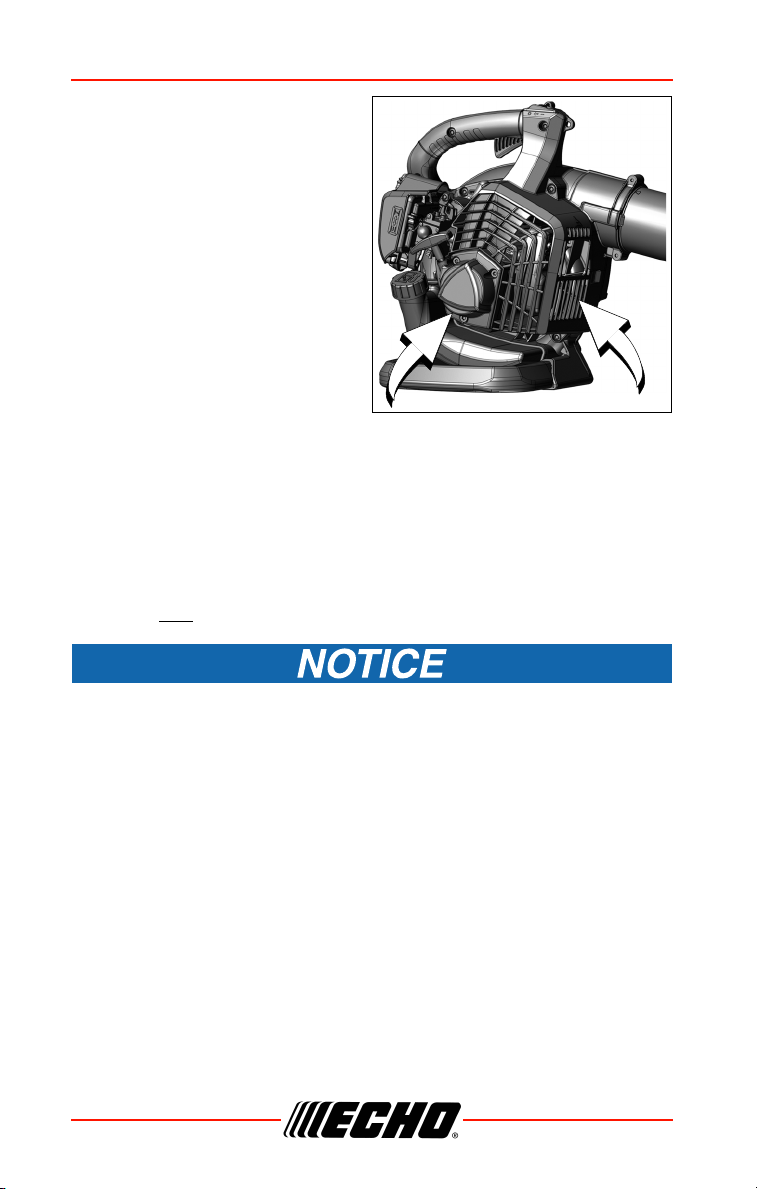
Cleaning Grill
1. Brush accumulated debris from
crankcase intake grill (A) and
discharge grill (B).
A
B
MAINTENANCE PB-2620
32 X7501190601
© 11/2018 ECHO Inc.
Cleaning Cylinder Fins
Blow compressed air through
crankcase intake grill and discharge
grill at area shown.
Exhaust System
See your dealer for maintenance.
Carburetor Adjustment
Engine Break-In
New engines must be operated a
minimum duration of two tanks of
fuel break-in before carburetor
adjustments can be made. During the break-in period your engine
performance will increase and exhaust emissions will stabilize. Idle speed
can be adjusted as required.
High Altitude Operation
This engine has been factory adjusted to maintain satisfactory starting and
durability performance up to 335 m (1100 ft.) above sea level (ASL) (96.0
kPa). To maintain proper engine operation above 335 m (1100 ft.) ASL the
carburetor
may need to be adjusted by an authorized ECHO service dealer.
If the engine is adjusted for operation above 335 m (1100 ft.) ASL, the
carburetor must be re-adjusted when operating the engine below
335
m (1100 ft.) ASL, otherwise severe engine damage may result.
Level 2.
Note: Every unit is run at the factory and the carburetor is set in
compliance with emission regulations. Carburetor
adjustments, other than idle speed, must be performed by an
authorized ECHO dealer.
Before adjustment make sure that:
• Air filter is clean and properly installed.
• Spark arrestor screen is free of carbon.
• Blower pipes are installed.
1. Start engine, run at idle for one minute.
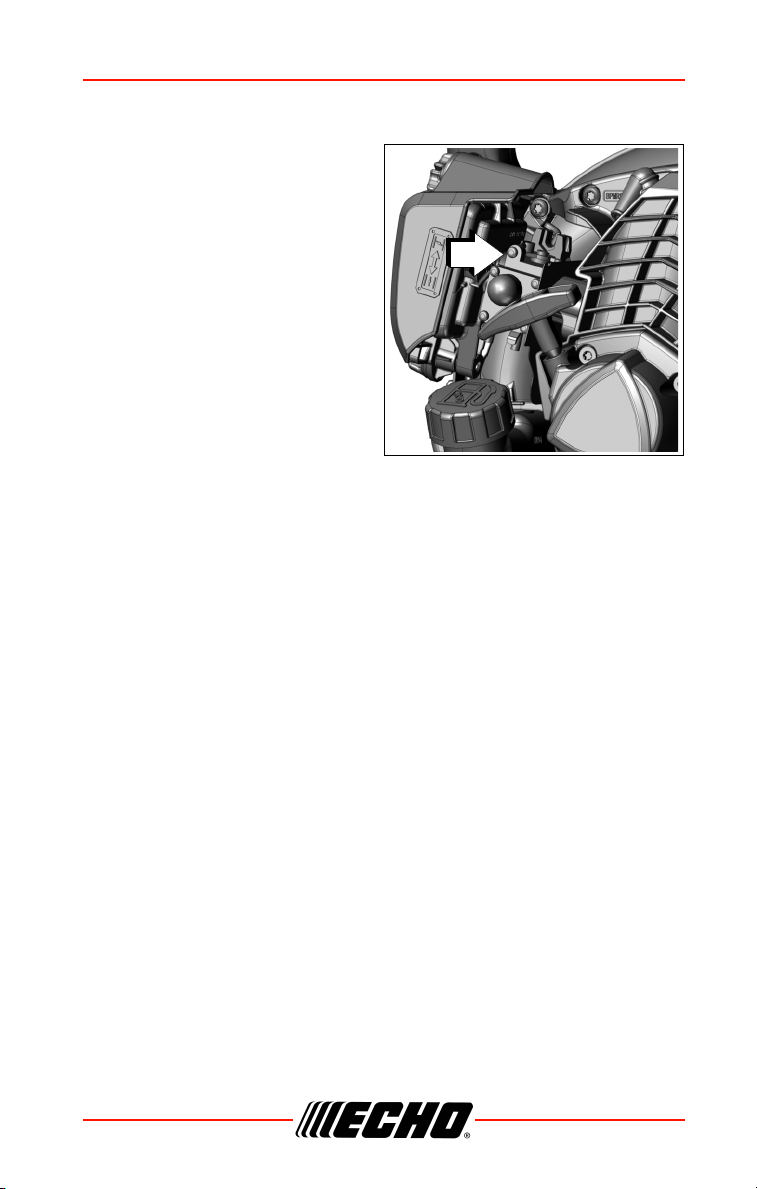
PB-2620 MAINTENANCE
X7501190601 33
© 11/2018 ECHO Inc.
2. Complete warm up by running at full throttle for 5 minutes, operating
choke twice to clear air from carburetor chambers.
3. Check idle speed and reset if
necessary. If a tachometer is
available, idle speed screw (A)
should be set to the
specifications found on
“Specifications” Page of this
manual. Turn idle screw (A)
clockwise to increase idle
speed; counter clockwise to
decrease idle speed.
A
TROUBLESHOOTING PB-2620
34 X7501190601
© 11/2018 ECHO Inc.
TROUBLESHOOTING
Fuel vapors are extremely flammable and may cause fire and/or
explosion. Never test for ignition spark by grounding spark plug
near cylinder plug hole, otherwise serious personal injury may
result.
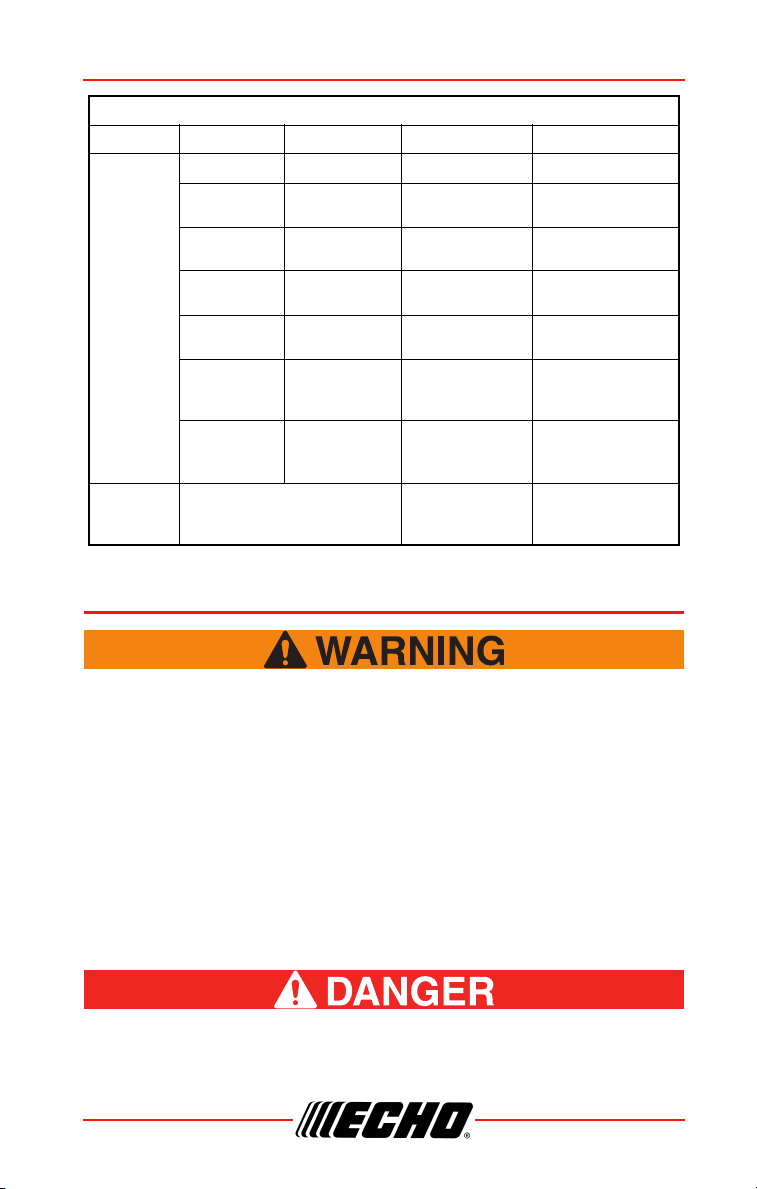
ENGINE PROBLEM TROUBLESHOOTING CHART
Problem Check Status Cause Remedy
Engine
starts
hard
or Engine
does not
start
Fuel at
carburetor
No fuel at
carburetor
Fuel strainer or
fuel line
obstructed
Clean or replace
See your dealer
Engine
starts
hard
or
Engine
does not
start
Fuel at
cylinder
No fuel at
cylinder
Carburetor See your dealer
Muffler wet
with fuel
Fuel mixture
too rich
OPEN choke
Clean or replace
air filter
Adjust carburetor
See your dealer
Spark at
end of plug
wire
No spark
Ignition at
STOP position
Electrical prob-
lem
Interlock switch
Move ignition
away from STOP
position.
See your dealer
Spark at
plug
Incorrect gap -
Covered with
carbon -
Fouled with
fuel - Plug
defective
Adjust to
0.65mm (0.026
in.)
Clean or replace
plug
PB-2620 STORAGE
X7501190601 35
© 11/2018 ECHO Inc.
STORAGE
During operation the muffler or catalytic muffler and
surrounding cover become hot. Always keep exhaust area clear
of flammable debris during transportation or when storing,
otherwise serious property damage or personal injury may
result.
Long Term Storage (Over 30 Days)
Do not store your unit for a prolonged period of time (30 days or longer)
without performing protective storage maintenance which includes the
following:
1. Store unit in a dry, dust free place, out of the reach of children.
Do not store in enclosure where fuel fumes may accumulate or
reach an open flame or spark.
Engine
runs, but
dies
or
Engine
does not
acceler-
ate
properly
Air filter Air filter dirty
Normal wear Clean or replace
Fuel filter
Fuel filter
dirty
Contaminants or
residue in fuel
Replace filter or
replace fuel
Fuel vent
Fuel vent
plugged
Contaminated
fuel
Clean or replace
Spark plug
Plug dirty or
worn
Normal wear
Clean and adjust or
replace
Carburetor
Improper
adjustment
Vibration Adjust
Cooling
system
Cooling
system dirty
or plugged
Extended opera-
tion in dirty or
dusty locations
Clean
Spark
arrestor
screen
Spark arres-
tor screen
plugged
Normal wear Replace
Engine
does not
crank
N/A
Internal engine
problem
See your dealer
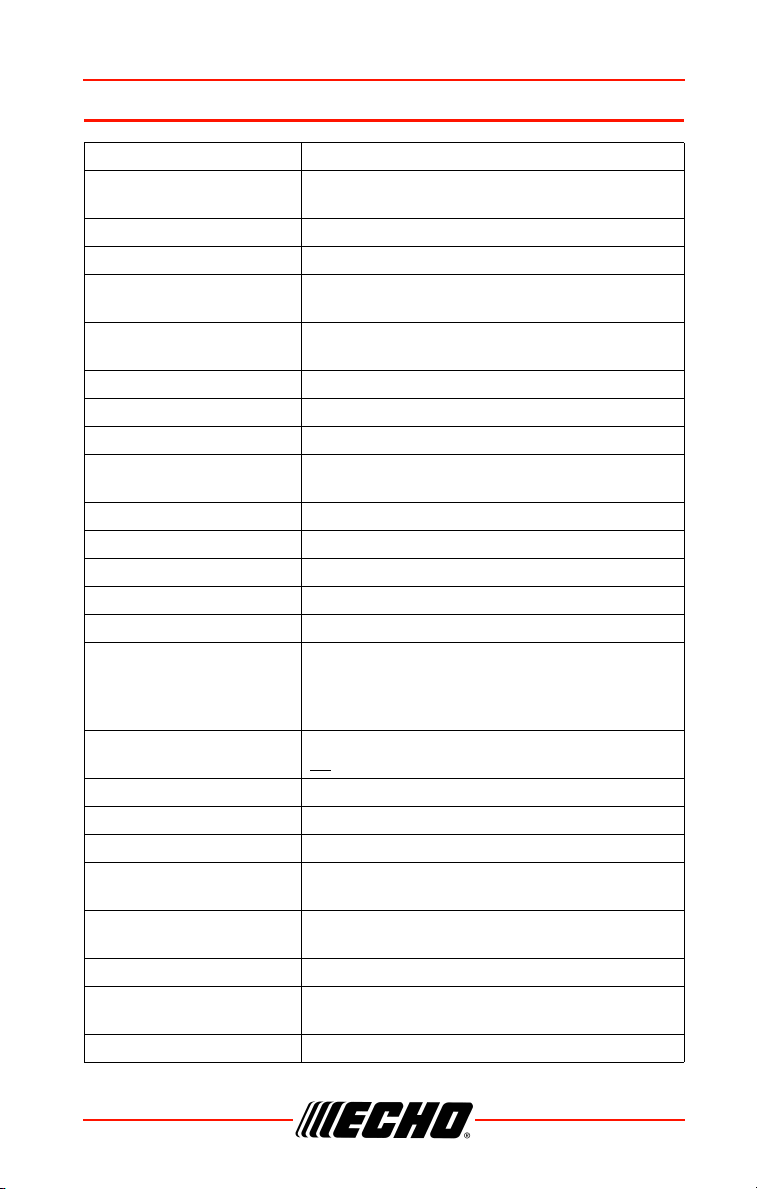
ENGINE PROBLEM TROUBLESHOOTING CHART
Problem Check Status Cause Remedy

STORAGE PB-2620
36 X7501190601
© 11/2018 ECHO Inc.
2. Place the stop switch or lever in the “OFF” position.
3. Remove accumulation of grease, oil, dirt and debris from exterior of
unit.
4. Perform all periodic lubrication and services that are required.
5. Tighten all the screws and nuts.
6. Drain fuel tank completely. Press purge bulb 6 -7 times to remove
remaining fuel from carburetor then drain the tank again. Close choke,
start and run the engine until it stops due to lack of fuel.
7. Allow engine to cool. Remove the spark plug lead from the spark plug.
Remove the spark plug. Pour 7 cc (0.25
oz.) of fresh, clean, two-stroke
engine oil into the cylinder through the spark plug hole.
8. Pull the recoil starter handle 2-3 times to distribute the oil inside the
engine.
9. Observe the piston location through the spark plug hole. Pull the recoil
handle slowly until the piston reaches the top of its travel and leave it
there.
10. Install the spark plug. Connect the spark plug lead to the spark plug.
11. Remove blower pipe assembly from unit.
PB-2620 SPECIFICATIONS
X7501190601 37
© 11/2018 ECHO Inc.
SPECIFICATIONS
MODEL PB-2620
Length
324 mm (12.8 in.) (without blower pipes)
975mm (38.3 in.) (with blower pipes)
Width 282 mm (11.1 in.)
Height 355 mm (14.0 in.)
Weight (dry)
4 kg (8.8 lb.) (without blower pipes)
4.4 kg (9.8 lb.) (with blower pipes)
Engine Type
Air cooled, two-stroke, single cylinder gasoline
engine
Bore 34.0 mm (1.34 in.)
Stroke 28.0 mm (1.1 in.)
Displacement 25.4 cm3 (1.55 in.3)
Exhaust
Spark arrestor muffler or spark arrestor muffler with
catalyst
Carburetor Diaphragm with purge pump
Ignition System Flywheel magneto, capacitor discharge ignition type
Spark Plug NGK BPMR8Y - Gap 0.65 mm (0.026 in.)
Fuel Mixed (Gasoline and Two-stroke Oil)
Gasoline / Oil Ratio 50:1
Gasoline
Use 89 Octane unleaded. Do not use fuel containing
methyl alcohol, more than 10% ethyl alcohol or 15%
MTBE. Do not use alternative fuels such as E-15 or
E-85.
Oil
ISO-L-EGD (ISO/CD 13738) and J.A.S.O. M345-
FD, two-stroke, air-cooled engine oil.
Fuel Tank Capacity 0.6L(20.3 US fl. oz.)
Starter System Automatic Recoil Starter, centrifugal type
Idle Speed 3000 RPM
Wide Open Throttle Speed
(W.O.T.)
7500 RPM
Maximum Air Speed with
round pipe (MPH)
76.7 m/sec (172 mph)
Air Volume with round pipe 12.9 m
3
/min. (456 ft.
3
/min.)
Maximum Air Speed with flat
pipe (MPH)
80.5 m/sec (180 mph)
Air Volume with flat pipe 12.1 m
3
/min. (428 ft.
3
/min.)

PRODUCT REGISTRATION PB-2620
38 X7501190601
© 11/2018 ECHO Inc.
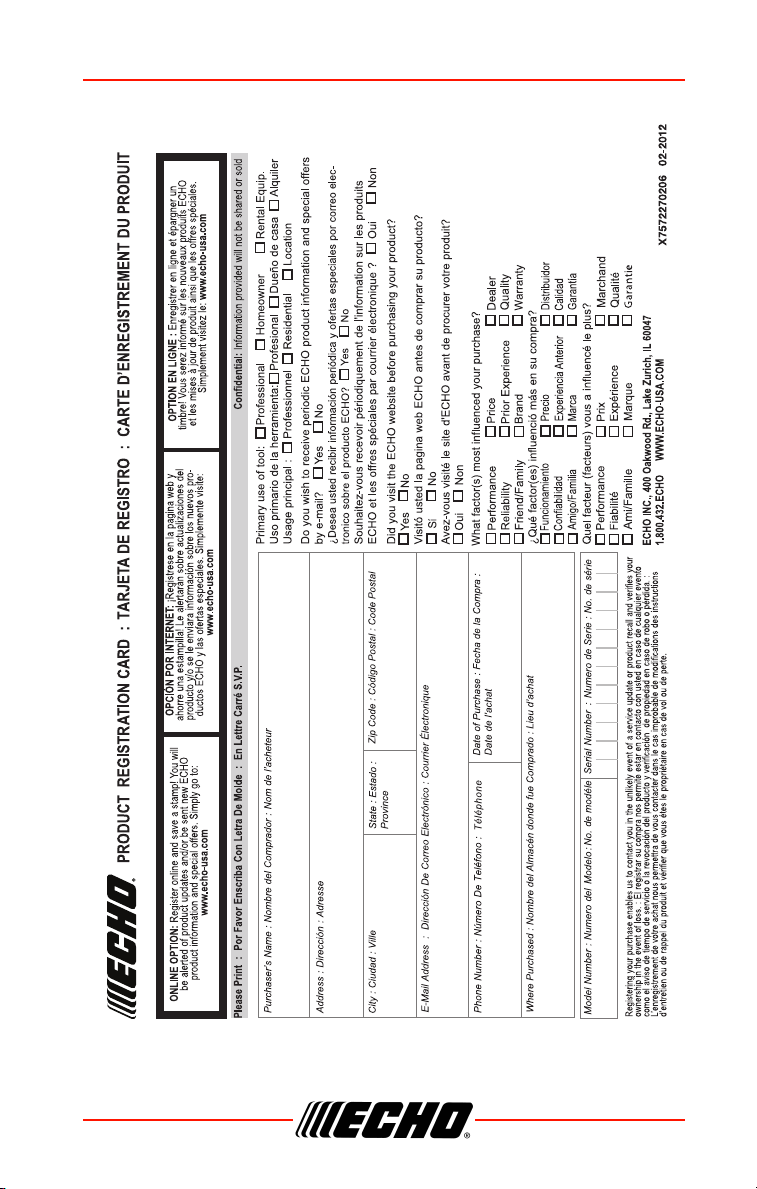
PRODUCT REGISTRATION
Thank you for choosing ECHO Power Equipment
Please go to http://www.echo-usa.com/Warranty/Register-Your-ECHO to
register your new product on-line. It's FAST and EASY! NOTE: your
information will never be sold or misused by ECHO, Inc. Registering your
purchase enables us to contact you in the unlikely event of a service update
or product recall, and verifies your ownership for warranty consideration.
If you do not have access to the Internet, you can complete the form below
and mail to:
ECHO Inc., Product Registration, PO Box 1139, Lake Zurich IL 60047.
Sound Level at 15m (50 ft.)
dB(A) scale per ANSI OPEI
B175.2
70 dB(A)
MODEL PB-2620
PB-2620 PRODUCT REGISTRATION
X7501190601 39
© 11/2018 ECHO Inc.