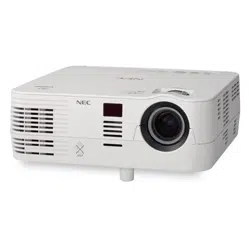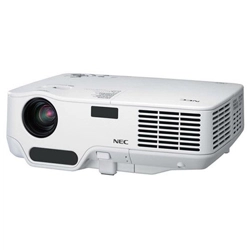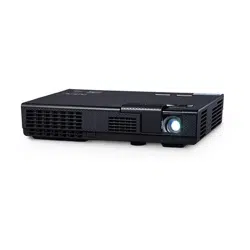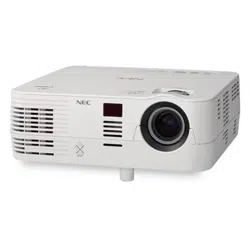

Portable Projector
VE280X/VE281X/VE282X/
VE280/VE281/VE282
User’s Manual
The VE280X, VE282X, VE280 and VE282 are not distributed in North America.
Model No.:
NP-VE280X, NP-VE281X, NP-VE282X
NP-VE280, NP-VE281, NP-VE282

Ver.7 05/15
• DLPisatrademarkofTexasInstruments.
• IBMisatrademarkorregisteredtrademarkofInternationalBusinessMachinesCorporation.
• Macintosh,MacOSXandPowerBookaretrademarksofAppleInc.,registeredintheU.S.andothercountries.
• Microsoft,Windows,WindowsVista,InternetExplorer,.NETFrameworkandPowerPointareeitheraregistered
trademarkortrademarkofMicrosoftCorporationintheUnitedStatesand/orothercountries.
• MicroSaverisaregisteredtrademarkofKensingtonComputerProductsGroup,adivisionofACCOBrands.
• VirtualRemoteToolusesWinI2C/DDClibrary,©NicomsoftLtd.
• HDMI,theHDMILogoandHigh-DenitionMultimediaInterfacearetrademarksorregisteredtrademarksofHDMI
LicensingLLC.
• Blu-rayisatrademarkofBlu-rayDiscAssociation.
• Otherproductandcompanynamesmentionedinthisuser’smanualmaybethetrademarksorregisteredtrademarks
oftheirrespectiveholders.
NOTES
(1) Thecontentsofthisuser’smanualmaynotbereprintedinpartorwholewithoutpermission.
(2)Thecontentsofthisuser’smanualaresubjecttochangewithoutnotice.
(3)Greatcarehasbeentakeninthepreparationofthisuser’smanual;however,shouldyounoticeanyquestionable
points,errorsoromissions,pleasecontactus.
(4) Notwithstandingarticle(3),NECwillnotberesponsibleforanyclaimsonlossofprotorothermattersdeemed
toresultfromusingtheProjector.
i
Important Information
Safety Cautions
Precautions
Please read this manual carefully before using your NEC projector and keep the manual handy for future reference.
CAUTION
To turn off main power, be sure to remove the plug from power outlet.
The power outlet socket should be installed as near to the equipment as possible, and should be easily
accessible.
CAUTION
TO PREVENT SHOCK, DO NOT OPEN THE CABINET.
THERE ARE HIGH-VOLTAGE COMPONENTS INSIDE.
REFER SERVICING TO QUALIFIED SERVICE PERSONNEL.
This symbol warns the user that uninsulated voltage within the unit may be sufcient to cause electrical
shock. Therefore, it is dangerous to make any kind of contact with any part inside of the unit.
This symbol alerts the user that important information concerning the operation and maintenance of this
unit has been provided.
The information should be read carefully to avoid problems.
WARNING: TO PREVENT FIRE OR SHOCK, DO NOT EXPOSE THIS UNIT TO RAIN OR MOISTURE.
DO NOT USE THIS UNIT’S PLUG WITH AN EXTENSION CORD OR IN AN OUTLET UNLESS ALL THE PRONGS
CAN BE FULLY INSERTED.
DOC Compliance Notice (for Canada only)
This Class B digital apparatus meets all requirements of the Canadian Interference-Causing Equipment Regulations.
WARNING TO CALIFORNIA RESIDENTS:
Handling the cables supplied with this product will expose you to lead, a chemical known to the State of California
to cause birth defects or other reproductive harm. Wash hands after handling.
EU-wide legislation as implemented in each Member State requires that used electrical and electronic
products carrying the mark (left) must be disposed of separately from normal household waste. This
includes projectors and their electrical accessories or lamps. When you dispose of such products, please
follow the guidance of your local authority and/or ask the shop where you purchased the product.
After collecting the used products, they are reused and recycled in a proper way. This effort will help us
reduce the wastes as well as the negative impact such as mercury contained in a lamp to the human
health and the environment at the minimum level.
The mark on the electrical and electronic products only applies to the current European Union Member
States.
Disposing of your used product
ii
Important Information
RF Interference (for USA only)
WARNING
The Federal Communications Commission does not allow any modications or changes to the unit EXCEPT
those specied by NEC Display Solutions of America, Inc. in this manual. Failure to comply with this government
regulation could void your right to operate this equipment. This equipment has been tested and found to comply
with the limits for a Class B digital device, pursuant to Part 15 of the FCC Rules. These limits are designed to
provide reasonable protection against harmful interference in a residential installation. This equipment generates,
uses, and can radiate radio frequency energy and, if not installed and used in accordance with the instructions,
may cause harmful interference to radio communications. However, there is no guarantee that interference will
not occur in a particular installation.
If this equipment does cause harmful interference to radio or television reception, which can be determined by
turning the equipment off and on, the user is encouraged to try to correct the interference by one or more of the
following measures:
• Reorient or relocate the receiving antenna.
• Increase the separation between the equipment and receiver.
• Connect the equipment into an outlet on a circuit different from that to which the receiver is connected.
• Consult the dealer or an experienced radio / TV technician for help.
Important Safeguards
These safety instructions are to ensure the long life of your projector and to prevent re and shock. Please read them
carefully and heed all warnings.
Installation
• Do not place the projector in the following conditions:
- on an unstable cart, stand, or table.
- near water, baths, or damp rooms.
- in direct sunlight, near heaters, or heat radiating appliances.
- in a dusty, smoky or steamy environment.
- on a sheet of paper or cloth, rugs or carpets.
• If you wish to have the projector installed on the ceiling:
- Do not attempt to install the projector yourself.
- The projector must be installed by qualied technicians in order to ensure proper operation and reduce the risk
of bodily injury.
- In addition, the ceiling must be strong enough to support the projector and the installation must be in accordance
with any local building codes.
- Please consult your dealer for more information.
WARNING
• Do not cover the lens with any object while the projector is on. Doing so can lead to melting of the object due
to the heat emitted from the light output.
• Do not place any objects, which are easily affected by heat, in front of the projector lens. Doing so could lead
to the object melting from the heat that is emitted from the light output.
iii
Important Information
Fire and Shock Precautions
• Ensure that there is sufcient ventilation and that vents are unobstructed to prevent the build-up of heat inside
your projector. Allow at least 4 inches (10cm) of space between your projector and a wall.
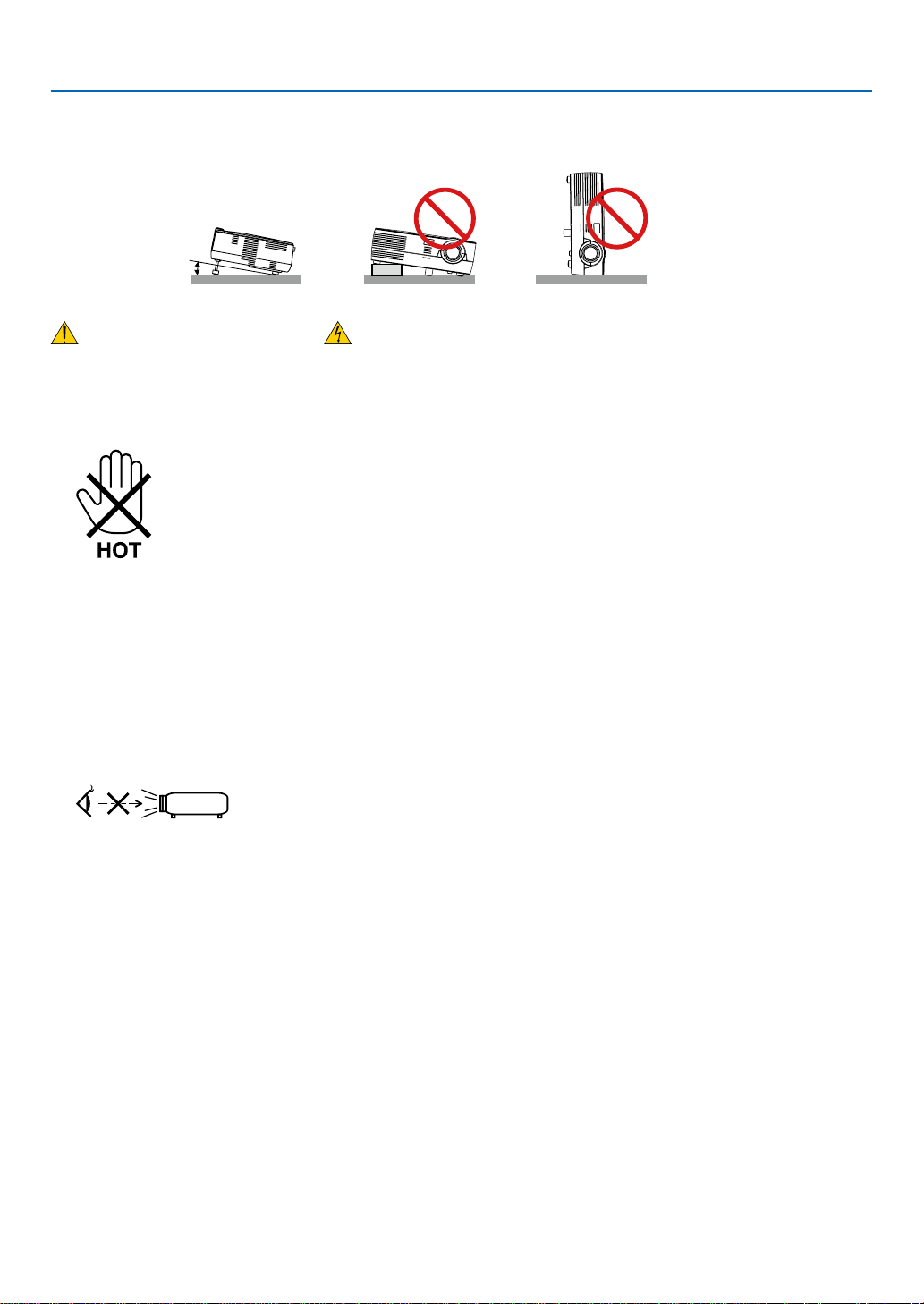
• Do not try to touch the exhaust vent on the front side as it can become heated while the projector is turned on and
immediately after the projector is turned off.
• Prevent foreign objects such as paper clips and bits of paper from falling into your projector. Do not attempt to
retrieve any objects that might fall into your projector. Do not insert any metal objects such as a wire or screwdriver
into your projector. If something should fall into your projector, disconnect it immediately and have the object
removed by a qualied service personnel.
• Do not place any objects on top of the projector.
• Do not touch the power plug during a thunderstorm. Doing so can cause electrical shock or re.
• The projector is designed to operate on a power supply of 100-240V AC 50/60 Hz. Ensure that your power supply
ts this requirement before attempting to use your projector.
• Do not look into the lens while the projector is on. Serious damage to your eyes could result.
• Keep any items such as magnifying glass out of the light path of the projector. The light being projected from the
lens is extensive, therefore any kind of abnormal objects that can redirect light coming out of the lens, can cause
unpredictable outcome such as re or injury to the eyes.
• Do not place any objects, which are easily affected by heat, in front of a projector exhaust vent.
Doing so could lead to the object melting or getting your hands burned from the heat that is emitted from the
exhaust.
• Handle the power cord carefully. A damaged or frayed power cord can cause electric shock or re.
- Do not use any power cords than the supplied one.
- Do not bend or tug the power cord excessively.
- Do not place the power cord under the projector, or any heavy object.
- Do not cover the power cord with other soft materials such as rugs.
- Do not heat the power cord.
- Do not handle the power plug with wet hands.
• Turn off the projector, unplug the power cord and have the projector serviced by a qualied service personnel
under the following conditions:
- When the power cord or plug is damaged or frayed.
- If liquid has been spilled into the projector, or if it has been exposed to rain or water.
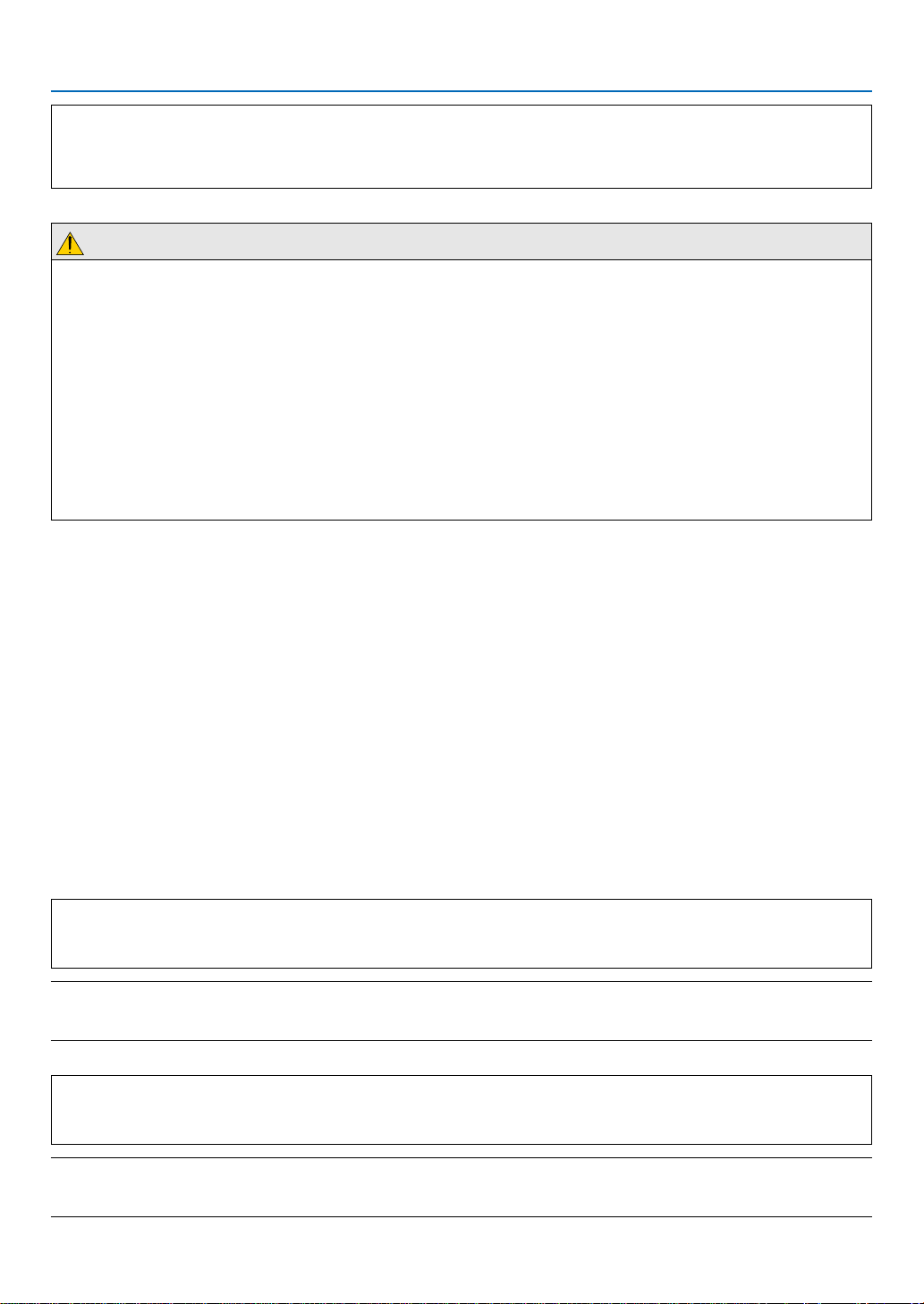
5˚
Place the projector in a horizontal position
The tilt angle of the projector should not exceed 5 degrees, nor should the projector be installed in any way other than
the desktop and ceiling mount, otherwise lamp life could decrease dramatically.

iv
Important Information
- If the projector does not operate normally when you follow the instructions described in this user's manual.
- If the projector has been dropped or the cabinet has been damaged.
- If the projector exhibits a distinct change in performance, indicating a need for service.
• Disconnect the power cord and any other cables before carrying the projector.
• Turn off the projector and unplug the power cord before cleaning the cabinet.
• Turn off the projector and unplug the power cord if the projector is not to be used for an extended period of time.
CAUTION
• Do not use the tilt-foot for purposes other than originally intended. Misuses such as using the tilt foot to carry or
hang (from the wall or ceiling) the projector can cause damage to the projector.
• Do not send the projector in the soft case by parcel delivery service or cargo shipment. The projector inside the
soft case could be damaged.
• Select [HIGH] in Fan mode if you continue to use the projector for consecutive days. (From the menu, select
[SETUP] → [OPTIONS(1)] → [FAN MODE] → [HIGH].)
• Do not turn off the AC power for 60 seconds after the lamp is turned on and while the POWER indicator is blinking
green.
Doing so could cause premature lamp failure.
• Parts of the projector may become temporarily heated if the projector is turned off with the POWER button or if
the AC power supply is disconnected during normal projector operation.
Use caution when picking up the projector.
Remote Control Precautions
• Handle the remote control carefully.
• If the remote control gets wet, wipe it dry immediately.
• Avoid excessive heat and humidity.
• Do not heat, take apart, or throw batteries into re.
• If you will not be using the remote control for a long time, remove the batteries.
• Ensure that you have the batteries' polarity (+/–) aligned correctly.
• Do not use new and old batteries together, or use different types of batteries together.
• Dispose of used batteries according to your local regulations.
Lamp Replacement
• To replace the lamp, please contact your service dealer. The lamp is not user replaceable parts, and there
is not an optional lamp.
• Be sure to replace the lamp when the message [THE LAMP HAS REACHED THE END OF ITS USABLE LIFE,
PLEASE CONTACT YOUR SERVICE DEALER.] appears. If you continue to use the lamp after the lamp
has reached the end of its usable life, the lamp bulb may shatter, and pieces of glass may be scattered in
the lamp case. Do not touch them as the pieces of glass may cause injury. If this happens, contact your
dealer for lamp replacement.
A Lamp Characteristic
The projector has a discharge lamp for special purposes as a light source.
A lamp has a characteristic that its brightness gradually decreases with age. Also repeatedly turning the lamp on
and off will increase the possibility of its lower brightness.
v
Important Information
Note for US Residents
The lamp in this product contains mercury. Please dispose according to Local, State or Federal
Laws.
Health precautions to users viewing 3D images
Before viewing, be sure to read health care precautions that may be found in the user’s manual included with your LCD
shutter eyeglasses or your 3D compatible content such as DVDs, video games, computer's video les and the like.
To avoid any adverse symptoms, heed the following:
- Do not use LCD shutter eyeglasses for viewing any material other than 3D images.
- Allow a distance of 2 m/7 feet or greater between the screen and a user. Viewing 3D images from too close a
distance can strain your eyes.
- Avoid viewing 3D images for a prolonged period of time. Take a break of 15 minutes or longer after every hour
of viewing.
- If you or any member of your family has a history of light-sensitive seizures, consult a doctor before viewing 3D
images.
- While viewing 3D images, if you get sick such as nausea, dizziness, queasiness, headache, eyestrain, blurry
vision, convulsions, and numbness, stop viewing them. If symptoms still persist, consult a doctor.
- View 3D images from the front of the screen. Viewing from an angle may cause fatigue or eyestrain.
About High Altitude mode
• If you use the projector at altitudes approximately 1200 meters/4000 feet or higher, you are recommended to set
[FAN MODE] to [HIGH ALTITUDE]. Failure to do so may cause the projector to overheat , resulting in malfunction.
(→ page 57)
• Using the projector at high altitudes or in low air pressure can shorten the life of components.
About Copyright of original projected pictures:
Please note that using this projector for the purpose of commercial gain or the attraction of public attention in a venue
such as a coffee shop or hotel and employing compression or expansion of the screen image with the following
functions may raise concern about the infringement of copyrights which are protected by copyright law.
[ASPECT RATIO], [KEYSTONE], Magnifying feature and other similar features.
Power management function
The projector has power management functions. To reduce power consumption, the power management functions (1
and 2) are factory preset as shown below. To control the projector from an external device, use the on-screen menu
to change the settings for 1 and 2.
1. STANDBY MODE (Factory preset: NORMAL)
To control the projector from an external device, select [NETWORK STANDBY] for [STANDBY MODE].
NOTE:
• When[NORMAL]isselectedfor[STANDBYMODE],thefollowingconnectorsandfunctionswillnotwork:
USBport(TypeB),DDC/CI(VirtualRemoteTool).
2. AUTO POWER OFF (Factory preset: 30 minutes)
To control the projector from an external device, select [OFF] for [AUTO POWER OFF].
NOTE:
• When[0:30]isselectedfor[AUTOPOWEROFF],youcanenabletheprojectortoautomaticallyturnoffin30minutesifthereis
nosignalreceivedbyanyinputorifnooperationisperformed.

vi
Table of Contents
Important Information ............................................................................................ i
1. Introduction ...........................................................................................................1
What’s in the Box? ..........................................................................................................1
Introduction to the Projector ...........................................................................................2
Congratulations on Your Purchase of the Projector .................................................2
Features you'll enjoy: ................................................................................................2
About this user's manual ...........................................................................................3
Part Names of the Projector ...........................................................................................4
Front/Top ..................................................................................................................4
Rear ..........................................................................................................................4
Top Features ............................................................................................................5
Terminal Panel Features ..........................................................................................6
Part Names of the Remote Control ................................................................................7
Battery Installation ....................................................................................................8
Remote Control Precautions .....................................................................................8
Operating Range for Wireless Remote Control ........................................................8
2. Installation and Connections ......................................................................9
Setting Up the Screen and the Projector ........................................................................9
Selecting a Location ................................................................................................9
Throw Distance and Screen Size ...........................................................................10
Making Connections .....................................................................................................12
Connecting Your PC or Macintosh Computer .........................................................12
Connecting Your DVD Player with Component Output ..........................................13
Connecting Your VCR ............................................................................................14
Connecting HDMI Input (VE281X/VE281/VE282X/VE282 only) ............................15
Connecting the Supplied Power Cord .....................................................................16
3. Projecting an Image (Basic Operation) ...............................................17
Turning on the Projector ...............................................................................................17
Note on Startup screen (Menu Language Select screen) .......................................18
Selecting a Source .......................................................................................................19
Selecting the computer or video source .................................................................19
Adjusting the Picture Size and Position ........................................................................20
Adjust the Tilt Foot ..................................................................................................21
Zoom .......................................................................................................................22
Focus ......................................................................................................................22
Correcting Keystone Distortion .....................................................................................23
Correcting Keystone Distortion ...............................................................................23
Adjusting with the remote control ............................................................................24
Optimizing Computer Signal Automatically ..................................................................25
Adjusting the Image Using Auto Adjust ..................................................................25
Turning Up or Down Volume ........................................................................................25
Turning off the Projector ...............................................................................................26
After Use .......................................................................................................................27

vii
Table of Contents
4. Convenient Features ......................................................................................28
Turning off the Image and Sound .................................................................................28
Freezing a Picture ........................................................................................................28
Enlarging a Picture .......................................................................................................28
Changing Eco Mode .....................................................................................................29
Checking Energy-Saving Effect [CARBON METER] ....................................................30
Using the Optional Remote Mouse Receiver (NP01MR) .............................................31
Using the Computer Cable (VGA) to Operate the Projector (Virtual Remote Tool) ......33
Viewing 3D Images .......................................................................................................39
5. Using On-Screen Menu .................................................................................43
Using the Menus ...........................................................................................................43
Menu Elements .............................................................................................................44
List of Menu Items ........................................................................................................45
Menu Descriptions & Functions [SOURCE] .................................................................46
Menu Descriptions & Functions [ADJUST] ...................................................................47
Menu Descriptions & Functions [SETUP] .....................................................................53
Menu Descriptions & Functions [INFO.] .......................................................................62
Menu Descriptions & Functions [RESET] .....................................................................64
6. Maintenance .......................................................................................................65
Cleaning the Cabinet and the Lens ..............................................................................65
Replacing the Lamp ......................................................................................................66
7. Appendix................................................................................................................67
Troubleshooting ............................................................................................................67
Indicator Messages .................................................................................................67
Specications ...............................................................................................................70
Cabinet Dimensions .....................................................................................................72
Pin Assignments of D-Sub COMPUTER Input Connector ...........................................73
Mini D-Sub 15 Pin Connector .................................................................................73
Compatible Input Signal List .........................................................................................74
PC Control Codes and Cable Connection ....................................................................75
PC Control Codes ...................................................................................................75
Cable Connection ...................................................................................................75
PC Control Connector (D-SUB 9P) .........................................................................75
Troubleshooting Check List ..........................................................................................76
REGISTER YOUR PROJECTOR! (for residents in the United States, Canada,
and Mexico) ............................................................................................................78
1
1. Introduction
What’s in the Box?
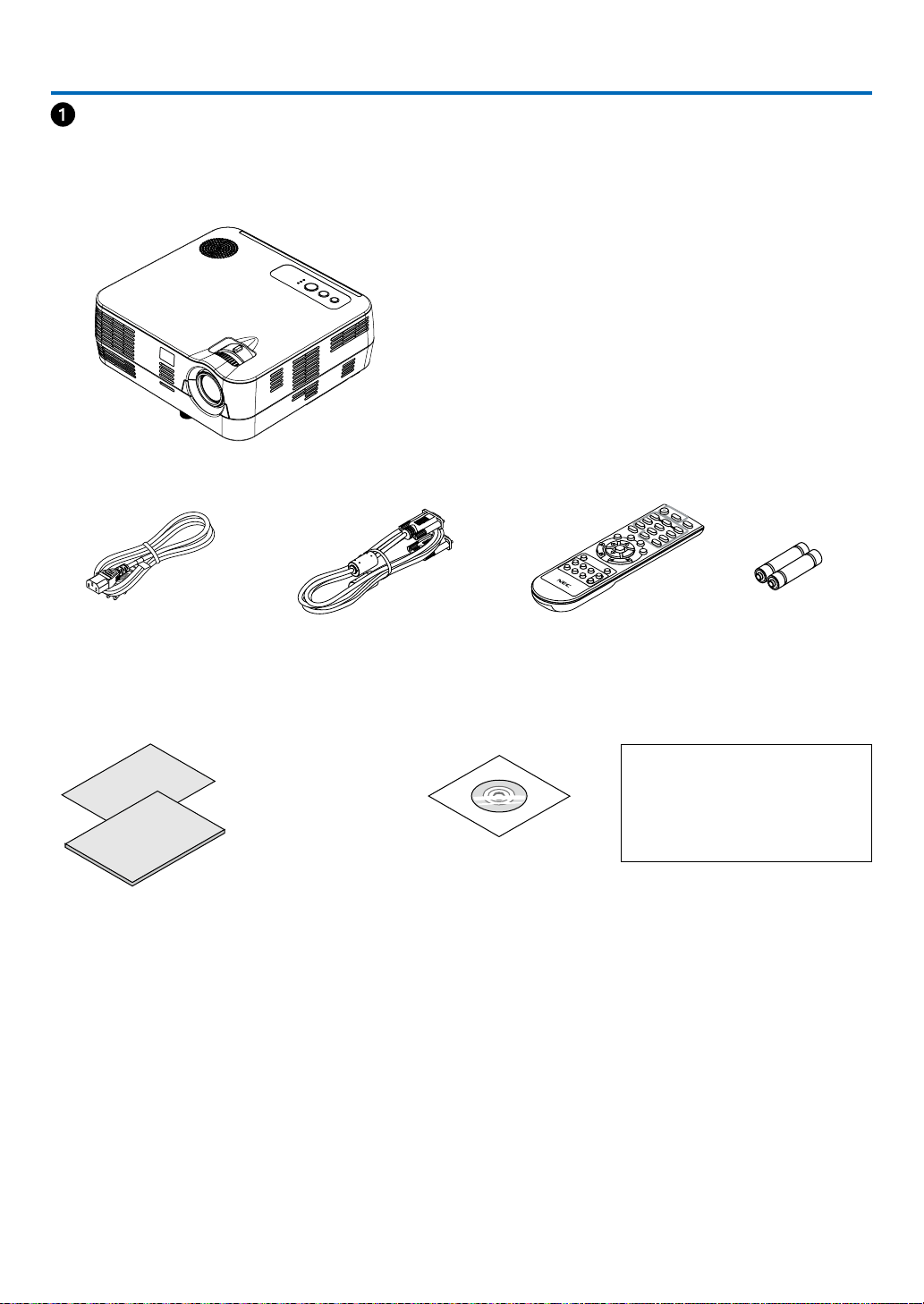
Make sure your box contains everything listed. If any pieces are missing, contact your dealer.
Please save the original box and packing materials if you ever need to ship your projector.
Projector
Power cord
(US: 7N080236)
(Asia: 7N080022)
(Brazil: 7N080520)
Computer cable (VGA)
(7N520087/7N520073)
NEC Projector CD-ROM
User’s manual
(7N951847)
For North America only
Limited warranty
For customers in Europe:
You will nd our current valid Guarantee
Policy on our Web Site:
www. nec-display-solutions.com
Quick Setup Guide (7N8N3105)
Important Information (7N8N3095)
For other countries than North and
South America
Quick Setup Guide(7N8N3105) and
(7N8N4461)
Remote control
(7N900926)
Batteries (AAAx2)

2
1. Introduction
Introduction to the Projector
This section introduces you to your new projector and describes the features and controls.
Congratulations on Your Purchase of the Projector
This DLP
®
projector is one of the very best projectors available today. The projector enables you to project precise
images up to 300 inches (measured diagonally) from your PC or Macintosh computer (desktop or notebook), VCR,
DVD player or document camera.
You can use the projector on a tabletop or cart, you can use the projector to project images from behind the screen,
and the projector can be permanently mounted on a ceiling*1. The remote control can be used wirelessly.
*1 Do not attempt to mount the projector on a ceiling yourself.
The projector must be installed by qualied technicians in order to ensure proper operation and reduce the risk of bodily injury.
In addition, the ceiling must be strong enough to support the projector and the installation must be in accordance with any
local building codes. Please consult your dealer for more information.
Features you'll enjoy:
• Quick start & Quick Power Off
7 seconds after turning on the power, the projector is ready to display PC or video images.
The projector can be put away immediately after the projector is powered down. No cool down period is required
after the projector is turned off from the remote control or cabinet control panel.
• Direct Power Off
The projector has a feature called “Direct Power Off”. This feature allows the projector to be turned off (even when
projecting an image) by disconnecting the AC power supply.
To turn off the AC power supply when the projector is powered on, use a power strip equipped with a switch and
a breaker.
• Less than 0.4W in standby condition with energy saving technology
Selecting [NORMAL] for [STANDBY MODE] from the menu can put the projector in normal mode that consumes
only 0.3W (100-130V AC)/0.4W (200-240V AC).
• Carbon Meter
This feature will show energy-saving effect in terms of CO
2
emission reduction (kg) when the projector’s [ECO
MODE] is set to [ON].
The amount of CO
2
emission reduction will be displayed in the conrmation message at the time of power-off and
in the INFO of the on-screen menu.
• 7W built-in speaker for an integrated audio solution
Powerful 7 watt speaker provides volume need for large rooms.
• HDMI input port provides digital signal (VE281X/VE282X/VE281/VE282 only)
The HDMI input provides HDCP compatible digital signals. The HDMI input also supports audio signal.
• DLP
®
projector with high resolution and high brightness
High resolution display - up to UXGA compatible, XGA (VE280X/VE281X/VE282X)/ SVGA (VE280/VE281/VE282)
native resolution.
• AUTO POWER ON and AUTO POWER OFF features
The DIRECT POWER ON, AUTO POWER ON(COMP.), and AUTO POWER OFF features eliminate the need to
always use the POWER button on the remote control or projector cabinet.

3
1. Introduction
• Preventing unauthorized use of the projector
Enhanced smart security settings for cabinet control panel lock, security slot to help prevent unauthorized access,
adjustments and theft deterrence.
• 3D images supported
The projector provides 3D images to a user wearing optional DLP
®
Link LCD shutter eyeglasses, NP02GL
About this user's manual
The fastest way to get started is to take your time and do everything right the rst time. Take a few minutes now to
review the user's manual. This may save you time later on. At the beginning of each section of the manual you'll nd
an overview. If the section doesn't apply, you can skip it.
In this user's manual the drawings of the projector show an example of VE281X.
4
1. Introduction
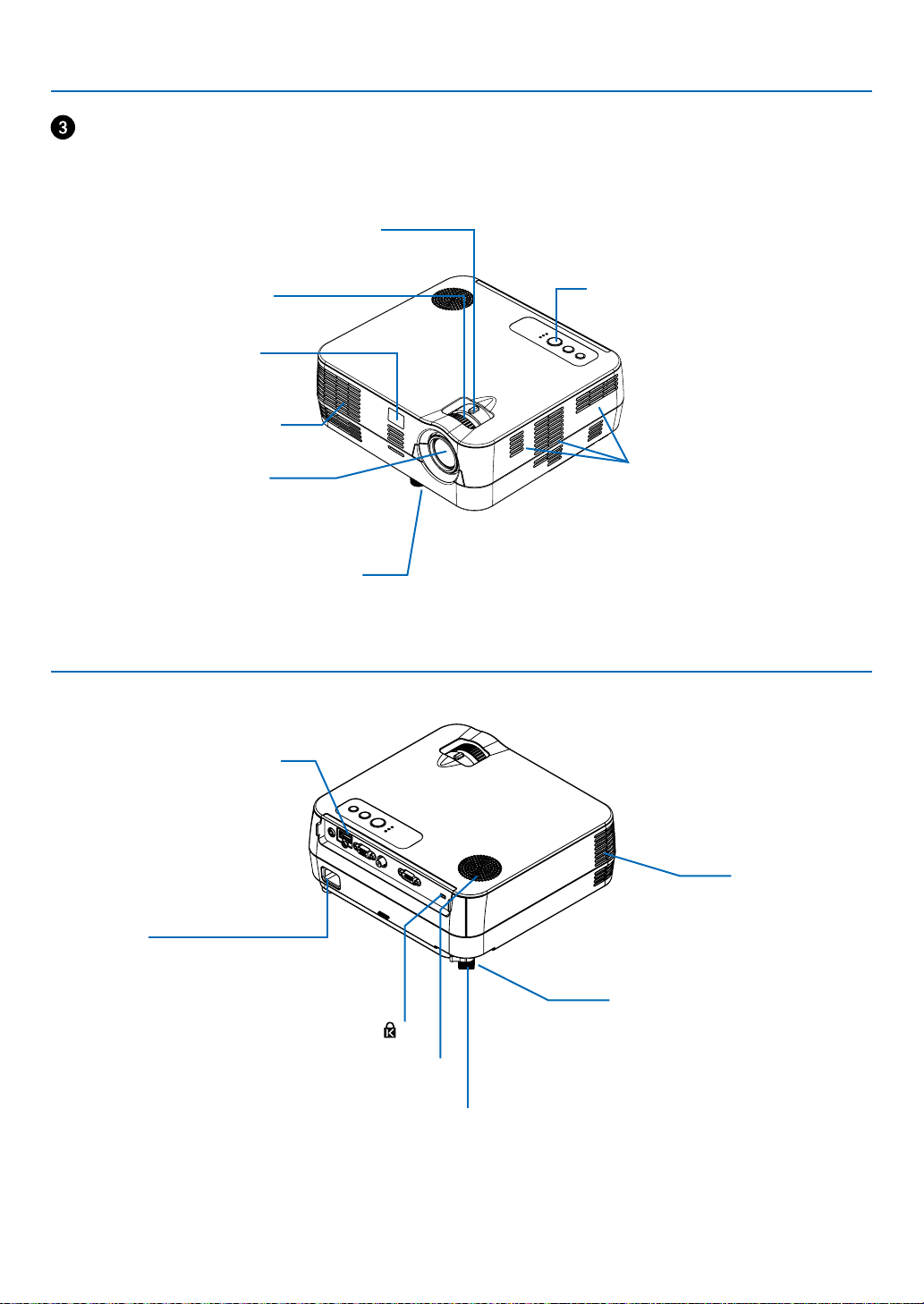
Part Names of the Projector
Zoom Lever
(→ page 22)
Controls
(→ page 5)
Lens
Built-in Security Slot (
)*
Adjustable Tilt Foot
(→ page 21)
Remote Sensor
(→ page 8)
Front/Top
AC Input
Connect the supplied power
cord's three-pin plug here, and
plug the other end into an active
wall outlet. (→ page 16)
* This security slot supports the MicroSaver ® Security System.
Terminal Panel
(→ page 6)
Rear
Exhaust Vent
Heated air is
exhausted from here.
Exhaust Vent
Focus Ring
(→ page 22)
Intake Vent
Monaural Speaker (7W)
Rear Foot
(→ page 21)
Spacer (black rubber)
To ne-adjust the height of the rear
foot, remove the spacer and rotate
the rear foot to the desired height.

6
1. Introduction
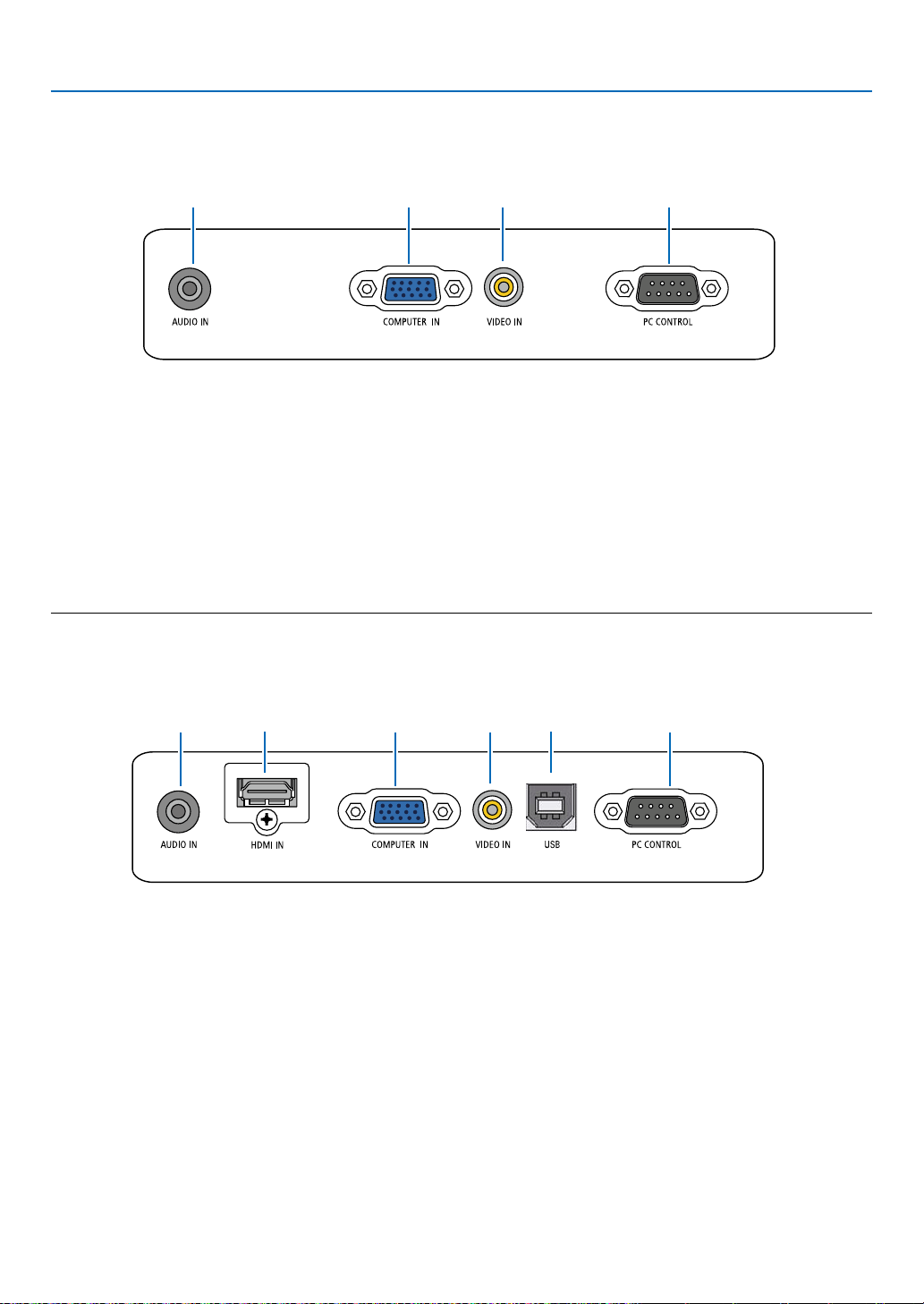
Terminal Panel Features
1. COMPUTER IN/ Component Input Connector (Mini
D-Sub 15 Pin) (→ page 12, 13)
2. PC CONTROL Port (D-Sub 9 Pin) (→ page 75)
Use this port to connect a PC or control system.
This enables you to control the projector using serial
communication protocol. If you are writing your own
program, typical PC control codes are on page 75.
1. COMPUTER IN/ Component Input Connector (Mini
D-Sub 15 Pin) (→ page 12, 13)
2. PC CONTROL Port (D-Sub 9 Pin) (→ page 75)
Use this port to connect a PC or control system.
This enables you to control the projector using serial
communication protocol. If you are writing your own
program, typical PC control codes are on page 75.
3. VIDEO IN Connector (RCA) (→ page 14)
4. AUDIO IN Mini Jack (Stereo Mini) (→ page 12, 13,
14)
3. VIDEO IN Connector (RCA) (→ page 14)
4. AUDIO IN Mini Jack (Stereo Mini) (→ page 12, 13,
14)
5. HDMI IN Connector (→ page 15)
6. USB Port (Type B)
VE280X/VE280
VE281X/VE281
VE282X/VE282
1
1
2
2
(VE281X/VE281 only)
4
4
3
3
5
6
(VE282X/VE282 only)
7
1. Introduction
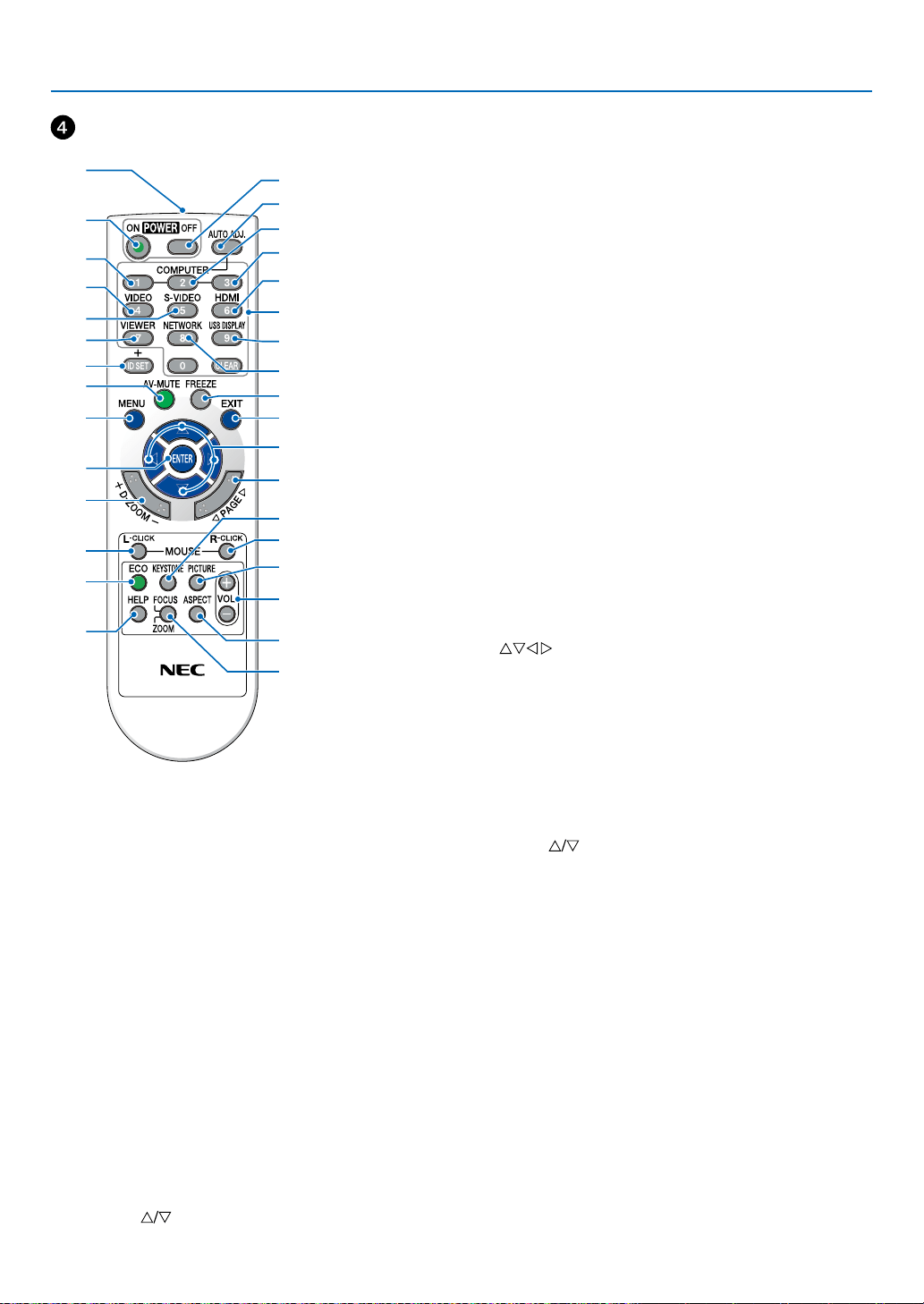
Part Names of the Remote Control
1. Infrared Transmitter
(→ page 8)
2. POWER ON Button
(→ page 17)
3. POWER OFF Button
(→ page 26)
4. COMPUTER 1 Button
(→ page 19)
5. COMPUTER 2 Button
(not available on this series of projectors.)
6. COMPUTER 3 Button
(not available on this series of projectors.)
7. AUTO ADJ. Button
(→ page 25)
8. VIDEO Button
(→ page 19)
9. S-VIDEO Button
(not available on this series of projectors.)
10. HDMI Button
(→ page 19)
(not available on VE280X and VE280.)
11. VIEWER Button
(not available on this series of projectors)
12. NETWORK Button
(not available on this series of projectors)
13. USB DISPLAY Button
(not available on this series of projectors)
14. ID SET Button
(not available on this series of projectors.)
15. Numeric Keypad Button/CLEAR Button
(not available on this series of projectors.)
16. FREEZE Button
(→ page 28)
17. AV-MUTE Button
(→ page 28)
18. MENU Button
(→ page 44)
19. EXIT Button (→ page 44)
20.
Button (→ page 32, 44)
21. ENTER Button (→ page 44)
22. D-ZOOM (+)(–) Button
(→ page 28)
23. MOUSE L-CLICK Button*
(→ page 32)
24. MOUSE R-CLICK Button*
(→ page 32)
25. PAGE
Button*
(→ page 31, 32)
26. ECO Button (→ page 29)
27. KEYSTONE Button
(→ page 24)
28. PICTURE Button
(→ page 47, 48)
29. VOL. (+)(–) Button
(→ page 25)
30. ASPECT Button
(→ page 50)
31. FOCUS/ZOOM Button
(not available on this series of projectors)
32. HELP Button
(→ page 62)
* The PAGE
, MOUSE L-CLICK and MOUSE R-CLICK buttons work only when the optional remote mouse receiver
(NP01MR) is connected with your computer.
3
7
5
6
1
2
10
15
16
14
17
9
4
8
13
29
30
31
19
20
25
27
28
24
18
23
22
21
26
32
12
11
8
1. Introduction
30°
30°
30°
30°
OPEN
Remote Control Precautions
• Handle the remote control carefully.
• If the remote control gets wet, wipe it dry immediately.
• Avoid excessive heat and humidity.
• Do not heat, take apart, or throw batteries into re.
• If you will not be using the remote control for a long time, remove the batteries.
• Ensure that you have the batteries’ polarity (+/−) aligned correctly.
• Do not use new and old batteries together, or use different types of batteries together.
• Dispose of used batteries according to your local regulations.
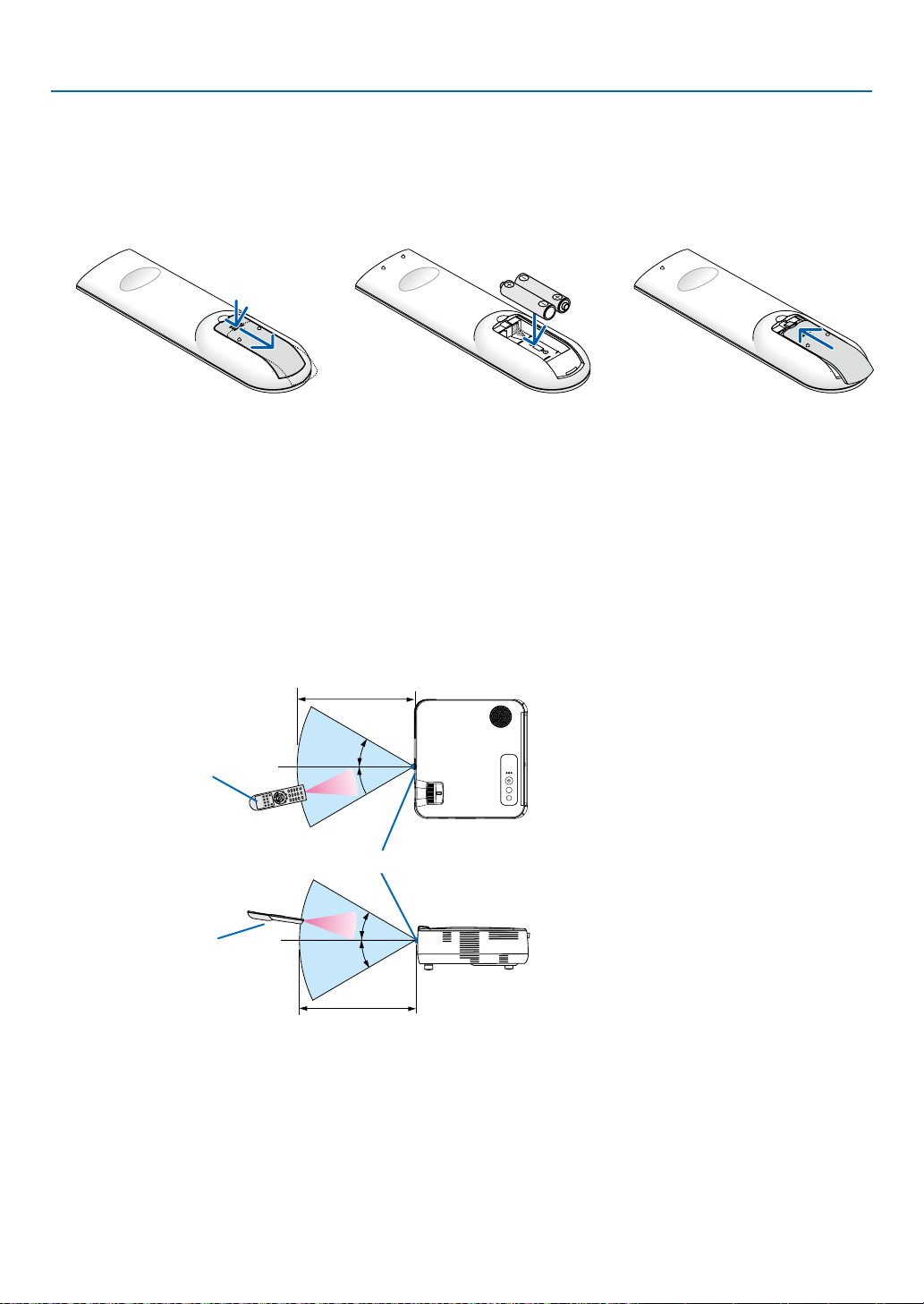
Operating Range for Wireless Remote Control
1
Press rmly and slide the battery
cover off.
2
Install new batteries (AAA). Ensure
that you have the batteries’ polarity
(+/−) aligned correctly.
• The infrared signal operates by line-of-sight up to a distance of about 22 feet/7 m and within a 60-degree angle of
the remote sensor on the projector cabinet.
• The projector will not respond if there are objects between the remote control and the sensor, or if strong light falls
on the sensor. Weak batteries will also prevent the remote control from properly operating the projector.
Battery Installation
7 m/22 feet
7 m/22 feet
Remote control
Remote sensor on projector cabinet
OPEN
3
Slip the cover back over the
batteries until it snaps into place.
Do not mix different types of
batteries or new and old batteries.
Remote control
9
1
3
2
2. Installation and Connections
This section describes how to set up your projector and how to connect video and audio sources.
Your projector is simple to set up and use. But before you get started, you must rst:
Setting Up the Screen and the Projector
Selecting a Location
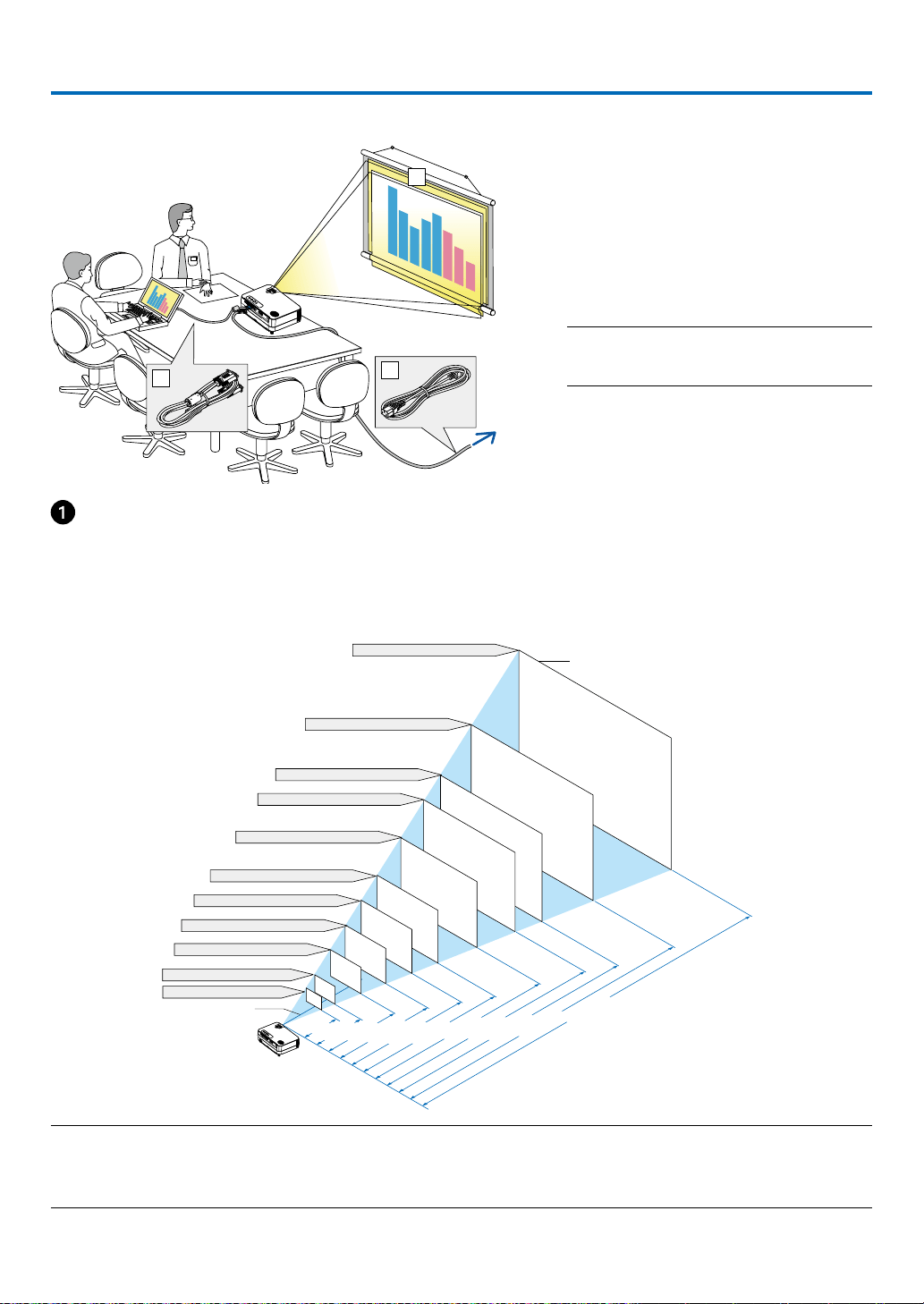
The further your projector is from the screen or wall, the larger the image. The minimum size the image can be is 30"
(0.76 m) measured diagonally when the projector is roughly 49 inches (1.3 m) from the wall or screen. The largest
the image can be is 300" (7.6 m) when the projector is about 493 inches (12.5 m) from the wall or screen. Use the
chart below as a rough guide.
1 Set up a screen and the projector.
2 Connect your computer or video
equipment to the projector. See pages
12, 13, 14, 15, 16.
3 Connect the supplied power cord. See
page 16.
NOTE: Ensure that the power cord and any other
cables are disconnected before moving the
projector.
NOTE:
• The distances are indicated by intermediate values between tele and wide. Use as a rule of thumb.
• The Zoom lever adjusts the image size up to +/-5%
• For more details on throw distance, see next page.
To the wall outlet.
300"
240"
200"
180"
150"
120"
100"
60"
40
"
80"
30
"
1.7m/65.5"
2.5m/98.5"
3.3m/131.5"
4.2m/164"
5.0m/197"
6.3/246"
7.5m/295.5"
8.3m/328"
10.0m/394"
12.5m/492.5"
Distance (Unit: m/inch)
Lens center
Screen Size (diagonal: inch)
Screen Size (Unit: cm/inch)
609.6(W) x 457.2(H) / 240(W) x 180(H)
487.7(W) x 365.8(H) / 192(W) x 144(H)
406.4(W) x 304.8(H) / 160(W) x 120(H)
365.8(W) x 274.3(H) / 144(W) x 108(H)
304.8(W) x 228.6(H) / 120(W) x 90(H)
243.8(W) x 182.9(H) / 96(W) x 72(H)
203.2(W) x 152.4(H) / 80(W) x60(H)
162.6(W) x 121.9(H) /64(W) x 48(H)
121.9(W) x 91.4(H) / 48(W) x 36(H)
81.3(W) x 1.0(H) / 32(W) x 24(H)
1.3m/49"
61.0(W) x 45.7(H) / 24(W) x 18(H)
10
2. Installation and Connections
Throw Distance and Screen Size
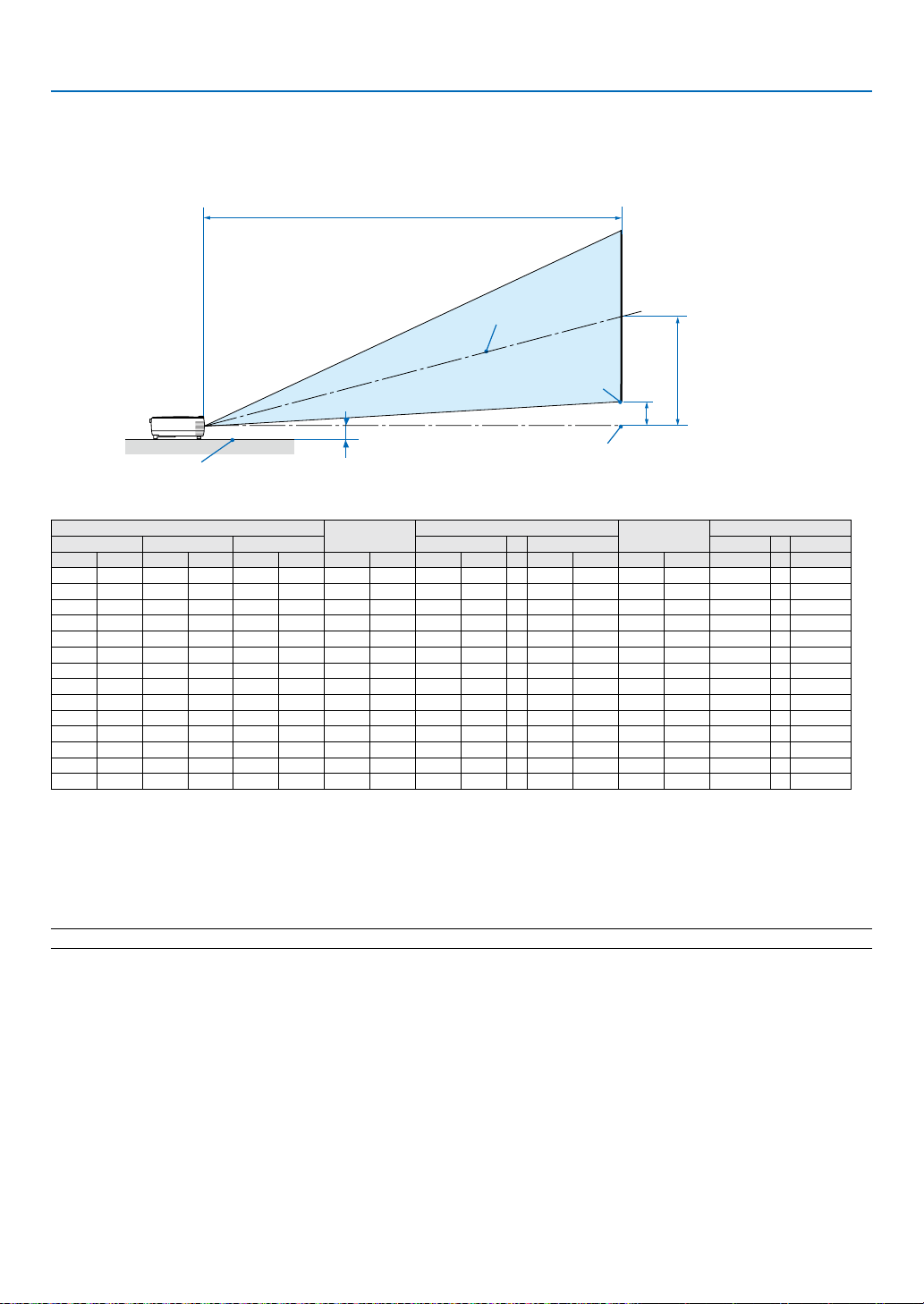
The following shows the proper relative positions of the projector and screen. Refer to the table to determine the
position of installation.
Distance Chart
C
D
B
Screen center
Lens center
Screen bottom
2.9"/73 mm
Installation surface
Screen Size
B
C
D(WIDE)
a
Diagonal Width Height Wide - Tele Wide - Tele
inch mm inch mm inch mm inch mm inch mm - inch mm inch mm degree - degree
30 762 24 610 18 457 12 297 46 1180 - 52 1320 3 69 14.0 - 12.7
40 1016 32 813 24 610 16 396 62 1573 - 69 1760 4 91 14.0 - 12.7
60 1524 48 1219 36 914 23 594 93 2360 - 104 2640 5 137 14.0 - 12.7
70 1778 56 1422 42 1067 27 693 108 2753 - 121 3080 6 160 14.0 - 12.7
80 2032 64 1626 48 1219 31 792 124 3147 - 139 3520 7 183 14.0 - 12.7
90 2286 72 1829 54 1372 35 891 139 3540 - 156 3960 8 206 14.0 - 12.7
100 2540 80 2032 60 1524 39 990 155 3933 - 173 4400 9 228 14.0 - 12.7
120 3048 96 2438 72 1829 47 1188 186 4720 - 208 5280 11 274 14.0 - 12.7
150 3810 120 3048 90 2286 58 1486 232 5900 - 260 6600 13 343 14.0 - 12.7
180 4572 144 3658 108 2743 70 1783 279 7080 - 312 7920 16 411 14.0 - 12.7
200 5080 160 4064 120 3048 78 1981 310 7867 - 346 8800 18 457 14.0 - 12.7
240 6096 192 4877 144 3658 94 2377 372 9440 - 416 10560 22 548 14.0 - 12.7
270 6858 216 5486 162 4115 105 2674 418 10620 - 468 11880 24 617 14.0 - 12.7
300 7620 240 6096 180 4572 117 2971 465 11800 - 520 13200 27 685 14.0 - 12.7
B = Vertical distance between lens center and screen center
C = Throw distance
D = Vertical distance between lens center and bottom of screen(top of screen for ceiling application)
a = Throw angle
NOTE: The values in the tables are design values and may vary.

11
2. Installation and Connections
WARNING
* Installing your projector on the ceiling must be done
by a qualied technician. Contact your NEC dealer
for more information.
* Do not attempt to install the projector yourself.
• Only use your projector on a solid, level surface. If
the projector falls to the ground, you can be injured
and the projector severely damaged.
• Do not use the projector where temperatures vary
greatly. The projector must be used at temperatures
between 41˚F (5˚C) and 104˚F (40˚C). ([ECO MODE]
is set automatically to [ON] at 95°F to 104°F/35°C to
40°C.)
• Do not expose the projector to moisture, dust, or
smoke. This will harm the screen image.
• Ensure that you have adequate ventilation around
your projector so heat can dissipate. Do not cover
the vents on the side or the front of the projector.
Reecting the Image
Using a mirror to reect your projector's image enables
you to enjoy a much larger image when a smaller space
is required. Contact your NEC dealer if you need a mirror
system. If you're using a mirror system and your image
is inverted, use the MENU and
buttons on your
remote control to correct the orientation. (→ page 56)
12
2. Installation and Connections
Making Connections
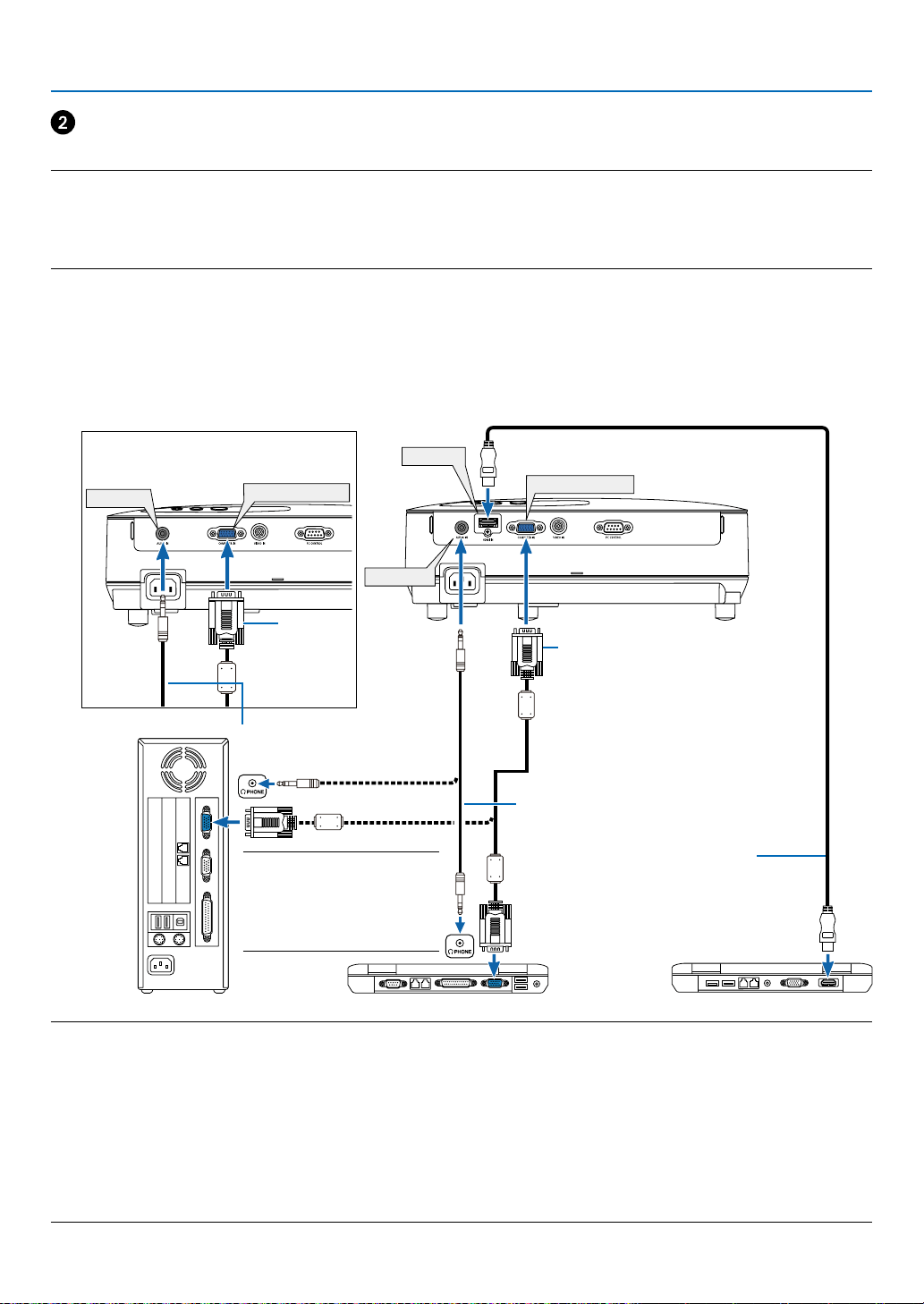
Connecting Your PC or Macintosh Computer
NOTE: When using with a notebook PC, be sure to connect the projector and notebook PC while the projector is in standby mode
and before turning on the power to the notebook PC.
In most cases the output signal from the notebook PC is not turned on unless connected to the projector before being powered up.
* If the screen goes blank while using your remote control, it may be the result of the computer's screen-saver or power management
software.
Enabling the computer’s external display
Displaying an image on the notebook PC’s screen does not necessarily mean it outputs a signal to the projector.
When using a PC compatible laptop, a combination of function keys will enable/disable the external display.
Usually, the combination of the ‘Fn” key along with one of the 12 function keys gets the external display to come on
or off. For example, NEC laptops use Fn + F3, while Dell laptops use Fn + F8 key combinations to toggle through
external display selections.
NOTE:
• Beforeconnectinganaudiocabletotheheadphonejackofacomputer,adjustthecomputer’svolumeleveltolow.Afterconnecting
the projector to the computer, adjust the volume of both projector and computer to suitable level as desired to avoid damage to
your ear.
• Ifanaudiooutputjackofyourcomputerisaminijacktype,connecttheaudiocabletoit.
•
AnimagemaynotbedisplayedcorrectlywhenaVideosourceisplayedbackviaacommerciallyavailablescanconverter.
This is because the projector will process a video signal as a computer signal at the default setting. In that case, do the following.
- When an image is displayed with the lower and upper black portion of the screen or a dark image is not displayed correctly:
ProjectanimagetollthescreenandthenpresstheAUTOADJ.buttonontheremotecontrolortheprojectorcabinet.
- TheCOMPUTERINconnectorsupportsPlug&Play(DDC2B).
COMPUTER IN
AUDIO IN
HDMI IN
COMPUTER IN
AUDIO IN
Computer cable (VGA)
(supplied)
To mini D-Sub 15-pin connector on the
projector. It is recommended that you
use a commercially available distribution
amplier if connecting a signal cable
longer than the cable supplied.
IBM VGA or Compatibles (Notebook
type) or Macintosh (Notebook type)
NOTE: For older Macintosh,
use a commercially available
pinadapter (notsupplied) to
connect to your Mac's video
port.
Stereo mini-plug audio cable
(not supplied)
Computer
cable
(VGA)
(supplied)
Stereo mini-plug audio cable (not supplied)
HDMI cable (not supplied)
Use High Speed HDMI
®
Cable.
VE280X/VE280 VE281X/VE281/VE282X/VE282
13
2. Installation and Connections
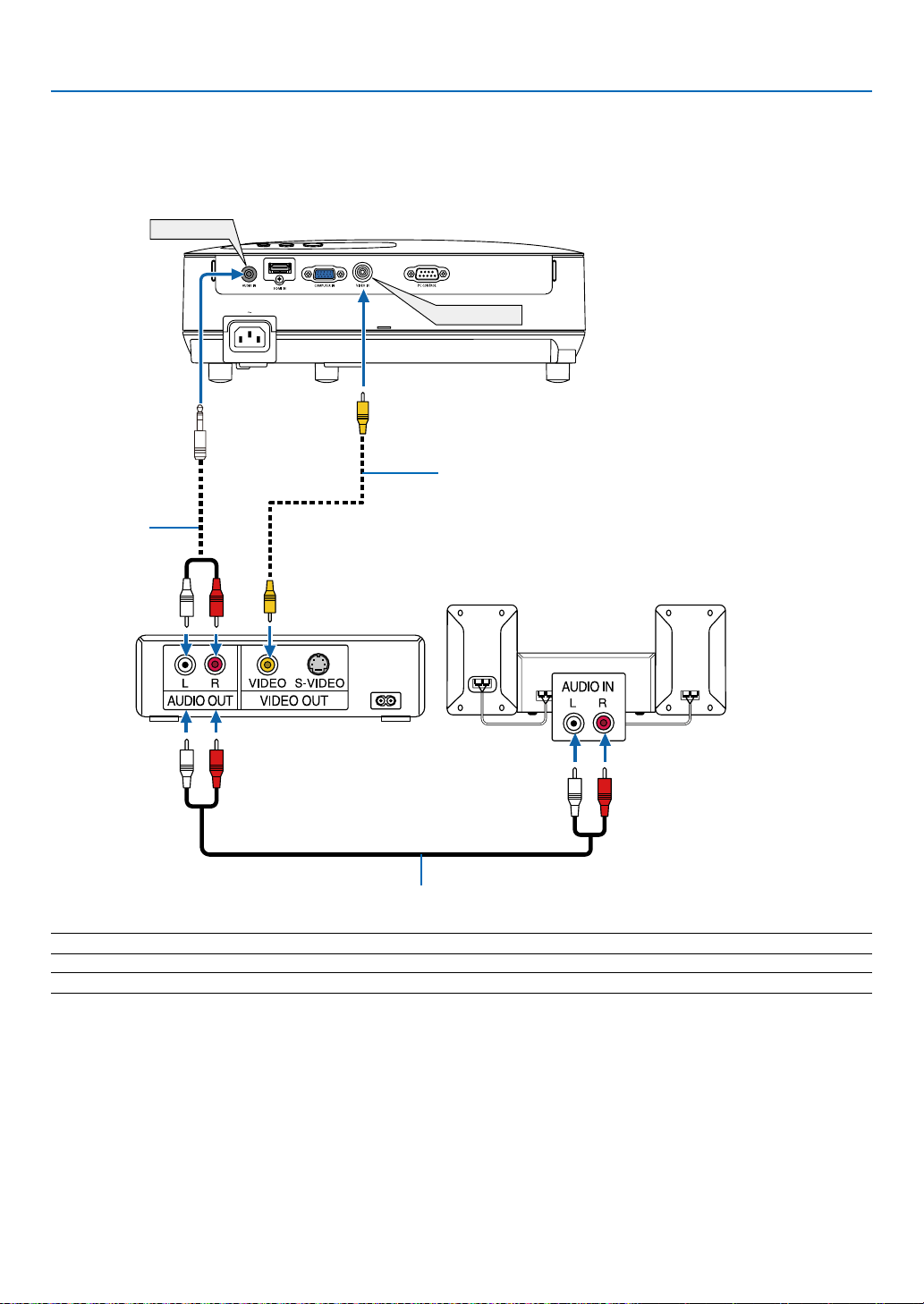
COMPUTER IN
AUDIO IN
NOTE:RefertoyourDVDplayer'sowner'smanualformoreinformationaboutyourDVDplayer'svideooutputrequirements.
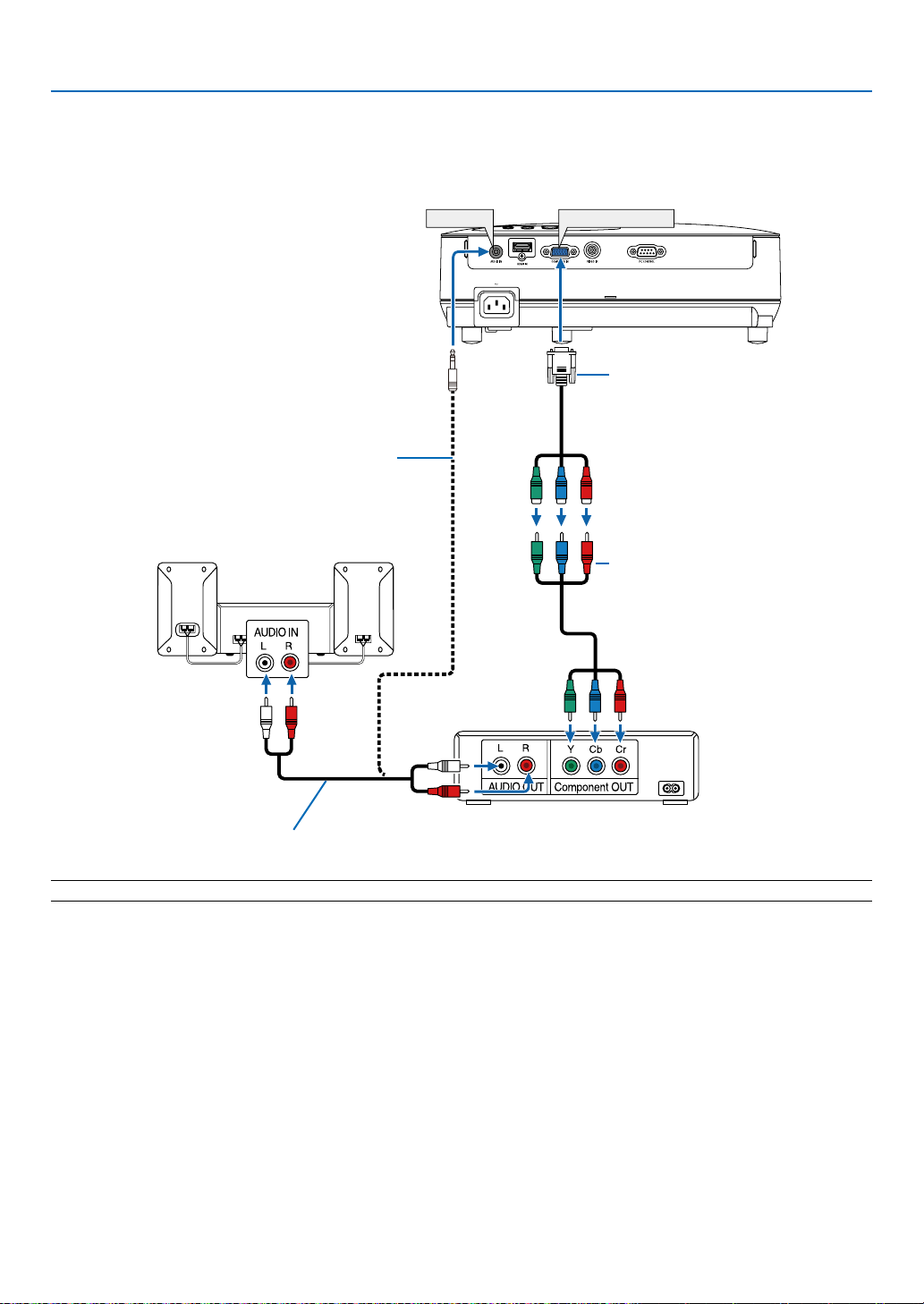
Connecting Your DVD Player with Component Output
Use audio equipment for stereo sound.
The projector's built-in speaker is monaural.
DVD player
Audio Equipment
Optional 15-pin - to
- RCA (female) ×3
cable (ADP-CV1E)
Component video RCA×3
cable (not supplied)
Audio cable (not supplied)
Stereo mini plug - to - RCA
audio cable (not supplied)
14
2. Installation and Connections
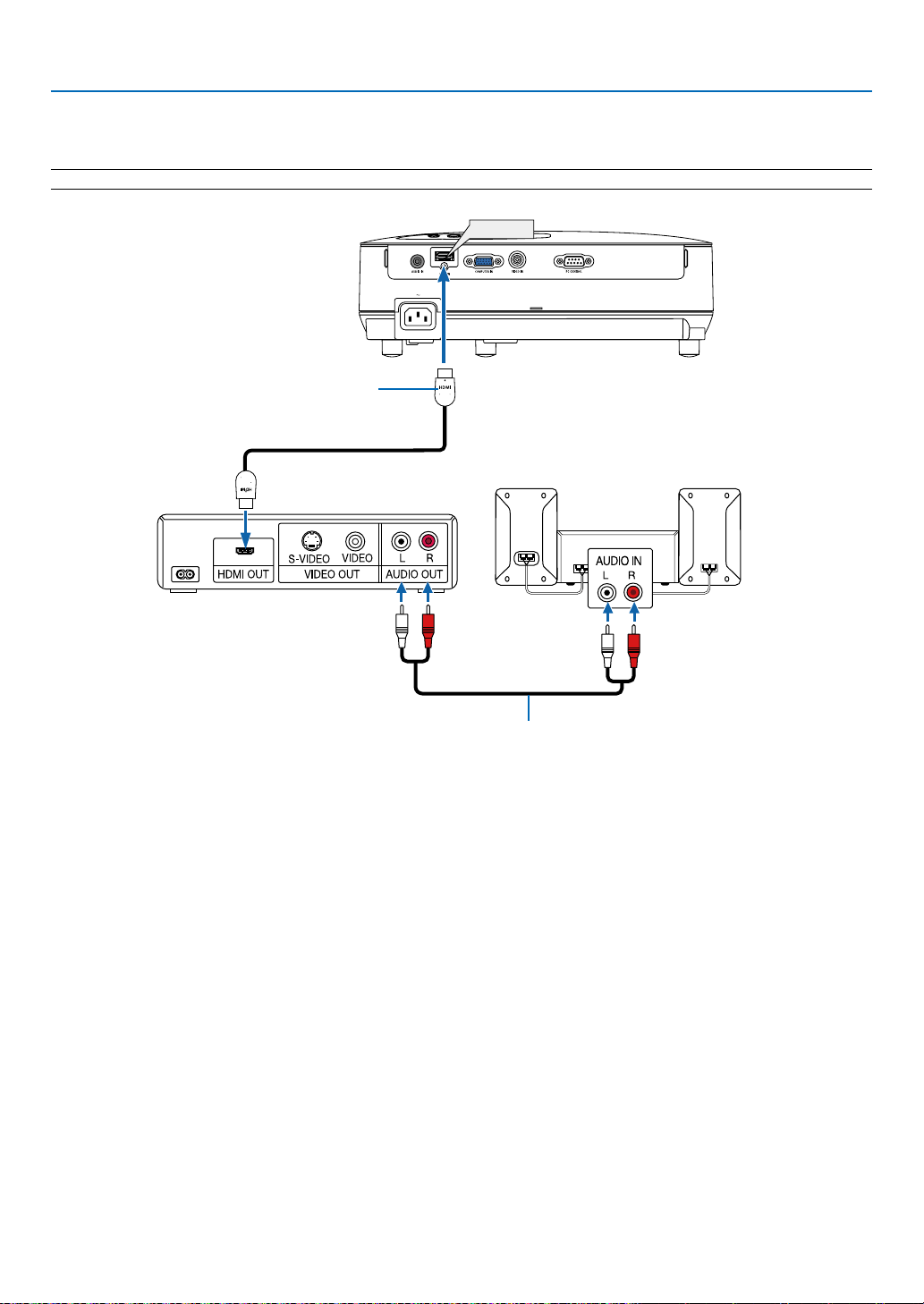
VIDEO IN
AUDIO IN
Connecting Your VCR
Use audio equipment for stereo sound.
The projector's built-in speaker is monaural.
Video cable (not supplied)
VCR
Audio equipment
Audio cable (not supplied)
NOTE:RefertoyourVCRowner'smanualformoreinformationaboutyourequipment'svideooutputrequirements.
NOTE:AnimagemaynotbedisplayedcorrectlywhenaVideosourceisplayedbackinfast-forwardorfast-rewindviaascanconverter.
TIP:TheAUDIOINMiniJack(StereoMini)issharedbetweenCOMPUTERandVIDEOinputs.
Stereo mini plug - to
- RCA audio cable
(not supplied)
15
2. Installation and Connections
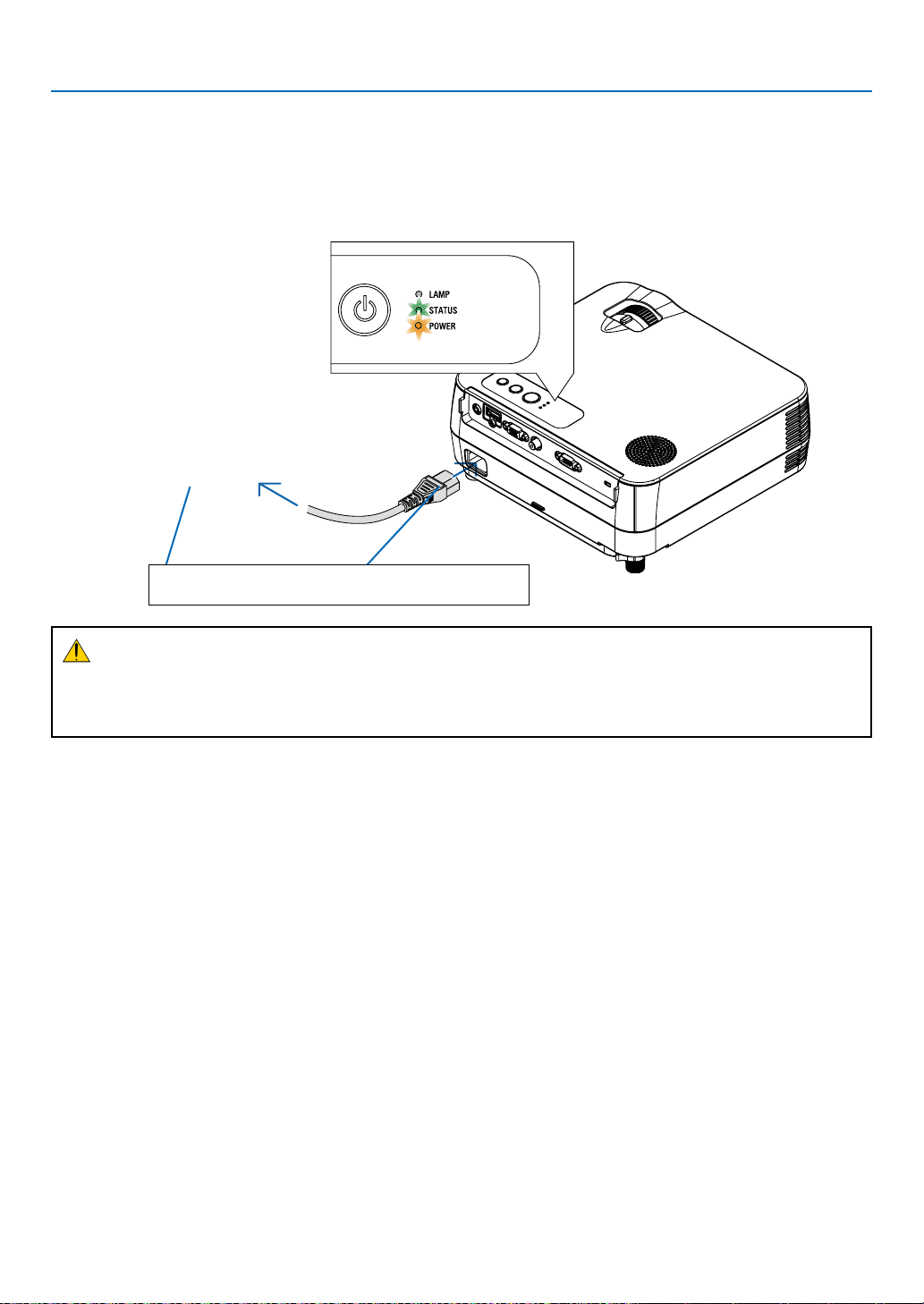
HDMI IN
Connecting HDMI Input (VE281X/VE281/VE282X/VE282 only)
You can connect the HDMI output of your DVD player, hard disk player, Blu-ray player, or notebook type PC to the
HDMI IN connector of your projector.
NOTE:TheHDMIINconnectorsupportsPlug&Play(DDC2B).
Audio cable (not supplied)
HDMI cable (not supplied)
Use High Speed HDMI
®
Cable.
TIP:ForusersofaudiovideoequipmentwithanHDMIconnector:
Select“Enhanced”ratherthan“Normal”ifHDMIoutputisswitchablebetween“Enhanced”and“Normal”.
This will provide improved image contrast and more detailed dark areas.
Formoreinformationonsettings,refertotheinstructionmanualoftheaudiovideoequipmenttobeconnected.
• When connecting the HDMI IN connector of the projector to the DVD player, the projector’s video level can be
made settings in accordance with the DVD player’s video level. In the menu select [HDMI SETTINGS] → [VIDEO
LEVEL] and make necessary settings.
• If the HDMI input sound cannot be heard, in the menu select [HDMI SETTINGS] → [AUDIO SELECT] →
[HDMI] (→ page 58).
NOTE: HDMI signal
If the AC power supply is removed from the projector (Direct Power Off function) while displaying an image connected
to the HDMI input, the projector may not display an image properly the next time it is powered up. Should this happen,
power off the AC supply, power off your HDMI equipment (or disconnect the HDMI cable), and then power on the
AC supply.
16
2. Installation and Connections
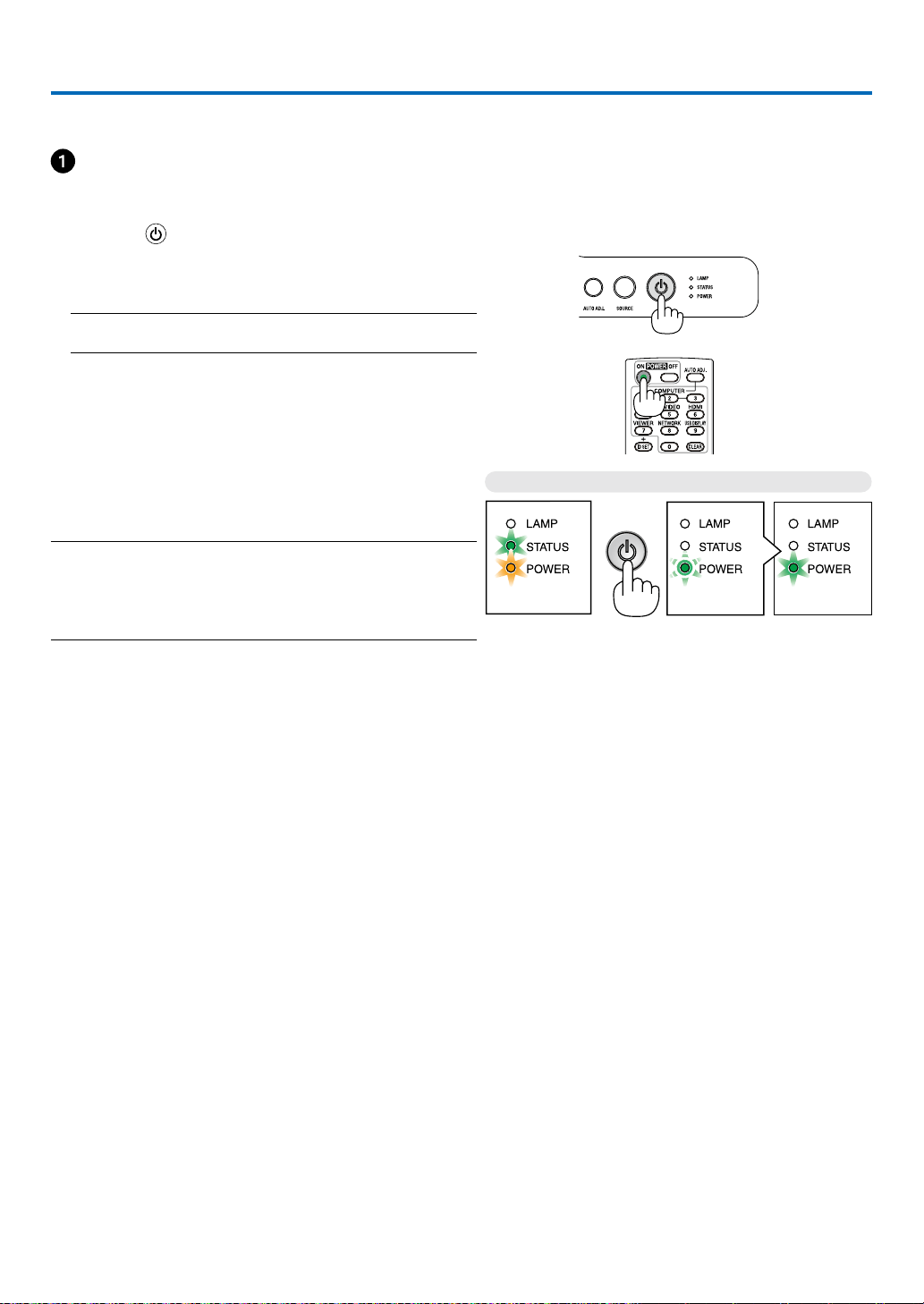
Connecting the Supplied Power Cord
Connect the supplied power cord to the projector.
First connect the supplied power cord's three-pin plug to the AC IN of the projector, and then connect the other plug
of the supplied power cord in the wall outlet.
To wall outlet
The projector will go into standby
mode. When in standby mode, the
POWER indicator will light orange
and the STATUS indicator will light
green when [NETWORK STANDBY]
is selected for [STANDBY MODE].
CAUTION:
Parts of the projector may become temporarily heated if the projector is turned off with the POWER button or if
the AC power supply is disconnected during normal projector operation.
Use caution when picking up the projector.
Make sure that the prongs are fully inserted into both the
power plug and the wall outlet.
17
3. Projecting an Image (Basic Operation)
This section describes how to turn on the projector and to project a picture onto the screen.
Turning on the Projector
1. Press the (POWER) button on the projector cabinet
or the POWER ON button on the remote control.
The POWER indicator will turn to green and the projector
will become ready to use.
NOTE: When the projector is turned on, it may take some time
before the lamp light becomes bright.
TIP:
• WhentheSTATUSindicatorlightsorange,itmeansthatthe
[CONTROLPANELLOCK]isturnedon.(→ page 56)
After you turn on your projector, ensure that the computer
or video source is turned on.
NOTE:Whennosignalisavailable,theNEClogo(default),blue,or
blackscreenwillbedisplayed.Afteralapseof45secondsfromwhen
theprojectordisplaysablue,blackorlogoscreen,[ECOMODE]will
alwaysswitchto[ON].Thisisdoneonlywhen[ECOMODE]isset
to[OFF].
Standby
Preparing to power on
Power On
Steady orange light Blinking green light Steady green light
(→ page 67)
18
3. Projecting an Image (Basic Operation)
Note on Startup screen (Menu Language Select screen)
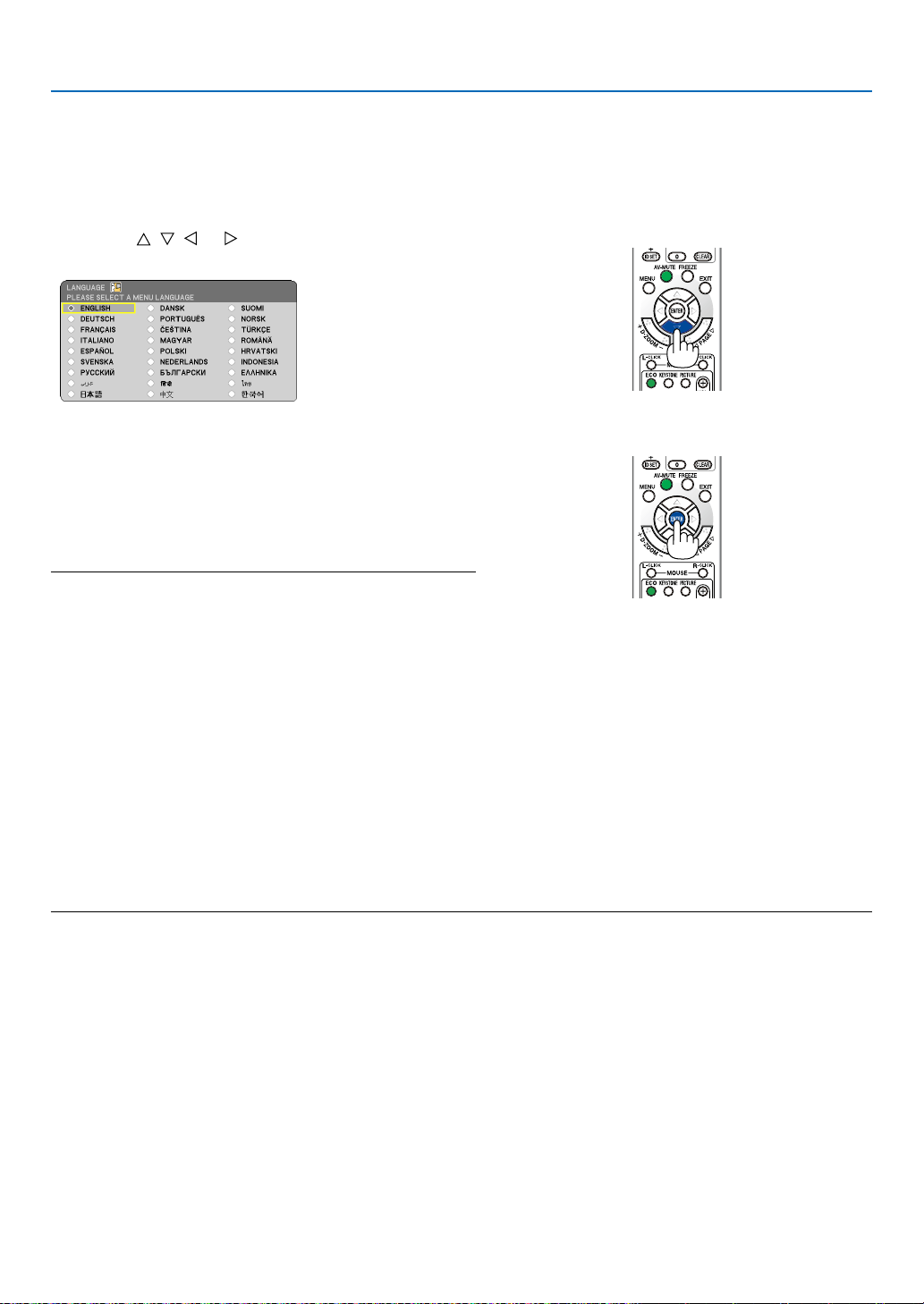
When you rst turn on the projector, you will get the Startup menu. This menu gives you the opportunity to select one
of the 27 menu languages.
To select a menu language, follow these steps:
1. Use the , , or button to select one of the 27
languages from the menu.
2. Press the ENTER button to execute the selection.
After this has been done, you can proceed to the menu
operation.
If you want, you can select the menu language later.
(→ [LANGUAGE] on page 45 and 54)
NOTE:
• Ifoneofthefollowingthingshappens,theprojectorwillnotturn
on.
- If the internal temperature of the projector is too high, the projector detects abnormal high temperature. In this condition the
projector will not turn on to protect the internal system. If this happens, wait for the projector's internal components to cool
down.
- IftheSTATUSindicatorlightsorangeaslongasthePOWERbuttonispressed,itmeanstheCONTROLPANELLOCKhasbeen
set.
- Ifthelampfailstolight,andiftheSTATUSindicatorashesonandoffinacycleofsixtimes,waitafullminuteandthenturn
on the power.
• TheprojectorcannotbeturnedoffwiththeON/STANDBYbuttonorthePOWEROFFbuttonwhilethePOWERindicatorisashing
green in a cycle of 0.5 second on and 0.5 second off.
• DonotdisconnecttheACpowersupplytotheprojectorfor60secondsimmediatelyafterturningitonanddisplayinganimage.
• Immediatelyafterturningontheprojector,screenickermayoccur.Thisisnormal.Wait3to5minutesuntilthelamplighting
is stabilized.
• Ifyouturnontheprojectorimmediatelyafterthelampisturnedofforwhenthetemperatureishigh,thefansrunwithoutdisplaying
an image for some time and then the projector will display the image.
19
3. Projecting an Image (Basic Operation)
Selecting a Source
Selecting the computer or video source
NOTE:Turnonthecomputerorvideosourceequipmentconnectedtotheprojector.
Selecting from Source List
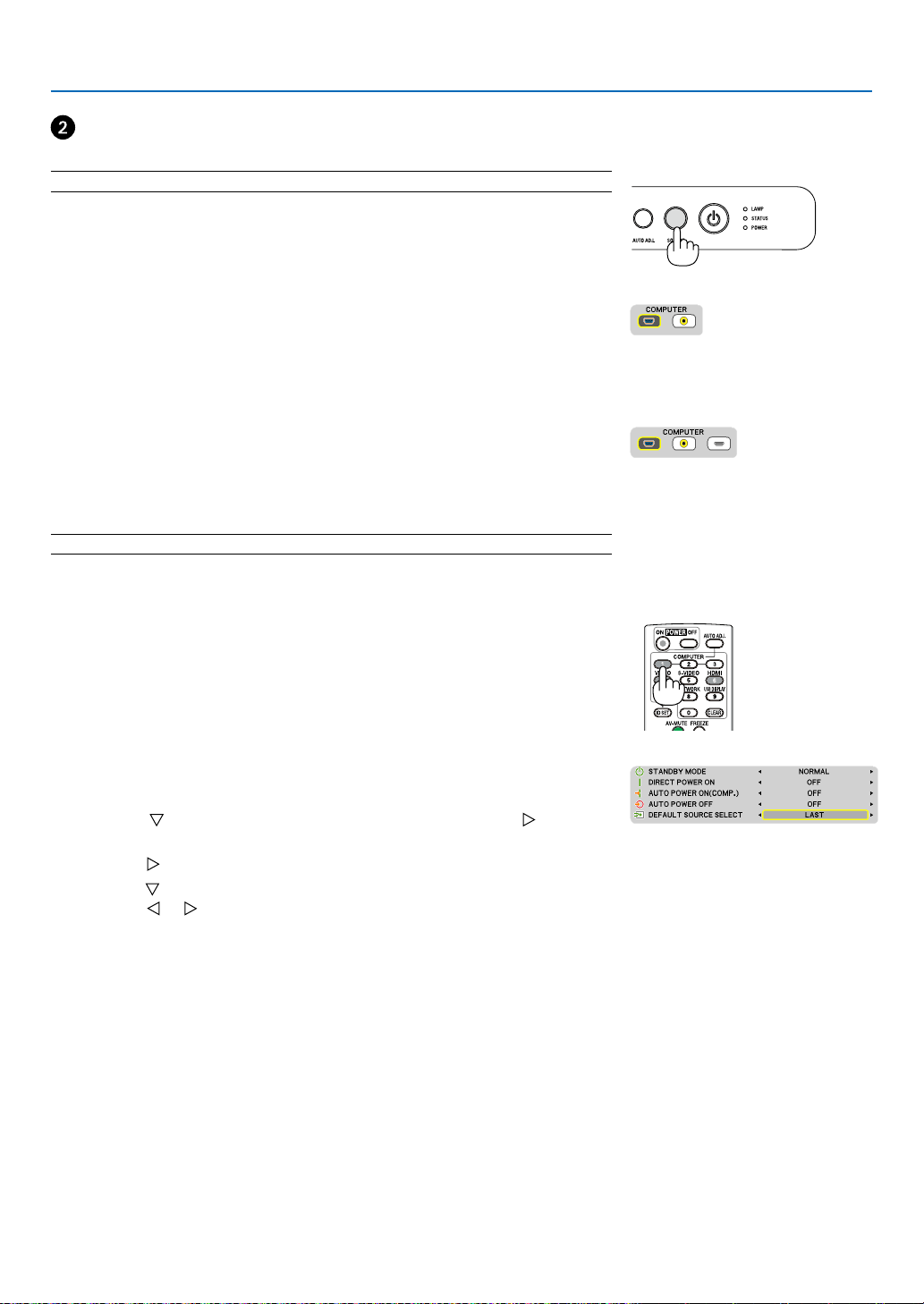
Press and quickly release the SOURCE button on the projector cabinet to display
the Source list. Each time the SOURCE button is pressed, the input source will
change as follows: “COMPUTER”, “VIDEO”, “HDMI”. To display the selected
source, press the ENTER button or allow 2 seconds to elapse.
Detecting the Signal Automatically
Press the SOURCE button once. The projector will search for the available input
source and display it. The input source will change as follows:
VE280X/VE280:
COMPUTER → VIDEO → COMPUTER → ...
VE281X/VE281/VE282X/VE282:
COMPUTER → VIDEO → HDMI → COMPUTER → ...
TIP: If no input signal is present, the input will be skipped.
Using the Remote Control
VE280X/VE280: Press any one of the COMPUTER1 and VIDEO buttons.
VE281X/VE281/VE282X/VE282: Press any one of the COMPUTER1, HDMI
and VIDEO buttons.
Selecting Default Source
You can set a source as the default source so that it will be displayed each time
the projector is turned on.
1. Press the MENU button.
The menu will be displayed.
2. Press the
button twice to select [SETUP] and press the button or
the ENTER button to select [GENERAL].
3.
Press the button four times to select [OPTIONS(2)].
4. Press the button five times to select [DEFAULT SOURCE SELECT] and
press the
or button.
5. Select a source as the default source.
6. Press the EXIT button a few times to close the menu.
7. Restart the projector.
The source you selected in step 5 will be projected.
TIP:WhentheprojectorisinStandbymode,applyingacomputersignalfromacomputer
connectedtotheCOMPUTERINinput willpowerontheprojector andsimultaneously
projectthecomputer’simage.
[AUTOPOWERON(COMP.)](→ page 60)
VE280X/VE280
VE281X/VE281/VE282X/VE282
20
3. Projecting an Image (Basic Operation)
Adjusting the Picture Size and Position
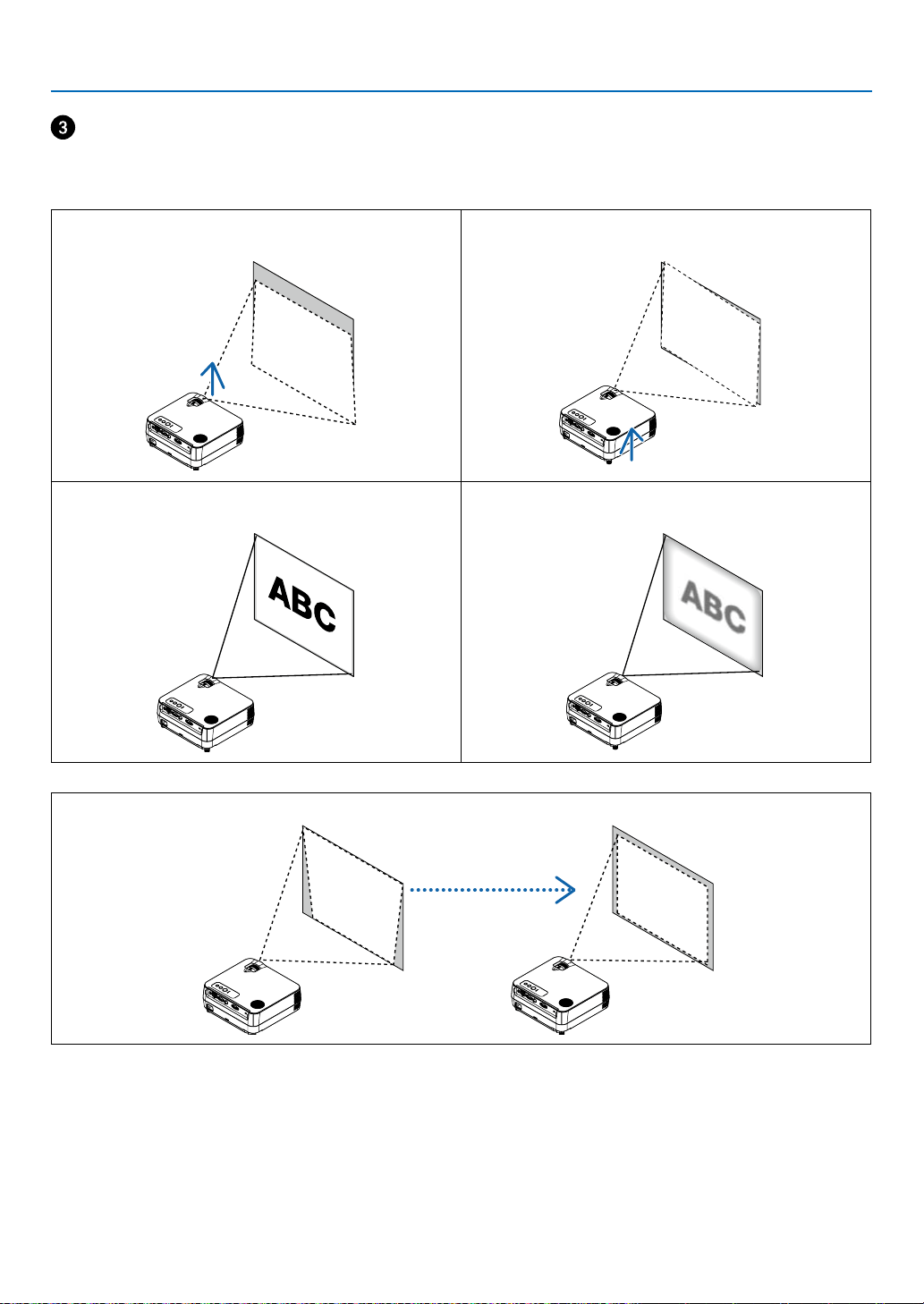
Use the adjustable tilt foot, the zoom lever or the focus ring to adjust the picture size and position.
In this chapter drawings and cables are omitted for clarity.
Adjusting the throw angle (the height of an image)
[Tilt foot] (→ page 21)
Adjusting the left and right tilt of an image
[Rear foot] (→ page 21)
Finely adjusting the size of an image
[Zoom lever] (→ page 22)
Adjusting the focus
[Focus ring] (→ page 22)
Adjusting the keystone correction [KEYSTONE] (→ page 23)
21
3. Projecting an Image (Basic Operation)
1
2
Adjustable Tilt Foot
Exhaust
Vent
Adjust the Tilt Foot
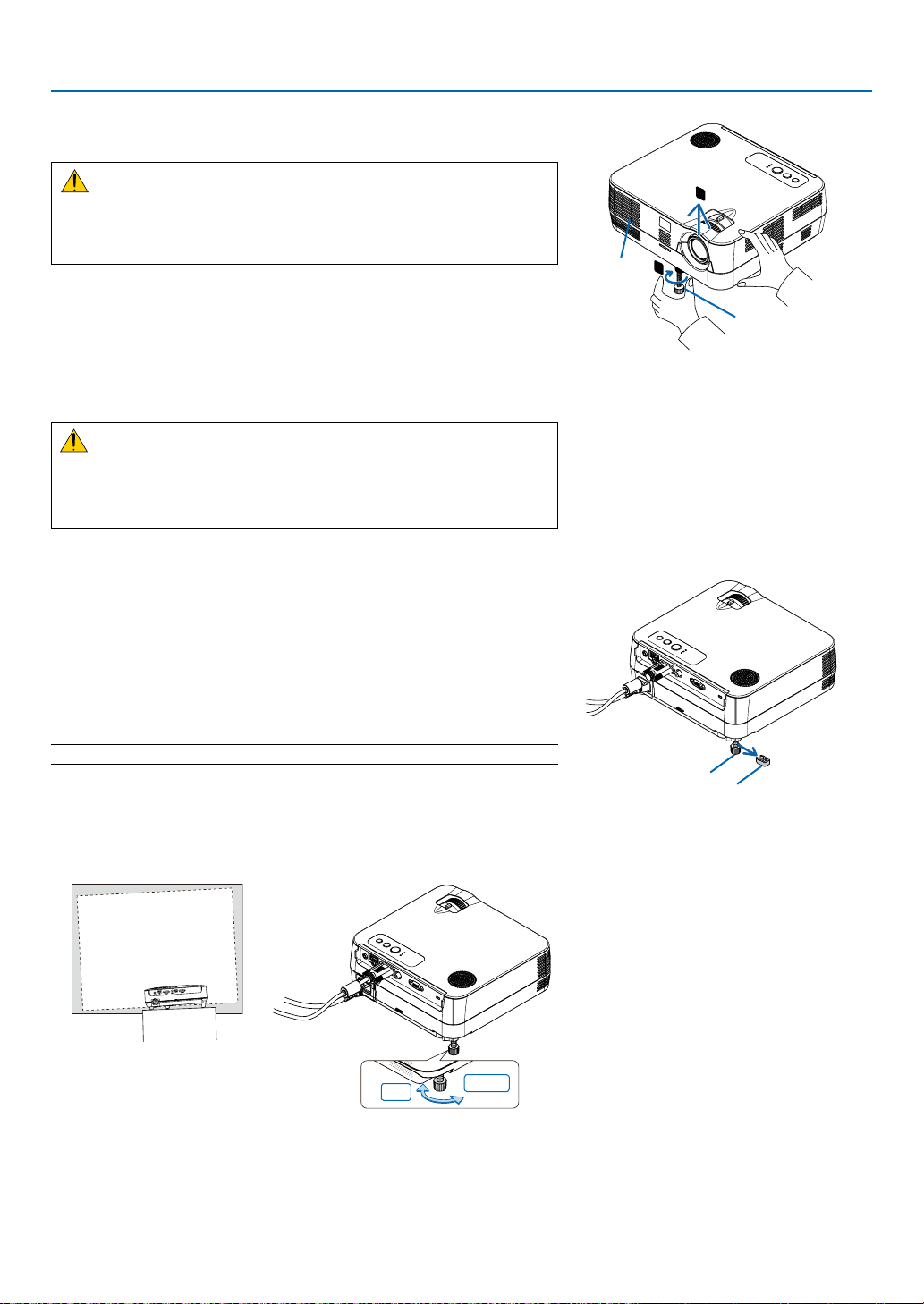
1. Lift the front edge of the projector.
CAUTION:
Do not try to touch the Exhaust Vent during Tilt Foot adjustment as
it can become heated while the projector is turned on and after it is
turned off.
2. Rotate the Adjustable Tilt Foot on the front of the projector to
extend the adjustable tilt foot.
The tilt foot can be extended up to 0.7 inch/18 mm.
There is approximately 5 degrees (up) of adjustment for the front of
the projector.
CAUTION:
• Do not use the tilt-foot for purposes other than originally intended.
Misuses such as using the tilt foot to carry or hang (from the wall or
ceiling) the projector can cause damage to the projector.
Adjusting the left and right tilt of an image [Rear foot]
1. Remove the spacer (black rubber) from the rear foot.
Keep the spacer for future use.
2. Rotate the rear foot.
The rear foot can be extended up to 0.4 inch/10 mm, shorten by
0.3inch/7mm. Rotating the rear foot allows the projector to be placed
horizontally.
NOTE:Afterusingtheprojector,attachthespacertotherearfoot.
Spacer (black
rubber)
Rear foot
Up
Down
22
3. Projecting an Image (Basic Operation)
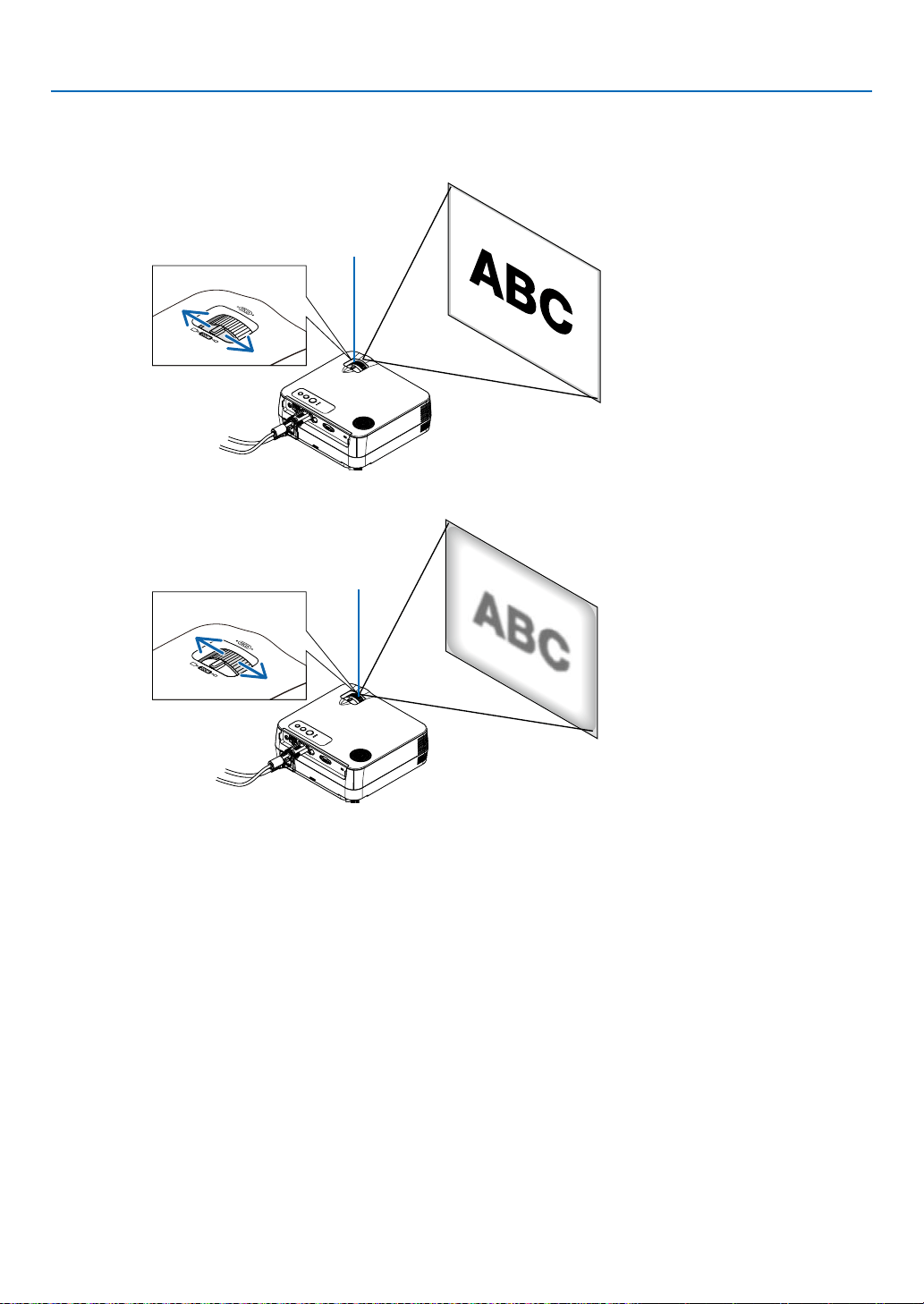
Zoom
Use the ZOOM lever to adjust the image size on the screen.
Zoom Lever
Focus
Use the FOCUS ring to obtain the best focus.
Focus Ring
23
3. Projecting an Image (Basic Operation)
Correcting Keystone Distortion
Correcting Keystone Distortion
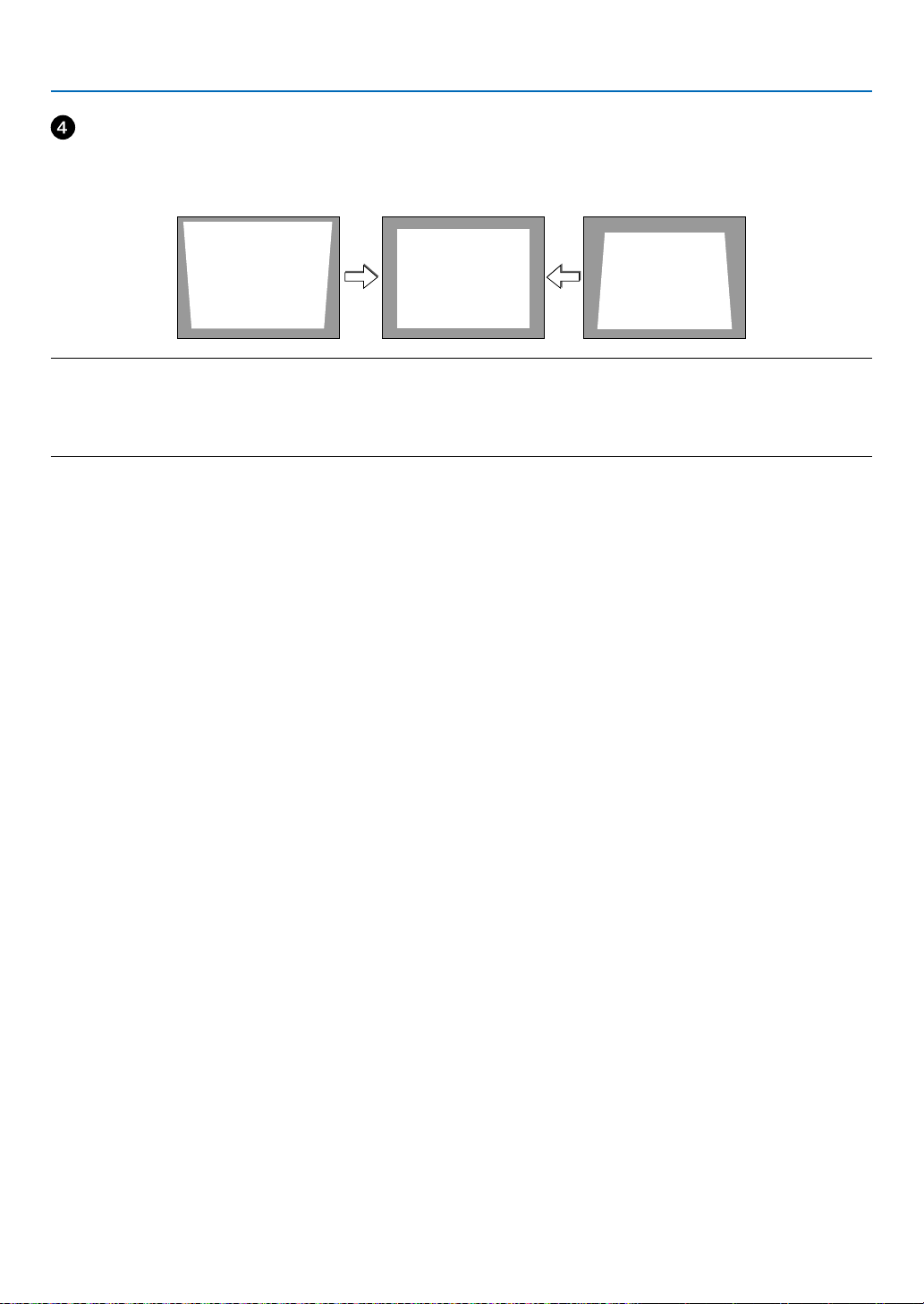
If the screen is tilted vertically, keystone distortion becomes large. Proceed with the following
steps to correct keystone distortion
NOTE:
• TheKeystonecorrectioncancauseanimagetobeslightlyblurredbecausethecorrectionismadeelectronically.
• TheKeystonecorrectionrangecanbemadenarrower,dependingonasignaloritsaspectratioselection.
• WhenconductingextremeoffsetwithKeystonecorrection,sometimes,basedonitscombinationwithaspectratio,itoccursthat
theonscreenmenuwouldextendbeyondthescreen.Whenthishappens,pleaseadjustitbackintothescreen.
24
3. Projecting an Image (Basic Operation)
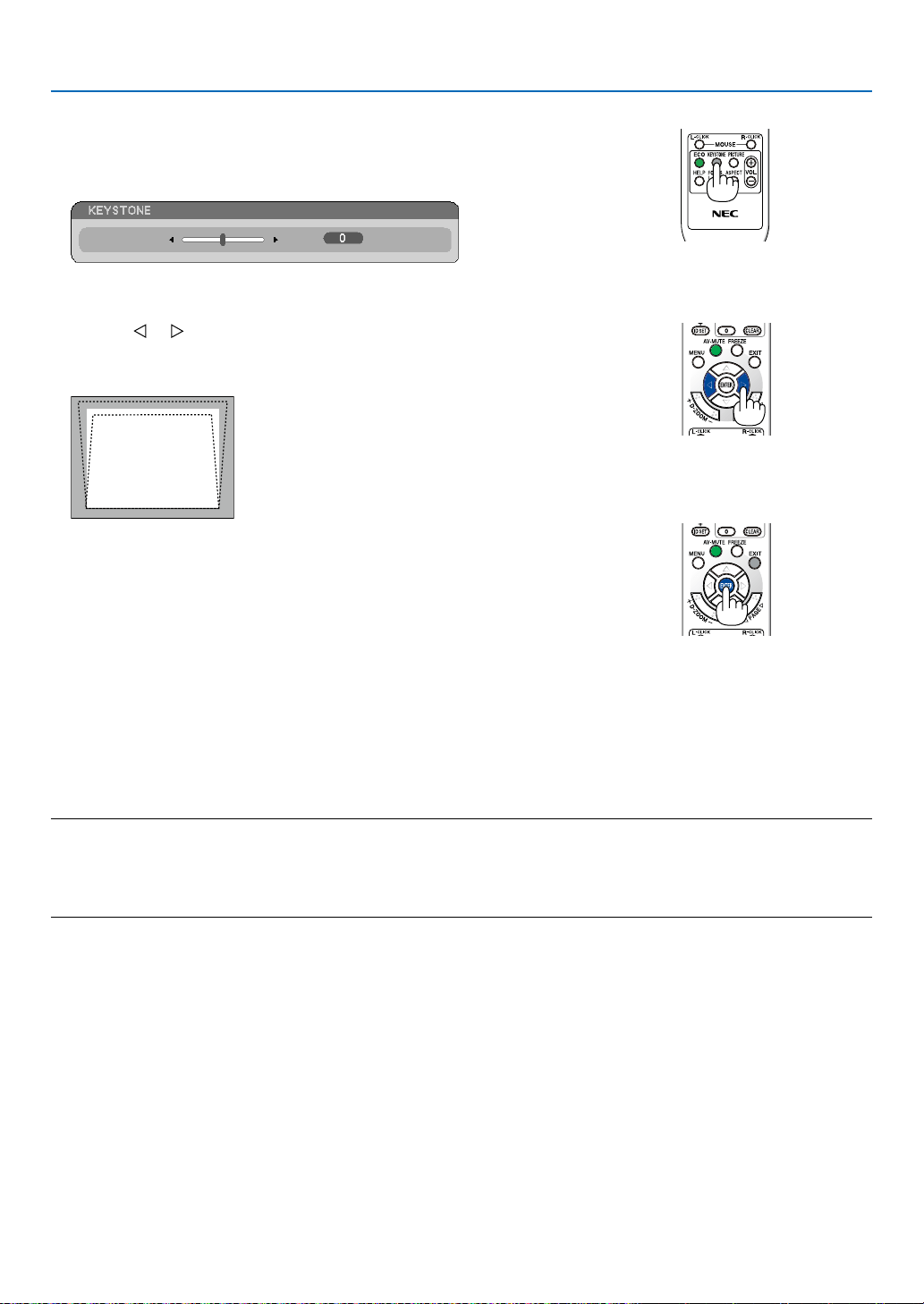
Adjusting with the remote control
1. Press the KEYSTONE button.
The Keystone bar will be displayed.
2. Use the or button to correct the keystone distortion.
Adjust so that the right and left sides are parallel.
3. Press the ENTER button.
NOTE:
• Themaximumrangeofverticalkeystonecorrectionis+/−40degrees.Thismaximumrangemaybesmallerdependingonthe
signaloraspectratiosetting.TheKeystonecorrectionrangewillalsobesmallerwhen3Dmodeisenabled.
• Therangeofkeystonecorrectionisnotthemaximumtiltangleofprojector.
• Theleftandright(horizontal)keystonecorrectionisnotavailable.
25
3. Projecting an Image (Basic Operation)
Optimizing Computer Signal Automatically
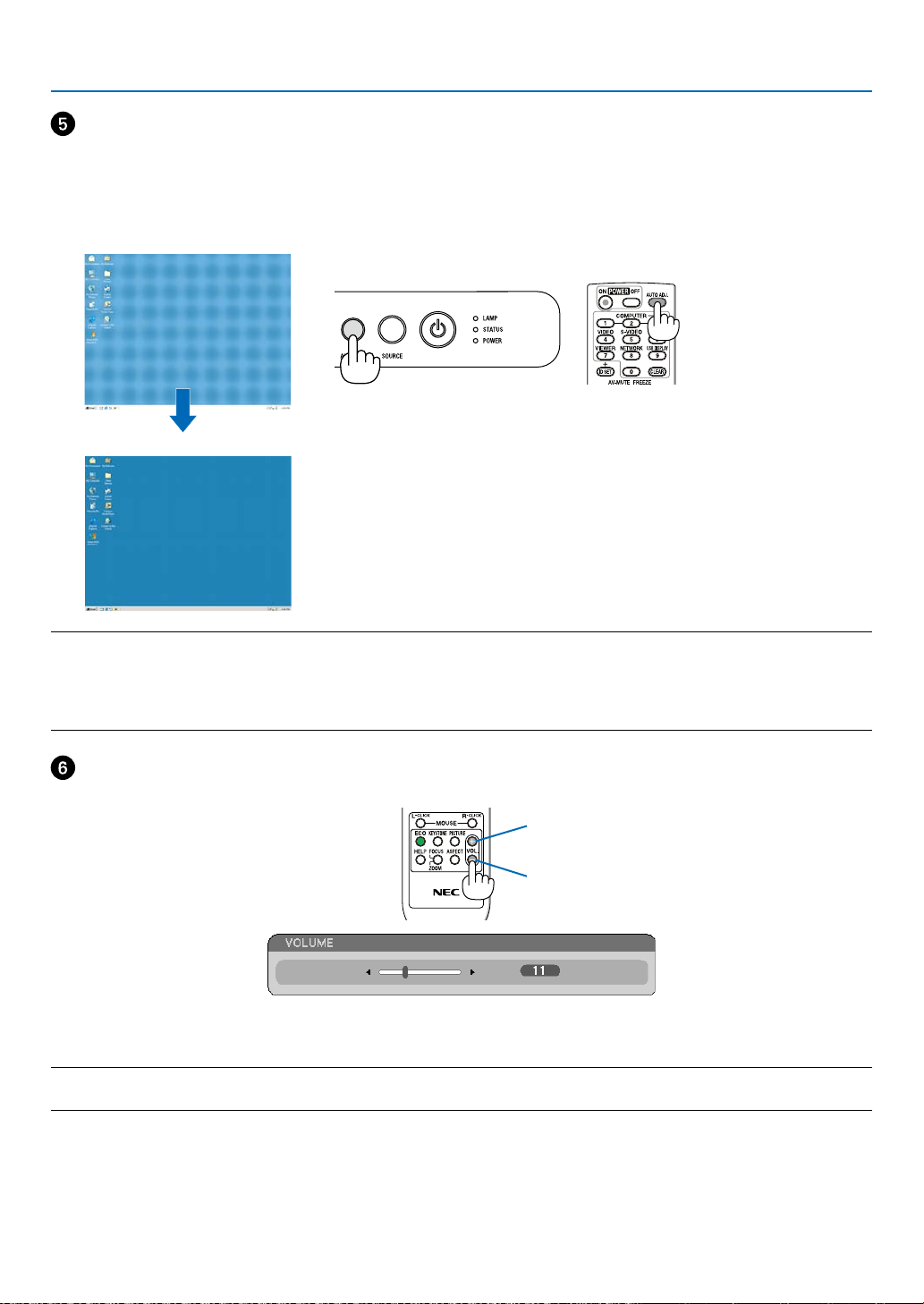
Adjusting the Image Using Auto Adjust
Optimizing a computer image automatically.
Press the AUTO ADJ. button to optimize a computer image automatically.
This adjustment may be necessary when you connect your computer for the rst time.
[Poor picture]
[Normal picture]
NOTE:
Somesignalsmaytaketimetodisplayormaynotbedisplayedcorrectly.
• TheAutoAdjustfunctionwillworkforcomputer(RGB)signalonly.
• IftheAutoAdjustoperationcannotoptimizethecomputersignal,trytoadjust[HORIZONTAL],[VERTICAL],[CLOCK],and[PHASE]
manually.(→ page 49, 50)
Turning Up or Down Volume
Sound level from the speaker can be adjusted.
NOTE:The[BEEP]soundvolumecannotbeadjusted.Toturnoffthe[BEEP]sound,fromthemenu,select[SETUP]→[OPTIONS
(1)]→[BEEP]→[OFF].(→ page 58)
Increase volume
Decrease volume
26
3. Projecting an Image (Basic Operation)
Turning off the Projector
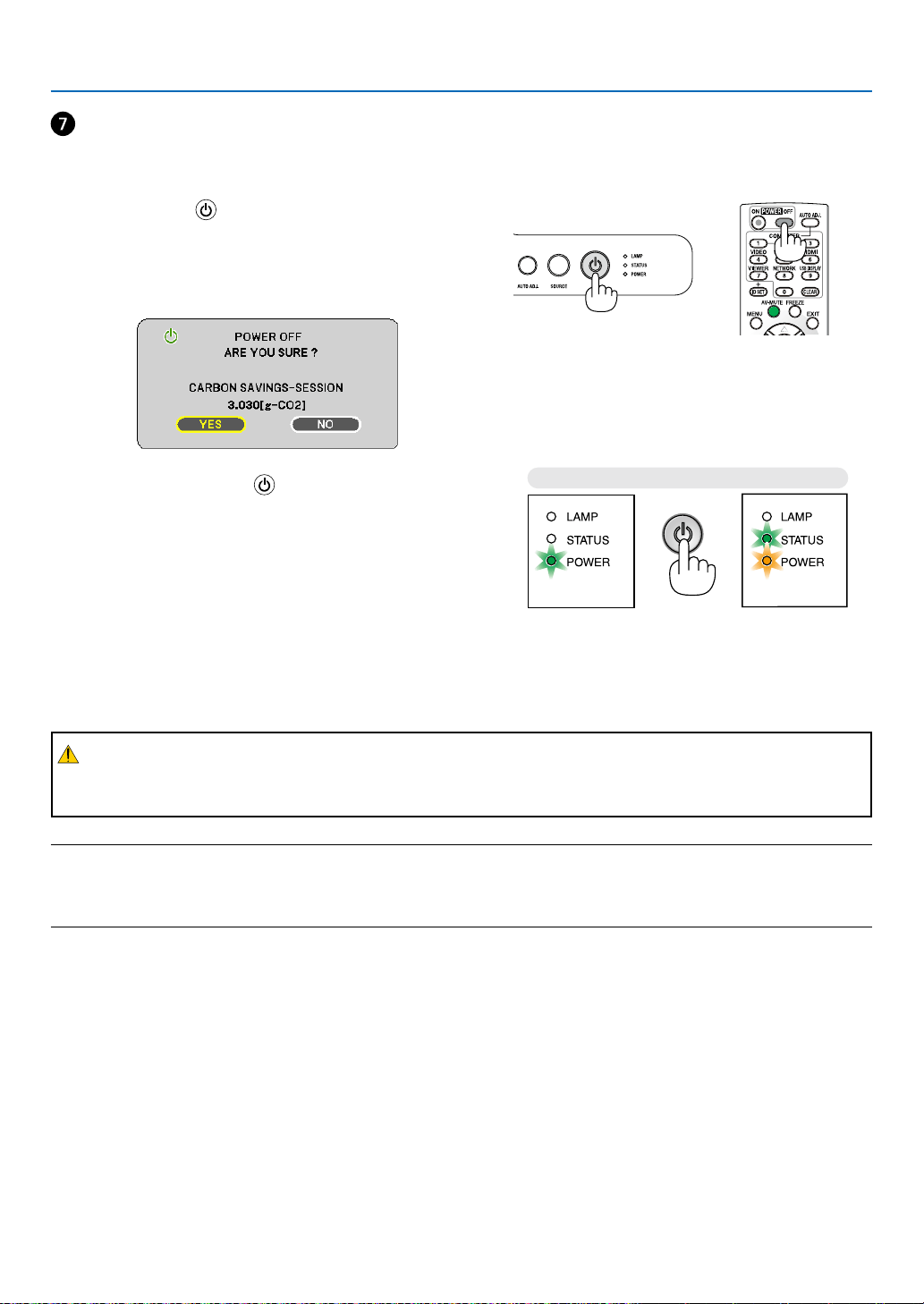
To turn off the projector:
1. First, press the (POWER) button on the projector
cabinet or the POWER OFF button on the remote
control.
The [POWER OFF / ARE YOU SURE? /CARBON
SAVINGS- SESSION X.XXX[g-CO2]] message will appear.
2. Secondly, press the (POWER) button on the
projector cabinet, or the ENTER button or the POWER
OFF button on the remote control.
The lamp will turn off and the projector will go into standby
mode. When in standby mode, the POWER indicator will
light orange and the STATUS indicator will light green when
[NETWORK STANDBY] is selected for [STANDBY MODE].
3. Finally, unplug the power cord.
The POWER indicator will go out.
CAUTION:
Parts of the projector may become temporarily heated if the AC power supply is disconnected either during normal
projector operation or during cooling fan operation. Use caution when picking up the projector.
Power On Standby
Steady green light Steady orange light
NOTE:
• Donotturnoffthepowerfor60secondsimmediatelyafterturningitonanddisplayinganimage.
• DonotdisconnecttheACpowersupplytotheprojectorwithin10secondsofmakingadjustmentorsettingchangesandclosing
themenu.Doingsocancauselossofadjustmentsandsettings.

27
3. Projecting an Image (Basic Operation)
After Use
Preparation: Make sure that the projector is turned off.
1. Disconnect any other cables.
2. Retract adjustable tilt foot if extended.
28
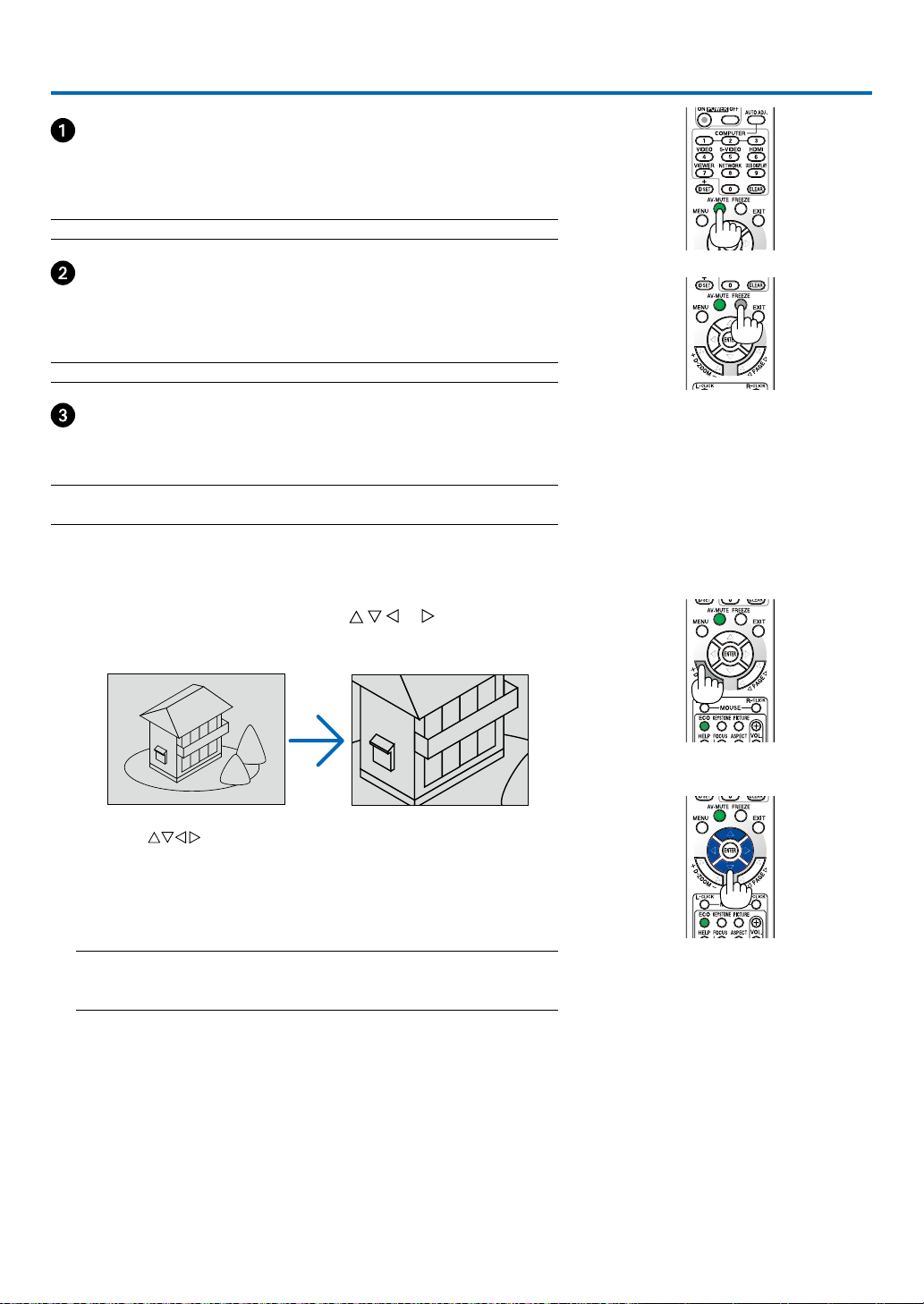
Turning off the Image and Sound
Press the AV-MUTE button to turn off the image and sound for a short
period of time. Press again to restore the image and sound.
NOTE: Even though the image is turned off, the menu still remains on the screen.
Freezing a Picture
Press the FREEZE button to freeze a picture. Press again to resume
motion.
NOTE: The image is frozen but the original video is still playing back.
Enlarging a Picture
You can enlarge the picture up to four times.
NOTE:Themaximummagnicationmaybelessthanfourtimesdependingonthe
signalorwhen[WIDEZOOM]isselectedfor[ASPECTRATIO].
To do so:
1. Press the D-ZOOM (+) button to magnify the picture.
To move the magnied image, use the
, , or button.
2. Press the
button.
The area of the magnied image will be moved
3. Press the D-ZOOM (−) button.
Each time the D-ZOOM (−) button is pressed, the image is reduced.
NOTE:
• Theimagewillbeenlargedorreducedatthecenterofthescreen.
• Displayingthemenuwillcancelthecurrentmagnication.
4. Convenient Features
29
4. Convenient Features
Changing Eco Mode
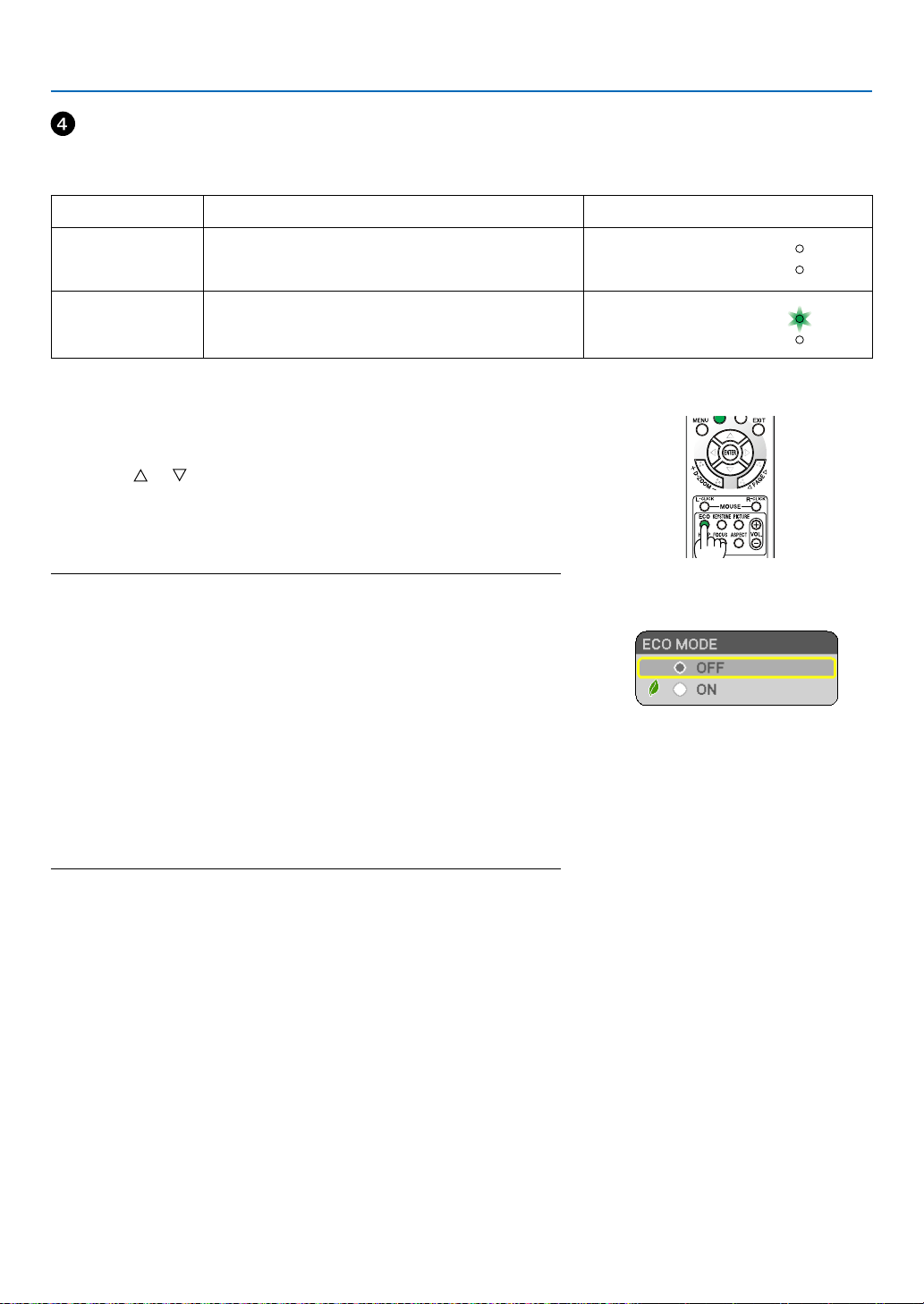
This feature enables you to select two brightness modes of the lamp:
OFF and ON modes. The lamp life can be extended by turning on the [ECO MODE].
[ECO MODE] Description Status of LAMP indicator
[OFF] This is the default setting (100% Brightness). Off
STATUS
LAMP
[ON] Select this mode to increase the lamp life (approx.
80% Brightness.)
Steady Green light
STATUS
LAMP
To turn on the [ECO MODE], do the following:
1. Press the ECO button on the remote control to display [ECO MODE]
screen.
2. Use the
or button to select [ON].
3. Press the ENTER button.
To change from [ON] to [OFF], Go back to Step 2 and select [OFF].
Repeat Step 3.
NOTE:
• The[ECOMODE]canbechangedbyusingthemenu.
Select[SETUP]→[GENERAL]→[ECOMODE].
• Thelampliferemainingandlamphoursusedcanbecheckedin[USAGETIME].
Select[INFO.]→[USAGETIME].
• Theprojector willalways enterinto the[ECO MODE] [ON] condition for 90
seconds immediately after the projector is turned on. The lamp condition will
notbeaffectedevenwhen[ECOMODE]ischangedwithinthistimeperiod.
• Afteralapseof45secondsfromwhentheprojectordisplaysablue,blackor
logoscreen,[ECOMODE]willautomaticallyswitchto[ON].Thisisdoneonly
when[ECOMODE]issetto[OFF].
• Iftheprojectorisoverheatedin[OFF]mode,theremaybeacasewherethe[ECO
MODE]automaticallychangesto[ON]modetoprotecttheprojector.Whenthe
projectorisin[ON]mode,thepicturebrightnessdecreases.Whentheprojector
comesbacktonormaltemperature,the[ECOMODE]returnsto[OFF]mode.
30
4. Convenient Features
Checking Energy-Saving Effect [CARBON METER]
This feature will show energy-saving effect in terms of CO
2
emission reduction (kg) when the projector’s [ECO MODE]
is set to [ON]. This feature is called [CARBON METER].
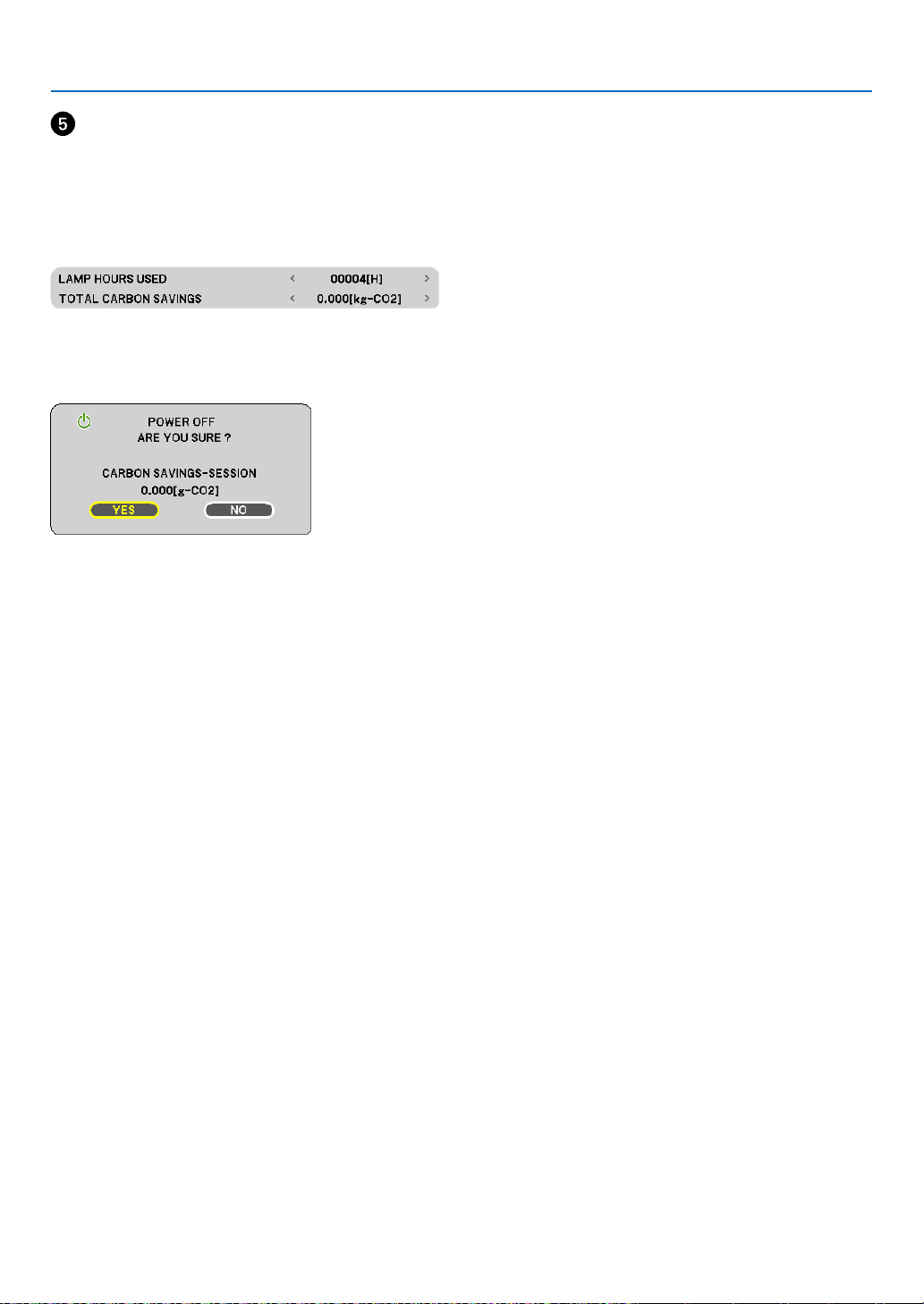
There are two messages: [TOTAL CARBON SAVINGS] and [CARBON SAVINGS-SESSION]. The [TOTAL CARBON
SAVINGS] message shows the total amount of CO
2
emission reduction from the time of shipment up to now. You can
check the information on [USAGE TIME] from [INFO.] of the menu. (→ page 62)
The [CARBON SAVINGS-SESSION] message shows the amount of CO
2
emission reduction between the time of
changing to ECO MODE immediately after the time of power-on and the time of power-off. The [CARBON SAVINGS-
SESSION] message will be displayed in the [POWER OFF/ ARE YOU SURE?] message at the time of power-off.
TIP:
• TheformulaasshownbelowisusedtocalculatetheamountofCO
2
emission reduction.
AmountofCO
2
emissionreduction=PowerconsumptioninOFFforECOMODE–PowerconsumptioninONforECOMODEx
CO
2
conversion factor.*
* Calculation for amount of CO
2
emissionreductionisbasedonanOECDpublication“CO
2
EmissionsfromFuelCombustion,2008
Edition”.
• Thisformulawillnotapplytothepowerconsumptionwhichisnotaffectedbywhether[ECOMODE]isturnedonoroff.
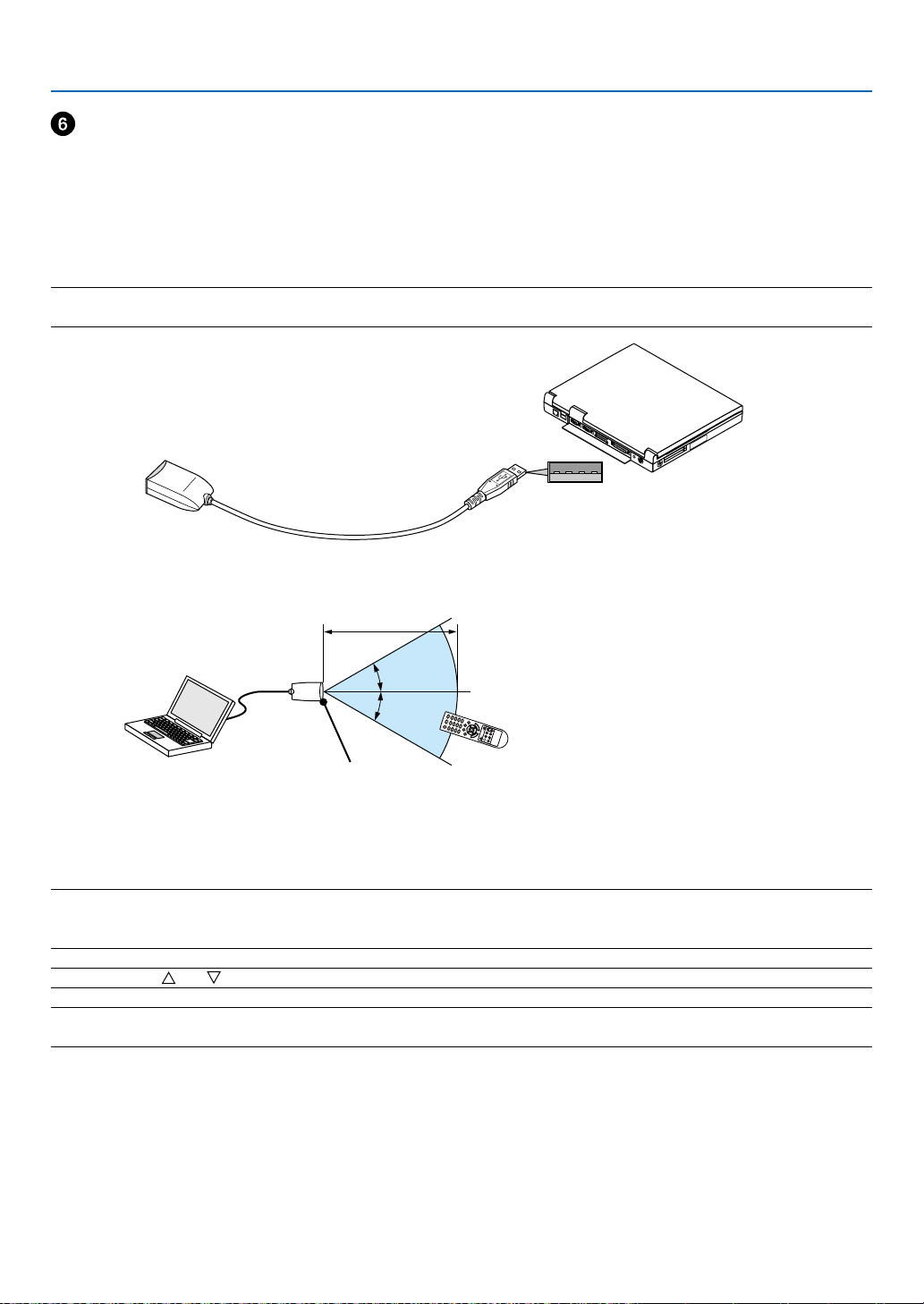
31
4. Convenient Features
30˚
30˚
Using the Optional Remote Mouse Receiver (NP01MR)
The optional remote mouse receiver enables you to operate your computer’s mouse functions from the remote control.
It is a great convenience for clicking through your computer-generated presentations.
Connecting the remote mouse receiver to your computer
If you wish to use the remote mouse function, connect the mouse receiver and computer.
The mouse receiver can be connected directly to the computer’s USB port (type A).
NOTE:DependingonthetypeofconnectionorOSinstalledonyourcomputer,youmayhavetorestartyourcomputerorchange
your computer settings.
When operating a computer via the remote mouse receiver
When connecting using the USB terminal
For PC, the mouse receiver can only be used with a Windows XP*, Windows 2000, Windows Vista, Windows 7, or
Mac OS X 10.0.0 or later operating system.
*NOTE:InSP1orolderversionofWindowsXP,ifthemousecursorwillnotmovecorrectly,dothefollowing:
CleartheEnhancepointerprecisioncheckboxunderneaththemousespeedsliderintheMousePropertiesdialogbox[Pointer
Optionstab].
NOTE:ThePAGE
and buttons do not work with PowerPoint for Macintosh.
NOTE: Wait at least 5 seconds after disconnecting the mouse receiver before reconnecting it and vice versa. The computer may not
identify the mouse receiver if it is repeatedly connected and disconnected in rapid intervals.
Remote mouse receiver
Computer
To USB port of PC or Macintosh
Remote sensor on the
remote mouse receiver
7m/22 feet
32
4. Convenient Features
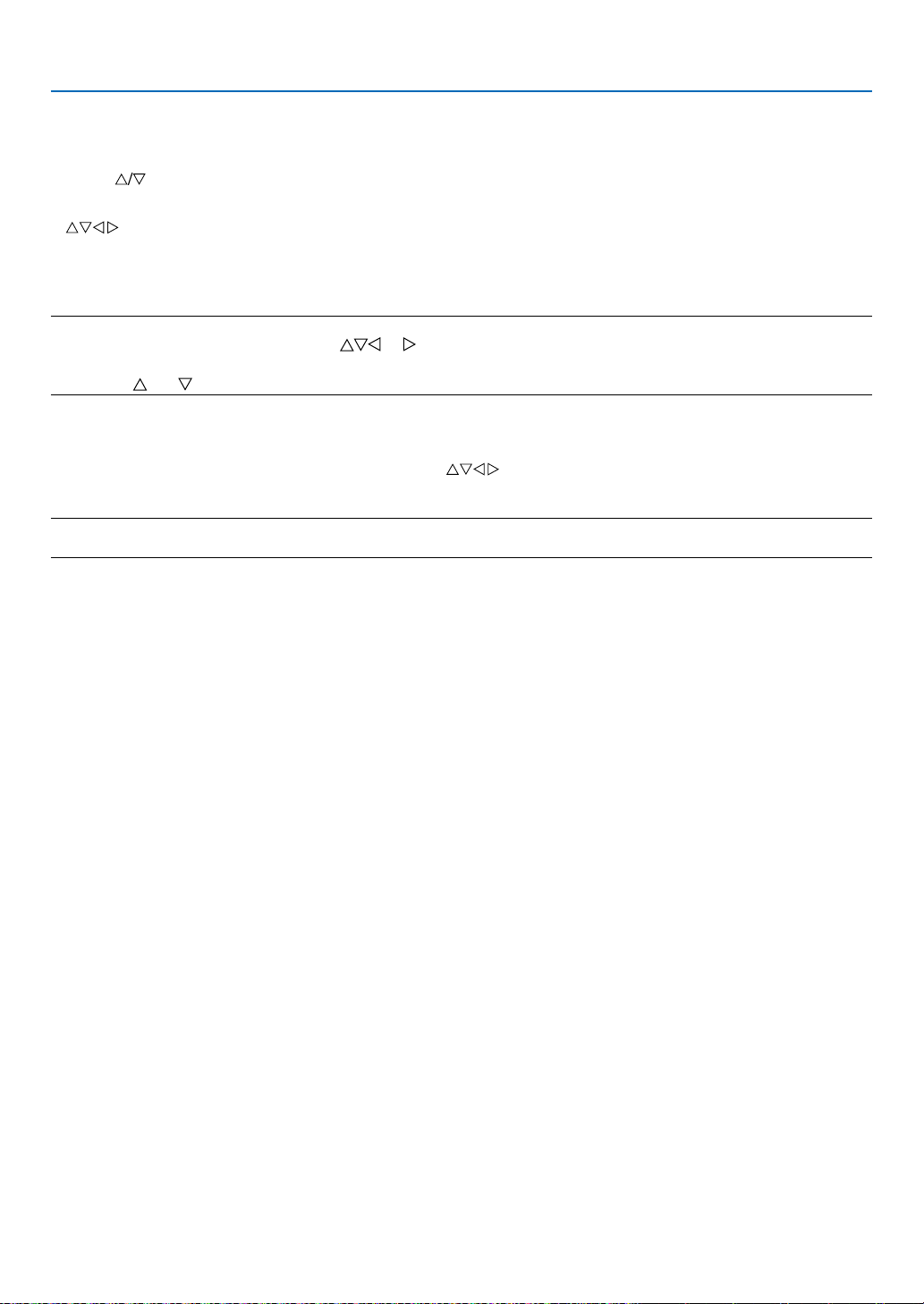
Operating your computer’s mouse from the remote control
You can operate your computer’s mouse from the remote control.
PAGE Button: scrolls the viewing area of the window or to move to the previous or next slide in PowerPoint
on your computer.
Buttons: moves the mouse cursor on your computer.
MOUSE L-CLICK Button: works as the mouse left button.
MOUSE R-CLICK Button: works as the mouse right button.
NOTE:
• Whenyouoperatethecomputerusingthe or button with the menu displayed, both the menu and the mouse pointer
will be affected. Close the menu and perform the mouse operation.
• ThePAGE
and buttons do not work with PowerPoint for Macintosh.
About Drag Mode:
By pressing the MOUSE L-CLICK or R-CLICK button for 2 or 3 seconds then releasing, the drag mode is set and the
drag operation can be performed simply by pressing the button. To drop the item, press the MOUSE L-CLICK
(or R-CLICK) button. To cancel it, press the MOUSE R-CLICK (or L-CLICK) button.
TIP:YoucanchangethePointerspeedontheMousePropertiesdialogboxontheWindows.Formoreinformation,seetheuser
documentation or online help supplied with your computer.
33
4. Convenient Features
Using the Computer Cable (VGA) to Operate the Projector
(Virtual Remote Tool)
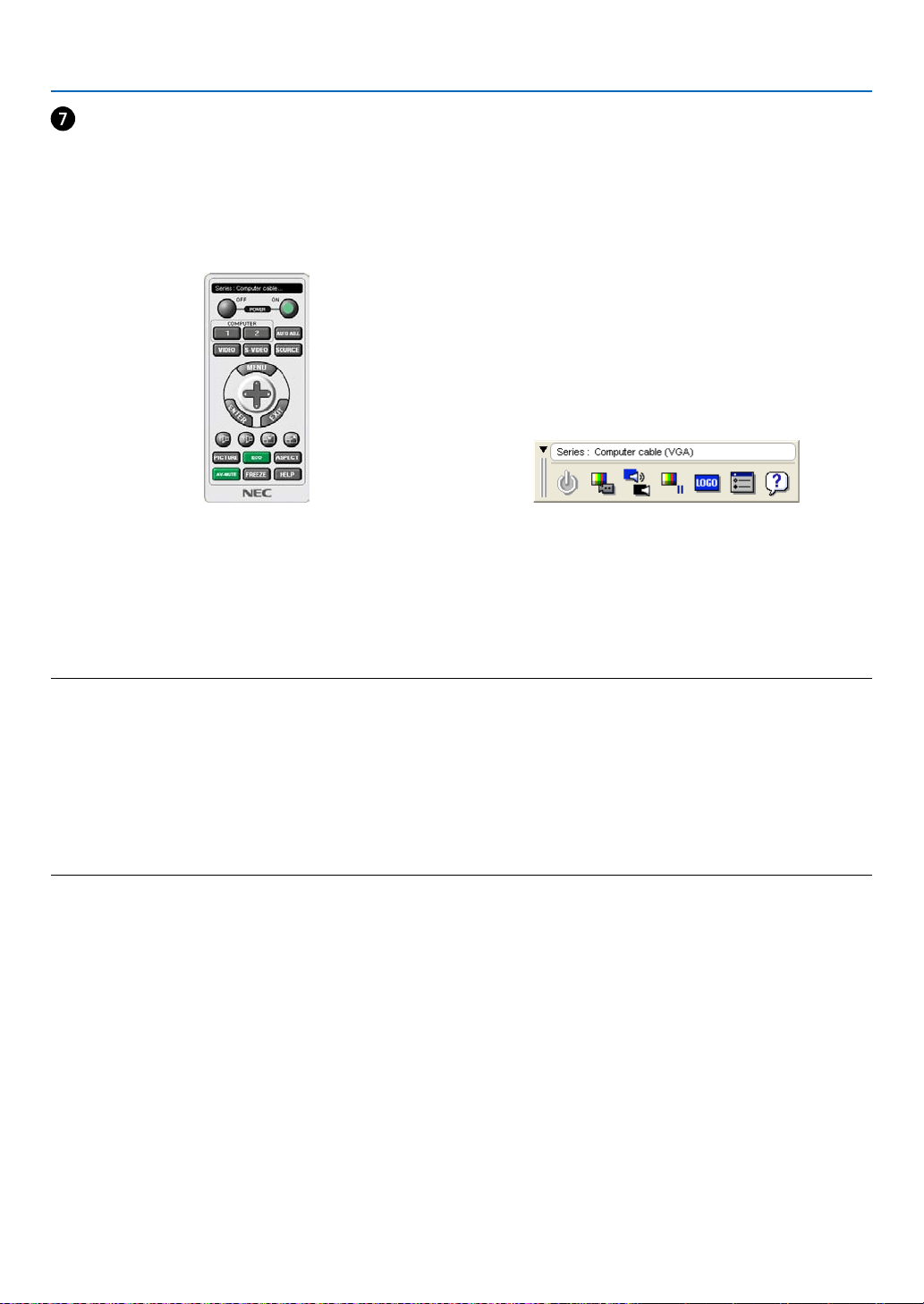
Using the utility software “Virtual Remote Tool” included on the companion NEC Projector CD-ROM, Virtual Remote
screen (or toolbar) can be displayed on your computer screen.
This will help you perform operations such as projector’s power on or off and signal selection via the computer cable
(VGA), serial cable, or USB connection.
Virtual Remote screen Toolbar
This section provides an outline of preparation for use of Virtual Remote Tool.
For information on how to use Virtual Remote Tool, see Help of Virtual Remote Tool. (→ page 38)
Step 1: Install Virtual Remote Tool on the computer. (→ page 34)
Step 2: Connect the projector to the computer. (→ page 36)
Step 3: Start Virtual Remote Tool. (→ page 37)
NOTE:
• When[COMPUTER]isselectedfromyoursourceselection,theVirtualRemotescreenorthetoolbarwillbedisplayedaswellas
your computer screen.
• Usethesuppliedcomputercable(VGA)toconnecttheCOMPUTERINconnectordirectlywiththemonitoroutputconnectorof
thecomputertouseVirtualRemoteTool.
Usingaswitcherorothercablesthanthesuppliedcomputercable(VGA)maycausefailureinsignalcommunication.
VGAcableconnector:
PinNos.12and15arerequiredforDDC/CI.
• VirtualRemoteToolmaynotworkdependingonyourcomputer’sspecicationsandversionofgraphicadaptersordrivers.
• TheLOGOtransferfunctionisnotavailableonthisseriesofprojectors.
TIP:
• Theprojector’sCOMPUTERINconnectorsupportsDDC/CI(DisplayDataChannelCommandInterface).DDC/CIisastandard
interfaceforbidirectionalcommunicationbetweendisplay/projectorandcomputer.
• VirtualRemoteToolcanbeusedwithaUSBconnection.
VirtualRemoteToolwillsupportthecontrolviaaUSBcableinOctober2012.
UpdatedVirtualRemoteToolcanbedownloadedfromourwebsite:
URL:http://www.nec-display.com/dl/en/pj_soft/lineup.html
34
4. Convenient Features
Step 1: Install Virtual Remote Tool on the computer
Supported OS
Virtual Remote Tool will run on the following operating systems.
Windows 7 Home Basic, Windows 7 Home Premium, Windows 7 Professional, Windows 7 Ultimate,
Windows 7 Enterprise, Windows Vista Home Basic, Windows Vista Home Premium,
Windows Vista Business, Windows Vista Enterprise, Windows Vista Ultimate
Windows XP Home Edition *
1
, Windows XP Professional *
1
*1: To run Virtual Remote Tool, “Microsoft .NET Framework Version 2.0 or later” is required. The Microsoft .NET
Framework Version 2.0 or later is available from Microsoft’s web page. Install the Microsoft .NET Framework
Version 2.0 or later on your computer.
NOTE:
• ToinstallVirtualRemoteTool,theWindowsuseraccountmusthave“Administrator”privilege(Windows7,WindowsVistaand
WindowsXP).
• ExitallrunningprogramsbeforeinstallingVirtualRemoteTool.Ifanotherprogramisrunning,theinstallationmaynotbecompleted.
1 Insert the accompanying NEC Projector CD-ROM into your CD-ROM drive.
The folders in NEC Projector CD-ROM will be displayed. If the folders are not displayed, right-click the CD/DVD
drive icon in Windows’ “Computer” (or “My Computer”) and select “Open”.
2 Double-click "Software", "Virtual Remote Tool" and then "32bit" or "64bit".
The "VRT.exe" icon will be displayed.
3 Double-click the "VRT.exe" icon.
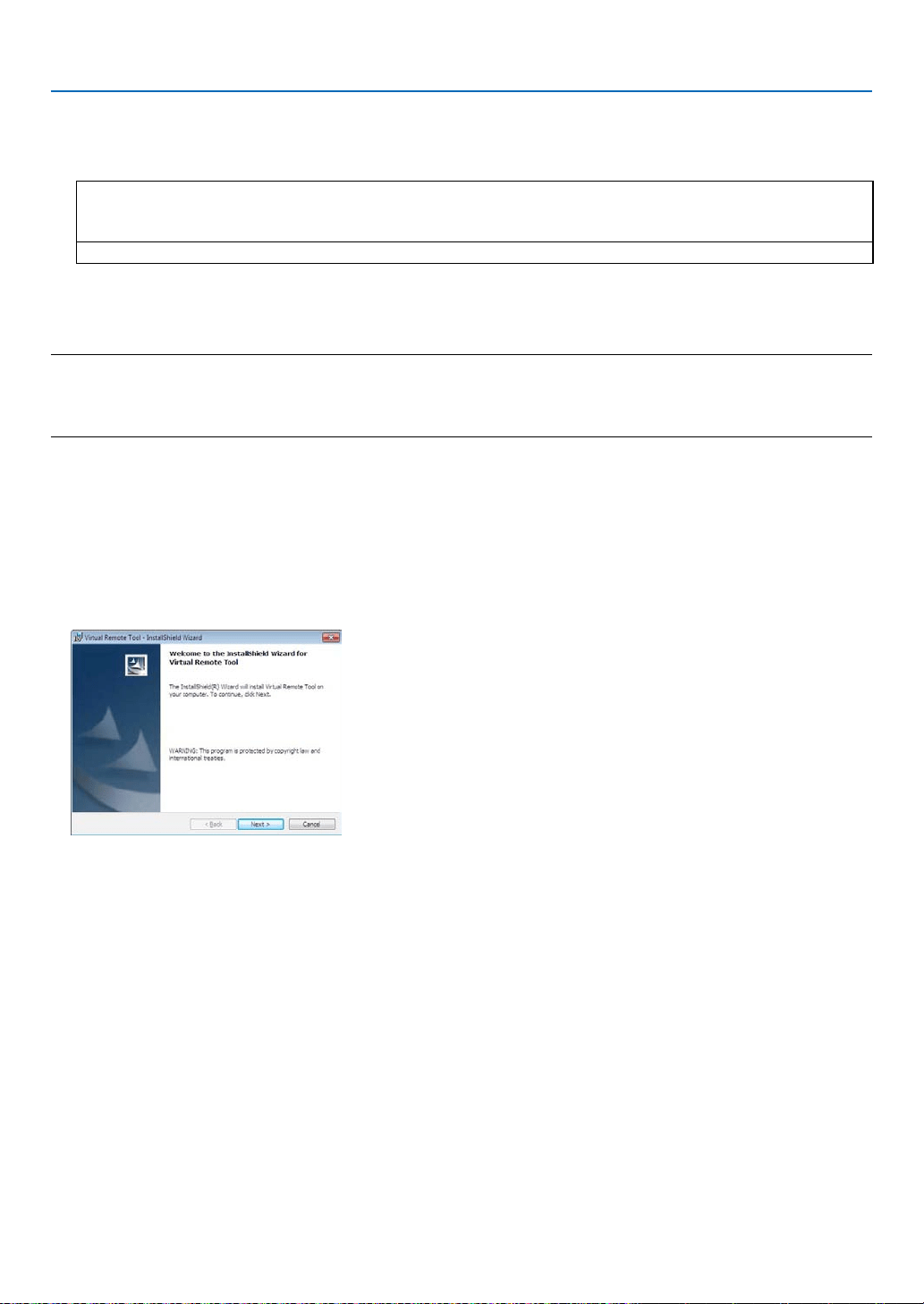
The Installer will start and the Wizard screen will appear.

35
4. Convenient Features
4 Click“Next”.
“END USER LICENSE AGREEMENT” screen will be displayed.
Read “END USER LICENSE AGREEMENT” carefully.
5 Ifyouagree,click“Iacceptthetermsinthelicenseagreement”andthenclick“Next”.
• Follow the instructions on the installer screens to complete the installation.
36
4. Convenient Features
TIP:
Uninstalling Virtual Remote Tool
Preparation:
Exit Virtual Remote Tool before uninstalling. To uninstall Virtual Remote Tool, the Windows user account must have
“Administrator” privilege (Windows 7 and Windows Vista) or “Computer Administrator” privilege (Windows XP).
• For Windows 7/Windows Vista
1 Click“Start”andthen“ControlPanel”.
The Control Panel window will be displayed.
2 Click“Uninstallaprogram”under“Programs”
The “Programs and Features” window will be displayed.
3 Select Virtual Remote Tool and click it.
4 Click“Uninstall/Change”or“Uninstall”.
• When the “User Account Control” windows is displayed, click “Continue”.
Follow the instructions on the screens to complete the uninstallation.
• For Windows XP
1 Click“Start”andthen“ControlPanel”.
The Control Panel window will be displayed.
2 Double-click“Add/RemovePrograms”.
The Add / Remove Programs window will be displayed.
3 ClickVirtualRemoteToolfromthelistandthenclick“Remove”.
Follow the instructions on the screens to complete the uninstallation.
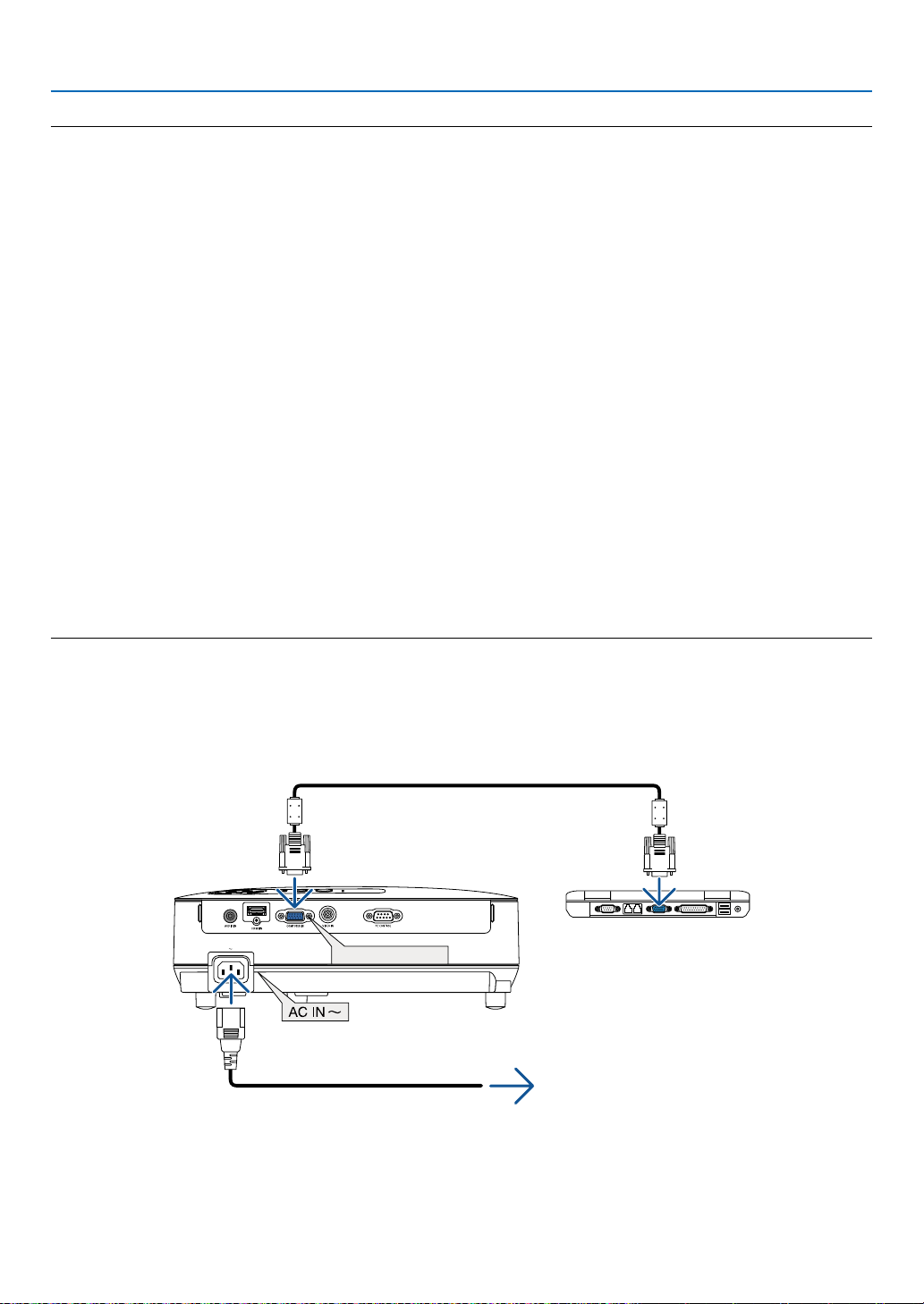
Step 2: Connect the projector to the computer
1 Use the supplied computer cable (VGA) to connect the COMPUTER IN connector of the projector directly
with the monitor output connector of the computer.
2 Connect the supplied power cord to the AC IN of the projector and the wall outlet.
The projector is in the standby condition.
COMPUTER IN
TIP:
• WhenVirtualRemoteToolstartsforthersttime,“EasySetup”windowwillbedisplayedtonavigateyourconnections.
Supplied computer cable (VGA)
To wall outlet
Power cord (supplied)
37
4. Convenient Features
Step 3: Start Virtual Remote Tool
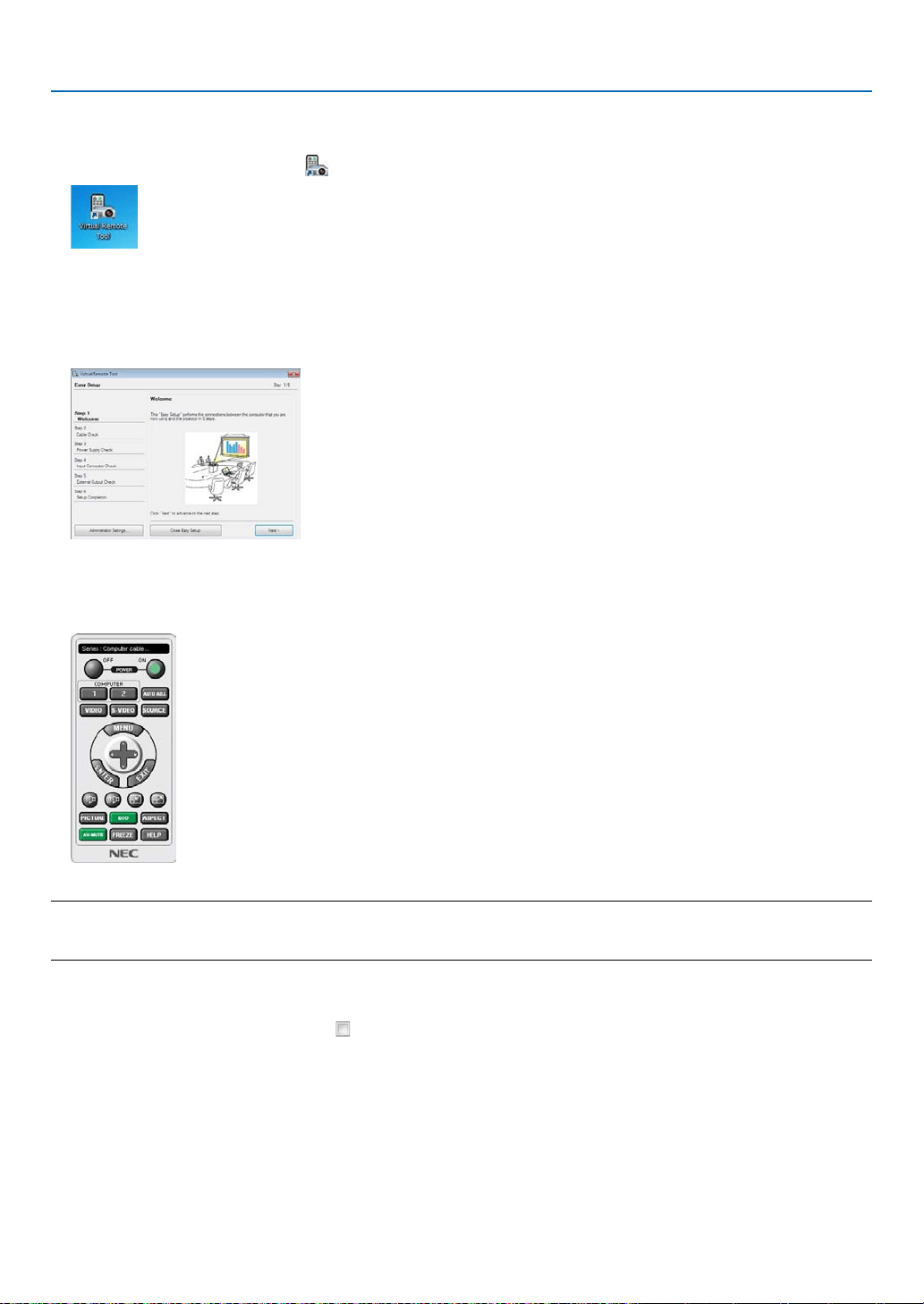
Start using the shortcut icon
• Double-clicktheshortcuticon on the Windows Desktop.
Start from the Start menu
• Click[Start]→ [All Programs] or [Programs] → [NEC Projector User Supportware] → [Virtual Remote Tool]
→ [Virtual Remote Tool].
When Virtual Remote Tool starts for the rst time, “Easy Setup” window will be displayed.
Follow the instructions on the screens
When “Easy Setup” is completed, the Virtual Remote Tool screen will be displayed.
NOTE:
• When[NORMAL]isselectedfor[STANDBYMODE]fromthemenu,theprojectorcannotbeturnedonviathecomputercable
(VGA)connectionandUSBconnection(VE282X/VE282).
TIP:
• TheVirtualRemoteToolscreen(orToolbar)canbedisplayedwithoutdisplaying“EasySetup”window.
Todoso,clicktoplaceacheckmarkfor“
DonotuseEasySetupnexttime”onthescreenatStep6in“EasySetup”.
38
4. Convenient Features
Exiting Virtual Remote Tool
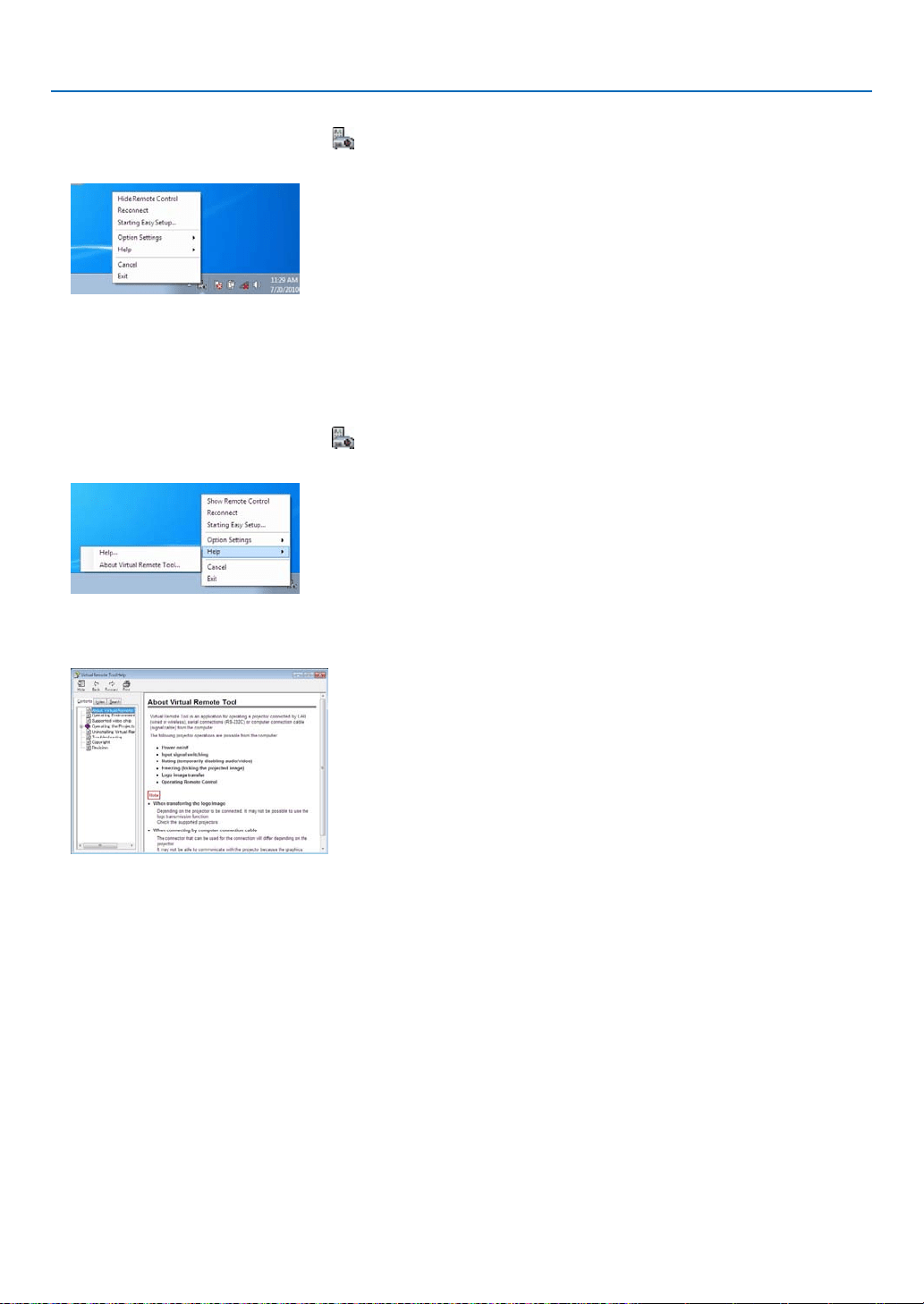
1 Click the Virtual Remote Tool icon on the Taskbar.
The pop-up menu will be displayed.
2 Click“Exit”.
The Virtual Remote Tool will be closed.
Viewing the help le of Virtual Remote Tool
• Displaying the help le using the taskbar
1 Click the Virtual Remote Tool icon
on the taskbar when Virtual Remote Tool is running.
The pop-up menu will be displayed.
2. Click“Help”.
The Help screen will be displayed.
• Displaying the help le using the Start Menu.
1. Click“Start”.“Allprograms”or“Programs”.“NECProjectorUserSupportware”.“VirtualRemoteTool”.and
then“VirtualRemoteToolHelp”inthisorder.
The Help screen will be displayed.
39
4. Convenient Features
Viewing 3D Images
The projector provides 3D images to a user wearing optional LCD shutter eyeglasses (NP02GL)
CAUTION
Health precautions
Before viewing, be sure to read health care precautions that may be found in the user’s manual included with your
LCD shutter eyeglasses or your 3D compatible content such as DVDs, video games, computer's video les and
the like.
To avoid any adverse symptoms, heed the following:
- Do not use LCD shutter eyeglasses for viewing any material other than 3D images.
- Allow a distance of 2 m/7 feet or greater between the screen and a user. Viewing 3D images from too close a
distance can strain your eyes.
- Avoid viewing 3D images for a prolonged period of time. Take a break of 15 minutes or longer after every hour
of viewing.
- If you or any member of your family has a history of light-sensitive seizures, consult a doctor before viewing 3D
images.
- While viewing 3D images, if you get sick such as nausea, dizziness, queasiness, headache, eyestrain, blurry
vision, convulsions, and numbness, stop viewing them. If symptoms still persist, consult a doctor.
- View 3D images from the front of the screen. Viewing from an angle may cause fatigue or eyestrain.
LCD shutter eyeglasses (recommended)
• Optional eyeglasses (NP02GL)
You can also use commercially available DLP
®
Link compatible LCD shutter eyeglasses.
Steps for viewing 3D images on the projector
1. Connect the projector to your video equipment.
2. Turn on the projector, display the on-screen menu, and then select [ON] for the 3D mode.
For the operating procedure to turn on the 3D mode, refer to "On-screen menu for 3D images" on the following
page.
3. Play your 3D compatible content and use the projector to display the image.
4. Put on your LCD shutter eyeglasses to view 3D images.
Also refer to the user's manual accompanied with your LCD shutter eyeglasses for more information.
40
4. Convenient Features
On-screen menu for 3D images
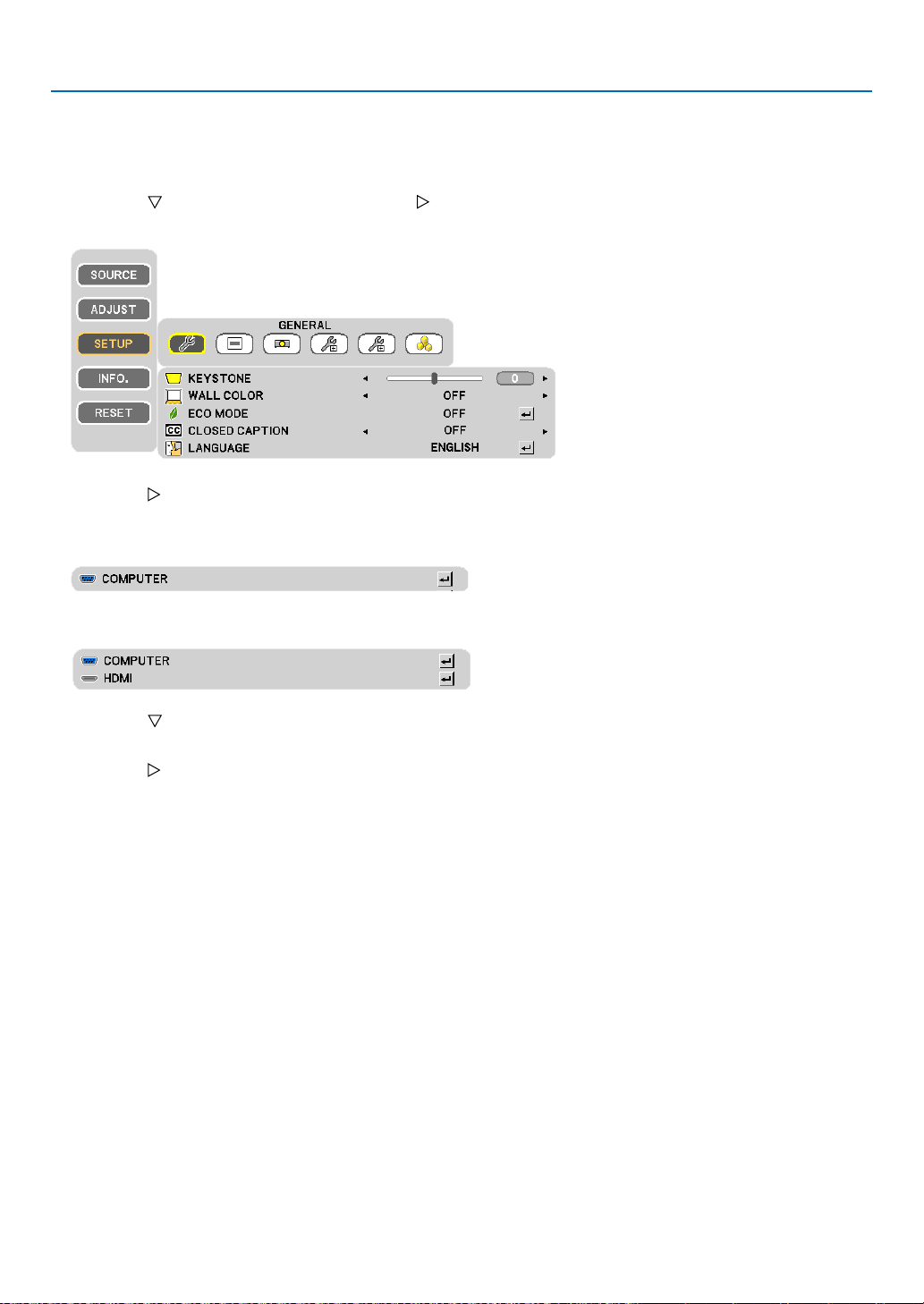
Follow the steps to display the 3D menu.
1. Press the MENU button.
The On-screen menu will be displayed.
2. Press the
button twice, and then press the button.
The [SETUP] menu will be displayed.
3. Press the button five times.
The [3D] menu will be displayed
[VE280X/VE280]
[VE281X/VE281/VE282X/VE282]
4. Press the button to select a signal and press the ENTER button.
5. Press the
button to select [ON].
The menu will disappear.

41
4. Convenient Features
Selecting input connected to a source of 3D images [COMPUTER] (VE280X/VE280)/[COMPUTER/HDMI]
(VE281X/VE281/VE282X/VE282)
This function switches the 3D mode between ON and OFF for each input.
NOTE:
Toconrmthatthesupported3Dsignalisaccepted,useeitherwayofthefollowing:
- Makesurethat[3D]isdisplayedinthetoprightofthescreenafterthesourceisselected.
- Display[INFO.]→[SOURCE(2)]→[3DSIGNAL]andmakesurethat"SUPPORTED"isdisplayed.
NOTE:
• Themaximumdistanceforviewing3Dimagesis10m/394inchesfromthescreensurfaceunderthefollowingrestrictions:
-Brightnessontheprojector:2000lumensorgreater
-Screengain:1
-Viewingposition:Facingstraighttowardsthescreencenter
- Outside light: None
-LCDshuttereyeglasses:Usingtheoptional3DGoggles(NP02GL)
• If3DcontentisplayedbackonyourcomputerandtheperformanceispooritmaybecausedbytheCPUorgraphicschip.Inthis
caseyoumayhavedifcultyseeingthe3Dimagesastheywereintended.Checktoseeifyourcomputermeetstherequirements
providedinyouruser'smanualincludedwithyour3Dcontent.
• TheDLP
®
LinkcompatibleLCDshuttereyeglassesallowyoutoview3Dimagesbyreceivingsynchsignals,whichareincludedin
lefteyeandrighteyeimages,reectedfromthescreen.Dependingonenvironmentsorconditionssuchastheambientbrightness,
screensizeorviewingdistance,theLCDshuttereyeglassesmayfailtoreceivesynchsignals,causingpoor3Dimages.
• Whenthe3Dmodeisenabled,theKeystonecorrectionrangewillbenarrower.
• Whenthe3Dmodeisenabled,thefollowingsettingsareinvalid.
[WALLCOLOR],[PRESET]
• Refertothe[SOURCE]screenunderthe[INFO.]menuforinformationonwhethertheinputsignalis3Dcompatible.
• Signalsotherthanthoselistedin"CompatibleInputSignalList"onpage74willbeoutofrangeorwillbedisplayedin2D.
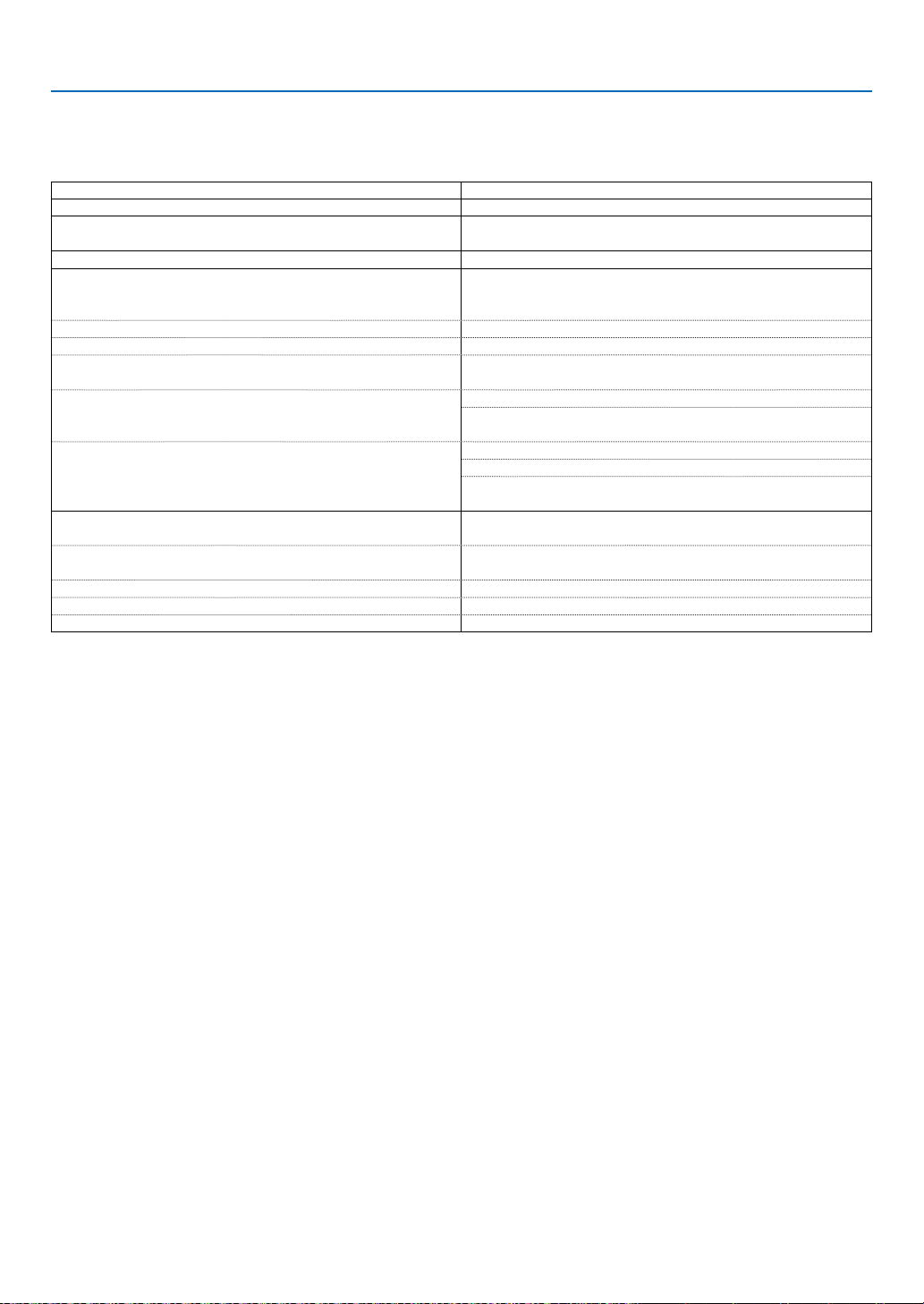
42
4. Convenient Features
Troubleshooting on viewing 3D images
If images will not be displayed in 3D or 3D images appear as 2D, check the following table. Also refer to the user's
manual accompanied with your 3D content or LCD shutter eyeglasses.
Possible causes Solutions
• The content you are playing back is not compatible with 3D. • Play back a content compatible with 3D.
• The 3D mode was turned off for the selected source.
• Use the projector's menu to turn on 3D mode for the selected
source. (→ page 61)
• You are not using our recommended LCD shutter eyeglasses.
• Use our recommended LCD shutter eyeglasses. (→ page 39)
• If the shutter of your LCD shutter eyeglasses cannot synchronize
with the currently projected source, the following are possible
causes:
- Your LCD shutter eyeglasses are not switched on. • Switch on your LCD shutter eyeglasses.
- The battery in the LCD shutter eyeglasses ran down. • Recharge the battery or replace it.
- The correct eyeglass method is not selected.
• Change the eyeglass method for 3D by using the menu.. (→
page 61)
- The viewing distance between the viewer and the screen is
too far.
• Move closer to the screen until the viewer gets 3D images.
• Or use the projector's menu to select [NON-INVERT] for [L/R
INVERT].
- There are bright light sources or other projectors near the
viewer.
• Keep light sources or other projectors away from the viewer.
• Do not look toward a bright light source.
• Or use the projector's menu to select [NON-INVERT] for [L/R
INVERT].
• If your computer is not set for 3D viewing, the following are
possible causes:
- Your computer does not meet the requirements for 3D
viewing.
• Check to see if your computer meets the requirements provided
in your user's manual included with your 3D content.
- Your computer is not set for 3D output. • Set your computer for 3D output.
- The resolution of output signal is out of range. • Select the resolution of output signal supporting 3D.
- The refresh rate of output signal is out of range. • Change the refresh rate to 120Hz.
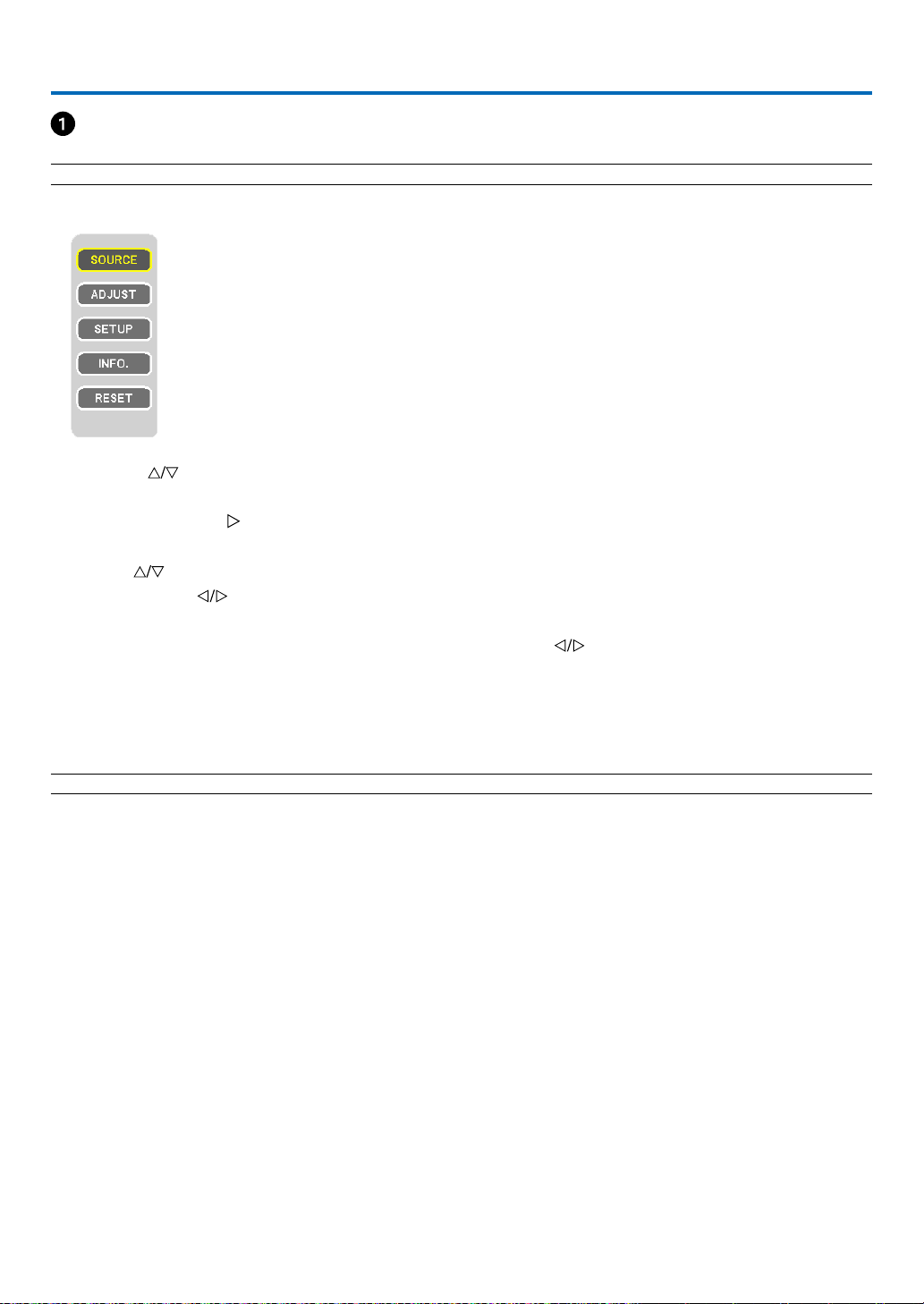
43
5. Using On-Screen Menu
Using the Menus
NOTE: The on-screen menu may not be displayed correctly while interlaced motion video image is projected.
1. Press the MENU button on the remote control to display the menu.
2. Press the buttons on the remote control to display the submenu.
3. Press the ENTER or
button on the remote control to highlight the top item or the first tab.
4. Use the
buttons on the remote control to select the item you want to adjust or set.
You can use the
buttons on the remote control to select the tab you want.
5. Adjust the level or turn the selected item on or off by using the
buttons on the remote control.
Changes are stored until adjusted again.
6. Repeat steps 2 -5 to adjust an additional item, or press the EXIT button on the remote control to quit the
menu display.
NOTE: When a menu or message is displayed, several lines of information may be lost, depending on the signal or settings.
7. Press the MENU button to close the menu.
To return to the previous menu, press the EXIT button.
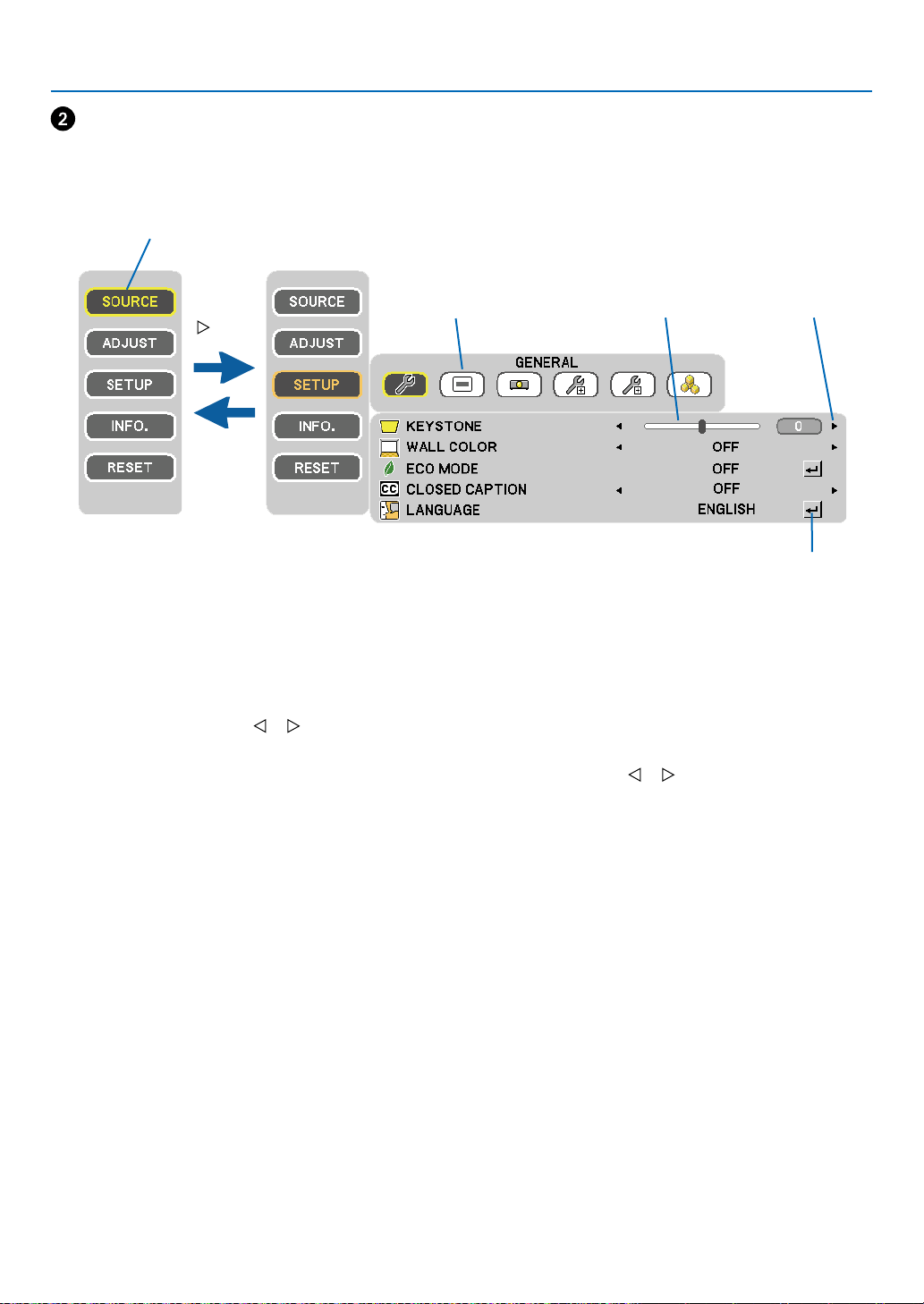
44
5. Using On-Screen Menu
Menu Elements
Menu windows or dialog boxes typically have the following elements:
Highlight ����������������������������� Indicates the selected menu or item�
Solid triangle ����������������������Indicates further choices are available� A highlighted triangle indicates the item is active�Press the
or button on the remote control�
Tab �������������������������������������Indicates a group of features in a dialog box� Selecting on any tab brings its page to the front�
Slide bar �����������������������������Indicates settings or the direction of adjustment� Press the
or button on the remote control�
ENTER icon �������������������������Indicates further choices are available� Press the ENTER button on the remote control to display
further menu items�
Main menu
ENTER button
or
button
EXIT button
Highlight
Tab Slide bar Solid triangle
ENTER icon
Main menu + Sub menu
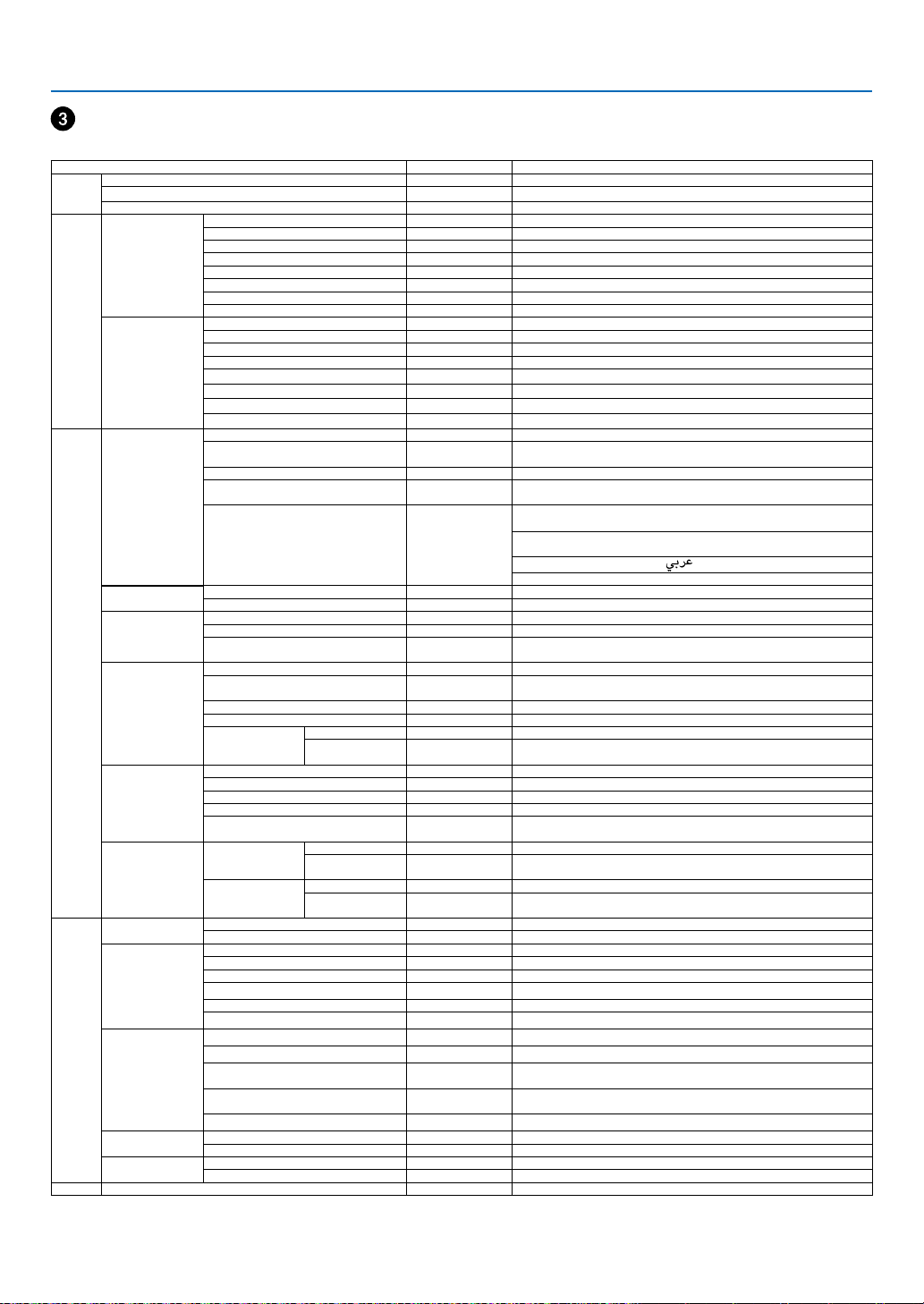
45
5. Using On-Screen Menu
List of Menu Items
Some menu items are not available depending on the input source.
Menu Item Default Options
SOURCE
COMPUTER *
VIDEO *
HDMI (VE281X/VE281/VE282X/VE282) *
ADJUST
PICTURE
PRESET * HIGH-BRIGHT, PRESENTATION, VIDEO, MOVIE, GRAPHIC, sRGB
CONTRAST
BRIGHTNESS
SHARPNESS
COLOR
HUE
GAMMA CORRECTION DYNAMIC, NATURAL, BLACK DETAIL
DYNAMIC CONTRAST OFF OFF, ON
IMAGE OPTIONS
CLOCK *
PHASE *
HORIZONTAL *
VERTICAL *
OVERSCAN AUTO AUTO, OFF, ON
ASPECT RATIO * AUTO, 4:3, 16:9, 15:9, 16:10, WIDE ZOOM, NATIVE
POSITION 0 -16 to +16
NOISE REDUCTION OFF OFF, LOW, MEDIUM, HIGH
SETUP
GENERAL
KEYSTONE 0 -40° to +40°
WALL COLOR OFF
OFF, WHITEBOARD, BLACKBOARD, BLACKBOARD (GRAY), LIGHT
YELLOW, LIGHT BLUE, LIGHT ROSE
ECO MODE OFF OFF, ON
CLOSED CAPTION OFF
OFF, CAPTION1, CAPTION2, CAPTION3, CAPTION4, TEXT1, TEXT2,
TEXT3, TEXT4
LANGUAGE ENGLISH
ENGLISH, DEUTSCH, FRANÇAIS, ITALIANO, ESPAÑOL, SVENSKA, 日
本語
DANSK, PORTUGUÊS, ČEŠTINA, MAGYAR, POLSKI,
NEDERLANDS, SUOMI
NORSK, TÜRKÇE, РУССКИЙ,
, Ελληνικά, 中文, 한국어
ROMÂNĂ, HRVATSKA, БЪЛГАРСКИ, INDONESIA, , ไทย
MENU
ECO MESSAGE OFF OFF, ON
BACKGROUND LOGO BLUE, BLACK, LOGO
INSTALLATION
ORIENTATION DESKTOP FRONT DESKTOP FRONT, CEILING REAR, DESKTOP REAR, CEILING FRONT
CONTROL PANEL LOCK OFF OFF, ON
COMMUNICATION SPEED (VE280X/
VE280/VE281X/VE281)
38400bps 4800bps, 9600bps, 19200bps, 38400bps
OPTIONS(1)
FAN MODE AUTO AUTO, HIGH, HIGH ALTITUDE
COLOR SYSTEM AUTO AUTO, NTSC3.58, NTSC4.43, PAL, PAL-M, PAL-N, PAL60, SECAM
WXGA MODE OFF OFF, ON
BEEP ON OFF, ON
HDMI SETTINGS
(VE281X/VE281/
VE282X/VE282)
VIDEO LEVEL NORMAL AUTO, NORMAL, ENHANCED
AUDIO SELECT
HDMI HDMI, AUDIO IN
OPTIONS(2)
STANDBY MODE NORMAL NORMAL, NETWORK STANDBY
DIRECT POWER ON OFF OFF, ON
AUTO POWER ON (COMP.) OFF OFF, ON
AUTO POWER OFF
*1
0:30 OFF, 0:05, 0:10, 0:15, 0:20, 0:30, 1:00
DEFAULT SOURCE SELECT LAST
VE280X/VE280: LAST, AUTO, COMPUTER, VIDEO
VE281X/VE281/VE282X/VE282: LAST, AUTO, COMPUTER, HDMI, VIDEO
3D
COMPUTER
(DETAIL
SETTINGS)
3D OFF OFF, ON
L/R INVERT NON-INVERT NON-INVERT, INVERT
HDMI (DETAIL
SETTINGS) (VE281X/
VE281/VE282X/VE282)
3D OFF OFF, ON
L/R INVERT
NON-INVERT NON-INVERT, INVERT
INFO.
USAGE TIME
LAMP HOURS USED
TOTAL CARBON SAVINGS
SOURCE(1)
RESOLUTION
HORIZONTAL FREQUENCY
VERTICAL FREQUENCY
SYNC TYPE
SYNC POLARITY
SCAN TYPE
SOURCE(2)
SIGNAL TYPE
VIDEO TYPE
BIT DEPTH (VE281X/VE281/VE282X/
VE282)
VIDEO LEVEL (VE281X/VE281/VE282X/
VE282)
3D SIGNAL
VERSION
FIRMWARE
DATA
OTHERS
MODEL NO.
SERIAL NUMBER
RESET ALL DATA
* The asterisk (*) indicates that the default setting varies depending on the signal.
*1 AUTO POWER OFF: This item can be selected only when [NORMAL] is selected for [STANDBY MODE].
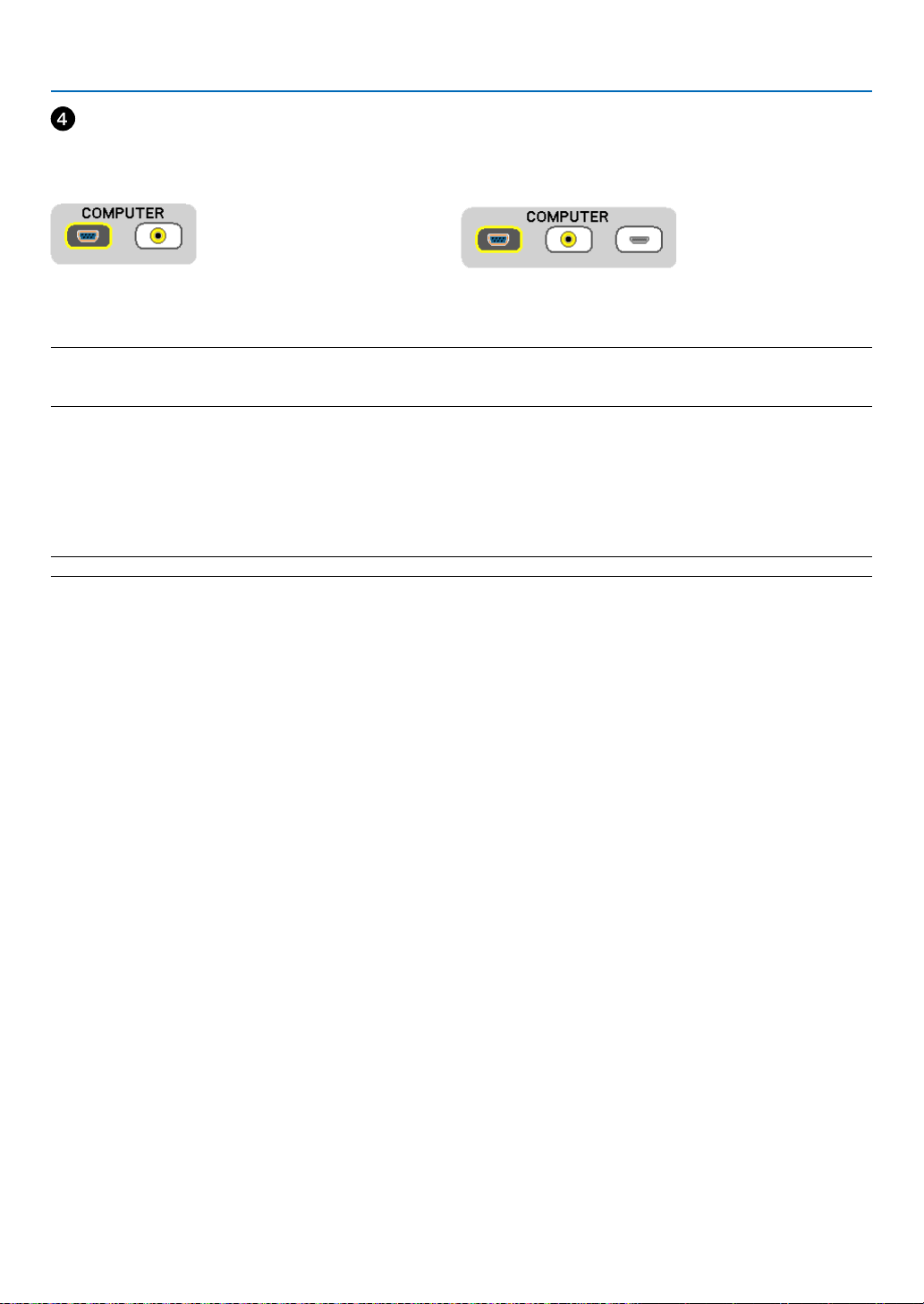
46
5. Using On-Screen Menu
Menu Descriptions & Functions [SOURCE]
[VE280X/VE280] [VE281X/VE281/VE282X/VE282]
COMPUTER
Selects the computer connected to your COMPUTER IN input connector.
NOTE:
• WhenthecomponentinputsignalisconnectedtotheCOMPUTERINconnector,select[COMPUTER].
• TheprojectorwilldetermineiftheinputsignalisRGBorcomponentsignal.
HDMI (VE281X/VE281/VE282X/VE282)
Selects the HDMI compatible equipment connected to your HDMI IN connector.
VIDEO
Selects what is connected to your VIDEO input-VCR, DVD player or document camera.
NOTE:Aframemayfreezeforabriefperiodoftimewhenavideoisplayedbackinfast-forwardorfast-rewindwithaVideosource.
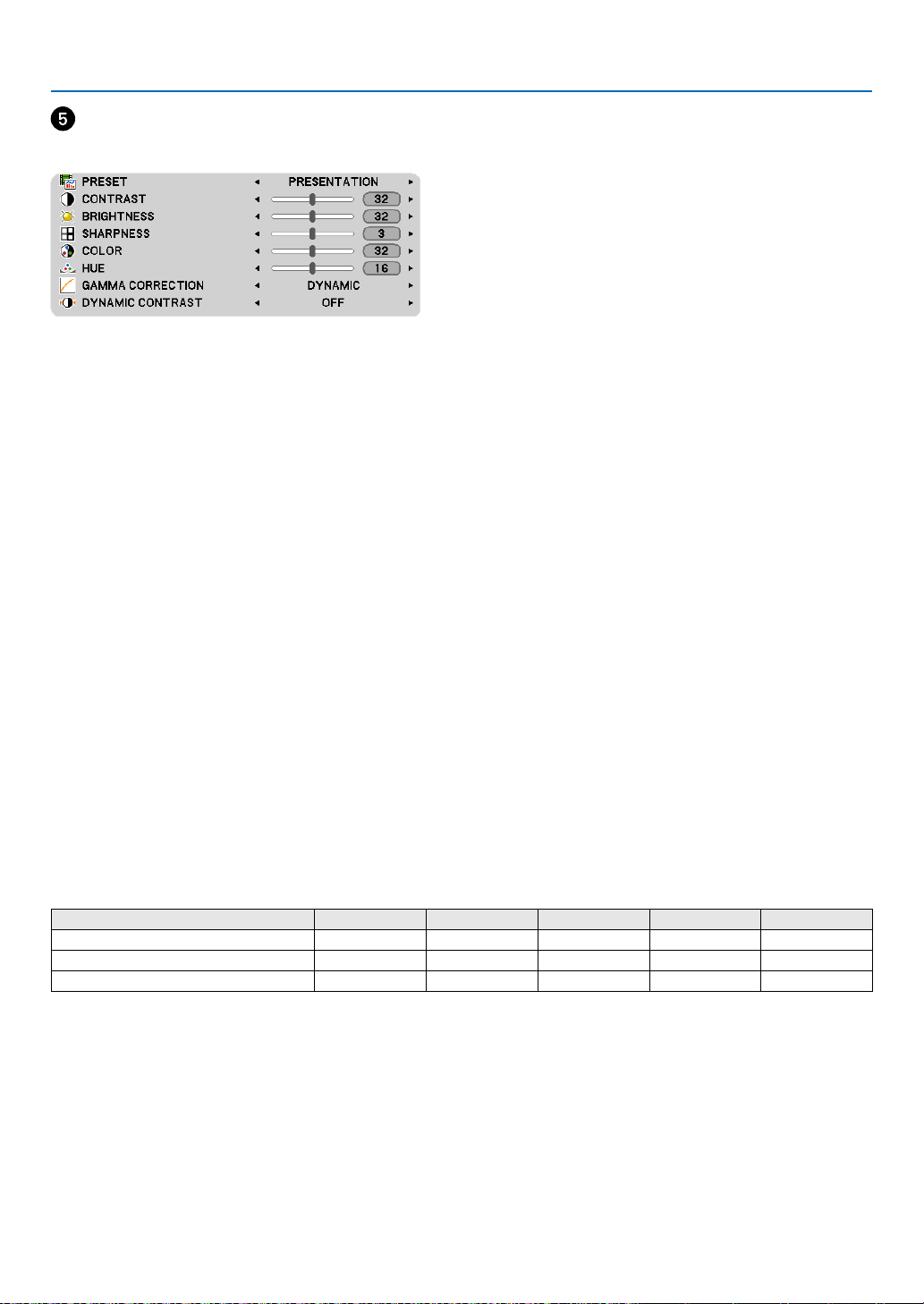
47
5. Using On-Screen Menu
Menu Descriptions & Functions [ADJUST]
[PICTURE]
[PRESET]
This function allows you to select optimized settings for your projected image.
There are six factory presets optimized for various types of images.
HIGH-BRIGHT �������� Recommended for use in a brightly lit room�
PRESENTATION ����� Recommended for making a presentation using a PowerPoint le.
VIDEO �������������������� Recommended for typical TV program viewing�
MOVIE ������������������� Recommended for movies�
GRAPHIC ��������������� Recommended for graphics�
sRGB ��������������������� Standard color values
[CONTRAST]
Adjusts the intensity of the image according to the incoming signal.
[BRIGHTNESS]
Adjusts the brightness level or the back raster intensity.
[SHARPNESS]
Controls the detail of the image.
[COLOR]
Increases or decreases the color saturation level.
[HUE]
Varies the color level from +/− green to +/− blue. The red level is used as reference.
Input signal CONTRAST BRIGHTNESS SHARPNESS COLOR HUE
COMPUTER/HDMI (RGB) Yes Yes Yes No No
COMPUTER/HDMI (COMPONENT) Yes Yes Yes Yes Yes
VIDEO/COMPONENT Yes Yes Yes Yes Yes
HDMI: VE281X/VE281/VE282X/VE282 only
Yes = Adjustable, No = Not adjustable

48
5. Using On-Screen Menu
[GAMMA CORRECTION]
Each mode is recommended for:
DYNAMIC �������������� Creates a high-contrast picture�
NATURAL �������������� Natural reproduction of the picture�
BLACK DETAIL ������� Emphasizes detail in dark areas of the picture�
[DYNAMIC CONTRAST]
Turning on [DYNAMIC CONTRAST] allows the contrast ratio to be adjusted to the proper level.
NOTE:
• Whenthefollowingstatesoccur,the[DYNAMICCONTRAST]cannotbechosen.
•When[PRESET]isnot[HIGH-BRIGHT].
•When[ECOMODE]is[ON].
•When[FANMODE]isnot[AUTO].
•When[WALLCOLOR]isnot[OFF].
•When[CLOSEDCAPTION]is[ON].
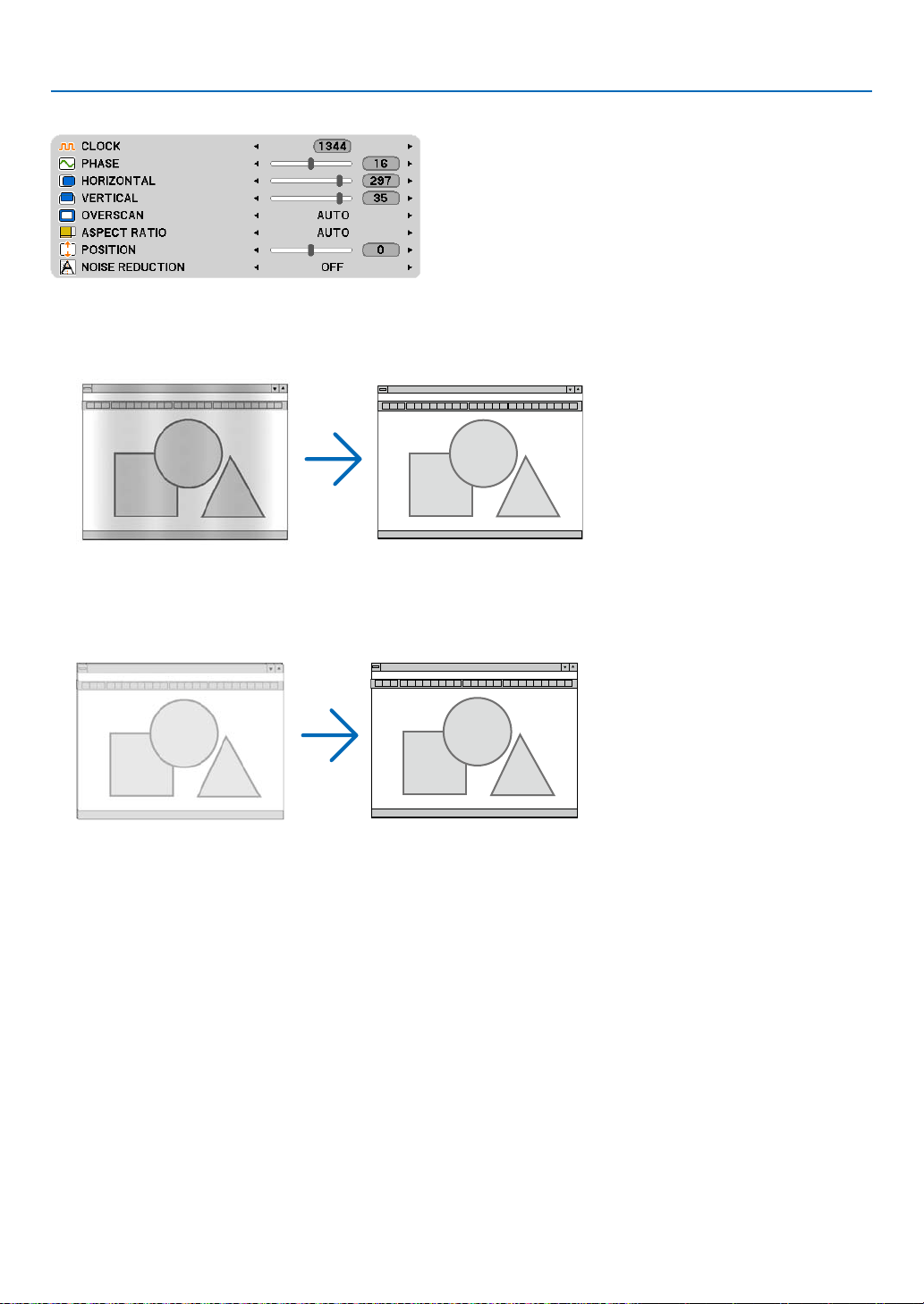
49
5. Using On-Screen Menu
[IMAGE OPTIONS]
Adjusting Clock and Phase [CLOCK/PHASE]
This allows you to manually adjust CLOCK and PHASE.
CLOCK ������������������� Use this item to ne tune the computer image or to remove any vertical banding that might appear. This
function adjusts the clock frequencies that eliminate the horizontal banding in the image�
This adjustment may be necessary when you connect your computer for the rst time.
PHASE ������������������� Use this item to adjust the clock phase or to reduce video noise, dot interference or cross talk� (This is
evident when part of your image appears to be shimmering�)
Use [PHASE] only after the [CLOCK] is complete�
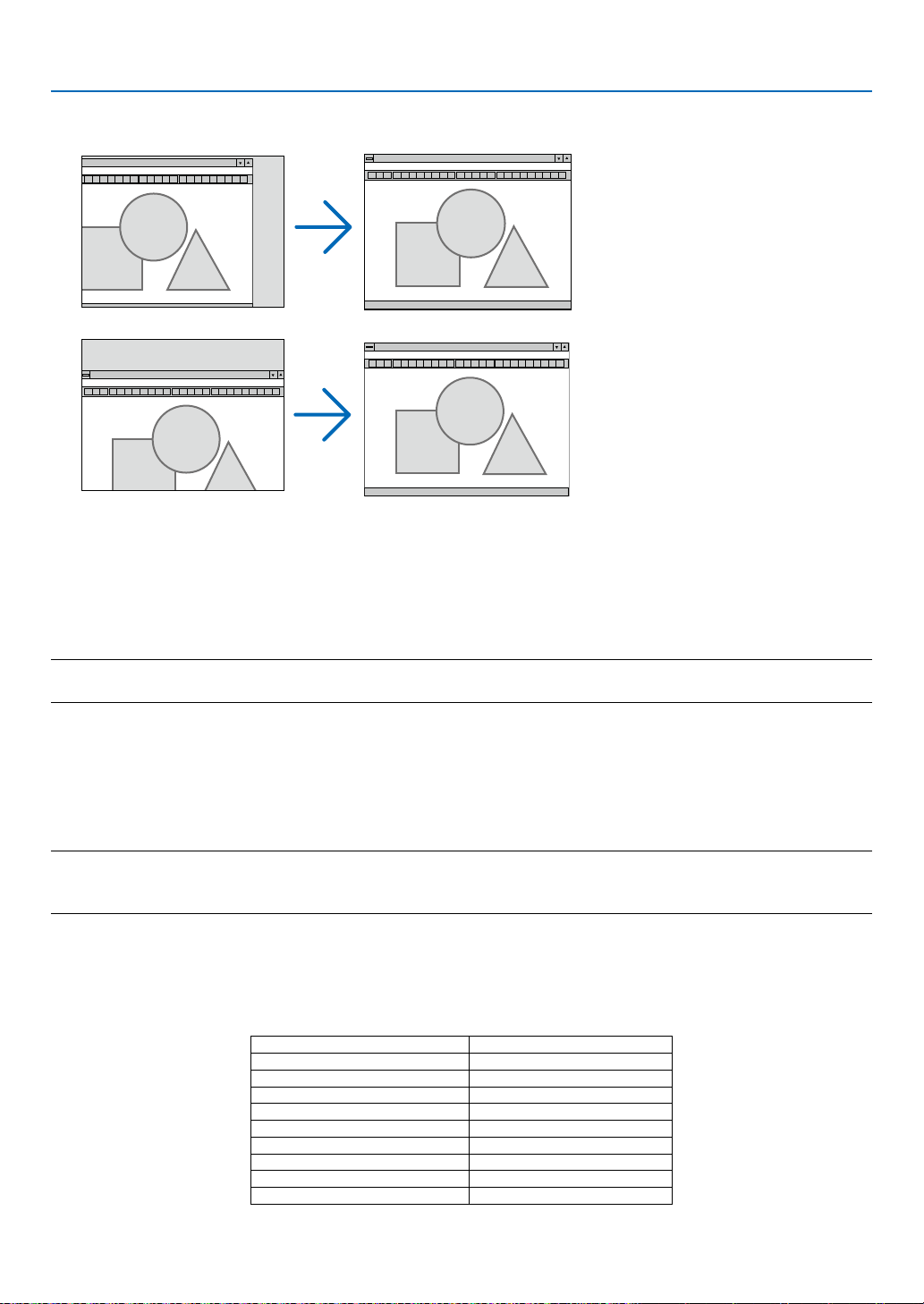
50
5. Using On-Screen Menu
Adjusting Horizontal/Vertical Position [HORIZONTAL/VERTICAL]
Adjusts the image location horizontally and vertically.
- An image can be distorted during the adjustment of [CLOCK] and [PHASE]. This is not a malfunction.
- Your manual adjustments for [CLOCK], [PHASE], [HORIZONTAL], and [VERTICAL] will be stored in memory
for the current signal. The next time you project the signal with the same resolution, horizontal and vertical
frequency, its adjustments will be called up and applied.
To delete adjustments stored in memory, from the menu, you select [RESET] → [ALL DATA] and reset the
adjustments.
NOTE:
• The[RESET]→[ALLDATA]clearnotonly[IMAGEOPTION].(→page 64)
Selecting Overscan Percentage [OVERSCAN]
This allows you to set the appropriate overscan for an incoming signal.
AUTO ��������������������� Display an appropriately overscanned image ( factory setting)�
OFF ������������������������ Does not overscan the image�
ON ������������������������� Overscans the image�
NOTE:
• The[OVERSCAN]cannotbeselectedwhenVIDEOsignalsareused.
• The[OVERSCAN]itemisnotavailablewhen[NATIVE]isselectedfor[ASPECTRATIO].
Selecting Aspect Ratio [ASPECT RATIO]
The term “aspect ratio” refers to the ratio of width to height of a projected image.
The projector automatically determines the incoming signal and displays it in its appropriate aspect ratio.
• This table shows typical resolutions and aspect ratios that most computers support.
Resolution Aspect Ratio
VGA 640 x 480 4:3
SVGA 800 x 600 4:3
XGA 1024 x 768 4:3
WXGA 1280 x 768 15:9
WXGA 1280 x 800 16:10
WXGA+ 1440 x 900 16:10
SXGA 1280 x 1024 5:4
SXGA+ 1400 x 1050 4:3
UXGA 1600 x 1200 4:3
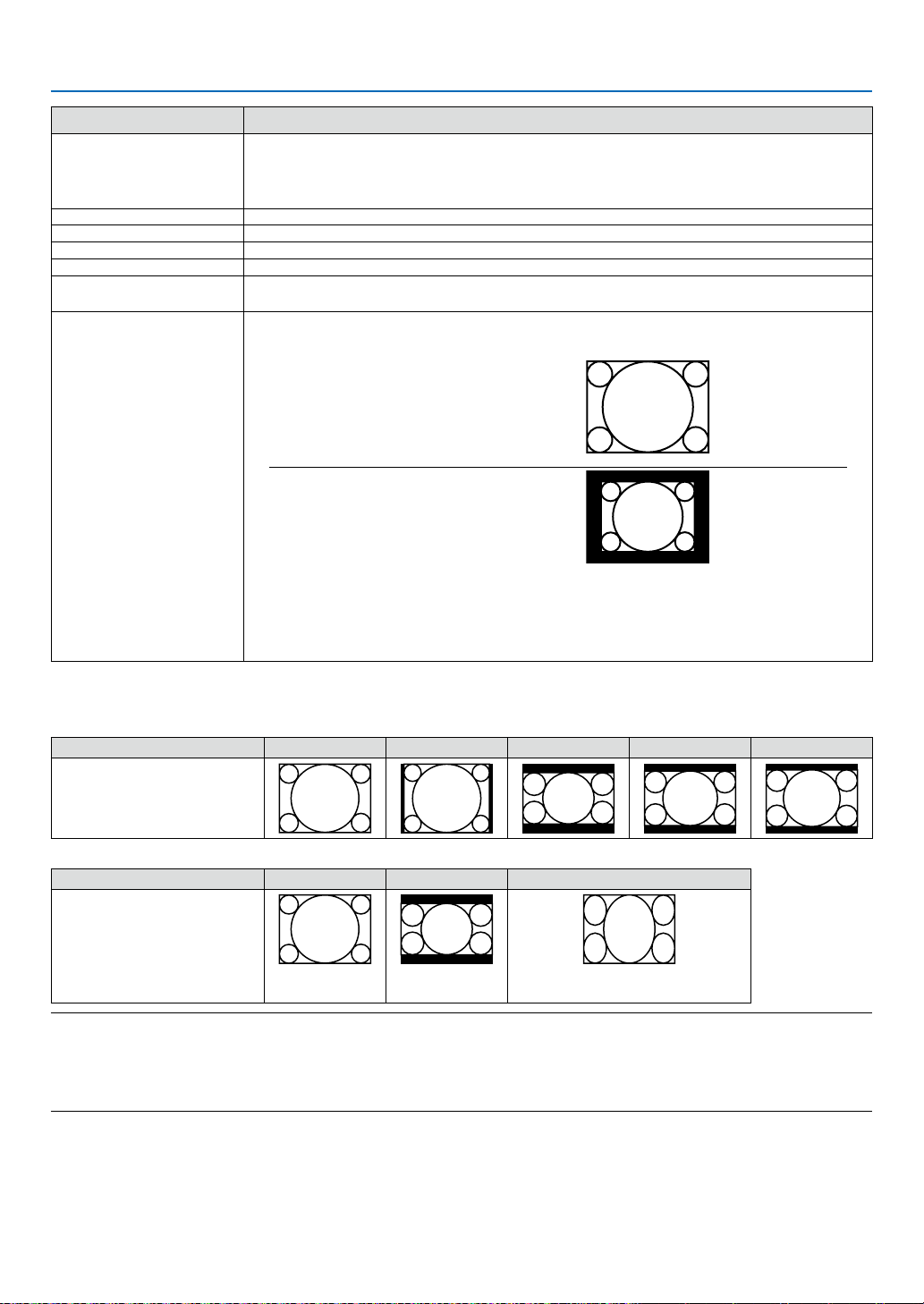
51
5. Using On-Screen Menu
Options Function
AUTO The projector will automatically determine the incoming signal and display it in its aspect
ratio.
The projector may erroneously determine the aspect ratio depending on its signal. If this
occurs, select the appropriate aspect ratio from the following.
4:3 The image is displayed in 4:3 aspect ratio.
16:9 The image is displayed in 16:9 aspect ratio.
15:9 The image is displayed in 15:9 aspect ratio.
16:10 The image is displayed in 16:10 aspect ratio.
WIDE ZOOM The image is stretched left and right.
Parts of the displayed image are cropped at the left and right edges and therefore not visible.
NATIVE The projector displays the current image in its true resolution when the incoming computer
signal has a lower resolution than the projector’s native resolution.
[Example 1] When the incoming
signal with the resolution of 800 x 600
is displayed on the VE280/VE281/
VE282:
[Example 2] When the incoming
signal with the resolution of 800 x 600
is displayed on the VE280X/VE281X/
VE282X:
NOTE:
• Whenanon-computersignalisdisplayed,the[NATIVE]isnotavailable.
• WhenyouaredisplayinganRGBimagewithahigherresolutionthantheprojector'snative
resolutionsuchasSXGA,theimagewillbedisplayedintheprojector’snativeresolution(XGA
orSVGA)evenif[NATIVE]isselected.
Sample image when the appropriate aspect ratio is automatically determined
[Computer signal]
Aspect ratio of incoming signal 4:3 5:4 16:9 15:9 16:10
Sample image when the
appropriate aspect ratio is
automatically determined
[Video signal]
Aspect ratio of incoming signal 4:3 Letterbox Squeeze
Sample image when the aspect
ratio is automatically determined
NOTE:To display a squeezed signal
properly,select[16:9]or[WIDEZOOM].
TIP:
• Theterm“letterbox”referstoamorelandscape-orientedimagewhencomparedtoa4:3image,whichisthestandardaspectratio
for a video source.
Theletterboxsignalhasaspectratioswiththevistasize“1.85:1”orcinemascopesize“2.35:1”formovielm.
• Theterm“squeeze”referstothecompressedimageofwhichaspectratioisconvertedfrom16:9to4:3.
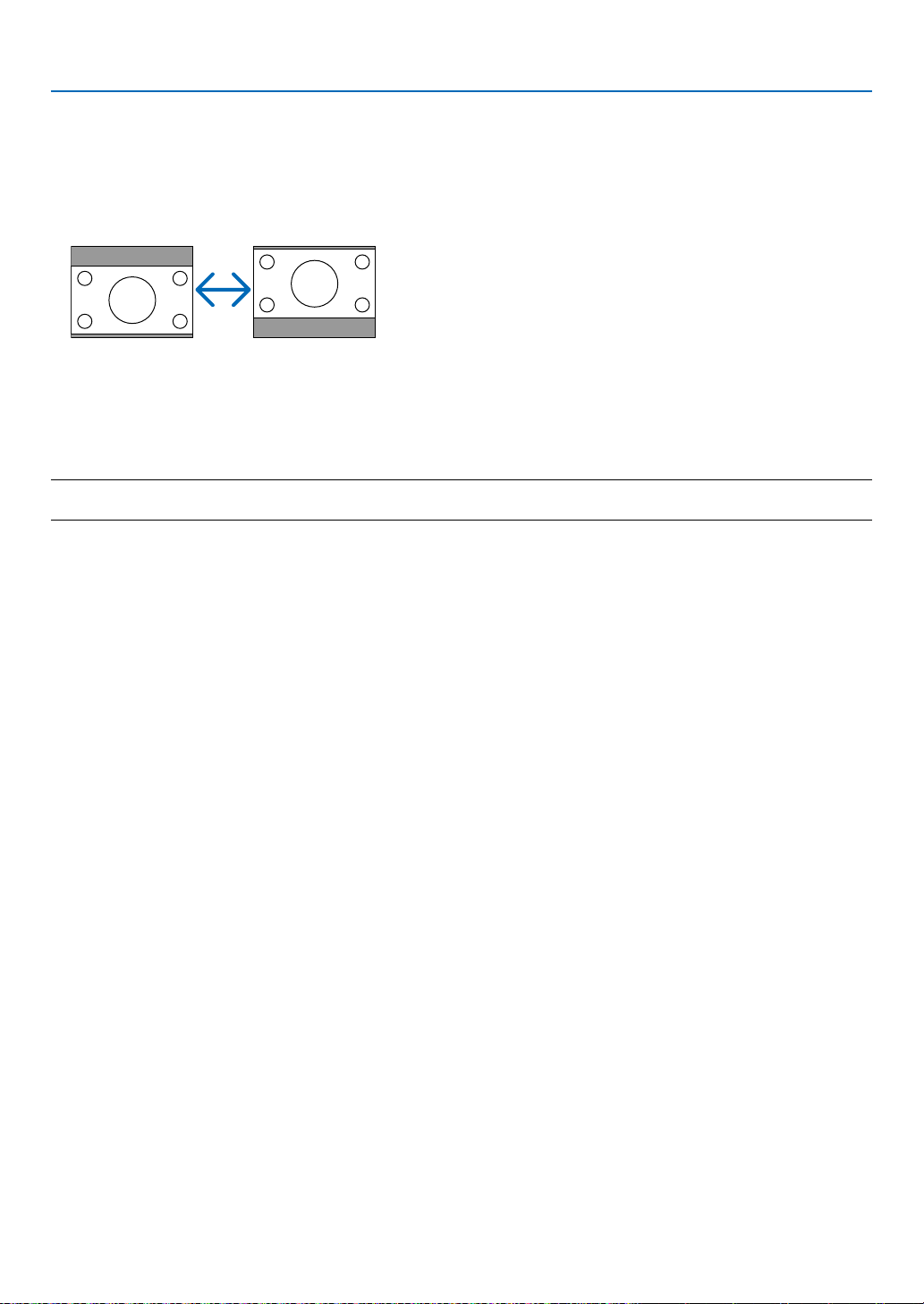
52
5. Using On-Screen Menu
Adjusting the Vertical Position of Image [POSITION]
(only when [16:9], [15:9], or [16:10] is selected for [ASPECT RATIO])
When [16:9], [15:9], or [16:10] is selected in [ASPECT RATIO], the image is displayed with black borders on the top
and bottom.
You can adjust the vertical position from the top to the bottom of the black area.
Turning on Noise Reduction [NOISE REDUCTION]
This function allows you to select the level of noise reduction.
The projector is set to the optimized level for each signal at the factory.
Select your preference item for your signal when video noise is noticeable.
The options are [OFF], [LOW], [MEDIUM], and [HIGH].
NOTE:ThisfeatureisnotavailablefortheRGBsignal.Noisereductionsettooffgivesbestimagequalitybywayofhigherbandwidth.
Noise reduction set to on softens the image.
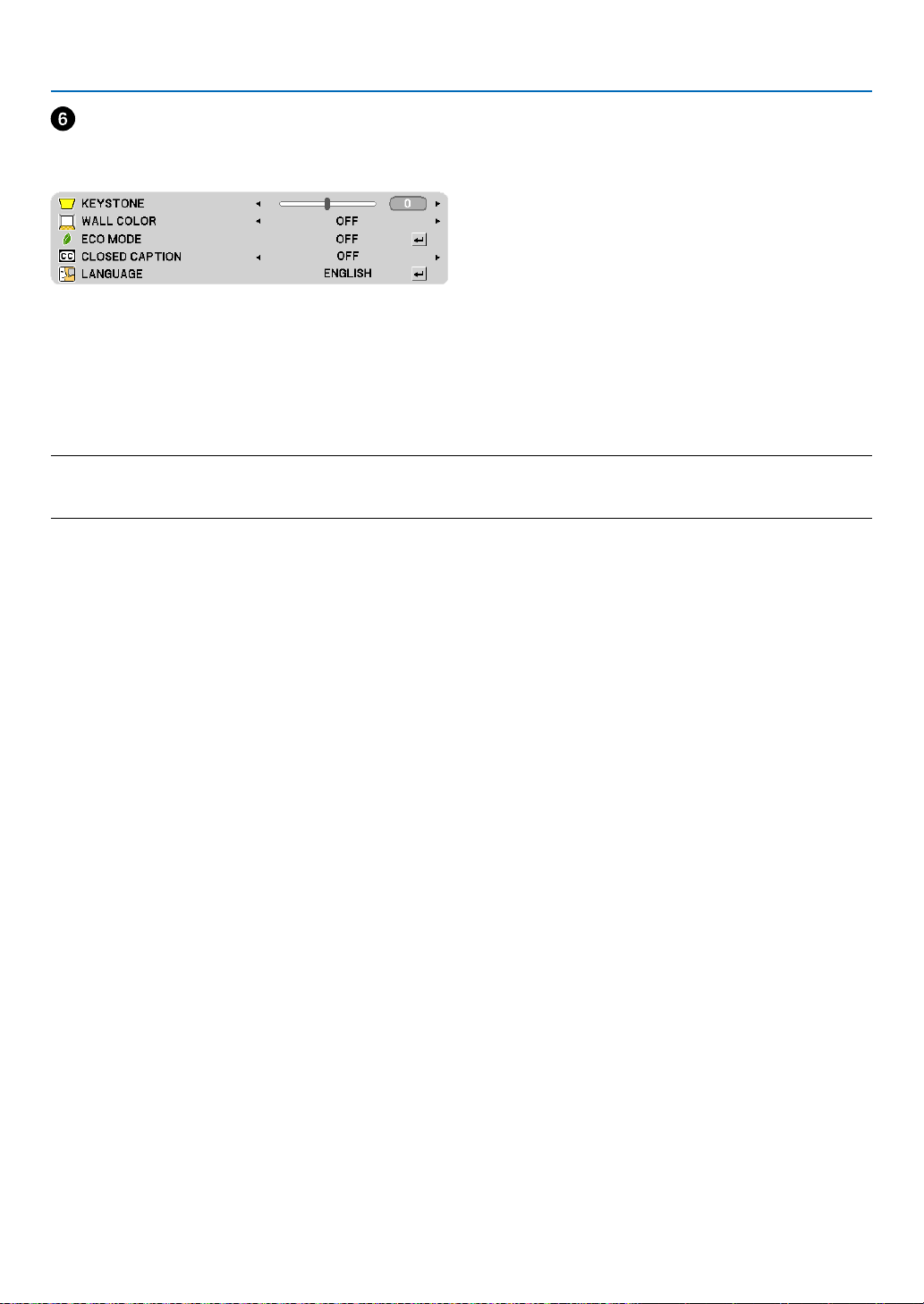
53
5. Using On-Screen Menu
Menu Descriptions & Functions [SETUP]
[GENERAL]
Correcting Vertical Keystone Distortion Manually [KEYSTONE]
You can correct vertical distortion manually. (→ page 23)
Using the Wall Color Correction [WALL COLOR]
This function allows for quick adaptive color correction in applications where the screen material is not white.
NOTE:
• Selectingcoloroptionsotherthan[OFF]willreducebrightness.
• Whenthe3Dmodeisenabled,the[WALLCOLOR]itemisnotavailable.

54
5. Using On-Screen Menu
Setting Eco Mode [ECO MODE]
This feature turns on or off the ECO mode. The lamp life can be extended by selecting [ON]. Selecting [ON] also
decreases fan noise when compared to [OFF] mode.
ECO MODE Description Status of LAMP indicator
OFF
This is the Default setting
(100% Brightness).
Off
ON
Select this mode to increase the lamp life
(approx. 80% Brightness.)
Steady Green light
NOTE:
• The[LAMPHOURSUSED]canbecheckedin[USAGETIME].Select[INFO.]→[USAGETIME].(→ page 62)
• Theprojectorwillalwaysenterintothe[ECOMODE][ON]conditionfor90secondsimmediatelyaftertheprojectoristurnedon.
Thelampconditionwillnotbeaffectedevenwhen[ECOMODE]ischangedwithinthistimeperiod.
• Afteralapseof45secondsfromwhentheprojectordisplaysablue,blackorlogoscreen,[ECOMODE]willautomaticallyswitch
to[ON].Theprojectorwillreturntothe[OFF]modeonceasignalisaccepted.
• Iftheprojectorbecomesoverheatedin[OFF]modebecauseofuseinahigh-temperatureroom,theremaybeacasewherethe
[ECOMODE]automaticallychangesto[ON]modetoprotecttheprojector.Thismodeiscalled“forcedECOmode”.Whenthe
projectorisin[ON]mode,thepicturebrightnessdecreases.TheLAMPindicator’ssteadylightindicatestheprojectorisin[ON]
mode.Whentheprojectorcomesbacktonormaltemperature,the[ECOMODE]returnsto[OFF]mode.
Setting Closed Caption [CLOSED CAPTION]
This option sets several closed caption modes that allow text to be superimposed on the projected image of Video.
OFF ������������������������ This exits the closed caption mode�
CAPTION 1-4 ��������� Text is superimposed�
TEXT 1-4 ���������������� Text is displayed�
NOTE:
• Theclosedcaptionisnotavailableunderthefollowingconditions:
- when messages or menus are displayed.
-whenanimageismagnied,frozen,ormuted.
-when[KEYSTONE]settingisnotzeroor[ASPECTRATIO]settingisnot[AUTO]or[4:3].
• Theprojectordoesnotsupportoptionalextendedcharactersforclosedcaptioning.
Selecting Menu Language [LANGUAGE]
You can choose one of 27 languages for on-screen instructions.
NOTE:Yoursettingwillnotbeaffectedevenwhen[RESET]isdonefromthemenu.
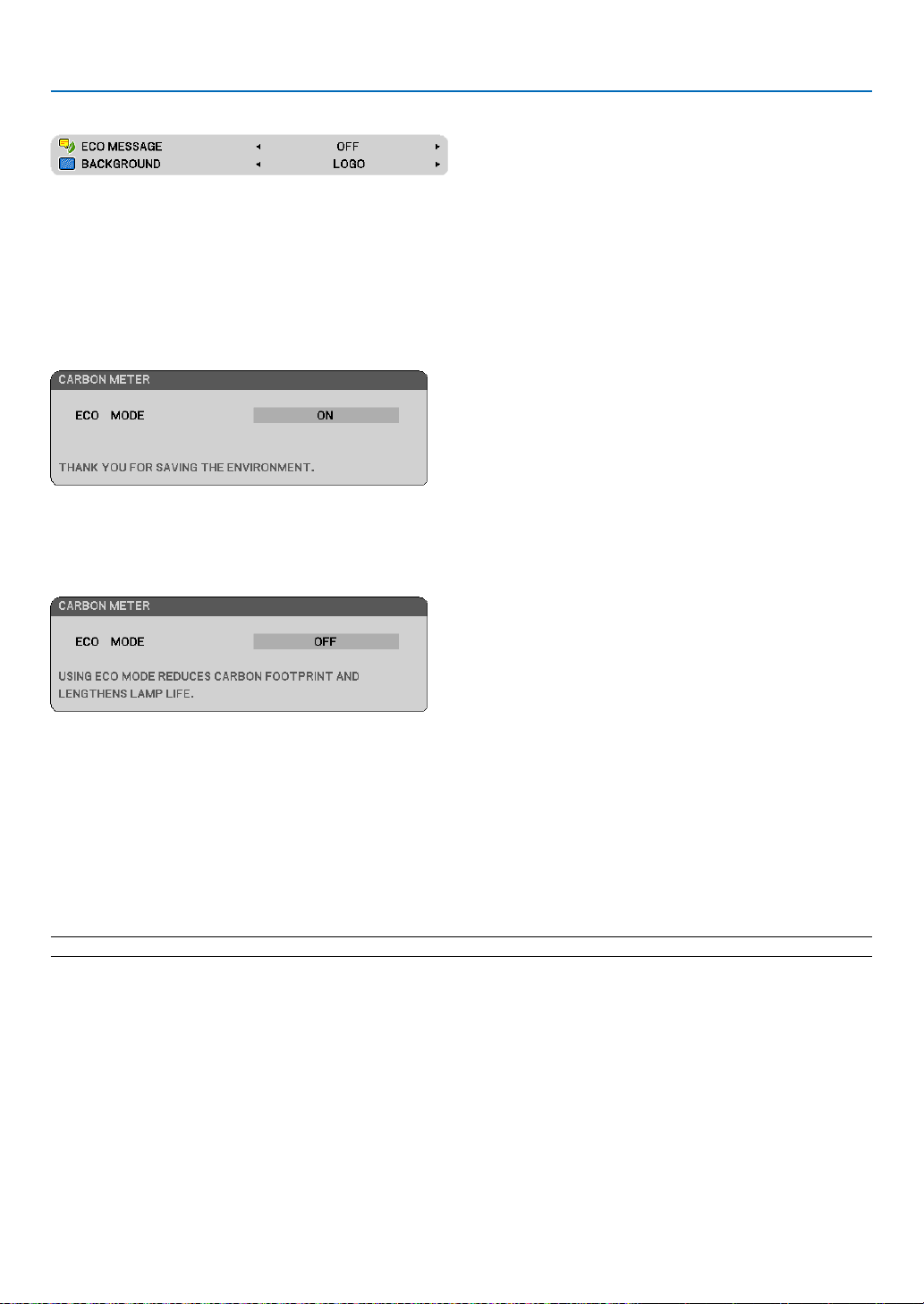
55
5. Using On-Screen Menu
[MENU]
Turning On / Off Eco Message [ECO MESSAGE]
This option turns on or off the following messages when the projector is turned on.
The Eco Message prompts the user to save energy. When [OFF] is selected for [ECO MODE], you will get a message
to prompt you to select [ON] for [ECO MODE].
When [ON] is selected for [ECO MODE]
To close the message, press the ENTER or the EXIT button. The message will disappear if no button operation is
done for 30 seconds.
When [OFF] is selected for [ECO MODE]
Pressing the ENTER button will display the [ECO MODE] screen. (→ page 54)
To close the message, press the EXIT button.
Selecting a Color or Logo for Background [BACKGROUND]
Use this feature to display a blue/black screen or logo when no signal is available. The default background is [LOGO].
TIP: The logo can be changed.
For more information about how to change the logo, please consult your NEC or NEC-designated service station.
Ifyoucannotndoneinyourarea,askyourdealer.
NOTE:Yoursettingwillnotbeaffectedevenwhen[RESET]isdonefromthemenu.
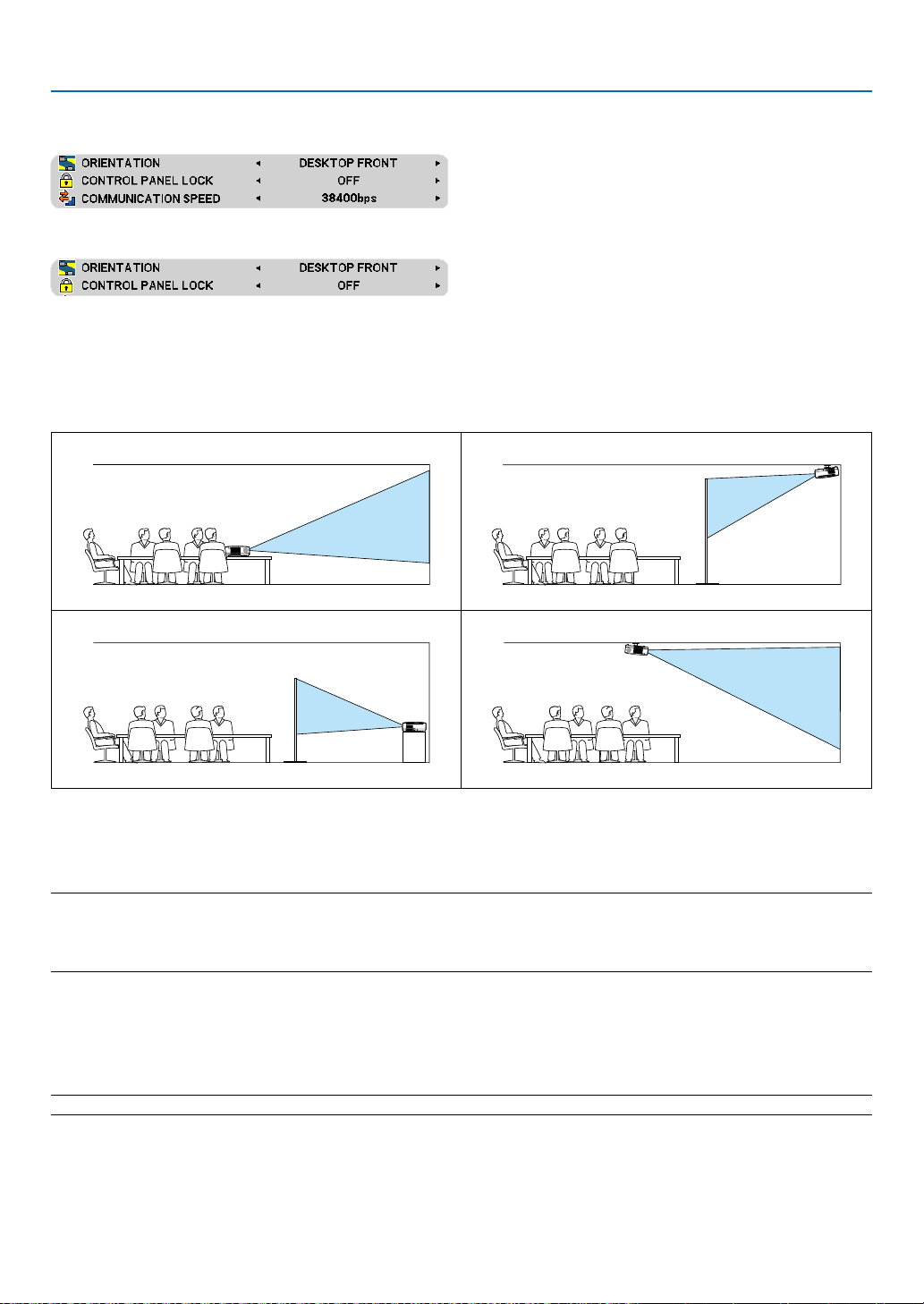
56
5. Using On-Screen Menu
[INSTALLATION]
[VE280X/VE280/VE281X/VE281]
[VE282X/VE282]
Selecting Projector Orientation [ORIENTATION]
This reorients your image for your type of projection. The options are: desktop front projection, ceiling rear projection,
desktop rear projection, and ceiling front projection.
DESKTOP FRONT
CEILING REAR
DESKTOP REAR
CEILING FRONT
Disabling the Cabinet Buttons [CONTROL PANEL LOCK]
This option turns on or off the CONTROL PANEL LOCK function.
NOTE:
• ThisCONTROLPANELLOCKdoesnotaffecttheremotecontrolfunctions.
• Whenthecontrolpanelislocked,pressingandholdingtheSOURCEbuttonontheprojectorcabinetforabout10secondswill
changethesettingto[OFF].
Selecting Communication Speed [COMMUNICATION SPEED] (VE280X/VE280/VE281X/VE281)
This feature sets the baud rate of the PC Control port (D-Sub 9P). It supports data rates from 4800 to 38400 bps.
The default is 38400 bps. Select the appropriate baud rate for your equipment to be connected (depending on the
equipment, a lower baud rate may be recommended for long cable runs).
NOTE:Yourselectedcommunicationspeedwillnotbeaffectedevenwhen[RESET]isdonefromthemenu.
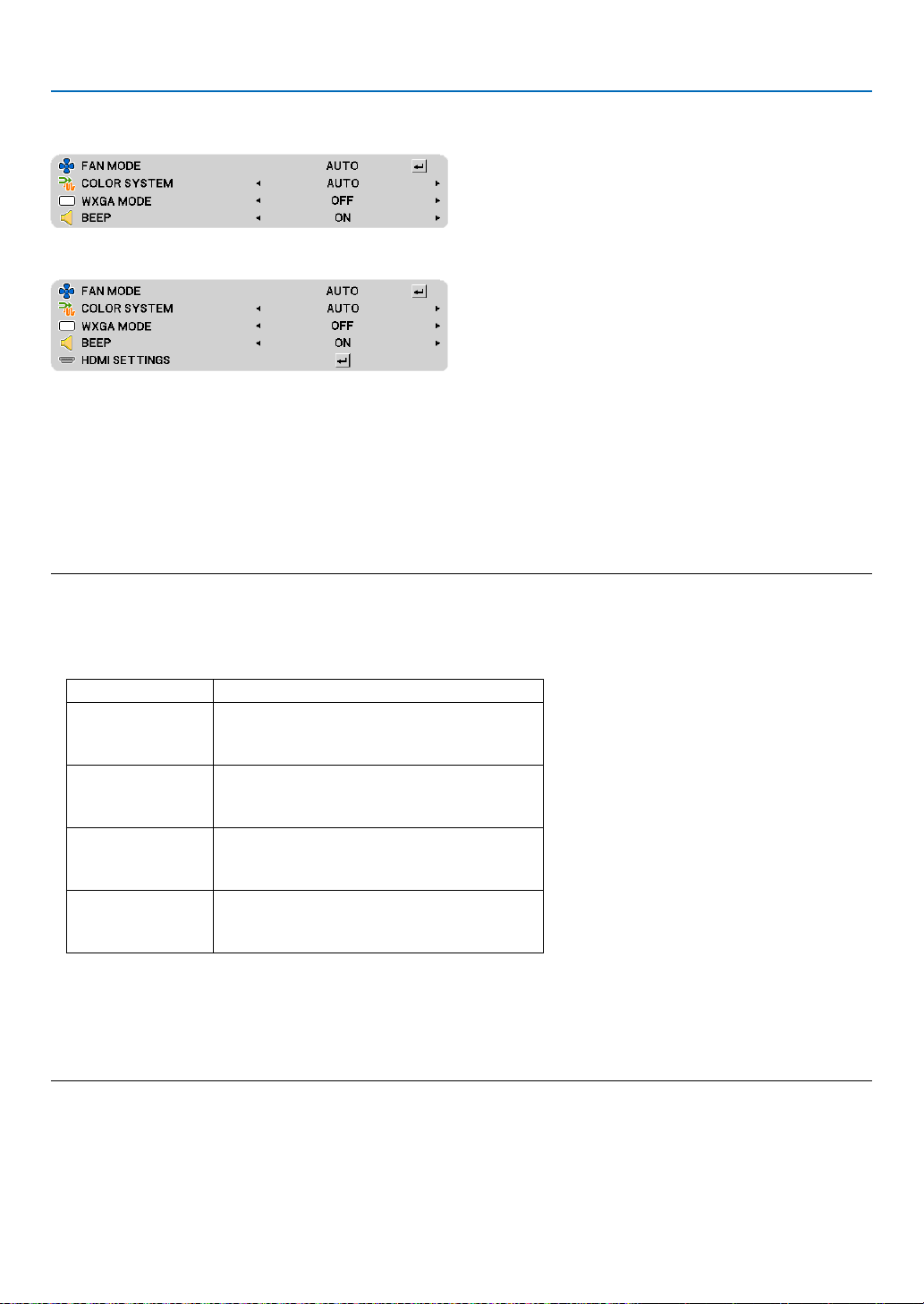
57
5. Using On-Screen Menu
[OPTIONS(1)]
[VE280X/VE280]
[VE281X/VE281/VE282X/VE282]
Selecting Fan Mode [FAN MODE]
This option allows you to select three modes for fan speed: Auto mode, High speed mode, and High Altitude mode.
AUTO ��������������������� The built-in fans automatically run at a variable speed according to the internal temperature�
HIGH ���������������������� The built-in fans run at high speed�
HIGH ALTITUDE ����� The built-in fans run at a high speed� Select this option when using the projector at altitudes approximately
1200 meters/ 4000 feet or higher�
NOTE:
• Whenyouwishtocooldownthetemperatureinsidetheprojectorquickly,select[HIGH].
• ItisrecommendedthatyouselectHighspeedmodeifyouusetheprojectornon-stopforconsecutivedays.
• Ifyouusetheprojectorataltitudesapproximately1200meters/4000feetorhigher,youarerecommendedtoset[FANMODE]
to[HIGHALTITUDE].Failuretodosomaycausetheprojectortooverheat,resultinginmalfunction.
High altitude
3700 m (12000 ft)
to
3000 m (10000 ft)
[HIGH ALTITUDE] for [FAN MODE]
5° to 35°C
(ECO MODE ON ONLY)
3000 m (10000 ft)
to
2600 m (8500 ft)
[HIGH ALTITUDE] for [FAN MODE]
5° to 40°C
(ECO MODE ON ONLY)
2600 m (8500 ft)
to
1200 m (4000 ft)
[HIGH ALTITUDE] for [FAN MODE]
5° to 40°C
1200 m (4000 ft)
to
0
[AUTO] for [FAN MODE]
5° to 40°C
• Usingtheprojectorataltitudesapproximately1200meters/4000feetorhigherwithoutsettingto[HIGHALTITUDE]cancause
the projector to overheat and the protector could shut down. If this happens, wait a couple minutes and turn on the projector.
• Usingtheprojectorataltitudeslessthanapproximately1200meters/4000feetandsettingto[HIGHALTITUDE]cancausethe
lamptoovercool,causingtheimagetoicker.Switch[FANMODE]to[AUTO].
• Usingtheprojectorathighaltitudesorinlowairpressurecanshortenthelifeofcomponents.
• Yoursettingwillnotbeaffectedevenwhen[RESET]isdonefromthemenu.
Selecting [COLOR SYSTEM]
This feature enables you to select video standards manually.
Normally select [AUTO]. Select the video standard from the pulldown menu.

58
5. Using On-Screen Menu
Enabling or Disabling WXGA Mode [WXGA MODE]
Selecting [ON] will give priority to a WXGA (1280 x 768, 1280 x 800) signal in recognizing an input signal.
When [WXGA MODE] is set to [ON], an XGA (1024 x 768) signal may not be recognized. In this case, select [OFF].
Enabling Key Sound and Error Sound [BEEP]
This feature turns on or off the button sound or alarm when the following operations are performed.
- Displaying the main menu
- Switching sources
- Pressing POWER ON or POWER OFF button
Setting HDMI [HDMI SETTINGS] (VE281X/VE281/VE282X/VE282)
Make the settings for video level and audio level when connecting HDMI equipment such as a DVD player.
VIDEO LEVEL ��������� Select [AUTO] to automatically detect video level� If automatic detection may not work well, select [NORMAL]
to disable the [ENHANCED] feature of your HDMI equipment or select [ENHANCED] to improve image contrast
and increase detail in the dark areas�
AUDIO SELECT ������ Select [HDMI] to switch the HDMI IN digital audio signal and select [AUDIO IN] to switch the AUDIO IN
input audio signal�
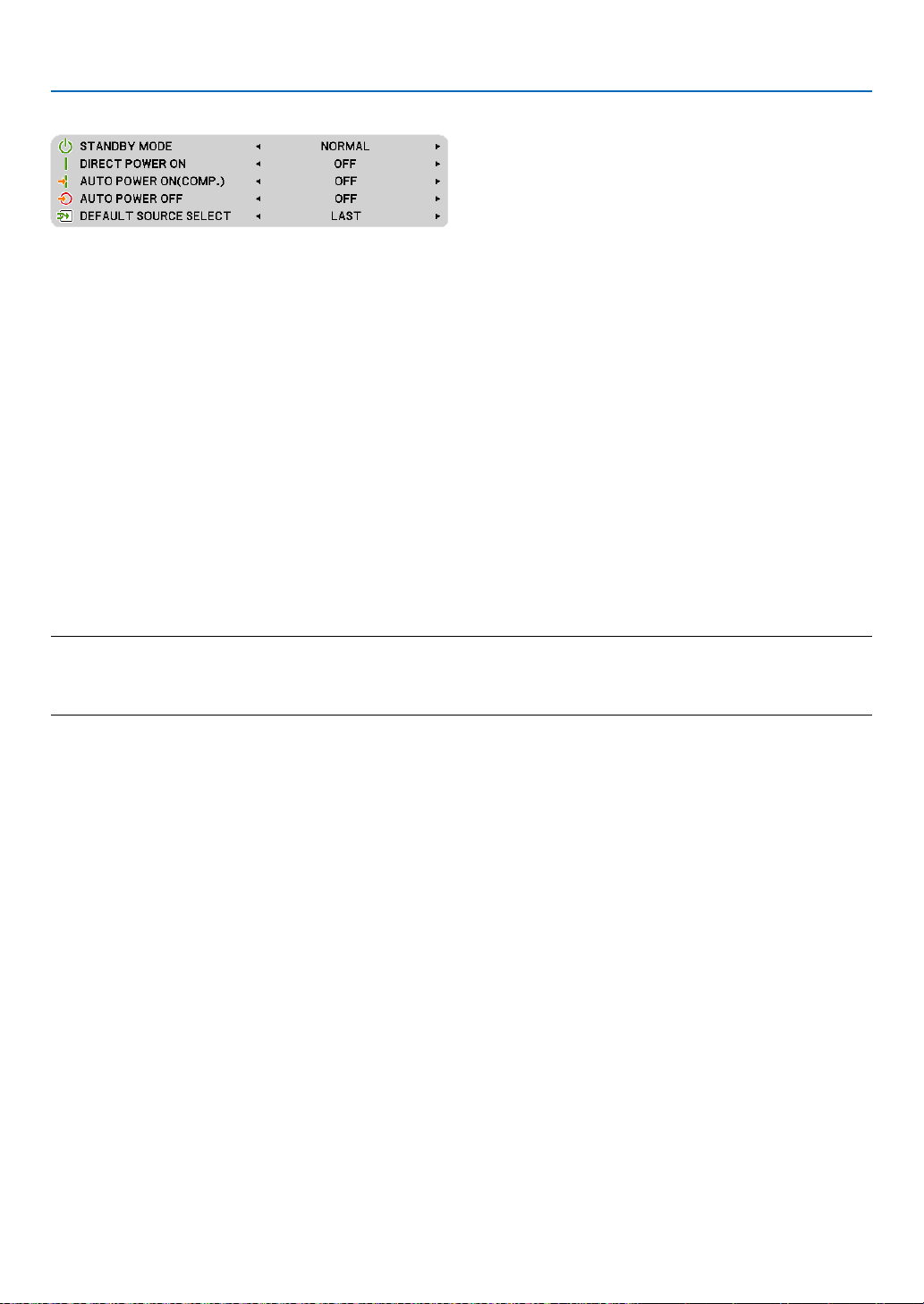
59
5. Using On-Screen Menu
[OPTIONS(2)]
Selecting Standby condition in [STANDBY MODE]
The projector has two standby modes: [NORMAL] and [NETWORK STANDBY].
The NORMAL mode is the mode that allows you to put the projector in the normal condition which consumes less
power than the NETWORK STANDBY mode. The projector is preset for NORMAL mode at the factory.
NORMAL �����������������������������Power indicator: Red light/STATUS indicator: Off
The following connectors, buttons or functions will not work during this mode�
- USB port
- Virtual Remote Tool via the computer cable (VGA) connection
- Buttons other than POWER button on the cabinet
- Buttons other than POWER ON button on the remote control
NETWORK STANDBY ����������Power indicator: Orange light/STATUS indicator: Green light
Important:
- When[NETWORKSTANDBY]isselected,[AUTOPOWEROFF]willturngreyincolorandbedisabled,and[0:15]willbeselected
automatically.
NOTE:
• When[CONTROLPANELLOCK],or[AUTOPOWERON(COMP.)]isturnedon,the[STANDBYMODE]settingisnotavailable.
• ThepowerconsumptioninthestandbymodewillnotbeincludedincalculatingCO
2
emission reduction.
• Yoursettingwillnotbeaffectedevenwhen[RESET]isdonefromthemenu.
Enabling Direct Power On [DIRECT POWER ON]
Turns the projector on automatically when the power cord is inserted into an active power outlet. This eliminates the
need to always use the POWER button on the remote control or projector cabinet.

60
5. Using On-Screen Menu
Turning On the Projector By Applying Computer Signal [AUTO POWER ON(COMP.)]
When the projector is in Standby mode, applying a computer signal from a computer connected to the COMPUTER
IN input will power on the projector and simultaneously project the computer’s image.
This functionality eliminates the need to always use the POWER button on the remote control or the projector cabinet
to power on the projector.
NOTE:
• Disconnectingacomputersignalfromthecomputerwillnotpowerofftheprojector.Werecommendusingthisfunctionin
combinationoftheAUTOPOWEROFFfunction.
• Thisfunctionwillnotbeavailableunderthefollowingconditions:
- whenacomponentsignalisappliedtotheCOMPUTERINconnector
- whenaSynconGreenRGBsignalorcompositesyncsignalisapplied
• ToenabletheAUTOPOWERON(COMP.)afterturningofftheprojector,wait3secondsandinputacomputersignal.
Ifacomputersignalisstillpresentwhentheprojectoristurnedoff,theAUTOPOWERON(COMP.)willnotworkandtheprojector
remains in standby mode.
Enabling Power Management [AUTO POWER OFF]
When this option is selected you can enable the projector to automatically turn off (at the selected time: 5min., 10min.,
15min., 20min., 30min., 1 hour) if there is no signal received by any input or if no operation is performed.
NOTE:
• Thisitemcanbeselectedonlywhen[NORMAL]isselectedfor[STANDBYMODE].
• When[NETWORKSTANDBY]isselected,[AUTOPOWEROFF]willturngreyincolorandbedisabledand[0:15]willbeselected
automatically.
Selecting Default Source [DEFAULT SOURCE SELECT]
You can set the projector to default to any one of its inputs each time the projector is turned on.
LAST �����������������������������������Sets the projector to default to the previous or last active input each time the projector is turned on�
AUTO ����������������������������������Searches for an active source in order of COMPUTER → (HDMI on VE281X/VE281/VE282X/VE282)
→ VIDEO and displays the rst found source.
COMPUTER ������������������������Displays the computer signal from the COMPUTER IN connector every time the projector is turned
on�
HDMI
(VE281X/VE281/VE282X/VE282)
�����Displays the digital source from the HDMI IN connector every time the projector is turned on�
VIDEO ��������������������������������� Displays the Video source from the VIDEO IN connector every time the projector is turned on�
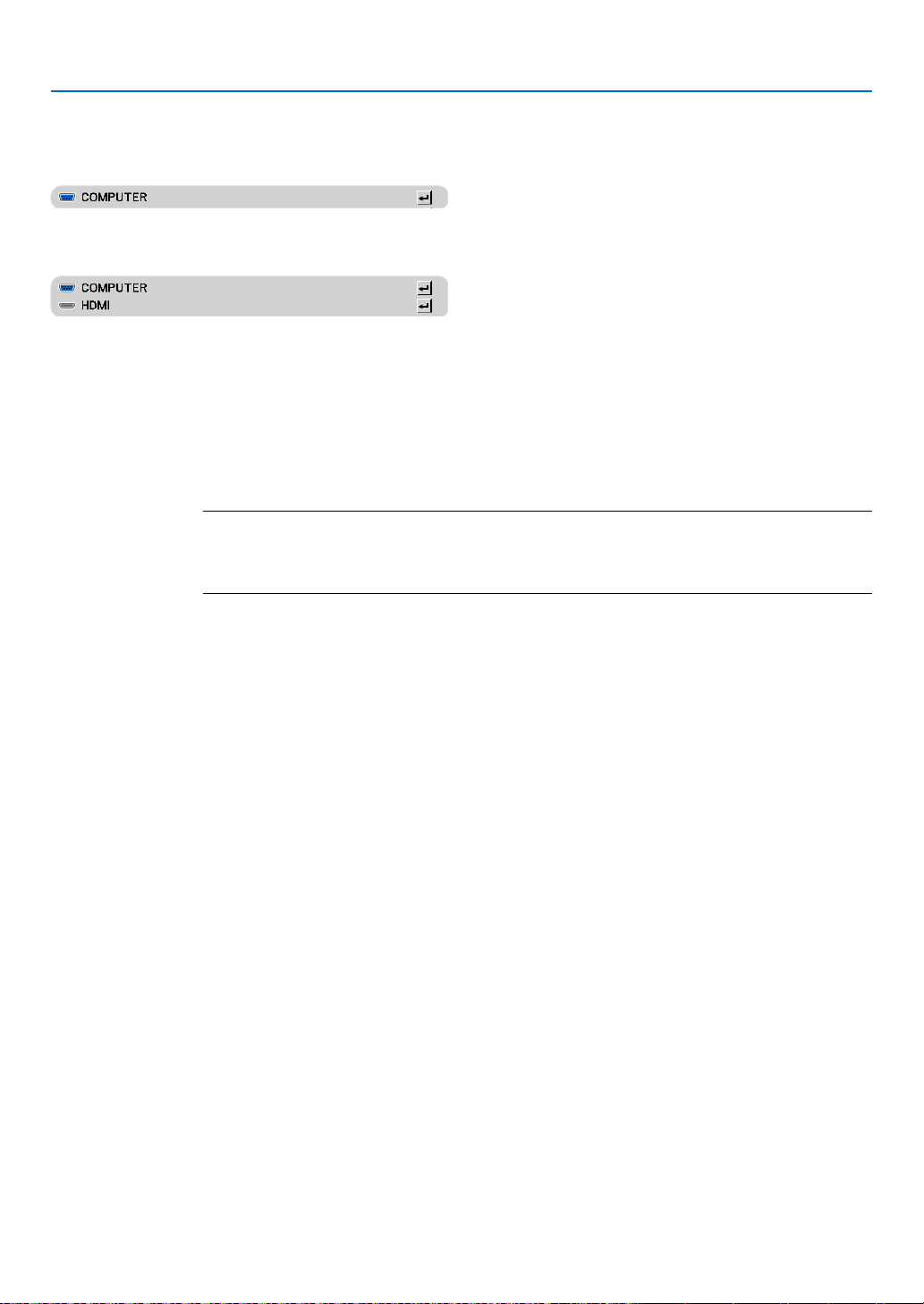
61
5. Using On-Screen Menu
[3D]
[VE280X/VE280]
[VE281X/VE281/VE282X/VE282]
Selecting input connected to a source of 3D images [COMPUTER] (VE280X/VE280)/[COMPUTER/HDMI]
(VE281X/VE281/VE282X/VE282)
[3D]
This function switches the 3D mode between ON and OFF for each input.
ON ������������������������� Turns on the 3D mode for the selected input�
NOTE:
Toconrmthatthesupported3Dsignalisaccepted,useeitherwayofthefollowing:
- Makesurethat[3D]isdisplayedinthetoprightofthescreenafterthesourceisselected.
- Display[INFO.]→[SOURCE]→[3DSIGNAL]andmakesurethat"SUPPORTED"isdisplayed.
OFF ������������������������ Turns off the 3D mode for the selected input�
[L/R INVERT]
Change the setting if you have difculty seeing 3D images.
NON-INVERT ����������������������Normal setting�
INVERT ������������������������������� Changes the order of displaying the images for left eye and right eye�
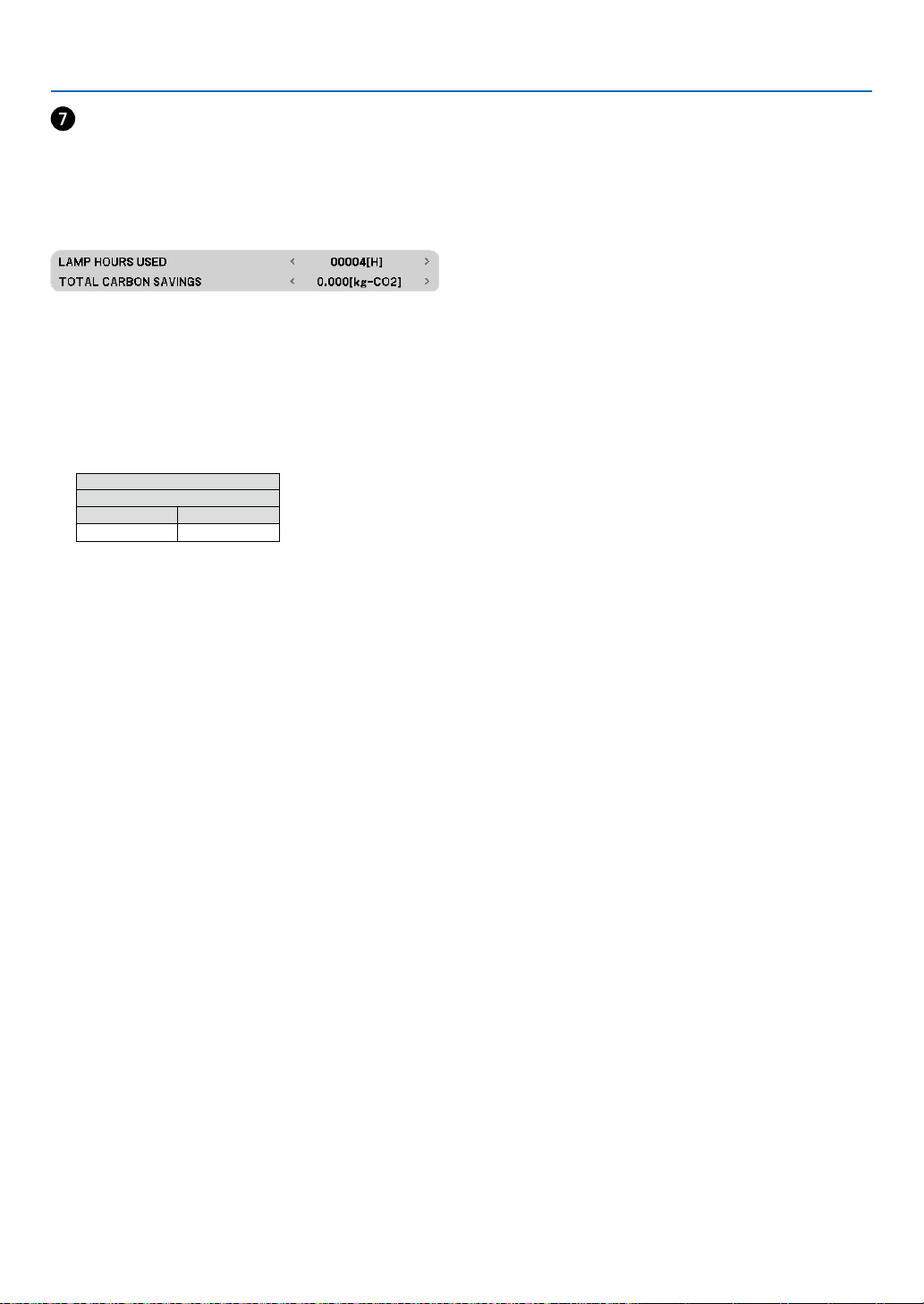
62
5. Using On-Screen Menu
Menu Descriptions & Functions [INFO.]
Displays the status of the current signal and lamp usage. This item has ve pages. The information included is as follows:
TIP:PressingtheHELPbuttonontheremotecontrolwillshowthe[INFO.]menuitems.
[USAGE TIME]
[LAMP HOURS USED] (H)
[TOTAL CARBON SAVINGS] (kg-CO2)
• The message to the effect that the lamp should be replaced will be displayed for one minute when the projector
is turned on and when the POWER button on the projector or the remote control is pressed.
To dismiss this message, press any button on the projector or the remote control.
Lamp life(H)
ECO MODE
OFF ON
4000 6000
• [TOTAL CARBON SAVINGS]
This displays the estimated carbon saving information in kg. The carbon footprint factor in the carbon saving
calculation is based on the OECD (2008 Edition).
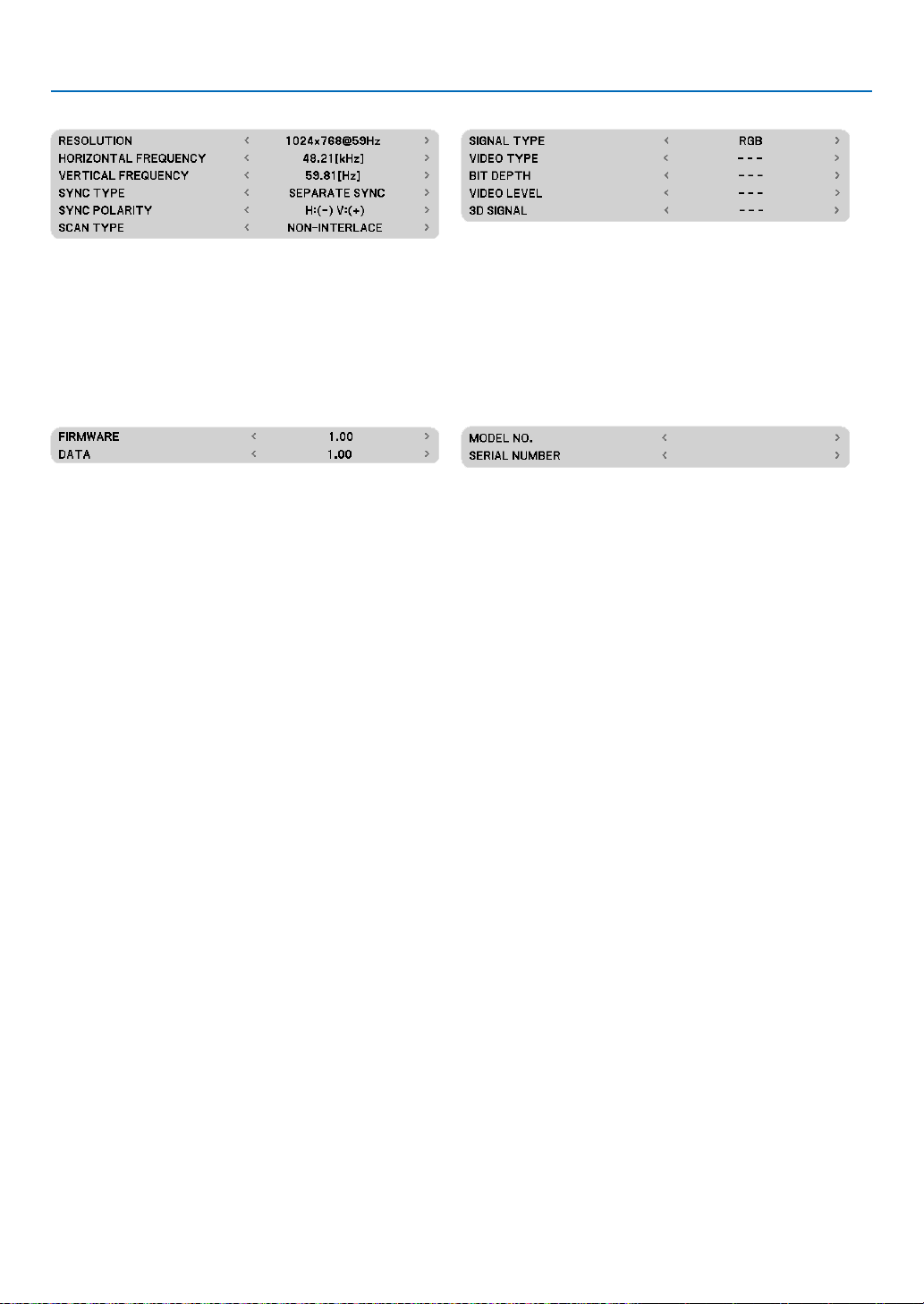
63
5. Using On-Screen Menu
[SOURCE (1)]
[RESOLUTION]
[HORIZONTAL FREQUENCY]
[VERTICAL FREQUENCY]
[SYNC TYPE]
[SYNC POLARITY]
[SCAN TYPE]
[VERSION]
[FIRMWARE] Version
[DATA] Version
[SOURCE (2)]
[SIGNAL TYPE]
[VIDEO TYPE]
[BIT DEPTH] (VE281X/VE281/VE282X/VE282)
[VIDEO LEVEL] (VE281X/VE281/VE282X/VE282)
[3D SIGNAL]
[OTHERS]
[MODEL NO.]
[SERIAL NUMBER]

64
5. Using On-Screen Menu
Menu Descriptions & Functions [RESET]
Returning to Factory Default [RESET]
The RESET feature allows you to change adjustments and settings to the factory preset for a (all) source (s) except
the following:
[ALL DATA]
Reset all the adjustments and settings for all the signals to the factory preset.
All items can be reset EXCEPT [LANGUAGE], [BACKGROUND], [COMMUNICATION SPEED], [STANDBY MODE],
[FAN MODE], [LAMP HOURS USED] and [TOTAL CARBON SAVINGS].
NOTE:Elapsedtimeofthelampusewillnotbeaffectedevenwhen[RESET]isdonefromthemenu.
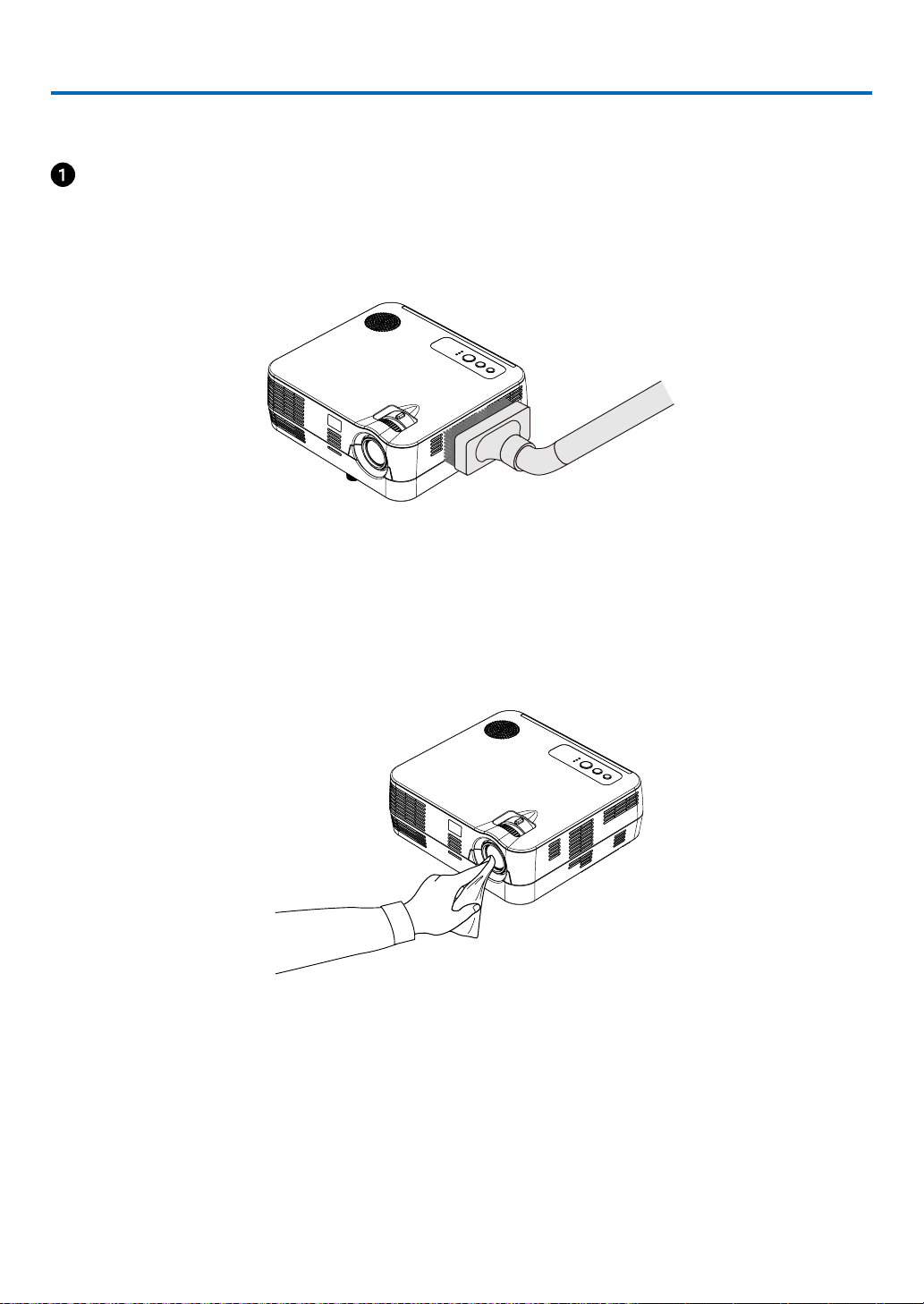
65
6. Maintenance
This section describes the simple maintenance procedures you should follow to clean the cabinet and the lens, and
replace the lamp.
Cleaning the Cabinet and the Lens
1. Turn off the projector before cleaning.
2. Clean the cabinet periodically with a damp cloth. If heavily soiled, use a mild detergent. Never use strong
detergents or solvents such as alcohol or thinner.
Note on Cleaning the Lens
• Use a commercially available plastic lens cleaner.
• Do not scratch or mar the lens surface as a lens is easily scratched.
• Never use alcohol or glass lens cleaner as doing so will cause damage to the lens surface.
Vacuum the intake vent
inlet of the cabinet.

66
6. Maintenance
Replacing the Lamp
When the lamp reaches the end of its life, the LAMP indicator in the cabinet will blink red and the message will be
displayed. Even though the lamp may still be working, replace the lamp to maintain the optimal projector performance.
To replace the lamp, contact your NEC dealer. The lamp is not user replaceable parts.
CAUTION
• If you continue to use the lamp after the lamp reaches the end of its life, the lamp bulb may shatter, and pieces
of glass may be scattered in the lamp case. Do not touch them as the pieces of glass may cause injury. If this
happens, contact your NEC dealer for lamp replacement.
*NOTE: This message will be displayed under the following conditions:
• foroneminuteaftertheprojectorhasbeenpoweredon
• whenthe
(POWER)buttonontheprojectorcabinetorthePOWEROFFbuttonontheremotecontrolispressed
To turn off the message, press any button on the projector cabinet or the remote control.
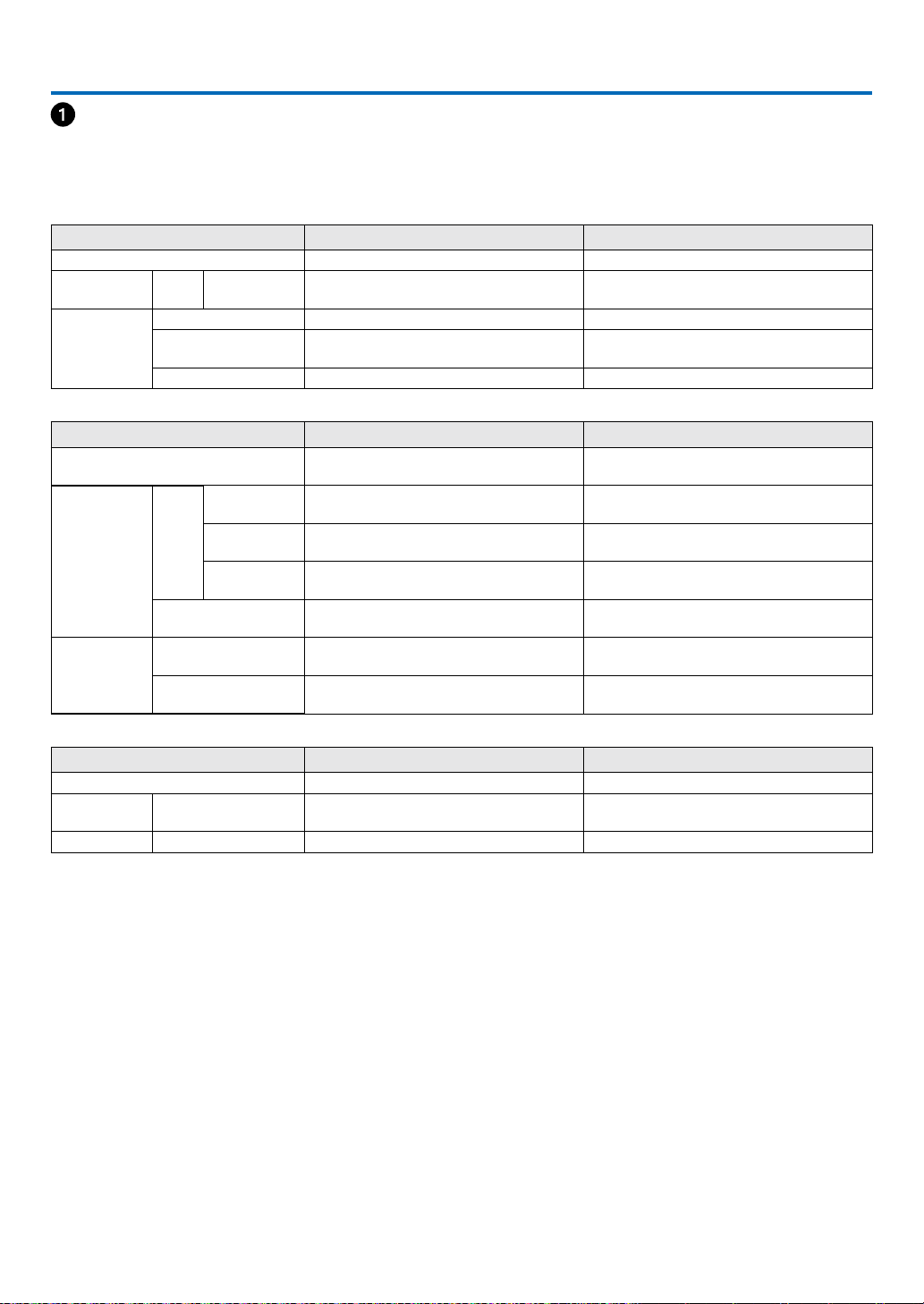
67
7. Appendix
Troubleshooting
This section helps you resolve problems you may encounter while setting up or using the projector.
Indicator Messages
Power Indicator
Indicator Condition Projector Condition Note
Off The power cord is unplugged� –
Blinking light Green 0�5 sec On,
0�5 sec Off
The projector is getting ready to turn on� Wait for a moment�
Steady light Green The projector is turned on� –
Orange [NETWORK STANDBY] is selected for [STANDBY
MODE]
–
Red [NORMAL] is selected for [STANDBY MODE] –
Status Indicator
Indicator Condition Projector Condition Note
Off
Normal or Standby ([NORMAL] for [STANDBY
MODE])
–
Blinking light Red 2 cycle (0�5 sec
On, 0�5 sec Off)
Temperature error The projector is overheated� Move the projector to
a cooler location�
4 cycle (0�5 sec
On, 0�5 sec Off)
Fan error Fans will not work correctly�
6 cycle (0�5 sec
On, 0�5 sec Off)
Lamp error Lamp fails to light� Wait a full minute and then
turn on again�
Green Re-firing the lamp (The projector is cooling
down�)
The projector is re-ring.
Wait for a moment�
Steady light Green
Standby ([NETWORK STANDBY] for [STANDBY
MODE])
–
Orange Cabinet button is locked You have pressed cabinet button when Cabinet
Button is locked�
Lamp Indicator
Indicator Condition Projector Condition Note
Off Normal –
Blinking light Red Lamp has reached its end of life� Lamp
replacement message will be displayed�
Replace the lamp�
Steady light Green [ECO MODE] is set to [ON] –
Over-Temperature Protection
If the temperature inside the projector rises too high, the over-temperature protector will automatically turn off the
lamp with the STATUS indicator blinking (2-cycle On and Off.)
Should this happen, do the following:
• Unplug the power cord after the cooling fans stop.
• Move the projector to a cooler location if the room where you are presenting is particularly too warm.
• Clean the ventilation holes if they are clogged with dust.
• Wait about 60 minutes until the inside of the projector becomes cool enough.
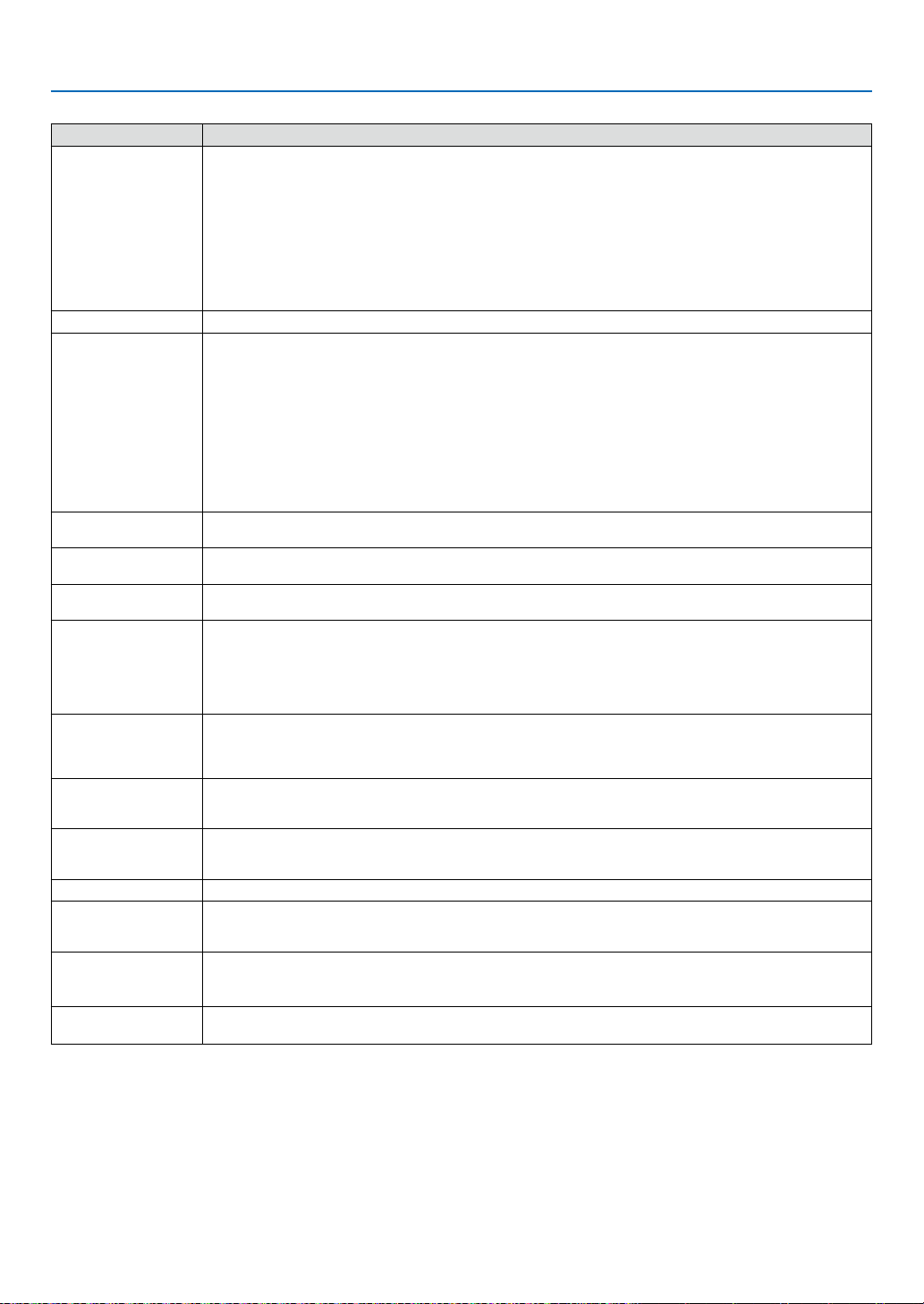
68
7. Appendix
Common Problems & Solutions (→ “Power/Status/Lamp Indicator” on page 67.)
Problem Check These Items
Does not turn on
or shut down
• Check that the power cord is plugged in and that the power button on the projector cabinet or the remote control
is on. (→ pages 16 and 17)
• Check to see if the projector has overheated. If there is insufcient ventilation around the projector or if the
room where you are presenting is particularly warm, move the projector to a cooler location.
• The lamp may fail to light. Wait a full minute and then turn on the power again.
• Set [FAN MODE] to [HIGH ALTITUDE] when using the projector at altitudes approximately 1200 meters/4000
feet or higher. Using the projector at altitudes approximately 1200 meters/4000 feet or higher without setting
to [HIGH ALTITUDE] can cause the projector to overheat and the projector could shut down. If this happens,
wait a couple minutes and turn on the projector. (→ page 57)
If you turn on the projector immediately after the lamp is turned off, the fans run without displaying an image
for some time and then the projector will display the image. Wait for a moment.
Will turn off
• Ensure that the [AUTO POWER OFF] is off. (→ page 54, 60)
No picture • Use the COMPUTER or the VIDEO button on the remote control to select your source (Computer or Video).
(→ page 19) If there is still no picture, press the button again.
• Ensure your cables are connected properly.
• Use menus to adjust the brightness and contrast. (→ page 48)
•
Reset the settings or adjustments to factory preset levels using the [RESET] in the Menu. (
→
page 64)
• Be sure to connect the projector and notebook PC while the projector is in standby mode and before turning
on the power to the notebook PC.
In most cases the output signal from the notebook PC is not turned on unless connected to the projector before
being powered up.
* If the screen goes blank while using your remote control, it may be the result of the computer’s screen-saver
or power management software.
• See also the next page.
Picture suddenly
becomes dark
•
Check if the projector is in the Forced ECO mode because of too high ambient temperature. If this is the case, lower
the internal temperature of the projector by selecting [HIGH] for [FAN MODE]. (
→
page 57)
Color tone or hue is
unusual
•
Check if an appropriate color is selected in [WALL COLOR]. If so, select an appropriate option. (
→
page 53)
• Adjust [HUE] in [PICTURE]. (→ page 47)
Image isn’t square to the
screen
• Reposition the projector to improve its angle to the screen. (→ page 20)
• Use the Keystone correction function to correct the trapezoid distortion. (→ page 23)
Picture is blurred
• Adjust the focus. (→ page 22)
• Reposition the projector to improve its angle to the screen. (→ page 20)
• Ensure that the distance between the projector and screen is within the adjustment range of the lens.
(→ page 10)
• Condensation may form on the lens if the projector is cold, brought into a warm place and is then turned on.
Should this happen, let the projector stand until there is no condensation on the lens.
Flicker appears on
screen
• Set [FAN MODE] to other than [HIGH ALTITUDE] mode when using the projector at altitudes approximately
1200 meters/4000 feet or lower. Using the projector at altitudes less than approximately 1200 meters/4000 feet
and setting to [HIGH ALTITUDE] can cause the lamp to overcool, causing the image to icker. Switch [FAN
MODE] to [AUTO]. (→ page
57
)
Image is scrolling
vertically, horizontally
or both
• Check the computer's resolution and frequency. Make sure that the resolution you are trying to display is
supported by the projector. (→ page 74)
•
Adjust the computer image manually with the Horizontal/Vertical in the [IMAGE OPTIONS]. (
→
page 50)
Remote control does
not work
• Install new batteries.(→ page 8)
• Make sure there are no obstacles between you and the projector.
• Stand within 22 feet (7 m) of the projector. (→ page 8)
Indicator is lit or blinking
• See the POWER/STATUS/LAMP Indicator. (→ page 67)
Cross color in RGB
mode
• Press the AUTO ADJ. button on the projector cabinet or the remote control. (→ page 25)
• Adjust the computer image manually with [CLOCK]/[PHASE] in [IMAGE OPTIONS] in the menu. (→ page
49)
Cannot control the
projector from external
equipment
• Check to see if [STANDBY MODE] is set to [NORMAL] and if it is, try to set it to [NETWORK STANDBY]. (→
page 59)
3D picture is not display • See "Troubleshooting on viewing 3D images" on page 42.
For more information contact your dealer.

69
7. Appendix
If there is no picture, or the picture is not displayed correctly.
• Power on process for the projector and the PC.
Be sure to connect the projector and notebook PC while the projector is in standby mode and before turning on
the power to the notebook PC.
In most cases the output signal from the notebook PC is not turned on unless connected to the projector before
being powered up.
NOTE:Youcancheckthehorizontalfrequencyofthecurrentsignalintheprojector’smenuunderInformation.Ifitreads
“---”,thismeansthereisnosignalbeingoutputfromthecomputer.(→ page 63orgotonextstep)
• Enabling the computer’s external display.
Displaying an image on the notebook PC’s screen does not necessarily mean it outputs a signal to the projector.
When using a PC compatible laptop, a combination of function keys will enable/disable the external display. Usually,
the combination of the “Fn” key along with one of the 12 function keys gets the external display to come on or
off. For example, NEC laptops use Fn + F3, while Dell laptops use Fn + F8 key combinations to toggle through
external display selections.
• Non-standard signal output from the computer
If the output signal from a notebook PC is not an industry standard, the projected image may not be displayed
correctly. Should this happen, deactivate the notebook PC’s LCD screen when the projector display is in use. Each
notebook PC has a different way of deactivate/reactivate the local LCD screens as described in the previous step.
Refer to your computer’s documentation for detailed information.
• Image displayed is incorrect when using a Macintosh
When using a Macintosh with the projector, set the DIPswitch of the Mac adapter (not supplied with the projector)
according to your resolution. After setting, restart your Macintosh for the changes to take affect.
For setting display modes other than those supported by your Macintosh and the projector, changing the DIP
switch on a Mac adapter may bounce an image slightly or may display nothing. Should this happen, set the DIP
switch to the 13" xed mode and then restart your Macintosh. After that, restore the DIP switches to a displayable
mode and then restart the Macintosh again.
NOTE:AVideoAdaptercablemanufacturedbyAppleComputerisneededforaPowerBookwhichdoesnothaveaminiD-Sub
15-pinconnector.
• Mirroring on a PowerBook
* When using the projector with a Macintosh PowerBook, output may not be set to 1024 x 768 unless “mirroring”
is off on your PowerBook. Refer to owner’s manual supplied with your Macintosh computer for mirroring.
• Folders or icons are hidden on the Macintosh screen
Folders or icons may not be seen on the screen. Should this happen, select [View] → [Arrange] from the Apple
menu and arrange icons.
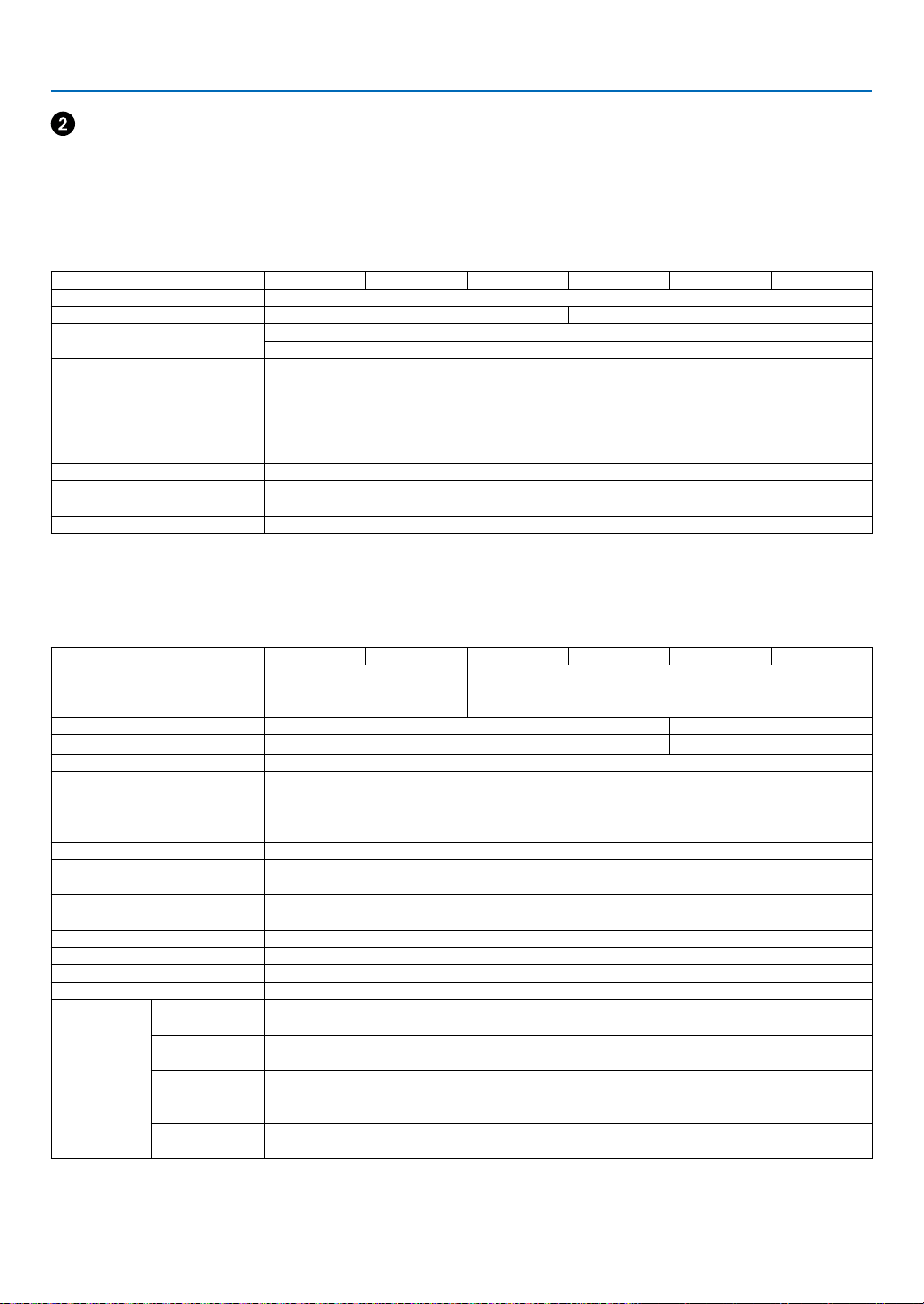
70
7. Appendix
Specications
This section provides technical information about the VE280X/VE281X/VE282X/VE280/VE281/VE282 projector's
performance.
Optical
VE280X VE281X VE282X VE280 VE281 VE282
Projection System Single DLP
®
chip (0.55”, aspect 4:3)
Resolution*
1
1024 × 768 pixels (XGA) 800 × 600 pixels(SVGA)
Lens
Manual zoom and focus
F=2.41-2.55, f=21.8-24.0mm
Lamp
200W AC
(160W in ECO ON)
Light Output *
2
*
3
2800 lumens
ECO ON: 80%
Contrast Ratio*
3
(full white: full black)
3000:1
Image Size (Diagonal) 30–300 inches/ 0.76 –7.6 m (4:3)
Projection Distance (mini.-max.)
46” - 465” (wide) / 52” - 520” (tele)
1.18 - 11.8 m (wide) / 1.32 - 13.2 m (tele)
Projection Angle 14.0° (wide) / 12.7° (tele)
*
1
Effective pixels are more than 99.99%.
*
2
This is the light output value (lumens) when the [PRESET] mode is set to [HIGH-BRIGHT]. If any other mode is
selected as the [PRESET] mode, the light output value may drop slightly.
*
3
Compliance with ISO21118-200
Electrical
VE280X VE280 VE281X VE281 VE282X VE282
Inputs
1 x RGB/Component (D-Sub 15
P), 1 x Video (RCA), 1 x Stereo
Mini Audio
1 x RGB/Component (D-Sub 15 P), 1 x HDMI (19 P) HDCP
supported*
4
, 1 x Video (RCA), 1 x Stereo Mini Audio (shared with
COMPUTER/VIDEO)
PC Control 1 x PC Control Port (D-Sub 9P) No PC control Port
USB Port No USB Port
1x Type B
Color Reproduction 16.7 million colors simultaneously, Full color
Compatible Signals *
5
Analog: VGA/SVGA/XGA/WXGA/SXGA/SXGA+/UXGA
480i/480p/576i/576p/720p/1080i
HDMI(VE281X/VE282X/VE281/VE282): VGA/SVGA/XGA/WXGA/SXGA
480p/576p/720p/1080i/1080p
Video Bandwidth RGB: 80 MHz (Max.)
Horizontal Resolution
540 TV lines: NTSC/NTSC4.43/PAL/PAL-M/PAL-N/PAL60
300 TV lines: SECAM
Scan Rate
Horizontal: 15 kHz to 100 kHz (RGB: 24 kHz or over)
Vertical: 50 Hz to 85 Hz (120Hz signal available in 3D mode)
Sync Compatibility Separate Sync
Built-in Speaker 7W (monaural)
Power Requirement 100 – 240V AC, 50/60 Hz
Input Current 2.7-1.2 A
Power
Consumption
ECO MODE
OFF
261W (100-130V)
250W (200-240V)
ECO MODE ON
213W (100-130V)
206W (200-240V)
STANDBY
NETWORK
STANDBY
2 W
STANDBY
NORMAL
0.3 W (100-130V)
0.4 W (200-240V)
71
7. Appendix
*
4
HDMI™ (Deep Color, Lip Sync) with HDCP
What is HDCP/HDCP technology?
HDCP is an acronym for High-bandwidth Digital Content Protection. High bandwidth Digital Content Protection
(HDCP) is a system for preventing illegal copying of video data sent over a High-Denition Multimedia Interface
(HDMI).
If you are unable to view material via the HDMI input, this does not necessarily mean the projector is not functioning
properly. With the implementation of HDCP, there may be cases in which certain content is protected with HDCP
and might not be displayed due to the decision/intention of the HDCP community (Digital Content Protection, LLC).
Video: Deep Color; 8/10/12-bit, LipSync
Audio: LPCM; up to 2 ch, sample rate 32/44.1/48 KHz, sample bit; 16/20/24-bit
*
5
An image with higher or lower resolution than the projector’s native resolution (VE280X/VE281X/VE282X: 1024
× 768 and VE280/VE281/VE282: 800 × 600) will be displayed with scaling technology.
Mechanical
VE280X VE281X VE282X VE280 VE281 VE282
Installation Orientation Desktop/Front, Desktop/Rear, Ceiling/Front, Ceiling/Rear
Dimensions
10.2”(W) x 3.5”(H) x 9.7”(D)
260 mm (W) x 89.5 mm (H) x 247 mm (D)
(not including protrusions)
Weight 5.1 lbs / 2.3 kg
Environmental
Considerations
Operational Temperatures : 41° to 104°F (5° to 40°C),
(ECO mode selected automatically at 95°F to 104°F/35°C to 40°C)
20% to 80% humidity (non-condensing)
Storage Temperatures : 14° to 122°F (-10° to 50°C),
20% to 80% humidity (non-condensing)
Operating altitude:0 to 3700m/12000 ft (1200 to 3700 m/4000 to 12000 feet: Set [FAN MODE]
to [HIGH ALUTITUDE])
Regulations
UL/C-UL Approved (UL 60950-1, CSA 60950-1)
Meets DOC Canada Class B requirements
Meets FCC Class B requirements
Meets AS/NZS CISPR.22 Class B
Meets EMC Directive (EN55022, EN55024, EN61000-3-2, EN61000-3-3)
For additional information visit:
US : http://www.necdisplay.com/
Europe : http://www.nec-display-solutions.com/
Global : http://www.nec-display.com/global/index.html
For information on our optional accessories, visit our website or see our brochure.
The specications are subject to change without notice.
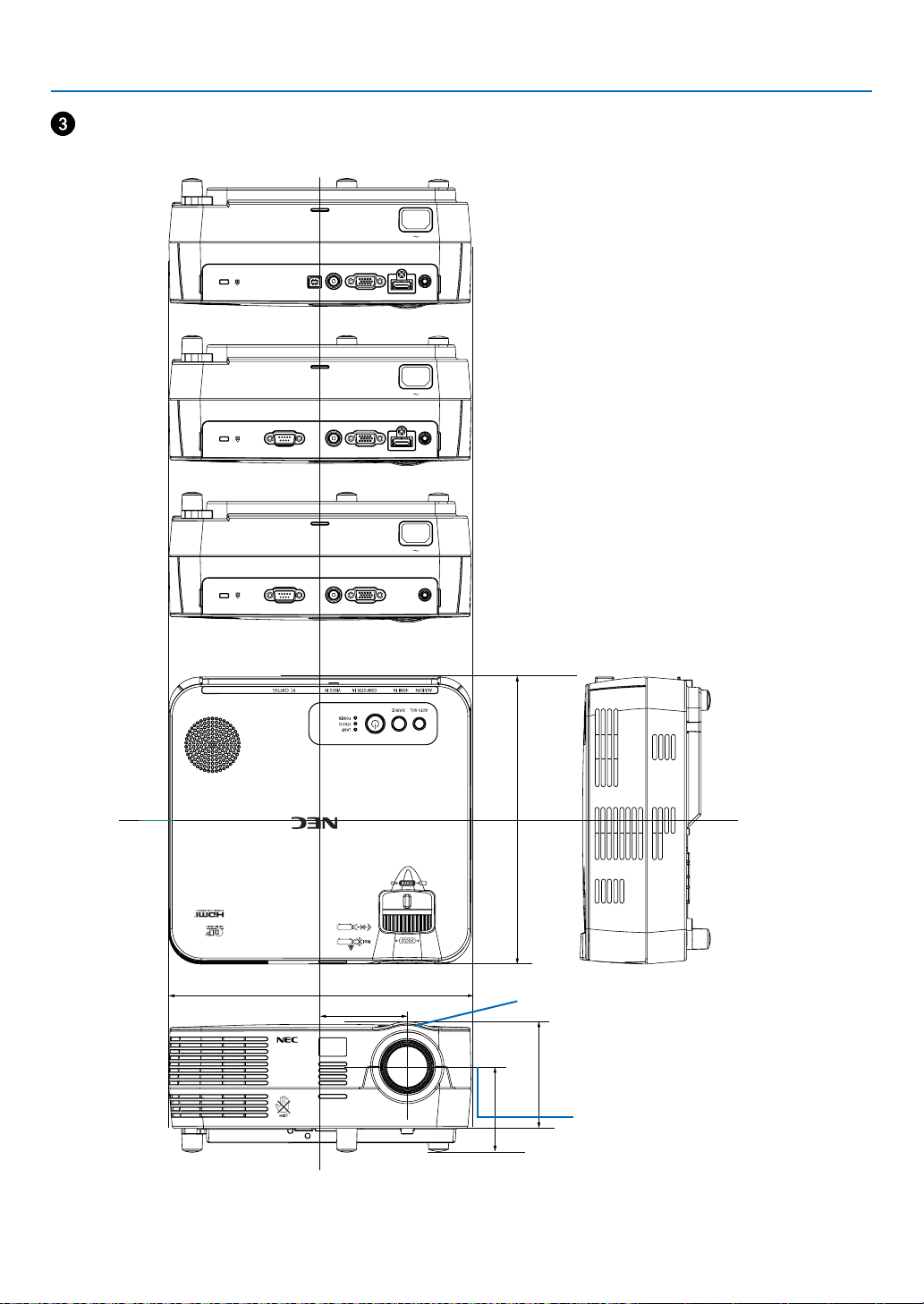
72
7. Appendix
260(10.2)
75(3.0)
247(9.7)
89.5
(3.5)
72.9
(2.9)
Cabinet Dimensions
Lens center
Lens center
Unit: mm (inch)
VE282X/VE282
VE281X/VE281
VE280X/VE280
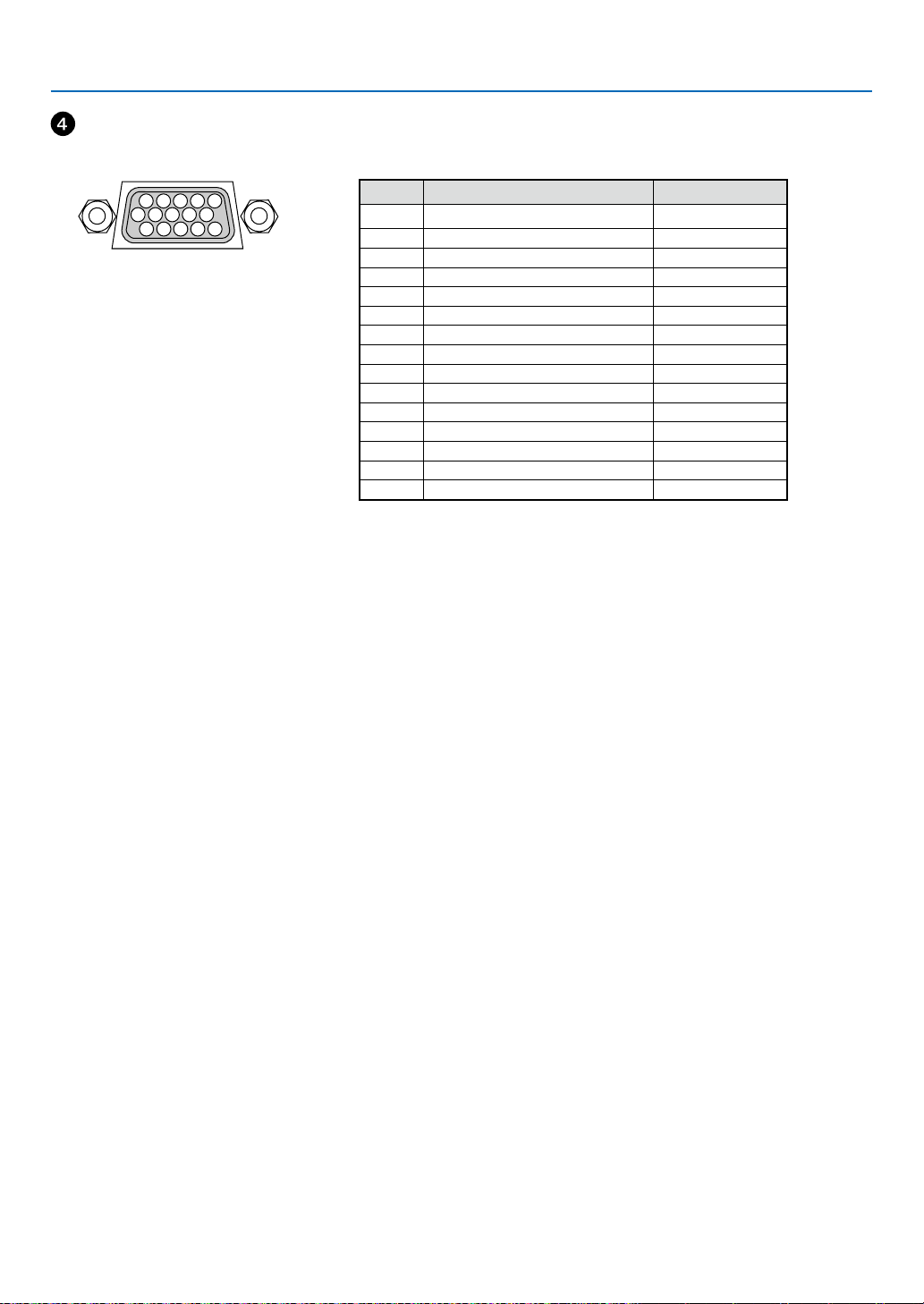
73
7. Appendix
Mini D-Sub 15 Pin Connector
Pin Assignments of D-Sub COMPUTER Input Connector
Signal Level
Video signal : 0.7Vp-p (Analog)
Sync signal : TTL level
51423
10
11 12 13 14 15
6978
Pin No. RGB Signal (Analog) YCbCr Signal
1 Red Cr
2 Green or Sync on Green Y
3 Blue Cb
4 Ground
5 Ground
6 Red Ground Cr Ground
7 Green Ground Y Ground
8 Blue Ground Cb Ground
9 No Connection
10 Sync Signal Ground
11 No Connection
12 Bi-directional DATA (SDA)
13
Horizontal Sync or Composite Sync
14 Vertical Sync
15 Data Clock
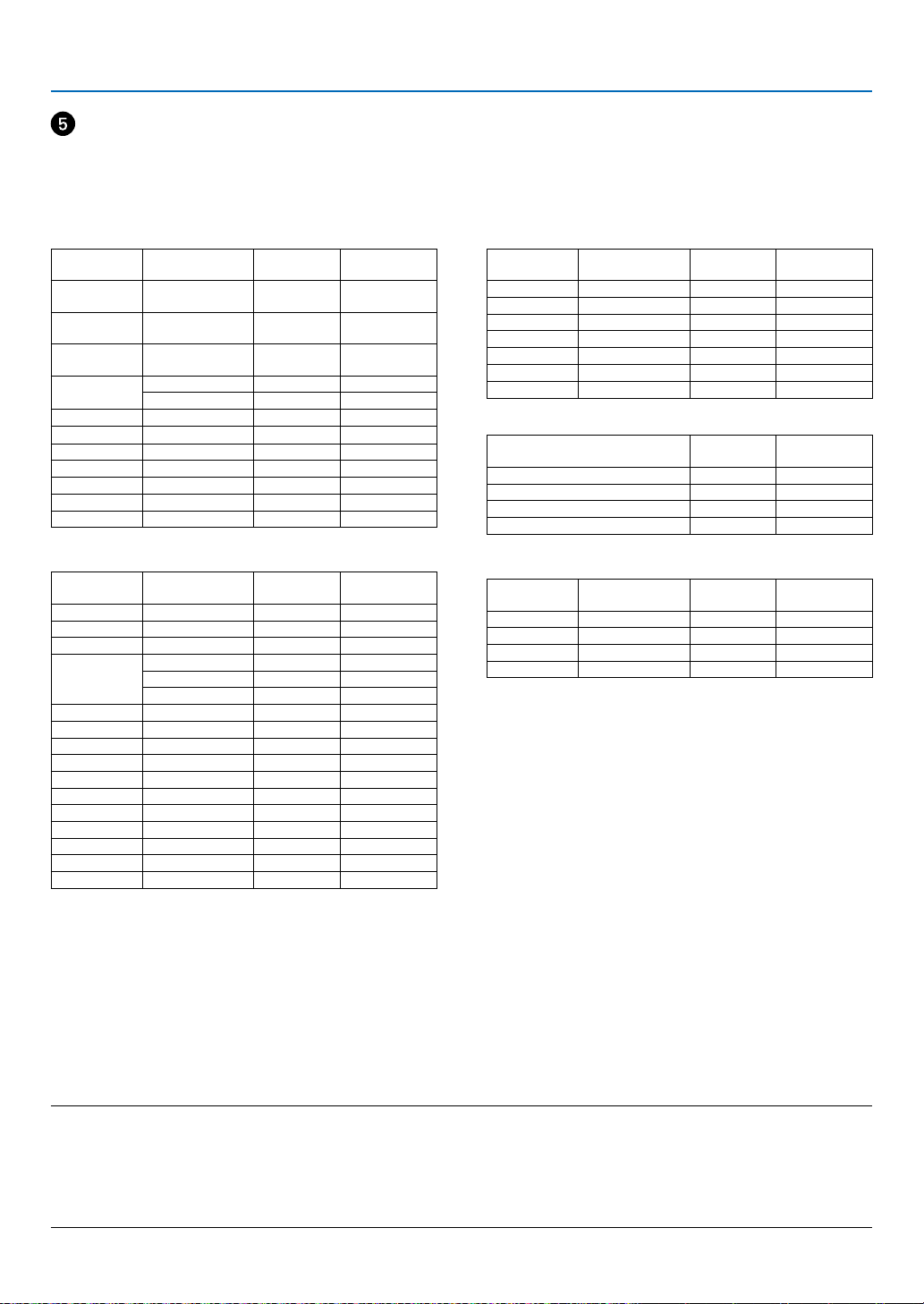
74
7. Appendix
Compatible Input Signal List
Horizontal: 15KHz to 100KHz (RGB: 24KHz or over)
Vertical: 50Hz to 85Hz
Analog RGB
Signal
Resolution
( dots )
Aspect Ratio
Refresh Rate
( Hz )
VGA 640 × 480 4:3 60/72/75/85/
iMac
SVGA 800 × 600 *
1
4:3 56/60/72/75/85/
iMac
XGA 1024 × 768 *
2
4:3 60/70/75/85/
iMac
WXGA 1280 × 768 15:9 60
1280 × 800 *
3
16:10 60
Quad-VGA 1280 × 960 4:3 60
SXGA 1280 × 1024 5:4 60
SXGA+ 1400 × 1050 4:3 60
UXGA 1600 × 1200 4:3 60
MAC 13" 640 × 480 4:3 67
MAC 16" 832 × 624 4:3 75
MAC 19" 1024 × 768 4:3 75
HDMI
Signal
Resolution
( dots )
Aspect Ratio
Refresh Rate
( Hz )
VGA 640 × 480 4:3 60
SVGA 800 × 600 *
1
4:3 60
XGA 1024 × 768 *
2
4:3 60
WXGA 1280 × 768 15:9 60
1280 × 800 16:10 60
1366 × 768 16:9 60
WXGA+ 1440 × 900 16:10 60
WXGA++ 1600 × 900 16:9 60
Quad-VGA 1280 × 960 4:3 60
SXGA 1280 × 1024 5:4 60
SXGA+ 1400 × 1050 4:3 60
WSXGA+ 1680 × 1050 16:10 60
HDTV (1080p) 1920 × 1080 16:9 50/60
HDTV (1080i) 1920 × 1080 16:9 50/60
HDTV (720p) 1280 × 720 16:9 50/60
SDTV (480p) 720 × 480 4:3/16:9 60
SDTV (576p) 720 × 576 4:3/16:9 50
NOTE:
• Animagewithhigherorlowerresolutionthantheprojector’snativeresolution(VE280X/VE281X/VE282X:1024×768/VE280/
VE281/VE282:800x600)willbedisplayedwithscalingtechnology.
• SynconGreenandCompositesyncsignalsarenotsupported.
• Signalsotherthanthosespeciedinthetableabovemaynotbedisplayedcorrectly.Ifthisshouldhappen,changetherefresh
rateorresolutiononyourPC.RefertoDisplayPropertieshelpsectionofyourPCforprocedures.
Component
Signal Format Aspect Ratio
Refresh Rate
( Hz )
HDTV (1080i) 1920 × 1080 16:9 50/60
HDTV (720p) 1280 × 720 16:9 50/60
SDTV (480p) 720 × 480 4:3/16:9 60
SDTV (576p) 720 × 576 4:3/16:9 50
SDTV (480i) 720 × 480 4:3/16:9 60
SDTV (576i) 720 × 576 4:3/16:9 50
HDTV (1080p) 1920 × 1080 16:9 50/60
Composite Video
Signal Aspect Ratio
Refresh Rate
( Hz )
NTSC 4:3 60
PAL 4:3 50
PAL60 4:3 60
SECAM 4:3 50
3D Computer
Signal
Resolution
( dots )
Aspect Ratio
Refresh Rate
( Hz )
SVGA 800 × 600 *
1
4:3 120
XGA 1024 × 768 *
2
4:3 120
1280 × 720 1280 × 720 16:9 120
WXGA 1280 × 800 16:10 120*
3
*1 Native resolution on SVGA model (VE280/VE281/VE282)
*2 Native resolution on XGA model (VE280X/VE281X/VE282X)
*3 Reduced Blanking (RB) signal
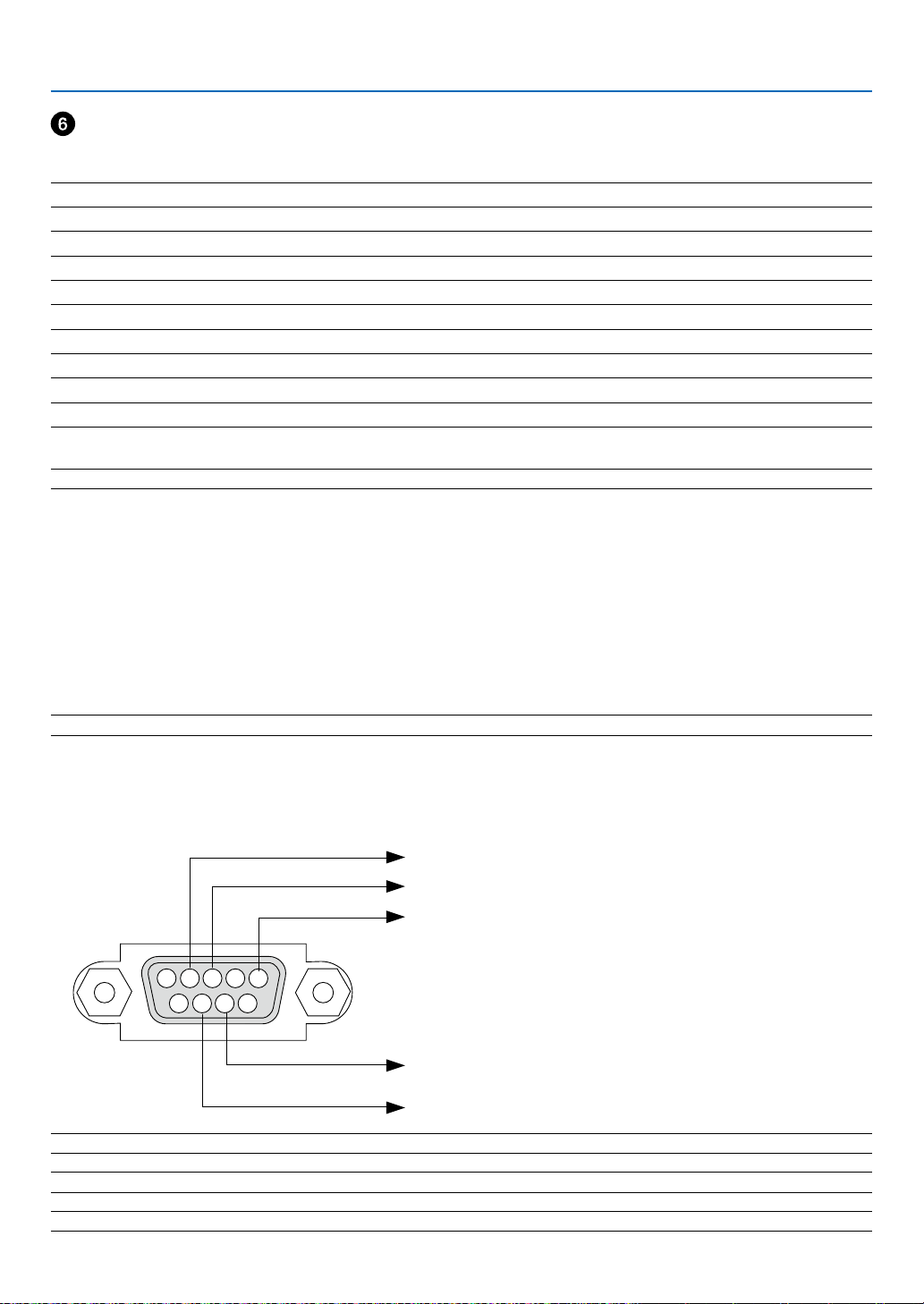
75
7. Appendix
NOTE: Contact your local dealer for a full list of the PC Control Codes if needed.
Cable Connection
Communication Protocol
Baud rate �����������������������������������������38400 bps
Data length ��������������������������������������8 bits
Parity �����������������������������������������������No parity
Stop bit ��������������������������������������������One bit
X on/off ��������������������������������������������None
Communications procedure �������������Full duplex
NOTE:Dependingontheequipment,alowerbaudratemayberecommendedforlongcableruns.
PC Control Connector (D-SUB 9P)
PC Control Codes and Cable Connection
PC Control Codes
Function Code Data
POWER ON 02H 00H 00H 00H 00H 02H
POWER OFF 02H 01H 00H 00H 00H 03H
INPUT SELECT COMPUTER 02H 03H 00H 00H 02H 01H 01H 09H
INPUT SELECT HDMI (VE281X/VE281/VE282X/VE282) 02H 03H 00H 00H 02H 01H 1AH 22H
INPUT SELECT VIDEO 02H 03H 00H 00H 02H 01H 06H 0EH
PICTURE MUTE ON 02H 10H 00H 00H 00H 12H
PICTURE MUTE OFF 02H 11H 00H 00H 00H 13H
SOUND MUTE ON 02H 12H 00H 00H 00H 14H
SOUND MUTE OFF 02H 13H 00H 00H 00H 15H
NOTE1:Pins1,4,6and9arenoused.
NOTE2:Jumper“RequesttoSend”and“CleartoSend”togetheronbothendsofthecabletosimplifycableconnection.
NOTE3:Forlongcablerunsitisrecommendedtosetcommunicationspeedwithinprojectormenusto9600bps.
15243
67 98
To GND of PC
To RxD of PC
To TxD of PC
To RTS of PC
To CTS of PC
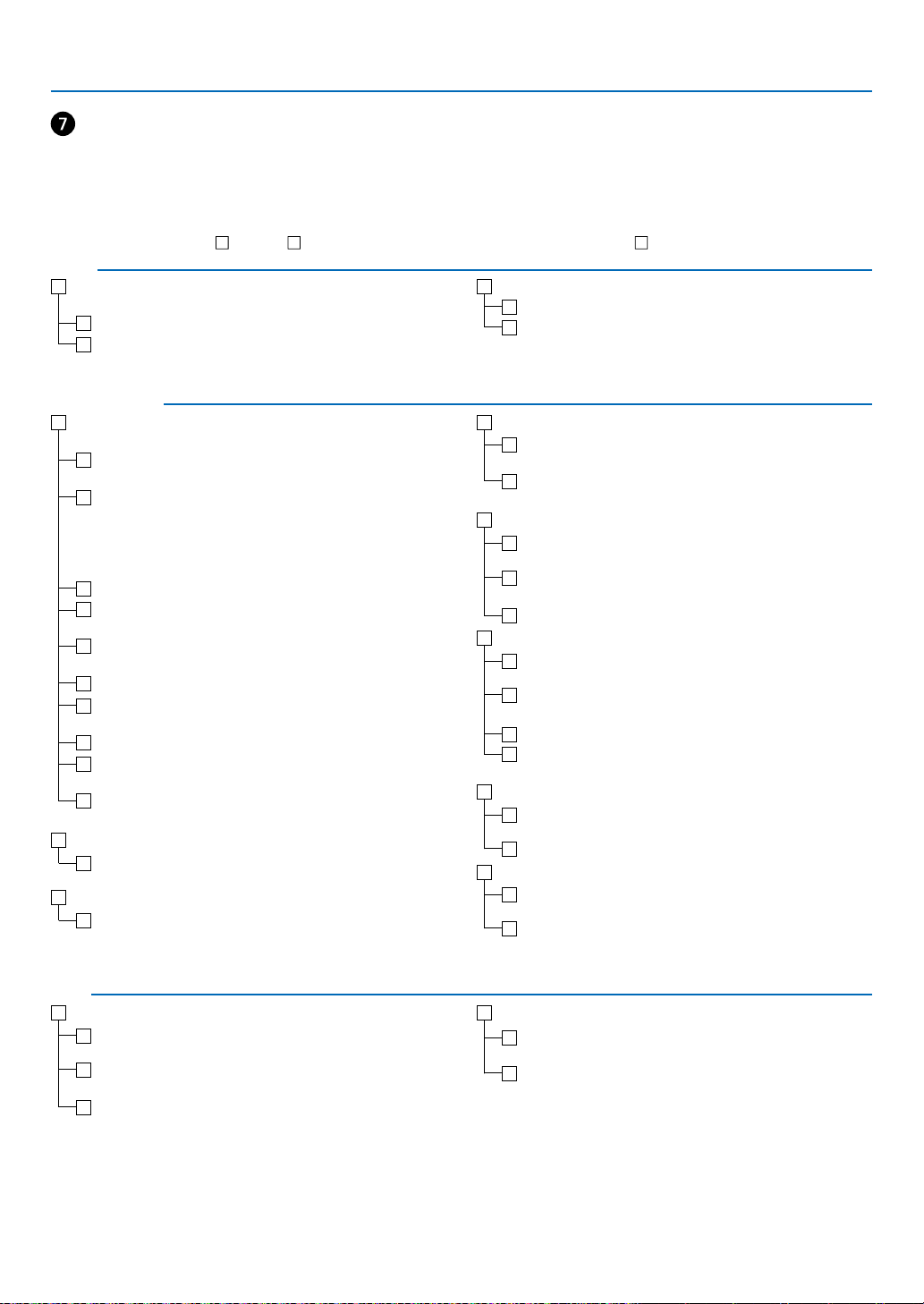
76
7. Appendix
No image is displayed from your PC or video equipment to the
projector�
Still no image even though you connect the projector to the PC
rst, then start the PC.
Enabling your notebook PC’s signal output to the projector�
• A combination of function keys will enable/disable the
external display� Usually, the combination of the “Fn” key
along with one of the 12 function keys turns the external
display on or off�
No image (Logo, blue or black background, no display)�
Still no image even though you press the AUTO ADJ� button�
Still no image even though you carry out [RESET] in the
projector’s menu�
Signal cable’s plug is fully inserted into the input connector
A message appears on the screen�
( _____________________________________________ )
The source connected to the projector is active and available�
Still no image even though you adjust the brightness and/or
the contrast�
Input source’s resolution and frequency are supported by the
projector�
Troubleshooting Check List
Before contacting your dealer or service personnel, check the following list to be sure repairs are needed also by
referring to the “Troubleshooting” section in your user’s manual. This checklist below will help us solve your problem
more efciently.
* Print this page and the next page for your check.
Frequency of occurrence
always sometimes (How often?_____________________) other (__________________)
Power
No power (POWER indicator does not light green)� See also “Status
Indicator (STATUS)”�
Power cord’s plug is fully inserted into the wall outlet�
No power even though you press and hold the POWER button�
Shut down during operation�
Power cord’s plug is fully inserted into the wall outlet�
[AUTO POWER OFF] is turned off
Video and Audio
Image is too dark�
Remains unchanged even though you adjust the brightness
and/or the contrast�
Image is distorted�
Image appears to be trapezoidal (unchanged even though you
carry out the [KEYSTONE] adjustment)�
Parts of the image are lost�
Still unchanged even though you press the AUTO ADJ� button�
Still unchanged even though you carry out [RESET] in the
projector’s menu�
Image is shifted in the vertical or horizontal direction�
Horizontal and vertical positions are correctly adjusted on a
computer signal�
Input source’s resolution and frequency are supported by the
projector�
Some pixels are lost�
Image is ickering.
Still unchanged even though you press the AUTO ADJ� button�
Still unchanged even though you carry out [RESET] in the
projector’s menu�
Image shows ickering or color drift on a computer signal.
Still unchanged even though you change [FAN MODE] from
[HIGH ALTITUDE] to [AUTO]�
Image appears blurry or out of focus�
Still unchanged even though you checked the signal’s resolution
on PC and changed it to projector’s native resolution�
Still unchanged even though you adjusted the focus�
No sound�
Audio cable is correctly connected to the audio input of the
projector�
Still unchanged even though you adjusted the volume level�
Other
Remote control does not work�
No obstacles between the sensor of the projector and the
remote control�
Projector is placed near a uorescent light that can disturb the
infrared remote controls�
Batteries are new and are not reversed in installation�
Buttons on the projector cabinet do not work
[CONTROL PANEL LOCK] is not turned on or is disabled in
the menu�
Still unchanged even though you press and hold the SOURCE
button for a minimum of 10 seconds�
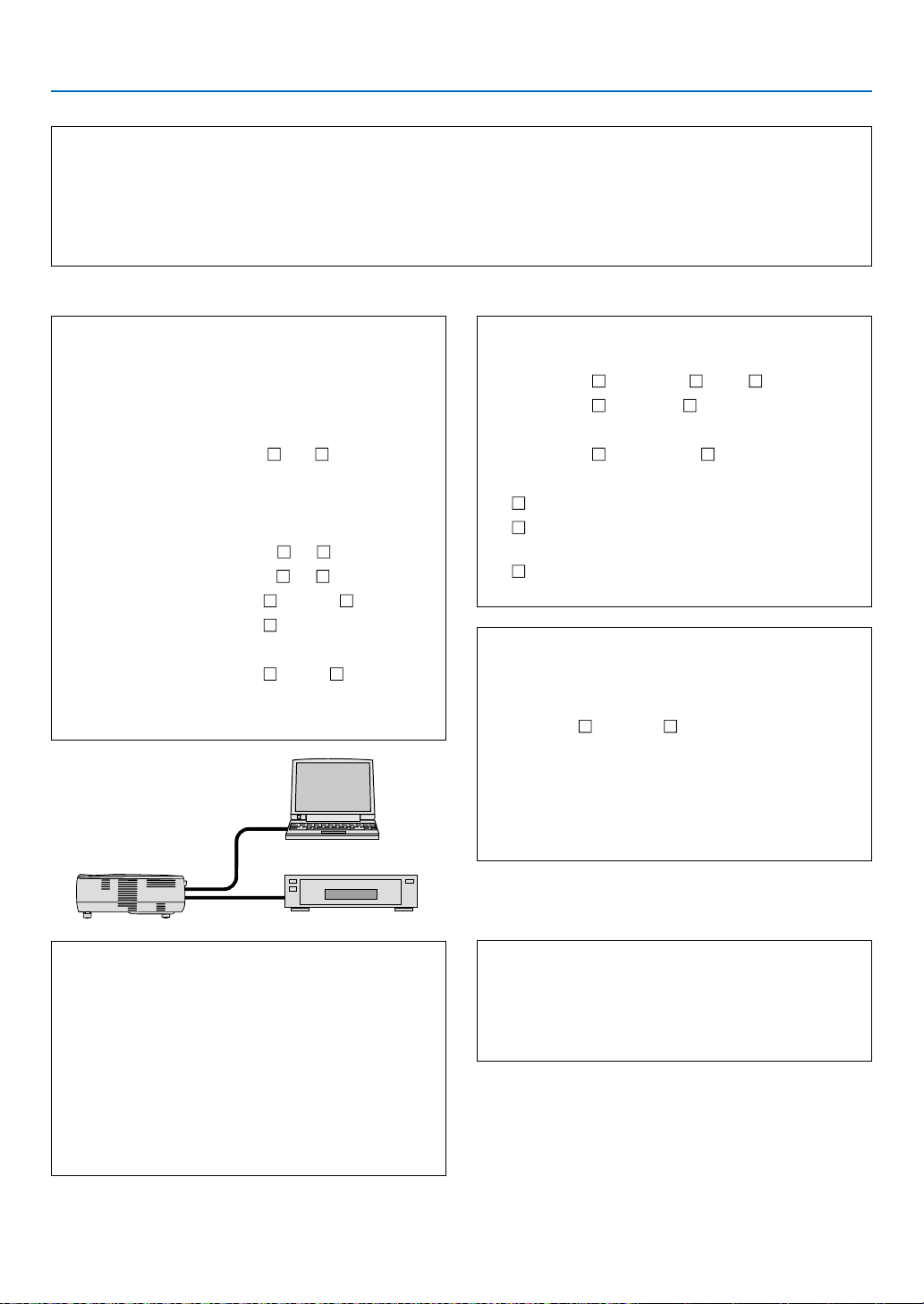
77
7. Appendix
In the space below please describe your problem in detail.
Information on application and environment where your projector is used
Projector
Model number:
Serial No�:
Date of purchase:
Lamp operating time (hours):
Eco Mode:
Off On
Information on input signal:
Horizontal synch frequency [ ] kHz
Vertical synch frequency [ ] Hz
Synch polarity H
(+) (−)
V
(+) (−)
Synch type
Separate Composite
Sync on Green
STATUS Indicator:
Steady light
Orange Green
Flashing light [ ] cycles
Remote control model number:
Signal cable
NEC standard or other manufacturer’s cable?
Model number: Length: inch/m
Distribution amplier
Model number:
Switcher
Model number:
Adapter
Model number:
Projector
PC
DVD player
Installation environment
Screen size: inch
Screen type:
White matte Beads Polarization
Wide angle High contrast
Throw distance: feet/inch/m
Orientation:
Ceiling mount Desktop
Power outlet connection:
Connected directly to wall outlet
Connected to power cord extender or other (the
number of connected equipment______________)
Connected to a power cord reel or other (the number
of connected equipment______________)
Computer
Manufacturer:
Model number:
Notebook PC
/ Desktop
Native resolution:
Refresh rate:
Video adapter:
Other:
Video equipment
VCR, DVD player, Video camera, Video game or other
Manufacturer:
Model number:

78
7. Appendix
REGISTER YOUR PROJECTOR! (for residents in the United States,
Canada, and Mexico)
Please take time to register your new projector. This will activate your limited parts and labor warranty and InstaCare
service program.
Visit our web site at www.necdisplay.com, click on support center/register product and submit your completed form
online.
Upon receipt, we will send a conrmation letter with all the details you will need to take advantage of fast, reliable
warranty and service programs from the industry leader, NEC Display Solutions of America, Inc.

© NEC Display Solutions, Ltd. 2012-2015 7N951847