

2
CONTENTS
Contents:
Welcome ..............................................................................2
Warranty registration ..........................................................2
Safety information ...............................................................3
Unpacking your appliance ..................................................3
Installing your appliance ......................................................4
Cabinet clearances .........................................................4
Leveling the appliance ....................................................4
Electrical connection ......................................................5
Installing the drain plumbing ...............................................6
Gravity drain ...................................................................6
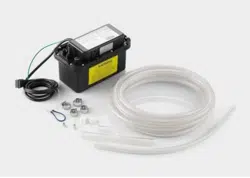
Optional drain pump .......................................................7
Installing the water supply ...................................................8
Ice maker operation ..........................................................10
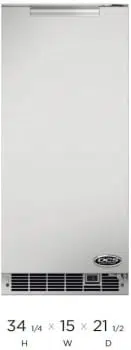
Product dimensions ..........................................................12
Using your Electronic control ............................................14
Starting your appliance ..................................................14
Turning your appliance "ON" or "OFF" ..........................15
Control lock ...................................................................15
Door ajar alarm.............................................................15
Delay start / Vacation mode .........................................15
Error codes ...................................................................16
Options menu ...............................................................16
Normal and eco mode .............................................16
Cleaning your ice machine ..............................................17
Clean reminder ............................................................17
Clean Mode ...................................................................17
Care and cleaning .............................................................19
Energy saving tips ............................................................19
Obtaining service .............................................................19
Troubleshooting the ice machine .......................................21
Preparing the ice machine for storage ...........................23
Drain pump removal .........................................................26
Warranty ...........................................................................28
3
NOTE
NOTE
!
CAUTION
Recognize Safety Symbols,
Words, and Labels.
CAUTION-Hazards or unsafe practices which could
result in personal injury or property / product damage.
NOTE-Important information to help assure a problem
free installation and operation.
DCS is committed to building a quality product in an environmentally friendly manner.
Important Safety Instructions
Warnings and safety instructions appearing in this guide are not meant to cover all possible conditions and situations that
may occur. Common sense, caution, and care must be exercised when installing, maintaining, or operating this appliance.
!
WARNING
EXCESSIVE WEIGHT HAZARD
Use two or more people to move product.
Failure to do so can result in personal injury.
Remove Interior Packaging
Your appliance has been packed for shipment with all parts
that could be damaged by movement securely fastened.
Remove internal packing materials and any tape holding
internal components in place. The owners manual is
shipped inside the product in a plastic bag along with the
warranty registration card, and other accessory items.
Important
Keep your carton and packaging until your appliance
has been thoroughly inspected and found to be in good
condition. If there is damage, the packaging will be needed
as proof of damage in transit. Afterwards please dispose of
all items responsibly.
Note to Customer
This merchandise was carefully packed and thoroughly
inspected before leaving our plant. Responsibility for its
safe delivery was assumed by the retailer upon acceptance
of the shipment. Claims for loss or damage sustained in
transit must be made to the retailer.
DO NOT RETURN DAMAGED MERCHANDISE TO THE
MANUFACTURER - FILE THE CLAIM WITH THE
RETAILER.
SAFETY INFORMATION AND UNPACKING YOUR APPLIANCE
!
WARNING
WARNING - You can be killed or seriously injured
if you do not follow these instructions.
!
WARNING
WARNING - Dispose of the plastic bags which can
be a suocation hazard.
4
!
CAUTION
Cabinet Clearance
Ventilation is required from the bottom front of the
appliance. Keep this area open and clear of any
obstructions. Adjacent cabinets and counter top can be
installed around the appliance as long as the front grille
remains unobstructed. Overlay door models with articulated
hinges are intended for built-in applications only.
!
CAUTION
Outdoor Installation
Do not install in a location where the ice machine will
be exposed to direct sun exposure as this may result in
unsatisfactory performance.
!
CAUTION
!
CAUTION
The warranty is voided if product is used in an ambient
temperature of 40°F (5°C) or below.
INSTALLING YOUR APPLIANCE
Select Location
The proper location will ensure peak performance of
your appliance. We recommend a location where the ice
machine will be out of direct sunlight and away from heat
sources. To ensure your product performs to specications,
the recommended installation location temperature range
is from 55 to 90°F (13 to 32°C) for built in ice machines and
55 to 100°F (13 to 38°C) for freestanding ice machines.
Ice machines will not perform correctly in ambient
temperatures less than 55°F (13°C).
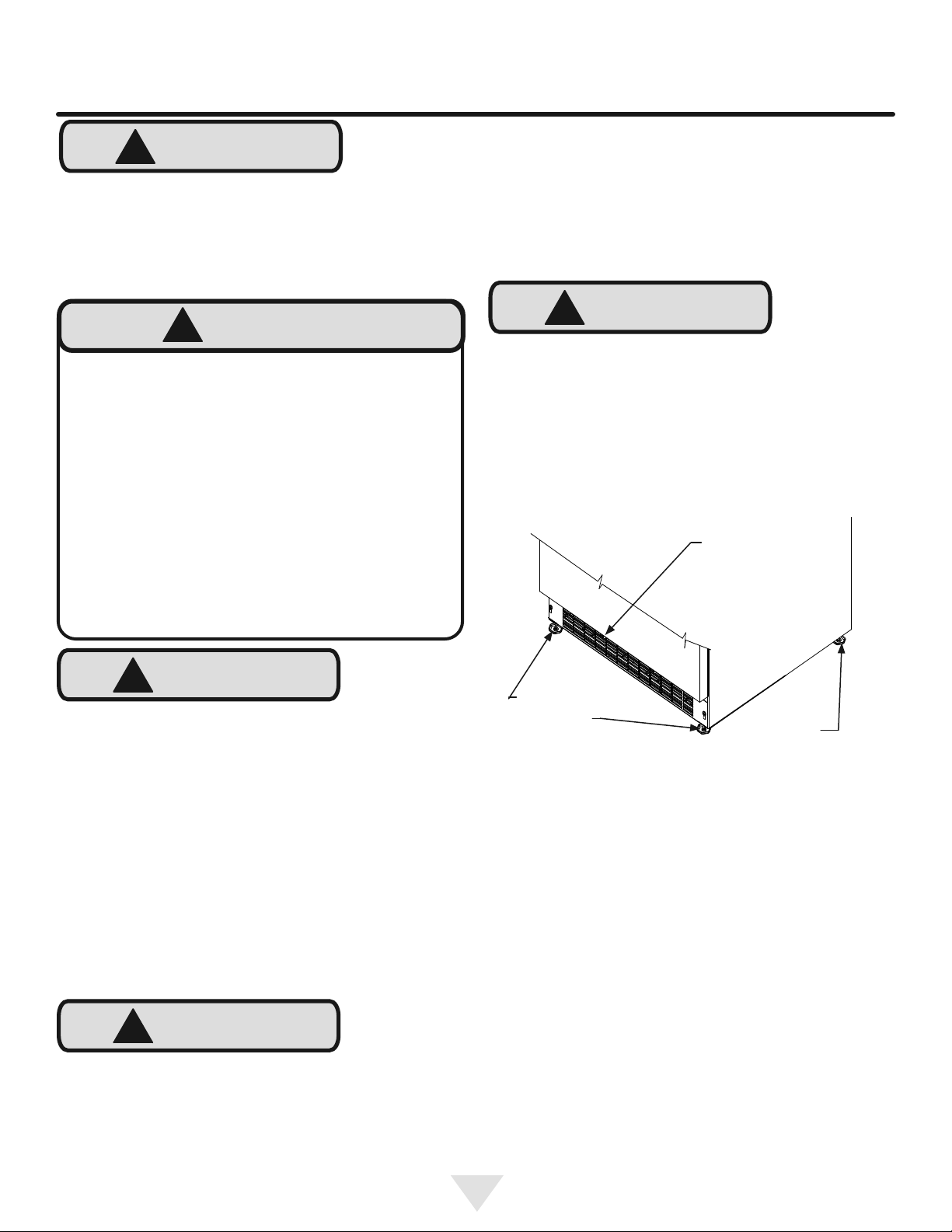
Front Grille
Do not obstruct the front grille. The openings within
the front grille allow air to ow through the condenser
heat exchanger. Restrictions to this air ow will result in
increased energy usage, loss of cooling capacity and low
ice production. For this reason it is important this area not
be obstructed and the grille openings kept clean. DCS
does not recommend the use of a custom made grille as
air flow may be restricted. (See Figure 1).
Leveling Legs
Adjustable legs at the front and rear corners of the
appliance should be set so the unit is rmly positioned on
the floor and level from side to side and front to back. The
overall height of your DCS appliance may be adjusted
higher (by turning the leveling leg out) and lower (by turning
the leveling leg in). Cabinet height adjustment dimensions
are shown in Table "A".
To adjust the leveling legs, place the appliance on a solid
surface and protect the oor beneath the legs to avoid
scratching the oor. With the assistance of another person,
lean the appliance back to access the front leveling legs.
Raise or lower the legs to the required dimension by turning
the legs. Repeat this process for the rear by tilting the
appliance forward using caution. On a level surface check
the appliance for levelness and adjust accordingly.
The front grille screws may be loosened to raise and
lower the grille to the desired height. When adjustment is
complete tighten the two front grille screws. (See Figure 4).
Rear
Leveling
Legs
Figure 1
Front Leveling
Legs
Front Grille,
keep this area
open.
!
WARNING
WARNING - Help Prevent Tragedies
Child entrapment and suocation are not problems of
the past. Junked or abandoned refrigerators are still
dangerous - even if they sit out for "just a few hours".
If you are getting rid of your old refrigerator, please
follow the instructions below to help prevent
accidents.
Before you throw away your old refrigerator or
freezer:
• Take o the doors or remove the drawers.
• Leave the shelves in place so children may not
easily climb inside.
If the appliance was shipped, handled, or stored in other
than an upright position for any period of time, allow the
appliance to sit upright for a period of at least 24 hours
before plugging in. This will assure oil returns to the
compressor. Plugging the appliance in immediately may
cause damage to internal parts.
5
NOTE
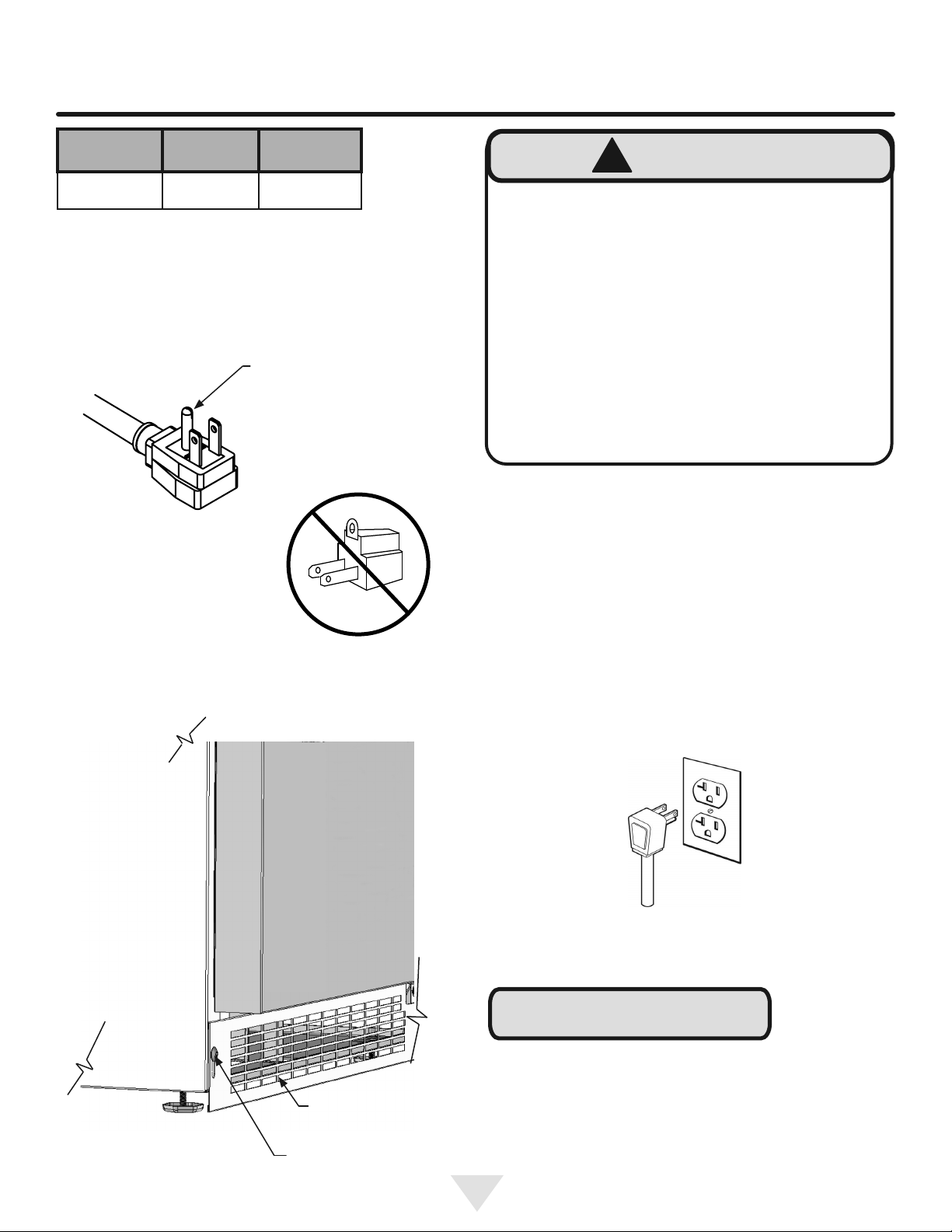
Figure 2
Figure 3
Do not remove
ground prong
INSTALLING YOUR APPLIANCE
Front grille
Front grille screw
Figure 4
Electrical Shock Hazard
• Do not use an extension cord with this appliance.
They can be hazardous and can degrade product
performance.
• This appliance should not, under any
circumstances, be installed to an un-grounded
electrical supply.
• Do not remove the grounding prong from the power
cord. (See Figure 2).
• Do not use an adapter. (See Figure 3).
• Do not splash or spray water from a hose on the
appliance. Doing so may cause an electrical shock,
which may result in severe injury or death.
!
WARNING
Electrical Connection
A grounded 115 volt, 15 amp dedicated circuit is required.
This product is factory equipped with a power supply
cord that has a three-pronged, grounded plug. It must
be plugged into a mating grounding type receptacle
in accordance with the National Electrical Code and
applicable local codes and ordinances (see Figure 5). If
the circuit does not have a grounding type receptacle, it is
the responsibility and obligation of the customer to provide
the proper power supply. The third ground prong should
not, under any circumstances, be cut or removed.
Figure 5
Ground Fault Circuit Interrupters (GFCI) are prone to
nuisance tripping which will cause the appliance to shut
down. GFCI’s are generally not used on circuits with power
equipment that must run unattended for long periods of
time, unless required to meet local building codes and
ordinances.
Table A
Model
Minimum
Height
Maximum
Height
RF15I5I
33 3⁄4" 34 3⁄4"
6
INSTALLING THE DRAIN PLUMBING
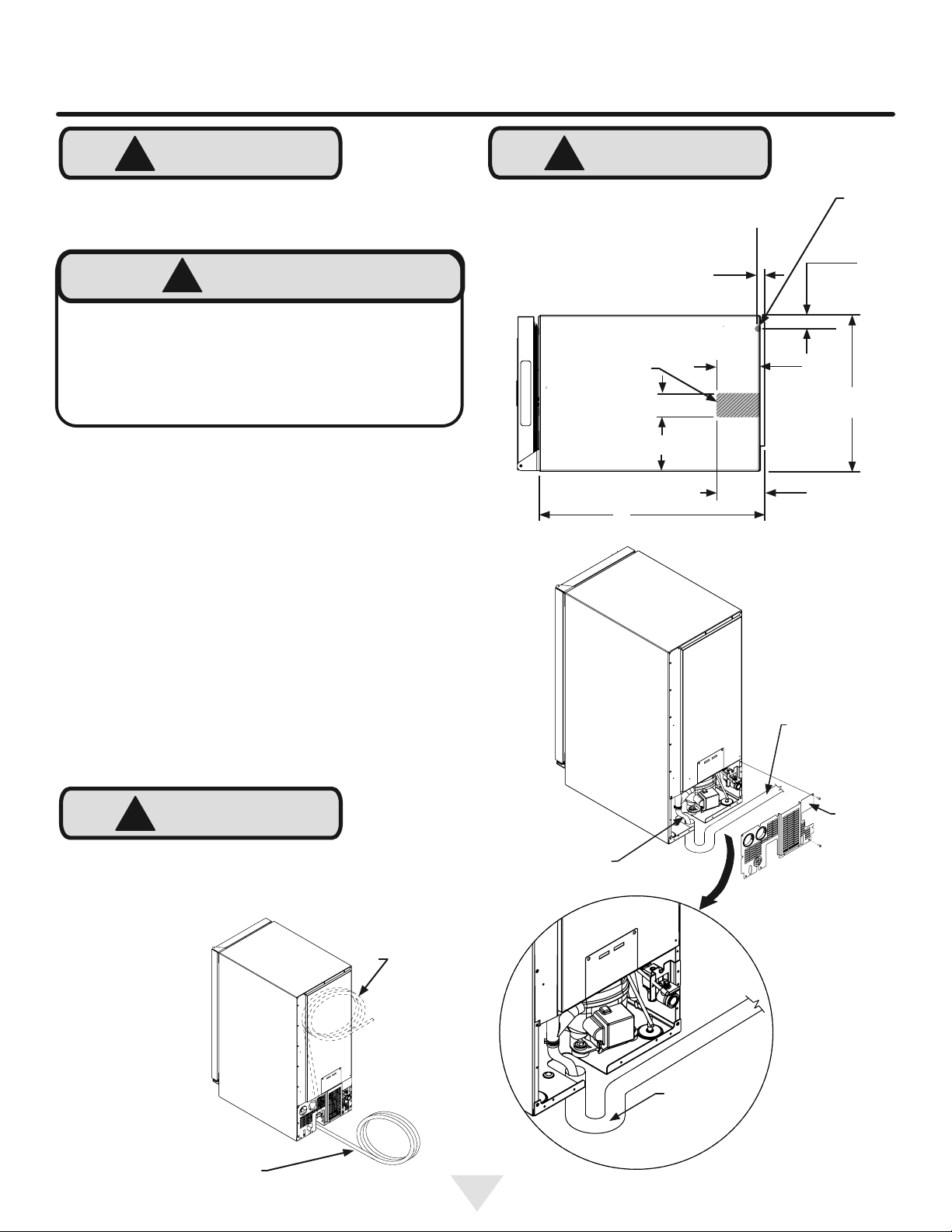
Access
panel
Drain pipe, (not
provided)
Drain tubing, cut
to length and
install in the drain
C
L
C
L
14
7
⁄8"
(37.8 cm)
11
⁄16"
(17mm)
1
1
⁄4"
(3.2 cm)
4
17
⁄32"
(11.5 cm)
21
1
⁄2"
(54.6 cm)
Figure 8
Figure 7
Drain line coiled
and secured to
the back of the
unit
Uncoil the drain line, route
to an appropriate drain and
cut to the required length
Electrical Shock Hazard
Reasonable care and safe methods should be
practiced. Do NOT work with energized electrical
equipment in a wet area. Read and follow the
installation instructions listed in this manual.
!
WARNING
!
CAUTION
Failure to use an adequate drainage system, will result in
surrounding water damage and/or poor ice production.
Figure 6
!
CAUTION
Observe and follow all local building codes
when installing this ice machine and drain
lines.
Water
supply
inlet
Drain access in
bottom of unit
4
3
⁄32"
(10.4 cm)
Sanitary
trap
2
1
⁄4"(5.7 cm)
5
1
⁄8" (13 cm)
Drain Plumbing
Your ice machine requires drain plumbing. There are 2
variations of ice machines in regards to the installation of
the drain plumbing, without a drain pump (gravity drain),
and with a drain pump.
Gravity Drain (no drain pump):
The ice machine is shipped with the drain line installed,
coiled and secured to the back of the cabinet as shown
in Figure 6. It can be uncoiled, routed to an appropriate
drain and cut to length as required. Additionally there is the
provision of drain routing through the cut-out in the bottom
of the unit, (see the gray area in Figure 7). A drain can be
installed in this gray area with the drain line cut to a short
length and positioned into the drain as shown in Figure 8,
or if the ice machine is to be built-in, the drain tube could
be routed through a hole in the floor in this gray area to a
drain below.
The gravity drain line must be routed no higher than 6"
(15.2 cm) o the oor to assure proper drainage.
!
CAUTION
7
INSTALLING THE DRAIN PLUMBING
This drain pump is designed to be installed in DCS ice
machines only and approved for use with water only.
Figure 9
Drain pump
vent tube.
Keep this
open to
assure air
ows freely
as water
enters
the pump
reservoir.
Drain line coiled and
secured to the back of the
cabinet. Uncoil, route to
an appropriate drain and
cut to length.
Optional Drain Pump.
An optional drain pump is available if you have purchased
an ice machine without one and do not have access to a
gravity drain. Installation instructions are provided with
the optional drain pump.
! CAUTION
Electrical Shock Hazard
Risk of electrical shock or personal injury could
occur due to moving components, if the machine
compartment access cover is removed before
unplugging the ice machine power cord.
!
WARNING
8
Reverse osmosis, (RO), water, softened water, and de-
ionized water are not recommended as they can adversely
Water
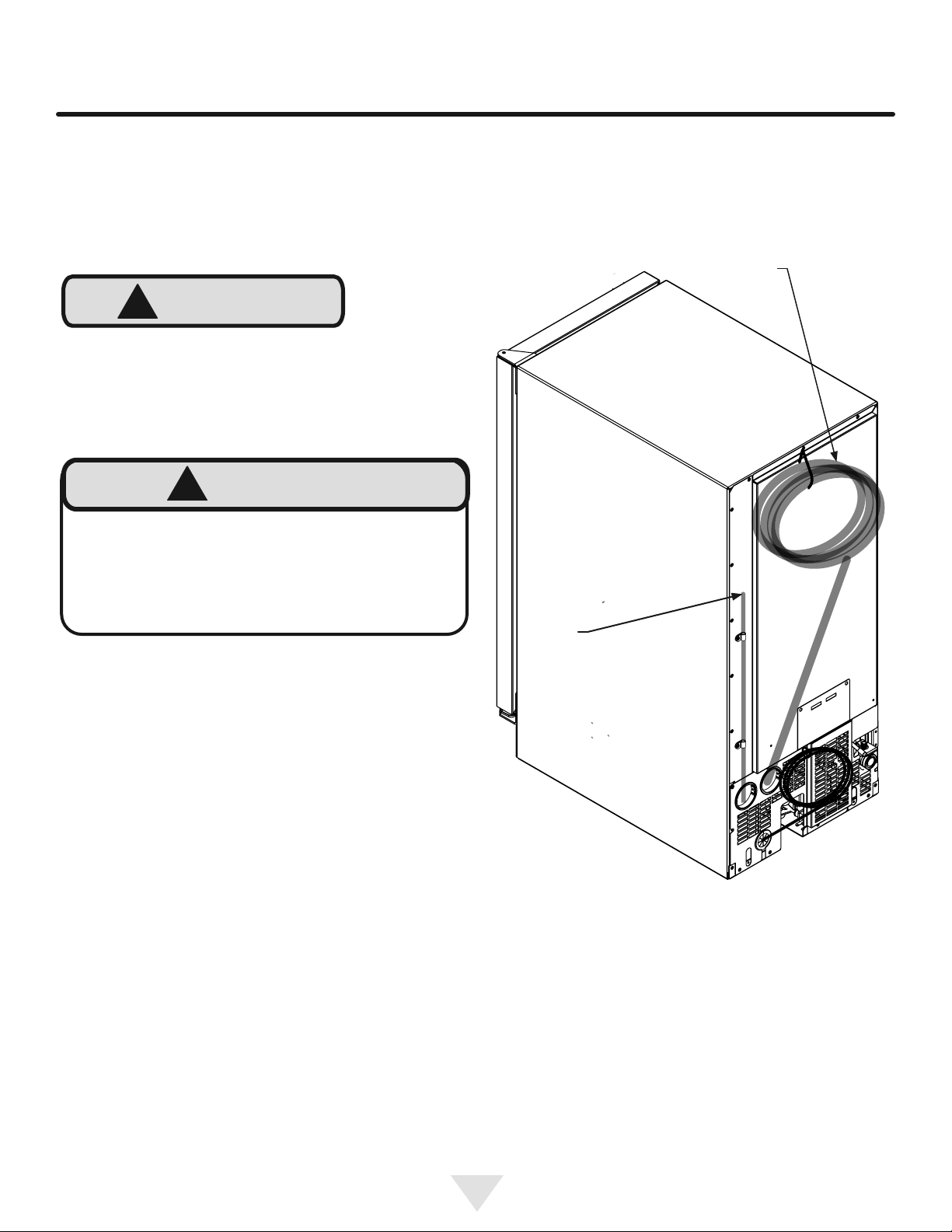
Supply
Line
Clamp and
Screw
Figure 10
Back view of
ice machine
NOTE
!
CAUTION
INSTALLING THE WATER SUPPLY
Compression
Water
supply
line
Water supply
service loop
valve
Water valve
inlet
Water Supply
Observe and follow all local building codes when installing
this appliance.
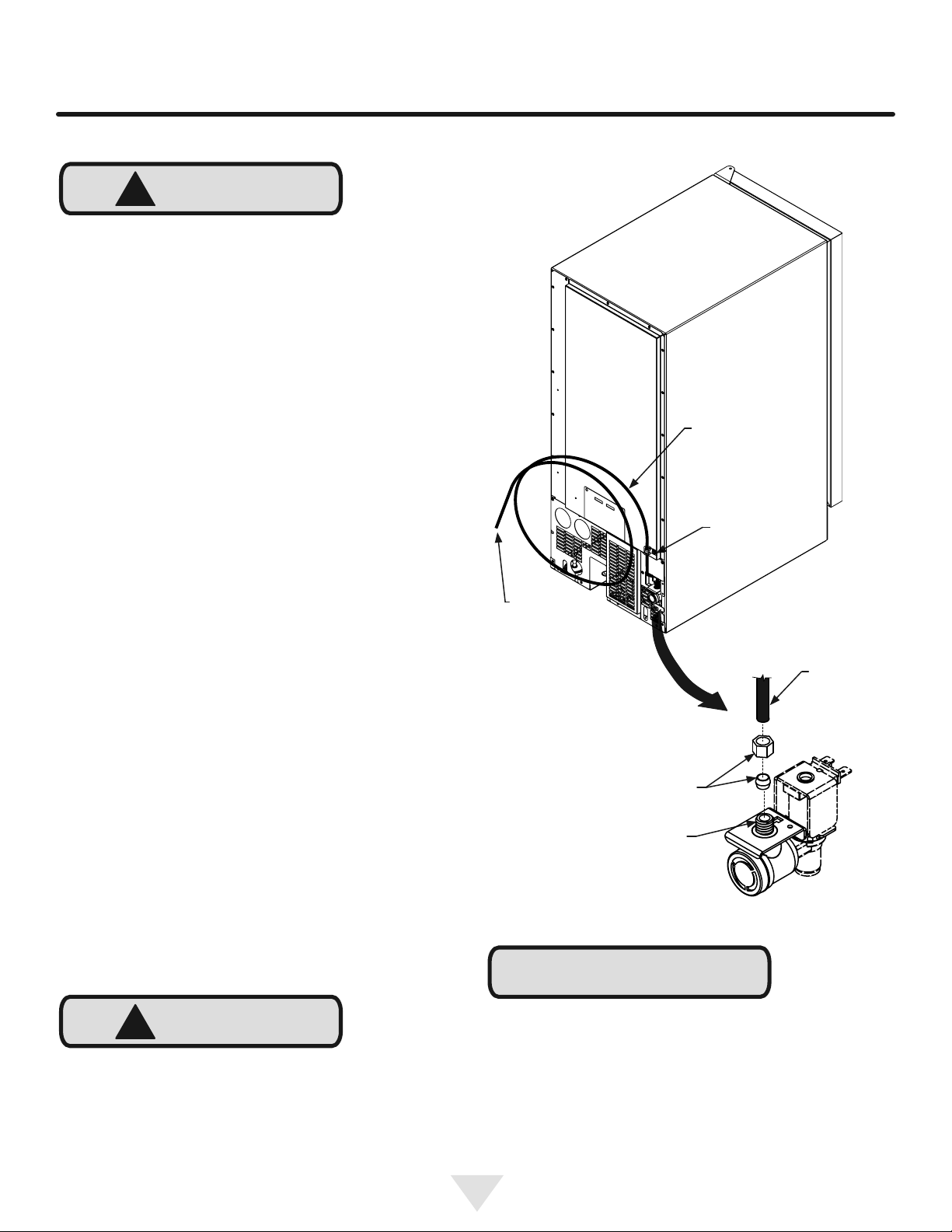
This ice machine must be connected to a potable cold
water supply line. delivering water pressure between a
minimum of 20 psi and a maximum of 120 psi.
Use
¹
" copper tubing for your water supply which is
available at any local hardware or plumbing supply store.
Route the
¹
" copper tubing to suit your installation being
sure not to kink the tubing. Purchase enough copper tubing
length to allow a coil to be formed behind the unit for a
"service loop" which will allow the appliance to be pulled
out from the installation for servicing or cleaning. (See
Figure 10). Connect the copper tubing to the "top side" of a
cold water pipe to prevent the ice-maker from plugging with
sediment.
ease servicing the appliance. NOTE: A SELF-PIERCING
TYPE VALVE IS NOT RECOMMENDED as they are prone
to clogging with sediment which will create pressure drop
reducing the water supply to the unit.
Connect the copper tubing water supply to the water valve
IMPORTANT: Secure the water supply line to the back of
the cabinet with the screw and strain relief clamp provided
in the corner of the back panel. (See Figure 10).
Make certain all connections are watertight after
installation. Form the tubing so that it will not vibrate
against the cabinet body or kink when your appliance is
moved in and out of position.
This ice machine is designed to make clear ice from the
majority of water sources on a daily basis. If your results
treated. A water specialist can recommend proper water
treatment.
!
CAUTION
•
only. Do not use with plastic tubing.
•
9
INSTALLING THE WATER SUPPLY
Procedure for Testing Drain System
(both gravity and drain pump models)
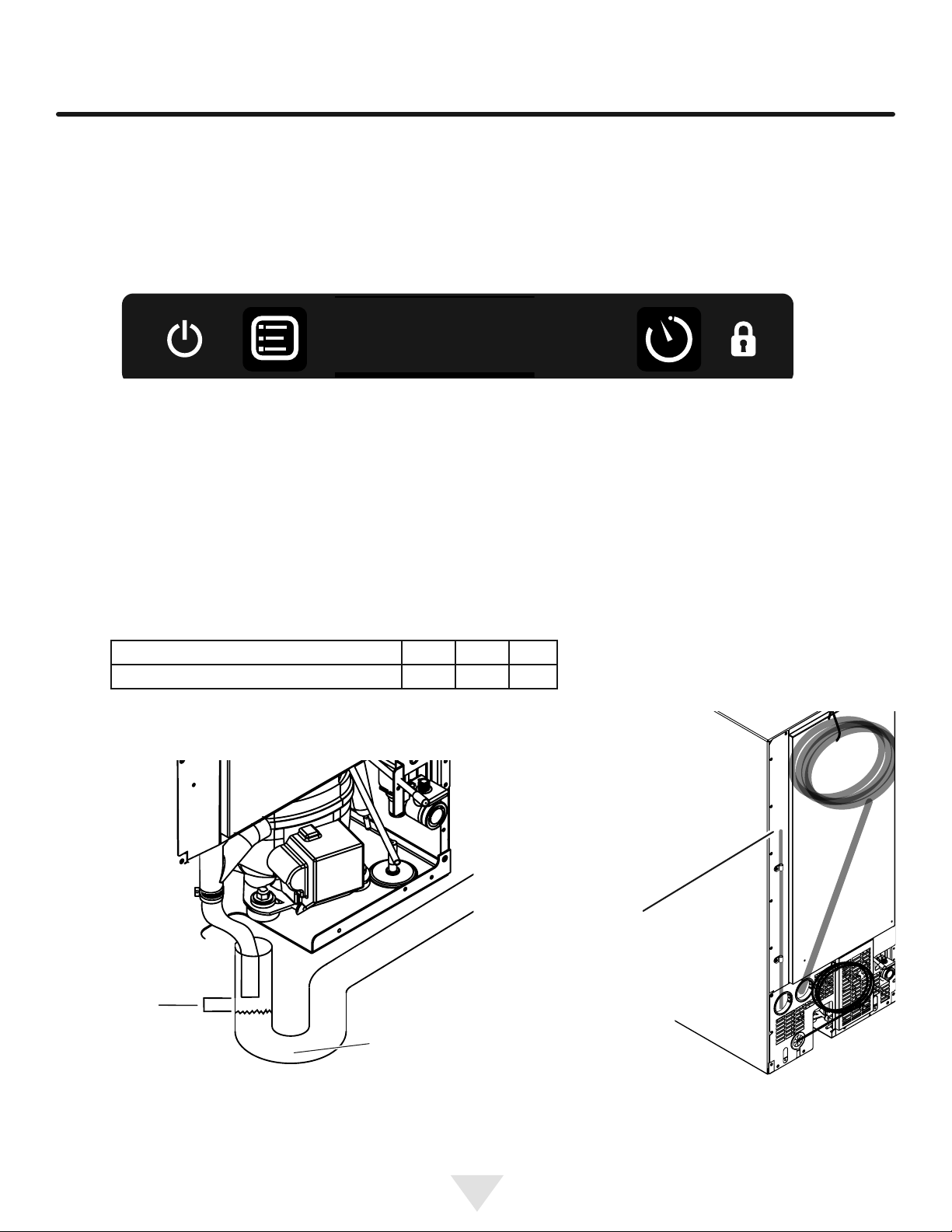
Drain pump models have a safety feature that will interrupt power to the unit if a high-limit condition occurs to prevent
ooding. This safety feature can be initiated by a restriction in the drain system and will continue until high-limit condition
is corrected, at which time power will be restored to the unit. Power interruption can be detected when no icons are
visible in the display area of the user interface (Figure 11). Once power is returned, a startup chime will sound followed
by a self-test, and "OFF" should be visible in the display area.
Drain pump vent
tube. Keep this
open to assure
air ows freely as
water enters the
pump reservoir.
Figure 13: Location of vent tube.
Figure 12: Example of an open drain.
Sanitary trap
hours
ICE
1 4 6 8
OFF CLEAN
DOOR
ECO
days
On/o Menu Delay timer Lock
7. After checking the above requirements, repeat step 4 and verify the water drains completely without power
interruption. If problems persist call a qualied service technician and/or plumber.
Air gap
between
end of
drain line
and top of
water level
Figure 11: User interface display during power interruption.
Once the drain line is plumbed, perform the following:
1. Plug the ice machine into 115v power supply.
2. Place unit in the nal installation location.
3. Turn the unit o via the user interface (display will indicate “OFF”). The drain pump will still be operational during o
mode if the unit has one.
4. Slowly pour 3-qts of water into the ice storage bin. All water should drain completely.
5. If water drains fully and without power interruption, the drain system has been successfully tested and further
installation of the ice machine can be continued.
6. If the water does not drain or a power interrupt occurs, check the following:
a. There are no kinks or restrictions in the drain line. (Note: Drain line needs to be cut to the required length and any
excess tubing should be removed to prevent possible restrictions).
b. Drain line was run according to the guidelines for maxiumum allowable rise and run as shown in the table below:
Rise Above Floor Level 8 ft. 9 ft. 10 ft.
Maxium Allowable Drain Line Length 20 ft. 15 ft. 10 ft.
c. Your drain line is plumbed into an open drain (Figure 12).
d. The vent tube on the back of the unit is open (Figure 13).
10
The Ice Making Process
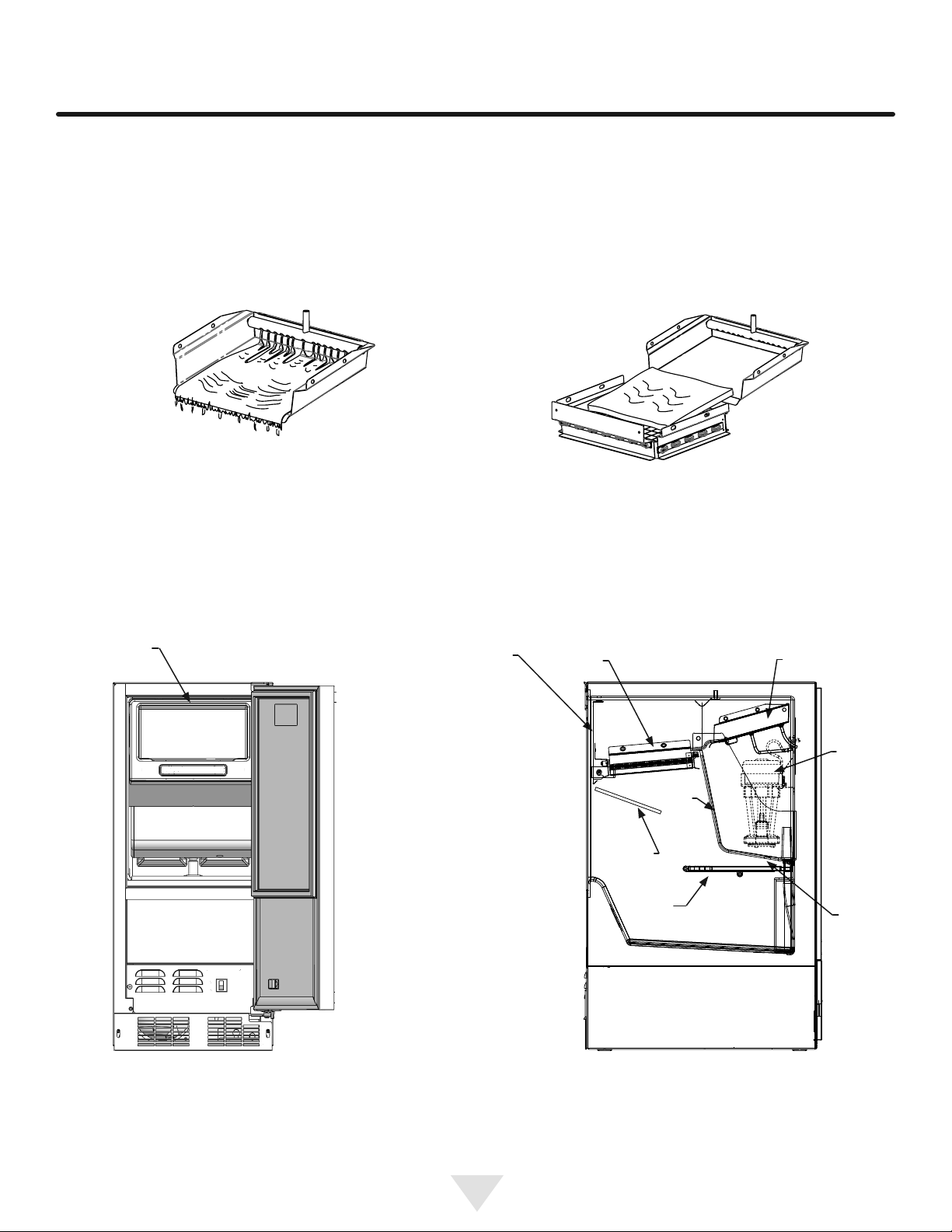
Your ice machine is unique in how it forms ice with
fractional freezing to form a slab of ice that is clear and
has less dissolved solids than the water it is produced
from. This is accomplished by running water over the cold
evaporator plate (see Figure 14) which gradually freezes
the water to produce the ice slab. Pure water freezes rst,
leaving the dissolved solids in the residual reservoir water
to provide clear ice.
Figure 14
When the ice slab reaches the correct thickness, the ice
sheet is released and slides onto the grid cutter (see
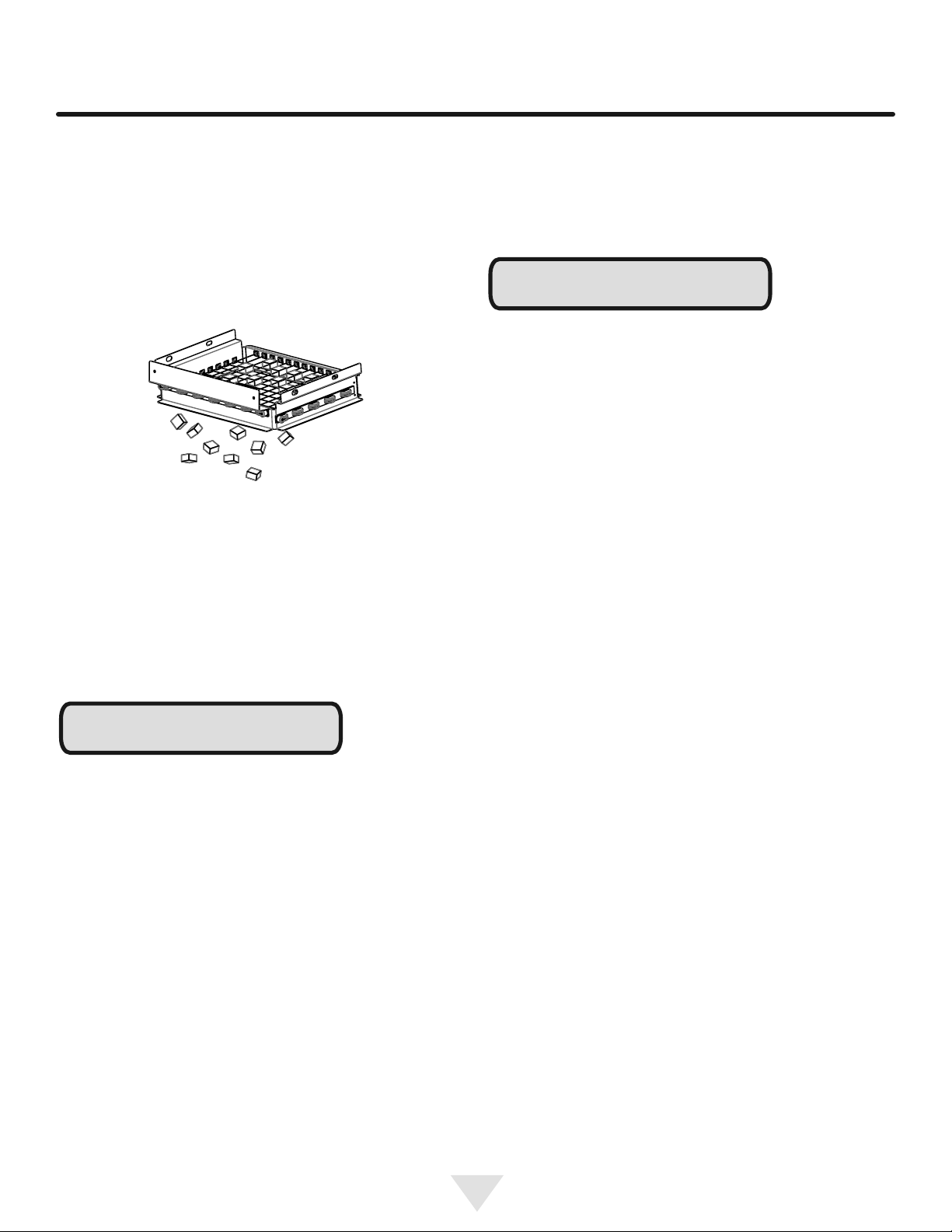
Figure 16). Here, the ice slab is cut into squares by the
grid cutter’s heated wires (see Figure 17). The water
containing the dissolved minerals is drained after each
freezing cycle. Fresh water enters the machine for the next
ice making cycle.
Figure 16
Water distributor
Water
reservoir
Evaporator
Circulation
Pump
Reservoir
drain plug
Figure 15
Front
panel
Bin Level
Sensor
Ice
Deector
Grid Cutter
OPERATION OF THE ICE MACHINE
11
The bin level sensor is located in the ice bin, it senses
when the ice supply is low or full and starts or stops the ice
making process accordingly.
If the water supply is turned o to the ice machine be sure
to set the electronic control to the “OFF” position or remove
power to the unit.
New Sounds
The ice machine will make sounds that are dierent than
your household refrigerator. Because these sounds are
new to you they may be of a concern but are most likely
normal. The ice production process will make noises that
are not typical in a refrigeration product, ice falling onto
hard surfaces, water cascading across the evaporator, and
valves opening and closing. Following are some of the
sounds that you may hear:
A buzzing sound will be heard when the water valve
opens to ll the water reservoir.
A rattling noise which could be water owing through the
water line.
A splashing sound when water is owing over the
evaporator plate and into the water reservoir.
A "thud" when the ice slab is released from the
evaporator plate and slides onto the grid cutter.
"Clicks" when the cubes fall into the ice storage bin.
A gurgling sound which is refrigerant owing in the ice
machine.
An air noise from the condenser fan.
Ice Production
In normal mode the ice machine will produce up to 39
pounds (17.7 kg) of clear ice in a 24-hour period when
installed in a 72°F ambient with a 55°F water supply. In
"ECO" mode (see page 16) the ice machine will produce up
to 29 pounds (13.2 kg) of clear ice in the 24 hour period.
“Initial” ice production and ice accumulated in the storage
bin will vary signicantly. This is normal. During the rst
24-hours of operation the unit will produce up to 39 lbs of
ice at the above ambient and water temperature conditions,
but when starting with an empty ice storage bin, the storage
bin may only accumulate up to 18 lbs of ice. By design,
the ice storage bin is maintained at a temperature slightly
above freezing to allow the stored ice to slowly melt, to
preserve the ice quality and clarity and assure a constant
supply of fresh ice. As ice is accumulated in the bin, the ice
production rate will overcome the ice melt and the storage
bin will ll to capacity.
NOTE
NOTE
OPERATION OF ICE MACHINE
The ice machine will keep producing ice until the ice
machine’s bin is full and will restart automatically when
ice needs to be replenished in the bin. The ice bin is
not refrigerated, and some melting will occur by design
to preserve the ice quality and clarity. Allow your ice
machine to run for 24-48 hours to accumulate ice in the ice
machine’s bin.
Figure 17
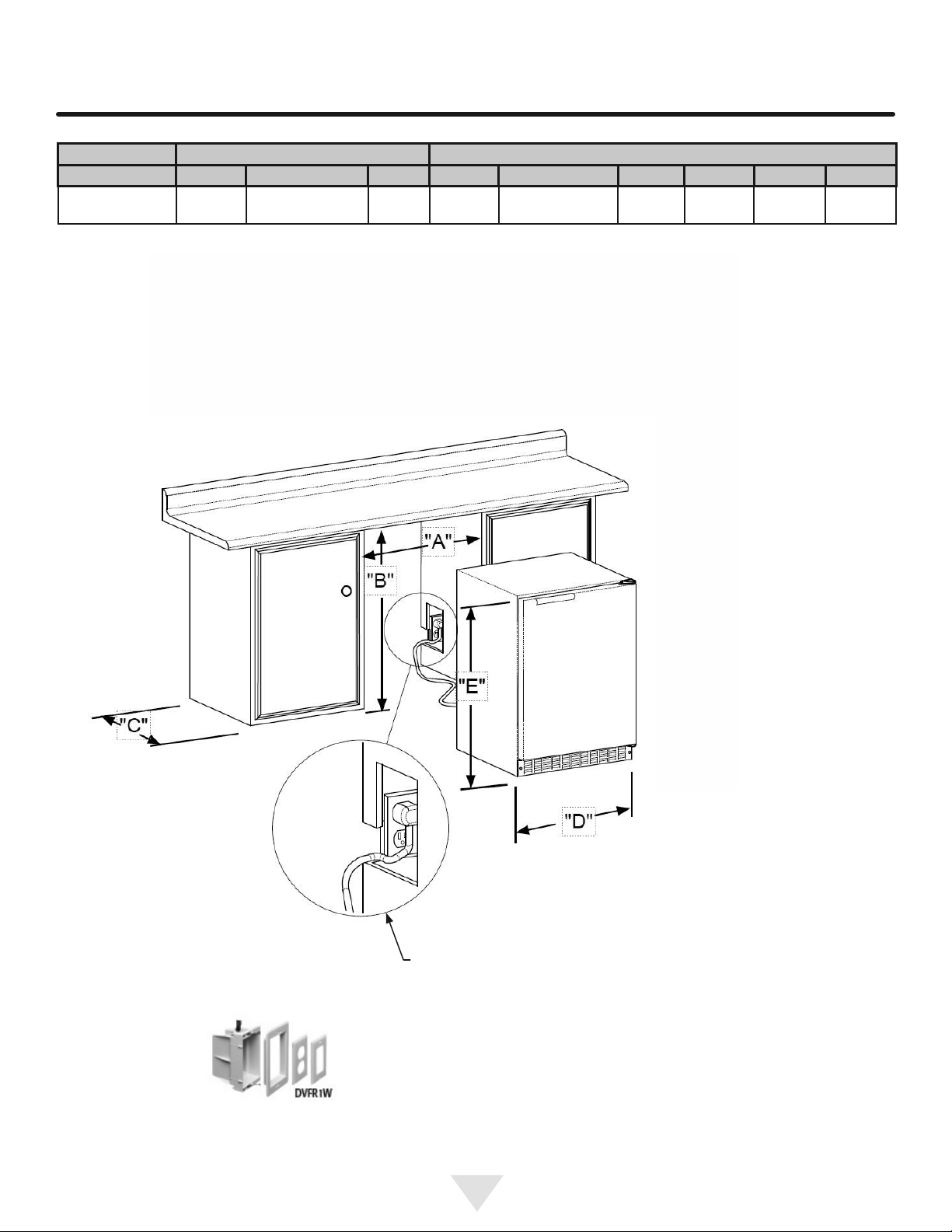
12
PRODUCT DIMENSIONS
ROUGH-IN OPENING DIMENSIONS CABINET DIMENSIONS
MODEL "A" "B" "C" "D" "E" "F" "G" "H" "J"
RF15I 15" 34" to 35" 24" 14
7
⁄8" 33
3
⁄4" to 34
3
⁄4" 23
5
⁄8" 27
7
⁄32" 37
3
⁄8" 16
23
⁄32"
"A"
"B"
"C"
"D"
"E"
Figure 19
Figure 19
If necessary to gain clearance inside the rough-
in opening a hole can be cut through the adjacent
cabinet and the power cord routed through this hole to
a power outlet. Another way to increase the available
opening depth is to recess the power outlet into the
rear wall to gain the thickness of the power cord
plug. Not all recessed outlet boxes will work for this
application as they are too narrow, but a recessed
outlet box equivalent to Arlington #DVFR1W is
recommended for this application, (see Figure 19).
Figure 18a
Figure 18
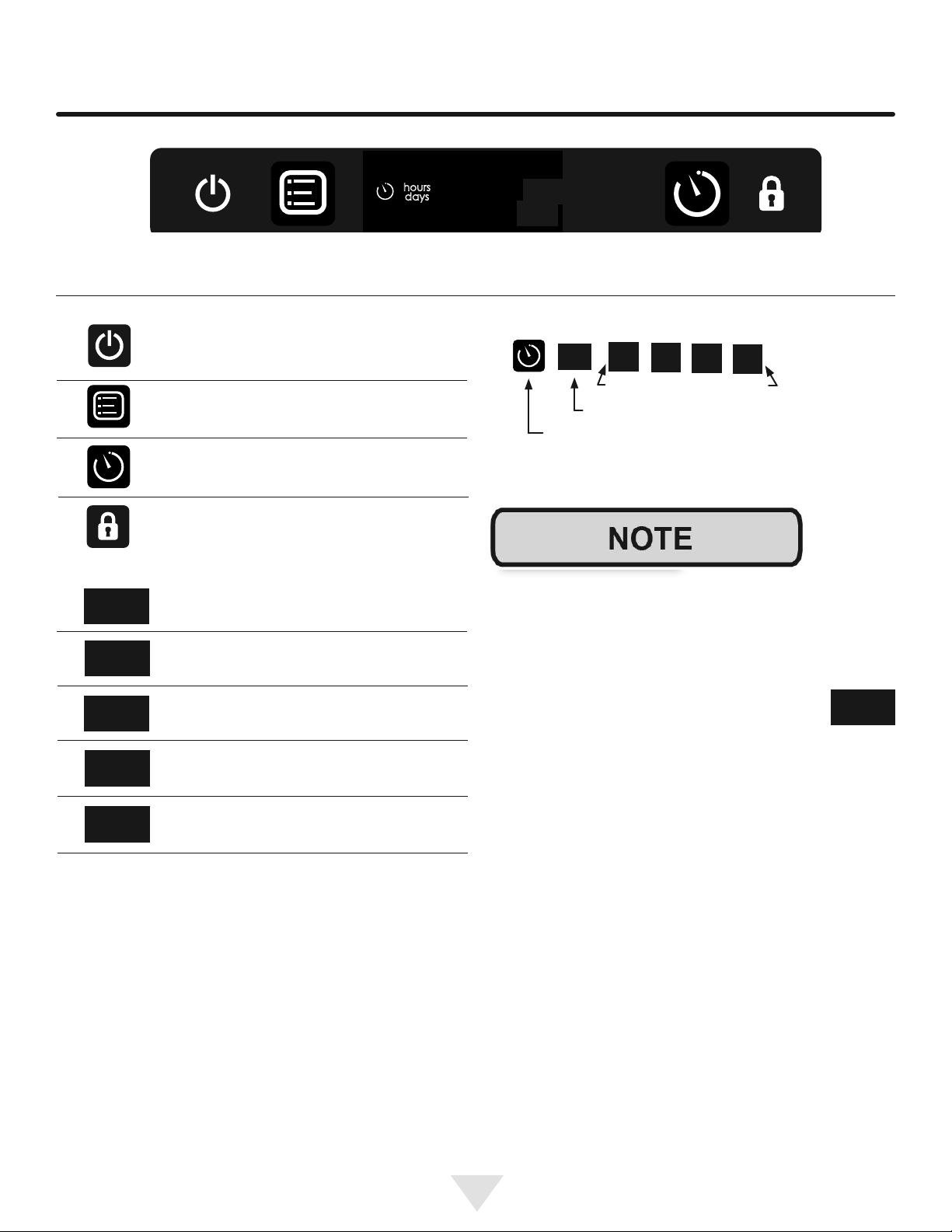
13
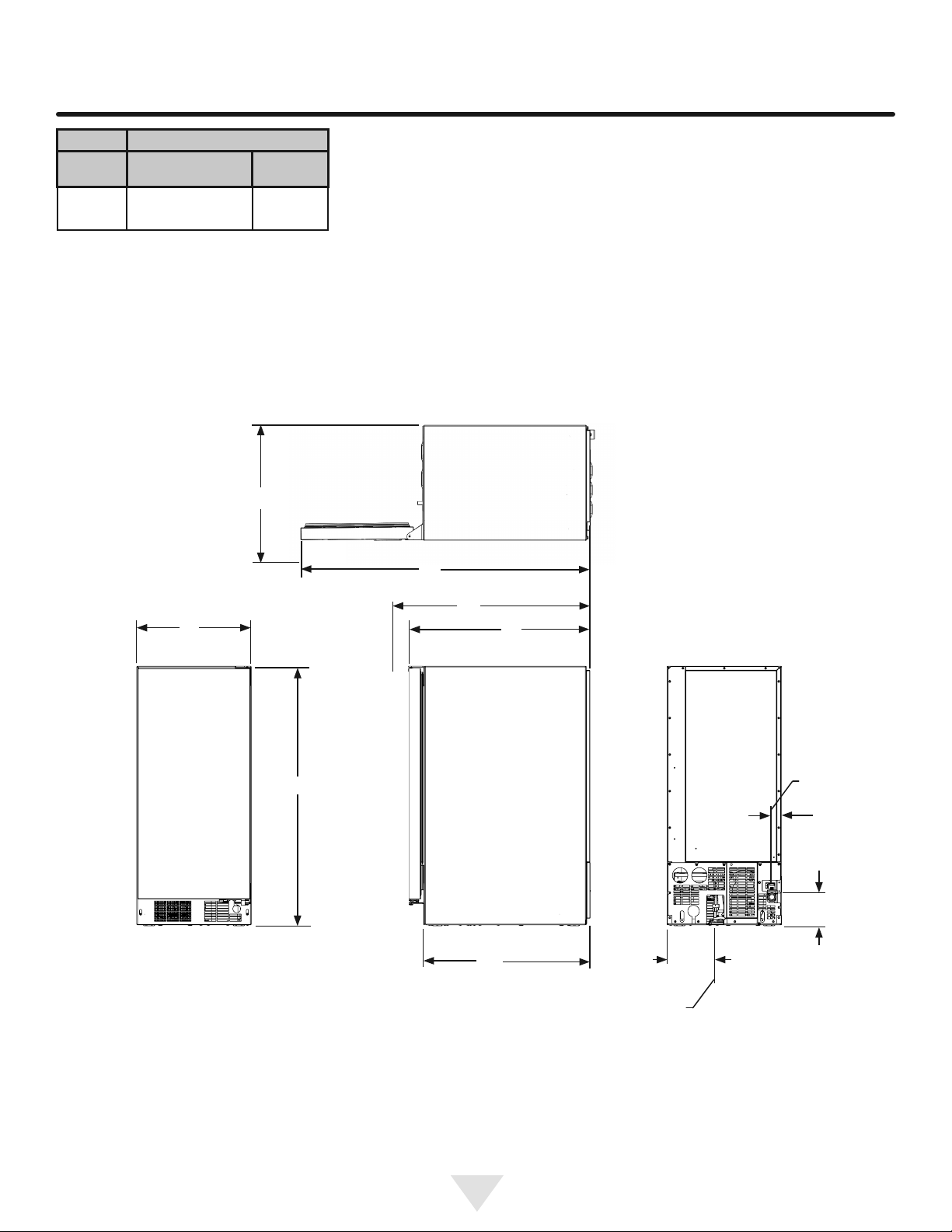
PRODUCT DIMENSIONS
PRODUCT DATA
MODEL
ELECTRICAL
REQUIREMENTS #
PRODUCT
WEIGHT
RF15I 115V/60Hz/15A
105 lbs
(47.7 kg)
** Minimum rough-in opening required is to be larger than
the adjusted height of the cabinet.
# A grounded 15 amp dedicated circuit is required. Follow
all local building codes when installing electrical and
appliance.
"J"
"H"
"G"
"F"
"D"
"E"
Figure 20
(S) solid
door shown
21
1
⁄2"
(54.6cm)
6
15
⁄16"
(17.6 cm)
CL Gravity
drain
CL
Water
inlet
1
1
⁄4"
(3.2 cm)
4
7
⁄8"
(12.4 cm)
14
USING YOUR ELECTRONIC CONTROL
Starting your clear ice machine:
Plug the ice machine into a 115 volt wall outlet,
(see page 5 for electrical information). Your
appliance is shipped from the factory in the "ICE" mode
and will begin start-up of ice production after the start-up
routine.
Upon applying power to the unit, or after a power
interruption, the Ice machine will perform a self-test,
followed by a harvest cycle to clear any in-process ice
production. This start-up routine, (“after power is applied
to the unit”), takes approximately 13 minutes to complete
before an ice production cycle starts.
If the appliance does not start, conrm the wall outlet has
power, and the control is in the "ICE" mode, (see Options
section below). Do not start the ice machine in "ECO"
mode. "ECO" mode should only be used after there is a full
bin of ice.
hours
ICE
1 4 6 8
OFF CLEAN
DOOR
ECO
days
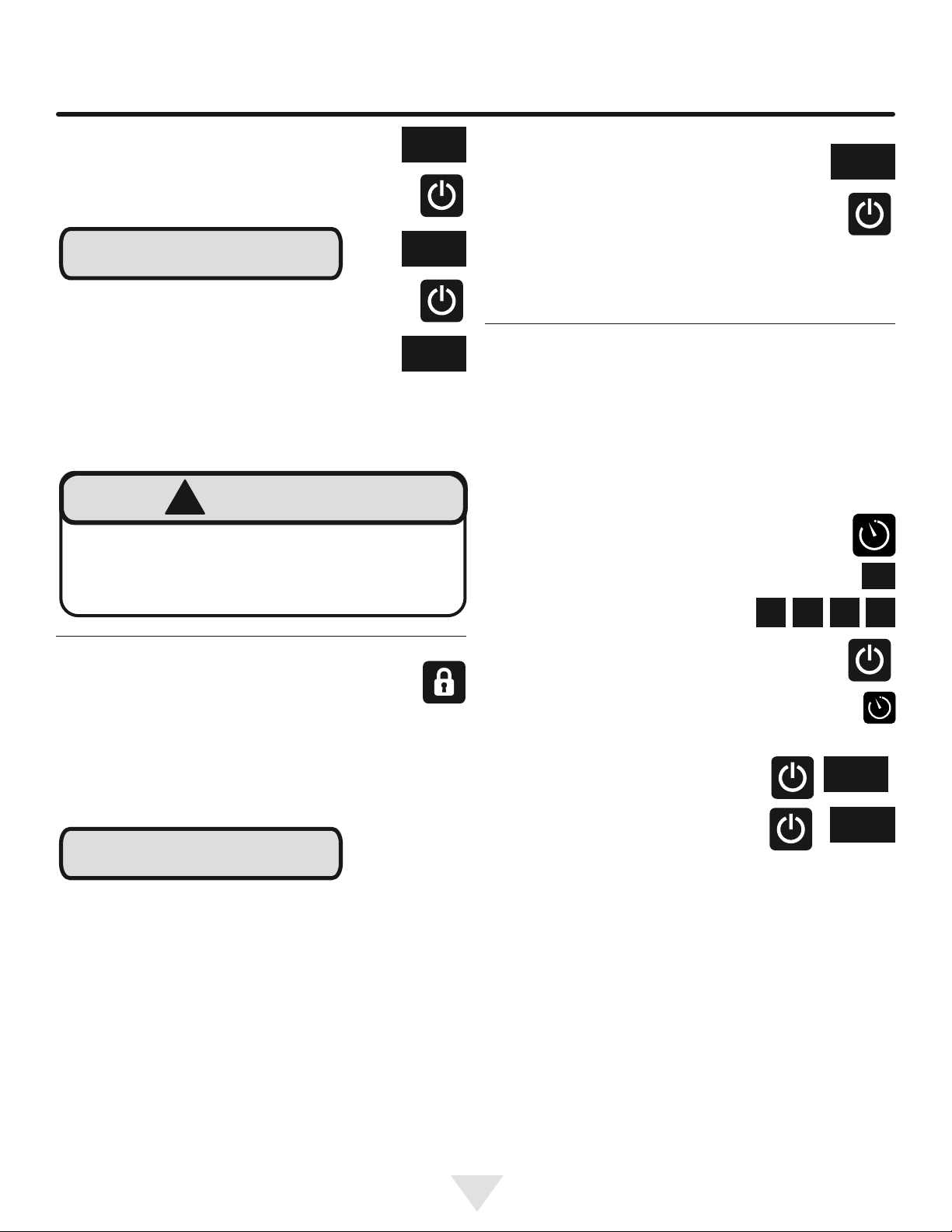
"ON/OFF" icon : used for turning the
appliance on and o.
"MENU" icon : used to access optional
functions in the user interface.
Display icons:
ICE
1
4
6
8
hours
days
"Clock" icon : used to enter the Delay start/
vacation mode.
"LOCK" icon : used to lock out functions in
the user interface.
Display area text:
ICE
OFF
DOOR
CLEAN
ECO
Signies the appliance is on and producing
ice.
Signies the appliance is o
Signies a door ajar alarm condition.
Cleaning is recommended or the appliance
is in the clean mode.
Signies the appliance is in economical ice
production mode.
Figure 21
User interface display
On/o Menu Display area Delay timer Lock
When lit, this signies the delay start/vacation mode is
operational.
Hours or days will be lit
Hours or days timer is set for
Delay start/Vacation mode:
The control display is covered with a clear plastic protective
lm. This lm may be removed by carefully lifting at a
corner.
15
Turning your ice machine On and O:
If your appliance is on, "ICE" will be displayed.
To turn the appliance o, push and hold the "ON/
OFF" icon for 3-seconds. The display will show
"OFF" .
The drain pump (if equipped) and the interior light
will still be functioning during the OFF mode. To
turn the appliance back on, press and hold the "ON/OFF"
icon for 3-seconds, the display will show "ICE".
ICE
ICE
OFF
USING YOUR ELECTRONIC CONTROL
Control Lock:
The user interface can be locked to avoid
unintentional changes from things like cleaning. To
lock the appliance, push and hold the "LOCK" icon
for 5-seconds. The "LOCK" icon will ash 3 times, then
change to steady back-lit. To unlock the user interface,
press and hold the "LOCK" icon for 5-seconds, and the
back-light will turn o.
NOTE
NOTE
The "LOCK" icon is the only active key in this mode. If other
icons are pressed while in the lock mode the "LOCK" icon
will ash 3 times, and an audible tone will sound, to remind
the user the appliance is in the lock mode.
When turned o, the ice machine will complete its
current ice production cycle then shut o.
Door ajar alarm:
If the door is open, or not closed properly for 5
minutes the "DOOR" indicator will illuminate and
ash and an audible tone will sound. The audible
alarm can be muted by pressing the "Lock" keypad.
This alarm condition can be reset by closing the
door or momentarily pressing the "ON/OFF" icon,
(i.e.-if you are cleaning the storage compartment, etc.). The
alarm will recur in 5 minutes if the alarm condition persists.
DOOR
Turning the ice machine "OFF" will only terminate the
ice production, it does not remove power from the
appliance. Always unplug the power cord from the
wall outlet before servicing the unit.
!
WARNING
Delay start/Vacation mode:
Your ice machine is equipped with a delay start function.
This feature can be used to temporarily shut the appliance
o for 1, 4, 6, or 8 hours or days. Upon completion of the
selected delay period, the appliance will resume operation.
This is ideal for temporarily stopping ice machine noises or
to save water and electricity if you are away from home but
want fresh ice upon your return.
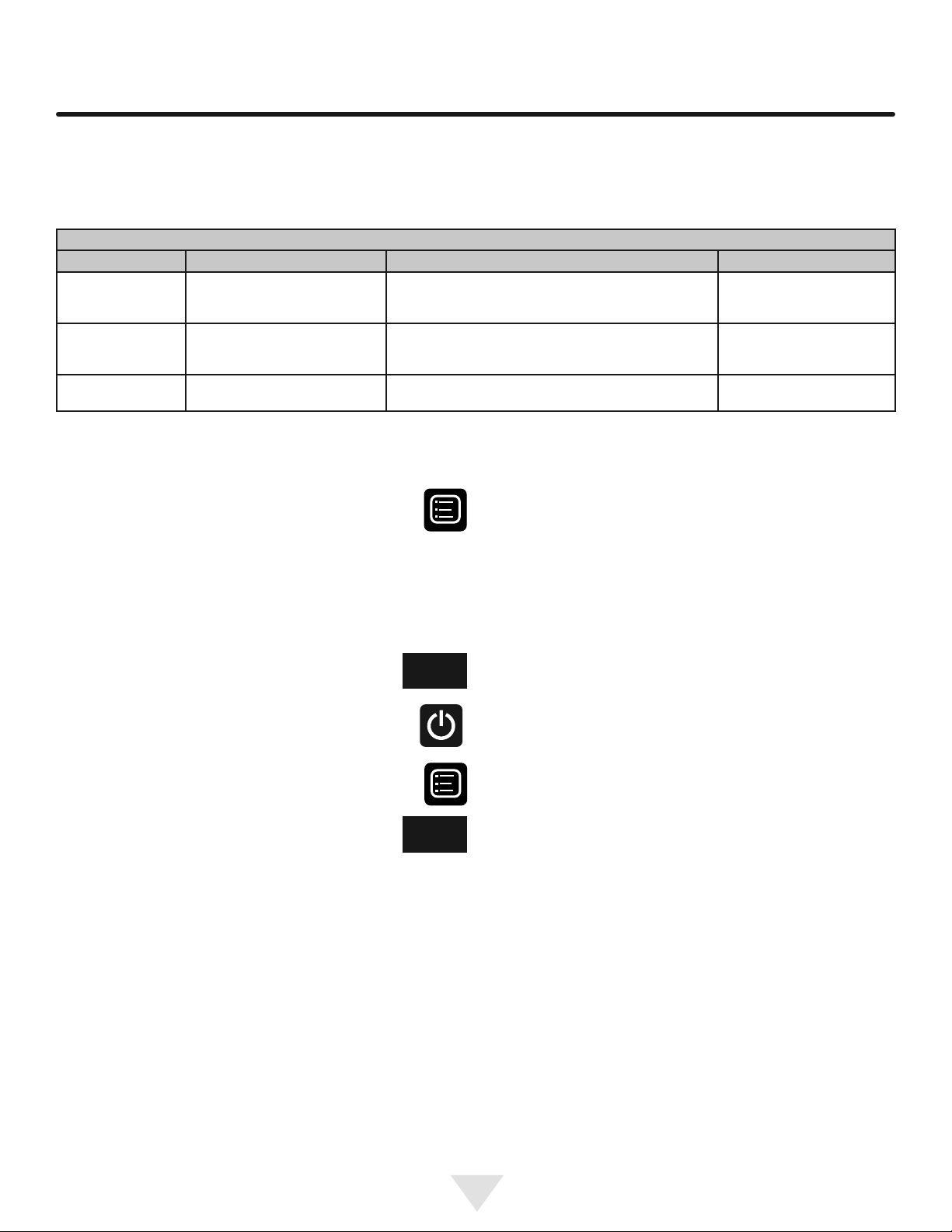
To enter the delay start mode, press the "CLOCK"
icon while the appliance is in "ICE" mode. This will
delay the next harvest by the time displayed. Each
additional press of the "CLOCK" icon will add time,
from 1, 4, 6, or 8 hours, to 1, 4, 6, or 8 days. The next
press after 8 days will leave delay set
mode. After the desired time has been
selected, press the "ON/OFF" icon for 2 seconds
to accept, your unit will shut o and a clock icon
and your selected time will be displayed. When the
selected time has elapsed, normal ice production will
resume.
To cancel the delayed start, press
and hold the "ON/OFF" icon until the
appliance enters OFF, then press and
hold the "ON/OFF" icon again until the
appliance enters "ICE" mode.
1 4 6 8
hours
days
ICE
OFF
16
Error Codes
Error Displayed Code Error Description Action to Take
Bin Sensor error
"OFF" will ash continuously in 1
second intervals in the display. No
audible alarm will sound.
Failed temperature sensor. Machine operation will
immediately enter an OFF state.
Call service to have the
temperature sensor replaced.
System Sensor error
"ICE" will ash continuously in
the display. No audible alarm will
sound.
Failed condenser temperature sensor. Machine operation
will continue but ice production cycle will not adapt to
varying ambient conditions, so ice quality may vary.
Call service to have the
temperature sensor replaced.
Communication error
Continual ashing of all indicators
on the display.
Loss of communication between the main board and the
user interface.
Call service to have a
diagnostic check.
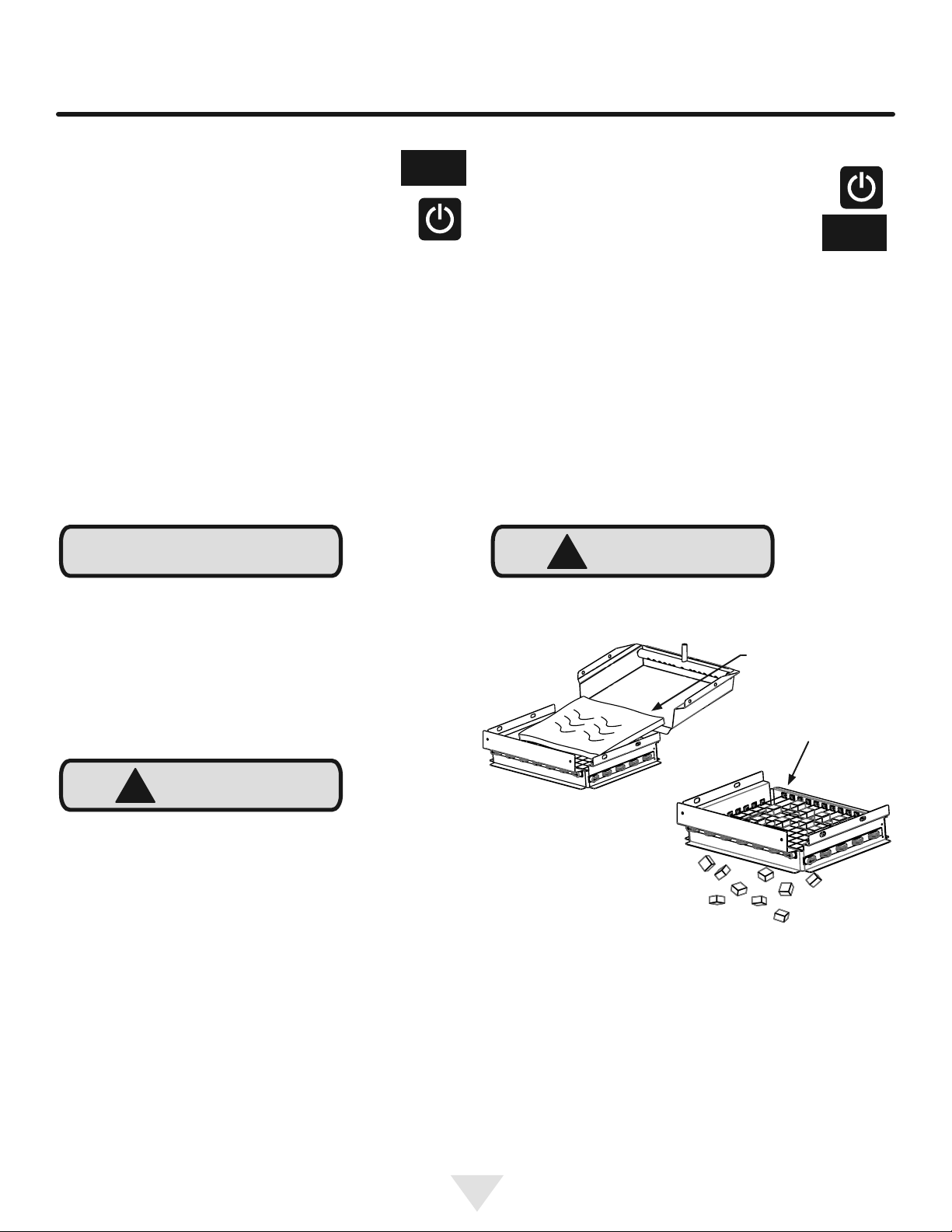
Error codes:
The ice machine is monitored continuously. Any OPEN or
SHORTED circuit condition with a temperature sensor or
miscommunications between the control and user interface
will initiate an ERROR CODE as listed below:
ICE
Options menu:
Normal and ECO mode:
Your ice machine comes with an optional "ECO" mode.
This new feature allows you to tailor ice production to a
conservative rate, saving approximately 25% energy and
30% water from routine operation. While in this mode
ice production will slow and the appliance will use less
water and electricity. "ECO" mode should only
be initiated after there is a full bin of ice. To enter
"ECO" mode do the following:
• Press the "MENU" icon twice and the green
"ECO" will ash.
• Press and hold the "ON/OFF" icon until the
green "ECO" stops ashing and remains
illuminated.
• To return to the standard operating rate press the
"MENU" icon twice, the ECO will turn o and
the "ICE" will be ashing. Press and hold the
"ON/OFF" icon until the "ICE" stops ashing
and remains illuminated.
ECO
USING YOUR ELECTRONIC CONTROL
17
CLEANING YOUR ICE MACHINE
!
CAUTION
Forcing ice through the grid cutter will break the grid cutter
wires.
!
CAUTION
Remove all ice
from the evaporator
plate and grid cutter
area that is not
embedded in wires
Figure 22
Figure 23
Clean mode:
To ensure maximum performance and ice quality, it is
recommended to clean your ice machine once every six
months. This simple cleaning routine will also ensure water
and energy use continues at optimum eciency.
Clean reminder:
A "CLEAN" reminder will occur every 6 months
to remind you that it may be time to clean your
appliance. Over time mineral build up on the cold
evaporator plate can occur which can adversely
aect the quality of your ice. This build-up is
dependent on your water source and usage. Normal
ice production will continue while the "CLEAN" reminder
is displayed. You may clear the "CLEAN" reminder at any
time by momentarily pressing the "ON/OFF" icon. When
reset, the "CLEAN" reminder will reset and not occur for
another 6 months. If you choose to clean the appliance at
this time, see the options menu section below.
CLEAN
NOTE
Homes with poor water quality or high clear ice usage
might require more frequent cleaning.
To clean your ice machine you will need to purchase a
"nickel safe" ice maker cleaner. Cleaner can be obtained
by contacting DCS customer service at 888.936.7872.
Use only DCS-approved ice machine cleaner and follow
all label warnings and directions. Incorrect chemical
usage, and any damage that may result, is not covered
by warranty.
Once you have your cleaner:
Turn the ice machine o by pressing and holding
the "ON/OFF" icon for 3 seconds. "OFF" will be
displayed on the control.
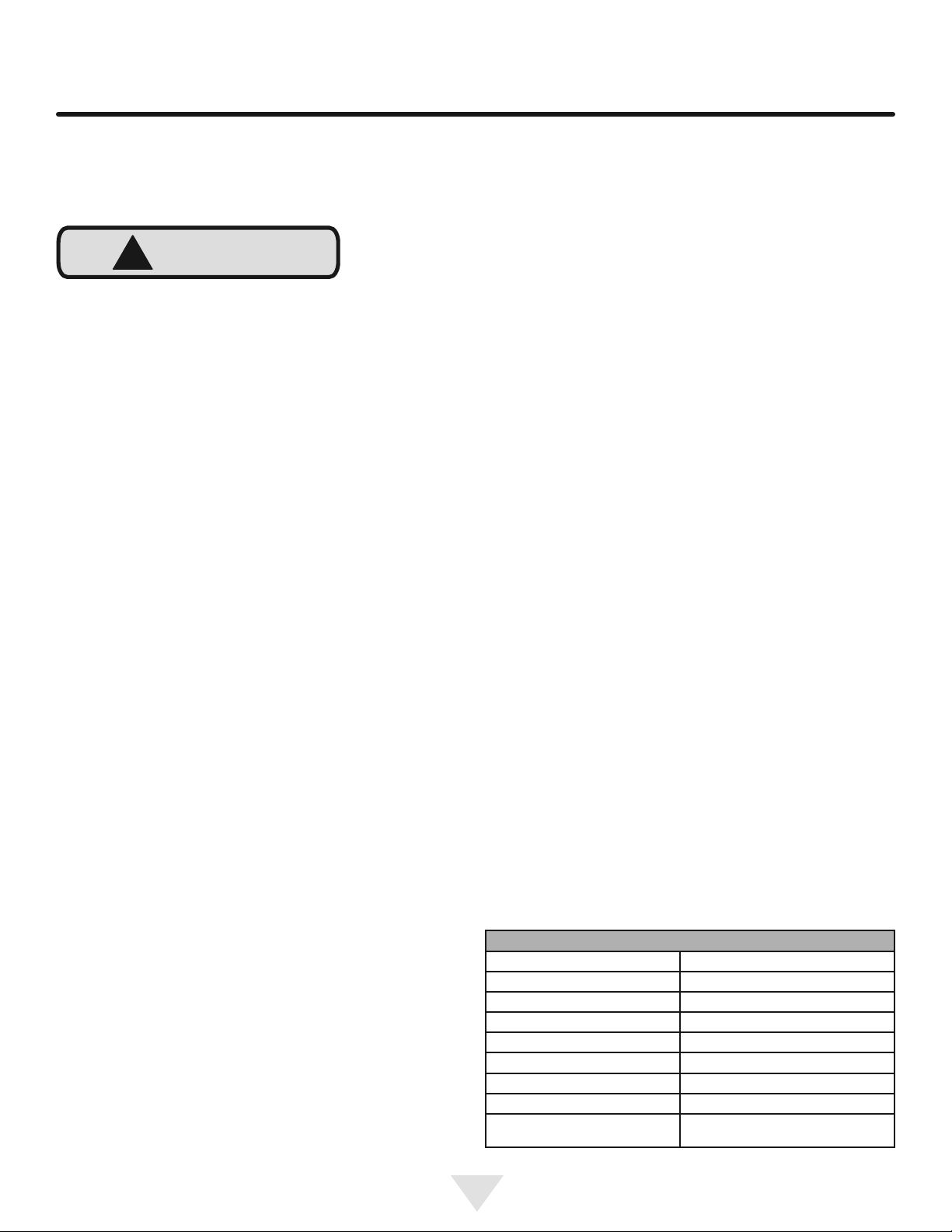
Remove all ice from the ice bin (see Figure 25).
Drain the water from the water reservoir by removing the
black plug from the bottom of the fresh water reservoir
(see Figure 26). After the water is drained, replace the plug
in the bottom of the reservoir.
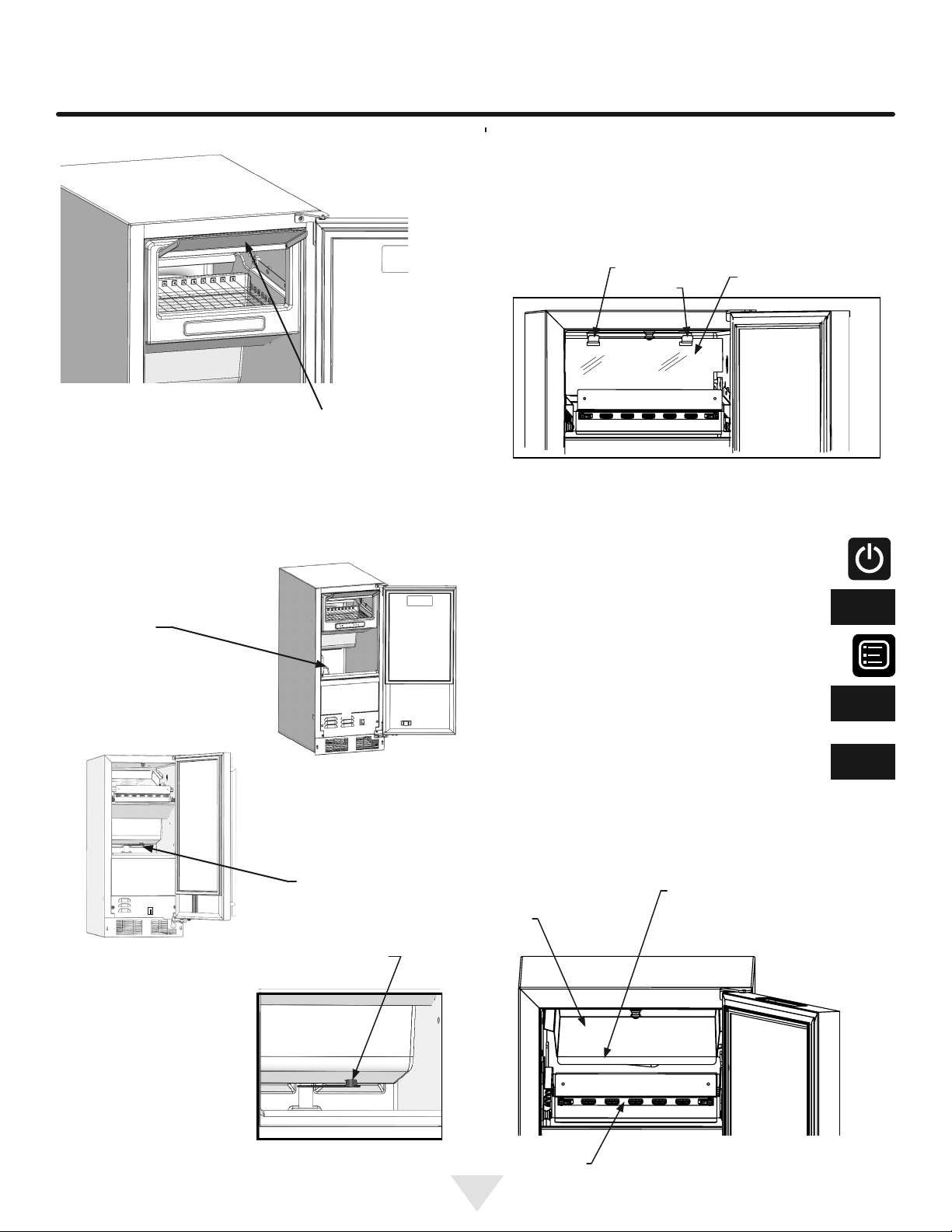
Allow all of the ice to fall from the evaporator plate
and remove any ice from the grid cutter. If there is ice
embedded in the grid cutter wires, wait for it to melt and
fall out. Do not try to remove ice that is embedded in
the grid cutter wires as that may break the wires. (See
Figures 22 and 23).
OFF
18
CLEANING YOUR ICE MACHINE
Figure 25
Figure 24
Remove all of
the ice from
the ice bin
Figure 26
Remove the
black reservoir
drain plug from
the bottom of
the reservoir.
Figure 27
Turn the ice machine back on by pressing and
holding the "ON/OFF" icon for 3 seconds. The
display will indicate "ICE" mode. Press and hold
the "MENU" icon until a ashing "CLEAN"
is displayed. Press the "ON/OFF" icon until
"CLEAN" stops ashing. Your ice machine will
now enter the clean cycle.
The clean and rinse cycle will take about 49
minutes.
After the clean cycle is complete the ice machine
will return to the "OFF" position.
After the cleaning cycle is completed, verify that all build-up
has been removed. If not repeat the clean cycle procedure.
ICE
CLEAN
OFF
Refer to your cleaning solution instructions to determine
the proper amount of cleaning solution to add based on
2 quarts (1.9 liters) of water. Lift fascia door up to access
evaporator plate. (See Figure 27). Pour the cleaning
solution slowly on the evaporator plate so it lows down
into the fresh water reservoir. (See Figure 28).
Figure 26b
Splash shield
brackets
Replace the splash shield if removed.
Pour cleaning solution slowly
onto the front edge of evaporator
plate behind the grid cutter.
Figure 28
Evaporator
plate
Grid cutter
Splash shield
Lift fascia door up to
access evaporator plate
19
CARE AND CLEANING AND ENERGY SAVING TIPS
OBTAINING SERVICE
Front Grille
Be sure that nothing obstructs the required air ow openings
in front of the cabinet. At least once or twice a year, brush or
vacuum lint and dirt from the front grille area (see page 4).
SHOCK HAZARD: Disconnect electrical power from the
appliance before cleaning with soap and water.
Cabinet
The painted cabinet can be washed with either a mild soap
and water and thoroughly rinsed with clear water. NEVER
use abrasive scouring cleaners.
Cleaning
Routine cleaning of the stainless steel surfaces will serve
to greatly extend the life of your product by removing
contaminants. This is especially important in coastal areas
which can expose the stainless to sever contaminants such
as halide salts (sodium chloride).
It is strongly recommended to periodically inspect and
thoroughly clean crevices, weld points, under gaskets,
rivets, bolt heads, and any locations where small amounts
of liquid could collect, become stagnant, and concentrate
contaminants. Additionally, any mounting hardware that is
showing signs of corrosion should be replaced.
Interior
Wash interior compartment with mild soap and water. Do
NOT use an abrasive cleaner, solvent, polish cleaner,
undiluted detergent or chlorine based cleaners.
Care of Appliance
1. Avoid leaning on the door, you may bend the door
hinges or tip the appliance.
2. Exercise caution when sweeping, vacuuming or
mopping near the front of the appliance. Damage to the
grille can occur.
3. Periodically clean the interior of the appliance as
needed.
4. Periodically check and/or clean the front grille as
needed.
In the Event of a Power Failure
If a power failure occurs, try to correct it as soon as
possible. Minimize the number of door openings while the
power is o so as not to adversely aect the appliance's
temperature.
Light assembly replacement
All models use LED lamps to illuminate the interior of the
appliance. This component is very reliable, but should one
fail, contact a qualied service technician for replacement
of the LED.
!
CAUTION
Energy Saving Tips
The following suggestions will minimize the
cost of operating your ice machine appliance.
1. Do not install your appliance next to a hot appliance,
(stove, dishwasher, etc.). heating air duct, or other heat
sources.
2. Install product out of direct sunlight.
3. Assure the front grille vents at front of the ice machine
beneath the door are not obstructed and kept clean to
allow ventilation for the refrigeration system to expel
heat.
4. Plug your appliance into a dedicated power circuit. (Not
shared with other appliances).
5. Minimize door openings and duration of door openings.
6. Set the control to the “o” position if accessing the
interior to spot clean or remove large quantities of ice
requires the door to be open for an extended period of
time.
7. Use ECO mode if maximum ice production quantities
are not required.
8. Use the delay start function if the ice machine will not
be used for long periods of time.
If Service is Required:
• If the product is within the first year warranty period
please contact your dealer or call DCS Customer
Service at 888.936.7872 for directions on how to obtain
warranty coverage in your area.
• If the product is outside the first year warranty
period, DCS Customer Service can provide
recommendations of service centers in your area.
• In all correspondence regarding service, be sure to give
the service number, serial number, and proof of
purchase.
• Try to have information or description of nature of the
problem, how long the appliance has been running, the
room temperature, and any additional information that
may be helpful in quickly solving the problem.
• Table "C" is provided for recording pertinent information
regarding your product for future reference.
For Your Records
Date of Purchase
Dealer’s name
Dealer’s Address
Dealer’s City
Dealer’s State
Dealer’s Zip Code
Appliance Serial Number
Appliance Service Number
Date Warranty Card Sent (Must be
within 10 days of purchase).
Table C
20
CARE AND CLEANING
Optional: After the cleaning cycle has been completed ,
you may wash the interior with a mild detergent / dish soap
or a solution of two tablespoons of baking soda and one
quart of water. Rinse with clean water.
Replace the grid cutter cover.
After cleaning it is recommended you discard the ice
produced after 3 hours of ice production.
If you cancel clean mode after adding ice maker
cleaner, you must re-start cleaning and allow clean
cycle to complete to remove the cleaning solution
before resuming ice production.
!
WARNING
Do not use bleach based cleaners or any abrasive cleaning
products. Chlorine based cleaners will attack the stainless
steel, making it susceptible to corrosion.
Canceling clean mode:
To exit clean mode press and hold the "ON/OFF" icon
until "OFF" is displayed. Wait 3 minutes for clean mode to
complete it's cancel routine before turning unit back on by
pressing and holding the "ON/OFF" icon. If you turn the
unit back on before the 3 minutes has elapsed, the display
will show "CLEAN" and the unit will shut itself o upon
completion of the 3 minute clean cancel routine.
ICE
Your ice machine is now ready to
restart. Press and hold the "ON/
OFF" icon for 3 seconds until "ICE is
displayed.
21
• Never attempt to repair or perform maintenance on
the appliance until the main electrical power has been
disconnected. Turning the appliance control "OFF"
does not remove electrical power from the unit's wiring.
• Replace all parts and panels before operating.
!
WARNING
Electrocution Hazard
TROUBLESHOOTING THE ICE MACHINE
Before You Call for Service
If the appliance appears to be malfunctioning, read
through this manual rst. If the problem persists, check the
troubleshooting guide below. Locate the problem in the
guide and refer to the cause and its remedy before calling
for service. The problem may be something very simple
that can be solved without a service call. However, it may
be required to contact your dealer or a qualied service
technician.
Troubleshooting guide:
Ice Machine Operation
Ice machine does not operate
Is the ice machine’s power cord plugged in? Plug the
power cord into a grounded 3 prong outlet.
Is the electronic control showing the "ICE" position?
Check the control to be sure it is in the "ICE" position.
Is a fuse blown or a circuit breaker been tripped?
Replace a blown fuse or reset a tripped circuit breaker.
Is the temperature of the room cooler than it normally
is? The minimum room temperature is 55°F (13°C). The
bin thermistor may be sensing the room temperature and
shut o before the bin is full of ice. If the room temperature
remains low the ice machine may not restart.
Is there a drain pump in the ice machine? The drain
pump is designed to temporarily shut the unit o when
large quantities of water create a high-limit condition. Wait
a few minutes as the drain pump will continue to operate
to dispose of the excess water. If there is still water in the
ice bin check the drain pump vent line and drain line for
obstructions or kinking.
The ice machine is noisy
Many sounds of an ice machine are dierent than your
household refrigerator. This subject is discussed on page
11, but check the following:
Do you hear water being circulated in the ice
machine? This is a normal sound as water is added once
every ice making cycle.
Is there a “whoosing” sound? Make sure water is
getting to the ice machine. Also check to make sure the
drain plug is fully seated in the water reservoir.
Is there an ice slab caught between the evaporator
plate and the grid cutter? First check to see if the ice
machine is level. If the ice machine is level run a cleaning
cycle.
Ice Production
Little or no ice production from the ice machine
Is the electronic control set to the "ICE" position?
Check the control to be sure it is in the "ICE" position.
Is water getting to the ice machine? Make sure nothing
is restricting the water supply such as a closed water
valve or a blown fuse or tripped circuit breaker, or a kinked
supply line, or low water pressure.
Has the ice machine just been started? A typical ice
production cycle can take up to 1
¹
⁄² hours. Initial start up
cycles can take longer. Check the ice machine after 24
hours for ice accumulation in the bin.
Is the reservoir drain plug in place? Check that the
reservoir drain plug is properly seated.
Is the water distributor tube restricted? Run a cleaning
cycle to clean the ice machine. Also check any lters to
make sure they are not restricted.
Is the condenser fan air ow restricted? Make sure the
grille in the front of the ice machine is open for proper air
circulation.
Is the room and/or water temperature to warm? Move
the ice machine to an area where the ambient temperature
is below 90°F (32°C) for built-in ice machines or below
100°F (38°C) for freestanding ice machines. The ice
machine should not be placed next to a heat source such
as an oven. Check the cold water connection.
Is there scale build up in the ice machine? If there is
scale build up on the evaporator, the ice machine needs to
be cleaned. See “Cleaning the Ice machine”.
22
TROUBLESHOOTING THE ICE MACHINE
Plumbing Problems
Is the drain hose aligned over the drain? Move the ice
machine to align the drain.
Is the ice machine draining properly? Check that there
are no kinks or restrictions in the drain lines; this can
cause water to back up in the ice bin. Check that foreign
material is not blocking the ice bin drain located at the
right rear corner of the ice bin. Check the drain pump
discharge and vent line or any restrictions or kinks. Check
that the drain pump is level.
If there are plumbing issues outside of the ice machine,
they cannot be repaired by the service technician. A
qualied plumber will have to be called.
Ice Quality
Odor, grey color, or o taste in the ice
Is there mineral scale build up on the evaporator
plate? The ice machine needs cleaning. See “Cleaning
the Ice Machine”.
Is there a high mineral content in the water? The water
may need to be ltered.
Are food items being stored in the ice bin? Remove
food from the ice bin.
Unpleasant Odors may require the use of a charcoal lter
on the water supply line.
Clumps of ice
Are there clumps of ice in the bin? If the ice isn’t used
on a regular basis it will melt and form into clumps. Break
up the ice clumps with the ice scoop.
Ice cubes are too big or too small
Is there low ice consumption? Ice is slowly melting in
the ice bin which will aect the size of the cubes. This is
normal. When the ice bin needs to be replenished, cubes
will return to the regular size.
Is the ice slab releasing? Clean the evaporator. See
“Cleaning the Ice Machine”.
Is the distributor tube restricted? Check the water line
to the ice machine to make sure there are no restrictions
or kinks in the line. Check all lters to make sure they
are not restricted. Check that the water ows evenly out
of the distributor tube, if not, clean the ice machine. See
“Cleaning the Ice Machine”.
Troubleshooting the Drain Pump
If the drain pump reservoir (not the ice machine bin)
reaches overll condition, the power to the ice machine will
be shut o.
If the ice machine is not working, check the following:
• Make sure there is power at the receptacle.
• Make sure the ice machine is turned on.
• Make sure the ice bin is not full.
Then check the drain pump:
The pump does not run:
• Make sure the pump is plugged in and there is power
to the receptacle.
• Check the inlet to the drain pump for debris and clean
as needed. Remove clamps and inlet tube from drain
pump to check for and remove debris.
• Make certain the vent line is free of kinks/sharp bends
or restrictions.
• Make certain there is enough water to activate the
drain pump. It will take at least one (1) quart (.95 liters)
of water to activate the drain pump.
The pump runs, but no water is pumped out:
• Check that the vent is clear and free of restrictions.
• Check the discharge line to make certain there are no
restrictions.
• Make sure that the discharge tubing has not exceeded
the maximum lift of eight (8) feet (2.44 meters) and the
horizontal run is not greater than twenty (20) feet (6.1
meters).
The pump runs and then quickly turns o repeatedly:
• Check to make certain the drain pump is level.
• Check that the vent is clear and free of restrictions.
The ice machine is running but not producing ice:
• Check to make sure water is not backing up in the ice
bin.
NOTE
NOTE
23
Clean the Ice Machine
Cleaning the ice machine will help prevent mold and
mildew growth as well as sanitize the ice machine for
storage or when it is put back into service. See page 17 for
instructions for cleaning the ice machine.
Draining and Removing Water from the Ice-
Making System with a Gravity Drain.
1. Turn o the water supply to the ice machine.
2.
3.
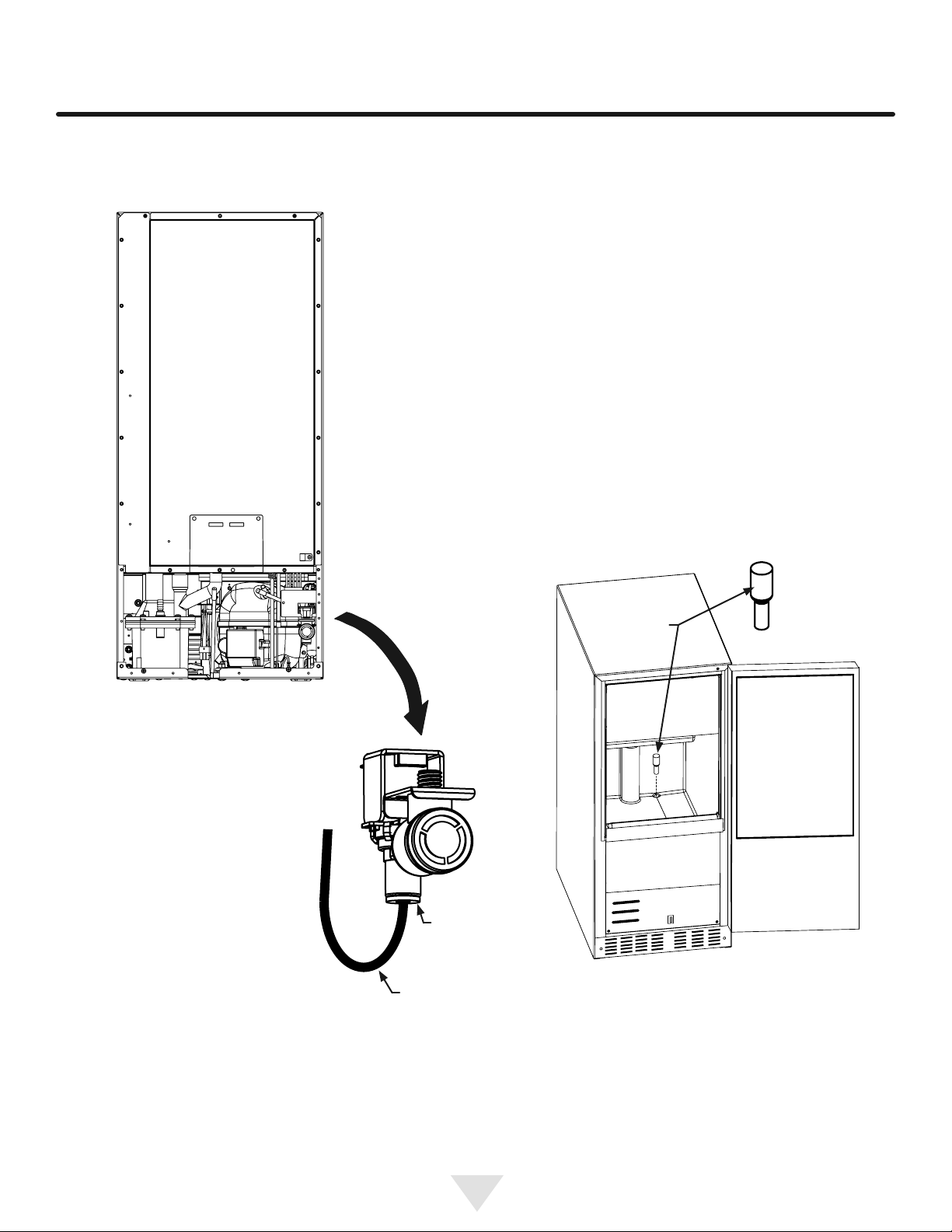
Disconnect the water supply fitting at the inlet of the
water valve. (See Figure 29a).
Change the electronic control to the "CLEAN" position
for approximately one (1) minute. This will energize and
open the water valve and remove most of the water
from the water valve and the water valve’s outlet water
line to the reservoir.
4. Change the electronic control to the "OFF" position.
This will energize and open the drain valve to drain the
reservoir and the ice machine drain system.
5. Unplug the ice machine from the electrical outlet.
6. Remove the access cover from the rear of the ice
machine. (See Figure 30).
PREPARING THE ICE MACHINE FOR STORAGE
If the ice machine is moved, not used for an extended
period of time, or will be in an area that will be near freezing
temperatures, it is necessary to remove any remaining
water in the ice-making system.
This ice machine must have all water drained and removed
to prevent ice machine damage as well as possible water
damage to the surrounding area in freezing conditions.
These damages are not covered under warranty.
Do not use any type of anti-freeze or other solution as a
substitution for properly draining the ice machine.
!
CAUTION
!
CAUTION
Risk of electrical shock or personal injury could occur
due to moving components, if machine compartment
access cover is removed before unplugging the ice
machine.
!
WARNING
Electrocution Hazard
Figure 29
Back view of
ice machine
Water supply
tting
Water
supply
line
Water valve
inlet
Access
cover
Screw
Figure 29a
Figure 30
!
CAUTION
Winterization: If the unit will be exposed to temperatures
of 40°F (5°C) or less, these steps must be followed.
24
PREPARING THE ICE MACHINE FOR STORAGE
8. Reconnect the water valve outlet water line.
(See Figure 31 and 31a).
9. Reinstall the ice machine’s access cover.
10. Clean and dry the ice machine’s storage bin.
11. Prop the door open for air circulation to prevent mold
and mildew.
12. Leave the water supply line disconnected or
reconnect the supply line and leave it shut off. Do NOT
turn the water on and allow water to enter back into the
water valve.
White
collar
Plastic outlet
water line
7. Disconnect the water valve’s outlet water line to the
reservoir and drain the remaining water left in the water
line trap area. (See Figure 31 and 31a).
Figure 31
To disconnect the water outlet
line: Push up on the white collar
and pull the plastic water line
from the bottom of the water
valve.
To reconnect the water outlet
line: Simply insert the plastic
tubing into the white collar and
push until it stops (about
1
⁄
2", 12
mm, of water line will enter the
valve).
Figure 31a
Draining Water for Factory Installed Drain
Pump Applications
Follow steps 1 through 12 for the gravity drain then do the
following:
13. Install the winterization plug in the water drain hole
inside the ice bin. (See Figure 32).
Figure 32
Winterization
plug
25
Drain Pump Removal Instructions:
1. Unplug the ice machine from the electrical supply and
remove the rear access cover from the ice machine.
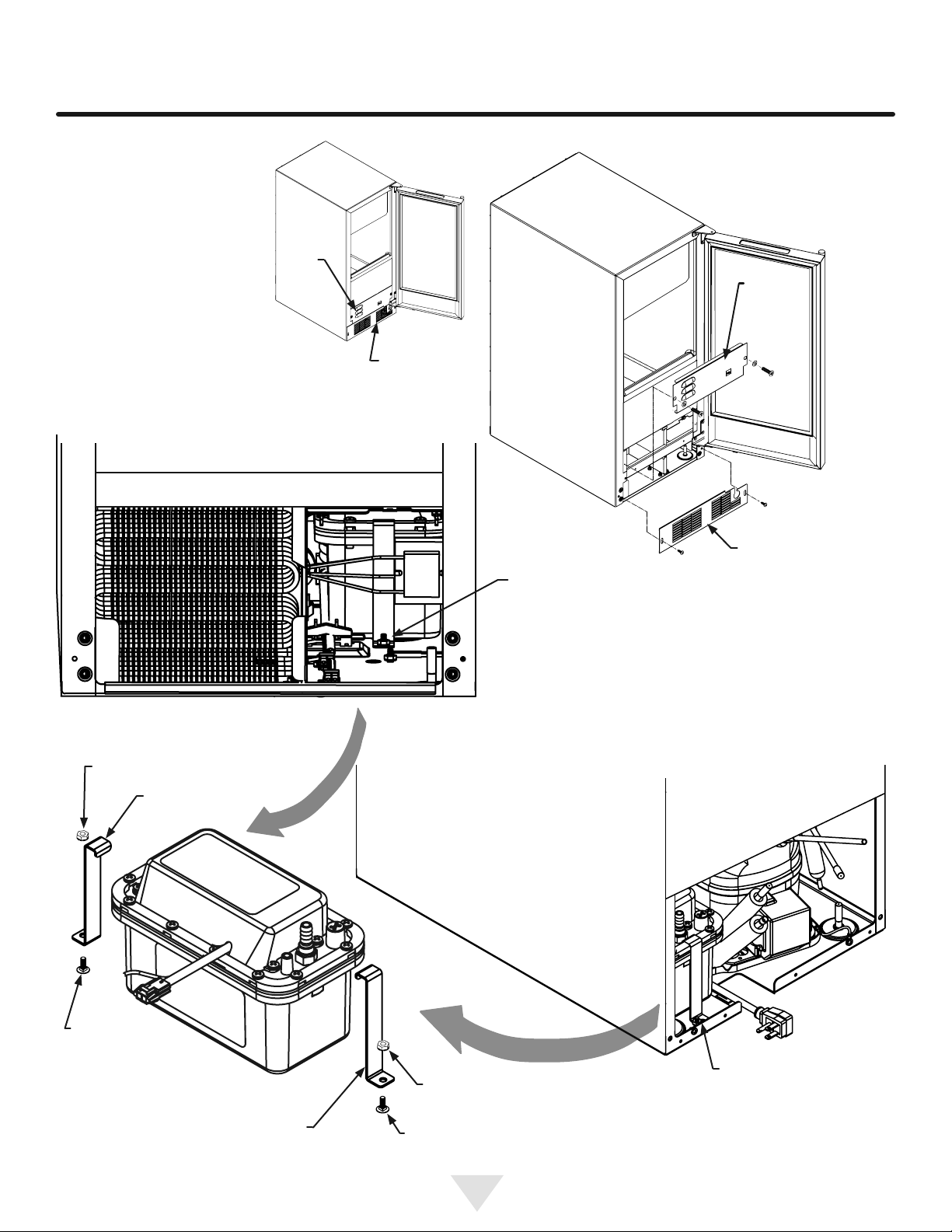
2. Remove the front panel and the toe grille from the front
of the ice machine. See Figures 35 and 35a.
3. Remove the front and rear drain pump brackets. See
Figures 36, 36a and 37.
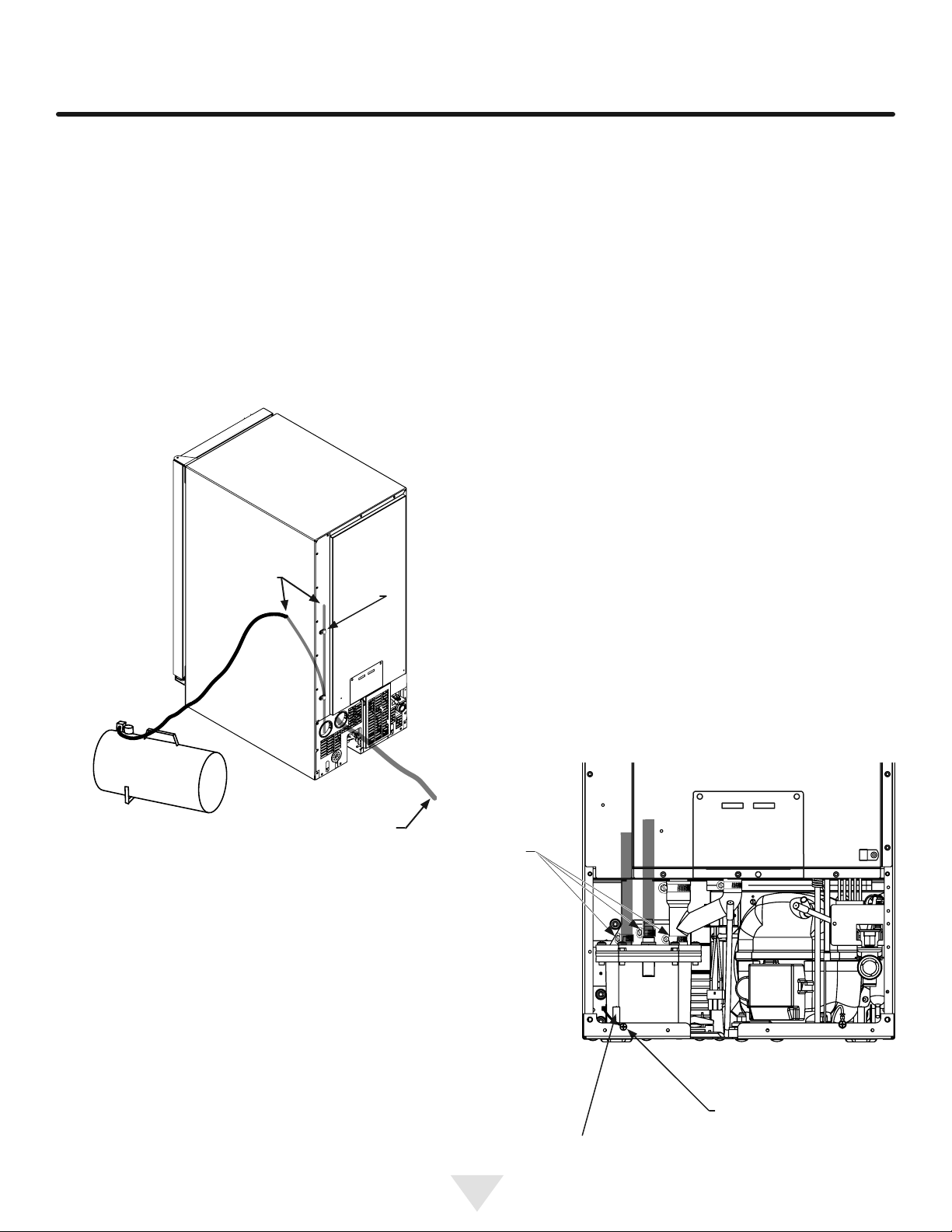
4. Unscrew the 3 hose clamps and remove the 3 hoses
from the front of the drain pump. (See Figure 34).
5. Unscrew the leveling leg in the back corner until the
end of the threaded portion is flush with the threaded
nut insert in the base. (see Figure 34).
To Restart the Ice Machine
1. Reconnect or turn on the water supply line.
2. Reconnect drain tubing if removed.
3. Plug in the power cord to a wall outlet and turn the
ice machine on, (refer to page 16 for turning the ice
machine on and o).
4. Check the water inlet, drain lines, and ttings for any
water leaks.
5. Check drain pump (if equipped) operation by pouring
approximately two (2) quarts of water into the ice
storage bin. The drain pump should activate and
discharge water (refer to Drain Pump on page 7).
Check for water leaks at all hose connections.
14. Remove the top clamp from the vent tube, for easier
access for the air hose.
15. Apply air pressure (approximately 10 psi) to the end of
the vent tube which will purge the remainder of the
water from the drain pump and the drain line. (See
Figure 33).
16. Reinstall the vent tube and clamp to the back of the ice
machine and remove the winterization plug from the ice
bin and save it for future use.
Figure 33
Vent
tube
Remove
clamp
screw
Drain
line
PREPARING THE ICE MACHINE FOR STORAGE
Unscrew the
leveling leg so
the end of the
threads is ush
with the top of
the nut insert.
Remove
these 3 hose
clamps, then
remove the
3 tubes from
the drain
pump
Drain pump ground
wire connection
Figure 34
26
DRAIN PUMP REMOVAL INSTRUCTIONS
Rear of ice machine
Front of ice machine
Remove the
hex nut on
front drain
pump bracket
with the
3
⁄8"
socket then
remove the
bracket.
Remove the hex nut on
rear drain pump bracket
with the
3
⁄8" socket then
remove the bracket.
carriage bolt
carriage bolt
#10-24 hex nut
#10-24 hex nut
Rear drain
pump bracket
Front drain
pump bracket
Figure 36
Figure 36a
Figure 37
Figure 35
Figure 35a
Toe grille
Toe grille
Front
panel
Front
panel
27
DRAIN PUMP REMOVAL INSTRUCTIONS
Additional issues to be inspected by
the installer upon service replacement:
1. The drain pump must be level.
2. No pinched water lines.
3. No interference with electrical cords or wiring.
4. The drain pump should not set on any
obstacles, wiring, etc.
5. Secure all hose clamps leading to and from
the drain pump.
6. Insure that the vent tube height is adequate -
18 inches minimum.
7. Insure that drain height is adequate -
maximum of 8 feet.
8. Insure that drain length is adequate -
maximum of 20 feet.
9. Checked for water leaks after installation of
the drain pump.
10. Check for vibrations caused by improper
installation.
11. Insure that there is no interference with back
access cover.
12. Insure that the hole grommets are in place at
each location so that any vent or drain tubes
do not rub on any sharp surfaces.
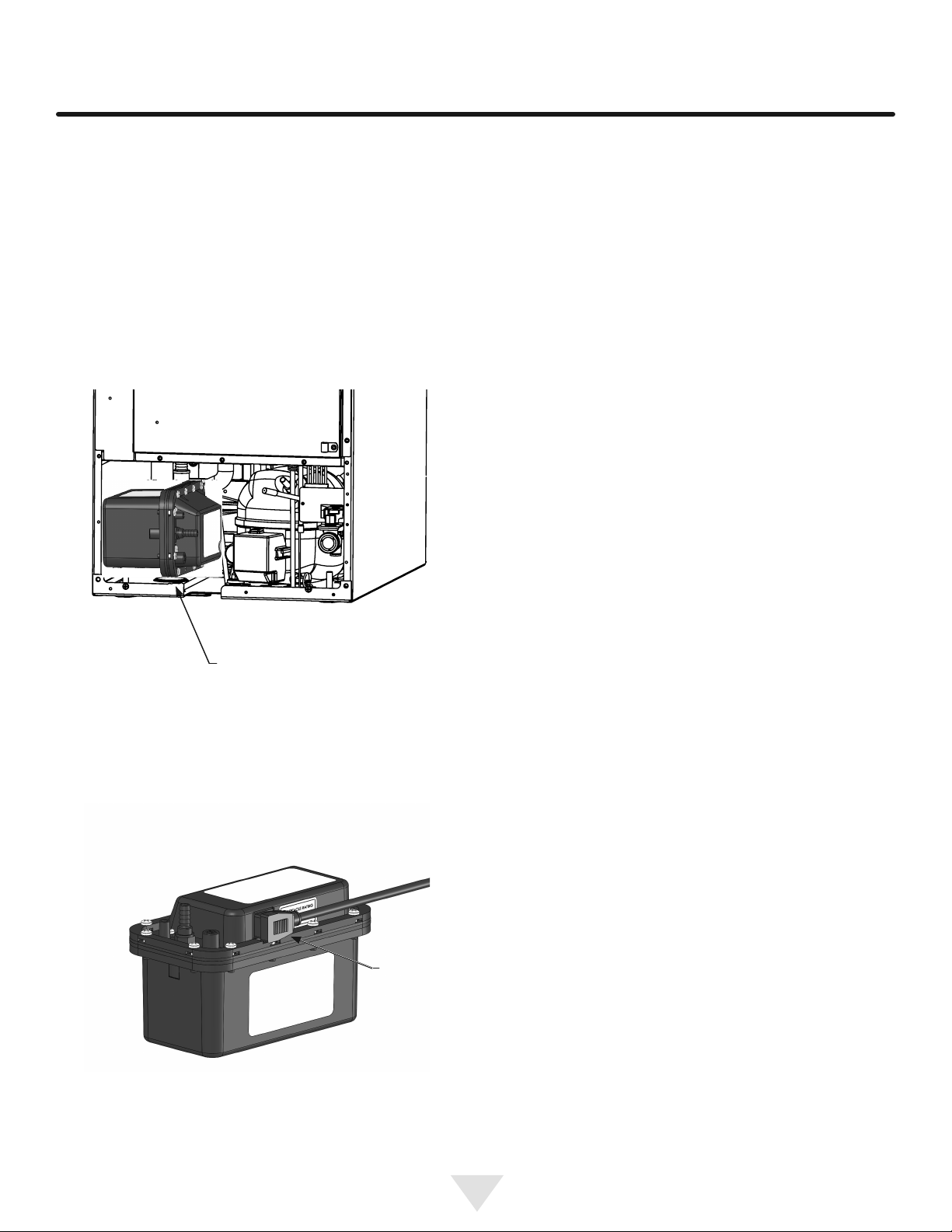
Ice machine
power cord
Figure 39
Figure 38
Rotate drain pump and
remove from back of
ice machine.
6. Rotate the drain pump and remove from the ice
machine, (See Figure 38). It may be necessary to
disconnect the ground wire connection in the back
flange of the cabinet. (See Figure 34).
7. Disconnect the ice machine power cord from the drain
pump (See Figure 39).
8. Drain the water in the drain pump’s reservoir by turning
the pump upside down and allowing water to drain
through the pump’s inlet and vent tube fittings.
9. Installation of drain pump is reverse of this procedure.

28
WARRANTY
Limited Warranty
When you purchase any new DCS Refrigeration Product,
you automatically receive a One Year Limited Warranty
covering parts and labor for servicing within the 48 main-
land United States, Hawaii, Washington, D.C. and Canada.
In Alaska the Limited Warranty is the same except that you
must pay to ship the Product to the service shop or for the
service technician’s travel to your home. Products for use in
Canada must be purchased through the authorized Cana-
dian distribution channel to ensure regulatory compliance.
You receive an additional Four Year Limited Warranty (for
a total of Five Years) covering parts for the sealed refrig-
eration system (compressor, evaporator, condenser, lter
dryer, and connecting tubing) within the 48 mainland United
States, Hawaii, Washington, D.C. and Canada. In Alaska
the Limited Warranty for the sealed refrigeration system is
the same except that you must pay to ship the Product to
the service shop or the service technician’s travel to your
home.
Fisher & Paykel Undertakes to:
Repair without cost to the owner either for material or labor
any part of the Product, the serial number of which appears
on the Product, which is found to be defective. In Alaska,
you must pay to ship the Product to the service shop or for
the service technician’s travel to your home.
If we are unable to repair a defective part of the Product af-
ter a reasonable number of attempts, at our option we may
replace the part or the Product, or we may provide you a
full refund of the purchase price of the Product (not includ-
ing installation or other charges).
This warranty extends to the original purchaser and any
succeeding owner of the Product for products purchased
for ordinary single-family home use.
All service under this Limited Warranty shall be provided
by Fisher & Paykel Appliances Inc. or its Authorized DCS
Service Agent during normal business hours.
Limited Warranty
How Long Does this Limited Warranty Last?
Our liability under this Limited Warranty expires One Year
from the date of purchase of the Product by the rst con-
sumer.
Our liability for repair of defects in any sealed refrigeration
system (compressor, evaporator, condenser, lter dryer,
and connecting tubing) extends an additional Four Years,
for a total of Five Years from the date of purchase of the
Product by the rst consumer.
Our liability under any implied warranties, including the
implied warranty of merchantability (an unwritten warranty
that the Product is t for ordinary use) also expires One
Year (or such longer period as required by applicable law)
from the date of purchase of the Product by the rst con-
sumer. Some states do not allow limitations on how long
an implied warranty lasts, so this limit on implied warranties
may not apply to you.
This Warranty Does Not Cover
Service calls that are not related to any defect
in the Product. The cost of a service call will
be charged if the problem is not found to be a
defect of the Product. For example:
1. Correct faulty installation of the Product.
2. Instruct you how to use the Product.
3. Replace house fuses, reset circuit breakers, correct
house wiring or plumbing, or replace light bulbs.
4. Correct fault(s) caused by the user.
5. Change the set-up of the Product.
6. Unauthorized modications of the Product.
7. Noise and vibration that is considered normal e.g.
drain sounds, regeneration noises and user warning
beeps.
8. Correcting damage caused by pests e.g. rats, cock-
roaches etc.
9. Used in commercial applications.
Defects caused by factors other than:
1. Normal domestic use or
2. Use in accordance with the Product’s Use and Care
Guide.
A.
B.
28
WARRANTY
Limited Warranty
When you purchase any new DCS Refrigeration Product,
you automatically receive a One Year Limited Warranty
covering parts and labor for servicing within the 48 main-
land United States, Hawaii, Washington, D.C. and Canada.
In Alaska the Limited Warranty is the same except that you
must pay to ship the Product to the service shop or for the
service technician’s travel to your home. Products for use in
Canada must be purchased through the authorized Cana-
dian distribution channel to ensure regulatory compliance.
You receive an additional Four Year Limited Warranty (for
a total of Five Years) covering parts for the sealed refrig-
eration system (compressor, evaporator, condenser, lter
dryer, and connecting tubing) within the 48 mainland United
States, Hawaii, Washington, D.C. and Canada. In Alaska
the Limited Warranty for the sealed refrigeration system is
the same except that you must pay to ship the Product to
the service shop or the service technician’s travel to your
home.
Fisher & Paykel Undertakes to:
Repair without cost to the owner either for material or labor
any part of the Product, the serial number of which appears
on the Product, which is found to be defective. In Alaska,
you must pay to ship the Product to the service shop or for
the service technician’s travel to your home.
If we are unable to repair a defective part of the Product af-
ter a reasonable number of attempts, at our option we may
replace the part or the Product, or we may provide you a
full refund of the purchase price of the Product (not includ-
ing installation or other charges).
This warranty extends to the original purchaser and any
succeeding owner of the Product for products purchased
for ordinary single-family home use.
All service under this Limited Warranty shall be provided
by Fisher & Paykel Appliances Inc. or its Authorized DCS
Service Agent during normal business hours.
Limited Warranty
How Long Does this Limited Warranty Last?
Our liability under this Limited Warranty expires One Year
from the date of purchase of the Product by the rst con-
sumer.
Our liability for repair of defects in any sealed refrigeration
system (compressor, evaporator, condenser, lter dryer,
and connecting tubing) extends an additional Four Years,
for a total of Five Years from the date of purchase of the
Product by the rst consumer.
Our liability under any implied warranties, including the
implied warranty of merchantability (an unwritten warranty
that the Product is t for ordinary use) also expires One
Year (or such longer period as required by applicable law)
from the date of purchase of the Product by the rst con-
sumer. Some states do not allow limitations on how long
an implied warranty lasts, so this limit on implied warranties
may not apply to you.
This Warranty Does Not Cover
Service calls that are not related to any defect
in the Product. The cost of a service call will
be charged if the problem is not found to be a
defect of the Product. For example:
1. Correct faulty installation of the Product.
2. Instruct you how to use the Product.
3. Replace house fuses, reset circuit breakers, correct
house wiring or plumbing, or replace light bulbs.
4. Correct fault(s) caused by the user.
5. Change the set-up of the Product.
6. Unauthorized modications of the Product.
7. Noise and vibration that is considered normal e.g.
drain sounds, regeneration noises and user warning
beeps.
8. Correcting damage caused by pests e.g. rats, cock-
roaches etc.
9. Used in commercial applications.
Defects caused by factors other than:
1. Normal domestic use or
2. Use in accordance with the Product’s Use and Care
Guide.
A.
B.

29
Defects to the Product caused by accident,
neglect, misuses, re, ood or Act of God.
The cost of repairs carried out by non-autho-
rized repairers or the cost of correcting such
unauthorized repairs.
Travel Fees and associated charges incurred
when the product is installed in a location
with limited or restricted access.(i.e. airplane
ights, ferry charges, isolated geographic
areas).
Normal recommended maintenance as set
forth in the Product’s Use and Care Guide.
If you have an installation problem contact
your dealer or installer. You are responsible
for providing adequate electrical, exhausting
and other connection facilities.
We are not responsible for consequential
or incidental damages (the cost of repairing
or replacing other property damaged if the
Product is defective or any of your expenses
caused if the Product is defective). Some
states do not allow the exclusion or limitation
of incidental or consequential damages, so
the above limitation or exclusion may not ap-
ply to you.
How to get service
Please read this Use and Care Guide. If you then have any
questions about operating the Product, need the name of
your local DCS Authorized Service Agent, or believe the
Product is defective and wish service under this Limited
Warranty, please contact your dealer or call us at:
TOLL FREE 1-888-936-7872 or contact us through our web
site: www.dcsappliances.com
You may be required to provide reasonable proof of the
date of purchase of the Product before the Product will be
serviced under this Limited Warranty.
Commercial use
This warranty applies to appliances used in residential ap-
plications; it does not cover their use in commercial situa-
tions.
No other warranties
This Limited Warranty is the complete and exclusive agree-
ment between you and Fisher & Paykel Appliances Inc. re-
garding any defect in the Product. None of our employees
(or our Authorized Service Agents) are authorized to make
WARRANTY
C.
D.
E.
F.
any addition or modication to this Limited Warranty.
Warrantor: Fisher & Paykel Appliances, Inc.
If you need further help concerning this Limited Warranty,
please call us at the above number, or write to:
Fisher & Paykel and DCS
Appliances Inc
695 Town Centre Drive, Suite #180 Costa Mesa
CA 92626-1902
USA
This Limited Warranty gives you specic legal rights, and
you may also have other rights which vary from state to
state.
Fisher & Paykel Appliances Inc. is a leading manufacturer
of premium quality cooking and specialty appliances under
the Fisher & Paykel and DCS brands.
28
WARRANTY
Limited Warranty
When you purchase any new DCS Refrigeration Product,
you automatically receive a One Year Limited Warranty
covering parts and labor for servicing within the 48 main-
land United States, Hawaii, Washington, D.C. and Canada.
In Alaska the Limited Warranty is the same except that you
must pay to ship the Product to the service shop or for the
service technician’s travel to your home. Products for use in
Canada must be purchased through the authorized Cana-
dian distribution channel to ensure regulatory compliance.
You receive an additional Four Year Limited Warranty (for
a total of Five Years) covering parts for the sealed refrig-
eration system (compressor, evaporator, condenser, lter
dryer, and connecting tubing) within the 48 mainland United
States, Hawaii, Washington, D.C. and Canada. In Alaska
the Limited Warranty for the sealed refrigeration system is
the same except that you must pay to ship the Product to
the service shop or the service technician’s travel to your
home.
Fisher & Paykel Undertakes to:
Repair without cost to the owner either for material or labor
any part of the Product, the serial number of which appears
on the Product, which is found to be defective. In Alaska,
you must pay to ship the Product to the service shop or for
the service technician’s travel to your home.
If we are unable to repair a defective part of the Product af-
ter a reasonable number of attempts, at our option we may
replace the part or the Product, or we may provide you a
full refund of the purchase price of the Product (not includ-
ing installation or other charges).
This warranty extends to the original purchaser and any
succeeding owner of the Product for products purchased
for ordinary single-family home use.
All service under this Limited Warranty shall be provided
by Fisher & Paykel Appliances Inc. or its Authorized DCS
Service Agent during normal business hours.
Limited Warranty
How Long Does this Limited Warranty Last?
Our liability under this Limited Warranty expires One Year
from the date of purchase of the Product by the rst con-
sumer.
Our liability for repair of defects in any sealed refrigeration
system (compressor, evaporator, condenser, lter dryer,
and connecting tubing) extends an additional Four Years,
for a total of Five Years from the date of purchase of the
Product by the rst consumer.
Our liability under any implied warranties, including the
implied warranty of merchantability (an unwritten warranty
that the Product is t for ordinary use) also expires One
Year (or such longer period as required by applicable law)
from the date of purchase of the Product by the rst con-
sumer. Some states do not allow limitations on how long
an implied warranty lasts, so this limit on implied warranties
may not apply to you.
This Warranty Does Not Cover
Service calls that are not related to any defect
in the Product. The cost of a service call will
be charged if the problem is not found to be a
defect of the Product. For example:
1. Correct faulty installation of the Product.
2. Instruct you how to use the Product.
3. Replace house fuses, reset circuit breakers, correct
house wiring or plumbing, or replace light bulbs.
4. Correct fault(s) caused by the user.
5. Change the set-up of the Product.
6. Unauthorized modications of the Product.
7. Noise and vibration that is considered normal e.g.
drain sounds, regeneration noises and user warning
beeps.
8. Correcting damage caused by pests e.g. rats, cock-
roaches etc.
9. Used in commercial applications.
Defects caused by factors other than:
1. Normal domestic use or
2. Use in accordance with the Product’s Use and Care
Guide.
A.
B.

592493A 04.21
DCSOUTDOOR.COM
© Fisher & Paykel Appliances 2021. All rights reserved.
The models shown in this guide may not be available in all markets
and are subject to change at any time.
The product specifications in this guide apply to the specific products and
models described at the date of issue. Under our policy of continuous product
improvement, these specifications may change at any time.
For current details about model and specification availability in your country,
please go to our website or contact your local Fisher&Paykel dealer.