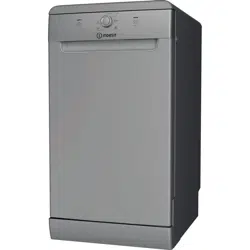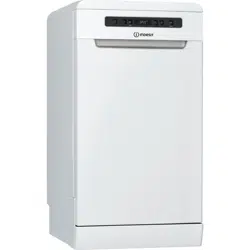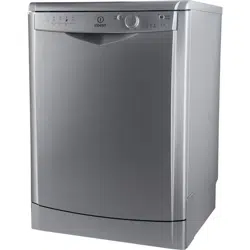

Istruzioni per l’uso
LAVASTOVIGLIE
Sommario
Scheda prodotto, 2
Precauzioni e consigli, 3
Sicurezza generale
Smaltimento
Risparmiare e rispettare l’ambiente
Installazione, 4-5
Posizionamento e livellamento
Collegamenti idraulici ed elettrici
Dati tecnici
Avvertenze per il primo lavaggio
Descrizione dell’apparecchio, 6
Vista d’insieme
Pannello comandi
Caricare i cesti, 7-8
Cesto inferiore
Cesto superiore
Cestino delle posate
Vassoio portaposate
*
Regolazione cesto superiore
Avvio e utilizzo, 9
Avviare la lavastoviglie
Caricare il detersivo
Programmi, 10
Tabella dei programmi
Brillantante e sale rigenerante, 11
Caricare il brillantante
Caricare il sale rigenerante
Manutenzione e cura, 12
Escludere acqua e corrente elettrica
Pulire la lavastoviglie
Evitare i cattivi odori
Pulire gli irroratori
Pulizia filtro entrata acqua
Pulire i filtri
Se ci si assenta per lunghi periodi
Anomalie e rimedi, 13
Assistenza, 14
Italiano, 1
IT
DFG 15B1
English, 15
EN
2
IT
Scheda prodotto
Scheda prodotto
Marchio
INDESIT
Modello
DFG 15B1
Capacità nominale in numero di coperti standard (1)
13
Classe di efcienza energetica su una scala da A+++ (bassi consumi) a D (alti consumi)
A+
Consumo energetico annuo in kWh (2)
295.0
Consumo energetico del ciclo di lavaggio standard in kWh
1.04
Consumo di potenza nel modo spento in W
0.5
Consumo di potenza nel modo lasciato acceso in W
5.0
Consumo di acqua annuo in litri (3)
3080.0
Classe di efcacia di asciugatura su una scala da G (efcacia minima) ad A (efcacia massima)
A
Durata del programma per il ciclo di lavaggio standard in minuti
190
Durata del modo lasciato acceso in minuti
10
Rumore in dB(A) re 1 pW
49
Prodotto da incasso
NO
NOTE
1) L’informazione sull’etichetta e sulla scheda fanno riferimento al programma standard di lavaggio, questo programma è adatto
per lavare stoviglie che presentano un grado di sporco normale ed è il programma più efciente in termini di consumo combinato di
energia ed acqua. Il ciclo standard corrisponde al ciclo ECO.
2) Consumo di energia basato su 280 cicli annui standard con acqua caricata fredda e sui consumi in modo di spento o di lasciato
acceso dopo la ne ciclo. Il consumo effettivo dipende da come viene usato l’elettrodomestico.
3) Basato su 280 cicli di lavaggio standard. Il consumo effettivo dipende dalle modalità di utilizzo dell’apparecchio.
IT
3
* Presente solo su alcuni modelli.
Precauzioni e consigli
L’apparecchio è stato progettato e costruito
in conformità alle norme internazionali di sicurezza.
Queste avvertenze sono fornite per ragioni di
sicurezza e devono essere lette attentamente.
È importante conservare questo libretto per
poterlo consultare in ogni momento. In caso di
vendita, di cessione o di trasloco, assicurarsi che
resti insieme all’apparecchio.
Leggere attentamente le istruzioni: ci sono
importanti informazioni sull’installazione, sull’uso
e sulla sicurezza.
Questo apparecchio è progettato per l’uso
domestico o per applicazioni simili, ad esempio:
- aree adibite a cucina per il personale in negozi,
uffici ed altri ambienti di lavoro;
- case coloniche;
- utilizzo da parte di clienti in hotel, motel ed altri
ambienti di tipo residenziale;
- bed and breakfast.
Sicurezza generale
• Questoelettrodomesticononpuò venire
usato da persone (bambini compresi) con
ridotte capacità fisiche, sensoriali o mentali,
o mancanza di esperienza e conoscenza, a
meno che non venga loro fornita supervisione
o istruzioni riguardanti l’uso da una persona
responsabile della loro sicurezza.
• Ènecessaria lasupervisione diun adulto
per evitare che i bambini giochino con
l’elettrodomestico.
• L’apparecchioèstatoconcepitoperunusodi
tipo non professionale all’interno dell’abitazione.
• L’apparecchiodeveessereusatoperillavaggio
delle stoviglie a uso domestico, solo da persone
adulte e secondo le istruzioni riportate in questo
libretto.
• L’apparecchio nonva installatoall’aperto,
nemmeno se lo spazio è riparato, perché è
molto pericoloso lasciarlo esposto a pioggia e
temporali.
• Nontoccarelalavastoviglieapiedinudi.
• Nonstaccarelaspinadallapresadellacorrente
tirando il cavo, bensì afferrando la spina.
• Ènecessariochiudereil rubinettodell’acqua
e staccare la spina dalla presa della corrente
prima di effettuare operazioni di pulizia e
manutenzione.
• Incasodiguasto,innessuncasoaccedereai
meccanismi interni per tentare una riparazione.
• Nonappoggiarsiosedersisullaportaaperta:
l’apparecchio potrebbe ribaltarsi.
•Laportanondeveesseretenutanellaposizione
apertaperchèpuòrappresentareilpericolodi
inciampare.
• Tenereildetersivoeilbrillantantefuori dalla
portata dei bambini.
• Gliimballagginonsonogiocattoliperbambini.
Smaltimento
• Smaltimentodel materialedi imballaggio:
attenersi alle norme locali, così gli imballaggi
potranno essere riutilizzati.
• La direttiva Europea2012/19/EU suirifiuti di
apparecchiature elettriche ed elettroniche
(RAEE), prevede che gli elettrodomestici non
debbano essere smaltiti nel normale flusso dei
rifiutisolidi urbani.Gliapparecchi dismessi
devono essere raccolti separatamente per
ottimizzare il tasso di recupero e riciclaggio
dei materiali che li compongono e impedire
potenziali danni per la salute e l’ambiente. Il
simbolo del cestino barrato è riportato su tutti
i prodotti per ricordare gli obblighi di raccolta
separata.
Per ulteriori informazioni, sulla corretta
dismissione degli elettrodomestici, i detentori
potranno rivolgersi al servizio pubblico preposto
o ai rivenditori.
Risparmiare e rispettare l’ambiente
Risparmiare acqua ed energia
• Avviarelalavastovigliesoloapienocarico.In
attesa che la macchina sia piena, prevenire
i cattivi odoricon ilciclo Ammollo
(vedi
Programmi)
.
• Selezionare un programmaadatto al tipodi
stoviglie e al grado di sporco consultando la
Tabelladeiprogrammi:
- per stoviglie normalmente sporche utilizzare il
programmaEco,chegarantiscebassiconsumi
energetici e di acqua.
- se il carico è ridotto attivare l’opzione Mezzo
carico*
(vediAvvioeutilizzo).
• Seilpropriocontrattodierogazionedell’energia
elettrica prevede fasce orarie di risparmio
energetico, effettuare i lavaggi negli orari a
tariffa ridotta. L’opzione Partenza Ritardata
*
(vediAvvioeutilizzo)
puòaiutareaorganizzare
i lavaggi in tal senso.
Detersivi senza fosfati, senza cloro
e contenenti enzimi
• Siconsigliavivamentediusareidetersivisenza
fosfati e senza cloro che sono i più indicati per
la tutela dell’ambiente.
• Glienzimisviluppanoun’azioneparticolarmente
efficacecontemperature prossimeai 50°C,
per cui con i detersivi con enzimi si possono
impostare lavaggi a basse temperature e
ottenere gli stessi risultati che si avrebbero a
65°C.
•Dosarebeneildetersivoinbasealleindicazioni
del produttore, alla durezza dell’acqua, al
grado di sporco e alla quantità di stoviglie per
evitare sprechi. Pur biodegradabili, i detersivi
contengono elementi che alterano l’equilibrio
della natura.
4
IT
In caso di trasloco tenere l’apparecchio in posizione
verticale; se fosse necessario, inclinarlo sul lato posteriore.
Posizionamento e livellamento
1.Disimballarel’apparecchioecontrollarechenonabbiasubìto
danniduranteiltrasporto.Sefossedanneggiatononcollegarlo
e contattare il rivenditore.
2.Sistemarelalavastoviglie facendo aderire i fianchi o lo
schienaleaimobiliadiacentioallaparete.L’apparecchiopuò
anche essere incassato sotto a un piano di lavoro continuo*
(vedi foglio di Montaggio)
.
3. Posizionare la lavastoviglie su un pavimento piano e rigido.
Compensare le irregolarità svitando o avvitando i piedini
anteriorifinchél’apparecchiononsiaorizzontale.Unaccurato
livellamento dà stabilità ed evita vibrazioni, rumori e spostamenti.
4*. Per regolare l’altezza del piedino posteriore, agire sulla
boccola esagonale di colore rosso presente nella parte
inferiore, frontale, centrale della lavastoviglie, con una chiave a
bocca esagonale apertura 8 mm., girando in senso orario per
aumentare l’altezza e in senso antiorario per diminuirla.
(vedere
foglio istruzioni incasso allegato alla documentazione)
Collegamenti idraulici ed elettrici
L’adattamento degli impianti elettrici e idraulici per
l’installazione deve essere eseguito solo da personale
qualificato.
La lavastoviglie non deve appoggiare sui tubi o sul cavo di
alimentazione elettrica.
L’apparecchio deve essere collegato alla rete di distribuzione
dell’acqua utilizzando tubi nuovi.
Nonriutilizzareivecchitubi.
I tubi di carico e di scarico dell’acqua e il cavo di alimentazione
elettrica possono essere orientati verso destra o sinistra per
consentire la migliore installazione.
Collegamento del tubo di carico dell’acqua
• Aunapresad’acquafredda:avvitarebeneiltubodicaricoa
unrubinettoconboccafilettatada3/4gas;primadiavvitare,
far scorrere l’acqua finché non sia limpida affinché le eventuali
impurità non intasino l’apparecchio.
• Aunapresad’acquacalda:nelcasodiimpiantocentralizzato
ditermosifoni, la lavastoviglie può essere alimentata con
acqua calda di rete purché non superi la temperatura di
60°C.
Avvitareiltuboalrubinettocomedescrittoperlapresa
d’acqua fredda.
Selalunghezzadeltubodicaricononèsufficiente,rivolgersi
a un negozio specializzato o a un tecnico autorizzato
(vedi
Assistenza)
.
La pressione dell’acqua deve essere compresa nei valori
riportatidallatabellaDatitecnici
(vedi a lato)
.
Fare attenzione che nel tubo non ci siano né pieghe né
strozzature.
Collegamento del tubo di scarico dell’acqua
Collegareiltubodiscarico,senzapiegarlo,aunaconduttura
di scarico con diametro minimo di 4 cm.
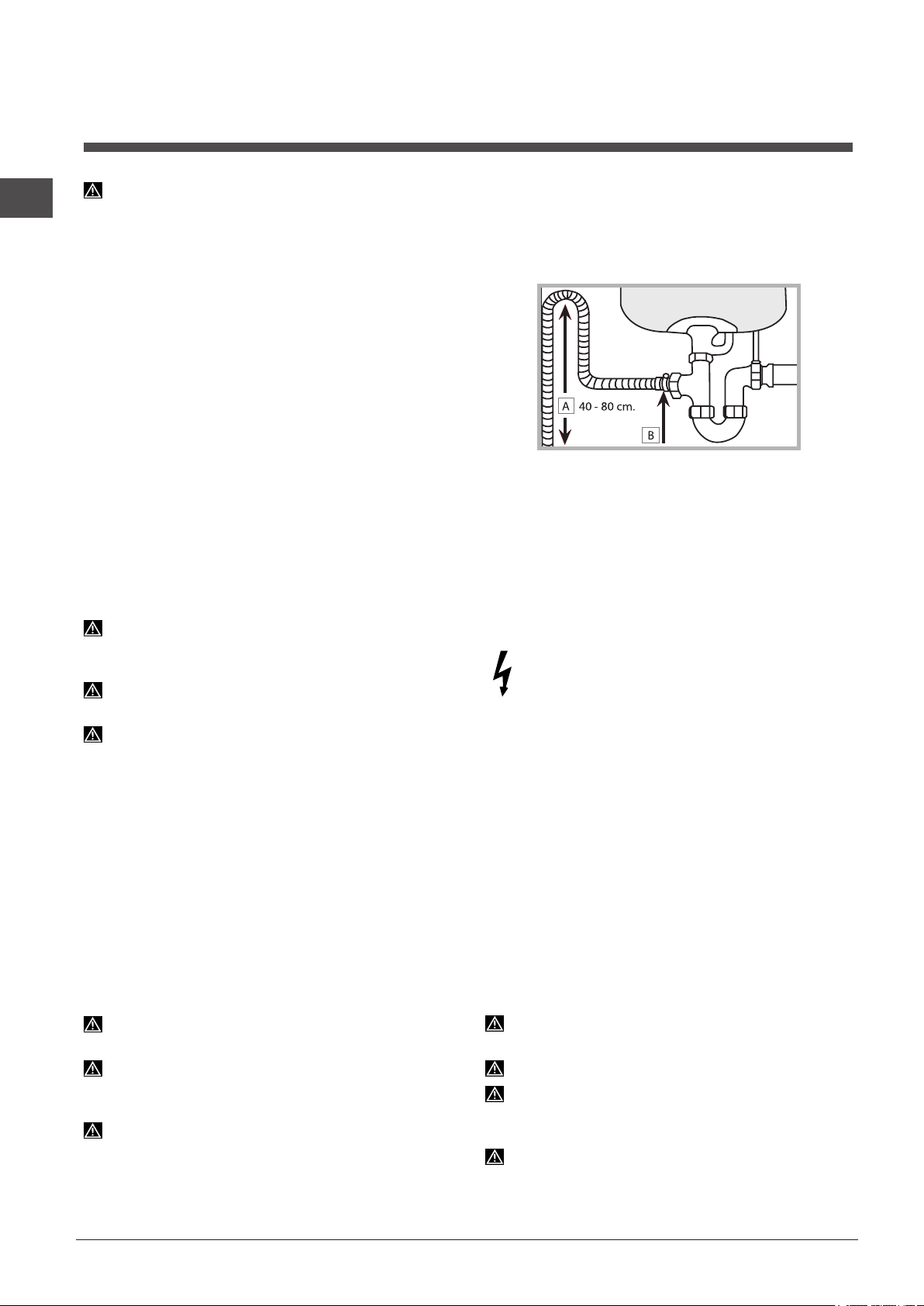
Iltubodiscaricodeveessereadun’altezzacompresatra40e
80cm.dalpavimentoopianod’appoggiodellalavastoviglie(A).
Prima di collegare il tubo di scarico dell’acqua al sifone del
lavandino, rimuovere il tappo di plastica (B).
Sicurezza antiallagamento
Per garantire che non si generino allagamenti, la lavastoviglie:
- è dotata di un sistema che interrompe l’ingresso dell’acqua
nel caso di anomalie o di perdite dall’interno.
Alcunimodellisonodotatidiundispositivosupplementaredi
sicurezza New Acqua Stop*, che garantisce l’antiallagamento
anche in caso di rottura del tubo di alimentazione.
ATTENZIONE: TENSIONE PERICOLOSA!
Il tubo di carico dell’acqua, non deve in nessun caso, essere
tagliato in quanto contiene parti sotto tensione.
Collegamento elettrico
Prima di inserire la spina nella presa della corrente, accertarsi
che:
• lapresaabbialamessaaterraesiaanormadilegge;
• lapresasiaingradodisopportareilcaricomassimodipotenza
della macchina, indicato nella targhetta caratteristiche sulla
controporta
(vedicapitoloDescrizionedellalavastoviglie);
• latensionedialimentazionesiacompresaneivaloriindicati
nella targhetta caratteristiche sulla controporta;
• lapresasiacompatibileconlaspinadell’apparecchio.Incaso
contrario richiedere la sostituzione della spina a un tecnico
autorizzato
(vediAssistenza)
; non usare prolunghe o prese
multiple.
Adapparecchioinstallato,ilcavodialimentazioneelettrica
e la presa della corrente devono essere facilmente raggiungibili.
Il cavo non deve subire piegature o compressioni.
Seil cavo di alimentazione è danneggiato, deveessere
sostituitodalcostruttoreodalsuoServiziodiAssistenzaTecnica,
in modo da prevenire ogni rischio.
(VediAssistenza)
L’Aziendadeclinaogniresponsabilitàqualoraquestenorme
non vengano rispettate.
Installazione

IT
5
La macchina, è dotata di segnali acustici/toni
(secondo il
modello d lavastoviglie
) che avvisano dell’avvenuto comando:
accensione, fine ciclo ecc..
I simboli/spie/led luminosi presenti sul pannello comandi/
display, possono variare di colore, pulsare o essere a luce
fissa.
(secondo il modello di lavastoviglie)
.
Il display
*,
(secondo il modello di lavastoviglie)
visualizza
informazioni utili relative al tipo di ciclo impostato, alla fase
di lavaggio, al tempo residuo, alla temperatura ecc... ecc...
Dati Tecnici
Dimensioni
Larghezza cm. 60
Altezza cm. 85
Profondità cm. 60
Capacità 13 coperti standard
Pressione acqua
alimentazione
0,05 ÷ 1MPa (0,5 ÷ 10 bar)
7,25 – 145 psi
Tensione di
alimentazione
vedi targhetta caratteristiche
Potenza totale
assorbita
vedi targhetta caratteristiche
Fusibile vedi targhetta caratteristiche
Questa apparecchiatura è
conforme alle seguenti
Direttive Comunitarie:
-2006/95/EC (Bassa Tensione)
-2004/108/EC (Compatibilità
Elettromagnetica)
-2009/125/EC (Comm. Reg.
1016/2010) (Ecodesign)
-97/17/EC (Etichettatura)
-2012/19/EU (RAEE)
Striscia anticondensa*
Dopoaverincassatolalavastoviglieaprirelaportaeincollare
la striscia adesiva trasparente sotto al ripiano in legno per
proteggerlo dalla eventuale condensa.
Avvertenze per il primo lavaggio
Dopol’installazione,rimuovereitamponiposizionatisuicestie
gli elastici di trattenimento sul cesto superiore
(ove presenti).
Immediatamente prima del primo lavaggio, riempire
completamente d’acqua il serbatoio del sale e solo dopo
aggiungerecirca1Kgdisale
(vedi capitolo Brillantante e sale
rigenerante)
:ènormale che l’acquatrabocchi.Selezionareil
livello di durezza dell’acqua
(vedi tabella capitolo Brillantante
e sale rigenerante)
.Dopo il caricamento del sale la spia
MANCANZASALE* si spegne.
Ilmancato riempimento del contenitore del sale, può
provocare il danneggiamento del dolcificatore dell’acqua e
dell’elemento riscaldante.
* Presente solo su alcuni modelli.
6
IT
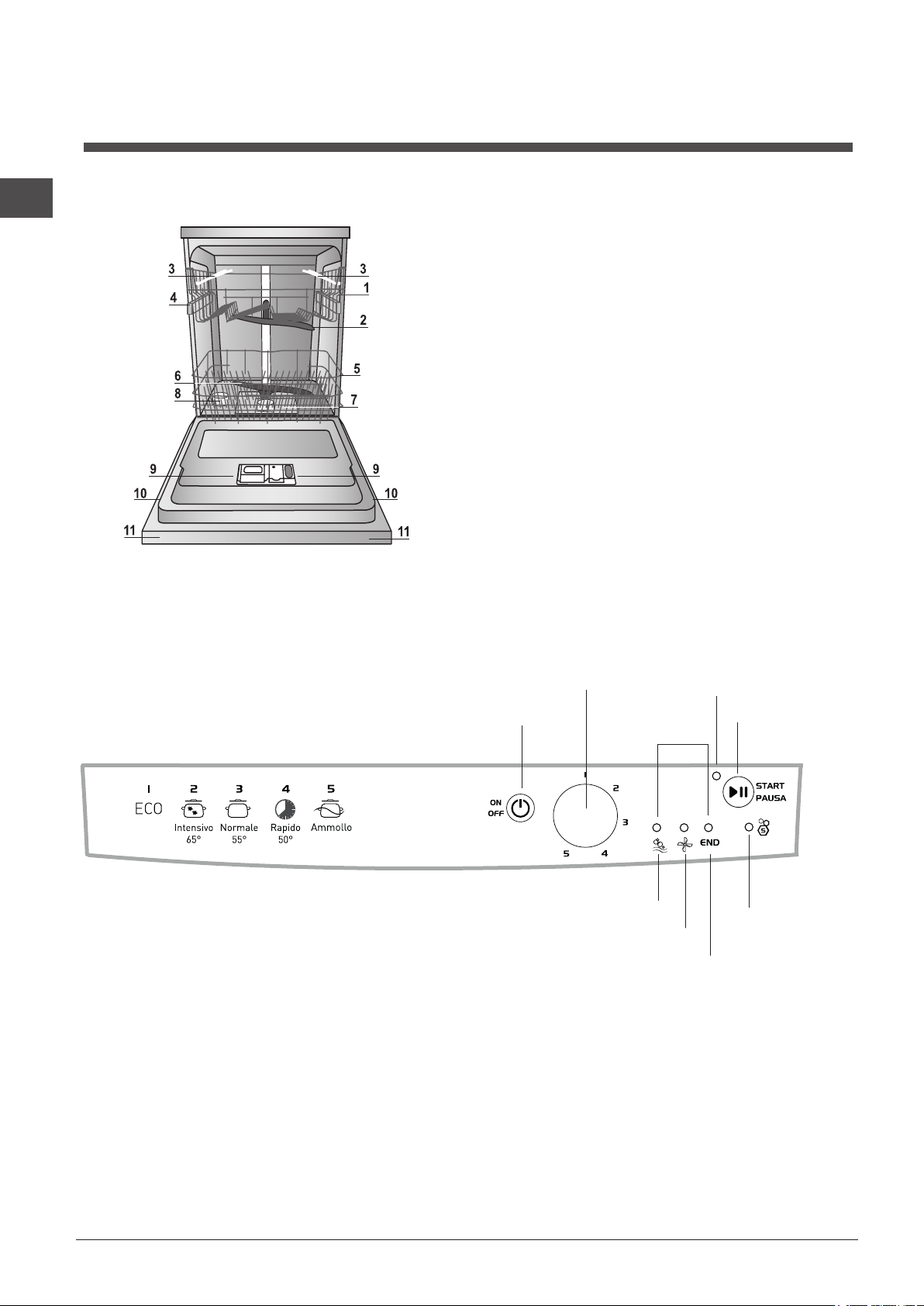
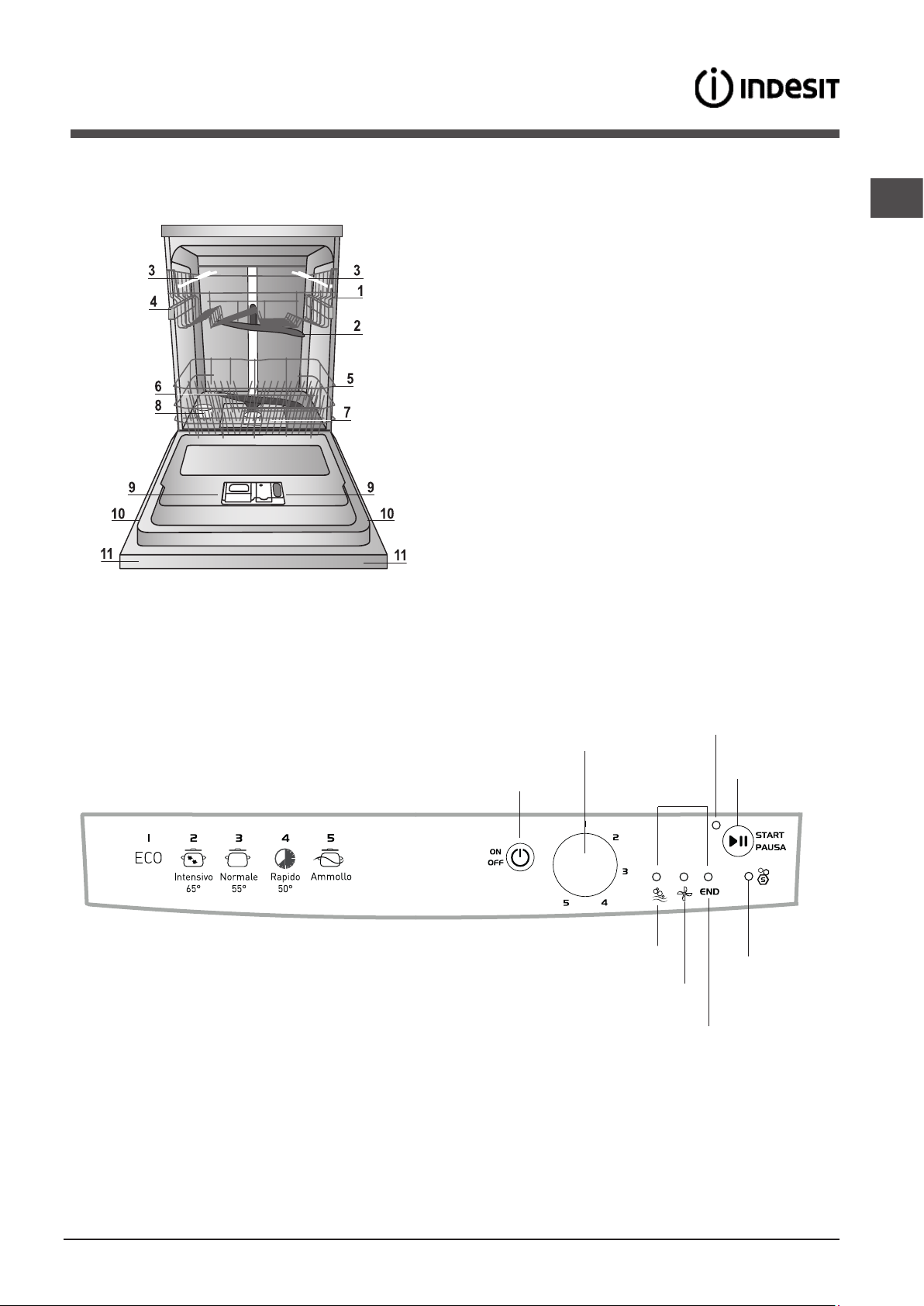
Vista d’insieme
Descrizione
dell’apparecchio
*** Solosuimodelliadincassototale* Presente solo su alcuni modelli.
Il numero e il tipo di programmi ed opzioni variano in base al modello di lavastoviglie.
1. Cestellosuperiore
2. Irroratore superiore
3. Ribaltine
4. Regolatore altezza cestello
5. Cestelloinferiore
6. Irroratore inferiore
7. Filtro lavaggio
8. Serbatoiosale
9. Vaschetta detersivo, serbatoio brillantante e
dispositivoActiveOxigen*
10. Targhettacaratteristiche
11. Pannello comandi***
Pannello comandi
Manopola Selezione Programma
Tasto
Avvio/Pausa
Spia Avvio/Pausa
Spia Asciugatura
Spia Fine programma
Spia Lavaggio
Spia
mancanza sale
Tasto
On-Off/Reset
Spie fasi
ciclo
IT
7
Caricare i cesti
Suggerimenti
Prima di caricare i cesti, eliminare dalle stoviglie i residui di
cibo e vuotare bicchieri e i contenitori dei liquidi rimasti. Non è
necessario un risciacquo preventivo sotto acqua corrente.
Sistemarelestoviglieinmodochesianobenfermeenonsi
ribaltino, i contenitori siano disposti con l’apertura rivolta in
basso e le parti concave o convesse in posizione obliqua,
per permettere all’acqua di raggiungere tutte le superfici e di
defluire.
Fate attenzione che coperchi, manici, padelle e vassoi non
impediscanola rotazionedegli irroratori.Disporre glioggetti
piccoli nel cestino delle posate.
Le stoviglie in plastica e le padelle in antiaderente, tendono
a trattenere maggiormente le gocce d’ acqua e quindi il loro
grado di asciugatura risulterà inferiore a quello delle stoviglie
in ceramica o acciaio.
Glioggettileggeri(comeirecipientiinplastica)devonoessere
preferibilmente posizionati sul cesto superiore e disposti in modo
da non potersi muovere.
Dopoaver caricato,assicurarsi chegli irroratori ruotino
liberamente.
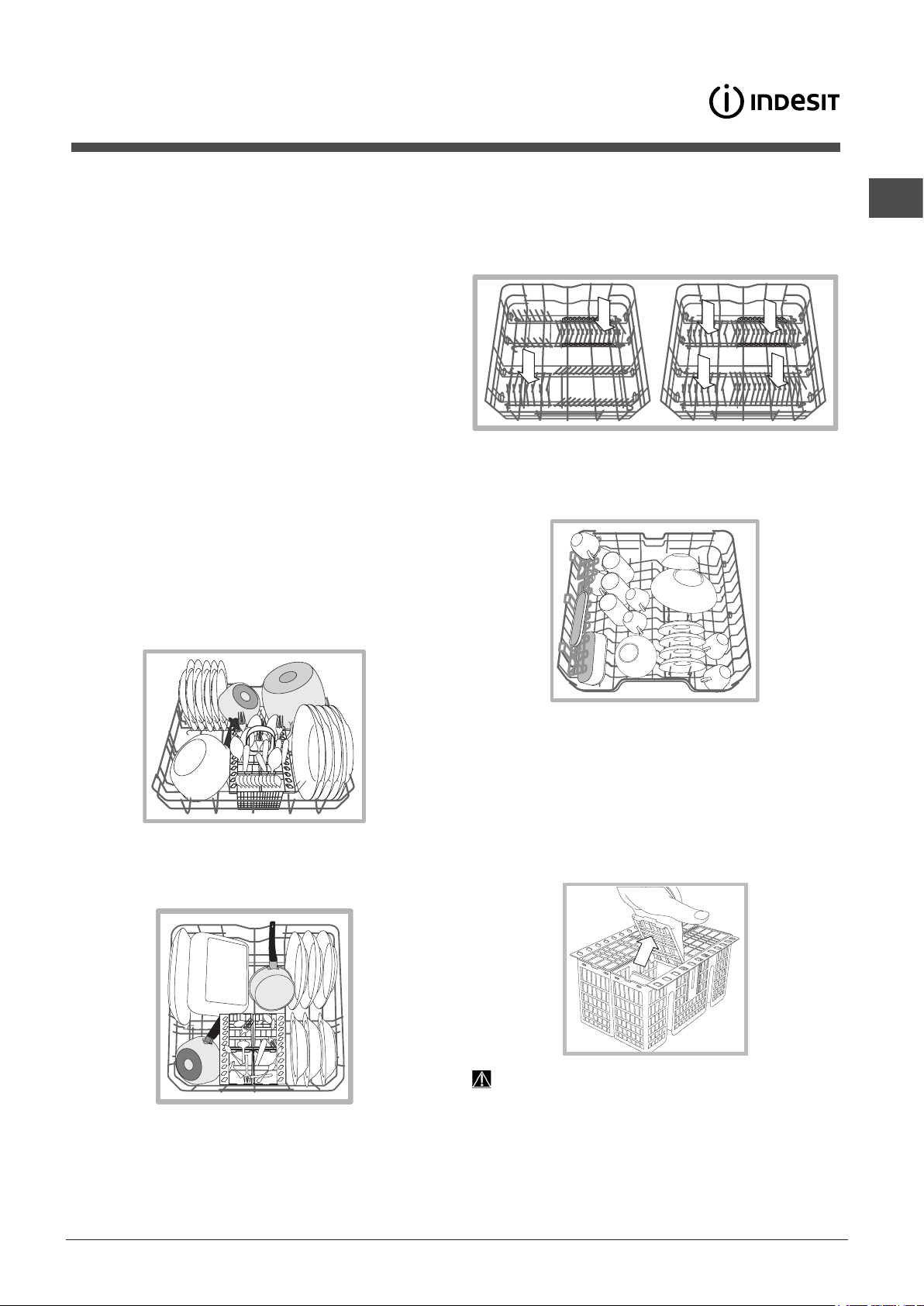
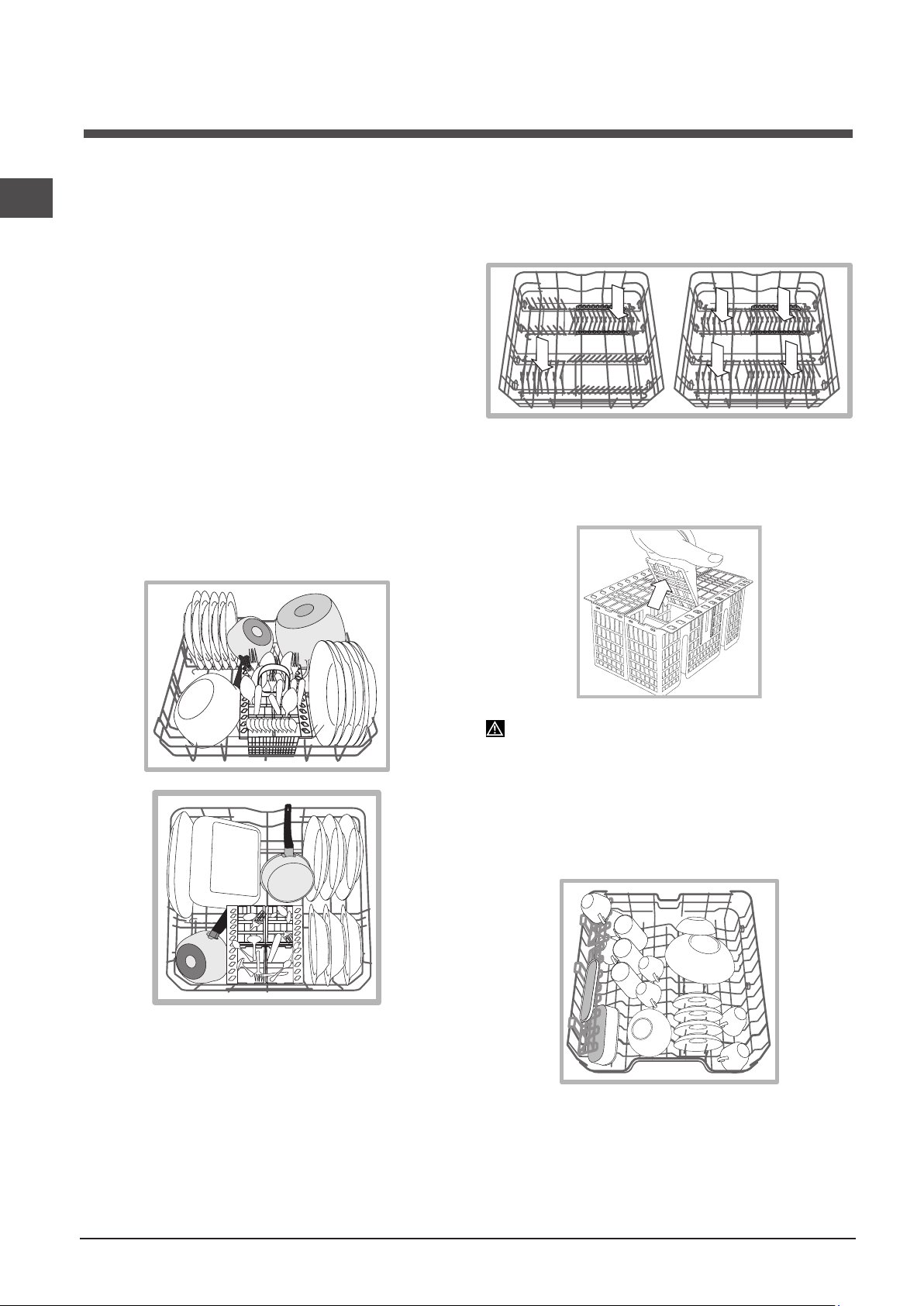
Cesto inferiore
Ilcesto inferiore può contenere pentole, coperchi, piatti,
insalatiere, posate ecc... Piatti e coperchi grandi vanno sistemati
di preferenza ai lati del cesto.
E’consigliabile disporre le stoviglie molto sporche nel cesto
inferiore poichè in questo settore i getti d’acqua sono più energici
e permettono di ottenere migliori prestazioni di lavaggio.
Alcunimodellidilavastoviglie,dispongonodisettorireclinabili*,
gli stessi si possono usare in posizione verticale per la
sistemazione dei piatti oppure in posizione orizzontale
(abbassati) per poter caricare più agevolmente pentole e
insalatiere.
Cesto superiore
Caricarestovigliedelicateeleggere:bicchieri,tazze,piattini,
insalatiere basse.
Alcunimodellidilavastoviglie,dispongonodisettorireclinabili*,
utilizzabili in posizione verticale per sistemare piattini da thè
o dessert o abbassati per caricare ciotole e contenitori per
alimenti.
Cestino delle posate
Il cestino delle posate è munito di griglie superiori per una
miglioredisposizione delle stesse. Deve essere posizionato
solo nella parte anteriore del cesto inferiore.
I coltelli e gli utensili con punte taglienti devono essere
sistemati nel cestino delle posate con le punte rivolte verso il
basso o sistemati sulle ribaltine del cesto superiore in posizione
orizzontale.
*Presente solo in alcuni modelli e variabili per numero e
posizione.
8
IT
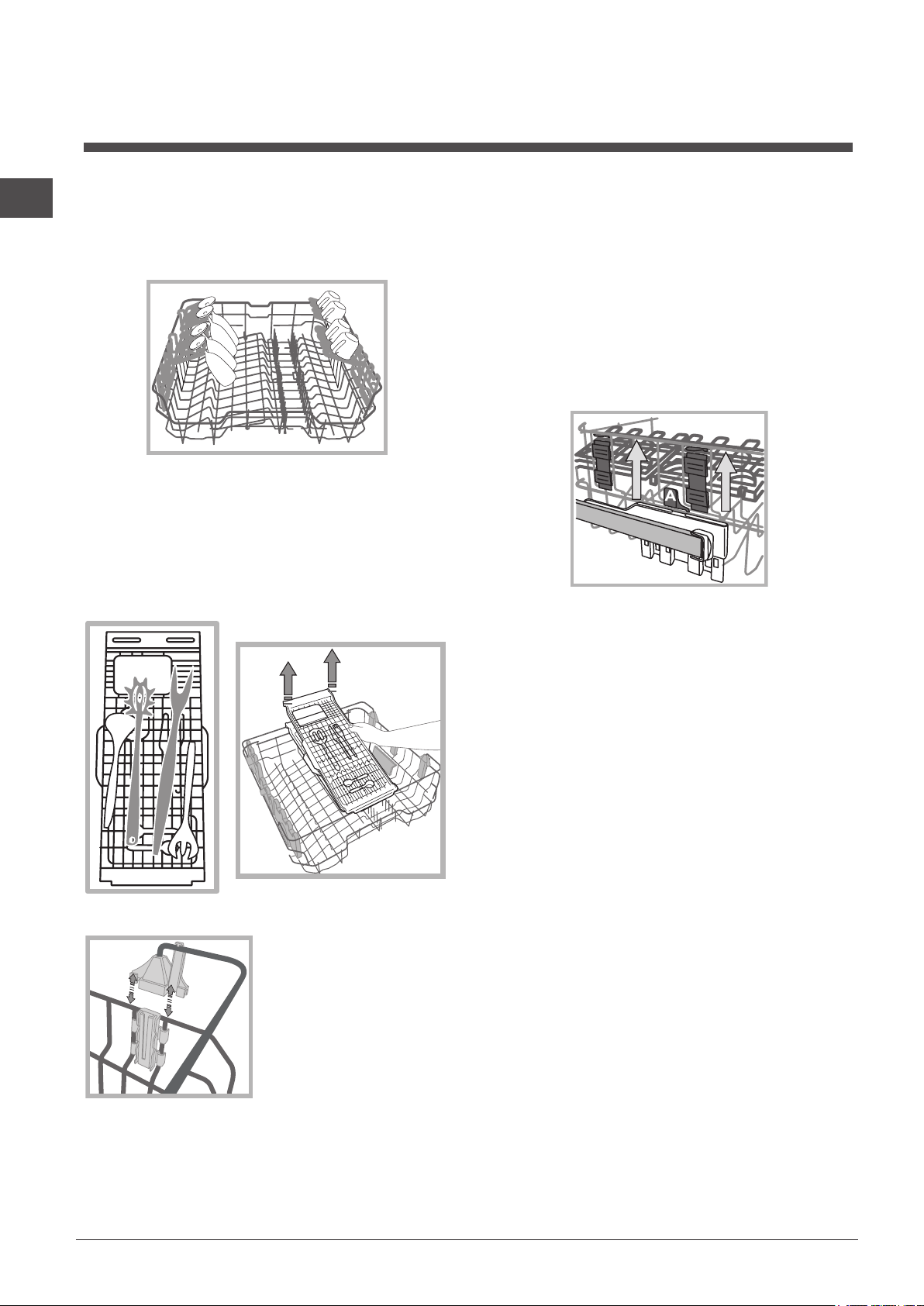
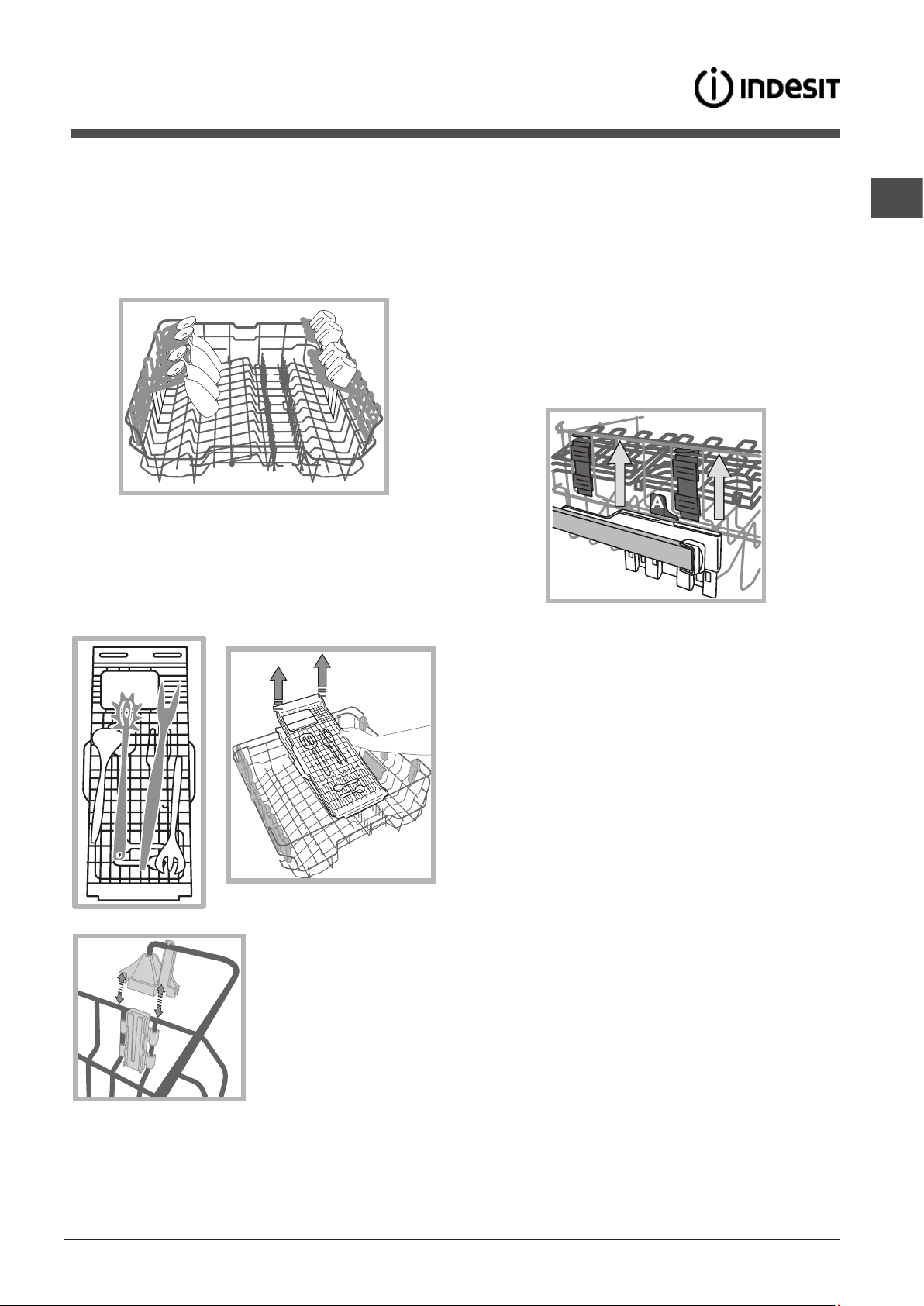
Vassoio portaposate*
Alcunimodellidilavastovigliesonodotatidiunvassoio
scorrevolechepuòessereutilizzatopercontenereposatedi
servizio o tazze di piccole dimensioni. Per migliori prestazioni
di lavaggio, evitare di caricare sotto al vassoio stoviglie
ingombranti. Il vassoio portaposate è rimovibile.
(vedi figura)
Regolare l’altezza del cesto superiore
Per agevolare la sistemazione delle stoviglie, è possibile
sistemare il cesto superiore in posizione alta o bassa.
E’ preferibile regolare l’altezza del cesto superiore a CESTO
VUOTO.
Non sollevare o abbassare MAI il cesto su un solo lato.
Seil cesto è dotato di Lift-Up*
(vedi figura)
, sollevare il
cesto afferrandolo ai lati e muovere verso l’alto. Per tornare
nella posizione bassa, premere le leve (A) ai lati del cesto ed
accompagnare la discesa verso il basso.
Stoviglie non idonee
• Posateestovigliedilegno.
• Bicchieridecoratidelicati,stovigliediartigianatoartisticoe
di antiquariato. Le loro decorazioni non sono resistenti.
• Partiinmaterialesinteticononresistentiallatemperatura.
• Stovigliedirameestagno.
• Stoviglie sporche di cenere, cera, grasso lubrificante o
inchiostro.
Le decorazioni su vetro, i pezzi di alluminio e argento durante il
lavaggio possono tendere a cambiare colore ed a sbiancarsi.
Anchealcunitipidivetro(peres.oggettidicristallo)dopomolti
lavaggi possono diventare opachi.
Danni al vetro ed alle stoviglie
Cause:
•Tipodivetroeprocedimentodiproduzionedelvetro.
•Composizionechimicadeldetersivo.
•Temperaturadell’acquadelprogrammadirisciacquo.
Consiglio:
•Utilizzaresolobicchierieporcellanagarantitidalproduttore
come resistenti al lavaggio in lavastoviglie.
•Usaredetersivodelicatoperstoviglie.
•Estrarrebicchierieposatedallalavastovigliealpiùpresto
possibile dopo la fine del programma.
Ribaltine a posizione variabile
Le ribaltine laterali sono posizionabili su tre altezze differenti per
ottimizzare la disposizione delle stoviglie nello spazio del cesto.
I calici possono essere posizionati stabilmente sulle ribaltine
inserendo lo stelo del bicchiere nelle apposite asole.
Il cesto superiore è regolabile in altezza a seconda della
necessità: in posizione alta quando nel cesto inferiore si vogliono
sistemare stoviglie ingombranti; in posizione bassa, in modo
da sfruttare gli spazi delle ribaltine o dei reclinabili creando più
spazio verso l’alto.
Prima di caricare il vassoio, as-
sicurarsi che i sostegni siano
ben agganciati al cesto supe-
riore.
(vedi figura)
* Presente solo su alcuni modelli.
IT
9
Avvio e utilizzo
* Presente solo su alcuni modelli.
Caricare il detersivo
Il buon risultato del lavaggio dipende anche dal
corretto dosaggio del detersivo, eccedendo non si lava
in modo più efficace e si inquina l’ambiente.
A seconda del grado di sporco, il dosaggio può essere
adattato al singolo caso con un detersivo in polvere o liquido.
Solitamente per uno sporco normale, utilizzare circa 35
gr. (detersivo in polvere), o 35ml (detersivo liquido). Se si
impiegano le pastiglie ne basta una.
Se le stoviglie sono poco sporche o sono state sciacquate
precedentemente sotto l’acqua, ridurre sensibilmente la
dose del detersivo.
Per un buon risultato di lavaggio osservare anche le
istruzioni riportate sulle confezioni del detersivo.
In caso di ulteriori domande consigliamo di rivolgersi agli
uffici di consulenza dei produttori di detersivi.
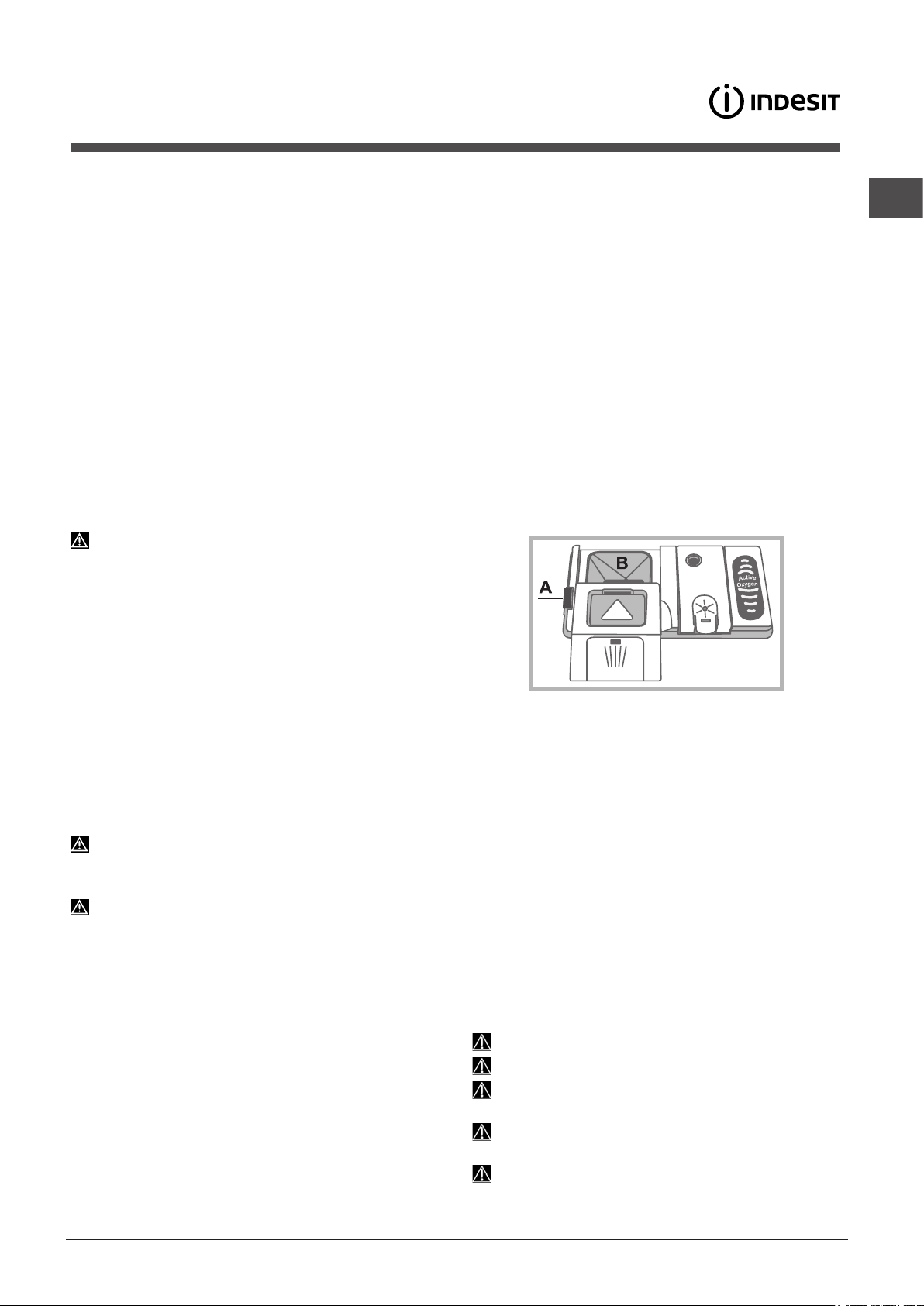
Per aprire il contenitore del detersivo, azionare il dispositivo
di apertura “A”
Introdurre il detersivo solo nella vaschetta “B” asciutta. La
quantità di detersivo adibita al prelavaggio, deve essere
posizionata direttamente in vasca.
1.
Dosareildetersivoconsultandola
Tabelladeiprogrammi
per
introdurrelaquantitàcorretta.NellavaschettaB, è presente un
livello che indica la quantità massima di detersivo liquido o in
polvere inseribile per ogni ciclo.
2.
Eliminareiresiduididetersivodaibordidellavaschettae
chiudere il coperchio fino allo scatto.
3.
Chiudereilcoperchiodelcontenitoredetersivospingendolo
in alto, fino al corretto innesto del dispositivo di chiusura.
Il contenitore detersivo si apre automaticamente in funzione del
programma, al momento opportuno.
Sevengonoutilizzatidetersivicombinati,èconsigliatoutilizzare
l’opzioneTABS,cheadeguailprogrammadilavaggio,inmodo
da raggiungere sempre il migliore risultato di lavaggio e di
asciugatura possibile.
Utilizzare solo detersivo per lavastoviglie.
NON UTILIZZARE detersivi per lavaggio a mano.
Un utilizzo eccessivo di detersivo può lasciare residui
di schiuma a fine ciclo.
L’utilizzo delle pastiglie è consigliato solo nei modelli
dove è presente l’opzione PASTIGLIE MULTIFUNZIONE.
Le migliori prestazioni di lavaggio ed asciugatura, si
ottengono solo con l’utilizzo di detersivo in polvere,
brillantante liquido e sale.
Avviare la lavastoviglie
1.Aprireilrubinettodell’acqua.
2.AccenderelamacchinapremendoiltastoON-OFF.
3.Aprirelaportaedosareildetersivo
(vediCaricareildetersivo).
4.Caricareicesti
(vediCaricareicesti)
e chiudere la porta.
5.SelezionareilprogrammaruotandolamanopolaSELEZIONE
PROGRAMMA:far coincidere latacca sullamanopola con il
numero o il simbolo del programma. La spia relativa al tasto
AVVIO/PAUSAsiillumina.
6.Selezionareleopzionidilavaggio*
(vediOpzionieProgrammi
Speciali).
7.AvviarepremendoiltastoAVVIO,laspiasmettedipulsaree
diventa a luce fissa. L’accensione della spia relativa al lavaggio
avvisa dell’inizio del programma.
8.AllafinedelprogrammasiilluminalaspiaFINE(lucefissa).
Spegnerel’apparecchiopremendoiltastoON-OFF,chiudereil
rubinetto dell’acqua e staccare la spina dalla presa di corrente.
9.Aspettarealcuniminutiprimaditoglierelestoviglie,perevitare
discottarsi.Scaricareicestiiniziandodaquelloinferiore.
- Per ridurre il consumo di energia elettrica, in alcune
condizioni di NON utilizzo prolungato, la macchina si spegne
automaticamente.
Modificare un programma in corso
Sesi è selezionato un programmasbagliato è possibile
modificarlo, purché appena iniziato: a lavaggio avviato, per
cambiare ciclo di lavaggio spegnere la macchina con una
pressioneprolungata del tasto ON/OFF/Reset, riaccenderla
con lo stesso tasto e selezionare nuovamente programma e
opzioni desiderati.
Aggiungere altre stoviglie
PremereiltastoAvvio/Pausa,aprirelaportafacendoattenzione
alla fuoriuscita di vapore e inserire le stoviglie. Premere il tasto
Avvio/Pausa:ilcicloriprendedopounbipprolungato.
Seèimpostatalapartenzaritardata*, alla fine del conto alla
rovescia, il ciclo di lavaggio non partirà ma rimarrà in stato di
Pausa.
PremendoiltastoAvvio/Pausapermetterelamacchinain
pausa, si interrompe il programma.
Inquestafasenonsipuòcambiareilprogramma.
Interruzioni accidentali
Seduranteillavaggiosiaprelaportaosiverificaun’interruzione
di corrente, il programma si interrompe. Riprende dal punto in
cui si era interrotto quando si chiude la porta o torna la luce.
10
IT
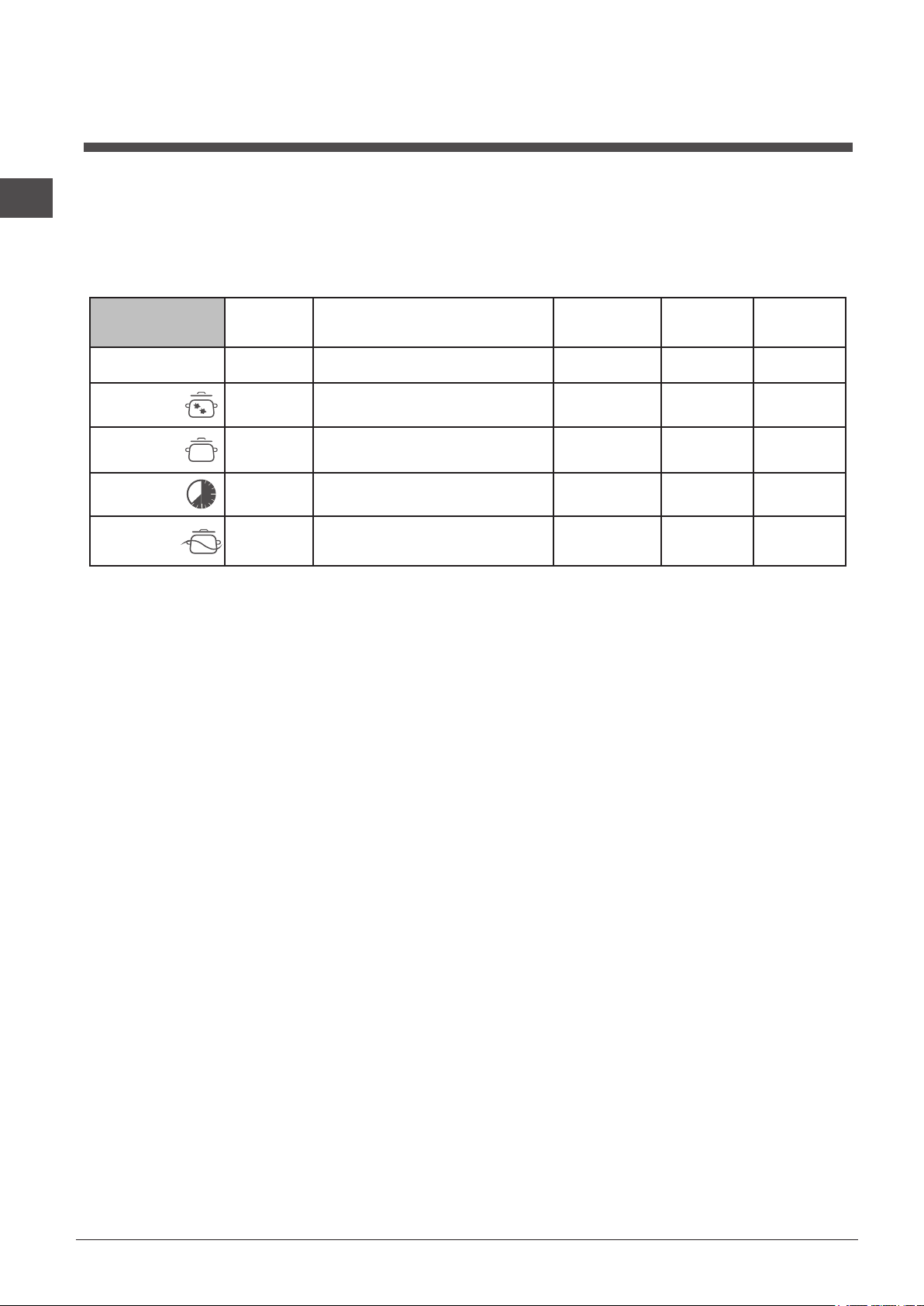
Programmi
IdatideiprogrammisonomisuratiincondizionidilaboratoriosecondoNormaeuropeaEN50242.
A seconda delle diverse condizioni di utilizzo, la durata e i dati dei programmi possono variare.
Il numero e il tipo di programmi ed opzioni variano in base al modello di lavastoviglie.
Note:
Per consumare di meno usa la lavastoviglie a pieno carico.
Nota per i laboratori di Prove:
perinformazionisullecondizionidellaprovacomparativaEN,farnerichiestaall’indirizzo:assistenza_
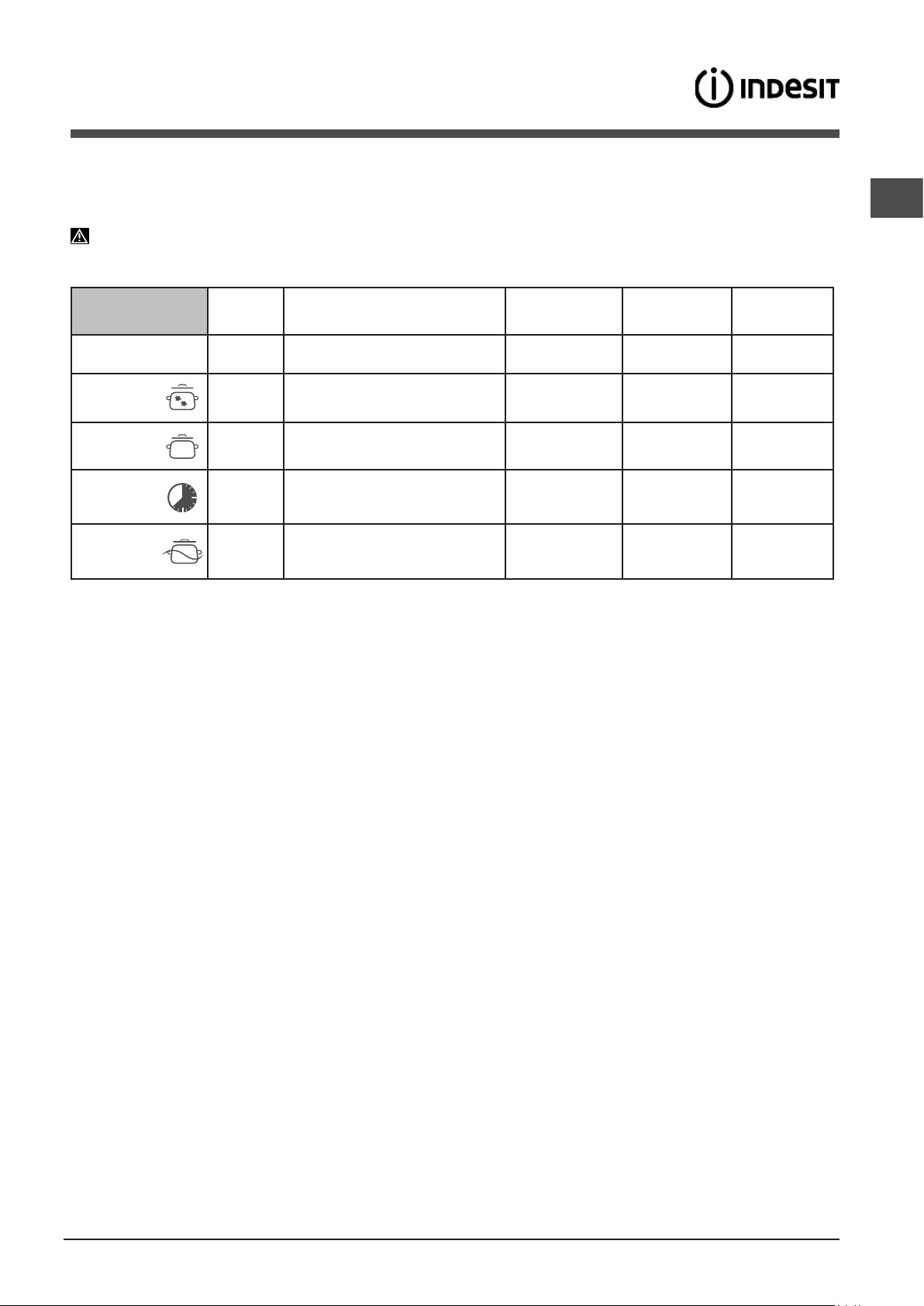
Programma Asciugatura Opzioni
Durata del
programma
Consumo
acqua
(l/ciclo)
Consumo
Energia
(KWh/ciclo)
1. Eco
Si
No 03:10’ 11,0 1,04
2. Intensivo
Si
No 02:30’ 16,5 1,70
3. Normale
Si
No 02:00’ 16 1,35
4. Rapido 40’
No
No 00:40’ 9,0 0,95
5. Ammollo
No
No 00:10’ 4,0 0,01
Indicazioni per la scelta dei programmi e dosaggio del detersivo
1. IlciclodilavaggioECOèilprogrammastandardacuisiriferisconoidatidell’etichettaenergetica;questocicloèadattoa
lavare stoviglie normalmente sporche ed è il programma più efficiente in termini di consumo energetico e di acqua per questo tipo
distoviglie.27gr/ml+6gr/ml**–1Tab
(
**
Quatità di detersivo del prelavaggio)
2. Stoviglieepentolemoltosporche(nonusareperpezzidelicati).30gr/ml–1Tab
3.Stoviglieepentolenormalmentesporche.27gr/ml+6gr/ml**–1Tab
4. Ciclovelocedautilizzareperstovigliepocosporche.(idealeper2coperti)25gr/ml–1Tab
5.Lavaggiopreliminareinattesadicompletareilcaricoalpastosuccessivo.Nodetersivo
Consumidistand-by:Consumodileft-onmode:5,0W-consumodioffmode:0,5W

IT
11
Brillantante e sale rigenerante
Tabella Durezze Acqua
Autonomia media
**
contenitore sale
livello °dH °fH mmol/l mesi
1 0 - 6 0 - 10 0 - 1 7 mesi
2 6 - 11 11 - 20 1,1 - 2 5 mesi
3 12 - 17 21 - 30 2,1 - 3 3 mesi
4 17 - 34 31 - 60 3,1 - 6 2 mesi
5
*
34 - 50 61 - 90 6,1 - 9 2/3 settimane
Da 0°f a 10°f si consiglia di non utilizzare sale.
* con impostazione 5 la durata può prolungarsi.
** con 1 lavaggio al giorno
M
A
X
Usare solo prodotti specifici per lavastoviglie.
Non usare sale alimentare o industriale nè detersivi per il
lavaggio a mano.
Seguire le indicazioni riportate sulla confezione.
Sesi usa un prodotto multifunzione, non è necessario
aggiungere brillantante, si consiglia invece di aggiungere
sale, specie se l’acqua è dura o molto dura.
(Seguire le
indicazioni riportate sulla confezione).
Non aggiungendo né sale né brillantante è normale che
le spie MANCANZA SALE* e MANCANZA BRILLANTANTE*
rimangano accese.
Caricare il brillantante
Il brillantante facilita l’asciugatura delle stoviglie facendo
scivolare l’acqua dalla superficie, così che non rimangano
striature o macchie. Il serbatoio del brillantante va riempito:
• quandosul pannello si accende la spia MANCANZA
BRILLANTANTE* è ancora disponibile una riserva di
brillantanteper1-2cicli;
1.Aprireilcontenitore“D” premendo e sollevando la linguetta
sul coperchio;
2.Introdurreconprecauzioneilbrillantantefinoalriferimento
massimo dell’apertura di riempimento evitando che fuoriesca.
Seaccade,puliresubitoconunpannoasciutto.
3.Chiudereilcoperchiofinoalloscatto.
Non versare MAI il brillantante direttamente all’interno della
vasca.
Regolare la dose di brillantante
Senonsièsoddisfattidelrisultatodell’asciugatura,èpossibile
regolarela dose di brillantante. Accenderee spegnere la
lavastoviglieconiltastoON/OFF.PremereiltastoAvvio/Pausa
per3volte;accenderelamacchinaconON/OFF,sientranel
menù di regolazione e si accende la spia brillantante.
(impostato
su livello di fabbrica)
Regolare il livello di erogazione del brillantante tramite la
manopolaSELEZIONE PROGRAMMA;ad ogni programma
corrispondeunlivellodibrillantante(da0a4Max.).
Premere il tasto ON/OFF per salvare la regolazione impostata.
IllivellodibrillantantepuòessereimpostatoaZERO(ECO),intal
caso il brillantante non verrà erogato e non verrà accesa la spia
di mancanza brillantante in caso di esaurimento dello stesso.
• sesullestovigliecisonostriature,impostareversoinumeri
bassi(1-2).
• secisonogocced’acquaomacchiedicalcareimpostare
verso i numeri alti (3-4).
Impostazione durezza dell’acqua
Ognilavastoviglie è corredata di un dolcificatore dell’acqua
che, utilizzando del sale rigenerante specifico per lavastoviglie,
fornisce acqua priva di calcare per il lavaggio delle stoviglie.
Questa lavastoviglie, consente una regolazione che riduce
l’inquinamento ed ottimizza le prestazioni di lavaggio in funzione
delladurezza dell’acqua. Il dato è reperibile presso l’Ente
erogatore dell’acqua potabile.
-AccendereespegnerelalavastoviglieconiltastoON/OFF.
Tenerepremuto il tasto Avvio/Pausa per almeno 3 secondi;
accendere la macchina con ON/OFF, si entra nel menù di
regolazione e si accende la spia del sale.
-Selezionare con la manopola SELEZIONE PROGRAMMA il
livellodesiderato(da1a5*Max.)
(Il decalcificatore è impostato su livello medio).
Premere il tasto ON/OFF per salvare la regolazione impostata.
Sesiutilizzanolepastigliemultifunzione,riempirecomunqueil
serbatoio del sale.
(°dH=durezzaingraditedeschi-°fH=durezzaingradifrancesi
-mmol/l=millimol/litro)
Caricare il sale rigenerante
Per avere buoni risultati di lavaggio è indispensabile verificare
che il serbatoio del sale non sia mai vuoto.
Il sale rigenerante elimina il calcare dall’acqua, evitando che si
depositi sulle stoviglie.
Il serbatoio del sale è posto nella parte inferiore della
lavastoviglie
(vediDescrizione)
e va riempito:
• quandoilgalleggianteverde* non è visibile osservando il
tappo del sale;
•quandosulpannellosiaccendelaspiaMANCANZASALE*;
1.Estrarreilcestoinferioreesvitareiltappodelserbatoioin
senso antiorario.
2.Solo per il primo utilizzo: riempire il
serbatoio di acqua fino al bordo.
3. Posizionare l’imbuto
*
(vedi figura)
e
riempire il serbatoio di sale fino al bordo
(circa1kg);ènormalechetrabocchiun
po’ d’acqua.
4.Togliere l’imbuto*, eliminare i residuidi saledall’imbocco;
sciacquare il tappo sotto l’acqua corrente prima di avvitarlo,
disponendolo a testa in giù e facendo defluire l’acqua dalle
quattro fessure disposte a stella nella parte inferiore del tappo.
(tappo con galleggiante verde
*)
E’ consigliabile effettuare questa operazione ad ogni
caricamento del sale.
Chiuderebeneiltappo,affinchénelserbatoiononentridetersivo
durante il lavaggio (potrebbe danneggiarsi irrimediabilmente il
dolcificatore).
Quando si rende necessario, caricare il sale prima di un
ciclo di lavaggio in modo da eliminare la soluzione salina
traboccata dal contenitore del sale.
* Presente solo su alcuni modelli.
12
IT
Manutenzione e cura
Escludere acqua e corrente elettrica
• Chiudere
il
rubinetto
dell’acqua
dopo
ogni
lavaggio
per
eliminare il pericolo di perdite.
• Staccare
la
spina
dalla
presa
di
corrente
quando
si
pulisce
la macchina e durante i lavori di manutenzione.
Pulire la lavastoviglie
• La
s
uperficie
e
sterna
e
i
l
p
annello
d
i
c
ontrollo
p
ossono
e
ssere
puliti
con
un
panno
inumidito
con
acqua
non
abrasivo.
Non
usare solventi o detersivi
abrasivi.
• La
vasca
internapuò
essere
pulita
da
eventuali
macchie
con
un panno imbevuto di acqua e poco aceto.
Evitare i cattivi odori
• Lasciare
sempre
socchiusa
la
porta
per
evitare
il
ristagno
di
umidità.
• Pulire
regolarmente
le
guarnizioni
perimetrali
di
tenuta
della
porta e delle vaschette detersivo con una spugnetta umida.
Si
eviteranno
così
ristagni
di
cibo,
principali
responsabili
del
cattivo odore.
Pulire gli irroratori
Può
succedere
che
residui
di
cibo
si
attacchino
agli
irroratori
e
ostruiscano i fori da cui esce l’acqua: di tanto in tanto è bene
controllarli e pulirli con uno spazzolino non metallico.
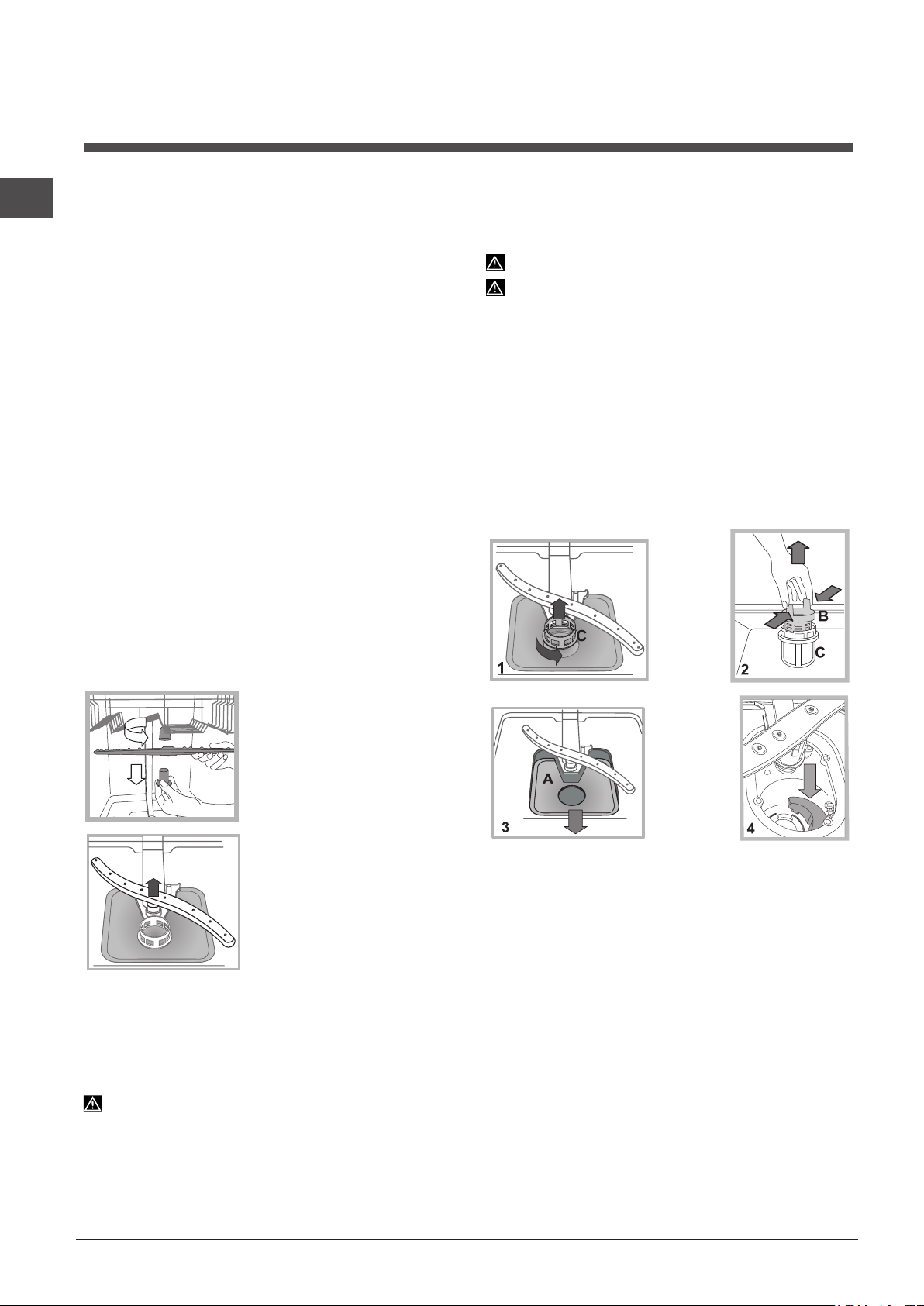
I due irroratori, sono entrambi smontabili.
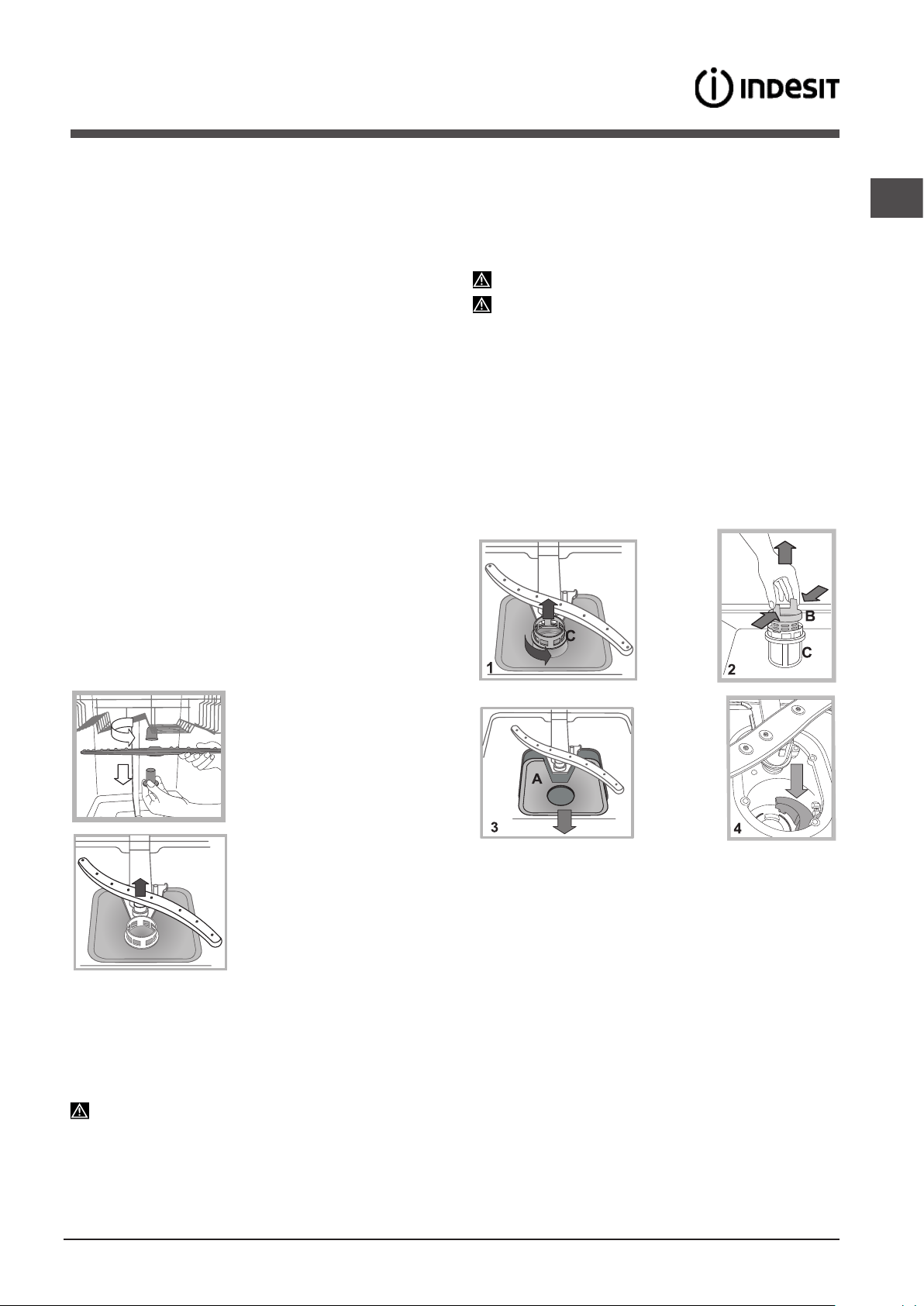
Per smontare l’irroratore
superiore, occorre svitare girando
in senso antiorario la ghiera di
plastica.L’irroratore superiore,
va rimontato con la parte con il
maggior numero di fori rivolta
verso l’alto.
L’irroratore inferiore si smonta
facendo pressione sulle linguette
poste ai lati e tirandolo verso l’alto.
Pulizia del filtro entrata acqua*
Se
i
tubi
dellacqua
sono
nuovi
o
sono
rimasti
per
lungo
tempo
inattivi, prima di fare l’allacciamento, far scorrere l’acqua fino
a
che
diventi
limpida
e
sia
priva
di impurità.
Senza
questa
precauzione, c’è il rischio che il punto dove entra l’acqua si
intasi, danneggiando la lavastoviglie.
Periodicamente, pulire il filtro entrata acqua posizionato
all’uscita del rubinetto.
-
Chiudere
il
rubinetto
dell’acqua.
-
Svitare
l’estremità
del
tubo
di
carico
acqua,
togliere
ilfiltro
e
pulirlo delicatamente sotto un getto di acqua corrente.
- Inserire nuovamente il filtro e avvitare il tubo.
Pulire i filtri
Il gruppo filtrante è formato da tre filtri che puliscono l’acqua di
lavaggio dai residui di cibo e la rimettono in circolo: per avere
buoni risultati di lavaggio è necessario pulirli.
Pulire i filtri con regolarità.
La lavastoviglie non deve essere usata senza filtri o con filtro
sganciato.
•Dopo alcuni lavaggi, controllare il gruppo filtrante e se
necessario pulirlo accuratamente sotto acqua corrente,
aiutandosi con uno spazzolino non metallico, seguendo le
istruzioni sotto riportate:
1. ruotare in senso antiorario il filtro cilindrico C ed estrarlo
(fig.1).
2.EstrarreilbicchierefiltroB facendo una leggera pressione
sulle alette laterali
(Fig.2);
3.SfilareilpiattofiltroinoxA.
(fig. 3).
4. Ispezionare il pozzetto ed eliminare eventuali residui di cibo.
NON RIMUOVERE MAI la protezione della pompa di lavaggio
(particolare di colore nero) (fig.4).
Dopolapuliziadeifiltri,rimontareilgruppofiltranteericollocarlo
correttamente nella sua sede; è fondamentale per un buon
funzionamento della lavastoviglie.
Se ci si assenta per lunghi periodi
• Staccarei collegamenti elettrici e chiudere il rubinetto
dell’acqua.
• Lasciaresocchiusalaporta.
•Alrientro,fareunlavaggioavuoto.
* Presente solo su alcuni modelli.
IT
13
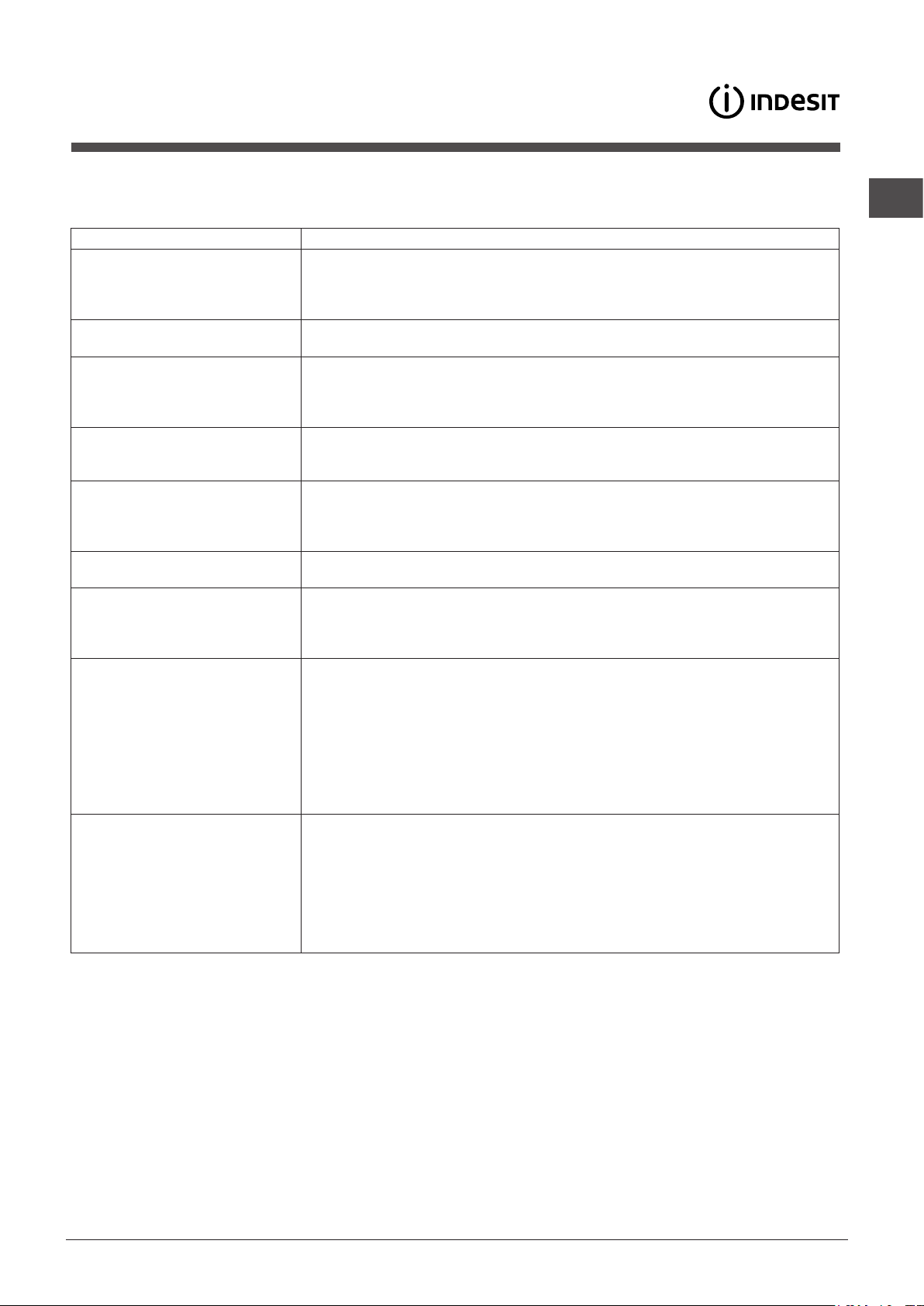
Anomalie e rimedi
Qualoral’apparecchiopresentidelleanomaliedifunzionamento,controllareiseguentipuntiprimadirivolgersiall’Assistenza.
Anomalie: Possibili cause / Soluzione:
La lavastoviglie non parte o non
risponde ai comandi
• Spegnere la macchina con il tasto ON/OFF, riaccendere dopo un minuto
circa e reimpostare il programma.
• La spina non è ben inserita nella presa di corrente.
• La porta della lavastoviglie non è ben chiusa.
La porta non si chiude
• La serratura è scattata; spingere energicamente la porta fino a sentire il
“clack”.
La lavastoviglie non scarica
acqua.
• Il programma non è ancora terminato.
• Il tubo di scarico dell’acqua è piegato (vedi Installazione).
• Lo scarico del lavello è ostruito.
• Il filtro è intasato da residui di cibo.
La lavastoviglie fa rumore. • Le stoviglie sbattono tra loro o contro gli irroratori.
• Eccessiva presenza di schiuma: il detersivo non è dosato adeguatamente o
non è idoneo al lavaggio in lavastoviglie. (vedi Avvio e utilizzo).
Su stoviglie e bicchieri ci sono
depositi calcarei o una patina
biancastra.
• Manca il sale rigenerante o la sua regolazione non è adeguata alla
durezza dell’acqua (vedi Brillantante e sale).
• Il tappo del serbatoio del sale non è chiuso bene.
• Il brillantante è esaurito o il dosaggio è insufficiente.
Su stoviglie e bicchieri ci sono
striature o sfumature bluastre.
• Il dosaggio del brillantante è eccessivo.
Le stoviglie sono poco
asciutte.
• È stato selezionato un programma senza asciugatura.
• Il brillantante è esaurito o il dosaggio è insufficiente (vedi Brillantante e sale).
• La regolazione del brillantante non è adeguata.
• Le stoviglie sono in materiale antiaderente o in plastica.
Le stoviglie non sono pulite.
• I cestelli sono troppo carichi (vedi Caricare i cestelli).
• Le stoviglie non sono sistemate bene.
• Gli irroratori non sono liberi di ruotare.
• Il programma di lavaggio è troppo blando (vedi Programmi).
• Eccessiva presenza di schiuma: il detersivo non è dosato adeguatamente o
non è idoneo al lavaggio in lavastoviglie. (vedi Avvio e utilizzo).
• Il tappo del brillantante non è stato chiuso correttamente.
• Il filtro è sporco o intasato (vedi Manutenzione e cura).
• Manca il sale rigenerante (vedi Brillantante e sale).
La lavastoviglie non carica
acqua – Allarme rubinetto
chiuso.
(lampeggiano velocemente le spie
Asciugatura e Fine).
• Manca l’acqua nella rete idrica.
• Il tubo di carico dell’acqua è piegato (vedi Installazione).
• Aprire il rubinetto e l’apparecchio si avvia dopo pochi minuti.
• L’apparecchio si è bloccato perché non si è intervenuti al segnale acustico*.
(*
Presente solo su alcuni modelli
)
Spegnere la macchina con il tasto ON/OFF, aprire il rubinetto e dopo 20
secondi riaccendere premendo lo stesso tasto. Riprogrammare la macchina e
riavviare.
* Presente solo su alcuni modelli.

14
IT
Prima di contattare l’Assistenza:
• Verificaresel’anomaliapuòessererisoltadasoli
(vediAnomalieeRimedi)
.
• Riavviareilprogrammapercontrollaresel’inconvenienteèstatoovviato.
• Incasonegativo,contattareilServizioAssistenzaTecnicaAutorizzato.
Non ricorrere mai a tecnici non autorizzati.
Comunicare:
• iltipodianomalia;
• ilmodellodellamacchina(Mod.);
• ilnumerodiserie(S/N).
Queste informazioni si trovano sulla targhetta caratteristiche posta sull’apparecchio
(vediDescrizionedell’apparecchio).
Assistenza Attiva 7 giorni su 7
SenasceilbisognodiinterventochiamareilNumeroUnicoNazionale199.199.199*.
UnoperatoresaràacompletadisposizioneperfissareunappuntamentoconCentroAssistenzaTecnicoautorizzato
più vicino al luogo da cui si chiama.
È attivo 7 giorni su 7, sabato e domenica compresi, e non lascia mai inascoltata una richiesta.
* Alcostodi14,25centesimidiEuroalminuto(ivainclusa)dalLun.alVen.dalle08:00alle18:30,ilSab.dalle08:00alle13:00e
di5,58centesimidiEuroalminuto(ivainclusa)dalLun.alVen.dalle18:30alle08:00,ilSab.dalle13:00alle08:00eigiornifestivi,
per chi chiama dal telefono fisso.
Per chi chiama da radiomobile le tariffe sono legate al piano tariffario dell’operatore telefonico utilizzato.
Le suddette tariffe potrebbero essere soggette a variazione da parte dell’operatore telefonico; per maggiori informazioni consultare
il sito www.aristonchannel.com.
Assistenza

Operating instructions
Contents
Product Fiche, 16
Precautions, advice and Assistance, 17-18
General safety
Disposal
Saving energy and respecting the environment
Assistance
Installation, 19-20
Positioning and levelling
Connecting the water and electricity supplies
Advice regarding the first wash cycle
Technical data
Description of the appliance, 21
Overall view
Control panel
Loading the racks, 22-23
Lower rack
Cutlery basket
Upper rack
Cutlery tray
*
Adjusting upper rack
Start-up and use, 24
Starting the dishwasher
Measuring out the detergent
Wash cycles, 25
Table of wash cycles
Rinse aid and refined salt, 26
Measuring out the rinse aid
Measuring out the refined salt
Care and maintenance, 27
Shutting off the water and electricity supplies
Cleaning the dishwasher
Preventing unpleasant odours
Cleaning the sprayer arms
Cleaning the water inlet filter
Cleaning the filters
Leaving the machine unused for extended periods
Troubleshooting, 28
English, 15
EN
DFG 15B1
DISHWASHER
EN
16
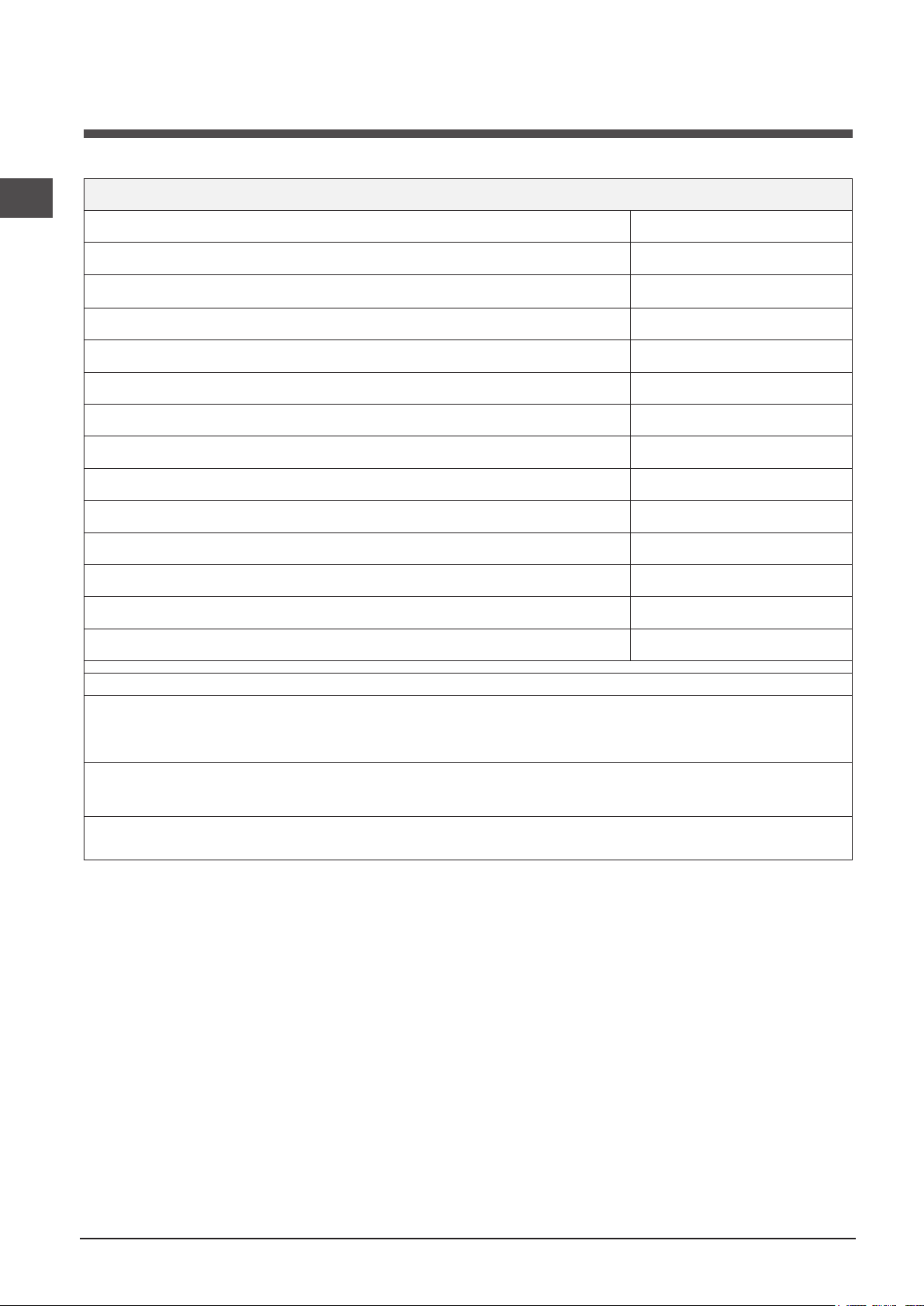
Product Fiche
Brand
INDESIT
Model
DFG 15B1
Rated capacity in standard place settings (1)
13
Energy efciency class on a scale from A+++ (low consumption) to D (high consumption)
A+
Energy consumption per year in kWh (2)
295.0
Energy consumption of the standard cleaning cycle in kWh
1.04
Power consumption of the off-mode in W
0.5
Power consumption of the left-on mode in W
5.0
Water consumption per year in litres (3)
3080.0
Drying efcacy class on a scale from G (low efcacy) to A (high efcacy)
A
Programme time for standard cleaning cycle in minutes
190
The duration of the left-on mode in minutes
10
Noise in dB(A) Re 1pW
49
Built-in model
NO
NOTES
1) The information on the label and che relates to the standard cleaning cycle, this programme is suitable to clean normally
soiled tableware and it is the most efcient programme in terms of combined energy and water consumption. The standard
cleaning cycle corresponds to the Eco cycle.
2) Based on 280 standard cleaning cycles using cold water ll and the consumption of the low power modes. Actual energy
consumption depends on how the appliance is used.
3) Based on 280 standard cleaning cycles. Actual water consumption depends on how the appliance is used.
Product fiche
EN
17
* Only available in selected models.
Precautions, advice and
Assistance
This appliance was designed and
manufactured in compliance with international
safety standards The following information has
been provided for safety reasons and should
therefore be read carefully.
Keep this instruction manual in a safe place for
future reference. If the appliance is sold, given
away or moved, please ensure the manual is kept
with the machine.
Please read these instructions carefully: they
contain important information on installation, use
and safety.
This appliance is designed for domestic use or
similar applications, for example:
- staff kitchen areas in shops, offices and other
work environments;
- farmhouses;
- use by guests in hotels, motels and other
residential settings;
- bed & breakfasts.
General safety
• The applianceshould notbe operatedby
people (including children) with reduced
physical, sensory or mental capacities, or by
inexperienced people who are not familiar with
the product, unless supervision or instructions
on how to use it are provided by someone who
assumes responsibility for their safety.
• Anadultmustsupervisechildrenatalltimesto
prevent them from playing with the appliance.
• The appliancewasdesigned fordomestic
use inside the home and is not intended for
commercial or industrial use.
• Theappliancemustbeusedbyadultsonlyto
wash domestic crockery in accordance with
the instructions in this manual.
• Theappliancemustnotbeinstalledoutdoors,
even in covered areas. It is extremely dangerous
to leave the machine exposed to rain and
storms.
• Donottouchtheappliancewhenbarefoot.
• Whenunpluggingtheappliancealwayspullthe
plug from the mains socket. Do not pull on the
cable.
• Thewatersupplytapmustbeshutoffandthe
plug should be removed from the electrical
socket before cleaning or maintaining the
appliance.
• Iftheappliancebreaksdown,donotunderany
circumstances touch the internal parts in an
attempt to perform the repair work yourself.
• Donot lean orsit onthe open doorof the
appliance: this may cause the appliance to
overturn.
•Thedoorshouldnotbeleftopenasitmaycreate
a dangerous obstacle.
• Keepdetergentandrinseaidoutofreachof
children.
• Thepackagingmaterialshouldnotbeusedas
a toy for children.
Disposal
• Disposalofpackagingmaterial:observelocal
legislation so that the packaging may be
reused.
• The EuropeanDirective2012/19/EU relating
toWasteElectricalandElectronicEquipment
(WEEE) states that household appliances
should not be disposed of using the normal
solidurbanwastecycle.Exhaustedappliances
should be collected separately in order to
optimise the re-using and recycling rate of the
materials inside the machine, while preventing
potential damage to the environment and public
health. The crossed-out dustbin symbol is
marked on all products to remind the owners
of their obligations regarding separated waste
collection.
For further information relating to the correct
disposal of household appliances, owners may
contact the relevant public authority or the local
appliance dealer.
Saving energy and respecting the
environment
Saving water and energy
• Onlybeginawashcyclewhenthedishwasher
isfull.Whilewaitingforthedishwashertobe
filled, prevent unpleasant odours using the Soak
cycle
(seeWashcycles)
.
• Selectawashcyclethatissuitedtothetype
of crockery and to the soil level of the crockery
using the Table of wash cycles:
-fordisheswithanormalsoillevelusetheEco
washcycle,whichensureslowenergy/water
consumption levels.
- If the load is smaller than usual activate the
Half Load option*
(see Start-up and use).
• Ifyourelectricitysupplycontractgivesdetailsof
electricity-saving time bands, run wash cycles
when electricity prices are lower. The Delayed
Start button *
(see Start-up and use)
helps you
organise the wash cycles accordingly.

EN
18
Phosphate-free and chlorine-free detergents
containing enzymes
• Westronglyrecommendthatyouusedetergents
that do not contain phosphates or chlorine, as
these products are harmful to the environment.
• Enzymesprovideaparticularlyeffectiveaction
attemperatures around 50°C.As aresult
detergentscontainingenzymescanbeusedin
conjunction with low-temperature wash cycles
in order to achieve the same results as a normal
65°Cwashcycle.
•Toavoid wastingdetergent,use theproduct
in appropriatequantities based on the
manufacturer’s recommendations, the hardness
ofthe water,the soil leveland thequantity
ofcrockery tobe washed.Even ifthey are
biodegradable, detergents contain substances
which may alter the balance of nature.
Assistance
Before contacting Assistance:
• Checkwhethertheproblemcanberesolvedusingthe
Troubleshooting guide
(see Troubleshooting).
• Restarttheprogrammetocheckwhethertheproblem
has ceased to exist.
• Ifthe problem persists, contact the Authorised
Technical Assistance Service.
Never use the services of unauthorised technicians.
Please have the following information to hand:
• Thetypeofmalfunction.
• Theappliancemodel(Mod.).
• Theserialnumber(S/N).
This information can be found on the appliance data plate
(see Description of the appliance)
.
EN
19
Installation
* Only available in selected models.
If the appliance must be moved at any time, keep it in an
upright position; if absolutely necessary, it may be tilted onto its
back.
Positioning and levelling
1.Removetheappliancefromallpackaging and check that
it has not been damaged during transportation. If it has been
damaged, contact the retailer and do not proceed any further
with the installation process.
2.Arrangethedishwashersothatitssidesorbackpanelarein
contact with the adjacent cabinets or the wall. This appliance
can also be recessed under a single worktop
*
(see the Assembly
Instruction sheet.)
3. Position the dishwasher on a level sturdy floor. If the floor
is uneven, the front feet of the appliance should be adjusted
untilitreachesahorizontalposition.Iftheapplianceislevelled
correctly, it will be more stable and much less likely to move or
cause vibrations and noise while it is operating.
4
*. To adjust the height of the rear foot, turn the red hexagonal
bushing on the lower central part at the front of the dishwasher
using a hexagonal spanner with an opening of 8 mm. Turn the
spanner in a clockwise direction to increase the height and in an
anticlockwise direction to decrease it
(see Building-in Instruction
sheet attached to the documentation.)
Connecting the water and electricity supplies
Connection to the water and electricity supplies should only
beperformedbyaqualifiedtechnician.
The dishwasher should not stand on the water hoses or
electricity supply cable.
The appliance must be connected to the water supply
network using new hoses.
Neveruseoldorsecondhandhosesets.Donotreusehose
sets from any previously installed dishwasher.
The water inlet and outlet hoses and the electricity supply cable
may be positioned towards the right or the left in order to achieve
the best possible installation.
Connecting the water inlet hose
• Toasuitablecoldwaterconnectionpoint:beforeattaching
the hose, run the water until it is perfectly clear so that any
impurities that may be present in the water do not clog the
appliance; after performing this operation, screw the inlet
hose tightly onto a tap with a ¾ gas threaded connection.
• Toasuitablehotwaterconnectionpoint:yourdishwasher
may be supplied with hot water from the mains supply (if you
have a central heating system with radiators) provided that it
doesnotexceedatemperatureof60°C.
Screw the hose to the tap as described for connection to a
cold water supply.
If the inlet hose is not long enough, contact a specialist store
or an authorised technician
(see Assistance.)
The water pressure must be within the values indicated in
the Technical Data table
(see adjacent information.)
The hose should not be bent or compressed.
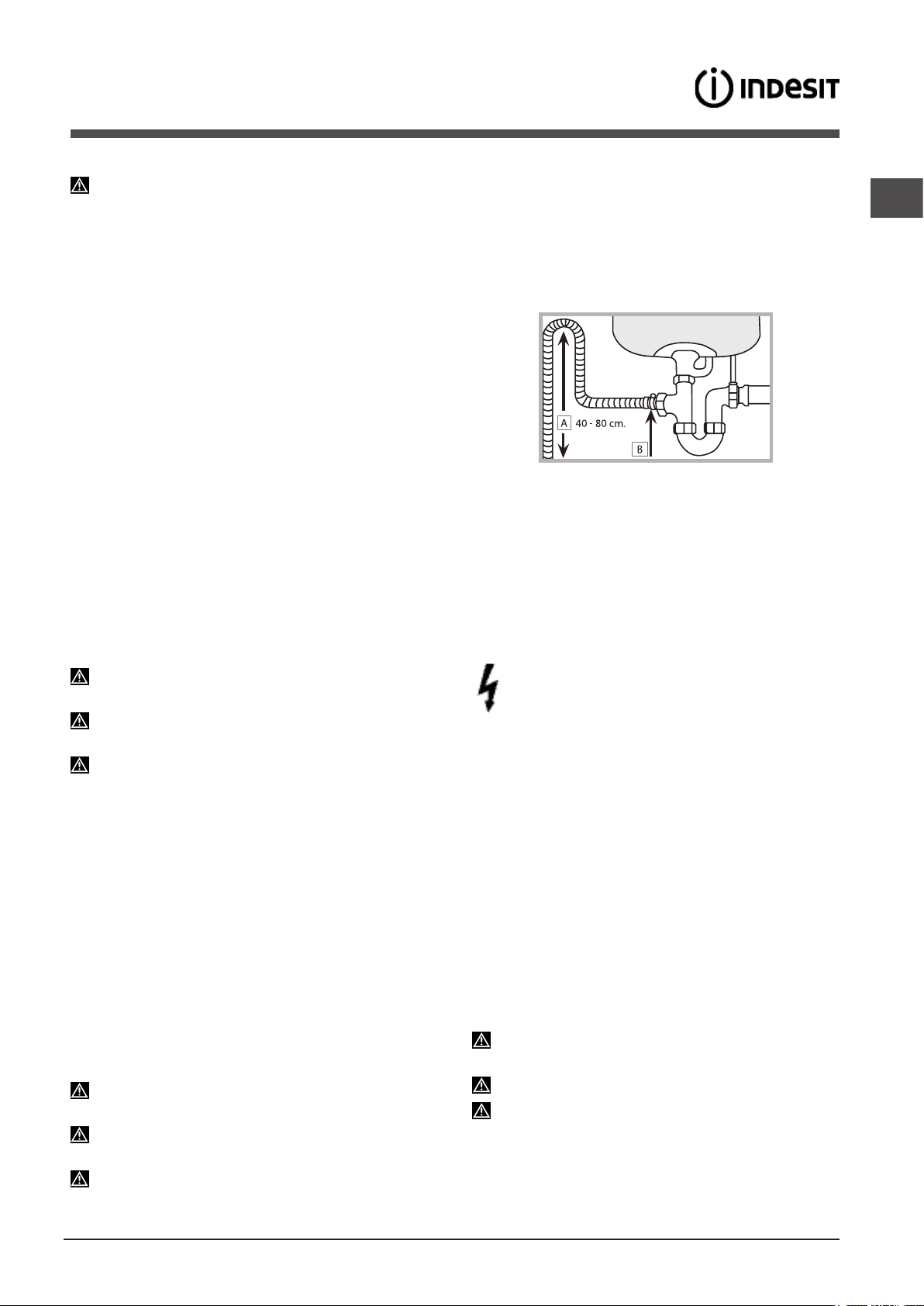
Connecting the water outlet hose
Connect the outlet hose (without bending it) to a drain duct with
a minimum diameter of 4 cm.
Theoutlethosemustbeataheightrangingfrom40to80cm
fromthefloor/surfacewherethedishwasherrests(A).
Before connecting the water outlet hose to the sink drain, remove
the plastic plug (B).
Anti-flooding protection
To ensure floods do not occur, the dishwasher:
- is provided with a special system which blocks the water supply
in the event of anomalies or leaks from inside the appliance.
Somemodelsarealsoequippedwiththesupplementarysafety
device New Acqua Stop*, which guarantees anti-flooding
protection even in the event of a supply hose rupture.
WARNING: HAZARDOUS VOLTAGE!
Under no circumstances should the water inlet hose be cut, as
it contains live electrical parts.
Electrical connection
Before inserting the plug into the electrical socket, make sure
that:
• Thesocketisearthedandcomplieswithcurrentregulations.
• thesocketcanwithstandthemaximumloadoftheappliance,
which is indicated on the data plate located on the inside of
the door
(see Description of the appliance);
• Thepowersupplyvoltagefallswithinthevaluesindicatedon
the data plate on the inside of the door.
• Thesocketiscompatiblewiththeplugoftheappliance.If
this is not the case, ask an authorised technician to replace
the plug (
see Assistance
); do not use extension cables or
multiple sockets.
Once the appliance has been installed, the power supply
cable and the electrical socket should be easily accessible.
The cable should not be bent or compressed.
If the power supply cable is damaged, it must be replaced
by the manufacturer or its Technical Assistance Service in order
topreventallpotentialhazards
(see Assistance.)
EN
20
Anti-condensation strip*
After installing the dishwasher, open the door and stick the
adhesive transparent strip under the wooden shelf in order
to protect it from any condensation which may form.
Advice regarding the first wash cycle
After the installation, remove the stoppers from the racks and the
retaining elastic elements from the upper rack, if any.
Immediately before the fist washing,
completely fill the salt
dispenser withwater and add only then approximately 1
kg of salt
(seechapterentitledRinseaidandrefinedsalt)
.
The water may overflow: this is normal and is not a cause
for concern. Select the water hardness value
(see chapter
entitledRinseaidandrefinedsalt).
- After the salt has been
pouredinto the machine, the LOW SALT indicator light*
switches off.
If the salt container is not filled, the water softener and
the heating element may be damaged as a result.
Technical data
Dimensions
width 60 cm
height 85 cm
depth 60 cm
Capacity 13 standard place-settings
Water supply pressure
0,05 ÷ 1MPa (0.5 ÷ 10 bar)
7,25 – 145 psi
Power supply voltage See appliance data plate
Total absorbed power See appliance data plate
Fuse See appliance data plate
This dishwasher conforms to the
following European Community
Directives:
-2006/95/EC (Low Voltage)
-2004/108/EC (Electromagnetic
Compatibility)
-2009/125/EC (Comm. Reg.
1016/2010) (Ecodesign)
-97/17/EC (Labelling)
-2012/19/EU Waste Electrical
and Electronic Equipment
(WEEE)
The machine has a buzzer/set of tones
(depending on the
dishwasher model
) to inform the user that a command has
been implemented: power on, cycle end etc.
The symbols/indicator lights/LEDs on the control panel/
display may vary in colour and may have a flashing or fixed
light
(depending on the dishwasher model)
.
The display* provides useful information concerning the
type of wash cycle, drying/wash-cycle phase, remaining
time, temperature etc etc.
* Only available in selected models.
EN
21
Overall view
Description of the
appliance
***Only in completely built-in models.
* Only available in selected models.
The number and type of wash cycles and options may vary depending on the dishwasher model.
Control panel
1. Upper rack
2. Upper sprayer arm
3. Tip-up compartments
4. Rackheightadjuster
5. Lower rack
6. Lower sprayer arm
7. Washingfilter
8. Salt dispenser
9. Detergent dispenser, rinse-aid dispenser and
Active Oxygen device*
10. Data plate
11. Control panel***
Start/Pause
button
On-Off/Reset button
Cycle selection knob
Low Salt
indicator light
Cycle
phases
Start/Pause
indicator light
Washing indicator light
Drying indicator light
Wash Cycle Complete
indicator light
EN
22
Loading the racks
Tips
Before loading the racks, remove all food residues from the
crockeryandemptyliquidsfromglassesandcontainers.No
preventive rinsing is needed under running water.
Arrange the crockery so that it is held in place firmly and does
not tip over; and arrange the containers with the openings facing
downwardsand the concave/convex parts placed obliquely,
thus allowing the water to reach every surface and flow freely.
Make sure that the lids, handles, trays and frying pans do not
prevent the sprayer arms from rotating. Place any small items
in the cutlery basket.
Since plastic dishes and non-stick frying pans usually retain more
water drops, their drying will be not so good as that of ceramic
or stainless-steel dishes.
Lightweight items such as plastic containers should be placed
in the upper rack and arranged so that they cannot move.
After loading the appliance, make sure that the sprayer arms
can rotate freely.
Lower rack
The lower rack can hold pans, lids, dishes, salad bowls, cutlery
etc. Large plates and lids should ideally be placed at the sides.
Very soiled dishes and pans should be placed in the lower rack
because in this sector the water sprays are stronger and allow
a higher washing performance.
Several dishwasher models are fitted with tip-up sectors
*.
They can be used in a vertical position when arranging dishes
orinahorizontalposition(lower)toloadpansandsaladbowls
easily.
Cutlery basket
Thebasket is equipped with top grilles for improved cutlery
arrangement. The cutlery basket should be positioned only at
the front of the lower rack
Knives and other utensils with sharp edges must be placed
in the cutlery basket with the points facing downwards or they
mustbepositionedhorizontallyinthetip-upcompartmentson
the upper rack
Upper rack
Load this rack with delicate and lightweight crockery such as
glasses, cups, saucers and shallow salad bowls.
Several dishwasher models are fitted with tip-up sectors
*.
Theycan be used in a vertical position whenarranging tea/
dessert saucers or in a lower position to load bowls and food
containers.
*Only available in selected models with different numbers and
positions.
EN
23
* Only available in selected models.
Adjusting the height of the upper rack
In order to make it easier to arrange the crockery, the upper rack
may be moved to a higher or lower position.
The height of the upper rack should be adjusted WHEN THE
RACK IS EMPTY.
NEVER raise or lower the rack on one side only.
IftherackisequippedwithaLift-Up device*
(see figure)
, lift
it up by holding its sides. To restore the lower position, press
the levers (A) at the sides of the rack and follow the rack down.
Unsuitable crockery
• Woodencrockeryandcutlery.
• Delicatedecoratedglasses,artistichandicraftandantique
crockery. Their decorations are not resistant.
• Partsin synthetic material which do notwithstand high
temperatures.
• Copperandtincrockery.
• Crockerysoiledwithash,wax,lubricatinggreaseorink.
Thecoloursofglassdecorationsandaluminium/silverpiecescan
change and fade during the washing process. Some types of
glass(e.g.crystalobjects)canbecomeopaqueafteranumber
of wash cycles too.
Damage to glass and crockery
Caused by:
• Typeofglassandglassproductionprocess.
• Chemicalcompositionofdetergent.
• Watertemperatureofrinsecycle.
Tips:
• Onlyuse glasses and porcelain guaranteedby the
manufacturer as dishwasher safe.
• Useadelicatedetergentsuitableforcrockery.
• Collectglassesandcutleryfromthedishwasherassoonas
the wash cycle is over.
Theupperrackcanbeadjustedforheightbasedonrequirements:
high position to place bulky crockery in the lower rack and low
positiontomakethemostofthetip-upcompartments/sectors
by creating more space upwards.
Tip-up compartments with adjustable position
The side tip-up compartments can be positioned at three
differentheightstooptimizethearrangementofcrockeryinside
the rack.
Wineglassescanbeplacedsafelyinthetip-upcompartments
by inserting the stem of each glass into the corresponding slots.
Cutlery tray*
Some dishwasher models are fitted with a sliding tray which
can be used to hold serving utensils or small cups. For
optimum washing performance, avoid positioning bulky
crockery directly below the tray.
The cutlery tray can be removed
(see Figure).
Before loading the tray, make
sure the supports are prop-
erly coupled to the upper rack
(see Figure).

EN
24
Start-up and use
* Only available in selected models.
Measuring out the detergent
A good wash result also depends on the correct
amount of detergent being used. Exceeding the stated
amount does not result in a more effective wash and
increases environmental pollution.
Based on how soiled the items are, the amount can be
adjusted to individual cases using powder or liquid
detergent.
In the case of normally soiled items, use approximately
either 35 gr (powder detergent) or 35 ml (liquid detergent).
If tablets are used, one tablet will be enough.
If the crockery is only lightly soiled or if it has been rinsed
with water before being placed in the dishwasher, reduce
the amount of detergent used accordingly.
For good washing results also follow the instructions shown
on the detergent box.
For further questions please ask the detergent producers'
Advice Offices.
To open the detergent dispenser use the opening device “A”.
Introduce the detergent into the dry dispenser “B” only.
Place the amount of detergent for pre-washing directly
inside the tub.
1.
WhenmeasuringoutthedetergentrefertotheTableofwash
cyclestoaddtheproperquantity.CompartmentB comprises
alevel showingthe maximum quantity of liquid or powder
detergent that can be added to each cycle.
2.
Removedetergentresiduesfromtheedgesofthedispenser
and close the cover until it clicks.
3. Close the lid of the detergent dispenser by pulling it up until
the closing device is secured in place.
The detergent dispenser automatically opens up at the right time
according to the wash cycle.
If all-in-one detergents are used, we recommend using the TABS
option, because it adjusts the cycle so that the best washing
and drying results are always achieved.
Only use detergent which has been specifically designed
for dishwashers.
DO NOT USE washing-up liquid.
Using excessive detergent may result in foam residue
remaining in the machine after the cycle has ended.
The use of tablets is only recommended for models which
offer the MULTI-FUNCTIONAL TABLETS option.
To achieve the best results from each washing and drying
cycle, powder detergent, liquid rinse aid and salt should
be used.
Starting the dishwasher
1.Turnthewatertapon.
2.SwitchontheappliancebypressingtheON/OFFbutton.
3. Open the door and pour in a suitable amount of detergent
(see Measuring out the detergent).
4. Load the racks
(see Loading the racks)
and shut the door.
5.SelectthewashcyclebyturningtheSELECTWASHCYCLE
knob: align the notch on the knob with the number or symbol
representingthe desiredwash cycle. The START/PAUSE
indicator light will go on.
6. Select the wash options
*
(seeOptions andSpecial Wash
Cycles).
7.StartthecyclebypressingtheSTARTbutton;theindicator
light will stop flashing and stay lit (fixed light). The indicator light
corresponding to the wash phase will go on, signalling that the
wash cycle has begun.
8.AttheendofthewashcycletheENDindicatorlightwillgoon
(fixedlight).SwitchofftheappliancebypressingtheON/OFF
button, shut off the water tap and unplug the appliance from
the electricity socket.
9.Waitafewminutesbeforeremovingthecrockerytoavoid
getting burnt. Unload the racks, beginning with the lower level.
- The machine will switch off automatically during long
periods of inactivity in order to minimise electricity
consumption.
Changing a wash cycle in progress
If a mistake was made in the wash-cycle selection process, it is
possible to change the cycle provided that it has only just begun:
once the wash cycle has started, in order to change the wash
cycleswitchoffthemachinebypressingandholdingtheON/
OFF/Resetbutton.Switchitbackonusingthesamebuttonand
select the desired wash cycle and options.
Adding extra crockery
PresstheStart/Pausebuttonandopenthedoor,takingcareto
avoid the escaping steam, and place the crockery inside the
dishwasher.PresstheStart/Pausebutton:Thecyclewillstart
again after a long beep has been emitted.
If the delayed start* has been set, at the end of the
countdown the wash cycle will not start. It will stay in Pause
mode.
PresstheStart/Pausebuttontopausethemachine;thewash
cycle is stopped.
At this stage the wash cycle cannot be changed.
Accidental interruptions
If the door is opened during the wash cycle or there is a power
cut, the cycle stops. It starts again from the point at which it
was interrupted once the door has been shut or the electricity
supply restored.
EN
25
Wash cycles
The number and type of wash cycles and options may vary depending on the dishwasher model.
Wash-cycledataismeasuredunderlaboratoryconditionsaccordingtoEuropeanStandardEN50242.
Based on the different conditions of use, the wash-cycle duration and data can change.
Notes:
To reduce consumption, only run the dishwasher when it is full.
Note for Test Laboratories: forinformationoncomparativeENtestingconditions,pleasesendanemailtothefollowingaddress:
Wash Cycle Drying Options
Wash Cycle
Duration
Water
Consumption (l/
cycle)
Energy
Consumption
(kWh/cycle)
1. Eco
Yes No 03:10’ 11,0 1,04
2. Intensive Yes No 02:30’ 16,5 1,70
3. Normal Yes No 02:00’ 16,0 1,35
4. Rapid 40' No No 00:40’ 9,0 0,95
5. Prewash No No 00:10’ 4,0 0,01
Instructions on wash-cycle selection and detergent dosage
1. TheECOwashcycleisthestandardcycletowhichtheenergylabeldatarefers.Itcanbeusedtowashcrockerywithanormal
soil level and is the most efficient cycle in terms of energy and water consumption for this type of crockery
27gr/ml+6gr/ml**–1Tab
(**Quantity of pre-washing detergent)
2. Heavilysoileddishesandpans(nottobeusedfordelicateitems).30gr/ml–1Tab
3.Normallysoiledpansanddishes.27gr/ml+6gr/ml**–1Tab
4.Fastcycletobeusedforslightlydirtydishes(idealfor2placesettings)25gr/ml–1Tab
5.Pre-washwhileawaitingcompletionoftheloadwiththedishesfromthenextmeal.Nodetergent.
Standbyconsumption:Left-onmodeconsumption:5,0W-Offmodeconsumption:0.5W
EN
26
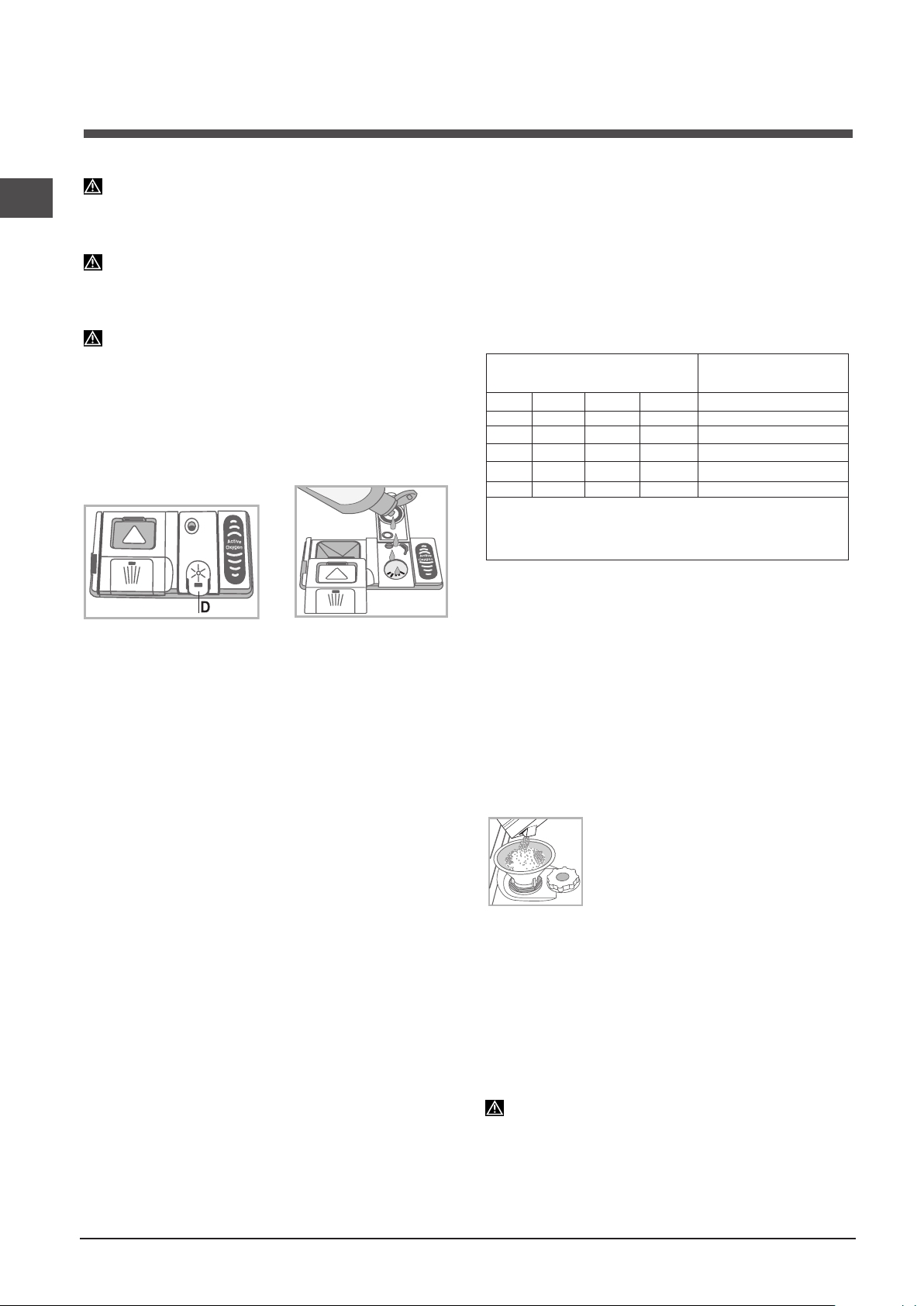
Rinse aid and refined salt
Only use products which have been specifically designed
for dishwashers.
Do not use table/industrial salt or washing-up liquid.
Follow the instructions given on the packaging.
If using a multi-functional product it is not necessary to add
any rinse aid. However, we recommend that you add salt,
especially if you live in an area where the water is hard or
very hard.
(Follow the instructions given on the packaging).
If you do not add salt or rinse aid, the LOW SALT* and
LOW RINSE AID
* indicator lights will stay lit.
Measuring out the rinse aid
Rinseaidmakesiteasierforthecrockerytodry,aswaterrunsoff
the surfaces more readily and therefore does not leave streaks
or marks. The rinse aid dispenser should be filled:
• WhentheLOWRINSEAIDindicatorlight* on the control panel
is illuminated, a reserve supply of rinse aid is still available
for1-2cycles;
1.Openthedispenser“D” by pressing and pulling up the tab
on the lid;
2.Carefully introducethe rinse aid as faras the maximum
reference notch of the filling space - avoid spilling it. If this
happens, clean the spill immediately with a dry cloth.
3. Press the lid down until you hear a click to close it.
NEVER pour the rinse aid directly into the appliance tub.
Rinse-aid dispenser setting
If you are not completely satisfied with the drying results, you
canadjustthequantityofrinseaid.Switchthedishwasheron
andoffusingtheON/OFFbutton.PresstheStart/Pausebutton
3times;switchonthemachineusingtheON/OFFbuttonand
access the adjustment menu - the rinse-aid indicator light is lit
(set to factory level).
Adjustthe level of rinse aid supply using the WASH CYCLE
SELECTknob.Thereisarinseaidlevelforeachwashcycle
(0to4max).
Press the ON/OFF button to save the setting.
IftherinseaidlevelissettoZERO(ECO),norinseaidwillbe
supplied.TheLOWRINSEAIDindicatorlightwillnotbelitifyou
run out of rinse aid.
• Iftherearestreaksonthecrockery,setalownumber(1-2).
• Iftherearedrops of water orlimescalemarks,set a high
number (3-4).
Setting water hardness
Everydishwasherisequippedwithawatersoftenerwhich,by
using refined salt designed specially for this type of appliance,
supplies water without limescale which is then used to wash
the crockery.
This dishwasher has a setting that helps reduce pollution and
optimises washing performance in accordance with the water
hardness level in your area. Ask your local water supplier for
this information.
-SwitchthedishwasheronandoffusingtheON/OFFbutton.
HolddowntheStart/Pausebuttonformin.3seconds;switch
onthe machine using the ON/OFF button and access the
adjustment menu - the salt indicator light is lit.
-SelectthedesiredlevelusingtheSELECTWASHCYCLEknob
(1to5* Max.)
(water softener set to medium level).
Press the ON/OFF button to save the setting.
Evenifusingmulti-functionaltablets,fillthesaltdispenser.
(°dH=hardnessmeasuredinGermandegrees-°f=hardness
measuredinFrenchdegrees–mmol/l=millimolesperlitre)
Measuring out the refined salt
In order to obtain the best possible results from a wash cycle,
make sure that the salt dispenser is never empty.
Refinedsaltremoveslimescalefromthewater,thusavoiding
the formation of deposits on crockery.
The salt dispenser is located in the lower part of the dishwasher
(see Description)
and should be filled:
• Whenthegreenfloat* cannot be seen by simply looking at
the cap of the salt dispenser;
• WhentheLOWRINSEAIDindicatorlightonthecontrolpanel
is illuminated *;
1.Removethelowerrackandunscrewthe
cap (anticlockwise).
2.Thefirsttimeyoudothis:fillthewatertank
right up to its edge.
3. Position the funnel
*
(see figure)
and fill the
salt dispenser up to the edge (approximately
1kg).Itisnormalforalittlewatertoleakout.
4.Removethefunnel*andwipeanysaltresiduesawayfrom
the opening; rinse the cap under running water and then screw
it on, the head facing downwards so as to let the water flow out
of the four slots (star-shaped arrangement) in the lower part of
the cap (cap with green float
*).
It is advisable to perform this procedure every time you add
salt to the dispenser.
Make sure the cap is screwed on tightly so that no detergent can
get into the container during the wash cycle (this could damage
the water softener beyond repair).
Whennecessary,measureoutthesaltbeforeawashcycle
so that any saline solution which has leaked out of the salt
dispenser is removed.
* Only available in selected models.
Water Hardness Table
Average salt container
capacity duration**
Level °dH °fH mmol/l months
1 0 - 6 0 - 10 0 - 1 7 months
2 6 - 11 11 - 20 1,1 - 2 5 months
3 12 - 17 21 - 30 2,1 - 3 3 months
4 17 - 34 31 - 60 3,1 - 6 2 months
5
*
34 - 50 61 - 90 6,1 - 9 2/3 weeks
For values between 0°f and 10°f, we do not recommend the
use of salt.
* this setting may cause a slight increase in the
duration of the cycles. ** for 1 wash cycle per day.
M
A
X
EN
27
Care and maintenance
* Only available in selected models.
Shutting off the water and electricity
supplies
• Turn
off
the
water
tap
after
every
wash
cycle
to
avoid
leaks.
• Always
unplug
the
appliance
when
cleaning
it
and
when
performing maintenance work.
Cleaning the dishwasher
• The
external
surfaces
of
the
machine
and
the
control
panel
can be cleaned using a non-abrasive cloth which has been
dampened with water. Do not use solvents or abrasive
products.
• Any
marks
on
the
inside
of
the
appliance
may
be
removed
using a cloth dampened with water and a little vinegar.
Preventing unpleasant odours
• Always
keep
the
door
of
the
appliance
ajar
in
order
to
avoid
moisture from forming and being trapped inside the machine.
• Clean
the
seals
around
the
door
and
detergent
dispensers
regularly using a damp sponge. This will avoid food becoming
trapped in the seals, which is the main cause behind the
formation of unpleasant odours.
Cleaning the sprayer arms
Food residue may become encrusted onto the sprayer arms
and block the holes used to spray the water. It is therefore
recommended that you check the arms from time to time and
clean them with a small non-metallic brush.
The two sprayer arms may both be removed.
To remove the upper sprayer arm,
turn the plastic locking ring in an
anti-clockwise direction. The upper
sprayer arm should be replaced
so that the side with the greater
number of holes is facing upwards.
The lower sprayer arm can be
removed by pressing on the side
tabs and pulling it upwards.
Cleaning the water inlet filter*
If the water hoses are new or have not been used for an extended
period of time, let the water run to make sure it is clear and free
of impurities before performing the necessary connections. If this
precaution is not taken, the water inlet could become blocked
and damage the dishwasher.
Clean the water inlet filter at the tap outlet regularly.
- Turn off the water tap.
- Unscrew the end of the water inlet hose, remove the filter and
clean it carefully under running water.
-
Re-place
the
filter
and
screw
the
water
hose
back
into
position.
Cleaning the filters
The filter assembly consists of three filters which remove food
residues from the washing water and then recirculate the water.
They should be cleaned if you wish to achieve the best results
in every wash.
Clean the filters regularly.
The dishwasher should not be used without filters or if the
filter is loose.
•Afterseveralwashes,checkthefilterassemblyandifnecessary
clean it thoroughly under running water, using a non-metallic
brush and following the instructions below:
1. Turn the cylindrical filter C in an anti-clockwise direction and
pull it out
(fig.1).
2.RemovethecupfilterB by exerting a slight pressure on the
side flaps
(fig.2);
3. Slide out the stainless-steel plate filter A.
(fig. 3).
4. Inspect the trap and remove any food residues. NEVER
REMOVE the wash-cycle pump protection
(black detail) (fig.4).
After cleaning the filters, re-place the filter assembly and fix it in
position correctly; this is essential for maintaining the efficient
operation of the dishwasher.
Leaving the machine unused for extended
periods
• Disconnecttheappliancefromtheelectricitysupplyandshut
off the water tap.
• Leavethedooroftheapplianceajar.
• Whenyoureturn,runawashcyclewhenthedishwasheris
empty.

EN
28
Troubleshooting
Whenevertheappliancefailstowork,checkforasolutionfromthefollowinglistbeforecallingforAssistance.
* Only available in selected models.
Problem: Possible causes / Solutions:
The dishwasher does not start or
cannot be controlled.
• Switch off the appliance by pressing the ON/OFF button, switch it back on after approximately
one minute and reset the program.
• The appliance has not been plugged in properly.
• The dishwasher door has not been shut properly.
The door won’t close. • The lock was released. Strongly push the door until a “clacking” noise is heard.
No water drains out from the
dishwasher.
• The dishwasher cycle has not yet nished.
• The water inlet hose is bent (see Installation).
• The drain duct is blocked.
• The lter is clogged up with food residues.
The dishwasher makes excessive
noise.
• The dishes are rattling against each other or against the sprayer arms.
• Excessive foam presence: the detergent has not been measured out correctly or it is not
suitable for use in dishwashers. (see Start-up and use).
The dishes and glasses are covered
in a white lm or limescale deposits.
• The level of the rened salt is low or the dosage setting is not suited to the hardness of the
water (see Rinse aid and salt).
• The lid on the salt dispenser is not closed properly.
• The rinse aid has been used up or the dosage is too low.
The dishes and glasses are streaked
or have a bluish tinge.
• The rinse aid dosage is too high.
The crockery has not been dried
properly.
• A wash cycle without a drying programme has been selected.
• The rinse aid has been used up or the dosage is too low (see Rinse aid and salt).
• The rinse aid dispenser setting is not high enough.
• The crockery is made from non-stick material or plastic.
The dishes are not clean.
• The racks are overloaded (see Loading the racks).
• The crockery has not been arranged well.
• The sprayer arms cannot move freely.
• The wash cycle is too gentle (see Wash cycles).
• Excessive foam presence: the detergent has not been measured out correctly or it is not
suitable for use in dishwashers. (see Start-up and use).
• The lid on the rinse aid compartment has not been shut correctly.
• The lter is dirty or blocked (see Care and maintenance).
• The rened salt level is low (see Rinse aid and salt).
The dishwasher does not take
any water in - Tap shut-off
alarm.
(The Drying and End indicator lights
ash quickly.)
• There is no water in the mains supply.
• The water inlet hose is bent (see Installation).
• Turn on the tap and the appliance will start after a few minutes.
•
The appliance stopped because no action was taken when the beep
sounded*.
(*
Only available on selected models
.)
Switch off the machine using the ON/OFF button, turn on the tap and switch
the machine back on after 20 seconds by pressing the same button. Reset the
appliance and restart the wash cycle.
195114834.01
04/2014jk-XeroxFabriano