®
Side by Side Refrigerator
Use & Care Guide
Lado a Lado Refrigerador
Gufa para su uso y cuidado
Compartiments C6te _ C6te R_frig_rateur
Guide d'utilisation et d'entretien
Sears, Roebuck and Co., Hoffman Estates, IL 60179 U.S.A.
Sears Canada, mnc.,Toronto, Ontario, Canada M5B 2B8
www.seats,com
240570402 (0409)
Z
M
t_
Welcome &
Congratulations
Congratulations on your purchase of a new refrigerator! We
here at Sears are very proud of our product and we are
completely committed to providing you with the best
service possible, Your satisfaction is our #1 priority,
We know you'll enjoy your new refrigerator and ThankYou
for choosing our product, We hope you consider us for
future purchases,
PLEASE READ AND SAVE THESE
iNSTRUCTiONS
This Owner's Guide provides specific operating
instructions for your model, Use your refrigerator only as
instructed in this manual, These instructions are not meant
to cover every possible condition and situation that may
occur, Common sense and caution must be practiced
when installing, operating and maintaining any appliance,
Ptease record your model and seriaJ numbers beJow
for future reference.This information is found on the
serial pJate located inside the refrigerator
compartment.
NOTE; Use on!y soap and water to clean seria! p!ate,
Model Number: 253
or: 970
Serial Number:
Purchase Date:
TABLE OF CONTENTS
Record Serial/Model Numbers ............ 2
Safety .................................................. 2-3
Warranty .............................................. 3
Canada - Limited Warranty .................. 4
Protection Agreements ........................ 5
tnstaUUation ........................................... 6-7
Door Removal instructions ................. 8
Features At A Glance ......................... 9
Temperature Controls .......................... 10
Looking inside ..................................... 11-12
Automatic ice & Water Dispenser ....... 13=15
Rear Ice and Water Filter ..................... 16
Food Storage & Energy Saving Tips ... 17
Normal Operating Sounds & Sights .... 18
Care & CUeaning .................................. 19o20
Before You CaUl.................................... 21-24
Important Safety
Instructions
Please Read AJJInstructions Before
UsingThis Refrigerator.
FOR YOUR SAFETY
Do not store or use gasoline, or other flammable liquids
in the vicinity of this or any other appliance, Read product
labels for warnings regarding flammability and other
hazards,
o Do not operate the refrigerator in the presence of
explosive fumes,
Avoid contact with any moving parts of automatic ice
maker,
Remove all staples from the carton, Staples can cause
severe cuts, and also destroy finishes if they come in
contact with other appliances or furnitu re,
CHILD SAFETY
Destroy or recycle the carton, plastic bags, and any
exterior wrapping material immediately after the refrigerator
is unpacked, Children should NEVER use these items to
play, Cartons covered with rugs, bedspreads, plastic
sheets or stretch wrap may become airtight chambers,
and can quickly cause suffocation,
PROPER DISPOSAL OF YOUR REFRmGERATOR
OR FREEZER
Risk of child entrapment
Child entrapment and suffocation
are not problems of the past,
Junked or abandoned refrigerators
or freezers are still dangerous -
even if they will sit for "just a few
days," if you are getting ridof your
old refrigerator or freezer, please
follow the instructions below to
help prevent accidents,
Before you throw away your old refrigerator/freezer:
Remove doors,
o Leave shelves in place so children may not easily climb
inside,
o Have refrigerant removed by a qualified service
technician,
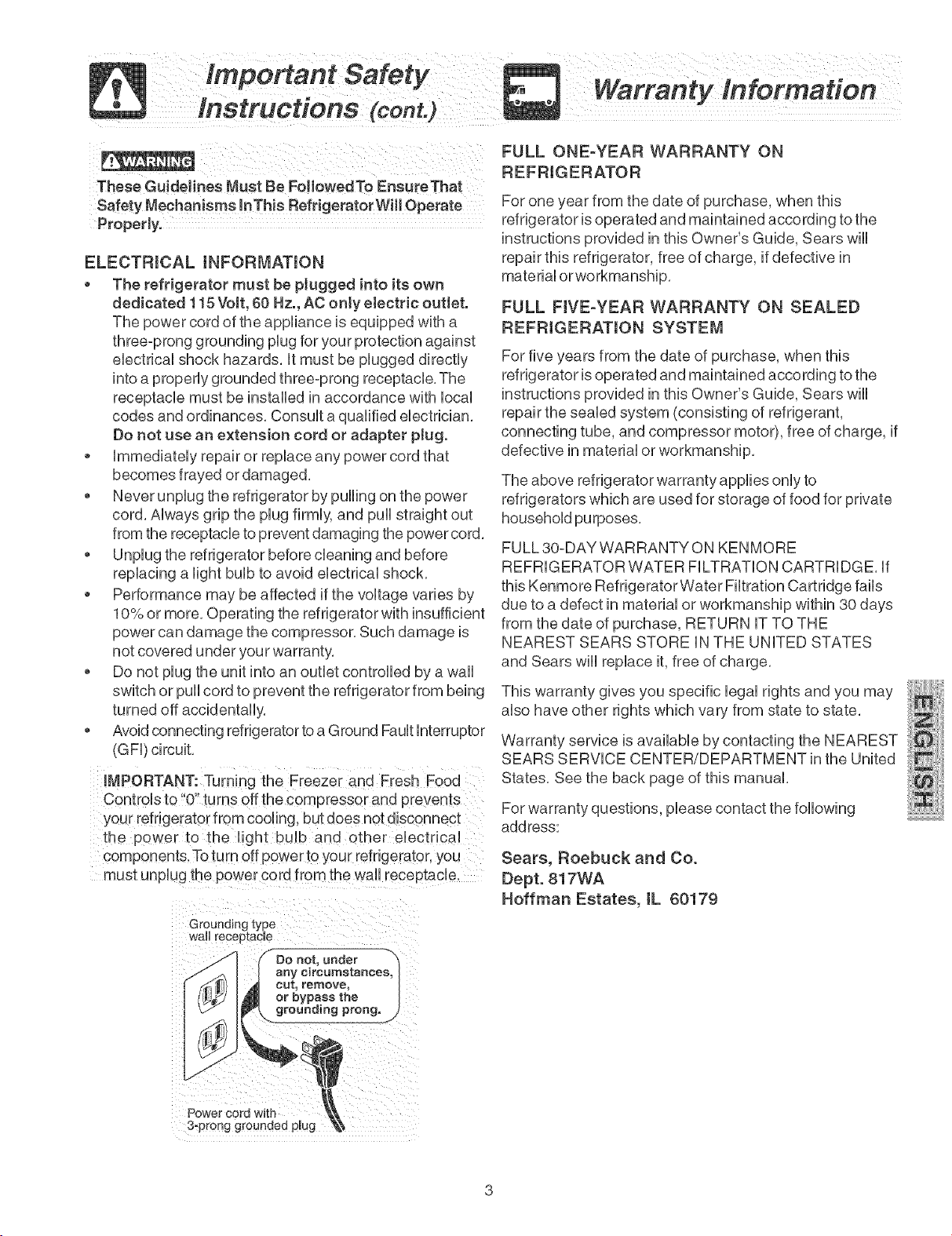
These Guidelines Must Be FoHowedTo EnsureThat
Safety Mechanisms InThis Refr!getat0rW!lJ Operate
Properly.
ELECTRICAL INFORMATION
* The refrigerator must be plugged into its own
dedicated ! 15 VoJt,60 Hz., AC only etectric outlet.
The power cord of the appliance is equipped with a
three-prong grounding plug for your protection against
electrical shock hazards, it must be plugged directly
into a properly grounded three-prong receptacle, The
receptacle must be installed in accordance with local
codes and ordinances, Consult a qualified electrician,
Do not use an extension cord or adapter plug.
* Immediately repair or replace any power cord that
becomes frayed or damaged,
Never unplug the refrigerator by pulling on the power
cord, Always grip the plug firmly, and pull straight out
from the receptacle to prevent damaging the power cord,
Unplug the refrigerator before cleaning and before
replacing a light bulb to avoid electrical shock,
Performance may be affected if the voltage varies by
10% or more, Operating the refrigerator with insufficient
power can damage the compressor, Such damage is
not covered under your warranty,
Do not plug the unit into an outlet controlled by a wall
switch or pull cord to prevent the refrigerator from being
Avoid connecting refrigerator toa Ground Fault Interruptor
(GFi) circuit,
IMPORTANT: Turning the Freezer and Fresh Food
Controls to "0" turns oll the compressor and prevents
your refrigerator from cooling, but does not disconnecl
the power to the light bulb and other electrical
components, Toturn off power to your refrigerator, you
must unplug the power cord from the wall receptacle,
Grounding [ype
wamlreceetacb
.f _.
Do not. under
any circumstances,
cut, remove,
or bypass the
grounding prong.
FULL ONE-YEAR WARRANTY ON
REFRIGERATOR
For one year from the date of purchase, when this
refrigerator is operated and maintained according to the
instructions provided in this Owner's Guide, Sears will
repair this refrigerator, free of charge, if defective in
FULL FIVE-YEAR WARRANTY ON SEALED
REFRIGERATION SYSTEM
For five years from the date of purchase, when this
refrigerator is operated and maintained according to the
instructions provided in this Owner's Guide, Sears wiii
repair the sealed system (consisting of refrigerant,
connecting tube, and compressor motor), free of charge, if
defective in material or workmanship,
The above refrigerator warranty applies only to
refrigerators which are used for storage of food for private
household purposes,
FULL 30-DAY WARRANTY ON KENMORE
REFRIGERATOR WATER FiLTRATiON CARTRIDGE, if
this Kenmore Refrigerator Water Filtration Cartridge fails
due to a defect in material or workmanship within 30 days
from the date of purchase, RETURN iT TO THE
NEAREST SEARS STORE iN THE UNITED STATES
and Sears will replace it, free of charge,
This warranty gives you specific legal rights and you may
also have other rights which vary from state to state,
Warranty service is available by contacting the NEAREST
SEARS SERVICE CENTER/DEPARTMENT in the United
States, See the back page of this manual,
For warranty questions, please contact the following
address:
Sears, Roebuck and Co.
Dept. 817WA
Hoffman Estates, mL 60179
Power cord with
3-prong grounded pmug
L
rs
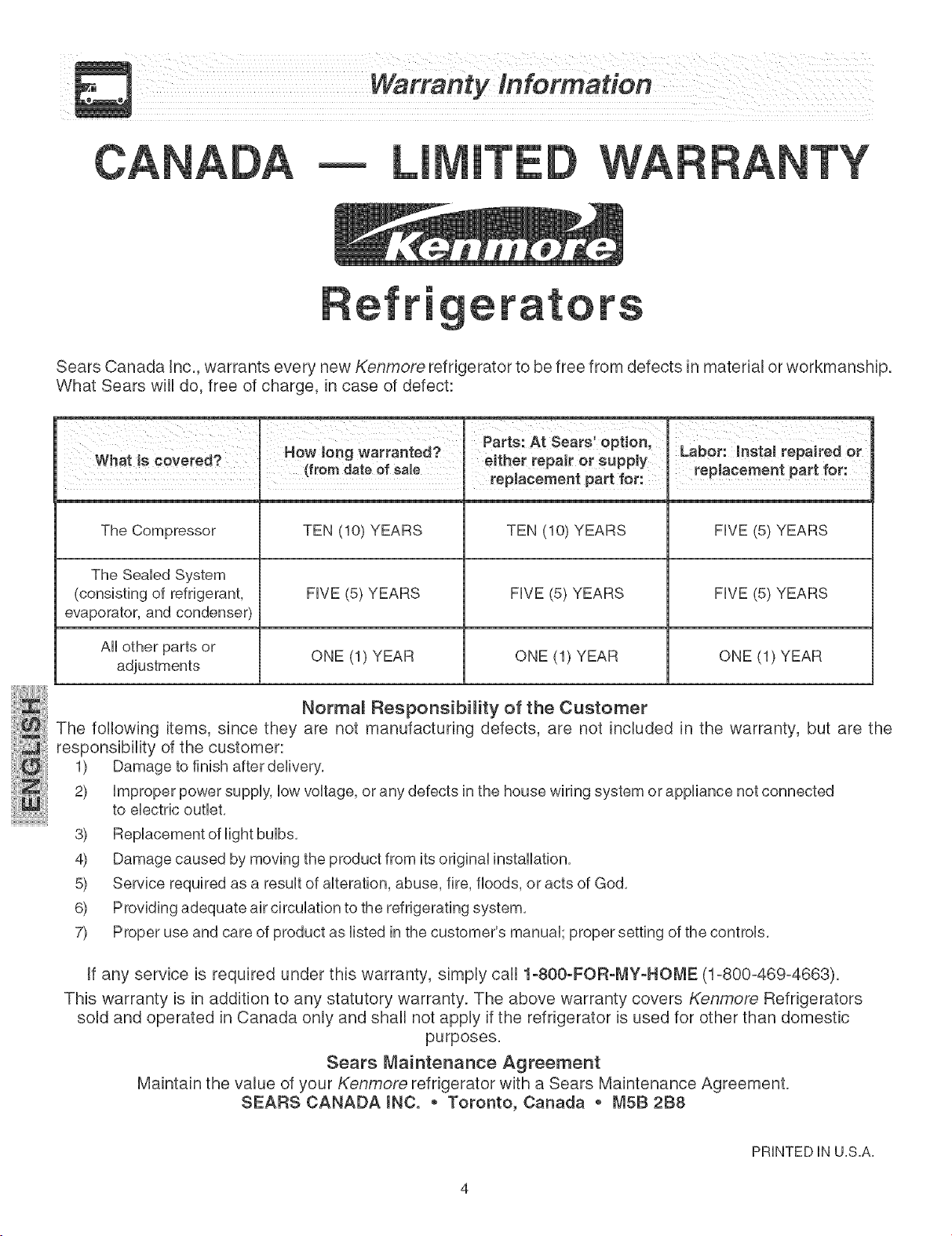
Sears Canada Inc., warrants every new Kenmore refrigerator to be free from defects in material or workmanship.
What Sears win do, free of charge, in case of defect:
Parts: At Sears' option
. _ How ong warrantea 1 ; " , .... 2.....,. Labor: instal repairea or
What is covered. " either repair u_ =u_p_y
: . !!pt!_llllfll{ p!!! !U!I .
(from dale of sa e ;.-_,_2;,_ L=. ,..2...._D rep acement part for
The Compressor TEN (10) YEARS TEN (10) YEARS FiVE (5) YEARS
The Sealed System
(consisting of refrigerant, FiVE (5) YEARS FiVE (5) YEARS FiVE (5) YEARS
evaporator, and condenser)
All other parts or
adjustments ONE (1) YEAR ONE (1) YEAR ONE (1) YEAR
Normal Responsibility of the Customer
The following items, since they are not manufacturing defects, are not included in the warranty, but are the
responsibility of the customer:
1) Damage to finish after delivery.
2) Improper power supply, low voltage, or any defects in the house wiring system or appliance not connected
to electric outlet.
3) Replacement of light bulbs.
4) Damage caused by moving the product from its original installation.
5) Service required as a result of alteration, abuse, fire, floods, or acts of God.
6) Providing adequate air circulation to the refrigerating system.
7) Proper use and care of product as listed in the customer's manual; proper setting of the controls.
If any service is required under this warranty, simply call 1-800-FOR-IvlY-HOME (1:800:469:4663).
This warranty is in addition to any statutory warranty. The above warranty covers Kenmore Refrigerators
sold and operated in Canada only and shall not apply if the refrigerator is used for other than domestic
purposes.
Sears Maintenance Agreement
Maintain the value of your Kenmore refrigerator with a Sears Maintenance Agreement.
SEARS CANADA INC. • Toronto, Canada , M5B 2B8
PRINTED IN U.S.A.
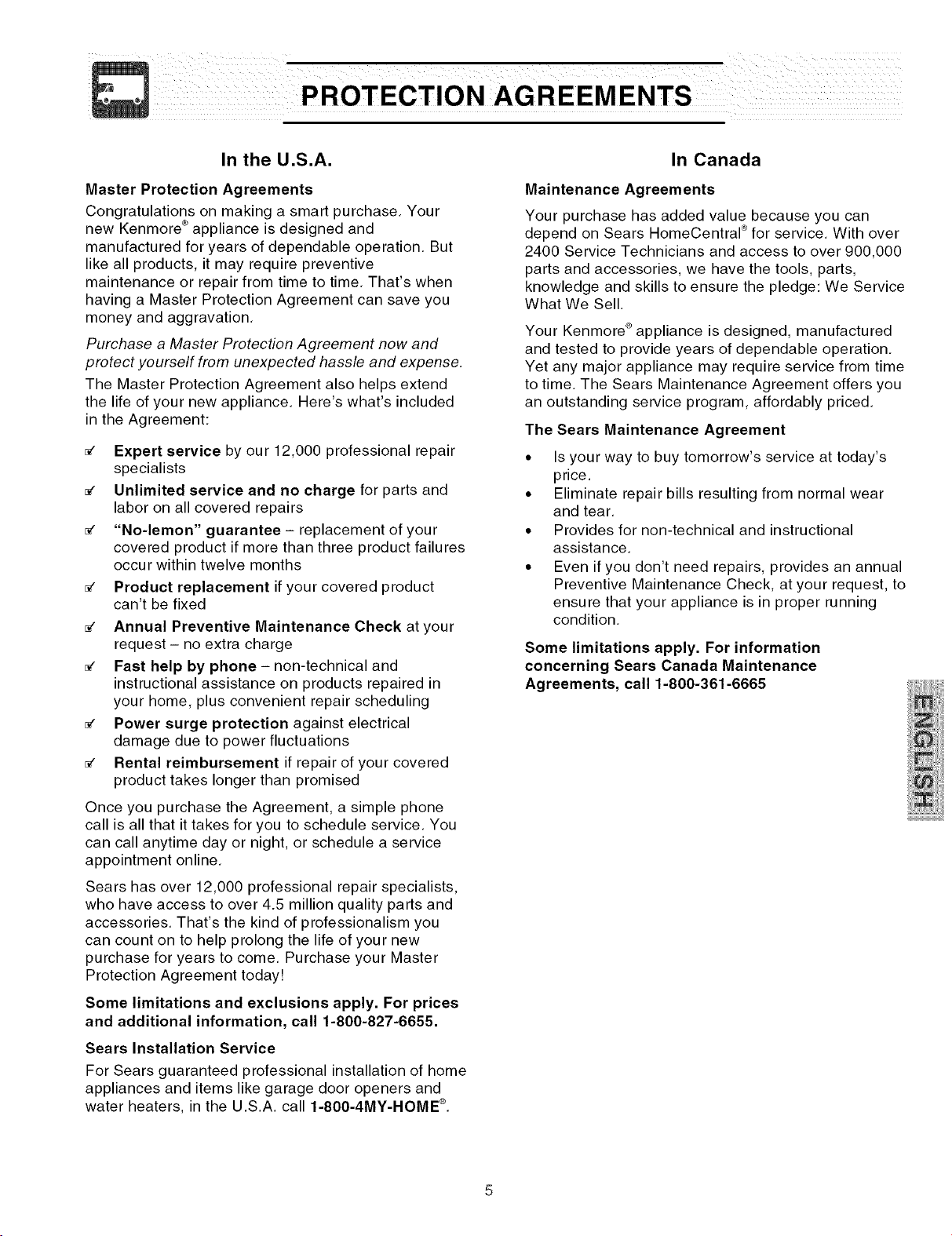
PROTECTION AGREEMENTS
In the U.S.A.
Master Protection Agreements
Congratulations on making a smart purchase, Your
new Kenmore ®appliance is designed and
manufactured for years of dependable operation, But
like all products, it may require preventive
maintenance or repair from time to time, That's when
having a Master Protection Agreement can save you
money and aggravation,
Purchase a Master Protection Agreement now and
protect yourself from unexpected hassle and expense.
The Master Protection Agreement also helps extend
the life of your new appliance. Here's what's included
in the Agreement:
tv Expert service by our 12,000 professional repair
specialists
tv Unlimited service and no charge for parts and
labor on all covered repairs
_' "No-lemon" guarantee- replacement of your
covered product if more than three product failures
occur within twelve months
_' Product replacement if your covered product
can't be fixed
_' Annual Preventive Maintenance Check at your
request - no extra charge
_' Fast help by phone - non-technical and
instructional assistance on products repaired in
your home, plus convenient repair scheduling
_' Power surge protection against electrical
damage due to power fluctuations
tv Rental reimbursement if repair of your covered
product takes longer than promised
Once you purchase the Agreement, a simple phone
call is all that it takes for you to schedule service, You
can call anytime day or night, or schedule a service
appointment online,
Sears has over 12,000 professional repair specialists,
who have access to over 4.5 million quality parts and
accessories, That's the kind of professionalism you
can count on to help prolong the life of your new
purchase for years to come, Purchase your Master
Protection Agreement today!
Some limitations and exclusions apply. For prices
and additional information, call 1-800-827-6655.
Sears Installation Service
For Sears guaranteed professional installation of home
appliances and items like garage door openers and
water heaters, in the U.S.A. call 1-800-4MY-HOME ®,
In Canada
Maintenance Agreements
Your purchase has added value because you can
depend on Sears HomeCentral ®for service, With over
2400 Service Technicians and access to over 900,000
parts and accessories, we have the tools, parts,
knowledge and skills to ensure the pledge: We Service
What We Sell.
Your Kenmore ®appliance is designed, manufactured
and tested to provide years of dependable operation,
Yet any major appliance may require service from time
to time, The Sears Maintenance Agreement offers you
an outstanding service program, affordably priced,
The Sears Maintenance Agreement
• Is your way to buy tomorrow's service at today's
price.
• Eliminate repair bills resulting from normal wear
and tear,
• Provides for non-technical and instructional
assistance,
• Even if you don't need repairs, provides an annual
Preventive Maintenance Check, at your request, to
ensure that your appliance is in proper running
condition.
Some limitations apply. For information
concerning Sears Canada Maintenance
Agreements, call 1-800-361-6665
This Owner's Guide provides specific operating
instructions for your model, Use the refrigerator only as
instructed in this Use & Care Manual, Before starting the
refrigerator, follow these important first steps.
LOCATION
Choose a place that is near a grounded electrical outlet,
Do Not use an extension cord or an adapter plug,
if possible, place the refrigerator out of direct sunlight
and away from the range, dishwasher or other heat
sources,
The refrigerator must be installed on a floor that is bveU
and strong enough to support a fully baded refrigerator,
Consider water suppUyavailability for modeb equipped
with an automatic ice maker,
mNSTALLATION
DONot instaJl the refrigerator where
the temperature will drop below 55°F (13°C) or rise
above t 10_'F(43QC).The compressor will not be able
to maintain proper temperatures inside the
lower front of your refrigerator. Sufficient air CirCulat!on
is essential for the proper operation of your
refrigerator.
installation Clearances
, Allow the following clearances for ease of installation,
properaircircuUation,andpUumbingandeUectrica,
connections:
Sides a Top ............... 3/8"
Back ........................ 1"
ooo
NOTE: !f YOUrefrigerator is piaced With the door hinge
side against a wa!l, you may have to a!low additional
space so the door can be opened wider.
Your refrigerator should be positioned to allow easy access
to a counter when removing food, For best use of drawers
and freezer baskets, the refrigerator should be in a
position where both the refrigerator and freezer doors can
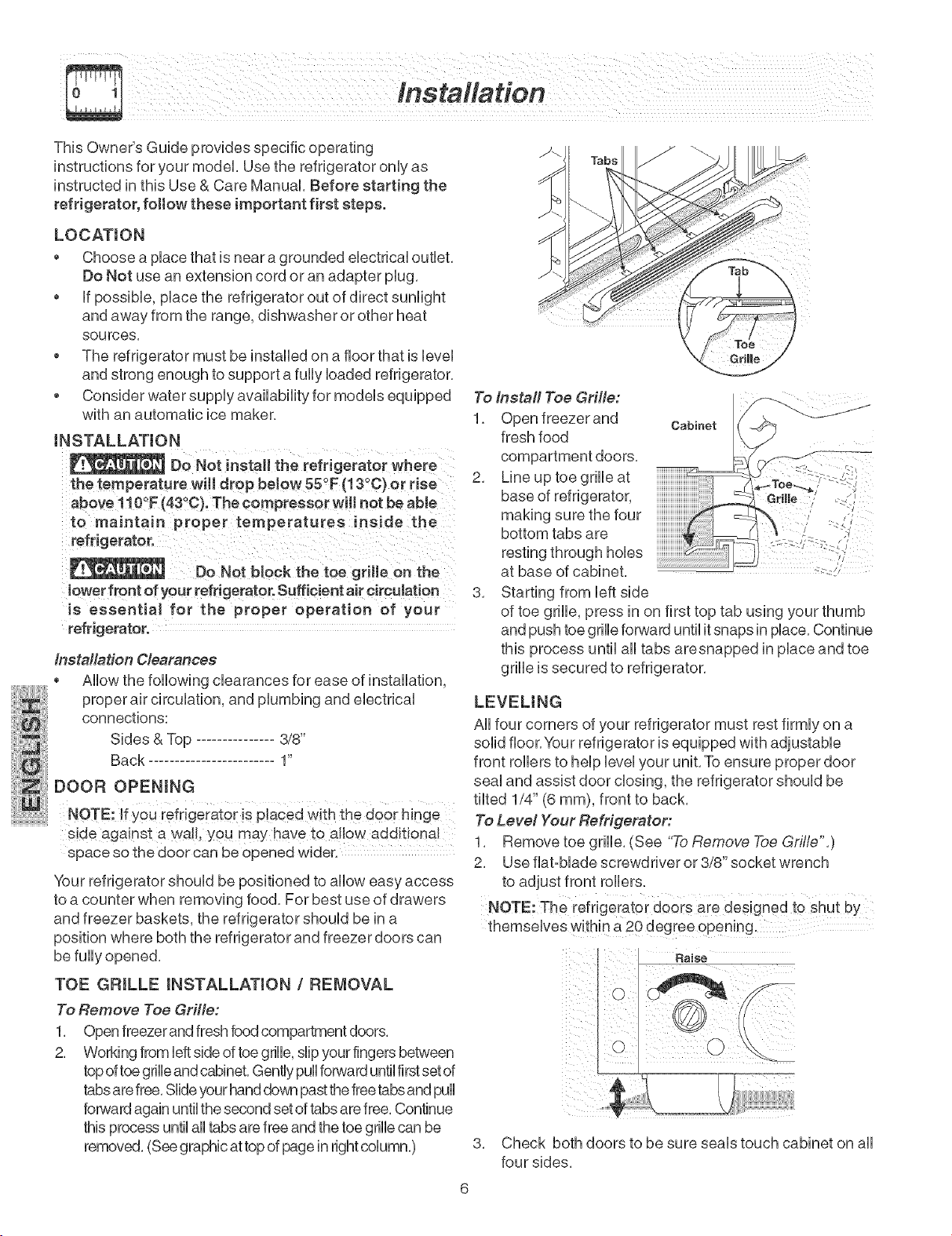
TOE GRILLE INSTALLATmON / REMOVAL
To Remove Toe Grille:
1, Open freezer and fresh foodcompartment doors,
2, Working from left sideof toe grille,slip yourfingers between
topoftoegrilleandcabineLGently pullforward untilfirstset of
tabsarefree,Slide yourhanddown pastthe freetabs and pull
forward again untilthe second set oftabs are free, Continue
this process until all tabs are free and thetoe grille can be
remove& (See graphic attop of page in rightcolumn,)
To/nstatl Toe Grilte:
1, Open freezer and
fresh food
2,
3,
base of refrigerator,
making sure the four
bottom tabs are
resting through hobs
at base of cabinet,
Starting from left side
Cabinet
//
of toe grille, press in on first top tab using your thumb
and push toe grille forward until itsnaps in place, Continue
this process until all tabs aresnapped in place and toe
grille is secured to refrigerator,
LEVELING
All four corners of your refrigerator must rest firmly on a
solid floor, Your refrigerator is equipped with adjustable
front rollers to help level your unit, To ensure proper door
seal and assist door closing, the refrigerator should be
tilted 1/4" (6 ram), front to back,
To Level Your Refrigerator:
1, Remove toe grille, (See "ToRemove Toe Gri//e",)
2, Use fiat-blade screwdriver or 3/8" socket wrench
to adjust front rolbrs,
3,
6
i
Check both doors to be sure seals touch cabinet on all
four sides,
iftstallatio - connecting Ice Maker To Water Supply
To avoid eJectric shock, which can cause death or severe personaJ injury, disconnect the refrigerator
from eJectricaJ power before connecting a water supply line to the refrigerator.
To Avoid Property Damage:
o Copper tubing is recommended for the water suppJy Jine.Water supply tubing made of ¼"" plastic is not
recommended since it greatly increases the potentiaJ for water leaks. Manufacturer will not be responsiMe
for any damage if plastic tubing is used for supply line.
o DO NOT install water supply tubing in areas where temperatures fai! beJowfreezing.
o ChemicaJs from a maffunctioning softener can damage the ice maker, if the ice maker is connected to soft
water, ensure that the softener is maintained and working properly.
IMPORTANT: Ensure that your water supply line connections comply with all local plumbing codes,
Before/nstafling The Water Supply Line, You Will Need
,, BasicTools: adjustable wrench, flat=blade screwdriver, and PhillipsTM screwdriver
o Access to a household cold water line with water pressure between 20 and 100 psi,
A water supply line made of ¼ inch (6,4 mm) OD, copper tubing, Todetermine the length of copper tubing needed,
you will need to measure the distance from the ice maker inlet valve at the back of the refrigerator to your cold water
pipe. Then add approximately 7 feet (2.1 meters), so the refrigerator can be moved out for cleaning (as shown).
A shutoff valve to connect the water supply line to your household water system. DO NOT use a self-piercing type
shutoff valve.
A compression nut and ferrule (sleeve) for connecting the water supply line to the ice maker inlet valve.
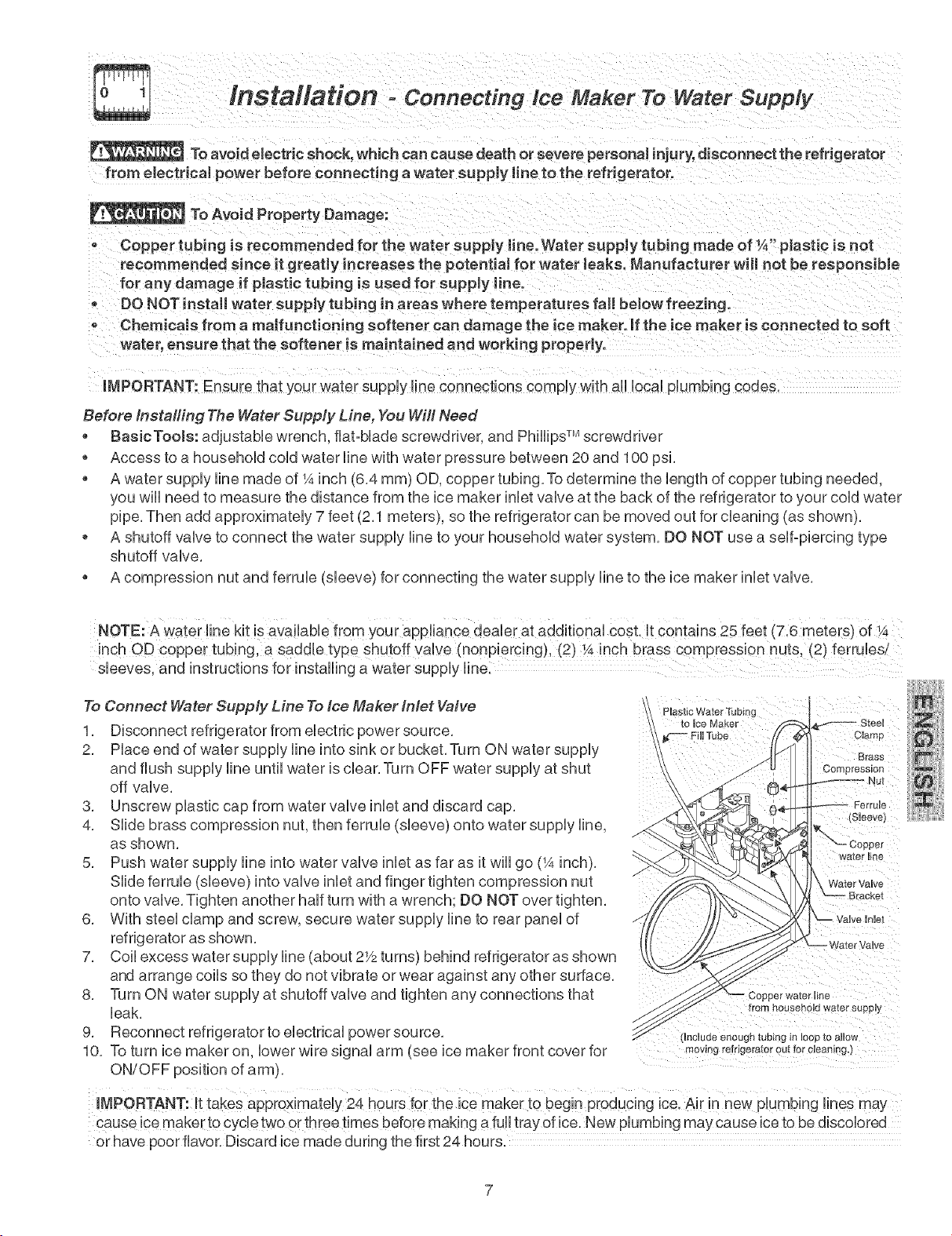
NOTE: A waterline kit is aVailable from your appliance dealer at additional cost. it Contains 25 feet (7,6 meters) of ¼
To ConnectWaterSupp/yMneTo/ceMaker/n/etVa/ve P,astiowate_Tub_,,g ::_II
to Ice Maker _ Steel
1. Disconnect refrigerator from electric power source. _ FillTuBe C'8mP
2. Place end of water supply line into sink or bucket. Turn ON water supply Brass i i
and flush supply line until water is clear. Turn OFF water supply at shut compressbn
off valve.
s Unscrewplasticcapfromwatervalveinletanddiscardcap
4. Slide brass compression nut, then ferrule (sleeve) onto water supply line, (SU ,
as shown.
5. Push water supply line into water valve inlet as far as it wiii go (¼ inch), waferline
Slide ferrule (sleeve) into valve inlet and finger tighten compression nut watervalve
onto valve. Tighten another half turn with a wrench; DO NOT over tighten.
6. With steel clamp and screw, secure water supply line to rear panel of
refrigerator as shown.
7. Coil excess water supply line (about 2_/2turns) behind refrigerator as shown
and arrange coils so they do not vibrate or wear against any other surface.
8. Turn ON water supply at shutoff valve and tighten any connections that
leak.
9. Reconnect refrigeratortoelectrical powersource.
10. To turn ice maker on, lower wire signal arm (see ice maker front cover for
ON/OFF position of arm).
from h0usebe!d water supply
(include enough tubing in Io0p to allow
moving refrigerator out for cleaning.}
cause !ce maker to cycle two or three times before making a fu!!tray of ice. New plumbing may cause iceto be discolored
or have poor flavor. Discard ice made during the first 24 hours.
Door Removal instructions
lop
H_nge
£r,ew
lop Hinge
Cove_ Screw
_oltom
HL_ge _"t
Screw
Tools Necessar
Phi iD_ eQu
oR _
3/8"
Fixc_d
vv/er_cf
Hinge
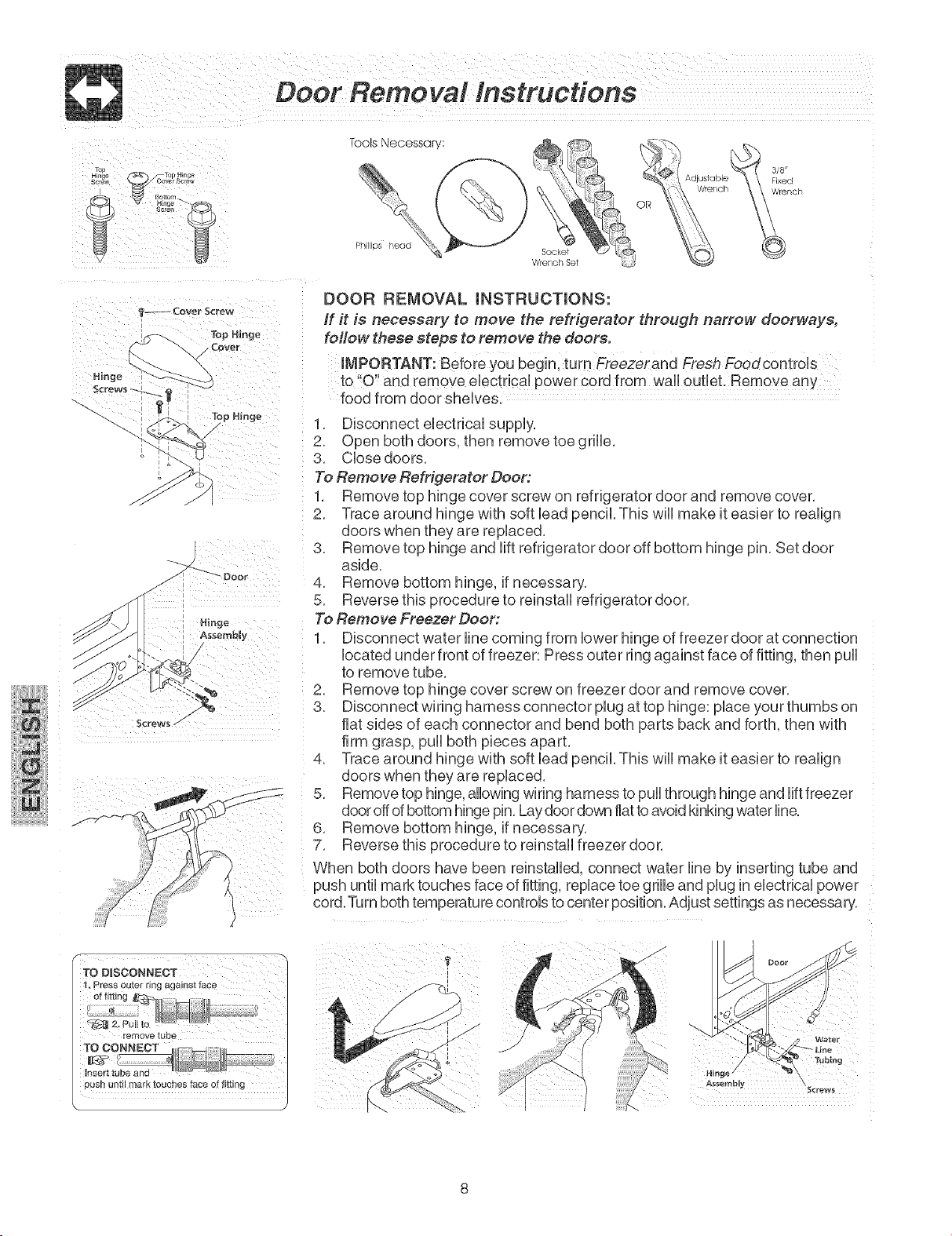
DOOR REMOVAL INSTRUCTIONS:
If it is necessary to move the refrigerator through narrow doorways,
follow these steps to remove the doors.
IMPORTANT: Before you begin, turn Freezerand Fresh Foodcontrob
to "O" and remove ebctrbal power cord from wail outlet. Remove any
food from door shelves.
1. Disconnect electrical supply.
2. Open both doors, then remove toe grille.
8. Close doors.
To Remove Refrigerator Door:
1 Remove top hinge cover screw on refrigerator door and remove cover.
2. Trace around hinge with soft lead pencil. This wiii make it easier to realign
doors when they are replaced.
3. Remove top hinge and lift refrigerator door off bottom hinge pin. Set door
aside
4. Remove bottom hinge, f necessary.
5. Reverse this procedure to reinstall refrigerator door
To Remove Freezer Door:
1. Disconnect water line coming from lower hinge of freezer door at connection
located under front of freezer: Press outer ring against face of fitting, then puii
to remove tube.
2 Remove top hinge cover screw on freezer door and remove cover.
3. Disconnect wiring harness connector plug at top hinge: place your thumbs on
fiat sides of each connector and bend both parts back and forth then with
firm grasp, puii both pieces apart.
4. Trace around hinge with soft lead pencil. This wiii make it easier to realign
doors when they are replaced.
5. Remove top hinge, allowing wiring harness to puii through hinge and lift freezer
door off of bottom hinge pin.Lay door down fiat to avoidkinking water line.
6. Remove bottom hinge, f necessary.
7. Reverse this procedure to reinstall freezer door.
When both doors have been reinstalled, connect water line by inserting tube and
push until mark touches face of fitting, replace toe grille and plug in electrical power
cord. Turn both temperature controls to center position. Adjust settings as necessary.
TO D|SCONNEOT
1. Press _uter ringagalIlst _ace
oush until mark touches face of fitt{ng
J J
"ubi_#
J" Hinge
Assetltbly
Screws
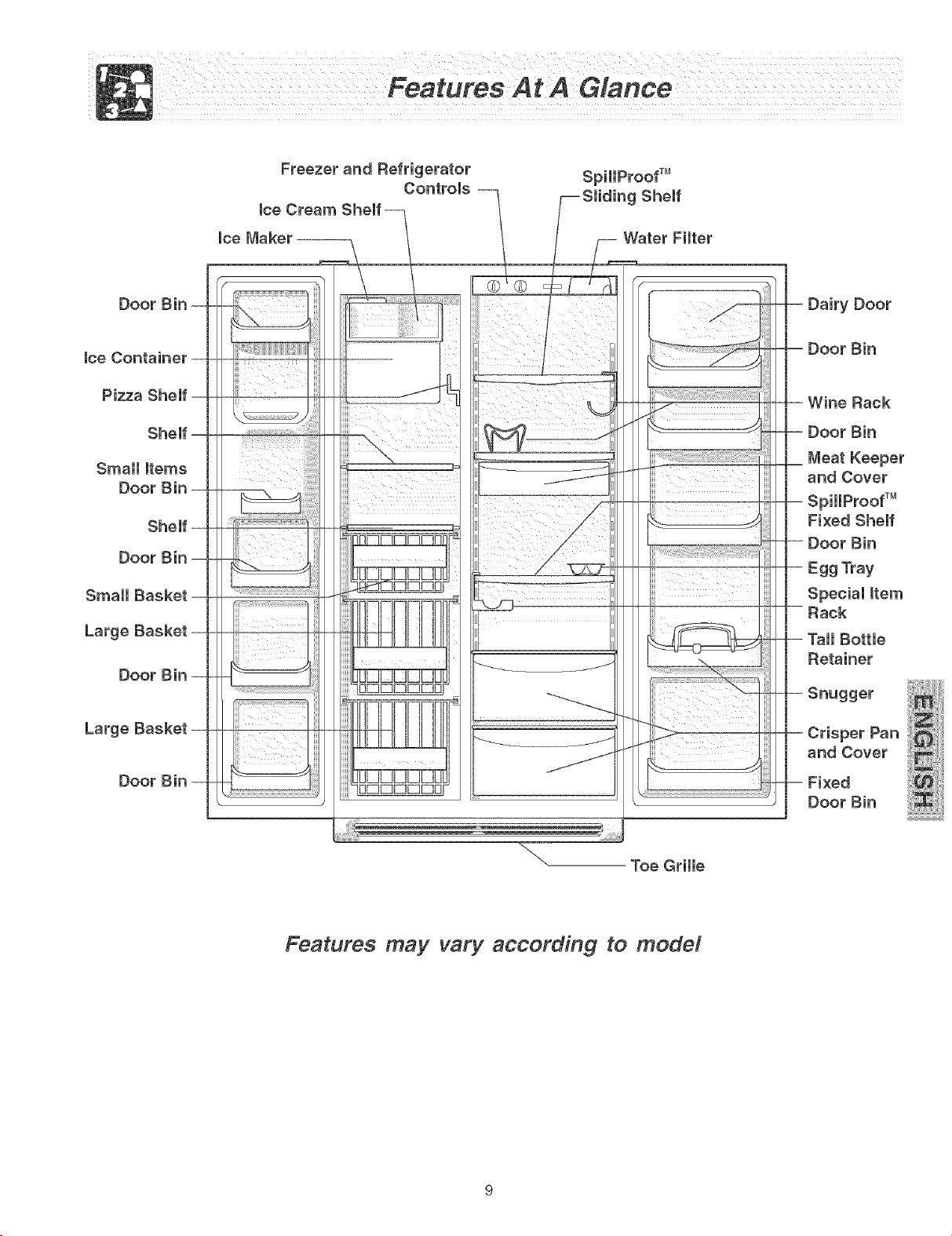
Freezer and Refrigerator
Controls
RceCream
ice Maker
SpiiiProof TM
g Shelf
Water Filter
Door
Small totems
Door
Door
Small
Large
Door
Large
Door
Dairy Door
Door Bin
Wine Rack
Door Bin
Meat Keeper
and Cover
SpiiiProof TM
Fixed Shelf
Door Bin
Egg Tray
Special Rtem
Rack
Tail Bottle
Retainer
Crisper Pan
and Cover
F ,ed
DoorBio _(
Toe Grille
Features may vary according to model
COOL DOWN PERIOD
To ensure safe food storage, allow the refrigerator to operate with the doors closed for at bast 8 to 12 hours before
loading it with food,
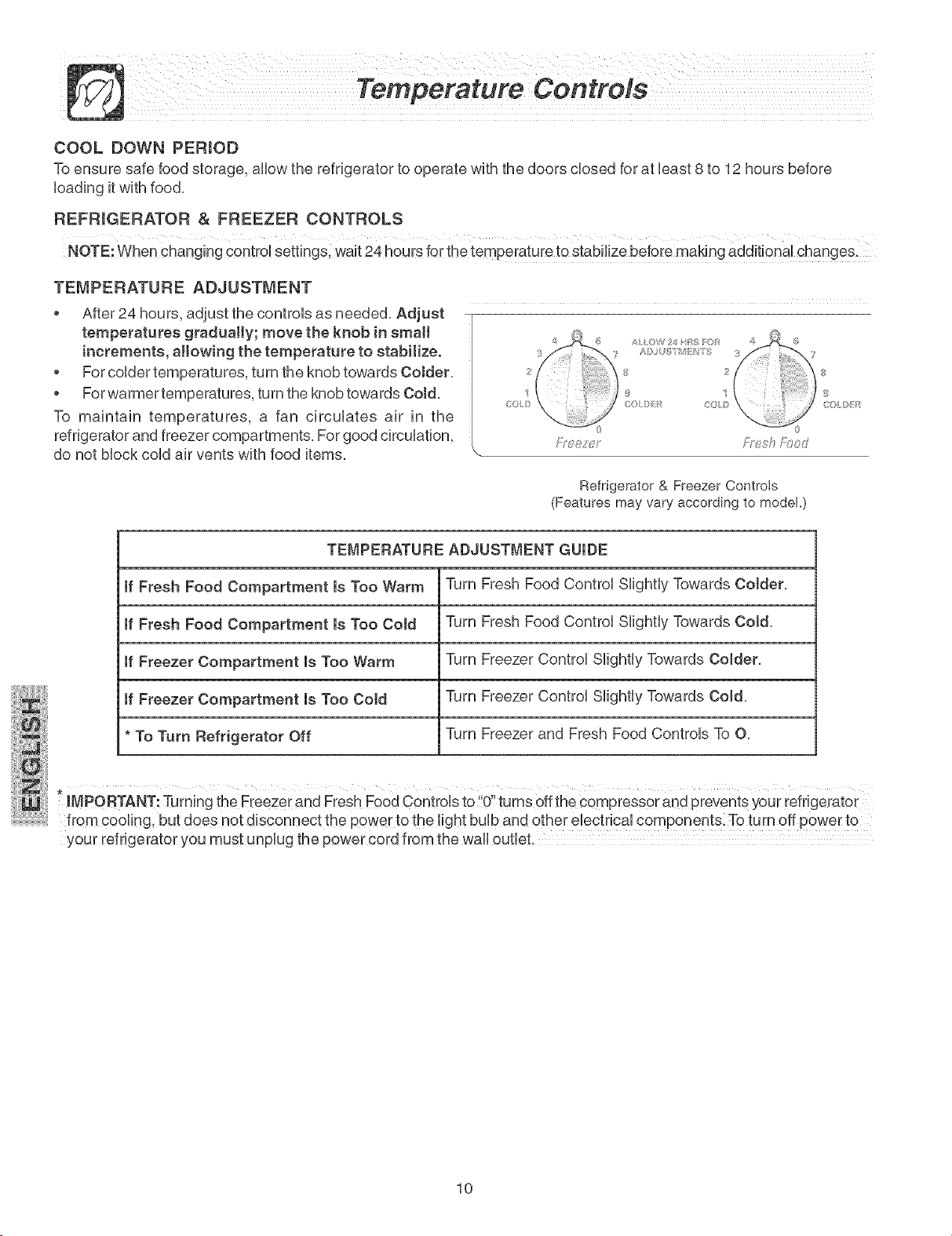
REFRIGERATOR & FREEZER CONTROLS
TEMPERATURE ADJUSTMENT
• After 24 hours, adjust the controls as needed. Adjust
temperatures gradually; move the knob in small
increments, allowing the temperature to stabilize.
• For colder temperatures, turn the knob towards Colder.
o For warmer temperatures, turn the knob towards Cold.
To maintain temperatures, a fan circulates air in the
refrigerator and freezer compartments. For good circulation,
do not block cold air vents with food items.
Refrigerator & Freezer Controls
(Features may vary according to model.)
TEMPERATURE ADJUSTMENT GUIDE
If Fresh Food Compartment Is Too Warm Turn Fresh Food Control Slightly Towards Colder.
If Fresh Food Compartment Is Too Cold Turn Fresh Food Control Slightly Towards Cold,
If Freezer Compartment Is Too Warm Turn Freezer Control Slightly Towards Colder.
If Freezer Compartment Is Too Cold Turn Freezer Control Slightly Towards Cold.
* To Turn Refrigerator Off Turn Freezer and Fresh Food Controls To O.
IMPORTANT: Turning the F[eezer and Fresh Food Controls to "0"turns offthe compressor and prevents your refrigerator
from cooling, but does not disconnect the power tothe light bulb and other electrical Components: To turn off power to
your refrigerator you must unp!ug the power cold f[em the wa!! outlet,
lO
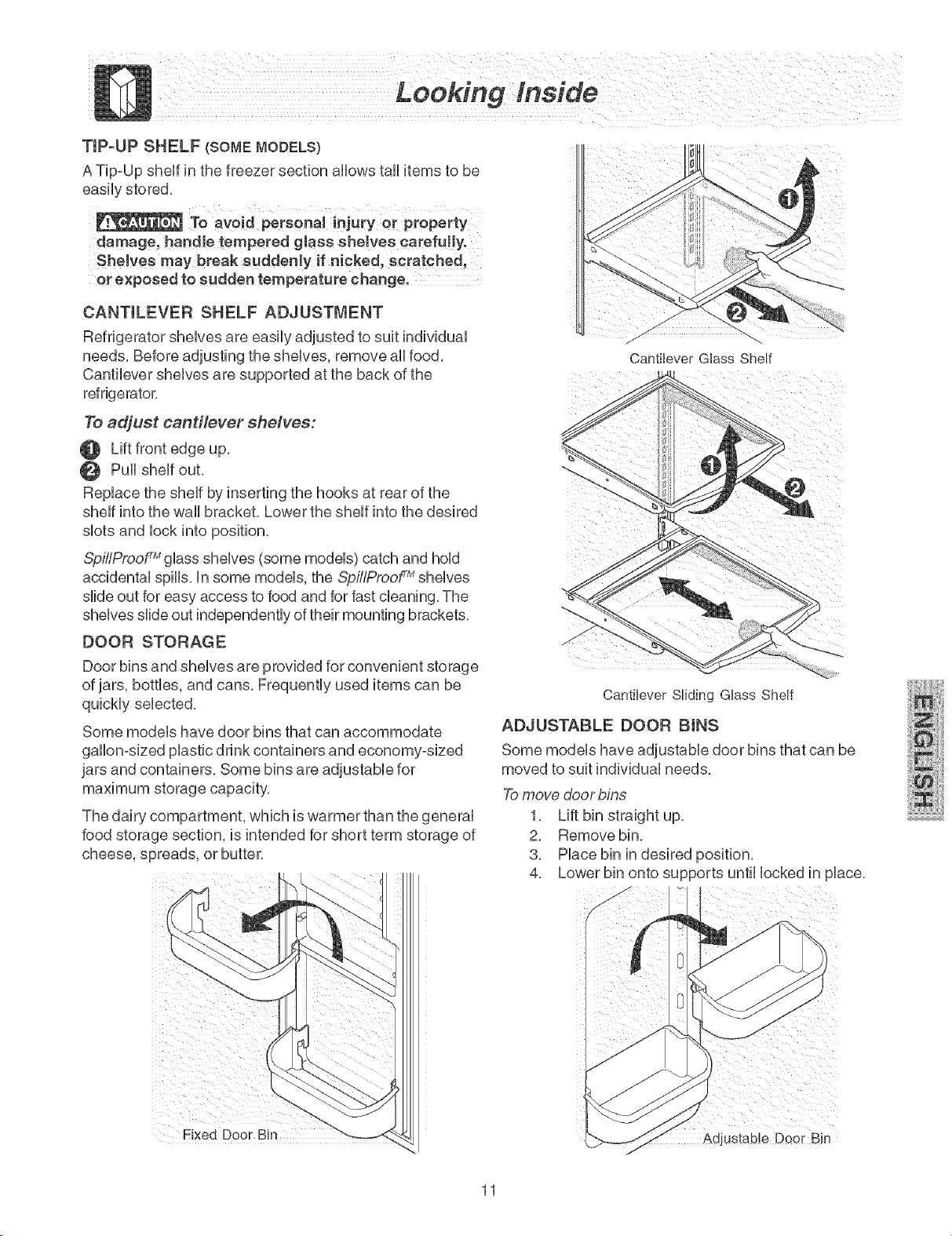
TIP-UPSHELF(SOMEMODELS)
ATip-Upsheffinthefreezersectionallowstallitemstobe
easilystored.
To avoid personaJ injury Or property
damage, handle tempered glass shelves carefully.
Shelves may break suddenly if nicked, scratche d,
or exposed to sudden temperature change.
CANTILEVER SHELF ADJUSTMENT
Refrigerator sheUvesare easily adjusted to suit individuaU
needs. Before adjusting the sheUves,remove aHfood.
Cantilever sheUvesare supported at the back of the
refrigerator.
To adjust cantilever shelves:
Lift front edge up,
Pull shelf out,
Replace the shelf by inserting the hooks at rear of the
shelf into the wall bracket, Lower the shelf into the desired
slots and lock into position,
SpillProoF Mglass shelves (some models) catch and hold
accidental spills, In some models, the SpillProof TM shelves
slide out for easy access to food and for fast cleaning, The
shelves slide out independently of their mounting brackets,
DOOR STORAGE
Door bins and shelves are provided for convenient storage
of jars, bottles, and cans, Frequently used items can be
quickly selected,
Some models have door bins that can accommodate
gallon-sized plastic drink containers and economy-sized
jars and containers, Some bins are adjustable for
maximum storage capacity,
The dairy compartment, which is warmer than the general
food storage section, is intended for short term storage of
cheese, spreads, or butter,
Fixed Door Bin
Cantilever Glass Shelf
Cantilever Sliding Glass Shelf
ADJUSTABLE DOOR BINS
Some models have adjustable door bins that can be
moved to suit individual needs.
Tomove door bins
1, Lift bin straight up,
2, Remove bin,
3, Place bin in desired position,
4, Lower bin onto supports until locked in place,
Adjustable Door Bin
11
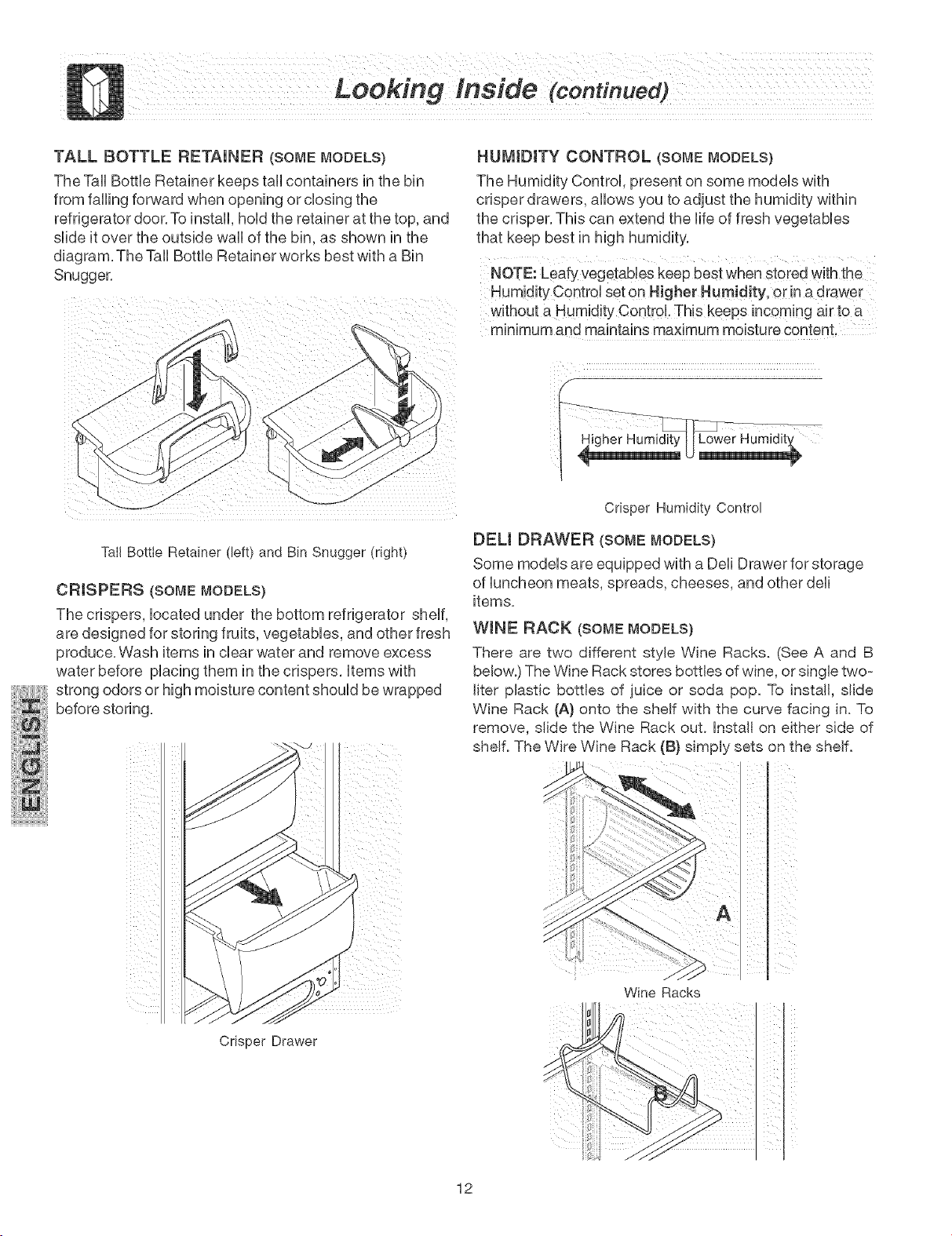
TALL BOTTLERETAmNER(SOME{V1ODELS)
TheTallBottHeRetainerkeepstaHHcontainersinthebin
fromfaHHngforwardwhenopeningordosingthe
refrigeratordoor,ToinstaHH,hoHdtheretaineratthetop,and
slideitovertheoutsidewaHHofthebin,asshowninthe
diagram,TheTallBottHeRetainerworksbestwithaBin
Snugger,
Tail Bottle Retainer (left) and Bin Snugger (right)
CRISPERS (SOME MODELS)
The crispers, Hocatedunder the bottom refrigerator sheHf,
are designed for storing fruits, vegetabHes, and other fresh
produce. Wash items in dear water and remove excess
water before pHacingthem in the crispers. Htemswith
strong odors or high moisture content shouHdbe wrapped
before storing.
Crisper Drawer
HUMIDITY CONTROL (SO[VlEMODELS)
The Humidity Control present on some modemswith
crisper drawers, aHHowsyou to adjust the humidity within
the crisper. This can extend the Hifeof fresh vegetabHes
that keep best in high humidity.
NOTE: Leafy vegetabHeskeep best when stored with the
Humidity C0ntroHset 0n Higher Hum!d!ty, or in a drawer
minimum and maintains maximum moisture content,
Higher Humidity Lower Humidity
Crisper Humidity Control
DEM DRAWER (SOME MODELS)
Some modemsare equipped with a DeHiDrawer for storage
of Huncheonmeats, spreads, cheeses, and other deHi
items.
WINE RACK (SOME MODELS)
There are two different style Wine Racks. (See A and B
below.) The Wine Rack stores bottles of wine, or single two-
liter plastic bottles of juice or soda pop. To install, slide
Wine Rack (A) onto the shelf with the curve facing in. To
remove, slide the Wine Rack out. Hnstallon either side of
shelf. The Wire Wine Rack (B) simply sets on the shelf.
Wine Racks
12
0000
ICE Fff¢el_d tce and VV_tet WATER
-_ *,4
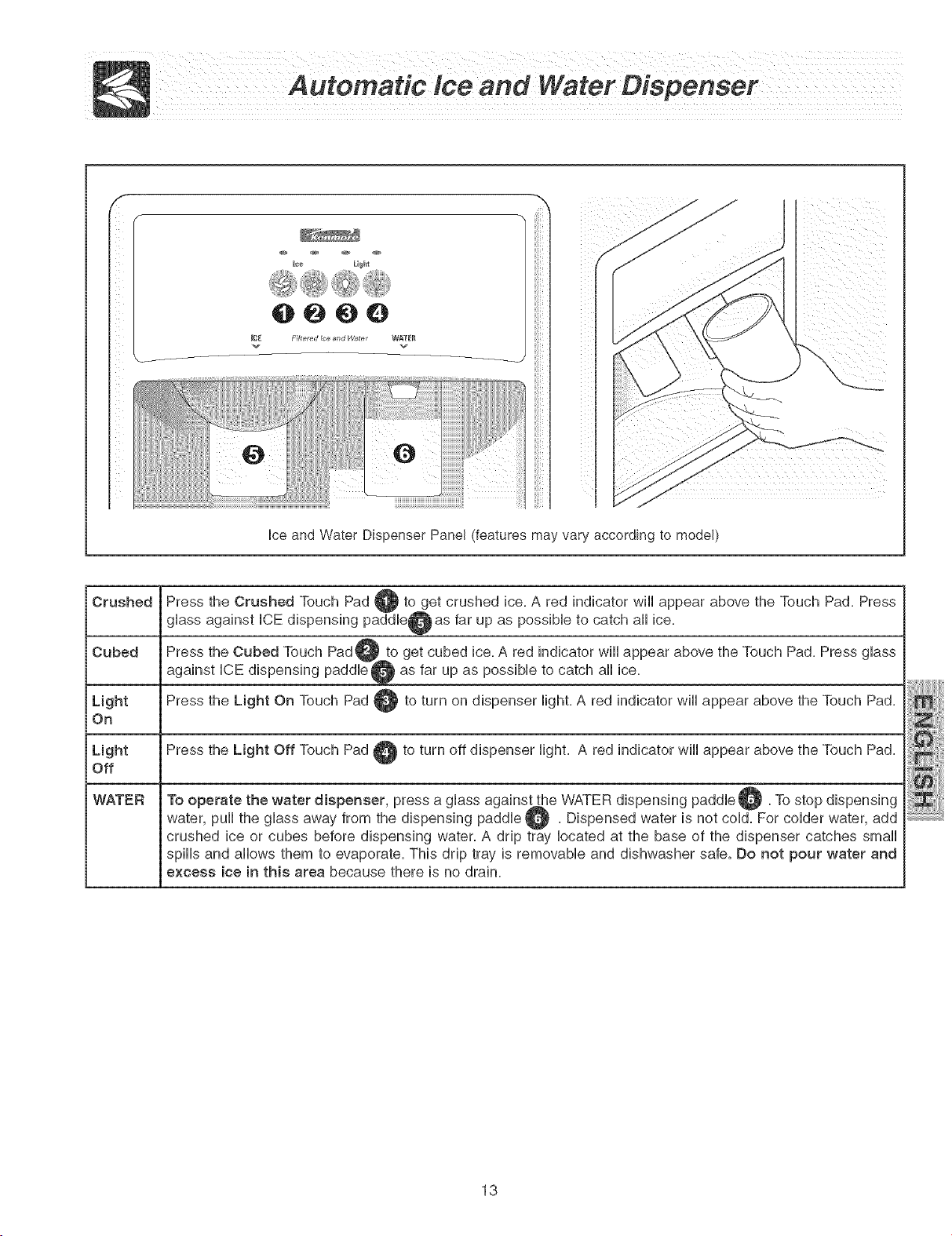
ice and Water Dispenser Panel (features may vary according to model)
Crushed
Cubed
Light
On
Press the Crushed Touch Pad @ to get crushed ice. A red indicator will appear above the Touch Pad. Press
glass against iCE dispensing paddle@as far up as possible to catch all ice.
get cubed ice. A red indicator will appear above the Touch Pad. Press glass
as far up as possible to catch all ice.
Press the Light On Touch Pad @ to turn on dispenser light. A red indicator will appear above the Touch Pad.
Light Press the Light Off Touch Pad _ to turn off dispenser light. A red indicator will appear above the Touch Pad.
Off
WATER
A
To operate the water dispenser, press a glass againstAthe WATER dispensing paddle _. To stop dispensing
water, pull the glass away from the dispensing paddle Q . Dispensed water is not cold. For colder water,
add
crushed ice or cubes before dispensing water. A drip tray located at the base of the dispenser catches small
spills and allows them to evaporate. This drip tray is removable and dishwasher safe. Do not pour water and
excess ice in this area because there is no drain.
13
iCE AND WATER DISPENSER FEATURES
The ice and water dispenser convenientUydispenses chHUedwater, and ice cubes or crushed ice, depending on the model
Tooperate the ice dispenser, seUectthe ice option desired using the touchpad, Press a gUassagainst the dispensing paddUe
as far up as possibUeto catch aHice, To stop dispensing ice, pull gUassaway from dispensing paddUe,Do not remove the
gUassuntil the ice has compUeteUydispensed, (CompUete instructions for the dispenser operation are attached to the inside
of the freezer door,)
The ice maker produces 4 to 6 pounds of ice every 24 hours depending on usage conditions, Uceis produced at a rate of 8
cubes every 75 to 90 minutes,
How the Water Dispenser Works
The water tank, Uocatedbehind the drawers in the refrigerator compartment, automatically fills as water is dispensed. For
proper dispenser operation, the recommended supply water pressure should fall between 20 psi and 100 psi,
Water pressure must not exceed 100 Ibs, Excessive pressure may Cause Waterfilter to malfunction'
After the refrigerator is connected to the water supply, fill the water tank by drawing one glass of water, It may take about
11/2minutes after activating the dispenser paddle before water begins to fill this first glass, Continue flushing the system
for 3 minutes to rid the tank and plumbing connections of any impurities, The water dispenser has a built in shutoff device
that will stop the water flow after 3 minutes of continuous use. Simply release the dispenser paddle to reset the shutoff
mechanism,
chemicals from a maJfunCtiOning softener can damage the ice maker, mfthe ice maker is Connected
to soft water, ensure that the softener is maintained and working properly.
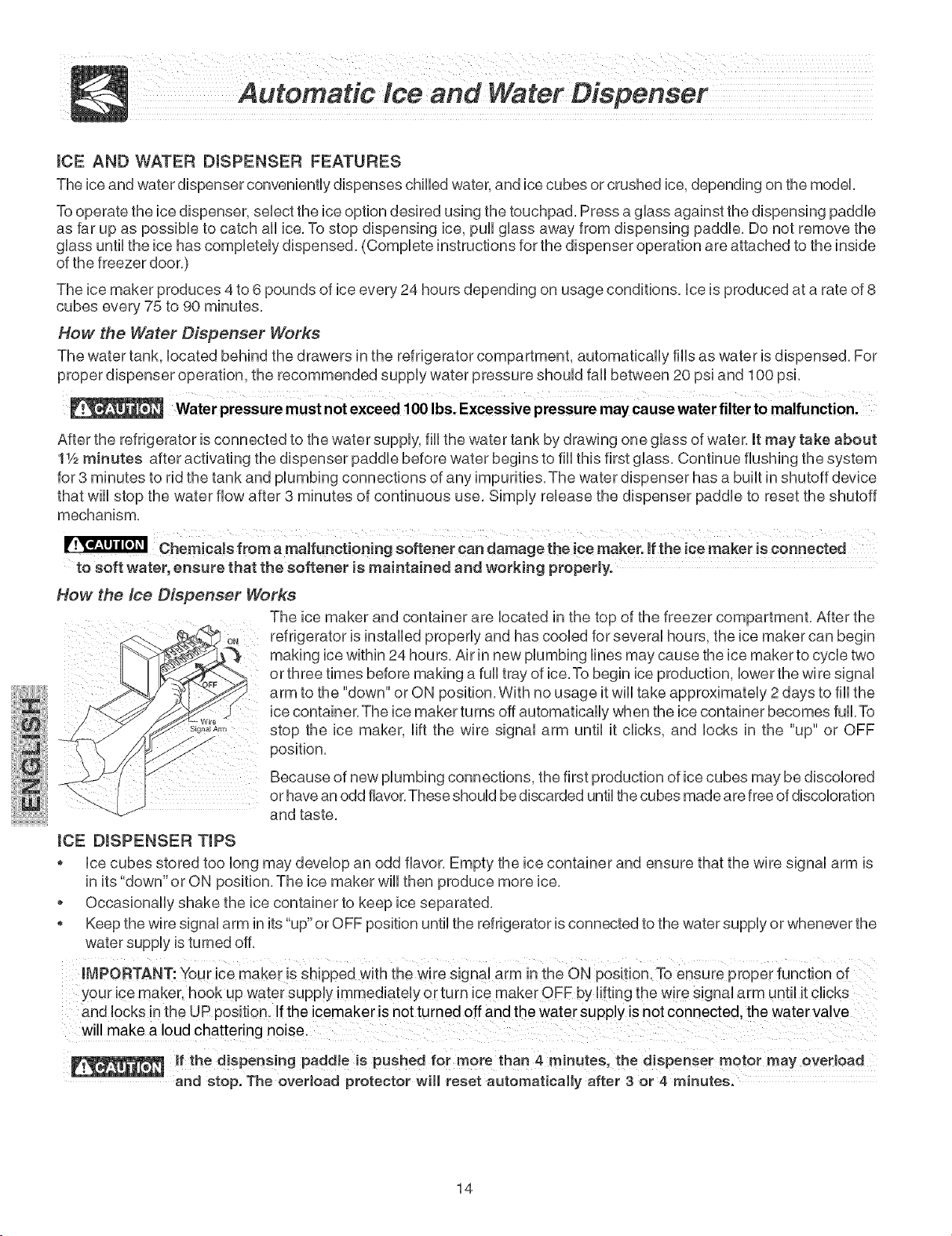
How the/co Dispenser Works
Signal Am/
The ice maker and container are located in the top of the freezer compartment, After the
refrigerator is installed properly and has cooled for several hours, the ice maker can begin
making ice within 24 hours, Air in new plumbing lines may cause the ice maker to cycle two
or three times before making a full tray of ice,To begin ice production, lower the wire signal
arm to the "down" or ON position, With no usage it will take approximately 2 days to fill the
ice container, The ice maker turns off automatically when the ice container becomes full,To
stop the ice maker, lift the wire signal arm until it clicks, and locks in the "up" or OFF
position,
Because of new plumbing connections, the first production of ice cubes may be discolored
or have an odd flavor,These should be discarded untilthe cubes made are free of discoloration
and taste,
iCE DISPENSER TIPS
o Ice cubes stored too long may develop an odd flavor. Empty the ice container and ensure that the wire signal arm is
in its "down" or ON position. The ice maker will then produce more ice.
o Occasionally shake the ice container to keep ice separated.
o Keep the wire signal arm in its "up"or OFF position until the refrigerator is connected to the water supply or whenever the
water supply is turned off.
your ice maker, hook UPwater supp!y immediate!Y or turn ice maker OFEbY Ji!tingthe w!re s!gna! arm unt!l it c!icks
and locks in the UP position, If the icemaker is not turned off and the water supply is not connected, the water valve
will make a loud chattering noise.
mfthe dispensing #add! e !s #,shed toi more than 4 m!nutes' the dispenser motoi may over!oad
and stop. The overtoad protector will reset automatically after 3 or 4 minutes.
14
ffaUargequantityoficeisneededatonetime,itisbesttoremovecubesdirectUyfromtheicecontainer,
ThefollowingsoundsarenormaUwhentheicemakerisoperating:
• • Runningwater
intoicecontainer o Stoptheicemakerwhencleaningthefreezerandduringvacations,
o Watervalveopeningorclosing * iftheicemakerwillbeturnedoffforalongperiodoftime,turnthe
o icelooseningfromtray watersupplyvalvetotheclosedposition,
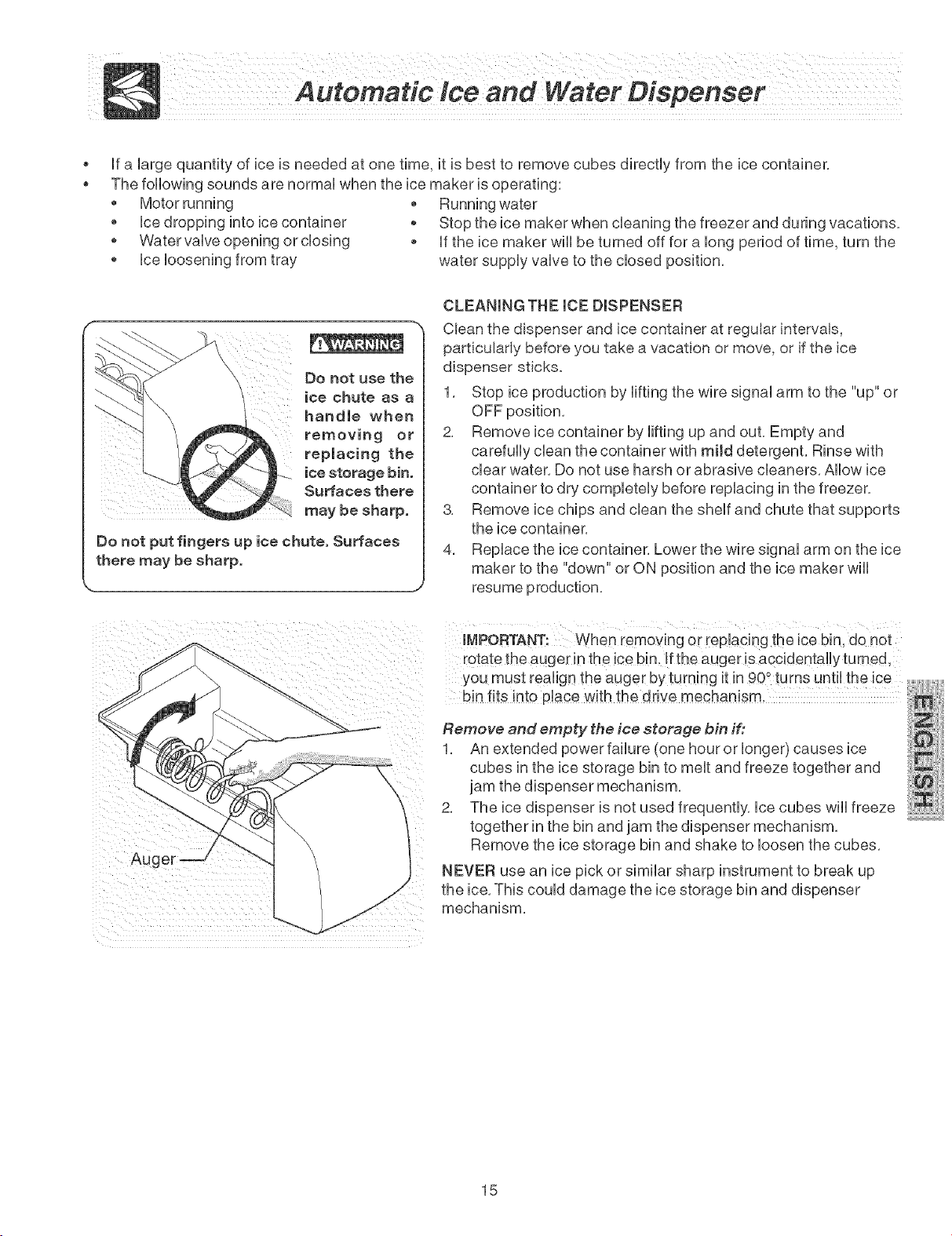
X Donotusethe
ice chute as a
handle when
removing or
replacing the
ice storage bin.
Surfaces there
may be sharp.
Do not put fingers up ice chute. Surfaces
there may be sharp.
CLEANING THE ICE DISPENSER
Clean the dispenser and ice container at regular intervals,
particularly before you take a vacation or move, or if the ice
dispenser sticks.
1, Stop ice production by lifting the wire signal arm to the "up" or
OFF position,
2, Remove ice container by lifting up and out, Empty and
carefully clean the container with mitd detergent, Rinse with
clear water, Do not use harsh or abrasive cleaners, Allow ice
container to dry completely before replacing in the freezer,
3, Remove ice chips and clean the shelf and chute that supports
the ice container,
4, Replace the ice container, Lower the wire signal arm on the ice
maker to the "down" or ON position and the ice maker will
IMPORTANT: Whet removing or replacing the ice bin, do not
rotate the auger in the ice bin, If the auger is accidentally turned,
you must realign the auger by turning it in 90° turns until the ice
bin fits into place with the drive mechanism,
)
Remove and empty the ice storage bin if:
1, An extended power failure (one hour or longer) causes ice
cubes in the ice storage bin to melt and freeze together and
jam the dispenser mechanism,
2, The ice dispenser is not used frequently, ce cubes wiii freeze
together in the bin and jam the dispenser mechanism
Remove the ice storage bin and shake to loosen the cubes,
NEVER use an ice pick or similar sharp instrument to break up
the ice, This could damage the ice storage bin and dispenser
mechanism,
15
Autemattc ice and Water Dispenser
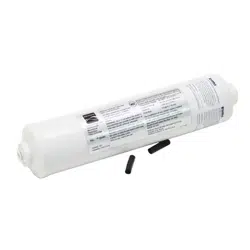
Kenmore ice and Water Rear Filter (some models)
NOTE: [f you purchased a refrigerator with a Kenmore Ice and Water rear filter, please read the for[owing use and
care information. This ice and water filter system filters water to your ice maker and water dispenser, [t [s located [n the
upper right back comer of the fresh food compartment,
System Startup:
Water supply does not need to be turned off, however, do not use ice and water dispenser while installing filter.
The filter cartridge has already been installed [n the filter housing at the factory. Refer to the How The Water Dispenser
Works section to properly fir[ the system with water.
Changing the F#ter:
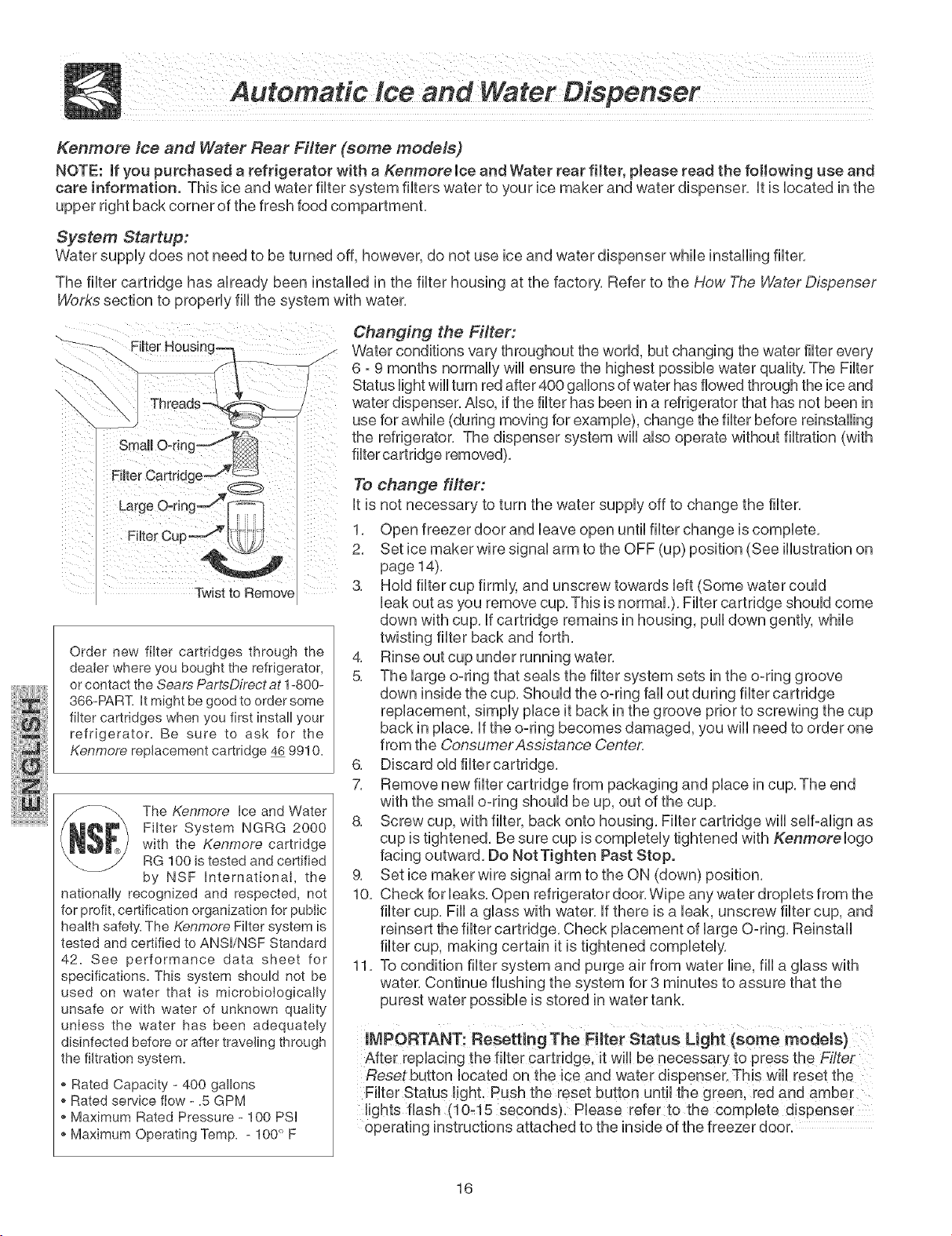
Water conditions vary throughout the world, but changing the water filter every
Order new filter cartridges through the
dealer where you bought the refrigerator,
or contact the Sears Pan, Direct at 1-800-
366-PART. It might be good to order some
filter cartridges when you first install your
refrigerator. Be sure to ask for the
Kenmore replacement cartridge 46 9910.
The Kenmore Ice and Water
Filter System NGRG 2000
with the Kenmore cartridge
RG 100 is tested and certified
by NSF International, the
nationally recognized and respected, not
for profit, certification organization for public
health safety. The Kenmore Filter system is
tested and certified to ANSI/NSF Standard
42. See performance data sheet for
specifications. This system should not be
used on water that is microbiotogically
unsafe or with water of unknown quality
unless the water has been adequately
disinfected before or after traveling through
the filtration system.
,, Rated Capacity - 400 gallons
,, Rated service flow- .5 GPM
,, Maximum Rated Pressure - 100 PSI
,, Maximum Operating Temp. - 100° F
6 - 9 months normally w[[[ ensure the highest possible water quality. The Filter
Status rightw[[[tum red after 400 gallons of water has flowed through the ice and
water dispenser. Also, [f the filter has been [na refrigerator that has not been [n
use for awhile (during moving for example), change the filter before reinstalling
the refrigerator. The dispenser system w[[[ also operate without filtration (with
filter cartridge removed).
To change filter:
[t [s not necessary to turn the water supply off to change the filter.
1. Open freezer door and reave open until filter change [s complete.
2. Set ice maker wire signal arm to the OFF (up) positron (See illustration on
page 14).
3. Hold filter cup firmly4and unscrew towards [eft (Some water could
leak out as you remove cup. This [s normal.). Filter cartridge should come
down with cup. [f cartridge remains [n housing, purrdown gentry, while
twisting filter back and forth.
4. Rinse out cup under running water.
5. The large o-r[ng that sears the filter system sets [nthe o-r[ng groove
down inside the cup. Should the o-r[ng fairout during filter cartridge
replacement, simply place [t back [n the groove prior to screwing the cup
back [n place. [f the o-r[ng becomes damaged, you w[[[ need to order one
from the Consumer Assistance Center.
6. Discard old fi[tercartr[dge.
7. Remove new filter cartridge from packaging and place [n cup. The end
with the small o-ring should be up, out of the cup.
8. Screw cup, with filter, back onto housing. Filter cartridge w[[[ serf-align as
cup [s tightened. Be sure cup [s completely tightened with Kenmore logo
facing outward. Do NotTighten Past Stop.
9. Set ice maker wire signal arm to the ON (down) positron.
10. Check for leaks. Open refrigerator door. Wipe any water droplets from the
filter cup. F[[[ a grass with water. [f there [s a leak, unscrew filter cup, and
re[nsert the filter cartridge. Check placement of large O-ring. Reinstall
filter cup, making certain [t [s tightened completely.
11. To condition filter system and purge air from water line, fir[ a grass with
water. Continue flushing the system for 3 minutes to assure that the
purest water possible [s stored [nwater tank.
IMPORTANT; Resetting The FHter Status Light (some models)
After replacing the filter Cartndge, [t w[[[ be necessary to press the Filter
Reset button located on the ice and water dispenser. This w[H reset the
Filter Status right, Push the reset button until the green, red and amber
rights flash (10q5 seconds). Please refer to the complete dispenser
operating instructions attached to the inside of the freezer door.
16
FOOD STORAGE iDEAS
Fresh Food Storage
The fresh food compartment shouUdbe kept between 34° F and 40° Fwith an optimum temperature of 37° R
Avoid overcrowding the refrigerator sheUves,This reduces the circuUation of air around the food and resuUtsin uneven
cooling,
Fruits and Vegetables
o Storage in the crisper drawers traps moisture to heUppreserve the fruit and vegetaMe quality for Uongertime periods,
Meat
• Raw meat and pouUtryshouUdbe wrapped secureUyso Ueakageand contamination of other foods or surfaces does
not occur,
Frozen Food Storage
o The freezer compartment shouUdbe kept at 0° For Uower,
A freezer operates most efficientUy when it is at Ueast2/3 full,
Packaging Foods for Freezing
,, To minimize dehydration and quality deterioration, use aUuminumfoil, freezer wrap, freezer bags or airtight
containers, Force as much air out of the packages as possible and seal them tightly, Trapped air can cause food to
dry out, change color, and develop an off-flavor (freezer burn),
o Wrap fresh meats and poultry with suitable freezer wrap prior to freezing,
,, Do not refreeze meat that has completely thawed,
Loading the Freezer
o Avoid adding too much warm food to the freezer at one time, This overloads the freezer, slows the rate of freezing,
and can raise the temperature of frozen foods,
• Leave a space between the packages, so cold air can circulate freely, allowing food to freeze as quickly as
possible,
o Avoid storing hard-to-freeze foods such as ice cream and orange juice on the freezer door shelves, These foods are
best stored in the freezer interior where the temperature varies less,
/
ENERGY SAVING mDEAS
Locate the refrigerator in the coolesl part of the room out of direcl
sunlight, and away from heating ducts or regusters, Do not place the
refrigerator next to heat-producing appliances such as a range, oven, or
dishwasher, If this is not possible a section of cabinetry or an added
layer of insulation between the two appliances will help the refrigerator
operate more efficiently,
o Level the refrigerator so that the doors close tightly
• Refer to this Use & Care Manual for the suggested temperature control
settings,
• Periodic cleaning of the condenser will help the refrigerator run more
efficiently, See the Care and Cleaning Charton page 19,
Do not overcrowd the refrigerator or block cold air vents, Doing so
causes the refrigerator to run longer and use more energy"
Cover foods and wipe containers dry before placing Ihem in the
refrigerator, This cuts down on moisture build-up inside the unit,
Organize the refrigerator to reduce door openings, Remove as many
items as needed at one time and close the door as soon as possible,
17
Normal Operating sounds&Sights
UNDERSTANDING THE SOUNDS YOU MAY
HEAR
Your new high-efficiency refrigerator may make unfamiliar
sounds, These are aii normal sounds and soon wiii
become familiar to you, They also indicate your refrigerator
is operating as designed, Hard surfaces, such as vinyl or
wood floors, walls, and kitchen cabinets may make
sounds more noticeable, Listed below are descriptions of
some of the most common sounds you may hear, and
what is causing them,
NOTE:R!g!d foam insulation iSvery energy efficbnt,
but is not a sound insuiator,
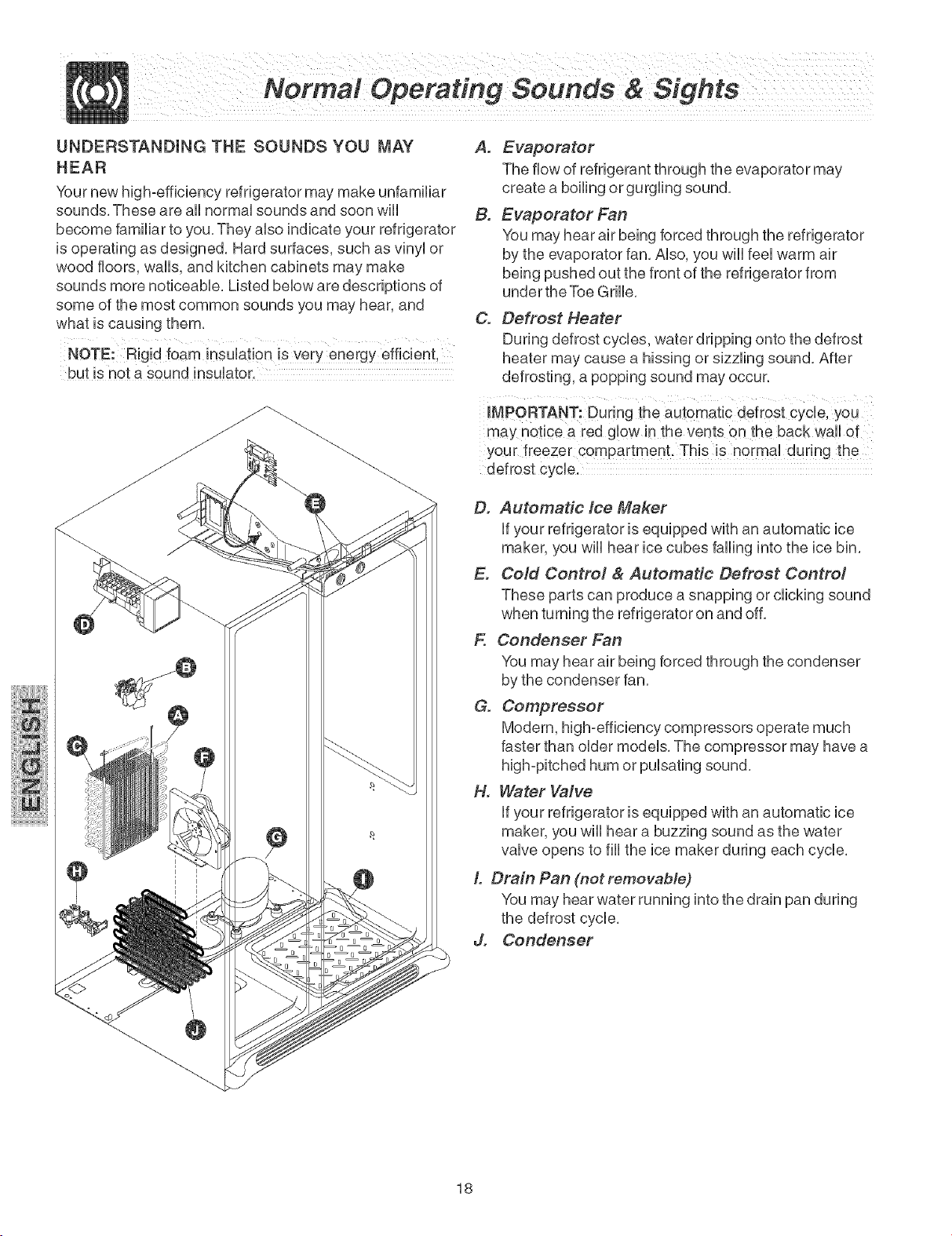
A. Evaporator
The flow of refrigerant through the evaporator may
create a boiling or gurgling sound.
B. Evaporator Fan
You may hear air being forced through the refrigerator
by the evaporator fan, Also, you wiii feel warm air
being pushed out the front of the refrigerator from
under theToe Grille,
C. Defrost Heater
During defrost cycles, water dripping onto the defrost
heater may cause a hissing or sizzling sound. After
defrosting, a popping sound may occur.
mMpORTANT: Dur!ng the automatic defrost cycle, you
may not!ce a red glow in the vents on the back wail of
your freezer compartmenL This is normai during the
defrost cyde.
D. Automatic ice Maker
if your refrigerator is equipped with an automatic ice
maker, you will hear ice cubes falling into the ice bin,
E. Cold Control & Automatic Defrost Control
These parts can produce a snapping or clicking sound
when turning the refrigerator on and off,
F. Condenser Fan
You may hear air being forced through the condenser
by the condenser fan.
G. Compressor
Modern, high-efficiency compressors operate much
faster than older models. The compressor may have a
high-pitched hum or pulsating sound.
H. Water Valve
if your refrigerator is equipped with an automatic ice
maker, you will hear a buzzing sound as the water
valve opens to fill the ice maker during each cycle,
to Drain Pan (not removable)
You may hear water running into the drain pan during
the defrost cycle,
Jo Condenser
18
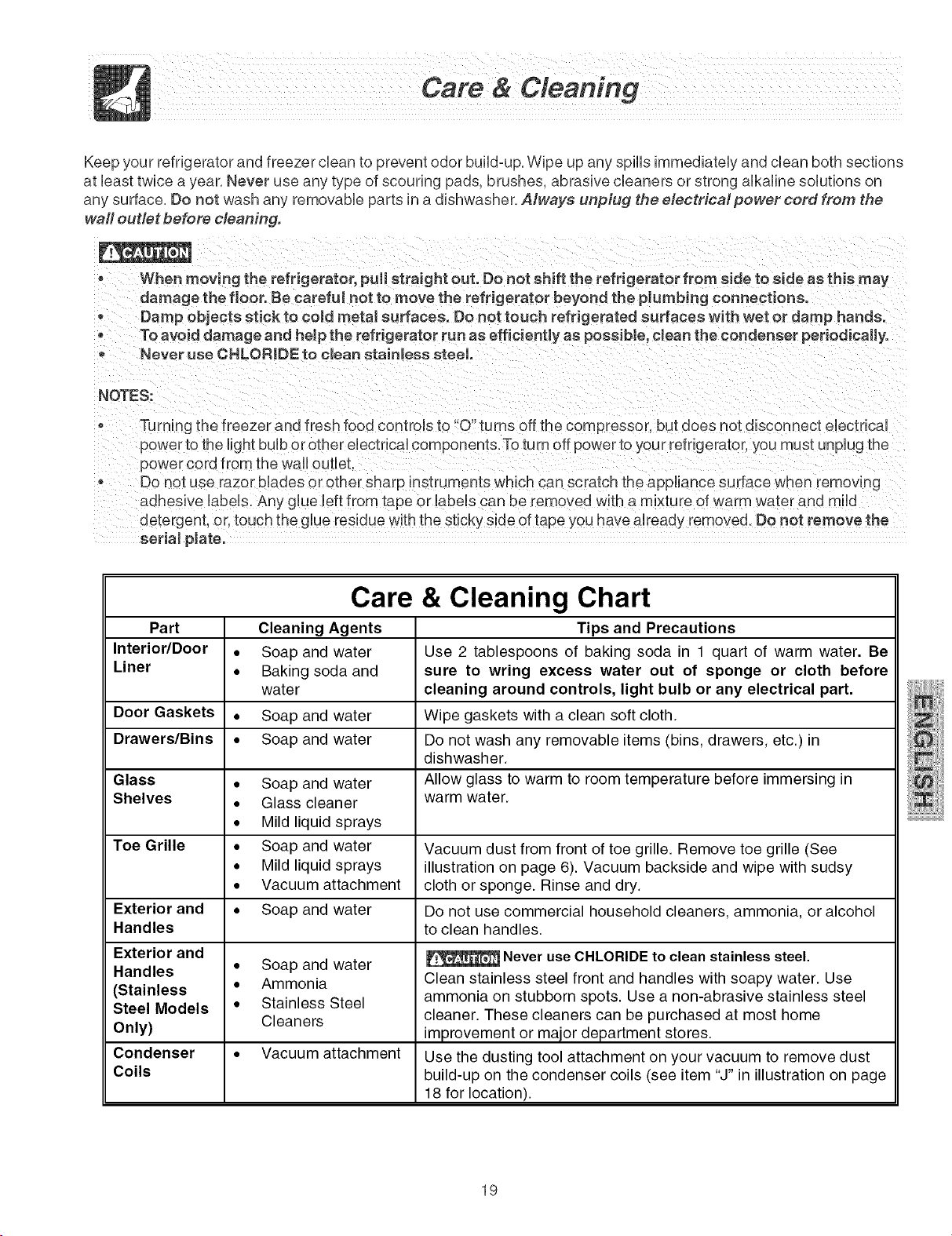
Keepyourrefrigeratorandfreezerdeantopreventodorbuild-up.WipeupanyspHUsimmediateUyanddeanbothsections
atUeasttwiceayear.Neveruseanytypeofscouringpads,brushes,abrasivecleanersorstrongaUkaHnesoUutionson
anysurface.Donotwashanyremovablepartsinadishwasher.Always unplug the electrical power cord from the
waft oudet before cleaning.
o When moving the refrigerator, pun straight out. Do not shift the refrigerator from side to side as this may
damage the floor. Be careful not to move the refrigerator beyond the plumbing connections.
Damp objects stick to cold metal surfaces. Do not touch refrigerated surfaces with wet or damp hands.
- To avoid damage and help the refrigerator run as efficiently as possible, dean the condenser periodically.
® Never use CHLORIDE to cmeanstainmess steel
NOTES:
Turning the freezer and fresh tood controls to "0" turns off the compressor, but does not disconnect electrical
power to the light bulb or other electrical components.To turn off power to your refrigerator, you must unplug the
power cord from the wail outlet.
Do not use razor blades orother sharp instruments which can scratch the appliance surface when removing
adhesive labels. Any glue left from tape or labels can De removed _ ith a mixture of warm water and mild
detergent, o r.touch the g ue residue with the sticky side of tape you have already removed. Do not remove the
serial plate.
Part
Interior/Door .
Liner •
Door Gaskets .
Drawers/Bins •
Glass •
Shelves •
O
Toe Grille •
O
O
Exterior and •
Handles
Exterior and
Handles •
(Stainless •
Steel Models •
Only)
Condenser •
Coils
Care & Cleaning Chart
Cleaning Agents
Soap and water
Baking soda and
water
Soap and water
Soap and water
Soap and water
Glass cleaner
Mild liquid sprays
Soap and water
Mild liquid sprays
Vacuum attachment
Soap and water
Soap and water
Ammonia
Stainless Steel
Cleaners
Vacuum attachment
Tips and Precautions
Use 2 tablespoons of baking soda in 1 quart of warm water. Be
sure to wring excess water out of sponge or cloth before
cleaning around controls, light bulb or any electrical part.
Wipe gaskets with a clean soft cloth.
Do not wash any removable items (bins, drawers, etc.) in
dishwasher.
Allow glass to warm to room temperature before immersing in
warm water.
Vacuum dust from front of toe grille. Remove toe grille (See
illustration on page 6). Vacuum backside and wipe with sudsy
cloth or sponge. Rinse and dry.
Do not use commercial household cleaners, ammonia, or alcohol
to clean handles.
Never use CHLORIDE to clean stainless steel.
Clean stainless steel front and handles with soapy water. Use
ammonia on stubborn spots. Use a non-abrasive stainless steel
cleaner. These cleaners can be purchased at most home
improvement or major department stores.
Use the dusting tool attachment on your vacuum to remove dust
build-up on the condenser coils (see item "J" in illustration on page
18 for location).
19
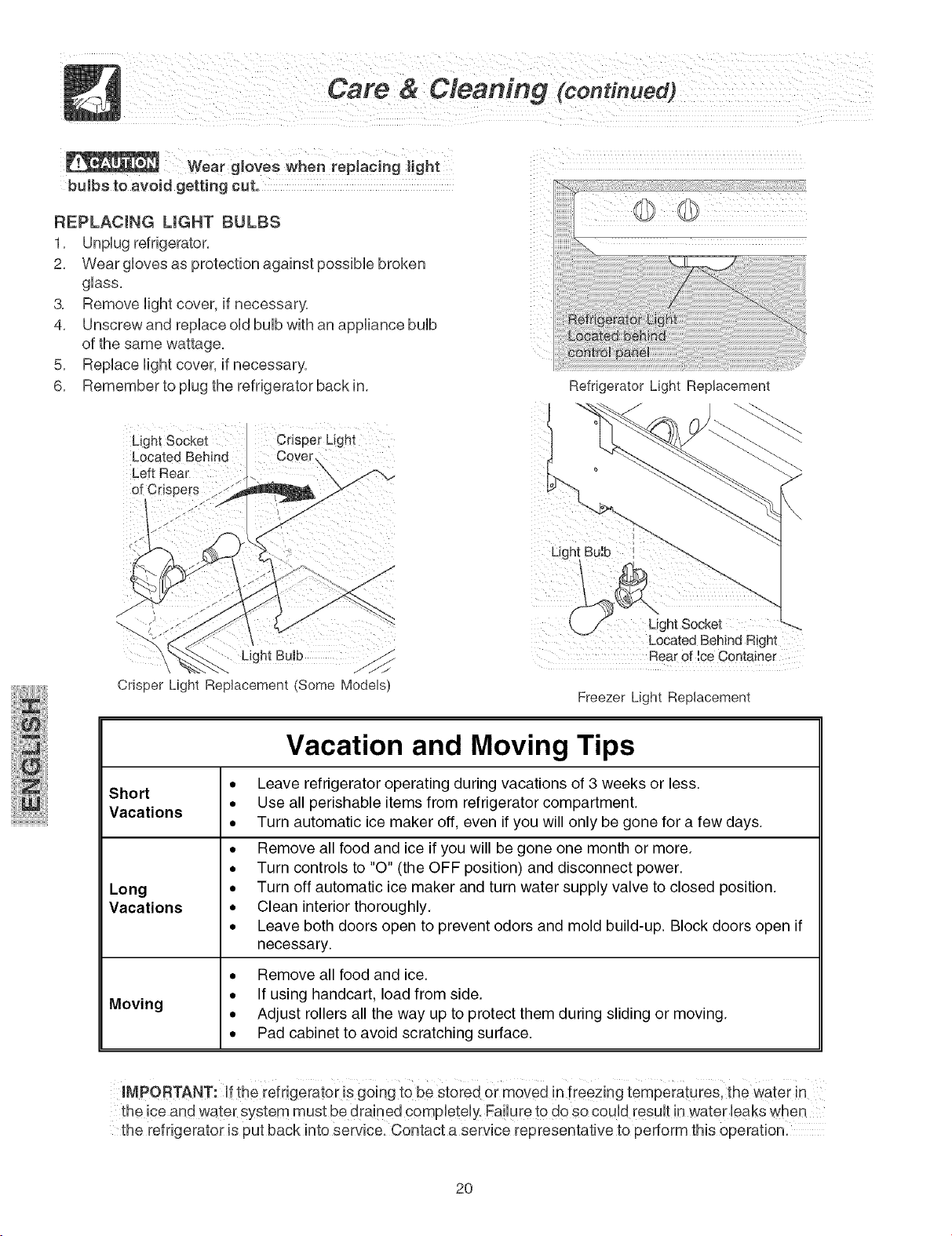
Care & Cleaning (continued)
Wear gJoves when replacing light
bulbs to avoid getting cut.
REPLACING LmGHT BULBS
t, UnpHugrefrigerator,
2, Wear grieves as protection against possiMe broken
gHass.
3. Remove Hght cover if necessary.
4. Unscrew and repUacecudbuUbwith an appliance buHb
of the same wattage.
5. RepHaceHightcover, if necessary.
6. Remember to plug the refrigerator back in.
Refrigerator Light Replacement
Located Behind Right
Crisper Light Replacement (Some Models)
Freezer Light Replacement
Vacation and Moving Tips
Short
Vacations
Long
Vacations
• Leave refrigerator operating during vacations of 3 weeks or less.
• Use all perishable items from refrigerator compartment.
• Turn automatic ice maker off, even if you will only be gone for a few days.
• Remove all food and ice if you will be gone one month or more.
• Turn controls to "0" (the OFF position) and disconnect power.
• Turn off automatic ice maker and turn water supply valve to closed position.
• Clean interior thoroughly.
• Leave both doors open to prevent odors and mold build-up. Block doors open if
necessary.
• Remove all food and ice.
• If using handcart, load from side.
Moving
• Adjust rollers all the way up to protect them during sliding or moving.
• Pad cabinet to avoid scratching surface.
iMPORTANT: If the refrigerator is going to be stored or moved in freezing temperatures, the water in
the ice and water system must be drained completely. Failure to do so could result in water leaks when
the refrigerator is put back into service. Contact a service representative to perform this operation.
2O
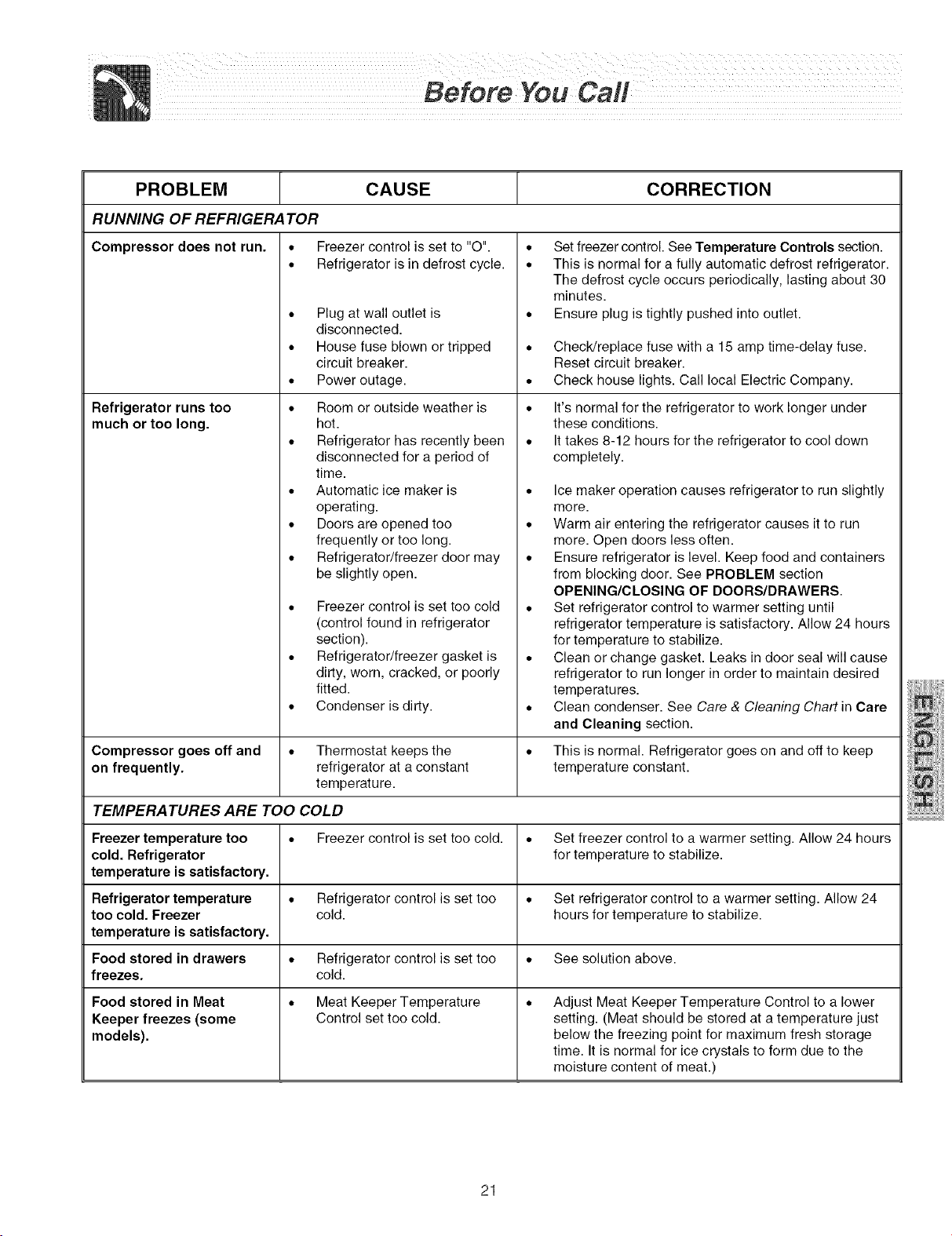
Ca//
P.OB'EM[ C.OSE 1 CO..EOT.O.
RUNNING OF REFRIGERATOR
Compressor does not run.
Refrigerator runs too
much or too long.
• Freezer control is set to "O".
• Refrigerator is in defrost cycle.
Plug at wall outlet is
disconnected.
House fuse blown or tripped
circuit breaker.
Power outage.
Room or outside weather is
hot.
Refrigerator has recently been
disconnected for a period of
time.
Automatic ice maker is
operating.
Doors are opened too
frequently or too long.
Refrigerator/freezer door may
be slightly open.
Freezer control is set too cold
(control found in refrigerator
section).
Refrigerator/freezer gasket is
dirty, worn, cracked, or poorly
fitted.
Condenser is dirty.
• Set freezer control. See Temperature Controls section.
• This is normal for a fully automatic defrost refrigerator.
The defrost cycle occurs periodically, lasting about 30
minutes.
• Ensure plug is tightly pushed into outlet.
• Check/replace fuse with a 15 amp time-delay fuse.
Reset circuit breaker.
• Check house lights. Call local Electric Company.
• It's normal for the refrigerator to work longer under
these conditions.
• It takes 8-12 hours for the refrigerator to cool down
completely.
• Ice maker operation causes refrigerator to run slightly
more.
• Warm air entering the refrigerator causes it to run
more. Open doors less often.
• Ensure refrigerator is level. Keep food and containers
from blocking door. See PROBLEM section
OPENING/CLOSING OF DOORS/DRAWERS.
• Set refrigerator control to warmer setting until
refrigerator temperature is satisfactory. Allow 24 hours
for temperature to stabilize.
• Clean or change gasket. Leaks in door seal will cause
refrigerator to run longer in order to maintain desired
temperatures.
Clean condenser. See Care & Cleaning Chart in Care
and Cleaning section.
This is normal. Refrigerator goes on and off to keep
temperature constant.
Compressor goes off and • Thermostat keeps the •
on frequently, refrigerator at a constant
temperature.
TEMPERATURES ARE TOO COLD
Freezer temperature too • Freezer control is set too cold. • Set freezer control to a warmer setting. Allow 24 hours
cold. Refrigerator for temperature to stabilize.
temperature is satisfactory.
Refrigerator temperature • Refrigerator control is set too • Set refrigerator control to a warmer setting. Allow 24
too cold. Freezer cold. hours for temperature to stabilize.
temperature is satisfactory.
Food stored in drawers • Refrigerator control is set too • See solution above.
freezes, cold.
Food stored in Meat • Meat Keeper Temperature • Adjust Meat Keeper Temperature Control to a lower
Keeper freezes (some Control set too cold. setting. (Meat should be stored at a temperature just
models), below the freezing point for maximum fresh storage
time. It is normal for ice crystals to form due to the
moisture content of meat.)
21
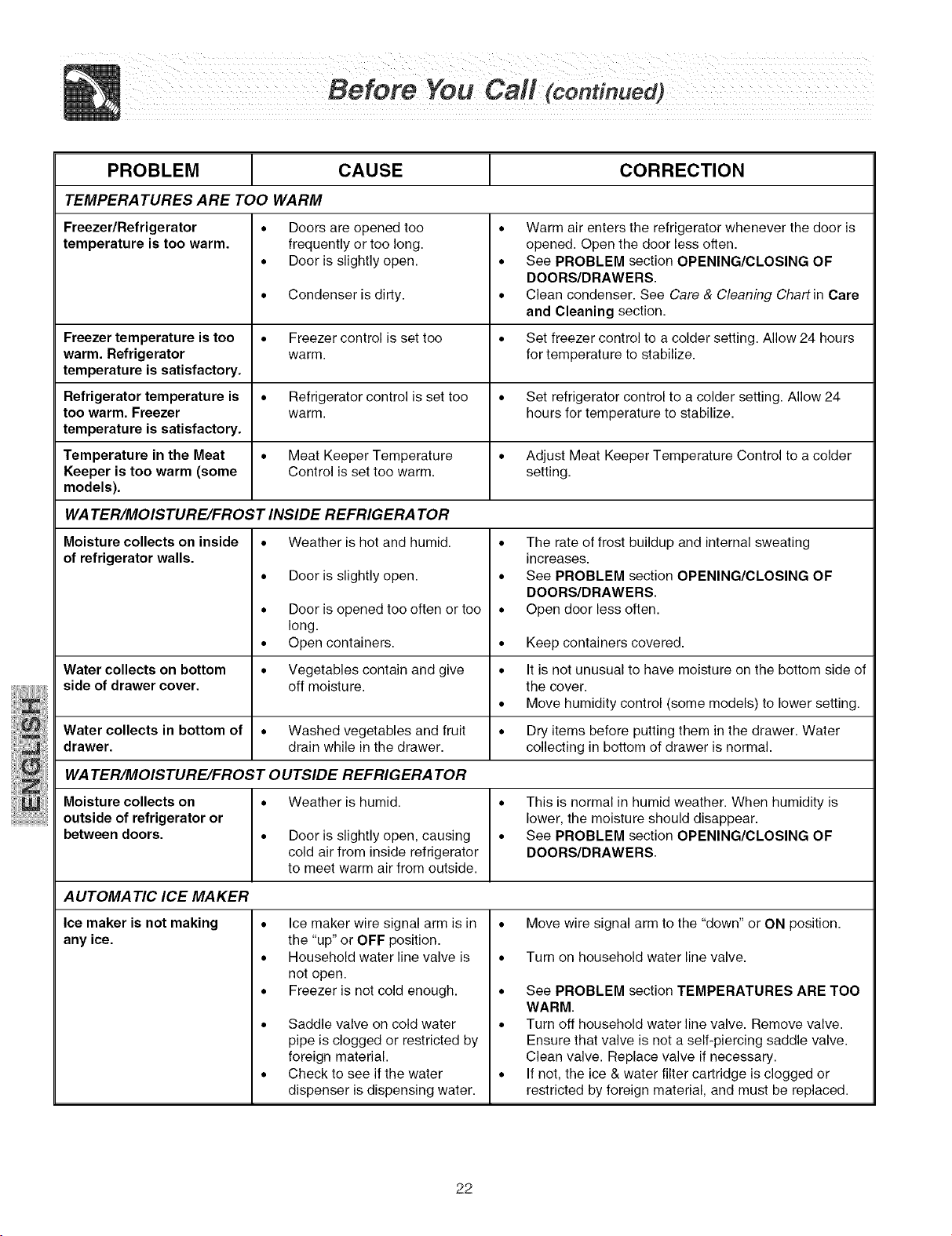
PROBLEM 1
TEMPERATURES ARE TOO WARM
Freezer/Refrigerator
temperature is too warm.
CAUSE l CORRECTION
• Doors are opened too
frequently or too long.
• Door is slightly open.
• Condenser is dirty.
Freezer temperature is too • Freezer control is set too •
warm. Refrigerator warm.
temperature is satisfactory.
Refrigerator temperature is • Refrigerator control is set too • Set refrigerator control to a colder setting. Allow 24
too warm. Freezer warm. hours for temperature to stabilize.
temperature is satisfactory.
Temperature in the Meat • Meat Keeper Temperature • Adjust Meat Keeper Temperature Control to a colder
Keeper is too warm (some Control is set too warm. setting.
models).
WA TER/MOISTURE/FROST INSIDE REFRIGERATOR
• Weather is hot and humid.Moisture collects on inside
of refrigerator walls.
• Door is slightly open.
• Door is opened too often or too
long.
• Open containers.
• Warm air enters the refrigerator whenever the door is
opened. Open the door less often.
• See PROBLEM section OPENING/CLOSING OF
DOORS/DRAWERS.
• Clean condenser. See Care & Cleaning Chart in Care
and Cleaning section.
Set freezer control to a colder setting. Allow 24 hours
for temperature to stabilize.
• The rate of frost buildup and internal sweating
increases.
• See PROBLEM section OPENING/CLOSING OF
DOORS/DRAWERS.
• Open door less often.
• Keep containers covered.
Water collects on bottom • Vegetables contain and give • It is not unusual to have moisture on the bottom side of
side of drawer cover, off moisture, the cover.
• Move humidity control (some models) to lower setting.
Water collects in bottom of • Washed vegetables and fruit • Dry items before putting them in the drawer. Water
drawer, drain while in the drawer, collecting in bottom of drawer is normal.
WA TER/MOISTURE/FROST OUTSIDE REFRIGERATOR
Moisture collects on • Weather is humid. • This is normal in humid weather. When humidity is
outside of refrigerator or lower, the moisture should disappear.
between doors. • Door is slightly open, causing • See PROBLEM section OPENING/CLOSING OF
cold air from inside refrigerator DOORS/DRAWERS.
to meet warm air from outside.
• Move wire signal arm to the "down" or ON position.
A UTOMA TIC ICE MAKER
Ice maker is not making
any ice.
• Ice maker wire signal arm is in
the "up" or OFF position.
• Household water line valve is
not open.
• Freezer is not cold enough.
• Saddle valve on cold water
pipe is clogged or restricted by
foreign material.
Check to see if the water
dispenser is dispensing water.
• Turn on household water line valve.
• See PROBLEM section TEMPERATURES ARE TOO
WARM.
• Turn off household water line valve. Remove valve.
Ensure that valve is not a self-piercing saddle valve.
Clean valve. Replace valve if necessary.
• If not, the ice & water filter cartridge is dogged or
restricted by foreign material, and must be replaced.
22
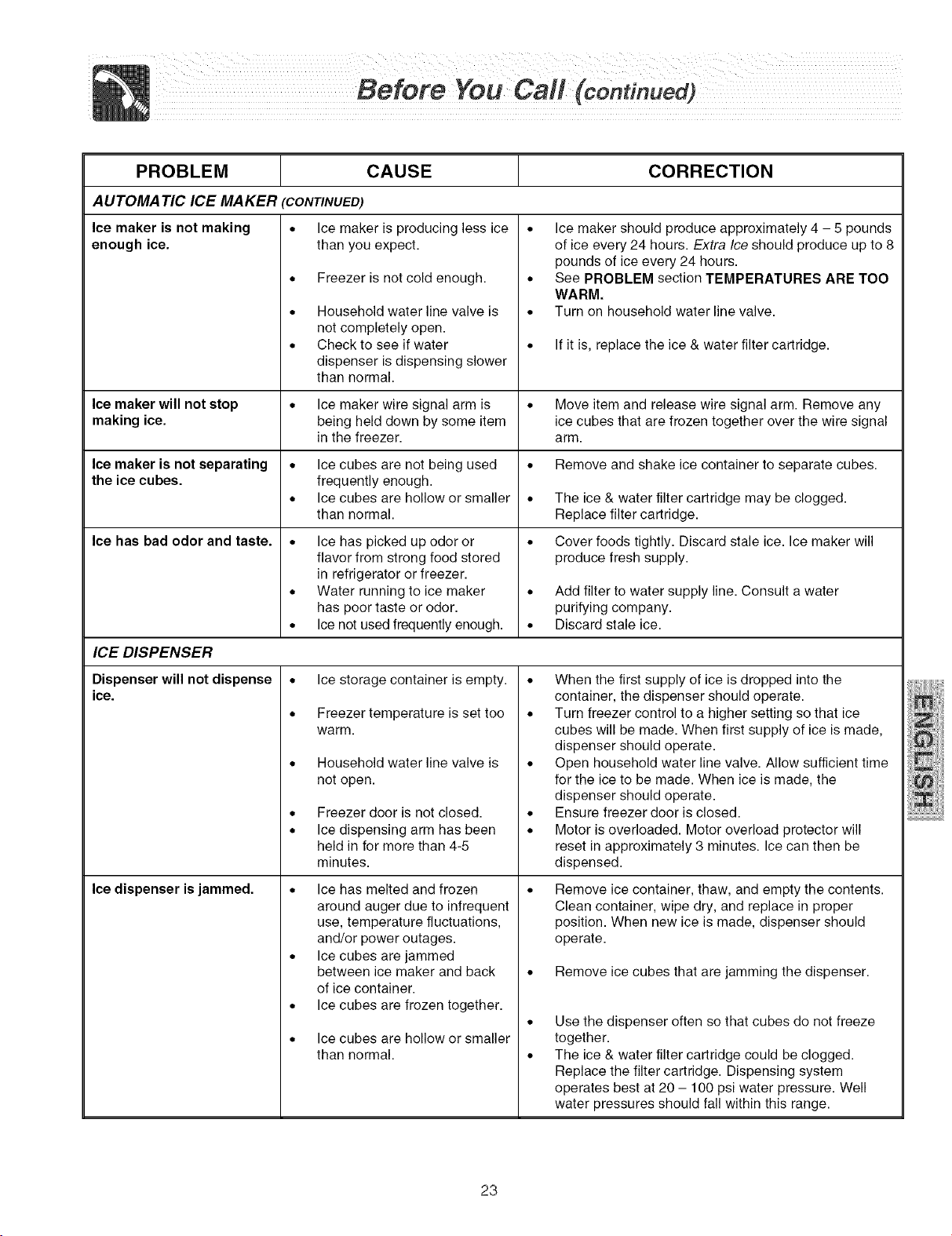
PROBLEM 1 CAUSE
AUTOMA TIC ICE MAKER (CONTINUED)
Ice maker is not making • Ice maker is producing less ice
enough ice. than you expect.
l CORRECTION
Ice maker will not stop
making ice.
Ice maker is not separating
the ice cubes.
Ice has bad odor and taste.
• Freezer is not cold enough.
• Household water line valve is
not completely open.
• Check to see if water
dispenser is dispensing slower
than normal.
Ice maker wire signal arm is
being held down by some item
in the freezer.
Ice cubes are not being used
frequently enough.
Ice cubes are hollow or smaller
than normal.
Ice has picked up odor or
flavor from strong food stored
in refrigerator or freezer.
Water running to ice maker
has poor taste or odor.
Ice not used frequently enough.
• Ice maker should produce approximately 4 - 5 pounds
of ice every 24 hours. Extra Ice should produce up to 8
pounds of ice every 24 hours.
• See PROBLEM section TEMPERATURES ARE TOO
WARM.
• Turn on household water line valve.
• If it is, replace the ice & water filter cartridge.
Move item and release wire signal arm. Remove any
ice cubes that are frozen together over the wire signal
arm.
Remove and shake ice container to separate cubes.
The ice & water filter cartridge may be clogged.
Replace filter cartridge.
Cover foods tightly. Discard stale ice. Ice maker will
produce fresh supply.
• Add filter to water supply line. Consult a water
purifying company.
• Discard stale ice.
ICE DISPENSER
Dispenser will not dispense
ice.
Ice dispenser is jammed.
Ice storage container is empty.
Freezer temperature is set too
warm.
Household water line valve is
not open.
Freezer door is not closed.
Ice dispensing arm has been
held in for more than 4-5
minutes.
• Ice has melted and frozen
around auger due to infrequent
use, temperature fluctuations,
and/or power outages.
• Ice cubes are jammed
between ice maker and back
of ice container.
• Ice cubes are frozen together.
Ice cubes are hollow or smaller
than normal.
• When the first supply of ice is dropped into the
container, the dispenser should operate.
• Turn freezer control to a higher setting so that ice
cubes will be made. When first supply of ice is made,
dispenser should operate.
• Open household water line valve. Allow sufficient time
for the ice to be made. When ice is made, the
dispenser should operate.
• Ensure freezer door is closed.
• Motor is overloaded. Motor overload protector will
reset in approximately 3 minutes. Ice can then be
dispensed.
Remove ice container, thaw, and empty the contents.
Clean container, wipe dry, and replace in proper
position. When new ice is made, dispenser should
operate.
• Remove ice cubes that are jamming the dispenser.
Use the dispenser often so that cubes do not freeze
together.
The ice & water filter cartridge could be clogged.
Replace the filter cartridge. Dispensing system
operates best at 20 - 100 psi water pressure. Well
water pressures should fall within this range.
23
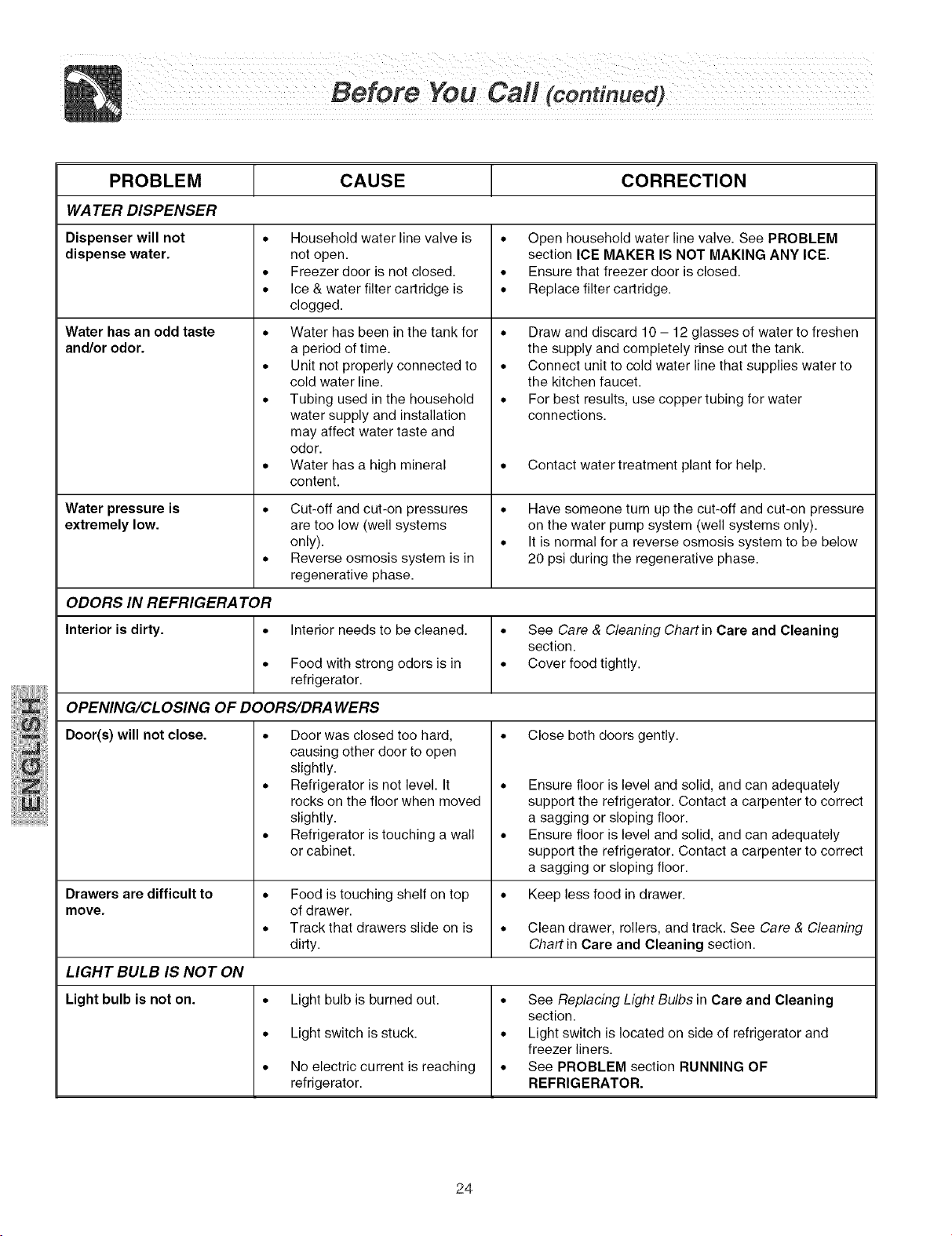
/
PROBLEM [ CAUSE CORRECTION
WATER DISPENSER
Dispenser will not Household water line valve is • Open household water line valve. See PROBLEM
dispense water, not open. section ICE MAKER IS NOT MAKING ANY ICE.
Freezer door is not closed. • Ensure that freezer door is closed.
Ice & water filter cartridge is • Replace filter cartridge.
clogged.
Water has an odd taste
and/or odor.
Water has been in the tank for
a period of time.
Unit not properly connected to
cold water line.
Tubing used in the household
water supply and installation
may affect water taste and
odor.
Water has a high mineral
content.
• Draw and discard 10 - 12 glasses of water to freshen
the supply and completely rinse out the tank.
• Connect unit to cold water line that supplies water to
the kitchen faucet.
• For best results, use copper tubing for water
connections.
• • Contact water treatment plant for help.
Water pressure is • Cut-off and cut-on pressures • Have someone turn up the cut-off and cut-on pressure
extremely low. are too low (well systems on the water pump system (well systems only).
only). • It is normal for a reverse osmosis system to be below
• Reverse osmosis system is in 20 psi during the regenerative phase.
regenerative phase.
ODORS IN REFRIGERATOR
Interior is dirty. • Interior needs to be cleaned. • See Care & Cleaning Chart in Care and Cleaning
section.
• Food with strong odors is in • Cover food tightly.
refrigerator.
OPENING/CLOSING OF DOORS/DRA WERS
Door(s) will not close. • • Close both doors gently.Door was closed too hard,
causing other door to open
slightly.
Refrigerator is not level. It
rocks on the floor when moved
slightly.
Refrigerator is touching a wall
or cabinet.
• Ensure floor is level and solid, and can adequately
support the refrigerator. Contact a carpenter to correct
a sagging or sloping floor.
• Ensure floor is level and solid, and can adequately
support the refrigerator. Contact a carpenter to correct
a sagging or sloping floor.
Drawers are difficult to • Food is touching shelf on top • Keep less food in drawer.
move. of drawer.
• Track that drawers slide on is • Clean drawer, rollers, and track. See Care & Cleaning
dirty. Chart in Care and Cleaning section.
LIGHT BULB IS NOT ON
Light bulb is not on. • Light bulb is burned out.
• Light switch is stuck.
• No electric current is reaching
refrigerator.
• See Replacing Light Bulbs in Care and Cleaning
section.
• Light switch is located on side of refrigerator and
freezer liners.
• See PROBLEM section RUNNING OF
REFRIGERATOR.
24