DRYERUSERINSTRUCTIONS
INSTRUCCIONESPARAEL USUARIODELASECADORA
TableofContents/Indice
ASSISTANCE OR SERVICE ............................. 1
DRYER SAFETY ................................................ 2
DRYER USE ...................................................... 4
DRYER CARE .................................................... 5
TROUBLESHOOTING ....................................... 6
WARRANTY ....................................................... 8
AYUDA O SERVICIO T¢CNICO ...................... 9
SEGURIDAD DE LA SECADORA .................... 9
USO DE LA SECADORA ................................ 11
CUIDADO DE LA SECADORA ...................... 13
SOLUCION DE PROBLEMAS ....................... 14
GARANTiA ..................................................... 16
AssistanceorService
If you need assistance or service, first see the "Troubleshooting"
section. Additional help is available by calling our Customer
Interaction Center at 1-800-253-1301 from anywhere in the
U.S.A., or write:
Whirlpool Corporation
Customer Interaction Center
553 Benson Road
Benton Harbor, MI 49022-2692.
Please include a daytime phone number in your correspondence.
To order parts and accessories, call 1-800-442-9991 or visit our
website at www.whirlpool.com.
Keep this book and your sales slip together for future
reference. You must provide proof of purchase or installation
date for in-warranty service.
Write down the following information about your appliance to help
you obtain assistance or service if you ever need it. You will need
to know your complete model number and serial number. You can
find this information on the model and serial number label, located
at the top inside dryer door well.
Dealer name
Serial number
Address
Phone number
Model number
Purchase date
8578183
Whl_] ol °
TOI)O LO QUE I_AGINAS TM
DRYERSAFETY
Your safety and the safety of others are very important.
We have provided many important safety messages in this manual and on your appliance. Always read and obey all safety
messages.
This is the safety alert symbol.
This symbol alerts you to potential hazards that can kill or hurt you and others.
All safety messages will follow the safety alert symbol and either the word "DANGER" or "WARNING."
These words mean:
You can be killed or seriously injured if you don't immediately
follow instructions.
You can be killed or seriously injured if you don't follow
instructions.
All safety messages will tell you what the potential hazard is, tell you how to reduce the chance of injury, and tell you what can
happen if the instructions are not followed.
iMPORTANT SAFETY iNSTRUCTiONS
WARNING: To reduce the risk of fire, electric shock, or injury to persons when using the dryer, follow basic precautions,
including the following:
[]
[]
Read all instructions before using the dryer.
Do not place items exposed to cooking oils in your dryer.
Items contaminated with cooking oils may contribute to
a chemical reaction that could cause a load to catch fire.
Do not repair or replace any part of the dryer or attempt
any servicing unless specifically recommended in this
Use and Care Guide or in published user-repair instruc-
tions that you understand and have the skills to carry out.
[] Do not dry articles that have been previously cleaned in,
washed in, soaked in, or spotted with gasoline, dry-
cleaning solvents, other flammable, or explosive
substances as they give off vapors that could ignite or
explode.
[] Do not allow children to play on or in the dryer. Close
supervision of children is necessary when the dryer is
used near children.
[] Before the dryer is removed from service or discarded,
remove the door to the drying compartment.
[] Do not reach into the dryer if the drum is moving.
[] Do not install or store the dryer where it will be exposed
to the weather.
[] Do not tamper with controls.
[] Do not use fabric softeners or products to eliminate static
unless recommended by the manufacturer of the fabric
softener or product.
[] Do not use heat to dry articles containing foam rubber or
similarly textured rubber-like materials.
[] Clean lint screen before or after each load.
[] Keep area around the exhaust opening and adjacent sur-
rounding areas free from the accumulation of lint,dust,
and dirt.
[] The interior of the dryer and exhaust vent should be
cleaned periodically by qualified service personnel.
[] See installation instructions for grounding requirements.
SAVE THESE iNSTRUCTiONS
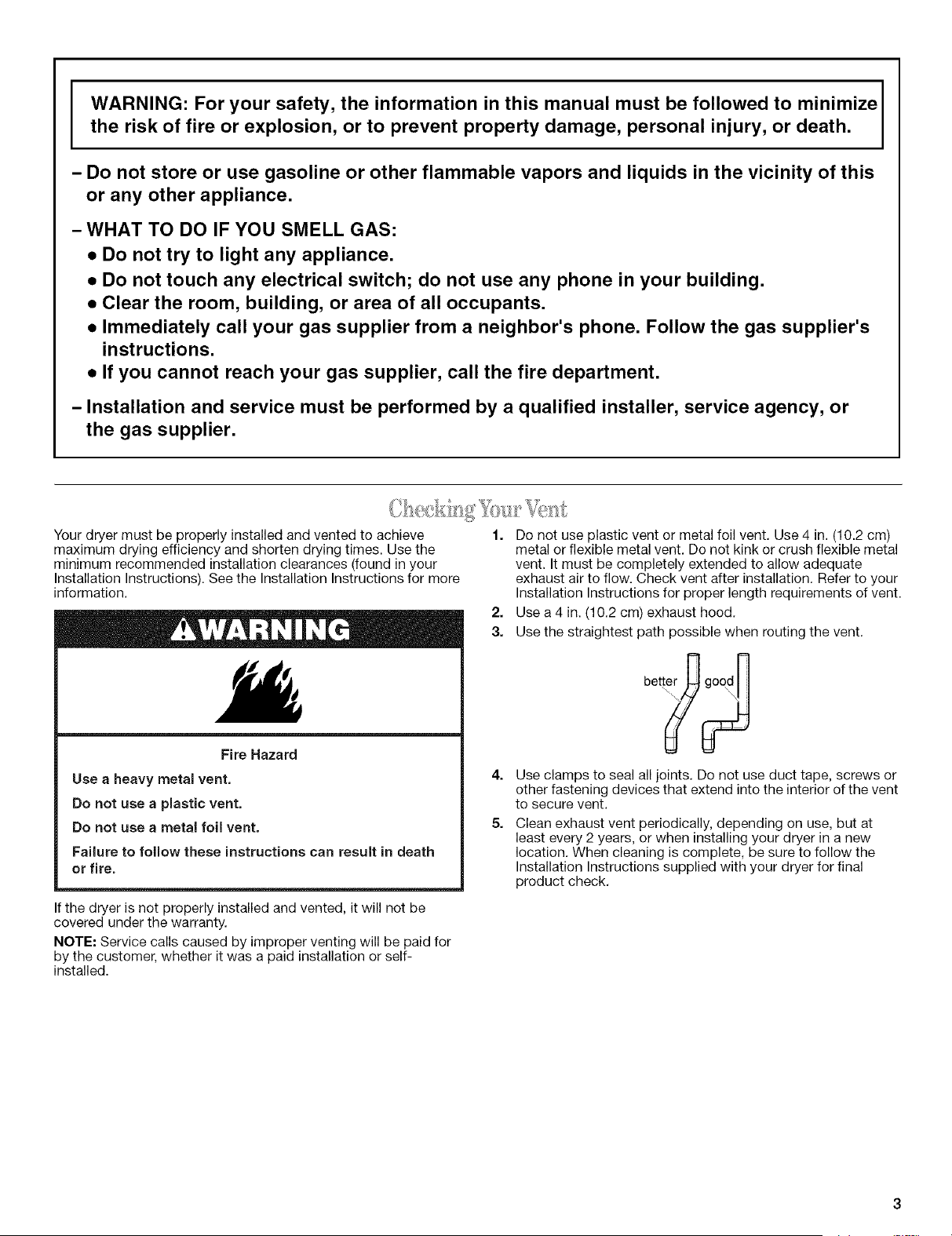
WARNING: For your safety, the information in this manual must be followed to minimize
the risk of fire or explosion, or to prevent property damage, personal injury, or death.
- Do not store or use gasoline or other flammable vapors and liquids in the vicinity of this
or any other appliance.
- WHAT TO DO IF YOU SMELL GAS:
• Do not try to light any appliance.
• Do not touch any electrical switch; do not use any phone in your building.
• Clear the room, building, or area of all occupants.
• Immediately call your gas supplier from a neighbor's phone. Follow the gas supplier's
instructions.
• If you cannot reach your gas supplier, call the fire department.
- Installation and service must be performed by a qualified installer, service agency, or
the gas supplier.
Your dryer must be properly installed and vented to achieve
maximum drying efficiency and shorten drying times. Use the
minimum recommended installation clearances (found in your
Installation Instructions). See the Installation Instructions for more
information.
Fire Hazard
Use a heavy metal vent.
Do not use a plastic vent.
Do not use a metal foil vent.
Failure to fellow these instructions can result in death
or fire.
If the dryer is not properly installed and vented, it will not be
covered under the warranty.
NOTE: Service calls caused by improper venting will be paid for
by the customer, whether it was a paid installation or self-
installed.
1. Do not use plastic vent or metal foil vent. Use 4 in. (10.2 cm)
metal or flexible metal vent. Do not kink or crush flexible metal
vent. It must be completely extended to allow adequate
exhaust air to flow. Check vent after installation. Refer to your
Installation Instructions for proper length requirements of vent.
2. Use a 4 in. (10.2 cm) exhaust hood.
3. Use the straightest path possible when routing the vent.
4.
5.
Use clamps to seal all joints. Do not use duct tape, screws or
other fastening devices that extend into the interior of the vent
to secure vent.
Clean exhaust vent periodically, depending on use, but at
least every 2 years, or when installing your dryer in a new
location. When cleaning is complete, be sure to follow the
Installation Instructions supplied with your dryer for final
product check.
DRYERUSE
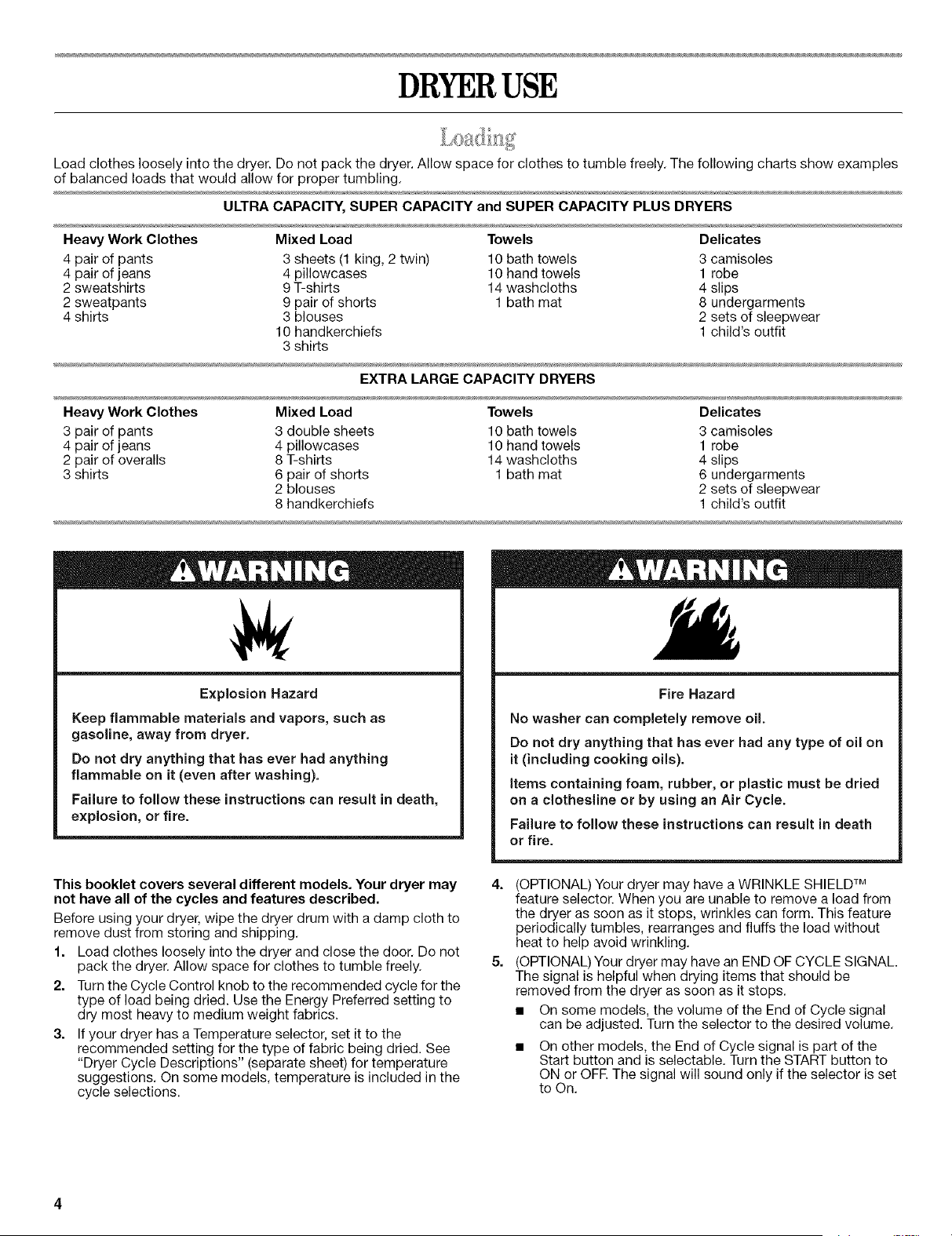
Load clothes loosely into the dryer. Do not pack the dryer. Allow space for clothes to tumble freely. The following charts show examples
of balanced loads that would allow for proper tumbling.
ULTRA CAPACITY, SUPER CAPACITY and SUPER CAPACITY PLUS DRYERS
Heavy Work Clothes Mixed Load Towels Delicates
4 pair of pants 3 sheets (1 king, 2 twin) 10 bath towels 3 camisoles
4 pair of jeans 4 pillowcases 10 hand towels 1 robe
2 sweatshirts 9T-shirts 14 washcloths 4 slips
2 sweatpants 9 pair of shorts 1 bath mat 8 undergarments
4 shirts 3 blouses 2 sets of sleepwear
10 handkerchiefs 1 child's outfit
3 shirts
EXTRA LARGE CAPACITY DRYERS
Heavy Work Clothes Mixed Load Towels Delicates
3 pair of pants 3 double sheets 10 bath towels 3 camisoles
4 pair of jeans 4 pillowcases 10 hand towels 1 robe
2 pair of overalls 8 T-shirts 14 washcloths 4 slips
3 shirts 6 pair of shorts 1 bath mat 6 undergarments
2 blouses 2 sets of sleepwear
8 handkerchiefs 1 child's outfit
Explosion Hazard
Keep flammable materials and vapors, such as
gasoline, away from dryer.
Do not dry anything that has ever had anything
flammable on it (even after washing).
Failure to follow these instructions can result in death,
explosion, or fire.
This booklet covers several different models. Your dryer may
not have all of the cycles and features described.
Before using your dryer, wipe the dryer drum with a damp cloth to
remove dust from storing and shipping.
f. Load clothes loosely into the dryer and close the door. Do not
pack the dryer. Allow space for clothes to tumble freely.
2. Turn the Cycle Control knob to the recommended cycle for the
type of load being dried. Use the Energy Preferred setting to
dry most heavy to medium weight fabrics.
3. If your dryer has aTemperature selector, set it to the
recommended setting for the type of fabric being dried. See
"Dryer Cycle Descriptions" (separate sheet) for temperature
suggestions. On some models, temperature is included in the
cycle selections.
Fire Hazard
No washer can completely remove oil.
Do not dry anything that has ever had any type of oil on
it (including cooking oils).
items containing foam, rubber, or plastic must be dried
on a clothesline or by using an Air Cycle.
Failure to follow these instructions can result in death
or fire.
(OPTIONAL) Your dryer may have a WRINKLE SHIELD TM
feature selector. When you are unable to remove a load from
the dryer as soon as it stops, wrinkles can form. This feature
periodically tumbles, rearranges and fluffs the load without
heat to help avoid wrinkling.
(OPTIONAL) Your dryer may have an END OF CYCLE SIGNAL.
The signal is helpful when drying items that should be
removed from the dryer as soon as it stops.
• On some models, the volume of the End of Cycle signal
can be adjusted. Turn the selector to the desired volume.
• On other models, the End of Cycle signal is part of the
Start button and is selectable. Turn the START button to
ON or OFR The signal will sound only if the selector is set
to On.
6. SelectthedesiredOption.See"DryerCycleDescriptions"
(separatesheet).
7. Ifdesired,addfabricsoftenersheet.Useonlyoneslabeledas
dryersafe.Followpackageinstructions.
8. PushtheSTARTbutton.
Stopping and Restarting
You can stop your dryer anytime during a cycle.
To stop your dryer
Open the dryer door or turn the Cycle Control knob to OFE
NOTE: The Cycle Control knob should point to an Off area when
the dryer is not in use.
To restart your dryer
Close the door. Select a new cycle and temperature (if desired).
Push the START button.
Use the Drying Rack to dry items such as sweaters and pillows
without tumbling. The drum turns, but the rack does not move.
If your model does not have a drying rack, you may be able to
purchase one for your model. Tofind out if your model allows drying
rack usage and for ordering information, please refer to the front
page of your manual or contact the dealer from whom you
purchased your dryer.
NOTE: The rack must be removed for normal tumbling. Do not
use the automatic cycle with the drying rack.
To use the drying rack
1. Place drying rack in dryer.
Style 1: Your drying rack has front legs. Slide rear pegs into
the dimples on the back wall of the dryer. Lower the front legs
to rest on the dryer opening.
Style 2: Your drying rack does NOT have front legs. Do not
remove the lint screen. Slide drying rack over the bottom of
the dryer door opening. Push down to secure rack on frame.
2. Put wet items on top of rack, leaving space between items.
Do not allow items to hang over the edge of the rack. Close
the door.
3. Select a timed drying cycle and temperature, or an air cycle.
Items containing foam, rubber, or plastic must be dried on a
clothesline or by using an air cycle. Refer to the following
table.
4. Start the dryer. Reset cycle to complete drying, if needed.
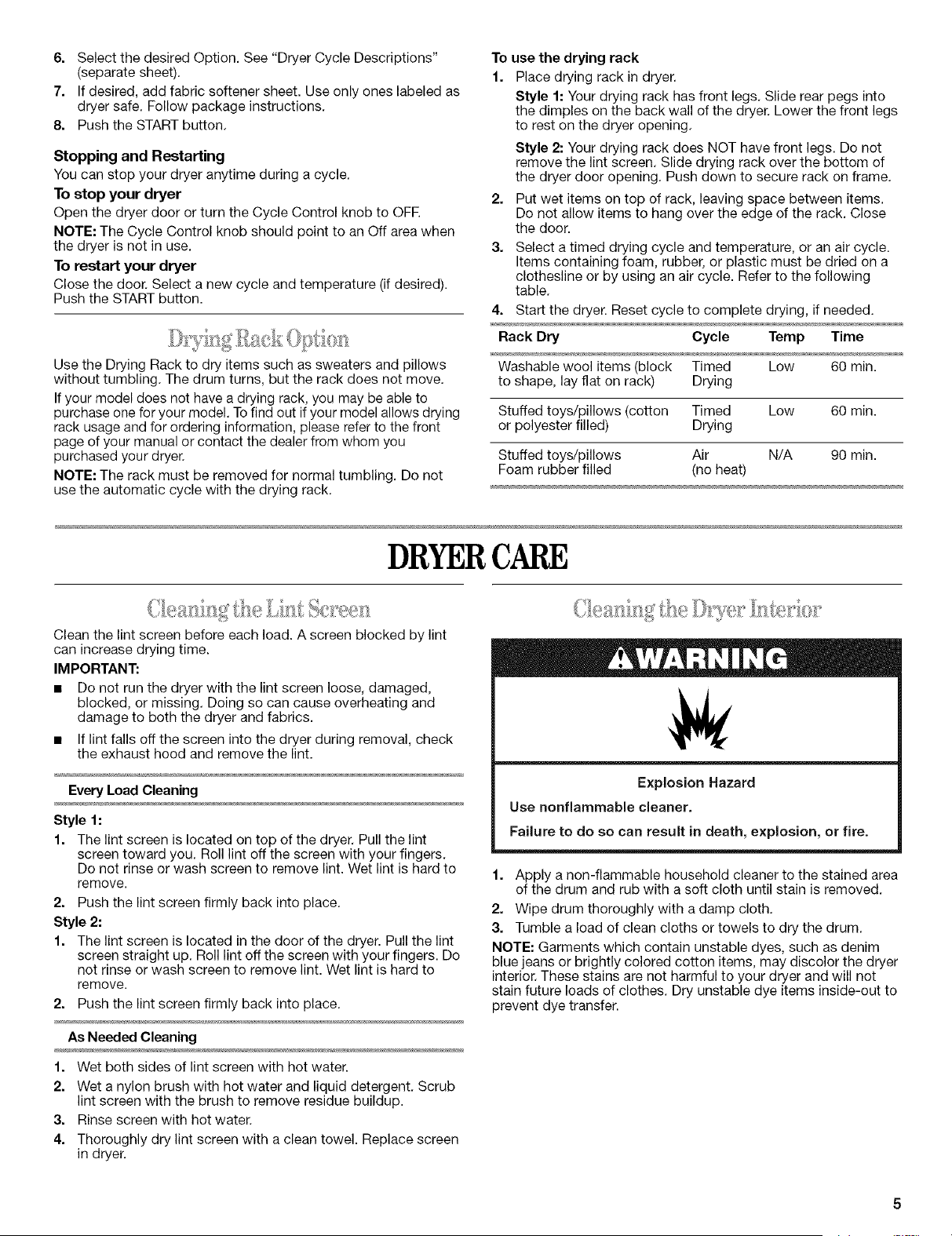
Rack Dry Cycle Temp Time
Washable wool items (block Timed Low 60 rain.
to shape, lay flat on rack) Drying
Stuffed toys/pillows (cotton Timed Low 60 min.
or polyester filled) Drying
Stuffed toys/pillows Air N/A 90 min.
Foam rubber filled (no heat)
DRYERCARE
Clean the lint screen before each load. A screen blocked by lint
can increase drying time.
IMPORTANT:
• Do not run the dryer with the lint screen loose, damaged,
blocked, or missing. Doing so can cause overheating and
damage to both the dryer and fabrics.
• If lint falls off the screen into the dryer during removal, check
the exhaust hood and remove the lint.
Every Load Cleaning
Style 1:
1. The lint screen is located on top of the dryer. Pull the lint
screen toward you. Roll lint off the screen with your fingers.
Do not rinse or wash screen to remove lint. Wet lint is hard to
remove.
2. Push the lint screen firmly back into place.
Style 2:
1. The lint screen is located in the door of the dryer. Pull the lint
screen straight up. Roll lint off the screen with your fingers. Do
not rinse or wash screen to remove lint. Wet lint is hard to
remove.
2. Push the lint screen firmly back into place.
As Needed Cleaning
1. Wet both sides of lint screen with hot water.
2. Wet a nylon brush with hot water and liquid detergent. Scrub
lint screen with the brush to remove residue buildup.
3. Rinse screen with hot water.
4. Thoroughly dry lint screen with a clean towel. Replace screen
in dryer.
Explosion Hazard
Use nonflammable cleaner.
Failure to do so can result in death, explosion, or fire.
1. Apply a non-flammable household cleaner to the stained area
of the drum and rub with a soft cloth until stain is removed.
2. Wipe drum thoroughly with a damp cloth.
3. Tumble a load of clean cloths or towels to dry the drum.
NOTE: Garments which contain unstable dyes, such as denim
blue jeans or brightly colored cotton items, may discolor the dryer
interior. These stains are not harmful to your dryer and will not
stain future loads of clothes. Dry unstable dye items inside-out to
prevent dye transfer.
From Inside the Dryer Cabinet
Lint should be removed every 2 years, or more often, depending
on dryer usage. Cleaning should be done by a qualified person.
From Inside the Exhaust Vent
Lint should be removed every 2 years, or more often, depending
on dryer usage.
1. Unplug dryer or disconnect power.
2. Open the dryer door. Locate the light bulb cover on the back
wall of the dryer. Remove the screw located in the lower right
corner of the cover. Remove the cover.
3. Turn bulb counterclockwise. Replace the bulb with a 10-watt
appliance bulb only. Replace the cover and secure with the
screw.
4. Plug in dryer or reconnect power.
TROUBLESHOOTING
Firsttry the solutions suggested here and possibly avoid the cost of a service call...
Dryer will not run
• Checkthe following:
Is the power cord plugged in?
Has a fuse blown, or has a circuit breaker tripped? There
may be 2 fuses or circuit breakers for the dryer. Check to
make sure both fuses are intact and tight, or that both circuit
breakers have not tripped.
Was a regular fuse used? Use a time-delay fuse.
Is the dryer door firmly closed?
Was the START button firmly pressed?
Is a cycle selected?
No heat
• Has a fuse blown, or a circuit breaker tripped? Electric
dryers use 2 household fuses or breakers. The drum may be
turning, but you may not have heat.
• Has an air dry cycle been selected? Select the right cycle
for the types of garments being dried.
• For gas dryers, is the valve open on the supply line?
Unusual sounds
• Has the dryer had a period of non-use? Ifthe dryer hasn't
been used for a while, there may be a thumping sound during
the first few minutes of operation.
• Is it a gas dryer? The gas valve clicking is a normal operating
sound.
Clothes are not drying satisfactorily
• Checkthe following:
Is the lint screen clogged with lint?
Is the exhaust vent or outside exhaust hood clogged with lint,
restricting air movement? Run the dryer for 5-10 minutes.
Hold your hand under the outside exhaust hood to check air
movement. Ifyou do not feel air movement, clean exhaust
system of lint or replace exhaust vent with heavy metal or
flexible metal vent. See your Installation Instructions.
Is the exhaust vent crushed or kinked? Replace with heavy
metal or flexible metal vent. See your Installation Instructions.
Are fabric softener sheets blocking the grille? Use only one
fabric softener sheet, and use it only once.
• Is the dryer located in a room with temperature below
45°F (7°C)? Proper operation of dryer cycles requires
temperatures above 45°F (7°C).
• Was a cold rinse water used? Was the load very wet?
Expect longer drying times with items rinsed in cold water and
with items that hold moisture (cottons).
• Is the load too large and heavy to dry quickly? Separate the
load to tumble freely.
Lint on load
• Is the lint screen clogged? Clean lint screen. Check for air
movement.
• Is the load properly sorted? Sort lint givers (towels, chenille)
from lint takers (corduroy, synthetics). Also sort by color.
• Is the load too big or too heavy? Dry smaller loads so lint
can be carried to the lint screen.
• Was the load overdried? Use correct dryer settings for load
type. Overdrying can cause lint-attracting static electricity.
See "Dryer Cycle Descriptions" (separate sheet).
• Was paper or tissue left in pockets?
• Is pilling being mistaken for lint? Pilling (surface fuzz) is
caused by normal wear and laundering.
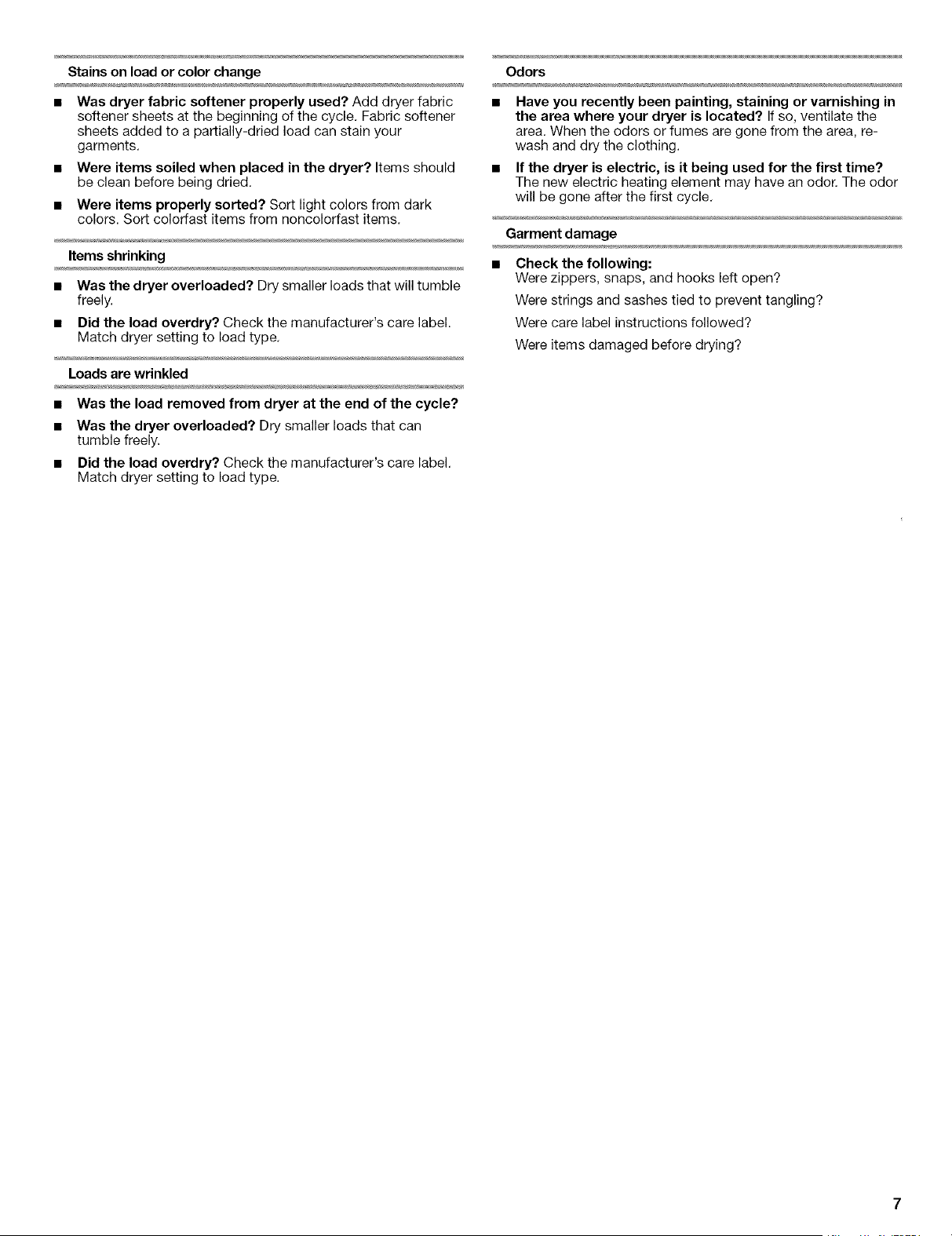
Stains on load or color change
• Was dryer fabric softener properly used? Add dryer fabric
softener sheets at the beginning of the cycle, Fabric softener
sheets added to a partially-dried load can stain your
garments,
• Were items soiled when placed in the dryer? Items should
be clean before being dried,
• Were items properly sorted? Sort light colors from dark
colors. Sort colorfast items from noncolorfast items.
Items shrinking
• Was the dryer overloaded? Dry smaller loads that will tumble
freely.
• Did the load overdry? Check the manufacturer's care label.
Match dryer setting to load type,
Loads are wrinkled
• Was the load removed from dryer at the end of the cycle?
• Was the dryer overloaded? Dry smaller loads that can
tumble freely.
• Did the load overdry? Check the manufacturer's care label.
Match dryer setting to load type.
Odors
• Have you recently been painting, staining or varnishing in
the area where your dryer is located? Ifso, ventilate the
area. When the odors or fumes are gone from the area, re-
wash and dry the clothing.
• If the dryer is electric, is it being used for the first time?
The new electric heating element may have an odor. The odor
will be gone after the first cycle.
Garment damage
• Checkthe following:
Were zippers, snaps, and hooks left open?
Were strings and sashes tied to prevent tangling?
Were care label instructions followed?
Were items damaged before drying?
WHIRLPOOLCORPORATIONMAJORAPPLIANCEWARRANTY
ONE YEAR LIMITED WARRANTY
For one year from the date of purchase, when this major appliance is operated and maintained according to instructions attached to or
furnished with the product, Whirlpool Corporation or Whirlpool Canada LP (hereafter 'Whirlpool') will pay for FSP _replacement parts
and repair labor to correct defects in materials or workmanship. Service must be provided by a Whirlpool designated service company.
ITEMS WHIRLPOOL WILL NOT PAY FOR
1. Service calls to correct the installation of your major appliance, to instruct you how to use your major appliance, to replace or repair
house fuses or to correct house wiring or plumbing.
2. Service calls to repair or replace appliance light bulbs, air filters or water filters. Those consumable parts are excluded from warranty
coverage.
3. Repairs when your major appliance is used for other than normal, single-family household use.
4. Damage resulting from accident, alteration, misuse, abuse, fire, flood, acts of God, improper installation, installation not in
accordance with electrical or plumbing codes, or use of products not approved by Whirlpool.
5. Any food loss due to refrigerator or freezer product failures.
6. Replacement parts or repair labor costs for units operated outside the United States or Canada.
7. Pickup and delivery. This major appliance is designed to be repaired in the home.
8. Repairs to parts or systems resulting from unauthorized modifications made to the appliance.
g. Expenses for travel and transportation for product service in remote locations.
10. The removal and reinstallation of your appliance if it is installed in an inaccessible location or is not installed in accordance with
published installation instructions.
DISCLAIMER OF IMPLIED WARRANTIES; LIMITATION OF REMEDIES
CUSTOMER'S SOLE AND EXCLUSIVE REMEDY UNDER THIS LIMITED WARRANTY SHALL BE PRODUCT REPAIR AS PROVIDED
HEREIN. IMPLIED WARRANTIES, INCLUDING WARRANTIES OF MERCHANTABILITY OR FITNESS FOR A PARTICULAR PURPOSE,
ARE LIMITED TO ONE YEAR OR THE SHORTEST PERIOD ALLOWED BY LAW. WHIRLPOOL SHALL NOT BE LIABLE FOR
INCIDENTAL OR CONSEQUENTIAL DAMAGES. SOME STATES AND PROVINCES DO NOT ALLOW THE EXCLUSION OR LIMITATION
OF INCIDENTAL OR CONSEQUENTIAL DAMAGES, OR LIMITATIONS ON THE DURATION OF IMPLIED WARRANTIES OF
MERCHANTABILITY OR FITNESS, SO THESE EXCLUSIONS OR LIMITATIONS MAY NOT APPLY TO YOU. THIS WARRANTY GIVES
YOU SPECIFIC LEGAL RIGHTS AND YOU MAY ALSO HAVE OTHER RIGHTS, WHICH VARY FROM STATETO STATE OR PROVINCE
TO PROVINCE.
Outside the 50 United States and Canada, this warranty does not apply. Contact your authorized Whirlpool dealer to determine if
another warranty applies.
If you need service, first see the 'Troubleshooting" section of the Use & Care Guide. After checking 'Troubleshooting,"additio hal help
can be found by checking the 'Assistance or Service'section or by calling Whirlpool. In the U.S.A., call 1-800-253-1301. In Canada,
call 1-800-807-6777. 8/05
Replacement parts
If you need to order replacement parts, we recommend that you
only use FSP factory specified parts. These parts will fit right
and work right because they are made with the same precision
used to build every new WHIRLPOOL ®appliance.
To locate FSP replacement parts in your area:
Call the Customer Interaction Center at 1-800-253-1301, or your
nearest designated service center.
For information on how to contact Whirlpool Corporation, please
see front page of this document.
INSTRUCCIONESPARAELUSUARIODELASECADORA
Ayudaoserviciot cnico
Si necesita ayuda o servicio tecnico, vea primero la secci6n
"Soluci6n de Problemas". Puede obtener asistencia adicional
Ilamando a nuestro Centre de Interacci6n del Cliente al 1-800-
253-1301 desde cualquier lugar de los EE.UU., o escriba a:
Whirlpool Corporation
Customer Interaction Center
553 Benson Road
Benton Harbor, MI 49022-2692
Favor de incluir un nQmero telef6nico de dia en su
correspondencia.
Para ordenar partes y accesorios, Ilame al 1-800-442-9991 o
visite nuestro sitio Web en www.whirlpool.com.
Guarde este libro y su comprobante de venta juntos para
referencia futura. Usted debera proporcionar evidencia de la
compra o una fecha de instalaci6n para obtener servicio bajo
la garantia.
Escriba la siguiente informacidn acerca de su electrodomestico
para ayudarle mejor a obtener ayuda o servicio tecnico si alguna
vez Ilegara a necesitarlo. Debera tenet a mane el nt]mero
completo del modelo y de la serie. Podra encontrar esta
informaci6n en la etiqueta con el nt]mero del modelo y de la serie,
en la cavidad interna superior de la puerta de la secadora.
Nombre del distribuidor
Numero de serie
Direcci6n
Numero de tel6fono
Numero del modelo
Fecha de compra
SEGURIDADDELASECADORA
Su seguridad y la seguridad de los demas es muy importante.
Hemos incluido muchos mensajes importantes de seguridad en este manual yen su electrodomestico. Lea y obedezca siempre
todos los mensajes de seguridad.
Este es el sfmbolo de advertencia de seguridad.
Este simbolo le llama la atencidn sobre peligros potenciales que pueden ocasionar la muerte o una lesidn a
usted y a los demas.
Todos los mensajes de seguridad iran a continuacidn del simbolo de advertencia de seguridad y de la palabra
"PELIGRO" o "ADVERTENCIA". Estas palabras significan:
Si no sigue las instrucciones de inmediato, usted puede
morir o sufrir una lesion grave.
Si no sigue las instrucciones, usted puede morir o sufrir
una lesion grave.
Todos los mensajes de seguridad le diran el peligro potencial, le diran come reducir las posibilidades de sufrir una lesion y Io que
puede suceder si no se siguen las instrucciones.
INSTRUCCIONES IMPORTANTES DE SEGURIDAD
ADVERTENCIA: A fin de reducir el riesgo de incendio, descarga electrica o de daho a las personas que usen
la secadora, deben seguirse las precauciones basicas, incluidas las siguientes:
[] Lea todas las instrucciones antes de usar la secadora.
[] No coloque los objetos expuestos a aceite para cocinar
en su secadora. Los objetos expuestos a aceites para
cocinar pueden contribuir a una reacci6n quimica que
podrfa causar que una carga se inflame.
[] No seque articulos que ya se hayan limpiado, lavado,
remojado o manchado con gasolina, disolventes de
limpieza en seco, u otras sustancias inflamables o
explosivas ya que despiden vapores que pueden
encenderse o causar una explosi6n.
[] No permita que jueguen los ninos sobre o dentro de la
secadora. Es necesaria la cuidadosa vigilancia de los
ni_os toda vez que se use la secadora cerca de ellos.
[] Quite la puerta de la secadora al compartimiento de secado
antes de ponerla fuera de funcionamiento o de descartarla.
[] No introduzca las manos en la secadora cuando el tambor
esta en movimiento.
[] No instale o almacene esta secadora donde estara
expuesta a agua o a la intemperie.
[] No trate de forzar los controles.
[] No repare o reemplace ninguna pieza de la secadora ni
trate de repararla a menos que esto se recomiende
especificamente en el Manual del propietario o en
instrucciones de reparaci6n publicadas para el usuario
que usted comprenda y s61o si cuenta con la experiencia
necesaria para Ilevar a cabo dicha reparaci6n.
[] No utilice suavizadores de tejidos o productos para eliminar
el estatico de prendas a menos que Io recomiende el
fabricante del suavizador de tejidoso las instrucciones del
producto en uso.
[] No utilice calor para secar prendas que contengan espuma
de caucho o materiales de caucho con textura similar.
[] Limpie el filtro de pelusa antes o depues de cada carga
de ropa.
[] Mantenga el area alrededor de la apertura de ventilaci6n
y las areas adyacentes a esta apertura sin pelusa, polvo
o tierra.
[] La parte interior de la maquina y el conducto de
ventilaci6n se deben limpiar peri6dicamente. Esta limpieza
la debe Ilevar a cabo un reparador c alificado.
[] Vea la instrucciones de instalaci6n para los requisitos de
conexi6n a tierra.
GUARDE ESTAS INSTRUCCIONES
ADVERTENCIA: Para su seguridad, la informacibn en este manual debe ser observada
para minimizar el riesgo de incendio o explosibn, o para prevenir dahos a propiedades,
heridas o la muerte.
- No almacene o use gasolina u otros Iiquidos y vapores inflamables cerca de _ste u otro
aparato electrodom_stico.
- PASOS QUE USTED DEBE SEGUIR SI HUELE A GAS:
• No trate de encender ning0n aparato electrodom_stico.
• No toque ning0n enchufe el_ctrico; no use ningOn tel_fono en su edificio.
• Desaloje a todos los ocupantes del cuarto, edificio o area.
• Llame inmediatamente a su proveedor de gas desde el tel_fono de un vecino.
Siga las instrucciones de su proveedor de gas.
• Si usted no puede comunicarse con su proveedor de gas, Ilame al departamento
de bomberos.
- La instalacibn y el servicio deben ser efectuados por un instalador calificado, una
agencia de servicio o por el proveedor de gas.
10
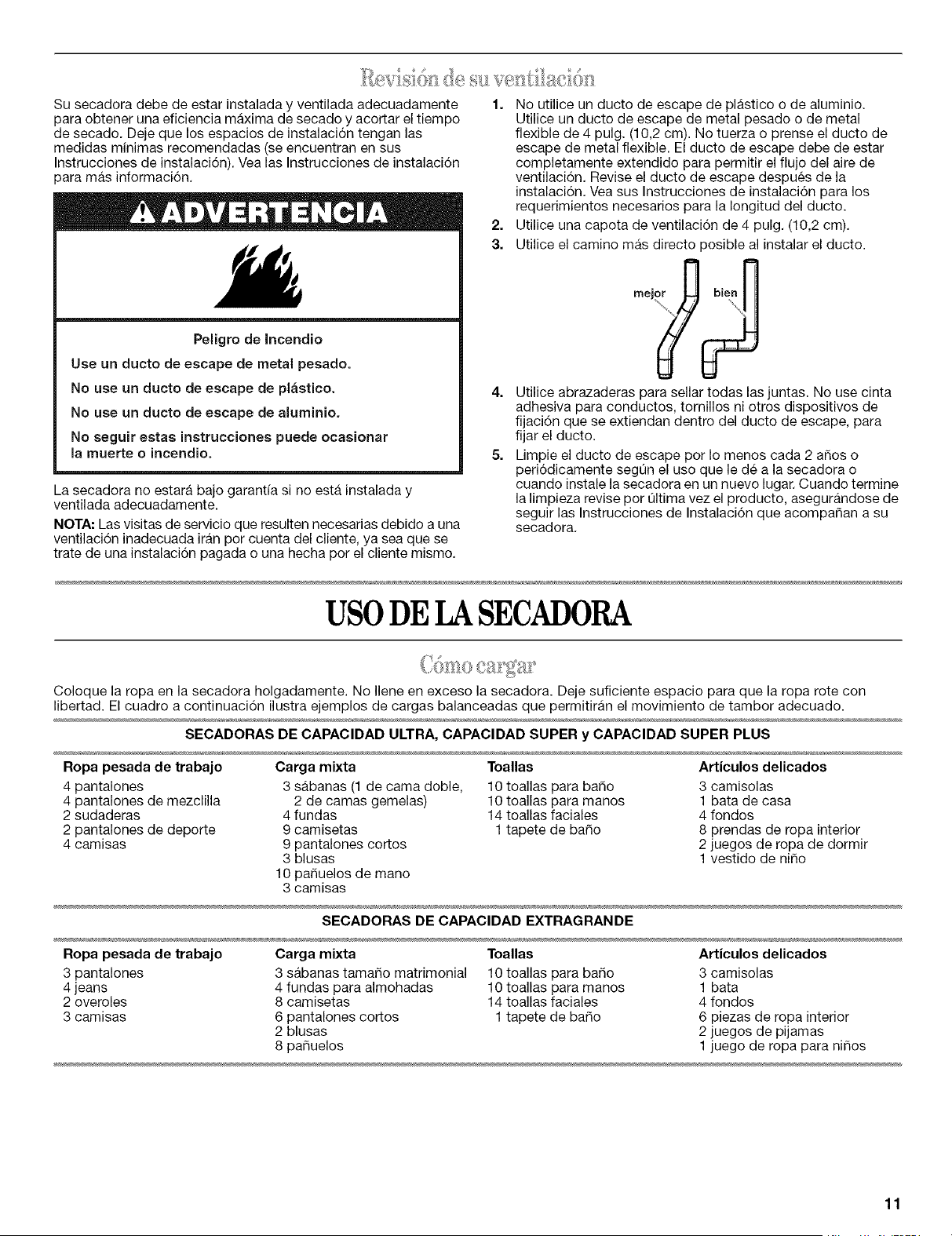
Su secadora debe de estar instalada y ventilada adecuadamente
para obtener una eficiencia maxima de secado y acortar el tiempo
de secado. Deje que los espacios de instalaci6n tengan las
medidas minimas recomendadas (se encuentran ensus
Instrucciones de instalaci6n). Vea las Instrucciones de instalaci6n
)ara mas informaci6n.
Peligro de Incendio
Use un ducto de escape de metal peeado.
No use un ducto de escape de plaetico.
No use un ducto de escape de aluminio.
No eeguir estae instrucciones puede ocasionar
la muerte o incendio.
La secadora no estara bajo garantfa si no esta instalada y
ventilada adecuadamente.
NOTA: Las visitas de servicio que resulten necesarias debido a una
ventilaci6n inadecuada iran por cuenta del cliente, ya sea que se
trate de una instalaci6n pagada o una hecha por el cliente mismo.
1. No utilice un ducto de escape de pMstico o de aluminio.
Utilice un ducto de escape de metal pesado o de metal
flexible de 4 pulg. (10,2 cm). No tuerza o prense el ducto de
escape de metal flexible. El ducto de escape debe de estar
completamente extendido para permitir el flujo del aire de
ventilaci6n. Revise el ducto de escape despues de la
instalaci6n. Vea sus Instrucciones de instalaci6n para los
requerimientos necesarios para la Iongitud del ducto.
2. Utilice una capota de ventilaci6n de 4 pulg. (10,2 cm).
3. Utilice el camino mas directo posible al instalar el ducto.
4. Utilice abrazaderas para sellar todas las juntas. No use cinta
adhesiva para conductos, tornillos ni otros dispositivos de
fijaci6n que se extiendan dentro del ducto de escape, para
fijar el ducto.
5. Limpie el ducto de escape por Io menos cada 2 a_os o
peri6dicamente seg0n el uso que le de a la secadora o
cuando instale la secadora en un nuevo lugar. Cuando termine
la limpieza revise por 01tima vez el producto, asegurandose de
seguir las Instrucciones de Instalaci6n que acompaSan a su
secadora.
USODELASECADORA
Coloque la ropa en la secadora holgadamente. No Ilene en exceso la secadora. Deje suficiente espacio para que la ropa rote con
libertad. El cuadro a continuaci6n ilustra ejemplos de cargas balanceadas que permitiran el movimiento de tambor adecuado.
SECADORAS DE CAPACIDAD ULTRA, CAPACIDAD SUPER y CAPACIDAD SUPER PLUS
Ropa pesada de trabajo
4 pantalones
4 pantalones de mezclilla
2 sudaderas
2 pantalones de deporte
4 camisas
Carga mixta
3 sabanas (1 de cama doble,
2 de camas gemelas)
4 fundas
9 camisetas
9 pantalones cortos
3 blusas
10 pa_uelos de mano
3 camisas
Toallas
10 toallas para bar_o
10 toallas para manos
14 toallas faciales
1 tapete de bar3o
Articulos delicados
3 camisolas
1 bata de casa
4 fondos
8 prendas de ropa interior
2 juegos de ropa de dormir
1 vestido de niSo
SECADORAS DE CAPACIDAD EXTRAGRANDE
Ropa pesada de trabajo
3 pantalones
4 jeans
2 overoles
3 camisas
Carga mixta
3 sabanas tama_o matrimonial
4 fundas para almohadas
8 camisetas
6 pantalones cortos
2 blusas
8 paSuelos
Toallas
10 toallas para ba_o
10 toallas para manos
14 toallas faciales
1 tapete de bar_o
Articulos delicados
3 camisolas
1 bata
4 fondos
6 piezas de ropa interior
2 juegos de pijamas
1 juego de ropa para niSos
11
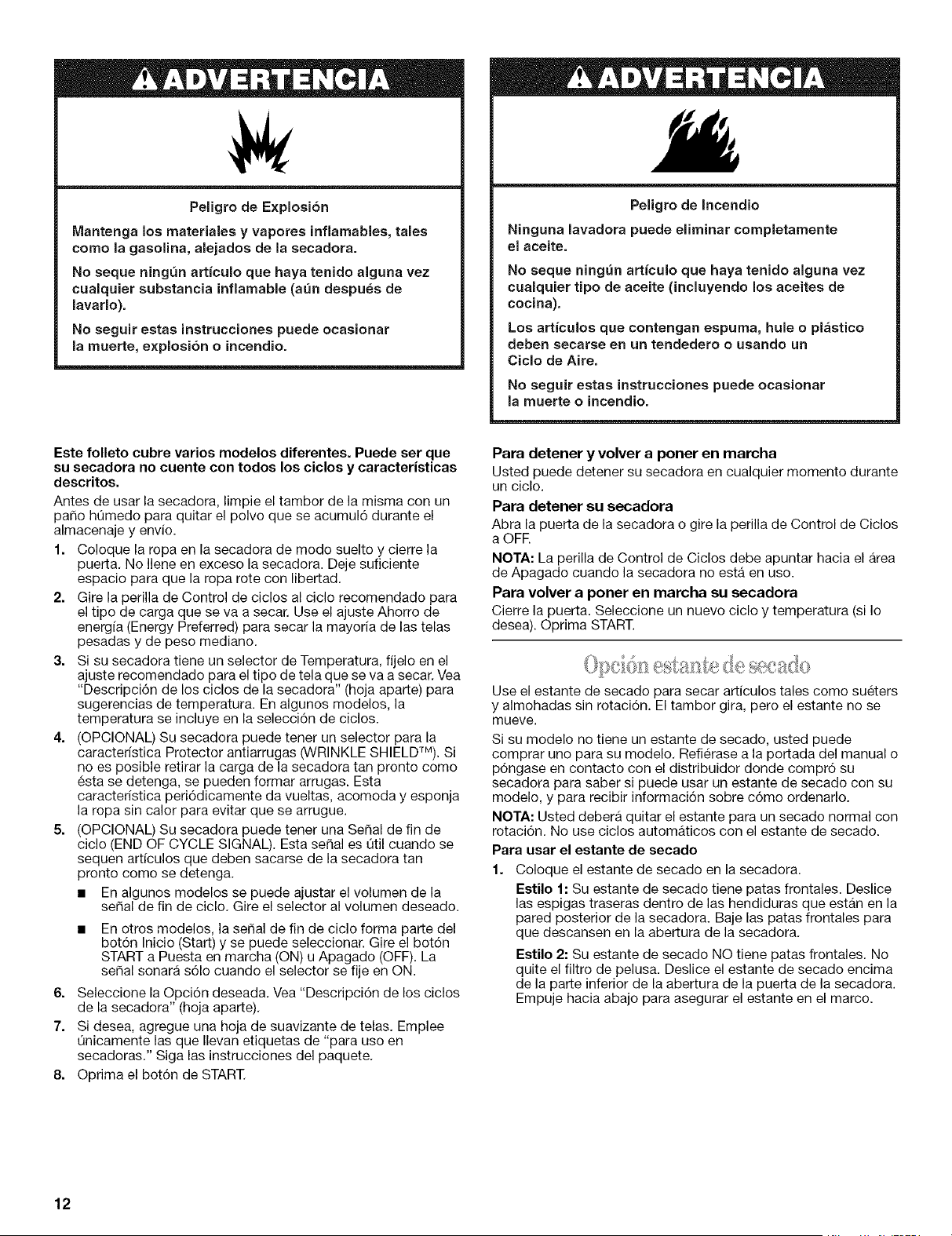
Peligro de Explosi6n
Mantenga los materiales y vapores inflamables, tales
como la gasolina, alejados de la secadora.
No seque ningun articulo que haya tenido alguna vez
cualquier substancia inflamable (aun despues de
lavarlo).
No seguir estas instrucciones puede ocasionar
la muerte, explosi6n o incendio.
Este folleto cubre varios modelos diferentes. Puede ser que
su secadora no cuente con todos los ciclos y caracteristicas
descritos.
Antes de usar la secadora, limpie el tambor de la misma con un
paso ht_medo para quitar el polvo que se acumul6 durante el
almacenaje y envio.
1. Coloque la ropa en la secadora de mode suelto y cierre la
puerta. No Ilene en exceso la secadora. Deje suficiente
espacio para que la ropa rote con libertad.
2. Gire la perilla de Control de ciclos al ciclo recomendado para
el tipo de carga que se va a secar. Use el ajuste Ahorro de
energfa (Energy Preferred) para secar la mayoria de las telas
pesadas y de peso mediano.
3. Si su secadora tiene un selector de Temperatura, fijelo en el
ajuste recomendado para eltipo de tela que se va a secar. Vea
"Descripci6n de los ciclos de la secadora" (hoja aparte) para
sugerencias de temperatura. En algunos modelos, la
temperatura se incluye en la selecci6n de ciclos.
4. (OPCIONAL) Su secadora puede tener un selector para la
caracteristica Protector antiarrugas (WRINKLE SHIELDTM). Si
no es posible retirar la carga de la secadora tan pronto como
esta se detenga, se pueden formar arrugas. Esta
caracteristica peri6dicamente da vueltas, acomoda y esponja
la ropa sin calor para evitar que se arrugue.
5. (OPCIONAL) Su secadora puede tener una SeSal de fin de
ciclo (END OF CYCLE SIGNAL). Esta seSal es t]til cuando se
sequen artfculos que deben sacarse de la secadora tan
pronto como se detenga.
• En algunos modelos se puede ajustar el volumen de la
seSal de fin de ciclo. Gire el selector al volumen deseado.
• En otros modelos, la sepal de fin de ciclo forma parte del
bot6n Inicio (Start) y se puede seleccionar. Gire el bot6n
START a Puesta en marcha (ON) u Apagado (OFF). La
seSal sonara s61o cuando el selector se fije en ON.
6. Seleccione la Opci6n deseada. Vea "Descripci6n de los ciclos
de la secadora" (hoja aparte).
7. Si desea, agregue una hoja de suavizante de telas. Emplee
Qnicamente las que Ilevan etiquetas de "para uso en
secadoras." Siga las instrucciones del paquete.
8. Optima el bot6n de START.
Peligro de Incendio
Ninguna lavadora puede eliminar completamente
el aceite.
No seque ningun art_culo que haya tenido alguna vez
cualquier tipo de aceite (incluyendo los aceites de
cocina).
Los articulos que contengan espuma, hule o plastico
deben secarse en un tendedero o usando un
Ciclo de Aire.
No seguir estas instrucciones puede ocasionar
la muerte o incendio.
Para detener y volver a poner en marcha
Usted puede detener su secadora en cualquier momento durante
un ciclo.
Para detener su secadora
Abra la puerta de la secadora o gire la perilla de Control de Ciclos
a OFR
NOTA: La perilla de Control de Ciclos debe apuntar hacia el Area
de Apagado cuando la secadora no esta en uso.
Para volver a porter en marcha su secadora
Cierre la puerta. Seleccione un nuevo ciclo y temperatura (si Io
desea). Oprima START.
Use el estante de secado para secar articulos tales come sueters
y almohadas sin rotaci6n. El tambor gira, pero el estante no se
mueve.
Si su modelo no tiene un estante de secado, usted puede
comprar uno para su modelo. Refierase a la portada del manual o
p6ngase en contacto con el distribuidor donde compr6 su
secadora para saber si puede usar un estante de secado con su
modelo, y para recibir informaci6n sobre c6mo ordenarlo.
NOTA: Usted debera quitar el estante para un secado normal con
rotaci6n. No use ciclos automaticos con el estante de secado.
Para usar el estante de secado
1. Coloque el estante de secado en la secadora.
Estilo 1: Su estante de secado tiene patas frontales. Deslice
las espigas traseras dentro de las hendiduras que estan en la
pared posterior de la secadora. Baje las patas frontales para
que descansen en laabertura de la secadora.
Estilo 2: Su estante de secado NO tiene patas frontales. No
quite el filtro de pelusa. Deslice el estante de secado encima
de la parte inferior de la abertura de la puerta de la secadora.
Empuje hacia abajo para asegurar el estante en el marco.
12
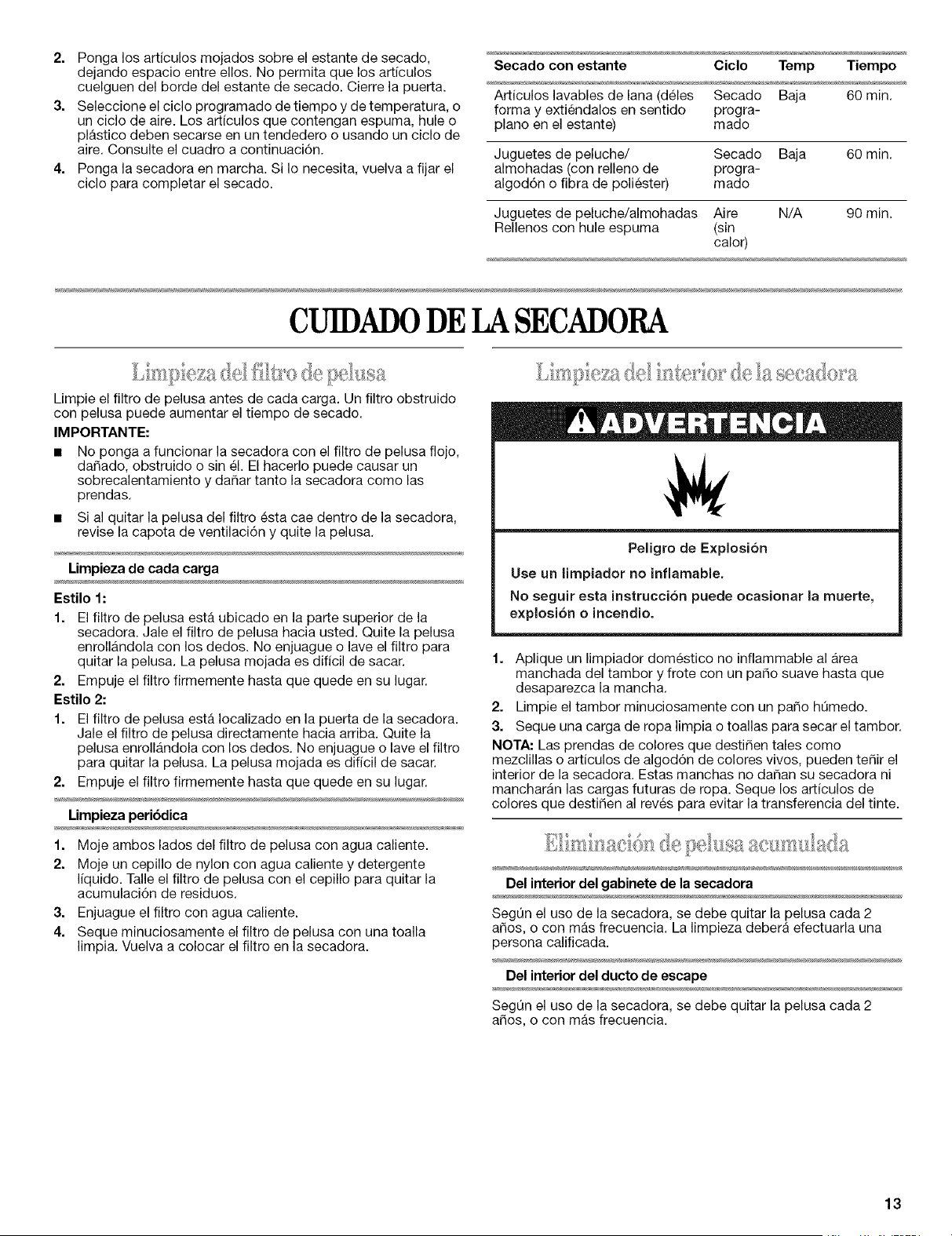
2. Ponga los articulos mojados sobre el estante de secado,
dejando espacio entre ellos. No permita que los articulos
cuelguen del borde del estante de secado. Cierre la puerta.
3. Seleccione el ciclo programado de tiempo y de temperatura, o
un ciclo de aire. Los articulos que contengan espuma, hule o
plastico deben secarse en un tendedero o usando un ciclo de
aire. Consulte el cuadro a continuaci6n.
4. Ponga la secadora en marcha. Si Io necesita, vuelva a fijar el
ciclo para completar el secado.
Secado con estante Ciclo Temp Tiempo
Articulos lavables de lana (deles Secado Baja 60 min.
forma y extiendalos en sentido progra-
plane en el estante) made
Juguetes de peluche/ Secado Baja 60 min.
almohadas (con relleno de progra-
algod6n o fibra de poliester) made
Juguetes de peluche/almohadas Aire N/A 90 min.
Rellenos con hule espuma (sin
calor)
CUIDADODELASECADORA
Limpie el filtro de pelusa antes de cada carga. Un filtro obstruido
con pelusa puede aumentar el tiempo de secado.
IMPORTANTE:
• No ponga afuncionar la secadora con el filtro de pelusa flojo,
da_ado, obstruido o sin el. El hacerlo puede causar un
sobrecalentamiento y dafiar tanto la secadora come las
prendas.
• Sial quitar la pelusa del filtro esta cae dentro de la secadora,
revise la capota de ventilaci6n y quite la pelusa.
Limpieza de cada carga
Estilo 1:
1. El filtro de pelusa esta ubicado en la parte superior de la
secadora. Jale el filtro de pelusa hacia usted. Quite la pelusa
enrollandola con los dedos. No enjuague o lave el filtro para
quitar la pelusa. La pelusa mojada es dificil de sacar.
2. Empuje el filtro firmemente hasta que quede en su lugar.
Estilo 2:
1. El filtro de pelusa esta Iocalizado en la puerta de la secadora.
Jale el filtro de pelusa directamente hacia arriba. Quite la
pelusa enrollandola con los dedos. No enjuague o lave el filtro
para quitar la pelusa. La pelusa mojada es dificil de sacar.
2. Empuje el filtro firmemente hasta que quede en su lugar.
Limpieza peri6dica
1. Moje ambos lades del filtro de pelusa con agua caliente.
2. Moje un cepillo de nylon con agua caliente y detergente
liquido. Talle el filtro de pelusa con el cepillo para quitar la
acumulaci6n de residues.
3. Enjuague el filtro con agua caliente.
4. Seque minuciosamente el filtro de pelusa con una toalla
limpia. Vuelva a colocar el filtro en la secadora.
Peligro de Explosion
Use un limpiador no inflamable,
No seguir eeta inetruccion puede ocasionar la muerte,
explosi6n o incendio.
1. Aplique un limpiador domestico no inflammable al Area
manchada del tambor y frote con un pa_o suave hasta que
desaparezca la mancha.
2. Limpie el tambor minuciosamente con un patio hQmedo.
3. Seque una carga de ropa limpia o toallas para secar el tambor.
NOTA: Las prendas de colores que destifien tales come
mezclillas o articulos de algod6n de colores vivos, pueden tefiir el
interior de la secadora. Estas manchas no dafian su secadora ni
mancharan las cargas futuras de ropa. Seque los articulos de
colores que desti_en al reves para evitar la transferencia del tinte.
Del interior del gabinete de la secadora
Seg_n el use de la secadora, se debe quitar la pelusa cada 2
aries, o con mas frecuencia. La limpieza debera efectuarla una
persona calificada.
Del interior del ducto de escape
Seg_n el use de la secadora, se debe quitar la pelusa cada 2
aries, o con mas frecuencia.
13
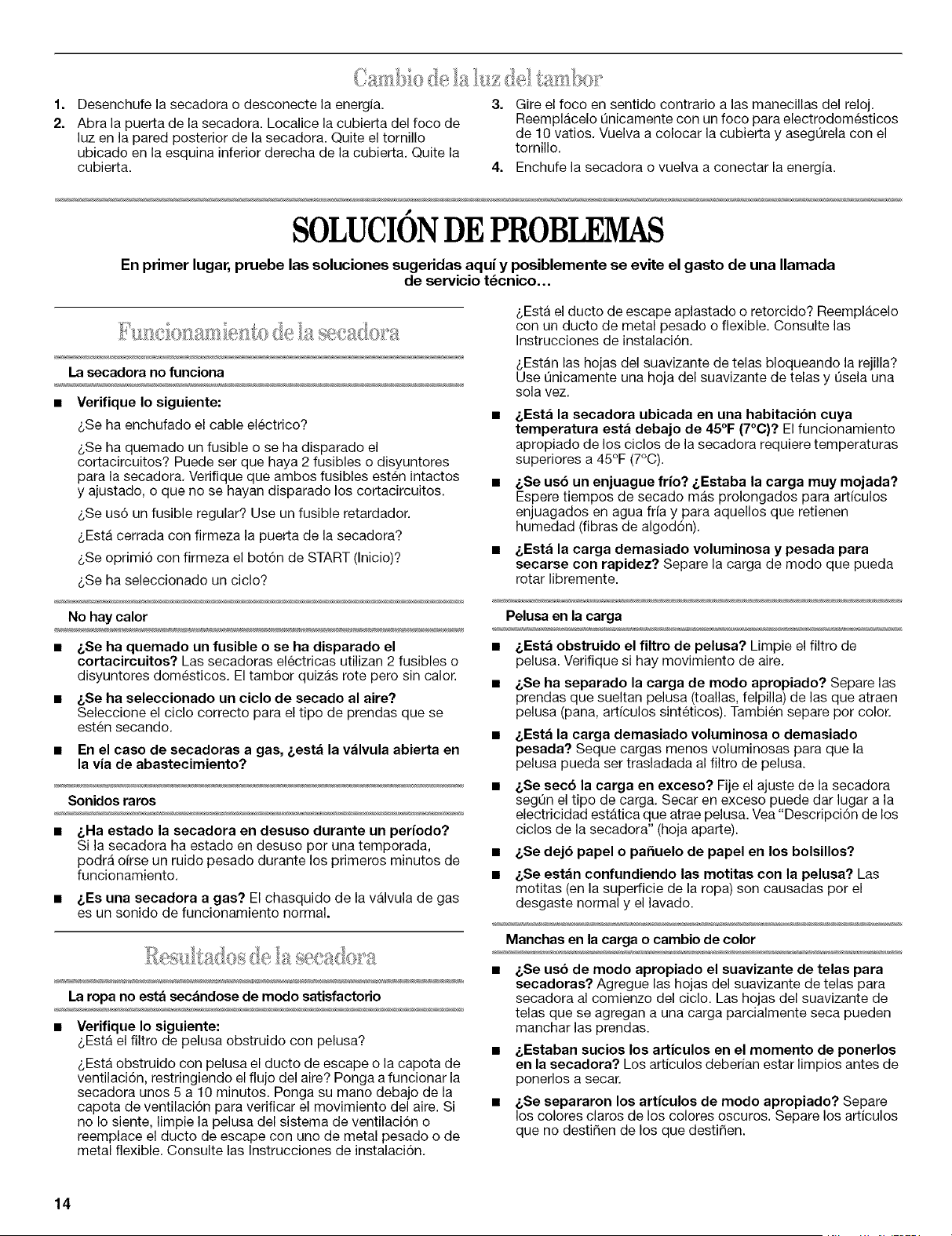
1.
2.
Desenchufe la secadora o desconecte la energia.
Abra la puerta de la secadora. Localice la cubierta del foco de
luz en la pared posterior de la secadora. Quite el tornillo
ubicado en la esquina inferior derecha de la cubierta, Quite la
cubierta.
3. Gire el foco en sentido contrario alas manecillas del reloj.
Reemplacelo Qnicamente con un foco para electrodomesticos
de 10 vatios, Vuelva a colocar la cubierta y asegQrela con el
tornillo,
4. Enchufe la secadora o vuelva a conectar la energia.
p
SOLUCIONDEPROBLEMAS
En primer lugar, pruebe las soluciones sugeridas aqui y posiblemente se evite el gasto de una Ilamada
de servicio t_cnico...
La seeadora no funciona
• Verifique Io siguiente:
i,Se ha enchufado el cable electrico?
_,Seha quemado un fusible o se ha disparado el
cortacircuitos? Puede ser que haya 2 fusibles o disyuntores
para la secadora, Verifique que ambos fusibles esten intactos
y ajustado, o que no se hayan disparado los cortacircuitos.
sSe us6 un fusible regular? Use un fusible retardador.
sEsta cerrada con firmeza la puerta de la secadora?
sSe oprimi6 con firmeza el bot6n de START (Inicio)?
sSe ha seleccionado un ciclo?
No hay calor
• &Se ha quemado un fusible o se ha disparado el
cortacircuitos? Las secadoras electricas utilizan 2 fusibles o
disyuntores domesticos. El tambor quizas rote pero sin calor.
• &Se ha seleccionado un ciclo de secado al aire?
Seleccione el ciclo correcto para el tipo de prendas que se
esten secando.
• En el case de secadoras a gas, &esta la valvula abierta en
la via de abastecimiento?
Sonidos raros
• &Ha estado la secadora en desuso durante un periodo?
Si la secadora ha estado en desuso por una temporada,
podra oirse un ruido pesado durante los primeros minutos de
funcionamiento.
• &Es una secadora a gas? El chasquido de la valvula de gas
es un sonido de funcionamiento normal.
d@ 8_'#( ;S£ '_
La ropa no esta secandose de modo satisfactorio
• Verifique Io siguiente:
i,Esta el filtro de pelusa obstruido con pelusa?
_,Esta obstruido con pelusa el ducto de escape o la capota de
ventilaci6n, restringiendo el flujo del aire? Ponga a funcionar la
secadora unos 5 a 10 minutos. Ponga su mano debajo de la
capota de ventilaci6n para verificar el movimiento del aire. Si
no Io siente, limpie la pelusa del sistema de ventilaci6n o
reemplace el ducto de escape con uno de metal pesado o de
metal flexible, Consulte las Instrucciones de instalaci6n.
_,Esta el ducto de escape aplastado o retorcido? Reemplacelo
con un ducto de metal pesado o flexible. Consulte las
Instrucciones de instalaci6n.
i,Estan las hojas del suavizante de telas bloqueando la rejilla?
Use Qnicamente una hoja del suavizante de telas y Qsela una
sola vez.
• &Esta la secadora ubicada en una habitaci6n cuya
temperatura estb debajo de 45°F (7°C)? El funcionamiento
apropiado de los ciclos de la secadora requiere temperaturas
superiores a 45°F (7°C).
• &Se us6 un enjuague frio? &Estaba la carga muy mojada?
Espere tiempos de secado mas prolongados para artfculos
enjuagados en agua fr(a y para aquellos que retienen
humedad (fibras de algod6n).
• &Eeta la carga demasiado voluminosa y pesada para
secarse con rapidez? Separe la carga de modo que pueda
rotar libremente.
Pelusa en la carga
• &Esta obstruido el filtro de pelusa? Limpie el filtro de
pelusa. Verifique si hay movimiento de aire,
• &Se ha separado la carga de modo apropiado? Separe las
prendas que sueltan pelusa (toallas, felpilla) de las que atraen
pelusa (pan& artfculos sinteticos). Tambien separe por color.
• &Esta la carga demasiado voluminosa o demasiado
pesada? Seque cargas menos voluminosas para que la
pelusa pueda ser trasladada al filtro de pelusa.
• &Se see6 la carga en exeeso? Fije el ajuste de la secadora
segOn el tipo de carga. Secar en exceso puede dar lugar a la
electricidad estatica que atrae pelusa. Vea "Descripci6n de los
ciclos de la secadora" (hoja aparte).
• &Se dej6 papel o pa_uelo de papel en los bolsillos?
• &Se estan confundiendo las motitas con la pelusa? Las
motitas (en la superficie de la ropa) son causadas por el
desgaste normal y el lavado.
Manchas en la carga o cambio de color
• &Se us6 de mode apropiado el suavizante de telas para
secadoras? Agregue las hojas del suavizante de telas para
secadora al comienzo del ciclo. Las hojas del suavizante de
telas que se agregan a una carga parcialmente seca pueden
manchar las prendas.
• &Estaban sucios los articulos en el memento de ponerlos
en la secadora? Los articulos deberian estar limpios antes de
poneflos a secar.
• &Se separaron los articulos de mode apropiado? Separe
los colores claros de los colores oscuros. Separe los articulos
que no desti_en de los que desti_en.
14
Las prendas se encogen
• &Se sobrecarg6 la secadora? Seque cargas menos
voluminosas que puedan rotar con libertad.
• &Se sec6 la carga en exceso? Verifique la etiqueta de
cuidado del fabricante. Fije el ajuste de la secadera segQn el
tipo de carga.
I_as cargas estan arrugadas
• &Se quit6 la carga de la secadora al terminar el ciclo?
• &Se sobrecarg6 la secadora? Seque cargas menos
voluminosas que puedan rotar con libertad.
• &Se sec6 la carga en exceso? Verifique la etiqueta de
cuidado del fabricante. Fije el ajuste de la secadora segQn el
tipo de carga.
Olores
• &Pint6, ti5b o barnizb recientemente en el _rea donde se
encuentra su secadora? Si es asf, ventile el area. Cuando los
oleres y el hume se hayan ide del area, vuelva a lavar la ropa y
luego sequela.
• Si la secadora es electrica, _,se eeta usando por primera
vez? El nuevo elemento calentador electrico puede emitir un
olor. El olor desaparecera despues del primer ciclo.
Prendas deterioradas
• Verifique Io siguiente:
_,Sedejaron abiertos los zipers, broches de presi6n y
ganchos?
_,Seataron los cordones y fajas para evitar que se enreden?
_,Sesiguieron ias instrucciones de ia etiqueta de cuidado de la
prenda?
_,Sehan deteriorado los articulos antes del secado?
15
J •
GARANTIADELOSELECTRODOMESTICOSPRINCIPALESDE
WHIRLPOOLCORPORATION
GARANT|A LIMITADA DE UN AI_IO
Durante un a_o a partir de la fecha de compra, siempre y cuando se de a este electrodomestico principal un uso y mantenimiento de
conformidad con las instrucciones adjuntas o provistas con el producto, Whirlpool Corporation o Whirlpool Canada LP (en Io sucesivo
denominado 'Whirlpool') se hara cargo del costo de las piezas de repuesto FSP cAy del trabajo de reparaci6n para corregir defectos en
los materiales o en la mano de obra. El servicio debera ser suministrado por una compaSfa de servicio designada por Whirlpool.
WHIRLPOOL NO PAGARA POR LOS SIGUIENTES ARTICULOS
1. Visitas de servicio tecnico para corregir la instalaci6n de su electrodomestico principal, para ense_arle a usar su electrodomestico
principal, para cambiar o reparar fusibles domesticos o para corregir la instalaci6n electrica o de la tuberfa de la casa.
2. Visitas de servicio tecnico para reparar o reemplazar focos para electrodomesticos, filtros de aire o filtros de agua. Esos insumos
estan excluidos de la cobertura de la garantia.
3. Reparaciones cuando su electrodomestico principal se use de un modo diferente al domestico normal de una familia.
4. DaSos causados por accidente, alteraciTn, uso indebido, abuso, incendio, inundaci6n, actos fortuitos, instalaci6n incorrecta,
instalaci6n que no este de acuerdo con los c6digos electricos o de plomerfa, o el empleo de productos no aprobados por
Whirlpool.
5. Cualquier perdida de comida debido a fallas del refrigerador odel congelador.
6. Piezas de repuesto o gastos de reparaciTn para electrodomesticos que se empleen fuera de los Estados Unidos o CanadA.
7. Recogida y entrega. Este electrodomestico principal esta diser_ado para ser reparado en el hogar.
8. Reparaciones de piezas o sistemas como resultado de modificaciones no autorizadas que se hayan efectuado en el
electrodomestico.
9. Gastos de viaje y transporte para obtener servicio del producto en lugares remotos.
10. La remoci6n e instalaciTn de su electrodomestico si estuviera instalado en un lugar inaccesible o si no estuviera instalado de
conformidad con las instrucciones de instalaci6n publicadas.
EXCLUSION DE GARANTIAS IMPLICITAS; LIMITACION DE RECURSOS
EL 0NICO Y EXCLUSIVO RECURSO DEL CLIENTE SEGON LOS TERMINOS DE ESTA GARANTiA LIMITADA SERA EL DE REPARAR
EL PRODUCTO SEGUN SE ESTIPULA EN LA PRESENTE. LAS GARANTiAS IMPLiC.ITAS, INCLUYENDO LAS GARANTiA, S DE
COMERCIABILIDAD O DE CAPACIDAD PARA UN PROPOSITO PARTICU.LAR, SERAN LIMITADAS A UN ANO O AL PERIODO MAS
CORTO PERMITIDO POR LEY. WHIRLPOOL NO SE RESPONSABILIZARA POR DANOS INCIDENTALES O CONSECUENTES.
ALGUNOS ESTADOS Y PROVlNCIAS NO PERMITEN LAS EXCLUSlONES O LIMITACIONES POR DANOS INCIDENTALES O
CONSECUENTES, O LIMITACIONES ACERCA DE CUANTO DEBE DURAR UNA GARANTiA IMPLiCITA DE COMERCIABILIDAD O
CAPACIDAD, D.EMODO QUE LAS LIMITACIONES O EXCLUSI,ONES ARRIBA MENCIONADAS PUEDEN NO APLICARSE EN SU CASO.
ESTA GARANTIA LE OTORGA DERECHOS LEGALES ESPECIFICOS Y ES POSIBLE QUE USTED TENGA TAMBIEN OTROS
DERECHOS QUE PUEDEN VARIAR DE UN ESTADO A OTRO O DE UNA PROVlNCIA A OTRA.
Esta garantia no tiene vigor fuera de los cincuenta Estados Unidos y CanadA. P6ngase en contacto con el distribuidor autorizado de
Whirlpool para determinar si corresponde otra garantfa.
Si necesita servicio, consulte primero la secci6n 'Soluci6n de problemas"del Manual de uso y cuidado. Despues de consultar la
secci6n 'Soluci6n de problemas", puede encontrar ayuda adicional en la secci6n '_,yuda o servicio tecnico', o Ilamando a Whirlpo ol.
En E.U.A., Ilame al 1-800-253-1301. En CanadA, flame al 1-800-807-6777. 8/05
Refacciones
Si necesita pedir piezas de repuesto, recomendamos que use
L_nicamente piezas especificadas de fabrica FSP®.Estas piezas
encajaran bien y funcionaran bien ya que estan fabricadas con la
misma precisi6n empleada en la fabricaci6n de cada
electrodomestico nuevo de WHIRLPOOL ®.
Para conseguir las piezas de repuesto FSP en su Iocalidad:
Llame al Centro de Interacci6n del Cliente al 1-800-253-1301, o a
su centro de servicio designado mas cercano.
Para obtener informaci6n sobre c6mo ponerse en contacto con
Whirlpool Corporation, sirvase ver la portada de este documento.
8578183
© 2005 Whirlpool Corporation.
All rights reserved.
Todos los derechos reservados.
® Registered Trademark/TM Trademark of Whirlpool. U.S.A.
® Marca registrada/TM Marca de comercio de Whirlpool, EE.UU.
9/05
Printed in U.S.A.
Impreso en EE.UU.