JVC
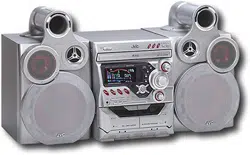
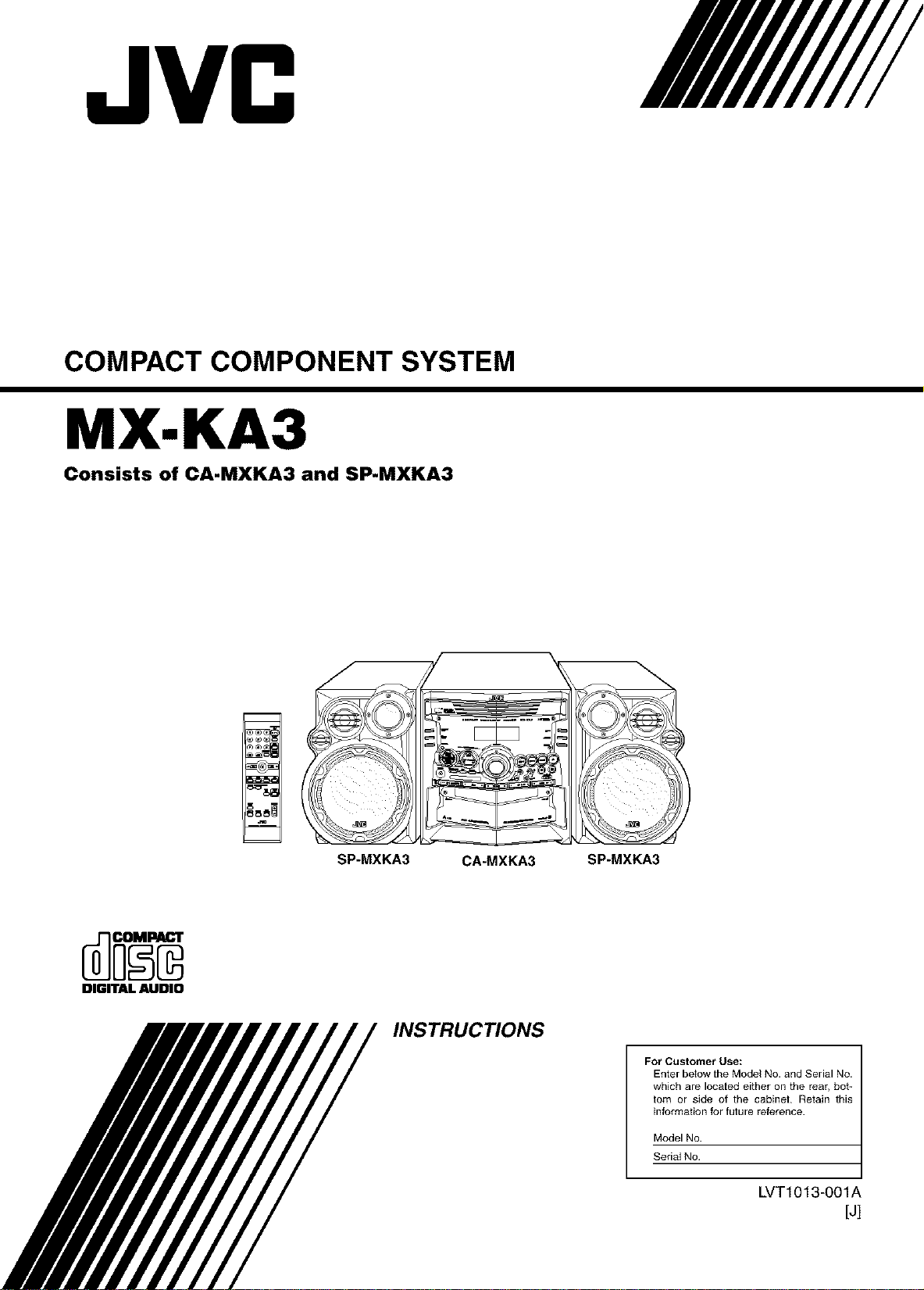
COMPACT COMPONENT SYSTEM
MX-KA3
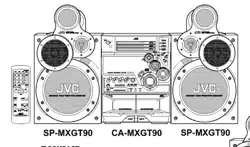
Consists of CA-MXKA3 and SP-MXKA3
m
SP-MXKA3
CA-MXKA3
SP-MXKA3
DIGITAL AUDIO
INSTRUCTIONS
For Customer Use:
Enter betow the Model No. and Serial No.
which are located either on the rear, bot-
tom or side of the cabinet. Retain this
information for future reference.
Model No.
Serial No.
LVT1013-001A
[4
Warnings, Cautions and Others
RISX OF ELECTRIC SHOOK
DO NOTOPEN
CAUTION: TO REDUCE THE RISK OF ELECTRIC SHOCK
DO NOT REMOVE COVER (OR BACK)
NO USER SERVICEABLE PARTS INSIDE
REFER SERVICING TO QUALIFIED SERVICE PERSONNEL
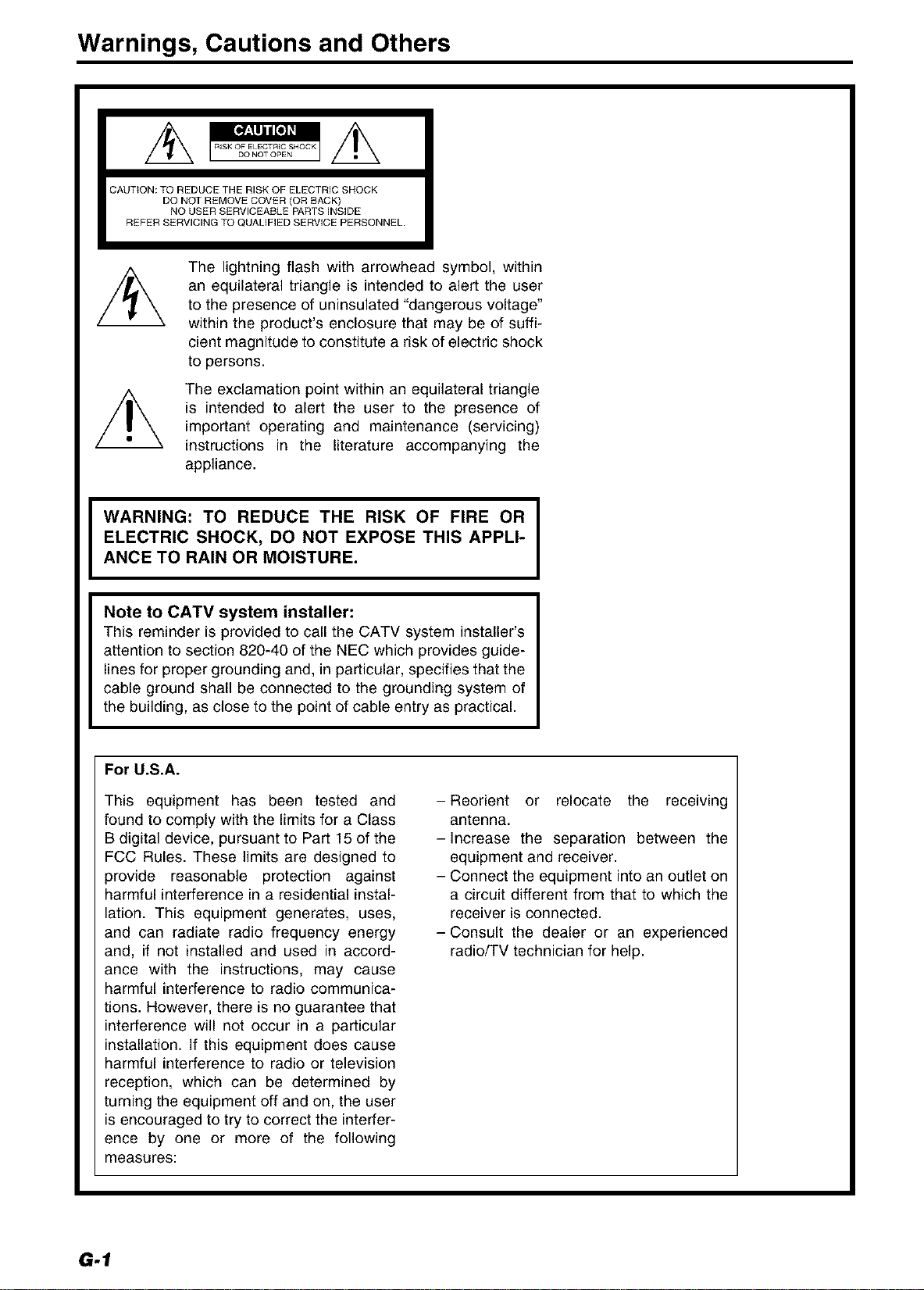
The lightning flash with arrowhead symbol, within
an equilateral triangle is intended to alert the user
to the presence of uninsulated "dangerous voltage"
within the product's enclosure that may be of suffi-
cient magnitude to constitute a risk of electric shock
to persons.
The exclamation point within an equilateral triangle
is intended to alert the user to the presence of
important operating and maintenance (servicing)
instructions in the literature accompanying the
appliance.
WARNING: TO REDUCE THE RISK OF FIRE OR
ELECTRIC SHOCK, DO NOT EXPOSE THIS APPLI-
ANCE TO RAIN OR MOISTURE.
Note to CATV system installer:
This reminder is provided to call the CATV system installer's
attention to section 820-40 of the NEC which provides guide-
lines for proper grounding and, in particular, specifies that the
cable ground shall be connected to the grounding system of
the building, as close to the point of cable entry as practical.
For U.S.A.
This equipment has been tested and
found to comply with the limits for a Class
B digital device, pursuant to Part 15 of the
FCC Rules. These limits are designed to
)rovide reasonable protection against
harmful interference in a residential instal-
lation. This equipment generates, uses,
and can radiate radio frequency energy
and, if not installed and used in accord-
ance with the instructions, may cause
harmful interference to radio communica-
tions. However, there is no guarantee that
interference will not occur in a particular
installation. If this equipment does cause
harmful interference to radio or television
reception, which can be determined by
turning the equipment off and on, the user
_sencouraged to try to correct the interfer-
ence by one or more of the following
measures:
- Reorient or relocate the receiving
antenna.
-Increase the separation between the
equipment and receiver.
- Connect the equipment into an outlet on
a circuit different from that to which the
receiver is connected.
-Consult the dealer or an experienced
radio/TV technician for help.
G-I
CLASS 1 LASER PRODUCT
DANGER
1.Invisible laser radiation when open and interlock failed or
defeated. Avoid direct exposure to beam.
CAUTION
1.Do net open the top cover. There are no user
serviceable parts inside the unit; leave all servicing to
qualified service personnel.
2. Use of controls, adjustments or performance of proce-
dures other than those specified herein may result in haz-
ardous radiation exposure.
CAUTION
To reduce the risk of electric shocks, fire, etc.:
1.Do not remove screws, covers or cabinets.
2. Do net expose this appliance to rain or moisture.
3. To prevent electric shock, match wide blade of plug to
wide slot, fully insert.
Caution -- POWER switch!
Disconnect the main plug to shut the power off com-
pletely. The POWER switch in any position does not
disconnect the main line. The power can be remote
controlled.
CAUTION
1.Do not block the ventilation openings or holes.
(If the ventilation openings or holes are blocked by a
newspaper or cloth, etc., the heat may net be able to get
out.)
2. Do not place any naked flame sources, such as lighted
candles, on the apparatus.
3. When discarding batteries, environmental problems must
be considered and local rules or laws governing the dis-
posal of these batteries must be followed strictly.
4. Do net expose this apparatus to rain, moisture, dripping
or splashing and that no objects filled with liquids, such as
vases, shall be placed on the apparatus.
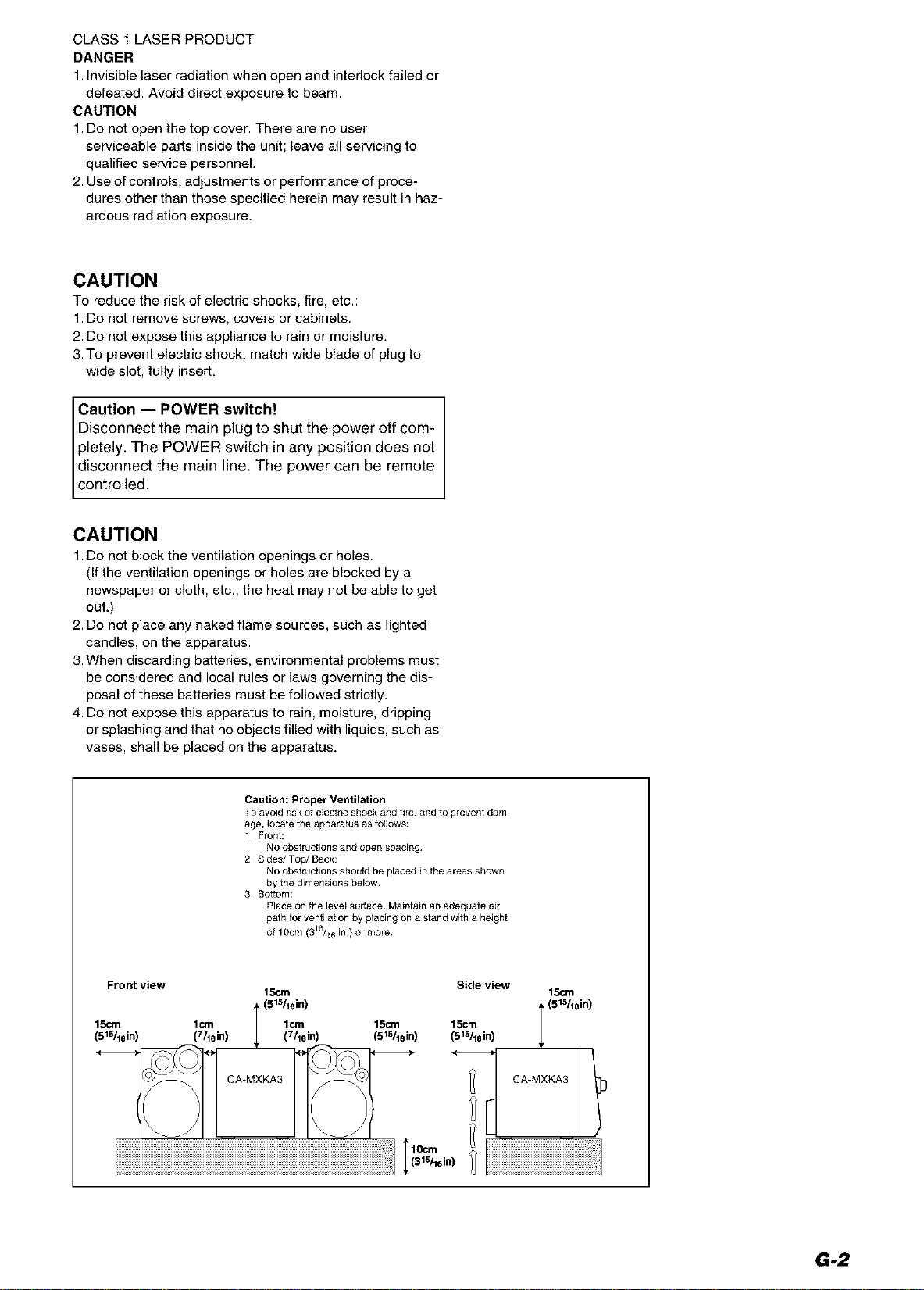
Caution: Proper Ventilation
To avoid risk of electric shock and fire, and to prevent dam-
age, locate the apparatus as follows:
f Front:
No obstructions and open spacing¸
2 Sides/Top/Back:
No obstructions should be placed in the areas shown
by the dimensions below¸
3 Bottom:
Place on the level surface¸ Maintain an adequate air
path for ventilationby placing on a stand with a height
of 10cm (31_/_6in) or more¸
Front view
15cm
Side view
15cm
G-2
'I hank you for purchasing the JVC Compact Component System.
We hope it will be a valued addition to your home, giving you years of enjoyment.
Be sure to read this instruction manual carefully before opera/ing your new stereo system.
In it you will find all the information you need to set up and use the sys/em.
If you have a query that is not answered by the manual, please contact your dealer.
Features
Here are some of the things that make your Sys/em both powerful and simple to use.
i_ The controls and operations have been redesigned to make them very easy to use, fieeing you to,just eli,joy the
music.
• With JVC's COMPU PLAY you can turn on the System and automa/ically start the Radio, Cassette Deck, or
CD Player with a single touch.
i_ The great SEA (Sound Effect Amplifier) effects Rock, Pop and Classics are provided.
i_ The Active Bass EX. (Extension) circuitry faithfully reproduces low frequency sounds.
i_ The Sound Turbo function provides emphasized rich sound.
i_ A 45-station preset capability (30 FM and 15 AM) in addition to auto-seek and manual tuning.
i_ CD changer function can operate 3 discs.
• Discs can be changed during play using the Carrousel tray (mta/ional tray).
• Continuous, random or program play of 3 discs.
i_ Two Decks enabling tape dubbing.
i_ Timer functions; Daily Timer, REC (Recording) Timer, and Sleep Timer.
i_ You can connect various external units, such as an MD recorder.
i_ The CD Player can play back a CD-R and CD-RW.
How This Manual Is Organized
• Basic informa/ion thai is the same for many different functions - e.g. setting the volume - is given in the section "Basic Opera/ions",
and not repeated under each function.
• 'Ihe names of bultons/controls and display messages are written in all capital letters: e.g. FM/AM, "NO DISC".
• If the button names on the Unit and the Remole Control are the same, the description on where the button is used will be omitted.
• Syslem functions are written with an initial capital letler only: e.g. Normal Play.
Use the table of contents to look up specific information you require.
We have enjoyed making this manual for you, and hope it serves you in enjoying the many features built into your System.
IMPORTANT CAUTIONS
1 Installation of the System
• Select a place which is level, dry and neither too hot nor too cold. (Between 5_'C and 35_'C or 41_'_ and 95_p.)
• Leave sufficient distance between the Sys/em and a TV.
• Do not use the System in a place subject to vibrations.
2 Power cord
• Do not handle the power cord with wet hands!
• Some power is always consumed as long as the power cord is connecled to the wall outlet.
• When unplugging the System from the wall outlet, always pull the plug, not the power cord.
3 Malfunctions, etc.
• 'I here are no user serviceable parts insMe. In case of system failure, unplug the power cord and consult your dealer.
• Do not insert any metallic object into the System.
I
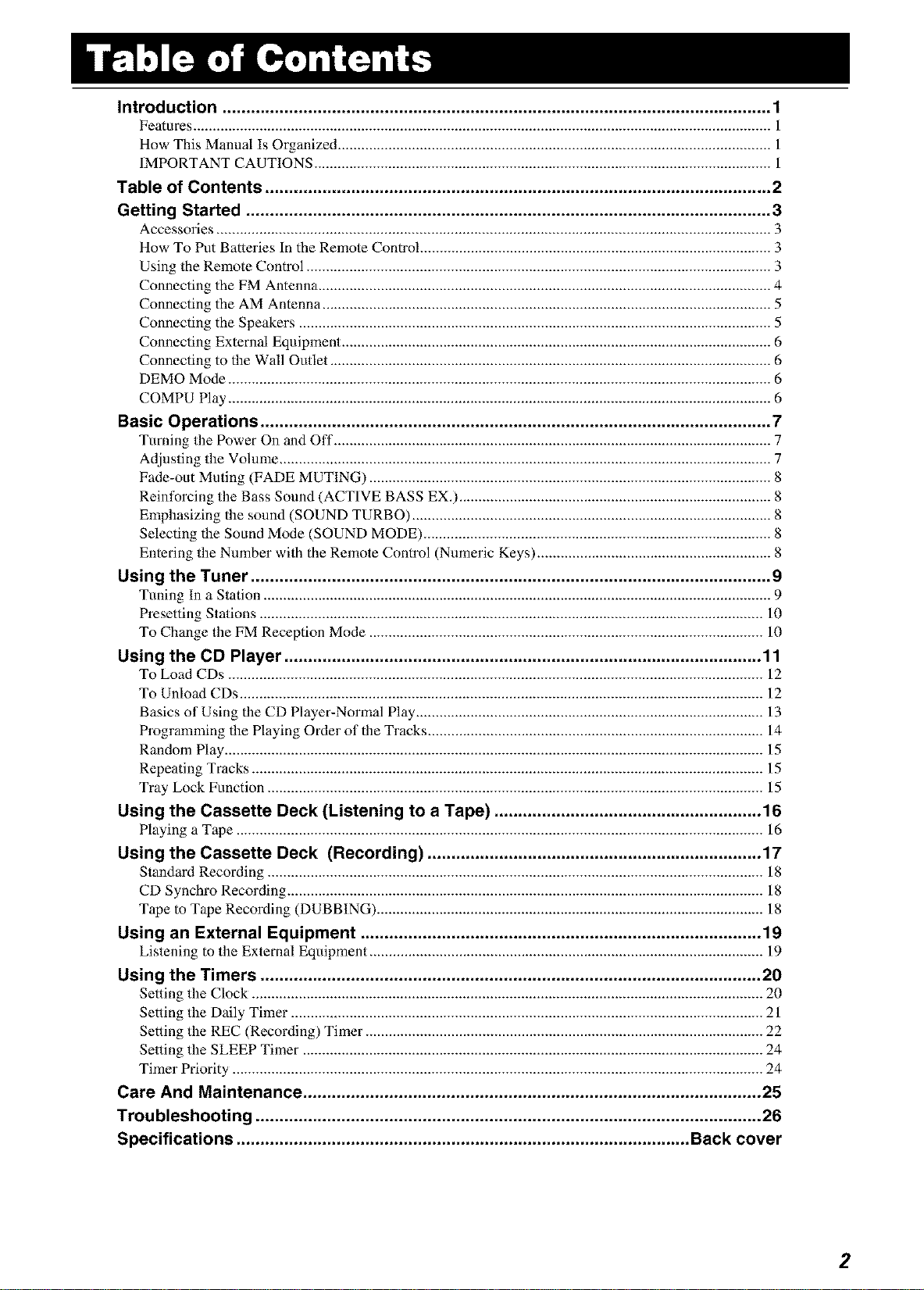
Introduction ................................................................................................................... 1
Features .................................................................................................................................................... 1
How This Manual Is Organized ............................................................................................................... 1
IMPORTANT CAUTIONS ..................................................................................................................... 1
Table of Contents .......................................................................................................... 2
Getting Started .............................................................................................................. 3
Accessories .............................................................................................................................................. 3
How To Put Batteries In the Remote Control .......................................................................................... 3
Using the Remote Control ....................................................................................................................... 3
Connecting the FM Antenna .................................................................................................................... 4
Connecting the AM Antenna ................................................................................................................... 5
Connecting the Speakers ......................................................................................................................... 5
Connecting External Equipment .............................................................................................................. 6
Connecting to the Wall Outlet ................................................................................................................. 6
DEMO Mode ........................................................................................................................................... 6
COMPU Play ........................................................................................................................................... 6
Basic Operations ........................................................................................................... 7
Turning the Power On and Of["................................................................................................................ 7
Adjusting the Volume .............................................................................................................................. 7
Fade-out Muting (FADE MUTING) ....................................................................................................... 8
Reinforcing the Bass Sound (ACTIVE BASS EX.) ................................................................................ 8
Emphasizing the sound (SOUND TURBO) ............................................................................................ 8
Selecting the Sound Mode (SOUND MODE) ......................................................................................... 8
Entering the Number with the Remote Control (Numeric Keys) ............................................................ 8
Using the Tuner ............................................................................................................. 9
Tuning In a Station .................................................................................................................................. 9
Presetting Stations ................................................................................................................................. 10
To Change the FM Reception Mode ..................................................................................................... 10
Using the CD Player .................................................................................................... 11
To Load CDs ......................................................................................................................................... 12
To Unload CDs ...................................................................................................................................... 12
Basics of Using the CD Player-Normal Play ......................................................................................... 13
Programming the Playing Order of the Tracks ...................................................................................... 14
Random Play .......................................................................................................................................... 15
Repeating Tracks ................................................................................................................................... 15
Tray Lock Function ............................................................................................................................... 15
Using the Cassette Deck (Listening to a Tape) ........................................................ 16
Playing a Tape ....................................................................................................................................... 16
Using the Cassette Deck (Recording) ...................................................................... 17
Standard Recording ............................................................................................................................... 18
CD Synchro Recording .......................................................................................................................... 18
Tape to Tape Recording (DUBBING) ................................................................................................... 18
Using an External Equipment .................................................................................... 19
Listening to the External Equipment ..................................................................................................... 19
Using the Timers ......................................................................................................... 20
Setting the Clock ................................................................................................................................... 20
Setting the Daily Timer ......................................................................................................................... 21
Setting the REC (Recording) Timer ...................................................................................................... 22
Setting the SLEEP Timer ...................................................................................................................... 24
Timer Priority ........................................................................................................................................ 24
Care And Maintenance ................................................................................................ 25
Troubleshooting .......................................................................................................... 26
Specifications ............................................................................................... Back cover
2
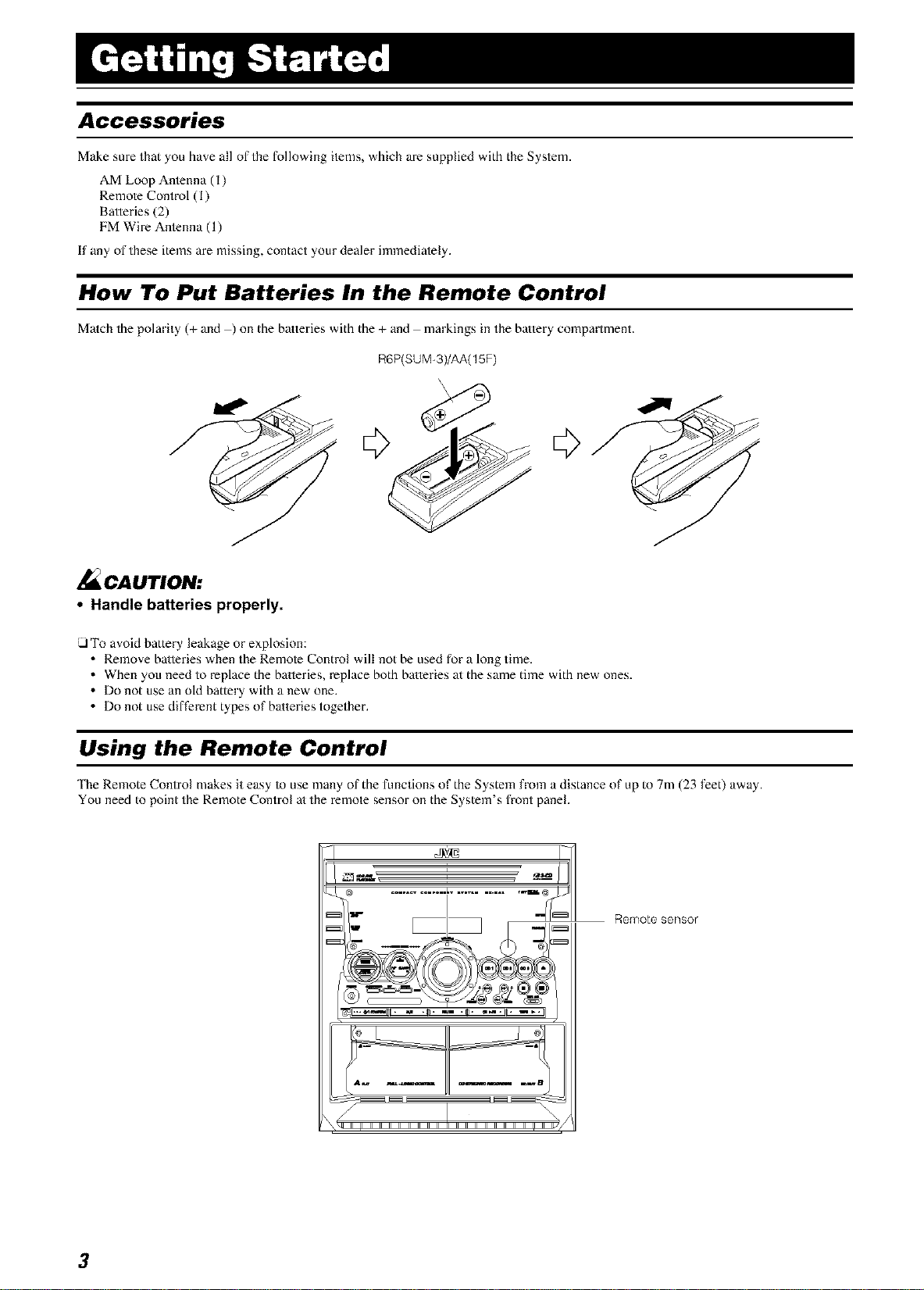
Accessories
Make sure that you have all of the folk)wing items, which are supplied with the System.
AM Loop Anlenna (I)
Remole Control (I)
Batteries (2)
FM Wire Anlenna (1)
If any of these items are missing, contact your dealer hmnediately.
How To Put Batteries In the Remote Control
Match the polarity (+ and ) on the batteries with the + and markings in the battery compartment.
R6P(SUM-3)/AA(15F)
\\
CAUTION:
• Handle batteries properly.
i_ To avoid battery leakage or explosion:
• Remove batteries when the Remole Control will not be used for a long time.
• When you need to replace the batteries, replace both batteries at the same time with new ones.
• Do not use an old battery with a new one.
• Do not use different types of batteries together.
Using the Remote Control
'[he Remote Control makes it easy to use many of the functions of the System from a distance of up to 7m (23 feet) away.
You need to point the Remote Control at the remote sensor on the Syste n s front panel.
.1
_ @ ©o...©_ ©o.,o.._T °T._=.._=A=
r Remote sensor
3
Getting Started
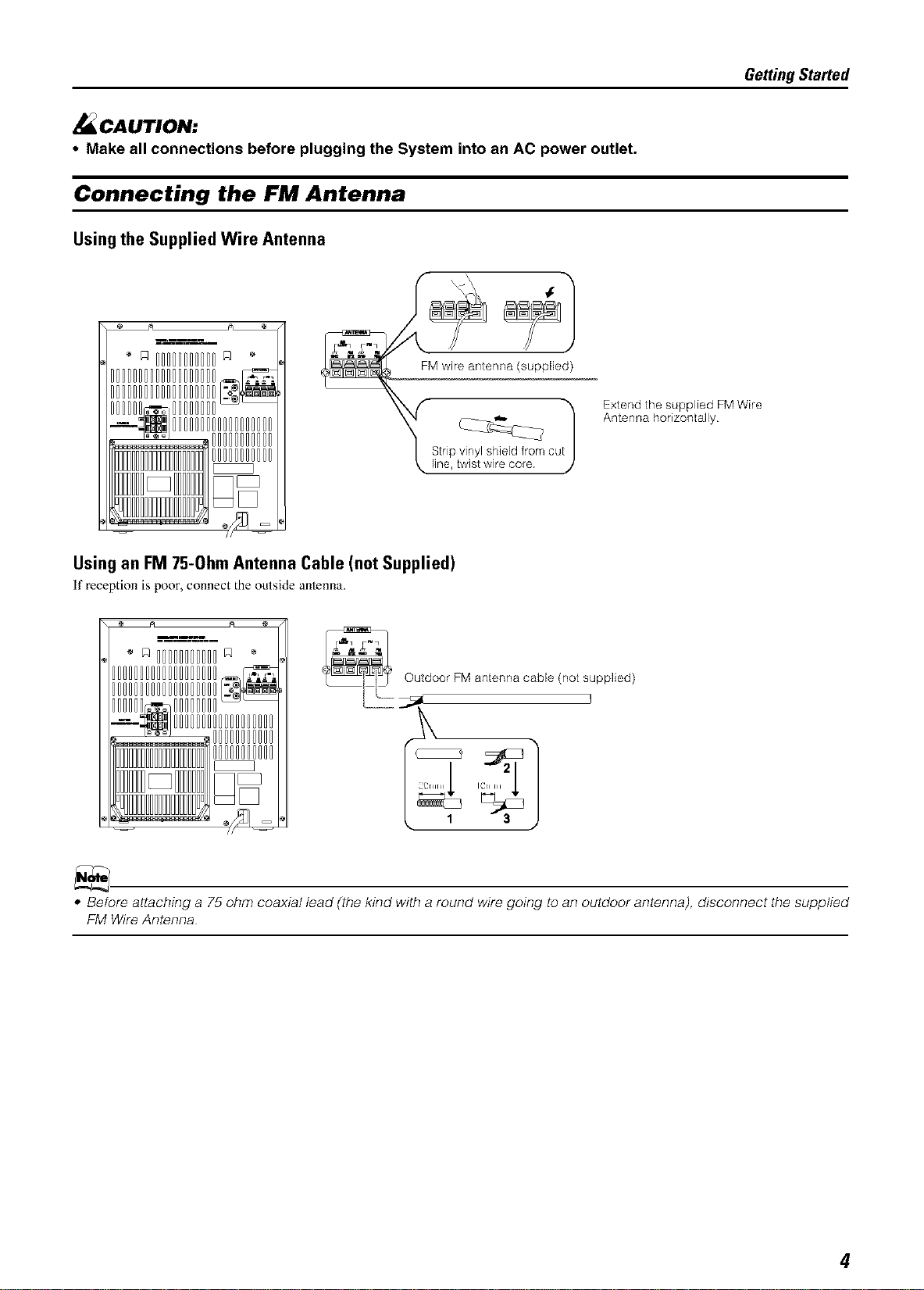
CAUTION:
• Make all connections before plugging the System into an AC power outlet.
Connecting the FM Antenna
Using the Supplied Wire Antenna
FM wire antenna (supplied)
Strip vinyl slfleld from cut
• line, twist wire core i
Extend the supplied FM Wire
Antenna horizontally
Using an FM 75-0hm Antenna Cable (not Supplied)
If reception is poor, connect the outside antenna.
Outdoor FM antenna cable (not supplied)
_. 1
• Before attaching a 75 ohm coaxial lead (the kind with a round wire going to an outdoor antenna), disconnect the supplied
FM Wire Antenna
4
Getting Started
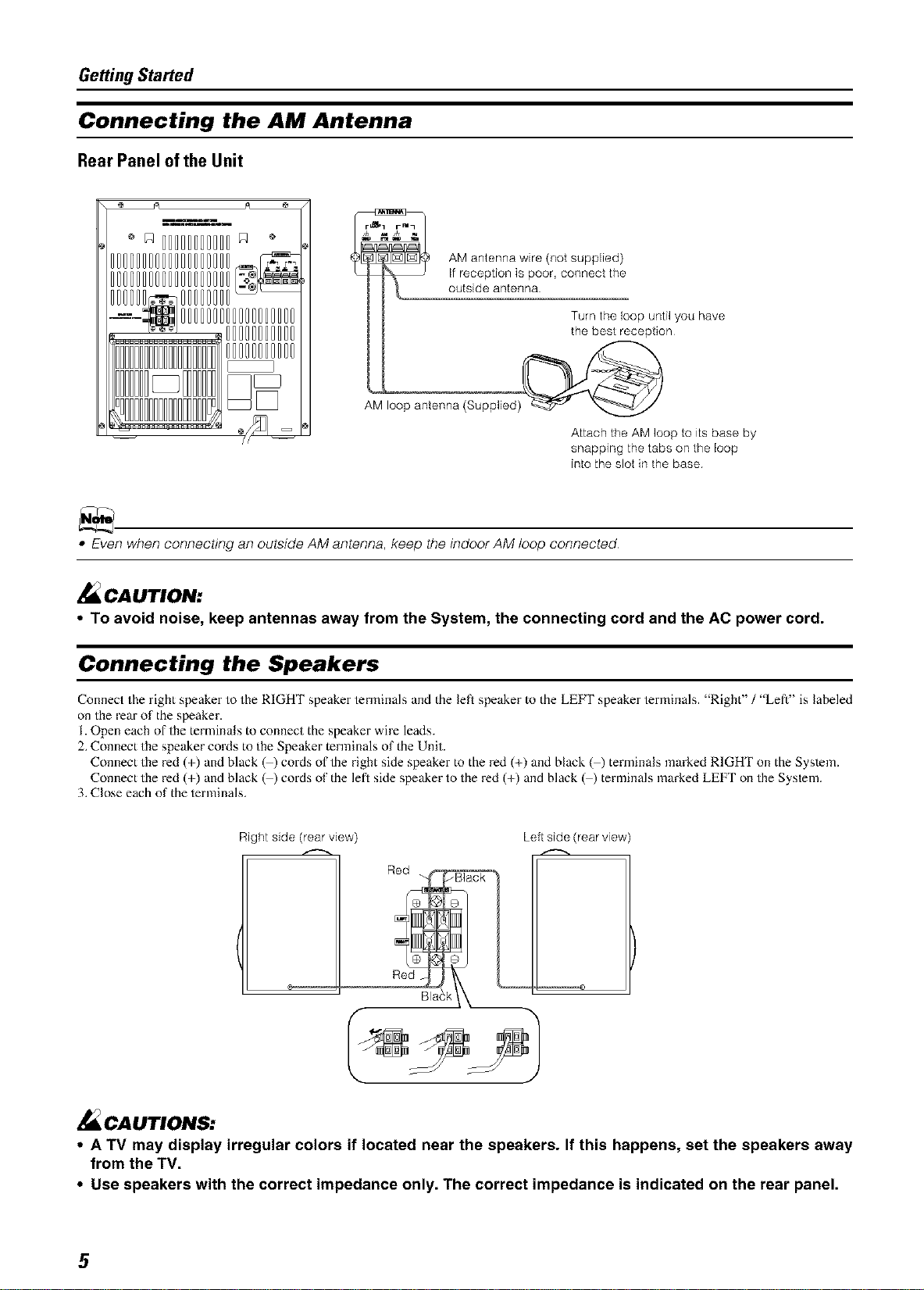
Connecting the AM Antenna
Rear Panel of the Unit
mm=_mm
AM antenna wire (not supplied)
,2; 2gt,2 22or,oo nocttho
Turn the loop until you have
__L__ the best reception
AM loop _en_
Attach the AM loop to its base by
snapping the tabs on the loop
into the slot in the base
• Even when connecting an outside AM antenna, keep the indoor AM loop connected
CAUTION:
• To avoid noise, keep antennas away from the System, the connecting cord and the AC power cord.
Connecting the Speakers
Connect the right speaker to the RIGHT speaker terminals and the left speaker to the LEFT speaker terminals. "Right" / "Left" is labeled
on the rear of the speaker.
I. Open each of the terminals to connect the speaker wire leads.
2. Connect the speaker cords to the Speaker terminals of the Unit.
Connect the red (+) and black @) cords of the right side speaker to the red (+) and black @) terminals marked RIGHT on the System.
Connect the red (+) and black @) cords ot' the left side speaker to the red (+) and black @) terminals marked LEFT on the System.
3. Close each of the terminals.
Right side (rear view)
Red
Red
BI_
Left side (rear view)
CAUTIONS:
• A TV may display irregular colors if located near the speakers. If this happens, set the speakers away
from the TV.
• Use speakers with the correct impedance only. The correct impedance is indicated on the rear panel.
5

Getting Started
Connecting External Equipment
Connect a signal cord (not supplied) between the System's AUXqN terminals and the output terminals of the external MD recorder, tape
deck, etc.
You can then listen to the external source through the System.
Signal cord (not supplied) MD recorder, tape deck, etc (not supplied)
Pin-plug x 2 Pin-plug x 2
Connecting to the Wall Outlet
Plug the AC power cord into the wall outlet.
Now, your System is at your command!
DEMO Mode
When the System is connecled to the wall outlet, a DEMO mode displaying some of the system's features automatically starts.
TO turn the DEMO disglay off, press any of the opera/ion bultons. The DEMO display automatically stops.
To turn the DEMO display on, press the DEMO button on the Unit for more than 2 seconds.
eaN_L
o (For 2 seconds)
• While the System is turned on, the DEMO display will automatically starts if no operation is made for 2 minutes To cancel
this auto DEMO display function, press the CANCEL button on the Unit during DEMO display.
COMPU Play
JVC's COMPU PLAY feature lets you control the most frequently used Syslem functions with a single touch.
With One Touch Operation you can play a CD, a tape, turn on the radio, or listen to an external equipment with a single press of the play
button for thai function. One Touch Operation turns the power on for you, then starts the function you have specified. If the System is not
ready (no CD or tape in place), the System still powers on so you can insert a CD or tape.
How One Touch Operation works in each case is explained in the section dealing with that function.
'Ihe COMPU PLAY buttons are:
On the Unit
CD !_/11 button
FM/AM button
TAPE D,-button
AUX button
CDI, CD2 and CD 3 buttons
CD Open/Close A button
Onthe Remote Control
CD !_/11button
FM/AM button
TAPE _ button
AUX button
CDI, CD2 and CD 3 buttons
6
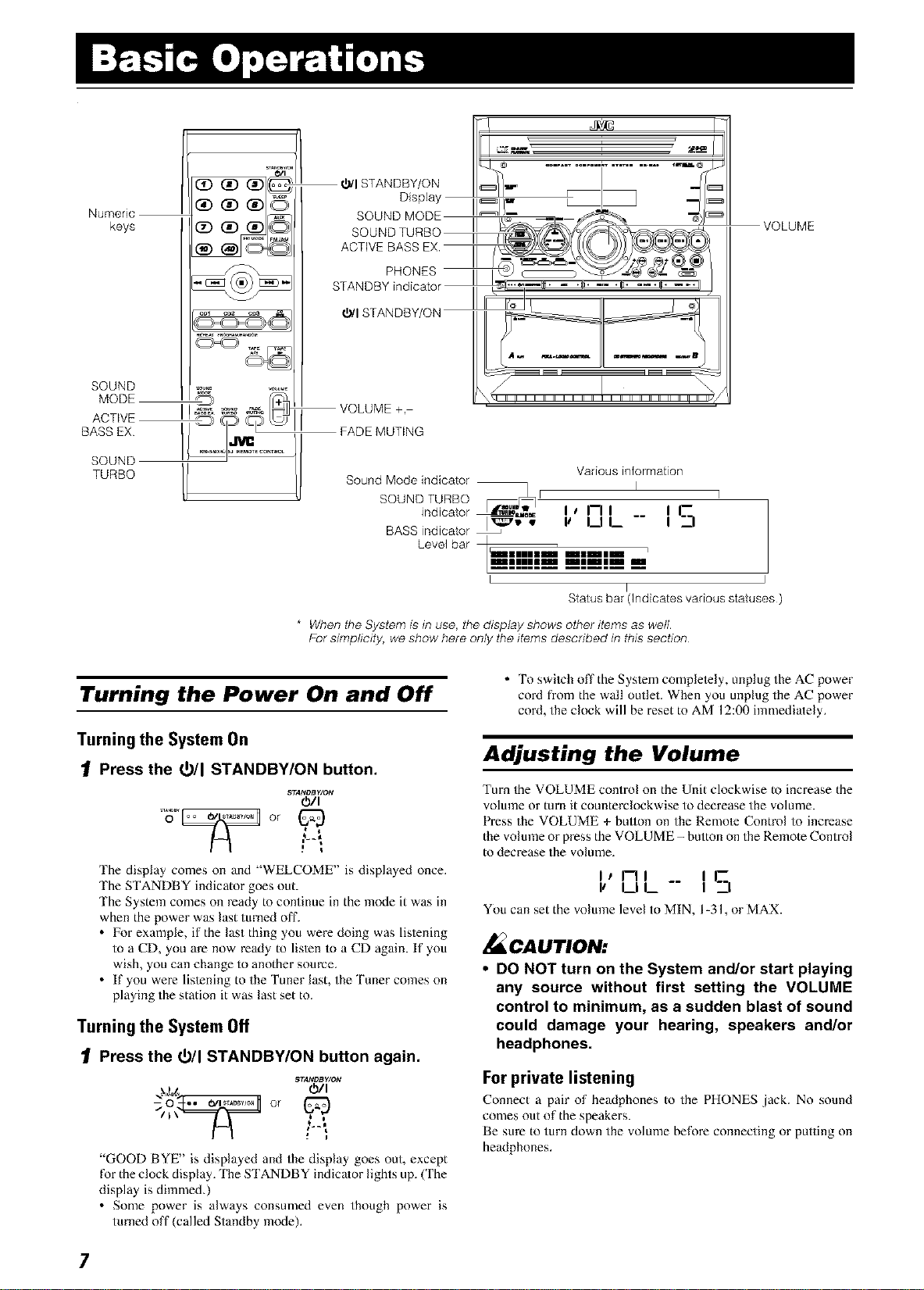
Numeric
keys
SOUND
MODE
ACTIVE
BASS EX
SOUND
TURBO !
®®IO
®®®1©
SOUNDMODE II_'L/_---_l---F_, _J_ I
SOUND TURBO I J4_/. _
PHONES j --_ _ _dd dz. _-
STANDBY indicator i t"_'-_'_" "L_J_" -L_z_JI
VOLUME +,
FADE MUTING
Various information
Sound Mode indicator
I
SOUND TURBO _ri] J i
ndoao ,, n, .. !c
I_,, V Ill_
I _1
BASS indicator
Level bar rmillliia_ •
I
I
Status bar (Indicates various statuses)
VOLUME
* When the System is in use, the display shows other items as well.
For simplicity, we show here only the items described in this section
Turning the Power On and Off
Turning the System On
1 Press the O/I STANDBY/ON button.
STANDBY/ON
......o or
The display comes on and "WELCOME" is displayed once.
The STANDBY indicator goes out.
The System comes on ready to continue in the ]node it was in
when the power was last turned off.
• l_br example, if the last thing you were doing was lis/ening
to a CD, you are now ready to lislen to a CD again. If you
wish, you can change to another source.
• If you were lislening to the Tuner last, the Tuner comes on
playing the station it was last set to.
Turning the System Off
1 Press the d)/I STANDBY/ON button again.
STANDBY/ON
..},L_', O/I
0 o = _/I SI_Y_ON Of"
"GOOD BYE" is displayed and the display goes out, except
for the clock display. 'Ihe STANDBY indicator lights up. (The
display is dimmed.)
• Some power is always consumed even though power is
turned off (called Standby ]node).
• To switch off the System completely, unplug the AC power
cord from the wall outlet. When you unplug the AC power
cord, the clock will be reset to AM 12:00 immediately.
Adjusting the Volume
Turn the VOLUME control on the Unit clockwise to increase the
volume or turn it counterclockwise to decrease the volume.
Press the VOLUME + bullon on the Remole Control to increase
the volume or press the VOLUME - button on the Remote Control
to decrease the volume.
-- 15
II U I_
You can set the volume level to MIN, 1-3 l, or MAX.
_ CAUTION:
• DO NOT turn on the System and/or start playing
any source without first setting the VOLUME
control to minimum, as a sudden blast of sound
could damage your hearing, speakers and/or
headphones.
Forprivate listening
Connect a pair of headphones to the PHONES ,jack. No sound
comes out of the speakers.
Be sure to turn down the volume before connecting or putting on
headphones.
7
Fade.out Muting (FADE MUTING)
You can mute the output with one touch operation.
To muting the output, press the FADE MUTlNG button on the
Remote Control. The output is faded out.
TO release muting, press the FADE MUTING button once
again, The output is faded in to the previous level.
• Afler Fade-out Muting, turning the VOLUME control on the
unit or pressing the VOLUME button on the Remote Control
will increase the volume from MIN. setting.
Reinforcing the Bass Sound
(ACTIVE BASS EX.)
'Ihe richness and fullness of the bass sound is maintained regard-
less of how low you set the w)lume.
You can use this effect only for playback.
TO get the effect, press the ACTIVE BASS EX. (Extension)
button.
'Ihe "BASS" indicator lights up and "ACTIVE BASS EXTEN-
SION" appears on the display.
TO cancel the effect, press the bullon again.
'Ihe "BASS" indicator goes out and "OF1 _' appears on the display.
Emphasizing the sound
(SOUND TURBO)
High and low frequencies are highly boosted.
To get the effect, press the SOUND TURBO button.
'Ihe SOUND TURBO indicator lights up and "SOUND TURBO
ON" appears on the display.
TO cancel the effect, press the button again.
'Ihe SOUND TURBO indicalor goes out and "OFF" appears on
the display.
• Selecting the Sound Turbo function turns the Active Bass EX.
and Sound Mote to off. While the Sound 'Iurbo will be turned
off, if either Active Bass EX. or Sound Mode function is
selected.
Basic Operations
ROCK
POP
CLASSIC
OFF
Boosts low and high frequencies. Good for
acoustic music.
Good for vocal music.
Set for wide and dynamic sound stereo
systems.
No sound effect applies.
Onthe Remote Control
Press the SOUND MODE button until Sound Mode you want ap-
pears on the display.
The Sound Mode indicator thai corresponds to the selected sound
]node blinks.
Each time you press the button, the Sound Mode changes as fol-
lows:
ROCK -_ POP -_ CLASSIC -_ OFF "_ (back to the beginning)
To cancel the effect, press the SOUND MODE button until
"OFF" appears on the display.
The Sound Mode indicator stays lit.
Entering the Number with the
Remote Control (Numeric Keys)
You will use the number keys on the Remole Control 1oenter num-
bers for presetting sta/ions, recalling the preset sta/ions, or pro-
gramming the playing tracks on CDs.
How to enter the number with the number keys is explained here.
Examples:
• To enler number 5, press 5.
• To enler number 15, press +10, then 5.
• To enler number 20, press +10, then I0.
• To enter number 25, press +I0, +10, then 5.
Selecting the Sound Mode
(SOUND MODE)
You can select one of 3 SEA (Sound Effect Amplifier) modes.
You can use this effect only for playback.
On the Unit
To get the effect, press one of the SOUND MODE buttons,
ROCK, POP, or CLASSIC.
'Ihe selecled Sound Mode name "ROCK", "POP", or "CLASSIC"
appears on the display. Also, the Sound Mode indicator that corre-
sponds to the selecled sound ]node blinks.
TO cancel the effect, press the currently selected mode button
again.
When the effect is canceled, the Sound Mode indicator stays lit.
l_k_r example, if the current Sound Mode is ROCK, press the
ROCK bu/lon again. "OFF" appears on the display, showing that
no sound effect is applied.
8
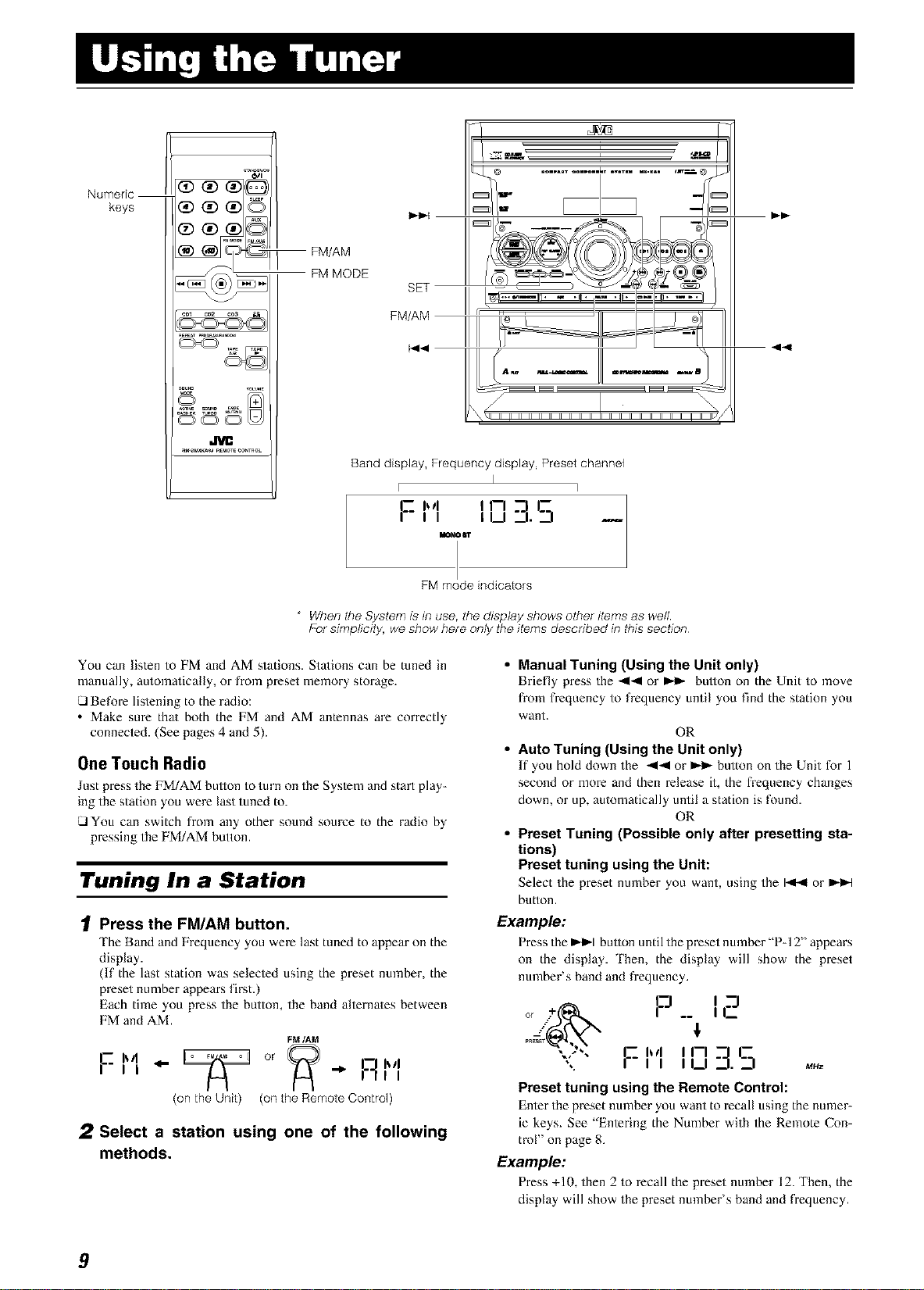
Numeric
keys
® ® ®1©
_ "_JI FM/AM
_' FM MODE
SET
FM/AM
Band display, Frequency display, Preset channel
I
I I
F ,,"" ,n,u-_3.5
MONO I_"
FM mode indicators
I_11,-
* When the System is in use, the display shows other items as well.
For simplicity, we show here only the items described in this section
You can listen to FM and AM stations. Sta/ions can be tuned in
manually, automatically, or from preset memory storage.
i_ Before lis/ening to the radio:
• Make sm-e thai both the FM and AM antennas are correctly
connected. (See pages 4 and 5).
OneTouch Radio
Just press the FM/AM bullon to turn on the Syslem and start play-
ing the station you were last tuned to.
i_You can switch from any other sound source to the radio by
pressing the FM/AM button.
Tuning In a Station
1 Press the FM/AM button.
The Band and Frequency you were last tuned to appear on the
display.
(If the last station was selected using the preset number, the
preset number appears first.)
Each time you press the button, the band alternates between
FM and AM.
FM/AM
Fbd o_ or ?
I I <" "_ I"711"11
(on the Unit) (on the Remote Control)
2 Select a station using one of the following
methods.
• Manual Tuning (Using the Unit only)
Briefly press the _1_1 or _ bu//on on the Unit to move
from frequency to frequency until you find the station you
want.
OR
• Auto Tuning (Using the Unit only)
ll" you hold down the _1_1 or _ button on the Unit for l
second or more and then release it, the frequency changes
down, or up, automatically until a station is found.
OR
• Preset Tuning (Possible only after presetting sta-
tions)
Preset tuning using the Unit:
Select the preset numher you want, using the I.,9<1or
button.
Example:
Press the I_,-I bullon until the preset numher"P-I 2" appears
on the display. 'Ihen, the display will show the preset
number's band and frequency.
P__ I72
,& !
• F I_4 I I--I
qq
I , 'U --,.--, MHz
Preset tuning using the Remote Control:
Enler the preset number you want to recall using the numer-
ic keys. See "Entering the Number with the Remote Con-
tml" on page 8.
Example:
Press +10, then 2 to recall the preset number 12. Then, the
display will show the preset number's band and frequency.
9
Using the Tuner
• In AM broadcast, reception sensitivity will be changed by
turning the AM loop antenna. Turn the AM loop antenna
for best reception.
Presetting Stations
You can preset up to 30 FM stations and up to 15 AM stations.
• Preset numbers may have been set to factory test fre
quencies prior to shipment, This is not a malfunction. You
can preset the stations you want into memory by following
one of the presetting methods below.
• During presetting stations, if no button operation is made
for 5 seconds, the display returns to the band/frequency
display In this case, repeat steps from the beginning.
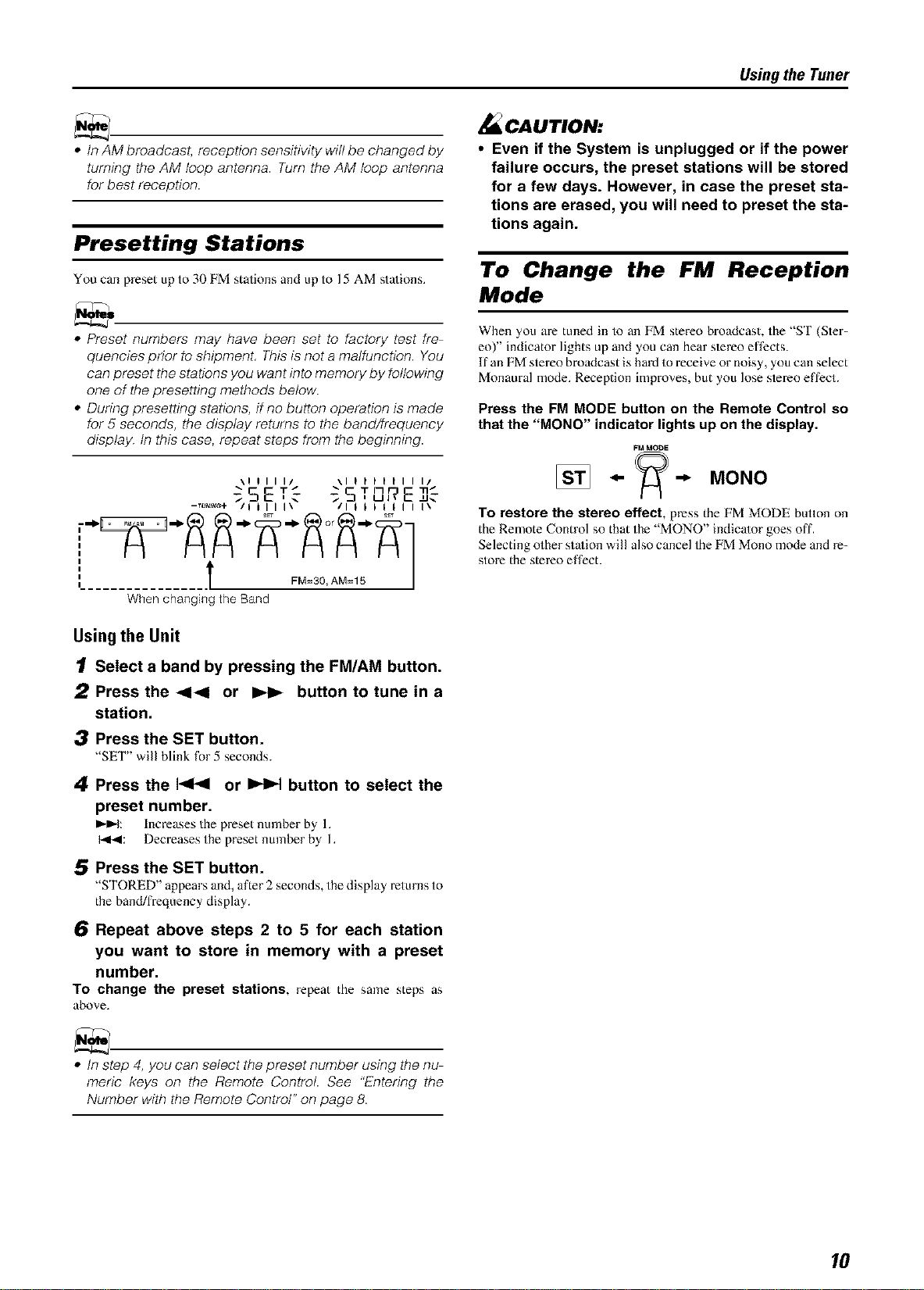
\11 I I I/ \11 I I I t I I I/
_5ET_- -_5 T,qR E ,'fl_-
-rut_Jt_G+11 I I I I\ II I I I I I I I I\
l FM=30, AM=I 5
When changing the Band
Using the Unit
1 Select a band by pressing the FM/AM button.
2 Press the <1<1 or _ button to tune in a
station.
3 Press the SET button.
"'SET"will blink for 5 seconds.
4 Press the I<1_1 or _ button to select the
preset number.
=,.-I=.t: Increases the preset number by 1.
t<_: Decreases the preset number by 1.
5 Press the SET button.
"STORED" appears and, after 2 seconds, the display returns to
the band/frequency display.
6 Repeat above steps 2 to 5 for each station
you want to store in memory with a preset
number.
To change the preset stations, repeat the same steps as
above.
CA UTION:
• Even if the System is unplugged or if the power
failure occurs, the preset stations will be stored
for a few days. However, in case the preset sta-
tions are erased, you will need to preset the sta-
tions again.
To Change the FM Reception
Mode
When you are tuned in lo an FM stereo broadcast, the "ST (Ster-
eo)" indicator lights up and you can hear s/ereo effects.
lfan FM stereo broadcast is hard to receive or noisy, you can select
Monaural mode. Reception improves, but you lose stereo effect.
Press the FM MODE button on the Remote Control so
that the "MONO" indicator lights up on the display.
FM MODE
_" ?_ MONO
To restore the stereo effect, press the FM MODE button on
the Remote Control so that the "MORe" indicator goes off.
Selecting other station will also cancel the FM Mono mode and re-
store the stereo effect.
• In step 4, you can select the preset number using the nu
meric keys on the Remote Control. See "Entering the
Number with the Remote Control" on page 8.
10
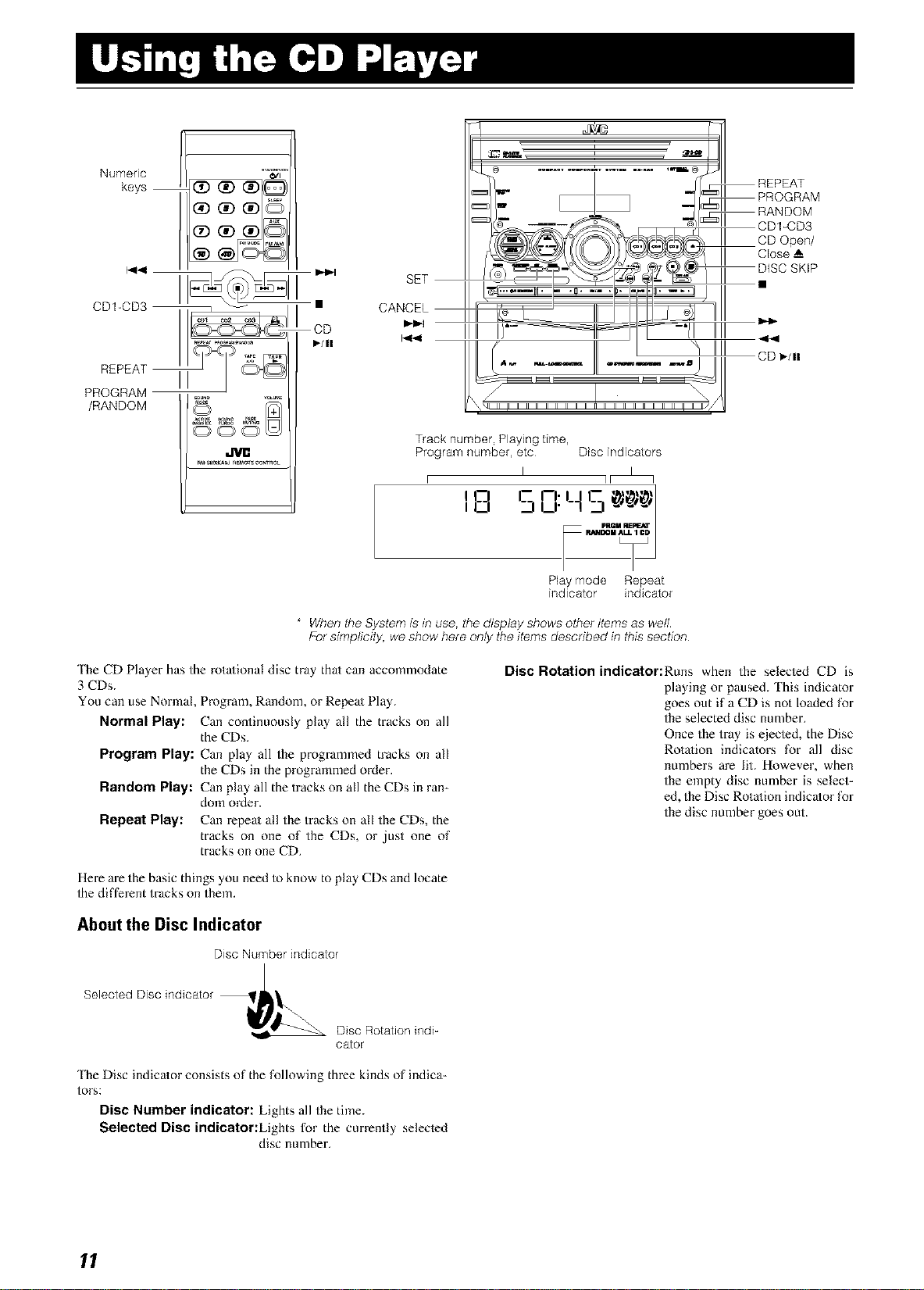
Numeric
keys
SET
CANCEL
PROGRAM
/RANDOM
dVl=
Track number Playing time,
Program number, etc Disc indicators
I
I
18 '-3O:LI5
Play mode Repeat
indicator indicator
* When the System is in use, the display shows oti_er items as well.
For simplicity, we show here only ti_e items described in this section
'Ihe CD Player has the rotational disc tray that can accommodate
3 CDs.
You can use Normal, Program, Random, or Repeal Play.
Normal Play: Can continuously play all the tracks on all
the CDs.
Program Play: Can play all the programmed tracks on all
the CDs in the programmed oMer.
Random Play: Can play all the tracks on all the CDs in ran-
dora order.
Repeat Play: Can repeal all the tracks on all the CDs, the
tracks on one of the CDs, or just one of
tracks on one CD.
Disc Rotation indicator:Runs when the seleded CD is
playing or paused. This indicator
goes out if a CD is not loaded for
the selected disc number.
Once the tray is eiecled, the Disc
Rota/ion indicators for all disc
numbers are lit. However, when
the empty disc number is select-
ed, the Disc Rota/ion indicator for
the disc number goes out.
Here are the basic things you need to know to play CDs and locate
the different tracks on them.
About the Disc Indicator
Disc Number indicator
Disc Rotation indV
cater
'Ihe Disc indicator consists of the following three kinds of indica-
tors:
Disc Number indicator: Lights all the time.
Selected Disc indicator:Lights for the currently selected
disc number.
11
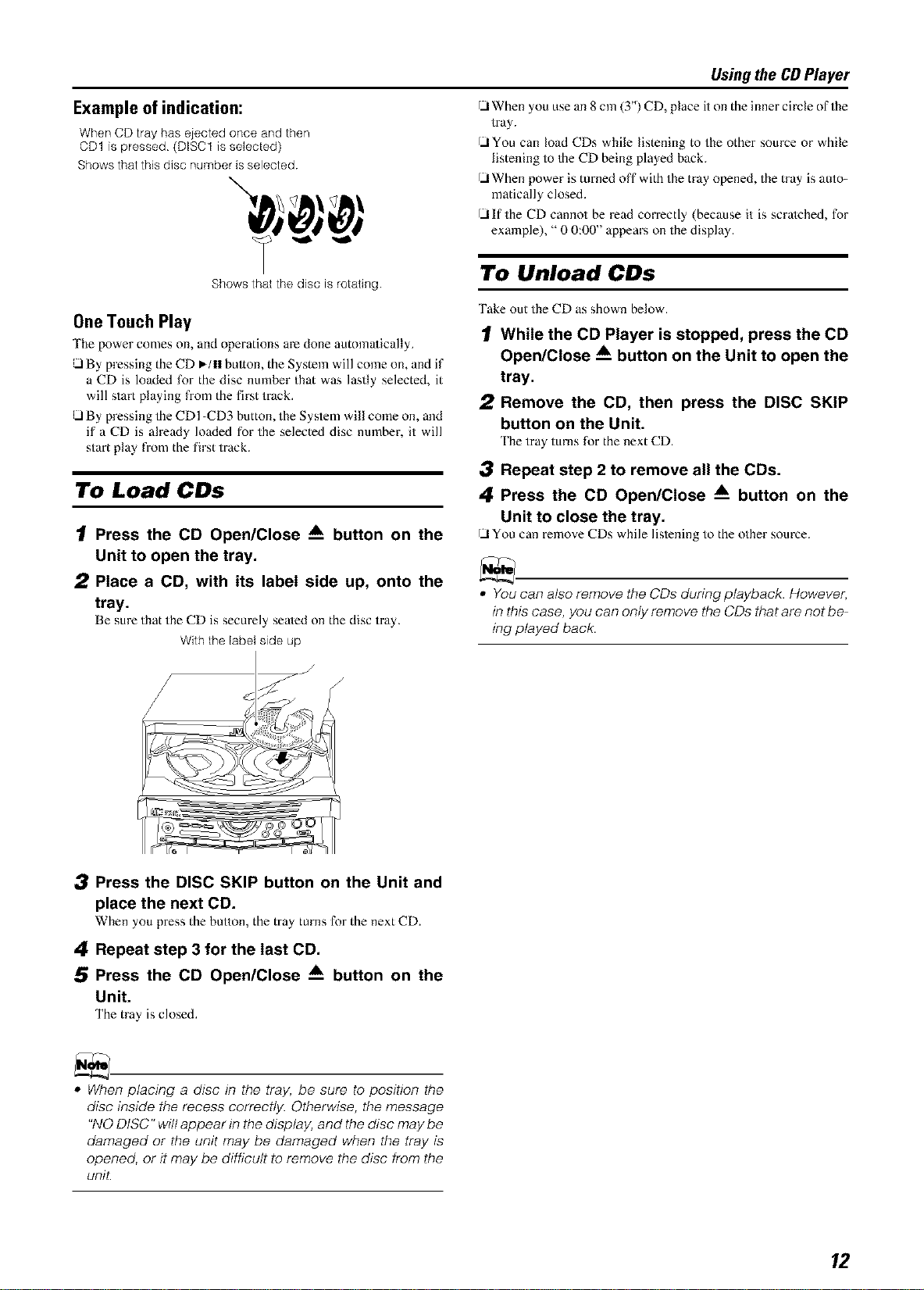
Example of indication:
When CD tray has eiected once and then
CD1 is pressed (DISC1 is selected)
Shows that this disc number is selected
Shows that the disc is rotating
OneTouch Play
'Ihe power comes on, and operations are done automa/ically.
i_ By pressing the CO !b/ll button, the System will come on, and if
a CD is loaded for the disc number that was lastly selected, it
will start playing fiom the first track.
i_ By pressing the CD1 -CD3 button, the System will come on, and
if a CD is ah-eady loaded for the selected disc number, it will
start play fiom the first track.
To Load CDs
1 Press the CD Open/Close • button on the
Unit to open the tray.
2 Place a CD, with its label side up, onto the
tray.
Be sure that the CD is securely seated on the disc tray.
With the Eabel side up
Using the CD Player
t_lWhen you use an 8 cm (3") CD, place it on the inner circle of the
tray.
t_lYou can load CDs while listening to the other source or while
listening to the CD being played back.
t_lWhen power is turned off with the tray opened, the tray is auto-
matically closed.
t_lIf the CD cannot be read correctly (because it is scralched, for
example), "0 0:00" appears on the display.
To Unload CDs
Take out the CD as shown below.
1 While the CD Player is stopped, press the CD
Open/Close A button on the Unit to open the
tray.
2 Remove the CD, then press the DISC SKIP
button on the Unit.
'Ihe tray turns for the next CD.
3 Repeat step 2 to remove all the CDs.
4 Press the CD Open/Close A_Abutton on the
Unit to close the tray.
I_1You can remove CDs while listening to the other source.
• You can also remove the CDs duringplayback, However,
in tills case, you can only remove the CDs that are not be
ing played back.
3 Press the DISC SKIP button on the Unit and
place the next CD.
When you press the button, the tray turns for the next CD.
4 Repeat step 3 for the last CD.
5 Press the CD Open/Close A_Abutton on the
Unit.
The tray is closed,
• When placing a disc in tile tray, be sure to position the
disc inside the recess correctly. Otherwise, tile message
"NO DISC" will appear in tile display, and tile disc may be
damaged or tile unit may be damaged when tile tray is
opened, or it may be difficult to remove tile disc from tile
uniL
Using the CD Player
Basics of Using the CD Player.
Normal Play
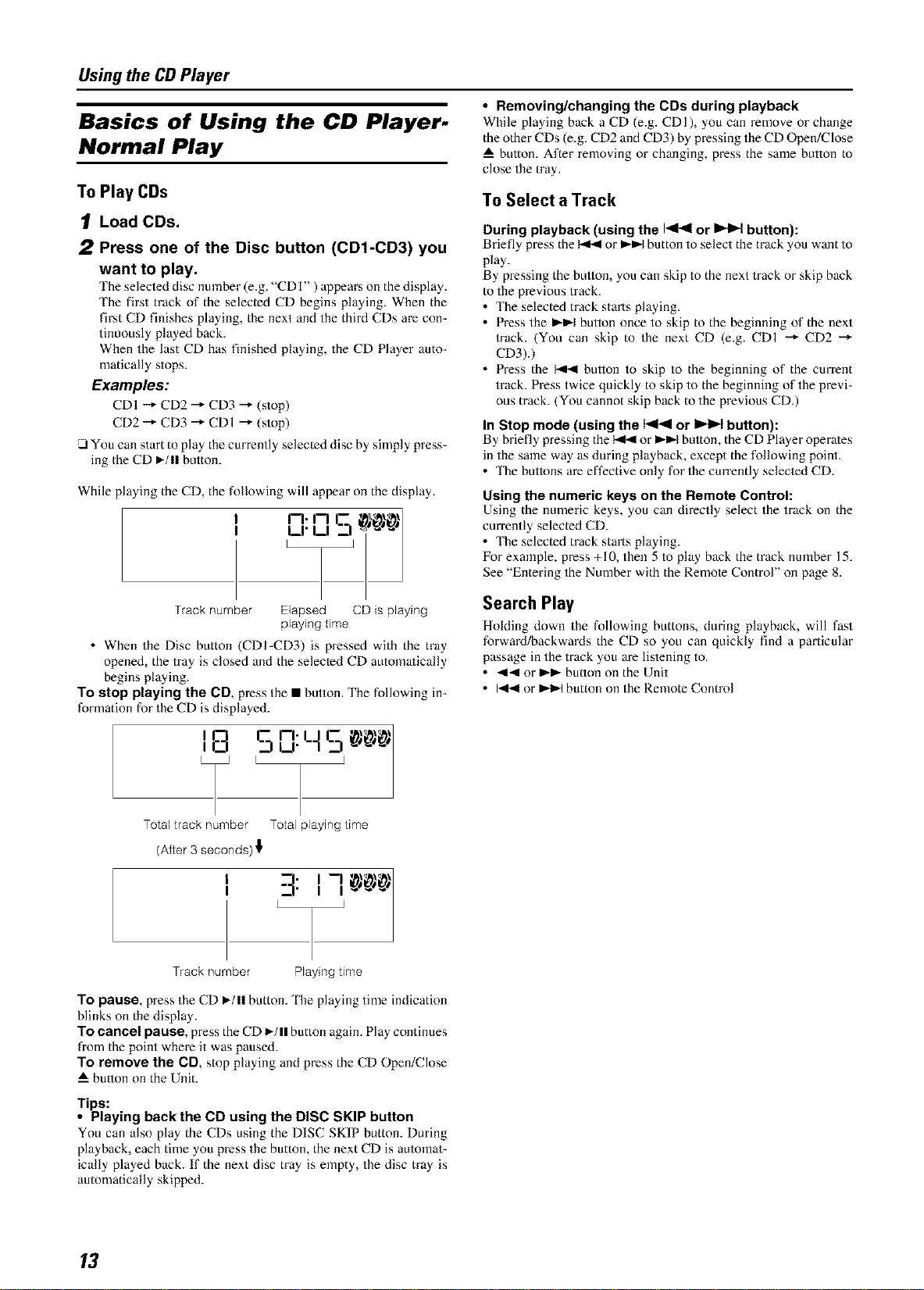
To Play CDs
1 Load CDs.
2 Press one of the Disc button (CD1-CD3) you
want to play.
The selecled disc number (e.g. "CDI" ) appears on the display.
The first track of the selected CD begins playing. When the
first CD finishes playing, the next and the third CDs are con-
tinuously played back.
When the last CD has finished playing, the CD Player auto-
matically stops.
Examples:
CD1 "* CD2 _ CD3 "* (stop)
CD2 -" CD3 _ CD1 "_ (stop)
i_ You can start to play the currently selected disc by simply press-
ing the CD I_/11 button.
While playing the CD, the following will appear on the display.
Track number
%
Elapsed CD is playing
playing time
• When the Disc button (CDI-CD3) is pressed with the tray
opened, the tray is closed and the seleoed CD automa/ically
begins playing.
TO stop playing the CD, press the • button. The following in-
formation for the CD is displayed.
'B
I
Total track number
Total playing time
(After 3 seconds)'l'
Track number Playing time
To pause, press the CD )-/11 button. 'Ihe playing time indication
blinks on the display.
TO cancel pause, press the CD I_/11 button again. Play continues
fiom the point where it was paused.
TO remove the CD, stop playing and press the CD Open/Close
button on the Unit.
Tips:
• Playing back the CD using the DISC SKIP button
You can also play the CDs using the DISC SKIP button. During
playback, each time you press the button, the next CD is automat-
ically played back. if the next disc tray is empty, the disc tray is
automatically skipped.
• Removing/changing the CDs during playback
While playing back a CD (e.g. CD1), you can remove or change
the other CDs (e.g. CD2 and CD3) by pressing the CD Open/Close
--_ button. After removing or changing, press the same button to
close the tray.
To Select a Track
During playback (using the I_1_1 or I_l_l button):
Briefly press the _ or _1_t button to select the track you want to
play.
By pressing the bullon, you can skip to the next track or skip back
to the previous track.
• The selected track starts playing.
• Press the _1).t button once to skip to the beginning of the next
track. (You can skip to the next CD (e.g. CD1 -" CD2 -"
CD3).)
• Press the I<1.< bullon to skip to the beginning of the current
track. Press twice quickly to skip to the beginning of the previ-
ous track. (You cannot skip back to the previous CD.)
In Stop mode (using the l_I_Ior I_I_lbutton):
By briefly pressing the 1<1.,9or I,,-I,'tbutton, the CD Player operates
in the same way as during playback, except the following point.
• 'Ihe buttons am effective only for the currently selecled CD.
Using the numeric keys on the Remote Control:
Using the numeric keys, you can directly select the track on the
currently selected CD.
• 'Ihe selected track starts playing.
For example, press +I 0, then 5 to play back the track number 15.
See "Entering the Number with the Remote Control" on page 8.
Search Play
Holding down the following buttons, during playback, will fast
forward/backwards the CD so you can quickly find a particular
passage in the track you are lis/ening to.
• <41 or I_1_ button on the Unit
• I.,11<1or _ button on the Remote Control
13
Programming the Playing Order
of the Tracks
You can program the playing oMer of the tracks on all the CDs.
Note that you can only make a program when the CD Player is
stopped.
i_ You can program up to 32 tracks in any desired oMer including
the same tracks.
To Make a Program
1 Load CDs
2 In Stop mode, set the CD Player in Program
Play mode.
On the Unit
Press the PROGRAM button to light the "PRGM" indicator on the
display.
At the same time, "PROGRAM" appears on the display.
On the Remote Control
Press the PROGRAM/RANDOM button until "PROGRAM" ap-
pears on the display.
'Ihe "PRGM" indica/or also lights up on the display.
Each time you press the button, the display changes as follows:
PROGRAM -" RANDOM -" Blank display (Normal Play) "-_
(back to the beginning)
• lfa program is already made, the last step of the program will
be displayed.
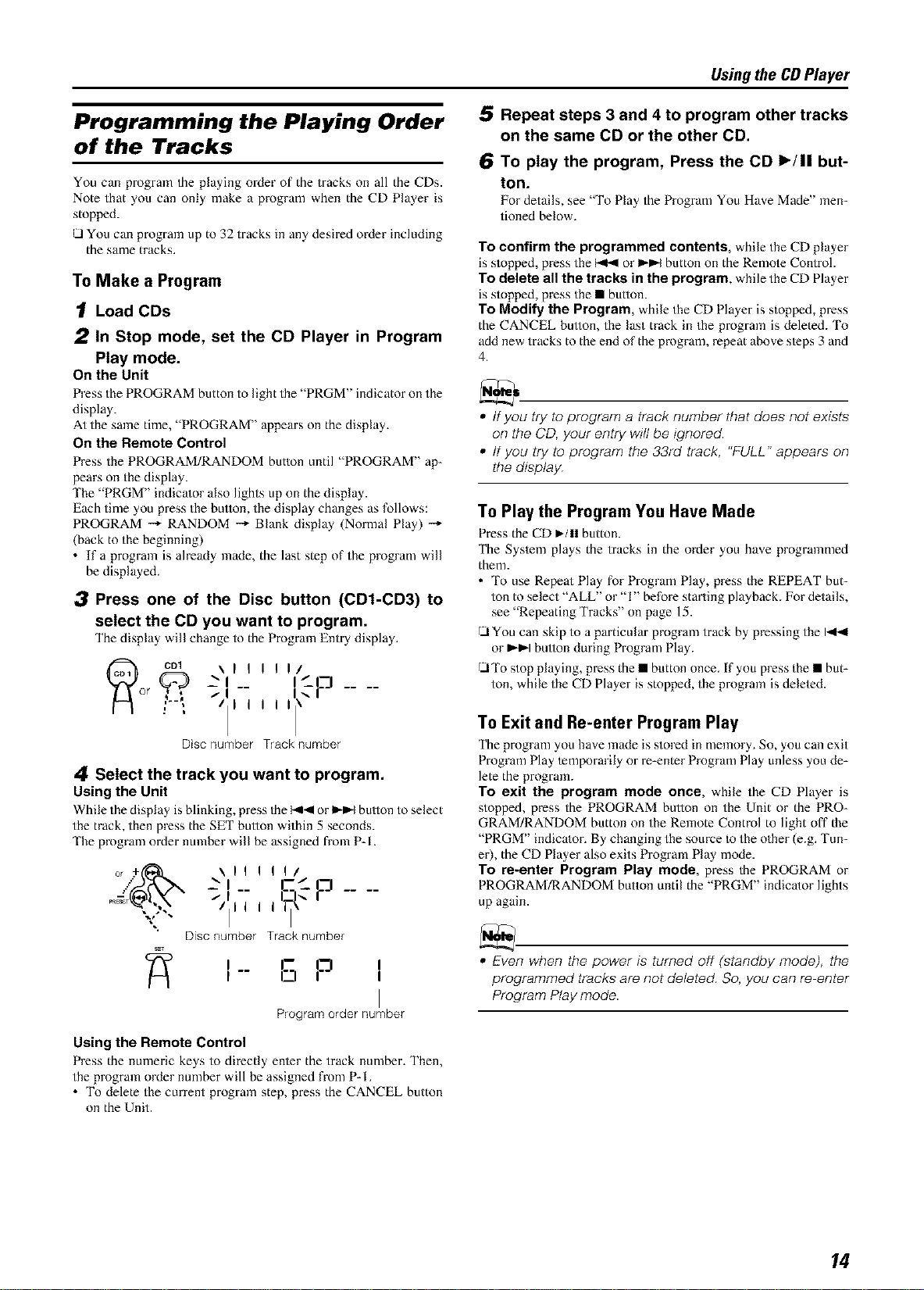
3 Press one of the Disc button (CD1-CD3) to
select the CD you want to program.
The display will change to the Program Entry display.
orco, ,I,,,,, I,
"" __ I _-I_'_-'J
r
Disc number Track number
4 Select the track you want to program.
Using the Unit
While the display is blinking, press the 14141or I_ID.tbu/lon to select
the track, then press the SET bullon within 5 seconds.
'Ihe program order number will be assigned fi-om P-L
o,,+ 2111 I
......
s',,,, P
%
Disc number Track number
I-- BP
Program order number
Using the Remote Control
Press the numeric keys to directly enler the track number. Then,
the program oMer number will be assigned from P-L
• To delete the current program step, press the CANCEL button
on the Unit.
Using the CD Player
5 Repeat steps 3 and 4 to program other tracks
on the same CD or the other CD.
5 To play the program, Press the CD 1_/11 but-
ton.
l_or details, see "To Play the Program You Have Made" men-
tioned below,
To confirm the programmed contents, while the CD player
is stopped, press the _ or I_1_t button on the Remote Control.
TO delete all the tracks in the program, while the CD Player
is stopped, press the • button.
TO Modify the Program, while the CD Player is stopped, press
the CANCEL bullon, the last track in the program is deleted. To
add new tracks to the end of the program, repeat above steps 3 and
4.
• If you try to program a track number that does not exists
on the CD, your entry wifl be ignored.
• If you try to program the 33rd track, "FULL" appears on
the display
To Play the Program You Have Made
Press the CD !_/11 button.
The Syslem plays the tracks in the order you have programmed
them.
• To use Repeat Play for Program Play, press the REPEAT but-
ton to select "ALL" or "I" before starting playback. For details,
see "Repeating Tracks" on page 15.
I_lYou can skip to a particular program track by pressing the I.,It_
or l,q_l button during Program Play.
I_lTo stop playing, press the • button once. if you press the • but-
ton, while the CD Player is stopped, the program is deleted.
To Exit and Re-enter Program Play
The program you have made is stolid in memory. So, you can exit
Program Play lemporarily or re-enter Program Play unless you de-
lete the program.
TO exit the program mode once, while the CD Player is
stopped, press the PROGRAM bullon on the Unit or the PRO-
GRAM/RANDOM button on the Remote Control to light off the
"PRGM" indica/or. By changing the source Io the other (e.g. Tun-
er), the CD Player also exits Program Play mode.
TO re-enter Program Play mode, press the PROGRAM or
PROGRAM/RANDOM button until the "PRGM" indicator lights
up again.
• Even when the power is turned off (standby mode), the
programmed tracks are not deleted So, you can re enter
Program Play mode.
14
Using the CD Player
Random Play
'Ihe tracks of all the CDs will play in no special order when you
use this mode.
• To use Repeat Play for Random Play, press the REPEAT but-
ton to select "ALL" or "1" before starting playback. For details,
see "Repealing Tracks'mentioned below,
1 In Stop mode, set the CD Player in Random
Play mode.
On the Unit
Press the RANDOM button to light the "RANDOM" indicator.
At the same time, "RANDOM" appears on the display.
On the Remote Control
Press the PROGRAM/RANDOM button until the "RANDOM"
appears on the display.
'Ihe "RANDOM" indicator also lights up on the display.
Each time you press the button, the display changes as follows:
PROGRAM "_ RANDOM -'_ Blank display (Normal Play) -'_
(back to the beginning)
2 Press the CD 1_/11 button.
The tracks on all the CDs are played in random order,
To stop playing, press the • button.
To skip a track during playback, press the _-1_i bullon to
jump to the next track in the random sequence.
TO exit Random Play mode, while the CD Player is stopped,
press the RANDOM bulton on the Unit or the PROGRAM/RAN-
DOM bullon on the Remote Control again to light off the "RAN-
DOM" indicator, Normal Play resumes.
Repeating Tracks
You can repeat all tracks or individual track, as many times as you
like.
Press the REPEAT button.
REPEAT 1CD:
REPEAT 1:
'Ihe Repeat indicator changes with each press of the button, as fol-
lows:
ALL -_ 1CD -" I -'_ Blank display "_ (back to the beginning)
REPEAT ALL: In Normal Play mode, repeats all the tracks on
all the CDs.
In Program Play mode, repeats all the tracks in
the program.
In Random Play mode, repeats all the tracks on
all the CDs in random order.
Repeats all tracks on one CD, (Selectable in
Normal Play only)
Repeats one track.
TO stop playing, press the • button. Changing the source to the
other (e.g. 'I uner) will also stop playing.
TO exit Repeat mode, press the REPEAT button until the Re-
peat indicator on the display goes out.
i_ Repeat mode remains in effect during the following Play Mode
changing:
a. PROGRAM PLAY MODE"--_NORMAL PLAY MODE
b. RANDOM PLAY MODE _"_NORMAL PLAY MODE
c, PROGRAM PLAY MODE"--_RANDOM PLAY MODE
Tray Lock Function
In order to safely keep the CD in the CD Player, the tray can be
electronically locked.
When the electronic lock is on, the tray cannot be opened even if
the CD Open/Close -----button on the Unit is pressed.
Lockingthe Tray
1[ Turn on the System and enter CD mode.
2 While pressing down the • button, press the
CD Open/Close A_Abutton on the Unit,
"LOCKED" appears on the display.
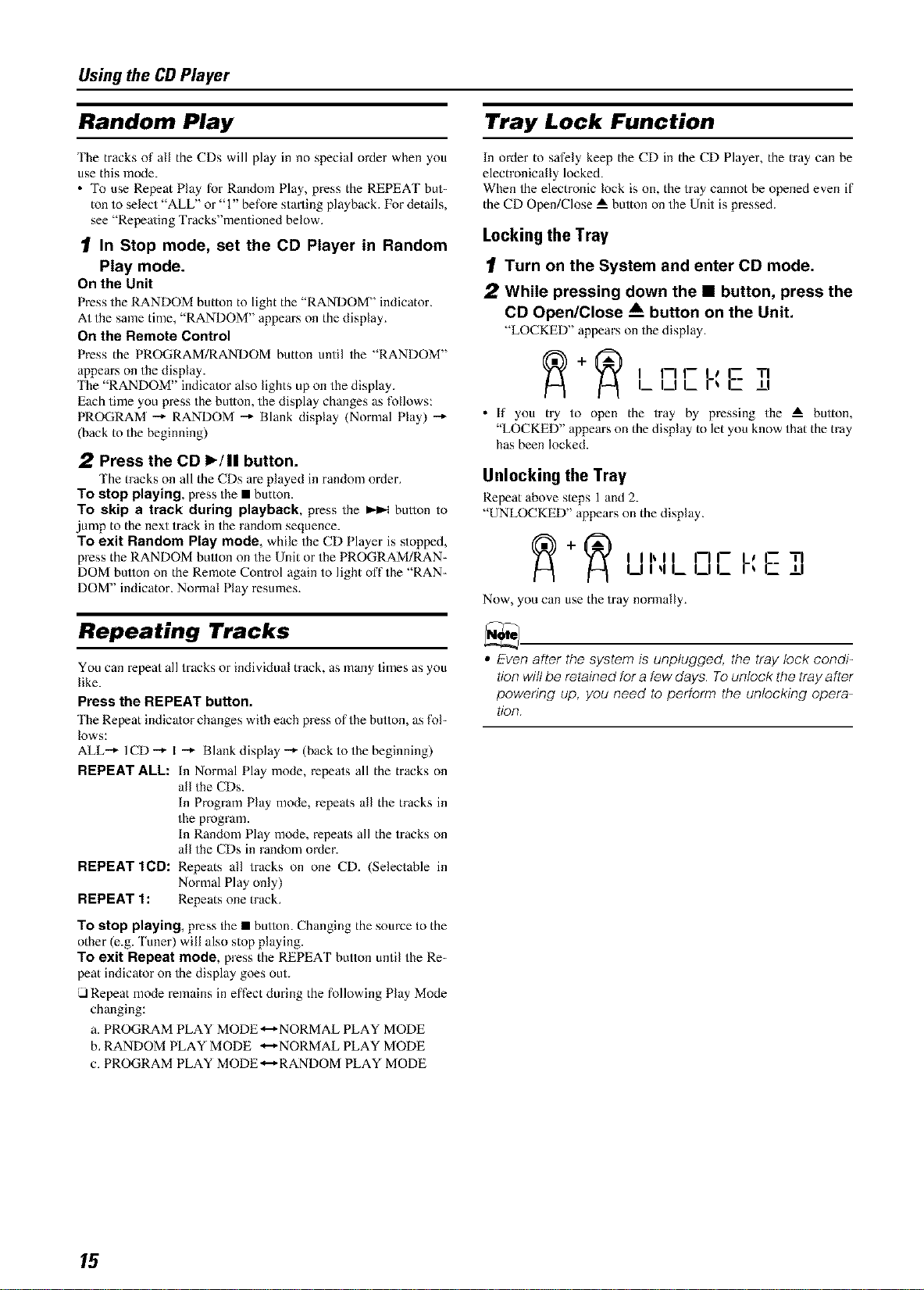
L UL J.l
• If you try to open the tray by pressing the --_ button,
"LOCKED" appears on the display to let you know that the tray
has been locked.
Unlocking the Tray
Repeat above steps 1 and 2.
"UNLOCKED" appears on the display.
,,,,,,,-,,- I_,,E
UIqLUL JJ
Now, you can use the tray normally,
• Even after the system is unplugged, the tray lock condi-
tion wifl be retained for a few days. To unlock the tray after
powering up, you need to perform the unlocking opera
tion
15
°6
O0
TAPE
TAPE A/B
@ ©o=,A©_ ©o..°..kT .y._...=._=
EJECT
(Deck A)
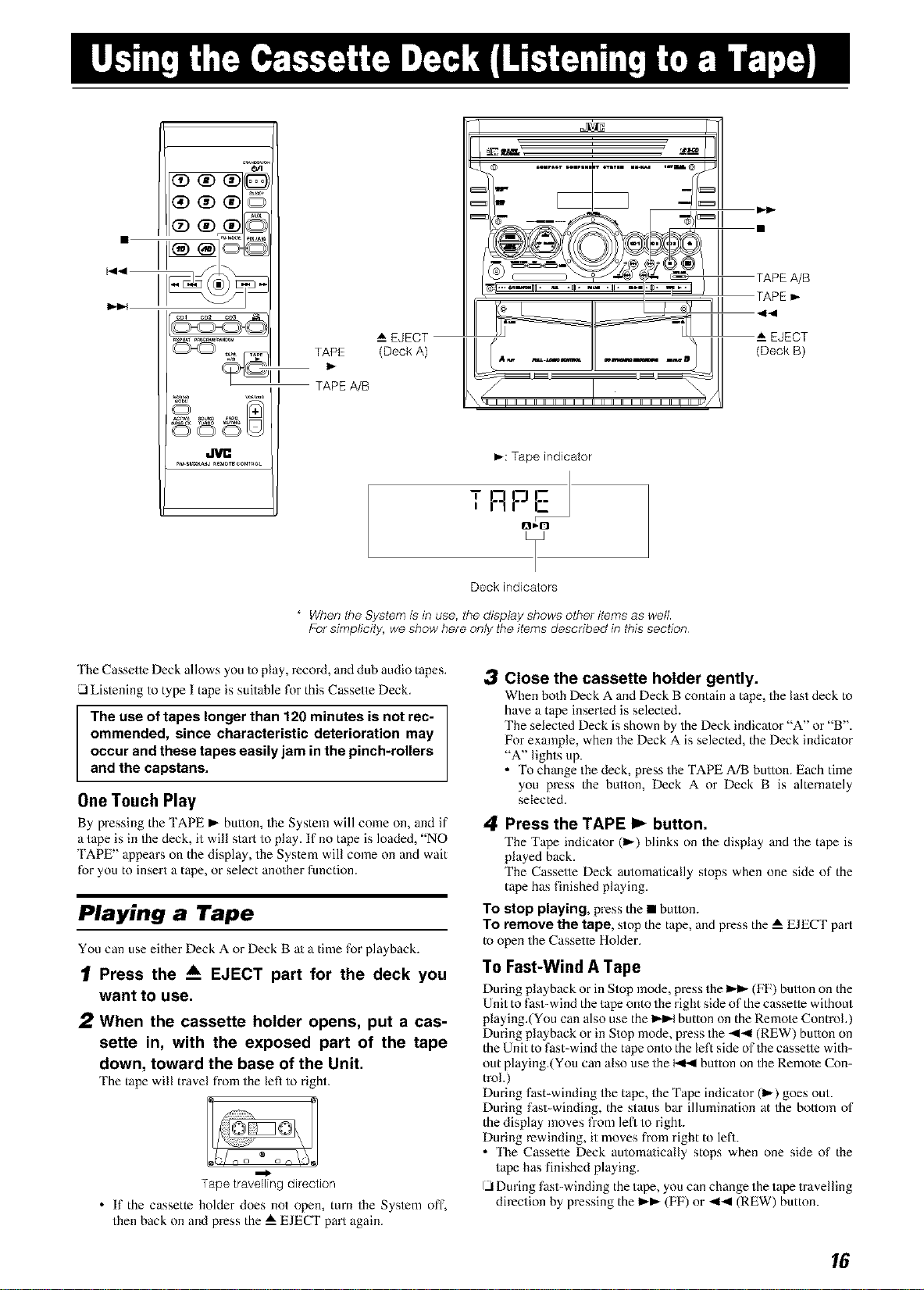
I,-: Tape indicator
-,'RPE 1
D_-Q
Ll"
Deck indicators
* When the System is in use, the display shows other items as well.
For simplicity, we show here only the items described in this section
TAPE A/B
TAPE _,-
44
! EJECT
(Deck B)
'Ihe Cassette Deck allows you to play, recoM, and dub audio tapes.
i_Listening to type 1tape is suitable for this Cassette Deck.
The use of tapes longer than 120 minutes is not rec-
ommended, since characteristic deterioration may
occur and these tapes easily jam in the pinch-rollers
and the capstans,
OneTouch Play
By pressing the TAPE I_ button, the System will come on, and if
a tape is in the deck, it will start to play. If no tape is loaded, "NO
TAPE' appears on the display, the Syste n will come on and wait
for you to insert a tape, or select another function.
Playing a Tape
You can use either Deck A or Deck B a/a time for playback.
1 Press the A EJECT part for the deck you
want to use.
2 When the cassette holder opens, put a cas-
sette in, with the exposed part of the tape
down, toward the base of the Unit.
The tape will travel h-ore the left to right.
Tape travelling direction
• If the cassette holder does not open, turn the System off,
then back on and press the -----EJECT part again.
3
Close the cassette holder gently.
When both Deck A and Deck B contain a tape, the last deck to
have a tape inserted is selected.
The selected Deck is shown by the Deck indicator "A" or "B'.
For example, when the Deck A is selected, the Deck indicator
"A" lights up.
• To change the deck, press the TAPE A/B button. Each time
you press the button, Deck A or Deck B is alternately
selected.
4 Press the TAPE I_ button.
The Tape indicator (_"9 blinks on the display and the tape is
played back.
The Cassette Deck automatically stops when one side of the
tape has finished playing.
To stop playing, press the • button.
TO remove the tape, stop the tape, and press the --_EJECT part
to open the Cassette Holder.
To Fast-Wind A Tape
During playback or in Stop ]node, press the _1,- (FF) burton on the
Unit to fast-wind the tape onto the right side of the cassette without
playing.(You can also use the I,-_.t button on the Remole Control.)
During playback or in Stop ]node, press the _1_1 (REW) button on
the Unit to fast-wind the tape onto the left side of the cassette with-
out playing.(You can also use the _ button on the Remote Con-
trol.)
During fast-winding the tape, the Tape indicator (_) goes out.
During fast-winding, the status bat illumination at the bottom of
the display moves from left to right.
During rewinding, it moves from right to left.
• 'Ihe Cassette Deck automatically stops when one side of the
tape has finished playing.
I_1During fast-winding the tape, you can change the tape travelling
direction by pressing the _ (FF) or _1 (REW) button.
16
TAPE A/B
TAPE
TApE
o
REC START/STOP
CD REC START
DUBBING
i
r
EJECT
(Deck A)
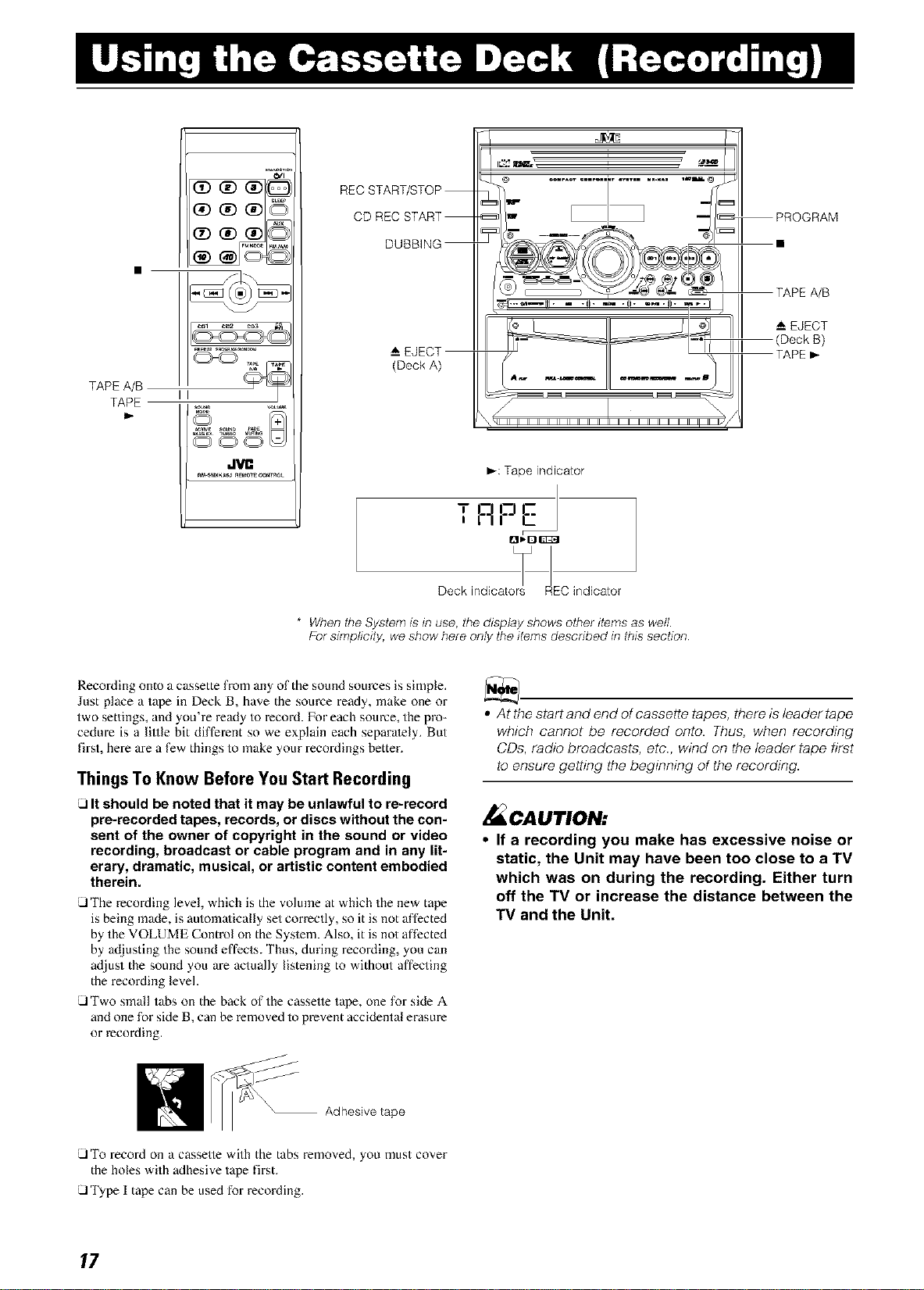
D,-:Tape indicator
, RPE ]
* When the System is in use, the display shows other items as well.
For simplicity, we show here only the items described in this section
Recording onto a cassette from any of the sound sources is simple.
Just place a tape in Deck B, have the source ready, make one or
two settings, and you're ready to recoM, l_k)r each source, the pro-
cedure is a lilfle bit different so we explain each separately. But
first, here are a few things to make your recordings better.
Things To Know Before You Start Recording
13It should be noted that it may be unlawful to re-record
pre-recorded tapes, records, or discs without the con-
sent of the owner of copyright in the sound or video
recording, broadcast or cable program and in any lit-
erary, dramatic, musical, or artistic content embodied
therein.
i_ The recording level, which is the volume at which the new tape
is being made, is automa/ically set correctly, so it is not affected
by the VOLUME Control on the Syslem. Also, it is not affected
by adjusting the sound effects. Thus, during recording, you can
ac[just the sound you are actually listening to without affecting
the recording level.
i_Two small tabs on the back of the cassette tape, one for side A
and one for side B, can be removed to prevent accidental erasure
or recording.
• At the start and end of cassette tapes, there is leader tape
which cannot be recorded onto. Thus, when recording
CDs, radio broadcasts, etc., wind on the leader tape first
to ensure getting the beginning of the recording.
_ CAUTION:
• If a recording you make has excessive noise or
static, the Unit may have been too close to a TV
which was on during the recording. Either turn
off the TV or increase the distance between the
TV and the Unit.
/
Adhesive tape
i_ To record on a cassette with the tabs removed, you must cover
the holes with adhesive tape first.
i_ Type 1 tape can be used for recording.
17
Using the Cassette Deck (Recording)
Standard Recording
'Ihis is the basic method for recoMing any source. 'Ihe Syslem also
has special ways for recoMing CD to tape, and tape to tape, which
save you time and effort, as well as give you some special effects.
However, when you need to add a selection to a tape you have
made, or are combining selections h-ore several som-ces on one
tape, use the method described below; just substitute the source
you want into this procedure, such as a tape in Deck A, a CD, or
the Tuner. You can also recoM from an external equipment with
this procedure.
To Record AnySound Source to Tape
Follow these steps to recoM from any sound source onto a tape in
Deck B.
1 Insert a blank or erasable tape into the Deck
B and wind past the tape leader.
2
3
Insert a blank or erasable tape into the Deck
B and wind past the tape leader.
Press the CD REC START button on the Unit.
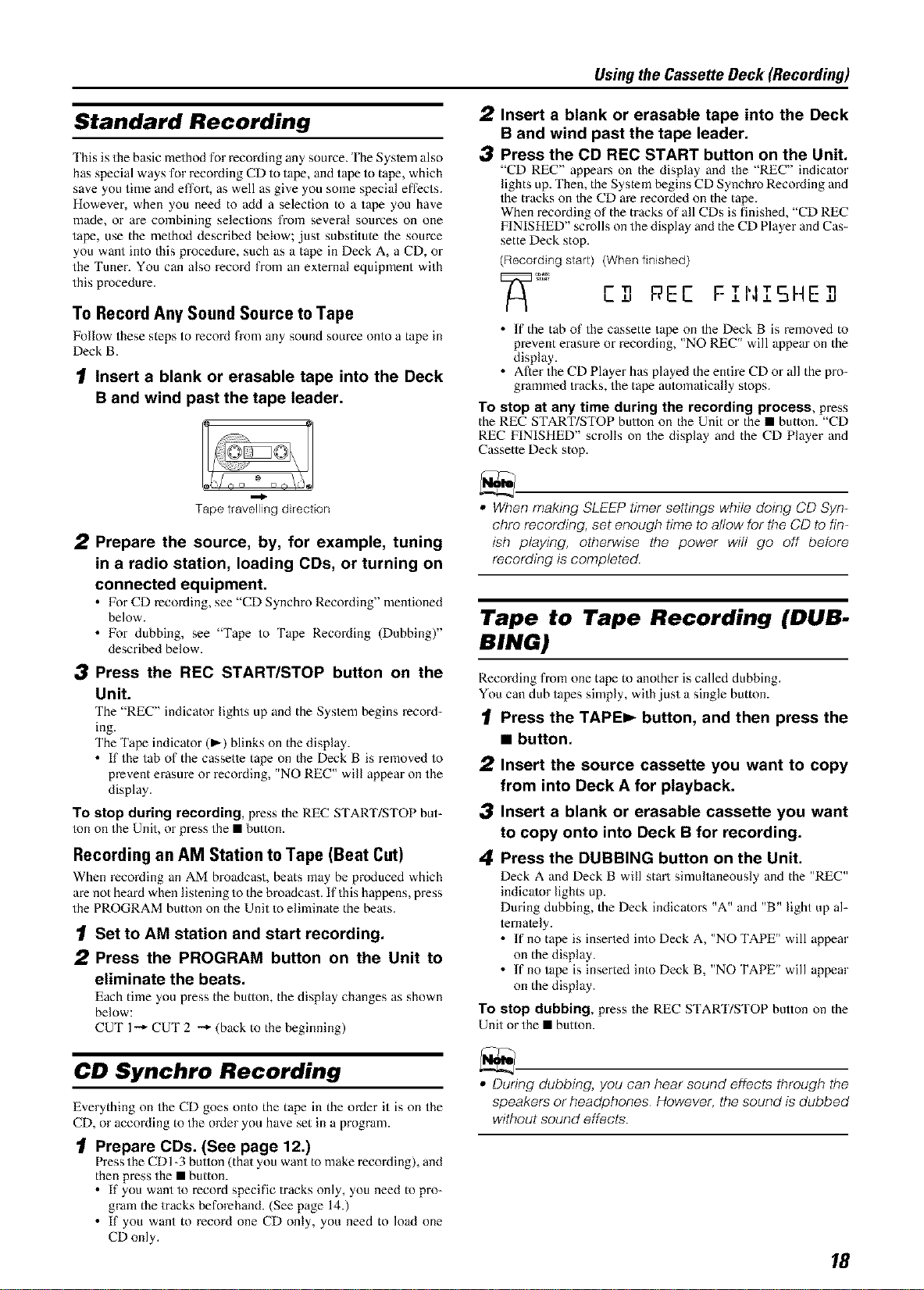
"CD REC" appears on the display and the "REC" indica/or
lights up. Then, the System begins CD Synchro RecoMing and
the tracks on the CD are recorded on the tape.
When recording of the tracks of all CDs is finished, "CD REC
FINISHED" scrolls on the display and the CD Player and Cas-
sette Deck stop.
(Recording start) (When finished)
PEE FII',IISI"IE,
• If the tab of the cassette tape on the Deck B is removed to
prevent erasure or recoMing, "NO REC" will appear on the
display.
• After the CD Player has played the entire CD or all the pro-
grammed tracks, the tape automa/ically stops.
To stop at any time during the recording process, press
the REC START/STOP bu/lon on the Unit or the • button. "CD
REC FINISHED" scrolls on the display and the CD Player and
Cassette Deck stop.
Tape travelling direction
2 Prepare the source, by, for example, tuning
in a radio station, loading CDs, or turning on
connected equipment.
• For CD recording, see "CD Synchro Recording" mentioned
below.
• l_k)r dubbing, see "Tape to Tape RecoMing (Dubbing)"
described below.
3 Press the REC START/STOP button on the
Unit.
The "REC" indicator lights up and the Syslem hegins record-
ing.
The Tape indicator (D.-)blinks on the display.
• If the tab of the cassette tape on the Deck B is removed to
prevent erasure or recording, "NO REC" will appear on the
display.
To stop during recording, press the REC START/STOP but-
ton on the Unit, or press the • button.
Recording an AM Station toTape (Beat Cut)
When recording an AM broadcast, beats ]nay be produced which
are not heard when listening to the broadcast. If this happens, press
the PROGRAM button on the Unit to eliminate the bea/s.
1 Set to AM station and start recording.
2 Press the PROGRAM button on the Unit to
eliminate the beats,
Each time you press the button, the display changes as shown
below:
CUT 1-_ CUT 2 -_ (back to the beginning)
• When making SLEEP timer settings while doing CD Syn-
chro recording, set enough time to allow for the CD to fin-
ish playing, otherwise the power will go off before
recording is completed
Tape to Tape Recording (DUB-
BING)
Recording from one tape to another is called dubbing.
You can dub tapes simply, with,just a single button.
Press the TAPEI_ button, and then press the
• button.
2 Insert the source cassette you want to copy
from into Deck A for playback.
3 Insert a blank or erasable cassette you want
to copy onto into Deck B for recording.
4 Press the DUBBING button on the Unit.
Deck A and Deck B will start simultaneously and the "REC"
indicator lights up.
During dubbing, the Deck indicators "A" and "B" light up al-
ternalely.
• If no tape is inserled into Deck A, "NO TAPE" will appear
on the display.
• If no tape is inserted into Deck B, "NO TAPE" will appear
on the display.
To stop dubbing, press the REC START/STOP button on the
Unit or the • button.
CD Synchro Recording
Everything on the CD goes onto the tape in the order it is on the
CD, or according to the order you have set in a program.
Prepare CDs. (See page 12.)
Press the CD1-3 hullon (thai you want to make recording), and
then press the • button.
• If you want k) record specific tracks only, you need to pro-
gram the tracks beforehand. (See page 14.)
• If you want to record one CD only, you need to load one
CD only.
• During dubbing, you can hear sound effects through the
speakers or headphones However, the sound is dubbed
without sound effects
18
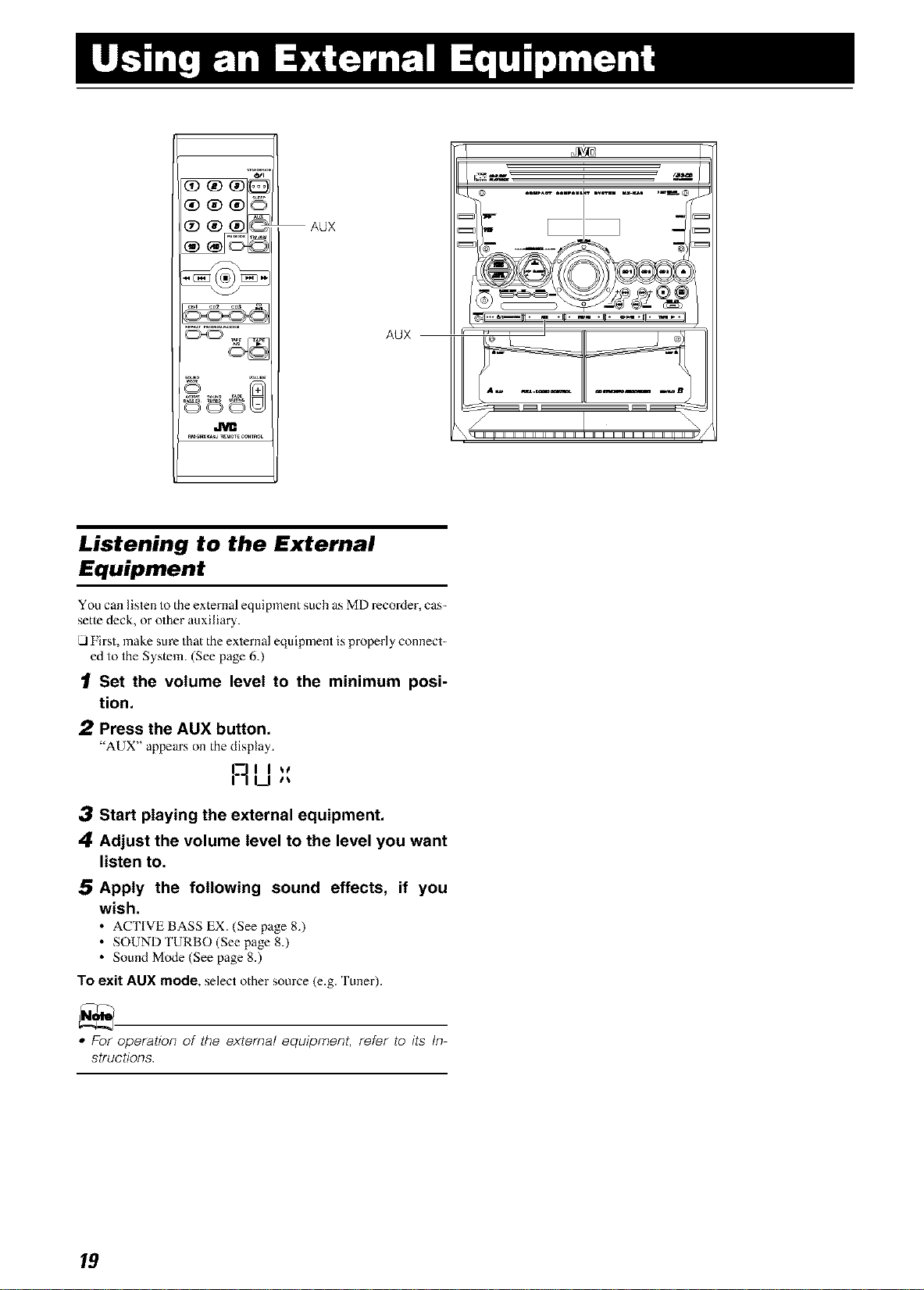
JVIB
AUX
AUX
@
Listening to the External
Equipment
You can listen to the external equipment such as MD recorder, cas-
sette deck, or other auxiliary.
i_ First, make sure that the external equipment is properly connect-
ed to the System. (See page 6.)
1 Set the volume level to the minimum posi-
tion.
2 Press the AUX button.
"AUX" appears on the display.
RLI"
3 Start playing the external equipment.
4 Adjust the volume level to the level you want
listen to.
5 Apply the following sound effects, if you
wish.
• ACTIVE BASS EX. (See page 8.)
• SOUND TURBO (See page 8.)
• Sound Mode (See page 8.)
TO exit AUX mode, select other source (e.g. Tuner).
• For operation of the external equipment, refer to its In
structions.
19
l/
000
,,IVI_
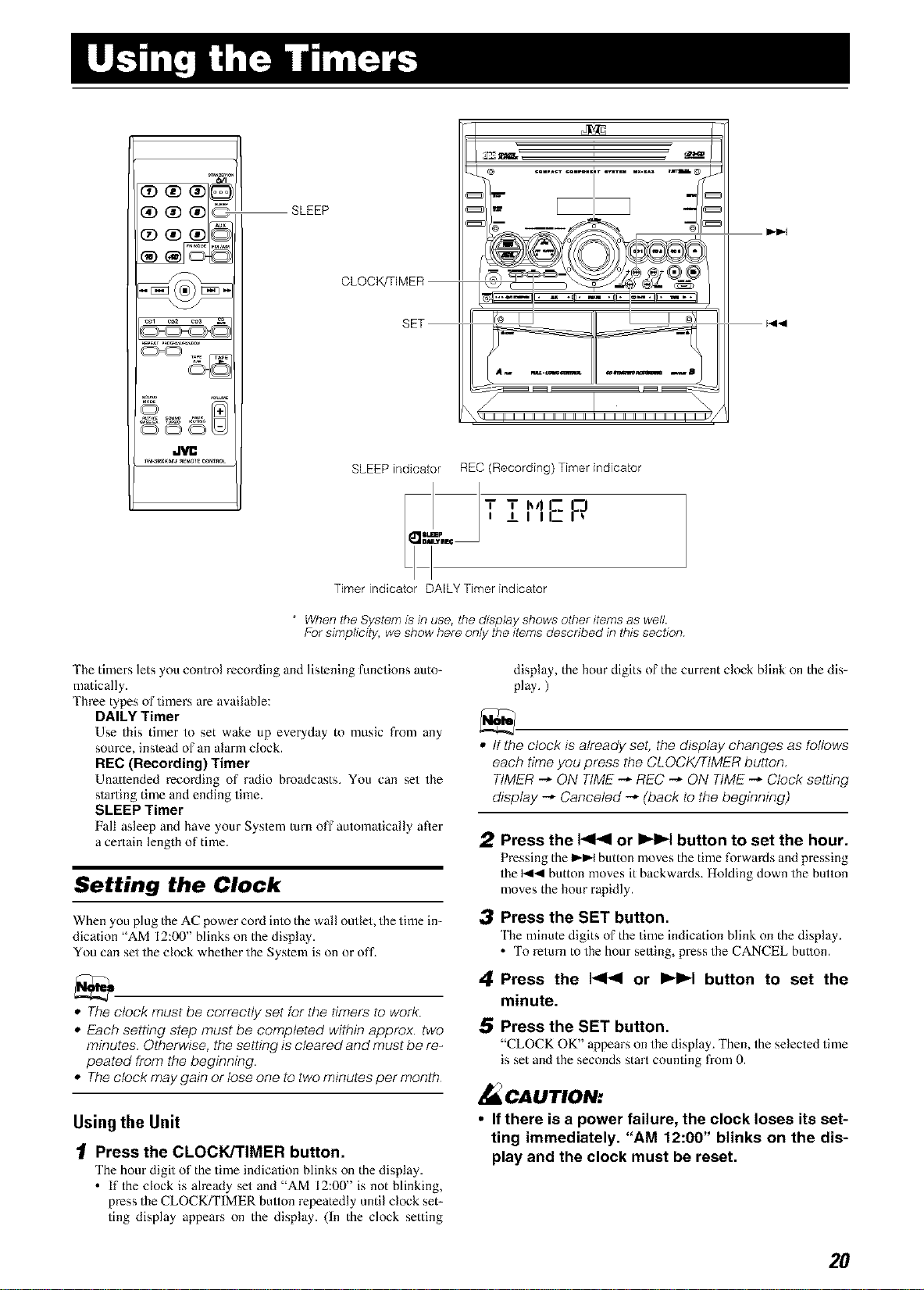
SLEEP
CLOCK/TIMER
] ,
SET
SLEEP indicator REC (Recording) Timer indicator
Timer indicator DAILY Timer indicator
* When the System is in use, the display shows other items as well.
For simplicity, we show here only the items described in this section
The timers lets you control recoMing and listening functions auto-
matically.
'I hree types of timers are available:
DALLY Timer
Use this timer to set wake up everyday to music from any
source, instead of an alarm clock.
REC (Recording) Timer
Unattended recording of radio broadcasts. You can set the
starting time and ending time.
SLEEP Timer
Fall asleep and have your System turn off automa/ically after
a certain length of time.
Setting the Clock
When you plug the AC power cord into the wall outlet, the time in-
dication "AM 12:00" blinks on the display.
You can set the clock whether the System is on or off.
• The clock must be correctly set for the timers to work.
• Each setting step must be completed within approx, two
minutes, Otherwise, the setting is cleared and must be re-
peated from the beginning.
• The clock may gain or lose one to two minutes per month
Using the Unit
1 Press the CLOCK/TIMER button.
The horn digit of the time indication blinks on the display.
• If the clock is ah-eady set and "AM 12:00" is not blinking,
press the CLOCKfFIMER bulton repeatedly until clock set-
ting display appears on the display. (In the clock setting
display, the hour digits of the current clock blink on the dis-
play. )
• If the clock is already set, tile display changes as follows
each time you press the CLOCK/TIMER button,
TIMER -* ON TIME -* REC -* ON TIME -* Clock setting
display -* Canceled -* (back to the beginning)
2 Press the 1<14<1or I_1_t button to set the hour.
Pressing the I,_1_tbutton moves the time forwards and pressing
the b<141button moves it backwards. Holding down the button
moves the hour rapidly.
3
4
5
Press the SET button.
'[he minute digits of the time indication blink on the display.
• To return to the hour setting, press the CANCEL button.
Press the 1<14<1or _ button to set the
minute.
Press the SET button.
CLOCK OK appea's on the display. Then, the selected time
is set and the seconds start counting from O.
CA UTION:
• Ifthere is a power failure, the clock loses its set-
ting immediately. "AM 12:00" blinks on the dis-
play and the clock must be reset.
2O
Using the Timers
Setting the Daily Timer
Once you have set the Daily 'Timer, the timer will be activated at
the same time every day.
'Ihe Timer indicator (_l) and "DAILY" indicator on the display
shows thai the Daily 'Timer you have set is in effect.
You can set the Daily 'Timer whether the System is turned on or
off.
• Perform each setting within approx. 30 seconds, Otller-
wise, setting wifl be cleared and the procedure must be
repeated from the beginning.
• If you have made a mistake while setting the timer, press
tile CANCEL button on tile UniL However, this does not al-
ways cancel tile current setting, ff tile CANCEL button
does not work, press tile CLOCK/TIMER button on the
Unit repeatedly until the display returns to tile original dis
play, and start from the first step.
Usingthe Unit
1 Press the _/I STANDBY/ON button to turn
on the System.
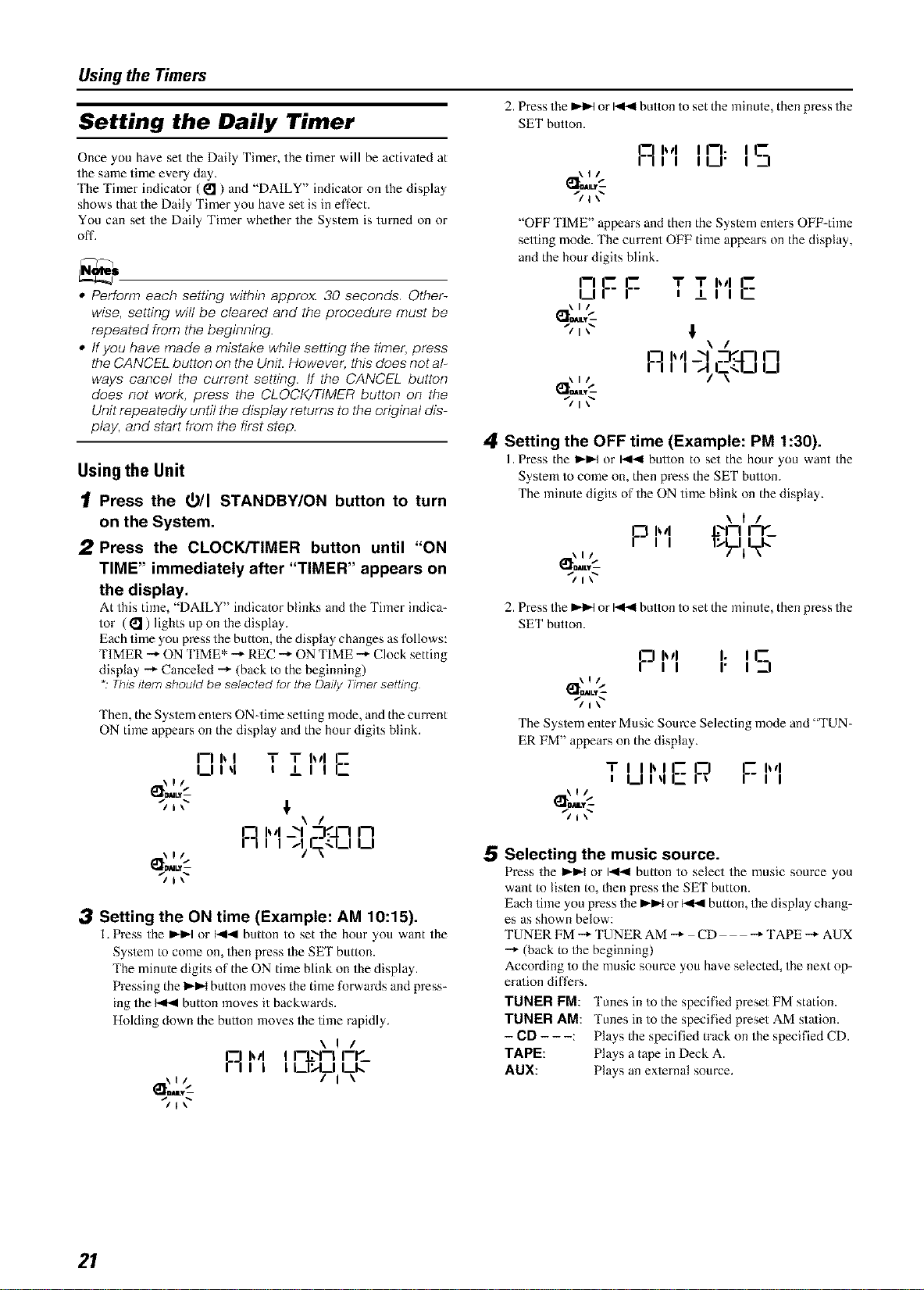
2 Press the CLOCK/TIMER button until "ON
TIME" immediately after "TIMER" appears on
the display.
At this time, "DALLY" indicator blinks and the Timer indica-
tor (1_) lights up on the display.
Each time you press the button, the display changes as follows:
TIMER -_ ON TIME* -* REC -_ ON TIME -_ Clock setting
display -* Canceled -_ (back to the beginning)
". This item should be selected for the Daffy Timer setting
Then, the System enters ON-time setting mode, and the current
ON time appears on the display and the hour digits blink.
I--I h I -- -- h4
u,. I :l,E
/J\ _,
\ /
_i M _'I .-J1".J7 17
I I "-_I/q-_,l__l U
",)_
/1\
3 Setting the ON time (Example: AM 10:15).
I. Press the _ or 14141button to set the hour you want the
System to come on, then press the SEI" button.
'Ihe minute digits of the ON time blink on the display.
Pressing the _-1_/button moves the time forwards and press-
ing the _ button moves it backwards.
Holding down the button moves the time rapidly.
\1 /
_11 h4 I I--L.'I--I I-K_
I I IUM_II_k
\I/ / I \
2. Press the _ or 14141button to set the minute, then press the
SET button.
R l_d I1--1. 15
II lU" I
/1\
"OFF TIME" appears and then the System enlers OFF4ime
selling mode. The current OFF time appears on the display,
and the hour digits blink.
-- -- hd
OFF : :,,E
\I 0
/1\
/1\
I
\ /
_l_ 4 _'1 _'_f.J--I 17
I I M/I,_4,,U U
4 Setting the OFF time (Example: PM 1:30).
l. Press the _-1_t or I..441 button to set the hour you want the
System to come on, then press the SET button.
The minute digits of the ON time blink on the display.
\l!
p,,,, r-r-
I I ll_
\lJ
2. Press the _ or 14141button to set the minute, then press the
SET button.
P"" '- IS
I I r
",)c,
/i\
The System enter Music Source Selecting mode and '"TUN-
ER FM" appears on the display.
T I Ihl I I
, uI,IE _ II'_ l''l
\)/.
@/=,1_
16\
5
Selecting the music source.
Press the I_1_t or I.<141button to select the music source you
want to listen to, then press the SET button.
Each time you press the _-1_i or _ button, the display chang-
es as shown below:
TUNER FM-_ TUNER AM -* CD -* TAPE -_ AUX
-* (back to the beginning)
According to the music source you have selected, the next op-
era/ion differs.
TUNER FM: Tunes in to the specified preset FM station.
TUNER AM: 'I unes in to the specified preset AM station.
- CD - - -: Plays the specified track on the specified CD.
TAPE: Plays a tape in Deck A.
AUX: Plays an external source.
21
Preparation for each music source:
Perform the following operation according to the music source
you have selected. Then, the System enters Volume Setting
mode.
When selecting TUNER FM or TUNER AM:
Press the _ or 14141 button to select the preset station
number, then press the SET butlon.
When selecting - CD - - -:
Be sure 1o specify the disc number and the track number as fob
lows.
1. Press the D,-ID.tor _ button to select the disc number, then
press the SET button.
Each time you press the button the disc number changes as
follows:
-CD "_ 1CD "_ 2CD - -" 3CD- -"*(back
to the beginning)
• If no disc number is specified, playback will start from the
first track of the currently selected disc.
2. Press the _ or I',1t<1button to select the track number, then
press the SET button.
l_k)rexample: 2CD 12 (Disc number 2, Track number 12)
Set Daily timer CD2 after playing in CD2.
If you set Daily Timer to other CD number after playing
CD2, it will not play back at the setting time.
• If no track number is specified, playback will start from
the first track of the specified disc.
When selecting TAPE:
Insert a cassette tape you want to play into Deck A.
When selecting AUX:
Prepare the external equipment so thai it will turn on at the ON
time set by the System.
To allow this, the equipment should have the timer function.
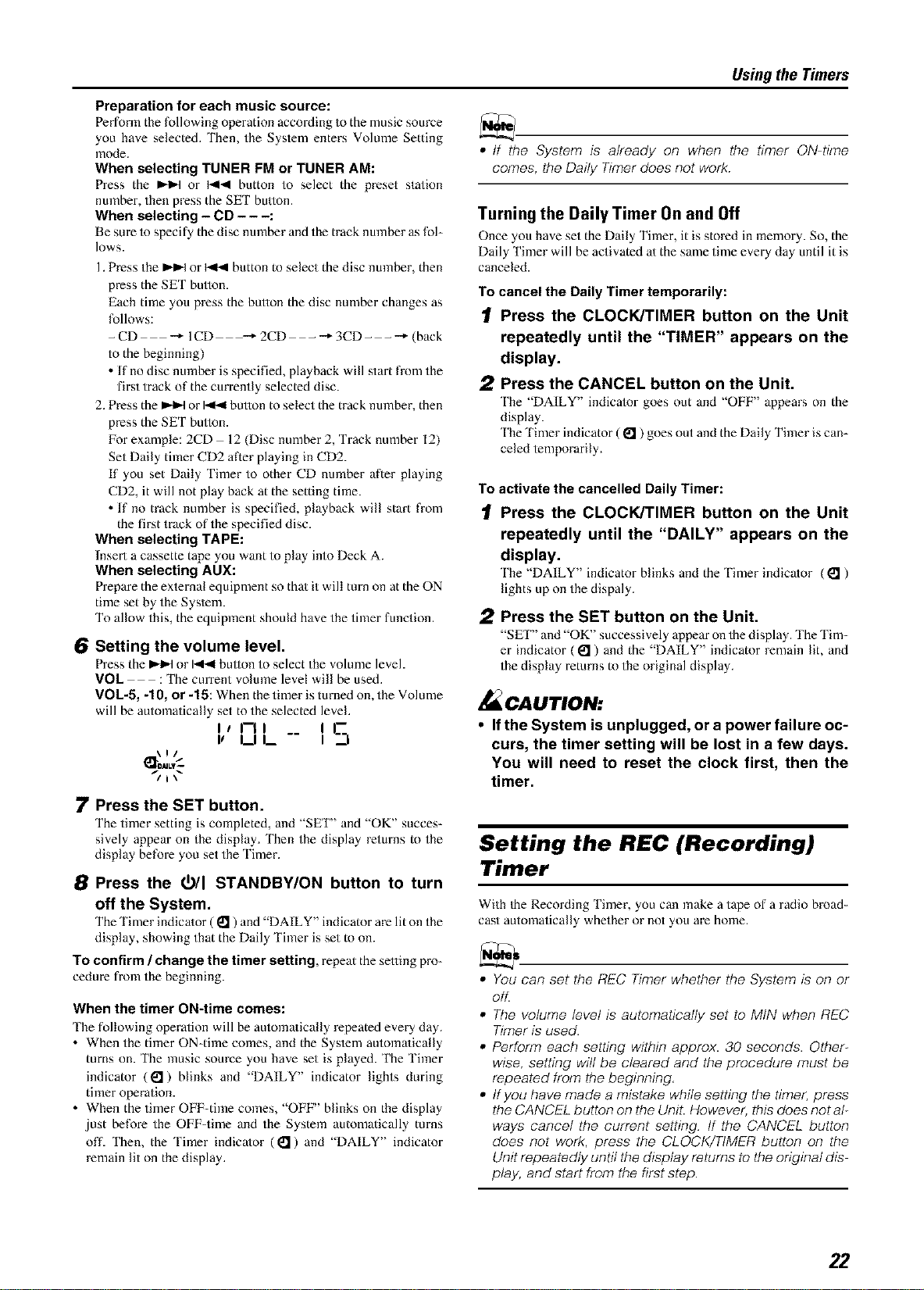
6 Setting the volume level.
Press the _1 or 14141bullon to select the volunte level.
VOL : The current volume level will be used.
VOL-5, -1 0, or -1 5: When the timer is turned on, the Volume
will be automatically set to the selected level.
,,n, _ 15
II U I._
O_L,¢
/1\
7 Press the SET button.
The timer setting is completed, and "SET" and "OK" succes-
sively appear on the display. Then the display returns to the
display before you set the Timer.
8 Press the _/I STANDBY/ON button to turn
off the System.
The Timer indicator ( I_ ) and "DALLY" indicator are lit on the
display, showing that the Daily Timer is set to on.
To confirm / change the timer setting, repeat thesetting pro_
cedure flom the beginning.
When the timer ON-time comes:
'Ihe following operation will be automatically repeated every day.
• When the timer ON-time comes, and the Sys/em automa/ically
turns on. The music source you have set is played. The Timer
indicator ((_1) blinks and "DALLY" indicator lights during
timer operation.
• When the timer OFF-time comes, "OFF" blinks on the display
.just before the OFF-time and the System automatically turns
off. Then, the Timer indicator ((_) and "DALLY" indicator
remain lit on the display.
Using the Timers
• If the System is already on when tile timer ONtime
comes, the Daily Timer does not work
Turning the Daily Timer Onand Off
Once you have set the Daily Timer, it is stored in memory. So, the
Daily Timer will be activated at the same time every day until it is
canceled.
To cancel the Daily Timer temporarily:
1 Press the CLOCK/TIMER button on the Unit
repeatedly until the "TIMER" appears on the
display.
2 Press the CANCEL button on the Unit.
'Ihe "DALLY" indicator goes out and "OFF" appears on the
display.
'Ihe Timer indicator ( _l ) goes out and the Daily Timer is can-
celed temporarily.
To activate the cancelled Daily Timer:
I Press the CLOCK/TIMER button on the Unit
repeatedly until the "DAILY" appears on the
display.
'Ihe "DAILY" indicator blinks and the Timer indicator (1_)
lights up on the dispaly.
2 Press the SET button on the Unit.
"SE_I '' and "OK" successively appear on the display. The Tint-
er indicator ( _l ) and the "DAILY" indicator remain lit, and
the display returns to the original display.
CA UTION:
• Ifthe System is unplugged, or a power failure oc-
curs, the timer setting will be lost in a few days.
You will need to reset the clock first, then the
timer.
Setting the REC (Recording)
Timer
With the Recording Timer, you can make a tape of a radio broad-
cast automatically whether or not you are home.
• You can set tile REC Timer whether the System is on or
off.
• Tile volume level is automatically set to MIN when REC
Timer is used,
• Perform each setting within approx, 30 seconds, Other_
wise, setting will be cleared and tile procedure must be
repeated from the beginning,
• If you have made a mistake while setting tile timer, press
tile CANCEL button on tile UniL However, this does not alr
ways cancel the current setting. If the CANCEL button
does not work, press the CLOCK/TIMER button on tile
Unit repeatedly until tile display returns to the original dis
play, and start from the first step.
22
Using the Timers
Using the Unit
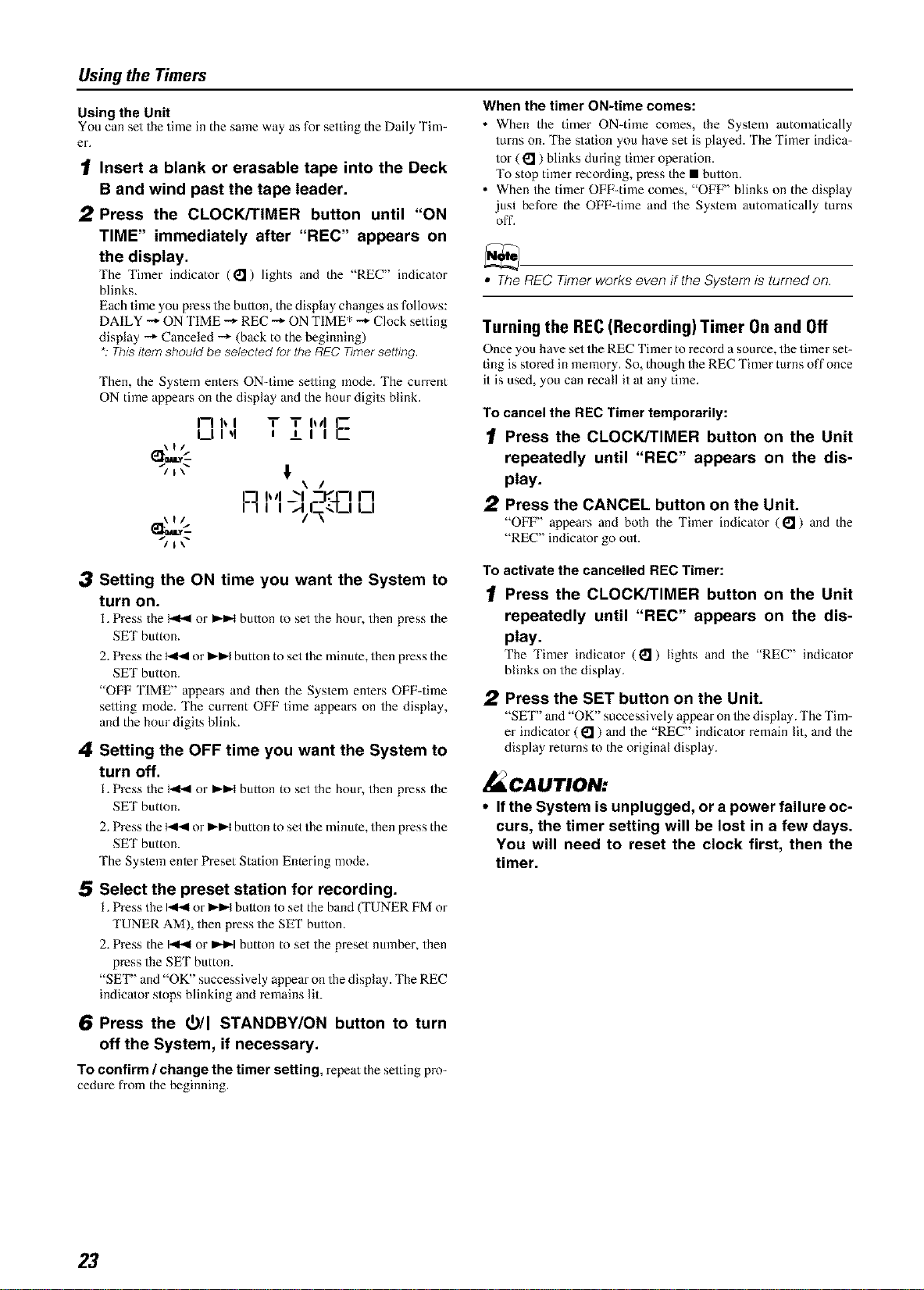
You call set the time in the same way as for setting the Daily Tim-
er+
I Insert a blank or erasable tape into the Deck
B and wind past the tape leader.
2 Press the CLOCK/TIMER button until "ON
TIME" immediately after "REC" appears on
the display.
The Timer indicator (1_) lights and the "REC" indicator
blinks.
Each time you press the button, the display changes as follows:
DALLY -" ON TIME "_ REC -" ON TIME* -" Clock setting
display -" Canceled "_ (back to the beginning)
": This item should be selected for the REC Timer setting.
Then, the System enters ON-time setting mode. The current
ON time appears on the display and the hour digits blink.
n i_i - - h iI
UI'I l file
\ /
E I_d _'1 _ n
I"711---M/t._'_-'l +] U
3 Setting the ON time you want the System to
turn on.
I+ Press the _ or D,-ID.Ibutton to set the hour, then press the
SET button.
2. Press the _ or _,-ID.tbutton to set the minute, then press the
SET button.
"OFF TIME" appears and then the Syslem enlers OFF-time
selling mode. The current OFF time appears on the display,
and the hour digits blink.
4 Setting the OFF time you want the System to
turn off.
I+ Press the _ or D,-ID.Ibutton to set the hour, then press the
SET button.
2. Press the _ or _,-ID.Ibutton to set the minute, then press the
SET button.
The System enter Preset Station Entering mode.
5 Select the preset station for recording.
I+ Press the I_I_Ior _ID.t button to set the band (TUNER FM or
TUNER AM), then press the SET button.
2+ Press the 1"41<1or I_,-I button to set the preset number, then
press the SFF button.
"SET" and "OK" successively appear on the display. 'Ihe REC
indicator stops blinking and remains lit.
5 Press the _/I STANDBY/ON button to turn
off the System, if necessary.
To confirm / change the timer setting, repeat the setting pro-
cedm-e from the beginning.
When the timer ON-time comes:
• When the timer ON-time comes, the System automatically
turns on. The station you have set is played. The Timer indica-
tor ( I_] ) blinks during timer operation.
To stop timer recording, press the • bullon.
• When the timer OFF-time comes, "OFF' blinks on the display
just before the OFF-time and the System automatically turns
off.
• The REC Timer works even if the System is turnedon.
Turning the REC(Recording)Timer On and Off
Once you have set the REC Timer to record a source, the timer set+
ting is stored in memory. So, though the REC Timer turns off once
it is used, you can recall it at any time.
To cancel the REC Timer temporarily:
1 Press the CLOCK/TIMER button on the Unit
repeatedly until "REC" appears on the dis-
play.
2 Press the CANCEL button on the Unit.
"OFF" appears and both the Timer indicator (l_) and the
"REC" indicator go out+
To activate the cancelled REC Timer:
I Press the CLOCK/TIMER button on the Unit
repeatedly until "REC" appears on the dis-
play.
The Timer indicator (1_) lights and the "REC" indicator
blinks on the display.
2 Press the SET button on the Unit.
"SE'I" and "OK" successively appear o+1the display. The Tim-
er indica/or (l_]) and the "REC" indicator remain lit, and the
display returns to the original display.
._ CAUTION:
• If the System is unplugged, or a power failure oc-
curs, the timer setting will be lost in a few days.
You will need to reset the clock first, then the
timer.
23
Using the Timers
Setting the SLEEP Timer
Use the Sleep Timer Io turn the System off after a certain number
of minules when it is playing. By setting the Sleep Timer, you can
fall asleep to music and know that your System will turn off by it-
self rather than play all night.
• You can only set the Sleep Timer when the System is on.
Using the Remote Control
I During playback a source, press the SLEEP
button.
The "SLEEP" indicator starts blinking on the display.
2 Set the length of time you want the source to
play before shutting off.
Each time you press the SLEEP button, the time length chang-
es as follows:
10 -_ 20 -_ 30 "-_ 60 "-_ 90 "-_ 120 "-_ Cancelled "-_ (back to
the beginning)
SLEEP B'1
xl/ I_1
-%.==P_
/1\
3 Wait for 5 seconds.
The "SLEEP" indicator stops blinking and remains lit, and the
display returns to the original one before setting the Sleep
Timer.
The System is now set to turn off after the number of minutes
you have set.
To Confirm the Sleep Time:
When the SLEEP bullon oil the Remote Control is pressed, the re-
maining sleep time is displayed. Wait until the display returns to
the original display.
To Cancel the SLEEP Timer Setting:
Press the SLEEP bullon on the Remote Control until the "SLEEP"
indicator goes out on the display.
• Turning off the System also cancels the SLEEP Timer.
• When the SLEEP button is used without setting the clock,
"CLOCK ADJUST" appears on the display You need to
set the clock beforehand
Timer Priority
Since each timer can be set independently, you may wonder whal
happens if the settings overlap. Hexe are the priorities for each timer:
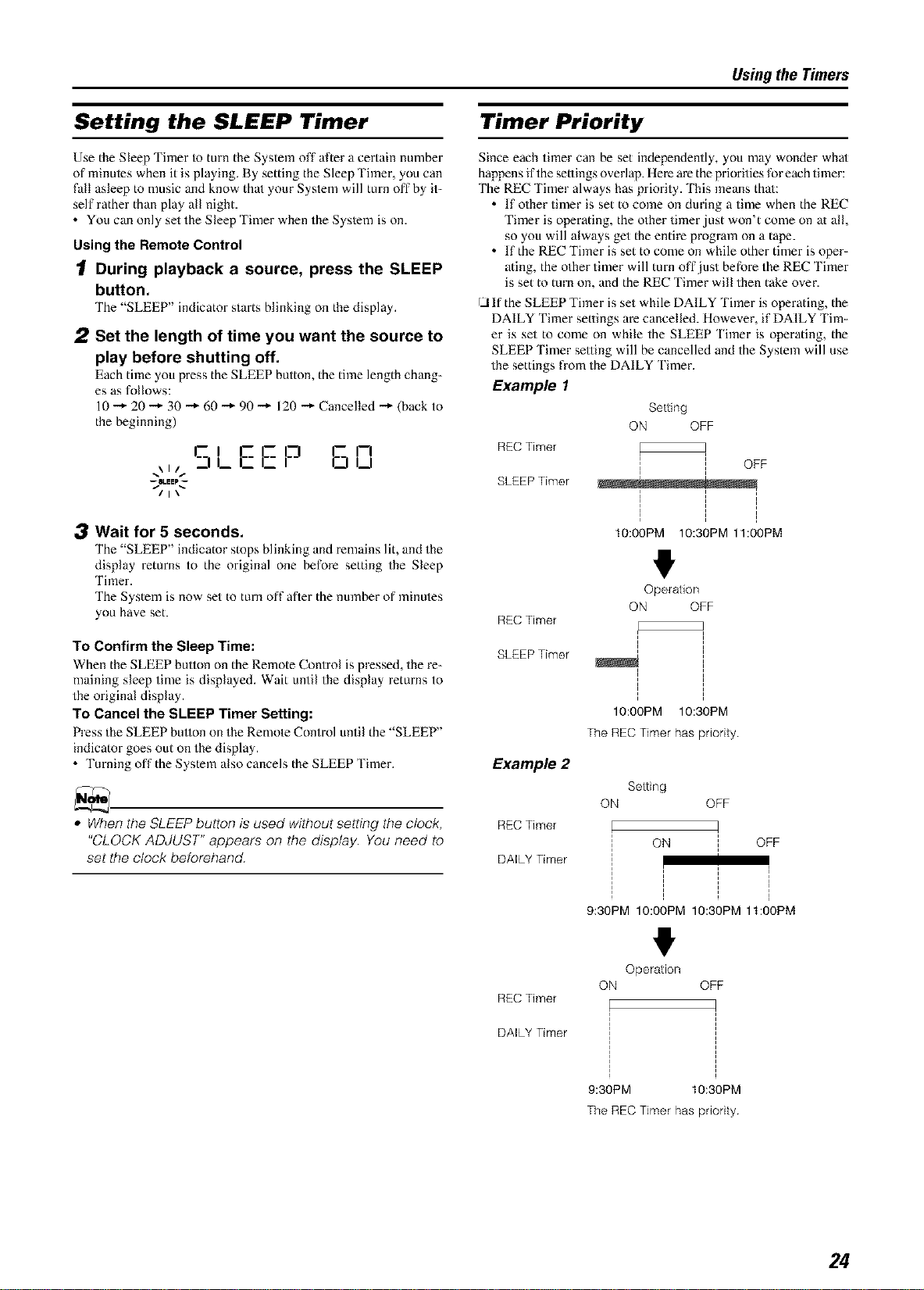
The REC Timer always has priority. 'Ihis means thai:
• If other timer is set to come on during a time when the REC
Timer is operating, the other timer just won't come on at all,
so you will always get the entire program on a tape.
• If the REC Timer is set to come on while other timer is oper-
ating, the other timer will turn off just before the REC 'I imer
is set to turn on, and the REC Timer will then take over.
I_1If the SLEEP Timer is set while DALLY 'I imer is operating, the
DALLY Timer settings are cancelled. However, if DAILY Tim-
er is set to come on while the SLEEP 'Iimer is operating, the
SLEEP Timer sening will be cancelled and the System will use
the settings from the DALLY Timer.
Example 1
REC Timer
SLEEP Timer
REC Timer
Setting
ON OFF
OFF
i
!
!
IO:OOPM IO:30PM 11:00PM
Operation
ON OFF
!
SLEEP Timer
Example 2
RECTimer
DAILY Timer
REC Timer
IO:OOPM IO:30PM
The REC Timer has priority
Setting
ON OFF
ON OFF
I
!
!
9:30PM IO:OOPM IO:30PM 11:00PM
!I,
Operation
ON OFF
DAILY Timer
9:30PM IO:30PM
The REC Timer has priority
24

Handle your CDs and tapes carefully, and they will last a long Cassette Tapes
time.
Compact Discs
[lgrmL_u_o
ml_ffAL AUIO
w_mm
• Only CDs bearing these marks can be
used with this System. However, contin-
ued use of irregular shape CDs (heart-
shape, octagonal, etc.) can damage the
System.
x©
• Remove the CD from its case by holding
it a/the edges while pressing the case's
center hole lightly.
• Do not touch the shiny surface of the
CD, or bend the CD.
• Put the CD back in its case af/er use to
prevent warping.
• Be careful not to scratch the surface of
the CD when placing it back in the case.
• Avoid exposure to direct sunlight, tem-
perature extremes, and moisture.
• A dirty CD may not play correctly. If a
CD does become dirty, wipe it with a
soft cloth in a straight line from center to
edge.
CAUTION:
• Do not use any solvent (for example, conven-
tional record cleaner, spray thinner, benzine,
etc.) to clean a CD.
General Notes
In general, you will have the best performance by keeping your
CDs and the mechanism clean.
• Store CDs in their cases, and keep them in cabinets or on
shelves.
• Keep the System's Top Cover closed when not in use.
Moisture Condensation
• lfthe tape is loose in its cassette, take up
the slack by inserting a pencil in one of
the reels and rotating.
• If the tape is loose, it may get stretched,
cut, or caught in the cassette.
• Do not touch the tape surface.
• Do not store the tape:
- In dusty places
- In direct sunlight or heat
- In moist areas
- On a TV or speaker
- Near a magnet
Cassette Deck
• If the heads, capstans, and pinch-rollers of the Cassette Deck
become dirty, the following will occur:
- Loss of sound quality
- Discontinuous sound
- Fading
- lncomplele erasure
- Difficulty recording
• Clean the heads, capstans, and pinch-rollers using a cotton
swab moistened with alcohol.
Pinch-roller
Capstan /
u
• If the heads become magnetized, the Unit will produce noise or
lose high frequencies.
• To demagnetize the heads, turn off the Unit, and use a head
demagnetizer (available at electronics and record shops).
Moisture ]nay condense on the lens inside
the Sys/em in the following cases:
• Afler turning on healing in the morn.
• In a damp room.
• If the Syslem is brought directly from a
cold to a warm place.
Should this occur, the System may mal-
function. In this case, leave the Sys/em
turned on for a few hours until the moisture
evaporates, unplug the AC power cord, and
then plug it in again.
25
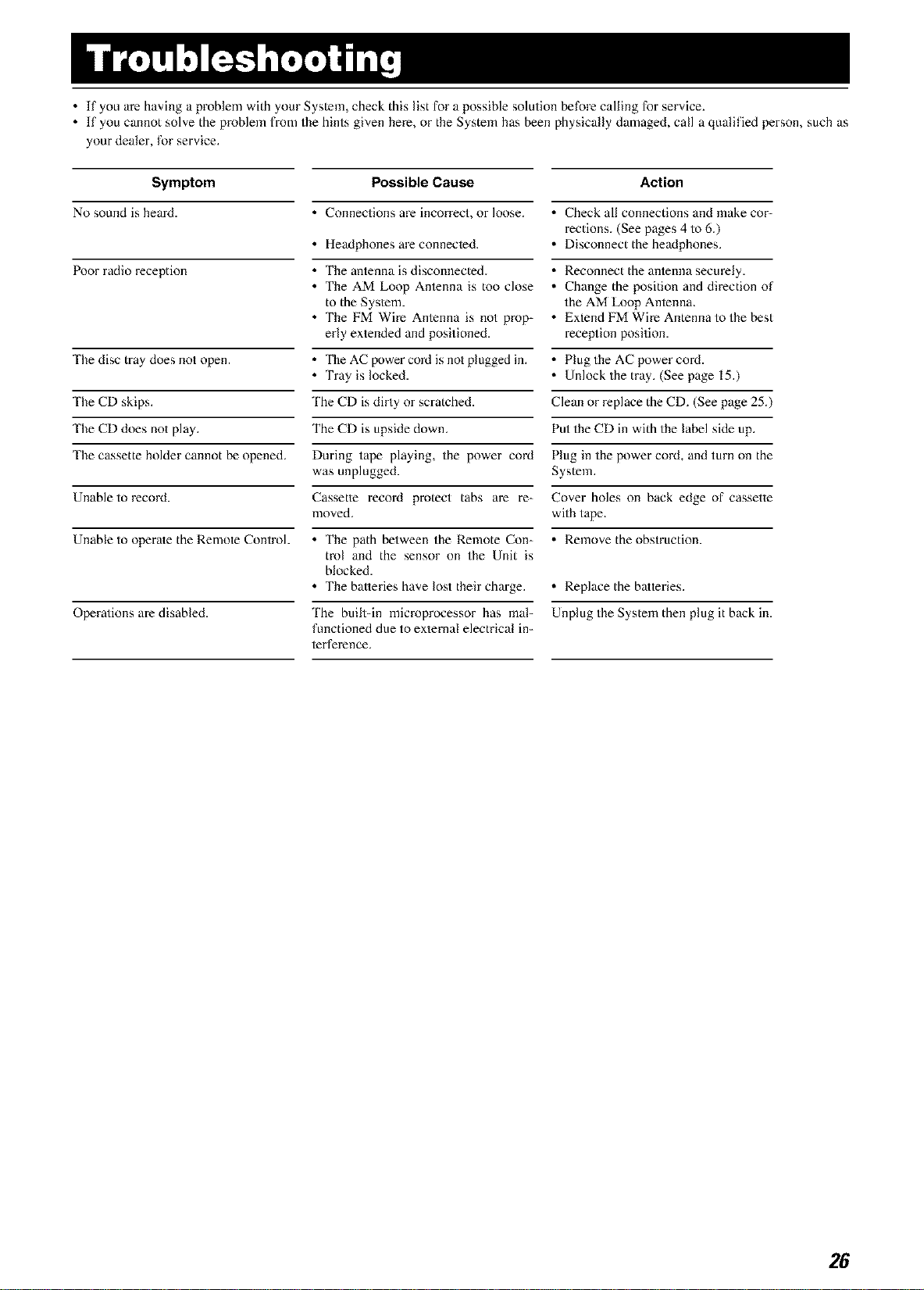
• If you are having a problem with your System, check this list for a possible solution before calling for service.
• If you cannot solve the problem from the hints given here, or the System has been physically damaged, call a qualified person, such as
your dealer, for service.
Symptom
No sound is heaM.
Poor radio reception
'Ihe disc tray does not open.
'Ihe CD skips.
'Ihe CD does not play.
'Ihe cassette holder cannot be opened.
Unable to recoM.
Unable to operate the Remote Control.
Operations are disabled.
Possible Cause
• Connections are incorrect, or loose.
• Headphones are connected,
• The antenna is disconnected.
• The AM Loop Anlenna is too close
to the Sys/em.
• The FM Wire Anlenna is not prop-
erly extended and positioned.
• The AC power cord is not plugged in.
• Tray is locked.
The CD is dirty or scratched.
The CD is upside down.
During tape playing, the power coM
was unplugged.
Cassette record protect tabs are re-
moved.
• The path between the Remote Con-
trol and the sensor on the Unit is
blocked.
• The batteries have lost their charge.
The built-in microprocessor has mal-
functioned due to external electrical in-
terference.
Action
• Check all connections and make cor-
rections. (See pages 4 to 6.)
• Disconnect the headphones.
• Reconnect the anlenna securely.
• Change the position and direction of
the AM Loop Antenna.
• Extend FM Wire Antenna to the best
reception position.
• Plug the AC power coM.
• Unlock the tray. (See page 15.)
Clean or replace the CD. (See page 25.)
Put the CD in with the label side up.
Plug in the power cord, and turn on the
System.
Cover holes on back edge of cassette
with tape.
• Remove the obstruction.
• Replace the batteries.
Unplug the System then plug it back in.
26
Authorized Service Centers
JVC °
QUALITY SERVICE
HOW TO LOCATE YOUR JVC SERVICE CENTER
TOLL FREE: 1 (800) 537-5722
http://www.jvc.com
Dear Customer,
In order to receive the most satisfaction from your purchase,please read the instruction booklet before
operating the unit.In the event that repairs are necessary, please call 1 (800)537-5722 for your nearest
authorized servicer or visit our website at www.JVC.com
Remember to retain your Bill of Sale for Warranty Service.
Do not service the television yourself
Caution
To prevent electrical shock,do not open the cabinet.There are no user serviceable
parts inside.Please refer to qualified service personnel for repairs.
Accessories
To purchase accessories for your JVC product,please call toll free:l (800)882-2345 or
on the web at www.JVC.com
BT-51001-5
(0301)
27
JVC
* LIMITEDWARRANTY AUDIO-I **
',k, ,ir
_- JVC COMPANY OF AMERICA warrants this product and all parts thereof, except as set forth below ONLY TO THE
ORIGINAL PURCHASER AT RETAIL to be FREE FROM DEFECTIVE MATERIALS AND WORKMANSHIP from the date _
of original retail purchase for the period as shown below. ("The Warranty Period") _r
PARTS LABOR
* 1 YR 1 YR _r
_r _r
_- THIS LIMITED WARRANTY IS VALID ONLY IN THE FIFTY (50) UNITED STATES, THE DISTRICT OF COLUMBIA AND
IN COMMONWEALTH OF PUERTO RICO.
WHAT WE WILL DO:
. If this product is found to be defective, JVC will repair or replace defective parts at no charge to the originaI owner. _r
Such repair and replacement services shall be rendered by JVC during normal business hours at JVC authorized service _r
_ centers. Parts used for warranted for the remainder of the Period. All and
replacement
only
Warranty products
are
parts
_r thereof may be brought to a JVC authorized service center on a carryqn basis except for Television sets having a screen _-
size 25 inches and above which are covered on an in-home basis.
n
_r WHAT YOU MUST DO FOR WARRANTY SERVICE: _r
_rRetu rn your prod uct to aJVC authorized service center with a copy of your bill of sale. For your nearest JVC authorized _-
_r service center, please caII toll free: (800) 537-5722. _"
yt
_ _fserviceisn_tava__ab_e__ca__y,b_xthepr_ductcarefu__y_preferab_yinthe_rigina_cart_n_andship,insured_with _
a copy of your bill of sale plus a letter of explanation of the problem to the nearest JVC Factory Service Center, the _.
name and location of which will be given to you by the toibfree number.
_.lf you have any questions concerning your JVC Product, please contact our Customer Relations Department.
* WHAT IS NOT COVERED"
. This Imputed warranty prowded by JVC does not cover: .
_1. Pr_ducts which have been subject t_ abuse_ accident_ a_terati_n' m_dificati_n_ tampering_ neg_igence_ misuse_ fau_ty _
._ installation, lack of reasonable care, or if repaired or serviced by anyone other than a service facility authorized by ._
JVC to render such service, or if affixed to any attachment not provided with the products, or if the model number _-
_" or serial number has been altered, tampered with, defaced or removed; _"
_2. Initial installation and installation and removal for repair; _l-
_" 3. Operational adjustments covered in the Owner's Manual, normal maintenance, video and audio head cleaning;
4. Damage that occurs in shipment, due to act of God, and cosmetic damage;
_" 5. Signal reception problems and failures due to line power surge;
6 Video Pick-up Tubes/CCD Image Sensor, Cartridge, Stylus (Needle) are covered for 90 days from the date of purchase;
71 Accessories *
8. Batteries (except that Rechargeable Batteries are covered for 90 days from the date of purchase);
There are no express warranties except as listed above.
_- THE DURATION OF ANY IMPLIED WARRANTIES, INCLUDING THE IMPLIED WARRANTY OF MERCHANTABILITY, IS
LIMITED TO THE DURATION OF THE EXPRESS WARRANTY HEREIN.
n
_" JVC SHALL NOT BE LIABLE FOR THE LOSS OF USE OF THE PRODUCT, INCONVENIENCE, LOSS OR ANY OTHER _"
DAMAGES, WHETHER DIRECT, INCIDENTAL OR CONSEQUENTIAL (INCLUDING, WITHOUT LIMITATION, DAMAGE _.
_- TO TAPES, RECORDS OR DISCS) RESULTING FROM THE USE OF THIS PRODUCT, OR ARISING OUT OF ANY BREACH _-
_" OF THIS WARRANTY. ALL EXPRESS AND IMPLIED WARRANTIES, INCLUDING THE WARRANTIES OF MERCHANT- _"
_r
_ ABILITY AND FITNESS FOR PARTICULAR PURPOSE, ARE LIMITED TO THE WARRANTY PERIOD SET FORTH ABOVE.
Some states do not allow the exclusion of incidental or consequential damages or limitations on how long an
implied warranty lasts, so these limitations or exclusions may not apply to you. This warranty gives you specific _"
legal rights and you may also have other rights which vary from state to state. _.
_r
_r JVC COMPANY OF AMERICA 1700 Valley Road _r
_" DIVISION OF JVC AMERICAS CORP. Wayne, NJ 07470 _"
_r _r
REFURBISHED PRODUCTS CARRY A SEPARATE WARRANTY, THIS WARRANTY DOES NOT APPLY. FOR DETAILS OF
REFURBISHED PRODUCT WARRANTY, PLEASE REFER TO THE REFURBISHED PRODUCT WARRANTY INFORMATION
PACKAGED WITH EACH REFURBISHED PRODUCT.
For customer use:
Enter below the Model No. which is located either on the rear, bottom or side of the ca binet. Retain this information
for future reference.
Model No. : Serial No. :
Purchase data : Name of dealer :
28
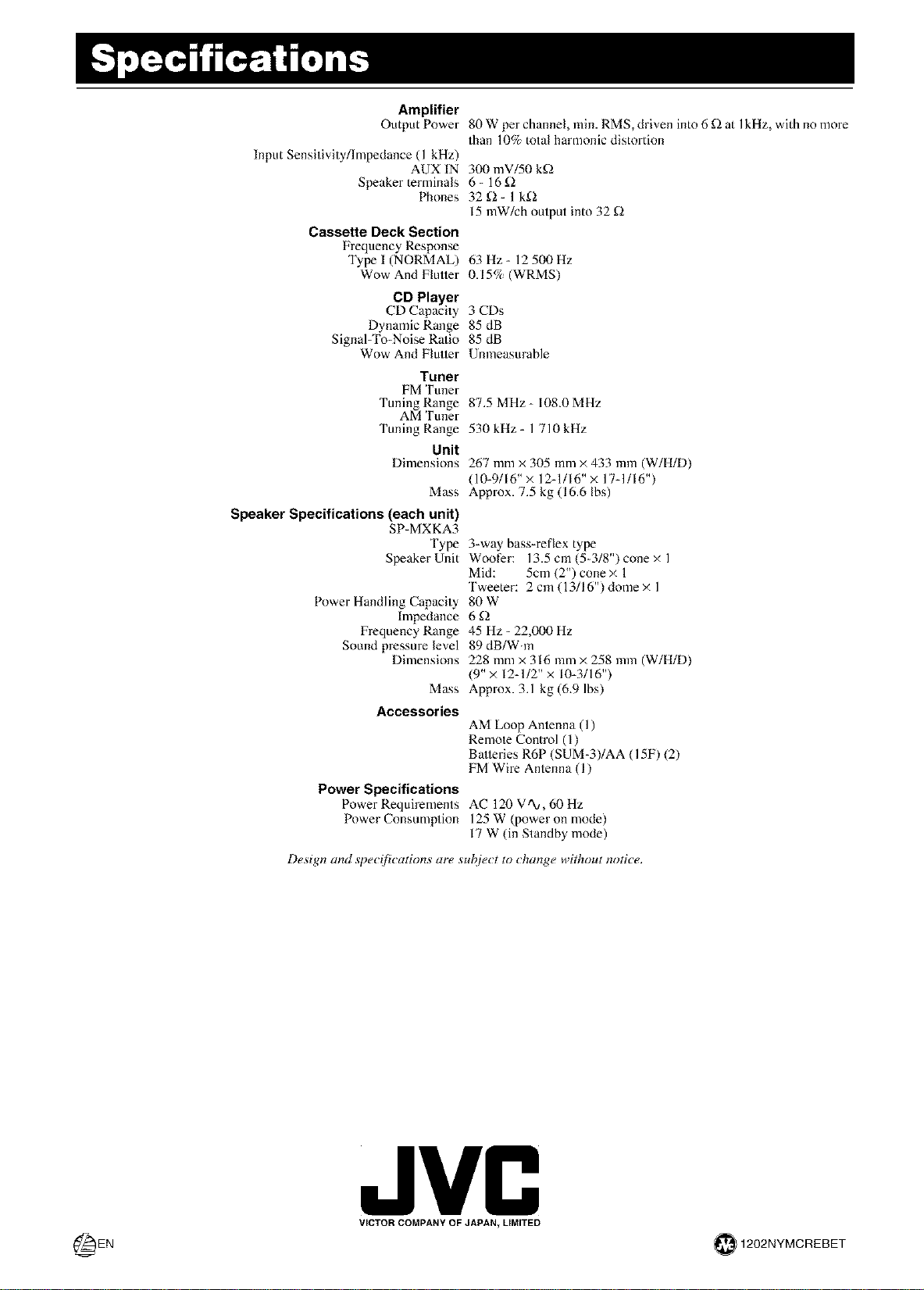
Amplifier
Output Power
Input Sensitivity/Impedance (1 kHz)
AUX IN
Speaker terminals
Phones
Cassette Deck Section
Frequency Response
Type I (NORMAL)
Wow And Flutter
80 W per channel, rain. RMS, driven into 6 _2at 1kHz, with no more
than 10% total harmonic distortion
300 mV/50 k_2
6- 16_2
32 _2 - 1 k_;'
15 roW/oh output into 32 _
63 Hz - 12 500 Hz
0.15% (WRMS)
CD Player
CD Capacity 3 CDs
Dynamic Range 85 dB
Signal-To-Noise Ralio 85 dB
Wow And Flutter Umneasurable
Tuner
FM Tuner
Tuning Range
AM Tuner
Tuning Range
Unit
Dimensions
Mass
Speaker Specifications (each unit)
SP-MXKA3
Type
Speaker Unit
Power Handling Capacity
Impedance
Frequency Range
Sound pressure level
Dimensions
Mass
Accessories
Power Specifications
Power Requirements
Power Consumption
87.5 MHz- I08.0 MHz
530 kHz- 1 710 kHz
267 mm x 305 mm× 433 mm (W/H/D)
(1%9/16" × 12-1/16" × 1%1/16")
Approx. 7.5 kg (16.6 Ibs)
3-way bass-reflex type
Woofer: 13.5 cm (5-3/8") cone × 1
Mid: 5cm (2") cone × 1
Tweeter: 2 cm (13/16") dome × 1
8O W
6 _2
45 Hz - 22,000 Hz
89 dB/W.m
228 mm x 316 mm× 258 mm (W/H/D)
(9" × 12-1/2" x I0-3/16")
Approx. 3.1 kg (6.9 Ibs)
AM Loop Anlenna (1)
Remole Control (1)
Batteries R6P (SUM-3)/AA (15F) (2)
FM Wire Antenna (I)
AC 120 V%, 60 Hz
125 W (power on mode)
17 W (in Standby mode)
Design and specifications are sul_ject to change without notice.
VICTOR COMPANY OF JAPAN_ LIMITED
EN _1202NYMCREBET