DXS-3610 Series 100 Gigabit Ethernet Managed Switch
Hardware Installation Guide

DXS-3610 Series Layer 3 Stackable 10GbE Managed Switch Hardware Installation Guide
ii
Information in this document is subject to change without notice. Reproduction in any manner whatsoever, without the written
permission of D-Link Corporation, is strictly forbidden.
Trademarks used in this text: D-Link and the D-LINK logo are trademarks of D-Link Corporation; Microsoft and Windows are
registered trademarks of Microsoft Corporation.
Other trademarks and trade names may be used in this document to refer to either the entities claiming the marks and names or
their products. D-Link Corporation disclaims any proprietary interest in trademarks and trade names other than its own.
© 2022 D-Link Corporation. All rights reserved.
FCC Compliance Statement
This device complies with Part 15 of the FCC Rules. Operation is subject to the following two conditions: (1) This device may not
cause harmful interference, and (2) this device must accept any interference received, including interference that may cause
undesired operation.
CE Mark Warning
This equipment is compliant with Class A of CISPR 32. In a residential environment, this equipment may cause radio interference.
Avertissement Concernant la Marque CE
Cet équipement est conforme à la classe A de la norme CISPR 32. Dans un environnement résidentiel, cet équipement peut
provoquer des interférences radio.
VCCI Warning
この装置は、クラス A 機器です。この装置を住宅環境で使用すると電波妨害を引き起こすことがあります。この場合には使用者が
適切な対策を講ずるよう要求されることがあります。 VCCI-A
BSMI Notice
此為甲類資訊技術設備,於居住環境中使用時,可能會造成射頻擾動,在此種情況下,使用者會被要求採取某些適當的對策。
Safety Compliance
Warning: Class 1 Laser Product: When using a fiber optic media expansion module, never look at the transmit laser while it is
powered on. In addition, never look directly at the fiber TX port and fiber cable ends when they are powered on.
Avertissement: Produit Laser de Classe 1: Ne regardez jamais le laser tant qu’il est sous tension. Ne regardez jamais
directement le port TX (Transmission) à fibres optiques et les embouts de câbles à fibres optiques tant qu’ils sont sous tension.

DXS-3610 Series Layer 3 Stackable 10GbE Managed Switch Hardware Installation Guide
iii
Table of Contents
Intended Readers ................................................................................................................................................... v
Typographical Conventions .................................................................................................................................... v
Notes and Cautions ................................................................................................................................................ v
1. Introduction ........................................................................................................................................................... 1
Switch Description .................................................................................................................................................. 1
Switch Series .......................................................................................................................................................... 1
Package Contents .................................................................................................................................................. 1
2. Hardware Components ........................................................................................................................................ 2
Front Panel Components ........................................................................................................................................ 2
Front Panel LED Indicators ............................................................................................................................... 3
Rear Panel Components ........................................................................................................................................ 5
Rear Panel LED Indicators ................................................................................................................................ 6
Side Panel Components ......................................................................................................................................... 7
3. Installation ............................................................................................................................................................. 8
Installation Guidelines ............................................................................................................................................. 8
Installing the Switch without a Rack ....................................................................................................................... 8
Installing the Switch in a Standard 19" Rack .......................................................................................................... 9
Installing Transceivers into the Transceiver Ports ................................................................................................ 11
Installing PSU Modules into the PSU Module Slots ............................................................................................. 13
Installing AC PSU Modules ............................................................................................................................. 13
Installing DC PSU Modules ............................................................................................................................. 14
Installing Fan Modules into the Fan Module Slots ................................................................................................ 17
Smart Fans ...................................................................................................................................................... 18
4. Switch Connections ........................................................................................................................................... 19
Stacking the Switch .............................................................................................................................................. 19
Switch to Switch .................................................................................................................................................... 21
Switch to Server .................................................................................................................................................... 21
Switch to End Node .............................................................................................................................................. 22
5. Switch Management ........................................................................................................................................... 23
Management Options ........................................................................................................................................... 23
Command Line Interface (CLI) ............................................................................................................................. 23
Connecting to the Console Port ...................................................................................................................... 23
Logging into the CLI ........................................................................................................................................ 24
Creating a User Account ................................................................................................................................. 24
Configuring the IP Address.............................................................................................................................. 24
Web User Interface (Web UI) ............................................................................................................................... 25
Connecting to the Web UI ............................................................................................................................... 25
Logging into the Web UI .................................................................................................................................. 25
Web Interface Navigation ................................................................................................................................ 26
SNMP-based Management .................................................................................................................................. 27
Connecting using SNMP ................................................................................................................................. 27
Traps ................................................................................................................................................................ 27
Management Information Base (MIB) ............................................................................................................. 27
Appendix A - Technical Specifications ....................................................................................................................... 28
Appendix B - Cables and Connectors ......................................................................................................................... 33
Ethernet Cable ...................................................................................................................................................... 33
Console Cable ...................................................................................................................................................... 34

DXS-3610 Series Layer 3 Stackable 10GbE Managed Switch Hardware Installation Guide
iv
Safety/Sécurité .............................................................................................................................................................. 35
Safety Instructions ................................................................................................................................................ 35
Safety Cautions ............................................................................................................................................... 35
Consignes de sécurité .......................................................................................................................................... 36
Précautions de sécurité ................................................................................................................................... 36
General Precautions for Rack-Mountable Products ............................................................................................. 38
Protecting Against Electrostatic Discharge ........................................................................................................... 39
Warranty & Technical Support ..................................................................................................................................... 40
DXS-3610 Series Layer 3 Stackable 10GbE Managed Switch Hardware Installation Guide
v
Intended Readers
The DXS-3610 Series 100 Gigabit Ethernet Managed Switch Hardware Installation Guide contains detailed
information about the hardware specifications of the switches in this series. It also contains brief information on how to
configure and manage a switch in this series. This manual is intended for advanced level users that are familiar with
network management concepts and terminology. For all practical reasons, all the switches in this series will simply be
referred to as the Switch throughout this manual.
Typographical Conventions
Convention Description
Boldface Font This convention is used to place emphasis on keywords. It also indicates a button,
toolbar icon, menu, menu item, system message, or a prompt appearing on the
screen. For example, click the Apply button.
Initial capital letter This convention is used to indicate a window name or keyboard key. For example,
press the Enter key.
Blue Courier Font
This convention is used to represent a CLI example.
Notes and Cautions
NOTE: A note indicates important information that helps you make better use of your device.
CAUTION: A caution indicates a potential for property damage, personal injury, or death.
ATTENTION : Une précaution indique un risque de dommage matériel, de blessure corporelle ou de
mort.

DXS-3610 Series Layer 3 Stackable 10GbE Managed Switch Hardware Installation Guide
1
1. Introduction
Switch Description
Switch Series
Package Contents
Switch Description
The DXS-3610 series is the latest generation of Managed switches from D-Link. Switches in this series feature a wide
selection of different ports types and speeds that can be used to interconnect a variety of networking devices to
communicate with each other. The QSFP28 and SFP+ ports, with fiber-optical cabling, can be used to uplink
connections that may span over great distances. Switches in this series also implement D-Link’s innovative third
generation Green Ethernet technology (IEEE 802.3az) to save power from links that are inactive by turning LEDs off
based on a customized schedule and by allowing ports to automatically enter a hibernated state.
Switch Series
The following switches are part of the DXS-3610 series:
• DXS-3610-54T - L3 stackable 10GbE managed switch with 48 RJ45 10 Gbps and 6 QSFP28 100 Gbps ports
• DXS-3610-54S - L3 stackable 10GbE managed switch with 48 SFP+ 10 Gbps and 6 QSFP28 100 Gbps ports
Package Contents
Open the shipping carton of the Switch and carefully unpack its contents. The carton should contain the following
items:
• One DXS-3610 series switch
• Two pre-installed AC power supply modules (DXS-PWR700AC)
• Five pre-installed fan modules with front-to-back-airflow (DXS-FAN200)
• Two AC power cords
• One RJ45 to RS-232 console cable
• One micro-USB to Type-A USB cable
• Four rubber feet with adhesive backing
• One rack mounting kit, containing two brackets and a number of screws
• One quick installation guide
NOTE: If any item is missing or damaged, please contact your local D-Link reseller for replacement.
DXS-3610 Series Layer 3 Stackable 10GbE Managed Switch Hardware Installation Guide
2
2. Hardware Components
Front Panel Components
Rear Panel Components
Side Panel Components
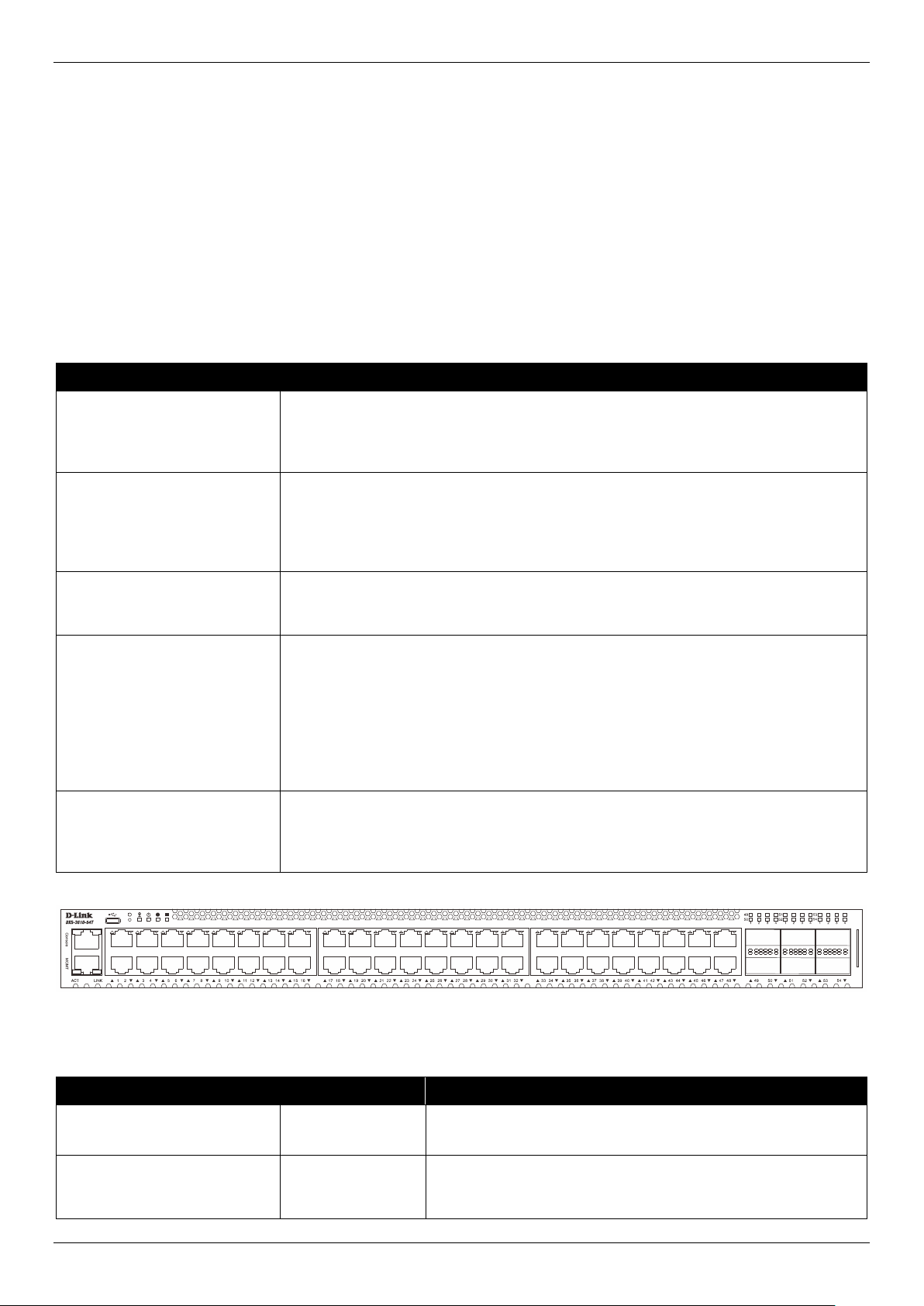
Front Panel Components
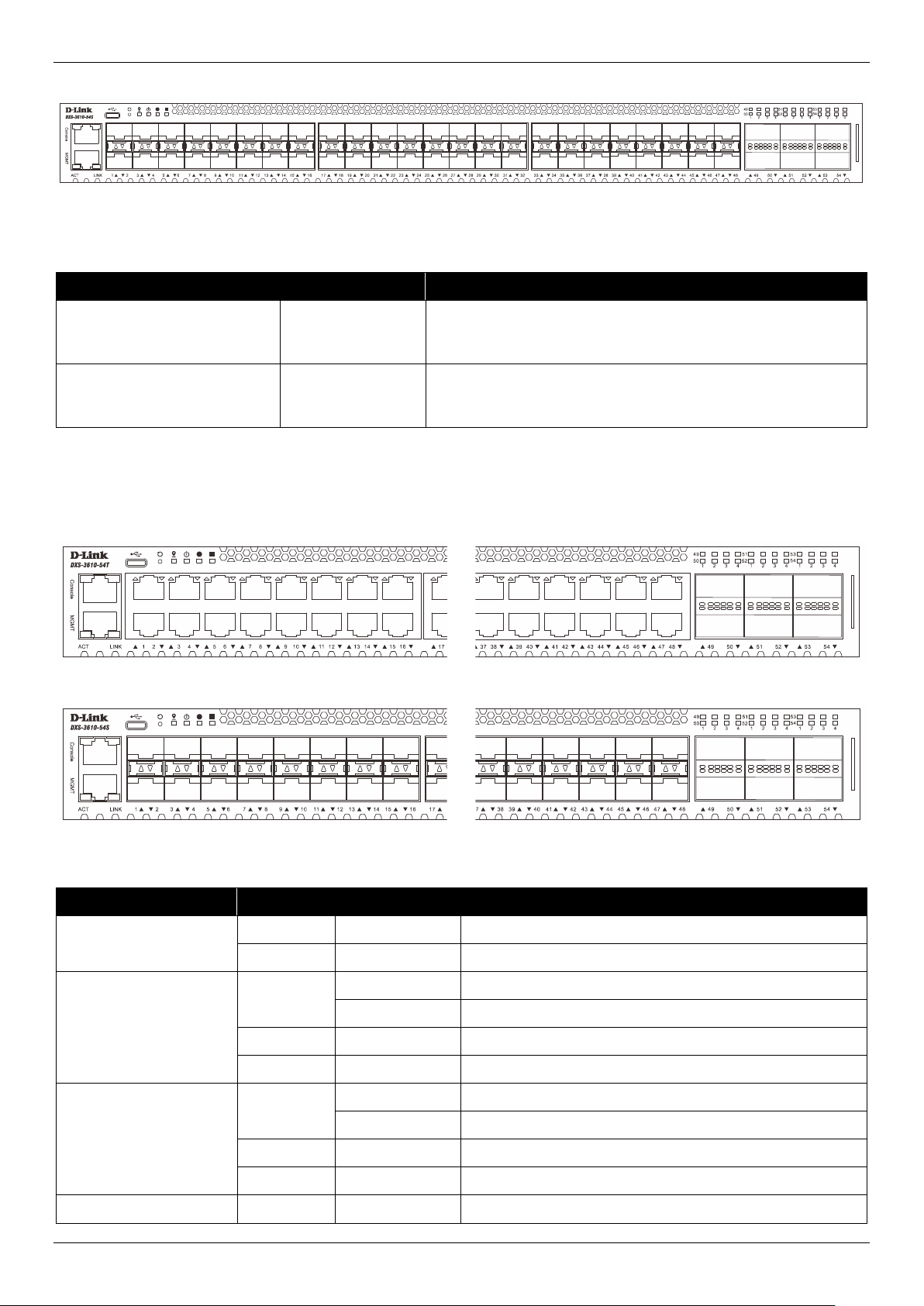
The front panel features components like LED indicators, a Console port, an MGMT port, a micro-USB port, a reset
button, and a variety of Ethernet ports. These components are described in detail below.
This following table lists the front panel components on all the switches in the series:
Port Description
Console Port
The console port can be used to connect to the CLI of the Switch. This Out-Of-
Band (OOB) connection can be made from the serial port of an administrative node
to the RJ45 console port on the front panel of the Switch. The console cable
(included in the package) must be used for the connection.
MGMT Port The management (MGMT) port can be used to connect to the CLI or the Web UI of
the Switch. SNMP-enabled connectivity can also be made through this port. This
OOB connection can be made from a standard LAN adapter to the RJ45 MGMT
port on the front panel of the Switch. This connection operates at 10/100/1000
Mbps.
Micro-USB Port The micro-USB port provides additional storage space for firmware images and
configuration files that can be copied to and from the Switch. Only endpoint
devices like USB flash drives are supported.
Reset Button The reset button can be used to reboot the switch or to reset the switch to its
factory default settings depending on how long this button is pressed.
• Press and hold for less than 5 seconds
This reboots the Switch. All unsaved configurations will be lost.
• Press and hold for between 5 and 10 seconds
This resets the software configuration on the Switch to the factory default
settings.
Information Tag The sliding information tag is discretely located on the front panel, right next to the
QSFP28 ports, and contains the product code, hardware version, serial number,
and MAC address of the Switch. The QR code can be scanned to quickly obtain
the abovementioned information.
Figure 2-1 DXS-3610-54T Front Panel
This following table lists the front panel components unique to the DXS-3610-54T:
Port Type Port Number Description
RJ45 Ports
(1/10 Gbps)
Ports 1 to 48 This switch is equipped with 48 RJ45 Ethernet ports that can
operate at 1 and 10 Gbps wire-speeds.
QSFP28 Ports
(40/100 Gbps)
Ports 49 to 54 This switch is equipped with 6 QSFP28 ports that can operate
at 40 and 100 Gbps wire-speeds and support a wide
collection of QSFP+/QSFP28 transceivers.
DXS-3610 Series Layer 3 Stackable 10GbE Managed Switch Hardware Installation Guide
3
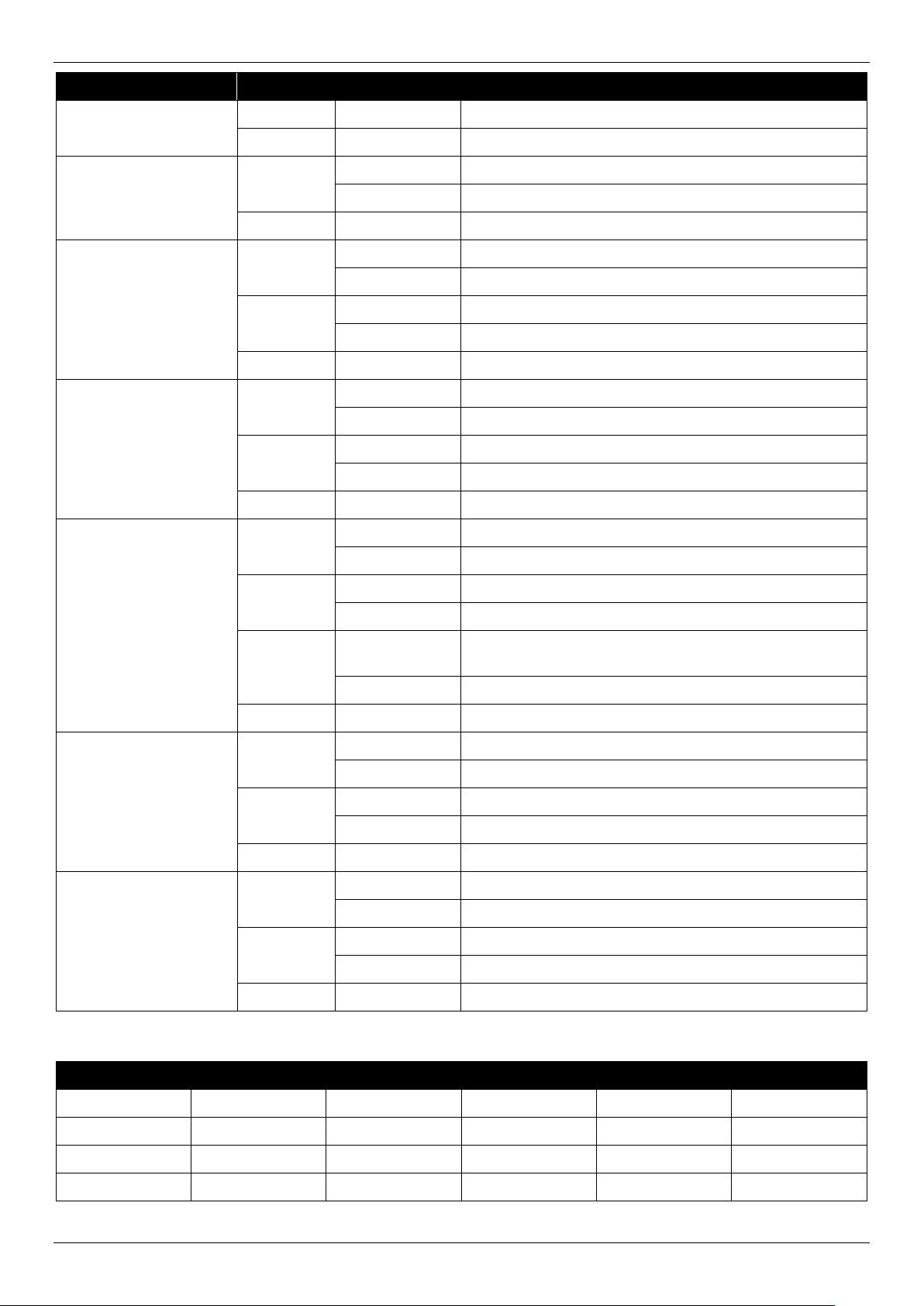
Figure 2-2 DXS-3610-54S Front Panel
This following table lists the front panel components unique to the DXS-3610-54S:
Port Type Port Number Description
SFP+ Ports
(1/10 Gbps)
Ports 1 to 48 This switch is equipped with 48 SFP+ ports that can operate
at 1 and 10 Gbps wire-speeds and support a wide collection
of SFP/SFP+ transceivers.
QSFP28 Ports
(40/100 Gbps)
Ports 49 to 54 This switch is equipped with 6 QSFP28 ports that can operate
at 40 and 100 Gbps wire-speeds and support a wide
collection of QSFP+/QSFP28 transceivers.
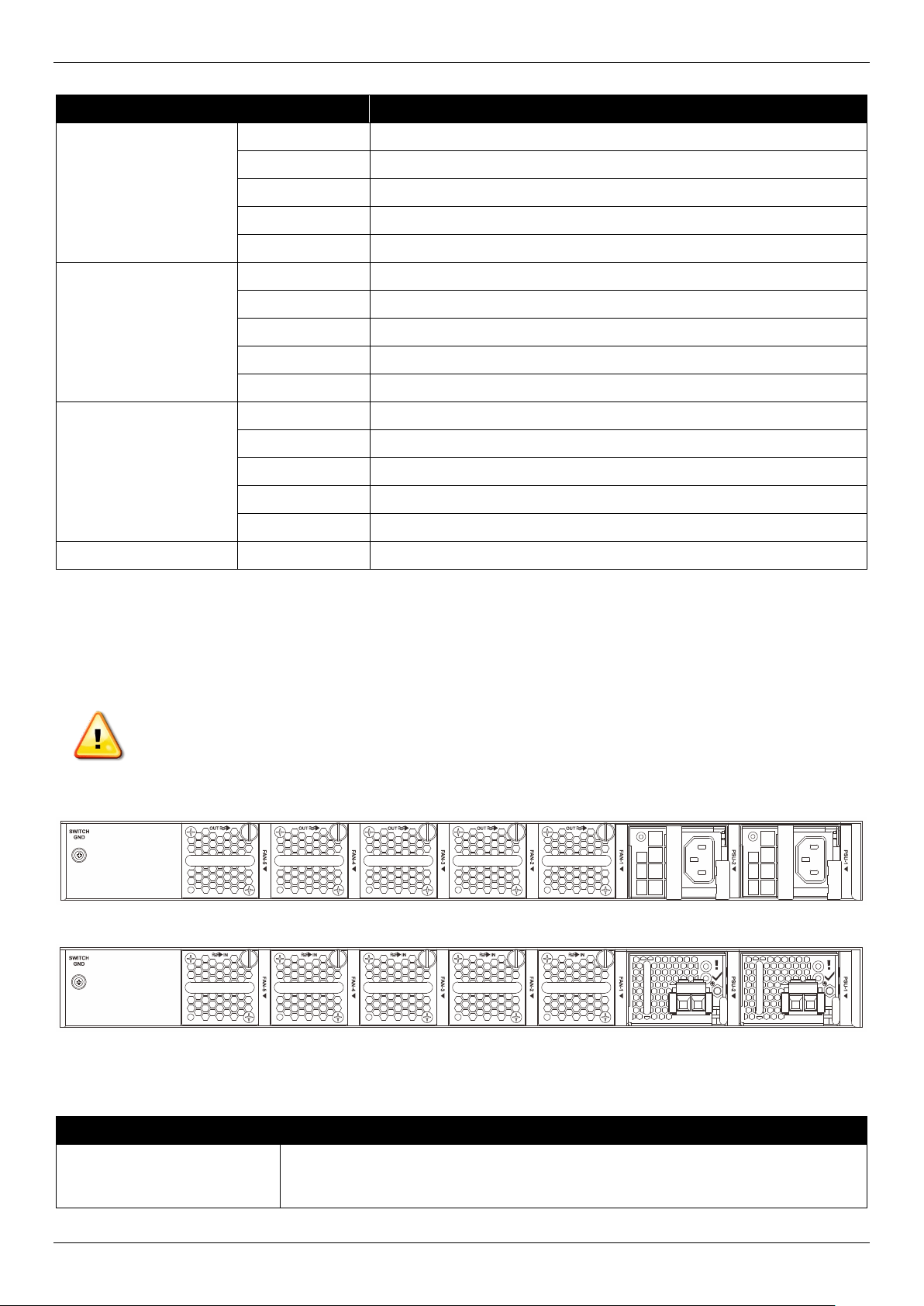
Front Panel LED Indicators
The LED indicators provide valuable information in a variety of ways like their color, blinking times, and location.
Figure 2-3 DXS-3610-54T Front Panel LED Indicators
Figure 2-4 DXS-3610-54S Front Panel LED Indicators
The front panel LED indicators are described in the following table:
LED Color Status Description
Locator Blue On (Solid) User logged in
- Off Locator function is disabled
Power Green On (Solid) Power on
On (Blinking) Performing system self-test
Amber On (Solid) PSU failed or Voltage/Current/Temperature too high
- Off Power off
Status Green On (Solid) POST passed and normal operation
On (Blinking) POST in progress
Amber On (Blinking) POST/PSU/Fan failed or Temperature too high
- Off Power off
Fan Green On (Solid) Fan operation normal
DXS-3610 Series Layer 3 Stackable 10GbE Managed Switch Hardware Installation Guide
4
LED Color Status Description
Amber On (Blinking) Fan error
- Off Power off
Link/Act
(Out-Of-Band port)
Green On (Solid) Active connection through the port
On (Blinking) Data transmitted and received through the port
- Off Inactive connection, no link present, or port disabled
Link/Act
(10GE RJ45 ports)
Green On (Solid) Active 10 Gbps connection through the port
On (Blinking) Data transmitted and received through the port
Amber On (Solid) Active 1 Gbps connection through the port
On (Blinking) Data transmitted and received through the port
- Off Inactive connection, no link present, or port disabled
Link/Act
(10GE SFP+ ports)
Green On (Solid) Active 10 Gbps connection through the port
On (Blinking) Data transmitted and received through the port
Amber On (Solid) Active 1 Gbps connection through the port
On (Blinking) Data transmitted and received through the port
- Off Inactive connection, no link present, or port disabled
Link/Act
(100GE QSFP28 ports)
White
(LED 1)
On (Solid) Active 100 Gbps connection through the port
On (Blinking) Data transmitted and received through the port
Blue
(LED 4)
On (Solid) Active 40 Gbps connection through the port
On (Blinking) Data transmitted and received through the port
Green
(LED 1-4)
On (Solid) Active 10/25 Gbps connection through each of the
breakout ports
On (Blinking) Data transmitted and received through the port
- Off Inactive connection, no link present, or port disabled
Stacking (Master)
(100GE QSFP28 ports)
White
(LED 1)
On (Solid) Active 100 Gbps stacking connection through the port
On (Blinking) Data transmitted and received through the port
Amber
(LED 2)
On (Solid) Active 100 Gbps stacking connection through the port
On (Blinking) Data transmitted and received through the port
- Off No link present
Stacking (Slave)
(100GE QSFP28 ports)
Amber
(LED 3)
On (Solid) Active 100 Gbps stacking connection through the port
On (Blinking) Data transmitted and received through the port
Blue
(LED 4)
On (Solid) Active 100 Gbps stacking connection through the port
On (Blinking) Data transmitted and received through the port
- Off No link present
The behavior of the LEDs during the booting or rebooting process is described per phase in the following table:
Phases Locator Power Status Fan Port Link/Act
Phase 1 Blue (Solid) Off Off Off Off
Phase 2 Off Off Off Off Off
Phase 3 Off Green (Solid) Green (Blinks) Green (Solid) Off
Phase 4 Off Green (Solid) Green (Solid) Green (Solid) Off
The LEDs return to their normal operating behavior.
DXS-3610 Series Layer 3 Stackable 10GbE Managed Switch Hardware Installation Guide
5
Phase LED(s) Behavior
Phase 1 Locator Lights solid blue during this phase.
Power Remains off during this phase.
Status Remains off during this phase.
Fan Remains off during this phase.
Port Link/Act Remains off during this phase.
Phase 2 Locator Turns off during this phase.
Power Remains off during this phase.
Status Remains off during this phase.
Fan Remains off during this phase.
Port Link/Act Remains off during this phase.
Phase 3 Locator Lights solid green during this phase.
Power Lights solid green during this phase.
Status Blinks green during this phase.
Fan Lights solid green during this phase.
Port Link/Act Lights solid amber during this phase.
System Ready All Return to normal operation behavior.
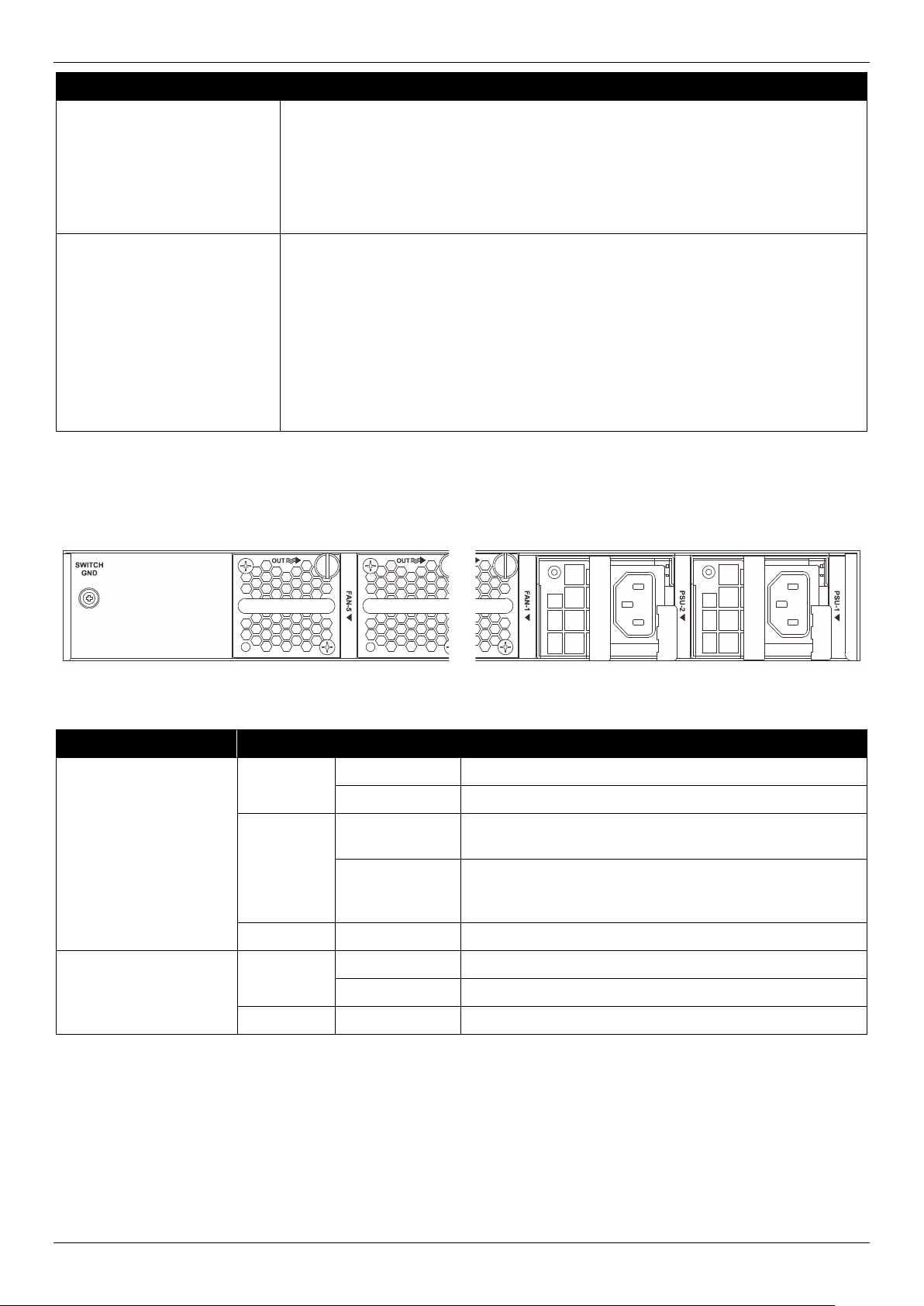
Rear Panel Components
The rear panel features components like LED indicators, PSU (Power Supply Unit) modules, fan modules, and an
electrical grounding point. These components are described in detail below.
CAUTION: When two PSU modules are installed, they must be the same type (two ACs or two DC) and
also use the same airflow direction (back-to-front or front-to-back).
ATTENTION : Lorsque deux modules d'alimentation sont installés, ils doivent être du même type (deux
CA ou deux CC) et utiliser le même sens du flux d'air (dos à dos ou face à face).
Figure 2-5 DXS-3610-54T/DXS-3610-54S Rear Panel (AC PSU)
Figure 2-6 DXS-3610-54T/DXS-3610-54S Rear Panel (DC PSU)
This following table lists the rear panel components on the Switch:
Port Description
Switch GND Use an electrical grounding wire and connect one end of the wire to the switch
GND and the other end of the wire to an electrical grounding point most commonly
found on the Switch mounting rack itself.
DXS-3610 Series Layer 3 Stackable 10GbE Managed Switch Hardware Installation Guide
6
Port Description
Fan Modules These are five hot-swappable, redundant (4+1) fan module slots on the rear panel
of the Switch. The following fan modules can be installed in these slots:
• DXS-FAN200 (Fan module with Front-to-Back airflow)
• DXS-FAN200-B (Fan module with Back-to-Front airflow)
When five fans modules are installed, four fan modules will be active and the fifth
fan module will be passive until one of the four active fan modules fail.
Power Supply Module Slots There are two hot-swappable, load-sharing power supply module slots on the rear
panel of the Switch. The following power supply modules can be installed in these
slots:
• DXS-PWR700AC (AC PSU with Front-to-Back airflow)
• DXS-PWR700AC-B (AC PSU with Back-to-Front airflow)
• DXS-PWR1000DC (-48V DC PSU with Front-to-Back airflow)
• DXS-PWR1000DC-B (-48V DC PSU with Back-to-Front airflow)
When two PSU modules are installed, they will share the power load between
them.
Rear Panel LED Indicators
The LED indicators provide valuable information in a variety of ways like their color, blinking times, and location.
Figure 2-7 DXS-3610-54T/DXS-3610-54S Rear Panel LED Indicators
The rear panel LED indicators are described in the following table:
LED Color Status Description
Power Supply Module Green On (Solid) Normal power supply module operation
On (Blinking) PSU module is off but standby power is supplied
Amber On (Solid) Critical event occurred, causing a PSU shutdown (PSU
failure, OCP, OTP, OVP, UVP, and fan failure)
On (Blinking) Warning event occurred (power/current/temperature is
too high, the fan is too slow, or the input voltage is not
enough)
- Off Power off
Fan Module Green On (Solid) Fan operation is normal
On (Blinking) Fan error occurred
- Off Power off
DXS-3610 Series Layer 3 Stackable 10GbE Managed Switch Hardware Installation Guide
7
Side Panel Components
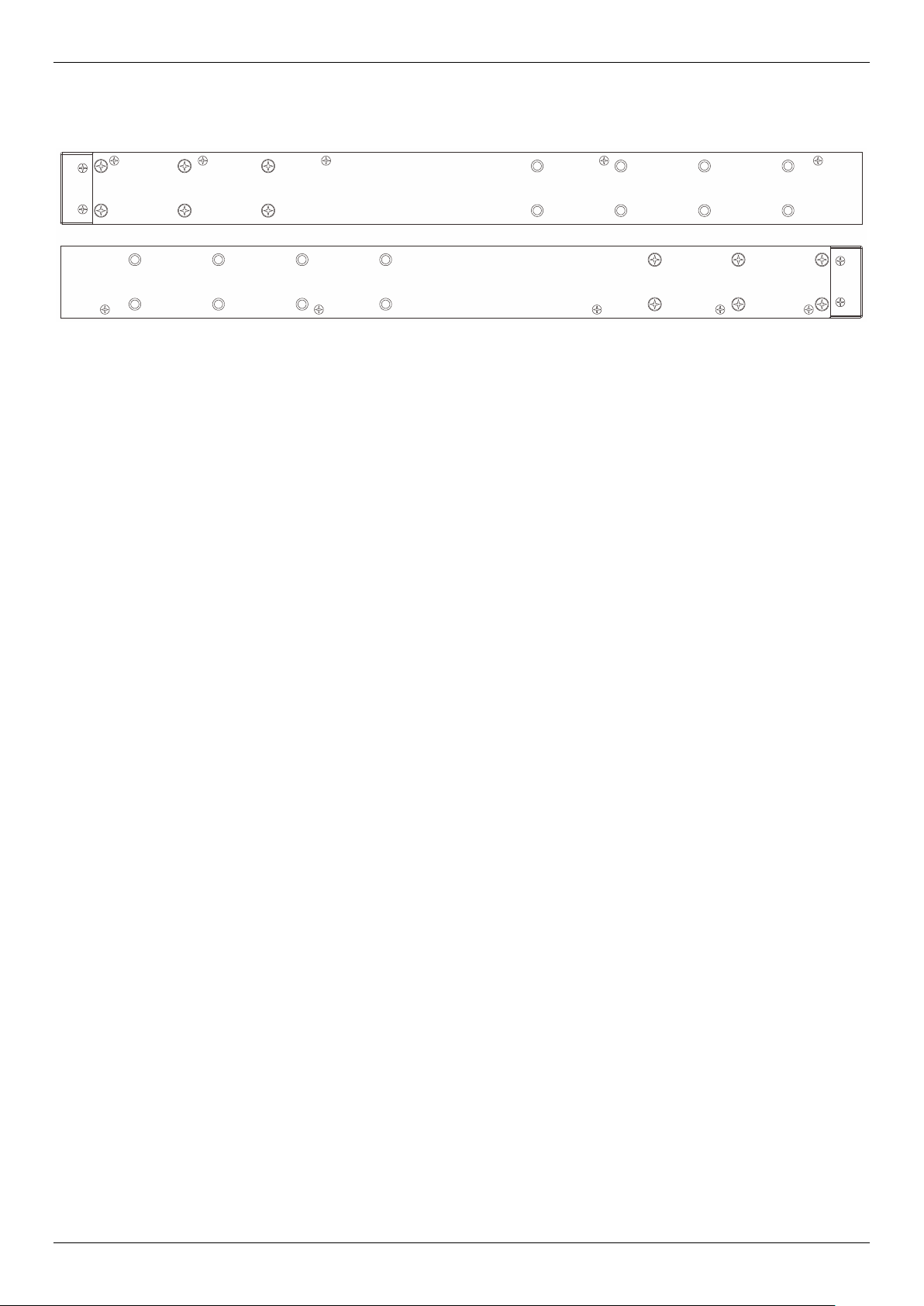
The side panels feature components like rack-mounting screw holes and rack-mounting slider pegs.
Figure 2-8 DXS-3610-54T/DXS-3610-54S Side Panels
DXS-3610 Series Layer 3 Stackable 10GbE Managed Switch Hardware Installation Guide
8
3. Installation
Installation Guidelines
Installing the Switch without a Rack
Installing the Switch in a Standard 19" Rack
Installing Transceivers into the Transceiver Ports
Installing PSU Modules into the PSU Module Slots
Installing Fan Modules into the Fan Module Slots
Installation Guidelines
This section will discuss the hardware installation guidelines that the user must follow in order to properly and safely
install this switch into the appropriate environment.
• Visually inspect the power cord and see that it is fully secured to both the power connector, on the Switch, and
the electrical outlet that supplies power.
• Install the Switch in a fairly cool and dry place within the acceptable operating temperature and humidity
ranges. For more information about the acceptable operating temperature and humidity ranges, refer to the
Physical and Environmental section.
• Install the Switch in a site free from strong electromagnetic field generators such as motors, vibration, dust, and
direct exposure to sunlight.
Installing the Switch without a Rack
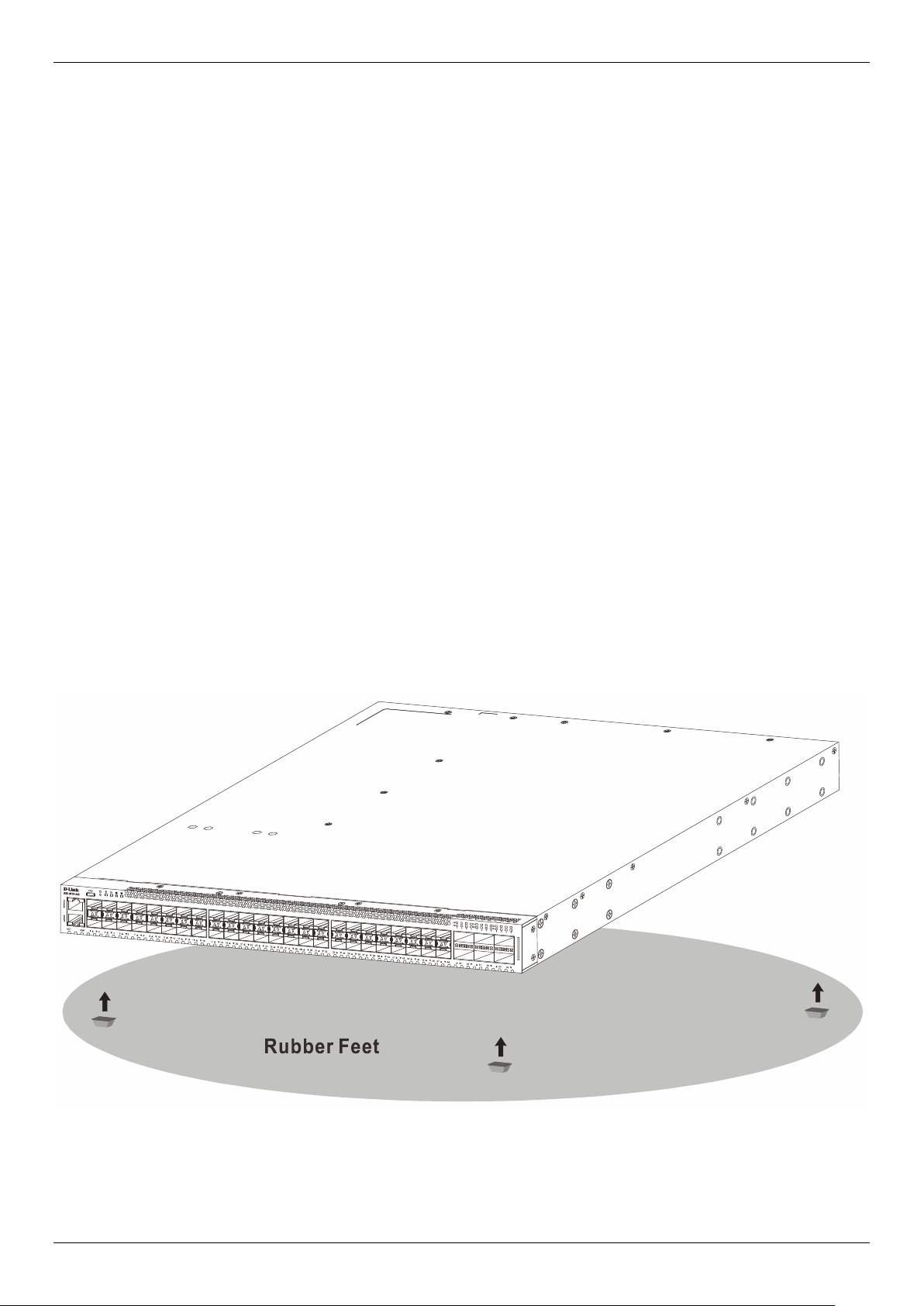
This section is used to guide the user through installing the Switch in an area other than a switch rack. Attach the
included rubber feet to the bottom of the Switch. Take note that there should be marked blocks on the bottom of the
Switch to indicate where to attach the rubber feet. These markings are usually found in each corner on the bottom of
the device. The rubber feet cushion the Switch, protecting the casing from scratches and preventing it from scratching
other surfaces.
Figure 3-1 Attaching rubber feet to the Switch
Install the Switch on a sturdy, level surface that can support the weight of the Switch. Do not place any heavy objects
on the Switch. The power outlet should be within 1.82 meters (6 feet) of the Switch. Make sure that there is proper
DXS-3610 Series Layer 3 Stackable 10GbE Managed Switch Hardware Installation Guide
9
heat dissipation from and adequate ventilation around the Switch. Leave at least 10 cm (4 inches) of space at the
front, sides, and rear of the Switch for ventilation.
Installing the Switch in a Standard 19" Rack
This section is used to guide the user through installing the Switch into a switch rack. The Switch can be mounted in a
standard 19"(1U) rack using the rack mounting kit included in the package contents.
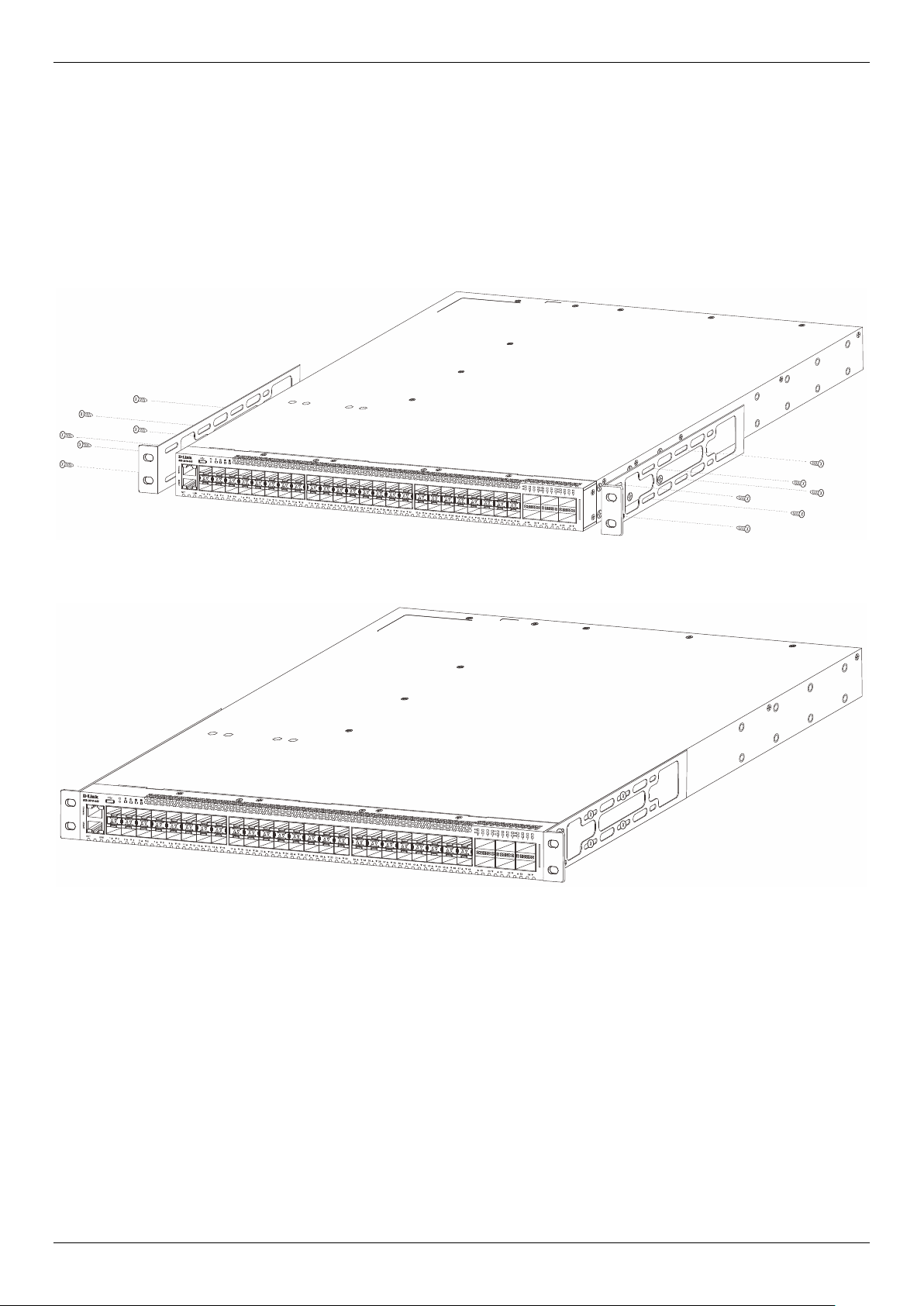
Fasten the frontal rack-mounting brackets to the front-sides of the Switch using the screws provided.
Figure 3-2 Attaching the frontal rack-mounting brackets
Figure 3-3 Frontal rack-mounting brackets attached
DXS-3610 Series Layer 3 Stackable 10GbE Managed Switch Hardware Installation Guide
10
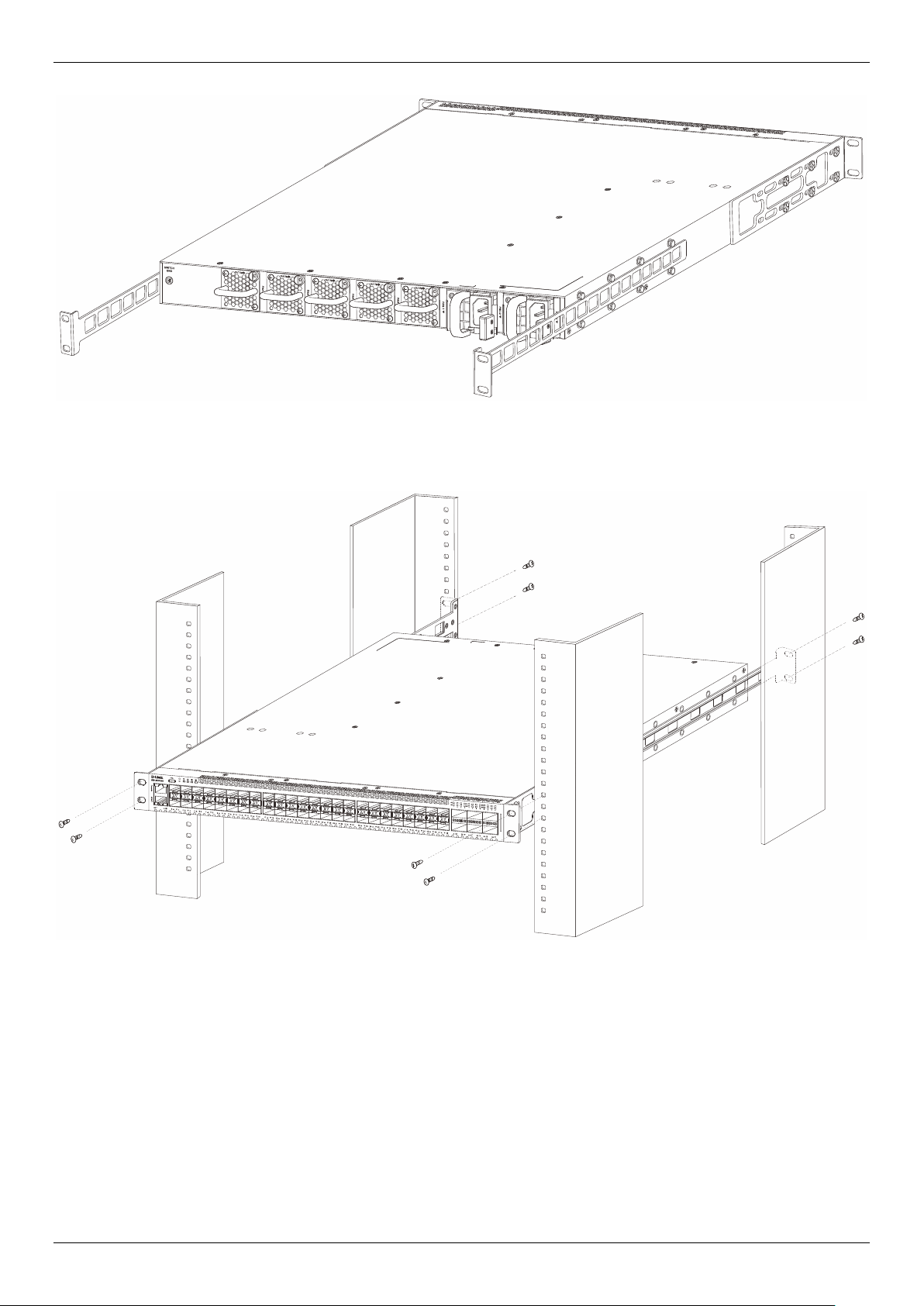
Slide the rear rack-mounting slider brackets into place, as illustrated below.
Figure 3-4 Positioning the rear rack-mounting brackets
Fasten the mounting brackets in any available open space in the rack using the screws provided.
Figure 3-5 Installing the Switch in a Rack
Make sure that there is adequate space around the Switch to allow for proper airflow, ventilation, and cooling.
DXS-3610 Series Layer 3 Stackable 10GbE Managed Switch Hardware Installation Guide
11
Installing Transceivers into the Transceiver Ports
Switches in this series are equipped with QSFP28 ports and the DGS-3610-54S is equipped with SFP+ ports. These
ports can be used to connect various networking devices to this switch that do not support the standard RJ45 wiring
connection. These ports are generally used to connect this switch to optical fiber connections and can be used to
connect devices to the Switch over great distances. The maximum distance that the RJ45 wiring connection can reach
is 100 meters. Fiber optic connections can span several kilometers.
NOTE:
• The DXS-3610-54T and DXS-3610-54S is equipped with QSFP28 ports.
• Only the DXS-3610-54S is equipped with SFP+ ports.
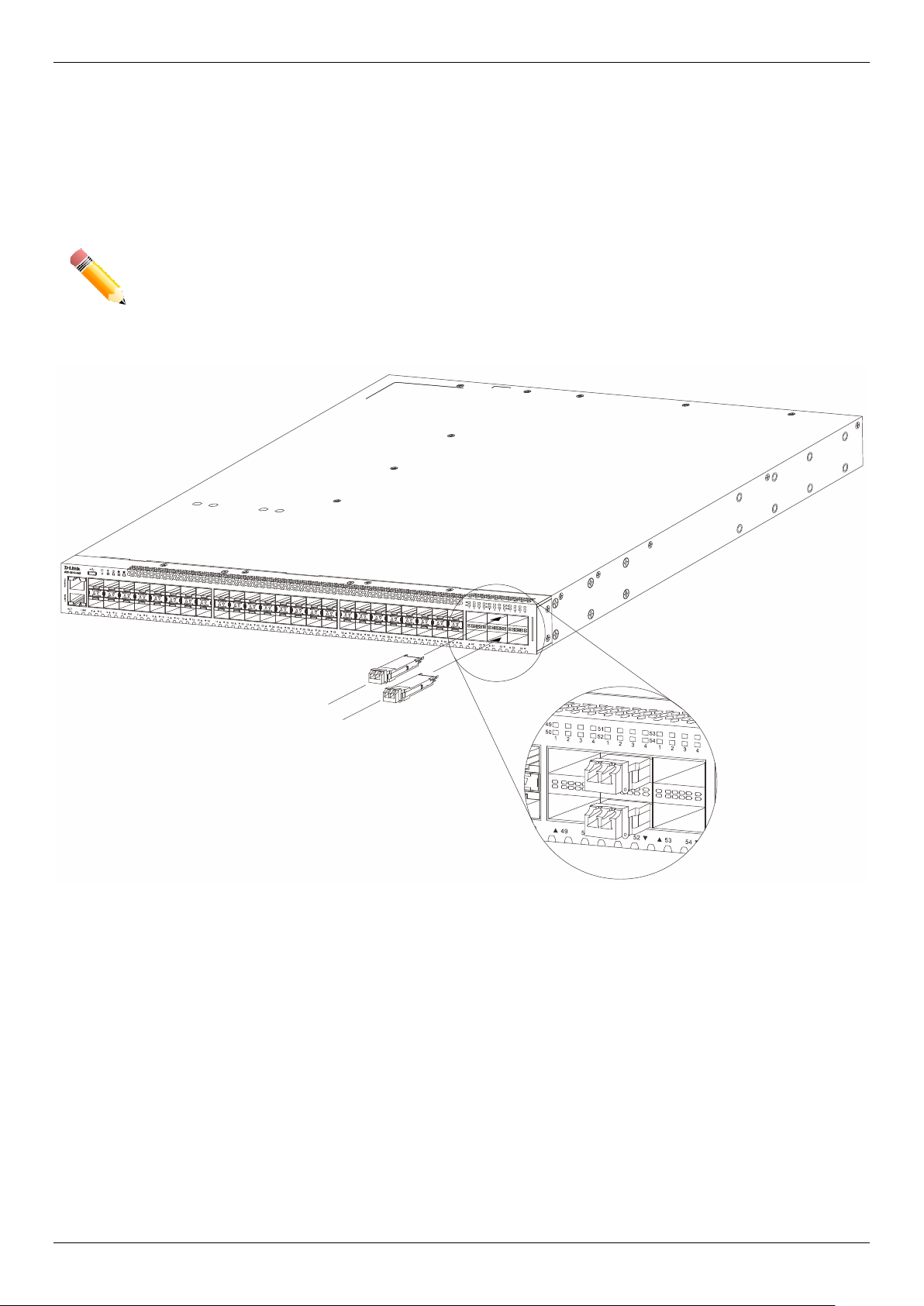
The figure below illustrates how to properly insert QSFP+/QSFP28 transceivers into the 100GE QSFP28 ports.
Figure 3-6 Inserting QSFP+/QSFP28 transceivers into the QSFP28 ports
DXS-3610 Series Layer 3 Stackable 10GbE Managed Switch Hardware Installation Guide
12
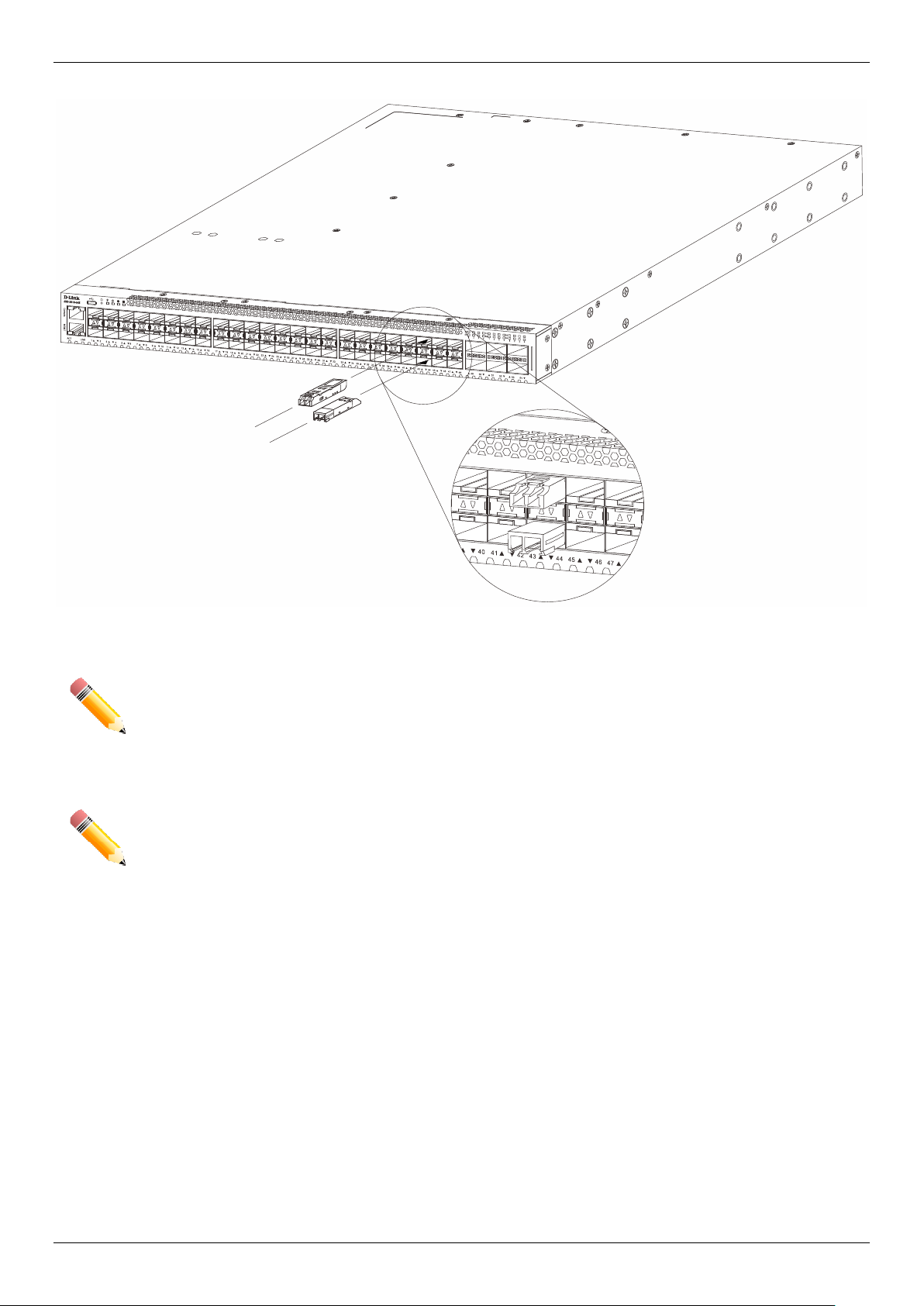
The figure below illustrates how to properly insert SFP/SFP+ transceivers into the 10GE SFP+ ports.
Figure 3-7 Inserting SFP/SFP+ transceivers into the SFP+ ports
NOTE: For the full list of D-Link SFP/SFP+/QSFP+/QSFP28 transceivers that are supported on the
Switch, refer to the Supported SFP/SFP+/QSFP+/QSFP28 Transceivers table on page 31.
NOTE: Only use pluggable optical modules and Direct-Attach Cables (DAC) that meet the following
regulatory requirements:
• Class 1 Laser Product
• UL and/or CSA registered component for North America
• FCC 21 CFR Chapter 1, Sub-chapter J in accordance with FDA & CDRH requirements
• IEC/EN 60825-1/-2: 2007 2nd edition or later, European Standard
DXS-3610 Series Layer 3 Stackable 10GbE Managed Switch Hardware Installation Guide
13
Installing PSU Modules into the PSU Module Slots
The Switch supports the installation of AC or DC PSU modules into the PSU module slots.
NOTE: The PSU modules support a specific airflow direction. This airflow direction must be the same as
the fan module(s) installed. The default airflow direction is front-to-back on all the installed PSU
modules and fan modules.
Installing AC PSU Modules
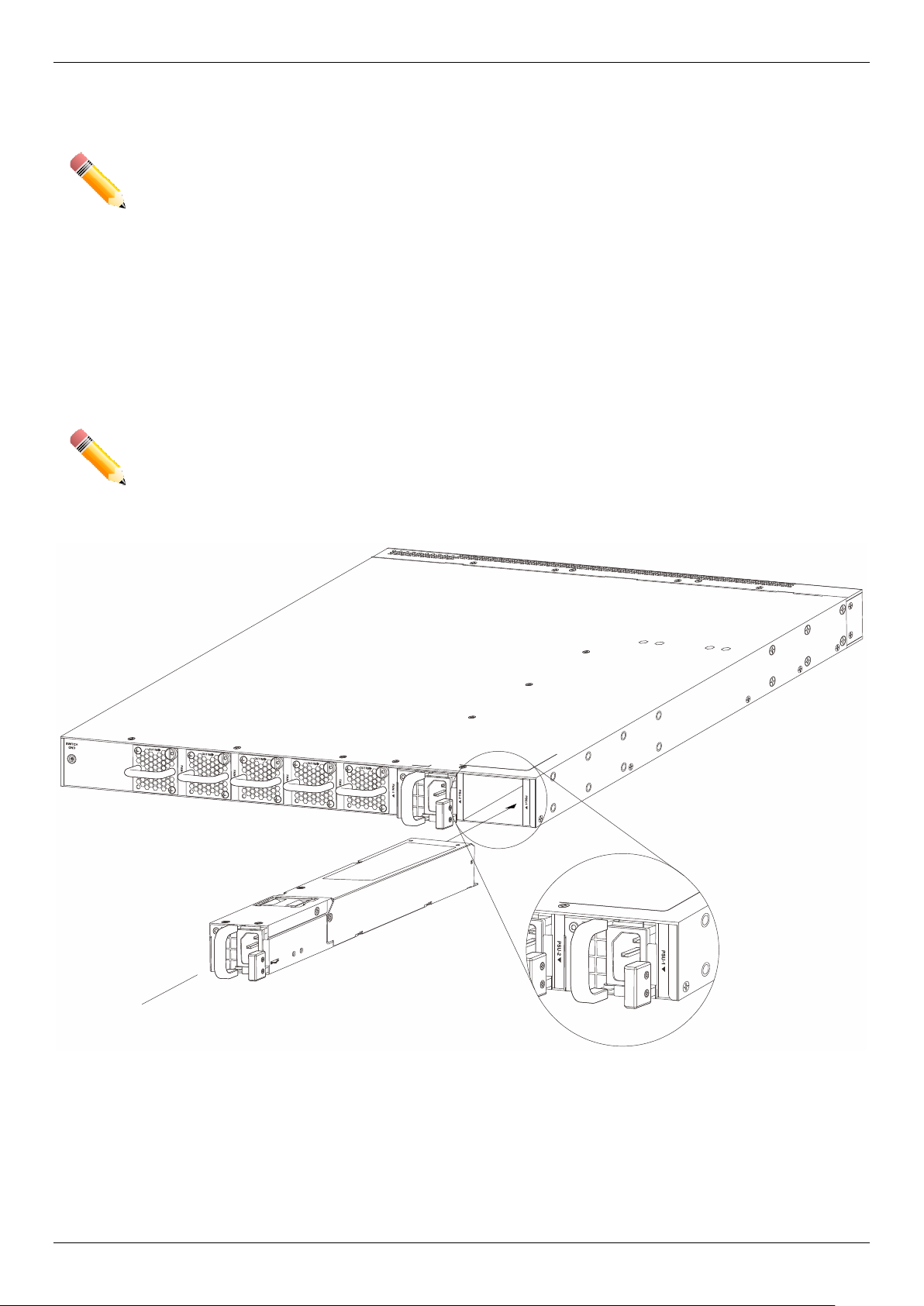
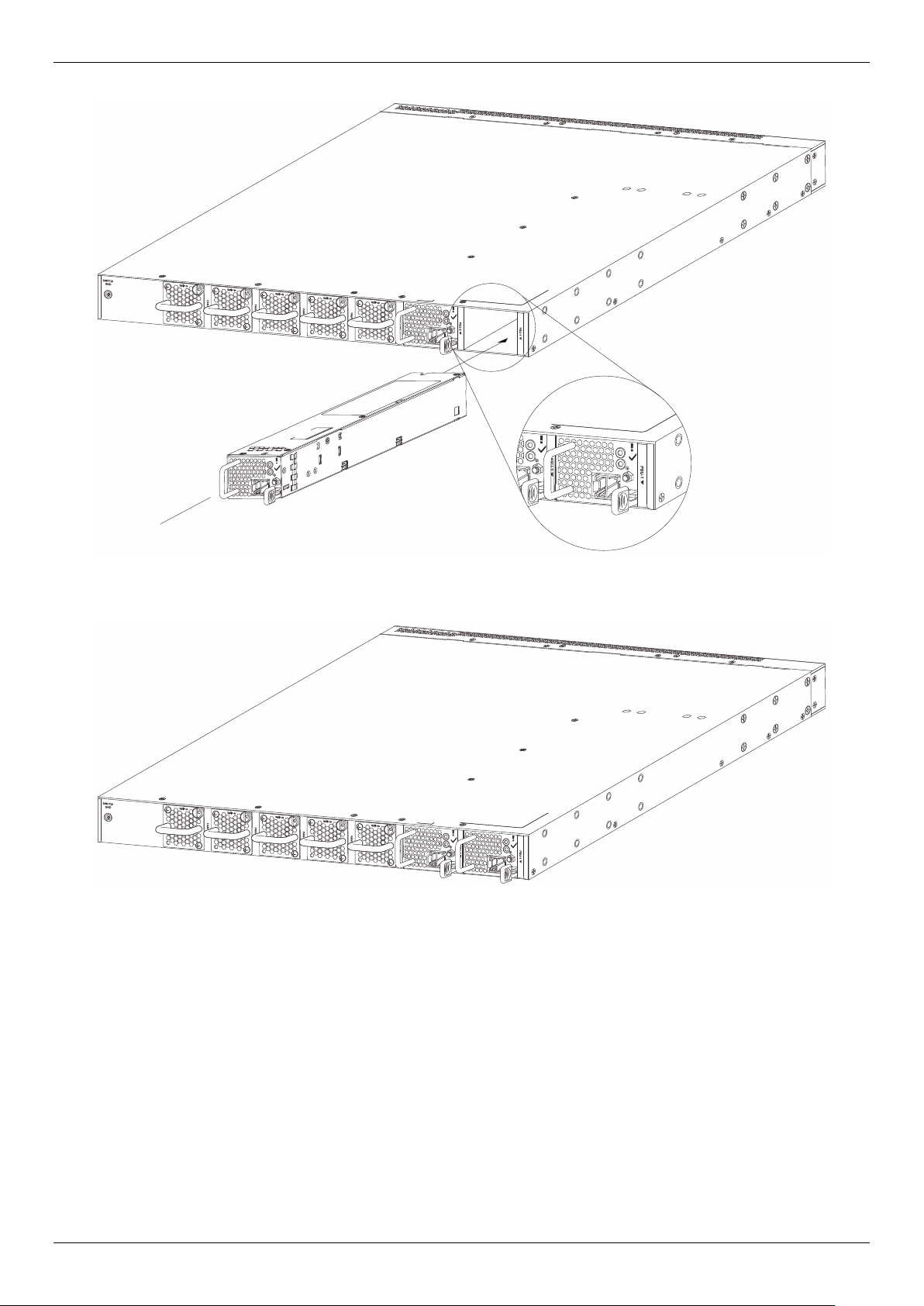
When an existing AC PSU module needs to be replaced or an additional AC PSU module needs to be installed, it is
important to know the proper installation of the AC PSU module. The AC PSU modules are hot-swappable and a
second PSU module can be inserted or removed while the Switch is powered on.
To remove an existing AC PSU module, remove the AC power cord and then press the release clip to the side. Gently
pull the AC PSU module out of the PSU module slot.
NOTE: Due to its mechanical design, the AC power cord needs to be removed before the release clip
can be pressed to the side. If the AC power cord is still plugged in, the release clip can't be pressed
to the side.
Insert the new AC PSU module into the PSU module slot until the release clip securely clicks into place.
Figure 3-8 Installing an AC PSU Module
DXS-3610 Series Layer 3 Stackable 10GbE Managed Switch Hardware Installation Guide
14
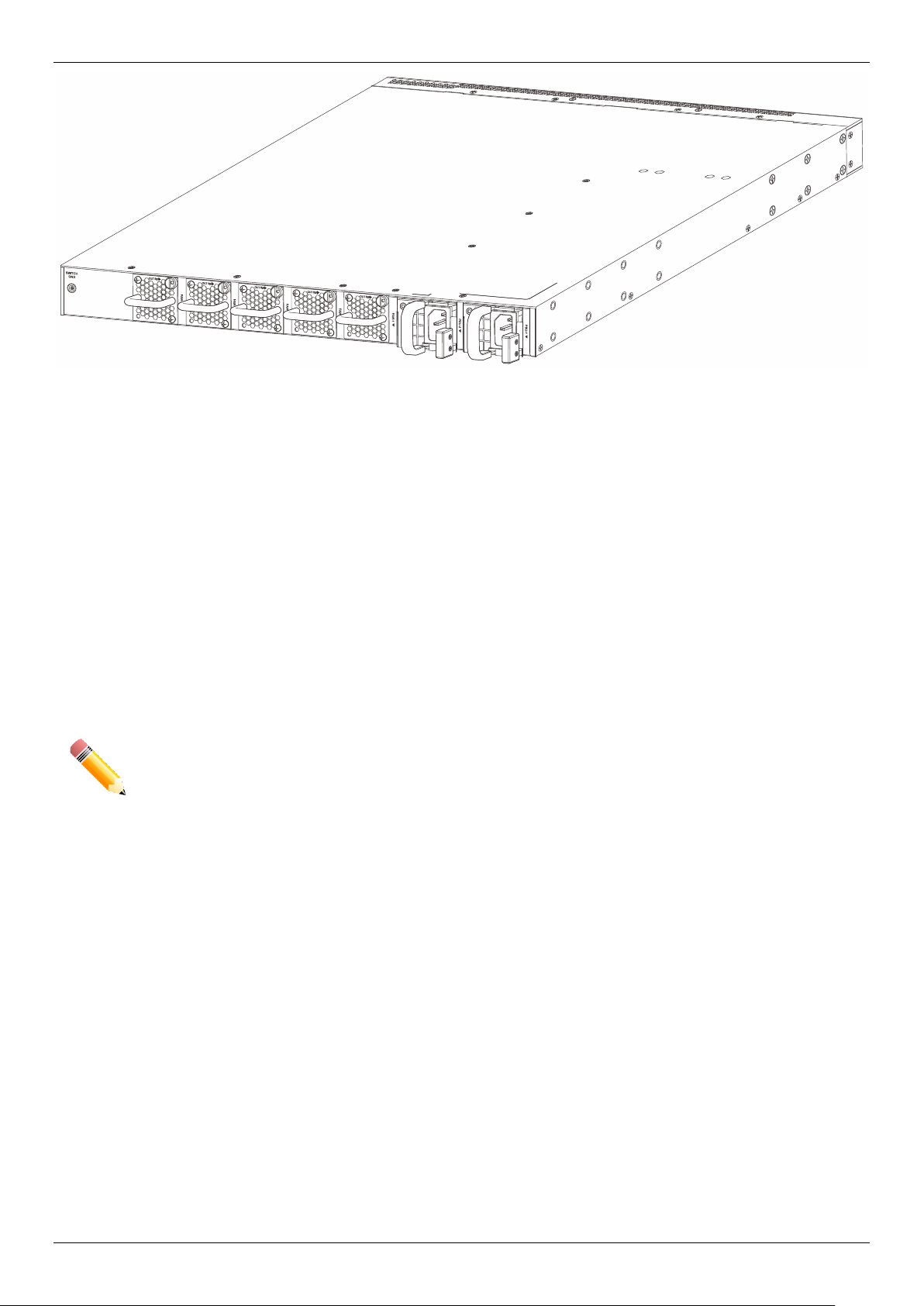
Figure 3-9 Installed AC PSU Module
When the AC PSU module is securely installed, plug one end of the AC power cord into the AC power socket on the
AC PSU module and the other end of the AC power cord into a properly grounded AC power source outlet. There is
no power switch/button on the AC PSU module. It will automatically receive power and adjust its power settings to
adapt to any voltage supplied within the 100~240VAC range at 50~60Hz.
A second AC PSU module can be installed into the second PSU module slot labelled PSU-2. When the primary AC
PSU fails, the second AC PSU will provide AC power to the Switch. This takes place immediately and automatically.
Installing DC PSU Modules
When an existing DC PSU module needs to be replaced or an additional DC PSU module needs to be installed, it is
important to know the proper installation of the DC PSU module. The DC PSU modules are hot-swappable and a
second PSU module can be inserted or removed while the Switch is powered on.
NOTE: Due to its mechanical design, the DC power cord needs to be removed before the release clip
can be pressed to the side. If the DC power cord is still plugged in, the release clip can't be pressed
to the side.
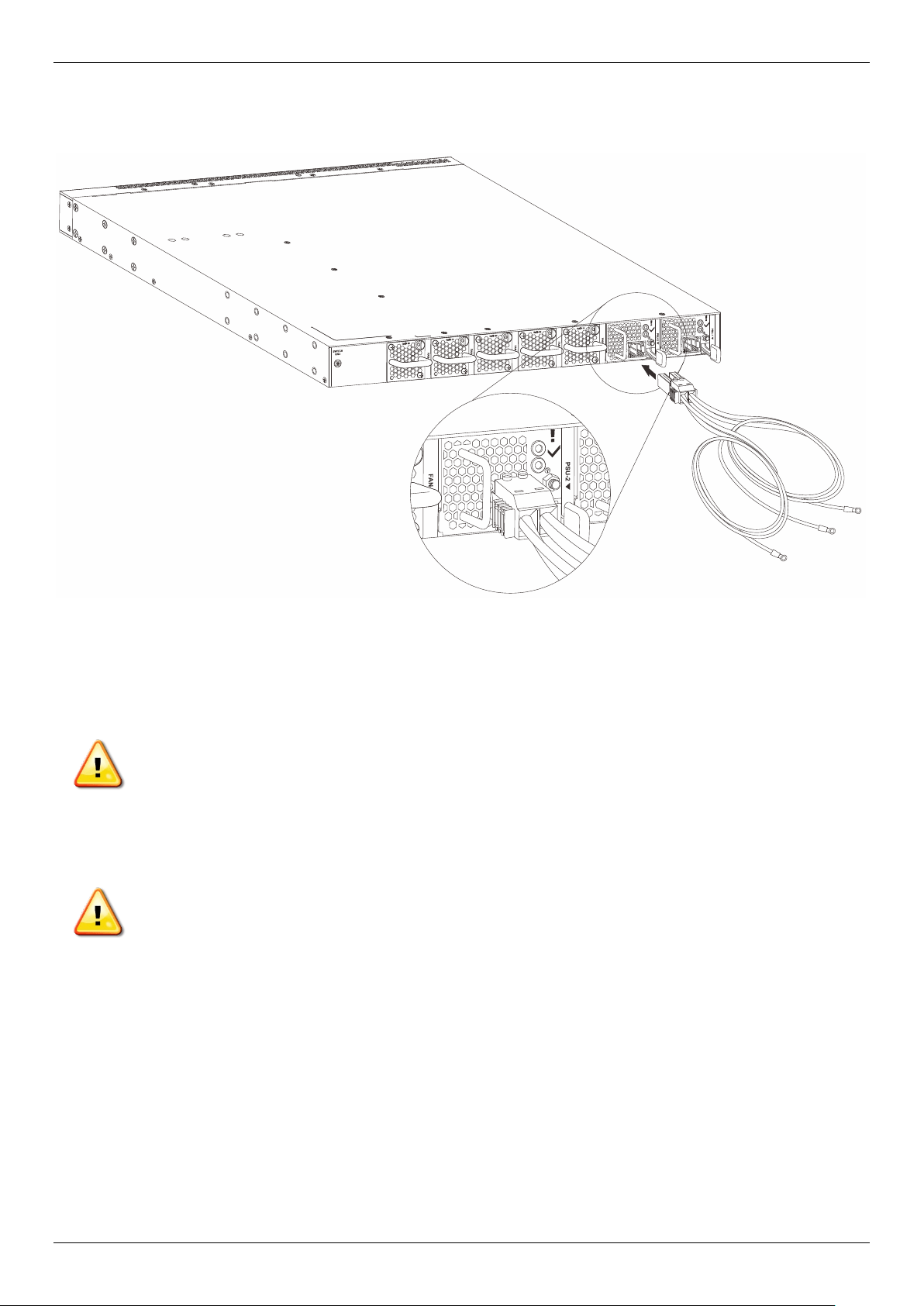
To remove an existing DC PSU module, press the release clip to the side. Gently pull the DC PSU module out of the
PSU module slot.
DXS-3610 Series Layer 3 Stackable 10GbE Managed Switch Hardware Installation Guide
15
Insert the new DC PSU module into the power supply module slot until the release clip securely clicks into place.
Figure 3-10 Installing a DC PSU Module
Figure 3-11 Installed DC PSU Module
DXS-3610 Series Layer 3 Stackable 10GbE Managed Switch Hardware Installation Guide
16
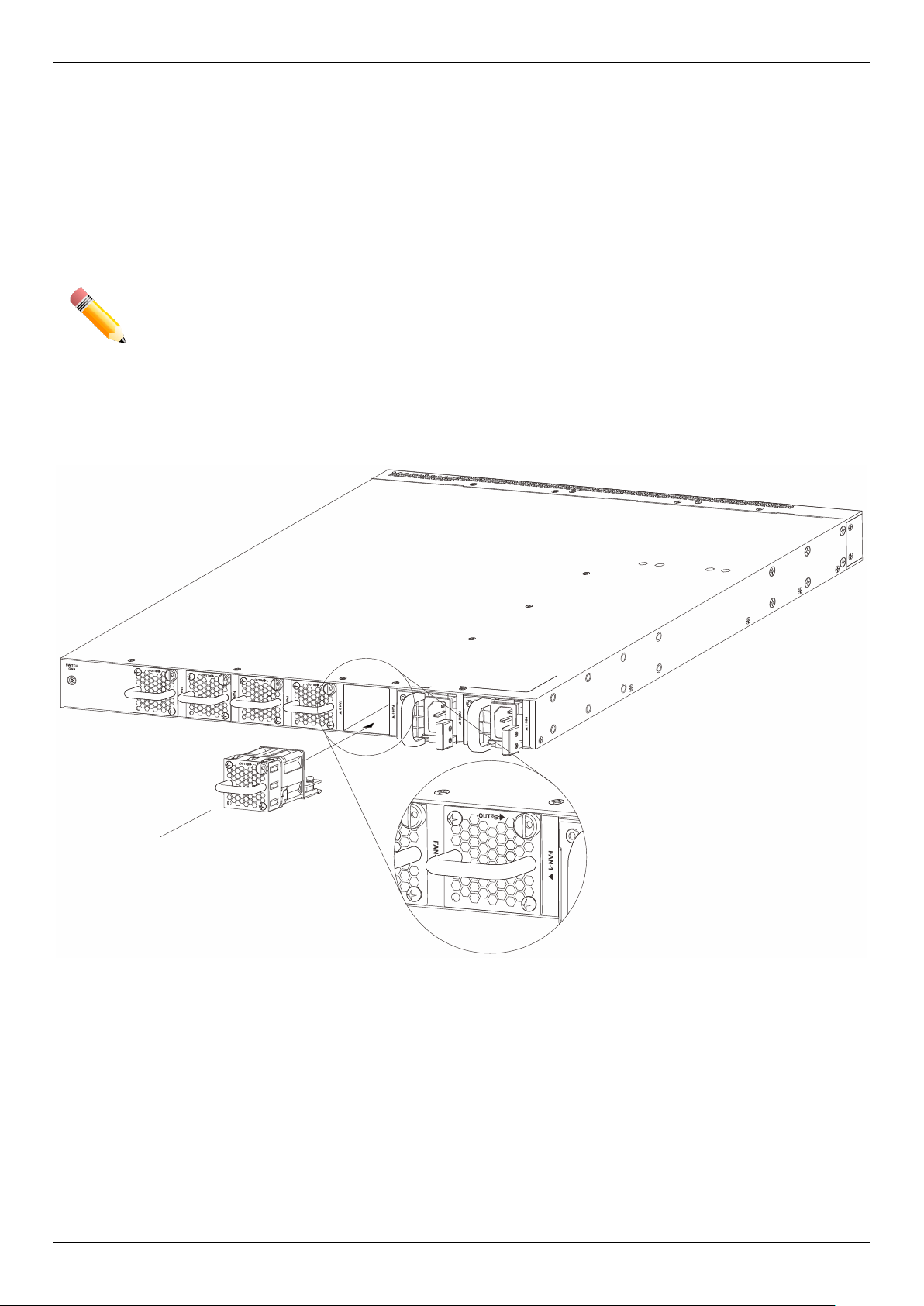
To connect the DC power cord, remove the DC power cord plug first, by sliding the two orange sliders inwards and
gently pulling out the plug. Attach the DC power cord to the DC power cord plug. Use the screws on the plug to secure
the cord in place. Make sure that the connection polarity is correct to avoid any damaged, positive to the left and
negative to the right (as indicated on the PSU). Insert the DC power cord with plug into the socket on the DC PSU.
Figure 3-12 Installing the DC power cord
There is no power switch/button on the Switch. The DC PSU module will receive power automatically.
CAUTION: Before connecting the DC power cable to the DC power input socket, on the switch, the DC
power cable must be properly connected to DC source, at your facility, by a qualified, licensed
electrician.
ATTENTION : Avant de brancher le câble d'alimentation CC à la prise d'alimentation CC, sur le
commutateur, le câble d'alimentation CC doit être correctement branché à la source CC, dans votre
installation, par un électricien qualifié et agréé.
CAUTION: When installing a DC-powered switch, ground the chassis before connecting the switch to
the DC power source and following the following instructions:
• Use a minimum of 18 AWG stranded copper wire for grounding. The wire should be long enough
to reach from the installed switch to the facility ground point.
• Ground additional hardware appropriately to the earth ground connection at your site.
• Connect the DC power cable to a DC main circuit breaker rated no greater than 15A.
ATTENTION : Lorsque vous installez un commutateur alimenté en courant continu, mettez le châssis à
la terre avant de connecter le commutateur à la source d'alimentation en courant continu et suivez
les instructions ci-après:
• Utilisez un minimum de fil de cuivre toronné de 18 AWG pour la mise à la terre. Le fil doit être
suffisamment long pour aller du commutateur installé au point de mise à la terre de l'installation.
• Mettez à la terre le matériel supplémentaire en fonction de la prise de terre de votre site.
• Connectez le câble d'alimentation DC à un disjoncteur principal DC d'une puissance maximale de
15A.
DXS-3610 Series Layer 3 Stackable 10GbE Managed Switch Hardware Installation Guide
17
A second DC PSU module can be installed into the second PSU module slot labelled PSU-2. If the primary DC PSU
fails, the second DC PSU is used to provide DC power to the Switch. This takes place immediately and automatically.
Installing Fan Modules into the Fan Module Slots
This section guides the user through installing fan modules into the fan module slots. On the rear panel of the Switch,
there are five fan module slots. Front-to-Back (FB) or Back-to-Front (BF) fan modules can be installed in these slots.
By default, the Switch is shipped with five DXS-FAN200 modules pre-installed.
NOTE: The fan modules support a specific airflow direction. This airflow direction must be the same as
the PSU module(s) installed. The default airflow direction is front-to-back on all the installed PSU
modules and fan modules.
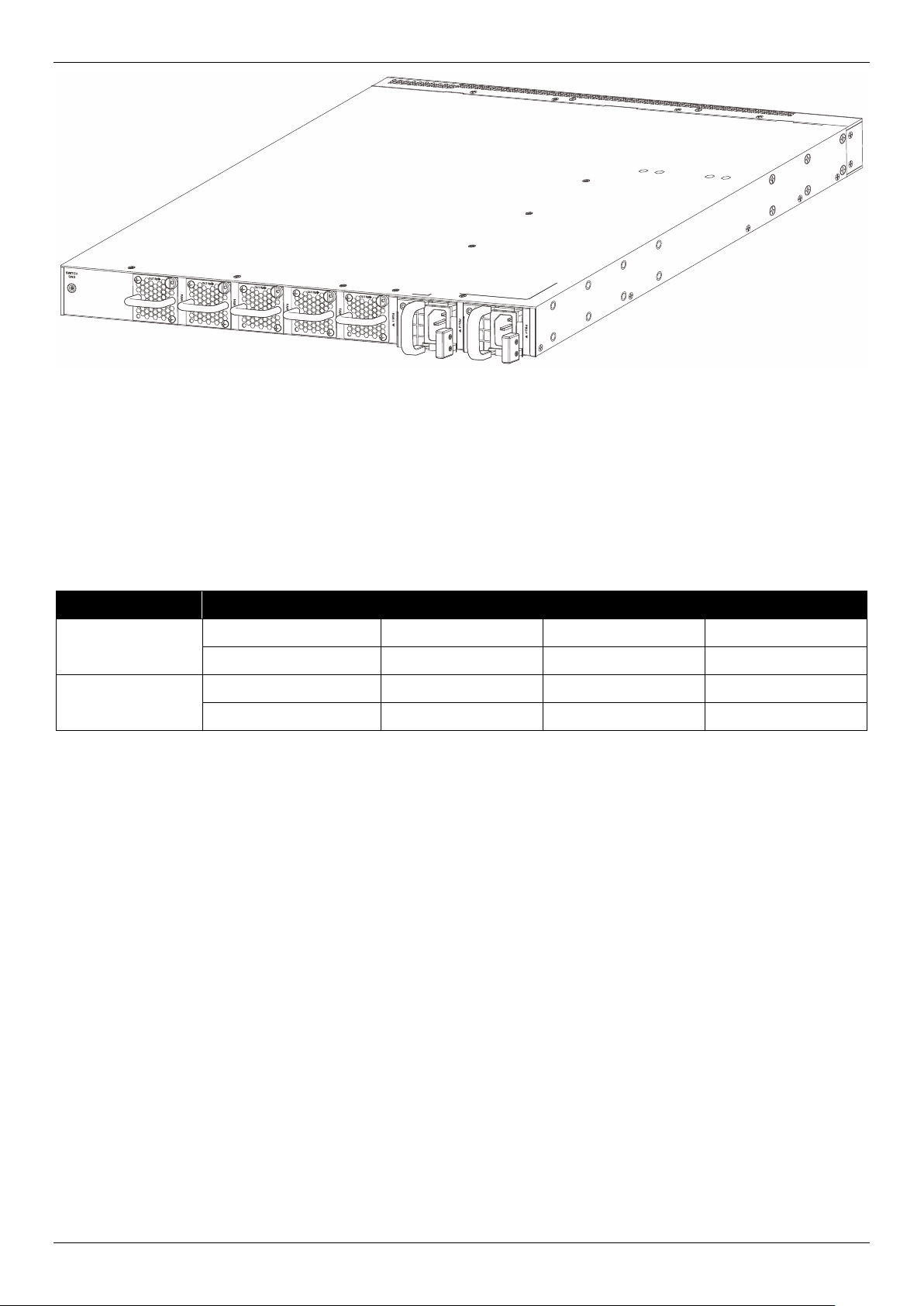
To remove an existing fan module, use a flat-head screwdriver to unscrew the lag bolt (with a slot drive head) and
gently pull the fan module out of the fan module slot.
Insert the new fan module into the fan module slot and fasten the lag bolt to secure the fan module into place.
Figure 3-13 Installing a Fan Module
DXS-3610 Series Layer 3 Stackable 10GbE Managed Switch Hardware Installation Guide
18
Figure 3-14 Installed Fan Module
Smart Fans
The fan modules are capable to automatically adjust their speed depending on the IC sensor reading of the
temperature required. This feature is so sensitive that it can even adjust the speed of the fan to accurately control the
internal temperature.
The following table lists at what temperature the speed of the fan(s) will change:
Switch Fan Module Low Speed Medium Speed High Speed
DXS-3610-54T DXS-FAN200 Below 30°C At roughly 35°C Above 40°C
DXS-FAN200-B Below 30°C At roughly 35°C Above 40°C
DXS-3610-54S DXS-FAN200 Below 30°C At roughly 35°C Above 40°C
DXS-FAN200-B Below 30°C At roughly 35°C Above 40°C
DXS-3610 Series Layer 3 Stackable 10GbE Managed Switch Hardware Installation Guide
19
4. Switch Connections
Stacking the Switch
Switch to Server
Switch to Switch
Switch to End Node
Stacking the Switch
Switches in this series support stacking up to 12 switches together while being managed through one console
connection or MGMT connection on the master switch or through any of the inbound network ports using Telnet, the
Web UI, and SNMP. This cost-effective switch provides an affordable solution for administrators to upgrade their
networks using the stacking ports to scale and stack the Switches. This increases overall reliability, serviceability, and
availability.
Switches in the series can be physically stacked with optical fiber cables or Direct Attached Cables (DACs) with
QSFP28 connectors.
NOTE: When the last six QSFP28 ports are used for physical stacking, they can only operate at 100
Gbps. Stacking is not supported through a 40 Gbps connection.
The following stacking topologies are supported on the Switch:
• Duplex Chain - This topology stacks switches together in a chain-link format. Using this method, data transfer
is only possible in one direction. If there is a break in the chain, data transfer will be affected.
• Duplex Ring - This topology stacks switches in a ring or circle format where data can be transferred in two
directions. It is very resilient due to the fact that, if there is a break in the ring, data can still be transferred
through the stacking cables between switches in the stack using the alternate path.
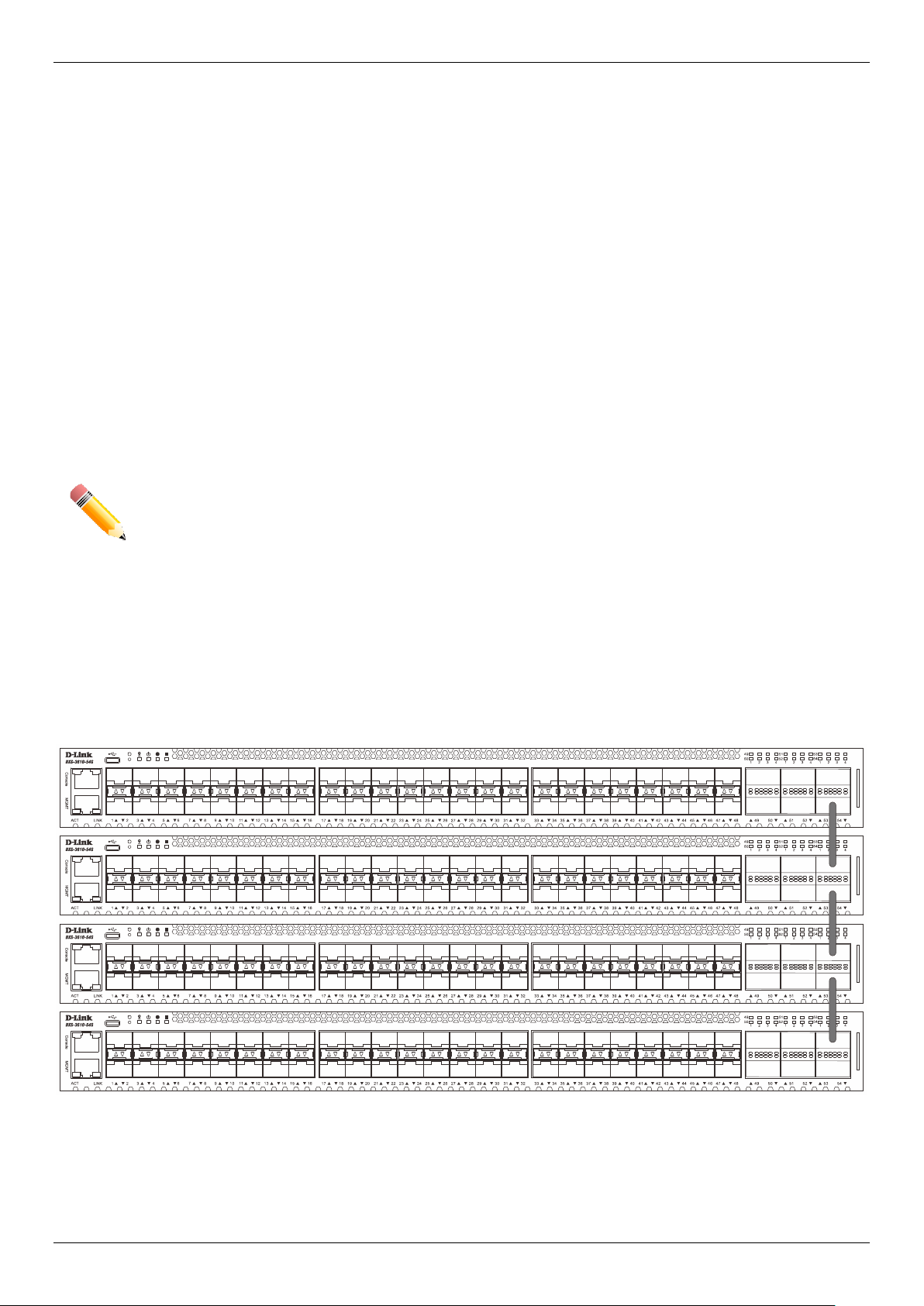
In the following diagram, switches are stacked in the Duplex Chain topology.
Figure 4-1 Duplex Chain Stacking Topology
DXS-3610 Series Layer 3 Stackable 10GbE Managed Switch Hardware Installation Guide
20
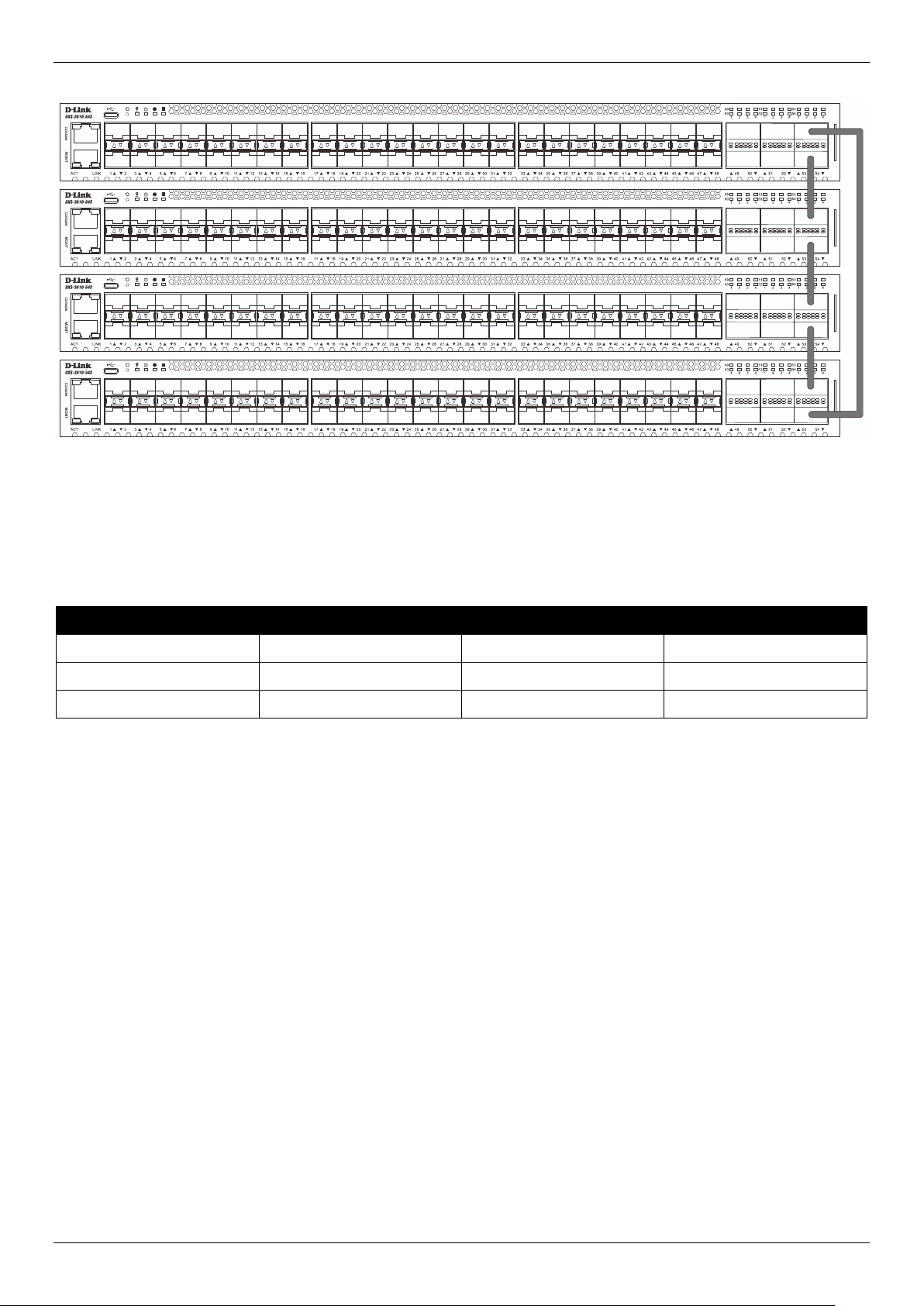
In the following diagram, switches are stacked in the Duplex Ring topology.
Figure 4-2 Duplex Ring Stacking Topology
The stacking function needs to be enabled and configured to support either a 2-port, 4-port, or 6-port stacking
configuration. Stacking ports or grouped together into two logical stacking ports called SIO1 (Stacking Input/Output 1)
and SIO2. A group of logical stacking ports must always be connected, as a group, to another Switch in the stack.
The following table lists the stacking configuration with the corresponding SIO port pairs:
Configuration Logical SIO1 Logical SIO2 Bandwidth
2-port Port 53 Port 54 400 Gbps (full-duplex)
4-port Port 51 and 53 Port 52 and 54 800 Gbps (full-duplex)
6-port Port 49, 51, and 53 Port 50, 52, and 54 1200 Gbps (full-duplex)
DXS-3610 Series Layer 3 Stackable 10GbE Managed Switch Hardware Installation Guide
21
Switch to Switch
The Switch can be used to connect to any other switch or hub in the network. This network topology is used when the
Switch does not have enough ports to cater for all the end nodes in the network.
There is a great deal of flexibility on how connections are made using the appropriate cabling.
• Connect a 1000BASE-T switch port to the Switch via a Category 5e UTP/STP cable.
• Connect a 10GBASE-T switch port to the Switch via a Category 6/6a/7 UTP/STP cable.
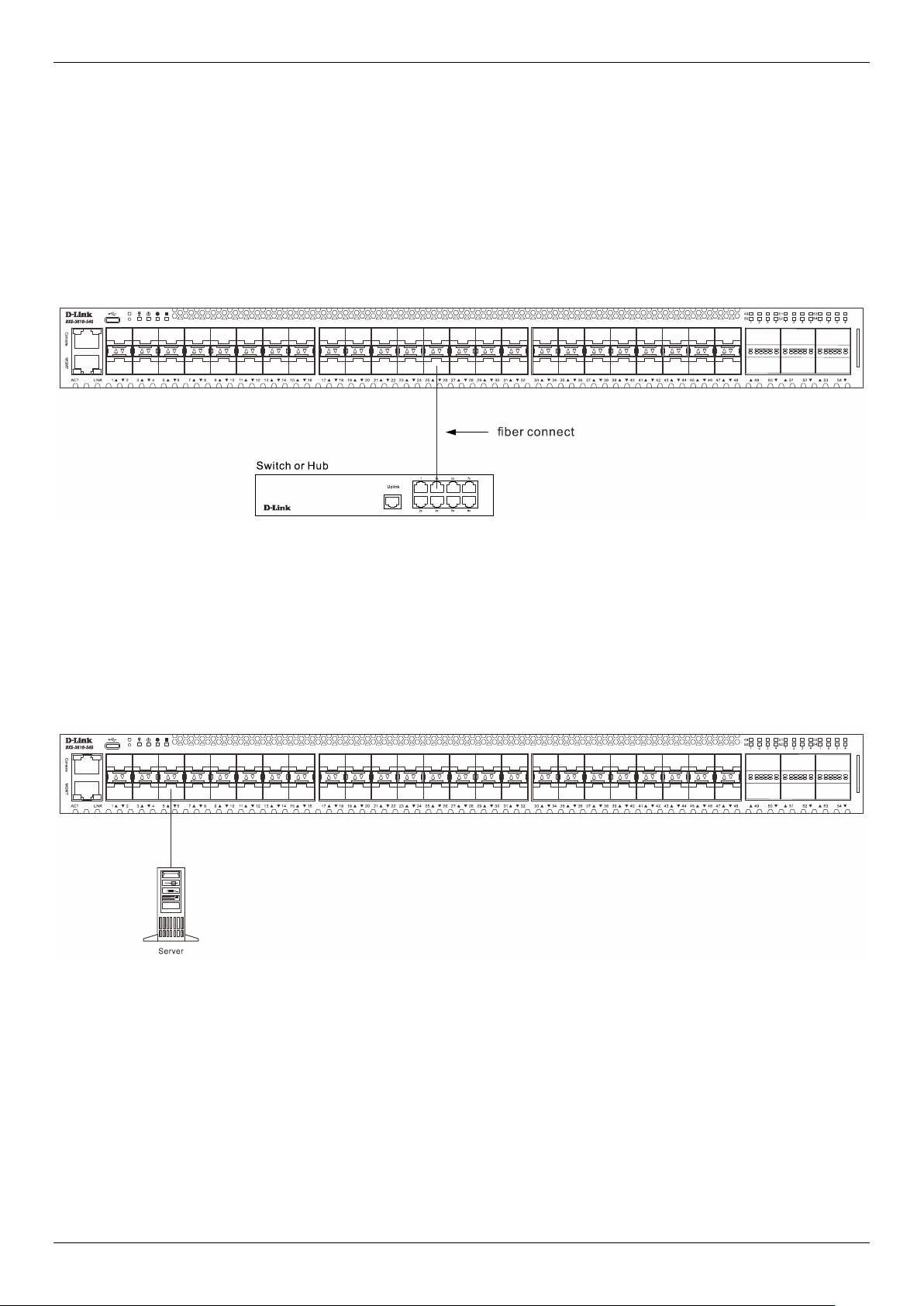
• Connect a fiber uplink switch port to the Switch's SFP+/QSFP28 port via a fiber optical cable.
Figure 4-3 Switch to another Switch/Hub
Switch to Server
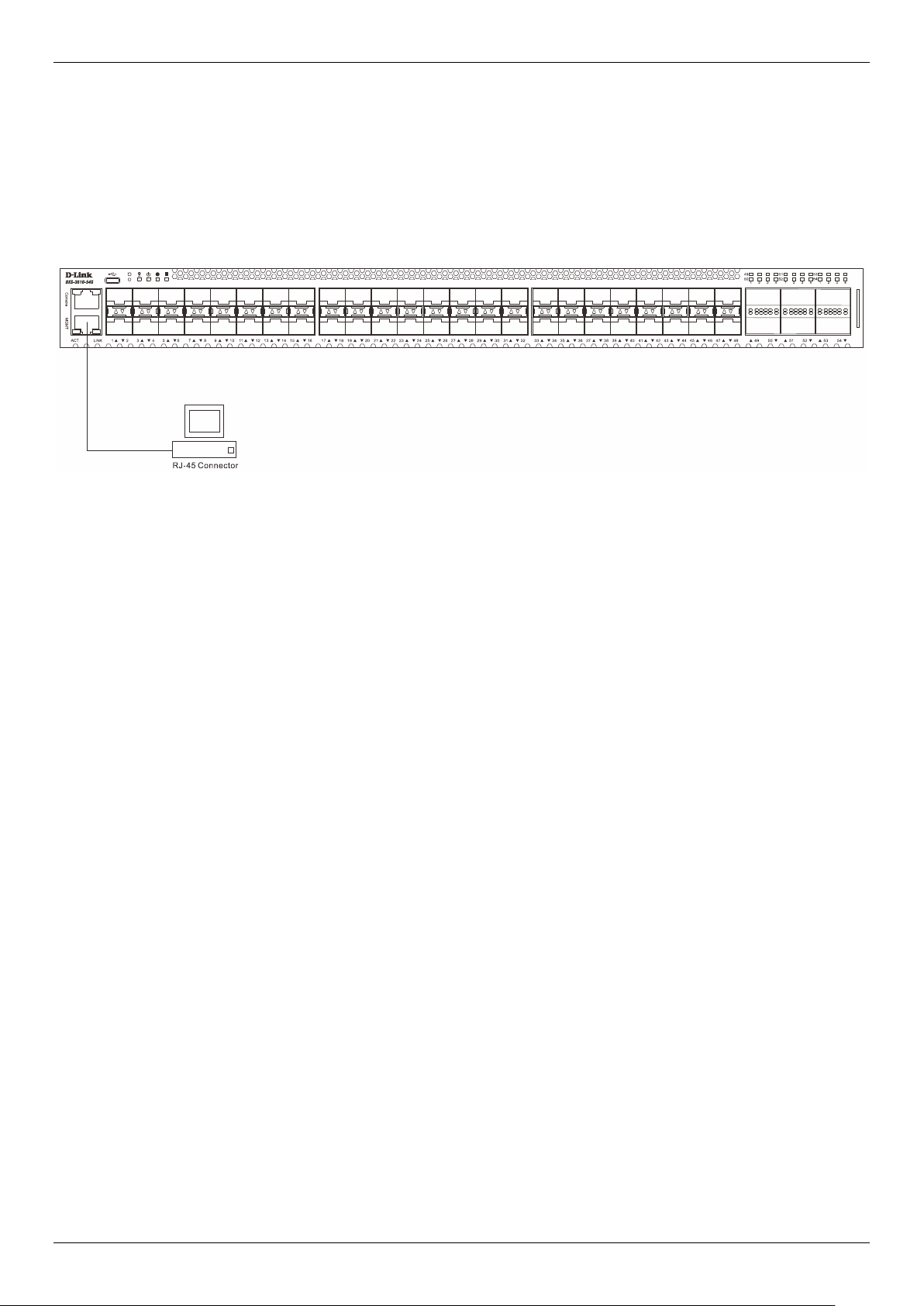
The Switch is ideal for connecting to a network backbone, server, or server farm. The RJ45 ports operate at speeds of
1/10 Gbps, the SFP+ ports operate at speeds of 1/10 Gbps, and the QSFP28 ports operate at speeds of 40/100
Gbps.
Figure 4-4 Switch to a Server
DXS-3610 Series Layer 3 Stackable 10GbE Managed Switch Hardware Installation Guide
22
Switch to End Node
An end node is a generic name for edge networking devices that will be connected to this switch. Typical examples of
end nodes are Personal Computers (PCs), Notebooks, Access Points, Print Servers, VoIP Phones and more. Each
end node should be fitted with an RJ45 networking port. Normally, end nodes will connect to this switch by using a
standard twisted-pair UTP/STP network cable. When a successful connection is established, the corresponding port
light will illuminate and blink to indicate that network activity is taking place on that port.
The diagram below displays a typical end node connected to the Switch.
Figure 4-5 Switch to End Node
DXS-3610 Series Layer 3 Stackable 10GbE Managed Switch Hardware Installation Guide
23
5. Switch Management
Management Options
Command Line Interface (CLI)
Web User Interface (Web UI)
SNMP-based Management
Management Options
To configure, manage, and monitor the software features on the Switch, users can connect to the Command Line
Interface (CLI), Web User Interface (Web UI), or through the means of third-party SNMP software.
Command Line Interface (CLI)
The CLI provides access to all of the software features available on the Switch. These features can be enabled,
configured, disabled, or monitored by simply entering the appropriate command after the CLI prompt and pressing the
Enter key. The Console port offers an Out-Of-Band (OOB) connection to the CLI and the LAN ports offers an in-band
connection to the CLI using Telnet or SSH.
NOTE: For more information about the CLI, refer to the DXS-3610 Series CLI Reference Guide.
Connecting to the Console Port
The Console port is used to connect to the CLI of the Switch. Connect the DB9 connector of the console cable
(included in the packaging) to the Serial (COM) port of the computer. Connect the RJ45 connector of the console
cable to the Console port on the Switch.
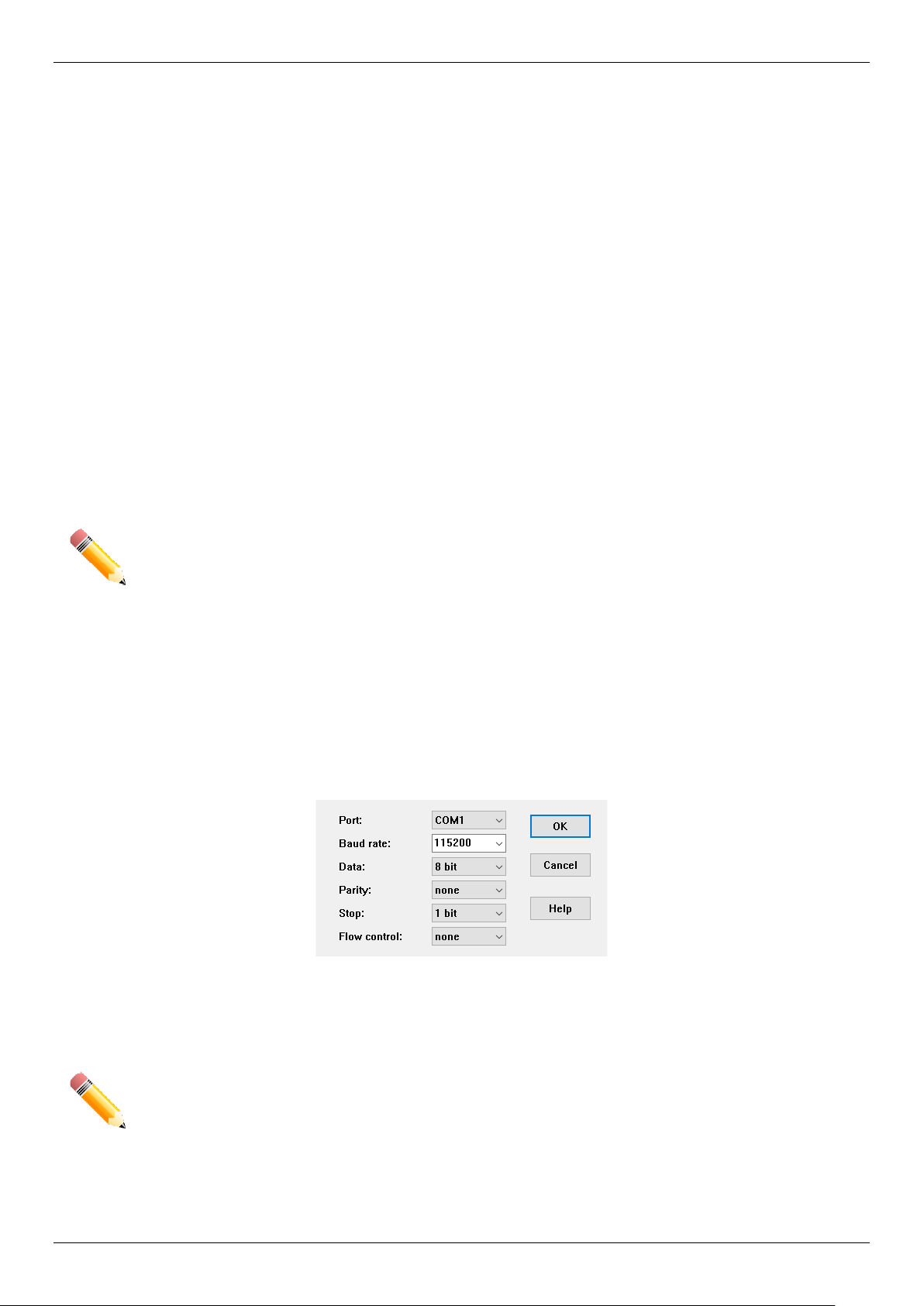
To access the CLI through the Console port, Terminal Emulation Software must be used like PuTTY or Tera Term.
The Switch uses a connection of 115200 bits per second with no flow control enabled.
Figure 5-1 Console Connection Settings
After the boot sequence completed, the CLI login screen is displayed.
NOTE: The default username and password for the CLI and Web UI is admin.

DXS-3610 Series Layer 3 Stackable 10GbE Managed Switch Hardware Installation Guide
24
Logging into the CLI
At the login screen, enter the Username and Password and press Enter after each entry to access the CLI.
DXS-3610-54S TenGigabit Ethernet Switch
Command Line Interface
Firmware: Build 1.01.003
Copyright(C) 2020 D-Link Corporation. All rights reserved.
User Access Verification
Username:admin
Password:*****
Switch#
NOTE: For security reasons, it is highly recommended to configure a personal username and password
for this Switch.
Creating a User Account
To create a new user account, use the username command in the Global Configuration Mode.
Switch# configure terminal
Switch(config)# username NewUser password 12345
Switch(config)# username NewUser privilege 15
Switch(config)#
A user account with the username 'NewUser', password '12345', and privilege level 15 was created.
NOTE: Usernames can be up to 32 characters in length. Passwords can be up to 32 plain-text
characters in length. Passwords are case sensitive.
Configuring the IP Address
To configure the IP address of the Switch, use the ip address command in the VLAN Interface Configuration Mode.
Switch# configure terminal
Switch(config)# interface vlan 1
Switch(config-if)# ip address 10.50.50.50 255.0.0.0
Switch(config-if)#
The IP address of the Switch was change to '10.50.50.50' with the subnet mask of '255.0.0.0'.
DXS-3610 Series Layer 3 Stackable 10GbE Managed Switch Hardware Installation Guide
25
Web User Interface (Web UI)
The Web UI, a more graphical representation, provides access to most of the software features available on the
Switch. These features can be enabled, configured, disabled, or monitored using any standard web browser, like
Microsoft’s Internet Explorer, Mozilla Firefox, Google Chrome, or Safari. The LAN ports offers an in-band connection
to the Web UI using HTTP or HTTPS (SSL).
NOTE: For more information about the Web UI, refer to the DXS-3610 Series Web UI Reference Guide.
Connecting to the Web UI
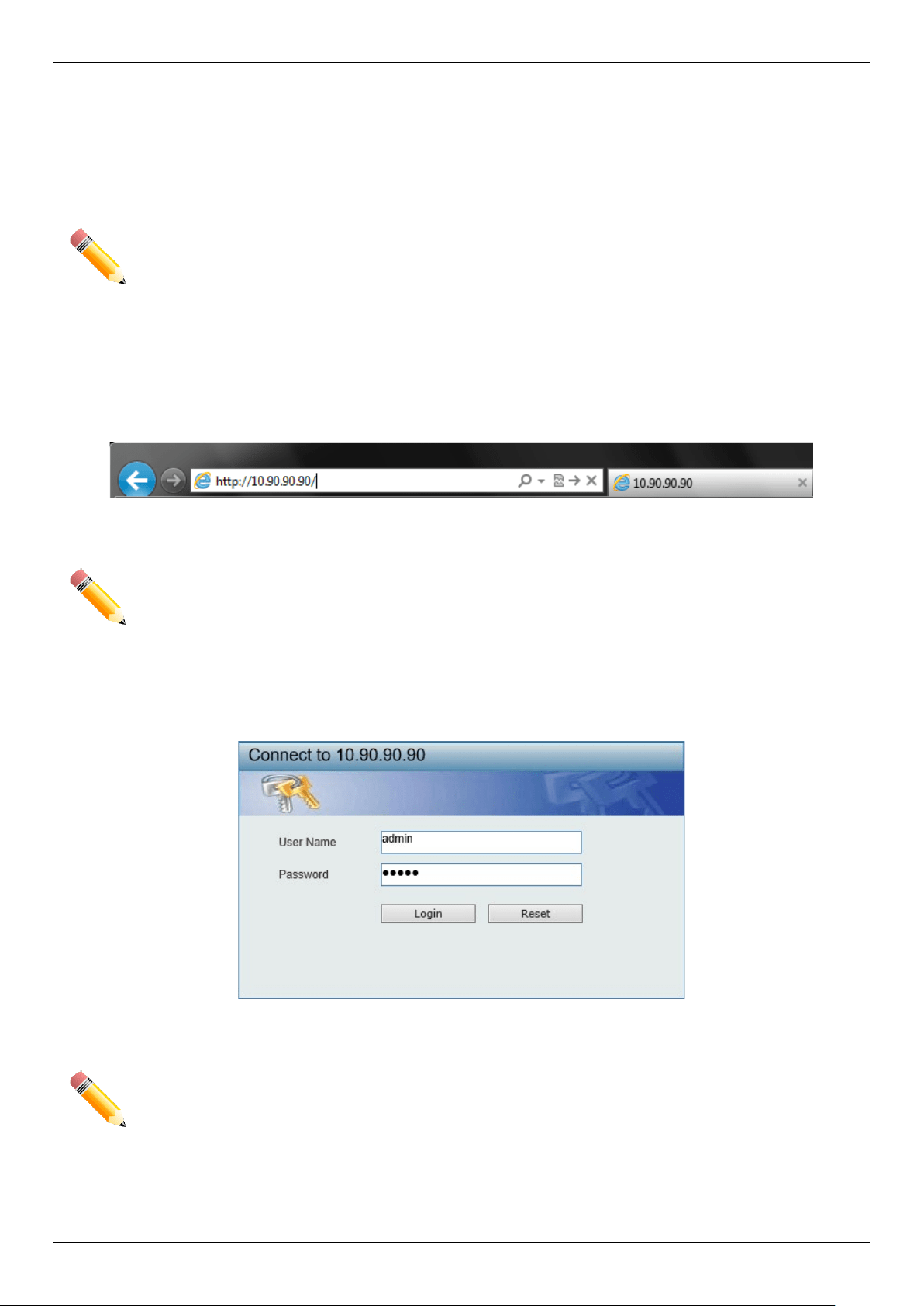
To access the Web UI, open a standard web browser, enter the IP address of the Switch into the address bar of the
browser, and press the Enter key.
Figure 5-2 IP address in Internet Explorer
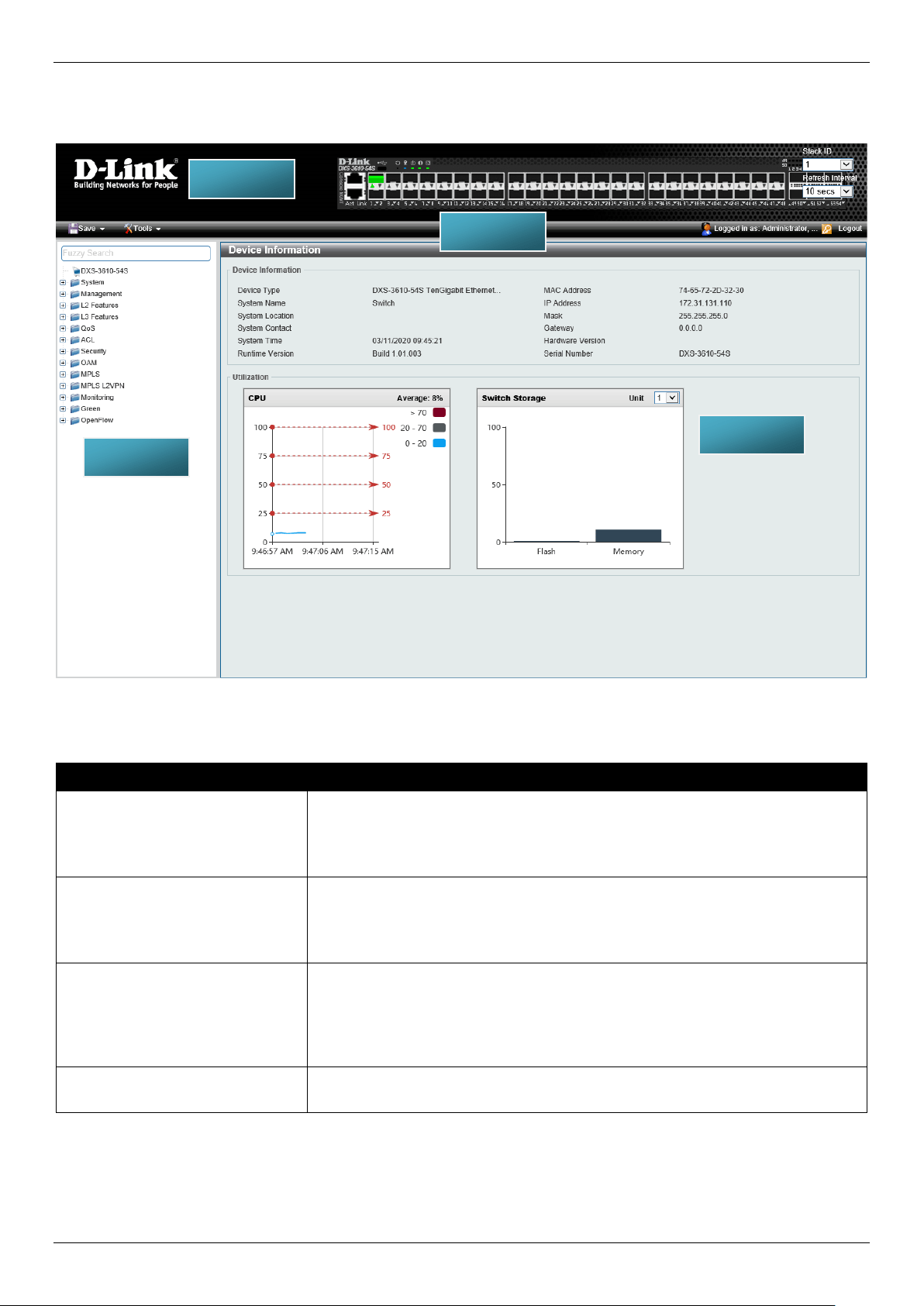
NOTE: The default IP address of the switch is 10.90.90.90 (subnet mask 255.0.0.0).
The default username and password is admin.
Logging into the Web UI
In the authentication window, enter the User Name and Password and click the Login button to access the Web UI.
Figure 5-3 Web UI Login Window
NOTE: For security reasons, it is highly recommended to configure a personal username and password
for this Switch.
DXS-3610 Series Layer 3 Stackable 10GbE Managed Switch Hardware Installation Guide
26
Web Interface Navigation
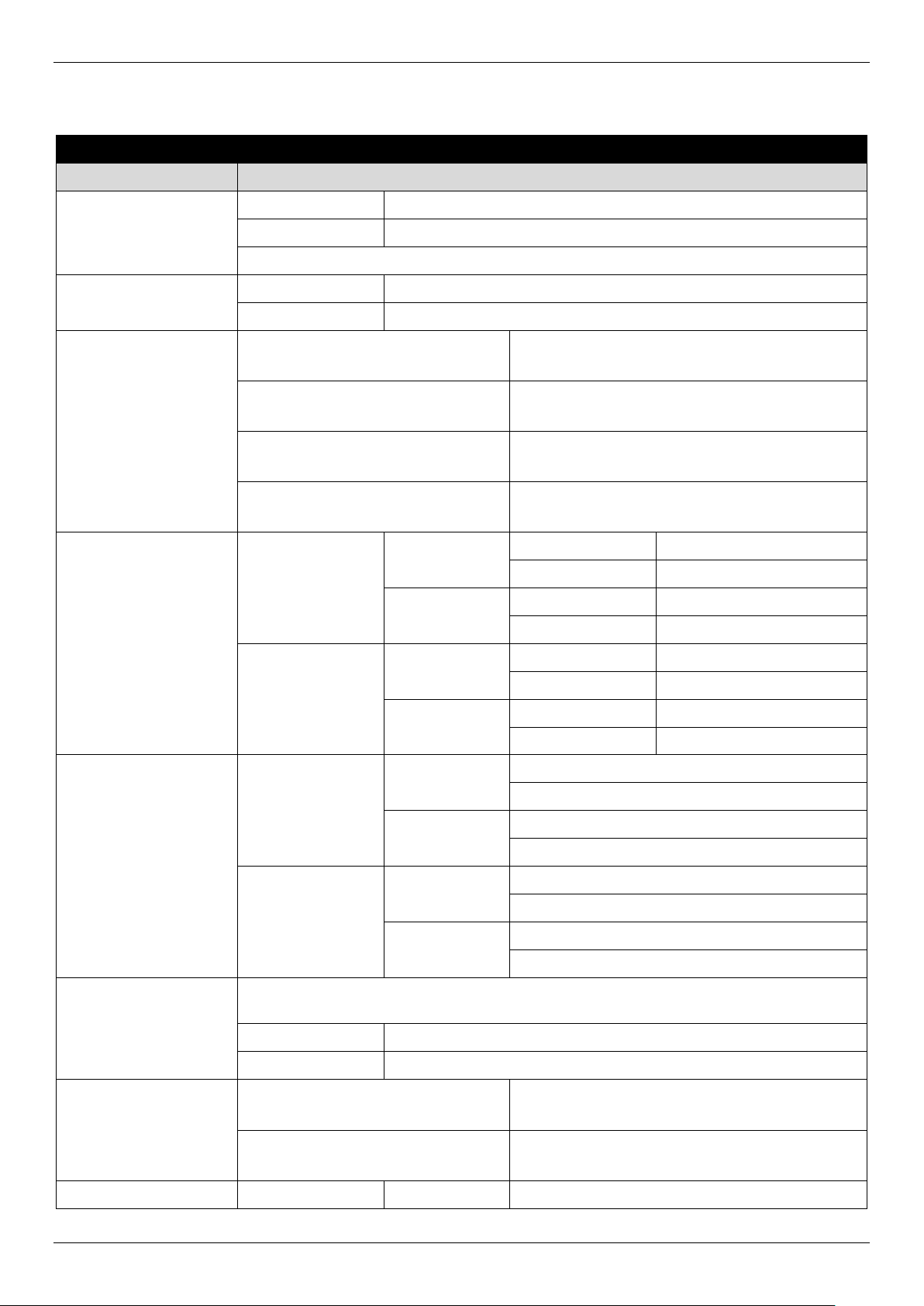
After accessing the Web UI, the following is displayed:
Figure 5-4 Web User Interface Areas (Standard Mode)
The Web UI is divided into four distinct areas that are described in the table below:
Area Number Function
AREA 1 In this area, a graphical near real-time image of the front panel of the Switch is
displayed with ports and expansion modules. Some management functions like
port monitoring are also accessible here.
Click the D-Link logo to go to the D-Link website.
AREA 2 In this area, a toolbar with access to functions like Save, Tools, and a Logout
option is available.
The user account and IP address, currently accessing the Web UI, is displayed
on the right in this toolbar.
AREA 3 In this area, the software features available in the Web UI are grouped into
folders containing hyperlinks that will open window frames in Area 4.
There is also a search option in this area that can be used to search for
specific feature keywords in the Web UI to easily find the link to the set of
features.
AREA 4 In this area, configuration and monitoring window frames are available based
on the selections made in Area 3.
AREA 1
AREA 2
AREA 3
AREA 4

DXS-3610 Series Layer 3 Stackable 10GbE Managed Switch Hardware Installation Guide
27
SNMP-based Management
The Switch can be managed with an SNMP-compatible console program. The Switch supports Simple Network
Management Protocol (SNMP) versions 1, 2c, and 3. An SNMP agent decodes the incoming SNMP messages and
responds to requests with MIB objects stored in the database. The SNMP agent updates the MIB objects to generate
statistics and counters.
Connecting using SNMP
In SNMP versions 1 and 2c, user authentication is accomplished using community strings, which function like
passwords. The remote user SNMP application and the Switch must use the same community string. SNMP packets
from any station that were not authenticated are ignored (dropped).
The default community strings for the Switch are:
• public - Allows authorized management stations to retrieve MIB objects.
• private - Allows authorized management stations to retrieve and modify MIB objects.
SNMPv3 uses a more sophisticated authentication process that is separated into two parts. The first part is to
maintain a list of users and their attributes that are allowed to act as SNMP managers. The second part describes
what each user on that list can do as an SNMP manager.
The Switch allows groups of users to be listed and configured with a shared set of privileges. This SNMP version may
also be set for a listed group of SNMP managers. Thus, a group of SNMP managers can be created to view read-only
information or receive traps using SNMP version 1, while assigning a higher level of security to another group,
granting read/write privileges using SNMP version 3.
Using SNMP version 3 individual users or groups of SNMP managers can be allowed to perform or be restricted from
performing specific SNMP management functions. The functions that have been allowed or restricted are defined
using the Object Identifier (OID) associated with a specific MIB. An additional layer of security is available for SNMP
version 3 in that SNMP messages may be encrypted.
Traps
Traps are messages that are sent by an SNMP-enabled device to the Network Management Station (NMS) and can
be used to alert network personnel of events that occur on the Switch. These events can be as serious, like a reboot
(someone accidentally turned off the Switch), or less serious like a port status change. The Switch generates traps
and sends them to a pre-configured IP address, usually an NMS. Typical traps include trap messages for
Authentication Failure and Topology Change.
Management Information Base (MIB)
A MIB stores management and counter information. The Switch uses the standard MIB-II Management Information
Base module. Consequently, values for MIB objects can be retrieved from any SNMP-based network management
software. In addition to the standard MIB-II, the Switch also supports its own proprietary enterprise MIB as an
extended Management Information Base. The proprietary MIB may also be retrieved by specifying the MIB Object
Identifier. MIB values can be either read-only or read-write.
DXS-3610 Series Layer 3 Stackable 10GbE Managed Switch Hardware Installation Guide
28
Appendix A - Technical Specifications
Physical Specifications
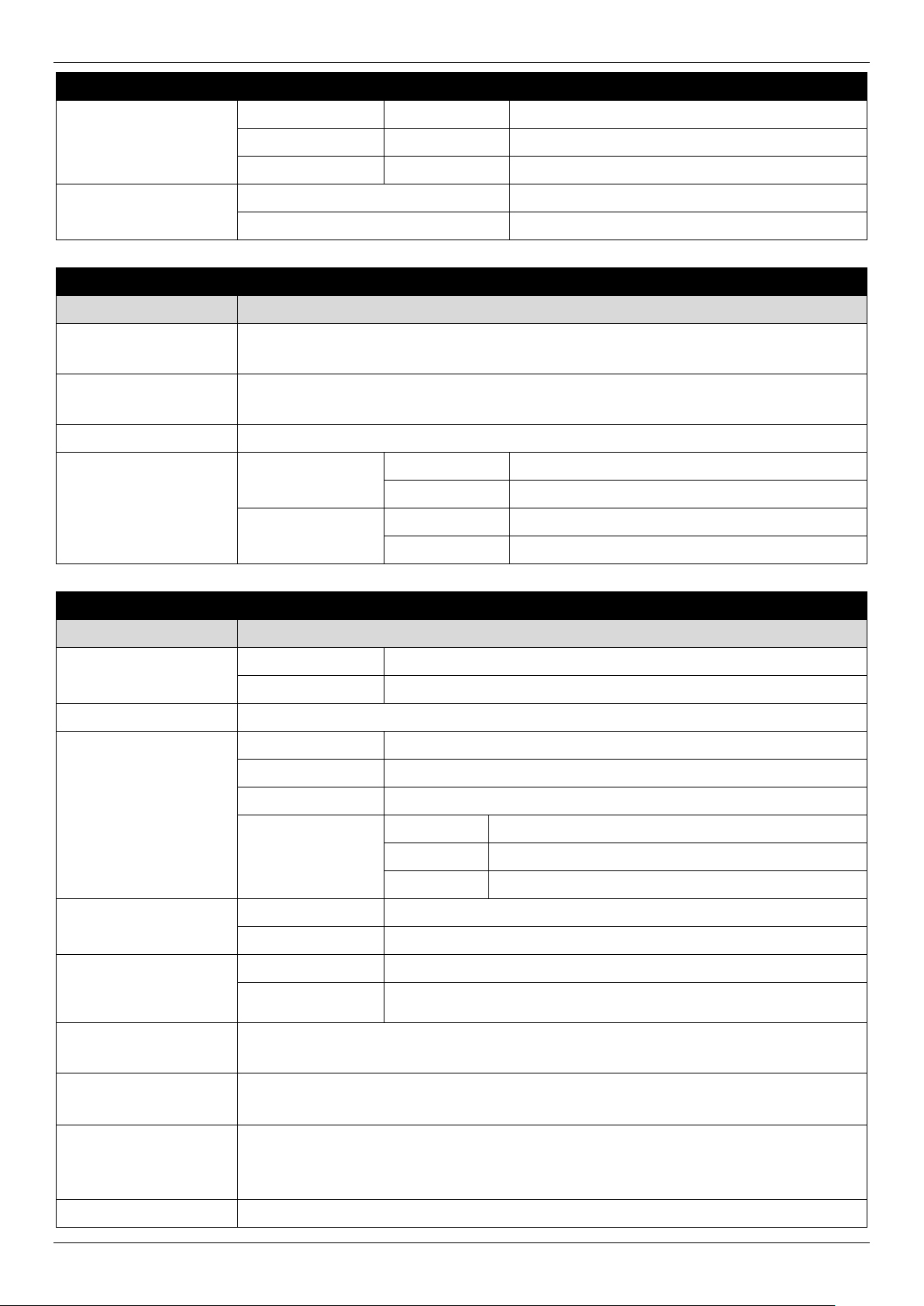
Feature Description
Dimensions DXS-3610-54T 441 mm (W) x 487.4 mm (D) x 43.5 mm (H)
DXS-3610-54S 441 mm (W) x 487.4 mm (D) x 43.5 mm (H)
All the switches are 19-inch, 1U rack-mount size
Weight DXS-3610-54T 9.88 kg
DXS-3610-54S 9.80 kg
PSU Modules DXS-PWR700AC AC PSU (100~240 VAC, 50~60 Hz, 10A Max)
Front-to-Back airflow
DXS-PWR700AC-B AC PSU (100~240 VAC, 50~60 Hz, 10A Max)
Back-to-Front airflow
DXS-PWR1000DC DC PSU (-48V, 26A)
Front-to-Back airflow
DXS-PWR1000DC-B DC PSU (-48V, 26A)
Back-to-Front airflow
Power Consumption DXS-3610-54T Maximum 100 VAC / 60 Hz 330.2 Watts
240 VAC / 50 Hz 315.9 Watts
Standby 100 VAC / 60 Hz 103.7 Watts
240 VAC / 50 Hz 120.6 Watts
DXS-3610-54S Maximum 100 VAC / 60 Hz 320.8 Watts
240 VAC / 50 Hz 305.1 Watts
Standby 100 VAC / 60 Hz 120.6 Watts
240 VAC / 50 Hz 114.6 Watts
MTBF DXS-3610-54T FB Airflow 96503 Hours (with AC power)
74204 Hours (with DC power)
BF Airflow 96806 Hours (with AC power)
50044 Hours (with DC power)
DXS-3610-54S FB Airflow 94262 Hours (with AC power)
72872 Hours (with DC power)
BF Airflow 94544 Hours (with AC power)
49433 Hours (with DC power)
Fan Module Slots
The IC Sensor detects the temperature on the switch automatically and adjusts the
speed.
DXS-3610-54T 5 fan module slots (4+1 redundancy)
DXS-3610-54S 5 fan module slots (4+1 redundancy)
Fan Modules DXS-FAN200 Removable, hot-swappable
Front-to-Back airflow
DXS-FAN200-B Removable, hot-swappable
Back-to-Front airflow
Surge Protection AC Power CM 2 KV
DXS-3610 Series Layer 3 Stackable 10GbE Managed Switch Hardware Installation Guide
29
Physical Specifications
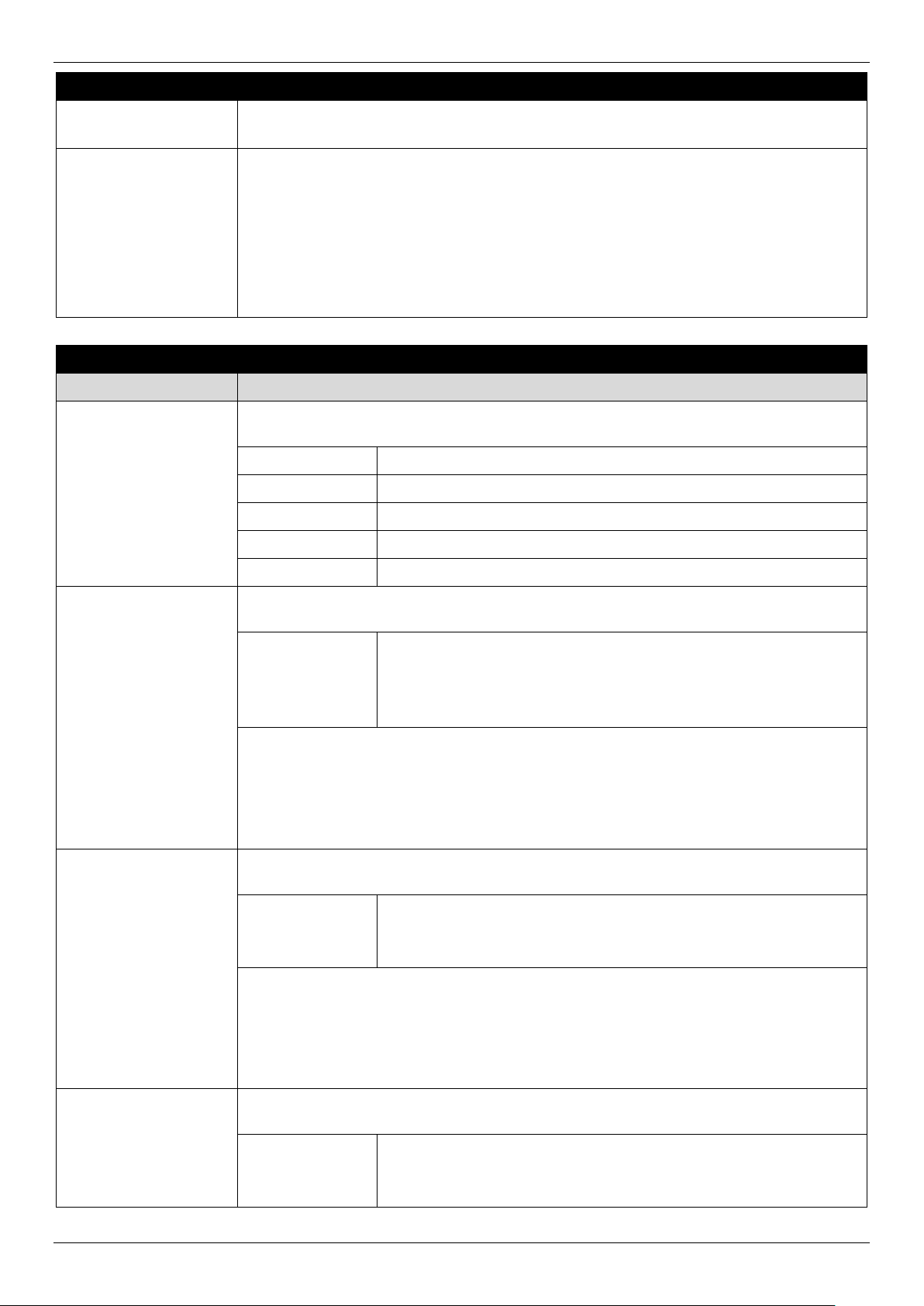
DM 1 KV
DC Power CM 0.5 KV
Signal CM 1 KV (10G RJ45 Port)
USB Port Connector Type Micro USB
Standard Compliance USB 2.0 (5V/1A)
Environment Specifications
Feature Description
Temperature Operating: 0°C to 45°C (32°F to 113°F)
Storage: -40°C to 70°C (-40°F to 158°F)
Humidity Operating: 0 % to 95 % RH (non-condensing)
Storage: 0 % to 95 % RH (non-condensing)
Altitude 0 to 2000 meters (6562 feet) above sea level
Electrostatic
Discharge Protection
DXS-3610-54T Contact 4 KV
Air 8 KV
DXS-3610-54S Contact 4 KV
Air 8 KV
Performance Specification
Feature Description
Switching Capacity DXS-3610-54T 2.16 Tbps
DXS-3610-54S 2.16 Tbps
MAC Address Table Up to 288K entries (1K static MAC addresses)
Physical Stacking Topology Duplex Ring and Duplex Chain
Bandwidth Up to 1.2 Tbps (Full-duplex)
Stack Number Up to 12 Switches
Configurations 2-port Ports 53 to 54
4-port Ports 51 to 54
6-port Ports 49 to 54
Packet Buffer DXS-3610-54T 32 MB
DXS-3610-54S 32 MB
Packet Forwarding
Rate
(Maximum)
DXS-3610-54T 1607.04 Mpps
DXS-3610-54S 1607.04 Mpps
Forwarding Mode Store and forward
Cut through forwarding
Priority Queues Supports the following:
• Maximum of 8 Priority Queues per port
Link Aggregation Supports the following:
• Maximum of 32 groups per device
• Maximum of 12 ports per group
Static Routes Supports the following:
DXS-3610 Series Layer 3 Stackable 10GbE Managed Switch Hardware Installation Guide
30
Performance Specification
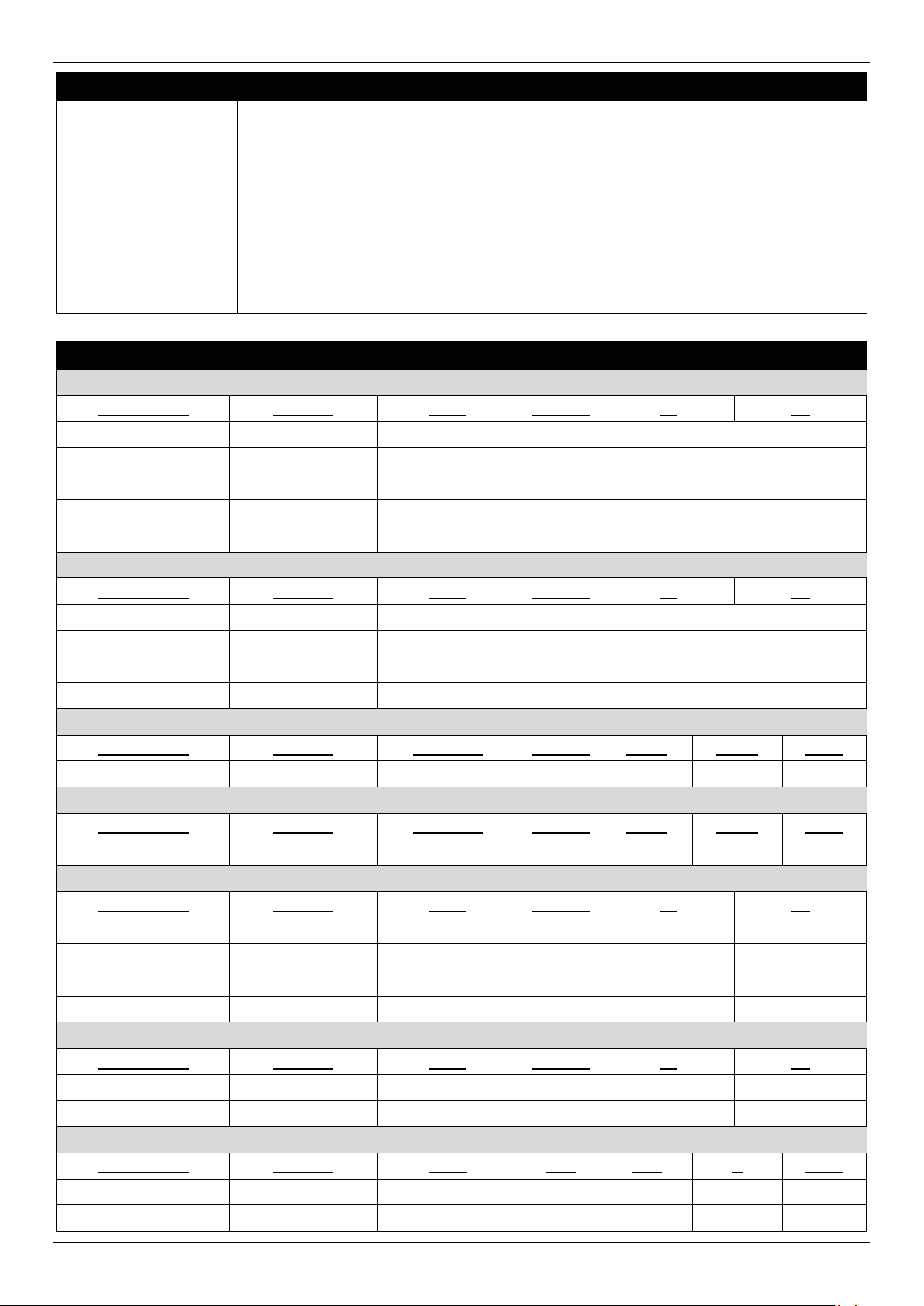
• Maximum of 1K static IPv4 routes
• Maximum of 512 static IPv6 routes
Access Control List
(ACL) Entries
Supports the following:
• Maximum of 2304 MAC ingress ACL entries
• Maximum of 2304 IP ingress ACL entries
• Maximum of 2304 IPv6 ingress ACL entries
• Maximum of 2048 MAC egress ACL entries
• Maximum of 2048 IP egress ACL entries
• Maximum of 1024 IPv6 egress ACL entries
Port Type Specifications
Feature Description
Console Port The RJ45 console port provides out-of-band access to the CLI using the following
settings:
Baud Rate 115200 (default), 19200, 38400, and 9600 bps
Data Bits 8
Stop Bit 1
Parity None
Flow Control None
RJ45 Ports The RJ45 Ethernet ports provides in-band access to the CLI and Web UI, interconnect
nodes, and support the following standards and features:
Standards IEEE 802.3ab (1000BASE-T)
IEEE 802.3an (10GBASE-T)
IEEE 802.3az (Energy-Efficient Ethernet)
IEEE 802.3x (Full-Duplex, Flow Control)
The RJ45 ports support the following features:
• Back pressure for half-duplex mode
• Head-of-line blocking prevention
• Manual/auto MDI/MDIX configuration
• Auto-negotiation for each port
SFP+ Ports The SFP+ transceiver ports provides in-band access to the CLI and Web UI, interlink
network segments, and support the following standards and features:
Standards IEEE 802.3z (1000BASE-X)
IEEE 802.3ah (1000BASE-BX10)
IEEE 802.3ae (10GBASE-R)
The SFP+ ports support the following features:
• Only full-duplex operation
• The auto-negotiation and auto-speed functions are not supported
• IEEE 802.3X flow control for the full-duplex mode
All SFP+ ports are backwards compatible to support SFP transceivers.
QSFP28 Ports
The QSFP28 transceiver ports provides in-band access to the CLI and Web UI, interlink
network segments, and support the following standards and features:
Standards IEEE 802.3ba (40GBASE-R4, 100GBASE-R4)
IEEE 802.3bm (40GBASE-R4, 100GBASE-R4)
IEEE 802.3bj (100GBASE-R4)
DXS-3610 Series Layer 3 Stackable 10GbE Managed Switch Hardware Installation Guide
31
Port Type Specifications
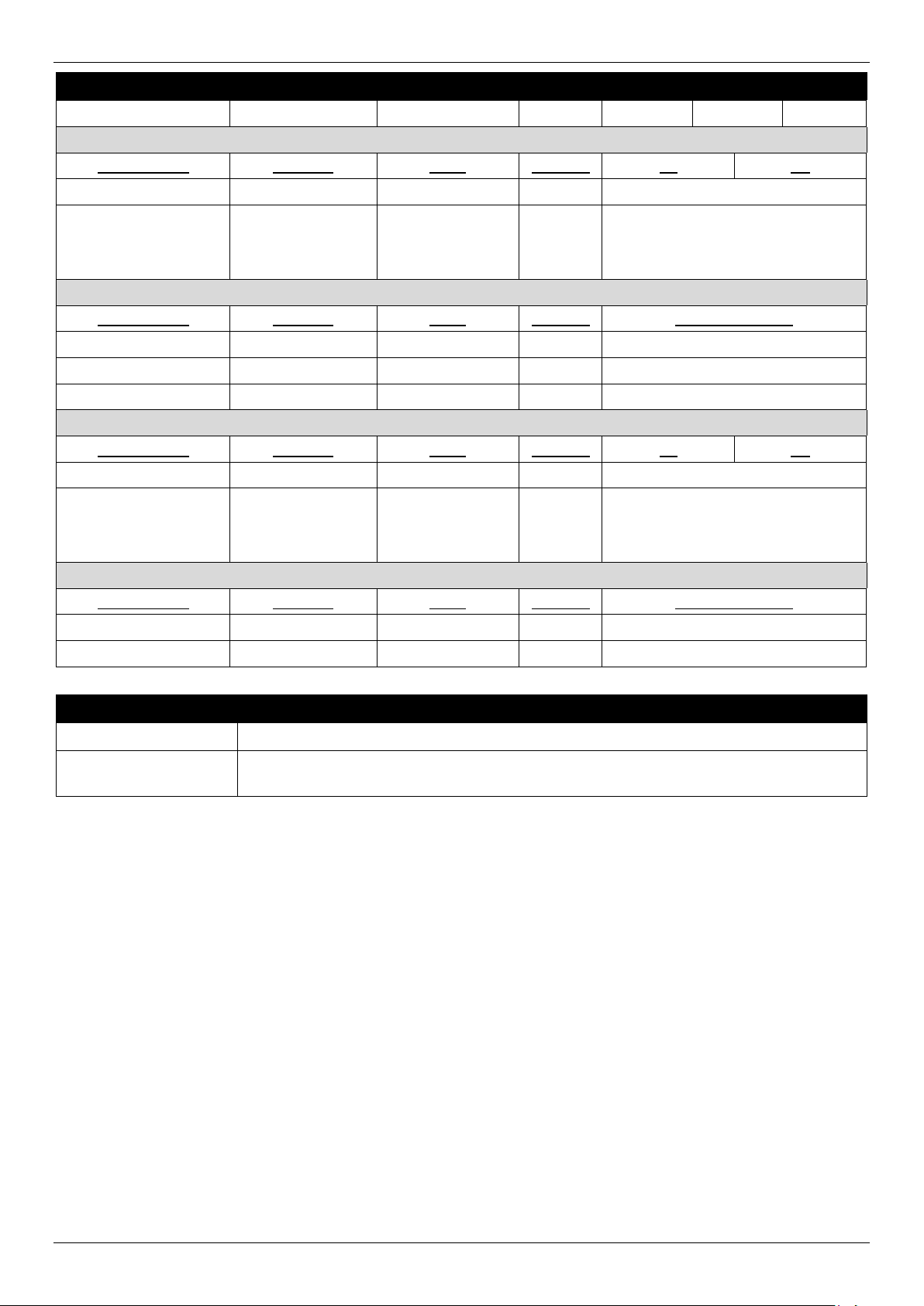
The QSFP28 ports support the following features:
• Only full-duplex operation
• The auto-negotiation and auto-speed functions are not supported
• IEEE 802.3X flow control for the full-duplex mode
• Breakout connections of 4 x 10 Gbps and 4 x 25 Gbps
• Only one port can in a Group can be used for a breakout connection:
o Group A: Port 49, 50, or 52
o Group B: Port 51, 53, or 54
All QSFP28 ports are backwards compatible to support QSFP+ transceivers.
Supported SFP/SFP+/QSFP+/SFP28 Transceivers
SFP Fiber Transceivers
Product Code Standard Mode Distance TX RX
DEM-310GT 1000BASE-LX Single-mode 10 km 1310 nm
DEM-311GT 1000BASE-SX Multi-mode 550 m 850 nm
DEM-312GT2 1000BASE-SX Multi-mode 2 km 1310 nm
DEM-314GT 1000BASE-LHX Single-mode 50 km 1550 nm
DEM-315GT 1000BASE-ZX Single-mode 80 km 1550 nm
SFP+ Fiber Transceivers
Product Code Standard Mode Distance TX RX
DEM-431XT 10GBASE-SR Multi-mode 300 m 850 nm
DEM-432XT 10GBASE-LR Single-mode 10 km 1310 nm
DEM-433XT 10GBASE-ER Single-mode 40 km 1550 nm
DEM-434XT 10GBASE-ZR Single-mode 80 km 1550 nm
SFP Copper Transceivers
Product Code Standard Connector Distance TX/RX Power Amps
DGS-712 1000BASE-T SFP to RJ45 100 m - 3.3 V 375 mA
SFP+ Copper Transceivers
Product Code Standard Connector Distance TX/RX Power Amps
DEM-410T 10GBASE-T SFP+ to RJ45 30 m - 3.3 V 780 mA
WDM (BiDi) SFP Transceivers
Product Code Standard Mode Distance TX RX
DEM-330T 1000BASE-BX-D Single-mode 10 km 1550 nm 1310 nm
DEM-330R 1000BASE-BX-U Single-mode 10 km 1310 nm 1550 nm
DEM-331T 1000BASE-BX-D Single-mode 40 km 1550 nm 1310 nm
DEM-331R 1000BASE-BX-U Single-mode 40 km 1310 nm 1550 nm
WDM (BiDi) SFP+ Transceivers
Product Code Standard Mode Distance TX RX
DEM-436XT-BXD 10GBASE-LR Single-mode 20 km 1330 nm 1270 nm
DEM-436XT-BXU 10GBASE-LR Single-mode 20 km 1270 nm 1310 nm
SFP+ Direct Attached Cables (DAC)
Product Code Standard Cable Dist. Wire Ω Amps
DEM-CB100S 10G SFP+ Twinaxial 1 m 30 AWG 100 Ω 0.5 A
DEM-CB300S 10G SFP+ Twinaxial 3 m 30 AWG 100 Ω 0.5 A
DXS-3610 Series Layer 3 Stackable 10GbE Managed Switch Hardware Installation Guide
32
Supported SFP/SFP+/QSFP+/SFP28 Transceivers
DEM-CB700S 10G SFP+ Twinaxial 7 m 30 AWG 100 Ω 0.5 A
QSFP+ Fiber Transceivers
Product Code Standard Mode Distance TX RX
DEMQX01Q-SR4 40GBASE-SR4 Multi-mode 150 m 850 nm
DEMQX10Q-LR4 40GBASE-LR4 Single-mode 10 km L0 = 1271 nm
L1 = 1291 nm
L2 = 1311 nm
L4 = 1331 nm
QSFP+ Direct Attached Cables (DAC)
Product Code Standard Mode Distance Breakout Support
DEM-CB100QXS 40G QSFP+ Twinaxial 1 m No
DEM-CB300QXS 40G QSFP+ Twinaxial 3 m No
DEM-CB100QXS-4XS 40G QSFP+ Twinaxial 1 m 1 QSFP+ (40G) to 4 SFP+ (10G)
QSFP28 Fiber Transceivers
Product Code Standard Mode Distance TX RX
DEM-Q2801Q-SR4 100GBASE-SR4 Multi-mode 100 m 850 nm
DEM-Q2801Q-LR4 100GBASE-LR4 Single-mode 10 km L0 = 1295.56 nm
L1 = 1301.05 nm
L2 = 1304.58 nm
L3 = 1309.14 nm
QSFP28 Direct Attached Cables (DAC)
Product Code Standard Mode Distance Breakout Support
DEM-CB100Q28 100G QSFP28 Twinaxial 1 m No
DEM-CB100Q28-4S28 100G QSFP28 Twinaxial 1 m 1 QSFP28 (100G) to 4 SFP28 (25G)
Certifications
EMC Certifications CE Class A, FCC Class A, VCCI Report Class A, C-Tick Report Class A, BSMI
Safety Certifications UL Mark (62368-1), CB Report (IEC60950-1), CB Report (IEC62368-1), LVD Report
(62368-1), BSMI
DXS-3610 Series Layer 3 Stackable 10GbE Managed Switch Hardware Installation Guide
33
Appendix B - Cables and Connectors
Ethernet Cable
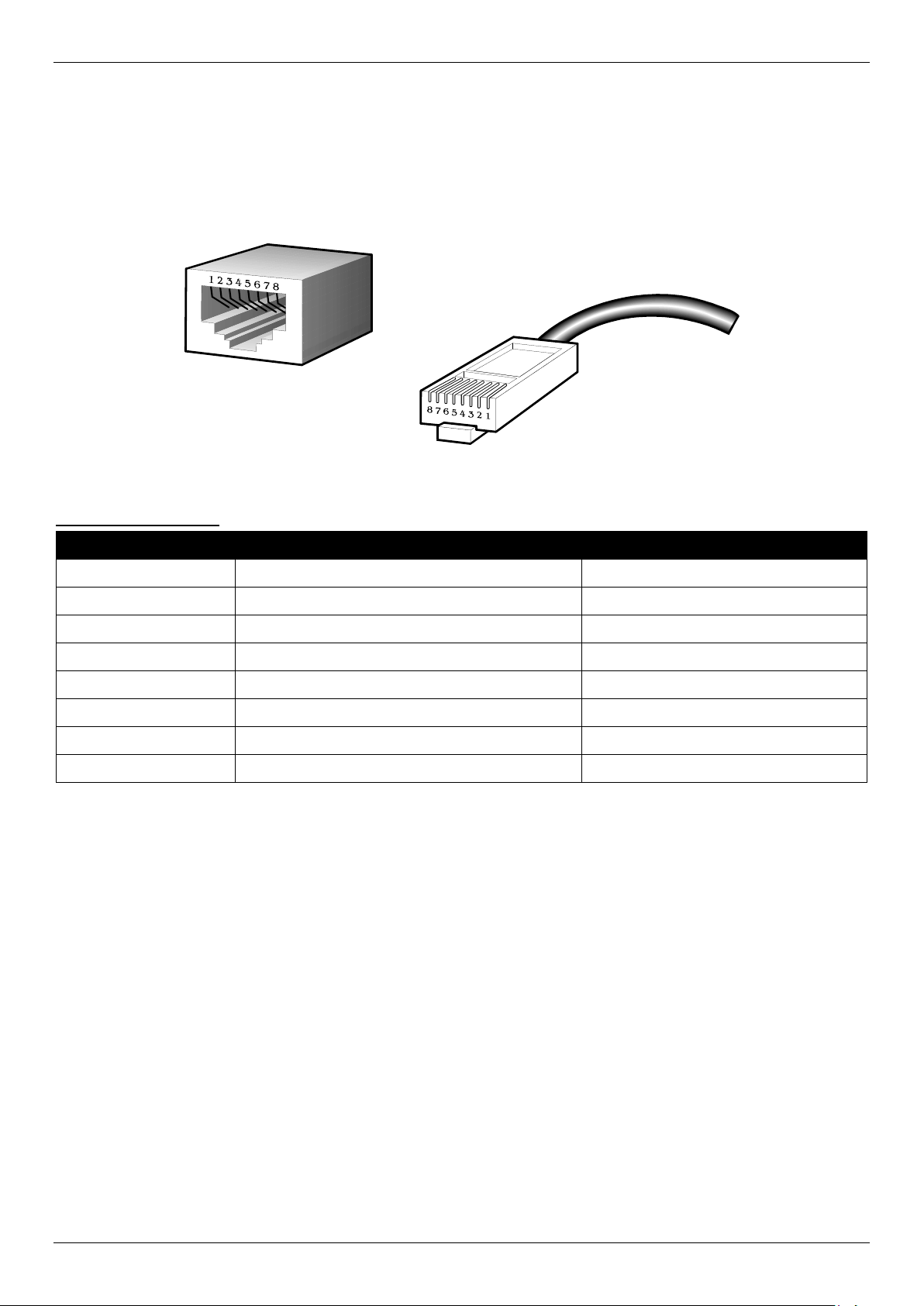
When connecting the Switch to another switch, a bridge, or hub, a straight-through Category 5/5e/6a/7 cable is
necessary. The following diagrams and tables show the standard RJ45 receptacle/connector and their pin
assignments.
Figure B-1 Standard RJ45 port and connector
RJ45 Pin Assignment:
Contact MDI-X Port MDI-II Port
1 RD+ (receive) TD+ (transmit)
2 RD - (receive) TD - (transmit)
3 TD+ (transmit) RD+ (receive)
4 1000BASE-T/10GBASE-T 1000BASE-T/10GBASE-T
5 1000BASE-T/10GBASE-T 1000BASE-T/10GBASE-T
6 TD - (transmit) RD- (receive)
7 1000BASE-T/10GBASE-T 1000BASE-T/10GBASE-T
8 1000BASE-T/10GBASE-T 1000BASE-T/10GBASE-T
DXS-3610 Series Layer 3 Stackable 10GbE Managed Switch Hardware Installation Guide
34
Console Cable
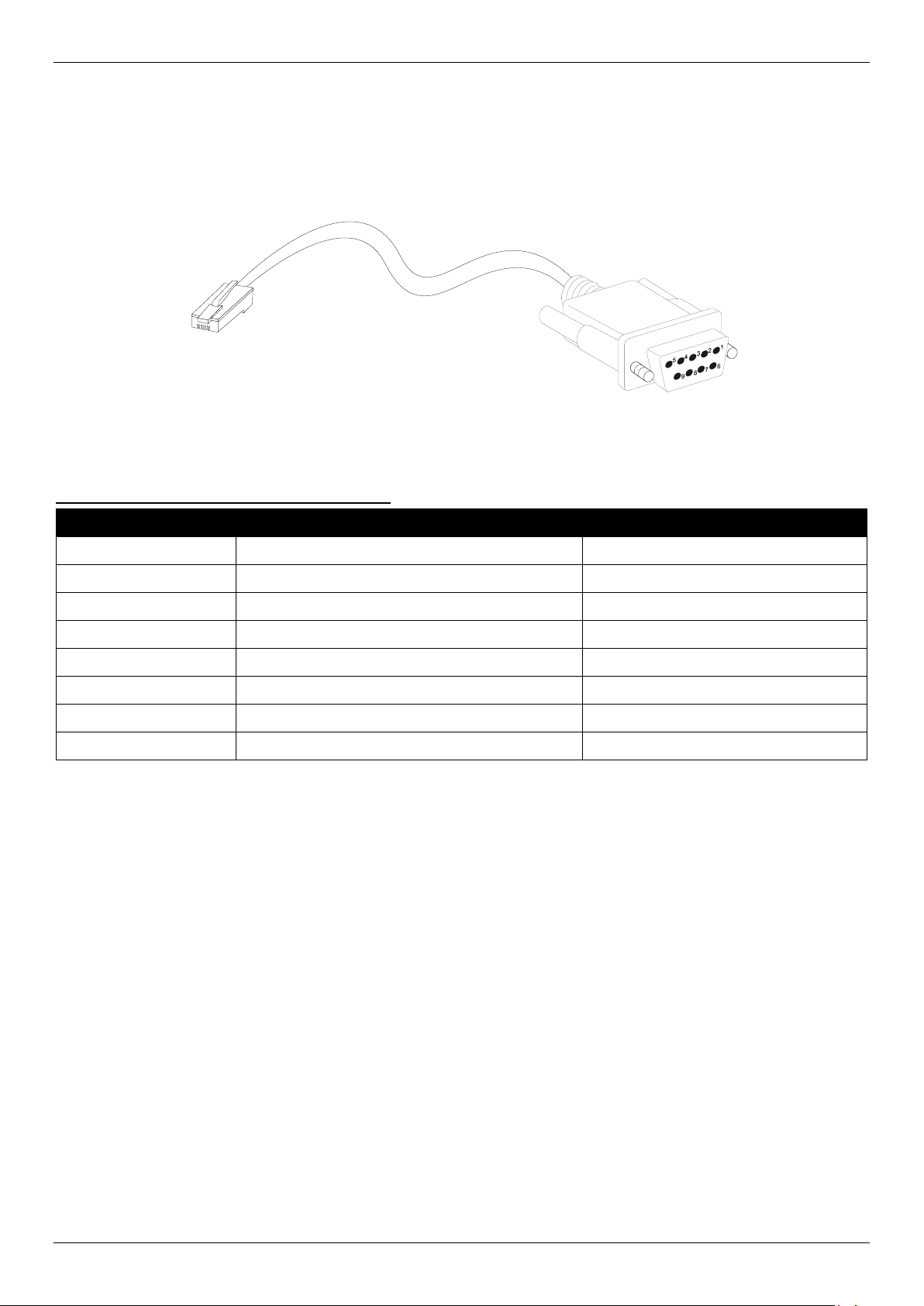
A console cable is used to connect to the RJ45 console port of the Switch to access the command line interface. The
following diagram and table show the standard RJ45 to RS-232cable and pin assignments.
Figure B-2 Console to RJ45 Cable
RJ45 To RS-232 Cable Pin Assignment Table:
Contact Console (DB9/RS232) RJ45
1 Not Used Not Used
2 RXD Not Used
3 TXD TXD
4 Not Used GND
5 GND (shared) GND
6 Not Used RXD
7 Not Used Not Used
8 Not Used Not Used

DXS-3610 Series Layer 3 Stackable 10GbE Managed Switch Hardware Installation Guide
35
Safety/Sécurité
Safety Instructions
Consignes de sécurité
General Precautions for Rack-Mountable Products
Protecting Against Electrostatic Discharge
Safety Instructions
Please pay careful attention to the following safety guidelines to ensure your own personal safety and to help protect
your system from potential damage.
Safety Cautions
To greatly reduce the risk of physical injury, electrical shock, fire, and damage to equipment, observe the following
precautions.
Observe and follow service markings.
• Do not attempt to service any product, except when it is explained in the system’s documentation.
• Opening or removing covers, marked with a high voltage sign, may expose the user to electrical shock.
• Only a trained service technician should service components inside these compartments.
If any of the following conditions occur, unplug the product from the electrical outlet and replace the part or contact
your trained service provider:
• Damage to the power cable, extension cable, or plug.
• An object has fallen into the product.
• The product has been exposed to water.
• The product has been dropped or damaged.
• The product does not operate correctly when the operating instructions are correctly followed.
General safety cautions:
• Electrical Hazard: Only qualified personnel should perform installation procedures.
• Before servicing, disconnect all power cords to remove power from the device.
• Keep the system away from radiators and heat sources. Also, do not block cooling vents.
• Do not spill food or liquids on system components, and never operate the product in a wet environment. If the
system gets wet, contact your trained service provider.
• Do not push any objects into the openings of the system. Doing so can cause fire or electric shock by shorting
out interior components.
• Only use this product with approved equipment.
• Allow the product to cool before removing the cover or touching internal components.
• Operate the product only from the type of external power source indicated on the electrical ratings label. If
unsure of the type of power source required, consult your service provider or local power company.
• Be sure that attached devices are electrically rated to operate with the power available in your location.
• Use only approved power cable(s). If you have not been provided with a power cable for your system or for any
AC-powered option intended for your system, purchase a power cable that is approved for use in your country.
The power cable must be rated for the product and for the voltage and current marked on the product's
electrical ratings label. The voltage and current rating of the cable should be greater than the ratings marked on
the product.
• To help prevent electric shock, plug the system and peripheral power cables into properly grounded electrical
outlets. These cables are equipped with three-prong plugs to help ensure proper grounding. Do not use adapter
plugs or remove the grounding prong from a cable. If using an extension cable is necessary, use a 3-wire cable
with properly grounded plugs.
DXS-3610 Series Layer 3 Stackable 10GbE Managed Switch Hardware Installation Guide
36
• Observe the extension cable and power strip ratings. Make sure that the total ampere rating of all products
plugged into the extension cable or power strip does not exceed 80 percent of the ampere ratings limit for the
extension cable or power strip.
• To help protect the system from sudden, transient increases and decreases in electrical power, use a surge
suppressor, line conditioner, or uninterruptible power supply (UPS).
• Position system cables and power cables carefully. Route cables so that they cannot be stepped on or tripped
over. Be sure that nothing rests on any cables.
• Do not modify power cables or plugs. Consult a licensed electrician or your power company for site
modifications. Always follow your local or national wiring rules.
When connecting or disconnecting power to and from hot-pluggable power supplies, observe the following guidelines:
• Install the power supply before connecting the power cable to the power supply.
• Unplug the power cable before removing the power supply.
• If the system has multiple sources of power, disconnect power from the system by unplugging all power cables
from the power supplies.
• Move products with care and ensure that all casters and stabilizers are firmly connected to the system. Avoid
sudden stops and uneven surfaces.
To help avoid damage to the system, be sure that the voltage selection switch, on the power supply, is set to match
the power available at the Switch’s location:
• 115V/60Hz is used mostly in North and South America as well as Far Eastern countries like as South Korea
and Taiwan
• 100V/50Hz is used mostly in Eastern Japan and 100V/60Hz in Western Japan
• 230V/50Hz is used mostly in Europe, the Middle East, Africa and the Far East
CAUTION: Risk of Explosion if Battery is replaced by an Incorrect Type. Dispose of Used Batteries
According to the Instructions.
ATTENTION : Risque d'explosion si la batterie est remplacée par un type incorrect. Jetez les piles
usagées selon les instructions.
警告:如果更換不正確之電池型式會有爆炸的風險。請依製造商說明書處理用過之電池。
Consignes de sécurité
Veuillez prêter une attention particulière aux consignes de sécurité suivantes pour assurer votre sécurité personnelle
et protéger votre système des dommages potentiels.
Précautions de sécurité
Pour réduire considérablement les risques de blessure physique, de choc électrique, d'incendie et de détérioration du
matériel, observez les précautions suivantes.
Observez et respectez les marquages relatifs à l'entretien et/ou aux réparations.
• N'essayez pas de réparer un produit, sauf si cela est expliqué dans la documentation du système.
• L'ouverture ou le retrait des capots, signalés par un symbole de haute tension, peut exposer l'utilisateur à un
choc électrique.
• Seul un technicien de maintenance qualifié est habilité à réparer les composants à l'intérieur de ces
compartiments.
Si l'un des cas suivants se produit, débranchez l'appareil du secteur et remplacez la pièce concernée ou contactez
votre prestataire de services agréé.
• Endommagement du câble d'alimentation, du câble de rallonge ou de la fiche.

DXS-3610 Series Layer 3 Stackable 10GbE Managed Switch Hardware Installation Guide
37
• Un objet est tombé dans le produit.
• Le produit a été exposé à l'eau.
• Le produit est tombé ou a été endommagé.
• Le produit ne fonctionne pas correctement lorsque les instructions d'utilisation sont correctement suivies.
Précautions générales de sécurité:
• Danger électrique: Seul le personnel qualifié doit effectuer les procédures d'installation.
• Avant de procéder à l'entretien, débranchez tous les cordons d'alimentation pour mettre le périphérique hors
tension.
• Éloignez le système des radiateurs et des sources de chaleur. Par ailleurs, n'obturez pas les fentes d'aération.
• Ne versez pas de liquide sur les composants du système et n'introduisez pas de nourriture à l'intérieur. Ne
faites jamais fonctionner l'appareil dans un environnement humide. Si le système est mouillé, contactez votre
prestataire de services qualifié.
• N'insérez aucun objet dans les fentes de l'appareil. Vous risqueriez de provoquer un incendie ou un choc
électrique en court-circuitant les composants internes.
• Utilisez ce produit uniquement avec un équipement approuvé.
• Laissez l'appareil refroidir avant de déposer le capot ou de toucher les composants internes.
• Faites fonctionner le produit uniquement avec la source d'alimentation indiquée sur l'étiquette signalétique où
figurent les caractéristiques électriques nominales. Si vous ne savez pas avec certitude quel type de source
d'alimentation est requis, consultez votre prestataire de services ou votre compagnie d'électricité.
• Assurez-vous que les caractéristiques nominales des appareils branchés correspondant à la tension du réseau
électrique.
• Utilisez uniquement des câbles d'alimentation homologués. Si un câble d'alimentation n'est pas fourni pour le
système ou pour un composant/accessoire alimenté par CA destiné au système, procurez-vous un câble
d'alimentation homologué pour une utilisation dans votre pays. Le câble d'alimentation doit être adapté à
l'appareil et ses caractéristiques nominales doivent correspondre à celles figurant sur l'étiquette du produit. La
tension et le courant nominaux du câble doivent être supérieurs aux valeurs nominales indiquées sur l'appareil.
• Pour éviter tout risque de choc électrique, branchez les câbles d'alimentation du système et des périphériques
à des prises électriques correctement mises à la masse. Ces câbles sont équipés de fiches à trois broches
pour garantir une mise à la masse appropriée. N'utilisez pas d'adaptateur de prise, et n'éliminez pas la broche
de mise à la masse du câble. Si un câble de rallonge est nécessaire, utilisez un câble à 3 fils avec des fiches
correctement mises à la terre.
• Respectez les caractéristiques nominales de la rallonge ou du bloc multiprise. Assurez-vous que l'intensité
nominale totale de tous les produits branchés à la rallonge ou au bloc multiprise ne dépasse pas 80 % de
l'intensité nominale limite de la rallonge ou du bloc multiprise.
• Pour protéger le système contre les pics et les chutes de tension transitoires et soudains, utilisez un
parasurtenseur, un filtre de secteur ou une alimentation sans interruption (ASI).
• Positionnez les câbles système et les câbles d'alimentation avec soin. Acheminez les câbles de manière à ce
qu'ils ne puissent pas être piétinés ou trébuchés. Veillez à ce que rien ne repose sur les câbles.
• Ne modifiez pas les câbles ou les fiches d'alimentation. Contactez un électricien qualifié ou la compagnie
d'électricité si des modifications sur site sont nécessaires. Respectez toujours la règlementation locale ou
nationale en matière de câblage.
Lors de la connexion ou de la déconnexion de l'alimentation vers et depuis des blocs d'alimentation enfichables à
chaud, respectez les consignes suivantes:
• Installez l'alimentation avant d'y brancher le câble d'alimentation.
• Débranchez le câble d'alimentation avant de couper l'alimentation.
• Si le système possède plusieurs sources d'alimentation, mettez-le hors tension en débranchant tous les câbles
d'alimentation des prises.
• Déplacez les appareils avec précaution et assurez-vous que les roulettes et/ou que les pieds stabilisateurs sont
bien fixés au système. Évitez les arrêts brusques et les surfaces inégales.
Pour éviter d'endommager le système, assurez-vous que le commutateur de sélection de tension de l'alimentation est
réglé sur l'alimentation disponible à l'emplacement du commutateur:
• 115 V/60 Hz est principalement utilisé en Amérique du Nord et du Sud, ainsi que dans des pays d'Extrême-
Orient tels que la Corée du Sud et Taïwan.
DXS-3610 Series Layer 3 Stackable 10GbE Managed Switch Hardware Installation Guide
38
• 100 V/50 Hz est utilisé principalement dans l'est du Japon et 100 V/ 60 Hz dans l'ouest du Japon.
• 230 V/50 Hz est principalement utilisé en Europe, au Moyen-Orient, en Afrique et en Extrême-Orient.
General Precautions for Rack-Mountable Products
Please pay careful attention to the following precautions concerning rack stability and safety. Systems are considered
to be components in a rack. Thus, a component refers to any system, as well as to various peripherals or supporting
hardware:
CAUTION: Installing systems in a rack without the front and side stabilizers installed could cause the
rack to tip over, potentially resulting in bodily injury under certain circumstances. Therefore, always
install the stabilizers before installing components in the rack. After installing system/components in a
rack, never pull more than one component out of the rack on its slide assemblies at one time. The
weight of more than one extended component could cause the rack to tip over and may result in
serious injury.
ATTENTION : Le montage de systèmes sur un rack dépourvu de pieds stabilisateurs avant et latéraux
peut faire basculer le rack, pouvant causer des dommages corporels dans certains cas. Par
conséquent, installez toujours les pieds stabilisateurs avant de monter des composants sur le rack.
Après l'installation d'un système ou de composants dans un rack, ne sortez jamais plus d'un
composant à la fois hors du rack sur ses glissières. Le poids de plusieurs composants sur les
glissières en extension peut faire basculer le rack, pouvant causer de graves dommages corporels.
• Before working on the rack, make sure that the stabilizers are secured to the rack, extended to the floor, and
that the full weight of the rack rests on the floor. Install front and side stabilizers on a single rack or front
stabilizers for joined multiple racks before working on the rack.
• Always load the rack from the bottom up, and load the heaviest item in the rack first.
• Make sure that the rack is level and stable before extending a component from the rack.
• Use caution when pressing the component rail release latches and sliding a component into or out of a rack; the
slide rails can pinch your fingers.
• After a component is inserted into the rack, carefully extend the rail into a locking position, and then slide the
component into the rack.
• Do not overload the AC supply branch circuit that provides power to the rack. The total rack load should not
exceed 80 percent of the branch circuit rating.
• Ensure that proper airflow is provided to components in the rack.
• Do not step on or stand on any component when servicing other components in a rack.
CAUTION: Never defeat the ground conductor or operate the equipment in the absence of a suitably
installed ground conductor. Contact the appropriate electrical inspection authority or an electrician if
uncertain that suitable grounding is available.
ATTENTION : Ne neutralisez jamais le conducteur de masse et ne faites jamais fonctionner le matériel
en l'absence de conducteur de masse dûment installé. Contactez l'organisme de contrôle en
électricité approprié ou un électricien qualifié si vous n'êtes pas sûr qu'un système de mise à la
masse adéquat soit disponible.
CAUTION: The system chassis must be positively grounded to the rack cabinet frame. Do not attempt to
connect power to the system until grounding cables are connected. Completed power and safety
ground wiring must be inspected by a qualified electrical inspector. An energy hazard will exist if the
safety ground cable is omitted or disconnected.
ATTENTION : La carcasse du système doit être positivement reliée à la masse du cadre du rack.
N'essayez pas de mettre le système sous tension si les câbles de mise à la masse ne sont pas
raccordés. Le câblage de l'alimentation et de la mise à la masse de sécurité doit être inspecté par un
inspecteur qualifié en électricité. Un risque électrique existe si le câble de mise à la masse de
sécurité est omis ou débranché.

DXS-3610 Series Layer 3 Stackable 10GbE Managed Switch Hardware Installation Guide
39
Protecting Against Electrostatic Discharge
Static electricity can harm delicate components inside the system. To prevent static damage, discharge static
electricity from your body before touching any of the electronic components, such as the microprocessor. This can be
done by periodically touching an unpainted metal surface on the chassis.
The following steps can also be taken prevent damage from electrostatic discharge (ESD):
• When unpacking a static-sensitive component from its shipping carton, do not remove the component from the
antistatic packing material until ready to install the component in the system. Just before unwrapping the
antistatic packaging, be sure to discharge static electricity from your body.
• When transporting a sensitive component, first place it in an antistatic container or packaging.
• Handle all sensitive components in a static-safe area. If possible, use antistatic floor pads, workbench pads and
an antistatic grounding strap.

Subject to the terms and conditions set forth herein, D-Link Systems, Inc. (“D-Link”) provides this Limited Warranty:
• Only to the person or entity that originally purchased the product from D-Link or its authorized reseller or distributor, and
• Only for products purchased and delivered within the fifty states of the United States, the District of Columbia, U.S. Possessions or Protectorates,
U.S. Military Installations, or addresses with an APO or FPO.
Limited Warranty: D-Link warrants that the hardware portion of the D-Link product described below (“Hardware”) will be free from material defects in
workmanship and materials under normal use from the date of original retail purchase of the product, for the period set forth below (“Warranty Period”),
except as otherwise stated herein.
Limited Lifetime Warranty for the product is defined as follows:
• Hardware: For as long as the original customer/end user owns the product, or five (5) years after product discontinuance, whichever occurs first
(excluding power supplies and fans)
• Power supplies and fans: Three (3) Year
• Spare parts and spare kits: Ninety (90) days
The customer's sole and exclusive remedy and the entire liability of D-Link and its suppliers under this Limited Warranty will be, at D-Link’s option, to
repair or replace the defective Hardware during the Warranty Period at no charge to the original owner or to refund the actual purchase price paid. Any
repair or replacement will be rendered by D-Link at an Authorized D-Link Service Office. The replacement hardware need not be new or have an identical
make, model or part. D-Link may, at its option, replace the defective Hardware or any part thereof with any reconditioned product that D-Link reasonably
determines is substantially equivalent (or superior) in all material respects to the defective Hardware. Repaired or replacement hardware will be
warranted for the remainder of the original Warranty Period or ninety (90) days, whichever is longer, and is subject to the same limitations and exclusions.
If a material defect is incapable of correction, or if D-Link determines that it is not practical to repair or replace the defective Hardware, the actual price
paid by the original purchaser for the defective Hardware will be refunded by D-Link upon return to D-Link of the defective Hardware. All Hardware or part
thereof that is replaced by D-Link, or for which the purchase price is refunded, shall become the property of D-Link upon replacement or refund.
Limited Software Warranty: D-Link warrants that the software portion of the product (“Software”) will substantially conform to D-Link’s then current
functional specifications for the Software, as set forth in the applicable documentation, from the date of original retail purchase of the Software for a period
of ninety (90) days (“Software Warranty Period”), provided that the Software is properly installed on approved hardware and operated as contemplated in
its documentation. D-Link further warrants that, during the Software Warranty Period, the magnetic media on which D-Link delivers the Software will be
free of physical defects. The customer's sole and exclusive remedy and the entire liability of D-Link and its suppliers under this Limited Warranty will be,
at D-Link’s option, to replace the non-conforming Software (or defective media) with software that substantially conforms to D-Link’s functional
specifications for the Software or to refund the portion of the actual purchase price paid that is attributable to the Software. Except as otherwise agreed
by D-Link in writing, the replacement Software is provided only to the original licensee, and is subject to the terms and conditions of the license granted by
D-Link for the Software. Replacement Software will be warranted for the remainder of the original Warranty Period and is subject to the same limitations
and exclusions. If a material non-conformance is incapable of correction, or if D-Link determines in its sole discretion that it is not practical to replace the
non-conforming Software, the price paid by the original licensee for the non-conforming Software will be refunded by D-Link; provided that the non-
conforming Software (and all copies thereof) is first returned to D-Link. The license granted respecting any Software for which a refund is given
automatically terminates.
Non-Applicability of Warranty: The Limited Warranty provided hereunder for Hardware and Software portions of D-Link's products will not be applied to
and does not cover any refurbished product and any product purchased through the inventory clearance or liquidation sale or other sales in which D-Link,
the sellers, or the liquidators expressly disclaim their warranty obligation pertaining to the product and in that case, the product is being sold "As-Is"
without any warranty whatsoever including, without limitation, the Limited Warranty as described herein, notwithstanding anything stated herein to the
contrary.
Submitting A Claim: The customer shall return the product to the original purchase point based on its return policy. In case the return policy period has
expired and the product is within warranty, the customer shall submit a claim to D-Link as outlined below:
• The customer must submit with the product as part of the claim a written description of the Hardware defect or Software nonconformance in sufficient
detail to allow D-Link to confirm the same, along with proof of purchase of the product (such as a copy of the dated purchase invoice for the product)
if the product is not registered.
• The customer must obtain a Case ID Number from D-Link Technical Support at 1-877-453-5465, who will attempt to assist the customer in resolving
any suspected defects with the product. If the product is considered defective, the customer must obtain a Return Material Authorization (“RMA”)
number by completing the RMA form and entering the assigned Case ID Number at https://rma.dlink.com/
.
• After an RMA number is issued, the defective product must be packaged securely in the original or other suitable shipping package to ensure that it
will not be damaged in transit, and the RMA number must be prominently marked on the outside of the package. Do not include any manuals or
accessories in the shipping package. D-Link will only replace the defective portion of the product and will not ship back any accessories.
• The customer is responsible for all in-bound shipping charges to D-Link. No Cash on Delivery (“COD”) is allowed. Products sent COD will either be
rejected by D-Link or become the property of D-Link. Products shall be fully insured by the customer and shipped to D-Link Systems, Inc., 17595
Mt. Herrmann, Fountain Valley, CA 92708. D-Link will not be held responsible for any packages that are lost in transit to D-Link. The repaired or
replaced packages will be shipped to the customer via UPS Ground or any common carrier selected by D-Link. Return shipping charges shall be
prepaid by D-Link if you use an address in the United States, otherwise we will ship the product to you freight collect. Expedited shipping is available
upon request and provided shipping charges are prepaid by the customer.
D-Link may reject or return any product that is not packaged and shipped in strict compliance with the foregoing requirements, or for which an RMA
number is not visible from the outside of the package. The product owner agrees to pay D-Link’s reasonable handling and return shipping charges for any
product that is not packaged and shipped in accordance with the foregoing requirements, or that is determined by D-Link not to be defective or non-
conforming.
What Is Not Covered: The Limited Warranty provided herein by D-Link does not cover: Products that, in D-Link’s judgment, have been subjected to
abuse, accident, alteration, modification, tampering, negligence, misuse, faulty installation, lack of reasonable care, repair or service in any way that is not
contemplated in the documentation for the product, or if the model or serial number has been altered, tampered with, defaced or removed; Initial
installation, installation and removal of the product for repair, and shipping costs; Operational adjustments covered in the operating manual for the product,
and normal maintenance; Damage that occurs in shipment, due to act of God, failures due to power surge, and cosmetic damage; Any hardware,
software, firmware or other products or services provided by anyone other than D-Link; and Products that have been purchased from inventory clearance
or liquidation sales or other sales in which D-Link, the sellers, or the liquidators expressly disclaim their warranty obligation pertaining to the product.
While necessary maintenance or repairs on your Product can be performed by any company, we recommend that you use only an Authorized D-Link
Service Office. Improper or incorrectly performed maintenance or repair voids this Limited Warranty.
Disclaimer of Other Warranties: EXCEPT FOR THE LIMITED WARRANTY SPECIFIED HEREIN, THE PRODUCT IS PROVIDED “AS-IS” WITHOUT
ANY WARRANTY OF ANY KIND WHATSOEVER INCLUDING, WITHOUT LIMITATION, ANY WARRANTY OF MERCHANTABILITY, FITNESS FOR A
PARTICULAR PURPOSE AND NON-INFRINGEMENT. IF ANY IMPLIED WARRANTY CANNOT BE DISCLAIMED IN ANY TERRITORY WHERE A
PRODUCT IS SOLD, THE DURATION OF SUCH IMPLIED WARRANTY SHALL BE LIMITED TO NINETY (90) DAYS. EXCEPT AS EXPRESSLY
COVERED UNDER THE LIMITED WARRANTY PROVIDED HEREIN, THE ENTIRE RISK AS TO THE QUALITY, SELECTION AND PERFORMANCE
OF THE PRODUCT IS WITH THE PURCHASER OF THE PRODUCT.

Limitation of Liability: TO THE MAXIMUM EXTENT PERMITTED BY LAW, D-LINK IS NOT LIABLE UNDER ANY CONTRACT, NEGLIGENCE,
STRICT LIABILITY OR OTHER LEGAL OR EQUITABLE THEORY FOR ANY LOSS OF USE OF THE PRODUCT, INCONVENIENCE OR DAMAGES OF
ANY CHARACTER, WHETHER DIRECT, SPECIAL, INCIDENTAL OR CONSEQUENTIAL (INCLUDING, BUT NOT LIMITED TO, DAMAGES FOR LOSS
OF GOODWILL, LOSS OF REVENUE OR PROFIT, WORK STOPPAGE, COMPUTER FAILURE OR MALFUNCTION, FAILURE OF OTHER
EQUIPMENT OR COMPUTER PROGRAMS TO WHICH D-LINK’S PRODUCT IS CONNECTED WITH, LOSS OF INFORMATION OR DATA
CONTAINED IN, STORED ON, OR INTEGRATED WITH ANY PRODUCT RETURNED TO D-LINK FOR WARRANTY SERVICE) RESULTING FROM
THE USE OF THE PRODUCT, RELATING TO WARRANTY SERVICE, OR ARISING OUT OF ANY BREACH OF THIS LIMITED WARRANTY, EVEN IF
D-LINK HAS BEEN ADVISED OF THE POSSIBILITY OF SUCH DAMAGES. THE SOLE REMEDY FOR A BREACH OF THE FOREGOING LIMITED
WARRANTY IS REPAIR, REPLACEMENT OR REFUND OF THE DEFECTIVE OR NON-CONFORMING PRODUCT. THE MAXIMUM LIABILITY OF D-
LINK UNDER THIS WARRANTY IS LIMITED TO THE PURCHASE PRICE OF THE PRODUCT COVERED BY THE WARRANTY. THE FOREGOING
EXPRESS WRITTEN WARRANTIES AND REMEDIES ARE EXCLUSIVE AND ARE IN LIEU OF ANY OTHER WARRANTIES OR REMEDIES,
EXPRESS, IMPLIED OR STATUTORY.
Governing Law: This Limited Warranty shall be governed by the laws of the State of California. Some states do not allow exclusion or limitation of
incidental or consequential damages, or limitations on how long an implied warranty lasts, so the foregoing limitations and exclusions may not apply. This
Limited Warranty provides specific legal rights and you may also have other rights which vary from state to state.
Trademarks: D-Link is a registered trademark of D-Link Systems, Inc. Other trademarks or registered trademarks are the property of their respective
owners.
Copyright Statement: No part of this publication or documentation accompanying this product may be reproduced in any form or by any means or used
to make any derivative such as translation, transformation, or adaptation without permission from D-Link Corporation/D-Link Systems, Inc., as stipulated
by the United States Copyright Act of 1976 and any amendments thereto. Contents are subject to change without prior notice. Copyright 2004 by D-Link
Corporation/D-Link Systems, Inc. All rights reserved.
CE Mark Warning: This is a Class A product. In a residential environment, this product may cause radio interference, in which case the user may be
required to take adequate measures.
FCC Statement: This equipment has been tested and found to comply with the limits for a Class A digital device, pursuant to part 15 of the FCC Rules.
These limits are designed to provide reasonable protection against harmful interference in a commercial installation. This equipment generates, uses, and
can radiate radio frequency energy and, if not installed and used in accordance with the instructions, may cause harmful interference to radio
communication. However, there is no guarantee that interference will not occur in a particular installation. Operation of this equipment in a residential
environment is likely to cause harmful interference to radio or television reception. If this equipment does cause harmful interference to radio or television
reception, which can be determined by turning the equipment off and on, the user is encouraged to try to correct the interference by one or more of the
following measures:
• Reorient or relocate the receiving antenna.
• Increase the separation between the equipment and receiver.
• Connect the equipment into an outlet on a circuit different from that to which the receiver is connected.
• Consult the dealer or an experienced radio/TV technician for help.
For detailed warranty information applicable to products purchased outside the United States, please contact the corresponding
local D-Link office.

Technical Support
U.S. and Canadian customers
This guide is only for initial configuration. Please refer to the user manual
to learn more or visit http://www.mydlink.com for more information.
Also feel free to contact us. U.S. and Canadian customers can contact
D-Link Technical Support through our website.
USA
http://support.dlink.com
Canada
http://support.dlink.ca
Europe customers
TECHNICAL SUPPORT
eu.dlink . com/support
TECHNISCHE
UNTERSTÜTZUNG
ASSISTANCE TECHNIQUE
ASISTENCIA TÉCNICA
SUPPORTO TECNICO
TECHNISCHE
ONDERSTEUNING
POMOC TECHNICZNA
TECHNICKÁ PODPORA
TECHNIKAI TÁMOGATÁS
TEKNISK STØTTE
TEKNISK SUPPORT
TEKNINEN TUKI
TEKNISK SUPPORT
ASSISTÊNCIA TÉCNICA
ΤΕΧΝΙΚΉ ΥΠΟΣΤΉΡΙΞΗ
TEHNIČKA PODRŠKA
TEHNIČNA PODPORA
SUPORT TEHNIC
ТЕХНИЧЕСКА ПОДДРЪЖКА
TECHNICKÁ PODPORA

Australia customers
Tel: 1300-700-100
24/7 Technical Support
Web: http://www.dlink.com.au
E-mail: [email protected].au
India customers
Tel: +91-832-2856000 or 1860-233-3999
Web: in.dlink.com
E-Mail: helpdesk@in.dlink.com
Singapore, Thailand, Indonesia, Malaysia, Philippines,
Vietnam customers
Singapore - www.dlink.com.sg
Thailand - www.dlink.co.th
Indonesia - www.dlink.co.id
Malaysia - www.dlink.com.my
Philippines - www.dlink.com.ph
Vietnam - www.dlink.com.vn
Korea customers
Tel : 1899-3540
Monday to Friday 9:30am to 6:30pm
Web : http://d-link.co.kr
E-mail : support@kr.dlink.com
New Zealand customers
Tel: 0800-900-900
24/7 Technical Support
Web: http://www.dlink.co.nz
E-mail: [email protected].nz
South Africa and Sub Sahara Region customers
Tel: +27 12 661 2025
08600 DLINK (for South Africa only)
Monday to Friday 8:30am to 9:00pm South Africa Time
Web: http://www.d-link.co.za
E-mail: support@za.dlink.com

D-Link Middle East - Dubai, U.A.E.
Plot No. S31102, Jebel Ali Free Zone South, P.O.Box 18224, Dubai, U.A.E.
Tel: +971-4-8809022
Fax: +971-4-8809066 / 8809069
Technical Support: +971-4-8809033
General Inquiries: [email protected]
Tech Support: sup[email protected]k.com
Egypt
19 Helmy El-Masry, Almaza, Heliopolis Cairo, Egypt
Tel: +202-24147906
Technical Support Center no. : +202-25866777
General Inquiries: info.eg@me.dlink.com
Kingdom of Saudi Arabia
Riyadh - Saudi Arabia
E-Mail info.sa@me.dlink.com
Pakistan
Karachi Office:
D-147/1, KDA Scheme #1, Opposite Mudassir Park, Karsaz Road, Karachi – Pakistan
Phone: +92-21- 34548158, 34305069
Fax: +92-21-4375727
General Inquiries: [email protected].com
Morocco
Sidi Maarouf Bussiness Centre, 1100 Bd El Qods, Casanearshore 1
Casablanca 20270
Phone office: +212 700 13 14 15
Email: morocco@me.dlink.com
Bahrain
Technical Support: +973 1 3332904
Kuwait:
Tech Support: k[email protected]ink.com

Техническая Поддержка
Обновления программного обеспечения и документация доступны на
Интернет-сайте D-Link.
D-Link предоставляет бесплатную поддержку для клиентов в течение
гарантийного срока.
Клиенты могут обратиться в группу технической поддержки D-Link по
телефону или через Интернет.
Техническая поддержка компании D-Link работает в круглосуточном
режиме ежедневно, кроме официальных праздничных дней. Звонок
бесплатный по всей России.
Техническая поддержка D-Link:
8-800-700-5465
Техническая поддержка через Интернет:
http://www.dlink.ru
e-mail: support@dlink.ru
Изготовитель:
Д-Линк
Корпорейшн,
114,
Тайвань,
Тайпей,
Нэйху
Дистрикт,
Шинху
3-Роуд,
№ 289
Уполномоченный представитель, импортер:
ООО “Д-Линк Трейд”
390043, г.Рязань, пр. Шабулина, д.16
Тел.: +7 (4912) 503-505

Офисы
Россия
Москва, Графский переулок, 14
Тел. : +7 (495) 744-00-99
E-mail: mail@dlink.ru
Україна
Київ, вул. Межигірська, 87-А
Тел.: +38 (044) 545-64-40
E-mail: ua@dlink.ua
Moldova
Chisinau; str.C.Negruzzi-8
Tel: +373 (22) 80-81-07
E-mail:[email protected]
Беларусь
Мінск, пр-т Незалежнасці, 169
Тэл.: +375 (17) 218-13-65
E-mail: support@dlink.by
Қазақстан
Алматы, Құрманғазы к-cі,143 үй
Тел.: +7 (727) 378-55-90
E-mail: almaty@dlink.ru
Հայաստան
Երևան, Դավթաշեն 3-րդ
թաղամաս, 23/5
Հեռ.՝ +374 (10) 39-86-67
Էլ. փոստ՝ info@dlink.am
Lietuva
Vilnius, Žirmūnų 139-303
Tel.: +370 (5) 236-36-29
E-mail: info@dlink.lt
Eesti
E-mail: info@dlink.ee
Türkiye
Uphill Towers Residence A/99
Ataşehir /ISTANBUL
Tel: +90 (216) 492-99-99
Email: info.tr@dlink.com.tr
לארשי
םימישגמה 'חר
20
ןולטמ תירק
הווקת חתפ
072-2575555

Soporte Técnico Para Usuarios En Latino America
Por favor revise el número telefónico del Call Center de su país en
http://www.dlinkla.com/soporte/call-center
Soporte Técnico de D-Link a través de Internet
Horario de atención Soporte Técnico en www.dlinkla.com
e-mail: sopo[email protected]om & consultas@dlinkla.com
Clientes de Brasil
Caso tenha dúvidas na instalação do produto, entre em contato com o
Suporte Técnico D-Link.
Acesse o site:
www.dlink.com.br/suporte

D-Link
友訊科技 台灣分公司 技術支援資訊
如果您還有任何本使用手冊無法協助您解決的產品相關問題,台灣、香港或是澳門用戶
可至網站、電子郵件或電話等方式與D-Link技術支援工程師聯絡。
台灣
D-Link
免付費技術諮詢專線
台灣技術諮詢服務專線
0800-002-615
台灣手機付費電話
(02) 6600-0123#8715
台灣網站:
http://www.dlink.com.tw
台灣電子郵件:
產品保固期限、台灣技術諮詢時間、維修據點查詢,請參考
http://www.dlink.com.tw
網頁
說明
香港、澳門
D-Link
技術諮詢專線
香港技術諮詢服務專線
(852) 8100 8892
香港網站:
http://www.dlink.com.hk
香港電子郵件:
[email protected]-grp.com
香港、澳門維修據點查詢請參考
http://www.dlink.com.hk/contact.html
網頁說明。
如果您是其他地區的用戶,請參考
D-Link
網站
www.dlink.com
查詢全球各地分公司的聯絡
資訊以取得相關支援服務。

Pelanggan Indonesia
Update perangkat lunak dan dokumentasi pengguna dapat diperoleh
pada situs web D-Link.
Dukungan Teknis untuk pelanggan:
Tel: 0800-14014-97 (Layanan Bebas Pulsa)
Dukungan Teknis D-Link melalui Internet:
Pertanyaan Umum: sales@id.dlink.com
Bantuan Teknis: support@id.dlink.com
Website : http://www.dlink.co.id
日本のお客様
この度は弊社製品をお買い上げいただき、誠にありがとうございます。
製品に同梱されている保証書の購入元にお問い合わせください。
中國客戶
服務熱線:
4006-828-828
週一至周日:
9:00-18:00
技術支持中心郵箱:
dlink400@cn.dlink.com
各地維修中心地址請登錄官方網站查詢
網址:
http://www.dlink.com.cn
Registration Card
All Countries and Regions Excluding USA
Print, type or use block letters.
Your name: Mr./Ms_____________________________________________________________________________
Organization: ________________________________________________ Dept. ____________________________
Your title at organization: ________________________________________________________________________
Telephone: _______________________________________ Fax:________________________________________
Organization's full address: ______________________________________________________________________
____________________________________________________________________________________________
Country: _____________________________________________________________________________________
Date of purchase (Month/Day/Year): _______________________________________________________________
Product Model Product Serial No. * Product installed in type of
computer
* Product installed in
computer serial No.
(* Applies to adapters only)
Product was purchased from:
Reseller's name: ______________________________________________________________________________
Telephone: _______________________________________
Answers to the following questions help us to support your product:
1. Where and how will the product primarily be used?
Home Office Travel Company Business Home Business Personal Use
2. How many employees work at installation site?
1 employee 2-9 10-49 50-99 100-499 500-999 1000 or more
3. What network protocol(s) does your organization use ?
XNS/IPX TCP/IP DECnet Others_____________________________
4. What network operating system(s) does your organization use ?
D-Link LANsmart Novell NetWare NetWare Lite SCO Unix/Xenix PC NFS 3Com 3+Open Cisco Network
Banyan Vines DECnet Pathwork Windows NT Windows 98 Windows 2000/ME Windows XP
Others__________________________________________
5. What network management program does your organization use ?
D-View HP OpenView/Windows HP OpenView/Unix SunNet Manager Novell NMS
NetView 6000 Others________________________________________
6. What network medium/media does your organization use ?
Fiber-optics Thick coax Ethernet Thin coax Ethernet 10BASE-T UTP/STP
100BASE-TX 1000BASE-T
Wireless 802.11b and 802.11g wireless 802.11a Others_________________
7. What applications are used on your network?
Desktop publishing Spreadsheet Word processing CAD/CAM
Database management Accounting Others_____________________
8. What category best describes your company?
Aerospace Engineering Education Finance Hospital Legal Insurance/Real Estate Manufacturing
Retail/Chain store/Wholesale Government Transportation/Utilities/Communication VAR
System house/company Other________________________________
9. Would you recommend your D-Link product to a friend?
Yes No Don't know yet
10.Your comments on this product?
__________________________________________________________________________________________
__________________________________________________________________________________________