Operator's Manual
32cc/1.9 cu.in. 2-Cycle
GASOLINE BRUSHWAOKER ®
Model No.
358.795810
• Safety
• Assembly
• Operation
• Maintenance
• Parts List
• Espar_ol, p. 22
DANGER:
Read and follow all Safety Rules and Operating
Instructions before first use of this product.
For answers to your questions about this product:
Call 7 am-7 pm, Mon.-Sat., or 10 am-7 pm, Sun.
1-800-235-5878 _Hoo_slisted are Centrat Time)
Sears, Roebuck and Co., Hoffman Estates, IL 60179 U.S.A.
545082944 9/12/06

Warranty Statement 2 Storage 16
Identification of Symbols 2 Troubleshooting Table 17
Safety Rules 3 Emissions Statement 18
Assembly 5
Operation 9 Parts List 20
Maintenance 14 Spanish 22
Service & Adjustments 15 Parts and Ordering Back Cover
TWO YEAR FULL WARRANTY ON CRAFTSMAN ® GAS BRUSHWACKER ®
When used and maintained according to the operator's manual, if this product fails
due to a defect in material or workmanship within two years from the date of pur-
chase, return it to any Sears store, Sears Service Center, or other Craftsman outlet in
the United States for free repair (or replacement if repair proves impossible).
This warranty excludes cutting line, blade, spark plug and air filter, which are ex-
pendable parts that can wear out from normal use in less than one year.
This warranty applies for only 30 days from purchase date if this product is used
for commercial or rental purposes.
This warranty gives you specific legal rights, and you may also have other rights
which vary from state to state.
Sears, Roebuck and Co., Hoffman Estates, IL 60179
WARNING! This trimmer
can be dangerous! Careless or
improper use can cause
serious or even fatal injury.
Read and understand the
operator's manual before
using the trimmer.
Always wear appropriate hearing protection, eye protection and head
protection,
mlWARNING: When using garden-
ing appliances, basic safety precautions
must always be followed to reduce the
risk of fire and serious injury.
,_ DANGER: This power tool can
be dangerous! This unit can cause se-
rious injury including amputation or
blindness to the operator and others.
The warnings and safety instructions
in this manual must be followed to pro-
vide reasonable safety and efficiency
in using the unit. The operator is re-
sponsible for following the warnings
and instructions in this manual and on
the unit. Read the entire operator's
manual before assembling and using
the unit! Restrict the use of this unit to
persons who read, understand, and
follow the warnings and instructions in
this manual and on the unit. Never al-
low children to operate this unit.
OPERATOR'S SAFETY INFORMATION
MANUAL ON THE UNIT
DANGER: Blade can thrust vio-
lently away from material it does not
cut. Blade thrust can cause amputa-
tion of arms or legs. Keep people and
animals 50 feet (15 meters) away.
_WARNING: Trimmer line can
throw objects violently. You and others
can be blinded or injured. Wear safety
glasses and leg protection.
ALWAYS WEAR:
Eye@
Protection
|9
• • Leg Guards
Boots _
a_'WARNING: Hazard zone for
thrown objects. Blade/trimmer line can
throw objects violently. Others can be
blinded or injured. Keep people and
animals 50 feet (15 meters) away.
d Zone
'_0kWARNING: Do not use trimmer
head as a fastening device for the
blade.
_,WARNING: The blade continues
to spin after the throttle is released or,
engine is turned off. The coasting blade
can throw objects or seriously cut if ac-
cidentally touched. Stop the blade by
contacting the right hand side of the
coasting blade with material already cut.
S_°PeC_ySt'onrgact _.
with cut mater_
OPERATOR SAFETY
• Dress properly. Always wear safety
glasses or similar eye protection when
operating, or performing maintenance
on your unit. (Safety glasses are
available.) Eye protection should be
marked Z87.
• Always wear face or dust mask if op-
eration is dusty.
• Always wear heavy, long pants, long
sleeves, boots, and gloves. Wearing
safety leg guards is recommended.
• Always wear foot protection. Do not
go barefoot or wear sandals.
3
• Securehairaboveshoulderlength.
Secureorremovelooseclothingand
jewelryorclothingwithlooselyhang-
ingties,straps,tassels,etc.Theycan
becaughtinmovingparts.
• Beingfullycoveredalsohelpsprotect
youfromdebrisandpiecesoftoxic
plantsthrownbyspinningline/blade.
• StayAlert.Donotoperateunitwhen
youaretired,ill,upsetorunderinflu-
enceofalcohol,drugs,ormedication.
Watchwhatyouaredoing;usecom-
monsense.
• Wearhearingprotection.
• Neverstartorruntheengineinside
aclosedroomorbuilding.Breathing
exhaustfumescankill.
• Keephandlesfreeofoilandfuel.
• Alwaysusethehandlebaranda
properlyadjustedshoulderstrap
withablade(seeASSEMBLY).
UNIT/MAINTENANCE SAFETY
_WARNING: Stop unit and dis-
connect the spark plug before per-
forming maintenance (except carbure-
tor adjustments).
• Look for and replace damaged or
loose parts before each use. Look for
and repair fuel leaks before use. Keep
unit in good working condition.
• Throw away blades that are bent,
warped, cracked, broken, or damaged
in any other way. Replace trimmer
head parts that are cracked, chipped,
broken, or damaged in any other way
before using the unit.
• Maintain unit according to recom-
mended procedures. Keep blade
sharp. Keep cutting line at the proper
length.
• Use only 0.095 inch (2.4 mm) diame-
ter CraftsmanCR_ brand replacement
line. Never use wire, rope, string, etc.
• Install required shield properly before
using the unit. Use the metal shield
for all metal blade use. Use the plastic
shield for all line trimmer use.
• Use only specified blade or trimmer
head; make sure it is properly in-
stalled and securely fastened.
• Never start engine with clutch shroud
removed. The clutch can fly off and
cause serious injury.
• Be sure blade or trimmer head stops
turning when engine idles.
• Make carburetor adjustments with the
lower end supported to prevent blade
or trimmer line from contacting any
object. Hold unit by hand; do not use
the shoulder strap for support.
• Keep others away when making car-
buretor adjustments.
• Use only recommended Craftsman _R
accessories and replacement parts.
• Have all maintenance and service not
explained in this manual performed by
your Sears Service Center.
FUEL SAFETY
• Mix and pour fuel outdoors.
• Keep away from sparks or flames.
• Do not smoke or allow smoking near
fuel or the unit or while using the unit.
• Avoid spilling fuel or oil. Wipe up all
fuel spills before starting engine.
• Move at least 10 feet (3 meters)
away from fueling site before start-
ing engine.
• Stop engine and allow it to cool be-
fore removing fuel cap.
• Empty the fuel tank before storing or
transporting the unit. Use up fuel left
in the carburetor by starting the en-
gine and letting it run until it stops.
• Store unit and fuel in area where fuel
vapors cannot reach sparks or open
flames from water heaters, electric
motors or switches, furnaces, etc.
• Always store gasoline in a container
approved for flammable liquids.
CUTTING SAFETY
WARNING: Inspect the area to
be cut before each use. Remove ob-
jects (rocks, broken glass, nails, wire,
string, etc.) which can be thrown or be-
come entangled in the blade or trimmer
head.
• Keep others including children, ani-
mals, bystanders, and helpers at least
50 feet (15 meters) away. Stop engine
immediately if you are approached.
• Always keep engine on the right-
hand side of your body.
• Hold the unit firmly with both hands.
• Keep firm footing and balance. Do
not overreach.
• Keep blade or trimmer head below
waist level. Do not raise engine
above your waist.
• Keep all parts of your body away
from blade, trimmer head, and muf-
fler when engine is running. A hot
muffler can cause serious burns.
• Cut from your left to your right.
Cutting on right side of the shield will
throw debris away from the operator.
• Use only in daylight or good artificial
light.
• Use only for jobs explained in this
manual.
TRANSPORTING AND STORAGE
• Stop the unit before carrying.
• Keep muffler away from your body.
• Allow the engine to cool and secure
the unit before storing or transport-
ing it in a vehicle.
• Empty the fuel tank before storing or
transporting the unit. Use up fuel left
in the carburetor by starting the en-
gine and letting it run until it stops.
• Store unit so the blade or line limiter
blade cannot accidentally cause in-
jury. The unit can be hung by the
shaft.
• Store unit out of reach of children.
This unit is not equipped with an anti-
vibration system and is intended for
occasional use only.
SAFETY NOTICE: Exposure to vibra-
tions through prolonged use of gasoline
powered hand tools could cause blood
vessel or nerve damage in the fingers,
hands, and joints of people prone to cir-
culation disorders or abnormal swell-
ings. Prolonged use in cold weather has
been linked to blood vessel damage in
otherwise healthy people. If symptoms
occur such as numbness, pain, loss of
strength, change in skin color or texture,
or loss of feeling in the fingers, hands,
or joints, discontinue the use of this tool
and seek medical attention. An anti-
vibration system does not guarantee the
avoidance of these problems. Users
who operate power tools on a continual
and regular basis must monitor closely
their physical condition and the condi-
tion of this tool.
SPECIAL NOTICE: This unit is equip-
ped with a temperature limiting muffler
and spark arresting screen which meets
the requirements of California Codes
4442 and 4443. All U.S. forest land and
the states of California, Idaho, Maine,
Minnesota, New Jersey, Oregon, and
Washington require by law that many
internal combustion engines be
equipped with a spark arresting screen.
If you operate in a locale where such
regulations exist, you are legally re-
sponsible for maintaining the operating
condition of these parts. Failure to do so
is a violation of the law. For normal
homeowner use, the muffler and spark
arresting screen will not require any ser-
vice. After 50 hours of use, we recom-
mend that your muffler be serviced or
replaced by your Sears Service Center.
CARTON CONTENTS
Check carton contents against the fol-
lowing list.
Model 358.795810
• Brushcutter
• Cupped washer
• Large nut for installing blades
• Hex wrench
• Handlebar
• Bracket cover
• Bracket cover screws (2)
• Metal blade shield
• Blade shield screws (4)
• 8-point brush blade
• Plastic shield
• Wing nut (screwed onto shield)
• Trimmer head (assembled on unit)
• Shoulder strap with warning
• Container of oil
Examine parts for damage. Do not
use damaged parts.
NOTE: If you need assistance or find
parts missing or damaged, call
1-800-235-5878.
It is normal for the fuel filter to rattle in
the empty fuel tank.
Finding fuel or oil residue on muffler is
normal due to carburetor adjustments
and testing done by the manufacturer.
ASSEMBLY
_WARNING: Always stop unit
and disconnect spark plug before per-
forming any assembly procedures.
_;;_WARNING: If received as-
sembled, repeat all steps to ensure
your unit is properly assembled and all
fasteners are secure.
TOOLS REQUIRED
• Hex Wrench (provided)
• Adjustable Wrench
• Phillips Screwdriver
ATTACHING THE HANDLEBAR
DANGER: To avoid serious inju-
ry, the barrier portion of the handlebar
must be installed as shown to provide a
barrier between operator and the spin-
ning blade.
1. Locate the decal on the handlebar.
This decal includes an arrow. Posi-
tion the handlebar with the mount-
ing bracket at the end of the arrow.
2. Position the bracket cover over the
handlebar. Again make sure the
handlebar is at the end of the arrow.
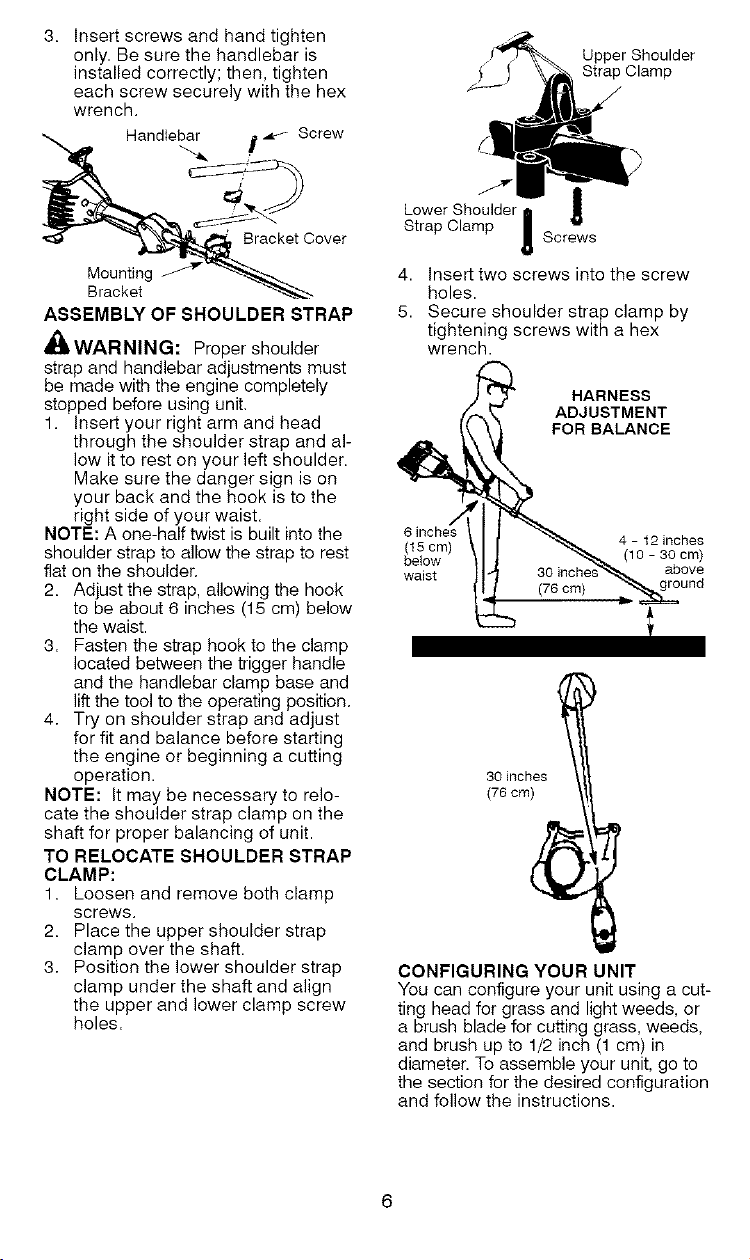
3. Insertscrewsandhandtighten
only.Besurethehandlebaris
installedcorrectly;then,tighten
eachscrewsecurelywiththehex
wrench.
Handlebart'_ Screw
BracketCover
Mounting
Bracket
ASSEMBLY OF SHOULDER STRAP
_WARNING: Proper shoulder
strap and handlebar adjustments must
be made with the engine completely
stopped before using unit.
1. Insert your right arm and head
through the shoulder strap and al-
low it to rest on your left shoulder.
Make sure the danger sign is on
your back and the hook is to the
right side of your waist.
NOTE: A one-half twist is built into the
shoulder strap to allow the strap to rest
flat on the shoulder.
2. Adjust the strap, allowing the hook
to be about 6 inches (15 cm) below
the waist.
3. Fasten the strap hook to the clamp
located between the trigger handle
and the handlebar clamp base and
lift the tool to the operating position.
4. Try on shoulder strap and adjust
for fit and balance before starting
the engine or beginning a cutting
operation.
NOTE: It may be necessary to relo-
cate the shoulder strap clamp on the
shaft for proper balancing of unit.
TO RELOCATE SHOULDER STRAP
CLAMP:
1. Loosen and remove both clamp
screws.
2. Place the upper shoulder strap
clamp over the shaft.
3. Position the lower shoulder strap
clamp under the shaft and align
the upper and lower clamp screw
holes.
Upper Shoulder
Strap Clamp
Lower Shoulder I l
Strap Clamp
Screws
4. Insert two screws into the screw
holes.
5. Secure shoulder strap clamp by
tightening screws with a hex
wrench.
HARNESS
ADJUSTMENT
FOR BALANCE
(15 cm) 4 - 12 inches
below -,,..-,_. (10 - 30 cm)
waist 30 inches above
(76 c_eS_ und
30 inches
(76 cm)
CONFIGURING YOUR UNIT
You can configure your unit using a cut-
ting head for grass and light weeds, or
a brush blade for cutting grass, weeds,
and brush up to 1/2 inch (1 cm) in
diameter. To assemble your unit, go to
the section for the desired configuration
and follow the instructions.
ASSEMBLY INFORMATION -
TRIMMER HEAD
_} RIMMER
HEAD
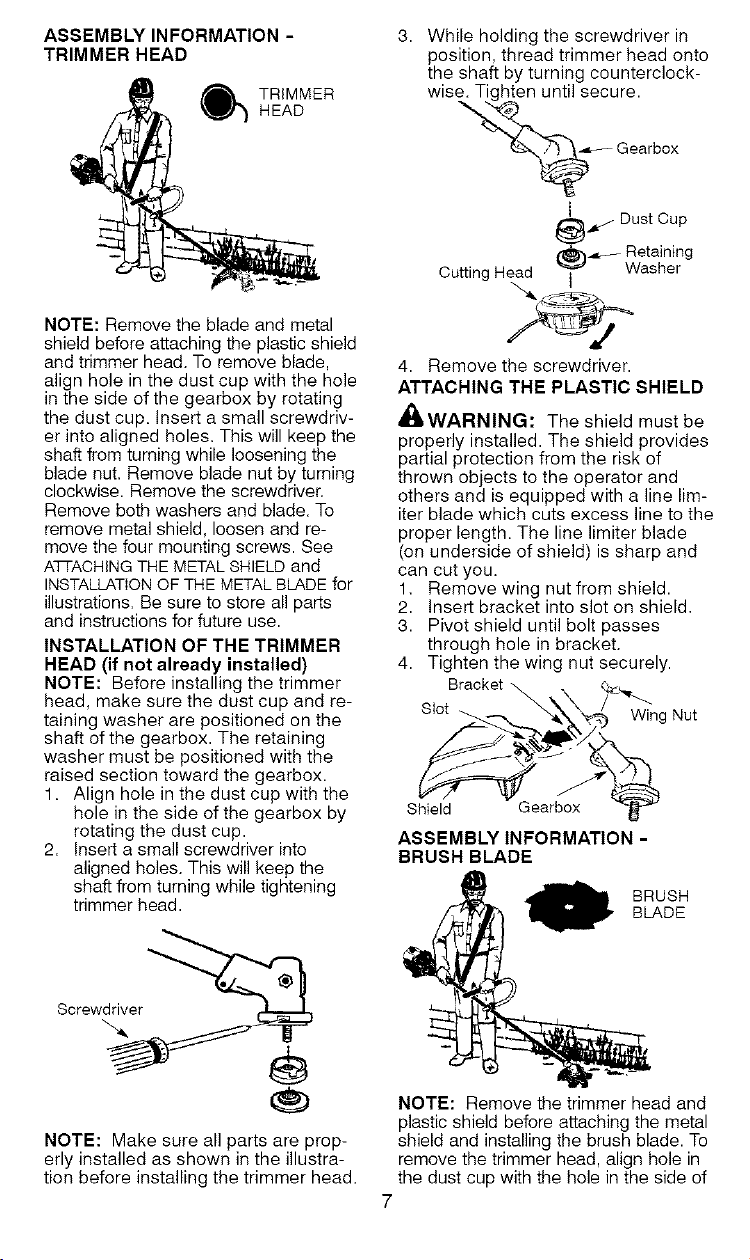
3. While holding the screwdriver in
position, thread trimmer head onto
the shaft by turning counterclock-
wise. Tighten until secure.
_ Gearbox
I
_- Dust Cup
_,-_ Retaining
Cutting Head _ Washer
t
NOTE: Remove the blade and metal
shield before attaching the plastic shield
and trimmer head. To remove blade,
align hole in the dust cup with the hole
in the side of the gearbox by rotating
the dust cup. Insert a small screwdriv-
er into aligned holes. This will keep the
shaft from turning while loosening the
blade nut. Remove blade nut by turning
clockwise. Remove the screwdriver=
Remove both washers and blade. To
remove metal shield, loosen and re-
move the four mounting screws. See
Aqq-ACHINGTHE METAL SHIELD and
INSTALLATIONOF THE METAL BLADE for
illustrations= Be sure to store all parts
and instructions for future use.
INSTALLATION OF THE TRIMMER
HEAD (if not already installed)
NOTE: Before installing the trimmer
head, make sure the dust cup and re-
taining washer are positioned on the
shaft of the gearbox. The retaining
washer must be positioned with the
raised section toward the gearbox.
1= Align hole in the dust cup with the
hole in the side of the gearbox by
rotating the dust cup.
2= Insert a small screwdriver into
aligned holes. This will keep the
shaft from turning while tightening
trimmer head.
Screwdriver
NOTE: Make sure all parts are prop-
erly installed as shown in the illustra-
tion before installing the trimmer head.
4. Remove the screwdriver.
ATTACHING THE PLASTIC SHIELD
AO&WARNING: The shield must be
properly installed. The shield provides
partial protection from the risk of
thrown objects to the operator and
others and is equipped with a line lim-
iter blade which cuts excess line to the
proper length. The line limiter blade
(on underside of shield) is sharp and
can cut you.
1. Remove wing nut from shield.
2. Insert bracket into slot on shield.
3. Pivot shield until bolt passes
through hole in bracket.
4. Tighten the wing nut securely.
Shield
ASSEMBLY INFORMATION -
BRUSH BLADE
O RUSH
BLADE
NOTE: Remove the trimmer head and
plastic shield before attaching the metal
shield and installing the brush blade. To
remove the trimmer head, align hole in
the dust cup with tile hole in the side of
7
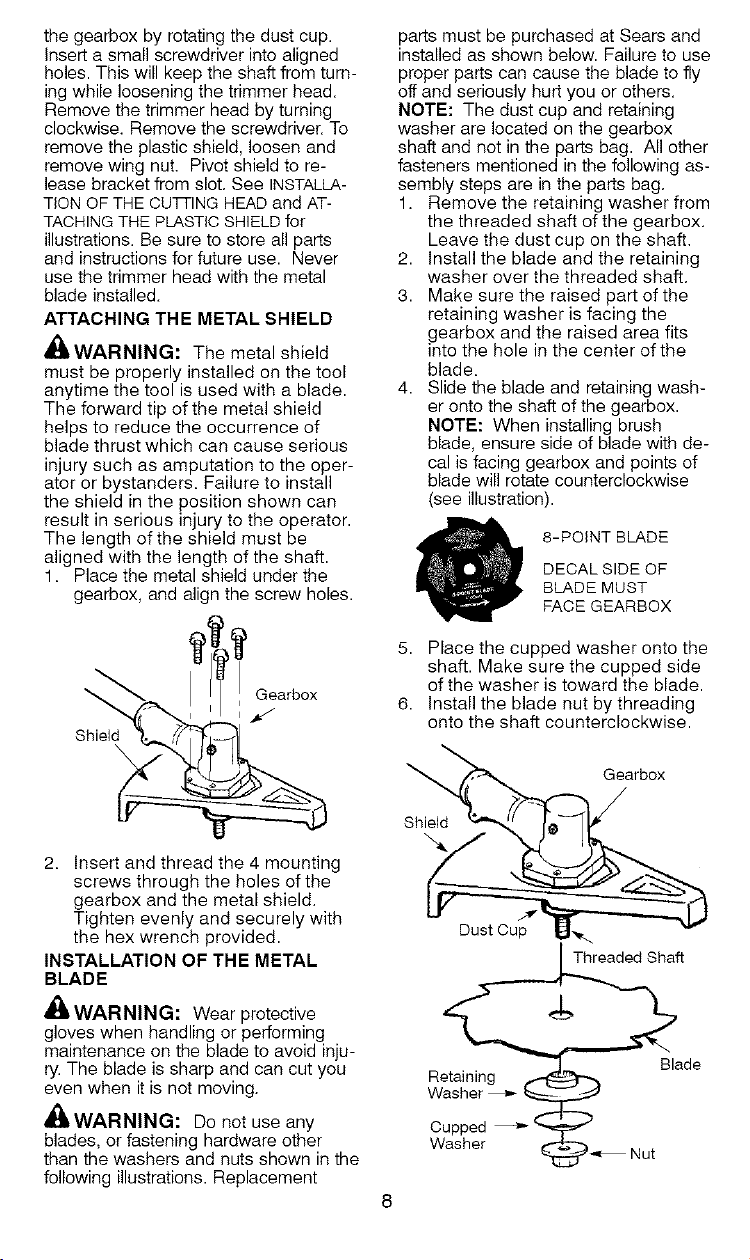
thegearboxbyrotatingthedustcup.
Insertasmallscrewdriverintoaligned
holes.Thiswillkeeptheshaftfromturn-
ingwhilelooseningthetrimmerhead.
Removethetrimmerheadbyturning
clockwise.Removethescrewdriver.To
removetheplasticshield,loosenand
removewingnut.Pivotshieldtore-
leasebracketfromslot.SeeINSTALLA-
TIONOFTHECUTTINGHEADandAT-
TACHINGTHEPLASTICSHIELDfor
illustrations.Besuretostoreallparts
andinstructionsforfutureuse.Never
usethetrimmerheadwiththemetal
bladeinstalled.
ATTACHING THE METAL SHIELD
_WARNING: The metal shield
must be properly installed on the tool
anytime the tool is used with a blade.
The forward tip of the metal shield
helps to reduce the occurrence of
blade thrust which can cause serious
injury such as amputation to the oper-
ator or bystanders. Failure to install
the shield in the position shown can
result in serious injury to the operator.
The length of the shield must be
aligned with the length of the shaft.
1. Place the metal shield under the
gearbox, and all n the screw holes.
I}"I}
I
Shield ' '_
2. Insert and thread the 4 mounting
screws through the holes of the
gearbox and the metal shield.
Tighten evenly and securely with
the hex wrench provided.
INSTALLATION OF THE METAL
BLADE
WARNING: Wear protective
gloves when handling or performing
maintenance on the blade to avoid inju-
ry. The blade is sharp and can cut you
even when it is not moving.
Ai_WARNING: Do not use any
blades, or fastening hardware other
than the washers and nuts shown in the
following illustrations. Replacement
parts must be purchased at Sears and
installed as shown below. Failure to use
proper parts can cause the blade to fly
off and seriously hurt you or others.
NOTE: The dust cup and retaining
washer are located on the gearbox
shaft and not in the parts bag. All other
fasteners mentioned in the following as-
sembly steps are in the parts bag.
1. Remove the retaining washer from
the threaded shaft of the gearbox.
Leave the dust cup on the shaft.
2. Install the blade and the retaining
washer over the threaded shaft.
3. Make sure the raised part of the
retaining washer is facing the
gearbox and the raised area fits
into the hole in the center of the
blade.
4. Slide the blade and retaining wash-
er onto the shaft of the gearbox.
NOTE: When installing brush
blade, ensure side of blade with de-
cal is facing gearbox and points of
blade will rotate counterclockwise
(see illustration).
8-POINT BLADE
DECAL SIDE OF
BLADE MUST
FACE GEARBOX
5. Place the cupped washer onto the
shaft. Make sure the cupped side
of the washer is toward the blade.
6. Install the blade nut by threading
onto the shaft counterclockwise.
rbox
de
Retah_ing _
Washer _
Cupped _
Washer _-'_ Nut
NOTE: Make sure all parts are in place
as illustrated, and the blade is sand-
wiched between the dust cup and the
retaining washer. There should be no
space between the blade and the dust
cup or the retaining washer.
7. Align hole in dust cup with hole in
side of gearbox by rotating the
blade.
8. Insert a small screwdriver into
aligned holes. This will keep the
shaft from turning while tightening
the blade nut.
Screwdriver _
9. Tighten blade nut firmly with a
wrench while holding screwdriver in
position.
10. Remove the screwdriver.
11. Turn blade by hand. If the blade
binds against the shield, or appears
to be uneven, the blade is not cen-
tered, and you must reinstall.
NOTE: To remove blade, insert screw-
driver into aligned holes. Unthread the
nut and remove parts. Be sure to store
parts and instructions for future use.
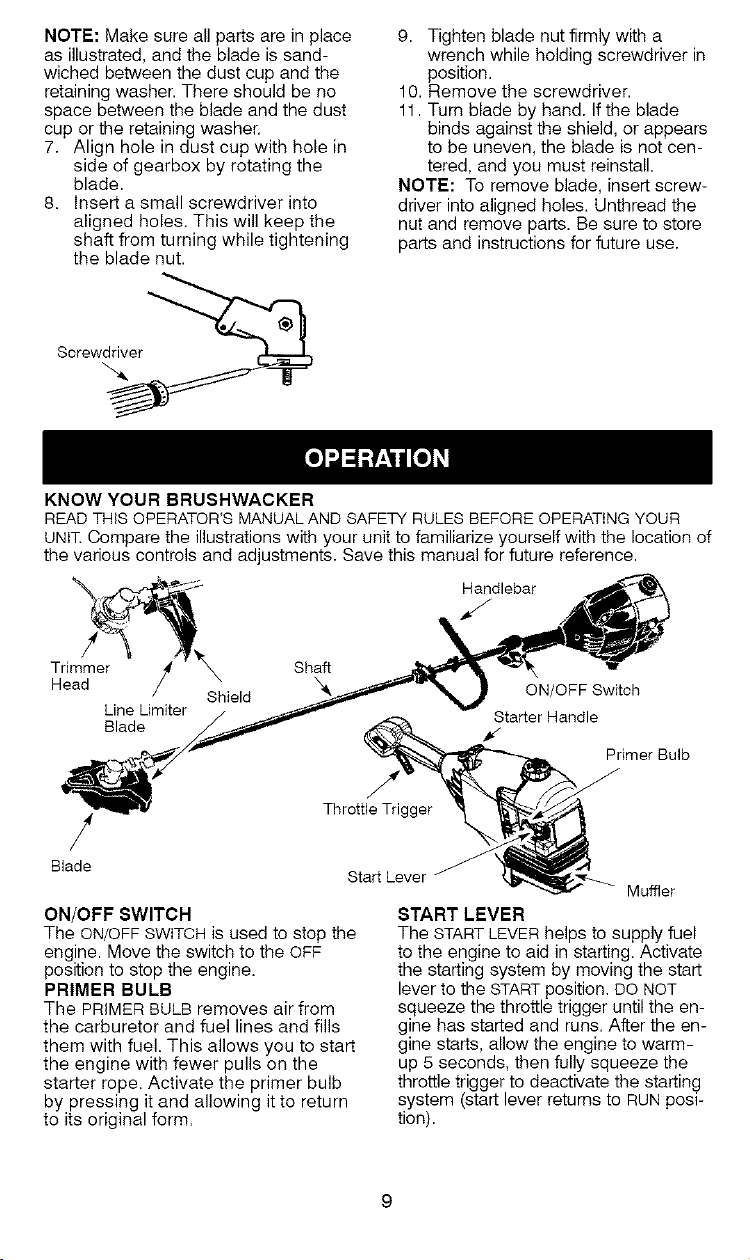
KNOW YOUR BRUSHWACKER
READ THiS OPERATOR'S MANUAL AND SAFETY RULES BEFORE OPERATING YOUR
UNIT. Compare the illustrations with your unit to familiarize yourself with the location of
the various controls and adjustments. Save this manual for future reference.
T_ih ield Shaft jHandlebar
Line Limiter
Blade
ON/OFF Switch
Starter Handle
Primer Bulb
/
Blade
ON/OFF SWITCH
The ON/OFF SWITOH is used to stop tile
engine. Move the switch to the OFF
position to stop the engine.
PRIMER BULB
The PRIMER BULB removes air from
the carburetor and fuel lines and fills
them with fuel. This allows you to start
the engine with fewer pulls on the
starter rope. Activate the primer bulb
by pressing it and allowing it to return
to its original form.
Muffler
START LEVER
The STARTLEVER helps to supply fuel
to the engine to aid in starting. Activate
the starting system by moving the start
lever to the START position. DO NOT
squeeze the throttle trigger until the en-
gine has started and runs. After the en-
gine starts, allow the engine to warm-
up 5 seconds, then fully squeeze the
throttle trigger to deactivate the starting
system (start lever returns to RUN posi-
tion).
BEFORE STARTING ENGINE
_,WARNING: Be sure to read
the fuel information in the safety rules
before you begin. If you do not under-
stand the safety rules, do not attempt
to fuel your unit. Call 1-800-235-5878.
FUELING ENGINE
_WARNING: Remove fuel cap
slowly when refueling.
This engine is certified to operate on
unleaded gasoline. Before operation,
gasoline must be mixed with a good
quality synthetic 2-cycle air-cooled en-
gine oil. We recommend Craftsman
brand synthetic oil. Mix gasoline and
oil at a ratio of 40:1. A 40:1 ratio is ob-
tained by mixing 3.2 ounces of oil with
1 gallon of unleaded gasoline. In-
cluded with this brushcutter is a 3.2
ounce container of oil. Pour the entire
contents of this container into 1 gallon
of gasoline to achieve the proper fuel
mixture. DO NOT USE automotive oil or
marine oil. These oils will cause en-
gine damage. When mixing fuel, fol-
low instructions printed on container.
Once oil is added to gasoline, shake
container momentarily to assure that the
fuel is thoroughly mixed. Always read
and follow the safety rules relating to
fuel before fueling your unit.
IMPORTANT
Alcohol blended fuels (called gasohol or
using ethanol or methanol) can attract
moisture which leads to separation and
formation of acids during storage. Acidic
gas can damage the fuel system of an
engine while in storage.
To avoid engine problems, empty the
fuel system before storage for 30 days
or longer. Drain the gas tank, start the
engine and let it run until the fuel lines
and carburetor are empty. Use fresh
fuel next season.
Never use engine or carburetor clean-
er products in the fuel tank or perma-
nent damage may occur.
See the STORAGE section for addition-
al information.
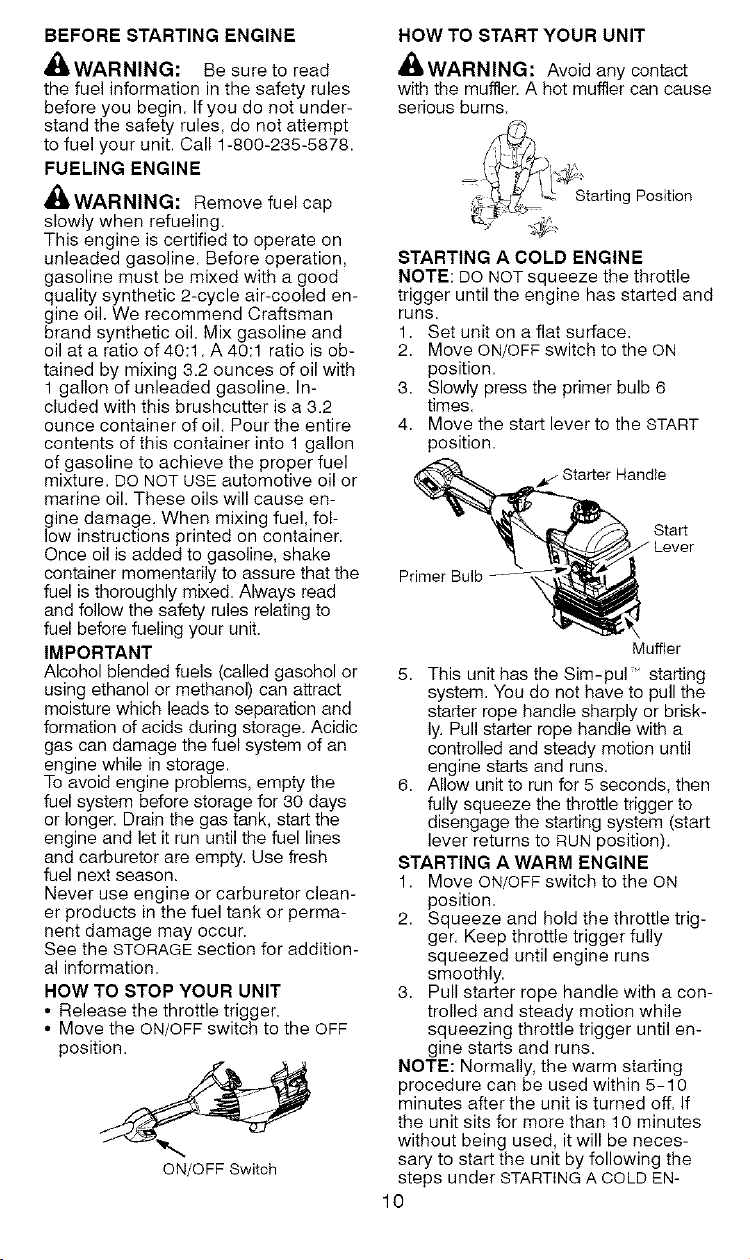
HOW TO STOP YOUR UNIT
• Release the throttle trigger.
• Move the ON/OFF switch to the OFF
position.
ON/OFF Switch
HOW TO START YOUR UNIT
'_ WARN IN G : Avoid any contact
with tile muffler. A hot muffler can cause
serious burns.
e'_:7_'!_ Starting Position
STARTING A COLD ENGINE
NOTE: DO NOT squeeze tile throttle
trigger until the engine has started and
runs.
1. Set unit on a flat surface.
2. Move ON/OFF switch to the ON
position.
3. Slowly press the primer bulb 6
times.
4. Move the start lever to the START
position.
Primer
Start
Muffler
5. This unit has the Sim-pul" starting
system. You do not have to pull the
starter rope handle sharply or brisk-
ly. Pull starter rope handle with a
controlled and steady motion until
engine starts and runs.
6. Allow unit to run for 5 seconds, then
fully squeeze the throttle trigger to
disengage the starting system (start
lever returns to RUN position).
STARTING A WARM ENGINE
1. Move ON/OFF switch to the ON
position.
2. Squeeze and hold the throttle trig-
ger. Keep throttle trigger fully
squeezed until engine runs
smoothly.
3. Pull starter rope handle with a con-
trolled and steady motion while
squeezing throttle trigger until en-
gine starts and runs.
NOTE: Normally, the warm starting
procedure can be used within 5-10
minutes after the unit is turned off. If
the unit sits for more than 10 minutes
without being used, it will be neces-
sary to start the unit by following the
steps under STARTING A COLD EN-
10
GINEorfollowingthestartinginstruc-
tionstepsshownontheunit.
STARTING A FLOODED ENGINE
Flooded engines can be started by
placing the ON/OFF switch in the ON
position. Move the start lever to the
RUN position and fully squeeze throttle
trigger. Pull the starter handle repeat-
edly while squeezing throttle trigger
until engine starts and runs. This
could require pulling the starter handle
many times, depending on how badly
the unit is flooded.
If the unit still doesn't start, refer to
TROUBLESHOOTING TABLE or call
1-800-235-5878.
OPERATING INSTRUCTIONS
To maximize operating efficiency, do
not run the engine for longer than 1
minute at a time at full throttle.
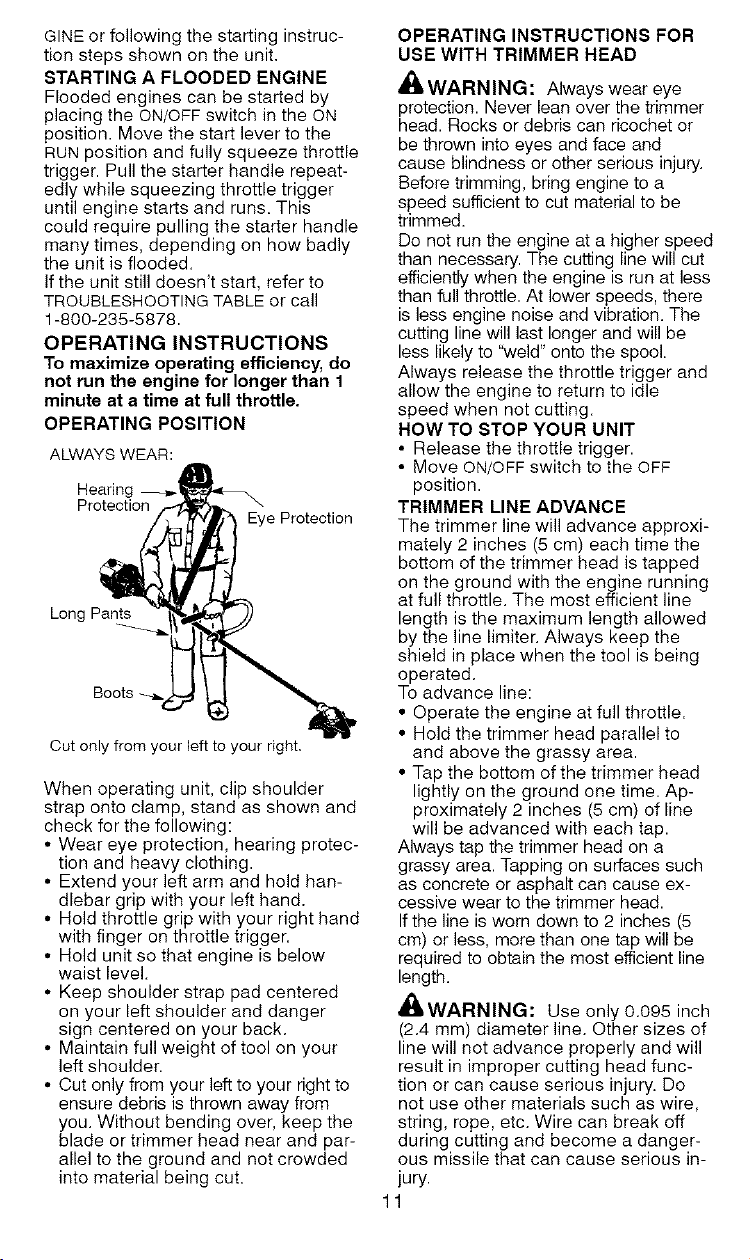
OPERATING POSITION
ALWAYS WEAR:
Hearing
Protection
Eye Protection
Long Pants
Boots
Cut only from your left to your right,
When operating unit, clip shoulder
strap onto clamp, stand as shown and
check for the following:
• Wear eye protection, hearing protec-
tion and heavy clothing.
• Extend your left arm and hold han-
dlebar grip with your left hand.
• Hold throttle grip with your right hand
with finger on throttle trigger.
• Hold unit so that engine is below
waist level.
• Keep shoulder strap pad centered
on your left shoulder and danger
sign centered on your back.
• Maintain full weight of tool on your
left shoulder.
• Out only from your left to your right to
ensure debris is thrown away from
you. Without bending over, keep the
blade or trimmer head near and par-
allel to the ground and not crowded
into material being cut.
OPERATING INSTRUCTIONS FOR
USE WITH TRIMMER HEAD
_WARNING: Always wear eye
protection. Never lean over the trimmer
head. Rocks or debris can ricochet or
be thrown into eyes and face and
cause blindness or other serious injury.
Before trimming, bring engine to a
speed sufficient to cut material to be
trimmed.
Do not run the engine at a higher speed
than necessary. The cutting line will cut
efficiently when the engine is run at less
than full throttle. At lower speeds, there
is less engine noise and vibration. The
cutting line will last longer and will be
less likely to "weld" onto the spool.
Always release the throttle trigger and
allow the engine to return to idle
speed when not cutting.
HOW TO STOP YOUR UNIT
• Release the throttle trigger.
• Move ON/OFF switch to the OFF
position.
TRIMMER LINE ADVANCE
The trimmer line will advance approxi-
mately 2 inches (5 cm) each time the
bottom of the trimmer head is tapped
on the ground with the engine running
at full throttle. The most efficient line
length is the maximum length allowed
by the line limiter. Always keep the
shield in place when the tool is being
operated.
To advance line:
• Operate the engine at full throttle.
• Hold the trimmer head parallel to
and above the grassy area.
• Tap the bottom of the trimmer head
lightly on the ground one time. Ap-
proximately 2 inches (5 cm) of line
will be advanced with each tap.
Always tap the trimmer head on a
grassy area. Tapping on surfaces such
as concrete or asphalt can cause ex-
cessive wear to the trimmer head.
If the line is worn down to 2 inches (5
cm) or less, more than one tap will be
required to obtain the most efficient line
length.
_,WARNING: Use only 0.095 inch
(2.4 ram) diameter line. Other sizes of
line will not advance properly and will
result in improper cutting head func-
tion or can cause serious injury. Do
not use other materials such as wire,
string, rope, etc. Wire can break off
during cutting and become a danger-
ous missile that can cause serious in-
jury.
11
CUTTINGMETHODS
_WARNING: Use minimum
speed and do not crowd the line when
cutting around hard objects (rock,
gravel, fence posts, etc.), which can
damage the trimmer head, become
entangled in the line, or be thrown
causing a serious hazard.
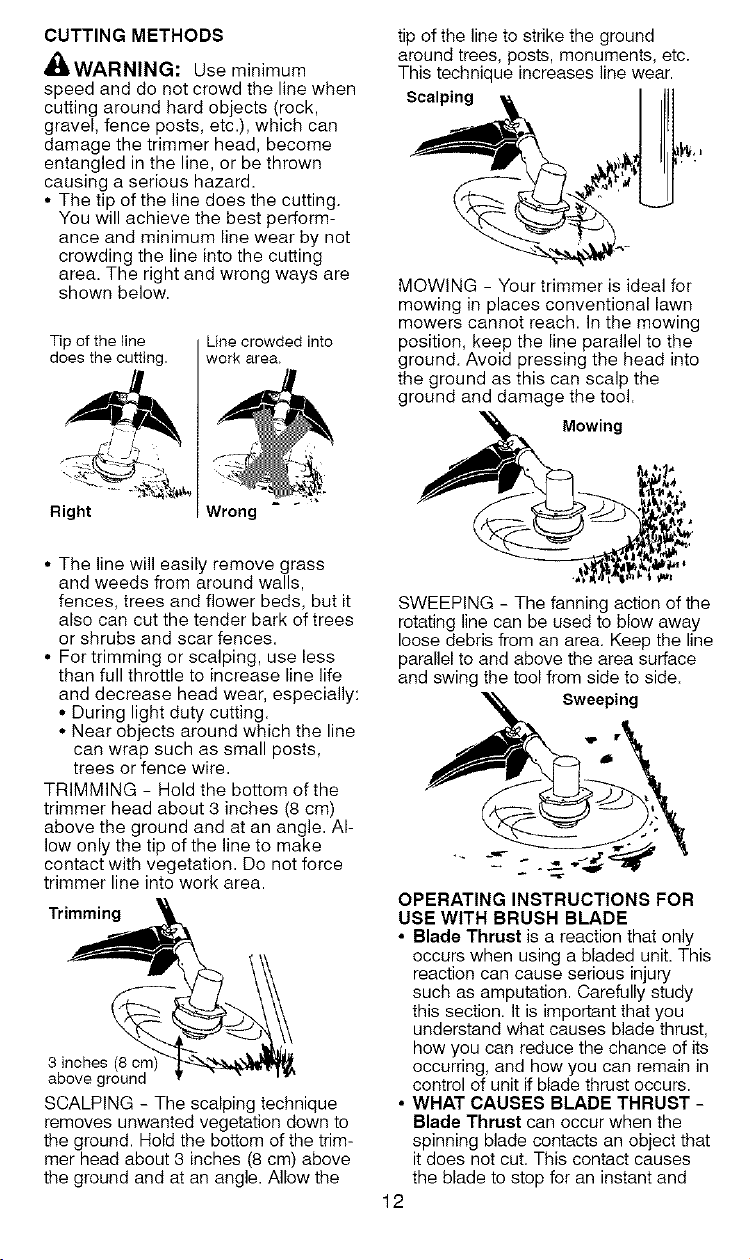
• The tip of the line does the cutting.
You will achieve the best perform-
ance and minimum line wear by not
crowding the line into the cutting
area. The right and wrong ways are
shown below.
Tip of the line Line crowded into
does the cutting, work area.
Right Wrong
• The line will easily remove grass
and weeds from around walls,
fences, trees and flower beds, but it
also can cut the tender bark of trees
or shrubs and scar fences.
• For trimming or scalping, use less
than full throttle to increase line life
and decrease head wear, especially:
• During light duty cutting.
• Near objects around which the line
can wrap such as small posts,
trees or fence wire.
TRIMMING - Hold the bottom of the
trimmer head about 3 inches (8 cm)
above the ground and at an angle. Al-
low only the tip of the line to make
contact with vegetation. Do not force
trimmer line into work area.
Trimming
3 inches (8 cm
above ground
SCALPING - The scalping technique
removes unwanted vegetation down to
the ground. Hold the bottom of the trim-
mer head about 3 inches (8 cm) above
the ground and at an angle. Allow the
tip of the line to strike the ground
around trees, posts, monuments, etc.
This technique increases line wear.
Scalping
MOWING - Your trimmer is ideal for
mowing in places conventional lawn
mowers cannot reach. In the mowing
position, keep the line parallel to the
ground. Avoid pressing the head into
the ground as this can scalp the
ground and damage the tool.
j._ Mowing
SWEEPING - The fanning action of the
rotating line can be used to blow away
loose debris from an area. Keep the line
parallel to and above the area surface
and swing the tool from side to side.
"_ Sweeping
OPERATING INSTRUCTIONS FOR
USE WITH BRUSH BLADE
• Blade Thrust is a reaction that only
occurs when using a bladed unit. This
reaction can cause serious injury
such as amputation. Carefully study
this section. It is important that you
understand what causes blade thrust,
how you can reduce the chance of its
occurring, and how you can remain in
control of unit if blade thrust occurs.
• WHAT CAUSES BLADE THRUST -
Blade Thrust can occur when the
spinning blade contacts an object that
it does not cut. This contact causes
the blade to stop for an instant and
12
thensuddenlymoveor"thrust"away
fromtheobjectthatwashit.The
"thrusting"reactioncanbeviolent
enoughtocausetheoperatortobe
propelledinanydirectionandlose
controloftheunit.Theuncontrolled
unitcancauseseriousinjuryifthe
bladecontactstheoperatororothers.
• WHEN BLADE THRUST OCCURS
- Blade Thrust can occur without
warning if the blade snags, stalls, or
binds. This is more likely to occur in
areas where it is difficult to see the
material being cut. By using the unit
properly, the occurrence of blade
thrust will be reduced and the opera-
tor will be less likely to lose control.
• Cut only grass, weeds, and woody
brush up to 1/2 inch (1 cm) in diame-
ter with the brush blade. Do not let the
blade contact material it cannot cut
such as stumps, rocks, fences, metal,
etc., or clusters of hard, woody brush
having a diameter greater than 1/2
inch (1 cm).
• A dull blade is likely to snag and
thrust. Ensure that the blade is
sharp. Replacement blades are
available at Sears.
• Cut only at full throttle. The blade will
have maximum cutting power and is
less likely to bind or stall.
• "Feed" the blade deliberately and
not too rapidly. The blade can thrust
away if it is fed too rapidly.
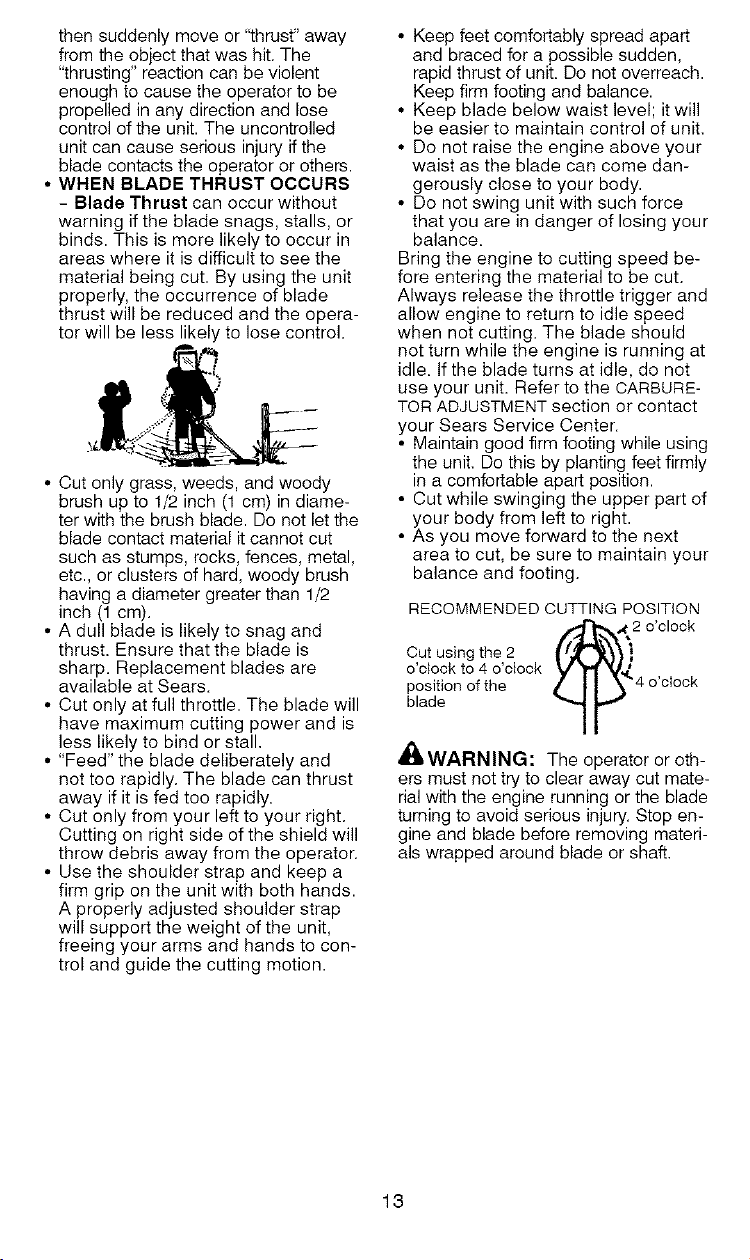
• Cut only from your left to your right.
Cutting on right side of the shield will
throw debris away from the operator.
• Use the shoulder strap and keep a
firm grip on the unit with both hands.
A properly adjusted shoulder strap
will support the weight of the unit,
freeing your arms and hands to con-
trol and guide the cutting motion.
• Keep feet comfortably spread apart
and braced for a possible sudden,
rapid thrust of unit. Do not overreach.
Keep firm footing and balance.
• Keep blade below waist level; it will
be easier to maintain control of unit.
• Do not raise the engine above your
waist as the blade can come dan-
gerously close to your body.
• Do not swing unit with such force
that you are in danger of losing your
balance.
Bring the engine to cutting speed be-
fore entering the material to be cut.
Always release the throttle trigger and
allow engine to return to idle speed
when not cutting. The blade should
not turn while the engine is running at
idle. If the blade turns at idle, do not
use your unit. Refer to the CARBURE-
TOR ADJUSTMENT section or contact
your Sears Service Center.
• Maintain good firm footing while using
the unit. Do this by planting feet firmly
in a comfortable apart position.
• Cut while swinging the upper part of
your body from left to right.
• As you move forward to the next
area to cut, be sure to maintain your
balance and footing.
RECOMMENDED CUTTING POSITION
Cut using the 2 Jl"i_..(,_...,_..,}2
o'clock
o'clock to 4 o'clock
V"rf V,'
position of the _' _ _ "_"t"4o'clock
blade
--iF
&WARNING: The operator or oth-
ers must not try to clear away cut mate-
rial with the engine running or the blade
turning to avoid serious injury. Stop en-
gine and blade before removing materi-
als wrapped around blade or shaft.
13
MAINTENANCE SCHEDULE
_1_ WARNING: Disconnect the spark plug
except for carburetor adjustments.
CARE & MAINTENANCE TASK
Check for loose fasteners and parts
Check for damaged or worn parts
Inspect and clean unit and decals
Clean air filter
Inspect muffler and spark arresting screen
Replace spark plug
GENERAL RECOMMEN DATIONS
The warranty on this unit does not
cover items that have been subjected
to operator abuse or negligence. To
receive full value from the warranty,
the operator must maintain unit as
instructed in this manual. Various ad-
justments will need to be made peri-
odically to properly maintain your unit.
before performing maintenance
WHEN TO PERFORM
Before each use
Before each use
After each use
Every 5 hours of operation
Every 50 hours of operation
Yearly
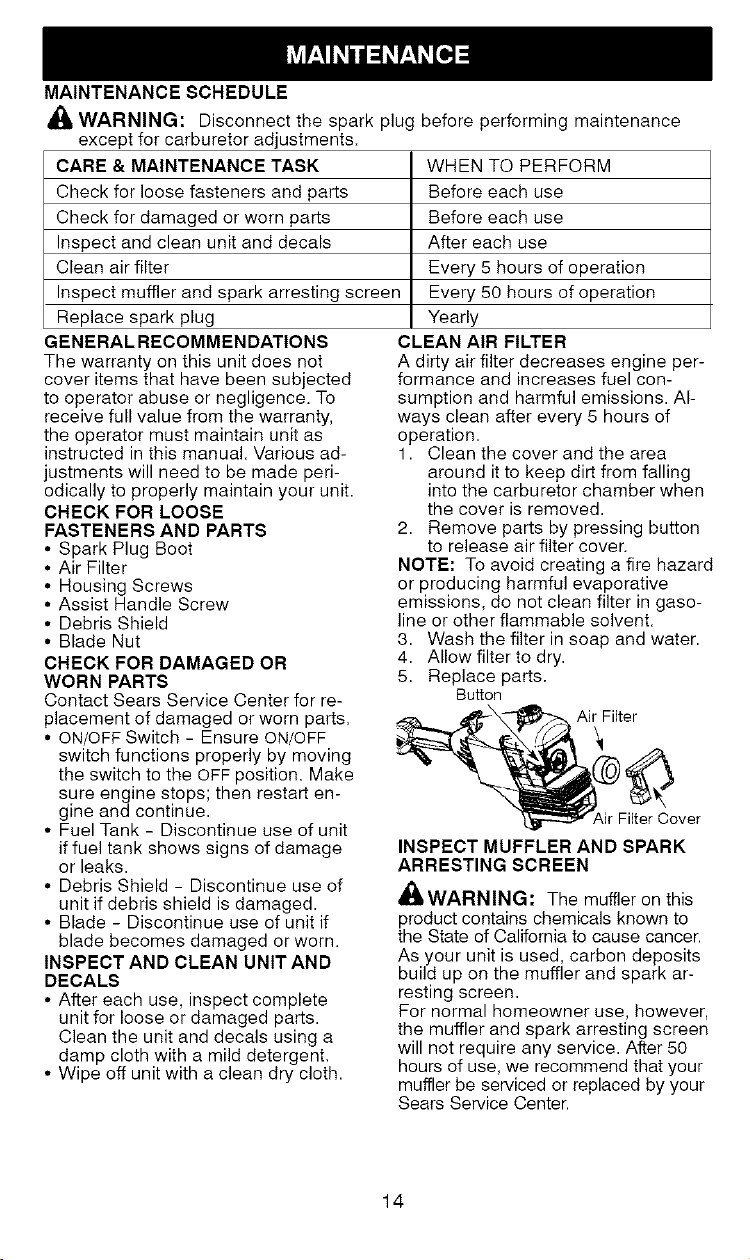
CLEAN AIR FILTER
A dirty air filter decreases engine per-
formance and increases fuel con-
sumption and harmful emissions. Al-
ways clean after every 5 hours of
operation.
1. Clean the cover and the area
around it to keep dirt from falling
into the carburetor chamber when
CHECK FOR LOOSE
FASTENERS AND PARTS
• Spark Plug Boot
• Air Filter
• Housing Screws
• Assist Handle Screw
• Debris Shield
• Blade Nut
CHECK FOR DAMAGED OR
WORN PARTS
Contact Sears Service Center for re-
placement of damaged or worn parts.
• ON/OFF Switch - Ensure ON/OFF
switch functions properly by moving
the switch to the OFF position. Make
the cover is removed.
2. Remove parts by pressing button
to release air filter cover.
NOTE: To avoid creating a fire hazard
or producing harmful evaporative
emissions, do not clean filter in gaso-
line or other flammable solvent.
3. Wash the filter in soap and water.
4. Allow filter to dry.
5. Replace parts.
Button
Air Filter
©
sure engine stops; then restart en-
gine and continue.
• Fuel Tank - Discontinue use of unit
if fuel tank shows signs of damage
or leaks.
• Debris Shield - Discontinue use of
unit if debris shield is damaged.
• Blade - Discontinue use of unit if
blade becomes damaged or worn.
INSPECT AND CLEAN UNIT AND
DECALS
• After each use, inspect complete
unit for loose or damaged parts.
Clean the unit and decals using a
damp cloth with a mild detergent.
• Wipe off unit with a clean dry cloth.
Air Filter Cover
INSPECT MUFFLER AND SPARK
ARRESTING SCREEN
_bWARNING: The muffler on this
product contains chemicals known to
the State of California to cause cancer.
As your unit is used, carbon deposits
build up on the muffler and spark ar-
resting screen.
For normal homeowner use, however,
the muffler and spark arresting screen
will not require any service. After 50
hours of use, we recommend that your
muffler be serviced or replaced by your
Sears Service Center.
14
REPLACE SPARK PLUG
Replace the spark plug each year to
ensure the engine starts easier and
runs better. Set spark plug gap at
0.025 inch (0.6 mm). Ignition timing is
fixed and nonadjustable.
1. Twist, then pull off spark plug boot.
2. Remove spark plug from cylinder
and discard.
3. Replace with Champion RCJ-6Y
spark plug and tighten securely
with a 3/4 inch (19 mm) socket
wrench.
4. Reinstall the spark plug boot.
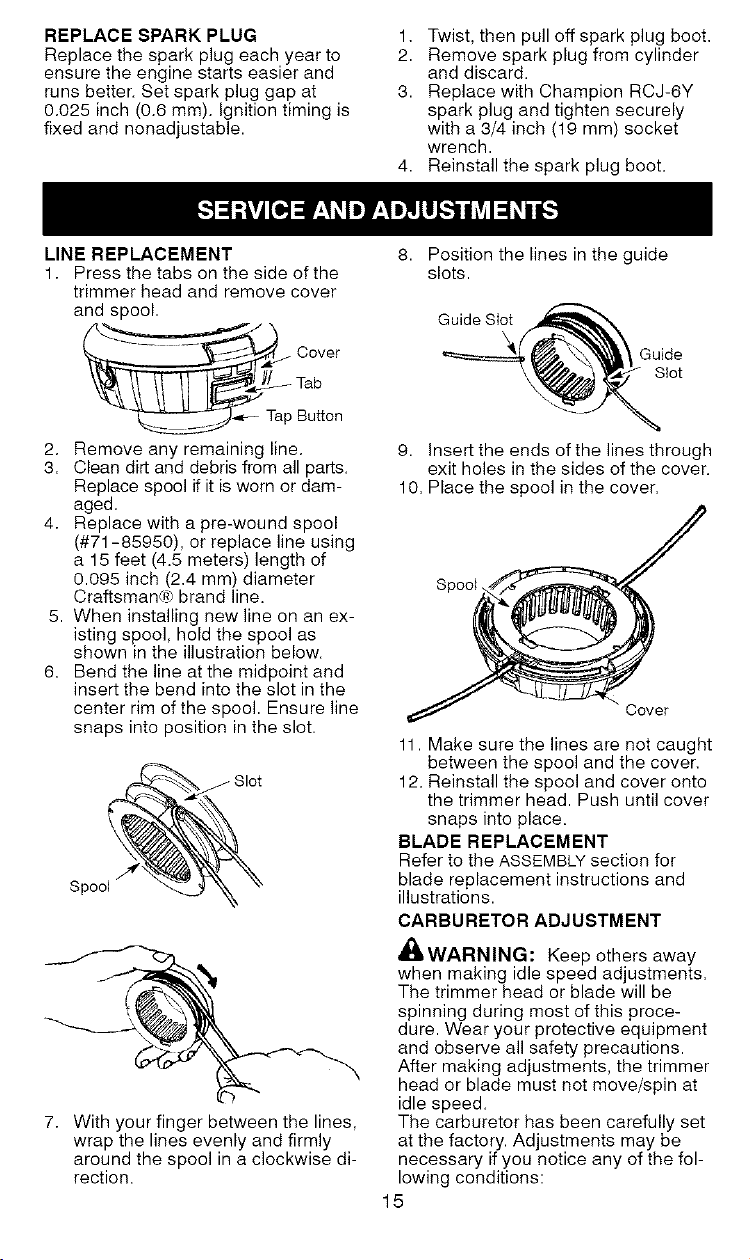
LINE REPLACEMENT
1. Press the tabs on the side of the
trimmer head and remove cover
and spool.
Cover
Tap Button
2. Remove any remaining line.
3. Clean dirt and debris from all parts.
Replace spool if it is worn or dam-
aged.
4. Replace with a pre-wound spool
(#71-85950), or replace line using
a 15 feet (4.5 meters) length of
0.095 inch (2.4 mm) diameter
CraftsmanCR_brand line.
5. When installing new line on an ex-
isting spool, hold the spool as
shown in the illustration below.
6. Bend the line at the midpoint and
insert the bend into the slot in the
center rim of the spool. Ensure line
snaps into position in the slot.
7. With your finger between the lines,
wrap the lines evenly and firmly
around the spool in a clockwise di-
rection.
8. Position the lines in the guide
slots.
Guide Slot
Guide
Slot
k
9. Insert the ends of the lines through
exit holes in the sides of the cover.
10. Place the spool in the cover.
Spool
Cover
11. Make sure the lines are not caught
between the spool and the cover.
12. Reinstall the spool and cover onto
the trimmer head. Push until cover
snaps into place.
BLADE REPLACEMENT
Refer to the ASSEMBLY section for
blade replacement instructions and
illustrations.
CARBURETOR ADJUSTMENT
_,WARNING: Keep others away
when making idle speed adjustments.
The trimmer head or blade will be
spinning during most of this proce-
dure. Wear your protective equipment
and observe all safety precautions.
After making adjustments, the trimmer
head or blade must not move/spin at
idle speed.
The carburetor has been carefully set
at the factory. Adjustments may be
necessary if you notice any of the fol-
lowing conditions:
15
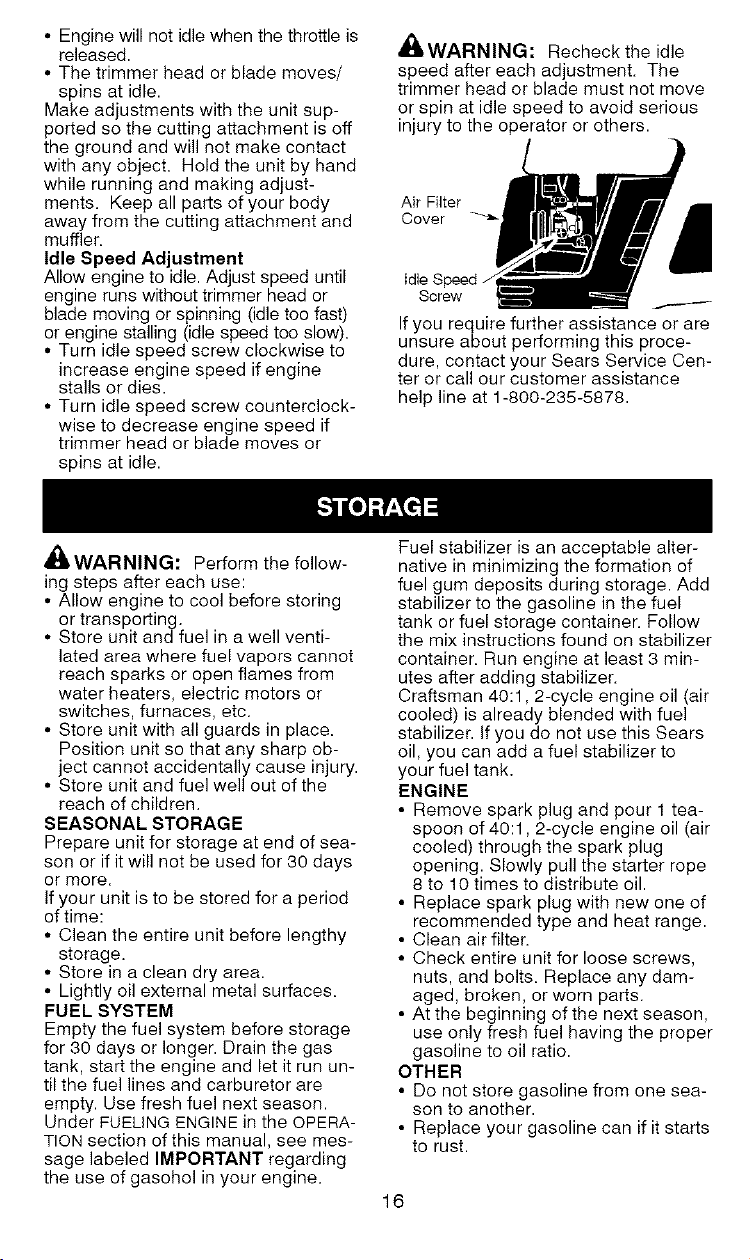
• Enginewillnotidlewhenthethrottleis
released.
• Thetrimmerheadorblademoves/
spinsatidle.
Makeadjustmentswiththeunitsup-
portedsothecuttingattachmentisoff
thegroundandwillnotmakecontact
withanyobject.Holdtheunitbyhand
whilerunningandmakingadjust-
ments.Keepallpartsofyourbody
awayfromthecuttingattachmentand
muffler.
IdleSpeed Adjustment
Allow engine to idle. Adjust speed until
engine runs without trimmer head or
blade moving or spinning (idle too fast)
or engine stalling (idle speed too slow).
• Turn idle speed screw clockwise to
increase engine speed if engine
stalls or dies.
• Turn idle speed screw counterclock-
wise to decrease engine speed if
trimmer head or blade moves or
spins at idle.
dIIWARNING: Recheck the idle
speed after each adjustment. The
trimmer head or blade must not move
or spin at idle speed to avoid serious
injury to the operator or others.
Air Filter __
Cover
Idle Speed
Screw
If you require further assistance or are
unsure about performing this proce-
dure, contact your Sears Service Cen-
ter or call our customer assistance
help line at 1-800-235-5878.
,ti
dt_WARNING: Perform the follow-
ing steps after each use:
• Allow engine to cool before storing
or transporting.
• Store unit and fuel in a well venti-
lated area where fuel vapors cannot
reach sparks or open flames from
water heaters, electric motors or
switches, furnaces, etc.
• Store unit with all guards in place.
Position unit so that any sharp ob-
ject cannot accidentally cause injury.
• Store unit and fuel well out of the
reach of children.
SEASONAL STORAGE
Prepare unit for storage at end of sea-
son or if it will not be used for 30 days
or more.
If your unit is to be stored for a period
of time:
• Clean the entire unit before lengthy
storage.
• Store in a clean dry area.
• Lightly oil external metal surfaces.
FUEL SYSTEM
Empty the fuel system before storage
for 30 days or longer. Drain the gas
tank, start the engine and let it run un-
til the fuel lines and carburetor are
empty. Use fresh fuel next season.
Under FUELING ENGINE in the OPERA-
TION section of this manual, see mes-
sage labeled IMPORTANT regarding
the use of gasohol in your engine.
Fuel stabilizer is an acceptable alter-
native in minimizing the formation of
fuel gum deposits during storage. Add
stabilizer to the gasoline in the fuel
tank or fuel storage container. Follow
the mix instructions found on stabilizer
container. Run engine at least 3 min-
utes after adding stabilizer.
Craftsman 40:1,2-cycle engine oil (air
cooled) is already blended with fuel
stabilizer. If you do not use this Sears
oil, you can add a fuel stabilizer to
your fuel tank.
ENGINE
• Remove spark plug and pour 1 tea-
spoon of 40:1,2-cycle engine oil (air
cooled) through the spark plug
opening. Slowly pull the starter rope
8 to 10 times to distribute oil.
• Replace spark plug with new one of
recommended type and heat range.
• Clean air filter.
• Check entire unit for loose screws,
nuts, and bolts. Replace any dam-
aged, broken, or worn parts.
• At the beginning of the next season,
use only fresh fuel having the proper
gasoline to oil ratio.
OTHER
• Do not store gasoline from one sea-
son to another.
• Replace your gasoline can if it starts
to rust.
16
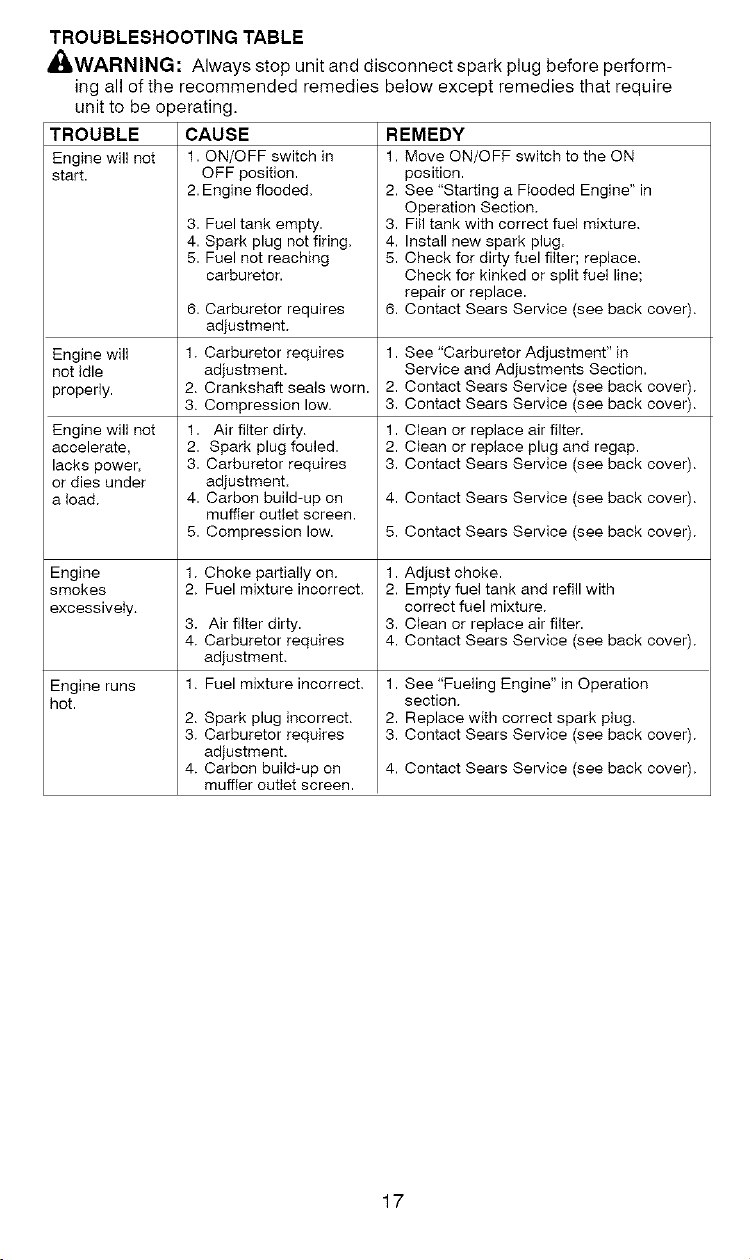
TROUBLESHOOTING TABLE
_,WARNING: Always stop unit and disconnect spark plug before perform-
ing all of the recommended remedies below except remedies that require
TROUBLE
Engine will not
start.
Engine will
not idle
properly.
unit to be operating.
CAUSE
1. ON/OFF switch in
OFF position.
2. Engh_e flooded.
Engine will not
accelerate,
lacks power.
or dies under
a load.
Engine
smokes
excessively.
Engine runs
hot.
3. Fuel tank empty.
4. Spark plug not firing.
5. Fuel not reaching
carburetor.
6. Carburetor requires 6.
adjustment.
1. Carburetor requires 1.
adjustment.
2. Crankshaft seals worn. 2.
3. Compression low. 3.
1. Air filter dirty. 1.
2. Spark plug fouled. 2.
3. Carburetor requires 3.
adjustment.
4. Carbon build-up on 4.
muffler outlet screen.
5. Compression low. 5.
1. Choke partially on. 1.
2. Fuel mixture incorrect. 2.
3. Air filter dirty. 3.
4. Carburetor requires 4.
adjustment.
1. Fuel mixture incorrect. 1.
2. Spark plug incorrect. 2.
3. Carburetor requires 3.
adjustment.
4. Carbon build-up on 4.
muffler outlet screen.
REMEDY
1. Move ON/OFF switch to the ON
position.
2. See "Starting a FIooded Engine" in
Operation Section.
3. Fill tank with correct fuel mixture.
4. Install new spark plug.
5. Check for dirty fuel filter; replace.
Check for kinked or split fuel line;
repair or replace.
Contact Sears Service (see back cover).
See "Carburetor Adjustment" in
Service and Adjustments Section.
Contact Sears Service (see back cover).
Contact Sears Service (see back cover).
Clean or replace air filter.
Clean or replace plug and regap.
Contact Sears Service (see back cover).
Contact Sears Service (see back cover).
Contact Sears Service (see back cover).
Adjust choke.
Empty fuel tank and refill with
correct fuel mixture.
Clean or reptace air filter.
Contact Sears Service (see back cover).
See "Fueling Engine" in Operation
section.
Replace with correct spark plug.
Contact Sears Service (see back cover).
Contact Sears Service (see back cover).
17
YOUR WARRANTY RIGHTS AND
OBLIGATIONS: The U.S. Environ-
mental Protection Agency/California
Air Resources Board and Sears, Roe-
buck and Co., U.S.A., are pleased to
explain the emissions control system
warranty on your year 2005 and later
small off-road engine. In California, all
small off-road engines must be de-
signed, built, and equipped to meet
the State's stringent anti-smog stan-
dards. Sears must warrant the emis-
sion control system on your small off-
road engine for the periods of time
listed below provided there has been
no abuse, neglect, or improper main-
tenance of your small off-road engine.
Your emission control system includes
parts such as the carburetor and the
ignition system. Where a warrantable
condition exists, Sears will repair your
small off-road engine at no cost to
you. Expenses covered under warran-
ty include diagnosis, parts and labor.
MANUFACTURER'S WARRANTY
COVERAGE: If any emissions related
part on your engine (as listed under
Emissions Control Warranty Parts
List) is defective or a defect in the ma-
terials or workmanship of the engine
causes the failure of such an emission
related part, the part will be repaired or
replaced by Sears. OWNER'S WAR-
RANTY RESPONSIBILITIES: As the
small off-road engine owner, you are
responsible for the performance of the
required maintenance listed in your
operator's manual. Sears recom-
mends that you retain all receipts cov-
ering maintenance on your small off-
road engine, but Sears cannot deny
warranty solely for the lack of receipts
or for your failure to ensure the perfor-
mance of all scheduled maintenance.
As the small off-road engine owner,
you should be aware that Sears may
deny you warranty coverage if your
small off-road engine or a part of it
has failed due to abuse, neglect, im-
proper maintenance, unapproved
modifications, or the use of parts not
made or approved by the original
equipment manufacturer. You are re-
sponsible for presenting your small
off-road engine to a Sears authorized
repair center as soon as a problem
exists. Warranty repairs should be
completed in a reasonable amount of
time, not to exceed 30 days. If you
have any questions regarding your
warranty rights and responsibilities,
you should contact your nearest au-
thorized service center or call Sears at
1-800-469-4663. WARRANTY COM-
MENCEMENT DATE: The warranty
period begins on the date the small
off-road engine is purchased.
LENGTH OF COVERAGE: This war-
ranty shall be for a period of two years
from the initial date of purchase.
WHAT IS COVERED: REPAIR OR
REPLACEMENT OF PARTS. Repair
or replacement of any warranted part
will be performed at no charge to the
owner at an approved Sears Service
Center. If you have any questions re-
garding your warranty rights and re-
sponsibilities, you should contact your
nearest authorized service center or
call Sears at 1-800-469-4663. WAR-
RANTY PERIOD: Any warranted part
which is not scheduled for replace-
ment as required maintenance, or
which is scheduled only for regular in-
spection to the effect of "repair or re-
place as necessary" shall be war-
ranted for 2 years. Any warranted part
which is scheduled for replacement as
required maintenance shall be war-
ranted for the period of time up to the
first scheduled replacement point for
that part. DIAGNOSIS: The owner
shall not be charged for diagnostic la-
bor which leads to the determination
that a warranted part is defective if the
diagnostic work is performed at an ap-
proved Sears Service Center. CON-
SEQUENTIAL DAMAGES: Sears
may be liable for damages to other
engine components caused by the
failure of a warranted part still under
warranty. WHAT IS NOT COVERED:
All failures caused by abuse, neglect,
or improper maintenance are not cov-
ered. ADD-ON OR MODIFIED
PARTS: The use of add-on or modi-
fied parts can be grounds for disallow-
ing a warranty claim. Sears is not li-
able to cover failures of warranted
parts caused by the use of add-on or
modified parts. HOW TO FILE A
CLAIM: If you have any questions re-
garding your warranty rights and re-
sponsibilities, you should contact your
nearest authorized service center or
call Sears at 1-800-469-4663.
18
WHERE TO GET WARRANTY SER-
VICE: Warranty services or repairs
shall be provided at all Sears Service
Centers. Call 1-800-469-4663.
MAINTENANCE, REPLACEMENT
AND REPAIR OF EMISSION RE-
LATED PARTS: Any Sears approved
replacement part used in the perfor-
mance of any warranty maintenance
or repair on emission related parts will
be provided without charge to the
owner if the part is under warranty.
EMISSION CONTROL WARRANTY
PARTS LIST: Carburetor, Ignition Sys-
tem: Spark Plug (covered up to main-
tenance schedule), Ignition Module,
Muffler including catalyst. MAINTE-
NANCE STATEMENT: The owner is
responsible for the performance of all
required maintenance as defined in
the operator's manual.
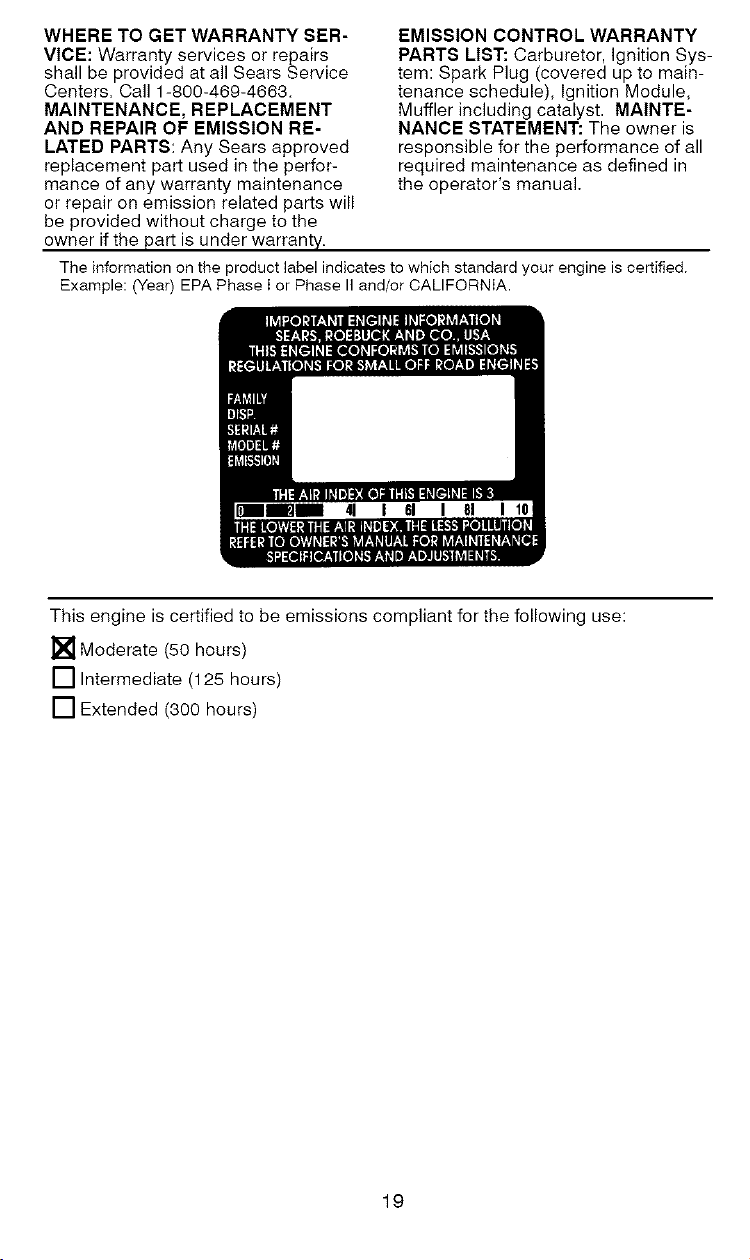
The information on the product label indicates to which standard your engine is certified.
Example: (Year) EPA Phase I or Phase II and/or CALIFORNIA.
This engine is certified to be emissions compliant for the following use:
[] Moderate (50 hours)
[] Intermediate (125 hours)
[] Extended (300 hours)
19
Declaraci6n de Garantia 22 AImacenaje 38
Reglas de Seguridad 22 Tabla Diagn6stica 39
Montaje 25 Declaraci6n de Emision 40
Uso 30
Mantenimiento 35 Lista de Piezas 20
Servicio y Ajustes 36 Repuesto y Encargos Contratapa
DOS AI_IOS COMPLETO DE GARANTiA PARA CORTADORA DE MALEZAS
CON CUCHILLA A GASOLINA BRUSHWACKER ® DE CRAFTSMAN ®
Si este producto falla per un defecto en el material o de mano de obra dentro de
dos a/los a partir de la fecha de compra y este se ha utilizado y mantenido de
acuerdo al manual del usuario, envielo a cualquier tienda Sears, Centro de Servi-
cios Sears u otra tienda Craftsman en los Estados Unidos para su reparaci6n gra-
tuita (o reemplazo si no es posible reparado).
Esta garantia excluye la linea y la cuchilla de corte, las bujias y el filtro de aire,
que son partes desechables y pueden desgastarse al usadas normalmente en
menos de un aSo.
Esta garantia es aplicable per s61o 30 dias desde la fecha de compra si este pro-
ducto se usa con fines comerciales o se usa para arriendo.
Esta garantia le otorga derechos legales especificos, y usted tambi6n puede
tener otros derechos que varian de estado a estado.
Sears, Roebuck and Co., Hoffman Estates, IL 60179
_ADVERTENCIA: AI usar cualqui-
er herramienta de fuerza de jardineria,
deber&n observarse precauciones b&si-
cas de seguirdad en todo momento para
reducir el riesgo de incendio y graves heri-
das.
PELIGRO: iEsta herramienta
motorizada puede ser peligrosa!
Puede ocasionar lesiones graves, inclu-
so la amputaci6n o la ceguera, tanto al
operador como a otras personas. Las
advertencias e instrucciones de seguri-
dad contenidas en este manual deben
cumplirse en todo momento para garan-
tizar un nivel de seguridad y efectividad
razonab]e durante la utilizaci6n del apa-
rato. El operador es responsable del
cumplimiento de las advertencias e
instrucciones indicadas en este manual
y en el aparato. Antes de ensamblar y
utilizar el aparato, lea integramente el
manual del usuario. Limite el uso de
este aparato a personas que previa-
mente hayan leido y comprendido, y
posteriormente cumplan, las adverten-
cias e instrucciones indicadas en este
manual yen el aparato. Nunca permita
que este aparato sea utilizado por niSos.
MANUAL DEL
USUARIO
INFORMACION DE
SEGURIDAD DEL
APARATO
_L PELIGRO: La cuchilla puede re-
botar violentamente en materiales que
no puede cortar. Los rebotes de la
cuchilla pueden causar la amputaci6n
de brazos o piernas. Mantenga a perso-
nas y animales a una distancia minima
de 15 metros (50 pies).
_bADVERTENCIA: La linea de
corte arroja objetos violentamente.
Usted, al igual que otras personas,
puede quedar ciego o herido. Use
anteojos de seguridad y protecci6n en
las piernas.
22
UTILICESIEMPRE:
Protecci6n
ocular_ despedidos
lit
• • Perneras
Botas _
_ADVERTENOIA: Zona de peli-
gro de objetos despedidos. La cuchilla
y la linea de corte arroja objetos
violentamente. Esto puede ocasionar
ceguera o lesiones a otros. Mantenga
a personas y animales a una distancia
minima de 15 metros (50 pies).
_ADVERTENOIA: No utilice el
cabezal de corte como dispositivo de
sujeci6n de la cuchilla.
_,ADVERTENClA: La cuchilla
sigue girando incluso despues de sol-
tar el acelerador o de apagar el motor.
Incluso cuando ester girando libremen-
te, la cuchilla puede despedir objetos
o causar cortes profundos si se toca
accidentalmente. Detenga la cuchilla
poniendo en contacto el lado derecho
de la misma con material ya cortado.
Para detener la cuchilla
cuando gire libremente, .
pongala en contacto con
material previamente _,_-,_,,_
cortado. _
8EGURIDAD DEI_ OPERADOR
• Vistase apropiadamente. Siempre
use anteojos de seguridad o similar
proteccidn para los ojos cuando use
o d6 mantenimiento a este aparato
(anteojos de seguridad estfin dispo-
nibles). La protecci6n para los ojos
debe ser marcada con Z87.
• Siempre utilize mascarilla para la
cara o mascarilla a prueba de polvo
si se va a trabajar en condiciones
donde hay polvo.
• Siempre utilize pantalones pesados
y largos, mangas largas, botas y
guantes. Se recomienda el uso de
pantorrilleras de seguridad.
• Siempre utilize protecci6n para los
pies. No trabaje descalzo ni en
sandalias. Evite la linea/cuchilla gi-
rante.
• Mantenga el cabello per encima de
los hombros, at_tndolo para tal efecto
si es necesario. No use ropa suelta
ni ropa con corbatas, tiras, borlas,
etc. que cuelgan libremente. Pueden
enredarse en las piezas en movi-
miento.
• Si est,. completament tapado, estar_.
m_.s protegido de los escombros y
pedazos de plantas t6xicos arro a-
dos pot la linea girante.
• Mant6ngase alert& No haga uso del
aparato estando cansado, enfermo o
bajo la influencia del alcohol, de dro-
gas o de remedios. Vigile bien Io que
ester haciendo; use del sentido
com0n.
• Use protecci6n de oidos.
• Nunca ponga el aparato en marcha
ni Io deje en marcha dentro de un
recinto cerrado. Respirar los vapores
del combustible Io puede matar.
• Mantenga las manijas libres de
aceite y de combustible.
• Siempre que trabaje con cuchillas,
utilice el mango y una correa al hom-
bre correctamente ajustada (vea
MONTAJE).
SEGURIDAD DEL APARATO Y EN
EL MANTENIMIENTO
_ADVERTENCIA: Apague el
aparato y desconecte la bujia antes de
hacer cualquier mantenimiento menos
los ajustes al carburador.
• Inspeccione el aparato y cambie las
piezas da_adas o flojas antes de
cada uso. Repare toda fuga de com-
bustible antes de usar el aparato.
Mantenga el aparato en buenas con-
diciones de uso.
• Deseche la cuchillas dobladas, den-
tadas, partidas, rotas o deterioradas
de algu"n modo. Antes de utilizar el
aparato, sustituya las piezas del ca-
bezal de corte que est6n partidas,
rotas o deterioradas de alg0n modo.
23
• Haga el mantenimiento del aparato
de acuerdo a los procedimientos re-
comendados. Mantenga la linea de
corte el largo aprodiado.
• Use solamente linea de di&metro 2,4
mm (0,095 de pulgada) de la marca
Craffsman(R_. Nunca use alambre,
soga, hilo, etc.
• Instale la protector requedda antes
de usar su aparato. Use la protector
de metal para todo el use con cuchil-
las de metal. Use la protector de
pl_.stico para todo el uso con linea
de corte.
• Use solamente la cuchilla o el cabe-
zal de corte que aqui se especifica-
da. Aseg0rese queest6n instalados
apropiadamente y ajustados con se-
guridad.
• Nunca ponga en marcha el motor
con el cobertor del embrague des-
montado. El embrague podria des-
prenderse y causar graves lesiones.
• Aseg0rese que el cuchilla o el
cabezal de corte paren de girar
cuando el motor se encuentra en
marcha lenta.
• Realice los ajustes del carburador con
la parte inferior apoyada en alto para
impedir que la cuchilla o el hilo poda-
dot entren en contacto con algQn ob-
jeto. Sujete el aparato con las manes,
sin utilizar la correa hombrera.
• Cuando realice ajustes en el carbu-
rador, mantenga alejadas del lugar a
otras personas.
• Utilice exclusivamente los acceso-
rios y recambios recomendados por
Craffsman(R_.
• Todo servicio y mantinimiento no ex-
plicado en este manual deber& ser
efectuado per un Centro de Servicio
Sears.
SEGURIDAD CON EL
COMBUSTIBLE
• Mezcle y vierta el combustible al aire
libre.
• Mantengalo alejado de las chispas y
de las llamas.
• No fume ni permita que se fume cer-
ca del combustible ni del aparato ni
mientras 6ste este en uso.
• Evite derramar el combustible o el
aceite. Limpie todo el combustible
derramado.
• AI6jese a por Io menos 3 metros (10
pies) del lugar de abastecimiento
antes de poner en marcha el motor.
• Antes de guarder el aparato, vacie el
dep6sito de combustible. Arranque
el motor y d6jelo en marcha hasta
que se detenga con el fin de agotar
el combustible que pueda quedar en
el carburador.
• Pare el motor y permita que se enfrie
el aparato antes de retirar la tapa del
tanque.
• Almac6ne siempre combustible en
un recipiente aprobado para los
liquidos inflamables.
SEGURIDAD AL CORTAR
'_&ADVERTENCIA: Antes de cada
use, inspeccione la zona de trabajo.
Retire todoe los objetos (rocae, cris-
tales rotos, clavoe, cables, hilos, etc.)
que puedan ser despedidoe o quedar
enredados en la cuchilla o en el cabe-
zal de corte.
• Mantenga alejados del lugar de traba-
jo 15 metros (50 pies) a otras perso-
nas, ya sean niSos, acompaSantes o
ayudantes, y a animales. Detenga el
motor tan pronto come alguien se le
aproxime.
• Mantenga siempre el motor junto al
lade derecho de su cuerpo.
• Sujete firmemente el aparato con
ambas manos.
• Pise con seguridad y mantenga el
equilibdo en todo momento. No esti-
re el cuerpo en exceso.
• Mantenga la cuchilla o cabezal de
corte por debajo de la cintura. No le-
vante el motor por encima de su
cintura.
• Mientras el motor este en marcha,
mantenga todas las partes de su cuer-
po alejadas de la cuchilla o del cabe-
zal de corte, y del silenciador. Un si-
lenciador caliente podria provocar
quemaduras de gravedad si se toca.
• Corte siempre de izquierda a dere-
cha. Si se corta con la linea del lado
derecho del protector, los escombros
volar&n en sentido opuesto al usuario.
• Use el aparato Onicamente de dia o
en luz artificial fuerte.
• Utilice el aparato solamente para las
tareas explicadas en este manual.
TRANSPORTE Y ALMACENAMIENTO
• Antes de proceder a su transporte,
detenga el aparato.
• Mantenga el silenciador alejado del
cuerpo.
• Antes de almacenar o transportar el
aparato en un vehiculo, deje enfriar
el motor y sujete bien el aparato.
• Antes de guardar o transportar el
aparato, vacie el dep6sito de com-
bustible. Arranque el motor y d6jelo
en marcha hasta que se detenga
con el fin de agotar el combustible
que pueda quedar en el carburador.
24
• Guarde el aparato de modo que la
cuchilla o el limitador de hilo no pue-
dan ocasionar lesiones accidental-
mente. Este aparato puede colgarse
por la barra.
• Guarde el aparato fuera del alcance
de los ni_os.
Este aparato no esta equipado con un
sistema de anti-vibraci6n y se dise_a si
es usado ocasionalmente.
AVISO DE SEGURIDAD: El estar ex-
puesto a las vibraciones a trav6s del
uso prolongado de herramientas de
fuerza a gasolina puede causar daSos a
los vasos sanguineos o a los nervios de
los dedos, las manos y las coyunturas
en aquellas personas que tienen pro-
pensidad a los trastornos de la circula-
ci6n o alas hinchazones anormales. El
uso prolongado en tiempo frio ha sido
asociado con daPios a los vasos san-
guineos de personas que pot otra parte
se encuentran en perfecto estado de
salud. Si ocurren sintomas tales como el
entumecimiento, el dolor, la falta de fuer-
za, los cambios en el color o la textura
de la piel o falta de sentido en los de-
dos, las manos o las coyunturas, deje
de usar esta m&quina inmediatamente y
procure atenci6n m6dica. Los sistemas
de anti-vibraci6n no garantizan que se
eviten tales problemas. Los usuarios
que hacen uso continue y prolongando
de las herramientas de fuerza deben
fiscalizar atentamente su estado fisico y
el estado del aparato.
AVISO ESPECIAL: Su aparato viene
equipada con silenciador limitador de
temperatura y con rejilla antichispa que
cumpla los requisitos de los C6digos de
California 4442 y 4443. Todas las tierras
forestadas federales, m&s los estados
de California, idaho, Maine, Minnesota,
Nueva Jersey, Washington y Oreg6n,
requieren por ley que muchos motores
de combusti6n interna est6n equipados
con rejilla antichispa. Si usted el aparato
en un estado y otra Iocalidad donde ex-
isten tales reglamentos, usted tiene la
responsabilidad juridica de mantener
estas piezas en correcto estado de fun-
cionamiento. De Io contrario, estar& en
infracci6n de la ley. Para el uso normal
del duePio de la casa, el silenciador y la
rejilla antichispa no requerir&n ningun
servicio. Despu6s de 50 horas de uso,
recomendamos que al silenciador se le
de servicio o sea substituido pot un
Centro de Servicio Sears.
CONTENIDO DE LA CAJA
Use la siguiente lista para verificar que
todas la piezas hayan sido incluidas:
Modelo 358.795810
• Cortadora de malezas
• Arandela abombada
• Tuerca larga para instalar la cuchilla
• Llave hexagonal
• Mango
• Tapa del soporte
Tornillos para la tapa del soporte (2)
Protector met&lica del cuchilla
• Tornillos para el protector del cuchilla
(4)
• Cuchilla con 8 puntas para el corte
de malezas
• Protector pl&stica
• Tuerca mariposa (atornillada en la
protector)
• Cabezal de corte (ensamblado en el
aparato)
• Correa para el hombro con
advertencia
• Recipiente de aceite
Examine las piezas para verificar que
no haya daSos. No use piezas daSa-
das.
AVISO: Si necesita ayuda, si faltan
piezas o si hay piezas daSadas, Ilame
al nOmero 1-800-235-5878.
Es normal escuchar que el _tro de com-
bustible golpetee en el tanque vacio.
Es normal encontrar residuos de aceite
o de gasolina en el silenciador, debido a
los ajustes al carburador y alas pruebas
efectuadas por el fabricante.
MONTAJE
_IIADVERTENOIA: Siempre de-
tenga el aparato y desconecte la bujia
antes de realizar procedimientos de
montaje.
_IADVERTENOIA: Si recibi6 el
aparato ya armado, repita todos los
pasos para asegurar que el mismo se
encuentre correctamente armado y
que todos los fijadores se encuentren
bien ajustados.
HERRAMIENTAS NECESARIAS
• Llave hexagonale (incluidas)
• Llave ajustable
• Destornillador phillips
25
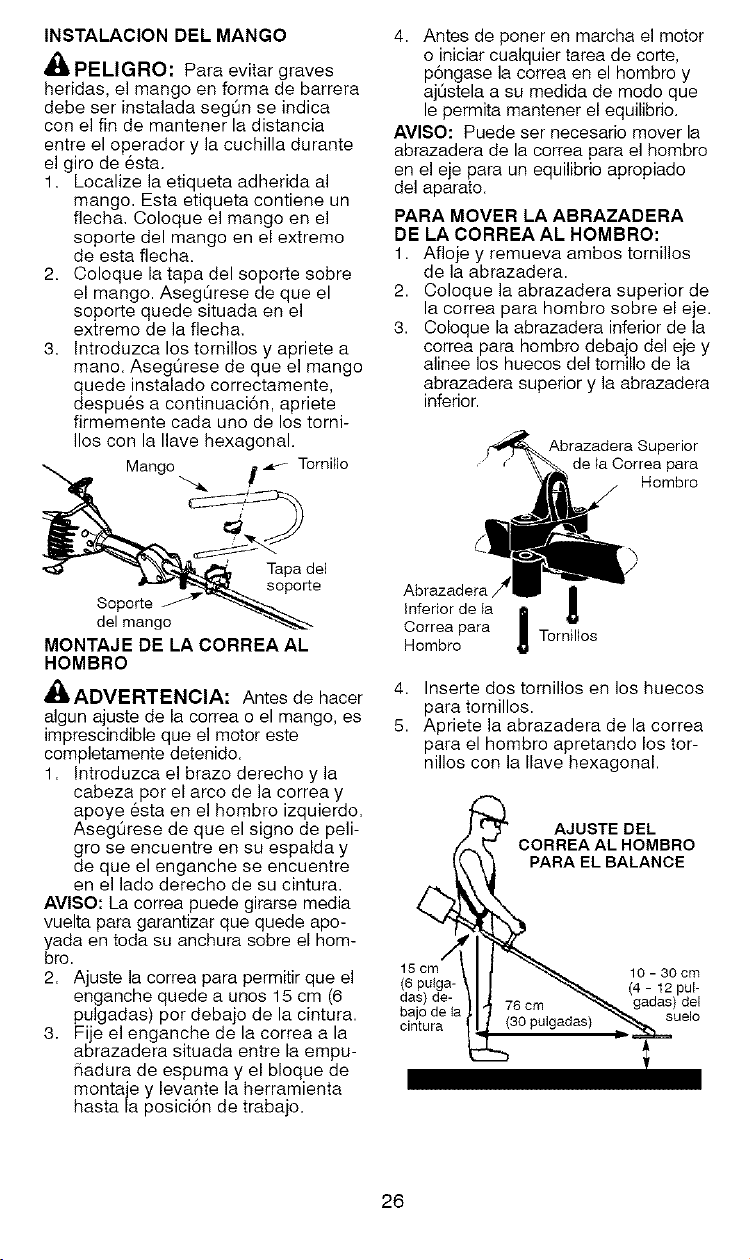
INSTALACION DEL MANGO
_, PELIGRO: Para evitar graves
heridas, el mango en forma de barrera
debe ser instalada segOn se indica
con el fin de mantener la distancia
entre el operador y la cuchilla durante
el giro de 6sta.
1= Localize la etiqueta adherida al
mango. Esta etiqueta contiene un
fiecha. Coloque el mango en el
soporte del mango en el extreme
de esta flecha.
2= Coloque la tapa del soporte sobre
el mango. Aseg0rese de que el
soporte quede situada en el
extremo de la fiecha.
3= Introduzca los tornillos y apriete a
mane. Aseg0rese de que el mango
quede instalado correctamente,
despues a continuaci6n, apriete
firmemente cada uno de los torni-
Ilos con la Ilave hexagonal=
Mango it _- Tornillo
Tapa del
soporte
Soporte
del mango
MONTAJE DE LA CORREA AL
HOMBRO
_'ADVERTENCIA: Antes de hacer
algun ajuste de la correa o el mango, es
imprescindible que el motor este
completamente detenido.
1= Introduzca el brazo derecho y la
cabeza pot el arco de la correa y
apoye esta en el hombro izquierdo=
Aseg0rese de que el signo de peli-
gro se encuentre en su espalda y
de que el enganche se encuentre
en el lado derecho de su cintura.
AVlSO: La correa puede girarse media
vuelta para garantizar que quede ape-
yada en toda su anchura sobre el hem-
bro.
2= Ajuste la correa para permitir que el
enganche quede a unos 15 cm (6
pulgadas) per debajo de la cintura.
3= Fije el enganche de la correa a la
abrazadera situada entre la empu-
_adura de espuma y el bloque de
montaje y levante la herramienta
hasta la posici6n de trabajo=
4. Antes de poner en marcha el motor
o iniciar cualquier tarea de corte,
p6ngase la correa en el hombre y
aj0stela a su medida de mode que
le permita mantener el equilibrio.
AVlSO: Puede ser necesario mover la
abrazadera de la correa para el hombro
en el eje para un equilibrio apropiado
del aparato.
PARA MOVER LA ABRAZADERA
DE LA CORREA AL HOMBRO:
1. Afioje y remueva ambos tornillos
de la abrazadera.
2. Coloque la abrazadera superior de
la correa para hombro sobre el eje.
3. Coloque la abrazadera inferior de la
correa para hombro debajo del eje y
alinee los huecos del tornillo de la
abrazadera superior y la abrazadera
inferior.
Abrazadera Superior
de la Correa para
Hombro
Abrazadera lInferior de la ID
!
Correa para
Tornillos
Hombre
4. Inserte dos tomillos en los huecos
para tornillos.
5. Apriete la abrazadera de la correa
para el hombre apretando los tor-
nillos con la Ilave hexagonal.
AJUSTE DEL
CORREA AL HOMBRO
PARA ELBALANCE
15 cm
(6 pulga-
das) de-
bajo de la
cintura
10 - 30 cm
(4 - 12 pul-
gadas) del
suelo
26
76 cm
(30 pul
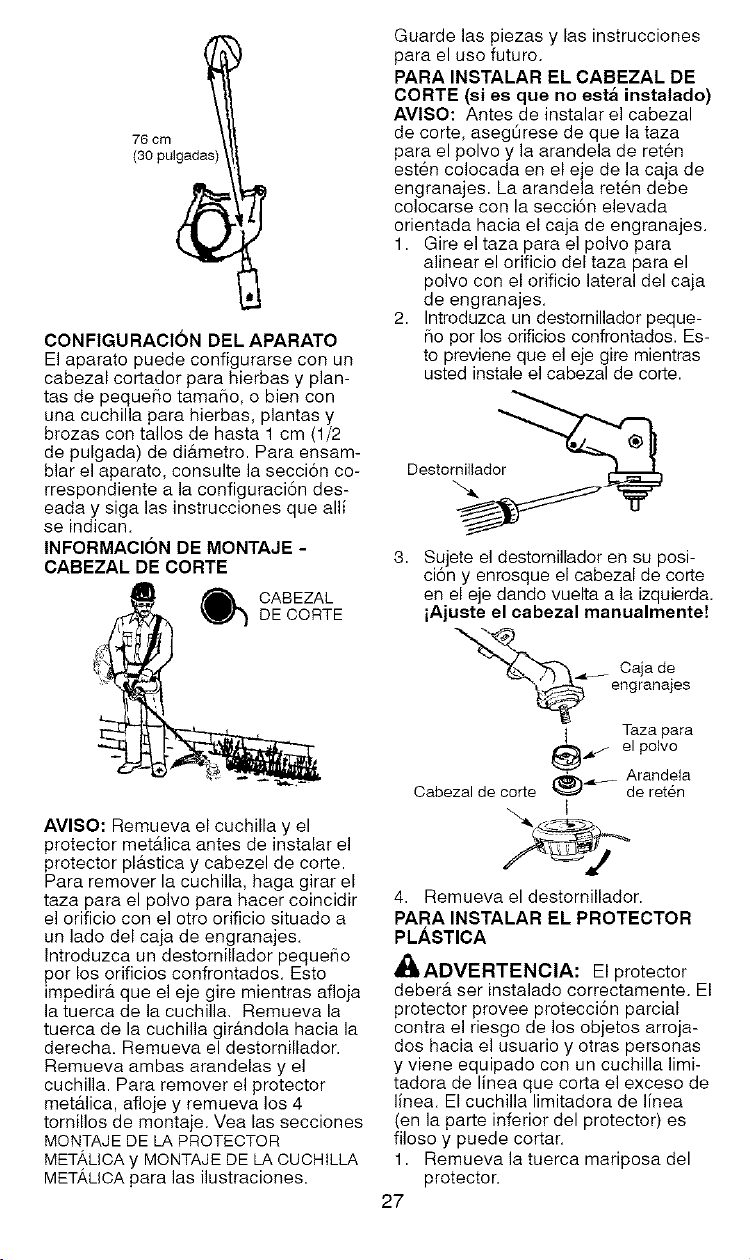
CONFIGURAClON DEL APARATO
El aparato puede configurarse con un
cabezal cortador para hierbas y plan-
tas de pequeflo tamaflo, o bien con
una cuchilla para hierbas, plantas y
brozas con tallos de hasta 1 cm (1/2
de pulgada) de di&metro. Para ensam-
blar el aparato, consulte la secci6n co-
rrespondiente a la configuraci6n des-
eada y siga las instrucciones que alli
se indican.
INFORMAClON DE MONTAJE -
CABEZAL DE CORTE
CABEZAL
DE CORTE
AVISO: Remueva el cuchilla y el
protector met&lica antes de instalar el
protector pl&stica y cabezel de corte.
Para remover la cuchilla, haga girar el
taza para el polvo para hacer coincidir
el orificio con el otto orificio situado a
un lado del caja de engranajes.
Introduzca un destornillador pequeSo
por los orificios confrontados. Esto
impedir& que el eje gire mientras afloja
la tuerca de la cuchilla. Remueva la
tuerca de la cuchilla gir&ndola hacia la
derecha. Remueva el destornillador.
Remueva ambas arandelas y el
cuchilla. Para remover el protector
met&lica, afloje y remueva los 4
tornillos de montaje. Vea las secciones
MONTAJE DE LA PROTECTOR
META"LICA y MONTAJE DE LA CUCHILLA
METALICA para las ilustraciones.
Guarde las piezas y las instrucciones
para el uso futuro.
PARA INSTALAR EL CABEZAL DE
CORTE (si es que no esta instalado)
AVISO: Antes de instalar el cabezal
de corte, asegOrese de que la taza
para el polvo y la arandela de ret6n
esten colocada en el eje de la caja de
engranajes. La arandela ret6n debe
colocarse con la secci6n elevada
orientada hacia el caja de engranajes.
1. Gire el taza para el polvo para
alinear el orificio del taza para el
polvo con el orificio lateral del caja
de engranajes.
2. Introduzca un destomillador peque-
5o por los orificios confrontados. Es-
to previene que el eje gire mientras
usted instale el cabezal de corte.
Destornillado_
3. Sujete el destornillador en su posi-
clon y enrosque el cabezal de corte
en el eje dando vuelta a la izquierda.
iAjuste el eabezal manualmentet
.d_ Caja de
engranajes
t Taza para
_ el polvo
Arandela
Cabezal de corte 1_ "d_ de ret_,n
4. Remueva el destornillador.
PARA INSTALAR EL PROTECTOR
PLASTICA
ADVERTENCIA: El protector
deber& set instalado correctamente. El
protector provee protecci6n parcial
contra el riesgo de los objetos arroja-
dos hacia el usuario y otras personas
y viene equipado con un cuchilla limi-
tadora de linea que corta el exceso de
linea. El cuchilla limitadora de linea
(en la parte inferior del protector) es
filoso y puede cortar.
1. Remueva la tuerca mariposa del
protector.
27
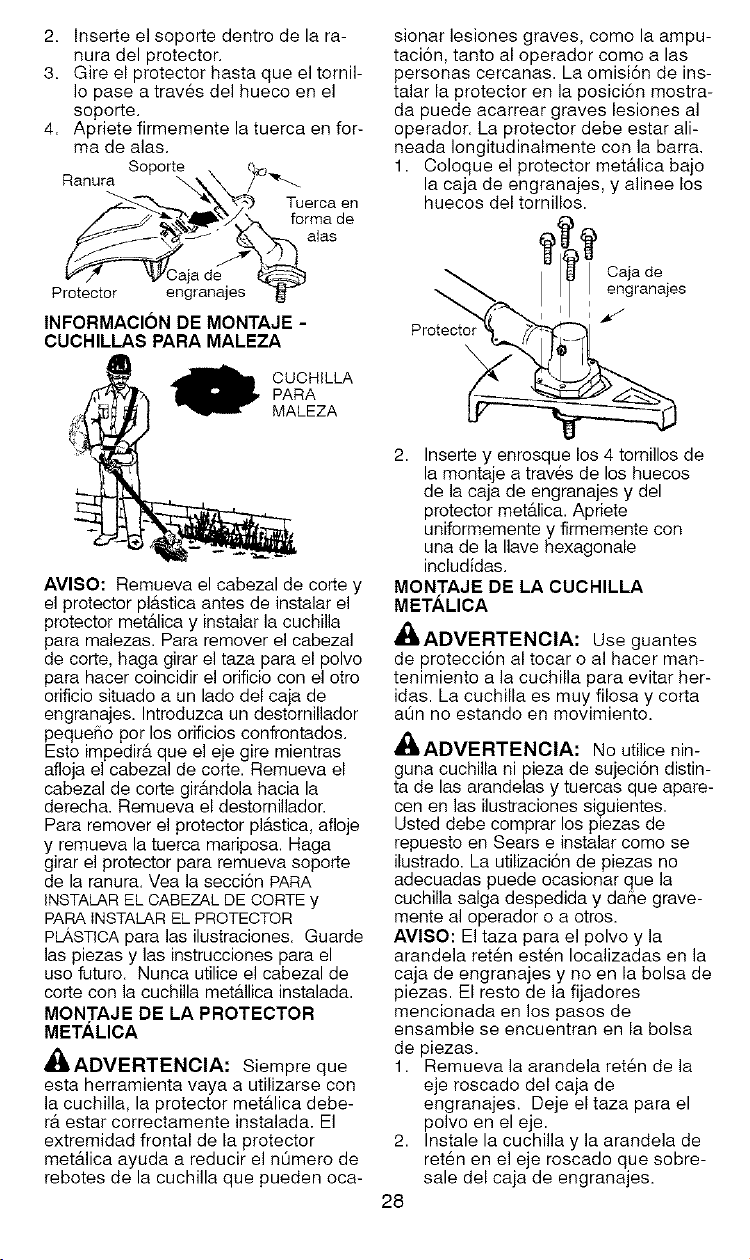
2. Inserteelsoportedentrodelara-
nuradelprotector.
3. Gireelprotectorhastaqueeltornil-
Iopaseatrav6sdelhuecoenel
soporte.
4. Aprietefirmementelatuercaenfor-
madealas.
Soporte
Ranura \
Tuercaen
formade
alas
Protector engranajes
INFORMACION DE MONTAJE -
CUCHILLAS PARA MALEZA
AVISO: Remueva el cabezal de corte y
el protector pl&stica antes de instalar el
protector met&lica y instalar la cuchilla
para malezas. Para remover el cabezal
de carte, haga girar el taza para el polvo
para hacer coincidir el orificio con el otro
orificio situado a un lado del caja de
engranajes. Introduzca un destornillador
peque_o pot los orificios confrontados.
Esto impedir& que el eje gire mientras
afloja el cabezal de carte. Remueva el
cabezal de corte gir&ndola hacia la
derecha. Remueva el destornillador.
Para remover el protector pl&stica, afloje
y remueva la tuerca mariposa. Haga
girar el protector para remueva soporte
de la ranura. Vea la secci6n PARA
INSTALAR EL CABEZAL DE CORTE y
PARA INSTALAR EL PROTECTOR
PLASTICA para las ilustraciones. Guarde
las piezas y las instrucciones para el
uso futuro. Nunca utilice el cabezal de
carte con la cuchilla met&llica instalada.
MONTAJE DE LA PROTECTOR
METALICA
_ADVERTENCIA: Siempre que
eeta herramienta vaya a utilizaree con
la cuchilla, la protector met&lica debe-
r& estar correctamente instalada. El
extremidad frontal de la protector
met&lica ayuda a reducir el n0mero de
rebotes de la cuchilla que pueden oca-
sionar lesiones graves, como la ampu-
taci6n, tanto al operador como alas
personas cercanas. La omisi6n de ins-
talar la protector en la posici6n mostra-
da puede acarrear graves lesiones al
operador. La protector debe estar ali-
neada Iongitudinalmente con la barra.
1. Coloque el protector met&lica bajo
la caja de engranajes, y alinee los
huecos del tornillos.
Caja de
, engranajes
,_"
Protector
2,
28
2. Inserte y enrosque los 4 tornillos de
la montaje a trav6s de los huecos
de la caja de engranajes y del
protector met&lica. Apriete
uniformemente y firmemente con
una de la Ilave hexagonale
includidas.
MONTAJE DE LA CUCHILLA
METALICA
,_ADVERTENCIA: Use guantes
de protecci6n al tocar o al hacer man-
tenimiento a la cuchilla para evitar her-
idae. La cuchilla es muy filoea y corta
aQn no estando en movimiento.
_ADVERTENClA: No utilice nin-
guna cuchilla ni pieza de sujeci6n distin-
ta de las arandelae y tuercae que apare-
cen en lae ilustraciones siguientes.
Usted debe comprar los piezae de
repuesto en Sears e instalar como se
ilustrado. La utilizaci6n de piezae no
adecuadas puede ocaeionar que la
cuchilla salga despedida y daSe grave-
mente al operador o a otroe.
AVlSO: El taza para el polvo y la
arandela ret6n est6n Iocalizadae en la
caja de engranajee y no en la bolsa de
piezae. El resto de la fijadores
mencionada en los pasos de
ensamble ee encuentran en la bolsa
de piezae.
1. Remueva la arandela ret_n de la
eje roscado del caja de
engranajee. Deje el taza para el
polvo en el eje.
Instale la cuchilla y la arandela de
reten en el eje roecado que sobre-
sale del caja de engranajee.
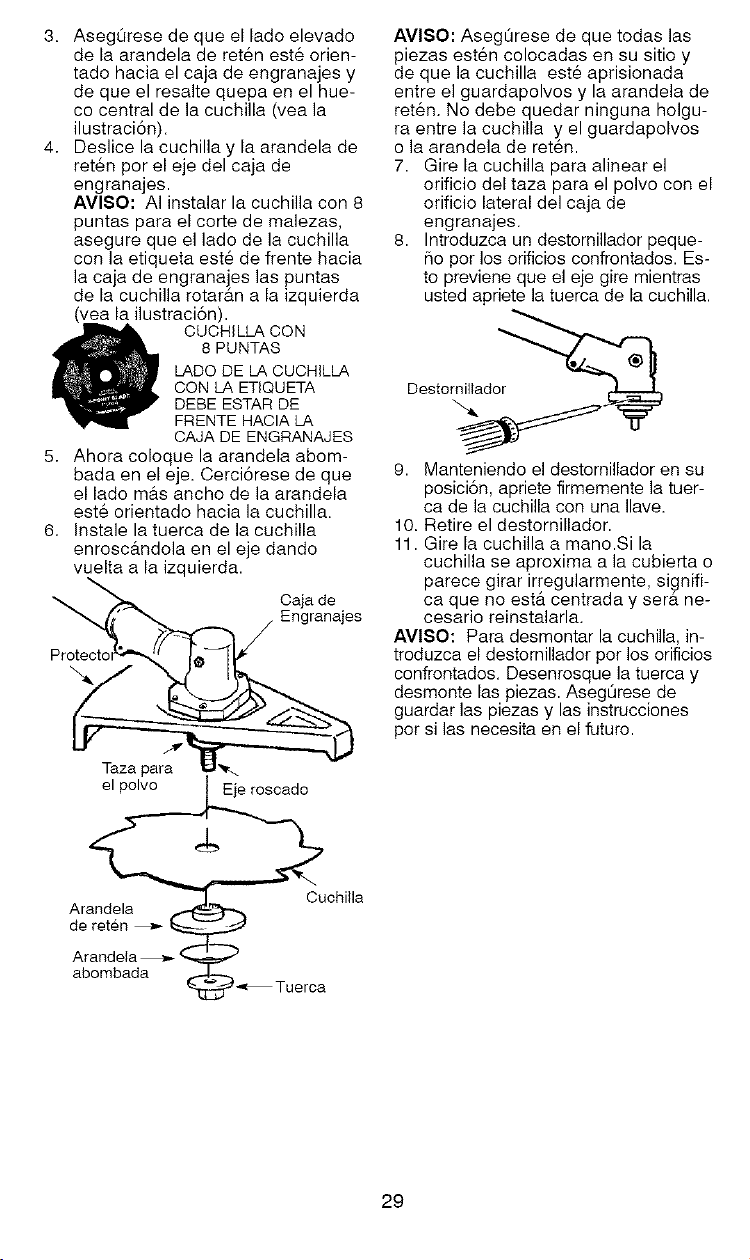
3. AsegOrese de que el lado elevado
de la arandela de reten est6 orien-
tado hacia el caja de engranajes y
de que el resalte quepa en el hue-
co central de la cuchilla (vea la
ilustraci6n).
4. Deslice la cuchilla y la arandela de
ret6n per el eje del caja de
engranajes.
AVlSO: AI instalar la cuchilla con 8
puntas para el carte de malezas,
asegure que el lade de la cuchilla
con la etiqueta este de frente hacia
la caja de engranajes las puntas
de la cuchilla rotar_.n a la izquierda
(vea la ilustraci6n).
CUCHILLA CON
8 PUNTAS
LADO DE LA CUCHILLA
CON LA ETIQUETA
DEBE ESTAR DE
FRENTE HACIA LA
CAJA DE ENGRANAJES
5. Ahora coloque la arandela abom-
bada en el eje. Cerci6rese de que
el lade m_ts ancho de la arandela
este orientado hacia la cuchilla.
6. Instale la tuerca de la cuchilla
enrosc_tndola en el eje dando
vuelta a la izquierda.
Caja de
AVlSO: Aseg0rese de que todas las
piezas est6n colocadas en su sitio y
de que la cuchilla est6 aprisionada
entre el guardapolvos y la arandela de
ret6n. No debe quedar ninguna holgu-
ra entre la cuchilla y el guardapolvos
o la arandela de reten.
7. Gire la cuchilla para alinear el
orificio del taza para el polvo con el
orificio lateral del caja de
engranajes.
8. Introduzca un destornillador peque-
_o par los orificios confrontados. Es-
to previene que el eje gire mientras
usted apriete la tuerca de la cuchilla.
Destornillador__
9. Manteniendo el destornillador en su
posici6n, apriete firmemente la tuer-
ca de la cuchilla con una Ilave.
10. Retire el destornillador.
11. Gire la cuchilla a mano.Si la
cuchilla se aproxima a la cubierta o
parece girar irregularmente, signifi-
ca que no ester centrada y ser_. ne-
cesario reinstalarla.
AVlSO: Para desmontar la cuchilla, in-
troduzca el destornillador par los orificios
confrontados. Desenrosque la tuerca y
desmonte las piezas. Aseg0rese de
guardar las piezas y las instrucciones
par si las necesita en el futuro.
29
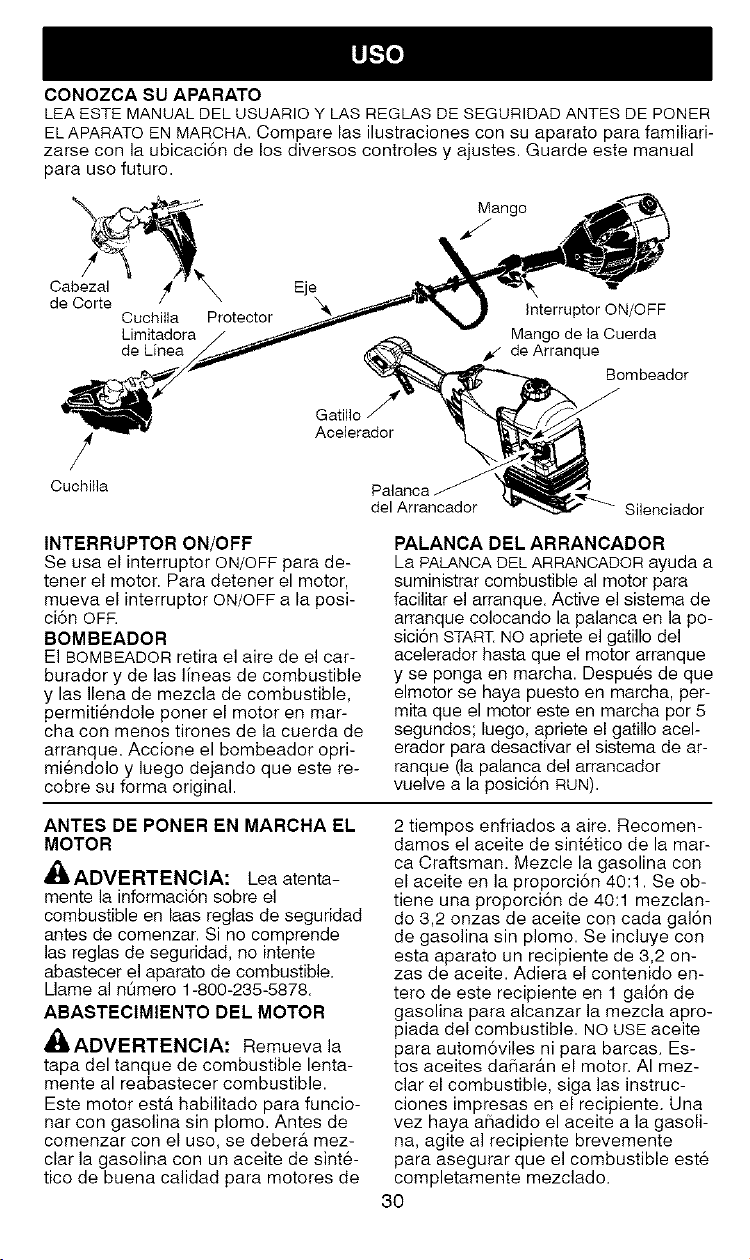
CONOZCA SU APARATO
LEA ESTE MANUAL DEL USUARIO Y LAS REGLAS DE SEGURIDAD ANTES DE PONER
ELAPARATO EN MARCHA. Compare las ilustraciones con su aparato para familiari-
zarse con la ubicaci6n de los diversos controles y ajustes. Guarde este manual
para uso futuro.
_'__:_ Mango
Eje
Cuchilla Protector Interruptor ON/OFF
Limitadora Mango de la ©uerda
de Linea _/ de Arranque
Bombeador
/
Cuchilla
Gatillo
del Arrancador Silenciador
INTERRUPTOR ON/OFF
Se usa el interruptor ON/OFF para de-
tener el motor. Para detener el motor,
mueva el interruptor ON/OFF a la posi-
ci6n OFF.
BOMBEADOR
El BOMBEADOR retira el aire de el car-
burador y de las lineas de combustible
y las Ilena de mezcla de combustible,
permiti6ndole poner el motor en mar-
cha con menos tirones de la cuerda de
arranque. Accione el bombeador opri-
mi6ndolo y luego dejando que este re-
cobre su forma original.
PALANCA DEL ARRANCADOR
La PALANCA DEL ARRANCADOR ayuda a
suministrar combustible al motor para
facilitar el arranque. Active el sistema de
arranque colocando la palanca en la po-
sici6n START. NO apriete el gatillo del
acelerador hasta que el motor arranque
y se ponga en marcha. Despu6s de que
elmotor se haya puesto en marcha, per-
mita que el motor este en marcha por 5
segundos; luego, apriete el gatillo acel-
erador para desactivar el sistema de ar-
ranque (la palanca del arrancador
vuelve a la posici6n RUN).
ANTES DE PONER EN MARCHA EL
MOTOR
_I_ADVERTENCIA: Lea atenta-
mente la informaci6n sobre el
combustible en laas reglas de seguridad
antes de comenzar. Si no comprende
las reglas de seguridad, no intente
abastecer el aparato de combustible.
Uame al nOmero 1-800-235-5878.
ABASTEClMIENTO DEL MOTOR
,I_ADVERTENCIA: Remueva la
tapa del tanque de combustible lenta-
mente al reabastecer combustible.
Este motor est& habilitado para funcio-
nat con gasolina sin plomo. Antes de
comenzar con el uso, se deber& mez-
clar la gasolina con un aceite de sint6-
tico de buena calidad para motores de
2 tiempos enfriados a aire. Recomen-
damos el aceite de sintetico de la mar-
ca Craftsman. Mezcle la gasolina con
el aceite en la proporci6n 40:1. Se ob-
tiene una proporci6n de 40:1 mezclan-
do 3,2 onzas de aceite con cada gal6n
de gasolina sin plomo. Se incluye con
esta aparato un recipiente de 3,2 on-
zas de aceite. Adiera el contenido en-
tero de este recipiente en 1 gal6n de
gasolina para alcanzar la mezcla apro-
piada del combustible. NO USE aceite
para autom6viles ni para barcas. Es-
tos aceites daSar&n el motor. AI mez-
clar el combustible, siga las instruc-
clones impresas en el recipiente. Una
vez haya aSadido el aceite a la gasoli-
na, agite al recipiente brevemente
para asegurar que el combustible est6
completamente mezclado.
30
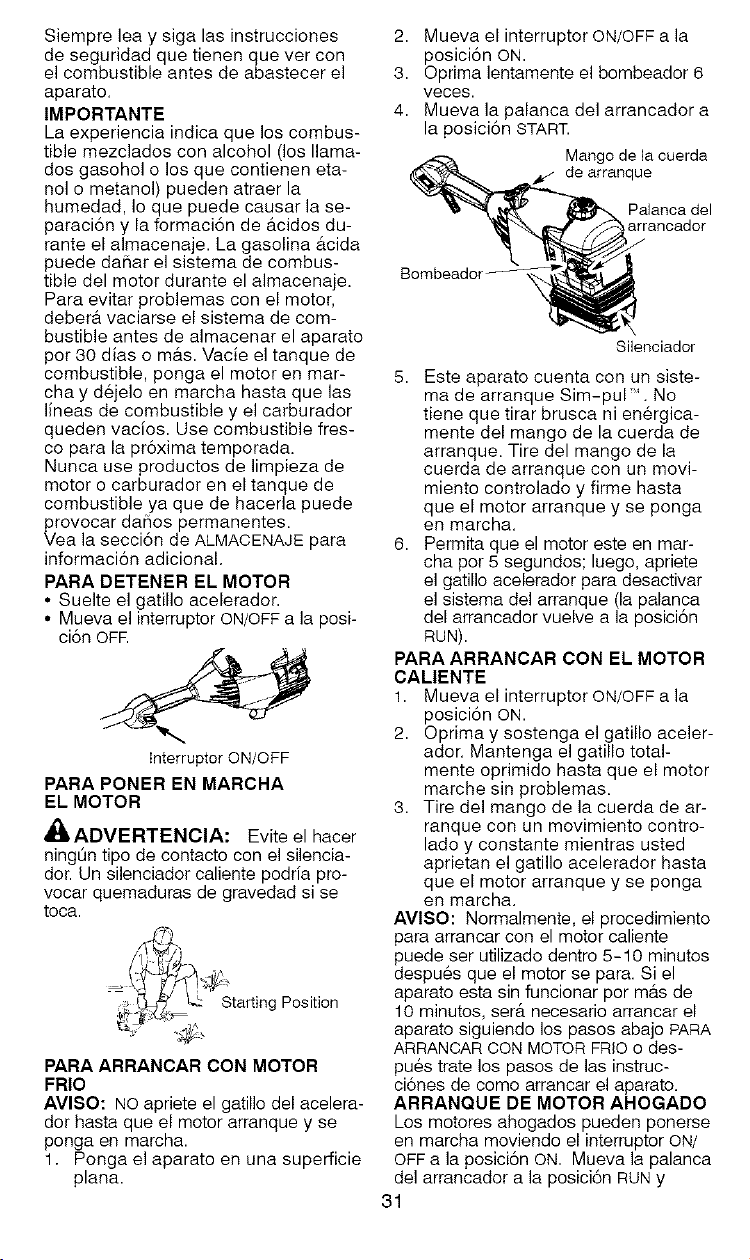
Siempreleaysigalasinstrucciones
deseguridadquetienenquevercon
elcombustibleantesdeabastecerel
aparato.
IMPORTANTE
Laexperienciaindicaqueloscombus-
tiblemezcladosconalcohol(losllama-
dosgasohololosquecontieneneta-
nolometanol)puedenatraerla
humedad,Ioquepuedecausarlase-
paraci6nylaformaci6nde&cidosdu-
ranteelalmacenaje.Lagasolina_.cida
puededa_arelsistemadecombus-
tibledelmotorduranteelalmacenaje.
Paraevitarproblemasconelmotor,
deber&vaciarseelsistemadecom-
bustibleantesdealmacenarelaparato
por30diasom&s.Vacieeltanquede
combustible,pongaelmotorenmar-
chayd6jeloenmarchahastaquelas
lineasdecombustibleyelcarburador
quedenvacios.Usecombustiblefres-
coparalapr6ximatemporada.
Nuncauseproductosdelimpiezade
motorocarburadoreneltanquede
combustibleyaquedehacerlapuede
provocarda_ospermanentes.
Vealasecci6ndeALMAOENAJEpara
informaci6nadicional.
PARA DETENER EL MOTOR
• Suelte el gatillo acelerador.
• Mueva el interruptor ON/OFF a la posi-
ci6n OFR
Interruptor ON/OFF
PARA PONER EN MARCHA
EL MOTOR
_[_,ADVERTENCIA: Evite el hacer
ningOn tipo de contacto con el silencia-
dor. Un silenciador caliente podria pro-
vocar quemaduras de gravedad si se
toca.
.;.__' _.-_' Starting Position
PARA ARRANCAR CON MOTOR
FRIO
AVISO: NO apriete el gatillo del acelera-
dor hasta que el motor arranque y se
ponga en march&
1. Ponga el aparato en una superficie
plana.
2. Mueva el interruptor ON/OFF a la
posici6n ON.
3. Oprima lentamente el bombeador 6
veces.
4. Mueva la palanca del arrancador a
la posici6n START.
Mango de la cuerda
de arranque
Palanca del
arrancador
Silenciador
5. Este aparato cuenta con un siste-
ma de arranque Sim-pul-". No
tiene que tirar brusca ni en6rgica-
mente del mango de la cuerda de
arranque. Tire del mango de la
cuerda de arranque con un movi-
miento controlado y firme hasta
que el motor arranque y se ponga
en marcha.
6. Permita que el motor este en mar-
cha por 5 segundos; luego, apriete
el gatillo acelerador para desactivar
el sistema del arranque (la palanca
del arrancador vuelve a la posici6n
RUN).
PARA ARRANCAR CON EL MOTOR
CALIENTE
1. Mueva el interruptor ON/OFF a la
posici6n ON.
2. Oprima y sostenga el gatillo aceler-
ador. Mantenga el gatillo total-
mente oprimido hasta que el motor
marche sin problemas.
3. Tire del mango de la cuerda de ar-
ranque con un movimiento contro-
lado y constante mientras usted
aprietan el gatillo acelerador hasta
que el motor arranque y se ponga
en marcha.
AVlSO: Normalmente, el procedimiento
para arrancar con el motor caliente
puede ser utilizado dentro 5-10 minutos
despu6s que el motor se para. Si el
aparato esta sin funcionar por m&s de
10 minutos, ser& necesario arrancar el
aparato siguiendo los pasos abajo PARA
ARRANCAR CON MOTOR FRIO o des-
pues trate los pasos de las instruc-
ci6nes de como arrancar el aparato.
ARRANQUE DE MOTOR AHOGADO
Los motores ahogados pueden ponerse
en marcha moviendo el interruptor ON/
OFF a la posici6n ON. Mueva la palanca
del arrancador a la posici6n RUN y
31
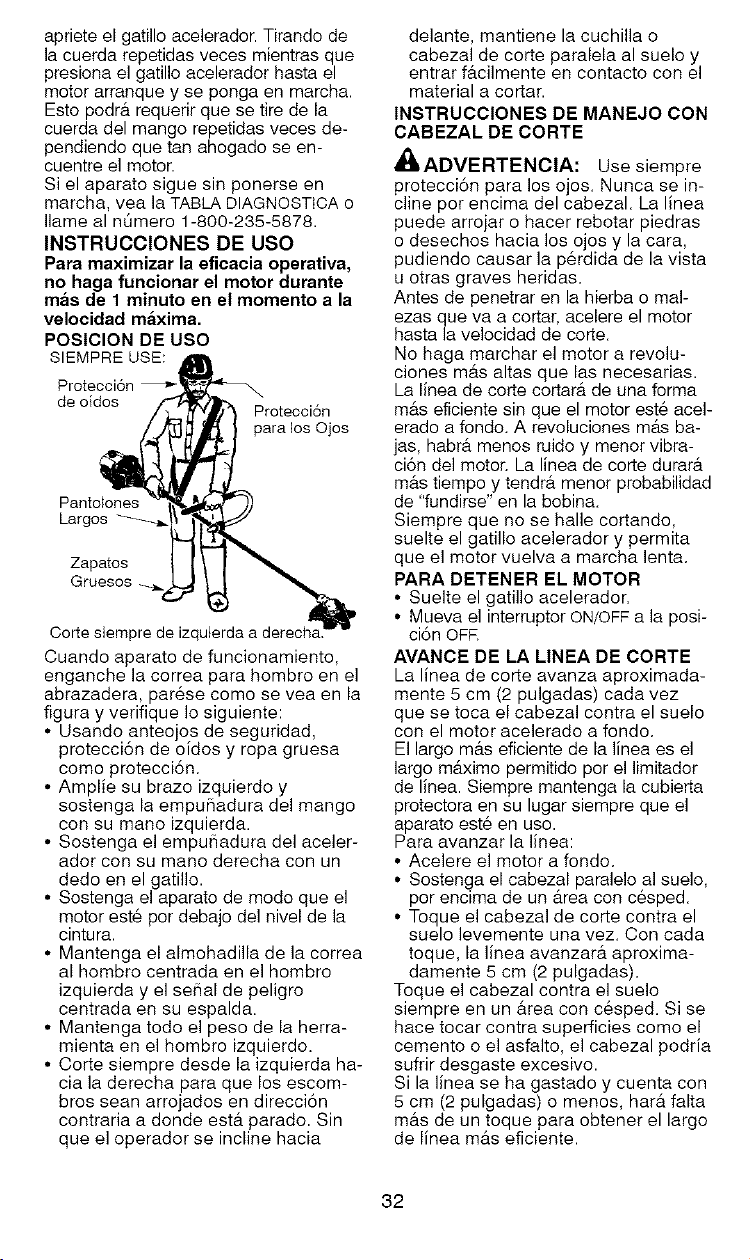
aprieteelgatilloacelerador.Tirandode
lacuerdarepetidasvecesmientrasque
presionaelgatilloaceleradorhastael
motorarranqueysepongaenmarcha.
Estopodr_,requerirquesetiredela
cuerdadelmangorepetidasvecesde-
pendiendoquetanahogadoseen-
cuentreelmotor.
Sielaparatosiguesinponerseen
marcha,vealaTABLADIAGNOSTtCAo
IlamealnOmero1-800-235-5878.
INSTRUCCIONESDE USO
Para maximizar la eficacia operativa,
no haga funcionar el motor durante
mas de 1 minuto en et momento a la
velocidad maxima.
POSIClON DE USO
SIEMPRE USE:
Protecci6n
de oidos
Protecci6n
para los Ojos
Pantolones
Largos
Zapatos
Gruesos
Corte siempre de izquierda a derecha.J__
Cuando aparato de funcionamiento,
enganche la correa para hombro en el
abrazadera, par6se come se vea en la
figura y verifique Io siguiente:
• Usando anteo os de seguridad,
protecci6n de o dos y ropa gruesa
como protecci6n.
• Amplie su braze izquierdo y
sostenga la empufladura del mango
con su mano izquierda.
• Sostenga el empufladura del aceler-
ador con su mano derecha con un
dedo en el gatillo.
• Sostenga el aparato de modo que el
motor est6 por debajo del nivel de la
cintura.
• Mantenga el almohadilla de la correa
al hombro centrada en el hombro
izquierda y el serial de peligro
centrada en su espalda.
• Mantenga todo el peso de la herra-
mienta en el hombre izquierdo.
• Corte siempre desde la izquierda ha-
cia la derecha para que los escom-
bros sean arrojados en direcci6n
contraria a donde est& parado. Sin
que el operador se incline hacia
delante, mantiene la cuchilla o
cabezal de corte paralela al suelo y
entrar f&cilmente en contacto con el
material a cortar.
INSTRUCClONES DE MANEJO CON
CABEZAL DE CORTE
,_ADVERTENCIA: Use siempre
proteccidn para los ojos. Nunca se in-
cline per encima del cabezal. La linea
puede arrojar o hacer rebotar piedras
o desechos hacia los ojos y la cara,
pudiendo causar la p_rdida de la vista
u otras graves heridas.
Antes de penetrar en la hierba o mal-
ezas que va a cortar, acelere el motor
hasta la velocidad de corte.
No haga marchar el motor a revolu-
clones m&s altas que las necesarias.
La linea de corte cortar& de una forma
m&s eficiente sin que el motor est6 acel-
erado a fondo. A revoluciones m&s ba-
jas, habr& menos ruido y menor vibra-
ci6n del motor. La linea de corte durar&
m&s tiempo y tendr& menor probabilidad
de "fundirse" en la bobina.
Siempre que no se halle cortando,
suelte el gatillo acelerador y permita
que el motor vuelva a marcha lenta.
PARA DETENER EL MOTOR
• Suelte el gatillo acelerador.
• Mueva el interruptor ON/OFF a la posi-
ci6n OFR
AVANCE DE LA LINEA DE CORTE
La linea de corte avanza aproximada-
mente 5 cm (2 pulgadas) cada vez
que se toca el cabezal contra el suelo
con el motor acelerado a fondo.
El largo m&s eficiente de la linea es el
largo m&ximo permitido per el limitador
de linea. Siempre mantenga la cubierta
protectora en su lugar siempre que el
aparato este en use.
Para avanzar la linea:
• Acelere el motor a fondo.
• Sostenga el cabezal paralelo al suelo,
per encima de un &rea con c6sped.
• Toque el cabezal de corte contra el
suelo levemente una vez. Con cada
toque, la linea avanzar& aproxima-
damente 5 cm (2 pulgadas).
Toque el cabezal contra el suelo
siempre en un &rea con c6sped. Si se
hace tocar contra superficies como el
cemento o el asfalto, el cabezal podria
sufrir desgaste excesivo.
Si la linea se ha gastado y cuenta con
5 cm (2 pulgadas) o menos, hat& falta
m&s de un toque para obtener el largo
de finea m&s eficiente.
32
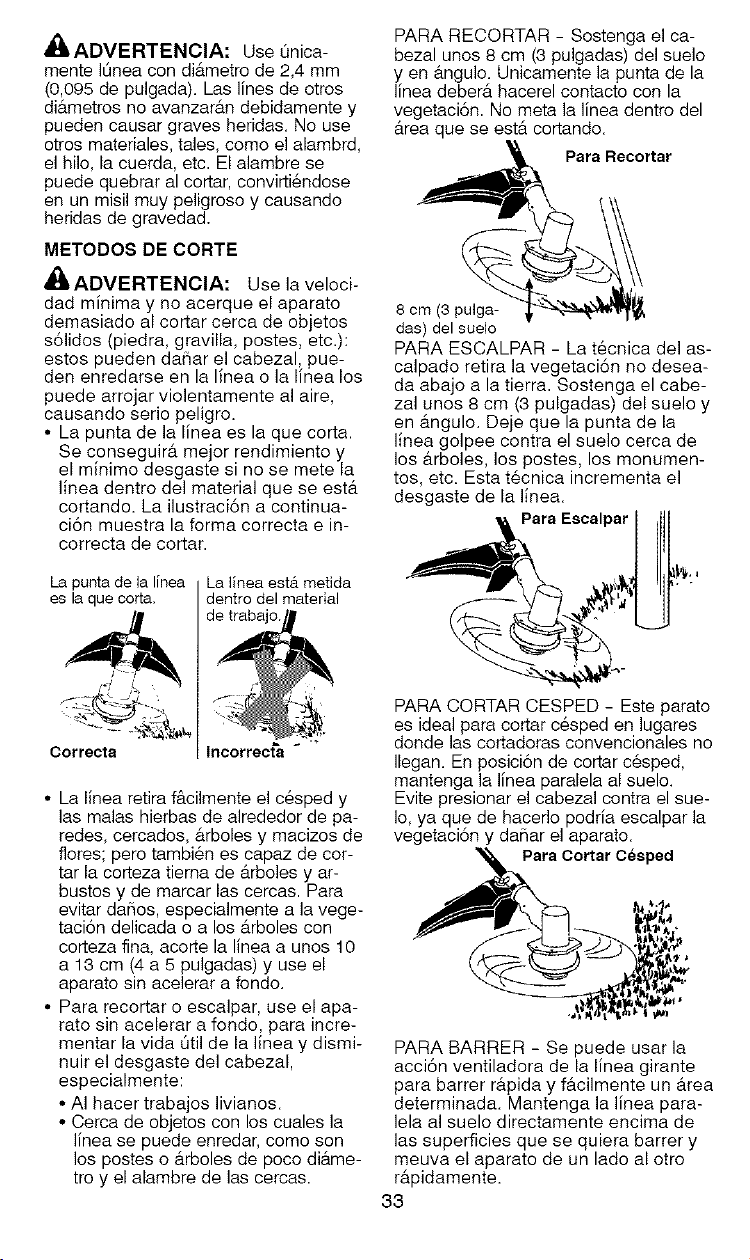
_ADVERTENClA: Use 0nica-
mente IOnea con di&metro de 2,4 mm
(0,095 de pulgada). Las lines de otros
di&metros no avanzar&n debidamente y
pueden causar graves heridas. No use
otros materiales, tales, come el alambrd,
el hilo, la cuerda, etc. El alambre se
puede quebrar al cortar, convirti6ndose
en un misil muy peligroso y causando
heridas de gravedad.
METODOS DE CORTE
_ADVERTENCIA: Use la veloci-
dad minima y no acerque el aparato
demasiado al cortar cerca de objetos
s61idos (piedra, gravilla, postes, etc.):
estos pueden daSar el cabezal, pue-
den enredarse en la linea o la linea los
puede arrojar violentamente al aire,
causando serio peligro.
• La punta de la linea es la que corta.
Se conseguir& mejor rendimiento y
el minimo desgaste si no se mete la
linea dentro del material que se ester
cortando. La ilustraci6n a continua-
ci6n muestra la forma correcta e in-
correcta de cortar.
La punta de la linea La linea est#. metida
es la que corta, dentro del material
PARA RECORTAR - Sostenga el ca-
bezal unos 8 cm (3 pulgadas) del suelo
yen _tngulo. Unicamente la punta de la
linea deber& hacerel contacto con la
vegetaci6n. No meta la linea dentro del
_trea que se est& cortando.
Para Reoortar
8 cm (3 pulga-
das) del suelo
PARA ESCALPAR - La tecnica del as-
calpado retira la vegetaci6n no desea-
da abajo a la tierra. Sostenga el cabe-
zal unos 8 cm (3 pulgadas) del suelo y
en _.ngulo. Deje que la punta de la
linea golpee contra el suelo cerca de
los _trboles, los postes, los monumen-
tos, etc. Esta t6cnica incrementa el
desgaste de la linea.
Para Escalpar
Corrects Incorrecta
• La linea retira f&cilmente e{ c6sped y
{as malas hierbas de a{rededor de pa-
redes, cercados, _.rboles y macizos de
flares; pero tambi6n es capaz de car-
tar la corteza tierna de _trboles y ar-
bustos y de marcar las cercas. Para
evitar da_os, especialmente a la vege-
taci6n delicada o a los _.rboles con
corteza fin& acorte la linea a unos 10
a 13 cm (4 a 5 pulgadas) y use el
aparato sin acelerar a fondo.
• Para recortar o escalpar, use el apa-
rata sin acelerar a fondo, para incre-
mentar la vida Otil de la linea y dismi-
nuir el desgaste del cabezal,
especialmente:
• AI hacer trabajos livianos.
• Cerca de objetos con los cuales la
linea se puede enredar, come son
los postes o _.rboles de poco di_.me-
troy el alambre de las cercas.
PARA CORTAR CESPED - Este parato
es ideal para cortar c6sped en lugares
donde las cortadoras convencionales no
Ilegan. En posici6n de cortar c6sped,
mantenga la linea paralela al suelo.
Evite presionar el cabezal contra el sue-
Io, ya que de hacerlo podria escalpar la
vegetaci6n y da_ar el aparato.
Para Cortar Cesped
PARA BARRER - Se puede usar la
acci6n ventiladora de la finea girante
para barrer r_.pida y f_tcilmente un _trea
determinada. Mantenga la linea para-
lela al suelo directamente encima de
las superficies que se quiera barrer y
meuva el aparato de un lade al otro
r_.pidamente.
33
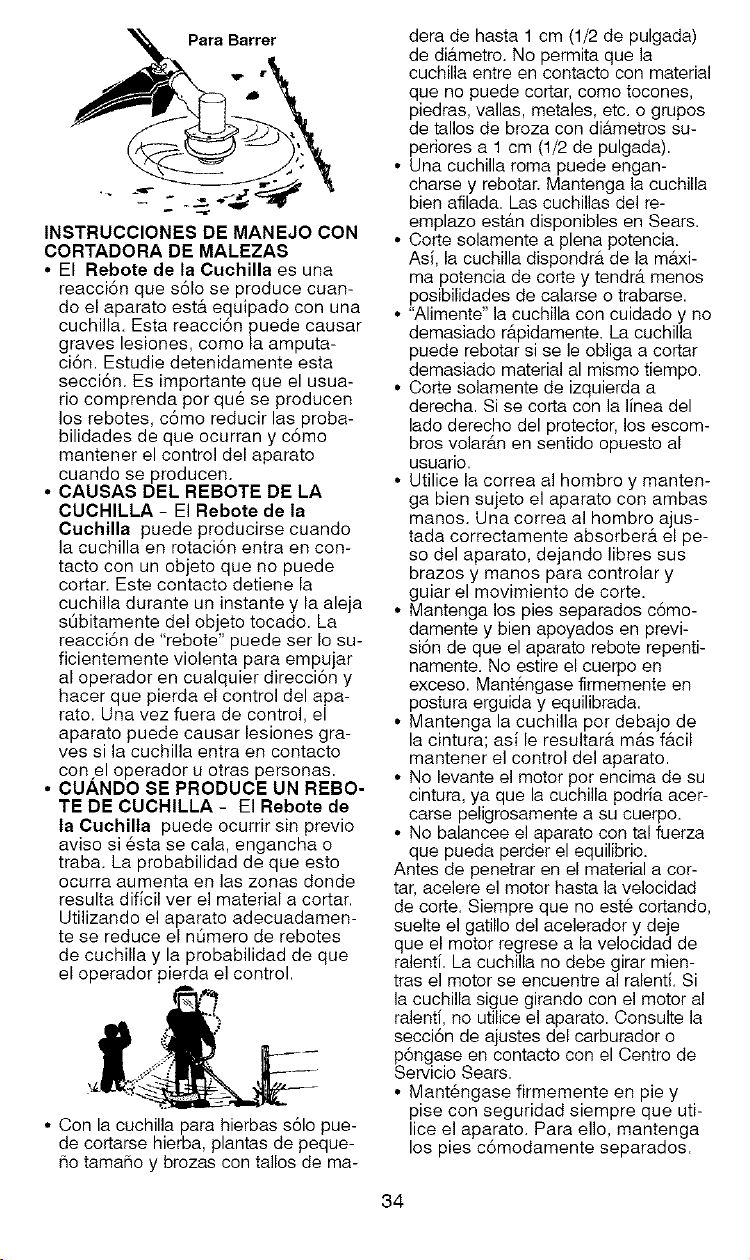
Para Barrer
INSTRUCCIONES DE MANEJO CON
CORTADORA DE MALEZAS
• El Rebote de la Cuchilla es una
reacci6n que s61o se produce cuan-
do el aparato est,. equipado con una
cuchilla. Esta reacci6n puede causar
graves lesiones, como la amputa-
ci6n. Estudie detenidamente esta
secci6n. Es importante que el usua-
rio comprenda por qu6 se producen
los rebotes, c6mo reducir las proba-
bilidades de que ocurran y como
mantener el control del aparato
cuando se producen.
• CAUSAS DEL REBOTE DE LA
CUCHILLA - El Rebote de la
Cuchilla puede producirse cuando
la cuchilla en rotaci6n entra en con-
tacto con un objeto que no puede
cortar. Este contacto detiene la
cuchilla durante un instante y la aleja
sObitamente del objeto tocado. La
reacci6n de "rebote" puede ser Io su-
ficientemente violenta para empujar
al operador en cualquier direcci6n y
hacer que pierda el control del apa-
rato. Una vez fuera de control, el
aparato puede causar lesiones gra-
ves si la cuchilla entra en contacto
con el operador u otras personas.
• CUANDO SE PRODUCE UN REBO-
TE DE CUCHILLA - El Rebote de
la Cuchilla puede ocurrir sin previo
aviso si 6sta se cala, engancha o
traba. La probabilidad de que esto
ocurra aumenta en las zonas donde
resulta dificil ver el material a cortar.
Utilizando el aparato adecuadamen-
te se reduce el nQmero de rebotes
de cuchilla y la probabilidad de que
el operador pierda el control.
• Con la cuchilla para hierbas s61o pue-
de cortarse hierba, plantas de peque-
_o tama_o y brozas con tallos de ma-
dera de hasta 1 cm (1/2 de pulgada)
de di_.metro. No permita que la
cuchilla entre en contacto con material
que no puede cortar, como tocones,
piedras, vallas, metales, etc. o grupos
de tallos de broza con di_.metros su-
periores a 1 cm (1/2 de pulgada).
• Una cuchilla roma puede engan-
charse y rebotar= Mantenga la cuchilla
bien afilada. Las cuchillas del re-
emplazo est_tn disponibles en Sears.
• Corte solamente a plena potencia.
Asi, la cuchilla dispondr_, de la m&xi-
ma potencia de corte y tendr_t menos
posibilidades de calarse o trabarse.
• "Alimente" la cuchilla con cuidado y no
demasiado r_tpidamente. La cuchilla
puede rebotar si se le obliga a cortar
demasiado material al mismo tiempo.
• Corte solamente de izquierda a
derecha. Si se corta con la linea del
lado derecho del protector, los escom-
bros volarb,nen sentido opuesto al
usuario.
• Utilice la correa al hombro y manten-
ga bien sujeto el aparato con ambas
manos. Una correa al hombro ajus-
tada correctamente absorber_, el pe-
so del aparato, dejando libres sus
brazos y manos para controlar y
guiar el movimiento de corte.
• Mantenga los pies separados c6mo-
damente y bien apoyados en previ-
si6n de que el aparato rebote repenti-
namente. No estire el cuerpo en
exceso. Mant6ngase firmemente en
postura erguida y equilibrada.
• Mantenga la cuchilla por debajo de
la cintura; asi le resultarb, m_ts f_.cil
mantener el control del aparato.
• No levante el motor por encima de su
cintura, ya que la cuchilla podria acer-
carse peligrosamente a su cuerpo.
• No balancee el aparato con tal fuerza
que pueda perder el equilibrio.
Antes de penetrar en el material a cot-
tar, acelere el motor hasta la velocidad
de corte. Siempre que no est6 cortando,
suelte el gatillo del acelerador y deje
que el motor regrese a la velocidad de
ralenti. La cuchilla no debe girar mien-
tras el motor se encuentre al ralenti. Si
la cuchilla sigue girando con el motor al
ralenti, no utilice el aparato. Consulte la
secci6n de ajustes del carburador o
p6ngase en contacto con el Centro de
Servicio Sears.
• Mant6ngase firmemente en pie y
pise con seguridad siempre que uti-
lice el aparato. Para ello, mantenga
los pies c6modamente separados.
34
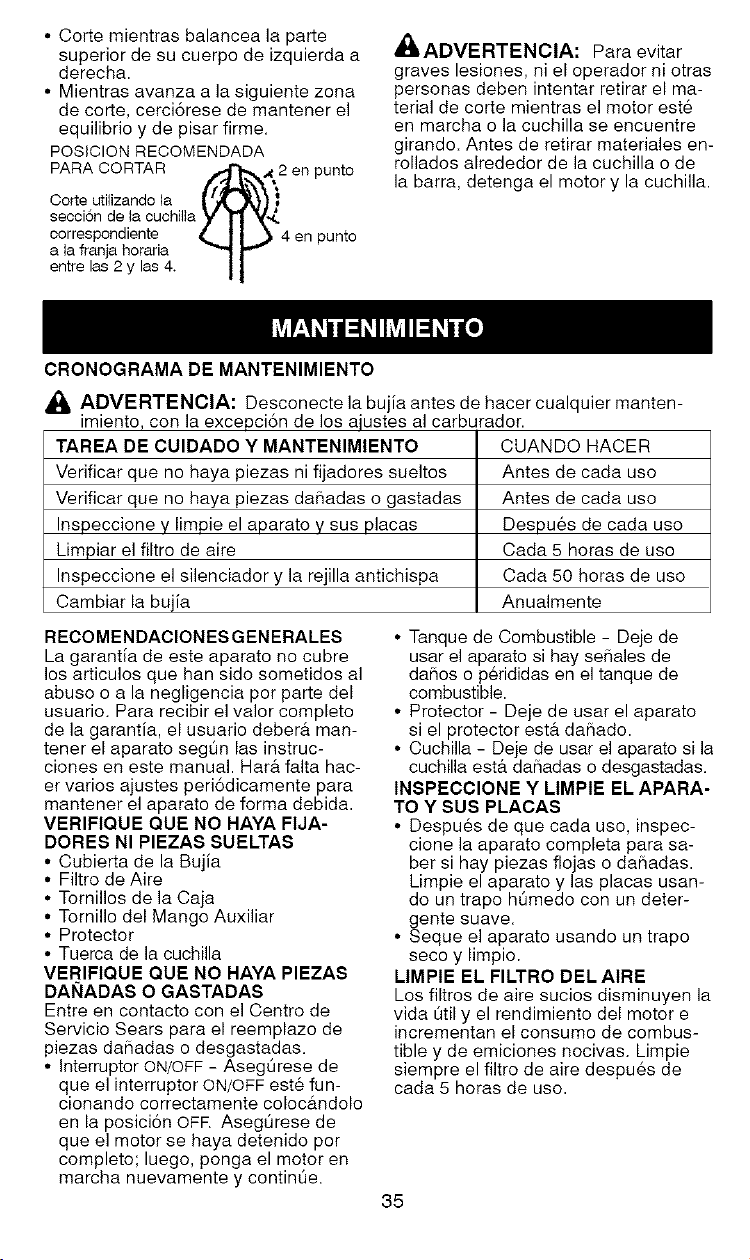
• Corte mientras balancea la parte
superior de su cuerpo de izquierda a
derecha.
• Mientras avanza a la siguiente zona
de corte, cerci6rese de mantener el
equilibrio y de pisar firme.
POSICION RECOMENDADA
PARA CORTAR _"_,,_%,_ 2 en punto
Corte utilizando la i'_[ _}
secci6n de la cuohilla y _r[ _4
correspondiente _ | I _i 4 en punto
a ta franja horaria _1
entre las 2 y las 4. | |
ii
!
_ADVERTENClA" Para evitar
graves lesiones, ni el operador ni otras
personas deben intentar retirar el ma-
terial de corte mientras el motor est6
en marcha o la cuchilla se encuentre
girando. Antes de retirar materiales en-
rollados alrededor de la cuchilla o de
la barra, detenga el motor y la cuchilla.
CRONOGRAMA DE MANTENIMIENTO
,_ ADVERTENCIA: Desconecte la bujia antes de hacer cualquier manten-
imiento, con la excepci6n de los aiustes al carburador.
TAREA DE CUIDADO Y MANTENIMIENTO
Verificar que no haya piezas ni fijadores sueltos
Verificar que no haya piezas dafiadas o gastadas
Inspeccione y limpie el aparato y sus placas
Limpiar el filtro de aire
Inspeccione el silenciador y la rejilla antichispa
Cambiar la bujia
CUANDO HACER
Antes de cada uso
Antes de cada uso
Despu6s de cada uso
Cada 5 horas de uso
Cada 50 horas de usa
Anualmente
RECOMENDACIONES GENERALES
La garantia de este aparato no cubre
los articulos que han sido sometidos al
abuso o a la negligencia pot parte del
usuario. Para recibir el valor complete
de la garantia, el usuario deber& man-
tener el aparato segQn las instruc-
clones en este manual. Har& falta hac-
er varios ajustes peri6dicamente para
mantener el aparato de forma debida.
VERIFIQUE QUE NO HAYA FIJA-
DORES NI PIEZAS SUELTAS
• Cubierta de la Bujia
• Filtro de Aire
• Tornillos de la Caja
• Tornillo del Mango Auxiliar
• Protector
• Tuerca de la cuchilla
VERIFIQUE QUE NO HAYA PIEZAS
DAI_IADAS O GASTADAS
Entre en contacto con el Centro de
Servicio Sears para el reemplazo de
piezas daSadas o desgastadas.
• Interruptor ON/OFF - Aseg0rese de
que el interruptor ON/OFF est6 fun-
cionando correctamente coloc&ndolo
en la posici6n OFR AsegOrese de
que el motor se haya detenido por
completo; luego, ponga el motor en
marcha nuevamente y continOe.
• Tanque de Combustible - Deje de
usar el aparato si hay sefiales de
daSos o perididas en el tanque de
combustible.
• Protector - Deje de usar el aparato
si el protector est& daSado.
• Cuchilla - Deje de usar el aparato si la
cuchilla est& daSadas o desgastadas.
INSPECCIONE Y LIMPIE EL APARA-
TO Y SUS PLACAS
• Despu6s de que cada uso, inspec-
clone la aparato completa para sa-
ber si hay piezas flojas o daSadas.
Limpie el aparato y las placas usan-
do un trapo hQmedo con un deter-
gente suave.
• Seque el aparato usando un trapo
seco y limpio.
LIMPIE EL FILTRO DEL AIRE
Los filtros de aire sucios disminuyen la
vida 0til y el rendimiento del motor e
incrementan el consumo de combus-
tible y de emiciones nocivas. Limpie
siempre el filtro de aire despu6s de
cada 5 horas de usa.
35
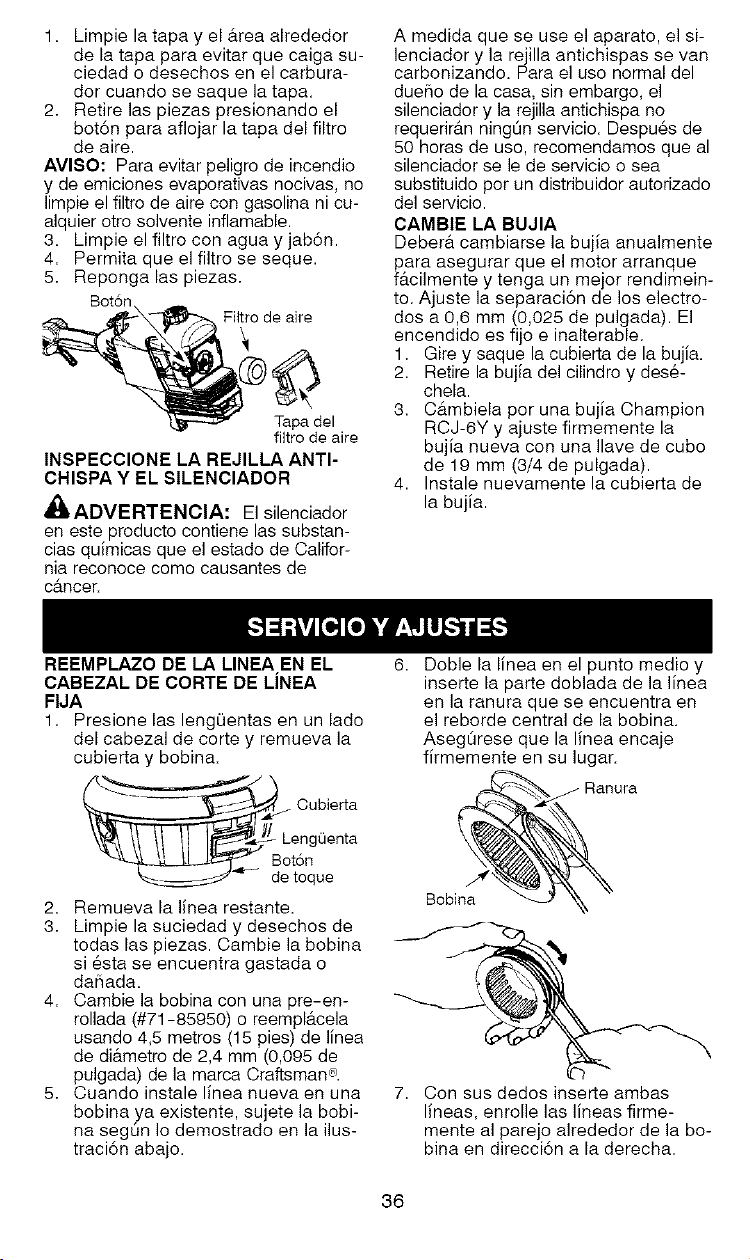
1. Limpie la tapa y el &tea alrededor
de la tapa para evitar que caiga su-
ciedad o desechos en el carbura-
dor cuando se saque la tapa.
2. Retire las piezas presionando el
bot6n para aflojar la tapa del filtro
de aire.
AVlSO: Para evitar peligro de incendio
y de emiciones evaporativas nocivas, no
limpie el filtro de aire con gasolina ni cu-
alquier otro solvente inflamable.
3. Limpie el filtro con agua y jab6n.
4. Permita que el filtro se seque.
5. Reponga las piezas.
Bot6n
Filtro de aire
t!
Tapadel
filtro de aire
INSPECCIONE LA REJILLA ANTI-
CHISPA Y EL SILENCIADOR
ADVERTENCIA: El silenciador
en este producto contiene las subetan-
cias quimicas que el estado de Califor-
nia reconoce come causantes de
c&ncer.
A medida que se use el aparato, el si-
lenciador y la rejilla antichispas se van
carbonizando. Para el use normal del
dueSo de la casa, sin embargo, el
silenciador y la rejilla antichispa no
requerir&n ningOn servicio. Despues de
50 horas de use, recomendamos que al
silenciador se le de servicio o sea
substituido por un distribuidor autorizado
del servicio.
CAMBIE LA BUJIA
Deber& cambiarse la bujia anualmente
para asegurar que el motor arranque
f&cilmente y tenga un mejor rendimein-
to. Ajuste la separaci6n de los electro-
dos a 0,6 mm (0,025 de pulgada). El
encendido es fijo e inalterable.
1. Gire y saque la cubierta de la bujia.
2. Retire la bujia del cilindro y des6-
chela.
3. C&mbiela por una bujia Champion
RCJ-6Y y ajuste firmemente la
bujia nueva con una Ilave de cubo
de 19 mm (3/4 de pulgada).
4. Instale nuevamente la cubierta de
la bujia.
REEMPLAZO DE LA LINEA EN EL
CABEZAL DE CORTE DE LINEA
FIJA
1. Presione las lengLientas en un lade
del cabezal de corte y remueva la
cubierta y bobina.
Cubierta
LengOenta
de toque
2. Remueva la linea restante.
3. Limpie la suciedad y desechos de
todas las piezas. Cambie la bobina
si 6sta se encuentra gastada o
daSada.
4. Cambie la bobina con una pre-en-
rollada (#71-85950) o reempl&cela
usando 4,5 metros (15 pies) de linea
de diametro de 2,4 mm (0,095 de
pulgada) de la marca Craftsman®.
5. Cuando instale linea nueva en una
bobina ya existente, sujete la bobi-
na segOn Io demostrado en la ilus-
traci6n abajo.
6. Doble la finea en el punto medio y
inserte la parte doblada de la linea
en la ranura que se encuentra en
el reborde central de la bobina.
AsegOrese que la linea encaje
firmemente en su lugar.
Ranura
Bobina
7. Con sus dedos inserte ambas
lineas, enrolle las lineas firme-
mente al parejo alrededor de la bo-
bina en direcci6n a la derecha.
36
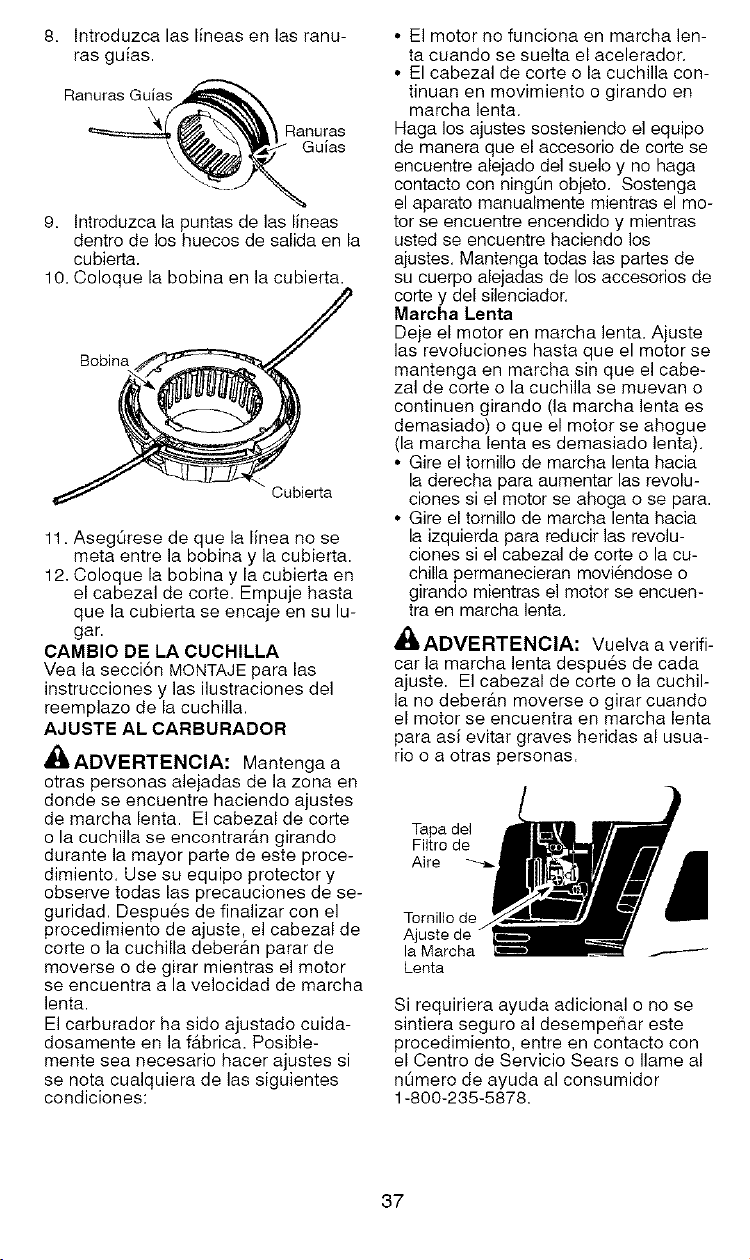
8. Introduzca las lineas en las ranu-
ras guias.
Ranuras Guias
aanuras
Guias
9. Introduzca la puntas de las lineas
dentro de los huecos de salida en la
cubierta.
10. Coloque la bobina en la cubierta.
Bobina
Cubierta
11. Aseg0rese de que la linea no se
meta entre la bobina y la cubierta.
12. Coloque la bobina y la cubierta en
el cabezal de corte. Empuje hasta
que la cubierta se encaje en su lu-
gar.
CAMBIO DE LA CUCHILLA
Yea la secci6n MONTAJE para las
instrucciones y las ilustraciones del
reemplazo de la cuchilla.
AJUSTE AL CARBURADOR
A(_ADVERTENCIA: Mantenga a
otras personas alejadas de la zona en
donde se encuentre haciendo ajustes
de marcha lenta. El cabezal de corte
o la cuchilla se encontrar&n girando
durante la mayor parte de este proce-
dimiento. Use su equipo protector y
observe todas las precauciones de se-
guridad. Despu6s de finalizar con el
procedimiento de ajuste, el cabezal de
corte o la cuchilla deber&n parar de
moverse o de girar mientras el motor
se encuentra a la velocidad de marcha
lenta.
El carburador ha sido ajustado cuida-
dosamente en la f&brica. Posible-
mente sea necesario hacer ajustes si
se nota cualquiera de las siguientes
condiciones:
• El motor no funciona en marcha len-
ta cuando se suelta el acelerador.
• El cabezal de corte o la cuchilla con-
tinuan en movimiento o girando en
marcha lenta.
Haga los ajustes sosteniendo el equipo
de manera que el accesorio de corte se
encuentre alejado del suelo y no haga
contacto con ningOn objeto. Sostenga
el aparato manualmente mientras el mo-
tor se encuentre encendido y mientras
usted se encuentre haciendo los
ajustes. Mantenga todas las partes de
su cuerpo alejadas de los accesorios de
corte y del silenciador.
Marcha Lenta
Deje el motor en marcha lenta. Ajuste
las revoluciones hasta que el motor se
mantenga en marcha sin que el cabe-
zal de corte o la cuchilla se muevan o
continuen girando (la marcha lenta es
demasiado) o que el motor se ahogue
(la marcha lenta es demasiado lenta).
• Gire el tomillo de marcha lenta hacia
la derecha para aumentar las revolu-
ciones si el motor se ahoga o se para.
• Gire el tornillo de marcha lenta hacia
la izquierda para reducir las revolu-
ciones si el cabezal de corte o la cu-
chilla permanecieran movi_ndose o
girando mientras el motor se encuen-
tra en marcha lenta.
_,ADVERTENCIA: Vuelva a verifi-
car la marcha lenta deepu6s de cada
ajuste. El cabezal de corte o la cuchil-
la no deber&n moveree o girar cuando
el motor se encuentra en marcha lenta
para asi evitar graves heridas al usua-
rio o a otras personas.
Tapa de1
Filtro de
Aire
Tornillo de
Ajuste de
la Marcha
Lenta
Si requiriera ayuda adicional o no se
sintiera seguro al desempeSar este
procedimiento, entre en contacto con
el Centro de Servicio Sears o Ilame al
nOmero de ayuda al consumidor
1-800-235-5878.
37
_IADVERTENClA: Realice los
siguientes pasos despu6s de cada
USO:
• Permita que el motor se enfrie antes
de guardado o transportarlo.
• Guarde el aparato y el combustible en
un lugar bien ventilado donde los va-
pores del combustible no puedan en-
trar en contacto con chispas ni llamas
abiertas provenientes de clentadores
de agua, motores o interrputores el6c-
tricos, calefactores centrales, etc.
• Guarde el aparato con todos los pro-
tectores en su lugar y coloquelo de
modo que las piezas cortantes no
puedan causar heridas por accidente.
• Guarde el aparato y el combustible
en un lugar completamente fuera del
alcance de los niSos.
ESTACIONAL ALMACENAJE
Prepare el aparato para almacenarlo
al final de la temporada o si no Io va a
usar por m&s de 30 dias.
Siva a almacenar el aparato durante
un periodo largo de tiempo:
• Limpie el aparato por completo antes
del almacenaje.
• Almacene en un &rea limpia y seca.
• Aplique una pequeSa cantidad de
aceite a las superficies extemas
met&licas.
SlSTEMA DE COMBUSTIBLE
Vacie el sistema de combustible antes
de almacenar el aparato por 30 dias o
m&s. Vacie el tanque de combustible,
ponga el motor en marcha y dejelo en
marcha hasta que las lineas de com-
bustible y el carburador est6n vacios.
Use combustible fresco para la pr6xi-
ma temporada.
Yea el mensaje marcado como
IMPORTANTE, que se refiere al uso
de combustibles con mezcla de alco-
hol en su aparato, en la secci6n de
uso, bajo ABASTECIMIENTO DEL MO-
TOR.
Los estabilizadores de combustible
son una alternativa aceptable para
minimizar la formaci6n de dep6sitos
de goma durante el almacenaje.
A_ada estabilizador a la gasolina en el
tanque de combustible o en el reci-
piente para almacenar el mismo. Siga
las instrucciones de mezcla que se en-
cuentran impresas en el envase. Pon-
ga el motor en marcha y d6jelo en
marcha por unos 3 minutos despu_s
de haberle puesto estabilizador.
El aceite Craftsman 40:1 para motores
a 2 tiempos (enfriados a aire) viene
mezclado con estabilizador de com-
bustible. Si no usa este aceite de
Sears, usted podr& aSadir estabiliza-
dor al tanque de combustible.
MOTOR
• Retire la bujia y vierta una cucharad-
ita de aceite 40:1 para motores a 2
tiempos (enfriados a aire) por la ab-
ertura para la bujia. Lentamente, tire
de la cuerda de arranque de 8 a 10
veces para distribuir el aceite.
• Cambie la bujia por una nueva del
tipo y de la gama de calor recomen-
dados.
• Limpie el filtro de aire.
• Examine todo el aparato para verificar
que no haya tornillos, tuercas ni per-
nos sueltos. Cambie todas la piezas
da_adas, quebradas o gastadas.
• AI principio de la pr6xima temporada,
use exclusivamente combustible
fresco con la proporci6n correcta de
gasolina a aceite.
OTROS
• No guarde la gasolina de una tempo-
rada a la pr6xima.
• Cambie el recipiente de gasolina si
se empieza a oxidar.
38
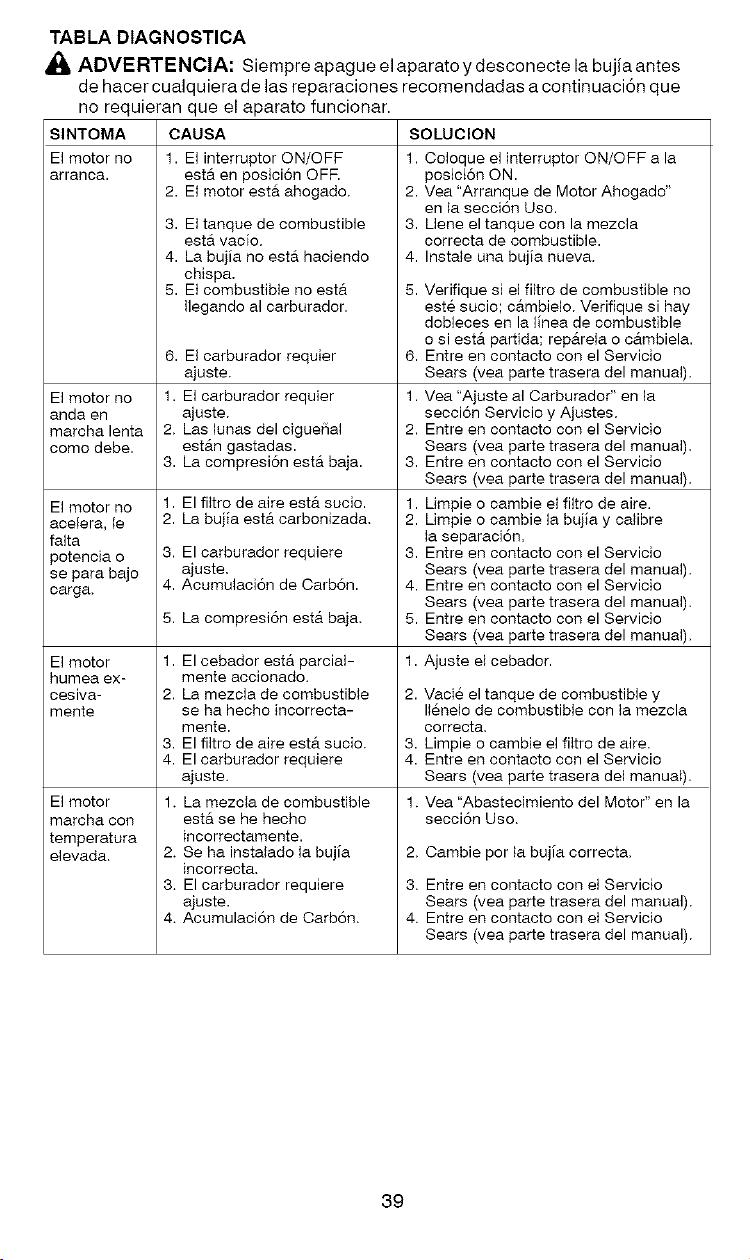
TABLA DIAGNOSTICA
ADVERTENCIA: Siempre apague el aparato y desconecte la bujia antes
de hacer cualquiera de las reparacionee recomendadas a continuaci6n que
SINTOMA
El motor no
arranca.
El motor no
anda en
maroha lenta
como debe.
El motor no
acelera, le
falta
potencia o
se para bajo
carga.
EI motor
humea ex-
cesiva-
mente
El motor
maroha con
temperatura
elevada.
no requieran que el aparato funcionar.
CAUSA
1. El interruptor ON/OFF
estA en posici6n OFF.
2. EI motor esta ahogado,
3. El tanque de combustible
estA vacio.
4. La bujia no estA haciendo
chispa.
5. Et combustible no est&.
Ilegando al carburador.
6. El carburador requier
ajuste.
1. El carburador requier
ajuste.
2. Las lunas del cigueflal
estan gastadas.
3. La compresi6n esta baja.
1. El filtro de aire est#t sucio.
2. La bujia est#. carbonizada.
3. El carburador requiere
ajuste.
4. Acumulaci6n de Carb6n.
5. La compresi6n estA baja.
1. El cebador estA parciaF
mente accionado.
2. La mezcla de combustible
se ha hecho incorrecta-
mente.
3. El filtro de aire est#t sucio.
4. El carburador requiere
ajuste.
1. La mezcla de combustible
esta se he hecho
incorreotamente.
2. Se ha instalado la bujia
incorreota.
3. El carburador requiere
ajuste.
4. Acumulaci6n de Carbon.
SOLUCION
1. Coloque el interruptor ON/OFF a la
posici6n ON.
2. Yea "Arranque de Motor Ahogado"
en ta secci6n Uso.
3. Uene el tanque con la mezcla
correcta de combustible.
4. Instale una bujia nueva.
5. Verifique si el fittro de combustible no
este sucio; cambielo. Verifique si hay
dobleces en la linea de combustible
o si est#t partida; reparela o c_tmbiela.
6. Entre en contacto con el Servicio
Sears (vea parte trasera del manual).
1. Vea "Ajuste al Carburador" en la
secci6n Servicio y Ajustes.
2. Entre en contacto con el Servicio
Sears (vea parte trasera del manual).
3. Entre en contacto con el Servicio
Sears (vea parte trasera del manual).
1. Umpie o cambie et filtro de aire.
2. Umpie o cambie la bujia y calibre
la separaci6n.
3. Entre en contacto con el Servicio
Sears (vea parte trasera del manual).
4. Entre en contacto con el Servicio
Sears (vea parte trasera del manual).
5. Entre en contacto con el Servicio
Sears (vea parte trasera del manual).
1. Ajuste el cebador.
2. Vacie el tanque de combustible y
Ilenelo de combustible con la mezcla
oorreota.
3. Limpie o cambie el fiitro de aire.
4. Entre en contacto con el Servicio
Sears (vea parte trasera del manual).
1. Vea "Abastecimiento del Motor" en la
secci6n Uso.
2. Cambie por la bujia correct&
3. Entre en contacto con et Servicio
Sears (vea parte trasera del manual).
4. Entre en contacto con et Servicio
Sears (vea parte trasera del manual).
39
SUS DERECHOS Y OBLIGACIONES
DE GARANTIA: La Agencia de Pro-
tecci6n Ambiental de los Estados Uni-
dos, la Junta de Recursos Ambien-
tales de California y Sears, Roebuck
and Co., U.S.A., se complacen en ex-
plicar la garantia con la que cuenta el
sistema de control de emisi6n en su
motor pequeflo, modelo 2005 y m&s
adelante, para uso fuera de carretera.
En California, todos los motores pe-
queflos para uso fuera de carretera
deben ser diseflados, construidos y
equipados para satisfacer las riguro-
sas normas antihumo que posee el es-
tado. Sears deber& garantizar el siste-
ma de control de emisi6n en su
m&quina de motor pequeflo para uso
fuera de carretera por los periodos de
tiempo que explicamos a continuaci6n
y con la condici6n de que su m&quina
de motor pequeflo para uso fuera de
carretera no haya sufrido ningQn tipo
de abuso, negligencia o mantenimien-
to inapropiado. Su sistema de control
de emision incluye piezas tales como
el carburador y el sistema de ignici6n.
Donde exista una condici6n que re-
quiera reparaci6n bajo garantia, Sears
reparar& gratis su motor pequeflo para
uso fuera de carretera. Los gatos cu-
biertos bajo la garantia incluyen el
diagn6stico, las piezas y labor. OU-
BIERTA DE GARANTIA DEL FABRI-
CANTE: Si cualquier pieza relaciona-
da con el sistema de emisi6n de su
motor (como hemos enumerado en la
lista de piezas de control de emisi6n
bajo garantia) se encontrara defectuo-
sa o defectos en el material o en la la-
bor del motor causaran que tal pieza
comenzara a fallar, la pieza set& repa-
rada o reemplazada por Sears. GA-
RANTIA DE RESPONSABILIDAD DE
DEL DUEI_IO: Como dueiho de una
mAquina de motor pequeflo para uso
fuera de carretera, usted ser& re-
sponsable por el mantenimiento ade-
cuado en los periodos previamente
programados y enumerados en su
manual del usuario. Sears recomienda
que guarde todos los recibos que indi-
quen que se ha desempeflado man-
tenimiento en su m&quina de motor
pequeiho para uso fuera de carretera,
pero Sears no podrA negar el servicio
bajo garantia 0nicamente a causa de
la falta de recibos o por el incumpli-
miento de su parte en asegurarse que
el mantenimiento programado haya
sido desempeflado. Como due_o de
una m&quina de motor peque_o para
uso fuera de carretera, usted deber&
contar con el conocimiento de que
Sears puede negar la cubierta bajo
garantla si su maquina de motor pe-
queflo para uso fuera de carretera o
alguna pieza de la misma ha dejado
de funcionar debido al abuso, negli-
gencia, mantenimiento inapropiado,
modificaciones no aprobadas o el uso
de piezas que no hayan sido fabrica-
das o aprobadas por el fabricante orig-
inal del equipo. Es responsabilidad
suya el Ilevar su m&quina de motor pe-
queflo para uso fuera de carretera a
un centro de reparaci6n autorizado
Sears tan pronto como se presente el
problema. Las reparaciones bajo ga-
rantia deber&n ser completadas en un
periodo de tiempo razonable, que no
exceda los 30 dias. Si cuenta usted
con alguna pregunta en relaci6n a sus
derechos y responsabilidades de ga-
rantia, usted deber& comunicarse con
su centro de servicio autorizado m&s
cercano o Ilamar a Sears al
1-800-469-4663.
FECHA DEL COMIENZA DE LA GA-
RANTIA: El periodo de garantia com-
ienza en la fecha de compra de la
m&quina de motor pequePio para uso
fuera de carretera. DURACION DE LA
GARANTIA: Esta garantia cuenta con
un periodo de duraci6n de dos aflos
comenzando en la fecha inicial de
compra. QUE CUBRE LA GARAN-
TIA: REPARACION O REEMPLAZO
DE PIEZAS. La reparaci6n o el reem-
plazo de cualquier pieza garantizada
serAn desempeflados y ofrecidos al
dueflo sin costo alguno en un Centro
de Servicio Sears. Si cuenta usted
con alguna pregunta en relaci6n a sus
derechos y responsabilidades de ga-
rantia, usted deberA comunicarse con
su centro de servicio autorizado m&s
cercano o Ilamar a Sears al
1-800-469-4663, PERIODO DE GA-
RANTIA: Cualquier pieza garantizada
que no est6 programada para ser re-
emplazada como parte del mantenimi-
ento requerido, o que est6 programa-
da 0nicamente para inspecci6n regular
para efectos de "reparaci6n o reempla-
zo si fuera necesario" deber& garanti-
zarse por un periodo de dos aflos.
Cualquier pieza garantizada que est6
4O
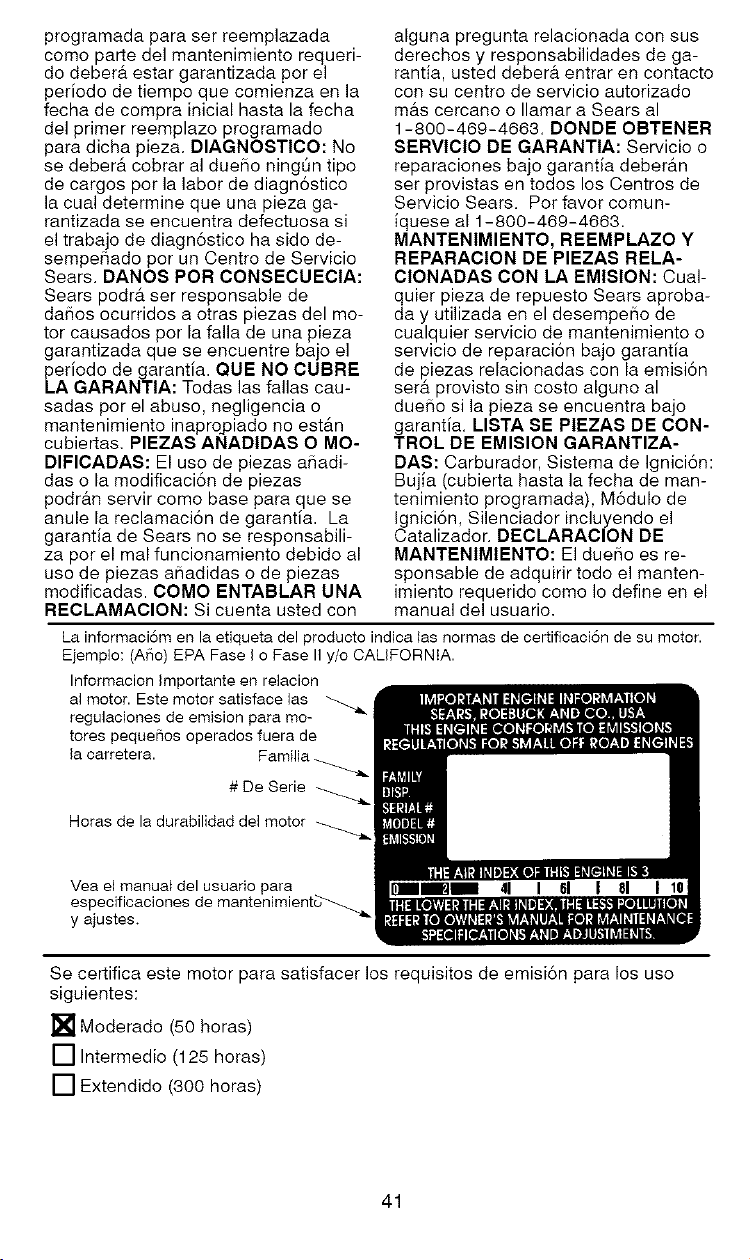
programadaparaserreemplazada
comopartedelmantenimientorequeri-
dodeber_,estargarantizadaporel
periododetiempoquecomienzaenla
fechadecomprainicialhastalafecha
delprimerreemplazoprogramado
paradichapieza.DIAGNOSTICO:No
sedeber&cobraralduefioningOntipo
decargospotlalabordediagn6stico
lacualdeterminequeunapiezaga-
rantizadaseencuentradefectuosasi
eltrabajodediagn6sticohasidede-
sempefiadoporunCentrodeServicio
Sears.DANOSPORCONSECUEClA:
Searspodr&serresponsablede
daiiosocurridosaotraspiezasdelmo-
torcausadosporlafalladeunapieza
garantizadaqueseencuentrebajoel
periododegarantia.QUENOCUBRE
LAGARANTIA:Todaslasfallascau-
sadasporelabuse,negligenciao
mantenimientoinaproj3iadonoest&n
cubiertas.PIEZASANADIDASOMO-
DIFICADAS:Elusodepiezasafiadi-
dasolamodificaci6ndepiezas
podr_tnservircomobaseparaquese
anulelareclamaci6ndegarantia.La
garantiadeSearsnoseresponsabili-
zapotelmalfuncionamientodebidoal
usedepiezasafiadidasodepiezas
modificadas.COMOENTABLARUNA
RECLAMACION:Sicuentaustedcon
algunapreguntarelacionadaconsus
derechosyresponsabilidadesdega-
rantia,usteddeber_,entrarencontacto
consucentrodeservicioautorizado
m_tscercanooIlamaraSearsal
1-800-469-4663.DONDE OBTENER
SERVICIO DE GARANTIA: Servicio o
reparaciones bajo garantia deber_tn
ser provistas en todos los Centros de
Servicio Sears. Por favor comun-
iquese al 1-800-469-4663.
MANTENIMIENTO, REEMPLAZO Y
REPARACION DE PIEZAS RELA-
CIONADAS CON LA EMISlON: Cual-
quier pieza de repuesto Sears aproba-
day utilizada en el desempefio de
cualquier servicio de mantenimiento o
servicio de reparaci6n bajo garantia
de piezas relacionadas con la emisi6n
ser_. provisto sin costo alguno al
dueflo si la pieza se encuentra bajo
garantia. LISTA SE PIEZAS DE CON-
TROL DE EMISlON GARANTIZA-
DAS: Carburador, Sistema de Ignici6n:
Bujia (cubierta hasta la fecha de man-
tenimiento programada), M6dulo de
Ignici6n, Silenciador incluyendo el
Catalizador. DECLARAClON DE
MANTENIMIENTO: El duefio es re-
sponsable de adquirir todo el manten-
imiento requerido como Io define en el
manual del usuario.
La informaciom en la etiqueta del producto indica las normas de certificaci6n de su motor.
Ejemplo: (Ai_o) EPA Fase I o Fase II y/o CALIFORNIA.
Informacion Importante en relacion
al motor. Este motor satisface las
regulaciones de emision para mo-
tores peque[_os operados fuera de
la carretera. Familia
# De Serie
Horas de la durabilidad del motor
Vea el manual del usuario para
especificaciones de mantenimientu-"---.
y ajustes.
41 1 61 1 81 I
Se certifica este motor para satisfacer los requisites de emisi6n para los uso
siguientes:
[] Moderado (50 horas)
[] Intermedio (125 horas)
[] Extendido (300 horas)
41