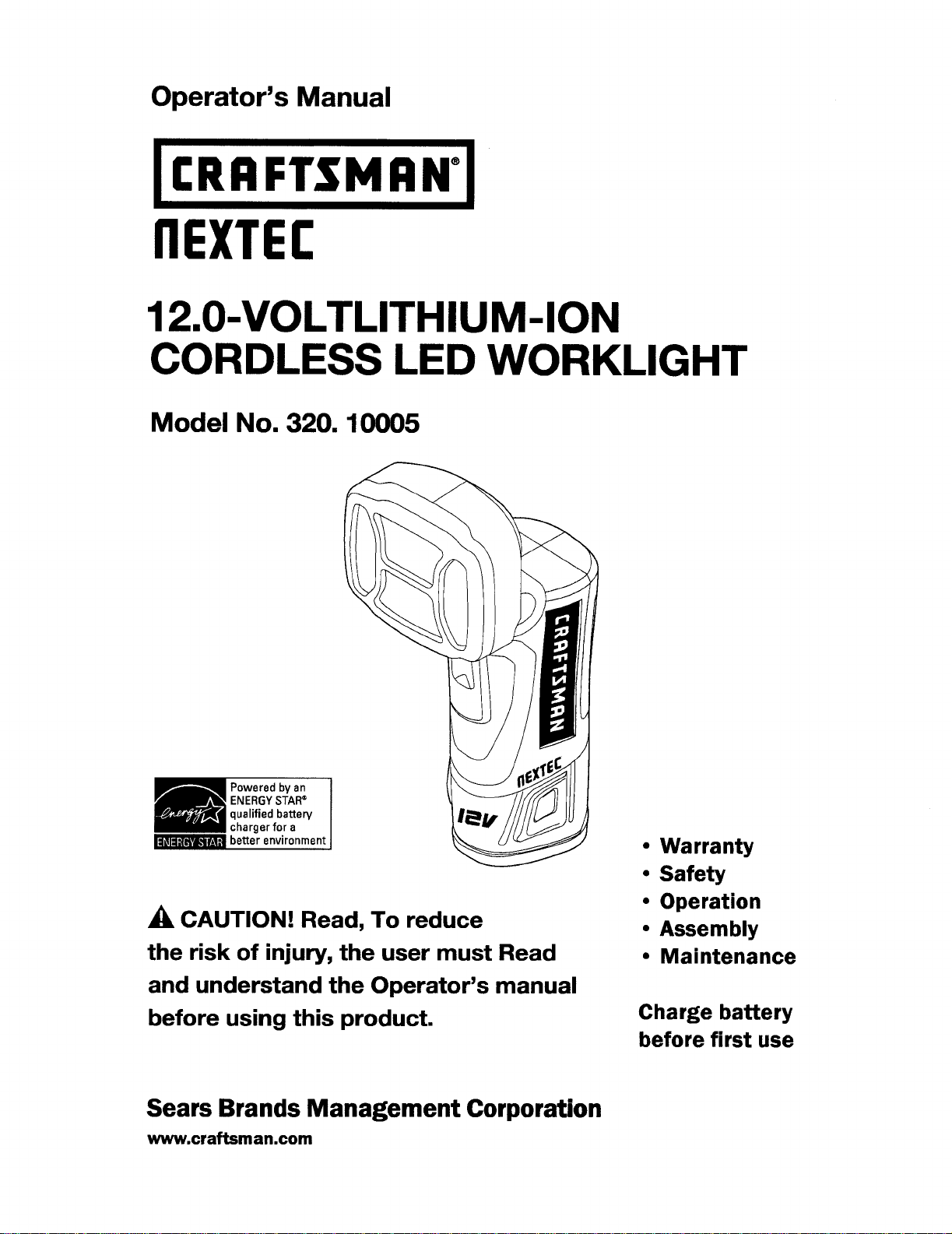
Operator's Manual
II:RRFTSMRN°I
flEXTEC
12.0-VOLTLITHIUM-ION
CORDLESS LED WORKLIGHT
Model No. 320. 10005
Powered byan I
ENERGYSTAR®
I
qualified battery
chargerfor a
II_I=I=IW_qlIM:!better environment
CAUTION! Read, To reduce
the risk of injury, the user must Read
and understand the Operator's manual
before using this product.
• Warranty
• Safety
• Operation
• Assembly
• Maintenance
Charge battery
before first use
Sears Brands Management Corporation
www.craftsman.com
Warranty Page 2
Safety Symbols Page 3
Safety Instructions Page 5-12
Description Page 12-13
Assembly Page 14
Operation Page 14-18
Maintenance Page 19-20
Exploded View and Parts List Page 20-21
Sears Repair Parts Phone Number Back Cover
ONE YEAR FULL WARRANTY ON CRAFTSMAN® TOOL
If this Craftsman tool fails to give complete satisfaction within one year
from the date of purchase, return it to any Sears store or Parts & Repair
Center or other Craftsman outlet in the United States for free repair (or
replacement, if repair proves impossible).
This warranty does not include expendable parts such as lamps,
batteries, bits, or blades.
This warranty applies for only 90 days from the date of purchase if this
product is ever used for commercial or rental purposes.
This warranty gives you specific legal rights, and you may also have
other rights which vary from state to state.
Sears, Roebuck and Co., Hoffman Estates IL 60179
INTRODUCTION
SAVE THESE INSTRUClONS!
,_ WARNING: This LED Worklight has many features for making its use more
pleasant and enjoyable. Safety, performance, and dependability have been
given top priority in the design of this product, making it easy to maintain
and operate.
10005 Manual_Revised_08-0724 Page 2
The purpose of safety symbols is to attract your attention to possible dangers.
The safety symbols and the explanations with them deserve your careful
attention and understanding. The symbol warnings do not, by themselves,
eliminate any danger. The instructions and warnings they give are no substitutes
for proper accident prevention measures.
,_ WARNING: BE SURE to read and understand all safety instructions in this
manual, including all safety alert symbols such as "DANGER," "WARNING,"
and "CAUTION," before using this tool stand. Failure to following all instructions
listed below may result in electric shock, fire, and/or serious personal injury.
SYMBOL SIGNAL MEANING
DANGER: Indicates an imminently hazardous situation, which, if not
avoided, will result in death or serious injury.
WARNING: Indicates a potentially hazardous situation, which, if not avoided,
could result in death or serious injury.
_I_ CAUTION: Indicates an imminently hazardous situation, which, if not
avoided, may result in death or serious injury.
NOTE: (Without Safety Alert Symbol) Indicates a situation that may result in
property damage.
_I_ WARNING: To ensure safety and reliability, all repairs should be performed
by a qualified service technician at Sears Service Center.
,_ WARNING: The operation of any power tool can result in
foreign objects being thrown into your eyes, which can result
in severe eye damage. Before beginning power tool operation,
always wear safety goggles or safety glasses with side shield
and a full face shield when needed. We recommend a Wide
Vision Safety Mask for use over eyeglasses or standard safety
glasses with side shields. Always use eye protection which is
marked to comply with ANSI Z87.1.
SAVE THESE INSTRUClONS
Some of the following symbols may be used on this tool. Please study them
and learn their meaning. Proper interpretation of these symbols will allow you to
operate the tool better and more safely.
10005 Manual_Revised_08-0724 Page 3
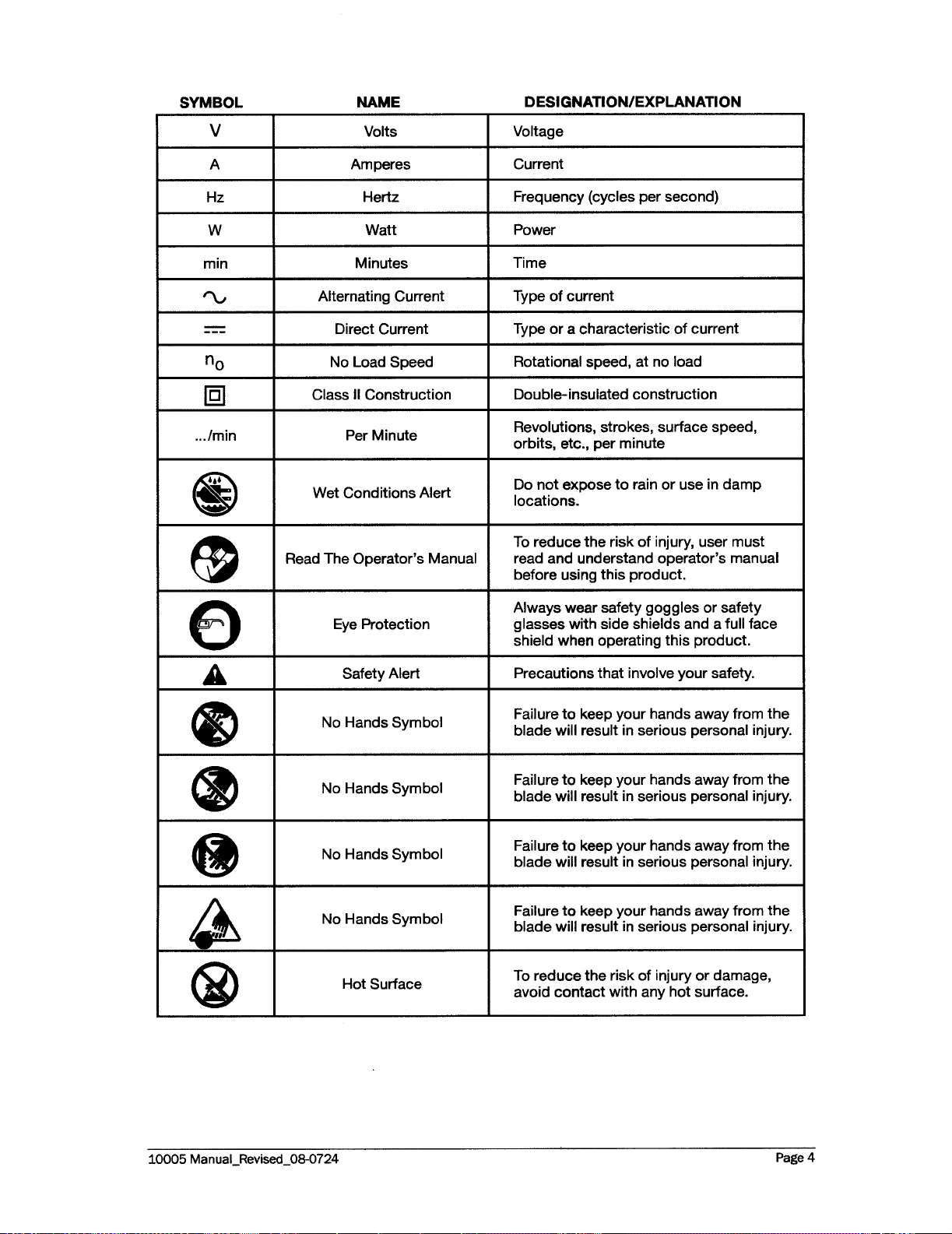
SYMBOL NAME DESIGNATION/EXPLANATION
V Volts Voltage
A Amperes Current
Hz Hertz Frequency(cycles per second)
W Watt Power
min Minutes Time
AlternatingCurrent Type of current
----'= Direct Current Type or a characteristic of current
n O No Load Speed Rotational speed, at no load
r_ Class II construction Double-insulated construction
.../min Per Minute Revolutions,strokes, surface speed,
orbits, etc., per minute
_) Do not expose to rainor use in damp
Wet Conditions Alert locations.
To reduce the risk of injury, user must
Read The Operator's Manual read and understand operator's manual
before usingthis product.
O Always wear safety goggles or safety
Eye Protection glasses with side shields and a fullface
shield when operating this product.
_, Alert Precautionsthat involve safety.
Safety your
_ No Hands Symbol Failureto keep your handsaway from the
blade will result in serious personal injury.
_ No Hands Failure to keep your hands away from the
Symbol
blade will result in serious personal injury.
No Hands Symbol Failure to keep your hands away from the
blade will result in serious personal injury.
Failureto keep your hands away from the
No Hands Symbol blade will resultin serious personal injury.
(_ Hot Surface To reduce the risk of injuryor damage,avoidcontact with any hot surface.
10005 Manual_Revised_08-0724 Page 4
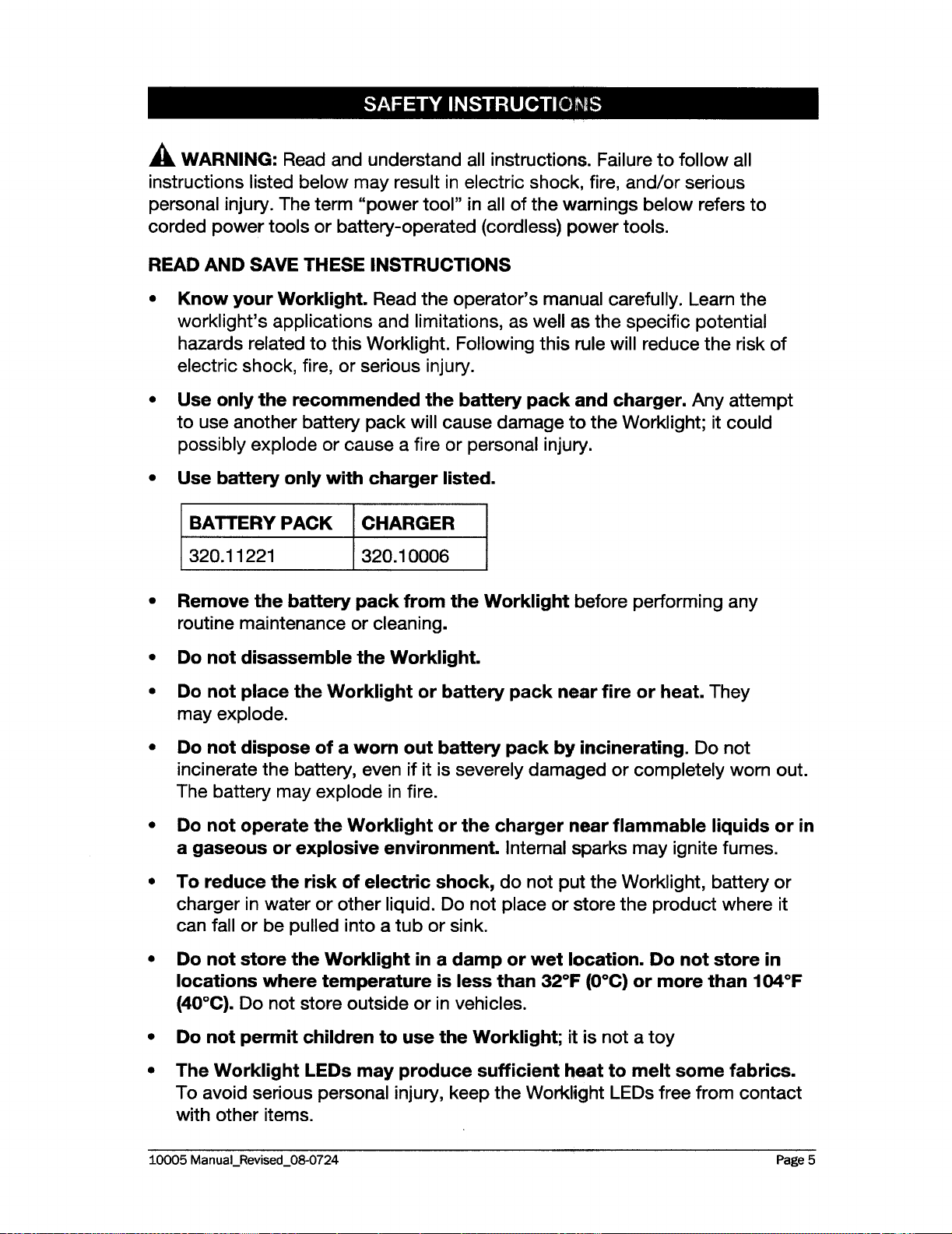
_I, WARNING: Read and understand all instructions. Failure to follow all
instructions listed below may result in electric shock, fire, and/or serious
personal injury. The term "power tool" in all of the warnings below refers to
corded power tools or battery-operated (cordless) power tools.
READ AND SAVE THESE INSTRUCTIONS
Know your Worklight. Read the operator's manual carefully. Learn the
worklight's applications and limitations, as well as the specific potential
hazards related to this Worklight. Following this rule will reduce the risk of
electric shock, fire, or serious injury.
Use only the recommended the battery pack and charger. Any attempt
to use another battery pack will cause damage to the Worklight; it could
possibly explode or cause a fire or personal injury.
Use battery only with charger listed.
BATTERY PACK CHARGER
320.11221 320.10006
Remove the battery pack from the Worklight before performing any
routine maintenance or cleaning.
Do not disassemble the Worklight.
Do not place the Worklight or battery pack near fire or heat. They
may explode.
Do not dispose of a worn out battery pack by incinerating. Do not
incinerate the battery, even if it is severely damaged or completely worn out.
The battery may explode in fire.
Do not operate the Worklight or the charger near flammable liquids or in
a gaseous or explosive environment. Internal sparks may ignite fumes.
To reduce the risk of electric shock, do not put the Worklight, battery or
charger in water or other liquid. Do not place or store the product where it
can fall or be pulled into a tub or sink.
Do not store the Worklight in a damp or wet location. Do not store in
locations where temperature is less than 32°F (0°C) or more than 104°F
(40°C). Do not store outside or in vehicles.
Do not permit children to use the Worklight; it is not a toy
The Worklight LEDs may produce sufficient heat to melt some fabrics.
To avoid serious personal injury, keep the Worklight LEDs free from contact
with other items.
10005 Manual_Revised_08-0724 Page 5

Keep the Worklight dry, clean and free from oiil and grease. Always use
a clean cloth when cleaning. Never use brake fluids, gasoline, petroleum-
based products, or any strong solvent to clean the Worklight.
Do not expose the Worklight to rain or wet conditions. Water entering the
Worklight will increase the risk of electric shock.
ELECTRICAL SAFETY
Avoid body contact with grounded surfaces, such as pipes, radiators,
ranges, and refrigerators. There is an increased risk of electric shock if your
body is grounded.
Power tool plugs must match the outlet. Never modify the plug in any way.
Do not use any adapter plugs with grounded power tools. Unmodified plugs
and matching outlets will reduce the risk of electric shock.
Do not expose power tools to rain or wet conditions. Water entering a
power tool will increase the risk of electric shock.
Do not abuse the cord. Never use the cord for carrying, pulling, or
unplugging the power tool. Keep the cord away from heat, oil, sharp edge, or
moving parts. Damaged or entangled cords increase the risk of electric shock.
When operating a power tool outdoors, use an extension cord suitable
for outdoor use. Use of a cord suitable for outdoor use reduces the risk of
electric shock.
PERSONAL SAFETY
Stay alert, watch what you are doing and use common sense when
operating a power tool. Do not use a power tool while you are tired or
under the influence of drugs, alcohol or medication. A moment of inattention
while operating power tools may result in serious personal injury.
Use safety equipment. Always wear eye protection. Safety equipment
such as dust masks, non-skid safety shoes, hard hat or hearing protection
used for appropriate conditions will reduce personal injuries.
Avoid accidental starting. Ensure the switch is in the off position before
plugging in. Carrying power tools with your finger on the switch or plugging
in power tools that have the switch on invites accidents.
Remove any adjusting key or wrench before turning the power tool on. A
wrench or key left attached to a rotating part of the power tool may result in
personal injury.
• Do not overreach. Keep proper footing and balance at all times. This
enables better control of the power tool in unexpected situations.
Dress properly. Do not wear loose clothing or jewelry. Keep your hair,
clothing and gloves away from moving parts. Loose clothes, jewelry or
long hair can be caught in moving parts.
10005 Manual_Revised_08-0724 Page 6
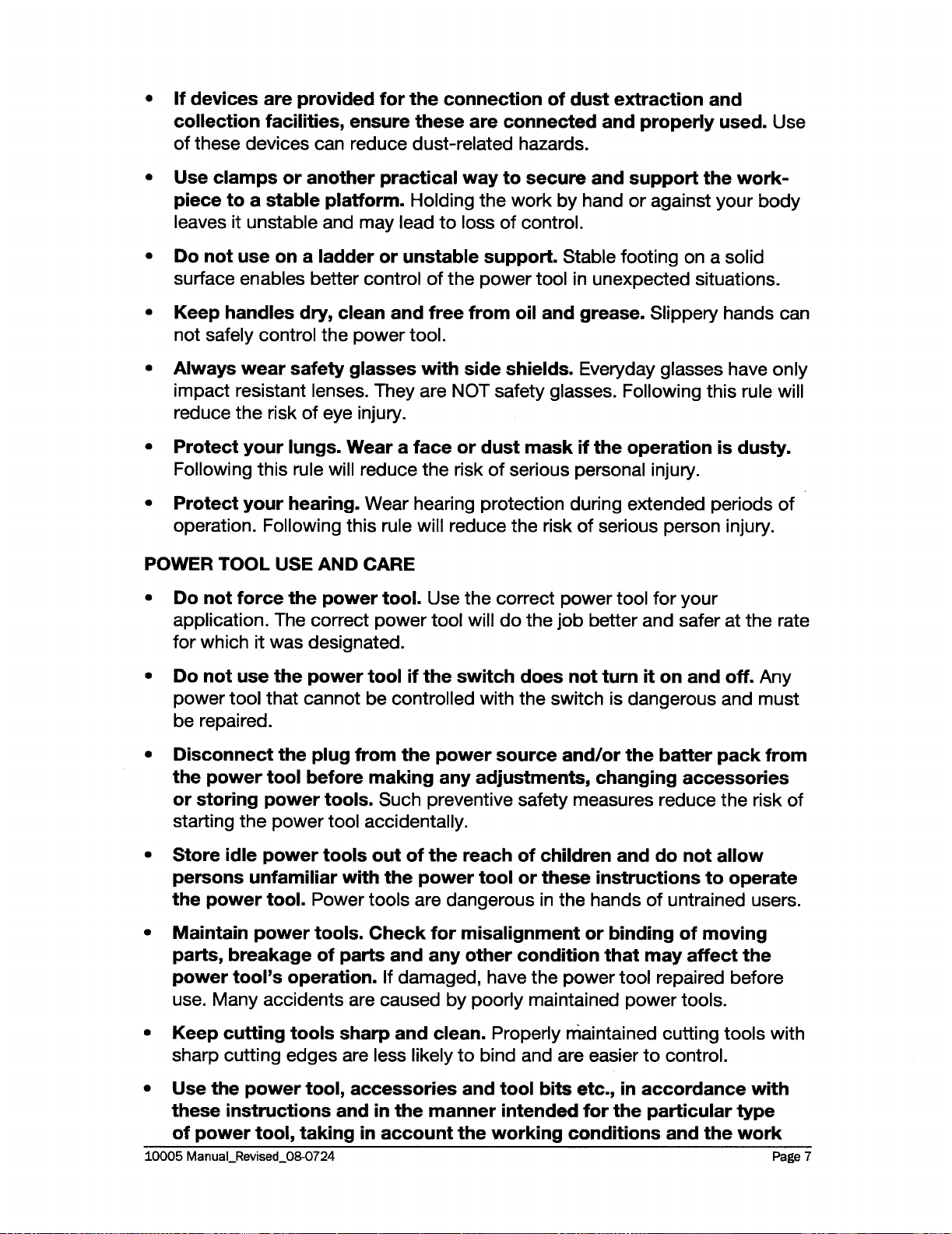
• If devices are provided for the connection of dust extraction and
collection facilities, ensure these are connected and properly used. Use
of these devices can reduce dust-related hazards.
Use clamps or another practical way to secure and support the work-
piece to a stable platform. Holding the work by hand or against your body
leaves it unstable and may lead to loss of control.
Do not use on a ladder or unstable support. Stable footing on a solid
surface enables better control of the power tool in unexpected situations.
Keep handles dry, clean and free from oil and grease. Slippery hands can
not safely control the power tool.
Always wear safety glasses with side shields. Everyday glasses have only
impact resistant lenses. They are NOT safety glasses. Following this rule will
reduce the risk of eye injury.
Protect your lungs. Wear a face or dust mask if the operation is dusty.
Following this rule will reduce the risk of serious personal injury.
Protect your hearing. Wear hearing protection during extended periods of
operation. Following this rule will reduce the risk of serious person injury.
POWER TOOL USE AND CARE
Do not force the power tool. Use the correct power tool for your
application. The correct power tool will do the job better and safer at the rate
for which it was designated.
Do not use the power tool if the switch does not turn it on and off. Any
power tool that cannot be controlled with the switch is dangerous and must
be repaired.
Disconnect the plug from the power source and/or the batter pack from
the power tool before making any adjustments, changing accessories
or storing power tools. Such preventive safety measures reduce the risk of
starting the power tool accidentally.
Store idle power tools out of the reach of children and do not allow
persons unfamiliar with the power tool or these instructions to operate
the power tool. Power tools are dangerous in the hands of untrained users.
Maintain power tools. Check for misalignment or binding of moving
parts, breakage of parts and any other condition that may affect the
power tool's operation. If damaged, have the power tool repaired before
use. Many accidents are caused by poorly maintained power tools.
Keep cutting tools sharp and clean. Properly maintained cutting tools with
sharp cutting edges are less likely to bind and are easier to control.
Use the power tool, accessories and tool bits etc., in accordance with
these instructions and in the manner intended for the particular type
of power tool, taking in account the working conditions and the work
10005 Manual_Revised_08-0724 Page 7
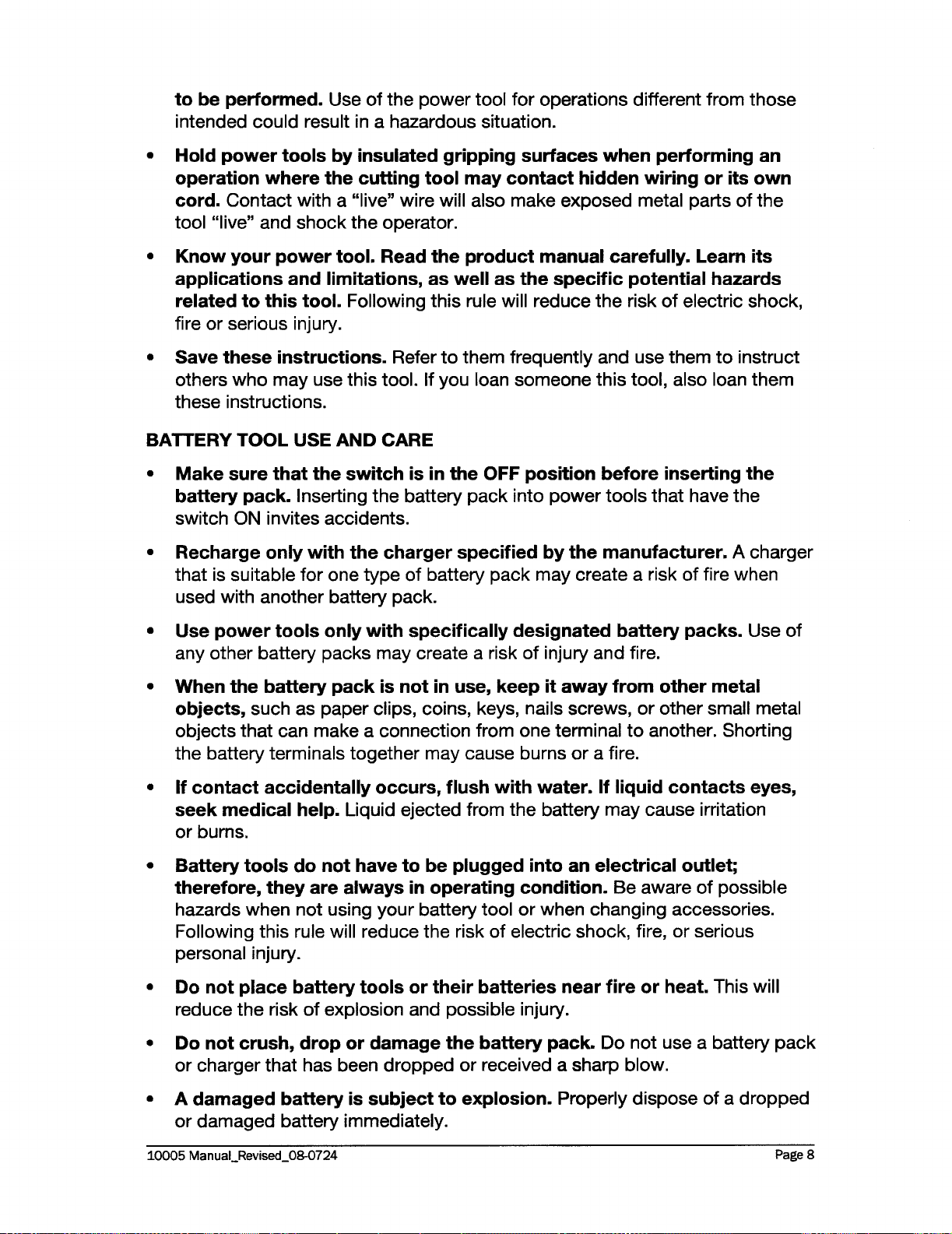
to be performed. Use of the power tool for operations different from those
intended could result in a hazardous situation.
Hold power tools by insulated gripping surfaces when performing an
operation where the cutting tool may contact hidden wiring or its own
cord. Contact with a "live" wire will also make exposed metal parts of the
tool "live" and shock the operator.
Know your power tool. Read the product manual carefully. Learn its
applications and limitations, as well as the specific potential hazards
related to this tool. Following this rule will reduce the risk of electric shock,
fire or serious injury.
Save these instructions. Refer to them frequently and use them to instruct
others who may use this tool. If you loan someone this tool, also loan them
these instructions.
BATTERY TOOL USE AND CARE
• Make sure that the switch is in the OFF position before inserting the
battery pack. Inserting the battery pack into power tools that have the
switch ON invites accidents.
Recharge only with the charger specified by the manufacturer. A charger
that is suitable for one type of battery pack may create a risk of fire when
used with another battery pack.
• Use power tools only with specifically designated battery packs. Use of
any other battery packs may create a risk of injury and fire.
When the battery pack is not in use, keep it away from other metal
objects, such as paper clips, coins, keys, nails screws, or other small metal
objects that can make a connection from one terminal to another. Shorting
the battery terminals together may cause burns or a fire.
• If contact accidentally occurs, flush with water. If liquid contacts eyes,
seek medical help. Liquid ejected from the battery may cause irritation
or burns.
Battery tools do not have to be plugged into an electrical outlet;
therefore, they are always in operating condition. Be aware of possible
hazards when not using your battery tool or when changing accessories.
Following this rule will reduce the risk of electric shock, fire, or serious
personal injury.
• Do not place battery tools or their batteries near fire or heat. This will
reduce the risk of explosion and possible injury.
• Do not crush, drop or damage the battery pack. Do not use a battery pack
or charger that has been dropped or received a sharp blow.
• A damaged battery is subject to explosion. Properly dispose of a dropped
or damaged battery immediately.
10005 Manual Revised_08-0724 Page 8
Batteries vent hydrogen gas and can explode in the presence of a
source of ignition, such as a pilot light. To reduce the risk of serious
personal injury, never use any cordless product in the presence of open
flame. An exploded battery can propel debris and chemicals. If exposed to
such debris or chemicals, immediately flush the exposed area with water.
Do not charge a battery tool in a damp or wet location. Following this rule
will reduce the risk of electric shock.
• Under extreme usage or temperature conditions, battery leakage
may occur.
• If liquid comes in contact with your skin, wash immediately with soap and
water, then neutralize with lemon juice or vinegar.
• If liquid from the battery gets in your eyes, flush them with clean water for
at least 10 minutes, and then seek immediate medical attention. Following
this rule will reduce the risk of serious personal injury.
SERVICE
• Have your worklight serviced by a qualified repair person using only
identical replacement parts. This will ensure that the safety of the worklight
is maintained.
• When servicing the worklight, use only identical replacement parts.
Follow instructions in the Maintenance section of this manual.
WARNING: To reduce the risk of injury, user must read instruction manual.
SPECIFIC SAFETY RULES FOR WORKLIGHT
Know your worklight. Read operator's manual carefully. Learn the
applications and limitations, as well as the specific potential hazards related
to this tool. Following this rule will reduce the risk of electric shock, fire or
serious injury.
Do not stare into the LED worklight directly. Avoid direct eye contact;
never project the worklight to others' eyes. Failure to do so will lead serious
personal injury.
Battery tools do not have to be plugged into an electrical outlet;
therefore, they are always in operating condition. Be aware of
possible hazards when not using your battery tool or when changing
accessories. Following this rule will reduce the risk of electric shock, fire or
serious personal injury.
• Do not place battery tools or their batteries near fire or heat. This will
reduce the risk of explosion and possibly injury.
• Do not crush, drop or damage battery pack. Do not use a battery pack
or charger that has been dropped or received a sharp blow. A damaged
i0005 Manual_Revised_08-0724 Page9
battery is subject to explosion. Properly dispose of a dropped or damaged
battery immediately.
Batteries vent hydrogen gas and can explode in the presence of a
source of ignition such as a pilot light. To reduce the risk of serious
personal injury, never use any cordless product in the presence of open
flame. An exploded battery can propel debris and chemicals. If exposed,
flush with water immediately.
Do not charge battery tool in a damp or wet location. Following this rule
will reduce the risk of electric shock.
For best results, your battery tool should be charged in a location where
the temperature is more than 32°F (0°C) but less than 104°F (40°C).
Do not store outside or in vehicles.
Under extreme usage or temperature conditions, battery leakage may
occur. If liquid comes in contact with your skin, wash immediately with
soap and water, then neutralize with lemon juice or vinegar. If liquid gets
in your eyes, flush them with clean water for at least 10 minutes, then seek
immediate medical attention. Following this rule will reduce the risk of serious
personal injury.
Save these instructions. Refer to them frequently and use them to instruct
others who may use this tool. If you loan someone this tool, also loan them
these instructions.
° If the power supply cord is damaged, it must be replaced only by the
manufacturer or by an authorized service center to avoid risk.
CAUTION! Hot Surface.
Risk of Burns-Do Not Touch.
Risk of Fire-Keep Away From Combustible Materials.
_i, WARNING: Read and understand all instructions. Failure to follow all
instructions listed below may result in electric shock, fire, and/or serious
personal injury.
Before using the battery charger, read all instructions and cautionary
markings in this manual and on the battery charger, the battery and the
product using the battery to prevent misuse of the products and possible
injury or damage.
CAUTION: To reduce the risk of electric shock or damage to the charger
and battery, charge only those lithium-ion rechargeable batteries specifically
designated on your charger's label. Other types of batteries may burst, causing
personal injury or damage.
• Do not use the charger outdoors or expose it to wet or damp conditions.
10005 Manual_Revised_08-0724 Page 10
Q
Water entering the charger will increase the risk of electric shock.
Use of an attachment not recommended or sold by the battery-charger
manufacturer may result in a risk of fire, electric shock or injury
to persons.
Do not abuse the cord or charger. Never use the cord to carry the charger.
Do not pull the charger cord to disconnect the plug from the electrical
receptacle. Damage to the cord or charger could occur and create an electric
shock hazard. Replace damaged cords immediately.
Make sure that the cord is located so that it will not be stepped on,
tripped over, come in contact with sharp edges or moving parts, or
otherwise subjected to damage or stress. This will reduce the risk of
accidental falls, which could cause injury and damage to the cord, which
could then result in electric shock.
Keep the cord and charger from heat to prevent damage to housing or
internal parts.
Do not allow gasoline, oils, petroleum-based products, etc. to come
in contact with plastic parts. These materials contain chemicals that can
damage, weaken, or destroy plastic.
An extension cord should not be used unless absolutely necessary. Use
of an improper extension cord could result in a risk of fire and electric shock.
If an extension cord must be used, make sure that:
The pins on plug of extension cord are the same number, size and shape as
those of the plug on charger.
The cord is properly wired and in good electrical condition
The size is large enough for AC ampere rating of charger as specified below:
The Cord Length (Feet)
Cord Size (AWG)
NOTE: AWG = American Wire Gauge
25' 50' 100'
6 16 16
Do not operate the charger with a damaged cord or plug, which could
cause shorting and electric shock. If damaged, have the charger repaired or
replaced by an authorized service technician at a Sears Service Center.
Do not operate the charger if it has received a sharp blow, been dropped,
or has otherwise been damaged in any way. Take it to an authorized service
technician at Sears Service Center for an electrical check to determine if the
charger is in good working order.
Do not disassemble the charger. Take it to an authorized service
technician at a Sears Service Center when service or repair is required.
Incorrect reassembly may result in a risk of electric shock or fire.
• Unplug the charger from the electrical outlet before attempting any
10005 Manual_Revised_08-0724 Page 11
a)
b)
c)
d)
maintenance or cleaning to reduce the risk of electric shock.
Disconnect the charger from the power supply when not in use. This
will reduce the risk of electric shock or damage to the charger if metal items
should fall into the opening. It will also help prevent damage to the charger
during a power surge.
Risk of electric shock. Do not touch the uninsulated portion of output
connector or uninsulated battery terminal.
Save these instructions. Refer to them frequently and use them to instruct
others who may use this tool. If you lend this tool to someone else, also lend
these instructions to them to prevent misuse of the product and possible injury.
IMPORTANT SAFETY INSTRUCTIONS
Save these instructions. This manual contains important safety and operating
instructions for battery charger 320.10006 and battery pack 320.11221.
Before using the battery charger, read all instructions and cautionary
markings on the battery charger, the battery and the product using battery.
CAUTION. To reduce the risk of injury, charge only lithium-ion rechargeable
batteries. Other types of batteries may burst, causing personal injury
or damage.
WARNING. When using electric appliances, basic precautions should always
be followed, including the following.
To reduce the risk of injury, close supervision is necessary when an
appliance is used near children.
Only use attachments recommended or sold by manufacturer.
Do not use outdoors.
For a portable appliance - To reduce the risk of electrical shock, do not put
Worklight and Battery Pack in water or other liquid. Do not place or store
appliance where or can fall or be pulled into a tub or sink.
KNOW YOUR LED WORKLIGHT (Fig.l)
WARNING: The safe use of this product requires an understanding of the
information on the tool and in this operator's manual as well as knowledge of the
project you are attempting. Before use of this product, familiarize yourself with
all operating features and safety rules.
HANDLE PIVOT
The adjustable head pivots 135°and allows for precise positioning of the
light beam.
10005 Manual_Revised_08-0724 Page 12
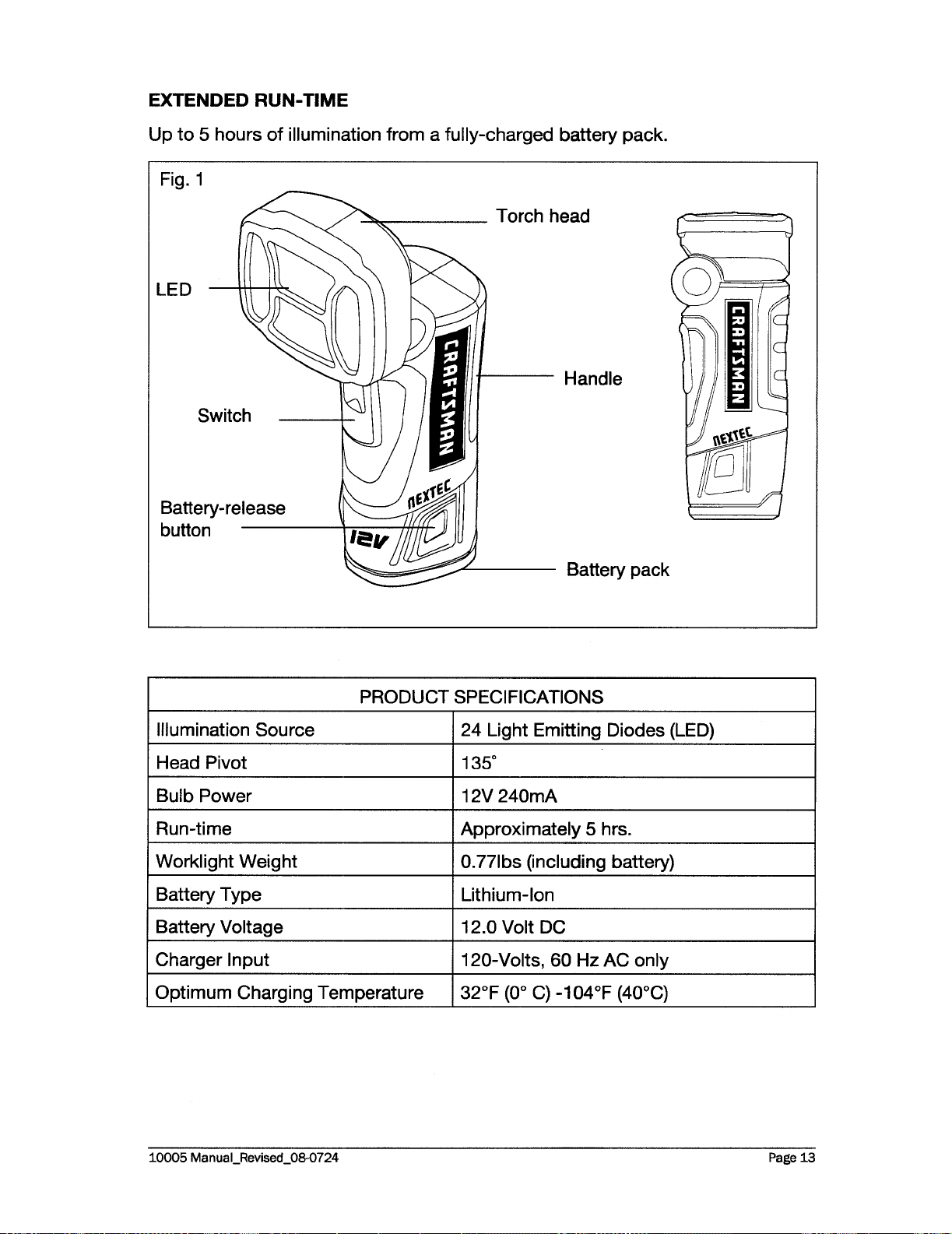
EXTENDED RUN-TIME
Up to 5 hours of illumination from a fully-charged battery pack.
Fig. 1
Torch head
LED
Switch
Handle
Battery-release
button
Battery pack
PRODUCT SPECIFICATIONS
Illumination Source 24 Light Emitting Diodes (LED)
Head Pivot 135 °
Bulb Power 12V 240mA
Run-time Approximately 5 hrs.
Worklight Weight 0.771bs (including battery)
Battery Type Lithium-Ion
Battery Voltage 12.0 Volt DC
Charger Input 120-Volts, 60 Hz AC only
Optimum Charging Temperature 32°F (0° C) -104°F (40°C)
10005 Manual_Revised_08-0724 Page13
_, WARNING: If any part is broken or missing, do not attempt to operate the
worklight until the broken or missing part is replaced. Failure to do so could
result in possible serious injury.
_, WARNING: Do not attempt to modify this worklight or create accessories not
recommended for use with this worklight. Any such alteration or modification is
misuse and could result in a hazardous condition leading to possible serious injury.
UNPACKING
This product has been shipped completely assembled.
• Carefully remove the tool and any accessories from the box. Make sure that
all items listed in the packing list are included.
• Inspect the tool carefully to make sure that no breakage or damage occurred
during shipping.
• Do not discard the packing material until you have carefully inspected and
satisfactorily operated the tool.
• If any part is damaged or missing, please refer to the numbers listed on the
back page of operator's manual.
PACKING LIST
LED Worklight
Operator's Manual
BATTERY PROTECTION
The battery circuitry protects the battery pack from extreme temperature, over-
discharge, and over-charge. To protect the battery from damage and prolong its
life, the battery pack circuitry will turn off the battery pack if it becomes overloaded
or if the temperature becomes too high during use. This may happen in extremely
high torque, binding, and stalling situations. This intelligent system will shut down
your battery pack if its operating temperature exceeds 176°F (80°C) and will begin
normal operation when it retums to 32°F (0°C) - 122°F (50°C).
NOTE: A significantly reduced run time after fully charging the battery pack indicates
that the batteries are near the end of their usable life and must be replaced.
COLD WEATHER OPERATION
This Lithium-Ion battery pack will provide optimal performance in temperatures
between 32°F (0°C) and 104°F (40°C). When the battery pack is very cold, it may
"pulse" for the first minute of use to warm itself up. Put the battery pack on a
10005 Manual_Revised_08-0724 Page 14
tool and use the tool in a light application. After about a minute, the battery pack
will have warmed itself up and will operate normally.
WHEN TO CHARGE THE BATTERY PACK
It is not necessary to run down
the battery pack charge before
recharging. The Lithium-Ion
battery can be charged at
any time; it will not develop a
"memory" when charged after
only a partial discharge.
Remove the battery pack from
the tool when convenient for
you and your job. "Top off" the
battery pack charge by charging
it for a time before starting a big
job or long period of use.
Due to Lithium-Ion fade-free
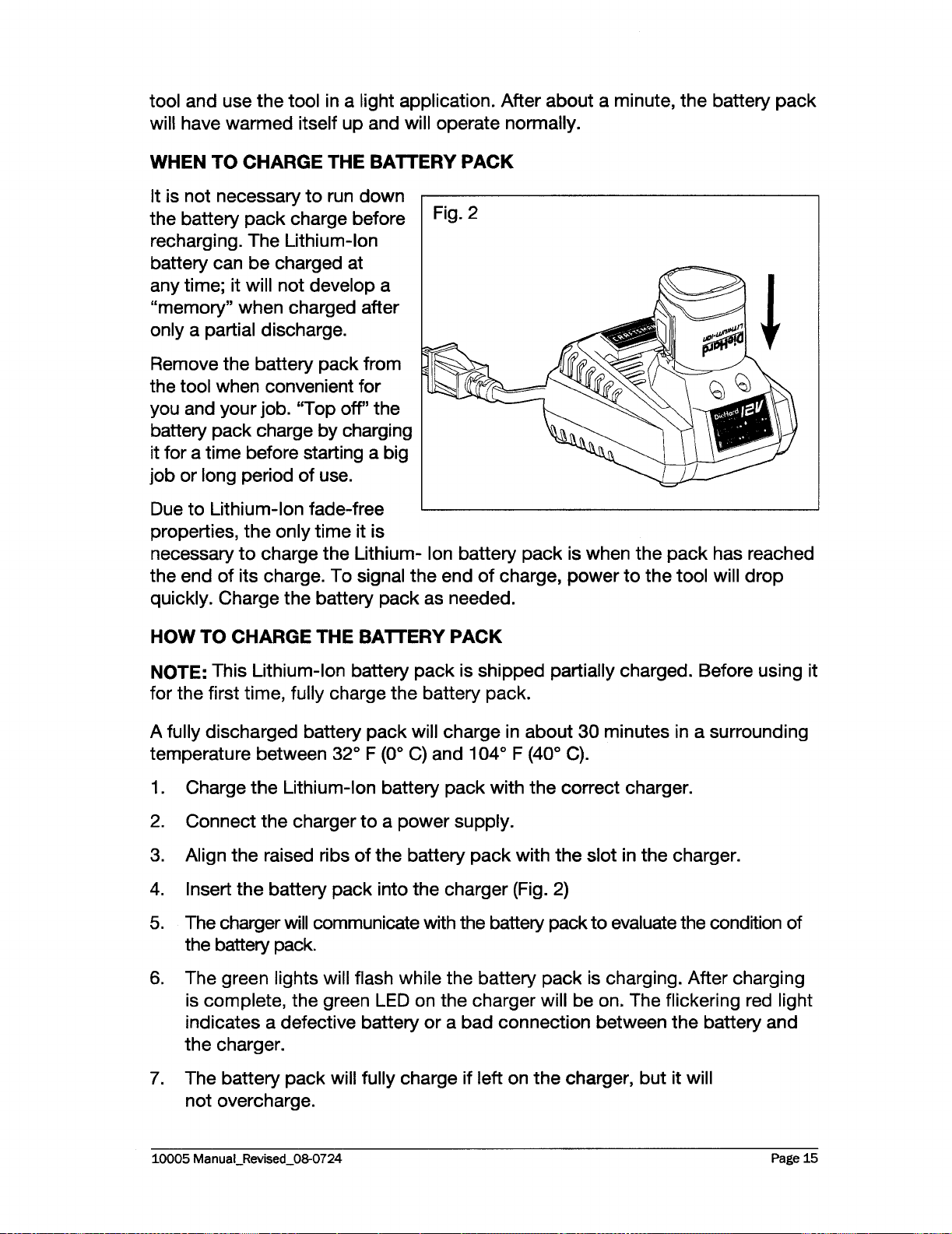
Fig. 2
properties, the only time it is
necessary to charge the Lithium- Ion battery pack is when the pack has reached
the end of its charge. To signal the end of charge, power to the tool will drop
quickly. Charge the battery pack as needed.
HOW TO CHARGE THE BATTERY PACK
NOTE: This Lithium-Ion battery pack is shipped partially charged. Before using it
for the first time, fully charge the battery pack.
A fully discharged battery pack will charge in about 30 minutes in a surrounding
temperature between 32 ° F (0° C) and 104 ° F (40° C).
1. Charge the Lithium-Ion battery pack with the correct charger.
2. Connect the charger to a power supply.
3. Align the raised ribs of the battery pack with the slot in the charger.
4. Insert the battery pack into the charger (Fig. 2)
5. The charger will communicate with the battery pack to evaluate the condition of
the battery pack.
6. The green lights will flash while the battery pack is charging. After charging
is complete, the green LED on the charger will be on. The flickering red light
indicates a defective battery or a bad connection between the battery and
the charger.
7. The battery pack will fully charge if left on the charger, but it will
not overcharge.
10005 Manual_Revised_08-0724 Page 15
NOTE: For your convenience, the charger can operate with most generators and
inverters rated at 300 watts or higher.
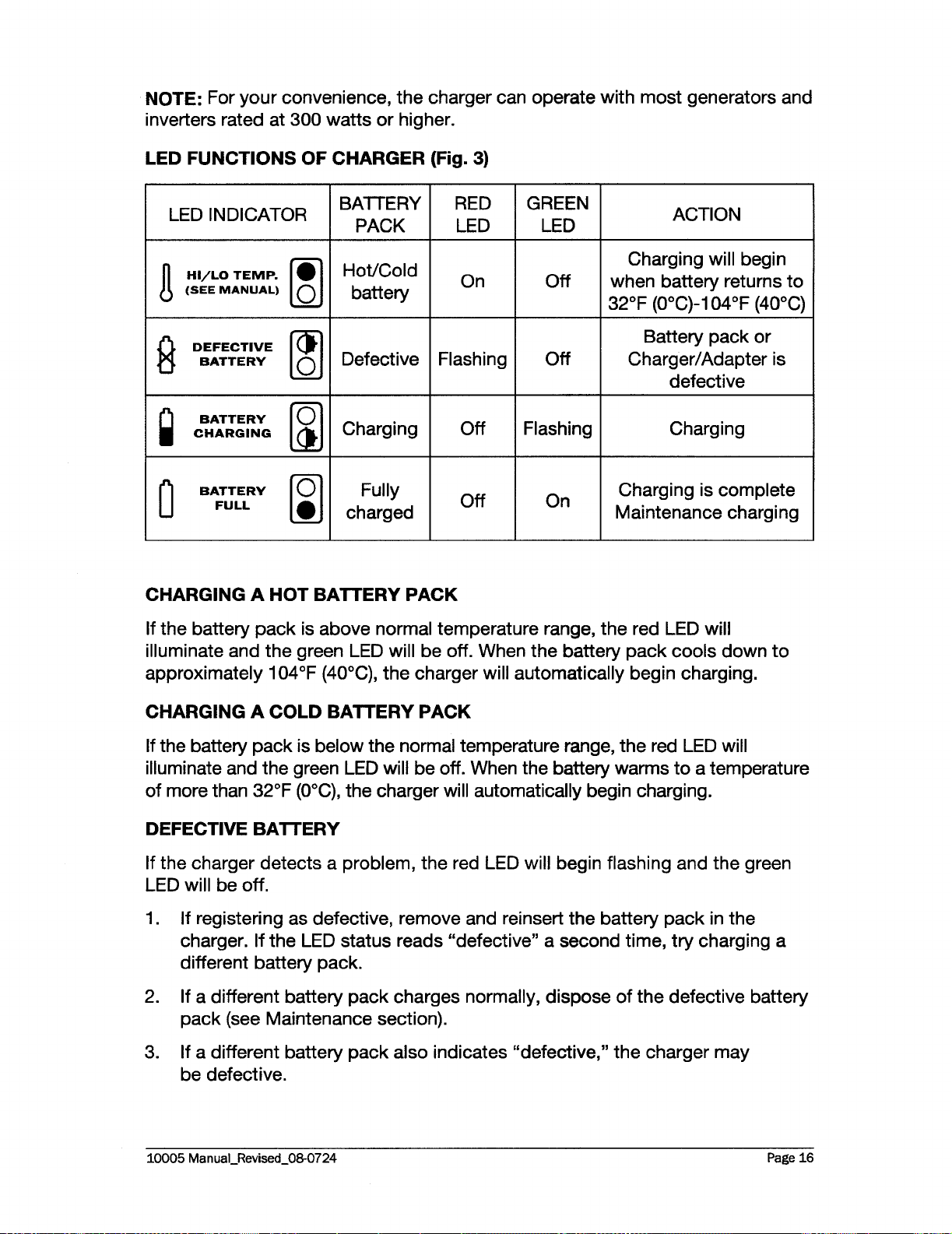
LED FUNCTIONS OF CHARGER (Fig. 3)
LED INDICATOR
HI/LO TEMP. O"
(SEE MANUAL)
BATTERY
BATTERY
CHARGING
BATTERY "_
FULL
BATTERY
PACK
Hot/Cold
battery
Defective
Charging
Fully
charged
RED
LED
On
Flashing
Off
Off
GREEN
LED
Off
Off
Flashing
On
ACTION
Charging will begin
when battery returns to
32°F (0°C)-104°F (40°C)
Battery pack or
Charger/Adapter is
defective
Charging
Charging is complete
Maintenance charging
CHARGING A HOT BATTERY PACK
If the battery pack is above normal temperature range, the red LED will
illuminate and the green LED will be off. When the battery pack cools down to
approximately 104°F (40°C), the charger will automatically begin charging.
CHARGING A COLD BATTERY PACK
If the battery pack is below the normal temperature range, the red LED will
illuminate and the green LED will be off. When the battery warms to a temperature
of more than 32°F (0°C), the charger will automatically begin charging.
DEFECTIVE BA'n'ERY
If the charger detects a problem, the red LED will begin flashing and the green
LED will be off.
.
.
.
If registering as defective, remove and reinsert the battery pack in the
charger. If the LED status reads "defective" a second time, try charging a
different battery pack.
If a different battery pack charges normally, dispose of the defective battery
pack (see Maintenance section).
If a different battery pack also indicates "defective," the charger may
be defective.
10005 Manual_Revised_08-0724 Page 16
BATTERY CHARGING
If the battery pack is being charged within a normal surrounding temperature
range (32 ° F to 104 ° F), the green LED will begin flashing and the red LED will be
off. The battery pack will reach a full charge in 30 minutes.
BATTERY FULL
If the battery pack is within normal temperature range, the green LED will
illuminate and the red LED will be off. The battery pack is fully charged and
ready to use. The battery pack will fully charge, but will not overcharge, if left on
the charger.
NOTE: Charger may warm with several continuous charge cycles. This is part of
the normal operation of the charge. Charge in a well ventilated area.
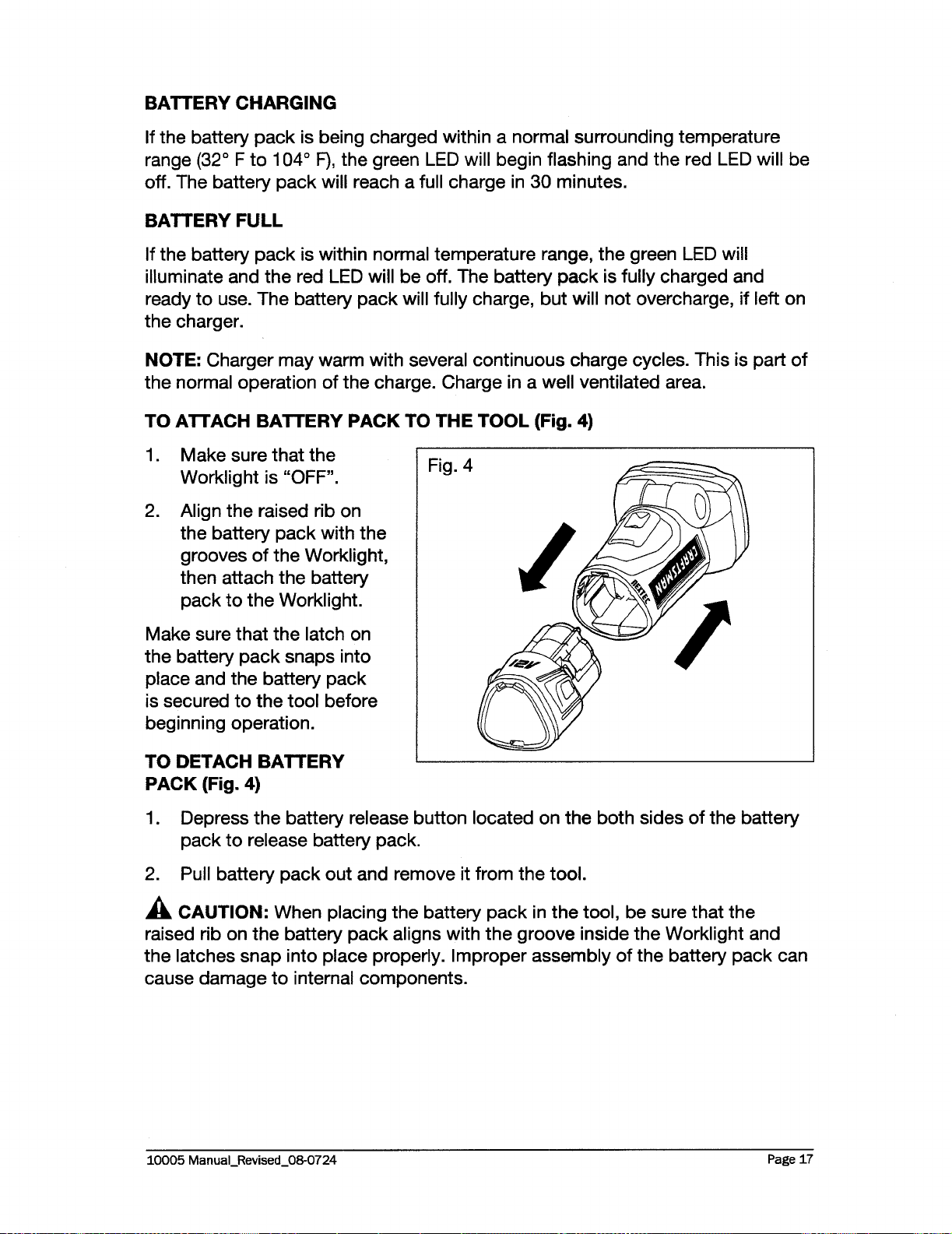
TO ATTACH BATTERY PACK TO THE TOOL (Fig. 4)
1. Make sure that the
Worklight is "OFF".
.
Align the raised rib on
the battery pack with the
grooves of the Worklight,
then attach the battery
pack to the Worklight.
Make sure that the latch on
the battery pack snaps into
place and the battery pack
is secured to the tool before
beginning operation.
Fig. 4
/
TO DETACH BATTERY
PACK (Fig. 4)
1. Depress the battery release button located on the both sides of the battery
pack to release battery pack.
2. Pull battery pack out and remove it from the tool.
CAUTION: When placing the battery pack in the tool, be sure that the
raised rib on the battery pack aligns with the groove inside the Worklight and
the latches snap into place properly. Improper assembly of the battery pack can
cause damage to internal components.
10005 Manual_Revised_08-0724 Page 17

TURN ONIOFF THE
WORKLIGHT
Depress the switch to turn on
the worklight, depress again to
turn off.
Fig. 5
ADJUSTING THE WORKLIGHT HEAD (Fig.6)
Fig. 6
Head Adjust 135 °
C
C
The worklight head independently pivots 135°for maximum flexibility.
Move the head by manually adjusting to any position within the 135 ° pivot range.
Do not force the head beyond the 135 ° range.
,_ WARNING: When servicing, use only identical Craftsman replacement parts.
Use of any other parts may create a hazard or cause product damage.
_i_ WARNING: Always wear safety goggles or safety glasses with side shields
when using compressed air to clean the tool. If the operation is dusty, also wear
a dust mask.
WARNING: To avoid serious personal injury, always remove the battery
pack from the tool when cleaning or performing any maintenance.
10005 Manual_Revised_08-0724 Page 18
GENERAL MAINTENANCE
Avoid using solvents when cleaning plastic parts. Most plastics are susceptible
to damage from various types of commercial solvents and may be damaged by
their use. Use clean cloths to remove dirt, dust, oil, grease, etc.
WARNING: Do not at any time let brake fluids, gasoline, petroleum-
based products, penetrating oils, etc. come in contact with plastic parts.
Chemicals can damage, weaken or destroy plastic which may result in serious
personal injury.
Only the parts shown in the parts list are intended to be repaired or replaced by
the customer. All other parts should be replaced at a Sears Service Center.
BATTERIES:
The batteries in this tool have been designed to
provide maximum trouble-free life. Like all batteries,
they will eventually wear out. Do not disassemble
the battery pack or attempt to replace the batteries.
Handling of the batteries, especially when wearing
rings and jewelry, could result in a serious burn.
To obtain the longest possible battery life, read and
understand the operators manual.
It is good practice to unplug the Charger/Adapter and remove the Lithium-
Ion battery pack when not in use.
For Lithium-Ion battery pack storage longer than 30 days:
• Store the Lithium-Ion battery pack where the temperature is below 80°F
(26°C) and free of moisture.
• Store Lithium-Ion battery packs in a 30%-50% charged condition.
• Every six months of storage, fully charge the Lithium-Ion battery pack.
• Exterior may be cleaned with a cloth or soft non-metallic brush.
BATTERY PACK REMOVAL AND PREPARATION FOR RECYCLING
To preserve natural resources, please recycle or dispose of batteries properly.
This product contains lithium-ion batteries. Local, state or federal laws may
prohibit disposal of lithium-ion batteries in ordinary trash. Consult your
local waste authority for information regarding available recycling and/or
disposal options.
_I_ WARNING: Upon removal of the battery pack for disposal or recycling,
cover the battery pack's terminals with heavy-duty adhesive tape. Do not
attempt to destroy or disassemble the battery pack or remove any of its
components. Lithium-Ion batteries must be recycled or disposed of properly.
10005 Manual_Revised_08-0724 Page19
Also, never touch the terminals with metal objects and/or body parts as a
short circuit may result. Keep away from children. Failure to comply with these
warnings could result in fire and/or serious injury.
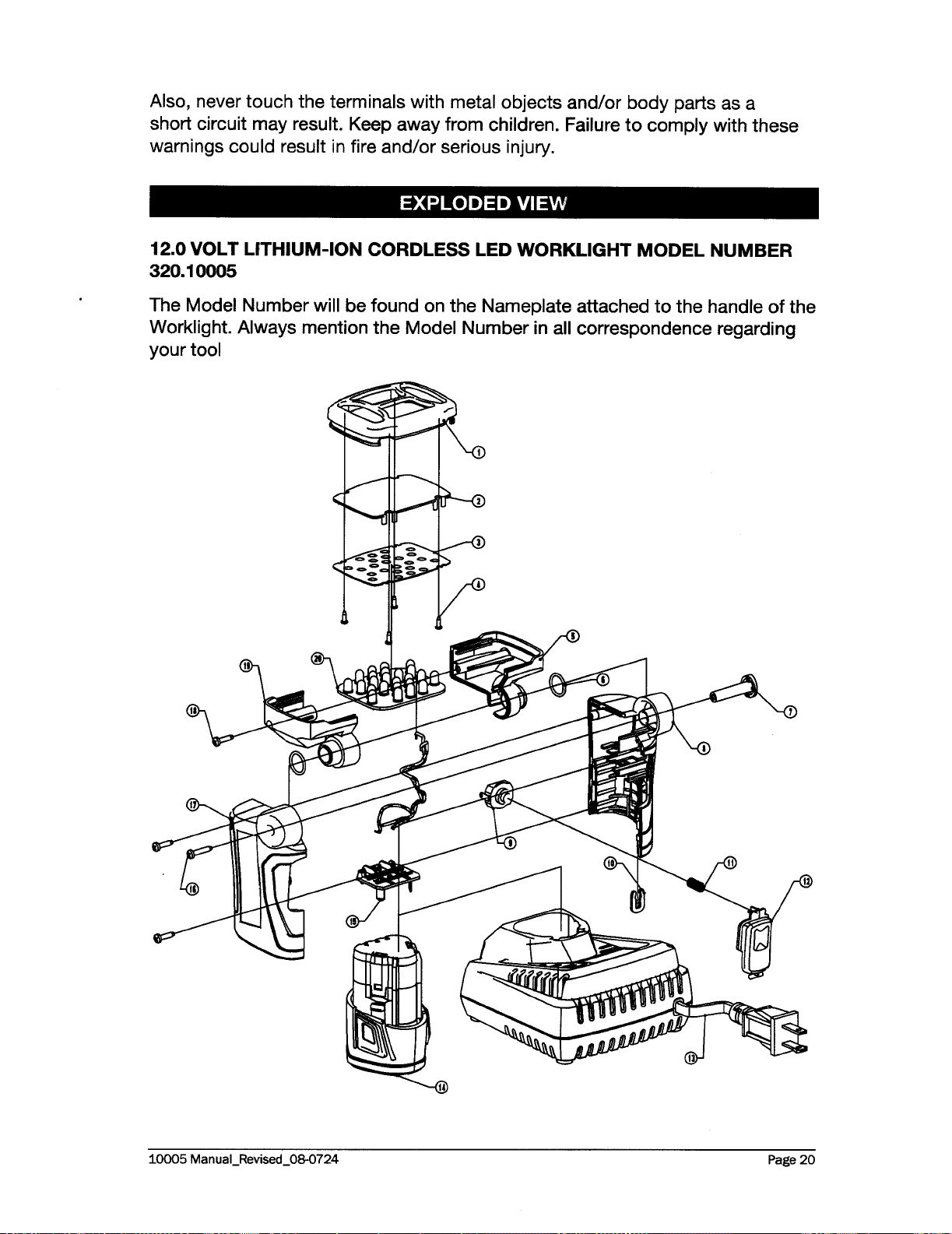
12.0 VOLT LITHIUM-ION CORDLESS LED WORKLIGHT MODEL NUMBER
320.10005
The Model Number will be found on the Nameplate attached to the handle of the
Worklight. Always mention the Model Number in all correspondence regarding
your tool
<
<
f
10005 Manual_Revised_08-0724 Page 20
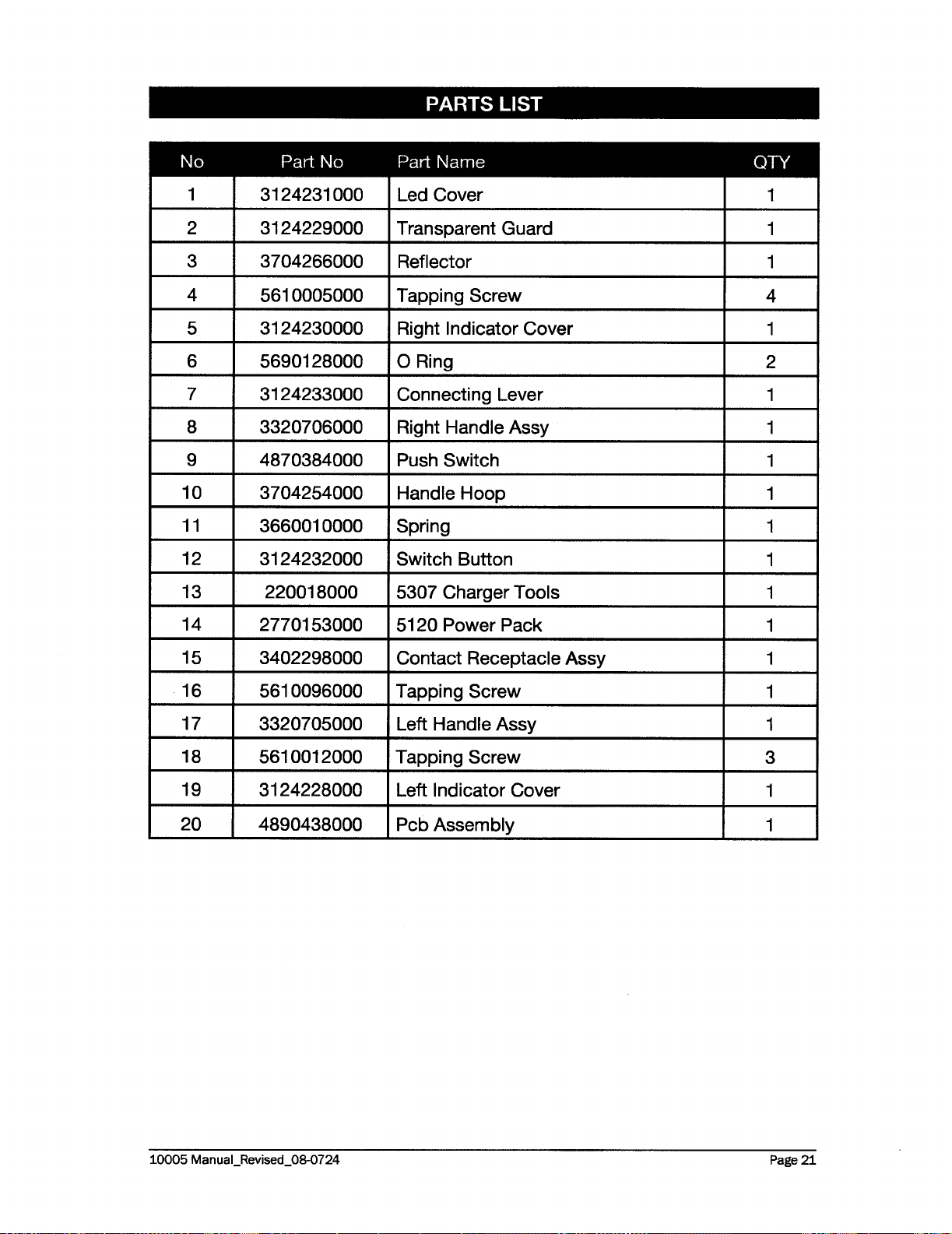
1 3124231000 Led Cover 1
2 3124229000 Transparent Guard 1
3 3704266000 Reflector 1
4 5610005000 Tapping Screw 4
5 3124230000 Right Indicator Cover 1
6 5690128000 O Ring 2
7 3124233000 Connecting Lever 1
8 3320706000 Right Handle Assy 1
9 4870384000 Push Switch 1
10 3704254000 Handle Hoop 1
11 3660010000 Spring 1
12 3124232000 Switch Button 1
13 220018000 5307 Charger Tools 1
14 2770153000 5120 Power Pack 1
15 3402298000 Contact Receptacle Assy 1
16 5610096000 Tapping Screw 1
17 3320705000 Left Handle Assy 1
18 5610012000 Tapping Screw 3
19 3124228000 Left Indicator Cover 1
20 4890438000 Pcb Assembly 1
10005 Manual_Revised_08-0724 Page 21

10005 Manual_Revised_08-0724 Page 22

10005 Manual_Revised_08-0724 Page 23

Your Home
For expert troubleshooting and home solutions advice:
manage home
www.managemyhome.com
For repair - in your home - of all major brand appliances,
lawn and garden equipment, or heating and cooling systems,
no matter who made it, no matter who sold it !
For the replacement parts, accessories and
owner's manuals that you need to do-it-yourself.
For Sears professional installation of home appliances
and items like garage door openers and water heaters.
1-800-4-MY-HOME ®
(1-800-469-4663)
www.sears.com
Call anytime, day or night
(U.S.A. and Canada)
www.sears.ca
Our Home
For repair of carry-in items like vacuums, lawn equipment,
and electronics, call anytime for the location of the nearest
Sears Parts & Repair Service Center
1-800-488-1222 (U.S.A.)
www.sears.com
1-800-469-4663 (Canada)
www.sears.ca
To purchase a protection agreement on a product serviced by Sears:
1-800-827-6655 (U.S.A.) 1-800-361-6665 (Canada)
Para pedir servicio de reparaciSn
a domicilio, y para ordenar piezas:
1-888-SU-HOGAR®
(1-888-7_7)
Au Canada pour service en franc,.ais:
1.800.LE-FOYER Mc
(1-800-533-6937)
www.sears.ca
Sears
©SearsBrands, LLC
TM
® Registered Trademark / Trademark / SMService Mark of Sears Brands, LLC
® Marca Registrada / TMMarca de Fdbrica / SMMarca de Servicio de Sears Brands, LLC
MCMarque de commerce / MOMarque deposee de Sears Brands, LLC