i%
bers ..... 2
............... 2-3
ps ......................... 3-4
Energy Saving Tips ................... 4
Setting
the Temperature Control ............. 4
Refrigerator Features ............. 4 - 5
Care and Cleaning .................... 5
Warranty ............................... 6
Troubleshooting Guide ........... 7 - 8
READ AND SAVE THESE INSTRUCTIONS PiN216781800 (0012)
vvWkvAV,1_!h,_II_[€
READ AND SAVE THESE INSTRUCTIONS
This Owner's Guide provides specific operating instructions
for your model. Use your refrigerator only as instructed in
this guide. These instructions are not meant to cover every
possible condition and situation that may occur. Common
sense and caution must be practiced when installing,
operating, and maintaining any appliance.
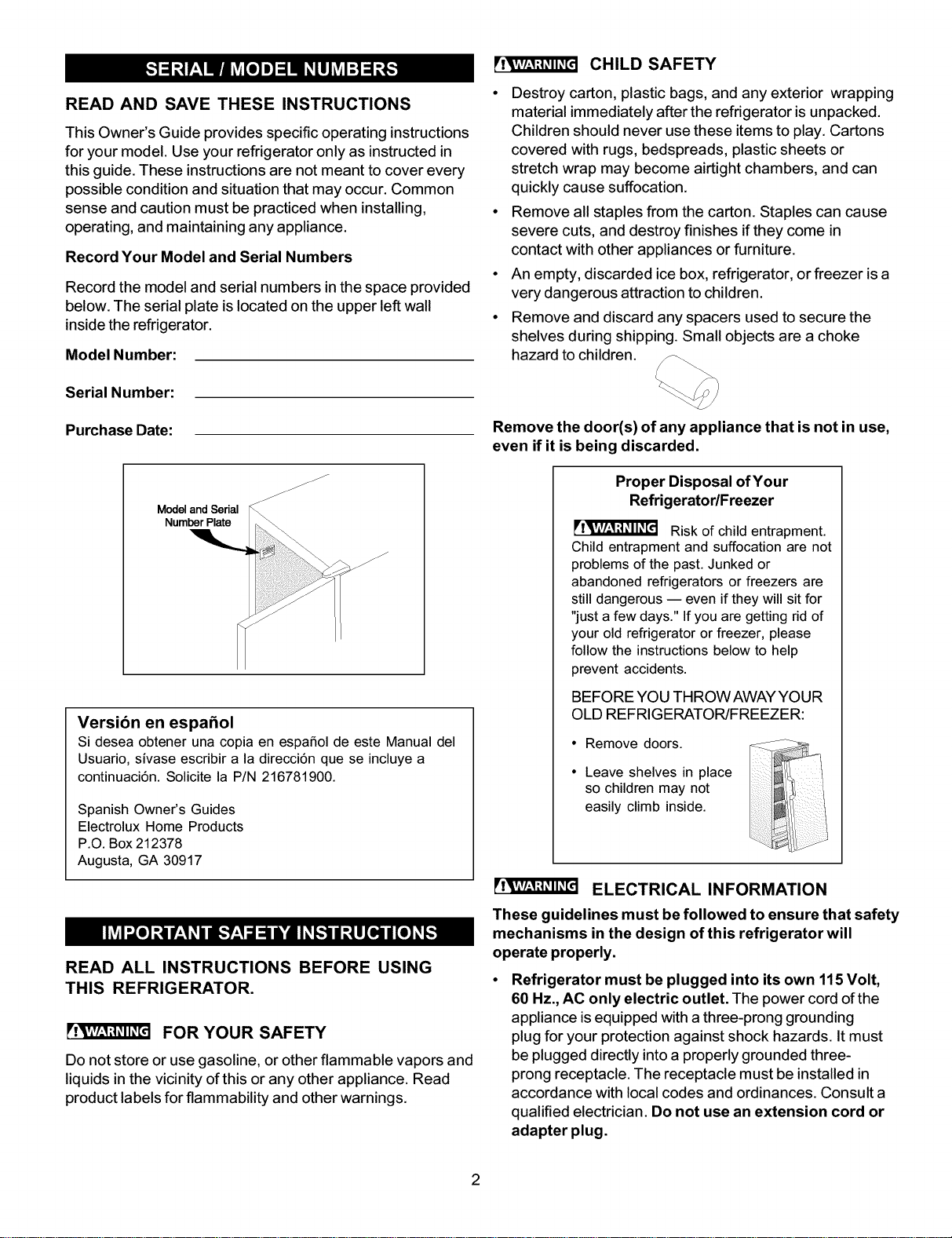
Record Your Model and Serial Numbers
Record the model and serial numbers in the space provided
below. The serial plate is located on the upper left wall
inside the refrigerator.
Model Number:
Serial Number:
Purchase Date:
ModelandSerial
NumberPlate
Versibn en espahol
si desea obteneruna copiaen espaSolde este Manualdel
Usuario,sivase escribira la direcci6n que se incluyea
continuaci6n.Solicite la P/N 216781900.
Spanish Owner's Guides
Electrolux Home Products
P.O. Box 212378
Augusta, GA 30917
r! VIV-'I :!_II_._[,
READ ALL INSTRUCTIONS BEFORE USING
THIS REFRIGERATOR.
_!_kv,V'Jfl_ii_[_ FOR YOUR SAFETY
Do not store or use gasoline, or other flammable vapors and
liquids in the vicinity of this or any other appliance. Read
product labels for flammability and other warnings.
CHILD SAFETY
• Destroy carton, plastic bags, and any exterior wrapping
material immediately after the refrigerator is unpacked.
Children should never use these items to play. Cartons
covered with rugs, bedspreads, plastic sheets or
stretch wrap may become airtight chambers, and can
quickly cause suffocation.
• Remove all staples from the carton. Staples can cause
severe cuts, and destroy finishes if they come in
contact with other appliances or furniture.
• An empty, discarded ice box, refrigerator, or freezer is a
very dangerous attraction to children.
• Remove and discard any spacers used to secure the
shelves during shipping. Small objects are a choke
hazard to children.
Remove the door(s) of any appliance that is not in use,
even if it is being discarded.
Proper Disposal ofYour
Refrigerator/Freezer
"!_vAv/-'1:i#ll#[clRisk of child entrapment.
Child entrapment and suffocation are not
problems of the past. Junked or
abandoned refrigerators or freezers are
still dangerous -- even if they will sit for
"just a few days." If you are getting rid of
your old refrigerator or freezer, please
follow the instructions below to help
prevent accidents.
BEFORE YOU THROW AWAY YOUR
OLD REFRIGERATOR/FREEZER:
• Remove doors.
• Leave shelves in place
so children may not
easily climb inside.
ELECTRICAL INFORMATION
These guidelines must be followed to ensure that safety
mechanisms in the design of this refrigerator will
operate properly,
Refrigerator must be plugged into its own 115 Volt,
60 Hz., AC only electric outlet. The power cordofthe
appliance isequipped witha three-prong grounding
plug for your protection against shock hazards. It must
be plugged directlyintoa properly grounded three-
prong receptacle. The receptacle must be installedin
accordance with local codes and ordinances. Consult a
qualified electrician. Do not use an extension cord or
adapter plug.
2
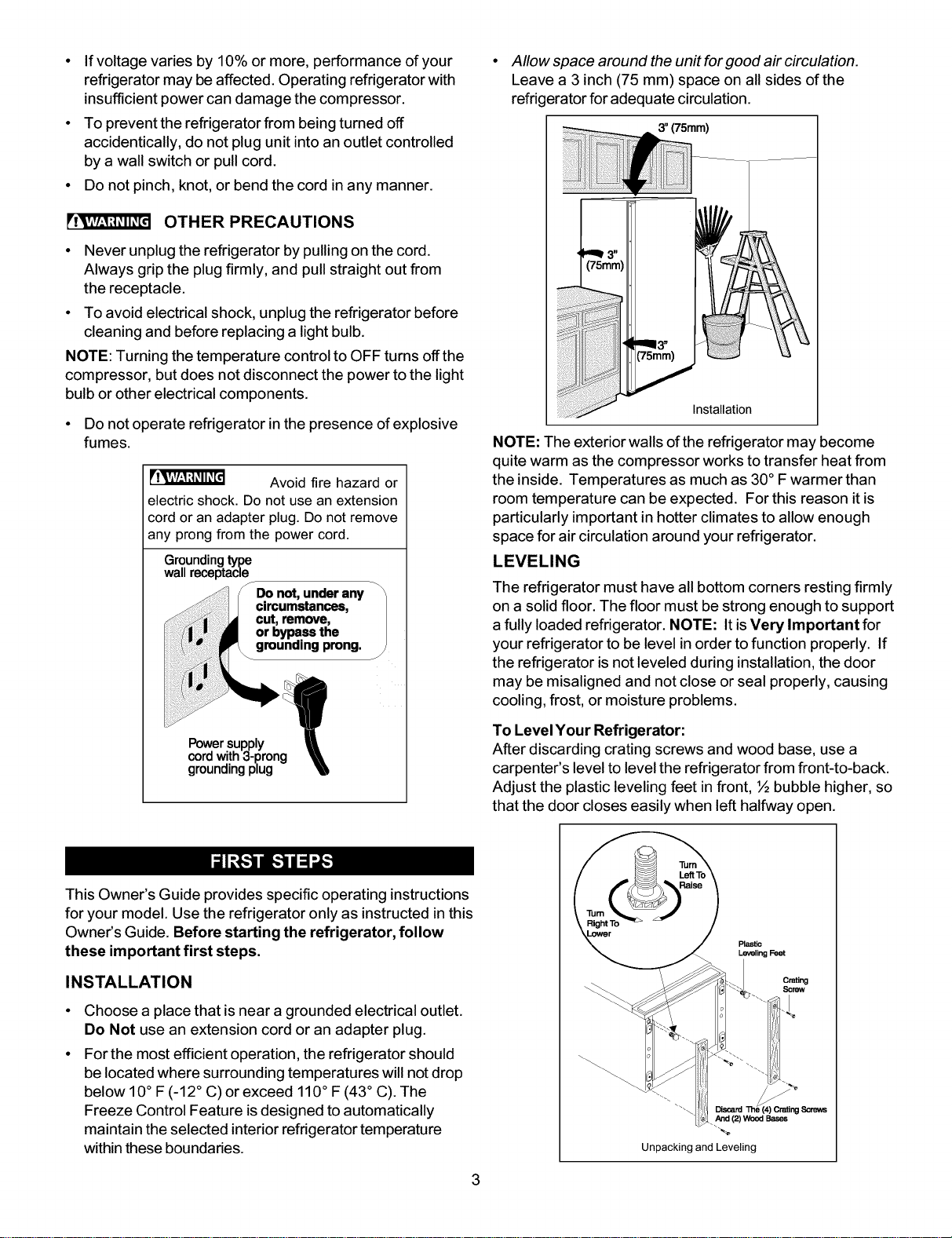
• Ifvoltagevariesby10%ormore,performanceofyour
refrigeratormaybeaffected.Operatingrefrigeratorwith
insufficientpowercandamagethecompressor.
• Topreventtherefrigeratorfrombeingturnedoff
accidentically,donotplugunitintoanoutletcontrolled
byawallswitchorpullcord.
• Donotpinch,knot,orbendthecordinanymanner.
OTHER PRECAUTIONS
• Never unplug the refrigerator by pulling on the cord.
Always grip the plug firmly, and pull straight out from
the receptacle.
• To avoid electrical shock, unplug the refrigerator before
cleaning and before replacing a light bulb.
NOTE: Turning the temperature control to OFF turns off the
compressor, but does not disconnect the power to the light
bulb or other electrical components.
• Do not operate refrigerator in the presence of explosive
fumes.
_rt'v=V-'1:!#ll#[_l Avoid fire hazard or
electric shock. Do not use an extension
cord or an adapter plug. Do not remove
any prong from the power cord.
Groundingtype
wallreceptacle
J Donot,underany
circumstances,
cut,remove,
orbypassthe
groundingprong.
Powersupply
cordwith3-prong
grounding plug
• Allow space around the unit forgood air circulation.
Leave a 3 inch (75 mm) space on all sides of the
refrigerator for adequate circulation.
Installation
NOTE: The exterior walls of the refrigerator may become
quite warm as the compressor works to transfer heat from
the inside. Temperatures as much as 30° Fwarmer than
room temperature can be expected. For this reason it is
particularly important in hotter climates to allow enough
space for air circulation around your refrigerator.
LEVELING
The refrigerator must have all bottom corners resting firmly
on a solid floor. The floor must be strong enough to support
a fully loaded refrigerator. NOTE: It is Very Important for
your refrigerator to be level in order to function properly. If
the refrigerator is not leveled during installation, the door
may be misaligned and not close or seal properly, causing
cooling, frost, or moisture problems.
To Level Your Refrigerator:
After discarding crating screws and wood base, use a
carpenter's level to level the refrigerator from front-to-back.
Adjust the plastic leveling feet in front, ½ bubble higher, so
that the door closes easily when left halfway open.
This Owner's Guide provides specific operating instructions
for your model. Use the refrigerator only as instructed in this
Owner's Guide. Before starting the refrigerator, follow
these important first steps.
INSTALLATION
Choose a place that is near a grounded electrical outlet.
Do Not use an extension cord or an adapter plug.
For the most efficient operation, the refrigerator should
be located where surrounding temperatures will not drop
below 10° F (-12° C) or exceed 110° F (43 ° C). The
Freeze Control Feature is designed to automatically
maintain the selected interior refrigerator temperature
within these boundaries.
3
Plastic
Leveling Feet
Crating
Screw
Discard "_e(4)_Cmting Screws
And (2) Wood Bases
Unpacking and Leveling
CLEANING
Wash any removable parts of the refrigerator interior, and
exterior with mild detergent and warm water. Wipe dry.
Do not use harsh cleaners on these surfaces.
Do not use razor blades or other sharp instruments,
which can scratch the appliance surface when removing
adhesive labels. Any glue left from the tape can be
removed with a mixture of warm water and mild deter-
gent, or touch the residue with the sticky side of tape
already removed. Do not remove the serialplate.
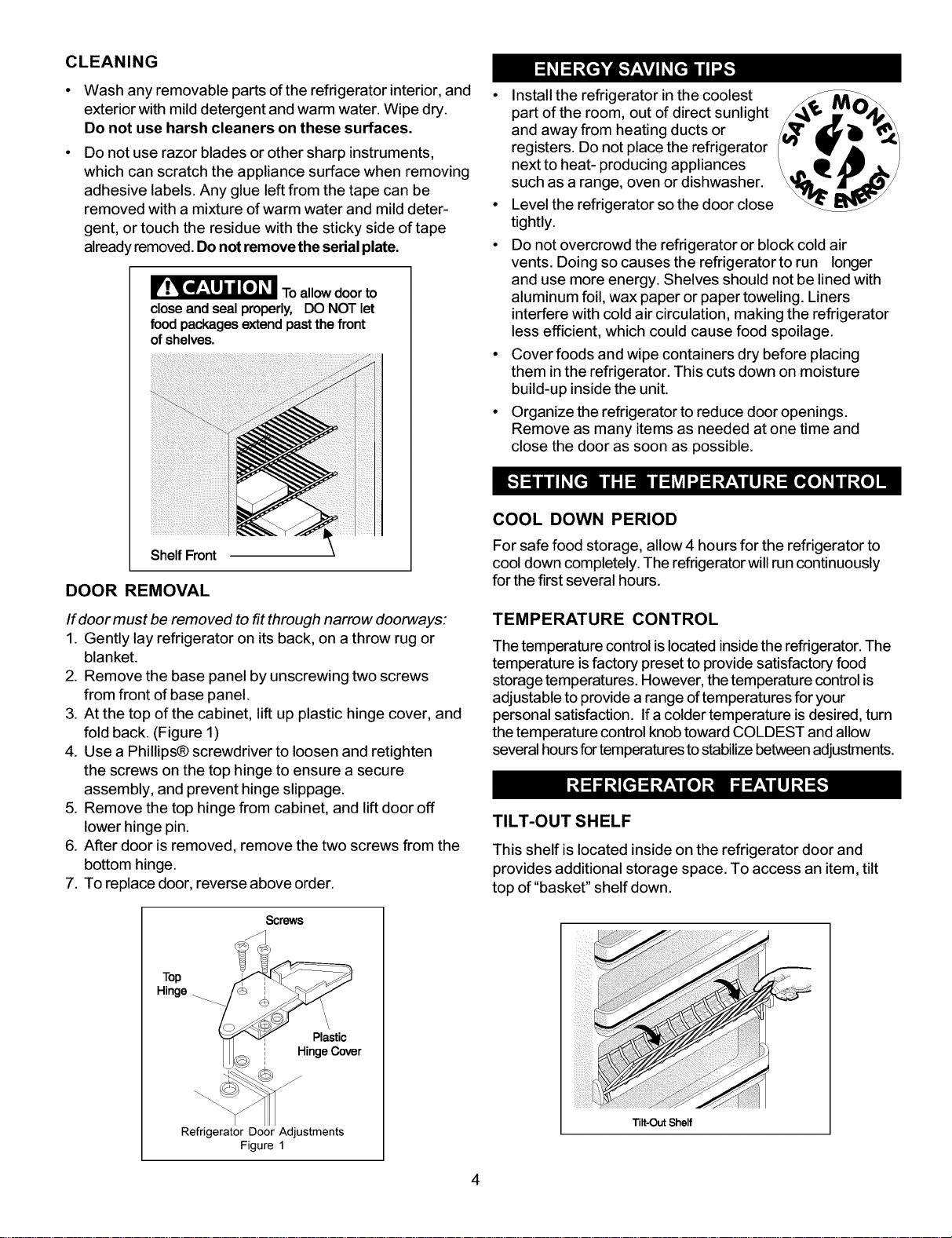
r!_[_-'_lJ d[o] 11Toallowdoor to
closeandsealproperly,DONOTlet
foodpackagesextendpastthefront
ofshelves.
Shelf Front
DOOR REMOVAL
If door must be removed to fit through narrow doorways:
1. Gently lay refrigerator on its back, on a throw rug or
blanket.
2. Remove the base panel by unscrewing two screws
from front of base panel.
3. At the top of the cabinet, lift up plastic hinge cover, and
fold back. (Figure 1)
4. Use a Phillips® screwdriver to loosen and retighten
the screws on the top hinge to ensure a secure
assembly, and prevent hinge slippage.
5. Remove the top hinge from cabinet, and lift door off
lower hinge pin.
6. After door is removed, remove the two screws from the
bottom hinge.
7. To replace door, reverse above order.
Screws
Top
Hinge
Plastic
Hinge Cover
Refrigerator Door Adjustments
Figure 1
• Install the refrigerator in the coolest
part of the room, out of direct sunlight
and away from heating ducts or
registers. Do not place the refrigerator
next to heat- producing appliances
such as a range, oven or dishwasher.
• Level the refrigerator so the door close
tightly.
• Do not overcrowd the refrigerator or block cold air
vents. Doing so causes the refrigerator to run longer
and use more energy. Shelves should not be lined with
aluminum foil, wax paper or paper toweling. Liners
interfere with cold air circulation, making the refrigerator
less efficient, which could cause food spoilage.
• Cover foods and wipe containers dry before placing
them in the refrigerator. This cuts down on moisture
build-up inside the unit.
• Organize the refrigerator to reduce door openings.
Remove as many items as needed at one time and
close the door as soon as possible.
COOL DOWN PERIOD
For safe food storage, allow 4 hours for the refrigerator to
cool down completely. The refrigerator will run continuously
for the first several hours.
TEMPERATURE CONTROL
The temperature control is located inside the refrigerator. The
temperature is factory preset to provide satisfactory food
storage temperatures. However, the temperature control is
adjustable to provide a range oftemperatures for your
personal satisfaction. If a colder temperature is desired, turn
the temperature control knob toward COLDEST and allow
several hoursfor temperatures to stabilizebetween adjustments.
TILT-OUT SHELF
This shelf is located inside on the refrigerator door and
provides additional storage space. To access an item, tilt
top of "basket" shelf down.
Tilt-Out Shelf
4
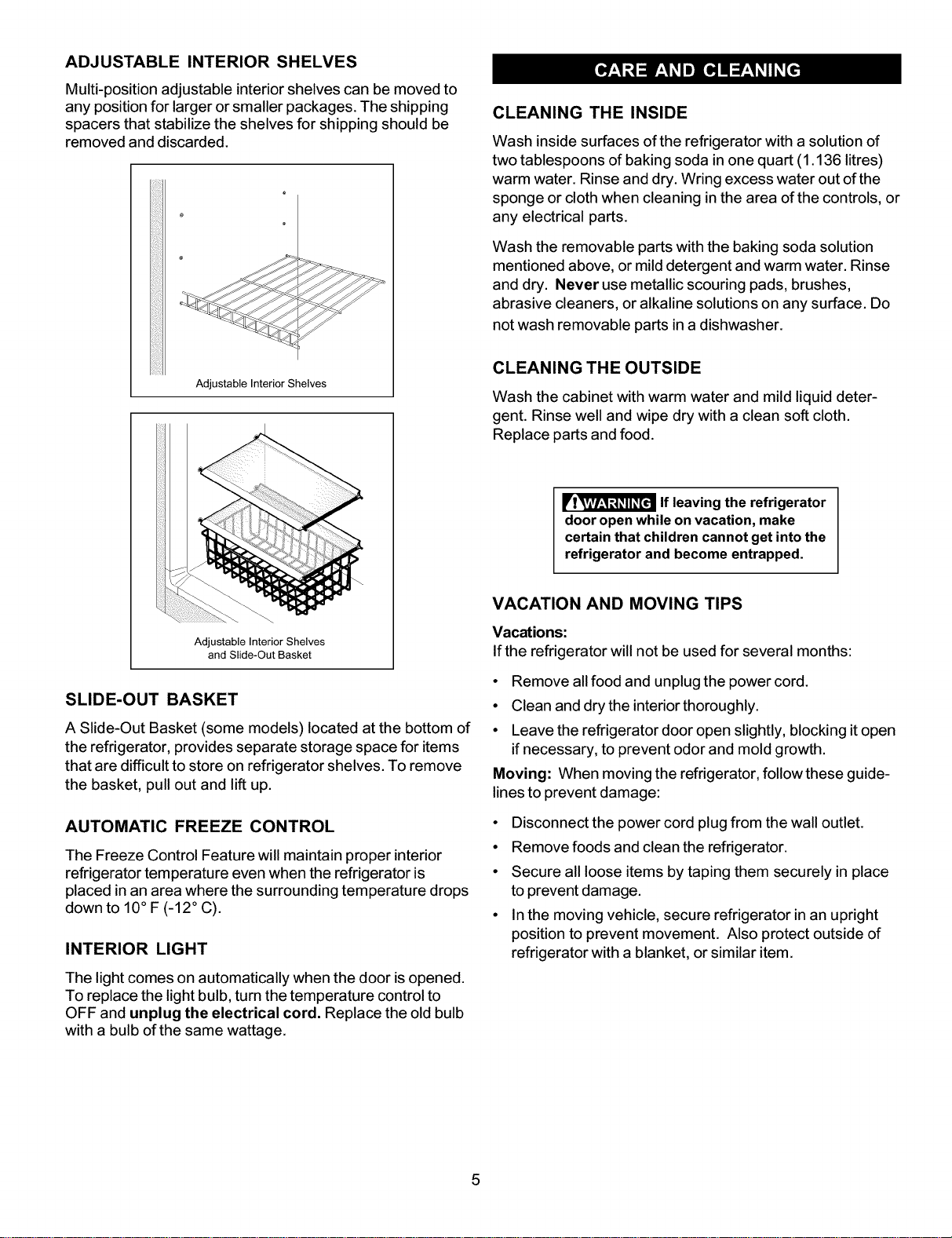
ADJUSTABLE INTERIOR SHELVES
Multi-position adjustable interior shelves can be moved to
any position for larger or smaller packages. The shipping
spacers that stabilize the shelves for shipping should be
removed and discarded.
Adjustable Interior Shelves
Adjustable Interior Shelves
and Slide-Out Basket
SLIDE-OUT BASKET
A Slide-Out Basket (some models) located at the bottom of
the refrigerator, provides separate storage space for items
that are difficult to store on refrigerator shelves. To remove
the basket, pull out and lift up.
AUTOMATIC FREEZE CONTROL
The Freeze Control Feature will maintain proper interior
refrigerator temperature even when the refrigerator is
placed in an area where the surrounding temperature drops
down to 10° F (-12° C).
INTERIOR LIGHT
The light comes on automatically when the door is opened.
To replace the light bulb, turn the temperature control to
OFF and unplug the electrical cord. Replace the old bulb
with a bulb of the same wattage.
CLEANING THE INSIDE
Wash inside surfaces of the refrigerator with a solution of
two tablespoons of baking soda in one quart (1.136 litres)
warm water. Rinse and dry. Wring excess water out of the
sponge or cloth when cleaning in the area of the controls, or
any electrical parts.
Wash the removable parts with the baking soda solution
mentioned above, or mild detergent and warm water. Rinse
and dry. Never use metallic scouring pads, brushes,
abrasive cleaners, or alkaline solutions on any surface. Do
not wash removable parts in a dishwasher.
CLEANING THE OUTSIDE
Wash the cabinet with warm water and mild liquid deter-
gent. Rinse well and wipe dry with a clean soft cloth.
Replace parts and food.
If leaving the refrigerator
door open while on vacation, make
certain that children cannot get into the
refrigerator and become entrapped.
VACATION AND MOVING TiPS
Vacations:
If the refrigerator will not be used for several months:
• Remove allfood and unplug the power cord.
• Clean and dry the interior thoroughly.
• Leave the refrigerator door open slightly, blocking it open
if necessary, to prevent odor and mold growth.
Moving: When moving the refrigerator, follow these guide-
lines to prevent damage:
• Disconnect the power cord plug from the wall outlet.
• Remove foods and clean the refrigerator.
• Secure all loose items by taping them securely in place
to prevent damage.
• In the moving vehicle, secure refrigerator in an upright
position to prevent movement. Also protect outside of
refrigerator with a blanket, or similar item.
5
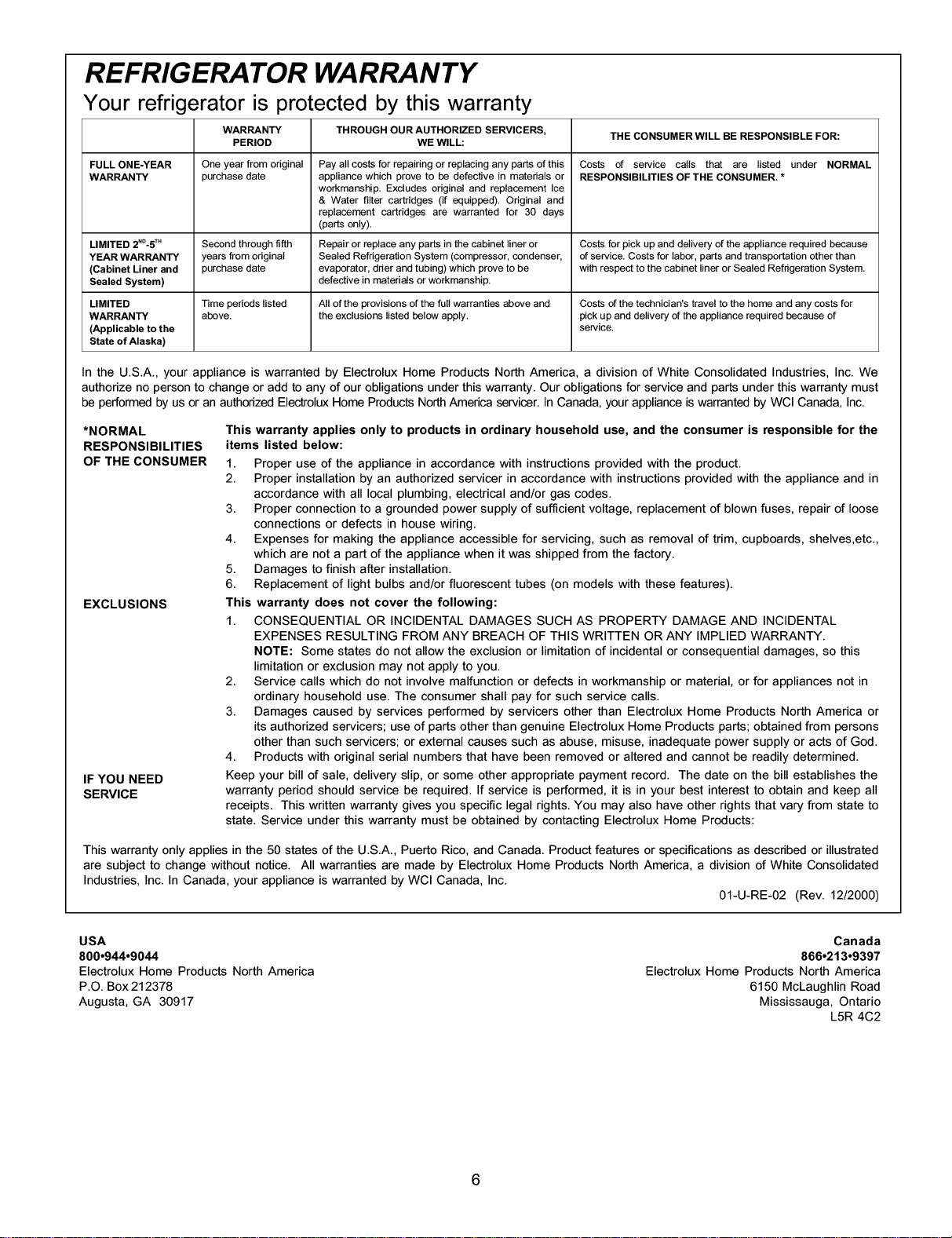
REFRIGERATOR WARRANTY
Your refrigerator is protected by this warranty
WARRANTY THROUGH OUR AUTHORIZED SERVICERS,
PERIOD WE WILL:
FULL ONE-YEAR
WARRANTY
LIMITED 2"°-5 TM
YEAR WARRANTY
(Cabinet Liner and
Sealed System)
One year from original
purchase date
Second through fifth
years from original
purchase date
Time periods listed
above.
LIMITED
WARRANTY
(Applicable to the
State of Alaska)
Pay all costs for repairing or replacing any parts of this
appliance which prove to be defective in materials or
workmanship. Excludes original and replacement Ice
& Water filter cartridges (if equipped). Original and
replacement cartridges are warranted for 30 days
(parts only).
Repair or replace any parts in the cabinet liner or
Sealed Refrigeration System (compressor, condenser,
evaporator, drier and tubing) which prove to be
defective in materials or workmanship.
All of the provisions of the full warranties above and
the exclusions listed below apply.
THE CONSUMER WILL BE RESPONSIBLE FOR:
Costs of service calls that are listed under NORMAL
RESPONSIBILITIES OF THE CONSUMER. *
Costs for pick up and delivery of the appliance required because
of service. Costs for labor, parts and transportation other than
with respect to the cabinet liner or Sealed Refrigeration System.
Costs of the technician's travel to the home and any costs for
pick up and delivery of the appliance required because of
service.
In the U.S.A., your appliance is warranted by Electrolux Home Products North America, a division of White Consolidated Industries, Inc. We
authorize no person to change or add to any of our obligations under this warranty. Our obligations for service and parts under this warranty must
be performed by us or an authorized Electrolux Home Products North America servicer. In Canada, your appliance is warranted by WCI Canada, Inc.
*NORMAL
RESPONSIBILITIES
OFTHECONSUMER
EXCLUSIONS
IFYOU NEED
SERVICE
This warranty applies only to products in ordinary household use, and the consumer is responsible for the
items listed below:
1. Proper use of the appliance in accordance with instructions provided with the product.
2. Proper installation by an authorized servicer in accordance with instructions provided with the appliance and in
accordance with all local plumbing, electrical and/or gas codes.
3. Proper connection to a grounded power supply of sufficient voltage, replacement of blown fuses, repair of loose
connections or defects in house wiring.
4. Expenses for making the appliance accessible for servicing, such as removal of trim, cupboards, shelves,etc.,
which are not a part of the appliance when it was shipped from the factory.
5. Damages to finish after installation.
6. Replacement of light bulbs and/or fluorescent tubes (on models with these features).
This warranty does not cover the following:
1. CONSEQUENTIAL OR INCIDENTAL DAMAGES SUCH AS PROPERTY DAMAGE AND INCIDENTAL
EXPENSES RESULTING FROM ANY BREACH OF THIS WRITTEN OR ANY IMPLIED WARRANTY.
NOTE: Some states do not allow the exclusion or limitation of incidental or consequential damages, so this
limitation or exclusion may not apply to you.
2. Service calls which do not involve malfunction or defects in workmanship or material, or for appliances not in
ordinary household use. The consumer shall pay for such service calls.
3. Damages caused by services performed by servicers other than Electrolux Home Products North America or
its authorized servicers; use of parts other than genuine Electrolux Home Products parts; obtained from persons
other than such servicers; or external causes such as abuse, misuse, inadequate power supply or acts of God.
4. Products with original serial numbers that have been removed or altered and cannot be readily determined.
Keep your bill of sale, delivery slip, or some other appropriate payment record. The date on the bill establishes the
warranty period should service be required. If service is performed, it is in your best interest to obtain and keep all
receipts. This written warranty gives you specific legal rights. You may also have other rights that vary from state to
state. Service under this warranty must be obtained by contacting Electrolux Home Products:
This warranty only applies in the 50 states of the U.S.A., Puerto Rico, and Canada. Product features or specifications as described or illustrated
are subject to change without notice. All warranties are made by Electrolux Home Products North America, a division of White Consolidated
Industries, Inc. In Canada, your appliance is warranted by WCI Canada, Inc.
01-U-RE-02 (Rev. 12/2000)
USA
800°944°9044
Electrolux Home Products North America
P.O. Box 212378
Augusta, GA 30917
Canada
866o213°9397
Electrolux Home Products North America
6150 McLaughlin Road
Mississauga, Ontario
L5R 4C2
6
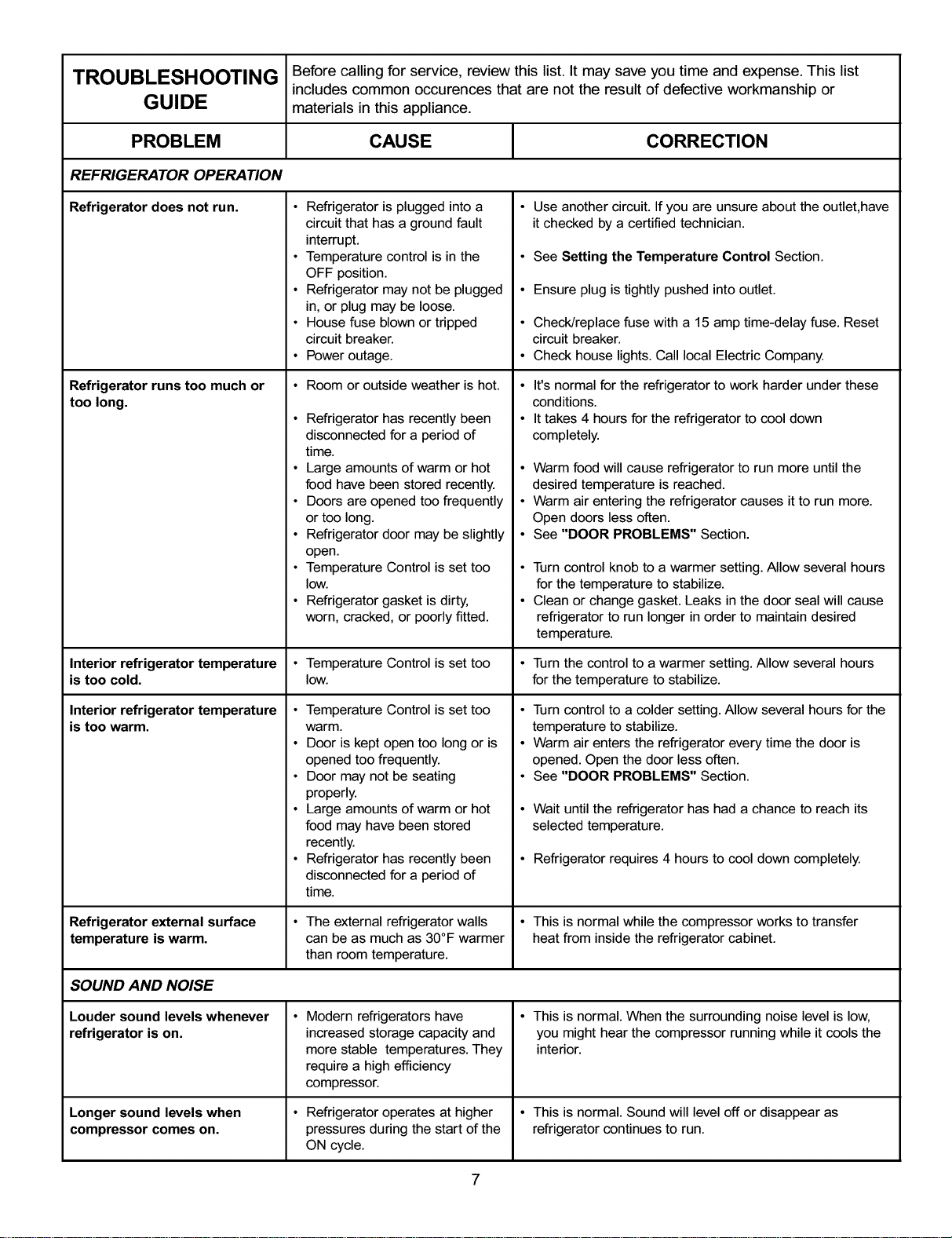
TROUBLESHOOTING Before calling for service, review this list. It may save you time and expense. This list
includes common occurences that are not the result of defective workmanship or
GUIDE materials in this appliance.
PROBLEM CAUSE CORRECTION
REFRIGERATOR OPERATION
Refrigeratordoes not run. •
Refrigerator runs too much or
too long.
Refrigerator is plugged into a
circuit that has a ground fault
interrupt.
Temperature control is in the
OFF position.
Refrigerator may not be plugged
in, or plug may be loose.
House fuse blown or tripped
circuit breaker.
Power outage.
Room or outside weather is hot.
• Refrigerator has recently been
disconnected for a period of
time.
• Large amounts of warm or hot
food have been stored recently.
• Doors are opened too frequently
or too long.
• Refrigerator door may be slightly
open.
• Temperature Control is set too
low.
• Refrigerator gasket is dirty,
worn, cracked, or poorly fitted.
• Use another circuit. If you are unsure about the outlet,have
it checked by a certified technician.
• See Setting the Temperature Control Section.
• Ensure plug is tightly pushed into outlet.
• Check/replace fuse with a 15 amp time-delay fuse. Reset
circuit breaker.
• Check house lights. Call local Electric Company.
• It's normal for the refrigerator to work harder under these
conditions.
• It takes 4 hours for the refrigerator to cool down
completely.
Warm food will cause refrigerator to run more until the
desired temperature is reached.
Warm air entering the refrigerator causes it to run more.
Open doors less often.
See "DOOR PROBLEMS" Section.
Turn control knob to a warmer setting. Allow several hours
for the temperature to stabilize.
Clean or change gasket. Leaks in the door seal will cause
refrigerator to run longer in order to maintain desired
temperature.
Interior refrigerator temperature • Temperature Control is set too • Turn the control to a warmer setting. Allow several hours
is too cold. low. for the temperature to stabilize.
Interior refrigerator temperature
is too warm.
• Temperature Control is set too
warm.
• Door is kept open too long or is
opened too frequently.
• Door may not be seating
properly.
• Large amounts of warm or hot
food may have been stored
recently.
• Refrigerator has recently been
disconnected for a period of
time.
• Turn control to a colder setting. Allow several hours for the
temperature to stabilize.
• Warm air enters the refrigerator every time the door is
opened. Open the door less often.
• See "DOOR PROBLEMS" Section.
Wait until the refrigerator has had a chance to reach its
selected temperature.
Refrigerator requires 4 hours to cool down completely.
Refrigerator external surface • The external refrigerator walls • This is normal while the compressor works to transfer
temperature is warm. can be as much as 30°F warmer heat from inside the refrigerator cabinet.
than room temperature.
SOUND AND NOISE
Louder sound levels whenever
refrigerator is on.
Longer sound levels when
compressor comes on.
Modern refrigerators have
increased storage capacity and
more stable temperatures. They
require a high efficiency
compressor.
• Refrigerator operates at higher
pressures during the start of the
ON cycle.
• This is normal. When the surrounding noise level is low,
you might hear the compressor running while it cools the
interior.
• This is normal. Sound will level off or disappear as
refrigerator continues to run.
7
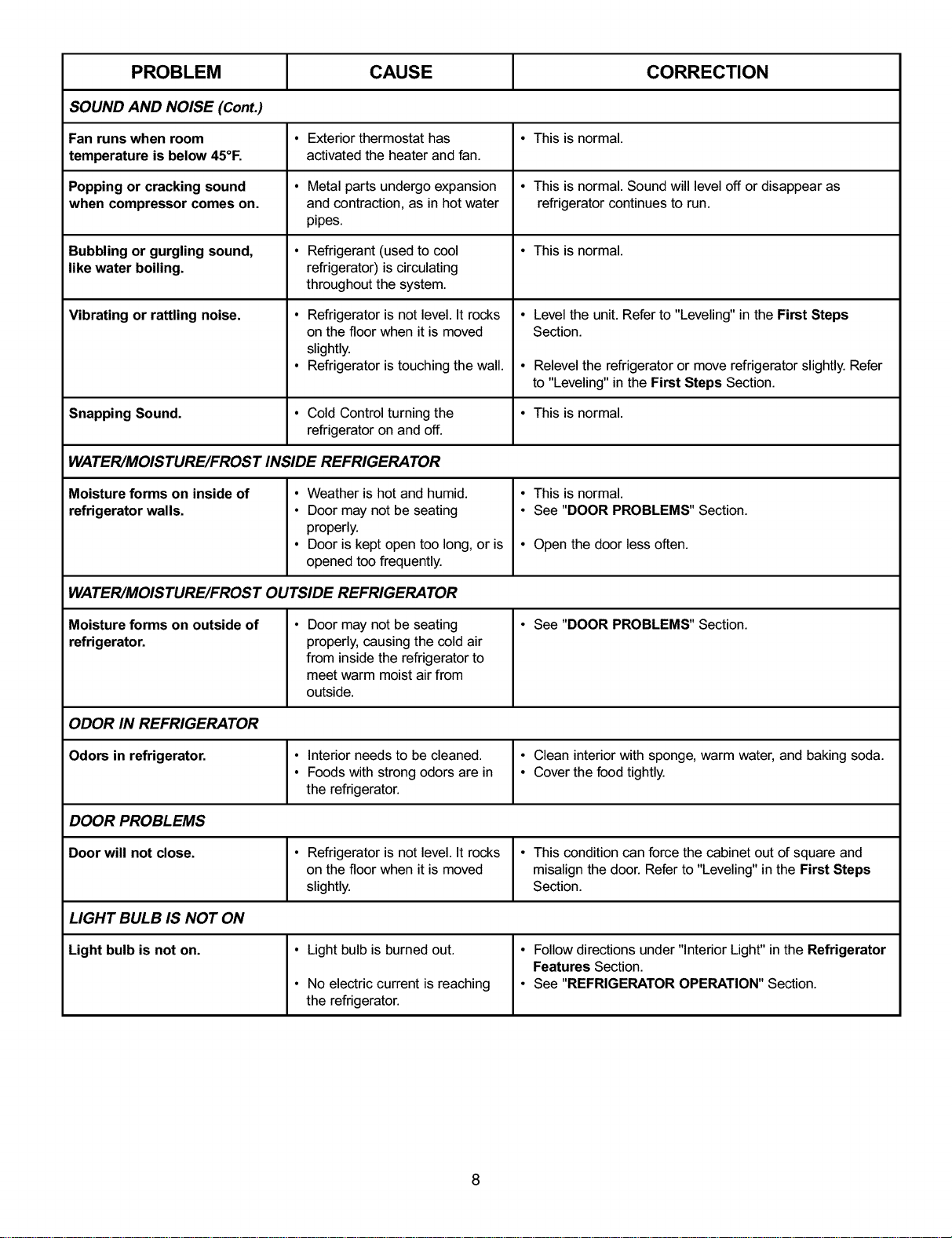
/
PROBLEM J CAUSE CORRECTION
SOUND AND NOISE (Cont.)
Fan runs when room • Exterior thermostat has • This is normal.
temperature is below 45°F. activated the heater and fan.
Popping or cracking sound • Metal parts undergo expansion • This is normal. Sound will level off or disappear as
when compressor comes on. and contraction, as in hot water refrigerator continues to run.
pipes.
Bubbling or gurgling sound, • Refrigerant (used to cool • This is normal.
like water boiling, refrigerator) is circulating
throughout the system.
Vibrating or rattling noise. •
Refrigerator is not level. It rocks
on the floor when it is moved
slightly.
Refrigerator is touching the wall.
• Level the unit. Refer to "Leveling" in the First Steps
Section.
• Relevel the refrigerator or move refrigerator slightly. Refer
to "Leveling" in the First Steps Section.
Snapping Sound. • Cold Control turning the • This is normal.
refrigerator on and off.
WATER/MOISTURE/FROST INSIDE REFRIGERATOR
Moisture forms on inside of
refrigerator walls.
• Weather is hot and humid.
• Door may not be seating
properly.
• Door is kept open too long, or is
opened too frequently.
• This is normal.
• See "DOOR PROBLEMS" Section.
• Open the door less often.
WATER/MOISTURE/FROST OUTSIDE REFRIGERATOR
• • See "DOOR PROBLEMS"Section.Moisture forms on outside of
refrigerator.
Door may not be seating
properly, causing the cold air
from inside the refrigerator to
meet warm moist air from
outside.
ODOR IN REFRIGERATOR
Odors in refrigerator. • Interior needs to be cleaned. • Clean interior with sponge, warm water, and baking soda.
• Foods with strong odors are in • Cover the food tightly.
the refrigerator.
DOOR PROBLEMS
Door will not close. • Refrigerator is not level. It rocks • This conditioncan force the cabinet out of square and
on the floor when it is moved misalign the door. Refer to "Leveling" in the First Steps
slightly. Section.
LIGHT BULB IS NOT ON
Light bulb is not on. • Lightbulb is burned out. • Follow directions under "Interior Light"in the Refrigerator
Features Section.
• No electric current is reaching • See "REFRIGERATOR OPERATION" Section.
the refrigerator.
8